
JAMES L. AND DOROTHY H. DEWAR COLLEGE OF EDUCATION & HUMAN SERVICES
|
|
|
- Russell Dorsey
- 10 years ago
- Views:
Transcription
1 JAMES L. AND DOROTHY H. DEWAR COLLEGE OF EDUCATION & HUMAN SERVICES Dr. Brian Gerber, Interim Dean Room 2041, Education Center Dr. Reynaldo Martínez... Head, Department of Adult and Career Education Dr. Corine Myers-Jennings... Head, Department of Communication Sciences and Disorders Dr. James L. Pate.... Interim Head, Department of Curriculum, Leadership, and Technology Dr. Festus Obiakor...Head, Department of Early Childhood and Special Education Dr. Mike Griffin... Head, Department of Kinesiology and Physical Education TBA... Head, Department of Library and Information Sciences Dr. Kate Warner...Head, Department of Marriage and Family Therapy Dr. Barbara Radcliffe. Interim Head, Department of Middle, Secondary, Reading, and Deaf Education Dr. Jackson Rainer...Head, Department of Psychology and Counseling Dr. Mizanur Miah...Head, Department of Social Work The James L. and Dorothy H. Dewar College of Education and Human Services proudly maintains a commitment to providing an education for future professionals in south Georgia. Acting as a learning community, the Dewar College of Education and Human Services strives to meet the needs and aspirations of the population it serves. MISSION The Dewar College of Education and Human Services provides quality graduate instruction in its comprehensive degree programs at the master s, specialist, and doctoral levels. In addition to a primary focus on expanding the skills of teachers and other professionals, faculty members of the Dewar College of Education and Human Services also maintain a commitment to engaging in the scholarly pursuits of research and service for the advancement and sharing of knowledge. Faculty members, administrators, and staff of the Dewar College of Education and Human Services envision an educational system in which students fully participate and take responsibility for their own learning process, where interdisciplinary and inter-institutional collaboration is the norm, and where technology is fully integrated into the learning process. The College also seeks to create an environment that promotes the full development of human potential, supports the conviction that all individuals are capable of learning, and prepares professionals to meet the needs of all learners. VISION An agreed-upon vision provides focus and direction for the members of an organization. The College of Education and Human Services dedicates its resources and expertise to: Positively Impacting Learning Through Evidence-Based Practices The Valdosta State University Dewar College of Education and Human Services Conceptual Framework is the underlying structure that gives conceptual guidance to the operation of the College of Education and Human Services and its partners. It provides direction for our educator preparation programs, courses, teaching, university student performance, faculty scholarship, and faculty service. The Conceptual Framework is based on the broader missions of both the University and the College for the purposes of advancing educational progress in our region. A common thread runs through both mission statements: excellence in teaching and learning, scholarship, and service (VSU Conceptual Framework Document, 2005). At its core is the purpose of positively impacting learning 45
2 through evidence-based practices. All programs within the College are guided by this purpose. While learners in various programs may differ according to the candidates roles and program standards may differ according to specialized professional association (SPA) guidelines, the essential outcome of all programs is to positively impact learning through the use of evidence-based practices. The Conceptual Framework Guiding Principles related to dispositions, equity, process, ownership, support, impact, and technology are blended with the standards set forth for teachers and by SPAs to provide the structural basis for the programs. Course syllabi, assessments, and candidates portfolios reflect the College s Conceptual Framework through close alignment with the respective standards. ACCREDITATION AND CERTIFICATION The Dewar College of Education and Human Services maintains accreditation with the National Council for Accreditation of Teacher Education, and all of its individual educator preparation programs are approved by the Georgia Professional Standards Commission. Specific questions concerning teacher certification should be directed to the appropriate department. The master s program in communication disorders is nationally accredited by the Council on Academic Accreditation of the American Speech-Language-Hearing Association, and the master s program in school counseling is nationally accredited by the Council for Accreditation of Counseling and Related Educational Programs. The College of Education and Human Services also houses graduate programs that are nationally recognized by specialized professional associations: Instructional Technology-Technology Applications and Instructional Technology [Ed.S.] (Association for Educational Communications and Technology), Instructional Technology-Library Media (Association for Educational Communications and Technology and American Library Association/American Association of School Librarians) Reading Education (International Reading Association) Special Education/Deaf Education (Council for Exceptional Children) The Marriage and Family Therapy Program is accredited by the Commission on Accreditation for Marriage and Family Therapy Training and Education (COAMFTE) of the American Association for Marriage and Family Therapy (AAMFT). DIVERSITY The Dewar College of Education and Human Services faculty members recognize the need to take proactive steps to enhance multicultural and global perspectives and to promote diversity. In order to meet this need, they support multicultural perspectives throughout educational programs and actively seek a diverse student and faculty population. The Dewar College of Education and Human Services educator preparation unit has established comprehensive school partnerships with area schools. These schools were recruited based on a number of factors, including opportunities they would provide to our candidates to work with diverse P-12 students and public school mentors. ADVISING For initial guidance, new graduate students in the Dewar College of Education and Human Services should consult with the head of the department in which they plan to pursue a degree. Each student will be assigned an advisor in the appropriate area of study. The student and advisor will collaborate in designing the program to meet the individual needs of the student within the guidelines of the approved program of study. Students are expected to initiate contact with their advisors at least once per semester to ensure that all program requirements are being met. 46

3 STUDENT RESPONSIBILITIES Graduate students are expected to become familiar with the rules and requirements of the Dewar College of Education and Human Services and to assume full responsibility for the regulations concerning their programs of study. In addition, students are expected to attend all classes regularly and abide by the student code of conduct published in the Valdosta State University Student Handbook. GRADUATE DEGREE PROGRAMS The James L. and Dorothy H. Dewar College of Education and Human Services offers three levels of graduate degree programs: the master s degree (Master of Education, Master of Arts in Teaching, Master of Science [with a major in psychology or in Marriage and Family Therapy], and Master of Social Work); the Education Specialist degree; and the Doctor of Education degree. Course descriptions and programs of study leading to these degrees are listed by department. MASTER S DEGREE PROGRAMS The Master of Education degree programs are designed to enhance and extend the knowledge and skills of students beyond the undergraduate level. The core courses at the master s level develop the students ability to use and apply research skills, become familiar with current issues and trends in their fields, and review material related to legal issues and ethics. The Master of Arts in Teaching degree programs are designed to prepare individuals who have completed content requirements for initial teacher certification. These programs provide students with the pedagogical and professional knowledge, skills, and dispositions to be effective educators. The Master of Science with a major in psychology program prepares students to apply psychological theories, principles, and methods, developed in coursework and practicum and internship experiences, to the mental health professions (Clinical-Counseling Psychology) or the workplace (Industrial-Organizational Psychology). The degree programs offered are as follows: Department of Adult and Career Education M.Ed. Adult and Career Education Department of Communication Sciences and Disorders M.Ed. Communication Disorders Department of Curriculum, Leadership, and Technology M.Ed. Educational Leadership M.Ed. Instructional Technology Department of Early Childhood and Special Education M.A.T. Special Education Adapted Curriculum M.A.T. Special Education General Curriculum M.Ed. Early Childhood Education M.Ed. Interrelated Special Education /Early Childhood General Curriculum Department of Kinesiology and Physical Education M.Ed. Health and Physical Education Department of Library and Information Science M.L.I.S. Library and Information Science Department of Marriage and Family Therapy M.S. Marriage and Family Therapy Department of Middle, Secondary, Reading, and Deaf Education M.Ed. Middle Grades Education M.Ed. Secondary Education M.Ed. Reading Education 47

4 M.Ed. Accomplished Teaching M.Ed. Deaf and Hard-of-Hearing M.A.T. Special Education Deaf and Hard-of-Hearing M.A.T. Middle Grades Education M.A.T. Secondary Education Department of Psychology and Counseling M.Ed. School Counseling M.S. Psychology Department of Social Work M.S.W. Social Work EDUCATION SPECIALIST DEGREE PROGRAMS The Education Specialist (Ed.S.) degree is designed to enhance and extend the knowledge and skills of students beyond the master s level. The core course at the specialist level is designed to develop the students ability to apply research skills in the field to solve problems and improve services in a variety of settings. The degrees offered are: Department of Curriculum, Leadership, and Technology Ed.S. Performance-Based Educational Leadership Ed.S. Instructional Technology Department of Kinesiology and Physical Education Ed.S. Coaching Pedagogy in Physical Education Department of Middle, Secondary, Reading, and Deaf Education Ed.S. Teaching and Learning Department of Psychology and Counseling Ed.S. School Counseling DOCTOR OF EDUCATION DEGREE PROGRAM The Doctor of Education (Ed.D.) degree is an advanced program of study based upon the assumption that an interdisciplinary curriculum can serve as the primary intellectual framework for investigating, understanding, and affecting the broad range of academic, social, economic, and cultural issues and pressures facing modern education. The degrees offered are as follows: Department of Adult and Career Education Ed.D. Adult and Career Education Department of Curriculum, Leadership, and Technology Ed.D. Leadership Ed.D. Curriculum and Instruction GRADUATE ADMISSIONS Go to the Graduate School Website at and click on Our Programs, then click on the specific graduate program of interest for information on: Specific Program Admission Requirements Program Retention, Dismissal, and Readmission Policies Program Graduation Requirements To Apply for admission to all programs in the Dewar College of Education and Human Services (except the collaborative online education programs listed below), go to apply/vsug/menu.html 48

5 Additionally, the Dewar College of Education and Human Services provides several fully online programs through the collaborative online education family of programs. These programs include: Master of Arts for Teachers (M.A.T.) in Special Education-General Curriculum Master of Arts for Teachers (M.A.T.) in Special Education-Adapted Curriculum Master of Education (M.Ed.) in Accomplished Teaching Master of Education (M.Ed.) in Middle Grades Math/Science Education Specialist (Ed.S.) in Teaching & Learning: Exemplary Teaching Gifted Endorsement Online Teaching Endorsement Certificate in Online Teaching The collaborative online education programs provide opportunities for graduate education in an online learning environment, providing flexibility for working professionals. The tuition cost for these programs is a flat e-tuition rate of $350 per credit hour. The programs consider applications each semester. For more information and application forms for collaborative online education programs, go to DISSERTATION CREDIT GUIDELINES Doctoral candidates will be required to register for a minimum of 2 semester hours of dissertation credit for each fall and spring semester in which written materials are to be submitted for feedback from their chairs and committees. Candidates who are not actively engaged with their chairs or committees would continue to register for a minimum of 1 hour credit for fall and spring. Registration for summer is dependent upon candidates active engagement with their chairs or committees. Candidates will be required to register for a minimum of 2 semester hours of dissertation credit during the summer if written materials are to be submitted for feedback from their chairs or committees. GRADUATE ADMISSION APPEALS PROCESS Any applicant who is denied admission to a graduate program in the Dewar College of Education and Human Services has the right to appeal the decision. There are three levels of appeal: (1) the departmental level, (2) the college level, and (3) the Graduate School level. The Graduate School will not hear an appeal by an applicant unless that applicant has exhausted the appellate procedures in the Department and College and has been unable to reach a satisfactory resolution of the problem. The first step in the appeals process is to download the appeal form: graduate-school/documents/admission-denial-appeal.pdf The applicant must fill out the top portion of the form and provide an explanation for his/her appeal. Next, the applicant must contact the Department Head for her or his program and set up a meeting to discuss the appeal. An applicant who is denied admission by the Department may appeal to the Dewar College of Education and Human Services Advanced Preparation Policies Committee (M.Ed., M.S., and Ed.S. programs) or the Dewar College of Education and Human Services Initial Preparation Policies Committee (M.A.T. programs). The committees are comprised of representatives from each of the departments within the Dewar College of Education and Human Services. One of the primary functions of these committees is to hear appeals of applicants who have been denied admission to a Dewar College of Education and Human Services graduate program. The Advanced Preparation Policies Committee meets once a semester; the Initial Preparation Policies Committee meets monthly. Applicants who wish to appeal to the Dewar College of Education and Human Services Advanced Preparation Policies Committee (M.Ed., M.S., and Ed.S. programs) or the Dewar College of Education and Human Services Initial Preparation Policies Committee (M.A.T. programs) should follow the steps outlined: 49

6 Appeal Procedure 1. The applicant must have been rejected by the departmental appeals committee (based on any departmental criteria). 2. If the appeal is based on an applicant s low scores on the GRE or MAT, the applicant must report scores from at least two attempts to post acceptable scores. The scores must be stated on the appeal form. 3. The applicant must submit the appeal form, with signatures from the department head. 4. The applicant must submit three letters of recommendation for graduate study. One letter should come from the applicant s immediate supervisor, and at least one other letter should come from a former instructor who can attest to the applicant s academic ability. The letters should be submitted with the appeal form. 5. The applicant must write a letter to the Dewar College of Education and Human Services Advanced Preparation Policies Committee (M.Ed., M.S., and Ed.S. programs) or the Dewar College of Education and Human Services Initial Preparation Policies Committee (M.A.T. programs) stating reasons why the committee should favorably consider his or her request for admission and outlining reasons why he or she wishes to pursue graduate study. This letter should also be submitted with the appeal form. 6. All appeals materials must be submitted to the Dewar College of Education and Human Services at least one week before the scheduled meeting of the Advanced Preparation Policies Committee (M.Ed., M.S., and Ed.S. programs) or the Initial Preparation Policies Committee (M.A.T. programs). 7. All applicants who wish to appeal have the right to appear before the Advanced Preparation Policies Committee (M.Ed., M.S., and Ed.S. programs) or the Initial Preparation Policies Committee (M.A.T. programs) and state their cases in person. Applicants must contact the Chairperson of the Advanced Preparation Policies Committee (M.Ed., M.S., and Ed.S. programs) or the Initial Preparation Policies Committee (M.A.T. programs) to make an appointment with the committee if they wish to appear in person. 8. The decision of the committee concerning each applicants appeal will be communicated to the Dean of the Dewar College of Education and Human Services who will communicate the decision to the Dean of the Graduate School. Applicants who have been denied admission through the appeals process at the departmental and college level may submit the appeals form to the Dean of the Graduate School. Once the appeals form, signed by the Department Head and the Chair of the Advanced Preparation Policies Committee (M.Ed., M.S., and Ed.S. programs) or the Initial Preparation Policies Committee (M.A.T. programs) has been received by the Dean of the Graduate School, the Dean will contact the applicant to make an appointment. The Dean of the Graduate School will notify each applicant, in writing, of the final decision of the Graduate School. ADDITIONAL EDUCATION DEGREES Other education degrees and programs offered in cooperation with departments outside the Dewar College of Education and Human Services are listed below. Information related to these degrees may be found in the catalog section of the respective departments. Department of Music, College of the Arts M.M.E. with a major in Music Education Department of Modern and Classical Languages, College of Arts and Sciences M.Ed. with a major in Secondary Education - Teaching Field Spanish 50

7 Department of Adult and Career Education Dr. Reynaldo L. Martínez, Jr., Department Head Room 215, Education Center The Department of Adult and Career Education offers graduate programs of study at the master s and doctoral levels. The department offers a Master of Education (M.Ed.) degree program with a major in adult and career education, with three options: workforce education and development, career and technical education, and business education and information technology. At the doctoral level, the department offers the Doctor of Education (Ed.D.) degree program with a major in adult and career education. The graduate programs within the Department of Adult and Career Education are designed to build upon the knowledge, skills, and dispositions developed at the undergraduate level. The content of the coursework is designed to present specific advanced information that will prepare students to serve as professional educators and educational leaders in various educational settings at a higher level of competency than those professionals without graduate degrees. Students are provided opportunities to research situations in the field and to apply concepts covered to actual teaching and program development. DOCTOR OF EDUCATION WITH A MAJOR IN ADULT AND CAREER EDUCATION The Adult and Career Education major provides advanced, professional training for individuals pursuing careers in teaching and leadership of career education and related fields. The program prepares students for working with adult learners and students with special needs in career education fields at the secondary and postsecondary levels in the public and private sectors. SELECTED EDUCATIONAL OUTCOMES 1. Candidates will demonstrate the ability to engage in focused inquiry by researching a topic, evaluating relevant literature, writing a comprehensive dissertation, and presenting the results of their study. 2. Candidates or students will demonstrate the ability to contribute to the body of knowledge in their field by writing and submitting a manuscript for publication or by making a presentation based on their doctoral studies at a professional conference or meeting. 3. Students will demonstrate a comprehensive understanding of the knowledge, research, and theories appropriate to their major field by completing a comprehensive examination. EXAMPLES OF OUTCOME ASSESSMENTS 1. The process of developing the dissertation and the results of the dissertation are assessed by a faculty committee using criteria approved at the program level. 2. As part of the course requirements in their major coursework, candidates will be required to write a manuscript in their field for publication. The manuscript will be reviewed by a faculty member before it is submitted to a professional publication, or candidates/students will document successfully making a presentation based on their doctoral studies at a professional conference or meeting. 3. Students will successfully develop written responses to a comprehensive examination that requires the application of information gained from a series of courses. Written responses will be evaluated by a team of faculty members. Prior to admission to any graduate program at Valdosta State University, applicants must first submit a completed application to the Graduate School. A completed application packet includes official transcripts from all institutions previously attended, official test scores (GRE or MAT), completed application form, fee, and any additional program requirements submitted by the admission deadline. 51

8 To be considered for the preferred term, all required materials must be received by the Graduate School no later than the close of business on the deadline. It is the responsibility of the applicant to allow adequate time for document submission and to ensure receipt of documents. Admission Deadlines This program considers applications for Fall and Spring terms. Fall Deadline: April 1 Spring Deadline: October 1 Go to the Graduate School Website at and click on Our Programs, then click on ACED Ed.D. Program for information on: Specific ACED Ed.D. Program Admission Requirements ACED Ed.D. Program Retention, Dismissal, and Readmission Policies ACED Ed.D. Program Graduation Requirements To Apply Online: REQUIREMENTS FOR THE ED.D. DEGREE WITH A MAJOR IN ADULT AND CAREER EDUCATION Area A Interdisciplinary Studies....9 hours Choose three from the following: ACED 9400, CIED 9100, LEAD 9030, EDUC 9000 Area B Educational Inquiry hours RSCH 9800, RSCH 9820, RSCH hours RSCH 9830, RSCH 9850, or RSCH hours RSCH 9870 Dissertation Topic Conceptualization...3 hours Area C Adult and Career Education hours ACED Core...9 hours ACED 9410, ACED 9420, ACED 9430 Interdisciplinary...12 hours An advisor will be assigned to each student, based on the area of specialization. The advisor and the student will jointly complete an approved program of study to be followed. Dissertation ACED hours Total Hours Required for the Degree semester hours MASTER OF EDUCATION WITH A MAJOR IN ADULT AND CAREER ED. Candidates Select One of Three Program Options: (1) Workforce Education and Development Option (2) Career and Technical Education Option (3) Business Education and Information Technology Option MASTER OF EDUCATION WITH A MAJOR IN ADULT AND CAREER ED. WORKFORCE EDUCATION AND DEVELOPMENT OPTION SELECTED EDUCATIONAL OUTCOMES 1. Candidates will demonstrate a comprehensive understanding of the knowledge, research, and theories appropriate to their major field. 2. Candidates will demonstrate advanced knowledge and skills appropriate to adult workforce education. 3. Candidates will demonstrate the ability to engage in focused inquiry on a topic relevant to their particular area of concentration. 52

9 EXAMPLES OF OUTCOME ASSESSMENTS 1. Candidates will successfully develop an approved capstone experience that requires the application of knowledge and skills gained from a series of courses. The capstone project will be evaluated by a team of faculty members. 2. Candidates will successfully complete culminating assessments in ACED 7640 and ACED Program graduates will successfully research a topic including a relevant literature review as part of the requirements of the capstone project. MASTER OF EDUCATION WITH A MAJOR IN ADULT AND CAREER EDUCATION CAREER AND TECHNICAL EDUCATION OPTION SELECTED EDUCATIONAL OUTCOMES 1. Candidates in advanced teacher education programs have an in-depth knowledge of the content that they teach. 2. Candidates in advanced teacher education programs select and use a broad range of instructional strategies and technologies that promote student learning, and they will clearly explain the choices they make in their practice. 3. Candidates in advanced teacher education programs reflect on their practice and are able to identify their strengths and areas of needed improvement. 4. Candidates in advanced teacher education programs analyze student, classroom, and school performance data and make data-driven decisions about strategies for teaching and learning so that all students learn. EXAMPLES OF OUTCOME ASSESSMENTS 1. Candidates in advanced teacher education programs will demonstrate the level of their content knowledge as part of the requirements for ACED Program graduates will research relevant issues related to their content field and to the pedagogy in that field which will lead to the successful completion of a literature review. 2. Candidates in advanced teacher education programs will demonstrate their use of instructional strategies and technologies through completion of a self-evaluation of a teaching episode. 3. Candidates in advanced teacher education programs will document reflection on their teaching and will identify areas of strengths and areas for improvement through completion of the COE Advanced Teacher Self-Assessment Instrument. 4. Candidates in advanced teacher education programs will demonstrate their ability to positively impact P-12 learning through performance on an approved capstone experience that requires the application of knowledge and skills gained from a series of courses. The capstone experience will be evaluated by a team of faculty members. MASTER OF EDUCATION WITH A MAJOR IN ADULT AND CAREER EDUCATION BUSINESS EDUCATION AND INFORMATION TECHNOLOGY OPTION SELECTED EDUCATIONAL OUTCOMES 1. Candidates will demonstrate a comprehensive understanding of the knowledge, research, and theories appropriate to their major field. 2. Candidates will demonstrate knowledge and skills in advanced Business Education and Information Technology computer applications. 3. Candidates will demonstrate the ability to engage in focused inquiry on a topic relevant to their particular area of concentration. 53

10 EXAMPLES OF OUTCOME ASSESSMENTS 1. Candidates will successfully develop an approved capstone experience that requires the application of knowledge and skills gained from a series of courses. The capstone project will be evaluated by a team of faculty members. 2. Candidates will successfully complete specified assessments in the five classes of the Area of Concentration. 3. Candidates will successfully research a topic and successfully complete a relevant literature review as part of the requirements of the capstone project. Prior to admission to any graduate program at Valdosta State University, applicants must first submit a completed application to the Graduate School. A completed application packet includes official transcripts from all institutions previously attended, official test scores (GRE or MAT), completed application form, fee, and any additional program requirements, submitted by the admission deadline. To be considered for the preferred term, all required materials must be received by the Graduate School no later than the close of business on the deadline. It is the responsibility of the applicant to allow adequate time for document submission and to ensure receipt of documents. Admission Deadlines Fall Deadline: July 15 Spring Deadline: November 15 Summer Deadline: May 1 Go to the Graduate School Website at at and click on ACED M.Ed. Program for information on: Specific ACED M.Ed. Program Admission Requirements ACED M.Ed. Program Retention, Dismissal, and Readmission Policies ACED M.Ed. Program Graduation Requirements To Apply Online: REQUIREMENTS FOR THE M.ED. DEGREE WITH A MAJOR IN ADULT AND CAREER EDUCATION WORKFORCE EDUCATION AND DEVELOPMENT OPTION Core Courses hours RSCH hours PSYC 7010 or PSYC hours ACED 7640, ACED 7990, ACED hours Area of Concentration hours ACED 7100, ACED 7110, ACED 7150, and ACED hours ACED 7680 or ACED hours Capstone Option A...6 hours Comprehensive Exam Guided Electives....6 hours Capstone Option B...6 hours ACED hours Guided Elective....3 hours Recommended Guided Electives: ACED 7020, ACED 7120, PSYC 7610, PSYC 8360 Total Hours Required for the Degree semester hours 54

11 REQUIREMENTS FOR THE M.ED. DEGREE WITH A MAJOR IN ADULT AND CAREER EDUCATION CAREER AND TECHNICAL EDUCATION OPTION Core Courses hours RSCH hours PSYC 7010 or PSYC hours ACED 7620, ACED 7640, ACED hours Area of Concentration hours EDUC hours ACED 7020, ACED hours ACED 7410 or ACED hours ACED 7120, ACED 7430, or ACED hours ACED 7150 or ACED hours ACED hours Guided Elective...3 hours Recommended Guided Electives: ACED 7600, ACED 7810, PADM 7000, PADM 7110, PADM 7170, ITED 7400, ITED 7500 Total Hours Required for the Degree semester hours REQUIREMENTS FOR THE M.ED. DEGREE WITH A MAJOR IN ADULT AND CAREER EDUCATION BUSINESS EDUCATION AND INFORMATION TECHNOLOGY OPTION Core Courses hours RSCH hours PSYC 7010 or PSYC hours ACED 7620, ACED 7640, ACED hours Area of Concentration hours ACED 7070, ACED 7220, ACED 7510, ACED 7610, ACED hours Guided Elective...3 hours Total Hours Required for the Degree semester hours 55

12 Department of Communication Sciences and Disorders Dr. Corine C. Myers-Jennings, Department Head Room 109, Communication Disorders Building The Doctorate in Speech-Language Pathology (SLPD) will prepare advanced practitioners and future university clinical faculty in Communication Sciences and Disorders through provision of rigorous, high quality clinical training. The clinical doctorate emphasizes the social and cultural aspects of communication sciences and disorders as it applies to both allied health care and educational services to under-served populations. This clinical doctorate is designed to deepen the knowledge, leadership, and problem-solving skills of current practitioners with a focus on coursework and applications that incorporate current research, ethical decision-making, and models of best practice. The curriculum will prepare doctoral students to analyze, synthesize, and apply research-based theory to their current work environment and through the development of the applied dissertation. Individuals completing this program will receive a Doctor of Speech-Language Pathology (SLPD) degree in Communication Sciences and Disorders. DOCTOR OF SPEECH-LANGUAGE PATHOLOGY IN COMMUNICATION SCIENCES AND DISORDERS SELECTED EDUCATIONAL OUTCOMES 1. Program graduates will demonstrate the ability to design and deliver professional development programs to meet the needs of underserved client populations in their region with an emphasis on cultural and linguistic diversity. 2. Program graduates will demonstrate the ability to successfully supervise individuals. 3. Program graduates will produce a relevant applied research dissertation. EXAMPLES OF OUTCOME ASSESSMENTS 1. Successful completion of a written and oral comprehensive examination. 2. Successful defense of an applied research dissertation. Prior to admission to any graduate program at Valdosta State University, applicants must first submit a completed application to the Graduate School. A completed packet includes official transcripts from all institutions previously attended, official GRE scores, a letter of application, minimum three years full-time experience as a speech-language pathologist, three letters of recommendation, fee, and any additional program requirements submitted by the admission deadline. It is the responsibility of the applicant to allow adequate time for document submission and to ensure receipt of documents. Admission deadline: Fall Deadline: April 1 Go to the Graduate School Website at and click on Our Programs, then click on CSD Program for information on: Specific SLPD program Admission Requirements To Apply Online: 56

13 DOCTOR OF SPEECH-LANGUAGE PATHOLOGY IN COMMUNICATION SCIENCES AND DISORDERS REQUIREMENTS FOR THE SLPD DEGREE IN COMMUNICATION SCIENCES AND DISORDERS Research Core hours CSD 9521, CSD hours CSD hour RSCH 9840 or RSCH hour Social and Cultural Aspects Core....6 hours CSD 9530, CSD hours Advanced Clinical Intervention Core....9 hours CSD hours CSD hours Professional Development Core....2 hours CSD hours CSD 9100, CSD hours Major Content Focus*....9 hours CSD 9500, CSD 9510, CSD hours Minor Content Focus*....6 hours CSD 9400, CSD hours Elective Strands....6 hours Students will choose two courses outside the department Total Hours Required for the Degree semester hours *for Major/Minor topic focus, students can choose from one of the following topical areas: Autism Spectrum Disorder and Assessment/Intervention Dysphagia Neurogenics Fluency and related Disorders Early Intervention (birth-5 years) School-Aged Language Disorders Voice and related Disorders Alternative/Augmentative Communication Phonological Disorders Adult Language Disorders 57

14 The Master of Education (M.Ed.) degree program in the Department of Communication Sciences and Disorders is designed to allow students to apply knowledge from the pre-professional degree while continuing to gain information regarding effective diagnosis of, and intervention for, clients with a variety of communication disorders and diverse needs. Students also concentrate on self-reflection regarding intervention, effectiveness, course content knowledge, and implementation of research to guide practice. The program includes the study of research methods and findings so that students become knowledgeable consumers of data and are prepared to engage in research activities. The program reflects the mission of the College of Education and Human Services by developing skills in intervention and evidence-based practices. The combination of academic coursework and practica prepares the successful candidate to meet the challenges of a career in speech-language pathology across a wide variety of medical and schoolbased settings. The degree in communication disorders is designed to meet current standards required for certification by the American Speech-Language-Hearing Association (ASHA), certification for public school service personnel, and state licensure. SELECTED EDUCATIONAL OUTCOMES 1. Program graduates will demonstrate content knowledge concerning speech and hearing anatomy and physiology, normal speech and language development, communication disorders, and learning styles. 2. Program graduates will demonstrate ability to apply content and intervention skills by designing and implementing appropriate diagnostic and intervention techniques to meet client needs and developmental levels. EXAMPLES OF OUTCOME ASSESSMENTS 1. Successful completion of the ASHA examination and/or written comprehensive exam. 2. Direct and indirect observations and ratings of interventions designed and implemented by students for clients with various disabilities and disorders in a variety of settings. Prior to admission to any graduate program at Valdosta State University, applicants must first submit a completed application to the Graduate School. A completed application packet includes official transcripts from all institutions previously attended, official test scores (GRE or MAT), completed application, fee, and any additional program requirements submitted by the admission deadline. To be considered for the preferred term, all required materials must be received by the Graduate School no later than the close of business on the deadline. It is the responsibility of the applicant to allow adequate time for document submission and to ensure receipt of documents. Admission Deadlines: Fall Deadline: March 1 Spring Deadline: July 1 Summer Deadline: October 1 Go to the Graduate School Website at and click on Our Programs, then click on CSD Program for information on: Specific CSD Program Admission Requirements CSD Program Retention, Dismissal, and Readmission Policies CSD Program Graduation Requirements To Apply Online: 58
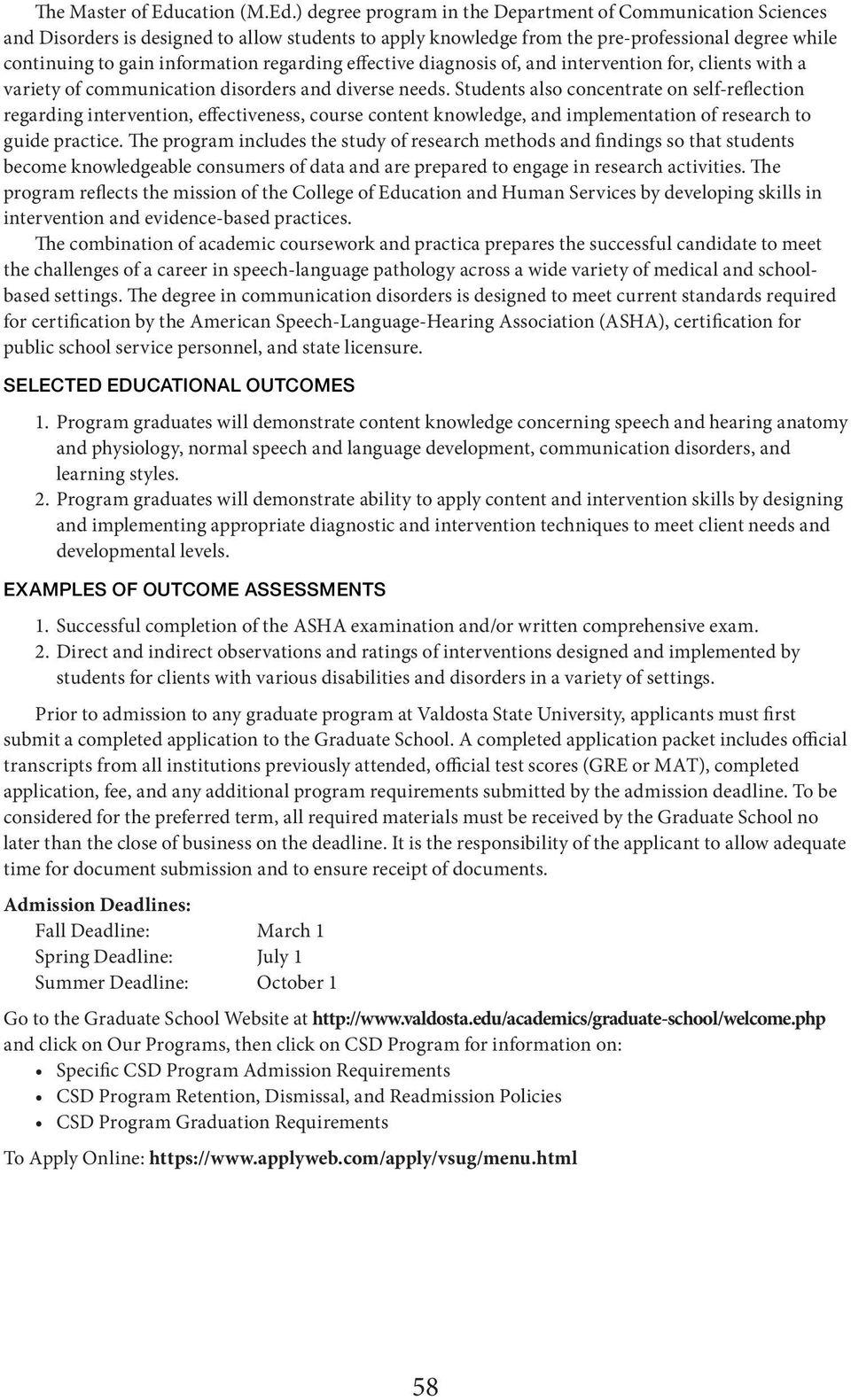
15 MASTER OF EDUCATION WITH A MAJOR IN COMMUNICATION DISORDERS REQUIREMENTS FOR THE M. ED. DEGREE WITH A MAJOR IN COMMUNICATION DISORDERS College of Education and Human Services Core....4 hours CSD 5110 or RSCH hours LEAD hour Major Curriculum hours CSD 5010, CSD 5030, CSD hours CSD hours CSD 5060, CSD hours CSD hours CSD 5100, CSD 5120, CSD hours CSD 5140, CSD hours CSD hours CSD hours CSD 5200 or CSD 5230 Thesis...3 hours Total Hours Required for the Degree semester hours State certification rules require that all certified personnel in Georgia demonstrate satisfactory proficiency in computer skill. Students majoring in communication disorders who have not met this requirement at the undergraduate level may do so by completing ACED 2400 or ACED
16 Department of Curriculum, Leadership, and Technology Dr. James L. Pate, Interim Head Room 202, Communication Disorders Building The mission of the Department of Curriculum, Leadership, and Technology is to develop practitioners and researchers who are knowledgeable and skilled in improving schools and other learning organizations. To accomplish its mission, the department offers programs in curriculum and instruction at the doctoral level; leadership at the doctoral level, educational leadership at the specialist and master s levels; and instructional technology at the specialist and master s levels. The department also offers a variety of certifications and endorsement programs. All programs have distance education components and are strongly supported by research courses offered within the department. The Curriculum and Instruction major (Ed. D.) provides interrelated courses and guided experiences to develop student understanding of effective instructional systems and application of theoretical foundations in curriculum and instruction. Course work requires doctoral candidates to research, design, develop, implement, evaluate, and disseminate innovative educational practices in a variety of learning environments. The program offers concentrations for both non P-12 educators and P-12 educators (GaPSC level 6/7 certificate). The Leadership major (Ed. D.) seeks to develop doctoral candidates who are effective, ethical, and diverse leaders seeking to maximize achievement in schools and other organizations. Skill applications serve as the connection between the knowledge and inquiry skills developed in the core curriculum and research courses and the increasingly complex world of restructured practice and school or organizational improvement. The program offers concentrations for both non P-12 educators and P-12 educators (GaPSC level 6/7 certificate). Programs offered in educational leadership lead to an Education Specialist degree (Ed. S.) in educational leadership (performance-based building- or system-level GaPSC PL-6 certificate options), and to a Master of Education degree (M.Ed.) with a major in educational leadership (higher education leadership or student affairs options). The department also offers a GaPSC PL-6/7 certification program in performance-based building- or system-level educational leadership. The educational leadership programs provide quality instruction, research, and service to prospective and practicing educational leaders. In particular, the Master of Education degree programs are designed to provide candidates with the basic knowledge, skills, and values to perform competently at entry-level leadership roles in higher education and student affairs. Candidates who complete the Education Specialist degree will be equipped with advanced knowledge and skills to perform competently as professionals in educational leadership. The doctoral program is intended to prepare candidates to assume active leadership roles in a variety of organizations. All programs emphasize ethical decision-making and leadership for change. The instructional technology program is offered at the master s and specialist levels. The Master of Education (M.Ed.) degree program accepts qualified graduates from all disciplines and has three concentrations: library media (GaPSC S-5 certificate), P-12 technology applications (GaPSC S-5 certificate), and technology application. The library media concentration prepares candidates to be school media specialists. The technology applications concentrations prepare candidates to be technology coordinators or instructional developers in a variety of contexts: business, industry, government, military service, health fields, and schools. The Education Specialist (Ed. S.) with a major in instructional technology emphasizes leadership development and applied research skills in instructional technology practice and prepares candidates to meet present and future technological challenges within an educational organization. The program accepts qualified graduates from all disciplines and has three concentrations: library media (GaPSC S-5 certificate), P-12 technology applications (GaPSC S-5 certificate), and technology application. The library media concentration prepares candidates to be school media specialists. The technology applications concentrations prepare candidates to be technology coordinators or instructional developers in a variety of contexts: business, industry, government, military service, health fields, and schools. 60
17 DOCTOR OF EDUCATION WITH A MAJOR IN CURRICULUM AND INSTRUCTION The curriculum and instruction major is designed for experienced practitioners in a variety of instructional fields. The program provides opportunities for candidates to relate theoretical foundations to curricular and instructional issues facing schools, school systems, higher education, and other educational agencies. SELECTED EDUCATIONAL OUTCOMES 1. Doctoral candidates will demonstrate inquiry skills in quantitative, qualitative, and mixed research methodologies. 2. Doctoral candidates will demonstrate a comprehensive understanding of the knowledge, research, and theories appropriate to their major field by completing an online portfolio. 3. Doctoral candidates will demonstrate the ability to engage in focused inquiry by researching a topic, evaluating relevant literature, writing a comprehensive dissertation, and presenting the results of their study. EXAMPLES OF OUTCOME ASSESSMENTS 1. Doctoral candidates will successfully complete course work in quantitative, qualitative, and mixed research methodologies. 2. Doctoral candidates will successfully develop an online portfolio. Portfolios will be evaluated by a team of faculty members. 3. Doctoral candidates will be evaluated by a faculty committee on the development and defense of their dissertation. Prior to admission to any graduate program at Valdosta State University, applicants must first submit a completed application to the Graduate School. A completed application packet includes official transcripts from all institutions previously attended, official test scores (GRE or MAT), completed application form, fee, and any additional program requirements submitted by the admission deadline. To be considered for the preferred term, all required materials must be received by the Graduate School no later than the close of business on the deadline. It is the responsibility of the applicant to allow adequate time for document submission and to ensure receipt of documents. Admission Deadline The Ed.D. program in Curriculum and Instruction considers applications for Fall term only. Fall Deadline: March 15 Go to the Graduate School Website at welcome.php and click on Our Programs, then click on Ed.D. Curriculum and Instruction Program for information on: Specific Ed.D. Curriculum and Instruction Program Admission Requirements Ed.D. Curriculum and Instruction Program Retention, Dismissal, and Readmission Policies Ed.D. Curriculum and Instruction Program Graduation Requirements To Apply Online: 61

18 REQUIREMENTS FOR THE ED.D. WITH A MAJOR IN CURRICULUM AND INSTRUCTION WITH A CONCENTRATION IN P-12 CURRICULUM AND INSTRUCTION According to the Georgia Professional Standards Commission (GaPSC), all candidates applying for a certificate in Curriculum and Instruction are required to present passing scores on the GACE Content Assessments for Curriculum and Instruction. The Valdosta State University Dewar College of Education and Human Services requires all candidates to take the appropriate GACE Content Assessment(s) for their major and submit the score reports to the Dean s office. Candidates are not required to pass GACE Content Assessments in order to graduate from our programs but cannot be recommended for certification until they pass. All coursework and assessments must be completed successfully before a candidate can be recommended for certification in Curriculum and Instruction by the GaPSC. Area A: Disciplinary Studies hours CIED hours Choose two from the following: ACED 9400, LEAD 9030, EDUC hours Area B: Educational Inquiry hours RSCH 9800, RSCH 9820, RSCH hours RSCH 9830, RSCH 9850, or RSCH hours RSCH 9871, RSCH hours Area C: Major Courses...21 hours Curriculum and Instruction Core...9 hours CIED 9200, CIED 9300, and CIED 9400, PSYC hours *GaPSC Certification Area Electives...9 hours EDUC hours Area D: Dissertation...9 hours CIED hours Total Hours Required for the Degree semester hours An approved portfolio is required before Admission to Candidacy. *9 hours of electives and/or dissertation in the candidate s area of previous certification is required in GaPSC Rule for Curriculum and Instruction Certification. REQUIREMENTS FOR THE ED.D. WITH A MAJOR IN CURRICULUM AND INSTRUCTION WITH A CONCENTRATION IN GENERAL CURRICULUM AND INSTRUCTION Area A: Disciplinary Studies hours CIED hours Choose two from the following: ACED 9400, LEAD 9030, EDUC hours Area B: Educational Inquiry hours RSCH 9800, RSCH 9820, RSCH hours RSCH 9830, RSCH 9850, or RSCH hours RSCH 9871, RSCH hours Area C: Major Courses...21 hours Curriculum and Instruction Core... 9 hours CIED 9200, CIED 9300, and CIED 9400 Electives...12 hours The advisor and student will jointly design a program of study based on the selected concentration. Area D: Dissertation...9 hours CIED hours Total Hours Required for the Degree semester hours An approved portfolio is required before Admission to Candidacy. 62

19 DOCTOR OF EDUCATION WITH A MAJOR IN LEADERSHIP The Leadership major develops effective, ethical, and diverse leaders who can lead organizations in a rapidly changing world. Skill applications serve as the connection between knowledge and inquiry. The skills developed in the core leadership, interdisciplinary, and research curricula contribute to the development of a culture of continuous organizational improvement. The program is designed for professionals serving in a variety of organizations including P-12 schools, colleges and universities, non-profits, social service agencies, and other businesses. Students may earn concentrations in Organizational Leadership, Higher Education, Student Affairs, Curriculum Leadership, Technology Leadership, or P-12 Performance-based Leadership (initial P-12 GaPSC leadership certification). Advanced P-12 GaPSC certification in school leadership can be earned by completing any concentration except Higher Education. Concentrations may be customized with the permission of the advisor. SELECTED EDUCATIONAL OUTCOMES 1. Doctoral candidates will demonstrate inquiry skills in quantitative, qualitative, and mixed research methodologies. 2. Doctoral candidates will demonstrate a comprehensive understanding of the knowledge, research, and theories appropriate to their major field by completing an online portfolio. 3. Program graduates will demonstrate the ability to engage in focused inquiry by researching a topic, evaluating relevant literature, writing a comprehensive dissertation, and presenting the results of their study. EXAMPLES OF OUTCOME ASSESSMENTS 1. Doctoral candidates will successfully complete course work in quantitative, qualitative, and mixed research methodologies. 2. Doctoral candidates will successfully develop an online portfolio. Portfolios will be evaluated by a team of faculty members. 3. Program graduates will be evaluated by a faculty committee on the development and defense of their dissertation. Prior to admission to any graduate program at Valdosta State University, applicants must first submit a completed application to the Graduate School. A completed application packet includes official transcripts from all institutions previously attended, official test scores (GRE or MAT), completed application form, fee, and any additional program requirements submitted by the admission deadline. To be considered for the preferred term, all required materials must be received by the Graduate School no later than the close of business on the deadline. It is the responsibility of the applicant to allow adequate time for document submission and to ensure receipt of documents. Admission Deadline The Ed.D. program in Leadership considers applications for Fall term only. Fall Deadline: March 15 Go to the Graduate School Website at php and click on Our Programs, then click on Ed.D. Leadership Program for information on: Specific Ed.D. Leadership Program Admission Requirements Ed.D. Leadership Program Retention, Dismissal, and Readmission Policies Ed.D. Leadership Program Graduation Requirements To Apply Online: 63

20 REQUIREMENTS FOR THE ED.D. WITH A MAJOR IN LEADERSHIP Area A: Disciplinary Studies...9 hours Choose three from the following: ACED 9400, CIED 9100, LEAD 9030, EDUC 9000 Area B: Educational Inquiry hours RSCH 9800, RSCH 9820, RSCH hours RSCH 9830, RSCH 9850, or RSCH hours RSCH 9871, RSCH hours Area C: Major and Interdisciplinary Courses hours Leadership Core... 9 hours LEAD 9010, LEAD 9020, LEAD 9040 Interdisciplinary Courses...12 hours The advisor and student will jointly design a program of study based on the selected concentration. Area D: Dissertation...9 hours CIED hours Total Hours Required for the Degree semester hours Please note that all students who hold or are seeking a GaPSC educator certificate must successfully complete EDUC EDUCATION SPECIALIST DEGREE WITH A MAJOR IN EDUCATIONAL LEADERSHIP The performance-based specialist program offers candidates the opportunity to continue to develop their knowledge and skills through advanced and more specialized content designed specifically to address the candidates leadership position and career goals. This degree has two options: buildinglevel leadership and system-level leadership. The two tracks are differentiated by the performance component the level at which the field-based component (residency) is completed. SELECTED EDUCATIONAL OUTCOMES 1. Candidates will demonstrate an adequate understanding of the knowledge expected in their fields and delineated in professional, state, and institutional standards. 2. Candidates will use data and current research to inform their practices. 3. Candidates will create positive environments for student learning. 4. Candidates will understand and build upon the developmental levels of students with whom they work; the diversity of students, families, and communities; and the policy contexts within which they work. EXAMPLES OF OUTCOME ASSESSMENTS 1. Candidates will demonstrate content knowledge through passing the state-required content assessment. 2. Candidates will demonstrate their ability to use data and current research to inform their practice through completion of a comprehensive review of literature. 3. Candidates will demonstrate their ability to create positive environments for student learning during a faculty observation of their clinical practice. 4. Candidates will demonstrate their ability to positively impact P-12 learning through a school improvement project. 64

21 Prior to admission to any graduate program at Valdosta State University, applicants must first submit a completed application to the Graduate School. A completed application packet includes official transcripts from all institutions previously attended, completed application form, fee, and any additional program requirements submitted by the admission deadline. To be considered for the preferred term, all required materials must be received by the Graduate School no later than the close of business on the deadline. It is the responsibility of the applicant to allow adequate time for document submission and to ensure receipt of documents. Admission Deadlines Fall Deadline: July 15 Spring Deadline: November 15 Summer Deadline: April 15 Go to the Graduate School Website at and click on Our Programs, then click on Educational Leadership Ed.S. Program for information on: Specific Educational Leadership Ed.S. Program Admission Requirements Educational Leadership Ed.S. Program Retention, Dismissal and Readmission Policies Educational Leadership Ed.S. Program Graduation Requirements To Apply Online: REQUIREMENTS FOR THE ED.S. DEGREE WITH A MAJOR IN EDUCATIONAL LEADERSHIP Performance-based Building Level or System Level Area A Core....9 hours LEAD 8140, LEAD 8030, RSCH 8000 Area B Guided elective....3 hours LEAD 8510, LEAD 8520, LEAD 8620, LEAD 8410, LEAD 8630, LEAD 8230, LEAD 8240, or LEAD 8710 The faculty advisor will collaborate with candidate and school system partners to identify an appropriate elective. Area C Field-based Activities hours LEAD 8920, LEAD 8930, LEAD 8940 The above field-based activities will be conducted at either the building level or system level. The two options (building or system) are differentiated by the performance component the level at which the residency is completed. Total Required for the Degree semester hours OTHER DEGREE REQUIREMENTS Prior to conducting performance-based activities, a candidate must meet the GaPSC pre-service requirement for performance-based leadership preparation by holding a clear/renewable Leadership (L) Certificate at the master s level or higher or meet one of the following criteria: holding a master s degree in educational leadership; or completing LEAD 7020 and LEAD 7420 or their equivalent as determined by a review of all past graduate-level work. At some point before completing the degree requirements, candidates must post a score on the GACE Educational Leadership Content Assessment (Test Code: 173 & 174). 65
22 Candidates may add the other leadership level (building or system) by being assigned to a leadership role or position at the other level and then completing the program requirements (including the appropriate performances) for that level. This can be done through extension of the program s residency or field-based activities. Only the elements that specifically pertain to the level not previously completed are required for adding the other new leadership level. This may be accomplished by completing an additional 6-credit-hour residency (LEAD 8950). Please note that all students who hold or are seeking a GaPSC educator certificate must successfully complete EDUC ADDITIONAL CERTIFICATION REQUIREMENTS Prior to being recommended for a clear/renewable Georgia leadership certificate, a candidate must meet the GaPSC Special Requirements (PSC Rule ) Identification and Education of Children with Special Needs and pass the GACE Educational Leadership Content Assessment (Test code: 173 & 174). MASTER OF EDUCATION WITH A MAJOR IN EDUCATIONAL LEADERSHIP The educational leadership M.Ed. degree allows candidates to obtain an advanced degree in the field of educational leadership. There are two tracks: The Higher Education Leadership Track prepares candidates to be administrators in institutions of higher education. The Student Affairs Track prepares candidates to serve as student affairs personnel in higher education. SELECTED EDUCATIONAL OUTCOMES 1. Candidates will demonstrate knowledge of ethical leadership practices in higher education settings. 2. Candidates will establish operational plans and processes to accomplish strategic goals, utilizing practical applications of theory. 3. Candidates will describe the processes of educational leadership and relate them to programs in higher education. 4. Candidates will interact effectively with internal and external audiences. EXAMPLES OF OUTCOME ASSESSMENTS 1. Candidates will develop a written budget in response to established criteria. 2. Candidates will prepare a professional portfolio as evidence of their mastery of course content and ability to apply course content to real-world settings. 3. Candidates will write a narrative as part of their professional portfolio, in which they establish operational plans and processes to accomplish strategic goals, utilizing practical applications of organizational theories. 4. Candidates will successfully complete the requirements for their internships. Prior to admission to any graduate program at Valdosta State University, applicants must first submit a completed application to the Graduate School. A completed application packet includes official transcripts from all institutions previously attended, official test scores (GRE or MAT), completed application form, fee, and any additional program requirements submitted by the admission deadline. To be considered for the preferred term, all required materials must be received by the Graduate School no later than the close of business on the deadline. It is the responsibility of the applicant to allow adequate time for document submission and to ensure receipt of documents. 66
23 Admission Deadlines: Fall Deadline: July 15 Spring Deadline: November 15 Summer Deadline: April 15 Go to the Higher Education Leadership Website at for information on: Specific Higher Education Leadership Track, M.Ed. Educational Leadership Program Admission Requirements Higher Educational Leadership Track, M.Ed. Educational Leadership Program Retention, Dismissal, and Readmission Policies Higher Educational Leadership Track, M.Ed. Educational Leadership Program Graduation Requirements To Apply Online: REQUIREMENTS FOR THE M.ED. DEGREE HIGHER EDUCATION LEADERSHIP TRACK Core Courses....9 hours LEAD 7840, RSCH 7100, LEAD 7850 Academic Concentration hours LEAD 7800, LEAD 7810, LEAD hours LEAD 7830, SAHE 7860, LEAD hours Guided Elective...3 hours Field Experiences...6 hours LEAD hours LEAD 7922 or LEAD hours Total Hours Required for the Degree semester hours REQUIREMENTS FOR THE M.ED. DEGREE STUDENT AFFAIRS TRACK Core Courses....9 hours LEAD 7840, RSCH 7100, LEAD 7850 Academic Concentration hours LEAD 7810, LEAD 7820, LEAD hours SAHE 7860, SAHE 7870, SAHE hours SAHE 7890 or ACED hours LEAD 8710 Directed Study I and II...6 hours Guided Elective...3 hours Field Experience LEAD hours Total Hours Required for the Degree semester hours 67
24 CERTIFICATION IN EDUCATIONAL LEADERSHIP (PERFORMANCE-BASED BUILDING LEVEL or SYSTEM LEVEL) The performance-based certification non-degree program offers candidates the opportunity to become certified in performance-based leadership (PL 6 or 7) at the building level or system level. Admission Deadlines Fall Deadline: July 15 Spring Deadline: November 15 Summer Deadline: April 15 To pursue the Certificate in Educational Leadership, applicants must hold a specialist s degree or higher from a regionally accredited or GaPSC approved institution and currently serve in a leadership role as defined by their school system. Go to the Graduate School Website at php and click on Our Programs, then click on Certification in Educational Leadership Program for information on: Specific Certification in Ed Leadership Admission Requirements Certification in Ed. Leadership Program Graduation Requirements To Apply Online: REQUIREMENTS FOR CERTIFICATION IN EDUCATIONAL LEADERSHIP Leadership Courses....6 hours LEAD 8140, LEAD 8030, LEAD 8510, LEAD 8520, LEAD 8620, LEAD 8410, LEAD 8630, LEAD 8230, LEAD 8240, LEAD 8710, or RSCH 8000 or the equivalent. The faculty advisor will collaborate with candidates and school system partners to identify appropriate courses based on the candidates other graduate-level coursework and professional knowledge and skills. Field-Experience Activities hours LEAD 8920, LEAD 8930, LEAD 8940 The above field-based activities must be conducted at either the building level or system level. The two options (building or system) are differentiated by the performance component the level at which the residency is completed. Total Required for Certification semester hours OTHER PROGRAM REQUIREMENTS Prior to conducting performance-based activities, a candidate must meet the GaPSC pre-service requirement for performance-based leadership preparation by holding a clear/renewable Leadership (L) Certificate at the master s level or higher or meet one of the following criteria: 1. holding a master s degree in educational leadership or 2. completing LEAD 7020 and LEAD 7420 or their equivalent as determined by a review of all past graduate-level coursework Candidates who are PL-certified may add the other leadership level (building or school system) by being assigned to a leadership role or position at the other level and then completing the program requirements (including the appropriate performances) for that level. Only the elements that specifically pertain to the level not previously completed (building or school system level) are required for adding the other new leadership level. This addition may be accomplished by completing an additional 6 credit hour residency (LEAD 8950). 68
25 ADDITIONAL CERTIFICATION REQUIREMENTS Prior to being recommended for a clear/renewable Georgia leadership certificate, a candidate must meet the GaPSC Special Requirements (PSC Rule ) Identification and Education of Children with Special Needs and pass the GACE Educational Leadership Content Assessment (Test code: 173 & 174). EDUCATION SPECIALIST DEGREE WITH A MAJOR IN INSTRUCTIONAL TECHNOLOGY The Instructional Technology (IT) Ed.S. degree allows candidates to obtain an advanced degree in the rapidly growing field of instructional technology. Georgia media specialists, technology coordinators, and other educators and trainers with a master s degree in any field are invited to apply. By completing this degree and passing the Georgia Content Assessment for the field that aligns to the candidate s program of study, the candidate will be able to add either the area of instructional technology or media specialist to the candidate s certificate and upgrade to the 6th-year level. Nine hours of advanced level course work focused on the content or content pedagogy in the candidate s area of previous certification is required by GaPSC Rule for Instructional Technology Certification. These hours may be satisfied through work on a thesis, research project, or dissertation directly focused on a content field held by the educator. There are three concentrations in the Instructional Technology Program: P-12 Technology Applications (for P-12 public school personnel), Technology Applications (for non P-12 public school personnel), and Library Media. The Technology Applications Concentration prepares candidates to be technology coaches, technology coordinators, or instructional technologists in a variety of contexts: public schools, business, industry, government, the military, health fields, and higher education. The Library Media Concentration prepares candidates to be school media specialists. The online program offers participants the opportunity to complete all coursework and field experiences at a distance using the Internet and the VSU Course Management System. Because the online learning system is available continuously, candidates access their courses at their convenience using any computer connected to the Internet by a web browser. Experiential learning and application of knowledge are vital components of each class. EDUCATION SPECIALIST DEGREE IN INSTRUCTIONAL TECHNOLOGY TECHNOLOGY APPLICATIONS OPTION SELECTED EDUCATIONAL OUTCOMES 1. Candidates will demonstrate an adequate understanding of the knowledge expected in their fields and delineated in professional, state, and institutional standards while simultaneously demonstrating professional growth and development. 2. Candidates will use data and current research to inform their practices and enhance their leadership role in designing, developing, utilizing, managing, and evaluating instructional technology. 3. Candidates will demonstrate the knowledge, skills, and dispositions to create positive environments for teaching and learning. 4. Candidates will understand and build upon the developmental levels of students with whom they work; the diversity of students, families, and communities; and the policy contexts within which they work as they model and facilitate best practices, digital citizenship, and informative program evaluation. 69
26 EXAMPLES OF OUTCOME ASSESSMENTS 1. Candidates will demonstrate content knowledge through course-based content assessments, a state-based content exam, and a portfolio. 2. Candidates will demonstrate their ability to use data and current research to inform their practice through completion of a review of literature and an action research project. 3. Candidates will demonstrate their ability to create positive environments for student learning during field-based projects related to digital learning environments. 4. Candidates will demonstrate their ability to professionally build upon their knowledge of students, learning, diversity, evaluation, and instruction by completing a program evaluation and proposed plan of action. Prior to admission to any graduate program at Valdosta State University, applicants must first submit a completed application to the Graduate School. A completed application packet includes official transcripts from all institutions previously attended, official test scores (GRE or MAT), completed application form, fee, and any additional program requirements as listed on the Graduate School website, submitted by the admission deadline. To be considered for the preferred term, all required materials must be received by the Graduate School no later than the close of business on the deadline. It is the responsibility of the applicant to allow adequate time for document submission and to ensure receipt of documents. Admission Deadlines Fall Deadline: March 15 Spring Deadline: November 15 No summer admission Go to the Graduate School Website at and click on Our Programs, then click on Instructional Technology-Technology Applications Option- Ed.S. Program for information on: Specific Instructional Technology-Technology Applications Option- Ed.S. Program Admission Requirements Instructional Technology- Technology Applications Option- Ed.S. Program Retention, Dismissal and Readmission Policies Instructional Technology- Technology Applications Option- Ed.S. Program Graduation Requirements To Apply Online: REQUIREMENTS FOR THE ED.S. WITH A MAJOR IN INSTRUCTIONAL TECHNOLOGY TECHNOLOGY APPLICATIONS CONCENTRATION (P-12 PUBLIC SCHOOL PERSONNEL) Professional Education hours EDUC hours ITED hours Instructional Technology Core hours ITED 8200, ITED 8300, ITED 8400, ITED 8500, ITED 8600 Research ITED 8960, ITED 8970 and ITED hours (in area of professional educator certification) Elective...3 hours Total Hours Required for the Degree semester hours 70
27 Prior to recommendation for instructional technology certification, applicant must pass GACE Instructional Technology tests. All course work in the research sequence must be completed in the area of the candidate s prior certification. REQUIREMENTS FOR THE ED.S. WITH A MAJOR IN INSTRUCTIONAL TECHNOLOGY TECHNOLOGY APPLICATIONS CONCENTRATION (NON P-12 PUBLIC SCHOOL PERSONNEL) Professional Education ITED hours Instructional Technology Core...15 hours ITED 8200, ITED 8300, ITED 8400, ITED 8500, ITED 8600 Research...9 hours ITED 8960, ITED 8970 and ITED 8999 Guided Elective... 3 hours Total Hours Required for the Degree semester hours 71
28 ED.S. IN INSTRUCTIONAL TECHNOLOGY LIBRARY MEDIA CONCENTRATION SELECTED EDUCATIONAL OUTCOMES 1. Candidates will demonstrate an adequate understanding of the knowledge expected in their fields and delineated in professional, state, and institutional standards. 2. Candidates will use data and current research to inform their practices. 3. Candidates will create positive environments for student learning. 4. Candidates will understand and build upon the developmental levels of students with whom they work; the diversity of students, families, and communities; and the policy contexts within which they work. EXAMPLES OF OUTCOME ASSESSMENTS 1. Candidates will demonstrate content knowledge through course-based content assessments, a state-based content exam, and a portfolio. 2. Candidates will demonstrate the use of data and current research through the development of a literature review and course-based assignments. 3. Candidates will demonstrate effect on student learning through field experience, development of a portfolio, and course-based assessments. 4. Candidates will demonstrate understanding of developmental levels of students with whom they work; the diversity of students, families, and communities; and the policy contexts within which they work through field-based internships, a portfolio, and course-based assessments. REQUIREMENTS FOR THE ED.S. WITH A MAJOR IN INSTRUCTIONAL TECHNOLOGY LIBRARY MEDIA CONCENTRATION Corequisites: P-12 Children s Literature Course and Special Education Course for the Exceptional Child Professional Education...9 hours EDUC hours CIED 7060, ITED 8100, ITED hours Instructional Technology Core...9 hours ITED 7300, ITED 8400, ITED 8500 Library Media Specialization hours ITED 7201, ITED 7202, ITED 7203, ITED 7400 Guided Elective... 3 hours Internship/Capstone Presentation ITED hours Total Hours Required for the Degree semester hours Prior to recommendation for library media certification, applicant must pass GACE Content Assessment Test for Media Specialist and complete an approved program for recommendation for certification. 72
29 MASTER OF EDUCATION WITH A MAJOR IN INSTRUCTIONAL TECHNOLOGY The Instructional Technology (IT) M.Ed. degree allows candidates to obtain an advanced degree in the rapidly growing field of Instructional Technology. By completing this degree and passing the GA content assessment for the field that aligns with the candidate s program of study, the candidate will be able to add either the area of instructional technology or media specialist to a GA educator certificate and upgrade to the 5th year level. Twelve hours of advanced level course work focused on the content pedagogy in the candidate s area of previous certification is required by GaPSC Rule for Instructional Technology Certification. There are three concentrations in the Instructional Technology Program: P-12 Technology Applications (for P-12 public school personnel), Technology Applications (for non P-12 public school personnel), and Library Media. The Technology Applications Concentration prepares candidates to be technology coaches, technology coordinators, or instructional technologists in a variety of context: public schools, business, industry, government, the military, health fields, and higher education. The Library Media Concentration prepares candidates to be school media specialists. This online program offers participants the opportunity to complete all course work and field experiences at a distance using the Internet and the VSU Course Management System. Experiential learning and application of knowledge are vital components of each class. MASTER OF EDUCATION DEGREE IN INSTRUCTIONAL TECHNOLOGY TECHNOLOGY APPLICATIONS CONCENTRATION (P-12 AND NON P-12) SELECTED EDUCATIONAL OUTCOMES 1. Candidates will demonstrate an adequate understanding of the knowledge expected in their fields and delineated in professional, state, and institutional standards while simultaneously demonstrating professional growth and development. 2. Candidates will use data and current research to inform their practices and enhance their leadership role in designing, developing, utilizing, managing, and evaluating instructional technology. 3. Candidates will demonstrate the knowledge, skills, and dispositions to create positive environments for teaching and learning. 4. Candidates will understand and build upon the developmental levels of students with whom they work; the diversity of students, families, and communities; and the policy contexts within which they work as they model and facilitate best practices, digital citizenship, and informative program evaluation. EXAMPLES OF OUTCOME ASSESSMENTS 1. Candidates will demonstrate content knowledge through course-based content assessments, a state-based content exam, and a portfolio. 2. Candidates will demonstrate their ability to use data and current research to inform their practice through completion of a review of literature. 3. Candidates will demonstrate their ability to create positive environments for student learning during field-based projects related to digital learning environments. 4. Candidates will demonstrate their ability to professionally build upon their knowledge of students, learning, diversity, evaluation, and instruction by completing a program evaluation and a proposed plan of action. 73
30 Prior to admission to any graduate program at Valdosta State University, applicants must first submit a completed application to the Graduate School. A completed application packet includes official transcripts from all institutions previously attended, official test scores (GRE or MAT), completed application form, fee, and any additional program requirements, submitted by the admission deadline. To be considered for the preferred term, all required materials must be received by the Graduate School no later than the close of business on the deadline. It is the responsibility of the applicant to allow adequate time for document submission and to ensure receipt of documents. Admission Deadlines Fall Deadline: July 15 Spring Deadline: November 15 Summer Deadline: April 15 The Graduate School Website ( contains information on: Program Admission Requirements Retention, Dismissal, and Readmission Policies Graduation Requirements To Apply Online: REQUIREMENTS FOR THE M.ED. DEGREE WITH A MAJOR IN INSTRUCTIONAL TECHNOLOGY P-12 TECHNOLOGY APPLICATIONS CONCENTRATION (FOR P-12 PUBLIC SCHOOL PERSONNEL) Professional Education....6 hours EDUC hours ITED 7070, ITED hours Instructional Technology Core hours ITED 7200, ITED hours ITED 7400, ITED 7500, ITED hours Courses in Area of Professional Educator Certification...12 hours Internship....3 hours Total Hours Required for the Degree semester hours Prior to recommendation for instructional technology certification, the applicant must pass GACE Instructional Technology Tests. REQUIREMENTS FOR THE M.ED. DEGREE WITH A MAJOR IN INSTRUCTIONAL TECHNOLOGY TECHNOLOGY APPLICATIONS CONCENTRATION (FOR NON P-12 PUBLIC SCHOOL PERSONNEL) Professional Education....6 hours EDUC hours ITED 7070, ITED hours Instructional Technology Core hours ITED 7200, ITED hours ITED 7400, ITED 7500, ITED hours Courses in Area of Specialization...12 hours Internship....3 hours Total Hours Required for the Degree semester hours 74
31 MASTER OF EDUCATION DEGREE IN INSTRUCTIONAL TECHNOLOGY LIBRARY MEDIA CONCENTRATION SELECTED EDUCATIONAL OUTCOMES 1. Candidates will demonstrate an adequate understanding of the knowledge expected in their fields and delineated in professional, state, and institutional standards. 2. Candidates will use data and current research to inform their practices. 3. Candidates will create positive environments for student learning. 4. Candidates will understand and build upon the developmental levels of students with whom they work; the diversity of students, families, and communities; and the policy contexts within which they work. EXAMPLES OF OUTCOME ASSESSMENTS 1. Candidates will demonstrate content knowledge through course-based content assessments, a state-based content exam, and a portfolio. 2. Candidates will demonstrate the use of data and current research through the development of a literature review and course-based assignments. 3. Candidates will demonstrate effect on student learning through field experience, development of a portfolio, and course-based assessments. 4. Candidates will demonstrate understanding of developmental levels of students with whom they work; the diversity of students, families, and communities; and the policy contexts within which they work through field-based internships, a portfolio, and course-based assessments. REQUIREMENTS FOR THE M.ED. DEGREE WITH A MAJOR IN INSTRUCTIONAL TECHNOLOGY LIBRARY MEDIA CONCENTRATION Corequisites: P-12 Children s Literature Course and Special Education Course for the Exceptional Child Professional Education....6 hours EDUC hours RSCH 7100 or ITED hours ITED hours Instructional Technology Core hours ITED 7200, ITED 7300, ITED 7400, ITED 7500 Courses in Area of Specialization hours ITED 7201, ITED 7202, ITED hours CIED hours Guided Elective...3 hours Internship ITED hours Total Hours Required for the Degree semester hours Prior to recommendation for library media certification, the applicant must pass the GACE Content Assessment Test for Media Specialist and complete an approved program for recommendation for certification. 75
32 CERTIFICATION IN LIBRARY MEDIA (CERTIFICATION ONLY) This program is designed for individuals who have obtained a master s degree or education specialist degree in another program area and are now interested in becoming eligible for Media Specialist Certification. Initial certification in this area is generally at the master s level (s-5); there is no certification at the baccalaureate level. Individuals who hold a master s degree or an education specialist degree who complete all of the requirements for initial Media Specialist certification will be eligible to be certified at the S-5 or S-6 levels. Admission Deadlines Fall Deadline: July 15 Spring Deadline: November 15 Summer Deadline: April 15 Go to the Graduate School Website at and click on Our Programs, then click on Certification in Library Media Program for information on: Specific Certification in Library Media Program Admission Requirements Certification in Library Media Program Graduation Requirements To Apply Online: REQUIREMENTS FOR CERTIFICATION ONLY LIBRARY MEDIA Corequisites: P-12 Children s Literature Course and Special Education Course for the Exceptional Child A transcript evaluation is required to determine a program of study for non-degree/certification only applicants. Instructional Technology Core hours EDUC hours ITED 7200, ITED 7300, ITED hours Courses in Area of Specialization hours ITED 7201, ITED 7202, ITED 7203, CIED 7060 Guided Elective...3 hours Internship ITED hours Total Hours Required for the Degree semester hours* *Contingent on results of transcript evaluation Prior to recommendation for library media certification, the applicant must pass the GACE Content Assessment Test for Media Specialist and complete an approved program for recommendation for certification. 76
33 ONLINE TEACHING ENDORSEMENT COLLABORATIVE ONLINE EDUCATION PROGRAM The purpose of this endorsement is to prepare educators in P-12 educational settings to teach courses within an online environment. Candidates will be prepared to design, build, and incorporate strategies to encourage active learning, interaction, participation, and collaboration among candidates in the online learning environment. Educators who hold this endorsement will strengthen and enhance competency levels to teach online courses in the content areas and grade levels of their base certificate(s). Admission Deadlines: Check the website for admission deadlines and application forms Go to the Graduate School Website at and click on Our Programs, then click on Online Teaching Endorsement Program for information on: Specific Online Teaching Endorsement Program Admission Requirements Online Teaching Endorsement Program Retention, Dismissal, and Readmission Policies Online Teaching Endorsement Program Graduation Requirements Required courses CIED 7601, CIED 7602, CIED hours In order to be recommended to the PSC for an Online Teaching Endorsement, the candidate must complete an online practicum or online internship appropriate to the grade level and field of certification. CERTIFICATE IN ONLINE TEACHING COLLABORATIVE ONLINE EDUCATION PROGRAM The Online Teaching Certificate is a competence-based, professional development program designed for individuals who teach in online environments outside the P-12 educational setting or who teach in school settings outside of Georgia. Admission Deadlines: Check the website for admission deadlines and application forms Go to the Graduate School Website at and click on Our Programs, then click on Online Teaching Certificate Program for information on: Specific Online Teaching Certificate Program Admission Requirements Online Teaching Certificate Program Retention, Dismissal, and Readmission Policies Online Teaching Certificate Program Graduation Requirements Required Courses...12 hours ITED hours CIED 7601, CIED 7602, CIED hours 77
34 Department of Early Childhood and Special Education Dr. Festus Obiakor, Head Room 166, Education Center The Department of Early Childhood and Special Education offers three master s degree options. The Master of Education (M.Ed.) degree program with a major in early childhood education is designed to build upon the professional base of knowledge developed from the undergraduate curriculum. Candidates are expected to refine this base, developing abilities to deal with more of the intricate aspects of the teaching experience. The department offers a Master of Arts for Teachers (M.A.T.) degree in special education with initial certification in special education adapted curriculum or special education general curriculum. Offered fully online, it is designed for individuals who are seeking a master s degree and initial certification in special education. Candidates in the M.A.T. program in special education take courses online and must have a non-renewable certificate to teach or be able to spend approximately 20 hours per week in classrooms with children with disabilities. Individuals holding clear/renewable teaching certificates are not eligible for this program. The department also offers the Education Specialist (Ed.S.) program in Special Education for practicing educators who wish to pursue leadership positions as well as those who wish to upgrade their professional skills. The program focuses on the information and skills required of professionals in becoming effective leaders and problem solvers within a variety of settings. MASTER OF EDUCATION DEGREE WITH A MAJOR IN EARLY CHILDHOOD EDUCATION SELECTED EDUCATIONAL OUTCOMES 1. Candidates have an in-depth knowledge of the content that they teach. 2. Candidates select and use a broad range of instructional strategies and technologies that promote student learning and they will clearly explain the choices they make in their practice. 3. Candidates reflect on their practice and are able to identify their strengths and areas of needed improvement. 4. Candidates analyze student, classroom, and school performance data and make data-driven decisions about strategies for teaching and learning so that all students learn. SELECTED OUTCOME ASSESSMENTS 1. Candidates will demonstrate the level of their content knowledge through evidence presented in an electronic portfolio. 2. Candidates will demonstrate their use of instructional strategies and technologies through completion of a self-evaluation of a teaching episode that will be included in their electronic portfolio. 3. Candidates will document reflection and will identify areas of strengths and areas for improvement through completion of the COE Advanced Teacher Self-Assessment Instrument. 4. Candidates will demonstrate their ability to positively impact P-5 learning through documentation presented in the electronic portfolio. Prior to admission to any graduate program at Valdosta State University, applicants must first submit a completed application packet to the Graduate School. A completed application packet includes official transcripts from all institutions previously attended, official test scores (GRE/MAT if required), completed application form, fee, and any additional program requirements submitted by the admission deadline. To be considered for the preferred term, all required materials must be received by the Graduate School no later than the close of business on the deadline. It is the responsibility of the applicant to allow adequate time for document submission and to ensure receipt of documents. 78
35 Admission Deadlines Fall Deadline: July 15 Spring Deadline: November 15 Summer Deadline: April 15 Go to the Graduate School Website at and click on Our Programs, then click on ECE M.Ed. Program for information on: Specific ECE M.Ed. Program Admission Requirements ECE M.Ed. Program Retention, Dismissal, and Readmission Policies ECE M.Ed. Program Graduation Requirements To Apply Online: REQUIREMENTS FOR THE M.ED. DEGREE WITH A MAJOR IN EARLY CHILDHOOD EDUCATION College of Education and Human Services Core Courses....6 hours EDUC hours PSYC 7010 and RSCH hours Early Childhood Education Core hours ECED 7210, ECED 7220, ECED hours ECED 7320, ECED 7330, ECED hours ECED 7540, ECED hours Electives*...6 hours Total Hours Required for the Degree semester hours * Suggested Electives: ECED 6000 (3-6 credits), ENGL 8690A and B, LEAD 7020, LEAD 7420, other electives approved by advisor. Students may apply elective credit toward an endorsement. Endorsements: READ 7010, 7100, 7130 ESOL 6010, 6020, 6030 PSYG 5610, 6600, 6620, 7600 MASTER OF ARTS FOR TEACHERS WITH A MAJOR IN SPECIAL EDUCATION Collaborative Online Education Programs SELECTED EDUCATIONAL OUTCOMES 1. Candidates know the content that they plan to teach and can explain important principles and concepts delineated in professional, state, and institutional standards. 2. Candidates understand the relationship of content and content specific pedagogy and have a broad knowledge of instructional strategies that draws upon content and pedagogical knowledge and skills delineated in professional, state, and institutional standards to help all students learn. 3. Candidates are able to analyze educational research findings and incorporate new information into their practice. 4. Candidates assess and analyze student learning, make appropriate adjustments to instruction, monitor student learning, and have a positive effect on learning for all students. 79
36 EXAMPLES OF OUTCOME ASSESSMENTS 1. Candidates will demonstrate content knowledge through passing the state-required content assessment. 2. Candidates will demonstrate pedagogical content knowledge and knowledge of evidence-based strategies through development of lesson plans identifying use of research-validated procedures and effective content pedagogy. 3. Candidates will demonstrate skills in assessment, instructional strategies, use of technology, and monitoring and modifying instruction during observed teaching episodes evaluated by their principal and a university supervisor. 4. Candidates will demonstrate their ability to positively impact P-12 learning through documents placed in an electronic portfolio, which may include teacher work samples and a capstone project. PROGRAM ADMISSION REQUIREMENTS 1. Submit two copies of official transcripts from each institution (graduate and undergraduate) previously attended. 2. Have a cumulative grade point average of 2.75 on all graduate and undergraduate coursework previously attempted. 3. Serve as the teacher for students with disabilities appropriate for the candidate s selected area of certification (i.e., general or adapted), with a non-renewable non-professional (NNT) certificate. While enrolled in the program, candidates must have a minimum of 20 contact hours per week throughout fall and spring semesters with students who have disabilities appropriate to the teachers selected area of certification. During the last semester of enrollment, excluding summer, candidates must complete a clinical practice, in which they serve in the role of a special educator. Any candidates not serving in the role of a special educator must provide verification from the school administrator that they will be assigned to this role full-time for 15 weeks (one semester) to complete the clinical practice requirement. 4. Provide documentation of passing scores on the GACE Basic Skills Test or documentation of an exemption (e.g., SAT 1000 combined Verbal and Quantitative, ACT 43 combined English and Math, GRE 1030 combined Verbal and Quantitative). 5. Provide documentation of a content concentration that consists of 15 semester hours of academic content that conforms to the GaPSC preparation requirements of the content concentrations for middle grades. Admission Deadlines Check the website for admission deadlines and application form: Go to the Dewar College of Education and Human Services website for online programs at and select either the Master of Arts in Teaching--Special Education--General Curriculum program or the Master of Arts in Teaching--Special Education--Adapted Curriculum program for admission requirements and program information. Special Requirements: Students must be employed as teachers (1) with a non-renewable, non-professional certificate; or (2) certified in another field of study (early childhood, secondary math, e.g.); or (3) certified in another field of study but having added on special education certification by passing a special education GACE content assessment; or (4) certified in a different special education certification field (general curriculum seeking adapted curriculum, e.g.). Candidates must spend a minimum of 20 hours each week (excluding summers) in a classroom setting with students with disabilities appropriate to the candidates selected area of certification. 80
37 REQUIREMENTS FOR THE ONLINE M.A.T. DEGREE WITH A MAJOR IN SPECIAL EDUCATION GENERAL CURRICULUM Core Courses...9 hours SEAC 6010, SEGC 5140, SEGC hours Area of Concentration...21 hours SEGC 6000, SEGC hours SERD hours SEGC 6030, SEGC hours SERD 6040 or SERD 6060 or SERD hours SEGC hours Research Core...6 hours SEAC 5030, SEGC 6110 Total Hours Required for the Degree semester hours Prior to completion of the M.A.T. and recommendation for initial certification, the following additional requirements must be met: Applicant must pass GACE Special Education Adapted Curriculum Tests: Test I (081) and Test II (082). Applicant must complete an Exceptional Child Course and submit either transcripts showing completion of the course or a certificate of completion from the Georgia Professional Standards Commission. REQUIREMENTS FOR THE ON-LINE M.A.T. DEGREE WITH A MAJOR IN SPECIAL EDUCATION ADAPTED CURRICULUM Core Courses...9 hours SEAC 6010, SEAC 5140, SEAC hours Area of Concentration...21 hours SEAC 5500, SEAC 5570, SEAC 5530, SEAC hours SEAC 5550, SEAC hours SEAC hours Research Core...6 hours SEAC hours SEAC hours Total Hours Required for the Degree semester hours Prior to completion of the M.A.T. and recommendation for initial certification, the following additional requirements must be met: Applicant must pass GACE Special Education Adapted Curriculum Tests: Test I (083) and Test II (084). Applicant must complete an Exceptional Child Course and submit either transcripts showing completion of the course or a certificate of completion from the Georgia Professional Standards Commission. 81
38 EDUCATION SPECIALIST DEGREE WITH A MAJOR IN SPECIAL EDUCATION SELECTED EDUCATIONAL OUTCOMES 1. Candidates demonstrate a strong knowledge of content area(s) appropriate to their certification levels. 2. Candidates use assessment and research to make data- / evidence-based decisions to ensure the continuous development of all learners. 3. Candidates create positive learning environments for all learners. 4. Candidates use their knowledge of students and their learning to design and plan appropriate learning experiences for all learners. EXAMPLES OF OUTCOME ASSESSMENTS 1. Candidates demonstrate content knowledge through course-based content assessment. 2. Candidates demonstrate effective use of data and research to make data- / evidence-based decisions through completion of a review of current literature. 3. Candidates demonstrate positive learning environments through video-taped evidence. 4. Candidates demonstrate positive impact on learners through an applied research project. Admission Deadlines Fall Deadline: July 15 Spring Deadline: November 15 Summer Deadline: April 15 REQUIREMENTS FOR THE ED.S. DEGREE WITH A MAJOR IN SPECIAL EDUCATION Core Courses...12 hours EDUC hours SPEC hours SPEC 8110 and elective or SPEC hours Approved Elective....3 hours Required Specialization Courses... 9 hours SPEC 8020, SPEC 8030, SPEC 8040 Research Requirements... 6 hours RSCH 7100, SPEC 8060 Total Hours Required for Degree semester hours 82
39 Department of Kinesiology and Physical Education Dr. Mike Griffin, Head Room 168, Physical Education Complex The Department of Kinesiology and Physical Education offers a master s program (M. Ed.) with a major in health and physical education and an educational specialist program (Ed. S.) with a major in coaching pedagogy in physical education. Both programs are fully online and require candidates to research, design, develop, implement, evaluate, and disseminate innovative educational and/or coaching practices. The Master of Education (M.Ed.) degree program in Health and Physical Education within the Department of Kinesiology and Physical Education is designed with the goal of improving teaching and offers candidates opportunities for integrated study and practice. Upon completion of the program, eligible candidates meeting appropriate criteria will have the opportunity to earn the T-5 certificate or its equivalent. The updated, fully online program employs profession-specific content aligned with the current NASPE advanced standards. The most recent technology applications will be used to better prepare graduates to apply today s knowledge to tomorrow s practice. The aim is to create changes in health and physical education programs through the development of master teachers in health and physical education in the state of Georgia, within the service region and beyond. GOALS The master s degree program in physical education strives 1. to enhance and ameliorate professional skills of master teachers in physical education; 2. to advance the discovery and dissemination of knowledge that relates to the science of human movement, physical activity, and the teaching/learning process; and 3. to enable the use of technology for assessment, feedback, and accountability to students, parents, administrators, and legislators. PROGRAM DESCRIPTION The Master of Education degree program in the Department of Kinesiology and Physical Education allows candidates to specialize in physical education. With the goal of educating better teachers, the graduate program offers candidates opportunities for integrated study and practice. It is the intent to offer an updated program that employs profession-specific technology for preparation of graduates to apply today s knowledge to tomorrow s practice. The aim is to cause changes in the physical education programs in the region toward the ultimate outcome of more healthful lifestyles among youth. SELECTED EDUCATIONAL OUTCOMES Candidates in advanced teacher education programs will: 1. have an in-depth understanding of content knowledge that can be applied to their physical education programs and daily instruction. 2. use content knowledge and pedagogical content knowledge to design and conduct appropriate learning experiences that facilitate and enhance the growth of learners. 3. continuously and collaboratively learn, further their own professional development, and use their abilities to contribute to the profession. 4. analyze student, classroom, and school performance data and make data-driven decisions about strategies for teaching and learning so that all students learn. 83
40 SELECTED OUTCOME ASSESSMENTS Candidates in advanced teacher education programs will demonstrate: 1. the level of their content knowledge through performance on comprehensive examinations or development and presentation of the electronic portfolio. 2. their use of instructional strategies and technologies through continuous planning, teaching, and self-evaluation of teaching episodes during a variety of field experience assignments. 3. their ability to identify areas of strengths and areas for improvement through completion of the COE Advanced Teacher Self-Assessment Instrument. 4. their ability to positively impact P-12 learners through a project involving pre-assessment, instructional and practice intervention, and post-assessment data collection and interpretation. Prior to admission to any graduate program at Valdosta State University, applicants must first submit a completed application to the Graduate School. A completed application packet includes official transcripts from all institutions previously attended, official test scores (GRE or MAT), completed application form, fee, and any additional program requirements submitted by the admission deadline. To be considered for the preferred term, all required materials must be received by the Graduate School no later than the close of business on the deadline. Applicants are responsible for allowing adequate time for document submission and for ensuring receipt of documents. Admission Deadlines Fall Deadline: July 15 Spring Deadline: November 15 Summer Deadline: April 15 Go to the Graduate School Website at and click on Our Programs, then click on Health & Physical Education M.Ed. Program for information on: Specific Health & Physical Education M.Ed. Program Admission Requirements Health & Physical Education M.Ed. Program Retention, Dismissal, and Readmission Policies Health & Physical Education M.Ed. Program Graduation Requirements To Apply Online: 84
41 MASTER OF EDUCATION DEGREE WITH A MAJOR IN HEALTH AND PHYSICAL EDUCATION REQUIREMENTS FOR THE M.ED. DEGREE WITH A MAJOR IN HEALTH AND PHYSICAL EDUCATION EDUC hours RSCH hours KSPE 7110, KSPE 7120, KSPE 7130, KSPE hours KSPE hours KSPE 7160, KSPE 7170, KSPE 7180, KSPE hours Capstone Course KSPE hours Total Hours Required for the Degree semester hours The successful completion of a comprehensive exam or the successful development of a professional portfolio is also required for completion of this degree program. EDUCATION SPECIALIST DEGREE WITH A MAJOR IN COACHING PEDAGOGY IN PHYSICAL EDUCATION The Ed.S. in Coaching Pedagogy in Physical Education is a rigorous academic program of 27 semester hours of fully online course work. Graduates of the program who meet all criteria may be eligible for upgrade to T-6 certification in the state of Georgia or reciprocal states. 1. Applicants must have completed a master s degree at an accredited or approved institution. 2. Applicants must have completed an undergraduate or master s degree at an accredited or approved institution with a major in health and physical education or physical education, with documentation of passing GACE II Content Assessment or PRAXIS II. Applicants from related fields (e.g., athletic training or exercise physiology) will be required to show a passing score on GACE II Content Assessment or PRAXIS II, provide experiential background information, and attend a selection interview demonstrating appropriate knowledge and commitment to the program. 3. Applicants must have completed 3 years of acceptable school experience, including coaching duties. 4. Students will not be admitted with a grade point average of less than 3.00 on all previous graduate work attempted. 5. Students will not be admitted with a Graduate Record Examination (GRE) score of less than 850 (verbal portion plus either quantitative or analytical portion) or a Miller Analogies Test (MAT)raw score of less than 390. Moreover, the score on the verbal section of the GRE may not be less than 400. This specialist program offers candidates the opportunity to continue to develop their knowledge and skills through advanced and more specialized content designed specifically to address excellence in coaching and educate practicing teachers through the medium of coaching studies. Course objectives and requirements coincide with the National Association for Sport and Physical Education National Standards for Sport Coaches. 85
42 SELECTED EDUCATIONAL OUTCOMES Candidates will: 1. develop a coaching philosophy that centers on ethical conduct and behavior while focusing on the safety and well being of the athlete. 2. develop the ability to recognize inherent risks of unsafe equipment, facilities, and conditions during high risk activities. 3. develop a capstone project on a topic that is unique to the needs of the sports program being coached by the candidate and determine the relevance of the study through a statistical analysis of the results. EXAMPLES OF OUTCOME ASSESSMENTS Candidates will: 1. Develop a coaching philosophy to be evaluated by faculty using a departmentally developed rubric. 2. Create an emergency action plan to be evaluated by faculty using a departmentally developed rubric. 3. Develop a capstone project on a unique coaching topic to be evaluated by faculty using a departmentally developed rubric. Prior to admission to any graduate program at Valdosta State University, applicants must first submit a completed application to the Graduate School. A completed application packet includes official transcripts from all institutions previously attended, official test scores (GRE or MAT), completed application form, fee, and any additional program requirements submitted by the admission deadline. To be considered for the preferred term, all required materials must be received by the Graduate School no later than the close of business on the deadline. It is the responsibility of the applicant to allow adequate time for document submission and to ensure receipt of documents. Admission Deadlines Fall Deadline: July 15 Spring Deadline: November 15 Summer Deadline: April 15 Go to the Graduate School Website at and click on Our Programs, then click on Coaching Pedagogy Ed.S. Program for information on: Specific Coaching Pedagogy Program Admission Requirements Coaching Pedagogy Program Retention, Dismissal, and Readmission Policies Coaching Pedagogy Program Graduation Requirements To Apply Online: REQUIREMENTS FOR THE ED.S. DEGREE WITH A MAJOR IN COACHING PEDAGOGY IN PHYSICAL EDUCATION EDUC hours KSPE 8100, KSPE 8200, KSPE hours KSPE 8500, KSPE 8600, KSPE hours KSPE 8110, KSPE hours KSPE hours Total Hours Required for the Degree semester hours 86
43 DEPARTMENT OF LIBRARY AND INFORMATION SCIENCE Interim Department Head Odum Library The mission of the Valdosta State University (VSU) Master of Library and Information Science Program is to provide a quality publicly supported education for generalists and specialists in the library and information science fields. Its primary focus is to educate librarians for academic, public, and special libraries in Georgia. The MLIS Program is a 39-hour non-thesis program that is delivered primarily over the Internet. It is based on VSU s assessment of the graduate education needs of library and information science professionals in Georgia. The program features a curriculum designed for students who cannot leave jobs and families to return to a single campus for extended periods. New students begin in the fall or spring semesters. MLIS 7000, Foundations of Library and Information Science, offered every fall and spring, is prerequisite or corequisite to many other MLIS courses. The program requires all entering students to attend a face-to-face orientation on the Valdosta State University campus. For additional information about the Master of Library and Information Science Program, see SELECTED MLIS PROGRAM GOALS Prepare library and information practitioners to be successful in entry-level professional positions in academic, public, and special libraries. U se data gathered and analyzed through the assessment system to make program-related decisions. PROGRAM OBJECTIVES (EXPRESSED AS STUDENT LEARNING OUTCOMES) Graduating students of the VSU MLIS program will demonstrate the ability to: 1. perform administrative, service, and technical functions of professional practice in libraries and information centers by demonstrating skills in information resources reference and user services administration and management organization of recorded knowledge and information. 2. use existing and emerging technologies to meet needs in libraries and information centers. 3. integrate relevant research to enhance their work in libraries and information centers. 4. demonstrate professionalism as librarians or information specialists. EXAMPLES OF OUTCOME ASSESSMENTS 1. the Applied Library Experience Notebook, a collection of fieldwork and simulations of fieldwork conducted across four core courses in the MLIS program 2. a collection development project 3. a reference transaction assessment 4. a social cataloguing technology project 5. a research proposal 6. a career eportfolio organized in a digital format 7. an analysis of an LIS-related code of ethics 87
44 ADMISSION TO THE MLIS PROGRAM Prior to admission to any graduate program at Valdosta State University, applicants must first submit a completed application to the Graduate School. A completed application includes evidence of completion of a bachelor s degree and official transcripts from all institutions previously attended, completion of application form, application fee, and any additional program requirements; all required materials and fees must be submitted by the admission deadline. It is the responsibility of the applicant to allow adequate time for document submission and to ensure receipt of documents. Full information about applying to the MLIS program can be found on the VSUGraduate School website. Admission Deadlines Fall Deadline: March 15 Spring Deadline: October 15 PROGRESSION, RETENTION, DISMISSAL, AND READMISSION POLICIES 1. Students must have a cumulative institutional GPA of 3.0 for all graduate courses in order to graduate from the MLIS program. 2. Earning grades below B in graduate courses will result in the following consequences: Students will be dismissed from the Graduate School if they accumulate three or more academic deficiency points unless otherwise indicated by individual program policy. A grade of C (although it may be credited toward a degree) equals one deficiency point. A grade of D, WF or F, or U (none of which will be credited toward a graduate degree) equals two deficiency points. Candidates admitted PRIOR to Fall 2011 and receiving two grades below C ( D, F, WF, U ) will be dismissed from the program. One grade below a C results in a warning letter. Additionally, all MLIS students admitted Fall 2011 and thereafter must earn a grade of B or better in MLIS 7000, MLIS 7100, MLIS 7200, MLIS 7300, MLIS 7700, and MLIS If dismissed from the MLIS program, the student must wait a minimum of two semesters and obtain approval from the MLIS Program Director before applying for readmission. The MLIS Program reserves the right to place specific conditions and contingencies on any offer of readmission. Readmission is not guaranteed, and prior academic performance and conduct in the MLIS Program will be considered. 4. The maximum time allowed for completion of the master s degree is 7 calendar years. No work completed more than 7 years prior to degree completion will be accepted toward the degree, except with special permission from the student s major professor and the Director of the Master of Library and Information Science Program, and approval from the Dean of the Graduate School. 5. MLIS students wishing to transfer credits from an outside institution must follow these guidelines: a) a maximum of nine credits from a previously completed graduate degree may be used. No time limit applies to this category. b) a maximum of six credits of transfer courses that did not apply to a completed degree may be used toward the MLIS degree. Courses transferred in this category cannot be older than 7 years at the time of completion of the MLIS degree. c) categories A and B combined may not exceed nine credit hours. d) transfer of credits for graduate courses requires the development of a program of study using the appropriate form obtained from the MLIS Program. The student and the advisor must draft the program of study, and the completed form must be signed by both the MLIS Program Director and by the Dean of the Graduate School. 88
45 PROGRAM GRADUATION REQUIREMENTS 1. Satisfactory completion of all MLIS Program Assessments in force at the time the candidate was admitted to the MLIS Program. 2. A grade of B or better in each of the MLIS Program s core courses. These courses are MLIS 7000, MLIS 7100, MLIS 7200, MLIS 7300, MLIS 7700, and MLIS A 3.0 cumulative grade point average (GPA). No grade below a C will be credited toward the degree. 4. Submission of a graduation application no later than one semester prior to the anticipated graduation date. Go to the Graduate School Website at and click on Our Programs, then click on MLIS Program for complete information on: Specific MLIS Program Admission Requirements MLIS Program Retention, Dismissal, and Readmission Policies MLIS Program Graduation Requirements To Apply Online: REQUIREMENTS FOR THE MLIS DEGREE Core(Required) Courses...18 hours MLIS 7000, MLIS 7100, MLIS hours MLIS 7300, MLIS 7700, MLIS hours Electives...21 hours To include one of the following: MLIS 7130, MLIS 7150, MLIS 7400, MLIS 7420, MLIS 7440 (effective for students entering Fall 2013)...3 hours Total Hours Required for the Degree semester hours The grade of B or higher is required for MLIS A student earning a grade below B must repeat MLIS 7000 at the first opportunity. A grade below B in MLIS 7000 does not fulfill the MLIS 7000 prerequisite requirement for other courses. Optional Track in Cataloging and Classification hours MLIS hours MLIS 7330, MLIS 7350, MLIS 7355, MLIS 7360, MLIS 7370, MLIS 7440, MLIS 7950*, or MLIS 7999*...6 hours MLIS 7960*...3 hours * MLIS 7950, 7960, and 7999 must have a cataloging or classification emphasis. MLIS 7950 will be used only when the other courses are not available to the student. With the consent of the cataloging professor, paraprofessional or volunteer experience with cataloging or classification may substitute for MLIS In this case, the student will take another 3-credit-hour course in cataloging or classification. Optional Track in Library Management hours MLIS hours MLIS 7210, MLIS 7220, or MLIS hours MLIS 7240, MLIS 7250, MLIS 7260, MLIS 7270, MLIS 7950+, MLIS 7960+, or MLIS hours + MLIS 7950, MLIS 7960, and MLIS 7999 must have a library management emphasis. MLIS 7950 will be used only when the other courses are not available to the student. 89
46 Optional Track in Reference Sources and Services. 12 hours MLIS hours MLIS 7110, MLIS 7111, MLIS 7120, MLIS 7130, MLIS 7150, MLIS 7160, MLIS 7170, MLIS 7180, MLIS 7430, MLIS 7950*, or MLIS 7999*...6 hours MLIS 7960*...3 hours * MLIS 7950, MLIS 7960, and MLIS 7999 must have a reference emphasis. MLIS 7950 will be used only when the other courses are not available to the student. Optional Track in Technology hours MLIS hours MLIS 7500, MLIS 7520, MLIS 7550, or MLIS hours MLIS 7330, MLIS 7440, MLIS 7505, MLIS 7950*, MLIS 7960*, or MLIS 7999*...6 hours * MLIS 7950, MLIS 7960, and MLIS 7999 must have an emphasis on information technologies. MLIS 7950 will be used only when the other courses are not available to the student. Optional Track in Health Sciences Librarianship hours MLIS 7170, MLIS hours MLIS electives...6 hours MLIS 7230 and MLIS 7440 are highly recommended. Other electives that qualify for this track are MLIS 7150, 7950*, 7999*, and either MLIS 7500 or MLIS MLIS 7960* 3 hours *MLIS 7950, MLIS 7960, and MLIS 7999 must have an emphasis on health sciences librarianship. MLIS 7950 will be used only when the other courses are not available to the student. Optional Track in Youth Services Librarianship hours MLIS 7422, 7220, hours MLIS 7420, 7421, 7423, 7950*, 7960*, or 7999*...6 hours *MLIS 7950, 7960, and 7999 must have a youth services emphasis. MLIS 7950 will be used only when the other courses are not available to the student. Dual Program of Study for MLIS and Concurrent Media Specialist Certification (State of Georgia).. 51 hours MLIS Required Courses (7)...21 hours MLIS Electives required to fulfill dual MLIS degree and GA Media Specialist Certification: MLIS 7220, MLIS 7422, MLIS hours MLIS 7420 or MLIS hours College of Education Electives required to fulfill dual MLIS degree and GA Media Specialist Certification: SPEC 3000*...3 hours EDUC 5999*...0 hours CIED hours ITED 7300*, ITED 7201*, ITED 7203*, ITED 7299* hours This program of study must be discussed with and approved by the student s MLIS Program advisor prior to application to the Instructional Technology Program as a non-degree seeking student. *Acceptance into the Instructional Technology Program in the College of Education and Human Services Department of Curriculum, Leadership, and Technology as a NON-DEGREE seeking student is REQUIRED before MLIS students can register for these courses. Enrollment in EDUC 5999 is based on admission to the CLT program. 90
47 Department of Marriage and Family Therapy Dr. Kate Warner, Head Room 134 Continuing Education Building The Marriage and Family Therapy Program is accredited by the Commission on Accreditation for Marriage and Family Therapy Training and Education (COAMFTE) of the American Association for Marriage and Family Therapy (AAMFT). MASTER OF SCIENCE WITH A MAJOR IN MARRIAGE AND FAMILY THERAPY Marriage and Family Therapy addresses the interpersonal and social context of mental health and emotional problems. To qualify students to practice MFT, the curriculum for the master s degree program in marriage and family therapy focuses on the knowledge and skills necessary to assess and intervene in the interactions among people. It prepares students to use an active, positive approach to therapy that will help individuals and their families build on their strengths, improve communication, and develop solutions to their problems. The Master of Science degree with a Major in Marriage and Family Therapy prepares students for licensure in Georgia as Marriage and Family Therapists and for Associate membership in the American Association for Marriage and Family Therapy (AAMFT). The curriculum, developed to meet national accreditation standards, links theory and practice throughout training. A twelve-month clinical practicum is required. Students receive at least 600 hours of direct client contact and 100 hours of AAMFT-approved supervision. Practicum experience is provided at the on-site Marriage and Family Therapy Training Clinic and through community placements. Course work includes some assignments and activities that encourage self-exploration and personal growth. MFT PROGRAM MISSION STATEMENT The mission of the Valdosta State University Marriage and Family Therapy Program is to provide students the academic and clinical training required to practice relationally informed clinical work and to ready graduates for work in a variety of mental health settings. MFT PROGRAM PHILOSOPHY The philosophy of the Valdosta State University Marriage and Family Therapy Program is guided by a commitment to diversity and the belief that the differences that make up the weave of humanity must be embraced and cherished; a relational understanding that all human behavior and meaning-making are context-dependent, and so a deep appreciation of each client s context is a prerequisite of respectful treatment; and the belief that the students uniqueness should be respected and developed through active, engaged learning with an accessible and supportive faculty. SELECTED EDUCATIONAL OUTCOMES Upon successful completion of the MFT program, students will: Practice from a culturally sensitive lens. Practice from a systemic lens. Be prepared to obtain entry-level employment in mental health agencies. Claim the professional identity of Marriage and Family Therapist. EXAMPLES OF OUTCOME ASSESSMENTS 1. Faculty assessment of student performance in all courses includes requiring students to demonstrate their ability to integrate course content and translate their coursework to clinical practice. 2. The comprehensive exam taken by students prior to graduation evaluates the students ability to integrate and apply information from the training program as a whole. It also measures effectiveness of the program in teaching essential concepts. 91
48 3. Practicum supervisors will evaluate the clinical performance of each student. Community practicum site directors will also complete a form evaluating their impressions of the training program. 4. The ability of graduates to pass the national MFTH exam and obtain licensure is another measure of outcome. Prior to admission to any graduate program at Valdosta State University, applicants must first submit a completed application to the Graduate School. A completed application packet includes official transcripts from all institutions previously attended, official test scores (GRE or MAT), completed application form, fee, and any additional program requirements, submitted by the admission deadline. To be considered for your preferred term, all required materials must be received by the Graduate School no later than the close of business on the deadline. It is the responsibility of the applicant to allow adequate time for document submission and to ensure receipt of documents. Admission Deadlines Fall Deadline: July 15 Go to the Graduate School Website at and click on Our Programs, then click on Marriage & Family Therapy for information on: Specific MFT Program Admission Requirements MFT Program Retention, Dismissal, and Readmission Policies MFT Program Graduation Requirements To Apply Online: REQUIRED COURSE WORK Area I: Theoretical Foundations....8 hours MFTH hours MFTH 7101*...3 hours MFTH hours *Additional Theoretical Foundations included in MFTH 6800 Area II: Clinical Practice hours MFTH 7102, MFTH 7400, MFTH hours MFTH 7602, MFTH hours Area III: Individual Development & Family Relations....6 hours MFTH 7500, MFTH hours Areas IV: Professional Identity & Ethics....5 hours MFTH hours MFTH 7350, MFTH hours Area V: Research....3 hours MFTH hours Area VI: Electives.... minimum of 5 hours MFTH hours MFTH hours SOCI hours MFTH hours MFTH hours MFTH 7650 Special Topics in MFTH... 1 hour each Other approved courses Area VII: Supervised Clinical Practice hours (1 year, minimum 500 hours direct client contact) MFTH 7600 Practicum...18 hours Total Required for the Degree... minimum of 60 semester hours The degree requires a minimum of two years to complete and requires summer study. Three-year and four-year plans are also available. 92
49 Department of Middle, Secondary, Reading, and Deaf Education Dr. Barbara Radcliffe, Interim Head Room 87, Education Building The Department of Middle, Secondary, Reading, and Deaf Education is a multidisciplinary department offering the Master of Education (M. Ed.) degree in middle grades education, secondary education, reading education, and deaf education. An Educational Specialist (Ed. S.) degree with a major in Teacher Leadership is offered for certified professional personnel who hold teaching (T) and service (S) certificates. All of these accredited graduate programs are designed to build upon the professional base of knowledge developed from the undergraduate curriculum and are expected to develop abilities to deal with more of the intricate aspects of the teaching profession. At both master and specialist graduate program levels, candidates acquire the knowledge, skills, and preparation for meeting the standards of the National Board for Professional Teaching Standards. The department also offers a variety of Master of Arts in Teaching (M.A.T.) degrees resulting in clear/ renewable initial certification. The M.A.T. program in middle grades and secondary education is designed for candidates who already have their undergraduate degree and who have satisfied content requirements in the area(s) in which they want to teach. This M.A.T. program offers initial certification to candidates in the fields of Middle Grades Education or Secondary Education. The emphasis for the degree is on the development of pedagogical, management, and curricular knowledge and skills needed to become effective teachers. The M.A.T. with a major in special education-deaf and hard-of-hearing allows VSU students with a B.S.Ed. pre-professional degree in deaf and hard-of-hearing to complete a fifth-year master s program (M.A.T.) and earn initial certification. Three collaborative online education program degree options are available: Master of Education in Curriculum and Instruction with a major in accomplished teaching and the Master of Education with a major in middle grades math and science, both of which emphasize the refinement of instructional skills and the advanced candidate s development as a master teacher. The Education Specialist in Teacher Leadership emphasizes teacher leadership development and the application of action research skills in educational settings. MASTER OF ARTS IN TEACHING (M.A.T) IN MIDDLE GRADES OR SECONDARY EDUCATION INITIAL CLEAR/RENEWABLE CERTIFICATION The M.A.T. program is designed for candidates who already have their undergraduate degree and who have satisfied content requirements in the area(s) in which they want to teach. The M.A.T. program offers initial certification to candidates in Middle Grades Education. Candidates select two areas from the following: English, reading, mathematics, social studies, and science. The M.A.T. is also offered for secondary education programs (grades 6-12) in English, mathematics, biology, chemistry, physics, earth science, history, or political science. Options are available for teachers currently employed with a temporary certificate and for prospective middle and secondary level teachers who do not currently hold certification. SELECTED EDUCATIONAL OUTCOMES 1. Students in initial teacher education programs demonstrate knowledge of the content that they plan to teach and can explain important principles and concepts delineated in professional, state, and institutional standards. 93
50 2. Students in initial teacher education programs apply content specific pedagogy to the subject area content and demonstrate a broad knowledge of instructional strategies that draws upon content and pedagogical knowledge and skills delineated in professional, state, and institutional standards to help students learn. 3. Students in initial teacher education programs analyze educational research findings and incorporate new information into their practice. 4. Students in initial teacher education programs assess and analyze student learning, make appropriate adjustments to instruction, monitor student learning, and have a positive effect on learning for all students. EXAMPLES OF OUTCOME ASSESSMENTS 1. Students in initial teacher education programs demonstrate content knowledge through passing the state-required content assessment. 2. Students in initial teacher education programs demonstrate pedagogical content knowledge and knowledge of evidence-based strategies through development of lesson plans identifying use of research-validated procedures and effective content pedagogy. 3. Students in initial teacher education programs demonstrate skills in assessment, instructional strategies, use of technology, and monitoring and modifying instruction during observed teaching episodes evaluated by a university supervisor and 4-12 mentor teacher. 4. Students in initial teacher education programs demonstrate their ability to positively impact P-12 learning through a Teacher Work Sample (TWS). Prior to admission to any graduate program at Valdosta State University, applicants must first submit a completed application to the Graduate School. A completed application packet includes official transcripts from all institutions previously attended, official test scores (GRE or MAT), completed application form, fee, and any additional program requirements submitted by the admission deadline. To be considered for the preferred term, all required materials must be received by the Graduate School no later than the close of business on the deadline. It is the responsibility of the applicant to allow adequate time for document submission and to ensure receipt of documents. Go to the Graduate School Website at and click on Our Programs, then click on Alternative Certification Track for information on: Specific M.A.T. (selected option) Program Admission Requirements M.A.T. (selected option) Program Retention, Dismissal, and Readmission Policies M.A.T. (selected option) Program Graduation Requirements To Apply Online: 94
51 MASTER OF ARTS IN TEACHING (M.A.T.) IN MIDDLE GRADES OR SECONDARY EDUCATION EMPLOYED TEACHER OPTION This option is designed for working teachers. It results in clear/renewable certification at the completion of MSED 7001, MSED 7002, MSED 7003, MSED 7004, MSED 7005, and MSED Candidates typically complete the certification requirements within the first three to four semesters. Candidates can earn an M.A.T. upon completion of the program. MGED 2999 or SEED hours PSYC 7010 and RSCH hours MSED 7000, MSED 7010, MSED 7650, MSED hours MSED 7001, MSED 7002, MSED hours MSED 7004, MSED 7005, MSED hours Total Hours Required for the Degree semester hours There are requirements in addition to the above that candidates must complete before being recommended for certification, including SPEC 3000 (or equivalent). Technology knowledge and skills are demonstrated through coursework because technology requirements are embedded throughout the program of study. Additional technology coursework may be recommended through SEED 4010, ACED 3400, or ACED MASTER OF ARTS IN TEACHING (M.A.T.) IN MIDDLE GRADES OR SECONDARY EDUCATION FULL-TIME STUDENT OPTION This option is designed for full-time students who are not employed as teachers. It results in an M.A.T. and clear/renewable certification. MGED 2999 or SEED hours PSYC 7010 and RSCH hours MSED 7000, MSED 7010, MSED 7650, MSED hours MSED 7001, MSED 7002, MSED hours MSED 7020, MSED hours MSED hours MSED 7040, MSED hours Total Hours Required for the Degree semester hours There are requirements in addition to the above that candidates must complete before being recommended for certification, including SPEC 3000 (or equivalent). Technology knowledge and skills are demonstrated through coursework because technology requirements are embedded throughout the program of study. Additional technology coursework may be recommended through SEED 4010, ACED 3400, or ACED
52 MASTER OF EDUCATION WITH A MAJOR IN MIDDLE GRADES EDUCATION or A MAJOR IN SECONDARY EDUCATION SELECTED EDUCATIONAL OUTCOMES 1. Candidates in advanced teacher education programs demonstrate an in-depth knowledge of the content that they teach. 2 Candidates in advanced teacher education programs select and use a broad range of instructional strategies and technologies that promote student learning; they will clearly explain the choices they make in their practice. 3. Candidates in advanced teacher education programs reflect on their practice and identify their strengths and areas of needed improvement. 4. Candidates in advanced teacher education programs analyze student, classroom, and school performance data and make data-driven decisions about strategies for teaching and learning so that all students learn. EXAMPLES OF OUTCOME ASSESSMENTS 1. Candidates in advanced teacher education programs will demonstrate the level of their content knowledge through satisfactory completion of content coursework. 2. Candidates in advanced teacher education programs will demonstrate their use of instructional strategies and technologies through a video self-analysis of instruction. 3. Candidates in advanced teacher education programs will document reflection and will identify areas of strengths and areas for improvement through completion of the COE Advanced Teacher Self-Assessment Instrument. 4. Candidates in advanced teacher education programs will demonstrate their ability to positively impact P-12 learning through a Teacher Work Sample (TWS) in the advanced portfolio. Prior to admission to any graduate program at Valdosta State University applicants must first submit a completed application to the Graduate School. A completed application packet includes official transcripts from all institutions previously attended, official test scores (GRE or MAT), completed application form, fee, and any additional program requirements (listed below) submitted by the admission deadline. To be considered for the preferred term, all required materials must be received by the Graduate School no later than the close of business on the deadline. It is the responsibility of the applicant to allow adequate time for document submission and to ensure receipt of documents. Admission Deadlines Fall Deadline: July 15 Spring Deadline: November 15 Summer Deadline: April 15 Go to the Graduate School Website at and click on Our Programs, then click on M.Ed. Middle Grades or Secondary Education Program for information on: Specific M.Ed. Middle Grades or Secondary Education Program Admission Requirements M.Ed. Middle Grades or Secondary Education Program Retention, Dismissal, and Readmission Policies M.Ed. Middle Grades or Secondary Education Program Graduation Requirements To Apply Online: 96
53 REQUIREMENTS FOR THE M.ED. DEGREE WITH A MAJOR IN MIDDLE GRADES EDUCATION College of Education and Human Services Core Courses....6 hours PSYC 7010 and RSCH hours MSED Specialization Courses hours MSED 7000 and MSED hours MSED hours MSED hours Content Courses...18 hours Appropriate graduate language arts, math, science, or social studies courses from College of Arts and Sciences, appropriate courses from the College of the Arts, or READ courses. Total Hours Required for the Degree semester hours REQUIREMENTS FOR THE M.ED. DEGREE WITH A MAJOR IN SECONDARY EDUCATION Professional Education Courses hours MSED 7010, PSYC 7010, RSCH hours Area of Concentration...27 hours MSED hours MSED hours MSED hours Content Courses...18 hours Appropriate graduate language arts, math, science, or social studies courses from College of Arts and Sciences, appropriate courses from the College of the Arts, or READ courses. Total Hours Required for the Degree semester hours ONLINE GRADUATE EDUCATION PROGRAMS AND COLLABORATIVES MASTER OF EDUCATION PROGRAMS IN MIDDLE GRADES MATH AND SCIENCE AND CURRICULUM AND INSTRUCTION IN ACCOMPLISHED TEACHING SELECTED EDUCATIONAL OUTCOMES 1. Candidates in advanced teacher education programs demonstrate an in-depth knowledge of the content that they will teach. 2. Candidates in advanced teacher education programs select and use a broad range of instructional strategies and technologies that promote student learning and will clearly explain the choices they make in their practice. 3. Candidates in advanced teacher education programs reflect on their practice and identify their strengths and areas of needed improvement. 4. Candidates in advanced teacher education programs analyze student, classroom, and school performance data and make data-driver decisions about strategies for teaching and learning so that all students learn. SELECTED PROGRAM ASSESSMENTS 1. Candidates in advanced teacher education programs will demonstrate the level of their content knowledge through performance on comprehensive examinations or completion of capstone project. 2. Candidates in advanced teacher education programs will demonstrate their use of instructional strategies and technologies through completion of a self-evaluation of a teaching episode. 97
54 3. Candidates in advanced teacher education programs will document reflection and will identify areas of strengths and areas for improvement through completion of the COE Advanced Teacher Self-Assessment Instrument. 4. Candidates in advanced teacher education programs will demonstrate their ability to positively impact P-12 learning through documentation of student performance and achievement in an electronic portfolio. The M.Ed. collaborative programs in Middle Grades Math and Science (MGMS) and Curriculum and Instruction in Accomplished Teaching (ACTE) utilize a sequenced, two-semester admission process. To be reviewed for semester one quick admission, applicants must submit the collaborative online education programs application and application fee prior to the deadline for that term. Admission to the first semester is a provisional admission based on verification of teacher certification status. To be fully admitted to the program for semester two, applicants must complete all admission requirements in full prior to the deadline for that term. Admission Deadlines Collaborative online education programs deadlines are established each term. Check the website for admission deadlines and application forms: online-programs. Go to the Graduate School Website at and click on Our Programs, then click on M.Ed. MGMS and ACTE Program for information on: Specific M.Ed. MGMS and ACTE Program Admission Requirements M.Ed. MGMS and ACTE Program Retention, Dismissal, and Readmission Policies M.Ed. MGMS and ACTE Program Graduation Requirements MASTER OF EDUCATION WITH A MAJOR IN MIDDLE GRADES MATH AND SCIENCE On-line collaborative degree with North Georgia College and State University ADMISSION REQUIREMENTS 1. Cumulative undergraduate minimum GPA of 2.5 on all undergraduate courses taken 2. Clear and renewable teaching certificate 3. Georgia passing scores on GACE or PRAXIS II content assessments Core Courses hours MGMS hours MGMS 7100, MGMS 7000 (VSU)...6 hours MGMS 7200, MGMS 7240, MGMS 7400 (NGCSU)...9 hours Content Courses hours MATH 5180, MATH 5190, MATH 6161 (VSU)...9 hours MGMS 7400, MGMS 7401, MGMS 7402 (NGCSU)...9 hours Capstone Course....3 hours MGMS 7670 Teaching Practicum Total Required for the Degree semester hours 98
55 MASTER OF EDUCATION WITH A MAJOR IN CURRICULUM AND INSTRUCTION IN ACCOMPLISHED TEACHING On-line collaborative degree with Columbus State and Georgia Southern Universities ADMISSION REQUIREMENTS 1. Cumulative minimum GPA of 2.5 on all undergraduate courses taken 2. Clear and renewable teaching certificate 3. Georgia passing scores on GACE or PRAXIS II content examinations Core Courses....9 hours EDAT hours EDAT 7100, EDAT 7133, EDAT hours Georgia Framework Domains hours EDAT 6226, EDAT 6115, EDAT hours EDAT 6001, EDAT 7131, EDAT hours Approved Electives...9 hours Total Required for the Degree semester hours MASTER OF EDUCATION WITH A MAJOR IN READING EDUCATION SELECTED EDUCATIONAL OUTCOMES 1. Candidates demonstrate the knowledge expected in their fields and delineated in professional, state, and institutional standards. 2. Candidates use data and current research to inform their practices. 3. Candidates create positive environments for learning. 4. Candidates collect and analyze data related to student learning and apply strategies for improving student learning. EXAMPLES OF OUTCOME ASSESSMENTS 1. Candidates will develop written responses to questions that require the application of information gained from a series of courses. Written responses will be graded by teams of faculty members. Successful completion of the comprehensive examination is required. 2. Candidates will submit evidence of assessment plans and results in portfolios, which will be assessed by teams of faculty members. 3. Candidates will present evidence of diagnostically determined pupil-oriented instruction in a case study/portfolio format in appropriate courses. Candidates must successfully complete READ 7160 and READ Prior to admission to any graduate program at Valdosta State University, applicants must first submit a completed application to the Graduate School. A completed application packet includes official transcripts from all institutions previously attended, official test scores (GRE or MAT), completed application form, fee, and any additional program requirements submitted by the admission deadline. To be considered for the preferred term, all required materials must be received by the Graduate School no later than the close of business on the deadline. It is the responsibility of the applicant to allow adequate time for document submission and to ensure receipt of documents. 99
56 Admission Deadlines Fall Deadline: July 15 Spring Deadline: November 15 Summer Deadline: April 15 Go to the Graduate School Website at and click on Our Programs, then click on Reading Education M.Ed. Program for information on: Specific Reading Education M.Ed. Program Admission Requirements Reading Education M.Ed. Program Retention, Dismissal, and Readmission Policies Reading Education M.Ed. Program Graduation Requirements To Apply Online: REQUIREMENTS FOR THE M.ED. DEGREE IN READING EDUCATION READ credit hours (During first semester of the program) Dewar College of Education and Human Services Core....9 hours PSYC hours READ hours RSCH hours Reading Education Core hours READ hours READ hours READ hours READ hours READ hours READ hours Guided Elective....3 hours Capstone Experience (Practicum Courses)....6 hours READ hours READ hours Total Hours Required for the Degree semester hours GEORGIA READING ENDORSEMENT Individuals who hold the Reading Endorsement are in-field to teach reading at the grade level of their base certificate. Admission Deadlines Fall Deadline: July 15 Spring Deadline: November 15 Summer Deadline: April 15 PROGRAM ADMISSION REQUIREMENTS: To pursue to Georgia Reading Endorsement, applicants must: 1. Submit a graduate application for admission as a non-degree seeking endorsement student; 2. Hold an undergraduate degree from a regionally accredited institution; 3. Hold a clear renewable certificate in any teaching field or the service field of communication disorders. 100
57 Go to the Graduate School Website at and click on Georgia Reading Endorsement Program for information on: Reading Endorsement Program Graduation Requirements. To Apply Online: REQUIREMENTS FOR THE READING ENDORSEMENT READ hours READ 7010 and READ hours Total Hours Required for the Endorsement semester hours MASTER OF EDUCATION WITH A MAJOR IN SPECIAL EDUCATION DEAF AND HARD-OF-HEARING EDUCATION SELECTED EDUCATIONAL OUTCOMES 1. Candidates in special education/deaf education know the content that they plan to teach and can explain important principles and concepts delineated in professional, state, and institutional standards. 2. Candidates in special education/deaf education understand the relationship of content and content-specific pedagogy and have a broad knowledge of instructional strategies that draws upon content and pedagogical knowledge and skills delineated in professional, state, and institutional standards to help all students learn. 3. Candidates in special education/deaf education are able to analyze educational research findings and incorporate new information into their practice. 4. Candidates in special education/deaf education assess and analyze student learning, make appropriate adjustments to instruction, monitor student learning, and have a positive effect on learning for all students. EXAMPLES OF OUTCOME ASSESSMENTS 1. Candidates in special education/deaf education will demonstrate content knowledge through passing the state-required content assessment in deaf education. 2. Candidates in special education/deaf education will demonstrate pedagogical content knowledge and knowledge of evidence-based strategies through development of lesson plans identifying use of research-validated procedures and effective content pedagogy. 3. Candidates in special education/deaf education will demonstrate skills in assessment, instructional strategies, use of technology, and monitoring/modifying instruction during observed teaching episodes evaluated by a university supervisor and P-12 mentor teacher. 4. Candidates in special education/deaf education will demonstrate their ability to positively impact P-12 learning through completion of a capstone applied research project. Prior to admission to any graduate program at Valdosta State University, applicants must first submit a completed application to the Graduate School. A completed application packet includes official transcripts from all institutions previously attended, official test scores (GRE or MAT), completed application form, fee, and any additional program requirements submitted by the admission deadline. To be considered for the preferred term, all required materials must be received by the Graduate School no later than the close of business on the deadline. It is the responsibility of the applicant to allow adequate time for document submission and to ensure receipt of documents. Admission Deadlines Fall Deadline: July 15 This program considers applications for Fall term only. 101
58 Go to the Graduate School Website at and click on Our Programs, then click on Deaf and Hard-of-Hearing Education M.Ed. Special Education Program for information on: Specific Deaf and Hard-of-Hearing Education M.Ed. Special Education Program Admission Requirements Deaf and Hard-of-Hearing Education M.Ed. Special Education Program Retention, Dismissal, and Readmission Policies Deaf and Hard-of-Hearing Education M.Ed. Special Education Program Graduation Requirements To Apply Online: REQUIREMENTS FOR THE M.ED. DEGREE WITH A MAJOR IN SPECIAL EDUCATION DEAF AND HARD-OF-HEARING EDUCATION and TRACK 1: for candidates completing a VSU B.S.Ed. degree with a major in Special Education Deaf and Hard-of-Hearing Core Courses...4 hours RSCH hours LEAD hour Area of Concentration...32 hours DEAF hours DEAF hours DEAF 5310, DEAF hours DEAF hours DEAF 6000, DEAF hours DEAF hours Total Hours Required for the Degree semester hours TRACK 2: for individuals who hold professional teaching certificates in a field outside of Deaf Education Core Courses...7 hours DEAF hours RSCH hours LEAD hour DEAF hours Area of Concentration...20 hours DEAF 5310, DEAF hours DEAF hours DEAF 6000 (if certified in a field of special education at entry but not in a general education. field) OR DEAF 6010 (if certified in a field of general education at entry but not in any special education field)...3 hours DEAF hours DEAF hours Required Endorsement...9 hours Reading Endorsement: READ 7010, READ 7100, READ 7130 OR ESOL Endorsement: ESOL 6010, ESOL 6020, ESOL 6030 Total Hours Required for the Degree semester hours 102
59 MASTER OF ARTS FOR TEACHERS WITH A MAJOR IN SPECIAL EDUCATION DEAF AND HARD-OF-HEARING SELECTED EDUCATIONAL OUTCOMES 1. Candidates in special education/deaf education know the content that they plan to teach and can explain important principles and concepts delineated in professional, state, and institutional standards. 2. Candidates in special education/deaf education understand the relationship of content and content specific pedagogy and have a broad knowledge of instructional strategies that draws upon content and pedagogical knowledge and skills delineated in professional, state, and institutional standards to help all students learn. 3. Candidates in special education/deaf education are able to analyze educational research findings and incorporate new information into their practice. 4. Candidates in special education/deaf education assess and analyze student learning, make appropriate adjustments to instruction, monitor student learning, and have a positive effect on learning for all students. EXAMPLES OF OUTCOME ASSESSMENTS 1. Candidates in special education/deaf education will demonstrate content knowledge through passing the state-required content assessment in deaf education. 2. Candidates in special education/deaf education will demonstrate pedagogical content knowledge and knowledge of evidence based strategies through development of lesson plans identifying use of research validated procedures and effective content pedagogy. 3. Candidates in special education/deaf education will demonstrate skills in assessment, instructional strategies, use of technology, and monitoring/modifying instruction during observed teaching episodes evaluated by a university supervisor and P-12 mentor teacher. 4. Candidates in special education/deaf education will demonstrate their ability to positively impact P-12 learning through completion of a capstone applied research project. Candidates wishing to pursue the M.A.T. in Special Education Deaf and Hard-of-Hearing must complete the Deaf Studies minor at VSU or have completed the equivalent of these courses at another institution. Prior to admission to any graduate program at Valdosta State University, applicants must first submit a completed application to the Graduate School. A completed application packet includes official transcripts from all institutions previously attended, official test scores (GRE or MAT), completed application form, fee, and any additional program requirements submitted by the admission deadline. To be considered for the preferred term, all required materials must be received by the Graduate School no later than the close of business on the deadline. It is the responsibility of the applicant to allow adequate time for document submission and to ensure receipt of documents. Admission Deadlines Fall Deadline: July 15 Spring Deadline: November 15 Summer Deadline: April 15 Go to the Graduate School Website at and click on Our Programs, then click on Deaf & Hard-of-Hearing M.A.T. Special Education Program for information on: Specific Deaf & Hard-of-Hearing M.A.T. Special Education Program Admission Requirements Deaf & Hard-of-Hearing M.A.T. Program Special Education Retention, Dismissal, and Readmission Policies 103
60 Deaf & Hard-of-Hearing M.A.T. Special Education Program Graduation Requirements To Apply Online: REQUIREMENTS FOR THE M.A.T. IN SPECIAL EDUCATION DEAF AND HARD-OF-HEARING Core Courses hours DEAF hours DEAF 6100, RSCH 7100, PSYC hours LEAD hour Area of Concentration - Deaf and Hard-of-Hearing...26 hours DEAF 6000, DEAF 6010, DEAF hours DEAF 5310, DEAF 5370, DEAF hours DEAF 5380, DEAF hours Total Hours Required for the Degree semester hours EDUCATION SPECIALIST DEGREE WITH A MAJOR IN TEACHER LEADERSHIP A VSU Online Program SELECTED EDUCATIONAL OUTCOMES 1. Candidates will demonstrate knowledge of the content necessary to successfully meet the Teacher Leadership Program Standards. 2. Candidates will model best practices in pedagogy and serve as mentors and coaches for other educators. 3. Candidates will conduct research related to school culture, curriculum, and assessment, and apply the findings to improving those areas. 4. Candidates will design and implement professional learning based on student and teacher needs. EXAMPLES OF OUTCOME ASSESSMENTS 1. Candidates will demonstrate the content knowledge by passing the state-required content assessment. 2. Candidates will demonstrate best practices in pedagogy, mentoring, and coaching through faculty and supervisor observation of those practices. 3. Candidates will demonstrate the ability to conduct and apply research through a review of literature and an associated action research project scored by a departmentally created rubric. 4. Candidates will demonstrate the ability to design and implement professional learning through faculty and supervisor observation of clinical practice. Prior to admission to any graduate program at Valdosta State University, applicants must first submit a completed application to the Graduate School. A completed application packet includes official transcripts from all institutions previously attended, official test scores (GRE or MAT), completed application form, fee, and any additional program requirements submitted by the admission deadline. To be considered for the preferred term, all required materials must be received by the Graduate School no later than the close of business on the deadline. It is the responsibility of the applicant to allow adequate time for document submission and to ensure receipt of documents. 104
61 Admission Deadlines: Collaborative online education program deadlines are established each term. Check the website for admission deadlines and application forms: online-programs. Go to the Graduate School Website at and click on Our Programs, then click on Ed.S. in Teacher Leadership for information on: Specific Program Admission Requirements Program Retention, Dismissal, and Readmission Policies Program Graduation Requirements REQUIREMENTS FOR THE ED.S. DEGREE WITH A MAJOR IN TEACHER LEADERSHIP Core Courses hours EDET hours EDET 8020*, EDET hours EDET 8040*, EDET 8050*, EDET hours All candidates must successfully complete EDET 5999, a zero credit hour professional orientation course, during the first semester of enrollment. *Work in course must focus on content of candidate s certification field. Teacher Leadership Residency Courses...3 hours EDET hour EDET hour EDET hour Specialization Courses (numbered 5000 & above) hours Themes to select from, in consultation with advisor, include but are not limited to: Early Childhood Education, ESOL (endorsement) Career and Technical Education Gifted Education (endorsement) Instructional Technology Leadership (GaPSC pre-service courses) Online Teaching (endorsement) Physical Education Reading (endorsement) Special Education Any combination of above Total Required for the Degree semester hours 105
62 Department of Psychology and Counseling Dr. Jackson Rainer, Head Room 2104 Psychology Building The Department of Psychology and Counseling provides programs of study at both the undergraduate and graduate levels. At the undergraduate level, the department offers B.A. and B.S. degrees with a major in psychology. At the graduate level, the department offers the M.S. degree with a concentration in clinical/ counseling psychology or in industrial/organizational psychology. Graduates are prepared to perform services in mental health settings, businesses, community colleges, government or industries that require graduate training in psychology at the subdoctoral level. The department also offers programs leading to the M.Ed. and Ed.S. degrees with a major in school counseling. These programs train and endorse program graduates specifically for employment in the public school setting and community. Students in these programs are required to satisfy all Georgia Professional Standards Commission requirements for certification as a component part of the degree programs. These programs are approved by the Georgia Professional Standards Commission, and the College of Education is accredited by the National Council for Accreditation of Teacher Education (NCATE). The school counseling programs are approved by the Council for Accreditation of Counseling and Related Educational Programs (CACREP). Department faculty instruct courses and serve on doctoral committees for students enrolled in the College of Education doctoral programs. All department faculty hold the doctorate. Information concerning these programs, their admission requirements (which differ by degree program), continuing education, and other services offered by the department can be obtained by contacting the department. ADMISSION REQUIREMENTS FOR THE MASTER OF SCIENCE DEGREES A. Regular Admission. To be considered for admission, the applicant must submit: 1. An appropriate undergraduate degree. Usually those holding either the B.S. or B.A. degree in psychology, or an undergraduate degree in a related field with a minimum of 15 semester hours in psychology, would meet this requirement. Specific prerequisite courses will be determined by the department admissions committee. 2. The applicant must have earned a minimum 3.0 undergraduate GPA on a 4.0 scale, calculated on all work attempted in which letter grades were awarded, and must present a minimum score of 153 (62nd percentile) on the combined Verbal Reasoning section of the Graduate Record Examination (GRE) and a minimum score of 145 (32nd percentile) on the Quantitative Reasoning section of the GRE. 3. Three letters of recommendation from professionals (at least two of which should be from faculty, if possible) acquainted with the applicant s academic or vocational background and interests. These letters must reflect the ability, interest, and motivation of the applicant to be successful in the program of study and the career field. 4. A written statement of no more than words describing the applicant s interest in this program and post-degree plans. This written statement must demonstrate articulation, writing skill, and goals consistent with the outcomes of the degree program. B. Probationary Admission. For consideration for probationary admission, applicants should submit the three letters of recommendation (A-3) and the written statement (A-4) as set forth above, and meet one of the two following conditions. (NOTE: An applicant scoring below the necessary minimum of 400 on the Verbal scale of the GRE may receive probationary admission, if a score of 3.5 or better is obtained on the GRE analytic writing section.) undergraduate GPA of 3.0 or above and scores of at least 145 on the Verbal Reasoning section of the GRE and 141 on the Quantitative Reasoning section of the GRE.* 106
63 or undergraduate GPA of 2.75 or above and scores of at least 153 on the Verbal Reasoning section of the GRE and 145 on the Quantitative Reasoning section of the GRE.* *In addition to standardized test scores, letters of recommendation, personal statement, and GPA, the Admission Committee may consider the applicant s TOEFL score (where appropriate) and disaggregated characteristics of academic transcripts (with special attention to grades in the last two years of the applicant s undergraduate program and psychology coursework). Departmental Requirements in addition to University Admission Requirements Admission to departmental programs requires 15 semester hours of undergraduate psychology courses appropriate to the graduate major. RETENTION POLICY The university faculty has the duty and responsibility to provide the public with ethical and competent practitioners. To achieve these goals, the university adopts selective admissions, retention, and graduation policies. The delivery of psychological and counseling services, especially of a clinical nature, in schools, mental health settings, and organizations requires the practitioner to meet both academic and professional standards of competence. Accordingly, the faculty of the Department of Psychology and Counseling has adopted requirements that candidates must meet in order to graduate from one of the department s graduate programs. These requirements include that candidates must demonstrate professionally appropriate behavior and may be terminated for academic and nonacademic reasons. The complete policy is available at the following website: coe/psychology/retention.shtml. Academic progress is determined by grades earned in the program of study for which the candidate is currently enrolled, as well as performance on comprehensive examinations as required by the specific program. No grade below a C will be credited toward a graduate degree offered by the Department of Psychology and Counseling. Candidates will be dismissed from the program if they accumulate three or more academic deficiency points. A grade of C, while credited toward the degree, will result in one deficiency point. A grade of D is two deficiency points; a grade of F or WF or U is three deficiency points. Candidates must have a grade point average of at least 3.0 in the departmental program of study to graduate. If a candidate wishes to withdraw from a class with a grade of WP, it is the candidate s responsibility to initiate and complete the withdrawal process prior to the midterm deadline. WP grades do not affect academic deficiency points or grade point average. MASTER OF SCIENCE WITH A CONCENTRATION IN CLINICAL/ COUNSELING PSYCHOLOGY The faculty serves the citizens of the region and state by offering instruction and services designed to improve the quality of life. Program graduates are prepared to work in community counseling and mental health centers. The faculty offers individualized training to assure the public of qualified, responsible, and appropriately credentialed individuals who provide assessment, consultation, and counseling. Program graduates interested in pursuing further training and education in clinical/ counseling psychology are given a solid foundation for efforts to achieve other related advanced degrees. SELECTED EDUCATIONAL OUTCOMES 1. Program graduates will be able to use the scientific method to critically evaluate research methodology, statistics, and conclusions in current clinical/counseling psychology literature. 2. Program graduates will demonstrate a comprehensive understanding of the knowledge, research, and theories appropriate to the M.S. in Clinical/Counseling Psychology by developing written responses to program questions. 107
64 3. Program graduates will demonstrate the ability to integrate information from several sources (e.g., testing, interviews, etc.) by writing appropriate assessment reports and intervention plans. EXAMPLES OF OUTCOME ASSESSMENTS 1. Candidates will be assessed on their ability to write and present research evaluations in several courses, including research design and analysis. 2. Candidates will successfully develop written responses to comprehensive examination questions that require the application of the knowledge gained from a series of courses. The written responses will be evaluated by a committee of faculty, using established criteria. 3. Candidates written assessment reports and intervention plans will be assessed in practicum experiences by their practicum and faculty supervisors. COURSE REQUIREMENTS FOR THE MASTER OF SCIENCE DEGREE WITH A CONCENTRATION IN CLINICAL/COUNSELING PSYCHOLOGY Required Classes hours PSYC 7100, PSYC hours PSYC 7200, PSYC 7400, PSYC hours PSYC 7470, PSYC hours PSYC hours (1-3 credit hours per term; minimum 4 credit hours required over at least 2 semesters) PSYC 8000, PSYC hours Guided electives...12 hours Total hours required for the degree semester hours MASTER OF SCIENCE WITH A CONCENTRATION IN INDUSTRIAL/ ORGANIZATIONAL PSYCHOLOGY The faculty trains students in the application of psychological principles and approaches to solve a wide variety of human problems in organizational settings. Through course work and field placements, students appreciate the importance of designing work environments and behavioral systems that maximize employee effectiveness, satisfaction, and well-being. Program graduates are prepared for positions in the public and private sectors, or to seek more advanced training. SELECTED EDUCATIONAL OUTCOMES 1. Program graduates will collect, summarize, analyze, and interpret data utilizing univariate and multivariate statistical procedures. 2. Program graduates will demonstrate a comprehensive understanding of the knowledge, research, and theories appropriate to the M.S. in Industrial/Organizational Psychology by developing written responses to program questions. 3. Program graduates will develop, administer, and evaluate tests and assessment techniques as related to personnel and organizational issues. EXAMPLES OF OUTCOME ASSESSMENTS 1. Candidates will successfully develop data analyses in several courses, including research design, to be assessed by faculty members. 2. Candidates will successfully develop a portfolio that requires the application of the knowledge gained from a series of courses. The portfolio will be evaluated by a committee of faculty, using established criteria. 3. Candidates will be assessed by their practicum and faculty supervisors on the assignments performed in their industrial/organizational practica. 108
65 REQUIREMENTS FOR MASTER OF SCIENCE DEGREE WITH A CONCENTRATION IN INDUSTRIAL/ORGANIZATIONAL PSYCHOLOGY Required Courses hours PSYC 5800, PSYC 7600, PSYC hours PSYC hour PSYC hours PSYC 7961, PSYC hours PSYC 8000, PSYC 8350, PSYC hours PSYC 8370, PSYC hours Guided Electives hours Total hours required for the degree semester hours MASTER OF EDUCATION WITH A MAJOR IN SCHOOL COUNSELING The faculty prepares students to become school counselors who are eligible for certification by the Georgia Professional Standards Commission. Students become scholars and practitioners, who think critically and apply their knowledge with skill and compassion. ADMISSION AND PROGRAM INFORMATION The School Counseling Program requires a minimum of 48 hours of course work. Applicants who do not have competencies in curriculum and computer technology will be required to complete courses in those areas. In addition, certification in school counseling by the Georgia Professional Standards Commission requires the completion of a special education course. Admission to the program is not guaranteed, even though an applicant may have met the minimum admission standards. To be considered for admission, the applicant must 1. hold an appropriate undergraduate degree from an accredited university; 2. meet GPA and Aptitude Test Score requirements of other College of Education and Human Services M.Ed. applicants; 3. submit three letters of recommendation from professionals acquainted with the applicant s academic or vocational background and interests. These letters must reflect the ability, interest, and motivation of the applicant to be successful in the program of study and the career field. REMEDIATION PROCESS Steps 1-3, below, constitute due process. Student are advised of the areas that need improvement and the actions needed to improve these areas; are given an opportunity to correct the problems they are experiencing; and are made aware of the possible consequences of failure to make improvements in the areas in which they are experiencing difficulty. Step 1: Faculty regularly confer about the progress of each student in the School Counseling Program. When a student is experiencing difficulties, the student s advisor gathers relevant documentation identifying any particular problems the student is experiencing. Students are informed that this information is being gathered. The written documentation gathered includes grades, coursework, semester reports, and information from the student s advisor, instructors, site supervisors, and other school personnel who have had contact with the student. Step 2: The faculty advisor then meets with the student, summarizes the documentation gathered, and discusses the problem with the student. Step 3: When appropriate, a written remediation plan will be approved by the advisor and two other program faculty members. This plan will clearly state: a. specific areas needing improvement 109
66 b. specific changes that are expected c. the steps needed to make the outlined changes d. the time frame in which the changes must be made e. that failure to remediate may result in termination from the program f. the appeals process SELECTED EDUCATIONAL OUTCOMES 1. Program graduates will demonstrate a comprehensive understanding of the knowledge, research, and theories appropriate to the M.Ed. in School Counseling. 2. Program graduates will demonstrate content knowledge necessary to perform as a school counselor. 3. Program graduates will perform successfully as a pre-professional school counselor. EXAMPLES OF OUTCOME ASSESSMENTS 1. Candidates will successfully pass the Comprehensive Professional Counseling Examination. 2. Candidates Comprehensive Developmental School Counseling Program Portfolio will be evaluated by faculty using established criteria. 3. Candidates will be evaluated by faculty using established criteria in the M.Ed. school counseling internship. REQUIREMENTS FOR M.ED. DEGREE WITH A MAJOR IN SCHOOL COUNSELING Core Courses...9 hours LEAD hour SCHC hours RSCH 7100, PSYC hours Concentration hours PSYC 7030, *SCHC 7400, *SCHC hours *SCHC 7450,*SCHC 7820, *SCHC hours PSYC 8250, *SCHC 7470, SCHC hours Total Hours for Required for the Degree semester hours *Cross-listed with PSYC courses SCHC hours SCHC 7981, SCHC 7991, SCHC hours COMPETENCY REQUIREMENTS Competency requirements in curriculum and computer usage must be demonstrated. Those not meeting the competency requirements by demonstrating skill level or completed course work will take course(s) in the following areas: Education: Special Education (SPEC 3000) and Curriculum (CIED 7060). 110
67 EDUCATION SPECIALIST DEGREE WITH A MAJOR IN SCHOOL COUNSELING The faculty prepares students, who are already certified school counselors, to become leaders and researchers in school counseling. School Counselors develop advanced skills in counseling, consulting, and research. The Education Specialist Degree in School Counseling is designed to enhance and advance the knowledge and skills of school counselors beyond the Master s level in the following areas: counseling, supervision, leadership, consultation, research, and mental health care systems. The Ed.S. program prepares those who are already certified as school counselors to become leaders and researchers in the educational environment and to gain the knowledge and skills needed to address mental health issues found in the school environment. ADMISSION REQUIREMENTS 1. An applicant must hold a master s degree and be a fully certified school counselor. 2. An applicant must have one year experience working as a certified school counselor in a school setting. The one year of experience may not include practica and internships. 3. An applicant will not be admitted with a grade point average of less than 3.0 on all previous graduate work attempted. 4. An applicant must have current (within the last 5 years) scores from the Graduate Record Examination (GRE) or the Miller Analogy Test (MAT). The average GRE score for applicants admitted to the VSU Ed.S. in School Counseling program is 146 Verbal and 153 Quantitative. On the MAT, a minimum score of 390 is required. 5. Only Regular admission status will be used for entry into the Education Specialist Degree in School Counseling. Graduate work taken prior to admission to an Education Specialist degree program will not be counted toward the degree requirements. SELECTED EDUCATIONAL OUTCOMES Program graduates will: 1. demonstrate and model appropriate counseling and supervision skills and strategies in the supervision relationship. 2. demonstrate a systematic conceptualization of the major roles and responsibilities of counselor supervision. 3. evaluate their school counseling program to determine its effectiveness as a comprehensive school counseling program using standards set by the school s accrediting body and the American School Counseling Association. 4. design individual and group treatment strategies that are developmentally appropriate for children and youth that address the academic, social, and career success of all students. 5. demonstrate a disposition appropriate for a leader in the school environment. 6. follow appropriate professional and ethical guidelines. EXAMPLES OF OUTCOME ASSESSMENTS 1. Candidates will be assessed by performance in Ed.S. level courses. 2. Candidates will be assessed by a faculty member using a standard observation and evaluation form in the Ed.S. School Counseling Practicum. 3. The process of developing the thesis and the results of the thesis will be evaluated by faculty using established criteria. 111
68 REQUIREMENTS FOR THE ED.S. DEGREE WITH A MAJOR IN SCHOOL COUNSELING SCHC 8150, SCHC 8160, SCHC hours SCHC 8300, SCHC 8991, SCHC hours PSYC 8200, PSYC 8610, RSCH hours Total Hours Required for the Degree semester hours GIFTED IN-FIELD ENDORSEMENT A Collaborative Online Education Program The Gifted In-Field Endorsement enables educators to provide direct instruction only in the grade levels and fields of the base certificate(s). Individuals with this endorsement may serve as a resource teacher for indirect services for gifted education in any content area or grade level P-12. Admission Deadlines: Check the VSU collaborative online education program website for admission deadlines. PROGRAM ADMISSION REQUIREMENTS: To pursue the endorsement, applicants must: 1. submit a graduate application for admission as a non-degree seeking student; 2. hold an undergraduate degree from a regionally accredited college or university 3. possess a current clear/renewable teaching certificate. PROGRAM RETENTION, DISMISSAL, AND READMISSION POLICIES 1. The maximum time allowed for completion of the endorsement is seven calendar years. No work completed more than seven years prior to endorsement completion will be considered. 2. Students must successfully complete the four endorsement courses with an average grade of B or better to be recommended for the endorsement. REQUIREMENTS FOR GIFTED IN-FIELD ENDORSEMENT Required Courses...12 hours PSYG hours PSYG hours PSYG hours PSYG hours 112
69 Department of Social Work Dr. Mizanur Miah, Head 2002B Health Sciences and Business Administration Building The Department of Social Work offers a Master of Social Work degree. Social Work is a profession committed to improving the quality of life for all individuals. Social workers perform a variety of roles in many settings and are eligible for professional certification and state licensure. The Master of Social Work degree program at Valdosta State University is designed to prepare students for advanced generalist practice. Social workers in advanced generalist practice use their skills as direct service providers in interventions with individuals, families, groups, organizations, as well as in communities in the role of supervisors, managers, administrators, researchers, and social planners. MASTER OF SOCIAL WORK DEGREE SELECTED EDUCATIONAL OUTCOMES 1. Using the strengths perspective, graduates will practice without discrimination and with respect, knowledge, and skills that are appropriate for the range of human differences. 2. Graduates will demonstrate the ability to practice at increasing levels of complexity using specialized theories and practice methods. 3. Graduates will demonstrate elements of leadership and the ability to shape the professional environment. 4. Graduates will demonstrate an increasing ability to engage in informed and systematic selfdirected practice. EXAMPLES OF OUTCOME ASSESSMENTS 1. Students must complete all academic requirements to a satisfactory degree, including 1,000 clock hours of practicum. 2. Students must submit a portfolio to the faculty during the last semester in residence, which reflects the way in which they met all program objectives. This program is accredited by the Council on Social Work Education (CSWE). VSU graduate students who are not enrolled in the M.S.W. program may take elective courses with the permission of the Head of the Department of Social Work, but required courses are restricted to M.S.W. students. The M.S.W. program is cohort-based, and the order of courses is strictly determined by selection of program. Academic credit will not be given for life experience or previous work experience. Program cohort options and detailed programs of study are available at the Department of Social Work office and website: Students are admitted to one of the following cohort options: (1) On-campus option: Full-Time (2-year); Part-Time (3- or 4-year) (2) Web-based (3-year) including 5 weekends of on-campus classes each semester (3) Advanced Standing option: Full-Time On-Campus (1-year); Full-Time Web-Hybrid (1-year); Part-Time On-Campus (2-year); Part-Time Web-Hybrid (2-year) Advanced Standing students may request either the on-campus or web-based option and may elect to attend classes full-time or part-time. The Advanced Standing option is available only to students who received a Bachelor of Social Work (B.S.W.) from a CSWE-accredited program in the last 5 years. Additional admission requirements apply. Enrollment in this option is extremely competitive, and space is limited. 113
70 Prior to admission to any graduate program at Valdosta State University, applicants must first submit a completed application to the Graduate School. A completed application packet includes official transcripts from all institutions previously attended, official test scores (GRE, MAT), completed application form, fee, and any additional program requirements, submitted by the admission deadline. To be considered for the preferred term, all required materials must be received by the Graduate School no later than the close of business on the deadline. It is the responsibility of the applicant to allow adequate time for document submission and to ensure receipt of documents. Application Deadlines Deadline for applications is January 14 of each year for Advanced Standing Admissions (applicants who have earned a B.S.W. from a C.S.W.E.-accredited institution within the last 5 years) and February 14 of each year for standard applications. Applications received after the deadline will be considered on a space-available basis. Classes start in May or August for regular M.S.W. students and in May/June for Advanced Standing M.S.W. students. Go to the Graduate School Website at php and click on Our Programs, then click on MSW Program for information on: Specific MSW Program Admission Requirements MSW Program Retention, Dismissal, and Readmission Policies MSW Program Graduation Requirements To Apply Online: 114
71 REQUIREMENTS FOR THE MASTER OF SOCIAL WORK DEGREE First Year - Foundation Courses hours SOWK 6000: Orientation to Adv. Generalist Practice (2 hours)* *Advanced Standing Only SOWK 6004: Social Work Practice with Groups...2 hours SOWK 6100: Introto Professional Social Work Education...1 hour SOWK 6201: Human Behavior in Social Environment I...3 hours SOWK 6202: Human Behavior in Social Environment II hours SOWK 6301: Generalist Practice I...3 hours SOWK 6302: Generalist Practice II... 3 hours SOWK 6303: Practice Skills Lab...1 hour SOWK 6400: Social Welfare Policy, Problems, and Services...3 hours SOWK 6500: Research and Eval. Methods in Social Work....3 hours SOWK 6600: Practicum I...3 hours SOWK 6610: Practicum Seminar I... 1 hour SOWK 6700: Practicum II hours SOWK 6710: Practicum Seminar II... 1 hour Second Year - Concentration Courses...30 hours SOWK 7300: Adv. Practice with Individuals...3 hours SOWK 7310: Adv. Practice with Families...3 hours SOWK 7320: Adv. Practice in Organizations and Communities...3 hours SOWK 7400: Adv. Social Work Policy & Practice...3 hours SOWK 7500: Adv. Research & Program Evaluation...3 hours SOWK 7611: Adv. Social Work Practicum I... 4 hours SOWK 7612: Adv. Social Work Practicum II... 4 hours SOWK 7630: Professional Seminar...2 hours Select a minimum of 5 hours of General Practice Electives: SOWK 7000, SOWK 7700, SOWK 7810, SOWK 7820, SOWK 7840, SOWK 7860, SOWK 7870, SOWK 7880, or SOWK hours SOWK 7750, SOWK 7770, SOWK 7800, SOWK 7830, or SOWK hours *Some elective courses are available in summer semester. Total Hours Required for the Degree semester hours FIELD PRACTICUM Students in the M.S.W. program complete two separate year-long practicum experiences. These field placements in social service agencies run concurrently with coursework and allow students an opportunity to integrate classroom content with actual practice experiences. Students are required to complete 16 to 18 hours per week in practicum, depending on program cohort option. Practicum placements are geographically limited and determined by the Director of Field Instruction. 115
COLLEGE OF EDUCATION
 COLLEGE OF EDUCATION Dr. Floyd D. Toth, Dean Room 227, Education Center Dr. Brenda Dixey, Head, Department of Early Childhood and Reading Education Dr. Gerald Siegrist, Head, Department of Educational
Graduate Programs in Education and Human Development
 Graduate Programs in Education and Human Development Department of Curriculum and Instruction Two master s degree options and a doctorate degree are offered in Curriculum and Instruction. The Master of
Master of Arts in Higher Education (both concentrations)
 Higher Education Dickinson Hall, Room 419 (501) 569-3267 Master of Arts and Doctor of Education The Master of Arts in Higher Education is designed for those individuals who are interested in entering or
SPECIAL EDUCATION (SED)
 161 (SED) 533 DeGarmo Hall, (309) 438-8980 Education.IllinoisState.edu/SED Interim Chairperson: Stacey R. Jones-Bock. Office: 533 DeGarmo Hall. Graduate Program Coordinators: Debbie Shelden, George Peterson-Karlan,
GRADUATE SCHOOL OF EDUCATION AND HUMAN DEVELOPMENT
 GRADUATE SCHOOL OF EDUCATION AND HUMAN DEVELOPMENT Dean M.J. Feuer Senior Associate Dean C.A. Kochhar-Bryant Associate Dean for Research and External Relations M.B. Freund Administrative Dean and Chief
Assessment Coordinator: Bill Freese 214 Reid Hall 994 3072
 MSU Departmental Assessment Plan 2009 2010 Department: Education Department Head: Dr. Joanne Erickson Assessment Coordinator: Bill Freese 214 Reid Hall 994 3072 Degrees/Majors/Options Offered by Department
Administration and Supervision
 Educational Administration and Supervision Dickenson Hall, Room 419 (501) 569-3267 The Educational Administration and Supervision program at UALR includes three graduate degree programs (e.g., Master s,
Doctorate of Education (Ed.D.) in Counselor Education and Supervision. Admission to the Program
 Minnesota State University, Mankato Department of Counseling and Student Personnel Doctorate of Education (Ed.D.) in Counselor Education and Supervision ADMISSIONS INFORMATION AND FORMS The Doctorate of
OFF-CAMPUS MASTER S PROGRAMS M.Ed. in Educational Leadership. The Head, Hand, and Heart of School Leadership. Degree Requirements:
 M.Ed. in Educational Leadership This program is for experienced classroom teachers who have an inner passion for facilitating student achievement and school improvement. These educators will find the graduate
This program is offered entirely ONLINE throughout the United States and in approved international locations.
 West Virginia University 1 Special Education Degrees Offered Master of Arts in Special Education Doctor of Education with a major in Special Education MASTER OF ARTS IN SPECIAL EDUCATION OVERVIEW The graduate
Southwest Baptist University
 Doctoral Program in Educational Leadership Application Packet Southwest Baptist University College of Education and Social Sciences Department of Graduate Studies in Education Page 1 Overview of Program
Master of Library and Information Science (MLIS)
 St. Catherine University 1 Master of Library and Information Science (MLIS) Mission The Master of Library and Information Science (MLIS) program at St. Catherine educates students in the principles, practices
OVERVIEW AND ADMISSION REQUIREMENTS
 PH.D. PROGRAM IN SPECIAL EDUCATION EMPHASIS IN APPLIED BEHAVIOR ANALYSIS AND POSITIVE BEHAVIORAL SUPPORT (ABA/PBS; INCLUDING BCBA) (THIS IS A SPECIAL FEDERALLY FUNDED PROJECT) OVERVIEW AND ADMISSION REQUIREMENTS
DOCTORAL DEGREES ADMISSION REQUIREMENTS
 DOCTORAL DEGREES Ball State University offers programs leading to the doctor of philosophy degree (PhD), the doctor of education degree (EdD), the doctor of arts degree (DA), and the doctor of audiology
Curriculum, Instruction, and Special Education
 Curriculum, Instruction, and Special Education Dr. Susie Burroughs, Interim Department Head Dr. Kent Coffey, Graduate Coordinator 310 Allen Hall PO Box 9705 Mississippi State, MS 39762 Telephone: 662-325-3703
Applied Behavior Analysis, M.S.Ed.
 Applied Behavior Analysis, M.S.Ed. 1 Applied Behavior Analysis, M.S.Ed. COLLEGE OF EDUCATION (http://education.temple.edu) About the Program The mission of the Master of Science in Education program in
OKLAHOMA STATE UNIVERSITY School of Applied Health and Educational Psychology
 OKLAHOMA STATE UNIVERSITY School of Applied Health and Educational Psychology Ph.D. Program in Educational Psychology Program Description for Educational Psychology Option School Mission The mission of
American International College PSYCHOLOGY. Doctor of Education in Educational
 American International College 1 PSYCHOLOGY Doctor of Education in Educational cognition Doctor of Education in Educational Psychology The Doctor of Education in Educational Psychology (EdD) program provides
Georgia Regents University M.Ed. Counselor Education Program
 Georgia Regents University M.Ed. Counselor Education Program Information for Prospective Students The Counselor Education Master of Education (M.Ed.) degree graduate program at Georgia Regents University
DOCTOR OF EDUCATION (Ed.D.) DEGREE PROGRAM IN CURRICULUM AND INSTRUCTION WITH EMPHASIS IN CURRICULUM STUDIES
 DOCTOR OF EDUCATION (Ed.D.) DEGREE PROGRAM IN CURRICULUM AND INSTRUCTION WITH EMPHASIS IN CURRICULUM STUDIES Department of Instruction and Teacher Education College of Education University of South Carolina
First-Time Licensure. SECONDARY EDUCATION Master s Degree Program M.Ed.
 SECONDARY EDUCATION Master s Degree Program M.Ed. First-Time Licensure College of Education Secondary Ed. Program University of Nevada, Reno 1664 N. Virginia St. Mailstop 280 Reno, NV 89557 The M.Ed. program
CHADRON STATE COLLEGE. Department of Counseling, Psychology, and Social Work. Counseling Program. Graduate Student Handbook
 CHADRON STATE COLLEGE Department of Counseling, Psychology, and Social Work Counseling Program Graduate Student Handbook Revised 2008 1 INTRODUCTION The Chadron State College Department of Counseling,
Ph.D. in Communication Sciences and Disorders (Audiology or Speech and Language Pathology), including a joint M.S./Ph.D.
 Ph.D. in Communication Sciences and Disorders (Audiology or Speech and Language Pathology), including a joint M.S./Ph.D. option in SLP Introduction The Doctor of Philosophy (Ph.D.) degree in Communication
Doctoral Programs in Communication Sciences and Disorders
 Website: http://www.ecu.edu/cs-acad/grcat/programcsdi.cfm#audphd Doctoral Programs in Communication Sciences and Disorders The doctoral programs are designed for advanced scholars with interest in communication
August 2014. Doctor of Education Educational Leadership
 August 2014 Doctor of Education Educational Leadership Doctor of Education in Educational Leadership Kansas State University College of Education Department of Educational Leadership Preparing Knowledgeable,
Augusta University Counselor Education Program. Information for Prospective Student (M.Ed.)
 Augusta University Counselor Education Program Information for Prospective Student (M.Ed.) The Counselor Education Master of Education (M.Ed.) degree graduate program at Augusta University prepares students
Curriculum, Instruction, and Special Education
 Mississippi State University 1 Curriculum, Instruction, and Special Education Department Head: Dr. Janice Nicholson, Interim Graduate Coordinator: Dr. Dana Franz 310 Allen Hall Box 9705 Mississippi State,
Doctor of Education Higher Education with Concentration in Community College Administration Program Handbook
 Doctor of Education Higher Education with Concentration in Community College Administration Program Handbook College of Education Graduate Education and Research Texas Tech University Box 41071 Lubbock,
August 2014. Doctor of Philosophy Counselor Education and Supervision
 August 2014 Doctor of Philosophy Counselor Education and Supervision Doctor of Philosophy in Counselor Education and Supervision Kansas State University College of Education The official title of this
PhD in Counselor Education & Supervision Handbook 2012-2014
 PhD in Counselor Education & Supervision Handbook 2012-2014 WELCOME TO THE UNIVERSITY OF WYOMING COUNSELOR EDUCATION & SUPERVISION DOCTORAL PROGRAM Students, faculty and staff join me in welcoming you
NATIONAL RECOGNITION REPORT Preparation of School Psychologists
 NATIONAL RECOGNITION REPORT Preparation of School Psychologists Note: NCATE recognition of this program is dependent on the review of the program by representatives of the National Association of School
MASTER S DEGREE IN CURRICULUM & INSTRUCTION
 MASTER S DEGREE IN CURRICULUM & INSTRUCTION with specialization in LANGUAGE & LITERACY EDUCATION and Advanced Certification Programs in: Professional Reading Specialist Master Reading Teacher Developmental
PROGRAM HANDBOOK Doctor of Education Higher Education Community College Administration
 PROGRAM HANDBOOK Doctor of Education Higher Education Community College Administration College of Education Graduate Education and Research Texas Tech University Box 41071 Lubbock, TX 79409-1071 (806)
Handbook of Policies, Procedures, and Requirements for the Masters Degree in Instructional Systems
 Masters (M.S.) in Instructional Systems Department of Educational Psychology & Learning Systems Florida State University Handbook of Policies, Procedures, and Requirements for the Masters Degree in Instructional
GEORGIA STANDARDS FOR THE APPROVAL OF PROFESSIONAL EDUCATION UNITS AND EDUCATOR PREPARATION PROGRAMS
 GEORGIA STANDARDS FOR THE APPROVAL OF PROFESSIONAL EDUCATION UNITS AND EDUCATOR PREPARATION PROGRAMS (Effective 9/01/08) Kelly Henson Executive Secretary Table of Contents Standard 1: Candidate Knowledge,
TEACHING AND LEARNING (TCH)
 168 Teaching and Learning TEACHING AND LEARNING (TCH) 232 DeGarmo Hall, (309) 438-5425 Education.IllinoisState.edu/TCH Director: Barbara Meyer. Office: 232 DeGarmo Hall. Graduate Program Coordinator: Linda
DEPARTMENT OF SECONDARY EDUCATION, CURRICULUM, AND INSTRUCTIONAL TECHNOLOGY Dr. Catherine Price, Head Room 136, Education Center
 DEPARTMENT OF SECONDARY EDUCATION, CURRICULUM, AND INSTRUCTIONAL TECHNOLOGY Dr. Catherine Price, Head Room 136, Education Center The Department of Secondary Education, Curriculum, and Instructional Technology
AREAS OF TEACHER CERTIFICATION
 Conceptual Framework The vision of the College of Education is a community of lifelong learners who actively reflect on the impact of their values, attitudes, beliefs, and practices. The mission of the
SOUTHERN UNIVERSITY AND A&M COLLEGE BATON ROUGE, LOUISIANA
 MASTER OF SCIENCE IN NURSING (MSN) COURSE DESCRIPTIONS 600. THEORETICAL FOUNDATIONS OF ADVANCED NURSING (Credit, 3 hours). A systematic examination of the concepts of nursing, human beings, health, and
Guidelines for Massachusetts Early Educator Preparation Programs Participating in the Early Childhood Educator Scholarships Program.
 Guidelines for Massachusetts Early Educator Preparation Programs Participating in the Early Childhood Educator Scholarships Program Background The Departments of Higher Education and Early Education and
COLLEGE OF EDUCATION CURRICULUM AND INSTRUCTION
 COLLEGE OF EDUCATION CURRICULUM AND INSTRUCTION MASTER OF EDUCATION DEGREE IN CURRICULUM AND INSTRUCTION The Department of Curriculum and Instruction offers the Master of Education in Curriculum and Instruction.
MASTER OF SCIENCE IN COMMUNICATIVE DISORDERS DEGREE REQUIREMENTS 2012 2014 Catalog
 MASTER OF SCIENCE IN COMMUNICATIVE DISORDERS DEGREE REQUIREMENTS 2012 2014 Catalog SUMMARY OF DEGREE REQUIREMENTS The Master of Science degree in Communicative Disorders (CDIS) provides advanced training
GRADUATE PROGRAM CURRICULUM
 GRADUATE PROGRAM CURRICULUM COLLEGE OF EDUCATION & HUMAN SERVICES Dr. Hank Weddington, Dean Dr. Kim Matthews, Chair SCHOOL OF EDUCATION MASTER OF ARTS IN COMMUNITY COLLEGE ADMINISTRATION OFFERED IN ASHEVILLE
College of Education. Undergraduate Program Information. Teacher Education Majors. Admission to the College. Accreditation and Approvals
 Table of Contents College of Education... 2 Counselor Education and Counseling Psychology - MEd, MS, PhD... 7 Curriculum and Teaching - MEd, MS, EdS, PhD... 9 Educational Foundations, Leadership and Technology
Frequently Asked Questions: Masters and Certification Programs in Early Childhood Special Education (ECSE) Preschool Special Education Endorsement
 Frequently Asked Questions: Masters and Certification Programs in Early Childhood Special Education (ECSE) Preschool Special Education Endorsement Department of Educational Psychology, Special Education,
Academic Program: Doctoral Program in Clinical Psychology. Graduate or Undergraduate: Graduate Date: October 10, 2003
 Academic Program: Doctoral Program in Clinical Psychology Graduate or Undergraduate: Graduate Date: October 10, 2003 Coordinator of the Program: Kenneth W. Sewell Person completing this form: Kenneth W.
The University of Mississippi School of Education
 The University of Mississippi School of Education Master s Degree in Literacy Education Department of Teacher Education Educators as Reflective Professionals Graduate Handbook Revised Fall 2012 1 Table
Internship Manual Educational Specialist (EdS) Florida Gulf Coast University
 Internship Manual Educational Specialist (EdS) Florida Gulf Coast University 2 Table of Contents The College of Education Vision... 3 The College of Education Mission... 3 Purpose of the Internship...
Doctor of Philosophy Program Handbook
 Higher Education Doctor of Philosophy Program Handbook College of Education Graduate Education and Research Texas Tech University Box 41071 Lubbock, TX 79409-1071 (806) 742-1997 Fax (806) 742-2197 www.educ.ttu.edu
M.S. in Curriculum and Instruction 31-36 credit hours
 M.S. in Curriculum and Instruction 31-36 credit hours College of Education Kansas State University Preparing Educators to Be Knowledgeable, Ethical, Caring Decision Makers in a Diverse World The Mission
MASTER OF EDUCATION 1. MASTER OF EDUCATION DEGREE (M.ED.) (845) 575-3028 [email protected]
 MASTER OF EDUCATION 1 MASTER OF EDUCATION DEGREE (M.ED.) (845) 575-3028 [email protected] MISSION AND OBJECTIVES The Teacher Education programs offered by Marist College are integrally linked
DOCTOR OF PHILOSOPHY (Ph.D.) DEGREE PROGRAMS IN EDUCATIONAL ADMINISTRATION with an emphasis in HIGHER EDUCATION ADMINISTRATION
 DOCTOR OF PHILOSOPHY (Ph.D.) DEGREE PROGRAMS IN EDUCATIONAL ADMINISTRATION with an emphasis in HIGHER EDUCATION ADMINISTRATION Department of Educational Leadership & Policies College of Education University
College of Education GUIDE TO GRADUATE PROGRAMS
 College of Education GUIDE TO GRADUATE PROGRAMS http://education.msu.edu/academics/ Graduate Programs OVERVIEW Graduate programs in the Michigan State University College of Education both on-campus and
Advanced Program Decision Points. Table of Contents
 Advanced Program Decision Points Table of Contents Adaptive Special Education 2 Building Leader Master s Degree 4 Building Leader Nondegree 5 Curriculum & Instruction 6 District Leader 7 Instructional
GRADUATE DEGREE REGULATIONS
 Graduate Regulations-Spring 2014 1 GRADUATE DEGREE REGULATIONS DEPARTMENT OF PSYCHOLOGY UNIVERSITY OF FLORIDA GRADUATE DEGREE REGULATIONS 1 I. GENERAL INFORMATION 2 A. Graduate Advisor/Supervisory Committee.
Counselor Education COLLEGE OF EDUCATION AND HUMAN SERVICES. Master of Science in Education. 136 / Graduate Catalog 2015-2016 Chapter 2
 136 / Graduate Catalog 2015-2016 Chapter 2 Counselor Education http://epse.ehs.siu.edu/ COLLEGE OF EDUCATION AND HUMAN SERVICES Graduate Faculty: Asner-Self, Kimberly K., Associate Professor, Ed.D., George
DOCTOR OF EDUCATION (Ed. D.) DEGREE PROGRAM
 DOCTOR OF EDUCATION (Ed. D.) DEGREE PROGRAM IN CURRICULUM AND INSTRUCTION WITH EMPASIS IN CURRICULUM STUDIES Department of Instruction and Teacher Education College of Education University of South Carolina
PhD Program Guide. Department of Curriculum and Instruction College of Education University of Houston. Spring 2016 By the CUIN PhD Committee
 PhD Program Guide Department of Curriculum and Instruction College of Education University of Houston Spring 2016 By the CUIN PhD Committee Introduction This document provides guidelines for students who
M.A. Counseling Psychology 2015 2016 Program Guidebook
 M.A. Counseling Psychology 2015 2016 Program Guidebook NOTE: 1) This guidebook is subject to change. If it does, students will be notified via email and will be provided with the revised version. 2) Policies
Psychology. Forensic Psychology Master of Science (M.S.)
 University of North Dakota 1 Psychology http://www.und.edu/dept/psych/ Bradley, Derenne, De Young, Ferraro, Grabe, Holm, Kehn, Kelly, King, Legerski, Looby, McDonald, Miller, Peters, Petros, Plumm, Poltavski,
NEVADA STATE COLLEGE. PROGRAM HANDBOOK Information and Guidelines for B.A. in Speech Pathology Students SCHOOL OF EDUCATION
 NEVADA STATE COLLEGE PROGRAM HANDBOOK Information and Guidelines for B.A. in Speech Pathology Students SCHOOL OF EDUCATION TABLE OF CONTENTS I. Program Information... 1-2 Learner Outcomes Mission Statement
Robert Stempel College of Public Health and Social Work Picture Page
 Graduate Catalog 2010-2011 Robert Stempel College of Public Health and Social Work 545 Robert Stempel College of Public Health and Social Work Picture Page 546 Robert Stempel College of Public Health and
505-3-.05 GEORGIA TEACHER ACADEMY FOR PREPARATION AND PEDAGOGY (GaTAPP)
 Effective July 3, 2014 505-3-.05 GEORGIA TEACHER ACADEMY FOR PREPARATION AND PEDAGOGY (GaTAPP) (1) PURPOSE. This rule states specific content standards and requirements for approving nontraditional preparation
School Psychologist Graduate Program: Frequently Asked Questions by Applicants
 Brooklyn College of the City University of New York Department of School Psychology, Counseling and Leadership School Psychologist Graduate Program Room 1107 James Hall 2900 Bedford Avenue Brooklyn, New
How To Become An Educational Specialist
 1 COLLEGE OF EDUCATION IDAHO STATE UNIVERSITY Education Specialist in Education Administration Policies & Procedures Handbook Revised & Approved: February 2015 2 Table of Contents PAGE Introduction 3 About
SECTION 5: MASTER OF EDUCATION DEGREE
 SECTION 5: MASTER OF EDUCATION DEGREE Beginning with the summer session in 1954, a fifth-year program of teacher education leading to the degree Master of Teaching was instituted at Northwestern Oklahoma
DOCTOR OF PROFESSIONAL COUNSELING OF PROFESSIONAL COUNSELING
 DOCTOR OF PROFESSIONAL COUNSELING OF PROFESSIONAL COUNSELING DOCTOR Introduction The Doctor of Professional Counseling (DPC) is a clinical doctorate designed to meet the career advancement goals of professional
Instructional Technology Master of Education Program Handbook 2014-2015
 Instructional Technology Master of Education Program Handbook 2014-2015 College of Education Graduate Education and Research Texas Tech University Box 41071 Lubbock, TX 79409-1071 (806) 742-1997 Fax (806)
Admissions Requirements
 Special Education Dickinson Hall, Rooms 300F, 304 (501) 569-3124, (501) 569-8710, (501) 569-8922 Master of Education in Special Education The Master of Education in Special Education (SPED) prepares candidates
Counselor Education CAREER COUNSELING, CLINICAL MENTAL HEALTH COUNSELING, AND SCHOOL COUNSELING
 Counselor Education CAREER COUNSELING, CLINICAL MENTAL HEALTH COUNSELING, AND SCHOOL COUNSELING Dr. Peggy Whiting, Coordinator Counselor Education Program Program Telephone: (919) 530-6182 Fax: (919) 530-5328
Proposal for Education Specialist Degree (Ed.S.) in School Psychology. Department of Education and Allied Studies John Carroll University
 Proposal for Education Specialist Degree (Ed.S.) in School Psychology Department of Education and Allied Studies John Carroll University I. Purpose of the Proposed Educational Specialist (Ed.S.) Degree
Judith Herb College of Education
 Judith Herb College of Education 2014-2015 Catalog Graduate Programs The Judith Herb College of Education (JHCOE) offers flexible programs leading to a range of master s, educational specialist, and doctoral
BOARD OF REGENTS EDUCATION AND STUDENT AFFAIRS COMMITTEE 7 STATE OF IOWA OCTOBER 24-25, 2012
 BOARD OF REGENTS EDUCATION AND STUDENT AFFAIRS COMMITTEE 7 STATE OF IOWA OCTOBER 24-25, 2012 Contact: Diana Gonzalez COLLEGE OF EDUCATION LICENSURE AND PROFESSIONAL ENDORSEMENT PROGRAMS ACCREDITATION REPORT
Professional Education Unit
 NORTHERN ARIZONA UNIVERSITY Professional Education Unit ASSESSMENT SYSTEM HANDBOOK 2011/2012 PROFESSIONAL EDUCATION UNIT ASSESSMENT SYSTEM HANDBOOK Table of Contents The Unit Assessment System Overview...
DOCTORAL DEGREE IN EDUCATION. Ed.D. Leadership in Schooling
 DOCTORAL DEGREE IN EDUCATION Ed.D. Leadership in Schooling ADMITTING FOR SUMMER 2016 ONWARDS Ed.D. Leadership in Schooling 42 credits 3-4 years Leadership in Schooling Faculty Michaela Colombo, Associate
SECONDARY EDUCATION. College of Education and Public Policy Bachelor of Science in Education (B.S. Ed.) with Initial Teacher Licensure.
 SECONDARY EDUCATION College of Education and Public Policy Bachelor of Science in Education (B.S. Ed.) with Initial Teacher Licensure and College of Arts and Sciences Bachelor of Arts (B.A.) / Bachelor
Ph.D. Counselor Education and Supervision 2014 2015 Program Guidebook
 Ph.D. Counselor Education and Supervision 2014 2015 Program Guidebook NOTE: 1) This guidebook is subject to change. If it does, students will be notified via email and will be provided with the revised
M.S. in Counseling (Concentrations: Clinical Mental Health Counseling and School Counseling) Eastern Illinois University Reason for the Request:
 CEPS 12-39 EFFECTIVE DATE: Fall 2012 Program Revision Request: M.S. in Counseling (Concentrations: Clinical Mental Health Counseling and School Counseling) Eastern Illinois University Reason for the Request:
Department of Human Movement Sciences
 Department of Human Movement Sciences 2007 Student Center 757 683-4995 757 683-4270 Lynn L. Ridinger, Chair The Department of Human Movement Sciences offers programs leading to a Master of Science in degree
Special Education Program Guidelines for Graduate Students 2013
 Special Education Program Guidelines for Graduate Students 2013 The Special Education Program (SpEd) at Indiana University is based upon an inquirydriven approach to education. Students are encouraged
Special Education. General Requirements
 Special Education Department: Graduate Studies Chairperson: Cathryn Busch Faculty: Carl Lawson Flora Luseno Degree(s)/Certification(s): M.S. Ed. in Special Education Content Designations: S ED The Special
Master s Degree in Curriculum and Instruction University of New Orleans. Student and Faculty Handbook 4.0
 Master s Degree in Curriculum and Instruction University of New Orleans Student and Faculty Handbook 4.0 Revised August 15, 2015 Thank you for your interest in pursuing a Master s degree through the Department
Master s Degree in Curriculum & Instruction. With Specialization in. Language & Literacy Education. And. Advanced Certification Programs in:
 Master s Degree in Curriculum & Instruction With Specialization in Language & Literacy Education And Advanced Certification Programs in: Professional Reading Specialist Master Reading Teacher Developmental
THE MASTER OF EDUCATION DEGREE IN EDUCATIONAL LEADERSHIP AND THE PRINCIPAL CERTIFICATION PROGRAM
 THE MASTER OF EDUCATION DEGREE IN EDUCATIONAL LEADERSHIP AND THE PRINCIPAL CERTIFICATION PROGRAM Student Handbook Lincoln University Graduate Education Program 3020 Market Street Philadelphia, PA 19104
Checklist for the Professional Service License Application (out-of-state)
 Checklist for the Professional Service License Application (out-of-state) Before you mail this application, be certain that you have completed the following: I have enclosed official transcripts showing
Doctor of Education in Educational Practice Degree
 SENATE PROGRAM PROPOSAL FORM for: CHECK ONE: Add, Change, Combine, Drop, Archive CHECK ONE: Degree program, Minor, Certificate, Emphasis area From: N.A. Approved By: Date: Department Department Chair From:
IAC Ch 27, p.1. conducting classroom sessions with middle and secondary school students. The practicum consisting
 IAC Ch 27, p.1 282 27.3 (272) Specific requirements for professional service license endorsements. 27.3(1) Elementary professional school counselor. a. Authorization. The holder of this endorsement has
Wichita State University School Psychologist, Narrative Describing the Operation of the Program Assessment Plan Approved 11-15-05
 School Psychologist, Narrative Describing the Operation of the Program Assessment Plan Approved 11-15-05 Program evaluation in the Program occurs both (a) to make decisions about individual candidates
Educational Leadership Program
 Educational Leadership Program Experienced educators with a current Florida Professional Educators certificate who are interested in leadership positions in a K-12 school, district or private school system.
ACADEMIC REGULATIONS FOR MASTER'S DEGREE PROGRAMS
 Additional Requirements 1. At least six hours of electives must be completed to present a minimum total of 120 semester hours. 2. A cumulative grade point average of 2.0, including a minimum of 2.0 in
The Ph.D. in Early Childhood Education
 The Ph.D. in Early Childhood Education Student Information Booklet Fall 2008 Updated May 2010 Department of Instruction & Teacher Education College of Education University of South Carolina Columbia, South