
Opioid Conversion Ratios - Guide to Practice 2013
|
|
|
- Jean Wright
- 10 years ago
- Views:
Transcription
1 Opioid s - Guide to Practice 2013 Released 1 st October The EMR PCC grants permission to reproduce parts of this publication for clinical and educational use only, provided that the Eastern Metropolitan Region Palliative Care Consortium is acknowledged. Requests to reproduce this document, for purposes other than those stated above, should be addressed to: Consortium Manager Eastern Metropolitan Region Palliative Care Consortium PO Box 2110 Rangeview 3132 Victoria Australia

2 TABLE OF CONTENTS Instructions for use 3 Disclaimer 3 General Notes 3 Oral morphine to other oral opioids 4 Oral opioids to parental opioids 4 Parenteral morphine to other parental opioids 5 Transdermal buprenorphine to oral morphine 5 Transdermal fentanyl to morphine 6 Parenteral fentanyl to transdermal fentanyl 6 Transdermal and intranasal fentanyl 7 Methadone 8 References 9 Summary Chart Eastern Metropolitan Region Palliative Care Consortium (Victoria) Opioid Guidelines Page 2 of 12

3 INSTRUCTIONS FOR USE Printing: It is highly recommended these guidelines are printed in colour, to aid ease of use. The access point for the current electronic version of these guidelines is at Eastern Metropolitan Region Palliative Care Consortium or Centre for Palliative Care DISCLAIMER The information in this document is to be used as a guideline only. It is the responsibility of the user to ensure information contained in this document is used correctly. These guidelines reflect current palliative care practice in the eastern metropolitan region and available literature at the time of the guideline release. The current electronic version of the document available at should always be referred to. All medication doses derived from these guidelines should be checked and prescribed by a medical doctor with appropriate experience before administering. Medication doses should be modified in response to the patient/client s clinical situation and status, including previous exposure to opioids and concurrent medications. Adhere to all legislation and professional requirements including organisational policies and procedures regarding opioid medications and their administration. All patients should be monitored closely until stable when commencing, adjusting dosage and/or switching opioid medications. GENERAL NOTES (1,2,3) The guidelines are applicable to chronic pain for palliative care patients It is recommended that opioids be converted to the equianalgesic oral morphine as the first step Calculate the equianalgesic starting dose of the new opioid using the guidelines Apply a dose reduction of 25% to 50% to the equianalgesic starting dose to allow for cross-tolerance A dose reduction closer to 50% is appropriate if the patient is elderly or medically frail Also consider o dose and duration of previous opioid treatment o current pain severity o patient s ethnicity, for example, oxycodone may be metabolised differently by Caucasian, Asian and North African groups due to genetic polymorphism o renal and hepatic function o occurrence of adverse effects o direction of switch of opioid Provide supplemental opioid analgesia (breakthrough medication) during the titration process of 1/10 th to 1/6 th of the total daily opioid dose Frequently monitor for patient response and individual dose titration Eastern Metropolitan Region Palliative Care Consortium (Victoria) Opioid Guidelines Page 3 of 12

4 ORAL MORPHINE TO OTHER ORAL OPIOIDS Oral to Oral Comments Reference Morphine to Tramadol 1:10 Oral Morphine 10mg = Oral Tramadol 100mg Tramadol has a limited role in managing moderate-severe pain in palliative care 3,4 Morphine to Codeine 1:10 Oral Morphine 6mg = Oral Codeine 60mg 4,5 Morphine to Methadone Morphine to Oxycodone 1.5:1 CONSULTANT REQUIRED. See methadone conversion on p8 for more information. Oral Morphine 15mg = Oral Oxycodone 10mg The oxycodone component of Targin should be considered in conversions 3,6 Morphine to Hydromorphone 5:1 Oral Morphine 5mg = Oral Hydromorphone 1mg 3,6 ORAL OPIOIDS TO PARENTERAL OPIOIDS same drug to same drug Oral Parenteral Calculation Comments Reference Morphine Morphine 2 to 3:1 Oral Morphine 30mg = Subcutaneous Morphine 10 to 15mg 3 Oxycodone Oxycodone 2:1 Oral Oxycodone 10mg = Subcutaneous Oxycodone 5mg 3 Hydromorphone Hydromorphone 3:1 Oral Hydromorphone 15mg = Subcutaneous Hydromorphone 5mg CCG Methadone Methadone 2:1 Oral Methadone 20mg = Subcutaneous Methadone10 mg Tramadol Tramadol 1.2:1 Oral Tramadol 120mg = Parenteral Tramadol 100mg Consultation with a palliative care service or pain clinic advised Tramadol has a limited role in managing moderate to severe pain in palliative care 3 4,7 Eastern Metropolitan Region Palliative Care Consortium (Victoria) Opioid Guidelines Page 4 of 12

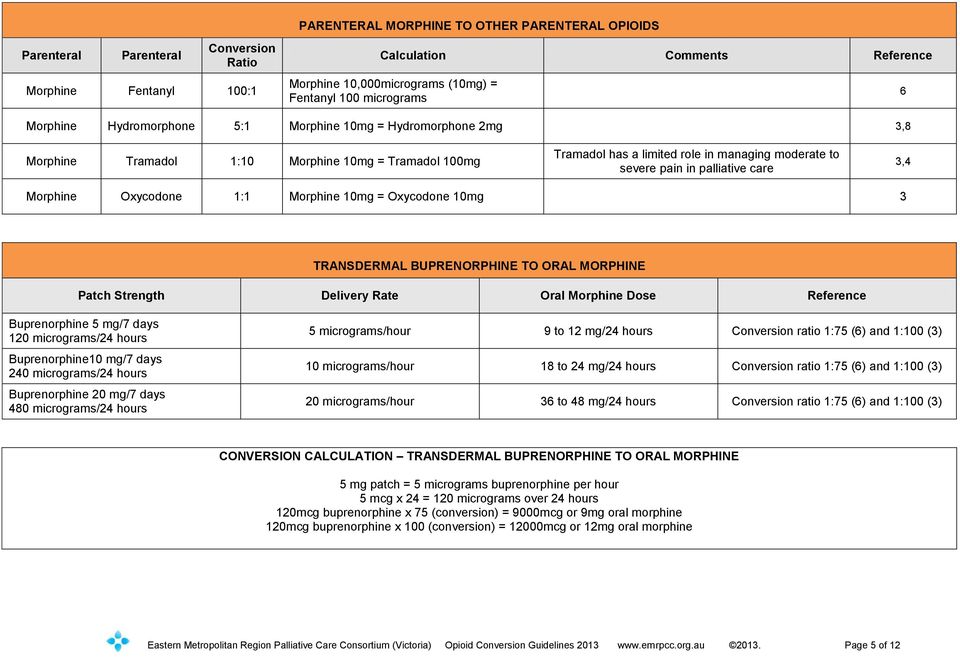
5 PARENTERAL MORPHINE TO OTHER PARENTERAL OPIOIDS Parenteral Parenteral Morphine Fentanyl 100:1 Calculation Comments Reference Morphine 10,000micrograms (10mg) = Fentanyl 100 micrograms 6 Morphine Hydromorphone 5:1 Morphine 10mg = Hydromorphone 2mg 3,8 Morphine Tramadol 1:10 Morphine 10mg = Tramadol 100mg Tramadol has a limited role in managing moderate to severe pain in palliative care 3,4 Morphine Oxycodone 1:1 Morphine 10mg = Oxycodone 10mg 3 TRANSDERMAL BUPRENORPHINE TO ORAL MORPHINE Patch Strength Delivery Rate Oral Morphine Dose Reference Buprenorphine 5 mg/7 days 120 micrograms/24 hours Buprenorphine10 mg/7 days 240 micrograms/24 hours Buprenorphine 20 mg/7 days 480 micrograms/24 hours 5 micrograms/hour 9 to 12 mg/24 hours ratio 1:75 (6) and 1:100 (3) 10 micrograms/hour 18 to 24 mg/24 hours ratio 1:75 (6) and 1:100 (3) 20 micrograms/hour 36 to 48 mg/24 hours ratio 1:75 (6) and 1:100 (3) CONVERSION CALCULATION TRANSDERMAL BUPRENORPHINE TO ORAL MORPHINE 5 mg patch = 5 micrograms buprenorphine per hour 5 mcg x 24 = 120 micrograms over 24 hours 120mcg buprenorphine x 75 (conversion) = 9000mcg or 9mg oral morphine 120mcg buprenorphine x 100 (conversion) = 12000mcg or 12mg oral morphine Eastern Metropolitan Region Palliative Care Consortium (Victoria) Opioid Guidelines Page 5 of 12
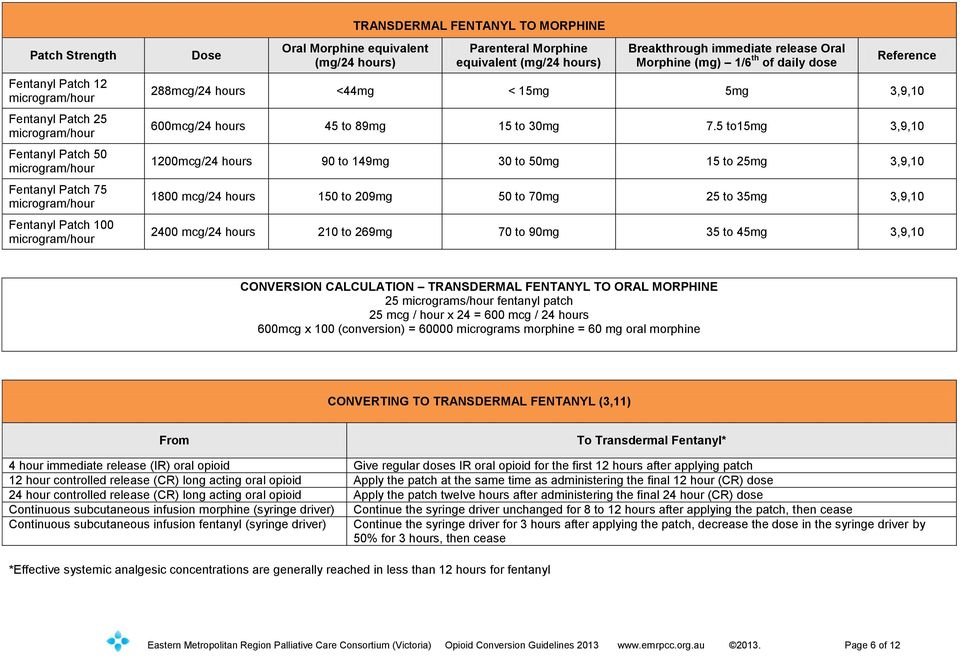
6 TRANSDERMAL FENTANYL TO MORPHINE Patch Strength Fentanyl Patch 12 Fentanyl Patch 25 Fentanyl Patch 50 Fentanyl Patch 75 Fentanyl Patch 100 Dose Oral Morphine equivalent (mg/24 hours) Parenteral Morphine equivalent (mg/24 hours) Breakthrough immediate release Oral Morphine (mg) 1/6 th of daily dose Reference 288mcg/24 hours <44mg < 15mg 5mg 3,9,10 600mcg/24 hours 45 to 89mg 15 to 30mg 7.5 to15mg 3,9, mcg/24 hours 90 to 149mg 30 to 50mg 15 to 25mg 3,9, mcg/24 hours 150 to 209mg 50 to 70mg 25 to 35mg 3,9, mcg/24 hours 210 to 269mg 70 to 90mg 35 to 45mg 3,9,10 CONVERSION CALCULATION TRANSDERMAL FENTANYL TO ORAL MORPHINE 25 micrograms/hour fentanyl patch 25 mcg / hour x 24 = 600 mcg / 24 hours 600mcg x 100 (conversion) = micrograms morphine = 60 mg oral morphine CONVERTING TO TRANSDERMAL FENTANYL (3,11) From To Transdermal Fentanyl* 4 hour immediate release (IR) oral opioid Give regular doses IR oral opioid for the first 12 hours after applying patch 12 hour controlled release (CR) long acting oral opioid Apply the patch at the same time as administering the final 12 hour (CR) dose 24 hour controlled release (CR) long acting oral opioid Apply the patch twelve hours after administering the final 24 hour (CR) dose Continuous subcutaneous infusion morphine (syringe driver) Continuous subcutaneous infusion fentanyl (syringe driver) *Effective systemic analgesic concentrations are generally reached in less than 12 hours for fentanyl Continue the syringe driver unchanged for 8 to 12 hours after applying the patch, then cease Continue the syringe driver for 3 hours after applying the patch, decrease the dose in the syringe driver by 50% for 3 hours, then cease Eastern Metropolitan Region Palliative Care Consortium (Victoria) Opioid Guidelines Page 6 of 12
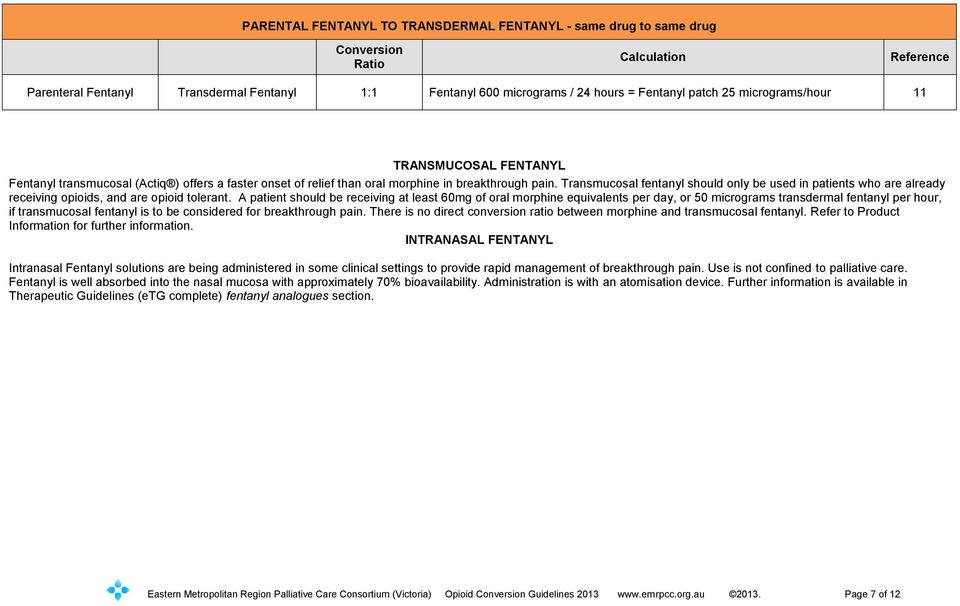
7 PARENTAL FENTANYL TO TRANSDERMAL FENTANYL - same drug to same drug Calculation Reference Parenteral Fentanyl Transdermal Fentanyl 1:1 Fentanyl 600 micrograms / 24 hours = Fentanyl patch 25 micrograms/hour 11 TRANSMUCOSAL FENTANYL Fentanyl transmucosal (Actiq ) offers a faster onset of relief than oral morphine in breakthrough pain. Transmucosal fentanyl should only be used in patients who are already receiving opioids, and are opioid tolerant. A patient should be receiving at least 60mg of oral morphine equivalents per day, or 50 micrograms transdermal fentanyl per hour, if transmucosal fentanyl is to be considered for breakthrough pain. There is no direct conversion ratio between morphine and transmucosal fentanyl. Refer to Product Information for further information. INTRANASAL FENTANYL Intranasal Fentanyl solutions are being administered in some clinical settings to provide rapid management of breakthrough pain. Use is not confined to palliative care. Fentanyl is well absorbed into the nasal mucosa with approximately 70% bioavailability. Administration is with an atomisation device. Further information is available in Therapeutic Guidelines (etg complete) fentanyl analogues section. Eastern Metropolitan Region Palliative Care Consortium (Victoria) Opioid Guidelines Page 7 of 12
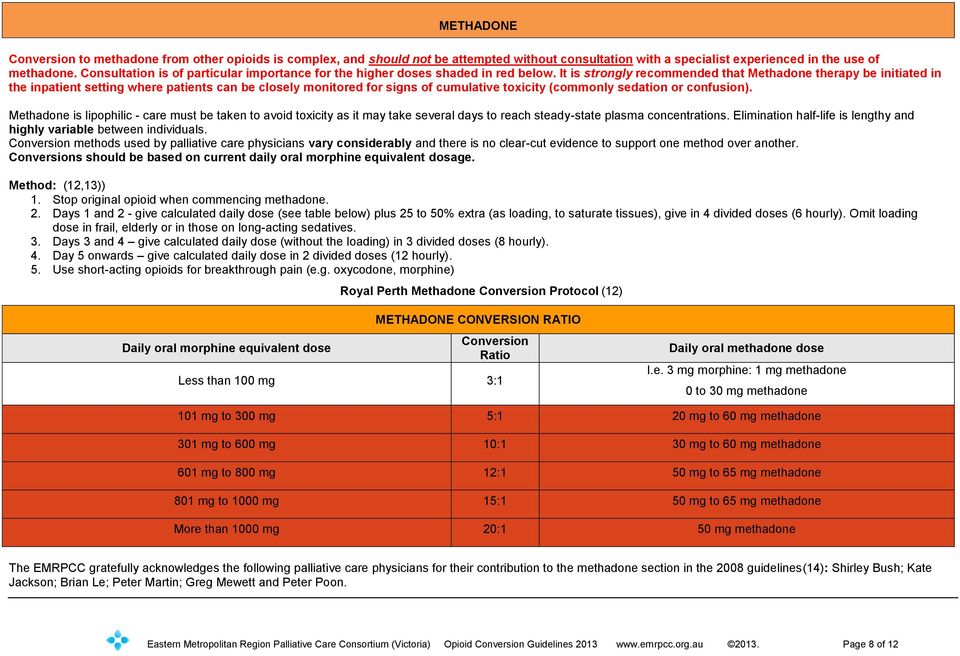
8 METHADONE to methadone from other opioids is complex, and should not be attempted without consultation with a specialist experienced in the use of methadone. Consultation is of particular importance for the higher doses shaded in red below. It is strongly recommended that Methadone therapy be initiated in the inpatient setting where patients can be closely monitored for signs of cumulative toxicity (commonly sedation or confusion). Methadone is lipophilic - care must be taken to avoid toxicity as it may take several days to reach steady-state plasma concentrations. Elimination half-life is lengthy and highly variable between individuals. methods used by palliative care physicians vary considerably and there is no clear-cut evidence to support one method over another. s should be based on current daily oral morphine equivalent dosage. Method: (12,13)) 1. Stop original opioid when commencing methadone. 2. Days 1 and 2 - give calculated daily dose (see table below) plus 25 to 50% extra (as loading, to saturate tissues), give in 4 divided doses (6 hourly). Omit loading dose in frail, elderly or in those on long-acting sedatives. 3. Days 3 and 4 give calculated daily dose (without the loading) in 3 divided doses (8 hourly). 4. Day 5 onwards give calculated daily dose in 2 divided doses (12 hourly). 5. Use short-acting opioids for breakthrough pain (e.g. oxycodone, morphine) Royal Perth Methadone Protocol (12) Daily oral morphine equivalent dose METHADONE CONVERSION RATIO Less than 100 mg 3:1 Daily oral methadone dose I.e. 3 mg morphine: 1 mg methadone 0 to 30 mg methadone 101 mg to 300 mg 5:1 20 mg to 60 mg methadone 301 mg to 600 mg 10:1 30 mg to 60 mg methadone 601 mg to 800 mg 12:1 50 mg to 65 mg methadone 801 mg to 1000 mg 15:1 50 mg to 65 mg methadone More than 1000 mg 20:1 50 mg methadone The EMRPCC gratefully acknowledges the following palliative care physicians for their contribution to the methadone section in the 2008 guidelines(14): Shirley Bush; Kate Jackson; Brian Le; Peter Martin; Greg Mewett and Peter Poon. Eastern Metropolitan Region Palliative Care Consortium (Victoria) Opioid Guidelines Page 8 of 12
9 REFERENCES Fine PG, Portenoy RK. Establishing best practices for opioid rotation; conclusions of an expert panel. J Pain Symptom Manage 2009;38: Periera J, Lawlor P, Vigano A, Dorgan M, Breura E. Equianalgesic dose ratios for opioids: a critical review and proposals for long term dosing. J Pain Symptom Manage 2001;22: Twycross R, Wilcock A. Palliative Care Formulary. 4 th ed. Nottingham. Palliativedrugs.com Ltd; Palliative Care Expert Group, Therapeutic Guidelines: Palliative Care.2010 Version 3. Therapeutic Guidelines Limited: Melbourne 5. Knotlova H, Fine P, Portenoy RK. Opioid rotation: the science and the limitations of the equianalgesic dose table. J Pain Symptom Manage 2009;38: Mercadante S, Caraceni A. ratios for opioid switching in the treatment of cancer pain: a systematic review. Palliat Med 2011;25: McPherson MM. Demystifying opioid conversions: a guide for effective dosing. Bethesda.ASHP; Wallace M, Rauck RL, Moulin D, Thipphawong, J, Khanna S & Tudor IC. from standard opioid therapy to once daily oral extended- release hydromorphone in patients with Chronic Cancer Pain. J Int Med Res 2008;36: Durogesic Transdermal System Product Information accessed August Vissers KCP, Besse K, Hang G, Devulder J, Morlion B. Opioid rotation in the management of chronic pain: where is the evidence? Pain Prac 2010;10: Prommer E. The role of fentanyl in cancer related pain. J Palliat Med 2009;12: Palliativedrugs.com accessed July Ayonrinde OT, Bridge DT. The rediscovery of methadone for cancer pain management. Med J Aust 2000;173: Eastern Metropolitan Region Palliative Care Consortium Opioid Working Party, Opioid s- guide to practice Oct 2008 The EMRPCC Clinical Group welcomes feedback regarding the planned formal review process in Please send comments to: Consortia Manager, Eastern Metropolitan Region Palliative Care Consortium PO Box 2110 Rangeview VIC 3132 Australia or [email protected] Eastern Metropolitan Region Palliative Care Consortium (Victoria) Opioid Guidelines Page 9 of 12
10 THIS PAGE HAS INTENTIONALLY BEEN LEFT BLANK

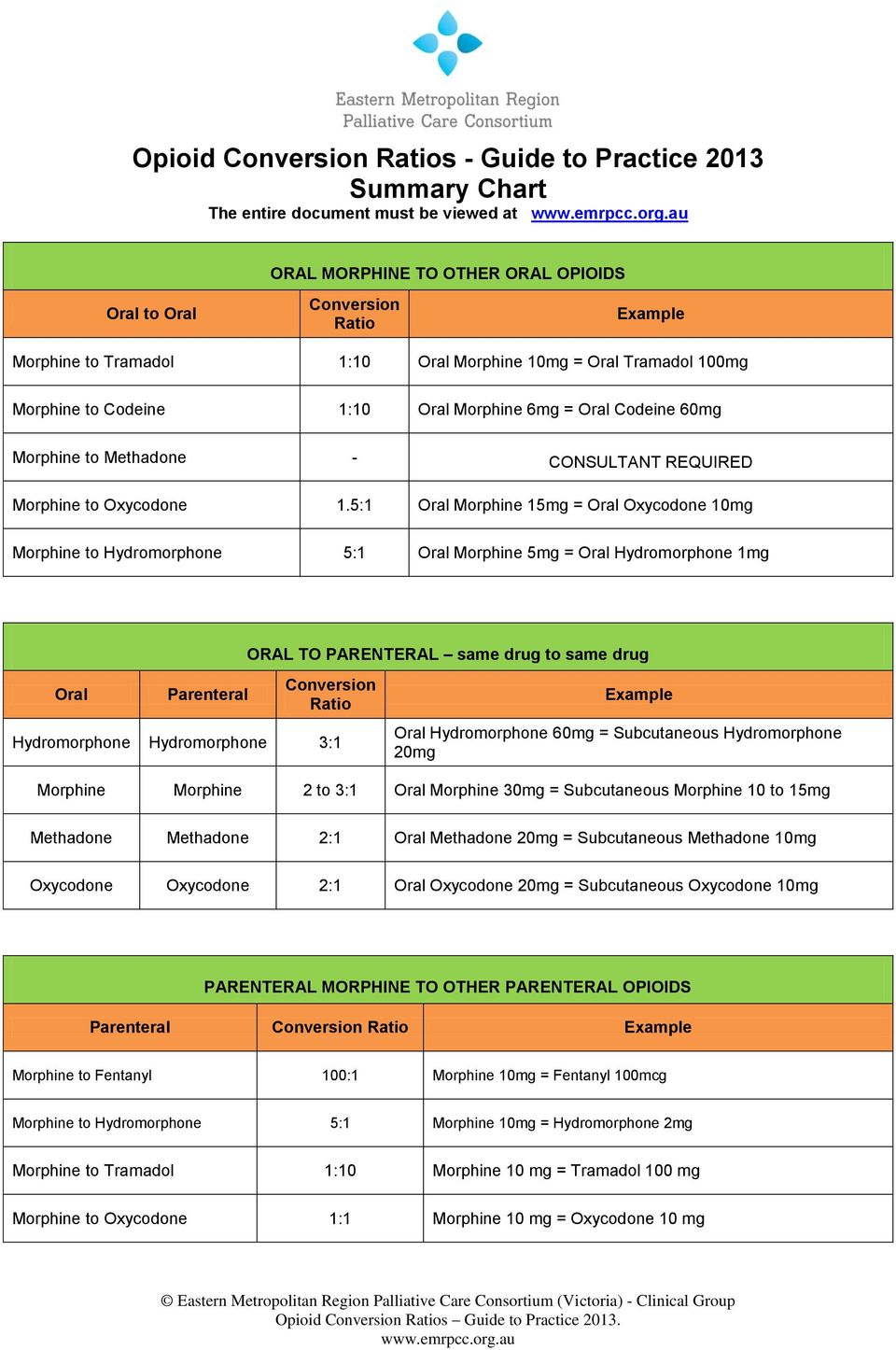
11 Opioid s - Guide to Practice 2013 Summary Chart The entire document must be viewed at ORAL MORPHINE TO OTHER ORAL OPIOIDS Oral to Oral Example Morphine to Tramadol 1:10 Oral Morphine 10mg = Oral Tramadol 100mg Morphine to Codeine 1:10 Oral Morphine 6mg = Oral Codeine 60mg Morphine to Methadone - CONSULTANT REQUIRED Morphine to Oxycodone 1.5:1 Oral Morphine 15mg = Oral Oxycodone 10mg Morphine to Hydromorphone 5:1 Oral Morphine 5mg = Oral Hydromorphone 1mg ORAL TO PARENTERAL same drug to same drug Oral Parenteral Hydromorphone Hydromorphone 3:1 Example Oral Hydromorphone 60mg = Subcutaneous Hydromorphone 20mg Morphine Morphine 2 to 3:1 Oral Morphine 30mg = Subcutaneous Morphine 10 to 15mg Methadone Methadone 2:1 Oral Methadone 20mg = Subcutaneous Methadone 10mg Oxycodone Oxycodone 2:1 Oral Oxycodone 20mg = Subcutaneous Oxycodone 10mg PARENTERAL MORPHINE TO OTHER PARENTERAL OPIOIDS Parenteral Example Morphine to Fentanyl 100:1 Morphine 10mg = Fentanyl 100mcg Morphine to Hydromorphone 5:1 Morphine 10mg = Hydromorphone 2mg Morphine to Tramadol 1:10 Morphine 10 mg = Tramadol 100 mg Morphine to Oxycodone 1:1 Morphine 10 mg = Oxycodone 10 mg Eastern Metropolitan Region Palliative Care Consortium (Victoria) - Clinical Group Opioid s Guide to Practice
12 TRANSDERMAL BUPRENORPHINE TO ORAL MORPHINE Patch Strength Delivery Rate Oral Morphine Dose Buprenorphine 5 mg / 7 days 120 micrograms/24 hours Buprenorphine 10 mg / 7 days 240 micrograms/24 hours Buprenorphine 20 mg / 7days 480 micrograms/24 hours 5 micrograms/hour 9 to 12 mg/24 hours 10 micrograms/hour 18 to 24 mg/24 hours 20 micrograms/hour 36 to 48 mg/24 hours CONVERSION CALCULATION TRANSDERMAL BUPRENORPHINE TO ORAL MORPHINE 5 mg patch = 5 micrograms buprenorphine per hour 5 mcg x 24 = 120 micrograms over 24 hours 120mcg buprenorphine x 75 (conversion) = 9000mcg or 9mg oral morphine 120mcg buprenorphine x 100 (conversion) = 12000mcg or 12mg morphine Patch Strength Fentanyl Patch 12 Fentanyl Patch 25 Fentanyl Patch 50 Fentanyl Patch 75 Fentanyl Patch 100 Dose 288 mcg/24 hours 600 mcg/24 hours 1200 mcg/24 hours 1800 mcg/24 hours 2400 mcg/24 hours TRANSDERMAL FENTANYL TO MORPHINE Oral Morphine equivalent (mg/24 hours) Parenteral Morphine equivalent (mg/24 hours) Breakthrough immediate release Oral Morphine (mg) 1/6 th daily dose <44mg < 15mg 5mg 45 to 89mg 15 to 30mg 7.5 to15mg 90 to 149mg 30 to 50mg 15 to 25mg 150 to 209mg 50 to 70mg 25 to 35mg 210 to 269mg 70 to 90mg 35 to 45mg CONVERSION CALCULATION TRANSDERMAL FENTANYL TO ORAL MORPHINE 25micrograms per hour fentanyl patch 25mcg/hour x 24 = 600mcg/24 hours 600mcg x 100 (conversion) = micrograms morphine = 60mg oral morphine DISCLAIMER: The information contained in this summary is to be read in conjunction with the entire document. The guidelines reflect current eastern metropolitan region palliative care practice and available literature at the time of the release. All medication doses should be checked and prescribed by a medical doctor with appropriate experience before administering. Adhere to all legislative and professional requirements including organisational policies and procedures regarding opioid medications and their administration. All patients should be monitored closely until stable when commencing, adjusting dosage and/or switching opioid medications. Eastern Metropolitan Region Palliative Care Consortium (Victoria) - Clinical Group Opioid s Guide to Practice

Opioid Conversion Ratios - Guide to Practice 2013 Updated as Version 2 - November 2014
 Opioid s - Guide to Practice 2013 Updated as Version 2 - November 2014 2013. The EMR PCC grants permission to reproduce parts of this publication for clinical and educational use only, provided that the
Opioid Conversion Ratios - Guide to Practice 2010
 Opioid Conversion Ratios - Guide to Practice 2010 Released December 2010. 2010. The EMR PCC grants permission to reproduce parts of this publication for clinical and educational use only, provided that
GUIDELINES ON THE MANAGEMENT OF PAIN DUE TO CANCER IN ADULTS
 GUIDELINES ON THE MANAGEMENT OF PAIN DUE TO CANCER IN ADULTS Bristol Palliative Care Collaborative Contact Numbers: Hospital Specialist Palliative Care Teams: Frenchay 0117 340 6692 Southmead 0117 323
OPIOIDS CONVERSION GUIDELINES 2007
 Opioid analgesics vary in potency, side effect and pharmacokinetic profile. Therefore the Opioid Conversion Guidelines has been developed to assist when changing opioid drug therapy. When opioid rotating
The Pharmacological Management of Cancer Pain in Adults. Clinical Audit Tool
 The Pharmacological Management of Cancer Pain in Adults Clinical Audit Tool 2015 This clinical audit tool accompanies the Pharmacological Management of Cancer Pain in Adults NCEC National Clinical Guideline
Pain Control Aims. General principles of pain control. Basic pharmacokinetics. Case history demo. Opioids renal failure John Welsh 8/4/2010
 Pain Control Aims General principles of pain control Basic pharmacokinetics Case history demo Opioids renal failure John Welsh 8/4/2010 Pain Control Morphine is gold standard treatment for moderate to
Narcotic drugs used for pain treatment Version 4.3
 Narcotic drugs used for pain treatment Version 4.3 Strategy to restrict the pack sizes or the type of packaging available in public pharmacies. 1. Introduction The document describing the strategy of the
Abstral Prescriber and Pharmacist Guide
 Abstral Prescriber and Pharmacist Guide fentanyl citrate sublingual tablets Introduction The Abstral Prescriber and Pharmacist Guide is designed to support healthcare professionals in the diagnosis of
Fentanyl patches (Durogesic) for chronic pain
 Fentanyl patches (Durogesic) for chronic pain FENT-a-nil Summary Oral morphine is preferred when an opioid is required for severe chronic pain, because of its familiarity, availability and the ease of
Policy for the issue of permits to prescribe Schedule 8 poisons
 Policy for the issue of permits to prescribe Schedule 8 poisons May 2011 Introduction The Victorian Drugs, Poisons and Controlled Substances (DPCS) legislation sets out certain circumstances when a medical
The TIRF REMS Access program is a Food and Drug Administration (FDA) required risk management program
 Subject: Important Drug Warning Announcement of a single shared REMS (Risk Evaluation and Mitigation Strategy) program for all Transmucosal Immediate Release Fentanyl (TIRF) products due to the potential
Considerations when Using Controlled Substances to Treat Chronic Pain
 Considerations when Using Controlled Substances to Treat Chronic Pain By Mary-Beth F. Plum, Pharm.D. Impact of Chronic Pain Acute pain is the body s response to environmental dangers, and it helps protect
How To Get A Tirf
 Transmucosal Immediate Release Fentanyl (TIRF) Products Risk Evaluation and Mitigation Strategy (REMS) Education Program for Prescribers and Pharmacists Products Covered Under This Program Abstral (fentanyl)
Acute & Chronic Pain Management (requiring opioid analgesics) in Patients Receiving Pharmacotherapy for Opioid Addiction
 Acute & Chronic Pain Management (requiring opioid analgesics) in Patients Receiving Pharmacotherapy for Opioid Addiction June 9, 2011 Tufts Health Care Institute Program on Opioid Risk Management Daniel
Clinical Algorithm & Preferred Medications to Treat Pain in Dialysis Patients
 Clinical Algorithm & Preferred Medications to Treat Pain in Dialysis Patients Developed by the Mid Atlantic Renal Coalition and the Kidney End of Life Coalition September 2009 This project was supported,
Use of opioids in Patients with Impaired Renal Function Dr Jane Neerkin, Dr Mary Brennan, Dr Humeira Jamal
 Use of opioids in Patients with Impaired Renal Function Dr Jane Neerkin, Dr Mary Brennan, Dr Humeira Jamal Great care is required when prescribing opioids to patients with impaired renal function. Many
MUSC Opioid Analgesic Comparison Chart
 MUSC Opioid Analgesic Comparison Chart Approved by the Pharmacy and Therapeutics Committee (February 2006, November 2009, March 2010, December 2011) Prepared by the MUSC Department of Pharmacy Services
Opioid toxicity and alternative opioids. Palliative care fixed resource session
 Opioid toxicity and alternative opioids Palliative care fixed resource session Opioid toxicity and alternative opioids - aims Know the symptoms of opioid toxicity Understand which patients are at higher
Guidelines for the Use of Naloxone in Palliative Care in Adult Patients
 Guidelines for the Use of Naloxone in Palliative Care in Adult Patients Date Approved by Network Governance May 2012 Date for Review May 2015 Changes between Version 1 and 2 1. Guideline background 2.
Pain management. The WHO analgesic ladder
 Pain management Successful treatment requires an accurate diagnosis of the cause and a rational approach to therapy. Most pains arise by stimulation of nociceptive nerve endings; the characteristics may
Review of Pharmacological Pain Management
 Review of Pharmacological Pain Management CHAMP Activities are possible with generous support from The Atlantic Philanthropies and The John A. Hartford Foundation The WHO Pain Ladder The World Health Organization
SAFE PAIN MEDICATION PRESCRIBING GUIDELINES
 Prescription drug abuse has been declared an epidemic by the Centers for Disease Control. According to 2012 San Diego Medical Examiner data, the number one cause of non-natural death is due to drug overdoses
Blueprint for Prescriber Continuing Education Program
 CDER Final 10/25/11 Blueprint for Prescriber Continuing Education Program I. Introduction: Why Prescriber Education is Important Health care professionals who prescribe extended-release (ER) and long-acting
Strong opioids (painkillers) in palliative care what you should know
 Strong opioids (painkillers) in palliative care what you should know Patient Information Author ID: JG Leaflet Number: PC 006 Version: 1 Name of Leaflet: Strong opioids (painkillers) in palliative care
MANAGEMENT OF CHRONIC NON MALIGNANT PAIN
 MANAGEMENT OF CHRONIC NON MALIGNANT PAIN Introduction The Manitoba Prescribing Practices Program (MPPP) recognizes the important role served by physicians in relieving pain and suffering and acknowledges
POST-TEST Pain Resource Professional Training Program University of Wisconsin Hospital & Clinics
 POST-TEST University of Wisconsin Hospital & Clinics True/False/Don't Know - Circle the correct answer T F D 1. Changes in vital signs are reliable indicators of pain severity. T F D 2. Because of an underdeveloped
SELECTED OPIATES TOXICITY A MODERN DAY EPIDEMIC
 SELECTED OPIATES TOXICITY A MODERN DAY EPIDEMIC Learning Objectives: 1. Identify the names and reasons/circumstances for additional toxicity of SELECTED OPIATES hydromorphone DILAUDID Methadone Fentanyl/DURAGESIC
Nurses Self Paced Learning Module on Pain Management
 Nurses Self Paced Learning Module on Pain Management Dominican Santa Cruz Hospital Santa Cruz, California Developed by: Strategic Planning Committee Dominican Santa Cruz Hospital 1555 Soquel Drive Santa
West of Scotland Chronic Non Malignant Pain Opioid Prescribing Guideline
 West of Scotland Chronic Non Malignant Pain Opioid Prescribing Guideline This guidance forms part of the West of Scotland Efficiency and Productivity Workstream, Acute Prescribing Group. Clinicians from
How To Take A Strong Opioid Painkiller
 Using strong painkillers for cancer pain This information is an extract from the booklet Controlling cancer pain. You may find the full booklet helpful. We can send you a copy free see page 8. Contents
Opioids in Palliative Care- Patient Information Manual
 Version 2.0 with MST example Introduction The following pages explain what opioids are and what we think you may want to know about them. There is quite a lot of information here, most of it is based on
WITHDRAWAL OF ANALGESIA AND SEDATION
 WITHDRAWAL OF ANALGESIA AND SEDATION Patients receiving analgesia and/or sedation for longer than 5-7 days may suffer withdrawal if these drugs are suddenly stopped. To prevent this happening drug doses
Guidelines for Cancer Pain Management in Substance Misusers Dr Jane Neerkin, Dr Chi-Chi Cheung and Dr Caroline Stirling
 Guidelines for Cancer Pain Management in Substance Misusers Dr Jane Neerkin, Dr Chi-Chi Cheung and Dr Caroline Stirling Patients with a substance misuse history are at increased risk of receiving inadequate
OPIOID CONVERSIONS. 2. Add a rescue doses (IR) of same opioid if possible should be~10 20% of total daily opioid dose
 OPIOID CONVERSIONS 1. Converting Short acting Long Acting (IR SR) when pain is well controlled *Use for : CHRONIC pain Pts on scheduled IR opioids pain that recurs before the next dose PP: Can use equianalgesic
Implementing Prescribing Guidelines in the Emergency Department. April 16, 2013
 Implementing Prescribing Guidelines in the Emergency Department April 16, 2013 Housekeeping Note: Today s presentation is being recorded and will be provided within 48 hours. Two ways to ask questions
Acute pain management for opioid tolerant patients CLASSIFICATION OF OPIOID TOLERANT PATIENTS
 Update in Anaesthesia Acute pain management for opioid tolerant patients Simon Marshall and Mark Jackson* *Correspondence email: [email protected] INTRODUCTION Opioid tolerance is usually encountered
18% Role of Pharmacist-Provided Medication Reviews in Workers Compensation Claims Management. Introduction. Role of the Pharmacist
 Role of Pharmacist-Provided Medication Reviews in Workers Compensation Claims Management Benjamin Link, PharmD, RPh Introduction According to information from the National Council on Compensation Insurance
History of Malignant Pain: Treatment with Opioids. Dr. Kathleen M. Foley Pain, Opioids, and Addiction: An Urgent Problem for Doctors and Patients
 History of Malignant Pain: Treatment with Opioids Dr. Kathleen M. Foley Pain, Opioids, and Addiction: An Urgent Problem for Doctors and Patients March 5-6, 5 2007 Some of the Questions that Must be Answered
! # # # %# # & # ( ) +,. / 01 2 3 4 % # )., 0,, 5((/ + 6 0,67 8,+,, + 6,67, 7 6
 ! # # # %# # & # ( ) +,. / % # ).,,, ((/ +,7 8,+,, +,7, 7 9 Title : Non-Medical Prescribing in Palliative Care: A Regional Survey. Corresponding Author: Dr Lucy Ziegler [email protected] Senior Research
Questions and answers on breast cancer Guideline 10: The management of persistent pain after breast cancer treatment
 Questions and answers on breast cancer Guideline 10: The management of persistent pain after breast cancer treatment I ve had breast cancer treatment, and now I m having pain. Does this mean the cancer
Guide to the Pharmacological Management of End of Life (Terminal) Symptoms in Residential Aged Care Residents
 Guide to the Pharmacological Management of End of Life (Terminal) Symptoms in Residential Aged Care Residents Residential Aged Care Palliative Approach Toolkit Guide to the Pharmacological Management of
ABC of palliative care: Principles of palliative care and pain control
 Clinical review ABC of palliative care: Principles of palliative care and pain control Bill O'Neill, Marie Fallon Top Introduction Principles of palliative care Principles of managing cancer... Introduction
Getting the best result from Opioid medicine. in the management of chronic pain
 Getting the best result from Opioid medicine in the management of chronic pain Your doctor has prescribed you opioid medicine to help you manage your chronic pain. This patient information leaflet gives
Update on Buprenorphine: Induction and Ongoing Care
 Update on Buprenorphine: Induction and Ongoing Care Elizabeth F. Howell, M.D., DFAPA, FASAM Department of Psychiatry, University of Utah School of Medicine North Carolina Addiction Medicine Conference
Transdermal and Parenteral Fentanyl Dosage Calculations and Conversions
 Transdermal and Parenteral Fentanyl Dosage Calculations and Conversions Chapter 5 Objectives After reading this chapter and completing all practice problems, the participant will be able to: 1. Describe
1. Which of the following would NOT be an appropriate choice for postoperative pain. C. Oral oxycodone 5 mg po every 4 to 6 hours as needed for pain
 Pain Management 1 Chapter 34. Pain Management, Self-Assessment Questions 1. Which of the following would NOT be an appropriate choice for postoperative pain management in a patient dependent on opioids?
October 2012. We hope that our tool will be a useful aid in your efforts to improve pain management in your setting. Sincerely,
 October 2012 he Knowledge and Attitudes Survey Regarding Pain tool can be used to assess nurses and other professionals in your setting and as a pre and post test evaluation measure for educational programs.
Equianalgesic Dosing of Opioids for Pain Management
 PL Detail-Document #280801 This PL Detail-Document accompanies the related article published in PHARMACIST S LETTER / PRESCRIBER S LETTER August 2012 Equianalgesic Dosing of Opioids for Pain Management
Role of the Anaesthetist/Pain Consultant in Palliative Care Medicine
 Role of the Anaesthetist/Pain Consultant in Palliative Care Medicine Dr Joan Hester Consultant in Pain Medicine King s College Hospital and St Christopher s Hospice, London Dame Cicely Saunders 1918-2005
This presentation is going to discuss the BLS use of Intranasal naloxone. Naloxone is the generic name while Narcan is the trade name.
 Welcome! 1 This presentation is going to discuss the BLS use of Intranasal naloxone. Naloxone is the generic name while Narcan is the trade name. 2 Definitive treatment for an opioid or opiate overdose
A Healthesystems Clinical Analysis. Insidious Incrementalism of Opioid Use in Workers Compensation
 A Healthesystems Clinical Analysis Insidious Incrementalism of Opioid Use in Workers Compensation Prescription opioid use in the United States has grown significantly over the past 20 years. In 1991, there
Opioids in palliative care: safe and effective prescribing of strong opioids for pain in palliative care of adults
 Clinical Guideline Opioids in palliative care: safe and effective prescribing of strong opioids for pain in palliative care of adults Full guideline May 2012 Developed for NICE by the National Collaborating
Opioid Analgesics. Week 19
 Opioid Analgesics Week 19 Analgesic Vocabulary Analgesia Narcotic Opiate Opioid Agonist Antagonist Narcotic Analgesics Controlled substances Opioid analgesics derived from poppy Opiates include morphine,
Pain Management in Palliative and Hospice Care
 Pain Management in Palliative and Hospice Care Donna Butler, MSN, ANP-BC, OCN, ACHPN, FAAPM Current Status of Pain Cancer patients at EOL- 54% have pain AIDS with prognosis < 6mons- intense pain Less research
Naloxone treatment of opioid overdose
 Naloxone treatment of opioid overdose Opioids Chemicals that act in the brain to relieve pain, often use to suppress cough, treat addiction, and provide comfort After prolonged use of opioids, increasing
Medical Malpractice Treatment Alprazolam benzodiazepine - A Case Study
 Improving Outcomes in Patients Who are Prescribed Alprazolam with Concurrent Use of Opioids Pik-Sai Yung, M.D. Staff Psychiatrist Center for Counseling at Walton Background and Rationale Alprazolam is
Alison White Devang Rai Richard Chye
 Ketamine use in hospice patients before and after the sentinel randomised controlled trial of ketamine in cancer pain: A single centre retrospective review Alison White Devang Rai Richard Chye Overview
Cancer Pain Role Model Program Case Studies and Faculty Guides. Wisconsin Cancer Pain Initiative Madison, Wisconsin
 Cancer Pain Role Model Program Case Studies and Faculty Guides Wisconsin Cancer Pain Initiative Madison, Wisconsin Developed by: David Weissman, MD June L. Dahl, PhD WISCONSIN CANCER PAIN INITIATIVE CANCER
KENTUCKY ADMINISTRATIVE REGULATIONS TITLE 201. GENERAL GOVERNMENT CABINET CHAPTER 9. BOARD OF MEDICAL LICENSURE
 KENTUCKY ADMINISTRATIVE REGULATIONS TITLE 201. GENERAL GOVERNMENT CABINET CHAPTER 9. BOARD OF MEDICAL LICENSURE 201 KAR 9:260. Professional standards for prescribing and dispensing controlled substances.
PARTNERSHIP HEALTHPLAN RECOMMENDATIONS For Safe Use of Opioid Medications
 PARTNERSHIP HEALTHPLAN RECOMMENDATIONS For Safe Use of Opioid Medications Primary Care & Specialist Prescribing Guidelines Introduction Partnership HealthPlan is a County Organized Health System covering
Care Guide: Cancer Pain
 Care Guide: Cancer Pain Key Points: Cancer Pain Specific Pain Problems 1. Pain is defined as an independent and emotional experience associated with actual or potential tissue damage or described in terms
Fraud, Waste and Abuse
 Fraud, Waste and Abuse CT - Fraud Hotline submitted by Connecticut The Fraud Hotline at the Department of Social Services (DSS) is a proactive approach to handling complaints regarding fraud and abuse
Substitution Therapy for Opioid Dependence The Role of Suboxone. Mandy Manak, MD, ABAM, CCSAM Methadone 101-Hospitalist Workshop, October 3, 2015
 Substitution Therapy for Opioid Dependence The Role of Suboxone Mandy Manak, MD, ABAM, CCSAM Methadone 101-Hospitalist Workshop, October 3, 2015 Objectives Recognize the options available in treating opioid
MODERATE SEDATION RECORD (formerly termed Conscious Sedation)
 (POLICY #DOC-051) Page 1 of 6 WELLSPAN HEALTH - YORK HOSPITAL NURSING POLICY AND PROCEDURE Dates: Original Issue: September 1998 Annual Review: March 2012 Revised: March 2010 Submitted by: Brenda Artz
END OF LIFE MEDICINES INFORMATION PACK
 END OF LIFE MEDICINES INFORMATION PACK Advice on end of life medication is available from the nursing and medical team at St Nicholas Hospice Care - telephone 01284 766133. Many drugs used in palliative
Opioid Addiction and Methadone: Myths and Misconceptions. Nicole Nakatsu WRHA Practice Development Pharmacist
 Opioid Addiction and Methadone: Myths and Misconceptions Nicole Nakatsu WRHA Practice Development Pharmacist Learning Objectives By the end of this presentation you should be able to: Understand how opioids
Pain and problem drug use
 Pain and problem drug use Information for patients Prepared by the British Pain Society in consultation with the Royal College of Psychiatrists, the Royal College of General Practitioners and the Advisory
A Guide to pain relief medicines For patients receiving Palliative Care
 A Guide to pain relief medicines For patients receiving Palliative Care 1 Which pain medicines are you taking? Contents Page No. Amitriptyline 8 Codeine 9 Co-codamol 10 Co-dydramol 11 Diclofenac (Voltarol
Guidelines for the use of Methadone for Adults with Pain in Palliative Care
 Guidelines for the use of Methadone for Adults with Pain in Palliative Care Date Approved by Network Governance October 2012 Date for Review October 2015 Page 1 of 17 1. Scope of the Guideline 1.1 This
Buprenorphine/Naloxone Maintenance Treatment for Opioid Dependence
 Buprenorphine/Naloxone Maintenance Treatment for Opioid Dependence Information for Family Members Family members of patients who have been prescribed buprenorphine/naloxone for treatment of opioid addiction
Pain Management Case Studies. Adapted from: IMPROVING END-OF-LIFE CARE A RESOURCE GUIDE FOR PHYSICIAN EDUCATION
 Pain Management Case Studies Adapted from: IMPROVING END-OF-LIFE CARE A RESOURCE GUIDE FOR PHYSICIAN EDUCATION 3rd Edition David E. Weissman, MD Director, Palliative Care Program Medical College of Wisconsin
Rationale for Urine Drug Testing (UDT)
 Rationale for Urine Drug Testing (UDT) Help to identify drug misuse/addiction Prior to starting opioid treatment Assist in assessing adherence during opioid therapy As requirement of therapy w/ an opioid
Feline Anesthesia Richard M. Bednarski, DVM, MSc The Ohio State University College of Veterinary Medicine Current Issues in Feline Anesthesia
 Feline Anesthesia Richard M. Bednarski, DVM, MSc The Ohio State University College of Veterinary Medicine Current Issues in Feline Anesthesia Chemical Restraint Protocols Trap, Neuter, Release Anesthetic
Acute Pain Management in the Opioid Dependent Patient. Maripat Welz-Bosna MSN, CRNP-BC
 Acute Pain Management in the Opioid Dependent Patient Maripat Welz-Bosna MSN, CRNP-BC Relieving Pain in America (IOM) More then 116 Million Americans have pain the persists for weeks to years $560-635
Palmer MacKie, MD MS Director, Integrative Pain Program, Eskenazi Department of Medicine, IUSOM
 Palmer MacKie, MD MS Director, Integrative Pain Program, Eskenazi Department of Medicine, IUSOM Attorney General s Prescription Drug Abuse Task Force Member AIT Laboratories Advisory Board In 2009, 44%
Patient information. Using strong Opioids to control your pain
 Patient information Using strong Opioids to control your pain Published: April 2013. Date for review: April 2016 Introduction This leaflet explains what strong opioids (pronounced oh-pee-oyds) e are and
GUIDELINE FOR ADMINISTRATION OF FENTANYL FOR PAIN RELIEF IN LABOUR
 GUIDELINE FOR ADMINISTRATION OF FENTANYL FOR PAIN RELIEF IN LABOUR INTRODUCTION Intravenous (IV) Fentanyl is a good option for pain management during labour and should be administered in a safe and competent
Appendix to Tennessee Department of Health: Tennessee Clinical Practice Guidelines for Outpatient Management of Chronic Non- Malignant Pain
 Appendix to Tennessee Department of Health: Tennessee Clinical Practice Guidelines for Outpatient Management of Chronic Non- Malignant Pain Division of Workers Compensation 04.01.2015 Background Opioids
UNIVERSITY OF SOUTH ALABAMA COLLEGE OF MEDICINE DEPARTMENT OF FAMILY MEDICINE PAIN MANAGEMENT GUIDELINES
 UNIVERSITY OF SOUTH ALABAMA COLLEGE OF MEDICINE DEPARTMENT OF FAMILY MEDICINE PAIN MANAGEMENT GUIDELINES I. OVERVIEW Detailed narcotic prescribing guidelines are outlined in this chapter, but the basic
Community Pharmacists in NHS Rotherham
 SERVICE LEVEL AGREEMENT TO ENABLE COMMUNITY PHARMACISTS IN NHS ROTHERHAM TO PROVIDE PALLIATIVE CARE DRUGS AS LOCAL ENHANCED SERVICE PREPARED BY: NHS Rotherham CCG Medicines Management Team on behalf of
2015 OPSC Annual Convention. syllabus. February 4-8, 2015 Hyatt Regency Mission Bay San Diego, California
 2015 OPSC Annual Convention syllabus February 4-8, 2015 Hyatt Regency Mission Bay San Diego, California FRIDAY, FEBRUARY 6, 2015: 9:30am - 10:30am Opioid Addiction and Buprenorphine Use * Presented by
TRANSMUCOSAL IMMEDIATE RELEASE FENTANYL (TIRF) RISK EVALUATION AND MITIGATION STRATEGY (REMS)
 Initial REMS approval: 12/2011 Most recent modification: /2014 TRANSMUCOSAL IMMEDIATE RELEASE FENTANYL (TIRF) RISK EVALUATION AND MITIGATION STRATEGY (REMS) Page 1 of 16 I. GOALS The goals of the TIRF
Electronic Medical Record (EMR) Safety Results of CAH Testing. Tom Johns, PharmD Shands at the University of Florida
 Electronic Medical Record (EMR) Safety Results of CAH Testing Tom Johns, PharmD Shands at the University of Florida Vendors Evaluated CPSI Healthland Cerner Test Patients Test Patient A Age: 76 y/o Sex:
Passionate concerns about welfare and ethics have created an environment where discussions about
 M e d i c a t i o n s P A I N M A N A G E M E N T Lysa Pam Posner, DVM, Diplomate ACVA North Carolina State University Analgesia for Declaw Patients Onychectomy in cats is controversial both within and