
AANPCP CANDIDATE HANDBOOK and RENEWAL of CERTIFICATION HANDBOOK
|
|
|
- Valentine Horn
- 10 years ago
- Views:
Transcription
1 AANPCP CANDIDATE HANDBOOK and RENEWAL of CERTIFICATION HANDBOOK Revised: September 2014

2 Table of Contents TABLE OF CONTENTS... 2 AANPCP - NATIONAL CERTIFICATION PROGRAM FOR NURSE PRACTITIONERS... 4 INTRODUCTION... 4 HISTORY OF AANPCP... 4 PURPOSE, MISSION, AND VISION... 5 PROGRAM GOALS... 6 ACCREDITATION, RECOGNITION, AND AFFILIATION... 6 NATIONAL CONSENSUS MODEL FOR APRN REGULATION... 6 CREDENTIAL: NP-C AND USE OF ADVANCED PRACTICE (APRN) TITLE... 7 NATIONAL COMPETENCY-BASED EXAMINATIONS FOR NURSE PRACTITIONERS... 8 ADULT NURSE PRACTITIONER CERTIFICATION... 8 FAMILY NURSE PRACTITIONER CERTIFICATION... 8 ADULT-GERONTOLOGY PRIMARY CARE NURSE PRACTITIONER CERTIFICATION... 8 DUAL-CERTIFIED ANP AND GNP: CONVERSION TO ADULT-GERONTOLOGY (A-GNP) PRIMARY CARE NURSE PRACTITIONER CERTIFICATION OPTION... 8 RETIREMENT OF THE ADULT NURSE PRACTITIONER (ANP) CERTIFICATION EXAMINATION... 8 RETIREMENT OF THE GERONTOLOGIC NURSE PRACTITIONER (GNP) CERTIFICATION EXAMINATION... 9 QUALIFICATIONS AND ELIGIBILITY... 9 QUALIFICATIONS FOR TAKING THE AANPCP NATIONAL CERTIFICATION EXAMINATION... 9 STATEMENT OF NONDISCRIMINATION... 9 EXAMINATION DESCRIPTION EXAMINATION PURPOSE EXAMINATION DEVELOPMENT EXAMINATION CONTENT TESTING SERVICE PROFESSIONAL EXAMINATION SERVICE (PROEXAM) PRACTICE TEST TESTING PROCEDURE APPROVED APPLICATIONS: APPROVAL TO TEST LETTER & AUTHORIZATION-TO-TEST (ATT) LETTER ADMISSION TO TEST AND TEST SITE SELECTION SPECIAL ACCOMMODATIONS TEST SECURITY CANCELLATION, EXTENSIONS, AND WITHDRAWAL POLICY TEST SCORING EXAMINATION RESULTS SCORE REPORTS EXAMINATION COMMENTS RETAKING THE EXAMINATION CERTIFICATION FEES DOCUMENTATION ONLINE PROFILE AND APPLICATION NAME AND ADDRESS CHANGES CONTACT US CORRESPONDENCE FROM AANPCP VERIFICATION REQUESTS APPEALS POLICY Page 2

3 CONFIDENTIALITY AND DISCLOSURE OBTAINING REPLACEMENT CERTIFICATES AND WALLET CARDS RECORDS MANAGEMENT AND RETENTION CERTIFICATION RENEWAL AND MAINTENANCE INTRODUCTION PURPOSE RECERTIFICATION & THE NATIONAL CONSENSUS MODEL AANPCP - CERTIFICANT RESPONSIBILITY RECERTIFICATION REQUIREMENTS AND OPTIONS PROCEDURE FOR CERTIFICANTS WHO RECERTIFY BY CLINICAL PRACTICE AND CE CONTINUING EDUCATION REQUIREMENT INFORMATION CLINICAL PRACTICE REQUIREMENT INFORMATION PROCEDURE FOR CERTIFICANTS WHO RECERTIFY BY EXAMINATION PROCEDURE FOR CERTIFICANTS WHO CHOOSE TO RECERTIFY BY EXAMINATION AND FAIL PROCEDURE FOR CERTIFICANTS WHOSE CERTIFICATION HAS EXPIRED AND NOT LAPSED PROCEDURE FOR INDIVIDUALS WHOSE CERTIFICATION HAS EXPIRED AND LAPSED RECERTIFICATION APPEALS REQUEST PRIMARY SOURCE VERIFICATION REQUESTS RECERTIFICATION FEES CREDENTIAL: NP-C APPENDIX A - AANP SCOPE OF PRACTICE FOR NURSE PRACTITIONERS APPENDIX B - AANP STANDARDS OF PRACTICE FOR NURSE PRACTITIONERS APPENDIX C EXAMINATION TEST CONTENT AND KNOWLEDGE AREAS THE ADULT AND FAMILY NURSE PRACTITIONER EXAMINATIONS PRACTICE ANALYSIS THE ADULT-GERONTOLOGY PRIMARY CARE NURSE PRACTITIONER EXAMINATION PRACTICE ANALYSIS APPENDIX D - TESTING DOMAINS OF ADULT, FAMILY, AND ADULT-GERO EXAM THE ADULT AND FAMILY NURSE PRACTITIONER EXAMINATIONS PRACTICE ANALYSIS THE ADULT-GERONTOLOGY PRIMARY CARE NURSE PRACTITIONER EXAMINATION PRACTICE ANALYSIS APPENDIX E ACRONYMS AND SUGGESTED ONLINE REFERENCES APPENDIX F NATIONAL CERTIFICATION EXAMINATIONS REFERENCES LIST APPENDIX G - SAMPLE QUESTIONS TEST CONTENT KNOWLEDGE AREAS TESTING DOMAINS TYPES OF QUESTIONS Page 3

4 AANPCP - National Certification Program for Nurse Practitioners Introduction This CANDIDATE HANDBOOK and RENEWAL OF CERTIFICATION HANDBOOK has been prepared by the American Academy of Nurse Practitioners Certification Program (AANPCP) for Nurse Practitioner (NP) candidates and graduates of approved graduate, post-graduate, or doctoral level graduate nursing programs desiring to sit for the Adult Nurse Practitioner, Family Nurse Practitioner, or Adult- Gerontology Primary Care Nurse Practitioner National Certification Examination. It is designed to provide candidates with essential information regarding eligibility requirements, the application process, testing information and other important information related to AANPCP s certification examinations. Nurse Practitioners certified by AANPCP are referred to as Certificants. The period of certification is 5-years. Certification expires automatically at the end of the certification period unless renewed. Certificants must maintain their certification and must not allow it to lapse to remain certified and to use the NP-C credential earned. Recertification procedures are included in the Certification Renewal and Maintenance section of this handbook. CONTENT IN THIS HANDBOOK, INCLUDING POLICIES, PROCEDURES, AND FEES ARE SUBJECT TO CHANGE WITHOUT NOTICE. History of AANPCP The American Academy of Nurse Practitioners National Certification Board was founded in 1985 under the direction of Dr. Jan Towers PhD, NP-C, CRNP, FAAN, FAANP. The National Certification Program was established as the certification body for evaluation of individuals wishing to enter, continue, and/or advance in the Nurse Practitioner profession through the certification process. AANPCP began certifying Adult Nurse Practitioner (ANP) and Family Nurse Practitioner (FNP) candidates in The Gerontologic Nurse Practitioner (GNP) examination, added in 2007, was retired in December 2012 in order to meet the regulatory requirements of the APRN Consensus Model for role and population foci. For the same reason, the Adult Nurse Practitioner examination will be retired in AANPCP s new Adult-Gerontology Primary Care Nurse Practitioner (A-GNP) examination was launched in January of AANPCP is overseen by a commission composed of dedicated, experienced, and knowledgeable nurse practitioners representative of the Certificants, and one public member who is not a healthcare professional. The nurse practitioner Commissioners are elected by the Certificants. The Pubic Member is elected by the nurse practitioners serving on the Commission. The AANPCP Commission governs major decisions affecting the certification programs and processes, and offers input and guidance into organizational decisions. Page 4

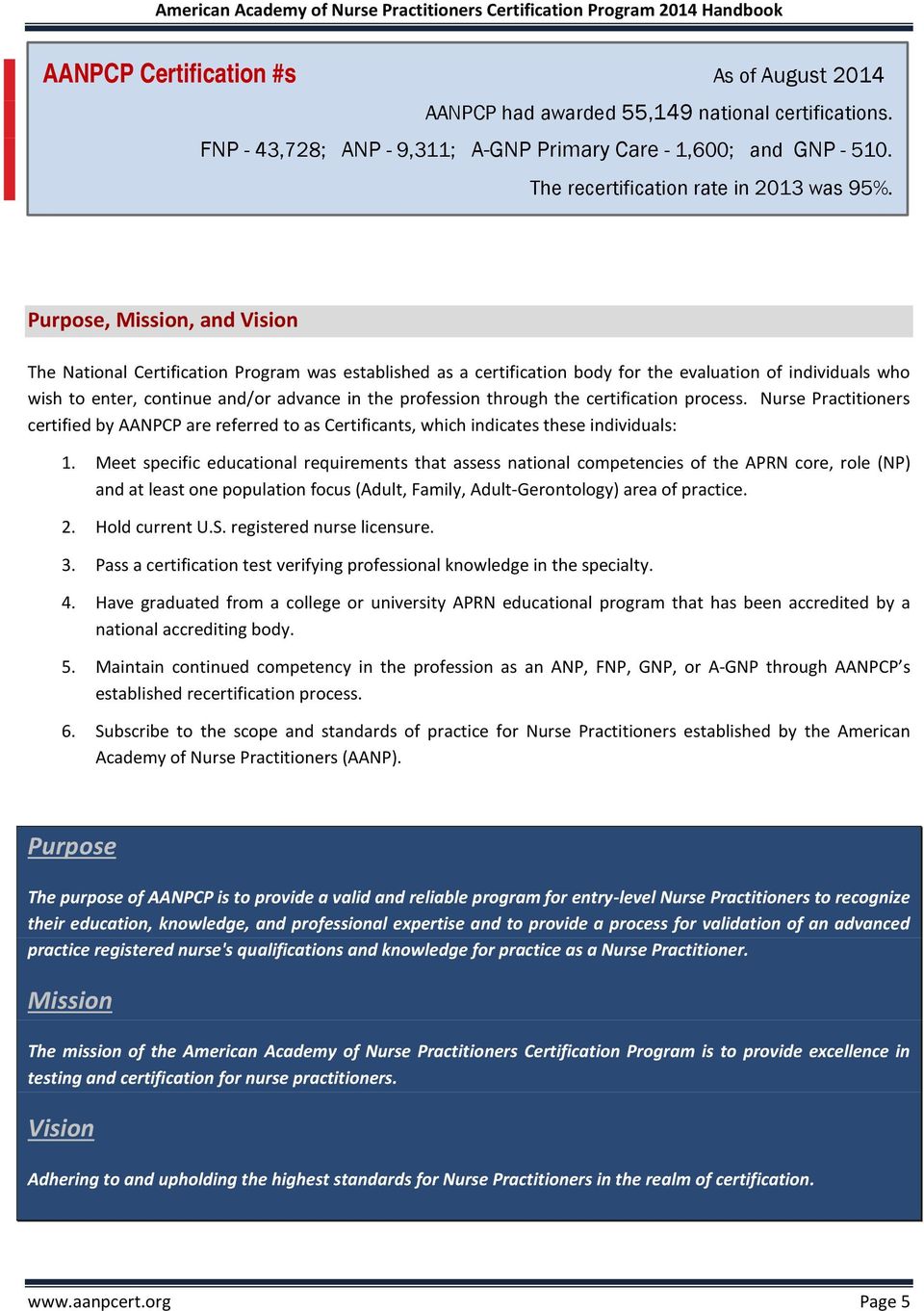
5 AANPCP Certification #s As of August 2014 AANPCP had awarded 55,149 national certifications. FNP - 43,728; ANP - 9,311; A-GNP Primary Care - 1,600; and GNP The recertification rate in 2013 was 95%. Purpose, Mission, and Vision The National Certification Program was established as a certification body for the evaluation of individuals who wish to enter, continue and/or advance in the profession through the certification process. Nurse Practitioners certified by AANPCP are referred to as Certificants, which indicates these individuals: 1. Meet specific educational requirements that assess national competencies of the APRN core, role (NP) and at least one population focus (Adult, Family, Adult-Gerontology) area of practice. 2. Hold current U.S. registered nurse licensure. 3. Pass a certification test verifying professional knowledge in the specialty. 4. Have graduated from a college or university APRN educational program that has been accredited by a national accrediting body. 5. Maintain continued competency in the profession as an ANP, FNP, GNP, or A-GNP through AANPCP s established recertification process. 6. Subscribe to the scope and standards of practice for Nurse Practitioners established by the American Academy of Nurse Practitioners (AANP). Purpose The purpose of AANPCP is to provide a valid and reliable program for entry-level Nurse Practitioners to recognize their education, knowledge, and professional expertise and to provide a process for validation of an advanced practice registered nurse's qualifications and knowledge for practice as a Nurse Practitioner. Mission The mission of the American Academy of Nurse Practitioners Certification Program is to provide excellence in testing and certification for nurse practitioners. Vision Adhering to and upholding the highest standards for Nurse Practitioners in the realm of certification. Page 5
6 Program Goals American Academy of Nurse Practitioners Certification Program 2014 Handbook Ensure individuals meet predetermined criteria necessary for certification that serve to protect the public. Define the knowledge, skills, and clinical experience necessary to practice as a Nurse Practitioner. Utilize established professional principles of testing and measurement to test the knowledge, skills, and abilities (KSAs) of Nurse Practitioner. Promote the value of Nurse Practitioners in the delivery of patient care to the public. Assist the health care community and the public to make informed decisions regarding Nurse Practitioner. Provide a high-quality certification program for Primary Care Nurse Practitioners. Support research that validates the certification program and explores methods related to continued competency. Serve in a leadership role for the credentialing of Nurse Practitioners. AANPCP does not provide educational services or training. Accreditation, Recognition, and Affiliation AANPCP is accredited by two organizations: (1) the Accreditation Board for Specialty Nursing Certification (ABSNC), formerly known as the ABNS Accreditation Council, and (2) the National Commission for Certifying Agencies (NCCA), the accrediting body of the Institute for Credentialing Excellence (ICE). The ABSNC is the only accrediting body specifically for nursing certification. Accreditation by ABSNC demonstrates AANPCP s compliance with the highest quality standards available in the industry for specialty nursing certification programs. Accreditation by NCCA indicates AANPCP s compliance with the NCCA Standards for the Accreditation of Certification Programs. AANPCP s ANP and FNP certification programs are accredited through 2017, and the A-GNP certification program is accredited through January The certification program is recognized by all State Boards of Nursing, the Centers for Medicare and Medicaid Services (CMS), the Veterans Administration, private managed care organizations, institutions, and health care agencies for credentialing purposes. AANPCP is affiliated with the American Association of Nurse Practitioners (AANP), which is the national professional membership organization for all nurse practitioners. Membership with the American Association of Nurse Practitioners (AANP) professional organization is neither a requirement for nor an indication of certification or recertification. AANPCP is an independent, separately incorporated, nonprofit organization. As such, any information, account, or member number received from one organization is held separately by each organization and is unrelated to the other. AANPCP Certificant numbers and AANP Membership numbers are uniquely different. Please contact AANP at if assistance with membership or AANP s CE Center is needed. National Consensus Model for APRN Regulation AANPCP endorses the national Consensus Model for APRN Regulation which provides the guidance for uniformity of APRN regulation across the United States. Published in 2008, it is the new regulatory model for Advanced Practice Registered Nurses (APRNs) - further defining the standards for Licensure, Accreditation, Certification, and Education (LACE) and practice. Target date for full implementation of the Model is Page 6

7 The Consensus Model identifies and defines the: APRN roles: Certified Registered Nurse Anesthetist (CRNA), Certified Nurse-Midwife (CNM), Certified Nurse Practitioner (CNP), and Clinical Nurse Specialist (CNS); APRN Core competencies: graduate level courses in advanced physiology/pathophysiology, assessment, and pharmacology; Population Foci: competencies in at least one of the following: family/individual across the lifespan, adultgerontology, pediatrics, neonatal, women s health/gender-related, or psych/mental health); Focus of Specialty Practice: Practice beyond the role and population focus linked to health care needs (e.g., oncology, orthopedics, nephrology, and palliative care); APRNs ability to practice. Credential: NP-C and Use of Advanced Practice (APRN) Title NP-C means Nurse Practitioner-Certified. NP-C is the registered trademark of American Academy of Nurse Practitioners National Certification Board, Inc. NP-C is the credential authorized for use by those individuals who have met the standards, qualifications, and testing requirements established by the American Academy of Nurse Practitioners National Certification Board, Inc. Certificants meeting AANPCP s requirements for renewal of their Adult, Family, Gerontologic, and Adult- Gerontology primary care specialty NP certification are authorized to continue to use the credential. The use of the initial A, F, G, or A-G indicates population specialty and may precede the NP-C. Use of these initials depends upon individual, state board of nursing, and employer preference. Although AANPCP and other certifying bodies may award a specific certification credential (e.g., NP-C) and have jurisdiction over who may use that credential, state laws prevails regarding the required use of certain credentials. APRN means Advanced Practice Registered Nurse. It is a protected title that is regulated by State Boards of Nursing. Certified Nurse Practitioners should check with the Board of Nursing in the state in which they practice as an APRN for specific signature and credential designations (e.g.; CNP, CRNP) unique to each state. Page 7

8 National Competency-Based Examinations for Nurse Practitioners AANPCP s National Certification Examinations are entry-level, competency-based examinations reflective of knowledge and expertise in the Nurse Practitioner specialties of Adult, Family, and Adult-Gerontology Primary Care. Adult Nurse Practitioner Certification The Adult Nurse Practitioner (ANP) National Certification Examination is offered to graduates of accredited graduate, post-graduate, and doctoral level ANP programs in the U.S.A. and Canada. Applicants must meet the qualification and eligibility requirements to sit for the examination. APRNs who are currently certified by AANPCP as an ANP will continue to be certified, credentialed, and recognized by AANPCP as an ANP as long as the minimum requirements for recertification are met and the certification does not lapse. AANPCP will retire the Adult Nurse Practitioner (ANP) National Certification Examination by 2017, at which time recertification by examination will no longer be an option. Family Nurse Practitioner Certification AANPCP offers the Family Nurse Practitioner (FNP) National Certification Examination to graduates of accredited graduate, post-graduate, and doctoral level FNP programs who meet the eligibility requirements to sit for the examination. APRNs certified by AANPCP as a Family Nurse Practitioner will continue to be certified, credentialed, and recognized by AANPCP as long as the minimum requirements for recertification are met and the certification does not lapse. Adult-Gerontology Primary Care Nurse Practitioner Certification The Adult-Gerontology Primary Care Nurse Practitioner (A-GNP) National Certification Examination is offered to graduates or impending graduates of accredited graduate, post-graduate, and doctoral level Adult-Gerontology Primary Care Nurse Practitioner programs in the U.S.A. and Canada. Dual-Certified ANP and GNP: Conversion to Adult-Gerontology (A-GNP) Primary Care Nurse Practitioner Certification Option Certificants who are currently dual-certified by AANPCP as both an Adult Nurse Practitioner AND a Gerontologic Nurse Practitioner are eligible to apply for conversion to the Adult-Gerontology Primary Care Nurse Practitioner, and use the A-GNP-C credential, through the Conversion Application process. Retirement of the Adult Nurse Practitioner (ANP) Certification Examination The Adult National Certification Examination will be retired by 2017 in order to meet regulatory model requirements of the APRN Consensus Model for role and population foci. NPS CURRENTLY CERTIFIED BY AANPCP AS Adult NPs WILL CONTINUE TO BE CERTIFIED AND RECOGNIZED AS LONG AS THE CURRENT AANPCP REQUIREMENTS FOR RECERTIFICATION ARE MET AND THE CERTIFICATION DOES NOT LAPSE. ANPs who allow their certification to lapse will be unable to renew it without meeting current requirements for the Adult- Gerontology Nurse Practitioner. ANPs should check with their individual State Boards of Nursing for further requirements or stipulations. Page 8

9 Retirement of the Gerontologic Nurse Practitioner (GNP) Certification Examination The Gerontologic National Certification Examination was retired at the end of 2012 in order to meet regulatory model requirements of the APRN Consensus Model for role and population foci. NPs CURRENTLY CERTIFIED BY AANPCP AS A GNP WILL CONTINUE TO BE CERTIFIED AND RECOGNIZED AS A GNP AS LONG AS THE CURRENT AANPCP REQUIREMENTS FOR RECERTIFICATION ARE MET AND THE CERTIFICATION DOES NOT LAPSE. GNPs who allow their certification to lapse will be unable to renew it without meeting current requirements for the Adult- Gerontology Nurse Practitioner. GNPs should check with their individual State Boards of Nursing for further requirements or stipulations. Qualifications and Eligibility Qualifications for Taking the AANPCP National Certification Examination Applicants may begin the application process as early as 6 months before completion of their program. Candidates are encouraged to establish an Online Profile account with AANPCP at Normal processing time for an Initial Application may take 3 to 6 weeks, depending upon receipt of a completed application, required documentation, and applicable fees. Certification examinations are offered to graduates or impending graduates of a nurse practitioner education program from an accredited college or university who complete a master s degree, post-graduate certificate, or doctoral degree in the Adult, Family, or Adult-Gerontology Primary Care Nurse Practitioner concentration. Programs in the U.S. must be accredited by a national nursing organization recognized by the U.S. Department of Education (e.g. Accreditation Commission for Education in Nursing, Inc. (ACEN) or the Commission on Collegiate Nursing Education (CCNE). Additional requirements for Initial Application include: Evidence of completion of a minimum of 500 clinical clock hours of faculty-supervised practice; Evidence of completion of the APRN core courses: advanced physical assessment, advanced pharmacology, and advanced pathophysiology; A current licensure as an RN in the United States or a Province/Territory of Canada; An interim transcript showing completed academic coursework-to-date, or a final official transcript showing the degree awarded (conferred). Applicants are notified by once weekly if additional information is required for completion of an application. Once an application has been processed and required documentation is received, the application is forwarded for review by qualified Certified Nurse Practitioners. Statement of Nondiscrimination AANPCP does not discriminate among candidates with respect to age, race, religion, national origin, ethnicity, disability, marital status, and sexual orientation, gender, or gender identity. Page 9

10 Examination Description Examination Purpose The purpose of a certification exam is to determine whether a candidate has met the standards required to be certified. Examination Development The Certification Program selects panels of certified Adult, Family, Gerontologic, and Adult-Gerontology Primary Care Nurse Practitioner content experts engaged in clinical practice, academic environments, and diverse geographical areas to assist in all phases of the development of the examinations. AANPCP s National Certification Examinations are developed in cooperation with Professional Examination Service (ProExam, formerly known as PES). The rigor of the examination development process guarantees quality competency-based certification examinations. Each certification examination consists of 150 multiple-choice items, which include 15 pretest questions that are not counted in the candidate's final score. Major components of the examination development process are: Role Delineation/Practice Analysis - provides the foundation for defining AANPCP s Knowledge Areas and Testing Domains. These examinations are based on Role Delineation Studies, also known as Practice Analyses, which are undertaken by AANPCP and ProExam as objective measures of the knowledge and skills required of competent Nurse Practitioners. 1. See Appendix C for the Adult and Family Nurse Practitioners Knowledge Areas and Adult- Gerontology Primary Care Nurse Practitioner Knowledge Areas. 2. See Appendix D for the Testing Domains of the Adult, Family, and Adult-Gerontology Nurse Practitioner Examinations. Test Specification Development - are derived from the Practice Analyses and serve as the Blueprint for AANPCP s examinations. Items are written and developed by practicing CNPs with extensive knowledge and expertise in the respective areas of Adult, Family, and Gerontology practice. Items which appear on the examinations are reviewed at least four times prior to inclusion on the examination: 1. Nurse Practitioner item writers, also referred to as content experts or Subject Matter Experts (SMEs) develop and review all items for content relevance, competency level, currency, and importance. 2. ProExam staff reviews each item for psychometric quality. 3. ProExam editorial staff reviews each item for grammar, spelling, and usage. 4. Additional panels of subject matter experts review and validate all items again. Test Construction - All items are secured in a Test Item Bank maintained by ProExam. Examinations include a unique combination of items from this Item Bank, selected on the basis of content areas and associated weights as defined by the Test Blueprints. Content domains and their respective weights are developed through practice analysis and serve to guarantee consistent emphasis on content areas from Page 10

11 one examination to another. Test Construction involves panels of content experts who work with ProExam to construct and subsequently conduct a final review of each certification examination. Passing Point Determination - Establishing a minimum passing score follows test construction. The Modified Angoff method, a method commonly used in the credentialing industry to determine minimum passing score, is used for all forms of the examination. Examination Content The certification examinations test clinical knowledge in the following areas: Assessment, Diagnosis, Formulation /Planning/Implementation of Treatment Plans, Evaluation, and Follow-up. Knowledge of health promotion, health protection, disease prevention, and diagnosis and management of acute episodic and chronic illness in primary care are examined. Entry-level Nurse Practitioners are expected to apply knowledge of the following to the process in the assessment, diagnosis, and management of patients in their care: Graduate Core Competencies, can be defined as the integrated knowledge, skills, judgment and attributes required of an APRN to practice safely and ethically in a designated role and setting. APRN Core Competencies (advanced pathophysiology, advanced pharmacology, and advanced health assessment). Psychology and Sociology. Areas of test content are associated with the APRN role, population foci, wellness-illness continuum, and associated problem areas. The Family Nurse Practitioner (FNP) examination tests clinical knowledge in family/individual across the life span of prenatal, pediatric, adolescent, adult, elderly, and frail elderly primary care. The Adult Nurse Practitioner (ANP) examination tests clinical knowledge of adolescent, adult, elderly and frail elderly primary care. The Adult-Gerontology Primary Care Nurse Practitioner (A-GNP) examination tests clinical knowledge of young adults (including adolescents and emancipated minors), adults, and older adults (including youngold, old, and old-old adults). Age Parameters - AANPCP uses growth and development as the basis of age-related changes for constructing the certification exams; therefore, specific age parameters are not defined for any population. Testing Service Professional Examination Service (ProExam) AANPCP s National Certification Examinations are developed in cooperation with Professional Examination Service ProExam, (formerly known as PES), a 501(c) (3) not-for-profit professional credentialing organization founded in ProExam has extensive experience in the development and administration of national licensure and certification examinations, including competency assurance, training-related assessment and certification. Their broad client base currently consists of over 60 professional associations, over 100 different licensing boards in more than 62 U.S. and Canadian jurisdictions, and test candidates in every part of the world. Page 11

12 ProExam has set standards for credentialing for seven decades, and their most important operating principle is to develop examinations of the highest quality. They have developed rigorous internal quality assurance standards that staff and consultants must follow during item and test development activities, and produce psychometrically sound and legally defensible examinations that meet the standards established by the testing industry. ProExam works to understand AANPCP s mission as it relates to credentialing, and provides advisory services during every step in the development of valid, reliable, and non-discriminatory examination for AANPCP. Examinations are developed in conformity with generally accepted credentialing standards established by the National Commission for Certifying Agencies, the American National Standards Institute, the Standards for Educational and Psychological Testing and the Accreditation Board for Specialty Nursing Certification. ProExam works closely with our chosen computer-based test (CBT) vendor, Prometric Testing Centers, and oversees the CBT administration conducted by Prometric. Testing Centers are located throughout the United States. Practice Test The AANPCP Practice Examination gives candidates an opportunity to familiarize themselves with the format of the test questions on the National Certification Examination. Practice Exams are a useful tool that may be used by candidates to identify areas in which further study may be needed. It is important to note that performance on the AANPCP Practice Examination is not a predictor of whether a candidate will pass the competency-based AANPCP National Certification Examination. The Practice Examination meets the same examination blueprint specifications and is similar to the National Certification Examination. Like the National Certification Examination, questions were developed by nurse practitioner content experts. An independent, web-based test delivery service is contracted to provide AANPCP s A-GNP and FNP Practice Examinations. Candidates should understand all of the following prior to taking a practice test: Candidates are advised to review the Practice Test Description and Disclaimer before accessing the Practice Exam Online portal. The link to the Practice Examination is located on the AANPCP website. Once opened, instructions for taking the practice examination and submitting payment for the examination are provided. There is only one version of the A-GNP Practice Examination. There is only one version of the FNP Practice Examination. Each exam has 75 multiple-choice items. Test takers have 90 minutes in which to complete the computer-based practice test and review their scores. The Practice Examination score is reported in percentile. (This is different than the scaled score reports of the National Certification Examination.) Practice Test answers are not available to review for security reasons. Test scores remain confidential and are not accessible by, or used by, AANPCP for certification purposes. Test takers do not receive continuing education credit for completion of this activity. The Practice Examination vendor is completely independent of AANPCP, therefore, AANPCP staff cannot respond to technical difficulties that may arise during the administration of the Practice Examination. AANPCP staff does not have access to the test as it is delivered by an independent entity. AANPCP staff cannot provide answers to the questions. Taking, completing, and passing the Practice Examination does not in any way guarantee the passing of the actual National Certification Examination, nor does it result in certification. Page 12

13 Testing Procedure American Academy of Nurse Practitioners Certification Program 2014 Handbook Approved Applications: Approval to Test Letter & Authorization-to-Test (ATT) Letter Candidates cannot sit for an examination until after they have completed their program. 1. Once an application is approved, AANPCP will notify applicants of their APPROVAL TO TEST via letter mailed from AANPCP. Eligible candidates who have completed the application process in advance of completion of their program or their graduation date receive this letter after all coursework is complete. 2. AANPCP then notifies ProExam of an applicant s Eligibility to Test by AANPCP. 3. ProExam will then mail the candidate a separate Authorization-to-Test (ATT) letter within 7-10 business days. This ATT letter authorizes the candidate to take the computer-based examination, grants the 120- day testing window, contains the candidate s Testing Identification Number, and provides instructions for scheduling a test appointment with Prometric Testing Centers. Admission to Test and Test Site Selection It is important that candidates read their ATT letter thoroughly. They should keep the letter in a secure place for referencing of their TESTING IDENTIFICATION NUMBER. Candidates must schedule the test date and location with Prometric, and not with AANPCP. When a test appointment is scheduled, candidates will receive a confirmation number from ProExam and must refer to that confirmation number when confirming, rescheduling, or canceling test appointments. Candidates who have questions regarding the test administration process should contact the Prometric Customer Service Center, and not the AANPCP. PLEASE READ CAREFULLY! Candidates should carefully review Prometric FAQs and the Prometric testing center regulations online at in advance of scheduling their examination. Candidates will not be permitted to test without the required identification documents. A CANDIDATE S FIRST AND LAST NAMES ON THEIR IDENTIFICATION DOCUMENTS PRESENTED AT THE TIME OF TESTING AND THE NAME ON THEIR ATT LETTER MUST EXACTLY MATCH. For this reason, legal name changes should not be made after a candidate is approved-to-sit. The test duration is 3 hours with additional time for a brief computer tutorial before the test begins and an optional post-test survey. Special Accommodations AANPCP complies with the Americans with Disabilities Acts (ADA, 1990, updated 2010). AANPCP works with the testing agency to provide reasonable and appropriate accommodations for candidates with a disability who submit appropriate documentation. To facilitate a request, a candidate requiring special accommodations must have their licensed health care provider complete the AANPCP Candidate Accommodation Request Form and Documentation of Disability-Related Needs Form providing documentation to AANPCP regarding the candidate s special circumstances. This form may be found on AANPCP s website under the TAB: CERTIFICATION DOCUMENTS. Once received and approved by AANPCP, candidates will need to contact Prometric Special Accommodations Department to schedule their examination. Candidates receive a 120-day window to test beginning the day the ATT letter is sent. Candidates are able to schedule their test appointment at a site and on a date convenient for their scheduling needs based on the Page 13

14 Prometric testing center s availability. This 120-day window allows candidates the flexibility of scheduling their test around their personal schedule, employment schedule, religious needs, or any other issues without requiring the need for additional accommodations or forms. Test Security Candidates who apply and sit for AANPCP s National Certification Examination must acknowledge that they understand the following: The National Certification Examinations are the exclusive property of the American Academy of Nurse Practitioners Certification Board, Inc.; Federal copyright law protects AANPCP s examinations and the items contained therein; The retention, possession, copying, distribution, disclosure, discussion or receipt of any AANPCP certification examination question, in whole or in part, by written, electronic, oral or other form of communication, including but not limited to ing, copying or printing of electronic files, and reconstruction through memorization and/or dictation, before, during or after the National Certification Examination is strictly prohibited. Theft or attempted theft of examination content is punishable as a felony; Candidate participation in any irregularity occurring during or after this examination such as giving or obtaining unauthorized information or aid, as evidenced by an observation or subsequent statistical analysis, may be sufficient cause to terminate participation, invalidate the results of the examination, or necessitate other appropriate action; and Incidents regarding test security or examination administration will be reported to the Certification Commission. Grounds for sanction may be warranted. Cancellation, Extensions, and Withdrawal Policy Cancellations: Applicants need to follow the guidelines of Prometric regarding cancellations and contact the Prometric Customer Service Center to schedule, reschedule, cancel, and confirm appointments. It is important to note the following: Applicants should call Prometric or the testing center directly. Applicants should call Prometric or the testing center as soon as possible upon realizing the need to change a scheduled examination. Additional fees will be charged by Prometric if changes are made to a scheduled examination date within 30 days. The full exam registration fee will be forfeited in the event of an appointment cancelled less than 72 hours prior to the scheduled appointment. The ATT letter will be voided; and the candidate will need to reapply and be required to obtain new eligibility. Candidates who fail to show for their scheduled examination and wish to reschedule to take the examination will need to pay the appropriate fee to test. Extensions: Candidates unable to sit for the examination within their 120-day window to test may be granted a one-time extension on a case-by-case basis for reasons of hardship with sufficient justification. Candidates granted an extension receive a 60 day-window to test ONLY. Page 14

15 Applicants who do not test during the 60-day extension window forfeit applicable fees, and will need to reapply again for the initial certification examination and pay the applicable fees. Withdrawals: Applicants wishing to withdraw from taking the examination must submit a written request to AANPCP and will be responsible for applicable fees as indicated: The registration fee, less a processing fee, will be refunded to the applicant within 30 days providing the candidate has not scheduled an examination with Prometric and the request is received before expiration of the applicant s 120-day testing window. Candidates who withdraw after an appointment is made, do not cancel appropriately, or do not sit for their scheduled examination will not be entitled to a refund and will be responsible for fees charged by the testing center. Test Scoring AANPCP s National Certification Examinations are criterion-referenced tests. They are designed to assess knowledge required for entry-level practice. In a criterion-referenced examination, a candidate must obtain a score equal to or higher than the "passing score" to pass the test. The passing score (scaled score) represents absolute standards, is determined by panels of Adult, Family, and Gerontologic Nurse Practitioner content experts using psychometrically accepted standard-setting methodology, and is a complex scoring system that assesses the standards that define what candidates should know for entry-level Nurse Practitioners. Candidate s performance on the examination is not compared to the performance of others taking the examination. Examination Results In reporting of examination results to candidates, statistical procedures are used to convert raw scores to scaled scores, which are equivalent for all administrations of the examination. The scaled score is neither a number correct nor a percent correct score. Candidates view a preliminary overall Pass or Fail status report on the computer upon completion of the test. The examination is electronically scored. Exam results are reported as a scaled score. The total number of correct responses is called the total raw score which is converted to a scaled score ranging from 200 to 800 points. A minimum passing scaled score of at least 500 must be obtained to pass the examination. Test scores are sent to AANPCP once weekly from the testing agency. Before AANPCP can release a test score to a candidate, AANPCP must receive a candidate s official final transcript showing the date degree was conferred by the program. In the case of a post-graduate certificate program, a certificate is required in addition to the official final graduate transcript. A candidate's examination scores are considered confidential information and will not be disclosed to anyone other than the candidate. AANPCP will not release test scores to anyone without specific written instructions from the candidate indicating to whom and why the information is to be disclosed. Candidates who successfully pass the National Certification Examination are referred to as Certificants. AANPCP mails an official score letter with a personalized certificate and laminated wallet card to the Certificant within 2-3 weeks if all requirements for certification have been met. A printable wallet card is available on the Certificant s online account as soon as the score is released. Page 15

16 In the event a candidate does not pass the National Certification Examination Candidates who do not pass the certification examination receive an official score letter from AANPCP indicating a failure to pass, their score, areas of strength and weakness in the four Testing Domains (see Appendix D), and explanation of the requirements needed to retake the examination. AANPCP requires an official final transcript showing date degree conferred, or post-graduate certificate if applicable, before a candidate s scores may be released. Candidates may apply to retake the examination after completion of a general review course or additional continuing education. (See Retaking the Examination) Candidates who do not pass the examination and wish to appeal the Certification Commission about their failing score will need to follow the Appeals Process. (See Appeals Policy) Applicants enrolled in a DNP program Applicants may sit for the National Certification Examination in the area of their specialty AFTER all of the advanced practice clinical requirements of their DNP program are completed. To be eligible to test, DNP candidates must have completed all of their NP program s didactic courses and all of the facultysupervised clinical practice hours required for that program. Under these circumstances, an applicant s certification is not released until an official transcript showing DNP degree conferral date is received by AANPCP. The start date of the certification will be the date the score is released and not the date the examination was taken. Score Reports Aggregate Score Reports are sent to educational programs with 3 or more students testing for a given certification (specialization) during a calendar year. Disclosure will not take place if it violates an applicant s or a Certificant s right of privacy. If a candidate wishes to have individual scores sent to their education program, they must request that particular service in writing to AANPCP. They may also choose to provide a copy of their score letter to their program if they so choose. Individual scores are not included in verification documents sent to Boards of Nursing or other entities unless specifically requested in writing by the Certificant or required by law. Examination Comments Examination comment opportunities are available at the end of the testing session should a candidate wish to comment on the test as a whole or on specific items within the examination. Retaking the Examination Candidates who do not pass may apply to retake the examination. Candidates may not take the examination more than TWICE in a calendar year (January 1 st to December 31 st ). Candidates choosing to retake the examination must reapply using the National Certification Examination Retake Application and submit with applicable fees. Page 16

17 To retake the examination, candidates are required to complete and submit documentation of a minimum of 15 accredited hours of continuing education (CE) from an accredited CE provider. Continuing education hours should focuses on the area(s) of weakness indicated on their certification examination score report. Accredited CE providers include, but are not limited to: AANP, AAFP, AAPA, ACCME, AMA, ANCC, NPACE, accredited and approved educational institutions, and State Boards of Nursing A general NP certification examination review course is acceptable and is highly recommended. This additional coursework for the retake requirements must be completed after the test date which the candidate did not pass. Candidates are notified in writing of their acceptance to sit for the retake examination. Certification Fees Fees may be found on the Certification website. Fees are shown in USD and are subject to change without notification. AANPCP does not expedite processing of applications. A paper processing fee is charged for processing of all paper applications received via mail, , or fax. There is no charge for processing of an applicant s supporting documents received by AANPCP for the purposes of certification and recertification (e.g., RN licenses, CEs, unofficial transcripts). Documentation Online Profile and Application Applicants are encouraged to visit the AANPCP website often at for information regarding the certification examinations, applications, requirements, regulations, renewal processes, APRN news, new information, and FAQs. Applicants and Certificants have the ability to create an Online Profile account where they can apply, upload documents, view the status of pending applications, download a free wallet card with their certification information, and update personal information such as a change to their name or address. Applicants have the option of applying for certification or recertification via paper application. Online applications and electronic submissions are preferred. A paper processing fee will be assessed for processing of a paper application. Supporting documentation or correspondence may be sent to AANPCP via mail, courier mail, , or fax. Name and Address Changes Applicants applying for initial certification and Certificants certified by AANPCP are responsible for updating their Online Profile or notifying AANPCP of changes to their legal name or contact information. An applicant or Certificant may make changes to their own name and contact information at any time by logging into their Online Profile using their username and password. Page 17

18 Five business days should be allowed from the time of receipt for the processing of requests for changes to name or contact information that are mailed, ed, or faxed. A Request for Change of Name, Address, or Certification Status Form giving AANPCP permission to make the change must accompany all requests sent to AANPCP and can be found online under FORMS. Legal Name change requests may be submitted via , fax, or mail to the AANPCP office. In the event of a legal name change, a copy of supporting documentation (e.g., court record, marriage license) providing proof of the name change must accompany the Request for Change of Name, Address, or Certification Status Form. Candidate s names must match on their application, ATT letter, and forms of identification required by the testing center for an applicant to sit for their scheduled examination. If a candidate has already been approved to test, it is recommended that the name change request be made after they have sat for their examination and received preliminary notification of test status to avoid problems at the testing center. The name change may be made by the candidate online within 24 hours of sitting for the examination. This process will help to ensure that the candidate s certificate and wallet card reflects their new name. Contact Us Contact Us: is the preferred method for general correspondence. Official Transcripts: May be sent to AANPCP via secure electronic transmission from a University Registrar. May be mailed directly to AANPCP in a sealed envelope by a University Registrar. May be obtained copy from a University Registrar in a sealed envelope and mailed to AANPCP. Documentation: Copies of RN licenses, completed paper applications, and correspondence may be mailed, faxed, or ed to: P.O. Box: AANPCP P.O. Box Austin, TX Fax: (512) [email protected] Transcripts may be ed to: [email protected] Street address for courier delivery: AANPCP 2600 Via Fortuna, Suite 240 Austin, TX Certification Administration: (512) Toll-free Number: (855) Inquiries may be ed to: [email protected] Page 18

19 Correspondence from AANPCP It is very important that Certificants update their Online Profile or notify AANPCP of changes to their contact information during the period of their certification. AANPCP notifies Certificants about important information concerning the Certification Program. This is primarily accomplished by . General announcements are posted on the webpage. AANPCP is not responsible for sent from the American Association of Nurse Practitioners membership organization ( As a courtesy, AANPCP mails a postcard reminder to a Certificants last known mailing address on file 12 months prior to the expiration of the certification. A second postcard will be mailed at six months if the Certificant has not yet initiated their renewal application. An attempt is also made to notify Certificants via . FAILURE OF A CERTIFICANT TO RECEIVE A RENEWAL NOTICE DOES NOT RELIEVE THE CERTIFICANT OF THE PROFESSIONAL RESPONSIBILITY TO RENEW CERTIFICATION PRIOR TO ITS EXPIRATION DATE. Verification Requests AANPCP Certificants, applicants, credentialing agencies, employers, and third party vendors may order Primary Source Verification of National Certification of individuals who hold active AANPCP certification. Information accessed through this process is a reflection of AANPCP s records. While every effort is made to ensure that the information provided is accurate and reliable, delays in posting data, updating data, or human/mechanical error remains a possibility. AANPCP will not be liable for any damages resulting from use of the information obtained through the verification process. AANPCP provides verification of certification to State Boards of Nursing (SBON) free of charge. Requests are usually processed within one business day of receipt of the request and will be sent by or regular mail according to the particular state board s preference. Processing time for a third-party verification request of Certificant certification may take up to 10 business days from receipt of the request and is subject to a respective fee. Embossed mailed hard copies are available upon request. Active duty military personnel requesting verification are not charged a verification fee. State Boards of Nursing are not automatically notified of an applicant s Verification of Eligibility to Test. AANPCP will provide a SBON and employers with an official letter if a formal request is received. If a specific form for Verification is required by state regulatory agencies, employers, or others to whom disclosure is requested, it will be the applicant s responsibility to provide AANPCP with the required form. Candidates who successfully pass the National Certification Examination must allow at least 3 weeks after an examination is taken to allow for administrative processing time and authorization of verification. Requests for verification submitted too soon after a candidate tests may reflect that an individual is not certified. Verification request forms, fees, and additional information may be found online at under the Tab VERIFICATION. Page 19
20 Appeals Policy American Academy of Nurse Practitioners Certification Program 2014 Handbook Because AANPCP s examinations are computer-based and electronically scored, errors in scoring are virtually nonexistent. An appeals process is in place for candidates who do not pass the examination and wish to appeal or petition the Certification Commission about their failing score. The Appeals for review of a failing score process is as follows: Must be submitted in writing. Must specifically state the reason(s) for the appeal. Must state why the appeal should be granted. The appeal letter must be received by AANPCP within 14 days of the candidate s preliminary online examination fail result which is provided to the candidate at the time of testing. Written correspondence received after this date will not be accepted. Written communication to the AANPCP s Appeals Committee must be sent in a manner that is traceable, and requires receipt with signature or delivery confirmation. Written communication must be addressed to: AANPCP Appeals Committee c/o Certification Manager. The Appeals Committee will consist of Commissioners who are certified Nurse Practitioners appointed by the AANPCP Commission Chair. AANPCP will provide a response to the candidate regarding the outcome of the appeal within 21 days of receipt of the appeal letter. There is no further appeal beyond this point. The Candidate will be responsible for any expenses incurred during the Appeals process. Confidentiality and Disclosure Candidate scores are considered confidential information. Aggregate scores are made available to Nurse Practitioner programs that have three or more candidates testing within a calendar year. To protect the confidentiality of applicants, written authorization by the applicant is required before information is released regarding an individual s scores or status in the certification program. Sensitive and confidential information received by AANPCP is used solely for the purposes of certification and verification and cannot be shared without written permission or required by law. Disclosure will not take place if it violates an applicant s or a Certificant s right of privacy. A signed attestation authorization by an applicant granting permission to disclose verification of eligibility to test, or verification of a Nurse Practitioner s certification will be accepted by , mail, fax, or courier service if the signatures match the application signature. Electronic online requests entered online using the appropriate username and password and made by an applicant authorizing permission to disclose verification of eligibility to test, or verification of the NP s certification, will be processed within 48 hours.. Requests for Verification information will not be accepted or provided by telephone. Page 20

21 Obtaining Replacement Certificates and Wallet Cards Certificants may obtain a copy of their wallet card by logging into their online account and printing it. Additional duplicate parchment certificates may be obtained by completing the Request for Replacement AANPCP Certificate Packet form, which may be found under the FORMS Tab - Replacement Document Request on the AANPCP website and submitting it with the appropriate fee to AANPCP. Records Management and Retention AANPCP implements a Records Management and Retention Policy and institutes best business practices with regards to retention, security, and disposal of paper and electronic records received from AANPCP applicants, candidates, and Certificants. These processes are reviewed annually and may be modified at any time for compliance with local, state, and federal laws affecting record retention. Certification records are considered confidential information. Records include, but are not limited to, RN licenses, official and unofficial transcripts, continuing education documents, education records as defined by the Family Educational Rights and Privacy Act (FERPA) of 1974, financial data, and individual identifiable information/unique identifiers as defined by the Health Insurance Portability and Accountability Act of 1996 (HIPAA). Data from paper records received is entered into AANPCP s Certification Management System (CMS), the repository for all certification and recertification applications, files, and pertinent and associated information. At such time that a paper record is no longer required for the processing of an application or valued for its information, the paper record is destroyed per AANPCP s Records Management and Retention Policy. Information entered into the CMS remains a permanent electronic record. In the event of a circumstance involving litigation, disposal of any documents pertaining to the litigation will be suspended. AANPCP does not offer: Access to AANP s membership database. Access to Certificant s CEs at AANP or to a Certificant s AANP CE Tracker. Accreditation services to educational programs. Provide educational services for candidates, Certificants, nurses, or other individuals. Page 21
22 Certification Renewal and Maintenance Introduction This section of the CANDIDATE AND RENEWAL OF CERTIFICATION HANDBOOK has been prepared for Nurse Practitioners (NPs) who are currently certified as an Adult Nurse Practitioner (ANP), Family Nurse Practitioner (FNP), Gerontologic Nurse Practitioner (GNP), or Adult-Gerontology Primary Care Nurse Practitioner (A-GNP) by the American Academy of Nurse Practitioners Certification Program (AANPCP). Certification Numbers will begin with the first letter of the population specialty (i.e., A, F, G, or A-G) and will be printed on the both the certificate and the wallet card. AANPCP CERTIFICANT NUMBERS and AANP MEMBERSHIP NUMBERS ARE UNIQUELY DIFFERENT. Membership with the American Association of Nurse Practitioners (AANP) professional organization is neither a requirement for nor an indication of certification or recertification. AANPCP is a separately incorporated entity from AANP. As such, any information, account, or member number received from one organization is held separately by each organization and is unrelated to the other. Please contact AANP ( if assistance with membership or the AANP CE Center is needed. Purpose The National Certification Program provides a process for the validation of an AANPCP-certified Nurse Practitioner s qualifications and knowledge for practice through renewal of certification as an Adult, Family, Gerontologic, or Adult-Gerontology Primary Care Nurse Practitioner. Applicants who become certified by AANPCP: Are referred to as Certificants. Have successfully met specific educational requirements. Have passed AANPCP s National Certification Examination verifying professional knowledge in a nursing specialty. Maintain continued competency in the profession through established recertification processes; and Subscribe to the Scope of Practice (Appendix A) and Standards of Practice (Appendix B) established by the American Association of Nurse Practitioners (formerly the American Academy of Nurse Practitioners). Recertification & the National Consensus Model AANPCP endorses the national Consensus Model for APRN Regulation: Licensure, Accreditation, Certification, and Education (LACE). The Consensus Model identifies and further defines the 4 APRN roles, the Core competencies, Population Foci, Specialty practice beyond the role and population focus, and the APRNs ability to practice. It will provide the regulatory guidance for uniformity of regulation across the U.S.A., further defining the standards for APRN licensure, accreditation, certification, education, and practice. The target date for full implementation of the Model is National organizations involved with the LACE process (i.e., certification, recertification, licensure, practice, and education) have made significant progress to be in compliance with the Model. AANPCP will implement changes to the recertification requirements in Page 22
23 AANPCP - Certificant Responsibility Certified Nurse Practitioners (CNPs) are responsible for maintaining currency of their National Certification and RN licensure for employment, billing, and credentialing purposes. CNPs must keep current with new information related to contemporary knowledge of the wellness-illness continuum. CNPs are encouraged to keep current with the national Consensus Model for APRN Regulation and its impact on certification, licensure, education, and practice. Certificants are responsible for notifying AANPCP of changes to their contact information during the period of their certification. A CNP who allows their certification to lapse or expire may be unable to work as a Nurse Practitioner. A CNP who allows their certification to lapse may not use the credential. It is the Certificant s responsibility to submit the appropriate fees and documentation for recertification in time to allow for processing. AANPCP does not expedite processing of any certification or recertification applications. Failure of a Certificant to receive their renewal notice does not relieve the CNP of his or her professional responsibility for renewing their National Certification prior to their expiration date. AANPCP is not responsible for financial or other damages occurring with respect to lapse or expiration of a certification due to lack of notification of a change to their contact address or information. Recertification Requirements and Options APRNs certified as an Adult, Family, or Gerontologic Nurse Practitioners by AANPCP currently recertify every 5 years. Recertification expires automatically at the end of the 5-year certification period unless renewed. AANPCP requires Certificants to recertify in one of two ways: Option 1: Meet established minimum requirements set by AANPCP of both clinical practice and continuing education and provide documentation of a minimum of 1000 hours of clinical practice as a Nurse Practitioner and a minimum of 75 hours of continuing education (CE) applicable to the population focus within the 5-year period of certification; or Option 2: Apply for and take the National Certification Examination. The requirement of a 5-year period of certification: Based on a thorough review of the literature and consultation with credentialing experts, the AANPCP Commissioners determined that a 5-year cycle of recertification would meet the requirements to ensure the continued competence of NPs certified by AANPCP. This decision was made at the outset and has been reviewed periodically in conjunction with subsequent practice analyses. The requirement for at least 1,000 hours of clinical practice: Allows full time faculty and directors of NP programs, required to maintain NP certification to be in compliance with the National Task Force Criteria for Evaluation of Nurse Practitioner Programs (2012), the ability to accomplish recertification with at least one-half day per week of direct clinical practice. Page 23
24 Allows individuals employed in administrative arenas whose position requires that they maintain current NP certification the ability also to recertify using the same rationale and criteria. Is exceeded by the vast majority of AANPCP Certificants. The requirement of at least 75 hours of continuing education (CE): Is in keeping with NCSBN Model Nursing Practice Act and Model Nursing Administrative Rules (2011). Meets the minimum re-licensure required by most states for RN/ APRN of 24 hours of acceptable CE during the most recent licensure period which in most cases is a 2-year period. Will increase from 75 to 100 CEs for those recertifying in 2017 and later. Other CE changes will include requiring a minimum of 25 pharmacology credits, and the option to receive credit for being a preceptor to an NP student. The maximum preceptor credit will be 25 CEs for 120 clinical hours of supervising an NP student providing direct patient care in the advance practice role of specialty certification (i.e., ANP, A- GNP, FNP, or GNP). Calculation of 120 clinical hours is based on being a preceptor 8 hours per week for one semester (i.e., 15 weeks x 8 hours/week = 120 hours). Certificants recertifying before 2017 will not have the option to use preceptor credits as continuing education. The AANPCP National Certification Examinations: Are psychometrically sound and legally defensible. Provide evidence of the attainment of knowledge, skills, and abilities required for entry-level clinical practice as a nurse practitioner. Are updated annually and the content and passing points are determined by a panel of subject matter experts. The ability to pass the current exam is considered evidence of continued competence, thereby assuring current competence at the time of recertification by exam. It is the responsibility of AANPCP Certificants to complete all requirements for recertification PRIOR to expiration of their current 5-year period of certification. Certificants are encouraged to visit the AANPCP website to establish their Online Profile, apply for recertification, maintain their profile, update their contact information, and/or review current information. As a courtesy, AANPCP mails postcard reminders to Certificants at their last known mailing address 12 months and 6 months prior to a Certificant s expiration date. AANPCP will attempt to notify Certificants by of important information or upcoming renewal. It is the Certificant s responsibility to notify AANPCP of any changes to their contact information. The Adult-Gerontology Primary Care Nurse Practitioner National Certification Examination was introduced on January 2 nd, As a result, the first A-GNP Certificants will be due for renewal by January AANPCP no longer mails recertification packets to Certificants; that ended when the Online Application process became available in AANPCP s Certification Management System (CMS) is the repository for certification and recertification applications and pertinent information. Page 24
25 Procedure for Certificants Who Recertify by Clinical Practice and CE Certificants recertifying through clinical practice and continuing education (CE) may apply online. Certificants may also apply by completing and submitting the paper AANPCP National Recertification Application available online. A fee will be charged for processing of paper applications received via mail, or fax. Documentation of clinical practice hours, sites worked as an NP, CE documents, R.N. license with current expiration date, and appropriate fee is required for processing of an application. There is no charge for receipt and processing of documents received via mail, , or fax. Requirements for clinical practice hours and CE submitted for the purposes of recertification must have been completed within the Certificant s current 5-year period of certification. Clinical practice hours or CE submitted outside of the Certificant s current 5-year period of certification will not be counted. It is the Certificant s responsibility to notify AANPCP of any changes to their contact information. Certificants creating an On-line Profile account for the first time should allow 2 business days for linking of information in AANPCP s Database. Applications for recertification should be submitted no later than eight weeks prior to the expiration date of the current certification to allow time for reviewing, processing, and issuing of the new certificate before expiration of the current certification. While every effort is made to process applications before a Certificant s expiration date, recertification applications received less than 8 weeks prior to expiration of the 5-year certification period may not be able to be processed in time due to the number of applications for recertification received by AANPCP. This may impact the Certificant s credentialing. Effective January 2013, Certificants may begin their application process 12 months before the expiration date of their current certification to allow time for submission of documentation and fees, reviewing, processing, and issuing of a new certificate. Providing a longer window of opportunity to renew allows Certificants greater flexibility and will hopefully decrease the potential loss of one s certification due to expiration that could occur as a result of significant life events or other issues that result in delays. Once started, applications must be completed in entirety to avoid loss of information submitted. APRNs currently certified through AANPCP as a GNP will continue to be certified and recognized by AANPCP as a GNP as long as recertification requirements are met and the certification does not lapse. Recertifying by examination for GNPs is no longer an option. GNPs who allow their certification to lapse will be unable to renew it without meeting the current requirements for the Adult-Gerontology Nurse Practitioner certification. GNPs should check with their individual State Boards of Nursing for further requirements or stipulations. The GNP certification may not be recognized by some states in the near future. AANPCP plans to retire the ANP certification examination after APRNs currently certified through AANPCP as an ANP will continue to be certified and recognized by AANPCP as an ANP as long as recertification requirements are met and the certification does not lapse. Recertifying by examination for ANPs will no longer be an option when the certification exam is retired. ANPs who allow their certification to lapse after 2016 will be unable to certify without meeting the current requirements for the Adult-Gerontology Nurse Practitioner certification. Page 25
26 Continuing Education Requirement Information CE submitted for recertification purposes must be related to the role and population-foci. CE submitted for recertification purposes must be from an accredited provider or approver. Accredited CE providers include, but are not limited to: AANP, AAFP, AAPA, ACCME, AMA, ANCC, NPACE, accredited and approved educational institutions, and State Boards of Nursing. AANPCP currently does not require pharmacotherapeutic content hours. Pharmacology credits will be a requirement in the Recertify by CE and Clinical Practice option for those recertifying in 2017 and later. Graduate level courses are accepted if directly related to the provision of care in the Certificant s population focus. Courses are subject to approval. An official transcript is required and a course description may be requested. Courses not accepted by AANPCP for CE credit include: - Basic Life Support (BLS) - Advanced Cardiac Life Support (ACLS) - Pediatric Advanced Life Support (PALS) - Neonatal Resuscitation - Non-clinical college courses. Preceptor hours are not currently accepted for CE. To date, AANPCP has required Certificants to recertify by clinical practice and CE or by examination. Serving as a Clinical Preceptor for NP students has been considered to be a professional responsibility and a valuable contribution to the profession. Preceptor credits will be available as an option for those recertifying in 2017 and later. Copies of CE documents submitted must include: the Certificant s name, CE topic, program sponsor, date of attendance or completion, number of contact hours awarded, and the name of the CE accreditor. The conversion for 1 academic semester credit = 15 contact hours. CE documents submitted are audited by AANPCP for relevancy and accreditation by appropriate authorizing entities. Failure to submit the required documentation or fees, or the submission of duplicate or expired CE, will delay the review and approval of an application. Candidates found ineligible to be recertified through clinical practice and CE will be refunded the recertification application fee, less a processing fee, and may apply for recertification by examination providing the certification period has not expired. Documents sent to AANPCP for the purpose of Certification or Recertification becomes the property of AANPCP. Individuals should retain copies of their records for personal use and for their professional portfolio. AANPCP is under no obligation to return or issue copies of these documents for future use by a Certificant. Certificants are advised to check with their State Board of Nursing for additional RN and APRN licensure requirements. Clinical Practice Requirement Information Current minimum requirements include 1000 hours of clinical practice as a CNP in the Certificant s role and population focus (Adult, Adult-Gerontology, Family, or Gerontologic) as an employee or volunteer during the 5-year period of certification. An official detailed description of the clinical practice duties or volunteer duties performed may be submitted and/or requested. Page 26
27 Procedure for Certificants Who Recertify by Examination Certificants recertifying by examination may apply online, or complete the National Recertification by Examination paper application, and submit a current RN license and appropriate fee to AANPCP. Applications must be submitted 120 days prior to the expiration date of the current certification. A notice of eligibility to sit for the examination will be sent via and regular mail once approved. (See the Testing Procedure section of this candidate handbook for information regarding Test Administration, Special Accommodations, Test Security, Cancellation and Withdrawal, Test Scoring, Examination Results and Reports, and Examination Comments.) Candidates found ineligible to sit for recertification by examination will be refunded the registration fee less a processing fee. Procedure for Certificants Who Choose to Recertify by Examination and Fail Candidates who do not pass the certification examination will receive a letter explaining the requirements needed to retake the examination when they receive their test results and will need to follow the procedure for Retaking the Examination. Candidates who do not pass the examination and wish to appeal or petition the Certification Commission about their failing score will need to follow the Appeals Process. Certificants who meet minimum requirements for clinical practice and continuing education, yet choose to recertify by examination and fail, may still apply for recertification by CE and clinical practice hours as long as they meet the minimum requirements and the certification has not lapsed. Procedure for Certificants Whose Certification Has Expired and Not Lapsed Candidates who allow their certification credentials to expire risk potential loss of employment, wages, insurance reimbursement, or credentialing privileges. In the event that a Certificant does not apply in time to avoid expiration of their certification, a 6 month period, commonly referred to as a grace period, is currently allowed for submission of the required recertification documentation. The minimum clinical practice and CE requirement must have been completed within the five year period for which the Certificant was certified. AANPCP does not expedite applications. Candidates are encouraged to apply online for recertification, and submit it along with the required continuing education documents, documentation of a current RN license with expiration date, and the appropriate fee to AANPCP. Certificants must hold a current and unencumbered RN license. Candidates found ineligible to be recertified through clinical practice and CE will be refunded the recertification application fee, less a processing fee. AANPCP is not responsible for financial damages occurring with respect to lapse of a certification due to failure of a Certificant to renew their certification in a timely manner prior to expiration. Page 27
28 Procedure for Individuals Whose Certification Has Expired and Lapsed Individuals who have allowed their AANPCP certification to lapse may not use the NP-C credential, and may not practice or hold themselves out to be an AANPCP-certified nurse practitioner. State Boards of Nursing regulate APRNs ability to practice. Should certification lapse, it is the lapsed Certificant s responsibility to notify their SBON and employer. GNPs who allow their certification to lapse will be unable to recertify without meeting current requirements for the Adult-Gerontology Nurse Practitioner. After 2016, ANPs who allow their certification to lapse after retirement of the Adult Nurse Practitioner National Certification Examination will need to meet current requirements for the Adult-Gerontology Nurse Practitioner in order to maintain certification. FNPs who lapse will need to certify by examination as an initial applicant. Recertification Appeals Request In the event that an adverse recertification decision is made, an Appeal may be made by a Certificant provided the request is made in writing to the Certification Commission within 30 days of receipt of the adverse recertification decision. Certificants found ineligible to be recertified through clinical practice and CE requirements may request an Appeal for additional review of the documents submitted for recertification. In the event of an appeal, the AANPCP Commission shall review the information by telephone, , mail, or teleconference within 30 days of receipt of the appeal. The Commission has final authority in appeal determination. Notice of the determination shall be provided to the appellant within 10 business days of the decision. There is no further appeal beyond this point. Primary Source Verification Requests AANPCP Certificants, credentialing agencies, employers, and third party vendors may order Primary Source Verification of National Certification of individuals who hold active AANPCP certification. Information accessed through this process is a reflection of AANPCP s records. While every effort is made to ensure that the information provided is accurate and reliable, delays in posting data, updating data, or human/mechanical error remains a possibility. AANPCP will not be liable for any damages resulting from use of the information obtained through the verification process. Nurse practitioners who are recertifying should allow up to 2 weeks after their certification has been renewed to submit a verification request to allow for processing time. AANPCP provides verification of certification to State Boards of Nursing (SBON) free of charge. Requests are usually processed within one business day of receipt of the request and will be sent by or regular mail according to the particular state board s preference. Processing time for a third-party verification request of Certificant certification may take up to 10 business days from receipt of the request and is subject to a respective fee. Embossed mailed hard copies are available upon request. Page 28
29 If a specific form for Verification is required by state regulatory agencies, employers, or others to whom disclosure is requested, it will be the Certificant s responsibility to provide AANPCP with the required form. Active duty military personnel requesting verification will not be charged verification fees. Candidates who take and pass the National Certification Examination should allow at least 3 weeks after an examination is taken to allow for administrative processing time and authorization of verification. Requests for verification submitted too soon after a candidate tests may reflect that an individual is not certified. Verification request forms and fees may be found online at Recertification Fees Fees may be found on the Certification website. Fees are shown in USD and are subject to change without notification. AANPCP does not expedite processing of applications. A paper processing fee is charged for processing of all paper applications received (mail, , or fax). There is no charge for the processing of Certificant s supporting documents sent to AANPCP for the purposes of recertification (e.g., RN licenses, CE documents, transcripts). Credential: NP-C Certificants found eligible to be recertified by the AANPCP are authorized to continue to use the trademarked initials NP-C to indicate their certification status. The addition of the initials A, F, G, or A-G indicating the Certificant s area of population specialty remains optional and depends upon individual, employer, and state board of nursing preference. Certificants are advised to check with their state board of nursing, employer, or regulatory agencies regarding legal titling. FAILURE OF A CERTIFICANT TO RECEIVE A RENEWAL NOTICE DOES NOT RELIEVE THE CERTIFICANT OF HIS OR HER THE PROFESSIONAL RESPONSIBILITY TO RENEW CERTIFICATION PRIOR TO ITS EXPIRATION DATE. Page 29
30 Appendix A - AANP Scope of Practice for Nurse Practitioners Page 30
31 Appendix B - AANP Standards of Practice for Nurse Practitioners Page 31
32 Page 32
33 Appendix C Examination Test Content and Knowledge Areas The AANPCP National Certification Examinations are developed in cooperation with Professional Examination Services (ProExam). Examination forms are assembled, reviewed, and verified to ensure that each examination addresses a broad array of patient conditions. Rigorous exam development processes, known as a practice analysis, are used to guarantee quality and competency-based certification examinations. The practice analysis methodology is designed to adhere to best practices in the testing industry and to align with certification accreditation standards promulgated by the National Commission for Certifying Agencies and the Accreditation Board for Specialty Nursing Certification. More specifically, a practice analysis involves the creation and validation of a structured description of the practice of a profession, which is the first step in AANPCP's development of new certification examinations. The practice description process involves identifying the Domains, Tasks and Knowledge areas for each of the population focus NP certification examinations. This is initiated by a task force of subject matter experts utilizing nationally established NP core and population specific competencies. The process includes delineating commonly seen patient conditions and identifying procedures performed in clinical practice, which are then validated via survey research. Adult, Family, and Gerontologic Nurse Practitioners engaged in clinical practice working with different patient populations from different U.S. geographical areas have participated in each of the surveys. Information obtained from the surveys provides the foundation for AANPCP s Practice Analysis. Practice analyses are performed every 5 years. AANPCP s certification examinations tests the knowledge, skills, and abilities needed for entry into entry-level NP advanced practice. A certification examination is focused solely on requirements for safe clinical practice and is limited to content that can be tested in an objective format. The test content outline for existing AANPCP examinations is process focused, based on assessment, diagnosis, planning and evaluation components of patient care. There are 150 questions on each of AANPCP s certification examinations. Of these, 135 are scored questions and 15 are pretest questions that are not scored. AANPCP uses growth and development as the basis of age-related changes for constructing the certification exams; therefore, specific age parameters are not defined for any population. New examinations are developed annually for the following year and use the current year s therapeutic guidelines. What is a Pretest Question and how is it scored? Pretest questions are questions developed during the process of Item Writing. It is important to note that the test-taker s performance on pretest questions does not affect a candidate's final score. The pretest questions cannot be distinguished from those that are scored. A candidate's score is based solely on the 135 scored questions. Pretest questions are used on the examinations to statistically determine how well they perform prior to vetting them for use on the scored portion of the examination. Page 33
34 The Adult and Family Nurse Practitioner Examinations 1. Health promotion and disease prevention 2. Anatomy, physiology, and pathophysiology 3. Therapeutic communication 4. Health history 5. Signs and symptoms 6. Physical examination 7. Diagnostic and therapeutic tests and /or procedures 8. Clinical decision-making 9. Differential diagnosis 10. Pharmacological therapies 11. Non-pharmacological /complementary/alternative therapies 12. Bio-psychosocial principles /theories 13. Patient and Family education and counseling 14. Community resources 15. Healthcare economics and practice management 16. Evidence-based practice 17. Legal and ethical issues 18. Cultural competence 19. Principles of epidemiology 2011 Practice Analysis The Adult-Gerontology Primary Care Nurse Practitioner Examination 1. Health promotion, disease prevention, and anticipatory guidance 2. Anatomy, physiology, and pathophysiology 3. Therapeutic communication 4. Health history 5. Signs and symptoms 6. Physical examination 7. Diagnostic and therapeutic tests and /or procedures 8. Clinical decision-making 9. Differential diagnosis 10. Pharmacological therapies 11. Polypharmacy 12. Non-pharmacological /complementary/alternative therapies 13. Bio-psychosocial principles /theories 14. Patient, Family, and caregiver education and counseling 15. Community resources 16. Evidence-based practice 17. Legal and ethical issues 18. Ethnocultural and spiritual competence 19. Principles of epidemiology 20. Health literacy 21. Principles of risk management 22. Palliative and end of life care 2012 Practice Analysis Page 34
35 Domains and Tasks for Adult NP Examination Domains and Tasks for Adult NP Examination # of Items DOMAIN I (135-item* exam) 01 Assessment Diagnosis Plan Evaluation 23 TOTAL 135 DOMAIN II Patient Age Ranges Patient Age Ranges for Adult NP Examination Number of Items (135-item* exam) Percentage of Items Adolescent 8 6.1% Adult % Geriatric % Frail elderly % TOTAL 135* 100% Domains and Tasks for Family NP Examination Domains and Tasks for Adult NP Examination DOMAIN I # of Items (135-item* exam) 01 Assessment Diagnosis Plan Evaluation 23 TOTAL 135 Patient Age Ranges for Family NP Examination DOMAIN II Patient Age Ranges Number of Items (135-item* exam) Percentage of Items Prenatal 4 2.9% Pediatric % Adolescent % Adult % Geriatric % Frail elderly 8 5.8% TOTAL 135* 100% * Each examination consists of 150 multiple-choice items. Fifteen of the questions are pretest questions that are not counted in the candidate's final score. Page 35
36 Domains and Tasks for Adult-Gerontology NP Examination Domains and Tasks for Adult-Gerontology NP Examination # of Items DOMAIN I (135-item* exam) 01 Assessment Diagnosis Plan Evaluation 24 TOTAL 135 DOMAIN II - Patient Age Ranges Patient Age Ranges for Adult-Gerontology NP Examination Number of Items (135-item* exam) Percentage of Items Adolescent 9 6.7% Adult % Geriatric % Frail elderly % TOTAL % * Each examination consists of 150 multiple-choice items. Fifteen of the questions are pretest questions that are not counted in the candidate's final score. Page 36
37 Appendix D - Testing Domains of Adult, Family, and Adult-Gero Exam The Adult and Family Nurse Practitioner Examinations 2011 Practice Analysis ASSESSMENT: Obtain subjective patient information including relevant medical, social and family history, chief complaint, history of present illness, and review of systems to determine health needs and problems by: Interviewing patient/family/appropriate others Reviewing records Identifying health and medical risk factors Obtain objective information based on patient age and health history to further define health needs and problems by: Performing physical examinations Ordering/performing/supervising diagnostic tests Ordering/performing/supervising appropriate screening tests DIAGNOSIS: Formulate differential diagnoses by: Synthesizing and analyzing subjective/objective information Prioritizing potential diagnoses Establish definitive diagnoses by: Ordering, performing, supervising, and interpreting additional diagnostic test Performing and interpreting additional physical examinations Synthesizing and analyzing additional information PLAN: Establish the plan of treatment/care in order to address the diagnoses by: Ordering, performing, supervising, and interpreting further tests Prescribing/ordering/administering pharmacological therapies Prescribing/ordering/administering non-pharmacological therapies Providing relevant education Making appropriate referrals to, and consultations with, other health professionals and community resources Providing for appropriate follow-up Including patient/family/appropriate others as active participants EVALUATION: Determine the quality and effectiveness of plan of care based on outcomes by: Reviewing patient and caregiver responses(s) Collecting additional subjective/objective information as needed Modify the plan of treatment/care based on outcomes by: Ordering, conducting, supervising, and interpreting further tests Adjusting therapies Providing additional education Making appropriate referrals/consultations Providing for appropriate ongoing follow-up Including patient/family/appropriate others as active participants Page 37
38 The Adult-Gerontology Primary Care Nurse Practitioner Examination 2012 Practice Analysis ASSESSMENT: Obtain and document subjective patient information including but not limited to relevant medical history (e.g., social, economic, environmental, family, military, travel, occupational, and health promotion/protection), chief complaint, history of present illness, and review of systems to determine health needs and problems by: Interviewing patient/family/appropriate others Reviewing records Identifying health and medical risk factors Evaluating caregiver competence as appropriate Obtain and document objective information based on patient age, health history, comorbidities to further define health needs and problems by: Performing physical examinations Ordering/performing/supervising diagnostic tests and procedures Ordering/performing/supervising screening tests DIAGNOSIS: Formulate differential diagnoses by: Synthesizing and analyzing subjective/objective information Prioritizing potential differential diagnoses differentiating between normal and abnormal changes associated with development and aging Establish definitive diagnoses by: Ordering, performing, and interpreting additional diagnostic test Performing and interpreting additional physical examinations Synthesizing and analyzing additional information PLAN: Establish an age appropriate, patient centered, culturally sensitive, cost-effective plan of care to address the diagnoses by: Ordering, performing, supervising, and interpreting further tests Prescribing/ordering/administering pharmacological therapies Prescribing/ordering/administering non-pharmacological therapies Providing relevant education Coaching the patient and caregiver Making referrals to and consultations with other health professionals and community resources Providing for appropriate follow-up Including patient/family/appropriate others as active participants Utilizing evidence-based criteria (for example, Quality, safety, and outcomes) Considering co-morbidities Encouraging advance care planning Serving as a patient and family advocate Managing transitions between health care settings EVALUATION: Determine the effectiveness of plan of treatment/care based on outcomes by: Reviewing patient responses(s) Collecting additional subjective/objective information as needed Modify the plan of treatment/care based on outcomes by: Ordering, conducting, supervising, and interpreting further tests Adjusting therapies Providing additional education Making appropriate referrals/consultations Providing for appropriate ongoing follow-up Including patient/family/appropriate others as active participants Page 38
39 Appendix E Acronyms and Suggested Online References AACN American Association of Colleges of Nursing AANP American Association of Nurse Practitioners AANPCP American Academy of Nurse Practitioners Certification Program ABSNC Accreditation Board for Specialty Nursing Certification ABNS American Board of Nursing Specialties ACEN Accreditation Commission for Education in Nursing CCNE Commission on Collegiate Nursing Education ICE Institute for Credentialing Excellence IOM Institute of Medicine The Future of Nursing Report LACE APRN Network NCCA National Commission for Certifying Agencies NCSBN National Council of State Boards of Nursing NONPF National Organization of Nurse Practitioner Faculties NTF REPORT 2012 Criteria for Evaluation of NP Programs PROEXAM Professional Examination Service PROMETRIC Prometric Testing Centers Page 39
40 Appendix F National Certification Examinations References List Arcangelo, V.P., & Peterson, A.M. (Eds.). (2013). Pharmacotherapeutics for advanced practice: a practical approach. (3 rd ed.). Philadelphia, PA: Lippincott Williams & Wilkins. Boltz, M., Capezuti, E., Fulmer, T., & Zwicker, D. (Eds.). (2012). Evidence-based geriatric nursing protocols for best practice. (4 th ed.). New York, NY: Springer Publishing Company. Brady, M.A., Burns, C. E., & Richardson, B. (Eds.). (2010). Pediatric primary care case studies. Sudbury, MA: Jones and Bartlett Publishers. Braun, C.A., & Anderson, C.M. (Eds.). (2011). Pathophysiology: a clinical approach. (2 nd ed.). Philadelphia, PA: Lippincott Williams & Wilkins. Campo, T. M., & Lafferty, K. A. (Eds.). (2011). Essential procedures for practitioners in emergency, urgent, and primary care settings: a clinical companion. New York, NY: Springer Publishing Company. Comerford, K.C. (Ed.). (2013). Nursing 2013: drug handbook. (33 rd ed.). Philadelphia, PA: Lippincott Williams & Wilkins. Correll, D.C. (2012). The nurse practitioner practice guide for emergency departments, urgent care centers, and family practices. (2 nd ed.). Jackson, TN: Acute Care Horizons, LLC. Decherney, A.H., Nathan, L., Laufer, N. & Roman, A.S. (Eds.). (2013). Current diagnosis & treatment: obstetrics & gynecology. (11 th ed.). New York, NY: McGraw-Hill. Domino, F. J. (Ed.). (2013). The 5-minute clinical consult (21 st ed.). Philadelphia, PA: Lippincott Williams & Wilkins. Dunphy, L.M., Winland-Brown, J.E., Porter, B.O., & Thomas, D.J. (2011). Primary care: the art and science of advanced practice nursing. (3 rd ed.) Philadelphia, PA: F.A. Davis Co. Ernst, D., & Lee, A. (Eds.). (2013). Nurse practitioners prescribing reference. Ferri, F. F. (Ed.). (2011). Ferri s clinical advisor 2011: 5 books in 1. Philadelphia, PA: Elsevier Mosby. Ferri, F. F. (Ed.). (2012). Ferri s clinical advisor 2012: 5 books in 1. Philadelphia, PA: Elsevier Mosby. Ferri, F. F. (Ed.). (2013). Ferri s clinical advisor 2013: 5 books in 1. Philadelphia, PA: Elsevier Mosby. Flaherty, E., & Resnick, B. (Eds.). (2011). Geriatric nursing review syllabus: a core curriculum in advanced practice. (3 rd ed.). New York, NY: American Geriatric Society. Gilbert, D. N., Moellering Jr., R. C., Eliopoulos, G. M., Chambers, H. F., & Saag, M. S. (Eds.). (2013). The Sanford guide to antimicrobial therapy (43 nd ed.). Sperryville, VA: Antimicrobial Therapy, Inc. Haber, D. (2010). Health promotion and aging: practical applications for health professionals. New York, NY: Springer Publishing Company. Habif, T. P., Campbell Jr., J. L., Chapman, M. S., Dinulos, J. G. H., & Zug, K. A. (2011). Skin disease: diagnose and treatment. (3 rd ed.). Elsevier Saunders. Hacker, N.F., Gambone, J.C., & Hobel, C.J. (Eds.). (2010). Hacker and Moore s essentials of obstetrics and gynecology. (5 th ed.). Philadelphia, PA: Saunders Elsevier. Hamilton, R.J. (Ed.). (2013). Tarascon pocket pharmacopoeia. Burlington, MA: Jones & Bartlett Learning. Hay, W.W., Levin, M.J., Deterding, R.R., Abzug, M.J., & Sondheimer, J.M. (2012). Current diagnosis & treatment: pediatrics. (21 st ed.). New York, NY: McGraw-Hill. Page 40
41 Marcdante, K.J., Kliegman, R.M., Jenson, H.B., & Behrman, R.E. (2011). Nelson essentials of pediatrics. (6 th ed.). Philadelphia, PA: Saunders Elsevier. McPhee, S. J., & Papadakis, M. A. (Eds.). (2012. Current medical diagnosis & treatment (51 st ed.). New York, NY: McGraw-Hill. Papadakis, M. A. & McPhee, S. J. (Eds.). (2013). Current medical diagnosis & treatment (52 nd ed.). New York, NY: McGraw-Hill. Quinlan-Colwell, A. (2012). Compact clinical guide to geriatric pain management: an evidence-based approach for nurses. New York, NY: Springer Publishing Company. Sarwark, J.F. (Ed.). (2010). Essentials of musculoskeletal care. (4 th ed.). Rosemont, IL: American Academy of Orthopedic Surgeons. Seidel, H.M., Ball, J.W., Dains, J.E., Flynn, J.A., Solomon, B.S., & Stewart, R.W. (2011). Mosby s guide to physical examination. (7 th ed). St. Louis, MO: Elsevier Mosby. Semla, T. P., Beizer, J. L., & Higbee, M. D. (Eds.). (2011). Geriatric dosage handbook: including clinical recommendations and monitoring guidelines. (16 th ed.). Hudson, OH: Lexi-Comp Inc. Taketomo, C. K., Hodding, J. H., & Kraus, D. M. (Eds.). (2010). Pediatric dosage handbook: including neonatal dosing, drug administration, and extemporaneous preparations. (17 th ed.). Hudson, OH: Lexi-Comp Inc. Thaler, M.S. (2012). The only EKG book you ll ever need. (7 th ed.). Philadelphia, PA: Lippincott Williams & Wilkins. Tusaie, K.R. & Fitzpatrick, J.J. (Eds.). (2013). Advanced practice psychiatric nursing: integrating psychotherapy, psychopharmacology, and complementary and alternative approaches. New York, NY: Springer Publishing Company. Page 41
42 Appendix G - Sample Questions Test Content Areas of test content associated with the APRN role, population foci, wellness-illness continuum, and associated problem areas. The Family Nurse Practitioner (FNP) examination tests clinical knowledge of family/individual across the life span of prenatal, pediatric, adolescent, adult, elderly, and frail elderly primary care. The Adult Nurse Practitioner (ANP) examination tests clinical knowledge of adolescent, adult, elderly and frail elderly primary care. The Adult-Gerontology Primary Care Nurse Practitioner (A-GNP) examination tests clinical knowledge of young adults (including adolescents and emancipated minors), adults, and older adults (including youngold, old, and old-old adults). Knowledge Areas An outline of the Knowledge Areas that serve as the basis for the test blueprints for the Adult, Family, and the Adult-Gerontology examinations can be found in in Appendix C. Testing Domains An outline of the Testing Domains that serve as the basis for the Adult, Family, and the Adult- Gerontology examinations can be found in Appendix D. Types of Questions Listed below are examples of the type of questions that are on the certification examinations. They range from knowledge of pathophysiology, pharmacology, physical assessment, diagnosis, treatment and follow-up to testing for synthesis of information in clinical decision making while carrying out those activities. The following questions are examples only. These questions are not updated annually like the actual examinations. No correct answer is given since answers may change with evolving evidence. 1. A patient who presents with fever, cervical lymphadenopathy, tonsillar exudate, and fine maculopapular rash most likely has: a. streptococcal pharyngitis b. secondary syphilis c. pharyngeal candidiasis d. mononucleosis 2. A 24 year-old patient complains of intermittent heartburn, which has become worse since he started his new job. The discomfort is worse after eating and at night, and is relieved by antacids. Your most likely diagnosis is: a. diffuse esophageal spasm b. infectious esophagitis c. gastroesophageal reflux disease d. carcinoma of the esophagus Page 42
43 3. A 65 year old patient presents with a history of recurrent right upper quadrant pain associated with intermittent nausea and vomiting. Laboratory tests reveal isolated elevations of serum alkaline phosphatase and normal amylase levels. Physical examination results are within normal limits. The tentative diagnosis is: a. biliary obstruction b. peptic ulcer c. chronic pancreatitis d. hepatic dysfunction 4. A 37 year-old male diagnosed with hypertension has been treated with a low sodium diet and hydrochlorothiazide (HCTZ) 50 mg qd for the past two months. He denies Family history of cardiovascular disease. At today's follow-up visit his BP=150/90 and T=I00 F. Physical examination reveals no bruits, clear chest, no atrial gallop, edema and tenderness of the left ankle, and an intact neurological system. Which laboratory values will provide the most useful follow-up information? a. serum sodium and potassium b. total serum cholesterol and serum glucose c. serum uric acid and complete blood count d. blood urea nitrogen and creatinine 5. In order to determine the presence of postural hypotension, blood pressure should be taken in which of the following positions? a. sitting to standing b. supine to sitting c. supine to standing d. standing to supine 6. A 16 year-old female patient presents with an edematous ankle. Your examination reveals a pinpoint wound at the lateral aspect of the ankle and X-rays show a distal fibular fracture. In addition to managing the fracture, which intervention is most appropriate? a. administer tetanus prophylaxis and submit wound scraping for culture b. irrigate the wound and apply topical antibiotic c. administer tetanus prophylaxis and prescribe oral antibiotics d. apply topical antibiotic and cover the wound with a sterile dressing 7. Conductive hearing loss involves the: a. inner ear b. middle ear c. 5th cranial nerve d. 8th cranial nerve 8. A 70 year-old female with urinary stress incontinence should be instructed to: a. perform abdominal strengthening exercises twice a day b. perform pelvic floor muscle (Kegel) exercises 100 times per day c. perform pelvic floor (Kegel) exercises times per day d. void frequently 9. The hormone responsible for producing a positive pregnancy test is: a. Human chorionic gonadotropin b. Estradiol c. Human growth hormone d. Progesterone Page 43
44 10. A 78 year old patient presents with complaints of left-sided "rib pain" during the past few days. The patient also complains of headache, a feverish feeling, and general malaise. Physical examination reveals an area of papular eruptions with a few vesicles on the left side of the chest. The most likely cause of the patient's symptoms is: a. herpes zoster b. eczema c. intertrigo d. actinic keratosis 11. A seven year old who presents with two lesions on the extremities is diagnosed with impetigo. Which topical treatment is most appropriate? a. Clotrimazole (Lotrimin) cream b. Mupirocin (Bactroban) cream or lotion c. Hexachlorophene emulsion (phisohex) d. Acyclovir (Zovirax) ointment Page 44
Consensus Model for APRN Regulation Frequently Asked Questions
 Consensus Model for APRN Regulation Frequently Asked Questions 1. Why was the Consensus The Consensus Model for APRN Regulation: Licensure, Accreditation, Model for APRN Regulation Certification & Education
THIS IS NOT AN ONLINE APPLICATION AANPCP - RENEWAL OF CERTIFICATION BY CLINICAL HOURS AND CE
 THIS IS NOT AN ONLINE APPLICATION AANPCP - RENEWAL OF CERTIFICATION BY CLINICAL HOURS AND CE Please Return this Paper Application to AANP Certification Program (AANPCP) by Fax, Email, or Mail to: Fax:
CERTIFICATION Through
 CERTIFICATION Through PORTFOLIO general handbook ANCC CErTIFICATIoN general TESTINg AND renewal handbook 1 EFFECTIVE DATE: August 6, 2013 ANCC 2012. ALL rightsreser VED. CONTENTS ABOUT THIS HANDBOOK...3
Certification Eligibility Curriculum Review Program Application
 Certification Eligibility Curriculum Review Program Application the American Nurses Credentialing Center (ANCC) offers the Certification Eligibility Curriculum Review Program (CECRP) to provide schools
APRN Consensus Model Frequently-Asked Questions
 1 APRN Consensus Model Frequently-Asked Questions Below are frequently asked questions developed by LACE (Licensure, Accreditation, Certification and Education) to clarify the APRN Consensus Model. LACE
This issue brief provides an overview of the Consensus Model, information about ANA s work regarding it, and additional resources.
 CONSENSUS MODEL FOR APRN REGULATION: LICENSURE, ACCREDITATION, CERTIFICATION, AND EDUCATION As underscored by the inclusion of APRNs in recent health system reform efforts, there is increased appreciation
EFFECTIVE NEBRASKA HEALTH AND HUMAN SERVICES 172 NAC 100 7/21/04 REGULATION AND LICENSURE PROFESSIONAL AND OCCUPATIONAL LICENSURE TABLE OF CONTENTS
 TITLE 172 CHAPTER 100 PROFESSIONAL AND OCCUPATIONAL LICENSURE ADVANCED PRACTICE REGISTERED NURSE TABLE OF CONTENTS SUBJECT CODE SECTION PAGE Administrative Penalty 010 23 Continuing Competency 004 8 Definitions
2015 RECERTIFICATION CRITERIA HANDBOOK
 2015 RECERTIFICATION CRITERIA Effective January 2015 National Board of Certification Recertification for Nurse Anesthetists Table of Contents NBCRNA Overview... 2 Vision... 2 Mission... 2 History... 2
Master of Science in Nursing. Academic Programs of Study 2015 2016 MSN
 Master of Science in Academic Programs of Study 2015 2016 MSN TABLE OF CONTENTS 1) ACCREDITATION AND EDUCATIONAL OUTCOMES 3 2) REGISTRATION AND ADVISING 3) COURSE LOAD See Policies 4) CLINICAL EXPERIENCES
CPT CET CCMA CORST CPCT/A CMLA CMAA CEHRS CBCS
 Candidate Handbook CPT CET CCMA CORST CPCT/A CMLA CMAA CEHRS CBCS 11161 Overbrook Road Leawood, KS 66211 Toll Free: 800-499-9092 Fax: 913-661-6291 [email protected] http://www.nhanow.com Copyright 2012 National
Hong Kong College of Paediatric Nursing. Opening Forum. 15 July 2015 College Membership Examination and Fellowship Exit Assessment
 Hong Kong College of Paediatric Nursing Opening Forum 15 July 2015 College Membership Examination and Fellowship Exit Assessment HONG KONG COLLEGE OF PAEDIATRIC NURSING Outline of Forum on 15 July 2015
Section 3 Examinees: Application Form, General Policies, Exam Results
 The Certified Paralegal Program Section 3 Examinees: Application Form, General Policies, Exam Results Published by NALA, Inc. 7666 E. 61 st Street #315 Tulsa, OK 74133 June 2015 This information appears
Getting Ready for the NP Certification Exam
 Getting Ready for Certification Margaret A. Fitzgerald, DNP, FNP-BC, NP-C, FAANP, CSP, FAAN, DCC President, Fitzgerald Health Education Associates, Inc., North Andover, MA Family Nurse Practitioner, Greater
1 Oncology Nursing Certification Corporation: Policies
 1 Oncology Nursing Certification Corporation: Policies Applications The certification fee in place at the time the complete application is received will apply, regardless of postmark or any other circumstance.
10/2/2009. Evelyn Duffy, DNP, A/GNP-BC, FAANP
 Consensus Model for Advanced Practice Registered Nurse Regulation: New Opportunities for Gerontological Advanced Practice Nurses Evelyn Duffy, DNP, A/GNP-BC, FAANP Describe the history of the development
Consensus Model for APRN Regulation: Licensure, Accreditation, Certification & Education. July 7, 2008
 Consensus Model for APRN Regulation: Licensure, Accreditation, Certification & Education July 7, 2008 Completed through the work of the APRN Consensus Work Group & the National Council of State Boards
DEPARTMENT OF REGULATORY AGENCIES. Division of Registrations
 DEPARTMENT OF REGULATORY AGENCIES Division of Registrations 3 CCR 716-1 CHAPTER XV RULES AND REGULATIONS FOR PRESCRIPTIVE AUTHORITY FOR ADVANCED PRACTICE NURSES BASIS: The authority for the promulgation
INSTRUCTIONS for LICENSURE as an ADVANCED PRACTICE REGISTERED NURSE
 Oklahoma Board of Nursing 2915 N. Classen Boulevard, Suite 524 Oklahoma City, OK 73106 (405) 962-1800 www.ok.gov/nursing INSTRUCTIONS for LICENSURE as an ADVANCED PRACTICE REGISTERED NURSE APPLICATION
DEPARTMENT OF REGULATORY AGENCIES. Division of RegistrationsProfessions & Occupations 3 CCR 716-1 CHAPTER XV15
 DEPARTMENT OF REGULATORY AGENCIES Division of RegistrationsProfessions & Occupations 3 CCR 716-1 CHAPTER XV15 RULES AND REGULATIONS FOR PRESCRIPTIVE AUTHORITY FOR ADVANCED PRACTICE REGISTERED NURSES BASIS:
Fair Registration Practices Report
 Fair Registration Practices Report Nurses (2013) The answers that you submitted to OFC can be seen below. This Fair Registration Practices Report was produced as required by: the Fair Access to Regulated
2015 CERTIFICATION RENEWAL REQUIREMENTS
 2015 CERTIFICATION RENEWAL REQUIREMENTS 1 ANCC CERTIFICATION GENERAL TESTING AND RENEWAL HANDBOOK ANCC 2012. ALL RIGHTSRESER VED. EFFECTIVE DATE: January 1, 2015 ABOUT THIS HANDBOOK This handbook provides
American Association of Critical-Care Nurses (AACN) Certification Corporation
 American Association of Critical-Care Nurses (AACN) Certification Corporation Carol Hartigan Certification Programs Strategist APRN Regulatory Model APRN Specialties Focus of Practice beyond role and population
You are encouraged to review these materials carefully as you determine your interest in pursuing admission to the program.
 Dear Prospective MSN NP Student: We are pleased that you are interested in applying for admission into the MSN Nurse Practitioner Program at Wilmington University. Applications for the MSN-NP Program are
Welcome! Thank you for your interest in the Information Governance Professional (IGP) certification.
 Introduction Welcome! Thank you for your interest in the Information Governance Professional (IGP) certification. The IGP credential defines the competencies for implementing effective information governance
Fair Registration Practices Report
 Fair Registration Practices Report Nurses (2014) The answers that you submitted to OFC can be seen below. This Fair Registration Practices Report was produced as required by: the Fair Access to Regulated
CERTIFIED HEALTH EDUCATION SPECIALIST (CHES) EXAM APPLICATION HANDBOOK
 CERTIFIED HEALTH EDUCATION SPECIALIST (CHES) EXAM APPLICATION HANDBOOK Original Effective Date: April, 1990 Last Revised: 3/18/15 PLEASE READ THIS HANDBOOK BEFORE COMPLETING THE APPLICATION National Commission
CHAPTER FOUR ADVANCED PRACTICE NURSING
 ARKANSAS STATE BOARD OF NURSING RULES Agency #067.00 CHAPTER FOUR ADVANCED PRACTICE NURSING SECTION I SCOPE OF PRACTICE The advanced practice nurse shall practice in a manner consistent with the definition
SELF-EVALUATION EXAMINATION (SEE) HANDBOOK
 SELF-EVALUATION EXAMINATION (SEE) January 2015 National Board of Certification Recertification for Nurse Anesthetists SELF-EVALUATION EXAMINATION (SEE) Table of Contents NBCRNA Overview... 2 Vision...
20 th Anniversary. 2013 Annual Report. American Academy of Nurse Practitioners Certification Program April 2014
 AANPCP 20 th Anniversary 2013 Annual Report American Academy of Nurse Practitioners Certification Program April 2014 About Us The American Academy of Nurse Practitioners Certification Program (AANPCP)
Family Nurse Practitioner Option. Master of Nursing Graduate Degree Program
 Family Nurse Practitioner Option Master of Nursing Graduate Degree Program Clinical Manual 2012-2013 Reviewed June, 2012 Associate Dean for Research and Graduate Education TABLE OF CONTENTS Introduction...
EFFECTIVE DATE: 10/04. SUBJECT: Primary Care Nurse Practitioners SECTION: CREDENTIALING POLICY NUMBER: CR-31
 SUBJECT: Primary Care Nurse Practitioners SECTION: CREDENTIALING POLICY NUMBER: CR-31 EFFECTIVE DATE: 10/04 Applies to all products administered by the plan except when changed by contract Policy Statement:
INSTRUCTIONS AND APPLICATION FOR LICENSURE AS AN ADVANCED PRACTICE REGISTERED NURSE
 Oklahoma Board of Nursing 2915 N. Classen Boulevard, Suite 524 Oklahoma City, OK 73106 (405) 962-1800 www.ok.gov/nursing INSTRUCTIONS AND APPLICATION FOR LICENSURE AS AN ADVANCED PRACTICE REGISTERED NURSE
ABFAS 110-2015. Information and Requirements For Board Certification. Part I and Part II
 ABFAS 110-2015 Information and Requirements For Board Certification Part I and Part II This document contains information specific to the 2015 examinations only. 445 Fillmore Street San Francisco, CA 94117
PREPARED CHILDBIRTH EDUCATORS CERTIFICATION GENERAL TESTING AND RECERTIFICATION GUIDELINES
 PREPARED CHILDBIRTH EDUCATORS CERTIFICATION GENERAL TESTING AND RECERTIFICATION GUIDELINES The mission of Prepared Childbirth Educators is to offer certifications that reflect the latest standards of nursing
OUTLINE 9/28/15. Common Certification Exam Questions. What New NPs Need to Know: Beginning Your NP Practice in Texas
 What New NPs Need to Know: Beginning Your NP Practice in Texas Monica Aleman DNP, MSN-FNP, APRN Rachelle Campbell, RN, MS, FNP-C Texas Nurse Practitioner Conference Dallas, Texas 2015 OUTLINE O Certification
General Instructions for Certified Registered Nurse Practitioner (CRNP) Certification Applicants
 PENNSYLVANIA STATE BOARD OF NURSING PHONE: (717) 783-7142 P.O. BOX 2649 FAX: (717) 783-0822 HARRISBURG, PA 17105-2649 www.dos.state.pa.us/nurse Email: [email protected] RETAIN FOR REFERENCE General Instructions
NURSE SPECIALTY APPLICATION PACKET
 Michigan Department of Licensing and Regulatory Affairs Bureau of Health Care Services Board of Nursing PO Box 30193 Lansing, MI 48909 (517) 335-0918 Page 1 of 17 NURSE SPECIALTY APPLICATION PACKET INCLUDED
MICHIGAN NURSE (RN) PROFESSIONAL LICENSING GUIDE
 MICHIGAN NURSE (RN) PROFESSIONAL LICENSING GUIDE 1. How the Profession Is Organized in Michigan 2. Eligibility for Licensing 3. Tests 4. Time and Costs 5. Other Careers and Credentials 6. Beyond Licensing
COE. Candidate Handbook. A guide to getting your COE certification
 COE C e r t i f i e d O p h t h a l m i c E x e c u t i v e Candidate Handbook A guide to getting your COE certification Updated August 2011 National Board for the Certification of Ophthalmic Executives
The University of New Mexico College of Nursing
 The University of New Mexico College of Nursing University of New Mexico College of Nursing Masters of Science in Nursing Adult-Gerontology Acute Care Nurse Practitioner Concentration Admission Advisement
Printer Friendly Version
 Printer Friendly Version EXAMINATION PREPARATION MANUAL FOR BOARD CERTIFICATION IN ORGANIZATION AND BUSINESS CONSULTING PSYCHOLOGY BY The American Board of Organizational and Business Consulting Psychology,
02- DEPARTMENT OF PROFESSIONAL AND FINANCIAL REGULATION. Chapter 8 REGULATIONS RELATING TO ADVANCED PRACTICE REGISTERED NURSING
 02- DEPARTMENT OF PROFESSIONAL AND FINANCIAL REGULATION 380 BOARD OF NURSING Chapter 8 REGULATIONS RELATING TO ADVANCED PRACTICE REGISTERED NURSING SUMMARY: This chapter identifies the role of a registered
National Home Inspector Certification Council. Policy & Procedures Manual
 National Home Inspector Certification Council Policy & Procedures Manual INTRODUCTION The National Home Inspector Certification Council (NHICC) accreditation is an objective and reliable verification.
REGULATION OF EMERGENCY NURSE PRACTITIONERS BASED ON EDUCATION AND CERTIFICATION
 REGULATION OF EMERGENCY NURSE PRACTITIONERS BASED ON EDUCATION AND CERTIFICATION There are currently over 205,000 nurse practitioners (NPs) in the United States and nearly 6% (>12,000) report practicing
How To Add A Nurse To A Board Approved Nursing Certification
 Board Meeting: April 16 17, 2015 Prepared by: D. Benbow Consideration of Additional Proposed Board Approved Certifications Summary of Request Consider adding certifications from the American Association
2013 -- S 0197 S T A T E O F R H O D E I S L A N D
 ======= LC00 ======= 01 -- S 01 S T A T E O F R H O D E I S L A N D IN GENERAL ASSEMBLY JANUARY SESSION, A.D. 01 A N A C T RELATING TO BUSINESSES AND PROFESSIONS - NURSES AND NURSE ANESTHETISTS Introduced
MASTER CERTIFIED HEALTH EDUCATION SPECIALIST (MCHES) EXAM APPLICATION HANDBOOK
 MASTER CERTIFIED HEALTH EDUCATION SPECIALIST (MCHES) EXAM APPLICATION HANDBOOK Effective 5/1/2011 Revised 11/1/2012/ Revised 3/11/15 PLEASE READ THIS HANDBOOK BEFORE COMPLETING THE APPLICATION National
Board of Certified Site Safety and Health Officers
 Board of Certified Site Safety and Health Officers Certified Site Safety and Health Officer Applicant Handbook Version II.O June, 2011 Copyright BCSSHO 2011 All Rights Reserved 1 Please direct all communications
NATIONAL ORGANIZATION OF NURSE PRACTITIONER FACULTIES STATEMENT ON ACUTE CARE AND PRIMARY CARE CERTIFIED NURSE PRACTITIONER PRACTICE 2012
 Introduction NATIONAL ORGANIZATION OF NURSE PRACTITIONER FACULTIES STATEMENT ON ACUTE CARE AND PRIMARY CARE CERTIFIED NURSE PRACTITIONER PRACTICE 2012 In the Consensus Model for APRN Regulation 1, patient
Consensus Model for APRN Regulation: Licensure, Accreditation, Certification & Education July 7, 2008 Completed through the work of the APRN
 Consensus Model for APRN Regulation: Licensure, Accreditation, Certification & Education July 7, 2008 Completed through the work of the APRN Consensus Work Group & the National Council of State Boards
Consensus Model for APRN Regulation: Licensure, Accreditation, Certification & Education. July 7, 2008
 Consensus Model for APRN Regulation: Licensure, Accreditation, Certification & Education July 7, 2008 Completed through the work of the APRN Consensus Work Group & the National Council of State Boards
MUNICIPAL REGULATIONS for NURSE PRACTITIONERS
 MUNICIPAL REGULATIONS for NURSE PRACTITIONERS CHAPTER 59 NURSE-PRACTITIONERS Secs. 5900 Applicability 5901 General Requirements 5902 Term of Certificate 5903 Renewal of Certificate 5904 Educational Requirements
NATIONAL BOARD FOR CERTIFICATION OF SCHOOL NURSES POLICY AND PROCEDURE MANUAL
 NATIONAL BOARD FOR CERTIFICATION OF SCHOOL NURSES POLICY AND PROCEDURE MANUAL Last update: September, 2014 TABLE OF CONTENTS TABLE OF CONTENTS... i MISSION, VISION AND PURPOSE... 1 SCHOOL NURSE CREDENTIAL...
Scope of Practice for the Acute Care CNS. Introduction
 Scope of Practice for the Acute Care CNS Introduction The historical conceptualization of nursing delineates clinical practice dimensions according to the practitioner s role, the practice environment,
TRANSCULTURAL NURSING SOCIETY CERTIFICATION COMMISSION Certified Transcultural Nurse Advanced (CTN-A)
 TRANSCULTURAL NURSING SOCIETY CERTIFICATION COMMISSION Certified Transcultural Nurse Advanced (CTN-A) That the culture care needs of people in the world will be met by nurses prepared in Transcultural
Forward (300 Hour Graduate Neurology Programs) Commission for Graduate Education in Neurology (CAGEN) is a post- doctoral educational accreditation
 Forward (300 Hour Graduate Neurology Programs) Commission for Graduate Education in Neurology (CAGEN) is a post- doctoral educational accreditation body autonomous from all education entities and affiliated
NURSE PRACTITIONER APPLICATION PACKET
 NURSE PRACTITIONER APPLICATION PACKET ADMISSIONS CONTACTS: MSN Program Director Dr. Vera Dauffenbach 920-433-6624 [email protected] Administrative Assistant Nancy McCulley 920-433-6628
ADMINISTRATIVE RULES FOR CLINICAL SOCIAL WORKERS TABLE OF CONTENTS
 ADMINISTRATIVE RULES FOR CLINICAL SOCIAL WORKERS TABLE OF CONTENTS PART 1. GENERAL INFORMATION ON LICENSURE OF CLINICAL SOCIAL WORKERS 1.1 THE PURPOSE OF LICENSURE...1 1.2 BUSINESS LOCATION...1 1.3 ADVISORS
Clinical Nurse Specialist General Instructions for Licensure Application
 4305 S. LOUISE AVENUE SUITE 201 SIOUX FALLS, SD 57106-3115 (605) 362-2760 Fax: 362-2768 doh.sd.gov/boards/nursing General Instructions for Licensure Application Please follow instructions carefully to
Society of Cable Telecommunications Engineers (SCTE) Certification Program Rules
 Society of Cable Telecommunications Engineers (SCTE) Certification Program Rules 1. Program Administration 1.1. The Certification Subcommittee of the Professional Development Committee administers the
APPLICATION PACKET. This application form is interactive. Download the form to your computer to fill it out.
 APPLICATION PACKET This application form is interactive. Download the form to your computer to fill it out. 3 TERRACE WAY GREENSBORO, NC 27403-3660 USA TEL: 336-482-2856 * FAX: 336-482-2852 www.cce-global.org
HOUSE OF REPRESENTATIVES FINAL BILL ANALYSIS SUMMARY ANALYSIS
 HOUSE OF REPRESENTATIVES FINAL BILL ANALYSIS BILL #: CS/CS/HB 335 FINAL HOUSE FLOOR ACTION: SPONSOR(S): COMPANION BILLS: Health & Human Services Committee; Health Quality Subcommittee; Plasencia; Campbell
Facilitates mobility of APRNs Ensures public safety Increases access to health care Advocates appropriate scope of practice
 Lack of common definitions for APRN roles Lack of standardization in APRN education programs Proliferation of specialties and subspecialties, e.g. Palliative Care NP, Cardiovascular CNS, Homeland Security
INSTRUCTIONS for PRESCRIPTIVE AUTHORITY RECOGNITION for the ADVANCED PRACTICE REGISTERED NURSE
 Oklahoma Board of Nursing 2915 N. Classen Boulevard, Suite 524 Oklahoma City, OK 73106 (405) 962-1800 www.ok.gov/nursing INSTRUCTIONS for PRESCRIPTIVE AUTHORITY RECOGNITION for the ADVANCED PRACTICE REGISTERED
AHNCC s FREQUENTLY ASKED QUESTIONS TABLE OF CONTENTS Q1: What is Holistic Nursing practice? Q2: Where can I get a copy of the Scope and Standards of
 AHNCC s FREQUENTLY ASKED QUESTIONS TABLE OF CONTENTS Q1: What is Holistic Nursing practice? Q2: Where can I get a copy of the Scope and Standards of Holistic Nursing Practice? Q3: I m new at this; what
NGNA/GAPNA. Present. Updates in Adult Gerontological Advanced Practice Nursing
 NGNA/GAPNA Present Updates in Adult Gerontological Advanced Practice Nursing Faculty Dr. Melodee Harris University of Arkansas for Medical Sciences College of Nursing Dr. Laurie Kennedy Malone University
Part 3 On-Site Evaluation Of Applicants And Accredited Schools
 Part 3 On-Site Evaluation Of Applicants And Accredited Schools Section 3.0 Purpose of On-Site Evaluations The Commission shall conduct on-site evaluations of applicant and accredited schools as necessary
SCHOOL OF NURSING GRADUATE ADMISSIONS SUPPLEMENTAL APPLICATION
 SCHOOL OF NURSING GRADUATE ADMISSIONS SUPPLEMENTAL APPLICATION Shenandoah University does not discriminate on the basis of sex, race, color, religion, national or ethnic origin, age, physical or mental
SPECIALTY CERTIFICATION IN REHABILITATION PSYCHOLOGY AMERICAN BOARD OF REHABILITATION PSYCHOLOGY CERTIFICATION PROCESS MANUAL
 SPECIALTY CERTIFICATION IN REHABILITATION PSYCHOLOGY AMERICAN BOARD OF REHABILITATION PSYCHOLOGY CERTIFICATION PROCESS MANUAL The American Board of Rehabilitation Psychology (ABRP) was incorporated in
BOARD OF NURSE EXAMINERS FOR THE STATE OF TEXAS 333 GUADALUPE STREET, SUITE 3-460 AUSTIN, TX 78701
 BOARD OF NURSE EXAMINERS FOR THE STATE OF TEXAS 333 GUADALUPE STREET, SUITE 3-460 AUSTIN, TX 78701 Criteria for Evaluation of National Certification Examinations for Recognition from the Board of Nurse
SCHOOL OF NURSING GRADUATE PROGRAM STUDENT HANDBOOK 2014-2015
 1 SCHOOL OF NURSING GRADUATE PROGRAM STUDENT HANDBOOK 2014-2015 (Revisions effective January, 12, 2015) 2 The revisions contained in this document are effective January 12, 2015. They supersede existing
PENNSYLVANIA STATE BOARD OF NURSING PHONE (717) 783-7142 P.O. BOX 2649 FAX (717) 783-0822
 PENNSYLVANIA STATE BOARD OF NURSING PHONE (717) 783-7142 P.O. BOX 2649 FAX (717) 783-0822 HARRISBURG, PA 17105-2649 www.dos.state.pa.us/nurse Email: [email protected] RETAIN FOR REFERENCE General Instructions
UNIVERSITY OF NORTH DAKOTA COLLEGE OF NURSING AND PROFESSIONAL DISCIPLINES
 UNIVERSITY OF NORTH DAKOTA COLLEGE OF NURSING AND PROFESSIONAL DISCIPLINES ADULT-GERONTOLOGY PRIMARY CARE NURSE PRACTITIONER TRACK PRECEPTOR CLINICAL HANDBOOK 2014-2015 Welcome! Thank you so much for agreeing
CHAPTER 6 CERTIFIED PUBLIC ACCOUNTANT EXAMINATION
 CHAPTER 6 CERTIFIED PUBLIC ACCOUNTANT EXAMINATION 001 Time and Place for Filing Applications 001.01 Applications to take the Certified Public Accountant Examination must be made on a form provided by the
AHNCC s FREQUENTLY ASKED QUESTIONS TABLE OF CONTENTS Q1: What is Holistic Nursing practice? Q2: Where can I get a copy of the Scope and Standards of
 AHNCC s FREQUENTLY ASKED QUESTIONS TABLE OF CONTENTS Q1: What is Holistic Nursing practice? Q2: Where can I get a copy of the Scope and Standards of Holistic Nursing Practice? Q3: I m new at this; what
CONTINUING EDUCATION APPROVAL PROGRAM GUIDELINES
 NATIONAL ASSOCIATION OF SOCIAL WORKERS CONTINUING EDUCATION APPROVAL PROGRAM GUIDELINES 2011 National Association of Social Workers. All Rights Reserved. 750 First Street, NE, Suite 700 Washington, DC
NEHA Food Safety Certificate Program Handbook
 NEHA Food Safety Certificate Program Handbook Guide to Policies and Procedures for NEHA s Certificate Programs Table of Contents NEHA s Mission 3 1. Overview 4 1.1 Food Handler 4 1.2 Food Protection Manager
16.10.2.1 ISSUING AGENCY. New Mexico Medical Board, hereafter called the board. [16.10.2.1 NMAC - Rp 16 NMAC 10.2.1, 4/18/02; A, 7/1/03]
![16.10.2.1 ISSUING AGENCY. New Mexico Medical Board, hereafter called the board. [16.10.2.1 NMAC - Rp 16 NMAC 10.2.1, 4/18/02; A, 7/1/03]](/thumbs/30/14301679.jpg "16.10.2.1 ISSUING AGENCY. New Mexico Medical Board, hereafter called the board. [16.10.2.1 NMAC - Rp 16 NMAC 10.2.1, 4/18/02; A, 7/1/03]") TITLE 16 CHAPTER 10 PART 2 OCCUPATIONAL AND PROFESSIONAL LICENSING MEDICINE AND SURGERY PRACTITIONERS PHYSICIANS: LICENSURE REQUIREMENTS 16.10.2.1 ISSUING AGENCY. New Mexico Medical Board, hereafter called
TITLE 16 CHAPTER 10 PART 2 OCCUPATIONAL AND PROFESSIONAL LICENSING MEDICINE AND SURGERY PRACTITIONERS PHYSICIANS: LICENSURE REQUIREMENTS 16.10.2.1 ISSUING AGENCY. New Mexico Medical Board, hereafter called
IAC 2/11/09 Professional Licensure[645] Ch 141, p.1 CHAPTER 141 LICENSURE OF NURSING HOME ADMINISTRATORS
![IAC 2/11/09 Professional Licensure[645] Ch 141, p.1 CHAPTER 141 LICENSURE OF NURSING HOME ADMINISTRATORS](/thumbs/29/13863239.jpg "IAC 2/11/09 Professional Licensure[645] Ch 141, p.1 CHAPTER 141 LICENSURE OF NURSING HOME ADMINISTRATORS") IAC 2/11/09 Professional Licensure[645] Ch 141, p.1 NURSING HOME ADMINISTRATORS CHAPTER 141 CHAPTER 142 CHAPTER 143 CHAPTER 144 LICENSURE OF NURSING HOME ADMINISTRATORS RESERVED CONTINUING EDUCATION FOR
IAC 2/11/09 Professional Licensure[645] Ch 141, p.1 NURSING HOME ADMINISTRATORS CHAPTER 141 CHAPTER 142 CHAPTER 143 CHAPTER 144 LICENSURE OF NURSING HOME ADMINISTRATORS RESERVED CONTINUING EDUCATION FOR
Developments in Advanced Practice Nursing Roles: US Perspective in Context of the HIV Epidemic
 Developments in Advanced Practice Nursing Roles: US Perspective in Context of the HIV Epidemic APRNs in the United States Debra Trimble, RN, MS, FNPC, AACRN University of Texas Medical Branch (UTMB), Galveston,
National Commission for Certifying Agencies. Standards for the Accreditation of Certification Programs
 National Commission for Certifying Agencies Standards for the Accreditation of Certification Programs Copyright 2004. National Organization for Competency Assurance. All Rights Reserved. Approved February
Guidelines for Updating Medical Staff Bylaws: Credentialing and Privileging Physician Assistants (Adopted 2012)
 Guidelines for Updating Medical Staff Bylaws: Credentialing and Privileging Physician Assistants (Adopted 2012) Executive Summary of Policy Contained in this Paper Summaries will lack rationale and background
APPLICATION PROCEDURES AND REQUIREMENTS FOR SPECIALIST ASSESSMENT
 APPLICATION PROCEDURES AND REQUIREMENTS FOR SPECIALIST ASSESSMENT Australian Medical Council The purpose of the Australian Medical Council is to ensure that standards of education, training and assessment
Certification Handbook
 Certification Handbook For the Customer Service and Sales, Advanced Customer Service and Sales, and Retail Management Certifications 2015 NRF Foundation. All rights reserved. Each candidate is required
Magellan Behavioral Care of Iowa, Inc. Provider Handbook Supplement for Iowa Autism Support Program (ASP)
 Magellan Behavioral Care of Iowa, Inc. Provider Handbook Supplement for Iowa Autism Support Program (ASP) 2014 Magellan Health Services Table of Contents SECTION 1: INTRODUCTION... 3 Welcome... 3 Covered
DEPARTMENT OF LICENSING AND REGULATORY AFFAIRS DIRECTOR S OFFICE BOARD OF PHYSICAL THERAPY GENERAL RULES
 DEPARTMENT OF LICENSING AND REGULATORY AFFAIRS DIRECTOR S OFFICE BOARD OF PHYSICAL THERAPY GENERAL RULES (By authority conferred on the director of the department of licensing and regulatory affairs by
CERTIFYING ORGANIZATION CERTIFICATION TYPE EFFECTIVE DATE EXPIRATION DATE
 Fee $105.00 U.S. No personal checks. All fees are nonrefundable. 2829 University Avenue SE #200 Minneapolis, MN 55414-3253 (612) 317-3000 Voice (612) 617-2190 Fax Toll Free (888) 234-2690 (MN, IA, ND,
Advanced Practice Nursing
 Wegmans School of Nursing Master of Science in: Advanced Practice Nursing Program Overview The mission of the program at St. John Fisher College is to provide a stimulating milieu of academic and clinical
Doctor of Nursing Practice Graduate Degree. Psychiatric/Mental Health
 Doctor of Nursing Practice Graduate Degree Psychiatric/Mental Health Clinical Manual for Students 2014-2015 Reviewed and Approved August, 2014 Associate Dean for Research and Graduate Education TABLE OF
Table of Contents How to Use the PgMP Credential Handbook... 1 About PMI s Certification Program... 2 Overview of the PgMP Credentials...
 Table of Contents How to Use the PgMP Credential Handbook... 1 About PMI s Certification Program... 2 Overview of the PgMP Credentials... 3 About the PgMP Credential... 3 Timeline of the PgMP Credential