
MASTER S STUDENT HANDBOOK
|
|
|
- Emily Sparks
- 10 years ago
- Views:
Transcription
1 MASTER S STUDENT HANDBOOK CLINICAL MENTAL HEALTH COUNSELING CLINICAL MENTAL HEALTH COUNSELING WITH COUPLES AND FAMILY THERAPY (LMFT) LICENSURE ONLY OPTION SCHOOL COUNSELING (K-12) PROFESSIONAL COUNSELING PROGRAMS COLLEGE OF EDUCATION & BEHAVIORAL SCIENCES MCKEE HALL 248 UNIVERSITY OF NORTHERN COLORADO GREELEY, COLORADO REVISED SPRING 2014

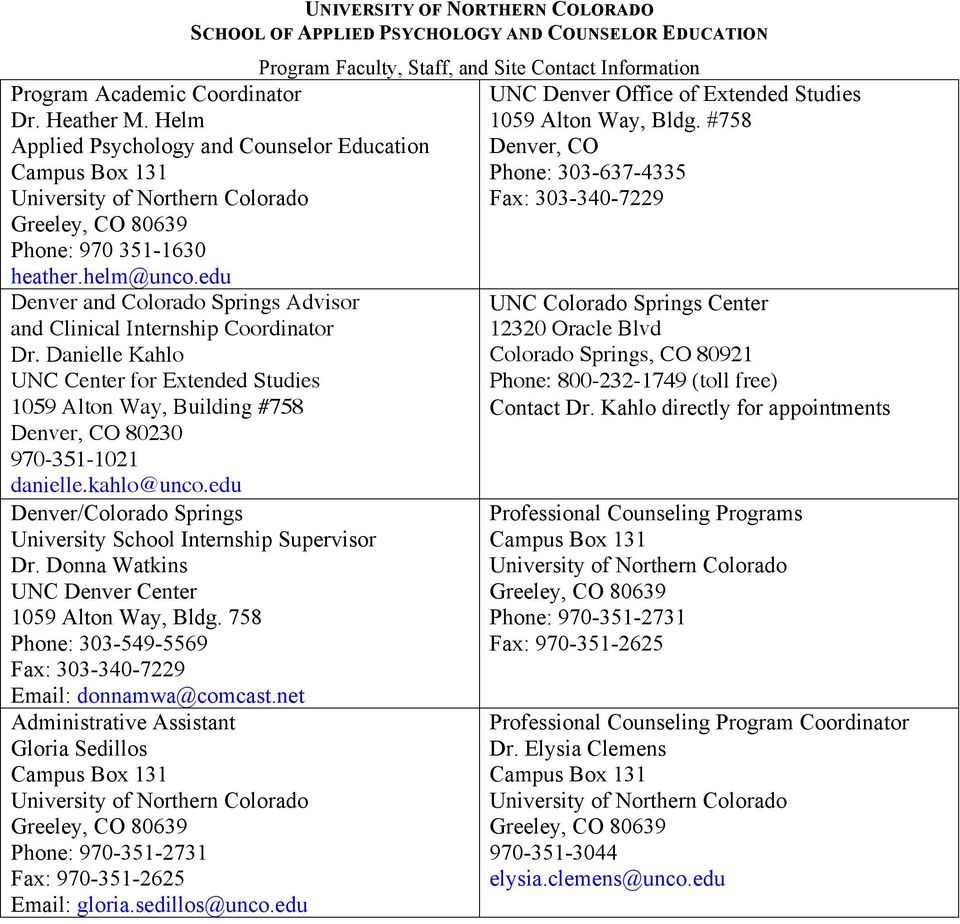
2 UNIVERSITY OF NORTHERN COLORADO SCHOOL OF APPLIED PSYCHOLOGY AND COUNSELOR EDUCATION Program Academic Coordinator Dr. Heather M. Helm Applied Psychology and Counselor Education Campus Box 131 University of Northern Colorado Greeley, CO Phone: Denver and Colorado Springs Advisor and Clinical Internship Coordinator Dr. Danielle Kahlo UNC Center for Extended Studies 1059 Alton Way, Building #758 Denver, CO Denver/Colorado Springs University School Internship Supervisor Dr. Donna Watkins UNC Denver Center 1059 Alton Way, Bldg. 758 Phone: Fax: Administrative Assistant Gloria Sedillos Campus Box 131 University of Northern Colorado Greeley, CO Phone: Fax: Program Faculty, Staff, and Site Contact Information UNC Denver Office of Extended Studies 1059 Alton Way, Bldg. #758 Denver, CO Phone: Fax: UNC Colorado Springs Center Oracle Blvd Colorado Springs, CO Phone: (toll free) Contact Dr. Kahlo directly for appointments Professional Counseling Programs Campus Box 131 University of Northern Colorado Greeley, CO Phone: Fax: Professional Counseling Program Coordinator Dr. Elysia Clemens Campus Box 131 University of Northern Colorado Greeley, CO
3 UNIVERSITY OF NORTHERN COLORADO PROFESSIONAL COUNSELING PROGRAMS PROFESSIONAL COUNSELING FACULTY DR. HEATHER HELM PROGRAM ACADEMIC COORDINATOR CHAIR, DEPARTMENT OF APPLIED PSYCHOLOGY & COUNSELOR EDUCATION OFFICE: (970) DR. ELYSIA CLEMENS PROFESSIONAL COUNSELING PROGRAMS, COORDINATOR OFFICE: (970) DR. BETTY CARDONA OFFICE: (970) DR. FRED HANNA OFFICE: (970) DR. BRIAN JOHNSON OFFICE: (970) DR. DANIELLLE KAHLO OFFICE : (970) DR. JENNIFER MURDOCK [email protected] OFFICE: (970) DR. SEAN O HALLORAN [email protected] OFFICE: (970) DR. LIA SOFTAS-NALL [email protected] OFFICE: (970) DR. LAURA JONES [email protected] OFFICE: (970) DR. JEFFREY RINGS [email protected] OFFICE: (970) DR. STEPHEN WRIGHT [email protected] OFFICE: (970)

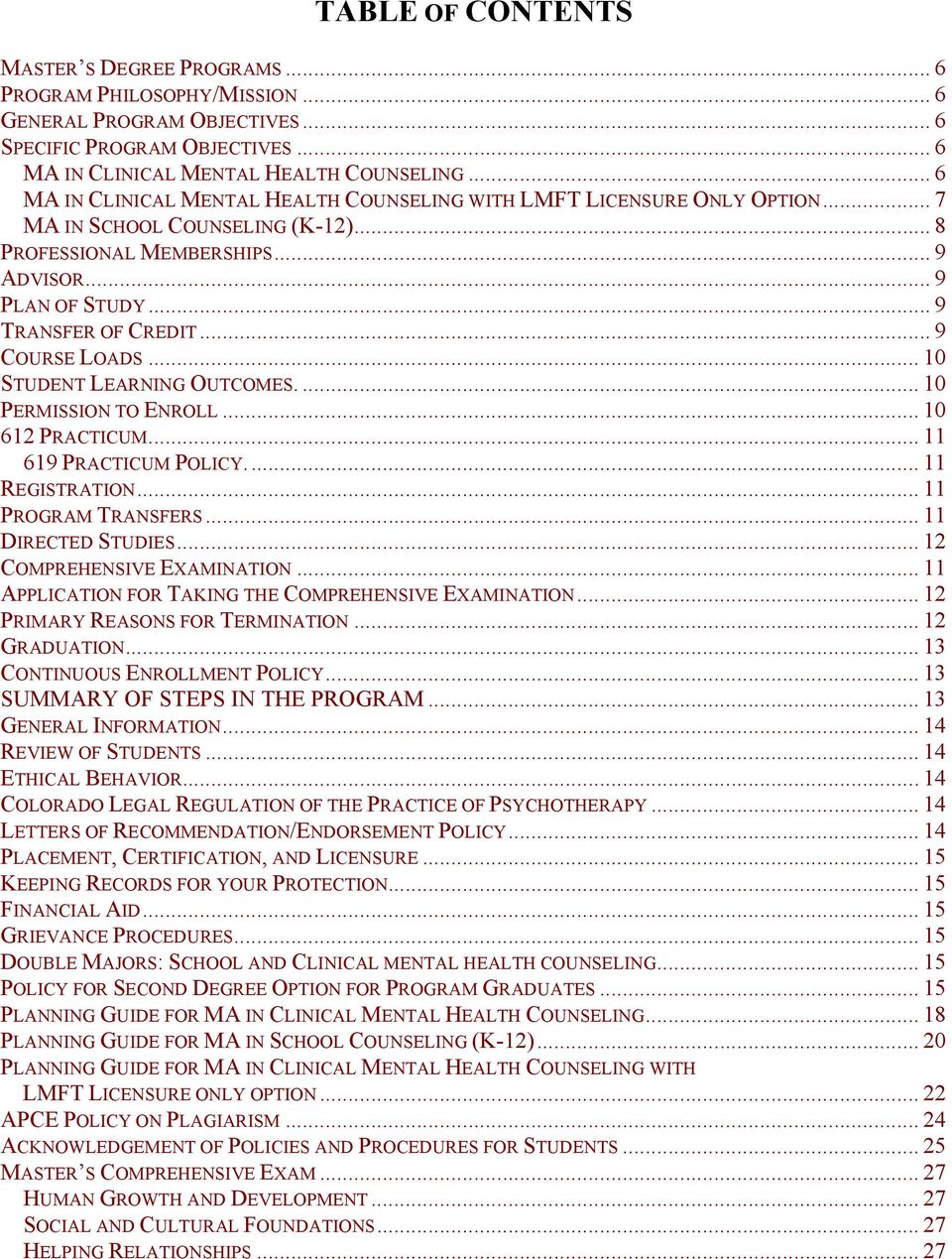
4 TABLE OF CONTENTS MASTER S DEGREE PROGRAMS... 6 PROGRAM PHILOSOPHY/MISSION... 6 GENERAL PROGRAM OBJECTIVES... 6 SPECIFIC PROGRAM OBJECTIVES... 6 MA IN CLINICAL MENTAL HEALTH COUNSELING... 6 MA IN CLINICAL MENTAL HEALTH COUNSELING WITH LMFT LICENSURE ONLY OPTION... 7 MA IN SCHOOL COUNSELING (K-12)... 8 PROFESSIONAL MEMBERSHIPS... 9 ADVISOR... 9 PLAN OF STUDY... 9 TRANSFER OF CREDIT... 9 COURSE LOADS STUDENT LEARNING OUTCOMES PERMISSION TO ENROLL PRACTICUM PRACTICUM POLICY REGISTRATION PROGRAM TRANSFERS DIRECTED STUDIES COMPREHENSIVE EXAMINATION APPLICATION FOR TAKING THE COMPREHENSIVE EXAMINATION PRIMARY REASONS FOR TERMINATION GRADUATION CONTINUOUS ENROLLMENT POLICY SUMMARY OF STEPS IN THE PROGRAM GENERAL INFORMATION REVIEW OF STUDENTS ETHICAL BEHAVIOR COLORADO LEGAL REGULATION OF THE PRACTICE OF PSYCHOTHERAPY LETTERS OF RECOMMENDATION/ENDORSEMENT POLICY PLACEMENT, CERTIFICATION, AND LICENSURE KEEPING RECORDS FOR YOUR PROTECTION FINANCIAL AID GRIEVANCE PROCEDURES DOUBLE MAJORS: SCHOOL AND CLINICAL MENTAL HEALTH COUNSELING POLICY FOR SECOND DEGREE OPTION FOR PROGRAM GRADUATES PLANNING GUIDE FOR MA IN CLINICAL MENTAL HEALTH COUNSELING PLANNING GUIDE FOR MA IN SCHOOL COUNSELING (K-12) PLANNING GUIDE FOR MA IN CLINICAL MENTAL HEALTH COUNSELING WITH LMFT LICENSURE ONLY OPTION APCE POLICY ON PLAGIARISM ACKNOWLEDGEMENT OF POLICIES AND PROCEDURES FOR STUDENTS MASTER S COMPREHENSIVE EXAM HUMAN GROWTH AND DEVELOPMENT SOCIAL AND CULTURAL FOUNDATIONS HELPING RELATIONSHIPS... 27
5 GROUP WORK CAREER AND LIFESTYLE DEVELOPMENT APPRAISAL RESEARCH AND PROGRAM EVALUATION PROFESSIONAL ORIENTATION AND ETHICS ANSWERS TO THE ABOVE QUESTIONS: PERMISSION FORM: MASTER S COMPREHENSIVE EXAMINATION ELIGIBILITY TO TAKE COMPREHENSIVE EXAMINATION: SCHOOL COUNSELING ELIGIBILITY TO TAKE COMPREHENSIVE EXAMINATION: CLINICAL MENTAL HEALTH COUNSELING LMFT INFORMATION STUDENT REVIEW AND RETENTION... 35

6 MASTER S STUDENT HANDBOOK Professional Counseling Programs University of Northern Colorado This Handbook provides information about policies and procedures for the management and completion of selected programs of study for master s students in Professional Counseling. The guidance provided here does not supplant that which is given in the UNC Catalog located on-line at Students are responsible for familiarizing themselves with all information in the Catalog that may have relevance to their program of study. We hope this guide will serve you well in addressing frequently asked questions concerning the completion of the master s degree program. Program Information Master s Degree Programs. The following master s degree programs are offered: Master of Arts in Clinical Mental Health Counseling and, (2) Master of Arts in School Counseling (K-12). Descriptions of these degree programs and course requirements are in the UNC Catalog available on-line at The degree program, Master of Arts in Clinical Mental Health Counseling: Couples, Marriage, and Family Counseling/Therapy Emphasis, is not offered at the Denver or Colorado Springs Centers; however, coursework in Couples and Family Therapy (CFT) is offered at the Denver Center. Students who complete the Clinical Mental Health Counseling with LMFT Licensure Only coursework are eligible to seek professional licensure in the state of Colorado as a Licensed Marriage and Family Therapist. Accreditation. All of the master s degree programs are accredited by the Council for the Accreditation of Counseling and Related Educational Programs (CACREP). Accredited programs adhere to stringent professional training guidelines that are designed to provide consistency among training programs. Attending a CACREP accredited counseling program will assist you in national certification, licensure, and future admittance to doctoral programs in counselor education. Program Philosophy/Mission. The counseling faculty views potential candidates as unique, with strengths and assets to be identified, encouraged, and developed during their graduate education. The knowledge of human relations skills necessary to help individuals recognize their own and other persons unique promise and discover opportunities for its expression form the core of preparation for students in professional counseling. Such knowledge and skills are learned in part from research and study in the behavioral and social sciences, various skill development activities, and supervised practica. Opportunities for a broad understanding of human behavior and human relationships in a diverse society are included in the education of the student in counseling. The Professional Counseling faculty is committed to the development of broadly based competent professional counselors skilled in helping people with personal, academic, interpersonal, and career concerns in educational settings and community agencies. The requirements of the program are conceptualized within the framework and standards set forth by the counseling profession, Colorado state law, the UNC Graduate School and job requirements. General Program Objectives The master s degree programs in Professional Counseling have the following objectives for each of the content areas established by the Council for the Accreditation of Counseling and Related Educational Programs (CACREP, 2009). The standards are available online at Specific Program Objectives MA in Clinical Mental Health Counseling To train counselors who:

7 1. understand the history, philosophy, and trends in clinical mental health counseling 2. understand ethical and legal considerations specifically related to the practice of clinical mental health counseling 3. understand the roles and functions of clinical mental health counselors in various practice settings and the importance of relationships between counselors and other professionals, including interdisciplinary treatment teams 4. know the professional organizations, preparation standards, and credentials relevant to the practice of clinical mental health counseling 5. understand a variety of models and theories related to clinical mental health counseling, including methods, models, and principles of clinical supervision 6. recognize the potential for substance use disorders to mimic and coexist with a variety of medical and psychological disorders 7. are aware of professional issues that affect clinical mental health counselors (e.g., core provider status, expert witness status, access to and practice privileges within managed care systems) 8. understand the management of mental health services and programs, including areas such as administration, finance, and accountability 9. understand the impact of crises, disasters and other trauma-causing events on people 10. understand the operation of an emergency management system within clinical mental health agencies and in the community 11. demonstrate the ability to apply and adhere to ethical and legal standards in clinical mental health counseling 12. apply knowledge of public mental health policy, financing, and regulatory processes to improve service delivery opportunities in clinical mental health 13. demonstrate appropriate knowledge and skills in the areas of counseling, prevention, and intervention (e.g., principles and concepts of mental health, diagnosis, methods of counseling, biopsychosocial case conceptualization, referral procedures) 14. demonstrate an understanding of the impact of living in a multicultural society on self, clients, and the community (e.g., the effect of racism, discrimination, privilege, and oppression on clients access to services, principles of social justice advocacy) 15. understand assessment, case conceptualization, and clinical evaluation as well as the demonstrate an ability to select and utilize comprehensive assessment to assist in diagnosis and treatment planning (i.e. intake interviews, mental status evaluation, other psychological assessments) 16. demonstrate knowledge and skills related to research and program evaluation (e.g., ability to evaluate research, understand program evaluation, use research to inform clinical practice) 17. demonstrate knowledge and skills related to clinical diagnosis using the Diagnostic and Statistical Manual of Mental Disorders (DSM) MFT Licensure Option The Clinical Mental Health Counseling and School Counseling master s programs located in Denver and Colorado Springs are accredited by CACREP. Students may enroll in coursework that would provide the educational requirements for licensure in the State of Colorado as Licensed Marriage and Family Therapist. Although the Clinical Mental Health Counseling: Couples, Marriage and Family Counseling/Therapy Emphasis is not offered at these Centers, the Professional Counseling faculty strive to uphold the spirit and letter of the CACREP Accreditation standards for marriage and family programs. Therefore, the following standards guide the coursework and clinical experiences of those students enrolled in the MA in Clinical Mental Health Counseling with LMFT Licensure Only Option: MA in Clinical Mental Health Counseling with Couples and Family Therapy Licensure Only Option To train counselors who: 1. know the history, philosophy, and trends in marriage, couple and family counseling 2. understand the ethical and legal considerations specifically related to the practice of marriage, couple and family counseling
8 3. know the roles and functions of marriage, couple, and family counselors in a variety of practice settings and in relation to other helping professionals 4. know the professional organizations, preparation standards, and credentials relevant to the practice of marriage, couple and family counseling 5. understand a variety of models and theories of marriage, couple, and family counseling 6. understand family development and the life cycle, sociology of the family, family phenomenology, contemporary families, family wellness, families and culture, aging and family issues, family violence, and related family concerns 7. understand the impact of crises, disasters, and other trauma-causing events on marriages, couples, families, and households 8. demonstrate the ability to apply and adhere to ethical and legal standards in marriage, couple and family counseling 9. demonstrate the ability to select models or techniques appropriate to couples or families presenting problems 10. demonstrate knowledge and skills related to marriage, couple and family counseling, prevention, and intervention (e.g. understand the family life-cycle and healthy family functioning, use a systems approach to conceptualize presenting problems and develop systemic treatment plans) 11. demonstrate an understanding of the impact of living in a multicultural society on self, clients (couples and families), and the community (e.g., the effect of racism, discrimination, privilege, and oppression on couples and families access to services, principles of social justice advocacy) 12. understand assessment, case conceptualization, and clinical evaluation from a systems perspective as well as the demonstrate an ability to select and utilize comprehensive assessment to assist in case conceptualization and treatment planning (i.e. intake interviews, mental status evaluation, other psychological assessments) 13. demonstrate knowledge and skills related to research and program evaluation in marriage, couples, and family counseling (e.g., ability to evaluate research, understand program evaluation, use research to inform clinical practice) MA in School Counseling (K-12) To train counselors who: 1. know history, philosophy, and trends in school counseling and educational systems 2. understand ethical and legal considerations specifically related to the practice of school counseling 3. know roles, functions, settings, and professional identity of the school counselor in relation to the roles of other professional and support personnel in the school 4. know professional organizations, preparation standards, and credentials that are relevant to the practice of school counseling 5. understand current models of school counseling programs (e.g., American School Counselor Association [ASCA] National Model) and their integral relationship to the total educational program 6. understand the effects of atypical growth and development, health and wellness, language, ability level, multicultural issues, and factors of resiliency on student learning and development 7. understand the operation of the school emergency management plan and the roles and responsibilities of the school counselor during crises, disasters, and other trauma-causing events 8. demonstrate the ability to apply and adhere to ethical and legal standards in school counseling 9. demonstrate the ability to articulate, model, and advocate for an appropriate school counselor identity and program 10. demonstrate knowledge and skills related to counseling, prevention, and intervention in school counseling (e.g., theories and processes of effective school counseling, ability to design, implement, and evaluate school counseling programs geared towards prevention and intervention, ability to assess and manage suicide risk) 11. demonstrate an understanding of the impact of living in a multicultural society on self, students, communities, and schools (e.g., the effect of racism, discrimination, privilege, and oppression on student

9 learning and career development, ability to engage parents, guardians, and families in school counseling programs, the ability to understand and apply principles of social justice advocacy in the school system) 12. understand the influence of multiple factors that affect the personal, social, and academic functioning of students as well as the demonstrate an ability to use appropriate assessment strategies to evaluate students academic, career, and personal/social development 13. demonstrate knowledge and skills related to research and program evaluation in school counseling (e.g., ability to evaluate research, understand program evaluation, use research to inform clinical practice) 14. understand curriculum design, lesson plan development, and classroom management strategies, and differentiated instructional strategies for teaching counseling and guidance related material 15. have the ability to implement programs and differentiated instructional strategies to promote student academic and social development 16. demonstrate knowledge and skills related to collaboration and consultation in school counseling (e.g., ability to with parents, families, and guardians, ability to consult with teachers, staff, and community based organizations) 17. demonstrate knowledge and skills related to effective leadership in the school in order to take a leadership role in the design, implementation, management, and evaluation of a comprehensive, developmental school counseling program Professional Memberships. All students in Clinical Mental Health Counseling are required to hold and maintain membership in the American Counseling Association (ACA). Students in School Counseling are required to hold and maintain membership in the American School Counseling Association (ASCA). Requirements for membership in these organizations begin the semester that each student is admitted into the program, and membership must be consistently maintained throughout program enrollment. Application forms for clinical counselor are available on line at and for school counselors at Students who chose to double major must hold and maintain membership in both professional organizations. Additionally, the faculty highly recommend memberships in Colorado divisions of ACA and ASCA. Advisor. Dr. Danielle Kahlo serves as the advisor to all master s students in the Denver and Colorado Springs programs. It is your responsibility to set up times to meet with your advisor concerning issues such as preparing a course schedule, planning for the Comprehensive Examination, and completing graduation requirements. It is our assumption that each student admitted into the program is responsible for reading and following the program, UNC Graduate School, and University guidelines. Therefore, it is your responsibility, not your advisor s, to insure all program requirements are met prior to applying for the Comprehensive Examination or graduation. Plan of Study. A plan of study form is available for your program (attached). You are responsible for going over the form with your advisor to determine the courses you are required to take as well as determine if any courses you have previously taken at another institution of higher learning are eligible to be waived or transferred into your MA program. Waived and transferred credits are approved by the Academic Program Coordinator. You are to keep copies of the completed form. Transfer of Credit. Students must be admitted into a program of study prior to consideration of transfer credits. Once admitted, students provide their advisor the syllabus from the course(s) to be transferred along with a official transcript (if not contained in his or her graduate school application) for consideration. A maximum of 6 semester hours (9 quarter hours) may be transferred into a master s program from another accredited university which offers master s degrees. Transfer credit will not be accepted if the work was used to obtain any degree at any institution or if the work was completed more than five calendar years prior to the completion of a student s master s program. Transfer credit must be compatible with the student s program and must be A or B work. Transfer credits must be approved by the student s program as well as the UNC Graduate School. Warning: Transfer of credit may shorten the program length, as the five-year time limit begins when the transfer course was originally taken. The Program Academic Coordinator, Dr. Helm, makes the final decision on whether or not a particular course will be accepted into the student s plan of study at UNC.
10 Course Loads. Course load limitations for graduate students apply to any combination of all courses taken oncampus, off-campus, or on-line while an individual is enrolled as a graduate student in a graduate degree program, a non-degree certification program, or any combination thereof. The maximum load for a graduate student is 17 hours per semester. This information may vary during summer terms; students should check the Registrar s Website ( for correct information. Nine semester hours of credit is the minimum credit load to be classified as a full-time student. The maximum load permitted for a graduate student in the summer sessions (two six week sessions and/or full 12 weeks) is 15 hours with 9 hours maximum for a six-week term. Course Overload Request forms are available from Gloria ([email protected]) and must be signed by the Program Academic Coordinator, Dr. Helm, before you may register for more than the maximum credits. Please note that there is no guarantee that you will receive permission. You will need to provide substantiation for your request and there is an additional charge for each credit over the limit. Student Learning Outcomes. Students are required to complete a bi-annual review as a component of a comprehensive evaluation process to assess student outcomes across three domains - knowledge, skills, and professional practice. Paperwork and polices can be found of the Professional Counseling webpage under Current Students ( Permission to Enroll. Several courses require permission to enroll prior to students seeking registration. These courses are: APCE 605 Group Laboratory Experience, APCE 612 Practicum in Individual Counseling, APCE 692 Internship in Counseling, APCE 614 Internship in School Counseling and Guidance, APCE 601 Practicum in Couples and Family Therapy. Students who are interested in enrolling in APCE 605 or 612 should make their request known by ing Gloria Sedillos the semester prior to the semester in which they are seeking enrollment. Students interested in enrolling in APCE 619, 614, or 692 and/or 601 should contact the instructor for that course. Each of these classes has prerequisites, co-requisites, or conditions for enrollment for which students are responsible. The policies include: APCE 601 Practicum in Couples and Family: For those students enrolling in the LMFT Licensure Only Option, you must have completed APCE 665 and been approved for APCE 612 before registering for APCE 669 Advanced Methods. ACPE 669 is a prerequisite for APCE 601, Practicum in Couples and Family. APCE 669 may be taken in the same semester as successful completion of APCE 612, as long as APCE 612 Practicum proceeds APCE 669 Advanced Methods in Marriage and Family Counseling. MA students who are seeking the LMFT Licensure Only Option must have completed APCE 612, APCE 665, APCE 669, APCE 619, and have completed or be taking concurrently APCE 695 before taking APCE 601. Those students in the LMFT Licensure Only Option are required to have completed APCE 669 Advanced Methods in Marriage and Family Counseling prior to securing an Internship site. Also, LMFT Licensure Only Option students need to complete APCE 601 Practicum at the initiation of their internship. Students may register for APCE 601 once they have the consent of the Internship Coordinator [which means Dr. Kahlo has approved your site and supervisor]. APCE 601 is an individualized Practicum in which LMFT Licensure Only Option students are paired for cotherapy (with families or couples) for the first 25 hours of contact and as students, complete a theory paper. The Practicum MUST be a distinct and separate experience from Internship, thus, in order to meet the letter and spirit of the state licensing laws, no Internship hours in couples or family counseling can be counted until the APCE 601 requirements are met (including the theory paper). Please see the Internship Manual for further details. LMFT Post Degree Licensure: For students who are seeking licensure as a LMFT please see the handout LMFT Board Equivalency worksheet at the end of this document. This handout assists the student in completing the educational equivalency worksheet for the LMFT license. APCE 605 (co-requisite with APCE 606 and APCE 662): All students must notify Gloria Sedillos of their desire to enroll in APCE 662/APCE 606 and the co-requisite lab APCE 605. Students must notify Gloria, via , the semester before they intend to enroll so that we can track the number of slots needed in the group lab sections. Students who are double majors only need to enroll in APCE 605 with their first group class. Students
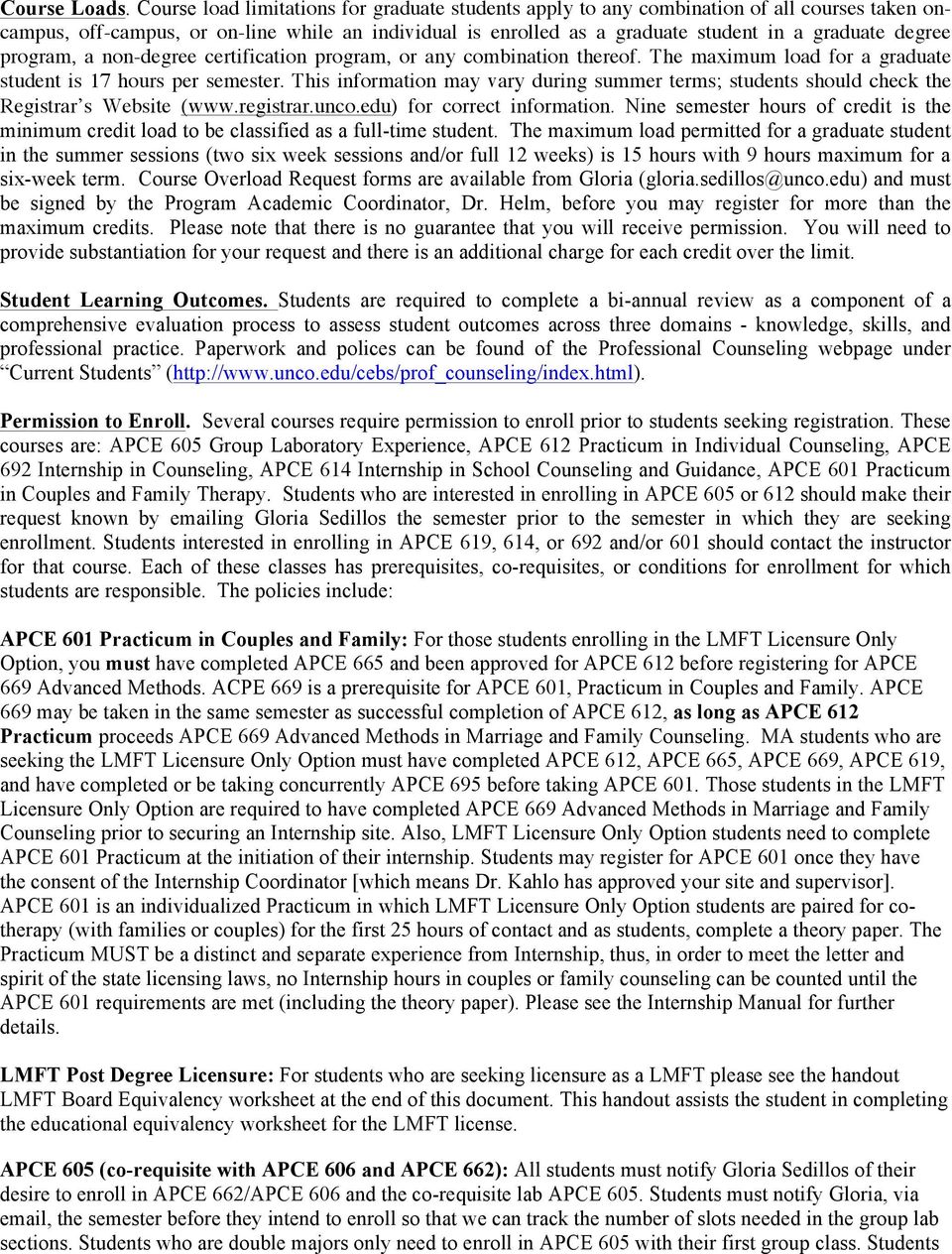
11 who do not notify Gloria in advance may be removed from the course to make room for students who have completed the notification process. APCE 605 and 662/606 must be taken at the site [Denver or Colorado Springs] to which the student was admitted. 612 Practicum. Students must sign up for permission to take APCE 612 by contacting Gloria Sedillos, in writing, at at least one semester BEFORE they intend to enroll in the course. Students need to give Gloria their first and second choice of available practicum times. While we will make every effort to assign you to your requested practicum and we cannot guarantee or hold slots in a particular section. All students are assigned to APCE 612 based first on their total number of credit hours in the program and then on their requested section. All decisions on practicum placements are made by the Academic Program Coordinator. APCE 612 must be taken at the site [Denver or Colorado Springs] to which the student was admitted. 612 Practicum Policy. Students may be enrolled in APCE 612 a maximum of two semesters, and are graded on a satisfactory/unsatisfactory basis. Students who do not satisfactorily complete 612 in their second enrollment will receive notification that their program has been terminated. Students who earn a grade of unsatisfactory must take APCE 612 from a different instructor and wait a minimum of one semester to re-enroll. The program faculty will determine the conditions under which and when the student may retake APCE 612, and how many additional APCE credit may be taken prior to the satisfactory completion of practicum. Note: A grade of Incomplete will not be given for APCE 612. In exceptional cases, when an instructor deems it appropriate to give an Incomplete, it must first be authorized by the Professional Counseling faculty. 619 Practicum Policy. Practicum II (APCE 619) is a field-based experience and viewed as a transitional experience to be completed after successful completion of Practicum I (APCE 612) and prior to registering for, and completing of Internship hours. Practicum II is a 10-week minimum experience, and therefore a 10-week minimum commitment to the practicum site (school or agency). Detailed information on APCE 619 along with all required paperwork can be found in the Practicum II Manual. The manual can be found on the Professional Counseling website ( Internship Policy. Internship (CPCE 692 or 614) is a field-based experience to be completed after successful completion of APCE 619. Detailed information on APCE 692 or 614 along with all the required paperwork can be found in the Internship Manual. The manual can be found on the Professional Counseling website ( Registration. The schedule of classes for each Center is posted on the Extended Studies website, and the complete schedule of classes is online at Consultation with your advisor regarding which classes to take is highly recommended. You are expected to register for classes via URSA on the UNC website. Should you encounter problems with the registration process, please contact the Academic Program Coordinator, Dr. Helm. On-Campus Registration. You may register for coursework on the Greeley campus. You will receive separate fee statements for on- and off-campus class registrations. To register for an on-campus class, you must first meet with your advisor to insure it fits in your plan of study. Once permission is given and if space is available you may register for the on campus course. If the class is full or if space is needed for an on campus student you may be asked not to enroll in that class at that time. NOTE: Individual Practicum (APCE 612), Practicum II (APCE 619), group (APCE 662/605 or APCE 606/605), and APCE 692/601 must be taken at the site to which you were originally admitted. Program Transfers. When a student wishes to transfer from one program to another (e.g., Lowry to Greeley or Greeley to Colorado Springs) they must submit a letter of request and explanation to the Professional Counseling Program Coordinator. Three conditions must be met: (a) the student must be in good standing, (b) there must be available space in the program requested, and (c) student has completed fewer than 30 credit hours
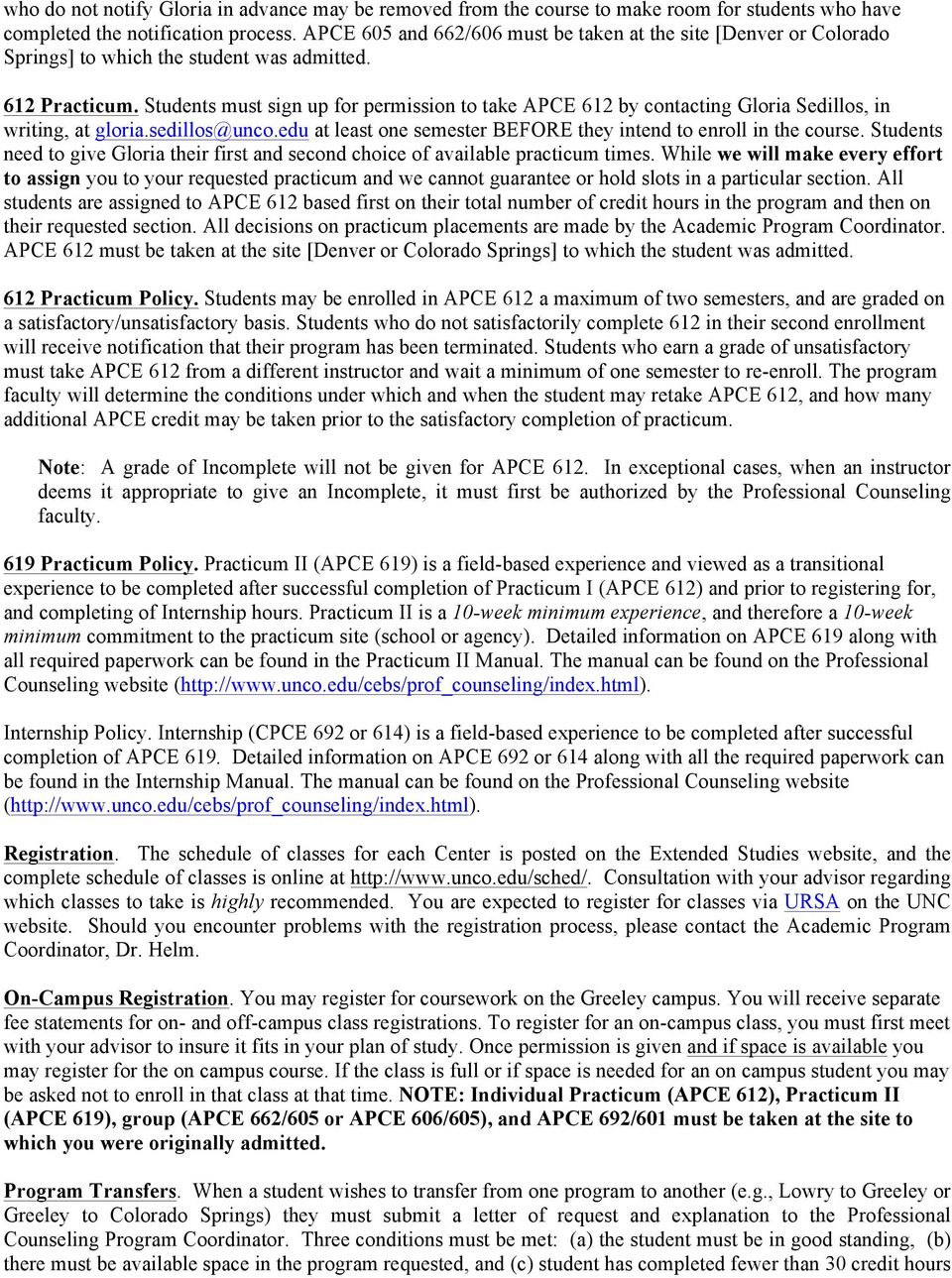
12 in the program. Only one site change will be authorized during the course of a degree program and transfers are approved only on rare occasion. Directed Studies. A Directed Study is a course in which a student may receive university credit for an individualized investigation under the direct supervision of a UNC faculty member. Because Directed Study (622) is at the graduate level, the faculty member providing the supervision must be approved to teach graduate level courses. No faculty member will be authorized to supervise a directed study during a semester in which he or she is not actually employed on campus at UNC. A Directed Study investigation must be on a specific topic that is not duplicated by an existing course within the University s curriculum. The nature of the study must involve intensive use of relevant literature, materials, or techniques, and the study report must reflect a synthesis of the information or techniques acquired. See the UNC Catalog ( for more information. First day of Classes and Enrollment. If an enrolled student does not attend the first class meeting, he or she may be dropped from the course. Comprehensive Examination. The completion of your master s degree is contingent upon successfully passing the Comprehensive Examination. Even though the University Catalog states that the Comprehensive Exam may be taken after completing 20 hours of course work, this is based on a 30-semester hour master s degree. It is an APCE Professional Counseling program requirement that the student have specific course work completed before being permitted to take the examination. The course requirements are included with the Comprehensive Exam Application Form included in the appendix of this manual. Clinical Mental Health Counseling and School Counseling comprehensive examinations will be given in the fall and spring semesters ONLY; the CPCE is not offered during the summer. The Comprehensive Examination is a standardized examination called Counselor Preparation Comprehensive Examination (CPCE). The CPCE is a knowledge-based exam that reflects the eight core curriculum areas approved by CACREP. The cost of the CPCE is currently $50 per student, but is subject to change. When a student is cleared to take the CPCE a letter with instructions will be ed to him/her, including the current cost of the exam. Students have a maximum of four hours in which to take the exam. The passing score will be determined by the national mean for each administration of the exam. The exception to this policy is students enrolled in a second 30 hour counseling master s degree program. The policy for 30 hour second counseling master s degree programs in outlined separately later in this manual. Students who fail the CPCE may apply to retake the exam the following academic semester (fall or spring). Students who fail the exam twice will have their program terminated. Application for Taking the Comprehensive Examination. Permission to take the examination must be obtained from your advisor, who reviews your program before approving the request. Note: You must submit your application to for taking the Comprehensive Examination to your advisor by the end of the semester prior to taking the exam. The application for taking the Comprehensive Examination is located in the appendix of this manual. Primary Reasons for Termination 1. Five years are allowed to complete the M.A. from the date of admission; the Graduate School terminates programs that have exceeded this time limit. 2. Programs may be terminated by request of the program faculty when evidence of unethical or unprofessional behavior on the part of a student has been established. Please see the attached Review and Retention Policy. 3. A student s program may be terminated if, in the professional judgment of the faculty, the student is incapable of providing high quality therapeutic services to clients.

13 4. Grade point averages are required to be a 3.0 (B average). When the GPA drops below this point, the student is warned and given a specific time limit for raising his or her average. If this is not done, the Graduate School will terminate the program. Note: Students have the right to due process. See Grievance Procedures in this handbook. Graduation. Students must submit an Application for Graduation (available at the semester prior to graduating. The program is checked by the faculty advisor and approved for graduation, or conditions are stated which would qualify the student for graduation. The application for graduation is then filed with the Graduate School, where the final graduation check is made. Formal application for graduation must be filed with the Graduate School at least 45 calendar days before the end of the semester preceding the semester that a student plans to graduate. Attendance at a graduation ceremony and rental of a cap and gown are optional. The student s name is listed in the commencement program. Continuous Enrollment Policy. All graduate students must be enrolled for at least 1 credit hour each academic semester (fall and spring). Students register continuously from the time they first enroll in their graduate degree program until the semester or term in which they graduate. Students must also register for at least 3 semester hours the semester in which they take the Comprehensive Examination and the semester (or summer term) in which they graduate. Exceptions to the continuous enrollment policy must be approved by your advisor and by the graduate school. The form for requesting an exception can be found at SUMMARY OF STEPS IN THE PROGRAM The Professional Counseling Programs and the Extended Studies Program utilizes a listserv to provide changes in class times/dates, and other important information. YOU ARE RESPONSIBLE FOR SUBSCRIBING TO both the Love2Learn and Denver or Colorado Springs Listservs. 1. Sign up for the Denver or Colorado Springs listserv by following these steps: The Love2Learn listserv is a message system that is used to communicate the availability of syllabi, additions to the schedule and other general issues for all programs. The listserv is a great way to keep abreast of important information about your program! To subscribe: Send a message to: [email protected] Leave the subject line blank In the body of the message type: subscribe love2learn Remove your signature if you are using one Send the message You will receive a welcome message. Print and keep this message. You should also join the Clinical and School Counseling listserv which provides specific information about issues concerning Clinical and School Counseling program such as comprehensive exam dates, changes in the program, etc. To subscribe to the CLINICAL MENTAL HEALTH COUNSELING and SCHOOL COUNSELING, DENVER/LOWRY LISTSERV: Send a message to: [email protected] Leave the subject line blank

14 In the body of the message type: subscribe COUNSELD Remove your signature if you are using one Send the message To subscribe to the CLINICAL MENTAL HEALTH COUNSELING and SCHOOL COUNSELING, COLORADO SPRINGS LISTSERV: Send a message to: [email protected] Leave the subject line blank In the body of the message type: subscribe COUNSELCS Remove your signature if you are using one Send the message You will receive a welcome message, print and keep this message. Additional information about this listserv is located on the last page of the schedule. 2. Develop a plan of study with your Advisor. 3. Determine what, if any, courses you would like to be reviewed for request to transfer into your degree program at UNC. Review the guidelines for transfer, and speak with your advisor prior to submitting this request to the Academic Program Coordinator. 4. Send Gloria Sedillos an indicating which semester you would like to take APCE 612 Practicum, APCE 662 or APCE 606 and APCE File the Application to take the Comprehensive Examination with your advisor the term before you plan to take the examination. 6. Read and follow all procedures in this manual, as well as the Practicum II and Internship Manuals. 7. File an Application for Graduation with the Graduate School the term prior to the term you plan to graduate. 8. We encourage you to attend graduation in Greeley and celebrate. General Information Review of Students. The Professional Counseling program faculty members systematically review the progress of each student each semester. Discussions focus on issues related to academic performance, professional maturity, judgment, emotional stability, sensitivity to others, self-awareness, and other characteristics that affect each student s ability to be an effective counselor. Exemplary performance is recognized as are areas of deficiency. Ethical Behavior. Students are expected to demonstrate the highest level of ethical behavior, as set forth by the American Counseling Association (ACA) and the American School Counselor Association (ASCA). Unethical behavior will not be tolerated and will be considered cause for dismissal at any time during the student s program. Colorado Legal Regulation of the Practice of Psychotherapy. The practice of psychotherapy by licensed and unlicensed psychotherapists is regulated by Colorado State Statute. All students are expected to know and abide by the stipulations set forth in the regulations. As with unethical behavior, illegal behavior will not be tolerated and will be considered cause for dismissal at any time during the student s program. Letters of Recommendation/Endorsement Policy. During your program, it is likely that you will need letters of recommendation from faculty for such things as scholarships, fellowships, internships, or employment. Faculty members receive numerous requests for such letters and need a minimum of a two-week turnaround time. Faculty are under no obligation to write a letter that you need immediately. Please note that faculty will not recommend a student for a position in which he or she is not qualified and will follow the American Counseling Association Code of Ethics (2005) regarding the endorsement of supervisees.

15 Placement, Certification, and Licensure. Upon successful completion of the program, and if requested, the program coordinator will recommend students for professional placement, certification, and/or licensure. Program faculty are not obligated to provide recommendation letters, and no recommendations will be given for positions, certifications, or licensure for which the student is not qualified by training. Keeping Records for your Protection. For your protection, you should keep a copy of all forms concerning your degree program. Such forms include the plan of study, directed study agreements, transfer of credit requests, syllabi from all courses, internship and practicum records, application for the Comprehensive Examination, application for graduation, etc. Financial Aid. Financial aid is awarded to assist students and parents to meet college costs such as tuition, fees, books, food, housing, and transportation. The Office of Student Financial Resources may have available several types of state and federal aid including grants, loans, employment, scholarships, and Veteran s benefits. For more information, contact the Office of Student Financial Resources. Grievance Procedures. Grievance procedures are specifically given in the UNC Student Handbook that is available through the Dean of Students Office and online at Double Majors: School and Clinical Mental Health Counseling For students wishing to double major in Clinical Mental Health Counseling and School Counseling, the following are required: I. If not originally admitted as a double major, request permission to add an additional program area from Professional Counseling Coordinator II. Upon approval of the Professional Counseling faculty, work closely with assigned advisor and file a Change of Major form with the Graduate School to add the second major. III. Complete all course requirements for both programs IV. Complete internship requirements for both programs Policy for Second Degree Option for Program Graduates. For graduates (within the last five years) who wish to return to complete requirements of an additional program the following are required: 1. Complete program application materials. 2. Submit application materials prior to the deadline. 3. Attend admissions workshop (unless waived by Professional Counseling faculty members). 4. Upon acceptance, an Advisor will be appointed. 5. The student and Advisor will design a proposed 30-hour degree program that includes all current program requirements and appropriate electives. 6. The Advisor will submit the proposal to the Professional Counseling faculty for approval. 7. The student will adhere to all stipulations and follow the program of study identified and approved by the faculty. Clinical Mental Health Counseling to School: Sequence of courses for persons seeking a 30-hour master s degree in school counseling may be selected from the following (*required): *APCE 602 *APCE 606 *APCE 608

16 *APCE 614 (6 hours contact hours) APCE 612 (determined by Professional Counseling faculty) APCE 660 (If not taken previously) APCE 657 (possibly Directed Study) APCE 616 (possibly Directed Study) APCE 667 APCE 609 Plus successful completion of CPCE (if not previously taken). Variations must be approved by the program faculty, upon proposal of the Advisor. School to Clinical Mental Health Counseling: Sequence of courses for persons seeking a 30-hour master s degree in Clinical Mental Health Counseling may be selected from the following (*required): *APCE 650 *APCE 692 (6 hours contact hours) APCE 612 (determined by Professional Counseling faculty) APCE 616 APCE 657 APCE 665 APCE 660 (if not taken previously) Suggested additional classes to yield 30 credit hours: Foundations of Play Therapy Practicum in Play Therapy Psychopharmacology Student Learning Outcomes and Bi-Annual Review Process for Second Master s Program Students. Because the second master s program is only open to UNC students who have graduated in the last five years, students Student Learning Outcomes and Bi-Annual Review Process are tailored to assess counselor development in the added specialty area. Additionally, students are expected to engage in the faculty review process for each class. Semester 1: 1. A professional development goals statement for their program. Be specific about what you hope to achieve through your program and how this fits with your career aspirations. This statement should be 1 page single-spaced. 2. Include a brief rationale (no more than 1 page) for the coursework selected. Semester 2: 3. Reflect (1 page single-spaced) on how this coursework has helped you meet your professional development goals. Identify a minimum of three areas that are still opportunities for growth, and indicate a minimum of one way per area that you can further develop to meet your goals (this can include development opportunities above and beyond your degree program). Practica/Internship Semesters: 4. Complete all professional practice forms located in the Student Learning Outcomes Manual. The Comprehensive Exam for Second Master s Program Students. Students enrolled in the 30-hour second master s degree program will develop and submit a portfolio instead of completing the Comprehensive Examination. This portfolio will include copies of all items from the Student Learning Outcomes/Bi-Annual Review Process (except the faculty assessment forms) and the items listed

17 additionally below. The portfolio is due to the Program Coordinator on the date of the Comprehensive Examinations during the last semester of student s program. The portfolio should include the following: 1. Five work samples that provide evidence of meeting goals. 2. Disclosure Statement consistent with DORA standards (for Clinical Mental Health Counseling and CFT students only) or 1-2 page (single-spaced) statement of philosophy of school counseling (for school counseling students). 3. Reflection statement evaluating your progress toward your goals. 4. Professional development plan post-graduation. Portfolios will be evaluated by two members of the Professional Counseling faculty. Students will receive feedback of high pass/pass/low pass/or fail for each component of the portfolio. A passing score for comps means that all aspects were low pass or above and three of the four requirements were scored as pass of high pass. In the case of disagreement between reviewers, the Program Coordinator will review the portfolio. NOTE: Returning students who wish to obtain additional coursework (second degree) specifically to meet credentialing requirements are responsible for working with the appropriate credentialing body to determine if the degree programs available are suitable.

18 Planning Guide for M.A. in Clinical Mental Health Counseling Course Number SRM 600 PSY 530 Title Prerequisite Date Taken Introduction to Graduate Research Lifespan Developmental Psychology Other Notation APCE 558 APCE 603 Diagnosis & Treatment Planning Understanding Children, Adolescents and Their Systems -APCE 602 or APCE 650 -corequisite APCE 607 -APCE 607 APCE 605 Group Laboratory Experience -corequisite APCE 606 or APCE 662 -consent of coordinator APCE 607 APCE 612 APCE 616 APCE 619 APCE 623 APCE 624 APCE 650 Theories of Counseling Practicum in Individual Counseling Career Theory, Counseling, and Assessment Practicum in Individual Counseling II Understanding and Counseling Diverse Populations Assessment and Treatment of Substance Abuse Orientation to Community Counseling -APCE 558, APCE 607, APCE 602 or APCE 650, and PSY 530 -corequisite APCE 657 -consent of coordinator -APCE 612, APCE 662 or APCE 606 -corequisites APCE 616 and APCE 673 -Clinical Mental Health Counseling Child or Adolescent placements: additional prerequisite of APCE 603 -Consent of Instructor -Note prerequisites for APCE 692 as well, as this course is designed to immediately follow APCE 619
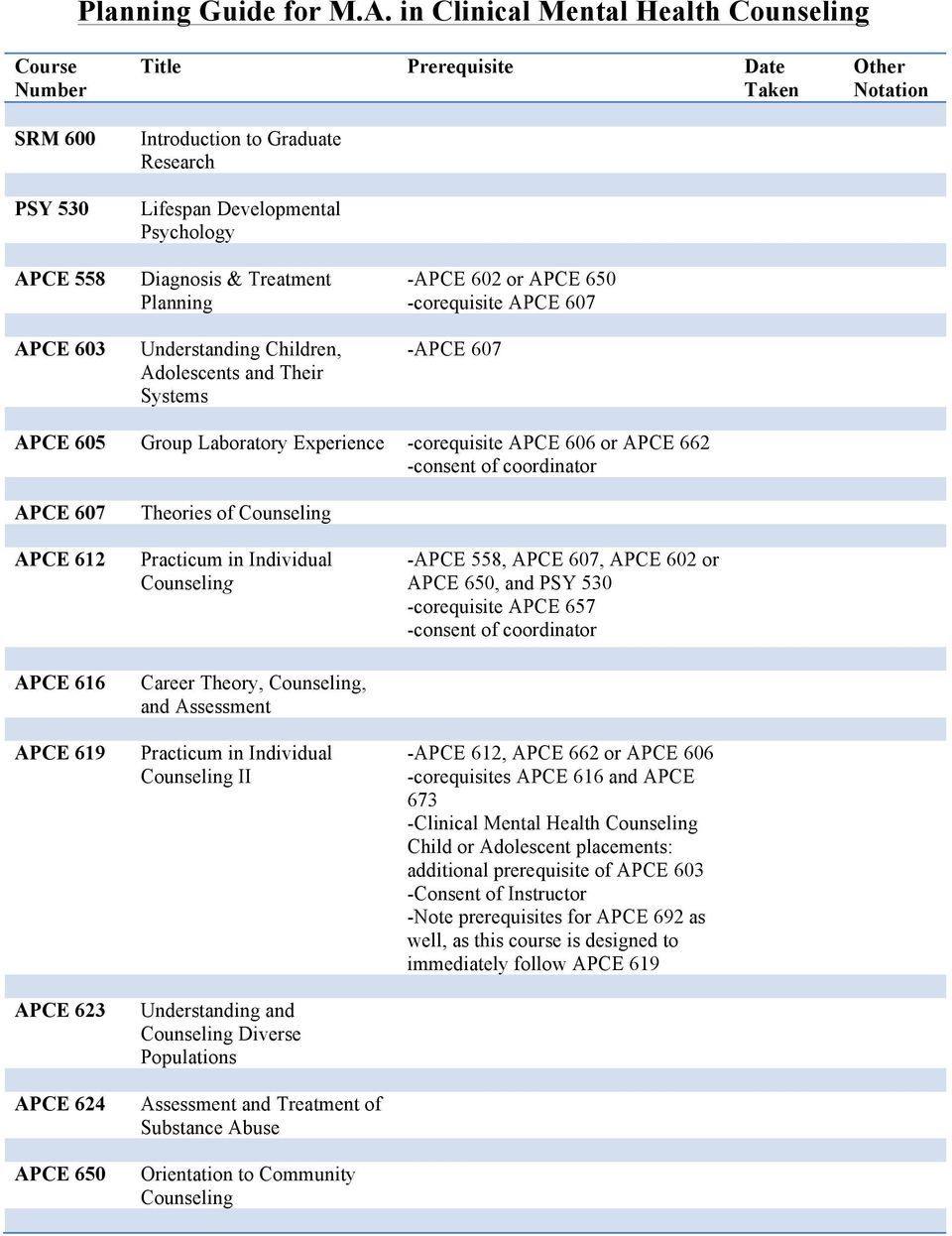
19 APCE 657 APCE 660 APCE 661 APCE 662 APCE 665 APCE 673 Legal and Ethical Aspects of Counseling and Psychology Psychological Consultation: Theory and Practice Psychological Trauma & Intervention for Individuals, Families & Communities Group Dynamics and Facilitation Family Systems Appraisal and Assessment in Counseling -APCE 607 -APCE 558, APCE 607 and APCE 657 -APCE 607 -corequisite APCE 605 -Recommended prerequisite SRM 600 APCE 692 Counseling Internship (take 6 hours) -consent of coordinator -refer to Internship handbook for list of prerequisite courses
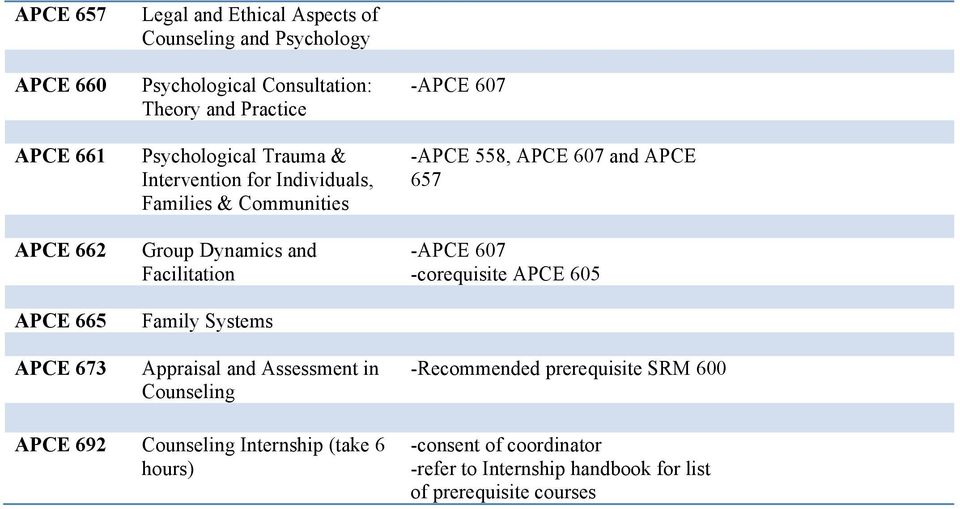
20 Course Number SRM 600 PSY 530 Planning Guide for M.A. in School Counseling (K-12) Title Prerequisite Date Taken Introduction to Graduate Research Lifespan Developmental Psychology Other Notation APCE 558 APCE 602 APCE 603 APCE 606 Diagnosis & Treatment Planning Foundations of School Counseling Understanding Children, Adolescents and Their Systems Theories and Practices in Group Guidance -APCE 602 or APCE 650 -corequisite APCE 607 -offered only in the fall semester -APCE 607 -APCE 602 and APCE 607 -corequisite APCE 605 APCE 605 Group Laboratory Experience -corequisite APCE 606 or APCE 662 -consent of coordinator APCE 607 APCE 608 APCE 612 APCE 616 APCE 619 Theories of Counseling Organization, Administration and Evaluation of School Counseling Programs Practicum in Individual Counseling Career Theory, Counseling, and Assessment Practicum in Individual Counseling II -APCE 602 -offered only in spring semester -APCE 558, APCE 607, APCE 602 or APCE 650, and PSY 530 -corequisite APCE 657 -consent of coordinator -APCE 612, APCE 662 or APCE 606 -corequisites APCE 616 and APCE 673 -School Counseling additional prerequisites APCE 603 and APCE 608 -Clinical Mental Health Counseling Child or Adolescent placements additional prerequisite APCE 603 APCE 614 Internship in School -APCE 608, APCE 612
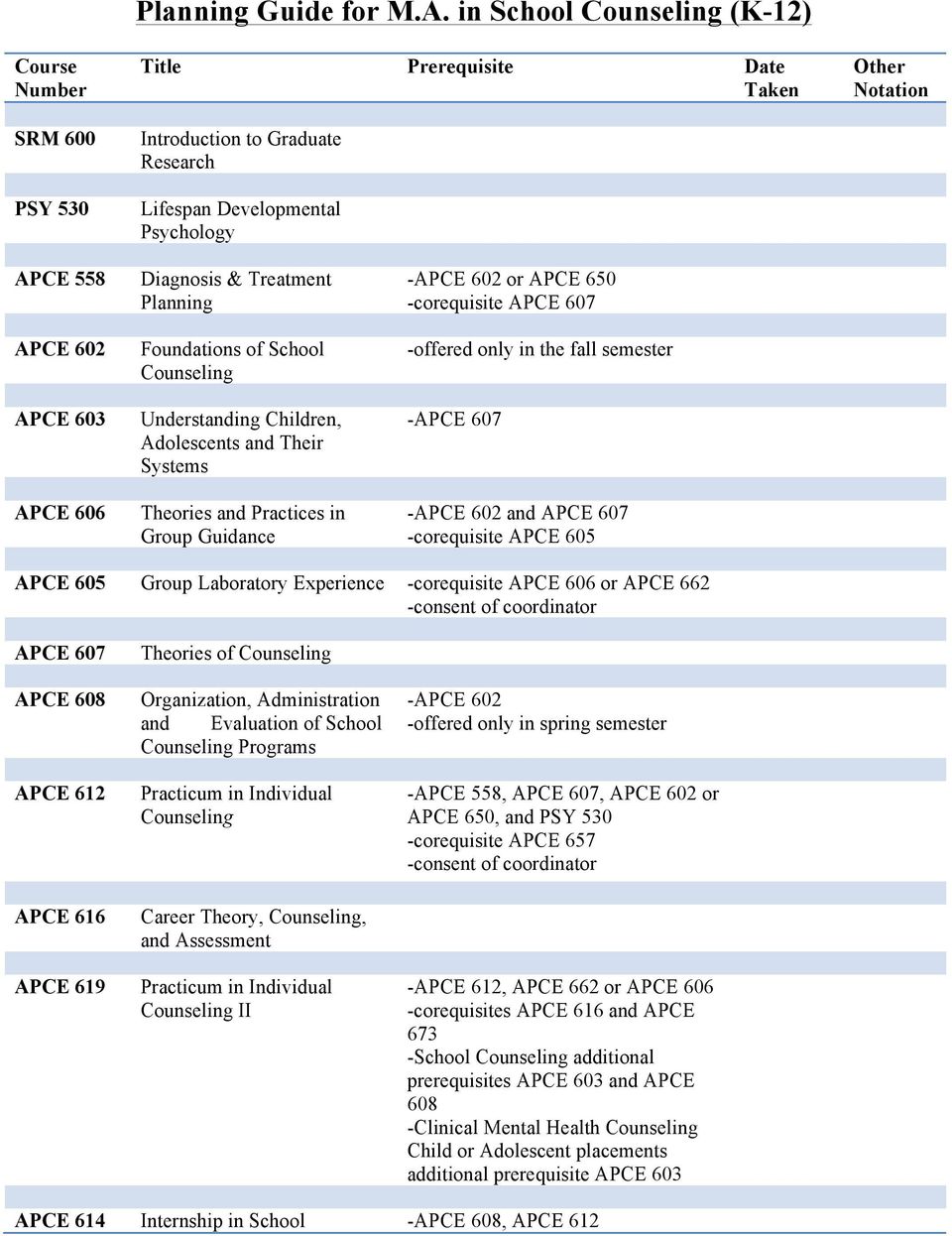
21 Counseling and Guidance (take 6 hours) -consent of instructor -Refer to Internship Handbook APCE 623 APCE 624 APCE 657 APCE 660 APCE 661 APCE 665 APCE 673 Understanding and Counseling Diverse Populations Assessment and Treatment of Substance Abuse Legal and Ethical Aspects of Counseling and Psychology Psychological Consultation: Theory and Practice Psychological Trauma & Intervention for Individuals, Families & Communities Family Systems Appraisal and Assessment in Counseling -APCE 607 -APCE 558, APCE 607 and APCE 657 -Recommended prerequisite SRM 600
22 Planning Guide for M.A. in Clinical Mental Health Counseling with LMFT Licensure Only Option Course Number SRM 600 PSY 530 Title Prerequisite Date Taken Introduction to Graduate Research Lifespan Developmental Psychology Other Notation APCE 558 APCE 603 APCE 605 APCE 607 APCE 612 APCE 616 APCE 619 APCE 623 Diagnosis & Treatment Planning Understanding Children, Adolescents and Their Systems Group Laboratory Experience Theories of Counseling Practicum in Individual Counseling Career Theory, Counseling, and Assessment Practicum in Individual Counseling II Understanding and Counseling Diverse Populations -APCE 602 or APCE 650 -corequisite APCE 607 -APCE 607 -corequisite APCE 606 or APCE 662 -consent of coordinator -APCE 558, APCE 607, APCE 602 or APCE 650, and PSY 530 -corequisite APCE 657 -consent of coordinator -APCE 612, APCE 662 or APCE 606 -corequisites APCE 616 and APCE 673 -Clinical Mental Health Counseling Child or Adolescent placements additional prerequisite APCE 603 APCE 650 APCE 624 Orientation to Community Counseling Assessment and Treatment of Substance Abuse
23 APCE 657 APCE 660 APCE 661 APCE 662 APCE 665 APCE 673 APCE 601 APCE 692 Legal and Ethical Aspects of Counseling and Psychology Psychological Consultation: Theory and Practice Psychological Trauma & Intervention for Individuals, Families & Communities Group Dynamics and Facilitation Family Systems Appraisal and Assessment in Counseling Practicum in Couples and Family Therapy Internship in Clinical Mental Health Counseling -APCE 607 -APCE 558, APCE 607 and APCE 657 -APCE 607 -corequisite APCE 605 -Recommended prerequisite SRM 600 -APCE 612, APCE 619, APCE 665, APCE credit hour -Consent of Instructor -Enroll concurrently with first semester of APCE 692 (Review the Internship manual for all required prerequisites) -APCE 601 -consent of coordinator APCE 668 Sexuality Counseling -recommended for advanced students APCE 669 APCE 695 Advanced Methods: Couples and Family Therapy Seminar: Contemporary Issues in Couples and Family Therapy -APCE 665 -corequisite APCE 612 -APCE 665
24 APCE Policy on Plagiarism Plagiarism is the act of appropriating the written, artistic, or musical composition of another, or portions thereof; or the ideas, language, or symbols of same and passing them off as the product of one's own mind. Plagiarism includes not only the exact duplication of another's work but also the lifting of a substantial or essential portion thereof (This is the UNC definition). With regard to written work, statements that paraphrase or summarize the work of another, along with other information that is not considered common knowledge, must be properly cited in the text of a document, and the source included in the reference list at the end. If a direct quotation, the citation in the text must include the exact page numbers from the original source. The original source must also be listed at the end of work. Quotation marks or a proper form of indentation shall be used to indicate all direct quotes. All referencing is done, of course, according to APA Style. Regarding class projects, you are not to use as the bulk of your presentation the completed works of faculty members, imported documents from other authors, or works from websites, or any other body of work in which you are not the author. Of course, with proper referencing, you can import portions of such works and websites to enhance and illustrate your presentation, and you can provide references to these other works for students who have an interest in pursuing a topic further. Students who have engaged in the act of plagiarism will be given in an F in that course. The matter will then be taken up by the School s Review and Retention Committee. The decision of the Committee with regard to plagiarism includes the possibility that the student be dismissed from his or her respective program and from UNC.
25 Acknowledgement of Policies and Procedures for Students Enrolled in The University of Northern Colorado Professional Counseling Programs As a student accepted into the University of Northern Colorado Professional Counseling Programs, I understand and agree to abide by the policies and procedures outlined in this document. 1. I understand that I will be expected to demonstrate academic, personal, interpersonal, and professional competencies appropriate for counselors-in-training. Failure to attain and demonstrate these competencies may result in the issuance of a letter of warning, requirement to repeat courses, requests to participate in individual counseling, additional supervision, additional requirements, a leave of absence, or dismissal from the program. 2. As a counselor-in-training I understand that I am expected to learn, apply, and adhere to the ethical codes and standards that govern the counseling profession (American Counseling Association) and appropriate specialties. I understand that I am expected to demonstrate competency in professionalism, knowledge of skills, and appropriate interactions with peers and faculty. My performance in these areas will be evaluated by faculty based upon my academic and interpersonal performances. 3. I understand that my self-growth will be encouraged by faculty through the use of experiential learning techniques. Self-disclosures are common in experiential learning but will not be factors in grading or successful completion of coursework. However, should my disclosures indicate impairment or potential harm to clients, myself, or others I understand the faculty will use this as part of the review of my overall academic and clinical growth. The faculty may recommend remediation actions, leaves of absence, or dismissal from the program. 4. I understand I will be reviewed once per semester, at a minimum, by the Professional Counseling Programs Faculty. If I demonstrate academic, interpersonal, intrapersonal, or professional deficiencies I will be notified of these concerns and an individual plan of action will be taken in accordance with the policies outlined in the Student Handbook. 5. I understand that I must follow procedures in order to be on a list for APCE 612. I also understand that I may not get my first choice of semester or schedule. 6. I understand that I may be required to attend additional meetings about internship. 7. I understand that internships are completed in schools and community agencies, and that the internship will likely require more than one semester to complete. It will be my responsibility to progress through the interview process and be accepted by a site. 8. I understand that practicum and internship require a constellation of knowledge, skills, and attitudes that may not be assessed in academic courses. I further understand that success in academic courses does not guarantee success in practicum or internship. 9. I understand that I will not be licensed upon completion of this program, and that my obtaining licensure will be through the Colorado Department of Education or the Department of Regulatory Agencies. The program faculty will attempt to make changes to remain in compliance with licensing requirements as it is related to academic course requirements. I will have to successfully pass licensure examinations and meet requirements as set forth by state law.
26 10. I understand the Student Handbook and Internship Handbooks with which I was admitted may be revised to reflect program, accreditation, and/or licensing revisions. I understand that I should follow the revised editions of the Handbooks and that it is my responsibility to determine if there have been revisions. 11. I understand that the School of Applied Psychology and Counselor Education uses a student listserv to keep students informed about class schedules and registration, general program and School information, and to distribute course syllabi, and it is my responsibility to maintain an active subscription to this listserv. With my signature I verify that I have received a copy of the Student Handbook, the policies and procedures of the program have been reviewed with me, and that I have received additional information during the New Student Orientation. I understand the guidelines set forth in this document and I agree to abide by the guidelines outlined, the University of Northern Colorado catalog, and the policies and procedures of the School of Applied Psychology and Counselor Education. Printed Name Signature Date
27 Master s Comprehensive Exam The comprehensive examination for all M.A. programs Clinical Mental Health Counseling, Clinical Mental Health Counseling with Couples and Family Therapy Licensure Only Option, and School Counseling is a standardized examination called Counselor Preparation Comprehensive Examination (CPCE). The CPCE is a knowledge-based examination that reflects the eight core curriculum areas approved by CACREP. The cost of the exam is currently $40.00 per student, but is subject to change. When you are cleared to take the CPCE a letter with instructions will be ed to you, including the current cost of the exam. Students have four hours to complete the CPCE portion of their comprehensive examination. The CPCE consists of 160 items with 20 items per CACREP area. The common core areas are: 1. Human Growth and Development 2. Social and Cultural Foundations 3. Helping Relationships 4. Group Work 5. Career and Lifestyle Development 6. Appraisal 7. Research and Program Evaluations 8. Professional Orientation and Ethics A sample item from each CACREP content area follows: Human Growth and Development 1. Erikson described independence as an important issue in the second year of life and identified this stage of development as Social and Cultural Foundations Helping Relationships A. autonomy versus shame and doubt B. concrete operations versus object permanence C. motor versus mind development D. self versus other differentiation 2. Cultural identity development models typically start with the stage. A. dissonance B. immersion C. conformity D. introspective 3. According to Rogers, accurate empathy is most appropriately defined as A. objective reflection to help identify the client s feelings
28 B. non-judgmental acceptance of the client s reality C. recognition of the client s most prominent emotions. D. subjective understanding of the client in the here-and-now Group Work 4. A group leader can best enhance a group member s participation by Career and Lifestyle Development Appraisal A. encouraging social interactions between members outside of group time B. requiring a commitment that group members not drop out C. stressing that substantial self-disclosure is expected D. modeling appropriate behaviors for the group 5. A basic assumption of the trait-and factor approach to vocational counseling is that A. career decisions should be based on evident needs B. personality and work environment are synonymous C. developmental constructs are of paramount importance. D. there is one best career goal for everyone 6. A primary benefit of converting raw scores to standard scores is that it facilitates Research and Program Evaluation A. simplicity in interpretation of test results B. interpretation of the results relative to a normal distribution C. summarizing and organizing other qualitative data D. statistical analyses having greater quantitative accuracy 7. The research design which manipulates the independent variable and a between-conditions comparison with no random assignment of subjects to conditions is known as A. quasi-experimental B. single-subject C. time-series D. true experimental Professional Orientation and Ethics 8. During the late 1970s and early 1980s, members of the American Personnel and Guidance Association (APGA) became aware that the words personnel and guidance did not accurately define or reflect their work. Therefore, in 1983 APGA changed its name to the A. Association for Counselor Education and Supervision B. American Association for Counseling and Development C. American Mental Health Counselors Association D. Association of Counseling and Related Educational Professions
29 Answers to the above questions: 1. A 5. D 2. C 6. B 3. D 7. A 4. D 8. B The following courses need to be completed before taking the comprehensive examination: SRM 600 Introduction to Graduate Research PSY 530 Life Span Developmental Psychology APCE 558 Diagnosis & Treatment Planning APCE 607 Theories of Counseling APCE 612 Practicum in Individual Counseling APCE 616 Career Theory, Counseling and Assessment APCE 623 Understanding and Counseling Diverse Populations APCE 657 Legal and Ethical Aspects of Counseling and Psychotherapy APCE 661 Psychological Trauma & Intervention for Individuals, Families & Communities APCE 662/606 Group Dynamics and Facilitation for Clinical MH Counseling or Group Guidance for School Counseling) APCE 605 Group Laboratory Experience APCE 665 Family Systems APCE 673 Appraisal and Assessment in Counseling In Addition, students in the Clinical Mental Health Counseling Program must have completed the following courses before taking the Comprehensive Exam: APCE 650 Orientation to Community Counseling In addition, students in the School Counseling Program must have completed before taking the comp exam the following courses: APCE 602 Foundations of School Counseling APCE 608 Organization, Administration and Evaluation of School Counseling Programs For more information on the CPCE go to: or [email protected]
30 PERMISSION FORM: MASTER S COMPREHENSIVE EXAMINATION PROFESSIONAL COUNSELING PROGRAMS Section A Name: Bear #: Address: Phone: Advisor: Semester of Examination: Degree and Program (including emphasis): Requesting to take the exam for the first/second time (circle correct one). Have submitted application for graduation Advisor Signature: (Advisor signature verifies that student has successfully completed course work required for comprehensive examination). Note to Student: Complete Section A of this form and obtain your advisor s signature. (MA students need to also complete course requirements form.) Submit the form to the APCE office. Section B - Basic Eligibility Criteria (all students) Regular Admission Major program as indicated Program is not closed 3.0 cumulative GPA
31 Course Requirements Form Eligibility to Take Comprehensive Examination: School Counseling Professional Counseling Programs Students are encouraged to take the comprehensive examination at least one semester prior to their anticipated semester of graduation. The following courses must be completed before taking the comprehensive examination. To be completed by student and approved by advisor. Attach to comprehensive examination permission form. Required Courses Credit Taken When (Y/N) (sem/year) APCE hrs. APCE hrs. APCE hrs. APCE hrs. APCE hrs. APCE hrs. APCE 616 3hrs. APCE hrs. APCE hrs. APCE hrs. APCE hrs. APCE hrs. APCE hrs. PSY 530 3hrs. SRM hrs. Signed: Date: (Student) Date: (Advisor)
32 Course Requirements Form Eligibility to Take Comprehensive Examination: Clinical Mental Health Counseling Professional Counseling Programs Students are encouraged to take the comprehensive examination at least one semester prior to their anticipated semester of graduation. The following courses must be completed before taking the comprehensive examination. To be completed by student and approved by advisor. Attach to comprehensive examination permission form. Required Courses Credit Taken When (Y/N) (sem/year) APCE hrs. APCE hrs. APCE hrs. APCE hrs. APCE 616 3hrs. APCE hrs. APCE hrs. APCE hrs. APCE hrs. APCE hrs. APCE hrs. APCE hrs. PSY 530 3hrs. SRM hrs. Signed: Date: (Student) Date: (Advisor)
33 LMFT Information Dear UNC Graduate or Current Student of the Clinical Mental Health Counseling Program with LMFT Licensure Only Option: Outlined below are the most current (Spring 2010) recommended courses for completing the educational equivalency form on the application for the State of Colorado LMFT licensure. The UNC program is accredited by CACREP and not COAMFTE. Therefore, the LMFT board requires all LMFT applicants to complete the equivalency sheet. It is recommended that you write NCA/NCATE when filling in for the question on Regional Accreditation. If you are applying for a LPC you do not need to fill out an educational equivalency as the state licensure requirements are commensurate with CACREP standards. The list below is intended to provide guidance in completing your equivalency form. It does not guarantee licensure. If you forward this list to other classmates/graduates of the UNC Clinical Mental Health Counseling Program with LMFT Licensure Only Option, it may not apply to them as it depends on the members of the LMFT Board and when the student was part of the CFT program. Questions should be directed to Dr. Softas or the on-campus coordinator of the Clinical Mental Health Counseling Program. Given previous experience assisting applicants with licensure applications, the following suggestions are offered: 1. Apply for the test 6 months in advance; the paperwork takes longer than one thinks. 2. Make sure your materials are prepared in a professional manner. 3. Keep a copy of all communications with the board ( and snail mail). 4. Send all mail via certified mail; follow up with a phone call to make sure it has been received. If your application needs to be resubmitted after feedback from the board, incorporate the feedback. 5. In most cases, the board requests a copy of the syllabus from each course listed on the equivalency form. Keep a copy of all course syllabi and a copy of the university catalog from the time you were/are a student. It is your responsibility to keep all syllabi. I am happy to meet with you in person and review your materials before applying during fall and spring semester, provided you are willing to come to campus and meet in my office. Good luck in the pursuit of obtaining your LMFT. Please inform me or any of your faculty when you become licensed. Sincerely, Lia Softas-Nall, Ph.D. CFT Advisor Professor of Counseling Psychology AAMFT Clinical Member/Approved Supervisor [email protected]
34 University of Northern Colorado Department of Applied Psychology and Counselor Education Suggested Coursework for the Education/Equivalency Worksheet for the Colorado Licensed Marriage and Family Therapist Application Area 1: Marital and Family Studies APCE 665 (3) Family Systems APCE 603 (3) Understanding Children, Adolescents, and Their Systems (needs letter from instructor) APCE 623 (3) Understanding and Counseling Diverse Populations (needs letter from instructor) APCE 661 (3) Psychological Trauma and Intervention for Individuals, Families and Communities APCE 568 (2) Psychology of Women (elective) Total hours required from this area is 9 (Submit syllabi for all courses taken in this area, even if they exceed 9 hours) Area 2: Marital and Family Therapy APCE 669 (3) Advanced Methods: Marriage and Family Therapy APCE 695 (3) Seminar: Contemporary Issues in Couples and Family Therapy APCE 607 (3) Theories of Counseling APCE 660 (3) Psychological Consultation Total hours required from this area is 9 (Submit syllabi for all courses taken in this area, even if they exceed 9 hours) Area 3: Human Development APCE 558 (3) Diagnosis and Treatment Planning APCE 668 (3) Sexuality Counseling PSY 530 (3) Life Span Developmental Psychology Area 4: Professional Studies APCE 657 (3) Legal and Ethical Aspects of Counseling and Psychology Area 5: Research SRM 600 (3) Introduction to Graduate Research Area H: The program included a supervised practicum/internship appropriate to the practice of marriage and family therapy. APCE 691 (2) Internship in Family Therapy APCE 694 (4) Family Practicum *Please contact Dr. Softas or the Professional Counseling Coordinator before submitting the equivalency sheet to the board to be informed of any changes.
35 Student Review and Retention Policy and Procedures Faculty and Student Manual Prepared By the Review and Retention Committee M. Sean O Halloran, Chair Professor, Counseling Psychology Heather M. Helm Associate Professor, Counselor Education and Supervision Robyn S. Hess Professor, School Psychology Professional Counseling Programs University of Northern Colorado Greeley, Colorado This document was reviewed by University of Northern Colorado Council in January 2007.
36 Review and Retention Committee STUDENT REVIEW AND RETENTION Policy Document The Review and Retention Committee of the Professional Counseling Programs, will be a standing committee consisting of faculty from the three training programs within the School (Counseling Psychology, Counselor Education and Supervision, and School Psychology). The committee will consist of three members, one serving as the chairperson of the committee. Membership may be variable depending upon potential conflict of interest situations of a member, or members, with a student under review. The committee does not include the student's Advisor. In situations where the Advisor is a standing member of the Review and Retention Committee, a designee from that faculty member s program will be appointed. The purpose of the Review and Retention Committee will be to oversee and coordinate the review and retention recommendations concerning students brought forth to the committee by program faculty in the School. The committee will review all remediation recommendations for students and will have recommending authority over such recommendations. The committee will have recommending authority over remediation plans for students as well as recommending authority for dismissal recommendations of students from any training program within the School. Purposes of Student Evaluation Faculty members in the Professional Counseling Program (PC) are responsible for the evaluation of students in the professional training programs in the School. The purposes of student evaluation are to: 1. Determine students' appropriateness for continuation in their particular training program; 2. Evaluate student competence in providing professional services; 3. Provide evaluative feedback to students regarding their competence in providing professional services; 4. Recommend avenues of remediation for students to demonstrate acceptable standards of practice; 5. Monitor and evaluate student efforts to achieve acceptable standards of practice; 6. Recommend advancement in the training program and profession for those students who demonstrate competence to perform professional services; 7. Recommend discontinuance of a student in a training program in which the student continuously fails to demonstrate acceptable levels of competence and standards of practice in the performance of professional services. Faculty Recommendation Options Following Student Review Student evaluation will occur in regularly scheduled program faculty meetings. At times, special meetings may be held to discuss immediate concerns about students. Comments and concerns expressed by the program faculty will be recorded by each student's Advisor. Although each program will determine its own process for managing student concerns, it is recommended that program faculty attempt to work with the student first (e.g., discussion with student, behavioral contract) prior to
37 referring to the Review and Retention Committee, if that action is deemed appropriate. For each student, the program faculty will recommend one of the following: 1. Continuation in the Training Program a. Student progress satisfactory. No concerns expressed by faculty. b. Evaluative feedback will be provided to the student by his or her Advisor. 2. Continuation in the Training Program with Attention to Specified Faculty Concerns a. Some concerns expressed by faculty with the expectation that the student can make improvements with minimal effort. b. Evaluative feedback will be provided to the student by his or her Advisor. c. The next program faculty review of students will examine whether the identified student has improved. 3. Continuation in the Training Program in Probationary Status and Formal Remediation Specified a. Noted concerns are judged by program faculty as serious enough to inhibit the student from performing competent professional services if not corrected. b. Faculty concerns will be recorded by the student's Advisor. c. A recommendation of probation and remediation, with supporting documentation (for example, a letter to the Review and Retention Committee specifying the faculty concerns, faculty evaluations, information regarding steps already taken to remediate the behavior, practicum evaluations, etc.) will be forwarded by the Program Coordinator to the Review and Retention Committee. d. Steps outlined in Section A of the Student Review and Retention Procedures will be followed. The following are decisions made following initial remediation attempts. 4. Continuation in the Training Program with Continuation of Probationary Status and Formal Remediation (students on probation ONLY): a. Faculty review of the student's demonstrated progress of remediation indicates the student has not sufficiently achieved his or her remediation goals but progress is judged sufficient enough that, with additional time and effort, the student can achieve the goals. b. The student's Advisor will record faculty comments and concerns. c. The Program Coordinator will forward the recommendation, with supporting materials, to the Review and Retention Committee.
38 d. The steps in Section B of the Student Review and Retention Procedures will be followed. 5. Voluntary Resignation from the Training Program (students on probation ONLY): a. Faculty concerns are judged to be of such magnitude that the student is considered inappropriate for competent professional practice. b. Faculty concerns will be recorded by the student's Advisor. c. A recommendation calling for voluntary resignation of the student from the training program will be forwarded to the Review and Retention Committee by the Program Coordinator. Supporting material will be provided to the Review and Retention Committee. d. The steps provided in Section C of the Student Review and Retention Procedures will be followed. 6. Dismissal from the Training Program a. Following a review of a student's probation and remediation progress (Sections A and B of the Student Review and Retention Procedures) the program faculty judge the student has not demonstrated an ability to provide competent professional services, and is unlikely to do so in the near future, a recommendation of dismissal from the training program is made. b. The student s Advisor will record the concerns of the faculty. c. The Program Coordinator will forward the dismissal recommendation to the Review and Retention Committee, with supporting materials. d. The steps in Section D of the Student Review and Retention Procedures will be followed. 7. Immediate Dismissal from the Training Program a. The faculty of the training program judge a student s behavior as sufficiently egregious enough to warrant immediate dismissal from the training program, the faculty will recommend immediate dismissal of the student. b. The student s Advisor will record the expressed concerns of the faculty. c. The Program Coordinator will forward the recommendation to the Review and Retention Committee. d. The steps in Section E of the Student Review and Retention Procedures will be followed. Confidentiality Faculty comments and concerns regarding a student under review will be made in "executive session" and will be recorded anonymously. These comments and concerns of students will be reported to students in such a manner that faculty identity will not be revealed.
39 Faculty concerns and comments about a student will be only provided to the specific student and not to other students. Additionally, the faculty concerns and comments must be provided to the Review and Retention Committee who will be responsible for maintaining the confidentiality of the information. Confidentiality of the information will be limited by the following situations: 1. If there is immediate danger of violence to an identifiable person (either the student or others). 2. If a formal report must be provided to administrators of the University of Northern Colorado in support of a dismissal recommendation of the student. 3. If the student initiates legal action against the faculty recommendation regarding the student s status in the training program. 4. If a legal action is initiated in which the evaluation of a student s status in the training program is a point of concern. Documentation Documentation of all correspondence, comments, concerns, observed behaviors, telephone calls and messages, actions or procedures taken should be recorded in writing. The documentation should be signed, dated, and maintained in secure storage. Access to the documentation and supportive materials should be limited to only those who have authority. Review and Retention Committee Meetings All Review and Retention Committee meetings, or parts thereof, which deal specifically with review and consideration of a student's program status, are to be held in "executive session." Only those decisions of the Committee made in "executive session" regarding a student's program status are to be recorded and reported to specified persons as provided in the Student Review and Retention Procedures. Those Committee meetings, or parts thereof, which deal with general business or procedures will be recorded in the minutes of the meetings. These minutes will be available to APCE faculty and the public at large. Only program faculty, members of the Review and Retention Committee or its designee, the student, and a person chosen by the student may attend the scheduled meeting in which the student presents his or her case. No other persons may attend the meeting without specific authorization from the program faculty. In the event a Review and Retention committee member is the faculty Advisor of the student being referred to Review and Retention, another faculty member will be assigned to the committee.
40 STUDENT REVIEW AND RETENTION Procedural Document Preamble Successful completion of a program of study in the School Professional Counseling Program (PC) is based on the demonstration of effectiveness in academic, professional, and personal areas as they relate to a student's professional objectives. The faculty of PC have a professional responsibility to evaluate the knowledge, skills, and disposition of students in their training programs. The evaluation procedures serve two major purposes: 1. To provide students with information related to their progress that will enable them to take advantage of strengths and to remediate weaknesses in their knowledge, skills, and disposition. 2. To provide the faculty with information about the progress of students which will facilitate decision-making that is in the best interest of students and the profession they are preparing to enter. The faculty is concerned about the suitability of a student entering a profession who has satisfactory academic performance, but exhibits weaknesses in required practical skills, or behaviors which are unethical, illegal, or unprofessional. The Student Review and Retention Policy of the Professional Counseling Program enables the faculty to share and evaluate information about student progress. Student review is an ongoing and continuous process. Any faculty member may raise questions about a particular student's performance and progress during regularly scheduled program faculty meetings. The discussions of student performance and progress will be held in "executive session." At that time, any questions about students may be raised for program faculty consideration. Additionally, a program faculty meeting is set aside for annual student review. At this meeting, the progress of all students in the program is assessed. See Faculty Recommendation Options Following Student Review section in the Review and Retention Policy section of the manual for faculty recommendation options following annual review. Students who are not demonstrating satisfactory progress are notified to make an appointment with their Advisor to receive feedback and to identify appropriate remediation procedures expected of the student. 1. If, in the professional judgment of the program faculty, a student's behavior is deemed substandard, unethical, illegal, and/or professionally unbecoming at any time during the course of training (including course work, practica, and internships), it is recommended that the program faculty first work with the student to remediate these concerns through feedback, discussion, student behavioral contracts, etc. If this is not successful, a referral to the Review and Retention Committee is appropriate. The following outlines the steps to be taken dependent upon the recommendation of the program faculty and the Review and Retention Committee: Probation and Remediation (Section A), Voluntary Resignation (Section B), Dismissal from the Program (Section C), and Immediate Dismissal (Section D). A. Probation and Remediation in the Training Program If, after review of a student's progress and behavior in his or her training program, the program faculty determines the student is in need of remediation, the following steps will be taken:
41 1. The Program Coordinator will inform the Review and Retention Committee and the Council of Chairs of the faculty's recommendation that the student be placed on probation. Supporting materials will be provided to the Review and Retention Committee (see policy section of the manual for examples of supporting materials). 2. The Review and Retention Committee will review the faculty recommendation and supporting materials and provide the program faculty with the committee s decision regarding probation and remediation. If the Review and Retention Committee disagrees with the faculty s recommendation to place a student on probation and remediation, a joint meeting with the program faculty and committee will be held to resolve any disagreements. If, following a joint meeting, the decisions of the program faculty and the Review and Retention Committee are not consistent, the recommendations of the program faculty and the committee will be forwarded in writing to the Council of Chairs. The Council of Chairs will be responsible for resolving the matter. 3. If the joint recommendation of the program faculty and the Review and Retention Committee is that the student be placed on probation and remediation (or in the case of program and Review and Retention Committee disagreement, the Council of Chairs deems probation and remediation necessary), the chairperson of the Review and Retention Committee will notify the student, in writing, that the student has been placed on probation within the training program. The written notice will request the student to make an appointment with his or her Advisor and the Review and Retention Committee, or a representative of the Review and Retention Committee, to discuss the faculty concerns, provide the student an opportunity to explain his or her behavior, and to go over procedures that will be used regarding the probation. At this meeting, the student may have a person, chosen by the student, accompany him or her to the meeting. That person will not be allowed to speak to the faculty on behalf of the student or present any materials. He or she may only confer with the student during the meeting. 4. The faculty Advisor and the Review and Retention Committee, or its designee, will meet with the student and inform the student of the identified problem areas noted by the faculty and give the student as opportunity to explain their behavior or the circumstances surrounding the concerns. 5. The student, the student's Advisor, and the Review and Retention Committee, or its designee, will develop a plan for remediation of the student's behavior. This plan will: a. Behaviorally define the student's problem areas, b. Identify the expected behavior patterns or goals, c. Specify possible methods that could be used to reach these goals, which may include, but are not limited to: (1) counseling, (2) self-structured behavioral change, (3) additional academic course work or practical field experiences d. Designate a way in which the goal attainments will be demonstrated and to what degree, e. Designate a date for goal attainment and reevaluation.
42 6. Copies of the plan for remediation will be provided to the student, the program faculty, and the Review and Retention Committee. 7. Copies of the plan for remediation are to be signed and dated by the student, the student's Advisor, and the chairperson of the Review and Retention Committee. 8. A signed and dated copy of the plan is to be placed in the student's file in the PC office; the student is to retain one copy. 9. Near the date for reevaluation (date will be specified in the remediation plan), the student will present to his or her Advisor any available documentation of his or her progress in relation to the remediation plan. In addition, the student will request from the faculty with whom he or she has currently been working or has had classes with, an evaluation of his or her progress on the PC review feedback forms (see Appendix A). The completed forms will be returned to the chair of the Review and Retention Committee. 10. At or near the date for reevaluation and following return of PC review forms, the student's progress or lack thereof will be reviewed by the Review and Retention Committee. The review will include an examination of the faculty evaluations and any additional documentation. 11. At the Review and Retention meeting in which the student's progress or lack of it is reviewed, the committee has four recommendation options. These options are considered and recommendations made with consultation between the Review and Retention Committee and the program faculty. a. Continuation in the Program: The specified concerns no longer present a significant problem and the student is allowed to continue in the program. b. Continued Probation and Remediation: If progress is documented on the first evaluation, an updated behavioral plan is prepared, and a date is set for another reevaluation at the program faculty's discretion (see Section B). c. Voluntary Resignation: Recommend the student resign from the program (see Section C). d. Dismissal from the Program: If the student has failed to attain the behavioral goals and there is no expectation that he or she can reasonably attain them in the near future (see Section D). 12. The student will be notified in writing by the chairperson of the Review and Retention Committee of the reevaluation decision and will request that the student make an appointment with his or her Advisor and the Review and Retention Committee, or a member of the Review and Retention Committee, for feedback concerning the decision. 13. The student will sign and date two copies of the reevaluation decision. One copy will be retained by the student and one copy will be placed in the student's file in the APCE office. B. Continued Probation and Remediation If, in the professional judgment of the program faculty and the Review and Retention Committee, a student has not yet attained all goals defined in his or her remediation plan but is judged to have shown
43 some progress, the condition of probation and remediation may be continued. In such case the steps in Section A (above), as appropriate, will be followed. C. Voluntary Resignation from the Training Program If, in the professional judgment of the Review and Retention Committee in consultation with the program faculty, a student's behavior is judged severe enough or the student has not made adequate progress to warrant dismissal from the training program, the following steps will be taken: 1. The Program Coordinator will inform the Review and Retention Committee of the faculty's recommendation that the student should be dismissed from the training program. Supporting materials will be provided to the Review and Retention Committee (see policy section of the manual for examples of supporting materials). 2. The Review and Retention Committee will review the faculty recommendation and supporting materials and provide the program faculty with the committee s decision regarding voluntary resignation. If the Review and Retention Committee disagrees with the faculty s recommendation a joint meeting with the program faculty and committee will be held to resolve any disagreements. If, following a joint meeting, the decisions of the program faculty and the Review and Retention Committee are not consistent; the recommendations of the program faculty and the committee will be forwarded in writing to the Council of Chairs. The Council of Chairs will be responsible for resolving the matter. 3. When the joint decision of the program faculty and the Review and Retention Committee is to recommend voluntary resignation, (or in the case of program and Review and Retention Committee disagreement, the Council of Chairs deems probation and remediation necessary), a letter will be written by the chairperson of the Review and Retention Committee, documenting the decision, and then forwarded to the Council of Chairs. 4. The student will be informed, in writing, of this decision by the Council of Chairs. In the notification, the student will be requested to voluntarily resign from the training program within ten (10) days. The student will also be informed that he or she may meet with the Council of Chairs to discuss the dismissal recommendation and the available University appeals procedures. Regardless of the students decision (to voluntarily resign or to initiate the University appeals process), he or she must inform the Review and Retention Committee in writing by submitting a letter to the chair of the committee. If the student decides to pursue an appeal, they will remain a student in the program until resolution of the appeal. 5. Copies of the notification will be provided to the Dean of the Graduate School of the University of Northern Colorado, the Dean of the College of Education and Behavioral Sciences, and the student's file in the PC School office. 6. If the student fails to voluntarily resign from the training program, Section E procedures will be followed. D. Dismissal from the Training Program If, in the professional judgment of the program faculty and the Retention and Review Committee, the student has failed to attain the behavioral goals specified in his or her remediation plan, and there is no
44 expectation that the student can reasonably attain them in the near future, or if the student behavior is judged to be so egregious as to forego remediation efforts, a recommendation for dismissal from the training program will be made. In such cases, the following procedures will be followed: 1. The Program Coordinator will inform the Review and Retention Committee of the faculty's recommendation that the student should be dismissed from the training program. Supporting materials will be provided to the Review and Retention Committee (see policy section of the manual for examples of supporting materials). 2. The Review and Retention Committee will review the faculty recommendation and supporting materials and provide the program faculty with the committee s decision regarding dismissal. If the Review and Retention Committee disagrees with the faculty s recommendation a joint meeting with the program faculty and committee will be held to resolve any disagreements. If, following a joint meeting, the decisions of the program faculty and the Review and Retention Committee are not consistent, the recommendations of the program faculty and the committee will be forwarded in writing to the Council of Chairs 3. When the joint decision of the program faculty and the Review and Retention Committee is to recommend dismissal, (or in the case of program and Review and Retention Committee disagreement, the Council of Chairs deems probation and remediation necessary), a letter will be written by the chairperson of the Review and Retention Committee, documenting the decision, and then forwarded to the Council of Chairs. 4. Written notification of the dismissal recommendation from the chairperson of the Review and Retention Committee will be provided to the student. Two copies of the notification will be provided to the student and the student will sign and date both copies. One copy is to be retained by the student and one copy is to be returned to the chairperson of the Review and Retention Committee. This copy will be placed in the student's file in the APCE School office. 5. In the written notification of the dismissal recommendation, the student will be informed that he or she has ten (10) days in which to submit a written request for a meeting with the program faculty to present his or her case to the faculty, if the student chooses. 6. Upon receipt of a written request from the student petitioning a meeting with the program faculty, a program faculty meeting will be scheduled by the chairperson of the Review and Retention Committee to provide the student the opportunity to present his or her case to the program faculty and the Review and Retention Committee, or a representative of the Review and Retention Committee. At this meeting, the student may have a person, chosen by the student, accompany him or her to the meeting. That person will not be allowed to speak to the faculty on behalf of the student or present any materials. He or she may only confer with the student during the meeting. 7. If the student fails to attend this meeting, a dismissal recommendation will be forwarded to the Council of Chairs by the chairperson of the Review and Retention Committee. 8. Following the student's presentation, the Review and Retention Committee in consultation with the program faculty will: a. Review the student's progress in the program,
45 b. Review the student's behaviors as related to expected professional and personal behaviors, c. Render a decision as to whether the dismissal recommendation is to be upheld. Decision options are: -Dismissal decision upheld, steps continue as outlined below. -Dismissal decision not upheld; recommend ongoing probation and remediation (follow steps outlined in A). -Dismissal decision not upheld; student no longer requires probation and remediation. 9. If the joint recommendation from both the program faculty and the Review and Retention Committee is to uphold the dismissal decision, the Council of Chairs will be informed, in writing, of the dismissal recommendation by the chairperson of the Review and Retention Committee. 10. Written notification of the dismissal recommendation and information about the University Appeals Policy will be provided to the student by the Council of Chairs. In the written notification, the will inform the student that he or she may meet with the Council of Chairs to discuss the dismissal recommendation and be advised of the University appeals procedures. 11. The Council of Chairs will forward a formal dismissal recommendation to the Dean of the Graduate School of the University of Northern Colorado and will provide a copy to the Dean of the College of Education and Behavioral Sciences. An additional copy will be placed in the student's file in the School office. 12. If the student is not satisfied with the dismissal recommendation of the program faculty and the Review and Retention Committee, the appeals procedures of the University of Northern Colorado are available to the student. E. Immediate Dismissal from the Training Program If, in the professional judgment of the program faculty and the Review and Retention Committee, a student's behavior is judged severe enough to warrant immediate dismissal (no remediation plan is warranted as student behavior is so egregious as to warrant immediate dismissal) from the training program, and if the student fails to voluntarily resign from the training program within ten (10) days as stated in Part C above, the following procedures will be followed: 1. The Program Coordinator will inform the Review and Retention Committee of the faculty's recommendation that the student should be immediately dismissed from the training program. Supporting materials will be provided to the Review and Retention Committee (see policy section of the manual for examples of supporting materials). 2. The Review and Retention Committee will review the faculty recommendation and supporting materials and provide the program faculty with the committee s decision regarding dismissal. If the Review and Retention Committee disagrees with the faculty s recommendation a joint meeting with the program faculty and committee will be held to resolve any disagreements. If, following a joint meeting, the decisions of the program faculty and the Review and Retention Committee are not consistent; the recommendations of the program faculty and the committee will be forwarded in writing to the Program Coordinator. The Program Coordinator will be responsible for resolving the matter.
46 3. When the joint decision of the program faculty and the Review and Retention Committee is to recommend immediate dismissal, (or in the case of program and Review and Retention Committee disagreement, the Council of Chairs deems probation and remediation necessary), a letter will be written by the chairperson of the Review and Retention Committee, documenting the decision, and then forwarded to the Council of Chairs. 4. Written notification of the dismissal recommendation from the chairperson of the Review and Retention Committee will be provided to the student. Two copies of the notification will be provided to the student and the student will sign and date both copies. One copy is to be retained by the student and one copy is to be returned to the chairperson of the Review and Retention Committee. This copy will be placed in the student's file in the School office. 5. In the written notification of the immediate dismissal recommendation, the student will be informed that he or she has ten (10) days in which to request, in writing, a meeting with the program faculty and Review and Retention Committee to present his or her case, if the student chooses. 6. Upon receipt of a written request from the student petitioning a meeting with the program faculty and Review and Retention Committee, or a member of the Review and Retention Committee, a meeting will be scheduled by the chairperson of the Review and Retention Committee to provide the student with the opportunity to present his or her case. At this meeting, the student may have a person, chosen by the student, accompany him or her to the meeting. That person will not be allowed to speak to the faculty on behalf of the student or present any materials. He or she may only confer with the student during the meeting. 7. If the student fails to attend the program faculty meeting, an immediate dismissal recommendation will be forwarded to the Council of Chairs by the chairperson of the Review and Retention Committee. 8. Following the student's presentation, the Review and Retention Committee in consultation with the program faculty will: a. Review the student's progress in the program, b. Review the student's behaviors as related to expected professional and personal behaviors, c. Render a decision as to whether the dismissal recommendation is to be upheld. Decision options are: -Dismissal decision upheld, steps continue as outlined below. -Dismissal decision not upheld; recommend ongoing probation and remediation (follow steps outlined in A). -Dismissal decision not upheld; student no longer requires probation and remediation. 9. If the joint recommendation from both the program faculty and the Review and Retention Committee is to uphold the dismissal decision, the Program Coordinator will be informed, in writing, of the dismissal recommendation by the chairperson of the Review and Retention Committee. 10. Written notification of the dismissal recommendation and information about the University Appeals Policy will be provided to the student by the Program Coordinator. In the written notification, the Program Coordinator will inform the student that he or she may meet with the Program
47 Coordinator to discuss the immediate dismissal recommendation and be advised of the University appeals procedures. 11. The Program Coordinator will forward a formal immediate dismissal recommendation to the Dean of the Graduate School of the University of Northern Colorado and will provide a copy to the Dean of the College of Education and Behavioral Sciences. An additional copy will be placed in the student file in the School office. 12. If the student is not satisfied with the immediate dismissal recommendation, the appeals procedures of the University of Northern Colorado are available to the student.
1. GRADUATE SCHOOL APPLICATION
 Professional Counseling Masters Programs External Degree Programs Clinical Mental Health Counseling Clinical Mental Health Counseling: LMFT Option School Counseling (K-12) Thank you for your interest in
School Counseling Internship Manual 1. Internship Manual. Master s Degree in School Counseling. Professional Counseling Program
 School Counseling Internship Manual 1 Internship Manual Master s Degree in School Counseling Professional Counseling Program Revised August, 2012 School Counseling Internship Manual 2 GRADUATE INTERNSHIP
Internship Manual Denver and Colorado Springs Programs Revised August 2012
 Internship Manual Master s Degree in Clinical Mental Health Counseling and MFT/C Licensure Option Denver and Colorado Springs Programs Revised August 2012 1 GRADUATE INTERNSHIP MANUAL Denver & Colorado
Stephen F. Austin State University
 Stephen F. Austin State University Department of Human Services School Counselor Education Program Information Packet Revised January 2016 1 THE DEPARTMENT OF HUMAN SERVICES Stephen F. Austin State University,
Education and Counseling (M.A.Ed.)
 III: Influencing Literacy Instruction and Leadership RDG 5320 Diversity and Multicultural Education RDG 5330 Leadership in Reading RDG 5610 Diagnosis, Assessment, Instruction, and Practicum in Reading
Counseling (MA) Degrees. Program Description. Learning Outcomes. Counseling (MA)
 This program offered by College of Arts & Sciences Program Description The mission of the Webster University graduate professional counseling degree program is to provide high-quality learning experiences
M.A. Counseling Psychology 2015 2016 Program Guidebook
 M.A. Counseling Psychology 2015 2016 Program Guidebook NOTE: 1) This guidebook is subject to change. If it does, students will be notified via email and will be provided with the revised version. 2) Policies
M.A. Clinical Mental Health Counseling 2014-2015 Program Guidebook
 M.A. Clinical Mental Health Counseling 2014-2015 Program Guidebook NOTE: 1) This guidebook is subject to change. If it does, students will be notified via email and will be provided with the revised version.
Handbook for Special Education: Deaf/Hard of Hearing Master s Degree Students
 Handbook for Special Education: Deaf/Hard of Hearing Master s Degree Students Revised May 2009 This Handbook provides information for master's students in the School of Special Education: Specialist Deaf/Hard
2014-15 Spring 2015. Master of Arts in counseling degree programs Handbook. And Certificates of Graduate Study
 2014-15 Spring 2015 Master of Arts in counseling degree programs Handbook And Certificates of Graduate Study School of Psychology & Counseling 1000 Regent University Drive Virginia Beach, VA 23464 regent.edu/acad/schcou
2014-15 Revised September 2014
 2014-15 Revised September 2014 Master of Arts in Counseling Degree Program Handbook And Certificates of Graduate Study School of Psychology & Counseling 1000 Regent University Drive Virginia Beach, VA
STUDENT HANDBOOK. Counselor Education Program
 STUDENT HANDBOOK Counselor Education Program PURPOSE OF Handbook Welcome to the CACREP accredited Counselor Education Program in the Department of Human Studies at the University of Alabama at Birmingham.
Stephen F. Austin State University Department of Human Services. Clinical Mental Health Counselor Education Program
 Stephen F. Austin State University Department of Human Services Clinical Mental Health Counselor Education Program Information Packet Revised January 2016 THE DEPARTMENT OF HUMAN SERVICES Stephen F. Austin
CACREP STANDARDS: CLINICAL MENTAL HEALTH COUNSELING Students who are preparing to work as clinical mental health counselors will demonstrate the
 CACREP STANDARDS: CLINICAL MENTAL HEALTH COUNSELING Students who are preparing to work as clinical mental health counselors will demonstrate the professional knowledge, skills, and practices necessary
Counselor Education COLLEGE OF EDUCATION AND HUMAN SERVICES. Master of Science in Education. 136 / Graduate Catalog 2015-2016 Chapter 2
 136 / Graduate Catalog 2015-2016 Chapter 2 Counselor Education http://epse.ehs.siu.edu/ COLLEGE OF EDUCATION AND HUMAN SERVICES Graduate Faculty: Asner-Self, Kimberly K., Associate Professor, Ed.D., George
Vision, Mission, and Process
 The Counselor Education and School Psychology Department regularly and systematically evaluates its programs for the purposes of ensuring student success, alignment with licensure and certification standards,
M.Ed. COUNSELING AND GUIDANCE School Counseling and Community Counseling
 College of Education M.Ed. COUNSELING AND GUIDANCE School Counseling and Community Counseling The Counseling and Guidance Program prepares qualified counselors who can work with diverse populations and
1. GRADUATE SCHOOL APPLICATION:
 Dear Prospective Applicant: Professional Counseling Master s Programs Clinical Mental Health Counseling Clinical Mental Health Counseling: Couples and Family Therapy School Counseling (K-12) http://www.unco.edu/cebs/prof_counseling
Counselor Education CAREER COUNSELING, CLINICAL MENTAL HEALTH COUNSELING, AND SCHOOL COUNSELING
 Counselor Education CAREER COUNSELING, CLINICAL MENTAL HEALTH COUNSELING, AND SCHOOL COUNSELING Dr. Peggy Whiting, Coordinator Counselor Education Program Program Telephone: (919) 530-6182 Fax: (919) 530-5328
Marriage and Family Therapy/Counseling
 http://www.uakron.edu/education/academic-programs/counseling/doctoral/mft-doctoral/currentstudents.dot Department of Counseling Marriage and Family Therapy/Counseling INTERN & SITE SUPERVISOR HANDBOOK
Master of Science in Education Counseling
 Program Director Matthew Paylo 3312 Beeghly Hall (330) 941-3264 [email protected] Program Description Master of Science in Education Counseling The counseling program prepares individuals as professional
CHADRON STATE COLLEGE. Department of Counseling, Psychology, and Social Work. Counseling Program. Graduate Student Handbook
 CHADRON STATE COLLEGE Department of Counseling, Psychology, and Social Work Counseling Program Graduate Student Handbook Revised 2008 1 INTRODUCTION The Chadron State College Department of Counseling,
How To Become A Clinical Mental Health Counselor
 CMHC Student Handbook 1 APPALACHIAN STATE UNIVERSITY REICH COLLEGE OF EDUCATION DEPARTMENT OF HUMAN DEVELOPMENT AND PSYCHOLOGICAL COUNSELING (HPC) CLINICAL MENTAL HEALTH COUNSELING STUDENT HANDBOOK Revised
Human Development Counseling
 University of Illinois Springfield 1 Human Development Counseling Master of Arts www.uis.edu/hdc/ Email: [email protected] Office Phone: (217) 206-6504 Office Location: BRK 332 The Master s Degree The Department
Doctorate of Education (Ed.D.) in Counselor Education and Supervision. Admission to the Program
 Minnesota State University, Mankato Department of Counseling and Student Personnel Doctorate of Education (Ed.D.) in Counselor Education and Supervision ADMISSIONS INFORMATION AND FORMS The Doctorate of
CORE AREAS CURRICULAR ACTIVITIES EVALUATION METHODS FOUNDATIONS OF CLINICAL MENTAL HEALTH. CNEP 5319 Introduction to Clinical Mental Health Counseling
 STANDARDS FOR CLINICAL MENTAL HEALTH PROGRAMS Courses are designated that meet each of the standards. The course objectives found within each of the syllabi indicate standards being met. CORE AREAS CURRICULAR
HAWAII PACIFIC UNIVERSITY
 HAWAII PACIFIC UNIVERSITY PROGRAM OVERVIEW DEPARTMENT OF PSYCHOLOGY MASTER OF ARTS IN CLINICAL MENTAL HEALTH COUNSELING The Clinical Mental Health Counseling Master s Degree Program (CMHC-MA) is a post-baccalaureate
Doctor of Philosophy (Ph.D.) in Counselor Education and Supervision Program Applicant:
 Doctor of Philosophy (Ph.D.) in Counselor Education and Supervision Program Applicant: Adams State University and the welcomes your application for admission into our 66 credit hour Doctor of Philosophy
Masters of Science in Clinical Psychology: MFT & LPCC Program Information Packet
 Masters of Science in Clinical Psychology: MFT & LPCC Program Information Packet Department of Psychology One Washington Square San Jose CA 95192-0120 psych.sjsu.edu/grad/clinical Dear Prospective Student,
STUDENT HANDBOOK Department of Counselor Education 2014-2015
 STUDENT HANDBOOK Department of Counselor Education 2014-2015 STUDENT HANDBOOK Department of Counselor Education Northeastern Illinois University 2014-2015 Table of Contents Mission Statement 1 Accreditation
CED Master s Degree Handbook
 COUNSELOR Coun EDUCATION PROGRAMS: CMH & CPS CED Master s Degree Handbook Department of Special Education, Rehabilitation and Counseling 2084 H ALEY C ENTER TABLE OF CONTENTS DEPARTMENTAL OVERVIEW... 1
Graduate Catalog School Counseling
 Page 1 of 6 Graduate Catalog School Counseling Introduction Professional school counselors support teachers, other professional personnel, and parents in addressing the needs of students related to academic
Master of Arts in Counseling and Educational Psychology with emphasis in: Clinical Mental Health
 Master of Arts in Counseling and Educational Psychology with emphasis in: Clinical Mental Health College of Education Mailstop 0281 Reno, NV 89557-0281 Office (775) 682-5517 Fax (775) 784-1990 1 College
SECTION I THE LEARNING ENVIRONMENT: STRUCTURE AND EVALUATION
 THE ACADEMIC UNIT SECTION I THE LEARNING ENVIRONMENT: STRUCTURE AND EVALUATION M. For any calendar year, the number of credit hours delivered by noncore faculty must not exceed the number of credit hours
MASTER OF SCIENCE (MS) IN COUNSELING AND PSYCHOLOGICAL SERVICES. I: Steps to becoming a licensed mental health counselor
 MASTER OF SCIENCE (MS) IN COUNSELING AND PSYCHOLOGICAL SERVICES I: Steps to becoming a licensed mental health counselor Apply to the program. Admissions information can be found at salemstate.edu/graduate.
TENNESSEE TECHNOLOGICAL UNIVERSITY. Department Of Counseling and Psychology. School Counseling Handbook
 TENNESSEE TECHNOLOGICAL UNIVERSITY Department Of Counseling and Psychology School Counseling Handbook Revised May, 2009 1 TABLE OF CONTENTS CONCEPTUAL FRAMEWORK... 2 PURPOSE OF THIS HANDBOOK... 3 PURPOSE
American International College PSYCHOLOGY. Doctor of Education in Educational
 American International College 1 PSYCHOLOGY Doctor of Education in Educational cognition Doctor of Education in Educational Psychology The Doctor of Education in Educational Psychology (EdD) program provides
Counselor Education Program
 Counselor Education Program Graduate Student Handbook Department of Educational & Clinical Studies 7th Edition UNLV Counselor Education Program Graduate Student Handbook 2 This handbook contains information
SCHOOL COUNSELING MARRIAGE AND FAMILY THERAPY PROFESSIONAL COUNSELING STUDENT DEVELOPMENT IN HIGHER EDUCATION
 M-1 SCHOOL COUNSELING MARRIAGE AND FAMILY THERAPY PROFESSIONAL COUNSELING STUDENT DEVELOPMENT IN HIGHER EDUCATION DEPARTMENT OF COUNSELING & FAMILY THERAPY CENTRAL CONNECTICUT STATE UNIVERSITY Telephone
Practicum and Internship Manual
 "One of America s Great Metropolitan Research Universities" DEPARTMENT OF COUNSELING, EDUCATIONAL PSYCHOLOGY AND RESEARCH The College of Education The University of Memphis Memphis, TN 38152 (901) 678-2841
University of Wisconsin-Stout. Masters of Science In Clinical Mental Health Counseling. COUN 794: internship Handbook
 University of Wisconsin-Stout Masters of Science In Clinical Mental Health Counseling COUN 794: internship Handbook Table of Contents 1 Internship Overview...3 Course Pre-requisites...3 Course Objectives...4
DEPARTMENT OF EDUCATIONAL LEADERSHIP, COUNSELING, AND POSTSECONDARY EDUCATION STUDENT OUTCOMES, COMPETENCIES, AND METHODS OF ASSESSMENT
 DEPARTMENT OF EDUCATIONAL LEADERSHIP, COUNSELING, AND POSTSECONDARY EDUCATION STUDENT OUTCOMES, COMPETENCIES, AND METHODS OF ASSESSMENT SCHOOL AND MENTAL HEALTH COUNSELING I. Departmental Philosophy The
Master of Science and Master of Arts Degree in Counseling with a concentration in Clinical Mental Health Counseling
 Master of Science and Master of Arts Degree in Counseling with a concentration in Clinical Mental Health Counseling Courses and Credit Hours The list of courses and credit hours needed for the M.S. in
2015-2016. University of Houston Victoria. Counseling Psychology Graduate Student Handbook D E P A R T M E N T O F A R T S & S C I E N C E S
 2015-2016 University of Houston Victoria Counseling Psychology Graduate Student Handbook D E P A R T M E N T O F A R T S & S C I E N C E S Welcome and Overview Welcome to the UHV Masters Program in Counseling
Georgia Regents University M.Ed. Counselor Education Program
 Georgia Regents University M.Ed. Counselor Education Program Information for Prospective Students The Counselor Education Master of Education (M.Ed.) degree graduate program at Georgia Regents University
ADMISSION REQUIREMENTS BY PROGRAM
 ADMISSION REQUIREMENTS BY PROGRAM MASTER OF ARTS IN COUNSELING Candidates for admission to the Master of Arts in Counseling program must meet the following criteria: 1. Have earned an undergraduate degree
Rehabilitation & Mental Health Counseling Program Manual 1
 Rehabilitation & Mental Health Counseling Program Manual 1 I. INTRODUCTION ILLINOIS INSTITUTE OF TECHNOLOGY DIVISION OF COUNSELING AND REHABILITATION SCIENCE MASTER OF SCIENCE IN REHABILITATION AND MENTAL
Online CMHC Program Course Descriptions
 Online CMHC Program Course Descriptions Students must meet with their advisor prior to registering for courses. If a student wishes to take a course outside the suggested schedule of study, they must first
Augusta University Counselor Education Program. Information for Prospective Student (M.Ed.)
 Augusta University Counselor Education Program Information for Prospective Student (M.Ed.) The Counselor Education Master of Education (M.Ed.) degree graduate program at Augusta University prepares students
University of Wisconsin-Stout Master of Science In. Clinical Mental Health Counseling. Student Handbook
 ` University of Wisconsin-Stout Master of Science In Clinical Mental Health Counseling Student Handbook 1 INTRODUCTION This handbook is designed to provide students in the UW-Stout M.S. Clinical Mental
Program Information Bulletin. Master of Arts in Counseling & Human Services
 Program Information Bulletin Master of Arts in Counseling & Human Services Clinical Mental Health Counseling Program School Counseling Program Addictions Focus COE Student Resource Office University of
Master of Science in Mental Health Counseling Advanced Certificate in Mental Health Counseling
 Advanced Certificate in Mental Health Counseling Program Overview The program at St. John Fisher College educates students to provide therapeutic mental health interventions in the community. This program
PreK 12 Practicum and Internship. School Counseling. Overview
 PreK 12 Practicum and Internship School Counseling Overview Counseling and Development Program Mission Statement The Counseling and Development program is committed to prepare counselors who promote the
CURRICULAR STANDARDS CURRICULAR EXPERIENCES EVALUATION METHODS FOUNDATIONS MARRIAGE, COUPLE, AND FAMILY COUNSELING
 MATRIX: CURRICULAR EXPERIENCES FOR MARRIAGE, COUPLE, AND FAMILY COUNSELING PROGRAM All marriage, couple, and family counseling program students are required to take courses within this matrix and therefore
Trevecca Nazarene University Graduate Counseling 333 Murfreesboro Road Nashville, TN 37210. (615) 248-1384 Email: Admissions_gradcouns@trevecca.
 Trevecca Nazarene University Graduate Counseling 333 Murfreesboro Road Nashville, TN 37210 (615) 248-1384 Email: [email protected] The purpose of this document is not to replace the Graduate
SOCIAL WORK, MASTER OF (M.S.W.) WITH A CONCENTRATION IN ADMINISTRATION, PLANNING AND POLICY PRACTICE
 VCU 1 SOCIAL WORK, MASTER OF (M.S.W.) WITH A CONCENTRATION IN ADMINISTRATION, PLANNING AND POLICY PRACTICE Program accreditation Council on Social Work Education Program goal The VCU School of Social Work
This program is offered entirely ONLINE throughout the United States and in approved international locations.
 West Virginia University 1 Special Education Degrees Offered Master of Arts in Special Education Doctor of Education with a major in Special Education MASTER OF ARTS IN SPECIAL EDUCATION OVERVIEW The graduate
Department of Counselor Education Master s Student Handbook
 Department of Counselor Education Master s Student Handbook Make Time for Change All Programs Handbook, p. 2 TABLE OF CONTENTS Introduction & Welcome 3 Notice of Non-Discrimination 4 Accreditation 4 Student
1. List proposed program changes related to merging, splitting, renaming or modifying a program. Community Counseling and School Counseling.
 Proposal to Modify the MA in School Counseling Department of Counseling Prepared and Submitted by Department of Counseling DATE: November, 2013 SEHS COI Approved: December 3, 2013 1. List proposed program
University of Connecticut Educational Psychology Department. Policy Handbook for Students and Advisors GRADUATE PROGRAM IN COUNSELING
 University of Connecticut Educational Psychology Department Policy Handbook for Students and Advisors GRADUATE PROGRAM IN COUNSELING Revised 2012 MISSION STATEMENT The mission of the University of Connecticut
M.A. in School Counseling / 2015 2016
 M.A. in School Counseling / 2015 2016 Course of Study for the Master of Arts in School Counseling Initial License (Pre K 8 or 5 12) Candidates for the degree of Master of Arts in School Counseling are
Objectives In keeping with the mission statement and as a result of matriculation through the program, students will be able to:
 Master s of Education Degree in School Counseling, Community/Clinical Mental Health Counseling, and Student Affairs & College Counseling: A Handbook for Students Full-time Faculty Linda Autry, Ph.D., LPC-S,
PRE-PROPOSAL FOR NEW ACADEMIC PROGRAM (MODIFIED) Institution Submitting Proposal. Dual Degree Masters Program Type
 PRE-PROPOSAL FOR NEW ACADEMIC PROGRAM (MODIFIED) Northern Kentucky University Institution Submitting Proposal Dual Degree Masters Program Type Dual Degree in Counseling Title of Proposed Degree Program
Master of Arts in Counseling and Educational Psychology with emphasis in: Marital, Couple, and Family Counseling/Therapy
 Master of Arts in Counseling and Educational Psychology with emphasis in: Marital, Couple, and Family Counseling/Therapy College of Education University of Nevada, Reno Mailstop 0281 Reno, NV 89557-0280
2015 2016 Forensic Psychology Handbook
 University of Houston Victoria College of Arts & Sciences Competence Theory Justice 2015 2016 Forensic Psychology Handbook Knowledge Skill Welcome and Overview Welcome to the UHV Masters Program in Forensic
Western Kentucky University Department of Counseling and Student Affairs P-12 School Counseling Program Practicum and Internship Manual.
 1 Western Kentucky University Department of Counseling and Student Affairs P-12 School Counseling Program Practicum and Internship Manual Introduction Practicum and Internship provide for the application
Counselor Education Courses (COUNSED)
 Counselor Education Courses (COUNSED) COUNSED 690 Workshop 1-3 u COUNSED 691 Travel Study 1-3 u COUNSED 696 Special Studies 1-3 u COUNSED 712 Foundations of Clinical Mental Health Counseling 3 u This course
ASSESSMENT PLAN MARRIAGE AND FAMILY THERAPY PROGRAM (M.S. Degree in Counseling, Option in Marriage and Family Therapy)
 DEPARTMENT OF EDUCATIONAL PSYCHOLOGY COLLEGE OF EDUCATION AND ALLIED STUDIES ASSESSMENT PLAN MARRIAGE AND FAMILY THERAPY PROGRAM (M.S. Degree in Counseling, Option in Marriage and Family Therapy) The program
262 CMR 2.00: Requirements For Licensure As a Mental Health Counselor
 262 CMR 2.00: Requirements For Licensure As a Mental Health Counselor 2.01: Preface 2.02: Definitions 2.03: Licensure Application Requirements 2.04: Education and Degree Requirements Pre-July 1, 2017 2.05:
Course offerings and Descriptions CED Counseling and Educational Development Courses
 Course offerings and Descriptions CED Counseling and Educational Development Courses 506 Institutes in Education (1-3) Practicum or workshop experiences to focus on issues, problems, or approaches in the
Doctor of Psychology (PsyD) Supplemental Program Information
 Doctor of Psychology (PsyD) Supplemental Program Information INTEGRATED PROFESSIONAL SEMINAR The Integrated Professional Seminar (IPS) is a key component of the program. This composite of courses spanning
MASTER OF ARTS IN CLINICAL MENTAL HEALTH COUNSELING
 MASTER OF ARTS IN CLINICAL MENTAL HEALTH COUNSELING Department Chair & Professor: Nancy G. Calleja, Ph.D., LPC Office: 234 Reno Hall Telephone: (313) 578-0436 Email: [email protected] Assistant Professor:
Master of Arts in Counseling and Educational Psychology with emphasis in: School Counseling
 Master of Arts in Counseling and Educational Psychology with emphasis in: School Counseling College of Education Mailstop 0281 Reno, NV 89557-0281 Office (775) 682-5517 Fax (775) 784-1990 1 College of
Graduate Programs Manual Shawnee State University
 Graduate Programs Manual Shawnee State University INTRODUCTION The following is a guide to graduate programs at Shawnee State University (SSU). SSU retains the right to change its course offerings, academic
Master of Library and Information Science (MLIS)
 St. Catherine University 1 Master of Library and Information Science (MLIS) Mission The Master of Library and Information Science (MLIS) program at St. Catherine educates students in the principles, practices
Virginia Tech Counselor Education Program ADVISING MANUAL
 Virginia Tech Counselor Education Program ADVISING MANUAL Revised April, 2014 1 Table of Contents VISION AND MISSION STATEMENT 5 DEGREE AUTHORIZATION 10 ADMISSION POLICIES 11 Master s Degree Admission
SOCIAL WORK, MASTER OF (M.S.W.) WITH A CONCENTRATION IN CLINICAL PRACTICE
 VCU 1 SOCIAL WORK, MASTER OF (M.S.W.) WITH A CONCENTRATION IN CLINICAL PRACTICE Program accreditation Council on Social Work Education Program goal The VCU School of Social Work offers a graduate professional
UTAH STATE UNIVERSITY. Professional School Guidance Counselor Education Program Mapping
 UTAH STATE UNIVERSITY Professional School Guidance Counselor Education Program Mapping Course Key: PSY 6130 Evidence-Based Practice: School Intervention PSY 6240 Comprehensive School Counseling Programs
Master of Science in Counseling Psychology
 Emphasis Options Addictions Counseling Psychology Child and Family Counseling Psychology Providing training in professional psychology at the graduate level, the program is designed for those pursuing
SCHOOL COUNSELING PROGRAM Counseling and Human Services Department University of Scranton
 SCHOOL COUNSELING PROGRAM Counseling and Human Services Department University of Scranton Julie A. Cerrito, Ph.D., NCC, NCSC Kevin Wilkerson, Ph.D., NCC, ACS Co-Director, School Counseling Program Co-Director,
UAF-UAA Joint PhD Program in Clinical-Community Psychology with Rural, Indigenous Emphasis Outcomes Assessment Goals, Objectives, and Benchmarks
 Page 1 of 16 UAF-UAA Joint PhD Program in Clinical-Community Psychology with Rural, Indigenous Emphasis Outcomes Assessment Goals,, and Benchmarks Mission The PhD Program in Clinical-Community Psychology
PROGRAM CURRICULUM OVERVIEW (including proposed changes for 2015-2016)
 WESTERN CAROLINA UNIVERSITY Program Information for Counseling Program Interviewees 2015 CLINICAL MENTAL HEALTH COUNSELING (M.S) and SCHOOL COUNSELING (M.A.Ed.) Both Master s degrees in Counseling are
Internship Site Supervisor Orientation and Training Community Counseling Track
 Internship Site Supervisor Orientation and Training Community Counseling Track UNT Dallas Internship Supervisor Orientation & Training Clinical Mental Health Counseling (2015 2016) Overview Orientation
Counseling. PRACTICUM and INTERNSHIP. Manual
 Counseling Internship Manual 1 Montclair State University Counselor Education Program Counseling PRACTICUM and INTERNSHIP Manual 2015 2016 Updated August 2015 Counseling Internship Manual 2 TABLE OF CONTENTS
Counseling Student Handbook
 Counseling Student Handbook Auburn Montgomery School of Education Department of Counselor, Leadership and Special Education September 16, 2014 TABLE OF CONTENTS Area Description... 3 Master of Education
JACKSON STATE UNIVERSITY DEPARTMENT OF SCHOOL, COMMUNITY AND REHABILITATION REHABILITATION COUNSELING PROGRAM
 JACKSON STATE UNIVERSITY DEPARTMENT OF SCHOOL, COMMUNITY AND REHABILITATION REHABILITATION COUNSELING PROGRAM NATURE AND SCOPE Jackson State University in cooperation with the U.S. Department of Education,
Master of Arts in Psychology
 Master of Arts in Psychology Administrative Unit This program is administered by the Office of Graduate Studies and Research through the faculty of Psychology, Department of Psychology, College of Arts
The University of Tennessee at Chattanooga 615 McCallie Avenue, Dept. 5305 Chattanooga, TN 37403 Counseling Program Application Checklist:
 The University of Tennessee at Chattanooga Counselor Education Program Clinical Mental Health Counseling M.Ed. and School Counseling M.Ed. Thank you for your interest in the Counseling program at the University
GRADUATE COUNSELING PROGRAM STUDENT HANDBOOK
 GRADUATE COUNSELING PROGRAM STUDENT HANDBOOK 2014-2015 (Updated 2/20/2015) i TABLE OF CONTENTS INTRODUCTION TO THE GRADUATE COUNSELING PROGRAM... 1 MISSION AND EDUCATIONAL GOALS OF THE COUNSELING PROGRAM...
Standards for School Counseling
 Standards for School Counseling Page 1 Standards for School Counseling WAC Standards... 1 CACREP Standards... 7 Conceptual Framework Standards... 12 WAC Standards The items below indicate the candidate