
A Guide to Planned Giving. your Mills your legacy
|
|
|
- Arleen Wilkins
- 10 years ago
- Views:
Transcription
1 A Guide to Planned Giving your Mills your legacy

2 MILLS COLLEGE, a thriving liberal arts college for women with graduate programs for women and men, is a very special institution. Since Mills founding in 1852, generations of alumnae and friends have supported the College in order to ensure that the Mills experience would be available for today s students. Planned gifts, such as bequests and charitable trusts, have been important to Mills growth and longevity. Planned giving is one way alumnae give back to Mills in recognition of their transformative college experience. It is also a way to invest in what you love about Mills and create a legacy for future students. What is planned giving? Planned giving can help you meet your philanthropic and estate planning goals. Through planned gifts, you can provide for loved ones and support institutions that are important to you at the same time. The word planned indicates that this type of giving will have a future impact on your estate and on the charitable organization your gift will ultimately benefit. It also suggests that a donor s decision to make a planned gift is usually made with the counsel of a financial planner, estate or tax attorney, or CPA as well as your heirs. The easiest type of planned gift you can make is a bequest. Including a bequest to Mills in your will or living trust may allow you to make a more substantial charitable gift than possible during your lifetime. A life income gift is another type of planned gift. In this case, you make a gift to Mills, receive income during your lifetime, and leave the remaining value of your gift for Mills benefit. Donors typically receive tax benefits for planned gifts. Such tax benefits may enhance your financial situation and/or that of your heirs while leaving a legacy for Mills. How can Mills help? The information that follows is intended to provide you with a general overview of some popular ways you can plan a gift that benefits you, your heirs, and Mills College. Before making such a gift, be sure to consult with your attorney, accountant, or other advisor on legal and tax-related matters that affect your specific situation. Staff in Mills Office of Institutional Advancement are available to assist you at any stage in your gift planning. With complete confidentiality and no obligation to you, we can help you explore your philanthropic goals and how your legacy can benefit Mills. We can: Provide educational materials about planned giving options; Explain how different types of planned gifts work; Offer customized illustrations of how a planned gift can benefit you, a loved one, and the College; Assist you in crafting bequest language that will help you accomplish your charitable goals while ensuring that the College will be able to use your bequest as you intend. If you have already included Mills in your estate plans and have not yet informed Office of Institutional Advancement staff, please contact us and allow us to thank you personally. We would also like to welcome you into the Aurelia Henry Reinhardt Society, which recognizes Mills planned gift donors. Please see the back cover for contact information. 1

3 How planning your legacy can help you meet your financial and philanthropic goals Use the chart below to identify types of planned gifts that might be best for you, based on what you wish to accomplish. This chart includes many popular options; for more, contact staff in the Office of Institutional Advancement. Your Goal Maximize the impact of your charitable gift Maintain control of your assets throughout your lifetime Increase your income today and decrease income taxes Receive fixed income during your lifetime Qualify for a charitable tax deduction now Change beneficiaries at any time Shield your heirs from paying income tax on their inherited assets Your Planned Giving Options Any of the below Bequest in your will or living trust Retirement plan gift Charitable gift annuity Charitable remainder trust Charitable gift annuity or deferred charitable gift annuity Charitable remainder annuity trust Charitable gift annuity or deferred charitable gift annuity Charitable remainder trust Retained life estate Bequest in your will or living trust Retirement plan gift Retirement plan gift Minimize or bypass capital gains tax upon liquidating appreciated asset(s) Leave more for your beneficiaries by reducing or limiting your exposure to gift and estate tax Charitable gift annuity Charitable remainder trust Charitable lead trust Retained life estate Charitable remainder trust Charitable lead trust Retirement plan gift 2

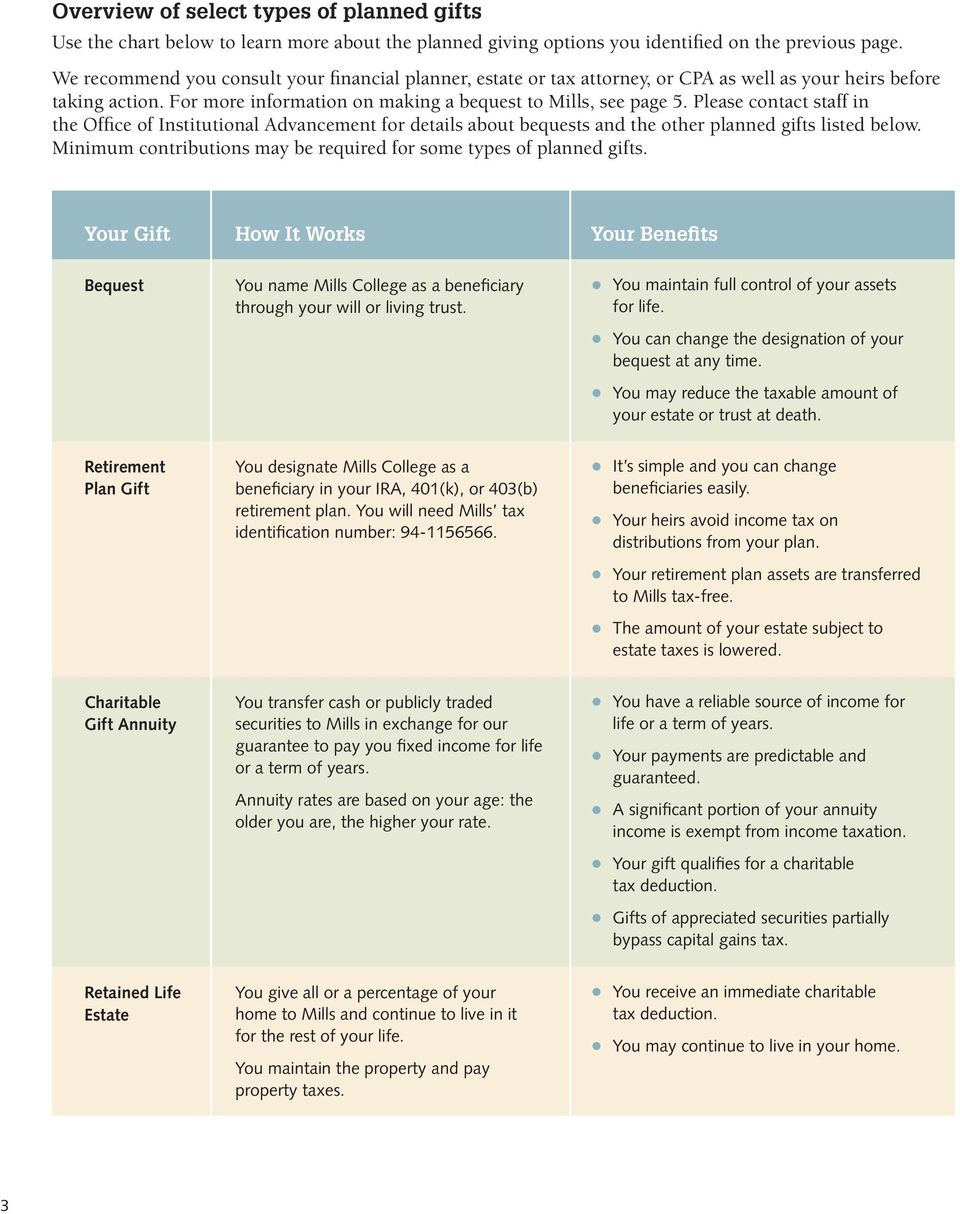
4 Overview of select types of planned gifts Use the chart below to learn more about the planned giving options you identified on the previous page. We recommend you consult your financial planner, estate or tax attorney, or CPA as well as your heirs before taking action. For more information on making a bequest to Mills, see page 5. Please contact staff in the Office of Institutional Advancement for details about bequests and the other planned gifts listed below. Minimum contributions may be required for some types of planned gifts. Your Gift How It Works Your Benefits Bequest You name Mills College as a beneficiary through your will or living trust. You maintain full control of your assets for life. You can change the designation of your bequest at any time. You may reduce the taxable amount of your estate or trust at death. Retirement Plan Gift You designate Mills College as a beneficiary in your IRA, 401(k), or 403(b) retirement plan. You will need Mills tax identification number: It s simple and you can change beneficiaries easily. Your heirs avoid income tax on distributions from your plan. Your retirement plan assets are transferred to Mills tax-free. The amount of your estate subject to estate taxes is lowered. Charitable Gift Annuity You transfer cash or publicly traded securities to Mills in exchange for our guarantee to pay you fixed income for life or a term of years. Annuity rates are based on your age: the older you are, the higher your rate. You have a reliable source of income for life or a term of years. Your payments are predictable and guaranteed. A significant portion of your annuity income is exempt from income taxation. Your gift qualifies for a charitable tax deduction. Gifts of appreciated securities partially bypass capital gains tax. Retained Life Estate You give all or a percentage of your home to Mills and continue to live in it for the rest of your life. You maintain the property and pay property taxes. You receive an immediate charitable tax deduction. You may continue to live in your home. 3
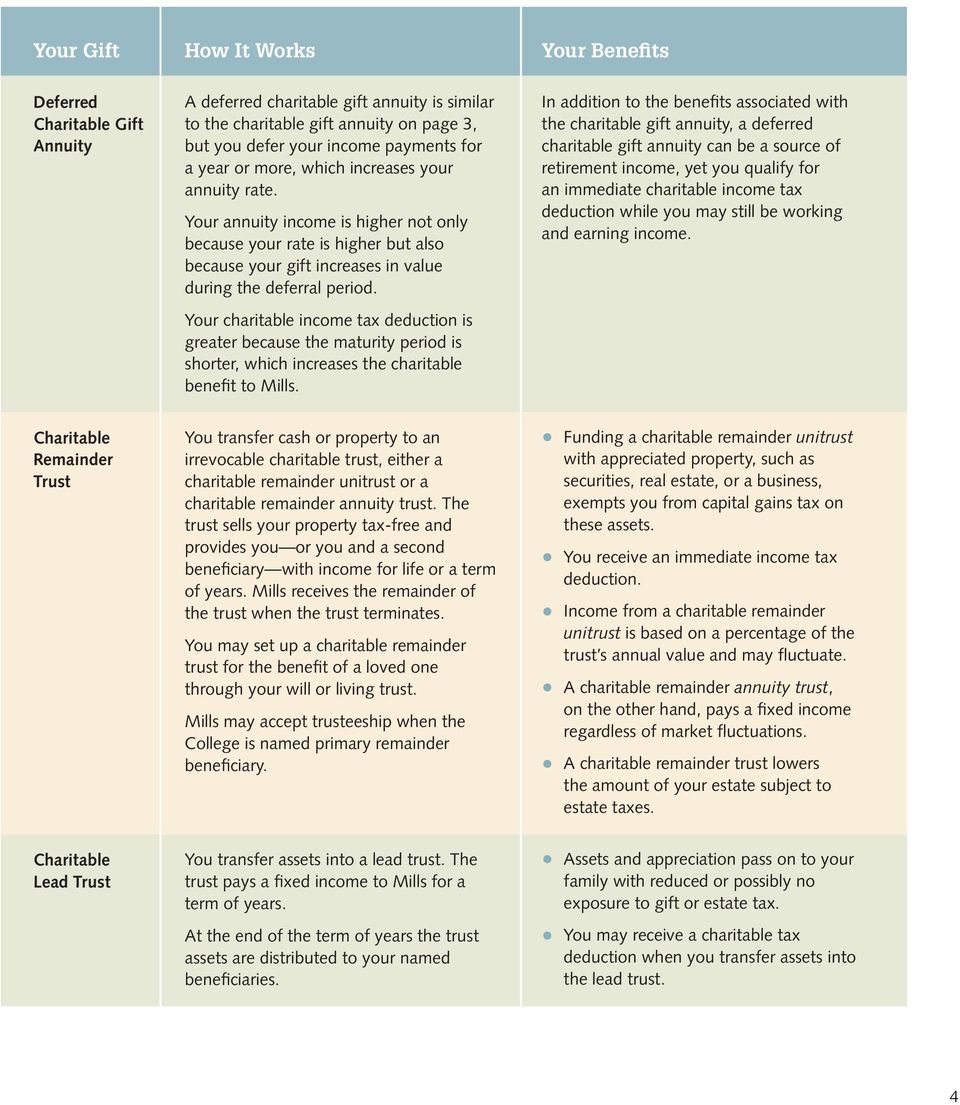
5 Your Gift How It Works Your Benefits Deferred Charitable Gift Annuity A deferred charitable gift annuity is similar to the charitable gift annuity on page 3, but you defer your income payments for a year or more, which increases your annuity rate. Your annuity income is higher not only because your rate is higher but also because your gift increases in value during the deferral period. Your charitable income tax deduction is greater because the maturity period is shorter, which increases the charitable benefit to Mills. In addition to the benefits associated with the charitable gift annuity, a deferred charitable gift annuity can be a source of retirement income, yet you qualify for an immediate charitable income tax deduction while you may still be working and earning income. Charitable Remainder Trust You transfer cash or property to an irrevocable charitable trust, either a charitable remainder unitrust or a charitable remainder annuity trust. The trust sells your property tax-free and provides you or you and a second beneficiary with income for life or a term of years. Mills receives the remainder of the trust when the trust terminates. You may set up a charitable remainder trust for the benefit of a loved one through your will or living trust. Mills may accept trusteeship when the College is named primary remainder beneficiary. Funding a charitable remainder unitrust with appreciated property, such as securities, real estate, or a business, exempts you from capital gains tax on these assets. You receive an immediate income tax deduction. Income from a charitable remainder unitrust is based on a percentage of the trust s annual value and may fluctuate. A charitable remainder annuity trust, on the other hand, pays a fixed income regardless of market fluctuations. A charitable remainder trust lowers the amount of your estate subject to estate taxes. Charitable Lead Trust You transfer assets into a lead trust. The trust pays a fixed income to Mills for a term of years. At the end of the term of years the trust assets are distributed to your named beneficiaries. Assets and appreciation pass on to your family with reduced or possibly no exposure to gift or estate tax. You may receive a charitable tax deduction when you transfer assets into the lead trust. 4
6 Bequests Bequests both large and small have helped shape the Mills College we know today. A bequest is the simplest type of planned gift you can make. You name Mills in your will or trust, which identifies how you want your estate or trust distributed at the time of your death. You maintain complete control over your assets and you can change your instructions for their ultimate distribution at any time. Benefits associated with giving through a bequest include the following: No immediate cash outlay is required. Charitable bequests reduce the amount of your estate subject to federal estate tax. Your assets remain in your control during your lifetime. You can modify your bequest to address changing life circumstances. We encourage you to discuss your plans with staff in Mills Office of Institutional Advancement. We can help you articulate your charitable goals and ensure that the College will be able to use your gift for the purpose you have in mind. Definitions and sample language You can make a bequest to Mills College for a specific amount, a percentage of your estate, or all or a portion of what is left after you have made specific bequests to your loved ones. Sample language follows for the most common types of bequests and ways you may direct the College to use your gift. We recommend you share this language with your attorney or other estate planning advisors. Types of bequests and sample language Percentage A percentage of your estate s assets I hereby give to Mills College, an educational institution in Oakland, California, percent of my estate. Specific amount I hereby give to Mills College, an educational institution in Oakland, California, the sum of $. Entire residue What is left of your estate after other bequests are made I hereby give to Mills College, an educational institution in Oakland, California, all the rest, residue, and remainder of my estate. Percentage residue I hereby give to Mills College, an educational institution in Oakland, California, percent of the residue of my estate. Specific asset Please contact staff in Mills Office of Institutional Advancement if you are considering a bequest of personal or tangible property or other liquid assets. Contingent bequest You can specify certain conditions that must be met before an asset or share of your estate is transferred, for example: If my sister, [Susan Mills], is not living at the time of my death, I give her share of my estate to Mills College, an educational institution in Oakland, California. 5

7 Directing how the College may use your gift Unrestricted Unrestricted bequests give the College the most flexibility to use your gift where it is needed most at the time of distribution. for its general purposes. Specific purpose Please contact staff in Mills Office of Institutional Advancement before directing your gift to a specific purpose. Some examples are below. to provide [scholarships for undergraduates]. to support [dance]. to create the [Susan Mills 75 Scholarship] supporting undergraduate students with financial need unforeseen circumstances in the future, we ask that you include the following language: If at any time the Board of Trustees of Mills College determines that part or all of this bequest is no longer needed for the specified purpose, the Board of Trustees shall designate a purpose advisable for the best interest of Mills College, giving consideration to my stated interest as described herein. Gifts to the Endowment You can help grow the College s endowment, the annual income from which will support Mills in perpetuity. There are two ways to do this. Gifts to the endowment for the College s general purposes to be added to the permanent endowment of Mills College. Gifts to the endowment for a specific purpose to create a permanent endowed fund, [the Susan Mills Endowed Art Fund, for the support of studio art at Mills College]. Preparing for the unexpected To ensure that the College can honor your wishes and serve Mills educational mission in the event of Your bequest to Mills College helps ensure a healthy future for Mills. If you have already included Mills in your estate plans but have not told us, please inform staff in the Office of Institutional Advancement so we may recognize your generosity. On behalf of the entire Mills community, thank you for your support! 6
![to provide [scholarships for undergraduates]. to support [dance].](/docs-images/58/4681889/images/page_7.jpg "to create the [Susan Mills 75 Scholarship] supporting undergraduate students with financial need unforeseen circumstances in the future, we ask that you include the following language: If at any time")
8 How to contact us For a customized illustration of how a planned gift may benefit you, your loved ones, and Mills College or for further information about any aspect of planned giving please contact us. Telephone 877.PG.MILLS ( ) [email protected] Your confidential inquiry puts you under no obligation whatsoever. For certain types of gifts, you may need Mills College s tax identification number. It is Information provided herein or by Mills College is not intended as financial, legal, or tax advice. Please consult an attorney or other professional advisor before taking action. Mills College 5000 MacArthur Blvd., Oakland, CA
SAF Planned Giving Instrument Descriptions and FAQ s
 SAF Planned Giving Instrument Descriptions and FAQ s The Society of American Foresters has a number of planned giving instruments available which provide a means for members and their families to financially
Guide to CHRIS Kids Planned Giving: The Shade Tree Society
 Guide to CHRIS Kids Planned Giving: The Shade Tree Society "People have made at least a start at understanding when they plant shade trees under which they know full well they will never sit." - Elton
A GUIDE TO FREE THE KIDS PLANNED GIVING PROGRAM
 A GUIDE TO FREE THE KIDS PLANNED GIVING PROGRAM What is more liberating than the knowledge that you are loved? This is what we do here create a place of security and love where children can be freed from
SECTION 21 - DEFERRED GIVING PROGRAM
 SECTION 21 - DEFERRED GIVING PROGRAM Policy Sequence 21-000 1 This page intentionally left blank. 2 Introduction In keeping with the long term objectives of the University, it is the policy of the Board
Gifts to The Ridhwan Foundation
 Gifts to The Ridhwan Foundation The following is written with The Ridhwan Foundation as recipient of donations. The Ridhwan Foundation is a 501 (c) 3 charitable, non-profit US corporation and can receive
GIVE AND YOU SHALL RECEIVE CHARITABLE GIVING, CREATING A PLAN THAT S RIGHT FOR YOU
 GIVE AND YOU SHALL RECEIVE CHARITABLE GIVING, CREATING A PLAN THAT S RIGHT FOR YOU Contents 1 Give and you shall receive 3 Techniques summary 5 Planning for charitable giving NOT FDIC OR NCUA INSURED NOT
A Guide to Planned Giving
 A Guide to Planned Giving Dear Friend of Mosaic, Planned giving provides many benefits for you and Mosaic. There are ways to increase your income now or in the future and save money on taxes. With a planned
Mission: Our Vision: United Way Services of Geauga County unites people and resources to improve lives.
 Create your legacy. Mission: United Way Services of Geauga County unites people and resources to improve lives. Our Vision: United Way Services of Geauga County is the organization recognized for collaborating
CASE District IV Conference Fort Worth, Texas. March 25, 2013. What true assets does your family possess?
 HOW TO INITIATE GIFT PLANNING DISCUSSIONS WITH DONORS The Charitable Planning Process CASE District IV Conference Fort Worth, Texas March 25, 2013 Laura Hansen Dean, J.D. Attorney at Law (Texas, Indiana)
Your Guide To. Planned Giving. An Overview Of 6 Types of Charitable Planned Gifts
 Your Guide To Planned Giving An Overview Of 6 Types of Charitable Planned Gifts Interesting Ideas in Estate Planning 2 Welcome Are you looking for ways to save on your taxes this year through charitable
Charitable {Giving Guide
 Charitable {Giving Guide Ways to Give There are many ways to make a charitable contribution. This summary highlights some of the most popular charitable giving options, including gifts of stock, bequests,
A New Use for Your. a donor s guide. The Stelter Company
 A New Use for Your R E T I R E M E N T P L A N A S S E T S a donor s guide The Stelter Company APPRECIATED PROPERTY Learn how to uncover the value of your appreciated assets. Like many Americans, you are
OESF and Other Tax Advantages
 Philanthropic Estate Planning Guide Oral and Maxillofacial Surgery Foundation 9700 W. Bryn Mawr Avenue Rosemont, IL 60018 Phone: 866-278-9221 Fax: 847-678-6254 E-Mail: [email protected] Web site:
Major and Planned Gifts Fact Sheets
 Charitable Gift Annuities Charitable gift annuities, or CGAs, are one of the oldest and most reliable charitable options and have particular appeal to retirees and senior citizens. Religious organizations
Executive Summary Planned Giving and Endowment Policies (For Donors and Donors Advisors)
 Appendix B Authority for Gift Acceptance Policies Executive Summary Planned Giving and Endowment Policies (For Donors and Donors Advisors) Independence Institute encourages and solicits outright and deferred
Millersville University Foundation Gift Acceptance Policy
 Accepted: November 9, 1999 Revised: February 2014 Millersville University Foundation Gift Acceptance Policy Policy Statement Millersville University and the Millersville University Foundation strongly
wa y s o f g i v i n g that live on Your legacy through planned giving
 wa y s o f g i v i n g that live on Your legacy through planned giving The Birch Society continues a long community tradition of support for New London Hospital throughout the greater Lake Sunapee region.
Real Estate Gifts. Major and Planned Gifts Fact Sheets
 Real Estate Gifts A primary residence, vacation home, farm, or undeveloped lot often represents a major asset that may be used to make a substantial charitable gift. Particularly in the case of greatly
NATIONAL RIFLE ASSOCIATION of A MERICA NRA MEMBER PLANNED GIVING GUIDE. Creating a Constitutionally Centered Will
 NATIONAL RIFLE ASSOCIATION of A MERICA NRA MEMBER PLANNED GIVING GUIDE Creating a Constitutionally Centered Will Wayne LaPierre Executive Vice President National Rifle Association Dear Fellow NRA Member,
Charitable and Tax-Savings Strategies. a donor s guide. The Stelter Company
 S A V I N G S B O N D S Charitable and Tax-Savings Strategies a donor s guide The Stelter Company SAVINGS BONDS Charitable and Tax-Saving Strategies Many people have accumulated interest on U.S. savings
A Guide to Planned Giving
 A Guide to Planned Giving 2 - A Guide to Plan Giving What is Planned Giving? The integration of personal, financial and estate planning goals with lifetime or testamentary charitable giving. An opportunity
Giving Today to Guarantee Tomorrow: Charitable Gifts of Life Insurance
 Giving Today to Guarantee Tomorrow: Charitable Gifts of Life Insurance A gift of life insurance can represent a substantial future gift to a favorite charity at relatively little cost to you. Table of
GIFT ACCEPTANCE POLICY
 GIFT ACCEPTANCE POLICY U.S. Masters Swimming, Inc. (USMS), a not for profit organization organized under the laws of the State of Ohio, encourages the solicitation and acceptance of gifts to the USMS,
Planned Giving Primer
 Planned Giving Primer What is Planned Giving? The integration of personal, financial, and estate planning goals with a person s goals for lifetime or testamentary charitable giving. An opportunity for
Legacy Society. A Lasting Commitment to Excellence
 Legacy Society A Lasting Commitment to Excellence Strengthening the Future of the Council on Foreign Relations Today s Council on Foreign Relations continues to build on the extraordinary vision and effort
Estate Planning. Some common tools used to help meet those particular needs include:
 Estate Planning The Importance of Having an Estate Plan Having an estate plan is one of the most important things you can do for your family. It's not just about planning for estate taxes; it's about developing
A Lasting Legacy: Three Generations, Three Scholarships, Three-Part Giving
 Summer 2008 Issue 29 A Lasting Legacy: Three Generations, Three Scholarships, Three-Part Giving Andrew Scala 11, John Scala 80, Bob Scala 56M (MS), 58M (PhD), and Janet Scala 55N We feel very strongly
Charitable Trusts. Charitable Trusts
 Charitable Trusts Charitable Trusts Gifts to charitable trusts can be during lifetime or at the time of death. Charitable trusts provide an income interest to a person, persons, or charities for a period
The Charitable Remainder Trust & Charitable Lead Trust. Presented by: Jeffery T. Peetz Woods & Aitken LLP
 The Charitable Remainder Trust & Charitable Lead Trust Presented by: Jeffery T. Peetz Woods & Aitken LLP The Charitable Remainder Trust The charitable remainder trust is a popular and time-tested method
Gift Acceptance Policy
 Gift Acceptance Policy Purpose The purpose of this Gift Acceptance Policy is to establish the guidelines according to which the Catholic Community Foundation of Los Angeles (the Foundation ) accepts gifts
Creating a Charitable Lead Annuity Trust. Planning for your family s financial future? Minimize taxes while helping Stanford.
 Rolling Orange Creating a Charitable Lead Annuity Trust Planning for your family s financial future? Minimize taxes while helping Stanford. Seeking Solutions, Educating Leaders Through a Stanford charitable
Thoughts on giving. Where your treasure is there your heart will be also. (Luke 12:34)
 Thoughts on giving Where your treasure is there your heart will be also. (Luke 12:34) Welcome to the OWU Foundation Guide to Planned Giving. We have produced this resource because we want to participate
Columbus Metropolitan Library Foundation Gift Acceptance Policy. Introduction
 Columbus Metropolitan Library Foundation Gift Acceptance Policy Introduction Columbus Metropolitan Library Foundation (the Foundation ) is an organization recognized as exempt from federal income taxation
The joy of charitable giving: Strategies and opportunities
 The joy of charitable giving: Strategies and opportunities Vanguard research September 2013 Executive summary. The tax benefits available through various charitable giving strategies can play a critical
Charitable remainder trusts
 Charitable remainder trusts An estate planning strategy for charitably inclined investors This strategy may be a good fit when: You want to make a significant gift to charity You have assets that you want
Minimum Distributions & Beneficiary Designations: Planning Opportunities
 28 $ $ $ RETIREMENT PLANS The rules regarding distributions and designated beneficiaries are complex, but there are strategies that will help minimize income and estate taxes. Minimum Distributions & Beneficiary
The Charitable Gift Annuity
 The Charitable Gift Annuity A Gift that Gives Back What Is a Charitable Gift Annuity? The name says it all. It s both a charitable gift and an annuity. The donor contributes property to charity and receives
Gift acceptance policy
 Gift acceptance policy Gift Acceptance Policy Introduction The LSU Foundation is a private, not-for-profit entity organized under the laws of the State of Louisiana (hereinafter referred to as the Foundation
Giving Through Charitable Remainder Trusts
 Gift & Estate Planning Giving Through Charitable Remainder Trusts SM Stewarding the Giver and The Gift >> Focus on the Family, Attn: Gift & Estate Planning 8605 Explorer Drive Colorado Springs, CO 80920
Total Financial Solutions. Practical Perspectives on Estate Planning
 Total Financial Solutions Practical Perspectives on Estate Planning Contents Why estate planning? 2 A holistic approach 3 Where to start 4 Examine all aspects of your life to 4 ensure your estate plan
Charitable Gifts of IRA/IRD via a Beneficiary Statement - Good. Charitable Gifts of IRA / IRD Assets The Good, The Bad and The Ugly.
 Charitable Gifts of IRA / IRD Assets The Good, The Bad and The Ugly Susan C Dunlop Luther Seminary - Gary G Hargroves Thompson & Associates Minnesota Planned Giving Council Conference 11-5-14 Definitions
HOW TO MAKE CHARITABLE GIFTS FROM YOUR IRA DONOR S GUIDE
 HOW TO MAKE CHARITABLE GIFTS FROM YOUR IRA DONOR S GUIDE H OW TO M AKE C HARITABLE G IFTS F ROM Y OUR IRA Thanks to the success of tax-deferred investments within qualified retirement plans, many people
Gifts of Life Insurance
 Gifts of Life Insurance Effective Ways to Make Them If you have a desire to make a major contribution to support our good works, life insurance can be an excellent tool for helping you accomplish your
Large or small, whatever the size of your estate, it is important to plan. If you do not
 Starting to Plan Your Estate Large or small, whatever the size of your estate, it is important to plan. If you do not have a will, a court will select your heirs and distribute your property as prescribed
SAMPLE Gift Acceptance Policies and Procedures for Annual Fundraising
 SAMPLE Gift Acceptance Policies and Procedures for Annual Fundraising A. Cash Gifts and Pledges 1. Unrestricted Gifts of Cash Gifts given without restriction on the use of the gift. a) Unrestricted gifts
c. Restricted Gifts for Existing Activities. A gift, other than an in-kind gift, may be restricted to an existing activity, purpose, or mission of
 The mission of is to share the love and grace of Jesus Christ with all people and to invite them to fullness of faith in God. 1. Purpose of the Policy a. To create and sustain positive donor relationships
Wealthiest Families Know: 2013 & Beyond
 What the Wealthiest Families Know: 2013 & Beyond Determine How Estate Planning Strategies and Life Insurance May Help You Turn Your Goals into a Wealth Legacy Whether you acquired it or inherited it, wealth
Charitable Gifting: Overview and Tax Implications
 Charitable Gifting: Overview and Tax Implications Overview The desire to assist a charitable organization must be a primary motive for making a gift; if a charitable inclination does not exist, charitable