
KNOW YOUR RIGHTS A GUIDE FOR PUBLIC SCHOOL STUDENTS IN WASHINGTON
|
|
|
- Sharleen Harrison
- 10 years ago
- Views:
Transcription
1 KNOW YOUR RIGHTS A GUIDE FOR PUBLIC SCHOOL STUDENTS IN WASHINGTON

2 Know Your Rights A Guide for Public School Students in Washington This guide provides general information on students rights in Washington state public schools. It is not meant to provide legal advice. This guide does not address the rights of students in private schools, tribal schools, public colleges or universities. For more information on related issues, see the ACLU of Washington publications: Parents Guide to Public School Discipline in Washington, Parents Guide to Truancy in Washington, and Parents Guide to School Board Advocacy in Washington, available on our Web site: Cover design graciously donated by: Michael Mahoney of Hat Head Studios, LLC Published June 2007 A project of the American Civil Liberties Union of Washington Foundation

3 2 Know Your Rights: A Guide for Public School Students in Washington Know Your Rights: A Guide for Public School Students in Washington 3 VIII. School Searches and Police in Schools.. 34 TABLE OF CONTENTS I. Know Your Rights 4 II. How to Be Your Own Advocate. 6 III. Freedom of Expression 11 A. Free Speech in Cyberspace. 14 B. Student Newspapers.. 15 C. Library Books and Internet Filters.. 16 D. Protests and Demonstrations.. 17 E. Pledge of Allegiance F. Dress Codes A. School Searches.. 36 B. Drug Tests and Dog Sniffs. 38 C. Police Interrogation 39 IX. Student Records: Privacy and Access X. The Right to a Free Public Education A. Who Can Enroll and What Are the Requirements. 49 B. Compulsory Attendance: The Becca Bill 50 C. Special Education Services. 52 D. Bilingual Education XI. School Discipline and Grievance Procedures.. 55 IV. Freedom of Religion 20 A. Free Exercise of Religion 21 B. Government Establishment of Religion.. 22 V. Student Clubs VI. Equal Protection: Freedom from Discrimination 25 A. Harassment 26 B. Lesbian, Gay, Bisexual, Transgender and Questioning Students.. 27 C. Discrimination and Disparities in Discipline.. 28 D. Gender Discrimination in Athletics 29 VII. Sexual Health and Education. 31

4 4 Know Your Rights: A Guide for Public School Students in Washington Know Your Rights: A Guide for Public School Students in Washington 5 KNOW YOUR RIGHTS! Schools are places for growing, inquiring minds. The process of growth often includes questioning or rejecting established values. And that can be uncomfortable for school authorities. On the other hand, to create an educational environment, schools must be able to impose a certain degree of discipline and order. By understanding your rights, you can help make sure that they are protected. Young people are often told that they do not have the same rights as adults. In some cases, that is true. But despite some restrictions, young people do have rights. And for many questions that come up at school, your rights are part of the answer. It takes courage and determination to stand up for your rights. But it is worth it and there are people who can support you when you do! If you have questions about your rights at school, or want help in protecting your rights, call the ACLU to see if we can help. You can reach us at or through our Web site: Have you ever wondered... Have you ever wondered whether you can get in trouble for writing about your school on your own Web page at home; whether you can form a gay/straight alliance club; wear a t-shirt protesting the war or quote scripture as part of a class assignment? Have you ever wondered... IT IS NEVER TOO SOON TO STAND UP FOR YOUR RIGHTS! Have you ever wondered whether it was okay for a police officer to search your locker; whether you had to answer if a police officer asks you questions, or whether the school could tell your parents if you asked the counselor about sexual health or birth control pills? This guide will help you understand what your rights are in many situations. And when you know your rights, you can speak up when they are being violated.

5 6 Know Your Rights: A Guide for Public School Students in Washington Know Your Rights: A Guide for Public School Students in Washington 7 HOW TO BE YOUR OWN ADVOCATE This section describes six general strategies to use if you feel that your rights are being violated. Remember that freedom cannot protect itself. You might find a sympathetic teacher, a parent or adult who will stand up for you when the school is violating your rights, but often it is up to you to ask for help. Most educators -- including school administrators -- want to do the right thing. If you carefully and respectfully explain to school officials that certain actions of the school are improper, you might find that they will agree with you. First: Know Your Rights You cannot protect your rights if you do not know what they are. A good place to start looking is in the written policies and procedures adopted by your district. You should find some of those in your student handbook, and you can find more by asking your principal or district office. But you should not stop there. Laws and policies are constantly Get a Copy of Your School Rules If you do not have a copy of your student handbook, ask the principal for a copy. To get copies of the district policies and procedures, you can ask your principal, or the district office. Many school districts post their policies online. changing, so sometimes school policies are outdated. They may not give you full information about your rights. You can find out more about your rights from this guide. If you have a specific question about your rights and cannot find an answer, talk to your school counselor or teacher to see if they can help you. You can also call the ACLU to see if we can help. Second: Investigate the Facts If something happens that you think is unfair, keep track of the details. The best way to keep it straight is to write it down! Write it Down! As soon after the incident as possible, write out a statement, including: Who was involved? Who saw it? What happened? What was said? When did it happen? When did you report it? Where were you? Why did the school take the action it did? Ask for statements from witnesses. Try to find out the points of view of the different people involved, including school staff or administrators. If the school gives you anything in writing or if you submit anything in writing yourself, keep copies! Third: Think About What You Want What do you think the school should do? Some changes may affect only you. Other changes may involve a rule or policy that will affect everyone in your school, district, or state. When you have an idea about what you want to happen, think about how you can make the case for it.

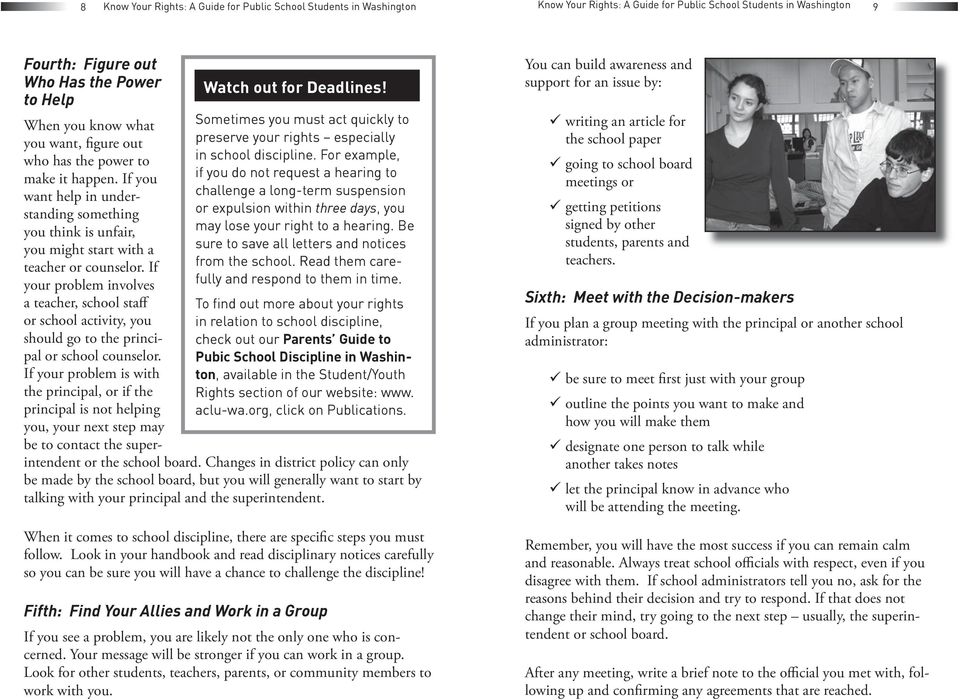
6 8 Know Your Rights: A Guide for Public School Students in Washington Know Your Rights: A Guide for Public School Students in Washington 9 Fourth: Figure out Who Has the Power to Help Watch out for Deadlines! Sometimes you must act quickly to preserve your rights especially in school discipline. For example, if you do not request a hearing to challenge a long-term suspension or expulsion within three days, you may lose your right to a hearing. Be sure to save all letters and notices from the school. Read them carefully and respond to them in time. To find out more about your rights in relation to school discipline, check out our Parents Guide to Pubic School Discipline in Washinton, available in the Student/Youth Rights section of our website: www. aclu-wa.org, click on Publications. When you know what you want, figure out who has the power to make it happen. If you want help in understanding something you think is unfair, you might start with a teacher or counselor. If your problem involves a teacher, school staff or school activity, you should go to the principal or school counselor. If your problem is with the principal, or if the principal is not helping you, your next step may be to contact the superintendent or the school board. Changes in district policy can only be made by the school board, but you will generally want to start by talking with your principal and the superintendent. When it comes to school discipline, there are specific steps you must follow. Look in your handbook and read disciplinary notices carefully so you can be sure you will have a chance to challenge the discipline! Fifth: Find Your Allies and Work in a Group If you see a problem, you are likely not the only one who is concerned. Your message will be stronger if you can work in a group. Look for other students, teachers, parents, or community members to work with you. You can build awareness and support for an issue by: writing an article for the school paper going to school board meetings or getting petitions signed by other students, parents and teachers. Sixth: Meet with the Decision-makers If you plan a group meeting with the principal or another school administrator: be sure to meet first just with your group outline the points you want to make and how you will make them designate one person to talk while another takes notes let the principal know in advance who will be attending the meeting. Remember, you will have the most success if you can remain calm and reasonable. Always treat school officials with respect, even if you disagree with them. If school administrators tell you no, ask for the reasons behind their decision and try to respond. If that does not change their mind, try going to the next step usually, the superintendent or school board. After any meeting, write a brief note to the official you met with, following up and confirming any agreements that are reached.
7 10 Know Your Rights: A Guide for Public School Students in Washington Know Your Rights: A Guide for Public School Students in Washington 11 Standing up for your rights at school and in court takes courage, but your success can help prevent future violations of other students rights. The ACLU has helped many students stand up for their rights, and has often succeeded. But sometimes courts have favored schools interest in keeping order over students rights. Sometimes schools are allowed to punish students for speech that we believe should be protected, or search students things without any reason to suspect them. But do not be discouraged just because schools are allowed to do something, does not mean that they have to! IF YOU THINK SOMETHING IS UNFAIR OR UNREASONABLE, SPEAK UP! OTHERS MIGHT AGREE. FREEDOM OF EXPRESSION Congress shall make no law abridging the freedom of speech, or of the press; or the right of the people peaceably to assemble, and to petition the government for a redress of grievances. U.S. Constitution, Amend. I Every person may freely speak, write and publish on all subjects, being responsible for the abuse of that right. Washington State Constitution, Article I, Section 5 The First Amendment of the U.S. Constitution and the Washington State Constitution guarantee the freedom of expression for everyone, including you! Although you do not have all the same rights when you are in school as you do when you are in the community, you do have important rights. Your right to free speech is protected at school. Students do not give up their constitutional rights when they walk onto school grounds. That includes your right to free speech. But in some cases, your speech can be restricted at school even if it would be protected if you were Express Yourself! The First Amendment protects your right to express yourself through spoken or written words, on bulletin boards, in student papers, on the Internet or on your t-shirt. It protects your right to participate in peaceful protests or marches. It also protects your right to express yourself through your taste in books, art, music or the clubs you join. The First Amendment protects your right to speak and to receive information, as well as your right not to speak.

8 12 Know Your Rights: A Guide for Public School Students in Washington Know Your Rights: A Guide for Public School Students in Washington 13 off school grounds. In a famous case from 1969, called Tinker v. Des Moines Independent School District, the U.S. Supreme Court said students have the right to free speech at school unless their speech would cause a material and substantial disruption to class or school activities, or would infringe on the rights of others. Speech does not create a material and substantial disruption just because it draws attention, or because a teacher does not like it. To be a material and substantial disruption, it must be a real disruption of the class or school activity. School administrators and teachers cannot censor you, or prevent you from saying something, just because it is controversial. Schools might consider some subjects, like war, racism, gay rights, drugs or teen pregnancy to be too controversial for school. But that is not a good reason for censoring you. Whether you want to make a serious comment on a new school rule or the latest national news, the school cannot censor or discipline you for your ideas unless it has a good reason for believing that your expression will cause a substantial disruption or infringe on the rights of others. Remember, when speech on sensitive topics does stir passionate feelings, the best response is usually more speech not less! There are some limits on the freedom of expression that apply to everyone. Whether you are in school or not, the First Amendment does not protect speech that is a true threat. In order to be consid- What is the Difference between a Joke and a Threat? School authorities are sensitive about provocative statements or jokes about violence. They often try to punish students who make such statements. True threats are not protected inside of school or out. But in order to be considered a true threat, you must intend that others take your words as a threat. Your words must be so clear and convincing that the person would have a reasonable fear for his or her safety. ered a true threat, you must intend that others take your words as a threat. Your words must be so clear and convincing that the person would have a reasonable fear for his or her safety. The First Amendment also does not protect false personal attacks against another person that are defamatory. Defamatory speech is speech that is untrue and harms someone s reputation, and you know, or should have known, that it was untrue when you said or wrote it. The right to free speech does not protect speech that is obscene. The courts have said that speech is obscene if it deals with sex in a manner appealing to lustful interest in a patently offensive manner and lacks serious literary, artistic, political or scientific value. When speech is directed toward minors, the standard for obscenity is lower. Speech is obscene as to minors if it appeals to the prurient, shameful, or morbid interest of minors, is patently offensive with respect to what is suitable for minors, and is without redeeming social importance for minors. Limits on Vulgar, Lewd or Drug Related Speech To ensure an educational environment that is civil and law-abiding, schools are allowed to limit students use of vulgar or lewd speech on campus. In 1986, a high school student in Washington state was suspended for using sexual innuendo in a speech at a school assembly. The case, called Bethel School District v. Fraser, went all the way to the U.S. Supreme Court. The Court said that schools may discipline students for speech that is not obscene but is still vulgar or lewd and used in an inappropriate school setting. In a case from 2007 called Morse v. Frederick, a student in Alaska was suspended for holding up a banner at a school-sponsored event that read Bong Hits 4 Jesus. The U.S. Supreme Court said that the school could limit the student s speech because it advocated illegal drug use and did not include any serious comment on social or political issues.
9 14 Know Your Rights: A Guide for Public School Students in Washington Know Your Rights: A Guide for Public School Students in Washington 15 Distributing Written Materials You do not need to get permission in advance to bring written materials, including leaflets, newspapers or announcements, into the school building. But, if you want to distribute them, you must follow the school s rules regarding when, where and how you can distribute them. Any restrictions the school creates must be reasonable and they must apply equally to all non-school student literature. Generally, school rules that allow leafleting in hallways, but not in class, are considered reasonable. Also, schools may require someone to hand out leaflets instead of leaving them in big piles for people to pick up. Some schools will designate one table where students can leave unattended stacks of leaflets. Remember, if your materials contain speech that would get you into trouble if you said it out loud at school (because it risks creating a real disruption, is vulgar, advocates illegal drug use, or infringes on the rights of others), you can get into the same trouble for distributing it in written form. A. Free Speech in Cyberspace Your right to express yourself is not limited to the technology of yesterday! It applies in cyberspace too, whether you are writing s, keeping a Web blog, creating a homepage, or posting in a chat-room. However, many school officials have tried to regulate what students can and cannot post or access online. The law in this area is still developing because the technology is new, but there are a few guidelines. On-campus Internet Speech: If you are using a school computer, you should be prepared to follow the school s rules for the use of its equipment. Most schools have Internet Use policies stating what those restrictions are. Any restrictions should be based on some valid educational reason. The ACLU s Work on Internet Speech The ACLU has helped students stand up for their rights when schools tried to discipline them for off-campus internet speech. You can learn more about the cases and how they turned out in the Student/Youth section of our Web site: Off-campus Internet Speech: Expressing yourself from a computer outside of school is a different matter. Schools authority to limit student speech has generally not been extended to speech that takes place off-campus. You should not be censored or disciplined for your expression on a private Web site, a posting on a Web blog, or a personal if it is sent from your personal account, on your own time, using your own resources from a computer outside of school even if the content is schoolrelated. But the law in this area is still evolving. Some courts have said that schools can discipline students for off-campus Internet speech if it has disruptive effects at school. B. Student Newspapers Your right to control the content of newspapers distributed at school depends on whether the newspaper is school-sponsored. School Sponsored Newspapers: In a case from 1988 called Hazelwood School District v. Kuhlmeier, the U.S. Supreme Court explained that if a newspaper bears the school s name, uses significant school resources to be published, or is designed by the school to be a learning experience and has a faculty advisor, it is school-sponsored.

10 16 Know Your Rights: A Guide for Public School Students in Washington Know Your Rights: A Guide for Public School Students in Washington 17 The school is considered the publisher of school-sponsored materials and has the final say over what can and cannot be published, subject to two limits. First, a decision to remove material from a school-sponsored publication must be related to some valid educational purpose. An article cannot be removed from the publication simply because the principal disagrees with the viewpoints it expresses. The same is true for student expression in other school-sponsored activities, like school plays, concerts, or murals. Second, if your school has made a formal decision to operate the paper as an open forum for all student views, then the school gives up its control over the content of the newspaper. Ask your journalism advisor if your school paper has been designated an open forum. Underground and Independent Newspapers: If you publish an unofficial or underground newspaper or zine that is not schoolsponsored, you have complete control over the contents. And you can distribute it as you can leaflets and books. You do not need to ask permission to bring it into the school building, and the school cannot require you to get approval of the content in advance. But remember one risk if your publication contains speech that would get you into trouble if you said it out loud at school (because it risks creating a substantial disruption, is vulgar, advocates illegal drug use, or infringes on the rights of others), you can get into the same trouble for distributing it at school in written form. C. Library Books and Internet Filters The First Amendment right to freedom of expression includes the right to receive ideas and information. The First Amendment puts some limits on what schools can do to keep information out of your hands. In 1982, in a case called Board of Education v. Pico, the U.S. Supreme Court said that a school cannot take books out of its library just because it disagrees with the ideas expressed in them. Schools have more authority to control which books are or are not used in the classroom because they have broad control over the curriculum. Before your school removes controversial or inappropriate materials from your class or your library, you should have an opportunity to object to their removal. Ask for your school district s policy and procedure for selecting or challenging instructional materials. The Internet: School computers usually are equipped with filtering software that prevents you from accessing web sites that the principal or librarians consider improper for a school setting. Filters often block too much, including sites that schools feel uncomfortable with, like sites giving teens information about sexual health or sexual identity. Disabling Filters If you think your school is blocking information that would be useful to you or other students, ask whether the filter can be disabled. Find out what the school s policy is on internet use, and let them know your concerns. D. Protests and Demonstrations You do not have to wait until you graduate to organize or participate in protests, rallies or demonstrations! You have the freedom to express yourself in groups, with posters, songs and drama. There are limits you must comply with reasonable school rules regulating the time, place and manner of student speech, including group demonstrations. You could get in trouble for holding a protest at school that substantially disrupts the orderly operation of the school. If you encourage students to miss class, block a hallway, or make a lot of noise while others are studying, it will likely

11 18 Know Your Rights: A Guide for Public School Students in Washington Know Your Rights: A Guide for Public School Students in Washington 19 be considered a disruption. But you should be able to organize a peaceful, orderly protest at lunch, or before or after school. If you are unsure about when and where you can hold a protest or demonstration, check your school district s written policies and rules about students free speech on school grounds. Because the law requires you to attend school, the school can discipline you if you skip class to participate in a protest or demonstration. But the school cannot punish you more harshly for missing school to participate in a protest than it would punish students for missing school for any other reason. E. Pledge of Allegiance You cannot be forced to take oaths you do not believe. This Learn More: Your Rights in Relation to Student Walkouts Before a school can suspend you for missing school, it has to take a number of corrective steps and start with lesser punishments. You should also be given the same right to make up work as any other student who has an unexcused absence for the particular classes you miss. For additional information, see our brochure on Student Walkouts and Political Speech at School, available in the Student/Youth Rights section at: click on Publications means that you cannot be punished by your school for refusing to salute the flag, say the Pledge of Allegiance, or rise while others say the Pledge. You also cannot be required to leave the room when others are saluting the flag if you choose not to. You should maintain a respectful silence while others recite the Pledge. You do not have to give your teacher or other school staff a reason for not participating. And you do not need your parent s permission to exercise the right of conscience to refrain from reciting the Pledge. F. Dress Codes People sometimes express who they are and what they believe through their own personal style. But you do not have complete freedom in choosing the outfits, hairstyles or accessories you wear to school. Courts have typically allowed schools to regulate students dress and hairstyle. Schools might regulate the length of skirts and shirts, or prohibit clothes with sexual or obscene messages, or gangrelated apparel. A court is more likely to protect your freedom of expression if your clothes make a political or religious statement, or if the school s rules are so vague that you could not be expected to understand what they mean. No dress code may prohibit students from wearing clothing in observance of their religion. School boards in Washington can require school uniforms. But if your school decides to require uniforms, it must make sure that students who cannot afford the uniform can still go to school. What is Gang-related Apparel? That may depend on where you go to school. The law allows school boards to adopt dress codes that prohibit gang-related apparel. Before you can be disciplined for wearing it, the school board must notify you and your parents of what clothing and apparel your school board considers gang-related. If the school s definition is so broad or vague that you do not know what it means, ask the school to clarify it. Any school rule must be applied fairly and without discrimination. If you think your school is singling out a particular group of students for wearing gang-related apparel, keep track of when it happens and contact the ACLU to see if we can help.
12 20 Know Your Rights: A Guide for Public School Students in Washington Know Your Rights: A Guide for Public School Students in Washington 21 FREEDOM OF RELIGION Congress shall make no law respecting an establishment of religion, or prohibiting the free exercise thereof... U.S. Constitution, Amend. I Absolute freedom of conscience in all matters of religious sentiment, belief and worship, shall be guaranteed to every individual, and no one shall be molested or disturbed in person or property on account of religion;... No public money or property shall be appropriated for or applied to any religious worship, exercise or instruction, or the support of any religious establishment... Washington State Constitution, Article I, Section 11 All schools maintained or supported wholly or in part by the public funds shall be forever free from sectarian control or infl uence. Washington State Constitution, Article IX, Section 4 There are two parts to the freedom of religion. First, everyone has the right to the free exercise of religion: that is, the right to practice your own religion, or no religion at all, without interference from the government. Second, the government may not establish religion: that is, the government may not endorse, sponsor, or require participation in any particular religion or religious activities. Public schools must maintain their religious neutrality so that all students of any religion, or no religion, can enjoy freedom of belief. A. Free Exercise of Religion Your right to the free exercise of religion is protected both inside of school and out. When you are in school, you are free to practice your religion individually so long as you do not disrupt educational activities or interfere with the rights of others. Individual students are free to: pray read from a religious text wear religious symbols discuss their faith invite others to join their religious group You can pray in a group as long as you are not disruptive. You can form a religious club and are free to meet at school during noninstructional time if the school allows other non-curriculum-related student clubs to meet on campus. You also generally have the right to distribute religious literature on public school campuses. The school can impose rules about when, where and how you can distribute your literature. Any restrictions the school creates must be reasonable and they must apply equally to all non-school student literature. Can I Write about My Religious Beliefs in My English Paper? If it is relevant to the subject and meets the requirements of the assignment, you have the right to express your religious views during class discussion, as part of a written assignment, or as part of an art project. Your teacher cannot grade you on your religious beliefs, but can grade your performance on scholastic content, such as spelling, grammar, and the degree to which you meet the assignment s objectives.

13 22 Know Your Rights: A Guide for Public School Students in Washington Know Your Rights: A Guide for Public School Students in Washington 23 B. Government Establishment of Religion The second part of your freedom of religion comes from the Establishment Clause of the First Amendment, which prohibits the government from establishing any religion. That means that the government cannot pass laws that are motivated by a religious purpose, or laws that promote religion. And it cannot become too entangled in religion. Our state constitution goes even farther it prohibits any public funds from being spent to support religion. The general rule for schools is that they may not sponsor, facilitate, promote or participate in religious activity or religious beliefs. For example, you can be excused from class to participate in religious activities, but teachers should not encourage students to do so. Schools can teach about religion. They can include readings from religious texts, as long as these are presented objectively as part of a secular (non religious) program, such as in history, world studies or literature classes. But schools may not teach that one religion is better than any other religion or no religion. 1. Prayer in School, at Graduation and at the Game School officials may not lead their classes in prayer and may not try to persuade students to participate in prayer or other religious activities. It does not matter whether the prayers are supposedly nondenominational, because no single prayer will ever capture the wide range of religious beliefs that people are entitled to hold. Your school cannot invite a member of the clergy or a student to deliver a prayer at a graduation ceremony, football game or other school event. Also, if the school s purpose is to encourage prayer, it may not do so by requiring a moment of silence. However, if the school allows student expression on the basis of genuinely neutral criteria and students have primary control over the content of their expression, students individually may choose to express religious beliefs. For example, if all students are given space to express themselves under their yearbook photos, then students can choose to express their religious beliefs. The school may include disclaimers to clarify that the speech is the student s alone, and not the school s. Any disclaimers should be neutral and should not criticize particular viewpoints. 2. Holiday Celebrations and Displays Schools can celebrate holidays by putting up decorations and displays, but they must be careful not to promote any one religion in particular. Some, but not all, holiday symbols have religious meaning. If a display is mostly non religious with some religious items, it is probably okay. But if the overall message is religious, it would be unconstitutional. For example, a nativity scene or a Menorah by itself would not be permitted, but a display including several items, like a Christmas tree, a Menorah and snowflakes would be okay. Religious Song and Drama Including a few religious songs in a school concert among mostly non religious songs would likely be okay. On the other hand, practicing all winter for a Christmas concert with primarily religious songs would not. Similarly, schools might include plays about religion in a drama class, but putting on a religious play would probably not be permitted. 3. Evolution and Creationism Schools cannot design curriculum to promote one set of religious views over others. In science class, that means that states cannot forbid schools from teaching evolution. They cannot require schools to teach creationism or intelligent design because these are religious concepts about the origins of life on earth. Similarly, states cannot require schools to balance the teaching of evolution with creationism. States also cannot require schools to put a disclaimer on a biology textbook that advocates creationism as an alternative to evolution.

14 24 Know Your Rights: A Guide for Public School Students in Washington Know Your Rights: A Guide for Public School Students in Washington 25 STUDENT CLUBS If your school allows even one noncurriculum-related student group to use school facilities during non instructional time, it must give equal access to all student groups, regardless of the focus of the group. Non-curriculum-related student groups are any groups that are not directly linked to classes offered by the school. Non instructional time includes time before and after class, and during lunchtime. So if your school allows a chess club, cooking club or a Future Farmers of America club, it must also allow a gay/straight alliance club, a Bible study club or an ACLU student club to meet on campus. The school cannot leave it up to a student vote on whether a club can meet on campus. The Equal Access Act A federal law called the Equal Access Act guarantees student clubs equal access to school facilities. Courts have said that includes equal access to benefits like space on school bulletin boards, a yearbook picture, and access to school announcements, whenever those benefits are given to other non-curriculum-related clubs. To protect everyone s freedom of religion, schools cannot sponsor or participate in religious activities of student clubs. If a student club has a prayer meeting or engages in other religious activity at school, school employees cannot participate. EQUAL PROTECTION: FREEDOM FROM DISCRIMINATION... No state shall... deny to any person within its jurisdiction the equal protection of the laws. U.S. Constitution, Amend. XIV,Section 1 It is the paramount duty of the state to make ample provision for the education of all children residing within its borders, without distinction or preference on account of race, color, caste, or sex. Washington State Constitution, Article IX, Section 1 All students have the right to equal protection. That means you have the right to be free from discrimination at school. In our state, no student may be denied an equal educational opportunity or discriminated against because of: race national origin religion economic status sex sexual orientation pregnancy marital status previous arrest previous incarceration or a physical, mental, or sensory handicap. Unfortunately, discrimination might still occur at your school, and it can come in a variety of forms. It might come up in the context of assigning students to academic opportunities, extracurricular activities or special school programs. It might also appear in the way you are treated by other students or teachers, or in the way you are disciplined.

15 26 Know Your Rights: A Guide for Public School Students in Washington Know Your Rights: A Guide for Public School Students in Washington 27 It takes courage to speak up for your rights, particularly when you feel like you are being discriminated against. If you feel like it is happening to you, keep a diary of what is happening and report it to a teacher, counselor or principal. If the problem is not resolved, call the ACLU to see if we can help. Title IX and Title VI A. Harassment Harassment on the basis of gender, sexual orientation, race, color, national origin, disability or religion is a kind of discrimination. It is prohibited by federal and state laws. Harassment can come in many forms, including: assaults or unwanted touching theft or vandalism threats of bodily injury unwanted sexual advances derogatory comments, slurs, or gestures The details of harassing conduct will be different in every case. Harassment is illegal when it is so severe, persistent or pervasive that it creates an intimidating or hostile school environment and interferes with your education. Two of the federal laws that prohibit discrimination are Title IX, which prohibits sex discrimination, and Title VI, which prohibits discrimination on the basis of race, color or national origin. These laws prohibit discrimination in any educational program that receives money from the federal government. Since public schools get money from the federal government, they must obey Title IX and Title VI. They must protect students from harassment or other discrimination based on sex, race, color or national origin. WHETHER IT IS FROM A TEACHER OR FROM A FELLOW STUDENT, SCHOOLS CANNOT TURN A BLIND EYE TO HARASSMENT. Before schools can take steps to stop it, though, they have to know about it. When a school receives a complaint of harassment, it is required to look into it and take steps to protect you from further harassment. Remember to look at your school s policy and follow the process for raising a complaint. Keep careful notes about what happened, when it happened, who was involved, and when you reported it. If you have reported harassment either by a teacher or another student and the school has done nothing, call the ACLU to see if we can help you. Harassment and Free Speech: The definition of harassment is not always clear. If a school s anti-harassment rule is too broad, it can infringe on your right to free speech. School policies should not keep you from expressing your religious, philosophical or political views even if they might be considered offensive by some students. But schools can prohibit harassment when students intentionally intimidate or demean others, even if that harassment occurs partly through speech. For more on this topic, see our brochure, Preventing Harassment, Protecting Speech, available on our Web site at: www. aclu-wa.org. Find out How to Report Harassment Every school is required to have a written procedure for responding to harassment complaints. There should be information posted in your school and also printed in your handbook about how you can report harassment. If you cannot find it, ask a teacher or your principal to give you a copy and explain the process to you. B. Lesbian, Gay, Bisexual, Transgender and Questioning Students Lesbian, gay, bisexual, transgender and questioning students have the right to be treated equally at school and to be protected from discrimination. Schools have an obligation to adopt rules against

16 28 Know Your Rights: A Guide for Public School Students in Washington Know Your Rights: A Guide for Public School Students in Washington 29 anti-gay harassment, just as with any other kind of harassment. The school cannot ignore it if you are being harassed on the basis of your sexual orientation or what someone thinks it is. It is your choice to be out, or not. If you are not out to your parents or others, the school should respect your right to privacy and not disclose your sexual orientation without your permission. If you have confided in a counselor or teacher and do not want them to tell your parents or other students, let them know that the information is private. They should respect your decision to keep it private. If you are out and want to be, you can be! You have the same right to freedom of expression as other students. Schools may not restrict expression of your ideas and beliefs about sexual orientation and gender identity more than any other student speech at school. You can talk to other students about your sexual orientation and gender identity, and you have the right to form a club on an equal basis with other clubs. (See the section on Student Clubs for more information). Get Busy. Get Equal. You can find more information about your rights, and read success stories about other students who stood up for their rights at the Schools section of the ACLU LGBT Project s Get Busy Get Equal Campaign Web site: Also, if your school allows couples at the prom or other school functions, it should allow same-sex couples. If you are a transgender student, you should be able to wear what you wish, so long as it does not cause substantial or material disruption in the school. C. Discrimination and Disparities in Discipline Schools are not allowed to discipline you more harshly or more often than other students just because of your race, sex, national origin, religion or other legally protected characteristic. Schools can impose different punishments on students depending on relevant factors, such as what you did, whether it was intentional, how serious it was, and whether or not you have been in trouble in the past. Courts give schools a lot of leeway in deciding whether one student s misconduct is more severe than another s, so discrimination can be hard to prove. Still, if you feel like it is happening to you, keep track of what is happening. Talk to a parent or another trusted adult about how to raise the issue, and call the ACLU to see if we can help you. Sometimes you will find patterns, where a school s discipline has a harsher or disparate impact on a particular group of students. Patterns of disparate impact can be identified by looking at a school s discipline data. Anyone including you can ask for public records from a school, including general discipline data that does not include students names or addresses. If disparities are found, schools can try to eliminate them by: reviewing their discipline codes to be sure they are clear and fair providing training to teachers and other school staff on how to impose discipline fairly and consistently clarifying the school s rules and expectations for all students For more information about school discipline, and suggestions for responding if you feel you are being discriminated against, see our Parents Guide to Public School Discipline in Washington, available in the Student/Youth Rights section of our Web site: click on Publications. D. Gender Discrimination in Athletics All students have the right to equal opportunity and treatment in school athletic programs. Sports programs remain one of the few areas in which schools may operate separate programs for boys and girls. If a school chooses to maintain separate athletic programs,
17 30 Know Your Rights: A Guide for Public School Students in Washington Know Your Rights: A Guide for Public School Students in Washington 31 federal and state law requires the school to ensure that boys and girls have an equal opportunity to participate. If your school does not provide the same number of opportunities or roster spots, proportionate to the number of boys and girls enrolled at the school, it may be unfair and possibly discriminatory. A school that offers separate athletic teams for male and female students must also ensure that both boys and girls receive equitable treatment. This means that all student athletes should have the following comparable benefits regardless of their gender: locker rooms practice and competitive facilities publicity equipment and supplies (i.e., uniforms) transportation coaching and academic tutoring scheduling of games and practice times If you believe you or your team is not being treated the same as another team of the opposite sex, you may have a discrimination complaint. Speak with others on your team to see if they feel the same way. As in any situation, there is strength in numbers. Every school is required to have a written procedure for responding to discrimination complaints filed by student athletes. There should be information posted in your school and also printed in your handbook about how you can report discrimination. If you cannot find it, ask a teacher or principal to give you a copy and explain the process to you. If you have reported discrimination in an athletic program and the school has done nothing, call the ACLU to see if we can help you. SEXUAL HEALTH AND EDUCATION All people in our state including young people have a right to privacy for personal reproductive decisions. Every person has the right to choose or refuse birth control. Every woman has the right to choose or refuse to have an abortion. In Washington state, even as a minor, you are the one with the right to consent to family planning (e.g., birth control) or abortion. You are also the one who can authorize the release of information relating to birth control or abortion, not your parent or guardian. That means the school cannot release information about birth control or abortion to your parent or guardian or others without your written authorization. Pregnant students have the same right to an education as other students. Schools are not allowed to discriminate against pregnant students by limiting their activities when no health concern is involved. For example, a school cannot require pregnant students to provide doctors notes to participate in activities unless the same policy applies to all students. School districts can establish special schools or special programs for pregnant students, but they must be voluntary. If you are pregnant, the school cannot require you to take a leave of absence or attend an alternative school. If you do take a leave of absence, the school must allow you to start back up where you left off. You should be able to remain in school while you are parenting a child. Ask your school to help you devise an educational plan that will work for you if you need extra help to catch up or more flexibility in your schedule. If you are living with HIV or AIDS, you have the right to go to school and the right to privacy in your medical information. Students living with HIV or AIDS should not be barred from school or extracurricular activities. Because HIV/AIDS cannot be easily trans-

18 32 Know Your Rights: A Guide for Public School Students in Washington Know Your Rights: A Guide for Public School Students in Washington 33 mitted during the types of incidental contact that take place at school, you should not be required to disclose your HIV/AIDS status to the school. Schools must take special care to protect the privacy of students HIV or AIDS status and related medical records: School officials may not disclose your HIV or AIDS status to others without specific written consent. The school may not disclose the identity of any student who has asked about or requested testing or treatment for a sexually transmitted disease, including HIV or AIDS. The school may not release HIV test results without a signed release. A general written consent to release medical information is not enough to allow release of HIV records. If you are 14 years old or older, you are the one with the authority to give consent to release your records relating to HIV or other sexually transmitted diseases. The school may not disclose those records to your parents or others without your written consent. All schools must provide medically accurate instruction about AIDS prevention. You should receive education about AIDS prevention at least once a year, starting no later than the fifth grade. The content of the course must be medically accurate. Your parent or guardian can opt you out of the AIDS prevention education if they attend a presentation about what the course will include and what materials will be used. Each school district can decide whether or not it wants to teach general sex education in its schools. If a school chooses to teach sex education, then classes must be medically accurate. They must include information about both contraceptives and abstinence. And, they must not be taught from a religious viewpoint. If your district does teach sex education, your parent or guardian can opt you out by filing a written request. Remind the School of Your Right to Privacy If you decide to disclose information about your medical status to the school, it is a good idea to tell the school personnel that the information cannot be disclosed to others without your specific written consent. Making a specific request to keep the information private may help prevent the school from unintentionally sharing the information.

19 34 Know Your Rights: A Guide for Public School Students in Washington Know Your Rights: A Guide for Public School Students in Washington 35 SCHOOL SEARCHES AND POLICE IN SCHOOLS The right of the people to be secure in their persons, houses, papers, and effects, against unreasonable searches and seizures, shall not be violated... U.S. Constitution, Amend. IV No person shall be disturbed in his private affairs, or his home invaded, without authority of law. Washington State Constitution, Article I, Section 7 Your privacy is protected by the Washington State Constitution and by the Fourth Amendment of the U.S. Constitution, which prohibits unreasonable searches and seizures. The law on searches can be complicated for young people. Your rights are different depending on whether you are in school or out, and whether the police or a school official wants to search you. Outside of School: Generally, for youth or adults, police officers must have a search warrant based on probable cause before they can search you or your possessions. There are some exceptions to the general requirement of a warrant and probable cause that apply to everyone. For example, you might be searched without a warrant in the following cases: Reasonable Suspicion: A police officer can stop you and ask questions if the officer has a reasonable suspicion that you are breaking the law. Reasonable suspicion is less than probable cause, but it still requires some facts, and not a hunch, rumor or curiosity. If the officer asks you questions, you have the right to refuse to answer. You should politely assert this right. You also can be frisked for a dangerous weapon, but only if the officer reasonably believes that he or she is in danger. A frisk is a pat-down of the outer surface of your clothing. Arrest: The police can search you without a warrant if you are arrested. Automobiles: In certain cases, your car can also be searched without a warrant. Consent: Police officers can also search you without probable cause or a warrant if you voluntarily Keep a Bust Card in Your Pocket For a wallet-sized guide on what to do if you are stopped by the police, call the ACLU and ask for copies of our Bust Card, or look for the printable version called What to Do if You Are Stopped By Police, a publication available in the Resource section of our website at: consent to a search. You are never required to consent to a search. You generally should not consent, but you may be searched anyway. You should make clear that you do not consent, but you should not physically resist the officer. What Is a Warrant Based On Probable Cause? A warrant is written permission issued by a judge for police to search a person or location for evidence of a crime. Generally, warrants must be obtained by police before they conduct a search, and police can only obtain them if they show the judge that they have probable cause. Probable cause means that the police have enough facts to support a reasonable belief that they will find some evidence of a crime if they search you or your belongings.
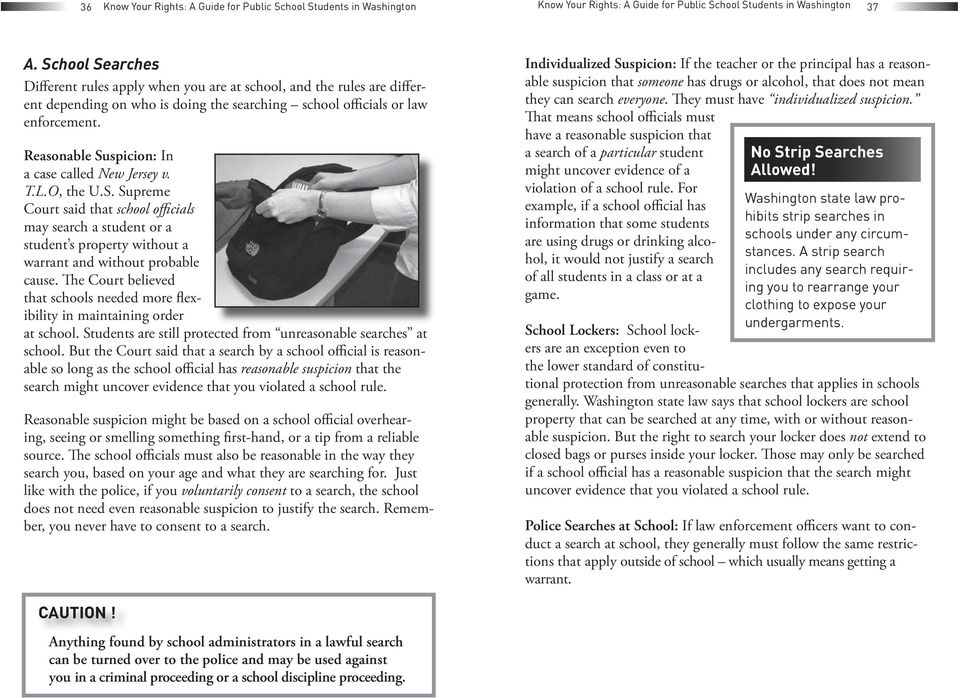
20 36 Know Your Rights: A Guide for Public School Students in Washington Know Your Rights: A Guide for Public School Students in Washington 37 A. School Searches Different rules apply when you are at school, and the rules are different depending on who is doing the searching school officials or law enforcement. Reasonable Suspicion: In a case called New Jersey v. T.L.O, the U.S. Supreme Court said that school offi cials may search a student or a student s property without a warrant and without probable cause. The Court believed that schools needed more flexibility in maintaining order at school. Students are still protected from unreasonable searches at school. But the Court said that a search by a school official is reasonable so long as the school official has reasonable suspicion that the search might uncover evidence that you violated a school rule. Reasonable suspicion might be based on a school official overhearing, seeing or smelling something first-hand, or a tip from a reliable source. The school officials must also be reasonable in the way they search you, based on your age and what they are searching for. Just like with the police, if you voluntarily consent to a search, the school does not need even reasonable suspicion to justify the search. Remember, you never have to consent to a search. Individualized Suspicion: If the teacher or the principal has a reasonable suspicion that someone has drugs or alcohol, that does not mean they can search everyone. They must have individualized suspicion. That means school officials must have a reasonable suspicion that a search of a particular student might uncover evidence of a violation of a school rule. For example, if a school official has information that some students are using drugs or drinking alcohol, it would not justify a search of all students in a class or at a game. No Strip Searches Allowed! Washington state law prohibits strip searches in schools under any circumstances. A strip search includes any search requiring you to rearrange your clothing to expose your undergarments. School Lockers: School lockers are an exception even to the lower standard of constitutional protection from unreasonable searches that applies in schools generally. Washington state law says that school lockers are school property that can be searched at any time, with or without reasonable suspicion. But the right to search your locker does not extend to closed bags or purses inside your locker. Those may only be searched if a school official has a reasonable suspicion that the search might uncover evidence that you violated a school rule. Police Searches at School: If law enforcement officers want to conduct a search at school, they generally must follow the same restrictions that apply outside of school which usually means getting a warrant. CAUTION! Anything found by school administrators in a lawful search can be turned over to the police and may be used against you in a criminal proceeding or a school discipline proceeding.
21 38 Know Your Rights: A Guide for Public School Students in Washington Know Your Rights: A Guide for Public School Students in Washington 39 What about School Resource Officers? It has become increasingly common to have police officers working full- or part-time in schools, often as School Resource Officers. Whether an officer s title is School Resource Officer or Police Officer, law enforcement officers serve a different function than school administrators. If a law enforcement officer, including a School Resource Officer, wants to search you or your belongings, you can ask if they have a warrant. You can always tell them that you do not consent to the search. Remember to do so politely but firmly, and never physically resist an officer. If you have questions about whether you have been improperly searched at school, you can call the ACLU to see if we can help. B. Drug Tests and Dog Sniffs Generally, the Fourth Amendment protects people from suspicionless searches. A suspicionless search is one conducted without any reason to suspect evidence of a crime. Doing drug testing of all students, or all athletes, would mean conducting suspicionless searches. But, in 2002, in a case called Board of Education of Pottawatomie County v. Earls, the U.S. Supreme Court said it was okay for schools to require all students in voluntary extracurricular activities to submit to drug-testing. Still, the Washington State Constitution may prohibit suspicionless drug tests in Washington public schools. The Washington Supreme Court has said that a school violated students rights by requiring all students to consent to have their bags searched for alcohol in order to go on a school trip. Because that search was done without individualized suspicion, it violated our state constitution. The Washington Supreme Court has not yet decided whether the kind of drug test- ing approved by the U.S. Supreme Court would be prohibited by our state constitution. Because states are free to give their citizens greater protection, students in Washington could be protected from suspicionless drug testing. Dog Sniffs: Some schools have turned to dogs to try to sniff out drugs and weapons. Like the law on drug testing, the law on dog sniffs is not yet clear. Some courts have said that dog sniffs of lockers, classrooms, students bags or other things are okay, even without any particular suspicion. But courts have said suspicionless dog sniffs of students are not allowed. Students in Washington might be protected from dog sniffs conducted without any reasonable suspicion, and are almost certainly protected from dogs sniffing the students. C. Police Interrogation Learn More about Student Drug Testing and Drug Sniffing Dogs The ACLU of Washington has helped students stand up for their right not to be searched without any reasonable suspicion at school. You can read about those cases and find both practical and legal reasons why suspicionless drug testing and drug sniffing dogs do not make sense at school. Look in the Student/ Youth Rights section of our Web site: No person... shall be compelled in any criminal case to be a witness against himself... U.S. Constitution, Amend. V. No person shall be compelled in any criminal case to give evidence against himself... Washington State Constitution, Article I, Section 9
22 40 Know Your Rights: A Guide for Public School Students in Washington Know Your Rights: A Guide for Public School Students in Washington Your Rights off School Grounds You have the right to remain silent when you are questioned by the police. The Fifth Amendment of the U.S. Constitution protects the right against self incrimination. That means that you cannot be required by the government at any time to make statements that might implicate you in any crime. It means that you cannot be coerced into a confession by police, and you cannot be forced to testify against yourself in any criminal proceeding. In the famous case of Miranda v. Arizona, the U.S. Supreme Court said that in order to protect that right, before a police officer can interrogate you when you are in police custody, the officer must read you your Miranda rights : You have the right to remain silent Anything you say can be used against you in a court of law You have the right to an attorney If you cannot afford an attorney, one will be appointed for you at no charge If you are questioned by a police officer, the most careful course of action is not to say anything until you have talked to a lawyer. Can Students Give up Their Right to Remain Silent on Their Own? It depends. Children under age 12 are legally unable to waive some of their rights, including their right to remain silent, unless a parent or guardian consents. Whether youth who are 12 or older have voluntarily waived their rights is determined by the totality of the circumstances. One of those circumstances may be whether or not you had the chance to talk to a lawyer or your parent before waiving your rights. If an officer begins questioning you, you can ask if you are free to leave. If the officer says yes, you should take the opportunity to go to a private place to contact a parent or lawyer before continuing to talk to the officer. If the officer says no, you should not answer any more questions without speaking to a lawyer. Remember, police questioning is not always done through direct questions. It can include anything that is designed to prompt you to make comments or statements about the incident. You should not give an officer any explanations, excuses or stories. You can explain yourself later, if necessary, based on what you and your lawyer decide What if I ask to call my parents and the officer says no? First, remember that you always have the right to remain silent. A police officer might refuse to let you call your parents. That does not mean you have to talk to the officer. If you want to talk to your parent, a lawyer or other trusted adult before you talk to a police officer, you can. Tell the officer you want to talk to your parent or a lawyer first, and that you are invoking your right to remain silent. If the officer continues to ask you questions, ask to talk with a lawyer. You can say that you have been advised not to answer questions without your parent or lawyer present. is best. If you continue to speak, you may give up some very important rights. To avoid trouble, you can give the officer your name and address, then tell the officer that you want to speak with a lawyer right away and refuse to answer any further questions. When you ask for a lawyer, you must be crystal clear: say, I want to talk to a lawyer, not I might want to talk to a lawyer. If you are afraid to say no to an officer, you can tell the officer that you were told not to talk to the police without a parent or a lawyer present.
23 42 Know Your Rights: A Guide for Public School Students in Washington Know Your Rights: A Guide for Public School Students in Washington 43 If a police officer asks you to sign a written form giving up your rights, you do not have to sign it! 2. Your Rights on School Grounds You have the right to remain silent when you are questioned by the police. Generally, you should not have to worry about being questioned by police at school. School is a place for learning, not law enforcement. So for the most part, police work should take place off school grounds. If you violate a school rule even if it might also be a minor criminal violation the investigation and punishment can be handled by school officials. School officials are not required to call the police for every potential violation. If the police need to question you, and there is no emergency, they should be able to do it outside of school hours at a police precinct or other location, and at a time when you can have a lawyer and/or a parent or guardian present. Sometimes it is necessary to call for police help at school when emergencies arise. If questioning by police does occur at school: Check out your school s policy on police in schools! Your school should have a clear policy, so that school officials will know what to do when it is necessary for a police officer to question a student at school. Ask if your school has a written policy and procedure on relations with law enforcement. If the policy does not require a reasonable effort to contact your parents, ask your school to change it! Many schools have adopted policies requiring school principals to contact parents before students of any age are questioned by police. No student should have to face the critical decision of whether or not to give up their constitutional rights alone. If you want help changing your school s policy, you can call the ACLU. The principal or another school official should be present No interrogation should take place in front of other students Your parent or guardian should be contacted as soon as possible, preferably before interrogation, and immediately if you are arrested. Any interrogation of a student must also comply with the legal requirements of an interrogation of an adult. That is, once students are in police custody, they must be told their Miranda rights. REMEMBER, YOU HAVE THE RIGHT TO REMAIN SILENT. IF A POLICE OFFICER ASKS YOU TO SIGN A FORM GIVING UP YOUR RIGHTS, YOU DO NOT HAVE TO SIGN IT! Questioning by School Officials: If you are questioned by a school official, rather than by police, the school official will probably not inform you of your Miranda rights. They are not required to do so, even if they intend to turn you over to the police. CAUTION! Statements made to a school official can be turned over to the police. Those statements may be used against you in a criminal proceeding or a school discipline proceeding. If a principal or other school administrator is asking you about a suspected school rule violation that could be a crime, you should ask them to call your parent or guardian first. Consider speaking to a lawyer before you make any statements about the incident. The principal might be annoyed by the delay, but you can explain that you would like to get your parent s or another trusted adult s advice about such an important matter.
24 44 Know Your Rights: A Guide for Public School Students in Washington Know Your Rights: A Guide for Public School Students in Washington 45 Directory information may include your: STUDENT RECORDS: PRIVACY AND ACCESS Schools keep records of each student s academic and personal progress. The records may include academic grades, teacher evaluations, disciplinary actions, attendance records, test scores and health records. A federal law, the Family Educational Rights and Privacy Act, commonly called FERPA, gives parents and adult or emancipated students access to student records. It also prevents the release of those records to most third parties without written consent. Washington state laws provide additional privacy protections for some student health records. Your school records are private, to a degree. Generally, the school must get written consent from your parent or you (if you are over 18 or legally emancipated) before it can disclose your records to anyone. In certain cases, schools can disclose your records without prior consent, including: to school officials who have legitimate educational interests to another school, if you transfer in compliance with a court order, and financial records can be given to financial aid personnel Certain identifying and contact information, often called directory information, has less protection and can be released without prior written consent unless your parent requests in advance that it not be given out. Your student handbook or school district s policy should tell you what information your school releases as directory information. Your school should also give you information about how you or your parent can opt out of having your directory information released without prior consent. name address telephone number address photo birth date degrees participation in activities and sports weight and height of members of athletic teams honors and awards received dates of attendance grade level most recent educational institution attended. There is a higher standard of privacy for records relating to HIV status or other sexually transmitted diseases, drug or alcohol treatment, mental health treatment, and family planning or abortion. You and your parents have the right to see most of your student records. If you or your parents request access to your records, the school must allow you to review them within five school business days after it receives your request, unless it gives you a written explanation for why it cannot. In no case can the school delay beyond 45 days after the request is made. Certain records may be withheld, including notes from a teacher not shown to anyone except a substitute teacher, records of students post-graduate activities, personnel records of school employees, and the records of Private Some records may not be released to your parents or others without your written consent: Only you may authorize release of records concerning birth control or abortion If you are 13 or older, only you may authorize release of drug, alcohol or mental health treatment records If you are 14 or older, only you may authorize release of records relating to HIV or other sexually transmitted diseases.
25 46 Know Your Rights: A Guide for Public School Students in Washington Know Your Rights: A Guide for Public School Students in Washington 47 a school where a student applied but never attended. Adult or emancipated students may be denied access to psychiatric records, recommendation letters, and parents financial records. Many school records are public records, and you have the right to see them if you ask for them. Washington s Public Records Act gives you the right to review the records of our state government agencies, including schools. If you want to learn more about how your school or district works, you can ask to see its records. Public records include lesson plans, school board meeting minutes, and school data on discipline, attendance or Correcting the Record What if there is a mistake or misleading information in my records? You and your parents have the right to ask that the records be changed. You should put your request in writing. If the school disagrees with you, you have the right to request a hearing to show why you think they should change the record. Even if you lose at the hearing, you have the right to include a statement in the records explaining why you believe the information is wrong. The school is required to include your statement every time it releases your records to someone else. academic achievement with students personally identifying information taken out. Military Recruiters Access to Your Records A section of the federal law called the No Child Left Behind Act gives military recruiters access to the names, addresses and telephone numbers of high school students. Schools must also give military recruiters the same access to school campus that they give to colleges or prospective employers. The law requires schools to give the information to military recruiters upon request unless you or your parents have opted out of having your information disclosed. The school must give your parents (or you if you are over 18) advance notice of the right to opt out and information about how and when to do it. Schools should allow you to opt out of supplying information to the military without requiring you to opt out of supplying the same information to colleges or job recruiters. If you have questions about military recruiters access to student information and school campuses, or about equal access for peace groups, see our brochure, Military Recruitment at High Schools, available in the Student/Youth Rights section of our Web site at: click on Other. If you request public records, schools must respond to you within five days, either by giving you what you have requested, by explaining why they cannot, or by giving you a reasonable estimate of when they can provide the documents. It is best to put your request in writing and to explain that you are making a request for public records so that you can be sure the school will respond as required. You can learn more about how to request public records from our brochure, How to Get Government Records, available on our Web site at:
26 48 Know Your Rights: A Guide for Public School Students in Washington Know Your Rights: A Guide for Public School Students in Washington 49 THE RIGHT TO A FREE PUBLIC EDUCATION It is the paramount duty of the state to make ample provision for the education of all children residing within its borders, without distinction or preference on account of race, color, caste, or sex. Washington State Constitution, Article IX, Section 1 Every child in Washington state has the right to a free public education. In fact, the Washington State Constitution says that providing an education is the paramount duty of the state. That means it is the most important duty of our state. The Washington Supreme Court said in 1978 that the constitution guarantees children in our state a basic education. In that case, called Seattle School District No. 1 v. State of Washington, the court said that the Legislature must define what a basic education is, and then fund it. At a minimum, the court said that the basic education provided by the state must: prepare you to participate intelligently and effectively in our open political system prepare you to exercise your First Amendment freedoms both as a source and receiver of information prepare you to be able to inquire, to study, to evaluate and to gain maturity and understanding It is up to the Legislature to provide more specific guidelines about what kind of education schools must provide. The Legislature has said that each school must provide opportunities for every student to develop essential knowledge and skills. Schools must provide a certain number of days of school per year, and a certain number of teachers per student. Each school must also provide instruction in the essential academic learning requirements, covering several subjects, including: reading, math, social studies, writing, arts and science. Schools can also provide alternative education programs, work skills and vocational education for students in grades A basic education includes special education services for students with disabilities and bilingual education for students learning English. A. Who Can Enroll and What Are the Requirements Children and youth between the ages of 5 and 21 have the right to attend a public school in the district where they live. Each district is responsible for deciding which school students will attend within that district. Schools can generally ask for certain kinds of documentation before they enroll a new student, like proof of age and residency. Schools can also ask you to prove that you have been immunized against certain diseases. You can be excused from the requirement if a doctor signs a statement saying that it would be harmful to you, or if a parent signs a statement that it goes against the parent s religious, philosophical, or personal beliefs. Enrolling Homeless Students The documentation requirements are different for homeless students, including students who are living with friends or family due to loss of housing, or are awaiting foster care placement. A federal law requires schools to enroll homeless students immediately, even if the student does not have the documents typically required for enrollment. The school can help you gather the necessary records after enrolling you! Every school is required have a person working as a liaison with homeless students and their families whom you can contact for additional information about your rights.
27 50 Know Your Rights: A Guide for Public School Students in Washington Know Your Rights: A Guide for Public School Students in Washington 51 All children living in the U.S. whether they are U.S. citizens or not have an equal right to a public education. Schools cannot refuse you admission based on your immigration status. In fact, the school cannot require you or your parents to provide a green card, social security number or other proof of citizenship or immigration status in order for you to go to school. If you do not have a social security number, the school can assign you a number generated by the school. School personnel have no legal obligation to enforce U.S. immigration laws. Schools should not do things that would discourage students or their parents from enrolling in schools, like asking for copies of documents to prove citizenship or asking questions about immigration or citizenship status. B. Compulsory Attendance: The Becca Bill You have a constitutionally guaranteed right to an education. You also have a legal obligation to go to school. A state law, called the Becca Bill, requires you to go to school regularly if you are between the ages of 8 and 18, and it requires your parents to make sure you are going. There are just a few exceptions for students who are in private school, are home-schooled, have a disability that prevents attendance, or are 16 and either have regular employment and their parents permission, or have already met graduation requirements. If you are under 18 years old, and you are found outside of school during school hours without a valid excuse, you can be picked up by any school district official or police officer and taken home or back to school. If you miss school without a valid excuse, the school is required to take a number of steps to help make sure you get to school regularly. The school is required to notify your parent or guardian of your absences. It is also required to work with you to figure out if there are problems at school or at home that are making it difficult to get to school. Then it must help try to resolve those problems. If you miss a certain number of days without an excuse either five or seven in a month or 10 in a year you can be referred to juvenile court or to a community truancy board. Once you have been referred to court, the court can enter an order directing you to go to school. Attendance Agreements and Court Orders: Often a school district representative will ask you and your parent to agree to an order that will later be signed by the judge. You are not required to agree to an order proposed by the school if you do not want to. You can require the school to present all of its evidence to the judge, giving you an opportunity to respond. Or you can negotiate with the school to make sure the terms of the order are fair and reasonable. You can ask CAUTION! If you violate a truancy court order, you can be sent to juvenile detention. If there is an order directing you to go to school (either one you agree to with the school district, or one issued directly by a judge), and then you intentionally violate that order for example, by missing more school you can be held in contempt of court. Before you can be held in contempt, you have the right to have an attorney appointed for you. If you are found in contempt, you can face severe consequences, including time in juvenile detention.
28 52 Know Your Rights: A Guide for Public School Students in Washington Know Your Rights: A Guide for Public School Students in Washington 53 the school to agree to take steps to help solve school-related problems and to write that agreement into the order, too. Be sure you do not sign an agreement that you will not be able live up to. To learn more about your rights in the truancy process, read our Parents Guide to Truancy in Washington, available in the Student/Youth section of our Web site at: click on Publications. Home Schooling. Washington law gives your parents the option to teach you at home. The laws relating to home schooling are meant to be flexible, but there are some minimum requirements. For example, home schooling must cover all the basic skills taught in public school. The parent who teaches at home must be supervised by a person with a teaching certificate, unless the parent has received some college education, has taken a course in how to conduct home schooling, or has been deemed qualified by the local school superintendent. Your parents must make sure that you either take a standardized achievement test or have a certified person provide a written assessment of your academic progress each year. If you are not making reasonable progress, your parent is required to make a good faith effort to remedy any deficiency. Decisions relating to philosophy or doctrine, selection of books, teaching materials and curriculum are left to your parent. C. Special Education Services Students with mental, physical, or learning disabilities are entitled to a free and appropriate education. A federal law called the Individuals with Disabilities in Education Act, the IDEA, requires schools to provide special education and related services to students with disabilities. Schools are required to try to make the school, as a whole, accessible to all students, and must provide evaluations, free of charge, to determine whether a child is eligible for special education services. Schools must develop Individualized Education Plans for students with disabilities, tailored to their particular needs. To the extent prac- tical, schools must provide services that allow students with disabilities to learn in the regular classroom alongside their peers. Students with disabilities have various additional rights relating to school discipline, services and accommodations. If you are receiving special education services, or if you feel that you need them because of a disability, we encourage you to seek out additional information about your rights. For more information about the rights of students with disabilities, see TeamChild s Education Advocacy Manual, available at their Web site: D. Bilingual Education Every student has the right to an equal educational opportunity, including students whose primary language is not English. Students who are still learning English have the right to transitional bilingual instruction or an alternative program designed to help them learn English. Generally, schools should provide transitional bilingual instruction, meaning instruction where concepts are introduced in a student s primary language and reinforced in English. Students are then tested in English. Whatever program the school provides, it should make it possible for you to keep learning in other school subjects, like math, history and science, while you learn English. Communicating with Parents. Schools are also required to send letters and notices to your parents in their primary language whenever it is practical. Your parents should get written notices in their primary language, especially important notices relating to school discipline, school attendance and special education. Your parents should also be able to talk to your teacher or principal, with a translator if necessary.
29 54 Know Your Rights: A Guide for Public School Students in Washington Know Your Rights: A Guide for Public School Students in Washington 55 English as a Second Language Is it okay if the only choice for English language learners is an English as a Second Language ( ESL ) class? It depends. Schools should provide transitional bilingual programs with teachers that teach in both English and the students primary language, like Spanish, Vietnamese or Somali. Schools in Washington can teach students English through an alternative program, like ESL, only if they meet one or more of the following conditions: The district cannot get the necessary bilingual instructional materials The district s bilingual instruction program is temporarily full because of an unexpected increase in the number of eligible students English language learners are too spread out through grade levels or schools or The district cannot get enough teachers trained in bilingual education and sufficiently skilled in the students primary language If you or your parents have questions about whether you can get information in your primary language, call the school or talk to one of your teachers. Ask what is available in your language. If you are having trouble getting translations or interpreters for school meetings, call the ACLU to see if we can help. SCHOOL DISCIPLINE AND GRIEVANCE PROCEDURES No state shall... deprive any person of life, liberty, or property, without due process of law. U.S. Constitution, Amend. XIV, Section 1 No person shall be deprived of life, liberty, or property, without due process of law. Washington State Constitution, Article I, Section 3 When you go to school, you have the obligation to obey your school s written rules. But there are some limits on what kinds of conduct the school can ban. School rules must be reasonable and have a logical relationship to the school s legitimate interests. They must also respect your fundamental rights, including your rights to free speech and freedom of religion. Before the school can kick you out or discipline you for violating its rules, you have the right to due process, or fair procedures. That means, except in emergencies, before a school can exclude you from class, or suspend or expel you from school, you have a right to know what you are accused of doing and what rule you are accused of breaking. You also have the right to an opportunity to tell your side of the story. When the sanctions are more severe, such as long-term suspensions or expulsions, you have a right to a more formal hearing process where you can present your case and challenge the sanction the school wants to impose.
30 56 Know Your Rights: A Guide for Public School Students in Washington Learn More For detailed information about your rights relating to school discipline and the processes you can use to challenge disciplinary sanctions, please see our Parents Guide to Public School Discipline in Washington, available in the Student/Youth Rights section of our Web site: Remember, the deadlines for requesting a hearing and preserving your right to challenge certain disciplinary sanctions are short just three days for long-term suspensions and expulsions, and 10 days for emergency expulsions so be aware of deadlines! ---- Portions adapted from: Students Rights Guide, ACLU of Northern California, Know Your Rights Manual, ACLU of Pennsylvania, and Know Your Rights: A Handbook for Public School Students in Florida, ACLU of Florida When you know your rights, you can speak up when they are being violated. If you have questions about your rights at school, or want help in protecting your rights, call the ACLU to see if we can help. It is never too soon to stand up for your rights!
31 The American Civil Liberties Union of Washington Foundation is the legal, research, and educational arm of the American Civil Liberties Union of Washington, a nonprofit, nonpartisan membership organization devoted to protecting and extending the civil liberties of all people in Washington. AMERICAN CIVIL LIBERTIES UNION OF WASHINGTON FOUNDATION 705 2ND AVENUE, 3RD FL., SEATTLE, WA WA.ORG 6/2007
Students: Know Your Rights
 Students: Know Your Rights "Congress shall make no law respecting an establishment of religion, or prohibiting the free exercise thereof; or abridging the freedom of speech, or of the press, or the right
KNOW YOUR RIGHTS KNOW YOUR RIGHTS. A Guide for Trans and Gender Nonconforming Students
 KNOW YOUR RIGHTS KNOW YOUR RIGHTS A Guide for Trans and Gender Nonconforming Students KNOW YOUR RIGHTS: A GUIDE FOR TRANS AND GENDER NONCONFORMING STUDENTS Whether you re a girl who doesn t act like one,
Tinker v. Des Moines Independent School District (1969)
 Journalism 1 Review Tinker v. Des Moines Independent School District (1969) Issue: Freedom of Speech at School Bottom Line: You Have the Right To Express Yourself Up to a Point Background In December 1965,
SCHOOL SAFETY & VIOLENCE PREVENTION FOR LESBIAN, GAY, BISEXUAL & TRANSGENDER STUDENTS:
 SCHOOL SAFETY & VIOLENCE PREVENTION FOR LESBIAN, GAY, BISEXUAL & TRANSGENDER STUDENTS: A Question & Answer Guide for California School Officials & Administrators A publication of the California Safe Schools
Know Your Rights. A Students Rights Handbook. Researched and Written by the American Civil Liberties Union of Vermont for Vermont Students
 Know Your Rights A Students Rights Handbook Researched and Written by the American Civil Liberties Union of Vermont for Vermont Students I. Introduction Know Your Rights, written by the American Civil
PARENTS GUIDE TO TRUANCY IN WASHINGTON
 PARENTS GUIDE TO TRUANCY IN WASHINGTON Parents Guide to Truancy in Washington This guide is designed to help parents understand their children s rights in the truancy process. It is not meant to provide
INTRODUCTION STUDENT RIGHTS
 INTRODUCTION Fairfax County Public Schools is committed to creating a safe, welcoming school community that stimulates intellectual curiosity, fosters respect for individual differences, inspires and enables
BULLYING/ANTI-HARASSMENT
 BULLYING/ANTI-HARASSMENT The state of Mississippi has established legislation requiring Bullying Prevention to be taught in schools. Executive Summary The purpose of this policy is to assist the Mississippi
firstamendmentcenter.org Your First Freedoms A Basic Guide to the First Amendment
 firstamendmentcenter.org Your First Freedoms A Basic Guide to the First Amendment Q: What is the First Amendment and where does it come from? A: The First Amendment consists of 45 words added to the Constitution
PREVENTING SEXUAL MISCONDUCT IN OUR SCHOOLS
 PREVENTING SEXUAL MISCONDUCT IN OUR SCHOOLS Scott County Public Schools (SCPS) Policies and Regulations JBA-F, JFHA/GBA & JFJA-F/GBA-F Parent/Student Handbook THERE ARE SEVERAL FORMS OF SEXUAL MISCONDUCT.
Top Ten Rules That Govern School Authority Over Student Cyber Expressions
 11 Top Ten Rules That Govern School Authority Over Student Cyber Expressions Although conflicting court decisions have surfaced and jurisdictional variations exist, the following general principles guiding
Background on the First Amendment
 Background on the First Amendment Congress shall make no law respecting an establishment of religion, or prohibiting the free exercise thereof; or abridging the freedom of speech, or of the press, or the
Question & Answer Guide On California s Parental Opt-Out Statutes:
 Question & Answer Guide On California s Parental Opt-Out Statutes: Parents and Schools Legal Rights And Responsibilities Regarding Public School Curricula A publication of the California Safe Schools Coalition
CITY OF LOS ANGELES SEXUAL ORIENTATION, GENDER IDENTITY, AND GENDER EXPRESSION DISCRIMINATION COMPLAINT PROCEDURE
 CITY OF LOS ANGELES SEXUAL ORIENTATION, GENDER IDENTITY, AND GENDER EXPRESSION DISCRIMINATION COMPLAINT PROCEDURE The policy of the City of Los Angeles has been, and will continue to be, to promote and
SCHOOL LAW STUDY GUIDE CALIFORNIA STATE UNIVERSITY, NORTHRIDGE MICHAEL D. EISNER COLLEGE OF EDUCATION EDUCATIONAL LEADERSHIP & POLICY STUDIES
 SCHOOL LAW STUDY GUIDE CALIFORNIA STATE UNIVERSITY, NORTHRIDGE MICHAEL D. EISNER COLLEGE OF EDUCATION EDUCATIONAL LEADERSHIP & POLICY STUDIES US CONSTITUTION General Welfare Clause is found in the preamble
SCHOOL LAW STUDY GUIDE
 SCHOOL LAW STUDY GUIDE CALIFORNIA STATE UNIVERSITY, NORTHRIDGE MICHAEL D. EISNER COLLEGE OF EDUCATION EDUCATIONAL LEADERSHIP & POLICY STUDIES US CONSTITUTION General Welfare Clause is found in the preamble
SUSPENSIONS. A record of the suspension will be included in your child s Ontario Student Record (OSR).
 SUSPENSIONS Having your child sent home from school can be one of the most difficult situations for a parent or guardian, and can be very disruptive for your family. If your child is suspended, expelled,
Sexual Harassment Awareness
 Sexual Harassment Awareness Orientation: This week s on-line assignment is about sexual harassment in the school and the workplace. We are discussing this subject because sexual harassment is an illegal
Best Practices TEACHING TOLERANCE. Creating an LGBT-inclusive School Climate. A Teaching Tolerance Guide for School Leaders
 Best Practices Creating an LGBT-inclusive School Climate A Teaching Tolerance Guide for School Leaders TEACHING TOLERANCE A PROJECT OF THE SOUTHERN POVERTY LAW CENTER TOLERANCE.ORG Best Practices Creating
APPENDIX C. HARASSMENT, BULLYING, DISCRIMINATION, AND HATE CRIMES (Adaptedfrom the Attorney General's Safe Schools initiative)
 APPENDIX C HARASSMENT, BULLYING, DISCRIMINATION, AND HATE CRIMES (Adaptedfrom the Attorney General's Safe Schools initiative) This section of the Code of Conduct has been adapted from the Greenfield Public
Acalanes Union HSD Board Policy Sexual Harassment
 Acalanes Union HSD Board Policy Sexual Harassment BP 5145.7 Students The Governing Board is committed to maintaining a safe school environment that is free from harassment and discrimination. The Board
GUIDANCE ON SEXUAL HARASSMENT FOR ALL EMPLOYERS IN NEW YORK STATE
 ANDREW M. CUOMO Governor HELEN DIANE FOSTER Commissioner GUIDANCE ON SEXUAL HARASSMENT FOR ALL EMPLOYERS IN NEW YORK STATE STATUTORY REQUIREMENTS Sex discrimination is unlawful pursuant to the New York
ANNUAL PUBLIC NOTICES
 ANNUAL PUBLIC NOTICES SAFE ENVIRONMENT PROGRAM - EMPLOYEES AND VOLUNTEERS All employees of the diocese, parishes or schools, as well as volunteers, who have regular contact with children, are required
STUDENT PROTECTION FROM DISCRIMINATION AND HARASSMENT
 STUDENT PROTECTION FROM DISCRIMINATION AND HARASSMENT The Law School has been embracing diversity and equal opportunity since its founding in 1899. Our founders believed that a legal education should be
Ventura Charter School of Arts & Global Education Board Policy for Acceptable Use and Internet Safety
 Ventura Charter School of Arts & Global Education Board Policy for Acceptable Use and Internet Safety Student Policy--SP004 Ventura Charter School of Arts and Global Education ("School") recognizes the
Workplace Anti-Harassment Policy (Alberta)
 Workplace Anti-Harassment Policy (Alberta) Intent It is public policy in Canada to recognize the dignity and worth of every person and to provide for equal rights and opportunities free of discrimination.
Franklin Technology Center s Code of Conduct
 Franklin Technology Center s Code of Conduct Franklin Technology Center is comprised of students, faculty, staff and administrators. This community recognizes the need to establish a code of conduct that
A Handbook for Public School Students in Pennsylvania
 A Handbook for Public School Students in Pennsylvania About this booklet If you are a public school student in Pennsylvania, you have rights. This booklet tells you about those rights, when you can use
Edward W. Brooke Charter School Bullying Prevention and Intervention Plan 12.14.2010
 I. LEADERSHIP & PROCESS Priority Statement Edward W. Brooke Charter School has always been and will continue to be a place where students are held to the highest behavioral standards and where we work
Know your rights. Q: What If police, FBI, or immigration agents contact me? Do I have to answer questions?
 Know your rights What rights do I have as a non-immigrant, F-1/J-1 visa holder? Whether or not you re a citizen, you have rights under the United States Constitution. The Fifth Amendment gives every person
ON THE JOB. Employment
 ON THE JOB Employment In order to work in the United States, you must have a social security number, as required by the federal Social Security Act. If you do not have a social security number, you have
How To Resolve A Complaint Of Discrimination In The United States
 ANN ARBOR PUBLIC SCHOOLS TITLE IX GRIEVANCE PROCEDURES PURPOSE: The purpose of these procedures is to secure, at the lowest possible level, prompt and equitable resolutions of complaints based on sex discrimination,
DEPARTMENT OF PUBLIC WORKS MANAGEMENT MANUAL
 DEPARTMENT OF PUBLIC WORKS MANAGEMENT MANUAL Personnel Directive Subject: PROCEDURE FOR PREVENTING AND/OR RESOLVING PROBLEMS RELATED TO SEXUAL HARASSMENT ADOPTED BY THE BOARD OF PUBLIC WORKS, CITY OF LOS
AN ACT RELATIVE TO BULLYING IN SCHOOLS.
 Senate, No. 2404 [Senate, Wednesday, April 28, 2010 Report of the committee of conference on the disagreeing votes of the two branches, with reference to the House amendments to the Senate Bill relative
OXFORD COMMUNITY SCHOOLS 10 North Washington Street, Oxford, Michigan 48371 ACCEPTABLE USE POLICY
 OXFORD COMMUNITY SCHOOLS 10 North Washington Street, Oxford, Michigan 48371 ACCEPTABLE USE POLICY 1. Purpose Oxford Community Schools (the District ) recognizes that advancements in technology affect the
BETHEL SCHOOL DIST. NO. 403 v. FRASER, 478 U.S. 675 (1986)
 BETHEL SCHOOL DIST. NO. 403 v. FRASER, 478 U.S. 675 (1986) Argued March 3, 1986 Decided July 7, 1986 CHIEF JUSTICE BURGER delivered the opinion of the Court. We granted certiorari to decide whether the
ANTI-DISCRIMINATION, HARASSMENT AND BULLYING (STUDENT POLICY)
 Page 1 ANTI-DISCRIMINATION, HARASSMENT AND BULLYING (STUDENT POLICY) The Board of Education is committed to promoting the worth and dignity of all individuals. It believes that all employees and students
University Schools Social Media Guidelines for Employees
 University Schools Social Media Guidelines for Employees Purpose of Social Media Guidelines All University Schools Laboratory Employees are subject to the Ball State University Social Media Policy available
2014 Bill 10. Third Session, 28th Legislature, 63 Elizabeth II THE LEGISLATIVE ASSEMBLY OF ALBERTA BILL 10
 2014 Bill 10 Third Session, 28th Legislature, 63 Elizabeth II THE LEGISLATIVE ASSEMBLY OF ALBERTA BILL 10 AN ACT TO AMEND THE ALBERTA BILL OF RIGHTS TO PROTECT OUR CHILDREN MS JANSEN First Reading.......................................................
Chicago Public Schools Policy Manual
 Chicago Public Schools Policy Manual Title: ANTI-BULLYING POLICY Section: 705.5A Board Report: 14-0625-PO1 Date Adopted: June 25, 2014 Policy: ANTI-BULLYING POLICY Purpose The Illinois General Assembly
4014.2. PERSONNEL All Staff Permanent Personnel Conditions of Employment Equal Employment Opportunity/Anti-Harassment
 PERSONNEL All Staff Permanent Personnel Conditions of Employment Equal Employment Opportunity/Anti-Harassment 4014.2 It is the policy of the Clintonville Public School District that no person may be illegally
Rights for Individuals in Mental Health Facilities
 HANDBOOK Rights for Individuals in Mental Health Facilities Admitted Under the Lanterman-Petris-Short Act C A L I F O R N I A D E P A R T M E N T O F Mental Health How to Reach Your Patients Rights Advocate
School Policy Regarding Computer Use, Technology and Internet Access
 School Policy Regarding Computer Use, Technology and Internet Access Please read the following carefully, as it provides information about the responsibilities and expectations regarding use of school
STUDENTS RIGHTS, FREEDOMS, AND RESPONSIBILITIES
 STUDENTS RIGHTS, FREEDOMS, AND RESPONSIBILITIES The role of the University of Alaska Anchorage is to encourage people of all ages to develop their skills and talents differently, according to individual
SUMMER 2014 LEGAL INTERNSHIP OPPORTUNITY NOTICE TO LAW STUDENTS American Civil Liberties Union Foundation Reproductive Freedom Project, NY
 STUDENT OPPORTUNITIES SUMMER 2014 LEGAL INTERNSHIP OPPORTUNITY NOTICE TO LAW STUDENTS American Civil Liberties Union Foundation Reproductive Freedom Project, NY the country s largest team of public interest
August 2007 Education and Membership Development Department
 August 2007 Education and Membership Development Department Table of Contents Title VII of the Civil Rights Act of 1964 3 What is Sexual Harassment? 3 4 How Can Sexual Harassment Occur? 4 5 When is an
Racial Harassment and Discrimination Definitions and Examples (quotes are from the Stephen Lawrence Inquiry report, 23 March, 1999)
 APPENDIX C Racial Harassment and Discrimination Definitions and Examples (quotes are from the Stephen Lawrence Inquiry report, 23 March, 1999) Racial Harassment is an act designed to intimidate, humiliate,
The University of Bolton does not have any religious affiliation and does not endorse any particular denomination or faith.
 POLICY ON RELIGION OR BELIEF 1 1. Policy Statement 1.1 Statement of Intent The University of Bolton celebrates and values the diversity of its community and aims to create a harmonious working and learning
Comprehensive Sex Education
 Comprehensive Sex Education Planned Parenthood s Nevada Parent Activist Packet Our school system needs to provide age appropriate information about human sexuality as early as second grade - kids have
How to Protect Students from Sexual Harassment: A Primer for Schools
 How to Protect Students from Sexual Harassment: A Primer for Schools This fact sheet is part of a series of tools designed by the National Women s Law Center to help schools address the dropout crisis.
VIDEO SCRIPT. Bullying, Harassment, & Civil Rights: An Overview of School Districts Federal Obligation to Respond to Harassment
 SCRIPT TITLE: PREPARED BY: LEGEND: Bullying, Harassment, & Civil Rights: An Overview of School Districts Federal Obligation to Respond to Harassment National Center on Safe Supportive Learning Environments,
The World Bank Group Policy on Eradicating Harassment Guidelines for Implementation
 1.0 Introduction The World Bank Group Policy on Eradicating Harassment Guidelines for Implementation The World Bank Group is committed to fostering a workplace free of harassment and intimidation, where
Social Studies Lesson Plan Evaluating the importance of civic responsibilities in American democracy.
 Teacher s Name: Employee Number: School: Social Studies Lesson Plan Evaluating the importance of civic responsibilities in American democracy. 1. Title: The Importance of Civic Responsibilities in American
LOS ANGELES UNIFIED SCHOOL DISTRICT Policy Bulletin
 TITLE: NUMBER: ISSUER: Sexual Harassment Policy (Employee-To-Employee) BUL-1893.1 Kevin S. Reed, General Counsel ROUTING Principals Administrators All Employees DATE: August 1, 2005 POLICY: The Los Angeles
NEW JERSEY STATE POLICY PROHIBITING DISCRIMINATION IN THE WORKPLACE
 NEW JERSEY STATE POLICY PROHIBITING DISCRIMINATION IN THE WORKPLACE I. POLICY a. Protected Categories The State of New Jersey is committed to providing every State employee and prospective State employee
BERKELEY COLLEGE Equal Opportunity Policy
 BERKELEY COLLEGE Equal Opportunity Policy Purpose Recognizing that its diversity greatly enhances the workplace and opportunities for learning, Berkeley is firmly committed to providing all associates,
719.00 INTERNET, ELECTRONIC DEVICE, AND SOCIAL MEDIA USAGE POLICY FOR STAFF (Adopted 8/18/14, Revised 2/2/15)
 719.00 INTERNET, ELECTRONIC DEVICE, AND SOCIAL MEDIA USAGE POLICY FOR STAFF (Adopted 8/18/14, Revised 2/2/15) The Stoughton Area School District is committed to the appropriate use of the Internet and
Know Your. Help End Discriminatory, Abusive & Illegal Policing! ChangeTheNYPD.org @changethenypd facebook.com/changethenypd
 Know Your Rights! Help End Discriminatory, Abusive & Illegal Policing! ChangeTheNYPD.org @changethenypd facebook.com/changethenypd This brochure describes some of your rights under the law when interacting
Fair Employment Practices
 In the GE Community Fair Employment Practices (Policy 20.2) Issued: October 2000 Supersedes: April 1993 GE is committed to fair employment practices, including the prohibition against all forms of illegal
POLICY 5111 ANTI-BULLYING/HARASSMENT/HATE
 POLICY 5111 Purpose/Introduction: The Kenosha Unified School District strives to provide a safe, secure and respectful learning environment for all students in school buildings, on school grounds, in school
POLICY TITLE: Computer and Network Service POLICY NO: 698 PAGE 1 of 6
 POLICY TITLE: Computer and Network Service POLICY NO: 698 PAGE 1 of 6 GENERAL Computer network service through the Internet provides an electronic highway connecting millions of computers around the world.
Human Resources Policy and Procedure Manual
 Procedure: maintains a computer network and either purchases software for use in the network or develops proprietary software systems for Company use. Company employees are generally authorized to use
Vail School District Acceptable Use Policy 2015 2016
 Vail School District Acceptable Use Policy 2015 2016 You have a wonderful opportunity before you! You have the opportunity to use the school's technology resources for your education. These resources will
THE LAW AND YOU. What can I do when the School Board and I disagree on discipline? Do I have a choice when Family Court decides who I ll live with?
 THE LAW AND YOU 15-1 Each state has particular laws that deal with acts usually committed by young people. Just because someone is under the age of 17 (considered a juvenile) does not mean that laws do
Mentor Public Schools Board of Education 6.48 Policy Manual page 1 Chapter VI Pupil Personnel STUDENT E-MAIL, INTERNET AND COMPUTER USE
 Policy Manual page 1 STUDENT E-MAIL, INTERNET AND COMPUTER USE Access to the Internet is being offered by Mentor Public Schools through the IT Department. The District is also pleased to provide its students
HARTFORD PUBLIC SCHOOLS DISTRICT SAFE SCHOOL CLIMATE PLAN
 HARTFORD PUBLIC SCHOOLS DISTRICT SAFE SCHOOL CLIMATE PLAN The Hartford Public Schools Board of Education is committed to creating and maintaining a physically, emotionally, and intellectually safe educational
Non-Discrimination and Anti-Harassment Policy OP 03.03
 Non-Discrimination and Anti-Harassment Policy OP 03.03 Policy Mississippi State University is committed to assuring that the University and its programs are free from discrimination and harassment based
Computer, Network, and Internet Use Student Policy (As of 8/1/09)
 Computer, Network, and Internet Use Student Policy (As of 8/1/09) I. Overview a. Purpose The intent of this regulation is to provide students with general requirements for utilizing Buffalo Valley Public
CHARLES CITY COMMUNITY SCHOOL DISTRICT BASIC INSTRUCTION PROGRAM
 Code No. 603.1 BASIC INSTRUCTION PROGRAM The basic instruction program will include the courses required for each grade level by the State Department of Education. The instructional approach will be gender
COLUMBIA COLLEGE CHICAGO 1 ANTI-DISCRIMINATION & HARASSMENT POLICY
 COLUMBIA COLLEGE CHICAGO 1 Section I. Statement of Policy Columbia is committed to maintaining an environment that respects the dignity of all individuals. Accordingly, Columbia will not tolerate harassment
COMMUNITY RELATIONS 4411 Page 1 of 5
 1 1 1 1 1 1 1 1 0 1 0 1 0 1 Livingston School District COMMUNITY RELATIONS Page 1 of Interrogation and Investigations Conducted by School Officials The administration has the authority and duty to conduct
North Clackamas School District 12
 North Clackamas School District 12 Code: IIBGA-AR Revised/Reviewed: 3/06/08; 6/21/12 Orig. Code(s): SP IIBGA Guidelines for the Use of the District s Electronic Communication System Definitions 1. Technology
Personal beliefs and medical practice
 You can find the latest version of this guidance on our website at www.gmc-uk.org/guidance. Published 25 March 2013 Comes into effect 22 April 2013 Personal beliefs and medical practice 1 In Good medical
First Amendment Freedoms
 The First Amendment Congress shall make no law respecting an establishment of religion, or prohibiting the free exercise thereof; or abridging the freedom of speech, or of the press, or the right of the
Intersection of Title IX and the Clery Act. What types of incidents must be reported to school officials under Title IX and the Clery Act?
 Intersection of Title IX and the Clery Act The purpose of this chart is to clarify the reporting requirements of Title IX and the Clery Act in cases of sexual violence and to resolve any concerns about
University of Illinois at Chicago Student Sexual Misconduct and Sexual Violence Interim Policy
 University of Illinois at Chicago Student Sexual Misconduct and Sexual Violence Interim Policy Introduction The University of Illinois at Chicago is committed to creating a safe and secure community for
COUNTY OF RIVERSIDE, CALIFORNIA BOARD OF SUPERVISORS POLICY. Policy Subject: Number Page. HARASSMENT POLICY AND COMPLAINT PROCEDURE C-25 1 of 3
 HARASSMENT POLICY AND COMPLAINT PROCEDURE C-25 1 of 3 PURPOSE: The purpose of this policy is to establish a strong commitment to prohibit and to prevent unlawful harassment in employment, and to set forth
GUILFORD PUBLIC SCHOOLS ACCEPTABLE USE POLICY
 GUILFORD PUBLIC SCHOOLS ACCEPTABLE USE POLICY Telecommunications is radically changing the way the world accesses information. A computer network, linked to the Internet, an international computer network
INTRODUCTION 2 WORKPLACE HARASSMENT
 INTRODUCTION This brochure is intended to educate Treasury employees about the prevention of harassment in the workplace. Harassment is a matter of particular concern because it seriously damages the employee-employer
Computer, Network, Internet and Web Page Acceptable Use Policy for the Students of the Springfield Public Schools
 Computer, Network, Internet and Web Page Acceptable Use Policy for the Students of the The computer and information technology resources, which includes World Wide Web access and electronic mail capability,
Suggested List of Issues to Country Report Task Force on the United States. December 17, 2012. Center for Constitutional Rights
 Violations of Human Rights Obligations under the International Covenant on Civil and Political Rights through the New York Police Department s Stop and Frisk Practices Suggested List of Issues to Country
HEALTH CARE RIGHTS AND TRANSGENDER PEOPLE March 2012
 HEALTH CARE RIGHTS AND TRANSGENDER PEOPLE March 2012 For the first time, the Affordable Care Act of 2010 banned sex discrimination in many health care facilities and programs. While we still desperately
Sexual Harassment, Prevention and California Law
 Sexual Harassment, Prevention and California Law Sexual Harassment in the Workplace Sexual harassment is a form of sex discrimination that violates Title VII of the Civil Rights Act of 1964. Title VII
ARTICLE I: GENERAL ADMINISTRATION
 ARTICLE I: GENERAL ADMINISTRATION Table of Contents 5-1.1 Personnel Policies-Goals 5-1.2 Equal Employment Opportunity/Sexual Harassment 5-1.3 Board-Staff Communications 5-1.4 Definitions 5-1.5 Personnel
ARTICLE VIII CONDUCT ON CAMPUS
 ARTICLE VIII CONDUCT ON CAMPUS 9801. RESPONSIBILITY OF BOARD OF TRUSTEES. The Board of Trustees shall prescribe and enforce rules relating to the conduct of students, college personnel, associated student