
Optimux-XLT1. Multiple T1 and Ethernet Multiplexer Installation and Operation Manual. Notice
|
|
|
- Gertrude Corey Boyd
- 10 years ago
- Views:
Transcription
1 Optimux-XLT1 Multiple T1 and Ethernet Multiplexer Installation and Operation Manual Notice This manual contains information that is proprietary to RAD Data Communications. No part of this publication may be reproduced in any form whatsoever without prior written approval by RAD Data Communications. No representation or warranties for fitness for any purpose other than what is specifically mentioned in this manual is made either by RAD Data Communications or its agents. For further information contact RAD Data Communications at the address below or contact your local distributor. International Headquarters RAD Data Communications Ltd. 24 Raoul Wallenberg St. Tel Aviv Israel Tel: Fax: U.S. Headquarters RAD Data Communications Inc. 900 Corporate Drive Mahwah, NJ USA Tel: (201) Toll free: Fax: (201) RAD Data Communications Publication No /01

2

3 Warranty This RAD product is warranted against defects in material and workmanship for a period of one year from date of shipment. During the warranty period, RAD will, at its option, either repair or replace products which prove to be defective. For warranty service or repair, this product must be returned to a service facility designated by RAD. Buyer shall prepay shipping charges to RAD and RAD shall pay shipping charges to return the product to Buyer. However, Buyer shall pay all shipping charges, duties and taxes for products returned to RAD from another country. Limitation of Warranty The foregoing warranty shall not apply to defects resulting from improper or inadequate maintenance by Buyer, Buyer-supplied firmware or interfacing, unauthorized modification or misuse, operation outside of the environmental specifications for the product, or improper site preparation or maintenance. Exclusive Remedies The remedies provided herein are the Buyer s sole and exclusive remedies. RAD shall not be liable for any direct, indirect special, incidental, or consequential damages, whether based on contract, tort, or any legal theory. Safety Warnings The exclamation point within a triangle is intended to warn the operator or service personnel of operation and maintenance factors relating to the product and its operating environment which could pose a safety hazard. Always observe standard safety precautions during installation, operation and maintenance of this product. Only a qualified and authorized service personnel should carry out adjustment, maintenance or repairs to this instrument. No adjustment, maintenance or repairs should be performed by either the operator or the user. Laser Warnings This product may be equipped with a laser diode. In such a case, this laser warning symbol label will be attached near the optical transmitter. Please observe the following precautions: Do not attempt to adjust the laser drive current. Do not use broken or unterminated fiber-optic cables/connectors or stare at the laser beam. The use of optical equipment with this product will increase eye hazard. Use of controls, adjustments or performing procedures other than those specified herein, may result in hazardous radiation exposure.

4 Telecommunication Safety The safety status of each of the ports on the Optimux-XLT1 is declared according to EN and is detailed in the table below: Ports Safety Status LAN, ALARM SELV Circuit operating with Safety Extra-Low Voltage T1 TNV-1 Circuit whose normal operating voltage is within the limits of SELV, on which overvoltages from Telecommunications Networks are possible. Note The T1 ports are not intended for connection to exposed plant. Regulatory Information FCC-15 User Information This equipment has been tested and found to comply with the limits of the Class A digital device, pursuant to Part 15 of the FCC rules. These limits are designed to provide reasonable protection against harmful interference when the equipment is operated in a commercial environment. This equipment generates, uses and can radiate radio frequency energy and, if not installed and used in accordance with the instruction manual, may cause harmful interference to the radio communications. Operation of this equipment in a residential area is likely to cause harmful interference in which case the user will be required to correct the interference at his own expense. Warning per EN This is a Class A product. In a domestic environment, this product may cause radio interference, in which case the user may be required to take adequate measures.

5 Contents Chapter 1. Introduction 1.1 OVERVIEW Versions Applications Features PHYSICAL DESCRIPTION Front Panel Rear Panel FUNCTIONAL DESCRIPTION Fiber Optic Link Interface Link Redundancy Tributary Interface Characteristics Management Requirements Timing Power Requirements TECHNICAL SPECIFICATIONS Chapter 2. Installation and Setup 2.1 INTRODUCTION SITE REQUIREMENTS & PREREQUISITES PACKAGE CONTENTS INSTALLATION AND SETUP Identifying Optimux-XLT1 Modules Setting Internal Jumpers and Switches INTERFACES AND CONNECTIONS Channel Connections Fiber Optic Link Connections Alarm Connection Management Connections Power Connection Chapter 3. Operation 3.1 OPTIMUX-XLT1 CONTROLS Front Panel Controls Rear Panel Controls OPERATING INSTRUCTIONS Turn ON Normal Indications Redundancy Functions Turn OFF Chapter 4. Supervisory Port Software Configuration 4.1 INTRODUCTION ACCESSING AND EXITING THE SUPERVISORY TERMINAL CHANGING PARAMETER SETTINGS THE OPTIMUX-XLT1 DEVICE INFORMATION i

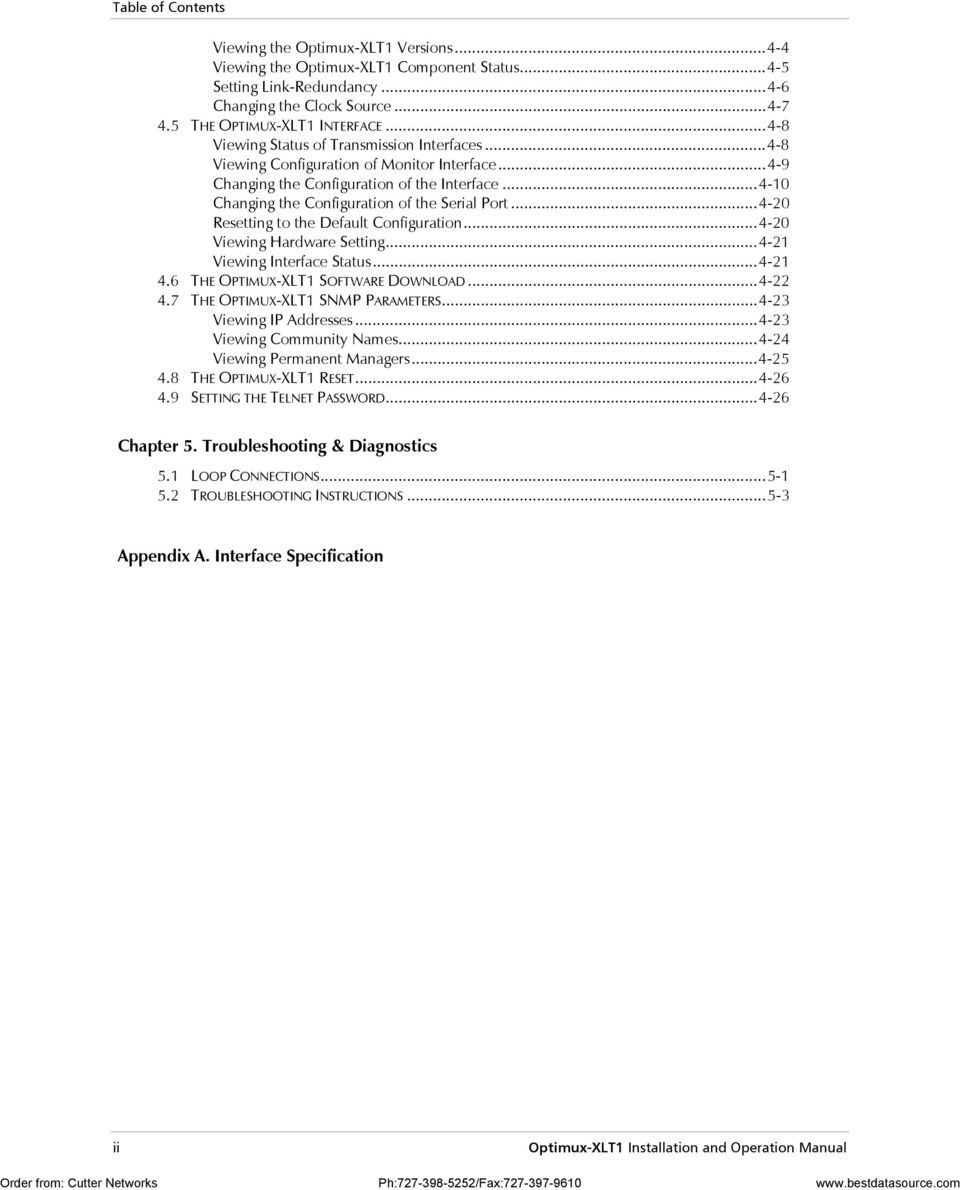
6 Table of Contents Viewing the Optimux-XLT1 Versions Viewing the Optimux-XLT1 Component Status Setting Link-Redundancy Changing the Clock Source THE OPTIMUX-XLT1 INTERFACE Viewing Status of Transmission Interfaces Viewing Configuration of Monitor Interface Changing the Configuration of the Interface Changing the Configuration of the Serial Port Resetting to the Default Configuration Viewing Hardware Setting Viewing Interface Status THE OPTIMUX-XLT1 SOFTWARE DOWNLOAD THE OPTIMUX-XLT1 SNMP PARAMETERS Viewing IP Addresses Viewing Community Names Viewing Permanent Managers THE OPTIMUX-XLT1 RESET SETTING THE TELNET PASSWORD Chapter 5. Troubleshooting & Diagnostics 5.1 LOOP CONNECTIONS TROUBLESHOOTING INSTRUCTIONS Appendix A. Interface Specification ii
7 Table of Contents List of Figures 1-1. Optimux-XLT1 Point-to-point Link Application Optimux-XLT1 3D View Internal and Loopback Timing with V35/RS530 Module Internal and Loopback Timing with X21 Module External with V35/RS530 Module External with X21 Module Timing Description for Tail End Application with V35/RS530 Module Location of Modules in the Optimux-XLT1 Case Setting the Optimux-XLT1 Switches and Jumpers Setting the High Speed Module Jumpers Front Panel Connections of Ethernet Port and T1 Balanced Channels Front Panel Connections of Ethernet Port and High Speed Channels Front Panel Connections of Fast Ethernet Port and T1 Balanced Channels Rear Panel Connections Optimux-XLT1 with Dual Link and Dual Power Supply Optimux-XLT1 Front Panel High Speed Module Panels Fast Ethernet Module Panel Optimux-XLT1 Rear Panel Software Configuration Menu Map Optimux-XLT1 Loops iii

8 Table of Contents List of Tables 1-1. Fiber optic Interface Options Channel Module Options Interface Installation Combinations List of Optimux-XLT1 Modules Internal Settings Connectors Management, Alarm and Link Connectors Cable to Interface Connections Fiber Optic Link Connections Management Port Options Optimux-XLT1 Front Panel Controls and Indicators Optimux-XLT1 Rear Panel Controls LED Indications Power Supply States Interface Ports T1 and Fiber Optic Interface States Ethernet Setting Fields in the Change Interface Configuration Screen Diagnostic Loops Troubleshooting Chart iv

9 Chapter 1 Introduction 1.1 Overview Versions The Optimux-XLT1 is a multiplexer that combines Ethernet, Fast Ethernet, High Speed (HS) and T1 channels into a data stream transmitted over fiber optic cables. A pair of Optimux-XLT1 units offers simple low-cost connectivity for Ethernet, Fast Ethernet, High Speed (HS) and T1 channels at distances up to 60 Km (37.28 miles). Link Interface Options Optimux-XLT1 is available with a variety of fiber optic link options in addition to the built-in Ethernet port (see Table 1-1 for details). The unit can also be ordered with a second redundant link (same as the first link). Power Supply Options Optimux-XLT1 is available with one or two of the following power supplies: VAC power supply -48 VDC power supply 24 VDC power supply. In addition, the unit can be ordered with a second redundant power supply (same as the first power supply). Channel Module Options Optimux-XLT1 supports various channel module options as detailed in Table 1-2. Overview 1-1

10 Chapter 1 Introduction Applications The Optimux-XLT1 unit permits improved utilization of fiber optic links, due to its capability to multiplex channels connected to different transmission environments, Ethernet LAN and T1 channels. A frequently used application is depicted in Figure 1-1. Point-to-point Application In Figure 1-1, a company campus line or a line leased from the local operator is used to link two Optimux-XLT1 units situated at a distance ranging from several hundreds of meters to several tens of kilometers. A backup link is optionally used to ensure uninterrupted data flow between the two sites. The Optimux-XLT1 at each site is connected to Ethernet LANs and T1 access equipment like PBXs and T1 multiplexers. The distance limitations on the LAN deployment area are efficiently removed while maintaining the full and half-duplex transmission modes. MP-2100 MP-2100 Main Link PBX Extension LAN A Backup Link LAN A PBX Extension Optimux-XLT1 Optimux-XLT1 Ethernet Switch LAN B LAN B LAN C Server Figure 1-1. Optimux-XLT1 Point-to-point Link Application Features Optimux-XLT1 is a compact 44 mm (1U) high unit intended for 19-inch rack installations using an adapter kit. A combination of up to four 10BaseT Ethernet channels or one 10BaseT Ethernet channel and Fast Ethernet, HS data and T1 channels can be combined into a single fiber optic link. Optimux-XLT1 is suitable for various modes of fiber optic transmission. Optimux-XLT1 features link redundancy (an optional backup link), which enables coupling of any combination of fiber modules to the link. In addition, Optimux-XLT1 can accommodate up to two (one redundant power supply in case of power failure or disconnection) built-in AC to DC and DC to DC power supplies for a wide range of power sources. Optimux-XLT1 offers the options of working in loopback timing. Setup, monitoring and diagnostics can be configured using an ASCII terminal, Telnet or an SNMP management station. System diagnostics are monitored and managed using status and alarm panel indications, alarm dry contacts and external management tools. 1-2 Overview

11 Chapter 1 Introduction 1.2 Physical Description Optimux-XLT1 is a compact 44 mm (1U) high unit intended for 19-inch rack installations using an adapter kit. For rack installation instructions refer to the Rack Mounting Kit for 19-inch Racks guide that comes with the RM kit. Figure 1-2 shows a 3D view of Optimux-XLT1. Figure 1-2. Optimux-XLT1 3D View Front Panel Rear Panel T1 and Ethernet connectors are located on the unit's front panel. Front panel LEDs indicate system and link status. For details on the front panel, its connectors and LEDs, see the Installation and Setup chapter. The rear panel of Optimux-XLT1 contains the power, management, alarm and fiber optic connectors. For details refer to the Installation and Setup chapter. Physical Description 1-3

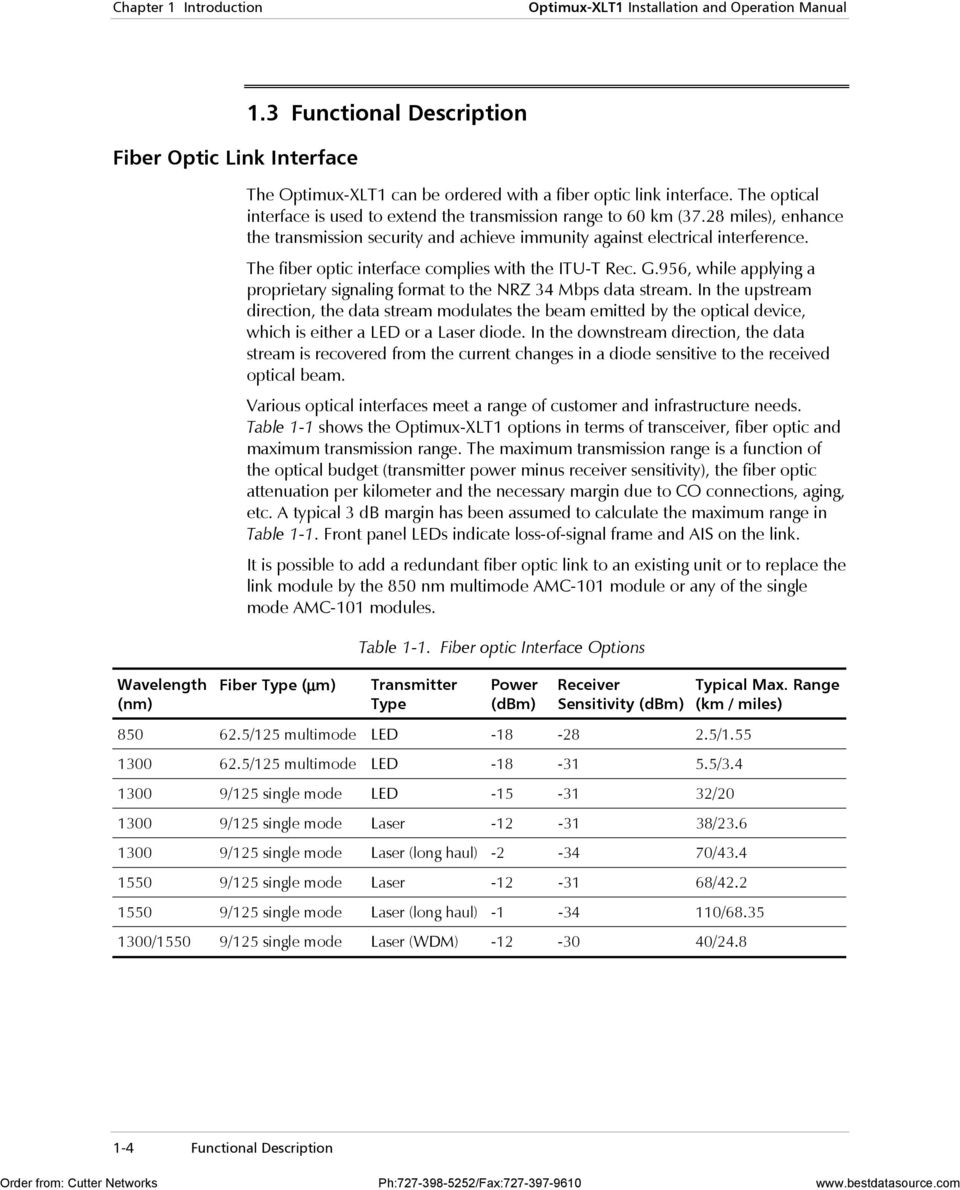
12 Chapter 1 Introduction Fiber Optic Link Interface 1.3 Functional Description The Optimux-XLT1 can be ordered with a fiber optic link interface. The optical interface is used to extend the transmission range to 60 km (37.28 miles), enhance the transmission security and achieve immunity against electrical interference. The fiber optic interface complies with the ITU-T Rec. G.956, while applying a proprietary signaling format to the NRZ 34 Mbps data stream. In the upstream direction, the data stream modulates the beam emitted by the optical device, which is either a LED or a Laser diode. In the downstream direction, the data stream is recovered from the current changes in a diode sensitive to the received optical beam. Various optical interfaces meet a range of customer and infrastructure needs. Table 1-1 shows the Optimux-XLT1 options in terms of transceiver, fiber optic and maximum transmission range. The maximum transmission range is a function of the optical budget (transmitter power minus receiver sensitivity), the fiber optic attenuation per kilometer and the necessary margin due to CO connections, aging, etc. A typical 3 db margin has been assumed to calculate the maximum range in Table 1-1. Front panel LEDs indicate loss-of-signal frame and AIS on the link. It is possible to add a redundant fiber optic link to an existing unit or to replace the link module by the 850 nm multimode AMC-101 module or any of the single mode AMC-101 modules. Table 1-1. Fiber optic Interface Options Wavelength (nm) Fiber Type (µm) Transmitter Type Power (dbm) Receiver Sensitivity (dbm) Typical Max. Range (km / miles) /125 multimode LED / /125 multimode LED / /125 single mode LED / /125 single mode Laser / /125 single mode Laser (long haul) / /125 single mode Laser / /125 single mode Laser (long haul) / /1550 9/125 single mode Laser (WDM) / Functional Description
13 Chapter 1 Introduction Link Redundancy An additional link interface can be ordered for backup. The two link interfaces are both identical. The link interfaces are implemented by interchangeable link modules plugged into two dedicated slots at the rear of the Optimux-XLT1 unit designated LINK A (MAIN) and LINK B (BACKUP). Front panel LEDs provide AIS and signal loss (SYNC LOSS) indications on the link. When two link modules are installed, the redundancy mechanism of the Optimux-XLT1 is used to: Automatically switch to the back-up link interface in case of signal or sync loss on the main link. If the redundancy mode is set to AUTOMATIC, under signal loss, the main link (equipment and/or line) resumes transmission after it has recovered. Under sync loss, the backup link continues transmission until it receives a sync loss/signal loss. Force transmission via the MAIN link using a software management tool for maintenance purposes if the redundancy mode is OFF. When the redundancy mode is MANUAL and the main link is disconnected or fails, the backup link is forced into the active state. The main link will not resume transmission as long as the redundancy mode is MANUAL. Tributary Interface Characteristics The modular design of the Optimux-XLT1 supports one fixed 10BaseT Ethernet port and up to three additional plug-in channel modules. The additional channel module types are specified in Table 1-2. Table 1-2. Channel Module Options Channel Module Port Type Bandwidth No. of Ports Port Connector OP-XL-M/ETH 10BaseT Ethernet MHz 1 RJ-45 OP-XL-M/FETH 10/100BaseT Fast Ethernet MHz 1 RJ-45 OP-XL-M/2T1/BAL T1 Balanced (twisted pairs) Mbps 2 RJ-45 OP-XL-M/4T1/BAL T1 Balanced (twisted pairs) Mbps 4 RJ-45 OP-XL-M/4HS/1.5M/V35 V Mbps 4 SCSI 26-pin OP-XL-M/4HS/1.5M/RS530 RS Mbps 4 SCSI 26-pin OP-XL-M/4HS/1.5M/X21 X Mbps 4 SCSI 26-pin Functional Description 1-5

14 Chapter 1 Introduction A selection of Ethernet, Fast Ethernet, T1 and high-speed channel modules permits a variety of multiplexing schemes for LAN and CO sites. The Ethernet or Fast Ethernet ports are connected directly to the local network or to an Ethernet LAN. The port activity and the link integrity are monitored either by front panel LEDs or by an external terminal. The transmission of the Ethernet or Fast Ethernet channel is implemented by a built-in bridging function operating at the Mbps, "almost wire-speed", rate and supports up to 10,000 (Ethernet) or 16,0000 (Fast Ethernet) addresses. The T1 interface complies with the ITU-T Rec. G.703. Line coding is B8ZS. A pair of LEDs monitor loss-of-signal and AIS on each T1 receive line. For the high-speed modules (V.35, RS-530 and X.21), the desired physical port connector is achieved by the use of an appropriate adapter cable, which is supplied with the product. Management Requirements Optimux-XLT1 operates locally using on-board switches and jumpers to configure the operation modes and front panel LEDs to monitor system failure and tests (loop connections). Alarms are monitored using the dry contacts of the Optimux-XLT1 alarm relays on a dedicated D-type connector. An ITU-T V.24/EIA RS-232 port enables monitoring and tests using an ASCII supervision terminal. The management interface also includes an SNMP agent that enables SNMP management of the Optimux-XLT1, using the Ethernet protocol. The SNMP management capability enables fully graphical, user-friendly management using the RADview network management stations offered by RAD, as well as management by other SNMP-based management systems. Remote management is also possible using the Telnet communication protocol, which uses TCP/IP communication, without the SNMP service. Telnet support enables a remote IP host to control the operation of Optimux-XLT1 using functions identical to those provided by a supervision terminal. The Telnet management function can be protected by the manager password feature. Note When using Telnet for management, the Software Downloading option is not operational. 1-6 Functional Description

15 Chapter 1 Introduction Timing Optimux-XLT1 Optimux-XLT1 can work with an internally generated clock (internal oscillator). Loopback timing can be used in those systems that require a one-source clock. High Speed Interface The high-speed (HS) modules support the following timing modes: 4HSx1.5M Internal, external and loopback timing Figure 1-3 through Figure 1-7 show the different timing modes supported by the HS modules. DTE V35/RS530 EXTC EXTC TXD TXD DCE OP OSC Not Used DCE OP OSC V35/RS530 EXTC EXTC TXD TXD DTE TXC TXC TXC TXC TXC TXC TXD TXD RXC RXD RXC RXD RXC RXD MUX MUX RXC RXD RXC RXD RXC RXD EXT INT LBT EXT Figure 1-3. Internal and Loopback Timing with V35/RS530 Module Functional Description 1-7

16 Chapter 1 Introduction DTE X21 EXTC EXTC TXD TXD DCE OP DATA IN OSC FIFO on transmit side CLOCK IN FIFO CLOCK OUT DATA OUT Not Used DCE OP OSC CLOCK OUT DATA OUT Not Used FIFO CLOCK IN DATA IN EXTC TXD X21 EXTC TXD DTE TXC TXC TXD TXD ST ST RXC MUX MUX RXC ST ST RXD RXD RXD RXD RXD RXD EXT INT LBT EXT Figure 1-4. Internal and Loopback Timing with X21 Module DTE V35/RS530 EXTC EXTC TXD TXD Not Used DCE OP OSC Not Used DCE OP OSC V35/RS530 EXTC EXTC TXD TXD DTE TXC TXC TXC TXC TXC TXC TXD TXD RXC RXD RXC RXD RXC RXD MUX MUX RXC RXD RXC RXD RXC RXD INT EXT LBT EXT Figure 1-5. External with V35/RS530 Module DTE EXTC X21 EXTC TXD TXD Not Used DCE OP DATA IN OSC FIFO on receive side CLOCK IN CLOCK OUT FIFO DATA OUT Not Used DCE OP OSC CLOCK OUT DATA OUT Not Used FIFO CLOCK IN DATA IN X21 EXTC EXTC TXD TXD DTE TXC TXC TXD ST RXD ST RXD RXC RXD MUX MUX TXD RXC RXD ST RXD ST RXD INT EXT LBT EXT Figure 1-6. External with X21 Module 1-8 Functional Description

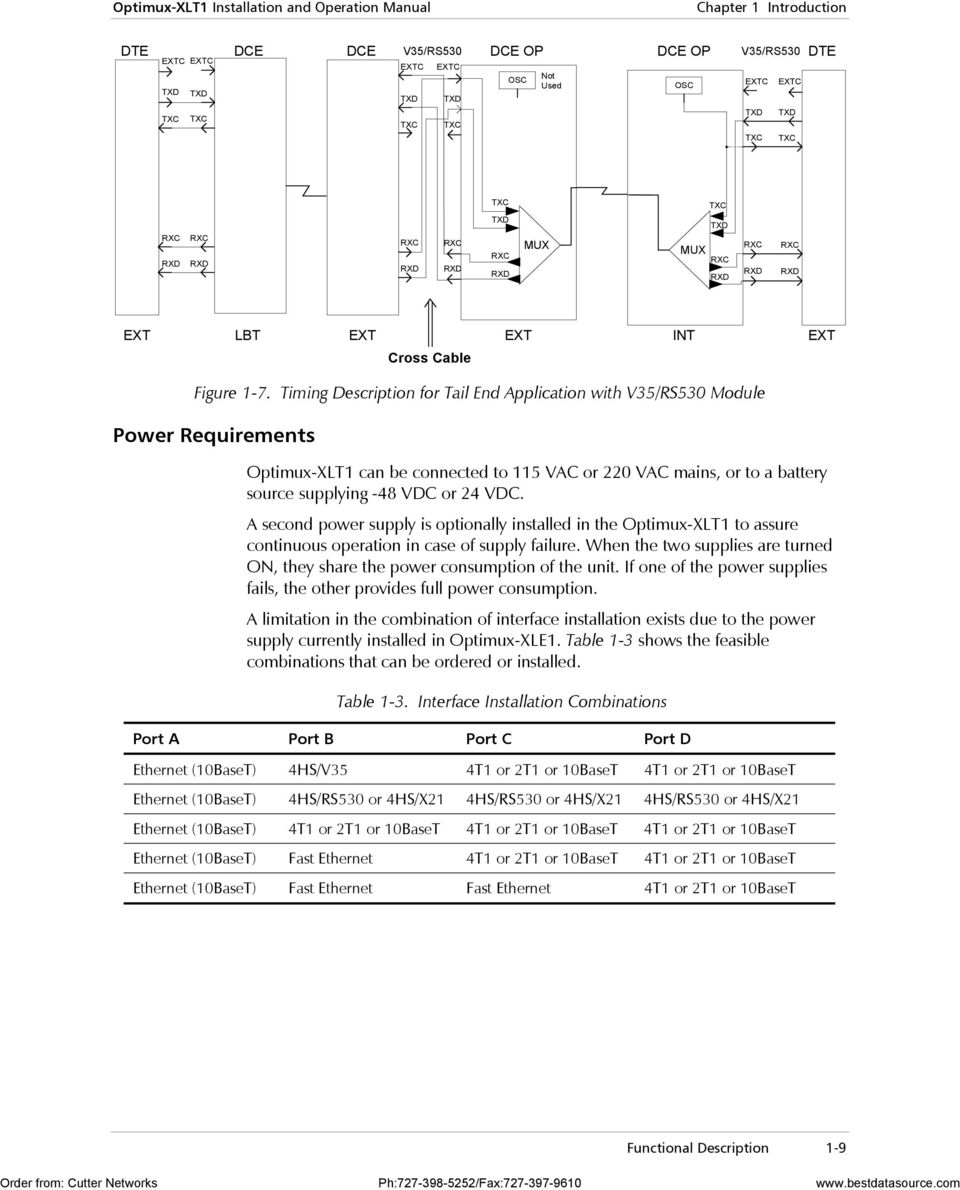
17 Chapter 1 Introduction DTE EXTC EXTC TXD TXD TXC TXC DCE DCE V35/RS530 EXTC EXTC TXD TXD TXC TXC DCE OP OSC Not Used DCE OP OSC V35/RS530 EXTC EXTC TXD TXD TXC TXC DTE TXC TXC RXC RXD RXC RXD RXC RXD RXC RXD TXD RXC RXD MUX TXD MUX RXC RXD RXC RXD RXC RXD EXT LBT EXT Cross Cable EXT INT EXT Figure 1-7. Timing Description for Tail End Application with V35/RS530 Module Power Requirements Optimux-XLT1 can be connected to 115 VAC or 220 VAC mains, or to a battery source supplying -48 VDC or 24 VDC. A second power supply is optionally installed in the Optimux-XLT1 to assure continuous operation in case of supply failure. When the two supplies are turned ON, they share the power consumption of the unit. If one of the power supplies fails, the other provides full power consumption. A limitation in the combination of interface installation exists due to the power supply currently installed in Optimux-XLE1. Table 1-3 shows the feasible combinations that can be ordered or installed. Table 1-3. Interface Installation Combinations Port A Port B Port C Port D Ethernet (10BaseT) 4HS/V35 4T1 or 2T1 or 10BaseT 4T1 or 2T1 or 10BaseT Ethernet (10BaseT) 4HS/RS530 or 4HS/X21 4HS/RS530 or 4HS/X21 4HS/RS530 or 4HS/X21 Ethernet (10BaseT) 4T1 or 2T1 or 10BaseT 4T1 or 2T1 or 10BaseT 4T1 or 2T1 or 10BaseT Ethernet (10BaseT) Fast Ethernet 4T1 or 2T1 or 10BaseT 4T1 or 2T1 or 10BaseT Ethernet (10BaseT) Fast Ethernet Fast Ethernet 4T1 or 2T1 or 10BaseT Functional Description 1-9
18 Chapter 1 Introduction 1.4 Technical Specifications Link Interfaces Channel Interfaces Fiber Optic Link Applicable Standard ITU-T Rec. G.955 Line Code CDP Performance Refer to Table 1-1 Connectors Redundancy Ethernet Ports Physical Interface Channel Slots (Ports) Data Rate Transmission Mode Bridge Parameters T1 Interface ST, SC, FC/PC Additional link is optional 10BaseT, 10/100BaseT Fixed: A (one 10BaseT) Interchangeable with FETH/HS/T1: B, C and D (three) 10 Mbps for 10BaseT interface 10/100 Mbps for 10/100BaseT interface Full/half-duplex or auto negotiation enable/disable selectable on Ethernet channel module Data transfer rate: Mbps maximum No. of Supported Addresses: 10,000 for 10BaseT 16,000 for 10/100BaseT Connector: RJ-45 Electrical Interface According to ITU-T Rec. G.703 Jitter According to ITU-T Rec. G.824 Data Rate Line Code Mbps B8ZS or AMI Range According to ITU-T G.703 Slots (Ports) B, C and D interchangeable with three FETH/HS Ethernet ports 1-10 Technical Specifications
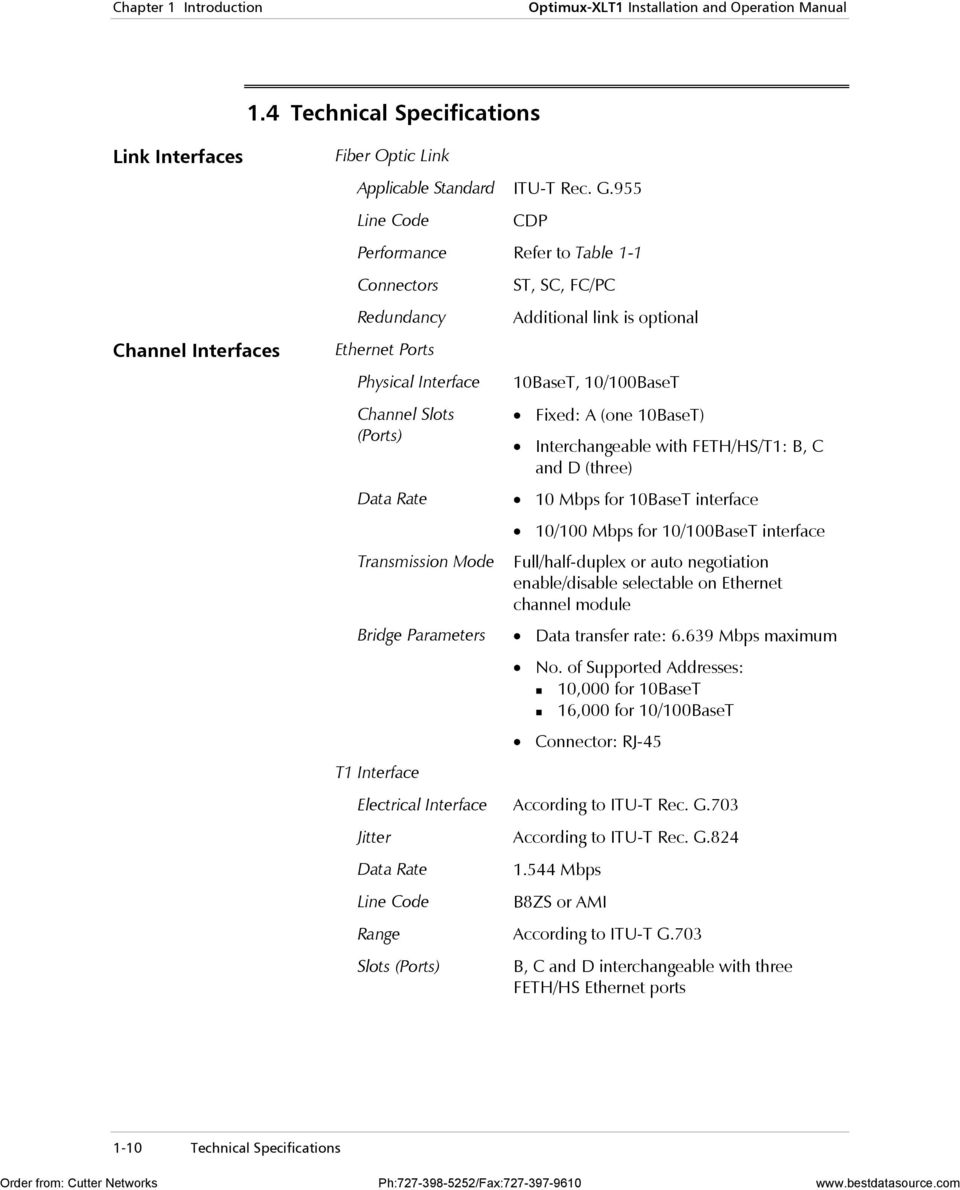
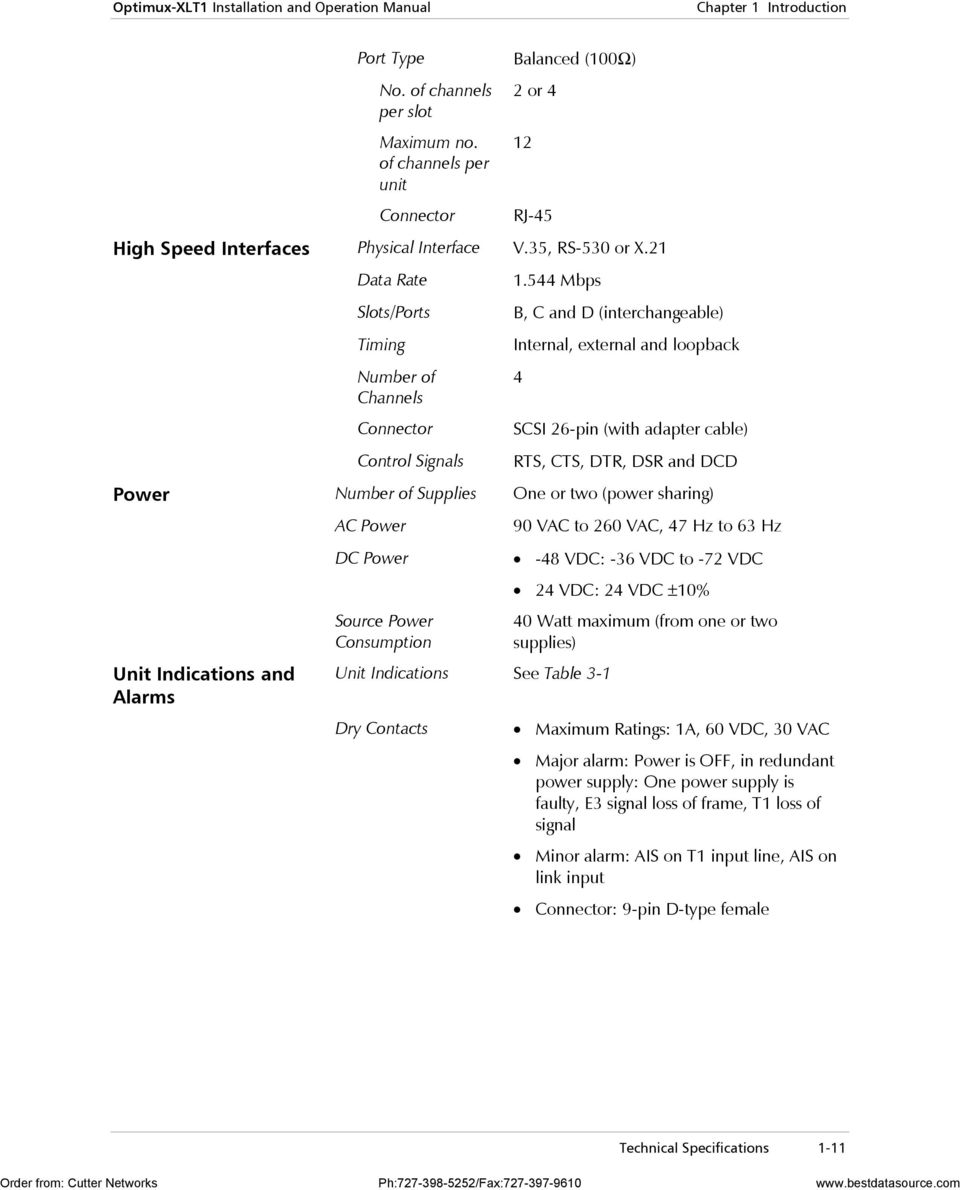
19 Chapter 1 Introduction Port Type No. of channels per slot Maximum no. of channels per unit Connector Balanced (100Ω) 2 or 4 12 RJ-45 High Speed Interfaces Physical Interface V.35, RS-530 or X.21 Data Rate Slots/Ports Timing Number of Channels Connector Control Signals Mbps B, C and D (interchangeable) Internal, external and loopback 4 SCSI 26-pin (with adapter cable) RTS, CTS, DTR, DSR and DCD Power Number of Supplies One or two (power sharing) Unit Indications and Alarms AC Power DC Power Source Power Consumption 90 VAC to 260 VAC, 47 Hz to 63 Hz -48 VDC: -36 VDC to -72 VDC 24 VDC: 24 VDC ±10% Unit Indications See Table 3-1 Dry Contacts 40 Watt maximum (from one or two supplies) Maximum Ratings: 1A, 60 VDC, 30 VAC Major alarm: Power is OFF, in redundant power supply: One power supply is faulty, E3 signal loss of frame, T1 loss of signal Minor alarm: AIS on T1 input line, AIS on link input Connector: 9-pin D-type female Technical Specifications 1-11
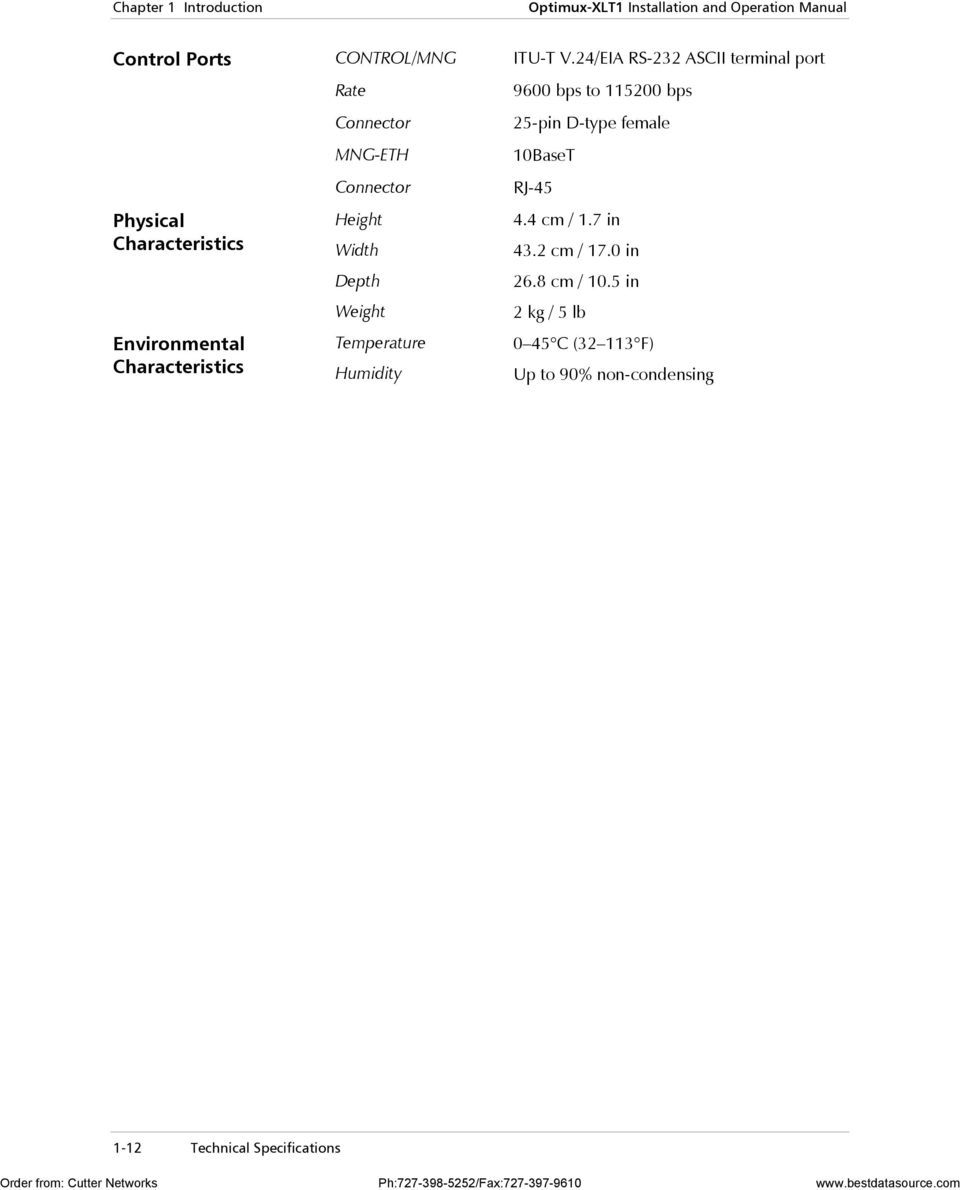
20 Chapter 1 Introduction Control Ports CONTROL/MNG ITU-T V.24/EIA RS-232 ASCII terminal port Physical Characteristics Environmental Characteristics Rate Connector MNG-ETH Connector Height Width Depth Weight Temperature Humidity 9600 bps to bps 25-pin D-type female 10BaseT RJ cm / 1.7 in 43.2 cm / 17.0 in 26.8 cm / 10.5 in 2 kg / 5 lb 0 45 C ( F) Up to 90% non-condensing 1-12 Technical Specifications
21 Chapter 2 Installation and Setup 2.1 Introduction Optimux-XLT1 is delivered completely assembled. It is designed for installation as a desktop unit or for mounting in a 19-inch rack. For rack installation instructions, refer to the Rack Mounting Kit for 19-inch Racks guide that comes with the RM kit. After installing the unit, refer to the Operation chapter for system operating instructions. In case a problem arises, refer to the Troubleshooting & Diagnostics chapter for test and diagnostics instructions. Warning No settings of switches and jumpers, replacement of cards and cables or other repairs may be performed by either the operator or the user. Such activities may be performed only by a skilled technician who is aware of the hazards involved. Always observe standard safety precautions during installation, operation, and maintenance of this product. 2.2 Site Requirements & Prerequisites AC-powered Optimux-XLT1 units should be installed within 1.5m (5 ft) of an easily accessible grounded AC outlet capable of furnishing a supply voltage in the range of 90 to 260 VAC. DC-powered Optimux-XLT1 units require -36 VDC to -72 VDC or 21.4 VDC to 26.4 VDC power source according to order. Verify that the input voltage at the end of the power cable is within the above limits Allow at least 90 cm (36 in) of frontal clearance for operator access. Allow at least 10 cm (4 in) rear clearance for interface cable connections. When planning the routing of fiber optic cables, avoid sharp bends. The bending radius should exceed 30 mm (1.2 in). The ambient operating temperature of Optimux-XLT1 should be 0 C to 45 C (32 F to 113 F) at a relative humidity of up to 90%, non-condensing. Site Requirements & Prerequisites 2-1
22 Chapter 2 Installation and Setup 2.3 Package Contents A preliminary inspection of the equipment contained in the shipping box should be made before unpacking. Evidence of damage should be noted and reported immediately. The Optimux-XLT1 package includes the following items: Optimux-XLT1 unit Power cable 110 or 220 depending on your order Interface adapter cable High speed modules depending on your order If 48 VDC version is ordered, 48V plug is supplied If 24 VDC version is ordered, 24V plug is supplied. 2.4 Installation and Setup This section details the functions and positions of the internal switches and jumpers used to configure the Optimux-XLT1 unit for your particular application. A common configuration procedure is provided. Then, the configuration options and the default settings for each module are detailed. Identifying Optimux-XLT1 Modules Figure 2-1 and shows the modular construction of the Optimux-XLT1 unit. Use this figure to identify the modules supplied. To remove the unit from its case: 1. Unscrew three captive screws on each side of the unit and eight captive screws on the top. 2. Remove the Optimux-XLT1 top cover. 3. Check that the optional modules ordered are installed in the unit case. Refer to Table 2-1 and verify the designation of the modules/cards in capital letters. 2-2 Installation and Setup
23 Chapter 2 Installation and Setup POWER SUPPLY A (MAIN) POWER SUPPLY B (BACKUP) LINK MODULE B (BACKUP) POWER SUPPLY A FILTER PROTECTIVE GROUND MANAGEMENT MODULE LINK MODULE A (MAIN) SW1 ON J1 J2 J3 J4 J5 J6 J7 J8 J9 J10 SW1 ON SW1 SW2 JP1 SW1 SW2 JP1 J11 MAIN BOARD (GREY) ETH-TOP CARD (FIXED PORT) CHANNEL MODULE - SLOT B (ETH/10BT IS SHOWN) AGENT-ETH CARD CHANNEL MODULE - SLOT C (4T1BAL IS SHOWN) Figure 2-1. Location of Modules in the Optimux-XLT1 Case CHANNEL MODULE - SLOT D (4T1BAL IS SHOWN) Installation and Setup 2-3
24 Chapter 2 Installation and Setup Table 2-1. List of Optimux-XLT1 Modules Module Designation Fixed/ Optional Location Used to provide Main Board/ OPTI-T1/LAN Fixed Along the width of the unit Optimux-XLT1 unit control functions. Fixed Ethernet port (section A on the front panel). Operation modes of the fixed Ethernet port (see ETH-TOP card). Ethernet agent functionality (see AGENT-ETH card). ETH Fixed/ Optional Front fixed A Front slots B, C, D Ethernet port connection FETH Optional Front slots B, C, D Fast Ethernet port connection 4 T1 balanced 4T1 BAL Optional Front slots B, C, D ITU-T G.703 interface for four T1 balanced ports fiber optic Link FO Fixed/ Optional Rear slots LINK A/B Fiber optic interface to the link. A is the main link and B is the optional backup link. H.S. Optional Front slots B, C, D V35/RS530/X21 Interface ports Power supply PWR-A Power supply PWR-B Fixed On the rear side Optimux-XLT1 supply voltages Optional On the rear side Power supply redundancy - power consumption sharing or full consumption in case of power supply A failure. Setting Internal Jumpers and Switches Initializing the Unit Before setting the switches and jumpers, the unit must be initialized. To initialize the unit after power up: Press the reset switch. The switch can be reached from the front (see Figure 3-1) with a screwdriver (to prevent unauthorized personnel from resetting the unit). The Optimux-XLT1 internal jumpers and switches are located on its board. The internal jumpers and switches of the modules are located on the board of each module. Figure 2-2 shows the settings of the Optimux-XLT1 and its modules switches and jumpers. Figure 2-3 shows the settings of the high-speed module jumpers. The internal settings are listed in Table Installation and Setup
25 Chapter 2 Installation and Setup To reach the internal switches and jumpers: 1. Disconnect all the cables connected to the Optimux-XLT1. 2. Unscrew two captive screws on each side of the unit and eight captive screws on the top. 3. Remove the unit cover. 4. Set switches and jumpers of the installed modules as specified below. SW1 ON J1 J2 J3 J4 J5 J6 J7 J8 J9 J10 SW1 ON SW1 SW2 JP1 SW1 SW2 JP1 J11 J11 ON OPTI-E1/LAN BOARD AND ON ETH MODULE SW1 ON ETH-TOP CARD SW1 ON T1 MODULES: 4T1/BAL JP1 ON T1 MODULES: 4T1/BAL ON - UNIT HAS 2 CONNECTED POWER SUPPLIES OFF - UNIT HAS ONLY 1 CONNECTED POWER SUPPLY FACTORY SET ACCORDING TO NUMBER OF ORDERED POWER SUPPLIES ON 1 ON 2 ON - FULL-DUPLEX ETHERNET OFF - HALF-DUPLEX ETHERNET (FACTORY PRESET) ON - COMPRESSION IS ACTIVATED (FACTORY PRESET) OFF - COMPRESSION IS DISABLED ON ON - T1 CHANNEL ALARMS ARE ENABLED OFF - T1 CHANNEL ALARMS ARE DISABLED FACTORY SETTING: ON B8ZS AMI LINE CODE SET TO B8ZS LINE CODE SET TO AMI FACTORY SETTING: B8ZS ON ON - ONLY FRAMES DESTINED FOR ANOTHER LAN ARE TRANSMITTED OVER WAN J1 TO J10 ON OPTI-E1/LAN BOARD PORT A - MNG-ETH FROM FRONT SEPERATE - MNG-ETH FROM BACK FACTORY SETTING: separate ON 3 4 OFF - ALL FRAMES ARE TRANSMITTED OVER WAN (FACTORY PRESET) FACTORY PRESET (DO NOT CHANGE) SW2 ON T1 MODULES: 4T1/BAL ON FACTORY PRESET (SW2-1) SW2-1 SW2-2 SW2-3 SW2-4 RANGE ON ON OFF ft OFF OFF ON ft ON OFF ON ft OFF ON ON ON ON ON ft ft NOT CONNECTED DECLARES THE SHAPE AND AMPLITUDE OF THE T1 TRANSMIT PULSE Figure 2-2. Setting the Optimux-XLT1 Switches and Jumpers Installation and Setup 2-5
26 Chapter 2 Installation and Setup JP1 JP4 JP2 LBT INT LBT EXT INT EXT JP5 JP1, JP2, JP4 and JP5 ON HS BOARD FACTORY SETTING: INT FOR CHANNELS 1 AND 2 INT FOR CHANNELS 3 AND 4 JP1 JP4 JP2 EXT INT EXT LBT INTLBT LBT TIMING FOR CHANNELS 1 AND 2 JP5 JP1 JP2 JP4 EXT INT EXT LBT INTLBT INT TIMING FOR CHANNELS 1 AND 2 JP5 JP1 JP2 JP4 EXT INT EXT LBT INTLBT JP5 EXT TIMING FOR CHANNELS 1 AND 2 JP1 JP2 JP4 EXT INT EXT LBT INT LBT LBT TIMING FOR CHANNELS 3 AND 4 JP5 JP1 JP2 JP4 EXT INT EXT LBT INT LBT INT TIMING FOR CHANNELS 3 AND 4 JP5 JP1 JP2 JP4 EXT INT EXT LBT INT LBT JP5 EXT TIMING FOR CHANNELS 3 AND 4 Figure 2-3. Setting the High Speed Module Jumpers 2-6 Installation and Setup Order from: Cutter Networks Ph: /Fax:
27 Chapter 2 Installation and Setup Table 2-2. Internal Settings Identification of Internal Setting Function Settings Factory Setting Main Board J1 through J10 J11 JP5 ETH TOP card SW1 Section 1 Section 2 Section 3 Section 4 MNG-ETH port is available from front or rear panel Setting unit to work with one or two power supplies To facilitate clock from the T1 module to the station clock module Port A The MNG-ETH port is only available from the front panel in half-duplex only and operates as an Ethernet port. Separate The MNG-ETH port is available from the rear panel in half-duplex. The MNG-ETH port on the front panel operates as an Ethernet port, is combined into a fiber optic link and is available in half or full duplex. ON When the unit uses two power supplies. OFF When the unit uses only one power supply. Jumper connected Jumper disconnected Separate To match numbered order of power supplies Jumper disconnected The ETH-TOP card mounted on the main board supports the fixed Ethernet port of the Optimux-XLT1 unit. A similar switch mounted on the Ethernet module installed in slots B, C and D supports the optional Ethernet ports (up to three). Determines the transmission mode of the Ethernet ports in slots B, C and D, and in the fixed Ethernet port, either full or half duplex (if J1 through J10 are set to Port A, the working mode of the fixed Ethernet port must be half-duplex only). Enables and disables data throughput compression Determines whether all frames are transmitted over the WAN or only those that are destined for another LAN. If this section is set to OFF, the software selects the filtering mode. Not used in the Optimux-XLT1 current version and should be set to the default position specified in Figure 2-2. ON Full duplex OFF Half duplex ON Enable OFF Disable ON Filtered OFF Not filtered ON OFF OFF ON OFF OFF Installation and Setup 2-7
28 Chapter 2 Installation and Setup Table 2-2. Internal Settings (Cont.) Identification of Internal Setting Function Settings Factory Setting T1 Channel Modules SW1 Sections 1 4 SW2 Sections 1 3 JP1 High Speed Module On the T1 modules are used to enable T1 interface alarms to the Optimux-XLT1 system control Sections 3 4 are not used in the 2T1/BAL channel modules On the T1 modules are used to set the line length equalizer that determines the shape and amplitude of the transmit pulse. Sections 4 are not used and always set to OFF. Determines the line code implemented by the T1 interface JP1, JP2 Select timing mode for channels 1 and 2 JP4, JP5 Select timing mode for channels 3 and 4 ON Alarms enabled OFF Alarms disabled ON, ON, OFF ft OFF, OFF, ON ft ON, OFF, ON ft OFF, ON, ON ft ON, ON, ON ft B8ZS Line code set to B8ZS AMI Line code set to AMI LBT Loopback timing INT Internal timing EXT External timing LBT Loopback timing INT Internal timing EXT External timing ON ON, ON, OFF B8ZS INT INT 2-8 Installation and Setup
29 Chapter 2 Installation and Setup 2.5 Interfaces and Connections The T1, Ethernet, Fast Ethernet or High Speed channel connectors are located on the unit front panel, sections A to D. Section A is dedicated to the fixed Ethernet port. Sections (slots) B through D are allocated to T1, Ethernet, Fast Ethernet or High Speed ports (see Figure 2-4, Figure 2-5 and Figure 2-6). Except for the fixed Ethernet port, the front panel connections depend on the type of channel module installed as indicated in Table 2-3. A B C D PWR SYSTEM LNK SYNC A B ETHERNET ETHERNET SYNC SYNC SYNC A B FLT TST RST LOSS AIS OK ACT OK ACT LOSS AIS LOSS AIS LOSS AIS OP-M ETH/10BT OP-M 4T1/BAL OP-M 2T1/BAL Optimux-XLT1 Section A - Connection of Fixed Port Sections B, C and D - Connection of Ethernet Port and E1 Balanced Figure 2-4. Front Panel Connections of Ethernet Port and T1 Balanced Channels A B C D PWR SYSTEM LNK SYNC A B ETHERNET A FLT LOSS OK B TST RST AIS ACT DCE DCE DCE OP-M V.35 4HSx2M OP-M V.35 4HSx2M OP-M V.35 4HSx2M Optimux-XLT1 Section A - Connection of Fixed Port Sections B, C and D - Connection of High Speed Ports Figure 2-5. Front Panel Connections of Ethernet Port and High Speed Channels A B C D PWR SYSTEM LNK ETHERNET ETHERNET SYNC A B SYNC SYNC SYNC A FLT LOSS OK 100M LOSS LOSS LOSS B TST RST AIS ACT AIS AIS AIS ACT LINK OP-M ETH-10/100BT OP-M 4T1/BAL OP-M 2T1/BAL Optimux-XLT1 Section A - Connection of Fixed Port Sections B, C and D - Connection of Fast Ethernet and E1 Balanced Ports Figure 2-6. Front Panel Connections of Fast Ethernet Port and T1 Balanced Channels Interfaces and Connections 2-9
30 PROTECTION AGAINST RISK OF FIRE, RE PLA CE ONLY WITH SA ME TY PE A ND R ATI NG O F FU SE. Chapter 2 Installation and Setup ELECTRICAL SHOCK HAZARD: Access to the inside of the equipment is permitted only to qualified and authorized service personnel. Warning Before disconnecting the unit from its cables, verify that the remote unit is turned OFF. Disconnect the unit from the power line and from all the cables before removing the cover. Dangerous high voltages are present inside the Optimux-XLT1 when it is connected to power. Moreover, under external fault conditions, dangerous high voltages may appear on the lines connected to the Optimux-XLT1. Capacitors inside the instruments may still be charged even after the unit has been disconnected from the supply source. Any setting, or repair of the open unit under voltage should be avoided as much as possible and, when inevitable, would be carried out only by a skilled technician who is aware of the hazard involved. Caution The Optimux-XLT1 contains components sensitive to electrostatic discharge (ESD). To prevent ESD damage, avoid touching the internal components. Before moving jumpers, touch the Optimux-XLT1 frame. Table 2-3. Connectors Section Channel Module Connector Used to connect A None RJ-45 The fixed Ethernet port to a LAN B, C, D ETH/10BaseT RJ-45 Up to three additional Ethernet ports to LANs B, C, D FETH/10/100BaseT RJ-45 Up to three additional Ethernet ports to LANs B, C, D 4T1/BAL RJ-45x4 Four T1 balanced channels B, C, D 2T1/BAL RJ-45x2 Two T1 balanced channels B, C, D 4 HS SCSI 26-pin Four DTE channels The rear panel of the Optimux-XLT1 unit (see Figure 2-7), contains the power, management, alarm and link connectors as indicated in Table 2-4. LINK A (MAIN) LINK B (BACKUP) POWER B VDC-IN CAUTION: FOR CONTINUED POWER A CONTROL/MNG O O OK RX TX OK RX TX OK 0-48 ALARMS MNG-ETH MAIN LINK BACKUP LINK ALARMS MANAGEMENT DC POWER AC POWER Figure 2-7. Rear Panel Connections Optimux-XLT1 with Dual Link and Dual Power Supply 2-10 Interfaces and Connections Order from: Cutter Networks Ph: /Fax:
31 Chapter 2 Installation and Setup Table 2-4. Management, Alarm and Link Connectors Connector Type Used to connect POWER B Standard 3-pin plug Redundant power source (DC or AC plug), when the redundant power supply option is selected POWER A Standard 3-prong plug Main power source (DC or AC plug) CONTROL/MNG 25-pin D-type female RS-232 ASCII terminal MNG-ETH RJ-45 MNG-ETH entrance ALARMS 9-pin D-type female Optimux-XLT1 dry contacts of two alarm relays (major and minor) to a remote monitoring site LINK A, TX/RX ST, SC or FC/PC Main fiber-optic link LINK B, TX/RX ST, SC or FC/PC Redundant (backup) fiber-optic link Channel Connections For the pin assignment of the connectors, refer to the Interface Specification appendix. The Optimux-XLT1 has four groups of interface ports designated A to D on the front panel of the unit. Channel A is a fixed 10BaseT Ethernet port with an RJ-45 connector. The other groups of interface ports should be prepared according to the ordered channel modules (see the Channel Module Options table). Any combination of 10BaseT Ethernet, T1 balanced, Fast Ethernet and High Speed modules can be installed in Optimux-XLT1 slots B to D (see Figure 2-1). A vacant slot should be closed up using a blank panel. For T1 lines, the maximum allowable line length between the T1 ports and the user's equipment is 655 ft (200m) according to ANSI T The cable type and length should be selected accordingly. The length of a standard UTP cable to a 10BaseT Ethernet or 10/100BaseT station is 100 meters (330 ft). The Interface Specification appendix provides the pin allocation for all the connectors. Connect the channel cables to connectors corresponding to the interface in use (see Figure 2-4, Figure 2-5 and Figure 2-6) as indicated in Table 2-5. Table 2-5. Cable to Interface Connections Interface Connector Type Note G.703 balanced RJ-45 Channel numbers 1 to 4 for the 4T1/BAL modules, 1 and 2 for the 2T1/BAL module Ethernet, Fast Ethernet RJ-45 Physical connection HS SCSI 26-pin To achieve the desired connector type, use the supplied adapter cable Interfaces and Connections 2-11
32 Chapter 2 Installation and Setup Fiber Optic Link Connections Laser Warning Eye damage may be caused by a broken or non-terminated fiber-optic or connector if the laser beam is viewed directly or with improper optical instruments. One or two (main and backup) link interfaces are provided according to order. The fiber optic interfaces can be of optical type only. In normal operation a module must be installed in the main link. For the properties and specifications of the optical link interfaces, refer to the Fiber Optic Interface Options table. When working with WDM modules, the two types SF1 and SF2 must work one opposite the other. SF1 does not work opposite SF1 and SF2 does not work opposite SF2. Note While link redundancy is OFF, it is recommended not to install the backup link so as not to receive a major alarm indication (while the backup link is in sync loss). Connect each fiber optic link interface (main and backup), in accordance with the type of interface installed for that link as indicated in Table 2-6. Interface Connector Type Note Table 2-6. Fiber Optic Link Connections Optical ST, SC or FC/PC Avoid sharp bends of the optical cables. The minimum bending radius should be 30 mm (1.2 in). Alarm Connection Cleanliness of the optical connectors: use an approved solvent, and dry thoroughly using optical tissue. Connection of the receive cable to the optical connector designated RX and the transmit cable to the optical connector designated TX. The alarm cable is terminated with a 9-pin D-type male connector on the unit side. The maximum rating of the alarm relay contacts for planning the monitoring means and cabling is 1 Amp, 60 VDC and 30 VAC. The dry contacts of the Optimux-XLT1 alarm relays (major and minor) are connected to a remote monitoring site via the rear panel ALARM connector (see Figure 2-7) Interfaces and Connections
33 Chapter 2 Installation and Setup Management Connections The Optimux-XLT1 can be managed via: V.24/RS-232 terminal. The connection cable to the V.24/RS-232 interface on the unit s rear panel should be terminated with a 25-pin D-type male connector. The nominal length of the cable for a data rate of 19.2 kbps is 16m (50 ft). Ethernet port. The connection cable to the MNG-ETH interface on the unit s front and rear panels should be terminated with an RJ-45 connector. Connect the management cable to the required management port. The options available are indicated in Table 2-7. Table 2-7. Management Port Options Interface Connector Type Note maximum cable length RS pin D-type 16m (50 ft) for a 19.2 kbps data rate Ethernet, Port A RJ m for a UTP cable, type 3 MNG-ETH RJ m for a UTP cable, type 3 Power Connection The Optimux-XLT1 chassis ground is connected to the protective ground (middle) pin of the power connectors, both for the AC and DC versions of the unit. Intentional disconnection of the protective ground is prohibited since such an action may expose personnel to electrical shock hazards. Warning Before switching on or connecting any cable, the protective ground terminal (see Figure 2-1) must be connected to the protective ground connector of the power cord. The power plug shall only be inserted in a socket outlet provided with a protective ground contact. The protective action must not be negated by use of an extension cord (power cable) without a protective conductor (grounding). For AC or DC power connections, refer to Site Requirements & Prerequisites on page 2-1. Interfaces and Connections 2-13
34 Chapter 2 Installation and Setup 2-14 Interfaces and Connections
35 Chapter 3 Operation Front Panel Controls 3.1 Optimux-XLT1 Controls This chapter presents information and description of the Optimux-XLT1 front panel and rear panel controls and the operating procedure for turn ON. The Optimux-XLT1 front panel provides the LED indications and the connections to the Ethernet LAN and to the T1 channels as shown in Figure 3-1. Table 3-1lists the functions of the LEDs, switch and connectors located on the Optimux-XLT1 front panel. Figure 3-2and Figure 3-3 show the High Speed and Fast Ethernet modules front panel. The index numbers in Table 3-1correspond to the balloon numbers in Figure 3-1, Figure 3-2and Figure PWR SYSTEM SYNC A FLT LOSS B TST RST AIS Optimux-XLT1 A B C D LNK ETHERNET ETHERNET A B SYNC SYNC SYNC OK OK LOSS LOSS LOSS ACT ACT AIS AIS AIS OP-M ETH/10BT OP-M 4T1/BAL OP-M 2T1/BAL Figure 3-1. Optimux-XLT1 Front Panel OP-M DCE V.35 4HSx1.5M Figure 3-2. High Speed Module Panels 16 ETHERNET 100M ACT LINK OP-M ETH-10/100BT Figure 3-3. Fast Ethernet Module Panel Optimux-XLT1 Controls 3-1
36 Chapter 3 Operation Table 3-1. Optimux-XLT1 Front Panel Controls and Indicators No. Name Control State Function 1 PWR A Indicator 2 PWR B Indicator OFF ON (green) ON (red) OFF ON (green) ON (red) Indicates that the main power supply is not powered Indicates that the main power supply is ON and operates normally Indicates that a malfunction has been detected in the main power supply or it is not powered. If the backup power supply is installed, the Optimux-XLT1 may continue operating normally. Indicates that the backup power supply is not installed Indicates that the backup power supply is ON and operates normally Indicates that a malfunction has been detected in the backup power supply or it is not powered. In this case, the Optimux XLT1 may continue operating normally using the main power supply. 3 SYSTEM TST Indicator ON (yellow) Indicates that the system is on TEST, turn ON self test or loop test. 4 SYSTEM FLT Indicator ON (red) Indicates a control system fault or a failure detected during the turn ON self test. 5 SYSTEM RST Push-button Pressed Resets the Optimux-XLT1 unit using a screwdriver 6 LINK A SYNC LOSS Indicator ON (red) Flashing (red) Indicates that a loss-of-signal or loss-of-frame has been detected on the main link. Indicates that the link is not active (the signal is received from link B) 7 LINK A AIS Indicator ON (yellow) Indicates that an alarm indication signaling has been detected on the link 8 LINK B SYNC LOSS Indicator ON (red) Indicates that a loss-of-signal has been detected on the backup link 9 LINK B AIS Indicator ON (yellow) Indicates that an alarm indication signaling has been detected on the backup link 10 A/B/C/D OK Indicator ON (green) Indicates link integrity on the Ethernet port 11 A/B/C/D ACT Indicator Flashing (yellow) Indicates LAN traffic on the Ethernet/Fast Ethernet port 12 A/B/C/D ETHERNET 13 B/C/D SYNC LOSS i Connector Connects the Optimux-XLT1 Ethernet port to a LAN Indicator ON (red) Indicates that a loss-of-signal has been detected on channel i of the T1 interface module installed in slot B/C/D. Note: i is 1 to 4 for the 4T1/BAL module installed in slot B, C or D of the Optimux-XLT1 unit. i is 1 or 2 when 2T1/BAL is installed. 3-2 Optimux-XLT1 Controls
37 PROTE CTION A GAINS T RISK OF FIRE, REPLACE ONLY WITH SAME TY PE A N D RAT IN G OF FU SE. Chapter 3 Operation Table 3-1. Optimux-XLT1 Front Panel Controls and Indicators (Cont.) No. Name Control State Function 14 B/C/D AIS i Indicator ON (yellow) Indicates that an alarm indication signaling has been detected on T1 port i 15 B/C/D i Connector Connects T1 port i of the T1 module installed in slot B/C/D to the T1 network 16 B/C/D i Connector Connects HS DTE to the module installed in slot B, C or D 17 B/C/D 100M Indicator ON (green) Indicates speed of 100 Mbps on the Fast Ethernet port 18 B/C/D LINK Indicator ON (green) Indicates link integrity on the Fast Ethernet port Rear Panel Controls The Optimux-XLT1 rear panel provides the link, alarm, management and power connections and the status indications associated with these connections as shown in Figure 3-4. Table 3-2 lists the functions of the connectors and switches located on the Optimux-XLT1 rear panel. The index numbers in Table 3-2 correspond to the balloon numbers in Figure LINK A (MAIN) OK RX TX LINK B (BACKUP) OK RX TX CONTROL/MNG OK ALARMS MNG-ETH POWER B -- O 0 VDC-IN -48 CAUTION: FOR CONTINUED POWER A -- O 1.6A T 250V VAC Figure 3-4. Optimux-XLT1 Rear Panel Optimux-XLT1 Controls 3-3 Order from: Cutter Networks Ph: /Fax:
38 Chapter 3 Operation Table 3-2. Optimux-XLT1 Rear Panel Controls No. Name Control State Function 1 LINK A OK Indicator ON (green) Indicates that the received signal from link A is detected 2 LINK A (MAIN) RX 3 LINK A (MAIN) TX Connector Connects the input cable of the main link to the main link module Connector Connects the output cable of the main link to the main link module 4 LINK B OK Indicator ON (green) Indicates that the received signal from link B is detected 5 LINK B (BACKUP) RX 6 LINK B (BACKUP) TX Connector Connects the input cable of the backup link to the backup link modulestation Clock Module: Input MHz signal Connector Connects the output cable of the backup link to the backup link modulestation Clock Module: Output MHz signal 7 ALARMS Connector Connects the dry contacts of the major and minor alarm relays to a remote monitoring site 8 MNG-ETH OK Indicator ON (green) Indicates link integrity on the Ethernet port 9 MNG-ETH Connector Connects the Ethernet port to the Management port 10 CONTROL / MNG 11 POWER B Switch Connector Connects the V.24/RS-232 management port to an ASCII terminal 0 Turns OFF the backup power supply. The Optimux- XLT1 is powered by the main power supply only. 1 Turns ON the Optimux-XLT1 backup power supply; when set to this position, the switch lights in red. 12 POWER B Connector Connects the Optimux-XLT1 to the AC mains or to the backup DC power source 13 POWER A Connector Connects the Optimux-XLT1 to the AC mains or to the main DC power source 14 POWER A Switch 0 Turns OFF the main power supply. The Optimux- XLT1 is powered by the backup power supply only. 1 Turns ON the Optimux-XLT1 main power supply ; when set to this position, the switch lights in red. 3-4 Optimux-XLT1 Controls
39 Chapter 3 Operation 3.2 Operating Instructions Turn ON To turn ON a unit with a single power supply module: Set POWER A switch to ON. The PWR A indicator on the front panel must light in green. To turn ON a unit with two power supply modules: 1. Set at least one of the two rear POWER switches to ON. 2. To achieve power supply redundancy, turn ON both POWER switches. 3. The PWR A and PWR B indicator(s) on the front panel must light in green indicating that the power consumption of the unit is shared between the two supplies. Note For the first operation and before synchronization of two units, declare the link redundancy in the same configuration for both units. In addition, declare the timing for both units in a valid configuration (i.e. not both units on Loop Back Timing LBT). Normal Indications During normal operation, the LED indications shown in Table 3-3 should appear: Table 3-3. LED Indications LED State Indicates PWR ON, green Power supplies of the OPTIMUX-XLT1 unit active FLT OFF Self test passes TST OFF No diagnostic test is performed OK ON, green Link integrity of the Ethernet ports ACT Flashing, yellow Ethernet port traffic SYNC LOSS OFF No loss of receive signal on T1 ports AIS OFF No AIS received on T1 ports Operating Instructions 3-5
40 Chapter 3 Operation Redundancy Functions The redundant power supply and the redundant link module ensure the Optimux-XLT1 operation even when one of these critical modules fails. Link Redundancy When the redundant link is installed (backup module and link A) and the linkredundancy is set to AUTOMATIC from the terminal or SNMP, the Optimux-XLT1 starts using the main link. It will automatically switch to the backup link when the main link fails (signal loss/sync loss). The LINK A/B SYNC LOSS LED on the front panel indicates the deactivated link. If the failure is due to signal loss, the Optimux-XLT1 will switch back to the main link, when the signal is recovered in the main link. If the failure is due to sync loss, the backup link becomes the active link until signal loss/sync loss occurs on the backup link. When the redundant link is installed and the management link-redundancy is MANUAL, the Optimux-XLT1 starts using the main link. It will automatically switch to the backup link when the main link fails (signal loss/sync loss). The LINK A/B SYNC LOSS LED on the front panel indicates the deactivated link. The backup link remains active even when the main link recovers. Switching back to the main link is performed by setting the link-redundancy to AUTOMATIC from the terminal or by turning the system OFF and then ON. When the management link-redundancy is OFF, the redundancy function is not available. Power Supply Redundancy In the redundant power supply mode, both supplies share the Optimux-XLT1 power consumption. If one of the power supply modules fails, the entire power consumption of the unit is automatically drawn from a single power supply. In this case, the respective PWR LED on the front panel indicates the active power supply. Note All changes made to the terminal or SNMP in link redundancy mode at the local site automatically affect the remote site. Turn OFF Set the Optimux-XLT1 rear power switch (switches) to OFF. 3-6 Operating Instructions
41 Chapter 4 Supervisory Port Software Configuration 4.1 Introduction The Optimux-XLT1 parameters can be configured from a supervisory terminal connected to the unit's CONTROL/MNG connector. Remote management is also possible using the Telnet communication protocol through the unit s MNG-ETH connector. Note All the example screens shown in this chapter are for different hardware/software situations that are available. 4.2 Accessing and Exiting the Supervisory Terminal To access the supervisory terminal for configuration: 1. Connect an ASCII ANSI terminal, or a PC capable of emulating an ASCII ANSI terminal, to the 25-pin CONTROL/MNG connector on the rear panel of the Optimux-XLT1 (for the cable wiring diagram, refer to the Control Cable Wiring figure). 2. Set the terminal communication parameters to: 19,200 baud, 8 bits/character, one stop bit and no parity bit. Optimux-XLT1 automatically detects and adapts itself to terminal baud rates of 9600, 19200, 38400, and bps only. 3. Turn the unit on and immediately press <Enter> four or more times. If the correct baud rate was detected, dots will start to appear correctly on the terminal screen. 4. Press the dot <.> key once to set the parity and to complete the detection. This baud setting will be saved in non-volatile RAM. If the auto-detection fails, the baud rate of the Optimux-XLT1 management port is the last baud rate that was written in the non-volatile RAM. 5. If a PC is used, run a terminal emulation program. 6. Reset the Optimux-XLT1 or turn it ON. The Optimux-XLT1 Main Menu appears. Accessing and Exiting the Supervisory Terminal 4-1
42 Chapter 4 Supervisory Port Software Configuration MAIN MENU RAD Data Communications Ltd. OPTIMUX - XLT1 ***************************************** SW version 4.0 HW Revision H 1. Local device 2. Remote device Enter your choice: 7. Type 1 for the Local Device menu or 2 for the Remote Device menu. The Optimux-XLT1 Local Device or Remote Device screen appears. Note All the following screens for the Local Device and the Remote Device are the same, except Download, SNMP and parts of the interface configuration screens, which are not available for the Remote Device. The top left corner of each screen indicates the screen that applies to a Local Device or a Remote Device. When working with the remote device, all changes take affect within 120 seconds. LOCAL DEVICE LOCAL OPTIMUX MENU Exit 1. Device Information 2. Interface 3. Software Download (not available in Telnet) 4. SNMP Parameters 5. Reset 6. Change password Enter your choice: To exit the supervisory terminal: Type 0 or press ESC in any menu screen and in any subsequent screen that may appear. 4-2 Accessing and Exiting the Supervisory Terminal
43 Chapter 4 Supervisory Port Software Configuration 4.3 Changing Parameter Settings The configurable parameters can be changed using a series of menus and submenus (see Figure 4-1). MAIN MENU 0. EXIT 1. DEVICE INFORMATION 3. CHANGE LINK REDUNDANCY SETUP 4. CHANGE CLOCK SOURCE 2. INTERFACE 3. CHANGE INTERFACE CONFIGURATION 4. SERIAL PORT CONFIGURATION 5. SET CONFIGURATION TO DEFAULT 3. SOFTWARE DOWNLOAD 6. HARDWARE SETTING 4. SNMP PARAMETERS 3. PERMANENT MANAGERS 5. RESET 6. CHANGE PASSWORD To set a parameter in a menu: Figure 4-1. Software Configuration Menu Map 1. Type the number of the parameter to be changed. 2. Enter the new parameter value according to the prompt message appearing on the screen. 3. If you wish to leave the current value, press ESC. 4. To exit to the previous screen, type 0 in any screen. Each configuration screen contains the following parameter information: name, current value and when the option is selected, the applicable value(s). Changing Parameter Settings 4-3
44 Chapter 4 Supervisory Port Software Configuration 4.4 The Optimux-XLT1 Device Information To access the device information: Type 1 in the Optimux-XLT1 Local Device screen. The Device Information Menu screen appears. LOCAL DEVICE DEVICE INFORMATION MENU Exit 1. General Information 2. Status 3. Change Link Redundancy Status 4. Change Clock Source Enter your choice: Viewing the Optimux-XLT1 Versions To view the hardware and software revisions: Type 1 in the Device Information Menu. The General Information screen appears. LOCAL DEVICE GENERAL INFORMATION Hardware revision H Software version SW Version 4.0 Management channel Through module A 0. Exit Enter your choice: The Management channel shows one of the following states: Through module A indicates MNG-ETH port is set to Port A. Separate port (back panel) indicates MNG-ETH port is set to Separate. 4-4 The Optimux-XLT1 Device Information
45 Chapter 4 Supervisory Port Software Configuration Viewing the Optimux-XLT1 Component Status To view the status of the functional blocks: Type 2 in the Device Information Menu screen. The Status Information screen appears. LOCAL DEVICE STATUS INFORMATION Power supply 1 Power supply 2 Active Link Link Redundancy Clock Source FAULT OK MAIN MANUAL INTERNAL 0. Exit Enter your choice: The applicable states for power supplies are indicated in Table 4-1. Table 4-1. Power Supply States State Not present OK FAULT Indicates Power supply is not mounted. This indication applies only to power supply # 2 (backup) Power supply is ON and functions properly Power supply failure was detected The Optimux-XLT1 Device Information 4-5
46 Chapter 4 Supervisory Port Software Configuration Setting Link-Redundancy To change the link-redundancy setting: 1. Type 3 in the Device Information Menu screen. The Change Link Redundancy screen appears. LOCAL DEVICE CHANGE LINK REDUNDANCY Exit. 1. Redundancy status AVAILABLE 2. Redundancy setup MANUAL Enter your choice: 2. Type 2 to enter the redundancy setup. 3. Type 1 for AUTOMATIC, 2 for MANUAL, 3 for OFF, or press ESC to cancel your choice. 4. To exit to the screen, type 0. Notes 1. Redundancy status is not available for changes, but you can change Redundancy status even if the status is "NOT AVAILABLE". (And in that case your change will take place once the status "AVAILABLE"). 2. When in normal operation, the link redundancy setting must be changed only after the system has been operating and synchronized for 120 sec on the same link. 3. Changes to the link redundancy mode take affect up to 120 seconds after being made. 4. Before synchronizing two Optimux-XLT1 units, the link redundancy mode of both units must be the same. 4-6 The Optimux-XLT1 Device Information
47 Chapter 4 Supervisory Port Software Configuration Changing the Clock Source To change the clock source: Type 4 in the Device Information Menu screen. The Clock screen appears. LOCAL DEVICE CLOCK Exit 1. Change clock source: INTERNAL 2. Reset to default configuration Enter your choice: To view and change the clock source: 1. Type 1 to enter the change clock source option. 2. Type 1 for LoopBackTiming (RCV clk), 2 for Internal (INT clk), or 0 to cancel your choice. To reset to the default clock configuration (INT): 1. Type 2 to perform the reset to default configuration option. 2. Confirm the action. 3. Type 0 to exit the Clock screen. Note Option 1 (view and change the clock source) is not available in Hardware Version A. Loop back timing is not available at the Remote Device and at the Local Device at the same time. The Optimux-XLT1 Device Information 4-7
48 Chapter 4 Supervisory Port Software Configuration 4.5 The Optimux-XLT1 Interface To view the interface information: Type 2 in the Optimux-XLT1 Local Device screen. The Interface Menu screen appears. LOCAL DEVICE INTERFACE MENU Exit 1. Line Status 2. Monitor Interface Configuration 3. Change Interface Configuration 4. Serial Port Configuration 5. Set Configuration to Default 6. Hardware Setting 7. Interface Status Enter your choice: Viewing Status of Transmission Interfaces To view the status of the T1, Ethernet, HS, FETH and Fiber Optic interfaces: Type 1 in the Interface Menu screen. The Line Status screen appears. LOCAL DEVICE LINE STATUS Port Module A Module B Module C Module D FO link number ETHERNET NO_MODULE NO_MODULE NO_MODULE F/O-F/O Signal loss No port No port No port Signal loss No port No port No port No port Signal loss No port No port No port No port No port No port No port No port Exit Enter your choice: 4-8 The Optimux-XLT1 Interface
49 Chapter 4 Supervisory Port Software Configuration The interface ports are characterized by the states indicated in Table 4-2. Table 4-2. Interface Ports State No port O.K. Signal Loss AIS NA Indicates The interface module associated with the specific port is not installed or the port number is irrelevant for a certain type of interface module. For example, only a single port is associated with an Ethernet interface module. The signal is detected at the input of an T1 or fiber optic port or, for an Ethernet port, link integrity pulse is detected on the receive pair. No signal is detected at the input of an T1 or fiber optic port or, for an Ethernet port, link integrity pulse is not detected on the receive pair. An Alarm Indication Signal was detected at the input of an T1 port or on the fiber optic link. Not relevant The first row in the screen table specifies the type of module installed in the Optimux-XLT1 slot. For example, 4T1_UTP in slot B specifies a 4-port balanced T1 module. For the HS interface, the state is always characterized as NA. Viewing Configuration of Monitor Interface To view the configuration of the monitor interface: LOCAL DEVICE Type 2 in the Interface Menu screen. The Monitor Interface Configuration screen appears. MONITOR INTERFACE CONFIGURATION Port Module A Module B Module C Module D FO link number ETHERNET NO_MODULE NO_MODULE NO_MODULE F/O-F/O Filter en No port No port No port No loop No port No port No port No port No loop No port No port No port No port No port No port No port No port Exit Enter your choice: The Optimux-XLT1 Interface 4-9
50 Chapter 4 Supervisory Port Software Configuration The tributaries and fiber optic settings can be set from the terminal (see Changing the Configuration of the Interface on page 4-10). The applicable tributaries and fiber optic interface states are indicated in Table 4-3. Table 4-3. T1 and Fiber Optic Interface States State No loop Local loop Remote loop Indicates No loop is set A local loop is set. An T1 local loop applies to all ports of an T1 module (see Troubleshooting Instructions on page 5-3 for details) A remote loop is set. A T1 remote loop applies to a single port of a T1 module (see Troubleshooting Instructions on page 5-3 for details). Remote loop on fiber optic link is not available. The Ethernet port is set from a DIP switch. The applicable settings are: Table 4-4. Ethernet Setting Setting Half duplex Full duplex Indicates Ethernet port operates in half duplex Ethernet port operates in full duplex Changing the Configuration of the Interface To change the configuration of the monitor interface: 4. Type 3 in the Interface Menu screen. The Change Interface Configuration screen appears. LOCAL DEVICE CHANGE INTERFACE CONFIGURATION NOTE: To change the configuration of the interface, select it in the next format: - decimal number from 1 to 5 for modules, (1 for module A, 2 for module B,..., 5 for E3 link) - decimal number from 1 to 4 for ports - for E3 link port=1 selects main link, port=2 selects backup link. 0. Exit 1. Module module A 2. Port port 1 3. Test Configuration Filter enabled Enter your choice: 4-10 The Optimux-XLT1 Interface
51 Chapter 4 Supervisory Port Software Configuration 5. Type 1 to change a module. 6. Type 1 for module A, 2 for module B, 3 for module C, 4 for module D, or 5 for an E3 link. 7. Type 2 to change ports 8. Type 1 for port 1, 2 for port 2, 3 for port 3, or 4 for port 4. For the E3 link, port 1 selects the main link; port 2 selects the backup link. For an Ethernet module: 9. Type Set the test configuration to filter enabled or disabled. This change takes effect only if switch SW1-3 on the ETH-TOP card or the ETH module is set to OFF. If the switch is set to ON, the status of the interface remains filter enabled regardless of changes made by the supervisory software. For a Fast Ethernet module: 11. Type 1 to change a module. 12. Set the module slot to correspond to the slot of the Fast Ethernet module by typing 1 for module slot A, 2 for module slot B, 3 for module slot C, 4 for module slot D or 5 for E3 link. The Change Interface Configuration screen changes and appears as follows: LOCAL DEVICE CHANGE INTERFACE CONFIGURATION NOTE: To change the configuration of the interface, select it in the next format: - decimal number from 1 to 5 for modules, (1 for module A, 2 for module B,..., 5 for E3 link) 0. Exit 1. Module module B 2. Back Pressure Disable 3. Half/Full duplex N/A 4. Auto-negotiation Enable 5. Multicast blocking Disable 6. Broadcast blocking Disable 7. Speed N/A 8. Reset Enter your choice: The Optimux-XLT1 Interface 4-11
52 Chapter 4 Supervisory Port Software Configuration 13. Type 2 to set the back pressure. The Change Interface Configuration screen changes and appears as follows: LOCAL DEVICE CHANGE INTERFACE CONFIGURATION NOTE: To change the configuration of the interface, select it in the next format: - decimal number from 1 to 5 for modules, (1 for module A, 2 for module B,..., 5 for E3 link) 0. Exit 1. Module module B 2. Back Pressure Disable 3. Half/Full duplex N/A 4. Auto-negotiation Enable 5. Multicast blocking Disable 6. Broadcast blocking Disable 7. Speed N/A 8. Reset Choose 1 for Back pressure Enable 2 for Back pressure Disable, ESC to cancel 14. Type 1 to enable back pressure or 2 to disable back pressure The Optimux-XLT1 Interface
53 Chapter 4 Supervisory Port Software Configuration 15. Type 3 to set the port operation mode. The Change Interface Configuration screen changes and appears as follows: LOCAL DEVICE CHANGE INTERFACE CONFIGURATION NOTE: To change the configuration of the interface, select it in the next format: - decimal number from 1 to 5 for modules, (1 for module A, 2 for module B,..., 5 for E3 link) 0. Exit 1. Module module B 2. Back Pressure Disable 3. Half/Full duplex N/A 4. Auto-negotiation Enable 5. Multicast blocking Disable 6. Broadcast blocking Disable 7. Speed N/A 8. Reset Choose 1 for Full duplex 2 for Half duplex, ESC to cancel 16. Type 1 to set operation to full duplex or 2 to set operation to half duplex. The Optimux-XLT1 Interface 4-13
54 Chapter 4 Supervisory Port Software Configuration 17. Type 4 to set the auto-negotiation function. The Change Interface Configuration screen changes and appears as follows: LOCAL DEVICE CHANGE INTERFACE CONFIGURATION NOTE: To change the configuration of the interface, select it in the next format: - decimal number from 1 to 5 for modules, (1 for module A, 2 for module B,..., 5 for E3 link) 0. Exit 1. Module module B 2. Back Pressure Disable 3. Half/Full duplex N/A 4. Auto-negotiation Enable 5. Multicast blocking Disable 6. Broadcast blocking Disable 7. Speed N/A 8. Reset Choose 1 for Auto-negotiation Disable 2 for Auto-negotiation Enable, ESC to cancel 18. Type 1 to disable auto-negotiation or 2 to enable auto-negotiation The Optimux-XLT1 Interface
55 Chapter 4 Supervisory Port Software Configuration 19. Type 5 to set multicast blocking. The Change Interface Configuration screen changes and appears as follows: LOCAL DEVICE CHANGE INTERFACE CONFIGURATION NOTE: To change the configuration of the interface, select it in the next format: - decimal number from 1 to 5 for modules, (1 for module A, 2 for module B,..., 5 for E3 link) 0. Exit 1. Module module B 2. Back Pressure Disable 3. Half/Full duplex N/A 4. Auto-negotiation Enable 5. Multicast blocking Disable 6. Broadcast blocking Disable 7. Speed N/A 8. Reset Choose 1 for Multicast blocking Enable 2 for Multicast blocking Disable, ESC to cancel 20. Type 1 to enable multicast blocking or 2 to disable multicast blocking. The Optimux-XLT1 Interface 4-15
56 Chapter 4 Supervisory Port Software Configuration 21. Type 6 to set broadcast blocking. The Change Interface Configuration screen changes and appears as follows: LOCAL DEVICE CHANGE INTERFACE CONFIGURATION NOTE: To change the configuration of the interface, select it in the next format: - decimal number from 1 to 5 for modules, (1 for module A, 2 for module B,..., 5 for E3 link) 0. Exit 1. Module module B 2. Back Pressure Disable 3. Half/Full duplex N/A 4. Auto-negotiation Enable 5. Multicast blocking Disable 6. Broadcast blocking Disable 7. Speed N/A 8. Reset Choose 1 for Broadcast blocking Enable 2 for Broadcast blocking Disable, ESC to cancel 22. Type 1 to enable broadcast blocking or 2 to disable broadcast blocking The Optimux-XLT1 Interface
57 Chapter 4 Supervisory Port Software Configuration 23. Type 7 to set the speed. The Change Interface Configuration screen changes and appears as follows: LOCAL DEVICE CHANGE INTERFACE CONFIGURATION NOTE: To change the configuration of the interface, select it in the next format: - decimal number from 1 to 5 for modules, (1 for module A, 2 for module B,..., 5 for E3 link) 0. Exit 1. Module module B 2. Back Pressure Disable 3. Half/Full duplex N/A 4. Auto-negotiation Enable 5. Multicast blocking Disable 6. Broadcast blocking Disable 7. Speed N/A 8. Reset Choose 1 for 10Mbps, 2 for 100Mbps, ESC for cancel 24. Type 1 to set the module speed to 10 Mbps or 2 to set the module speed to 100 Mbps. The Optimux-XLT1 Interface 4-17
58 Chapter 4 Supervisory Port Software Configuration 25. Type 8 to reset to default settings. LOCAL DEVICE CHANGE INTERFACE CONFIGURATION The Change Interface Configuration screen changes and appears as follows: NOTE: To change the configuration of the interface, select it in the next format: - decimal number from 1 to 5 for modules, (1 for module A, 2 for module B,..., 5 for E3 link) 0. Exit 1. Module module B 2. Back Pressure Disable 3. Half/Full duplex N/A 4. Auto-negotiation Enable 5. Multicast blocking Disable 6. Broadcast blocking Disable 7. Speed N/A 8. Reset Type reset to confirm reset to default setting, ESC cancel 26. Type reset to reset the module back to its default settings The Optimux-XLT1 Interface
59 Chapter 4 Supervisory Port Software Configuration The fields needed in order to configure an interface are indicated in Table 4-5. Table 4-5. Fields in the Change Interface Configuration Screen Field Specifies Modules Values Module Port Test Configuration Interface module and fiber optic link Interface channel Current port configuration All 1 to 5 4T1/BAL 1 to 4 2T1/BAL FO LINK 1 and 2 ETH/10BT 1 HS 1 to 4 4T1/BAL, 2T1/BAL, FO LINK ETH/10BT HS Normal, Local loop, Remote loop Normal, Local loop Filter enable, Filter disable Normal, Local loop, Remote loop (in 2M modules only) DCD Configuration Current port configuration HS Permanent ON, Control* CTS Configuration Current port configuration HS Permanent ON, Control** * ON when the active link is OK (no sync loss, frame loss or AIS) ** ON when RTS is ON The Ethernet filtering configuration of the fixed Ethernet can be changed from this screen. The factory setting is filter enable. The change will take affect only if switch SW1-3 on the ETH-TOP card is set to OFF. Notes 1. Under the remote device at the fiber-optic module no loop is available. Under the local device at the fiber-optic module the remote loop is not available. 2. Turning the unit OFF and ON or removing and reassembling a changeable ETH module changes back the filtering configuration to 'filter enable'. The Optimux-XLT1 Interface 4-19
60 Chapter 4 Supervisory Port Software Configuration Changing the Configuration of the Serial Port To change the configuration of the serial port: 1. Type 4 in the Interface Menu screen. The Serial Port Configuration screen appears. LOCAL DEVICE SERIAL PORT CONFIGURATION Exit. 1. Baud rate baud 2. parity. NO Enter your choice: 2. Type 1 to set the baud rate 3. Type 4 for 9600, 6 for 19200, 7 for 38400, 8 for 57600, or 9 for bps. 4. Type 2 to set the parity 5. Type 0 for no parity, 1 for even, or 2 for odd. 6. Confirm the action. 7. Type 0 to exit the Serial Port Configuration screen. Resetting to the Default Configuration To reset all T1 and fiber optic interfaces to "Normal" operation: 1. Type 5 in the Interface Menu screen. The Set Configuration to Default screen appears. LOCAL DEVICE SET CONFIGURATION TO DEFAULT NOTE: After performing this operation all interfaces will be set to NORMAL configuration. 0. Exit 1. Reset to default configuration Enter your choice: 1 Type 'reset' to confirm reset to default setting, ESC to cancel: reset All interfaces have been set to default! 2. Type 1 to perform the reset to default configuration option. 3. Type reset to confirm or press ESC to cancel your choice. 4. Type 0 to exit the Set Configuration to Default screen The Optimux-XLT1 Interface
61 Chapter 4 Supervisory Port Software Configuration Viewing Hardware Setting To view the hardware setting: Type 6 in the Interface Menu screen. The Hardware Setting screen appears. LOCAL DEVICE HARDWARE SETTING Module Type Coding/Duplex Channel Alarm CH1 CH2 CH3 CH A ETHERNET Half duplex NA NA NA NA B NO_MODULE C NO_MODULE D NO_MODULE Exit Enter your choice: Viewing Interface Status To view the interface status: Type 7 in the Interface Menu screen. The Interface Status screen appears. LOCAL DEVICE INTERFACE STATUS NOTE: To change the configuration of the interface, select it in the next format: - decimal number from 1 to 4 for modules, (1 for module A, 2 for module B,... - decimal number from 1 to 4 for ports 0. Exit 1. Module module A 2. Port port 1 3. Link Integrity N/A 4. Speed N/A 5. Hardware Revision N/A 6. Timing N/A The Optimux-XLT1 Interface 4-21 Order from: Cutter Networks Ph: /Fax:
62 Chapter 4 Supervisory Port Software Configuration 4.6 The Optimux-XLT1 Software Download To download software: 1. Type 3 in the Optimux-XLT1 Local Device screen. The Software Downloading screen appears. LOCAL DEVICE SOFTWARE DOWNLOADING Exit 1. Download new software Enter your choice: 2. Type 1 to download new software. 3. Type flash (in lower case only) when asked for the password. 4. Press Enter. The Optimux-XLT1 resets itself and erases the flash memory. 5. Start the communication software. Depending on the terminal used, the popup screen differs. 6. Select the XMODEM protocol. 7. Enter the name and path of the software distribution file to be downloaded. 8. Press Enter. The new software version is loaded to the flash memory. 9. Reset the unit by either turning it OFF and then ON or by pressing the RST push button on the unit's front panel. Notes 1. Software download is not available for the remote device. 2. The downloading speed is determined by the baud rate set during the serial port configuration stage. To change the baud rate, refer to the 'Changing the Configuration of the Serial Port' section in this chapter. 3. When using Telnet for management, the Software Downloading option is not operational The Optimux-XLT1 Software Download
63 Chapter 4 Supervisory Port Software Configuration 4.7 The Optimux-XLT1 SNMP Parameters To modify the SNMP parameters: Type 4 in the Optimux-XLT1 Local Device screen. The SNMP Parameters screen appears LOCAL DEVICE SNMP PARAMETERS Exit 1. IP addresses 2. Community names 3. Permanent managers Enter your choice: The SNMP Parameters Menu is not available for the Remote Device. Viewing IP Addresses To view the IP addresses: 1. Type 1 in the SNMP Parameters screen. The IP Addresses screen appears. LOCAL DEVICE IP ADDRESSES NOTES: 1. IP address should be typed in the following format: X.X.X.X where: X- decimal number from 0 to Non-contiguous subnet masks are not allowed. 3. Change will take effect after RESET only. 0. Exit. 1. Inband IP address: Subnet mask: Default Gateway: Enter your choice: The Optimux-XLT1 SNMP Parameters 4-23
64 Chapter 4 Supervisory Port Software Configuration 2. Type 1 to input an inband IP address. 3. Type 2 to insert a subnet mask. 4. Type 3 to set a default gateway. 5. Type 0 to exit the IP Addresses screen. Note For changes to take effect, the unit must be reset. Viewing Community Names To view the community names: 1. Type 2 in the SNMP Parameters screen. The Community Names screen appears. LOCAL DEVICE COMMUNITY NAMES NOTE: Change will take effect after RESET only. 0. Exit. 1. View & change Trap community name: public 2. View & change Read-only community names: public 3. View & change Read-write community names: 1 Enter your choice: 2. Type 1 to view and modify a Trap community name. 3. Type 2 to view and modify a Read-only community name. 4. Type 3 to view and modify a Read-write community name. 5. Type 0 to exit the Community Names screen The Optimux-XLT1 SNMP Parameters
65 Chapter 4 Supervisory Port Software Configuration Viewing Permanent Managers To specify the permanent managers: 1. Type 3 in the SNMP Parameters screen. The Permanent Managers screen appears. LOCAL DEVICE PERMANENT MANAGERS Manager Number IP Exit 1. Choose manager number 2. Enter permanent manager IP Enter your choice: Permanent manager IP address should be typed in an X.X.X.X format where X is a decimal number from 0 to Type 1 to select a manager number. 3. Type 2 to enter or change a permanent manager IP address. 4. Confirm the action. 5. Type 0 to exit the Permanent Managers screen. Note When choosing a manager number row it will appear as highlighted on the screen. The Optimux-XLT1 SNMP Parameters 4-25
66 Chapter 4 Supervisory Port Software Configuration 4.8 The Optimux-XLT1 Reset To restart the system: Type 5 in the Optimux-XLT1 Local Device screen. The Restart Menu screen appears. LOCAL DEVICE RESTART MENU Exit 1. Restart system Enter your choice: The Restart Menu is not available for the Remote Device. 4.9 Setting the Telnet Password To set the Telnet password 1. Type 6 in the Optimux-XLT1 Local Device screen. The Password Management screen appears. PASSWORD MANAGEMENT 0. Exit 1. Set new monitor password Enter your choice : 2. Type 1 to set the password. 3. Type the manager password, optimux1 (not case sensitive). 4. Type the new password. 5. Verify the new password by retyping the password. The password has now been set and saved. Connection to Telnet can be established by using this password. Note The manager password is always valid in terminal connection but, it cannot be used to connect to Telnet Setting the Telnet Password
67 Chapter 5 Troubleshooting & Diagnostics This chapter includes a description of the Optimux-XLT1 loop connections and troubleshooting procedures. 5.1 Loop Connections T1 Local Loop Optimux-XLT1 supports loop connections necessary for isolating a failure to a particular component of the transmission system. The loop connections are set using a management tool connected to one of the management ports at the rear of the unit. The available Optimux-XLT1 loop connections are shown in Figure 5-1 and the diagnostic loops in Table 5-1. AIS Fiber Optic Local Loop AIS OPTIMUX-XLT1-NEAR END ETH ETH 4xE1 2xE1 ETH I/F-A ETH I/F-B 4xT1 I/F-C 2xT1 I/F-D T13 MUX/ DEMUX LINK TX/RX (MAIN) LINK TX/RX (BACKUP) Optical Link Unit A AIS Terminal T1 Remote Loop LINK TX/RX (MAIN) T13 MUX/ DEMUX ETH I/F-A ETH I/F-B 4xT1 I/F-C ETH (FIXED) ETH 4xT1 LINK TX/RX (BACKUP) 2xT1 I/F-D 2xT1 Unit B Figure 5-1. Optimux-XLT1 Loops OPTIMUX-XLT1-FAR END Loop Connections 5-1
68 Chapter 5 Troubleshooting & Diagnostics Table 5-1. Diagnostic Loops Loop T1 local Fiber optic local T1 remote Function An incoming T1 signal is looped back to the T1 line. AIS is injected towards the T13 MUX. T1 local loop is set for all the ports belonging to a particular T1 channel module. For HS modules, the loop can be set separately for each port belonging to a particular HS channel module. The outgoing fiber optic signal is looped back towards the T1 and Ethernet ports. AIS is injected in the outgoing fiber optic signal towards the link and propagated to the T1 signals in the remote Optimux-XLT1. The received T1 signal is looped back towards the link. AIS is injected in the T1 signal towards the T1 line. The T1 remote loop is set separately for each port belonging to a particular T1 channel module. Note Before setting the fiber optic local loop, set the clock source to INT and set the link redundancy to OFF. To perform a T1 loop on Unit B: T1 loops can be made the same way on Unit B, with the terminal connected to Unit A, while choosing the remote option from the Main Menu of the Terminal Main Menu. 5-2 Loop Connections
69 Chapter 5 Troubleshooting & Diagnostics 5.2 Troubleshooting Instructions In case a problem arises, check the displayed indications and using this section and the Optimux-XLT1 Front Panel Controls table attempt to interpret and solve. Identify the trouble symptoms and perform the actions listed under "Corrective Measures" in the order given in Table 5-2, until the problem is solved. Table 5-2. Troubleshooting Chart Trouble Symptoms Probable Cause Corrective Measures Optimux-XLT1 is "dead". One of the PWR LEDs is red. The LINK SYNC LOSS LED is ON The LINK AIS LED is ON No power Blown fuse Defective Optimux-XLT1 Power connection Blown fuse. Defective power supply Defective Optimux-XLT1 External problem External problem Defective Optimux-XLT1 1. Check that both ends of the power cable are properly connected. 2. If the Optimux-XLT1 is powered from DC, check the polarity of the power connections. 1. Disconnect the power cable from both ends 2. Replace the fuse with another fuse of the same rating. Replace Optimux-XLT1 Check the connection of the power cable. Replace the fuse with another fuse of the same rating. If the PWR LED is still RED, have the Optimux-XLT1 repaired as soon as possible. 1. Set the clock source to INT. 2. Loop the link connection with a short fiber. 3. If the LED is still ON replace the link. 4. If the LED is still ON have the Optimux-XLT1 repaired. Check the link connections. Use loopback connections to isolate the faulty unit (see Loop Connections on page 5-1). The remote equipment connected to the fiber optic link of the Optimux-XLT1 sends an AIS sequence. Check the remote equipment. 1. Set the clock source to INT. 2. Loop the link connection with a short fiber/coax. 3. If the LED is still ON have the Optimux-XLT1 repaired. Troubleshooting Instructions 5-3
70 Chapter 5 Troubleshooting & Diagnostics Table 5-2. Troubleshooting Chart (Cont.) Trouble Symptoms Probable Cause Corrective Measures All the units connected to a local Optimux-XLT1 do not receive the remote equipment. Only one of the units connected to a local Optimux-XLT1 does not receive from the remote equipment. SYSTEM FLT indicator is ON External problem Defective Optimux-XLT1 Connection problem External problem Defective Optimux-XLT1 Defective Optimux-XLT1. 1. Activate the fiber optic local loop on the Optimux-XLT1. 2. Check that all the SYNC LOSS and AIS indicators turn OFF, and that the equipment connected to the local channels receive their own transmissions. 3. If the indicators turn OFF, the problem is external. Troubleshoot the remote unit, and the fiber optic transmission path. Replace Optimux-XLT1 Check the equipment connected to the local channel 1. Activate the port local loop on the Optimux-XLT1. 2. Check that any previously lit alarm indicators related to the channel turn OFF. 3. If the indicators turn OFF, the problem is external. Check the remote equipment. Replace Optimux-XLT1 Replace Optimux-XLT1 5-4 Troubleshooting Instructions
71 Appendix A Interface Specification A.1 T1 Connectors T1 module connectors are of type RJ-45. An RJ-45 connector is mounted on the 4T1/BAL for each T1 channel. The pin assignment of the T1 RJ-45 connector is indicated in Table A-1. Table A-1. T1 RJ-45 Connector Pin Assignment Pin Designation Function Direction 1 RD(T) Receive Data (Tip) Input 2 RD(R) Receive Data (Ring) Input 3 FG Frame Ground 4 TD(R) Transmit Data (Ring) Output 5 TD(T) Transmit Data (Tip) Output 6 FG Frame Ground 7, 8 Not connected T1 Connectors A-1
72 Appendix A Interface Specification A.2 Ethernet and Fast Ethernet Connectors One Ethernet RJ-45 connector is mounted on each of the modules indicated in Table A-2. Table A-2. RJ-45 Connector Location Module Main Board ETH/10BaseT FETH/10/100BaseT Management Use Fixed Ethernet port at the front Modular Ethernet port in front slot B, C or D Modular Fast Ethernet port in front slot B, C or D MNG-ETH at the back panel The pin assignment of the Ethernet RJ-45 connector is depicted in Table A-3. Table A-3. Ethernet RJ-45 Connector Pin Assignment Pin Designation Function Direction 1 RX+ Receive - positive lead Input 2 RX- Receive - negative lead Input 3 TX+ Transmit - positive lead Output 6 TX- Transmit - negative lead Output 4, 5, 7, 8 Not connected A-2 Ethernet and Fast Ethernet Connectors
73 Appendix A Interface Specification A.3 HS DTE Connector The HS DTE module connectors are of 26-pin SCSI type. Up to four connectors can be mounted on each module. The desired physical connector (V.35, RS-530 or X.21), is achieved using an adapter cable which is supplied with the product. The pin assignment of the HS DTE connector is depicted in Table A-4. Table A-4. HS DTE Connector Pin Assignment Pin Designation Function Direction 1 GND 26 Unused 2 TD- Transmit data Input 14 TD+ Transmit data Input 3 RD- Receive data Output 16 RD+ Receive data Output 4 RTS- Request to send Input 19 RTS+ Request to send Input 5 CTS- Clear to send Output 13 CTS+ Clear to send Output 6 DSR- Data set read Output 22 DSR+ Data set read Output 8 DCD- Data carrier detect Output 10 DCD+ Data carrier detect Output 17 RXC- Receive clock Output 9 RXC+ Receive clock Output 24 EXTC- External clock Input 11 EXTC+ External clock Input 15 TXC- Transmit clock Output 12 TXC+ Transmit clock Output 20 DTR- Data terminal ready Input 23 DTR+ Data terminal ready Input 18 Unused 21 Unused 25 Unused 7 GND HS DTE Connector A-3
74 Appendix A Interface Specification A.4 Alarm Connector The Optimux-XLT1 ALARM connector is a 9-pin female connector, which includes three contacts for each of the alarm relays. Figure A-1 shows the pin functions. The relay positions are shown in the non-energized (alarm active) state. ALARM CONNECTOR MINOR ALARM RELAY 1 MINOR-NO 2 MINOR-NC 6 MINOR-COM MAJOR ALARM RELAY 4 MAJOR-NO 5 MAJOR-NC 9 MAJOR-COM Figure A-1. Alarm Connector Wiring A-4 Alarm Connector
75 Appendix A Interface Specification A.5 Control Connector Connector Pin Assignment The optional RS-232 control port has a standard ITU-T V.24 DTE interface. The physical interface is a 25-pin female connector, designated CONTROL/MNG. The pin assignment of the CONTROL/MNG connector is indicated in Table A-5. Table A-5. ITU-T V.24 CONTROL/MNG Connector Pin Assignment Pin Designation Function V.24 Circuit Direction 1 CHAS Frame Ground TD Transmit Data 103 Output 3 RD Receive Data 104 Input 4 RTS Request-to-send 105 Output 5 CTS Clear-to-send (not connected) 106 Input 6, 9 19, Not connected 7 SG Signal Ground CD Carrier Detect (not connected) 109 Input 20 DTR Data Terminal Ready Output Cable Connection If you do not wish to connect the Optimux-XLT1 to an ASCII terminal through a modem, use a standard null-modem cable (EYN-251), or prepare a cable according to the diagram shown in Figure A-2. DB-25 DB Figure A-2. Control Cable Wiring 7 Control Connector A-5
76 Appendix A Interface Specification A.6 Power Connectors The power connector used for AC powering is a standard square 3-prong female connector. The power connector used for DC powering is a terminal block connector (see Figure A-3). VDC-IN 0-48 Figure A-3. DC Connections A-6 Power Connectors
77 24 Raoul Wallenberg St., Tel Aviv 69719, Israel Tel: , Fax: , Web site: Customer Response Form RAD Data Communications would like your help in improving its product documentation. Please complete and return this form by mail or by fax or send us an with your comments. Thank you for your assistance! Manual Name: Publication Number: Please grade the manual according to the following factors: Excellent Good Fair Poor Very Poor Installation instructions Operating instructions Manual organization Illustrations The manual as a whole What did you like about the manual? 1 Order from: Cutter Networks Ph: /Fax:
78 Error Report Type of Error(s) Incompatibility with product or Problem(s): Difficulty in understanding text Regulatory information (Safety, Compliance, Warnings, etc.) Difficulty in finding needed information Missing information Illogical flow of information Style (spelling, grammar, references, etc.) Appearance Other Please list the exact page numbers with the error(s), detail the errors you found (information missing, unclear or inadequately explained, etc.) and attach the page to your fax, if necessary. Please add any comments or suggestions you may have. You are: Distributor End user VAR Other Who is your distributor? Your name and company: Job title: Address: Direct telephone number and extension: Fax number: 2
FOMi-E3, FOMi-T3 E3, T3, and HSSI Manageable Fiber Optic Modems
 Data Sheet FOMi-E3, FOMi-T3 Extend the range of E3, T3 or HSSI services over fiber optic cables up to 110 km (68 miles) Transparently transmit E3, T3 or HSSI signals over multimode and single-mode fiber
Optimux-34, Optimux-25
 Data Sheet Optimux-34, Optimux-25 Up to 16 E1/T1 links and high-speed data or Ethernet traffic multiplexed into fiber optic uplink E3 copper uplink for Optimux-34 Single-mode, multimode, single-mode over
Optimux-134, Optimux-125
 Data Sheet Optimux-134, Optimux-125 Up to 16 E1/T1 links, full bandwidth 100 Mbps Ethernet traffic and high-speed data multiplexed into fiber optic uplink 25/34 Mbps or 125/134 Mbps operation s Single-,
Optimux-45, Optimux-45L Multiplexers for 21E1/28T1 over Fiber or T3
 Data Sheet Optimux-45, Optimux-45L Up to 28 T1 or 21 E1 channels multiplexed into a single 45 Mbps data stream Any Traffic over Fiber Combination of T1 and E1 channels Transmission over coax or fiber optic
Optimux-134, Optimux-125
 Optimux-134, Optimux-125 Up to 16 E1/T1 links, full bandwidth 100 Mbps Ethernet traffic and high-speed data multiplexed into fiber optic uplink 34/25 Mbps or 134/125 Mbps operation s Single-, multi, single-
Optimux-1553 Fiber Multiplexers for 3 E3/T3 over STM-1/OC-3
 Where to buy > See the product page > Data Sheet Optimux-1553 STM-1/OC-3 terminal multiplexer for grooming high-order legacy traffic (TDM) over SDH/SONET networks Up to three E3 or T3 data channels multiplexed
Optimux-1551 Fiber Multiplexer for 63E1/84T1 over STM-1/OC-3
 Data Sheet Optimux-1551 STM-1 or OC-3 terminal multiplexer providing access to SDH and SONET networks Any Traffic over Fiber Multiplexes 21/42/63 E1 or 28/56/84 T1 data channels over a single link, providing
High-density rack with SNMP management provides E1/T1 and Ethernet services over copper and fiber. Data Sheet
 Where to buy > See the product page > High-density rack with SNMP management provides E1/T1 and Ethernet services over copper and fiber Up to 24 Ethernet ports and up to 192 E1/T1 links over fiber and
F2400 FOM II Series Fiber Optic Modem Technical Manual
 F2400 FOM II Series Fiber Optic Modem Technical Manual T1 Revision B Copyright April 2003 VERSITRON, Inc. 83 Albe Drive / Suite C Newark, DE 19702 www.versitron.com A030430283T PROPRIETARY DATA All data
Kilomux-2100/2104. Modular integrating access multiplexer for data, voice, fax and LAN. Data Sheet. The Access Company
 Where to buy > See the product page > Data Sheet Kilomux-2100/2104 Maximized utilization of main-link bandwidth and high-quality low bit rate voice Modular integrating access multiplexer for data, voice,
VCL-MX Version 6 DXC 80 T1, 120Mbps Digital Access Cross Connect Switch. System Guide. VCL-MX Version 6 - T1 120Mbps Voice & Data Multiplexer
 VCL-MX Version 6 - T 20Mbps Voice & Data Multiplexer VCL-MX Version 6 DXC 80 T, 20Mbps Digital Access Cross Connect Switch System Guide Copyright: Valiant Communications Limited - 202 Warranty This Valiant
FOM-5A, 6A. Asynchronous Fiber Optic Modem
 FOM-5A, 6A Asynchronous Fiber Optic Modem FEATURES Asynchronous transmission at up to 19.2 kbps Transmission range up to 3 km (1.8 mi), regardless of data rate Full- or half-duplex Transfers one control
RICi-E1, RICi-T1 Fast Ethernet over E1/T1 Intelligent Converters
 Data Sheet RICi-E1, RICi-T1 Connect Fast Ethernet LANs over E1 or T1 circuits Wire-speed packet forwarding 4 levels of QoS, based on four VLAN priority queues in accordance with 802.1p and IP Precedence
Perle 10/100 Ethernet Media Converters
 Perle 10/100 Ethernet Media Converters Installation Guide S-110-XXXXXX S-110-XXXXXX-XT P/N 5500302-16 (Rev B) Overview This document contains instructions necessary for the installation and operation of
FCD-E1E Managed E1 and Fractional E1 Access Device
 Where to buy > See the product page > Data Sheet FCD-E1E E1 main link and sublink supporting both framed and unframed signals TDM multiplexer enables Ethernet, Sub-E1 and Serial Services over E1 One data
8-port 10/100Base-TX +2-port 100Base-FX Switch. User s Guide
 8-port 10/100Base-TX +2-port 100Base-FX Switch User s Guide COPYRIGHT All rights reserved. No part of this publication may be reproduced, stored in a retrieval system, or transmitted in any form or by
FCD-E1LC, FCD-T1LC Managed E1/T1 or Fractional E1/T1 Access Units
 Where to buy > See the product page > Data Sheet FCD-E1LC, FCD-T1LC Managed TDM multiplexers for access to full or fractional E1/T1 services Managed access units for E1/T1 or fractional E1/T1 service E1/T1
USER S MANUAL. Ethernet 10/100 Transceiver Series DL221/DL221A
 USER S MANUAL Ethernet 10/100 Transceiver Series DL221/DL221A June 1999 ETHERNET 10/100 TRANSCEIVER INSTRUCTION MANUAL SERIES DL221/DL221A INTRODUCTION Thank you for purchasing the Radiant Communications
Megaplex-2100/2104 Modules ML-1/2E1/T1, MLF-1/2E1/T1
 Data Sheet Megaplex-2100/2104 Modules ML-1/2E1/T1, MLF-1/2E1/T1 Copper or Fiber Optic Interface, Single/Dual E1/T1 Main Link Modules Connecting Megaplex-2100/2104 to various E1 and T1 services One or two
TrueAlarm Fire Alarm Systems
 TrueAlarm Systems UL, ULC, CSFM Listed; FM Approved* Network Annunciators; es Features Provides a dedicated local area network (LAN) for connection of a TrueSite workstation server to remote clients: es
Perle 10/100/1000 Ethernet Media Converter Module
 Perle 10/100/1000 Ethernet Media Converter Module Installation Guide C-1110-XXXXX CM-1110-XXXXX C-1110-SFP CM-1110-SFP Unmanaged Module Managed Module Unmanaged Module Managed Module P/N 5500308-21 Overview
USER GUIDE. 2 Channel POTS Mux DIN Fiber Link System. Introduction SYSTEM INSTALLATION INFORMATION. The leader in rugged fiber optic technology.
 The leader in rugged fiber optic technology. USER GUIDE! Lifetime Warranty U-04 015A-01 Channel POTS Mux DIN Fiber Link System SYSTEM INSTALLATION INFORMATION Introduction The Channel POTS Mux DIN Fiber
FCC COMPLIANCE STATEMENT
 MEDIA CONVERTER Fiber to UTP Ethernet Media Converter ET90110SC ET90110ST Instruction Guide * Actual product may vary from photo Revised: December 6, 2002 The Professionals Source For Hard-to-Find Computer
Perle Protocol Transparent Media Converter Modules
 Perle Protocol Transparent Media Converter Modules Installation Guide C-4GPT-DSFP CM-4GPT-DSFP Part# 5500335-10 Overview This document contains instructions necessary for the installation and operation
Long Range Ethernet Extender
 Long Range Ethernet Extender Model Number: EIDM-EXTEND-2 User s Manual Rev. 1.0 International Headquarters B&B Electronics Mfg. Co. Inc. 707 Dayton Road Ottawa, IL 61350 USA Phone: (815) 433-5100 General
ORION TELECOM NETWORKS INC. T1
 RION TELECOM NETWORKS ORION TELECOM NETWORKS INC. T1 Protection (Fail-Over) Switch Product Brochure & Data Sheet Headquarters: Phoenix, Arizona Orion Telecom Networks Inc. 20100, N 51st Ave, Suite B240,
USER MANUAL MODEL 2300M SERIES. OpticLink Ethernet Media Converters (2300M, 2310M, 2311M, & 2312M)
 USER MANUAL MODEL 2300M SERIES OpticLink Ethernet Media Converters (2300M, 2310M, 2311M, & 2312M) An ISO-9001 Certified Company Part# 07M2300M Doc# 077321U Rev. A Revised 4/14/03 SALES OFFICE (301) 975-1000
User Guide. MC100CM MC110CS Fast Ethernet Media Converter. MC111CS MC112CS WDM Fast Ethernet Media Converter
 User Guide MC100CM MC110CS Fast Ethernet Media Converter MC111CS MC112CS WDM Fast Ethernet Media Converter COPYRIGHT & TRADEMARKS Specifications are subject to change without notice. is a registered trademark
MCR1900 Media Converter 19-Slot Chassis
 MCR1900 Media Converter 19-Slot Chassis Installation Guide Part #5500304-11 Copyright Statement This document must not be reproduced in any way whatsoever, either printed or electronically, without the
Industrial RS-232/ RS-422/ RS-485 over Ethernet Media Converter
 ICS-2 S15 Industrial RS-232/ RS-422/ RS-485 over Ethernet Media Converter Cost Effective Solution for RS-232 / RS-422 / RS-485 to Industrial Ethernet Application PLANET ICS-210x series Smart Media Converter
Quick Installation Guide 24-port PoE switch with 2 copper Gigabit ports and 2 Gigabit SFP ports (af Version 15.4W)
 Quick Installation Guide 24-port PoE switch with 2 copper Gigabit ports and 2 Gigabit SFP ports (af Version 15.4W) Table of Contents Introduction.. Power Over Ethernet (PoE) & Features.... Unpacking and
IPmux-1E TDM Pseudowire Access Gateway
 Where to buy > See the product page > Data Sheet IPmux-1E TDM circuit emulation over packet-switched networks Transporting E1, T1, ISDN and analog phone traffic over packet-switched networks Four FXS,
2-Pair. Managed SHDSL Ethernet Extender. User s Manual
 2-Pair User s Manual 1. Quick Start Guide This quick start guide describes how to install and use the Managed SHDSL Ethernet Extender. This is the Ethernet Extender of choice to extend 10/100 Ethernet
DataSMART 554 & 558 T1/FT1 Plug-in DSU/CSUs Page 1 of 8. T1/FT1 Single-port Plug-in DSU/CSUs
 554 & 558 T1/FT1 Plug-in DSU/CSUs Page 1 of 8 = PDF Leased Line Economical T1 Internet Access Central Site T1 Management T1/FT1 Single-port Plug-in DSU/CSUs Key Features Specifications Ordering Information
DXC Family. Multiservice Access Node FEATURES
 DXC Family Multiservice Access Node FEATURES Digital cross-connection for up to 30 n x 56/64 kbps or T1/E1 over copper or fiber The modular DXC family includes the following chassis types: DXC-30 with
5-port 10/100Base-TX Industrial Switch (314500) User s Guide
 5-port 10/100Base-TX Industrial Switch (314500) User s Guide COPYRIGHT All rights reserved. No part of this publication may be reproduced, stored in a retrieval system, or transmitted in any form or by
WEB RANger-II Internet Access Router
 Data Sheet WEB RANger-II Wide-ranging Internet and voice connectivity for small or medium size offices IP/IPX routing and standard bridging Data services over E1/T1, fractional E1/T1, Frame Relay, ISDN,
LevelOne IFE-0500 4-Port PoE + 1-Port TP Industrial Fast Ethernet Switch User Manual
 LevelOne IFE-0500 4-Port PoE + 1-Port TP Industrial Fast Ethernet Switch User Manual Ver. 1.0.0-0711 1 FCC Warning This Equipment has been tested and found to comply with the limits for a Class-A digital
Gigabit Switching Ethernet Media Converters - Product User Guide
 Gigabit Switching Ethernet Media Converters - Product User Guide PL0338 Issue3 Introduction These Tyco Electronics Gigabit Media Converters translate between 1000Base-T copper and 1000Base-X fiber optic
Loop-O9310 4E1 or 4T1 Fiber Optical Mux
 Loop-O930 E or T Fiber Optical Mux Features Up to E or T links on one fiber Optical + protection 0/00 BaseT Ethernet Bridge mode, maximum transmission bandwidth 22Mbps (optional) One V.35, X.2, RS9/V.36,
User Guide TL-SG1016/ TL-SG1024 16/24-port Gigabit Ethernet Switch
 User Guide TL-SG1016/ TL-SG1024 16/24-port Gigabit Ethernet Switch Rev:2.0.0 7106500823 COPYRIGHT & TRADEMARKS Specifications are subject to change without notice. is a registered trademark of TP-LINK
T3 Mux M13 Multiplexer
 T3 Mux M13 Multiplexer User Manual [Type the abstract of the document here. The abstract is typically a short summary of the contents of the document. Type the abstract of the document here. The abstract
10/100/1000 Base-T to Gigabit Fiber Media Converter
 10/100/1000 Base-T to Gigabit Fiber Media Converter Operation Manual DA-MC1101 Powered by Before Using the Product FCC Compliance Statement This device complies with part 15 of the FCC Rules. Operation
5-port / 8-port 10/100BaseTX Industrial Ethernet Switch User Manual
 5-port / 8-port 10/100BaseTX Industrial Ethernet Switch User Manual Content Overview... 1 Introduction... 1 Features... 3 Packing List... 4 Safety Precaution... 4 Hardware Description... 5 Front Panel...
User Guide TL-SG1016D 16-Port Gigabit Switch TL-SG1024D 24-Port Gigabit Switch
 User Guide TL-SG1016D 16-Port Gigabit Switch TL-SG1024D 24-Port Gigabit Switch Rev: 1.1.0 7106503251 COPYRIGHT & TRADEMARKS Specifications are subject to change without notice. is a registered trademark
Perle Gigabit Fiber to Fiber Media Converters
 Perle Gigabit Fiber to Fiber Media Converters Installation Guide S-1000MM-XXXXXX P/N 5500314-10 Overview This document contains instructions necessary for the installation and operation of the Perle Gigabit
TNE1500-P and TNE1500-S Single Line T1 Network Extender Provider and Subscriber
 Installation Instructions TNE1500-P and TNE1500-S Single Line T1 Network Extender Provider and Subscriber CAUTION Net to Net Techlogies strongly recommends the use of proper electrostatic discharge (ESD)
Loop-O9310 4E1 or 4T1 Fiber Optical Mux
 Loop-O930 E or T Fiber Optical Mux Features CPU Version Up to E or T links on one fiber Optical + protection 0/00 BaseT Ethernet Bridge mode, maximum transmission bandwidth 22Mbps (optional) One V.35,
XPress-Pro SW Series Hardened Ethernet Switches Enabling Communication for the Demanding Industrial Environment
 XPress-Pro SW Series Hardened Ethernet Switches Enabling Communication for the Demanding Industrial Environment Part of the device networking family of networkenablement products, XPress-Pro SW series
INSTRUCTION MANUAL MODEL PCD-88
 INSTRUCTION MANUAL MODEL PCD-88 CLOSED CAPTION DECODER LINK ELECTRONICS, INC. 2137 Rust Avenue Cape Girardeau, Missouri 63703 Phone: 573-334-4433 Fax: 573-334-9255 e-mail: sales @ linkelectronics.com website:
Gigabit Ethernet Copper-to-Fiber Converters
 Gigabit Ethernet Copper-to-Fiber Converters GFT-10XX Standard multi-mode & single-mode 1000BASE-T GFT-1055E Extended Reach Multi-Mode over standard fiber GFT-1037A/B Single-Fiber, Bi-Directional Single-Mode
TDMoEthernet. Description
 Loop-IP6700 TDMoEthernet Description Loop-IP6700 TDMoEthernet is used to transport TDM traffic over IP network, in addition to Ethernet traffic. As the core communications network migrates from TDM to
2-Pair HDSL1 Adtran Fiber Optic Link System
 ISSUE 2 June 01, 2004 Data Sheet #37 2-Pair HDSL1 Adtran Fiber Optic Link System Contents 1. General. 1 2. Application... 2 3. Housings.. 2 4. Installation 3 5. Provisioning. 5 6. LED Indicators. 6 7.
Loop-O9310 4E1 or 4T1 Fiber Optical Mux
 Loop- E or T Fiber Optical Mux Description Features CPU Version Non-CPU Version Up to E or T links on one fiber Optical + protection 0/00 BaseT Ethernet Bridge mode, maximum transmission bandwidth 22Mbps
User Manual IC-485AI 2002-09-27
 User Manual IC-485AI Note: This equipment has been tested and found to comply ith the limits for a Class A digital device pursuant to Part 15 of the FCC Rules. These limits are designed to provide reasonable
HP ProCurve High-Speed Transceivers Installation Guide
 HP ProCurve High-Speed Transceivers Installation Guide Introduction The HP ProCurve High-Speed Transceivers can be installed into a number of HP ProCurve networking devices to provide 100 Mbps and 1000
BroadBand PowerShield. User Manual
 BroadBand PowerShield User Manual 990-0375G 12/2006 Chapter 1 General Information The PowerShield provides a power source for broadband telephony and other DC applications. Safety This Safety Guide contains
ALL8808POE. 8 Port Gigabit PoE+ Switch. Manual
 ALL8808POE 8 Port Gigabit PoE+ Switch Manual FCC Certifications This Equipment has been tested and found to comply with the limits for a Class B digital device, pursuant to part 15 of the FCC Rules. These
8-Port PoE Network Switch
 Page 1 of 12 8-Port PoE Network Switch User s Guide Document Number 91I00-1 Rev A August, 2009 FCC Warning: Page 2 of 12 This devices has been tested and found to comply with the regulations for Class
Perle Fast Fiber to Fiber. Media Converters
 Perle Fast Fiber to Fiber Media Converters Installation Guide S-100MM-XXXXX P/N 5500312-10 (Rev A) Overview This document contains instructions necessary for the installation and operation of the Perle
OPTICAL HEADEND PLATFORM OTOHP-NMS NETWORK MONITORING MODULE INSTRUCTION MANUAL
 OPTICAL HEADEND PLATFORM OTOHP-NMS NETWORK MONITORING MODULE INSTRUCTION MANUAL Phone: (209) 586-1022 (800) 545-1022 Fax: (209) 586-1026 OTOHP-NMS Rev. X1 E-Mail: [email protected] www.olsontech.com
TAM1500-12 12-Port T1 Access Multiplexer
 TAM1500-12 12-Port T1 Access Multiplexer Interface Module User Guide CAUTION Net to Net Technologies strongly recommends the use of proper electrostatic discharge (ESD) precautions when handling this equipment.
TP-LINK TECHNOLOGIES CO.,LTD. E-mail [email protected] Website http:// www.tp-link.com.cn ADD FI.3,Bldg.R1-B.High-Tech Industrial Park,Shenzhen
 71035787 TP-LINK TECHNOLOGIES CO.,LTD. E-mail [email protected] Website http:// www.tp-link.com.cn ADD FI.3,Bldg.R1-B.High-Tech Industrial Park,Shenzhen Road.Shenzhen.China User s Guide TL-SG1008 8-port
M7250P. PoE Powered. Gigabit Ethernet Media Converter 1000BASE-TX TO 1000BASE-SX/LX. Installation Guide
 M7250P PoE Powered Gigabit Ethernet Media Converter 1000BASE-TX TO 1000BASE-SX/LX Installation Guide September 2009 VERSITRON, Inc. 83 Albe Drive - Suite C Newark, DE 19702 www.versitron.com www.versitron.com
ADSL Modem Installation Guide. Model # 36R515 Part # 030-300108 Rev. D Revision Date 12/2000. ADSL Modem Installation Guide
 ADSL Modem Installation Guide Model # 36R515 Part # 030-300108 Rev. D Revision Date 12/2000 ADSL Modem Installation Guide Installation Instructions Westell ADSL Modem 1. Package Inspection and Contents...2
Chapter 4 T1 Interface Card
 Chapter 4 T1 Interface Card GENERAL This chapter describes DTE interface options that may be required if application requirements change. It also describes software configuration for the T1 interface card.
Loop-IP6700 TDMoEthernet
 Loop-IP6700 TDMoEthernet Description Feature 1U height WAN port One electric Ethernet (10/100 BaseT) or optical Ethernet (10/100 Base-FX) Tributary ports TDM interfaces low speed, up to 4 E1/T1 low speed,
BLACK BOX. T1/E1 Link Extenders OCTOBER 2007 MT195A-T1 MT196A-E1
 BLACK BOX NETWORK SERVICES OCTOBER 2007 MT195A-T1 MT196A-E1 T1/E1 Link Extenders Important This is a Class A device and is intended for use in a light industrial environment. It is not intended nor approved
Where to buy > See the product page > Data Sheet. E1/T1 or Fractional E1/T1 Modular Access Device with Integrated Router
 Where to buy > See the product page > Data Sheet FCD-IPM E1/T1 or Fractional E1/T1 Modular Access Device with Integrated Router Modular Integrated Access Device (IAD), providing bundled data, IP and telephony
VOICE RECORDING SYSTEM ISDN PRI / BRI
 Sense Box VOICE RECORDING SYSTEM ISDN PRI / BRI / Analog SUB-SYSTEM ISDN2, ISDN30 Sense Box USER MANUAL TABLE OF CONTENTS 1. STATUTORY INFORMATION... 3 1.1 SAFETY WARNING... 3 1.2 SAFETY EXTRA LOW VOLTAGE
FSW-0505TX/0805TX 5/8 Port SOHO 10/100Mbps NWay Switch FSW-0505TX FSW-0805TX. 5/8 Port SOHO 10/100Mbps NWay Switch. User s Manual. (Revision 1.
 FSW-0505TX FSW-0805TX 5/8 Port SOHO 10/100Mbps NWay Switch User s Manual (Revision 1.0) FCC Class A Appliance This equipment generates and uses radio frequency energy. If it is not installed and used
ES-3305P V2 / ES-3308P V2. Quick Installation Guide. 09-2013 / v1.0
 ES-3305P V2 / ES-3308P V2 Quick Installation Guide 09-2013 / v1.0 1 COPYRIGHT Copyright Edimax Technology Co., Ltd. all rights reserved. No part of this publication may be reproduced, transmitted, transcribed,
FlexPoint T1/E1 Copper to Fiber Line Driver
 BLACK BOX NETWORK SERVICES MT660A-MM MT661A-SM MT660A-MM-E MT661A-SM-E FlexPoint T1/E1 Copper to Fiber Line Driver CUSTOMER Order toll-free in the U.S.: Call 877-877-BBOX SUPPORT (outside U.S. call 724-746-5500)
FCD-IP E1/T1 or Fractional E1/T1 Access Unit with Integrated Router
 Data Sheet FCD-IP Integrated access device providing bundled services over E1/T1 access lines Provides bundled services (data, IP, and telephony) over E1/T1 access lines E1/T1 uplink over copper or fiber
PRO 5000 CPE 1D Quick Installation Guide
 PRO 5000 CPE 1D Quick Installation Guide Introduction This Quick Installation Guide covers the basic installation of the PRO 5000 CPE. For more information, refer to the relevant sections in the Product
HARTING mcon 1000 Introduction and features
 Introduction and features HARTING mcon 1000 es, managed, for mounting onto top-hat mounting rail in control cabinets General Description Features Supporting Ethernet (10 Mbit/s), Fast Ethernet (100 Mbit/s)
GEU-0822 8-Port Gigabit Switch
 GEU-0822 8-Port Gigabit Switch 1 V1. 1_20150622 1. INTRODUCTION... 3 1.1 Product Briefs... 3 1.2 Product Features... 3 1.3 Hardware Introduction... 4 2. CONNECTING THE SWITCH... 5 2.1 Package Contents...
Overview of Cisco 2600 Series Routers
 CHAPTER 1 Cisco 2600 series routers are modular access routers with LAN and WAN connections that can be configured by means of interchangeable modules and WAN interface cards. This guide discusses the
Mini-HDMI Series MINIATURE MULTIMODE FIBER OPTIC HDMI TRANSMISSION SYSTEM
 Mini-HDMI Series MINIATURE MULTIMODE FIBER OPTIC HDMI TRANSMISSION SYSTEM BCI reserves the right to make changes to the products described herein without prior notice or consent. No liability is assumed
FriendlyNET FX4000 4-Slot Modular Switch. User s Manual
 FriendlyNET FX4000 4-Slot Modular Switch User s Manual 2 Asanté FriendlyNET FX4000 Table of Contents Chapter 1. Introduction 5 Key Features 5 Package Contents 5 Chapter 2. Product Overview 7 Front Panel
INTRODUCTION TO MEDIA CONVERSION
 WHITE PAPER INTRODUCTION TO MEDIA CONVERSION Table of Contents Introduction 1 What is a Media Converter? 1 Advantages of Media Conversion Technology 1 Benefits of Fiber Optic Cabling 2 Types of Media Converters
Installation Guide for GigaBit Fiber Port Aggregator Tap with SFP Monitor Ports
 Installation Guide for GigaBit Fiber Port Aggregator Tap with SFP Monitor Ports (800-0037) Doc. PUBTPASXSFPU Rev., 07/08 Contents Introduction.... Key Features... Unpacking and Inspection....3 Product
IP DSLAM IDL-2402. Quick Installation Guide
 IP DSLAM IDL-2402 Quick Installation Guide Table of Contents Package Contents... 3 Overview... 4 Setup the IDL series IP DSLAM... 5 Safety Instruction... 5 Hardware Installation... 6 WEB Configuration...
TCP/IP MODULE CA-ETHR-A INSTALLATION MANUAL
 TCP/IP MODULE CA-ETHR-A INSTALLATION MANUAL w w w. c d v g r o u p. c o m CA-ETHR-A: TCP/IP Module Installation Manual Page Table of Contents Introduction...5 Hardware Components... 6 Technical Specifications...
ENET-710. ENET-710 - Ethernet Module ENET-710 JAN / 06 FOUNDATION
 ENET-710 ENET-710 - Ethernet Module JAN / 06 ENET-710 FOUNDATION E N E T 7 1 0 ME smar www.smar.com Specifications and information are subject to change without notice. Up-to-date address information is
RADview/TDM. Element Management System for TDM Applications Optimux-T3. 1994 2005 RAD Data Communications Publication 06/05
 RADview/TDM Element Management System for TDM Applications Optimux-T3 1994 2005 RAD Data Communications Publication 06/05 Contents Chapter 1. Overview 1.1 Overview of the RADview FCAPS Model... 1-1 1.2
FOSTCDR. Industrial Serial to Multimode Fiber Optic Converter PRODUCT INFORMATION B&B ELECTRONICS. Specifications Serial Technology
 FOSTCDR pn 8684R1 FOSTCDR-0812ds page 1/5 Industrial Serial to Multimode Fiber Optic Converter Data Rates up to 115.2 kbps 2.5 Mile (4 km) Range 10 to 30 VDC Input Voltage Wide Operating Temperature 2000V
D-Link DES-1024D 24-Port 10/100Mbps Ethernet Switch. Manual
 D-Link DES-1024D 24-Port 10/100Mbps Ethernet Switch Manual TABLE OF CONTENTS About This Guide... 1 PURPOSE...1 TERMS/USAGE...1 OVERVIEW OF THIS USER S GUIDE...1 Introduction... 2 FAST ETHERNET TECHNOLOGY...2
Loop-IP6702 TDMoEthernet
 Loop-IP6702 TDMoEthernet Description: Loop-IP-6702 device allows operator to transport 1 or 2 E1/T1* with timing and Ethernet traffic over IP network. This allows cost effective migration to IP network
TD-8610/TD-8610B External ADSL2+ MODEM
 TD-8610/TD-8610B External ADSL2+ MODEM Rev: 1.0.2 1910010011 COPYRIGHT & TRADEMARKS Specifications are subject to change without notice. is a registered trademark of TP-LINK TECHNOLOGIES CO., LTD. Other
Loop-IP6700 TDMoEthernet
 Loop- Description Loop- is designed to transport /T1/DTE/E3/DS3 signal with timing plus Ethernet traffic over IP network, electrical or optical. This is a cost effective way of migrating to IP network
Keysight N4877A Clock Data Recovery and Demultiplexer 1:2
 Keysight N4877A Clock Data Recovery and Demultiplexer 1:2 Getting Started Getting Started with the Keysight N4877A Clock Data Recovery and Demultiplexer 1:2 You only need a few minutes to get started
UIM-2T1 T1 Loop Bonding Uplink Interface Module
 Installation Instructions UIM-2T1 T1 Loop Bonding Uplink Interface Module CAUTION Net to Net Technologies strongly recommends the use of proper electrostatic discharge (ESD) precautions when handling this
Owner's Manual [ S/N LABEL HERE ] Document # BW-BCU5DOC
![Owner's Manual [ S/N LABEL HERE ] Document # BW-BCU5DOC](/thumbs/39/18146231.jpg "Owner's Manual [ S/N LABEL HERE ] Document # BW-BCU5DOC") Owner's Manual [ S/N LABEL HERE ] Document # BW-BCU5DOC BAYweb Remote Model BW-BCU5 Owner's Manual Copyright 2009-2010 Bay Controls, LLC Part Number: BW-BCU5DOC Revision: 0.2 April 18, 2010 BAYweb is a
Owner's Manual [ S/N LABEL HERE ] Document # BW-BCU5DOC BAYweb Remote Model BW-BCU5 Owner's Manual Copyright 2009-2010 Bay Controls, LLC Part Number: BW-BCU5DOC Revision: 0.2 April 18, 2010 BAYweb is a
Product Overview. Features CHAPTER
 CHAPTER 1 This chapter describes the Cisco IAD1101 integrated access device chassis, and the line interface modules supported by the Cisco IAD1101. This chapter includes the following sections: Features
MDI/MDIX) FEP-32008T-3
 TM Mico-Switch/8 8 Port 10/100Base-TX Switch (Auto MDI/MDIX) FEP-32008T-3 U SER S M ANUAL (Auto MDI/MDIX) FEP-32008T-3 TM TM Package Contents Package contents include the following: Micro-Switch/8; 8 Port
Installation Guide for Gig Zero Delay Tap and 10/100/1000BaseT Tap
 Installation Guide for Gig Zero Delay Tap and 10/100/1000BaseT Tap 800-0150-001 Rev. F PUBTPCU3ZDU 8/10 Gig Zero Delay Tap PLEASE READ THESE LEGAL NOTICES CAREFULLY. By using a Net Optics Tap you agree
HP UPS R1500 Generation 3
 HP UPS R1500 Generation 3 Installation Instructions Part Number 650952-001 NOTE: The rating label on the device provides the class (A or B) of the equipment. Class B devices have a Federal Communications