
EDUCATION FOR THE FUTURE.
|
|
|
- Bridget Waters
- 10 years ago
- Views:
Transcription
1 EDUCATION FOR THE FUTURE
2 THE MISSION OF THE ITT TECHNICAL INSTITUTE The THE ITT MISSION Technical of ITT Educational Institute is Services, an institution Inc., and ITT of Technical higher learning that is committed to offering quality Institutes IS to provide a quality postsecondary education and undergraduate, graduate and continuing education the services that can help a diverse student body prepare for career locally, nationally and worldwide to students of diverse opportunities backgrounds, in various interests fields involving and abilities. technology. The institution offers career-related educational programs ITT Educational Services, Inc., and ITT Technical that integrate lifelong learning with knowledge and skills Institutes to help strive students: to establish an environment for students pursue and employees their personal which promotes interests PROFESSIONAL and objectives; GROWTH, develop intellectual, analytical and critical thinking encourages each person to achieve his or her highest potential abilities; and and provide fosters service ethical responsibility to their communities. and individual creativity within The programs a employ framework traditional, of equal opportunity. applied and adult-learning pedagogies and are delivered through traditional, accelerated and distance methodologies in a learner-centered environment of mutual respect.
3 TABLE OF CONTENTS CURRICULA 2 SCHOOL OF INFORMATION TECHNOLOGY 2 INFORMATION SYSTEMS AND CYBERSECURITY (RESIDENCE PROGRAM) 2 INFORMATION SYSTEMS AND CYBERSECURITY (ONLINE PROGRAM) 3 SOFTWARE DEVELOPMENT (RESIDENCE PROGRAM) 4 SOFTWARE DEVELOPMENT (ONLINE PROGRAM) 5 INFORMATION SYSTEMS SECURITY (RESIDENCE PROGRAM) 6 INFORMATION SYSTEMS SECURITY (ONLINE PROGRAM) 7 PROJECT MANAGEMENT (RESIDENCE PROGRAM) 8 PROJECT MANAGEMENT (ONLINE PROGRAM) 9 NETWORK SYSTEMS ADMINISTRATION (RESIDENCE PROGRAM) 10 NETWORK SYSTEMS ADMINISTRATION (ONLINE PROGRAM) 11 SOFTWARE DEVELOPMENT (RESIDENCE PROGRAM) 12 SOFTWARE DEVELOPMENT (ONLINE PROGRAM) 13 INFORMATION TECHNOLOGY - COMPUTER NETWORK SYSTEMS 14 INFORMATION SYSTEMS ADMINISTRATION (ONLINE PROGRAM) 15 COMPUTER FORENSICS (ONLINE PROGRAM) 16 SCHOOL OF ELECTRONICS TECHNOLOGY 17 ELECTRICAL ENGINEERING AND COMMUNICATIONS TECHNOLOGY 17 ELECTRONICS AND COMMUNICATIONS ENGINEERING TECHNOLOGY 18 ELECTRICAL ENGINEERING TECHNOLOGY (RESIDENCE PROGRAM) 19 ELECTRICAL ENGINEERING TECHNOLOGY (ONLINE PROGRAM) 20 COMPUTER AND ELECTRONICS ENGINEERING TECHNOLOGY 21 SCHOOL OF DRAFTING AND DESIGN 22 CONSTRUCTION MANAGEMENT (RESIDENCE PROGRAM) 22 CONSTRUCTION MANAGEMENT (ONLINE PROGRAM) 23 DRAFTING AND DESIGN TECHNOLOGY (RESIDENCE PROGRAM) 24 DRAFTING AND DESIGN TECHNOLOGY (ONLINE PROGRAM) 25 INDUSTRIAL ENGINEERING TECHNOLOGY (RESIDENCE PROGRAM) 26 INDUSTRIAL ENGINEERING TECHNOLOGY (ONLINE PROGRAM) 27 COMPUTER DRAFTING AND DESIGN 28 GRAPHIC COMMUNICATIONS AND DESIGN 29 VISUAL COMMUNICATIONS 30 CONSTRUCTION TECHNOLOGY (ONLINE PROGRAM) 31 WEB DESIGN TECHNOLOGY (ONLINE PROGRAM) 32 WEB DESIGN (ONLINE PROGRAM) 33 SCHOOL OF BUSINESS 34 BUSINESS ADMINISTRATION (ONLINE MASTER S PROGRAM) 34 ACCOUNTING (ONLINE BACHELOR S PROGRAM) 35 ACCOUNTING (RESIDENCE ASSOCIATE S PROGRAM) 36 ACCOUNTING (ONLINE ASSOCIATE S PROGRAM) 37 BUSINESS MANAGEMENT (RESIDENCE BACHELOR S PROGRAM) 38 BUSINESS MANAGEMENT (ONLINE BACHELOR S PROGRAM) 39 BUSINESS MANAGEMENT (RESIDENCE ASSOCIATE S PROGRAM) 40 BUSINESS MANAGEMENT (ONLINE ASSOCIATE S PROGRAM) 41 BUSINESS ADMINISTRATION - MARKETING MANAGEMENT OPTION AND PROJECT MANAGEMENT OPTION 42 (RESIDENCE BACHELOR S PROGRAM) 42 BUSINESS ADMINISTRATION - FINANCE OPTION, HUMAN RESOURCES MANAGEMENT OPTION, MARKETING OPTION, MARKETING MANAGEMENT OPTION AND PROJECT MANAGEMENT OPTION (ONLINE BACHELOR S PROGRAM) 44 BUSINESS ADMINISTRATION (ONLINE ASSOCIATE S PROGRAM) 48 BUSINESS ACCOUNTING TECHNOLOGY - FINANCIAL ACCOUNTING OPTION AND INTERNAL CONTROLS OPTION 49 (ONLINE BACHELOR S PROGRAM) 49 BUSINESS ACCOUNTING TECHNOLOGY (ONLINE ASSOCIATE S PROGRAM) 51 PROJECT MANAGEMENT AND ADMINISTRATION - PROJECT MANAGEMENT AND ADMINISTRATION OPTION, CONSTRUCTION OPTION, AND INFORMATION TECHNOLOGY OPTION (RESIDENCE PROGRAM) 52 PROJECT MANAGEMENT AND ADMINISTRATION - PROJECT MANAGEMENT AND ADMINISTRATION OPTION, CONSTRUCTION OPTION, AND INFORMATION TECHNOLOGY OPTION (ONLINE PROGRAM) 54 SCHOOL OF CRIMINAL JUSTICE 56 CRIMINAL JUSTICE (RESIDENCE BACHELOR S PROGRAM) 56 CRIMINAL JUSTICE (ONLINE BACHELOR S PROGRAM) 57 CRIMINOLOGY AND FORENSIC TECHNOLOGY (RESIDENCE PROGRAM) 58 CRIMINOLOGY AND FORENSIC TECHNOLOGY (ONLINE PROGRAM) 59 CRIMINAL JUSTICE (RESIDENCE ASSOCIATE S PROGRAM) 60 CRIMINAL JUSTICE (ONLINE ASSOCIATE S PROGRAM) 61 CRIMINAL JUSTICE - CYBER SECURITY (RESIDENCE PROGRAM) 62 CRIMINAL JUSTICE - CYBER SECURITY (ONLINE PROGRAM) 63 PARALEGAL (RESIDENCE PROGRAM) 64 PARALEGAL (ONLINE PROGRAM) 65 PARALEGAL STUDIES (RESIDENCE PROGRAM) 66 PARALEGAL STUDIES (ONLINE PROGRAM) 67 BRECKINRIDGE SCHOOL OF NURSING AND HEALTH SCIENCES 68 NURSING (ONLINE BACHELOR S PROGRAM) 68 NURSING (RESIDENCE ASSOCIATE S PROGRAM) (105.5 Credit Hours) 69 NURSING (RESIDENCE ASSOCIATE S PROGRAM) (109 Credit Hours) 70 HEALTH INFORMATION TECHNOLOGY 71 COURSE DESCRIPTIONS - UNDERGRADUATE PROGRAMS 72 COURSE DESCRIPTIONS - GRADUATE PROGRAM 129 ONLINE COURSE INFORMATION 130 COURSE NUMBERING SYSTEM 131 CREDIT HOUR 131 CURRICULUM 132 PROGRAMS AND COURSES OFFERED 132 HOMEWORK 132 DIRECTED INDEPENDENT STUDY 132 MAXIMUM COURSE LOAD 132 PRACTICUM OR CLINICAL COMPONENT 133 EXTERNSHIP 133 ADMINISTRATIVE INFORMATION 133 ADMISSION 133 Admission Requirements and Procedures 133 Late Admission 137 Credit for Previous Education or Experience 137 CLASS SCHEDULE 138 STUDENT CALENDAR - RESIDENCE 141 STUDENT CALENDAR - ONLINE 142 ADMINISTRATION POLICIES 143 Non-Discrimination and Diversity 143 Academic Achievement 143 Grading 143 Graduation Requirements 144 Credential 144 Honors 144 Academic Transcript 144 Satisfactory Academic Progress 144 Evaluation Points - Undergraduate Programs 144 Evaluation Points - Graduate Program 145 Maximum Time Frame for Completion 146 Academic Year 146 Credit Completion Percentage 146 Student Status 146 Academic and Financial Aid Probation 147 Incompletes and Repeats 147 Readmission 147 Reestablishing Financial Aid 148 Non-Credit Courses 148 Non-Punitive Grades 148 Appeal 148 Satisfactory Nursing Program Progression 148 Attendance Requirements 149 Make-Up Work 149 Leave of Absence 149 Program Changes 150 Withdrawals 150 Advising 150 Transfer of Credit 150 Conduct 150 Anti-Harassment 151 Disabled Applicants and Students 152 Health, Security and Safety 152 Disclaimer of Warranties 152 Limitation of Liability 152 Student Complaint/Grievance Procedure 152 Resolution of Disputes 153 Family Educational Rights and Privacy Act of 1974, as Amended 154 Foreign Student Information 156 Student Handbook 156 Revisions to Policies and Procedures 156 Records Retention 156 TUITION, FEES AND TOOLS 157 Tuition 157 Fees 159 Tools 159 Alternative Payment Arrangement 160 Delinquent Payment 161 Methods Used to Collect Delinquent Payments 161 Repeat 161 FINANCIAL INFORMATION 161 Cancellation, Refund and Return of Tools 161 Cancellation 168 Refund 169 Return of Federal Financial Aid 170 FINANCIAL ASSISTANCE 179 Federal Financial Aid Administered by the U.S. Department of Education 179 Federal Pell Grant Program 179 Federal Supplemental Educational Opportunity Grant ( FSEOG ) Program 179 Iraq and Afghanistan Service Grant Program 179 Federal Work Study Program 179 Direct Subsidized Loan Program 179 Direct Unsubsidized Loan Program 180 Direct PLUS Loan Program 180 GI Bill Education Benefits 181 Military Tuition Assistance 181 Institutional Scholarships Fall Scholarship 181 Opportunity Scholarship 182 FEDERAL AND PRIVATE EDUCATION LOAN CODE OF CONDUCT 184 Code of Conduct 184 STUDENT SERVICES 185 Career Services 185 Preparatory Offering 186 Housing Assistance 186 Student Activities 186 CAMPUS INFORMATION 186 History of Main Campus - ITT Technical Institute, Indianapolis (Angola Court), Indiana 186 Self-Evaluation Process 187 Accreditation 187 Approvals 187 The Center for Professional ITT Technical Institute 187 Registration 188 Memberships 188 Faculty Residence 189 Administration - Residence 193 Faculty Online 194 Administration - Online 217 Faculty Center For Professional ITT Technical Institute 219 Advisory Committees 219 Physical Facility Description 220 Statement of Ownership 220 ITT Educational Services, Inc. Corporate Officers and Directors 221 APPENDIX STUDENT HANDBOOK 223 Published August 3, 2015 INDIANAPOLIS (ANGOLA COURT), IN CATALOG Volume 107 Effective 08/03/ /03/2016 unless revised prior to that date. The information contained in this catalog was accurate at the time of publication. Following publication, any of the catalog information may change without notice, including, without limitation, the information regarding tuition, fees, costs, class schedules, the student calendar, the program outline, the course descriptions, curricula, faculty, advisory committees, student services, administrative policies, program objectives and career opportunities for graduates of the program. ITT Technical Institute is authorized by the Tennessee Higher Education Commission. This authorization must be renewed each year and is based on an evaluation by minimum standards concerning quality of education, ethical business practices, health and safety, and fiscal responsibility. The information contained in this catalog is being provided in compliance with Iowa Code 261B.9 ITT is a registered mark of and is used under license granted by ITT Manufacturing Enterprises, Inc. 1

4 CURRICULA SCHOOL OF INFORMATION TECHNOLOGY INFORMATION SYSTEMS AND CYBERSECURITY (RESIDENCE PROGRAM) BACHELOR OF SCIENCE DEGREE Objectives - This program exposes students to fundamental knowledge and skills utilized in entry-level information systems and cybersecurity positions. This program introduces students to a variety of topics, such as assessing the security needs of computer and network systems, various computer and network safeguarding solutions, and managing the implementation and maintenance of security devices, systems, procedures and countermeasures. Career Opportunities - This program offers graduates an opportunity to develop knowledge and skills that can help them pursue careers in a variety of entry-level positions involving information security. The positions may involve the design, configuration, installation and/or maintenance of information technology security systems. Graduates who have difficulty distinguishing colors may not be able to perform the essential functions of various positions involving information systems and cybersecurity. Admission Requirements - Refer to the Admission section of this catalog for information relating to Admission Requirements and Procedures for this program. School Equipment - Students will have the opportunity to use the following school equipment as required throughout the program: computer systems, network hubs, patch panels, printers and other common computer peripherals. Refer to Student Equipment in the Online Course Information section of this catalog for information relating to the student equipment requirements for the distance education courses that are taught online over the Internet. Class Size - Classes generally range in size from 20 to 40 students. Depending on the course subject matter, certain classes may contain a greater or lesser number of students. Program Outline Course Number Course Credit Hours General Education Courses* Unspecified General Education courses MA3110 Statistics+ 4.5 PY3150 Psychology+ 4.5 SS3150 Research Methods+ 4.5 EN3220 Written Analysis+ 4.5 SP3450 Social Psychology+ 4.5 HU4640 Ethics+ 4.5 SC4730 Environmental Science+ 4.5 Subtotal 54.0 Core Courses Unspecified Core courses+** (must include either PM3110 or IS4690) 54.0 IS3110 Risk Management in Information Technology Security+ 4.5 IS3120 Network Communications Infrastructure+ 4.5 IS3220 Information Technology Infrastructure Security+ 4.5 IS3230 Access Security+ 4.5 IS3340 Windows Security+ 4.5 IS3350 Security Issues in Legal Context+ 4.5 IS3440 Linux Security+ 4.5 IS3445 Security for Web Applications and Social Networking+ 4.5 IS4550 Security Policies and Implementation+ 4.5 IS4560 Hacking and Countermeasures+ 4.5 IS4670 Cybercrime Forensics+ 4.5 IS4680 Security Auditing for Compliance+ 4.5 Subtotal Elective Courses Unspecified Elective courses+ (must include IS4690 or IS4799) 18.0 Minimum required credit hours for the Baccalaureate Degree (Grand total) In this program, this(these) course(s) may be taught either completely in residence at the school, completely online over the Internet as a distance education course or partially in residence and partially online, as determined by the school from time to time in its discretion. Refer to the Online Course Information section of this catalog for additional information relating to the courses that the school decides to teach all or partially online over the Internet. In order to help students become familiar with fundamentals of taking courses online over the Internet, the school may determine that a portion of the first online course that a student takes in this program must be taken online at the school in a supervised setting. *General Education courses include courses in the humanities, composition, mathematics, the sciences and the social sciences. The Unspecified General Education courses must include at least one course in each of the following categories: the humanities, composition, mathematics and the social sciences. Refer to the Course Descriptions section of this catalog for the general education category pertaining to each general education course. **Examples of the subject matter included in the Unspecified Core courses are as follows: operating systems; PC technology; network technology; database applications; communications systems; needs assessment; word processing; project administration; project planning; web technology; web programming; information/communication systems; programming languages and software engineering. Courses offered at this school that may satisfy the Unspecified Core course requirement are IS4690, IS4799, NT1110, NT1210, NT1230, NT1310, NT1330, NT1430, NT2580, NT2640, NT2670, NT2799, PM3110, PT1420 and PT2520.The course descriptions for these courses are in the Course Descriptions section of this catalog. NOTE: The course descriptions for the courses in this program are in the Course Descriptions section of this catalog. The school may, at any time in its discretion, vary the offering and/or sequence of courses in this program, revise the curriculum content of the program or any course in the program and change the number of credit hours in the program or in any program course. 2

5 INFORMATION SYSTEMS AND CYBERSECURITY (ONLINE PROGRAM) BACHELOR OF SCIENCE DEGREE (Tennessee residents will receive a Bachelor of Applied Science Degree.) Objectives - This program exposes students to fundamental knowledge and skills utilized in entry-level information systems and cybersecurity positions. This program introduces students to a variety of topics, such as assessing the security needs of computer and network systems, various computer and network safeguarding solutions, and managing the implementation and maintenance of security devices, systems, procedures and countermeasures. Career Opportunities - This program offers graduates an opportunity to develop knowledge and skills that can help them pursue careers in a variety of entry-level positions involving information security. The positions may involve the design, configuration, installation and/or maintenance of information technology security systems. Graduates who have difficulty distinguishing colors may not be able to perform the essential functions of various positions involving information systems and cybersecurity. Admission Requirements - Refer to the Admission section of this catalog for information relating to Admission Requirements and Procedures for this program. Equipment - The student is responsible, at his or her expense, for providing all supplies and equipment for the student s use in the online courses in the program, including, without limitation, a computer (and the associated accessories and peripheral equipment, including without limitation, a monitor, keyboard and printer), software and Internet service and account. Online Courses - All of the courses offered at the school in this program are distance education courses and are taught online over the Internet, rather than in residence at the school. Each course will be taught over a period of either (a) six weeks or (b) 12 weeks, as determined by the school from time to time in its discretion. Courses are delivered through an asynchronous learning network. There is a prescribed completion schedule for the activities in each course. Support materials for each course will be sent to the student. These materials may include a course syllabus, a textbook(s), a CD-ROM(s) and other printed documents required for the course. Students will be assigned to a class for each course. Students in each course will interact with their classmates and the instructor through discussion board and systems. The student is obligated for any expense associated with obtaining access to the above specified computer equipment, software and Internet service. No school-owned computer equipment, software or Internet service will be accessible to the student. Refer to the Online Course Information section of this catalog for additional requirements. Class Size - Classes generally range in size from 20 to 40 students. Depending on the course subject matter, certain classes may contain a greater or lesser number of students. Program Outline Course Number Course Credit Hours General Education Courses* Unspecified General Education courses MA3110 Statistics+ 4.5 PY3150 Psychology+ 4.5 SS3150 Research Methods+ 4.5 EN3220 Written Analysis+ 4.5 SP3450 Social Psychology+ 4.5 HU4640 Ethics+ 4.5 SC4730 Environmental Science+ 4.5 Subtotal 54.0 Core Courses Unspecified Core courses+** (must include either PM3110 or IS4690) 54.0 IS3110 Risk Management in Information Technology Security+ 4.5 IS3120 Network Communications Infrastructure+ 4.5 IS3220 Information Technology Infrastructure Security+ 4.5 IS3230 Access Security+ 4.5 IS3340 Windows Security+ 4.5 IS3350 Security Issues in Legal Context+ 4.5 IS3440 Linux Security+ 4.5 IS3445 Security for Web Applications and Social Networking+ 4.5 IS4550 Security Policies and Implementation+ 4.5 IS4560 Hacking and Countermeasures+ 4.5 IS4670 Cybercrime Forensics+ 4.5 IS4680 Security Auditing for Compliance+ 4.5 Subtotal Elective Courses Unspecified Elective courses+ (must include IS4690 or IS4799) 18.0 Minimum required credit hours for the Baccalaureate Degree (Grand total) In this program, this(these) distance education course(s) is(are) taught completely online over the Internet, rather than in residence at the school. Refer to the Online Course Information section of this catalog for additional information relating to these courses, including the general education category pertaining to each general education course. *General Education courses include courses in the humanities, composition, mathematics, the sciences and the social sciences. The Unspecified General Education courses must include at least one course in each of the following categories: the humanities, composition, mathematics and the social sciences. Refer to the Course Descriptions section of this catalog for the general education category pertaining to each general education course. **Examples of the subject matter included in the Unspecified Core courses are as follows: operating systems; PC technology; network technology; database applications; communications systems; needs assessment; word processing; project administration; project planning; web technology; web programming; information/communication systems; programming languages and software engineering. Courses offered at this school that may satisfy the Unspecified Core course requirement are IS4690, IS4799, NT1110, NT1210, NT1230, NT1310, NT1330, NT1430, NT2580, NT2640, NT2670, NT2799, PM3110, PT1420 and PT2520.The course descriptions for these courses are in the Course Descriptions section of this catalog. NOTE: The course descriptions for the courses in this program are in the Course Descriptions section of this catalog. The school may, at any time in its discretion, vary the offering and/or sequence of courses in this program, revise the curriculum content of the program or any course in the program and change the number of credit hours in the program or in any program course. 3

6 SOFTWARE DEVELOPMENT (RESIDENCE PROGRAM) BACHELOR OF SCIENCE DEGREE Objectives - This program exposes students to a variety of skills utilized in entry-level software design, software administration and software development positions. Students will be exposed to knowledge and skills of programming, website design and development, and mobile application design and development. Career Opportunities - This program offers students an opportunity to develop knowledge and skills that can help them pursue careers in a variety of entry-level programming, application design and software development positions, such as programmer, software engineer, web developer, and application developer. Admission Requirements - Refer to the Admission section of this catalog for information relating to Admission Requirements and Procedures for this program. School Equipment - Students will have the opportunity to perform activities in different software development environments with typical platforms that support specific technologies and standards. These platforms are typically comprised of networked computers installed with software development tools. Refer to Student Equipment in the Online Course Information section of this catalog for information relating to the student equipment requirements for the distance education courses that are taught online over the Internet. Class Size - Classes generally range in size from 15 to 30 students. Depending on the course subject matter, certain classes may contain a greater or lesser number of students. Program Outline Course Number Course Credit Hours General Education Courses* Unspecified General Education courses MA3110 Statistics+ 4.5 PY3150 Psychology+ 4.5 SS3150 Research Methods+ 4.5 EN3220 Written Analysis+ 4.5 SP3450 Social Psychology+ 4.5 HU4640 Ethics+ 4.5 SC4730 Environmental Science+ 4.5 Subtotal 54.0 Core Courses Unspecified Core courses+** 54.0 PM3110 Introduction to Project Management+ 4.5 SD3120 Programming in Open Source with LAMP+ 4.5 PM3140 Systems Analysis+ 4.5 SD3140 Introduction to Web Interface Design+ 4.5 SD3240 Creating Websites in the LAMP Environment+ 4.5 SD3320 Programming in Visual Basic+ 4.5 SD3410 Software Testing+ 4.5 SD3440 Creating Websites Using ASP.NET+ 4.5 SD4550 Application Development Using Visual Studio I+ 4.5 SD4555 Development for Web Analytics Applications+ 4.5 SD4660 Security in Application Development+ 4.5 SD4680 Cloud Computing with Google App Engine and Microsoft Windows Azure+ 4.5 SD4799 Software Development Capstone Project+ 4.5 Subtotal Elective Courses Unspecified Elective courses Minimum required credit hours for the Baccalaureate degree (Grand total) In this program, this(these) course(s) may be taught either completely in residence at the school, completely online over the Internet as a distance education course or partially in residence and partially online, as determined by the school from time to time in its discretion. Refer to the Online Course Information section of this catalog for additional information relating to the courses that the school decides to teach all or partially online over the Internet. In order to help students become familiar with fundamentals of taking courses online over the Internet, the school may determine that a portion of the first online course that a student takes in this program must be taken online at the school in a supervised setting. *General Education courses include courses in the humanities, composition, mathematics, the sciences and the social sciences. The Unspecified General Education courses must include at least one course in each of the following categories: the humanities, composition, mathematics and the social sciences. Refer to the Course Descriptions section of this catalog for the general education category pertaining to each general education course. **Examples of the subject matter included in the Unspecified Core courses are as follows: computer operating systems, computer programming logic and algorithms, HTML and programming using Visual Basic, C++ and JAVA. Courses offered at this school that satisfy the Unspecified Core course requirement are NT1110, NT1410, SD1230, SD1240, SD1340, PT1420, SD1420, SD2520, SD2550, SD2650, SD2670 and SD2799. The course descriptions for these courses are in the Course Descriptions section of this catalog. NOTE: The course descriptions for the courses in this program are in the Course Descriptions section of this catalog. The school may, at any time in its discretion, vary the offering and/or sequence of courses in this program, revise the curriculum content of the program or any course in the program and change the number of credit hours in the program or in any program course. 4

7 SOFTWARE DEVELOPMENT (ONLINE PROGRAM) BACHELOR OF SCIENCE DEGREE (Tennessee residents will receive a Bachelor of Applied Science Degree.) Objectives - This program exposes students to a variety of skills utilized in entry-level software design, software administration and software development positions. Students will be exposed to knowledge and skills of programming, website design and development, and mobile application design and development. Career Opportunities - This program offers students an opportunity to develop knowledge and skills that can help them pursue careers in a variety of entry-level programming, application design and software development positions, such as programmer, software engineer, web developer, and application developer. Admission Requirements - Refer to the Admission section of this catalog for information relating to Admission Requirements and Procedures for this program. Equipment - The student is responsible, at his or her expense, for providing all supplies and equipment for the student s use in the online courses in the program, including, without limitation, a computer (and the associated accessories and peripheral equipment, including without limitation, a monitor, keyboard and printer), software and Internet service and account. Online Courses - All of the courses offered at the school in this program are distance education courses and are taught online over the Internet, rather than in residence at the school. Each course will be taught over a period of either (a) six weeks or (b) 12 weeks, as determined by the school from time to time in its discretion. Courses are delivered through an asynchronous learning network. There is a prescribed completion schedule for the activities in each course. Support materials for each course will be sent to the student. These materials may include a course syllabus, a textbook(s), a CD-ROM(s) and other printed documents required for the course. Students will be assigned to a class for each course. Students in each course will interact with their classmates and the instructor through discussion board and systems. The student is obligated for any expense associated with obtaining access to the above specified computer equipment, software and Internet service. No school-owned computer equipment, software or Internet service will be accessible to the student. Refer to the Online Course Information section of this catalog for additional requirements. Class Size - Classes generally range in size from 15 to 30 students. Depending on the course subject matter, certain classes may contain a greater or lesser number of students. Program Outline Course Number Course Credit Hours General Education Courses* Unspecified General Education courses MA3110 Statistics+ 4.5 PY3150 Psychology+ 4.5 SS3150 Research Methods+ 4.5 EN3220 Written Analysis+ 4.5 SP3450 Social Psychology+ 4.5 HU4640 Ethics+ 4.5 SC4730 Environmental Science+ 4.5 Subtotal 54.0 Core Courses Unspecified Core courses+** 54.0 PM3110 Introduction to Project Management+ 4.5 SD3120 Programming in Open Source with LAMP+ 4.5 PM3140 Systems Analysis+ 4.5 SD3140 Introduction to Web Interface Design+ 4.5 SD3240 Creating Websites in the LAMP Environment+ 4.5 SD3320 Programming in Visual Basic+ 4.5 SD3410 Software Testing+ 4.5 SD3440 Creating Websites Using ASP.NET+ 4.5 SD4550 Application Development Using Visual Studio I+ 4.5 SD4555 Development for Web Analytics Applications+ 4.5 SD4660 Security in Application Development+ 4.5 SD4680 Cloud Computing with Google App Engine and Microsoft Windows Azure+ 4.5 SD4799 Software Development Capstone Project+ 4.5 Subtotal Elective Courses Unspecified Elective courses Minimum required credit hours for the Baccalaureate degree (Grand total) In this program, this(these) distance education course(s) is(are) taught completely online over the Internet, rather than in residence at the school. Refer to the Online Course Information section of this catalog for additional information relating to these courses, including the general education category pertaining to each general education course. *General Education courses include courses in the humanities, composition, mathematics, the sciences and the social sciences. The Unspecified General Education courses must include at least one course in each of the following categories: the humanities, composition, mathematics and the social sciences. Refer to the Course Descriptions section of this catalog for the general education category pertaining to each general education course. **Examples of the subject matter included in the Unspecified Core courses are as follows: computer operating systems, computer programming logic and algorithms, HTML and programming using Visual Basic, C++ and JAVA. Courses offered at this school that satisfy the Unspecified Core course requirement are NT1110, NT1410, SD1230, SD1240, SD1340, PT1420, SD1420, SD2520, SD2550, SD2650, SD2670 and SD2799. The course descriptions for these courses are in the Course Descriptions section of this catalog. NOTE: The course descriptions for the courses in this program are in the Course Descriptions section of this catalog. The school may, at any time in its discretion, vary the offering and/or sequence of courses in this program, revise the curriculum content of the program or any course in the program and change the number of credit hours in the program or in any program course. 5

8 INFORMATION SYSTEMS SECURITY (RESIDENCE PROGRAM) BACHELOR OF SCIENCE DEGREE Objectives - Individuals with knowledge of information systems security are now considered to be an important part of most IT infrastructure teams. Roles cover a range of activities spanning from analysis, to design and implementation of security systems, to security monitoring and countermeasures and ongoing administration. Students will study the essentials of information security and the security aspects of common information technology platforms. Students will be exposed to techniques used to deploy and manage security systems and configure security solutions. Career Opportunities - Graduates of this program may begin their careers in a variety of entry-level positions involving information systems security, such as network/security administrators or security systems technologists. These positions are typically part of a team working on projects that require designing, configuring, implementing and maintaining security solutions as part of IT infrastructure projects. In other roles, graduates may be part of teams involved in auditing and verifying existing security systems and suggesting ways to improve the same. Graduates who have difficulty distinguishing colors may not be able to perform the essential functions of various positions involving information systems security. Admission Requirements - Refer to the Admission section of this catalog for information relating to Admission Requirements and Procedures for this program. School Equipment - Students will have the opportunity to use the following school equipment as required throughout the program: computer systems, network hubs, patch panels, printers and other common computer peripherals. Refer to Student Equipment in the Online Course Information section of this catalog for information relating to the student equipment requirements for the distance education courses that are taught online over the Internet. Class Size - Classes generally range in size from 20 to 40 students. Depending on the course subject matter, certain classes may contain a greater or lesser number of students. Program Outline Course Course Number Credit Hours General Education Courses* Unspecified General Education courses+ 24 EG351 Social Psychology+ 4 EG371 Research Methods+ 4 EG372 Written Analysis+ 4 EG381 Statistics+ 4 EG452 Economics and Change+ 4 EG462 Contemporary World Culture+ 4 EG468 Ethics+ 4 EG481 Environmental Issues+ 4 Subtotal 56 Core Courses Unspecified Core courses** 32 IS305 Managing Risk in Information Systems+ 4 IS308 Security Strategies for Web Applications and Social Networking+ 4 EC311 Introduction to Project Management+ 4 IS316 Fundamentals of Network Security, Firewalls and VPNs+ 4 IS317 Hacker Techniques, Tools and Incident Handling+ 4 IS404 Access Control, Authentication and Public Key Infrastructure (PKI)+ 4 IS411 Security Policies and Implementation Issues+ 4 IS415 System Forensics Investigation and Response+ 4 IS416 Securing Windows Platforms and Applications+ 4 IS418 Securing Linux Platforms and Applications+ 4 IS421 Legal and Security Issues+ 4 IS423 Auditing IT Infrastructures for Compliance+ 4 IS427 Information Systems Security Capstone Project+ 4 Subtotal 84 Elective Courses Unspecified Elective courses+ (must include either TB143 or TB145) 40 Minimum required credit hours for the Baccalaureate Degree (Grand total) 180 +In this program, this(these) course(s) may be taught either completely in residence at the school, completely online over the Internet as a distance education course or partially in residence and partially online, as determined by the school from time to time in its discretion. Refer to the Online Course Information section of this catalog for additional information relating to the courses that the school decides to teach all or partially online over the Internet. In order to help students become familiar with fundamentals of taking courses online over the Internet, the school may determine that a portion of the first online course that a student takes in this program must be taken online at the school in a supervised setting. *General Education courses include courses in the humanities, composition, mathematics, the sciences and the social sciences. The Unspecified General Education courses must include at least one course in each of the following categories: the humanities, composition, mathematics and the social sciences. Refer to the Course Descriptions section of this catalog for the general education category pertaining to each general education course. **Examples of the subject matter included in the Unspecified Core courses are as follows: operating systems; PC technology; network technology; database applications; communications systems; needs assessment; word processing; project administration; project planning; web technology; web programming; information/communication systems; programming languages and software engineering. Courses offered at this school that satisfy the Unspecified Core course requirement must include IT260, IT302 and IT320 other offered courses are IT104, IT109, IT113, IT203, IT220, IT221, IT222, IT250, IT255 and IT321. The course descriptions for these courses are in the Course Descriptions section of this catalog. NOTE: The course descriptions for the courses in this program are in the Course Descriptions section of this catalog. The school may, at any time in its discretion, vary the offering and/or sequence of courses in this program, revise the curriculum content of the program or any course in the program and change the number of credit hours in the program or in any program course. 6

9 INFORMATION SYSTEMS SECURITY (ONLINE PROGRAM) BACHELOR OF SCIENCE DEGREE (Tennessee residents will receive a Bachelor of Applied Science Degree.) Objectives - Individuals with knowledge of information systems security are now considered to be an important part of most IT infrastructure teams. Roles cover a range of activities spanning from analysis, to design and implementation of security systems, to security monitoring and countermeasures and ongoing administration. Students will study the essentials of information security and the security aspects of common information technology platforms. Students will be exposed to techniques used to deploy and manage security systems and configure security solutions. Career Opportunities - Graduates of this program may begin their careers in a variety of entry-level positions involving information systems security, such as network/security administrators or security systems technologists. These positions are typically part of a team working on projects that require designing, configuring, implementing and maintaining security solutions as part of IT infrastructure projects. In other roles, graduates may be part of teams involved in auditing and verifying existing security systems and suggesting ways to improve the same. Graduates who have difficulty distinguishing colors may not be able to perform the essential functions of various positions involving information systems security. Admission Requirements - Refer to the Admission section of this catalog for information relating to Admission Requirements and Procedures for this program. Equipment - The student is responsible, at his or her expense, for providing all supplies and equipment for the student s use in the online courses in the program, including, without limitation, a computer (and the associated accessories and peripheral equipment, including without limitation, a monitor, keyboard and printer), software and Internet service. Online Courses - All of the courses offered at the school in this program are distance education courses and are taught online over the Internet, rather than in residence at the school. Each course will be taught over a period of either (a) six weeks or (b) 12 weeks, as determined by the school from time to time in its discretion. Courses are delivered through an asynchronous learning network. There is a prescribed completion schedule for the activities in each course. Support materials for each course will be sent to the student. These materials may include a course syllabus, a textbook(s), a CD-ROM(s) and other printed documents required for the course. Students will be assigned to a class for each course. Students in each course will interact with their classmates and the instructor through discussion board and systems. The student is obligated for any expense associated with obtaining access to the above specified computer equipment, software and Internet service. No school-owned computer equipment, software or Internet service will be accessible to the student. Refer to the Online Course Information section of this catalog for additional requirements. Class Size - Classes generally range in size from 15 to 25 students. Depending on the course subject matter, certain classes may contain a greater or lesser number of students. Program Outline Course Course Number Credit Hours General Education Courses* Unspecified General Education courses+ 24 EG351 Social Psychology+ 4 EG371 Research Methods+ 4 EG372 Written Analysis+ 4 EG381 Statistics+ 4 EG452 Economics and Change+ 4 EG462 Contemporary World Culture+ 4 EG468 Ethics+ 4 EG481 Environmental Issues+ 4 Subtotal 56 Core Courses Unspecified Core courses** 32 IS305 Managing Risk in Information Systems+ 4 IS308 Security Strategies for Web Applications and Social Networking+ 4 EC311 Introduction to Project Management+ 4 IS316 Fundamentals of Network Security, Firewalls and VPNs+ 4 IS317 Hacker Techniques, Tools and Incident Handling+ 4 IS404 Access Control, Authentication and Public Key Infrastructure (PKI)+ 4 IS411 Security Policies and Implementation Issues+ 4 IS415 System Forensics Investigation and Response+ 4 IS416 Securing Windows Platforms and Applications+ 4 IS418 Securing Linux Platforms and Applications+ 4 IS421 Legal and Security Issues+ 4 IS423 Auditing IT Infrastructures for Compliance+ 4 IS427 Information Systems Security Capstone Project+ 4 Subtotal 84 Elective Courses Unspecified Elective courses+ (must include either TB143 or TB145) 40 Minimum required credit hours for the Baccalaureate Degree (Grand total) In this program, this(these) distance education course(s) is(are) taught completely online over the Internet, rather than in residence at the school. Refer to the Online Course Information section of this catalog for additional information relating to these courses, including the general education category pertaining to each general education course. *General Education courses include courses in the humanities, composition, mathematics, the sciences and the social sciences. The Unspecified General Education courses must include at least one course in each of the following categories: the humanities, composition, mathematics and the social sciences. For Minnesota students, the General Education courses must include at least two courses in each of the following categories: the humanities, composition, mathematics and the social sciences. Refer to the Course Descriptions section of this catalog for the general education category pertaining to each general education course. **Examples of the subject matter included in the Unspecified Core courses are as follows: operating systems; PC technology; network technology; database applications; communications systems; needs assessment; word processing; project administration; project planning; web technology; web programming; information/communication systems; programming languages and software engineering. Courses offered at this school that satisfy the Unspecified Core course requirement must include IT260, IT302 and IT320 other offered courses are IT104, IT109, IT113, IT203, IT220, IT221, IT222, IT250, IT255 and IT321. The course descriptions for these courses are in the Course Descriptions section of this catalog. NOTE: The course descriptions for the courses in this program are in the Course Descriptions section of this catalog. The school may, at any time in its discretion, vary the offering and/or sequence of courses in this program, revise the curriculum content of the program or any course in the program and change the number of credit hours in the program or in any program course. 7

10 PROJECT MANAGEMENT (RESIDENCE PROGRAM) BACHELOR OF SCIENCE DEGREE Objectives - This program combines theory and techniques used by professional project management practitioners in a digital global environment. The program includes instruction on the project management knowledge areas and processes designated by the Project Management Institute (PMI). Courses teach knowledge and skills to help participate in and lead the management of a variety of project types. The program offers students the opportunity to learn and practice the techniques of initiating, planning, organizing, staffing, guiding, monitoring and controlling a project through an integrated process to meet identified requirements on time and on budget. The program is also designed to foster critical thinking, analysis and communication skills. Career Opportunities - A variety of types and sizes of businesses, government agencies and other organizations use project teams to help accomplish their goals in a fastpaced dynamic environment. Graduates may begin their careers in entry-level positions as a project team member, project coordinator, project scheduler, project resource coordinator or project manager. Admission Requirements - Refer to the Admission section of this catalog for information relating to Admission Requirements and Procedures for this program. School Equipment - Students will have the opportunity to use the following school equipment as required throughout the program: computer systems, project scheduling and construction estimating software, computer graphics software, printers and other common computer peripherals. Refer to Student Equipment in the Online Course Information section of this catalog for information relating to the student equipment requirements for the distance education courses that are taught online over the Internet. Class Size - Classes generally range in size from 15 to 30 students. Depending on the course subject matter, certain classes may contain a greater or lesser number of students. Program Outline Course Course Number Credit Hours General Education Courses* Unspecified General Education courses+ 24 EG351 Social Psychology+ 4 EG371 Research Methods+ 4 EG372 Written Analysis+ 4 EG381 Statistics+ 4 EG452 Economics and Change+ 4 EG462 Contemporary World Culture+ 4 EG468 Ethics+ 4 EG481 Environmental Issues+ 4 Subtotal 56 Core Courses Unspecified Core courses** 40 EC311 Introduction to Project Management+ 4 PM331 Overview of Digital Technology+ 4 PM332 Project Management Techniques+ 4 PM333 Project Communication and Documentation+ 4 PM341 Project Cost and Budget Management+ 4 PM342 Project Procurement and Contract Management+ 4 PM351 Project Human Resource Management+ 4 PM352 Project Quality Management+ 4 PM453 Project Risk Management+ 4 PM454 Leadership and Project Team Management+ 4 PM462 Managing Project Virtual Teams+ 4 PM468 Project Management Integration I (Capstone Project)+ 4 PM469 Project Management Integration II (Capstone Project)+ 4 Subtotal 92 Elective Courses Unspecified Elective courses+ 32 Minimum required credit hours for the Baccalaureate degree (Grand total) 180 +In this program, this(these) course(s) may be taught either completely in residence at the school, completely online over the Internet as a distance education course or partially in residence and partially online, as determined by the school from time to time in its discretion. Refer to the Online Course Information section of this catalog for additional information relating to the courses that the school decides to teach all or partially online over the Internet. In order to help students become familiar with fundamentals of taking courses online over the Internet, the school may determine that a portion of the first online course that a student takes in this program must be taken online at the school in a supervised setting. *General Education courses include courses in the humanities, composition, mathematics, the sciences and the social sciences. The Unspecified General Education courses must include at least one course in each of the following categories: the humanities, composition, mathematics and the social sciences. Refer to the Course Descriptions section of this catalog for the general education category pertaining to each general education course. **Unspecified Core courses may be accumulated from one selected discipline of study relating to the student s career path. NOTE: The course descriptions for the courses in this program are in the Course Descriptions section of this catalog. The school may, at any time in its discretion, vary the offering and/or sequence of courses in this program, revise the curriculum content of the program or any course in the program and change the number of credit hours in the program or in any program course. 8

11 PROJECT MANAGEMENT (ONLINE PROGRAM) BACHELOR OF SCIENCE DEGREE (Tennessee residents will receive a Bachelor of Applied Science Degree.) Objectives - This program combines theory and techniques used by professional project management practitioners in a digital global environment. The program includes instruction on the project management knowledge areas and processes designated by the Project Management Institute (PMI). Courses teach knowledge and skills to help participate in and lead the management of a variety of project types. The program offers students the opportunity to learn and practice the techniques of initiating, planning, organizing, staffing, guiding, monitoring and controlling a project through an integrated process to meet identified requirements on time and on budget. The program is also designed to foster critical thinking, analysis and communication skills. Career Opportunities - A variety of types and sizes of businesses, government agencies and other organizations use project teams to help accomplish their goals in a fastpaced dynamic environment. Graduates may begin their careers in entry-level positions as a project team member, project coordinator, project scheduler, project resource coordinator or project manager. Admission Requirements - Refer to the Admission section of this catalog for information relating to Admission Requirements and Procedures for this program. Equipment - The student is responsible, at his or her expense, for providing all supplies and equipment for the student s use in the online courses in the program, including, without limitation, a computer (and the associated accessories and peripheral equipment, including without limitation, a monitor, keyboard and printer), software and Internet service and account. Online Courses - All of the courses offered at the school in this program are distance education courses and are taught online over the Internet, rather than in residence at the school. Each course will be taught over a period of either (a) six weeks or (b) 12 weeks, as determined by the school from time to time in its discretion. Courses are delivered through an asynchronous learning network. There is a prescribed completion schedule for the activities in each course. Support materials for each course will be sent to the student. These materials may include a course syllabus, a textbook(s), a CD-ROM(s) and other printed documents required for the course. Students will be assigned to a class for each course. Students in each course will interact with their classmates and the instructor through discussion board and systems. The student is obligated for any expense associated with obtaining access to the above specified computer equipment, software and Internet service. No school-owned computer equipment, software or Internet service will be accessible to the student. Refer to the Online Course Information section of this catalog for additional requirements. Class Size - Classes generally range in size from 15 to 25 students. Depending on the course subject matter, certain classes may contain a greater or lesser number of students. Program Outline Course Course Number Credit Hours General Education Courses* Unspecified General Education courses+ 24 EG351 Social Psychology+ 4 EG371 Research Methods+ 4 EG372 Written Analysis+ 4 EG381 Statistics+ 4 EG452 Economics and Change+ 4 EG462 Contemporary World Culture+ 4 EG468 Ethics+ 4 EG481 Environmental Issues+ 4 Subtotal 56 Core Courses Unspecified Core courses** 40 EC311 Introduction to Project Management+ 4 PM331 Overview of Digital Technology+ 4 PM332 Project Management Techniques+ 4 PM333 Project Communication and Documentation+ 4 PM341 Project Cost and Budget Management+ 4 PM342 Project Procurement and Contract Management+ 4 PM351 Project Human Resource Management+ 4 PM352 Project Quality Management+ 4 PM453 Project Risk Management+ 4 PM454 Leadership and Project Team Management+ 4 PM462 Managing Project Virtual Teams+ 4 PM468 Project Management Integration I (Capstone Project)+ 4 PM469 Project Management Integration II (Capstone Project)+ 4 Subtotal 92 Elective Courses Unspecified Elective courses+ 32 Minimum required credit hours for the Baccalaureate degree (Grand total) In this program, this(these) distance education course(s) is(are) taught completely online over the Internet, rather than in residence at the school. Refer to the Online Course Information section of this catalog for additional information relating to these courses, including the general education category pertaining to each general education course. *General Education courses include courses in the humanities, composition, mathematics, the sciences and the social sciences. The Unspecified General Education courses must include at least one course in each of the following categories: the humanities, composition, mathematics and the social sciences. For Minnesota students, the General Education courses must include at least two courses in each of the following categories: the humanities, composition, mathematics and the social sciences. Refer to the Course Descriptions section of the catalog for the general education category pertaining to each general education course. **Unspecified Core courses may be accumulated from one selected discipline of study relating to the student s career path. NOTE: The course descriptions for the courses in this program are in the Course Descriptions section of this catalog. The school may, at any time in its discretion, vary the offering and/or sequence of courses in this program, revise the curriculum content of the program or any course in the program and change the number of credit hours in the program or in any program course. 9

12 NETWORK SYSTEMS ADMINISTRATION (RESIDENCE PROGRAM) ASSOCIATE OF APPLIED SCIENCE DEGREE Objectives - This program exposes students to a variety of fundamental skills utilized in entry-level computer network systems administration positions. Students will be exposed to various aspects of network hardware and software maintenance and monitoring, configuring and supporting a local area network (LAN) and a wide area network (WAN), Internet systems and segments of network systems. Career Opportunities - This program offers graduates an opportunity to develop knowledge and skills that can help them pursue careers in a variety of entry-level network systems administration and support positions, such as network administrator, network technician, network specialist, information technology specialist, local area network (LAN) or wide area network (WAN) administrator. Graduates who have difficulty distinguishing colors may not be able to perform the essential functions of various positions involving network systems administration. Admission Requirements - Refer to the Admission section of this catalog for information relating to the Admission Requirements and Procedures for this program. Equipment - The student is responsible, at his or her expense, for providing all supplies and equipment for the student s use in the online courses in the program, including, without limitation, a computer (and the associated accessories and peripheral equipment, including without limitation, a monitor, keyboard and printer), software and Internet service. Online Courses - All of the courses offered at the school in this program are distance education courses and are taught online over the Internet, rather than in residence at the school. Each course will be taught over a period of either (a) six weeks or (b) 12 weeks, as determined by the school from time to time in its discretion. Courses are delivered through an asynchronous learning network. There is a prescribed completion schedule for the activities in each course. Support materials for each course will be sent to the student. These materials may include a course syllabus, a textbook(s), a CD-ROM(s) and other printed documents required for the course. Students will be assigned to a class for each course. Students in each course will interact with their classmates and the instructor through discussion board and systems. The student is obligated for any expense associated with obtaining access to the above specified computer equipment, software and Internet service. No school-owned computer equipment, software or Internet service will be accessible to the student. Refer to the Online Course Information section of this catalog for additional requirements. Class Size - Classes generally range in size from 20 to 40 students. Depending on the course subject matter, certain classes may contain a greater or lesser number of students. Program Outline Course Course Number Credit Hours General Education Courses MA1210 College Mathematics I+ 4.5 MA1310 College Mathematics II+ 4.5 EN1320 Composition I+ 4.5 HU1440 Rhetoric in Contemporary Culture SP2750 Group Theory+ 4.5 Subtotal 22.5 Core Courses NT1110 Computer Structure and Logic+ 4.5 NT1210 Introduction to Networking+ 4.5 NT1230 Client-Server Networking I+ 4.5 NT1310 Physical Networking+ 4.5 NT1330 Client-Server Networking II+ 4.5 PT1420 Introduction to Programming+ 4.5 NT1430 Linux Networking+ 4.5 PT2520 Database Concepts+ 4.5 NT2580 Introduction to Information Security+ 4.5 NT2640 IP Networking+ 4.5 NT2670 and Web Services+ 4.5 NT2799 Network Systems Administration Capstone Project+ 4.5 Subtotal 54.0 General Studies Courses GS1140 Problem Solving Theory+ 4.5 GS1145 Strategies for the Technical Professional+ 4.5 GS2520 Professional Communications+ 4.5 Subtotal 13.5 Elective Course Unspecified Elective course+* 3.0 Program Total In this program, this(these) distance education course(s) is(are) taught completely online over the Internet, rather than in residence at the school. Refer to the Online Course Information section of this catalog for additional information relating to these courses, including the general education category pertaining to each general education course. +In this program, this course may be taught either completely in residence at the school, completely online over the Internet as a distance education course or partially in residence and partially online, as determined by the school from time to time in its discretion. Refer to the Online Course Information section of this catalog for additional information relating to the courses that the school decides to teach all or partially online over the Internet. In order to help students become familiar with fundamentals of taking courses online over the Internet, the school may determine that a portion of the first online course that a student takes in this program must be taken online at the school in a supervised setting. *Courses offered at this school that may satisfy the Unspecified Elective course requirement are GS2747, NT2730, NT2731, NT2732, NT2735 and NT2740. The course descriptions for these courses are in the Course Descriptions section of this catalog. NOTE: The course descriptions for the courses in this program are in the Course Descriptions section of this catalog. The school may, at any time in its discretion, vary the offering and/or sequence of courses in this program, revise the curriculum content of the program or any course in the program and change the number of credit hours in the program or in any program course. 10
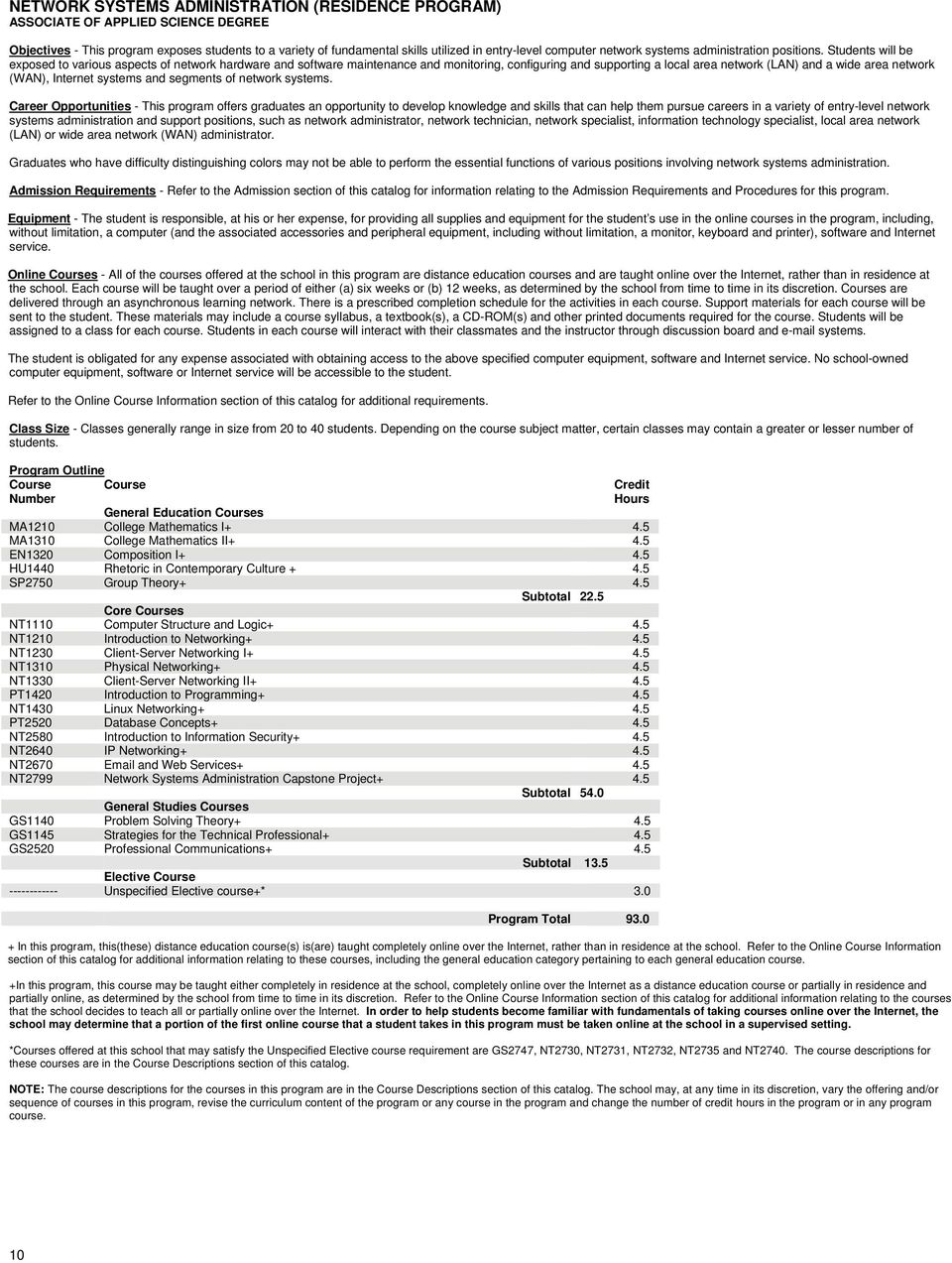
13 NETWORK SYSTEMS ADMINISTRATION (ONLINE PROGRAM) ASSOCIATE OF APPLIED SCIENCE DEGREE (Wisconsin residents will receive an Associate of Science Degree.) Objectives - This program exposes students to a variety of fundamental skills utilized in entry-level computer network systems administration positions. Students will be exposed to various aspects of network hardware and software maintenance and monitoring, configuring and supporting a local area network (LAN) and a wide area network (WAN), Internet systems and segments of network systems. Career Opportunities - This program offers graduates an opportunity to develop knowledge and skills that can help them pursue careers in a variety of entry-level network systems administration and support positions, such as network administrator, network technician, network specialist, information technology specialist, local area network (LAN) or wide area network (WAN) administrator. Graduates who have difficulty distinguishing colors may not be able to perform the essential functions of various positions involving network systems administration. Admission Requirements - Refer to the Admission section of this catalog for information relating to the Admission Requirements and Procedures for this program. School Equipment - Students will have the opportunity to use the following school equipment as required throughout the program: computer systems, network hubs, patch panels, printers and other common computer peripherals. Refer to Student Equipment in the Online Course Information section of this catalog for information relating to the student equipment requirements for the distance education courses that are taught online over the Internet. Class Size - Classes generally range in size from 20 to 40 students. Depending on the course subject matter, certain classes may contain a greater or lesser number of students. Program Outline Course Course Number Credit Hours General Education Courses MA1210 College Mathematics I+ 4.5 MA1310 College Mathematics II+ 4.5 EN1320 Composition I+ 4.5 HU1440 Rhetoric in Contemporary Culture SP2750 Group Theory+ 4.5 Subtotal 22.5 Core Courses NT1110 Computer Structure and Logic+ 4.5 NT1210 Introduction to Networking+ 4.5 NT1230 Client-Server Networking I+ 4.5 NT1310 Physical Networking+ 4.5 NT1330 Client-Server Networking II+ 4.5 PT1420 Introduction to Programming+ 4.5 NT1430 Linux Networking+ 4.5 PT2520 Database Concepts+ 4.5 NT2580 Introduction to Information Security+ 4.5 NT2640 IP Networking+ 4.5 NT2670 and Web Services+ 4.5 NT2799 Network Systems Administration Capstone Project+ 4.5 Subtotal 54.0 General Studies Courses GS1140 Problem Solving Theory+ 4.5 GS1145 Strategies for the Technical Professional+ 4.5 GS2520 Professional Communications+ 4.5 Subtotal 13.5 Elective Course Unspecified Elective course+* 3.0 Program Total In this program, this(these) distance education course(s) is(are) taught completely online over the Internet, rather than in residence at the school. Refer to the Online Course Information section of this catalog for additional information relating to these courses, including the general education category pertaining to each general education course. *Courses offered at this school that may satisfy the Unspecified Elective course requirement are GS2747, NT2730, NT2731, NT2732, NT2735 and NT2740. The course descriptions for these courses are in the Course Descriptions section of this catalog. NOTE: The course descriptions for the courses in this program are in the Course Descriptions section of this catalog. The school may, at any time in its discretion, vary the offering and/or sequence of courses in this program, revise the curriculum content of the program or any course in the program and change the number of credit hours in the program or in any program course. 11
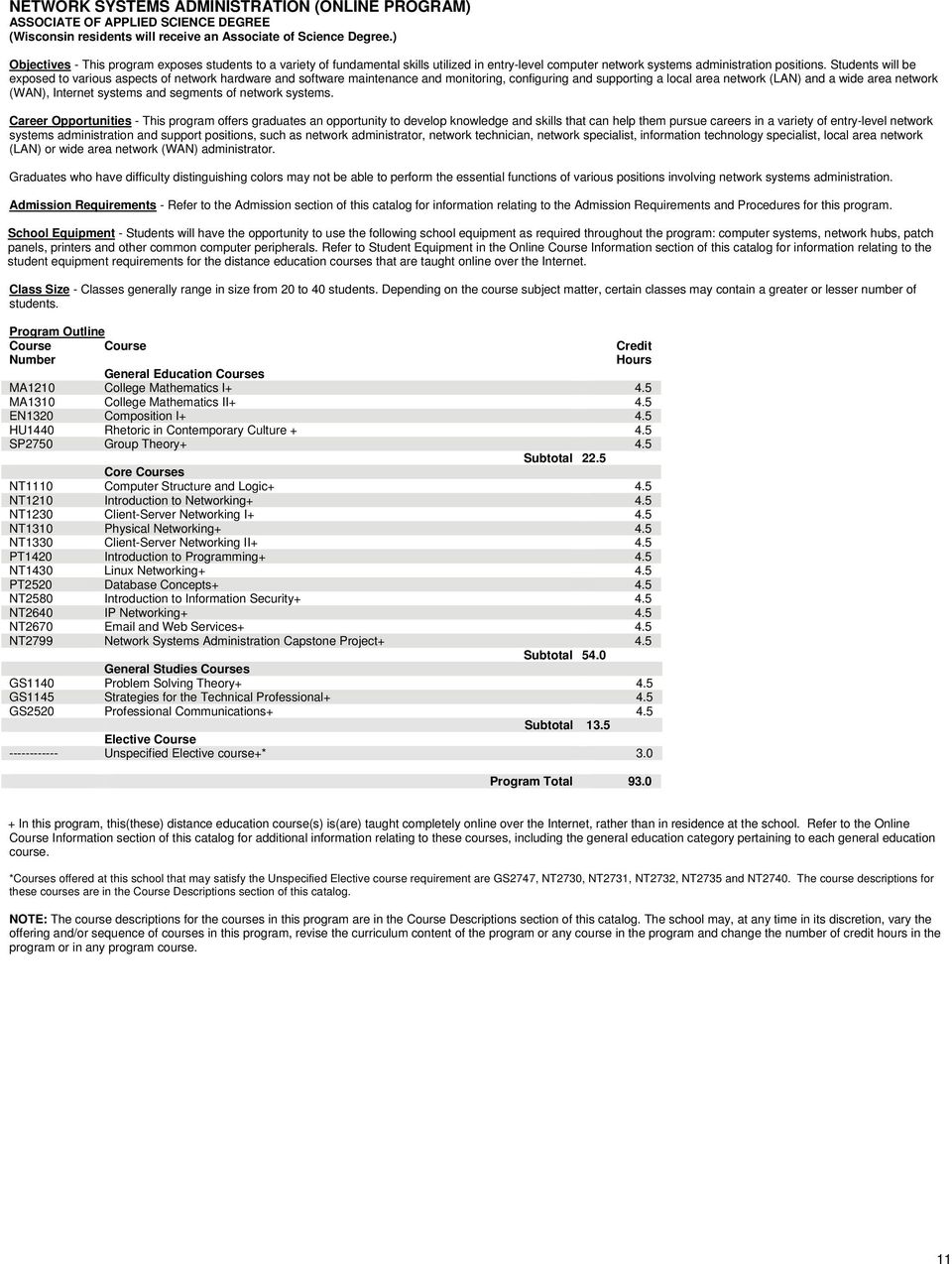
14 SOFTWARE DEVELOPMENT (RESIDENCE PROGRAM) ASSOCIATE OF APPLIED SCIENCE DEGREE Objectives - This program exposes students to a variety of fundamental skills used in entry-level software development, software analysis and application design positions. Students will be exposed to various aspects of programming, databases, website design and the development of a software product. Career Opportunities - This program offers graduates an opportunity to develop knowledge and skills that they can use to help them pursue careers in a variety of entry-level programming, application design and software development positions, such as Web developer, systems analyst, database programmer or testing analyst. Graduates who have difficulty distinguishing colors may not be able to perform the essential functions of various positions involving software development. Admission Requirements - Refer to the Admission section of this catalog for information relating to Admission Requirements and Procedures for this program. School Equipment - Students will have the opportunity to perform activities in different software development environments with typical platforms that support specific technologies and standards. These platforms are typically comprised of networked computers installed with software development tools. Refer to Student Equipment in the Online Course Information section of this catalog for information relating to the student equipment requirements for the distance education courses that are taught online over the Internet. Class Size - Classes generally range in size from 20 to 40 students. Depending on the course subject matter, certain classes may contain a greater or lesser number of students. Program Outline Course Course Number Credit Hours General Education Courses MA1210 College Mathematics I+ 4.5 MA1310 College Mathematics II+ 4.5 EN1320 Composition I+ 4.5 HU1440 Rhetoric in Contemporary Culture+ 4.5 SP2750 Group Theory+ 4.5 Subtotal 22.5 Core Courses NT1110 Computer Structure and Logic+ 4.5 SD1230 Introduction to Application Design and Development+ 4.5 SD1240 Creating Websites Using HTML and CSS+ 4.5 SD1340 Creating Websites Using HTML5, CSS3 and JavaScript+ 4.5 NT1410 Operating Systems+ 4.5 PT1420 Introduction to Programming+ 4.5 SD1420 Introduction to Java Programming+ 4.5 SD2520 Introduction to Database and XML with jquery+ 4.5 SD2550 Application Development Using Java I+ 4.5 SD2650 Application Development Using Java II+ 4.5 SD2670 Social Networking Applications and Technology+ 4.5 SD2799 Software Development Capstone Project+ 4.5 Subtotal 54.0 General Studies Courses GS1140 Problem Solving Theory+ 4.5 GS1145 Strategies for the Technical Professional+ 4.5 GS2520 Professional Communications+ 4.5 Subtotal 13.5 Elective Course Unspecified Elective course+* 3.0 Program Total In this program, this course may be taught either completely in residence at the school, completely online over the Internet as a distance education course or partially in residence and partially online, as determined by the school from time to time in its discretion. Refer to the Online Course Information section of this catalog for additional information relating to the courses that the school decides to teach all or partially online over the Internet. In order to help students become familiar with fundamentals of taking courses online over the Internet, the school may determine that a portion of the first online course that a student takes in this program must be taken online at the school in a supervised setting. *Courses offered at this school that may satisfy the Unspecified Elective course requirement are GS2747 and SD2720. The course descriptions for these courses are in the Course Descriptions section of this catalog. NOTE: The course descriptions for the courses in this program are in the Course Descriptions section of this catalog. The school may, at any time in its discretion, vary the offering and/or sequence of courses in this program, revise the curriculum content of the program or any course in the program and change the number of credit hours in the program or in any program course. 12

15 SOFTWARE DEVELOPMENT (ONLINE PROGRAM) ASSOCIATE OF APPLIED SCIENCE DEGREE Objectives - This program exposes students to a variety of fundamental skills used in entry-level software development, software analysis and application design positions. Students will be exposed to various aspects of programming, databases, website design and the development of a software product. Career Opportunities - This program offers graduates an opportunity to develop knowledge and skills that they can use to help them pursue careers in a variety of entry-level programming, application design and software development positions, such as Web developer, systems analyst, database programmer or testing analyst. Graduates who have difficulty distinguishing colors may not be able to perform the essential functions of various positions involving software development. Admission Requirements - Refer to the Admission section of this catalog for information relating to Admission Requirements and Procedures for this program. Equipment - The student is responsible, at his or her expense, for providing all supplies and equipment for the student s use in the online courses in the program, including, without limitation, a computer (and the associated accessories and peripheral equipment, including without limitation, a monitor, keyboard and printer), software and Internet service and account. Online Courses - All of the courses offered at the school in this program are distance education courses and are taught online over the Internet, rather than in residence at the school. Each course will be taught over a period of either (a) six weeks or (b) 12 weeks, as determined by the school from time to time in its discretion. Courses are delivered through an asynchronous learning network. There is a prescribed completion schedule for the activities in each course. Support materials for each course will be sent to the student. These materials may include a course syllabus, a textbook(s), a CD-ROM(s) and other printed documents required for the course. Students will be assigned to a class for each course. Students in each course will interact with their classmates and the instructor through discussion board and systems. The student is obligated for any expense associated with obtaining access to the above specified computer equipment, software and Internet service. No school-owned computer equipment, software or Internet service will be accessible to the student. Refer to the Online Course Information section of this catalog for additional requirements. Class Size - Classes generally range in size from 20 to 40 students. Depending on the course subject matter, certain classes may contain a greater or lesser number of students. Program Outline Course Course Number Credit Hours General Education Courses MA1210 College Mathematics I+ 4.5 MA1310 College Mathematics II+ 4.5 EN1320 Composition I+ 4.5 HU1440 Rhetoric in Contemporary Culture+ 4.5 SP2750 Group Theory+ 4.5 Subtotal 22.5 Core Courses NT1110 Computer Structure and Logic+ 4.5 SD1230 Introduction to Application Design and Development+ 4.5 SD1240 Creating Websites Using HTML and CSS+ 4.5 SD1340 Creating Websites Using HTML5, CSS3 and JavaScript+ 4.5 NT1410 Operating Systems+ 4.5 PT1420 Introduction to Programming+ 4.5 SD1420 Introduction to Java Programming+ 4.5 SD2520 Introduction to Database and XML with jquery+ 4.5 SD2550 Application Development Using Java I+ 4.5 SD2650 Application Development Using Java II+ 4.5 SD2670 Social Networking Applications and Technology+ 4.5 SD2799 Software Development Capstone Project+ 4.5 Subtotal 54.0 General Studies Courses GS1140 Problem Solving Theory+ 4.5 GS1145 Strategies for the Technical Professional+ 4.5 GS2520 Professional Communications+ 4.5 Subtotal 13.5 Elective Course Unspecified Elective course+* 3.0 Program Total 93.0 ` + In this program, this(these) distance education course(s) is(are) taught completely online over the Internet, rather than in residence at the school. Refer to the Online Course Information section of this catalog for additional information relating to these courses, including the general education category pertaining to each general education course. *Courses offered at this school that may satisfy the Unspecified Elective course requirement are GS2747 and SD2720. The course descriptions for these courses are in the Course Descriptions section of this catalog. NOTE: The course descriptions for the courses in this program are in the Course Descriptions section of this catalog. The school may, at any time in its discretion, vary the offering and/or sequence of courses in this program, revise the curriculum content of the program or any course in the program and change the number of credit hours in the program or in any program course. 13

16 INFORMATION TECHNOLOGY - COMPUTER NETWORK SYSTEMS ASSOCIATE OF APPLIED SCIENCE DEGREE Objectives - Information technology (IT) is a diverse area of study encompassing several computer-based system and application areas. The advancement of computers and communication technology continues to have profound impact on our lives. A need exists for technically competent individuals to provide appropriate computing solutions for users. The objective of the IT program is to provide a broad-based foundation in the area of IT and a concentration in computer network systems. In addition to technical knowledge, it is important for IT workers to be able to communicate, handle multi-tasking situations and to assess user needs when developing computer-based solutions. The Information Technology - Computer Network Systems program can help graduates prepare to perform tasks associated with installing, upgrading and maintaining computer network systems in typical LAN/WAN environments. This program explores a number of networking and internetworking technologies. Additional curriculum topics, investigated through classroom and laboratory experiences, include introductory computer programming, survey of operating systems, network design and implementation, network systems management and other related technical subjects. Information Technology - Computer Network Systems consists of a foundation core of computing and general education courses, followed by studies in computer network systems applications. Career Opportunities - Graduates of this program may begin their careers in Information Technology - Computer Network Systems in a variety of entry-level positions in various fields involving information technology - computer network systems, such as computer network analyst, computer network technician, help desk analyst and WAN/LAN technician. Graduates who have difficulty distinguishing colors may not be able to perform the essential functions of various positions involving information technology. Admission Requirements - Refer to the Admission section of this catalog for information relating to Admission Requirements and Procedures for this program. School Equipment - Students will have the opportunity to use the following school equipment as required throughout the program: computer systems, network hubs, patch panels, printers and other common computer peripherals. Refer to Student Equipment in the Online Course Information section of this catalog for information relating to the student equipment requirements for the distance education courses that are taught online over the Internet. Class Size - Classes generally range in size from 20 to 40 students. Depending on the course subject matter, certain classes may contain a greater or lesser number of students. Program Outline Course Number Course Credit Hours General Education Courses GE117 Composition I+ 4 GE127 College Mathematics I+ 4 GE192 College Mathematics II+ 4 GE217 Composition II+ 4 GE273 Microeconomics+ 4 GE347 Group Dynamics+ 4 Subtotal 24 Core Courses IT104 Introduction to Computer Programming+ 4 IT109 Microsoft Desktop Operating System+ 4 IT113 Structured Cabling+ 4 IT203 Database Development+ 4 IT220 Network Standards and Protocols+ 4 IT221 Microsoft Network Operating System I+ 4 IT222 Microsoft Network Operating System II+ 4 IT250 Linux Operating System+ 4 IT255 Introduction to Information Systems Security+ 4 IT260 Networking Application Services and Security+ 4 IT302 Linux System Administration+ 4 IT320 WAN Technology and Application+ 4 IT321 Network Technology and Service Integration+ 4 IT331 Network Development Capstone Project+ 4 Subtotal 56 Technical Basic Courses TB133 Strategies for the Technical Professional+ 4 TB143 Introduction to Personal Computers+ 4 TB184 Problem Solving+ 4 TB332 Professional Procedures and Portfolio Development+ 4 Subtotal 16 Program Total 96 +In this program, this course may be taught either completely in residence at the school, completely online over the Internet as a distance education course or partially in residence and partially online, as determined by the school from time to time in its discretion. Refer to the Online Course Information section of this catalog for additional information relating to the courses that the school decides to teach all or partially online over the Internet. In order to help students become familiar with fundamentals of taking courses online over the Internet, the school may determine that a portion of the first online course that a student takes in this program must be taken online at the school in a supervised setting. NOTE: The course descriptions for the courses in this program are in the Course Descriptions section of this catalog. The school may, at any time in its discretion, vary the offering and/or sequence of courses in this program, revise the curriculum content of the program or any course in the program and change the number of credit hours in the program or in any program course. 14

17 INFORMATION SYSTEMS ADMINISTRATION (ONLINE PROGRAM) ASSOCIATE OF APPLIED SCIENCE DEGREE Objectives - The purpose of this program is to help students prepare for entry-level positions in network systems administration related professions. The curriculum of the program focuses on technical, business and general education cores of studies. The technical core covers knowledge and skills in computer systems, operating systems, local and wide area network systems, telecommunications fundamentals and the administrative tasks related to such systems. Students will be taught to perform installation, configuration, administration and routine maintenance tasks. Courses in the business core will introduce basic business functions, organizational structures and behaviors and technology applications in business settings. The general education core will offer studies in the humanities, mathematics, science and the social sciences. Career Opportunities - Graduates of this program may pursue careers in a variety of entry-level positions involving computer and network systems installation, configuration, administration and maintenance tasks. Admission Requirements - Refer to the Admission section of this catalog for information relating to Admission Requirements and Procedures for this program. Equipment - The student is responsible, at his or her expense, for providing all supplies and equipment for the student s use in the online courses in the program, including, without limitation, a computer (and the associated accessories and peripheral equipment, including without limitation, a monitor, keyboard and printer), software, Internet service and an account. Online Courses - All of the courses offered at the school in this program are distance education courses and are taught online over the Internet, rather than in residence at the school. Each course will be taught over a period of either (a) six weeks or (b) 12 weeks, as determined by the school from time to time in its discretion. Courses are delivered through an asynchronous learning network. There is a prescribed completion schedule for the activities in each course. Support materials for each course will be sent to the student. These materials may include a course syllabus, a textbook(s), a CD-ROM(s) and other printed documents required for the course. Students will be assigned to a class for each course. Students in each course will interact with their classmates and the instructor through discussion board and systems. The student is obligated for any expense associated with obtaining access to the above specified computer equipment, software and Internet service. No school-owned computer equipment, software or Internet service will be accessible to the student. Refer to the Online Course Information section of this catalog for additional requirements. Class Size - Classes generally range in size from 15 to 25 students. Depending on the course subject matter, certain classes may contain a greater or lesser number of students. Program Outline Course Number Course Credit Hours General Education Courses GE117 Composition I+ 4 GE127 College Mathematics I+ 4 GE192 College Mathematics II+ 4 GE217 Composition II+ 4 GE273 Microeconomics+ 4 GE347 Group Dynamics+ 4 Subtotal 24 Core Courses BU121 Introduction to Business in a Global Society+ 4 BU131 Business and Information Systems+ 4 IT180 Logic and Computer Programming+ 4 IT181 OS Platforms and Computer Technologies+ 4 IT182 Fundamentals of Networking Technologies+ 4 IT183 Information Security Fundamentals+ 4 BU232 Business and Database Applications+ 4 IT280 Networking and Telecommunications+ 4 IT281 MS Operating Systems I+ 4 IT282 MS Operating Systems II+ 4 IT283 Linux Networking Operating Systems+ 4 IT284 MS Network Systems Administration+ 4 IT380 Linux Network Systems Administration+ 4 IT381 Network Systems Capstone Project+ 4 Subtotal 56 Technical Basic Courses TB139A Strategies for Learning in a Technical Environment+ 4 TB141 Introduction to Productivity Software+ 4 TB145 Introduction to Computing+ 4 TB332 Professional Procedures and Portfolio Development+ 4 Subtotal 16 Program Total 96 +In this program, this course is a distance education course that is taught online over the Internet, rather than in residence at the school. Refer to the Online Course Information section of this catalog for additional information relating to these courses. NOTE: The course descriptions for the courses in this program are in the Course Descriptions section of this catalog. The school may, at any time in its discretion, vary the offering and/or sequence of courses in this program, revise the curriculum content of the program or any course in the program and change the number of credit hours in the program or in any program course. 15

18 COMPUTER FORENSICS (ONLINE PROGRAM) ASSOCIATE OF APPLIED SCIENCE DEGREE Objectives - The purpose of this program is to help graduates prepare for entry-level positions in computer forensics. The curriculum of the program focuses on technical, criminal justice and general education cores of study. The technical core covers knowledge and skills in the collection, identification, preservation, extraction, interpretation and documentation of computer evidence. Courses in the criminal justice core will introduce students to the legal and regulatory aspects of computer forensics including an understanding of the judicial system, investigative processes, the importance of maintaining the chain of evidence and incident reporting. The general education core will offer studies in the humanities, mathematics, sciences and social sciences. Career Opportunities - Graduates of this program may begin their careers in a variety of entry-level positions involving the collection, preservation, analysis, and presentation of digital forensic evidence. Entry-level positions may include computer forensics specialists, forensic laboratory technicians, cyber-squad professionals and technicians, security telecommunications technicians or security administrators. Admission Requirements - Refer to the Admission section of this catalog for information relating to Admission Requirements and Procedures for this program. Equipment -The student is responsible, at his or her expense, for providing all supplies and equipment for the student s use in the online courses in the program, including, without limitation, a computer (and the associated accessories and peripheral equipment, including without limitation, a monitor, keyboard and printer), software, Internet service and an account. Online Courses - All of the courses offered at the school in this program are distance education courses and are taught online over the Internet, rather than in residence at the school. Each course will be taught over a period of either (a) six weeks or (b) 12 weeks, as determined by the school from time to time in its discretion. Courses are delivered through an asynchronous learning network. There is a prescribed completion schedule for the activities in each course. Support materials for each course will be sent to the student. These materials may include a course syllabus, a textbook(s), a CD-ROM(s) and other printed documents required for the course. Students will be assigned to a class for each course. Students in each course will interact with their classmates and the instructor through discussion board and systems. The student is obligated for any expense associated with obtaining access to the above specified computer equipment, software and Internet service. No school-owned computer equipment, software or Internet service will be accessible to the student. Refer to the Online Course Information section of this catalog for additional requirements. Class Size - Classes generally range in size from 15 to 25 students. Depending on the course subject matter, certain classes may contain a greater or lesser number of students. Program Outline Course Number Course Credit Hours General Education Courses GE117 Composition I+ 4 GE127 College Mathematics I+ 4 GE175 American Government+ 4 GE217 Composition II+ 4 GE273 Microeconomics+ 4 GE347 Group Dynamics+ 4 Subtotal 24 Core Courses CJ123 Criminal Law+ 4 CJ131 Introduction to Criminal Justice+ 4 IT181 OS Platforms and Computer Technologies+ 4 IT182 Fundamentals of Networking Technologies+ 4 IT183 Information Security Fundamentals+ 4 CF200 Computer Forensics for the First Responder+ 4 CF210 Cybercrime and Digital Forensic Tools+ 4 CF220 Computer Forensics: Evidence Collection and Preservation+ 4 CJ241 Criminal Investigation+ 4 CF300 Practical Windows Forensics and Networking+ 4 CF310 Practical Linux Forensics and Networking+ 4 CF320 Computer Forensics: Evidence Analysis and Presentation+ 4 CJ333 Constitutional Law+ 4 CF380 Computer Forensics Capstone+ 4 Subtotal 56 Technical Basic Courses TB139A Strategies for Learning in a Technical Environment+ 4 TB141 Introduction to Productivity Software+ 4 TB145 Introduction to Computing+ 4 TB332 Professional Procedures and Portfolio Development+ 4 Subtotal 16 Program Total 96 +In this program, this course is a distance education course that is taught online over the Internet, rather than in residence at the school. Refer to the Online Course Information section of this catalog for additional information relating to these courses. NOTE: The course descriptions for the courses in this program are in the Course Descriptions section of this catalog. The school may, at any time in its discretion, vary the offering and/or sequence of courses in this program, revise the curriculum content of the program or any course in the program and change the number of credit hours in the program or in any program course. 16

19 SCHOOL OF ELECTRONICS TECHNOLOGY ELECTRICAL ENGINEERING AND COMMUNICATIONS TECHNOLOGY BACHELOR OF SCIENCE DEGREE Objectives - This program exposes students to fundamental knowledge and skills utilized in entry-level positions in electrical engineering and communications technology. Students will be exposed to a variety of basic electronics and computer principles and technical skills in both theory and practical application in a laboratory environment. Students explore various topics in electrical circuitry, testing, systems analysis and testing, systems maintenance and report preparation. Career Opportunities - This program offers graduates an opportunity to develop knowledge and skills that can help them pursue careers in a variety of entry-level electronics and computer technology fields. Graduates who have difficulty distinguishing colors may not be able to perform the essential functions of various positions involving electronics and communications engineering technology. Admission Requirements - Refer to the Admission section of this catalog for information relating to Admission Requirements and Procedures for this program. School Equipment - Students will have the opportunity to use the following school equipment as required throughout the program: standard electronics test equipment such as multimeters, oscilloscopes, power supplies, signal generators and spectrum analyzers, cabling tools and test instruments and circuit and system simulation software. Refer to Student Equipment in the Online Course Information section of this catalog for information relating to the student equipment requirements for the distance education courses that are taught online over the Internet. Class Size - Classes generally range in size from 15 to 30 students. Depending on the course subject matter, certain classes may contain a greater or lesser number of students. Program Outline Course Course Number Credit Hours General Education Courses* Unspecified General Education courses PY3150 Psychology+ 4.5 SS3150 Research Methods+ 4.5 EN3220 Written Analysis+ 4.5 MA3310 Calculus I+ 4.5 MA3410 Calculus II+ 4.5 HU4640 Ethics+ 4.5 SC4730 Environmental Science+ 4.5 Subtotal 54.0 Core Courses Unspecified Core courses** 49.5 ET3110 Networking and Communications+ 4.5 ET3150 Automatic Industrial Control+ 4.5 ET3220 Mobile Wireless Technology+ 4.5 ET3280 Electrical Machines and Energy Conversion+ 4.5 ET3330 Telecommunications Systems and Technology+ 4.5 ET3380 Power Electronics+ 4.5 ET3430 Fiber Optic Communications+ 4.5 ET3480 Power Systems+ 4.5 ET4580 Green Energy Technology+ 4.5 ET4640 Embedded Systems+ 4.5 ET4671 Electronic Circuit Analysis+ 4.5 ET4771 Electronic Circuit Design+ 4.5 ET4799 Electrical Engineering and Communications Technology Capstone Project+ 4.5 Subtotal Elective Courses Unspecified Elective courses Minimum required credit hours for the Baccalaureate degree (Grand total) In this program, this(these) course(s) may be taught either completely in residence at the school, completely online over the internet as a distance education course or partially in residence and partially online, as determined by the school from time to time in its discretion. Refer to the Online Course Information section of this catalog for additional information relating to the courses that the school decides to teach all or partially online over the Internet. In order to help students become familiar with fundamentals of taking courses online over the Internet, the school may determine that a portion of the first online course that a student takes in this program must be taken online at the school in a supervised setting. *General Education courses include courses in the humanities, composition, mathematics, the sciences and the social sciences. The Unspecified General Education courses must include at least one course in each of the following categories: the humanities, composition, mathematics and the social sciences. Refer to the Course Descriptions section of this catalog for the general education category pertaining to each general education course. **Examples of the subject matter included in the Unspecified Core courses are as follows: basic electronics and devices; digital electronics, computer technology; and electronic systems. Courses offered at this school that may satisfy the Unspecified Core course requirement are ET1210, ET1220, ET1310, ET1410, ET2530, ET2560, ET2640, ET2750, ET2799 and NT1110. The course descriptions for these courses are in the Course Descriptions section of this catalog. NOTE: The course descriptions for the courses in this program are in the Course Descriptions section of this catalog. The school may, at any time in its discretion, vary the offering and/or sequence of courses in this program, revise the curriculum content of the program or any course in the program and change the number of credit hours in the program or in any program course. 17

20 ELECTRONICS AND COMMUNICATIONS ENGINEERING TECHNOLOGY BACHELOR OF SCIENCE DEGREE Objectives - The purpose of this program is to help graduates prepare for career opportunities in a variety of entry-level positions in various fields involving electronics engineering technology, including communication systems. Courses in this program offer an expansive foundation in electronic circuitry and communications engineering technology through the study of subjects such as circuit analysis, circuit design, data and network communications, digital communications in the presence of noise, calculus and additional general education coursework. Career Opportunities - Graduates of this program may begin to pursue career opportunities in a variety of entry-level positions, such as electronics engineering technologist, electronics engineering assistant, engineering sales/service representative, computer systems technologist, industrial systems technologist, technical consultant, telecommunications technician, communication systems installer, field service representative, engineering technician or research technician. Among the types of work environments that may use the services of graduates with the skills addressed in this program are: data and telecommunications service providers, TV and satellite services organizations, computer network sales and service organizations, entertainment industries, transportation companies, communications R&D facilities, product development departments, research and development groups, quality engineering departments, field service offices and maintenance departments. Graduates who have difficulty distinguishing colors may not be able to perform the essential functions of various positions involving electronics and communications engineering technology. Admission Requirements - Refer to the Admission section of this catalog for information relating to Admission Requirements and Procedures for this program. School Equipment - Students will have the opportunity to use standard electronics test equipment as required throughout the program, such as multimeters, oscilloscopes, power supplies, signal generators and spectrum analyzers, cabling tools and test instruments and circuit and system simulation software. Refer to Student Equipment in the Online Course Information section of this catalog for information relating to the student equipment requirements for the distance education courses that are taught online over the Internet. Class Size - Classes generally range in size from 15 to 30 students. Depending on the course subject matter, certain classes may contain a greater or lesser number of students. Program Outline Course Course Number Credit Hours General Education Courses* Unspecified General Education courses+ 24 EG360 Introductory Calculus+ 4 EG371 Research Methods+ 4 EG372 Written Analysis+ 4 EG381 Statistics+ 4 EG452 Economics and Change+ 4 EG462 Contemporary World Culture+ 4 EG468 Ethics+ 4 EG481 Environmental Issues+ 4 Subtotal 56 Core Courses Unspecified Core courses** 40 TM380 Advanced Topics in Technical Mathematics 4 ET385 Data and Network Communications 4 ET390 Embedded Systems 4 ET395 Modern Wireless Communications 4 ET415 Process Control 4 TM420 Technical Calculus 4 ET445 Advanced Circuit Analysis I 4 ET446 Advanced Circuit Analysis II 4 ET455 Digital Communication Systems I 4 ET456 Digital Communication Systems II 4 ET475 Electronic Circuit Design I 4 ET476 Electronic Circuit Design II 4 ET485 Capstone Project 4 Subtotal 92 Elective Courses Unspecified Elective courses+ 32 Minimum required credit hours for the Baccalaureate degree (Grand total) 180 +In this program, this(these) course(s) may be taught either completely in residence at the school, completely online over the Internet as a distance education course or partially in residence and partially online, as determined by the school from time to time in its discretion. Refer to the Online Course Information section of this catalog for additional information relating to the courses that the school decides to teach all or partially online over the Internet. In order to help students become familiar with fundamentals of taking courses online over the Internet, the school may determine that a portion of the first online course that a student takes in this program must be taken online at the school in a supervised setting. *General Education courses include courses in the humanities, composition, mathematics, the sciences and the social sciences. The Unspecified General Education courses must include at least one course in each of the following categories: the humanities, composition, mathematics and the social sciences. Refer to the Course Descriptions section of this catalog for the general education category pertaining to each general education course. **Examples of the subject matter included in the Unspecified Core courses are as follows: basic electronics and devices, digital electronics, computer technology and electronic systems. Courses offered at this school that satisfy the Unspecified Core course requirement are ET115, ET145, ET156, ET215, ET245, ET255, ET275, ET285, ET315 and ET355. The course descriptions for these courses are in the Course Descriptions section of this catalog. NOTE: The course descriptions for the courses in this program are in the Course Descriptions section of this catalog. The school may, at any time in its discretion, vary the offering and/or sequence of courses in this program, revise the curriculum content of the program or any course in the program and change the number of credit hours in the program or in any program course. 18
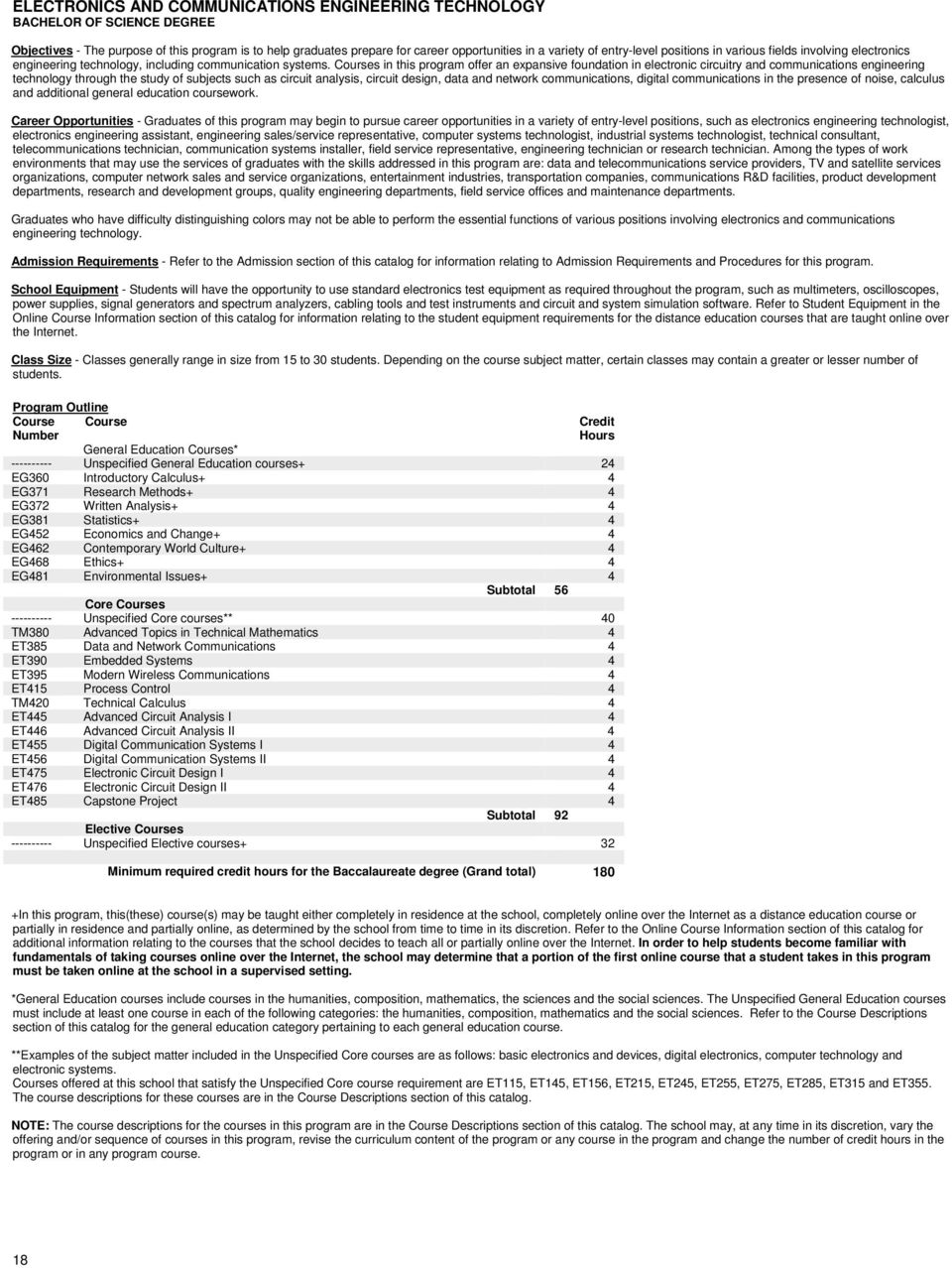
21 ELECTRICAL ENGINEERING TECHNOLOGY (RESIDENCE PROGRAM) ASSOCIATE OF APPLIED SCIENCE DEGREE Objectives - This program exposes students to a variety of fundamental skills utilized in entry-level electrical and electronics technician positions. Students are exposed to the theory of various electronics and electrical circuitry in a classroom environment and to various techniques and applications in a laboratory environment. Career Opportunities - This program offers graduates an opportunity to develop knowledge and skills that can help them pursue careers in a variety of entry-level electrical and electronics engineering technology positions, such as electronics technician, service technician, telecommunications technician and engineering technician. Graduates who have difficulty distinguishing colors may not be able to perform the essential functions of various positions involving electrical engineering technology. Admission Requirements - Refer to the Admission section of this catalog for information relating to the Admission Requirements and Procedures for this program. School Equipment - In laboratory, students typically work in teams. Students will have the opportunity to use the following school equipment as required throughout the program: computers, applications programs relevant to the field, standard hand tools and various pieces of test equipment which include the multimeter, power supply, oscilloscope and signal generator. Refer to Student Equipment in the Online Course Information section of this catalog for information relating to the student equipment requirements for the distance education courses that are taught online over the Internet. Class Size - Classes generally range in size from 20 to 40 students. Depending on the course subject matter, certain classes may contain a greater or lesser number of students. Program Outline Course Course Number Credit Hours General Education Courses MA1210 College Mathematics I+ 4.5 MA1310 College Mathematics II+ 4.5 EN1320 Composition I+ 4.5 HU1440 Rhetoric in Contemporary Culture+ 4.5 SP2750 Group Theory+ 4.5 Subtotal 22.5 Core Courses NT1110 Computer Structure and Logic+ 4.5 ET1210 DC-AC Electronics+ 4.5 NT1210 Introduction to Networking+ 4.5 ET1220 Digital Fundamentals+ 4.5 ET1310 Solid State Devices+ 4.5 ET1410 Integrated Circuits+ 4.5 ET2530 Electronic Communications+ 4.5 ET2560 Introduction to C Programming+ 4.5 ET2640 Microprocessors and Microcontrollers+ 4.5 ET2750 Programmable Logic Controllers+ 4.5 ET2799 Electrical Engineering Technology Capstone Project+ 4.5 Subtotal 49.5 General Studies Courses GS1140 Problem Solving Theory+ 4.5 GS1145 Strategies for the Technical Professional+ 4.5 GS2520 Professional Communications+ 4.5 GS2530 Technical Physics+ 4.5 Subtotal 18.0 Elective Course Unspecified Elective course+* 3.0 Program Total In this program, this course may be taught either completely in residence at the school, completely online over the Internet as a distance education course or partially in residence and partially online, as determined by the school from time to time in its discretion. Refer to the Online Course Information section of this catalog for additional information relating to the courses that the school decides to teach all or partially online over the Internet. In order to help students become familiar with fundamentals of taking courses online over the Internet, the school may determine that a portion of the first online course that a student takes in this program must be taken online at the school in a supervised setting. *Courses offered at this school that may satisfy the Unspecified Elective course requirement are ET2760, GS2747 and NT2710. The course descriptions for these courses are in the Course Descriptions section of this catalog. NOTE: The course descriptions for the courses in this program are in the Course Descriptions section of this catalog. The school may, at any time in its discretion, vary the offering and/or sequence of courses in this program, revise the curriculum content of the program or any course in the program and change the number of credit hours in the program or in any program course. 19
22 ELECTRICAL ENGINEERING TECHNOLOGY (ONLINE PROGRAM) ASSOCIATE OF APPLIED SCIENCE DEGREE Objectives - This program exposes students to a variety of fundamental skills utilized in entry-level electrical and electronics technician positions. Students are exposed to the theory of various electronics and electrical circuitry in a classroom environment and to various techniques and applications in a laboratory environment. Career Opportunities - This program offers graduates an opportunity to develop knowledge and skills that can help them pursue careers in a variety of entry-level electrical and electronics engineering technology positions, such as electronics technician, service technician, telecommunications technician and engineering technician. Graduates who have difficulty distinguishing colors may not be able to perform the essential functions of various positions involving electrical engineering technology. Admission Requirements - Refer to the Admission section of this catalog for information relating to the Admission Requirements and Procedures for this program. Equipment - The student is responsible, at his or her expense, for providing all supplies and equipment for the student s use in the online courses in the program, including, without limitation, a computer (and the associated accessories and peripheral equipment, including without limitation, a monitor, keyboard and printer), software and Internet service and account. Online Courses - All of the courses offered at the school in this program are distance education courses and are taught online over the Internet, rather than in residence at the school. Each course will be taught over a period of either (a) six weeks or (b) 12 weeks, as determined by the school from time to time in its discretion. Courses are delivered through an asynchronous learning network. There is a prescribed completion schedule for the activities in each course. Support materials for each course will be sent to the student. These materials may include a course syllabus, a textbook(s), a CD-ROM(s) and other printed documents required for the course. Students will be assigned to a class for each course. Students in each course will interact with their classmates and the instructor through discussion board and systems. The student is obligated for any expense associated with obtaining access to the above specified computer equipment, software and Internet service. No school-owned computer equipment, software or Internet service will be accessible to the student. Refer to the Online Course Information section of this catalog for additional requirements. Class Size - Classes generally range in size from 20 to 40 students. Depending on the course subject matter, certain classes may contain a greater or lesser number of students. Program Outline Course Course Number Credit Hours General Education Courses MA1210 College Mathematics I+ 4.5 MA1310 College Mathematics II+ 4.5 EN1320 Composition I+ 4.5 HU1440 Rhetoric in Contemporary Culture+ 4.5 SP2750 Group Theory+ 4.5 Subtotal 22.5 Core Courses NT1110 Computer Structure and Logic+ 4.5 ET1210 DC-AC Electronics+ 4.5 NT1210 Introduction to Networking+ 4.5 ET1220 Digital Fundamentals+ 4.5 ET1310 Solid State Devices+ 4.5 ET1410 Integrated Circuits+ 4.5 ET2530 Electronic Communications+ 4.5 ET2560 Introduction to C Programming+ 4.5 ET2640 Microprocessors and Microcontrollers+ 4.5 ET2750 Programmable Logic Controllers+ 4.5 ET2799 Electrical Engineering Technology Capstone Project+ 4.5 Subtotal 49.5 General Studies Courses GS1140 Problem Solving Theory+ 4.5 GS1145 Strategies for the Technical Professional+ 4.5 GS2520 Professional Communications+ 4.5 GS2530 Technical Physics+ 4.5 Subtotal 18.0 Elective Course Unspecified Elective course+* 3.0 Program Total In this program, this course is a distance education course that is taught online over the Internet, rather than in residence at the school. Refer to the Online Course Information section of this catalog for additional information relating to these courses. *Courses offered at this school that may satisfy the Unspecified Elective course requirement are ET2760, GS2747 and NT2710. The course descriptions for these courses are in the Course Descriptions section of this catalog. NOTE: The course descriptions for the courses in this program are in the Course Descriptions section of this catalog. The school may, at any time in its discretion, vary the offering and/or sequence of courses in this program, revise the curriculum content of the program or any course in the program and change the number of credit hours in the program or in any program course. 20
23 COMPUTER AND ELECTRONICS ENGINEERING TECHNOLOGY ASSOCIATE OF APPLIED SCIENCE DEGREE Objectives - This program helps graduates begin to prepare for careers in a variety of entry-level positions in many fields of electronics and computer technology, such as aviation, communications, computers, consumer products, defense and research and development. The program acquaints students with certain circuits, systems and specialized techniques used in electronics and computer technology career fields and exposes students to a combination of classroom theory and practical application in a laboratory environment. Career Opportunities - Graduates of this program may begin their careers in a variety of entry-level positions in various fields involving electronics engineering technology and computer engineering technology such as technician, electronics technician, field service representative, salesperson and computer technician. Graduates who have difficulty distinguishing colors may not be able to perform the essential functions of various positions involving computer and electronics engineering technology. Admission Requirements - Refer to the Admission section of this catalog for information relating to Admission Requirements and Procedures for this program. School Equipment - In laboratory, students typically work in teams. Students will have the opportunity to use the following school equipment as required throughout the program: computers, applications programs relevant to the field, standard hand tools and various pieces of test equipment which include the multimeter, power supply, oscilloscope and signal generator. Refer to Student Equipment in the Online Course Information section of this catalog for information relating to the student equipment requirements for the distance education courses that are taught online over the Internet. Class Size - Classes generally range in size from 20 to 40 students. Depending on the course subject matter, certain classes may contain a greater or lesser number of students. Program Outline Course Number Course Credit Hours General Education Courses GE117 Composition I+ 4 GE127 College Mathematics I+ 4 GE192 College Mathematics II+ 4 GE217 Composition II+ 4 GE253 Physics+ 4 GE273 Microeconomics+ 4 Subtotal 24 Core Courses ET115 DC Electronics 4 ET145 AC Electronics 4 ET156 Introduction to C Programming 4 ET215 Electronic Devices I 4 IT220 Network Standards and Protocols 4 ET245 Electronic Devices II 4 ET255 Digital Electronics I 4 ET275 Electronic Communications Systems I 4 ET285 Digital Electronics II 4 ET315 Electronic Communications Systems II 4 ET345 Control Systems 4 ET355 Microprocessors 4 ET365 Computer and Electronics Capstone Project 4 ET376 C/C++ Programming 4 Subtotal 56 Technical Basic Courses TB133 Strategies for the Technical Professional+ 4 TB143 Introduction to Personal Computers+ 4 TB184 Problem Solving+ 4 TB332 Professional Procedures and Portfolio Development+ 4 Subtotal 16 Program Total 96 +In this program, this course may be taught either completely in residence at the school, completely online over the Internet as a distance education course or partially in residence and partially online, as determined by the school from time to time in its discretion. Refer to the Online Course Information section of this catalog for additional information relating to the courses that the school decides to teach all or partially online over the Internet. In order to help students become familiar with fundamentals of taking courses online over the Internet, the school may determine that a portion of the first online course that a student takes in this program must be taken online at the school in a supervised setting. NOTE: The course descriptions for the courses in this program are in the Course Descriptions section of this catalog. The school may, at any time in its discretion, vary the offering and/or sequence of courses in this program, revise the curriculum content of the program or any course in the program and change the number of credit hours in the program or in any program course. 21
24 SCHOOL OF DRAFTING AND DESIGN CONSTRUCTION MANAGEMENT (RESIDENCE PROGRAM) BACHELOR OF SCIENCE DEGREE Objectives - This program covers the fundamentals and offers a foundation in construction management, construction techniques and legal issues relating to the construction management field. Areas of study include building codes, site construction and measurement, construction documents, construction project management and construction safety management. The goal of the program is to help the student acquire skills that can be used to enter the workplace and be a versatile member of a construction team. Career Opportunities - Graduates of this program may begin their careers in a variety of entry-level positions involving construction estimating, construction safety, construction project management or building code compliance. Graduates who have difficulty distinguishing colors may not be able to perform the essential functions of various positions involving construction management. Admission Requirements - Refer to the Admission section of this catalog for information relating to Admission Requirements and Procedures for this program. School Equipment - Students will have the opportunity to use the following school equipment as required throughout the program: computer systems, project scheduling and construction estimating software, computer graphics software, printers and other common computer peripherals. Refer to Student Equipment in the Online Course Information section of this catalog for information relating to the student equipment requirements for the distance education courses that are taught online over the Internet. Class Size - Classes generally range in size from 15 to 30 students. Depending on the course subject matter, certain classes may contain a greater or lesser number of students. Program Outline Course Course Number Credit Hours General Education Courses* Unspecified General Education courses+ 24 GE364 Art Appreciation+ 4 EG371 Research Methods+ 4 EG372 Written Analysis+ 4 EG381 Statistics+ 4 EG452 Economics and Change+ 4 EG462 Contemporary World Culture+ 4 EG468 Ethics+ 4 EG481 Environmental Issues+ 4 Subtotal 56 Core Courses Unspecified Core courses** 56 CM310 Commercial Construction Methods+ 4 EC311 Introduction to Project Management+ 4 CM320 Principles of Building Construction Management+ 4 CM330 Statics and Strength of Materials+ 4 CM340 Building Codes+ 4 CM350 Site Construction and Measurement+ 4 CM420 Construction Documents and Contracts+ 4 CM430 Mechanical Systems+ 4 CM440 Construction Project Scheduling+ 4 CM450 Cost Estimating and Analysis+ 4 CM470 Legal Issues in Construction+ 4 CM480 Construction Safety Management+ 4 CM490 Capstone Project+ 4 Subtotal 108 Elective Courses Unspecified Elective courses+ 16 Minimum required credit hours for the Baccalaureate Degree (Grand total) 180 +In this program, this(these) course(s) may be taught either completely in residence at the school, completely online over the Internet as a distance education course or partially in residence and partially online, as determined by the school from time to time in its discretion. Refer to the Online Course Information section of this catalog for additional information relating to the courses that the school decides to teach all or partially online over the Internet. In order to help students become familiar with fundamentals of taking courses online over the Internet, the school may determine that a portion of the first online course that a student takes in this program must be taken online at the school in a supervised setting. *General Education courses include courses in the humanities, composition, mathematics, the sciences and the social sciences. The Unspecified General Education courses must include at least one course in each of the following categories: the humanities, composition, mathematics and the social sciences. Refer to the Course Descriptions section of this catalog for the general education category pertaining to each general education course. **Examples of the subject matter included in the Unspecified Core courses are as follows: 3D modeling, design theory, computer drafting and design, engineering drafting and design, architectural drafting and design, civil drafting and design and visualization skills. Courses offered at this school that satisfy the Unspecified Core course requirement are CD111, CD121, CD130, CD140, CD210, CD220, CD230, CD240, CD245, CD250, CD310, CD320, CD331 and CD340. The course descriptions for these courses are in the Course Descriptions section of this catalog. NOTE: The course descriptions for the courses in this program are in the Course Descriptions section of this catalog. The school may, at any time in its discretion, vary the offering and/or sequence of courses in this program, revise the curriculum content of the program or any course in the program and change the number of credit hours in the program or in any program course. 22
25 CONSTRUCTION MANAGEMENT (ONLINE PROGRAM) BACHELOR OF SCIENCE DEGREE (Tennessee residents will receive a Bachelor of Applied Science Degree.) Objectives - This program covers the fundamentals and offers a foundation in construction management, construction techniques and legal issues relating to the construction management field. Areas of study include building codes, site construction and measurement, construction documents, construction project management and construction safety management. The goal of the program is to help the student acquire skills that can be used to enter the workplace and be a versatile member of a construction team. Career Opportunities - Graduates of this program may begin their careers in a variety of entry-level positions involving construction estimating, construction safety, construction project management or building code compliance. Graduates who have difficulty distinguishing colors may not be able to perform the essential functions of various positions involving construction management. Admission Requirements - Refer to the Admission section of this catalog for information relating to Admission Requirements and Procedures for this program. Equipment - The student is responsible, at his or her expense, for providing all supplies and equipment for the student s use in the online courses in the program, including, without limitation, a computer (and the associated accessories and peripheral equipment, including without limitation, a monitor, keyboard and printer), software and Internet service and account. Online Courses - All of the courses offered at the school in this program are distance education courses and are taught online over the Internet, rather than in residence at the school. Each course will be taught over a period of either (a) six weeks or (b) 12 weeks, as determined by the school from time to time in its discretion. Courses are delivered through an asynchronous learning network. There is a prescribed completion schedule for the activities in each course. Support materials for each course will be sent to the student. These materials may include a course syllabus, a textbook(s), a CD-ROM(s) and other printed documents required for the course. Students will be assigned to a class for each course. Students in each course will interact with their classmates and the instructor through discussion board and systems. The student is obligated for any expense associated with obtaining access to the above specified computer equipment, software and Internet service. No school-owned computer equipment, software or Internet service will be accessible to the student. Refer to the Online Course Information section of this catalog for additional requirements. Class Size - Classes generally range in size from15 to 25 students. Depending on the course subject matter, certain classes may contain a greater or lesser number of students. Program Outline Course Course Number Credit Hours General Education Courses* Unspecified General Education courses+ 24 GE364 Art Appreciation+ 4 EG371 Research Methods+ 4 EG372 Written Analysis+ 4 EG381 Statistics+ 4 EG452 Economics and Change+ 4 EG462 Contemporary World Culture+ 4 EG468 Ethics+ 4 EG481 Environmental Issues+ 4 Subtotal 56 Core Courses Unspecified Core courses** 56 CM310 Commercial Construction Methods+ 4 EC311 Introduction to Project Management+ 4 CM320 Principles of Building Construction Management+ 4 CM330 Statics and Strength of Materials+ 4 CM340 Building Codes+ 4 CM350 Site Construction and Measurement+ 4 CM420 Construction Documents and Contracts+ 4 CM430 Mechanical Systems+ 4 CM440 Construction Project Scheduling+ 4 CM450 Cost Estimating and Analysis+ 4 CM470 Legal Issues in Construction+ 4 CM480 Construction Safety Management+ 4 CM490 Capstone Project+ 4 Subtotal 108 Elective Courses Unspecified Elective courses+ 16 Minimum required credit hours for the Baccalaureate degree (Grand total) In this program, this(these) distance education course(s) is(are) taught completely online over the Internet, rather than in residence at the school. Refer to the Online Course Information section of this catalog for additional information relating to these courses, including the general education category pertaining to each general education course. *General Education courses include courses in the humanities, composition, mathematics, the sciences and the social sciences. The Unspecified General Education courses must include at least one course in each of the following categories: the humanities, composition, mathematics and the social sciences. For Minnesota students, the General Education courses must include at least two courses in each of the following categories: the humanities, composition, mathematics and the social sciences. Refer to the Course Descriptions section of the catalog for the general education category pertaining to each general education course. **Examples of the subject matter included in the Unspecified Core courses are as follows: 3D modeling, design theory, computer drafting and design, engineering drafting and design, architectural drafting and design, civil drafting and design and visualization skills. Courses offered at this school that satisfy the Unspecified Core course requirement are CD111, CD121, CD130, CD140, CD210, CD220, CD230, CD240, CD245, CD250, CD310, CD320, CD331, CD340, CT100, CT110, CT120, CT130, CT140, CT150, CT160, CT200, CT210, CT220, CT230, CT240, CT250 and CT260. The course descriptions for these courses are in the Course Descriptions section of this catalog. NOTE: The course descriptions for the courses in this program are in the Course Descriptions section of this catalog. The school may, at any time in its discretion, vary the offering and/or sequence of courses in this program, revise the curriculum content of the program or any course in the program and change the number of credit hours in the program or in any program course. 23
26 DRAFTING AND DESIGN TECHNOLOGY (RESIDENCE PROGRAM) ASSOCIATE OF APPLIED SCIENCE DEGREE Objectives - This program exposes students to a variety of fundamental skills utilized in entry-level computer aided-drafting (CAD) and design positions. Students are exposed to CAD technologies and conventional drafting methods to produce various designs, working drawings, charts, forms and records. Students will be exposed to both classroom theory and laboratory projects. Career Opportunities - This program offers graduates an opportunity to develop knowledge and skills that can help them pursue careers in a variety of entry-level positions involving drafting and design, and may include mechanical drafting and design, Building Information Modeling (BIM), architectural drafting and design, parametric modeling, civil drafting and design and structural detailing. Graduates who have difficulty distinguishing colors may not be able to perform the essential functions of various positions involving drafting and design technology. Admission Requirements - Refer to the Admission section of this catalog for information relating to the Admission Requirements and Procedures for this program. School Equipment - Throughout the program students will use portable drafting tables and parallel edges. The CAD laboratory is equipped with computers, design software and plotters. Students regularly use smaller tools such as drafting instruments, scales and calculators. Refer to Student Equipment in the Online Course Information section of this catalog for information relating to the student equipment requirements for the distance education courses that are taught online over the Internet. Class Size - Classes generally range in size from 15 to 35 students. Depending on the course subject matter, certain classes may contain a greater or lesser number of students. Program Outline Course Course Number Credit Hours General Education Courses MA1210 College Mathematics I+ 4.5 MA1310 College Mathematics II+ 4.5 EN1320 Composition I+ 4.5 HU1440 Rhetoric in Contemporary Culture+ 4.5 ES2555 Survey of Economics+ 4.5 Subtotal 22.5 Core Courses DT1110 Introduction to Drafting and Design Technology+ 4.5 DT1210 Rapid Visualization Techniques+ 4.5 DT1230 CAD Methods+ 4.5 DT1320 Building Information Modeling (BIM)+ 4.5 DT1325 Sustainability in Design+ 4.5 DT1410 Materials and Processes in Design+ 4.5 DT1430 Parametric Modeling+ 4.5 DT2510 Advanced CAD Methods+ 4.5 DT2520 3D Civil Drafting+ 4.5 DT2630 3D Modeling and Visualization+ 4.5 DT2799 Drafting and Design Technology Capstone Project+ 4.5 Subtotal 49.5 General Studies Courses GS1140 Problem Solving Theory+ 4.5 GS1145 Strategies for the Technical Professional+ 4.5 GS2520 Professional Communications+ 4.5 GS2530 Technical Physics+ 4.5 Subtotal 18.0 Elective Course Unspecified Elective course+* 3.0 Program Total In this program, this course may be taught either completely in residence at the school, completely online over the Internet as a distance education course or partially in residence and partially online, as determined by the school from time to time in its discretion. Refer to the Online Course Information section of this catalog for additional information relating to the courses that the school decides to teach all or partially online over the Internet. In order to help students become familiar with fundamentals of taking courses online over the Internet, the school may determine that a portion of the first online course that a student takes in this program must be taken online at the school in a supervised setting. *Courses offered at this school that may satisfy the Unspecified Elective course requirement are GS2747 and DT2740. The course descriptions for these courses are in the Course Descriptions section of this catalog. NOTE: The course descriptions for the courses in this program are in the Course Descriptions section of this catalog. The school may, at any time in its discretion, vary the offering and/or sequence of courses in this program, revise the curriculum content of the program or any course in the program and change the number of credit hours in the program or in any program course. 24
27 DRAFTING AND DESIGN TECHNOLOGY (ONLINE PROGRAM) ASSOCIATE OF APPLIED SCIENCE DEGREE (Wisconsin residents will receive an Associate of Science Degree.) Objectives - This program exposes students to a variety of fundamental skills utilized in entry-level computer aided drafting (CAD) and design positions. Students are exposed to CAD technologies and conventional drafting methods to produce various designs, working drawings, charts, forms and records. Students will be exposed to both classroom theory and laboratory projects. Career Opportunities - This program offers graduates an opportunity to develop knowledge and skills that can help them pursue careers in a variety of entry-level positions involving drafting and design, and may include mechanical drafting and design, Building Information Modeling (BIM), architectural drafting and design, parametric modeling, civil drafting and design and structural detailing. Graduates who have difficulty distinguishing colors may not be able to perform the essential functions of various positions involving drafting and design technology. Admission Requirements - Refer to the Admission section of this catalog for information relating to the Admission Requirements and Procedures for this program. Equipment - The student is responsible, at his or her expense, for providing all supplies and equipment for the student s use in the online courses in the program, including, without limitation, a computer (and the associated accessories and peripheral equipment, including without limitation, a monitor, keyboard and printer), software and Internet service and account. Online Courses - All of the courses offered at the school in this program are distance education courses and are taught online over the Internet, rather than in residence at the school. Each course will be taught over a period of either (a) six weeks or (b) 12 weeks, as determined by the school from time to time in its discretion. Courses are delivered through an asynchronous learning network. There is a prescribed completion schedule for the activities in each course. Support materials for each course will be sent to the student. These materials may include a course syllabus, a textbook(s), a CD-ROM(s) and other printed documents required for the course. Students will be assigned to a class for each course. Students in each course will interact with their classmates and the instructor through discussion board and systems. The student is obligated for any expense associated with obtaining access to the above specified computer equipment, software and Internet service. No school-owned computer equipment, software or Internet service will be accessible to the student. Refer to the Online Course Information section of this catalog for additional requirements. Class Size - Classes generally range in size from 15 to 35 students. Depending on the course subject matter, certain classes may contain a greater or lesser number of students. Program Outline Course Course Number Credit Hours General Education Courses MA1210 College Mathematics I+ 4.5 MA1310 College Mathematics II+ 4.5 EN1320 Composition I+ 4.5 HU1440 Rhetoric in Contemporary Culture+ 4.5 ES2555 Survey of Economics+ 4.5 Subtotal 22.5 Core Courses DT1110 Introduction to Drafting and Design Technology+ 4.5 DT1210 Rapid Visualization Techniques+ 4.5 DT1230 CAD Methods+ 4.5 DT1320 Building Information Modeling (BIM)+ 4.5 DT1325 Sustainability in Design+ 4.5 DT1410 Materials and Processes in Design+ 4.5 DT1430 Parametric Modeling+ 4.5 DT2510 Advanced CAD Methods+ 4.5 DT2520 3D Civil Drafting+ 4.5 DT2630 3D Modeling and Visualization+ 4.5 DT2799 Drafting and Design Technology Capstone Project+ 4.5 Subtotal 49.5 General Studies Courses GS1140 Problem Solving Theory+ 4.5 GS1145 Strategies for the Technical Professional+ 4.5 GS2520 Professional Communications+ 4.5 GS2530 Technical Physics+ 4.5 Subtotal 18.0 Elective Course Unspecified Elective course+* 3.0 Program Total In this program, this(these) distance education course(s) is(are) taught completely online over the Internet, rather than in residence at the school. Refer to the Online Course Information section of this catalog for additional information relating to these courses, including the general education category pertaining to each general education course. *Courses offered at this school that may satisfy the Unspecified Elective course requirement are GS2747 and DT2740. The course descriptions for these courses are in the Course Descriptions section of this catalog. NOTE: The course descriptions for the courses in this program are in the Course Descriptions section of this catalog. The school may, at any time in its discretion, vary the offering and/or sequence of courses in this program, revise the curriculum content of the program or any course in the program and change the number of credit hours in the program or in any program course. 25
28 INDUSTRIAL ENGINEERING TECHNOLOGY (RESIDENCE PROGRAM) ASSOCIATE OF APPLIED SCIENCE DEGREE Objectives - This program exposes students to a variety of fundamental skills utilized in entry-level industrial and manufacturing positions. Students will be exposed to various aspects of optimization, human factors, economic analysis, industrial processes, industrial planning procedures, computer applications, and report and presentation preparation. Career Opportunities - This program offers graduates an opportunity to develop knowledge and skills that can help them pursue employment in a variety of entry-level positions that utilize various aspects of industrial engineering technology in both service and manufacturing organizations, such as industrial engineering technician, quality technician, test technician and manufacturing technician. Graduates who have difficulty distinguishing colors may not be able to perform the essential functions of various positions involving industrial engineering technology. Admission Requirements - Refer to the Admission section of this catalog for information relating to Admission Requirements and Procedures for this program. School Equipment - Students will have the opportunity to use the following school equipment as required throughout the program: computer systems, printers and other common computer peripherals. Refer to Student Equipment in the Online Course Information section of this catalog for information relating to the student equipment requirements for the distance education courses that are taught online over the Internet. Class Size - Classes generally range in size from 15 to 30 students. Depending on the course subject matter, certain classes may contain a greater or lesser number of students. Program Outline Course Course Number Credit Hours General Education Courses MA1210 College Mathematics I+ 4.5 MA1310 College Mathematics II+ 4.5 EN1320 Composition I+ 4.5 HU1440 Rhetoric in Contemporary Culture+ 4.5 GS2520 Professional Communications+ 4.5 GS2530 Technical Physics+ 4.5 ES2555 Survey of Economics+ 4.5 Subtotal 31.5 Core Courses IE1110 Introduction to Industrial Engineering Technology+ 4.5 IE1210 Manufacturing Processes+ 4.5 IE1215 Basic Industrial Engineering Graphics+ 4.5 IE1310 Work Measurements+ 4.5 IE1320 Lean Manufacturing+ 4.5 IE1410 Human Factors+ 4.5 IE1420 Statistical Process Control+ 4.5 IE2510 Industrial Safety+ 4.5 IE2515 Facilities Design+ 4.5 IE2620 Cost Estimating+ 4.5 IE2799 Industrial Engineering Technology Capstone+ 4.5 Subtotal 49.5 General Studies Courses GS1140 Problem Solving Theory+ 4.5 GS1145 Strategies for the Technical Professional+ 4.5 GS2747 Advanced Strategies for the Technical Professional+ 3.0 Subtotal 12.0 Program Total In this program, this(these) course(s) may be taught either completely in residence at the school, completely online over the Internet as a distance education course or partially in residence and partially online, as determined by the school from time to time in its discretion. Refer to the Online Course Information section of this catalog for additional information relating to the courses that the school decides to teach all or partially online over the Internet. In order to help students become familiar with fundamentals of taking courses online over the Internet, the school may determine that a portion of the first online course that a student takes in this program must be taken online at the school in a supervised setting. NOTE: The course descriptions for the courses in this program are in the Course Descriptions section of this catalog. The school may, at any time in its discretion, vary the offering and/or sequence of courses in this program, revise the curriculum content of the program or any course in the program and change the number of credit hours in the program or in any program course. 26
29 INDUSTRIAL ENGINEERING TECHNOLOGY (ONLINE PROGRAM) ASSOCIATE OF APPLIED SCIENCE DEGREE Objectives - This program exposes students to a variety of fundamental skills utilized in entry-level industrial and manufacturing positions. Students will be exposed to various aspects of optimization, human factors, economic analysis, industrial processes, industrial planning procedures, computer applications, and report and presentation preparation. Career Opportunities - This program offers graduates an opportunity to develop knowledge and skills that can help them pursue employment in a variety of entry-level positions that utilize various aspects of industrial engineering technology in both service and manufacturing organizations, such as industrial engineering technician, quality technician, test technician and manufacturing technician. Graduates who have difficulty distinguishing colors may not be able to perform the essential functions of various positions involving industrial engineering technology. Admission Requirements - Refer to the Admission section of this catalog for information relating to Admission Requirements and Procedures for this program. Equipment - The student is responsible, at his or her expense, for providing all supplies and equipment for the student s use in the online courses in the program including, without limitation, a computer (and the associated accessories and peripheral equipment, including a monitor, keyboard and printer), software, Internet service and account. Online Courses - All of the courses offered at the school in this program are distance education courses and are taught online over the Internet, rather than in residence at the school. Each course will be taught over a period of either (a) six weeks or (b) 12 weeks, as determined by the school from time to time in its discretion. Courses are delivered through an asynchronous learning network. There is a prescribed completion schedule for the activities in each course. Support materials for each course will be sent to the student. These materials may include a course syllabus, a textbook(s), a CD-ROM(s) and other printed documents required for the course. Students will be assigned to a class for each course. Students in each course will interact with their classmates and the instructor through discussion board and systems. The student is obligated for any expense associated with obtaining access to the above specified computer equipment, software and Internet service. No school-owned computer equipment, software or Internet service will be accessible to the student. Refer to the Online Course Information section of this catalog for additional requirements. Class Size - Classes generally range in size from 15 to 30 students. Depending on the course subject matter, certain classes may contain a greater or lesser number of students. Program Outline Course Course Number Credit Hours General Education Courses MA1210 College Mathematics I+ 4.5 MA1310 College Mathematics II+ 4.5 EN1320 Composition I+ 4.5 HU1440 Rhetoric in Contemporary Culture+ 4.5 GS2520 Professional Communications+ 4.5 GS2530 Technical Physics+ 4.5 ES2555 Survey of Economics+ 4.5 Subtotal 31.5 Core Courses IE1110 Introduction to Industrial Engineering Technology+ 4.5 IE1210 Manufacturing Processes+ 4.5 IE1215 Basic Industrial Engineering Graphics+ 4.5 IE1310 Work Measurements+ 4.5 IE1320 Lean Manufacturing+ 4.5 IE1410 Human Factors+ 4.5 IE1420 Statistical Process Control+ 4.5 IE2510 Industrial Safety+ 4.5 IE2515 Facilities Design+ 4.5 IE2620 Cost Estimating+ 4.5 IE2799 Industrial Engineering Technology Capstone+ 4.5 Subtotal 49.5 General Studies Courses GS1140 Problem Solving Theory+ 4.5 GS1145 Strategies for the Technical Professional+ 4.5 GS2747 Advanced Strategies for the Technical Professional+ 3.0 Subtotal 12.0 Program Total In this program, this(these) distance education course(s) is(are) taught completely online over the Internet, rather than in residence at the school. Refer to the Online Course Information section of this catalog for additional information relating to these courses, including the general education category pertaining to each general education course. NOTE: The course descriptions for the courses in this program are in the Course Descriptions section of this catalog. The school may, at any time in its discretion, vary the offering and/or sequence of courses in this program, revise the curriculum content of the program or any course in the program and change the number of credit hours in the program or in any program course. 27
30 COMPUTER DRAFTING AND DESIGN ASSOCIATE OF APPLIED SCIENCE DEGREE Objectives - Drafting is a graphic language used by industry to communicate ideas and plans from the creative-design stage through production. Computer drafting and design is one way to produce drawings in traditional design and drafting fields. This program combines wherever appropriate computer-aided drafting with conventional methods of graphic communication to solve drafting and basic design-related problems. The program will help graduates prepare to work in entry-level positions in many diverse areas of technical drafting and design. Students will be exposed to both classroom theory and laboratory projects. Students will be required to create a variety of drawings of various sizes on different drawing media, and will use conventional as well as computer-aided drafting equipment. The goal of the Computer Drafting and Design program is to help the student acquire the skills to enter the workplace as a versatile draftsperson able to make basic design decisions and capable of addressing the challenges of future technological advances in the drafting and design profession. Career Opportunities - Many industries use drafters who can translate ideas, sketches and specifications of an engineer, architect or designer into complete and accurate working plans needed to make products, engineer projects or create structures. Graduates may begin their careers in a variety of entry-level positions in various fields involving drafting and design, some of which include mechanical drafting, piping drafting, architectural and construction drafting, civil drafting, interior design, illustration and design detailing. The availability of micro-cad systems has enabled even small drafting firms to utilize computer-aided drafting and design. Graduates who have difficulty distinguishing colors may not be able to perform the essential functions of various positions involving computer drafting and design. Admission Requirements - Refer to the Admission section of this catalog for information relating to Admission Requirements and Procedures for this program. School Equipment - Throughout the program students will use portable drafting tables and parallel edges. The CAD laboratory is equipped with computers, design software and plotters. Students regularly use smaller tools such as drafting instruments, scales and calculators. Refer to Student Equipment in the Online Course Information section of this catalog for information relating to the student equipment requirements for the distance education courses that are taught online over the Internet. Class Size - Classes generally range in size from 15 to 35 students. Depending on the course subject matter, certain classes may contain a greater or lesser number of students. Program Outline Course Number Course Credit Hours General Education Courses GE117 Composition I+ 4 GE127 College Mathematics I+ 4 GE192 College Mathematics II+ 4 GE217 Composition II+ 4 GE253 Physics+ 4 GE273 Microeconomics+ 4 Subtotal 24 Core Courses CD111 Introduction to Design and Drafting 4 CD121 Drafting/CAD Methods 4 CD130 Architectural Drafting I 4 CD140 Rapid Visualization 4 CD210 Engineering Graphics I 4 CD220 Materials and Processes 4 CD230 Architectural Drafting II 4 CD240 Descriptive Geometry 4 CD245 Sustainable Design 4 CD250 Engineering Graphics II 4 CD310 Civil Drafting and Introduction to GIS 4 CD320 Basic Design Theory and Methods 4 CD331 Design and Drafting Capstone Project 4 CD340 Physical and Computer-Aided 3D Modeling 4 Subtotal 56 Technical Basic Courses TB133 Strategies for the Technical Professional+ 4 TB143 Introduction to Personal Computers+ 4 TB184 Problem Solving+ 4 TB332 Professional Procedures and Portfolio Development+ 4 Subtotal 16 Program Total 96 +In this program, this course may be taught either completely in residence at the school, completely online over the Internet as a distance education course or partially in residence and partially online, as determined by the school from time to time in its discretion. Refer to the Online Course Information section of this catalog for additional information relating to the courses that the school decides to teach all or partially online over the Internet. In order to help students become familiar with fundamentals of taking courses online over the Internet, the school may determine that a portion of the first online course that a student takes in this program must be taken online at the school in a supervised setting. NOTE: The course descriptions for the courses in this program are in the Course Descriptions section of this catalog. The school may, at any time in its discretion, vary the offering and/or sequence of courses in this program, revise the curriculum content of the program or any course in the program and change the number of credit hours in the program or in any program course. 28
31 GRAPHIC COMMUNICATIONS AND DESIGN ASSOCIATE OF APPLIED SCIENCE DEGREE Objectives - This program exposes students to fundamental skills utilized in entry-level graphic design, visual communications and related positions. The program can help students explore communicating ideas and concepts through print and interactive multimedia communication. The program emphasizes creativity, visualization and critical thinking to help students generate technologically appropriate, functional and aesthetically pleasing solutions for graphic communications and design projects. Career Opportunities - This program offers graduates an opportunity to develop knowledge and skills that can help them pursue careers in a variety of entry-level positions involving graphic communications and design which may include the production of interactive multimedia, print media and other communications at a variety of organizations. Graduates who have difficulty distinguishing colors may not be able to perform the essential functions of various positions involving graphic communications and design. Admission Requirements - Refer to the Admission section of this catalog for information relating to the Admission Requirements and Procedures for this program. School Equipment - Students will have the opportunity to use the following school equipment as required throughout the program: computer systems, video cameras, printers and other common computer peripherals. Refer to Student Equipment in the Online Course Information section of this catalog for information relating to the student equipment requirements for the distance education courses that are taught online over the Internet. Class Size - Classes generally range in size from 15 to 35 students. Depending on the course subject matter, certain classes may contain a greater or lesser number of students. Program Outline Course Course Number Credit Hours General Education Courses MA1210 College Mathematics I+ 4.5 EN1320 Composition I+ 4.5 AR1440 Art Appreciation+ 4.5 HU1440 Rhetoric in Contemporary Culture+ 4.5 ES2555 Survey of Economics+ 4.5 Subtotal 22.5 Core Courses GC1110 Fundamentals of Design+ 4.5 DT1210 Rapid Visualization Techniques+ 4.5 GC1220 Fundamentals of Typography+ 4.5 GC1320 Advanced Photoshop+ 4.5 GC1330 3D Modeling Techniques+ 4.5 GC1430 Video Production Techniques+ 4.5 GC1435 Interactive Design with Flash+ 4.5 GC2520 Sustainable Graphic Design+ 4.5 GC2530 Animation+ 4.5 GC2620 Digital Prepress and Production Processes+ 4.5 GC2630 Graphic Design for the Web+ 4.5 GC2799 Graphic Communications and Design Capstone Project+ 4.5 Subtotal 54.0 General Studies Courses GS1140 Problem Solving Theory+ 4.5 GS1145 Strategies for the Technical Professional+ 4.5 GS2520 Professional Communications+ 4.5 GS2747 Advanced Strategies for the Technical Professional+ 3.0 Subtotal 16.5 Program Total In this program, this course may be taught either completely in residence at the school, completely online over the Internet as a distance education course or partially in residence and partially online, as determined by the school from time to time in its discretion. Refer to the Online Course Information section of this catalog for additional information relating to the courses that the school decides to teach all or partially online over the Internet. In order to help students become familiar with fundamentals of taking courses online over the Internet, the school may determine that a portion of the first online course that a student takes in this program must be taken online at the school in a supervised setting. NOTE: The course descriptions for the courses in this program are in the Course Descriptions section of this catalog. The school may, at any time in its discretion, vary the offering and/or sequence of courses in this program, revise the curriculum content of the program or any course in the program and change the number of credit hours in the program or in any program course. 29
32 VISUAL COMMUNICATIONS ASSOCIATE OF APPLIED SCIENCE DEGREE Objectives - The purpose of this program is to help students prepare for entry-level positions in visual communications related professions. The curriculum of the program consists of a foundation core of design and general education courses, followed by studies in multimedia applications. The Visual Communications program can help graduates prepare to perform tasks associated with designing and creating interactive multimedia communications and print communications. Additional curriculum topics, investigated through classroom and laboratory experiences, include graphic design, multimedia applications and other related technical subjects. Career Opportunities - Graduates of this program may pursue careers in a variety of entry-level positions involving the design and production of digital media, print media and a variety of applications used in corporate and public communications. Graduates who have difficulty distinguishing colors may not be able to perform the essential functions of various positions involving visual communications. Admission Requirements - Refer to the Admission section of this catalog for information relating to Admission Requirements and Procedures for this program. School Equipment - Students will have the opportunity to use the following school equipment as required throughout the program: computer systems, video cameras, printers and other common computer peripherals. Refer to Student Equipment in the Online Course Information section of this catalog for information relating to the student equipment requirements for the distance education courses that are taught online over the Internet. Class Size - Classes generally range in size from 20 to 40 students. Depending on the course subject matter, certain classes may contain a greater or lesser number of students. Program Outline Course Number Course Credit Hours General Education Courses GE117 Compositon!+ 4 GE127 College Mathematics I+ 4 GE192 College Mathematics II+ 4 GE217 Composition II+ 4 GE347 Group Dynamics+ 4 GE364 Art Appreciation+ 4 Subtotal 24 Core Courses VC100 Introduction to Design+ 4 IT107 Instructional Design+ 4 VC110 Typography+ 4 VC130 Digital Type and Image Manipulation+ 4 CD140 Rapid Visualization+ 4 VC210 Modeling in 3D+ 4 IT212 Broadcast Graphics+ 4 VC215 Interactive Communication Design+ 4 VC220 Graphic Design Production Processes+ 4 VC230 Digital Prepress+ 4 VC240 Visual Design for the Web+ 4 VC250 Design Project+ 4 IT309 Animation I+ 4 IT310 Audio/Video Techniques+ 4 IT311 Animation II+ 4 Subtotal 60 Technical Basic Courses TB133 Strategies for the Technical Professional+ 4 TB184 Problem Solving+ 4 TB332 Professional Procedures and Portfolio Development+ 4 Subtotal 12 Program Total 96 +In this program, this course may be taught either completely in residence at the school, completely online over the Internet as a distance education course or partially in residence and partially online, as determined by the school from time to time in its discretion. Refer to the Online Course Information section of this catalog for additional information relating to the courses that the school decides to teach all or partially online over the Internet. In order to help students become familiar with the fundamentals of taking courses online over the Internet, the school may determine that a portion of the first online course that a student takes in this program must be taken online at the school in a supervised setting. NOTE: The course descriptions for the courses in this program are in the Course Descriptions section of this catalog. The school may, at any time in its discretion, vary the offering and/or sequence of courses in this program, revise the curriculum content of the program or any course in the program and change the number of credit hours in the program or in any program course. 30
33 CONSTRUCTION TECHNOLOGY (ONLINE PROGRAM) ASSOCIATE OF APPLIED SCIENCE DEGREE Objectives - This program provides a foundation in construction technology. Areas of study include building codes, construction site layout, construction documents, mechanical systems and construction safety. The goal of the program is to help the student acquire skills that can be used to enter the workplace as a versatile member of a construction team. Career Opportunities - Graduates of this program may begin their careers in a variety of entry-level positions involving construction estimating, construction safety or building code compliance, such as scheduling assistant, compliance assistant, cost estimating assistant or safety coordinator. Admission Requirements - Refer to the Admission section of this catalog for information relating to Admission Requirements and Procedures for this program. Equipment - The student is responsible, at his or her expense, for providing all supplies and equipment for the student s use in the online courses in the program including, without limitation, a computer (and the associated accessories and peripheral equipment, including a monitor, keyboard and printer), software, Internet service and account. Online Courses - All of the courses offered at the school in this program are distance education courses and are taught online over the Internet, rather than in residence at the school. Each course will be taught over a period of either (a) six weeks or (b) 12 weeks, as determined by the school from time to time in its discretion. Courses are delivered through an asynchronous learning network. There is a prescribed completion schedule for the activities in each course. Support materials for each course will be sent to the student. These materials may include a course syllabus, a textbook(s), a CD-ROM(s) and other printed documents required for the course. Students will be assigned to a class for each course. Students in each course will interact with their classmates and the instructor through an electronic bulletin board and . The student is obligated for any expense associated with obtaining access to the above specified computer equipment, software and Internet service. No school-owned computer equipment, software or Internet service will be accessible to the student. Refer to the Online Course Information section of this catalog for additional requirements. Class Size - Classes generally range in size from 15 to 25 students. Depending on the course subject matter, certain classes may contain a greater or lesser number of students. Program Outline Course Number Course Credit Hours General Education Courses GE117 Composition I+ 4 GE127 College Mathematics I+ 4 GE192 College Mathematics II+ 4 GE217 Composition II+ 4 GE253 Physics+ 4 GE273 Microeconomics+ 4 Subtotal 24 Core Courses CT100 Introduction to Construction+ 4 CT110 Construction Methods+ 4 CT120 Reading and Interpreting Construction Documents+ 4 CT130 Construction Materials+ 4 CT140 Introduction to Construction Site Layout+ 4 CT150 Introduction to Building Codes+ 4 CT160 Introduction to Mechanical Systems+ 4 CT200 Statics and Mechanics of Materials+ 4 CT210 Introduction to Construction Management+ 4 CT220 Construction Cost Estimating+ 4 CT230 Construction Site Safety+ 4 CT240 Sustainable Construction+ 4 CT250 Construction Accounting and Business Practices+ 4 CT260 Inspecting Construction Projects+ 4 Subtotal 56 Technical Basic Courses TB139A Strategies for Learning in a Technical Environment+ 4 TB141 Introduction to Productivity Software 4 TB150 Computing and Productivity Software+ 4 TB332 Professional Procedures and Portfolio Development+ 4 Subtotal 16 Program Total 96 +In this program, this course is a distance education course that is taught online over the Internet, rather than in residence at the school. Refer to the Online Course Information section of this catalog for additional information relating to these courses. NOTE: The course descriptions for the courses in this program are in the Course Descriptions section of this catalog. The school may, at any time in its discretion, vary the offering and/or sequence of courses in this program, revise the curriculum content of the program or any course in the program and change the number of credit hours in the program or in any program course. 31
34 WEB DESIGN TECHNOLOGY (ONLINE PROGRAM) ASSOCIATE OF APPLIED SCIENCE DEGREE (Wisconsin residents will receive an Associate of Science Degree.) Objectives - This program exposes students to fundamental knowledge and skills utilized in the web design field. This program can help individuals apply a variety of applications and authoring tools to the design, edit and launching of documents, images, graphics, sound and multimedia on the Internet. Students are exposed to Internet theory, web page standards and policies, elements of web page design, user interfaces, special effects, interactive and multimedia components, search engines, navigation, e-commerce tools, and other web technologies. Career Opportunities This program offers graduates an opportunity to develop knowledge and skills that can help them pursue careers in a variety of entry-level web design positions. Admission Requirements - Refer to the Admission section of this catalog for information relating to Admission Requirements and Procedures for this program. Equipment - The student is responsible, at his or her expense, for providing all supplies and equipment for the student s use in the online courses in the program, including, without limitation, a computer (and the associated accessories and peripheral equipment, including without limitation, a monitor, keyboard and printer), software and Internet service. Online Courses - All of the courses offered at the school in this program are distance education courses and are taught online over the Internet, rather than in residence at the school. Each course will be taught over a period of either (a) six weeks or (b) 12 weeks, as determined by the school from time to time in its discretion. Courses are delivered through an asynchronous learning network. There is a prescribed completion schedule for the activities in each course. Support materials for each course will be sent to the student. These materials may include a course syllabus, a textbook(s), a CD-ROM(s) and other printed documents required for the course. Students will be assigned to a class for each course. Students in each course will interact with their classmates and the instructor through discussion board and systems. The student is obligated for any expense associated with obtaining access to the above specified computer equipment, software and Internet service. No school-owned computer equipment, software or Internet service will be accessible to the student. Refer to the Online Course Information section of this catalog for additional requirements. Class Size - Classes generally range in size from 20 to 40 students. Depending on the course subject matter, certain classes may contain a greater or lesser number of students. Program Outline Course Number Course Credit Hours General Education Courses MA1210 College Mathematics I+ 4.5 EN1320 Composition I+ 4.5 HU1440 Rhetoric in Contemporary Communications+ 4.5 ES2555 Survey of Economics+ 4.5 HU2740 Ethics in Society+ 4.5 Subtotal 22.5 Core Courses WT1110 Introduction to Web Design+ 4.5 WT1210 Typography for the Web+ 4.5 WT1220 Web Programming Techniques+ 4.5 WT1320 Web Scripting+ 4.5 WT1330 Information Systems+ 4.5 WT1410 Image Manipulation for the Web+ 4.5 WT1420 JavaScript+ 4.5 WT2510 Interactive Web Animation+ 4.5 WT2520 Web Database Applications+ 4.5 WT2610 Video for the Web+ 4.5 WT2615 Interface Design and Functional Web Pages+ 4.5 WT2799 Web Design Technology Capstone Project+ 4.5 Subtotal 54.0 General Studies Courses GS1140 Problem Solving Theory+ 4.5 GS1145 Strategies for the Technical Professional+ 4.5 GS2520 Professional Communications+ 4.5 GS2747 Advanced Strategies for the Technical Professional+ 3.0 Subtotal 16.5 Program Total In this program, this(these) distance education course(s) is(are) taught completely online over the Internet, rather than in residence at the school. Refer to the Online Course Information section of this catalog for additional information relating to these courses, including the general education category pertaining to each general education course. NOTE: The course descriptions for the courses in this program are in the Course Descriptions section of this catalog. The school may, at any time in its discretion, vary the offering and/or sequence of courses in this program, revise the curriculum content of the program or any course in the program and change the number of credit hours in the program or in any program course. 32
35 WEB DESIGN (ONLINE PROGRAM) ASSOCIATE OF APPLIED SCIENCE DEGREE Objectives - The purpose of this program is to help students prepare for entry-level positions in the Web design and development industry, with special focus on the visual, artistic and interactive design aspects of Web sites and applications. The curriculum of the program consists of a design and development core, a business core and a general education core. Graduates of the Web Design program are taught, through classroom and laboratory experiences, to perform tasks associated with the development and creation of various design solutions for interactive Web interfaces that enhance user experience and the functionality of various Web sites and applications. Career Opportunities - Graduates of this program may pursue careers in a variety of entry-level positions involving the design and production of interactive Web sites and applications. Graduates who have difficulty distinguishing colors may not be able to perform the essential functions of various positions involving web design. Admission Requirements - Refer to the Admission section of this catalog for information relating to Admission Requirements and Procedures for this program. Equipment - The student is responsible, at his or her expense, for providing all supplies and equipment for the student s use in the online courses in the program including, without limitation, a computer (and the associated accessories and peripheral equipment, including without limitation, a monitor, keyboard and printer), software, Internet service and account. Online Courses - All of the courses offered at the school in this program are distance education courses and are taught online over the Internet, rather than in residence at the school. Each course will be taught over a period of either (a) six weeks or (b) 12 weeks, as determined by the school from time to time in its discretion. Courses are delivered through an asynchronous learning network. There is a prescribed completion schedule for the activities in each course. Support materials for each course will be sent to the student. These materials may include a course syllabus, a textbook(s), a CD-ROM(s) and other printed documents required for the course. Students will be assigned to a class for each course. Students in each course will interact with their classmates and the instructor through discussion board and systems. The student is obligated for any expense associated with obtaining access to the above specified computer equipment, software and Internet service. No school-owned computer equipment, software or Internet service will be accessible to the student. Refer to the Online Course Information section of this catalog for additional requirements. Class Size - Classes generally range in size from 15 to 25 students. Depending on the course subject matter, certain classes may contain a greater or lesser number of students. Program Outline Course Number Course Credit Hours General Education Courses GE117 Composition I+ 4 GE127 College Mathematics I+ 4 GE217 Composition II+ 4 GE265 Ethics in Society+ 4 GE273 Microeconomics+ 4 GE364 Art Appreciation+ 4 Subtotal 24 Core Courses WD100 Introduction to Web Technology+ 4 WD106 Introduction to Programming+ 4 WD110 Introduction to Design+ 4 WD120 Basic Web Scripting+ 4 WD125 Digital Typography+ 4 WD130 Digital Image Manipulation+ 4 WD131 Introduction to Business and information Systems+ 4 WD210 Introduction to JavaScript+ 4 WD220 Animation and Storyboarding for the Web+ 4 WD230 Audio and Video for the Web+ 4 WD232 Database Applications+ 4 WD233 Data Networks+ 4 WD240 Interface Design and Functional Web Pages+ 4 WD250 Interactive Web Design+ 4 WD260 Web Design Project+ 4 Subtotal 60 Technical Basic Courses TB139A Strategies for Learning in a Technical Environment+ 4 TB141 Introduction to Productivity Software+ 4 TB332 Professional Procedures and Portfolio Development+ 4 Subtotal 12 Program Total 96 + In this program, this course is a distance education course that is taught online over the Internet, rather than in residence at the school. Refer to the Online Course Information section of this catalog for additional information relating to these courses. NOTE: The course descriptions for the courses in this program are in the Course Descriptions section of this catalog. The school may, at any time in its discretion, vary the offering and/or sequence of courses in this program, revise the curriculum content of the program or any course in the program and change the number of credit hours in the program or in any program course. 33
36 SCHOOL OF BUSINESS BUSINESS ADMINISTRATION (ONLINE MASTER S PROGRAM) MASTER OF BUSINESS ADMINISTRATION DEGREE The business world today grapples with globalization of markets, rapid technological changes, growing cultural diversification of the work force and a renewed ethical standard for businesses. How does a business person analyze, assess and provide sound strategies in the face of such rapid and overwhelming change? Designed for the working adult, the Master of Business Administration (MBA) program synthesizes practical issues, such as business management, information systems, finance and regulatory restraints, with strategic issues such as leadership, group processes and decision analysis. To provide flexibility for adult learners, the program has been designed to be delivered through distance education online over the Internet in a team-oriented format, from which students can draw from real-world problems in the business environments in which they work or from simulated case studies. The online faculty will help facilitate a collaborative learning environment for the student. Objectives - The objectives of the program are to help graduates prepare to participate in business management and leadership activities upon graduation; provide graduate instruction to help students develop business skills and knowledge to pursue advancement within their chosen career field; foster critical thinking, communication and teamwork while reinforcing both the theoretical and applied principles of business management; and offer services that can help facilitate the adult student s successful completion of the graduate program of study. Admission Requirements - Refer to the Admission section of this catalog for information relating to Admission Requirements and Procedures for this program. Equipment - The student is responsible, at his or her expense, for providing all supplies and equipment for the student s use in the online courses in the program, including, without limitation, a computer (and the associated accessories and peripheral equipment, including without limitation, a monitor, keyboard and printer), software and Internet service and account. Online Courses - All of the courses offered at the school in this program are distance education courses and are taught online over the Internet, rather than in residence at the school. Each course will be taught over a period of either (a) six weeks or (b) 12 weeks, as determined by the school from time to time in its discretion. Courses are delivered through an asynchronous learning network. There is a prescribed completion schedule for the activities in each course. Support materials for each course will be sent to the student. These materials may include a course syllabus, a textbook(s), a CD-ROM(s) and other printed documents required for the course. Students will be assigned to a class for each course. Students in each course will interact with their classmates and the instructor through discussion board and systems. The student is obligated for any expense associated with obtaining access to the above specified computer equipment, software and Internet service. No school-owned computer equipment, software or Internet service will be accessible to the student. Refer to the Online Course Information section of this catalog for additional requirements. Class Size - Classes generally range in size from 12 to 22 students. Depending on the course subject matter, certain classes may contain a greater or lesser number of students. Program Outline - The content of various courses in this program prescribes that students possess fundamental knowledge of the following subjects ( Fundamentals ): accounting principles; finance principles; statistics; quantitative analysis; macroeconomics; microeconomics; business management principles; computerized spreadsheets; basic computer skills; and word processing. The faculty teaching these courses will presume that their students possess that fundamental knowledge. Any Fundamentals associated with a course in the program are specified in the description of the course in the Course Descriptions section of the catalog. The school has created online tutorials to help students who do not possess one or more of the following Fundamentals to develop that knowledge: microeconomics, statistics, finance principles, quantitative analysis and business management principles. The school encourages all students in the program to complete the online tutorials on the Fundamentals in order to evaluate, review and/or refresh their knowledge of those subjects. Course Number Course Credit Hours Core Courses MG512 Organizational Behavior+ 4 MG513 Managing Business Information Systems+ 4 MG514 Managerial Economics+ 4 MG516 Corporate Finance+ 4 MG517 Ethical and Regulatory Environment+ 4 MG518 Operations and Process Management+ 4 MG521 Corporate Communications and Research+ 4 MG523 Advanced Managerial Accounting+ 4 MG525 Strategic Marketing and Research+ 4 MG581 Leadership in a Dynamic Information Age+ 4 MG582 Team Building and Group Process+ 4 MG583 Entrepreneur/Intrapreneur+ 4 MG584 Strategic Leadership in a Global Economy+ 4 MG585 Managerial Decisions+ 4 Program Total 56 +In this program, this course is a distance education course that is taught online over the Internet, rather than in residence at the school. Refer to the Online Course Information section of this catalog for additional information relating to these courses. NOTE: The course descriptions for the courses in this program are in the Course Descriptions - Graduate Program section of this catalog beginning on page 125. The school may, at any time in its discretion, vary the offering and/or sequence of courses in this program, revise the curriculum content of the program or any course in the program and change the number of credit hours in the program or in any program course. NOTE: Refer to page 134 for Admission Requirements for the Business Administration Master s Degree Online Graduate Program. Refer to page 134 for Credit for Previous Education or Experience. Refer to page 139 for Graduation Requirements. 34
37 ACCOUNTING (ONLINE BACHELOR S PROGRAM) BACHELOR OF SCIENCE DEGREE (Tennessee residents will receive a Bachelor of Applied Science Degree.) Objectives This program exposes students to fundamental knowledge and skills utilized in entry-level accounting positions. Students will be exposed to various aspects of accounting principles and theory, intermediate accounting, advanced accounting, cost accounting, tax accounting, auditing, reporting procedures, statement analysis and professional standards and ethics. This program of study will not qualify a graduate to take the examination to become a Certified Public Accountant. All students interested in practicing a regulated accounting profession requiring licensure from a state regulatory agency should contact the appropriate state regulatory agency in their field of interest to determine the licensing requirements. Licensing information is also available from the following Web sites: American Institute of Certified Public Accountants, National Association of State Boards of Accountancy, Institute of Internal Auditors and Institute of Management Accountants. Career Opportunities This program offers graduates an opportunity to develop knowledge and skills that can help them pursue careers in a variety of entry-level accounting positions. Admission Requirements - Refer to the Admission section of this catalog for information relating to Admission Requirements and Procedures for this program. Equipment - The student is responsible, at his or her expense, for providing all supplies and equipment for the student s use in the online courses in the program, including, without limitation, a computer (and the associated accessories and peripheral equipment, including without limitation, a monitor, keyboard and printer), software and Internet service. Online Courses - All of the courses offered at the school in this program are distance education courses and are taught online over the Internet, rather than in residence at the school. Each course will be taught over a period of either (a) six weeks or (b) 12 weeks, as determined by the school from time to time in its discretion. Courses are delivered through an asynchronous learning network. There is a prescribed completion schedule for the activities in each course. Support materials for each course will be sent to the student. These materials may include a course syllabus, a textbook(s), a CD-ROM(s) and other printed documents required for the course. Students will be assigned to a class for each course. Students in each course will interact with their classmates and the instructor through discussion board and systems. The student is obligated for any expense associated with obtaining access to the above specified computer equipment, software and Internet service. No school-owned computer equipment, software or Internet service will be accessible to the student. Refer to the Online Course Information section of this catalog for additional requirements. Class Size - Classes generally range in size from 20 to 40 students. Depending on the course subject matter, certain classes may contain a greater or lesser number of students. Program Outline Course Course Number Credit Hours General Education Courses* Unspecified General Education courses MA3110 Statistics+ 4.5 PY3150 Psychology+ 4.5 SS3150 Research Methods+ 4.5 EN3220 Written Analysis+ 4.5 SP3450 Social Psychology+ 4.5 HU4640 Ethics+ 4.5 SC4730 Environmental Science+ 4.5 Subtotal 54.0 Core Courses Unspecified Core courses** 54.0 BU3110 Business Negotiation+ 4.5 AC3120 Advanced Cost Accounting+ 4.5 AC3220 Corporate Tax+ 4.5 AC3225 Intermediate Accounting+ 4.5 MG2650 Fundamentals of Management+ 4.5 AC3320 Advanced Accounting+ 4.5 BU3410 Global Business and Economics+ 4.5 AC3420 Auditing+ 4.5 FN3440 Corporate Finance+ 4.5 AC4520 International Accounting Consolidations+ 4.5 BU4615 Business Policy+ 4.5 AC4620 Forensic Accounting+ 4.5 AC4799 Accounting Capstone Project+ 4.5 Subtotal General Studies Courses Unspecified General Studies courses Minimum required credit hours for the Baccalaureate degree (Grand total) In this program, this course is a distance education course that is taught online over the Internet, rather than in residence at the school. Refer to the Online Course Information section of this catalog for additional information relating to these courses. *General Education courses include courses in the humanities, composition, mathematics, the sciences and the social sciences. The Unspecified General Education courses must include at least one course in each of the following categories: the humanities, composition, mathematics and the social sciences. Refer to the Course Descriptions section of this catalog for the general education category pertaining to each general education course. **Examples of the subject matter included in the Unspecified Core courses are as follows: basic electronics and devices; digital electronics, computer technology; and electronic systems. Courses offered at this school that satisfy the Unspecified Core course requirement are BU1110, AC1220, AC1320, MG1350, BU1410, AC1420, AC2520, AC2620, BU2620, FN2640, AC2720 and AC2799 The course descriptions for these courses are in the Course Descriptions section of this catalog. NOTE: The course descriptions for the courses in this program are in the Course Descriptions section of this catalog. The school may, at any time in its discretion, vary the offering and/or sequence of courses in this program, revise the curriculum content of the program or any course in the program and change the number of credit hours in the program or in any program course. 35
38 ACCOUNTING (RESIDENCE ASSOCIATE S PROGRAM) ASSOCIATE OF APPLIED SCIENCE DEGREE Objectives The program exposes students to fundamental knowledge and skills utilized in entry-level accounting. Students will be exposed to a variety of skills used to provide technical administrative support to professional accountants and other financial management personnel. Students are introduced to a variety of accounting topics, including posting transactions to accounts, record-keeping systems, accounting software operation and general accounting principles and practices. Career Opportunities This program offers graduates an opportunity to develop knowledge and skills that can help them pursue careers in a variety of entry-level accounting and bookkeeping positions. Admission Requirements - Refer to the Admission section of this catalog for information relating to Admission Requirements and Procedures for this program. Equipment - The student is responsible, at his or her expense, for providing all supplies and equipment for the student s use in the distance education courses in any program that is taught online over the Internet. The student equipment includes, without limitation, a computer (and the associated accessories and peripheral equipment, including without limitation, a monitor, keyboard and printer), software, Internet service and account ( Student Equipment ). In order to assist students whose access to their Student Equipment is disrupted, the school will, from time to time in its discretion, make available certain computers, associated peripheral equipment and Internet access at the school for use by those students. Class Size - Classes generally range in size from 20 to 40 students. Depending on the course subject matter, certain classes may contain a greater or lesser number of students. Program Outline Course Number Course Credit Hours General Education Courses MA1210 College Mathematics I+ 4.5 EN1320 Composition I+ 4.5 HU1440 Rhetoric in Contemporary Culture+ 4.5 ES2550 Microeconomics+ 4.5 ES2560 Macroeconomics+ 4.5 Subtotal 22.5 Core Courses BU1110 Introduction to Business+ 4.5 AC1220 Accounting Principles I+ 4.5 AC1320 Accounting Principles II+ 4.5 MG1350 Fundamentals of Supervision+ 4.5 BU1410 Management Information Systems+ 4.5 AC1420 Financial Accounting+ 4.5 AC2520 Tax Preparation+ 4.5 AC2620 Fundamentals of Managerial Accounting+ 4.5 BU2620 Fundamentals of Business Communications+ 4.5 FN2640 Fundamentals of Finance+ 4.5 AC2720 Cost Accounting+ 4.5 AC2799 Accounting Capstone Project+ 4.5 Subtotal 54.0 General Studies Courses GS1140 Problem Solving Theory+ 4.5 GS1145 Strategies for the Technical Professional+ 4.5 GS2520 Professional Communications+ 4.5 GS2747 Advanced Strategies for the Technical Professional+ 3.0 Subtotal 16.5 Program Total In this program, this course may be taught either completely in residence at the school, completely online over the Internet as a distance education course or partially in residence and partially online, as determined by the school from time to time in its discretion. Refer to the Online Course Information section of this catalog for additional information relating to these courses that the school decides to teach all or partially online over the Internet. In order to help students become familiar with fundamentals of taking courses online over the Internet, the school may determine that a portion of the first online course that a student takes in this program must be taken online at the school in a supervised setting. NOTE: The course descriptions for the courses in this program are in the Course Descriptions section of this catalog. The school may, at any time in its discretion, vary the offering and/or sequence of courses in this program, revise the curriculum content of the program or any course in the program and change the number of credit hours in the program or in any program course. 36
39 ACCOUNTING (ONLINE ASSOCIATE S PROGRAM) ASSOCIATE OF APPLIED SCIENCE DEGREE (Wisconsin residents will receive an Associate of Science Degree.) Objectives The program exposes students to fundamental knowledge and skills utilized in entry-level accounting. Students will be exposed to a variety of skills used to provide technical administrative support to professional accountants and other financial management personnel. Students are introduced to a variety of accounting topics, including posting transactions to accounts, record-keeping systems, accounting software operation and general accounting principles and practices. Career Opportunities This program offers graduates an opportunity to develop knowledge and skills that can help them pursue careers in a variety of entry-level accounting and bookkeeping positions. Admission Requirements - Refer to the Admission section of this catalog for information relating to Admission Requirements and Procedures for this program. Equipment - The student is responsible, at his or her expense, for providing all supplies and equipment for the student s use in the distance education courses in any program that is taught online over the Internet. The student equipment includes, without limitation, a computer (and the associated accessories and peripheral equipment, including without limitation, a monitor, keyboard and printer), software, Internet service and account ( Student Equipment ). In order to assist students whose access to their Student Equipment is disrupted, the school will, from time to time in its discretion, make available certain computers, associated peripheral equipment and Internet access at the school for use by those students. Online Courses - All of the courses offered at the school in this program are distance education courses and are taught online over the Internet, rather than in residence at the school. Each course will be taught over a period of either (a) six weeks or (b) 12 weeks, as determined by the school from time to time in its discretion. Courses are delivered through an asynchronous learning network. There is a prescribed completion schedule for the activities in each course. Support materials for each course will be sent to the student. These materials may include a course syllabus, a textbook(s), a CD-ROM(s) and other printed documents required for the course. Students will be assigned to a class for each course. Students in each course will interact with their classmates and the instructor through discussion board and systems. The student is obligated for any expense associated with obtaining access to the above specified computer equipment, software and Internet service. No school-owned computer equipment, software or Internet service will be accessible to the student. Refer to the Online Course Information section of this catalog for additional requirements. Class Size - Classes generally range in size from 20 to 40 students. Depending on the course subject matter, certain classes may contain a greater or lesser number of students. Program Outline Course Number Course Credit Hours General Education Courses MA1210 College Mathematics I+ 4.5 EN1320 Composition I+ 4.5 HU1440 Rhetoric in Contemporary Culture+ 4.5 ES2550 Microeconomics+ 4.5 ES2560 Macroeconomics+ 4.5 Subtotal 22.5 Core Courses BU1110 Introduction to Business+ 4.5 AC1220 Accounting Principles I+ 4.5 AC1320 Accounting Principles II+ 4.5 MG1350 Fundamentals of Supervision+ 4.5 BU1410 Management Information Systems+ 4.5 AC1420 Financial Accounting+ 4.5 AC2520 Tax Preparation+ 4.5 AC2620 Fundamentals of Managerial Accounting+ 4.5 BU2620 Fundamentals of Business Communications+ 4.5 FN2640 Fundamentals of Finance+ 4.5 AC2720 Cost Accounting+ 4.5 AC2799 Accounting Capstone Project+ 4.5 Subtotal 54.0 General Studies Courses GS1140 Problem Solving Theory+ 4.5 GS1145 Strategies for the Technical Professional+ 4.5 GS2520 Professional Communications+ 4.5 GS2747 Advanced Strategies for the Technical Professional+ 3.0 Subtotal 16.5 Program Total In this program, this course is a distance education course that is taught online over the Internet, rather than in residence at the school. Refer to the Online Course Information section of this catalog for additional information relating to these courses. NOTE: The course descriptions for the courses in this program are in the Course Descriptions section of this catalog. The school may, at any time in its discretion, vary the offering and/or sequence of courses in this program, revise the curriculum content of the program or any course in the program and change the number of credit hours in the program or in any program course. 37
40 BUSINESS MANAGEMENT (RESIDENCE BACHELOR S PROGRAM) BACHELOR OF SCIENCE DEGREE Objectives - This program exposes students to fundamental knowledge and skills utilized in entry-level business positions. Students are exposed to a variety of concepts in marketing, sales, accounting, communications, finance and management. Students are also exposed to teamwork concepts, technology and problem solving. Career Opportunities - This program offers graduates an opportunity to develop knowledge and skills that can help them pursue careers in a variety of entry-level business positions. Admission Requirements - Refer to the Admission section of this catalog for information relating to Admission Requirements and Procedures for this program. School Equipment - Students will have the opportunity to use the following school equipment as required throughout the program: computer systems, network hubs, patch panels, printers and other common computer peripherals. Refer to Student Equipment in the Online Course Information section of this catalog for information relating the student equipment requirements for the distance education courses that are taught online over the Internet. Class Size - Classes generally range in size from 20 to 40 students. Depending on the course subject matter, certain classes may contain a greater or lesser number of students. Program Outline Course Course Number Credit Hours General Education Courses* Unspecified General Education courses MA3110 Statistics+ 4.5 PY3150 Psychology+ 4.5 SS3150 Research Methods+ 4.5 EN3220 Written Analysis+ 4.5 SP3450 Social Psychology+ 4.5 HU4640 Ethics+ 4.5 SC4730 Environmental Science+ 4.5 Subtotal 54.0 Core Courses Unspecified Core courses** 54.0 BU3110 Business Negotiation+ 4.5 PM3110 Introduction to Project Management+ 4.5 BU3210 Quality Management+ 4.5 MG3250 Trends in Leadership+ 4.5 BU3310 Operations Management+ 4.5 BU3315 Quantitative Analysis+ 4.5 FN3440 Corporate Finance+ 4.5 HR3460 Management of Human Capital+ 4.5 MK4530 Marketing Management+ 4.5 MG4550 Management of Business Teams+ 4.5 BU4610 Business Forecasting+ 4.5 BU4615 Business Policy+ 4.5 BU4799 Business Management Capstone Project+ 4.5 Subtotal Elective Courses Unspecified Elective courses Minimum required credit hours for the Baccalaureate degree (Grand total) In this program, this(these) course(s) may be taught either completely in residence at the school, completely online over the Internet as a distance education course or partially in residence and partially online, as determined by the school from time to time in its discretion. Refer to the Online Course Information section of this catalog for additional information relating to the courses that the school decides to teach all or partially online over the Internet. In order to help students become familiar with fundamentals of taking courses online over the Internet, the school may determine that a portion of the first online course that a student takes in this program must be taken online at the school in a supervised setting. *General Education courses include courses in the humanities, composition, mathematics, the sciences and the social sciences. The Unspecified General Education courses must include at least one course in each of the following categories: the humanities, composition, mathematics and the social sciences. Refer to the Course Descriptions section of this catalog for the general education category pertaining to each general education course. **Examples of the subject matter included in the Unspecified Core courses are as follows: marketing, sales, accounting, communications, finance and management. Courses offered at this school that may satisfy the Unspecified Core course requirement are AC1220, AC1320, AC1420, BU1110, BU1410, BU2620, BU2760, MG1350, MG2650, MK2530, FN2640 and BU2799. The course descriptions for these courses are in the Course Descriptions section of this catalog. NOTE: The course descriptions for the courses in this program are in the Course Descriptions section of this catalog. The school may, at any time in its discretion, vary the offering and/or sequence of courses in this program, revise the curriculum content of the program or any course in the program and change the number of credit hours in the program or in any program course. 38
41 BUSINESS MANAGEMENT (ONLINE BACHELOR S PROGRAM) BACHELOR OF SCIENCE DEGREE (Tennessee residents will receive a Bachelor of Applied Science Degree.) Objectives - This program exposes students to fundamental knowledge and skills utilized in entry-level business positions. Students are exposed to a variety of concepts in marketing, sales, accounting, communications, finance and management. Students are also exposed to teamwork concepts, technology and problem solving. Career Opportunities - This program offers graduates an opportunity to develop knowledge and skills that can help them pursue careers in a variety of entry-level business positions. Admission Requirements - Refer to the Admission section of this catalog for information relating to Admission Requirements and Procedures for this program. Equipment - The student is responsible, at his or her expense, for providing all supplies and equipment for the student s use in the online courses in the program, including, without limitation, a computer (and the associated accessories and peripheral equipment, including without limitation, a monitor, keyboard and printer), software and Internet service and account. Online Courses - All of the courses offered at the school in this program are distance education courses and are taught online over the Internet, rather than in residence at the school. Each course will be taught over a period of either (a) six weeks or (b) 12 weeks, as determined by the school from time to time in its discretion. Courses are delivered through an asynchronous learning network. There is a prescribed completion schedule for the activities in each course. Support materials for each course will be sent to the student. These materials may include a course syllabus, a textbook(s), a CD-ROM(s) and other printed documents required for the course. Students will be assigned to a class for each course. Students in each course will interact with their classmates and the instructor through discussion board and systems. The student is obligated for any expense associated with obtaining access to the above specified computer equipment, software and Internet service. No school-owned computer equipment, software or Internet service will be accessible to the student. Refer to the Online Course Information section of this catalog for additional requirements. Class Size - Classes generally range in size from 20 to 40 students. Depending on the course subject matter, certain classes may contain a greater or lesser number of students. Program Outline Course Course Number Credit Hours General Education Courses* Unspecified General Education courses MA3110 Statistics+ 4.5 PY3150 Psychology+ 4.5 SS3150 Research Methods+ 4.5 EN3220 Written Analysis+ 4.5 SP3450 Social Psychology+ 4.5 HU4640 Ethics+ 4.5 SC4730 Environmental Science+ 4.5 Subtotal 54.0 Core Courses Unspecified Core courses** 54.0 BU3110 Business Negotiation+ 4.5 PM3110 Introduction to Project Management+ 4.5 BU3210 Quality Management+ 4.5 MG3250 Trends in Leadership+ 4.5 BU3310 Operations Management+ 4.5 BU3315 Quantitative Analysis+ 4.5 FN3440 Corporate Finance+ 4.5 HR3460 Management of Human Capital+ 4.5 MK4530 Marketing Management+ 4.5 MG4550 Management of Business Teams+ 4.5 BU4610 Business Forecasting+ 4.5 BU4615 Business Policy+ 4.5 BU4799 Business Management Capstone Project+ 4.5 Subtotal Elective Courses Unspecified Elective courses Minimum required credit hours for the Baccalaureate degree (Grand total) In this program, this(these) distance education course(s) is(are) taught completely online over the Internet, rather than in residence at the school. Refer to the Online Course Information section of this catalog for additional information relating to these courses, including the general education category pertaining to each general education course. *General Education courses include courses in the humanities, composition, mathematics, the sciences and the social sciences. The Unspecified General Education courses must include at least one course in each of the following categories: the humanities, composition, mathematics and the social sciences. Refer to the Course Descriptions section of this catalog for the general education category pertaining to each general education course. **Examples of the subject matter included in the Unspecified Core courses are as follows: marketing, sales, accounting, communications, finance and management. Courses offered at this school that may satisfy the Unspecified Core course requirement are AC1220, AC1320, AC1420, BU1110, BU1410, BU2620, BU2760, MG1350, MG2650, MK2530, FN2640 and BU2799. The course descriptions for these courses are in the Course Descriptions section of this catalog. NOTE: The course descriptions for the courses in this program are in the Course Descriptions section of this catalog. The school may, at any time in its discretion, vary the offering and/or sequence of courses in this program, revise the curriculum content of the program or any course in the program and change the number of credit hours in the program or in any program course. 39
42 BUSINESS MANAGEMENT (RESIDENCE ASSOCIATE S PROGRAM) ASSOCIATE OF APPLIED SCIENCE DEGREE Objectives - This program exposes students to fundamental skills utilized in a variety of entry-level business positions and offers a foundation to help students develop business knowledge and skills. The program introduces the fundamentals of marketing, accounting, communications, supervision and management. Students are exposed to teamwork concepts, technology and multiple approaches to problem solving. Career Opportunities - This program offers graduates an opportunity to develop knowledge and skills that can help them pursue careers in a variety of entry-level business positions. Admission Requirements - Refer to the Admission section of this catalog for information relating to the Admission Requirements and Procedures for this program. School Equipment - Students will have the opportunity to use the following school equipment as required throughout the program: computers, pertinent software, printers and other common computer peripherals. Refer to Student Equipment in the Online Course Information section of this catalog for information relating the student equipment requirements for the distance education courses that are taught online over the Internet. Class Size - Classes generally range in size from 20 to 40 students. Depending on the course subject matter, certain classes may contain a greater or lesser number of students. Program Outline Course Course Number Credit Hours General Education Courses MA1210 College Mathematics I+ 4.5 EN1320 Composition I+ 4.5 HU1440 Rhetoric in Contemporary Culture+ 4.5 ES2550 Microeconomics+ 4.5 ES2560 Macroeconomics+ 4.5 Subtotal 22.5 Core Courses BU1110 Introduction to Business+ 4.5 AC1220 Accounting Principles I+ 4.5 AC1320 Accounting Principles II+ 4.5 MG1350 Fundamentals of Supervision+ 4.5 BU1410 Management Information Systems+ 4.5 AC1420 Financial Accounting+ 4.5 MK2530 Fundamentals of Marketing+ 4.5 BU2620 Fundamentals of Business Communications+ 4.5 FN2640 Fundamentals of Finance+ 4.5 MG2650 Fundamentals of Management+ 4.5 BU2760 Business Law+ 4.5 BU2799 Business Management Capstone Project+ 4.5 Subtotal 54.0 General Studies Courses GS1140 Problem Solving Theory+ 4.5 GS1145 Strategies for the Technical Professional+ 4.5 GS2520 Professional Communications+ 4.5 Subtotal 13.5 Elective Course Unspecified Elective course+* 3.0 Program Total In this program, this course may be taught either completely in residence at the school, completely online over the Internet as a distance education course or partially in residence and partially online, as determined by the school from time to time in its discretion. Refer to the Online Course Information section of this catalog for additional information relating to the courses that the school decides to teach all or partially online over the Internet. In order to help students become familiar with fundamentals of taking courses online over the Internet, the school may determine that a portion of the first online course that a student takes in this program must be taken online at the school in a supervised setting. *Courses offered at this school that may satisfy the Unspecified Elective course requirement are BU2710 and GS2747. The course descriptions for these courses are in the Course Descriptions section of this catalog. NOTE: The course descriptions for the courses in this program are in the Course Descriptions section of this catalog. The school may, at any time in its discretion, vary the offering and/or sequence of courses in this program, revise the curriculum content of the program or any course in the program and change the number of credit hours in the program or in any program course. 40
43 BUSINESS MANAGEMENT (ONLINE ASSOCIATE S PROGRAM) ASSOCIATE OF APPLIED SCIENCE DEGREE (Wisconsin residents will receive an Associate of Science Degree.) Objectives - This program exposes students to fundamental skills utilized in a variety of entry-level business positions and offers a foundation to help students develop business knowledge and skills. The program introduces the fundamentals of marketing, accounting, communications, supervision and management. Students are exposed to teamwork concepts, technology and multiple approaches to problem solving. Career Opportunities - This program offers graduates an opportunity to develop knowledge and skills that can help them pursue careers in a variety of entry-level business positions. Admission Requirements - Refer to the Admission section of this catalog for information relating to the Admission Requirements and Procedures for this program. Equipment - The student is responsible, at his or her expense, for providing all supplies and equipment for the student s use in the online courses in the program, including, without limitation, a computer (and the associated accessories and peripheral equipment, including without limitation, a monitor, keyboard and printer), software and Internet service and account. Online Courses - All of the courses offered at the school in this program are distance education courses and are taught online over the Internet, rather than in residence at the school. Each course will be taught over a period of either (a) six weeks or (b) 12 weeks, as determined by the school from time to time in its discretion. Courses are delivered through an asynchronous learning network. There is a prescribed completion schedule for the activities in each course. Support materials for each course will be sent to the student. These materials may include a course syllabus, a textbook(s), a CD-ROM(s) and other printed documents required for the course. Students will be assigned to a class for each course. Students in each course will interact with their classmates and the instructor through discussion board and systems. Refer to the Online Course Information section of this catalog for additional requirements. The student is obligated for any expense associated with obtaining access to the above specified computer equipment, software and Internet service. No school-owned computer equipment, software or Internet service will be accessible to the student. Class Size - Classes generally range in size from 20 to 40 students. Depending on the course subject matter, certain classes may contain a greater or lesser number of students. Program Outline Course Course Number Credit Hours General Education Courses MA1210 College Mathematics I+ 4.5 EN1320 Composition I+ 4.5 HU1440 Rhetoric in Contemporary Culture+ 4.5 ES2550 Microeconomics+ 4.5 ES2560 Macroeconomics+ 4.5 Subtotal 22.5 Core Courses BU1110 Introduction to Business+ 4.5 AC1220 Accounting Principles I+ 4.5 AC1320 Accounting Principles II+ 4.5 MG1350 Fundamentals of Supervision+ 4.5 BU1410 Management Information Systems+ 4.5 AC1420 Financial Accounting+ 4.5 MK2530 Fundamentals of Marketing+ 4.5 BU2620 Fundamentals of Business Communications+ 4.5 FN2640 Fundamentals of Finance+ 4.5 MG2650 Fundamentals of Management+ 4.5 BU2760 Business Law+ 4.5 BU2799 Business Management Capstone Project+ 4.5 Subtotal 54.0 General Studies Courses GS1140 Problem Solving Theory+ 4.5 GS1145 Strategies for the Technical Professional+ 4.5 GS2520 Professional Communications+ 4.5 Subtotal 13.5 Elective Course Unspecified Elective course+* 3.0 Program Total In this program, this(these) distance education course(s) is(are) taught completely online over the Internet, rather than in residence at the school. Refer to the Online Course Information section of this catalog for additional information relating to these courses, including the general education category pertaining to each general education course. *Courses offered at this school that may satisfy the Unspecified Elective course requirement are BU2710 and GS2747. The course descriptions for these courses are in the Course Descriptions section of this catalog. NOTE: The course descriptions for the courses in this program are in the Course Descriptions section of this catalog. The school may, at any time in its discretion, vary the offering and/or sequence of courses in this program, revise the curriculum content of the program or any course in the program and change the number of credit hours in the program or in any program course. 41
44 BUSINESS ADMINISTRATION - MARKETING MANAGEMENT OPTION AND PROJECT MANAGEMENT OPTION (RESIDENCE BACHELOR S PROGRAM) BACHELOR OF SCIENCE DEGREE Objectives - The Business Administration program offers a foundation to develop business knowledge and skills. It combines the study of fundamentals of marketing, finance, communication and strategic management while emphasizing the impact of the dynamic, global information age on business. The program includes principles of professional business communication and methods and techniques used in the information age, while also offering instruction on teamwork, technology, problem solving, leadership, multi-cultural management issues and general education, including the humanities, composition, mathematics, the sciences and the social sciences. The Marketing Management option of the Business Administration program combines the study of fundamentals of marketing, finance, communication and strategic management. This option includes three major focuses. The business focus provides and introduction to functional areas of business. The marketing focus offers marketing principles and practices with emphasis on consumer behavior. The communication focus offers a foundation in professional communication, including principles of professional business communication and methods and techniques used in the information age. The Project Management option of the Business Administration program combines the study of business fundamentals in finance, communication and strategic management with project management skills. Core competencies include tools and techniques used in project management for planning, scheduling and creating strategies to identify risks and quantify their impact. Other areas of study include the project planning process, including the project life cycle, requirements and scope and quality assurance plans. The Project Management option offers graduates an opportunity to develop knowledge and skills that can help them begin careers in a variety of entry-level business and project management positions. Career Opportunities - Business administration skills are important in every organization, from government to the private sector and from small local companies to multi-national companies. This program offers graduates the opportunity to develop knowledge and skills that can help them begin careers in a variety of entry-level business and related positions. Admission Requirements - Refer to the Admission section of this catalog for information relating to Admission Requirements and Procedures for this program. School Equipment - Students will have the opportunity to use the following school equipment as required throughout the program: computer systems, network hubs, patch panels, printers and other common computer peripherals. Refer to Student Equipment in the Online Course Information section of this catalog for information relating the student equipment requirements for the distance education courses that are taught online over the Internet. Class Size - Classes generally range in size from 20 to 40 students. Depending on the course subject matter, certain classes may contain a greater or lesser number of students. Program Outline - This program of study offers two options of coursework for a student to pursue. All of the courses (as such courses may be revised or modified from time to time by the school in its discretion) in one of the following options must be successfully completed. Marketing Management Course Course Number Credit Hours General Education Courses* Unspecified General Education courses+ 48 GE273 Microeconomics+ 4 GE274 Macroeconomics+ 4 Subtotal 56 Core Courses BU111 Accounting I+ 4 BU112 Accounting II+ 4 BU121 Introduction to Business in a Global Society+ 4 BU131 Business and Information Systems+ 4 BU151 Principles of Supervision+ 4 BU213 Financial Accounting: Reporting and Analysis+ 4 BU214 Fundamentals of Tax Preparation+ 4 BU222 Business Law and Regulation+ 4 BU241 Principles of Marketing+ 4 BU242 Consumer Behavior+ 4 BU271 Principles of Professional Communication+ 4 BU272 Professional Presentation+ 4 EC311 Introduction to Project Management+ 4 BU315 Cost Accounting and Budgeting I+ 4 BU323 Money and Banking+ 4 PM332 Project Management Techniques+ 4 BU343 Marketing Research+ 4 BU344 Marketing and the Internet+ 4 BU352 Principles of Management+ 4 BU353 Human Resource Management+ 4 BU362 Financial Capital and Markets+ 4 BU425 Global Issues in Business and Economics+ 4 BU445 Integrated Marketing Communication+ 4 BU454 Small Business and Franchise Management+ 4 BU455 Business Policy and Strategy+ 4 BU459 Strategic Management Project+ 4 BU473 Management of Corporate and Virtual Teams+ 4 Subtotal 108 Technical Basic Courses TB133 Strategies for the Technical Professional+ 4 TB150 Computing and Productivity Software+ 4 TB184 Problem Solving+ 4 TB332 Professional Procedures and Portfolio Development+ 4 Subtotal 16 Minimum required credit hours for the Baccalaureate degree (Grand total)
45 Project Management Course Course Number Credit Hours General Education Courses* Unspecified General Education courses+ 48 GE273 Microeconomics+ 4 GE274 Macroeconomics+ 4 Subtotal 568 Core Courses BU111 Accounting I+ 4 BU112 Accounting II+ 4 BU121 Introduction to Business in a Global Society+ 4 BU131 Business and Information Systems+ 4 BU151 Principles of Supervision+ 4 BU213 Financial Accounting: Reporting and Analysis+ 4 BU214 Fundamentals of Tax Preparation+ 4 BU222 Business Law and Regulation+ 4 BU241 Principles of Marketing+ 4 BU242 Consumer Behavior+ 4 BU271 Principles of Professional Communication+ 4 BU272 Professional Presentation+ 4 EC311 Introduction to Project Management+ 4 EC313 Project Management Systems+ 4 EC314 Project Cost and Budget Management+ 4 BU315 Cost Accounting and Budgeting I+ 4 BU323 Money and Banking+ 4 EC324 Managing and Maintaining a Network+ 4 PM332 Project Management Techniques+ 4 BU352 Principles of Management+ 4 BU362 Financial Capital and Markets+ 4 EC411 Project Human Resource Management+ 4 EC413 Management of Global Projects+ 4 BU425 Global Issues in Business and Economics+ 4 BU455 Business Policy and Strategy+ 4 BU459 Strategic Management Project+ 4 BU473 Management of Corporate and Virtual Teams+ 4 Subtotal 108 Technical Basic Courses TB133 Strategies for the Technical Professional+ 4 TB150 Computing and Productivity Software+ 4 TB184 Problem Solving+ 4 TB332 Professional Procedures and Portfolio Development+ 4 Subtotal 16 Minimum required credit hours for the Baccalaureate Degree (Grand total) 180 +In this program, this(these) course(s) may be taught either completely in residence at the school, completely online over the Internet as a distance education course or partially in residence and partially online, as determined by the school from time to time in its discretion. Refer to the Online Course Information section of this catalog for additional information relating to the courses that the school decides to teach all or partially online over the Internet. In order to help students become familiar with fundamentals of taking courses online over the Internet, the school may determine that a portion of the first online course that a student takes in this program must be taken online at the school in a supervised setting. *General Education courses include courses in the humanities, composition, mathematics, the sciences and the social sciences. The Unspecified General Education courses must include at least one course in each of the following categories: the humanities, composition, mathematics and the social sciences. Refer to the Course Descriptions section of this catalog for the general education category pertaining to each general education course. NOTE: The course descriptions for the courses in this program are in the Course Descriptions section of this catalog. The school may, at any time in its discretion, vary the offering and/or sequence of courses in this program, revise the curriculum content of the program or any course in the program and change the number of credit hours in the program or in any program course. 43
46 BUSINESS ADMINISTRATION - FINANCE OPTION, HUMAN RESOURCES MANAGEMENT OPTION, MARKETING OPTION, MARKETING MANAGEMENT OPTION AND PROJECT MANAGEMENT OPTION (ONLINE BACHELOR S PROGRAM) BACHELOR OF SCIENCE DEGREE (Tennessee residents will receive a Bachelor of Applied Science Degree.) Objectives - The Business Administration program offers a foundation to develop business knowledge and skills. It combines the study of fundamentals of marketing, finance, communication and strategic management while emphasizing the impact of the dynamic, global information age on business. The program includes principles of professional business communication and methods and techniques used in the information age, while also offering instruction on teamwork, technology, problem solving, leadership, multi-cultural management issues and general education, including the humanities, composition, mathematics, the sciences and the social sciences. The Finance option of the Business Administration program combines the study of the fundamentals in the functional areas of business with skills in finance and financial services. Core competencies include tools and techniques used in finance for planning financial strategies, with an emphasis on financial services in today s global economy. The Finance option offers graduates the opportunity to develop knowledge and skills that can help them begin careers in a variety of entry-level business or financial services positions including those in the fields of insurance, risk management and investments. The Human Resources Management option of the Business Administration program combines the study of the fundamentals in the functional areas of business with an emphasis on knowledge and skills in compensation and benefit administration, employment law, workforce planning, training and development and organizational behavior. The Human Resources Management option offers graduates the opportunity to develop knowledge and skills that can help them begin careers in a variety of entry-level business positions, especially those in recruitment, staffing and human resource departments. The Marketing option of the Business Administration program builds on fundamental knowledge and skills in marketing and sales management in a global environment. Marketing consists of many activities including identifying customer needs, developing goods and services to satisfy those needs, communicating information about products to potential customers, and logistics and distribution management, which assures that products are delivered to customers as needed. Core competencies include tools and techniques used in retailing, market research, promotion, and sales management for planning marketing strategies with an emphasis on services marketing. The Marketing option offers graduates the opportunity to develop knowledge and skills that can help them begin careers in a variety of entry-level business, general marketing, marketing research, advertising and retailing positions. The Marketing Management option of the Business Administration program combines the study of fundamentals of marketing, finance, communication and strategic management. This option includes three major focuses. The business focus provides an introduction to functional areas of business. The marketing focus offers marketing principles and practices with emphasis on consumer behavior. The communication focus offers a foundation in professional communication, including principles of professional business communication and methods and techniques used in the information age. The Project Management option of the Business Administration program combines the study of business fundamentals in finance, communication and strategic management with project management skills. Core competencies include tools and techniques used in project management for planning, scheduling and creating strategies to identify risks and quantify their impact. Other areas of study include the project planning process, including the project life cycle, requirements and scope and quality assurance plans. The Project Management option offers graduates an opportunity to develop knowledge and skills that can help them begin careers in a variety of entry-level business and project management positions. Career Opportunities - Business administration skills are important in every organization, from government to the private sector and from small local companies to multi-national companies. This program offers graduates the opportunity to develop knowledge and skills that can help them begin careers in a variety of entry-level business and related positions. Admission Requirements - Refer to the Admission section of this catalog for information relating to Admission Requirements and Procedures for this program. Equipment - The student is responsible, at his or her expense, for providing all supplies and equipment for the student s use in the online courses in the program, including, without limitation, a computer (and the associated accessories and peripheral equipment, including without limitation, a monitor, keyboard and printer), software and Internet service. Online Courses - All of the courses offered at the school in this program are distance education courses and are taught online over the Internet, rather than in residence at the school. Each course will be taught over a period of either (a) six weeks or (b) 12 weeks, as determined by the school from time to time in its discretion. Courses are delivered through an asynchronous learning network. There is a prescribed completion schedule for the activities in each course. Support materials for each course will be sent to the student. These materials may include a course syllabus, a textbook(s), a CD-ROM(s) and other printed documents required for the course. Students will be assigned to a class for each course. Students in each course will interact with their classmates and the instructor through discussion board and systems. The student is obligated for any expense associated with obtaining access to the above specified computer equipment, software and Internet service. No school-owned computer equipment, software or Internet service will be accessible to the student. Refer to the Online Course Information section of this catalog for additional requirements. Class Size - Classes generally range in size from 15 to 25 students. Depending on the course subject matter, certain classes may contain a greater or lesser number of students. Program Outline - This program of study offers five options of coursework for a student to pursue. All of the courses (as such courses may be revised or modified from time to time by the school in its discretion) in one of the following options must be successfully completed. 44
47 Finance Course Number Course Credit Hours General Education Courses* Unspecified General Education courses+ 48 GE273 Microeconomics+ 4 GE274 Macroeconomics+ 4 Subtotal 56 Core Courses BF320 Monetary Policies and Financial Institutions+ 4 BF321 Investment and Portfolio Management+ 4 BF420 Financial Planning+ 4 BF421 Risk Management and Insurance+ 4 BF422 International Finance+ 4 BU111 Accounting I+ 4 BU112 Accounting II+ 4 BU121 Introduction to Business in a Global Society+ 4 BU131 Business and Information Systems+ 4 BU151 Principles of Supervision+ 4 BU213 Financial Accounting: Reporting and Analysis+ 4 BU214 Fundamentals of Tax Preparation+ 4 BU222 Business Law and Regulation+ 4 BU241 Principles of Marketing+ 4 BU271 Principles of Professional Communication+ 4 BU272 Professional Presentation+ 4 EC311 Introduction to Project Management+ 4 BU315 Cost Accounting and Budgeting I+ 4 BU323 Money and Banking+ 4 PM332 Project Management Techniques+ 4 BU352 Principles of Management+ 4 BU362 Financial Capital and Markets+ 4 BU425 Global Issues in Business and Economics+ 4 BU454 Small Business and Franchise Management+ 4 BU455 Business Policy and Strategy+ 4 BU459 Strategic Management Project+ 4 BU473 Management of Corporate and Virtual Teams+ 4 Subtotal 108 Technical Basic Courses TB139A Strategies for Learning in a Technical Environment+ 4 TB141 Introduction to Productivity Software+ 4 TB150 Computing and Productivity Software+ 4 TB332 Professional Procedures and Portfolio Development+ 4 Subtotal 16 Minimum required credit hours for the Baccalaureate Degree (Grand total) 180 Human Resources Management Course Course Number Credit Hours General Education Courses* Unspecified General Education courses+ 48 GE273 Microeconomics+ 4 GE274 Macroeconomics+ 4 Subtotal 56 Core Courses BH354 Workforce Planning+ 4 BH355 Compensation and Benefits+ 4 BH356 Organizational Behavior+ 4 BH357 Employment Law+ 4 BH458 Training and Development+ 4 BU111 Accounting I+ 4 BU112 Accounting II+ 4 BU121 Introduction to Business in a Global Society+ 4 BU131 Business and Information Systems+ 4 BU151 Principles of Supervision+ 4 BU213 Financial Accounting: Reporting and Analysis+ 4 BU214 Fundamentals of Tax Preparation+ 4 BU222 Business Law and Regulation+ 4 BU241 Principles of Marketing+ 4 BU271 Principles of Professional Communication+ 4 BU272 Professional Presentation+ 4 EC311 Introduction to Project Management+ 4 BU315 Cost Accounting and Budgeting I+ 4 BU323 Money and Banking+ 4 PM332 Project Management Techniques+ 4 BU352 Principles of Management+ 4 BU353 Human Resource Management+ 4 BU362 Financial Capital and Markets+ 4 BU454 Small Business and Franchise Management+ 4 BU455 Business Policy and Strategy+ 4 BU459 Strategic Management Project+ 4 BU473 Management of Corporate and Virtual Teams+ 4 Subtotal 108 Technical Basic Courses TB139A Strategies for Learning in a Technical Environment+ 4 TB141 Introduction to Productivity Software+ 4 TB150 Computing and Productivity Software+ 4 TB332 Professional Procedures and Portfolio Development+ 4 Subtotal 16 Minimum required credit hours for the Baccalaureate Degree (Grand total)
48 Marketing Course Number Course Credit Hours General Education Courses* Unspecified General Education courses+ 48 GE273 Microeconomics+ 4 GE274 Macroeconomics+ 4 Subtotal 56 Core Courses BU111 Accounting I+ 4 BU112 Accounting II+ 4 BU121 Introduction to Business in a Global Society+ 4 BU131 Business and Information Systems+ 4 BU151 Principles of Supervision+ 4 BU213 Financial Accounting: Reporting and Analysis+ 4 BU222 Business Law and Regulation+ 4 BU241 Principles of Marketing+ 4 BU242 Consumer Behavior+ 4 BU271 Principles of Professional Communication+ 4 BU272 Professional Presentation+ 4 EC311 Introduction to Project Management+ 4 PM332 Project Management Techniques+ 4 BU343 Marketing Research+ 4 BU344 Marketing and the Internet+ 4 BU346 Principles of Retailing+ 4 BU347 Sales Management+ 4 BU348 Promotion and Advertising+ 4 BU349 Services Marketing+ 4 BU352 Principles of Management+ 4 BU362 Financial Capital and Markets+ 4 BU444 International Marketing+ 4 BU445 Integrated Marketing Communication+ 4 BU454 Small Business and Franchise Management+ 4 BU455 Business Policy and Strategy+ 4 BU459 Strategic Management Project+ 4 BU473 Management of Corporate and Virtual Teams+ 4 Subtotal 108 Technical Basic Courses TB139A Strategies for Learning in a Technical Environment+ 4 TB141 Introduction to Productivity Software+ 4 TB150 Computing and Productivity Software+ 4 TB332 Professional Procedures and Portfolio Development+ 4 Subtotal 16 Minimum required credit hours for the Baccalaureate Degree (Grand total) 180 Marketing Management Course Course Number Credit Hours General Education Courses* Unspecified General Education courses++ 48 GE273 Microeconomics+ 4 GE274 Macroeconomics+ 4 Subtotal 56 Core Courses BU111 Accounting I+ 4 BU112 Accounting II+ 4 BU121 Introduction to Business in a Global Society+ 4 BU131 Business and Information Systems+ 4 BU151 Principles of Supervision+ 4 BU213 Financial Accounting: Reporting and Analysis+ 4 BU214 Fundamentals of Tax Preparation+ 4 BU222 Business Law and Regulation+ 4 BU241 Principles of Marketing+ 4 BU242 Consumer Behavior+ 4 BU271 Principles of Professional Communication+ 4 BU272 Professional Presentation+ 4 EC311 Introduction to Project Management+ 4 BU315 Cost Accounting and Budgeting I+ 4 BU323 Money and Banking+ 4 PM332 Project Management Techniques+ 4 BU343 Marketing Research+ 4 BU344 Marketing and the Internet+ 4 BU352 Principles of Management+ 4 BU353 Human Resource Management+ 4 BU362 Financial Capital and Markets+ 4 BU425 Global Issues in Business and Economics+ 4 BU445 Integrated Marketing Communication+ 4 BU454 Small Business and Franchise Management+ 4 BU455 Business Policy and Strategy+ 4 BU459 Strategic Management Project+ 4 BU473 Management of Corporate and Virtual Teams+ 4 Subtotal 108 Technical Basic Courses TB139A Strategies for Learning in a Technical Environment+ 4 TB141 Introduction to Productivity Software+ 4 TB150 Computing and Productivity Software+ 4 TB332 Professional Procedures and Portfolio Development+ 4 Subtotal 16 Minimum required credit hours for the Baccalaureate Degree (Grand total)
49 Project Management Course Course Number Credit Hours General Education Courses* Unspecified General Education courses+ 48 GE273 Microeconomics+ 4 GE274 Macroeconomics+ 4 Subtotal 56 Core Courses BU111 Accounting I+ 4 BU112 Accounting II+ 4 BU121 Introduction to Business in a Global Society+ 4 BU131 Business and Information Systems+ 4 BU151 Principles of Supervision+ 4 BU213 Financial Accounting: Reporting and Analysis+ 4 BU214 Fundamentals of Tax Preparation+ 4 BU222 Business Law and Regulation+ 4 BU241 Principles of Marketing+ 4 BU242 Consumer Behavior+ 4 BU271 Principles of Professional Communication+ 4 BU272 Professional Presentation+ 4 EC311 Introduction to Project Management+ 4 EC313 Project Management Systems+ 4 EC314 Project Cost and Budget Management+ 4 BU315 Cost Accounting and Budgeting I+ 4 BU323 Money and Banking+ 4 EC324 Managing and Maintaining a Network+ 4 PM332 Project Management Techniques+ 4 BU352 Principles of Management+ 4 BU362 Financial Capital and Markets+ 4 EC411 Project Human Resource Management+ 4 EC413 Management of Global Projects+ 4 BU425 Global Issues in Business and Economics+ 4 BU455 Business Policy and Strategy+ 4 BU459 Strategic Management Project+ 4 BU473 Management of Corporate and Virtual Teams+ 4 Subtotal 108 Technical Basic Courses TB139A Strategies for Learning in a Technical Environment+ 4 TB141 Introduction to Productivity Software+ 4 TB150 Computing and Productivity Software+ 4 TB332 Professional Procedures and Portfolio Development+ 4 Subtotal 16 Minimum required credit hours for the Baccalaureate Degree (Grand total) In this program, this(these) distance education course(s) is(are) taught completely online over the Internet, rather than in residence at the school. Refer to the Online Course Information section of this catalog for additional information relating to these courses, including the general education category pertaining to each general education course. *General Education courses include courses in the humanities, composition, mathematics, the sciences and the social sciences. The Unspecified General Education courses must include at least one course in each of the following categories: the humanities, composition, mathematics and the social sciences. For Minnesota students, the General Education courses must include at least two courses in each of the following categories: the humanities, composition, mathematics and the social sciences. Refer to the Course Descriptions section of the catalog for the general education category pertaining to each general education course. NOTE: The course descriptions for the courses in this program are in the Course Descriptions section of this catalog. The school may, at any time in its discretion, vary the offering and/or sequence of courses in this program, revise the curriculum content of the program or any course in the program and change the number of credit hours in the program or in any program course. 47
50 BUSINESS ADMINISTRATION (ONLINE ASSOCIATE S PROGRAM) ASSOCIATE OF APPLIED SCIENCE DEGREE Objectives - This program offers a foundation to help students develop business knowledge and skills. It combines the study of fundamentals of marketing, finance and communication. The program also emphasizes the impact of the dynamic, global information age on business and how to make efficient use of technology. The program includes three major focuses. The business focus provides an introduction to functional areas of business. The marketing focus offers marketing principles and practices with emphasis on consumer behavior. The communication focus offers a foundation in professional communication, including principles of professional business communication and methods and techniques used in the information age. The program also offers instruction on teamwork, technology and problem solving and includes general education coursework. Career Opportunities - Business administration skills are important in every organization, from government to the private sector and from small local companies to multinational companies. This program offers graduates an opportunity to develop knowledge and skills that can help them begin careers in a variety of entry-level business and related positions. Admission Requirements - Refer to the Admission section of this catalog for information relating to Admission Requirements and Procedures for this program. Equipment - The student is responsible, at his or her expense, for providing all supplies and equipment for the student s use in the online courses in the program, including, without limitation, a computer (and the associated accessories and peripheral equipment, including without limitation, a monitor, keyboard and printer), software and Internet service. Online Courses - All of the courses offered at the school in this program are distance education courses and are taught online over the Internet, rather than in residence at the school. Each course will be taught over a period of either (a) six weeks or (b) 12 weeks, as determined by the school from time to time in its discretion. Courses are delivered through an asynchronous learning network. There is a prescribed completion schedule for the activities in each course. Support materials for each course will be sent to the student. These materials may include a course syllabus, a textbook(s), a CD-ROM(s) and other printed documents required for the course. Students will be assigned to a class for each course. Students in each course will interact with their classmates and the instructor through discussion board and systems. The student is obligated for any expense associated with obtaining access to the above specified computer equipment, software and Internet service. No school-owned computer equipment, software or Internet service will be accessible to the student. Refer to the Online Course Information section of this catalog for additional requirements. Class Size - Classes generally range in size from 15 to 25 students. Depending on the course subject matter, certain classes may contain a greater or lesser number of students. Program Outline Course Number Course Credit Hours General Education Courses* Unspecified General Education courses+ 16 GE273 Microeconomics+ 4 GE274 Macroeconomics+ 4 Subtotal 24 Core Courses BU111 Accounting I+ 4 BU112 Accounting II+ 4 BU121 Introduction to Business in a Global Society+ 4 BU131 Business and Information Systems+ 4 BU151 Principles of Supervision+ 4 BU213 Financial Accounting: Reporting and Analysis+ 4 BU214 Fundamentals of Tax Preparation+ 4 BU222 Business Law and Regulation+ 4 BU241 Principles of Marketing+ 4 BU242 Consumer Behavior+ 4 BU271 Principles of Professional Communication+ 4 BU272 Professional Presentation+ 4 EC311 Introduction to Project Management+ 4 BU323 Money and Banking+ 4 Subtotal 56 Technical Basic Courses TB139A Strategies for Learning in a Technical Environment+ 4 TB141 Introduction to Productivity Software+ 4 TB150 Computing and Productivity Software+ 4 TB332 Professional Procedures and Portfolio Development+ 4 Subtotal 16 Program Total 96 + In this program, this(these) distance education course(s) is(are) taught completely online over the Internet, rather than in residence at the school. Refer to the Online Course Information section of this catalog for additional information relating to these courses, including the general education category pertaining to each general education course. *General Education courses include courses in the humanities, composition, mathematics, the sciences and the social sciences. Students must satisfactorily complete at least one course in each of the following categories: the humanities, composition, mathematics and the social sciences. Refer to the Course Descriptions section of this catalog for the general education category pertaining to each general education course. NOTE: The course descriptions for the courses in this program are in the Course Descriptions section of this catalog. The school may, at any time in its discretion, vary the offering and/or sequence of courses in this program, revise the curriculum content of the program or any course in the program and change the number of credit hours in the program or in any program course. 48
51 BUSINESS ACCOUNTING TECHNOLOGY - FINANCIAL ACCOUNTING OPTION AND INTERNAL CONTROLS OPTION (ONLINE BACHELOR S PROGRAM) BACHELOR OF SCIENCE DEGREE (Tennessee residents will receive a Bachelor of Applied Science Degree.) Objectives - The fundamentals of accounting and business operations are important in many economic endeavors. The Business Accounting Technology program blends accounting concepts and skills, financial applications and elements of business with accounting technology. This blend offers students a practitioner-oriented program of study that can help them prepare to function in a variety of business atmospheres. Critical thinking, accounting technology and professional and interpersonal communication are also elements of this program. The Financial Accounting option of the Business Accounting Technology program includes instruction on computerized accounting, basic accounting principles and financial accounting applications. Students will have the opportunity to create, analyze and interpret financial data and statements. Upper-level courses enhance the study of accounting and expand into areas such as cost accounting and budgeting, financial analysis, taxation and auditing, and accounting information systems. The program also includes a background in business data networks, business information systems, business organization, business law and professional communications. The Internal Controls option of the Business Accounting Technology program includes instruction on computerized accounting, basic accounting principles and financial accounting applications while emphasizing procedures and processes to recognize and prevent financial fraud and improper earnings management. This option focuses on internal control and fraud examination conducted through auditing accounting practices and analyzing financial statements to investigate fraud indicators and earnings mismanagement. Career Opportunities - The program can help graduates prepare for a business accounting career and pursue entry-level positions in fields involving accounting or finance. Graduates can develop knowledge and skills to work in such areas as management advisory services, income tax and auditing, budgeting, cost accounting and general accounting. Admission Requirements - Refer to the Admission section of this catalog for information relating to Admission Requirements and Procedures for this program. Equipment - The student is responsible, at his or her expense, for providing all supplies and equipment for the student s use in the online courses in the program, including, without limitation, a computer (and the associated accessories and peripheral equipment, including without limitation, a monitor, keyboard and printer), software and Internet service. Online Courses - All of the courses offered at the school in this program are distance education courses and are taught online over the Internet, rather than in residence at the school. Each course will be taught over a period of either (a) six weeks or (b) 12 weeks, as determined by the school from time to time in its discretion. Courses are delivered through an asynchronous learning network. There is a prescribed completion schedule for the activities in each course. Support materials for each course will be sent to the student. These materials may include a course syllabus, a textbook(s), a CD-ROM(s) and other printed documents required for the course. Students will be assigned to a class for each course. Students in each course will interact with their classmates and the instructor through discussion board and systems. Refer to the Online Course Information section of this catalog for additional requirements. The student is obligated for any expense associated with obtaining access to the above specified computer equipment, software and Internet service. No school-owned computer equipment, software or Internet service will be accessible to the student. Class Size - Classes generally range in size from 15 to 25 students. Depending on the course subject matter, certain classes may contain a greater or lesser number of students. Program Outline - This program of study offers two options of coursework for a student to pursue. All of the courses (as such courses may be revised or modified from time to time by the school in its discretion) in one of the following options must be successfully completed. Financial Accounting Course Course Number Credit Hours General Education Courses* Unspecified General Education courses+ 48 GE273 Microeconomics+ 4 GE274 Macroeconomics+ 4 Subtotal 56 Core Courses BU111 Accounting I+ 4 BU112 Accounting II+ 4 BU121 Introduction to Business in a Global Society+ 4 BU131 Business and Information Systems+ 4 BU213 Financial Accounting: Reporting and Analysis+ 4 BU214 Fundamentals of Tax Preparation+ 4 BU222 Business Law and Regulation+ 4 BU232 Business and Database Applications+ 4 BU233 Business and Data Networks+ 4 BU241 Principles of Marketing+ 4 BU261 Corporate Finance+ 4 BU271 Principles of Professional Communication+ 4 EC311 Introduction to Project Management+ 4 BU315 Cost Accounting and Budgeting I+ 4 BU316 Cost Accounting and Budgeting II+ 4 BU317 Corporate Tax and Regulations+ 4 BU318 Accounting Practices in HR Records Management+ 4 PM332 Project Management Techniques+ 4 BU334 Accounting Application to Internet Technology+ 4 BU352 Principles of Management+ 4 BU362 Financial Capital and Markets+ 4 BU419 Auditing+ 4 BU424 Principles of International Economics+ 4 BU435 Accounting Information Systems+ 4 BU459 Strategic Management Project+ 4 BU463 Corporate Analysis and Forecasting+ 4 BU464 Global Finance and Accounting+ 4 Subtotal 108 Technical Basic Courses TB139A Strategies for Learning in a Technical Environment+ 4 TB141 Introduction to Productivity Software+ 4 TB150 Computing and Productivity Software+ 4 TB332 Professional Procedures and Portfolio Development+ 4 Subtotal 16 Minimum required credit hours for the Baccalaureate Degree (Grand total)
52 Internal Controls Course Course Number Credit Hours General Education Courses* Unspecified General Education courses+ 48 GE273 Microeconomics+ 4 GE274 Macroeconomics+ 4 Subtotal 56 Core Courses BU111 Accounting I+ 4 BU112 Accounting II+ 4 BU121 Introduction to Business in a Global Society+ 4 BU131 Business and Information Systems+ 4 BU213 Financial Accounting: Reporting and Analysis+ 4 BU214 Fundamentals of Tax Preparation+ 4 BU222 Business Law and Regulation+ 4 BU232 Business and Database Applications+ 4 BU233 Business and Data Networks+ 4 BU261 Corporate Finance+ 4 BU271 Principles of Professional Communication+ 4 EC311 Introduction to Project Management+ 4 BU315 Cost Accounting and Budgeting I+ 4 BU316 Cost Accounting and Budgeting II+ 4 BU317 Corporate Tax and Regulations+ 4 BU334 Accounting Application to Internet Technology+ 4 BU362 Financial Capital and Markets+ 4 BI370 Intermediate Accounting+ 4 BI371 Advanced Accounting+ 4 BU419 Auditing+ 4 BU435 Accounting Information Systems+ 4 BU459 Strategic Management Project+ 4 BU463 Corporate Analysis and Forecasting+ 4 BU464 Global Finance and Accounting+ 4 BI470 Internal Auditing+ 4 BI471 Forensic Accounting+ 4 BI472 Earnings Management+ 4 Subtotal 108 Technical Basic Courses TB139A Strategies for Learning in a Technical Environment+ 4 TB141 Introduction to Productivity Software+ 4 TB150 Computing and Productivity Software+ 4 TB332 Professional Procedures and Portfolio Development+ 4 Subtotal 16 Minimum required credit hours for the Baccalaureate Degree (Grand total) In this program, this(these) distance education course(s) is(are) taught completely online over the Internet, rather than in residence at the school. Refer to the Online Course Information section of this catalog for additional information relating to these courses, including the general education category pertaining to each general education course. *General Education courses include courses in the humanities, composition, mathematics, the sciences and the social sciences. The Unspecified General Education courses must include at least one course in each of the following categories: the humanities, composition, mathematics and the social sciences. For Minnesota students, the General Education courses must include at least two courses in each of the following categories: the humanities, composition, mathematics and the social sciences. Refer to the Course Descriptions section of the catalog for the general education category pertaining to each general education course. NOTE: The course descriptions for the courses in this program are in the Course Descriptions section of this catalog. The school may, at any time in its discretion, vary the offering and/or sequence of courses in this program, revise the curriculum content of the program or any course in the program and change the number of credit hours in the program or in any program course. 50
53 BUSINESS ACCOUNTING TECHNOLOGY (ONLINE ASSOCIATE S PROGRAM) ASSOCIATE OF APPLIED SCIENCE DEGREE Objectives - The fundamentals of accounting and business operations are important in many economic endeavors. This program blends accounting concepts and skills, financial applications and elements of business with accounting technology. This blend offers students a practitioner-oriented program of study that can help them prepare to function in a variety of business atmospheres. The program includes instruction on basic accounting principles and financial accounting applications. Students will have the opportunity to create, analyze and interpret financial data and statements. Critical thinking, accounting technology and professional and interpersonal communication are also elements of this program. Career Opportunities - The program can help graduates prepare for a business accounting career and pursue entry-level positions in fields involving accounting or finance. Graduates will have developed knowledge and skills used to integrate general accounting, finance, data interchange and network technologies. Admission Requirements - Refer to the Admission section of this catalog for information relating to Admission Requirements and Procedures for this program. Equipment - The student is responsible, at his or her expense, for providing all supplies and equipment for the student s use in the online courses in the program, including, without limitation, a computer (and the associated accessories and peripheral equipment, including without limitation, a monitor, keyboard and printer), software and Internet service. Online Courses - All of the courses offered at the school in this program are distance education courses and are taught online over the Internet, rather than in residence at the school. Each course will be taught over a period of either (a) six weeks or (b) 12 weeks, as determined by the school from time to time in its discretion. Courses are delivered through an asynchronous learning network. There is a prescribed completion schedule for the activities in each course. Support materials for each course will be sent to the student. These materials may include a course syllabus, a textbook(s), a CD-ROM(s) and other printed documents required for the course. Students will be assigned to a class for each course. Students in each course will interact with their classmates and the instructor through discussion board and systems. Refer to the Online Course Information section of this catalog for additional requirements. The student is obligated for any expense associated with obtaining access to the above specified computer equipment, software and Internet service. No school-owned computer equipment, software or Internet service will be accessible to the student. Class Size - Classes generally range in size from 15 to 25 students. Depending on the course subject matter, certain classes may contain a greater or lesser number of students. Program Outline Course Number Course Credit Hours General Education Courses* Unspecified General Education courses+ 16 GE273 Microeconomics+ 4 GE274 Macroeconomics+ 4 Subtotal 24 Core Courses BU111 Accounting I+ 4 BU112 Accounting II+ 4 BU121 Introduction to Business in a Global Society+ 4 BU131 Business and Information Systems+ 4 BU213 Financial Accounting: Reporting and Analysis+ 4 BU214 Fundamentals of Tax Preparation+ 4 BU222 Business Law and Regulation+ 4 BU232 Business and Database Applications+ 4 BU233 Business and Data Networks+ 4 BU241 Principles of Marketing+ 4 BU261 Corporate Finance+ 4 BU271 Principles of Professional Communication+ 4 BU318 Accounting Practices in HR Records Management+ 4 BU334 Accounting Application to Internet Technology+ 4 Subtotal 56 Technical Basic Courses TB139A Strategies for Learning in a Technical Environment+ 4 TB141 Introduction to Productivity Software+ 4 TB150 Computing and Productivity Software+ 4 TB332 Professional Procedures and Portfolio Development+ 4 Subtotal 16 Program Total 96 + In this program, this(these) distance education course(s) is(are) taught completely online over the Internet, rather than in residence at the school. Refer to the Online Course Information section of this catalog for additional information relating to these courses, including the general education category pertaining to each general education course. *General Education courses include courses in the humanities, composition, mathematics, the sciences and the social sciences. Students must satisfactorily complete at least one course in each of the following categories: the humanities, composition, mathematics and the social sciences. Refer to the Course Descriptions section of this catalog for the general education category pertaining to each general education course. NOTE: The course descriptions for the courses in this program are in the Course Descriptions section of this catalog. The school may, at any time in its discretion, vary the offering and/or sequence of courses in this program, revise the curriculum content of the program or any course in the program and change the number of credit hours in the program or in any program course. 51
54 PROJECT MANAGEMENT AND ADMINISTRATION - PROJECT MANAGEMENT AND ADMINISTRATION OPTION, CONSTRUCTION OPTION, AND INFORMATION TECHNOLOGY OPTION (RESIDENCE PROGRAM) BACHELOR OF SCIENCE DEGREE Objectives - This program exposes students to fundamental knowledge and skills utilized in entry-level project management and administrative positions. Students will be exposed to a variety of skills relating to planning, organizing, implementing, leading and controlling the work of a project to meet the goals and objectives of the organization. The program explores various areas of the Project Management Body of Knowledge (PMBOK ). The Project Management and Administration option of the Project Management and Administration program helps students understand the project planning process, including the project life cycle, requirements and scope and quality assurance plans. Core competencies include tools and techniques used in project management for planning, scheduling and creating strategies to identify risks and quantify their impact. The Construction option of the Project Management and Administration program exposes students to a variety of techniques utilized to manage, coordinate and supervise the construction process from concept development through project completion on timely and economic bases. The Information Technology option of the Project Management and Administration program helps students understand how to apply principles of information technology, computer systems management and business operations to the planning, management and evaluation of information technology in organizations. Career Opportunities - This program offers graduates an opportunity to develop knowledge and skills that can help them pursue careers in a variety of entry-level project management and administration positions. Admission Requirements - Refer to the Admission section of this catalog for information relating to Admission Requirements and Procedures for this program. School Equipment - Students will have the opportunity to use the following school equipment as required throughout the program: computer systems, project scheduling and construction estimating software, computer graphics software, printers and other common computer peripherals. Refer to Student Equipment in the Online Course Information section of this catalog for information relating to the student equipment requirements for the distance education courses that are taught online over the Internet. Class Size - Classes generally range in size from 15 to 30 students. Depending on the course subject matter, certain classes may contain a greater or lesser number of students. Program Outline - This program of study offers three options of coursework for a student to pursue. All of the courses (as such courses may be revised or modified from time to time by the school in its discretion) in one of the following options must be successfully completed. Project Management and Administration Option Course Course Number Credit Hours General Education Courses* Unspecified General Education courses MA3110 Statistics+ 4.5 PY3150 Psychology+ 4.5 SS3150 Research Methods+ 4.5 EN3220 Written Analysis+ 4.5 SP3450 Social Psychology+ 4.5 HU4640 Ethics+ 4.5 SC4730 Environmental Science+ 4.5 Subtotal 54.0 Core Courses Unspecified Core courses+** (must include MG4650 or PM4790) 54.0 BU3110 Business Negotiation+ 4.5 PM3110 Introduction to Project Management+ 4.5 FN3140 Accounting and Finance for Business+ 4.5 PM3220 Project Communication and Documentation+ 4.5 PM3225 Project Management Tools and Techniques+ 4.5 BU3315 Quantitative Analysis+ 4.5 PM3320 Project Cost and Budget Management+ 4.5 PM3325 Project Quality Management+ 4.5 PM3420 Procurement and Contract Management+ 4.5 PM4530 Management of Global Projects+ 4.5 PM4620 Project Risk Management+ 4.5 PM4799 Project Management and Administration Capstone Project+ 4.5 Subtotal Elective Courses Unspecified Elective courses Minimum required credit hours for the Baccalaureate degree (Grand Total)
55 Construction Option Course Course Number General Education Courses* Credit Hours Unspecified General Education courses MA3110 Statistics+ 4.5 PY3150 Psychology+ 4.5 SS3150 Research Methods+ 4.5 EN3220 Written Analysis+ 4.5 SP3450 Social Psychology+ 4.5 HU4640 Ethics+ 4.5 SC4730 Environmental Science+ 4.5 Subtotal 54.0 Core Courses Unspecified Core courses+** (must include PM4650 or PM4790) 54.0 PM3110 Introduction to Project Management+ 4.5 PM3150 Construction Techniques+ 4.5 PM3220 Project Communication and Documentation+ 4.5 PM3225 Project Management Tools and Techniques+ 4.5 PM3320 Project Cost and Budget Management+ 4.5 PM3325 Project Quality Management+ 4.5 PM3420 Procurement and Contract Management+ 4.5 PM3450 Building Codes+ 4.5 PM4530 Management of Global Projects+ 4.5 PM4550 Construction Cost Estimating+ 4.5 PM4620 Project Risk Management+ 4.5 PM4797 Project Management and Administration Construction Option Capstone Project+ 4.5 Subtotal Elective Courses Unspecified Elective courses Minimum required credit hours for the Baccalaureate degree (Grand Total) Information Technology Option Course Course Number General Education Courses* Credit Hours Unspecified General Education courses MA3110 Statistics+ 4.5 PY3150 Psychology+ 4.5 SS3150 Research Methods+ 4.5 EN3220 Written Analysis+ 4.5 SP3450 Social Psychology+ 4.5 HU4640 Ethics+ 4.5 SC4730 Environmental Science+ 4.5 Subtotal 54.0 Core Courses Unspecified Core courses+** (must include MG4650 or PM4790) 58.5 PM3110 Introduction to Project Management+ 4.5 PM3140 Systems Analysis+ 4.5 PM3220 Project Communication and Documentation+ 4.5 PM3225 Project Management Tools and Techniques+ 4.5 PM3320 Project Cost and Budget Management+ 4.5 PM3325 Project Quality Management+ 4.5 PM3420 Procurement and Contract Management+ 4.5 PM3440 Project Management for Information Technology+ 4.5 PM4530 Management of Global Projects+ 4.5 PM4540 Managing Software Development Projects+ 4.5 PM4620 Project Risk Management+ 4.5 PM4795 Project Management and Administration Information Technology Option Capstone Project+ 4.5 Subtotal Elective Courses Unspecified Elective courses Minimum required credit hours for the Baccalaureate degree (Grand Total) In this program, this(these) course(s) may be taught either completely in residence at the school, completely online over the Internet as a distance education course or partially in residence and partially online, as determined by the school from time to time in its discretion. Refer to the Online Course Information section of this catalog for additional information relating to the courses that the school decides to teach all or partially online over the Internet. In order to help students become familiar with fundamentals of taking courses online over the Internet, the school may determine that a portion of the first online course that a student takes in this program must be taken online at the school in a supervised setting. *General Education courses include courses in the humanities, composition, mathematics, the sciences and the social sciences. The Unspecified General Education courses must include at least one course in each of the following categories: the humanities, composition, mathematics and the social sciences. Refer to the Course Descriptions section of this catalog for the general education category pertaining to each general education course. **Unspecified Core courses may be accumulated from one selected discipline of study relating to the student s career path, and must include (1) MG4650 or PM4790 for the Project Management and Administration and Information Technology Options, or (2) PM4650 or PM4790 for the Construction Option. NOTE: The course descriptions for the courses in this program are in the Course Descriptions section of this catalog. The school may, at any time in its discretion, vary the offering and/or sequence of courses in this program, revise the curriculum content of the program or any course in the program and change the number of credit hours in the program or in any program course. 53
56 PROJECT MANAGEMENT AND ADMINISTRATION - PROJECT MANAGEMENT AND ADMINISTRATION OPTION, CONSTRUCTION OPTION, AND INFORMATION TECHNOLOGY OPTION (ONLINE PROGRAM) BACHELOR OF SCIENCE DEGREE (Tennessee residents will receive a Bachelor of Applied Science Degree.) Objectives - This program exposes students to fundamental knowledge and skills utilized in entry-level project management and administrative positions. Students will be exposed to a variety of skills relating to planning, organizing, implementing, leading and controlling the work of a project to meet the goals and objectives of the organization. The program explores various areas of the Project Management Body of Knowledge (PMBOK ). The Project Management and Administration option of the Project Management and Administration program helps students understand the project planning process, including the project life cycle, requirements and scope and quality assurance plans. Core competencies include tools and techniques used in project management for planning, scheduling and creating strategies to identify risks and quantify their impact. The Construction option of the Project Management and Administration program exposes students to a variety of techniques utilized to manage, coordinate and supervise the construction process from concept development through project completion on timely and economic bases. The Information Technology option of the Project Management and Administration program helps students understand how to apply principles of information technology, computer systems management and business operations to the planning, management and evaluation of information technology in organizations. Career Opportunities - This program offers graduates an opportunity to develop knowledge and skills that can help them pursue careers in a variety of entry-level project management and administration positions. Admission Requirements - Refer to the Admission section of this catalog for information relating to Admission Requirements and Procedures for this program. School Equipment - Students will have the opportunity to use the following school equipment as required throughout the program: computer systems, project scheduling and construction estimating software, computer graphics software, printers and other common computer peripherals. Refer to Student Equipment in the Online Course Information section of this catalog for information relating to the student equipment requirements for the distance education courses that are taught online over the Internet. Online Courses - All of the courses offered at the school in this program are distance education courses and are taught online over the Internet, rather than in residence at the school. Each course will be taught over a period of either (a) six weeks or (b) 12 weeks, as determined by the school from time to time in its discretion. Courses are delivered through an asynchronous learning network. There is a prescribed completion schedule for the activities in each course. Support materials for each course will be sent to the student. These materials may include a course syllabus, a textbook(s), a CD-ROM(s) and other printed documents required for the course. Students will be assigned to a class for each course. Students in each course will interact with their classmates and the instructor through discussion board and systems. The student is obligated for any expense associated with obtaining access to the above specified computer equipment, software and Internet service. No school-owned computer equipment, software or Internet service will be accessible to the student. Refer to the Online Course Information section of this catalog for additional requirements. Class Size - Classes generally range in size from 15 to 30 students. Depending on the course subject matter, certain classes may contain a greater or lesser number of students. Program Outline - This program of study offers three options of coursework for a student to pursue. All of the courses (as such courses may be revised or modified from time to time by the school in its discretion) in one of the following options must be successfully completed. Project Management and Administration Option Course Course Number Credit Hours General Education Courses* Unspecified General Education courses MA3110 Statistics+ 4.5 PY3150 Psychology+ 4.5 SS3150 Research Methods+ 4.5 EN3220 Written Analysis+ 4.5 SP3450 Social Psychology+ 4.5 HU4640 Ethics+ 4.5 SC4730 Environmental Science+ 4.5 Subtotal 54.0 Core Courses Unspecified Core courses+** (must include MG4650 or PM4790) 54.0 BU3110 Business Negotiation+ 4.5 PM3110 Introduction to Project Management+ 4.5 FN3140 Accounting and Finance for Business+ 4.5 PM3220 Project Communication and Documentation+ 4.5 PM3225 Project Management Tools and Techniques+ 4.5 BU3315 Quantitative Analysis+ 4.5 PM3320 Project Cost and Budget Management+ 4.5 PM3325 Project Quality Management+ 4.5 PM3420 Procurement and Contract Management+ 4.5 PM4530 Management of Global Projects+ 4.5 PM4620 Project Risk Management+ 4.5 PM4799 Project Management and Administration Capstone Project+ 4.5 Subtotal Elective Courses Unspecified Elective courses Minimum required credit hours for the Baccalaureate degree (Grand Total)
57 Construction Option Course Course Number General Education Courses* Credit Hours Unspecified General Education courses MA3110 Statistics+ 4.5 PY3150 Psychology+ 4.5 SS3150 Research Methods+ 4.5 EN3220 Written Analysis+ 4.5 SP3450 Social Psychology+ 4.5 HU4640 Ethics+ 4.5 SC4730 Environmental Science+ 4.5 Subtotal 54.0 Core Courses Unspecified Core courses+** (must include PM4650 or PM4790) 54.0 PM3110 Introduction to Project Management+ 4.5 PM3150 Construction Techniques+ 4.5 PM3220 Project Communication and Documentation+ 4.5 PM3225 Project Management Tools and Techniques+ 4.5 PM3320 Project Cost and Budget Management+ 4.5 PM3325 Project Quality Management+ 4.5 PM3420 Procurement and Contract Management+ 4.5 PM3450 Building Codes+ 4.5 PM4530 Management of Global Projects+ 4.5 PM4550 Construction Cost Estimating+ 4.5 PM4620 Project Risk Management+ 4.5 PM4797 Project Management and Administration Construction Option Capstone Project+ 4.5 Subtotal Elective Courses Unspecified Elective courses Minimum required credit hours for the Baccalaureate degree (Grand Total) Information Technology Option Course Course Number General Education Courses* Credit Hours Unspecified General Education courses MA3110 Statistics+ 4.5 PY3150 Psychology+ 4.5 SS3150 Research Methods+ 4.5 EN3220 Written Analysis+ 4.5 SP3450 Social Psychology+ 4.5 HU4640 Ethics+ 4.5 SC4730 Environmental Science+ 4.5 Subtotal 54.0 Core Courses Unspecified Core courses+** (must include MG4650 or PM4790) 58.5 PM3110 Introduction to Project Management+ 4.5 PM3140 Systems Analysis+ 4.5 PM3220 Project Communication and Documentation+ 4.5 PM3225 Project Management Tools and Techniques+ 4.5 PM3320 Project Cost and Budget Management+ 4.5 PM3325 Project Quality Management+ 4.5 PM3420 Procurement and Contract Management+ 4.5 PM3440 Project Management for Information Technology+ 4.5 PM4530 Management of Global Projects+ 4.5 PM4540 Managing Software Development Projects+ 4.5 PM4620 Project Risk Management+ 4.5 PM4795 Project Management and Administration Information Technology Option Capstone Project+ 4.5 Subtotal Elective Courses Unspecified Elective courses Minimum required credit hours for the Baccalaureate degree (Grand Total) In this program, this(these) distance education course(s) is(are) taught completely online over the Internet, rather than in residence at the school. Refer to the Online Course Information section of this catalog for additional information relating to these courses, including the general education category pertaining to each general education course. *General Education courses include courses in the humanities, composition, mathematics, the sciences and the social sciences. The Unspecified General Education courses must include at least one course in each of the following categories: the humanities, composition, mathematics and the social sciences. Refer to the Course Descriptions section of this catalog for the general education category pertaining to each general education course. **Unspecified Core courses may be accumulated from one selected discipline of study relating to the student s career path. NOTE: The course descriptions for the courses in this program are in the Course Descriptions section of this catalog. The school may, at any time in its discretion, vary the offering and/or sequence of courses in this program, revise the curriculum content of the program or any course in the program and change the number of credit hours in the program or in any program course. 55
58 SCHOOL OF CRIMINAL JUSTICE CRIMINAL JUSTICE (RESIDENCE BACHELOR S PROGRAM) BACHELOR OF SCIENCE DEGREE Objectives - This program teaches the fundamentals of the criminal justice system and criminal justice skills. The program offers a foundation in criminal law, legal procedures, criminal evidence and criminology. Areas of study include law enforcement, the courts and corrections. Students are taught about the legal system and law enforcement standards to help them develop technical skills used in today s criminal justice environment. The upper-level courses enhance the study of the criminal justice system and expand into areas such as criminalistics, victimology and forensics investigations. The curriculum is designed to offer a balance of theory and application used in the field by integrating interpersonal skills and administrative subject matter. Students will examine the criminal justice process and study interpersonal communication skills. The program offers an interdisciplinary study of the mechanisms of social control, criminology and criminal justice in American society. Program content includes communication, criminal law and procedures, cybercrime and homeland security issues as well as technology skills. The program can help graduates cultivate particular human relations skills appropriate to the industry and an understanding of the causes and prevention of crime. Career Opportunities - The program can help graduates prepare for careers in community corrections, the private investigation and security fields and law enforcement*. Upon completion of the program, graduates will have developed knowledge and skills that can be used to pursue entry-level positions involving a broad spectrum of criminal justice careers in the private sector involving workplace security, private investigations, and insurance investigations as private detectives, safety officers and security patrol officers. The program also offers the academic preparation to pursue entry-level positions involving criminal justice, such as local, state and federal law enforcement jobs in policing*, crime commissions, parole and probation, corrections and court systems. *This program of study may not qualify a graduate for a career in law enforcement involving employment as a police officer or agent by federal, state, county, local or municipal authorities. An applicant must contact the applicable governmental authority prior to beginning the program at the school to determine if there are any specific requirements and/or qualifications that a candidate must satisfy to be eligible for employment as a police officer or agent by that authority. Those requirements and/or qualifications may include, among other things, that a candidate must: (a) successfully complete an academy or other specialized training; (b) be younger than a certain age; (c) pass a physical, mental and/or personality examination; (d) pass a background check; (e) not have a criminal record; (f) be a graduate from an institution that is regionally accredited (as opposed to nationally accredited, such as ITT Technical Institute); (g) complete a certain number of credit hours or a certain type of degree program at an accredited postsecondary educational institution; (h) have served a certain number of years in the military; (i) have a certain number of years of prior law enforcement experience; (j) be a U.S. citizen and/or a resident of the governmental authority s jurisdiction; (k) have earned a bachelor or graduate degree in certain areas of study; and/or (l) have a valid driver s license. Admission Requirements - Refer to the Admission section of this catalog for information relating to Admission Requirements and Procedures for this program. School Equipment - Students will have the opportunity to use the following school equipment as required throughout the program: computers, pertinent software, printers and other common computer peripherals. Refer to Student Equipment in the Online Course Information section of this catalog for information relating to the student equipment requirements for the distance education courses that are taught online over the Internet. Class Size - Classes generally range in size from 20 to 40 students. Depending on the course subject matter, certain classes may contain a greater or lesser number of students. Program Outline Course Course Number Credit Hours General Education Courses** Unspecified General Education courses+ 48 GE175 American Government+ 4 GE375 Psychology+ 4 Subtotal 56 Core Courses Unspecified Core courses*** 56 CJ312 Correctional Operation and Administration+ 4 CJ333 Constitutional Law+ 4 CJ334 Crime Prevention+ 4 CJ335 Victimology+ 4 CJ354 Community Policing+ 4 CJ355 Multicultural Law Enforcement+ 4 CJ436 Substance Abuse and Crime in America+ 4 CJ439 Juvenile Justice+ 4 CJ445 Spatial Aspects of Crime+ 4 CJ446 The Criminalistics of Computer Forensics+ 4 CJ456 Controversial Issues in Law Enforcement+ 4 CJ464 Homeland Security+ 4 CJ475 Bachelor s Thesis+ 4 Subtotal 108 Technical Basic Courses TB133 Strategies for the Technical Professional+ 4 TB143 Introduction to Personal Computers+ 4 TB184 Problem Solving+ 4 TB332 Professional Procedures and Portfolio Development+ 4 Subtotal 16 Minimum required credit hours for the Baccalaureate degree (Grand Total) 180 +In this program, this(these) course(s) may be taught either completely in residence at the school, completely online over the Internet as a distance education course or partially in residence and partially online, as determined by the school from time to time in its discretion. Refer to the Online Course Information section of this catalog for additional information relating to the courses that the school decides to teach all or partially online over the Internet. In order to help students become familiar with fundamentals of taking courses online over the Internet, the school may determine that a portion of the first online course that a student takes in this program must be taken online at the school in a supervised setting. **General Education courses include courses in the humanities, composition, mathematics, the sciences and the social sciences. The Unspecified General Education courses must include at least one course in each of the following categories: the humanities, composition, mathematics and the social sciences. Refer to the Course Descriptions section of this catalog for the general education category pertaining to each general education course. ***Examples of the subject matter included in the Unspecified Core courses are as follows: criminal law; introduction to criminal justice; criminal justice organization and administration; law enforcement and policing; law enforcement reporting and recording; criminal investigation; and cybercrime. Courses offered at this school that satisfy the Unspecified Core courses requirement are CJ123, CJ131, CJ132, CJ133, CJ151, CJ152, CJ211, CJ241, CJ242, CJ243, CJ253, CJ261, CJ264, CJ270 and CJ299. The course descriptions for these courses are in the Course Descriptions section of this catalog. NOTE: The course descriptions for the courses in this program are in the Course Descriptions section of this catalog. The school may, at any time in its discretion, vary the offering and/or sequence of courses in this program, revise the curriculum content of the program or any course in the program and change the number of credit hours in the program or in any program course. 56
59 CRIMINAL JUSTICE (ONLINE BACHELOR S PROGRAM) BACHELOR OF SCIENCE DEGREE (Tennessee residents will receive a Bachelor of Applied Science Degree.) Objectives - This program teaches the fundamentals of the criminal justice system and criminal justice skills. The program offers a foundation in criminal law, legal procedures, criminal evidence and criminology. Areas of study include law enforcement, the courts and corrections. Students are taught about the legal system and law enforcement standards to help them develop technical skills used in today s criminal justice environment. The upper-level courses enhance the study of the criminal justice system and expand into areas such as criminalistics, victimology and forensics investigations. The curriculum is designed to offer a balance of theory and application used in the field by integrating interpersonal skills and administrative subject matter. Students will examine the criminal justice process and study interpersonal communication skills. The program offers an interdisciplinary study of the mechanisms of social control, criminology and criminal justice in American society. Program content includes communication, criminal law and procedures, cybercrime and homeland security issues as well as technology skills. The program can help graduates cultivate particular human relations skills appropriate to the industry and an understanding of the causes and prevention of crime. Career Opportunities - The program can help graduates prepare for careers in community corrections, the private investigation and security fields and law enforcement*. Upon completion of the program, graduates will have developed knowledge and skills that can be used to pursue entry-level positions involving a broad spectrum of criminal justice careers in the private sector involving workplace security, private investigations, and insurance investigations as private detectives, safety officers and security patrol officers. The program also offers the academic preparation to pursue entry-level positions involving criminal justice, such as local, state and federal law enforcement jobs in policing*, crime commissions, parole and probation, corrections and court systems. *This program of study may not qualify a graduate for a career in law enforcement involving employment as a police officer or agent by federal, state, county, local or municipal authorities. An applicant must contact the applicable governmental authority prior to beginning the program at the school to determine if there are any specific requirements and/or qualifications that a candidate must satisfy to be eligible for employment as a police officer or agent by that authority. Those requirements and/or qualifications may include, among other things, that a candidate must: (a) successfully complete an academy or other specialized training; (b) be younger than a certain age; (c) pass a physical, mental and/or personality examination; (d) pass a background check; (e) not have a criminal record; (f) be a graduate from an institution that is regionally accredited (as opposed to nationally accredited, such as ITT Technical Institute); (g) complete a certain number of credit hours or a certain type of degree program at an accredited postsecondary educational institution; (h) have served a certain number of years in the military; (i) have a certain number of years of prior law enforcement experience; (j) be a U.S. citizen and/or a resident of the governmental authority s jurisdiction; (k) have earned a bachelor or graduate degree in certain areas of study; and/or (l) have a valid driver s license. Admission Requirements - Refer to the Admission section of this catalog for information relating to Admission Requirements and Procedures for this program. Equipment - The student is responsible, at his or her expense, for providing all supplies and equipment for the student s use in the online courses in the program, including, without limitation, a computer (and the associated accessories and peripheral equipment, including without limitation, a monitor, keyboard and printer), software and Internet service. Online Courses - All of the courses offered at the school in this program are distance education courses and are taught online over the Internet, rather than in residence at the school. Each course will be taught over a period of either (a) six weeks or (b) 12 weeks, as determined by the school from time to time in its discretion. Courses are delivered through an asynchronous learning network. There is a prescribed completion schedule for the activities in each course. Support materials for each course will be sent to the student. These materials may include a course syllabus, a textbook(s), a CD-ROM(s) and other printed documents required for the course. Students will be assigned to a class for each course. Students in each course will interact with their classmates and the instructor through discussion board and systems. The student is obligated for any expense associated with obtaining access to the above specified computer equipment, software and Internet service. No school-owned computer equipment, software or Internet service will be accessible to the student. Refer to the Online Course Information section of this catalog for additional requirements. Class Size - Classes generally range in size from 15 to 25 students. Depending on the course subject matter, certain classes may contain a greater or lesser number of students. Program Outline Course Course Number Credit Hours General Education Courses** Unspecified General Education courses+ 48 GE175 American Government+ 4 GE375 Psychology+ 4 Subtotal 56 Core Courses Unspecified Core courses*** 56 CJ312 Correctional Operation and Administration+ 4 CJ333 Constitutional Law+ 4 CJ334 Crime Prevention+ 4 CJ335 Victimology+ 4 CJ354 Community Policing+ 4 CJ355 Multicultural Law Enforcement+ 4 CJ436 Substance Abuse and Crime in America+ 4 CJ439 Juvenile Justice+ 4 CJ445 Spatial Aspects of Crime+ 4 CJ446 The Criminalistics of Computer Forensics+ 4 CJ456 Controversial Issues in Law Enforcement+ 4 CJ464 Homeland Security+ 4 CJ475 Bachelor s Thesis+ 4 Subtotal 108 TB139A Strategies for Learning in a Technical Environment+ 4 TB141 Introduction to Productivity Software+ 4 TB145 Introduction to Computing+ 4 TB332 Professional Procedures and Portfolio Development+ 4 Subtotal 16 Minimum required credit hours for the Baccalaureate Degree (Grand total) In this program, this(these) distance education course(s) is(are) taught completely online over the Internet, rather than in residence at the school. Refer to the Online Course Information section of this catalog for additional information relating to these courses, including the general education category pertaining to each general education course. **General Education courses include courses in the humanities, composition, mathematics, the sciences and the social sciences. The Unspecified General Education courses must include at least one course in each of the following categories: the humanities, composition, mathematics and the social sciences. For Minnesota students, the General Education courses must include at least two courses in each of the following categories: the humanities, composition, mathematics and the social sciences. Refer to the Course Descriptions section of the catalog for the general education category pertaining to each general education course. ***Examples of the subject matter included in the Unspecified Core courses are as follows: criminal law; introduction to criminal justice; criminal justice organization and administration; law enforcement and policing; law enforcement reporting and recording; criminal investigation; and cybercrime. Courses offered at this school that satisfy the Unspecified Core courses requirement are CJ123, CJ131, CJ132, CJ133, CJ151, CJ152, CJ211, CJ241, CJ242, CJ243, CJ253, CJ261, CJ264, CJ270 and CJ299. The course descriptions for these courses are in the Course Descriptions section of this catalog. For the Core Courses, this course is eligible for the President s Scholarship. For the Unspecified General Education courses, only those courses beginning with the letters EG are eligible for the President s Scholarship. Refer to the Institutional Scholarships section of this catalog for further information. NOTE: The course descriptions for the courses in this program are in the Course Descriptions section of this catalog. The school may, at any time in its discretion, vary the offering and/or sequence of courses in this program, revise the curriculum content of the program or any course in the program and change the number of credit hours in the program or in any program course. 57
60 CRIMINOLOGY AND FORENSIC TECHNOLOGY (RESIDENCE PROGRAM) ASSOCIATE OF APPLIED SCIENCE DEGREE Objectives - This program exposes students to fundamental knowledge and skills utilized in the field of criminology and forensics. Areas of study include the criminal justice system, criminal law, law enforcement, forensics and investigations. This program contains report writing, communications, problem solving and computer coursework designed to help students prepare for entry-level positions in the field of criminal justice. Career Opportunities - This program offers graduates an opportunity to develop knowledge and skills that can help them pursue careers in a variety of entry-level corrections, criminology and investigative positions. *This program of study may not qualify a graduate for a career in law enforcement involving employment as a police officer or agent by federal, state, county, local or municipal authorities. An applicant must contact the applicable governmental authority prior to beginning the program at the school to determine if there are any specific requirements and/or qualifications that a candidate must satisfy to be eligible for employment as a police officer or agent by that authority. Those requirements and/or qualifications may include, among other things, that a candidate must: (a) successfully complete an academy or other specialized training; (b) be younger than a certain age; (c) pass a physical, mental and/or personality examination; (d) pass a background check; (e) not have a criminal record; (f) be a graduate from an institution that is regionally accredited (as opposed to nationally accredited, such as ITT Technical Institute); (g) complete a certain number of credit hours or a certain type of degree program at an accredited postsecondary educational institution; (h) have served a certain number of years in the military; (i) have a certain number of years of prior law enforcement experience; (j) be a U.S. citizen and/or a resident of the governmental authority s jurisdiction; (k) have earned a bachelor or graduate degree in certain areas of study; and/or (l) have a valid driver s license. Admission Requirements - Refer to the Admission section of this catalog for information relating to Admission Requirements and Procedures for this program. School Equipment - Students will have the opportunity to use the following school equipment as required throughout the program: computers, pertinent software, printers and other common computer peripherals. Refer to Student Equipment in the Online Course Information section of this catalog for information relating to the student equipment requirements for the distance education courses that are taught online over the Internet. Class Size - Classes generally range in size from 20 to 40 students. Depending on the course subject matter, certain classes may contain a greater or lesser number of students. Program Outline Course Number Course Credit Hours General Education Courses** SC1130 Survey of the Sciences+ 4.5 MA1210 College Mathematics I+ 4.5 EN1320 Composition I+ 4.5 PS1350 American Government+ 4.5 HU1440 Rhetoric in Contemporary Culture+ 4.5 Subtotal 22.5 Core Courses CJ1110 Introduction to Criminal Justice+ 4.5 CJ1210 Criminology+ 4.5 CJ1220 Fundamentals of Law Enforcement+ 4.5 CJ1310 Criminal Justice Report Writing+ 4.5 CJ1320 Investigations+ 4.5 LE1430 Fundamentals of Criminal Law+ 4.5 CJ1440 Community Corrections+ 4.5 CJ1470 Criminalistics+ 4.5 CJ2570 Forensic Technology+ 4.5 CJ2670 Computer Forensics+ 4.5 CJ2799 Criminology and Forensic Technology Capstone Project+ 4.5 Subtotal 49.5 General Studies Courses GS1140 Problem Solving Theory+ 4.5 GS1145 Strategies for the Technical Professional+ 4.5 GS2520 Professional Communications+ 4.5 GS2747 Advanced Strategies for the Technical Professional+ 3.0 Subtotal 16.5 Elective Core Course Unspecified Elective Core course+*** 4.5 Program Total In this program, this(these) course(s) may be taught either completely in residence at the school, completely online over the Internet as a distance education course or partially in residence and partially online, as determined by the school from time to time in its discretion. Refer to the Online Course Information section of this catalog for additional information relating to the courses that the school decides to teach all or partially online over the Internet. In order to help students become familiar with fundamentals of taking courses online over the Internet, the school may determine that a portion of the first online course that a student takes in this program must be taken online at the school in a supervised setting. **General Education courses include courses in the humanities, composition, mathematics, the sciences and the social sciences. Students must satisfactorily complete at least one course in each of the following categories: the humanities, composition, mathematics and the social sciences. Refer to the Course Descriptions section of this catalog for the general education category pertaining to each general education course. ***Courses offered at this school that satisfy the Unspecified Elective Core course requirement are CJ2640, CJ2650 and CJ2699. The course descriptions for these courses are in the Course Descriptions section of the catalog. The CJ2699 course involves an externship. Externship opportunities are limited and may not be available every quarter or for every student who desires to take CJ2699. Any student interested in CJ2699 must apply for and be selected for any externship opportunity that may be available at that time. NOTE: The course descriptions for the courses in this program are in the Course Descriptions section of this catalog. The school may, at any time in its discretion, vary the offering and/or sequence of courses in this program, revise the curriculum content of the program or any course in the program and change the number of credit hours in the program or in any program course. 58
61 CRIMINOLOGY AND FORENSIC TECHNOLOGY (ONLINE PROGRAM) ASSOCIATE OF APPLIED SCIENCE DEGREE (Wisconsin residents will receive an Associate of Science Degree.) Objectives - This program exposes students to fundamental knowledge and skills utilized in the field of criminology and forensics. Areas of study include the criminal justice system, criminal law, law enforcement, forensics and investigations. This program contains report writing, communications, problem solving and computer coursework designed to help students prepare for entry-level positions in the field of criminal justice. Career Opportunities - This program offers graduates an opportunity to develop knowledge and skills that can help them pursue careers in a variety of entry-level corrections, criminology and investigative positions. *This program of study may not qualify a graduate for a career in law enforcement involving employment as a police officer or agent by federal, state, county, local or municipal authorities. An applicant must contact the applicable governmental authority prior to beginning the program at the school to determine if there are any specific requirements and/or qualifications that a candidate must satisfy to be eligible for employment as a police officer or agent by that authority. Those requirements and/or qualifications may include, among other things, that a candidate must: (a) successfully complete an academy or other specialized training; (b) be younger than a certain age; (c) pass a physical, mental and/or personality examination; (d) pass a background check; (e) not have a criminal record; (f) be a graduate from an institution that is regionally accredited (as opposed to nationally accredited, such as ITT Technical Institute); (g) complete a certain number of credit hours or a certain type of degree program at an accredited postsecondary educational institution; (h) have served a certain number of years in the military; (i) have a certain number of years of prior law enforcement experience; (j) be a U.S. citizen and/or a resident of the governmental authority s jurisdiction; (k) have earned a bachelor or graduate degree in certain areas of study; and/or (l) have a valid driver s license. Admission Requirements - Refer to the Admission section of this catalog for information relating to Admission Requirements and Procedures for this program. Equipment - The student is responsible, at his or her expense, for providing all supplies and equipment for the student s use in the online courses in the program, including, without limitation, a computer (and the associated accessories and peripheral equipment, including without limitation, a monitor, keyboard and printer), software and Internet service and account. Online Courses - All of the courses offered at the school in this program are distance education courses and are taught online over the Internet, rather than in residence at the school. Each course will be taught over a period of either (a) six weeks or (b) 12 weeks, as determined by the school from time to time in its discretion. Courses are delivered through an asynchronous learning network. There is a prescribed completion schedule for the activities in each course. Support materials for each course will be sent to the student. These materials may include a course syllabus, a textbook(s), a CD-ROM(s) and other printed documents required for the course. Students will be assigned to a class for each course. Students in each course will interact with their classmates and the instructor through discussion board and systems. The student is obligated for any expense associated with obtaining access to the above specified computer equipment, software and Internet service. No school-owned computer equipment, software or Internet service will be accessible to the student. Refer to the Online Course Information section of this catalog for additional requirements. Class Size - Classes generally range in size from 15 to 25 students. Depending on the course subject matter, certain classes may contain a greater or lesser number of students. Program Outline Course Number Course Credit Hours General Education Courses** SC1130 Survey of the Sciences+ 4.5 MA1210 College Mathematics I+ 4.5 EN1320 Composition I+ 4.5 PS1350 American Government+ 4.5 HU1440 Rhetoric in Contemporary Culture+ 4.5 Subtotal 22.5 Core Courses CJ1110 Introduction to Criminal Justice+ 4.5 CJ1210 Criminology+ 4.5 CJ1220 Fundamentals of Law Enforcement+ 4.5 CJ1310 Criminal Justice Report Writing+ 4.5 CJ1320 Investigations+ 4.5 LE1430 Fundamentals of Criminal Law+ 4.5 CJ1440 Community Corrections+ 4.5 CJ1470 Criminalistics+ 4.5 CJ2570 Forensic Technology+ 4.5 CJ2670 Computer Forensics+ 4.5 CJ2799 Criminology and Forensic Technology Capstone Project+ 4.5 Subtotal 49.5 General Studies Courses GS1140 Problem Solving Theory+ 4.5 GS1145 Strategies for the Technical Professional+ 4.5 GS2520 Professional Communications+ 4.5 GS2747 Advanced Strategies for the Technical Professional+ 3.0 Subtotal 16.5 Elective Core Course Unspecified Elective Core course+*** 4.5 Program Total In this program, this course is a distance education course that is taught online over the Internet, rather than in residence at the school. Refer to the Online Course Information section of this catalog for additional information relating to these courses. **General Education courses include courses in the humanities, composition, mathematics, the sciences and the social sciences. Students must satisfactorily complete at least one course in each of the following categories: the humanities, composition, mathematics and the social sciences. Refer to the Course Descriptions section of this catalog for the general education category pertaining to each general education course. ***Courses offered at this school that satisfy the Unspecified Elective Core course requirement are CJ2640 and CJ2650. The course descriptions for these courses are in the Course Descriptions section of the catalog. NOTE: The course descriptions for the courses in this program are in the Course Descriptions section of this catalog. The school may, at any time in its discretion, vary the offering and/or sequence of courses in this program, revise the curriculum content of the program or any course in the program and change the number of credit hours in the program or in any program course. 59
62 CRIMINAL JUSTICE (RESIDENCE ASSOCIATE S PROGRAM) ASSOCIATE OF APPLIED SCIENCE DEGREE Objectives - This program teaches fundamentals of the criminal justice system and criminal justice skills. The program offers a foundation in criminal law, legal procedures, criminal evidence and criminology. Areas of study include law enforcement, the courts and corrections. Students are taught about the legal system and law enforcement standards to help them develop technical skills used in today s criminal justice environment. The curriculum is designed to offer a balance of theory and application used in the field by integrating interpersonal skills and criminal justice subject matter. The program examines the criminal justice process in the United States and involves the study of interpersonal communication skills. Program content includes communication, criminology, courts, correctional programs, criminal investigations, security and policing. Career Opportunities - The program can help graduates prepare for careers in community corrections, the private investigation and security fields and law enforcement*. Upon completion of the program, graduates will have developed knowledge and skills that can be used to pursue entry-level positions involving a broad spectrum of criminal justice careers in the private sector involving workplace security, private investigations, and insurance investigations as private detectives, safety officers and security patrol officers. The program also offers the academic preparation to pursue entry-level positions involving criminal justice, such as local, state and federal law enforcement jobs in policing*, crime commissions, parole and probation, corrections and court systems. *This program of study may not qualify a graduate for a career in law enforcement involving employment as a police officer or agent by federal, state, county, local or municipal authorities. An applicant must contact the applicable governmental authority prior to beginning the program at the school to determine if there are any specific requirements and/or qualifications that a candidate must satisfy to be eligible for employment as a police officer or agent by that authority. Those requirements and/or qualifications may include, among other things, that a candidate must: (a) successfully complete an academy or other specialized training; (b) be younger than a certain age; (c) pass a physical, mental and/or personality examination; (d) pass a background check; (e) not have a criminal record; (f) be a graduate from an institution that is regionally accredited (as opposed to nationally accredited, such as ITT Technical Institute); (g) complete a certain number of credit hours or a certain type of degree program at an accredited postsecondary educational institution; (h) have served a certain number of years in the military; (i) have a certain number of years of prior law enforcement experience; (j) be a U.S. citizen and/or a resident of the governmental authority s jurisdiction; (k) have earned a bachelor or graduate degree in certain areas of study; and/or (l) have a valid driver s license. Admission Requirements - Refer to the Admission section of this catalog for information relating to Admission Requirements and Procedures for this program. School Equipment - Students will have the opportunity to use the following school equipment as required throughout the program: computers, pertinent software, printers and other common computer peripherals. Refer to Student Equipment in the Online Course Information section of this catalog for information relating to the student equipment requirements for the distance education courses that are taught online over the Internet. Class Size - Classes generally range in size from 20 to 40 students. Depending on the course subject matter, certain classes may contain a greater or lesser number of students. Program Outline Course Number Course Credit Hours General Education Courses** Unspecified General Education courses+ 16 GE175 American Government+ 4 GE375 Psychology+ 4 Subtotal 24 Core Courses CJ123 Criminal Law+ 4 CJ131 Introduction to Criminal Justice+ 4 CJ132 Criminal Justice Organization and Administration+ 4 CJ133 Criminology+ 4 CJ151 Principles of Policing and Law Enforcement+ 4 CJ152 Law Enforcement Reporting and Recording+ 4 CJ211 Correctional Programs: Probation and Parole+ 4 CJ241 Criminal Investigation+ 4 CJ242 Forensics and Crime Scene Investigation+ 4 CJ243 The Criminalistics of Cybercrime+ 4 CJ261 Essentials of Security+ 4 CJ299 Criminal Justice Capstone+ 4 Subtotal 48 Technical Basic Courses TB133 Strategies for the Technical Professional+ 4 TB143 Introduction to Personal Computers+ 4 TB184 Problem Solving+ 4 TB332 Professional Procedures and Portfolio Development+ 4 Subtotal 16 Elective Core Courses Unspecified Elective Core courses+*** 8 Program Total 96 +In this program, this(these) course(s) may be taught either completely in residence at the school, completely online over the Internet as a distance education course or partially in residence and partially online, as determined by the school from time to time in its discretion. Refer to the Online Course Information section of this catalog for additional information relating to these courses that the school decides to teach all or partially online over the Internet. In order to help students become familiar with fundamentals of taking courses online over the Internet, the school may determine that a portion of the first online course that a student takes in this program must be taken online at the school in a supervised setting. **General Education courses include courses in the humanities, composition, mathematics, the sciences and the social sciences. Students must satisfactorily complete at least one course in each of the following categories: the humanities, composition, mathematics and the social sciences. Refer to the Course Descriptions section of this catalog for the general education category pertaining to each general education course. ***Courses offered at this school that satisfy the Unspecified Elective Core course requirement are CJ253, CJ264 and CJ270. The course descriptions for these courses are in the Course Descriptions section of the catalog. The CJ270 course involves an externship. Externship opportunities are limited and may not be available every quarter or for every student who desires to take CJ270. Any student interested in CJ270 must apply for and be selected for any externship opportunity that may be available at that time. NOTE: The course descriptions for the courses in this program are in the Course Descriptions section of this catalog. The school may, at any time in its discretion, vary the offering and/or sequence of courses in this program, revise the curriculum content of the program or any course in the program and change the number of credit hours in the program or in any program course. 60
63 CRIMINAL JUSTICE (ONLINE ASSOCIATE S PROGRAM) ASSOCIATE OF APPLIED SCIENCE DEGREE Objectives - This program teaches fundamentals of the criminal justice system and criminal justice skills. The program offers a foundation in criminal law, legal procedures, criminal evidence and criminology. Areas of study include law enforcement, the courts and corrections. Students are taught about the legal system and law enforcement standards to help them develop technical skills used in today s criminal justice environment. The curriculum is designed to offer a balance of theory and application used in the field by integrating interpersonal skills and criminal justice subject matter. The program examines the criminal justice process in the United States and involves the study of interpersonal communication skills. Program content includes communication, criminology, courts, correctional programs, criminal investigations, security and policing. Career Opportunities - The program can help graduates prepare for careers in community corrections, the private investigation and security fields and law enforcement*. Upon completion of the program, graduates will have developed knowledge and skills that can be used to pursue entry-level positions involving a broad spectrum of criminal justice careers in the private sector involving workplace security, private investigations, and insurance investigations as private detectives, safety officers and security patrol officers. The program also offers the academic preparation to pursue entry-level positions involving criminal justice, such as local, state and federal law enforcement jobs in policing*, crime commissions, parole and probation, corrections and court systems. *This program of study may not qualify a graduate for a career in law enforcement involving employment as a police officer or agent by federal, state, county, local or municipal authorities. An applicant must contact the applicable governmental authority prior to beginning the program at the school to determine if there are any specific requirements and/or qualifications that a candidate must satisfy to be eligible for employment as a police officer or agent by that authority. Those requirements and/or qualifications may include, among other things, that a candidate must: (a) successfully complete an academy or other specialized training; (b) be younger than a certain age; (c) pass a physical, mental and/or personality examination; (d) pass a background check; (e) not have a criminal record; (f) be a graduate from an institution that is regionally accredited (as opposed to nationally accredited, such as ITT Technical Institute); (g) complete a certain number of credit hours or a certain type of degree program at an accredited postsecondary educational institution; (h) have served a certain number of years in the military; (i) have a certain number of years of prior law enforcement experience; (j) be a U.S. citizen and/or a resident of the governmental authority s jurisdiction; (k) have earned a bachelor or graduate degree in certain areas of study; and/or (l) have a valid driver s license. Admission Requirements - Refer to the Admission section of this catalog for information relating to Admission Requirements and Procedures for this program. Equipment - The student is responsible, at his or her expense, for providing all supplies and equipment for the student s use in the online courses in the program, including, without limitation, a computer (and the associated accessories and peripheral equipment, including without limitation, a monitor, keyboard and printer), software and Internet service. Online Courses - All of the courses offered at the school in this program are distance education courses and are taught online over the Internet, rather than in residence at the school. Each course will be taught over a period of either (a) six weeks or (b) 12 weeks, as determined by the school from time to time in its discretion. Courses are delivered through an asynchronous learning network. There is a prescribed completion schedule for the activities in each course. Support materials for each course will be sent to the student. These materials may include a course syllabus, a textbook(s), a CD-ROM(s) and other printed documents required for the course. Students will be assigned to a class for each course. Students in each course will interact with their classmates and the instructor through discussion board and systems. The student is obligated for any expense associated with obtaining access to the above specified computer equipment, software and Internet service. No school-owned computer equipment, software or Internet service will be accessible to the student. Refer to the Online Course Information section of this catalog for additional requirements. Class Size - Classes generally range in size from 20 to 40 students. Depending on the course subject matter, certain classes may contain a greater or lesser number of students. Program Outline Course Number Course Credit Hours General Education Courses** Unspecified General Education courses+ 16 GE175 American Government+ 4 GE375 Psychology+ 4 Subtotal 24 Core Courses CJ123 Criminal Law+ 4 CJ131 Introduction to Criminal Justice+ 4 CJ132 Criminal Justice Organization and Administration+ 4 CJ133 Criminology+ 4 CJ151 Principles of Policing and Law Enforcement+ 4 CJ152 Law Enforcement Reporting and Recording+ 4 CJ211 Correctional Programs: Probation and Parole+ 4 CJ241 Criminal Investigation+ 4 CJ242 Forensics and Crime Scene Investigation+ 4 CJ243 The Criminalistics of Cybercrime+ 4 CJ253 Policing Techniques: Interviewing and Interrogation+ 4 CJ261 Essentials of Security+ 4 CJ264 Transportation Security+ 4 CJ299 Criminal Justice Capstone+ 4 Subtotal 56 Technical Basic Courses TB139A Strategies for Learning in a Technical Environment+ 4 TB141 Introduction to Productivity Software+ 4 TB145 Introduction to Computing+ 4 TB332 Professional Procedures and Portfolio Development+ 4 Subtotal 16 Program Total 96 + In this program, this(these) distance education course(s) is(are) taught completely online over the Internet, rather than in residence at the school. Refer to the Online Course Information section of this catalog for additional information relating to these courses, including the general education category pertaining to each general education course. **General Education courses include courses in the humanities, composition, mathematics, the sciences and the social sciences. Students must satisfactorily complete at least one course in each of the following categories: the humanities, composition, mathematics and the social sciences. Refer to the Course Descriptions section of this catalog for the general education category pertaining to each general education course. NOTE: The course descriptions for the courses in this program are in the Course Descriptions section of this catalog. The school may, at any time in its discretion, vary the offering and/or sequence of courses in this program, revise the curriculum content of the program or any course in the program and change the number of credit hours in the program or in any program course. 61
64 CRIMINAL JUSTICE - CYBER SECURITY (RESIDENCE PROGRAM) BACHELOR OF SCIENCE DEGREE Objectives - This program teaches the fundamentals of the criminal justice system and criminal justice skills. The program offers a foundation in criminal law, legal procedures, criminal evidence and criminology. Areas of study include law enforcement, the courts and corrections. The program also offers a foundation on risks and damages associated with digital fraud and cyber crimes, including Internet crime, cyberstalking, electronic crime and identity theft. One focus of the program is the cornerstones of cyber security, including the methodologies of inspection, protection, detection, reaction and response. Topics include formal specification and verification of security properties, operating system security, trust management, security auditing and intrusion detection, security policy, safeguards and countermeasures, risk mitigation, covert channels and identification and authentication. Intrusion detection in network security, firewalls, virtual private networks (VPNs), virtual local area networks (VLANs), backup and disaster recovery techniques, smart card security, estimation and management of risks associated with security are also included. The upper-level courses expand the study of the criminal justice system into areas such as criminalistics, victimology and forensics investigations. The curriculum is designed to offer a balance of theory and application used in the field by integrating interpersonal skills and administrative subject matter. Students will examine the criminal justice process and study interpersonal communication skills. The program offers an interdisciplinary study of the mechanisms of social control, criminology and criminal justice in American society. Program content includes communication, criminal law and procedures, and cybercrime issues as well as technology skills. The program can help graduates cultivate human relations skills that can be useful in the industry and an understanding of the causes and prevention of crime. Career Opportunities - The program can help graduates prepare for criminal justice career opportunities involving cyber security and related fields, law enforcement*, community corrections and the private investigation and security fields. Upon completion of the program, graduates will have developed knowledge and skills that can be used to recognize, resist and recover from attacks on networked systems and to pursue entry-level positions involving criminal justice, such as local, state and federal law enforcement jobs.* The program also offers the academic preparation to help graduates pursue a broad spectrum of criminal justice and cyber security related careers in the private sector involving workplace security and private investigations, cybercrimes, and computer system risks and threats over multiple systems of Internet and intranet systems. *This program of study may not qualify a graduate for a career in law enforcement involving employment as a police officer or agent by federal, state, county, local or municipal authorities. An applicant must contact the applicable governmental authority prior to beginning the program at the school to determine if there are any specific requirements and/or qualifications that a candidate must satisfy to be eligible for employment as a police officer or agent by that authority. Those requirements and/or qualifications may include, among other things, that a candidate must: (a) successfully complete an academy or other specialized training; (b) be younger than a certain age; (c) pass a physical, mental and/or personality examination; (d) pass a background check; (e) not have a criminal record; (f) be a graduate from an institution that is regionally accredited (as opposed to nationally accredited, such as ITT Technical Institute); (g) complete a certain number of credit hours or a certain type of degree program at an accredited postsecondary educational institution; (h) have served a certain number of years in the military; (i) have a certain number of years of prior law enforcement experience; (j) be a U.S. citizen and/or a resident of the governmental authority s jurisdiction; (k) have earned a bachelor or graduate degree in certain areas of study; and/or (l) have a valid driver s license. Admission Requirements - Refer to the Admission section of this catalog for information relating to Admission Requirements and Procedures for this program. School Equipment - Students will have the opportunity to use the following school equipment as required throughout the program: computers, pertinent software, printers and other common computer peripherals. Refer to Student Equipment in the Online Course Information section of this catalog for information relating to the student equipment requirements for the distance education courses that are taught online over the Internet. Class Size - Classes generally range in size from 20 to 40 students. Depending on the course subject matter, certain classes may contain a greater or lesser number of students. Program Outline Course Course Number Credit Hours General Education Courses** Unspecified General Education courses+ 48 GE175 American Government+ 4 GE375 Psychology+ 4 Subtotal 56 Core Courses CJ123 Criminal Law+ 4 CJ131 Introduction to Criminal Justice+ 4 CJ132 Criminal Justice Organization and Administration+ 4 CJ133 Criminology+ 4 CJ151 Principles of Policing and Law Enforcement+ 4 CJ152 Law Enforcement Reporting and Recording+ 4 CJ241 Criminal Investigation+ 4 CJ242 Forensics and Crime Scene Investigation+ 4 CJ243 The Criminalistics of Cybercrime+ 4 CJ253 Policing Techniques: Interviewing and Interrogation+ 4 IS311 Internetworking Infrastructure and Operations+ 4 CJ312 Correctional Operation and Administration+ 4 IS312 Information Security Essentials+ 4 IS314 Security Architecture of Common IT Platforms+ 4 IS315 IS Risk Management and Intrusion Detection+ 4 IS316 Fundamentals of Network Security, Firewalls and VPNs+ 4 IS317 Hacker Techniques, Tools and Incident Handling+ 4 CJ333 Constitutional Law+ 4 CJ334 Crime Prevention+ 4 CJ355 Multicultural Law Enforcement+ 4 IS411 Security Policies and Implementation Issues+ 4 IS414 User Authentication Systems and Role-Based Security+ 4 IS415 System Forensics Investigation and Response+ 4 CJ439 Juvenile Justice+ 4 CJ445 Spatial Aspects of Crime+ 4 CJ456 Controversial Issues in Law Enforcement+ 4 CJ475 Bachelor s Thesis+ 4 Subtotal 108 TB133 Strategies for the Technical Professional+ 4 TB143 Introduction to Personal Computers+ 4 TB184 Problem Solving+ 4 TB332 Professional Procedures and Portfolio Development+ 4 Subtotal 16 Minimum required credit hours for the Baccalaureate Degree (Grand total) 180 +In this program, this(these) course(s) may be taught either completely in residence at the school, completely online over the Internet as a distance education course or partially in residence and partially online, as determined by the school from time to time in its discretion. Refer to the Online Course Information section of this catalog for additional information relating to the courses that the school decides to teach all or partially online over the Internet. In order to help students become familiar with fundamentals of taking courses online over the Internet, the school may determine that a portion of the first online course that a student takes in this program must be taken online at the school in a supervised setting. **General Education courses include courses in the humanities, composition, mathematics, the sciences and the social sciences. The Unspecified General Education courses must include at least one course in each of the following categories: the humanities, composition, mathematics and the social sciences. Refer to the Course Descriptions section of this catalog for the general education category pertaining to each general education course. NOTE: The course descriptions for the courses in this program are in the Course Descriptions section of this catalog. The school may, at any time in its discretion, vary the offering and/or sequence of courses in this program, revise the curriculum content of the program or any course in the program and change the number of credit hours in the program or in any program course. 62
65 CRIMINAL JUSTICE - CYBER SECURITY (ONLINE PROGRAM) BACHELOR OF SCIENCE DEGREE (Tennessee residents will receive a Bachelor of Applied Science Degree.) Objectives - This program teaches the fundamentals of the criminal justice system and criminal justice skills. The program offers a foundation in criminal law, legal procedures, criminal evidence and criminology. Areas of study include law enforcement, the courts and corrections. The program also covers the foundation of risks and damages associated with digital fraud and cyber crimes including Internet crime, cyberstalking, electronic crime and identity theft. Special emphasis is placed on the cornerstones of cyber security including the methodologies of inspection, protection, detection, reaction and response. Topics include formal specification and verification of security properties, operating system security, trust management, security auditing and intrusion detection, security policy, safeguards and countermeasures, risk mitigation, covert channels and identification and authentication. Intrusion detection in network security, firewalls, virtual private networks (VPNs), virtual local area networks (VLANs), backup and disaster recovery techniques, smart card security, estimation and management of risks associated with security are also included. The upper-level courses enhance the study of the criminal justice system and expand into areas such as criminalistics, victimology and forensics investigations. The curriculum is designed to offer a balance of theory and application used in the field by integrating interpersonal skills and administrative subject matter. Students will examine the criminal justice process and study interpersonal communication skills. The program offers an interdisciplinary study of the mechanisms of social control, criminology and criminal justice in American society. Program content includes communication, criminal law and procedures, and cybercrime issues as well as technology skills. The program can help graduates cultivate particular human relations skills appropriate to the industry and an understanding of the causes and prevention of crime. Career Opportunities - The program can help graduates prepare for careers in the field of computing in criminal justice in the area of cyber security and its related fields, law enforcement*, community corrections and the private investigation and security fields. Upon completion of the program, graduates will have developed knowledge and skills that can be used to recognize, resist and recover from attacks on networked systems and to pursue entry-level positions involving criminal justice such as local, state and federal law enforcement jobs.* The program also offers the academic preparation to pursue a broad spectrum of criminal justice and cyber security related careers in the private sector involving workplace security and private investigations, cybercrimes, risks and threats over multiple systems of Internet, intranet and local systems. *This program of study may not qualify a graduate for a career in law enforcement involving employment as a police officer or agent by federal, state, county, local or municipal authorities. An applicant must contact the applicable governmental authority prior to beginning the program at the school to determine if there are any specific requirements and/or qualifications that a candidate must satisfy to be eligible for employment as a police officer or agent by that authority. Those requirements and/or qualifications may include, among other things, that a candidate must: (a) successfully complete an academy or other specialized training; (b) be younger than a certain age; (c) pass a physical, mental and/or personality examination; (d) pass a background check; (e) not have a criminal record; (f) be a graduate from an institution that is regionally accredited (as opposed to nationally accredited, such as ITT Technical Institute); (g) complete a certain number of credit hours or a certain type of degree program at an accredited postsecondary educational institution; (h) have served a certain number of years in the military; (i) have a certain number of years of prior law enforcement experience; (j) be a U.S. citizen and/or a resident of the governmental authority s jurisdiction; (k) have earned a bachelor or graduate degree in certain areas of study; and/or (l) have a valid driver s license. Admission Requirements - Refer to the Admission section of this catalog for information relating to Admission Requirements and Procedures for this program. Equipment - The student is responsible, at his or her expense, for providing all supplies and equipment for the student s use in the online courses in the program, including, without limitation, a computer (and the associated accessories and peripheral equipment, including without limitation, a monitor, keyboard and printer), software and Internet service. Online Courses - All of the courses offered at the school in this program are distance education courses and are taught online over the Internet, rather than in residence at the school. Each course will be taught over a period of either (a) six weeks or (b) 12 weeks, as determined by the school from time to time in its discretion. Courses are delivered through an asynchronous learning network. There is a prescribed completion schedule for the activities in each course. Support materials for each course will be sent to the student. These materials may include a course syllabus, a textbook(s), a CD-ROM(s) and other printed documents required for the course. Students will be assigned to a class for each course. Students in each course will interact with their classmates and the instructor through discussion board and systems. The student is obligated for any expense associated with obtaining access to the above specified computer equipment, software and Internet service. No school-owned computer equipment, software or Internet service will be accessible to the student. Refer to the Online Course Information section of this catalog for additional requirements. Class Size - Classes generally range in size from 15 to 25 students. Depending on the course subject matter, certain classes may contain a greater or lesser number of students. Program Outline Course Course Number Credit Hours General Education Courses** Unspecified General Education courses+ 48 GE175 American Government+ 4 GE375 Psychology+ 4 Subtotal 56 Core Courses CJ123 Criminal Law+ 4 CJ131 Introduction to Criminal Justice+ 4 CJ132 Criminal Justice Organization and Administration+ 4 CJ133 Criminology+ 4 CJ151 Principles of Policing and Law Enforcement+ 4 CJ152 Law Enforcement Reporting and Recording+ 4 CJ241 Criminal Investigation+ 4 CJ242 Forensics and Crime Scene Investigation+ 4 CJ243 The Criminalistics of Cybercrime+ 4 CJ253 Policing Techniques: Interviewing and Interrogation+ 4 IS311 Internetworking Infrastructure and Operations+ 4 CJ312 Correctional Operation and Administration+ 4 IS312 Information Security Essentials+ 4 IS314 Security Architecture of Common IT Platforms+ 4 IS315 IS Risk Management and Intrusion Detection+ 4 IS316 Fundamentals of Network Security, Firewalls and VPNs+ 4 IS317 Hacker Techniques, Tools and Incident Handling+ 4 CJ333 Constitutional Law+ 4 CJ334 Crime Prevention+ 4 CJ355 Multicultural Law Enforcement+ 4 IS411 Security Policies and Implementation Issues+ 4 IS414 User Authentication Systems and Role-Based Security+ 4 IS415 System Forensics Investigation and Response+ 4 CJ439 Juvenile Justice+ 4 CJ445 Spatial Aspects of Crime+ 4 CJ456 Controversial Issues in Law Enforcement+ 4 CJ475 Bachelor s Thesis+ 4 Subtotal 108 TB139A Strategies for Learning in a Technical Environment+ 4 TB141 Introduction to Productivity Software+ 4 TB145 Introduction to Computing+ 4 TB332 Professional Procedures and Portfolio Development+ 4 Subtotal 16 Minimum required credit hours for the Baccalaureate Degree (Grand total) In this program, this(these) distance education course(s) is(are) taught completely online over the Internet, rather than in residence at the school. Refer to the Online Course Information section of this catalog for additional information relating to these courses, including the general education category pertaining to each general education course. **General Education courses include courses in the humanities, composition, mathematics, the sciences and the social sciences. The Unspecified General Education courses must include at least one course in each of the following categories: the humanities, composition, mathematics and the social sciences. For Minnesota students, the General Education courses must include at least two courses in each of the following categories: the humanities, composition, mathematics and the social sciences. Refer to the Course Descriptions section of the catalog for the general education category pertaining to each general education course. NOTE: The course descriptions for the courses in this program are in the Course Descriptions section of this catalog. The school may, at any time in its discretion, vary the offering and/or sequence of courses in this program, revise the curriculum content of the program or any course in the program and change the number of credit hours in the program or in any program course. 63
66 PARALEGAL (RESIDENCE PROGRAM) ASSOCIATE OF APPLIED SCIENCE DEGREE Objectives - This program exposes students to fundamental skills utilized in a variety of entry-level paralegal and legal assistant positions and offers a foundation to help students develop knowledge and skills. The program introduces the fundamentals of ethics, legal research and writing, law office technology and specific areas of the law, such as criminal law, family law, wills, trusts and estates, and litigation, among others. Students are exposed to teamwork concepts, technology and multiple approaches to problem solving. Career Opportunities - This program offers graduates an opportunity to develop knowledge and skills that can help them pursue careers in a variety of entry-level paralegal and legal assistant positions. Admission Requirements - Refer to the Admission section of this catalog for information relating to the Admission Requirements and Procedures for this program. School Equipment - Students will have the opportunity to use the following school equipment as required throughout the program: computers, pertinent software, printers and other common computer peripherals. Refer to Student Equipment in the Online Course Information section of this catalog for information relating to the student equipment requirements for the distance education courses that are taught online over the Internet. Class Size - Classes generally range in size from 20 to 40 students. Depending on the course subject matter, certain classes may contain a greater or lesser number of students. Program Outline Course Number Course Credit Hours General Education Courses SC1130 Survey of the Sciences+ 4.5 MA1210 College Mathematics I+ 4.5 EN1320 Composition I+ 4.5 PS1350 American Government+ 4.5 HU1440 Rhetoric in Contemporary Culture+ 4.5 Subtotal 22.5 Core Courses PL1110 Introduction to Paralegal+ 4.5 PL1240 Research and Writing for the Paralegal I+ 4.5 PL1250 Law Office Technology+ 4.5 PL1310 Introduction to Civil Litigation+ 4.5 PL1340 Research and Writing for the Paralegal II+ 4.5 PL1410 Fundamentals of Tort Law+ 4.5 LE1430 Fundamentals of Criminal Law+ 4.5 PL2520 Fundamentals of Family Law+ 4.5 PL2525 Fundamentals of Contract Law+ 4.5 LE2630 Fundamentals of Constitutional Law+ 4.5 PL2799 Paralegal Capstone Project+ 4.5 Subtotal 49.5 General Studies Courses GS1140 Problem Solving Theory+ 4.5 GS1145 Strategies for the Technical Professional+ 4.5 GS2520 Professional Communications+ 4.5 GS2747 Advanced Strategies for the Technical Professional+ 3.0 Subtotal 16.5 Elective Core Course Unspecified Elective Core course+* 4.5 Program Total In this program, this course may be taught either completely in residence at the school, completely online over the Internet as a distance education course or partially in residence and partially online, as determined by the school from time to time in its discretion. Refer to the Online Course Information section of this catalog for additional information relating to the courses that the school decides to teach all or partially online over the Internet. In order to help students become familiar with fundamentals of taking courses online over the Internet, the school may determine that a portion of the first online course that a student takes in this program must be taken online at the school in a supervised setting. *Courses offered at this school that satisfy the Unspecified Elective Core course requirement are BU2760, PL2610, PL2615 and PL2699. The course descriptions for these courses are in the Course Descriptions section of the catalog. The PL2699 course involves an externship. Externship opportunities are limited and may not be available every quarter or for every student who desires to take PL2699. Any student interested in PL2699 must apply for and be selected for any externship opportunity that may be available at that time. NOTE: The course descriptions for the courses in this program are in the Course Descriptions section of this catalog. The school may, at any time in its discretion, vary the offering and/or sequence of courses in this program, revise the curriculum content of the program or any course in the program and change the number of credit hours in the program or in any program course. 64
67 PARALEGAL (ONLINE PROGRAM) ASSOCIATE OF APPLIED SCIENCE DEGREE (Wisconsin residents will receive an Associate of Science Degree.) Objectives - This program exposes students to fundamental skills utilized in a variety of entry-level paralegal and legal assistant positions and offers a foundation to help students develop knowledge and skills. The program introduces the fundamentals of ethics, legal research and writing, law office technology and specific areas of the law, such as criminal law, family law, wills, trusts and estates, and litigation, among others. Students are exposed to teamwork concepts, technology and multiple approaches to problem solving. Career Opportunities - This program offers graduates an opportunity to develop knowledge and skills that can help them pursue careers in a variety of entry-level paralegal and legal assistant positions. Admission Requirements - Refer to the Admission section of this catalog for information relating to Admission Requirements and Procedures for this program. Equipment - The student is responsible, at his or her expense, for providing all supplies and equipment for the student s use in the online courses in the program, including, without limitation, a computer (and the associated accessories and peripheral equipment, including without limitation, a monitor, keyboard and printer), software and Internet service. Online Courses - All of the courses offered at the school in this program are distance education courses and are taught online over the Internet, rather than in residence at the school. Each course will be taught over a period of either (a) six weeks or (b) 12 weeks, as determined by the school from time to time in its discretion. Courses are delivered through an asynchronous learning network. There is a prescribed completion schedule for the activities in each course. Support materials for each course will be sent to the student. These materials may include a course syllabus, a textbook(s), a CD-ROM(s) and other printed documents required for the course. Students will be assigned to a class for each course. Students in each course will interact with their classmates and the instructor through discussion board and systems. The student is obligated for any expense associated with obtaining access to the above specified computer equipment, software and Internet service. No school-owned computer equipment, software or Internet service will be accessible to the student. Refer to the Online Course Information section of this catalog for additional requirements. Class Size - Classes generally range in size from 15 to 25 students. Depending on the course subject matter, certain classes may contain a greater or lesser number of students. Program Outline Course Number Course Credit Hours General Education Courses SC1130 Survey of the Sciences+ 4.5 MA1210 College Mathematics I+ 4.5 EN1320 Composition I+ 4.5 PS1350 American Government+ 4.5 HU1440 Rhetoric in Contemporary Culture+ 4.5 Subtotal 22.5 Core Courses PL1110 Introduction to Paralegal+ 4.5 PL1240 Research and Writing for the Paralegal I+ 4.5 PL1250 Law Office Technology+ 4.5 PL1310 Introduction to Civil Litigation+ 4.5 PL1340 Research and Writing for the Paralegal II+ 4.5 PL1410 Fundamentals of Tort Law+ 4.5 LE1430 Fundamentals of Criminal Law+ 4.5 PL2520 Fundamentals of Family Law+ 4.5 PL2525 Fundamentals of Contract Law+ 4.5 LE2630 Fundamentals of Constitutional Law+ 4.5 PL2799 Paralegal Capstone Project+ 4.5 Subtotal 49.5 General Studies Courses GS1140 Problem Solving Theory+ 4.5 GS1145 Strategies for the Technical Professional+ 4.5 GS2520 Professional Communications+ 4.5 GS2747 Advanced Strategies for the Technical Professional+ 3.0 Subtotal 16.5 Elective Core Course Unspecified Elective Core course+* 4.5 Program Total In this program, this course is a distance education course that is taught online over the Internet, rather than in residence at the school. Refer to the Online Course Information section of this catalog for additional information relating to these courses. *Courses offered at this school that satisfy the Unspecified Elective Core course requirement are BU2760, PL2610 and PL2615. The course descriptions for these courses are in the Course Descriptions section of the catalog. NOTE: The course descriptions for the courses in this program are in the Course Descriptions section of this catalog. The school may, at any time in its discretion, vary the offering and/or sequence of courses in this program, revise the curriculum content of the program or any course in the program and change the number of credit hours in the program or in any program course. 65
68 PARALEGAL STUDIES (RESIDENCE PROGRAM) ASSOCIATE OF APPLIED SCIENCE DEGREE Objectives - The purpose of this program is to help students prepare for entry-level positions as paralegals. Areas of study include ethics, legal research and writing, law office technology, and specific areas of the law, such as criminal law, corporate law and litigation, among others. The program is also intended to help the student develop problem-solving and critical thinking skills. Career Opportunities - Graduates of this program may begin their career in a variety of entry-level positions such as corporate paralegal, paralegal real estate, litigation paralegal, and court paralegal. Admission Requirements - Refer to the Admission section of this catalog for information relating to Admission Requirements and Procedures for this program. School Equipment - Students will have the opportunity to use the following school equipment as required throughout the program: computers, pertinent software, printers and other common computer peripherals. Refer to Student Equipment in the Online Course Information section of this catalog for information relating to the student equipment requirements for the distance education courses that are taught online over the Internet. Class Size - Classes generally range in size from 20 to 40 students. Depending on the course subject matter, certain classes may contain a greater or lesser number of students. Program Outline Course Number Course Credit Hours General Education Courses GE117 Composition I+ 4 GE127 College Mathematics I+ 4 GE150 Survey of the Sciences+ 4 GE175 American Government+ 4 GE217 Composition II+ 4 GE375 Psychology+ 4 Subtotal 24 Core Courses PL101 Introduction to Paralegal Studies+ 4 PL102 Ethics for Paralegals+ 4 PL103 Technology in the Law Office+ 4 PL104 Wills, Trusts and Estates+ 4 PL105 Real Estate Law+ 4 PL106 Legal Research and Writing I+ 4 CJ123 Criminal Law+ 4 PL201 Family Law+ 4 PL202 Civil Litigation+ 4 PL206 Legal Research and Writing II+ 4 PL207 Contract Law+ 4 PL208 Tort Law+ 4 PL299 Paralegal Capstone+ 4 Subtotal 52 Technical Basic Courses TB133 Strategies for the Technical Professional+ 4 TB150 Computing and Productivity Software+ 4 TB184 Problem Solving+ 4 Subtotal 12 Elective Core Courses Unspecified Elective Core courses+* 8 Program Total 96 +In this program, this(these) course(s) may be taught either completely in residence at the school, completely online over the Internet as a distance education course or partially in residence and partially online, as determined by the school from time to time in its discretion. Refer to the Online Course Information section of this catalog for additional information relating to the courses that the school decides to teach all or partially online over the Internet. In order to help students become familiar with fundamentals of taking courses online over the Internet, the school may determine that a portion of the first online course that a student takes in this program must be taken online at the school in a supervised setting. *Courses offered at this school that satisfy the Unspecified Elective Core course requirement are BU222, CJ333 and PL270. The course descriptions for these courses are in the Course Descriptions section of the catalog. The PL270 course involves an externship. Externship opportunities are limited and may not be available every quarter or for every student who desires to take PL270. Any student interested in PL270 must apply for and be selected for any externship opportunity that may be available at that time. NOTE: The course descriptions for the courses in this program are in the Course Descriptions section of this catalog. The school may, at any time in its discretion, vary the offering and/or sequence of courses in this program, revise the curriculum content of the program or any course in the program and change the number of credit hours in the program or in any program course. 66
69 PARALEGAL STUDIES (ONLINE PROGRAM) ASSOCIATE OF APPLIED SCIENCE DEGREE Objectives - The purpose of this program is to help students prepare for entry-level positions as paralegals. Areas of study include ethics, legal research and writing, law office technology, and specific areas of the law, such as criminal law, corporate law and litigation, among others. The program is also intended to help the student develop problem-solving and critical thinking skills. Career Opportunities - Graduates of this program may begin their career in a variety of entry-level positions corporate paralegal, paralegal real estate, litigation paralegal, and court paralegal. Admission Requirements - Refer to the Admission section of this catalog for information relating to Admission Requirements and Procedures for this program. Equipment - The student is responsible, at his or her expense, for providing all supplies and equipment for the student s use in the online courses in the program, including, without limitation, a computer (and the associated accessories and peripheral equipment, including without limitation, a monitor, keyboard and printer), software and Internet service. Online Courses - All of the courses offered at the school in this program are distance education courses and are taught online over the Internet, rather than in residence at the school. Each course will be taught over a period of either (a) six weeks or (b) 12 weeks, as determined by the school from time to time in its discretion. Courses are delivered through an asynchronous learning network. There is a prescribed completion schedule for the activities in each course. Support materials for each course will be sent to the student. These materials may include a course syllabus, a textbook(s), a CD-ROM(s) and other printed documents required for the course. Students will be assigned to a class for each course. Students in each course will interact with their classmates and the instructor through discussion board and systems. The student is obligated for any expense associated with obtaining access to the above specified computer equipment, software and Internet service. No school-owned computer equipment, software or Internet service will be accessible to the student. Refer to the Online Course Information section of this catalog for additional requirements. Class Size - Classes generally range in size from 15 to 25 students. Depending on the course subject matter, certain classes may contain a greater or lesser number of students. Program Outline Course Number Course Credit Hours General Education Courses GE117 Composition I+ 4 GE127 College Mathematics I+ 4 GE150 Survey of the Sciences+ 4 GE175 American Government+ 4 GE217 Composition II+ 4 GE375 Psychology+ 4 Subtotal 24 Core Courses PL101 Introduction to Paralegal Studies+ 4 PL102 Ethics for Paralegals+ 4 PL103 Technology in the Law Office+ 4 PL104 Wills, Trusts and Estates+ 4 PL105 Real Estate Law+ 4 PL106 Legal Research and Writing I+ 4 CJ123 Criminal Law+ 4 PL201 Family Law+ 4 PL202 Civil Litigation+ 4 PL206 Legal Research and Writing II+ 4 PL207 Contract Law+ 4 PL208 Tort Law+ 4 BU222 Business Law and Regulation+ 4 PL299 Paralegal Capstone+ 4 CJ333 Constitutional Law+ 4 Subtotal 60 Technical Basic Courses TB139A Strategies for Learning in a Technical Environment+ 4 TB141 Introduction to Productivity Software+ 4 TB150 Computing and Productivity Software+ 4 Subtotal 12 Program Total 96 +In this program, this course is a distance education course that is taught online over the Internet, rather than in residence at the school. Refer to the Online Course Information section of this catalog for additional information relating to these courses. NOTE: The course descriptions for the courses in this program are in the Course Descriptions section of this catalog. The school may, at any time in its discretion, vary the offering and/or sequence of courses in this program, revise the curriculum content of the program or any course in the program and change the number of credit hours in the program or in any program course. 67
70 BRECKINRIDGE SCHOOL OF NURSING AND HEALTH SCIENCES NURSING (ONLINE BACHELOR S PROGRAM) BACHELOR OF SCIENCE DEGREE Objectives - The program helps registered nurses (RNs) provide evidence-based generalist nursing care to diverse individuals, families and populations in a variety of healthcare environments. The program focuses on the development of care knowledge and skills, ethical values and critical reasoning skills used by nurses and can provide a foundation for nursing leadership roles. Career Opportunities - Graduates of this program may pursue opportunities to provide generalist nursing care to patients, families, groups and communities across the continuum of healthcare settings. The program helps RNs prepare for a broader scope of nursing practice and may provide a foundation for career mobility into leadership positions. Admission Requirements - Refer to the Admission section of the catalog for information relating to admission requirements and procedures for this program. Equipment - The student is responsible, at his or her expense, for providing all supplies and equipment for the student s use in the online courses in the program, including, without limitation, a computer (and the associated accessories and peripheral equipment, including without limitation, a monitor, keyboard and printer), software and Internet service. Online Courses - All of the courses offered at the school in this program are distance education courses and are taught online over the Internet, rather than in residence at the school. Each course will be taught over a period of either (a) six weeks or (b) 12 weeks, as determined by the school from time to time in its discretion. Courses are delivered through an asynchronous learning network. There is a prescribed completion schedule for the activities in each course. Support materials for each course will be sent to the student. These materials may include a course syllabus, a textbook(s), a CD-ROM(s) and other printed documents required for the course. Students will be assigned to a class for each course. Students in each course will interact with their classmates and the instructor through discussion board and systems. Refer to the Online Course Information section of the catalog for information relating to the online courses, including, without limitation, the student equipment requirements and specifications and the online student preparation. The student is obligated for any expense associated with obtaining access to the above specified computer equipment, software and Internet service. No school-owned computer equipment, software or Internet service will be accessible to the student. Refer to the Online Course Information section of this catalog for additional requirements. Class Size - Classes generally range in size from students. Depending on the course subject matter, certain classes may contain a greater or lesser number of students. Program Outline Course Course Number Credit Hours General Education Courses* Unspecified General Education courses MA3110 Statistics+ 4.5 EN3220 Written Analysis+ 4.5 SP3450 Social Psychology+ 4.5 HU4640 Ethics+ 4.5 Subtotal 54.0 Core Courses Unspecified Core courses+** 60.0 BU1110 Introduction to Business+ 4.5 NU3110 Dimensions of Professional Nursing+ 4.5 NU3120 Health Assessment+ 4.5 NU3250 Nursing Research for Quality Outcomes+ 4.5 NU3260 Economics of Health and Health Care+ 4.5 NU3340 Community Health and Epidemiology+ 4.5 NU3360 Essentials of Accounting and Budgeting in Health Care Organizations+ 4.5 NU3450 Nursing Leadership and Management+ 4.5 NU3456 Organizational Behavior in Health Care+ 4.5 NU4540 Introduction to Case Management Theory+ 4.5 NU4545 Managed Health Care+ 4.5 NU4640 Transcultural Nursing+ 2.0 NU4698 Nursing Capstone+ 6.5 Subtotal Elective Courses Unspecified Elective courses+ 8.0 Minimum required credit hours for the Baccalaureate degree (Grand total) In this program, this(these) distance education course(s) is(are) taught completely online over the Internet, rather than in residence at the school. Refer to the Online Course Information section of this catalog for additional information relating to these courses, including the general education category pertaining to each general education course. *General Education courses include courses in the humanities, composition, mathematics, the sciences and the social sciences. The Unspecified General Education courses must include at least one course in each of the following categories: the humanities, composition, mathematics and the social sciences. Refer to the Course Descriptions section of this catalog for the general education category pertaining to each general education course. **Examples of the subject matter included in the Unspecified Core courses are as follows: nursing roles; clinical nursing concepts and techniques; and generalist nursing practice. Courses offered at this school that may satisfy the Unspecified Core course requirement are NU100, NU110, NU120, NU121, NU130, NU205, NU230, NU240, NU250, NU260, NU270 and NU280. The course descriptions for these courses are in the Course Descriptions section of this catalog. NOTE: The course descriptions for the courses in this program are in the Course Descriptions section of this catalog. The school may, at any time in its discretion, vary the offering and/or sequence of courses in this program, revise the curriculum content of the program or any course in the program and change the number of credit hours in the program or in any program course. 68
71 NURSING (RESIDENCE ASSOCIATE S PROGRAM) (105.5 Credit Hours) ASSOCIATE OF SCIENCE DEGREE Objectives - The objective of the Nursing program is to help graduates prepare to become licensed Registered Nurses (RNs) after successful completion of the NCLEX-RN (National Council Licensure Examination). The program combines theory and clinical components in addressing the concepts of professional nursing roles: caregiver, advocate, educator, communicator and manager. Areas of study include nursing values and roles, fundamental nursing concepts and techniques, adult health nursing, gerontological nursing, mental health nursing, maternal child nursing, critical care nursing and pharmacology, with nutrition and dosage calculation integrated throughout the program. Career Opportunities - Graduates of this program are eligible to apply for the NCLEX exam for licensure as a Registered Nurse. Graduates may pursue careers as Registered Nurses, caring for patients across the life span in a variety of health care areas ranging from intensive care nursing to community based settings. Admission Requirements - Refer to the Admission section of the catalog for information relating to admission requirements and procedures for this program. School Equipment - Students will have the opportunity to use the nursing lab to develop nursing care skills, as well as school equipment such as networked computer systems and other common computer peripherals. Refer to Student Equipment in the Online Course Information section of this catalog for information relating the student equipment requirements for the distance education courses that are taught online over the Internet. Class Size - Classes generally range in size from students. Depending on the course subject matter, certain classes may contain a greater or lesser number of students. Program Outline Course Number Course Credit Hours General Education Courses MA1210 College Mathematics I+ 4.5 EN1320 Composition I+ 4.5 HU1440 Rhetoric in Contemporary Culture+ 4.5 AP2535 Human Anatomy and Physiology I+ 6.0 SO2550 Sociology+ 4.5 AP2630 Human Anatomy and Physiology II+ 4.5 SC2730 Microbiology+ 4.5 PY3150 Psychology+ 4.5 Subtotal 37.5 Core Courses NU1210 Nursing Roles I 2.0 NU1220 Medical Terminology/Dosage Calculations 1.0 NU1320 Clinical Nursing Concepts and Techniques I* 4.5 NU1421 Clinical Nursing Concepts and Techniques II* 6.0 NU1426 Pharmacology 4.0 NU2530 Adult Nursing I* 8.0 NU2630 Adult Nursing II* 8.0 NU2740 Mental Health Nursing* 5.0 NU2745 Gerontologic Nursing* 5.0 NU2810 Nursing Roles II* 2.0 NU2840 Maternal Child Nursing* 8.0 NU2899 Nursing Capstone 10.0 Subtotal 63.5 General Studies Course GS1145 Strategies for the Technical Professional+ 4.5 Program Total In this program, this course may be taught either completely in residence at the school, completely online over the Internet as a distance education course or partially in residence and partially online, as determined by the school from time to time in its discretion. Refer to the Online Course Information section of this catalog for additional information relating to the courses that the school decides to teach all or partially online over the Internet. In order to help students become familiar with the fundamentals of taking courses online over the Internet, the school may determine that a portion of the first online course that a student takes in this program must be taken online at the school in a supervised setting. * This course includes a clinical component that must be sucessfully completed by the student at one or more medical care facilities that are assigned to the student by the school. NOTE: The course descriptions for the courses in this program are in the Course Descriptions section of this catalog. The school may, at any time in its discretion, vary the offering and/or sequence of courses in this program, revise the curriculum content of the program or any course in the program and change the number of credit hours in the program or in any program course. 69
72 NURSING (RESIDENCE ASSOCIATE S PROGRAM) (109 Credit Hours) ASSOCIATE OF SCIENCE DEGREE Objectives - The objective of the Nursing program is to help graduates prepare to become licensed Registered Nurses (RNs) after successful completion of the NCLEX-RN (National Council Licensure Examination). The program combines theory and clinical components in addressing the concepts of professional nursing roles: caregiver, advocate, educator, communicator and manager. Areas of study include nursing values and roles, fundamental nursing concepts and techniques, adult health nursing, gerontological nursing, mental health nursing, maternal child nursing, critical care nursing and pharmacology, with nutrition and dosage calculation integrated throughout the program. Career Opportunities - Graduates of this program are eligible to apply for the NCLEX exam for licensure as a Registered Nurse. Graduates may pursue careers as Registered Nurses, caring for patients across the life span in a variety of health care areas ranging from intensive care nursing to community based settings. Admission Requirements - Refer to the Admission section of the catalog for information relating to admission requirements and procedures for this program. School Equipment - Students will have the opportunity to use the nursing lab to develop nursing care skills, as well as school equipment such as networked computer systems and other common computer peripherals. Refer to Student Equipment in the Online Course Information section of this catalog for information relating the student equipment requirements for the distance education courses that are taught online over the Internet. Class Size - Classes generally range in size from students. Depending on the course subject matter, certain classes may contain a greater or lesser number of students. Program Outline Course Number Course Credit Hours General Education Courses GE117 Composition I+ 4 GE127 College Mathematics I+ 4 GE150 Survey of the Sciences+ 4 GE217 Composition II+ 4 GE257 Microbiology+ 4 GE258 Human Anatomy and Physiology I+ 4 GE259 Human Anatomy and Physiology II+ 4 GE265 Ethics in Society+ 4 GE291 Sociology+ 4 GE347 Group Dynamics+ 4 GE375 Psychology+ 4 Subtotal 44 Core Courses NU100 Nursing Roles I 4 NU110 Clinical Nursing Concepts and Techniques I 4 NU120 Clinical Nursing Concepts and Techniques II 4 NU121 Dosage Calculations 1 NU130 Adult Nursing I* 8 NU205 Pharmacology 4 NU230 Adult Nursing II* 8 NU240 Gerontologic Nursing* 4 NU250 Mental Health Nursing* 4 NU260 Maternal Child Nursing* 8 NU270 Complex Care Nursing* 8 NU280 Nursing Roles II* 4 Subtotal 61 Technical Basic Course TB133 Strategies for the Technical Professional+ 4 Program Total 109 +In this program, this course may be taught either completely in residence at the school, completely online over the Internet as a distance education course or partially in residence and partially online, as determined by the school from time to time in its discretion. Refer to the Online Course Information section of this catalog for additional information relating to the courses that the school decides to teach all or partially online over the Internet. In order to help students become familiar with the fundamentals of taking courses online over the Internet, the school may determine that a portion of the first online course that a student takes in this program must be taken online at the school in a supervised setting. * This course includes a clinical component that must be sucessfully completed by the student at one or more medical care facilities that are assigned to the student by the school. NOTE: The course descriptions for the courses in this program are in the Course Descriptions section of this catalog. The school may, at any time in its discretion, vary the offering and/or sequence of courses in this program, revise the curriculum content of the program or any course in the program and change the number of credit hours in the program or in any program course. 70
73 HEALTH INFORMATION TECHNOLOGY ASSOCIATE OF SCIENCE DEGREE Objectives - The program in Health Information Technology teaches students how to collect, analyze, monitor, maintain and report health data in accordance with established data quality principles, legal and information security standards and professional best practice guidelines. These functions encompass, among other duties, processing requests for the release of personal health information, the coding of clinical information, processing and using health data for clinical quality management, billing/reimbursement and compliance with patient privacy regulations. Career Opportunities - Graduates of this program* may pursue careers as health information technicians in a variety of health care settings. Entry-level positions may include medical records technician, health information technician, patient information coordinator and reimbursement specialist. *Many employers of health information technicians either limit their hiring, or give hiring preference, to candidates who are Registered Health Information Technicians ( RHIT ). In order for a student to become an RHIT upon graduation, the student must pass a certification examination for RHIT administered by the Commission on Certification for Health Informatics and Information Management (the Certification Exam ). In order for a student to be allowed to take the Certification Exam to become an RHIT, the student must: (a) graduate from a program of study in health information technology that is accredited by the Commission on Accreditation for Health Informatics and Information Management Education ( CAHIIM ); and (b) pay an examination fee, for which the student is solely responsible. At this time, this program is accredited by CAHIIM. Graduates of this program are eligible to take the Certification Exam to become an RHIT. A graduate of this program is unlikely to qualify for any employment opportunities involving the management of health information, unless and until he or she is able to pass the Certification Exam. Admission Requirements - Refer to the Admission section of this catalog for information relating to Admission Requirements and Procedures for this program. School Equipment - Students will have the opportunity to use the following school equipment as required throughout the program: computers, pertinent software, printers and other common computer peripherals. Refer to Student Equipment in the Online Course Information section of this catalog for information relating to the student equipment requirements for the distance education courses that are taught online over the Internet. Class Size - Classes generally range in size from 15 to 30 students. Depending on the course subject matter, certain classes may contain a greater or lesser number of students. Program Outline Course Number Course Credit Hours General Education Courses GE117 Composition I+ 4 GE127 College Mathematics I+ 4 GE150 Survey of the Sciences+ 4 GE217 Composition II+ 4 GE258 Human Anatomy and Physiology I 4 GE259 Human Anatomy and Physiology II 4 GE347 Group Dynamics+ 4 GE375 Psychology+ 4 Subtotal 32 Core Courses HT100 Medical Terminology+ 4 HT102 Introduction to the Health Care Record+ 4 HT104 Release of Personal Health Information+ 4 HT105 Alternative Health Records+ 4 HT112 Human Diseases with Pharmacology+ 4 HT113 Computers in Health Care+ 4 HT200 Professional Practicum** 4 HT201 Health Care Statistics+ 4 HT203 Health Care Data Sets and Specialized Registries+ 4 HT204 CPT Coding+ 4 HT205 Health Care Reimbursement Systems+ 4 HT207 Coding I+ 4 HT208 Coding II with Practicum**+ 4 HT211 Utilization, Risk and Compliance Management+ 4 HT212 Supervision and Personnel Management in Health Care+ 4 4 Subtotal 60 Technical Basic Course TB133 Strategies for the Technical Professional+ 4 Program Total 96 +In this program, this course may be taught either completely in residence at the school, completely online over the Internet as a distance education course or partially in residence and partially online, as determined by the school from time to time in its discretion. Refer to the Online Course Information section of this catalog for additional information relating to the courses that the school decides to teach all or partially online over the Internet. In order to help students become familiar with fundamentals of taking courses online over the Internet, the school may determine that a portion of the first online course that a student takes in this program must be taken online at the school in a supervised setting. **This course includes a practicum component that must be successfully completed by the student at one or more medical care facilities that are assigned to the student by the school. NOTE: The course descriptions for the courses in this program are in the Course Descriptions section of this catalog. The school may, at any time in its discretion, vary the offering and/or sequence of courses in this program, revise the curriculum content of the program or any course in the program and change the number of credit hours in the program or in any program course. 71
74 COURSE DESCRIPTIONS - UNDERGRADUATE PROGRAMS AP, AR, EG, EN, ES, GE, HU, MA, PS, PY, SC, SP and SS (Health Information Technology associate s degree program only) courses = General Education AC, BF, BH, BI, BU, CD, CF, CJ, CM, CT, DT, EC, ET, FN, GC, HR, HS, HT, IE, IS, IT, LE, MG, MK, NT, NU, PL, PM, PT, SD, TM, VC, WD and WT courses = Core GS courses = General Studies TB courses = Technical Basic (except Health Information Technology associate s degree program) General Education Courses GE117 Composition I A 4 credit hour Composition course This course covers phases of the writing process, with special emphasis on the structure of writing and techniques for writing clearly, precisely and persuasively. Prerequisite or Corequisite: TB133 Strategies for the Technical Professional or equivalent GE127 College Mathematics I A 4 credit hour Mathematics course This course will include, but is not limited to, the following concepts: quadratic, polynomial and radical equations, linear functions and their graphs, systems of linear equations, functions and their properties and triangles and trigonometric functions. Activities will include solving problems and using appropriate technological tools. Prerequisite: GE184 Problem Solving or TB184 Problem Solving or GE150 Survey of the Sciences or equivalent; Prerequisite or Corequisite: TB133 Strategies for the Technical Professional or equivalent TB133 Strategies for the Technical Professional (only applicable as a General Education course to the Health Information Technology associate s degree program) The course reviews characteristics and trends of the global information society including basic information processing, Internet research, other skills used by the technical professional and techniques that can be used for independent technical learning. GE150 Survey of the Sciences A 4 credit hour Science course This survey course is designed to familiarize the student with the methods of rational inquiry and problem solving in the physical sciences. Students will explore a selection of topics in the scientific fields including physics, chemistry, biology and earth science to develop basic scientific literacy and the ability to critically analyze issues of science. GE175 American Government A 4 credit hour Social Science course This course covers principles and theory related to the United States government, including the development and foundations of the Constitution, the organization and function of the federal government including the legislative, executive and judicial branches, political parties and the electoral process, and the relationship between states and the federal government. Prerequisite: GE117 Composition I or equivalent GE184 Problem Solving A 4 credit hour Science course This course introduces students to problem solving techniques and helps them apply the tools of critical reading, analytical thinking and mathematics to help solve problems in practical applications. GE192 College Mathematics II A 4 credit hour Mathematics course This course will include, but is not limited to, the following concepts: exponential and logarithmic equations and functions, graphs of trigonometric functions, trigonometric equations, polar coordinates, oblique triangles, vectors and sequences. Prerequisite: GE127 College Mathematics I or equivalent GE217 Composition II A 4 credit hour Humanities course This course focuses on appropriate rhetoric structures and styles for analytical and argumentative writing. Emphasis is placed on critical thinking, reading skills and elements of research in the information age. Prerequisite: GE117 Composition I or equivalent GE253 Physics A 4 credit hour Science course Students in this course study the concepts of general physics. Practical applications demonstrate the theory. Prerequisite: GE192 College Mathematics II or equivalent 72
75 GE257 Microbiology A 4 credit hour Science course This is an introductory course in microbiology, emphasizing fundamental concepts and principles with practical application.. Prerequisite: GE150 Survey of the Sciences or equivalent GE258 Human Anatomy and Physiology I A 4 credit hour Science course This course provides a systems focused study of the anatomy and physiology of the human body. Topics build from a foundation in structural organization, basic chemistry, and the study of cells and tissues to system structure and function. These systems include integumentary system, bones and skeletal tissues, joints, muscles, nervous system, special senses, and the endocrine system. The course includes a wet laboratory component. GE259 Human Anatomy and Physiology II A 4 credit hour Science course This course is a continuation of the study of the anatomy and physiology of the human body. Building on the foundation of structural organization, basic chemistry, and the study of cells and tissues, and study of integumentary, skeletal, muscular, nervous, sense, and endocrine systems, this course focuses on the maintenance of the body via the cardiovascular, lymphatic, respiratory, digestive, urinary, and reproductive systems, as well as metabolism, acid-base balance, fluid and electrolyte balance, and nutrition. This course includes a wet laboratory component. Prerequisite or Corequisite: GE258 Human Anatomy and Physiology I GE265 Ethics in Society A 4 credit hour Humanities course This course provides a practical framework and a personal method for ethical thinking and decision-making on issues in contemporary society. Students will analyze some of the major ethical dilemmas of the modern world. Prerequisite: GE217 Composition II or equivalent GE273 Microeconomics A 4 credit hour Social Science course This course introduces the economic way of thinking as it provides the basic principles of microeconomics. It is the study of choices made by households, firms, and government and how these choices impact the market economy. Prerequisites: GE117 Composition I or equivalent, GE127 College Mathematics I or equivalent GE274 Macroeconomics A 4 credit hour Social Science course Building on the concepts of microeconomics, this course is the study of aggregate economic activity. Students will apply the basic principles to measures of economic performance and to explain economic phenomena such as unemployment, inflation and economic growth. Prerequisite: GE273 Microeconomics or equivalent GE291 Sociology A 4 credit hour Social Science course This course introduces the theories and methods sociologists use to explain and predict the dynamics of the contemporary social world. Through this study, the students will employ a sociological imagination as they make observations, gain insights, and make predictions that can influence their choices about their own social interaction. Prerequisite: GE117 Composition I or equivalent GE347 Group Dynamics A 4 credit hour Social Science course In this course, students examine elements of successful teams and small decision-making groups. Emphasis is on communication, critical thinking and group process techniques. Prerequisite: GE117 Composition I or equivalent EG351 Social Psychology A 4 credit hour Social Science course This course introduces theories and principles of how an individual s thoughts, feelings and actions are influenced by their social interaction. This course focuses on how to apply these principles to understanding our dynamic world. Prerequisites: EG372 Written Analysis or equivalent, An introductory Social Science Course EG360 Introductory Calculus A 4 credit hour Mathematics course This course is an introduction to differential and integral calculus. This course will include, but is not limited to, the following concepts: limits, derivatives, antiderivatives and antidifferentiation, and both indefinite and definite integrals. Prerequisite: GE192 College Mathematics II or equivalent GE364 Art Appreciation A 4 credit hour Humanities course This course is a basic introduction to visual art, focusing primarily on drawing, painting, printmaking, sculpture and architecture. Students will examine well-known works of art through the study of content, technique, form and purpose. 73
76 EG371 Research Methods A 4 credit hour Social Science course This course offers a step-by-step, systematic approach to conducting research. Emphasis is on using critical thinking, efficient research techniques and the ITT Tech Virtual Library to produce an in-depth white paper. Prerequisite: GE117 Composition I or equivalent EG372 Written Analysis A 4 credit hour Composition course This upper level writing course focuses on writing analytical documents. Areas of study include principles and techniques of drafting and refining an analysis of a complex document or situation. Prerequisites: EG371 Research Methods or equivalent, GE217 Composition II or equivalent GE375 Psychology A 4 credit hour Social Science course This course introduces psychological theories from behavioristic, humanistic and biological viewpoints. Primary focus is on exploring how selected principles of psychology apply to students personal lives and social behavior. Students apply the skills of critical thinking, observation, and information gathering and analysis as they practice social science and scientific methodology. Prerequisite: GE117 Composition I or equivalent EG381 Statistics A 4 credit hour Mathematics course This course is designed to offer students the skills necessary to interpret and critically evaluate statistics commonly used to describe, predict, and evaluate data in an information driven environment. The focus is on the conceptual understanding of how statistics can be used and how to evaluate statistical data. Prerequisite: GE127 College Mathematics I or equivalent EG421 Numerical Methods A 4 credit hour Mathematics course This course addresses numerical solutions for a number of common problems in mathematics, including methods such as interpolation, numerical integration, finding roots of higher-order equations and least-squares approximations. Prerequisite: An introductory level Calculus course EG452 Economics and Change A 4 credit hour Social Science course This course examines the issues of the changing global economy in an information society. Topics include contemporary economic issues and the impact they have on our daily lives. Prerequisites: EG371 Research Methods or equivalent, An introductory level Social Science course EG462 Contemporary World Culture A 4 credit hour Humanities course This interdisciplinary study of contemporary world culture focuses on the impact of globalization and electronic communication. This course explores how global economical, cultural, political and communication processes are influenced by the rapid technological changes within our contemporary world. Prerequisites: EG372 Written Analysis or equivalent, An introductory level Social Science course EG465 Modern and Contemporary Art A 4 credit hour Humanities course This course focuses on the major artists, movements and issues in painting, sculpture, architecture and other media in both the modern and contemporary periods. Prerequisite: EG372 Written Analysis or equivalent EG468 Ethics A 4 credit hour Humanities course This course provides students the opportunity to explore competing ethical theories and through analysis and critical thinking to determine their own code of ethics. Prerequisite: EG372 Written Analysis or equivalent EG481 Environmental Issues A 4 credit hour Science course This course offers an integrative approach to global, environmental issues. Topics of study include an analysis of environmental challenges confronting contemporary, global society against a political, geographical, cultural and economical backdrop. Students are instructed on how to apply a systematic problem solving approach in reviewing the issues, related policies and recommendations for confronting these challenges. Prerequisites: EG371 Research Methods or equivalent, An introductory level Social Science course SC1130 Survey of the Sciences A 4.5 credit hour Science course This survey course is designed to familiarize the student with the methods of rational inquiry and problem solving in the sciences. Students will explore a selection of topics in the scientific fields, including physics, chemistry, biology, astronomy and earth science, to develop basic scientific literacy and the ability to critically analyze issues of science. This course includes a laboratory component. 74
77 MA1210 College Mathematics I A 4.5 credit hour Mathematics course This course focuses on fundamental mathematical concepts, including quadratic, polynomial and radical equations, linear functions and their graphs, systems of linear equations, functions and their properties and matrices. Activities include solving problems and using appropriate technological tools. Prerequisite: GS1140 Problem Solving Theory or equivalent MA1310 College Mathematics II A 4.5 credit hour Mathematics course This course will include the following concepts: exponential and logarithmic equations and functions, graphs of trigonometric functions, trigonometric equations, polar coordinates, oblique triangles, vectors and sequences. Prerequisite: MA1210 College Mathematics I or equivalent EN1320 Composition I A 4.5 credit hour Composition course This course examines phases of the writing process, with emphasis on the structure of writing and techniques for communicating clearly, precisely and persuasively. Prerequisite: GS1145 Strategies for the Technical Professional or equivalent PS1350 American Government A 4.5 credit hour Social Science course This course examines principles and theory related to the United States federal government, including the development and foundations of the U.S. Constitution, the organization and function of the federal government including the legislative, executive and judicial branches, political parties, the electoral process, and the relationship between states and the federal government. Prerequisite: EN1320 Composition I or equivalent EN1420 Composition II A 4.5 credit hour Composition course This course builds on the foundations of Composition I with emphasis on rhetorical structures, argumentation, and research. Students study how to make strong arguments using visual and oral communication techniques. Prerequisite: EN1320 Composition I or equivalent AR1440 Art Appreciation A 4.5 credit hour Humanities course This course is a basic introduction to visual art. Focus is on drawing, painting, printmaking, sculpture and architecture. Students study well-known works of art by examining content, technique, form and purpose. HU1440 Rhetoric in Contemporary Culture A 4.5 credit hour Humanities course This course builds on the foundations of Composition I with emphasis on rhetorical structures, argumentation and research related to the humanities. Students study how to make strong arguments using written, visual and oral communication techniques. Prerequisite: EN1320 Composition I or equivalent AP2535 Human Anatomy and Physiology I A 6.0 credit hour Science course This course introduces students to anatomy and physiology of the human body using a systems approach, focusing on the integumentary system, bones and skeletal tissues, joints, muscles, the nervous system, special senses and the endocrine system. This course includes a laboratory component. ES2550 Microeconomics A 4.5 credit hour Social Science course This course introduces the economic way of thinking and applies basic principles of microeconomics. It is the study of choices made by households, firms and governments and how these choices impact the market economy.prerequisites: MA1210 College Mathematics I or equivalent, EN1320 Composition I or equivalent. Students may not receive credit for both ES2550 Microeconomics or equivalent and ES2555 Survey of Economics or equivalent. ES2555 Survey of Economics A 4.5 credit hour Social Science course This course introduces basic principles of both microeconomics and macroeconomics. Prerequisites: MA1210 College Mathematics I or equivalent, EN1320 Composition I or equivalent. Students may not receive credit for both ES2555 Survey of Economics or equivalent and ES2550 Microeconomics or equivalent or for both ES2555 Survey of Economics or equivalent and ES2560 Macroeconomics or equivalent. ES2560 Macroeconomics A 4.5 credit hour Social Science course This course is the study of aggregate economic activity. Students apply basic principles of macroeconomics to unemployment, inflation and economic growth. Prerequisites: MA1210 College Mathematics I or equivalent, EN1320 Composition I or equivalent. Students may not receive credit for both ES2555 Survey of Economics or equivalent and ES2560 Macroeconomics or equivalent. 75
78 AP2630 Human Anatomy and Physiology II A 4.5 credit hour Science course Building upon Human Anatomy and Physiology I, this course focuses on the cardiovascular, lymphatic, respiratory, digestive, urinary and reproductive systems, as well as metabolism, acid-base balance, fluid and electrolyte balance and nutrition. This course includes a laboratory component. Prerequisite: AP2535 Human Anatomy and Physiology I or equivalent SC2730 Microbiology A 4.5 credit hour Science course This course introduces students to the microbial world, including the structure, functioning and diversity of microorganisms. This course includes a laboratory component. HU2740 Ethics in Society A 4.5 credit hour Humanities course This course introduces theories and principles of moral philosophy dealing with values related to human motivations and conduct, individually and in groups. Students will explore major ethical issues of modern society. Prerequisite: EN1320 Composition I or equivalent SP2750 Group Theory A 4.5 credit hour Social Science course This course is an overview of the theory related to groups of people bonded by task or culture. Emphasis is on communication, critical thinking and group process theory, including social exchange theory, structuration theory, functional theory, group ethics, diversity and related communication conflicts, group decision-making, creativity, leadership and gender. Prerequisite: EN1320 Composition I or equivalent MA3110 Statistics A 4.5 credit hour Mathematics course This course introduces descriptive and inferential statistics. Topics include probability and probability distributions, confidence intervals, hypothesis testing and linear regression. Prerequisites: EN1320 Composition I or equivalent, MA1210 College Mathematics I or equivalent PY3150 Psychology A 4.5 credit hour Social Science course This course introduces psychological theories from behavioral, humanistic and biological viewpoints. Students apply the skills of critical thinking, observation, information gathering and analysis to practice social science and scientific methodology. Prerequisite: EN1320 Composition I or equivalent SS3150 Research Methods A 4.5 credit hour Social Science course This course introduces a step-by-step approach to conducting research. Topics include scientific reasoning, applying critical thinking principles to assess validity and reliability in research, and production of research-based documents. Prerequisites: EN1420 Composition II or equivalent, MA3110 Statistics or equivalent or MA3310 Calculus I or equivalent EN3220 Written Analysis A 4.5 credit hour Composition course This course introduces theories and principles of critical and creative thinking with the goal of analysis and production of comprehensive written documents. Focus is on critically evaluating ideas and arguments. Prerequisites: EN1420 Composition II or equivalent, SS3150 Research Methods or equivalent MA3310 Calculus I A 4.5 credit hour Mathematics course This course is an introduction to differential and integral calculus. Topics include limits, continuity, derivatives, antiderivatives and both definite and indefinite integrals. Prerequisite: MA1310 College Mathematics II or equivalent MA3410 Calculus II A 4.5 credit hour Mathematics course A continuation of Calculus I, this course introduces methods of integration, partial derivatives and double integration, integration and differentiation of the trigonometric and logarithmic functions, series and progressions, the Laplace transform, and differential equations. Prerequisite: MA3310 Calculus I or equivalent SP3450 Social Psychology A 4.5 credit hour Social Science course This course is a survey of theories and research concerned with how individuals behave in social constructs, and how they influence and are influenced by other people. Prerequisites: EN1420 Composition II or equivalent, SS3150 Research Methods or equivalent 76
79 HU4640 Ethics A 4.5 credit hour Humanities course This course introduces fundamentals of, and differences in, the morals and rules of conduct among individuals. Focus is on the identification and analysis of a variety of theoretical moral constructs and their application to individual and personal behavior. Prerequisite: EN3220 Written Analysis or equivalent SC4730 Environmental Science A 4.5 credit hour Science course This course explores the issues of environmental science using an integrative approach against a political, geographic, cultural and economic backdrop. Through hands-on and virtual labs and applied problem sets, students will study the impact humans have on the environment and the costs and benefits of mitigating the impact. This course includes a laboratory component. Prerequisites: EN1420 Composition II or equivalent, MA1210 College Mathematics I or equivalent Core Courses AC1220 Accounting Principles I This course involves accounting principles and presents accounting standard, inventory methods, depreciation, and financial components that comprise the income statement, balance sheet and statement of cash flows. Students will perform accounting exercises to solve business problems. Prerequisite: GS1140 Problem Solving Theory or equivalent AC1320 Accounting Principles II This course expands on the concepts taught in Accounting Principles I, and includes a broader analysis of financial statements and their components. Students study differences between long and short-term liabilities, stocks and bonds, and the uses of management versus financial accounting. Prerequisite: AC1220 Accounting Principles I or equivalent AC1420 Financial Accounting In this course, students practice producing financial statements using different classes of assets and inventory valuation methods. It includes the preparation of trial balances and the use of financial ratios to determine a measure of the financial health of a company. Prerequisite: AC1320 Accounting Principles II or equivalent AC2520 Tax Preparation In this course, students compare and contrast individual and corporate tax models and analyze the tax practice environment. Topics include the disposition of assets, accounting for tax expense, estate property valuation and auditing in the organization. Prerequisite: AC1420 Financial Accounting or equivalent AC2620 Fundamentals of Managerial Accounting In this course, students will analyze internal business accounting statements and accounting reports used for management planning and decision making. Prerequisite: AC1420 Financial Accounting or equivalent AC2720 Cost Accounting This course focuses on the evaluation of business cost elements and budgeting for future periods. Topics include cost analysis, variances, inventory costing and control of business finances. Prerequisite: AC1420 Financial Accounting or equivalent AC2799 Accounting Capstone Project This is a project course in which students solve an accounting problem that is designed to combine elements of courses in the program. The instructor must approve the scope and depth of the student s project and acts as a resource for the student during the execution of the project. A formal written document and presentation are required. Prerequisites: Must be taken during the student s final quarter of study AC3120 Advanced Cost Accounting This course reviews the process of revenue and cost allocation, process costing and using budgeting in decision-making. It incorporates accounting information into performance measures and management of the enterprise. Prerequisite: AC2720 Cost Accounting or equivalent 77
80 AC3220 Corporate Tax This course reviews the tax differences between partnerships and corporations, liquidating and non-liquidating distributions, acquisitions and reorganizations, and consolidating tax returns of a corporation with foreign transactions. Prerequisite: AC2520 Tax Preparation or equivalent AC3225 Intermediate Accounting This course examines the link between business transactions and accounting records and explores income statements and balance sheets in multiple formats. Students are introduced to the concept of the time value of money and will practice constructing accounting statements with components such as cash, receivables, assets, inventory and intangible assets. Prerequisite: AC1420 Financial Accounting or equivalent AC3320 Advanced Accounting This course examines Generally Accepted Accounting Principles (GAAP). Focus is on transactions that affect stockholder s equity, investments, pension plans, and changes in financial statements in accordance with the Financial Accounting Standards Board (FASB). Prerequisite: AC3225 Intermediate Accounting or equivalent AC3420 Auditing This course explores auditing concepts, types of audits and auditing processes and controls. Students will study the process of assessment with concentration on accuracy, reporting to accounting standards, ethical conduct, evidence, risk and fraud investigation. Prerequisite: AC3320 Advanced Accounting or equivalent AC4520 International Accounting Consolidations In this course, students will practice creating unified accounting statements by combining results from domestic and international operations. Topics include the process of measuring and controlling financial risk, establishing standards and evaluating the corporation s operations to those standards. Prerequisite: AC3320 Advanced Accounting or equivalent AC4620 Forensic Accounting This course explores the legal and regulatory framework of auditing requirements to detect fraud in an organization. Students will practice methods to discover such fraudulent activities as accounting and financial misstatements, abuse of power and efforts to influence investors decisions based on a company s financial condition. Prerequisite: AC3420 Auditing or equivalent AC4799 Accounting Capstone Project This is a project course that is designed to combine elements of courses in the program. Students will create required accounting statements for external financial reporting and internal managerial reporting, review disclosure notes and a financial ratio analysis, and analyze these statements in order to determine business trends and identify the potential for fraud. Prerequisites: Completion of a minimum of 171 credits earned in the program of study BF320 Monetary Policies and Financial Institutions This course examines the operations, mechanics and structure of the U.S. financial system with an emphasis on financial markets and institutions. The impact of the monetary policies of the Federal Reserve System on interest rates, and the strategies used by financial institutions to manage the risks associated with interest rate changes are also discussed. Prerequisite: BU323 Money and Banking BF321 Investment and Portfolio Management This course covers the fundamentals of investment analysis and the management of investment portfolios. It emphasizes the analysis of risk and return for both individual securities and portfolios, including security valuation, fundamental analysis, and measures of portfolio performance. Prerequisite: BU362 Financial Capital and Markets BF420 Financial Planning This course examines and applies financial decision making techniques as they relate to financial planning. It covers the processes involved in personal financial planning, risk management planning, educational planning, cash management, savings, credit and debt planning, estate and retirement planning, and investment and tax planning. Prerequisite: BF321 Investment and Portfolio Management BF421 Risk Management and Insurance This course explores the nature of risk, the techniques used to minimize loss, and the value of insurance. The main focus is on the traditional types of insurance products, such as life, health, property and liability insurance, and the use of insurance to reduce the risks to which individuals and business firms are exposed. Prerequisite: BF420 Financial Planning 78
81 BF422 International Finance This course focuses on financial decision making within the global economy. It explores all the traditional areas of corporate finance, including capital budgeting, capital structure, cost of capital and working capital management. Special emphasis will be placed upon the measurement and management of currency, political and economic risk. Prerequisites: BU425 Global Issues in Business and Economics, BF421 Risk Management and Insurance BH354 Workforce Planning This course examines organizational strategies and tactics in human resource planning, training, recruiting, development and management to attract, hire and retain a qualified workforce. The course also addresses the impact of losing key and experienced staff, a factor inherent in changing business climates and environments. Prerequisites: BU352 Principles of Management, BU353 Human Resource Management BH355 Compensation and Benefits By addressing the standards, rules and regulations as well as the trends and evolution of compensation and benefits programs, this course provides both a strategic and an operational foundation for examining appropriate program selection for organizations. Prerequisite: BH354 Workforce Planning BH356 Organizational Behavior This course presents the architecture of organizational behavior and its role on an organization's growth and development. The focus is on organizational theory and development, corporate culture, organizational change, power, and politics. Through case studies and scenarios, students analyze the impact of these components on different organizational structures. Prerequisite: BU352 Principles of Management BH357 Employment Law From an HR perspective, this course addresses employment law and regulations as designed to protect both employees and employers alike. The course focuses on federal laws and regulations related to various concepts and practices of pre-employment, employment and of work environments. The course also covers civil rights, employee and employer rights, affirmative action, working conditions, wages, health and safety, labor issues, employee liability, termination of employment, unemployment and pensions. Prerequisite: BH355 Compensation and Benefits BH458 Training and Development This course focuses on the application of technologies, methodologies, and employee assessments to develop and implement necessary employee training, education and professional development programs. Prerequisites: BH355 Compensation and Benefits, BU473 Management of Corporate and Virtual Teams BI370 Intermediate Accounting This course introduces students to basic accounting theory by presenting the concepts underlying balance sheet and income statement presentations as well as reviewing the accounting process. The course emphasizes the accounting principles relating to the recording and presentation of current and long-term assets (with the exception of debt and equity investments). Prerequisite: BU213 Financial Accounting: Reporting and Analysis BI371 Advanced Accounting This course is a continuation of Intermediate Accounting and covers the accounting principles relating to the recording and presentation of current and long-term debt. Stockholders equity transactions, computations for earnings per share, accounting for debt and equity investments, revenue recognition, accounting changes, statement of cash flows, and financial reporting disclosures are also discussed in this course. Prerequisite: BI370 Intermediate Accounting BI470 Internal Auditing This course provides students with a basic understanding of the purposes of internal auditing, as well as how to plan and conduct the preparation of workpapers as supporting documentation in auditing. The importance of regulatory acts to the field of internal audit is covered, including the Sarbanes-Oxley Act of Different audit sampling approaches are discussed as is the generation of an audit report. Prerequisites: BI371 Advanced Accounting, BU419 Auditing BI471 Forensic Accounting This course introduces students to the characteristics of fraudsters and the schemes they use to commit occupational fraud and abuse. Activities from simple theft to the complex arena of financial statement fraud are discussed as are the methods that can be used to detect such activities and to prevent them from occurring or reoccurring. Prerequisite: BI470 Internal Auditing 79
82 BI472 Earnings Management This course introduces students to the regulatory and financial market environments that give rise to earnings management activities. Financial statement analysis techniques are provided and more complex issues, such as derivatives, executive compensation and postemployment benefits are discussed in relationship to organizational risk management. Prerequisite: BU463 Corporate Analysis and Forecasting BU111 Accounting I This course addresses fundamental concepts of accounting and lays a foundation for all other financial accounting courses. Focus is on the principles of accounting, accounting cycles, procedures, concepts and methods. Prerequisite: TB184 Problem Solving or equivalent BU112 Accounting II This course builds on the Accounting I course by integrating financial statements and the related accounting assumptions and principles. Emphasis is on uses and purposes of various accounting and financial statements and an overview of automated and accounting information systems. Prerequisite: BU111 Accounting I BU121 Introduction to Business in a Global Society This foundational course presents an overview of the functions of business in a contemporary global, information and technical environment. BU131 Business and Information Systems This course integrates fundamentals of information systems and technology with aspects of business operation and management. The importance of information systems and its relationship to business operations from an end-user perspective is also addressed in this course. Prerequisite: TB143 Introduction to Personal Computers or TB145 Introduction to Computing or TB150 Computing and Productivity Software BU151 Principles of Supervision This course addresses the skills used by first-line supervisors in the workplace, including critical thinking skills as they apply to the supervisor s role in solving problems, conflict resolution and motivation of individuals and groups. Prerequisite: BU121 Introduction to Business in a Global Society BU213 Financial Accounting: Reporting and Analysis This course focuses on financial statement analysis and offers an overview of the tools of financial analysis by studying financial statement reporting and analysis from a liquidity, solvency and profitability perspective in relation to performance measurement. Prerequisite: BU112 Accounting II BU214 Fundamentals of Tax Preparation This course studies how taxes interrelate with financial accounting by distinguishing between taxation and financial accounting aspects in business transactions. Focus is on tax preparation, types of taxes and tax law. Prerequisite: BU213 Financial Accounting: Reporting and Analysis BU222 Business Law and Regulation This course offers a basic foundation in business law and regulation in a variety of areas, including bankruptcy, employment, consumer and contract law. Instruction on ethics, social responsibility and technology is integrated throughout the course. Prerequisite: GE217 Composition II or equivalent BU232 Business and Database Applications This course presents concepts and principles of database development and administration in relation to business applications. Focus is on data mining and analysis for business operations, and database development processes and administration. Prerequisite: BU131 Business and Information Systems BU233 Business and Data Networks This course addresses the role of data interchange and internetworking technologies in business operations. Blending technical and managerial concepts, this course offers an overview of the impact of data communication and networks in businesses and applications. Prerequisite: BU232 Business and Database Applications 80
83 BU241 Principles of Marketing Focused on customer relationships, this course introduces the student to basic principles and practices of marketing. Students explore some of the challenges faced in developing and adapting the marketing plan to the changing global environment. Prerequisites: GE117 Composition I or equivalent, BU121 Introduction to Business in a Global Society BU242 Consumer Behavior This course builds on the concepts presented in Principles of Marketing. Emphasis is on consumer behavior, motivation, decisionmaking processes and the impact of cultural differences on consumer decisions. Prerequisite: BU241 Principles of Marketing BU261 Corporate Finance This course offers a foundation and key concepts related to corporate finance. Focus is on theory and practice of corporate finance, valuation and capital in relation to corporate internal and external financing and investment. Prerequisite: BU213 Financial Accounting: Reporting and Analysis BU271 Principles of Professional Communication This course lays a foundation for business communication in a wide variety of venues. Areas of instruction include electronic and hardcopy communication media, multicultural communication, and communicating with internal and external customers. Prerequisites: GE117 Composition I or equivalent, BU121 Introduction to Business in a Global Society BU272 Professional Presentation This course emphasizes skills necessary to conduct different types of successful professional presentations. Focus is on audience analysis, developing effective visual aids and presentation teams. Prerequisites: GE117 Composition I or equivalent, BU121 Introduction to Business in a Global Society BU315 Cost Accounting and Budgeting I The focus of this course is on cost accounting and budgeting processes. It also includes elements that address planning, analysis, behavior and control of these processes. Prerequisite: BU213 Financial Accounting: Reporting and Analysis BU316 Cost Accounting and Budgeting II Based on the principles presented in Cost Accounting and Budgeting I, this course addresses important budgeting and cost accounting variables in relation to management control systems and performance measurement. Prerequisite: BU315 Cost Accounting and Budgeting I BU317 Corporate Tax and Regulations This course addresses taxation considerations in business decision-making. Emphasis is on a framework to guide tax strategy, planning and management and the financial accounting implication of taxes on corporate operations. Prerequisite: BU214 Fundamentals of Tax Preparation BU318 Accounting Practices in HR Records Management This course offers a foundation for integrating the functions of personnel, payroll and benefits in the context of a human resource management system. The focus is on HR data and records processing and maintenance using HRMS and accounting processes. Prerequisites: BU112 Accounting II, BU232 Business and Database Applications BU323 Money and Banking This course introduces basic concepts and principles relating to money and banking, financial institutions and monetary policy, and how these concepts relate to economic activity and the activities of the Federal Reserve, U.S. Treasury and international economy. Prerequisites: GE274 Macroeconomics or equivalent, BU112 Accounting II, BU121 Introduction to Business in a Global Society BU334 Accounting Application to Internet Technology This course addresses the role and importance of the Internet in business applications and electronic data interchange. Emphasis is on the use of Internet technologies and financial electronic commerce as tools and resources in the accounting process and in the context of accounting cycles. Prerequisite: BU233 Business and Data Networks 81
84 BU343 Marketing Research Building on the skills taught in previous courses (Research Methods, Statistics, and Principles of Marketing), Market Research emphasizes the problem solving and critical thinking skills used to plan, implement and evaluate the results of a market research project data. Prerequisites: EG381 Statistics or equivalent, BU242 Consumer Behavior BU344 Marketing and the Internet This course focuses on how to leverage technology to reach global markets. Emphasis is on developing and managing a marketing strategy in the digital/internet global environment. Prerequisites: BU242 Consumer Behavior, EG371 Research Methods or equivalent BU346 Principles of Retailing In this course, the student is introduced to the world of retailing. This course examines the dynamic aspect of the retailing industry and discusses the importance of strategic and tactical developments. Prerequisite: BU241 Principles of Marketing BU347 Sales Management This course examines concepts in sales force management, including activities such as the hiring and training of salespeople, the assignment of sales territories, motivation and rewards as well as performance evaluation. Prerequisite: BU346 Principles of Retailing BU348 Promotion and Advertising This course introduces students to the strategies and tactics associated with mass-media marketing communication. This course examines concepts of advertisement, sales promotions, public relations and direct marketing. Prerequisite: BU346 Principles of Retailing BU349 Services Marketing This course introduces students to the unique adjustments necessary in marketing service products versus goods products. This course provides a foundation for understanding how these two facets of marketing differ in concept and in strategy, and re-evaluates traditional marketing concepts in a services context. Prerequisite: BU348 Promotion and Advertising BU352 Principles of Management This course addresses four key management functions: planning, organizing, leading and controlling. Students will be required to practice problem solving and critical thinking skills as they explore contemporary issues through the use of the Internet and the ITT Tech Virtual Library. Prerequisite: GE217 Composition II or equivalent BU353 Human Resource Management This course focuses on human resource management skills used by business managers in day-to-day operations. While focusing on the different aspects of human resource management and practices, problem solving and critical thinking skills are applied. Prerequisite: BU352 Principles of Management BU362 Financial Capital and Markets This course offers an overview of financial products, systems and institutions. Emphasis is on commercial banking and monetary operations, from investment to venture capital, and the role of the Federal Reserve. Prerequisite: BU213 Financial Accounting: Reporting and Analysis BU419 Auditing This course presents the fundamentals of auditing and the auditing environment. Focus is on auditing concepts, types of auditing and auditing processes. Prerequisite: BU317 Corporate Tax and Regulations BU424 Principles of International Economics This course discusses economics concepts and business from a global prospective. Emphasis is on recent developments in international economics, intra-industry and foreign trade and global economic issues. Prerequisite: BU362 Financial Capital and Markets 82
85 BU425 Global Issues in Business and Economics This course applies a cross-functional and interdisciplinary approach to the study of issues confronting a global marketplace. This course includes an analysis of contemporary international business issues through the integration of cultural, business and economic principles. Prerequisites: BU271 Principles of Professional Communication, BU272 Professional Presentation, BU323 Money and Banking, EG462 Contemporary World Culture or equivalent, GE274 Macroeconomics or equivalent BU435 Accounting Information Systems This course offers an overview of accounting software systems and technology trends and functionality. Emphasis is on information, communication and networking technology within the context of accounting cycles and transaction processing. Prerequisites: BU316 Cost Accounting and Budgeting II, BU334 Accounting Application to Internet Technology, BU362 Financial Capital and Markets BU444 International Marketing This course introduces students to the environment of international marketing and the strategies and tactics associated with global markets. The course also focuses on the challenges inherent in operating in disparate cultures and trans-national markets. All of the strategies and tactics found in marketing are re-considered in this new context. Prerequisite: BU473 Management of Corporate and Virtual Teams BU445 Integrated Marketing Communication This course presents an integrated marketing communications (IMC) approach emphasizing advertising. Students are required to build an IMC comprehensive project that encompasses principles and skills covered in the prerequisite marketing courses. Prerequisites: BU343 Marketing Research, BU344 Marketing and the Internet BU454 Small Business and Franchise Management This course focuses on launching, operating and growing a small business or franchise. Principles and techniques taught in earlier courses will be applied to the small business environment. Prerequisites: BU151 Principles of Supervision, BU272 Professional Presentation, BU352 Principles of Management BU455 Business Policy and Strategy This course focuses on how to develop, implement and manage a strategic plan while managing change, technology and fostering innovation in a global environment. Students are required to use the concepts and techniques presented in previous courses to develop a business strategy and related policies. Prerequisites: BU222 Business Law and Regulation, BU352 Principles of Management, BU362 Financial Capital and Markets, EC312 Project Management Techniques BU459 Strategic Management Project This course requires the student to apply concepts, principles and techniques presented throughout the program by completing a detailed project or participating in a comprehensive simulation. Prerequisites: All required core courses except BU425 Global Issues in Business and Economics or BU455 Business Policy and Strategy or BU464 Global Finance and Accounting BU463 Corporate Analysis and Forecasting This course is a combination of finance, accounting and business strategy theory, and emphasizes valuation and forecast in corporate finance and analysis. Students are required to use a variety of financial statements and data for purposes of valuation and analysis. Prerequisites: BU316 Cost Accounting and Budgeting II, BU362 Financial Capital and Markets BU464 Global Finance and Accounting This course presents fundamentals of financial accounting in a global market. Focus is on international currencies and exchange rates, trends in international trade, international monetary systems, and budgeting and finance in a multinational environment. Prerequisite: BU463 Corporate Analysis and Forecasting BU473 Management of Corporate and Virtual Teams This course presents skills used to effectively and efficiently manage teams in a business setting. Emphasis is on managing both internal and external teams, empowering team members and cooperation versus competition. Prerequisites: BU352 Principles of Management, GE347 Group Dynamics or equivalent 83
86 BU1110 Introduction to Business This course explores fundamental processes of management, teamwork, motivation, customer satisfaction, and the production of goods and services. Students will examine ethical and social responsibilities for businesses, and compare business operations in U.S. companies to business operations in foreign countries. BU1410 Management Information Systems This course examines fundamentals of information systems used in business. Topics include choice of hardware and software, security, backup, virus protection, and the use of internal and external communication to solve business problems. Prerequisite: BU1110 Introduction to Business or equivalent BU2620 Fundamentals of Business Communications This course explores methods to create effective communications within the organization. Concentration is on collaborative communications, communicating bad-news messages and conducting persuasive presentations. Students practice with a variety of electronic and hard copy media and will give a professional presentation at the end of the course. Prerequisite: EN1320 Composition I or equivalent BU2710 Advanced Business Productivity Software 3.0 credit hours This course focuses on the advanced use of business productivity software including complex assignments that require advanced formatting and functionality. Instruction will include embedding data and linking and combining documents using word processing, spreadsheets, databases, and/or presentation media software. This course examines the concepts found in the Microsoft Office Specialist (MOS) Master certification exam. Prerequisite: GS1145 Strategies for the Technical Professional or equivalent BU2760 Business Law This course examines the legal environment in business, focusing on legal and ethical issues. Students review tort law, criminal law, cyber crimes, contracts, bankruptcy, employment law and property law. Prerequisites: BU1110 Introduction to Business or equivalent or PL1110 Introduction to Paralegal or equivalent, EN1320 Composition I or equivalent BU2799 Business Management Capstone Project This is a project course in which students solve a business problem that is designed to combine elements of all of the courses in the program. The instructor must approve the scope and depth of the student s project and acts as a resource for the student during the execution of the project. A formal written document and presentation are required. Prerequisites: Must be taken during the student s final quarter of study BU3110 Business Negotiation This course examines topics in business negotiation, such as general contracts, labor agreements and sales contracts. Students will use standard scenarios to practice developing settlements that are fair for all parties involved in a negotiation. Prerequisites: BU1110 Introduction to Business or equivalent or PM3110 Introduction to Project Management or equivalent, FN2640 Fundamentals of Finance or equivalent or FN3140 Accounting and Finance for Business or equivalent BU3210 Quality Management This course explores quality principles, decision-making techniques, business compliance and quality processes and procedures. Students will study business cases to develop recommendations for improving the quality and compliance of an organization. Prerequisites: MK2530 Fundamentals of Marketing or equivalent, MG2650 Fundamentals of Management or equivalent BU3310 Operations Management This course examines operational workflow processes in a business organization. Topics include productivity measurement, operational efficiency, cost-effectiveness and designing need-to-product conversion workflows. Prerequisite: MA3110 Statistics or equivalent BU3315 Quantitative Analysis This course focuses on mathematical methods used in decision making. Topics include linear programming, queuing theory, transportation method and working under conditions of uncertainty to make choices that improve business outcomes. Students will use software to practice solving business problems. Prerequisite: MA3110 Statistics or equivalent 84
87 BU3410 Global Business and Economics This course reviews business processes in a cross-cultural environment and includes the influence of political, legal, ethical and social systems in human resources and international business management. Topics include foreign direct investments, government intervention, international exchange markets and differing managerial approaches to business. Prerequisites: MA1210 College Mathematics I or equivalent, EN1320 Composition I or equivalent, BU1410 Management Information Systems or equivalent BU4610 Business Forecasting This course involves topics in business valuation, risk and return, options and derivatives, and problem-solving skills that can be used to evaluate a business. Students study financial forecasting and the influence of corporate governance in valuing an enterprise. Prerequisite: MK4530 Marketing Management or equivalent BU4615 Business Policy This course focuses on the link between corporate governance and strategic management. Topics include exercises in developing corporate strategy and the roles of technology and innovation in an enterprise. Students will compare and contrast issues facing forprofit organizations, not-for-profit organizations and small businesses. Prerequisite: FN3440 Corporate Finance or equivalent BU4799 Business Management Capstone Project This is a project course in which students solve a business problem that is designed to combine elements of courses in the program. The instructor must approve the scope and depth of the student s project and acts as a resource for the student during the execution of the project. A formal written document and presentation are required. Prerequisites: Completion of a minimum of 171 credits earned in the program of study CD111 Introduction to Design and Drafting An introduction to graphic communication and its practices including an introduction to the design process with an understanding of manual drafting and computer-aided drafting (CAD) techniques. The theory of geometric construction, sketching, detail drawing, various projections, sections, auxiliary views, dimensioning, lettering, dimension tolerances and basic CAD procedures are presented in relation to the discipline of drafting and design. The course, being a theoretical foundation for the discipline of drafting and its application to various areas of design, has been developed to better acquaint students with concepts, processes and skills required by professionals in the field. Corequisite: CD121 Drafting/CAD Methods CD121 Drafting/CAD Methods An application of graphic communications and its practices to practical experience in the use of drafting tools and CAD equipment. Hands-on projects include geometric construction, various projections, sections, auxiliaries, dimensioning, sketching, detail drawing and lettering that is practiced and applied using both manual drafting and CAD procedures. Maintenance of CAD drawing files through the use of operating system commands is applied and stressed. Corequisite: CD111 Introduction to Design and Drafting CD130 Architectural Drafting I An introduction to the theory and practice of architectural planning and design. Fundamental design methods and practices for the creation of architectural drawings are presented, with emphasis on the content of the drawings and the production skills. Topics include the development of floor plans, elevations and perspective projection principles of a single-level building project incorporating material specifications, legal and building code requirements. Prerequisites: CD111 Introduction to Design and Drafting, CD121 Drafting/CAD Methods CD140 Rapid Visualization This course is an introduction to the techniques of freehand drawing and its application to technical sketching and design visualization. Exercises include drawing of two- and three-dimensional shapes and objects, spatial thinking and eye-hand coordination in relation to the practice of drafting and design. CD210 Engineering Graphics I An introduction to the creation of pictorial, auxiliaries, sections and orthographic working drawings incorporating developments, geometric dimensioning and tolerances as they relate to mechanical topics. The fundamentals of weldments, threads, fasteners, springs, mechanisms and symbol libraries are introduced in this course. Manual drafting and CAD techniques are used in the production of working drawings. Prerequisites: CD111 Introduction to Design and Drafting, CD121 Drafting/CAD Methods CD220 Materials and Processes This course is a survey of various materials, their applications and production processes as found in the manufacturing and construction industries. Students will be introduced to various construction and manufacturing materials, machine tools and tooling used in a variety of processes. Emphasis is placed on terminology and function. 85
88 CD230 Architectural Drafting II A continuation of Architectural Drafting I through the functional planning of a progressively complex project using light construction systems. Drawings incorporating foundations, elevations, wall sections and roof framing details will be created using drafting and CAD techniques. Prerequisites: CD130 Architectural Drafting I, CD220 Materials and Processes or equivalent CD240 Descriptive Geometry A study of spatial relations involving points, lines, planes and solids. Instruction includes solving for points and lines of intersections of different geometries and applying analytical graphics to solve design problems. Prerequisites: CD111 Introduction to Design and Drafting, CD121 Drafting/CAD Methods CD245 Sustainable Design This course examines a variety of issues surrounding the subject of sustainability. Students will explore the history of sustainability and current trends as they apply to design. Topics will include materials, manufacturing techniques, new technologies, renewable resources, and product life cycle analysis. Prerequisite: CD230 Architectural Drafting II CD250 Engineering Graphics II An introduction to the layout, design and drafting of mechanisms and machines using shafts, gears, fasteners, bushings, bearings and couplings. Students will be introduced to the techniques necessary to complete solid models of appropriate assembly drawings. Prerequisites: CD210 Engineering Graphics I, CD220 Materials and Processes or equivalent CD310 Civil Drafting and Introduction to GIS An introduction to site planning, civil engineering, plot plans, contour maps, map profile, highway layout and basic Geographic Information Systems (GIS). Prerequisite: CD230 Architectural Drafting II CD320 Basic Design Theory and Methods This course is a study of the principles and elements of basic design which leads to the successful execution of form. Students demonstrate the uses of design as a creative and practical problem-solving and analytical tool. Prerequisite: CD140 Rapid Visualization CD331 Design and Drafting Capstone Project An introduction to the theory and practical development, planning, management and presentation of a drafting project from start to finish. Topics include techniques of project planning, project design and execution, documentation and presentation. Students are required to apply project management techniques to a Capstone Project. Prerequisites: Completion of a minimum of 80 credits earned in the program of study including CD250 Engineering Graphics II or equivalent and CD310 Civil Drafting and Introduction to GIS or equivalent CD340 Physical and Computer-Aided 3D Modeling Introduces the student to tools and skills used in the manipulation of two-dimensional materials to convert these into precise threedimensional models of various forms, products or architectural space layouts. Students will also use software to model objects and spaces with light, shadows, color and textures that are placed in appropriate backgrounds. Prerequisites: CD230 Architectural Drafting II, CD250 Engineering Graphics II CF200 Computer Forensics for the First Responder This course covers specific procedures for maintaining and preserving all evidence at the scene of a computer crime including preserving volatile memory evidence, dealing with intruders still in the target system and responding to potential traps that might destroy evidence. Coverage of first responder procedures and techniques to maintain system integrity, contain the intrusion, preserve existing evidence and notify Management and Incident response teams of the intrusion will also be discussed. Prerequisite: IT183 Information Security Fundamentals; Prerequisite or Corequisite: CJ241 Criminal Investigation CF210 Cybercrime and Digital Forensic Tools This course explores the areas of cybercrime, security threats, and the legal considerations facing Cyber Security professionals in dealing with the discovery, investigation and prosecution of cybercrimes. Tools used by computer forensic professionals while investigating such incidents, and the use of these tools for the collection, examination and preservation of evidence for future prosecution will also be discussed. Prerequisite or Corequisite: CF200 Computer Forensics for the First Responder 86
89 CF220 Computer Forensics: Evidence Collection and Preservation This course presents the techniques and principles used by computer forensic practitioners in the collection of digital evidence, the documentation of the procedures used during an investigation, and the preservation of that evidence for use in future legal procedures. Prerequisite: CF210 Cybercrime and Digital Forensic Tools CF300 Practical Windows Forensics and Networking This course examines the potential problems and risks associated with Windows Network Operating Systems and their associated networks. Students will be exposed to the areas where a cybercriminal might attack a Windows system, Windows specific tools used to image digital data systems, and the most likely areas where evidence of criminal activity might be found. Prerequisite: CF210 Cybercrime and Digital Forensic Tools CF310 Practical Linux Forensics and Networking This course examines the potential problems and risks associated with Linux Network Operating Systems and their associated networks. Students will be exposed to the areas where a cybercriminal might attack a Linux system, Linux specific tools used to image digital data systems, and the most likely areas where evidence of criminal activity might be found. Prerequisite: CF210 Cybercrime and Digital Forensic Tools CF320 Computer Forensics: Evidence Analysis and Presentation This course presents the techniques and principles used by computer forensic practitioners in the examination and analysis of digital evidence. Methods and procedural requirements for presentation of computer forensic evidence in a court of law will also be discussed. Prerequisite: CF220 Computer Forensics: Evidence Collection and Preservation CF380 Computer Forensics Capstone The Capstone Project provides an independent learning environment that will allow the student to use their accumulated experience and knowledge to examine a Target system for cybercrime activity, image and collect data, document and preserve that data, and analyze and prepare it for presentation in a criminal prosecution. Prerequisite: Completion of a minimum of 80 credits earned in the program of study including CF320 Computer Forensics: Evidence Analysis and Presentation or equivalent CJ123 Criminal Law This course introduces the student to criminal law, which involves the imposition of penalties for engaging in criminal conduct. The course also explores the distinction between criminal law, which typically is enforced by the government, and civil law, which may be enforced by private parties. Prerequisites: GE175 American Government or equivalent, GE217 Composition II or equivalent, An introductory level Criminal Justice or Paralegal Studies course CJ131 Introduction to Criminal Justice This survey course introduces the student to the scope, principles and purposes of the American criminal justice system with emphasis on crime, law enforcement, courts and corrections. CJ132 Criminal Justice Organization and Administration This course examines the organization, administration and practice of police, courts and correctional organizations at the federal, state and municipal levels. Prerequisite: CJ131 Introduction to Criminal Justice CJ133 Criminology This course offers an interdisciplinary and integrative approach to the study of crime. It includes an overview of criminological theories of causation, treatment and punishment. Prerequisite: CJ131 Introduction to Criminal Justice CJ151 Principles of Policing and Law Enforcement This course is an introduction to policing and law enforcement in America including a historical and social review of policing and law enforcement. Emphasis is placed on contemporary strategies used in modern law enforcement organizations and administration to combat and prevent crime. CJ152 Law Enforcement Reporting and Recording This course introduces students to fundamental guidelines for reports common to the criminal justice community. The course also studies how computers and technology are used as tools in this process. Prerequisite: GE217 Composition II or equivalent 87
90 CJ211 Correctional Programs: Probation and Parole This introduction to the probation and parole system in the United States tracks the progress of an individual through each phase of the system. Prerequisite: CJ131 Introduction to Criminal Justice CJ241 Criminal Investigation This course explores theoretical and practical aspects of criminal investigation and introduces the student to investigative processes, procedures and challenges. Prerequisite: CJ131 Introduction to Criminal Justice CJ242 Forensics and Crime Scene Investigation This course explores the evolution and role of forensics in criminal justice and scientific crime scene investigation. Emphasis is placed on identification and detection methods and the collection and gathering of evidence. Prerequisites: CJ241 Criminal Investigation, TB143 Introduction to Personal Computers or TB145 Introduction to Computing or TB150 Computing and Productivity Software CJ243 The Criminalistics of Cybercrime This course examines the scope of cybercrimes and the cybersecurity threat and legal considerations facing law enforcement and cybersecurity professionals in dealing with discovering, investigating and prosecuting cybercrimes. The role of intrusion detection in information security and different tools used to detect intrusion will also be discussed. Prerequisite: CJ242 Forensics and Crime Scene Investigation CJ253 Policing Techniques: Interviewing and Interrogation This course explores police techniques and tactics used to combat and prevent crime. Emphasis is placed on the knowledge and working skills involved in the art of interviewing and interrogating witnesses and suspects, and the relevant legal parameters that must be followed during field procedures. Prerequisite: CJ151 Principles of Policing and Law Enforcement CJ261 Essentials of Security This course offers an overview of security elements and types of security organizations with a focus on security measures used to protect lives, property and proprietary information through risk management and asset protection. Prerequisite: CJ131 Introduction to Criminal Justice CJ264 Transportation Security This course examines current and future threats to the transportation systems and discusses methods and technologies designed to confront these threats. Coverage of relevant security issues relating to transportation by sea, land, pipeline and air will be included. CJ270 Externship in Criminal Justice This course provides students with an experiential learning event to the field of criminal justice. Participating students acquire realworld experience as an active member of a criminal justice related agency. Students have the opportunity to apply knowledge, skills and abilities they have acquired in the Criminal Justice program. Prerequisites: Completion of a minimum of 72 credits earned in the program of study CJ299 Criminal Justice Capstone This course provides a culminating experience after two years of study in the criminal justice program. Students are given the opportunity to demonstrate competency and knowledge they have learned throughout the program. Prerequisites: Completion of a minimum of 80 credits earned in the program of study including CJ242 Forensics and Crime Scene Investigation or equivalent CJ312 Correctional Operation and Administration This course addresses the structure, principles, organization, administration and operations of a variety of correctional institutions and programs. Prerequisite: CJ131 Introduction to Criminal Justice CJ333 Constitutional Law This course provides a survey of major constitutional thought and a review of primary constitutional issues. Prerequisite: CJ123 Criminal Law or equivalent CJ334 Crime Prevention This course explores the development and implementation of crime-prevention programs designed by police departments, retail firms, commercial establishments, community action groups and individual citizens. Prerequisite: CJ131 Introduction to Criminal Justice 88
91 CJ335 Victimology This comprehensive study of victimization includes an analysis of contemporary victim assistance and compensation programs and related research. Prerequisite: CJ133 Criminology CJ354 Community Policing This course provides an overview of community-based police programs and the interaction that takes place between policing agencies to combat and prevent crime. CJ355 Multicultural Law Enforcement This course includes a discussion and analysis of sensitive topics and issues related to diversity and multiculturalism in today s policing environments. The course also reviews common encounters law enforcement or correctional officers respond to in their line of work and includes instruction on basic conversational Spanish they use to be more effective in those situations. Prerequisite: CJ151 Principles of Policing and Law Enforcement CJ436 Substance Abuse and Crime in America This course investigates the relationship between substance abuse and crime in America. Emphasis is placed on methods for detecting and preventing substance abuse. Prerequisite: CJ131 Introduction to Criminal Justice CJ439 Juvenile Justice This course offers a multi-disciplined approach to the study of the juvenile justice system and juvenile delinquency as it relates to and emerges from the youth s family, neighborhood, school, peer group, social class and overall cultural and social environment. Prerequisite: CJ131 Introduction to Criminal Justice CJ445 Spatial Aspects of Crime This course offers instruction on the use of computer technology in crime mapping to solve crimes. Emphasis is placed on crime and place, use of geographic information systems and spatial analysis of crime. Prerequisites: CJ243 The Criminalistics of Cybercrime, TB143 Introduction to Personal Computers or TB145 Introduction to Computing or TB150 Computing and Productivity Software CJ446 The Criminalistics of Computer Forensics This course introduces the student to system forensics investigation and response including procedures for investigating computer and cybercrimes and concepts for collecting, analyzing, recovering and preserving forensic evidence. Prerequisite: CJ243 The Criminalistics of Cybercrime CJ456 Controversial Issues in Law Enforcement This course presents two sides of controversial law enforcement issues to spark debate and critical thinking. Prerequisite: GE217 Composition II or equivalent CJ464 Homeland Security This course explores private and public security threats, including domestic and foreign terrorism, and introduces the student to measures for preventing, combating and responding. Prerequisite: CJ131 Introduction to Criminal Justice or equivalent CJ475 Bachelor s Thesis This course is designed to teach students how to apply the skills of scientific analysis and inquiry. The skills learned in writing a thesis will help students prepare to effectively analyze policies in public and private organizations. Students will choose a specific topic in criminal justice about which to write. Prerequisites: Completion of a minimum of 164 credits earned in the program of study including CJ446 The Criminalistics of Computer Forensics or equivalent CJ1110 Introduction to Criminal Justice This survey course introduces the scope, principles and purposes of the American criminal justice system with emphasis on criminology, forensics, law enforcement, courts, corrections and security. CJ1210 Criminology This course introduces the fundamentals of the causes and control of crime. Prerequisite: CJ1110 Introduction to Criminal Justice or equivalent 89
92 CJ1220 Fundamentals of Law Enforcement This course provides an overview of policing and law enforcement, criminal justice administration and community policing. Topics include a historical and social review of policing with an emphasis on current trends and strategies used by modern law enforcement agencies to combat and prevent crime. Prerequisite: CJ1110 Introduction to Criminal Justice or equivalent CJ1310 Criminal Justice Report Writing This course introduces the process of documenting and writing clear, concise, complete and accurate reports common in criminal justice fields. Prerequisites: CJ1110 Introduction to Criminal Justice or equivalent, EN1320 Composition I or equivalent CJ1320 Investigations This course introduces the processes and procedures used in conducting investigations in criminal justice fields. Students will practice detection, investigation and solution of criminal justice problems. Prerequisite: CJ1110 Introduction to Criminal Justice or equivalent CJ1440 Community Corrections This course introduces fundamentals of the probation and parole system in the United States as well as other components of community corrections. Prerequisite: CJ1210 Criminology or equivalent CJ1470 Criminalistics This course introduces modern methods used to examine and investigate evidence. This course includes problem sets and a laboratory component. Prerequisite: CJ1320 Investigations or equivalent CJ2570 Forensic Technology This course is a continuation of the study of forensics begun in the Criminalistics course. Students use principles of forensics and technology tools to further examine evidence and recreate crime scenes. Prerequisite: CJ1470 Criminalistics or equivalent CJ2640 The American Jail This course introduces the process and procedures used in jailing in the United States, including security, booking, operations and jail programs. Topics include the relationship between courts and jails. Prerequisite: CJ1210 Criminology or equivalent CJ2650 Security Operations and Management This course introduces fundamentals of planning, resource allocation, risk management and implementation of a prepared plan in providing security and in times of crisis. Prerequisite: CJ1110 Introduction to Criminal Justice or equivalent CJ2670 Computer Forensics This course introduces fundamentals of securing a crime scene and gathering evidence from computers used in a crime. Prerequisite: CJ1110 Introduction to Criminal Justice or equivalent CJ2699 Criminal Justice Externship This course provides students with an opportunity to apply knowledgeand skills acquired in the program in a real world experience for 135 hours. Prerequisites: Completion of a minimum of 67 credits earned in the program of study CJ2799 Criminology and Forensic Technology Capstone Project This is a culminating course in the Criminology and Forensic Technology program. Students are given the opportunity to demonstrate skills and knowledge developed from courses in the program. Prerequisites: Must be taken during the student s final quarter of study, and requires prior satisfactory completion of CJ2570 Forensic Technology or equivalent CM310 Commercial Construction Methods The purpose of this course is to provide students an overview of commercial building techniques and materials. Basic materials and installation methods for commercial construction are studied, and include site-work, concrete, masonry, metals, curtain-walls and finishes. Prerequisite: CD230 Architectural Drafting II CM320 Principles of Building Construction Management This survey of the construction industry includes an overview of the history of construction management, roles and responsibilities typically involved in residential and commercial construction projects, current issues such as environmental considerations in construction, and potential career paths for construction managers. 90
93 CM330 Statics and Strength of Materials This course is a study of stresses, deflections and static loads in members and simple structural systems. Emphasis is given to the application of building structures. Prerequisites: CD220 Materials and Processes, GE253 Physics or equivalent CM340 Building Codes This course familiarizes students with structural, mechanical, electrical, and plumbing building codes. Organizations responsible for developing building codes and zoning ordinances are referenced. The role of inspections in ensuring compliance with building codes is discussed. Prerequisites: CD230 Architectural Drafting II, CM310 Commercial Construction Methods CM350 Site Construction and Measurement Site construction methods, soil conditions and storm water drainage are discussed in this course. Additional topics include layout, leveling, surveying and underground utilities as they relate to the building site. Prerequisite: CD310 Civil Drafting and Introduction to GIS CM420 Construction Documents and Contracts Documents generated during the design and construction of a building, the format and administration of construction specifications, its contracts, and subsequent changes are the focus of this course. Topics include warranties, liability and indemnity and dispute resolution. Prerequisite: CD230 Architectural Drafting II CM430 Mechanical Systems This course explores electrical, plumbing and HVAC systems in commercial construction. Prerequisites: CD230 Architectural Drafting II, CM340 Building Codes CM440 Construction Project Scheduling This course introduces the planning and scheduling of construction projects. Topics include time schedules for materials, labor and equipment and use of communication tools in project planning. Prerequisite: CM310 Commercial Construction Methods CM450 Cost Estimating and Analysis This course focuses on the estimation of construction project costs: direct and indirect, labor, material and equipment. Included is a discussion on overhead and profit, bidding and computer-based estimating. Prerequisite: CM310 Commercial Construction Methods CM470 Legal Issues in Construction This course explores the legal issues arising from design and construction services. Topics include contracts, land zoning and property ownership, contractor liability, mechanics liens, litigation and arbitration, hazardous waste issues and labor law. Prerequisites: CM340 Building Codes, CM420 Construction Documents and Contracts CM480 Construction Safety Management This course explores construction safety management from the point of view of the construction manager or general contractor. Studies include safety administration, program development, federal and state regulations, personnel protection and life saving equipment. Prerequisite: CM310 Commercial Construction Methods CM490 Capstone Project Students will apply the effective use of the estimating and management processes contained in the program in the completion of a similated construction project. Prerequisites: Completion of a minimum of 164 credits earned in the program of study including CM440 Construction Project Scheduling or equivalent and CM450 Cost Estimating and Analysis or equivalent CT100 Introduction to Construction This course provides an overview of the construction industry. Students will be exposed to the process of taking a design concept from a paper exercise to a finished, full-sized, occupiable and usable building. CT110 Construction Methods This course serves as an overview of the construction principles, details and methods used as related to the construction of buildings and other facilities 91
94 CT120 Reading and Interpreting Construction Documents This course presents a study of interpreting construction documents. Students will be exposed to the documents utilized in the construction industry. Prerequisite: CT110 Construction Methods CT130 Construction Materials This course serves as a survey of the basic materials of construction and their uses in the built environment. Major concepts such as the nature of construction materials, their strengths, standard sizes, and standard designations are investigated. Prerequisite: CT110 Construction Methods CT140 Introduction to Construction Site Layout This course provides an introduction to the construction site. Major topics include land descriptions, basic surveying principles and site analysis. Prerequisite: CT120 Reading and Interpreting Construction Documents CT150 Introduction to Building Codes This course provides an overview of the building codes. Topics will include the historical significance of codes, standards organizations, zoning, fire code and seismic considerations. Prerequisite: CT110 Construction Materials and Methods CT160 Introduction to Mechanical Systems This course provides an overview of relevant equipment and hardware that comprises building mechanical systems. Students will be exposed to working drawings and construction details that meet project specifications, code requirements, and industry standards. Prerequisite: CT120 Reading and Interpreting Construction Documents CT200 Statics and Mechanics of Materials This course describes the forces that act upon a structure. Topics include analysis of loads, strength of materials and Newtons Second Law. Prerequisite: GE253 Physics CT210 Introduction to Construction Management This introductory course examines the skills needed to be a successful construction manager. Topics include the functions of construction management and project scheduling techniques. Prerequisite: CT150 Introduction to Building Codes CT220 Construction Cost Estimating This course examines recent developments in construction cost estimating, such as activity-based costing, software estimating, designto-cost techniques, computer-aided estimating tools, concurrent engineering and life cycle costing. Prerequisite: CT210 Introduction to Construction Management CT230 Construction Site Safety This course examines safety on the construction site. Topics include measuring performance and recording information, developing a safety policy and assessing risk. Prerequisite: CT210 Introduction to Construction Management CT240 Sustainable Construction This course provides an overview of the process of sustainable construction. Topics will include the theory, history, state of the industry and best practices in building. Prerequisite: CT210 Introduction to Construction Management CT250 Construction Accounting and Business Practices This course provides a survey of the principles of accounting and standard business practices needed for the construction industry. Prerequisite: CT210 Introduction to Construction Management CT260 Inspecting Construction Projects This course provides an introduction to engineering construction inspection. Topics include activities and processes involved in observing and documenting a project through the construction phase from initial site work and geotechnical work to major engineered structural systems. Prerequisite: CT120 Reading and Interpreting Construction Documents, CT230 Construction Site Safety 92
95 DT1110 Introduction to Drafting and Design Technology This course introduces technical drafting and design practices. Topics include lettering, metric construction, technical sketching, orthographic projection, sections, intersections, development, fasteners, theory and applications of dimensioning and tolerances, pictorial drawing, and the preparation of working and detailed drawings DT1210 Rapid Visualization Techniques This course introduces the concepts of rapid communication of design topics utilizing techniques of freehand drawing and their application to technical sketching and design visualization. Hands-on projects include drawing of two- and three-dimensional shapes and objects, spatial thinking and eye-hand coordination in relation to the practice of drafting and design. DT1230 CAD Methods This course examines computer-aided drafting (CAD) techniques utilizing CAD equipment. Hands-on projects include geometric construction, various projections, sections, auxiliaries, dimensioning, sketching, and detail drawing that is practiced and applied using proper CAD procedures. Maintenance of CAD drawing files through the use of operating system commands is applied and stressed. Prerequisite: DT1110 Introduction to Drafting and Design Technology or equivalent DT1320 Building Information Modeling (BIM) This course examines architectural planning and design utilizing Building Information Management (BIM) techniques. Fundamental design methods and practices for the creation of architectural drawings are presented, with emphasis on the content of the drawings and the production skills. Topics include the development of floor plans, elevations and sections of building projects. Prerequisite: DT1230 CAD Methods or equivalent DT1325 Sustainability in Design In this course, students investigate the challenges of implementing sustainability in a variety of contexts, from the perspectives of climate change, energy use, natural resource use and ecosystems/land use. Students explore current trends of sustainability as it applies to design, manufacturing and building. Topics include materials, manufacturing techniques, new technologies, renewable resources and product life cycle analysis. Prerequisite: DT1230 CAD Methods or equivalent DT1410 Materials and Processes in Design This course emphasizes the materials and processes used in manufacturing and construction. Students are introduced to a variety of construction and manufacturing materials, machine tools and tooling used in a variety of processes. Emphasis is placed on terminology and function. DT1430 Parametric Modeling This course examines the creation of parametric models utilizing design software. Topics include working with constrained geometry, creating and documenting assemblies, and advanced part modeling techniques. Prerequisite: DT1230 CAD Methods or equivalent DT2510 Advanced CAD Methods This is a course in computer-aided design for the advanced CAD user. Students utilize a typical CAD system to design and analyze mechanical systems, architectural structures and other devices. This course reinforces CAD skills studied in the CAD Methods course. Prerequisite: DT1230 CAD Methods or equivalent DT2520 3D Civil Drafting This course provides an introduction to civil drafting and design using surveying and engineering data to draw civil engineering plans. Topics include legal descriptions, plan and profile drawings, topographic mapping, cross-sections and required calculations. Prerequisite: DT1320 Building Information Modeling (BIM) or equivalent DT2630 3D Modeling and Visualization This course explores 3D modeling, the application of realistic textures, lighting principles and techniques for the use of camera types. An emphasis is placed on industry trends and issues pertaining to rendering output for different mediums. Prerequisite: DT1320 Building Information Modeling (BIM) or equivalent 93
96 DT2740 Advanced CAD Methods using AutoCAD 3.0 credit hours This course focuses on the tools, features and common tasks of AutoCAD. Topics will include altering objects, annotations, creating template content, creating additional drawing objects, dimensioning, drawing organization and inquiry commands, hatching objects, inserting and managing external references, isolating or hiding displayed objects, manipulating objects, layouts and visibility, printing and plotting, and reusable content. Students will demonstrate competency using all the AutoCAD commands and features. This course examines the concepts found in the AutoCAD Certified User certification exam. Prerequisite: DT2510 Advanced CAD Methods or equivalent DT2799 Drafting and Design Technology Capstone Project An introduction to the theory and practical development, planning, management and presentation of a drafting project from start to finish. Topics include techniques of project planning, project design and execution, documentation and presentation. Students are required to apply project management techniques to a Capstone Project. Prerequisites: Must be taken during the student s final quarter of study, and requires prior satisfactory completion of DT1320 Building Information Modeling (BIM) or equivalent and DT1430 Parametric Modeling or equivalent EC311 Introduction to Project Management This course is an introduction to the discipline of project management. Topics include an overview of its evolution, its various processes and principles, tools and techniques and project life cycle. Students will also be introduced to a project management software. Prerequisite: TB143 Introduction to Personal Computers or TB145 Introduction to Computing or TB150 Computing and Productivity Software EC312 Project Management Techniques This course provides instruction on planning, scheduling and monitoring a project. Topics covered include elements of effective time management, scheduling and cost control techniques in developing, monitoring and controlling project plans. Prerequisite: EC311 Introduction to Project Management EC313 Project Management Systems This course concentrates on the actual, day-to-day management concepts and methods used to implement Information Technology (IT) related projects, and is designed to provide a conceptual understanding of the project management process. Students will use a project management software to fulfill project requirements. Prerequisite: EC312 Project Management Techniques EC314 Project Cost and Budget Management The purpose of this course is to provide the student with an introduction to the specific accounting concepts and budgeting skills necessary for the continuous monitoring of a project during its lifecycle. The student is to identify, master and put into practice the skills necessary to budget, control and report financial cost information to all parties involved in a project. Prerequisites: EC312 Project Management Techniques, GE127 College Mathematics I or equivalent EC321 Introduction to E-Commerce This course is an introduction to the world of e-commerce. Students will identify and examine the latest trends and directions in e- commerce business applications. Prerequisite: TB143 Introduction to Personal Computers or equivalent or TB145 Introduction to Computing or equivalent EC324 Managing and Maintaining a Network Students will be introduced to network-related areas of project management, vendor management, network inventory management, security management, etc., that are related to the day-to-day job of network administration. Prerequisites: GE127 College Mathematics I or equivalent, TB143 Introduction to Personal Computers or TB145 Introduction to Computing EC411 Project Human Resource Management The purpose of this course is to provide the student with an understanding of the tools and techniques required to make the most effective use of the people involved in a project. These individuals are project stakeholders, project sponsors, the project manager, project team members and the balance of the organization. In this course, human resource management policies and practices concentrate on project organizational planning, project staff acquisition and team development. Prerequisites: EC312 Project Management Techniques, GE117 Composition I or equivalent EC413 Management of Global Projects This course provides an introduction to the considerations that need to be given when managing project development in a global environment. Prerequisite: EC312 Project Management Techniques 94
97 EC421 E-Commerce Legal and Security Issues The purpose of this course is to provide an overview of the legal processes involved in implementing and maintaining an e-commerce Web site. In addition, this course also examines the security issues in maintaining a Web or intranet/internet site and the potential chances of misuse. Prerequisite: EC321 Introduction to E-Commerce ET115 DC Electronics A study of electronic laws and components in DC circuits, emphasizing the study and application of network theorems interrelating voltage, current and resistance. Students apply practical mathematics as it supports understanding the principles of electronics. A laboratory provides practical experience using both physical components and computer-generated simulations. Corequisite or Prerequisite: GE127 College Mathematics I or equivalent ET145 AC Electronics This course covers an analysis of reactive components as they relate to an AC sine wave. Transformers, filters and resonant circuits are studied in this course. Laboratory supports the theory and continues the use of both physical components and computer-generated models. Prerequisite: ET115 DC Electronics; Corequisite or Prerequisite: GE192 College Mathematics II or equivalent ET156 Introduction to C Programming This course is designed to help students with the fundamental concepts and terminology of computer programming and practical skills in designing, writing and debugging simple computer programs in C. Prerequisite: TB143 Introduction to Personal Computers or equivalent ET215 Electronic Devices I Students in this course study solid state devices, including diodes and transistors. Emphasis is placed on linear amplifiers and DC switching applications. Laboratory projects involve constructing, testing and troubleshooting circuits using solid state devices. Prerequisite: ET145 AC Electronics ET245 Electronic Devices II Students study integrated circuits such as those used in communications and control systems. The circuits include, but are not limited to, amplifiers, timing circuits, summation amplifiers, active filters and oscillators. Laboratory projects include constructing, testing and troubleshooting circuits containing operational amplifiers. Prerequisite: ET215 Electronic Devices I ET255 Digital Electronics I This course is a study of the fundamental concepts of digital electronics. The focus in this course is on combinatorial logic. In lab, students construct, test and troubleshoot digital circuits. Prerequisite: ET215 Electronic Devices I ET275 Electronic Communications Systems I In this course, several methods of signal transmission and reception are covered, including such techniques as mixing, modulating and amplifying. Prerequisites: ET245 Electronic Devices II, ET255 Digital Electronics I, GE192 College Mathematics II or equivalent ET285 Digital Electronics II This course continues the study of digital electronics. The focus in this course is on sequential logic. In lab, students construct, test and troubleshoot digital circuits. Prerequisites: ET245 Electronic Devices II, ET255 Digital Electronics I ET315 Electronic Communications Systems II A continuation of Electronic Communications Systems I, this course emphasizes digital techniques and the transmission and recovery of information. Prerequisites: ET275 Electronic Communications Systems I, ET285 Digital Electronics II ET345 Control Systems Students examine the control of systems with programmable units. Applying digital logic to control industrial processes is emphasized. Prerequisite: ET285 Digital Electronics II ET355 Microprocessors Students study the architecture, interfacing and programming of a microprocessor, including interfacing the microprocessor with memory and with input and output devices. In lab, students will write, run and debug programs. Prerequisite: ET285 Digital Electronics II 95
98 ET365 Computer and Electronics Capstone Project Final capstone project with fundamental review provides the students with a significant design experience and integration of knowledge in electronics and computer gained in previous coursework, as well as a means to practice problem-solving and team work, project management, technical writing, and technical presentation skills. Prerequisites: Completion of a minimum of 80 credits earned in the program of study including ET315 Electronic Communications Systems II or equivalent and ET355 Microprocessors or equivalent ET376 C/C++ Programming This courses introduces structured and object-oriented programming in C and C++. Student will become familiar with concepts and techniques of problem-solving, fundamental algorithms, and working knowledge of programming. Prerequisite: ET156 Introduction to C Programming or equivalent ET385 Data and Network Commmunications This course involves the study of data communication and its application in computer-based network systems, including basic principles of data and computer communications, communication architecture, protocols and standards. Prerequisite: IT220 Network Standards and Protocols or equivalent ET390 Embedded Systems This course covers the fundamentals of embedded systems, with emphasis on effectively programming, interfacing, and implementing a microcontroller. Prerequisites: ET156 Introduction to C Programming or equivalent, ET355 Microprocessors or equivalent ET395 Modern Wireless Communications Principles, technology and applications of wireless communications systems are introduced in this course. Topics of study include signal propagation and transmission through the air interface, analog and digital modulation, coding techniques, cellular concepts, personal communications systems and wireless networking. Prerequisite: ET385 Data and Network Communications ET415 Process Control This course involves the study of the fundamentals in automatic process control of industrial systems. Areas of instruction include signal conditioning, sensors, and the controllers using analog and digital techniques. Prerequisite: ET245 Electronic Devices II or equivalent ET445 Advanced Circuit Analysis I This course of study concentrates on the analysis of analog circuits. Some methods utilized are transient and impulse analysis of circuit response, using such techniques as differential equations, Laplace transforms and computer-aided circuit simulation programs. Laboratory includes applications to support the analysis of analog circuits. Prerequisites: ET285 Digital Electronics II or equivalent, TM420 Technical Calculus ET446 Advanced Circuit Analysis II A continuation of transform circuit analysis, including transfer functions and Fourier techniques. Laboratory includes applications to support the analysis of analog circuits. Prerequisite: ET445 Advanced Circuit Analysis I ET455 Digital Communication Systems I A study of how digital signals are processed by communications receivers and transmitters, with an emphasis on applying the nature of digital signals to signal formatting, modulation and coding. Prerequisite: ET315 Electronic Communications Systems II or equivalent; Corequisite: ET446 Advanced Circuit Analysis II ET456 Digital Communication Systems II A continuation of Digital Communication Systems I, emphasizing more advanced concepts such as multiple access, spread spectrum and synchronization methods. Prerequisite: ET455 Digital Communication Systems I ET475 Electronic Circuit Design I This course covers the analysis and design of electronic circuits, and includes a laboratory that utilizes computer-aided software tools for circuit design and simulation. Prerequisite: ET446 Advanced Circuit Analysis II 96
99 ET476 Electronic Circuit Design II This course continues the study of circuit design, and includes a laboratory that focuses on the circuit design aspects of the capstone project. Prerequisite: ET475 Electronic Circuit Design I; Corequisite: ET485 Capstone Project ET485 Capstone Project Each student will be assigned to a team of students to complete a communications project approved by the instructor. The project objectives will represent several areas of study from courses in the program and include the use of appropriate project management tasks. Prerequisites: Completion of a minimum of 164 credits earned in the program of study including ET395 Modern Wireless Communications or equivalent and ET456 Digital Communication Systems II or equivalent ET1210 DC-AC Electronics This course examines properties and operations of electronics systems and circuits. Topics include types of circuits, electromagnetism, frequency, capacitance, transformers and voltage. Students apply electronics laws to solve circuit problems. Prerequisite or Corequisite: MA1210 College Mathematics I or equivalent ET1220 Digital Fundamentals In this course, students examine the differences between analog and digital signals. Topics include transmission methods, binary data, logic operations, logic circuits, logic symbols, registers and counters. Prerequisite: ET1210 DC-AC Electronics or equivalent; Prerequisite or Corequisite: MA1210 College Mathematics I or equivalent ET1310 Solid State Devices In this course, students study a variety of electronic devices, such as semiconductors, diodes, transistors and amplifiers. Bias circuits and methods and switching applications are discussed. Students analyze circuits and troubleshoot a power supply. Prerequisite: ET1210 DC-AC Electronics or equivalent ET1410 Integrated Circuits This course explores principles of operational amplifier circuits (op-amps), AC and DC parameters and applications for power amplifiers, feedback, oscillation and line and load regulation. Students analyze and troubleshoot op-amp circuits. Prerequisite: ET1310 Solid State Devices or equivalent ET2530 Electronic Communications In this course, students explore topics of electronic communications, such as the electromagnetic frequency spectrum, frequency bands, modulation, digital data, antennas, transmission lines and loads, government services and fiber optics. Exercises include diagramming modern transmitter and receiver components, plotting impedances, and making line and load conversions. Prerequisites: ET1410 Integrated Circuits or equivalent, ET1220 Digital Fundamentals or equivalent, MA1310 College Mathematics II or equivalent ET2560 Introduction to C Programming This course is designed to help students understand the fundamental concepts and terminology of computer programming and practical skills used in designing, writing and debugging simple computer programs in C. Prerequisite: NT1110 Computer Structure and Logic or equivalent ET2640 Microprocessors and Microcontrollers This course examines the creation, assembly, features, function, programming and product applications of contemporary microprocessors and microcontrollers. Students perform exercises in planning, designing, implementing and debugging functional microcontrollers. Prerequisites: ET1220 Digital Fundamentals or equivalent, ET1410 Integrated Circuits or equivalent, ET2560 Introduction to C Programming or equivalent ET2750 Programmable Logic Controllers In this course, students study components, operations, maintenance and troubleshooting of programmable logic controllers (PLC). Topics include I/O addressing, ladder schematics, scan sequence, sensors, actuators, controls, data manipulation methods, timers and counters, sequencers and shift-registers. Students have a PLC project in this course. Prerequisites: ET1220 Digital Fundamentals or equivalent, ET1410 Integrated Circuits or equivalent 97
100 ET2760 Advanced PLC Programming 3.0 credit hours This course focuses on the advanced use of core Programmable Logic Controllers (PLC) programming skills. The student will be required to demonstrate mastery of skills to create, modify, and troubleshoot PLC systems. This course examines the concepts found in the S7 Certified Programmer certification exam. Prerequisite: ET2750 Programmable Logic Controllers or equivalent ET2799 Electrical Engineering Technology Capstone Project Final capstone project with fundamental review provides students with a design experience and integration of knowledge in electronics and computers gained in previous coursework, as well as a means to practice problem solving and teamwork, project management, technical writing skills and project presentation skills. Prerequisites: Must be taken during the student s final quarter of study, and requires prior satisfactory completion of ET2640 Microprocessors and Microcontrollers or equivalent ET3110 Networking and Communications This course explores concepts of data communications and networking. Topics include basic data communications networks and systems, local area networks, internetworks and the Internet. Prerequisite: NT1210 Introduction to Networking or equivalent ET3150 Automatic Industrial Control This course examines process control technology. Topics include analog and digital signal conditioning, sensors, final control operation, discrete-state process control, digital control and controllers. Prerequisites: ET1220 Digital Fundamentals or equivalent, ET1410 Integrated Circuits or equivalent ET3220 Mobile Wireless Technology This course introduces mobile technology and wireless communications and their practical applications. Topics include wireless communications systems, mobile devices and mobile networking. Prerequisite: ET3110 Networking and Communications or equivalent ET3280 Electrical Machines and Energy Conversion In this course, students study concepts of basic energy conversion and physical phenomena in electrical machine operation. Topics include magnetic materials and circuits, motors, generators, transformers and induction machines, synchronous machines and alternators. Prerequisites: ET1210 DC-AC Electronics or equivalent, PH2530 Physics or equivalent ET3330 Telecommunications Systems and Technology This course explores concepts and applications of telecommunications systems and technology. Emphasis is on technical aspects of digital communications systems with digital signal processing, transmission, reception, storage and retrieval of information. Prerequisite: ET2530 Electronic Communications or equivalent ET3380 Power Electronics This course introduces principles and applications of power electronics. Topics include electric power conversion, conditioning and control, power devices and switches, switching techniques, rectifiers, converters and inverters, and switching power supplies. Prerequisites: ET1410 Integrated Circuits or equivalent, ET3280 Electrical Machines and Energy Conversion or equivalent ET3430 Fiber Optic Communications This course explores concepts of fiber optic communication systems. Topics include light sources, optical fibers and their properties, optical amplifiers, optical transmitters and receivers, communications systems and optical networks. Prerequisite: ET3330 Telecommunications Systems and Technology or equivalent ET3480 Power Systems In this course, students study energy conversion, elements and the structure and operation of electric power systems. Topics include generators, transformers, load flow and power distribution, and the operation and analysis of power systems. Prerequisite: ET3380 Power Electronics or equivalent ET4580 Green Energy Technology This course explores concepts and applications of renewable energy technology. Topics include types of renewable energy technology, such as wind energy, solar power, hydro-electric energy, bio-energy, tidal power, wave energy, geothermal energy, ocean thermal power and fuel cells. Prerequisite: ET3480 Power Systems or equivalent 98
101 ET4640 Embedded Systems This course examines microcontrollers and their applications in embedded systems. Emphasis is on effective programming, interfacing and implementing a microcontroller. Prerequisites: ET2560 Introduction to C Programming or equivalent, ET2640 Microprocessors and Microcontrollers or equivalent ET4671 Electronic Circuit Analysis This course involves methods of analysis for analog circuits. Topics include transient and steady-state analysis of circuit response using techniques such as differential equations, Laplace transforms and computer-aided circuit simulation programs, transfer functions and Fourier techniques. Prerequisites: ET1220 Digital Fundamentals or equivalent, ET1410 Integrated Circuits or equivalent, MA3410 Calculus II or equivalent ET4771 Electronic Circuit Design This course examines the design of electronic circuits, and includes a laboratory that utilizes computer-aided software tools for circuit design and simulation. Topics include active filters, time and frequency analysis, and modeling and simulations. Prerequisite: ET4671 Electronic Circuit Analysis or equivalent ET4799 Electrical Engineering and Communications Technology Capstone Project This is a project course in which students solve a technical problem that is designed to combine elements of courses in the program. The instructor must approve the scope and depth of the student s project and acts as a resource for the student during the execution of the project. A formal written document and presentation are required. Prerequisites: Completion of a minimum of 171 credits earned in the program of study FN2640 Fundamentals of Finance This course examines factors included in financial decision-making, such as return on investment, financial planning, budgeting and the comparison of different corporate investments. It also covers the timing of cash flow and its impact on the desirability of investments. Prerequisites: MA1210 College Mathematics I or equivalent, AC1420 Financial Accounting or equivalent FN3140 Accounting and Finance for Business In this course, students will analyze the cost structure and timing of cash flows in a business, and use the budget and financial performance of the business as the basis to evaluate the attractiveness of its capital investments. FN3440 Corporate Finance This course explores topics in the management of corporate assets. Focus is on the theory and practice of corporate finance, stock and bond valuation, the cost of capital, capitalization mix, internal and external financing, and investment opportunities for excess cash. Prerequisite: AC1420 Financial Accounting or equivalent GC1110 Fundamentals of Design This course introduces fundamental concepts, processes and skills required for design. Topics include principles of formal, spatial and material relationships, and critical analysis of these relationships and techniques. GC1220 Fundamentals of Typography This course focuses on type development, terminology, type specifications, copy fitting, and design and construction skills. Emphasis is on developing presentation formats. Prerequisite: GC1110 Fundamentals of Design or equivalent GC1320 Advanced Photoshop This course focuses on image manipulation and utilizing existing images to create new and unique compositions in a digital framework. Prerequisite: GC1220 Fundamentals of Typography or equivalent GC1330 3D Modeling Techniques In this course, students generate graphics and short, animated sequences in a 3D environment. Projects emphasize 3D modeling skills, including data construction, applying attributes and lighting. Prerequisite: DT1210 Rapid Visualization Techniques or equivalent GC1430 Video Production Techniques This course examines technical skills and creative principles required for video field and post production. Topics include video recording technology, composition, lighting, continuity, sound and editing. Practice in planning, shooting and editing video is provided through hands-on exercises, projects and assignments. 99
102 GC1435 Interactive Design with Flash In this course, students explore tools and concepts of designing interactive software applications. Topics include drawing, image, text, animation, sound and basic actionscripting integration. Prerequisite: GC1110 Fundamentals of Design or equivalent GC2520 Sustainable Graphic Design This course introduces strategies of sustainable practices for the graphic designer. Topics include green materials and processes, paper reduction strategies, pollution prevention and end of product life. Prerequisite: GC1110 Fundamentals of Design or equivalent GC2530 Animation This course focuses on principles of form topology, visual design and movement as applied in the creation of simple animated sequence. Students are introduced to methods of integrating lighting, texture mapping, rendering and finer details of motion graphics to create 3D computer animated solutions. Prerequisite: GC1330 3D Modeling Techniques or equivalent GC2620 Digital Prepress and Production Processes This course involves theory and techniques for pre-press preparation using industry standard software for final file output. Topics include procedures and problems involved in computer file preparation, ranging from trapping, color separations, and resolutions to printing basics and service bureaus. Prerequisite: GC2520 Sustainable Graphic Design or equivalent GC2630 Graphic Design for the Web This course focuses on methods and techniques of developing a simple to moderately complex Web site. Using standard Web page language, students will create and maintain a simple Web site. Prerequisites: GC1430 Video Production Techniques or equivalent, GC2520 Sustainable Graphic Design or equivalent GC2799 Graphic Communications and Design Capstone Project This course provides an independent learning experience directed toward the completion of a graphic design project from start to finish. The project requires prior approval by the instructor. Prerequisites: Completion of a minimum of 75 credits earned in the program of study including GC2530 Animation or equivalent and GC2620 Digital Prepress and Production Processes or equivalent HR3460 Management of Human Capital This course focuses on the role of the human resources manager as a strategic member of the management team. Students will review the role of the human resource professional in defining workforce plans, recruiting goals, employee satisfaction programs, pay scales, performance appraisals and ethical processes within the organization. Prerequisite: MG3250 Trends in Leadership or equivalent HS210 Anatomy and Physiology I This course provides a comprehensive study of the anatomy and physiology of the human body. Topics include body organization, homeostasis, cytology, histology, and the integumentary, musculo-skeletal, nervous, endocrine systems and special senses. This course requires a laboratory component. HS220 Anatomy and Physiology II This course is a continuation of the comprehensive study of the anatomy and physiology of the human body. Topics include the cardiovascular, lymphatic, respiratory, digestive, urinary, and reproductive systems as well as metabolism, acid-base balance, fluid and electrolyte balance and nutrition. This course requires a laboratory component. Prerequisite: HS210 Anatomy and Physiology I HT100 Medical Terminology This course covers word roots, prefixes, suffixes and combining forms, with emphasis on medical term building and analyzing, spelling, definition and pronunciation. HT102 Introduction to the Health Care Record This course is an introduction to the health care record: its purpose, content, structure, uses and users. The course identifies documentation standards and health care record standardization resources (laws, regulations, and accreditation agencies). The form and functionality of paper-based and electronic health care records are examined and compared. This course requires a laboratory component. 100
103 HT104 Release of Personal Health Information This course is an introduction to the basic workings of the American legal system and the medical (health) record as evidence. The course examines federal and state privacy laws and regulations as well as organizational policies that define authorized access to patient health information. The course also focuses on organizational procedures for handling all types of authorized release of patient health information (ROI), including the use of specialized software applications to effectively manage that function. This course requires a laboratory component. Prerequisites: HT102 Introduction to the Health Care Record or equivalent, HT105 Alternative Health Records or equivalent HT105 Alternative Health Records This course examines the application of health record and information management principles, best practices, standards, and regulations and processes in non-acute health care organizations. This course requires a laboratory component. Prerequisite: HT102 Introduction to the Health Care Record or equivalent, Prerequisite or Corequisite: GE117 Composition I HT112 Human Diseases with Pharmacology This course covers common disease processes by body system, including signs, symptoms, diagnostic tests and standard treatment. This course also includes a study of a wide spectrum of drugs, their classifications, chemical and physical attributes and contraindications. Prerequisites: GE258 Human Anatomy and Physiology I or HS210 Anatomy and Physiology I or equivalent, GE259 Human Anatomy and Physiology II or HS220 Anatomy and Physiology II or equivalent, HT100 Medical Terminology or equivalent HT113 Computers in Health Care This course covers the electronic health record including hardware and software applications for health information systems, imaging technology, information security and integrity, and database architecture. This course requires a laboratory component. Prerequisites: HT102 Introduction to Health Care Record or equivalent, HT105 Alternative Health Records or equivalent, TB133 Strategies for the Technical Professional or equivalent HT200 Professional Practicum This course examines current workplace expectations of health information technicians, including behavioral, ethical and practice competencies. The course provides guided workplace experiences designed to help students prepare for entry into the professional workforce. The workplace experiences provide opportunities for students to actively engage in activities and tasks commonly associated with health information technician practice to build their competence and confidence. Prerequisites: HT102 Introduction to the Health Care Record or equivalent, HT104 Release of Personal Health Information or equivalent, HT105 Alternative Health Records or equivalent, HT113 Computers in Health Care or equivalent, HT201 Health Care Statistics or equivalent HT201 Health Care Statistics This course is an introduction to basic descriptive statistics as well as quantitative measures commonly used to describe patient volume and quality of care in health care organizations such as census data, length of stay, bed occupancy rates, death rates, autopsy rates, and infection rates. Emphasis is placed on creating effective graphic displays of statistical data. Prerequisites: GE127 College Mathematics I or equivalent, HT102 Introduction to the Health Care Record or equivalent, HT105 Alternative Health Records or equivalent HT203 Health Care Data Sets and Specialized Registries This course identifies and examines common health care data sets, such as the UHDDS, UACDS, MDS, HEDIS, OASIS, DEEDS, EMEDS, and ORYX Core Measures. The course focuses on the content and standards associated with secondary health data sources, including disease registries. Prerequisites: HT100 Medical Terminology or equivalent, HT102 Introduction to the Health Care Record or equivalent, HT105 Alternative Health Records or equivalent, HT207 Coding I or equivalent, GE258 Human Anatomy and Physiology I or HS210 Anatomy and Physiology I or equivalent, GE259 Human Anatomy and Physiology II or HS220 Anatomy and Physiology II or equivalent HT204 CPT Coding This course is an introduction to the basic structure of the CPT classification system. The course emphasizes standard coding guidelines and the application of the CPT classification system to medical procedures, including the use of encoding software to enhance coding consistency, efficiency and quality. This course requires a laboratory component. Prerequisite: HT100 Medical Terminology or equivalent, HT102 Introduction the Health Care Record or equivalent, HT105 Alternative Health records or equivalent, HT112 Human Diseases with Pharmacology or equivalent, HT207 Coding I or equivalent, GE258 Human Anatomy and Physiology I or HS210 Anatomy and Physiology I or equivalent, GE259 Human Anatomy and Physiology II or HS220 Anatomy and Physiology II or equivalent 101
104 HT205 Health Care Reimbursement Systems This course is an introduction to the types of reimbursement systems found in the health care industry. The course identifies the major types of third party health insurance providers and examines reimbursement methodologies such as fee for service, capitation, global payment, and prospective payment systems. Emphasis is placed on best practices for maintaining an accurate charge master, completing standard medical claims forms, and assuring coding compliance with established national and organizational coding guidelines. This course requires a laboratory component. Prerequisite: HT100 Medical Terminology or equivalent, HT102 Introduction to the Health Care Record or equivalent, HT105 Alternative Health Records or equivalent, HT204 CPT Coding or equivalent, HT207 Coding I or equivalent, GE258 Human Anatomy and Physiology I or HS210 Anatomy and Physiology I or equivalent, GE259 Human Anatomy and Physiology II or HS220 Anatomy and Physiology II or equivalent HT207 Coding I This course examines the basic structure of the ICD-9-CM and ICD-10-CM/PCS classification system. The course emphasizes standard coding guidelines and the application of the classification system to medical encounters, including the use of encoding software to enhance coding consistency, efficiency and quality. This course requires a laboratory component. Prerequisites: HT100 Medical Terminology or equivalent, HT102 Introduction to the Health Care Record or equivalent, HT105 Alternative Health Records or equivalent, HT112 Human Diseases with Pharmacology or equivalent; GE258 Human Anatomy and Physiology I or HS210 Anatomy and Physiology I or equivalent, GE259 Human Anatomy and Physiology II or HS220 Anatomy and Physiology II or equivalent HT208 Coding II with Practicum This course examines the application of ICD-9-CM, ICD-10-CM/PCS and CPT/HCPCS in the clinical setting. The course focuses on enhancing coding skill and confidence beyond the basics. Prerequisites: Completion of all other courses in the program of study except HT211 Utilization, Risk and Compliance Management or equivalent and HT212 Supervision and Personnel Management in Health Care or equivalent; Prerequisites or Corequisites: HT211 Utilization, Risk and Compliance Management or equivalent, HT212 Supervision and Personnel Management in Health Care or equivalent HT211 Utilization, Risk and Compliance Management This course is an introduction to utilization and quality management programs in health care. The course focuses on common quality and outcomes measurement, and management tools such as ORYX, SQC, benchmarking best practices and customer surveys. The course provides an overview of the structure and common practices associated with effective health care risk management and compliance management programs. This course requires a laboratory component. Prerequisites: HT100 Medical Terminology or equivalent, HT102 Introduction to the Health Care Record or equivalent, HT104 Release of Personal Health Information or equivalent, HT105 Alternative Health Records or equivalent, HT112 Human Diseases with Pharmacology or equivalent, HT201 Health Care Statistics or equivalent, HT203 Health Care Data Sets and Specialized Registries or equivalent, HT204 CPT Coding or equivalent, HT205 Health Care Reimbursement Systems or equivalent, HT207 Coding I or equivalent, GE258 Human Anatomy and Physiology I or HS210 Anatomy and Physiology I or equivalent, GE259 Human Anatomy and Physiology II or HS220 Anatomy and Physiology II or equivalent HT212 Supervision and Personnel Management in Health Care This course introduces basic concepts and principles of organization and supervision. The course focuses on the functions of frontline management with emphasis on the tools and skills required to effectively supervise individuals and work teams within a health care organization. Prerequisites: HT100 Medical Terminology or equivalent, HT102 Introduction to the Health Care Record or equivalent, HT104 Release of Personal Health Information or equivalent, HT105 Alternative Health Records or equivalent, HT112 Human Diseases with Pharmacology or equivalent, HT201 Health care Statistics or equivalent, HT203 Health Care Data Sets and Specialized Registries or equivalent, HT204 CPT Coding or equivalent, HT205 Health Care Reimbursement Systems or equivalent, HT207 Coding I or equivalent, GE347 Group Dynamics or equivalent IE1110 Introduction to Industrial Engineering Technology This course introduces industrial engineering and the evolution of its approach in solving problems. Topics include an overview of industrial engineering, concept and scope of industrial engineering, the evolution of the industrial engineering approach, concepts of manufacturing systems, design of manufacturing systems, operation and management of manufacturing systems, and industrial engineering education, profession and ethics. IE1210 Manufacturing Processes This course is an overview of manufacturing technology and its basic working principles. Topics include basic modern manufacturing processes and quality control measures. Prerequisite: IE1110 Introduction to Industrial Engineering Technology or equivalent 102
105 IE1215 Basic Industrial Engineering Graphics This course examines methods of documenting the engineering of a product in process planning and production planning. Topics include introduction to design, design using CAD, geometric construction, sketching, lettering, lines, 3D drawing, orthographic projection, auxiliary views, dimensioning and tolerancing, tolerance and fit, assembly and exploded assembly models, thread, fastener, springs, bill of material, documentation and working drawings, and parametric modeling. Students also study how to read engineering drawings and produce a bill of material for a product. Prerequisite: IE1110 Introduction to Industrial Engineering Technology or equivalent IE1310 Work Measurements This course introduces principles and practices of work analysis and work measurement. Students will explore productivity improvement techniques, such as work simplification, motion economy, and time and motion studies. Topics include the design and standardization of work methods. Prerequisites: IE1110 Introduction to Industrial Engineering Technology or equivalent, IE1210 Manufacturing Processes or equivalent IE1320 Lean Manufacturing This course explores terminology and benefits of lean manufacturing. Topics include simplification and standardization of workflow, managing capacity and eliminating waste in the production process. Prerequisite: IE1210 Manufacturing Processes or equivalent IE1410 Human Factors This course introduces human factors in the work environment. It focuses on using industrial engineering to improve productivity by adapting the work environment to human capabilities. Prerequisite: IE1210 Manufacturing Processes or equivalent IE1420 Statistical Process Control This course introduces statistical concepts and application, such as X-bar and R-charts, p-charts, u-charts, c-charts, and basic quality management concepts. Prerequisite: MA1310 College Mathematics II or equivalent IE2510 Industrial Safety This course introduces safety programs used in industry. Topics include three key techniques for increasing safety in the workplace: preliminary hazard analysis, failure modes and effects analysis, and OSHA hazard analysis and safety review requirements. Prerequisite: IE1110 Introduction to Industrial Engineering Technology or equivalent IE2515 Facilities Design This course explores the theory of facility design. Topics include the scope of facility planning, facility layout planning procedures, systematic layout planning, non-production activity, production activity, computer-aided layout design, selection evaluation and implementation, and group technology layout. Prerequisites: IE1215 Basic Industrial Engineering Graphics or equivalent, IE1310 Work Measurements or equivalent IE2620 Cost Estimating This course introduces cost estimating for labor, materials and overhead for products, systems and projects. Topics include budgets and cost accounting. Prerequisite: IE1320 Lean Manufacturing or equivalent IE2799 Industrial Engineering Technology Capstone This course provides an opportunity for students to work on a comprehensive project that includes designing or improving an integrated system. The project is designed to combine elements of courses in the program of study. Prerequisites: Completion of a minimum of 75 credits earned in the program of study including IE1320 Lean Manufacturing or equivalent and IE2515 Facilities Design or equivalent IS305 Managing Risk in Information Systems This course addresses the broad topic of risk management and how risk, threats, and vulnerabilities impact information systems. Areas of instruction include how to assess and manage risk based on defining an acceptable level of risk for information systems. Elements of a business impact analysis, business continuity plan, and disaster recovery plan will also be discussed. Prerequisite: IT260 Networking Application Services and Security or equivalent 103
106 IS308 Security Strategies for Web Applications and Social Networking This course addresses how the Internet and Web-based applications have transformed the way businesses, organizations, and people communicate. With this transformation came new risks, threats, and vulnerabilities for Web-based applications and the people that use them. This course presents security strategies to mitigate the risk associated with Web applications and social networking. Prerequisite: IT320 WAN Technology and Application or equivalent IS311 Internetworking Infrastructure and Operations This course involves the fundamentals of networking concepts. It includes various concepts used in a TCP/IP network. The course highlights how information flows in a network through various hardware devices and protocols and how these impact network security. The course offers an overview of security issues that are typically considered when managing the infrastructure, internetworking and operations in a network. Prerequisite: TB143 Introduction to Personal Computers or TB145 Introduction to Computing or equivalent IS312 Information Security Essentials This course is an introduction to the security essentials. The course identifies and examines types of information security used in industry and how they are implemented. Prerequisites: Basic courses in computer applications and functioning of operating systems IS314 Security Architecture of Common IT Platforms This course is an introduction to security architecture of common IT platforms and applications. Course topics include how to identify security needs within the network, in operating systems, databases and applications and over the Web. The course also includes instruction on how to implement different security measures. Prerequisite: IS311 Internetworking Infrastructure and Operations or equivalent IS315 IS Risk Management and Intrusion Detection This course addresses concepts of risk management and intrusion detection. Areas of instruction include how to assess and manage risks to information security and identifying the activities involved in the process of information security risk management for an organization. The role of intrusion detection in information security and different tools used to detect intrusion will also be discussed. Prerequisites: IS311 Internetworking Infrastructure and Operations or equivalent, IS312 Information Security Essentials or equivalent IS316 Fundamentals of Network Security, Firewalls and VPNs This course offers an introduction to Virtual Private Networks (VPNs) and firewalls for securing a network. Various network security related issues are introduced and examined. Different types of VPNs for securing data in an organizational setup are discussed as well as the benefits and architecture of a VPN and how to implement a VPN. Other topics include the utility of firewalls in tackling security problems and the limitations of a firewall. In addition, instruction is also given on how to construct, configure and administer a firewall and the functionality of a firewall. Prerequisite: IT320 WAN Technology and Application or equivalent IS317 Hacker Techniques, Tools and Incident Handling This course is an introduction to hacking tools and incident handling. Areas of instruction include various tools and vulnerabilities of operating systems, software and networks used by hackers to access unauthorized information. This course also addresses incident handling methods used when information security is compromised. Prerequisite: IT260 Networking Application Services and Security or equivalent IS404 Access Control, Authentication and Public Key Infrastructure (PKI) This course introduces the concept of access control to information systems and applications. Access, authentication and accounting for end-users and system administrators will be covered. In addition, security controls for access control including tokens, biometrics and use of public key infrastructures (PKI) will be covered. Prerequisite: IT260 Networking Application Services and Security or equivalent IS411 Security Policies and Implementation Issues The course includes a discussion on security policies that can be used to help protect and maintain a network, such as password policy, policy and Internet policy. The issues include organizational behavior and crisis management. Prerequisite: IS305 Managing Risk in Information Systems or equivalent 104
107 IS414 User Authentication Systems and Role-Based Security The course introduces various systems and techniques that are used to authenticate users. The course also discusses how users can be assigned permissions based on the role they perform in an organization. Prerequisites: IS312 Information Security Essentials or equivalent, IS314 Security Architecture of Common IT Platforms or equivalent IS415 System Forensics Investigation and Response This course offers an introduction to system forensics investigation and response. Areas of study include a procedure for investigating computer and cyber crime and concepts for collecting, analyzing, recovering and preserving forensic evidence. Prerequisites: IS317 Hacker Techniques, Tools and Incident Handling or equivalent, IS421 Legal and Security Issues or equivalent IS416 Securing Windows Platforms and Applications This course discusses security implementations for various Windows platforms and applications. Areas of study involve identifying and examining security risks, security solutions and tools available for various Windows platforms and applications. Prerequisite: IT260 Networking Application Services and Security or equivalent IS418 Securing Linux Platforms and Applications This course is an introduction to the securing of Linux platforms and applications. Areas of study include identifying and examining methods of securing Linux platforms and applications and implementing those methods. Prerequisite: IT302 Linux System Administration or equivalent IS421 Legal and Security Issues This course offers an overview of the legal processes involved in implementing and maintaining an e-commerce Web site. In addition, this course examines security issues involved in maintaining a Web or intranet/internet site and potentials for misuse. Prerequisites: IT260 Networking Application Services and Security or equivalent, IS305 Managing Risk in Information Systems or equivalent IS423 Auditing IT Infrastructures for Compliance This course covers principles, approaches and methodology in auditing information systems to ensure processes and procedures are in compliance with pertinent laws and regulatory provisions especially in the context of information systems security. Prerequisite: IS421 Legal and Security Issues or equivalent IS427 Information Systems Security Capstone Project The Capstone Project serves as a comprehensive assessment on knowledge and skills in the information systems security area. Activities involve research on selected security problems, and the planning, designing and implementing security solutions for a user organization. Prerequisites or Corequisites: Completion of a minimum of 164 credits earned in the program of study IS3110 Risk Management in Information Technology Security This course addresses how risk, threats and vulnerabilities impact information systems in the context of risk management. Topics include methods of assessing, analyzing and managing risks, defining an acceptable level of risk for information systems, and identifying elements of a business impact analysis, a business continuity plan and a disaster recovery plan. Prerequisite: NT2580 Introduction to Information Security or equivalent IS3120 Network Communications Infrastructure This course explores the convergence of computer networking and telecommunications technologies. Capabilities and limitations of converged networking infrastructure are analyzed through voice, data and video applications in relation to performance, management and security challenges. Prerequisites: NT2640 IP Networking or equivalent, NT2670 and Web Services or equivalent IS3220 Information Technology Infrastructure Security This course examines security challenges encountered on backbone networks in an information and communications infrastructure. Topics include methods of tightening infrastructure security, a variety of tools for monitoring and managing infrastructure security and commonly-used technologies, such as firewalls and VPNs. Prerequisite: IS3120 Network Communications Infrastructure or equivalent IS3230 Access Security This course explores the concept of controling access to information systems and applications. Topics include access, authentication and accounting for end-users and system administrators, and security controls for access control including tokens and public key infrastructures (PKIs). Prerequisite: NT2580 Introduction to Information Security or equivalent 105
108 IS3340 Windows Security This course examines security implementations for a variety of Windows platforms and applications. Areas of study include analysis of the seucrity architecture of Windows systems. Students will identify and examine security risks and apply tools and methods to address security issues in the Windows environment. Prerequisite: NT2580 Introduction to Information Security or equivalent IS3350 Security Issues in Legal Context This course provides an overview of legal processes involved in implementing and maintaining information systems security. Students will study security violations and breaches in relation to pertinent laws and regulations, and will use case studies to analyze legal impacts of information security issues. Prerequisites: NT2580 Introduction to Information Security or equivalent, IS3110 Risk Management in Information Technology Security or equivalent IS3440 Linux Security This course examines threats, vulnerabilities and other security issues in Linux operating systems and applications in the Linux environment. Students will practice using different methods, tools and techniques to secure Linux operating systems and applications. Prerequisite: NT1430 Linux Networking or equivalent IS3445 Security for Web Applications and Social Networking In this course, students will analyze security implications of information exchange on the Internet and via Web-based applications. Topics include methods and techniques to identify and countermeasure risks, threats and vulnerabilities for Web-based applications, and to mitigate risks associated with Web applications and social networking. Prerequisite: NT2640 IP Networking or equivalent IS4550 Security Policies and Implementation This course explores security policies that protect and maintain an organization s network and information systems assets. Topics include the effects of organizational culture, behavior and communications styles on generating, enforcing and maitaining security policies. Prerequisite: IS3110 Risk Management in Information Technology Security or equivalent IS4560 Hacking and Countermeasures This course explores hacking techniques and countermeasures. Topics include network systems penetration tools and techniques for identifying vulnerabilities and security holes in operating systems and software applications. Students will practice ethical hacking procedures to attempt unauthorized access to target systems and data, and incident handling procedures in the case of an information security compromise. Prerequisite: NT2580 Introduction to Information Security or equivalent IS4670 Cybercrime Forensics This course explores cybercrime, security threats and legal considerations facing cybersecurity professionals in dealing with the discovery, investigation and prosecution of cybercrimes. Students will study tools used by computer forensic professionals for investigating cybercrimes, and the use of these tools for the collection, examination and preservation of evidence for prosecution. Prerequisites: IS3350 Security Issues in Legal Context or equivalent, IS4560 Hacking and Countermeasures or equivalent IS4680 Security Auditing for Compliance This course examines principles, approaches and methodology used in auditing information systems security to ensure processes and procedures are in compliance with pertinent laws and regulatory provisions. Prerequisite: IS3350 Security Issues in Legal Context or equivalent IS4690 Advanced Information Security Practices This course examines the industry standards and practices related to information security as defined by the Certified Information Systems Security Professional (CISSP) certification. Instruction will include organizational and operational security, communications and infrastructure, basic cryptography, and compliance concerns. This course examines the concepts found in the CISSP certification exam. Prerequisites or Corequisites: IS4670 Cybercrime Forensics or equivalent, IS4680 Security Auditing for Compliance or equivalent IS4799 Information Systems and Cybersecurity Capstone Project This course serves as a comprehensive assessment of knowledge and skills in information systems and cybersecurity. Activities include research into selected security problems and planning, designing and implementing security solutions for a user organization. Prerequisites: Completion of a minimum of 171 credits earned in the program of study including IS4670 Cybercrime Forensics or equivalent 106
109 IT104 Introduction to Computer Programming This course serves as a foundation for understanding the logical function and process of computer programming in a given language environment. Basic computer programming knowledge and skills in logic and syntax will be covered. Coding convention and procedures will be discussed relevant to the given programming language environment. Prerequisite: TB143 Introduction to Personal Computers or equivalent IT107 Instructional Design Students are introduced to the theories and practices of instructional design in relation to the creation of interactive tools for training. IT109 Microsoft Desktop Operating System This course introduces general knowledge and skills required in installation, configuration and management of popular Microsoft operating system(s) for standalone and network client computers. Prerequisite: TB143 Introduction to Personal Computers or equivalent IT113 Structured Cabling This course provides the study of industry standards and practices involved in wiring a computer network, including media and protocol specifications, connection topologies, installation, testing and troubleshooting. Prerequisite: TB143 Introduction to Personal Computers or TB145 Introduction to Computing IT180 Logic and Computer Programming This course introduces the fundamental concepts of logical functions and the process of programming. Topics include simple data types, control structures, an introduction to array and string data structures, algorithms, and debugging techniques. The course emphasizes good programming principles and developing fundamental programming skills in the context of any given language. Prerequisite: TB145 Introduction to Computing IT181 OS Platforms and Computer Technologies This course offers an overview of operating system platforms, hardware architectures and models, and the essentials of software applications and computer-based systems. Prerequisite: TB145 Introduction to Computing IT182 Fundamentals of Networking Technologies This course offers a survey of networking technologies and the use of networks in an end-user computing environment. Major concepts such as OSI and TCP/IP models, network media specifications and functions, LAN/WAN protocols, topologies, and network infrastructures and capabilities will be discussed. Prerequisite: IT181 OS Platforms and Computer Technologies IT183 Information Security Fundamentals This course offers an overview of security elements, concepts, and information security goals with a focus on availability, integrity and confidentiality concepts and their implementation in information security systems. Prerequisite: IT182 Fundamentals of Networking Technologies IT203 Database Development This course introduces relational database concepts and the role of databases in both Windows and Web applications. The course introduces basic data modeling and normalization concepts. Extensible Markup Language (XML) is also introduced. Prerequisite: TB133 Strategies for the Technical Professional or equivalent IT209 3D Modeling Students explore principles of 3-dimensioning and apply them in the creation of 3D computer representations using appropriate modeling software. Emphasis will be placed on creation of accurate models rendered with color, shading, texture mapping and lighting to simulate effects of materials, finishes and surface graphics. Prerequisite: TB143 Introduction to Personal Computers or TB145 Introduction to Computing IT210 Visual Design Theory The fundamental principles of design and color through creative problem solving exercises are covered in this course. Elements of two dimensional form, Gestalt principles, the working relationship between perceptual design principles and communication concepts in the graphic design context will be examined. Students will also be introduced to basics of typographic design. 107
110 IT211 Interactive Communication Design I This course is a continuation of the Visual Design Theory class. Students apply design principles to create an interactive software application that is both communicative and intuitive for its user. Prerequisite: IT210 Visual Design Theory IT212 Broadcast Graphics Principles of type design, image manipulation and communication are applied in the creation of models and motion graphics for the broadcast industry. Prerequisites: IT209 3D Modeling or VC210 Modeling in 3D, IT210 Visual Design Theory or VC100 Introduction to Design IT213 Interactive Communication Design II This course is a continuation of Interactive Communication Design I. Students use authoring and related software to develop complete interactive communication systems. Projects will include Development of Interactive Media for use in multiple platforms that can be accessed via the Internet, CD-ROM or multimedia. Prior knowledge of interface design, need assessment and design principles is necessary. Prerequisite: IT211 Interactive Communication Design I IT220 Network Standards and Protocols This course serves as a foundation for students pursuing knowledge and skills in computer networking technologies. Major concepts such as OSI and TCP/IP models, network media specifications and functions, LAN/WAN protocols, topologies and capabilities will be discussed. Industry standards and a brief historical development of major networking technologies will be surveyed in conjunction with basic awareness of software and hardware components used in typical networking and internetworking environments. Prerequisite: TB143 Introduction to Personal Computers or TB145 Introduction to Computing IT221 Microsoft Network Operating System I The current Microsoft networking server operating system will be the focus of this course. Coverage includes installation, configuration and management of a popular Microsoft network server in relation to its clients and to other servers. Aspects of typical Microsoft clientserver network administration functions are discussed. Prerequisite: IT109 Microsoft Desktop Operating System IT222 Microsoft Network Operating System II This course serves as an extension on Microsoft network server technologies. Issues on infrastructure administration are discussed. Aspects of active directory technologies will be introduced. Prerequisite: IT221 Microsoft Network Operating System I IT250 Linux Operating System Installation, configuration and management of a Linux operating system will be explored. Focus will be on functions that resemble the UNIX environment. Directory and file management, user account management and certain device management (such as drives, printers, interface cards, etc.) will be discussed. Prerequisite: TB143 Introduction to Personal Computers or equivalent IT255 Introduction to Information Systems Security This course provides an overview of security challenges and strategies of counter measures in the information systems environment. Topics include definition of terms, concepts, elements, and goals incorporating industry standards and practices with a focus on availability, vulnerability, integrity and confidentiality aspects of information systems. Prerequisites: IT220 Network Standards and Protocols, IT221 Microsoft Network Operating System I, IT250 Linux Operating System IT260 Networking Application Services and Security This course explores common network-based services such as Web services, and FTP in a given server operating systems environment. Related security issues will also be discussed. Prerequisite: IT222 Microsoft Network Operating System II IT280 Networking and Telecommunications This course covers basic knowledge of telecommunications infrastructure and topics related to the design and implementation of computer networks. Emphasis is placed on telecommunications components and technologies related to computer networking services and applications. Prerequisite: IT182 Fundamentals of Networking Technologies IT281 MS Operating Systems I This course provides an introduction to the current Microsoft Operating System. Students will learn how to install, configure, administer and manage a Microsoft platform. Additionally, customization, command line, system configuration and troubleshooting topics in a windows environment will be discussed. Prerequisite: IT181 OS Platforms and Computer Technologies 108
111 IT282 MS Operating Systems II This course covers the current Microsoft network operating system in a client-server environment. Topics covered include intermediate and advanced features of the Windows networking server, with special attention given to the Registry S/U grade option and managing and maintaining a server environment. Prerequisite: IT281 MS Operating Systems I IT283 Linux Networking Operating Systems This course covers the principals of Linux as a network operating system and its basic hardware requirements and configurations. Linux installations, use of Linux services, configuration, administration and hardware interactions are discussed. Prerequisite: IT181 OS Platforms and Computer Technologies IT284 MS Network Systems Administration This course covers the design, planning and administration of a Microsoft network environment with emphasis on the implementation of Active Directory infrastructure. Network systems administration and management using network performance monitoring and analytical tools will also be discussed. Prerequisite: IT282 MS Operating Systems II IT302 Linux System Administration This course covers intermediate to advanced system and network administrative tasks and related skills required by a Linux based network. Functional areas include the setup, configuration, maintenance, security and troubleshooting of Linux servers and related services in a complex network environment. Tools and scripting skills associated with these areas will also be discussed. Prerequisite: IT250 Linux Operating System IT309 Animation I This course is a continuation of the 3D Modeling course. Principles of form topology, visual design and movement are applied in the creation of simple animated sequence. Prerequisites: CD140 Rapid Visualization, CD340 Physical and Computer-Aided 3D Modeling or IT209 3D Modeling or VC210 Modeling in 3D IT310 Audio/Video Techniques Techniques of integrating visual and audio features into an edited multimedia or animated piece are introduced in this course. Students will have opportunities to output projects onto videotape or CD-ROM. IT311 Animation II This course is a continuation of Animation I. Students will be introduced to methods of integrating lighting, texture mapping, rendering and the finer details of motion graphics to create 3D computer animated solutions. Techniques of concept development, story boarding, project planning and script writing will be applied during the creative process of generating a computer-animated sequence. Prerequisite: IT309 Animation I IT320 WAN Technology and Application This course discusses typical Wide Area Network (WAN) technologies along with survey on existing services and applications. Introductory router configuration skills will be included. Prerequisite: IT220 Network Standards and Protocols IT321 Network Technology and Service Integration Discussions on areas where computer networking and telecommunication technologies converge in today s networking and internetworking industry. Concepts and case studies of how voice, data and video can be integrated on to one network will be discussed. Extended coverage on router configuration will be included. Prerequisite: IT320 WAN Technology and Application IT331 Network Development Capstone Project Network design and implementation project to be jointly agreed upon by the student and the faculty member. The project includes major process of product lifecycle such as data gathering and analysis, needs assessment, planning, designing, testing, implementation, documentation, etc., in addition to actually building a simulated network using existing equipment. Prerequisite: Completion of a minimum of 80 credits earned in the program of study including IT260 Networking Application Services and Security or equivalent and IT320 WAN Technology and Application or equivalent IT380 Linux Network Systems Administration This course introduces students to the administration and management of a Linux network environment. The course also covers the features and benefits of a Linux based infrastructure including Linux servers' configuration, security and troubleshooting. Prerequisite: IT283 Linux Networking Operating Systems 109
112 IT381 Network Systems Capstone Project In this course, the student and the instructor agree upon a comprehensive Network Systems project that includes the design, planning and implementation of a multiple platform network environment using both a Linux and a Microsoft infrastructure. The student will utilize standard project lifecycle milestones such as requirements gathering, analysis, needs assessment, planning, designing, testing, implementation, documentation and completion. Prerequisites: Completion of a minimum of 80 credits earned in the program of study including IT283 Linux Networking Operating Systems or equivalent and IT284 MS Network Systems Administration or equivalent LE1430 Fundamentals of Criminal Law 4.5 credits hours This course is an overview of criminal law, criminal procedures and crimes against person, property or public order. Students also explore the distinction between criminal law and civil law. Prerequisites: EN1320 Composition I or equivalent, PL1110 Introduction to Paralegal or equivalent or CJ1110 Introduction to Criminal Justice or equivalent LE2630 Fundamentals of Constitutional Law 4.5 credits hours This course is an overview of the basic concepts of constitutional law, including judicial review, separation of powers, the powers of the President and Congress and federalism. Students explore individual rights and liberties, including the right to privacy and the rights of criminal defendants. Prerequisite: LE1430 Fundamentals of Criminal Law or equivalent MG1350 Fundamentals of Supervision This course is an overview of the role of supervision in business. Students examine the challenges of motivation, communication, health and safety issues, collective bargaining and ethical conduct in the workplace. Prerequisite: BU1110 Introduction to Business or equivalent MG2650 Fundamentals of Management This course explores the concept that supervision and management are related, but involve different styles. It reviews where management fits in the organization chart and how managers motivate employees for best organizational results. Concentration is on management s responsibility to bring value to shareholders through the execution of traditional management functions. Prerequisite: MG1350 Fundamentals of Supervision or equivalent MG3250 Trends in Leadership This course presents a variety of topics in leadership, including leadership theory, leadership framework, leadership styles, and trends and challenges in leadership. Prerequisite: MG2650 Fundamentals of Management or equivalent MG4550 Management of Business Teams This course examines methods used to manage business teams in which all participants may not be at the same location. Emphasis is on managing both internal and external teams, empowering team members, cooperation and competition, and problem solving techniques. Prerequisite: MG3250 Trends in Leadership or equivalent MG4650 Team Leadership In this course, through case studies, scenarios and simulations, students will study leadership perspectives as applicable to the role of team manager. Topics include methods to motivate team performance, managing a project team and evaluating team success. Prerequisite: MG3250 Trends in Leadership or equivalent or PM4530 Management of Global Projects or equivalent MK2530 Fundamentals of Marketing This course provides an overview of elements of a marketing plan, market segmentation, product and service mix and global competitive forces. The culminating project includes the completion of a marketing plan for a new product or service. Prerequisite: BU1110 Introduction to Business or equivalent MK4530 Marketing Management This course presents perspectives of marketing management and the role of the marketing manager in the organization. Students will review structure, attributes and processes of a knowledge-based enterprise. Focus is on the design and implementation of marketing/sales systems, measuring outcomes, impacts, and benefits of marketing strategy and tactics. Students will review the management of information and knowledge in organizations. Prerequisites: EN3220 Written Analysis or equivalent, MA3110 Statistics or equivalent NT1110 Computer Structure and Logic The organization of a computer is examined in a typical operating systems environment. Terminology and underlying principles related to major computer functions are discussed in the context of hardware and software environments. 110
113 NT1210 Introduction to Networking This course serves as a foundation for the study of computer networking technologies. Concepts in data communications, such as signaling, coding and decoding, multiplexing, circuit switching and packet switching, OSI and TCP/IP models, LAN/WAN protocols, network devices and their functions, topologies and capabilities are discussed. Industry standards and the development of networking technologies are surveyed in conjunction with a basic awareness of software and hardware components used in typical networking and internetworking environments. Prerequisite: NT1110 Computer Structure and Logic or equivalent NT1230 Client-Server Networking I This course introduces operating principles for the client-server based networking systems. Students will examine processes and procedures involving the installation, configuration, maintenance, troubleshooting and routine administrative tasks of popular desktop operating system(s) for standalone and network client computers, and related aspects of typical network server functions. Prerequisite or Corequisite: NT1210 Introduction to Networking or equivalent NT1310 Physical Networking This course examines industry standards and practices involving the physical components of networking technologies (such as wiring standards and practices, various media and interconnection components), networking devices and their specifications and functions. Students will practice designing physical network solutions based on appropriate capacity planning and implementing various installation, testing and troubleshooting techniques for a computer network. Prerequisite: NT1210 Introduction to Networking or equivalent NT1330 Client-Server Networking II The typical network server operating system and its functions are the focus of this course. Areas of study include installation, configuration, maintenance and routine administrative tasks of the network services provided by the server in relation to its clients and other servers. Prerequisite: NT1230 Client-Server Networking I or equivalent NT1430 Linux Networking This course covers system and network administrative tasks associated to Linux-based components on a network. Routine tasks in installation, configuration, maintenance, and troubleshooting of Linux workstations and servers will be discussed with emphasis on the network services provided by open source solutions. Prerequisite: NT1210 Introduction to Networking or equivalent NT1410 Operating Systems This course provides an overview of common operating systems. Topics include architecture, functions, and features of various operating systems. Prerequisite: NT1110 Computer Structure and Logic or equivalent NT2580 Introduction to Information Security This course provides an overview of security challenges and strategies of counter measures in the information systems environment. Topics include definitions of terms, concepts, elements and goals incorporating industry standards and practices with a focus on availability, vulnerability, integrity and confidentiality aspects of information systems. Prerequisites: NT1330 Client-Server Networking II or equivalent, NT1430 Linux Networking or equivalent NT2640 IP Networking This course explores network design and implementation by applying the TCP/IP protocols to provide connectivity and associated services. Planning and deployment of network addressing structures, as well as router and switch configurations, are also examined. Prerequisite: NT1210 Introduction to Networking or equivalent NT2670 and Web Services This course explores common network-based services such as Web services, and FTP in a given server operating systems environment. Related security issues will also be studied. Prerequisites: NT1330 Client-Server Networking II or equivalent, NT1430 Linux Networking or equivalent NT2710 Advanced Computer Maintenance, Troubleshooting, and Repair 3.0 credit hours This course is an intensive study of PC hardware and software including physical devices, BIOS, operating systems, and applications. Instruction will include installation, configuration, troubleshooting, and repairing software and hardware implementations. This course examines the concepts found in the CompTIA A+ certification exam. Prerequisite: NT1110 Computer Structure and Logic or equivalent 111
114 NT2730 Advanced Server Operating Systems 3.0 credit hours This course is an intensive study of the server operating system including installation, configuration, management, core infrastructure services, policies and permissions, and virtualization. This course examines the concepts found in the Microsoft Certified Professional Installing and Configuring Windows Server 2012 certification exam. Prerequisite: NT2670 and Web Services or equivalent NT2731 Advanced Server and Storage Infrastructure 3.0 credit hours This course is an intensive study of common solutions for servers and storage devices in business environments. Instruction will include topics for the HP ATA Servers and Storage certification. This course examines the concepts found in the HP Accredited Technical Associate (ATA) certification exam. Prerequisite: NT2670 and Web Services or equivalent NT2732 AIX Operating System Administration 3.0 credit hours This course is an intensive study of the AIX enterprise server operating system including installation, configuration, backup and recovery, and user administration. This course examines the concepts found in the IBM Certified Associate System Administrator - AIX 7 certification exam. Prerequisite: NT2670 and Web Services or equivalent NT2735 Advanced Linux Server Operating Systems 3.0 credit hours This course is an intensive study of the Linux enterprise server operating system including installation, configuration, backup and recovery, management, core infrastructure services, and user administration. This course also examines the concepts found in the Red Hat Certified System Administrator (RHCSA) certification exam. Prerequisite: NT2670 and Web Services or equivalent NT2740 Advanced Networking Devices 3.0 credit hours This course is an intensive study of routers, switches, and other computer and telecommunication network devices. Instruction will include network and routing protocols, local and wide area networks, and VLANs as well as device configuration, management, and troubleshooting. This course examines the concepts found in the Cisco Certified Entry Networking Technician (CCENT) certification exam. Prerequisite: NT2640 IP Networking or equivalent NT2799 Network Systems Administration Capstone Project This course provides an opportunity for students to work on a comprehensive project that includes the design, planning and implementation of a network solution for solving specific business problems. Common project management processes are applied to identify deliverables and outcomes of the project. Prerequisites: Must be taken during the student s final quarter of study, and requires prior satisfactory completion of NT2640 IP Networking or equivalent NU100 Nursing Roles I This course provides the foundation upon which all subsequent nursing courses are taught. Covered are the concepts and principles related to, and the components of, the roles of the professional nurse (provider of care, manager of care, and member of the nursing profession), competent evidence-based nursing practice, therapeutic communication, nursing values, health promotion and maintenance, and the nursing process, within the various health care delivery systems of acute, long-term, and community environments. Strategies for success in the nursing program are presented. Corequisite: TB133 Strategies for the Technical Professional NU110 Clinical Nursing Concepts and Techniques I This course builds on the concepts and principles taught in Nursing Roles I and introduces basic nursing skills and techniques based on the roles and values of nursing within a nursing process framework. Nursing skills are developed, applied, and practiced in the nursing skills laboratory. Technology is used to reinforce application of content through patient care scenarios. Prerequisite: NU100 Nursing Roles I; Prerequisite or Corequisite: GE258 Human Anatomy and Physiology I NU120 Clinical Nursing Concepts and Techniques II This course introduces intermediate nursing skills and techniques based on the roles and values of nursing within a nursing process framework. Nursing skills are developed, applied, and practiced in the nursing skills laboratory. Technology is used to reinforce application of content. Prerequisites: GE258 Human Anatomy and Physiology I, NU110 Clinical Nursing Concepts and Techniques I; Prerequisites or Corequisites: GE259 Human Anatomy and Physiology II, NU121 Dosage Calculations, NU205 Pharmacology NU121 Dosage Calculations 1 credit hour This course builds on basic math concepts to introduce step-by-step approaches to the calculation and administration of drug dosages. The course incorporates the ratio and proportion, formula, and dimensional analysis methods. Technology is used to present and reinforce application of content. Prerequisites: GE127 College Mathematics I, NU110 Clinical Nursing Concepts and Techniques I 112
115 NU130 Adult Nursing I 8 credit hours This course introduces the principles of caring for selected adult patients with medical-surgical health care needs related to problems with mobility, gastrointestinal function, protection, excretion, or reproduction. Evidence-based nursing care is focused on health promotion, maintenance, restoration of optimal living and/or supporting a dignified death. Nursing skills and techniques are developed and demonstrated in both the nursing skills laboratory and in the clinical setting. Technology is used to reinforce course content. Prerequisites: GE259 Human Anatomy and Physiology II, NU120 Clinical Nursing Concepts and Techniques II, NU121 Dosage Calculations, NU205 Pharmacology NU205 Pharmacology This course introduces pharmacological principles, emphasizing actions, interactions, and adverse effects using the nursing process framework to address nursing implications for each drug classification. Prerequisites: GE127 College Mathematics, GE258 Human Anatomy and Physiology I, NU110 Clinical Nursing Concepts and Techniques I; Prerequisite or Corequisite: GE259 Human Anatomy and Physiology II NU230 Adult Nursing II 8 credit hours This course introduces the principles of caring for selected adult patients with medical-surgical health care needs related to problems with oxygenation, cardiac output, tissue perfusion, neurological conditions, emergencies, burns, or regulation and metabolism. Evidence-based nursing care is focused on health promotion, maintenance, restoration of optimal living and/or supporting a dignified death. Nursing skills and techniques are developed and demonstrated when providing direct care in the clinical setting. Technology is used to reinforce course content. Prerequisite: NU130 Adult Nursing I; Prerequisite or Corequisite: GE257 Microbiology NU240 Gerontologic Nursing This course introduces the general principles of caring for the older adult. It begins with an overview of wellness in the older adult, then looks at the physiological and psychological disorders common to this age group. Evidence-based nursing care is focused on health promotion, maintenance, restoration of optimal living and/or supporting a dignified death. The student learns about the special needs of this patient population while providing nursing care in a variety of settings. Technology is used to reinforce course content. Prerequisite: NU230 Adult Nursing II NU250 Mental Health Nursing This course introduces the principles of mental health and caring for patients experiencing problems of a psychological nature. Evidence-based nursing care is focused on health promotion, maintenance and restoration of optimal living. Nursing skills and communication techniques are developed and demonstrated when providing direct care in the clinical setting. Technology is used to reinforce content learned in the course and to provide additional application of content through patient care scenarios. Prerequisites: GE375 Psychology, NU230 Adult Nursing II NU260 Maternal Child Nursing 8 credit hours This course introduces the principles of providing evidence-based nursing care for the childbearing family and for children. Care is focused on health promotion and maintenance, prevention of illness, restoration of optimal living and common health problems of the childbearing family and children. Nursing skills and communication techniques are developed and demonstrated when providing direct care in the clinical setting. Technology is used to reinforce content learned in the course and to provide additional application of content through patient care scenarios. Prerequisites: GE375 Psychology, NU230 Adult Nursing II NU270 Complex Care Nursing 8 credit hours This course introduces the principles of providing nursing care for patients with multiple health-related issues. Evidence-based nursing care is directed at illness prevention, disease management, restoration of optimal living, and/or supporting a dignified death. Nursing skills and communication techniques are developed and demonstrated when providing direct care in the clinical setting. Technology is used to reinforce content learned in the course and to provide additional application of content through patient care scenarios. Prerequisites: GE375 Psychology, NU230 Adult Nursing II NU280 Nursing Roles II This course explores advanced topics related to leadership and management principles and current issues applicable to the roles of the professional nurse as provider of care, manager of care, and member of the profession. Transition from the role of student nurse to registered nurse is discussed. Also includes an overview of, and preparation for, the National Council Licensure Examination for Registered Nurses (NCLEX-RN). Prerequisites: NU230 Adult Nursing II and must be taken in the last quarter of the Nursing program 113
116 NU1210 Nursing Roles I 2.0 credit hours This course offers a foundation upon which subsequent nursing courses are taught and serves as the transition course for Licensed Vocational Nurse (LVN) or Licensed Practical Nurse (LPN) entry. Students will study concepts and principles related to, and the components of, the roles of the professional nurse (provider of care, manager of care and member of the nursing profession), competent evidence-based nursing practice, therapeutic communication, nursing values, health promotion and maintenance, and the nursing process, within the various health care delivery systems of acute, long-term and community environments. Strategies for success in the nursing program are presented. Prerequisite or Corequisite: GS1145 Strategies for the Technical Professional or equivalent NU1220 Medical Terminology/Dosage Calculations 1.0 credit hours This course introduces medical terminology and builds on basic math concepts to introduce step-by-step approaches to the calculation and administration of drug dosages. The course incorporates the ratio and proportion, formula and dimensional analysis methods. Technology is used to present and reinforce application of content. Prerequisite: MA1210 College Mathematics I or equivalent NU1320 Clinical Nursing Concepts and Techniques I This course builds on the concepts and principles in Nursing Roles I and introduces basic nursing skills and techniques based on the roles and values of nursing within a nursing process framework. Nursing skills are developed, applied and practiced in the nursing skills laboratory. Technology is used to reinforce application of content through patient care scenarios. Prerequisites: EN1320 Composition I or equivalent, AP2630 Human Anatomy and Physiology II or equivalent, NU1210 Nursing Roles I or equivalent, NU1220 Medical Terminology/Dosage Calculations or equivalent; Prerequisite or Corequisite: SC2730 Microbiology or equivalent NU1421 Clinical Nursing Concepts and Techniques II 6.0 credit hours This course builds on the concepts and principles in Nursing Roles I and Clinical Nursing Concepts and Techniques I. The course introduces intermediate nursing skills and techniques based on the roles and values of nursing within a nursing process framework. Nursing skills are developed and practiced in the nursing skills laboratory and expanded upon in a clinical setting. Technology is used to reinforce application of content. Prerequisites: PY3150 Psychology or equivalent, NU1320 Clinical Nursing Concepts and Techniques I or equivalent; Corequisite: NU1426 Pharmacology or equivalent NU1426 Pharmacology 4.0 credit hours This course introduces pharmacological principles, emphasizing actions, interactions and adverse effects using the nursing process framework to address nursing implications for each drug classification. Corequisite: NU1421 Clinical Nursing Concepts and Techniques II or equivalent NU2530 Adult Nursing I 8.0 credit hours This course introduces the principles of caring for selected adult patients with medical-surgical health care needs related to problems with mobility, gastrointestinal function, protection, excretion or reproduction. Evidence-based nursing care is focused on health promotion, maintenance, restoration of optimal living and/or supporting a dignified death. Nursing skills and techniques are developed and demonstrated when providing direct care in the clinical setting. Technology is used to reinforce course content. Prerequisite: NU1421 Clinical Nursing Concepts and Techniques II or equivalent; Prerequisite or Corequisite: SO2550 Sociology or equivalent NU2630 Adult Nursing II 8.0 credit hours This course introduces principles of caring for selected adult patients with medical-surgical health care needs related to problems with oxygenation, cardiac output, tissue perfusion, neurological conditions, emergencies, burns or regulation and metabolism. Evidencebased nursing care is focused on health promotion, maintenance, restoration of optimal living and/or supporting a dignified death. Nursing skills and techniques are developed and demonstrated when providing direct care in the clinical setting. Technology is used to reinforce course content. Prerequisite: NU2530 Adult Nursing I or equivalent NU2740 Mental Health Nursing 5.0 credit hours This course introduces the principles of mental health and caring for patients experiencing problems of a psychological nature. Evidence-based nursing care is focused on health promotion, health maintenance and restoration of optimal living. Nursing skills and communication techniques are developed and demonstrated when providing direct care in the clinical setting. Technology is used to reinforce content taught in the course and to provide additional application of content through patient care scenarios. Prerequisite or corequisite: NU2630 Adult Nursing II or equivalent 114
117 NU2745 Gerontologic Nursing 5.0 credit hours This course introduces general principles of caring for the older adult. It begins with an overview of wellness in the older adult, then looks at the physiological and psychological disorders common to this age group. Evidence-based nursing care is focused on health promotion, maintenance, restoration of optimal living and/or supporting a dignified death. Students are taught about special needs of this patient population while providing nursing care in a variety of settings. Technology is used to reinforce course content. Prerequisite: NU2630 Adult Nursing II or equivalent NU2810 Nursing Roles II 2.0 credit hours This course explores advanced topics related to leadership and management principles, and issues applicable to the roles of the professional nurse as provider of care, manager of care and member of the profession. Transition from the role of student nurse to professional nurse is discussed. Prerequisites: NU2740 Mental Health Nursing or equivalent, NU2745 Gerontologic Nursing or equivalent; Prerequisite or Corequisite: NU2840 Maternal Child Nursing or equivalent NU2840 Maternal Child Nursing 8.0 credit hours This course introduces principles of providing evidence-based nursing care for the childbearing family and for children. Care is focused on health promotion and maintenance, prevention of illness, restoration of optimal living and common health problems of the childbearing family and children. Nursing skills and communication techniques are developed and demonstrated in the nursing skills laboratory and when providing direct care in the clinical setting. Technology is used to reinforce content taught in the course and to provide additional application of content through patient care scenarios. Prerequisite: NU2630 Adult Nursing II or equivalent NU2899 Nursing Capstone 10.0 credit hours This course integrates the principles of evidence-based nursing practice into the care of patients with complex illnesses. The course focuses on demonstration of competencies consistent with program outcomes and development of management skill in caring for multiple patients. In preparing for the professional nurse role, nursing leadership principles, transition to practice, career planning and lifelong learning are explored. Students have the opportunity, in the nursing skills laboratory and clinical setting, to collaborate with faculty and a preceptor in practicing the professional nursing role. Prerequisites: Completion of all other courses in the program of study except NU2810 Nursing Roles II or equivalent; Prerequisite or Corequisite: NU2810 Nursing Roles II or equivalent NU3110 Dimensions of Professional Nursing This course examines the role of the professional nurse with a focus on nursing theory, core values and ethics, and issues related to current professional nursing practice. Course assignments provide experienced nurses with an opportunity to strengthen critical thinking skills and develop a philosophical framework for effective, quality-focused nursing practice in the continuum of health care environments. NU3120 Health Assessment This course uses a holistic approach for health assessment across the lifespan to promote optimal health, risk reduction and disease management. The importance of growth and development, aging, psychological and social phenomena, cultural context and communication strategies are integrated into systematic techniques for subjective and objective data gathering and interpretation. Assessment and application through critical thinking for quality outcomes is emphasized within the role of the professional nurse. NU3250 Nursing Research for Quality Outcomes This course examines the role of the professional nurse in the generation and utilization of research. Students will explore quantitative and qualitative research as it relates to health care and evidence-based clinical nursing practice. Topics include the basic research process, validation of source information, linkages between nursing actions and outcomes indicators, ethical and legal precepts to guide research and patient rights, and forces driving research agendas. Prerequisites: MA3110 Statistics or equivalent, NU3110 Dimensions of Professional Nursing or euqivalent, NU3120 Health Assessment or equivalent NU3260 Economics of Health and Health Care This course examines the application of economic theory to the health care industry. Microeconomic principles of price, supply and demand are presented and used to analyze health care system performance. Roles of consumers, providers, payors/purchasers, vendors and government are also examined. Emphasis is on the production of health, health care financing and management, insurance, cost/benefit, economic incentives, competition, regulation, equity and efficiency. Prerequisites: MA3110 Statistics or equivalent, NU3110 Dimensions of Professional Nursing or equivalent 115
118 NU3340 Community Health and Epidemiology This course focuses on the professional nurse roles in health promotion and disease prevention for select populations, and explores the influence of culture on health care practices. Students are presented with epidemiologic models and methods to assess the health of individuals and communities and to study, prevent or control health conditions, diseases and injuries. Emphasis is on application of theory, methods and cultural competence to optimize health care delivery, promote advocacy for vulnerable populations and health disparities and influence health policy. Prerequisite: NU3250 Nursing Research for Quality Outcomes or equivalent NU3360 Essentials of Accounting and Budgeting in Health Care Organizations This course explores theories of management, organization and administration of accounting, budgeting, finance and health care economics. Case studies, exercises and problem sets, accounting and finance theories and tools are applied in common decisionmaking situations experienced by nurse managers in a variety of health care settings. Prerequisite: MA1210 College Mathematics I or equivalent NU3450 Nursing Leadership and Management Theories and concepts related to leadership and management skills are applied to the role of the professional nurse in a continuously changing health care environment. This course focuses on contemporary professional, organizational and societal issues that influence nursing practice. Within the context of organizational mission and structure, students will analyze strategies that impact quality and efficiency, including communication and collaboration, decision making, conflict resolution, delegation, change, teambuilding, power and financial management. Prerequisites: NU3250 Nursing Research for Quality Outcomes or equivalent, NU3260 Economics of Health and Health Care or equivalent, BU1110 Introduction to Business or equivalent NU3456 Organizational Behavior in Health Care This course provides students with an overview of theories and concepts of organizational behavior in the health care industry Topics include history of organizational behavior, train and behavioral theories of leadership, theories of motivation, decision-making and manging organizational change. Emphasis is on principles of workplace communicatin, motivation, power and influence, stress in the workplace, conflict management and negotiation strategies, change management and skill development for effective teams. Prerequisites: NU3110 Dimensions of Professional Nursing or equivalent, EN3220 Written Analysis or equivalent NU4540 Introduction to Case Management Theory This course introduces theory, structure and practical applications of case management. Focus is on case management as a multidisciplinary care delivery system with outcomes-focused management. Students will review the theory, process and practice of case management. The utilization review process, reimbursement systems, managed care and commercial carriers will be discussed as they relate to the practice of case management. Prerequisite: NU3260 Economics of Health and Health Care or equivalent NU4545 Managed Health Care This course focuses on managed care and provides students with an in-depth study of the history, development and implementation of managed health care systems. Students will study facets of managed care, including structure, functions and implications of overall health care delivery, and will analyze models of managed care, legal and regulatory issues, quality outcomes, evaluation of models and systems, the insurance industry and reimbursement systems, and the role of the health care professional. Prerequisite: NU3340 Community Health and Epidemiology or equivalent NU4640 Transcultural Nursing 2.0 credit hours This course is designed to assist students in expanding their capacity to engage in culturally competent care. Emphasis is on concepts of professional and personal values, cultural belief systems, health, family and community diversity and caring, and how these concepts affect the nursing care delivery system. NU4698 Nursing Capstone 6.5 credit hours This course provides an opportunity for application and integration of general education, nursing, case management, and organizational behavior into an experience promoting professional devlopment and leadership. Prerequisites: All other courses in the program of study except NU4640 Transcultural Nursing and HU4640 Ethics; Prerequisites or Corequisites: NU4640 Transcultural Nursing or equivalent, HU4640 Ethics or equivalent PL101 Introduction to Paralegal Studies This course introduces students to the American legal system, the role of courts, lawyers and the roles and responsibilities of the paralegal/legal assistant. This course reviews legal terms and office procedures and practice. 116
119 PL102 Ethics for Paralegals This course provides a foundation of legal and ethics necessary for the paralegal/legal assistant to properly deal with the public, clients, and professionals in any type of legal setting. It reviews ethical considerations and responsibilities regulating the paralegal/legal assistant. Prerequisite: PL101 Introduction to Paralegal Studies PL103 Technology in the Law Office This course introduces students to computer technology and applications commonly used in law offices. Students will receive hands-on instruction with emphasis on software common to paralegal/legal assistant. Prerequisites: PL101 Introduction to Paralegal Studies, TB150 Computing and Productivity Software PL104 Wills, Trusts, and Estates This course will introduce students to the preparation and handling of wills, trusts, and estates. It will cover the responsibilities and duties in the field of estate administration that can be performed by a paralegal, emphasizing the drafting of estate planning documents, such as wills and trusts. Probate proceedings are also covered, including the preparation of probate court pleadings, collection and valuation of assets, review of claims, distribution of assets among beneficiaries and accounting. Prerequisite: PL103 Technology in the Law Office PL105 Real Estate Law This course covers the legal concepts and specialized terminology related to real property law, title examination, title insurance, and transfer of interests in real property. Students review title examination and title searches, as well as the procedures and documents used in real estate closings. Prerequisite: PL103 Technology in the Law Office PL106 Legal Research and Writing I This course introduces how to use a law library and online resources to find statues, precedents, and other relevant legal authority and how to cite them. Basic principles of legal analysis are covered. Correct and effective written communication through letters, legal memoranda, briefs, and other documents is emphasized. Prerequisites: GE217 Composition II, PL103 Technology in the Law Office PL201 Family Law Students study prenuptial agreements, marriage, adoption, annulment, dissolution of marriage and legal separation, alimony, property settlement, child custody and support, and paternity actions. This course will focus on practical aspects such as investigation, preparation of pleadings and other documents, court procedures, settlement agreements, and post decree modifications. Prerequisite: PL103 Technology in the Law Office PL202 Civil Litigation This course introduces the structure and operation of civil courts as well as the paralegal s role in gathering and organizing factual information with emphasis on the discovery process and document drafting. Prerequisite: PL103 Technology in the Law Office PL206 Legal Research and Writing II This course continues to study legal research and writing and will emphasize the development and ability to capably analyze, interpret and communicate facts, ideas, and law through comprehension of legal research techniques. Prerequisite: PL106 Legal Research and Writing I PL207 Contract Law This course reviews the basic theory of contract law and how to draft simple contracts. This course covers the fundamentals of contract law, specifically contractual elements and standard contractual provisions, contract provisions in selected specialized practice areas, the Statute of Frauds, and the Uniform Commercial Code. Prerequisite: PL103 Technology in the Law Office PL208 Tort Law This course introduces civil tort liability, negligence, strict liability, and product liability, focusing on the role of the paralegal in the role of the paralegal in personal injury litigation. Prerequisite: PL103 Technology in the Law Office PL270 Paralegal Externship This course provides students with the opportunity to directly apply the knowledge and skills learned in the program by working in a law office or agency or other suitable location for 120 hours. Prerequisite: Completion of a minimum of 72 credits earned in the program of study and approval of the School of Criminal Justice Chair 117
120 PL299 Paralegal Capstone This course provides a culminating experience in the paralegal program. Students are given the opportunity to demonstrate competency and knowledge they have learned throughout the program. Prerequisites: Completion of a minimum of 80 credits earned in the program of study including PL206 Legal Research and Writing II or equivalent PL1110 Introduction to Paralegal This course provides an overview of the paralegal s role in the legal services industry, including an introduction to client interaction, case preparation, legal research, courtroom assistance and related ethical considerations. The structure of the American legal system and its processes are examined. PL1240 Research and Writing for the Paralegal I This course introduces students to the process of legal research, and explores basic skills and techniques necessary to create effective written legal documents. Study includes focus on ethical considerations in conducting legal research. Prerequisite: PL1110 Introduction to Paralegal or equivalent PL1250 Law Office Technology This course introduces students to software applications used in law offices. Students create documents, spreadsheets and electronic presentations for trial. Students work with database and case management software, and study the ethical implications of electronic discovery. Prerequisites: PL1110 Introduction to Paralegal or equivalent, GS1145 Strategies for the Technical Professional or equivalent PL1310 Introduction to Civil Litigation This course introduces students to the litigation process in civil courts. Students prepare for client interviews, gather and assemble case facts, and create various civil trial and appellate documents. Students examine ethical issues related to civil litigation. Prerequisite: PL1240 Research and Writing for the Paralegal I or equivalent PL1340 Research and Writing for the Paralegal II Building on principles of legal research and writing, this course expands the research process to include analysis and validation of case law. Students write a case brief, an internal memorandum of law and other legal documents. Prerequisite: PL1240 Research and Writing for the Paralegal I or equivalent PL1410 Fundamentals of Tort Law This course is an overview of fundamentals of tort law. Students explore liability and compensation concerns related to civil wrongdoing. Students apply principles of intentional torts, negligence and strict liability to a variety of elements of torts. Students also study ethics and personal responsibility. Prerequisite: PL1310 Introduction to Civil Litigation or equivalent PL2520 Fundamentals of Family Law This course is an overview of fundamentals of family law, including prenuptial agreements, marriage, adoption, separation, divorce, property division, spousal support, child custody and support, visitation and paternity actions. Students focus on procedures and legal documents related to family law. Prerequisite: PL1310 Introduction to Civil Litigation or equivalent PL2525 Fundamentals of Contract Law This course is an overview of fundamentals of contract law, including contractual elements and standard contractual provisions, contract provisions in selected practice areas, the Statute of Frauds and the Uniform Commercial Code. Students draft simple contracts and study the ethics of contractual relationships. Prerequisite: PL1310 Introduction to Civil Litigation or equivalent PL2610 Fundamentals of Real Estate Law This course is an overview of fundamentals of real property law, including titles and procedures related to title searches and insurance, deeds, leases, mortgages, property closings and recording of documents. Students produce various legal documents related to real estate. Prerequisite: PL1310 Introduction to Civil Litigation or equivalent PL2615 Fundamentals of Wills, Trusts and Estates This course is an overview of fundamentals of wills, trusts and estates, and focuses on the paralegal s role in the planning, creating and administration of related legal documents and probate proceedings. Students examine ethical issues related to wills, trusts and estates. Prerequisite: PL1310 Introduction to Civil Litigation or equivalent 118
121 PL2699 Paralegal Externship This course provides students with an opportunity to apply knowledge, skills and abilities acquired in the Paralegal program in a real world experience for 135 hours. Prerequisites: Completion of a minimum of 67 credits earned in the program of study PL2799 Paralegal Capstone Project This course provides a culminating experience in the Paralegal program. Students are given the opportunity to demonstrate competency and knowledge they have developed throughout the program. Prerequisites: Completion of a minimum of 75 credits earned in the program of study including PL1310 Introduction to Civil Litigation or equivalent PM331 Overview of Digital Technology This course emphasizes the use of digital technology to develop distinct competitive advantage in relations with competitors, customers and suppliers with respect to products and services and related projects. It examines the impact of technology on the global business community and business processes. PM332 Project Management Techniques This course builds on Introduction to Project Management by introducing software that will be used throughout the program. Using a step-by-step approach, students are introduced to the skills and techniques used to initiate, plan, schedule, execute, monitor and close a project. Prerequisite: EC311 Introduction to Project Management or equivalent PM333 Project Communication and Documentation In this course students examine techniques for effective and efficient documentation throughout the different project phases including initiation, planning, execution, and closing a project. The course will also present appropriate techniques to communicate to the different stakeholders. Prerequisites: GE217 Composition II or equivalent, EC311 Introduction to Project Management or equivalent; Prerequisite or Corequisite: PM332 Project Management Techniques or equivalent PM341 Project Cost and Budget Management This course provides the theory and techniques related to project cost management including the processes of cost estimating, budgeting resources, monitoring and controlling. Students will apply techniques provided in Project Management Techniques to facilitate scheduling, estimate tracking and control a project to meet the schedule and budget requirements. Prerequisites: GE127 College Mathematics I or equivalent, PM332 Project Management Techniques or equivalent PM342 Project Procurement and Contract Management This course examines project contracts and procurement processes and explores the stages of contracting and procurement in the project environment. The course will include skills and techniques designed to develop a procurement plan, contract statement of work, contract evaluation criteria, request for proposals, project management plans. The course also includes the processes of contract administration and closure. Prerequisite: PM333 Project Communication and Documentation or equivalent PM351 Project Human Resource Management The purpose of this course is to provide the students with the processes and techniques required to make the most effective use of the people involved in a project. The course includes the development of a staffing management plan, acquiring and training the project team and monitoring the team performance. Prerequisite: PM332 Project Management Techniques or equivalent PM352 Project Quality Management This course explores project quality management and how it relates to both the processes and people of the project. The students will examine basic quality concepts and explore the sub-processes of quality management including quality planning, quality assurance and quality control. Prerequisites: EG381 Statistics or equivalent, PM332 Project Management Techniques or equivalent PM453 Project Risk Management This course examines identifying, analyzing and responding to project risk. It will address techniques to anticipate, prevent and alleviate major project risks. Prerequisites: PM341 Project Cost and Budget Management or equivalent, EC421 E-Commerce Legal and Security Issues or PM342 Project Procurement and Contract Management or equivalent, PM352 Project Quality Management or equivalent 119
122 PM454 Leadership and Project Team Management This course covers skills required to successfully lead a project team. It includes desirable project manager characteristics, skills and styles as well as techniques project managers can use to motivate project teams. In addition the course covers managing differences, team facilitation, decision-making techniques and communication with the stakeholders. Prerequisite: PM351 Project Human Resource Management or equivalent PM462 Managing Project Virtual Teams This course provides an introduction to the integration of the project processes needed in developing and managing projects in a digital environment. Emphasis is on impact of cultural differences in managing a project virtual team. Prerequisites: EC321 Introduction to E-Commerce or PM331 Overview of Digital Technology or equivalent, PM333 Project Communication and Documentation or equivalent, PM351 Project Human Resource Management or equivalent PM468 Project Management Integration I (Capstone Project) Using the skills and knowledge from the program Project Management Integration I is the first of a two-course series focused on the integration of the processes of the project management cycle. Through the use of case or problem analysis students integrate the principles from previous courses. Students will also initiate and plan their capstone project. Prerequisite: PM453 Project Risk Management or equivalent PM469 Project Management Integration II (Capstone Project) This course is the second in a two-course series focused on the complete project management cycle. Students will execute, monitor and close their capstone project. The outcome of the course will require a demonstration of the knowledge and skills acquired through the earlier courses. Prerequisites: Completion of a minimum of 168 credits earned in the program of study including PM468 Project Management Integration I (Capstone Project) or equivalent; Prerequisite or Corequisite: PM454 Leadership and Project Team Management or equivalent PM3110 Introduction to Project Management This course explores the discipline of project management. Topics include characteristics and phases of a project, the project life cycle, project process groups, project knowledge areas and project standards. Students will compare project management to program management. PM3140 Systems Analysis This course explores information systems infrastructure at an enterprise level. Topics include identifying business requirements for information systems solutions, evaluating effectiveness of IT processes, design, analysis and implementation issues in information systems, and infrastructure capacity and capability. Prerequisites: NT2640 IP Networking or equivalent, NT2670 and Web Services or equivalent PM3150 Construction Techniques This course examines building techniques and construction materials. Topics include basic materials and installation methods for construction, site-work, concrete, masonry, metals, curtain-walls and finishes. PM3220 Project Communication and Documentation This course explores a variety of project documents, project communications and the management of multiple projects within the same time period. Students will prepare and analyze primary project documents, such as project management plans, requirements documents and baselines, and will study different forms of project communications. Prerequisite: PM3110 Introduction to Project Management or equivalent PM3225 Project Management Tools and Techniques This course introduces tools and techniques used in project management. Topics include defining project scope, identifying and tracking project risks, and evaluating, controlling and closing a project. Project management software is used to develop an integrated project plan and create a project work breakdown structure and schedule. Prerequisite: PM3110 Introduction to Project Management or equivalent PM3320 Project Cost and Budget Management This course examines the importance of cost management in executing a project plan and incorporates the elements of mid-course changes and cash flow management. Topics include cost estimation, creating a realistic baseline, evaluating project performance and presenting project benefits to the customer. Prerequisite: PM3110 Introduction to Project Management or equivalent 120
123 PM3325 Project Quality Management This course provides an applied review of quality principles related to projects. Topics include problem solving tools, such as flow charts, checklists, cause and effect diagrams, and audit techniques to assess compliance with company-documented processes. Prerequisites: MA3110 Statistics or equivalent, PM3225 Project Management Tools and Techniques or equivalent PM3420 Procurement and Contract Management This course examines the preparation and analysis of a project procurement plan, following guidelines described in the PMBOK Guide. Topics include logistics, ethics, closure and administration of the procurement process, including required documentation. Prerequisite: PM3225 Project Management Tools and Techniques or equivalent PM3440 Project Management for Information Technology This course examines the characteristics of IT-specific projects. Students will study a variety of approaches to managing IT projects. Prerequisite: PM3140 Systems Analysis or equivalent PM3450 Building Codes This course explores structural, mechanical, electrical and plumbing building codes. Topics include references to organizations responsible for developing building codes and zoning ordinances, and the role of inspections in ensuring compliance with building codes. Prerequisite: PM3150 Construction Techniques or equivalent PM4530 Management of Global Projects This course explores the management of multi-cultural, multi-national projects. Topics include leading virtual meetings and building trust and cooperation among teams that have different work standards. Prerequisite: PM3225 Project Management Tools and Techniques or equivalent PM4540 Managing Software Development Projects This course explores basic principles of software development project management. Students will study a variety of software development methods and models. Focus is on application of the software development lifecycle (SDLC) to project planning and management. Prerequisite: PM3440 Project Management for Information Technology or equivalent PM4550 Construction Cost Estimating In this course, students study the estimation of direct and indirect construction project costs, such as labor, material and equipment. Topics include overhead and profit, bidding and computer-based estimating. Prerequisite: PM3150 Construction Techniques or equivalent PM4620 Project Risk Management This course examines the process of assessing and managing risk in a project. Topics include developing a project risk management plan, identifying and documenting risk in a project, performing qualitative and quantitative risk analyses, planning risk responses and applying PMBOK and PMI standards to a project. Prerequisites: MA3110 Statistics or equivalent, PM3225 Project Management Tools and Techniques or equivalent PM4650 Construction Project Scheduling This course examines the planning and scheduling of construction projects. Topics include time schedules for materials, labor and equipment, and the use of communication tools in construction project planning. Prerequisite: PM3150 Construction Techniques or equivalent PM4790 Advanced Project Management Using the Guide to the Project Management Book of Knowledge (PMBOK Guide) Fifth Edition, this course is an advanced review of each knowledge area and process group. Students will be required to demonstrate their understanding of the fundamental knowledge, terminology and processes of effective project management. This course examines the concepts found in the PMP (Project Management Professional) and CAPM (Certified Associate in Project Management) certification exams. Prerequisites: PM3110 Introduction to Project Management or equivalent, PM3220 Project Communication and Documentation or equivalent, PM3225 Project Management Tools and Techniques or equivalent 121
124 PM4795 Project Management and Administration Information Technology Option Capstone Project This is a project course, designed to combine elements of courses in the program, in which students develop and present a formal, detailed and comprehensive project management plan. A formal written document and presentation are required. Prerequisites: Completion of a minimum of 171 credits earned in the program of study including PM4540 Managing Software Development Projects or equivalent PM4797 Project Management and Administration Construction Option Capstone Project This is a project course, designed to combine elements of courses in the program, in which students develop and present a formal, detailed and comprehensive project management plan. A formal written document and presentation are required. Prerequisites: Completion of a minimum of 171 credits earned in the program of study PM4799 Project Management and Administration Capstone Project This is a project course, designed to combine elements of courses in the program, in which students develop and present a formal, detailed and comprehensive project management plan. A formal written document and presentation are required. Prerequisites: Completion of a minimum of 171 credits earned in the program of study PT1420 Introduction to Programming This course serves as a foundation for understanding the logical function and process of computer programming. Basic computer programming knowledge and skills in logic and syntax will be covered. Coding convention and procedures will be discussed relevant to the given programming language environment. Prerequisite: NT1110 Computer Structure and Logic or equivalent PT2520 Database Concepts This course introduces the basic concepts in databases and their applications. Topics include database history, structure, objects, relational database management systems (RDBMS) and introductory Structured Query Language (SQL). Prerequisite: PT1420 Introduction to Programming or equivalent SD1230 Introduction to Application Design and Development This course provides an overview of the desktop and mobile application industry, technologies and development environment. Topics include platforms and tools, market trends, and the impact on the economy and society. Prerequisite: NT1110 Computer Structure and Logic or equivalent SD1240 Creating Websites Using HTML and CSS This course examines functions of Websites for mobile and desktop devices, and entry-level skills used to create such sites using HTML and CSS (Cascading Style Sheets) technologies. Prerequisite: NT1110 Computer Structure and Logic or equivalent SD1340 Creating Websites Using HTML5, CSS3 and JavaScript This course introduces techniques used in building interactive Websites for mobile and desktop devices, using technologies such as HTML5, CSS3 and JavaScript. Prerequisite: SD1240 Creating Websites Using HTML and CSS or equivalent SD1420 Introduction to Java Programming This course introduces fundamentals of programming using Java and associated development tools and environments. Prerequisite: PT1420 Introduction to Programming or equivalent SD2520 Introduction to Database and XML with jquery This course introduces fundamental concepts of database technology and applications. Topics include object-oriented relational databases, database management systems, and using SQL, XML and jquery to build databases that interact with applications. Prerequisite: PT1420 Introduction to Programming or equivalent SD2550 Application Development Using Java I This course introduces basic techniques used to develop applications using Java. Prerequisites: NT1410 Operating Systems or equivalent, SD1420 Introduction to Java Programming or equivalent SD2650 Application Development Using Java II This course examines intermediate-level development techniques for applications running in the Android operating system environment. Focus is on applications interacting with Websites for mobile devices. Prerequisites: SD2520 Introduction to Database and XML with jquery or equivalent, SD2550 Application Development Using Java I or equivalent 122
125 SD2670 Social Networking Applications and Technology This course examines a variety of social networking platforms, media, methods, tools and applications running on desktop and mobile devices. Topics include analysis of technical features and capabilities of social networking applications and the impact on consumer behavior and the global economy. Prerequisite: SD2520 Introduction to Database and XML with jquery or equivalent SD2720 Advanced Software Development Using Java 3.0 credit hours This course is an intensive study that includes the industry standards and practices related to software development using the Java programming language as described by the Oracle Certified Associate Java SE7. Instruction will include object-oriented programming as well as design and implementation of functional software solutions. This course examines the concepts found in the Oracle Certified Associate Java SE7 certification exam. Prerequisite: SD2550 Application Development Using Java I or equivalent SD2799 Software Development Capstone Project This course provides the opportunity for students to use knowledge and skills acquired in the program of study to research, design, develop and promote a desktop or mobile application. Prerequisites: Must be taken during the student s final quarter of study, and requires prior satisfactory completion of SD2550 Application Development Using Java I or equivalent SD3120 Programming in Open Source with LAMP This course introduces skills to develop software applications in the open source environment using Linux, Apache, MySQL and PHP (LAMP) technologies. Prerequisite: SD1340 Creating Websites Using HTML5, CSS3 and JavaScript or equivalent SD3140 Introduction to Web Interface Design This course examines principles and techniques used to design functional and user-friendly Web interfaces for a variety of mobile and desktop applications. Prerequisite: SD1340 Creating Websites Using HTML5, CSS3 and JavaScript or equivalent SD3240 Creating Websites in the LAMP Environment This course examines strategies and skills used to develop interactive Websites and applications in the open source environment using Linux, Apache, MySQL and PHP (LAMP) technologies. Prerequisites: SD2520 Introduction to Database and XML with jquery or equivalent, SD3120 Programming in Open Source with LAMP or equivalent, SD3140 Introduction to Web Interface Design or equivalent SD3320 Programming in Visual Basic This course introduces techniques for using Visual Basic in the Microsoft Visual Studio environment. Prerequisites: SD1420 Introduction to Java Programming or equivalent, SD2520 Introduction to Database and XML with jquery or equivalent SD3410 Software Testing This course examines practical ways to test software in development environments. Methods and tools involved in test planning, execution, and reporting throughout the software development life cycle will be introduced. Validation and resolution methods and tools will also be explored. Prerequisites: SD1230 Introduction to Application Design and Development or equivalent, SD3320 Programming in Visual Basic or equivalent. SD3440 Creating Websites Using ASP.NET This course examines strategies and techniques to develop interactive Websites in the Microsoft ASP.NET environment. Prerequisites: SD3140 Introduction to Web Interface Design or equivalent, SD3320 Programming in Visual Basic or equivalent SD3450 Application Development Using Objective C II This course explores skills to develop interactive software applications for desktop and mobile applications in the Objective C environment. Prerequisite: SD3350 Application Development Using Objective C I or equivalent SD4550 Application Development Using Visual Studio I This course introduces techniques to develop Windows based applications for desktop and mobile devices in the Microsoft Visual Studio environment. Prerequisite: SD3320 Programming in Visual Basic or equivalent 123
126 SD4555 Development for Web Analytics Applications This course examines technologies and techniques used in applications, such as social networking and media, and blogs, cloudbased productivity, Web-based advertising, search engines and services. Topics include how to apply applications that effectively interact with applications to perform data analysis and support organizational and business needs. Prerequisites: SD2670 Social Networking Applications and Technology or equivalent, SD3440 Creating Websites Using ASP.NET or equivalent SD4660 Security in Application Development This course provides an overview of strategies and techniques used for information and system security in developing software applications for desktop and mobile devices. Prerequisite: SD4555 Development for Web Analytics Applications or equivalent SD4680 Cloud Computing with Google App Engine and Microsoft Windows Azure This course examines strategies and techniques applicable to the development environment for cloud-based applications. Prerequisite: SD4555 Development for Web Analytics Applications or equivalent SD4799 Software Development Capstone Project This course provides the opportunity for students to use the knowledge and skills taught in the program of study to research, design, develop and promote a functional software application that can help solve specific problems for end users. Prerequisites: Completion of a minimum of 171 credits earned in the program of study TM380 Advanced Topics in Technical Mathematics A study of math topics relevant to advanced technical applications. A laboratory is included involving the use of a math graphing utility. Prerequisites: College algebra and trigonometry TM420 Technical Calculus A continuation of Introductory Calculus, this course includes the study of partial derivatives, double integrals, infinite series, introductory ordinary differential equations and Laplace transforms, plus technical applications. Prerequisite: EG360 Introductory Calculus or equivalent VC100 Introduction to Design The fundamental principles of design and color through creative problem solving exercises are covered in this course. Elements of two dimensional form, Gestalt principles, the working relationship between perceptual design principles and communication concepts in the graphic design context will be examined. VC110 Typography This course focuses on principles of printing design and typography. Assignments encompass technical specifications, aesthetics, functionality and meaning in typographic design. Prerequisite: VC100 Introduction to Design VC130 Digital Type and Image Manipulation This course focuses on image manipulation and typography with a focus on utilizing existing images and type to create new and unique compositions in a digital framework. Prerequisite: VC110 Typography VC210 Modeling in 3D Students explore principles of 3-dimensioning and apply them in the creation of 3D computer representations using appropriate modeling software. Emphasis will be placed on creation of accurate models rendered with color, shading, texture mapping and lighting to simulate effects of materials, finishes and surface graphics. Prerequisite: CD140 Rapid Visualization VC215 Interactive Communication Design Students apply design principles to create an interactive software application that is both communicative and intuitive for its user. Prerequisite: VC100 Introduction to Design VC220 Graphic Design Production Processes This course introduces concepts, applications and projects in page composition, document design and color pre-press. Text processing, typesetting, printing formats, color correction, page layout and pagination are also emphasized. Emphasis is placed on workflow production of documents in print. Prerequisite: VC130 Digital Type and Image Manipulation 124
127 VC230 Digital Prepress This course presents advanced printing production processes and various conventions used in industry. Students are familiarized with the conventions, practices and terminologies used in traditional and computer-based printing processes. Prerequisite: VC220 Graphic Design Production Processes VC240 Visual Design for the Web Using current electronic media technologies, this course focuses on basic Web site design and development with emphasis on the intelligent and aesthetically cogent incorporation of still images and type. Prerequisites: VC215 Interactive Communication Design, VC220 Graphic Design Production Processes VC250 Design Project The Design Project course provides an independent learning experience directed towards the completion of a graphic design project from start to finish. Project will require prior approval by the instructor. Prerequisites: Completion of a minimum of 80 credits earned in the program of study including IT311 Animation II or equivalent and VC230 Digital Prepress or equivalent WD100 Introduction to Web Technology This course provides a brief review of the World Wide Web as a major application platform on the Internet, and its impact on society, the economy, and the future. Topics include how computers communicate across the Internet, human factors and user experience, and what encompasses quality Web site design. WD106 Introduction to Programming This course introduces logical functions and processes of computer programming. Basic computer programming, logic, syntax, coding convention and procedures will be discussed relevant to the given programming language environment. Prerequisite: WD100 Introduction to Web Technology WD110 Introduction to Design The fundamental principles of design and color are presented in this course through creative problem solving exercises. Elements of two dimensional form, Gestalt principles, the working relationship between perceptual design principles and communication concepts in the graphic design context will be examined. Prerequisite: WD100 Introduction to Web Technology WD120 Basic Web Scripting This course introduces basic technologies in Web scripting. Project assignments include the development of simple Web pages and sites using the technologies introduced in the course. Prerequisite: WD106 Introduction to Programming WD125 Digital Typography This course focuses on principles of typography and their application in a Web design context. Instructional areas include technical specifications, aesthetics, functionality and meaning in typographic design. Prerequisite: WD110 Introduction to Design WD130 Digital Image Manipulation This course focuses on image manipulation by processing existing images to create new and unique compositions in a digital framework. Prerequisite: WD125 Digital Typography WD131 Introduction to Business and Information Systems This foundational course integrates fundamentals of information systems and technology with an overview of business operation and management. The importance of information systems and its relationship to business operations from an end-user perspective is also addressed in this course. WD210 Introduction to JavaScript This course introduces the fundamentals of client-side programming using JavaScript. Emphasis will be placed on the creation of Web pages or components utilizing skills presented in this course. Prerequisite: WD120 Basic Web Scripting WD220 Animation and Storyboarding for the Web This course provides an introduction to animation and storyboarding techniques. Students will explore the technological and artistic skills required to storyboard and develop computer animation using current animation software. Prerequisite: WD130 Digital Image Manipulation 125
128 WD230 Audio and Video for the Web This course is designed to familiarize students with the technologies associated with bringing video and audio to the Internet environment. Topics include media selection, software tools for encoding and decoding various media, delivery system attributes and limitations, associated file types, audio and video codes and software players. Prerequisite: WD220 Animation and Storyboarding for the Web WD232 Database Applications This course presents concepts and principles of database development and administration in relation to business applications. Focus is on data mining and analysis for business operations, and database development processes and administration. Prerequisite: WD131 Introduction to Business and Information Systems WD233 Data Networks This course addresses the role of data interchange and internetworking technologies. Blending technical and managerial concepts, this course offers an overview of the impact of data communication and networks in businesses and applications. Prerequisite: WD232 Database Applications WD240 Interface Design and Functional Web Pages This course provides a foundation for designing functional Web pages and applications utilizing proper interface design techniques. Topics include the techniques used in designing interactive functions involved in typical e-commerce and e-learning applications, human factors and accessible Web pages. Prerequisite: WD210 Introduction to JavaScript WD250 Interactive Web Design This course will explore the process of planning, designing and building a professional Web site. Topics will include pre-production planning, working with a client, creating detailed site maps, design plans, reports, schedules and Web site creation. Prerequisites: WD230 Audio and Video for the Web, WD240 Interface Design and Functional Web Pages WD260 Web Design Project The Web Design Project course provides an independent learning experience directed towards the completion of a professional Web site from start to finish. Projects will require prior approval by the instructor. Prerequisites: Completion of a minimum of 80 credits earned in the program of study including WD250 Interactive Web Design or equivalent WT1110 Introduction to Web Design This course is an introduction to the design, creation and maintenance of media-rich Web pages and Web sites. Topics include components of design, such as color, typography, layout and composition, interactive elements and embedded multimedia. WT1210 Typography for the Web This course investigates basic aspects of letterforms and typography through a variety of projects in a Web design context. Students are exposed to the historical background, technical and aesthetic issues, and communicative abilities of typography as individual forms and as text. Prerequisite: WT1110 Introduction to Web Design or equivalent WT1220 Web Programming Techniques This course is an introduction to computer programming for the Web. Topics include simple data types, control structures, array and string data structures, algorithms, recursion, event driven-programming, multimedia, simple animation, basic software development and modularity. Prerequisite: WT1110 Introduction to Web Design or equivalent WT1320 Web Scripting This course focuses on design and development of Web-based applications using a variety of Web scripting tools. Project assignments include the development of simple Web pages and Web sites using technologies introduced in the course. Prerequisite: WT1220 Web Programming Techniques or equivalent WT1330 Information Systems This course examines fundamentals of information technology in contemporary business environments. In this course, students study information systems used in current and emerging business models. Discussion focuses on information technology, contemporary decision support tools and standards of behavior for professionals working with information and information technology. 126
129 WT1410 Image Manipulation for the Web This course explores a variety of creative techniques for producing, editing and altering images using computers, software and digital tools. Emphasis is on using Adobe Photoshop as a tool in the process of image creation, manipulation and enhancement for visual expression and communication. Prerequisite: WT1210 Typography for the Web or equivalent WT1420 JavaScript This course introduces the syntax of JavaScript, the methods used to incorporate JavaScript into HTML documents and how to use JavaScript to create interactive forms. Prerequisite: WT1320 Web Scripting or equivalent WT2510 Interactive Web Animation This course explores tools and concepts used to create interactive Web animations. Emphasis is on using Flash as a tool in the process of animation, sound and basic actionscripting integration. Prerequisite: WT1410 Image Manipulation for the Web or equivalent WT2520 Web Database Applications This course focuses on the design and development of interactive Web sites to store and retrieve data. Topics include object-oriented application development, relational table creation and maintenance, data cleansing and validation, data manipulation, forms and reports, queries, stored procedures, optimization and security. Prerequisite: WT1330 Information Systems or equivalent WT2610 Video for the Web This course is designed to familiarize students with technologies used to bring video and audio to the Internet environment. Topics include media selection, software tools for encoding and decoding media, delivery system attributes and limitations, associated file types, audio and video codes, and software players. Prerequisite: WT2510 Interactive Web Animation or equivalent WT2615 Interface Design and Functional Web Pages This course provides a foundation for designing functional Web pages and applications utilizing proper interface design techniques. Topics include the techniques used in designing interactive functions involved in typical e-commerce and e-learning applications, human factors and accessible Web pages. Prerequisite: WT1420 JavaScript or equivalent WT2799 Web Design Technology Capstone Project This course involves the development of a professional Web site. Projects require prior approval by the instructor. Prerequisites: Completion of a minimum of 75 credits earned in the program of study Technical Basic Courses TB133 Strategies for the Technical Professional (not applicable as a Technical Basic course to the Health Information Technology associate s degree program) The course reviews characteristics and trends of the global information society including basic information processing, Internet research, other skills used by the technical professional and techniques that can be used for independent technical learning. TB139A Strategies for Learning in a Technical Environment The course reviews characteristics and trends of the global information society and including basic information processing, Internet research, other skills used by the technical professional and techniques that can be used for independent technical learning. TB141 Introduction to Productivity Software The course covers the fundamentals of productivity software. Emphasis is placed on word processing, spreadsheets, file management, and presentations as well as integration of productivity software. TB143 Introduction to Personal Computers Organization of a typical Personal Computer (PC) is examined in a given popular operating systems environment. Terminology and concepts related to major PC hardware components and their functions will be discussed consistent with industry standards and practices. 127
130 TB145 Introduction to Computing The course offers an overview of the computing field and computer technology trends with emphasis on terminology and concepts related to PC hardware and software components and their functions from a hands-on approach. Entry-level hands-on skills as well as theory in handling PC hardware will be taught. TB150 Computing and Productivity Software The course covers the fundamentals of computing and the use of computers in communications and networks. Emphasis is placed on the use of computer technology, Internet and the World Wide Web in enterprise computing and working environments. The course will also focus on using productivity software and hands-on applications to problem solving in business and other working environments. TB184 Problem Solving This course introduces students to problem solving techniques and helps them apply the tools of critical reading, analytical thinking and mathematics to help solve problems in practical applications. TB332 Professional Procedures and Portfolio Development Students are required to plan and compile their projects in the form of a portfolio. Instruction on interviewing procedures and writing business communications is also included in this course. Prerequisite: Students must have completed 72 quarter credit hours prior to taking this course General Studies Courses GS1140 Problem Solving Theory This course introduces students to fundamental principles, strategies and methods of problem solving theory. GS1145 Strategies for the Technical Professional This course reviews characteristic and trends of the global information society including basic information processing, Internet research, other skills used by the technical professionals and techniques that can be used for independent technical learning. GS2520 Professional Communications This course focuses on techniques of interpersonal and business communications. Students compile a portfolio and create a professional resume. Prerequisites: Completion of a minimum of 54 credits earned in the program of study including EN1320 Composition I GS2530 Technical Physics This technical course introduces students to concepts of applied physics. Topics include electricity, mechanics, light, dynamics and waves. This course includes a laboratory component. Prerequisites: MA1310 College Mathematics II or equivalent GS2747 Advanced Strategies for the Technical Professional 3.0 credit hours This course focuses on skills, characteristics and attitudes that contribute to professional life. Topics include personal integrity, business communication skills, teamwork and conflict resolution, financial literacy, professional work habits, networking and social media, and lifelong learning. Prerequisites: Completion of a minimum of 65 credits earned in the program of study including GS1145 Strategies for the Technical Professional or equivalent 128
131 COURSE DESCRIPTIONS - GRADUATE PROGRAM MG and MK courses = Core Core Courses MG512 Organizational Behavior This course integrates the behavioral sciences and management theory to provide tools and techniques used to localize, diagnose and solve problems on an individual, group and organizational level. Students will identify different types of organizations and management structures and analyze the effect of internal and external factors. Techniques for managing individual, group and inter-group behavior in organizations will be taught. The impact of change and ways organizations manage change will also be taught. MG513 Managing Business Information Systems This course teaches the graduate student the conceptual framework for applying computer technology to the information needs of a business. The course emphasizes: organizational and technical foundations of information systems; applications of information systems at various levels of decision-making security and control, including operational, tactical and strategic decision-making. MG514 Managerial Economics This course offers a real world managerial perspective to the analysis of the economic environment of a business. Emphasis is placed on analysis and decision-making for: demand and cost estimation; and pricing. MG516 Corporate Finance The Corporate Finance course teaches fundamental principles of corporate financial management and capital markets. Topics include tools and techniques used to help improve a firm s asset utilization, long and short-term planning to finance a firm s growth, and analyzing and making corporate investment decisions. MG517 Ethical and Regulatory Environment This course is a study of ethical decision-making in a business and regulatory context. The course involves theory and practice in the identification, evaluation and achievement of ethical standards for interacting with co-workers, management of employees, and development and implementation of business strategy. The impact of an external regulatory environment on ethical decision-making is also considered. MG518 Operations and Process Management This course examines the traditional discipline of operations management in the current global context and includes designing operations processes, controlling product/service quality and planning for improvement. MG521 Corporate Communications and Research This course provides an overview of the principles of corporate communication and techniques to assess and select appropriate communication technologies. Emphasis will be on the priniciples and current practices in qualitative research within the context of applied communication skills. MG523 Advanced Managerial Accounting This course helps students understand the importance of internal accounting data in making sound busniess decisions from the perspectives of the manager and the accountant. Students examine how the accountant prepares reports and how the effective manager uses these reports in decision-making, evaluating, planning and product costing as well as strategic implications The course incorporates the use of spreadsheets, P&L, income statements, cash flow statements and ratios. MG525 Strategic Marketing and Research This course examines the principles of strategic marketing through using advanced quantitative research techniques. As part of a strategic marketing plan, students will design a quantitative research project. The impact of business electronic data interchange and the Internet on strategic marketing is also emphasized. 129
132 MG581 Leadership in a Dynamic Information Age This course introduces theories of leadership, discusses leadership styles, and helps the student develop basic leadership skills, as applied to business environments. A key focus is the self-evaluation of the student s current leadership style and potential and, by interacting with peers and the instructor, to develop an individualized action plan for improving and broadening the student s leadership capability MG582 Team Building and Group Process This course provides instruction on the theoretical understanding and skill development for effective team management. This course is highly experimental and interactive as students explore attitudes, behavior and strategies that can help people communicate effectively, lead change, negotiate to resolve differences, coach and mentor, and improve individual and team performance. MG583 Entrepreneur/Intrapreneur The course builds on principles of entrepreneurship, including instruction on developing skills involving opportunity creation, business plan development, new venture financing and marketing, and understanding a regulatory environment. The application of these skills to internal venturing is also discussed. MG584 Strategic Leadership in a Global Economy This course examines the challenges that leaders and managers often face in conducting business in a multi-national corporation and in the competitive global environment. Students study the impact that changes in technology, economic policy and politics can have on the capacity of an organization to compete and succeed in the international arena. MG585 Managerial Decisions This course examines strategic decision-making through practical application and synthesis of theories from earlier courses. Emphasis is on structuring decision situations systematically and applying strategic quantitative and qualitative analysis tools to arrive at solutions. Prerequisites: Completion of all courses in the program of study ONLINE COURSE INFORMATION Online Courses - Any or all of the courses in a program that are marked with a + in the program outline for that program in the Curricula section of this catalog may be taught either completely in residence at the school, completely online over the Internet as a distance education course or partially in residence and partially online, as determined by the school from time to time in its discretion. In order to help students become familiar with fundamentals of taking courses online over the Internet, the school may determine that a portion of the first online course that a student takes in this program must be taken online at the school in a supervised setting. Distance education courses are delivered online over the Internet through an asynchronous learning network. There is a prescribed schedule for completion for each of these courses. Support materials for each distance education course are sent to the student. These materials may include course syllabus, textbook, CD-ROM and other printed documents required for the distance education course. Students are assigned a cohort group for each distance education course. Online interaction within their assigned group and with the instructor is through discussion board and systems. Any student who is registered to take a distance education course will be assigned a unique login identifier and prompted to create a unique password. The unique login indentifier and instructions on how to create a unique password will be sent via to the student s account at the school. The student may not share his or her login identifier or password with other students or any person at the school. A copy of the school s privacy policy can be obtained at A student will not be charged any fees for verifying the student s identity. Online Student Preparation - Prior to starting any of the distance education courses taught online over the Internet in any program, the student is required to complete the online student preparation, which describes the protocols that the student must follow when taking a distance education course online over the Internet. Student Equipment - The student is responsible, at his or her expense, for providing all supplies and equipment for the student s use in the distance education courses in any program that is taught online over the Internet. The student equipment includes, without limitation, a computer (and the associated accessories and peripheral equipment, including without limitation, a monitor, keyboard and printer), software, Internet service and account ( Student Equipment ). In order to assist students whose access to their Student Equipment is disrupted, the school will, from time to time in its discretion, make available certain computers, associated peripheral equipment and Internet access at the school for use by those students. Computer, Software Requirements and Specifications and Internet Service - The computer (and the associated accessories and peripheral equipment), software and Internet service included in the Student Equipment must satisfy the specifications applicable to the student s program of study, as follows: 130
133 1. Student Equipment Specifications for All Programs, Except the Drafting and Design Technology, Web Design Technology and Web Design Associate s Degree Programs: Minimum Requirements for Computer: Intel Core 2 Duo or AMD Phenom II or equivalent PC-compatible (Macintosh or UNIX-based machines are not supported), 1.8 GHz processor speed (or greater), 2GB RAM (4GB preferred), DVD±R optical media drive, 40GB free space (60GB preferred) on master hard drive (additional free space may be required during installation), 1280x1024 display resolution, 16-bit color qualified hardware accelerated Open GL 3.1 (or greater) video card supporting DX10 (shader 4.0), 256MB video memory, stereo sound card, sound output device (internal or external speakers, or headset), sound input device (microphone) (combination headset with microphone recommended), available USB 2.0 port. Minimum Requirements for Software: Microsoft Windows 7 (or higher), Microsoft Internet Explorer 7.0 (or higher), Microsoft Office Professional 2007 (or higher), and functional address with file attachment capabilities. The student will be required to obtain any software tools, plug-ins and/or applications identified in the course syllabus for any course in the program of study. Minimum Requirements for Internet Service: Broadband connection such as cable or DSL. 2. Student Equipment Specifications for the Drafting and Design Technology Associate s Degree Program: Minimum Requirements for Computer: Multi-Core Intel Xeon, or i-series processor or AMD equivalent with SSE2 technology PC compatible (Macintosh or UNIX-based machines are not supported), highest CPU speed rating recommended, 8 GB RAM, DVD±R optical media drive, 46GB free space (66GB preferred) on master hard drive (additional free space may be required during installation), 1,680 x 1,050 with true color display resolution, DirectX 10 capable graphics card with Shader Model 3, 256MB video memory, stereo sound card, sound output device (the speakers could be internal or external speakers, or a headset could be used), sound input device (microphone) (it s recommended that a combination headset with microphone is used), available 2.0 port, OHCI-compatible IEEE 1394 (FireWire) data transfer interface port. Minimum Requirements for Software: Microsoft Windows 7 (or higher), Microsoft Internet Explorer 7.0 (or higher), Microsoft Office Professional 2007 (or higher), and functional address with file attachment capabilities. The student will be required to obtain any software tools, plug-ins and/or applications identified in the course syllabus for any course in the program of study. Minimum Requirements for Internet Service: Broadband connection such as cable or DSL. Minimum Requirements for Scanner: A scanner with at least 800 x 600 dpi resolution and capable of scanning documents up to 11 x 17 is required. 3. Student Equipment Specifications for the Web Design Technology and Web Design Associate s Degree Programs: Minimum Requirements for Computer: Intel Core 2 Duo or AMD Phenom II or equivalent PC-compatible (Macintosh or UNIX-based machines are not supported), 1.8 GHz processor speed (or greater), 2GB RAM (4GB preferred), DVD±R optical media drive, 40GB free space (60GB preferred) on master hard drive (additional free space may be required during installation), 1280x1024 display resolution, 16-bit color qualified hardware accelerated Open GL 3.1 (or greater) video card supporting DX10 (shader 4.0), 256MB video memory, stereo sound card, sound output device (internal or external speakers, or headset), sound input device (microphone) (combination headset with microphone recommended), available USB 2.0 port, OHCI-compatible IEEE 1394 (FireWire) data transfer interface port. Minimum Requirements for Software: Microsoft Windows 7 (or higher), Microsoft Internet Explorer 7.0 (or higher), Microsoft Office Professional 2007 (or higher), and functional address with file attachment capabilities. The student will be required to obtain any software tools, plug-ins and/or applications identified in the course syllabus for any course in the program of study. Minimum Requirements for Internet Service: Broadband connection such as cable or DSL. The student is obligated for any expense associated with obtaining access to the above specified computer equipment, software, Internet service and account. COURSE NUMBERING SYSTEM The prefix of a course designated in the program outline for each program of study stands for the type of course. Courses may be designated with a three digit or four digit numerical code. The first digit indicates the course level. Courses designated with a first digit of one or two are lower division courses. Courses designated with a first digit of three or four are upper division courses. Five hundred level courses are courses in graduate programs. Some courses designated with a first digit of three may be required during the latter quarters of an associate degree program. Refer to the Program Outline for a listing of any required associate degree courses designated with a first digit of three. CREDIT HOUR A credit hour is an artificial measurement of the amount of learning that can occur in a program course based on a specified amount of time spent on class activities and student preparation each week during the program course. The learning that actually occurs may vary depending on the instructor s delivery method and style, the student s background, demonstrated effort and capability, and the size and composition of the class, notwithstanding the amount of time spent on class activities and student preparation each week during the program course. 131
134 Residence Courses: In all courses, other than those taken through directed independent study, a quarter credit hour represents: (a) at least 10 clock hours of classroom activities and at least 20 clock hours of outside preparation; (b) at least 20 clock hours of laboratory activities; or (c) at least 30 clock hours of externship or practicum or clinical component. A clock hour is 50 minutes. Online Courses: A quarter credit hour represents at least 10 clock hours of distance education instruction taught online over the Internet and at least 20 clock hours of outside preparation. A clock hour is 50 minutes. CURRICULUM The school may, at any time in its discretion, (a) vary the offering and/or sequence of courses in any program of study, (b) revise the curriculum content of any program of study or any course in any program of study, and (c) change the number of credit hours in any program of study or any course in any program of study. Information on any plans that the school has for improving the curricula can be obtained from the Dean. PROGRAMS AND COURSES OFFERED The school offers only those specific programs of study and courses within those specific programs of study that are expressly discussed in the Curricula section of this catalog. Other ITT Technical Institutes offer only those specific programs of study and courses within those specific programs of study that are specified in their respective current catalogs. The school does not make any representation or promise whatsoever regarding any program of study or course within any program of study that the school or any other ITT Technical Institute may offer in the future. All of the courses in every program of study are not offered every academic quarter. New classes in every program of study do not begin every academic quarter. Course offerings and new classes in programs of study are dependent on a variety of factors, including student interest and faculty availability, among others. The school will, in its discretion, determine which courses will be offered each academic quarter and which programs of study will begin new classes each academic quarter. The school does not make any representation or promise whatsoever that any course will be offered by the school in any academic quarter or that a new class in any program of study will begin in any academic quarter. As a result, a student may not be able to take all of the courses that he or she desires to take in any academic quarter or begin a program of study in any academic quarter, which may affect the amount of time it takes the student to graduate from a particular program of study. Textbook information for each of the offered courses is available on the ITT Technical Institute website at HOMEWORK Each course included in a program of study will entail varying amounts of homework and outside class preparation depending on the course, faculty member and the student s progress in the course. DIRECTED INDEPENDENT STUDY A situation may arise that prevents a student from taking a program course in its regular format during a particular quarter. If this situation occurs, the school may, in its discretion, permit the student to take the program course through directed independent study ( DIS ). In order to take a program course through DIS, the student must request permission in writing from the Dean to take the program course through DIS. If the school grants the student permission to take the program course through DIS, the student must agree in writing to a syllabus that outlines the learning objectives, texts, course requirements, evaluation criteria, meeting dates and examination dates for that course. A student who takes any program course through DIS will be required to meet with the assigned faculty member for that course at least once per week during the quarter for at least 50 minutes each meeting to review the student s progress in the course and for the student to submit required assignments, make any scheduled presentations and take scheduled exams. The student should expect to be assigned a significant amount of laboratory activity with respect to any program course taken through DIS that includes a laboratory component. A student may not seek permission to take a program course through DIS: (a) until the student has successfully completed program courses worth at least 36 quarter credit hours at the school or at any other ITT Technical Institute; (b) unless the student has an overall cumulative grade point average of at least 2.50 for all of the program courses that the student has taken at the school; (c) unless the student is making satisfactory academic progress in his or her program of study as of the end of the most recent quarter during which the student was enrolled in that program; (d) if the student would be on academic and financial aid probation status during the quarter that the student would take the program course through DIS; or (e) if the student previously attempted and failed the program course at the school or at any other ITT Technical Institute. The school may, in its discretion, vary from time to time the program courses available to be taught through DIS. Not all program courses will be made available by the school to be taught through DIS, including, without limitation, courses with a one hundred level course number. A student will not be permitted to attempt more than: (a) one program course through DIS during any quarter; (b) four program courses through DIS in any associate s degree program of study in which the student is enrolled at the school; or (c) seven program courses through DIS in any bachelor s degree program of study in which the student is enrolled at the school. MAXIMUM COURSE LOAD A student cannot register to take program courses in any quarter that, in total, represent more than 2. Any student who wishes to register to take program courses in any quarter that represent more than 19 credit hours must first consult with and obtain the permission of the Dean prior to the beginning of that quarter. 132
135 PRACTICUM OR CLINICAL COMPONENT Certain courses within specific programs of study include a practicum or clinical component that must be successfully completed by the student at one or more healthcare facilities that are assigned to the student by the school or which the student obtains and arranges upon the school s approval. The course(s) that include a practicum or clinical component are identified in the program outline for the particular program of study contained in the Curricula section of this catalog. Students who are enrolled in a program of study that contains one or more courses that include a practicum or clinical component are required to enter into an agreement with the school that sets forth the terms of the student's practicum or clinical component, identifies risks associated with that component and releases the school from any liability to the student with respect to that component. Students may obtain an advance copy of the practicum or clinical agreement from the school's administration. EXTERNSHIP The course requirements of certain courses within specific programs of study may be satisfied through externship opportunities that may be available to a student. Externships are conducted at locations off campus at facilities that are unaffiliated with the school. An externship must be successfully completed by the student in order for the student to receive credit for the course requirement in the program of study. The course requirements that may be substituted with an externship opportunity are identified in the program outline for the particular program of study contained in the Curricula section of this catalog. Students who are enrolled in a program of study in which one or more courses may be satisfied with externship opportunities are required to enter into an agreement with the school that sets forth the terms of the student's externship, identifies risks associated with that externship and releases the school from any liability to the student with respect to that externship. Students may obtain an advance copy of the externship agreement from the school's administration. ADMINISTRATIVE INFORMATION ADMISSION Admission Requirements and Procedures A student may be admitted into a program of study offered by the school upon satisfying all of the requirements applicable to that program of study, as follows: 1. Admission Requirements for Residence Programs, Except the Nursing Associate s Degree Program Accounting associate s degree program; Business Administration - Marketing Management option and Project Management option bachelor s degree program; Business Management bachelor s degree program; Business Management associate s degree program; Computer and Electronics Engineering Technology associate s degree program; Computer Drafting and Design associate s degree program; Construction Management bachelor s degree program; Criminal Justice bachelor s degree program; Criminal Justice associate s degree program; Criminal Justice - Cyber Security bachelor s degree program; Criminology and Forensic Technology associate s degree program; Drafting and Design Technology associate s degree program; Electrical Engineering and Communication Technology bachelor s degree program; Electrical Engineering Technology associate s degree program; Electronics and Communications Engineering Technology bachelor s degree program; Graphic Communications and Design associate s degree program; Health Information Technology associate s degree program; Industrial Engineering Technology associate s degree program; Information Systems and Cybersecurity bachelor s degree program; Information Systems Security bachelor s degree program; Information Technology - Computer Network Systems associate s degree program; Network Systems Administration associate s degree program; Paralegal associate s degree program; Paralegal Studies associate s degree program; Project Management bachelor s degree program; Project Management and Administration bachelor s degree program; Software Development bachelor s degree program; Software Development associate s degree program; and Visual Communications associate s degree program. (a) The student is at least 16 years of age. (b) The student has: (1) a high school diploma; or 133
136 134 (2) a recognized equivalent of a high school diploma (e.g., typically a general education development (GED) certificate or a document from a state authority (to the satisfaction of the school) recognizing that the student has successfully completed secondary school through home schooling (as defined by state law)). The student must provide the school with the following before the end of the student s first quarter of attendance at the school, or the student will be terminated from his or her program of study: (i) a copy of the student s high school diploma; (ii) a copy of the student s recognized equivalent of a high school diploma; (iii) the student s official high school transcript; (iv) the student s GED scores at or above the passing level set by the state agency awarding the GED; or (v) a document from a state authority (to the satisfaction of the school) recognizing that the student successfully completed secondary school through home schooling (as defined by state law). (c) The student passes (as determined by the school in its discretion) an individual interview, which may include assessment of English proficiency for an English as a Second Language ( ESL ) student, with the Registrar, if the Registrar requests an interview with the student. Upon the student s satisfaction of all of the above requirements with respect to his or her selected program of study, the school will promptly notify the student that he or she is admitted into that program of study at the school. 2. Admission Requirements for the Nursing Associate s Degree Program (a) The student is at least 16 years of age. (b) The student has: (1) a high school diploma; or (2) a recognized equivalent of a high school diploma (e.g., typically a general education development (GED) certificate or a document from a state authority (to the satisfaction of the school) recognizing that the student has successfully completed secondary school through home schooling (as defined by state law)). The student must provide the school with the following before the end of the student s first quarter of attendance at the school, or the student will be terminated from his or her program of study: (i) a copy of the student s high school diploma; (ii) a copy of the student s recognized equivalent of a high school diploma; (iii) the student s official high school transcript; (iv) the student s GED scores at or above the passing level set by the state agency awarding the GED; or (v) a document from a state authority (to the satisfaction of the school) recognizing that the student successfully completed secondary school through home schooling (as defined by state law). (c) The student obtains an overall weighted average score of at least 75% on the following four content sections of the Health Education Systems, Inc. Admission Assessment ( HESI A2 ) examination: math; reading comprehension; vocabulary; and grammar. The weighted average score is calculated by first aggregating the value of the reading comprehension, vocabulary and grammar scores, divided by three; and the value of the math score and then dividing the resulting sum by two. (d) The student must be able to satisfy, with or without reasonable accommodation, the physical, mental and sensory requirements to perform the essential duties and responsibilities typically associated with a registered nurse, including, without limitation, possessing a full range of body motion, handling and lifting patients, manual and finger dexterity, eye-hand coordination, and walking and standing for extensive periods of time, as determined by the school in its discretion. (e) The student passes (as determined by the school in its discretion) an individual interview, which may include assessment of English proficiency for an English as a Second Language ( ESL ) student, with the Registrar, if the Registrar requests an interview with the student. Upon the student's satisfaction of all of the above requirements with respect to the Nursing associate's degree program, the school will promptly notify the student whether he or she is admitted into that program of study at the school. In the event that the number of applicants for admission to the Nursing associate's degree program exceeds the enrollment capacity for that program, the applicants for admission will be ranked based on the composite score that each applicant received on the HESI A2 examination. Applicants will be admitted into the Nursing associate's degree program in order based on their ranking up to the enrollment capacity of the program. 3. Admission Requirements for Online Programs, Except the Nursing Bachelor s Degree Online Program and the Business Administration Master s Degree Online Graduate Program Accounting bachelor s degree program; Accounting associate s degree program; Business Administration - Finance option, Human Resources Management option, Marketing option, Marketing Management option and Project Management option bachelor s degree program; Business Administration associate s degree program; Business Accounting Technology - Financial Accounting option and Internal Controls option bachelor s degree program; Business Accounting Technology associate s degree program; Business Management bachelor s degree program; Business Management associate s degree program; Computer Forensics associate s degree program; Construction Management bachelor s degree program; Construction Technology associate s degree program; Criminal Justice bachelor s degree program;
137 Criminal Justice associate s degree program; Criminal Justice - Cyber Security bachelor s degree program; Criminology and Forensic Technology associate s degree program; Drafting and Design Technology associate s degree program; Electrical Engineering Technology associate s degree program; Industrial Engineering Technology associate s degree program; Information Systems Administration associate s degree program; Information Systems and Cybersecurity bachelor s degree program; Information Systems Security bachelor s degree program; Network Systems Administration associate s degree program; Paralegal Studies associate s degree program; Project Management bachelor s degree program; Project Management and Administration bachelor s degree program; Software Development bachelor s degree program; Software Development associate s degree program; and Web Design associate s degree program. (a) The student is at least 16 years of age. (b) The student has: (1) a high school diploma; or (2) a recognized equivalent of a high school diploma (e.g., typically a general education development (GED) certificate or a document from a state authority (to the satisfaction of the school) recognizing that the student has successfully completed secondary school through home schooling (as defined by state law)). The student is required to provide the school with the following, depending on the student s state of residence: (i) A resident of Alabama, Alaska, Arizona, Colorado, Connecticut, Delaware, Georgia, Hawaii, Illinois, Iowa, Kansas, Kentucky, Louisiana, Maine, Maryland, Massachusetts, Michigan, Minnesota, Mississippi, Missouri, Montana, Nebraska, New Hampshire, New Jersey, North Carolina, North Dakota, Oklahoma, Pennsylvania, Rhode Island, South Dakota, Utah, Vermont, Virginia, Washington, West Virginia, Wisconsin or Wyoming must either: (I) certify (on a form and in a manner acceptable to the school) the following at or before the start of the student s first quarter of attendance at the school, or the student will be terminated from his or her program of study: (A) the student has graduated from a high school; or (B) the student has obtained a recognized equivalent of a high school diploma; or (II) provide the school with the following before the end of the student s first quarter of attendance at the school, or the student will be terminated from his or her program of study: (A) a copy of the student s high school diploma; (B) a copy of the student s recognized equivalent of a high school diploma; (C) the student s official high school transcript; (D) the student s GED scores at or above the passing level set by the state agency awarding the GED; or (E) a document from a state authority (to the satisfaction of the school) recognizing that the student successfully completed secondary school through home schooling (as defined by state law). If the student satisfies this admission requirement by certifying that the student graduated from a high school or obtained a recognized equivalent of a high school diploma, the school may, in its discretion, require the student to provide the school with documentary proof of the student s high school graduation or equivalency, in a form acceptable to the school. (ii) A resident of Florida, Idaho, Indiana, Nevada, New York, Ohio, Oregon or Texas must provide the school with the following before the end of the student s first quarter of attendance at the school, or the student will be terminated from his or her program of study: (I) a copy of the student s high school diploma; (II) a copy of the student s recognized equivalent of a high school diploma; (III) the student s official high school transcript; (IV) (V) the student s GED scores at or above the passing level set by the state agency awarding the GED; or a document from a state authority (to the satisfaction of the school) recognizing that the student successfully completed secondary school through home schooling (as defined by state law). (iii) A resident of California, New Mexico, South Carolina or Tennessee must provide the school with the following before the end of the student s first quarter of attendance at the school, or the student will be terminated from his or her program of study: (I) the student s official high school transcript; (II) the student s GED scores at or above the passing level set by the state agency awarding the GED; or (III) a document from a state authority (to the satisfaction of the school) recognizing that the student successfully completed secondary school through home schooling (as defined by state law). (c) If a U.S. Service member, the student must: (1) have scored, within the immediately preceding eighteen months, a minimum of 13 on the Wonderlic Scholastic Level Exam; or (2) have scored, within the immediately preceding five years, a minimum of: (i) 17 on the ACT; or (ii) 400 each on both the critical reading (formerly verbal) and math portions of the SAT; or (3) have earned 36 quarter credit hours or 24 semester or trimester credit hours with an overall cumulative grade point average of 2.0 on a 4.0 grading scale from a postsecondary educational institution located either (A) in the U.S. that is 135
138 accredited by an accrediting agency recognized by the U.S. Department of Education or (B) outside the U.S. that is accredited or similarly acknowledged by an agency deemed acceptable to the school in its discretion. (d) If a U.S. Service member, the student provides the school with an official transcript from each educational institution awarding the degree or any course credits that the student desires to transfer to satisfy the requirements in (c) (3) above. (e) The student passes (as determined by the school in its discretion) an individual interview, which may include assessment of English proficiency for an English as a Second Language ( ESL ) student, with the Registrar, if the Registrar requests an interview with the student. Upon the student s satisfaction of all of the above requirements with respect to his or her selected program of study, the school will promptly notify the student that he or she is admitted into that program of study at the school. 4. Admission Requirements for Nursing Bachelor s Degree Online Program (a) The student is at least 16 years of age. (b) The student has: (1) a high school diploma; or (2) a recognized equivalent of a high school diploma (e.g., typically a general education development (GED) certificate or a document from a state authority (to the satisfaction of the school) recognizing that the student has successfully completed secondary school through home schooling (as defined by state law)). The student is required to provide the school with the following, depending on the student s state of residence: (i) A resident of Alabama, Alaska, Arizona, Colorado, Connecticut, Delaware, Hawaii, Kansas, Kentucky, Illinois, Louisiana, Maine, Maryland, Massachusetts, Michigan, Minnesota, Mississippi, Missouri, Montana, Nebraska, New Hampshire, New Jersey, North Carolina, North Dakota, Oklahoma, Pennsylvania, Rhode Island, South Dakota, Utah, Vermont, Virginia, Washington, West Virginia, or Wyoming must either: (I) certify (on a form and in a manner acceptable to the school) the following at or before the start of the student s first quarter of attendance at the school, or the student will be terminated from his or her program of study: (A) the student has graduated from a high school; or (B) the student has obtained a recognized equivalent of a high school diploma; or (II) provide the school with the following before the end of the student s first quarter of attendance at the school, or the student will be terminated from his or her program of study: (A) a copy of the student s high school diploma; (B) a copy of the student s recognized equivalent of a high school diploma; (C) the student s official high school transcript; (D) the student s GED scores at or above the passing level set by the state agency awarding the GED; or (E) a document from a state authority (to the satisfaction of the school) recognizing that the student successfully completed secondary school through home schooling (as defined by state law). If the student satisfies this admission requirement by certifying that the student graduated from a high school or obtained a recognized equivalent of a high school diploma, the school may, in its discretion, require the student to provide the school with documentary proof of the student s high school graduation or equivalency, in a form acceptable to the school. (ii) A resident of Florida, Indiana, Nevada, New York, Ohio, Oregon or Texas must provide the school with the following before the end of the student s first quarter of attendance at the school, or the student will be terminated from his or her program of study: (I) a copy of the student s high school diploma; (II) a copy of the student s recognized equivalent of a high school diploma; (III) the student s official high school transcript; (IV) (V) the student s GED scores at or above the passing level set by the state agency awarding the GED; or a document from a state authority (to the satisfaction of the school) recognizing that the student successfully completed secondary school through home schooling (as defined by state law). (iii) A resident of California, New Mexico or South Carolina must provide the school with the following before the end of the student s first quarter of attendance at the school, or the student will be terminated from his or her program of study: (I) the student s official high school transcript; (II) the student s GED scores at or above the passing level set by the state agency awarding the GED; or (III) a document from a state authority (to the satisfaction of the school) recognizing that the student successfully completed secondary school through home schooling (as defined by state law). (c) The student has: (1) an associate degree in nursing awarded by an educational institution located (A) in the U.S. that is accredited by an accrediting agency recognized by the U.S. Department of Education, or (B) outside the U.S. that is accredited or similarly acknowledged by an agency deemed acceptable in the school s discretion, and (2) an active unencumbered license to practice as a registered nurse, or the student must obtain his or her license within the first quarter of the program. (d) The student must have earned a minimum of 60 quarter credit hours or 40 semester credit hours in Nursing courses, with an overall cumulative grade point average of 2.0 on a 4.0 grading scale. Notwithstanding any requirements found under the Credit for Previous Education or Experience section of the catalog, these credit hours must be determined by the school, in its discretion, to fully satisfy the course objectives of prerequisites to all specified courses. A student deficient in prerequisite requirements will be required to take additional courses prior to course registration in specified courses for which prerequisite 136
139 knowledge is not satisfied. Additional course requirements may not be available through the school. Refer to the course Descriptions Undergraduate Programs section of the catalog for prerequisite information. (e) The student passes (as determined by the school in its discretion) an individual interview, which may include assessment of English proficiency for an English as a Second Language ( ESL ) student, with the Registrar, if the Registrar requests an interview with the student. Upon the student s satisfaction of all of the above requirements with respect to his or her selected program of study, the school will promptly notify the student that he or she is admitted into that program of study at the school. 5. Admission Requirements for the Business Administration Master s Degree Online Graduate Program (a) The student has a baccalaureate degree awarded by an educational institution located in the U.S. that is accredited by an accrediting agency recognized by the U.S. Department of Education, or an educational institution located outside the U.S. that is accredited or similarly acknowledged by an agency deemed acceptable in the school s discretion; and (b) The student must provide an official transcript from the educational institution awarding the degree. If a student s admission into a graduate program of study at the school is rejected by the school, the school will promptly notify the student. Late Admission A new student must be admitted into a program of study and begin attending classes in at least one of the program courses: (a) taught over 12 weeks that he or she is registered to take during the first quarter of the student s enrollment in that program of study (i) within 14 calendar days following the first class session of a program course taught in residence or (ii) on or before the third Sunday of the quarter for a program course taught online, or the student s registration in that program of study will be canceled by the school or; (b) taught over six weeks that he or she is registered to take during the first quarter of the student s enrollment in that program of study (i) within seven calendar days following the first class session of a program course taught in residence or (ii) on or before the first Sunday of the quarter for a program course taught online, or the student s registration in that program of study will be cancelled by the school. If a student s enrollment in a program of study is canceled by the school, the student may seek readmission to the program at the next available date that the program of study is offered by the school. Credit for Previous Education or Experience A student may request credit for courses in the student s program of study at the school based on the student s previous postsecondary education or experience, by submitting a written request to the Registrar. (1) Previous Postsecondary Education - Following the Registrar s receipt of the student s written request, the school may grant the student credit for course(s) in the student s program of study based on the student s previous postsecondary education at a different institution, if the student satisfies all of the following requirements: (a) The student provides the school with an official transcript from each educational institution awarding any credits that the student desires to transfer to the school to satisfy specific course requirements of the student s program of study at the school. If the educational institution is located (I) in the U.S., it must be accredited by an accrediting agency recognized by the U.S. Department of Education, or (II) outside the U.S., it must be accredited or similarly acknowledged by an agency deemed acceptable to the school in its discretion. (b) The subject matter of the course(s) represented by the credits that the student desires to transfer to the school to satisfy specific core, technical basic and general studies course requirements of the student s program of study at the school is determined, in the school s discretion, to be equivalent to the subject matter of such core, technical basic and general studies course(s). The subject matter of the course(s) represented by the credits that the student desires to transfer to the school to satisfy specific general education course requirements of the student s program of study at the school is determined, in the school s discretion, to be substantially similar to the subject matter of such general education course(s). In addition, any credit for courses that the student desires to transfer to the school to satisfy any Science course requirements in the Nursing associate s degree program must have been earned by the student within seven years of the Registrar s receipt of the student s written request. The subject matter of the course(s) represented by the credits that the student desires to transfer to the school to satisfy any elective course requirements of the student s program of study at the school is determined, in the school s discretion, to represent a level of rigor that is equal to or greater than the rigor of the school s lower division courses. (c) The number of credits that the student desires to transfer to the school to satisfy the requirements of a specific course in the student s program of study at the school must equate, as determined by the school, to at least the same number of quarter credit hours of that course as specified in the Program Outline for the student s program of study at the school. (d) The student completed each course represented by credits that the student desires to transfer to the school to satisfy specific course requirements of the student s program of study at the school with at least: (i) a passing grade in the student s program of study at the school, if the credits were earned at an ITT Technical Institute; (ii) a grade of C (i.e., 2.0 on a 4.0 scale), if the credits were earned at a postsecondary educational institution other than an ITT Technical Institute and the student s program of study at the school is not the associate degree program in Nursing; or (iii) a grade of B (i.e., 3.0 on a 4.0 scale), if the credits were earned at a postsecondary educational institution other than an ITT Technical Institute and the student s program of study at the school is the associate degree program in Nursing. Other institutions of higher education with which the school has established an articulation agreement include the other ITT Technical Institutes across the country and those institutions listed on the ITT Technical Institute website at Many of the same and other limitations and conditions specified above with respect to credit granted by the school for a student s previous postsecondary education at a different institution will apply to credit granted by a different institution for a student s postsecondary education at the school. As a result, any student considering continuing his or her education at, or transferring to, any institution other than an ITT Technical Institute must not assume that any credits earned in any course taken at 137
140 the school will be accepted by the receiving institution. The student must contact the registrar of the receiving institution to determine what credits earned at the school, if any, that institution will accept. (2) Previous Experience - Upon the Registrar s receipt of the student s written request, a $500 processing charge will be due and payable by the student to the school, unless the student s previous experience is based solely on military experience (e.g., a SMART transcript). Following the Registrar s receipt of the student s written request, the school: (a) will add the $500 processing charge, as applicable, to the amount that is due and payable by the student to the school; and (b) may grant the student credit for course(s) in the student s program of study based on the student s previous experience, if the student demonstrates, to the school s satisfaction, that he or she has sufficiently grasped the knowledge and skills offered by the specific course(s) contained in the student s program of study at the school that the student desires credit for previous experience. The student must demonstrate such knowledge and skills by completing a proficiency examination(s) and/or project(s) acceptable to the school for each such course and receiving a grade or score thereon as required by the school. Notwithstanding the foregoing, a student may not receive credit based on the student s previous experience with respect to any course(s) in the student s program of study at the school that the student previously attempted at the school or at any other ITT Technical Institute. Any student eligible to receive veterans educational benefits while attending any course(s) in an eligible program of study at the school will be denied veterans educational benefits for any such course(s) that the student previously successfully completed (as determined in the school s discretion in accordance with U.S. Department of Veterans Affairs regulations) elsewhere. As a result, each student eligible and desiring to receive veterans educational benefits while attending an eligible program of study at the school must provide the school with an official transcript for all previous postsecondary education and the student s military discharge document DD214, prior to the first scheduled class in the first course that the student is registered to take in the student s eligible program of study at the school. The school will determine, in its discretion, whether: (a) the subject matter of any course previously taken by the student is substantially the same as the subject matter of any course contained in the student s eligible program of study at the school; and (b) the number of credits of any course previously taken by the student equate to at least the same number of quarter credit hours of any course having substantially the same subject matter that is contained in the student s eligible program of study at the school. If the school determines that (I) the subject matter of any prior course taken by the student is substantially the same as the subject matter of a course in the student s eligible program of study at the school and (II) the number of credits of that prior course equates to at least the same number of quarter credit hours as the course in the student s eligible program of study that has substantially the same subject matter, the school will grant the student credit for such prior course. The total number of credits for courses in the student s program of study which may be granted to the student by the school based on the student s previous postsecondary education or experience as provided above cannot exceed 75% of the quarter credit hours required to graduate from the program. See the Graduation Requirements section of this catalog for further information. If the school grants the student credit for any course in the student s program of study based on the student s previous postsecondary education or experience as provided above: (a) the student will receive a grade of TR for that course, if credit was granted based on the student s previous postsecondary education at a different institution; and (b) the student will receive a grade of CR for that course, if credit was granted based on the student s previous experience. CLASS SCHEDULE (a) Prior to the student s attendance in any program course in a quarter, the school will notify the student in writing of: the program course(s) that the student has been registered by the school to take in that quarter; whether the program course will be taught either completely in residence at the school, completely online over the Internet as a distance education course, or partially in residence and partially online; and for residence courses, the meeting days of the class periods in each such program course and the times and instruction site of those class periods ( Class Schedule ). The school will notify the student of the location, times and dates associated with the practicum or clinical component of any program course(s) that the student is registered to take in a quarter prior to the start of that component, and this information will not be contained on his or her Class Schedule. (b) The student may modify his or her Class Schedule for any quarter at any time prior to his or her first recorded attendance in any program course in that quarter, by notifying the school in writing. The student's written notification must specify any program course(s) that the student wants deleted from and/or added to his or her Class Schedule. Upon receipt of the student s written notification, the school will: cancel the student s registration for, and delete from his or her Class Schedule, any program course(s) specified in the notice; register the student for, and add to his or her Class Schedule, any program course(s) specified in the notice, but only if the school determines that the program course(s) are being taught in that quarter, the student has satisfied any prerequisites and the class size of the program course(s) can accommodate the student; and notify the student in writing of his or her modified Class Schedule. 138 If the student does not modify his or her Class Schedule for any quarter by notifying the school in writing prior to the student's first recorded attendance in any program course in that quarter, the student will have accepted and agreed to his or her Class Schedule and will remain registered for the program course(s) specified in his or her Class Schedule. The student cannot modify the location, times or dates associated with the practicum or clinical component of any program course(s).
141 (c) At any time prior to the start of any program course that the student is registered to take in any quarter, the school may: change the start date of that quarter; assign the student a new Class Schedule for that quarter; and/or cancel the program. (1) If the school changes the start date of a quarter and/or assigns the student a new Class Schedule for a quarter, the student may modify his or her Class Schedule by notifying the school in writing prior to the student's first recorded attendance in any program course in that quarter. The student s written notification must specify any program course(s) that the student wants deleted from and/or added to his or her Class Schedule. Upon receipt of the student s written notification, the school will: cancel the student s registration for, and delete from his or her Class Schedule, any program course(s) specified in the notice; register the student for, and add to his or her Class Schedule, any program course(s) specified in the notice, but only if the school determines that the program course(s) are being taught in that quarter, the student has satisfied any prerequisites and the class size of the program course(s) can accommodate the student; and notify the student in writing of his or her modified Class Schedule. If the student does not modify his or her Class Schedule for any quarter by notifying the school in writing prior to his or her first recorded attendance in any program course in that quarter, the student will have accepted and agreed to the changed start date of that quarter and/or the student s new Class Schedule. (2) If the school cancels the program, the student s enrollment in the program will have been canceled by the school. (d) At any time following the start of any program course that the student is registered to take in any quarter, the school may: merge the student s class taking that program course into one or more other classes taking the same program course; divide the student s class taking that program course into more than one class taking the same program course; change the times and/or meeting days of the student s class periods in a program course that is taught in residence at the school; change the instruction site of the student s class periods in a program course that is taught in residence at the school; and/or cancel that program course. (1) If the school merges the student s class taking a program course into one or more other classes taking the same program course and/or divides the student s class taking a program course into more than one class taking the same program course, the student's Enrollment Agreement with the school will remain in full force and effect, any affected terms and provisions of that Enrollment Agreement will be automatically revised to reflect such changes and the student will not be relieved of any of his or her obligations under that Enrollment Agreement, except as may be otherwise expressly required by applicable state law. (2) If the school changes the times and/or meeting days of the student s class periods in a program course taught in residence at the school, the student may cancel his or her registration for that program course by delivering written notice of such cancellation to the school within 10 days of the school s notice of such change. Upon receipt of the student s written notification, the school will: cancel the student s registration for, and delete from his or her Class Schedule, that program course; and notify the student in writing of his or her modified Class Schedule. If the student does not notify the school in writing that he or she is canceling his or her registration for that program course within 10 days of the school's notification of such change, the student will have accepted and agreed to the changed times and/or meeting days of his or her class periods in that program course. (3) If, following the start of a program course taught in residence at the school, the school changes the instruction site of the student s class periods in that program course from the instruction site specified on the student's Class Schedule, the school will: provide the student with 30 days prior written notice of that change (or such lesser amount as is reasonably practicable in the event of an act of God, fire or any circumstance not within the school s control); and request that the student acknowledge that change by executing a written amendment to his or her Enrollment Agreement with the school that specifies the student's new instruction site for the remainder of that program course. Any failure by the student to execute a written amendment to that Enrollment Agreement specifying his or her new instruction site for that program course will constitute the student s intent to withdraw from that program course. 139
142 (4) If the school cancels any program course that the student is registered to take in any quarter, the school will: cancel the student s registration for, and delete from his or her Class Schedule, that program course; and notify the student in writing of his or her modified Class Schedule. (e) The student understands and acknowledges that his or her Class Schedule with respect to the times, meeting days and/or instruction site of the class periods in the program course(s) that the student is registered to take are likely to change from one quarter to the next. (f) Any class period in a program course taught in residence at the school, or any portion of a practicum or clinical component of a program course, that is canceled by the school in any quarter due to a holiday or any other reason will be rescheduled by the school for a different day and time in the same quarter. A canceled class period in such a program course may be rescheduled by the school for a day and/or time that differ from the student s regular Class Schedule. A canceled portion of a practicum or clinical component of such a program course may be rescheduled by the school for a day and/or time that differ from the day and/or time that were previously scheduled. 140
143 STUDENT CALENDAR - RESIDENCE * 2017* New Year s Day** January 1 January 1 January 1 Classes Resume After Winter Break January 5 January 4 January 2 Presidents Day** February 16 February 15 February 20 Winter Quarter Ends March 15 March 13 March 12 Spring Quarter Begins March 16 March 14 March 13 Memorial Day** May 25 May 30 May 29 Spring Quarter Ends June 7 June 5 June 4 Summer Break** June 8-14 June 6-12 June 5-11 Summer Quarter Begins June 15 June 13 June 12 Independence Day** July 3-4 July 4 July 4 Summer Quarter Ends September 6 September 4 September 3 Labor Day** September 7 September 5 September 4 Fall Break** September 7-13 September 5-11 Sepember 4-10 Fall Quarter Begins September 14 September 12 September 11 Thanksgiving** November November November Fall Quarter Ends December 6 December 4 December 3 Winter Quarter Begins December 7 December 5 December 4 Winter Break** December 21, January 3, 2016 December 19, January 1, 2017 December 25, January 7, 2018 *Tentative Dates **No classes The school may at any time change or modify the Student Calendar to the extent the school determines necessary, in its discretion, by reason of any: (a) act of God, including, without limitation, any natural disaster or inclement weather; (b) fire; (c) riot; (d) local, state or national emergency; (e) business necessity; (f) war; (g) act of terrorism; (h) civil insurrection; (i) strike or other labor difficulty; (j) rule, order, regulation and/or law of any governmental entity; and/or (k) school-sponsored activity. The school will promptly notify the student body as soon as practical following any determination by the school to change or modify the Student Calendar. If the school exercises any of its rights to change or modify the Student Calendar, the student s Enrollment Agreement with the school will remain in full force and effect, and the student will not be relieved of any of his or her obligations thereunder. 141
144 STUDENT CALENDAR - ONLINE Classes Resume After Winter Break January 5 January 4 January 2 Fall II Quarter Ends February 1 January 31 January 29 Winter II Quarter Begins February 2 February 1 January 30 Winter I Quarter Ends March 15 March 13 March 12 Spring I Quarter Begins March 16 March 14 March 13 Winter II Quarter Ends April 26 April 24 April 23 Spring II Quarter Begins April 27 April 25 April 24 Spring I Quarter Ends June 7 June 5 June 4 Summer I Break 2 June 8-14 June 6-12 June 5-11 Summer I Quarter Begins June 15 June 13 June 12 Spring II Quarter Ends July 19 July 17 July 16 Summer II Break 3 July July July Summer II Quarter Begins July 27 July 25 July 24 Summer I Quarter Ends September 6 September 4 September 3 Fall I Break 4 September 7-13 September 5-11 September 4-10 Fall I Quarter Begins September 14 September 12 September 11 Summer II Quarter Ends October 18 October 16 October 15 Fall II Break 5 October October October Fall II Quarter Begins October 26 October 24 October 23 Fall I Quarter Ends December 6 December 4 December 3 Winter I Quarter Begins December 7 December 5 December 4 Winter Break 6 December 21, January 3, 2016 December 19, January 1, 2017 December 25, January 7, Tentative Dates 2 No classes for Spring I Quarter students 3 No classes for Spring II Quarter students 4 No classes for Summer I Quarter students 5 No classes for Summer II Quarter students 6 No classes The school may at any time change or modify the Student Calendar to the extent the school determines necessary, in its discretion, by reason of any: (a) act of God, including, without limitation, any natural disaster or inclement weather; (b) fire; (c) riot; (d) local, state or national emergency; (e) business necessity; (f) war; (g) act of terrorism; (h) civil insurrection; (i) strike or other labor difficulty; (j) rule, order, regulation and/or law of any governmental entity; and/or (k) school-sponsored activity. The school will promptly notify the student body as soon as practical following any determination by the school to change or modify the Student Calendar. If the school exercises any of its rights to change or modify the Student Calendar, the student s Enrollment Agreement with the school will remain in full force and effect, and the student will not be relieved of any of his or her obligations thereunder. 142
145 ADMINISTRATION POLICIES Non-Discrimination and Diversity The school is committed to a policy of nondiscrimination and equal opportunity for all persons regardless of race, religion, color, age, sex, sexual orientation, national origin, disability, gender, genetic information, or any other protected status, in employment, educational programs and activities, and admissions. The school also encourages cultural and ethnic diversity in its faculty, staff, and student body. In accordance with the requirements of Title IX of the Education Amendments of 1972 and their regulations, the school does not discriminate on the basis of sex in the educational programs and activities which it operates, including employment and admissions. The school Director is designated the school s Title IX Coordinator to coordinate Title IX compliance. Academic Achievement Grading Grading is administered to assess the student s educational progress. Grading is based on the student s performance in class and level of achievement on assignments, projects and examinations. The following is a list of possible grades that a student may receive for a course, the points that each grade will contribute per course credit hour to the student s grade point average and a brief description of the grade: Grade Points Description A 4.0 Indicates a superior level of achievement. B+ 3.5 Indicates a good level of achievement. B 3.0 Indicates a good level of achievement. C+ 2.5 Indicates an average level of achievement. Any student enrolled in the Nursing associate s degree program who earns a grade below a B in any course specified in the program outline must repeat the course and earn a grade no less than a B prior to graduation. C 2.0 Indicates an average level of achievement. Any student enrolled in the Nursing associate s degree program who earns a grade below a B in any course specified in the program outline must repeat the course and earn a grade no less than a B prior to graduation. D+ 1.5 Indicates a marginal level of achievement. Any student enrolled in the Nursing associate s degree program who earns a grade below a B in any course specified in the program outline must repeat the course and earn a grade no less than a B prior to graduation. D 1.0 Indicates a marginal level of achievement. Any student enrolled in the Nursing associate s degree program who earns a grade below a B in any course specified in the program outline must repeat the course and earn a grade no less than a B prior to graduation. F 0.0 Indicates an unsatisfactory level of achievement. Any student earning a grade of F in a course specified in the program outline of his/her program of study must repeat and successfully complete that course prior to graduation. I N/A Incomplete - Indicates that the student has not completed all work required for the course. The otherwise earned letter grade is awarded (normally a F ), unless all required work is successfully completed within (a) six weeks following the end of a full-quarter course (excluding break week), or (b) three weeks following the end of a half-quarter course (excluding break week). Incompletes may only be awarded upon approval of the instructor and Dean. CR N/A Credit - Indicates that the student demonstrated knowledge and skill in the course through previous experience. CR is not considered in computing the grade point average. TR N/A Transferred Credit - Indicates the school accepted credit earned for previous postsecondary education at an institution other than an ITT Technical Institute. TR is not considered in computing the grade point average. W N/A Withdrawal - Indicates that the student withdrew or was terminated from the course within the first 75% of that course. W is not considered in computing the grade point average. Withdrawals after the first 75% of the course has been completed will receive the otherwise earned letter grade (normally an F ). P N/A Passing - Indicates a passing grade in a course designated as a pass-fail course. P is not considered in computing the grade point average. * N/A Indicates that the course was repeated. (R) N/A Indicates that the course was attempted previously. A grade earned by a student in a course taken at any other ITT Technical Institute will be accepted by the school and appear on the student s academic transcript. 143
146 Graduation Requirements In order to graduate from his or her program of study at the school: (a) a student must attain at least (i) an overall 2.0 cumulative grade point average for all of the courses included in any undergraduate program other than Nursing, or (ii) an overall 3.0 cumulative grade point average for all of the courses included in the Nursing undergraduate program; (b) a student must either successfully complete all of the course requirements for the program (as such courses may be revised or modified from time to time in the school s discretion) within the Maximum Time Frame for Completion as specified below or receive credit for such courses from the school based on the student s previous postsecondary education or experience; (c) a student s administrative record, academic record and account with the school must be up to date and current; (d) at least (i) 25% of the quarter credit hours required to graduate from any program other than the Nursing associate s degree program must be earned at the main campus or any additional location of the school, or (ii) 56% of the quarter credit hours required to graduate from the Nursing associate's degree program must be earned at an ITT Technical Institute; (e) at least 50% of the quarter credit hours required to graduate from the graduate program must be earned at the school and (f) a student enrolled in the Nursing associate's degree program must pass the Health Education Systems, Inc. Exit Examination with a minimum score of 850. Credential Upon successfully completing all of the requirements for graduation and satisfying all indebtedness to the school, the school will award the student the appropriate credential for the student s program of study as specified in the Curricula section of this catalog. The school only awards graduates of a specific program of study the credential specified for the student s program in the Curricula section of this catalog. Other ITT Technical Institutes only award their graduates of a specific program of study the credential specified for that program in that ITT Technical Institute s current catalog. The school does not make any representation or promise whatsoever regarding any future credential that may be awarded to any graduate of any program of study that the school or any other ITT Technical Institute may offer. Honors To accent the importance of academic performance and give recognition to students who achieve a better than average scholastic record, the school has the following academic achievement recognition levels: (a) Honors List - Any student who, during a quarter, takes program courses that represent at least eight credit hours and who achieves an overall grade point average of 3.50 to 3.79 for the program courses taken in that quarter will be placed on the Honors List. (b) Highest Honors List - Any student who, during a quarter, takes program courses that represent at least eight credit hours and who achieves an overall grade point average of at least 3.80 for the program courses taken in that quarter will be placed on the Highest Honors List. (c) Graduation with Honors - Any student who graduates from his or her program of study at the school with an overall cumulative grade point average of: (i) 3.50 to 3.79 for all of the courses taken in the program will be designated an Honors Graduate; and (ii) at least 3.80 for all of the courses taken in the program will be designated a Highest Honors Graduate. Academic Transcript An unofficial copy of each student s transcript is available from the Registrar upon request by the student. In addition, a copy of the unofficial transcript is provided to the student at the end of each quarter. This service is subject to the Family Educational Rights and Privacy Act of 1974, as amended. The school reserves the right to withhold an official academic transcript if: (a) the student s financial obligation to the school is in arrears; or (b) the student is in arrears on any federal or state student loan obligation. The school also reserves the right to limit, in its discretion, the number of official academic transcripts provided without a processing fee. Satisfactory Academic Progress Each student must make satisfactory academic progress toward completing his or her program of study, regardless of the student s course load in any academic quarter or whether the student receives financial aid. To be making satisfactory academic progress, a student must satisfy the criteria set forth below in this Satisfactory Academic Progress section. Any student who is failing to make satisfactory academic progress in his or her program of study at any Evaluation Point specified below will be notified by the School of such failure and either be placed on academic and financial aid probation ( AFAP ) or terminated from that program of study as provided below. Evaluation Points - Undergraduate Programs A student will not be making satisfactory academic progress, if at any Evaluation Point specified below: the student s overall cumulative grade point average ( OCGPA ) in his or her program of study is less than the OCGPA required at that Evaluation Point; or the student has not successfully completed the percentage of the total cumulative credit hours he or she has attempted in his or her program of study ( Credit Completion Percentage ) required at such Evaluation Point: 144
147 Evaluation Point* Required OCGPA Required Credit Completion Percentage See Note End of the student s first academic year (as defined below) % (1) End of the student s second academic year % (1) End of each of the student s seventh and any subsequent academic quarters % (1) End of any academic quarter of the student s financial aid probation See Note (2) below See Note (2) below (3) 100% of the Maximum Time Frame for Completion ( MTFC ) (as defined below) % (3) Evaluation Points - Graduate Program A student will not be making satisfactory academic progress, if at any Evaluation Point specified below (a) the student s OCGPA in the program of study is less than the OCGPA required at such Evaluation Point or (b) the student has not successfully completed the Credit Completion Percentage required at such Evaluation Point: Evaluation Point * Required OCGPA Required Credit Completion Percentage See Notes End of the student s first academic year % (1) End of each of the student s fourth and any subsequent academic quarters % (1) End of each of the student s second and any subsequent academic years % (2) 100% of the MTFC % (3) *If, at any point in time, more than one Evaluation Point is applicable to a student, the student s satisfactory academic progress determination will be based on the applicable Evaluation Point that requires the highest OCGPA and Credit Completion Percentage and the most restrictive note(s). Notes: (1) If a student is not making satisfactory academic progress in his or her program of study at this Evaluation Point, the student will be terminated from that program of study, unless: the student appeals the school s determination in writing to the Dean (as provided below in the Appeal section); the Dean grants the student s appeal; and the student satisfies all of the conditions specified below in the Academic and Financial Aid Probation section to be placed on AFAP. If all of the conditions specified in the sentence immediately above are satisfied, the student will be placed on AFAP during the student s next academic quarter of attendance in the program. (2) The OCGPA and Credit Completion Percentage required at the end of the immediately preceeding academic quarter. (3) If a student is not making satisfactory academic progress in his or her program of study at this Evaluation Point, the student will be terminated from that program of study at the school. The calculation of the student s OCGPA in his or her program of study will include the points associated with the grade earned by the student with respect to each course that the student took at the school and/or at any other ITT Technical Institute when the student: (a) was enrolled in that program of study; and (b) was enrolled in a different program of study, if (i) the subject matter of that course is substantially the same as any course in his or her current program of study or (ii) that course counts toward or satisfies any of the coursework requirements of his or her current program of study (whether core, general education, general studies, technical basic, elective or otherwise). 145
148 Maximum Time Frame for Completion The student s Maximum Time Frame for Completion ( MTFC ) for his or her program of study is 150% of the credit hours designated in the Program Outline for such program of study (as such credit hours may be revised or modified from time to time by the school in its discretion), rounded down to the nearest whole credit hour. For example, if a program of study consists of 90 credit hours, the student s MTFC is 135 credit hours (150% of 90). Each credit hour in a program of study that is attempted (as defined below) by a student is counted toward the student s MTFC of that program of study each and every time the credit hour is attempted by the student. A credit hour is attempted, if the student receives any of the following grades from the school and/or from any other ITT Technical Institute for the course represented by the credit hour: A, B+, B, C+, C, D+, D, F, I, W, P, CR or TR. For example, if a student takes Course X, consisting of, and receives a grade of W and the student retakes Course X and earns a grade of B, the student will have attempted 9 credit hours with respect to Course X. A student may not exceed his or her MTFC for the student s program of study. The student s MTFC for his or her program of study will include the credit hours attempted with respect to each course that the student took at the school and/or at any other ITT Technical Institute when the student: (a) was enrolled in that program of study; and (b) was enrolled in a different program of study, if (i) the subject matter of that course is substantially the same as any course in his or her current program of study or (ii) that course counts toward or satisfies any of the coursework requirements of his or her current program of study (whether core, general education, general studies, technical basic, elective or otherwise). A student will not be making satisfactory academic progress and will be terminated from his or her program of study if, at any time, the school determines that the student is unable to graduate from his or her program of study without exceeding the student s MTFC for that program of study. Academic Year An academic year is three academic quarters in length. Any academic quarter that the student attended in any program of study at the school or any other ITT Technical Institute during which the student attempted any course that is included in, counts toward or satisfies any of the coursework requirements of the student s current program of study (whether a core, general education, general studies, technical basic, elective or any other type of course), will be counted for purposes of determining the student s applicable academic year and/or academic quarter under the Evaluation Points section. Credit Completion Percentage The Credit Completion Percentage is calculated by dividing (a) the total number of credit hours in the courses included in the student s program of study for which the student receives a grade of A, B+, B, C+, C, D+, D, CR or TR from the school by (b) the total number of credit hours that the student has attempted in the courses included in the student s program of study (including, without limitation, the credit hours associated with any course for which the student receives a grade of CR or TR ). The calculation of the student s Credit Completion Percentage in his or her program of study will include the number of credit hours attempted by the student with respect to each course that the student took at the school and/or at any other ITT Technical Institute when the student: (a) was enrolled in that program of study; and (b) was enrolled in a different program of study, if (i) the subject matter of that course is substantially the same as any course in his or her current program of study or (ii) that course counts toward or satisfies any of the coursework requirements of his or her current program of study (whether core, general education, general studies, technical basic, elective or otherwise). Student Status A student who, in any academic quarter, takes courses in his or her program of study that represent: 12 or more credits is a full-time student; 9 to 11 credits is a three-quarter-time student; 6 to 8 credits is a half-time student; or less than 6 credits is a less than half-time student. If the total number of quarter credit hours of the courses which comprise a program of study offered by the school exceeds 72, the school has determined that the program of study cannot normally be completed in two academic years of full-time study, based on a full-time student taking a course load representing 12 or 13.5 quarter credit hours at the school each academic quarter. A student s grade level is based on the total number of quarter credit hours of the courses in the student s program of study at the school that the student has successfully completed, as follows: 146
149 Total Number of Quarter Credit Hours of Courses Successfully Completed in the Grade Level Student s Program of Study First 0-36 Second Third Fourth Fifth Sixth The amount of federal and state student financial aid that a student may qualify to receive may depend on the student s grade level and could be adversely affected if the student is anything other than a full-time student. Any student who is not a full-time student should contact the school s Finance Department for more information. Academic and Financial Aid Probation During any academic quarter that a student is on AFAP, the Dean may require the student to repeat some or all of the courses that the student previously received a grade of D+, D, F or W before the student can attempt any other courses in the student s program of study. At the end of the academic quarter of the student s AFAP, the student s OCGPA and Credit Completion Percentage will be recalculated to determine if the student is making satisfactory academic progress in the program of study based on the OCGPA and Credit Completion Percentage required at the end of the immediately preceeding academic quarter. A student will be considered to be making satisfactory academic progress during the academic quarter of the student s AFAP. All of the credit hours represented by the courses that the student repeats during the academic quarter of the student s AFAP will have been attempted by the student in determining the student s Credit Completion Percentage, and all of the grades (and associated points) earned by the student in those courses will replace the previous grades (and associated points) earned in determining the student s OCGPA. All grades earned for any courses the student attempts will, however, remain on the student s transcript. Notwithstanding anything to the contrary in the Evaluation Points section, a student will not be placed on AFAP: if the school determines that the student will be unable to make satisfactory academic progress in the student s program of study at the end of the academic quarter of the student s AFAP; more than three times during any specific program of study in which the student is or was enrolled at the school or at any other ITT Technical Institute; or if the student was on AFAP during the immediately preceeding academic quarter that the student was enrolled in that program of study at the school or at any other ITT Technical Institute. Incompletes and Repeats If the student receives a grade of A, B+, B, C+, C, D+, D, P, CR or TR with respect to any course, the student will have successfully completed that particular course, unless the student is enrolled in the Nursing associate s degree program. If the student is enrolled in the Nursing associate s degree program and receives a grade of A, B+, B, P, CR or TR with respect to any course in that program of study, the student will have successfully completed that particular course. If the student receives an I grade and does not successfully complete the required work to remove the I grade from his or her record the student will receive the otherwise earned letter grade (normally an F ). For full-term courses, the required work must be completed six weeks from the end of the quarter in which the I grade was received, not including the break week at the end of the quarter. For half-term courses, the required work must be completed three weeks from the end of the quarter in which the I grade was received, not including the break week at the end of that quarter. Any student who does not successfully complete a course included in his or her program of study must repeat and successfully complete that course prior to: (a) taking any course with respect to which the failed course is a prerequisite; and (b) graduation. Any student who successfully completes a course may request in writing for permission from the school to repeat that course. If a course is repeated, the grade earned for repeating the course will replace the previous grade earned in determining the student s OCGPA in the student s program of study and whether the student has successfully completed the course. All grades earned for all courses the student attempts will, however, remain on the student s transcript. Readmission A student who withdraws or is terminated from a program of study at the school or any other ITT Technical Institute may not seek readmission into any program of study at the school, whether the same or a different program, before the next academic quarter that the course(s) the student would take upon readmission into the program of study is(are) offered by the school. All readmission determinations will be made by the school in its discretion and will be final and binding on the student. The school is not obligated to readmit any student. As part of the school s determination to readmit any student, the school will consider whether the student was making satisfactory academic progress at the last Evaluation Point that the student was enrolled in a program of study, whether at the school or at a different ITT Technical Institute. If the student was not making satisfactory academic progress in his or her program of study as of that Evaluation Point, the student will not be readmitted into: (a) a different program of study that is at a different credential level; or (b) the same program of study or a different program of study that is at the same credential level, unless: the student appeals the school s determination in writing to the Dean (as provided below in the Appeal section); the Dean grants the student s appeal; and 147
150 the student satisfies all of the conditions specified above in the Academic and Financial Aid Probation section to be placed on AFAP. In no event will any student be readmitted into the same program of study, or a different program of study that is at the same credential level, at the school, if the student: for any reason withdrew or was terminated from a program of study at the school or at a different ITT Technical Institute during an academic quarter when the student was on AFAP; is unable to make satisfactory academic progress in that program of study, as determined by the school; or does not possess the motivation, desire or academic ability to satisfactorily progress academically through and graduate from that program of study, as determined by the school. If the school decides to readmit a student, who was not making satisfactory academic progress at the last Evaluation Point that the student was enrolled in a program of study at an ITT Technical Institute, into the same program of study or a different program of study that is at the same credential level, the student: will be placed on AFAP during the student s next academic quarter of attendance in that program of study at the school; and must agree in writing to the terms for readmission and execute a new Enrollment Agreement with the school and pay all then current tuition, fees and any other costs associated with the student s program of study. Reestablishing Financial Aid A student must be making satisfactory academic progress to be eligible to receive any federal, state or other student financial aid to attend any course(s) in his or her program of study at the school. If a student loses his or her eligibility to receive financial aid for failure to make satisfactory academic progress in his or her program of study, the student cannot reestablish his or her eligibility to receive financial aid to attend any course(s) at the school, unless: the student enrolls in a different program of study at the school that is at the same credential level as the program of study in which he or she failed to make satisfactory academic progress; and the school determines that the student is making satisfactory academic progress in that different program of study. Non-Credit Courses Non-credit courses are taken on a pass-fail basis. Grades earned in non-credit courses are not included in the computation of a student's OCGPA. Nevertheless, the student must repeat and successfully complete any failed non-credit courses prior to the student graduating from his or her program of study at the school. Non-credit courses are also not included in the calculation of the student s MTFC or Credit Completion Percentage at any Evaluation Point, because non-credit courses are not worth any credit hours. Non-Punitive Grades Non-punitive grades for courses awarded by the school include: CR, TR, W, P and I. Non-punitive grades are not included in the computation of a student s OCGPA. The credit hours associated with any courses for which non-punitive grades are received by a student are included in the calculation of the student s MTFC and Credit Completion Percentage as specified above in those sections. Appeal If the school determines that a student is failing to make satisfactory academic progress in his or her program of study at the school, the student may appeal the school s determination in writing to the Dean. The student s written appeal must explain in detail the special circumstances that caused the student not to make satisfactory academic progress (such as the student suffering an illness or injury, the death of a relative of the student or other special circumstances) and what has changed in the student s situation that will allow the student to be making satisfactory academic progress at the end of the student s next quarter of attendance in a program of study at the school. The Dean will review the student s written appeal to determine whether, based on the student s special circumstances and the information submitted by the student in his or her written appeal, the student can remain enrolled in (or be readmitted into) that same program of study at the school despite the student s failure to conform to the requirements of this Satisfactory Academic Progress section. The determination of the student s written appeal will be: made by the Dean (in his or her discretion and in conformity with this Satisfactory Academic Progress section); communicated in writing to the student; and final and binding on the student. If the Dean grants the student s appeal and all of the conditions specified above in the Academic and Financial Aid Probation section are satisfied, the student will, at the school s discretion, be placed on AFAP during the student s next academic quarter of attendance in a program of study at the school. The school will not develop or consider any academic plan for a student. Satisfactory Nursing Program Progression Once a student receives a grade of less than a B in any two core courses in the associate degree program in Nursing (i.e., courses prefixed with the letters NU ), the student must be dismissed from the Nursing program for failure to maintain Satisfactory Nursing Program Progression ( SNPP ). If a student wishes to appeal this dismissal, the student must do so in writing on the designated form obtained from the Dean or Chair, Breckinridge School of Nursing and Health Sciences, and must explain the special circumstances (e.g., death of an immediate family member, severe illness or severe personal injury) that were factors in the student s inability to maintain SNPP. The student s written SNPP appeal will be routed according to the following: 148
151 The Chair, Breckinridge School of Nursing and Health Sciences and the Admission Progression Graduation Committee ( APGC ) will make a recommendation regarding the student s capacity for academic and professional success. The Dean will review the written SNPP appeal and make a recommendation. If the Chair, Breckinridge School of Nursing and Health Sciences /APGC s and/or Dean s recommendation is unfavorable, and there are no other compelling special circumstances that should be considered, the student s written SNPP appeal will be denied. If both recommendations from (1) the Chair, Breckinridge School of Nursing and Health Sciences and APGC and (2) the Dean are favorable, the Dean will forward the student s written SNPP appeal, along with a copy of the student s academic transcript, to the Director of Academic Administration. The Director of Academic Administration will review the information submitted by the student in his or her written SNPP appeal and any other special circumstances and make a recommendation for or against dismissal from the Nursing program to the Chief Academic Officer ( CAO ). The CAO will review the recommendation from the Director of Academic Administration and make a determination of the student s written SNPP appeal. The determination of the student s written SNPP appeal will be: made by the Chair, Breckinridge School of Nursing and Health Sciences and APGC, Dean and CAO, if applicable (in their discretion and in conformity with this Satisfactory Nursing Program Progression section); communicated in writing to the student; and final and binding on the student. If the CAO grants the student s SNPP appeal, the timing of the student s readmission into the Nursing program will be subject to resource and space availability and the student will be required to repeat any core course(s) in the Nursing program for which the student was not awarded at least a grade of B. A student may seek readmission to the Nursing program through the SNPP appeal process only once; any subsequent non-passing grade earned in a core course in the Nursing program by that student will result in his or her immediate and final termination from the program of study. Attendance Requirements Each student is required to regularly attend each course that the student is registered to take in the program in which the student is enrolled. For residence courses, attendance means (a) physical participation in the class meetings and other activities of the course; and (b) other positive academic participation by the student, as approved by the school, such as attending a class meeting in a different class section of the same course or completing and submitting coursework. For online courses, attendance means logging into the course website and engaging in at least one of the following activities: submitting a course assignment; participation in a course discussion thread by posting a comment, question or response related to a course topic; an communication with an instructor related to a course topic, such as the submission of an Ask the Instructor question in the learning management system; or taking a quiz or exam. Students attending online courses are required to follow the protocols specified by the school to record the student s attendance in the class communications and activities that are part of the course. Any failure by a student attending an online course to follow the protocols specified by the school to record the student s attendance in a class communication or activity that is part of the course may, as determined by the school, result in the school identifying the student as absent from or a non-participant in the class communication or other activity of the course. As required by federal law, each student must annually participate in the programs presented by the school that address the following subjects: (a) promoting the awareness of rape, acquaintance rape and other forcible and nonforcible sex offenses (20 U.S.C. 1099c); (b) preventing the use of illicit drugs and the abuse of alcohol by students (20 U.S.C. 1145g); and (c) any other subject that the federal government may, from time to time, require the school to present to its students. If a student fails to participate in any of the above programs and execute any documentation confirming his or her participation that the school may require, the school may, in its discretion, suspend and/or terminate the student from his or her program of study at the school. Make-Up Work A student may, at the school s discretion, make up coursework missed due to the student s absences from class meetings and other activities that are part of a course that the student is registered to take or the program in which the student is enrolled. If the school allows the student to make up any coursework missed due to absences from the scheduled class meetings and other activities that are part of a course that the student is registered to take or a program in which the student is enrolled, the school will determine, in its discretion, whether the student s make-up work is satisfactory, and any decision by the school with respect thereto will be final and binding on the student. Leave of Absence A student may be granted a leave of absence only to accommodate the student s: (a) two-week military service obligation; and (b) jury duty in excess of one week, but not to exceed two weeks. Only one leave of absence (not to exceed 10 days) will be granted in a 12- month period. Any student who requests a leave of absence must submit in advance to the school Director a written request, supported by third party documentation that is acceptable to the school Director. The student s written request must be dated and signed by the student and must specify the dates of the requested leave of absence and the reason for the leave. The determination of whether to grant the student s requested leave of absence will be made in the school s discretion and will be final and binding on the student. The 149
152 student is responsible for contacting the appropriate faculty member(s) to arrange to make up the coursework missed by the student as a result of any granted leave of absence. Program Changes Any student who desires to change his or her enrollment in a program of study at the school to a different program of study at the school must request the change in writing to, and obtain the prior approval of, the Dean. All determinations with respect to any request by a student to change his or her enrollment in a program of study at the school will be made by the school in its discretion and will be final and binding on the student. Withdrawals If a student wishes to withdraw from any program course(s) that the student is registered to take at the school or the student s entire program of study at the school, the student must notify the Dean or Chair in writing prior to the date of withdrawal. The writing must specify the date that the student will withdraw from the course(s) or program of study and the reason for the withdrawal. Prior to the student s withdrawal date from his or her program of study, the student must also have an exit interview with the Academic Affairs Department and the Finance Department. If, during any quarter that a student is enrolled in a program of study at the school, the student fails to: (a) attend for a period of 22 consecutive calendar days any component, whether a classroom, laboratory, practicum and/or clinical component, of a program course taught over 12 weeks that the student is registered to take during that quarter, the student will have withdrawn from that program course at the school; or (b) attend for a period of 11 consecutive calendar days any component, whether a classroom, laboratory, practicum and/or clinical component, of a program course taught over six weeks that the student is registered to take during that quarter, the student will have withdrawn from that program course. Any student who withdraws from a program course may not re-enter that same course and may not re-take that course until the next time that the course is offered by the school. A student who withdraws from his or her program of study may be considered for readmission only in accordance with the Readmission section of this catalog. Advising The student must receive academic, attendance and/or financial aid advising from the school, as the school deems necessary in its discretion. Transfer of Credit Credits earned in any course taken at the school will be accepted for transfer by any other ITT Technical Institute located outside of Maryland toward the credits required in the same course, if that course is offered by the other ITT Technical Institute. Any ITT Technical Institute located in Maryland will accept for transfer toward the credits required in the same course any credits earned in any (a) 100- or 200-level course at any other ITT Technical Institute that is only authorized to award associate degrees, and (b) course at any other ITT Technical Institute that is authorized to award bachelor degrees. DECISIONS CONCERNING THE ACCEPTANCE OF CREDITS EARNED IN ANY COURSE TAKEN AT THE SCHOOL ARE MADE AT THE DISCRETION OF THE RECEIVING INSTITUTION. THE SCHOOL MAKES NO REPRESENTATION WHATSOEVER CONCERNING THE TRANSFERABILITY OF ANY CREDITS EARNED AT THE SCHOOL TO ANY INSTITUTION OTHER THAN AN ITT TECHNICAL INSTITUTE AS SPECIFIED ABOVE. IT IS UNLIKELY THAT ANY CREDITS EARNED AT AN ITT TECHNICAL INSTITUTE WILL BE TRANSFERABLE TO OR ACCEPTED BY ANY INSTITUTION OTHER THAN AN ITT TECHNICAL INSTITUTE. ANY STUDENT CONSIDERING CONTINUING HIS OR HER EDUCATION AT, OR TRANSFERRING TO, ANY INSTITUTION OTHER THAN AN ITT TECHNICAL INSTITUTE MUST NOT ASSUME THAT ANY CREDITS EARNED IN ANY COURSE TAKEN AT THE SCHOOL WILL BE ACCEPTED BY THE RECEIVING INSTITUTION. AN INSTITUTION S ACCREDITATION DOES NOT GUARANTEE THAT CREDITS EARNED AT THAT INSTITUTION WILL BE ACCEPTED FOR TRANSFER BY ANY OTHER INSTITUTION. THE STUDENT MUST CONTACT THE REGISTRAR OF THE RECEIVING INSTITUTION TO DETERMINE WHAT CREDITS EARNED AT THE SCHOOL, IF ANY, THAT INSTITUTION WILL ACCEPT. Conduct Each student must conduct himself or herself in accordance with the school s rules, regulations, policies and procedures as stated in this catalog, the student s Enrollment Agreement and Student Handbook. Any student who engages on or off the school s premises in any of the following types of misconduct will be subject to discipline by the school, which may include, without limitation, the suspension and/or termination from one or more courses the student is taking or the student s entire program of study at the school and the referral to the proper authorities. Any student who, prior to his or her enrollment at the school, has engaged in any of the following types of misconduct may be subject to discipline by the school, which may include, without limitation, the student s suspension and/or termination from one or more courses the student is taking or the student s entire program of study at the school. a. Physical or verbal abuse, intimidation or harassment of another person or group of persons, including any harassment based on race, religion, color, age, sex, sexual orientation, national origin, disability, gender or any other protected status. b. Deliberate or careless endangerment; tampering with safety alarms or equipment; violation of safety regulations; failure to render reasonable cooperation in any emergency; possession or use on school premises or at organized school activities of any firearm (except for law enforcement officers who are required to carry a firearm at all times and who have notified the school Director of, and documented, that requirement), knife (excepting non-spring pocket knives with blades less than four inches), other weapon, explosive or fireworks. c. Obstruction or disruption of any regular school activities, including, without limitation, teaching, research, administration, student services, discipline, organized events and operation and maintenance of facilities; interference with the free speech and movement of academic community members; refusal to identify oneself when requested or to obey any other lawful instruction from a school official or faculty member to discontinue or modify any action which is judged disruptive. 150
153 d. Dishonesty, including, without limitation, provision of false information, alteration or misuse of documents, plagiarism and other academic cheating, impersonation, misrepresentation or fraud. e. Obscene, indecent or inconsiderate behavior; insubordinate behavior towards any faculty member or school official; exposure of others to offensive conditions; disregard for the privacy of self or others. f. Theft, abuse or unauthorized use of school property, the personal property of others or public property, including, without limitation, unauthorized entrance into school facilities or information technology systems, possession of stolen property and littering. g. Illegal use, distribution or possession of stimulants, intoxicants or drugs. h. Use, distribution or possession of alcoholic beverages on school premises or at organized school activities or events. i. Gambling on school premises or at organized school events. j. Failure to comply with the lawful directions of any school official, staff member or student employee who is acting in performance of duties of position or is explicitly assuming responsibility on behalf of the school in the absence of a particular official. (Emergency orders may supersede some written regulations. Any student who receives orders which he or she considers unreasonable although not illegal must obey the orders.) k. Violation of any federal, state or local law. l. Intentional or careless destruction, damage or defacement of any school property. The school may, in addition to imposing discipline, hold any student who is responsible for any such destruction, damage or defacement liable for the repair or replacement of the property. m. Failure to behave in a manner that reflects favorably upon the student s association with the school. n. Falsification of any information on his or her Enrollment Agreement or any other documentation that the student provides to the school, including, without limitation, his or her educational status. o. Failure to maintain satisfactory academic progress as specified in the Satisfactory Academic Progress section of this catalog. p. Failure to strictly adhere to any term, provision, requirement, policy or procedure stated in this catalog, the student s Enrollment Agreement or Student Handbook. q. Failure to pay the program costs as agreed in writing. r. Breach of any term of the student s Enrollment Agreement or any other agreement between the student and the school. s. Failure to exhibit good citizenship and respect for the community and other persons. t. Hazing, defined as any action or situation which recklessly or intentionally endangers the mental or physical health or safety of a student, as determined by the school, for the purpose of initiation or admission into an affiliation with any organization recognized by the school. Hazing includes, without limitation, the following as determined by the school: any brutality of a physical nature, such as whipping, beating, branding, forced calisthenics; exposure to the elements; forced consumption of any food, liquor, drug or other substance; forced physical activity which could adversely affect the physical health or safety of a student; any activity which would subject a student to extreme mental stress, such as sleep deprivation, forced exclusion from social contact, forced conduct which could result in extreme embarrassment; or any forced activity which could adversely affect the mental health or dignity of a student. u. Incitement of others to commit any of the acts prohibited above; involvement as an accessory to any of the prohibited acts by providing assistance or encouragement to others engaged in such acts; or by failure to separate oneself clearly from a group in which others are so engaged. Any student who is terminated from his or her program of study at the school for violating this Conduct section may petition the school Director, in writing, for readmission into a program of study, but not before the next quarter that the course(s) that the student would take upon reentry into the program of study is(are) offered by the school. The determination of whether to readmit the student will be based on the student s written petition, will be made by the school in its discretion and will be final and binding on the student. Anti-Harassment It continues to be the policy of ITT Technical Institute that sexual harassment of students or applicants for admission in any form is unacceptable conduct which will not be tolerated. Sexual harassment includes unwelcome sexual flirtations, advances or propositions, requests for sexual favors, verbal abuse of a sexual nature, subtle pressure or request for sexual activities, unnecessary touching of an individual, graphic verbal commentaries about an individual s body, sexually degrading words used to describe an individual, a display in the school of sexually suggestive objects or pictures, sexually explicit or offensive jokes, physical assault and other verbal, visual or physical conduct of a sexual nature. No student, applicant, faculty member or other employee of ITT Technical Institute shall threaten or insinuate, either explicitly or implicitly, that a student s or applicant s refusal to submit to sexual advances will adversely affect that person s admission, enrollment, grades, studies or educational experience at ITT Technical Institute. Similarly, no faculty member or other employee of ITT Technical Institute shall promise, imply or grant any preferential treatment in connection with any student or applicant with the intent of rewarding for or engaging in sexual conduct. Other types of harassment that will not be tolerated include any unwanted or unwelcome words, gestures or actions of a persistent or offensive nature involving any person s race, religion, color, age, sex, sexual orientation, national origin, disability, gender or any other protected status. Harassment of this nature also includes any conduct, whether verbal, visual or physical, relating to or involving a person s race, religion, color, age, sex, sexual orientation, national origin, disability, gender or any other protected status that is sufficiently pervasive or severe to: (I) unreasonably interfere with a student s education at the school or a student s admission to a program offered by the school; or (II) create an intimidating, hostile or offensive learning environment for students. Any student or applicant who feels that he or she is a victim of prohibited harassment (including, but not limited to, any of the conduct listed above) by any student, applicant, faculty member or other ITT Technical Institute employee, or visitor or invitee of the school in connection with the educational experience offered by ITT Technical Institute should, as described in the Student Complaint/Grievance Procedure section, bring the matter to the immediate attention of the school Director, at the telephone number specified in this catalog. A student or applicant who is uncomfortable for any reason in bringing such a matter to the attention of the school Director, or who is not satisfied after bringing the matter to the attention of the school Director, should report the matter to the Senior Vice President, Chief Compliance Officer, ITT/ESI, telephone (800) Any questions about this policy or potential prohibited harassment should also be brought to the attention of the same persons. 151
154 ITT Technical Institute will promptly investigate all allegations of prohibited harassment in as confidential a manner as the school deems reasonably possible and take appropriate corrective action, if warranted. Disabled Applicants and Students The school is committed to compliance with Section 504 of the Rehabilitation Act of 1973 and its regulations. The school does not discriminate on the basis of disability in admission or access to, or treatment or employment in, its programs and activities. The school Director is designated the school s Student Disability Coordinator and coordinates Section 504 compliance. Applicants or students with a disability may request an accommodation by contacting the school Director. Health, Security and Safety The school strives to provide its students with a secure and safe environment. Classrooms and laboratories comply with the requirements of the various federal, state and local building codes, and the Board of Health and Fire Marshal regulations. Students are responsible for their own security and safety both on-campus and off-campus, and each student must be considerate of the security and safety of others. THE SCHOOL HAS NO RESPONSIBILITY OR OBLIGATION WHATSOEVER FOR ANY STUDENT S PERSONAL BELONGINGS THAT ARE LOST, STOLEN OR DAMAGED, WHETHER ON OR OFF SCHOOL PREMISES OR DURING ANY SCHOOL ACTIVITIES. THE SCHOOL HAS NO RESPONSIBILITY OR OBLIGATION WHATSOEVER WITH RESPECT TO ANY ALTERCATIONS OR DISPUTES BETWEEN STUDENTS, WHETHER ON OR OFF THE SCHOOL S PREMISES OR FOR ANY DAMAGES OR INJURIES ARISING THEREFROM. Students should immediately report any medical, criminal or other emergency occurring on the school premises to the school Director or Dean (or any other school employee if such officials are not available). Upon receipt of any report of a medical or criminal emergency, the school will, on behalf of the student, obtain the services of medical or security professionals, as required. Following a criminal emergency, the school may require the reporting student to confirm in writing the details of the criminal emergency reported. Students are encouraged to promptly and accurately report all crimes that occur on school premises or during any school activities to school officials and the appropriate police agencies. The school compiles and issues on an annual basis an ITT Technical Institute Security Policies and Crime Statistics Report. This report discloses information about this school s campus security policies and procedures and statistics concerning the number of certain crimes that may have taken place on campus. Students may obtain a copy of the report from the school Director. Disclaimer of Warranties EXCEPT AS EXPRESSLY STATED IN THE STUDENT S ENROLLMENT AGREEMENT OR THIS CATALOG, THERE ARE NO WARRANTIES, EXPRESS OR IMPLIED, BY OPERATION OF LAW OR OTHERWISE, REGARDING OR RELATING TO ANY SERVICE OR PRODUCT FURNISHED BY THE SCHOOL TO THE STUDENT PURSUANT TO OR IN CONNECTION WITH THE STUDENT S ENROLLMENT AGREEMENT OR THIS CATALOG. THE SCHOOL SPECIFICALLY DISCLAIMS ALL IMPLIED WARRANTIES OF MERCHANTABILITY AND FITNESS FOR ANY PURPOSE. Limitation of Liability IN NO EVENT WILL THE STUDENT OR THE SCHOOL BE LIABLE TO THE OTHER PARTY OR ANY THIRD PARTY FOR ANY INDIRECT, INCIDENTAL, SPECIAL, EXEMPLARY, CONSEQUENTIAL OR PUNITIVE DAMAGES, REGARDLESS OF THE FORM OF ACTION (WHETHER IN CONTRACT, TORT OR OTHERWISE) OR EVEN IF THE LIABLE PARTY HAS BEEN ADVISED OF THE POSSIBILITY OF SUCH DAMAGES. IN NO EVENT WILL THE SCHOOL S MAXIMUM LIABILITY TO THE STUDENT FOR ALL DAMAGES ARISING OUT OF OR IN ANY WAY RELATED TO THE STUDENT S ENROLLMENT AGREEMENT (INCLUDING ANY AMENDMENTS OR ADDENDA THERETO) OR THIS CATALOG OR THE SUBJECT MATTER THEREOF EXCEED THE LESSER OF: (A) THE ACTUAL DIRECT DAMAGES INCURRED BY THE STUDENT THAT WERE CAUSED BY THE SPECIFIC SERVICE OR PRODUCT PROVIDED BY THE SCHOOL UNDER THE STUDENT S ENROLLMENT AGREEMENT THAT IS THE SUBJECT OF THE STUDENT S COMPLAINT; OR (B) THE AMOUNT OF TUITION, FEES AND/OR COST OF ANY TOOLS RECEIVED BY THE SCHOOL FROM OR ON BEHALF OF THE STUDENT FOR THE SPECIFIC SERVICE OR PRODUCT PROVIDED BY THE SCHOOL UNDER THE STUDENT S ENROLLMENT AGREEMENT THAT DIRECTLY CAUSED SUCH DAMAGE. Notwithstanding anything above to the contrary in this Limitation of Liability section, if any limitation of liability conflicts with the substantive law governing the student s Enrollment Agreement or this catalog, the substantive law with respect to such limitation will control. The provisions of the student s Enrollment Agreement and this catalog allocate risks between the student and the school. The amount of tuition and fees and the cost of any tools purchased by the student from the school that the student was required to obtain for the program of study reflect this allocation of risk and the limitation of liability. Student Complaint/Grievance Procedure Statement of Intent: To afford full consideration to student complaints concerning any aspect of the programs, facilities or other services offered by or associated with ITT Technical Institute. This complaint procedure is intended to provide a formal framework within which such complaints may be resolved. This procedure is not, however, a substitute for other available informal means of resolving complaints or other problems. Students are encouraged to communicate their concerns fully and frankly to members of the school faculty and administration. Reasonable measures will be undertaken to preserve the confidentiality of information that is reported during the investigation and to protect persons who report information from retaliation. Procedure All student complaints will be handled in the following manner: Step One - Contact School Director 1. A student must present to the school Director (ITT Technical Institute, 9511 Angola Court, Indianapolis, Indiana , telephone (317) ) any complaint relating to any: (a) aspect of the programs, facilities or other services provided by the school; (b) action or alleged misrepresentation by an employee or representative of the school; (c) discrimination or harassment based on race, 152
155 religion, color, age, sex, sexual orientation, national origin, disability, gender or any other protected status by any student, applicant, faculty member or other school employee, or visitor or invitee of the school; and (d) school activity. The complaint may be oral or written. The school Director will promptly acknowledge receipt of the complaint. 2. The school Director will meet with the student to discuss and respond to the complaint. The school Director s response may be oral or written and will address the specific complaint and indicate what, if any, corrective action has been proposed or accomplished. 3. Within three (3) school days of any such discussion, the school Director will prepare a written summary of the discussion, including any agreed upon or proposed solution of the student s complaint. The school Director will take the necessary steps to ensure that any agreed upon solution or other appropriate action is taken. Step Two - Appeal to ITT Educational Services, Inc. ( ITT/ESI ) 1. If a complaint is not resolved to the student s satisfaction, the student will, as soon as possible after the student s discussion with the school Director, submit the complaint on a Student Complaint Summary form to the Student Relations Specialist, ITT/ESI, N. Meridian Street, Carmel, Indiana , telephone (800) Within ten (10) days after receipt of the student s written letter of complaint, the Student Relations Specialist, ITT/ESI, or designee will reply to the student in writing, specifying what action, if any, ITT/ESI will undertake. Step Three - Contact the State If the complaint cannot be resolved after exhausting the institution s grievance procedure,the student must contact the State Board for further details. If the complaint has not been resolved by ITT/ESI to the satisfaction of the student and the student is a Tennessee resident, the complaint may be referred to the Tennessee Higher Education Commission, 404 James Robertson Parkway, Suite 1900, Nashville, TN , telephone (615) If the complaint has not been resolved to the satisfication of the student and the student is a Wisconsin resident, the complaint may be registered with the Educational Approval Board, 30 West Mifflin Street - 9th Floor, Madison, Wisconsin 53703, telephone (608) If the complaint has not been resolved by ITT/ESI to the satisfaction of the student, and the student is a Georgia resident, the student may contact the Georgia Nonpublic Education Commission, 2082 East Exchange Place, Suite 220, Tucker, GA 30084, telephone (770) or If the complaint has not been resolved by ITT/ESI to the satisfaction of the student, and the student is a Kentucky resident, the student may contact the Kentucky Council on Postsecondary Education, 1024 Capital Center Drive, Suite 320, Frankfort, KY , telephone (502) If the complaint cannot be resolved after exhausting the institution s grievance procedure and the student is a Kansas resident, the student may contact the Kansas board of Regents. The complaint procedure and form are located at the following website: Kansas Board of Regents, 1000 SW Jackson St., Ste 520, Topeka, KS (785) If the complaint cannot be resolved after exhausting the institution s grievance procedure and the student is a Maryland resident, the student may file a complaint with the Maryland Higher Education Commission, 6 North Liberty Street, Baltimore MD 21201, telephone (410) , Web site address, The student may also contact the Maryland Attorney General s Office, located at 200 Saint Paul Place, Baltimore, MD 21201, telephone (410) , Web address If the complaint cannot be resolved after exhausting the institution s grievance procedure and the student is a resident of a state other than those listed above, the applicant may file a complaint with the State of Indiana Board for Proprietary Education, 101 West Ohio Street, Suite 670, Indianapolis, Indiana (Toll Free Number or (317) ). The student must contact the Commission for further details. The student may also file a complaint with the Indiana Attorney General s Office, located at Indiana Government Center South, 302 W. Washington St., 5 th Floor, Indianapolis, IN 46204, telephone (317) , address [email protected]. Step Four - Contact the Accrediting Council If the complaint has not been resolved by ITT/ESI to the satisfaction of the student, the complaint may also be referred to the Accrediting Council for Independent Colleges and Schools, 750 First Street, NE, Suite 980, Washington, DC , telephone (202) Resolution of Disputes The following procedure applies to the resolution of any dispute arising out of or in any way related to a student s Enrollment Agreement with the school, any amendments or addenda thereto, and or the subject matter thereof, including, without limitation, any statutory, tort, contract or equity claim (individually and collectively, the Dispute ): (a) The parties are encouraged to make an initial attempt, in good faith, to resolve the Dispute pursuant to the school s Student Complaint/Grievance Procedure or through other informal means. (b) If the Dispute is not resolved pursuant to the school s Student Complaint/Grievance Procedure or through other informal means, then the Dispute will be resolved by binding arbitration between the parties. Arbitration is the referral of a dispute to an impartial person for a final and binding determination. Both the student and the school agree that the Enrollment Agreement involves interstate commerce and that the enforceability of this Resolution of Disputes section will be governed, both procedurally and substantively, by the Federal Arbitration Act, 9 U.S.C. 1-9 (the FAA ). The arbitration between the student and the school will be administered by the American Arbitration Association ( AAA ) or, in the event the AAA declines or is unable to administer the arbitration, by an arbitration forum or arbitrator that the student and the school mutually agree upon. If, after making a reasonable effort, the student and the school are unable to agree upon an arbitration forum or arbitrator, a court having proper jurisdiction will appoint an arbitration forum or arbitrator. The arbitration will be conducted in accordance with the AAA s Commercial Arbitration Rules ( Commercial Rules ) and, when deemed appropriate by the arbitration forum or arbitrator, the AAA s Supplementary Procedures for Consumer-Related Disputes ( Consumer Procedures ), or the appropriate rules of any alternative arbitration forum selected by the student and the school or appointed by a court, subject to the following modifications: (1) The arbitration will be conducted before a single arbitrator (without a jury) who will be a former federal or state court judge and will have at least 10 years of experience in the resolution of civil disputes. (2) The site of the arbitration will be the city in which the school is located. 153
156 (3) The substantive law which will govern the interpretation of a student s Enrollment Agreement and the resolution of the Dispute will be the law of the state where the school is located, except that the enforceability of this Resolution of Disputes section will be governed, both procedurally and substantively, by the FAA. (4) The arbitrator will have the exclusive authority to determine and adjudicate any challenge to the enforceability of this Resolution of Disputes Section. (5) The scope of the arbitration will be limited to the Dispute between the student and the school. In the arbitration between the student and the school: no claims of any other person will be consolidated into the arbitration or otherwise arbitrated together with any claims of Student; no claims will be made on behalf of any class of persons; no representative actions of any kind are permitted, including, without limitation, class actions and class arbitrations; and the arbitrator may not preside over any representative action. (6) The parties may take discovery through interrogatories, depositions and requests for production that the arbitrator determines to be appropriate to allow for a fair hearing, taking into consideration the claims involved and the expedited nature of arbitration. (7) The school will pay the amount of any arbitration costs and fees charged to the student under the Commercial Rules or Consumer Procedures that exceed the costs and fees that the student would incur if the student filed a similar action in a court having proper jurisdiction. (8) In any of the following arbitration-related proceedings, the prevailing party will be entitled to recover its reasonable attorneys fees: any motion which any party is required to make in the courts to compel arbitration of a Dispute; or any challenge to the arbitration award, whether to the arbitrator or the courts, for the purpose of vacating, modifying or correcting the award. (9) All aspects of the arbitration proceeding, and any ruling, decision or award by the arbitrator, will be strictly confidential. The parties will have the right to seek relief in the appropriate court to prevent any actual or threatened breach of this provision. (10) If any provision of this Resolution of Disputes section or its application is invalid or unenforceable, that provision will be severed from the remainder of this section and the remainder of this section will be binding and enforceable. The Commercial Rules, Consumer Procedures and other information regarding the AAA s arbitration procedures are available from the AAA, which can be contacted by mail at 1633 Broadway, 10 th Floor, New York, New York 10019, by telephone at (800) or through its Web site at Family Educational Rights and Privacy Act of 1974, as Amended Statement of Compliance 1. General Policy Under the authority of the Family Educational Rights and Privacy Act of 1974, as amended ( Act ), a student has the right to examine certain records concerning the student which are maintained by the school. The school must permit the student to examine such records within 45 days after the school receives a written request from the student. The school will also permit the student to obtain a copy of such records upon payment of a reproduction fee. A student may request that the school amend his or her education records on the grounds that they are inaccurate, misleading or in violation of the student s right of privacy. In the event the school refuses to so amend the records, the student may, after complying with the Student Complaint/Grievance Procedure, request a hearing. If the outcome of a hearing is unsatisfactory to the student, the student may submit an explanatory statement for inclusion in his or her education record. A student has the right to file a complaint with the Family Policy Compliance Office, U.S. Department of Education, 400 Maryland Avenue, S.W., Washington, DC , concerning the school s alleged failure to comply with the Act. 2. Education Records Education records are records maintained by the school which contain information directly related to the student. Examples of education records are the student s education, career services and financial aid files. The only persons allowed access to such records are those who have a legitimate administrative or educational interest. 3. Exemptions The following records are exempt from the Act: (a) Financial records of the student s parents. (b) Confidential letters and recommendations relating to admission, employment or honors to which the student has waived his or her right to inspect. (c) Records about students made by faculty or administrators which are maintained by, and accessible only to, the faculty and administration. (d) Records made or maintained by a physician, psychiatrist, psychologist or other recognized professional or paraprofessional acting or assisting in such capacity, and which are available only to persons providing the treatment. (e) Employment records for school employees who are also current or former students. (f) Records created or received after an individual is no longer a student at the school and are not directly related to the individual s attendance as a student at the school. (g) Grades on peer-graded papers that have not been collected and recorded by an instructor. 154
157 4. Review of Records It is the policy of the school to monitor educational records to insure that they do not contain information which is inaccurate, misleading or otherwise inappropriate. The school may destroy records which it determines, in its discretion, are no longer useful or pertinent to the student s circumstances. 5. Directory Information Directory Information (as defined below) is that information which may be unconditionally released without the student s consent, unless the student specifically requests in writing that such information not be released. The school requires that such request must (I) specify what categories of Directory Information are to be withheld by the student and (II) be delivered to the school Director within 15 days after the student starts class. Any such request must be renewed annually by the student. Directory Information means information contained in a student s education record which would generally not be considered harmful or an invasion of privacy if disclosed. Directory Information includes, but is not limited to, the student s name; address(es); telephone number(s); electronic mail address(es); photograph; grade level; enrollment status (e.g., full-time or part-time); date and place of birth; program of study; extracurricular activities; credentials, awards and recognition (i.e., honors) received; last school attended; dates of attendance (i.e., enrollment period(s), not daily attendance record); and student or user ID number (other than a social security number), but only if the identifier cannot be used to gain access to education records except when used in conjunction with one or more factors that authenticate the user s identity which are known or possessed only by the authorized user. 6. Access Without Student Consent The school may release a student s education records without written consent of the student to: (a) Other school officials who have a legitimate educational interest. (b) Other schools where the student has applied for admission or is enrolled, so long as the information is for purposes related to the student s attendance at those other schools. (c) Authorized representatives of the U.S. Department of Education, state and local education authorities, the Comptroller General of the United States or the Attorney General of the United States. (d) Providers of financial aid (and services in connection therewith) for which the student has applied or received, including, without limitation, lenders, Veterans Administration, state vocational rehabilitation agencies and collection agencies, if the information is for purposes of determining eligibility for aid, determining the amount of the aid, determining the conditions of the aid or enforcing the terms and conditions of the aid. (e) State and local authorities where required. (f) Accrediting agencies. (g) A parent (whether a natural parent, guardian or an individual acting as a parent in the absence of a parent or guardian) of a student who is a dependent of the parent for purposes of the Internal Revenue Code. The school is not required, however, to release such records. (h) Any court in which the student or a parent of the student initiates a legal action against the school, but only with respect to the student s education records that are relevant for the school to defend itself. (i) Any court in which the school initiates a legal action against the student or a parent of the student, but only with respect to the student s education records that are relevant for the school to prosecute the legal action. (j) Any person pursuant to and in compliance with a judicial order or subpoena, provided that the school reasonably attempts to notify the student prior to compliance (unless the order or subpoena specifies that the student must not be notified). (k) Appropriate persons or agencies in the event of a health or safety emergency, where such release without consent is deemed (l) necessary by the school under the circumstances. Organizations conducting studies to develop, validate or administer predictive tests, administer student aid programs or improve instruction. (m) The public, if the school determines, in its discretion, that the student, as an alleged perpetrator, has committed a Crime of Violence (as defined below) or a Non-forcible Sex Offense (as defined below) in violation of the Conduct section of this catalog, but only the following information from the student s education records: the student s name, the violation committed; and any sanction imposed by the school on the student. A Crime of Violence means an act that would, if proven, constitute any of the following offenses or offenses to commit the following offenses: arson; assault offenses; burglary; criminal homicide, whether manslaughter by negligence, murder or non-negligent manslaughter; the destruction, damage or vandalism of property; kidnapping or abduction; robbery; or forcible sex offense. A Non-forcible Sex Offense means an act that would, if proven, constitute statutory rape or incest. (n) The purported victim, regardless of whether the school determines that the student, as an alleged perpetrator, committed a Crime of Violence or a Non-forcible Sex Offense in violation of the Conduct section of this catalog, but only the following information from the student s education records: the student s name; the violation committed; and any sanction imposed by the school on the student. (o) Any person, if the education records disclosed are Directory Information on the student. (p) The student, or the student s parents if the student is less than 18 years old. (q) A parent of the student regarding the student s violation of any federal, state or local law or any rule or policy of the school concerning the use or possession of alcohol or a controlled substance, if the student is under the age of 21 and the school has determined that the student has violated the Conduct section of this catalog with respect to that use or possession. (r) The United States Attorney General (or designee not lower than an Assistant Attorney General) pursuant to an ex parte court order concerning investigations or prosecutions of an offense listed in 18 U.S.C. 2332b(g)(5)(B) or an act of domestic or international terrorism as defined in 18 U.S.C (s) The public, if the disclosure concerns an individual required to register under section of the Violent Crime Control and Law Enforcement Act of 1994, 42 U.S.C , and the information was provided to the school under 42 U.S.C and applicable federal guidelines. The school will obtain the written consent of the student prior to releasing the student s education records to any other person or organization, except with respect to Directory Information. 155
158 ITT Educational Services, Inc. has adopted a detailed Family Educational Rights and Privacy Act policy (AA 9.0) which is available to the student upon request. Foreign Student Information Enrollment The school is authorized under federal law to enroll certain non-immigrant alien students. Upon receipt of the following documents and satisfaction of all other admission requirements, the school will determine whether to admit the student into a program of study at the school: (a) Proof of the student s English language proficiency, as demonstrated by the student s (i) score on the Test of English as a Foreign Language ( TOEFL ) of (A) 173 on the computer version (with no section score below 12) or (B) 500 on the paper version (with no section score below 45), or (ii) ELS Language Centers Certificate of Completion at (A) Level 109 for students seeking admission to an associate s degree program of study at the school or (B) Level 112 for students seeking admission to a bachelor s or master s degree program of study at the school. (b) high school or equivalent transcript (with a certified translation into English and an explanation of the grading scale). Financial Assistance Some foreign students may be eligible for federal student financial aid. To be eligible, a foreign student must be one of the following: (a) a U.S. national; or (b) a U.S. permanent resident and possess an I-551 (Alien Registration Receipt Card). Any foreign student who is not one of the above must have one of the following documents from the U.S. Citizenship and Immigration Services ( USCIS ): (i) I-94 (Arrival-Departure Record) with an appropriate endorsement; (ii) a passport confirming permanent residency in the Trust Territory of the Pacific Islands; (iii) official documentation that the student has been granted asylum in the U.S.; or (iv) other proof from the USCIS that the student is in the U.S. for other than a temporary purpose. Any foreign student who possesses any of these documents should check with the Finance Department for more information regarding his or her eligibility for federal student financial aid. All classes will be conducted in English. English language services and visa services are not available at the school. Career Services Foreign students may not be permitted by the USCIS to be employed in the United States during school. Therefore, a foreign student should have sufficient funds available to cover tuition, fees, the cost of any tools that the student is required to obtain for his or her program of study or other supplies and living costs. Most, if not all reference sources provided by the school to assist the foreign student in securing graduate employment related to his or her education will involve firms and employment opportunities located in the United States. The foreign student is responsible for obtaining all of the necessary governmental authorizations to remain in the United States and obtain employment in the United States following graduation from his or her program of study at the school. Student Handbook The school maintains a Student Handbook for students that includes information relating to various areas of student interest and responsibility. Copies of the Student Handbook are available from the school administration. Each student is provided a copy of the Student Handbook and must abide by the student requirements and responsibilities specified therein. Revisions to Policies and Procedures The school reserves the right from time to time in its discretion to revise all terms, provisions, policies, requirements and procedures contained in this catalog and the Student Handbook. Each student will be bound by and must comply with all terms, provisions, policies, requirements and procedures contained in this catalog and/or the Student Handbook that the school revises. Records Retention For Wisconsin residents, the school will maintain for six years following a student s graduation or last date of attendance in an online program of study at the school: (a) a copy of the student s Enrollment Agreement with the school and any other instruments relating to the payment of educational services; (b) information pertaining to the student, including the student s name, permanent or other address at which the student can be reached, financial records relating to payments made to the school, and any refunds received from the school and records of attendance; (c) the student s date of completion or termination from the online program and the reason(s) thereof; and (d) a records of any grievance received by the school from the student and the subsequent resolution. The school will permanently retain: (i) the student s final transcript (through his or her last date of attendance) with respect to the student s enrollment in the online program; and (ii) any transcripts with respect to the student s enrollment at any other postsecondary institution that the school may have received. 156
159 TUITION, FEES AND TOOLS Tuition Each student who enrolls in any of the following programs of study offered by the school will pay the school the corresponding amount of tuition for each credit hour of each course in that program of study that the student is registered to take from the school: Program of Study (a) Accounting - Online Program (Bachelor s Degree) (b) Accounting - Online Program (Associate s Degree) (c) Accounting - Residence Program (Associate s Degree) (d) Business Accounting Technology - Financial Accounting Option and Internal Controls Option - Online Program (Bachelor s Degree) (e) Business Accounting Technology - Online Program (Associate s Degree) (f) Business Administration - Online Program (Master s Degree) (g) Business Administration - Finance Option, Human Resources Management Option, Marketing Option, Marketing Management Option and Project Management Option - Online Program (Bachelor s Degree) (h) Business Administration - Marketing Management Option and Project Management Option - Residence Program (Bachelor s Degree) (i) Business Administration - Online Program (Associate s Degree) (j) Business Management - Online Program (Bachelor s Degree) (k) Business Management - Residence Program (Bachelor s Degree) (l) Business Management - Online Program (Associate s Degree) (m) Business Management - Residence Program (Associate s Degree) (m) Computer and Electronics Engineering Technology (Associate s Degree) (o) Computer Drafting and Design (Associate s Degree) (p) Computer Forensics - Online Program (Associate s Degree) (q) Construction Management - Online Program (Bachelor s Degree) (r) Construction Management - Residence Program (Bachelor s Degree) (s) Construction Technology - Online Program (Associate s Degree) (t) Criminal Justice - Online Program (Bachelor s Degree) (u) Criminal Justice - Residence Program (Bachelor s Degree) (v) Criminal Justice - Online Program (Associate s Degree) (w) Criminal Justice Residence Program (Associate s Degree) (x) Criminal Justice - Cyber Security - Online Program (Bachelor s Degree) (y) Criminal Justice - Cyber Security - Residence Program (Bachelor s Degree) (z) Criminology and Forensic Technology - Online Program (Associate s Degree) (aa) Criminology and Forensic Technology - Residence Program (Associate s Degree) Current Tuition Per Credit Hour $426 $426 $493 $426 $426 $464 $426 $493 $426 $426 $493 $426 $493 $493 $493 $426 $426 $493 $426 $426 $493 $426 $493 $426 $493 $426 $
160 (bb) (cc) (dd) (ee) (ff) (gg) (hh) (ii) (jj) (kk) (ll) (mm) (nn) (oo) (pp) (qq) (rr) (ss) (tt) (uu) (vv) (ww) (xx) (yy) (zz) (aaa) (bbb) (ccc) (ddd) (eee) (fff) (ggg) (hhh) (iii) Drafting and Design Technology - Online Program (Associate s Degree) Drafting and Design Technology - Residence Program (Associate s Degree) Electrical Engineering and Communications Technology (Bachelor s Degree) Electrical Engineering Technology - Residence Program (Associate s Degree) Electrical Engineering Technology - Online Program (Associate s Degree) Electronics and Communications Engineering Technology (Bachelor s Degree) Graphic Communications and Design (Associate s Degree) Health Information Technology - Residence Program (Associate s Degree) Industrial Engineering Technology Online Program (Associate s Degree) Industrial Engineering Technology Residence Program (Associate s Degree) Information Systems Administration - Online Program (Associate s Degree) Information Systems Security - Online Program (Bachelor s Degree) Information Systems Security - Residence Program (Bachelor s Degree) Information Systems and Cybersecurity - Online Program (Bachelor s Degree) Information Systems and Cybersecurity - Residence Program (Bachelor s Degree) Information Technology - Computer Network Systems (Associate s Degree) Network Systems Administration - Online Program (Associate s Degree) Network Systems Administration - Residence Program (Associate s Degree) Nursing - Online Program (Bachelor s Degree) Nursing - Residence Program (Associate s Degree) Paralegal Online Program (Associate s Degree) Paralegal Residence Program (Associate s Degree) Paralegal Studies - Online Program (Associate s Degree) Paralegal Studies - Residence Program (Associate s Degree) Project Management - Online Program (Bachelor s Degree) Project Management - Residence Program (Bachelor s Degree) Project Management and Administration - Online Program (Bachelor s Degree) Project Management and Administration - Residence Program (Bachelor s Degree) Software Development - Online Program (Bachelor s Degree) Software Development - Residence Program (Bachelor s Degree) Software Development - Online Program (Associate s Degree) Software Development - Residence Program (Associate s Degree) Visual Communications (Associate s Degree) Web Design - Online Program (Associate s Degree) $426 $493 $493 $493 $426 $493 $493 $493 $426 $493 $426 $426 $493 $426 $493 $493 $426 $493 $426 $493 $426 $493 $426 $493 $426 $493 $426 $493 $426 $493 $426 $493 $493 $
161 (jjj) Web Design Technology - Online Program (Associate s Degree) $426 The tuition for each program course that a student is registered to take from the school is determined by multiplying the tuition per credit hour by the number of credit hours in the program course. The tuition for each quarter in which a student is enrolled in a program of study offered by the school is determined by multiplying the tuition per credit hour by the total number of credit hours in all of the program courses that the student is registered to take during the quarter. The tuition for all of the credit hours in all of the program courses that a student is registered to take from the school during a quarter is due and payable by the student to the school on the first day of that quarter. For Tennessee students, the tuition per credit hour charged to a student for courses in any program of study that begin within one calendar year following the date that the student signs an Enrollment Agreement with the school (the First Year ) will not exceed the tuition per credit hour published in this catalog as of that date, so long as the student remains continuously enrolled in his or her program of study during the entire First Year. Upon receipt of approval from the Tennessee Higher Education Commission, the school may, at any time and from time to time in its discretion, increase the tuition per credit hour charged to a student for courses in any program of study offered by the school that begin after that student s First Year by publishing the higher tuition per credit hour in the school catalog at least 60 days before the effective date of the increase. A student will be obligated to pay the school the higher tuition per credit hour with respect to any program course that the student is registered to take from the school and that begins after the First Year and the effective date of the increase. Students can expect the school to increase, at least once during any calendar year, the tuition per credit hour charged for program courses offered by the school. Fees Academic Fee Each student will pay the school an Academic Fee of $200. Notwithstanding anything to the contrary in the immediately preceding sentence, if the school or any other ITT Technical Institute previously received and retained any monies from or on behalf of the student for an Academic Fee charged to the student ( Prior Academic Fee Retained ), the student will only be obligated to pay the school an Academic Fee in the amount of $200, less the amount of the Prior Academic Fee Retained. The Academic Fee is due and payable by the student to the school on the student s first day of recorded attendance in any program course following the student s enrollment in a program of study offered by the school. Administrative Fee (except Georgia residents) Each student will pay the school an Administrative Fee of $100 each time the student s enrollment in a program of study offered by the school is terminated, regardless of the reason for the termination (including, without limitation, any termination of enrollment resulting from a student s graduation, withdrawal, failure to make satisfactory academic progress or violation of the Conduct section of the school catalog). The Administrative Fee is due and payable by the student to the school immediately upon the termination of the student s enrollment in the program of study. Tools Each student who enrolls in any of the following programs of study offered by the school must obtain, at the student s own expense, the tools required by the school for use in one or more of the program courses in that program of study: (a) (b) (c) (d) (e) (f) (g) (h) (i) (j) Program of Study Computer and Electronics Engineering Technology (Associate s Degree) Computer Drafting and Design (Associate s Degree) Computer Forensics - Online Program (Associate s Degree) Construction Management - Online Program* (Bachelor s Degree) Construction Management - Residence Program* (Bachelor s Degree) Criminal Justice - Online Program (Bachelor s Degree) Criminal Justice - Residence Program (Bachelor s Degree) Criminal Justice - Online Program (Associate s Degree) Criminal Justice - Residence Program (Associate s Degree) Criminal Justice - Cyber Security - Online Program (Bachelor s Degree) ESTIMATED Cost of Tools if Purchased From the School $500 $500 $200 $500 $500 $325 $150 $325 $150 $
162 (k) (l) (m) (n) (o) (p) (q) (r) (s) (t) (u) (v) (w) (x) (y) (z) (aa) (bb) (cc) (dd) (ee) (ff) (gg) Criminal Justice - Cyber Security - Residence Program (Bachelor s Degree) Criminology and Forensic Technology - Online Program (Associate s Degree) Criminology and Forensic Technology - Residence Program (Associate s Degree) Drafting and Design Technology - Online Program (Associate s Degree) Drafting and Design Technology - Residence Program (Associate s Degree) Electrical Engineering and Communications Technology* (Bachelor s Degree) Electrical Engineering Technology - Online Program (Associate s Degree) Electrical Engineering Technology Residence Program (Associate s Degree) Electronics and Communications Engineering Technology* (Bachelor s Degree) Graphic Communications and Design (Associate s Degree) Health Information Technology (Associate s Degree) Information Systems and Cybersecurity - Online Program* (Bachelor s Degree) Information Systems and Cybersecurity - Residence Program* (Bachelor s Degree) Information Systems Security - Online Program* (Bachelor s Degree) Information Systems Security - Residence Program* (Bachelor s Degree) Nursing (Associate s Degree) Project Management - Online Program* (Bachelor s Degree) Project Management - Residence Program* (Bachelor s Degree) Project Management and Administration - Online Program* (Bachelor s Degree) Project Management and Administration - Residence Program* (Bachelor s Degree) Visual Communications (Associate s Degree) Web Design - Online Program (Associate s Degree) Web Design Technology - Online Program (Associate s Degree) $150 $325 $150 $500 $500 $500 $675 $500 $500 $100 $500 $500 $500 $500 $500 $655 $500 $500 $500 $500 $100 $600 $600 *Depending on the courses that the student chooses to take to satisfy the Unspecified Core course requirements in the Program Outline, the student may be required to purchase tools for use in those courses. The actual use of, and instruction regarding, the tools in any program course may vary depending on the program course and any changes thereto, the faculty member teaching the program course and the student s progress in the program course. The ESTIMATED cost specified above for the tools required for certain program courses in the corresponding program of study is an ESTIMATED cost of those tools if purchased from the school. The ACTUAL cost of the tools required for the particular program of study could be higher or lower than the ESTIMATED cost. The ESTIMATED cost of those tools is subject to change by the school at any time. No student is obligated to purchase any tools from the school. Any tools that a student purchases from the school are unreturnable and the cost is nonrefundable, except as expressly specified in the Return of Tools section. The cost of any tools that a student purchases from the school is due and payable by the student to the school upon the student s receipt of those tools. Alternative Payment Arrangement If the student is unable to pay the school, on or before the applicable due dates, all of the tuition, applicable fees and/or cost of any required tools purchased from the school that are or may become owed by the student to the school with respect to the student s enrollment in a program of study at the school, the school may, in its discretion, agree in writing to a different payment arrangement as expressly provided in a Cost Summary and Payment Addendum to the student s Enrollment Agreement with the school. 160
163 Delinquent Payment Any student who is delinquent in the payment of any sum owed to the school may be suspended or terminated from the student s program of study at the school s discretion. If a student is terminated from his or her program of study for failing to pay the school when due any sum owed to the school, the student will not be considered for readmission to the program of study until the school receives full payment of all such delinquent sum or the student makes written arrangements with the school to pay such delinquent sum that are acceptable to the school in its discretion. If the student fails to fulfill the terms of any such arrangement that is accepted in writing by the school, the school may, in its discretion, terminate the student from his or her program of study at the school. Methods Used to Collect Delinquent Payments The student must pay all amounts owed to the school prior to leaving the school. If the student is unable to pay all such amounts before leaving the school, the student must make arrangements to pay such amounts that are acceptable to the school in its discretion. If the student fails to (a) make arrangements that are acceptable to the school prior to leaving the school or (b) fulfill the terms of any arrangements accepted by the school, the school will be forced to exercise all of its rights and remedies against the student to collect all such amounts, including, without limitation, referring the student s account to a collection agency. Repeat If a student repeats any course(s) in his or her program of study at the school, the student must pay all then current tuition and fees applicable to such program course(s). FINANCIAL INFORMATION Cancellation, Refund and Return of Tools 1. The following Cancellation, Refund and Return of Tools sections are applicable to all students enrolled in the following programs, except residents of Georgia, Iowa, Maryland, Minnesota, Tennessee and Wisconsin: Accounting bachelor s degree online program; Accounting associate s degree online program; Accounting associate s degree residence program; Business Accounting Technology associate s degree online program; Business Accounting Technology - Financial Accounting option and Internal Controls option bachelor s degree online program; Business Administration associate s degree online program; Business Administration - Finance option, Human Resources Management option, Marketing option, Marketing Management option and Project Management option bachelor s degree online program; Business Administration - Marketing Management option and Project Management option bachelor s degree residence program; Business Administration master s degree online program; Business Management bachelor s degree online program Business Management bachelor s degree residence program; Business Management associate s degree online program Business Management associate s degree residence program; Computer and Electronics Engineering Technology associate s degree program; Computer Drafting and Design associate s residence degree program; Computer Forensics associate s degree online program; Construction Management bachelor s degree online program; Construction Management bachelor s degree residence program; Construction Technology associate s degree online program; Criminal Justice associate s degree online program; Criminal Justice associate s degree residence program; Criminal Justice bachelor s degree online program; Criminal Justice bachelor s degree residence program; Criminal Justice - Cyber Security bachelor s degree online program; Criminal Justice - Cyber Security bachelor s degree residence program; Criminology and Forensic Technology associate s degree online program Criminology and Forensic Technology associate s degree residence program; Drafting and Design Technology associate s degree online program Drafting and Design Technology associate s degree residence program; Electrical Engineering and Communications Technology bachelor s degree residence program; Electrical Engineering Technology associate s degree online program; Electrical Engineering Technology associate s degree residence program; Electronics and Communications Engineering Technology bachelor s degree program; Graphic Communications and Design associate s degree residence program; Health Information Technology associate s degree program; Industrial Engineering Technology associate s degree online program; Industrial Engineering Technology associate s degree residence program; Information Systems Administration associate s degree online program; Information Systems and Cybersecurity bachelor s degree online program; 161
164 Information Systems and Cybersecurity bachelor s degree residence program; Information Systems Security bachelor s degree online program; Information Systems Security bachelor s degree residence program; Information Technology - Computer Network Systems associate s degree program; Network Systems Administration associate s degree online program Network Systems Administration associate s degree residence program; Nursing bachelor s degree online program; Nursing associate s degree residence program; Paralegal associate s degree online program Paralegal associate s degree residence program; Paralegal Studies associate s degree online program; Paralegal Studies associate s degree residence program; Project Management and Administration bachelor s degree online program; Project Management and Administration bachelor s degree residence program; Project Management bachelor s degree online program; Project Management bachelor s degree residence program; Software Development bachelor s degree online program; Software Development bachelor s degree residence program; Software Development associate s degree online program; Software Development associate s degree residence program; Visual Communications associate s degree program; Web Design associate s degree online program; and Web Design Technology associate s degree online program. Cancellation The student's enrollment in the program will be canceled and all monies received by the school from or with respect to the student under the student s Enrollment Agreement with the school will be returned to the appropriate party(ies) within 30 days, if: (a) The student notifies the school that the student has canceled the student s Enrollment Agreement with the school within 6 business days following the date the student first tours the school and signs the student s Enrollment Agreement with the school, or before the student s first day of recorded attendance in any program course, whichever occurs last; (b) the school cancels the program; or (c) an award is issued in accordance with an arbitration conducted pursuant to the Resolution of Disputes section of the student s Enrollment Agreement with the school stating that the student's enrollment in the program was procured as a result of a misrepresentation in the school's written materials. Refund (a) If the student withdraws or is terminated from any program course during any of the following specified portions of that program course, the student will be obligated to the school for the entire cost of any tools purchased by the student from the school for use in that program course, except as specified in the Return of Tools section below, and the following corresponding percentage of the tuition for that program course. PORTION OF THE PROGRAM COURSE PERCENTAGE OF THE TUITION First Week 10% After the First Week in the First 25% 25% After the First 25% in the First 50% 50% After the First 50% in the First 60% 60% After the First 60% 100% (b) If the student withdraws or is terminated from the program during any of the following specified portions of any quarter, the student will also be obligated to the school for the following corresponding percentage of any Academic Fee charged to the student in that quarter, and the Administrative Fee. 162
165 PERCENTAGE OF ANY ACADEMIC PORTION OF THE QUARTER FEE AND THE ADMINISTRATIVE FEE First Week 10% After the First Week in the First 25% 25% After the First 25% in the First 50% 50% After the First 50% in the First 60% 60% After the First 60% 100% (c) The student s withdrawal or termination date for purposes of calculating any refund due under this section and for purposes of the Return of Tools section below will be the student's last date of recorded attendance in a program course. (d) Notwithstanding anything to the contrary above in this section, if the student withdraws or is terminated from any program course or the program during any quarter, the student will remain obligated to the school for: all of the tuition, fees, cost of any tools and cost of any other supplies owed to the school for any previous attendance by the student at the school; and all other amounts owed to the school under the student s Enrollment Agreement with the school (including any addenda to the student s Enrollment Agreement with the school) and/or any other agreement between the student and the school. (e) If, at the time the student withdraws or is terminated from any program course or the program, the school has received any monies for tuition, the Academic Fee, the Administrative Fee or any tools from or on behalf of the student in excess of his or her obligation for those items as provided in this section, the school will refund such excess to the appropriate party(ies) as specified below in this section. (f) Any refund required under this section will be paid first to eliminate any outstanding balances for any student financial aid received by or with respect to the student in the following order and priority (unless applicable law requires otherwise) and within the time period prescribed by law: 1 st : private or institutional student loans; 5 th : unsubsidized Federal Direct Stafford loans; 9 th : Federal Direct PLUS loans; 2 nd : private or institutional parental loans; 6 th : subsidized Federal Direct Stafford loans; 10 th : state student loans; and 3 rd : unsubsidized Federal Stafford loans; 7 th : Federal Perkins loans; 11 th : state parental loans. 4 th : subsidized Federal Stafford loans; 8 th : Federal PLUS loans; (g) The school will pay the student any refund remaining after all outstanding balances specified in Item (f) immediately above in this section are eliminated, within 31 days following: (1) the student s last date of recorded attendance in a program course, if the school terminated the student from the program course or the program; (2) the latter of the student s last date of recorded attendance in a program course, the date that the school received the student s written notice of withdrawal from a program course or the program, or the withdrawal date from a program course or the program specified in the student s written notice of withdrawal received by the school, if the student withdrew from the program course or the program and the school received the student s written notice of withdrawal; (3) the 22 nd consecutive calendar day after the student s last date of recorded attendance in a program course taught over 12 weeks, if the student withdrew from the program course or the program and such calendar day occurred before any applicable date in Item (2) immediately above in this section; or (4) the 11 th consecutive calendar day after the student s last date of recorded attendance in a program course taught over six weeks, if the student withdrew from the program course or the program and such calendar day occurred before any applicable date in Item (2) immediately above in this section. Return of Tools (a) If the student withdraws or is terminated from any program course, the student may return to the school any of the tools purchased by student from the school for use in that program course if all of the following conditions are satisfied: the student withdraws or is terminated from the program course within the first 60% of that program course; the school receives all of those tools within 20 days following the student's withdrawal or termination date; and 163
166 all of those tools are in unmarked condition when received by the school. (b) If any of the above conditions is not satisfied, the student will be obligated to the school for the entire cost of those tools. (c) If all of the above conditions are satisfied, the student will be obligated to the school for a percentage of the cost of those tools, that is the same percentage as the percentage of that program course s tuition for which the student is obligated to the school under the Refund section above. 2. The following Cancellation, Refund and Return of Tools sections are applicable to all Georgia students enrolled in the: Business Accounting Technology - Financial Accounting option and Internal Controls option bachelor s degree online program; Business Accounting Technology associate s degree online program; Business Administration master s degree online program; Business Administration - Finance option, Human Resources Management option, Marketing option, Marketing Management option and Project Management option bachelor s degree online program; Business Administration associate s degree online program; Construction Management bachelor s degree online program; Criminal Justice bachelor s degree online program; Criminal Justice associate s degree online program; Criminal Justice - Cyber Security bachelor s degree online program; Information Systems Security bachelor s degree online program; Paralegal Studies associate s degree online program; and Project Management bachelor s degree online program. Cancellation The student's enrollment in the program will be canceled and all monies received by the school from or with respect to the student under the student s Enrollment Agreement with the school will be returned to the appropriate party(ies) within 30 days, if: (a) the student notifies the school that the student has canceled the student s Enrollment Agreement with the school within 3 business days following the date the student signs the student s Enrollment Agreement with the school, or before the student s first day of recorded attendance in any program course, whichever occurs last; or (b) the school cancels the program. Refund (a) If the student withdraws or is terminated from any program course during any of the following specified portions of that program course, the student will be obligated to the school for the entire cost of any tools purchased by the student from the school for use in that program course, except as specified below in the Return of Tools section, and the following corresponding percentage of the tuition for that program course. PORTION OF THE PERCENTAGE PROGRAM COURSE OF THE TUITION First 5% of the Instructional Time (as defined below in this Section) 5% After the First 5% of the Instructional Time in the First 10% of the Instructional Time 10% After the First 10% of the Instructional Time in the First 25% of the Instructional Time 25% After the First 25% of the Instructional Time in the First 50% of the Instructional Time 50% After the First 50% of the Instructional Time 100% (b) If the student withdraws or is terminated from the program during any of the following specified portions of any quarter, the student will also be obligated to the school for the following corresponding percentage of any Academic Fee charged to the student in that quarter. 164
167 PORTION OF PERCENTAGE OF THE QUARTER ANY ACADEMIC FEE First 5% of the Instructional Time 5% After the First 5% of the Instructional Time in the First 10% of the Instructional Time 10% After the First 10% of the Instructional Time in the First 25% of the Instructional Time 25% After the First 25% of the Instructional Time in the First 50% of the Instructional Time 50% After the First 50% of the Instructional Time 100% (c) The Instructional Time with respect to: a program course means the hours of instruction in that program course; and a quarter means the hours of instruction in all of the program course(s) that the student was registered to take in that quarter at the time of the student s withdrawal or termination. The time of the student's withdrawal or termination for purposes of calculating any refund due under this section and for purposes of the Return of Tools section below will be the student's last point of recorded attendance in a program course. (d) Notwithstanding anything to the contrary above in this section, if the student withdraws or is terminated from any program course or the program during any quarter, the student will remain obligated to the school for: all of the tuition, fees, cost of any tools and cost of any other supplies owed to the school for any previous attendance by the student at the school; and all other amounts owed to the school under the student s Enrollment Agreement with the school (including any addenda to the student s Enrollment Agreement with the school) and/or any other agreement between the student and the school. (e) If the school determines, in its discretion, that the student's withdrawal or termination from the program during any quarter was the proximate result of the student suffering an incapacitating illness, accident, death of a close family member, or other circumstance beyond the student s control, the school will determine, in its discretion, whether to reduce the student's obligation to the school for the tuition for the program courses that the student was registered to take in that quarter at the time of the student s withdrawal or termination, and any Academic Fee charged to the student in that quarter. (f) If, at the time the student withdraws or is terminated from any program course or the program, the school has received any monies for tuition, the Academic Fee or any tools from or on behalf of the student in excess of the student's obligation for those items as provided in this section, the school will refund such excess to the appropriate party(ies) as specified below in this section. (g) Any refund required under this section will be paid first to eliminate any outstanding balances for any student financial aid received by or with respect to the student in the following order and priority (unless applicable law requires otherwise) and within the time period prescribed by law: 1 st : private or institutional student loans; 5 th : unsubsidized Federal Direct Stafford loans; 9 th : Federal Direct PLUS loans; 2 nd : private or institutional parental loans; 6 th : subsidized Federal Direct Stafford loans; 10 th : state student loans; and 3 rd : unsubsidized Federal Stafford loans; 7 th : Federal Perkins loans; 11 th : state parental loans. 4 th : subsidized Federal Stafford loans; 8 th : Federal PLUS loans; (h) The school will pay the student any refund remaining after all outstanding balances specified in Item (g) immediately above in this section are eliminated, within 30 days following: (1) the student s last date of recorded attendance in a program course, if the school terminated the student from the program course or the program; 165
168 (2) the latter of the student s last date of recorded attendance in a program course, the date that the school received the student s written notice of withdrawal from a program course or the program, or the withdrawal date from a program course or the program specified in the student s written notice of withdrawal received by the school, if the student withdrew from the program course or the program and the school received the student s written notice of withdrawal; or (3) the earlier of the 21 st consecutive calendar day or 7 th consecutive day of scheduled class meetings or other activities after the student s last date of recorded attendance in a program course, if the student withdrew from the program course or the program and such calendar day occurred before any applicable date in Item (2) immediately above in this section. Return of Tools (a) If the student withdraws or is terminated from any program course, the student may return to the school any tools purchased by the student from the school for use in that program course and will not be obligated for any of the cost of those tools, if both of the following conditions are satisfied: all of those tools are in new, unused, unopened and unmarked condition when received by the school; and the school receives all of those tools within 30 days following the student's withdrawal or termination date. 3. The following Cancellation and Refund sections are applicable to all Iowa students enrolled in the: Accounting bachelor s degree online program; Accounting associate s degree online program; Business Accounting Technology - Financial Accounting option and Internal Controls option bachelor s degree online program; Business Accounting Technology associate s degree online program; Business Administration master s degree online program; Business Administration - Finance option, Human Resources Management option, Marketing option, Marketing Management option and Project Management option bachelor s degree online program; Business Administration associate s degree online program; Business Management bachelor s degree online program; Business Management associate s degree online program; Computer Forensics associate s degree online program; Construction Management bachelor s degree online program; Construction Technology associate s degree online program; Criminal Justice bachelor s degree online program; Criminal Justice associate s degree online program; Criminal Justice - Cyber Security bachelor s degree online program; Criminology and Forensic Technology associate s degree online program; Drafting and Design Technology associate s degree online program; Electrical Engineering Technology associate s degree online program; Industrial Engineering Technology associate s degree online program Information Systems and Cybersecurity bachelor s degree online program; Information Systems Administration associate s degree online program; Information Systems Security bachelor s degree online program; Network Systems Administration associate s degree online program; Paralegal associate s degree online program; Paralegal Studies associate s degree online program; Project Management bachelor s degree online program; Project Management and Administration bachelor s degree online program; Software Development bachelor s degree online program; Software Development associate s degree online program; Web Design associate s degree online program; and Web Design Technology associate s degree online program. Cancellation The student's enrollment in the program will be canceled and all monies received by the school from or with respect to the student under the student s Enrollment Agreement with the school will be returned to the appropriate party(ies) within 30 days, if: 166
169 (a) the student notifies the school before the student s first day of recorded attendance in any program course that the student has canceled the student s Enrollment Agreement with the school; or (b) the school cancels the program. Refund (a) If, during any quarter that the student is enrolled in the program, the student withdraws or is terminated from: (1) any program course, the student will be obligated to the school for a Pro Rata Portion (as defined below in this section) of the tuition for that program course, and the entire cost of any tools purchased by the student from the school for use in that program course; and (2) the program, the student will be obligated to the school for a Pro Rata Portion of any Academic Fee charged to the student in that quarter. (b) "Pro Rata Portion" with respect to a program course means 90% of the percentage derived by dividing the total number of calendar days in that program course into the number of those calendar days that had expired through the date of the student's withdrawal or termination. Pro Rata Portion with respect to any fee(s) charged to the student in a quarter means 90% of the percentage derived by dividing the total number of calendar days in all of the program course(s) that the student was registered to take in that quarter at the time of the student s withdrawal or termination into the number of those calendar days that had expired through the date of the student s withdrawal or termination. The student's withdrawal or termination date for purposes of calculating any refund due under this section will be the student's last date of recorded attendance in a program course. (c) Notwithstanding anything to the contrary above in this section: (1) if the school determines, upon receipt of documentation from the student that is satisfactory to the school, that the student's withdrawal or termination from the program during any quarter was the direct result of the student s physical incapacity, or the transfer of the student s spouse s employment to another city, the student will only be obligated to the school for (a) the entire cost of any tools purchased by the student from the school for use in the program course(s) that the student was registered to take in that quarter, (b) a Modified Pro Rata Portion (as defined below in this section) of the tuition for the program courses that the student was registered to take in that quarter at the time of the student s withdrawal or termination, and (c) a Modified Pro Rata Portion of any Academic Fee charged to the student in that quarter. (2) if the student withdraws or is terminated from any program course or the program during any quarter, the student will remain obligated to the school for: (a) all of the tuition, fees, cost of any tools and cost of any other supplies owed to the school for any previous attendance by the student at the school; and (b) all other amounts owed to the school under this Enrollment Agreement with the school (including any addenda to this Enrollment Agreement with the school) and/or any other agreement between the student and the school. (d) "Modified Pro Rata Portion" with respect to a program course means the percentage derived by dividing the total number of calendar days in that program course into the number of those calendar days that had expired at the time of the student's withdrawal or termination. Modified Pro Rata Portion with respect to any fee(s) charged to the student in a quarter means the percentage derived by dividing the total number of calendar days in all of the program course(s) that the student was registered to take in that quarter at the time of the student s withdrawal or termination into the number of those calendar days that had expired at the time of the student s withdrawal or termination. (e) If, at the time the student withdraws or is terminated from any program course or the program, the school has received any monies for tuition or the Academic Fee from or on behalf of the student in excess of the student's obligation for those items as provided in this section, the school will refund such excess to the appropriate party(ies) as specified below in this section. (f) Any refund required under this section will be paid first to eliminate any outstanding balances for any student financial aid received by or with respect to the student in the following order and priority (unless applicable law requires otherwise) and within the time period prescribed by law: 1 st : private or institutional student loans; 5 th : unsubsidized Federal Direct Stafford loans; 9 th : Federal Direct PLUS loans; 2 nd : private or institutional parental loans; 6 th : subsidized Federal Direct Stafford loans; 10 th : state student loans; and 3 rd : unsubsidized Federal Stafford loans; 7 th : Federal Perkins loans; 11 th : state parental loans. 4 th : subsidized Federal Stafford loans; 8 th : Federal PLUS loans; 167
170 (g) The school will pay the student any refund remaining after all outstanding balances specified in Item (e) immediately above in this section are eliminated, within 45 days following: (1) the student s last date of recorded attendance in a program course, if the school terminated the student from the program course or the program; (2) the latter of a. the student s last date of recorded attendance in a program course, b. the date that the school received the student s written notice of withdrawal from a program course or the program, or c. the withdrawal date from a program course or the program specified in the student s written notice of withdrawal received by the school, if the student withdrew from the program course or the program and the school received the student s written notice of withdrawal; or (3) the 22 nd consecutive calendar day after the student s last date of recorded attendance in a program course, if the student withdrew from the program course or the program and such calendar day occurred before any applicable date in Item (2) immediately above in this section. 4. The following Cancellation, Refund and Return of Tools sections are applicable to all Maryland students enrolled in the: Accounting bachelor s degree online program; Accounting associate s degree online program; Business Accounting Technology - Financial Accounting option and Internal Controls option bachelor s degree online program; Business Accounting Technology associate s degree online program; Business Administration master s degree online program; Business Administration - Finance option, Human Resources Management option, Marketing option, Marketing Management option and Project Management option bachelor s degree online program; Business Administration associate s degree online program; Business Management bachelor s degree online program; Business Management associate s degree online program; Computer Forensics associate s degree online program; Construction Management bachelor s degree online program; Construction Technology associate s degree online program; Criminal Justice bachelor s degree online program; Criminal Justice associate s degree online program; Criminal Justice - Cyber Security bachelor s degree online program; Criminology and Forensic Technology associate s degree online program; Drafting and Design Technology associate s degree online program; Electrical Engineering Technology associate s degree online program; Information Systems and Cybersecurity bachelor s degree online program; Information Systems Administration associate s degree online program; Information Systems Security bachelor s degree online program; Network Systems Administration associate s degree online program; Paralegal associate s degree online program; Nursing bachelor s degree online program; Paralegal Studies associate s degree online program; Project Management bachelor s degree online program; Project Management and Administration bachelor s degree online program; Web Design associate s degree online program; and Web Design Technology associate s degree online program. Cancellation The student's enrollment in the program will be canceled and all monies received by the school from or with respect to the student under the student s Enrollment Agreement with the school will be returned to the appropriate party(ies) within 30 days, if: (a) the student notifies the school before the student s first day of recorded attendance in any program course that the student has canceled the student s Enrollment Agreement with the school; or (b) the school cancels the program. 168
171 Refund (a) If the student withdraws or is terminated from any program course during any of the following specified portions of that program course, the student will be obligated to the school for the entire cost of any tools purchased by the student from the school for use in that program course, and the following corresponding percentage of the tuition for that program course. PORTION OF THE PROGRAM COURSE PERCENTAGE OF THE TUITION Less than 10% 10% 10% up to but not including 20% 20% 20% up to but not including 30% 40% 30% up to but not including 40% 60% 40% up to and including 60% 80% More than 60% 100% (b) If the student withdraws or is terminated from the program during any of the following specified portions of any quarter, the student will also be obligated to the school for the following corresponding percentage of any Academic Fee charged to the student in that quarter, and the Administrative Fee. PORTION OF THE QUARTER PERCENTAGE OF ANY ACADEMIC FEE AND THE ADMINISTRATIVE FEE Less than 10% 10% 10% up to but not including 20% 20% 20% up to but not including 30% 40% 30% up to but not including 40% 60% 40% up to and including 60% 80% More than 60% 100% (c) "Portion" with respect to a program course means the percentage derived by dividing the total number of days in that program course into the number of those days that had expired at the time of the student's withdrawal or termination. Portion with respect to any fee(s) charged to the student in a quarter means the percentage derived by dividing the total number of days in all of the program course(s) that the student was registered to take in that quarter at the time of the student s withdrawal or termination into the number of those days that had expired at the time of the student s withdrawal or termination. The time of the student's withdrawal or termination for purposes of calculating any refund due under this section will be the student's last point of recorded attendance in a program course. (d) Notwithstanding anything to the contrary above in this section, if the student withdraws or is terminated from any program course or the program during any quarter, the student will remain obligated to the school for: all of the tuition, fees, cost of any tools and cost of any other supplies owed to the school for any previous attendance by the student at the school; and all other amounts owed to the school under the student s Enrollment Agreement with the school (including any addenda to the student s Enrollment Agreement with the school and/or any other agreement between the student and the school. (e) If, at the time the student withdraws or is terminated from any program course or the program, the school has received any monies for tuition, the Academic Fee or the Administrative Fee from or on behalf of the student in excess of the student's obligation for those items as provided in this section, the school will refund such excess to the appropriate party(ies) as specified below in this section. (f) Any refund required under this section will be paid first to eliminate any outstanding balances for any student financial aid received by or with respect to the student in the following order and priority (unless applicable law requires otherwise) and within the time period prescribed by law: 1 st : private or institutional student loans; 5 th : unsubsidized Federal Direct Stafford loans; 9 th : Federal Direct PLUS loans; 2 nd : private or institutional parental loans; 6 th : subsidized Federal Direct Stafford loans; 10 th : state student loans; and 3 rd : unsubsidized Federal Stafford loans; 7 th : Federal Perkins loans; 11 th : state parental loans. 4 th : subsidized Federal Stafford loans; 8 th : Federal PLUS loans; 169
172 (g) The school will pay the student any refund remaining after all outstanding balances specified in Item (e) immediately above in this section are eliminated, within 60 days following: (1) the student s last date of recorded attendance in a program course, if the school terminated the student from the program course or the program; (2) the latter of the student s last date of recorded attendance in a program course, the date that the school received the student s written notice of withdrawal from a program course or the program or; the withdrawal date from a program course or the program specified in the student s written notice of withdrawal received by the school, if the student withdrew from the program course or the program and the school received the student s written notice of withdrawal; or (3) the 22 nd consecutive calendar day after the student s last date of recorded attendance in a program course, if the student withdrew from the program course or the program and such calendar day occurred before any applicable date in Item (2) immediately above in this section. Return of Federal Financial Aid If the student withdraws or is terminated from the program, depending on when his or her withdrawal or termination occurs during the quarter, the student and/or his or her parent(s) may be ineligible to use a portion of any federal student financial aid awarded to the student and/or his or her parent(s) for use in that quarter. (a) If the student s withdrawal or termination from the program occurs: within the first 60% of the quarter, the amount of federal student financial aid awarded for use in that quarter that the student and/or his or her parents may use is a proportional calculation based on the percentage of the quarter that has elapsed as of the student s withdrawal or termination date; or after the first 60% of the quarter, the student and/or his or her parents may use 100% of the federal student financial aid awarded for use in that quarter. (b) If the student and/or his or her parent(s) are ineligible to use a portion of any federal student financial aid remitted to the school to satisfy the student's obligation for tuition, fees or other costs of the student s education: federal law requires the school to return to the appropriate party(ies) such unusable aid; the school will advise the student of the amount of such unusable aid returned by the school; and the student will be liable for an amount equal to the portion of such unusable aid for which the student is obligated to the school under the Refund section above, and will immediately pay that amount to the school in full. (c) If the student and/or his or her parent(s) are ineligible to use a portion of any federal student financial aid received by the student and/or the parent(s) and not remitted to the school: federal law requires the student and/or the parent(s) to repay to the appropriate party(ies) such unusable aid; and the school will advise the student and/or the parent(s) of the amount of such unusable aid. (d) Any return or repayment of unusable federal student financial aid required under this Section will be paid first to eliminate any outstanding balances for any federal student financial aid received by or with respect to the student in the following order and priority and within the time period prescribed by law: 1 st : unsubsidized Federal Stafford loans; 5 th : Federal Perkins loans; 9 th : Federal Academic Competitiveness Grants; 2 nd : subsidized Federal Stafford loans; 6 th : Federal PLUS loans; 10 th : Federal National Science and Mathematics Access to Retain Talent Grants; and 3 rd : unsubsidized Federal Direct Stafford loans; 7 th : Federal Direct PLUS loans; 11 th : Federal SEOG Program aid. 4 th : subsidized Federal Direct Stafford loans; 8 th : Federal Pell Grants; 170
173 5. The following sections are applicable to all Minnesota students enrolled in the: Accounting bachelor s degree online program; Business Accounting Technology - Financial Accounting option and Internal Controls option bachelor s degree online program; Business Administration master s degree online program; Business Administration - Finance option, Human Resources Management option, Marketing option, Marketing Management option and Project Management option bachelor s degree online program; Business Management bachelor s degree online program; Construction Management bachelor s degree online program; Criminal Justice bachelor s degree online program; Criminal Justice - Cyber Security bachelor s degree online program; Information Systems and Cybersecurity bachelor s degree online program; Information Systems Security bachelor s degree online program; Project Management bachelor s degree online program; and Project Management and Administration bachelor s degree online program. BUYER S RIGHT TO CANCEL Notice of Admission The school will notify the student in writing whether or not the student is admitted to the program. If the student is not admitted to the program, all monies received by the school from or with respect to the student under the student s Enrollment Agreement with the school will be returned to the appropriate party(ies), as specified below in the Distribution Priority subsection, within 30 business days of the date of the school s written notice to the student. Cancellation and Refund (a) The student's enrollment in the program will be canceled and all monies received by the school from or with respect to the student under the student s Enrollment Agreement with the school will be returned to the appropriate party(ies) as specified below in the Distribution Priority subsection, if the school receives the student s written notice canceling the student s Enrollment Agreement with the school on or before midnight of the 5 th business day following the Contract Execution Date (as defined below in this section), regardless of whether the program has started. Contract Execution Date means the date that the school s written notice of admission was delivered to the student, if delivered by hand, or postmarked, if delivered by mail. (b) The student's enrollment in the program will be canceled and all monies received by the school from or with respect to the student under the student s Enrollment Agreement with the school, except for 15% of the total cost of the program (but not to exceed $50), will be returned to the appropriate party(ies) as specified below in the Distribution Priority subsection, if the school receives the student s written notice canceling the student s Enrollment Agreement with the school after midnight of the 5 th business day following the Contract Execution Date, and before the student s first day of scheduled class attendance in any program course. (c) If the student withdraws or is terminated from the program: (1) within the first 75% of any quarter, the student will be obligated to the school for a Pro Rata Portion (as defined below in this section) of the tuition and any fees charged to the student in that quarter, an additional 25% (but not to exceed $75) of the tuition and any fees charged to the student in that quarter, and the entire cost of any tools purchased by the student from the school in that quarter, except as specified below in the Return of Tools subsection; or (2) after the first 75% of any quarter, the student will be obligated to the school for all of the tuition and fees charged to the student in that quarter, and the entire cost of any tools. (d) "Pro Rata Portion" means the percentage derived by dividing the total number of calendar days in that quarter into the number of those calendar days that had expired at the time of the student's withdrawal or termination. The time of the student's withdrawal or termination for purposes of calculating any refund due under this Cancellation and Refund subsection will be the student's last point of recorded attendance in a program course. 171
174 (e) The operation of this Cancellation and Refund subsection is not conditional upon the student s compliance with the school s policies or the Conduct section of this catalog. Time of Payment (a) The school will send the student a written acknowledgment within ten business days of the Receipt Date (as defined below in this section). Receipt Date is: the date that the school receives the student s written notice of cancellation or withdrawal, if the written notice is hand delivered to the school; or the postmark date of the student s written notice of cancellation or withdrawal, if the written notice is mailed to the school. (b) The school will pay any monies due under the Cancellation and Refund subsection above within 30 business days following: (1) the Receipt Date, if the student canceled the student s Enrollment Agreement with the school; (2) the student s last date of recorded attendance in a program course, if the school terminated the student from the program; or (3) the latter of the student s last date of recorded attendance in a program course, the Receipt Date, or the withdrawal date from the program specified in the student s written notice of withdrawal, if the student withdrew from the program. (c) If, at the time the student cancels the student s Enrollment Agreement with the school or withdraws or is terminated from the program, the school has received any monies for tuition, fees or tools from or on behalf of the student in excess of the student's obligation for those items as provided above in the Cancellation and Refund subsection, the school will refund such excess to the appropriate party(ies) as specified below in the Distribution Priority subsection. Notice of Cancellation or Withdrawal Any notice from the student to the school that the student has canceled the student s Enrollment Agreement with the school or withdrawn from the program should be made in writing and either hand delivered or mailed to the: School Director, ITT Technical Institute, at the address on page 1 of the student s Enrollment Agreement with the school. If the student is a minor, however, the notice must come from the student s parent or guardian. Return of Tools (a) If the student withdraws or is terminated from the program during any quarter, the student may return to the school any of the tools purchased by the student from the school in that quarter if all of the following conditions are satisfied: the student withdraws or is terminated from the program within the first 75% of that quarter; the school receives all of the tools within 10 business days following the student's withdrawal or termination date; and all of those tools are in good condition, suitable for resale and resalable by the school when received by the school. (b) If any of the above conditions is not satisfied, the student will be obligated to the school for the entire cost of those tools. (c) If all of the above conditions are satisfied, the student will be obligated to the school for a percentage of the cost of those tools, that is the same percentage as the percentage of that program course s tuition for which the student is obligated to the school under the Cancellation and Refund subsection above. Promissory Instruments The school will not negotiate any promissory instrument that it receives from or on behalf of the student in payment of any amounts owed under the student s Enrollment Agreement with the school before the student s completion of at least 50% of the program, except that the school may, at any time, assign any such promissory instrument to any purchaser who is subject to all claims and defenses which the debtor could assert against the school. Minnesota Financial Aid Programs Any refund required under the Cancellation and Refund subsection above will be apportioned and paid as required to the Minnesota State Grant Program, SELF Loan Program and other aid programs (excluding the State Work Study Program) pursuant to the MHESO Refund Calculation Worksheet in Appendix 14 of the Minnesota State Grant Manual. 172
175 Distribution Priority After all refund obligations to any Minnesota financial aid programs are satisfied, the school will pay any remaining refund required under the Cancellation and Refund subsection above to eliminate any outstanding balances for any student financial aid received by or with respect to the student in the following order and priority (unless otherwise required under applicable law): 1 st : private or institutional student loans; 5 th : unsubsidized Federal Direct Stafford loans; 9 th : Federal Direct PLUS loans; and 2 nd : private or institutional parental loans; 6 th : subsidized Federal Direct Stafford loans; 10 th : state student loans. 3 rd : unsubsidized Federal Stafford loans; 7 th : Federal Perkins loans; 4 th : subsidized Federal Stafford loans; 8 th : Federal PLUS loans; (a) The school will pay the student any refund remaining after all outstanding balances specified in the immediately preceding sentence are eliminated. within the first 60% of the quarter, the amount of federal student financial aid awarded for use in that quarter that the student and/or his or her parents may use is a proportional calculation based on the percentage of the quarter that has elapsed as of the student s withdrawal or termination date; or after the first 60% of the quarter, the student and/or his or her parents may use 100% of the federal student financial aid awarded for use in that quarter. (b) If the student and/or his or her parent(s) are ineligible to use a portion of any federal student financial aid remitted to the school to satisfy the student's obligation for tuition, fees or other costs of the student s education: federal law requires the school to return to the appropriate party(ies) such unusable aid; the school will advise the student of the amount of such unusable aid returned by the school; and the student will be liable for an amount equal to the portion of such unusable aid for which the student is obligated to the school under the Cancellation and Refund subsection above, and will immediately pay that amount to the school in full. (c) If the student and/or his or her parent(s) are ineligible to use a portion of any federal student financial aid received by the student and/or the parent(s) and not remitted to the school: federal law requires the student and/or the parent(s) to repay to the appropriate party(ies) such unusable aid; and the school will advise the student and/or the parent(s) of the amount of such unusable aid. (d) Any return or repayment of unusable federal student financial aid required under this Return of Federal Financial Aid subsection will be paid first to eliminate any outstanding balances for any federal student financial aid received by or with respect to the student in the following order and priority and within the time period prescribed by law: 1 st : unsubsidized Federal Stafford loans; 5 th : Federal Perkins loans; 9 th : Federal Academic Competitiveness Grants; 2 nd : subsidized Federal Stafford loans; 6 th : Federal PLUS loans; 10 th : Federal National Science and Mathematics Access to Retain Talent Grants; and 3 rd : unsubsidized Federal Direct Stafford loans; 7 th : Federal Direct PLUS loans; 11 th : Federal SEOG Program aid. 4 th : subsidized Federal Direct Stafford loans; 8 th : Federal Pell Grants; Other Obligations Notwithstanding anything to the contrary in this Buyer s Right to Cancel section above, if the student withdraws or is terminated from the program during any quarter, the student will remain obligated to the school for: (a) all of the tuition, fees and any other amounts owed to the school for any previous attendance by the student at the school; and (b) any other amounts owed to the school under the student s Enrollment Agreement with the school. Cancellation and Refund Requests Any cancellation or refund request by a student should be made in writing and mailed to: Director, ITT Technical Institute, 9511 Angola Court, Indianapolis, Indiana In addition, students enrolled in an online program may send their cancellation or refund request by to [email protected]. If the student is a minor, however, the request must be made by the student s parent or guardian. A sample form of the written notice to the school that a Minnesota student can use to cancel his or her Enrollment Agreement with the school and request a refund is attached to the student s Enrollment Agreement with the school. 173
176 6. The following Cancellation, Refund and Return of Tools sections are only applicable to Tennessee residents enrolled in the: Accounting bachelor s degree online program; Accounting associate s degree online program; Business Accounting Technology - Financial Accounting option and Internal Controls option bachelor s degree online program; Business Accounting Technology associate s degree online program; Business Administration - Finance option, Human Resources Management option, Marketing option, Marketing Management option and Project Management option bachelor s degree online program; Business Administration associate s degree online program; Business Management bachelor s degree online program; Business Management associate s degree online program; Computer Forensics associate s degree online program; Construction Management bachelor s degree online program; Construction Technology associate s degree online program; Criminal Justice bachelor s degree online program; Criminal Justice - Cyber Security bachelor s degree online program; Criminal Justice associate s degree online program; Criminology and Forensic Technology associate s degree online program Drafting and Design Technology associate s degree online program; Electrical Engineering and Communications Technology bachelor s degree online program; Industrial Engineering Technology associate s degree online program; Information Systems and Cybersecurity bachelor s degree online program; Information Systems Administration associate s degree online program; Information Systems Security bachelor s degree online program; Network Systems Administration associate s degree online program; Paralegal associate s degree online program; Paralegal Studies associate s degree online program; Project Management bachelor s degree online program; Project Management and Administration bachelor s degree online program; Software Development bachelor s degree online program; Software Development associate s degree online program; Web Design associate s degree online program; and Web Design Technoogy associate s degree online program. Cancellation The student's enrollment in the program will be canceled and all monies received by the school from or with respect to the student under the student s Enrollment Agreement with the school will be returned to the appropriate party(ies) within 30 days, if: (a) the student notifies the school on or before the student s first day of recorded attendance in any program course that the student has canceled the student s Enrollment Agreement with the school; or (b) the school cancels the program. Refund (a) If the student withdraws or is terminated from any program course during any of the following specified portions of the quarter, the student will be obligated to the school for the entire cost of any tools purchased by the student from the the school for use in that program course, except as specified below in the Return of Tools section, and the following corresponding percentage of the tuition for that program course. PORTION OF THE QUARTER PERCENTAGE OF THE TUITION First Day 0% After the First Day in the First 10% 25% After the First 10% in the First 25% 75% After the First 25% 100% (b) If the student withdraws or is terminated from the program during any of the following specified portions of the quarter, the student will also be obligated to the school for the following corresponding percentage of any Academic Fee charged to the student in that quarter, and 174
177 the Administrative Fee. PORTION OF THE QUARTER PERCENTAGE OF ANY ACADEMIC FEE AND THE ADMINISTRATIVE FEE First Day 0% After the First Day in the First 10% 25% After the First 10% in the First 25% 75% After the First 25% 100% (c) The student's withdrawal or termination date for purposes of calculating any refund due under this section and for purposes of the Return of Tools section below will be the student's last date of recorded attendance in a program course. (d) Notwithstanding anything to the contrary above in this section, if the student withdraws or is terminated from any program course or the program during any quarter, the student will remain obligated to the school for: all of the tuition, fees, cost of any tools and cost of any other supplies owed to the school for any previous attendance by the student at the school; and all other amounts owed to the school under the student s Enrollment Agreement with the school (including any addenda to the student s Enrollment Agreement with the school) and/or any other agreement between the student and the school. (e) If, at the time the student withdraws or is terminated from any program course or the program, the school has received any monies for tuition, the Academic Fee, the Administrative Fee or any tools from or on behalf of the student in excess of the student's obligation for those items as provided in this section, the school will refund such excess to the appropriate party(ies) as specified below in this section. (f) Any refund required under this section will be paid first to eliminate any outstanding balances for any student financial aid received by or with respect to the student in the following order and priority (unless applicable law requires otherwise) and within the time period prescribed by law: 1 st : private or institutional student loans; 5 th : unsubsidized Federal Direct Stafford loans; 9 th : Federal Direct PLUS loans; 2 nd : private or institutional parental loans; 6 th : subsidized Federal Direct Stafford loans; 10 th : state student loans; and 3 rd : unsubsidized Federal Stafford loans; 7 th : Federal Perkins loans; 11 th : state parental loans. 4 th : subsidized Federal Stafford loans; 8 th : Federal PLUS loans; (g) The school will pay the student any refund remaining after all outstanding balances specified in Item (f) immediately above in this section are eliminated, within 60 days following: (1) the student s last date of recorded attendance in a program course, if the school terminated the student from the program course or the program; (2) the latter of the student s last date of recorded attendance in a program course; the date that the school received the student s written notice of withdrawal from a program course or the program, or the withdrawal date from a program course or the program specified in the student s written notice of withdrawal received by the school; if the student withdrew from the program course or the program and the school received the student s written notice of withdrawal; or (3) the 22 nd consecutive calendar day after the student s last date of recorded attendance in a program course, if the student withdrew from the program course or the program and such calendar day occurred before any applicable date in Item (2) immediately above in this section. Return of Tools (a) If the student withdraws or is terminated from any program course, the student may return to the school any of the tools purchased by the student from the school for use in that program course if all of the following conditions are satisfied: the student withdraws or is terminated from the program course within the first 25% of that program course; the school receives all of those tools within 30 days following the student's withdrawal or termination date; and all of those tools are in good condition when received by the school. 175
178 (b) If any of the above conditions is not satisfied, the student will be obligated to the school for the entire cost of those tools. (c) If all of the above conditions are satisfied, the student will be obligated to the school for a percentage of the cost of those tools, that is the same percentage as the percentage of that program course s tuition for which the student is obligated to the school under the Refund section above. 7. The following Cancellation, Refund and Return of Tools sections are only applicable to Wisconsin residents enrolled in the: Accounting bachelor s degree online program; Accounting associate s degree online program; Business Accounting Technology - Financial Accounting option and Internal Controls option bachelor s degree online program; Business Accounting Technology associate s degree online program; Business Administration master s degree online program; Business Administration - Finance option, Human Resources Management option, Marketing option, Marketing Management option and Project Management option bachelor s degree online program; Business Administration associate s degree online program; Business Management bachelor s degree online program; Business Management associate s degree online program; Computer Forensics associate s degree online program; Construction Management bachelor s degree online program; Construction Technology associate s degree online program; Criminal Justice bachelor s degree online program; Criminal Justice associate s degree online program; Criminal Justice - Cyber Security bachelor s degree online program; Criminology and Forensic Technology associate s degree online program; Drafting and Design Technology associate s degree online program; Information Systems Administration associate s degree online program; Information Systems and Cybersecurity bachelor s degree online program; Information Systems Security bachelor s degree online program; Network Systems Administration associate s degree online program; Paralegal associate s degree online program; Paralegal Studies associate s degree online program; Project Management bachelor s degree online program; Project Management and Administration bachelor s degree online program; Software Development bachelor s degree online program; Software Development associate s degree online program; Web Design associate s degree online program; and Web Design Technology associate s degree online program. Cancellation The student's enrollment in the program will be canceled and all monies received by the school from or with respect to the student under the student s Enrollment Agreement with the school will be returned to the appropriate party(ies) within 10 days, if: (a) the student notifies the school that the student has canceled the student s Enrollment Agreement with the school by midnight of the 3 rd business day following the date the student signs the student s Enrollment Agreement with the school, or before the student's first day of recorded attendance in any program course, whichever occurs last; or (b) the school cancels the program. Refund (a) If, during any quarter that the student is enrolled in the program, the student withdraws or is terminated from: (1) any program course within the first 60% of that program course, the student will be obligated to the school for a Pro Rata Portion (as defined below in this section) of the tuition for that program course, and the entire cost of any tools purchased by the student from the school for use in that program course, except as specified below in the Return of Tools section; (2) any program course after the first 60% of that program course, the student will be obligated to the school for 176
179 all of the tuition for that program course, and the entire cost of any tools purchased by the student from the school for use in that program course; (3) the program within the first 60% of that quarter, the student will be obligated to the school for a Pro Rata Portion of any Academic Fee charged to the student in that quarter, and the Administrative Fee; and (4) the program after the first 60% of that quarter, the student will be obligated to the school for all of any Academic Fee charged to the student in that quarter, and the Administrative Fee. (b) "Pro Rata Portion" with respect to a program course means the percentage derived by dividing the total number of hours of instruction in that program course into the number of those hours of instruction that had expired at the time of the student's withdrawal or termination, rounded upward to the nearest 10%. Pro Rata Portion with respect to any fee(s) charged to the student in a quarter means the percentage derived by dividing the total number of hours of instruction in all of the program course(s) that the student was registered to take in that quarter at the time of the student s withdrawal or termination into the number of those hours of instruction that had expired at the time of the student s withdrawal or termination, rounded upward to the nearest 10%. The time of the student's withdrawal or termination for purposes of calculating any refund due under this section and for purposes of the Return of Tools section below will be the student's last point of recorded attendance in a program course. (c) Notwithstanding anything to the contrary above in this section, if the student withdraws or is terminated from any program course or the program during any quarter, the student will remain obligated to the school for: all of the tuition, fees, cost of any tools and cost of any other supplies owed to the school for any previous attendance by the student at the school; and all other amounts owed to the school under the student s Enrollment Agreement with the school (including any addenda to the student s Enrollment Agreement with the school) and/or any other agreement between the student and the school. (d) If, at the time the student withdraws or is terminated from any program course or the program, the school has received any monies for tuition, the Academic Fee, the Administrative Fee or any tools from or on behalf of the student in excess of the student's obligation for those items as provided in this section, the school will refund such excess to the appropriate party(ies) as specified below in this section. (e) Any refund required under this section will be paid first to eliminate any outstanding balances for any student financial aid received by or with respect to the student in the following order and priority (unless applicable law requires otherwise) and within the time period prescribed by law: 1 st : private or institutional student loans; 5 th : unsubsidized Federal Direct Stafford loans; 9 th : Federal Direct PLUS loans; 2 nd : private or institutional parental loans; 6 th : subsidized Federal Direct Stafford loans; 10 th : state student loans; and 3 rd : unsubsidized Federal Stafford loans; 7 th : Federal Perkins loans; 11 th : state parental loans. 4 th : subsidized Federal Stafford loans; 8 th : Federal PLUS loans; (f) The school will pay the student any refund remaining after all outstanding balances specified in Item (e) immediately above in this section are eliminated, within 40 days following: (1) the student s last date of recorded attendance in a program course, if the school terminated the student from the program course or the program; (2) the latter of the student s last date of recorded attendance in a program course; the date that the school received the student s written notice of withdrawal from a program course or the program, or the withdrawal date from a program course or the program specified in the student s written notice of withdrawal received by the school; if the student withdrew from the program course or the program and the school received the student s written notice of withdrawal; or 177
180 (3) the 22 nd consecutive calendar day after the student s last date of recorded attendance in a program course, if the student withdrew from the program course or the program and such calendar day occurred before any applicable date in Item (2) immediately above in this section. Return of Tools (a) If the student withdraws or is terminated from any program course, the student may return to the school any of the tools purchased by the student from the school for use in that program course, if all of the following conditions are satisfied: the student withdraws or is terminated from that program course within the first 60% of that program course; the school receives all of those tools within 30 days following the student's withdrawal or termination date; and all of those tools are in good condition when received by the school. (b) If any of the above conditions is not satisfied, the student will be obligated to the school for the entire cost of those tools. (c) If all of the above conditions are satisfied, the student will be obligated to the school for a percentage of the cost of those tools, that is the same percentage as the percentage of that program course s tuition for which the student is obligated to the school under the Refund section above. Return of Federal Financial Aid If the student withdraws or is terminated from the program, depending on when his or her withdrawal or termination occurs during the quarter, the student and/or his or her parent(s) may be ineligible to use a portion of any federal student financial aid awarded to the student and/or his or her parent(s) for use in that quarter. (a) If the student s withdrawal or termination from the program occurs: within the first 60% of the quarter, the amount of federal student financial aid awarded for use in that quarter that the student and/or his or her parents may use is a proportional calculation based on the percentage of the quarter that has elapsed as of the student s withdrawal or termination date; or after the first 60% of the quarter, the student and/or his or her parents may use 100% of the federal student financial aid awarded for use in that quarter. (b) If the student and/or his or her parent(s) are ineligible to use a portion of any federal student financial aid remitted to the school to satisfy the student's obligation for tuition, fees or other costs of the student s education: federal law requires the school to return to the appropriate party(ies) such unusable aid; the school will advise the student of the amount of such unusable aid returned by the school; and the student will be liable for an amount equal to the portion of such unusable aid for which the student is obligated to the school under the Refund section above, and will immediately pay that amount to the school in full. (c) If the student and/or his or her parent(s) are ineligible to use a portion of any federal student financial aid received by the student and/or the parent(s) and not remitted to the school: federal law requires the student and/or the parent(s) to repay to the appropriate party(ies) such unusable aid; and the school will advise the student and/or the parent(s) of the amount of such unusable aid. (d) Any return or repayment of unusable federal student financial aid required under this section will be paid first to eliminate any outstanding balances for any federal student financial aid received by or with respect to the student in the following order and priority and within the time period prescribed by law: 1 st : unsubsidized Federal Stafford loans; 5 th : Federal Perkins loans; 9 th : Federal Academic Competitiveness Grants; 2 nd : subsidized Federal Stafford loans; 6 th : Federal PLUS loans; 10 th : Federal National Science and Mathematics Access to Retain Talent Grants; and 3 rd : unsubsidized Federal Direct Stafford loans; 7 th : Federal Direct PLUS loans; 11 th : Federal SEOG Program aid. 4 th : subsidized Federal Direct Stafford loans; 8 th : Federal Pell Grants; Cancellation and Refund Requests Any cancellation or refund request by a student should be made in writing and mailed to: Director, ITT Technical Institute, 9511 Angola Court, Indianapolis, Indiana In addition, students enrolled in an online program may send their cancellation or refund request by to [email protected]. If the student is a minor, however, the request must be made by the student s parent or guardian. 178
181 FINANCIAL ASSISTANCE ITT Technical Institute must provide the student with (a) information on federal, state and institutional grants and loans, private education loans and any other sources of student financial aid (collectively, Financial Assistance ) for which he or she may apply to receive and/or (b) estimates of the amount of Financial Assistance for which he or she may qualify. However: the federal, state and private party providers determine the student s eligibility for any Financial Assistance; the federal, state and private party providers determine the amount of any Financial Assistance the student may receive, not the school; the school determines the student s eligibility for and amount of any institutional Financial Assistance; any Financial Assistance, including, without limitation, scholarships, may terminate at any time for any reason including due to changes in legislation or availability of funds; the student is responsible for applying for any Financial Assistance, not the school; and the student is responsible for repaying the full amount of any Financial Assistance received in the form of a loan, plus interest and less any amount of the loan that may be refunded. Federal Financial Aid Administered by the U.S. Department of Education ITT Technical Institute is designated as an eligible institution by the U.S. Department of Education ( DOE ) for participation in the following federal student financial aid programs. To apply for student financial aid under the following federal programs, a student needs to complete and submit a Free Application for Federal Student Aid online at or mail a completed PDF FAFSA or paper FAFSA to Federal Student Aid Programs, P.O. Box 7002, Mt. Vernon, IL Federal Pell Grant Program The Federal Pell Grant Program is intended to allow eligible students financial access to the school or the college of their choice. For eligible students, Federal Pell Grants are the floor or base upon which all other federal student financial aid is built. Current award year awards range from $588 to $5,775. The amount a student may receive depends on the student s expected family contribution ( EFC ), the student s enrollment status (full-time, part-time, three-quarter time or less than half-time), Pell Lifetime Eligibility Used and how much of the student s remaining education at the school falls within the current federal award year (July 1 through June 30). In order to be eligible for a Federal Pell Grant, a student may not have previously received a bachelor s degree from any institution. Federal Supplemental Educational Opportunity Grant ( FSEOG ) Program The Federal Supplemental Educational Opportunity Grant Program ( FSEOG ) provides assistance to exceptionally needy undergraduate students. A priority must be given to Pell Grant recipients with the lowest EFCs. The federal rules permit an eligible student to receive a FSEOG award of $100 to $4,000 for each of the student s academic years of study, but at ITT Technical Institute the awards for eligible students are typically between $200 and $500 each year, given the limited amount of FSEOG funds available. A student s eligibility for FSEOG funds is determined annually. Iraq and Afghanistan Service Grant Program A student who is not eligible for a Federal Pell Grant based only on EFC but meets the remaining Pell eligibility requirements and whose parent or guardian was a member of the U.S. Armed Forces and died as a result of military service performed in Iraq or Afghanistan after September 11, 2001, may be eligible to receive a grant under the Iraq and Afghanistan Service Grant Program. The grant award is equal to the amount of a maximum Federal Pell Grant* for the current federal award year, but cannot exceed the student s cost of attendance for that federal award year. An additional eligibility requirement is that at the time of the parent s or guardian s death the student must have been either: under 24 years old; or enrolled in college at least part-time at the time. A student can receive an Iraq and Afghanistan Service Grant for no more than 12 semesters or the equivalent of six academic years of enrollment. * An Iraq and Afghanistan Service Grant where the first disbursement is on or after October 1, 2015 and before October 1, 2016 requires a reduction of 6.8 percent from the maximum Federal Pell Grant award amount for relevant award year. Federal Work Study Program The Federal Work Study Program ( FWS ) provides jobs for eligible students to earn funds to pay a portion of their educational expenses. A student enrolled at least half-time in an approved postsecondary educational institution may work on campus or off campus for a Federal, state, or local public agency, a private non-profit or a private for-profit organization. The salary is at least the current federal minimum wage, unless the employer is willing to pay a higher wage rate for particular skills. The number of hours a student may work is based on the financial need demonstrated by the student, the number of hours it is possible for the student to work and the availability of FWS funds at ITT Technical Institute. Only a limited number of FWS jobs are available on campus; information with respect to these campus positions is avilable from the Career Services Department. Direct Subsidized Loan Program These loans are available to eligible undergraduate students enrolled at least half-time at an eligible institution and are based on the financial need demonstrated by each student. An undergraduate student may borrow up to $3,500 for the first academic year, $4,
182 for the second academic year and $5,500 for each of the third and subsequent academic years under this program. The annual loan limit amounts will be pro rated for enrollment in programs that are less than one academic year or if enrolled in a program of study that is one academic year or longer and the remaining enrollment period of study is shorter than a full academic year. As of July 1, 2015, the interest rate on a Direct Subsidized Loan is 4.29% for each Direct Subsidized Loan that the student receives during the award year. A first time borrower on or after July 1, 2013 may not receive Direct Subsidized Loans for more than 150% of the published length of their program of study. For example, if the student is enrolled in a 4-year bachelor s degree program, the maximum period for which the student can receive Direct Subsidized Loans is 6 years (150% of 4 years = 6 years). A student must repay his or her Direct Subsidized Loans based on the amount borrowed, the interest rate and the repayment plan selected by the borrower. Under the standard repayment plan the payments must be at least $50 a month ($600 a year) and will be more, if necessary, to repay the loan within the required time period. Repayment of the Direct Subsidized Loan begins six months after enrollment on a less than half-time basis, graduation or termination of studies. The U.S. Department of Education pays the interest on a Direct Subsidized Loan (1) while a student is in the school at least half-time, (2) for the first six months after the student leaves school (referred to as a grace period), and (3) during a period of deferment (a postponement of loan payments). The DOE may stop paying interest for a student who received Direct Subsidized Loans for the maximum period and who continues enrollment. A student who (1) is seeking and is unable to find full-time employment or (2) suffers economic hardship may also receive a forbearance, a temporary suspension or reduction of monthly payment, of a Direct Subsidized Loan for up to three years. During forbearance, principal payments are postponed but interest continues to accrue. Unpaid interest that accrues during the forbearance will be added to the principal balance (capitalized) of the student s Direct Subsidized Loan(s). Direct Unsubsidized Loan Program These loans are available to eligible undergraduate and graduate students enrolled at least half-time at an eligible institution. A demonstration of financial need is not required. Undergraduate student annual borrowing limits: A dependent undergraduate student whose parents are not rejected for a Direct PLUS Loan may borrow up to: $3,500 combined of Direct Subsidized and/or Direct Unsubsidized Loans, plus $2,000 additional Direct Unsubsidized Loan for the first academic year; $4,500 combined of Direct Subsidized and/or Direct Unsubsidized Loans, plus $2,000 additional Direct Unsubsidized Loan for the second academic year; and $5,500 combined of Direct Subsidized and/or Direct Unsubsidized Loans, plus $2,000 additional Direct Unsubsidized Loan for each of the third and subsequent academic years. An independent undergraduate or dependent undergraduate and whose parents fail to qualify for a Direct PLUS Loan, may borrow up to: $3,500 combined of Direct Subsidized and/or Direct Unsubsidized Loans plus, $6,000 additional Direct Unsubsidized Loan for the first academic year; $4,500 combined of Direct Subsidized and/or Direct Unsubsidized Loans, plus $6,000 additional Direct Unsubsidized Loan for the second academic year; and $5,500 combined of Direct Subsidized and/or Direct Unsubsidized Loans, plus $7,000 additional Direct Unsubsidized Loan for each of the third and subsequent academic years. A graduate student may borrow up to $20,500 each academic year under the Direct Unsubsidized Loan program. Effective July 1, 2015, the interest rate on a Direct Unsubsidized Loan is 4.29% for an undergraduate student and 5.8% for a graduate student for each Direct Unsubsidized Loan received during the award year. The terms and conditions of the Direct Unsubsidized Loan, including deferments and loan charges, with a few exceptions, are the same as the Direct Subsidized Loan described above. However, the student is responsible for paying the interest on any Direct Unsubsidized Loan during all periods (in school, grace period, deferment, and forbearance). If the student chooses not to pay the interest while in school and during grace periods and deferment or forbearance periods, the interest will accrue (accumulate) and be capitalized (interest will be added to the principal amount of the loan). The capitalized interest becomes part of the amount (principal) on which the student pays future interest. Direct PLUS Loan Program Direct PLUS Loans are for the parent(s) of a dependent undergraduate student and graduate students enrolled on at least a half-time basis in a program of study leading to a degree or certificate at an eligible institution. The maximum Direct PLUS Loan amount a parent or graduate student may borrow is the cost of attendance minus any other Financial Assistance received. As of July 1, 2015 the interest rate for Direct PLUS Loans is 6.84% on each Direct Plus Loan that a borrower receives during the award year. Direct Plus Loan borrowing is limited to parent(s) of dependent undergraduate students and graduate students with a favorable credit history. The Direct PLUS Loan enters repayment once the loan is fully disbursed (paid out). A graduate student s loan will be placed in deferment while the student is enrolled at least half-time and for an additional six months (grace period) after the student ceases to be enrolled at least half-time. The parent borrower may contact the loan servicer to request a deferment (1) while the parent or dependent undergraduate student is enrolled at least half-time and (2) for an additional six months (grace period) after the dependent undergraduate student ceases to be enrolled at least half-time. 180
183 If the loan is deferred, interest will accrue on the loan during the deferment. The graduate student or parent borrower may choose to pay the accrued interest or allow the interest to capitalize when the deferment period ends. The loan servicer will notify the graduate student or parent borrower when the first payment is due. GI Bill Education Benefits Some of the programs offered at ITT Technical Institute are approved for the training of veterans by the State Approval Agency (SAA), a division within the Indiana Department of Veterans Affairs. Ready Reservists, National Guard members, spouses and children of deceased or 100 percent disabled veterans, and, in some cases, spouses and children of active duty service members under Titles 10, 32 and 38 of the United States Code. Veterans desiring to train using the benefits of the GI Bill must first establish eligibility with the Department of Veteran s Affairs ( VA ) by submitting Form , and dependents must submit form , Application for VA Education Benefits, or by applying online at For a complete description of each VA education assistance program, go to the GI Bill website at Veterans should contact the school s Finance Department with questions regarding institutional procedures for certifying enrollment. GI Bill is a registered trademark of the U.S. Department of Veterans Affairs (VA) Military Tuition Assistance The Tuition Assistance (TA) Program provides financial assistance for voluntary off-duty education programs in support of an active military member s professional and personal self-development goals. The Department of Defense ( DoD ) has directed a uniform TA fiscal policy across the military services. The per-quarter hour cap is $166, the semester hour cap is $250 and the fiscal year ceiling is $4,500. Service members on active duty or current members of the National Guard who are considering college must obtain authorization for tuition assistance through their branch of service. Students should contact their unit education services officer for information regarding full details and current tuition benefits. NOTE: The regulations governing all federal Financial Assistance programs are subject to change. The Finance Department will have current information regarding available programs, and will make available to the student a copy of the U.S. Department of Education publication Funding Your Education: The Guide to Federal Student Aid Institutional Scholarships 2015 Fall Scholarship The primary purpose of the 2015 Fall Scholarship (the FS ) is to help address the demand for individuals providing technical administrative support to accountants and other financial management personnel in the United States by encouraging students to graduate from the associate degree program in Accounting at the school (the Accounting Program ). The FS is only available to eligible new students who first begin the Accounting Program in the quarter that begins in September 2015 ( 09/15 Students ). At the end of the first academic year of attendance for which the 09/15 Student is eligible to receive a FS award and each subsequent academic year that an eligible 09/15 Student is enrolled in the Accounting Program, the school will determine if the eligible 09/15 Student qualifies for a FS award for that academic year. If the eligible 09/15 Student qualifies for a FS award for the first academic year or any subsequent academic year after the first academic year, the eligible 09/15 Student will receive a FS award in the form of a retroactive reduction of the amount of tuition and fees that was financed by debt and charged to the eligible 09/15 Student for the courses of the Accounting Program taken by the eligible 09/15 Student in that academic year, after first applying any other institutional scholarships to the eligible 09/15 Student s account. In no event will a refund be issued to an eligible 09/15 Student as a result of receiving a FS award instead, the FS award for that 09/15 Student will be proportionately reduced to avoid a resulting credit balance. The maximum amount of the FS awards for which a 09/15 Student may be eligible and qualify will not exceed: $1,250 in any quarter of attendance for which the 09/15 Student is eligible and qualifies for a FS award; $2,500 in any academic year of attendance for which the 09/15 Student is eligible and qualifies for a FS award; or $5,000 in total for all academic years. Eligibility Requirements To be eligible for the FS, a 09/15 Student must first begin attending courses in the Accounting Program at the school in the quarter that begins on September 14, The first academic year of attendance for which a 09/15 Student is eligible to receive a FS award, however, is: the 09/15 Student s first academic year that would start on or after September 14, 2015, if the 09/15 Student: was attending one or more courses in an associate or bachelor degree program of study at an ITT Technical Institute at any time in the quarter that began on June 15, 2015 ( 06/15 Quarter ); and remained continuously enrolled in his or her associate or bachelor degree program of study at an ITT Technical Institute; or the 09/15 Student s first academic year that starts on or after September 14, 2015, if the 09/15 Student was not attending one or more courses in an associate or bachelor degree program of study at an ITT Technical Institute at any time in the 09/15 Quarter. Qualification Requirements An eligible 09/15 Student will qualify for a FS award for the first academic year of attendance for which the 09/15 Student is eligible to receive a FS award, as specified above in the Eligibility Requirements section. To qualify for a FS award for any subsequent academic year, an eligible 09/15 Student must: 181
184 be enrolled at all times during that academic year in at least two (2) distinct, credit-bearing courses in the eligible 09/15 Student s Accounting Program at the school; and be making satisfactory academic progress in the Accounting Program at the end of that academic year. Upon admission to the Accounting Program, the 09/15 Student must contact the school s Finance Department to determine if he or she is eligible for the FS. If the school determines that the 09/15 Student satisfies the eligibility requirements of the FS, the 09/15 Student will have the opportunity to qualify for a FS award for each academic year of attendance in the Accounting Program. An eligible 09/15 Student may not receive a FS award for more than two academic years of the 09/15 Student's enrollment in the Accounting Program. President s Scholarship The primary purpose of the President s Scholarship (the PS ) is to encourage graduates of an ITT Technical Institute associate degree program who have demonstrated above-average academic achievement to obtain a higher level of education. The PS is only available to eligible new students who begin a bachelor degree program of study at an ITT Technical Institute in the quarter that begins in September 2015 ( 09/15 BP Students ). At the end of each academic year that an eligible 09/15 BP Student is enrolled in a bachelor degree program, the school will determine if the eligible 09/15 BP Student qualifies for a PS award for that academic year. If the eligible 09/15 BP Student qualifies for a particular academic year, the eligible 09/15 BP Student will receive a PS award in the form of a retroactive reduction of the amount of tuition and fees that was financed by debt and charged to the eligible 09/15 BP Student for the courses of the bachelor degree program of study taken by the eligible 09/15 BP Student in that academic year, after first applying any other institutional scholarships to the eligible 09/15 BP Student s account. In no event will a refund be issued to an eligible 09/15 BP Student as a result of receiving a PS award instead, the PS award for that 09/15 BP Student will be proportionately reduced to avoid a resulting credit balance. The maximum amount of the PS awards for which a 09/15 BP Student may be eligible and qualify will not exceed: $2,500 in any quarter of attendance for which the 09/15 BP Student is eligible and qualifies for a PS award; $5,000 in any academic year of attendance for which the 09/15 BP Student is eligible and qualifies for a PS award; or $10,000 in total for all academic years. Eligibility Requirements To be eligible for the PS, a 09/15 BP Student must (1) have graduated from an ITT Technical Institute associate degree program of study with an overall cumulative grade point average of at least 3.0 for all of the courses included in that program prior to attending classes in a bachelor degree program of study; and (2) must first begin attending courses in a bachelor degree program of study at the school in the quarter that begins on September 14, The first academic year of attendance for which a 09/15 BP Student is eligible to receive a PS award, however, is: the 09/15 BP Student s first academic year that would start on or after September 14, 2015, if the 09/15 BP Student: was attending one or more courses in a bachelor degree program of study at an ITT Technical Institute at any time in the quarter that began on June 15, 2015 ( 06/15 Quarter ); and remained continuously enrolled in his or her bachelor degree program of study at an ITT Technical Institute; or the 09/15 BP Student s first academic year that starts on or after September 14, 2015, if the 09/15 BP Student was not attending one or more courses in a bachelor degree program of study at an ITT Technical Institute at any time in the 06/15 Quarter. Qualification Requirements An eligible 09/15 BP Student will qualify for a PS award for the first academic year of attendance for which the 09/15 BP Student is eligible to receive a PS award, as specified above in the Eligibility Requirements section. To qualify for a PS award for any subsequent academic year, an eligible 09/15 BP Student must: be enrolled at all times during that academic year in at least two (2) distinct, credit-bearing courses in the eligible 09/15 BP Student s bachelor degree program at the school; and be making satisfactory academic progress in his or her bachelor degree program at the end of that academic year. Upon admission to a bachelor degree program of study at the school, the 09/15 BP student must contact the school s Finance Department to determine if he or she is eligible for the PS. If the school determines that the 09/15 BP student satisfies the eligibility requirements of the PS upon admission to a bachelor's degree program at the school, the 09/15 BP student will have the opportunity to qualify for a PS award for each academic year of attendance in his or her bachelor degree program. An eligible 09/15 BP student may not receive a PS award for more than two academic years of the 09/15 BP student's enrollment in his or her bachelor degree program. Opportunity Scholarship The primary purpose of the Opportunity Scholarship (the OS ) is to encourage certain students to commit to pursuing their educational goals. The OS is only available to eligible students attending classes at an ITT Technical Institute in: an associate degree program of study ( AP Students ); or a bachelor degree program of study ( BP Students ). An AP Student or a BP Student will qualify for an OS award for each quarter of the first academic year of attendance for which the AP Student or BP Student is eligible to receive an OS award. At the end of each academic year that an eligible AP Student is enrolled in an associate degree program or an eligible BP Student is enrolled in a bachelor degree program, the school will determine if the eligible AP Student or eligible BP Student qualifies for an OS award for next academic year. If the eligible AP Student or eligible BP Student qualifies for an OS award for a particular academic year: the eligible AP Student will receive an OS award in the form of a reduction of the amount of tuition and fees charged to the eligible AP Student for the course(s) of the associate degree program of study taken by the eligible AP Student in each quarter of that academic year; and 182
185 the eligible BP Student will receive an OS award in the form of a reduction of the amount of tuition and fees charged to the eligible BP Student for the courses(s) of the bachelor degree program of study taken by the eligible BP Student in each quarter of that academic year. The amount of an OS award to an eligible AP Student or an eligible BP Student in any particular quarter of an academic year will be based on the eligible AP Student s or eligible BP Student s demonstrated need. An eligible AP Student s or an eligible BP Student s demonstrated need will be determined by the school, in its sole discretion, based on the AP Student s or BP Student s expected family contribution toward his or her tuition and fees owed to the school for that quarter. The maximum amount of the OS awards for which: an AP Student who (1) is less than 21 years of age at the time of his or her initial enrollment in the associate degree program and (2) graduated from high school with an overall cumulative grade point average of at least 3.0 on a 4.0 grading scale, may be eligible and qualify will not exceed: $5,000 in the first quarter of attendance for which the AP Student is eligible and qualifies for an OS award; $4,285 in any subsequent quarter of attendance for which the AP Student is eligible and qualifies for an OS award; or $35,000 in total for all quarters of all academic years; or an AP Student who (1) is at least 21 years of age at the time of his or her initial enrollment in the associate degree program or (2) did not graduate from high school with an overall cumulative grade point average of at least 3.0 on a 4.0 grading scale, may be eligible and qualify will not exceed: $4,375 in the first quarter of attendance for which the AP Student is eligible and qualifies for an OS award; $3,750 in any subsequent quarter of attendance for which the AP Student is eligible and qualifies for an OS award; or $25,000 in total for all quarters of all academic years; or a BP Student who (1) is less than 23 years of age at the time of his or her initial enrollment in the bachelor degree program and (2) graduated from high school with an overall cumulative grade point average of at least 3.0 on a 4.0 grading scale, may be eligible and qualify will not exceed: $4,285 in any quarter of attendance for which the BP Student is eligible and qualifies for an OS award; or $60,000 in total for all quarters of all academic years; or a BP Student who (1) is at least 23 years of age at the time of his or her initial enrollment in the bachelor degree program or (2) did not graduate from high school with an overall cumulative grade point average of at least 3.0 on a 4.0 grading scale, may be eligible and qualify will not exceed: $3,750 in any quarter of attendance for which the BP Student is eligible and qualifies for an OS award; or $50,000 in total for all quarters of all academic years. Eligibility Requirements To be eligible for the OS, an AP Student must attend one or more courses in an associate degree program of study at the school in a quarter that begins on or after March 18, The first quarter of attendance for which an AP Student is eligible to receive an OS award, however, is: the first quarter of the AP Student s next academic year that would start on or after March 18, 2013, if the AP Student: was attending one or more courses in an associate degree program of study at an ITT Technical Institute at any time in the quarter that began on December 10, 2012 ( 12/12 Quarter ); and remained continuously enrolled in his or her associate degree program of study at an ITT Technical Institute; or the first quarter of the AP Student s first academic year that starts on or after March 18, 2013, if the AP Student was not attending one or more courses in an associate degree program of study at an ITT Technical Institute at any time in the 12/12 Quarter. To be eligible for the OS, a BP Student must attend one or more courses in a bachelor degree program of study at the school in a quarter that begins on or after June 17, The first quarter of attendance for which a BP Student is eligible to receive an OS award, however, is: the first quarter of the BP Student s next academic year that would start on or after June 17, 2013, if the BP Student: was attending one or more courses in a bachelor degree program of study at an ITT Technical Institute at any time in the quarter that began on March 18, 2013 ( 3/13 Quarter ); and remained continuously enrolled in his or her bachelor degree program of study at an ITT Technical Institute; or the first quarter of the BP Student s first academic year that starts on or after June 17, 2013, if the BP Student was not attending one or more courses in a bachelor degree program of study at an ITT Technical Institute at any time in the 3/13 Quarter. Qualification Requirements An eligible AP Student or an eligible BP Student will qualify for an OS award for the first quarter of the first academic year of attendance for which the AP Student or BP Student is eligible to receive an OS award, as specified above in the Eligibility Requirements section. To qualify for an OS award for any subsequent quarter of the first and any subsequent academic year, an eligible AP Student or an eligible BP Student must: be enrolled at all times during that quarter in courses in the AP Student s associate degree program of study at the school or the eligible BP Student s bachelor degree program of study at the school that represent at least six quarter credit hours; and 183
186 at the end of the AP Student s or BP Student s first and any subsequent academic year, be making satisfactory academic progress in his or her program of study. Upon admission to an associate degree program of study or a bachelor degree program of study at the school, a student must contact the school s Finance Department to determine if he or she is eligible for the OS. If the school determines that the student satisfies the eligibility requirements of the OS, the eligible AP Student or eligible BP Student will have the opportunity to qualify for an OS award for each quarter of each academic year that the AP Student or BP Student remains enrolled in his or her program of study at the school, beginning with the student s first academic year of eligibility. The school may, at any time in its sole discretion, terminate the OS, which termination will be effective as of the start of the next quarter. The school makes no representation or promise whatsoever that any student will receive any of the above-described financial assistance. The availability of the above-described financial assistance does not imply that the federal government, state government, any federal or state agency, any private lender or any other provider of Financial Assistance guarantees the quality of instruction or the truth or accuracy of any representation contained herein. FEDERAL AND PRIVATE EDUCATION LOAN CODE OF CONDUCT Federal education loans and private education loans (collectively, "Loans") are two types of financial aid that may be available to qualifying ITT Technical Institute students and their parents. It is important for ITT Technical Institute student and parent borrowers to understand ITT Technical Institute's position with respect to Lenders, which are defined to include: private lenders who make Loans that ITT Technical Institute student and parent borrowers can use to help pay the cost of an ITT Technical Institute education; the entities that service, guaranty and/or securitize those Loans; and the entities, such as trade or professional associations, that receive money related to Loan activities from those private lenders, servicers, guarantors and securitizers. Code of Conduct: ITT Technical Institute has adopted the following code of conduct with respect to Lenders: (1) ITT Technical Institute officers and employees (collectively, Agents ) will avoid real and perceived conflicts of interest between their duties and responsibilities at ITT Technical Institute and the Loans or other student financial aid made available to qualifying ITT Technical Institute students and their parents. (2) No Agent will solicit, accept or receive any Gift (as defined below) from a Lender. (3) No Agent who is employed in the institute s Finance Department or has any responsibilities with respect to student financial aid will: serve or participate on any advisory board, commission or group established by a Lender; or accept from a Lender or an affiliate of a Lender any fee, payment or other financial benefit (including the opportunity to purchase stock) as compensation for any type of consulting arrangement or other contract to provide services to, or on behalf of, a Lender relating to federal or private Loans. (4) An Agent, who is not employed in the institute s Finance Department or does not have any responsibilities with respect to student financial aid, may serve on any board of any publicly traded or privately held company and solicit, accept and receive remuneration or expense reimbursement related thereto, regardless of whether that company is a Lender. (5) ITT Technical Institute will not: 184 accept or request any Gift from a Lender in exchange for any advantage or consideration provided to that Lender related to the Lender s Loan activities; solicit, accept or receive any payments, referral fees, revenue sharing or similar financial arrangements from any Lender in exchange for referring or recommending that Lender to ITT Technical Institute s student and parent borrowers; permit any employee or other agent of a Lender to: identify himself or herself to ITT Technical Institute s student or parent borrowers as an employee, representative or agent of ITT Technical Institute; or work in the Finance Department or any call center operation of ITT Technical Institute; direct any of its student or parent borrowers to any electronic promissory notes or other loan agreements with respect to any Lender s Loans that do not provide the student or parent borrowers with a reasonable and convenient alternative to select their Lender for a particular type of Loan and complete that Lender s Loan documentation; refuse to certify, or delay certification of, any Lender s Loan based on the Lender selected by its student or parent borrowers; or request or accept from any Lender any offer of funds to be used for private Loans to its student or parent borrowers, in exchange for ITT Technical Institute providing concessions or promises to the Lender: that may prejudice any other of its student or parent borrowers; or in the form of a specified number of federal or private Loans, a specified volume of those Loans or a preferred lender arrangement with respect to those Loans.
187 (6) ITT Technical Institute will allow all of its student and parent borrowers to select the Lender of their choice, and will not otherwise assign any of its student or parent borrowers Loans to a particular Lender. (7) If ITT Technical Institute refers or recommends any Lender(s) to its student or parent borrowers, ITT Technical Institute will: disclose the process by which it selected the Lender(s), including the method and criteria that it used in determining to refer or recommend the Lender(s) and the relative importance of those criteria; disclose to students and their parents that they are free to use any Lender; only refer or recommend a Lender that, as a whole, it has determined offers Loans that have competitive rates, terms, borrower benefits, services and loan administration (collectively, "Terms"); review annually the competitiveness of the Terms of the Loans offered by the Lender(s) that it refers or recommends to its student and parent borrowers; update annually the Lender(s) that it refers or recommends to its student and parent borrowers; obtain each Lender's assurance that any repayment benefits that the Lender advertised with respect to the Lender s Loans made to its student and parent borrowers will continue to apply to those Loans, regardless of whether the Lender sells those Loans; inquire whether the Lender has any agreement to sell the Loans made to its student and parent borrowers to an unaffiliated Lender and, if the Lender informs ITT Technical Institute that the Lender has such an agreement, ITT Technical Institute will disclose that information to its student and parent borrowers; and not refer or recommend any Lender more favorably for a particular type of Loan, in exchange for the Lender providing more favorable Terms to student or parent borrowers in connection with a different type of Loan. (8) "Gift" is defined as any money, discount, favor, gratuity, inducement, loan, stock, prize or thing of value, including, without limitation, any entertainment, hospitality, service, honoraria, transportation, lodging, meal, registration fee, forbearance, promise, computer hardware, printing or assistance with call center or Finance Department staffing, whether provided in kind, by purchase of a ticket, payment in advance or by reimbursement. A Gift to a family member of an Agent, or to any other individual based on that individual s relationship with an Agent, is considered to be a Gift to the Agent, if: the Gift was given with the knowledge and acquiescence of the Agent; and the Agent has reason to believe that the Gift was given because of the Agent s duties or responsibilities at ITT Technical Institute; A Gift does not include, however, any of the following: standard informational material, activities or programs on issues related to a Lender s Loan, default aversion, default prevention or financial literacy, such as a brochure, workshop or training; food, refreshments, training or informational material furnished to an Agent as an integral part of a training session that is designed to improve the Lender's service to ITT Technical Institute, if such training contributes to the professional development of the Agent; favorable Terms on a Lender s Loan provided to a student employed by ITT Technical Institute, if such Terms are comparable to those available to all ITT Technical Institute students; educational counseling, financial literacy or debt-management materials provided to borrowers, if the identification of any Lender that assisted in preparing, providing or paying for any of those materials is disclosed on the materials; entrance and exit counseling services provided by Lenders to student borrowers to meet ITT Technical Institutes responsibilities under federal law, provided that: ITT Technical Institute staff is in control of the services; the services are not provided in-person by any Lenders; and the Lender does not promote or secure applications for its Loans or other products or services during the provision of those services; items of de minimus value that are offered as a form of generalized marketing or advertising, or to create good will; and other services provided by Lenders to ITT Technical Institute or an Agent that are identified and approved by the U.S. Department of Education ( DOE ). ITT Technical Institute s financial aid professionals are available to assist student and parent borrowers and answer any questions that they may have regarding the federal and private Loans available for those who qualify. STUDENT SERVICES Career Services The school s career services as specified below, are available to students and interested graduates, but the school does not make any promise or representation whatsoever to any student or graduate: (1) that the student or graduate will obtain any employment, whether full-time, part-time, upon graduation, during school, related to his or her education or otherwise; or (2) regarding any career opportunity, position, salary level and/or job title in any employment that the student or graduate may obtain, whether during school or upon graduation. No employment information or career service provided by the school to any student or graduate will be considered by the student or graduate, either expressly or impliedly, as any: (a) guarantee or promise of employment; (b) likelihood of employment; (c) 185
188 indication of the level of employment or compensation any student or graduate may expect; or (d) indication of the types or job titles of positions for which students or graduates may qualify. Students and graduates are encouraged to not place restrictions on their job search endeavors regarding location, starting salary or specific benefits, as doing so may similarly restrict employment options and opportunities. Any employment that a student or graduate may obtain with the help of the school s career services will, in all probability and likelihood, be at an entry-level position. Part-time Career Services The school will assist any interested student enrolled in a resident program of study (not an online program of study) at the school in finding part-time work during his or her enrollment in the program of study. The student must schedule his or her part-time employment so it does not interfere with the student s Class Schedule. Graduate Career Services The student will be advised of job postings and interview opportunities. Students will also be advised of where to access information on how to prepare for and appear at job interviews and how to conduct himself or herself during job interviews. The school offers helpful reference sources to assist the student in locating firms and geographic areas within the United States that offer employment opportunities related to his or her education. Job search activities generally intensify as the student nears graduation, so the student is encouraged to maintain contact with the Career Services Department and utilize its assistance. The Career Services Department is available to consult with any interested student regarding career opportunities that may be available to him or her upon graduation. Alumni are also welcome to contact the Career Services Department for information on career opportunities. The graduate may have to relocate to take advantage of employment opportunities he or she may receive from potential employers. Preparatory Offering All students are strongly encouraged to utilize the services and tools offered by the school to help them improve their preparation for the math and verbal coursework in their programs. Housing Assistance A resident student may obtain from the school a list of potential housing accommodations within the vicinity of the school. The school does not operate any on- or off-campus housing. Any resident student requiring housing assistance is encouraged to contact the school prior to beginning classes for information on local apartment availability and general rental matters such as lease requirements, security deposits, furniture rentals and utilities. The resident student and his or her parents are, however, solely responsible for the resident student s housing arrangements, as well as the student s security and safety. Student Activities The school encourages student activities to help develop individual initiative, group leadership and cooperation. It is a goal of the school to help provide students with the opportunity to participate in activities which relate to educational objectives, satisfy social needs, provide recreational opportunities and encourage cultural enrichment. School-related student activities must be sanctioned, approved and supervised by the school. CAMPUS INFORMATION History of Main Campus - ITT Technical Institute, Indianapolis (Angola Court), Indiana ITT Technical Institute, Indianapolis, opened in ITT Corporation acquired the Sams Company and the school in This school was one of the three original schools of ITT Educational Services, Inc. The school now offers associate s degree programs of study in Accounting, Business Accounting Technology, Business Administration, Business Management, Computer and Electronics Engineering Technology, Computer Drafting and Design, Computer Forensics, Construction Technology, Criminal Justice, Criminology and Forensic Technology, Drafting and Design Technology, Electrical Engineering Technology, Graphic Communications and Design, Health Industrial Engineering Technology, Information Technology, Information Systems Administration, Information Technology - Computer Network Systems, Network Systems Administration, Nursing, Paralegal, Paralegal Studies, Software Development, Visual Communications, Web Design and Web Design Technology, bachelor s degree programs of study in Accounting, Business Accounting Technology, Business Administration, Business Management, Construction Management, Criminal Justice, Criminal Justice - Cyber Security, Digital Entertainment and Game Design, Electrical Engineering and Communications Technology, Electronics and Communications Engineering Technology, Information Systems Security, Information Systems and Cybersecurity, Nursing, Project Management, Project Management and Administration, Software Development and a master s degree programs of study in Business Administration. The following locations are branch campuses of ITT Technical Institute, Indianapolis (Angola Court): Akron, Ohio; Albany, New York; Albuquerque, New Mexico; Arlington, Texas; Arlington Heights, Illinois; Arnold, Missouri; Atlanta, Georgia; Aurora, Colorado; Austin, Texas; Baton Rouge, Louisiana; Bessemer, Alabama; Boise, Idaho; Brooklyn Center, Minnesota; Canton, Michigan; Chantilly, Virginia; Charlotte North, North Carolina; Charlotte South, North Carolina; Chattanooga, Tennessee; Clive, Iowa; Clovis, California; Columbia, South Carolina; Columbus, Ohio; Concord, California; Cordova, Tennessee; Corona, California; Dayton, Ohio; Dearborn, Michigan; Deerfield Beach, Florida; DeSoto, Texas; Douglasville, Georgia; Duluth, Georgia; Dunmore, Pennsylvania; Durham, North Carolina; Earth City, Missouri; Eden Prairie, Minnesota; Fort Lauderdale, Florida; Fort Myers, Florida; Fort Wayne, Indiana; Getzville, New York; Green Bay, Wisconsin; Greenfield, Wisconsin; Greenville, South Carolina; Hanover, Maryland; Harrisburg, Pennsylvania; Henderson, Nevada; Hialeah, Florida; High Point, North Carolina; Hilliard, Ohio; Houston (North Freeway), Texas; Houston (South Gessner), Texas; Huntington, West Virginia; Indianapolis (N. Shadeland Avenue), Indiana; Jacksonville, Florida; Johnson City, Tennessee; Kansas City, Missouri; Kennesaw, Georgia; Knoxville, Tennessee; Lake Mary, Florida; Las Vegas, Nevada; Lathrop, California; Levittown, Pennsylvania; Lexington, Kentucky; Little Rock, Arkansas; Liverpool, New York; Louisville, Kentucky; Madison, Alabama; Madison, Mississippi; Madison, Wisconsin; Marlton, New Jersey; Maumee, Ohio; Merrillville, Indiana; Mobile, Alabama; Murray, Utah; Myrtle Beach, South Carolina; Nashville, Tennessee; National City, California; Newburgh, Indiana; Norfolk, Virginia; North Charleston, South 186
189 Carolina; Norwood, Massachusetts; Norwood, Ohio; Oak Brook, Illinois; Oakland, California; Oklahoma City, Oklahoma; Omaha, Nebraska; Orange, California; Orland Park, Illinois; Orlando, Florida; Owings Mills, Maryland; Oxnard, California; Pensacola, Florida; Philadelphia, Pennsylvania; Phoenix (N. 25 th Avenue), Arizona; Phoenix (N. 95 th Avenue), Arizona; Pittsburgh, Pennsylvania; Plymouth Meeting, Pennsylvania; Portland, Oregon; Rancho Cordova, California; Richardson, Texas; Richmond, Virginia; Salem, Oregon; Salem, Virginia; San Antonio (Northwest Parkway), Texas; San Antonio (NE Loop 410), Texas; San Bernardino, California; San Dimas, California; South Bend, Indiana; Southfield, Michigan; Springfield, Illinois; Springfield, Missouri; Springfield, Virginia; St. Petersburg, Florida; St. Rose, Louisiana; Strongsville, Ohio; Swartz Creek, Michigan; Sylmar, California; Tallahassee, Florida; Tampa, Florida; Tarentum, Pennsylvania; Tempe, Arizona; Torrance, California; Troy, Michigan; Tucson, Arizona; Tulsa, Oklahoma; Vista, California; Waco, Texas; Warrensville Heights, Ohio; Webster, Texas; West Chester, Ohio; West Palm Beach, Florida; Westminster, Colorado; Wichita, Kansas; Wilmington, Massachusetts; Wyoming, Michigan; and Youngstown, Ohio. Self-Evaluation Process The management team continuously performs in-depth self-analysis. Management tools utilized include student, graduate and employer surveys. The surveys and other data help form the basis of an Institutional Self-Study. The management team has also developed an Institutional Effectiveness Plan. These ever-evolving documents are used along with the Company Operating Plan to guide the staff through the coming years and provide the focus for the Indianapolis management team to work toward continuous improvement. Accreditation Accredited by the Accrediting Council for Independent Colleges and Schools to award associate of applied business degrees, associate of applied science degrees, associate of science degrees, bachelor of science degrees, bachelor of applied science degrees and master of business administration degrees, and approved to offer non-credit, short term modules. Accrediting Council for Independent Colleges and Schools 750 First Street, NE, Suite 980 Washington, DC Telephone: (202) This institution is regulated by The State of Indiana Board for Proprietary Education, 101 W. Ohio Street, Suite 670, Indianapolis, Indiana Phone (317) (AC-0148) Evidence of the institution s accreditations is on display at the school or may be obtained from the Director. Approvals. Authorized under federal law to enroll non-immigrant alien students. Authorized by the Tennessee Higher Education Commission. Some programs are approved for the training of veterans by the State Approval Agency (SAA) a division within the Indiana Department of Veterans Affairs. Approved by the Vocational Rehabilitation Division for the Training of the Vocationally Handicapped. ITT Technical Institute is licensed by the Kentucky Council on Postsecondary Education. ITT Technical Institute s Nursing associate s degree program is approved for full accreditation status by the Indiana State Board of Nursing. The Health Information Technology associate s degree program at the school is accredited by the Commission on Accreditation for Health Informatics and Information Management Education ( CAHIIM ). Graduates of the program are eligible to take the Registered Health Information Technician (RHIT) national certifying examination. Approved by the State of Wisconsin, Educational Approval Board. Authorized by the Georgia Nonpublic Postsecondary Education Commission. Approved by the Kansas Board of Regents. Authorized by the Ohio State Board of Career Colleges and Schools ( T). Evidence of the institution s approvals is on display at the school or may be obtained from the Director. The Center for Professional ITT Technical Institute The Center for Professional ITT Technical Institute ( CPD ) offers non-credit, short-term modules focusing primarily on information technology and business learning solutions for career advancers and other professionals. Completion of these modules does not involve the award of college credit, is not transferable toward an academic degree program at ITT Technical Institute or elsewhere, and is primarily intended for continuing education and professional development. These modules are neither college-level 187
190 coursework, nor do they result in a college-level credential. Additional information about the non-credit, short term modules offered by the CPD is accessible at Web site address Registration ITT Technical Institute, Online is registered as a private institution with the Minnesota Office of Higher Education (1450 Energy Park Drive, Suite 350, St. Paul, Minnesota ) pursuant to Minnesota Statutes, sections 136A.61 to 136A.71. Registration is not an endorsement of the institution. Credits earned at the institution may not transfer to all other institutions. Memberships Carmel Chamber of Commerce Greenwood Chamber of Commerce Indiana Association of Private Career Schools Indianapolis Chamber of Commerce National Technical Honors Society Professional Member-Electronics Technicians Association Student Chapter-Institute of Electrical and Electronics Engineers Student Chapter-National Student Nurses Association, Inc 188
191 Faculty Residence General Education Steven P. Curry, Dean B.A., University of Northern Iowa M.A., Butler University Todd Albin, Instructor B.S., M.A., Northeast Missouri State University Nora Attobra, Adjunct Instructor B.S., University of Evansville Manpreet Atwal, Adjunct Instructor A.A., Sierra College B.A., California State University William C. Bailey, Jr., Chair, School of Electronics Technology B.S., M.A.S., Embry-Riddle Aeronautical University Ph.D., Walden University Ryan Barney, Adjunct Instructor B.S., Indiana University M.B.A, Webster University Chasten Bear, Adjunct Instructor B.M.E., Ball State University M.E., Indiana Wesleyan University M.S., Indiana University-Purdue University Indianapolis April Keel, Instructor B.A., Bellarmine University M.B.A., Indiana Wesleyan University Lucinda Kiner, Adjunct Instructor A.S., B.S., M.B.A., Indiana Wesleyan University Elizabeth Kuhn, Adjunct Instructor B.A., Indiana University M.A., Ph.D., Penn State University Leah Lederman, Adjunct Instructor B.A., M.A., University of Toledo Curtis Lentz, Adjunct Instructor A.A., M.S.E., M.A.,Indiana University-Purdue University Indianapolis B.A., Edison State University M.S., Purdue University Annie Liner, Adjunct Instructor B.S., University of Wisconsin LaCrosse M.S., University of Central Missouri Alice Nakatsuka, Instructor B.A., Indiana University Southeast M.S., Indiana University-Purdue University Indianapolis Tracie Smith, Adjunct Instructor B.A., M.A., M.A., University of Indianapolis Michel Tavares, Adjunct Instructor B.S.E.E., University of Florida M.S., Indiana University-Purdue University Indianapolis Curtis Wilken, Adjunct Instructor B.A., Bethel University M.A., St. Cloud State University Ph.D., Ball State University School of Information Technology Thomas Daily, Chair, School of Information Technology B.S., Butler University M.E., Vanderbilt University M.B.A., University of Dayton Information Systems and Cybersecurity Program (Bachelor of Science Degree) Thomas Daily, Chair, School of Information Technology B.S., Butler University M.E., Vanderbilt University M.B.A., University of Dayton Bick Allen, Adjunct Instructor B.G.S., Indiana University-Purdue University Indianapolis M.N.C.M., DeVry University Keller Graduate School of Management Thaddeus Rivers, Adjunct Instructor B.I.S., M.I.S., University of Phoenix Joseph Rodriguez, Adjunct Instructor B.S., M.S., Virginia Polytechnical Institute Michel Tavares, Adjunct Instructor B.S.E.E., University of Florida; M.S., Indiana University-Purdue University Indianapolis Software Development Program (Bachelor of Science Degree) Please see the school Director for a listing of faculty. Information Systems Security Program (Bachelor of Science Degree) Thomas Daily, Chair, School of Information Technology B.S., Butler University M.E., Vanderbilt University M.B.A., University of Dayton Bick Allen, Adjunct Instructor B.G.S., Indiana University-Purdue University Indianapolis M.N.C.M., DeVry University Keller Graduate School of Management Joseph Rodriguez, Adjunct Instructor B.S., M.S., Virginia Polytechnical Institute Michel Tavares, Adjunct Instructor B.S.E.E., University of Florida M.S., Indiana University-Purdue University Indianapolis Project Management Program (Bachelor of Science Degree) Please see the school Director for a listing of faculty. 189
192 Network Systems Administration Program (Associate of Applied Science Degree) Thomas Daily, Chair, School of Information Technology B.S., Butler University M.E., Vanderbilt University M.B.A., University of Dayton Bick Allen, Adjunct Instructor B.G.S., Indiana University-Purdue University Indianapolis M.N.C.M., DeVry University Keller Graduate School of Management Robert Boone, Adjunct Instructor A.A.S., B.S., ITT Technical Institute Dustin Drake, Adjunct Instructor A.A.S., Ivy Tech State College B.S.I.S.S., ITT Technical Institute Joseph Rodriguez, Adjunct Instructor B.S., M.S., Virginia Polytechnical Institute Michel Tavares, Adjunct Instructor B.S.E.E., University of Florida; M.S., Indiana University-Purdue University Indianapolis Kevin Thomas, Adjunct Instructor B.A.S., A.A.S., ITT Technical Institute Software Development Program (Associate of Applied Science Degree) Please see the school Director for a listing of faculty. Information Technology - Computer Network Systems Program (Associate of Applied Science Degree) Please see the school Director for a listing of faculty. School of Electronics Technology William C. Bailey, Jr., Chair, School of Electronics Technology B.S., M.A.S., Embry-Riddle Aeronautical University; Ph.D., Walden University Electrical Engineering and Communication Technology Program (Bachelor of Science Degree) William C. Bailey, Jr., Chair, School of Electronics Technology B.S., M.A.S., Embry-Riddle Aeronautical University Ph.D., Walden University Michael Lowry, Adjunct Instructor B.C.E., B.S., M.B.A., University of Minnesota M.S., Purdue University Kamuran Ozbaki, Adjunct Instructor B.S.E.E., M.S.E.E., Purdue University Harold Rife, Adjunct Instructor B.S., Purdue University M.S., Indiana University-Purdue University Indianapolis Michel Tavares, Adjunct Instructor B.S.E.E., University of Florida M.S., Indiana University-Purdue University Indianapolis Electronics and Communications Engineering Technology Program (Bachelor of Science Degree) William C. Bailey, Jr., Chair, School of Electronics Technology B.S., M.A.S., Embry-Riddle Aeronautical University Ph.D., Walden University Michael Lowry, Adjunct Instructor B.C.E., B.S., M.B.A., University of Minnesota M.S., Purdue University Kamuran Ozbaki, Adjunct Instructor B.S.E.E., M.S.E.E., Purdue University Harold Rife, Adjunct Instructor B.S., Purdue University M.S., Indiana University-Purdue University Indianapolis Michel Tavares, Adjunct Instructor B.S.E.E., University of Florida M.S., Indiana University-Purdue University Indianapolis Electrical Engineering Technology Program (Associate of Applied Science Degree) William C. Bailey, Jr., Chair, School of Electronics Technology B.S., M.A.S., Embry-Riddle Aeronautical University Ph.D., Walden University Michael Lowry, Adjunct Instructor B.C.E., B.S., M.B.A., University of Minnesota M.S., Purdue University Kamuran Ozbaki, Adjunct Instructor B.S.E.E., M.S.E.E., Purdue University Harold Rife, Adjunct Instructor B.S., Purdue University M.S., Indiana University-Purdue University Indianapolis Michel Tavares, Adjunct Instructor B.S.E.E., University of Florida M.S., Indiana University-Purdue University Indianapolis B. Scott Welp, Adjunct Instructor A.A.S., B.A.S., ITT Technical Institute Computer and Electronics Engineering Technology Program (Associate of Applied Science Degree) William C. Bailey, Jr., Chair, School of Electronics Technology B.S., M.A.S., Embry-Riddle Aeronautical University Ph.D., Walden University Michael Lowry, Adjunct Instructor B.C.E., B.S., M.B.A., University of Minnesota M.S., Purdue University Kamuran Ozbaki, Adjunct Instructor B.S.E.E., M.S.E.E., Purdue University 190
193 Harold Rife, Adjunct Instructor B.S., Purdue University M.S., Indiana University-Purdue University Indianapolis Michel Tavares, Adjunct Instructor B.S.E.E., University of Florida M.S., Indiana University-Purdue University Indianapolis B. Scott Welp, Adjunct Instructor A.A.S., B.A.S., ITT Technical Institute School of Drafting and Design Fabiola Clayton, Chair, School of Drafting and Design Technology MArch, BArch, University of Sao Paulo; Brazil Construction Management Program (Bachelor of Science Degree) Please see the school Director for a listing of faculty. Drafting and Design Technology Program (Associate of Applied Science Degree) David Dixon, Adjunct Instructor B.S., M.S., M.A.R., Ball State University Heather Drattlo, Adjunct Instructor B.S., The Art Institute of Indianapolis John Holderman, Adjunct Instructor A.A.S., B.A.S., ITT Technical Institute Gregory Stier, Adjunct Instructor B.S., Ball State University Cuong Tran, Adjunct Instructor B.A., The Art Institute of Indianapolis Industrial Engineering Technology Program (Associate of Applied Science Degree) Please see the school Director for a listing of faculty. Computer Drafting and Design Program (Associate of Applied Science Degree) David Dixon, Adjunct Instructor B.S., M.S., M.A.R., Ball State University Graphic Communications and Design Program (Associate of Applied Science Degree) Christina Gormal, Adjunct Instructor B.A., University of Indianapolis M.M.A.S., M.S., Indiana University-Purdue University Indianapolis Eric Madden, Adjunct Instructor B.A., M.A., Ball State University Cuong Tran, Adjunct Instructor B.A., The Art Institute of Indianapolis Visual Communications Program (Associate of Applied Science Degree) Please see the school Director for a listing of faculty. School of Business Accounting Program (Associate of Applied Science Degree) Please see the school Director for a listing of faculty. Business Management Program (Bachelor of Science Degree) Please see the school Director for a listing of faculty. Business Management Program (Associate of Applied Science Degree) Manpreet Atwal, Adjunct Instructor A.A., Sierra College B.A., California State University Ryan Barney, Adjunct Instructor B.S., Indiana University M.B.A., Webster University Thomas Bastin, Adjunct Instructor B.S., Indiana University M.B.A., University of Indianapolis Thomas Daily, Chair, School of Information Technology B.S., Butler University M.E., Vanderbilt University M.B.A., University of Dayton Kirk Dale, Adjunct Instructor B.S., DeVry University M.B.A., University of Michigan William Hubbard, Adjunct Instructor B.S., Syracruse University M.S., University of Alaska April Keel, Adjunct Instructor B.A., Bellarmine University M.B.A., Indiana Wesleyan University Lucinda Kiner, Adjunct Instructor A.S., B.S., M.B.A., Indiana Wesleyan University Curtis Lentz, Adjunct Instructor A.A., M.S.E., M.A., Indiana University-Purdue University Indianapolis B.A., Edison State University M.S., Purdue University Jarlon Liner, Adjunct Instructor B.S., Purdue University M.S., University of Central Missouri James Peters, Adjunct Instructor A.A.S., ITT Business Institute B.S., Indiana University-Purdue University Indianapolis Lisa Wolf, Adjunct Instructor B.S., Aquinas College J.D., University of Notre Dame 191
194 Business Administration - Marketing Management Option and Project Management Option (Bachelor of Science Degree) Manpreet Atwal, Adjunct Instructor A.A., Sierra College B.A., California State University Ryan Barney, Adjunct Instructor B.S., Indiana University M.B.A., Webster University Thomas Bastin, Adjunct Instructor B.S., Indiana University M.B.A., University of Indianapolis Thomas Daily, Chair, School of Information Technology B.S., Butler University M.E., Vanderbilt University M.B.A., University of Dayton Kirk Dale, Adjunct Instructor B.S., DeVry University M.B.A., University of Michigan April Keel, Adjunct Instructor B.A., Bellarmine University M.B.A., Indiana Wesleyan University Lucinda Kiner, Adjunct Instructor A.S., B.S., M.B.A., Indiana Wesleyan University Jarlon Liner, Adjunct Instructor B.S., Purdue University M.S., University of Central Missouri Lisa Wolf, Adjunct Instructor B.S., Aquinas College J.D., University of Notre Dame Project Management and Administration Project Management and Administration Option, Construction Option and Information Technology Option (Bachelor of Science Degree) Please see the school Director for a listing of faculty. School of Criminal Justice Criminal Justice Program (Bachelor of Science Degree) Donald Hutchens, Instructor A.S., Indiana University East B.S., Indiana University-Purdue University Indianapolis M.A.T., DePauw University Criminology and Forensic Technology Program (Associate of Applied Science Degree) Kenneth Abraham, Adjunct Instructor B.S., Indiana Wesleyan University Donald Hutchens, Instructor A.S., Indiana University East; B.S., Indiana University-Purdue University Indianapolis; M.A.T., DePauw University Criminal Justice Program (Associate of Applied Science Degree) Kenneth Abraham, Adjunct Instructor B.S., Indiana Wesleyan University Donald Hutchens, Instructor A.S., Indiana University East B.S., Indiana University-Purdue University Indianapolis M.A.T., DePauw University Criminal Justice Cyber Security Program (Bachelor of Science Degree) Please see the school Director for a listing of faculty. Paralegal Program (Associate of Applied Science Degree) Kelsie Moore, Adjunct Instructor B.S., Indiana University Bloomington J.D., Valparaiso University Laura Turner, Adjunct Instructor B.S., Indiana State University J.D., Indiana University-Purdue University Indianapolis Lisa Wolf, Adjunct Instructor B.A., Aquinas College J.D., University of Notre Dame Paralegal Studies Program (Associate of Applied Science Degree) Kelsie Moore, Adjunct Instructor B.S., Indiana University Bloomington J.D., Valparaiso University Lisa Wolf, Adjunct Instructor B.A., Aquinas College J.D., University of Notre Dame Breckinridge School of Nursing and Health Sciences Alice Holder, Chair, Breckinridge School of Nursing and Health Sciences A.S.N., B.S.N., Indiana University M.S.N., University of Indianapolis Nursing (Associate of Science Degree) Carol Lee Cherry, Instructor A.S.N., Miami Valley Hospital School of Nursing B.S.N., M.S.N., Indiana University-Purdue University Indianapolis Cheryl Curtis, Adjunct Instructor B.S., Ball State University M.S.N., Indiana University-Purdue University Indianapolis Jayne Davis, Instructor B.S., M.S.N., Ball State University 192
195 Vanessa Easterday, Instructor A.S.N., Indiana University-Purdue University Indianapolis; B.S., Johnson Bible College; M.S.N., University of Phoenix Lisa Foreman, Instructor A.S.N., Marian University M.S.N. Walden University Linda Kimmel, Adjunct Clinical Instructor A.S.N., B.S.N., Indiana University Southeast M.S.N., Indiana University-Purdue University Indianapolis Carol Korreck, Instructor B.S., Western Michigan University M.S.N., University of Phoenix R.N., Mercy Central School of Nursing Jeffrey Lane, Instructor B.A., DePauw University B.S.N., M.S.N., Indiana University-Purdue University Indianapolis Katrina Motley, Instructor B.S., The State University of New York at Buffalo B.S.N., Niagara University M.S.N., University of Phoenix Ellen Rainier, Instructor B.S.N., Ball State University M.S.N., University of Michigan JoAnna Riesert, Instructor B.S.N., Indiana University M.S.N., Indiana Wesleyan Judith Sebring, Clinical Instructor B.S.N., University of Michigan M.S., Indiana University Tamala Sidell, Clinical Instructor B.S.N., Ball State University Health Information Technology Program (Associate of Science Degree) Bradley Jones, Chair, School of Health Information Technology B.S., Indiana University-Purdue University Indianapolis Karen Coffey, Adjunct Instructor B.S., Indiana University Patti Ann Julius, Adjunct Instructor A.S.N., B.S.N., Indiana University Kokomo Louise Keys, Adjunct Instructor A.S.H.I.T., Vincennes University B.S.M., Indiana Wesleyan University M.B.A., Salem International University Gloria Mickley, Adjunct Instructor B.S., B.S.H.I.T., Indiana University-Purdue University Indianapolis Richard Young, Adjunct Instructor B.S., Indiana University-Purdue University Indianapolis B.A., Michigan State University General Studies/Technical Basic Manpreet Atwal, Adjunct Instructor A.A., Sierra College B.A., California State University William C. Bailey, Jr., Chair of Electronic Engineering Technology B.S., M.A.S., Embry-Riddle Aeronautical University Ph.D., Walden University Steven Curry, Dean B.A., University of Northern Iowa M.A., Butler University Thomas Daily, Chair of Information Technology B.S., Butler University M.E., Vanderbilt University M.B.A., University of Dayton April Keel, Adjunct Instructor B.A., Bellarmine University M.B.A., Indiana Wesleyan University Lucinda Kiner, Adjunct Instructor A.S., B.S., M.B.A., Indiana Wesleyan University Administration - Residence Jeffrey Georgeson, Director B.A., University of Minnesota Harriet Allen, Dean B.A., M.A.T., DePauw University DaLonna Whitacre, Director of Finance A.A.S., Heald College B.B.A., The American InterContinental University Jessica Sanders Registrar Lee Ann Gresham, Director of Career Services Meghan Ostheimer, Director of Recruitment Ericka McDuffey, Career Services Specialist Doug Mackay, Financial Aid Coordinator Cleo Yvonne Morris, Financial Aid Coordinator Lisa Parnell, Financial Aid Coordinator James Plummer, Financial Aid Coordinator Anthony Harvey, Systems Support Technician A.A.S., B.S., ITT Technical Institute Alice Nakatsuka, Instructor B.A., Indiana University Southeast M.S., Indiana University-Purdue University Indianapolis 193
196 Faculty Online General Education Gwendolen Stutler, Faculty Manager, General Education B.A., M.A., Kent State University Derick Abshire, Adjunct Instructor B.S., Indiana University M.B.A., Baker College Enis Alpakin, Adjunct Instructor B.S.E.E., Bogazici University, Turkey M.S., Central Missouri State University Dewight Alvis, Adjunct Instructor B.A., West Virginia State College; M.A., Marshall University David Anchin, Adjunct Instructor B.A., Ithaca College M.A., State University of New York Cassandra Anderson, Adjunct Instructor A.A., College of the Albemarle B.A., Elizabeth City State University M.S., University of Phoenix Laurel Anderson, Adjunct Instructor B.A., Gustavus Adolphus College M.Ed., University of Minnesota Joshua Armentrout, Adjunct Instructor B.S., Portland State University M.A., Roosevelt University Emily Asher, Adjunct Instructor B.S., M.S., Portland State University Noura Badawi, Adjunct Instructor B.A., Siena College; M.A., Teachers College Columbia University Dena Ballagh, Adjunct Instructor B.S., Rocky Mountain College; M.S., University of Utah Romona Banks, Adjunct Instructor M.B.A., Strayer University Gina Banks, Adjunct Instructor A.B., Washington University in St. Louis M.P.H., St. Louis University M.S., Walden University Monica Barbara, Adjunct Instructor B.S., Howard University M.S., Capella University David Barber, Adjunct Instructor B.S., M.S., University of Florida Muhammad Bashir, Adjunct Instructor M.S., Ph.D., University of Illinois David Battle, Adjunct Instructor A.S., Davenport University B.A., Southwestern Adventis University M.Ed., Grand Canyon University M.S., Capella University Calandra Bean, Adjunct Instructor M.A., Western Governors University M.Ed., University of Phoenix John Belena, Adjunct Instructor B.S., Louisiana State University M.S., Ph.D., Mississippi State University Sheneka Bell, Adjunct Instructor B.A., Clark Atlanta University M.B.A., Ed.D., Walden University Nicholas Bergan, Adjunct Instructor B.A., Saint Louis University M.S., Florida State University Courtland Blade, Adjunct Instructor A.S., Vincennes University B.F.A., Indiana State University M.F.A., Tufts University Jacquelyn Bode, Adjunct Instructor B.A., William Jewel College M.A., Webster University Roger Boeken, Adjunct Instructor B.S., Wichita State University M.S., University of Kansas Gurinder Bolina, Adjunct Instructor M.A., Ph.D., Argosy University Alison Bonham, Adjunct Instructor B.S.Ed., Indiana University M.A., University of Indianapolis Shane Borrowman, Adjunct Instructor B.A., M.A., M.A., Eastern Washington University Ph.D., The University of Arizona Elizabeth Bossell, Adjunct Instructor B.S., Friends University M.A., Webster University M.B.A., M.P.A., DeVry University Dawna Brack, Adjunct Instructor A.S., Northern Virginia Community College B.S., University of Maryland University College M.S., Walden University Erin Bradford, Adjunct Instructor B.A., Hendrix College M.A., Colorado State University Beth Brand, Adjunct Instructor B.A., The University of Iowa M.A., University of Central Florida M.S., National Louis University Melissa Brewster-Masek, Adjunct Instructor B.S., The University of Findlay M.S., Walden University 194
197 Genevieve Briand, Adjunct Instructor M.S., University of Wyoming Ph.D., Washington State University Joni Brora Tawesson, Adjunct Instructor B.A., Quincy University M.A., Western Illinois University Virginia Brow, Adjunct Instructor B.A., M.A., Ball State University Joel Bryant, Adjunct Instructor B.A., Guilford College M.A., Ed.D., University of North Carolina Kyle Buck, Adjunct Instructor B.S., M.S., University of South Florida Sheila Bussey, Adjunct Instructor B.S., South Carolina State College M.A., University of South Carolina Canidra Cage-Henderson, Adjunct Instructor M.S., Ed.D., The University of Memphis Loretta Cameron, Adjunct Instructor B.S., M.S., Salem State College Ed.S., Piedmont College Lora Campbell, Adjunct Instructor B.S., University of Washington M.S., University of Wyoming Sheila Carey, Adjunct Instructor B.S., San Jose State University M.A., Syracuse University M.F.A., University of Hartford Lynn Carpenter, Adjunct Instructor M.S., Ph.D., University of Illinois James Cartee III, Adjunct Instructor B.S., The University of Tennessee at Chattanooga M.A., Auburn University Gauri Chakravorty, Adjunct Instructor B.S., Agra University, India M.A., University of Illinois at Chicago Dustin Childress, Adjunct Instructor B.S., Southwest Baptist University M.S., University of Nebraska at Kearney Dawn Cinquino, Adjunct Instructor B.S., California State University M.S., University of Southern California J.D., Florida State University Ryan Cornell, Adjunct Instructor B.S., Arizona State University M.A., University of Phoenix Victor Cornell, Adjunct Instructor B.A., M.Ed., Arizona State University John Coughlan, Adjunct Instructor B.A., University of Maryland M.A., Johns Hopkins University Jenny Covington, Adjunct Instructor B.S., M.S., Montana State University Eric Crafter, Adjunct Instructor B.S., Massachusetts Institute of Technology M.A.M., Ph.D., University of Virginia Sheena Czipri, Adjunct Instructor B.S., Bucknell University M.A., Roosevelt University Shyamal Das, Adjunct Instructor Ph.D., Southern Illinois University Wendy Davis, Adjunct Instructor B.A., Christian Brothers University M.S., The University of Memphis Lisa Delman, Adjunct Instructor B.S., University of Florida M.A., Fielding Graduate University Linda Des Jardines, Adjunct Instructor B.S., Augusta College M.S., Ph.D., The University of Georgia Alicia Devine, Adjunct Instructor B.S., South Carolina State University M.S., North Carolina A&T State University David Diamond, Adjunct Instructor A.M., The University of Chicago Gustavo Diaz, Adjunct Instructor M.Eng., M.A., The Pennsylvania State University Kymberly Diekhoff, Adjunct Instructor B.S., M.S., Illinois State University Daniel Dietrich, Adjunct Instructor B.S., University of North Carolina at Charlotte M.S., Appalachian State University Desiree Dighton, Adjunct Instructor B.A., University of Illinois at Urbana M.F.A., Southern Illinois University Kathy Dilmore, Adjunct Instructor B.S., M.B.A., Clarkson University Kristin Dodge Narjes, Adjunct Instructor B.S., M.F.A., Minnesota State University Cathleen Dunn, Adjunct Instructor B.A., M.A., Ph.D., University of South Florida David Edward, Adjunct Instructor B.S., West Virginia University Morgantown M.B.A., University of Louisville Sean Erwin, Adjunct Instructor B.A., The Pennsylvania State University M.A., Ph.D., Vanderbilt University Kimberly Evans, Adjunct Instructor B.S., Ball State University M.S., Indiana Wesleyan M.S., University of Phoenix 195
198 Robin Evans, Adjunct Instructor B.A., Wilberforce University M.A., Wright State University Ph.D., Oklahoma State University Thomas Feagle, Adjunct Instructor B.S., University of Florida M.S., Nova Southeastern University Bradley Fehnel, Adjunct Instructor B.S., Ball State University M.S., University of Wisconsin Igor Ferdman, Adjunct Instructor B.M.Eng., M.M.Eng., St. Petersburg State Technological University of Plant Polymers Brian Fields, Adjunct Instructor B.A., M.A., Wayne State University Sheila Figueroa, Adjunct Instructor B.A., University of Arkansas at Fayetteville M.A., The University of Texas Arthur Finkle, Adjunct Instructor A.B., Rutgers University M.G.A., University of Pennsylvania Sara Finnigan, Adjunct Instructor B.S., Indiana University M.A., Roosevelt University Robert Firestine Jr., Adjunct Instructor B.S., Indiana Wesleyan University M.S., Indiana University Danielle Flanagan, Adjunct Instructor B.A., St. Olaf College M.A., Saint Mary s University Farshad Foroozan, Adjunct Instructor B.A., Rutgers The State University of New Jersey D.M., The City University of New York Ph.D., University of Maryland Elizabeth Forster, Adjunct Instructor B.S., East Carolina University M.A.M., North Carolina State University Sally Franco, Adjunct Instructor B.A., West Texas A&M University M.A., University of North Texas William Gangloff, Adjunct Instructor B.S., M.S., University of Delaware Ph.D., Colorado State University Thomas Gantzer Jr., Adjunct Instructor B.A., University of Cincinnati M.A., New York University Clara Gerl, Adjunct Instructor B.A., M.A., M.A., Northwestern State University of Louisiana Andrea Goldstein, Adjunct Instructor B.A., Florida Atlantic University M.S., Nova Southeastern University Ph.D., Carlos Albizu University Rongsheng Gong, Adjunct Instructor M.S., Ph.D., University of Cincinnati Mary Gorden, Adjunct Instructor B.S., Towson University M. A., Pepperdine University Jill Gordon, Adjunct Instructor A.A.S., Tallahassee Community College B.A., Flagler College M.A., Florida State University Kathleen Gray, Adjunct Instructor B.A., Clark University M.B.A., Webster University Emily Grime, Adjunct Instructor B.S., The Pennsylvania State University M.S., Duquesne University Karen Gryne, Adjunct Instructor B.S., University of South Florida M.A., Piedmont College Sarah Guite, Adjunct Instructor B.F.A., M.A., Arkansas State University Chastity Harper, Adjunct Instructor B.S., M.S., North Carolina Central University Anastasia Harris, Adjunct Instructor A.A., Indiana River Community College B.S., M.Ag., University of Florida Syed Hassan, Adjunct Instructor B.S., M.S., Purdue University Jeffrey Heiking, Adjunct Instructor B.E.S.M., Georgia Institute of Technology M.E., University of South Florida Davetta Henderson, Adjunct Instructor B.A., Concordia University Wisconsin M.S., Capella University M.S., Martin University Ed.D., Walden University Ainsley Hendricks, Adjunct Instructor B.S., Old Dominion University M.A., Argosy University Helen Henson, Adjunct Instructor B.S., University of Kentucky M.S., The University of Tennessee Elizabeth Hermans, Adjunct Instructor B.A., St. Norbert College M.A., Purdue University Carlos Hidalgo, Adjunct Instructor B.S., University of North Florida M.B.A., University of Phoenix M.S., University of Central Florida Angela Hindenlang, Adjunct Instructor B.A., M.T., Virginia Commonwealth University 196
199 Chasidy Hobbs, Adjunct Instructor B.S., M.S., The University of West Florida Lori Hudak, Adjunct Instructor B.A., M.S., Fordham University Jackie Hudspeth Jr., Adjunct Instructor B.A., Arizona State University M.A., University of Alaska Anchorage Natalie Hurlen, Adjunct Instructor B.S., Boston University M.S., Ph.D., University of California, San Diego Matthew Irvin Jr., Adjunct Instructor B.S., M.S., Virginia Commonwealth University Ph.D., North Carolina State University Elizabeth Isenkul, Adjunct Instructor B.S.W., Virginia Commonwealth University B.A., M.A., Old Dominion University Joshua Jackson, Adjunct Instructor B.B.A., North Carolina Central University M.S., University of Phoenix Michelle James, Adjunct Instructor B.A., St. Edward s University M.A., Prescott College Ezekiel Jarvis, Adjunct Instructor B.A., University of Wisconsin - Madison M.A., Ph.D., University of Wisconsin - Milwaukee Josephine Johnson, Adjunct Instructor A.A., Anoka-Ramsey Community College B.A., Augsburg College M.A., Saint Mary s University Ruby Johnson, Adjunct Instructor B.A., The City College of New York M.S., Brooklyn College Wesley Johnson, Adjunct Instructor B.S., University of Wisconsin M.A., Trinity International University Stephanie Kane, Adjunct Instructor B.A., Nyack College M.A., Minnesota State University Lauren Keck, Adjunct Instructor B.A., M.Ed., University of Notre Dame Jonathan Keisler, Adjunct Instructor B.S., M.S., Clemson University M.S., Georgia Southern University Michelle Klingfus, Adjunct Instructor B.A., The University of Iowa M.A., University of Northern Iowa Richard Kmetz, Adjunct Instructor B.A., Idaho State University M.A., University of Idaho Shadrack Koros, Adjunct Instructor B.A., Panjab University M.A., Jiwaji University Renata Kosc, Adjunct Instructor B.A., Case Western Reserve University M.A., Tufts University Wendy Kruger, Adjunct Instructor B.S., Tri-State University B.S., Saint Francis College M.A., Ed.D., Ball State University Arthur Lavin, Adjunct Instructor B.Mgt.E., B.Ch.E., Rensselaer Polytechnic Institute M.S., University of Connecticut M.S., Union College Hui Liew, Adjunct Instructor M.A., Arizona State University Ph.D., Mississippi State University Roger Lignugaris, Adjunct Instructor B.S., Georgia Institute of Technology M.B.A., University of New Orleans Suzanne Lindholm, Adjunct Instructor A.A., Spokane Community College B.A., M.A., Eastern Washington University Michael Little Crow, Adjunct Instructor B.S., M.S., Oregon State University Lucas Lockard, Adjunct Instructor B.A., Grand Valley State University M.Div., Calvin Theological Seminary Ashley Lowery, Adjunct Instructor B.A., Georgia State University M.A., University of Florida Carolyn Marsden, Adjunct Instructor B.A., University of Colorado M.F.A., Norwich University Bethany Martin, Adjunct Instructor B.S., Christopher Newport University M.A., Regent University Mallory Matyk, Adjunct Instructor B.A., Drake University M.A., Belmont University Bradley Mauger, Adjunct Instructor B.S., Ursinus College M.S., Ph.D., New Mexico State University Charles McCowan, Adjunct Instructor B.A., Virginia Intermont College M.A., Tusculum College Ed.D., East Tennessee State University Jamie Merriman-Pacton, Adjunct Instructor B.A., Marquette University M.A., East Tennessee State University Brian Missildine, Adjunct Instructor B.S., M.E.S., Evergreen State College 197
200 David Moran, Adjunct Instructor B.A., M.S., University of Guam Christopher Morelock, Adjunct Instructor B.A., Carson-Newman College M.A., University of Tennessee Kyla Morrissey, Adjunct Instructor B.A., Purdue University B.S., Calumet College of Saint Joseph M.S., University of Phoenix M.Ed., Arizona State University Jesse Munoz, Adjunct Instructor B.A., M.A., New Mexico State University Jackson Murray, Adjunct Instructor B.A., University of Arkansas M.S., Nova Southeastern University Heidi Nerud, Adjunct Instructor B.S., M.S., University of Wisconsin Jennifer Neville, Adjunct Instructor B.A., State University of New York M.A., New Mexico State University M.F.A., Emerson College Adell Newman Lee, Adjunct Instructor B.A., M.A., Western Illinois University Ed.D., Northern Illinois University Shana Nicholson, Adjunct Instructor B.S., Fairmont State University M.S., Ph.D., Capella University Kirsten Nielsen, Adjunct Instructor B.S., M.A., Utah State University Pam Ogaard, Adjunct Instructor B.A., St. Olaf College M.A., University of Northern Iowa Chijioke Ogbuka, Adjunct Instructor M.A., M.Div., Mount St. Mary s Seminary Nehad Omara, Adjunct Instructor B.S., Ain Shams University M.S., Ph.D., Cairo University Grace Parish, Adjunct Instructor B.A., The University of Alabama M.A., American University Mohammed Partapurwala, Adjunct Instructor B.A., State University of New York at Geneseo M.A., University at Buffalo Marcie Patzak-Vendetti, Adjunct Instructor B.A., M.B.A., Youngstown State University M.P.A., Kent State University J.D., Cleveland State University Mary Pierce, Adjunct Instructor; B.S., M.A., Eastern Michigan University A.D., University of Michigan - Ann Arbor Maksym Pirogov, Adjunct Instructor M.A., University of Missouri Michael Polich, Adjunct Instructor A.A., Morton College B.A., University of Illinois at Chicago M.A., Northern Illinois University Sushma Ponukumati, Adjunct Instructor M.S., Florida Atlantic University Renee Primack, Adjunct Instructor B.A., University of California, Santa Cruz M.A., Ohio State University Laurie Pumphrey, Adjunct Instructor B.S., Towson University M.A., Psy.D., Argosy University Claudia Quintana, Adjunct Instructor B.B.A., University of Toledo M.A., Walsh College Coleen Radke, Adjunct Instructor B.A., Walla Walla University M.A.T., Central Washington University Stephanie Raines, Adjunct Instructor B.A., Spelman College M.S., Clark Atlanta University Gibran Rezavi, Adjunct Instructor B.S., M.S., M.A., University of Illinois Erika Rhett, Adjunct Instructor M.I.S., M.M., University of South Carolina John Ribar, Adjunct Instructor A.B., M.A., M.P., Rutgers, State University of New Jersey Orlando Rivero, Adjunct Instructor B.B.A., Ft. Lauderdale College M.P.A., Nova Southeastern University D.B.A., Argosy University Jamar Robinson, Adjunct Instructor B.S., M.S., Florida A&M University Marion Rogers II, Adjunct Instructor B.S., M.A.S.S., Florida A & M University Thomas Roka, Adjunct Instructor B.A., M.A., University of Toledo Michael Rotundo, Adjunct Instructor A.S., Monroe Community College B.S., M.A., M.Ed., State University of New York Jeralde Rowe, Adjunct Instructor B.S., The City College of New York M.A., Trinity International University M.B.A., Western Governors University Rosemarie Rowe, Adjunct Instructor B.S., M.S., University of New Hampshire Buthaina Ruyyashi, Adjunct Instructor B.A., M.S., Northeastern Illinois University 198
201 Gail Sabo, Adjunct Instructor B.A., Bowling Green State University M.A., National Louis University Ramzi Salloum, Adjunct Instructor B.S., M.B.A., M.A., University of South Florida Ph.D., Wayne State University Sherry Salois, Adjunct Instructor B.A., M.A., M.A., Southeast Missouri State University Jacqueline Sanders, Adjunct Instructor B.S., University of Maryland University College M.S., Walden University Amelia Sanker, Adjunct Instructor B.S., M.A., Youngstown State University Jennifer Santos, Adjunct Instructor B.A., M.A, Ph.D., Arizona State University Kathy Sayer, Adjunct Instructor B.B.A., Montreat College M.S., Colorado State University Anthony Schlude, Adjunct Instructor B.A., Lawrence University M.A., The University of Wisconsin - Oshkosh Deana Schoneberg, Adjunct Instructor A.S., Richland College B.A., University of Texas M.A. Ed., University of Phoenix M.A. Mercy College Lincoln Schreiber, Adjunct Instructor B.A., M.A., Wright State University Anne Schultz, Adjunct Instructor B.S., University of California M.S., University of Wisconsin - Milwaukee Nancy Segovia, Adjunct Instructor B.A., Regis University M.A., Northwest Nazarene University M.L.S., University of Denver Jennifer Shackelford, Adjunct Instructor B.G.S., University of Louisiana M.Ed., William Carey University Michael Shifflett, Adjunct Instructor B.S., College of Charleston M.A., The Citadel Robert Simon, Adjunct Instructor B.S., Youngstown State University M.S., Wright State University Joanna Smith, Adjunct Instructor B.S., The Art Institute of Pittsburgh M.F.A., Savannah College of Art and Design Steven Smith, Adjunct Instructor B.S., Eastern Illinois University M.S., DePaul University M.S., The University of Tennessee Michael Sowell, Adjunct Instructor B.A., University of South Carolina M.B.A., Gardner-Webb University Charles Spencer, Adjunct Instructor B.S., California Institute of Technology M.S., University of Rochester Ph.D., Rensselaer Polytechnic Institute Carolyn Stevenson, Adjunct Instructor B.A., Northern Illinois University M.A., Governors State University Ed.D., Roosevelt University William Stewart, Adjunct Instructor B.S., Indiana University M.A., Ball State University Elenica Stojanovska, Adjunct Instructor M.A., University of South Florida Ray Stone, Adjunct Instructor B.S., Austin Peay State College M.A., Southern Illinois University Michael Storper, Adjunct Instructor B.S., M.S., Nova Southeastern University Sandra Street, Adjunct Instructor B.S.G.S., Northwester University of Continuing Studies M.Ed., Ph.D., Indiana University Mohammad Sumadi, Adjunct Instructor D.B.A., Argosy University M.A., University of Florida David Taylor B.S., University of Tennessee at Martin M.A., Arkansas State University D.A., University of Mississippi English Diana Tegarden, Adjunct Instructor B.S., Kansas State University M.Ed., Bowling Green State University Angela Temple, Adjunct Instructor A.S., Portland Community College B.S., Eastern Oregon University M.O.L., St. Ambrose University M.S., Portland State University Stacey Tetloff, Adjunct Instructor B.A., University of Michigan M.P.W., Chatham University John Theodore, Adjunct Instructor B.S., Vanderbilt University M.A., Western Kentucky University Ed.S., University of Central Missouri Ph.D., University of Kansas Althea Thompson, Adjunct Instructor B.A., Houghton College M.A., Regent University 199
202 Robin Tolg, Adjunct Instructor B.A., Rampo College of New Jersey M.A., Rutgers The State University of New Jersey J.D., Seton Hall University Toni Toney, Adjunct Instructor B.S., Troy University M.Ed., Auburn University at Montgomery Eimear Towler, Adjunct Instructor Ph.D., University of Notre Dame Mario Trentanelli, Adjunct Instructor B.A., The University of the State of New York M.A., Lewis University Kevin Tubbs, Adjunct Instructor B.A., Southern University and A&M College M.S., Ph.D., Louisiana State University Sofia Vaitsas, Adjunct Instructor B.A., University of Illinois B.A., M.S., Northeastern Illinois University Emily Vance, Adjunct Instructor B.A., M.Ed., Ph.D., The University of Arizona Matthew Vander Boegh, Adjunct Instructor B.A., M.A., Boise State University Stephanie Vertrees, Adjunct Instructor B.A., Boise State University M.A., Ball State University Cristina Vetor, Adjunct Instructor B.S.W., Indiana University M.A., Ball State University Kari Vollrath, Adjunct Instructor B.S., Bemidji State University M.A., Saint Mary's University of Minnesota Gwynneth Wacker, Adjunct Instructor B.S., University of Wisconsin M.Ed., University of Minnesota Autumn Walton, Adjunct Instructor B.S., Trine University M.A., University of Indianapolis Kimberly Washington, Adjunct Instructor B.A., DePaul University M.B.A., Keiser University Jillian Watson-Hulum, Adjunct Instructor B.A., Henderson State University M.A., University of Arkansas at Little Rock Ph.D., Walden University Worth Weller, Adjunct Instructor A.B., Duke University M.A., Indiana University Jennifer Whittington, Adjunct Instructor B.S., Ohio University M.L.S., Kent State University M.S., Walden University Rebecca Wilson, Adjunct Instructor A.A., Louisburg College B.S., Radford University M.S., Longwood University Psy.D., California Southern University Jeremy Witt, Adjunct Instructor S.C.C.T., B.A., M.A., Arkansas State University Jeffrey Wolos, Adjunct Instructor B.S., Cornell University Ph.D., State University of New York Jacob Woodruff, Adjunct Instructor B.S., University of South Alabama M.S., University of Alabama Kellie Woodson, Adjunct Instructor B.A., M.A., Virginia Tech Bennie Wyatt, Adjunct Instructor B.S., M.S., Indiana University Heath Wynn, Adjunct Instructor B.S., M.A., M.A., Ed.S., Appalachian State University School of Information Technology Robert Rupocinski, Faculty Manager, Information Technology B.I.T., M.I.T., The American InterContinental University Information Systems and Cybersecurity Program (Bachelor of Science Degree) Kevin Cojanu, Adjunct Instructor B.S., M.S., National Louis University Ph.D., Capella University Helio De Castro, Adjunct Instructor B.A., Emporia State University M.M.I.S., Friends University Egon Engelbert, Adjunct Instructor A.A.S., DeVry University B.S., M.S., University of Phoenix Nasser Halwani, Adjunct Instructor B.S., University of Southern California M.S., California State University Gabriel Haynie, Adjunct Instructor B.A., Indiana University M.S., Ball State University Angel Jones, Adjunct Instructor A.A., Valencia College B.S., M.I.S., University of Phoenix Brian Jones, Adjunct Instructor B.S., University of Nevada Las Vegas M.A., Webster University 200
203 Brandon Kern, Adjunct Instructor B.A., M.B.A., Saint Leo University Jason Lantz, Adjunct Instructor B.S., M.S., Ball State University Bram Lewis, Adjunct Instructor B.V.E., California State University, Sacramento M.S., California State University, East Bay David Mercer, Adjunct Instructor B.S., Purdue University M.S., DePaul University Hany Othman, Adjunct Instructor B.S., University of Phoenix M.S.A., Central Michigan University Byrian Ramsey, Adjunct Instructor B.S., University of Kentucky M.I.S., University of Phoenix David Reasoner, Adjunct Instructor B.S., M.S., Barry University Brandon Solomon, Adjunct Instructor A.S., Georgia Military College B.S., Macon State College M.B.A., Florida Institute of Technology Jacob Sones, Adjunct Instructor A.A., Laramie County Community College B.S., M.B.A., University of Wyoming Mike Taylor, Adjunct Instructor B.G.S., Indiana University M.S., Indiana Wesleyan University Sandro Tuccinardi, Adjunct Instructor B.S.S., University of Ottawa, Canada M.Ed., Dalhousie University, Canada J.D., McGill University, Canada Oscar Vazquez-Melendez, Adjunct Instructor B.A., Cameron University M.P.A., Troy State University Ed.D., Nova Southeastern University Doyle Williams, Adjunct Instructor B.A., Anderson University M.S., Purdue University Todd Wolfe, Adjunct Instructor A.S., Columbia-Greene Community College B.S., M.B.A., State University of New York Software Development Program (Bachelor of Science Degree) Please see the school Director for a listing of faculty. Information Systems Security Program (Bachelor of Science Degree) Kevin Cojanu, Adjunct Instructor B.S., M.S., National-Louis University Ph.D., Capella University Helio De Castro, Adjunct Instructor B.A., Emporia State University M.M.I.S., Friends University Egon Engelbert, Adjunct Instructor A.A.S., DeVry University B.S., M.S., University of Phoenix Nasser Halwani, Adjunct Instructor B.S., University of Southern California M.S., California State University Angel Jones, Adjunct Instructor A.A., Valencia College B.S., M.I.S., University of Phoenix David Mercer, Adjunct Instructor B.S., Purdue University M.S., DePaul University Hany Othman, Adjunct Instructor B.S., University of Phoenix M.S.A., Central Michigan University Byrian Ramsey, Adjunct Instructor B.S., University of Kentucky M.I.S., University of Phoenix Amanda Smith, Adjunct Instructor B.S., Purdue University M.S., Indiana Wesleyan Brandon Solomon, Adjunct Instructor A.S., Georgia Military College B.S., Macon State College M.B.A., Florida Institute of Technology Mike Taylor, Adjunct Instructor B.G.S., Indiana University M.S., Indiana Wesleyan University Sandro Tuccinardi, Adjunct Instructor B.S.S., University of Ottawa, Canada M.Ed., Dalhousie University, Canada J.D., McGill University, Canada Oscar Vazquez-Melendez, Adjunct Instructor B.A., Cameron University M.P.A., Troy State University Ed.D., Nova Southeastern University Doyle Williams, Adjunct Instructor B.A., Anderson University M.S., Purdue University Todd Wolfe, Adjunct Instructor A.S., Columbia-Greene Community College B.S., M.B.A., State University of New York Project Management Program (Bachelor of Science Degree) Jeremy Davies, Adjunct Instructor B.S., Indiana University M.B.A., ITT Technical Institute Nasser Halwani, Adjunct Instructor B.S., University of Southern California M.S., California State University 201
204 Jill Horsley, Adjunct Instructor A.S., George Rogers Clark College B.S, M.S., Indiana Wesleyan University Marlon Mitchell, Adjunct Instructor B.S., M.S., Ph.D., Indiana University Byrian Ramsey, Adjunct Instructor B.S., University of Kentucky M.I.S., University of Phoenix Jacob Sones, Adjunct Instructor A.A., Laramie County Community College B.S., M.B.A., University of Wyoming James Stewart, Jr., Adjunct Instructor B.S.B.A., Xavier University M.A., Antioch University Network Systems Administration Program (Associate of Applied Science Degree) Kevin Cojanu, Adjunct Instructor B.S., M.S., National-Louis University Ph.D., Capella University Jeremy Davies, Adjunct Instructor B.S., Indiana University M.B.A., ITT Technical Institute Helio De Castro, Adjunct Instructor B.A., Emporia State University M.M.I.S., Friends University Crystal Dye, Adjunct Instructor B.S., Milligan College M.I.T., American InterContinental University Egon Engelbert, Adjunct Instructor A.A.S., DeVry University B.S., M.S., University of Phoenix Steven Foust, Adjunct Instructor A.G.S., Central Texas College B.S., Liberty University M.B.A., Tarleton State University Stephen Gregg, Adjunct Instructor B. S., Chicago State University M.A.Ed., M.A.Ed., University of Phoenix Gabriel Haynie, Adjunct Instructor B.A., Indiana University M.S., Ball State University Angel Jones, Adjunct Instructor A.A., Valencia College B.S., M.I.S., University of Phoenix Brian Jones, Adjunct Instructor B.S., University of Nevada Las Vegas M.A., Webster University Brandon Kern, Adjunct Instructor B.A., M.B.A., Saint Leo University Bram Lewis, Adjunct Instructor B.V.E., California State University, Sacramento; M.S., California State University, East Bay Anika Lunan, Adjunct Instructor M.S., Capella University B.S., M.S., Nova Southeastern University David Mercer, Adjunct Instructor B.S., Purdue University M.S., DePaul University Hany Othman, Adjunct Instructor B.S., University of Phoenix M.S.A., Central Michigan University Michael Payne, Adjunct Instructor A.A.S., A.A.S., B.S., Purdue University M.B.A., Bowling Green State University Byrian Ramsey, Adjunct Instructor B.S., University of Kentucky M.I.S., University of Phoenix David Reasoner, Adjunct Instructor B.S., M.S., Barry University Earl Robinson, Adjunct Instructor A.B., M.S., University of Detroit Mercy M.S., Troy State University Wendell Shaw, Adjunct Instructor B.S., Bethel University M.I.S., University of Phoenix Monique Sluymers, Adjunct Instructor B.A., University of Guelph, Canada M.I.T.E., Dalhousie University, Canada Amanda Smith, Adjunct Instructor B.S., Purdue University M.S., Indiana Wesleyan Brandon Solomon, Adjunct Instructor A.S., Georgia Military College B.S., Macon State College M.B.A., Florida Institute of Technology Jacob Sones, Adjunct Instructor A.A., Laramie County Community College B.S., M.B.A., University of Wyoming Mike Taylor, Adjunct Instructor B.G.S., Indiana University M.S., Indiana Wesleyan University Sandro Tuccinardi, Adjunct Instructor B.S.S., University of Ottawa, Canada M.Ed., Dalhousie University, Canada J.D., McGill University, Canada Oscar Vazquez-Melendez, Adjunct Instructor B.A., Cameron University M.P.A., Troy State University Ed.D., Nova Southeastern University Jason Lantz, Adjunct Instructor B.S., M.S., Ball State University 202
205 Doyle Williams, Adjunct Instructor B.A., Anderson University M.S., Purdue University Todd Wolfe, Adjunct Instructor A.S., Columbia-Greene Community College B.S., M.B.A., State University of New York Software Development Program (Associate of Applied Science Degree) Please see the school Director for a listing of faculty. Information Systems Administration Program (Associate of Applied Science Degree) Kevin Cojanu, Adjunct Instructor B.S., M.S., National-Louis University Ph.D., Capella University Helio De Castro, Adjunct Instructor B.A., Emporia State University M.M.I.S., Friends University Egon Engelbert, Adjunct Instructor A.A.S., DeVry University B.S., M.S., University of Phoenix Angel Jones, Adjunct Instructor A.A., Valencia College B.S., M.I.S., University of Phoenix Brian Jones, Adjunct Instructor B.S., University of Nevada Las Vegas M.A., Webster University Nasser Halwani, Adjunct Instructor B.S., University of Southern California M.S., California State University Gabriel Haynie, Adjunct Instructor B.A., Indiana University M.S., Ball State University Brandon Kern, Adjunct Instructor B.A., M.B.A., Saint Leo University Jason Lantz, Adjunct Instructor B.S., M.S., Ball State University Bram Lewis, Adjunct Instructor B.V.E., California State University, Sacramento M.S., California State University, East Bay David Mercer, Adjunct Instructor B.S., Purdue University M.S., DePaul University Hany Othman, Adjunct Instructor B.S., University of Phoenix M.S.A., Central Michigan University Byrian Ramsey, Adjunct Instructor B.S., University of Kentucky; M.I.S., University of Phoenix Earl Robinson, Adjunct Instructor A.B., M.S., University of Detroit Mercy M.S., Troy State University Wendell Shaw, Adjunct Instructor B.S., Bethel University M.I.S., University of Phoenix Amanda Smith, Adjunct Instructor B.S., Purdue University M.S., Indiana Wesleyan Brandon Solomon, Adjunct Instructor A.S., Georgia Military College B.S., Macon State College M.B.A., Florida Institute of Technology Jacob Sones, Adjunct Instructor A.A., Laramie County Community College B.S., M.B.A., University of Wyoming Mike Taylor, Adjunct Instructor B.G.S., Indiana University M.S., Indiana Wesleyan University Sandro Tuccinardi, Adjunct Instructor B.S.S., University of Ottawa, Canada M.Ed., Dalhousie University, Canada J.D., McGill University, Canada Oscar Vazquez-Melendez, Adjunct Instructor B.A., Cameron University M.P.A., Troy State University Ed.D., Nova Southeastern University Doyle Williams, Adjunct Instructor B.A., Anderson University M.S., Purdue University Todd Wolfe, Adjunct Instructor A.S., Columbia-Greene Community College B.S., M.B.A., State University of New York Computer Forensics Program (Associate of Applied Science Degree) Egon Engelbert, Adjunct Instructor A.A.S., DeVry University B.S., M.S., University of Phoenix Angel Jones, Adjunct Instructor A.A., Valencia College B.S., M.I.S., University of Phoenix Sandro Tuccinardi, Adjunct Instructor B.S.S., University of Ottawa M.Ed., Dalhousie University J.D., McGill University School of Electronics Technology Electrical Engineering Technology Program (Associate of Applied Science Degree) Please see the school Director for a listing of faculty. David Reasoner, Adjunct Instructor B.S., M.S., Barry University 203
206 School of Drafting and Design Preston Ray, Faculty Manager, School of Drafting and Design A.S., B.S., M.S., Purdue University Construction Management Program (Bachelor of Science Degree) Herbert D. Biddle, Jr., Adjunct Instructor B.S., Butler University J.D., Indiana University Daniel Foose, Adjunct Instructor A.A.S., Bellevue Community College B.S., Central Washington University B.A., M.S., University of Washington Eugene Hanciles, Adjunct Instructor B.E., University of Sierra Leone M.S.C.E., The University of Toledo M.B.A., Rollins College Tshiamala Katala, Adjunct Instructor B.S., University of Johannesburg M.S., Villanova University Donn Leiske, Adjunct Instructor B.S., Walla Walla University M.Ed., American InterContinental University Vinay Nair, Adjunct Instructor B.C.E., University of Kerala M.S., Arizona State University Darrell Nickolson, Adjunct Instructor B.S.I.D., Indiana University M.S., University of Indianapolis David Richter, Adjunct Instructor B.S., M.S., Purdue University Michael Snow, Adjunct Instructor B.S., M.S., Purdue University Drafting and Design Technology Program (Associate of Applied Science Degree) Please see the school Director for a listing of faculty. Industrial Engineering Technology Program (Associate of Applied Science Degree) Please see the school Director for a listing of faculty. Construction Technology Program (Associate of Applied Science Degree) Herbert D. Biddle, Jr., Adjunct Instructor B.S., Butler University J.D., Indiana University Daniel Foose, Adjunct Instructor A.A.S., Bellevue Community College B.S., Central Washington University B.A., M.S., University of Washington Eugene Hanciles, Adjunct Instructor B.E., University of Sierra Leone M.S.C.E., The University of Toledo M.B.A., Rollins College Tshiamala Katala, Adjunct Instructor B.S., University of Johannesburg, South Africa M.S., Villanova University Jay Keith, Adjunct Instructor A.A.S., Ivy Tech Community College B.S., M.A., Purdue University Donn Leiske, Adjunct Instructor B.S., Walla Walla University M.Ed., American InterContinental University Vinay Nair, Adjunct Instructor B.C.E., University of Kerala; India M.S., Arizona State University Darrell Nickolson, Adjunct Instructor B.S.I.D., Indiana University M.S., University of Indianapolis David Richter, Adjunct Instructor B.S., M.S., Purdue University Michael Snow, Adjunct Instructor B.S., M.S., Purdue University Clinton Weaver, Adjunct Instructor B.S.B., Indiana University M.B.A., Wesleyan University Web Design Technology Program (Associate of Applied Science Degree) Randal Barbera, Adjunct Instructor B.A., Evergreen State College M.A., Colorado College Darla Hill, Adjunct Instructor B.A., Central Michigan University M.A., Michigan State University M.S., Full Sail University Eboni Hill, Adjunct Instructor B.B.A., Cleary University M.S., Central Michigan University Eric Madden, Adjunct Instructor B.A., M.A., Ball State University Jeffrey McDonough, Adjunct Instructor B.A., M.B.A., The University of Maine Joshua Phillips, Adjunct Instructor A.S., B.S., M.S., Colorado Technical University Danielle Yemma, Adjunct Instructor A.A.B., B.S., Kent State University M.C.I.S., Youngstown State University 204
207 Web Design Program (Associate of Applied Science Degree) Randal Barbera, Adjunct Instructor B.A., Evergreen State College M.A., The Colorado College Darla Hill, Adjunct Instructor B.A., Central Michigan University M.A., Michigan State University M.S., Full Sail University Eboni Hill, Adjunct Instructor B.B.A., Cleary University M.S., Central Michigan University Eric Madden, Adjunct Instructor B.A., M.A., Ball State University Jeffrey McDonough, Adjunct Instructor B.A., M.B.A., The University of Maine Joshua Phillips, Adjunct Instructor A.S., B.S., M.S., Colorado Technical University Danielle Yemma, Adjunct Instructor A.A.B., B.S., Kent State University M.C.I.S., Youngstown State University School of Business Angelia Yount, Faculty Manager, School of Business B.S., Ball State University M.S., Indiana Wesleyan University Business Administration Program (Master of Business Administration Degree) Vicky Black, Adjunct Instructor B.S., Indiana University M.Ed., Wright State University M.S., Oakland City University Ph.D., Ohio State University Wanda Bradley, Adjunct Instructor A.A.S., State Technical Institute at Memphis B.S., M.A., Webster University Merle Heckman, Adjunct Instructor B.A., M.Ed., Hyles-Anderson College M.A., Liberty University M.P.A., M.B.A., DeVry University Dale Merrill, Adjunct Instructor B.A., Concordia University Wisconsin M.S., Oakland City University Carrie O'Hare, Adjunct Instructor B.S., Empire State College M.A., D.M., University of Phoenix Jeffrey Pennycuff, Adjunct Instructor B.S., Southern Illinois University Carbondale M.B.A., Regis University Laura Pogue, Adjunct Instructor B.B.A., M.B.A., University of Michigan D.M., University of Phoenix Ernesto Saborio, Adjunct Instructor B.S., University of Michigan M.B.A., Florida International University Peter Sanchez, Adjunct Instructor B.A., University of Notre Dame M.B.A., University of Toledo Dianna Stair, Adjunct Instructor B.S., M.S., M.S.Ed., Purdue University Michael Thirtle, Adjunct Instructor B.S., United States Air Force Academy M.S., M.B.A., Wright State University M.Phil., Ph.D., Frederick S. Pardee Rand Graduate School Accounting Program (Bachelor of Science Degree) Please see the school Director for a listing of faculty. Accounting Program (Associate of Applied Science Degree) Please see the school Director for a listing of faculty. Business Management Program (Bachelor of Science Degree) Kerin Banfield, Adjunct Instructor B.A., Indiana University M.B.A., University of Dayton Vicky Black, Adjunct Instructor B.S., Indiana University M.Ed., Wright State University M.S., Oakland City University Ph.D., Ohio State University Cheryl Boland, Adjunct Instructor B.S., M.B.A., University of Phoenix Wanda Bradley, Adjunct Instructor A.A.S., State Technical Institute at Memphis B.S., M.A., Webster University Michelle Cheasty, Adjunct Instructor B.S., Seton Hall University M.Ed., The College of New Jersey Michael Cobb, Adjunct Instructor B.S., Ball State University M.B.A., Indiana Wesleyan University Megan Cook, Adjunct Instructor B.S., Arkansas State University M.A., The University of Mississippi Melissa D'Antignac, Adjunct Instructor B.S., M.B.A., Albany State University M.A.F.M., DeVry University Ed.D., Fielding Graduate University Anita Gibbs, Adjunct Instructor B.A., Oakland University M.B.A., University of Phoenix 205
208 Joseph Gilbert, Adjunct Instructor B.S., Purdue University M.B.A., ITT Technical Institute Barbara Hart, Adjunct Instructor B.S., Elon University M.B.A., Wake Forest University Michael Haws, Adjunct Instructor A.S., B.S., University of Cincinnati M.B.A., Thomas More College Merle Heckman, Adjunct Instructor B.A., M.Ed., Hyles-Anderson College M.A., Liberty University M.P.A., M.B.A., DeVry University Carrie Horvath, Adjunct Instructor B.S., M.S., Southern Connecticut State University Ph.D., Capella University Jermaine Jernigan, Adjunct Instructor B.A., Indiana University M.B.A., ITT Tehnical Institute James Lance, Adjunct Instructor B.S., M.S., Ball State University Antoine Lewis, Adjunct Instructor A.A.S., Northeast Community College B.S., Indiana University M.B.A., ITT Technical Institute Sandra Lindell, Adjunct Instructor B.G.S., Indiana University M.S., Indiana Wesleyan University Ana Machuca, Adjunct Instructor B.S., Florida Southern College M.A.F.M., DeVry University M.B.A., Webster University Ph.D., Northcentral University Cuc Mai, Adjunct Instructor B.G.S., Indiana University M.B.A., ITT Technical Institute Dale Merrill, Adjunct Instructor B.A., Concordia University Wisconsin M.S., Oakland City University James Monroe, Adjunct Instructor B.S., Indiana University; M.B.A., Anderson University Melinda Monroe, Adjunct Instructor B.S., Butler University; M.B.A., Anderson University Carrie O'Hare, Adjunct Instructor B.S., Empire State College; M.A., D.M., University of Phoenix Jeffrey Pennycuff, Adjunct Instructor B.S., Southern Illinois University Carbondale M.B.A., Regis University Laura Pogue, Adjunct Instructor B.B.A., M.B.A., University of Michigan D.M., University of Phoenix Reginald Ramsey, Adjunct Instructor B.S., DeVry University M.B.A., Indiana Institute of Technology Jane Rauck, Adjunct Instructor B.S., Indiana State University M.P.A., Indiana University Ernesto Saborio, Adjunct Instructor B.S., University of Michigan M.B.A., Florida International University Peter Sanchez, Adjunct Instructor B.A., University of Notre Dame M.B.A., University of Toledo Dianna Stair, Adjunct Instructor B.S., M.S., M.S.Ed., Purdue University Michael Stoots, Adjunct Instructor B.S., Emory & Henry College M.S., University of Virginia Michael Thirtle, Adjunct Instructor B.S., United States Air Force Academy M.S., M.B.A., Wright State University M.Phil., Ph.D., Frederick S. Pardee Rand Graduate School E'lois Thomas, Adjunct Instructor A.A.S., Wayne County Community College B.S., University of Detroit Mercy M.B.A., Walsh College Lori Thomas, Adjunct Instructor B.S., Saint Mary-of-the-Woods College M.B.A., Indiana Wesleyan University Christoph Verstegen, Adjunct Instructor B.A., Fontys Hogescholen; Netherlands M.B.A., Northcentral University Rachel Wade, Adjunct Instructor B.S., M.B.A., Florida A&M University Cynthia Waddell, Adjunct Instructor B.S.B., Indiana University M.A.F.M., DeVry University Ph.D., Walden University Mikal Wilkerson, Adjunct Instructor B.A., M.B.A., Brigham Young University Mindy Woolf, Adjunct Instructor B.S., United States Military Academy M.S., University of Maryland University College Business Management Program (Associate of Applied Science Degree) Kerin Banfield, Adjunct Instructor B.A., Indiana University M.B.A., University of Dayton 206
209 Vicky Black, Adjunct Instructor B.S., Indiana University M.Ed., Wright State University M.S., Oakland City University Ph.D., Ohio State University Cheryl Boland, Adjunct Instructor B.S., M.B.A., University of Phoenix Wanda Bradley, Adjunct Instructor A.A.S., State Technical Institute at Memphis B.S., M.A., Webster University Michelle Cheasty, Adjunct Instructor B.S., Seton Hall University M.Ed., The College of New Jersey Michael Cobb, Adjunct Instructor B.S., Ball State University M.B.A., Indiana Wesleyan University Megan Cook, Adjunct Instructor B.S., Arkansas State University M.A., The University of Mississippi Melissa D'Antignac, Adjunct Instructor B.S., M.B.A., Albany State University M.A.F.M., DeVry University Ed.D., Fielding Graduate University Anita Gibbs, Adjunct Instructor B.A., Oakland University M.B.A., University of Phoenix Joseph Gilbert, Adjunct Instructor B.S., Purdue University M.B.A., ITT Technical Institute Barbara Hart, Adjunct Instructor B.S., Elon University M.B.A., Wake Forest University Michael Haws, Adjunct Instructor A.S., B.S., University of Cincinnati M.B.A., Thomas More College Merle Heckman, Adjunct Instructor B.A., M.Ed., Hyles-Anderson College M.A., Liberty University M.P.A., M.B.A., DeVry University Carrie Horvath, Adjunct Instructor B.S., M.S., Southern Connecticut State University Ph.D., Capella University Jermaine Jernigan, Adjunct Instructor B.A., Indiana University M.B.A., ITT Tehnical Institute James Lance, Adjunct Instructor B.S., M.S., Ball State University Antoine Lewis, Adjunct Instructor A.A.S., Northeast Community College B.S., Indiana University M.B.A., ITT Technical Institute Sandra Lindell, Adjunct Instructor B.G.S., Indiana University M.S., Indiana Wesleyan University Ana Machuca, Adjunct Instructor B.S., Florida Southern College M.A.F.M., DeVry University M.B.A., Webster University Ph.D., Northcentral University Cuc Mai, Adjunct Instructor B.G.S., Indiana University M.B.A., ITT Technical Institute Dale Merrill, Adjunct Instructor B.A., Concordia University Wisconsin M.S., Oakland City University James Monroe, Adjunct Instructor B.S., Indiana University M.B.A., Anderson University Melinda Monroe, Adjunct Instructor B.S., Butler University M.B.A., Anderson University Carrie O'Hare, Adjunct Instructor B.S., Empire State College M.A., D.M., University of Phoenix Jeffrey Pennycuff, Adjunct Instructor B.S., Southern Illinois University Carbondale M.B.A., Regis University Laura Pogue, Adjunct Instructor B.B.A., M.B.A., University of Michigan D.M., University of Phoenix Reginald Ramsey, Adjunct Instructor B.S., DeVry University M.B.A., Indiana Institute of Technology Jane Rauck, Adjunct Instructor B.S., Indiana State University M.P.A., Indiana University Ernesto Saborio, Adjunct Instructor B.S., University of Michigan M.B.A., Florida International University Peter Sanchez, Adjunct Instructor B.A., University of Notre Dame M.B.A., University of Toledo Dianna Stair, Adjunct Instructor B.S., M.S., M.S.Ed., Purdue University Michael Stoots, Adjunct Instructor B.S., Emory & Henry College M.S., University of Virginia Michael Thirtle, Adjunct Instructor B.S., United States Air Force Academy M.S., M.B.A., Wright State University M.Phil., Ph.D., Frederick S. Pardee Rand Graduate School 207
210 E'lois Thomas, Adjunct Instructor A.A.S., Wayne County Community College B.S., University of Detroit Mercy M.B.A., Walsh College Lori Thomas, Adjunct Instructor B.S., Saint Mary-of-the-Woods College M.B.A., Indiana Wesleyan University Christoph Verstegen, Adjunct Instructor B.A., Fontys Hogescholen; Netherlands M.B.A., Northcentral University Rachel Wade, Adjunct Instructor B.S., M.B.A., Florida A&M University Cynthia Waddell, Adjunct Instructor B.S.B., Indiana University M.A.F.M., DeVry University Ph.D., Walden University Mikal Wilkerson, Adjunct Instructor B.A., M.B.A., Brigham Young University Mindy Woolf, Adjunct Instructor B.S., United States Military Academy M.S., University of Maryland University College Business Administration - Finance Option, Human Resources Management Option, Marketing Option, Marketing Management Option and Project Management Option (Bachelor of Science Degree) Kerin Banfield, Adjunct Instructor B.A., Indiana University M.B.A., University of Dayton Vicky Black, Adjunct Instructor B.S., Indiana University M.Ed., Wright State University M.S., Oakland City University Ph.D., Ohio State University Cheryl Boland, Adjunct Instructor B.S., M.B.A., University of Phoenix Wanda Bradley, Adjunct Instructor A.A.S., State Technical Institute at Memphis B.S., M.A., Webster University Michelle Cheasty, Adjunct Instructor B.S., Seton Hall University M.Ed., The College of New Jersey Michael Cobb, Adjunct Instructor B.S., Ball State University M.B.A., Indiana Wesleyan University Megan Cook, Adjunct Instructor B.S., Arkansas State University M.A., The University of Mississippi Melissa D'Antignac, Adjunct Instructor B.S., M.B.A., Albany State University M.A.F.M., DeVry University Ed.D., Fielding Graduate University Anita Gibbs, Adjunct Instructor B.A., Oakland University M.B.A., University of Phoenix Joseph Gilbert, Adjunct Instructor B.S., Purdue University M.B.A., ITT Technical Institute Barbara Hart, Adjunct Instructor B.S., Elon University M.B.A., Wake Forest University Michael Haws, Adjunct Instructor A.S., B.S., University of Cincinnati M.B.A., Thomas More College Merle Heckman, Adjunct Instructor B.A., M.Ed., Hyles-Anderson College M.A., Liberty University M.P.A., M.B.A., DeVry University Carrie Horvath, Adjunct Instructor B.S., M.S., Southern Connecticut State University Ph.D., Capella University Jermaine Jernigan, Adjunct Instructor B.A., Indiana University M.B.A., ITT Tehnical Institute James Lance, Adjunct Instructor B.S., M.S., Ball State University Antoine Lewis, Adjunct Instructor A.A.S., Northeast Community College B.S., Indiana University M.B.A., ITT Technical Institute Sandra Lindell, Adjunct Instructor B.G.S., Indiana University M.S., Indiana Wesleyan University Ana Machuca, Adjunct Instructor B.S., Florida Southern College M.A.F.M., DeVry University M.B.A., Webster University Ph.D., Northcentral University Cuc Mai, Adjunct Instructor B.G.S., Indiana University M.B.A., ITT Technical Institute Dale Merrill, Adjunct Instructor B.A., Concordia University Wisconsin M.S., Oakland City University James Monroe, Adjunct Instructor B.S., Indiana University M.B.A., Anderson University Melinda Monroe, Adjunct Instructor B.S., Butler University M.B.A., Anderson University Carrie O'Hare, Adjunct Instructor B.S., Empire State College M.A., D.M., University of Phoenix 208
211 Jeffrey Pennycuff, Adjunct Instructor B.S., Southern Illinois University Carbondale M.B.A., Regis University Laura Pogue, Adjunct Instructor B.B.A., M.B.A., University of Michigan D.M., University of Phoenix Reginald Ramsey, Adjunct Instructor B.S., DeVry University M.B.A., Indiana Institute of Technology Jane Rauck, Adjunct Instructor B.S., Indiana State University M.P.A., Indiana University Ernesto Saborio, Adjunct Instructor B.S., University of Michigan M.B.A., Florida International University Peter Sanchez, Adjunct Instructor B.A., University of Notre Dame M.B.A., University of Toledo Dianna Stair, Adjunct Instructor B.S., M.S., M.S.Ed., Purdue University Michael Stoots, Adjunct Instructor B.S., Emory & Henry College M.S., University of Virginia Michael Thirtle, Adjunct Instructor B.S., United States Air Force Academy M.S., M.B.A., Wright State University M.Phil., Ph.D., Frederick S. Pardee Rand Graduate School E'lois Thomas, Adjunct Instructor A.A.S., Wayne County Community College B.S., University of Detroit Mercy M.B.A., Walsh College Lori Thomas, Adjunct Instructor B.S., Saint Mary-of-the-Woods College M.B.A., Indiana Wesleyan University Christoph Verstegen, Adjunct Instructor B.A., Fontys Hogescholen; Netherlands M.B.A., Northcentral University Rachel Wade, Adjunct Instructor B.S., M.B.A., Florida A&M University Cynthia Waddell, Adjunct Instructor B.S.B., Indiana University M.A.F.M., DeVry University Ph.D., Walden University Mikal Wilkerson, Adjunct Instructor B.A., M.B.A., Brigham Young University Mindy Woolf, Adjunct Instructor B.S., United States Military Academy M.S., University of Maryland University College Business Administration Program (Associate of Applied Science Degree) Kerin Banfield, Adjunct Instructor B.A., Indiana University M.B.A., University of Dayton Vicky Black, Adjunct Instructor B.S., Indiana University M.Ed., Wright State University M.S., Oakland City University Ph.D., Ohio State University Cheryl Boland, Adjunct Instructor B.S., M.B.A., University of Phoenix Wanda Bradley, Adjunct Instructor A.A.S., State Technical Institute at Memphis B.S., M.A., Webster University Michelle Cheasty, Adjunct Instructor B.S., Seton Hall University M.Ed., The College of New Jersey Michael Cobb, Adjunct Instructor B.S., Ball State University M.B.A., Indiana Wesleyan University Megan Cook, Adjunct Instructor B.S., Arkansas State University M.A., The University of Mississippi Melissa D'Antignac, Adjunct Instructor B.S., M.B.A., Albany State University M.A.F.M., DeVry University Ed.D., Fielding Graduate University Anita Gibbs, Adjunct Instructor B.A., Oakland University M.B.A., University of Phoenix Joseph Gilbert, Adjunct Instructor B.S., Purdue University M.B.A., ITT Technical Institute Barbara Hart, Adjunct Instructor B.S., Elon University M.B.A., Wake Forest University Michael Haws, Adjunct Instructor A.S., B.S., University of Cincinnati M.B.A., Thomas More College Merle Heckman, Adjunct Instructor B.A., M.Ed., Hyles-Anderson College M.A., Liberty University M.P.A., M.B.A., DeVry University Carrie Horvath, Adjunct Instructor B.S., M.S., Southern Connecticut State University Ph.D., Capella University Jermaine Jernigan, Adjunct Instructor B.A., Indiana University M.B.A., ITT Tehnical Institute James Lance, Adjunct Instructor B.S., M.S., Ball State University 209
212 Antoine Lewis, Adjunct Instructor A.A.S., Northeast Community College B.S., Indiana University M.B.A., ITT Technical Institute Sandra Lindell, Adjunct Instructor B.G.S., Indiana University M.S., Indiana Wesleyan University Ana Machuca, Adjunct Instructor B.S., Florida Southern College M.A.F.M., DeVry University M.B.A., Webster University Ph.D., Northcentral University Cuc Mai, Adjunct Instructor B.G.S., Indiana University M.B.A., ITT Technical Institute Dale Merrill, Adjunct Instructor B.A., Concordia University Wisconsin M.S., Oakland City University James Monroe, Adjunct Instructor B.S., Indiana University M.B.A., Anderson University Melinda Monroe, Adjunct Instructor B.S., Butler University M.B.A., Anderson University Carrie O'Hare, Adjunct Instructor B.S., Empire State College M.A., D.M., University of Phoenix Jeffrey Pennycuff, Adjunct Instructor B.S., Southern Illinois University Carbondale M.B.A., Regis University Laura Pogue, Adjunct Instructor B.B.A., M.B.A., University of Michigan D.M., University of Phoenix Reginald Ramsey, Adjunct Instructor B.S., DeVry University M.B.A., Indiana Institute of Technology Jane Rauck, Adjunct Instructor B.S., Indiana State University M.P.A., Indiana University Ernesto Saborio, Adjunct Instructor B.S., University of Michigan M.B.A., Florida International University Peter Sanchez, Adjunct Instructor B.A., University of Notre Dame M.B.A., University of Toledo Dianna Stair, Adjunct Instructor B.S., M.S., M.S.Ed., Purdue University Michael Stoots, Adjunct Instructor B.S., Emory & Henry College M.S., University of Virginia Michael Thirtle, Adjunct Instructor B.S., United States Air Force Academy M.S., M.B.A., Wright State University M.Phil., Ph.D., Frederick S. Pardee Rand Graduate School E'lois Thomas, Adjunct Instructor A.A.S., Wayne County Community College B.S., University of Detroit Mercy M.B.A., Walsh College Lori Thomas, Adjunct Instructor B.S., Saint Mary-of-the-Woods College M.B.A., Indiana Wesleyan University Christoph Verstegen, Adjunct Instructor B.A., Fontys Hogescholen; Netherlands M.B.A., Northcentral University Rachel Wade, Adjunct Instructor B.S., M.B.A., Florida A&M University Cynthia Waddell, Adjunct Instructor B.S.B., Indiana University M.A.F.M., DeVry University Ph.D., Walden University Mikal Wilkerson, Adjunct Instructor B.A., M.B.A., Brigham Young University Mindy Woolf, Adjunct Instructor B.S., United States Military Academy M.S., University of Maryland University College Business Accounting Technology - Financial Accounting Option and Internal Controls Option (Bachelor of Science Degree) Kerin Banfield, Adjunct Instructor B.A., Indiana University M.B.A., University of Dayton Vicky Black, Adjunct Instructor B.S., Indiana University M.Ed., Wright State University M.S., Oakland City University Ph.D., Ohio State University Cheryl Boland, Adjunct Instructor B.S., M.B.A., University of Phoenix Wanda Bradley, Adjunct Instructor A.A.S., State Technical Institute at Memphis B.S., M.A., Webster University Michelle Cheasty, Adjunct Instructor B.S., Seton Hall University M.Ed., The College of New Jersey Michael Cobb, Adjunct Instructor B.S., Ball State University M.B.A., Indiana Wesleyan University Megan Cook, Adjunct Instructor B.S., Arkansas State University M.A., The University of Mississippi 210
213 Melissa D'Antignac, Adjunct Instructor B.S., M.B.A., Albany State University M.A.F.M., DeVry University Ed.D., Fielding Graduate University Anita Gibbs, Adjunct Instructor B.A., Oakland University M.B.A., University of Phoenix Joseph Gilbert, Adjunct Instructor B.S., Purdue University M.B.A., ITT Technical Institute Barbara Hart, Adjunct Instructor B.S., Elon University M.B.A., Wake Forest University Michael Haws, Adjunct Instructor A.S., B.S., University of Cincinnati M.B.A., Thomas More College Merle Heckman, Adjunct Instructor B.A., M.Ed., Hyles-Anderson College M.A., Liberty University M.P.A., M.B.A., DeVry University Carrie Horvath, Adjunct Instructor B.S., M.S., Southern Connecticut State University Ph.D., Capella University Jermaine Jernigan, Adjunct Instructor B.A., Indiana University M.B.A., ITT Tehnical Institute James Lance, Adjunct Instructor B.S., M.S., Ball State University Antoine Lewis, Adjunct Instructor A.A.S., Northeast Community College B.S., Indiana University M.B.A., ITT Technical Institute Sandra Lindell, Adjunct Instructor B.G.S., Indiana University M.S., Indiana Wesleyan University Ana Machuca, Adjunct Instructor B.S., Florida Southern College M.A.F.M., DeVry University M.B.A., Webster University Ph.D., Northcentral University Cuc Mai, Adjunct Instructor B.G.S., Indiana University; M.B.A., ITT Technical Institute Dale Merrill, Adjunct Instructor B.A., Concordia University Wisconsin M.S., Oakland City University James Monroe, Adjunct Instructor B.S., Indiana University M.B.A., Anderson University Melinda Monroe, Adjunct Instructor B.S., Butler University M.B.A., Anderson University Carrie O'Hare, Adjunct Instructor B.S., Empire State College M.A., D.M., University of Phoenix Jeffrey Pennycuff, Adjunct Instructor B.S., Southern Illinois University Carbondale M.B.A., Regis University Laura Pogue, Adjunct Instructor B.B.A., M.B.A., University of Michigan D.M., University of Phoenix Reginald Ramsey, Adjunct Instructor B.S., DeVry University M.B.A., Indiana Institute of Technology Jane Rauck, Adjunct Instructor B.S., Indiana State University M.P.A., Indiana University Ernesto Saborio, Adjunct Instructor B.S., University of Michigan M.B.A., Florida International University Peter Sanchez, Adjunct Instructor B.A., University of Notre Dame M.B.A., University of Toledo Dianna Stair, Adjunct Instructor B.S., M.S., M.S.Ed., Purdue University Michael Stoots, Adjunct Instructor B.S., Emory & Henry College M.S., University of Virginia Michael Thirtle, Adjunct Instructor B.S., United States Air Force Academy M.S., M.B.A., Wright State University M.Phil., Ph.D., Frederick S. Pardee Rand Graduate School E'lois Thomas, Adjunct Instructor A.A.S., Wayne County Community College B.S., University of Detroit Mercy M.B.A., Walsh College Lori Thomas, Adjunct Instructor B.S., Saint Mary-of-the-Woods College M.B.A., Indiana Wesleyan University Christoph Verstegen, Adjunct Instructor B.A., Fontys Hogescholen; Netherlands M.B.A., Northcentral University Rachel Wade, Adjunct Instructor B.S., M.B.A., Florida A&M University Cynthia Waddell, Adjunct Instructor B.S.B., Indiana University; M.A.F.M., DeVry University; Ph.D., Walden University Mikal Wilkerson, Adjunct Instructor B.A., M.B.A., Brigham Young University Mindy Woolf, Adjunct Instructor B.S., United States Military Academy M.S., University of Maryland University College 211
214 Business Accounting Technology Program (Associate of Applied Science Degree) Kerin Banfield, Adjunct Instructor B.A., Indiana University M.B.A., University of Dayton Vicky Black, Adjunct Instructor B.S., Indiana University M.Ed., Wright State University M.S., Oakland City University Ph.D., Ohio State University Cheryl Boland, Adjunct Instructor B.S., M.B.A., University of Phoenix Wanda Bradley, Adjunct Instructor A.A.S., State Technical Institute at Memphis B.S., M.A., Webster University Michelle Cheasty, Adjunct Instructor B.S., Seton Hall University M.Ed., The College of New Jersey Michael Cobb, Adjunct Instructor B.S., Ball State University M.B.A., Indiana Wesleyan University Megan Cook, Adjunct Instructor B.S., Arkansas State University M.A., The University of Mississippi Melissa D'Antignac, Adjunct Instructor B.S., M.B.A., Albany State University M.A.F.M., DeVry University Ed.D., Fielding Graduate University Anita Gibbs, Adjunct Instructor B.A., Oakland University M.B.A., University of Phoenix Joseph Gilbert, Adjunct Instructor B.S., Purdue University M.B.A., ITT Technical Institute Barbara Hart, Adjunct Instructor B.S., Elon University M.B.A., Wake Forest University Michael Haws, Adjunct Instructor A.S., B.S., University of Cincinnati M.B.A., Thomas More College Merle Heckman, Adjunct Instructor B.A., M.Ed., Hyles-Anderson College M.A., Liberty University M.P.A., M.B.A., DeVry University Carrie Horvath, Adjunct Instructor B.S., M.S., Southern Connecticut State University Ph.D., Capella University Jermaine Jernigan, Adjunct Instructor B.A., Indiana University M.B.A., ITT Tehnical Institute Antoine Lewis, Adjunct Instructor A.A.S., Northeast Community College B.S., Indiana University M.B.A., ITT Technical Institute Sandra Lindell, Adjunct Instructor B.G.S., Indiana University M.S., Indiana Wesleyan University Ana Machuca, Adjunct Instructor B.S., Florida Southern College M.A.F.M., DeVry University M.B.A., Webster University Ph.D., Northcentral University Cuc Mai, Adjunct Instructor B.G.S., Indiana University M.B.A., ITT Technical Institute Dale Merrill, Adjunct Instructor B.A., Concordia University Wisconsin M.S., Oakland City University James Monroe, Adjunct Instructor B.S., Indiana University M.B.A., Anderson University Melinda Monroe, Adjunct Instructor B.S., Butler University M.B.A., Anderson University Carrie O'Hare, Adjunct Instructor B.S., Empire State College M.A., D.M., University of Phoenix Jeffrey Pennycuff, Adjunct Instructor B.S., Southern Illinois University Carbondale M.B.A., Regis University Laura Pogue, Adjunct Instructor B.B.A., M.B.A., University of Michigan D.M., University of Phoenix Reginald Ramsey, Adjunct Instructor B.S., DeVry University M.B.A., Indiana Institute of Technology Jane Rauck, Adjunct Instructor B.S., Indiana State University M.P.A., Indiana University Ernesto Saborio, Adjunct Instructor B.S., University of Michigan M.B.A., Florida International University Peter Sanchez, Adjunct Instructor B.A., University of Notre Dame M.B.A., University of Toledo Dianna Stair, Adjunct Instructor B.S., M.S., M.S.Ed., Purdue University Michael Stoots, Adjunct Instructor B.S., Emory & Henry College M.S., University of Virginia James Lance, Adjunct Instructor B.S., M.S., Ball State University 212
215 Michael Thirtle, Adjunct Instructor B.S., United States Air Force Academy M.S., M.B.A., Wright State University M.Phil., Ph.D., Frederick S. Pardee Rand Graduate School E'lois Thomas, Adjunct Instructor A.A.S., Wayne County Community College B.S., University of Detroit Mercy M.B.A., Walsh College Lori Thomas, Adjunct Instructor B.S., Saint Mary-of-the-Woods College M.B.A., Indiana Wesleyan University Christoph Verstegen, Adjunct Instructor B.A., Fontys Hogescholen; Netherlands M.B.A., Northcentral University Rachel Wade, Adjunct Instructor B.S., M.B.A., Florida A&M University Cynthia Waddell, Adjunct Instructor B.S.B., Indiana University M.A.F.M., DeVry University Ph.D., Walden University Mikal Wilkerson, Adjunct Instructor B.A., M.B.A., Brigham Young University Mindy Woolf, Adjunct Instructor B.S., United States Military Academy M.S., University of Maryland University College Project Management and Administration Project Management and Administration Option, Construction Option and Information Technology Option (Bachelor of Science Degree) Please see the school Director for a listing of faculty. School of Criminal Justice Richard Friedmann, Faculty Manager, School of Criminal Justice B.A., M.B.A., Baldwin-Wallace College J.D., Case Western Reserve University Criminal Justice Program (Bachelor of Science Degree) Dawn Aldrich, Adjunct Instructor B.A., M.S., Drury University Tracy Blackwell, Adjunct Instructor B.A., Indiana University M.A., Spring Arbor University Elizabeth Borrowman, Adjunct Instructor B.A., M.A., Eastern Washington University Joseph Budd, Adjunct Instructor B.A., M.S., Valdosta State University Alison Cannady, Adjunct Instructor B.A., Linfield College M.S., Indiana State University J.D., University of Oregon James Conroy, Adjunct Instructor B.S., St. John s University M.S., University of Wisconsin Ronald Facciponti, Adjunct Instructor B.S., John Jay College of Criminal Justice M.A.S., Fairleigh Dickinson University Amanda Griffith, Adjunct Instructor B.S., Ball State University J.D., M.B.A., Stetson University Jennifer Grimes, Adjunct Instructor B.S., M.S., Indiana State University Ph.D., Arizona State University Jeffrey Harper, Adjunct Instructor A.S., Ocean County College B.S., Trenton State College M.S.A., Central Michigan University Laura Herrera, Adjunct Instructor A.S., B.S., Indiana University M.S., California University of Pennsylvania David Hewes, Adjunct Instructor A.A., B.A., Saint Leo University M.P.A., Old Dominion University Bradley Holzerland, Adjunct Instructor B.S., Metropolitan State University M.A., Saint Mary s University David Makin, Adjunct Instructor B.S., The Pennsylvania State University M.S., University of Louisville Manuel Menocal, Adjunct Instructor B.A., Saint Thomas University M.A., Boston University - Criminal Justice Chastity Miller, Adjunct Instructor A.A.B., Wright State University B.A., Bluffton University M.S., South University Ed.D., Argosy University Raymond Newman, Adjunct Instructor A.S., Polk Community College B.S., M.S., Rollins College Vincent Petrecca, Adjunct Instructor A.S., Ocean County College B.S., Kaplan University M.A.S., Fairleigh Dickinson University Deborah Perez Izquierdo, Adjunct Instructor B.A., Florida International University J.D., University of Miami Charles Quixley, Adjunct Instructor B.A., Monmouth College M.S., Capella University J.D., Hofstra University School of Law David Steele, Adjunct Instructor B.A., Indiana University J.D., Florida Coastal School of Law 213
216 Garren Taylor, Adjunct Instructor B.S., University of Idaho M.A., American Public University System Criminology and Forensic Technology Program (Associate of Applied Science Degree) Dawn Aldrich, Adjunct Instructor B.A., M.S., Drury University Tracy Blackwell, Adjunct Instructor B.A., Indiana University; M.A., Spring Arbor University Elizabeth Borrowman, Adjunct Instructor B.A., M.A., Eastern Washington University Joseph Budd, Adjunct Instructor B.A., M.S., Valdosta State University Alison Cannady, Adjunct Instructor B.A., Linfield College M.S., Indiana State University J.D., University of Oregon James Conroy, Adjunct Instructor B.S., St. John s University M.S., University of Wisconsin Ronald Facciponti, Adjunct Instructor B.S., John Jay College of Criminal Justice M.A.S., Fairleigh Dickinson University Amanda Griffith, Adjunct Instructor B.S., Ball State University J.D., M.B.A., Stetson University Jennifer Grimes, Adjunct Instructor B.S., M.S., Indiana State University Ph.D., Arizona State University Jeffrey Harper, Adjunct Instructor A.S., Ocean County College B.S., Trenton State College M.S.A., Central Michigan University Laura Herrera, Adjunct Instructor A.S., B.S., Indiana University M.S., California University of Pennsylvania David Hewes, Adjunct Instructor A.A., B.A., Saint Leo University M.P.A., Old Dominion University Bradley Holzerland, Adjunct Instructor B.S., Metropolitan State University M.A., Saint Mary s University David Makin, Adjunct Instructor B.S., The Pennsylvania State University M.S., University of Louisville Manuel Menocal, Adjunct Instructor B.A., Saint Thomas University M.A., Boston University Chastity Miller, Adjunct Instructor A.A.B., Wright State University B.A., Bluffton University M.S., South University Ed.D., Argosy University Raymond Newman, Adjunct Instructor A.S., Polk Community College B.S., M.S., Rollins College Vincent Petrecca, Adjunct Instructor A.S., Ocean County College B.S., Kaplan University M.A.S., Fairleigh Dickinson University Deborah Perez Izquierdo, Adjunct Instructor B.A., Florida International University J.D., University of Miami Charles Quixley, Adjunct Instructor B.A., Monmouth College M.S., Capella University J.D., Hofstra University School of Law David Steele, Adjunct Instructor B.A., Indiana University J.D., Florida Coastal School of Law Garren Taylor, Adjunct Instructor B.S., University of Idaho M.A., American Public University System Criminal Justice Program (Associate of Applied Science Degree) Dawn Aldrich, Adjunct Instructor B.A., M.S., Drury University Tracy Blackwell, Adjunct Instructor B.A., Indiana University M.A., Spring Arbor University Elizabeth Borrowman, Adjunct Instructor B.A., M.A., Eastern Washington University Joseph Budd, Adjunct Instructor B.A., M.S., Valdosta State University Alison Cannady, Adjunct Instructor B.A., Linfield College M.S., Indiana State University J.D., University of Oregon James Conroy, Adjunct Instructor B.S., St. John s University M.S., University of Wisconsin Ronald Facciponti, Adjunct Instructor B.S., John Jay College of Criminal Justice M.A.S., Fairleigh Dickinson University Amanda Griffith, Adjunct Instructor B.S., Ball State University J.D., M.B.A., Stetson University Jennifer Grimes, Adjunct Instructor B.S., M.S., Indiana State University Ph.D., Arizona State University 214
217 Jeffrey Harper, Adjunct Instructor A.S., Ocean County College B.S., Trenton State College M.S.A., Central Michigan University Laura Herrera, Adjunct Instructor A.S., B.S., Indiana University M.S., California University of Pennsylvania David Hewes, Adjunct Instructor A.A., B.A., Saint Leo University M.P.A., Old Dominion University Bradley Holzerland, Adjunct Instructor B.S., Metropolitan State University M.A., Saint Mary s University David Makin, Adjunct Instructor B.S., The Pennsylvania State University M.S., University of Louisville Manuel Menocal, Adjunct Instructor B.A., Saint Thomas University; M.A., Boston University Chastity Miller, Adjunct Instructor A.A.B., Wright State University B.A., Bluffton University M.S., South University Ed.D., Argosy University Raymond Newman, Adjunct Instructor A.S., Polk Community College B.S., M.S., Rollins College Vincent Petrecca, Adjunct Instructor A.S., Ocean County College B.S., Kaplan University M.A.S., Fairleigh Dickinson University Deborah Perez Izquierdo, Adjunct Instructor B.A., Florida International University J.D., University of Miami Charles Quixley, Adjunct Instructor B.A., Monmouth College M.S., Capella University J.D., Hofstra University School of Law David Steele, Adjunct Instructor B.A., Indiana University J.D., Florida Coastal School of Law Garren Taylor, Adjunct Instructor B.S., University of Idaho M.A., American Public University System Criminal Justice - Cyber Security Program (Bachelor of Science Degree) Dawn Aldrich, Adjunct Instructor B.A., M.S., Drury University Tracy Blackwell, Adjunct Instructor B.A., Indiana University M.A., Spring Arbor University Joseph Budd, Adjunct Instructor B.A., M.S., Valdosta State University Alison Cannady, Adjunct Instructor B.A., Linfield College M.S., Indiana State University J.D., University of Oregon James Conroy, Adjunct Instructor B.S., St. John s University M.S., University of Wisconsin Helio De Castro, Adjunct Instructor B.A., Emporia State University; M.M.I.S., Friends University Ronald Facciponti, Adjunct Instructor B.S., John Jay College of Criminal Justice M.A.S., Fairleigh Dickinson University Amanda Griffith, Adjunct Instructor B.S., Ball State University J.D., M.B.A., Stetson University Jennifer Grimes, Adjunct Instructor B.S., M.S., Indiana State University Ph.D., Arizona State University Nasser Halwani, Adjunct Instructor B.S., University of Southern California M.S., California State University Jeffrey Harper, Adjunct Instructor A.S., Ocean County College B.S., Trenton State College M.S.A., Central Michigan University Laura Herrera, Adjunct Instructor A.S., B.S., Indiana University M.S., California University of Pennsylvania David Hewes, Adjunct Instructor A.A., B.A., Saint Leo University M.P.A., Old Dominion University Bradley Holzerland, Adjunct Instructor B.S., Metropolitan State University M.A., Saint Mary s University David Makin, Adjunct Instructor B.S., The Pennsylvania State University M.S., University of Louisville Manuel Menocal, Adjunct Instructor B.A., Saint Thomas University M.A., Boston University Chastity Miller, Adjunct Instructor A.A.B., Wright State University B.A., Bluffton University M.S., South University Ed.D., Argosy University Raymond Newman, Adjunct Instructor A.S., Polk Community College B.S., M.S., Rollins College Elizabeth Borrowman, Adjunct Instructor B.A., M.A., Eastern Washington University 215
218 Hany Othman, Adjunct Instructor B.S., University of Phoenix M.S.A., Central Michigan University Vincent Petrecca, Adjunct Instructor A.S., Ocean County College B.S., Kaplan University M.A.S., Fairleigh Dickinson University Deborah Perez Izquierdo, Adjunct Instructor B.A., Florida International University J.D., University of Miami Charles Quixley, Adjunct Instructor B.A., Monmouth College M.S., Capella University J.D., Hofstra University School of Law Amanda Smith, Adjunct Instructor B.S., Purdue University M.S., Indiana Wesleyan David Steele, Adjunct Instructor B.A., Indiana University J.D., Florida Coastal School of Law Garren Taylor, Adjunct Instructor B.S., University of Idaho M.A., American Public University System Mike Taylor, Adjunct Instructor B.G.S., Indiana University M.S., Indiana Wesleyan University Sandro Tuccinardi, Adjunct Instructor B.S.S., University of Ottawa, Canada M.Ed., Dalhousie University, Canada J.D., McGill University, Canada Oscar Vazquez-Melendez, Adjunct Instructor B.A., Cameron University M.P.A., Troy State University Ed.D., Nova Southeastern University Paralegal Program (Associate of Applied Science Degree) Elizabeth Borrowman, Adjunct Instructor B.A., M.A., Eastern Washington University Alison Cannady, Adjunct Instructor B.A., Linfield College M.S., Indiana State University J.D., University of Oregon Amanda Griffith, Adjunct Instructor B.S., Ball State University J.D., M.B.A., Stetson University Jennifer Hacker, Adjunct Instructor A.A., St. Petersburg College B.A., University of South Florida J.D., University of Florida Chastity Miller, Adjunct Instructor A.A.B., Wright State University B.A., Bluffton University M.S., South University Ed.D., Argosy University Charles Quixley, Adjunct Instructor B.A., Monmouth College M.S., Capella University J.D., Hofstra University School of Law Deborah Perez Izquierdo, Adjunct Instructor B.A., Florida International University J.D., University of Miami David Steele, Adjunct Instructor B.A., Indiana University J.D., Florida Coastal School of Law Paralegal Studies Program (Associate of Applied Science Degree) Elizabeth Borrowman, Adjunct Instructor B.A., M.A., Eastern Washington University Alison Cannady, Adjunct Instructor B.A., Linfield College M.S., Indiana State University J.D., University of Oregon Amanda Griffith, Adjunct Instructor B.S., Ball State University J.D., M.B.A., Stetson University Jennifer Hacker, Adjunct Instructor A.A., St. Petersburg College B.A., University of South Florida J.D., University of Florida Diane Mantaring-Lin, Adjunct Instructor A.S., Nassau Community College B.A., M.A., John Jay College of Criminal Justice Chastity Miller, Adjunct Instructor A.A.B., Wright State University B.A., Bluffton University M.S., South University Ed.D., Argosy University Charles Quixley, Adjunct Instructor B.A., Monmouth College M.S., Capella University J.D., Hofstra University School of Law Deborah Perez Izquierdo, Adjunct Instructor B.A., Florida International University J.D., University of Miami David Steele, Adjunct Instructor B.A., Indiana University J.D., Florida Coastal School of Law Diane Mantaring-Lin, Adjunct Instructor A.S., Nassau Community College B.A., M.A., John Jay College of Criminal Justice 216
219 Breckinridge School of Nursing and Health Sciences Nursing (Bachelor of Science Degree) Please see the school Director for a listing of faculty. General Studies/Technical Basic Laurel Anderson, Adjunct Instructor B.A., Gustavus Adolphus College M.Ed., University of Minnesota Jacquelyne Bode, Adjunct Instructor B.A., William Jewel College M.A., Webster University Alison Bonham, Adjunct Instructor B.S. Ed., Indiana University M.A., University of Indianapolis James Cartee III, Adjunct Instructor B.S., University of Tennessee M.A., Auburn University Victor Cornell, Adjunct Instructor B.A., M.Ed., Arizona State University Jeremy Davies, Adjunct Instructor B.S., Indiana University M.B.A., ITT Technical Institute Danielle Flanagan, Adjunct Instructor B.A., St. Olaf College M.A., Saint Mary s University of Minnesota Anita Gibbs, Adjunct Instructor B.A., Oakland University M.B.A., University of Phoenix Karen Gryne, Adjunct Instructor B.S., University of South Florida M.A., Piedmont College Angela Hindenlang, Adjunct Instructor B. A., M. T., Virginia Commonwealth University Lori Hudak, Adjunct Instructor B.A., M.S., Fordham University Lauren Keck, Adjunct Instructor B.A., M.Ed., University of Notre Dame Carolyn Marsden, Adjunct Instructor B.A., University of Colorado M.F.A., Vermont College of Norwich University Jennifer Neville, Adjunct Instructor B.A., State University of New York M.A., New Mexico State University M.F.A., Emerson College Jennifer Shackelford, Adjunct Instructor B.G.S., University of Louisiana M.Ed., William Carey University Lori Thomas, Adjunct Instructor B.S., Saint Mary-of-the-Woods College M.B.A., Indiana Wesleyan University Emily Vance, Adjunct Instructor B.A., M.Ed., Ph.D., The University of Arizona Matthew Vander Boegh, Adjunct Instructor B.A., M.A., Boise State University Cristina Vetor, Adjunct Instructor B.S.W., Indiana University M.A., Ball State University Kari Vollrath, Adjunct Instructor B.S., Bemidji State University M.A., Saint Mary's University of Minnesota Kellie Woodson, Adjunct Instructor B.A., M.A., Virginia Tech Bennie Wyatt, Adjunct Instructor B.S., M.S., Indiana University Administration - Online June McCormack, Executive Vice President, President, Online Division B.A., Albertus Magnus College M.B.A., University of Virginia Shantanu Phadnis, Vice President of Instructional Operations, Online B.S., University of Bombay, India John Leonard, Senior Director of Administration, Online B.S., Florida State University Karl Gorski, Senior National Director of Recruitment, Online B.S., University of Florida Paul Oates, National Director of Finance, Online B.S., Purdue University Alicia Gutierrez, National Director of Career Services, Online Jonathan Mertz, Director of Online Operational Analysis Andre Givens, Director of Academic Administration, Online B.S., Indiana State University M.B.A., University of Indianapolis Chad Rosales, Managing Director of Finance, Online Dawn Perdue, Senior Managing Director of Finance, Online Eleanore Ray, Managing Director of Finance, Online B.A., Kentucky State University James Anderson, Managing Director of Recruitment, Online Eric Brabb, Managing Director of Recruitment, Online B.S., ITT Technical Institute Aaron Denhart, Managing Director of Recruitment, Online B.S., Butler University Monique Hiser, Managing Director of Recruitment, Online Dawn Sheffield, Manager of Academic Administration 217
220 Gordon Waller, Manager of Student Support, Online B.S., Indiana University Brenda Jones, Online Associate Registrar B.S., Indiana University-Purdue University Indianapolis M.F.A., Spalding University Harriet Ross, Online Associate Registrar B.S., Indiana University Claire Somerville, Online Associate Registrar B.A., DeMontfort University, England Richard Mickelson, Instructional Operations Analyst, Online A.S., B.S., Indiana Wesleyan University Lindsay Lenkensdofer, Instructional Operations Analyst, Online Vani Tangirala, Instructional Operations Analyst, Online Eric Graef, Career Services Specialist Caryn Bracy, Career Services Specialist Adrienne Alexander, Online Financial Aid Coordinator Angela Barnes, Online Financial Aid Coordinator Jodie Beeler, Online Financial Aid Coordinator David Buckley, Online Financial Aid Coordinator Stephanie Cutter, Online Financial Aid Coordinator Patrice Davis, Online Financial Aid Coordinator Elizabeth Decatur, Online Financial Aid Coordinator Tamara Demalon, Online Financial Aid Coordinator Jill Drake, Online Financial Aid Coordinator Angie Fallin, Online Financial Aid Coordinator Missouri Farral, Online Financial Aid Coordinator B.S., Martin University M.A.T., University of Indianapolis Joyce Foster, Online Financial Aid Coordinator Stephen Foster, Online Financial Aid Coordinator Brenda Harrington, Online Financial Aid Coordinator Suzanne Hartell, Online Financial Aid Coordinator Charles Johnson, Online Financial Aid Coordinator Tyrone Jordan, Online Financial Aid Coordinator Lauren Kelley, Online Financial Aid Coordinator Helen Mevis, Online Financial Aid Coordinator B.S., M.Ed., East Tennessee State University Dustin Murrell, Online Financial Aid Coordinator Lauren Perry, Online Financial Aid Coordinator 218 Latasha Powell, Online Financial Aid Coordinator Shannon Reef, Online Financial Aid Coordinator Jacqueline Richards, Online Financial Aid Coordinator Christopher Ritchie, Online Financial Aid Coordinator B.S., Ball State University Darnell Ross, Online Financial Aid Coordinator Kathy Scott, Online Financial Aid Coordinator Lola Scott, Online Financial Aid Coordinator Telecia Slack, Online Financial Aid Coordinator Jacquelyn Strange, Online Financial Aid Coordinator Gerald Syck, Online Financial Aid Coordinator B.S., Indiana University M.B.A., Indiana Wesleyan University Elani Temple, Online Financial Aid Coordinator Patricia VanKirk, Online Financial Aid Coordinator Matthew Webb, Online Financial Aid Coordinator Patricia Beck, Human Resource Generalist and Supervisor, Online Richard Bach Jr., Campaign Manager, Online Allen Hosei, Campaign Manager, Online Kenneth Paddack, System Administrator, Online A.A.S., B.S., ITT Technical Institute, Indianapolis Shakir Ali, CMS/MIS Administrator, Online Kevin Monaghan, CMS/MIS Program Manager, Online Tony Harris, Learning Facilitator Online Crystal Burris, Quality Specialist, Online A.A., Lockyear College Tianna Coleman, Quality Specialist, Online B.S., Indiana University Terrance Collins, Quality Specialist, Online B.S., Indiana University Demetra DeYampert, Quality Specialist, Online B.A., Alabama A&M University M.B.A., Indiana Wesleyan University Eustace Rawlings, Quality Specialist, Online B.A., Anderson University M.B.A., ITT Technical Institute Charles Roland, Quality Specialist, Online Penny Royer-Pitcock, Quality Specialist, Online Erin Richardson, Senior Student Support Coordinator, Online
221 Adam Young, Reenrollment Manager, Online Desi Bell, Student Support Coordinator, Online B.G.S., Indiana University Maurice Cambridge, Student Support Coordinator, Online Michelle Crenshaw, Student Support Coordinator, Online B.A., Wilberforce University Luther Davis, Student Support Coordinator, Online Mary Fitch, Student Support Coordinator, Online A.A., Mid-America Bible College B.A., Anderson University Stacie Higginbotham Student Support Coordinator, Online Tabitha Hunt, Student Support Coordinator, Online B.A., Indiana University Stephanie King, Student Support Coordinator, Online Jessica Lamphier, Student Support Coordinator, Online B.A., Malone University Diana Luers, Student Support Coordinator, Online M.S., Indiana University Jason Penrod, Student Support Coordinator, Online Tomeka Purnell, Student Support Coordinator, Online B.S., Indiana State University M.B.A., ITT Technical Institute Gregory Ridgeway, Student Support Coordinator, Online A.A., Broome Community College William Salin, Student Support Coordinator, Online A.A.S., Community College of the Air Force A.A., University of the State of New York, Albany B.S., M.B.A., Indiana Wesleyan University Crandal Shumpert, Student Support Coordinator, Online B.S., Indiana University Kimberly Sumler, Student Support Coordinator, Online B.A., Kentucky State University Hannah Washington, Student Support Coordinator, Online Elaine Wyss, Student Support Coordinator, Online William Yanney, Student Support Coordinator, Online B.S., University of Indianapolis M.S., Eastern Illinois University Faculty Center For Professional ITT Technical Institute Brian Bandelin, Staff Educator B.A., University of Minnesota Dawn Huber, Staff Educator B.B.A, University of Wisconsin Whitewater Kent Huelamn, Staff Educator Margaret Mills, Staff Educator B.S., North Central University Pat Petersen, Staff Educator B.S., University of Wisconsin Stout Andrew Riemer, Staff Educator B.S., Crown College M.A., Crown College Gail Sterr, Staff Educator B.B.A., University of North Dakota John Thurow, Staff Educator B.S., University of Minnesota Ann Marie Tsoi, Staff Educator B.S., St. Catherine University M.A., Bethel University Mark Vickerman, Staff Educator B.S., University of Minnesota Dan Villanti, Staff Educator B.A., University of Maryland, College Park M.S., Boston University Binbin Zhang, Staff Educator B.S., Indiana Unicersity Purdue University Indianapolis M.S., North Carolina State University Please for a listing of available noncredit, short-term moduels. Advisory Committees School of Information Technology Alex Conner Geekery 4 Rent, LLC James Gresham Bell Techlogix Alisa Griffin JobWorks, Inc. Christal Redd JobWorks, Inc. Damon Richards Port-to-Port Consulting Carl Ware Veteran Engineering Matthew William Indiana Linux Group 219
222 School of Drafting and Design Ben German NuOrbit Media Ian Hanslope Hanslope Designs Atsu Kpotufe Fat Atom Internet Marketing James Kuster Kuster Designs John Lauden TechCom Randy Sorrell Surrounding by Natureworks Landscape Design and Building Vernon Thompson Allison Transmissions Christopher Wright Wright Works Building and Remodeling School of Electronics Technology Bruce Agan US Automatic Sprinkler Donald Brown Schneider Electric Steve Chandler Harlan Bakeries Andre Grocox Ermco Richard Hettenvan Ben Davis High School Gitau Irungu Federal Express John Schaffner JDR Solutions School of Business Ben Braun John Chamberlain Adam Filler Joe Helstrom Michael Keating Doug Knowles Vince Vickers American Structurepoint ValPak Mejer-Najem Carmel Financial Precision Connector FedEx Inrange Consulting Please see the school Director for a listing of faculty who teach online general education courses. NOTE: Any faculty assigned to a student s class may be changed from time to time in the school s discretion. Physical Facility Description The school occupies approximately 59,000 square feet of space at its main facility, with available parking on site. The building is conveniently located near the intersection of I-465 and US 421 in northwest Indianapolis. There are classrooms, laboratories, administrative offices and a student break area. The facility has parking spaces, ramped entrances, an elevator, lowered telephones, drinking fountains and restroom facilities for disabled individuals. The facilities are in compliance with federal, state and local ordinances and regulations including those relating to safety and health. Statement of Ownership ITT Technical Institute, Indianapolis, is one of a network of coeducational, non-denominational private postsecondary educational institutions owned and operated by ITT Educational Services, Inc., a Delaware corporation. School of Criminal Justice Jon Anderson Paula Beller Heidi Marshall William Nelson Linda Parks Mike Seagrave Breck Terheide Stephanie Winkel Greenfield Police Department Indiana Attorney General s Office Marion County Jail Marion Superior Court Criminal Division Marion County Jail II Westfield Police Department Indianapolis Metropolitan Police Department Cass County Breckinridge School of Nursing and Health Sciences Nursing Program Donna Austgen Kristina Basicker Brenda Brown Dawn Burress Bill Dinsmore Gaston Herndon Becky Hill- Skates Annie Lacey Matt Shafer Stacy Skillman Hancock Regional Hospital Peoplefirst HomeCare and Hospice Miller s Health System Hooverwood SpringHill Camp Indiana Saint Vincent s Hospital Valle Vista Zionsville Meadows Miller s Health System Saint Vincent s Children s Hospital Health Information Technology Program Allen Archibald Clarian LaTonia Barnes Indiana Orthopedic Hospital Tom Brink Methodist Occupational Health Amanda Bushey Rehabilitation Hospital of Indiana Barbra Cannon St. Vincent Carmel Hospital Jennifer Duckworth Community Health Network Indiana Surgery Center North Angie Lutes Unity Healthcare LLC Alyssa Medsker MedBill Jennifer Schipper Franciscan Alliance Information Services Tara Thorstad Clarian 220
223 ITT Educational Services, Inc. Corporate Officers and Directors Kevin M. Modany Chief Executive Officer John E. Dean Executive Chairman of the Board Eugene W. Feichtner President and Chief Operating Officer Daniel M. Fitzpatrick Executive Vice President, Chief Financial Officer Gerald T. Hope Executive Vice President, Chief Information Officer June M. McCormack Executive Vice President and President, Online Division Ryan L. Roney Executive Vice President, Chief Administrative and Legal Officer Glenn E. Tanner Executive Vice President, Chief Marketing Officer David E. Catalano Senior Vice President, Business Development Shawn J. Crawford Senior Vice President, Chief Compliance Officer Phillip B. Frank Senior Vice President, General Counsel and Assistant Secretary Angela K. Knowlton Senior Vice President, Controller and Treasurer Jill M. Minnick Senior Vice President, Marketing John E. Montgomery Senior Vice President, Program Management Office Barry S. Simich Senior Vice President, Operations Rocco F. Tarasi Senior Vice President, President The Center for Professional Development Richard G. Zeeman Senior Vice President, Operations Byron T. Axlund Vice President, Finance Erica J. Bisch Vice President, Human Resources Lance T. Bury Vice President, Financial Reporting Karen Carlozzi Vice President, Recruitment Nicole A. Elam Vice President, Government Relations Dean C. Kempter Vice President, Chief Academic Officer, ITT Technical Institute David J. Kleiman Vice President, Management Information Systems Elizabeth A. Moore Vice President, External Communications Strategy Shantanu A. Phadnis Vice President, Online Division Michael A. Quesada Vice President, IT Infrastructure Amy M. Rusiloski Vice President, Career Services C. David Brown Director Jerry M. Cohen Director John F. Cozzi Director John E. Dean Director James D. Fowler, Jr. Director Joanna T. Lau Director Thomas I. Morgan Director Samuel L. Odle Director Vin Weber Director John A. Yena Director 221
224 (THIS PAGE INTENTIONALLY LEFT BLANK)
225 STUDENT HANDBOOK Indianapolis June 2015
226 MISSION STATEMENT The ITT Technical Institute is an institution of higher learning that is committed to offering quality undergraduate, graduate and continuing education locally, nationally and worldwide to students of diverse backgrounds, interests and abilities. The institution offers career-related educational programs that integrate life-long learning with knowledge and skills to help students: Pursue their personal interests and objectives; Develop intellectual, analytical and critical thinking abilities; and Provide service to their communities. The programs employ traditional, applied and adult-learning pedagogies and are delivered through traditional, accelerated and distance methodologies in a learner-centered environment of mutual respect. FROM THE CHIEF ACADEMIC OFFICER Congratulations on your decision to pursue your education at ITT Technical Institute. Your decision to increase your knowledge can help you positively affect your future. During your enrollment, you will be challenged by your instructors to accomplish predetermined goals that can help you develop knowledge and skills to prepare for a career in a variety of fields involving your program of study. During my experience in education, I have observed that a person s attitude is the single most important determinant of success. A positive can-do attitude, both during your educational experience and your employment, can help lead you to further growth. You are now a member of the lifelong learning community. Scientific research has shown that there are five keys to achieving your maximum potential. These five keys can help you unlock opportunities for future growth and happiness. The first of these keys is to clarify your vision, to determine what is important to you and what it is you want. When you know what you want, you will be able to make better decisions. It can help you better determine whether a choice will lead you closer to or take you farther from your ideal. The second of these keys is to be positive; to develop a positive self-image by knowing that you have what it takes to be a success. You have the ability to be creative and find solutions if only you allow yourself to do so. The third of these keys is to become goal oriented. Having and living toward specific, measurable, attainable and realistic goals can help you become resilient and overcome the obstacles that otherwise could make realizing your vision more difficult. The fourth of these keys is to take action. Goals without action are only wishes. You have already taken action toward your career goals by seeking knowledge at ITT Technical Institute. Don t let fear of success keep you from taking the actions you need to take. The fifth of these keys is to build relationships. Individuals are most effective when they build relationships with other people who share similar visions and goals. The staff at ITT Technical Institute will be there to assist you as you work toward realizing your vision. Good Luck as you learn, grow and pursue your goals! Dean Kempter Chief Academic Officer 2
227 INDEX Page List of Available Information 6 Who to See 9 General Policies 10 Educational Assistance 36 Financial Assistance 38 Career Services Assistance 39 Appendix 45 Note: If discrepancies are found between the School Catalog and the Student Handbook, the School Catalog prevails. 3
228 ALPHABETICAL TABLE OF CONTENTS Absences 36 Academic Clubs 44 Academic Dishonesty 10 Academic Programs-Improvements and Changes 10 Advising 10 Alcohol and Drug Policy 11 Anti-Harassment Policy 13 Appendix 45 Assignments 36 Availability of Course Materials 14 Bias-Related Crime Prevention (New York) 14 Bulletin Boards and Announcements 15 Bookstore 38 Campus Sex Crimes Prevention Act Notice 16 Career Bank-ITT Technical Institute Online Jobs Database 40 Career Fairs 40 Career Services Assistance 39 Check Cashing Policy 38 Children 16 Community Resources 16 Completion and Retention Rates 16 Computer and Electronic Information Policy 17 Connecting with Employers 40 Continuing Education 41 Copyright Infringement is Prohibited 20 Credit for Previous Education or Experience 20 Disabled Applicants and Students 22 Dress Code 24 Educational Assistance 36 Emergencies-Personal 25 Entrance and Exit Counseling 38 Exams 37 Exam Make-up 37 Extra-Curricular Activities 44 Extra Help for Academics 37 Extra Help for Laboratory Work 37 Faculty Work Areas 25 Family Educational Rights and Privacy Act Annual Notification 25 Financial Assistance 38 Fire and Emergency 26 General Policies 10 Individual Career Search Advising 40 Learning Resource Center (LRC) 37 List of Available Information 6 Non-Discrimination and Diversity 27 Online Assignment Submission 27 Orientation and Online Student Preparation 28 Parking 28 Personal Property 28 4
229 Pre-Graduate Employment Assistance 40 Professional Development 40 Rape, Acquaintance Rape and other Forcible and Non-Forcible Sex Offense Prevention Information 29 Safety and Security Policies and Crime Statistics Report 31 Safety Tips 32 Schedule Changes and Withdrawals 37 School Closing Due to Inclement Weather 32 Sexual Assault, Sexual Harassment and other Prohibited Harassment (California) 33 SmartForms 38 Soliciting 34 Sports and Social Events 44 Student Activities 34 Student Body Diversity 34 Student Complaint/Grievance Procedure 34 Student Entry 34 Student Lounge/Break Area 34 Student Portal 35 Suspension and Reinstatement of Eligibility for Federal Student Financial Aid as a result of Drug- 38 Related Offenses Telephones 35 Tuition Payment 39 Types of Employment Obtained by Graduates 41 Types of Graduate and Professional Education Pursued by Graduates of the Bachelor s Degree 44 Programs Vaccination Policy 35 Virtual Library 35 Visitors and Guests 36 Voter Registration 36 Weapons 36 Who to See 9 INDEX OF APPENDICES Program of Study Information Completion and Retention Rate Disclosure Student Body Diversity Student Complaint/Grievance Procedure Nursing Program (where applicable) * Health Information Technology Program (where applicable) * Wisconsin Department of Health and Family Services Disclosures (Wisconsin only) * Not every campus has every school of study or offers all of the programs within a particular school of study. Please refer to the particular ITT Technical Institute campus school catalog for details on the schools of study at that campus. 5
230 LIST OF AVAILABLE INFORMATION The following information can be obtained by current and prospective students, at any time upon request from the individual or Department identified. 1. The refund policy with which the school is required to comply. This information is contained in the School Catalog and Enrollment Agreement, and can also be obtained from the school s Finance Department. 2. A summary of the requirements under 34 CFR Section for the return of grant or loan assistance received under any federal student aid programs under Title IV of the Higher Education Act of 1965, as amended ( Act ). This information is contained in the School Catalog and Enrollment Agreement, and can also be obtained from the school s Finance Department. 3. Procedures for officially withdrawing from the school. This information can be obtained from the school s Registrar. 4. The ITT Technical Institute Safety and Security Policies with Crime Statistics report. This report contains, among other things: statistics of crimes that have occurred on campus; school policies on reporting crimes and other emergencies that occur on campus; school policies concerning security of and access to campus facilities; school policies concerning campus law enforcement; a description of the type and frequency of programs regarding campus security procedures and practices; a description of the program on crime prevention; school policies and programs on illegal drugs and alcohol; school policies regarding sexual assault; where information on registered sex offenders can be obtained; school policies on emergency response and evacuations; and school policies on missing student notification procedures. A copy of this report is posted at and a paper copy can be obtained from the school s Registrar. 5. A description of all federal, state, private, and institutional student financial assistance programs available at the school to students who may qualify, including: the procedures by which students apply for assistance; the forms by which students apply for assistance; the eligibility requirements; the criteria for selecting recipients; the criteria for determining the amount of aid awarded; the method by which disbursement will be made and the frequency of payment; the rights and responsibilities of students receiving financial assistance; criteria for continued student eligibility; the standards which the student must maintain to be considered making satisfactory academic progress; 6
231 the criteria by which the student who has failed to make satisfactory academic progress may re-establish eligibility for aid; the terms of any loans received by the student as part of the student s financial assistance package; a sample loan payment schedule and the necessity for repaying loans; the general conditions and terms applicable to any employment provided to the student as part of the student s financial assistance package; entrance and exit counseling information; and the terms and conditions of the federal student loans available to students at the school who qualify. This information can be obtained from the school s Finance Department. 6. The school s completion and retention rates. This information can be obtained from the school s Director of Career Services. 7. The cost of attending the school. This information can be obtained from the school s Finance Department. 8. Tuition and fees charged. This information can be obtained from the school s Finance Department. 9. Estimates of necessary books, tools and supplies. This information can be obtained from the school s Finance Department. 10. Estimates of transportation costs for commuting students or for students living on or off campus. This information can be obtained from the school s Finance Department. 11. Any additional cost of a program in which the student is enrolled or expresses a specific interest. This information can be obtained from the school s Finance Department. 12. The academic program(s) offered at the school, including the current degree programs and other educational and training programs. This information can be obtained from the school s Dean or School and Program Chairs. 13. The school s instructional, laboratory and other physical facilities which relate to the academic program(s). This information can be obtained from the school s Dean. 14. The school s faculty and other instructional personnel. This information can be obtained from the school s Dean. 15. Any plans by the school for improving the academic program(s) of the school. This information can be obtained from the school s Dean. 16. The names and associations, agencies or governmental bodies that accredit, approve, or license the school and its programs and the procedures by which documents describing that activity may be reviewed. This information can be obtained from the school s Director. 17. A description of any special facilities and services available to disabled students, including students with intellectual disabilities. This information can be obtained from the school s Director who is also the school s Student Disability Coordinator and coordinates compliance with Section 504 of the 7
232 Rehabilitation Act of 1973 and its regulations. 18. The Family Educational Rights and Privacy Act Notification. This information is contained in this Student Handbook and the School Catalog. A copy of the policy can be obtained from the school s Dean. 19. The school s policies and sanctions related to copyright infringement. This information is contained in this Student Handbook and can be obtained from the school s Director. 20. The student body diversity at the school. This information is contained in this Student Handbook and can be obtained from the school s Director. 21. Graduate employment rate information, including the types of employment obtained by the school s graduates. This information can be obtained from the Career Services Department. 22. Types of graduate and professional education in which graduates of the school s bachelor degree programs have enrolled. This information can be obtained from the Career Services Department. 23. The school s vaccination policy for students. This information is contained in this Student Handbook and can be obtained from the school s Director. The Who To See section of this Student Handbook also contains a list of subjects and the corresponding school personnel who can provide information on each subject. 8
233 WHO TO SEE Subject School Personnel Online School Personnel Academic Programs Dean Director of Instructional Operations School and Program Chair(s) Managing Director of Program Academic Advising Dean and Associate Dean(s) Director of Instructional Operations School and Program Chair(s) Managing Director of Program Accreditation and Licensing Director Director of Instructional Operations Alcohol and Drug Policy Dean Manager of Student Support Class Schedule Registrar Associate Registrar Community Resources Dean Manager of Student Support Completion, Retention and Graduate Employment Rate Information Director of Career Services Director of Career Services Copyright Infringement Policy Director Director of Instructional Operations Cost of Attendance and Financial Aid Director of Finance Director of Finance Description of Federal, State, Private and Financial Aid Coordinators Financial Aid Coordinators Institutional Student Financial Assistance Programs Available at the School Estimated Cost of Attendance Estimated Cost of Tools Estimated Transportation Costs Financial Aid Advising Refund Policy Return of Federal Loan or Grant Assistance Student Account Information Tuition and Fees Family Educational Rights and Privacy Act Dean Manager of Student Support Faculty Dean Managing Director of Program Graduate and Professional Education Pursued by the School s Bachelor Degree Graduates Director of Career Services Director of Instructional Operations Institutional Facilities Dean N/A Learning Resource Center Dean N/A Lost and Found Dean N/A Program or Course Charges or Withdrawals Registrar Registrar Student Support Coordinator Safety and Security Policies and Crime Statistics Registrar Director of Administration Servicemember Coordinator and Notice of Service and Intent to Return Registrar Registrar Student Car Pooling/Transportation Assistance Director of Career Services N/A Student Disability Coordinator (also known as the Section 504 Coordinator) Director Manager of Academic Administration Student Diversity Director Director of Administration Student Housing Assistance Director of Career Services N/A Substance Abuse Prevention Coordinator Dean or Associate Dean Manager of Student Support Student Employment Assistance Director of Career Services Director of Career Services Title IX Coordinator Director Director of Administration Vaccination Policy Director N/A Voter Registration Dean or Associate Dean Manager of Student Support 9
234 GENERAL POLICIES The following rules and policies apply to all members of ITT Technical Institute s student body. ACADEMIC DISHONESTY ITT Technical Institute defines academic dishonesty as the submission of work completed by another person as your own. All ideas, words or work from others that are included in a student s submitted work must be identified and cited. Failure to appropriately identify the ideas, words or work of others included in a student s work is considered academic dishonesty and violates the conduct section of the School s Catalog. Academic dishonesty may result in a zero on the graded activity, suspension and/or termination from one or more of the courses the student is taking or the student s entire program of study at the school. Ideas, words or work that require citation include, but are not limited to, hard copies or electronic publications, whether copyrighted or not, and visual and verbal communication that clearly originates from an identifiable source. This policy applies to all courses whether taught in residence or online and all sources whether electronic or hardcopy. It is academically unethical and unacceptable to: submit work completed in whole or in part by another person as if it were your own; restate or paraphrase another writer s work without acknowledging the source; copy another student s homework and submit the work as if it were the product of your own labor; attempt to gain an advantage through the use of crib sheets, hidden notes, viewing another student s paper, revealing the questions or answers on exams or quizzes to other students or viewing quiz or exam questions obtained by another student; and store or communicate information not distributed to students through the use of electronic devices, recording devices, cellular telephones, headsets or portable computers. ACADEMIC PROGRAMS-IMPROVEMENT AND CHANGES Improvement to ITT Technical Institute s curriculum is an ongoing process. The Institution s Curriculum Department receives input from faculty members, staff, students, graduates, and employers of graduates through the use of surveys, local Advisory Committee meetings, national curriculum committees and outside consultants. It then updates existing programs and adds new programs, including updating textbooks and equipment to support new techniques that meet the ever-changing work environment in which our graduates are employed. ADVISING The student must receive academic, attendance, and/or financial aid advising from the school, as the school deems necessary in its discretion. Students should contact the School and Program Chair(s), Associate Dean(s) or Dean for academic and attendance advising. The Director of Finance and Financial Aid Coordinator(s) conduct financial aid advising. 10
235 Instructors in online courses are available for class communications, tutoring and/or student advising at least six days per week by . They will respond to messages within 72 hours. Academic Service Representatives and Program Managers are also available for assistance with issues related to online courses. ALCOHOL AND DRUG POLICY The school makes available information on drug awareness to all students through the Substance Abuse Prevention Coordinator. In compliance with the Drug Free Schools and Communities Act, as amended, a copy of the school s Alcohol and Drug Policy is printed below to assure that all students at ITT Technical Institute are aware of the standards of conduct with respect to alcohol and drugs that affect them. The possession, use, and/or sale of alcohol and/or drugs on any part of the school s premises or at any schoolsponsored event are prohibited. Students using illegal drugs or alcohol on any part of the school s premises or at any school-sponsored event will be terminated from the school and/or referred to appropriate rehabilitation agencies. Students selling drugs on any part of the school s premises or any school-sponsored event will be terminated from school and referred to the appropriate legal authorities for prosecution. See Suspension and Reinstatement of Eligibility for Federal Student Financial Aid as a result of Drug-Related Offenses contained herein for additional information concerning how drug related convictions may impact your ability to obtain Student Financial Aid. The school will also make available information on the health risks associated with the use of illicit drugs and the abuse of alcohol. This information is available from the Substance Abuse Prevention Coordinator. The Realities of Drug and Alcohol Abuse Economic Realities Substance abuse costs American society over $250,000,000,000 each year. American businesses suffered a productivity loss of over $134.2 billion in 1998 due to drinking, either-on-the-job or away from the office. Frequent drinking is associated with absenteeism, tardiness, leaving work early and poor coworker relationships. Criminal Realities In percent of the 14,990 homicides were narcotics related. 35% believe the offender was drinking or on drugs during assault in the workplace. Alcohol and drugs weaken the brain mechanisms that normally restrain impulsive behaviors, including inappropriate aggression. Medical Realities There is a strong correlation between alcohol use and cancers of the mouth, larynx, pharynx, and esophagus. The correlation between alcohol and oral cancer is even more pronounced for those o who use alcohol and tobacco. There is a significant negative impact on the health of children who are exposed to illegal drugs or nicotine who grow up in a household where drugs and tobacco are abused. 11
236 Drug Usage Realities The use of marijuana, cocaine and opiates continues to rise in the United States. Marijuana is the nation s most commonly used illicit drug. Adults years old have higher cocaine use than any other age group. For additional information see: 1998 National Institute of Drug Abuse Report to Congress National Institute on Drug Abuse and the National Institute on Alcohol and Alcohol Abuse and U.S. Drug Enforcement Administration website at and Bureau of Justice Statistics, Drugs and Crime Facts: Drug Use and Crime Federal Penalties and Sanctions for Illegal Possession of a Controlled Substance 21 U.S.C. 844(a) 1 st conviction: Up to 1 year imprisonment and fined at least $1,000 but not more than $100,000, or both. After 1 prior drug conviction: At least 15 days in prison, not to exceed 2 years and fined at least $2,500 but not more than $250,000, or both. After 2 or more prior drug convictions: At least 90 days in prison, not to exceed 3 years and fined at least $5,000 but not more than $250,000, or both. 21 U.S.C.853 (a)(2) and 881(a)(7) Forfeiture of personal and real property used to possess or to facilitate possession of a controlled substance if that offense is punishable by more than 1-year imprisonment. (See special sentencing provisions re: crack.) 21 U.S.C. 881(a)(4) Forfeiture of vehicles, boats, aircraft, or any other conveyance used to transport or conceal a controlled substance. 21 U.S.C. 844a Civil fine of up to $10,000 (pending adoption of final regulations.) 18 U.S.C. 922(g) Ineligible to receive or purchase a firearm. Miscellaneous Revocation of certain federal licenses and benefits, e.g., pilot licenses, public housing tenancy, etc, are vested within the authorities of individual Federal agencies. (NOTE: These are only federal penalties and sanctions. Additional state and local penalties and sanctions may also apply.) 12
237 ANTI-HARASSMENT POLICY It continues to be the policy of ITT Technical Institute that sexual harassment of students or applicants for admission in any form is unacceptable conduct, which will not be tolerated. Sexual harassment includes unwelcome sexual flirtations, advances or propositions, requests for sexual favors, verbal abuse of a sexual nature, subtle pressure or request for sexual activities, unnecessary touching of an individual, graphic verbal commentaries about an individual's body, sexually degrading words used to describe an individual, a display in the school of sexually suggestive objects or pictures, sexually explicit or offensive jokes, physical assault and other verbal, visual or physical conduct of a sexual nature. No student, applicant, faculty member or other employee of ITT Technical Institute shall threaten or insinuate, either explicitly or implicitly, that a student's or applicant's refusal to submit to sexual advances will adversely affect that person's application, enrollment, grades, studies or educational experience at ITT Technical Institute. Similarly, no faculty member or other employee of ITT Technical Institute shall promise, imply, or grant any preferential treatment in connection with any student or applicant with the intent of rewarding for or engaging in sexual conduct. Other types of harassment that will not be tolerated include any unwanted or unwelcome words, gestures or actions of a persistent or offensive nature involving any person's race, religion, color, age, sex, sexual orientation, national origin, disability, gender or any other protected status. Harassment of this nature also includes any conduct, whether verbal, visual or physical, relating to or involving a person's race, religion, color, age, sex, sexual orientation, national origin, disability, gender or any other protected status that is sufficiently pervasive or severe to: (i) unreasonably interfere with a student's education at the school or a student's admission to a program offered by the school; or (ii) create an intimidating, hostile or offensive learning environment for students. Any student or applicant who feels that he or she is a victim of prohibited harassment (including, but not limited to, any of the conduct listed above) by any student, applicant, faculty member or other ITT Technical Institute employee, or visitor or invitee of the school in connection with the educational experience offered by ITT Technical Institute should, as described in the Student Complaint/Grievance Procedure section, bring the matter to the immediate attention of the school Director, at the telephone number specified in the school catalog. A student or applicant who is uncomfortable for any reason in bringing such a matter to the attention of the school Director, or who is not satisfied after bringing the matter to the attention of the school Director, should report the matter to the Senior Vice President and Chief Compliance Officer, ITT Educational Services, Inc. ( ITT/ESI ) at (800) Any questions about this policy or potential prohibited harassment should also be brought to the attention of the same persons. ITT Technical Institute will promptly investigate all allegations of prohibited harassment in as confidential a manner as the school deems reasonably possible and take appropriate corrective action, if warranted. 13
238 AVAILABILITY OF COURSE MATERIALS Students enrolled on a resident campus will receive books for both online and on campus courses at the campus. Course materials for online courses offered through the Indianapolis online program will be mailed to the student prior to the start of the course. Materials for all courses the student is registered to take in the quarter will be mailed together prior to the start of that quarter. Online materials for online courses will not be made available more than ten (10) days prior to the start of the course. BIAS-RELATED CRIME PREVENTION INFORMATION (NEW YORK) In compliance with Article 129-A of the New York State Education Law, information about bias-related crime prevention is printed below in order to assure that all students at ITT Technical Institute are aware of the laws, penalties and standards of conduct with respect to these crimes. What is a Hate Crime? In enacting the Hate Crimes Act of 2000, the New York Legislature found that: Criminal acts involving violence, intimidation and destruction of property based upon bias and prejudice have become more prevalent in New York state in recent years. The intolerable truth is that in these crimes, commonly and justly referred to as hate crimes, victims are intentionally selected, in whole or in part, because of their race, color, national origin, ancestry, gender, religion, religious practice, age, disability or sexual orientation. A hate crime is committed when a person commits a specified offense and intentionally selects the person against whom the crime is committed in whole or in substantial part because of a belief or perception regarding the race, color, national origin, ancestry, gender, religion, religious practice, age, disability or sexual orientation of a person, regardless of whether the belief or perception is correct. A hate crime is also committed when a person commits a specified offense and intentionally commits the act or acts constituting the offense in whole or in substantial part because of such belief or perception. For purposes of this definition, specified offenses include the following offenses, or any attempt or conspiracy to commit the following offenses: - assault in the first, second or third degree; - aggravated assault upon a person less than 11 years old; - menacing in the first, second or third degree; - reckless endangerment in the first or second degree; - manslaughter in the first or second degree; - murder in the second degree; - stalking in the first, second, third or fourth degree; - rape in the first degree; - criminal sexual act in the first degree; - sexual abuse in the first degree; - aggravated sexual abuse in the first or second degree; - unlawful imprisonment in the first or second degree; - kidnapping in the first or second degree; - coercion in the first or second degree; - criminal trespass in the first, second or third degree; - burglary in the first or second degree; - criminal mischief in the first, second, third or fourth degree; 14
239 - arson in the first, second, third or fourth degree; - petit larceny; - grand larceny in the first, second, third or fourth degree; - robbery in the first, second or third degree; - harassment in the first degree; or - aggravated harassment in the first or second degree. Penalties for Hate Crimes The Hate Crimes Act generally provides that when a person commits a hate crime, the penalty to which he or she will be sentenced will generally be longer than if the person had committed the same specified offense without the hate crime. Procedures Victims of hate crimes are encouraged to report the offense as soon as possible after the incident. The school Director can provide information regarding assistance, resources and options of action available to the victim. The information provided by the Director will include the availability of counseling and other support services in the community. Counseling services are not available at the school. In addition, victims of hate crimes are reminded of their right to report the matter directly to local law enforcement officials. Reports received by the school of alleged hate crimes perpetuated by enrolled students or school employees will be forwarded to the school Director, who will refer the matter to local law enforcement officials. In addition to the criminal penalties described above under Penalties for Hate Crimes, the school may also impose sanctions against students or employees found guilty of hate crimes. For students, these sanctions may include, without limitation, suspension or termination from the school. For employees, these sanctions may include, without limitation, suspension or termination of employment. ITT Technical Institute issues, on an annual basis, a Safety and Security Policies and Crime Statistics Report, which discloses, among other things, information about the school s safety and security policies and procedures. BULLETIN BOARDS AND ANNOUNCEMENTS Official notices from the faculty and administration are posted on bulletin boards. Students are expected to periodically review the official school notices posted on the bulletin boards, read the notices and comply with the notices. Notices of available jobs and housing are posted on the Career Services bulletin board. If you wish to post a notice of saleable items, please talk to an Associate Dean or Dean. Official notices to online students from the administration are posted in the Announcements page of the ITT Technical Institute Online Programs Website Students are required to periodically review the posted official notices, read the notice, and comply with the notices. Within each online course, faculty will use the Course Announcements area to post important information specific to their courses. Students are required to read and comply with notices posted by the faculty. See also Student Portal herein. 15
240 CAMPUS SEX CRIMES PREVENTION ACT NOTICE For information on the Campus Sex Crimes Prevention Act Notice, see Safety and Security Policies and Crime Statistics Reports contained herein. CHILDREN Children of students may not be brought into the school while the student is in class. The school is not responsible for the safety of children on school premises. Please contact your instructor should childcare responsibilities prevent you from attending class. COMMUNITY RESOURCES Information about Community Resources such as Alcoholics Anonymous, Al-Anon, and other related groups is set forth below Organization Website Phone Number Alcoholics Anonymous 1 (800) Al-Anon 1 (888) Cocaine Anonymous 1 (800) Drug and Alcohol Abuse Hotline 1 (800) Family and Children s Services 1 (800) HIV/AIDS See website Men s Health See website Narcotics Anonymous See website Obesity See website Rape Crisis Center 1 (888) Women s Health 1 (800) Please see the Dean for additional information concerning Community Resources that may be available to you. COMPLETION AND RETENTION RATES ITT Technical Institute provides completion and retention rate information, categorized by gender, ethnicity and the percentage of students receiving federal grants and loans, in the Completion and Retention Rate Disclosure which can be found in the Appendix attached hereto. 16
241 COMPUTER AND ELECTRONIC INFORMATION POLICY Introduction ITT Technical Institute, in furtherance of its educational objectives, provides computing and network services, usually without charge as part of the tuition and fees, to its educational community. These services and the hardware associated with providing them are all considered part of the campus infrastructure and are the property of ITT Technical Institute. The following guidelines reflect ITT Technical Institute s policy for responsible use of these services and resources. This policy should be used in connection with ITT Technical Institute s other existing policies, including those regarding discrimination, harassment, and equal opportunity. Those policies can be found in the School Catalog and in this Student Handbook. The following policy statements do not constitute a contract and ITT Technical Institute reserves the right to change them at any time. Failure to abide by this policy may result in revocation of computing and network privileges and/or disciplinary action. Authorized Use of ITT Technical Institute Resources a) Use of ITT Technical Institute s computing and network systems is limited to authorized users (i.e., students admitted and attending classes, faculty and staff only). b) User network IDs, computer sign-ons and passwords are the property of ITT Technical Institute and should never be shared. A user must use only his or her own network ID, computer sign-on or password and should never provide his or her network ID, computer sign-on or password to any other user. c) ITT Technical Institute s resources or private computer hardware connected to ITT Technical Institute s computer systems must not be used to provide access to any ITT Technical Institute s network to anyone who is not an authorized user. No ITT Technical Institute resources may be used to route non-itt Technical Institute network traffic through any ITT Technical Institute computer system without the prior written consent of ITT Technical Institute. d) All usage of ITT Technical Institute s computing resources, networks, and software is to be made for legitimate educational, research, or employment purposes related to ITT Technical Institute. Any commercial or other use of ITT Technical Institute s computing resources, networks, or software is strictly prohibited. e) If ITT Technical Institute receives any evidence of any violation of this policy, security breach or use of ITT/ESI resources for an illegal purpose (including the unauthorized use of copyrighted materials or licensed software), ITT Technical Institute may terminate the user's network access without consent or notice and impose other disciplinary action. Electronic Mail a) All electronic mail (" ") accounts and the contents thereof are the property of ITT Technical Institute. b) ITT Technical Institute uses its system to communicate important information to students. Students should check their account frequently. c) messages should not be regarded as private, and ITT Technical Institute cannot guarantee the confidentiality of messages for many reasons, including the following: messages may 17
242 be saved indefinitely on the receiving computer, messages can be intentionally or accidentally forwarded to non-intended recipients, and messages may be improperly delivered by an system. d) ITT Technical Institute, although it does not regularly monitor communications, reserves the right to inspect, monitor, disclose or discontinue communications without consent or notice when consistent with and/or required by law; when there is evidence or reason to believe violations of law or ITT Technical Institute policy are taking or have taken place; or when computer maintenance or operational concerns require such action. e) ITT Technical Institute services may not be used for: unlawful activities; commercial purposes (whether or not under the auspices of ITT Technical Institute); personal financial gain; or any other use that violates any other ITT Technical Institute policy or guideline, including any policy regarding intellectual property or regarding sexual or other forms of harassment. f) Each user must properly identify himself or herself as the originator of all messages he or she sends and shall not employ any false identity on messages. Users shall also not give the impression that they are representing or otherwise making statements on behalf of ITT Technical Institute unless appropriately authorized to do so. g) Users shall not be permitted to send unsolicited "junk" or mass electronic mailings or chain letters without a legitimate ITT Technical Institute educational purpose. h) ITT Technical Institute systems are intended for purposes related to ITT Technical Institute's educational mission. Incidental personal uses of the system may be made, however, provided such use does not: (1) burden ITT Technical Institute with noticeable incremental cost; (2) violate any provision of this policy; or (3) otherwise interfere with the operation of ITT Technical Institute's computing and network services. Users should be aware that such personal communications are not private and are subject to the same conditions as all other , as described above. Software Use ITT Technical Institute makes a variety of software programs and applications available to the authorized users of its computing systems. This software is generally licensed to ITT Technical Institute. Failure to adhere to the terms of such licenses can subject violators to legal action and can jeopardize ITT Technical Institute's ability to procure such software for its users. Users of ITT Technical Institute's computing systems must adhere to the following guidelines: a) Users should ensure they are covered by the appropriate site-license for each software program or application they use. To determine whether you are an authorized user, contact the Dean. b) Unauthorized copying of software is illegal and strictly prohibited, even when such software is not protected against copying. There is generally a no "fair use" provision for copying software. ITT Technical Institute s software licenses do not permit you to obtain a copy of any of its software programs for your use or installation on any computer. c) Software must not be removed or copied from any ITT Technical Institute hardware or system without prior written authorization from the Dean. d) Personal software must not be installed or downloaded from the internet onto any ITT Technical Institute hardware or system without written authorization from the Dean. 18
243 Internet Use and Creation of Web Pages All use and access of the Internet from ITT Technical Institute's computing systems is subject to the following guidelines: a) Access to pornographic, gambling, hate speech, or similar web sites is strictly prohibited. Web sites accessed by ITT Technical Institute's computing systems users may be monitored. b) The Dean must authorize any web page created. Each such web page must include contact information, including an address, of the writer or publisher on each page. c) Creation of any web page must comply with copyright laws for all content, including photographs, illustrations, and other graphic images that were created by others. Downloading an image from any web site without permission usually violates copyright law. See also Copyright Infringement is Prohibited contained herein. d) Any personal, club or organization web page created must be clearly marked with a legend indicating that such page is personal in nature and does not represent the views or opinions of ITT Technical Institute. e) While ITT Technical Institute does not typically provide editorial review of web pages, ITT Technical Institute reserves the right to edit or terminate such pages at any time to comply with third party complaints, any applicable law or regulation, or computer and network management concerns. Proper and Responsible Use of ITT Technical Institute Computing Systems a) Users of ITT Technical Institute's computing systems must respect the privacy and rules governing all information accessible through the systems. For example, users must not intentionally seek information on, obtain copies of or modify files, tapes or passwords belonging to other users or ITT Technical Institute available on ITT Technical Institute's computing systems. b) Users of ITT Technical Institute's computing systems must respect the finite capacity of the computing systems. For example, users shall limit usage of the computing systems so as to not interfere with the usage of others and must not use the computing systems for profit-making or fundraising activities without specific prior written authorization from the Dean to do so. c) Users of ITT Technical Institute's computing systems must respect the integrity of the computing systems. For example, users must not download, transmit, or install any virus, Trojan horse, worm, or other potentially destructive code on any ITT Technical Institute computing system. d) Users of ITT Technical Institute's computing systems must ensure that their usage of such systems complies with all applicable local, state and federal laws. 19
244 COPYRIGHT INFRINGEMENT IS PROHIBITED Copyright laws protect original works of authorship. The owner of a copyright has the exclusive right to the original work, including the right to copy the work, distribute the work, display or perform the work publicly, and create derivative works. A copyright interest attaches to an original work that is fixed in any tangible medium of expression, including traditional works like books, photographs, architectural drawings, music, drama and sculpture, as well as works affected by new technologies, like movies, electronic media, web pages, software, multimedia works and databases. The use of file-sharing networks to download and share copyrighted works without permission from the copyright owner like software, music, movies, TV shows, games and images violates copyright laws. Both the person who makes an illegal copy of a copyrighted work available and the person who receives or downloads an illegal copy have violated the copyright laws. In most instances, a student must obtain permission from the copyright owner in order to copy, distribute, display or perform a copyrighted work in any medium for any purpose. Any copyright infringement, including, without limitation, distribution of copyrighted material through unauthorized peer-to-peer file sharing, in connection with a student s enrollment in a program of study at the school or conducted by a student through the use of any of the school s equipment or information systems is prohibited and violates both the Conduct section of the School Catalog and the law. Any student who engages in copyright infringement will be subject to discipline by the school, which may include, without limitation, the suspension or termination from one or more courses the student is taking or the student s entire program of study at the school and the referral to the proper authorities. Copyright infringement may also subject the student to civil and criminal liabilities. A summary of the penalties for violating federal copyright laws include: unlimited actual damages proven for each act of copyright infringement; up to $30,000 for each act of copyright infringement that is determined not to be willful; up to $150,000 for each act of copyright infringement that is determined to be willful; and criminal penalties. CREDIT FOR PREVIOUS EDUCATION OR EXPERIENCE A student may request credit for courses in the student s program of study at the school based on the student s previous postsecondary education or experience, by submitting a written request to the Registrar. 1. Previous Postsecondary Education Following the Registrar s receipt of the student s written request, the school may grant the student credit for course(s) in the student s program of study based on the student s previous postsecondary education at a different institution, if the student satisfies all of the following requirements: 20
245 a) The student provides the school with an official transcript from each educational institution awarding any credits that the student desires to transfer to the school to satisfy specific course requirements of the student s program of study at the school. If the educational institution is located (i) in the U.S., it must be accredited by an accrediting agency recognized by the U.S. Department of Education, or (ii) outside the U.S., it must be accredited or similarly acknowledged by an agency deemed acceptable to the school in its discretion. b) The subject matter of the course(s) represented by the credits that the student desires to transfer to the school to satisfy specific core, technical basic and general studies course requirements of the student s program of study at the school is determined, in the school s discretion, to be equivalent to the subject matter of such core, technical basic and general studies course(s). c) The subject matter of the course(s) represented by the credits that the student desires to transfer to the school to satisfy specific general education course requirements of the student s program of study at the school is determined, in the school s discretion, to be substantially similar to the subject matter of such general education course(s). In addition, any credit for courses that the student desires to transfer to the school to satisfy any Science course requirements in the Nursing associate s degree program must have been earned by the student within seven years of the Registrar s receipt of the student s written request. d) The subject matter of the course(s) represented by the credits that the student desires to transfer to the school to satisfy any elective course requirements of the student s program of study at the school is determined, in the school s discretion, to represent a level of rigor that is equal to or greater than the rigor of the school s lower division courses. e) The number of credits that the student desires to transfer to the school to satisfy the requirements of a specific course in the student s program of study at the school must equate, as determined by the school, to at least the same number of quarter credit hours of that course as specified in the Program Outline for the student s program of study at the school. f) The student completed each course represented by credits that the student desires to transfer to the school to satisfy specific course requirements of the student s program of study at the school with at least: (i) a passing grade in the student s program of study at the school, if the credits were earned at an ITT Technical Institute; (ii) a grade of C (i.e., 2.0 on a 4.0 scale), if the credits were earned at a postsecondary educational institution other than an ITT Technical Institute and the student s program of study at the school is not the associate degree program in Nursing; or (iii) a grade of B (i.e., 3.0 on a 4.0 scale), if the credits were earned at a postsecondary educational institution other than an ITT Technical Institute and the student s program of study at the school is the associate degree program in Nursing. g) Other institutions of higher education with which the school has established an articulation agreement include the other ITT Technical Institutes across the country and those institutions listed on the ITT Technical Institute website at Many of the same and other limitations and conditions specified above with respect to credit granted by the school for a student s previous postsecondary education at a different institution will apply to credit granted by a different institution for a student s postsecondary education at the school. As a result, any student considering continuing his or her education at, or transferring to, any institution other than an ITT Technical Institute must not assume that any credits earned in any course taken at the school will be accepted by the receiving institution. The student must contact the registrar of the receiving institution to determine what credits earned at the school, if any, that institution will accept. 21
246 2. Previous Experience Upon the Registrar s receipt of the student s written request, a $500 processing charge will be due and payable by the student to the school, unless the student s previous experience is based solely on military experience (e.g., a SMART transcript). Following the Registrar s receipt of the student s written request, the school: (a) will add the $500 processing charge, as applicable, to the amount that is due and payable by the student to the school; and b) may grant the student credit for course(s) in the student s program of study based on the student s previous experience, if the student demonstrates, to the school s satisfaction, that he or she has sufficiently grasped the knowledge and skills offered by the specific course(s) contained in the student s program of study at the school that the student desires credit for previous experience. The student must demonstrate such knowledge and skills by completing a proficiency examination(s) and/or project(s) acceptable to the school for each such course and receiving a grade or score thereon as required by the school. Notwithstanding the foregoing, a student may not receive credit based on the student s previous experience with respect to any course(s) in the student s program of study at the school that the student previously attempted at the school or at any other ITT Technical Institute. DISABLED APPLICANTS AND STUDENTS The school is committed to compliance with Section 504 of the Rehabilitation Act of 1973 and its regulations. The school does not discriminate on the basis of disability in admission or access to, or treatment or employment in, its programs and activities. The school Director is designated the school s Student Disability Coordinator and coordinates Section 504 compliance. Applicants or students with a disability (whether physical or intellectual) may request an accommodation by contacting the school Director. The school s facilities are in compliance with federal, state and local laws and regulations, including those related to safety, health and disabilities. Additional information may be obtained from the Student Disability Coordinator. General Guidelines Regarding Disabilities and Accommodations The following are General Guidelines. They provide a general description addressing disabilities and accommodations for both applicants and students. These General Guidelines are a resource for students and provide general information about accommodating individuals with disabilities. For purposes of these Guidelines, the terms student or students collectively refer to both applicants and students. Please carefully read these General Guidelines, as well as other specific guidelines that may apply. Additional information may be found in more specific guidelines available from the Student Disability Coordinator. Please address any questions or issues to the Student Disability Coordinator who is also the school Director. Students with disabilities are encouraged to meet with the school s Student Disability Coordinator to learn about accommodation opportunities. The decision to use these services is voluntary and a matter of individual choice. A. The Student Disability Coordinator 1. The school Director is also this school s Student Disability Coordinator. 2. For all questions, concerns, and issues regarding disability-related and accommodation-related issues please see the Student Disability Coordinator. 22
247 3. To provide appropriate accommodations to students with disabilities, the Student Disability Coordinator: a. Serves as a resource to provide information regarding how to obtain accommodations; b. Helps determine the accommodations to be provided to a student, taking into consideration the student s documentation, preferences, available resources, and course requirements; and c. Keeps confidential information regarding a student s disability. B. The Accommodation Procedure 1. A reasonable accommodation is a modification or adjustment to a program, service, or activity that provides a qualified student with a disability an equal opportunity to participate in the school s programs. 2. Reasonable accommodations are individualized and developed on a case-by-case basis. Identifying an appropriate accommodation requires an exchange of information as part of the interactive process. 3. Eligibility for reasonable accommodations is determined on an individual basis based on documented need. 4. A student s decision about whether to self-identify as a person with a disability is a personal one. Individuals with disabilities are welcome, if they choose, to discuss their concerns with the Student Disability Coordinator. The decision not to self-identify as disabled is understood and respected. 5. Self-disclosure and documentation are required only if a student requests an accommodation. 6. Self-disclosure and the submission of documentation to obtain a reasonable accommodation can be initiated at any time. However, reasonable time should be allowed before the student can expect accommodations to be in place. 7. Students should provide information and documentation at a reasonably early date to allow time for the development and arrangement of reasonable accommodations. 8. Upon admission, incoming students with disabilities are urged to contact the Student Disability Coordinator as soon as possible. Early identification of a student s disability status and accommodation requests can assist the school in arranging to reasonably accommodate that student on a timely basis. The more time the Student Disability Coordinator has to make these arrangements, the easier arranging accommodations can be. If a student has a concern regarding an accommodation, the student may use the Student Complaint/Grievance procedure described in the Appendix to the Student Handbook. 9. Students deemed eligible for and granted an accommodation will be given a Request for Accommodation letter. That letter is prepared by the Student Disability Coordinator and describes the appropriate accommodation. That letter is given to each instructor where an accommodation has been granted. If the student or instructor has additional questions, he/she must contact the Student Disability Coordinator for clarification and/or assistance. A student may 23
248 not require an accommodation in every course. 10. It is each student s responsibility to make use of these accommodations. Each student is ultimately responsible for his or her academic success. Each student must take the initiative to use time, facilities, and support services in a productive manner. Each student is responsible for his or her own work and grade in each course. 11. Accommodations cannot be retroactive. Accommodations begin only after appropriate documentation is received and a reasonable time for the development of a reasonable accommodation has been allowed. 12. Accommodations can be made only to known limitations of otherwise qualified students with disabilities. C. Temporary Disability 1. Students with temporary disabilities are encouraged to contact the Student Disability Coordinator to find out what services are available to them. Examples of temporary disabilities include, for example, a broken arm/leg or a short-term illness or an injury. D. Additional Sources of Information DRESS CODE 1. In addition to these General Guidelines Regarding Disability and Accommodations, additional information can be obtained by contacting the Student Disability Coordinator. While on school property, students must accept individual responsibility for appropriate dress. Certain items of dress are not acceptable due to safety reasons, such as shower clogs, flip-flops, etc. Some programs within the school will require more stringent dress codes for safety and professional reasons. Students are expected to wear clothing that adequately covers the person and to wear shoes on the school premises. Clothing must not contain printed matter that may be considered vulgar or offensive. More formal attire, as announced, may be required for special events or occasions. Students will maintain their own personal hygiene so as not to be offensive to fellow students and staff. Each faculty member may set stricter dress and cleanliness requirements related to specific safety and hygiene factors for the particular class and laboratory setting. (Such requirements will be either posted in each classroom and laboratory, or included in the course syllabus given to each student at the beginning of the course.) Cellular telephones and pagers should be set so they do not interrupt or disrupt regular classroom activities. Students whose telephones or pagers disrupt class may be asked to leave and may be marked absent. Repeated violations may lead to disciplinary action. See also Telephones contained herein. Students violating the dress code will be asked to leave school until they are properly dressed and may be counted absent for the time they are not in class. 24
249 EMERGENCIES-PERSONAL The school and administration should be notified immediately of any illness, accident, or hospitalization affecting any student. Student messages or telephone calls of an emergency nature received at the school will normally be delivered to the student during class breaks. In such cases, the caller should give the school the student s class schedule so he/she can be more readily located. The school will not accept student telephone calls, messages and letters of a personal nature. Telephone calls, messages, etc., of a personal nature must be directed to the student s home or cell phone. Office phones are not to be used for personal calls. Emergency doors are to be used only for emergencies. FACULTY WORK AREAS Students are not permitted in the faculty office area or staff lounge unless an instructor escorts them. FAMILY EDUCATIONAL RIGHTS AND PRIVACY ACT ANNUAL NOTIFICATION The Family Educational Rights and Privacy Act ( FERPA ) affords students certain rights with respect to their education records. These rights include: 1. The right to inspect and review the student s education records within 45 days of the day the school receives a written request for access. Students should submit to the school Director a written request that identifies the record(s) the student wishes to inspect. A school official will make arrangements for access and notify the student of the time and place where the records may be inspected. 2. The right to request the amendment of the student s education records that the student believes are inaccurate, misleading or otherwise in violation of the student s privacy rights under FERPA. A student may request the school to amend an education record the student believes is inaccurate or misleading. The student must write to the school Director, clearly identify the part of the education record the student wants changed and specify why the education record is inaccurate, misleading or otherwise in violation of the student s privacy rights under FERPA. If the school decides not to amend the education record as requested by the student, the school will notify the student of the decision and advise the student of his or her right to a hearing regarding the student s request for amendment. Additional information regarding the hearing procedures will be provided to the student when the student is notified by the school of his or her right to a hearing. 3. The right to consent to disclosures of personally identifiable information contained in the student s education records, except to the extent that FERPA authorizes disclosure without the student s consent. One exception permits the school to disclose personally identifiable information contained in the student s education records without the student s consent to school officials with legitimate 25
250 educational interests. A school official is: a person employed by the school in an administrative supervisory, academic or research, or support staff position; a person or company with whom the school has contracted; a person serving on an advisory board; or a student assisting a school official in performing his or her tasks. A school official has a legitimate educational interest if the official needs to review an education record in order to fulfill his or her responsibility. Upon request, the school discloses education records without student consent to officials of other schools at which the student seeks or intends to enroll or where the student is already enrolled, so long as the disclosure is for purposes related to the student s enrollment or transfer. 4. The right to file a complaint with the U.S. Department of Education concerning alleged failures by the school to comply with the requirements of FERPA. The name and address of the Office that administers FERPA is: Family Policy Compliance Office, U.S. Department of Education, 400 Maryland Avenue, S.W., Washington, DC Directory information (as defined below) in a student s education records may be unconditionally released by the school without the student s consent, unless the student specifically requests in writing that such information may not be released. The school requires that any such request by the student must (i) specify what categories of Directory Information are to be withheld and (ii) be delivered to the school Director within 15 days after the student starts class. Any such request must be renewed annually by the student. Directory Information means information contained in a student s education record which would generally not be considered harmful or an invasion of privacy if disclosed. Directory Information includes, but is not limited to, the student s: name; address(es); telephone number(s); electronic mail address(es); photograph; grade level; enrollment status (e.g., full-time or part-time); date and place of birth; program of study; extracurricular activities; credentials, awards and recognition (i.e., honors) received; last school attended; dates of attendance; (i.e., enrollment periods(s), not daily attendance record); and student or user ID number (other than a social security number), but only if the identifier cannot be used to gain access to education records except when used in conjunction with one or more factors that authenticate the user s identity which are known or possessed only by the authorized user. The school has adopted a detailed Family Educational Rights and Privacy Act Policy (AA 9.0), which is available to the student upon request. See also the School Catalog for additional information about FERPA. FIRE AND EMERGENCY Fire and Emergency Drills Periodically, fire and other emergency drills (earthquake, hurricane, etc.) will be conducted at the school in order to familiarize on campus students with fire and emergency procedures. Students are expected to recognize the need for fire and emergency drills and cooperate fully. If you discover a fire or fire hazard, notify an instructor or staff member immediately. Fire alarm stations are located throughout the building and will be activated in the event of a fire. All exits are marked and students are expected to leave the building in a prompt and orderly fashion using these exits. Check the posted exit guide in your classroom or lab. Class will resume following the all-clear signal. 26
251 Fire and Emergency Response and Evacuation Procedures As part of ITT Technical Institute s Fire and Emergency Response and Evacuation Procedures, the school will attempt to immediately contact students and employees via , phone and other means reasonably designed to inform students about any immediate threat to the health or safety of students or employees occurring on the campus. In case of fire and/or other emergency, students must follow the directions of school officials. All rooms have exit routes designated on the maps posted in each classroom, office, and restroom. Students must follow directions as given to them by a school-designated official. NON-DISCRIMINATION AND DIVERSITY The school is committed to a policy of nondiscrimination and equal opportunity for all persons regardless of race, religion, color, age, sex, sexual orientation, national origin, disability, gender, genetic information or any other protected status, in employment, educational programs and activities, and admissions. The school also encourages cultural and ethnic diversity in its faculty, staff, and student body. In accordance with the requirements of Title IX of the Education Amendments of 1972 and their regulations, the school does not discriminate on the basis of sex in the educational programs and activities which it operates, including employment and admissions. The school Director is designated the school s Title IX Coordinator to coordinate Title IX compliance. ONLINE ASSIGNMENT SUBMISSION It is important that all assigned activities be submitted by the due date in all courses. Consequently, activities submitted after the due date will not receive full credit in the determination of the student s grade. For courses scheduled to meet throughout the quarter, activities submitted within one week after the due date will receive a 10% penalty. This means the score entered for the activity will be reduced by 10% when entered into the faculty member s gradebook. A paper submitted up to one week after the scheduled due date that would have otherwise earned a 100% will receive a score of 90%. For courses scheduled to meet only the first half or the second half of the quarter, activities submitted up to three days after the due date should receive a 10% penalty. For courses scheduled to meet throughout the quarter, activities submitted eight to 14 days late will receive a 20% penalty. A quiz that would have otherwise earned a 75% had it been on time will receive a score of 55%. For courses scheduled to meet only the first half or the second half of the quarter, activities submitted four to seven days after the due date shall receive a 20% penalty. Any required activities submitted more than 14 days after the due date for courses scheduled throughout the quarter or more than seven days after the due date for courses scheduled to meet only part of the quarter may receive a maximum score of 50%. Faculty members are not required to accept activities submitted more than 14 days after the due date in quarter long courses or more than seven days after the due date for courses schedule to meet only part of a quarter. Please note that no late work will be accepted after the last day of the 11 th week for full quarter classes and the last day of the sixth week of classes for courses meeting only part of the quarter. Each faculty member teaching an online course reserves the right to waive the penalty if the student has extenuating circumstances, approved in advance by the faculty member, that have led to the submission of 27
252 required graded activities after the due date. ORIENTATION AND ONLINE STUDENT PREPARATION Campus Locations: All students are encouraged to participate in the school s Orientation Program. Online Student Preparation: Students entering online courses with ITT Technical Institute for the first time are automatically enrolled in, and are encouraged to complete, the online Online Student Preparation program prior to or in conjunction with the first online course of their program. Other students may contact their Program Chair to request access to the Online Student Preparation program. PARKING There are designated parking spaces for both the school staff and student body. Please use only one space per vehicle. Parking is not allowed in the driveways. In order to prevent personal injury and property damage, the speed limit in the parking lot and driveways is 5 MPH. Excessive speed and squealing of tires will result in disciplinary action. Parking spaces for the disabled are marked and any vehicles parked in these spaces without the appropriate disabled designation will be towed at the owner s expense. Visitor parking is permitted in the parking spaces designated for visitors. Students must not park in the visitors parking area. Unauthorized parking may result in the vehicle being towed at the owner s expense and suspension of the individual s on-campus parking privileges. Parking areas must be kept free of trash. Student assistance and cooperation in this regard is both expected and appreciated. PERSONAL PROPERTY The school expressly disclaims all liability and responsibility of every kind and nature whatsoever for any loss, theft, damage, destruction, or other casualty to any personal property of any kind owned by any student, visitor, or other. Students are advised and warned they must personally take full and complete responsibility for safekeeping of all their property on school premises and during any school activities. The Academic Affairs Department maintains a lost and found. The school will dispose of any items left in the lost and found over 30 days. 28
253 RAPE, ACQUAINTANCE RAPE AND OTHER FORCIBLE AND NON-FORCIBLE SEX OFFENSE PREVENTION ITT Technical Institute is committed to maintaining an environment supportive of its primary educational missions and free of exploitation and intimidation. It will not tolerate sexual assault or other forms of nonconsensual sexual activity. This policy is applicable to students, faculty, and staff. The school enforces this policy through internal disciplinary and grievance procedures and encouragement of external prosecution through the appropriate local law enforcement officials. Sex offenses covered under this policy include any sexual act directed against another person forcibly or against that person s will where the victim is incapable of giving consent due to his/her youth or temporary or permanent mental or physical incapacity. Victims of sex offenses are encouraged to report the offense as soon as possible after the incident. The school Director can provide information regarding assistance, resources, and options for action available to the victim. In addition, victims of sex offenses are reminded of their right to report the matter directly to local law enforcement officials. Complaints against enrolled students or school employees will be forwarded to the school Director for resolution. Sanctions may be imposed against students or employees found guilty of sex offenses defined under the policy are varied and include, without limitation, suspension, or termination from the school for students, suspension, or termination of employment for employees and referral of the matter to local law enforcement officials. The Realities of Rape In 2000 the U.S. Department of Justice, Bureau of Justice Statistics report on The Sexual Victimization of College Women indicated that: Vast majority of sexual victimizations occur in the evening after 6:00 PM; 60% of completed rapes occurred on campus at the victim s residence; 70% of victim s in a attempted rape use physical force against the assailant; and 3 in 10 women reported they were injured emotionally or psychologically. A 2006 National Crime Victimization survey indicated that: Estimated 272,350 sexual assaults in 2006 against victims age 12 and older; 41.6% of sexual assaults were reported to police over the last five (5) years; 73% of sexual assaults were committed by someone known to the victim; and Every two (2) minutes another American is sexually assaulted. What is Date Rape? Date rape, also known as acquaintance rape, is sexual assault- the unlawful, possibly violent sexual behavior that includes unwanted touching of another person s vagina, penis or buttocks, or forced penetration of a genital or anal opening with an object. Date rape is forced sex, even if the attacker knows the victim and even if the attacker and the victim have had sex before. The force can be verbal or physical. Some acquaintance rapists use emotional coercion as well as physical force. Forcing someone to have sex against his/her will, even if the attacker knows the person, is still rape and it is still a crime. 29
254 Victims can be male, female, gay, straight, or bisexual. Regardless of poor communication, mixed signals or body language that contradicts the spoken word, forced sexual conduct or intercourse with a nonconsenting acquaintance is date rape, and it is a crime. Why Does it Happen? Let s look at sexual stereotyping and how males and females talk to each other. Although things are changing, society still frequently encourages men to be competitive and aggressive and teaches women to be passive and avoid confrontation. Men say they misunderstand a woman s words and actions the excuse, She said no, but meant yes. Some people men and women alike still believe that it s okay for a man to demand sex if he takes a woman out or buys her gifts, and that it s not rape if he forces sex on a woman who previously had sex with him or other men. Women also feel that if they ve previously had sex with a boyfriend who later forces them to have sex against their will, it may not be considered rape. Preventing Date Rape As a woman, you can be clear with men in your life about what, if any, sexual behavior you are comfortable with and keep talking as you get deeper into a relationship. not use alcohol or other drugs they decrease your ability to take care of yourself and make sensible decisions. trust your gut feelings. If a place or the way your date acts makes you nervous or uneasy, leave. Always take enough money for a phone call for help. check out a first date or blind date with friends. Meet in and go to public places. Take public transportation or drive your own car. leave social events with friends not with someone you just met or don t know well. always watch your drink and never leave it unattended. Don t accept beverages from someone you don t know and trust. As a man, you can realize that forcing a woman to have sex against her will is rape, a violent crime with serious consequences. accept a woman s decision when she says no. Don t see it as a challenge. ask yourself how sexual stereotypes affect your attitudes and actions toward women. 30
255 not use alcohol and other drugs it clouds your judgment and understanding of what another person wants. get help if you see men involved in a gang rape. understand that if a woman is drunk and you have sex with her against her will, it s still rape. seek counseling or a support group to help you if you feel violent or aggressive toward women. If Date Rape Happens To You Remember that rape is rape. You are not to blame. Know that action against the rapist can prevent others from becoming victims. Get help immediately. Phone the police, a friend, a rape crisis center, a relative. Don t isolate yourself, don t feel guilty or ashamed, and don t try to ignore it. It is a crime that should be reported. Get medical attention as soon as possible. Do not shower, wash, douche, or change your clothes. Valuable evidence could be destroyed. Get counseling to help you through the recovery process. Rape is a traumatic experience and trained counselors can make recovery easier and quicker. If you think you ve been sexually assaulted under the influence of a date rape drug, get medical help immediately. Try not to urinate before providing any urine samples. If possible, collect any containers from which you drank. Source: National Crime Prevention Council (NCPC): Date Rape at SAFETY AND SECURITY POLICIES AND CRIME STATISTICS REPORT The ITT Technical Institute issues, on an annual basis, a Safety and Security Policies and Crime Statistics Report. The information contained in the Report is distributed pursuant to 20 U.S.C and 34 C.F.R (e). The Report discloses information about the school s safety and security policies and procedures, and statistics concerning the number of particular crimes reported to the school and local law enforcement agencies as occurring on the school s premises or public property adjacent to the school. The Report serves to inform the school s students, prospective students, employees, and prospective employees of the existence and enforcement of the school s safety and security policies. The most recent Report is posted at If you do not have access to the Internet, please contact the school Registrar for a printed version of the Report. 31
256 SAFETY TIPS Students can do several things to protect themselves from crime. Many crimes occur only because there is an opportunity for them to happen. For example, most crimes of burglary and theft are random, not calculated. They occur because a window is rolled down, valuables are left in plain sight or a vehicle is left unlocked. The following are some safety tips: Walk in well-lit areas; Arrange to walk in groups with at least one companion, especially at night; Do not carry large sums of cash; Avoid less-frequented places when alone, especially at night; Be aware how you carry your valuables and don t leave them unattended; If a driver stops to ask for directions, do not get too close to the car and risk being pulled in; Do not ignore your intuition; if you suspect you are being followed, change direction or go to a public area or group of people; and If you are being followed while driving, drive to the nearest police station, fire station or a well-lit, open business where you can safely call the police. Try to get the car s license number and description. If no safe areas are near, honk the horn repeatedly and turn on your emergency flashers. SCHOOL CLOSING DUE TO INCLEMENT WEATHER The school will issue announcements to local radio and television stations when classes are canceled and the school closes due to inclement weather. The call letters of such stations will be posted on the student bulletin board. It is the student s responsibility to utilize these sources to ascertain any school closing. If in doubt, call the school. Should the school reschedule a canceled class meeting, all students are expected to attend the rescheduled meeting and are responsible for material covered during the rescheduled meeting. Students unable to attend the rescheduled class meeting must arrange to make up the assigned work with the instructor prior to the rescheduled class meeting. 32
257 SEXUAL ASSAULT, SEXUAL HARASSMENT AND OTHER PROHIBITED HARASSMENT (CALIFORNIA) It continues to be the policy of ITT Technical Institute that sexual assault or harassment of students or applicants for admission in any form is unacceptable conduct which will not be tolerated. Sexual assault is defined in California Education Code Section to include without limitation, rape, forced sodomy, forced oral copulation, rape by a foreign object, sexual battery or threat of sexual assault. Sexual harassment includes unwelcome sexual flirtations, advances or propositions, requests for sexual favors, verbal abuse of a sexual nature, subtle pressure or request for sexual activities, unnecessary touching of an individual, graphic verbal commentaries about an individual s body, sexually degrading words used to describe an individual, a display in the school of sexually suggestive objects or pictures, sexually explicit or offensive jokes, physical assault and other verbal, visual or physical conduct of a sexual nature. No student, applicant, faculty member or other employee of ITT Technical Institute shall: (a) sexually assault or harass any student or applicant; or (b) threaten or insinuate, either explicitly or implicitly, that a student s or applicant s refusal to submit to sexual advances will adversely affect that person s admission, enrollment, grades, studies or educational experience at ITT Technical Institute. Similarly, no faculty member or other employee of ITT Technical Institute shall promise, imply or grant any preferential treatment in connection with any student or applicant with the intent of rewarding for or engaging in sexual conduct. Other types of harassment that will not be tolerated include any unwanted or unwelcome words, gestures or actions of a persistent or offensive nature involving any person s race, religion, color, age, sex, sexual orientation, national origin, disability, gender or any other protected status. Harassment of this nature also includes any conduct, whether verbal, visual or physical, relating to or involving a person s race, religion, color, age, sex, sexual orientation, national origin, disability, gender or any other protected status that is sufficiently pervasive or severe to: (I) unreasonably interfere with a student s education at the school or a student s admission to a program offered by the school; or (II) create an intimidating, hostile or offensive learning environment for students. Any student or applicant who feels that he or she is a victim of sexual assault, sexual harassment or other prohibited harassment (including, but not limited to, any of the conduct listed above) by any student, applicant, faculty member or other ITT Technical Institute employee, or visitor or invitee of the school in connection with the educational experience offered by ITT Technical Institute should, as described in the Student Complaint/Grievance Procedure section, bring the matter to the immediate attention of the school Director, at the school in which the student is enrolled at the telephone number specified in this catalog. A student or applicant who is uncomfortable for any reason in bringing such a matter to the attention of the school Director, or who is not satisfied after bringing the matter to the attention of the school Director, should report the matter to the Senior Vice President, Chief Compliance Officer, ITT/ESI, telephone (800) Any questions about this policy or potential sexual assault, sexual harassment or other prohibited harassment should also be brought to the attention of the same persons. The school encourages students and ITT Technical Institute employees to promptly and accurately report all sexual assaults occurring at any of the school s facilities to the appropriate police agencies. Upon the request of a sexual assault complainant, the school will: (a) transport the complainant to the hospital or contact emergency personnel on behalf of the complainant; (b) refer the complainant to a counseling center or an agency that can make such referral; and (c) notify the police on behalf of the complainant. ITT Technical Institute will promptly investigate all allegations of sexual assault, sexual harassment or other prohibited harassment in as confidential a manner as the school deems reasonably possible and take appropriate corrective action, if warranted. The school will inform the complainant of the results of the school s investigation. Sexual assault complainants may, in their discretion, pursue their own remedies against the alleged perpetrator, whether civilly and/or criminally. The school will assist any student with 33
258 academic difficulties arising as a direct result of a sexual assault on the student by any ITT Technical Institute student or employee occurring at any of the school s facilities. SOLICITING In the interest of all students, faculty and staff, no outside solicitation whatsoever is permitted in the classroom or laboratory, regardless of the reason, without the express consent of the school Director. STUDENT ACTIVITIES The school encourages student activities that develop individual initiative, group leadership, and cooperation. It is a goal of the school to provide students with the opportunity to participate in activities that relate to vocational objectives, satisfy social needs, provide recreational opportunities, and encourage cultural enrichment. School-related student activities must be sanctioned and supervised by the school. Students should contact the Dean regarding activities in which they would like to participate. STUDENT BODY DIVERSITY ITT Technical Institute provides information about Student Body Diversity in the Disclosure - Student Body Diversity which can be found in the Appendix attached hereto. STUDENT COMPLAINT/GRIEVANCE PROCEDURE Please see the Student Handbook Appendix for information on the school s Student Complaint/Grievance Procedure, and the Enrollment Agreement for information on the Resolution of Disputes procedure, with respect to any complaint or dispute that may arise between a student and the school. The Student Complaint/Grievance Procedure and Resolution of Disputes procedure are also published in the School Catalog, which is posted electronically on the portal at and is also available from your school Director. STUDENT ENTRY Students must only enter and exit the school through the designated student entry doors. The lobby entrance is only for the use of guests and visitors. STUDENT LOUNGE/BREAK AREA The student lounge/break area is provided for the students convenience and enjoyment before and after class and during break periods. It is the student s responsibility to keep this area as neat as possible. Please use the trash receptacles to dispose of candy wrappers, drink containers and other refuse. If smoking is permitted in an outside break area, please use the ashtrays to dispose of cigarettes. Your help in keeping the school neat and clean is expected and appreciated. 34
259 STUDENT PORTAL The Student Portal provides important information about the school and can be accessed at TELEPHONES Student messages or telephone calls of an emergency nature received at the school will normally be delivered to the student during class breaks. In such cases, the caller should give the school the student s class schedule so he/she can be more readily located. The school will not accept student telephone calls, messages and letters of a personal nature. Telephone calls, messages, etc. of a personal nature must be directed to the student s home or cell phone. Office phones are not to be used for personal calls. Cellular phones should not be used during a class meeting as the call may disturb other members of the class. Cellular telephones and pagers should be set so they do not interrupt or disrupt regular classroom activities. Students whose telephones or pagers disrupt class may be asked to leave and may be marked absent. Repeated violations may lead to disciplinary action. Office phones are for school use only and may not be used by students without the expressed permission of a staff member. VACCINATION POLICY The school recommends that, within the 12 months immediately preceding the start of the student s program of study at the school, the student receive the following vaccinations or immunizations: tetanus-diphtheria; polio series; mumps; rubella; chickenpox; two rubeola; varicella; hepatitis-a; and hepatitis-b. Certain clinical or practicum experiences that may be part of the student s program of study at the school may require these and/or other vaccinations or immunizations. Certain states require that students receive specific vaccinations. Any requirements in this regard are detailed in your School Catalog. VIRTUAL LIBRARY ITT Technical Institute students have access to the ITT Technical Institute Virtual Library. Students may access the Virtual Library at: Please see the Virtual Library Users Guide for complete information. Students or staff may direct any questions on the Virtual Library to the Corporate Librarian at (317)
260 VISITORS AND GUESTS Students must notify the Dean prior to bringing any visitors or guests into the school. All visitors and guests must enter the building through the lobby entrance and are required to sign the guest book. No visitors or guests may tour the facility without being accompanied by a school employee. No visitors or guests may attend a student s class without the prior permission of the instructor and the Dean or the School or Program Chair. VOTER REGISTRATION The school encourages eligible students to register and vote. Every September, the school will electronically transmit a message containing a voter registration form acceptable for use in the state in which the institution is located, or an Internet message where such a form can be downloaded. Students are encouraged to check their student for this message. Also, please see the Dean for information on voter registration. WEAPONS The possession or use of firearms, knives (except non-spring pocket knives with blades less than four inches), other weapons, explosives or fireworks of any kind are prohibited on school property and during any school activity, except for law enforcement officers who are required to carry a firearm at all times. Any law enforcement officer who is required to carry a firearm on school premises or during any school activity must notify the school in writing of that requirement and provide a copy of the applicable directive that requires the officer to carry a firearm while on school premises and during school activities. The school reserves the right to inspect any and all items brought onto the school premises, including any building or parking lot. Except for law-enforcement officers as specified above, possession or use of a firearm, knife (except a non-spring pocket knife with a blade less than four inches), other weapon, explosive or firework on school premises or during any school activity will result in the student s immediate termination from the school. ABSENCES EDUCATIONAL ASSISTANCE In the event of an absence, a student should make every effort to contact his or her instructor. The instructor can provide the student with class assignments and/or inform the student of all the necessary make-up work and time necessary to help the student keep up with his or her courses. Students may also use to communicate with instructors. Students are encouraged to see their instructor for specific information on make-up work policies. ASSIGNMENTS All classroom and laboratory assignments are required to be completed by the student. Any missed assignments, due to absenteeism or otherwise, are required to be made up by the student in accordance with the make-up policy specified in the school Catalog. 36
261 EXAMS Exams must be taken in compliance with school policy. EXAM MAKE-UP Students are required to take exams at the regularly scheduled times unless circumstances beyond the student s control prevent it. These circumstances include documented illness, documented business travel or an online student s technological failure. Students are required to reschedule the missed exam as soon as possible. To reschedule an exam, a student must send a written request to his or her instructor. Online students must submit the request through the course management system. Notwithstanding anything above, the decision to allow a student to make up an exam is at the sole discretion of the school and is final and binding on the student. EXTRA HELP FOR ACADEMICS Students may receive extra help by making a request to their instructor and/or the School or Program Chair. Extra help sessions will be arranged outside the normal classroom instruction hours to assist the student. Academic assistance includes, but is not limited to, tutoring and group seminars. Specific course tutoring is provided by the staff, peers and through open lab sessions. Many of these services are provided on a regularly scheduled basis, while others are by appointment only. Students are encouraged to inquire of their instructor or School or Program Chair. Students may be required to accept special help or attend scheduled assistance sessions as a condition of their continuation in the program. EXTRA HELP FOR LABORATORY WORK Students needing additional lab work time to complete assigned lab projects may do so by permission of their instructor or School or Program Chair. Extra help lab sessions are made available outside the normal lab instruction hours. LEARNING RESOURCE CENTER The school maintains a Learning Resource Center ( LRC ) that includes access to the ITT Technical Institute Virtual Library. The LRC contains reference and reading materials related to the school s academic programs. Hours of operation and available services are posted in the LRC. Students needing access to the LRC during non-scheduled hours should see a School or Program Chair or the Dean. A student is responsible to the school for the replacement cost of any lost or damaged materials the student removes from the LRC. A student s degree or diploma will be withheld by the school until all LRC materials the student removes from the LRC are returned to the school in good condition or the student pays the school the replacement cost of those LRC materials. SCHEDULE CHANGES AND WITHDRAWALS Any student desiring to change his or her program of study or class schedule must first obtain permission from the Dean. Such permission is at the discretion of the school. Students who wish to withdraw from a program of study or a course should notify the Dean or School or Program Chair in advance of withdrawal. Students must also contact the school s Director of Finance in the event of any change in student status. 37
262 FINANCIAL ASSISTANCE BOOKSTORE The textbooks, tools and supplies required for the program of study are to be furnished to the student or made available for sale the week prior to the upcoming term or on the first day of that term s classes. Students are not obligated to buy any of the required books, tools, or supplies for their program of study from the school, but students are required to possess the requisite books, tools and supplies, whether purchased from the school or elsewhere. CHECK CASHING POLICY The cashier s office will not cash any checks and will only accept those checks made out to the school for educational costs. ENTRANCE AND EXIT COUNSELING Students are provided individual entrance and exit counseling with respect to financial aid received under the federal student financial aid programs. Information on topics, such as loan options, financial planning, repayment obligations, and deferment/forbearance options, are provided to each student upon entering and leaving school. FINANCIAL AID ASSISTANCE School financial aid services are generally available during normal business hours. If a student needs to meet with a financial aid professional during a particular evening and he/she is unavailable, contact the Director of Finance to make other arrangements. See the Director of Finance for additional information. SMARTFORMS ITT Technical Institute offers students the use of a web-based program to aid them in completing their financial aid forms such as the FAFSA and Stafford Loan forms. This convenient application enables cosigners and/or parents, who would otherwise be unavailable, to participate in required portions of the financial aid process. SUSPENSION AND REINSTATEMENT OF ELIGIBILITY FOR FEDERAL STUDENT FINANCIAL AID AS A RESULT OF DRUG-RELATED OFFENSES Suspension of Eligibility for Federal Student Financial Aid as a Result of Drug-Related Offenses A student who has been convicted of any offense under any federal or state law involving the possession or sale of a controlled substance shall not be eligible to receive any grant, loan or work assistance under the federal student financial aid programs during the period beginning on the date of such conviction and ending after the interval specified in the following table: 38
263 If convicted of an offense involving: The possession of a controlled substance: First offense Second offense Third offense The sale of a controlled substance: First offense Second offense Ineligibility period is: 1 year 2 years Indefinite Ineligibility period is: 2 years Indefinite Reinstatement of Eligibility for Federal Student Financial Aid as a result of Drug-Related Offenses In the event you are notified that your eligibility for federal student financial aid has been suspended as a result of a conviction of an offense under a federal or state law involving the possession or sale of a controlled substance, you may regain your eligibility before the end of the ineligibility period if: (a) you satisfactorily complete a drug rehabilitation program that: (i) (ii) complies with such criteria prescribed in the U.S. Department of Education s regulations; and includes two unannounced drug tests; (b) (c) you successfully pass two unannounced drug tests conducted by a drug rehabilitation program that complies with such criteria prescribed in the U.S. Department of Education s regulations; or the conviction is reversed, set aside or otherwise rendered nugatory. The term controlled substance has the meaning given the term in section 102(6) of the Controlled Substances Act (21 U.S.C. 802(6)). TUITION PAYMENT Acceptable means of payment are: cash, personal check made out for the exact amount, money order made out for the exact amount and credit card (if accepted). CAREER SERVICES ASSISTANCE Today s professional must be well prepared. In order to help students be knowledgeable and marketable as they enter the workforce, ITT Technical Institute provides Career Services designed to help students pursue their career goals. 39
264 PROFESSIONAL DEVELOPMENT Through a series of workshops, seminars, panels and other events Career Services provides information on career development components, such as resume writing, interviewing, professional dress, networking, occupational and industry knowledge, evaluating job offers and salary negotiations. Additionally, Career Services and faculty provide instruction on career search development through the Professional Procedures and Portfolio Development course material. INDIVIDUAL CAREER SEARCH ADVISING Students and graduates are encouraged to regularly meet with Career Services staff to receive personalized coaching and advice regarding their career search, and interview preparation. PRE-GRADUATE EMPLOYMENT ASSISTANCE The Career Services staff assists students in identifying employment opportunities involving their fields of study while they pursue their programs. EMPLOYER INTERVIEWS AND HIRING EVENTS Employer interviews and hiring events may be held at the campus or at other locations to offer students and graduates opportunities to meet with potential employers. CONNECTING WITH EMPLOYERS Students may connect with employers during their education through avenues such as: Panels, workshops and other professional development events conducted by employers; Classroom speakers; On/off campus interview sessions; Field trips; Informational Interviews; and Company Information Sessions. CONTINUING EDUCATION ITT Technical Institute is a strong proponent of continuing education for graduates. Career Services staff will assist graduating students in exploring continuing education opportunities at ITT Technical Institute. Note: The school s career services as specified above, are available to students and interested graduates, but the school does not make any promise or representation whatsoever to any student or graduate: (1) that the student or graduate will obtain any employment, whether full-time, part-time, upon graduation, during school, related to his or her education or otherwise; or (2) regarding any career opportunity, position, salary level and/or job title in any employment that the student or graduate may obtain, whether during school or upon graduation. No employment information or career service provided by the school to any student or graduate will be considered by the student or graduate, either expressly or impliedly, as any: (a) guarantee or promise of employment; (b) likelihood of employment; (c) indication of the level of employment or compensation any student or graduate may expect; or (d) indication of the types or job titles of positions for which students or graduates may qualify. Students and graduates are encouraged to not place restrictions on their job search endeavors regarding location, starting salary or specific benefits, as doing so may similarly restrict employment options and opportunities. Any employment that a student or graduate may obtain with the help 40
265 of the school s career services will, in all probability and likelihood, be at an entry-level position. TYPES OF EMPLOYMENT OBTAINED BY GRADUATES ITT Technical Institute, through its Career Services Department, maintains and can provide information to students and prospective students concerning the types of employment obtained by graduates of its degree programs. Depending on the program of study, ITT Technical Institute graduates have obtained employment in the types of careers listed below. Further, where there have not been graduates of a program of study, future graduates could potentially obtain this type of employment, although we do not represent or guarantee that a graduate will obtain employment or employment in any particular type of position of any program. Note: All programs listed below may not be available at all ITT Technical Institutes. School of Business Accounting (Associate s Degree): Accounting Associate; Accounting Clerk; Accounts Payable Clerk; Accounts Receivable Clerk; Bookkeeper; Finance Assistant; and Payroll Clerk. Accounting (Bachelor s Degree): Accountant; Associate Auditor; Bookkeeper Specialist; Financial Analyst; Junior Staff Accountant; and Staff Accountant. Business Administration (Associate s Degree): Account Auditor; Account Manager; Administrative Assistant; Customer Service Support; Office Administrator; Purchasing Assistant; and Records Coordinator. Business Administration (Bachelor s Degree): Account Manager; Business Development Manager; Contract Analyst; Customer Service Representative; Financial Analyst; Inventory Control Manager; Line Leader; and Market Research Analyst. Business Administration (Master s Degree): Account Manager; Business Analyst; Management Trainee; Manager; Manufacturer s Representative; Supervisor; and Team Leader. Business Accounting Technology (Associate s Degree): Accounting Technician; Accounts Payable Clerk; Accounts Receivable Clerk; Bookkeeper; Customer Support Technician; Help Desk Support; Payroll Administrator; and Records Coordinator. Business Accounting Technology (Bachelor s Degree): Accountant; Accounting Clerk; Accounting Technician; Auditor; Bookkeeper; Claims Examiner; Payroll Administrator; and Tax Preparer. Business Management (Associate s Degree): Assistant Branch Manager; Assistant Manager; Assistant Store Manager; Assistant Supervisor; Marketing Associate; and Sales Representative. Business Management (Bachelor s Degree): Account Manager; Business Analyst; Management Trainee; Manufacturer s Representative; Sales Representative; and Team Leader. Project Management and Administration (Bachelor s Degree): Business Analyst; Project Coordinator; Project Manager; and Project Specialist. School of Criminal Justice Criminal Justice (Associate s Degree): Communications; Correctional Programs; Criminal Investigations; Criminology; and Security and Policing. 41
266 Criminal Justice (Bachelor s Degree): Corrections Officer; Customs Inspector; Police Officer; Private Investigator; Probation Officer; and Security Officer. Criminal Justice-Cyber Security (Bachelor s Degree): Business; Financial Services; Government; Insurance; Security; and Systems Security. Criminology and Forensic Technology (Associate s Degree): Corrections Officer; Crime Scene Investigator; Crime Scene Technician; Detention Officer; Loss Prevention Specialist; and Private Investigator. Paralegal (Associate s Degree): Legal Assistant; and Paralegal. Paralegal Studies (Associate s Degree): Contracts Administrator; Legal Assistant; Paralegal; and Real Estate Paralegal. School of Drafting and Design Computer Drafting and Design (Associate s Degree): Building Information Modeler; Civil Drafter; Construction Drafter; Illustrator; Landscape Drafter; Mechanical Drafter; and Structural Detailer. Construction Management (Bachelor s Degree): Assistant Scheduler; Construction Business Manager; Construction Cost Estimator; Construction Modeler; Construction Specialist; and Field Engineer. Construction Technology (Associate s Degree): Compliance Assistant; Construction Site Representative; Estimator; Safety Coordinator; and Scheduling Assistant. Digital Entertainment and Game Design (Bachelor s Degree): 3-D Animator; 3-D Artist; Flash Developer; Graphic Designer; and Simulation Developer. Drafting and Design Technology (Associate s Degree): CAD Designer; CAD Operator; Civil Drafter; Computer-Aided Design Technician; Design Drafter; Drafter; Draftsman; and Mechanical Drafter. Graphic Communications and Design (Associate s Degree): Digital Media Designer; Graphic Designer; Multimedia Animator; Multimedia Designer; and Web Designer. Industrial Engineering Technology (Associate s Degree): Engineering Technician; Industrial Engineering Technician; Industrial Technician; Manufacturing Technician; Quality Technician; and Test Technician. Visual Communications (Associate s Degree): Computer Graphics Technician; Interactive Media Designer, Multimedia Technician; and Production Artist. Web Design (Associate s Degree): Web Applications Developer; Web Designer; Web Developer; Web Programmer; and Webmaster. Web Design Technology (Associate s Degree): Web Applications Developer; Web Designer; Web Developer; Web Programmer; and Webmaster. 42
267 School of Electronics Technology Computer and Electronics Engineering Technology (Associate s Degree): Assembler; Computer Hardware Technician; Digital Electronic Technician; Development Engineering Technician; Electronics Support Technician; Field Service Representative; Mechanical Calibration Technician; Network Maintenance Technician; Production Technician; Quality Assurance Technician; RF Technician; and Test Technician. Computer Electronics Technology (Associate s Degree): Assembler; Computer Hardware Technician; Digital Electronic Technician; Development Engineering Technician; Electronics Support Technician; Field Service Representative; Mechanical Calibration Technician; Network Maintenance Technician; Production Technician; Quality Assurance Technician; RF Technician; and Test Technician. Electrical Engineering Technology (Associate s Degree): Associate Engineer; Biomedical Equipment Technician; Electrical and Instrument Technician; Electrical Engineering Technician; Electronics Technician; Engineering Technician; Service Technician, and Telecommunications Technician. Electronics and Communications Engineering Technology (Bachelor s Degree): Communication Systems Installer; Computer Systems Technologist; Electronics Engineering Technologist; Engineering Sales/Service Representative; Engineering Technician; Field Service Representative; Industrial Systems Technologist; Research Technician; Technical Consultant; and Telecommunications Technician. Electrical Engineering and Communications Technology (Bachelor s Degree): Applications Engineer; Associate Engineer; Biomedical Equipment Technician; Bench Technician; Communications Technician; Electronics Technician; Engineering Technician; and Field Service Engineer. School of Health Sciences Health Information Technology (Associate s Degree): Health Data Analyst; Health Information Technician; Health Record Analyst; Medical Records Technician; Patient Information Coordinator; Registry Specialist; Release of Information Specialist; and Reimbursement Specialist. Medical Assisting and Administration (Associate s Degree): Clinical Medical Assistant; Medical Administrative Assistant; Medical Assistant; Medical Office Assistant; and Medical Office Insurance Specialist. Nursing (Associate s Degree): Extended Care Nurse; Geriatric Care Nurse; Home Health Nurse; Labor and Delivery Nurse; Psychiatric Nurse; Rehabilitation Nurse; and Staff Nurse (Hospital, Clinic or Physician s Office.) Nursing (Bachelor s Degree): Adult Intensive Care Nurse; Extended Care Nurse; Health Educator; Home Health Nurse; Labor and Delivery Nurse; Psychiatric Nurse; and Staff Nurse. School of Information Technology Computer Forensics (Associate s Degree): Computer Forensics Specialists; Cyber-Squad Professionals and Technicians; Forensic Laboratory Technicians; Security Administrators; and Security Telecommunications Technicians. Information Systems Administration (Associate s Degree): Computer Security Specialist; Computer Support Specialist; Network Administrator; Operations Manager; and Technical Support Specialist. 43
268 Information Systems and Cybersecurity (Bachelor s Degree): IT Specialist; Network Administrator; Network Engineer; Network Security Analyst; Network Support Analyst; Security Analyst; Systems Administrator; Systems Engineer; Systems Support Technician; Technical Support Analyst; and Technician. Information Systems Security (Bachelor s Degree): IT Specialist; Network Administrator; Network Engineer; Network Security Analyst; Network Support Analyst; Security Analyst; Systems Administrator; Systems Engineer; Systems Support Technician; Technical Support Analyst; and Technician. Information Technology-Computer Network Systems (Associate s Degree): Computer Network Technician; Desktop Support Technician; Help Desk Analyst; IT Assistant; Network User-Support Specialist; PC Technician; System Administrator; Web Server Administrator; and Windows Administrator. Information Technology-Software Applications and Programming (Associate s Degree): C++ Programmer; Data Analyst; Database Administrator; Junior Web Designer; Lead Web Developer; Programmer Librarian; Software Quality Analyst; and Systems Support Specialist. Information Technology-Web Development (Associate s Degree): Database Technician; HTML Programmer; Web Application Developer; Web Programmer; and Website Designer. Mobile Communications and Technology (Associate s Degree): Applications Development Technician, Applications Support Specialist; Data Center Technician; Development Engineering Technician; Exchange System Administrator; Field Technician/Field Service Specialist; Help Desk Analyst; Mobile Devices Support Consultant; Mobile Client Support Specialist; Mobile Server Support Specialist; QA Technician; and Wireless Technician. Network Systems Administration (Associate s Degree): Information Technology Specialist; Local Area Network Administrator; Network Administrator; Network Analyst; Network Specialist; Network Technician; Systems Administrator; Systems Specialist; Systems Technician; and Telecommunications Technician. Project Management (Bachelor s Degree): Project Coordinator; Project Manager; Project Resource Coordinator; Project Scheduler; and Project Team Member. Software Applications Development (Bachelor s Degree): IT Programmer; Software Administrator; Software Applications Developer; Software Applications Engineer; Software Development Engineer; Software Developer; and Software Engineer. Software Development (Associate s Degree): Database Programmer; Developer; Software Tester; Support Specialist; Systems Analyst; and Web Developer. Software Development (Bachelor s Degree): Application Developer; Programmer; Software Engineer; Systems Administrator; Systems Analyst; and Web Developer. Software Development Technology (Associate s Degree): Application Development; Associate Software Engineer; Database Programmer; Developer; Help Desk Support; and IT Assistant. For additional information, see the Director of Career Services. 44
269 NOTE: School of Study and Program: Not every campus has every school of study or offers all of the programs within a particular school of study. Please refer to the particular ITT Technical Institute campus School Catalog for details on the schools of study at that campus. Bachelor s Degree Programs: Bachelor s degree programs are not offered at every ITT Technical Institute campus, and not every ITT Technical Institute campus that offers Bachelor s degree programs offers every Bachelor s degree program. See the specific ITT Technical Institute campus School Catalog for a complete list of programs offered at that campus. TYPES OF GRADUATE AND PROFESSIONAL EDUCATION PURSUED BY GRADUATES OF BACHELOR S DEGREE PROGRAMS. The Career Services Department makes available to students and prospective students upon request information concerning the types of graduate and professional education pursued by graduates of bachelor s degree programs. ACADEMIC CLUBS EXTRA-CURRICULAR ACTIVITIES Please see a School or Program Chair for a current list of student professional organizations sponsored by the school. SPORTS AND SOCIAL EVENTS These activities are generally student lead and, where applicable, organized by the Student Council, which plans events that would interest the maximum number of students. Students are encouraged to work with the Student Council if they have a hobby, special interest or sport that they would like incorporated into the extracurricular activity program. If your school does not have a Student Council, contact the School Dean. 45
270 Appendices Program of Study Information Completion and Retention Rate Disclosure Student Body Diversity Student Complaint/Grievance Procedure Nursing Program (where applicable) * Health Information Technology Program (where applicable) * Wisconsin Department of Health and Family Services Disclosures (Wisconsin Only) * Not every campus has every school of study or offers all of the programs within a particular school of study. Please refer to the particular ITT Technical Institute campus school catalog for details on the schools of study at that campus. 46
271 APPENDIX PROGRAM OF STUDY INFORMATION ITT Technical Institute Go to to access information on the programs of study offered at the ITT Technical Institutes, including, among other things: the occupations that each Program can help students prepare to enter; the on-time graduation rate for each Program; the costs associated with each Program; the placement rate for students who completed each Program; and the median loan debt incurred by students who completed each Program. 47
272 APPENDIX COMPLETION AND RETENTION RATE DISCLOSURE ITT TECHNICAL INSTITUTE Main Campus: 9511 Angola Court, Indianapolis, IN Additional Location(s): Refer to the list of additional locations at the end of this document. Completion Rate: The entire institution (i.e., a combination of the ITT Technical Institute main campus and all of its additional locations as specified above) has a completion rate of %, as determined in accordance with 34 CFR Section (the Completion Rate ). The diversity of the student body of the institution represented in the Completion Rate is as follows: (a) Gender: (i) % Male (ii) % Female (b) Racial and Ethnic Subgroup: (i) N/A % Nonresident Alien (ii) % Race and Ethnicity Unknown (iii) % Hispanics of Any Race (iv) 0.64 % American Indian or Alaska Native (non-hispanic) (v) 2.08 % Asian (non-hispanic) (vi) % Black or African American (non-hispanic) (vii) 0.00 % Native Hawaiian or Other Pacific Islander (non-hispanic) (viii) % White (non-hispanic) (ix) 0.00 % Two or More Races (non-hispanic) (c) % received a Federal Pell Grant ( FPG ) for the Fall quarter of 2008 (d) % received a loan under the Federal Family Education Loan (the FFEL ) Program or the Federal Direct Loan (the FDL ) Program, other than an Unsubsidized Stafford Loan under either program, and did not receive a FPG for the Fall quarter of 2008 (e) 4.18 % received neither a FPG nor a loan under either the FFEL Program or FDL Program for the Fall quarter of 2008, other than an Unsubsidized Stafford Loan under either program The completion rate represents the percentage of the total number of Full-Time Students (as defined below) who (a) started any program of study in the Fall quarter of 2008 at the main campus or any additional location of the institution, (b) were still attending a program of study at the main campus or any additional location of the institution on October 15, 2008 and (c) completed a program by the end of the 12-month period ending August 31 during which 150% of the normal time for completion of their program has lapsed (the 150% Completion Period ).
273 Retention Rate: The entire institution has a retention rate of 43.31% for Full-Time Students and 23.31% for Part-Time Students (as defined below) as determined in accordance with the following formula (the Retention Rate ). The retention rate represents a measure of the rate at which Full-Time Students or Part-Time Students persist in their programs of study at the institution expressed as a percentage of the total number of Full- Time Students or Part-Time Students who (a) started any bachelor degree program of study in the Fall quarter of 2013 at the main campus or any additional location of the institution and (b) were still attending a program of study at the main campus or any additional location of the institution on both October 15, 2013 and October 15, 2014 (the Retention Period ). Definitions: Students are defined as only those students who satisfy all of the following criteria: (a) (b) (c) (d) certificate, diploma or degree seeking; undergraduate; first-time (i.e., entering students who have never previously attended any institution of higher education); and do not during the 150% Completion Period for purposes of the Completion Rate or during the Retention Period for purposes of the Retention Rate: (i) leave school to serve in the Armed Forces; (ii) leave school to serve on an official church mission; (iii) leave school to serve with a foreign aid service of the U.S. Government; (iv) die; or (v) become totally and permanently disabled. Full-Time Students are defined as Students who carry a full-time academic workload during an academic quarter, as determined by the institution under a standard applicable to all Students and which is at least 12 quarter credit hours. Part-Time Students are defined as Students who carry a part-time academic workload during an academic quarter, as determined by the institution under a standard applicable to all Students and which is less than 12 quarter credit hours.
274 LIST OF BRANCH CAMPUSES (1) 6270 Park South Drive, Bessemer, AL (2) 9238 Madison Boulevard, Suite 500, Madison, AL (3) 3100 Cottage Hill Road, Building 3, Mobile, AL (4) Westhaven Drive, Little Rock, AR (5) North 25th Avenue, Suite 100, Phoenix, AZ (6) 1840 North 95 th Avenue, Suite 132, Phoenix, AZ (7) 5005 S. Wendler Drive, Tempe, AZ (8) 1455 West River Road, Tucson, AZ (9) 362 N. Clovis Avenue, Clovis, CA (10) 1140 Galaxy Way, Suite 400, Concord, CA (11) 4160 Temescal Canyon Road, Suite 100, Corona, CA (12) S. Harlan Road, Lathrop, CA (13) 401 Mile of Cars Way, Suite 100, National City, CA (14) 7901 Oakport Street, Suite 3000, Oakland, CA (15) 4000 West Metropolitan Drive, Suite 100, Orange, CA (16) 2051 Solar Drive, Suite 150, Oxnard, CA (17) Gold Center Drive, Rancho Cordova, CA (18) 670 East Carnegie Drive, San Bernardino, CA (19) 650 West Cienega Avenue, San Dimas, CA (20) Encinitas Avenue, Sylmar, CA (21) 2555 W. 190 th Street, Suite 125, Torrance, CA (22) 440 South Melrose Drive, Suite 100, Vista, CA (23) East Iliff Avenue, Suite 118, Aurora, CO (24) 8620 Wolff Court, Suite 100, Westminster, CO (25) 3401 S. University Drive, Suite 100, Fort Lauderdale, FL (26) 3401 S. University Drive, Fort Lauderdale, FL (27) Powers Court, Suite 100, Fort Myers, FL (28) 5901 NW 183 rd Street, Suite 100, Hialeah, FL (29) 7011 A.C. Skinner Parkway, Suite 140, Jacksonville, FL (30) 1400 South International Parkway, Lake Mary, FL (31) 1400 South International Parkway, Suite 100, Lake Mary, FL (32) 6913 North 9 th Avenue, Pensacola, FL (33) 2639 North Monroe Street, Building A, Suite 100, Tallahassee, FL (34) 4809 Memorial Highway, Tampa, FL (35) 4809 Memorial Highway, Suite 100, Tampa, FL (36) 1756 N. Congress Avenue, West Palm Beach, FL (37) 485 Oak Place, Suite 800, Atlanta, GA (38) 5905 Stewart Parkway, Douglasville, GA (39) Abbotts Bridge Road, Suite 190, Duluth, GA (40) 2065 ITT Tech Way N.W., Kennesaw, GA (41) 1860 NW 118th Street, Suite 110, Clive, IA (42) W. Explorer Drive, Boise, ID (43) 3800 N. Wilke Rd, Suite 100, Arlington Heights, IL (44) 800 Jorie Blvd, Suite 100, Oak Brook, IL (45) th Place, Orland Park, IL (46) 2501 Wabash Avenue, Springfield, IL (47) 2810 Dupont Commerce Court, Fort Wayne, IN (48) 8488 Georgia Street, Merrillville, IN 46410
275 (49) Stahl Road, Newburgh, IN (50) 2525 N. Shadeland Ave, Suite 103, Indianapolis, IN (51) Dugdale Drive, Suite 100, South Bend, IN (52) 7600 West 119 th St., Suite 100, Overland Park, KS (53) 8111 E. 32 nd Street North, Suite 103, Wichita, KS (54) 2473 Fortune Drive, Suite 180, Lexington, KY (55) 9500 Ormsby Station Road, Suite 100, Louisville, KY (56) Airline Highway, Suite 101, Baton Rouge, LA (57) 140 James Drive East, St. Rose, LA (58) 333 Providence Highway, Route 1, Norwood, MA (59) 200 Ballardvale Street, Building 1, Suite 200, Wilmington, MA (60) 7030 Dorsey Road, Suite 100, Hanover, MD (61) Red Run Boulevard, Owings Mills, MD (62) 1905 S. Haggerty Road, Canton, MI (63) Metropolitan Parkway, Suite L100, Clinton Township, MI (64) West Outer Drive, Suite L10W, Dearborn, MI (65) 6359 Miller Road, Swartz Creek, MI (66) 1522 E. Big Beaver Road, Troy, MI (67) 1522 E. Big Beaver Road, Suite 100, Troy, MI (68) 1980 Metro Court S.W., Wyoming, MI (69) 6120 Earle Brown Drive, Suite 100, Brooklyn Center, MN (70) 7905 Golden Triangle Drive, Suite 100, Eden Prairie, MN (71) 1930 Meyer Drury Drive, Arnold, MO (72) 3640 Corporate Trail Drive, Earth City, MO (73) 9150 E. 41st Terrace, Kansas City, MO (74) 3216 S. National Avenue, Springfield, MO (75) 382 Galleria Parkway, Suite 100, Madison, MS (76) 4135 Southstream Boulevard, Suite 200, Charlotte, NC (77) David Taylor Drive, Suite 100, Charlotte, NC (78) 4025 Stirrup Creek Drive, Suite 200, Durham, NC (79) 4025 Stirrup Creek Drive, Suite 200A, Durham, NC (80) 4050 Piedmont Parkway, Suite 110, High Point, NC (81) 1120 North 103 rd Plaza, Suite 200, Omaha, NE (82) 9000 Lincoln Drive East, Suite 100, Marlton, NJ (83) 5100 Masthead Street, N.E., Albuquerque, NM (84) 2300 Corporate Circle, Suite 150, Henderson, NV (85) 3825 W. Cheyenne Avenue, Suite 600, North Las Vegas, NV (86) 13 Airline Drive, Albany, NY (87) 2295 Millersport Highway, P.O. Box 327, Getzville, NY (88) 235 Greenfield Parkway, Liverpool, NY (89) 3428 W. Market Drive, Akron, OH (90) 4717 Hilton Corporate Drive, Columbus, OH (91) 3325 Stop Eight Road, Dayton, OH (92) 3781 Park Mill Run Drive, Suite 1, Hilliard, OH (93) 1656 Henthorne Boulevard, Suite B, Maumee, OH (94) 4750 Wesley Avenue, Norwood, OH (95) 4750 Wesley Avenue, Suite 100, Norwood, OH (96) Sprague Road, Strongsville, OH (97) Emery Road, Warrensville Heights, OH (98) 1030 N. Meridian Road, Youngstown, OH 44509
276 (99) 50 Penn Place Office Tower, 1900 NW Expressway, Suite 305 R, Oklahoma City, OK (100) 4500 S. 129 th East Avenue, Suite 152, Tulsa, OK (101) 9500 N.E. Cascades Parkway, Portland, OR (102) 4825 Commercial Street SE, Suite 100, Salem, OR (103) 1000 Meade Street, Suite 210, Dunmore, PA (104) 449 Eisenhower Boulevard, Suite 100, Harrisburg, PA (105) 220 West Germantown Pike, Suite 100, Plymouth Meeting, PA (106) 311 Veterans Highway, Levittown, PA (107) 105 South 7 th Street, Suite 100, Philadelphia, PA (108) 5460 Campbells Run Road, Pittsburgh, PA (109) 100 Pittsburgh Mills Circle, Tarentum, PA (110) 1628 Browning Road, Suite 180, Columbia, SC (111) Six Independence Pointe, Greenville, SC (112) 9654 N. Kings Highway, Suite 101, Myrtle Beach, SC (113) 2431 W Aviation Avenue, North Charleston, SC (114) 5600 Brainerd Road, Suite G-1, Chattanooga, TN (115) 7260 Goodlett Farms Parkway, Cordova, TN (116) 4721 Lake Park Drive, Suite 100, Johnson City, TN (117) 9123 Executive Park Drive, Knoxville, TN (118) 2845 Elm Hill Pike, Nashville, TN (119) 551 Ryan Plaza Drive, Arlington, TX (120) 6330 Highway 290 East, Austin, TX (121) 921 W Belt Line Road, Suite 181, DeSoto, TX (122) North Freeway, Houston, TX (123) 2950 S. Gessner, Houston, TX (124) 2101 Waterview Parkway, Richardson, TX (125) 2895 NE Loop 410, San Antonio, Texas (126) 5700 Northwest Parkway, San Antonio, TX (127) 3700 S. Jack Kultgen Expressway, Suite 100, Waco, TX (128) 1001 Magnolia Avenue, Webster, TX (129) 920 W. Levoy Drive, Murray, UT (130) Albemarle Point Place, Suite 100, Chantilly, VA (131) 5425 Robin Hood Road, Suite 100, Norfolk, VA (132) 300 Gateway Centre Parkway, Richmond, VA (133) 2159 Apperson Drive, Salem, VA (134) 7300 Boston Boulevard, Springfield, VA (135) 470 Security Boulevard, Green Bay, WI (136) 6300 West Layton Avenue, Greenfield, WI (137) 2450 Rimrock Road, Suite 100, Madison, WI (138) 5183 U.S. Route 60, Building 1, Suite 40, Huntington, WV 25705
277 APPENDIX STUDENT BODY DIVERSITY ITT TECHNICAL INSTITUTE Main Campus: 9511 Angola Court, Indianapolis, IN Additional Locations: Refer to the list of additional locations at the end of this document. The student body diversity at the entire institution (i.e., a combination of the ITT Technical Institute main campus and all of its additional locations as specified above) for Students (as defined below) who (a) started any program of study in the Fall quarter of 2014 at the main campus or any additional location of the institution and (b) were still attending a program of study at the main campus or any additional location of the institution on October 15, 2014 was as follows: 71.09% Male 28.91% Female 77.68% Received a Pell Grant 93.32% Were Self-Identified Members of a Major Racial or Ethnic Group Students are defined as only those students who satisfy all of the following criteria: (a) (b) (c) (d) full-time (i.e., students who carry a full-time academic workload as determined by the institution under a standard applicable to all students and which is at least 12 quarter credit hours); certificate, diploma or degree seeking; undergraduate; and first-time (i.e., entering students who have never previously attended any institution of higher education).
278 LIST OF BRANCH CAMPUSES (1) 6270 Park South Drive, Bessemer, AL (2) 9238 Madison Boulevard, Suite 500, Madison, AL (3) 3100 Cottage Hill Road, Building 3, Mobile, AL (4) Westhaven Drive, Little Rock, AR (5) North 25th Avenue, Suite 100, Phoenix, AZ (6) 1840 North 95 th Avenue, Suite 132, Phoenix, AZ (7) 5005 S. Wendler Drive, Tempe, AZ (8) 1455 West River Road, Tucson, AZ (9) 362 N. Clovis Avenue, Clovis, CA (10) 1140 Galaxy Way, Suite 400, Concord, CA (11) 4160 Temescal Canyon Road, Suite 100, Corona, CA (12) S. Harlan Road, Lathrop, CA (13) 401 Mile of Cars Way, Suite 100, National City, CA (14) 7901 Oakport Street, Suite 3000, Oakland, CA (15) 4000 West Metropolitan Drive, Suite 100, Orange, CA (16) 2051 Solar Drive, Suite 150, Oxnard, CA (17) Gold Center Drive, Rancho Cordova, CA (18) 670 East Carnegie Drive, San Bernardino, CA (19) 650 West Cienega Avenue, San Dimas, CA (20) Encinitas Avenue, Sylmar, CA (21) 2555 W. 190 th Street, Suite 125, Torrance, CA (22) 440 South Melrose Drive, Suite 100, Vista, CA (23) East Iliff Avenue, Suite 118, Aurora, CO (24) 8620 Wolff Court, Suite 100, Westminster, CO (25) 3401 S. University Drive, Suite 100, Fort Lauderdale, FL (26) 3401 S. University Drive, Fort Lauderdale, FL (27) Powers Court, Suite 100, Fort Myers, FL (28) 5901 NW 183 rd Street, Suite 100, Hialeah, FL (29) 7011 A.C. Skinner Parkway, Suite 140, Jacksonville, FL (30) 1400 South International Parkway, Lake Mary, FL (31) 1400 South International Parkway, Suite100, Lake Mary, FL (32) 6913 North 9 th Avenue, Pensacola, FL (33) 2639 North Monroe Street, Building A, Suite 100, Tallahassee, FL (34) 4809 Memorial Highway, Tampa, FL (35) 4809 Memorial Highway, Suite 100, Tampa, FL (36) 1756 N. Congress Avenue, West Palm Beach, FL (37) 485 Oak Place, Suite 800, Atlanta, GA (38) 5905 Stewart Parkway, Douglasville, GA (39) Abbotts Bridge Road, Suite 190, Duluth, GA (40) 2065 ITT Tech Way N.W., Kennesaw, GA (41) 1860 NW 118th Street, Suite 110, Clive, IA (42) W. Explorer Drive, Boise, ID (43) 3800 N. Wilke Rd, Suite 100, Arlington Heights, IL (44) 800 Jorie Blvd, Suite 100, Oak Brook, IL (45) th Place, Orland Park, IL (46) 2501 Wabash Avenue, Springfield, IL (47) 2810 Dupont Commerce Court, Fort Wayne, IN (48) 8488 Georgia Street, Merrillville, IN 46410
279 (49) Stahl Road, Newburgh, IN (50) 2525 N. Shadeland Ave, Suite 103, Indianapolis, IN (51) Dugdale Drive, Suite 100, South Bend, IN (52) 7600 West 119 th St., Suite 100, Overland Park, KS (53) 8111 E. 32 nd Street North, Suite 103, Wichita, KS (54) 2473 Fortune Drive, Suite 180, Lexington, KY (55) 9500 Ormsby Station Road, Suite 100, Louisville, KY (56) Airline Highway, Suite 101, Baton Rouge, LA (57) 140 James Drive East, St. Rose, LA (58) 333 Providence Highway, Route 1, Norwood, MA (59) 200 Ballardvale Street, Building 1, Suite 200, Wilmington, MA (60) 7030 Dorsey Road, Suite 100, Hanover, MD (61) Red Run Boulevard, Owings Mills, MD (62) 1905 S. Haggerty Road, Canton, MI (63) Metropolitan Parkway, Suite L100, Clinton Township, MI (64) West Outer Drive, Suite L10W, Dearborn, MI (65) 6359 Miller Road, Swartz Creek, MI (66) 1522 E. Big Beaver Road, Troy, MI (67) 1522 E. Big Beaver Road, Suite 100, Troy, MI (68) 1980 Metro Court S.W., Wyoming, MI (69) 6120 Earle Brown Drive, Suite 100, Brooklyn Center, MN (70) 7905 Golden Triangle Drive, Suite 100, Eden Prairie, MN (71) 1930 Meyer Drury Drive, Arnold, MO (72) 3640 Corporate Trail Drive, Earth City, MO (73) 9150 E. 41st Terrace, Kansas City, MO (74) 3216 S. National Avenue, Springfield, MO (75) 382 Galleria Parkway, Suite 100, Madison, MS (76) 4135 Southstream Boulevard, Suite 200, Charlotte, NC (77) David Taylor Drive, Suite 100, Charlotte, NC (78) 4025 Stirrup Creek Drive, Suite 200, Durham, NC (79) 4025 Stirrup Creek Drive, Suite 200A, Durham, NC (80) 4050 Piedmont Parkway, Suite 110, High Point, NC (81) 1120 North 103 rd Plaza, Suite 200, Omaha, NE (82) 9000 Lincoln Drive East, Suite 100, Marlton, NJ (83) 5100 Masthead Street, N.E., Albuquerque, NM (84) 2300 Corporate Circle, Suite 150, Henderson, NV (85) 3825 W. Cheyenne Avenue, Suite 600, North Las Vegas, NV (86) 13 Airline Drive, Albany, NY (87) 2295 Millersport Highway, P.O. Box 327, Getzville, NY (88) 235 Greenfield Parkway, Liverpool, NY (89) 3428 W. Market Drive, Akron, OH (90) 4717 Hilton Corporate Drive, Columbus, OH (91) 3325 Stop Eight Road, Dayton, OH (92) 3781 Park Mill Run Drive, Suite 1, Hilliard, OH (93) 1656 Henthorne Boulevard, Suite B, Maumee, OH (94) 4750 Wesley Avenue, Norwood, OH (95) 4750 Wesley Avenue, Suite 100, Norwood, OH (96) Sprague Road, Strongsville, OH (97) Emery Road, Warrensville Heights, OH (98) 1030 N. Meridian Road, Youngstown, OH 44509
280 (99) 50 Penn Place Office Tower, 1900 NW Expressway, Suite 305 R, Oklahoma City, OK (100) 4500 S. 129 th East Avenue, Suite 152, Tulsa, OK (101) 9500 N.E. Cascades Parkway, Portland, OR (102) 4825 Commercial Street SE, Suite 100, Salem, OR (103) 1000 Meade Street, Suite 210, Dunmore, PA (104) 449 Eisenhower Boulevard, Suite 100, Harrisburg, PA (105) 220 West Germantown Pike, Suite 100, Plymouth Meeting, PA (106) 311 Veterans Highway, Levittown, PA (107) 105 South 7 th Street, Suite 100, Philadelphia, PA (108) 5460 Campbells Run Road, Pittsburgh, PA (109) 100 Pittsburgh Mills Circle, Tarentum, PA (110) 1628 Browning Road, Suite 180, Columbia, SC (111) Six Independence Pointe, Greenville, SC (112) 9654 N. Kings Highway, Suite 101, Myrtle Beach, SC (113) 2431 W Aviation Avenue, North Charleston, SC (114) 5600 Brainerd Road, Suite G-1, Chattanooga, TN (115) 7260 Goodlett Farms Parkway, Cordova, TN (116) 4721 Lake Park Drive, Suite 100, Johnson City, TN (117) 9123 Executive Park Drive, Knoxville, TN (118) 2845 Elm Hill Pike, Nashville, TN (119) 551 Ryan Plaza Drive, Arlington, TX (120) 6330 Highway 290 East, Austin, TX (121) 921 W Belt Line Road, Suite 181, DeSoto, TX (122) North Freeway, Houston, TX (123) 2950 S. Gessner, Houston, TX (124) 2101 Waterview Parkway, Richardson, TX (125) 2895 NE Loop 410, San Antonio, Texas (126) 5700 Northwest Parkway, San Antonio, TX (127) 3700 S. Jack Kultgen Expressway, Suite 100, Waco, TX (128) 1001 Magnolia Avenue, Webster, TX (129) 920 W. Levoy Drive, Murray, UT (130) Albemarle Point Place, Suite 100, Chantilly, VA (131) 5425 Robin Hood Road, Suite 100, Norfolk, VA (132) 300 Gateway Centre Parkway, Richmond, VA (133) 2159 Apperson Drive, Salem, VA (134) 7300 Boston Boulevard, Springfield, VA (135) 470 Security Boulevard, Green Bay, WI (136) 6300 West Layton Avenue, Greenfield, WI (137) 2450 Rimrock Road, Suite 100, Madison, WI (138) 5183 U.S. Route 60, Building 1, Suite 40, Huntington, WV 25705
281 Appendix Student Complaint/Grievance Procedure
282 ITT TECHNICAL INSTITUTE Student Complaint/Grievance Procedure STATEMENT OF INTENT: To afford full consideration to student complaints concerning any aspect of the programs, facilities or other services offered by or associated with ITT Technical Institute. This complaint procedure is intended to provide a formal framework within which such complaints may be resolved. This procedure is not, however, a substitute for other available informal means of resolving complaints or other problems. Students are encouraged to communicate their concerns fully and frankly to members of the school faculty and administration. Reasonable measures will be undertaken to preserve the confidentiality of information that is reported during the investigation and to protect persons who report information from retaliation. PROCEDURE: All student complaints will be handled in the following manner: STEP ONE - Contact School Director 1. A student must present to the school Director any complaint relating to any: (a) aspect of the programs, facilities or other services provided by the school; (b) action or alleged misrepresentation by an employee or representative of the school; (c) discrimination or harassment based on race, religion, color, age, sex, sexual orientation, national origin, disability, gender or any other protected status by any student, applicant, faculty member or other school employee, or visitor or invitee of the school; and (d) school activity. The complaint may be oral or written. The school Director will promptly acknowledge receipt of the complaint. 2. The school Director will meet with the student to discuss and respond to the complaint. The school Director's response may be oral or written and will address the specific complaint and indicate what, if any, corrective action has been proposed or accomplished. 3. Within three (3) school days of any such discussion, the school Director will prepare a written summary of the discussion, including any agreed upon or proposed solution of the student's complaint. The school Director will take the necessary steps to ensure that any agreed upon solution or other appropriate action is taken. STEP TWO - Appeal to ITT Educational Services, Inc. ( ITT/ESI ) 1. If a complaint is not resolved to the student's satisfaction, the student will, as soon as possible after the student's discussion with the school Director, submit the complaint on a Student Complaint Summary form to the Student Relations Specialist, ITT/ESI, North Meridian Street, Carmel, Indiana , telephone (800) Within ten (10) days after receipt of the student's written letter of complaint, the Student Relations Specialist, ITT/ESI, or designee will reply to the student in writing, specifying what action, if any, ITT/ESI will undertake. STEP THREE - Contact the State If the complaint cannot be resolved after exhausting the institution s grievance procedure, the student must contact the State Board for further details. If the complaint has not been resolved by ITT/ESI to the satisfaction of the student and the student is a Tennessee resident, the complaint may be referred to the Tennessee Higher Education Commission, 404 James Robertson Parkway, Suite 1900, Nashville, TN , telephone (615) If the complaint has not been resolved to the satisfication of the student and the student is a Wisconsin resident, the complaint may be registered with the Educational Approval Board, 30 West Mifflin Street - 9th Floor, Madison, Wisconsin 53703, telephone (608) If the complaint has not been resolved by ITT/ESI to the satisfaction of the student, and the student is a Georgia resident, the student may contact the Georgia Nonpublic Education Commission, 2082 East Exchange Place, Suite 220, Tucker, GA 30084, telephone (770) or If the complaint has not been resolved by ITT/ESI to the satisfaction of the student, and the student is a Kentucky resident, the student may contact the Kentucky Council on Postsecondary Education, 1024 Capital Center Drive, Suite 320, Frankfort, KY , telephone (502) If the complaint cannot be resolved after exhausting the institution s grievance procedure and the student is a Kansas resident, the student may contact the Kansas board of Regents. The complaint procedure and form are located at the following website: Kansas Board of Regents, 1000 SW Jackson St., Ste 520, Topeka, KS (785) If the complaint cannot be resolved after exhausting the institution s grievance procedure and the student is a Maryland resident, the student may file a complaint with the Maryland Higher Education Commission, 6 North Liberty Street, Baltimore MD 21201, telephone (410) , Web site address, The student may also contact the Maryland Attorney General s Office, Consumer Protection Division, located at 200 Saint Paul Place, Baltimore, MD 21201, telephone (410) , toll free (888) If the complaint cannot be resolved after exhausting the institution s grievance procedure and the student is a resident of a state other than those listed above, the applicant may file a complaint with the State of Indiana Board for Proprietary Education, 101 West Ohio Street, Suite 670, Indianapolis, Indiana (317) The student must contact the Commission for further details. The student may also file a complaint with the Indiana Attorney General s Office, located at Indiana Government Center South, 302 W. Washington St., 5 th Floor, Indianapolis, IN 46204, telephone (317) , address [email protected]. STEP FOUR - Contact the Accrediting Council If the complaint has not been resolved by ITT/ESI to the satisfaction of the student, the complaint may also be referred to the Accrediting Council for Independent Colleges and Schools, 750 First Street, NE, Suite 980, Washington, DC , telephone (202) I have been given a copy of the ITT/ESI Student Complaint/Grievance Procedure. I have read and understand my rights and responsibilities under it. I understand that if I have a complaint, I should use the procedure outlined above. Signature Date Print Name Class Number COMP 21 REV. 06/15 INDIANAPOLIS ITT is a registered mark of and is used under license granted by ITT Manufacturing Enterprises, Inc.
283 APPENDIX Wisconsin Division of Public Health Department of Health and Family Services Pursuant to Wisconsin Act 61 (2003) students residing in Wisconsin are advised of the following information with respect to: a) Hepatitis B; b) Viral Meningitis; and c) Meningococcal Disease. Hepatitis B Disease Fact Sheet Series What is Hepatitis B? Hepatitis B (formerly known as serum hepatitis) is a liver disease caused by the Hepatitis B virus (HBV). The disease is fairly common; about 50 acute cases and 600 chronic/unspecified cases are reported in Wisconsin each year. Who is most likely to get hepatitis B? Injection drug users Healthcare workers Men who have sex with men Heterosexuals with multiple partners Hemodialysis patients Sexual/household contacts of infected people Infants born to infected mothers Infants/children of immigrants from HBV-endemic countries How is the virus spread? HBV is spread by contact with blood, serum, semen, vaginal fluids and, rarely, saliva. Direct contact with infected body fluids; usually by needle stick injury, sharing needles, or sexual contact, is necessary for spread. HBV is not spread by casual contact or by respiratory droplets. What are the signs and symptoms of hepatitis B? The signs and symptoms of hepatitis B include fatigue, poor appetite, nausea, vomiting, abdominal discomfort and sometimes joint pain or rash. Later, urine may become dark and jaundice (a yellowing of the skin and whites of the eyes) may appear. Many people do not have typical signs and symptoms of hepatitis; only 10% of children and 30-50% of adults develop jaundice. When do symptoms appear? Symptoms usually appear 2-3 months after exposure (range: 1½-6 months). How long can a person spread the virus? HBV is present in blood and other body fluids several weeks before symptoms appear and usually persists for about 3 months. However, the likelihood of complete
284 recovery with elimination of the virus from the body depends on the age when infection occurs. Chronic infection occurs in 80-90% of infants infected during the first year of life, in 30-50% of children infected between 1-4 years of age and in 5-10% of people infected after 6 years of age. People with chronic hepatitis B may infect others and 15-25% may die prematurely of either cirrhosis or liver cancer. What is the treatment for hepatitis B? Hepatitis B infected persons should be evaluated by their doctor for liver disease. There are no medications available for recently acquired (acute) HBV infection. Hepatitis B vaccine is available for the prevention of HBV infection. There are antiviral drugs available for the treatment of chronic HBV infection. Currently five drugs are used for the treatment of persons with chronic hepatitis B. These drugs include adefovir dipivoxil, interferon alfa-2b, pegylated interferon alfa 2-a, lamivudine and entecavir. Additional anti-virals are under development. What precautions should a person with acute or chronic hepatitis B take? The person should follow standard hygienic practices to protect close contacts from blood and other body fluids. The infected person must not share razors, toothbrushes, needles, or any other object that may have become contaminated with blood. Use of latex condoms during sexual activity may reduce transmission of HBV among homosexuals and heterosexuals. The infected person must not donate blood and should inform dental and medical care providers so that proper precautions can be followed. How can hepatitis B be prevented? Hepatitis B can be prevented either before or right after exposure to the virus. To prevent disease before exposure, hepatitis B vaccine is recommended for all infants and children <19 years of age, people in high risk occupations (e.g., healthcare workers) and people with a high risk behavior (e.g., injection drug use or multiple sexual partners). Susceptible sexual and household contacts of people with chronic hepatitis B should also be immunized and the sexual partners should be tested for immunity after they complete the 3-dose series. To prevent disease after exposure, hepatitis B immune globulin (HBIG) is given along with hepatitis B vaccine. Infants of infected mothers. Because these infants are exposed to the virus during labor and delivery, all pregnant women should be screened for hepatitis B prenatally. Infants of women who test positive should receive HBIG and the first dose of hepatitis B vaccine within 12 hours of birth. The infant should receive the remaining doses of hepatitis B vaccine at 1-2 months and 6 months of age. Sex partners of a person with acute hepatitis B should be given HBIG within 2 weeks of the last sexual contact.
285 Household contacts of a person with acute hepatitis B do not need HBIG unless they have had a blood exposure to the case within the past 2 weeks. Questions about preventing hepatitis B after other types of exposures should be directed to your physician or local health department. Developed by the Division of Public Health, Bureau of Communicable Disease, Communicable Disease Epidemiology Section. PPH (Rev. 12/05) Viral Meningitis (aseptic meningitis, nonbacterial meningitis) Disease Fact Sheet Series What is viral meningitis? Meningitis is an inflammation of the meninges, the tissues that cover the brain and spinal cord. Bacteria, fungi or viruses may cause infectious meningitis. Viral (aseptic) meningitis, the most common form of meningitis, is caused by an infection with one of several types of viruses. What are the symptoms? The symptoms may include fever, headache, stiff neck, nausea, vomiting and fatigue. These symptoms are often difficult to identify in infants, who may become irritable, lethargic, and inconsolable or refuse to eat. Viral meningitis is rarely fatal, unlike bacterial meningitis, which often presents with the same symptoms. How soon do symptoms appear? Symptoms generally appear between 3-7 days after exposure. The symptoms usually last 7-10 days and the person completely recovers. Who gets viral meningitis? Anyone can get viral meningitis but it occurs most often in children. Most cases occur in late summer and early autumn. Which viruses cause this form of meningitis? Approximately 90% of cases are due to a group of common intestinal viruses called enteroviruses, including coxsackie viruses and echoviruses. Occasionally, viral meningitis is also associated with mumps or herpes virus infections. Viruses carried by mosquitoes also account for a few cases each year in Wisconsin (see Arboviral Infections fact sheet). How are the viruses that cause viral meningitis spread? Because a number of different viruses are capable of causing viral meningitis, the manner in which the virus is spread depends upon the type of virus involved. Some are spread by direct or indirect contact with fecal material or possibly respiratory secretions (saliva, sputum or nasal mucus) from an infected person. Mosquitoes spread others however these infections are rare (see Arboviral Infections fact sheet). You can usually spread the virus to someone else beginning about 3-days after you are infected until about 10 - days after you develop symptoms.
286 Is a person with viral meningitis contagious? Enteroviruses, which cause most cases of viral meningitis, are contagious. Fortunately, most people exposed to these viruses experience mild or no symptoms. Most people are exposed to these viruses at some time in their lives, but less than 1 in every 1000 persons infected actually develop meningitis. The viruses that are spread by mosquitoes are rarely spread from person to person (see Arboviral Infections fact sheet). Should a person with viral meningitis be isolated? Strict isolation is not necessary. Since most cases are due to enteroviruses that may be passed in the stool and possibly through respiratory secretions, people diagnosed with viral meningitis should be instructed to thoroughly wash their hands after using the toilet or blowing their noses. The infected person should also cover coughs and sneezes. How is viral meningitis treated? There are no specific medicines or antibiotics used to treat viral meningitis. However, doctors often administer medicines to relieve the fever and headache and recommend bed rest and fluids. Most patients recover completely after 7-10 days. Developed by the Division of Public Health, Bureau of Communicable Disease, Communicable Disease Epidemiology Section. PPH (Rev. 05/04) Meningococcal Disease (meningococcal meningitis, meningococcemia) Disease Fact Sheet Series What is meningococcal disease? Meningococcal disease includes meningococcal meningitis and meningococcemia. Meningococcal meningitis is a severe form of meningitis (inflammation of the meninges, the tissues that cover the brain and spinal cord) caused by the bacterium Neisseria meningitidis. Meningococcemia is an infection of the blood with Neisseria meningitidis. A person may have either meningococcal meningitis or meningococcemia, or both at the same time. What are the symptoms? The signs and symptoms of meningococcal disease can vary widely, but include sudden onset of high fever, headache, vomiting, stiff neck and a rash. Sensitivity to light, sleepiness and confusion may also occur. Symptoms may be difficult to detect in infants and the infant may only appear lethargic, irritable, have vomiting, or be feeding poorly. As the disease progresses, patients of any age may have seizures. Meningococcal disease is fatal in 8-15% of cases. How soon do the symptoms appear? The symptoms may develop rapidly, sometimes in a matter of hours, but usually over the course of 1-2 days. In some cases, death may occur within hours of the onset of symptoms. The symptoms may appear anytime between 2 and 10 days after exposure, but usually within 3 to 4 days.
287 Who gets meningococcal disease? N. meningitidis bacteria are commonly found in the nose and throat without ever causing disease. Nationally, it is estimated that 5-10% of the population is carrying the bacterium at any given time. Most people exposed to N. meningitidis do not become ill. It is not well understood why only a few people develop invasive illness, but may be influenced by genetic, immune (e.g., preceding viral illness, immune compromised), societal (e.g., overcrowding, smoke exposure) or physical factors making them more susceptible to disease. Anyone can get meningococcal disease, but it is most common in children under 5. Compared to other persons their age, college freshmen, especially those that live in dormitories, are at a slightly increased risk for meningococcal disease. How are the bacteria that cause meningococcal disease spread? The meningococcus bacteria are spread by direct contact with respiratory and oral secretions (saliva, sputum or nasal mucus) of an infected person. When and for how long is an infected person able to spread the disease? A person with meningococcal disease may transmit the disease beginning several days before he/she becomes ill, until the bacteria are no longer present in discharges from the nose and throat. Patients should be excluded from school, daycare or the work place until at least 24 hours after therapy was begun and the illness has subsided. What is the treatment for meningococcal disease? Meningococcal disease can be treated with a number of effective antibiotics. Persons who have been in close, direct contact with a patient with meningococcal disease may need to take antibiotics such as rifampin, ciprofloxacin or ceftriaxone as a preventive measure to eliminate the bacteria that they may be carrying in their throat. Should people who have been in contact with a person with a diagnosed case of meningococcal disease be treated? Only people who have been in close, direct contact need to be considered for preventive treatment. Close contacts include household members, intimate contacts, persons performing mouth to mouth resuscitation or endotracheal intubation, day care center classmates, or anyone directly exposed to the patient s oral or nasal secretions (e.g., kissing, sharing eating utensils or beverage containers). Direct contacts are usually advised to take preventive antibiotics. Close contacts should be alerted to watch for early signs of illness, especially fever, and seek treatment promptly. Casual contact that might occur in a classroom, office or work setting is not usually significant enough to warrant antibiotic treatment.
288 Is there a vaccine to prevent meningococcal disease? There are two vaccines (Menomune, Menactra ) that will protect against four of the types of meningococcus, including 2 of the 3 types most common in the U.S. (serogroup C, Y, and W-135) and a type that causes epidemics in Africa (serogroup A). Meningococcal vaccines cannot prevent all types of the disease (neither protect against type B). The vaccine is recommended in some outbreak situations or for travelers to areas of the world where high rates of the disease are known to occur. College freshman living in dormitories should consider receiving the vaccine due to their slightly elevated risk of acquiring the disease. In 2005, the Advisory Committee on Immunization Practices (ACIP) recommended that children receive the new meningococcal vaccine (Menactra ) at their routine year old doctor s visit and that for the next two to three years, teens entering high school should also be vaccinated. Developed by the Division of Public Health, Bureau of Communicable Disease, Communicable Disease Epidemiology Section. PPH (Rev. 02/06)
289 APPENDIX NURSING PROGRAM TABLE OF CONTENTS Mission, Philosophy and Framework Clinical Attendance Clinical Placement/Assignment American Nurses Association s Code of Ethics for Nurses Dress Code Drug Testing and Health Requirements Midprogram Examination Nursing Conduct/Code of Conduct Nursing Lab Safety Guidelines Release of Information/Social Security Number EXIT HESI Testing as a Graduation Requirement Requirements for Licensure Satisfactory Nursing Program Progression Skill Return Demonstration Skill Return Demonstration Deadline Student Nurse Organizations Students with Disabilities Unsatisfactory Clinical Performance Standards and Functional Abilities for Nursing Students
290 Associate Degree, Nursing Program Mission, Philosophy and Framework Mission: The mission of the ITT Technical Institute's Associate Degree, Nursing program is the education of individuals from diverse backgrounds to be well-prepared registered nurses who can provide competent care in a variety of ever-changing health care settings. Within the program, a learner-centered environment of mutual respect promotes individuals to grow intellectually and personally through the integration of theoretical concepts, values and nursing knowledge in classroom learning activities and clinical experiences. Individual accountability as a member of the nursing profession and commitment to life-long learning and community service are graduate expectations. Philosophy: The philosophy of the Associate Degree, Nursing program represents the faculty s beliefs concerning the Nursing Paradigm: Nursing, Person, Environment, Health and Learning. Nursing: Nursing is both an art and a science, the interactions of which make nursing unique. Nursing values guide the provision of compassionate nursing care in all settings. Nursing, as an evidenced-based practice, is organized and directed by the use of the Nursing Process, a critical thinking, problem solving, decision tool for directing competent nursing care. The goal of nursing care is health promotion and maintenance for optimal living. Nursing is dynamic and requires critical thinking, therapeutic communication skills and competent technical abilities in the application of evidence-based practice. Nursing knowledge has its foundations in concepts and principles from the humanities, and the social, behavioral, physical and biological sciences. Professional nursing care is guided by the American Nurses Association s Code of Ethics for Nurses, professional standards of practice and state and national regulatory standards. Person: Individuals are unique, have innate value and are worthy of respect. All individuals have physical, psychological, social and spiritual needs through differing levels of growth and life span development. Each individual has rights, interests and goals which must be considered in care plan development and the provision of nursing care. Each person is part of a social structure, which may be a family, a group or a community. Environment: The environment includes both external and internal elements. The external environment in which the individual functions includes family, groups and communities. Family consists of the individual's immediate support system and may be by either choice or contract. Physical aspects of shelter and food, along with economic, political, cultural and spiritual influences, are part of the external environment. By contrast, the internal environment includes the individual's unique life experiences and perceptions, including their spiritual and cultural beliefs. Physiologic processes affected by stress and adaptation are also part of the internal environment. Both the external and internal environments influence individual responses to nursing care. Health: Health is a dynamic state, defined by each person in relation to personal values, beliefs, feelings and needs. Health is on a continuum from wellness to illness to death, where health promotion and maintenance for optimal living are the goals of nursing care. Learning: Learning is a life-long pursuit of the acquisition of knowledge and includes the development of critical thinking abilities, competent skill development and behavioral and attitudinal changes. Learning is influenced by individual experiences and previous knowledge attainment. Students are diverse individuals with differing learning needs and styles. The nurse
291 educator provides an environment of mutual respect conducive to learning and serves as a facilitator and role model. This is accomplished through the establishment of clearly defined objectives, expectations and practice experiences, and through role socialization. The learning process includes effective teacher and learner communications and interactions where both have responsibilities for goal attainment. Framework: Education in the Associate Degree, Nursing program is achieved through a curriculum based on the program's Mission and Philosophy. The philosophical concepts of Nursing, Person, Environment, Health and Learning are organized within an eclectic framework. The framework includes the curricular components of Nursing Values, Nursing Process, Health Promotion and Maintenance, Nursing Roles, Therapeutic Communication Skills and Competent Nursing Care. The framework structures the curricular content, guides the selection of learning experiences and provides the basis for program as well as course objectives. The curricular organizational framework includes both pervasive and progressive concepts. Pervasive concepts are introduced at the beginning of the curriculum and continue in all areas of the program. They are Nursing Values, Nursing Process, and Health Promotion & Maintenance. Progressive concepts build throughout the program from simple to complex. They are Nursing Roles, Therapeutic Communication Skills and Competent Nursing Care. Framework: Associate in Science, Nursing NURSING LEARNING Nursing Roles Nursing Values PERSON Nursing Process Therapeutic Communication Skills Health Promotion & Maintenance Competent Nursing Care HEALTH ENVIRONMENT Nursing Values: Nursing values guide the provision of compassionate nursing care in all environments. Values include caring, human dignity, autonomy, integrity, accountability, advocacy and ethical behavior. Nursing values are inherent in the American Nurses Association s Code of Ethics for Nurses and professional standards of practice. Nursing values include the demonstration of caring behaviors, active participation in the profession, a commitment to life-long learning and involvement in community service. The nursing faculty member serves as a role model for the development and internalization of nursing values. Nursing Process: Nursing process is a critical thinking, problem solving decision tool for directing competent nursing care in all settings. As part of the process, critical thinking is the
292 development, execution and implementation of nursing judgments based on sound clinical reasoning. Those judgments are demonstrated by analysis of assessment data, formulation of nursing diagnoses, establishment of goals, and the planning, implementation and evaluation of competent nursing care. Health Promotion & Maintenance: Health promotion and maintenance for optimal living is accomplished through healthy lifestyles implementation, illness prevention, disease management, pain alleviation and/or supporting a dignified death. Teaching individuals, families, groups and communities to promote and maintain health is a nursing responsibility and inherent in the development of continuity of care strategies. Nursing Roles: Nursing roles are Provider of Care, Manager of Care, and Member of the Profession. These roles are interrelated and include components essential for entry-level registered nurses. The nurse as a provider of care begins by learning the fundamentals and skills of direct patient care. The individual then continues knowledge and skill acquisition in the provider role through the application of the nursing process with diverse patient populations from across the life span. Always within the provider role is the application of teaching-learning principles for health promotion and maintenance. The nurse, as a Manager of Care, coordinates health care interventions with members of an interdisciplinary team. The team includes not only the nurse but the patient, the patient s family and other health care providers. Within the role of Manager of Care, the nurse delegates routine technical functions to ancillary personnel but continues to assume patient care accountability and responsibility. Managing care involves collaboration, mutual respect and the efficient use of human, physical, financial and technological resources to meet patient needs. The nurse, as a Member of the Profession, demonstrates accountability and responsibility for competent nursing care and internalizes professional commitment. Life-long learning and professional development are expectations due to continually changing health care technologies and settings. Decisions are made and actions taken that are consistent with ethical, professional and regulatory standards. Therapeutic Communication Skills: Communication in nursing is a process where information is exchanged either verbally, nonverbally, in writing or through information technology. Therapeutic communication is a process where nurse-patient interactions promote coping and adaptation strategies, healthy interpersonal relationships and the development of new knowledge and skills. Communication techniques are used to collaborate with individuals, families, groups, communities and members of the health care team in assessing, planning, implementing, evaluating and reporting nursing care. Competent Nursing Care: Competent nursing care means the integration of essential knowledge, skills, techniques and judgments to safely and effectively function within the roles of the Associate in Science, Nursing graduate: that of Provider of Care, Manager of Care and Member of the Profession. As an evidence-based practice, competent nursing care requires the integration of theoretical knowledge and technical skill application. Competent nursing care is consistent with ethical, professional and regulatory standards.
293 ACADEMIC POLICIES CLINICAL ATTENDANCE Punctual and regular attendance at clinical is mandatory. The following policies apply: An absence must be reported to the appropriate faculty member no later than one hour prior to the start of the clinical. Students are to follow specific course syllabi for proper notification of course faculty. A student who does not properly notify the faculty and does not come to clinical (no call no show) will receive a failure for the course unless suitable documentation is provided. Any student who is absent from a clinical more than once and has not provided suitable documentation will not be allowed to continue in the course and will be administratively withdrawn from the course and issued a course grade of F. Tardiness is defined as being late by five minutes or more. Being tardy two times will constitute a clinical absence. Clinical days missed due to administrative closure and/or inclement weather will be made up at time and dates determined by the faculty. LABORATORY ATTENDANCE Any student who does not satisfactorily complete the requisite laboratory activities that corresponds to and/or helps the student prepare for the clinical component is considered to be unable to meet the objectives of the course and must, therefore, be assigned a failing grade for the course. In addition, a student who does not properly notify the faculty and does not come to scheduled laboratory activities (no call no show) will receive a course grade of F for the course unless suitable documentation is provided. Any student absent from the scheduled laboratory activities more than twice, will not be allowed to continue in the course and will be administratively withdrawn from the course and issued a course grade of F. The student must satisfactorily complete skills check prior to applying laboratory skills in a clinical setting; therefore, missed laboratory skills/objectives must be made up by the student, to the satisfaction of his/her instructor, prior to applying such skills in a clinical setting. CLINICAL PLACEMENT/ASSIGNMENT Multiple clinical facilities are used for the education of nursing students in an associate degree program through the application of the nursing process across the spectrum of health care settings and populations. Dates and times for clinical assignments are determined by school nursing program faculty based on clinical site availability. AMERICAN NURSES ASSOCIATION S CODE OF ETHICS FOR NURSES The student is expected to adhere to the American Nurses Association s Code of Ethics for Nurses and act in accordance with the Patient s Bill of Rights. The Code of Ethics for Nurses can be found at: Confidentiality is the protection of a patient s privacy through careful use of oral and written communications and by judicious protection of private health care information. The student is expected to protect patient information consistent with the provisions of the Health Insurance Portability and
294 Accountability Act (HIPAA) of Patient health care information is confidential and cannot be disclosed to other individuals or groups without prior consent. A patient s chart is a legal document. All entries must be legible and accurate. Information communicated by patients to students may not be repeated except to nursing faculty, who has the prerogative to advise the student to share the information with the appropriate staff. Care should be taken when in corridors, lounges, classrooms or other public areas, so that conversations are not overheard. Students must use only the patient s initials when completing coursework, such as care plans. Under no circumstances is the student allowed to remove or photocopy any chart documents. Any violation of patient confidentiality may result in dismissal from the program. DRESS CODE Students are to wear the official ITT Technical Institute uniform during clinicals. The uniform should be clean, neatly ironed and in good repair. If the female student chooses to wear a dress or skirt, the length is to be no shorter than the bottom of the knee. Shoes are to be all white. Cloth/canvas shoes are unacceptable. Name badges are to be worn at all times while at the clinical site. There may be additional uniform requirements at your location. Please see the Program Chair of Nursing for further information. DRUG TESTING AND HEALTH REQUIREMENTS The ITT Technical Institute Breckinridge School of Nursing and Health Sciences is committed to providing a safe learning environment and fostering the well being and health of its employees and students. That commitment is jeopardized when any student uses illegal drugs or other substances, is intoxicated with illegal drugs, other substances or alcohol during any classroom, laboratory or clinical portion of any program of study offered by ITT Technical Institute, or possesses, distributes or uses illegal drugs or alcohol on ITT Technical Institute premises or at any events or activities sponsored or organized by ITT Technical Institute, including, without limitation, any clinical that is part of the student s program of study. Prior to the start of any portion of the clinical at any medical care facility, students may be required to consent to and pass drug/alcohol testing, physical examination and background check. The student may also be required to document that he/she is free from any contagious diseases and/or have been immunized against certain illnesses and diseases. The physical examination needs to demonstrate that the student is physically fit to perform essential nursing tasks as determined by the medical care facility. The background check(s) may include, but not be limited to, an investigation regarding whether: (a) (b) (c) The student is on any federal list of excluded individuals; The student is registered as a sex offender; and The criminal history of the student which raises reasonable questions as to the student s ability to provide safe and competent patient care. Questions about the student s ability to provide safe and competent patient care may arise if the student has a criminal background that involved: (i) Abuse, neglect, assault, battery, criminal sexual conduct; and (ii) Any fraud or theft against a vulnerable adult within ten years of the student s admission
295 to the program. Prior to the clinical, students in the Nursing program that test positive to the drug screen are not permitted to progress and are immediately dismissed from the program. Readmission after a positive drug test will require three negative screens in the preceding year. Retesting will be at the student s expense. Records of drug screening results will be maintained in the student s permanent file. If an acute medical condition arises while a student is enrolled in the Nursing program, a written statement must also be obtained by the student from their health care provider which states the student s ability to perform the following activities without restriction: moving, lifting and transferring patients. The above requirement also pertains to pregnancy. Students are responsible for their own medical care. Before any student is assigned to any medical care facility for any portion of the clinical, the student must: (a) have completed all prerequisites for taking that portion of the clinical; (b) be making satisfactory academic progress in the program; (c) have obtained a CPR certification from the American Heart Association for healthcare providers within the past 12 months; and (d) have completed training (and have documentation evidencing that training) on: (i) universal precautions and infection control; (ii) fire safety; (iii) disaster safety; (iv) protected health information and the Privacy Rule under the Health Insurance Portability and Accountability Act; and (v) any HIV/AIDS training required by state law. DRUG TESTING FOR CAUSE : (a) If, during a student s clinical or laboratory experience, a faculty or clinical instructor perceives the odor of alcohol on the student or observes behaviors by the student such as, but not limited to, slurred speech, unsteady gait, or confusion, and these or other behaviors cause the faculty or clinical instructor to suspect the student is impaired by alcohol or drugs, the following steps will be taken: (i) The instructor will remove the student from the patient care or assigned work area and notify the clinical agency supervising personnel; (ii) The student will be required to undergo For Cause drug testing; (iii) The instructor will contact a transportation service and arrange for student transport to a designated medical service facility contracted for drug and alcohol testing services; (iv) After testing, the student may call the transportation service for transport home; and (v) If the student admits to alcohol or drug use, he/she will still require drug testing for purposes of documentation. (b) If the results of the test(s) are negative for alcohol or drugs, other illegal substances, or for nonprescribed legal substances, the student will meet with the Program Chair within 24 hours of receipt of the test results to discuss the circumstances surrounding the impaired clinical behavior. Based on the information provided and any warranted further medical evaluations, the Program
296 Chair will make a decision regarding the student s return to the clinical setting. (c) If the results of the test(s) are positive for alcohol or drugs, or other illegal substances or for nonprescribed legal substances, the student s enrollment in the program will be immediately terminated. The student will pay for all costs associated with the For Cause drug testing. (d) If a student refuses For Cause drug testing: (i) The instructor will remove the student from the clinical setting pending a full investigation; (ii) The instructor will contact a transportation service to request that the student be transported home; and (iii) Enrollment in the program will be immediately terminated. (e) State regulations may require the school to report the incident to a state regulatory body. READMISSION TO THE NURSING PROGRAM RELATED TO SUBSTANCE ABUSE (a) Readmission after a positive drug or alcohol test will require at least three negative tests in a designated period of time not less than the preceding academic quarter, or as required by state law. Retesting will be at the student s expense. (b) Students seeking readmission to the program must: (i) Submit a letter requesting readmission to the program of study. (ii) Provide evidence of a minimum of three negative random drug/alcohol tests in a designated period of time not less than the preceding academic quarter, or as required by state law, with retesting to be conducted at the student s expense; (iii) Repeat and pass a drug/alcohol test immediately prior to his/her readmission; and (iv) Include documentation from a therapist specializing in addiction behaviors evidencing compliance with a treatment program, including a statement that the student will be able to function effectively and provide safe and ethical care for clients in a clinical setting, if such documentation is either required by the state or deemed appropriate by the Program Chair in his/her discretion for the safety of patients and the public. (c) If a student, after being readmitted to program, has any positive result on an alcohol/drug test, the student will be permanently terminated from the program. NURSING CONDUCT/CODE OF CONDUCT Students are bound by the Conduct section in the ITT Technical Institute school catalog. In addition, the Nursing program is subject to the following policy related to safe and ethical Nursing practice: Certain behaviors are essential for safe and ethical nursing practice. A non-exclusive list of violations of such practice is defined below, so that each nursing student may be aware of the seriousness of his/her actions. Unsafe or unethical practice may result in a clinical failure, suspension and/or dismissal from the program. Unsafe or unethical nursing practice may be evidenced by one or more of the following behaviors: 1. Performing activities/skills for which the student is not prepared or which are beyond the capacities of the student.
297 2. Performing activities/skills which do not fall within the legal realm of professional nursing practice. 3. Recording or reporting inaccurate data regarding patient assessment, care plans, nursing interventions, and/or patient evaluations. 4. Failing to recognize and/or report and record one s own errors (incidents) performed in relation to patient care. 5. Having physical, mental, and/or cognitive limitations which endanger or impair the welfare of the patient and/or others. 6. Disclosing confidential or private information inappropriately (See Confidentiality section). 7. Behaving in a disrespectful manner toward patients and/or other health care team members. 8. Attending class or clinical experiences under the influence of alcohol or drugs, including prescriptive medications which impair performance. 9. Engaging in acts or omissions which result in violation of laws related to negligence, malpractice, libel, slander, etc. The following measures may be taken by the clinical faculty member if a nursing student demonstrates an unsafe and unethical nursing practice as defined above: 1. Immediate dismissal from the clinical area. 2. Assignment of additional learning activities to assist the student to meet the clinical objectives. 3. Provide written list of criteria and/or activities that the student must meet or complete in order to change unsafe or unethical behaviors. 4. Suspension from the clinical area if the student repeats the unsafe or unethical nursing activity. Suspension will result in failure of the clinical component of the nursing course. Any nursing student who demonstrates extreme unsafe or unethical behavior in the clinical area will be subject to immediate dismissal from the program. Examples of extreme unsafe or unethical behavior includes, but are not limited to, intentionally or recklessly jeopardizing patient safety, intentionally or recklessly causing physical harm to a patient, and abusing a patient. Abuse of a patient occurs when the misuse of power or betrayal of trust, respect, or intimacy causes or is likely to cause physical, mental, emotional, or financial harm to a patient. NURSING LAB SAFETY GUIDELINES There are many pieces of equipment that students will be handling while in the nursing skills laboratory. Students should be sure they have been oriented to the proper use of lab equipment prior to use. (Example: controls on electronic beds, side rails, wheelchairs, suction machines). If a piece of equipment is unfamiliar, always wait for instructions from the faculty member before handling. If a student has been introduced to the equipment and is unsure of how to operate it, always ask the faculty member before using. If the student needs different or additional equipment, ask the faculty member to obtain the required supplies. Do not open cupboards/drawers without permission. Students should not be using lab
298 facilities or equipment without checking in with the faculty member. During the time that students are practicing with needles and syringes, please remember that for the safety of all, no equipment is to leave the lab area. Great care should be taken during practice to protect oneself from needle punctures. Should a needle puncture happen, report it immediately to the faculty member. The equipment used should be immediately discarded in the appropriate container. At the end of the practice session in the lab, students are to dispose of waste material appropriately. Leave the workspace clear of debris, clean and orderly. Children are not allowed in the lab at any time. RELEASE OF INFORMATION/SOCIAL SECURITY NUMBER Students are required to sign a statement releasing their social security number to clinical facilities as requested. EXIT HESI TESTING AS A GRADUATION REQUIREMENT In most states, the satisfactory completion of the EXIT HESI exam is a graduation requirement of the associate degree program in Nursing. In those states, a student in the associate degree program in Nursing may not graduate until he or she has achieved an EXIT HESI exam score of 850 or higher. The EXIT HESI is administered up to three (3) times during the final quarter of a student s associate degree program in Nursing. Any student who scores below 850 on the EXIT HESI must be assigned a faculty mentor and must complete remediation through a combination of online tools and/or faculty tutoring prior to the student s second and/or third EXIT HESI attempts. If a student does not achieve a passing score of at least 850 or higher after the third attempt of the EXIT HESI, the Dean, Nursing Chair, Assigned Faculty Mentor and student must complete the Nursing Student Remediation Agreement ( Remediation Agreement ), a copy of which will be explained to the student and signed by all parties involved. Prior to the fourth EXIT HESI exam being taken, the student must satisfactorily complete the remediation plan as outlined on the Remediation Agreement. If the student is not successful in achieving a score of 850 or higher on the fourth attempt, the student may appeal to retake the EXIT HESI an unlimited number of times provided, however, that the student completes further remediation before attempting each subsequent retake of the EXIT HESI exam. The student must: Participate in self-guided remediation activities and/or participate in additional remediation offered by the ITT Tech; Provide evidence of his/her self-guided remediation activities and/or successful participation in additional remediation offered by the ITT Tech; Wait at least thirty (30) days from the previous retake of the EXIT HESI before retaking the EXIT HESI another time; and Pay all costs associated with the self-guided remediation and all costs and/or fees associated with retaking the EXIT HESI. The student may, however, continue to audit remediation courses at ITT Tech at no cost.
299 The student will not be permitted to retake the EXIT HESI after the earlier of: Any date more than five (5) years from the student s initial start date in the associate degree program in Nursing; or Any date after the ITT Tech has surrendered the program approval with its respective state board of nursing Upon satisfactory completion of all graduation requirements, including the EXIT HESI exam where required, the student will be permitted to graduate and his/her associate degree will be conferred. REQUIREMENTS FOR LICENSURE Upon graduation from the Nursing program graduates are eligible to make application to the National Council of State Boards of Nursing ( NCSBN ) National Council Licensure Examination for Registered Nurses ( NCLEX-RN ). Passage of the NCLEX-RN is dependent on the graduate s preparation and ITT Technical Institute does not promise or represent that any graduates of the program will pass the NCLEX- RN. To receive a license to practice as a registered nurse, a graduate must pass the NCLEX-RN and meet the criteria specific to the state. SATISFACTORY NURSING PROGRAM PROGRESSION ( SNPP ) Once a student receives a grade of less than a B in any two core courses in the associate degree program in Nursing (i.e., courses prefixed with the letters NU ), the student must be dismissed from the Nursing program for failure to maintain Satisfactory Nursing Program Progression ( SNPP ). If a student wishes to appeal this dismissal, the student must do so in writing on the designated form obtained from the Dean or Chair, Breckinridge School of Nursing and Health Sciences, and must explain the special circumstances (e.g., death of an immediate family member, severe illness or severe personal injury) that were factors in the student s inability to maintain SNPP. The student s written SNPP appeal will be routed according to the following: The Chair, Breckinridge School of Nursing and Health Sciences and the Admission Progression Graduation Committee ( APGC ) will make a recommendation regarding the student s capacity for academic and professional success. The Dean will review the written SNPP appeal and make a recommendation. If the Chair, Breckinridge School of Nursing and Health Sciences /APGC s and/or Dean s recommendation is unfavorable, and there are no other compelling special circumstances that should be considered, the student s written SNPP appeal will be denied. If both recommendations from (1) the Chair, Breckinridge School of Nursing and Health Sciences and APGC and (2) the Dean are favorable, the Dean will forward the student s written SNPP appeal, along with a copy of the student s academic transcript, to the Director of Academic Administration. The Director of Academic Administration will review the information submitted by the student in his or her written SNPP appeal and any other special circumstances and make a recommendation for or against dismissal from the Nursing program to the Chief Academic Officer (CAO). The CAO will review the recommendation from the Director of Academic Administration and make a determination of the student s written SNPP appeal. The determination of the student s written SNPP appeal will be: made by the Chair, Breckinridge School of Nursing and Health Sciences and APGC, Dean and CAO, if applicable (in their discretion and in conformity with this Satisfactory Nursing Program
300 Progression section); communicated in writing to the student; and final and binding on the student. If the CAO grants the student s SNPP appeal, the timing of the student s readmission into the Nursing program will be subject to resource and space availability and the student will be required to repeat any core course(s) in the Nursing program for which the student was not awarded at least a grade of B. A student may seek readmission to the Nursing program through the SNPP appeal process only once; any subsequent non-passing grade earned in a core course in the Nursing program by that student will result in his or her immediate and final termination from the program of study. SKILL RETURN DEMONSTRATION Students will be provided with opportunities to successfully return demonstrated critical skills. Students must pass the return demonstrations according to current required criteria. SKILL RETURN DEMONSTRATION DEADLINE Skill return demonstration deadlines will be announced during the applicable courses in the program. STUDENT NURSE ORGANIZATIONS Students in the Nursing Program may have the opportunity to join the State Student Nurses Association and/or the National Student Nurses Association and the Chapter established at ITT Technical Institute. A nursing faculty member will serve as the Faculty Sponsor for the ITT Technical Institute local Chapter. Dues are the responsibility of the student. STUDENTS WITH DISABILITIES The typical physical demands of a student participating in the clinical require a full range of body motions, including handling and lifting patients, manual and finger dexterity, and eye-hand coordination. The clinical usually involves standing and walking for extensive periods of time and the occasional lifting and carrying of items weighing up to 50 pounds. The clinical requires corrected vision and hearing to normal range. The student must be able to react calmly and effectively in emergency situations and have the ability to establish and maintain effective relationships with patients, the staff of the medical care facility, the public and other students. If the student has a physical, mental or sensory condition which could affect his or her ability to participate fully in the clinical or any other portion of the program, or to perform the essential duties and responsibilities typically associated with the clinical, then it is the student s responsibility to timely notify the instructor to discuss any reasonable accommodation or modification that may be available. UNSATISFACTORY CLINICAL PERFORMANCE Unsatisfactory behavior may consist of, but not be restricted to the following. If the student is: 1. Consistently late; 2. Absent, and time is not made up; 3. Non-compliant with uniform code requirements; 4. Not prepared to meet the laboratory objectives for that day; 5. Not prepared to meet the clinical objectives for that day;
301 6. Inappropriate in applying safety measures; 7. Consistently inappropriate in decision making; 8. Not compliant in assignment completion; and 9. Inappropriate in communication with patients, their families, and staff. The clinical nursing instructor will assess the student s performance in the clinical on a daily basis and record Satisfactory or Unsatisfactory for the day. A nursing student who engages in unsafe or unethical nursing activities will receive an Unsatisfactory or U for that day s clinical. Two (2) U s for a nursing course s clinical will result in administrative withdrawal from the course and grade assignment of F. Any student whose performance is evaluated as being unable to meet the objectives of the course will fail the course. Any student who is determined to be failing a clinical may not continue in the clinical or classroom component of the course.
302 STANDARDS AND FUNCTIONAL ABILITIES FOR NURSING STUDENTS Standards Critical thinking: ability sufficient for clinical judgment. Reading: ability sufficient to comprehend Arithmetic: ability sufficient to perform least at the tenth grade Hearing: ability sufficient for physical and environmental monitoring. Visual: ability sufficient for accurate observation and assessment. graphs, computer screens, Smell: ability sufficient to detect environmental and client odors. Physical strength/endurance: ability sufficient to perform full range of patient activities. Motor skills: ability sufficient to provide safe and effective nursing care. Mobility: ability sufficient to move from room and within confined space. Tactile: ability sufficient for physical and assessment. Functional Ability Identify cause-effect relationships; problem solve; predict, evaluate outcomes; develop/evaluate care plans. Read written documents, the graphs, etc. written word. Measure time; compute computations at medication dosage, count rates; level. use measuring tools; add; subtract; multiply whole numbers; compute fractions. Auscultate faint body sounds; hear voices; hear monitor alarms and emergency signals. Observe patient response/condition; distinguish color and color intensity; prepare medications; see oscilloscopes. Detect foul smelling odors from patient; detect smoke, gasses. Stand for long periods of time at bedside; perform nursing care duties for entire shift; push/pull/support light and heavy objects up to 50 lbs; carry equipment; support patients in ambulation, turning, standing. Position patient; obtain specimens; calibrate instruments/equipment; prepare and administer medications; grasp small objects; write. Move about in populated areas; room to twist, stoop, squat, move quickly; administer repetitive motions (CPR). Perform palpation; detect monitoring hot/cold; detect differences in skin surface; check for drafts.
303 Communication: ability sufficient for interaction with others, in both the oral and written English language. Teach; explain procedures; develop rapport with patient and family; give oral report; speak on telephone; document and interpret actions and patient response.
304 APPENDIX HEALTH INFORMATION TECHNOLOGY PROGRAM INTRODUCTION Welcome to the Health Information Technology ( HIT ) program of study at ITT Technical Institute. The material contained in this Student Handbook, along with the School Catalog and Student Practicum Agreement, Acknowledgement of Risk and Release that you signed prior to admission, provides you with important information relevant to your enrollment in the HIT program. PRACTICUM The practicum course is a primary instructional tool within the HIT program and is designed to give students supervised practical application of previously studied theories. Two courses within the HIT program include a practicum component that you must successfully complete at one or more facilities that are assigned to you by the school. The courses that include a practicum are identified in the HIT program outline in the Curricula section of the school catalog. Prior to the start of a practicum course at any medical care facility, you may be required to consent to and pass drug/alcohol testing, a background check and/or a physical examination. Drug/Alcohol Testing If a drug and/or alcohol test is required, you will be responsible for obtaining the test and paying the fee. Also, certain employers may require drug/alcohol testing as a condition of employment, and an applicant who does not consent to and successfully pass a drug/alcohol test may ultimately be unable to obtain employment as a health information technician or a health information management (HIM) professional. Background Check A background check may include, but will not necessarily be limited to, an investigation regarding whether: a) You are on any federal list of excluded individuals; b) You are a registered sex offender; and c) Your criminal history raises any questions about your ability to provide safe and competent patient care. If a background check is required, you will be responsible for paying any fee associated with that check.
305 Physical Examination and Wellness If a physical examination is required, you will be responsible for obtaining the examination and paying any fees associated with that examination. You may also be required to document that you are free from any contagious diseases and/or have been immunized against certain illnesses and diseases. Additional Requirements Certain medical care facilities to which you may be assigned for a practicum may impose additional requirements with which you must comply. These requirements may include, but are not necessarily limited to, the following: CPR certification: You may be required to obtain a CPR certification for healthcare providers within the 12 months immediately proceeding the start of the practicum at the facility; Training: You may need to complete training on: i. universal precautions and infection control; ii. fire safety; iii. disaster safety; and iv. HIV/AIDS; Dress Code: You must comply with the medical care facility s dress code, including wearing a name badge at all times that identifies you as a student, if required by the facility; and Confidentiality: You must keep confidential and not disclose any information obtained during or in connection with the practicum relating to any patient record, medical record or other information of the medical care facility, except as permitted by the facility. You must not disclose what you see or hear with respect to any oral or written information concerning any patient or staff member at the facility. You must not discuss patients publicly, either within or outside the facility. Any breach of these confidentiality requirements may result in your termination from the practicum and/or the program of study. ETHICAL STANDARDS Students in the HIT program should be aware of the ethical standards applicable to health information technicians and the HIM profession. These ethical standards can be accessed via the Internet at the Web sites of the American Health Information Management Association ( AHIMA ) below: Code of Ethics
306 Standards of Ethical Coding REGISTERED HEALTH INFORMATION TECHICIANS ( RHIT ) In order to become an RHIT upon graduation from the Health Information Technology ( HIT ) program, you must satisfy certain eligibility requirements and pass a certification examination for RHIT. The certification exam is administered by the Commission on Certification for Health Informatics and Information Management ( Certification Exam ). The Certification Exam is based on an explicit set of competencies. These competencies have been determined through a job analysis study conducted on practitioners. The competencies are subdivided into domains, subdomains and tasks, and the examination tests only content pertaining to these competencies. A copy of the current RHIT competency statements may be obtained from the Program Chair. In order for you to be allowed to take the Certification Exam to become an RHIT, you must: Graduate from a program of study in health information technology that is accredited by the Commission on Accreditation for Health Information and Information Management Education ( CAHIIM ); and Pay an examination fee, for which you are solely responsible. The HIT program is accredited by CAHIIM. A graduate of the HIT program is unlikely to qualify for any employment opportunities involving the management of health information, unless and until he or she is able to pass the Certification Exam.
307 Notes
308 ITT Tech ITT Technical Institute 9511 Angola Court Indianapolis, IN (317) For more information, visit us at our Web site
309 ITT TECHNICAL INSTITUTE BASES ITS OPERATING PHILOSOPHY ON THE FOLLOWING: ITT TECHNICAL INSTITUTE BASES ITS OPERATING PHILOSOPHY ON THE FOLLOWING: Programs of study will be taught to foster critical thinking, communication and - Programs of study will foster critical thinking, communication and teamwork teamwork skills while reinforcing both the theoretical and applied principles of skills while reinforcing both the theoretical and applied principles of technology. technology. - Student support services will facilitate be offered the to matriculation facilitate the process matriculation and help process and students help students begin to prepare begin to for prepare career for opportunities. career opportunities. Such services will include: assistance with with housing, and assistance applying in for applying financial for aid; financial advising; tutoring; aid; advising; assisting tutoring; graduates helping with undergraduates finding employment; find employment; and other and special other support special programs assistance needs programs are identified. as required. - Cultural and ethnic diversity in its faculty, staff and student body will be encouraged. - encouraged. - Curriculum content will be reviewed regularly to ensure continued relevance - Course with technology content will in the be workplace. reviewed regularly to ensure continued relevance with - technology in the workplace. - Each curriculum will integrate technology, lifelong learning and professional - Each development program activities. of study will Curricular integrate integration technology, can lifelong help students learning connect and the entire professional learning development process to activities. their lifetime Curricular career goals. integration will assist students in connecting the entire learning process to their lifetime career goals. - Each curriculum will offer a learning environment that can foster communication - Each and critical program thinking of study skills, will offer two of a the learning skills environment essential for that success fosters in an increasingly complex communication world. and critical thinking skills essential for success in an increasingly complex world. - Public service programs, volunteerism and charitable activities will be promoted - Public as part service of the programs, education civic process engagement to reinforce and charitable society s need activities to develop will be an informed, sensitive promoted and as part responsive of the education citizenry. process to reinforce society s need to develop an informed, sensitive and responsive citizenry. ITT is a registered mark of and is used under license granted by ITT manufacturing Enterprises, Inc. ITT is a registered mark of and is used under license granted by ITT manufacturing Enterprises, Inc.
310 EDUCATION FOR THE FUTURE IND-011 Cover Rev. 4/13
INDIANAPOLIS, IN 2011 CATALOG Volume 78
 TABLE OF CONTENTS CURRICULA 2 SCHOOL OF INFORMATION TECHNOLOGY 2 INFORMATION SYSTEMS AND CYBERSECURITY (RESIDENCE PROGRAM) 2 INFORMATION SYSTEMS AND CYBERSECURITY (ONLINE PROGRAM) 3 INFORMATION SYSTEMS
The institution offers career-related educational programs that integrate lifelong learning with knowledge and skills to help students:
 OUR MISSION ITT Technical Institute is an institution of higher learning that is committed to offering quality undergraduate and continuing education locally, nationally and worldwide to students of diverse
The institution offers career-related educational programs that integrate lifelong learning with knowledge and skills to help students:
 OUR MISSION ITT Technical Institute is an institution of higher learning that is committed to offering quality undergraduate and continuing education locally, nationally and worldwide to students of diverse
EDUCATION FOR THE FUTURE. www.itt-tech.edu
 EDUCATION FOR THE FUTURE www.itt-tech.edu THE MISSION OF THE ITT TECHNICAL INSTITUTE The THE ITT MISSION Technical of ITT Educational Institute is Services, an institution Inc., and ITT of Technical higher
The institution offers career-related educational programs that integrate lifelong learning with knowledge and skills to help students:
 OUR MISSION ITT Technical Institute is an institution of higher learning that is committed to offering quality undergraduate and continuing education locally, nationally and worldwide to students of diverse
The institution offers career-related educational programs that integrate lifelong learning with knowledge and skills to help students:
 OUR MISSION ITT Technical Institute is an institution of higher learning that is committed to offering quality undergraduate and continuing education locally, nationally and worldwide to students of diverse
EDUCATION FOR THE FUTURE. www.itt-tech.edu
 EDUCATION FOR THE FUTURE www.itt-tech.edu THE MISSION OF THE ITT TECHNICAL INSTITUTE The THE ITT MISSION Technical of ITT Educational Institute is Services, an institution Inc., and ITT of Technical higher
EDUCATION FOR THE FUTURE. www.itt-tech.edu
 EDUCATION FOR THE FUTURE www.itt-tech.edu THE MISSION OF THE ITT TECHNICAL INSTITUTE The THE ITT MISSION Technical of ITT Educational Institute is Services, an institution Inc., and ITT of Technical higher
EDUCATION FOR THE FUTURE. www.itt-tech.edu
 EDUCATION FOR THE FUTURE www.itt-tech.edu THE MISSION OF THE ITT TECHNICAL INSTITUTE The THE ITT MISSION Technical of ITT Educational Institute is Services, an institution Inc., and ITT of Technical higher
The institution offers career-related educational programs that integrate lifelong learning with knowledge and skills to help students:
 OUR MISSION ITT Technical Institute is an institution of higher learning that is committed to offering quality undergraduate and continuing education locally, nationally and worldwide to students of diverse
The institution offers career-related educational programs that integrate lifelong learning with knowledge and skills to help students:
 OUR MISSION ITT Technical Institute is an institution of higher learning that is committed to offering quality undergraduate and continuing education locally, nationally and worldwide to students of diverse
The institution offers career-related educational programs that integrate lifelong learning with knowledge and skills to help students:
 OUR MISSION ITT Technical Institute is an institution of higher learning that is committed to offering quality undergraduate and continuing education locally, nationally and worldwide to students of diverse
The institution offers career-related educational programs that integrate lifelong learning with knowledge and skills to help students:
 OUR MISSION ITT Technical Institute is an institution of higher learning that is committed to offering quality undergraduate and continuing education locally, nationally and worldwide to students of diverse
Software Development
 Software Development Associate s Degree The ITT Technical Institutes offer a variety of career-focused curricula. This sheet helps describe the associate s degree program in Software Development 1 offered
Associate s Degree Program
 Information Technology-Computer Network Systems Associate s Degree Program The ITT Technical Institutes offer a variety of career-focused curricula. This sheet helps describe the Associate s Degree program
Transfer Course Conversion to Columbia College Equivalencies
 Transfer Course Conversion to Columbia College Equivalencies Transfer Institution Name: ITT Technical Institute Catalog Year: 2013 Transfer Institution Address: LL = Lower Level Credit UL = Upper Level
Education for the Future.
 Education for the Future. The six schools of study at the ITT Technical Institutes 2 (School of Information Technology, School of Electronics Technology, School of Drafting and Design, School of Business,
Paralegal Associate s Degree Program
 Some of the Courses in the Program: Introduction to Research and Writing for the l and II Law Office Technology Introduction to Civil Litigation Fundamentals of Criminal Law Fundamentals of Tort Law Fundamentals
INDIANA COMMISSION ON PROPRIETARY EDUCATION Board of Commissioners Meeting Memorandum
 INDIANA COMMISSION ON PROPRIETARY EDUCATION Board of Commissioners Meeting Memorandum Date: March 20, 2012 From: Ross Miller, Director of Accreditation and Regulatory Compliance Subject: ITT TECHNICAL
ITT Technical Institute Consortium Agreement for Online Courses. Home Institution _ITT Technical Institute, Spokane Valley, WA
 ITT Technical Institute Consortium Agreement for Online Courses A nonrefundable fee of $500 for each participating Home Institution and Host Institution must be submitted with all Consortium Agreements
Academic/Instructional Methodologies and Delivery Systems. Classroom Instruction
 Academic/Instructional Methodologies and Delivery Systems ITT Technical Institutes are institutes of higher learning that are committed to offering quality undergraduate and continuing education locally,
Business Management Associate s Degree Program
 s B School of Business Accounting Principles I and ll Introduction to Business Management Information Systems Fundamentals of Supervision Financial Accounting Business Law Fundamentals of Marketing Fundamentals
ARTICULATION AGREEMENT WITH ITT TECHNICAL INSTITUTE
 ARTICULATION AGREEMENT WITH Ashford University and ITT Technical Institute have entered into this Articulation Agreement in the spirit of cooperation and to mutually recognize each other as quality institutions
15. Policy on Institutions Participating in Title IV Programs
 15. Policy on Institutions Participating in Title IV Programs This policy sets forth the Accrediting Commission s procedures for the institutions to seek to establish eligibility to participate in, Federal
INFORMATION TECHNOLOGY and COMPUTER SCIENCE (CS)
 INFORMATION TECHNOLOGY and COMPUTER SCIENCE (CS) Curriculum Guide for Academic Year 2012-201 Table of Contents Associate in Arts Degree, p. 1 Track 1: Microcomputer Help-Desk Technician, p. 1 Track 2:
DEGREE REQUIREMENTS & ACADEMIC GUIDELINES
 Sam Houston State University 1 DEGREE REQUIREMENTS & ACADEMIC GUIDELINES Graduate Degree Requirements (p. 1) Academic Expectations and Guidelines (p. 3) Graduate programs are typically regarded as either
ITT Technical Institutes
 Industrial Engineering Technology Associate s Degree Program The ITT Technical Institutes offer a variety of career-focused curricula. This sheet helps describe the Associate s Degree program in Industrial
Graphic Communications. and Design 2. Associate s Degree Program. www.itt-tech.edu. School of Drafting and Design
 s D School of Drafting and Design Some of the Courses in the Program: Fundamentals of Design Fundamentals of Typography Rapid Visualization Techniques 3D Modeling Techniques Advanced Photoshop Video Production
GRADUATE PROGRAMS PURPOSE STATEMENT AMERICAN COUNCIL ON EDUCATION DEGREE PROGRAMS DISTANCE LEARNING TRANSFER COURSES GRADING SYSTEM
 GRADUATE PROGRAMS PURPOSE STATEMENT Graduate education in the School of Adult and Continuing Education (ACE) is grounded in the mission of Barry University. Students educational experiences contribute
Master of Library and Information Science (MLIS)
 St. Catherine University 1 Master of Library and Information Science (MLIS) Mission The Master of Library and Information Science (MLIS) program at St. Catherine educates students in the principles, practices
Online Bachelor s Degree Completion Program. A Degree Completion Program for Working Adults. Log in to a Distinguished Tradition. Since 1819.
 Online Bachelor s Degree Completion Program A Degree Completion Program for Working Adults Log in to a Distinguished Tradition. Since 1819. Proudly serving those who serve Norwich University has a proud
1, 2, 3. Bachelor s Degree Programs
 1, 2, 3 Bachelor s Degree Programs Associate s Degree Programs 2, 3 Criminology and Forensic Technology The Associate s Degree program in Criminology and Forensic Technology offered through the School
Glossary of Accreditation
 Academic An individual whose current responsibilities focus primarily on the curricular aspects of an educational institution or program. Depending on the nature of the institution, this definition may
How To Place A Student At A College
 DISCLOSURES (April 21, 2014) CONTENTS REPORTED PLACEMENT RATES... 1 Florence, KY Campus Career Placement Rate, July 1, 2012 to October 31, 2013... 2 Tri-County Cincinnati, OH Campus Career Placement Rate
COMPUTER SCIENCE & INFORMATION TECHNOLOGY
 ST. JOHNS RIVER STATE COLLEGE COMPUTER SCIENCE & INFORMATION TECHNOLOGY Computer Information Technology Computer Network Engineering Technology Computer Programming and Analysis Computer Programmer Computer
OCCUPATIONAL ASSOCIATE DEGREE (OAD) TEMPLATE
 Pages: 1 of 8 OCCUPATIONAL ASSOCIATE DEGREE (OAD) TEMPLATE INTRODUCTION The Occupational Associate Degree (OAD) Template must be completed by institutions offering Occupational Associate Degree (OAD) programs,
HANDBOOK FOR GRADUATE NURSING STUDENTS Supplement to the Ferris State University Code of Student Community Standards
 FERRIS STATE UNIVERSITY COLLEGE OF HEALTH PROFESSIONS SCHOOL OF NURSING HANDBOOK FOR GRADUATE NURSING STUDENTS Supplement to the Ferris State University Code of Student Community Standards JULY 2012 TABLE
5. Student Rights and Responsibilities
 5. Student Rights and Responsibilities The Office of the Registrar strives to be transparent, objective, impartial and fair in its regulation, governance and registration practices. The Registrar endeavors
AMERICAN POLYGRAPH ASSOCIATION EDUCATION ACCREDITATION COMMITTEE
 AMERICAN POLYGRAPH ASSOCIATION EDUCATION ACCREDITATION COMMITTEE ACCREDITATION STANDARDS Version 2.02 (Effective January 1, 2015) 1 Table of Contents 1.0 INTRODUCTION 3 1.1 Mission 3 1.2 History 3 1.3
University of Phoenix - Office of Student Services and Admissions - Course Transfer Guide. Vatterott College - Kansas City
 University of Phoenix - Office of Student Services and Admissions - Course Transfer Guide Vatterott College - Kansas City 2004-2005 College Catalog Transfer Equivalency The following is a list of courses
Center for Medicine, Nursing and Health Sciences North Haven Campus
 School of Nursing School and Program Information..................................................168 Mission Statement.............................................................. 169 Values.........................................................................
DOCTORAL DEGREES ADMISSION REQUIREMENTS
 DOCTORAL DEGREES Ball State University offers programs leading to the doctor of philosophy degree (PhD), the doctor of education degree (EdD), the doctor of arts degree (DA), and the doctor of audiology
College of Professional Studies
 College of Professional Studies Course Catalog 2007 2008 www.indianatech.edu/cps Course Catalog 2007 2008 Programs and policies described here pertain to the College of Professional Studies. For a more
Virginia Tech School of Education Graduate Requirements and Procedures
 Virginia Tech School of Education Graduate Requirements and Procedures Approved by the School of Education Graduate Task Force, 5.07.08 Effective 8.25.08, Updated 8.19.09 Revisions approved by SOE Leadership
HANDBOOK FOR GRADUATE NURSING STUDENTS Supplement to the Ferris State University Code of Student Community Standards
 FERRIS STATE UNIVERSITY COLLEGE OF HEALTH PROFESSIONS SCHOOL OF NURSING HANDBOOK FOR GRADUATE NURSING STUDENTS Supplement to the Ferris State University Code of Student Community Standards JULY 2015 TABLE
College Vocabulary Handbook
 College Vocabulary Handbook academic concentration See major. academic year Usually this refers to the September-June school year. In some cases it refers to the entire year. accreditation Certification
AFFIRMATION OF COMMUNITY RESPONSIBILITY
 AFFIRMATION OF COMMUNITY RESPONSIBILITY Illinois College is committed to the development and welfare of every member of our community: students, faculty, staff, and administration. To achieve the working
Dr. Don Geddes Director, Graduate Studies in Information Security. Graduate Studies in. Information Security
 Dr. Don Geddes Director, Graduate Studies in Information Security Graduate Studies in Information Security Graduate Studies in Information Security Master of Science Dr. Don Geddes, Program Director The
Part-time. Part-time Undergraduate Studies 175
 Part-time Undergraduate Studies Administrative and Program Information... 176 Part-time Admission Procedures.... 177 Non-Matriculated Students... 177 Changing Status Non-degree to Degree... 177 Financial
California State University Dominguez Hills. College of Business Administration & Public Policy 2014-2015. Program website: http://mpa.csudh.
 California State University Dominguez Hills College of Business Administration & Public Policy 2014-2015 Program website: http://mpa.csudh.edu Master of Public Administration Student Handbook Program policies
Council on Social Work Education. Curriculum Policy Statement for Baccalaureate Degree Programs in Social Work Education
 Council on Social Work Education Curriculum Policy Statement for Baccalaureate Degree Programs in Social Work Education B1.0 SCOPE AND INTENT OF THE CURRICULUM POLICY STATEMENT B1.1 This document sets
DEPARTMENT OF NURSING C.W.POST CAMPUS LONG ISLAND UNIVERSITY UNDERGRADUATE STUDENT HANDBOOK
 DEPARTMENT OF NURSING C.W.POST CAMPUS LONG ISLAND UNIVERSITY UNDERGRADUATE STUDENT HANDBOOK C.W. POST CAMPUS DEPARTMENT OF NURSING UNDERGRADUATE STUDENT HANDBOOK TABLE OF CONTENTS MISSION STATEMENT FOR
Drafting and Design Technology Associate s Degree Program
 s D School of Drafting and Design Some of the Courses in the Program: Introduction to Design and Drafting Technology CAD Methods Building Information Modeling (BIM) Rapid Visualization Techniques Sustainablity
Engineering Management
 Graduate Studies in Engineering Management David L. Davidson P.E., Program Director Graduate Studies in Master of Science Justin A. Myrick, Dean, Raymond B. Jones College of Engineering David L. Davidson,
Engineering Management
 Graduate Studies in Engineering Management David L. Davidson P.E., Program Director Graduate Studies in Master of Science David L. Davidson, P.E., Program Director The mission of the engineering management
Cisco Network Specialist CCNA
 Web Development I CIST 1510 3 Scripting Technologies CIST 1520 3 Web Graphics I CIST 1530 3 Information Security Fundamentals CIST 1601 3 PHP Programming I CIST 2351 4 Web Technologies CIST 2510 3 Web
College Survival Vocabulary Bingo
 College Survival Vocabulary Bingo Outcome (lesson objective) Students sort college terminology into categories and practice using vocabulary. Student/Class Goal Knowing the language used in the college
Bachelor of Science Degree Cyber Security Advancing the nation s workforce one graduate at a time
 Flexible Online Bachelor s Degree Completion Programs Bachelor of Science Degree Cyber Security Advancing the nation s workforce one graduate at a time Cyber Security Major The Program You ve heard about
MASTER OF SCIENCE IN EDUCATION AND CERTIFICATION OPTIONS
 Overview MASTER OF SCIENCE IN EDUCATION (INSTRUCTIONAL LEADERSHIP) AND CERTIFICATION OPTIONS Neumann University s graduate program leading to the Master of Science in Education: Instructional Leadership
800.NAT.UNIV getinfo.nu.edu/transfer
 800.NAT.UNIV getinfo.nu.edu/transfer NATIONAL the next degree of you is a top choice for community college students seeking to achieve their next educational goal. As an accredited nonprofit institution,
NEW UNITS OF INSTRUCTION, PUBLIC SERVICE, AND RESEARCH AT PUBLIC UNIVERSITIES
 Item #10 April 1, 2008 NEW UNITS OF INSTRUCTION, PUBLIC SERVICE, AND RESEARCH AT PUBLIC UNIVERSITIES Submitted for: Action. Summary: This item requests approval of seven degree programs and one center
Interdisciplinary Studies Doctorate. Graduate Student Handbook
 Interdisciplinary Studies Doctorate Graduate Student Handbook Graduate College April 2015 Introduction The Interdisciplinary Studies Doctorate at Western Michigan University is a unique degree that offers
Guidelines for Massachusetts Early Educator Preparation Programs Participating in the Early Childhood Educator Scholarships Program.
 Guidelines for Massachusetts Early Educator Preparation Programs Participating in the Early Childhood Educator Scholarships Program Background The Departments of Higher Education and Early Education and