
How To Get Rid Of Gst
|
|
|
- Daisy Stewart
- 5 years ago
- Views:
Transcription
1 GST/HST AND PST ISSUES ASSOCIATED WITH BUYING AND SELLING A BUSINESS Seminar Materials Presented at the Canadian Bar Association's 2010 Tax Law for Lawyers Conference Niagara-on-the-Lake, Ontario May 30, 2010 W. JACK MILLAR, J.D., LL.M. [email protected] JENNY SIU, J.D. [email protected] MILLAR KREKLEWETZ LLP 24 Duncan Street Third Floor Toronto, Ontario M5V 2B8 Tel.: (416) Fax: (416)

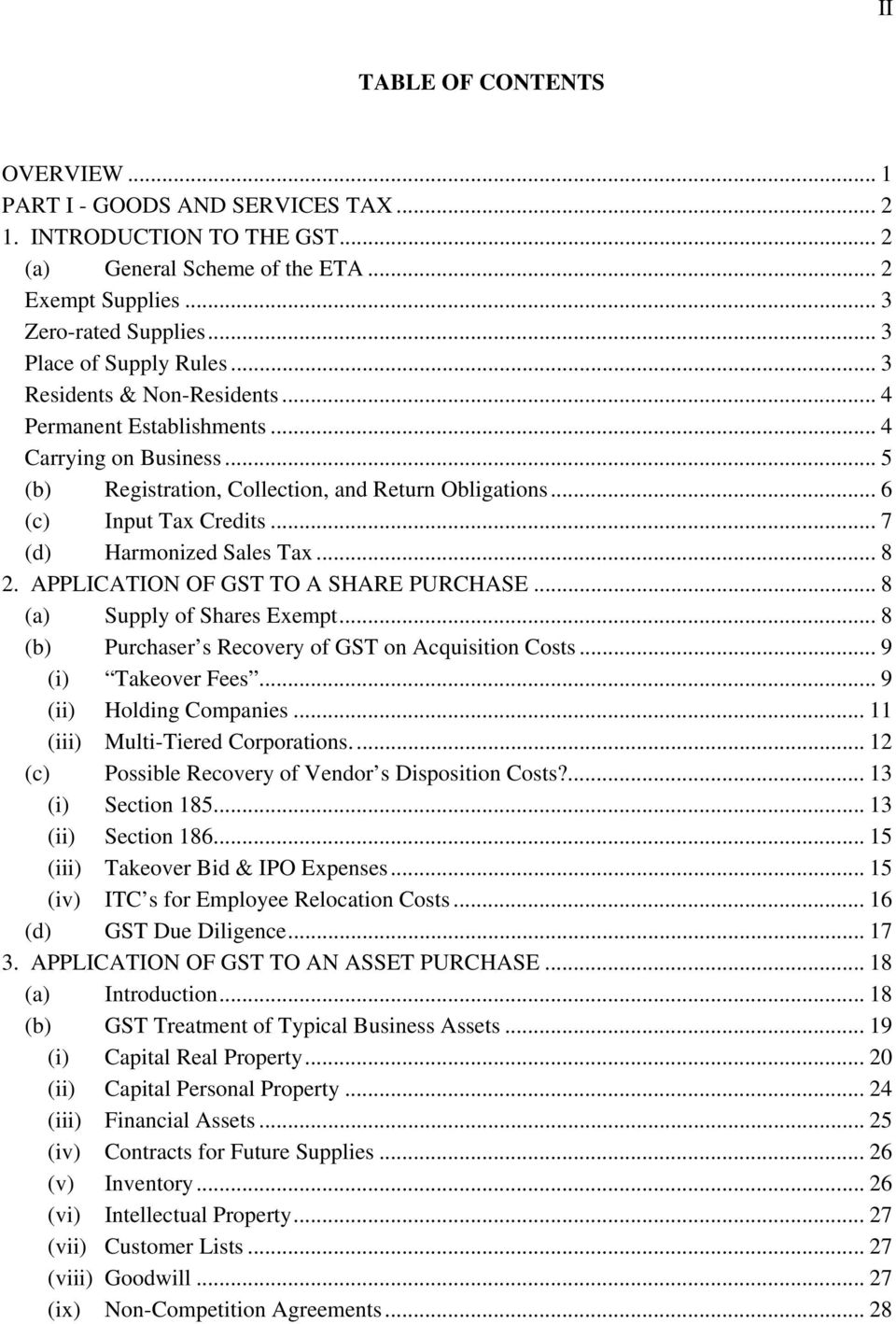
2 II TABLE OF CONTENTS OVERVIEW... 1 PART I - GOODS AND SERVICES TAX INTRODUCTION TO THE GST... 2 (a) General Scheme of the ETA... 2 Exempt Supplies... 3 Zero-rated Supplies... 3 Place of Supply Rules... 3 Residents & Non-Residents... 4 Permanent Establishments... 4 Carrying on Business... 5 (b) Registration, Collection, and Return Obligations... 6 (c) Input Tax Credits... 7 (d) Harmonized Sales Tax APPLICATION OF GST TO A SHARE PURCHASE... 8 (a) Supply of Shares Exempt... 8 (b) Purchaser s Recovery of GST on Acquisition Costs... 9 (i) Takeover Fees... 9 (ii) Holding Companies (iii) Multi-Tiered Corporations (c) Possible Recovery of Vendor s Disposition Costs? (i) Section (ii) Section (iii) Takeover Bid & IPO Expenses (iv) ITC s for Employee Relocation Costs (d) GST Due Diligence APPLICATION OF GST TO AN ASSET PURCHASE (a) Introduction (b) GST Treatment of Typical Business Assets (i) Capital Real Property (ii) Capital Personal Property (iii) Financial Assets (iv) Contracts for Future Supplies (v) Inventory (vi) Intellectual Property (vii) Customer Lists (viii) Goodwill (ix) Non-Competition Agreements... 28
3 (c) Section 167 Election (i) Introduction (ii) Filing Requirements (iii) Meaning of Business that was Established and All or Substantially All (iv) Business or Part of a Business (v) Established Business (vi) All or Substantially All of the Property Necessary to Carry on the Business (vi) Part of a Business (vii) Exempt Assets Can Be Sheltered Under Section (viii) Application to turn-key operations (ix) Specific Exclusions (x) Filing Requirements (x) Other Considerations (xi) Alternatives to Section (d) Section Treatment of Goodwill (e) Closely Related Corporations Section 156 and Butterfly Reorganizations Other Corporate Reorganizations Partnerships and Section 156 Election AMALGAMATIONS WINDING-UP PARTNERSHIPS PART II - PROVINCIAL SALES TAXES INTRODUCTION TAX BASE (a) British Columbia (i) Tangible Personal Property (ii) Taxable Services (b) Saskatchewan (i) Tangible Personal Property (ii) Taxable Services (c) Manitoba (i) Tangible Personal Property (ii) Taxable Services (d) Ontario (i) Tangible Personal Property (ii) Taxable Services (e) Prince Edward Island (i) Tangible Personal Property (ii) Taxable Services PST ON SPECIFIC ASSETS III

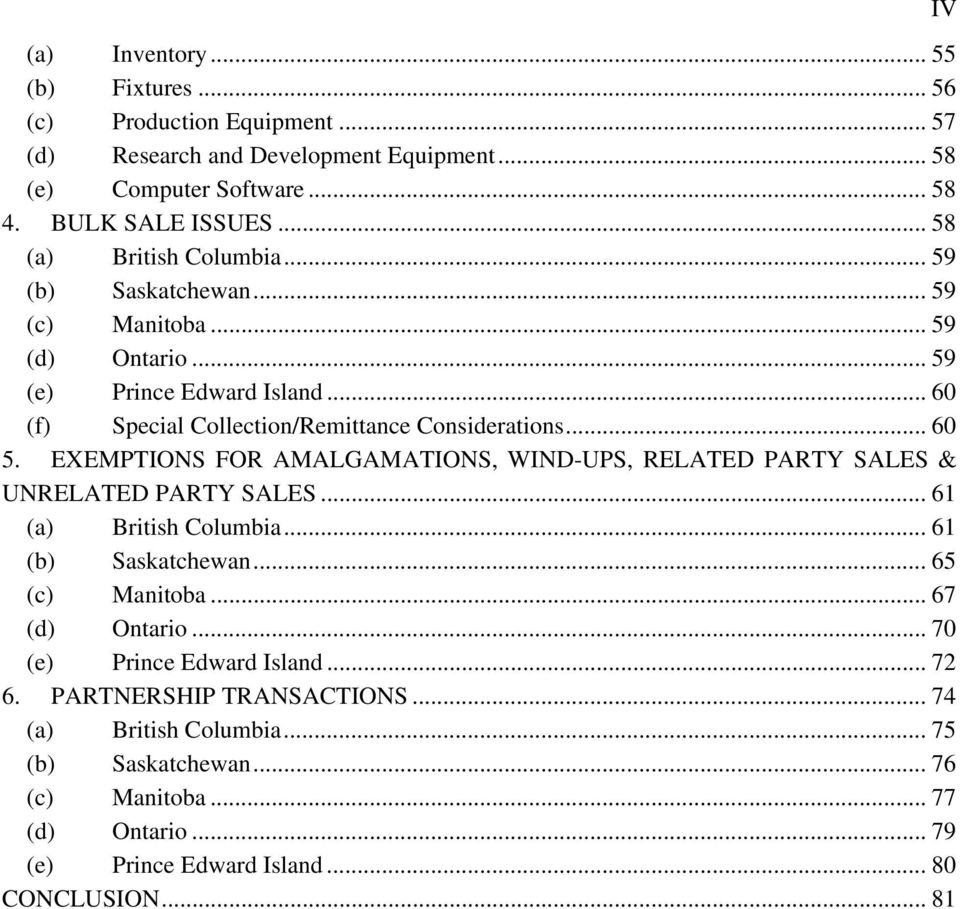
4 (a) Inventory (b) Fixtures (c) Production Equipment (d) Research and Development Equipment (e) Computer Software BULK SALE ISSUES (a) British Columbia (b) Saskatchewan (c) Manitoba (d) Ontario (e) Prince Edward Island (f) Special Collection/Remittance Considerations EXEMPTIONS FOR AMALGAMATIONS, WIND-UPS, RELATED PARTY SALES & UNRELATED PARTY SALES (a) British Columbia (b) Saskatchewan (c) Manitoba (d) Ontario (e) Prince Edward Island PARTNERSHIP TRANSACTIONS (a) British Columbia (b) Saskatchewan (c) Manitoba (d) Ontario (e) Prince Edward Island CONCLUSION IV
5 1 OVERVIEW This paper addresses the application of the Goods and Services Tax ( GST ), Harmonized Sales Tax 1 and the various Provincial Sales Taxes ( PST ) to the purchase and sale of a business through asset transactions, share transactions and various other types of corporate reorganizations. Part I of the paper deals exclusively with some of the GST issues and Part II addresses the PST issues. There are essentially two ways of acquiring an existing business. One can purchase all of the assets used in operating the business or, if the business is operated as a corporate entity, one can purchase all of the corporation s issued and outstanding shares. We have divided Part I of the paper (the GST portion) into six separate subparts, including (i) an introduction to the GST; (ii) an overview of the GST issues associated with a share purchase, including some due diligence concerns; (iii) the application of the GST to specific types of assets and the potential use of various relieving provisions, including the section 167 election; (iv) amalgamations; (v) windups/liquidations; and (vi) partnership transactions. Part II of the paper only addresses the application of the PST to asset transactions, since corporate securities (shares, bonds, debt instruments, etc.) are not subject to the PST. Part II has been divided into six subparts including (i) an introduction to the PST; (ii) an overview of each province s PST legislation; (iii) the PST status of specific types of business assets in each province; (iv) the PST bulk sale issues; (v) the PST exemptions for specialized transactions including related party transfers, amalgamations and wind-ups; and (vi) the PST issues for partnership transactions. Quebec s retail sales tax was replaced in the mid-1990 s with the Quebec Sales Tax ( QST ), which is a Quebec-imposed value-added type tax which is generally - although not completely - harmonized with the GST. One important and helpful difference between the GST and the QST systems is that financial services are considered a zero-rated supply for the QST purposes; whereas, financial services are exempt supplies for the GST purposes. This distinction is important since input tax credits (refunds) are available for zero-rated but not for exempt supplies. 1 As of April 1, 1997 Nova Scotia, New Brunswick and Newfoundland and Labrador repealed their retail sales tax legislation. For supplies made in these participating provinces, the 15% (now 13%) Harmonized Sales Tax or HST is made up of a 7% (now 5%) federal component and an 8% provincial component.

6 2 PART I - GOODS AND SERVICES TAX 1. INTRODUCTION TO THE GST (a) General Scheme of the ETA The GST is levied under Part IX of the Excise Tax Act (the ETA ). It is a 5% 2 value-added tax which is generally levied on all supplies of property and services made in, or imported into Canada. The GST is levied under three separate Divisions in Part IX of the ETA. Division II imposes the GST on taxable supplies made in Canada. Division III imposes the GST on imported goods and Division IV imposes the GST on imported taxable supplies other than goods, such as imported services. While almost everyone is required to pay the GST on their purchases of taxable property and services, GST registrants can generally recover the GST paid when the property and services are being utilized in commercial activities. This tax recovery by GST registrants is achieved through the ETA s input tax credit mechanism. Registrants account for the GST collected on their taxable supplies and the GST paid on their inputs by remitting the difference between the tax collected and the tax paid. Where a supplier has paid more tax on its inputs than it has collected on its supplies, the excess is refunded to the registrant. In this regard, the GST is imposed only on the value-added by the registrant during each stage in the manufacture and supply process. Since individual consumers of property and services will generally not be registered under the ETA, they will not be entitled to claim input tax credits in respect of their purchases and, as such, ultimately bear the full burden of the GST. There are three types of supplies for the GST purposes: (1) taxable supplies; (2) exempt supplies and (3) zero-rated supplies. Under Division II of the ETA, GST is imposed on every recipient of a taxable supply made in Canada. 3 A taxable supply means a supply that is made in the course of a commercial activity, which by further definition includes supplies made in the course of a business, an adventure or concern in the nature of trade, and supplies of real property, but excludes exempt 2 3 Please note that pursuant to the 2007 federal Economic Statement on October 30, 2007, the GST rate has been reduced to 5%, effective January 1, Every recipient of a taxable supply is required to pay the GST on the value of the consideration for the supply. Pursuant to section 153, the value of the consideration for the supply is deemed to be equal to (a) the amount expressed in money; and (b) where the consideration or that part is other than money, the fair market value of the consideration or that part at the time the supply was made.

7 supplies. A taxable supply, however, excludes the making of exempt supplies that are enumerated in Schedule V of the ETA. 3 Exempt Supplies Suppliers of exempt supplies are not required to collect the GST on their supplies as they are deemed not to have been made in the course of a commercial activity and, as such, are not taxable supplies. Vendors engaged in making exempt supplies generally pay the GST on their purchases, and since they are not engaged in commercial activities, they cannot recover any GST paid through the ETA s input tax credit mechanism. In this way, an exempt supplier's inputs are taxed, but their value-added escapes taxation. Exempt supplies are enumerated in Schedule V of the ETA and include supplies of used residential real property, health care services, educational services, personal care services, child services, legal aid services, charitable services, public sector organization services, financial services, and ferry, road and bridge tools. Zero-rated Supplies Similar to purchasers of exempt supplies, purchasers of zero-rated supplies do not have to pay the GST. Unlike persons making exempt supplies, however, suppliers of zero-rated goods and services are engaged in commercial activities and, as such, are entitled to recover the tax paid on their purchases through the ETA s input tax credit mechanism. In this way, zero-rated property and services bear no GST whatsoever (i.e., unlike exempt supplies, there is no hidden GST incorporated into the purchase price). Schedule VI enumerates zero-rated supplies and they include supplies of prescription drugs, medical devices, basic groceries, agriculture and fishing products, exports, travel services and transportation services. Place of Supply Rules As indicated above, Division II GST is payable on all taxable supplies made in Canada. Section 142 of the ETA contains a number of general rules for determining when a supply is made in Canada, usually referred to as the place of supply rules. Under these place of supply rules, one is theoretically able to determine how any supply connected to Canada will be treated for the GST purposes. For example, if the transaction involves a sale of goods, the supply would be considered to have been made in Canada if the goods are delivered or made available to the purchaser in Canada. Other rules apply for other types of supplies (e.g., supplies of leased goods, services, intangibles or real property).

8 The place of supply rules found in section 142 must always be read in conjunction with a number of other rules which affect the determination of whether a particular supply is made in Canada for purposes of the Division II tax. For non-residents, the most important of these rules is found in section 143 of the ETA, which we will refer to as the special non-residents rule. 4 The special non-residents rule deems all supplies of property and services made in Canada by non-residents to be made outside Canada, unless (a) the supply is made in the course of a business carried on by the non-resident in Canada, or (b) the non-resident was registered for the GST at the time the supply was made. The effect of this rule is to make the ETA s general place of supply rules inapplicable if the transaction involves a supply made by unregistered non-residents, not carrying on business in Canada. When the special non-residents rule applies, it operates to deem any supplies made by the non-resident to be completely outside the GST system. That means that the non-resident would remain completely exempt from any requirements to register for the GST, or to charge and collect the GST on its supplies made to Canadians. The potential significance of this rule makes the meaning of terms like non-resident, registered, and carrying on business in Canada quite important. Residents & Non-Residents While a complete discussion is outside the scope of this paper, the ETA does have rules regarding the meaning of non-resident and resident. For example, section 132 of the ETA provides that a corporation will be considered a resident of Canada if it has been incorporated or continued in Canada, and not continued elsewhere. A corporation will also be considered a resident if it satisfies the common law tests for residency namely, if the corporation s central management and control is located in Canada. While this might suggest that only corporations incorporated or continued outside of Canada or with central management and control outside Canada will qualify as non-residents, the ETA s permanent establishment rules can also affect that determination as well. Permanent Establishments Subsection 132(2) of the ETA deals with permanent establishment for non-residents, and provides that where a non-resident person has a permanent establishment in Canada, the nonresident shall be deemed to be resident in Canada in respect of, but only in respect of, activities that are carried on through that permanent establishment. The effect of this rule is to exclude the now-deemed-resident from the application of the special non-residents rule in section 143

9 although that exclusion would only relate to supplies carried on through the permanent establishment. This means that a non-resident with a Canadian permanent establishment might (unhappily) find that some of its Canadian business activities have succeeded in drawing it into the GST system, and requiring it to take positive steps to register for the GST, and to begin charging, collecting, and remitting the GST to the Canada Revenue Agency (the CRA ). Furthermore, and to the extent the non-resident becomes GST registered, the special nonresidents rule would no longer be available to any of the non-resident s activities. 5 In many respects, the significance of having a permanent establishment for the GST purposes is not unlike the significance of having one for purposes of the Income Tax Act as read in context of many of Canada s international treaties. Carrying on Business As previously indicated, the other main requirement for use of the special non-residents rule in section 143 is that the non-resident must not be carrying on business in Canada. The ETA does not define carrying on business, for purposes of the ETA, nor does the ETA have a provision similar to section 253 of the Income Tax Act. Accordingly, the common law tests for determining whether a business is being carried on applies for purposes of the ETA. The courts have held that it is a question of fact whether a person is carrying on business. While the leading authorities on carrying on business all predate the use of fax machines, and electronic commerce (and even pre-date the Income Tax Act and the ETA), traditionally the primary tests applied for determining whether a person is carrying on business in a jurisdiction are (1) the place where the contract is concluded and, (2) the place from which the profits, in substance, arise, with other secondary factors also being considered. While a discussion regarding the meaning of carrying on business is beyond the scope of this paper, it is important to note that the CRA has recently issued GST/HST Policy Statement P- 051R2 Carrying on Business in Canada ( P-051R2 ), which sets out the CRA s current position as to the factors that it will consider in determining whether a person is carrying on business in Canada. The CRA s current policy, set out in P-051R2, can be contrasted with the established jurisprudence discussed above. Unlike the previous version of P-051, it does not cite or rely upon existing jurisprudence. Instead, P-051R2 lists twelve factors that the CRA will now consider in determining whether or not a person is carrying on business in Canada, as follows:
10 6 the place where agents or employees of the non-resident are located; the place of delivery; the place of payment; the place where purchases are made or assets are acquired; the place from which transactions are solicited; the location of assets or an inventory of goods; the place where the business contracts are made; the location of a bank account; the place where the non-resident's name and business are listed in a directory; the location of a branch or office; the place where the service is performed; and the place of manufacture or production. In summary, the CRA s current policy on carrying on business is to apply the above twelve factors, the importance of which depends on the nature of the activities under review without any further guidance on how the factors will be applied. In general however, P-051R2 indicates that a non-resident person must have a significant presence in Canada to be carrying on business in Canada. (b) Registration, Collection, and Return Obligations The ETA imposes the obligation of paying the GST on the recipient of the supply, 4 however, the ETA imposes an equally significant burden on the supplier, requiring it to register under the ETA, collect the GST payable by the recipient, and remit the GST to the CRA. 5 For purposes of the ETA, "registrant" is defined as a person who is registered, or who is required to be registered, under Subdivision d of Division V. Section 240 of the ETA sets out the requirements to register for the GST purposes. In particular, subsection 240(1) requires every person who makes a taxable supply in Canada in the course of a commercial activity to register for the GST purposes. Exemptions from the registration requirements exist for suppliers with annual sales of less than $30,000, persons who sell real property otherwise than in the course of a business and non-resident persons who do not carry on business in Canada. 4 5 GST is imposed under Division II, section 165; Division III, section 212; and Division IV, section 218. Division V, Subdivision a governs collection obligations (beginning at section 221), whereas Subdivision b governs the remittance obligations beginning at section 225.

11 Suppliers with yearly sales in excess of $6,000,000 are required to file monthly returns, whereas all other suppliers are generally required to file quarterly returns. 6 7 (c) Input Tax Credits As previously mentioned, input tax credits ( ITCs ) are available to suppliers of taxable goods and services, allowing the supplier to recover the GST paid on their inputs. The characterization of a supply as taxable, zero-rated or exempt has a direct impact on the supplier's ability to recover any GST paid through an ITC. Generally speaking, to the extent that a person makes a taxable supply (which includes a zero-rated supply), they are able to recover the tax paid on the property and services used in making the supplies. Persons making exempt supplies (supplies enumerated in Schedule V) are not entitled to claim ITCs as they are not making taxable supplies. 7 The ITC mechanism is what transforms the GST into a value added tax by ensuring that the burden of the GST remains only with the ultimate consumer of the taxable good or service. Paragraph 169(4)(a) of the ETA and section 3 of the Input Tax Credit Information (GST/HST) Regulations are clear that ITCs cannot be claimed unless the suppliers have obtained valid GST registration numbers from those who supply inputs to them. In Comtronic Computer Inc. v. The Queen, 8 the primary issue before the Tax Court was whether a Canadian purchaser was entitled to ITCs in respect of inputs where the GST registration number of the supplier shown on the invoice was not that of the supplier, but was a validly issued number belonging to someone else. The Tax Court, followed the Federal Court of Appeal s decision in Systematix, 9 held that the requirement of having valid GST registration numbers from suppliers was mandatory and must be strictly enforced. Furthermore, the Canadian purchaser could not be excused from section 280 penalty by raising the due diligence defence as the Tax Court found that the Canadian purchaser failed to take steps to ensure compliance or avoid the failure. The Canadian purchaser s appeal was dismissed. In view of the availability of an online internet confirmation service by the CRA - the CRA s GST/HST Web Registry 10 which allows a purchaser to verify a supplier s GST/HST registration Suppliers with yearly sales less than $500,000 can elect to file on an annual basis (See sections 245 and 248 of the ETA). Subdivision b of Division II, beginning at section 169, provides the basis for claiming input tax credits. Comtronic Computer Inc. v. The Queen, 2010 TCC 55. Systematix Technology Consultants Inc. v. Canada, 2007 FCA 226. The GST/HST Web Registry can be found at

12 status as of a specified date, it is prudent for Canadian businesses to put into place risk management practices in dealing with new and continuing suppliers to identify supplier information that may require further investigation in order to avoid the risk of fraud or identity theft and other wrongdoing. 8 (d) Harmonized Sales Tax As indicated above, on April 1, 1997 Nova Scotia, New Brunswick and Newfoundland and Labrador amended their retail sales tax statutes making goods and services sold in these provinces no longer subject to a separate provincial sales tax. Instead of having two separate taxes (one provincial and another federal), these participating provinces harmonized their provincial taxes with the GST. 11 Subsection 165(2) of the ETA now imposes an additional 8% tax on every recipient of a taxable supply made in a participating province, thereby creating the Harmonized Sales Tax ( HST ) in these provinces. When addressing the GST issues arising out of a corporate reorganization and the purchase and sale of a business, the HST status of the particular asset is generally the same as the GST status, meaning that instead of 5% being payable, the purchaser must generally pay 13% GST/HST. There are special rules affecting the determination of where the taxable supply is made in section and Schedule IX. Generally, once it has been determined that a supply is made in Canada, the supplier should then ask whether that supply is made in a participating province. 2. APPLICATION OF GST TO A SHARE PURCHASE (a) Supply of Shares Exempt When a corporation issues shares or when a shareholder transfers previously issued shares, no GST is applicable on the purchase given that a sale of shares is classified as a "financial service" and thus constitutes an exempt supply under Part VII of Schedule V. 12 Accordingly, no GST is applicable when acquiring a business through purchasing shares. 11 As announced in the 2009 Ontario Budget (released on March 26, 2009), commencing July 1, 2010, Ontario will become the fifth province that harmonizes its retail sales tax with the federal GST to create a federally administered single sales tax of 13% (with the provincial portion remaining at a rate of 8% and the federal portion at a rate of 5%). On July 23, 2009, British Columbia announced its intention to become the sixth province that harmonizes its provincial sales tax with the federal GST effective July 1, British Columbia will have the lowest HST in Canada, by combining the 7% PST with the 5% GST, for a single sales tax rate of 12%. 12 Financial service is defined in paragraph (d) of subsection 123(1) to include the issue, granting, allotment, acceptance, endorsement, renewal, processing, variation, transfer of ownership or repayment of a financial instrument. A financial instrument is defined to include both an equity security and a debt security. The transfer of a share
13 9 Even though no GST is payable on the shares, a potential downside to an exempt share purchase is that the GST paid by both the purchaser and the vendor on services used to effect the transfer may not be recoverable through an ITC (this is because an exempt supply is not a commercial activity and ITCs are generally only available on goods and services acquired for use in commercial activities). The quantum of these transaction costs obviously depends on the complexity of the transaction, but typical transaction costs include legal fees, accounting fees, brokerage fees, 13 costs incurred by holding companies, and costs associated with takeover bids. Limited ITC relief for these transaction costs may, however, be available in certain situations under sections 185 and 186. (b) Purchaser s Recovery of GST on Acquisition Costs (i) Takeover Fees Subsection 186(2) provides a special rule which can be used to claim ITCs in respect of the GST paid on the goods and services associated with purchasing all or substantially all of the outstanding shares of a target corporation. This section provides as follows: 186 (2) For the purposes of this Part, if (a) a registrant that is a corporation resident in Canada (in this subsection referred to as the "purchaser") acquires, imports or brings into a participating province a particular property or service relating to the acquisition or proposed acquisition by it of all or substantially all of the issued and outstanding shares, having full voting rights under all circumstances, of the capital stock of another corporation, and (b) throughout the period beginning when the performance of the particular service began or when the purchaser acquired, imported or brought into the participating province, as the case may be, the particular property and ending at the later of the times referred to in paragraph (c), all or substantially all of the property of the other corporation was property that was acquired or imported for consumption, use or supply exclusively in the course of commercial activities, the particular property or service is deemed to have been acquired, imported or brought into the participating province for use exclusively in the course of commercial activities of the purchaser and, for the purpose of claiming an input tax credit, any tax in respect of the supply of the particular property or service to the purchaser, or the importation or bringing in of the particular property by the purchaser, is deemed to have become payable and been paid by the purchaser on the later of (c) the later of the day the purchaser acquired all or substantially all of the shares and the day the intention to acquire the shares was abandoned, and (d) the day the tax became payable or was paid by the purchaser. [emphasis added] 13 of the capital stock of a corporation or a debenture would therefore constitute a supply of an exempt financial service. In a recent GST/HST Headquarters Ruling RITS dated December 10, 2007, the CRA indicated that a supply of merger and acquisition services might be considered an exempt supply on the basis that the service provider is arranging for a financial service. This interpretation is also consistent with the CRA s January 2002 Policy Statement P-239 on arranging for financial services.
14 10 Under this subsection, corporations which are registrants and residents in Canada, and who acquire, or propose to acquire, all or substantially all of the outstanding voting shares of another corporation, are entitled to ITCs on goods and services purchased in relation to the acquisition or proposed acquisition of those shares, provided that during the acquisition period, all or substantially all of the target corporation s property was used in commercial activities. 14 The acquisition period begins when the goods or services were acquired to implement the takeover and concludes on the later of: (i) the day all or substantially all of the shares were acquired; and (ii) the day the takeover bid was abandoned. A corporate entity is deemed to be a resident in Canada under subsection 132, if it is continued or incorporated in Canada. 15 From a practitioner s standpoint, ensuring that a Canadian resident corporation is a registrant is essential for reliance on subsection 186(2). This is particularly important in situations where Acquiring Co. is a new corporation, incorporated solely for the purposes of affecting the takeover of Target Co. In these situations, Acquiring Co. may have to voluntarily register under subsection 240(3) of the ETA, since prior to registration, Acquiring Co. is not a registrant in the reporting period in which it incurred the takeover expenditures. 16 Pursuant to GST Memorandum , Creeping Takeovers are eligible, provided Acquiring Co. can show that the subsequent share purchases were part of the initial proposal to acquire all or substantially all of Target Co. s voting shares. Where Acquiring Co. is associated with other suppliers, registration becomes even more important, as it is unlikely that Acquiring Co. will qualify as a small supplier under the ETA. The status of being a small supplier is very important for persons becoming GST registered. This is because subsection 171(1) only enables small suppliers to unlock the GST previously paid on property being held for use in commercial activities through an ITC See Stantec Inc. v. The Queen, 2008 TCC 400, where a holding company was allowed to claim ITCs for professional listing services it incurred in order to obtain a listing of its shares on the New York Stock Exchange, which was a condition of its merger agreement with a US company. Regarding subsection 186(2), the Tax Court refused to give a restrictive meaning to the word acquisition which was not a defined term in the ETA. (This case is discussed at page 11.) The Tax Court decision was affirmed by the Federal Court of Appeal (2009 FCA 285), which confirmed that relating to had the broadest possible application and agreed that Stantec acquired the shares of the target company and that the listing services related to that acquisition. It is also a resident of Canada if it satisfies the common law requirements of residency or if it maintains a permanent establishment in Canada. Please note that the ITC rules on becoming a GST registrant, contained in section 171, provide that ITCs are not available for services supplied before the person becomes a registrant. Please also note that section 171(2) contains a complete prohibition on ITCs respecting services received before becoming GST registered.

15 11 (ii) Holding Companies Subsection 186(1) enables registrant corporations who are Canadian residents (satisfied by being incorporated in Canada) and who have acquired goods or services for consumption or use in relation to shares or indebtedness of a related subsidiary corporation, 18 to claim ITCs 19 for the GST paid in respect of such goods and services, provided all or substantially all (generally at least 90%) of the property of the related corporation is being used exclusively in the course of its commercial activities, as follows: 186(1) Where (a) a registrant (in this subsection referred to as the parent ) that is a corporation resident in Canada at any time acquires, imports or brings into a participating province particular property or a service that can reasonably be regarded as having been so acquired, imported or brought into the province for consumption or use in relation to shares of the capital stock, or indebtedness, of another corporation that is at that time related to the parent, and (b) at the time that tax in respect of the acquisition, importation or bringing in becomes payable, or is paid without having become payable, by the parent, all or substantially all of the property of the other corporation is property that was last acquired or imported by the other corporation for consumption, use or supply by the other corporation exclusively in the course of its commercial activities, except where subsection (2) applies, for the purpose of determining an input tax credit of the parent, the parent is deemed to have acquired or imported the particular property or service or brought it into the participating province, as the case may be, for use in the course of commercial activities of the parent to the extent that the parent can reasonably be regarded as having so acquired or imported the particular property or service, or as having so brought it into the province, for consumption or use in relation to the shares or indebtedness. [emphasis added] This essentially means that parent corporations can claim ITCs for all expenses reasonably incurred in relation to the shares or indebtedness of subsidiary corporations provided 90% of the subsidiary's assets are used exclusively in commercial activities. An ITC is available under the above conditions, as the parent corporation is deemed to have acquired or imported the particular goods or services for use in the course of its own commercial activities. Where the parent corporation is merely a holding corporation, and does not make its own taxable supplies, readers should note that reliance on clause 240(3)(d)(i) is required for the holding corporation to become GST registered on a voluntary basis Pursuant to section 126 of the ETA, two corporations are related if they satisfy the requirements in section 251(2) to (6) of the Income Tax Act. The corporation must be related at the time of acquisition, it is insufficient to only be "related" after the acquisition (see GST/HST Policy Statement P-137). Please note that subsection 186(1) only applies with respect to determining the ITCs of HoldCo.

16 Goods and services acquired in relation to the shares or indebtedness of a related corporation can include not only direct costs, such as legal and accounting fees 20 but also indirect costs such as administrative overhead, rent, utilities and fees incurred to prepare financial statements The Tax Court has recently confirmed that a registrant can claim ITCs in respect of GST it paid on professional fees required to obtain a listing of its shares. In Stantec Inc. v. The Queen, 22 the Appellant was a holding corporation with subsidiaries in Canada and the United States. The Appellant decided to acquire a U.S. company by merging with its a wholly-owned California subsidiary company. As part of the agreement and plan of merger, the Appellant had to be listed on the New York Stock Exchange. The taxpayer claimed ITCs for the cost incurred in Canada for the professional listing services, which was denied by the CRA. The Tax Court concluded that under three separate provisions of the ETA - subsection 186(1), subsection 186(2), and section that the Appellant qualified for ITCs. Regarding subsection 186(1), the Court commented that the expression reasonably regarded in relation to should be given the widest possible meaning. In situations where a corporation does not acquire all or substantially all of the issued shares of a corporation, it may nevertheless rely on subsection 186(1) with respect to the acquisition of additional shares in a related corporation. 23 Pursuant to Policy Statement P-137, however, in order to do so, the corporations must be related at the time that the property or services were acquired. That is, ITCs would not be permitted on costs incurred when the corporations were not related even if they would be related after the acquisition. (iii) Multi-Tiered Corporations Subsection 186(3) extends the application of subsections 186(1) and (2) to multi-tiered corporations. For example where Target Co. is itself just a holding corporation, it is unlikely that section 186(2) would apply as it requires 90% of Target Co. s assets to be used in commercial activities. Subsection 186(3), however, deems the shares held by Target Co. in related corporations to be property that was acquired for use exclusively in the course of its commercial activities, provided substantially all of the related corporation s assets were See Perfection Dairy Group Limited v. The Queen, 2008 TCC 342, where s.186(1) was applied to allow ITCs with respect to professional fees incurred in respect of a legal action related to the receivership and bankruptcy of the appellant s subsidiary. See GST/HST Policy Statement P-196 and Draft GST/HST Policy Statement P-196R. Stantec Inc. v. The Queen, 2008 TCC 400, aff d 2009 FCA 285. See GST/HST Policy Statement P-137, Availability of ITCs to Holding Corporations on Cost of Acquisition.
17 acquired for use exclusively in commercial activities. The CRA has also indicated that section 186(3) can be used in a multi-tiered corporate structure and that there are no limits in the number of layers of holding companies (c) Possible Recovery of Vendor s Disposition Costs? (i) Section 185 Notwithstanding that the supply of shares is an exempt financial service (and therefore GST exempt), a corporation that purchases or issues shares may still be entitled to claim ITCs in respect of the GST paid on expenses incurred in the course of supplying the shares, pursuant to section 185. Section 185 of the ETA is a special provision designed to allow non-financial institutions, with certain incidental financial service activities that relate to their commercial activities, to claim full ITCs without having to apportion their ITC claims between their taxable and exempt activities. 25 Section 185 deems the GST that is payable by a registrant for property or services acquired for use or supply in the course of making supplies of financial services that relate to commercial activities of the registrant, to have been acquired or used in the course of commercial activities. This section provides as follows: 185(1) Where tax in respect of property or a service acquired, imported or brought into a participating province by a registrant becomes payable by the registrant at a time when the registrant is neither a listed financial institution nor a person who is a financial institution because of paragraph 149(1)(b), for the purpose of determining an input tax credit of the registrant in respect of the property or service and for the purposes of Subdivision d, to the extent (determined in accordance with subsection (2)) that the property or service was acquired, imported or brought into the province, as the case may be, for consumption, use or supply in the course of making supplies of financial services that relate to commercial activities of the registrant, (a) where the registrant is a financial institution because of paragraph 149(1)(c), the property or service is deemed, notwithstanding subsection (2), to have been so acquired, imported or brought into the province for consumption, use or supply in the course of those commercial activities except to the extent that the property or service was so acquired, imported or brought into the province for consumption, use or supply in the course of activities of the registrant that relate to (i) credit cards or charge cards issued by the registrant, or (ii) the making of any advance, the lending of money or the granting of any credit; and (b) in any other case, the property or service is deemed, notwithstanding subsection (2), to have been so acquired, imported or brought into the province for consumption, use or supply in the course of those commercial activities. [emphasis added] See Revenue Canada s response to Question 39 posed at the Canadian Bar Association - Sales and Commodity Tax Section s February 25, 1999 Annual Meeting. Section 198 mirrors section 185 with respect to capital property.

18 14 As indicated in the 1997 Explanatory Notes, section 185(1) is intended to simplify the operation of the tax for a registrant who is not a financial institution, but who does provide some incidental financial services. The following conditions must be met in order for section 185 to be applicable: 1. the person must be a registrant; 2. the person must not be a financial institution; 3. the person must be engaged in commercial activities; 4. the property or service was acquired for consumption, use or supply in the course of making financial services; and 5. the financial services must relate to the commercial activities of the person. As indicated above, to rely on section 185, the making supplies of financial services (i.e., selling shares) must relate to the commercial activities of the registrant. It may be useful for claiming ITCs when a corporation is issuing treasury shares or arranging debt financing to raise capital. In these limited situations, the incoming capital will generally be used in the issuer s business and thus related to the registrant s commercial activities. Accordingly, subsection 185(1) would deem both the property and services acquired to have been used in the course of the registrant s commercial activities. The CRA has taken a similar position in Policy Statement P-108, Raising of Capital, allowing ITCs in respect to fees incurred in relation to the issuance of shares. The CRA has also confirmed the availability of ITCs in respect to legal fees and accounting fees arising out of an issuance of shares by prospectus. 26 Given the broad meaning to be given to relating to pursuant to the Stantec case, it may also be possible that this provision could apply where shares of another company were being sold. The CRA has indicated that it is a question of fact whether a financial service relates to the commercial activities of a registrant, thus entitling it to ITCs under section 185. The CRA has indicated that where a GST registered resident corporation incurs the GST on legal fees related to the acquisition of less than 50% of the outstanding shares of an unrelated corporation, for strategic reasons, the requirement would not be met, but rather would be viewed as a separate investment activity that would not have a sufficiently close nexus to meet the test in section See Revenue Canada s Question and Answer Database GST #7 (April 1991). See the CRA s response to Question 25 posed at the Canadian Bar Association - Sales and Commodity Tax Section s

19 15 (ii) Section 186 Subsection 186(1) (discussed above) may also be used by the vendor to recover the GST paid on services related to shares of a subsidiary corporation. To use subsection 186(1), however, the vendor must be related to the subsidiary at the time it acquires the services in question. As once the shares are sold, the vendor will no longer be related to the subsidiary corporation, there are some important timing issues to be addressed (i.e., the services must be acquired prior to the transfer of the shares). This may require some planning in terms of the structuring of the services agreements and invoicing methods. (iii) Takeover Bid & IPO Expenses In terms of takeover bids, it is interesting to note that the CRA had consistently indicated that Target Co. itself cannot claim ITCs for the GST incurred in either accepting or defending takeover bids on the basis that the takeover bid expenses related to non-commercial activities (increasing shareholder value). ITCs were, however, allowed for regular ongoing corporate and securities matters, as follows: Under certain circumstances, for example, take-over bids, the fulfilling of obligations under corporate or securities law in producing and distributing circulars for shareholders, which may include legal and accounting fees (charged by outside experts), valuation reports, fairness opinions, printing costs and mailing costs, has been considered to have been incurred for the purpose of making supplies for consideration in the course of the corporation s endeavour for purposes of section Although securities or corporations law may not specifically require the hiring of outside experts, the corporate directors have little choice except to rely on reports of lawyers, accountants, engineers, appraisers or other persons whose profession lends credibility. The costs at issue do not fall into this [enhancing shareholders value] category. 28 The Tax Court rejected the CRA s position on takeover expenses in the BJ Services 29 case, holding that expenses incurred by Target Co. (Nowsco Well Service Ltd.) in fighting a hostile takeover launched by BJ Services were recoverable as normal ITCs. In allowing the ITC claim, the Court focused primarily on the ITC requirements in section 169 and noted that Target Co. did not make any exempt supplies since it was the shareholders who transferred the GST exempt shares. Accordingly, based on the Court s analysis of the ITC provisions, it would appear that GST registrants, who are engaged exclusively in commercial activities, can properly claim ITCs for expenses incurred in relation to reviewing and responding to a takeover bid March 3, 2005 Annual Meeting. See GST Ruling (December 13, 2000). BJ Services Co. Canada v. R., [2002] G.S.T.C. 124 (TCC).
20 The CRA however, has recently indicated that in its view, the BJ Services case is limited to its facts (i.e., hostile takeover bids) and accordingly, where expenses are incurred to increase shareholder value, in the CRA s view, no ITCs will be available The Tax Court has also recently confirmed that ITCs are available with respect to expenses related to an initial public offering (IPO) on the basis they were incurred in the course of commercial activities. 31 In the A & W Trade Marks Inc. case, the Appellant was in the business of licensing trade marks. An income fund was created for the purpose of investing in debt and equity securities of the Appellant through an initial IPO. The fund raised a significant amount of money which was invested in the Appellant and used by the Appellant to purchase the trade marks from another entity. The Appellant claimed ITCs in respect of the expenses incurred with respect to the IPO. The CRA denied the ITCs on the basis that the Appellant did not acquire the IPO services for use in commercial activities. The Tax Court rejected the CRA s position again, and found that the expenses were incurred to enable the Appellant to borrow money in order to carry on its commercial activities. Accordingly, it was entitled to ITCs in respect of the IPO expenses pursuant to section 169(1). (iv) ITC s for Employee Relocation Costs Corporate reorganizations may also involve costs associated with relocating employees. In the Zellers 32 case, the Tax Court has recently clarified that a corporation is entitled to claim ITCs, pursuant to section 174 in respect of certain employee relocation allowances that it pays to its employees. 33 The Tax Court gave a broad interpretation to section 174 and held that the allowances that Zellers had paid to its employees as part of their relocation, was in relation to its commercial See the CRA s response to Question 14 posed at the Canadian Bar Association National Commodity Tax, Customs and Trade Section s March 9, 2006 Annual Meeting. (On-line: A & W Trade Marks Inc. v. Her Majesty the Queen, [2005] G.S.T.C. 149 (TCC) Canada Inc. and Zellers Inc. v. Her Majesty the Queen, [2003] G.S.T.C. 123 (TCC). Section 174 of the ETA is a deeming provision that allows a corporation (among others) to claim an ITC in respect of certain allowances that it has paid to its employees, as if it had incurred the expense directly (and paid the GST directly), provided that the conditions of the section are met. Zellers had paid allowances to its employees that were relocated to reimburse them for their direct and actual moving expenses as well as an allowance equal to 10% of the employee s salary, to cover the additional costs of relocating (e.g., installation of cable, telephone and utilities). The central issue in the case was whether the relocation allowances were in relation to the commercial activities of Zellers or whether they were simply personal expenses of the employees.
21 activities, as they were essential to the growth and economic viability of Zellers. Accordingly Zellers was entitled to ITCs based on 7/107 ths of the relocation allowances it had paid to its employees. 17 (d) GST Due Diligence Purchasing a business through acquiring all of a corporation s shares does not affect the corporation's GST liabilities or obligations. Accordingly, some GST due diligence may be warranted. We often suggest that the purchaser s advisors should: determine whether the GST returns have been filed by the target corporation for the past four years (the normal assessment period); determine whether the target corporation is in compliance with its GST collection obligations over the past four years; verify whether the correct amount of the GST has been collected and remitted by the target corporation for the past four years; and verify that the target corporation has not improperly claimed ITCs on significant expenditures (i.e., property and services which are being used to make exempt supplies). Where GST indemnification is provided to the purchaser, the vendor s advisors should include a subrogation right regarding section 224 so that, if a subsequent GST assessment occurs, the vendor can consider using this statutory provision to recover the tax from the recipients of the supplies involved. In Gillis v. Schurman, 34 a lawyer involved in a share purchase transaction was sued for damages for failure to obtain a comfort letter from the CRA regarding the GST status of the company, prior to closing. Subsequent to the purchase, the company was assessed for failure to remit the GST for a period prior to the purchase. The Court found that the lawyer had breached his duty for failing to obtain a comfort letter. In this case however, the breach was moot given the fact that the CRA had indicated that it would have advised as of the date of closing that there were no outstanding GST returns or a debit balance. 34 Gillis v. Schurman, [2003] PESCTD 55 (PEI S.C.T.D.).
22 The Court also noted that ordinarily, a reasonably competent lawyer is required to advise the purchaser of the option and differences between purchasing the shares of a company and purchasing the assets. 18 When negotiating and drafting the Agreement of Purchase and Sale, the purchaser's solicitor may want to insist on an indemnity for any unrecorded GST liabilities of the target corporation. This would help alleviate the costs of any GST assessment relating to the pre-acquisition period. 35 Pursuant to section 323, the target corporation s directors are also jointly and severally liable with the corporation for non-remitted GST where a certificate as to the amount owing was previously filed in the Federal Court. The purchaser should not take great comfort from this joint liability for four reasons: (i) the acquired corporation still remains jointly liable with the corporation s directors; (ii) the previous directors may be able to absolve themselves from liability through the due diligence defence ; (iii) subsection 323(5) imposes a two year limitation period for assessing former directors; and (iv) a director who pays a corporation's tax liabilities is entitled to an assignment of the Crown's preference and may be able to recover the amount of their payment in any subsequent bankruptcy proceedings. 3. APPLICATION OF GST TO AN ASSET PURCHASE (a) Introduction Subject to special relieving provisions such as the section 167 election, transferring a business s assets generally results in the application of the GST. When a group of assets are sold, the vendor must examine each asset, on an asset-by-asset basis, to determine the GST consequences. Any particular asset may fall into one of three categories, (i) taxable, (ii) exempt, or (iii) zerorated. Whether an asset is exempt or zero-rated is generally dependent on whether it is enumerated in Schedules V or VI of the ETA. As previously noted, section 165 (Division II tax) imposes tax on every recipient of a taxable supply made in Canada. There are special place of supply rules in sections 142, 143 and 144 for determining whether a supply is being made in Canada. Generally, tangible personal property delivered or made available in Canada constitutes a supply made in Canada and is subject to the GST under Division II. In order for a supply to be a taxable supply, the supply must also be made in the course of a commercial activity. Section deems certain 35 If the GST liability is discovered after closing, the purchaser may want to consider a voluntary disclosure (see W. Jack Millar and Brent F. Murray, Why, When and How to Disclose GST, RST and Customs Non-Compliance, 1999 CICA Commodity Tax Symposium).
23 transactions pertaining to the sale of a business to be supplies made in the course of a commercial activity, therefore imposing tax. For example, the following supplies are deemed by subsection 141.1(1) to be made in the course of a commercial activity: 19 Personal property that was last acquired or imported by the transferor for consumption or use in the course of its commercial activities; Personal property that was consumed or used by the transferor in the course of its commercial activities after it was last acquired or imported; Personal property that was manufactured or produced by the transferor in the course of its commercial activities or for consumption or use in the course of its commercial activities; and Personal property that was manufactured or produced by the transferor and consumed or used in the course of commercial activities of the transferor (provided it was not deemed under the ETA to have been acquired by the transferor). Similarly, in situations where the vendor of the assets was using personal property exclusively in non-commercial activities, then the supply of those assets is deemed by paragraph 141.1(1)(b) to be made otherwise than in the course of commercial activities and non-taxable. As there are special ITC rules for capital personal property, requiring assets to be used primarily in commercial activities before an ITC is available, section 200(3) deems supplies of capital personal property that were not used by the vendor primarily in commercial activities to be non-taxable. These provisions are designed to ensure that the GST does not cascade on subsequent supplies of the same assets. For further explanation, see GST/HST Policy Statement P-166: Sale of Medical or Dental Practice Between Two Non-Registrants. (b) GST Treatment of Typical Business Assets An advantage to purchasing a corporation s assets as opposed to a corporation's shares is that the purchaser gets to choose the specific assets, leaving unwanted assets and liabilities with the vendor. When purchasing assets, the purchaser does not assume any liabilities for the GST owing by the vendor, unless the transfer is a non-arm's length supply for consideration below fair market value. 36 Whether parties are arm's length vis a vis each other is a question of fact, with the exception that related parties are deemed not to be at arm s length See section 325 of the ETA. See subsection 126(1) of the ETA which defines related parties by reference to subsection 251(2) to (6) of the
24 20 Typical assets transferred when a business is sold include: (i) capital real property (land, factories, equipment affixed to land etc.); (ii) capital personal property (production machinery, office furniture, motor vehicles); (iii) financial assets (bank accounts, accounts receivable, pension plans); (iv) inventory (finished goods, work in progress, raw materials); (v) contracts for future supply of goods/services (pre-paid rent, insurance); (vi) intellectual property (trademarks, patents); (vii) goodwill; (viii) customer lists and (ix) non-competition agreements. (i) Capital Real Property Capital real property includes most real estate used in commercial activities. 38 Generally, the supply of capital real property will be subject to the GST, with ITCs available to the extent that the purchaser uses the property in commercial activities. Fortunately, the ETA contains a special rule that applies to most taxable sales of commercial real property, relieving the vendor from having to charge and collect the GST from the purchaser, thereby minimizing the cash flow burden imposed on the purchaser. This special remittance rule is found in subsection 221(2) of the ETA. It relieves the purchaser from having to pay the GST to the vendor on purchases of real property where (a) the vendor is a non-resident or is considered a resident only because of special deeming rules (for example, by maintaining a permanent establishment in Canada); 39 or (b) where the purchaser is registered and, if the purchaser is an individual, the supply is not a supply of a residential complex or cemetery plot. This special rule is designed much like section 167 of the ETA, to relieve the purchaser from having to pay the GST only to apply for and receive a full ITC at a later date Income Tax Act. The supply of real property is always defined to be made in the course of a commercial activity, unless a specific exemption applies (definition of commercial activity s.123(1)). Capital property is generally depreciable property under the Income Tax Act, but does not include property listed in Class 12, 14 or 44 of Schedule II to the Income Tax Regulations. "Real property" includes "lands and tenements of every nature and description and every estate or interest in real property, whether legal or equitable". Mobile homes and floating homes are also expressly included in this definition. For the purposes of applying the GST to real property in Quebec, this definition also includes "immovable property" and leases of immovable property. Advisors should also note that subsection 136(1) of the ETA deems a supply by way of lease, license or other right to use real property to be a supply of "real property". See subsection 132(2) of the ETA. Generally speaking, purchasers of commercial real property will be entitled to claim an ITC proportional to the extent which the property is intended for use in commercial activities. For example, if the intended use is 40% commercial and 60% exempt, the purchaser will be entitled to claim an ITC equal to 40% of the GST incurred. Where the purchaser intends to use all or substantially all (i.e., 90% or more) of the property in commercial activities, the purchaser is generally entitled to a full ITC, and will be able to off-set entirely the GST liability arising on the purchase of the real property.
25 Where subsection 221(2) applies to relieve the vendor of its obligation to charge the GST, subsection 228(4) imposes a corresponding obligation directly on the purchaser. When the purchaser is within subsection 221(2)(b) (for example, if the purchaser is a GST registered corporation) and provided that it is acquiring the property for use or supply primarily in the course of commercial activities, then subsection 228(4)(a) requires the purchaser to self assess the amount of tax owing and report and remit the tax with its regular GST return (ITCs would be claimed in the same return). If the purchaser is within subsection 221(2)(b), but is not acquiring the property for use or supply primarily in the course of commercial activities, then subsection 228(4)(b) is applicable and requires the purchaser to prepare and file Form GST 60 on or before the last day of the month following the month in which the tax became payable. 21 Alternatively, where subsection 221(2)(a) applies because the vendor is a non-resident, or is deemed to be a resident, subsection 228(4)(b) is applicable. In such a case, the purchaser must also file Form GST 60, and remit the applicable tax by the end of the month following the month in which the sale occurred. While the cash flow advantages offered by subsection 221(2)(b) are significant, relying on this provision does involve some risk to a resident vendor. As noted above, a purchaser must be registered (e.g., not simply a registrant ) before subsection 221(2)(b) will apply. Accordingly, vendors relying on subsection 221(2)(b) must ensure that the purchaser is in fact registered for the GST purposes at closing. The CRA considers vendors who incorrectly conclude that a purchaser is registered and thus fail to collect tax in accordance with the general rule under subsection 221(1) as assessable for the tax not collected, including interest and penalty (even in instances where the vendor reached such a conclusion after reasonable inquiries), as discussed in further detail in the Lee Hutton case, below. In the past, this risk is greatly exacerbated by the absence of any procedure for a vendor to obtain a pre-clearance certificate from the CRA stating that a particular purchaser is registered. Currently, the CRA attempts to alleviate the uncertainty confronting vendors by either confirming or denying, by telephone, registration information put before them. A vendor's solicitor can therefore telephone the CRA s local district office and inquire as to whether a named purchaser is registered under a specific registration number, and whether such a purchaser remains registered under that registration number. Additionally, effective April 3, 2006, the CRA s GST/HST Web Registry 41 allows a vendor to verify a purchaser s GST/HST registration status as of a specified date. Users of the GST/HST Web Registry will be asked to enter the date of the transaction and the supplier s or purchaser s GST/HST registration number. The 41 Supra note 10..
26 GST/HST Web Registry will then confirm whether that person was GST/HST registered on the date of the transaction. 22 In light of the vendor s potential risk to relying on subsection 221(2)(b), where a purchaser requests that the GST not be charged, we suggest that a vendor's advisor include a Purchaser's Warranty in the Agreement of Purchase and Sale, and obtain a Declaration and Indemnity from the purchaser on closing. Among other things, the Purchaser's Warranty should state that (i) the purchaser is registered and will be registered under the ETA on closing; 42 (ii) the purchaser will provide the vendor with a notarized copy of its GST registration certificate and its registration number; and (iii) the purchaser will pay any GST applicable on the sale of the property directly to the CRA, and will indemnify the vendor for any GST-related liability that might be assessed against it (such as interest or penalties). The Warranty should also state that the purchaser is buying on its own account as principal, and not as agent, that the property is being acquired for use or supply primarily in the course of its commercial activities. The Declaration and Indemnity should set out all of the information specified in the Purchaser's Warranty and should specify that the purchaser will indemnify the vendor for any GST, interest or penalty or any other amounts for which the vendor may become liable for. Finally, the Agreement of Purchase and Sale should require the purchaser to deliver the Declaration and Indemnity on closing. To highlight some of the risks surrounding real property transactions, one has to look no further than the Tax Court s decision in Franklin Estates Inc. v. The Queen. 43. In Franklin Estates, subsection 221(2) relief was available to the purchaser, however, the purchaser mistakenly paid the vendor the GST applicable on the purchase. Unfortunately for the purchaser, the court held that when the conditions in section 221(2) are satisfied, it was mandatory for the purchaser to remit the GST. Accordingly, the vendor was not held to be acting as an agent for the Crown for the purposes of collecting the tax and, as a result, the purchaser was still required to remit and report the applicable GST to the CRA (i.e., pay the tax twice). The case of Lee Hutton Kaye Maloff & Paul Henriksen v. Her Majesty the Queen, 44 further underscores the importance of a vendor verifying a purchaser s GST registration status, prior to relying on section 221(2). In that case, the appellant (vendor) did not collect the GST on the sale We note that a purchaser's undertaking to "register after the closing", which we understand is presently being accepted by some commercial vendors, is not sufficient to meet the requirements of the special collections rule in paragraph 221(2)(b). That requirement is explicit: the purchaser must be registered at closing! Franklin Estates Inc. v. The Queen, [1994] 2 G.T.C Lee Hutton Kaye Maloff & Paul Henriksen v. Her Majesty the Queen, [2004] G.S.T.C. 115 (TCC).
27 of a property, on the basis that that purchaser had advised that it was GST registered when, in fact, it was not. The appellant was subsequently assessed for failing to collect the GST. The Tax Court held that section 221(2) requires a purchaser to be registered in order for a vendor to avoid liability for failing to collect the GST. On the facts of this case, while the Court found that the purchaser fraudulently misrepresented its GST registrant status, the appellant (vendor) had made a taxable supply and remained liable for remittance of the GST on the sale of the property (despite the purchaser s fraudulent misrepresentations). 23 An example of the suggested wording of a Purchaser s Warranty and Indemnity where the purchaser is registered is as follows. As always, advisors wishing to use the suggested language are cautioned to review both the relevant provisions in the ETA, and the particular facts of their situation, before doing so. Sample paragraph 221(2)(b) Warranty Purchaser's Warranty The purchaser hereby represents, warrants and agrees that: (i) (ii) (iii) it is registered under Subdivision d of Division V of Part IX of the Excise Tax Act ("ETA") for the collection and remittance of the goods and services tax ("GST") and shall be so registered at the time of closing; it will provide the vendor with a notarized copy of its GST registration certificate and its registration number at closing; the Property transferred pursuant to the Agreement: a. is being purchased by the purchaser as principal for its own account and is not being purchased by the purchaser as an agent, trustee, or otherwise on behalf of or for another person; and b. does not constitute a supply of a residential complex made to an individual for the purposes of paragraph 221(2)(b) of the ETA; (iv) (v) (vi) it will pay the GST payable to the Receiver General and report the GST on its regular periodic return as required by paragraph 228(4)(a) of the ETA or, if applicable, it will pay the GST directly to the Receiver General and file the prescribed Form GST 60 pursuant to paragraph 228(4)(b) of the ETA; it will indemnify and save harmless the vendor from any GST, penalty, interest or other amounts which may be payable by or be assessed against the vendor under the ETA as a result of, or in connection with, the vendor's failure to collect and remit any GST applicable on the sale and conveyance of the property to the purchaser; and the representations, warranties and indemnity contained herein shall survive closing and be embodied in a Declaration and Indemnity to be delivered to the vendor on closing. Sample Declaration & Declaration & Indemnity Indemnity TO: * (the vendor )
28 24 RE: An agreement between * (the purchaser ) and the vendor dated * and being an Agreement of Purchase and Sale in respect of * (the Agreement ) The purchaser hereby certifies and agrees that: 1. The purchaser is registered under Subdivision d of Division V of Part IX of the Excise Tax Act ("ETA") and its registration number is RT *** *** ***; 2. The Property transferred pursuant to the Agreement: (a) (b) is being purchased by the purchaser as principal for its own account and is not being purchased by the purchaser as an agent, trustee, or otherwise on behalf of or for another person; and does not constitute a supply of a residential complex made to an individual for the purposes of paragraph 221(2)(b) of the ETA; 3. The purchaser will pay the applicable GST to the Receiver General and report the GST on its regular periodic return for the reporting period as required by paragraph 228(4)(a) of the ETA, or if applicable, it will pay the GST directly to the Receiver General of Canada and file the prescribed Form GST 60 pursuant to paragraph 228(4)(b) of the ETA; and 4. The purchaser shall indemnify and save harmless the vendor from any GST, penalty, interest or other amounts which may be payable by or assessed against the vendor under the ETA as a result of, or in connection with, the vendor's failure to collect and remit any GST applicable on the sale and conveyance of the Property. Dated at * this * day of *, If for any reason the application of subsection 221(2) is uncertain, and the vendor insists that the purchaser pay the tax directly to the vendor, then the purchaser should obtain some assurances from the vendor. If it does not, and it is subsequently determined that subsection 221(2) does in fact apply, then the purchaser risks having to pay the tax twice like in the Franklin Estates case (i.e., if the vendor fails to remit the GST erroneously collected). Or the vendor may be liable, to the extent that the purchaser is not registered, as in the Lee Hutton case. In situations where the vendor of the property was not entitled to claim an ITC in respect of the purchase (for example, a financial institution that is engaged almost exclusively in exempt activities), subsection 193(1) allows GST registered vendors to claim an ITC on the disposition; whereas, section 257 allows non GST registrants to claim a rebate. This is intended to allow the vendor to recover the unrecoverable GST that was paid on the initial acquisition so as to avoid the cascading of the GST on supplies of real property. (ii) Capital Personal Property Capital personal property would include production machinery and equipment, motor vehicles and office furniture. Capital personal property is generally subject to the GST, although to the extent the assets were purchased for use in the course of the purchaser's commercial activities,
29 ITCs would be available to recover this tax. 45 Fixtures, which will be discussed below, are considered real property and not personal property under the ETA. As a result, the special remittance rules described above under Real Property (sections 221 & 228) also applies to fixtures. Advisors should note that where, immediately before the transfer, the capital personal property (other than certain vehicles and aircraft) was being used by a registrant vendor otherwise than primarily in commercial activities (i.e., being used primarily in exempt activities), subsection 200(3) would deem the supply to be made not in the course of commercial activities, and therefore non-taxable from the outset. 25 (iii) Financial Assets Financial assets would include cash-on-hand, investments and receivables. Generally, financial assets are not subject to the GST as they qualify as exempt supplies. 46 For example, a bank account is a debt security under the ETA, which falls into the general definition of an exempt financial instrument. Other exempt financial instruments include supplies of bonds, shares, insurance policies, partnership interests (a partner is a distinct entity for the GST purposes), trust interests, and certain options and futures contracts. Accounts receivable are also exempt financial instruments, making the assignment of an account receivable an exempt supply. An interesting problem arises in the context of bad debts realized after an account receivable has been assigned. Under normal circumstances, a person who has written-off a receivable as a bad debt may recover the GST remitted in respect of the original taxable supply under subsection 231(1) of the ETA. This relief, however, is not available to purchasers or assignees of accounts receivable. It is only available to the supplier of the property or service from which the receivable arose (i.e., the original supplier). 47 Nonetheless, the CRA has indicated that where a vendor/assignor of an account receivable re-acquires the receivable which it had previously assigned as in assignments with recourse subsection 231(1) could still be used by the vendor to recover the GST originally remitted. Policy Statement P-029R Advisors should note that under section 199 of the ETA, a purchaser of capital personal property must intend to use the property primarily (i.e., 50% or more) in commercial activities to be entitled to an ITC since subsection 199(2) deems the property to be used exclusively in commercial activities. The reverse, however, is also true and, as such, where less than 50% of the property is used in commercial activities no ITCs are available. Section 199 does not apply, however, to property of financial institutions, or to passenger vehicles or aircraft of registrants who are individuals or partnerships. Part VII of Schedule V exempts financial services. Pursuant to the Draft GST/HST Amendments announced December 20, 2002, section 231 is to be amended, retroactive to April 23, 1996 to allow an agent, where a joint election under section 177(1.1) has been made by the supplier and the agent, who has reported the tax to claim bad debt relief.
30 explains the CRA s position, which allows a deduction only for the amount that is reacquired by the vendor. Where a person has claimed a subsection 231(1) deduction, and the bad debt is later recovered, subsection 231(3) requires the repayment of the GST in proportion to the amount of the bad debt recovered For the purposes of the section 167 election discussed below, accounts receivable should not be factored into the determination of whether "all or substantially all" of the business (or part of a business) being transferred is necessary for the recipient to be capable of carrying on the business or part as a business a pre-condition to the application of a section 167 rollover. This would appear correct because a recipient would generally not need accounts receivable to be capable of carrying on the purchased business. For further information see GST/HST Policy Statement P-013 Accounts Receivable for Consumption in the Course of Commercial Activities, (April 22, 1992). (iv) Contracts for Future Supplies Contracts for future supplies include prepaid expenses such as contracts for the supply of raw materials or services (e.g., pre-paid rent, pre-paid insurance, etc). The CRA has indicated that a future supply will be treated in the same way as the goods or services which are the underlying subject matter of the contract. For example, prepaid insurance would be exempt because insurance constitutes an exempt financial service, but a prepaid contract with an individual vendor to provide consulting services would be taxable since consulting services are taxable. Readers should note that deposits are treated differently than prepaid expenses. Specifically, deposits are not treated as consideration for a supply under subsection 168(9) and, as such, are not subject to the GST when assigned. The CRA s administrative position respecting the distinction between pre-paid expenses and deposits is contained in GST Memorandum (v) Inventory The supply of inventory will be a taxable supply, unless it otherwise consists of exempt or zerorated goods. For example, consider the purchase of a grocery store s inventory. The majority of the inventory would likely be zero-rated under the Basic Grocery provisions in Part III of Schedule VI. GST would, however, be applicable on other taxable inventory items not falling within the exempt or zero-rated categories such as packaging materials (i.e., grocery bags). Similarly, in a manufacturing context, work performed but not billed will be treated according to the nature of the underlying supply (i.e., if the work in progress is going to constitute basic groceries when completed then the supply would likely be zero-rated). 48 Where only a part of the bad debt is collected, the GST that must be repaid will be the fraction of the amount of bad debt ultimately collected as determined by subsection 231(3). Allowances for provincial sales tax may be made as well.
31 27 (vi) Intellectual Property The definition of property in subsection 123(1) includes intangible and incorporeal property. Accordingly, patents, trademarks, and copyrights owned by the target business will be subject to the GST when transferred. ITCs may, however, be claimed to the extent this property is used in the course of commercial activities. When the purchaser of the intellectual property is a nonresident that is not GST registered, the zero-rating provisions in section 10 of Part V of Schedule VI should be considered. (vii) Customer Lists The CRA has recently reversed its administrative position with respect to customer lists. In Policy Statement P-242 Whether a Customer List is a Personal Property That Can Be Produced By a Person for Purposes of Paragraphs 141.1(1)(a) and (b) of the Excise Tax Act, the CRA takes the position that customer lists are personal property that can be produced, and accordingly may be sold exempt from tax pursuant to section 141.1(1)(b) (where sections 167 or do not apply). As indicated above, subsection 141.1(1)(b) provides that supplies of personal property that are acquired, manufactured or produced in respect of non-commercial activities (e.g., exempt activities), are deemed to have been made otherwise than in the course of commercial activities and accordingly, exempt from tax. Accordingly, the sale of a customer list by a person engaged exclusively in non-commercial activities (e.g., insurance broker, dentist) will not be subject to tax. P-242 specifically applies to customer lists; accordingly, it remains uncertain whether the CRA takes the position that goodwill may be produced and accordingly, may be transferred exempt from tax under section 141.1(1)(b). 49 (viii) Goodwill As a form of intangible property, goodwill is (on a primary analysis) subject to the GST when transferred. As indicated later, however, there is a special rule in section for supplies of goodwill when supplied as part of the transfer of all or substantially all of a business. 50 The While the CRA has historically taken the position that goodwill cannot be manufactured or produced, given the Tax Court s decision in Aubrett Holdings Ltd v. Her Majesty the Queen, [1998] G.S.T.C. 17 (T.C.C.) and P-242, this view is not likely to prevail. In Aubrett Holdings Ltd., in determining whether the GST was payable on the supply of an insurance company s customer lists, the court held (without addressing section 167) that a business was being purchased. Goodwill by its nature, cannot be divorced from the business, and cannot be sold separately (i.e., it does not have value on its own but is derived from operating a business and generally represents the premium paid for a business in excess
32 advantage to section versus section 167 is that a joint election from both the supplier and the purchaser is not required. Particular care should be exerted when a business is being purchased but the supplier will not make the joint election under section 167, as no GST may be applicable on the consideration attributed to goodwill. 28 (ix) Non-Competition Agreements Prior to the Federal Court of Appeal s decision in Manrell, 51 the CRA viewed non-competition agreements as supplies of intangible personal property. In Manrell, the Federal Court of Appeal found that a non-competition agreement did not constitute property for purposes of the Income Tax Act. Given the broad definition of supply 52 for purposes of the ETA, there is no issue that a noncompetition agreement constitutes a supply for the GST purposes. In situations where an individual is agreeing not to compete (for example, senior employees or shareholders) then any supply being made is likely not being made in the course of a commercial activity and, as such, the GST would not apply to the payment. 53 Where a corporate vendor covenants not to compete, pursuant to subsection 141.1(3), the supply will be deemed to be in the course of commercial activities. The issue, post-manrell is the characterization of the supply (i.e., intangible personal property or service). Based on the Federal Court of Appeal s decision in Manrell, if a vendor of a target business covenants not to compete in the same area of business for a certain period after the sale, the covenant will likely constitute the supply of a service. As such, unless the non-compete can be characterized as an incidental supply pursuant to section 138, as a supply of a service it will be excluded from the section 167 election, discussed in further detail below of the business net assets). Manrell v. The Queen, 2003 D.T.C (F.C.A.). Supply is defined in subsection 123(1) as follows: "supply" means, subject to sections 133 and 134, the provision of property or a service in any manner, including sale, transfer, barter, exchange, licence, rental, lease, gift or disposition. Consistent with this view, see GST Ruling No. 7940: Non-Competition Payment and GST Ruling No. 8293: Non- Competition Agreement.
33 29 SUMMARY OF GST APPLICATION Examples GST Status Capital Real Property Land Buildings Taxable, but Special Collections Rule Capital Personal Property Production Machinery Generally taxable Motor Vehicles Office Furniture and Equipment Financial Assets Bank Accounts Exempt financial services Accounts Receivable Inventory, Work-in-Progress Retailer or manufacturer Taxable unless comprised of exempt/zero-rated goods Contracts for Future Pre-paid Insurance Depends on tax status of Supply Pre-paid supply contract underlying supply Deposits Given as Security Non Taxable (168(9)) Intellectual Property Trademarks Patents Taxable, certain supplies to non-residents may be zero-rated Non-Competition Agreements Managers/Shareholders Possibly Taxable, (concerns re: availability of section 167 election) Goodwill Assets not capable of being sold on stand-alone basis Taxable, but special exemption provision potentially applies (s ) (c) Section 167 Election (i) Introduction As indicated above, most business assets (i.e., inventory, equipment, intangible property, etc.) are normally subject to the GST even though the purchaser may ultimately recover the tax through an ITC. Section 167 is a special provision aimed at relieving the purchaser from the unnecessary cash flow burden associated with having to pay what is generally ITC recoverable GST when acquiring a business as follows: 167(1) Where a supplier makes a supply of a business or part of a business that was established or carried on by the supplier or that was established or carried on by another person and acquired by the supplier, and, under the agreement for the supply, the recipient is acquiring ownership, possession or use of all or substantially all of the property that can reasonably be regarded as being necessary for the recipient to be capable of carrying on the business or part as a business, (a) for the purposes of this Part, the supplier shall be deemed to have made a separate supply of each property and service that is supplied under the agreement for consideration equal to that part of the consideration for the supply of the business or part that can reasonably be attributed to that property or service; and
34 30 (b) except where the supplier is a registrant and the recipient is not a registrant, the supplier and the recipient may make a joint election in prescribed form containing prescribed information to have subsection (1.1) apply to those supplies. (1.1) Effect of election Where a supplier and a recipient make a joint election under subsection (1) in respect of a supply of a business or part of a business and the recipient, if a registrant, files the election with the Minister not later than the day on or before which the return under Division V is required to be filed for the recipient's first reporting period in which tax would, but for this subsection, have become payable in respect of the supply of any property or service made under the agreement for the supply of the business or part, or on such later day as the Minister may determine on application of the recipient, (a) no tax is payable in respect of a supply of any property or service made under the agreement other than (i) a taxable supply of a service that is to be rendered by the supplier, (ii) a taxable supply of property by way of lease, licence or similar arrangement, and (iii) where the recipient is not a registrant, a taxable supply by way of sale of real property; and (b) for the purposes of this Part, (i) where, but for this subsection, tax would have been payable by the recipient in respect of a supply made under the agreement of property that was capital property of the supplier and that is being acquired by the recipient for use as capital property of the recipient, the recipient shall be deemed to have so acquired the property for use exclusively in the course of commercial activities of the recipient, and (ii) where, notwithstanding this subsection, tax would not have been payable by the recipient in respect of a supply made under the agreement of property that was capital property of the supplier and that is being acquired by the recipient for use as capital property of the recipient, the recipient shall be deemed to have so acquired the property for use exclusively in activities of the recipient that are not commercial activities. [emphasis added] The section 167 joint election allows the assets of a business to be transferred with no tax being payable where (i) the purchaser is acquiring an established business or part of a business; (ii) the business or part of a business has been established, carried on or acquired by the supplier; (iii) the purchaser is acquiring ownership, possession or use, under the agreement, of all or substantially all of the property that is reasonably necessary for it to carry on the business or part of a business; and (iv) a joint election is made by the vendor and purchaser (GST Form 44E). (ii) Filing Requirements The section 167 election is potentially available in all situations, except where the vendor is a registrant (i.e., is registered or should be registered) and the purchaser is not a registrant. Subsection 167(1.1) indicates that GST Form 44E must be filed by the purchaser if it is a registrant, but not otherwise (i.e., there is no filing required if the purchaser is not a registrant).
35 The deadline for filing GST Form 44E is generally the date on which the purchaser is required to file its GST return for the reporting period in which the transaction took place. Where the deadline is missed, the purchaser may apply to the Minister for permission for a late filing. 31 CAN SECTION 167 BE USED? Vendor a Registrant Vendor Not a Registrant Purchaser a Registrant Yes Yes Purchaser Not a Registrant No Yes (but election not filed) (iii) Meaning of Business that was Established and All or Substantially All As indicated above, there are two substantive requirements which must be satisfied in order to make the section 167 election. First, the vendor must be supplying a business, or part of a business, that was established or previously carried on; and second, under the agreement of purchase and sale, the purchaser must acquire ownership, possession or use of all or substantially all of the assets which are reasonably necessary for it to be capable of carrying on the business or part of the business. Although the two requirements are stated separately, their meanings are derived from common concepts and as such, it is generally appropriate to consider the two requirements together. (There is some overlap and, theoretically, it is often difficult to determine which of the two requirements is the more difficult one to satisfy.) (iv) Business or Part of a Business The term business is defined quite broadly in section 123 as follows: business includes a profession, calling, trade, manufacture or undertaking of any kind whatever, whether the activity or undertaking is engaged in for profit, and any activity engaged in on a regular or continuous basis that involves the supply of property by way of lease, licence or similar arrangement, but does not include an office or employment. A distinction must be made, however, between the supply of a business versus the supply of assets. Where the transaction is merely the sale of assets and not the supply of a business, section 167 would not apply. The CRA takes the view that the assets of a business generally include real property, equipment, inventory, and intangibles such as goodwill. The CRA has also indicated that, to the extent that intellectual property required to carry on the business is not being supplied under the agreement, it would likely view that as a sale of assets, rather than a sale of a business. 54 Conversely, the supply of trademarks, contracts and goodwill only (without 54 GST Interpretation letter , October 10, 2000.
36 32 the underlying equipment and factory) would not constitute a business, in the CRA s view. 55 Section 167 applies not only to the supply of a business, but part of a business. The CRA takes the view that a "part of a business" is an activity that may be a functionally and physically discrete operating unit, or it may be an activity which supports or is related to the broader business but is organized as a separate activity which is capable of operating on its own. 56 (v) Established Business In addition to requiring the purchaser to acquire a business or part of a business, section 167 requires that the business or part of a business be previously established or carried on. As indicated in GST/HST Policy Statement P-179 Interpretation of Business that was Established For Purposes of ss. 167(1) of the ETA, this requires looking to the specific assets which are being acquired and making a determination as to whether the purchaser is acquiring a business, or part of a business, that was established or carried on. Purchasing individual assets would not be sufficient, as even though these assets will be used in operating a business, it is doubtful that by themselves they constitute an established business (or part of a business). 57 (vi) All or Substantially All of the Property Necessary to Carry on the Business In addition to the above, the purchaser must acquire, ownership, possession or use of all or substantially all of the property necessary to carry on the business or part of a business, as a business. The CRA considers all or substantially all to mean 90% or more. As a result, to bring oneself within the ambit of section 167, the purchaser must acquire use of 90% or more of the property necessary for it to be capable of carrying on the vendor s previously operated business (or part thereof). The 90% threshold calculation does not include assets which are not necessary to carrying on the business, such as accounts receivable, bank accounts, and possibly inventory (or at least not the entire inventory). Case law has confirmed that the CRA s 90% arbitrary test for substantially all is only a See the CRA s response to Question 12 at the CCRA/CBA Annual Meeting, February 27, See GST/HST Policy Statement P-188 Supply of a Business or Part of a Business for the Purpose of the Election under Subsection 167(1). See Comeau (R.) v. Canada, [1996] G.S.T.C. 3 (TCC) where the Tax Court held that tax applied on sale of equipment since no election filed and equipment not substantially all of business assets. See also Low Cost Furniture Ltd. v. Canada, [1997] G.S.T.C. 77 (TCC) where the assets transferred did not meet the Act's requirement of "being able to carry on business" with the transferred assets. Section 167 is aimed at exempting the sale of a business, or part of a business, as a going concern. Furthermore, the form was not filed on time.
37 guideline at most. For example, in Ruhl v. Canada, 58 the Tax Court held that using a vehicle 80% of the time for purposes of gaining income qualified for the substantially all standard required for claiming full ITCs. 59 The fact that substantially all is not capable of a "simple mechanical formula" has also been confirmed in the income tax context. See for example Wood v. Ministry of National Revenue, 60 where the court, in acknowledging that the 90% rule is only a guide, stated: 33 Obviously that is just a departmental assessing policy, and while arbitrary is undoubtedly a useful and functional mechanism in dealing with a difficult section of the Act. I would think the Minister might be hardpressed to refuse a claim where the percentage was 89 percent, maybe even 85 percent or 80 percent or lower. [emphasis added] Irrespective of what percentage amounts to all or substantially all, there is no requirement on the purchaser to purchase all or substantially all of the vendor s assets. The ETA specifies that the purchaser must obtain, under the agreement of purchase and sale, only use of all or substantially all of the vendor s assets and, as such, some of the assets may be leased instead of purchased. It must be emphasized that when the purchaser leases the assets, as opposed to acquiring the assets outright, the purchaser is not absolved from paying the GST on the lease payments. This is because subsection 167(1.1) states that no tax is payable in respect of a supply other than a taxable supply of property by way of lease, license or similar arrangement. As an example of the all or substantially all requirement in operation, consider the following example. A purchaser is acquiring a distribution business, composed of the following assets: (i) warehouse; (ii) fleet of delivery vehicles; (iii) shipping and handling equipment used inside the warehouse; and (iv) accounts receivable, prepaid expenses, and contracts for the future supply of goods. This purchase would appear to fall within the scope of section 167 provided the portfolio of assets purchased is equivalent to 90% of the requisite assets (which in all likelihood would only be assets (i) through (iii)). In the situation where the purchaser already operates a similar business, and is acquiring the assets to incorporate into its existing business, the purchaser may decide not to acquire all of the vendor s assets. For example, in the above scenario, it is quite plausible that the purchaser would not acquire the warehouse if it has an existing warehouse. In this situation, if the Ruhl v. Canada, [1998] G.S.T.C. 4 (TCC). See also Eberle v. Canada, [2001] D.T.C. 158 and Mckay v. Canada, [2000] G.S.T.C. 93 where an 80% threshold was considered to amount to all or substantially all. Wood v. Ministry of National Revenue, [1987] 1 C.T.C
38 warehouse represented more than 10% of all the assets needed to operate the vendor s business, then a real issue arises as to whether section 167 may be used. Although section 167 would appear to still apply since the purchaser does not need the warehouse to be capable of carrying on the business, the CRA does not interpret section 167 in this manner. 61 The CRA takes a more restrictive approach to the phrase under the agreement for the supply, the recipient is acquiring all or substantially all of the property necessary for the recipient to be capable of carrying on the business or part as a business. 62 See, for example, GST/HST Policy Statement P-188 and where the test for section 167 is stated as follows: The recipient must be capable of carrying on the same kind of business that was established or carried on by the supplier with the property that the recipient has acquired under the agreement. [emphasis added] In other words, the CRA ignores the recipient s existing property, only looking to the property acquired under the agreement to determine whether the all or substantially all test is satisfied. Accordingly, the CRA takes the position that the vendor must be supplying a business or part of a business and that the recipient must be capable of carrying on the business with the property acquired under the agreement 63 or, where certain property is not required it must fall within 10% of the fair market value of the property so required. 34 The CRA s interpretation of the all or substantially all test does not appear to be consistent with the legislation; which implies that the all or substantially all test should be looked at from the purchaser s perspective and whether it has acquired the assets which it needs to operate the business. From a more common sense approach, and by looking at the two requirements together, the CRA s interpretation may, however, be justified, since without the warehouse, the purchaser may not have acquired an established business or part of a business. This is why the parties should view the two requirements together to determine whether the section 167 election is available. Although there is very little case law addressing the section 167 requirements, the Tax Court s simplistic analysis in Cinnamon City Bakery 64 is worth noting: See the CRA s response to Question 55 at the CCRA/CBA Annual Meeting, February 28, The CRA also indicated that where operating licences or permits are required in order to operate the business, these permits are necessary to carry on the business, accordingly, where the required permits are not acquired (e.g., if the permits are not transferable at law), section 167 would not be available. See the CRA s response to Question 12 at the CCRA/CBA Annual Meeting, February 27, Cinnamon City Bakery v. Canada, [2001] T.C.J. No. 764 (T.C.C.).
39 35 The Appellant sold fully operating cafés to the franchisees. Such arrangements included the necessary premises, equipment and inventory to operate the cafés. I therefore conclude that the sale of the franchises was a supply of a "business that was established" pursuant to subsection 167(1). The second condition is that the recipient acquires possession or use of all or substantially all of the property required to carry out the business. The franchisees acquired fully operating or ready to operate entities. I therefore conclude the franchisees acquired all or substantially all of the property necessary for the franchises to carry on the business. (vi) Part of a Business As indicated above, the CRA s position as to what qualifies as part of a business, is that the portion in question must be capable of existing as a distinct operating unit (i.e., having a separate location, books, and records, accounting, and a different type of business operation, etc.). An example of this would include a specific franchise or the sale of an undivided interest in a joint venture. 65 (vii) Exempt Assets Can Be Sheltered Under Section 167 Section 167 applies to all the property of the business sold to the purchaser, not merely those assets which are used in commercial activities. This relieves the vendor from having to identify and separate the transferred assets according to whether they were used in commercial or exempt activities. If, however, the purchaser intends to use some of the assets in non-commercial activities, it should consider the change in use rules in sections 199 and 200, particularly given the deeming rules in subsection 167(1.1)(b). 66 (viii) Application to turn-key operations Finally, purchasers of franchises and other turn-key operations can also benefit from section 167. The CRA has indicated that where the sale of a franchise includes real property, equipment, inventory, and a franchise fee for the training of employees and the license for the right to use the trade name, the real property, equipment, inventory, and similar assets can qualify for the section 167 election, but the payment in respect of the training and the license fee are excluded from section See Policy Statement P-188 Supply of a Business or Part of a Business for Purpose of the Election under subsection 167(1) ; GST/HST News No. 40 and Policy Statement P-103R Transfer of an Undivided Interest in a Joint Venture. Subsection 167(1.1) essentially deems all capital property which would have been subject to the GST, but for the section 167 election, to have been acquired for use exclusively in commercial activities, and those for which no tax would have been payable, to have been acquired for use in non-commercial activities. See GST/HST Policy Statements P-179 and P-181 which indicate that where the recipient is required to pay an initial lump sum amount at the time of acquisition of the business in respect of certain vendor services or licenses of intangible property, amounts in respect of these supplies will not be covered by the election in subsection 167(1) of the ETA.
40 In respect of a sale of a franchise, therefore, services and intangible property rights provided by way of licence cannot be the subject of an election. The CRA has confirmed that where a franchise is sold together with the tangible business assets, the section 167 election would apply to the tangible assets of that business (provided that these assets are not a taxable supply of property by way of lease, licence or similar arrangement) and the franchise license would be excluded under subparagraph 167(1.1)(a) and subject to GST/HST This same issue was addressed in the Cinnamon City Bakery case (discussed above); with the Court confirming that a franchise fee which included the licence for the right to use a trade name was excluded from the section 167 election. (ix) Specific Exclusions Despite the general rule that the section 167 election is available to all business assets, paragraph 167(1.1)(a) specifically excludes the following: (i) taxable services 69 to be rendered by the vendor pursuant to the Agreement of Purchase and Sale; (ii) a taxable supply of property by way of lease, licence or similar arrangement; and (iii) where the purchaser is not a registrant, a taxable supply by way of a sale of real property. (x) Filing Requirements The election is required to be filed by the purchaser, in the prescribed form (i.e., Form GST 44) and must be filed on or before the day on which its GST return is required to be filed for the purchaser s first reporting period in which the tax would have (but for the section 167 election) have become payable. However, if the election is not filed on time, the Minister may determine a later day on which the application may be filed. (x) Other Considerations Reliance on section 167 is not entirely free from risk. While the election benefits the purchaser (who will avoid the cash-flow burden resulting from having to pay the GST on the transfer only to later recover it through an ITC), there is no benefit to the vendor. Rather, there are many disadvantages to the vendor. First, a registered vendor risks the possibility that the purchaser may not be a registrant, or that the purchaser may not have properly completed or filed the required election form, or that the transaction is not one which section 167 applies to (i.e., the all or See the CRA s response to Question 18 at the CCRA/CBA Annual Meeting, March 9, See the above discussion re: characterization of a non-competition agreement provided by the vendor.
41 substantially all or established business test is not met). In these circumstances, the vendor will be liable for failing to collect the GST Even if there is no net tax owing on the transaction because the purchaser would have been entitled to a full ITC (a so-called wash transaction ), the CRA could generally assess the vendor for the GST plus, effective April 1, 2007, 71 interest at the prescribed rate (i.e., the Treasury Bill rate rounded up to the nearest whole percentage point plus 4 per cent). Relief may be available, however, for wash transactions under section The CRA s administrative guidelines state that they will reduce the penalty and interest to 4% of the unremitted GST where the following conditions are satisfied: 1. It must be demonstrated that the supply in question was made to a registrant who would have been entitled to a full ITC if the tax had been correctly applied; 2. The person must not have been previously assessed for the same mistake and must have a satisfactory history of voluntary compliance; 3. The person must have remedied the situation to ensure that tax is collected on future supplies of a similar nature; and 4. The person must have exercised reasonable care and diligence without being negligent or careless in the conduct of its affairs to ensure that tax is collected on all taxable supplies. The risk of a possible assessment for taxes payable but not properly collected makes it advisable for a solicitor acting on behalf of a registered vendor to demand a Purchaser s Representation and Warranty. The purchaser should represent that it is a registrant under the ETA and that the requisite section 167 joint election will be filed. In addition to the purchaser representing that it is registered, we suggest that the following provision be contained in the Purchase Agreement, to establish the parties intention of making the joint election: The purchaser would also be liable for failure to pay, but this is of little comfort to the vendor if the CRA chooses to assess the vendor for non-collection plus penalties and interest under section 280. Prior to April 1, 2007, subsection 280(1) of the ETA imposed interest and penalty where a person fails to remit or pay an amount on time, as required under the ETA. The penalty is calculated at a rate of 6 % per year, and interest is imposed at the prescribed rate, on the amount not remitted. In order to harmonize the interest rate that taxpayers are required to pay (and be paid) on overdue amounts, under the ETA, the Excise Act, 2001, and the Income Tax Act, the interest and penalty provisions in subsection 280(1) will be replaced with a provision that only imposes interest-only, at a new prescribed rate, for the failure to remit or pay an amount on time.
42 38 Section 167 Election On the Closing Date, the Purchaser and the Vendor will complete (in the prescribed form, containing the prescribed information) the requisite joint election to have section 167 of the ETA apply to the supply, transfer and sale of the Purchased Assets. The Purchaser shall file the joint election on or before the day in which the Purchaser is required to file its GST return under Division V of the ETA for the reporting period that includes the Closing Date. The vendor should also secure an indemnity from the purchaser for any tax, interest or penalty arising out of the use of the section 167 election (e.g., in the event that the CRA takes the position that section 167 does not apply to the purchase of the business). An example of these provisions follows: Sample section 167 Indemnity Goods and Services Tax In the event that an election under section 167 of the Excise Tax Act (the "ETA"), cannot be validly made by the parties, or the CRA does not accept in whole or in part such an election by the parties, the Purchaser: (i) shall pay to the Vendor, in addition to any amounts payable by the purchaser under this Agreement, all goods and services tax payable pursuant to the ETA on or in respect of the property and services supplied hereunder including, without limitation, such tax calculated on or in respect of the value of all consideration paid or payable by the Purchaser under this Agreement; and Undertaking (ii) shall indemnify and save harmless the Vendor from any penalties and interest which may be payable by or assessed against the Vendor under the ETA. Where required, the Purchaser undertakes to file the GST election on or before the day in which it is required to file its GST return for the reporting period in which the Closing occurs. Where the Purchaser has sufficient bargaining power it may also attempt to obtain a representation and warranty certifying that section 167 relief is available. This is often a reasonable request since the vendor generally has a better understanding of what assets are sufficient to constitute all or substantially all of a business as it was the party who was previously carrying on the business. The following language should be sufficient from the purchaser s perspective: Vendor Rep & Warranty The Vendor hereby represents and warrants that: The Purchased Assets (i) are sufficient to constitute a separate business or part of a business; (ii) were being used, immediately prior to the Closing Date, by the Vendor to operate the Purchased Business as a business or separate business; and (iii) comprise all or substantially all of the property necessary to
43 39 carry on the Purchased Business. This representation and warranty is being made for the purposes of the section 167 of the ETA. For income tax practitioners, the GST election is quite similar to the section 22 joint election for accounts receivable under the Income Tax Act. Sometimes, when accounts receivable are sold, they are significantly discounted by the parties. Where a section 22 election is made, the vendor of the receivable is allowed to deduct from its income calculation the discount (i.e., if a $100 receivable is sold for $70, the vendor can immediately deduct the $30). For a section 22 income tax election to be available, the purchased assets must (i) constitute a business or separate part of a business carried on by the vendor; (ii) comprise all or substantially all of the property used by the vendor in carrying on the separate business; and (iii) include all debts outstanding as of the closing date that have or will be included in computing the vendor s income. As section 22 primarily benefits the vendor, whereas section 167 benefits only the purchaser, some common ground may be achieved by negotiating the two elections together. (xi) Alternatives to Section 167 In situations where the vendor refuses to make the joint election, the purchaser is left with no alternative but to pay the GST and apply for the ITC. In this situation, where the amount of the GST owing is substantial, the purchaser should make a formal request to the Summerside Tax Centre to have its GST return processed on an expedited basis. The purchaser should also negotiate with the vendor to have the GST paid at the end of the first month following the vendor s reporting period in which the supply occurred, as this is when the vendor is required to remit any tax collected on the sale (otherwise the vendor would have access to the GST prior to it being remitted to the CRA). With this mechanism in place, the vendor does not have unnecessary access to the purchaser s funds before they are remitted to the CRA. For example, assuming both parties are monthly GST filers (monthly reporting periods) and that the sale occurs on May 15 th, the purchaser will pay the consideration for the supply on May 15 th, but will not pay the GST until June 30 th (the last day in which the vendor is required to file its return and remit the net tax). The purchaser then files its return sometime in June, and since subsection 229(3) requires the CRA to pay interest thirty days after the return is filed, the purchaser should ensure that it files its return on or before May 31 st (30 days prior to month end). In this scenario, the purchaser may suffer cash flow consequences (paying tax on June 30 th ), but it will be paid interest beginning on the day that is thirty days after the date the return was filed (i.e. if filed on May 31 st, interest begins accruing on June 30 th ).
44 40 (d) Section Treatment of Goodwill As indicated above, section provides for the special treatment of certain supplies of goodwill. In practice, however, resort to section may not be needed since section 167 extends to all assets including goodwill. Nonetheless, section will be useful where section 167 does not apply, perhaps because the purchaser is not a registrant (and the vendor is a registrant), or because the parties to the transaction choose not to elect under section 167 for their own reasons. 72 Section parallels the wording in section 167, but specifically addresses only goodwill. Accordingly, section provides that for those periods after October 1, 1992, amounts paid for goodwill will not be subject to the GST so long as the goodwill was sold in a supply of a business or part of a business where the recipient acquires ownership, possession or use of all or substantially all of the property that can reasonably be regarded as being necessary for the recipient to be capable of carrying on the business or part of a business. Like the rule in section 167, the business or part of a business could have been established or carried on by the supplier or... established or carried on by another person and acquired by the supplier. 73 Advisors should note that, unlike the elective relief offered by section 167, section relief is automatic and no election is involved if section applies, the GST will not be payable in respect of consideration paid for the goodwill purchased. Particular care should be taken by advisors with respect to goodwill when a business is purchased and the section 167 election is not being used. The purchaser will be paying the GST on the other taxable assets, however, the GST is not payable on the goodwill and, as a result, an ITC may not be available for any GST paid on the goodwill. (e) Closely Related Corporations Related corporations may also rely on section 156 to relieve any unnecessary GST consequences otherwise applicable when acquiring a business. Section 156 enables specified members of closely related groups (referred to as qualifying groups ) to acquire property which they intend on using exclusively in commercial activities (other than sales of real property) without having to pay any GST on the acquisition The dovetailing nature of sections and 167 is illustrated in the Explanatory Notes which indicate that the expansion of section 167 means that new section need only apply where the general tax-free transfer provision in subsection 167(1) does not namely on sales of businesses by registrants to non-registrants or where the supplier and recipient choose not to elect under section 167. This also allows purchasers of franchises and other turn-key operations to benefit from section relief.
45 41 Recent amendments, which proposed to broaden the scope of closely related corporations, were announced November 17, 2005 and included in a Notice of Ways and Means Motion to introduce an Act to amend the Excise Tax Act, the Excise Act, 2001 and the Air Travellers Security Charge Act and to make related amendments to other Acts (the Sales Tax Amendment Act 2006 ) 74 (the Proposed Amendments ). Pursuant to section 128 of the ETA, two corporations are closely related where they are registrants and residents in Canada and where 90% of the value and number of issued and outstanding voting shares (in all circumstances) of the other corporation are owned 75 by (i) the other corporation (i.e., a wholly owned subsidiary); (ii) a qualifying subsidiary of the other corporation (i.e., a subsidiary of a subsidiary); (iii) a corporation of which the other corporation is a qualifying subsidiary (i.e., a sister corporation); (iv) a qualifying subsidiary of a corporation of which the other corporation is a qualifying subsidiary (i.e., a subsidiary of a sister corporation) or (v) any combination of the above. Under the current legislation, while the parent company of the two Canadian corporations is not required to be resident, any intervening subsidiary is required to be a Canadian resident in order for the two corporations to be closely related. The Proposed Amendments remove the requirement in section 128 that the corporations must be residents and registrants in order to be closely related note that this concept still exists in the amended definition of closely related group, discussed below. The effect of the proposed change is that in determining whether a corporation is a specified member or qualifying subsidiary and whether two corporations are closely related will be based on the degree of share ownership, without reference to registration or residency status. While corporations that are non-resident and not registered may be closely related, pursuant to the proposed definition of closely related group in subsection 123(1), only corporations that are both registrants and residents can be party to a closely related election. In order to make the election, both the purchaser and the vendor must be: The Proposed Amendments are deemed to have come into force on the announcement date. The CRA takes the position that where Company A owns not less than 90% of the value and number of the issued and outstanding shares of Company B with fully voting rights and Company A gives a proxy to vote 20% of these shares to a third corporation, Company A would no longer have full voting rights under all circumstances of the required 90% shares. See the CRA s response to Question 20 posed at the Canadian Bar Association - Sales and Commodity Tax Section s March 3, 2006 Annual Meeting.
46 1. Canadian resident corporations (or as discussed below, Canadian resident partnerships); 2. Closely related to each other; 3. GST registrants; 4. Use all or substantially all of their property exclusively in the course of commercial activities or, in the situation where they have no property, all or substantially all of their supplies must be made in the course of commercial activities; and 5. They must not have been a party to an election under subsection 150(1). 42 Provided all of the requirements are satisfied, the vendor and purchaser must make the Form 25 Election to Deem Taxable Supplies Between Closely Related Corporations to have been Made for Nil Consideration. There is no filing requirement, however, the election must be kept and made available for audit. It is also worth noting that the CRA has recently indicated that they will accept section 156 elections that are made on a retroactive basis provided the requirements are satisfied and the parties proceeded on the basis that a valid election had been made. Section 156 and Butterfly Reorganizations The November 2005 Amendments also serve to facilitate corporate reorganizations where a corporation, in order to comply with the requirements of paragraph 55(3)(b) of the Income Tax Act, transfers assets to a newly incorporated subsidiary (i.e., butterfly transactions). Essentially, the Proposed Amendments will allow a section 156 election to be used in the case of these transactions so long as the assets are used in commercial activities before and after the reorganization. 76 In order to be eligible to make the section 156 election, a corporation or partnership must be a specified member. Under the current legislation specified member is defined as follows: "specified member" of a qualifying group means a person that is a corporation or a partnership and (a) that is a member of the group; (b) that is not a party to an election under subsection 150(1); and (c) all or substantially all of the property of which (other than financial instruments) was last manufactured, produced, acquired or imported by the person for consumption, use or supply exclusively in the course of commercial activities of the person or, if the person has no property (other than financial instruments), all or substantially all of the supplies made by which are taxable supplies. (emphasis added) 76 The CRA previously allowed Butterfly Co to become voluntarily registered and to claim ITCs where it was wound-up into its transferee parent company as part of the reorganization. See GST/HST Policy Statement P-045 Butterfly Transactions.
47 Under the Proposed Amendments, the definition of specified member is amended to include a temporary member (i.e., Newco). Accordingly, a corporation which exists to receive a supply made in the course of a distribution made in the course of a reorganization pursuant to subparagraph 55(3)(b)(i) and which prior to that never carried on business or owned property, can make the election under section The temporary member must be a registrant and resident in Canada, must be a member of the group (but not a qualifying member) and not party to a subsection 150(1) election. Further, the temporary member cannot, prior to receiving the supply, carry on any business or have any property (other than financial instruments). The effect of the change is that the new corporation, that exists to receive the supply made in the course of a subparagraph 55(3)(b)(i) reorganization, will be able to become GST registered and make the section 156 election during the course of the reorganization, provided that the assets being transferred are used exclusively in commercial activities before and after the reorganization. In our view, the Proposed Amendments are a welcome development, given that a corporation incorporated solely for the purpose of reorganizing assets between related parties generally do not have any property, and have not made any taxable supplies, it must acquire property prior to making a section 156 election; accordingly, practitioners were required, under the old rules, to ensure that the requirements of section 156 were satisfied (e.g., acquire some tangible property such as office supplies before it uses the election.) The Proposed Amendments, however, are limited in scope to reorganizations described in subparagraph 55(3)(b)(i) of the Income Tax Act. Other Corporate Reorganizations Accordingly, while the Proposed Amendments solve GST issues surrounding the transfer of assets in respect of a section 55(3)(b)(i) butterfly reorganization, GST issues may still remain for other types of corporate reorganizations, as evidenced by the Tax Court of Canada s decision in Aviva Canada Inc. 77 In Aviva Canada Inc. the Appellant carried on an insurance business and in a settlement of a dispute with Underwriters (another insurance company), agreed to purchase trademarks for a total consideration of $5,000,000. Before the sale, for income tax purposes, Underwriters transferred its interest in the trademarks to an affiliated company, NN, who then sold the trademarks to the Appellant on the same day. The Appellant claimed an ITC to recover the GST 77 Aviva Canada Inc. v. Her Majesty the Queen, [2006] G.S.T.C. 8 (TCC).
48 44 that it paid on its purchase of the trademarks. The Tax Court found that NN s purchase and immediate resale of the trademarks, to the Appellant, was not a commercial activity (and specifically was not an adventure in the nature of trade or a business). Accordingly, no GST was applicable on the sale (and there was no ITC entitlement). Given that Aviva was involved in exempt activities, on its facts, the decision likely resulted in proper application of the GST (i.e., no ITC for seller and no (unrecoverable) GST to purchaser). While at this point in time, the implications of the decision are not yet clear, based on the Tax Court s narrow interpretation of the meaning of adventure in the nature of trade, the decision may potentially have serious GST consequences. For instance, where assets are transferred between members of a related group i.e., from Opco1 to Newco to Opco2 and the assets have been used in the course of commercial activities of Opco 1, GST will likely be applicable on the transfer to Newco. Based on the decision of the Tax Court in Aviva Canada Inc., however, given that Newco s transfer to Opco2 will not be made in the course of commercial activities no ITCs may be available and the GST paid by Newco will be imbedded. Prior to the Tax Court s decision in Aviva Canada Inc., it had been generally accepted that such a transaction would be considered a commercial activity (i.e., an adventure in the nature of trade) for GST purposes. 78 While the Crown has indicated that it will not be appealing the Tax Court s decision, it is too early to tell whether Aviva Canada Inc. will be limited to its facts or have wider implications for corporate reorganizations. 79 In this regard, the CRA appears to be taking the position, without expressly saying so, that it will not be following the Tax Court s approach, indicating that where a corporation is involved in non-exempt supplies, they will be viewed as involved in commercial activities even where there is no reasonable expectation of profit See discussion re: CRA s administrative policy in Policy P-045 below. The CRA has recently confirmed that it will only apply the policy as set out in GST/HST Policy Statement P-045 where a corporation acquires property solely for the purpose of being wound up by its parent corporation and will not apply the policy where a corporation acquires property for the purpose of amalgamating with another corporation. See CRA s response to Question 19 posed at the Canadian Bar Association - Sales and Commodity Tax Section s March 3, 2006 Annual Meeting.
49 45 As indicated in the Excise and GST/HST News, No. 67( Winter 2008): Corporations and commercial activity Generally, where a corporation makes a supply that is not exempt from GST/HST, it is engaged in a commercial activity for purposes of the Excise Tax Act (the Act ), regardless of whether there is a reasonable expectation of profit, or whether the transaction is part of a business the corporation regularly carries on. Therefore, a supply of property or a service by a corporation is generally subject to GST/HST unless it is an exempt supply. The definition of commercial activity in the Act indicates that a corporation that carries on a business or engages in an adventure or concern in the nature of trade is engaged in a commercial activity, regardless of whether it has a reasonable expectation of profit, unless it is making exempt supplies. A corporation that is engaged in a commercial activity is subject to the normal registration rules under the Act. If the corporation is a registrant, it must collect and remit GST/HST on its supplies unless an exempting provision applies. Where a corporation is required to collect and remit GST/HST, the Act may permit the corporation to claim an input tax credit for GST/HST it paid in respect of property or services it acquired for the purpose of making the supply. This statement should not necessarily be viewed as earth-shattering, since the statutory definition of commercial activity supports this approach; nonetheless, it is worth noting in that the CRA is taking a published position post Aviva Canada Inc., which is not in accord with the Tax Court s decision. Partnerships and Section 156 Election The availability of the section 156 election was expanded effective November 17, 2005 to allow certain Canadian partnerships to make the election. Partnerships are required to satisfy essentially the same requirements as corporations, however, the rules for determining whether a partnership is closely related with another partnership or a Canadian corporation are found in subsections 156(1.1) (1.2) and (1.3) of the ETA. 4. AMALGAMATIONS Where two or more corporations are merged or amalgamated, each of the predecessor corporations ceases to exist and a new corporation is formed. Pursuant to section 271 of the ETA, the transfer of any property to the new amalgamated corporation as a consequence of the amalgamation is deemed not to be a supply (accordingly no GST is applicable). It is important to note that this section applies whether or not the assets have been used in commercial activities. Accordingly, section 271 may be used to avoid locked in GST on reorganizations involving business involved in exempt activities.
50 While the new amalgamated corporation is generally deemed to be a separate person from both of its predecessor corporations, for certain specified purposes, the amalgamated corporation is deemed to be the same corporation as and a continuation of each of the predecessors (including bad debt relief under section 231 and those prescribed by regulation) 80. For example, where a predecessor corporation was entitled to but did not claim an ITC in respect of supplies received prior to the amalgamation, Amalco will be eligible, under section 169(1) to claim ITCs. Section 271 applies automatically; accordingly, no election is required. 46 Section 271, however, does not apply where the merger or acquisition is as the result of the acquisition of property of one corporation by another corporation pursuant to the purchase of the property by the other corporation or as the result of the distribution of the property to the other corporation on the winding-up of the corporation. 5. WINDING-UP Where a corporation s shares are at least 90% owned by another corporation, section 272 deems the transfer of assets from the subsidiary to Parent Co., on a wind-up, not to be a supply; 81 accordingly, no GST is exigible. While the Parent Co. after the wind-up is generally deemed to be a separate person from the subsidiary corporation, Parent Co. is deemed to be the same corporation as the subsidiary for bad debt relief and various other relieving purposes which are prescribed by regulation. Section 272 will not apply where the 90% threshold is not met; accordingly, where such is the case, there will be a supply from the subsidiary to the Parent Co. on the wind-up, for consideration equal to the fair market value of the shares of the subsidiary. 6. PARTNERSHIPS Under subsection 123(1) of the ETA, a person is defined to include a partnership. Accordingly, unlike the treatment of partnerships under the Income Tax Act, partnerships are treated separately from the individual partners and are thus generally subject to the same GST obligations as any other distinct legal entity (i.e., required to register, and collect & remit the GST on their taxable supplies) Amalgamations and Windings-Up Continuation (GST) Regulations. The CRA has indicated that for the purposes of section 272, a corporation is considered to be wound up where it has been dissolved under the provisions of its incorporating statute.
51 47 Acquisitions by Partners As partnerships are considered distinct entities, subject to the relieving provisions discussed below, the GST would arise on most partnership transactions (i.e., formation, dissolution, etc.). Special rules pertaining exclusively to partnerships are, however, contained in section Subsection 272.1(1) deems anything done by a partner in his capacity of acting on behalf of the partnership, in the course of the partnership s activities, to be the actions of the partnership and not the actions of the individual partner. 82 This provision clarifies that it is the partnership which must register under the ETA, collect the GST and claim the ITCs on behalf of the individual partner s supplies and purchases, as these supplies and purchases are deemed to be supplies made by the partnership. Subsection 272.1(2) provides an exception to the general deeming rule, stating that when property or services are acquired by a partner for consumption, use or supply in the course of the partnership s activities but not on the account of the partnership (i.e., purchased by the partner for use by the partnership but not paid for, or reimbursed, by the partnership), the partnership is not deemed to be the purchaser. In this situation, the partnership is not deemed to have acquired the property or services and, as such, it cannot claim the ITC on behalf of the partner. In the situation contemplated by subsection 272.1(2), where the partner pays for the partnership property on his own account (and is not later reimbursed by the partnership), and where the partner is not an individual but a corporate entity, trust or other partnership, the partner can claim the ITC provided it is a GST registrant. Partners who are individuals do not have to register to recover the tax, their recourse is to claim a rebate of the tax. Supplies to Partnerships Subsection 272.1(3) addresses supplies made from partners or prospective partners to the partnership. Where the partnership uses the property which it receives from the partner exclusively in the commercial activities of the partnership, the consideration for the supply (and the amount which the GST is payable on) shall be deemed equal to the amount that the partnership agrees to pay or credit the partner. Where the partnership does not use the property exclusively in its commercial activities, the consideration received for the supply is deemed to be equal to the fair market value of the property or service acquired by the partnership and not the 82 GST/HST Policy Statement P-244 Partnerships Application of Subsection 272.1(1) of the Excise Tax Act indicates that the determination of whether a general partner does something as a member of a partnership for the purposes of subsection 272.1(1) depends on the particular provincial partnership law and the facts of a particular situation. Factors that the CRA will consider include: the terms of the partnership agreement; the nature of the action taken by the partner; and the partner's ordinary course of conduct.
52 48 actual amount paid or credited to the partner. Partnership Supplies to Partners Where a partnership disposes of partnership property, subsection 272.1(4) deems the partner to have acquired the property for its fair market value. The partnership must remit the GST on the full value of the property whether or not the partner is entitled to claim an offsetting ITC. Partnership Rollovers In the situation where a partnership is dissolved, and distributes its property to the partners, subsection 272.1(7) may assist in eliminating unnecessary GST consequences where a successor partnership is formed. This provision deems the newly formed partnership to be a continuation of the predecessor partnership. To rely on this rollover provision, three conditions must be satisfied: (i) (ii) (iii) a majority of the members of the predecessor partnership must become members of the new partnership; the members of the old partnership who became members of the new partnership must have owned more than 50% of the old partnership s capital; and substantially all of the property transferred to the members of the old partnership, who became members of the new partnership, must be re-supplied to the new partnership. The CRA has recently issued, Draft Policy Statement on the GST/HST implications of the transfers of property referred to in paragraph 272.1(7)(c) of the Excise Tax Act ( Draft Policy Statement ). The CRA s position is that where subsection 272.(1)(7) of the ETA applies, the supplies of property from the predecessor partnership to the partners and from the partners to the new partnership are subject to the normal GST/HST rules in the ETA. The Draft Policy Statement sets out an example involving three individuals A, B, and C who are partners in a retail store. A dies and the partnership dissolves since there is no partnership agreement among the partners for the continuation of the partnership, upon the death of a partner. Upon dissolution of the partnership, each of the partners, A s estate, B and C receives 1/3 of the partnership property. B and C purchase from A s estate, A s interest in the partnership property and immediately thereafter transfer their one half interests in the property of the former partnership to a new partnership, at the same cost that they acquired it.
53 The CRA takes the position that while subsection 272.1(7) deems the new partnership to be a continuation of the old, the supplies from the partnership to the partners, upon dissolution of the partnership, is subject to the GST. The CRA further takes the view that A s 1/3 interest supplied by A s estate to B and C and B and C s subsequent supply of their one half interests to the new partnership are not taxable supplies, since they are not made in the course of commercial activities. 49 The result of subsection 272.1(7) is to deem a new partnership to be a continuation of and the same person as a predecessor partnership in situations where, among other requirements, the new partnership continues to own all or substantially all of the property of the predecessor partnership and a majority of the partners remain the same (i.e., situations for all intents and purposes, the partnership is effectively the same.) This deeming rule appears to have been designed to simplify the GST consequences that occur as a result of changes taking place at the partner level and was not intended to increase the amount of unrecoverable GST of partners and partnerships. The CRA s proposed interpretation of subsection 272.1(7), namely, that two supplies are deemed to take place each and every time a new partnership is created (which can occur every time a new partner is added to a partnership), would appear to significantly increase the GST costs of operating a business through a partnership and will only serve to further complicate the application of the GST to partnership transactions. For example, when applying the CRA s proposed interpretation to publicly traded limited partnerships (whose partners change on a daily basis), a deemed supply of the partnership s assets and a re-supply of those assets back to the new partnership will occur each and every time a new partner is added, resulting in unrecoverable GST. Accordingly, a partnership agreement that provides that the partnership does not dissolve on the death or withdrawal or addition of a partner, is recommended in order to avoid the nonrefundable GST paid.
54 50 PART II - PROVINCIAL SALES TAXES 1. INTRODUCTION British Columbia, Saskatchewan, Manitoba, Ontario and Prince Edward Island ( PEI ) are the only provinces that have the PST taxing systems in place. 83 Alberta and the Territories do not impose retail sales taxes, whereas Quebec has its own value added sales tax which generally follows the GST. As previously indicated, in the provinces of Nova Scotia, New Brunswick and Newfoundland and Labrador, a 13% GST/HST or Harmonized Sales Tax is imposed under the ETA. Since the HST provisions mirror the GST rules, readers should refer to Part I of this paper for an indication of how HST applies to the purchase and sale of a business where assets are located in the harmonized provinces. The application of the Quebec Sales Tax ("QST") is generally consistent with the application of the GST. Section 422 of An Act Respecting the Quebec Sales Tax obliges every person who makes a taxable supply to collect the tax payable by the recipient under section 16. Section 16 imposes a tax of 7.5% on every recipient of a taxable supply made in Quebec. The 7.5% QST is imposed on the GST included price of a taxable supply, effectively making the provincial rate equivalent to 7.875%. Similar to the ETA, in Quebec, supplies can also be either exempt or taxable (which includes zero-rated supplies). Sections 93 through cover supplies which are exempt under Schedule V, whereas sections 173 through cover most zero-rated supplies enumerated in Schedule VI. The special relieving provisions frequently involved in the purchase and sale of a business and which were discussed in Part I are as follows: 75, 75.1, 75.2, and 80 - Equivalent to sections 167 and of the ETA providing relief when transferring all or substantially all of an existing business assets which are reasonably necessary to carry on the business. 331 through Equivalent to sections 128 and 156 of the ETA providing relief for transfers amongst closely related groups. 422 through Equivalent to section 221 of the ETA providing relief when transferring commercial real property Equivalent to section 271 of the ETA providing relief for amalgamations. 83 British Columbia plans to implement a 12% HST effective July 1, Ontario will combine its provincial sales tax with the federal GST to create a federally administered 13% single sales tax effective July 1, See Supra note 11.
55 Equivalent to section 272 of the ETA providing relief when winding up a subsidiary corporation through Equivalent to section of the ETA providing special rules for partnerships. The remaining part of this paper examines the application of PST to a purchase and sale of a business in those provinces imposing their own stand-alone retail sales tax. 2. TAX BASE British Columbia, Saskatchewan, Manitoba, and Ontario each levy tax on tangible personal property, whereas PEI levies its sales tax on goods. Certain services are also taxable in each of the PST provinces. Business assets, which do not qualify as tangible personal property ( TPP ) or as goods, are not subject to the PST. For example, intangible assets such as cash, accounts receivable, goodwill, trademarks, licenses, shares, and other financial instruments do not constitute TPP or goods and, as such, are not subject to the PST. Similarly, fixtures are generally considered to be real property and are not subject to the PST unless otherwise expressly provided by statute. The following is a brief synopsis of each province s PST taxing provisions: (a) British Columbia (i) Tangible Personal Property In British Columbia, a sales tax of 7% is levied on the purchase price of TPP, 84 which is defined as: (a) personal property that can be seen, weighed, measured, felt or touched, or that is in any other way perceptible to the senses, and includes natural or manufactured gas, (b) software, (c) electricity, (d) fixtures, other than prescribed types of fixtures, 84 Section 5 of the Social Services Tax Act.
56 52 (e) heat. As previously noted, fixtures are generally not subject to the PST; however, British Columbia expressly includes fixtures in its definition of taxable TPP. A fixture is defined to include machinery, equipment, or apparatus that is (a) a fixture at common law, and (b) used directly in the manufacture, production, processing, storage, handling, packaging, display, transportation, transmission or distribution of tangible personal property or in the provision of a service. Consumer Taxation Branch Bulletin No. SST 078 Fixtures ( SST 078 ) was revised in September 2008 to confirm application of PST on initial purchase and installation of machinery that becomes an improvement to real property and provide information on how PST applies to real property contracts that are entered into on, or after, October 1, Furthermore, SST 078 clarifies application of PST on repair parts installed for fixtures, unless an exemption applies. (ii) Taxable Services In British Columbia, the PST applies to "taxable services", which are defined to mean services provided to install, assemble, dismantle, repair, adjust, restore, recondition, refinish or maintain tangible personal property. 85 British Columbia s February 22, 2006 Budget announced a new non-taxable approach for computer software modifications and exemptions for services to install, assemble, dismantle, repair, adjust, restore, recondition, refinish or maintain software. 86 The definition of taxable services excludes services relating to real property, prescribed property and the services of an employee and pursuant to the February 2006 Budget, excludes modifications to and services in respect of computer software. The PST also applies to legal services, 87 telecommunication services, 88 telephone services, certain maintenance and warranty contracts, parking and electricity The definition of taxable service in section 1 of the SSTA specifically excludes the following services: (a) provided to install tangible personal property that will become real property on installation, (b) provided to install, assemble, dismantle, repair, adjust, restore, recondition, refinish or maintain prescribed tangible personal property, or (c) provided by a person to that person's employer in the course of employment. See paragraph (b) of the definition of taxable service of the SSTA and section 2.45(k) of the Social Service Tax Act Regulations, effective February 22, See section 46 of the SSTA. See section 53 of the SSTA.
57 Consumer Taxation Branch Bulletin No. SST 018 Taxable Services (issued in August 1993; revised in February 2009) outlines how the PST applies to purchases of taxable services in British Columbia. 53 (b) Saskatchewan (i) Tangible Personal Property In Saskatchewan, a sales tax of 5% is levied on TPP purchased at a retail sale. 89 TPP is defined in section 3 of The Provincial Sales Tax Act as personal property that can be seen or touched and includes gas used in the operation of internal combustion engines and turbines, and electricity. (ii) Taxable Services Saskatchewan also imposes the PST on a wide range of taxable services, 90 which include: computer services; credit reporting or collection services; dry cleaning or laundry services; extended warranties or maintenance contracts; real estate services; repair or installation services; security or private investigation services; telecommunication services; telephone answering services; veterinary services; accounting, architectural, engineering, and legal services; commercial building cleaning services; as well as advertising services. (c) Manitoba (i) Tangible Personal Property In Manitoba, a sales tax of 7% is imposed on the fair value of TPP. 91 Sales Tax Act defines TPP quite broadly as Section 1 of the Retail (a) personal property that can be seen, weighed, measured, felt, or touched, or that is in any other way perceptible to the senses and without restricting the generality of the foregoing, includes machinery, equipment and apparatus that are installed in, or attached to, buildings or land and that are used in the manufacturing, producing, processing, storing, handling, packaging, displaying, transporting, transmission or distribution of tangible personal property, or in providing a service; and Section 5(1) of The Provincial Sales Tax Act. Section 5(3) of The Provincial Sales Tax Act Section 2 of the Retail Sales Tax Act.
58 (b) software, including any document or manual designed to facilitate the use of software or any part of it. 54 Accordingly, as the above definition indicates, Manitoba includes certain fixtures, in its definition of tangible personal property. Manitoba provides an exemption for used goods (with the exception of vehicles, and aircraft) that are purchased by one individual from another individual, in a non-commercial transaction. 92 Since an individual s purchase of a sole proprietorship would constitute a commercial transaction, this exemption is of limited use. (ii) Taxable Services The following services are included in the definition of taxable services 93 and accordingly, subject to the PST in Manitoba: telecommunication services; the repairing, maintaining, testing, cleaning, washing, polishing, painting, decorating, refitting, refinishing, reconstituting, remodeling, altering, adjusting, modifying, updating, upholstering, or reupholstering, of tangible personal property (which is defined to include software); certain printing services, as well as the provision of a contract for the service, maintenance or warranty of tangible personal property. As well, PST would apply to legal, accounting, engineering, architectural, security services. (d) Ontario (i) Tangible Personal Property In Ontario, a sales tax of 8% is imposed on the fair value of TPP consumed or used. 94 TPP is defined as personal property that can be seen, weighed, measured, felt or touched, or that is in any way perceptible to the senses, and includes computer programs, natural gas and manufactured gas. (ii) Taxable Services A sales tax of 8% is also imposed, in Ontario, on the fair value of taxable services. Taxable services are defined to include: telecommunication services; labour provided to install, assemble, dismantle, adjust, repair or maintain tangible personal property other than a computer program; labour provided to install, configure, modify or upgrade a computer program, as those words are Section 3(10) of the Retail Sales Tax Act. Section 4(1) the Retail Sales Tax Act. Section 2 of the Retail Sales Tax Act.
59 defined by the Minister, where there is a sale of the labour on or after July 19, 2002, any contract for the service, maintenance or warranty of tangible personal property other than a computer program, any contract entered into on or after July 19, 2002 for the service, maintenance or warranty of a computer program as well as the provision of commercial parking. 55 (e) Prince Edward Island (i) Tangible Personal Property In PEI, a sales tax of 10% is levied on the fair value of goods purchased at a retail sale. 95 Goods are defined in the Revenue Tax Act to include: (i) (ii) (iii) chattels personal, other than things in action; admission charges, telecommunication services, laundry and dry cleaning services, repair and installation labour, accommodation charges and golf fees, each as defined in the regulations; and computer software as defined in the regulations. Unlike the other provinces (with the exception of Quebec) PEI s sales tax is levied on the GST included price. (ii) Taxable Services The following services are also included in the definition of goods and are accordingly, subject to the PST, in PEI: legal services, accounting services, consulting services, engineering services and architectural services, each as defined in the regulations. 3. PST ON SPECIFIC ASSETS (a) Inventory Inventory (raw materials, work in progress and finished goods) is generally not subject to the PST when purchased in bulk as this would not be considered a retail sale. 95 Section 7 of the Revenue Tax Act.
60 Although the bulk sale of inventory does not attract the PST, there are documentary requirements placed on both the purchaser and the vendor. For example, Ontario requires the purchaser to provide the vendor with a form of an exemption certificate. An example of the exemption certificate required in Ontario is provided in Ontario Retail Sales Tax Guide No The certificate's requirements include: (i) the purchaser's vendor permit number (if applicable); (ii) the signature of the purchaser; (iii) the business name of the purchaser and; (iv) a statement claiming the basis for the exemption. In British Columbia, the purchaser is to provide the vendor with its registration number and, where it is not registered, the purchaser must provide the vendor with form FIN 453. Saskatchewan, Manitoba and PEI simply require the purchaser to indicate that the goods are being purchased for resale and provide its vendor s license number. 56 (b) Fixtures Under the common law, fixtures are considered real property and not TPP. The requisite degree of affixation required for an asset to be classified as a fixture has been considered by the courts on numerous occasions. In general, the word fixture means anything which has become so attached to land so as to form in law part of the land. 96 In determining whether an object has formed part of the land, the courts generally consider (i) the degree and object of annexation, and (ii) the purpose of annexation. The leading case determining whether something is a fixture or a chattel is Stack v. T. Eaton Co. Ltd. 97 where the court stated: I take it to be settled law: (1) That articles not otherwise attached to the land other than by their own weight are not to be considered as part of the land, unless the circumstances are such as to show that they were intended to be part of the land. (2) That articles affixed to the land even slightly are to be considered part of the land unless the circumstances are such as to show that they were intended to continue as chattels. (3) That the circumstances necessary to be shown to alter the prima facie character of the articles are circumstances which show the degree of annexation and object of such annexation, which are patent to all to see. (4) That the intention of the person in affixing the article to the soil is material only so far as it can be See R.E. Megary and H.W.R. Wade, The Law of Real Property,6 th ed. (London: Sweet & Maxwell, 2000) for a thorough discussion. Stack v. T. Eaton Co. Ltd. (1902), 4. O.L.R. 335 (Div Ct.).
61 57 presumed from the degree and object of annexation (5) That, even in the case of tenant s fixtures put in for the purposes of trade, they form part of the freehold, with the right, however, to the tenant, as between him and his landlord, to bring them back to the state of chattels again by severing them from the soil, and that they pass by a conveyance of the land as part of it, subject to this right of the tenant. While these principles are well settled, similar fact situations have given rise to what might reasonably be viewed as conflicting results. The reason for the lack of consistency is that each case is decided on its own specific facts, and there is no principle of law that any particular kind of chattel can, if annexed to a building, never be a fixture or will always be a fixture. 98 In addition to the common law rules for fixtures, other factors such as the capital cost allowance rate claimed for property, the consistency of treatment of the property for various purposes etc., have also been considered by courts in determining whether an item is a good or fixture for the PST purposes. 99 The Ontario Superior Court has stated, in the context of considering fixtures for purposes of the Ontario Retail Sales Tax Act ( RSTA ), that the courts are more inclined to regard an item as a chattel if it is installed as part of its owner s business, as opposed to items installed to improve the freehold. 100 In contrast to the Ontario Court s overly restrictive interpretation in Ontario Hydro, the British Columbia Supreme Court in Westshore Terminals v. The Queen, 101 held that overhead cranes used at a coal shipping terminal were fixtures, whereas in Deloitte & Touche v Ontario Inc., 102 the Ontario Court held that the contents of a bleach plant were all fixtures. It should be noted that British Columbia and Manitoba have included certain "fixtures" in their definitions of taxable TPP, thereby altering the common law meaning and thus subjecting them to the PST. For example, British Columbia and Manitoba include production machinery and equipment that is affixed to a building in their definitions of TPP. (c) Production Equipment Ontario, British Columbia and PEI exempt production machinery and equipment from PST, 103 whereas Saskatchewan and Manitoba do not provide exemptions for production equipment See North West Trust Co. v. Rezyn Developments Inc., [1991] 6 W.W.R. 359 (B.C.C.A.). Bowlcade (1984) Limited v. Queen (1987), 80 N.S.R. (2d) 303 (NSCC). Ontario Hydro v. Ministry of Revenue, [1996] O.J. No. 333; affirmed (1999) 44 O.R.(3d)1(O.C.A.). Westshore Terminals v. The Queen, [1999] E.T.C (B.C.S.C.). Deloitte & Touche v Ontario Inc. (1996), 28 O.R. (3d) 139. See subsection 7(1)40 of Ontario s Retail Sales Tax Act; subsection 76(1)(k) of British Columbia s Social Services Tax
62 Subsection 3(22) of Manitoba's Retail Sales Tax Act does, however, provide an exemption for used manufacturing equipment when it is affixed to a plant and sold with the plant. Also, subsection 8(1)(kk) of the Saskatchewan Provincial Sales Tax Act does provide for an exemption for prototypes used for research and development purposes. 58 (d) Research and Development Equipment Many manufacturing businesses use equipment for research and development ( R&D ) purposes. The user of this equipment is generally seen as the ultimate consumer and is therefore required to pay tax on the equipment. Ontario is the only PST province which provides a general exemption for machinery and equipment used in R&D. Other provinces provide limited exemptions for prototypes used for R&D. (e) Computer Software Most provinces deem computer software to be TPP. This essentially means that all computer software is considered PST taxable unless it is exempt custom software. 104 Parties should pay particular close attention to software as it is often a big ticket item and the exemptions for custom software are not nearly as broad as most expect. Additionally, since custom software is generally defined as software designed and developed for a specific person (i.e., the vendor who initially acquired the software), the custom software exemptions do not normally apply to subsequent sales of the software. Through administrative policy and/or by way of specific legislative exemption, British Columbia, Ontario and Manitoba each allow exempt custom software to be resold on an exempt basis when the purchaser is acquiring all or substantially all of the assets of an operating business BULK SALE ISSUES In most provinces, where there is a sale in bulk, the purchaser is required to obtain a certificate from the taxing authority confirming that the vendor is up to date in its PST payments/remittances (i.e., all taxes collectable and payable). Under the Ontario Bulk Sales Act, Act and section12(1)(i) of PEI s Revenue Tax Act. Regarding the application of Ontario PST to custom computer programs, see the Ministry of Revenue s Interpretation Letter CRS-0001 dated September 15, 2008 which liberalizes the earlier policy. Unlike all the other PST provinces, there is no exemption for custom software in Saskatchewan. See subsection 1(7) of Manitoba s Retail Sales Tax Act and section 14.2(2)(f) of Regulation 1012 of the Ontario Retail Sales Tax Act and BC Consumer Taxation Branch Bulletin No: 40.
63 a sale in bulk is defined as a sale of stock in bulk out of the usual course of business or trade of the seller. 59 In the event that the purchaser does not obtain the certificate, it potentially becomes liable for all of the vendor s unremitted taxes. An overview of the various sales in bulk provisions is as follows: (a) British Columbia Subsection 99(1) of the Social Services Tax Act requires a person who disposes of his stock through a "sale in bulk" to obtain a certificate in duplicate from the Commissioner stating that all taxes have been paid by the vendor. Subsection 99(2) requires the purchaser to obtain a duplicate copy of the certificate from the vendor, and subsection 99(3) imposes liability on the purchaser for any of the vendor's unremitted taxes where he failed to obtain the requisite certificate from the vendor. Unlike the other provinces discussed below, British Columbia only requires a certificate for taxes that the seller was required to collect and remit and not for taxes payable by the seller on its purchases. (b) Saskatchewan Subsection 51(2) of the Revenue and Financial Services Act prohibits a vendor from disposing of his stock, equipment or fixtures through a sale in bulk without first obtaining a certificate that all taxes collected or payable have been remitted. Subsection 51(3) requires the purchaser to obtain from the vendor a duplicate copy of the certificate, and 51(4) imposes liability on the purchaser for the vendor's unremitted taxes where he fails to collect the certificate from the vendor. (c) Manitoba Section 45 of the Tax Administration and Miscellaneous Taxes Act requires a vendor who disposes of his stock through a "sale in bulk" as defined in the Bulk Sales Act, to obtain a certificate from the Minister, stating that the seller has no tax debt or that satisfactory arrangements for payment have been made. Where a purchaser fails to receive this certificate from a vendor, they are liable for the seller s tax debt at the date of the sale. (d) Ontario Pursuant to section 6 of the Ontario Retail Sales Tax Act, anyone making a bulk sale to which the Ontario Bulk Sales Act applies, is required to obtain a clearance certificate from the Ministry of Finance, in duplicate, certifying that all taxes payable or collectable have been paid or remitted or satisfactory arrangements have been made with the Ministry for the payment and remittance
64 of those amounts. 106 Pursuant to section 6(2) of the RSTA, the onus is on the purchaser to obtain a copy of the clearance certificate. Where the purchaser fails to obtain the clearance certificate, they will be responsible for payment of all taxes that the vendor has failed to remit. 60 All requests for clearance certificates to the Retail Sales Tax Branch of the Ministry of Finance must be made in writing, at least two weeks before the sale takes place, and signed by the seller or his authorized representative. 107 (e) Prince Edward Island Similar to Ontario and Manitoba s legislation, section 56 of PEI's Revenue Tax Act requires a person who is disposing of his "stock through a sale in bulk as defined by the Bulk Sales Act" to first obtain a certificate in duplicate from the Minister. Where a purchaser fails to obtain the certificate, it remains liable for the vendor's unremitted taxes, limited to the lesser of (a) an amount equal to the unremitted taxes collected and all other taxes collectable or payable by the person disposing of the stock; and (b) the value of the stock purchased. 108 See Prince Edward Island (Provincial Tax Commission) v P.E.I. Inc. 109 (f) Special Collection/Remittance Considerations Pursuant to Section 10 of Ontario s RSTA, the vendor is required to collect the PST from the purchaser. A vendor is generally defined as a person who in the ordinary course of business sells or licenses tangible personal property. Up until recently, the Ontario Retail Sales Tax Branch has indicated that, when a registered vendor disposes of its entire business by way of an asset sale, that such a sale is not in the ordinary course of business. Accordingly, the Retail Sales Tax Branch has taken the position that the vendor does not fall within the definition of vendor under the RSTA and, as such, has indicated that there is no collection obligation imposed on the vendor. 110 In this situation, the Retail Sales Tax Branch has viewed the purchaser as being responsible for remitting any tax applicable on the sale. However, in a recent Please note that pursuant to section 3(1) of the Bulk Sales Act, a judge of the Ontario Court (General Division) may make an order exempting a bulk sale from the application of the Bulk Sales Act, where the sale is advantageous to the seller and will not impair the seller s ability to pay its creditors. Where such an exemption order is granted, the Ministry of Finance will not require the clearance certificate. Information to be included in the written request for a clearance certificate (for example, legal name of seller, date of sale/closing, details of the sale) are listed in Retail Sales Tax Clearance Certificate Checklist, a copy of which can be downloaded from the Ministry of Revenue s website at Section 56(4) of the Revenue Tax Act, Prince Edward Island (Provincial Tax Commission) v P.E.I. Inc., [2003] P.E.I.J. No See Ontario RST Branch Tax Advisory Presentation February 1, 1995.
65 Tax Tip Retail Sales Tax (February 2009), the Ministry unexpectedly announced that all vendors must collect RST on the sale of their business assets (such as machinery or office equipment), even if the sale is considered outside of their ordinary course of business. 61 When purchasing an established business in Saskatchewan, the purchaser is required to selfassess the PST on the purchase of any new and used assets acquired and not pay the tax to the vendor. 111 Given these views, purchasers should be wary of remitting the tax directly to the vendor as, where the vendor fails to remit the tax, the Minister may still assess the purchaser for the unpaid tax. To alleviate potential concerns, we suggest that the purchaser request a Vendor s Representation and Warranty respecting the vendor s remittance of any PST collected. Alternatively, the Parties can agree that the purchaser s solicitor will remit the taxes directly to the pertinent tax authority. 5. EXEMPTIONS FOR AMALGAMATIONS, WIND-UPS, RELATED PARTY SALES & UNRELATED PARTY SALES (a) British Columbia Amalgamations: British Columbia s sales tax legislation does not specifically address the tax implications arising from an amalgamation. Consumer Taxation Branch Bulletin No. SST 092 Transfer of Business Assets Between Closely Related Parties ( SST 092 ) does, however, provide relief by deeming a formal amalgamation in accordance with sections 247 to 251 of the Company Act (British Columbia), or similar provincial or federal legislation, not to be a sale of TPP and thus not subject to tax. Where two wholly owned sister subsidiary corporations (i.e., same parent corporation) are amalgamated, any assets acquired, on a tax exempt basis, by the subsidiary corporations from the parent corporation under section 3.14 of the Social Service Tax Act Regulations will remain exempt on amalgamation provided that the amalgamated corporation remains a wholly owned subsidiary of the same parent corporation for 8 months, after the transfer. In the case of the amalgamation of two wholly-owned subsidiaries of different parent corporations, any assets received by the subsidiaries from their respective parent corporations on 111 See Saskatchewan Ministry of Finance, Information Bulletin PST-5 (issued in June 1984, revised in January 2008).
66 an exempt basis under section 3.14 of the Social Service Tax Act Regulations will remain exempt upon amalgamation, provided that the assets were received from the parent corporations 8 months prior to the amalgamation. 62 Wind-Ups: When a company is wound up through the distribution of corporate assets to its shareholders, Consumer Taxation Branch Bulletin No. SST 091 Transfers of Business Assets as a Part of a Winding Up, as a Dividend in Kind, or as a Return of Capital considers such a transfer to constitute a reduction of the company s liability to the shareholders, thus constituting a sale for the PST purposes. The reduction in the value of the shares is considered to be the amount paid by the shareholders for the assets and is thus taxable. Pursuant to subsection 3.14(4) of the Social Service Tax Act Regulations, a corporation may on wind-up or dissolution transfer tax paid assets to a related corporation on an exempt basis, provided that the following conditions are met: (i) (ii) (iii) the vendor corporation and the purchaser corporation were related corporations for at least 8 months before the date of purchase; the vendor is dissolved or wound up under the Company Act, the Canada Business Corporations Act, the Bank Act (Canada), or the Winding Up Act (Canada); and the vendor and the purchaser corporations remain related until the vendor corporation is dissolved or wound up. Sales Between Related Corporations: Transfers of tangible personal property between related corporations are exempt in British Columbia, pursuant to subsections 3.14(2) and 3.14(3) of the Social Service Tax Act Regulations when: (i) (ii) the assets being transferred qualify as tax-paid assets; and where the transfer is by way of purchase, the parties remain related for at least 8 months following the transfer unless the vendor corporation is wound-up; 112 SST 092 indicates that generally, two corporations are related to each other if one owns at least 112 See subsection 3.14(2) of the Social Service Tax Act Regulations.
67 95% of the issued and outstanding shares of the other, or if both corporations are at least 95% owned by the same shareholder. Administratively, British Columbia allows the related party exemption for multi-tiered corporations and does not place any limits on the amount of intercorporate levels (tiers), provided the 95% ownership threshold is maintained at each level. SST 092 provides numerous examples clarifying the scope of the exemption. 63 Subsection (1) of the Social Service Tax Act Regulations provides that the exemption will not be available where no tax was paid by the seller because the seller either: (i) (ii) purchased the TPP or brought or sent the TPP into British Columbia for resale or lease, or qualified for exemption by reason of that person's use of the TPP, and the purchaser or lessee is not entitled to the same exemption. Sales between Individuals and Corporations: Pursuant to subsection (2) of the Social Service Tax Act Regulations, no tax is payable on the transfer of tax-paid assets to a new corporation by an individual (or a corporation or a partnership) that wholly owns it and controls it, where the following conditions are met: (i) (ii) (iii) the assets qualify as tax-paid assets (i.e., the vendor paid tax on the assets or the assets were tax exempt and the purchaser can rely on the same exemption); the seller continues to wholly own and control the purchasing corporation for at least 8 months after the date of purchase; and the assets are purchased by the new corporation on or before the day that it starts to carry on business. The province strictly administers the last requirement above. In that regard, SST 092 provides as follows: When the Transfer of Assets Qualifies for Exemption Transfers of assets under this section will qualify for exemption when the accounting entries are recorded in the company's books of account after the company has begun its intended business, provided that the effective date of the transfer is no later than the date when the firm first commenced to carry on business, for example, by marketing, manufacturing, or producing products, or providing services. Transfers of assets after the date the corporation began carrying on business, for example, where the assets could not effectively be transferred by that date because the transferor continued to use the assets, would not qualify for exemption under section of the regulations. For the purposes of section of the regulations, activities such as arranging financing for a business or selling share capital will not in themselves be considered carrying on a business.
68 64 Where the individual wishes to purchase assets from a corporation, there are no relieving provisions. Tax Free Transfers of Property between Closely Related Parties: Effective February 20, 2008, a new subsection (1.1) of the Social Service Tax Act Regulations permits transfers of shares to a family trust or a spousal trust but still retains the tax exempt status of sales of property to a new corporation. The amendment permits a person to (i) transfer shares to a trust whose only beneficiaries are one or more of the following: the person; the person s spouse; the person s children, or (ii) transfer or sell shares to a trust whose only beneficiaries are the person s spouse or the person and the person s spouse. The sale remains tax exempt as long as the person, despite transferring shares to the trust, continues to own and control at least 95% of the shares of the new corporation for at least eight months after the date of transfer/sale. Sales between Unrelated Parties (Purchaser Being a Corporation): Pursuant to section of the Social Service Tax Act Regulations, a new corporation may acquire tax paid TPP exempt from tax to the extent the vendor receives shares of the purchasing corporation as consideration for the transfer and holds legal title to the shares for a period of 8 months. To the extent that the vendor receives non-share consideration or fails to hold onto the shares for the requisite 8-month holding period, 113 sales tax is applicable. The criteria for the exemption are as follows: the purchase is completed on or before the day when the purchaser begins to carry on business (i.e., the purchaser must be a new corporation); the assets being transferred must qualify as tax paid assets (i.e., the vendor paid tax on the assets or the assets were tax exempt and the purchaser can rely on the same exemption); 114 the vendor takes back shares in the purchasing corporation (non-share consideration is taxed); the consideration for the purchase of the TPP by the purchasing corporation is concurrent with the issue or transfer of shares to the seller; and Regulation (3). If the assets were tax exempt based on their specific use, Regulation imposes barriers to exemptions where the purchasing corporation does not use the assets pursuant to the original exemption. For example, where a farmer purchases equipment exempt from tax, transfers equipment to a corporation, tax must be paid unless the corporation can claim the farming exemptions.
69 65 the vendor holds these shares for at least 8 months. Due to the requisite hold period, it may be appropriate in some cases for the shares issued to the vendor to be held by a trustee, or that the purchaser hold back 7% of the selling price pending the expiration of the 8-month hold period. Alternatively, the Agreement of Purchase and Sale should contain an Indemnity and Warranty which provide that the vendor will hold the shares for at least 8 months, failing which the vendor will indemnify the purchaser for the tax due together with any interest or penalty charges levied. (b) Saskatchewan Effective March 30, 2000, sections 7.3 and 7.4 of The Provincial Sales Tax Regulations permit exempt transfers of tangible personal property and taxable services between related corporations, provided that certain conditions are met. 115 Amalgamations: Similar to many of the other provinces, Saskatchewan does not consider most formal amalgamations to constitute a sale of TPP. In that regard, Saskatchewan Information Bulletin No. PST-60 Information on Transfers of Business Assets Between Closely Related Parties ( SK-PST-60 ), indicates that where companies amalgamate within the meaning of subsection 87(1) of the Income Tax Act, the transfer of assets to the newly amalgamated corporation is not considered to be a sale and accordingly, no PST would be payable on the amalgamation. Where two wholly owned sister subsidiary corporations (i.e., same parent corporation) are amalgamated, any assets the subsidiaries acquired from the parent on an exempt basis, retain their exempt status, provided that the amalgamated corporation remains a wholly owned subsidiary of the parent corporation for a period of 8 months. Where amalgamating companies are wholly owned subsidiaries of different parent corporations, any assets received on an exempt basis from each parent corporation may be transferred on an exempt basis, provided that the assets were received from the respective parent corporations at least 8 months prior to the amalgamation. Wind-Ups: Saskatchewan takes the position that where assets are transferred to a shareholder on the winding up, dissolution or liquidation of a corporation and there has been a reduction of the company s 115 See Information Bulletin No. PST-60 Information on Transfers of Business Assets Between Closely Related Parties.
70 liability to the shareholder, consideration has been paid for the assets and therefore, a sale has occurred. The shareholder is thus required to pay the PST on the value of the assets at the time of transfer. 116 The shareholder is not required to pay the PST however, where the individual is the sole shareholder and has continually owned and controlled the corporation since the corporation paid the tax on the assets. 66 Pursuant to subsection 7.3(4) of the Regulations, tax paid property may be transferred from a subsidiary to a parent corporation on the wind up of a subsidiary provided that the following conditions are met: (i) at or after the time of the purchase, the vendor is dissolved or wound up pursuant to an Act; (ii) the vendor and the purchaser were related corporations for a period of not less than 8 months immediately before the date of purchase; and (ii) the vendor and the purchaser remain related corporations until the vendor is dissolved or wound up. Sales between Related Corporations: Transfers of tax paid assets between a parent corporation and its wholly owned subsidiary (i.e., a corporation in which at least 95% of the outstanding shares of each class are owned by the parent), may be carried out exempt from the PST provided the corporations remain related for a period of at least 8 months following the transfer. The exemption is also available for sister corporations that are 95% owned by the same parent corporation, provided that corporations remain related for a period of at least 8 months following the transfer. Sales between Individuals and Corporations: A partnership, individual or corporation may transfer tax paid assets to a new wholly owned corporation provided the transferor continues to wholly own the purchasing corporation for a period of 8 months after the transfer and provided the assets are available to the new corporation on the first day that it commences carrying on business. 117 Sales between Unrelated Parties (Purchaser Being a Corporation): Similar to British Columbia s exemption, transfers of business assets to a new corporation are exempt from tax, provided: The same principles apply to the transfer of assets as a dividend in kind or a return of capital, whether or not in the course of winding up. Subsections 7.4(1)(2) and (3) of The Provincial Sales Tax Regulations.
71 67 the purchase is completed on or before the day when the purchaser begins to carry on business (i.e. purchaser must be a new corporation); the assets being transferred must qualify as tax paid assets (the vendor paid tax on the assets or the assets were tax exempt and the purchaser can rely on the same exemption); the purchaser receives shares in the purchasing corporation (non-share consideration is taxed) concurrent with the transfer of the tax-paid assets; the shares received by the purchaser are equal in value to the tax-paid assets transferred; and the vendor holds these shares for at least 8 months. (c) Manitoba Amalgamations: Before Bill 44, The Budget Implementation and Tax Statutes Amendment Act, 2008, ( Bill 44 ) received royal assent on June 5, 2008, Manitoba s Retail Sales Tax Act had not addressed the tax consequences of an amalgamation. In September 2008, Manitoba Finance issued Information Bulletin No. 042, Corporations, Partnerships, Joint Ventures and Trusts ( Bulletin No. 042 ), which summarizes the PST application on taxable TPP purchased or sold by a corporation, partnership, joint venture or trust. Pursuant to Bulletin No. 042, a sale does not occur when two or more corporations amalgamate as described by The Corporations Act, and no PST applies on TPP located in Manitoba if the property, rights and interests of the predecessor corporations are continued in the new amalgamated corporation. Bulletin No. 042 provides various examples to clarify the scope of the exemption. Wind-Ups: Bulletin No. 042 provides that on winding up, the transfer of TPP from a corporation to the shareholders is a sale. However, an exemption is available provided all of the following conditions are met: - The wind-up is as described by The Corporations Act; - PST was previously paid on the TPP by the corporation that is winding-up; - Shares were not acquired by the shareholders in contemplation of such a transfer of TPP; and - The only consideration involved in the transfer of the TPP is the surrender and cancelation of
72 68 all of the shares held by the shareholder. 118 Sales Between Related Corporations: Bill 44 replaces subsection 3(18), and adds some new provisions regarding PST exemptions for transactions between closely related parties. 119 Under the new subsection 3(18) of the Retail Sales Tax Act, a sale of tax paid TPP between two closely-related corporations is PST exempt provided the corporations remain closely related for six months after the sale. Under Bill 44, closely related describes the following relationships: (a) the relationship between two corporations at any time that (i) one corporation controls the other corporation and owns shares in the capital stock of the other corporation having a fair market value that is not less than 95% of the fair market value of all the issued and outstanding shares of the other corporation, and (ii) there exists no right or option that, if exercised, would result in any condition in subclause (i) not being satisfied, (b) the relationship between two corporations at any time that (i) they are controlled by the same corporation, (ii) the controlling corporation owns shares in the capital stock of each controlled corporation that have a fair market value that is not less than 95% of the fair market value of all of the shares of that controlled corporation, and (iii) there exists no right or option that, if exercised, would result in any condition in subclause (i) or (ii) not being satisfied, (c) the relationship between two partnerships at any time that (i) one partnership controls the other partnership and its interest in the other partnership entitles it to be allocated at least 95% of the income or losses of that other partnership, and has a fair market value that is not less than 95% of the fair market value of all of the interests in that other partnership, and (ii) there exists no right or option that, if exercised, would result in any condition in subclause (i) not being satisfied, (d) the relationship between two partnerships at any time that (i) they are controlled by the same partnership, (ii) the controlling partnership's interest in each controlled partnership entitles it to be allocated at least 95% of the income or losses of that controlled partnership, and has a fair market value that is not less than 95% of the fair market value of all of the interests in that controlled partnership, and (iii) there exists no right or option that, if exercised, would result in any condition in subclause (i) or (ii) See section 3(18.4) of the Retail Sales Tax Act. Also see McCurdy Supply v. Finance (Manitoba), [1977] 5003 ETC (Man. C.A.), where previously acquired exempt machinery was transferred to the lone shareholder (corporation), on dissolution of the corporation. The Court held that the transfer of assets on dissolution is not a "sale" for the purposes of the Act. For the tax implications of related party transactions occurring prior to the royal assent date of Bill 44, section 13 Transfer to related corporation of the Retail Sales Tax Regulation should be consulted.
73 69 not being satisfied, (e) the relationship between two partnerships, or between two corporations, where, having regard to the nature of the relationship, the minister considers them to be closely related for the purposes of this Act; Further, subsection 1(1.4) of the Retail Sales Tax Act provides that for the purposes of the above definition, (a) shares in the capital stock of a corporation that are, or are deemed by this clause to be, owned by another corporation (referred to as the "holding company") are deemed to be owned by the shareholders of the holding company in the proportion that (i) the fair market value of their shares in the holding company, is of (ii) the fair market value of all the shares in the holding company; (b) an interest in a partnership that is, or is deemed by this clause to be, owned by another partnership (referred to as the "holding partnership") is deemed to be owned by the members of the holding partnership in the proportion that (i) the fair market value of their interests in the holding partnership, is of (ii) the fair market value of all the interests in the holding partnership; (c) the fair market value of a share in the capital stock of a corporation may be determined as at the last time that any share in the capital stock of the corporation was acquired or disposed of by any person; and (d) the fair market value of an interest in a partnership may be determined as at the last time that any interest in the partnership was acquired or disposed of by any person. Sales Between Individuals and Corporations: Under the new subsection 3(18.1), no PST applies on a sale of tax paid TPP to a new wholly owned corporation provided TPP is transferred to the new corporation before it commences business; and the selling and purchasing corporations remain closely related for six months after the sale. Sales Between Unrelated Parties (Purchaser Being a Corporation): The new subsection 3(18.2) provides that assets can be transferred exempt from tax when: the assets are sold at the time of the purchasing corporation s incorporation; the vendor receives shares (equal to the fair market value of the assets sold) of the purchaser corporation that it retains for at least 6 months; and tax has already been paid on the assets being transferred.
74 70 (d) Ontario Amalgamations: Ontario s RSTA does not address the tax consequences of an amalgamation. Through administrative practice, amalgamations are considered to be a sale of shares and not a sale of TPP therefore resulting in no PST consequences. Wind-ups: Paragraph (i) of the definition of sale in the RSTA, includes the following: (i) the transfer of title to or possession of tangible personal property from a corporation to any shareholder thereof as the result of the winding up or dissolution of the corporation, except where the corporation has paid tax under this Act with respect to its consumption or use of the tangible personal property to be transferred, or where, at the time of the corporation's winding up or dissolution, the tangible personal property is exempt from tax under this Act or is acquired by a shareholder solely for the purpose of resale. Accordingly, the transfer of TPP on a wind-up is taxable unless the assets are tax paid assets or a specific exemption is available to the purchaser. Sales Between Related Corporations: Ontario s related party transfer rules were amended, to modernize them, as of July 20, Effective July 20, 2004, 120 section 13.1 of Regulation 1013 applies to transfers of eligible property between related corporations. 121 Property is considered to be eligible property if tax For all sales of eligible property entered into prior to July 20, 2004, section 13, as it read prior to July 20, 2004 applies; unless the purchaser under the agreement elects to have section 13.1 apply. Prior to December 12, 2004, the then section 13(3) of Regulation 1013 provided that no tax was payable on the purchase of TPP by a corporation from a person who wholly-owned the purchasing corporation. Said section was amended effective December 13, In QL Hotel Service Ltd. v. Ontario (Finance), 2008 CanLII (ON S.C.), the taxpayer successfully appealed the decision of the Minister of Finance which found that it was liable to pay PST on the purchase of some TPP from the vendor. The taxpayer was a newly incorporated company and it entered into an agreement to purchase certain assets from the vendor. The Agreement provided that the taxpayer would issue one common share in exchange for the transfer of non-taxable TPP and 1,000,000 Class A special shares in exchange for the transfer of TPP. The taxpayer s minute book showed the single common share was issued prior to the issue of the special shares. The Ministry took the position that the taxpayer was not wholly-owned by the vendor because the taxpayer had not issued any shares prior to the asset transfer. The taxpayer argued that when the taxable TPP was transferred, the taxpayer was wholly-owned by the vendor, therefore, it came within the exemption of the then section 13(3) of Regulation The Court accepted the taxpayer s evidence that it was the intention of the parties that the transaction would be effected to avoid PST payment by relying on the said exemption. The Court found that the taxpayer came within the then exception in s.13 of Regulation The Court further commented that there was no requirement under the regulation that the purchaser had to be wholly owned by the vendor for some defined time prior to the transfer of the TPP. Accordingly, the Court went on to indicate that the remedy of rectification was also available (i.e. the taxpayer s corporate resolutions authorizing the issue of the shares could be rectified with the result that the exemption would
75 was paid under the Act in respect of the consumption or use of the property. 122 Where the property is eligible property (i.e., tax paid) it may be transferred on an unlimited basis (effectively doing away with the one time limitation in the old rules). Tax will not be considered to have been paid, however, if an exemption was claimed under the RSTA when the property was acquired or if the property was acquired for the purposes of resale. Pursuant to the new rules and as of July 20, 2003, corporations are related if one corporation wholly owns the other corporation or if both corporations are wholly owned by the same person. Wholly owned includes both direct and indirect beneficial ownership of shares representing 95% of the stated capital of all classes and series of shares. The new rules have expanded the meaning of wholly owned to include indirect beneficial ownership, which will allow the exemption for related party transfers to be used within the corporate group. 71 As of July 20, 2004, in order for the exemption to apply, the parties must remain related (i.e., wholly owned), for a period of at least 180 consecutive days following the date of the transfer. Sales Between Individuals and Wholly Owned Corporations: As of July 20, 2004, transfers between corporations and wholly owned shareholders are governed by the same rules as related party transfers. That is, eligible property may be transferred between corporations and wholly owned shareholders on an exempt basis, provided that the shareholder continues to wholly own the corporation for a period of 180 consecutive days, following the transfer. Sales Between Unrelated Parties: Effective July 20, 2004, section 13.5 of Regulation 1013, applies to transfers between unrelated parties, where all or part of the consideration of the sale consists of shares of the corporation. Where such is the case, no tax is payable on the portion of the eligible property transferred that relates to the proportion of the share capital owned on the transfer (i.e., tax is prorated or based on the shares owned/acquired) between: unrelated corporations and the transferor owns shares directly or indirectly of the purchaser before the sale; unrelated corporations and the purchaser owns shares directly or indirectly of the transferor before the sale; or 122 apply). See section 13(5) of Regulation 1013.
76 72 an eligible shareholder 123 to a corporation, or vice versa, and the eligible shareholder owns shares directly or indirectly of the corporation. The shares must be held for 180 days following the transfer. With regards to the share hold period, the comments mentioned above for sales between unrelated parties in British Columbia (i.e., holding the shares in trust, withholding 7% of the purchase price or obtaining an Indemnity and Warranty from the vendor) apply equally here since the PST is a purchaser s liability tax and the purchaser could be assessed for the unpaid tax. 124 (e) Prince Edward Island Amalgamations: Like the other PST provinces, PEI s Revenue Tax Act does not address the tax consequences of an amalgamation. Through administrative practice, amalgamations are considered to be a sale of shares and not a sale of goods. As a result, there are no retail sales tax implications resulting from a statutory amalgamation provided that the value of each shareholder's shares in the amalgamated company is at least equal to the value of his shares in the previous corporation (i.e. no asset stripping or direct transfers of shareholder's underlying interests). Wind-Ups: If a shareholder receives assets on a wind-up of a corporation proportional to his shareholdings, then no taxes are levied. If, however, the shareholder receives more than his relative shareholdings then the proportion of assets greater than his relative shareholdings will be taxed. (e.g., 50% shareholder receives 60% of the assets, then the extra 10% is seen as a taxable transfer of the assets.) Sales Between Related Corporations: Section 20 of the Revenue Tax Act Regulations provides that no tax is payable in respect of transfers of tax paid goods between wholly owned corporations. Wholly owned" in relation to a corporation, means having the beneficial ownership of not less than 95 % of the total issued and outstanding share capital of the corporation, exclusive of directors' qualifying shares in the hands of a person or of a person and members of his family Eligible shareholder is defined in section 13.4, in respect of a corporation, an individual or a partnership who directly or indirectly owns shares of the corporation, but who does not wholly own the corporation. Section 18 of the Retail Sales Tax Act.
77 Subsections 20(3) and (4) allow for exempt transfers of tax-paid goods between parent corporations and its wholly owned subsidiaries. Subsection 20(5) provides that no tax is payable by a corporation on its purchase of goods from another corporation if both the selling and purchasing corporations are wholly owned by the same person, either directly or through another wholly-owned corporation. 73 Sales Between Individuals and Corporations: Similar to Ontario's exemption, PEI allows a wholly owned corporation to purchase assets from its shareholders on a PST free basis. Additionally, an individual can purchase assets free of tax from a corporation that is wholly owned. Sales Between Unrelated Parties: Pursuant to subsection 20(6) of the Regulations, no tax is payable by a person who purchases goods from a corporation he does not wholly own on that proportion of the actual value of the goods equal to the proportion of the shares owned by the purchaser of the total issued and outstanding share capital of the corporation. A proportional exemption is available where a corporation purchases goods for an unrelated person provided that: the vendor receives shares as consideration; the vendor holds the shares for at least 6 months. No tax is payable on the proportion of the actual value of the goods which is equal to the actual value of the shares issued. With regard to the share hold period, the previous comments for sales between related parties in British Columbia (i.e., holding the shares in trust, withholding 10% of the purchase price or obtaining an Indemnity and Warranty from the vendor) apply here as well. Finally, no tax is payable by a person who purchases goods from a corporation if the proportion of the actual value of the goods equals to the proportion of the shares owned by the person.
78 74 6. PARTNERSHIP TRANSACTIONS As indicated above, a partnership is defined as a separate person for the GST purposes. The same does not apply to all of the PST provinces. In that regard, in British Columbia and PEI, partnerships are not viewed as persons for the PST purposes. The Ontario and Manitoba Retail Sales Tax Acts and the Saskatchewan Provincial Sales Tax Regulations define person to include a partnership. The Seven Mile Dam 125 case is the leading case on the status of partnerships for the PST purposes. That case involved a transfer of TPP between two partnerships Partnership 1 and Partnership 2. Each partnership had two common partners Partner A and Partner B. In Partnership 1, Partner A had a 70% interest and Partner B had a 30% interest. In Partnership 2, Partner A had a 40% interest and Partner B had a 10% interest with two other partners holding the remaining 50% interest (Partners C and D). British Columbia took the position that Partnership 2 (which received the property from Partnership 1) was required to pay the PST on the fair value of all of the TPP that was transferred, on the basis that a partnership was a separate person for purposes of British Columbia s Social Services Tax Act. While the Social Services Tax Act did not define a person to include a partnership, the British Columbia Interpretation Act did define person to include a partnership. The British Columbia Court of Appeal held, however, that the general law of partnership was not going to be displaced merely by the definition of person in the British Columbia Interpretation Act. Accordingly the British Columbia Court of Appeal found that Partnership 1 and Partnership 2 were not considered to be separate persons, apart from their respective partners. The Court of Appeal held that for the PST purposes, a look through test (i.e., to look through the partnership to determine what had occurred) should be applied. After applying the look through test, the Court of Appeal concluded that the legal result of the transaction (on which the PST would apply) was a transfer of only 50% of the assets from Partnership 1 to Partnership 2 i.e., the portion of Partnership 1 s assets that remained under new ownership. The Court ultimately concluded that the PST was only applicable by the partners of Partnership 2 who were not partners of Partnership 1 (i.e., Partners C and D) and only then, on the 50% of the assets that were sold. 125 Seven Mile Dam Contractors v. the Queen, [1980] 507 ETC (B.C.C.A).
79 75 Accordingly, in Seven Mile Dam, supra, the British Columbia Court of Appeal held that where assets are transferred to a partnership from a partner, no PST is applicable on the transferor's proportionate share of the partnership. Thus, in the provinces where the applicable legislation does not define a person to include a partnership, the Seven Mile Dam case ought to apply. (a) British Columbia The province of British Columbia does not currently have any legislative provisions dealing with partnership transactions and currently deals with partnership transactions by way of administrative policy. The 2007 Budget, however, announced that the government would be consulting with industry, over the next year, with a view to developing clear legislative guidelines to asset transfers to and from partnerships and to transfers of partnership interests. Consumer Taxation Branch Bulletin No. SST 096 Partnerships ( SST 096 ), which was issued in February 2008 and revised in December 2008, outlines PST applications to partnerships. Formation of a Partnership As per Bulletin SST 096, its retail sales tax is applied on the basis that each partner individually owns a pro-rata share of the partnership assets in relation to the equity interest in the partnership. A transfer of assets to a partnership is therefore, a transfer to each partner. Thus, where TPP is transferred by a partner to a partnership at the time of forming a new partnership, there is a sale of interest in the TPP to each of the other partners in the partnership equal to their capital ratio interest in the new partnership. Each purchasing partner is required to pay the retail sales tax on the value of the TPP represented by its interest in the new partnership. Fortunately, British Columbia affords some relief in these situations by extending the application of its "trade in" rules, in section 10 of the Social Service Tax Act ( SSTA ). The effect of these rules is to minimize the retail sales tax that is payable on the formation of a partnership. A partner will only be liable for the retail sales tax if it is acquiring TPP worth in excess of the TPP that it contributed (e.g., M and K each put in $100,000 in TPP to the MK partnership, but M takes a 60% interest, which would be equal to beneficial ownership of $120,000 of TPP; M would be taxed on the excess, being the additional $20,000 that he has beneficially acquired).
80 Transfers to a Partnership When a partnership acquires goods, each partner acquires a proportionate share of the goods equal to their interest in the partnership. Each partner has to pay PST on the value of the goods that is proportionate to their interest in the partnership. 76 Acquisition of Partnership Interests The purchase by an outside party of an interest in an existing partnership is considered to be a purchase of an interest in the TPP of the partnership, equal to the capital ratio interest acquired in the partnership by that new partner. The purchasing partner is required to pay the retail sales tax on the portion of the value of partnership's TPP equal to the capital ratio interest purchased by the partner. Transfers from a Partnership to a Partner If a partner acquires goods from the partnership, the partner pays PST on the portion of the value of the goods not already attributed to that partner. Dissolution of Partnership Transfers of TPP between partners that occur as a result of the dissolution of a partnership are also treated under the same general principles as described above. Goods Transferred Into or Out of Trust Consumer Taxation Branch Bulletin No. SST 093 Trusts summarizes how PST applies to trusts. Gifts to a trust is tax exempt provided the contributor has already paid PST on the goods. When goods are transferred out of a trust to a beneficiary without consideration, no PST applies as the transfer is not a sale. (b) Saskatchewan Formation of a Partnership As indicated above, Saskatchewan defines a "person" to include a "partnership", but does that in its Regulations, and not in its Provincial Sales Tax Act. Saskatchewan's approach to partnerships is based on administrative policies found in SK-PST- 60.
81 While recognizing the separate existence of a partnership, Saskatchewan takes the following administrative position when it comes to transfers of TPP on the formation of a partnership. 77 Saskatchewan Information Bulletin No. PST-14 confirms that in the context of oil and gas production, the transfer of assets to a partnership where an election is filed under subsection 97(2) of the Income Tax Act (Canada) will be treated as an exempt supply for Saskatchewan PST purposes. It is not completely certain whether this amounts to a policy of general application. SK-PST-60 confirms that the transfer of tax-paid assets by a partner to a new or existing partnership is exempt from PST when the contributing partner retains an equivalent ownership interest in the assets of the partnership. Sale of a Partnership Interest SK-PST-60 also provides that the PST will apply to the value of consideration paid by an individual partner to acquire an additional ownership interest in a tax-paid asset, and that when the consideration includes an exchange or trade of a tax-paid asset, the PST will not apply to that portion. Subsequent Transfers Between Partners and Partnerships SK-PST-60 also indicates that the transfer of assets to a partner from the partnership will be exempt from the PST when the ownership interest in the assets received is equal in value to the partnership interest that is being removed. Dissolution of a Partnership Like the situation for TPP provided from a partnership to a partner generally, SK-PST-60 confirms that upon dissolution of a partnership, the transfer of tax-paid assets is exempt from the PST when the partner receives an ownership interest in an asset in satisfaction of the existing partnership interest. (c) Manitoba The Manitoba Retail Sales Tax Act was amended effective June 13, 2006, to provide that a person includes a partnership. Prior to that date, the Seven Mile Dam ratio would appear to have applied, resulting in the partnership receiving no status as a legal person, and the court-mandated "look through" approach will apply to partnership transactions. Given the amendment to the Manitoba Retail Sales Tax Act, however, the look through approach, technically no longer applies in Manitoba.
82 As mentioned earlier, Bill 44 adds several new provisions to clarify PST exemptions for transactions between closely related partnerships Pursuant to Bulletin No. 042, a sale does not occur when two or more partnerships merge, and no PST applies on TPP located in Manitoba if the property, rights and interest of the predecessor partnerships are continued in the merged partnership. Bulletin No. 042 provides that TPP may be sold/ leased PST exempt from a closely related party to a newly formed partnership if the party making the sale/lease has paid the PST on the fair market value of the TPP and remains closely related for at least 6 months following the transaction. Bulletin No. 042 also provides that on dissolution of the partnership, the transfer of TPP from a partnership to the partners as part of a dissolution is PST exempt provided the following conditions are met: - the dissolution is as described by the Partnership Act; - PST has been paid on the TPP by the partnership that is dissolving; - the partners did not acquire interest in contemplation of such a transfer of TPP; and - the TPP is distributed to each partner in satisfaction of all or part of their equity in the partnership. As summarized in Bulletin No. 042, partnerships enjoy similar exemptions as corporations in partnership mergers and sale of TPP between closely related partnerships. Joint Ventures and Trusts Bulletin No. 042 also outlines PST application on TPP purchased or sold by joint venture and trust. No PST applies when a venturer contributed his TPP to the joint venture, provided tax has previously been paid by the venturer on the TPP and they continue to be the sole owner of the TPP when it is used in the joint venture. On ending of the joint venture, the same TPP may be returned to the venturer tax exempt. When TPP is contributed to a trust, no PST applies if tax has been paid on the TPP by the contributor. When a beneficiary receives otherwise taxable TPP from the trust, no PST applies if 126 See section 3(18.3) of the Retail Sales Tax Act for sale to new partnership for partnership interest, and section 3(18.5) for transfers to partners.
83 79 tax has been paid on the TPP by the contributor or the trust. (d) Ontario Ontario s RSTA defines a "person" to include a "partnership". Accordingly, Ontario, like the GST system, administers its PST regime at the partnership level. Historically, Ontario dealt with partnership transactions by way of administrative policy. Effective December 31, 2004, however, rules were codified in Regulation 1013, which are moreor-less consistent with the rules regarding the transfer of asset between related parties, discussed above. As with the rules in respect of related party transfers, partnership assets that are transferred, for which no tax is payable or is pro-rated, must be eligible property (i.e., property on which the PST has been previously paid). Formation of a Partnership Subsection 13.6(4) provides that no tax is payable on the sale of eligible property from a person to a partnership on the creation of the partnership, to the extent that the value of the consideration is equal to the partnership interest acquired. Sale of a Partnership Interest Pursuant to section 13.7 of Regulation 1013, no tax is payable in respect of the transfer of an interest in a partnership from a partner to another person. Subsequent Transfers Between Partners and Partnerships Under the codified rules, no tax is payable on the portion of the value of eligible property transferred: (1) into a partnership that relates to the percentage share of the income or loss of the partnership that the person will receive after the transfer; (2) from a partnership to a partner that relates to the percentage share of the income or loss of the partnership that the partner holds, providing the property had not been transferred. Thus, the rules limit the value of the property that may be transferred without payment of tax to the value of the partnership interest that is received by the partner.
84 80 (e) Prince Edward Island Formation of a Partnership As indicated above, and like the situation in British Columbia, PEI's Revenue Tax Act, 1988 does not define a "person" to include a "partnership". Accordingly, the Seven Mile Dam ratio would appear to apply, resulting in the partnership receiving no status as a legal person, and the courtmandated "look through" approach will apply to partnership transactions. At the time of writing, PEI did not have any published position on partnership transactions. The balance of this section is based on our understanding of their administrative approach, and readers are cautioned to verify the same. We understand, however, that administratively, PEI will afford a tax-free treatment of TPP transferred to a partnership on the formation of the same, provided tax has been previously paid on the property. Sale of a Partnership Interest The PST payable on the purchase and sale of a partner's interest will depend on the value of the partnership interest being sold. For example, if the partnership interest is 25% of the partnership, tax on the 25% of the interest will be owed upon the purchase and sale of the interest. Subsequent Transfers Between Partners and Partnerships The amount of tax payable on transfers from a partnership to a partner will depend on the number of partners involved and their respective interest in the partnership. For example, if the partnership involved 4 partners, each with a 25% interest in the partnership, the partner to whom the transfer is directed will be responsible to pay tax on 25% of the fair value of the transferred property. Similar to the transfer of TPP on the formation of the partnership, PEI will afford a tax-free treatment of TPP transferred from a partner to a partnership, provided tax has been previously paid on the property. Dissolution of a Partnership Upon dissolution of a partnership, PEI requires each partner to pay tax on their proportion of a partnership's property. For example, if the partnership involved 4 partners, each with a 25% interest in the partnership, each partner would be responsible to pay PST on 25% of the partnership property upon dissolution.
85 81 CONCLUSION GST and PST issues arise in all types of business acquisitions. Although share transactions are generally simpler from both a GST and PST perspective, with neither tax being applicable on the sale, the GST issues will arise respecting ITC availability for the GST paid on related services. Where a significant amount of services are required to effect the transfer, advisors should be proactive from the outset, generally considering if and when to register Acquiring Co., often before any services are acquired. For asset transactions, vendors and purchasers should always do some GST and PST planning. Even though the GST, when handled properly, is usually ultimately recovered through an ITC, recovery is not instantaneous. The cash flow burden resulting from having to pay the GST at closing can side track a potential acquisition. To avoid the unnecessary cash flow consequences, advisors will want to consider the use of various relieving provisions, including the section 167 rollover. Where section 167 relief is not available, advisors may have to get creative, using structured payment terms or seek administrative assistance from the CRA. With respect to the PST (which is not recoverable), consideration should be given to whether the transaction can be structured in a way to fall within the particular province s rollover provisions. The rollover provisions generally impose strict requirements on the purchaser, often precluding it from carrying on business prior to the transfer, requiring the vendor to take back shares in the purchasing corporation, and hold those shares for 6-8 months. As such, the purchaser should consider the rollover provisions well in advance, to ensure the transaction can be structured in a manner to obtain relief. In conclusion, at no point should the GST or PST be considered lightly as these taxes can significantly impact the overall costs associated with acquiring a business /
Ohio Tax. Workshop KK. Canadian Commodity Tax Update for U.S.-Based Companies. Wednesday, January 29, 2014 2:00 p.m. to 3:00 p.m.
 Ohio Tax Workshop KK Canadian Commodity Tax Update for U.S.-Based Companies Wednesday, January 29, 2014 2:00 p.m. to 3:00 p.m. Biographical Information Darryl Rankin, Director, Commodity Tax, DuCharme,
Prince Edward Island announces transitional rules for harmonized sales tax
 Prince Edward Island announces transitional rules for harmonized sales tax November 2012 Effective April 1, 2013, Prince Edward Island (PEI) is replacing its federal and provincial sales tax system with
Quick Method of Accounting for GST/HST. Includes Form GST74
 Quick Method of Accounting for GST/HST Includes Form GST74 RC4058(E) Rev. 03/2013 Is this guide for you? T his guide explains how to use the quick method of accounting. It does not apply to qualifying
Doing Business in Canada GST/HST Information for Non-Residents
 Doing Business in Canada GST/HST Information for Non-Residents RC4027(E) Rev. 13 Is this guide for you? T his guide explains how the Canadian goods and services tax/harmonized sales tax (GST/HST) applies
National Instrument 62-103 The Early Warning System and Related Take-Over Bid and Insider Reporting Issues. Table of Contents
 National Instrument 62-103 The Early Warning System and Related Take-Over Bid and Insider Reporting Issues Table of Contents PART PART 1 PART 2 PART 3 PART 4 PART 5 PART 6 TITLE DEFINITIONS AND INTERPRETATION
Canada. Contact James Yager KPMG in Canada Tax Partner T: +1 416 777 8214 E: [email protected]
 Canada Introduction Liability to Canadian tax is determined by residence status for taxation purposes and the source of income derived by an individual. Income tax is levied at progressive rates on a person
GST/HST Technical Information Bulletin
 GST/HST Technical Information Bulletin B-105 February 2011 Changes to the Definition of Financial Service NOTE: This GST/HST Technical Information Bulletin replaces the publications listed under Cancelled
Conquering Internal Company Challenges in Handling Canadian Taxes and Other VAT
 Conquering Internal Company Challenges in Handling Canadian Taxes and Other VAT DuCharme, McMillen & Associates Canada, Ltd. Darryl Rankin, CPA, CGA, Director, Commodity Tax WestRock Company Panel Members:
Cross Border Tax Issues
 Cross Border Tax Issues By Reinhold G. Krahn December 2000 This is a general overview of the subject matter and should not be relied upon as legal advice or opinion. For specific legal advice on the information
SCOTIA DEALER ADVANTAGE RETAIL FINANCING PROGRAM DEALER AGREEMENT
 SCOTIA DEALER ADVANTAGE RETAIL FINANCING PROGRAM DEALER AGREEMENT This Agreement executed on by Scotia Dealer Advantage Inc ( SDA ) and (the Dealer ). (Dealership Legal Name) WHEREAS the Dealer carries
Doing Business in Canada GST/HST Information for Non-Residents
 Doing Business in Canada GST/HST Information for Non-Residents RC4027(E) Rev.10 Is this guide for you? T his guide explains how the Canadian goods and services tax/harmonized sales tax (GST/HST) applies
TAX GUIDE FOR PROCUREMENT CARDS IN CANADA
 TAX REPORTING TAX GUIDE FOR PROCUREMENT CARDS IN CANADA Simple tips on claiming input tax credits from procurement card transactions. VISA CANADA COMMERCIAL CARDS TAX REPORTING TIPS Canada s GST/HST Background
Taxation Bulletin. Ontario to Eliminate Provincial Sales Tax July 1, 2010; Harmonize with Federal GST
 Taxation Bulletin March 2009 Fasken Martineau DuMoulin LLP Ontario to Eliminate Provincial Sales Tax July 1, 2010; Harmonize with Federal GST Ottawa Montréal Québec City Johannesburg www.fasken.com The
Quick Method of Accounting for GST/HST
 Quick Method of Accounting for GST/HST Includes Form GST74 RC4058(E) Rev. 10 Is this guide for you? T his guide explains how to use the Quick Method of accounting. It does not apply to qualifying non-profit
Recurring GST/HST Issues: A Hot Topics Overview
 Recurring GST/HST Issues: A Hot Topics Overview 1 Presenters Douglas Han, LL.B. Principal Veridical Tax Advisors Inc. Shawn Starkes, CGA Principal Veridical Tax Advisors Inc. 2 Agenda and Approach Introduction
ALBERTA CORPORATE TAX ACT
 Province of Alberta ALBERTA CORPORATE TAX ACT Revised Statutes of Alberta 2000 Current as of December 11, 2015 Office Consolidation Published by Alberta Queen s Printer Alberta Queen s Printer 7 th Floor,
Professional Corporations An Attractive Option
 Professional Corporations An Attractive Option Recent and planned corporate income tax rate reductions mean that now is a good time for eligible professionals to consider incorporating their practices.
Businesses that carry on commercial activities and are registered for GST/HST
 ISSUE 2014-10 WWW.BDO.CA THE TAX FACTOR DO YOU HAVE ALL THE DOCUMENTS REQUIRED TO SUPPORT YOUR RECOVERY OF GST/HST AND QST? CONTENTS Do you have all the documents required to support your recovery of GST/HST
CANADIAN CORPORATE TAXATION. A General Guide January 31, 2011 TABLE OF CONTENTS INCORPORATION OF A BUSINESS 1 POTENTIAL ADVANTAGES OF INCORPORATION 1
 CANADIAN CORPORATE TAXATION A General Guide January 31, 2011 TABLE OF CONTENTS PART A PAGE INCORPORATION OF A BUSINESS 1 POTENTIAL ADVANTAGES OF INCORPORATION 1 POTENTIAL DISADVANTAGES OF INCORPORATION
Non Resident Importers (NRI)
 Non Resident Importers (NRI) A Non-Resident Importer (NRI) is a company who in most cases does not have a physical presence in Canada, yet for purposes of customs and GST, acts as the importer of record
Certain capitalized terms in this Premium Dividend and Dividend Reinvestment Plan have the meaning assigned to them under "Definitions" below.
 Premium Dividend and Dividend Reinvestment Plan Certain capitalized terms in this Premium Dividend and Dividend Reinvestment Plan have the meaning assigned to them under "Definitions" below. Important
TAX LETTER. June 2010
 Tax Education Services TAX LETTER June 2010 HST CHANGES ARE HERE EVEN IF YOU RE NOT IN ONTARIO OR B.C. PERSONAL SERVICES BUSINESSES MAY BE USEFUL AGAIN CAN YOU SUE THE CRA? AROUND THE COURTS HST CHANGES
DESCRIPTION OF THE PLAN
 DESCRIPTION OF THE PLAN PURPOSE 1. What is the purpose of the Plan? The purpose of the Plan is to provide eligible record owners of common stock of the Company with a simple and convenient means of investing
The Bank of Nova Scotia Shareholder Dividend and Share Purchase Plan
 The Bank of Nova Scotia Shareholder Dividend and Share Purchase Plan Offering Circular Effective November 6, 2013 The description contained in this Offering Circular of the Canadian and U.S. income tax
National Instrument 55-104 Insider Reporting Requirements and Exemptions
 National Instrument 55-104 Insider Reporting Requirements and Exemptions PART 1 DEFINITIONS AND INTERPRETATION 1.1 Definitions and interpretation (1) In this Instrument acceptable summary form means, in
Executors Fees and Canada s Goods and Services Tax
 Executors Fees and Canada s Goods and Services Tax By Paul Casuccio, Fasken Martineau For executors trying to determine whether to charge Canada s goods and services tax ( GST ) on the fees for their services,
Chapter 5. Rules and Policies
 Chapter 5 Rules and Policies 5.1.1 NI 55-104 Insider Reporting Requirements and Exemptions and Consequential Amendments to Related Instruments and Repeal Instruments for Certain Predecessor Instruments
AND IN THE MATTER OF THE MUTUAL RELIANCE REVIEW SYSTEM FOR EXEMPTIVE RELIEF APPLICATIONS AND IN THE MATTER OF TD ASSET MANAGEMENT INC.
 July 28, 2005 IN THE MATTER OF THE SECURITIES LEGISLATION OF BRITISH COLUMBIA, ALBERTA, SASKATCHEWAN, MANITOBA, ONTARIO, QUEBEC, NEW BRUNSWICK, NOVA SCOTIA, PRINCE EDWARD ISLAND, NEWFOUNDLAND AND LABRADOR,
This bulletin and accompanying question and answer appendix explains the application of retail sales tax (RST) to accounting services.
 BULLETIN NO. 057 Issued April 2004 Revised July 2013 THE RETAIL SALES TAX ACT ACCOUNTING SERVICES This bulletin and accompanying question and answer appendix explains the application of retail sales tax
Structuring Entry into the Canadian Market: A Corporate Tax Primer
 Structuring Entry into the Canadian Market: A Corporate Tax Primer It is critical for non-residents to obtain proper Canadian legal advice respecting their long-term tax position before entering the Canadian
The Benefits of Using an Unlimited Liability Company
 The Benefits of Using an Unlimited Liability Company By Leonard Glass April 29, 2005 The first version of this paper was presented to the Taxation Subsection of the B.C. Branch of the Canadian Bar Association
SCHEDULE A ACCREDITED INVESTOR STATUS CERTIFICATE
 SCHEDULE A ACCREDITED INVESTOR STATUS CERTIFICATE TO BE COMPLETED BY BRITISH COLUMBIA, ALBERTA, SASKATCHEWAN, MANITOBA, ONTARIO, QUÉBEC, NEWFOUNDLAND AND LABRADOR, NOVA SCOTIA, NEW BRUNSWICK AND PRINCE
BANK OF MONTREAL SHAREHOLDER DIVIDEND REINVESTMENT AND SHARE PURCHASE PLAN
 BANK OF MONTREAL SHAREHOLDER DIVIDEND REINVESTMENT AND SHARE PURCHASE PLAN This Offering Circular covers common shares of Bank of Montreal (the Bank ) which may be purchased on the open market through
Guide for Canadian Small Businesses
 Guide for Canadian Small Businesses RC4070(E) Rev. 08 T he success of small businesses is an essential part of Canada s economic growth. At the Canada Revenue Agency (CRA), our goal is to provide all the
Real Property. mccarthy.ca Doing Business in Canada 2013
 51 Land Registration Systems Each Canadian province has its own systems for registering interests in real property, as property legislation is constitutionally a provincial responsibility in Canada. In
Shareholder Dividend Reinvestment and Stock Purchase Plan
 Shareholder Dividend Reinvestment and Stock Purchase Plan 2012 Offering circular 1 WHAT S INSIDE Introduction 3 Summary 4 Contact Information 4 Questions and Answers 5 Shareholder Dividend Reinvestment
Question 2: Deloitte s Response:
 Harmonized Sale Tax (HST) Frequently Asked Questions These questions are a follow up to the webinar presentation provided by Deloitte & Touche LLP on July 22, 2010. The purpose is to provide additional
INVESTORS RIGHTS. a Schedule III bank, meaning an authorized foreign bank named in Schedule III of the Bank Act (Canada);
 INVESTORS RIGHTS In certain circumstances, investors resident in certain provinces of Canada are provided with a remedy for rescission or damages, or both, in addition to any other right they may have
ALMONTY INDUSTRIES INC. INSIDER TRADING POLICY
 1. Introduction and Purpose ALMONTY INDUSTRIES INC. INSIDER TRADING POLICY Almonty Industries Inc. (the Corporation ) is a Canadian company, it is a reporting issuer in Canada and its securities are listed
The Mortgage Brokerages and Mortgage Administrators Regulations
 1 AND MORTGAGE ADMINISTRATORS M-20.1 REG 1 The Mortgage Brokerages and Mortgage Administrators Regulations being Chapter M-20.1 Reg 1 (effective October 1, 2010) as amended by Saskatchewan Regulations,
management fee documentation
 Issue 2010-02 www.bdo.ca the tax factor e-communications from the cra READ MORE p4 management fee documentation READ MORE p6 relief on US FBAR requirements READ MORE p8 Changes to the Tax Deferral on Publicly
NORTHERN BLIZZARD RESOURCES INC. STOCK DIVIDEND PROGRAM
 NORTHERN BLIZZARD RESOURCES INC. STOCK DIVIDEND PROGRAM Introduction This Stock Dividend Program (the "Program") provides eligible holders ("Shareholders") of common shares ("Common Shares") of Northern
INCORPORATING YOUR BUSINESS
 INCORPORATING YOUR BUSINESS REFERENCE GUIDE If you are carrying on a business through a sole proprietorship or a partnership, it may at some point be appropriate to use a corporation to carry on the business.
Securities Act, R.S.A., 2000, c.s-4, subsections 75(1), 110(1) and 144(1). Citation: CH2M Hill Companies, Ltd. et al, 2004 ABASC 1198 Date: 20041210
 Headnote Mutual Reliance Review System for Exemptive Relief Applications relief from the registration and prospectus requirements for certain trades of common shares of an issuer made by employees, senior
ENERGY TRADING IN CANADA Current Sales Tax, Customs and Fuel Tax Issues
 Energy trading in canada Current Sales Tax, Customs and Fuel Tax Issues Stikeman Elliott llp ENERGY TRADING IN CANADA Current Sales Tax, Customs and Fuel Tax Issues Alan Kenigsberg ([email protected])
Corporate Taxation & Structuring in Canada and Canadian Scientific Research & Experimental Development Program Overview (SR&ED)
 Corporate Taxation & Structuring in Canada and Canadian Scientific Research & Experimental Development Program Overview (SR&ED) Claude E. Jodoin, M.Fisc. Maximize your R&D $...Look North of the border!
FACTORING AND FINANCING IN CANADA WHAT EVERY U.S. FACTOR AND LAWYER WANTS TO KNOW ABOUT PURCHASING AND TAKING SECURITY ON CANADIAN RECEIVABLES
 FACTORING AND FINANCING IN CANADA WHAT EVERY U.S. FACTOR AND LAWYER WANTS TO KNOW ABOUT PURCHASING AND TAKING SECURITY ON CANADIAN RECEIVABLES Cross-border transactions involving U.S. and Canadian parties
TAX ISSUES RAISED BY LNG PROJECTS
 TAX ISSUES RAISED BY LNG PROJECTS Jon Lobb Baker Botts L.L.P. ABSTRACT This paper discusses tax issues that may be encountered by a company investing in an LNG project. 1. Income Taxes A seller's income
CHANGES TO QUÉBEC S TAX SYSTEM PURSUANT TO THE UNDERTAKINGS TO HARMONIZE IT WITH THE FEDERAL TAX SYSTEM APPLICABLE IN 2013
 CHANGES TO QUÉBEC S TAX SYSTEM PURSUANT TO THE UNDERTAKINGS TO HARMONIZE IT WITH THE FEDERAL TAX SYSTEM APPLICABLE IN 2013 To achieve greater harmonization of Québec s sales tax (QST) system with the federal
Headnote. Applicable Ontario Statutory Provisions. Securities Act, R.S.O. 1990, c.s.5, as am. s. 83.
 Headnote Mutual Reliance Review System for Exemptive Relief Applications as a result of the exercise of call rights upon exchangeable shares, issuer has only one security holder issuer deemed to have ceased
The Trust and Loan Corporations Act, 1997
 1 The Trust and Loan Corporations Act, 1997 being Chapter T-22.2* of the Statutes of Saskatchewan, 1997 (effective September 1, 1999, clause 44(a), and section 57 not yet proclaimed) as amended by the
INCOME TAX CONSIDERATIONS IN SHAREHOLDERS' AGREEMENTS
 INCOME TAX CONSIDERATIONS IN SHAREHOLDERS' AGREEMENTS Evelyn R. Schusheim, B.A., LL.B., LL.M. 2010 Tax Law for Lawyers Canadian Bar Association The Queen s Landing Inn Niagara-on-the-Lake, Ontario OVERVIEW
www.revenu.gouv.qc.ca General Information Concerning the QST and the GST/HST
 REVENU QUÉBEC www.revenu.gouv.qc.ca General Information Concerning the QST and the GST/HST This publication is provided for information purposes only. It does not constitute a legal interpretation of the
INVESTMENT HOLDING COMPANIES
 INVESTMENT HOLDING COMPANIES > RBC DOMINION SECURITIES INC. FINANCIAL PLANNING PUBLICATIONS At RBC Dominion Securities Inc., we have been helping clients achieve their financial goals since 1901. Today,
Hong Kong. Country M&A Team Country Leader ~ Nick Dignan Guy Ellis Rod Houng-Lee Anthony Tong Sandy Fung Greg James Louise Leung Nicholas Lui
 Hong Kong Country M&A Team Country Leader ~ Nick Dignan Guy Ellis Rod Houng-Lee Anthony Tong Sandy Fung Greg James Louise Leung Nicholas Lui Mergers & Acquisitions Asian Taxation Guide 2008 Hong Kong March
FACTS & FIGURES. Tax Audit Accounting Consulting
 FACTS & FIGURES Tax Audit Accounting Consulting FACTS AND FIGURES FOR TAX PREPARATION AND PLANNING JULY, 2013 CHAPTER 1B PERSONAL INCOME TAX 1.1 Federal Tax Rates - Individuals... 1 1.2 Federal Personal
PLEASE NOTE. For more information concerning the history of this Act, please see the Table of Public Acts.
 PLEASE NOTE This document, prepared by the Legislative Counsel Office, is an office consolidation of this Act, current to May 30, 2012. It is intended for information and reference purposes only. This
AUTOMOBILE EXPENSES & RECORDKEEPING
 February 2015 CONTENTS Who should keep records? Expenses to track Deductible expenses Keeping a kilometre log Business vs. personal Other motor vehicles The standby charge GST/HST and QST considerations
Investment into Canada
 Asia Pacific International Core of Excellence Investment into Canada Chris Roberge Deloitte AP ICE - Canada Vanessa Poon Deloitte AP ICE Canada June 6, 2012 Agenda Canadian tax regime overview Introduction
AND IN THE MATTER OF THE MUTUAL RELIANCE REVIEW SYSTEM FOR EXEMPTIVE RELIEF APPLICATIONS AND IN THE MATTER OF COMMERCE ONE, INC.
 Headnote Mutual Reliance Review System for Exemptive Relief Applications - the first trade by former employees in shares acquired pursuant to the employee share purchase plan or employee stock option plan
NORTHERN FREEGOLD RESOURCES LTD.
 1. PURPOSE OF THE PLAN NORTHERN FREEGOLD RESOURCES LTD. 2012 STOCK OPTION PLAN The Company hereby establishes a stock option plan for directors, senior officers, Employees, Management Company Employees
PROVINCIAL COMPANIES REGULATION
 Province of Alberta INSURANCE ACT PROVINCIAL COMPANIES REGULATION Alberta Regulation 124/2001 With amendments up to and including Alberta Regulation 79/2011 Office Consolidation Published by Alberta Queen
GST/HST Info Sheet. The GST/HST and the Purchase, Use and Sale of Vacation Properties by Individuals
 GST/HST Info Sheet The GST/HST and the Purchase, Use and Sale of Vacation Properties by Individuals February 2007 This info sheet explains how the GST/HST applies in situations where an individual purchases,
WILLS & ESTATES PROBATE
 What is Probate?...2 When to Probate...2 Executors Duties / Liabilities...2 Locate and Read the Will...2 Obtain the Death Certificate...3 Make Funeral Arrangements...3 Arrange Immediate Funds for Survivors...3
Nova Scotia Business Incorporated Act
 Nova Scotia Business Incorporated Act CHAPTER 30 OF THE ACTS OF 2000 as amended by 2010, c. 35, s. 41; 2011, c. 23; 2014, c. 33, ss. 23-36; 2015, c. 6, ss. 32-40 2015 Her Majesty the Queen in right of
HST Issues of Interest: Taxation of Sales of Vacant Land. Carl Irvine November 18, 2014
 HST Issues of Interest: Taxation of Sales of Vacant Land Carl Irvine November 18, 2014 Introduction HST Treatment of Sales of Real Property Overview of the Vacant Land Exemption Conditions for the availability
Return to PST Questions and Answers
 Return to PST Questions and Answers Is there a transitional period introduced in the Provincial Sales Tax Act ( PSTA )? When the Harmonized Sales Tax ( HST ) replaced the Goods and Services Tax ( GST )
INCORPORATING YOUR PROFESSIONAL PRACTICE
 INCORPORATING YOUR PROFESSIONAL PRACTICE REFERENCE GUIDE Most provinces and professional associations in Canada now permit professionals such as doctors, dentists, lawyers, and accountants to carry on
GUARDIAN CANADIAN BOND FUND
 GUARDIAN CANADIAN BOND FUND FINANCIAL STATEMENTS DECEMBER 31, 2010 March 11, 2011 PricewaterhouseCoopers LLP Chartered Accountants PO Box 82 Royal Trust Tower, Suite 3000 Toronto-Dominion Centre Toronto,
The Crown Corporations Act, 1993
 1 The Crown Corporations Act, 1993 being Chapter C-50.101* of the Statutes of Saskatchewan, 1993 (effective January 1, 1994) as amended by the Statutes of Saskatchewan, 1994, c.37; 1996, c.e-6.01 and 42;
How Canada Taxes Foreign Income
 - 1 - How Canada Taxes Foreign Income (Summary) Purpose of the book The purpose of writing this book, entitled How Canada Taxes Foreign Income is particularly for the benefit of foreign tax lawyers, accountants,
IBA 2001 CANCUN COMMITTEE NP STRUCTURING INTERNATIONAL EQUITY COMPENSATION PLANS CASE STUDY
 IBA 2001 CANCUN COMMITTEE NP STRUCTURING INTERNATIONAL EQUITY COMPENSATION PLANS CASE STUDY CANADIAN APPROACH BY ALAIN RANGER FASKEN MARTINEAU DuMOULIN LLP Stock Exchange Tower Suite 3400, P.O. Box 242
Income Tax Issues in the Purchase and Sale of Assets. Catherine A. Brayley
 Income Tax Issues in the Purchase and Sale of Assets Catherine A. Brayley Income Tax Issues in the Purchase and Sale of Assets Catherine A. Brayley Bennett Jones LLP (Toronto) Table of Contents Scope of
ROYAL MALAYSIAN CUSTOMS GOODS AND SERVICES TAX GUIDE ON VALUERS, APPRAISERS AND ESTATE AGENTS
 ROYAL MALAYSIAN CUSTOMS GOODS AND SERVICES TAX GUIDE ON VALUERS, APPRAISERS AND ESTATE AGENTS CONTENTS INTRODUCTION... 1 Overview of Goods and Services Tax (GST)... 1 GST AND VALUERS, APPRAISERS AND ESTATE
ONTARIO HST: WHAT IT MEANS FOR LANDLORDS AND TENANTS OF COMMERCIAL REAL PROPERTIES
 MAY 2010 ONTARIO HST: WHAT IT MEANS FOR LANDLORDS AND TENANTS OF COMMERCIAL REAL PROPERTIES COMMERCIAL REAL ESTATE LAW ALERT On December 9, 2009, Ontario legislators approved the sales tax reform proposed
A Basic Overview of Securities Regulation in British Columbia
 SECURITIES FOR JUNIOR LAWYERS AND LEGAL SUPPORT STAFF PAPER 1.1 A Basic Overview of Securities Regulation in British Columbia These materials were prepared by Dwight D. Dee of Miller Thomson LLP, Vancouver,
Quick Method of Accounting for GST/HST
 Quick Method of Accounting for GST/HST Includes Form GST74 RC4058(E) Rev. 06 Before you start What s new Effective July 1, 2006, under proposed legislation, the GST rate will be reduced from 7% to 6%,
GST/HST and Real Property Transactions. Wayne Mandel
 GST/HST and Real Property Transactions Wayne Mandel 1 Disclaimer This publication has been prepared for general guidance on matters of interest only, and does not constitute professional advice. You should
DOING BUSINESS IN CANADA. Tax Overview
 DOING BUSINESS IN CANADA Tax Overview Why do business in Canada Market Integrated modern G8 economy Population over 35 million most within 200 miles of border Population concentrated over 44% in 6 largest
INCORPORATING YOUR BUSINESS
 November 2014 CONTENTS Advantages of incorporation Advantages of an SBC Summary INCORPORATING YOUR BUSINESS If you carry on a business, there are many tax planning opportunities which become available
Understanding the Tax Implications of Exchange-Traded Funds
 Understanding the Tax Implications of Exchange-Traded Funds 11/21/2003 1 Forward Barclays Global Investors Canada Limited (Barclays Canada) is pleased to present "Understanding the Tax Implications of
Ontario Harmonized Sales Tax - Restrictions on Input Tax Credits for Large Businesses
 Bruce A. Johnston, CA, CFP, TEP Deborah M. Bourchier, CA, CFP, TEP Hugh Faloon, CA, CFP, TEP Paul Morton, CA, CFP, TEP Jeffrey N. Miller, CA, CFE, TEP Patricia Day, CA, CBV, CFP, TEP John Baldwin, CA,
taxation Current to June 20, 2013 What s Inside www.bdo.ca
 www.bdo.ca taxation Tax Facts 2013 Current to June 20, 2013 Tax Facts 2013 provides you with a summary of 2013 personal income tax rates and amounts, as well as corporate tax rates (as at July 1, 2013),
July 2015. New Limitation of Actions Act. Q&A p. 1-10 Transition Rules p. 11 Table of Concordance p. 12
 July 2015 New Limitation of Actions Act Q&A p. 1-10 Transition Rules p. 11 Table of Concordance p. 12 1 Questions and Answers For the Questions and Answers For the New Limitation of Actions Act While the
GOING PUBLIC IN CANADA
 GOING PUBLIC IN CANADA CASSELS BROCK IN BRIEF Canadian law firm of more than 200 lawyers based in Toronto and Vancouver focused on serving the transaction, advocacy and advisory needs of the country s
The Lifetime Capital Gains Exemption
 The Lifetime Capital Gains Exemption Introduction This Tax Topic briefly reviews the rules contained in section 110.6 of the Income Tax Act (the "Act") concerning the lifetime capital gains exemption and
Chapter 6: Value Added Tax A Major Replacement Alternative
 Chapter 6: Value Added Tax A Major Replacement Alternative Introduction In its authorizing legislation, the Legislature required the Committee to be guided by the principle of neutrality in developing
PLEASE NOTE. For more information concerning the history of this Act, please see the Table of Public Acts.
 PLEASE NOTE This document, prepared by the Legislative Counsel Office, is an office consolidation of this Act, current to January 1, 2009. It is intended for information and reference purposes only. This