
Priority Protection for Platform Investors Supplementary Product Disclosure Statement
|
|
|
- Corey Johnson
- 10 years ago
- Views:
Transcription
1 Priority for Platform Investors Supplementary Product Disclosure Statement 1 July 2014 Life s better with the right partner This Priority for Platform Investors Supplementary Product Disclosure Statement ( SPDS ) supplements information contained in the Priority for Platform Investors Product Disclosure Statement ( PDS ), Version 1, Date Prepared 1 March This SPDS is issued by: AIA Australia Limited, (ABN AFS Licence No. 2004), who is the issuer of life risk insurance policies referrable to Priority for Platform Investors. AIA Australia Limited takes full responsibility for the entirety of this SPDS. This SPDS must be read in conjunction with the PDS. This SPDS has been issued to (among other things) inform you of the following important amendments to the PDS as a result of changes to the Superannuation Industry (Supervision) Regulations 1994 (Cth) (SIS Regulations). The changes relate to the Superannuation Life Cover Plan and the Superannuation Plan. All Superannuation policies issued on or after 1 July 2014 are issued on the terms set out in this SPDS (regardless of the date the application was submitted to AIA Australia). Insurance through Superannuation (Page 1 of the PDS) The following text is deleted: Some of the benefits available under an Ordinary Plan are not available under a Superannuation Plan. (We have noted where a benefit is not available under a Superannuation Plan throughout this PDS or where it is only available by purchasing a linked Ordinary Plan policy outside of superannuation at an additional premium cost but you should refer to the relevant Superannuation Policy.) and is replaced with the following text: Some of the benefits available under an Ordinary Plan are not available under a Superannuation Plan or different definitions or amounts of benefit may apply. (We have noted where a benefit is not available or these differences apply under a Superannuation Plan throughout this PDS or where a benefit is only available by purchasing a linked Ordinary Plan policy outside of superannuation at an additional premium cost but you should refer to the relevant Superannuation Policy.) Insurance through Superannuation (Page 67 of the PDS) The following paragraph is added immediately after the heading: Self-Managed Super Funds (SMSF) Please note: The trustee of a SMSF can only have the following Priority for Platform Investors Plans: Superannuation Life Cover; and Superannuation. Total and Permanent Disablement Built-in benefits (Pages 18 and 24 of the PDS) Total and Permanent Disablement and Double Total and Permanent Disablement The following text is deleted: If your applicable definition is Any Occupation and you return to work in your own occupation or perform any other reasonable occupation and if your earning capacity is permanently restricted due to your disablement to the extent that the income you generate in the 12 month period following a return to work is less than 25% of the income you generated in the previous 12 months of performing your own occupation, we will pay the Total and Permanent Disablement benefit. aia.com.au

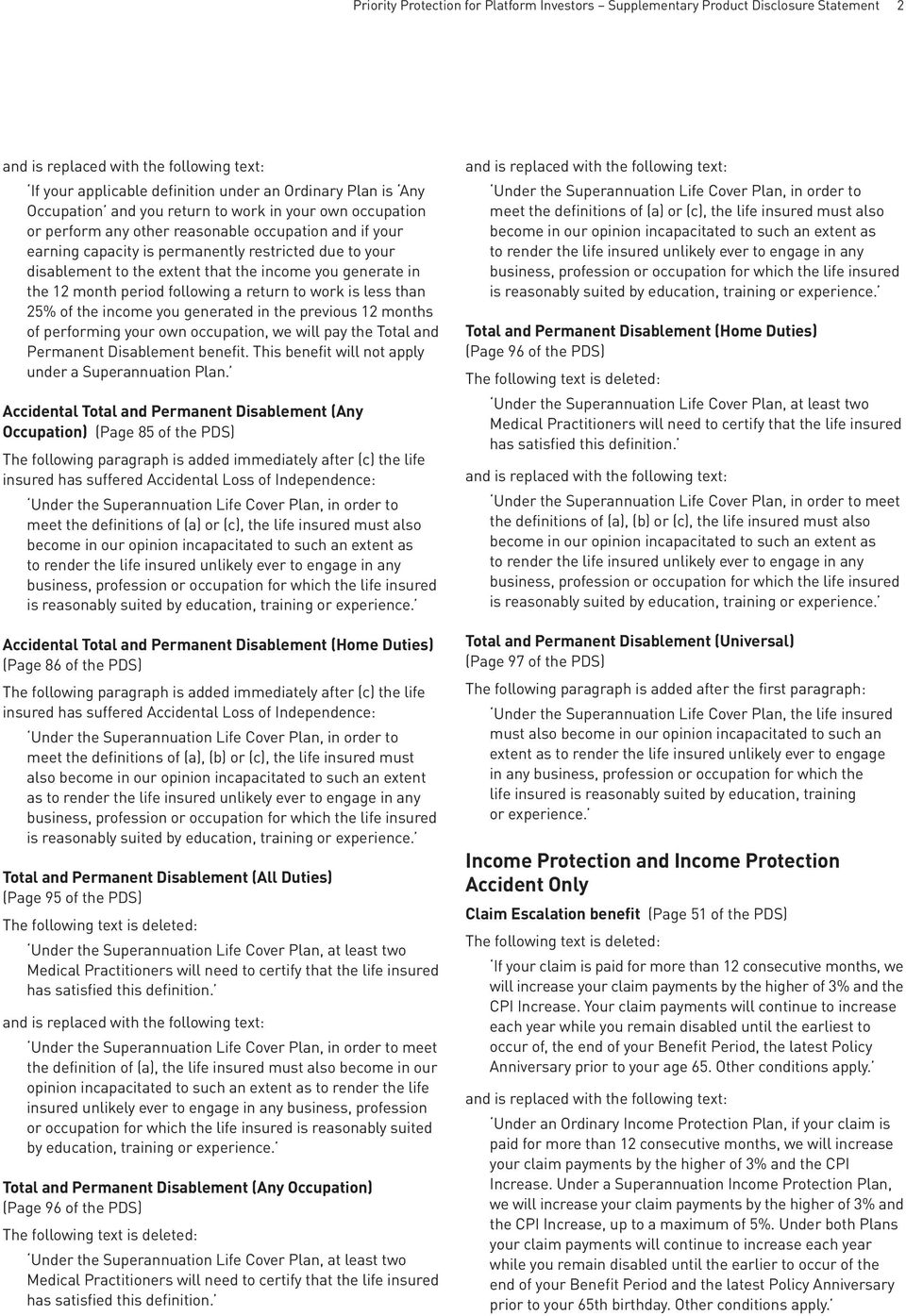
2 Priority for Platform Investors Supplementary Product Disclosure Statement 2 and is replaced with the following text: If your applicable definition under an Ordinary Plan is Any Occupation and you return to work in your own occupation or perform any other reasonable occupation and if your earning capacity is permanently restricted due to your disablement to the extent that the income you generate in the 12 month period following a return to work is less than 25% of the income you generated in the previous 12 months of performing your own occupation, we will pay the Total and Permanent Disablement benefit. This benefit will not apply under a Superannuation Plan. Accidental Total and Permanent Disablement (Any Occupation) (Page 85 of the PDS) The following paragraph is added immediately after (c) the life insured has suffered Accidental Loss of Independence: Under the Superannuation Life Cover Plan, in order to meet the definitions of (a) or (c), the life insured must also become in our opinion incapacitated to such an extent as to render the life insured unlikely ever to engage in any business, profession or occupation for which the life insured is reasonably suited by education, training or experience. Accidental Total and Permanent Disablement (Home Duties) (Page 86 of the PDS) The following paragraph is added immediately after (c) the life insured has suffered Accidental Loss of Independence: Under the Superannuation Life Cover Plan, in order to meet the definitions of (a), (b) or (c), the life insured must also become in our opinion incapacitated to such an extent as to render the life insured unlikely ever to engage in any business, profession or occupation for which the life insured is reasonably suited by education, training or experience. Total and Permanent Disablement (All Duties) (Page 95 of the PDS) The following text is deleted: Under the Superannuation Life Cover Plan, at least two Medical Practitioners will need to certify that the life insured has satisfied this definition. and is replaced with the following text: Under the Superannuation Life Cover Plan, in order to meet the definition of (a), the life insured must also become in our opinion incapacitated to such an extent as to render the life insured unlikely ever to engage in any business, profession or occupation for which the life insured is reasonably suited by education, training or experience. Total and Permanent Disablement (Any Occupation) (Page 96 of the PDS) The following text is deleted: Under the Superannuation Life Cover Plan, at least two Medical Practitioners will need to certify that the life insured has satisfied this definition. and is replaced with the following text: Under the Superannuation Life Cover Plan, in order to meet the definitions of (a) or (c), the life insured must also become in our opinion incapacitated to such an extent as to render the life insured unlikely ever to engage in any business, profession or occupation for which the life insured is reasonably suited by education, training or experience. Total and Permanent Disablement (Home Duties) (Page 96 of the PDS) The following text is deleted: Under the Superannuation Life Cover Plan, at least two Medical Practitioners will need to certify that the life insured has satisfied this definition. and is replaced with the following text: Under the Superannuation Life Cover Plan, in order to meet the definitions of (a), (b) or (c), the life insured must also become in our opinion incapacitated to such an extent as to render the life insured unlikely ever to engage in any business, profession or occupation for which the life insured is reasonably suited by education, training or experience. Total and Permanent Disablement (Universal) (Page 97 of the PDS) The following paragraph is added after the first paragraph: Under the Superannuation Life Cover Plan, the life insured must also become in our opinion incapacitated to such an extent as to render the life insured unlikely ever to engage in any business, profession or occupation for which the life insured is reasonably suited by education, training or experience. and Accident Only Claim Escalation benefit (Page 51 of the PDS) The following text is deleted: If your claim is paid for more than 12 consecutive months, we will increase your claim payments by the higher of % and the CPI Increase. Your claim payments will continue to increase each year while you remain disabled until the earliest to occur of, the end of your Benefit Period, the latest Policy Anniversary prior to your age 65. Other conditions apply. and is replaced with the following text: Under an Ordinary Plan, if your claim is paid for more than 12 consecutive months, we will increase your claim payments by the higher of % and the CPI Increase. Under a Superannuation Plan, we will increase your claim payments by the higher of % and the CPI Increase, up to a maximum of 5%. Under both Plans your claim payments will continue to increase each year while you remain disabled until the earlier to occur of the end of your Benefit Period and the latest Policy Anniversary prior to your 65th birthday. Other conditions apply.
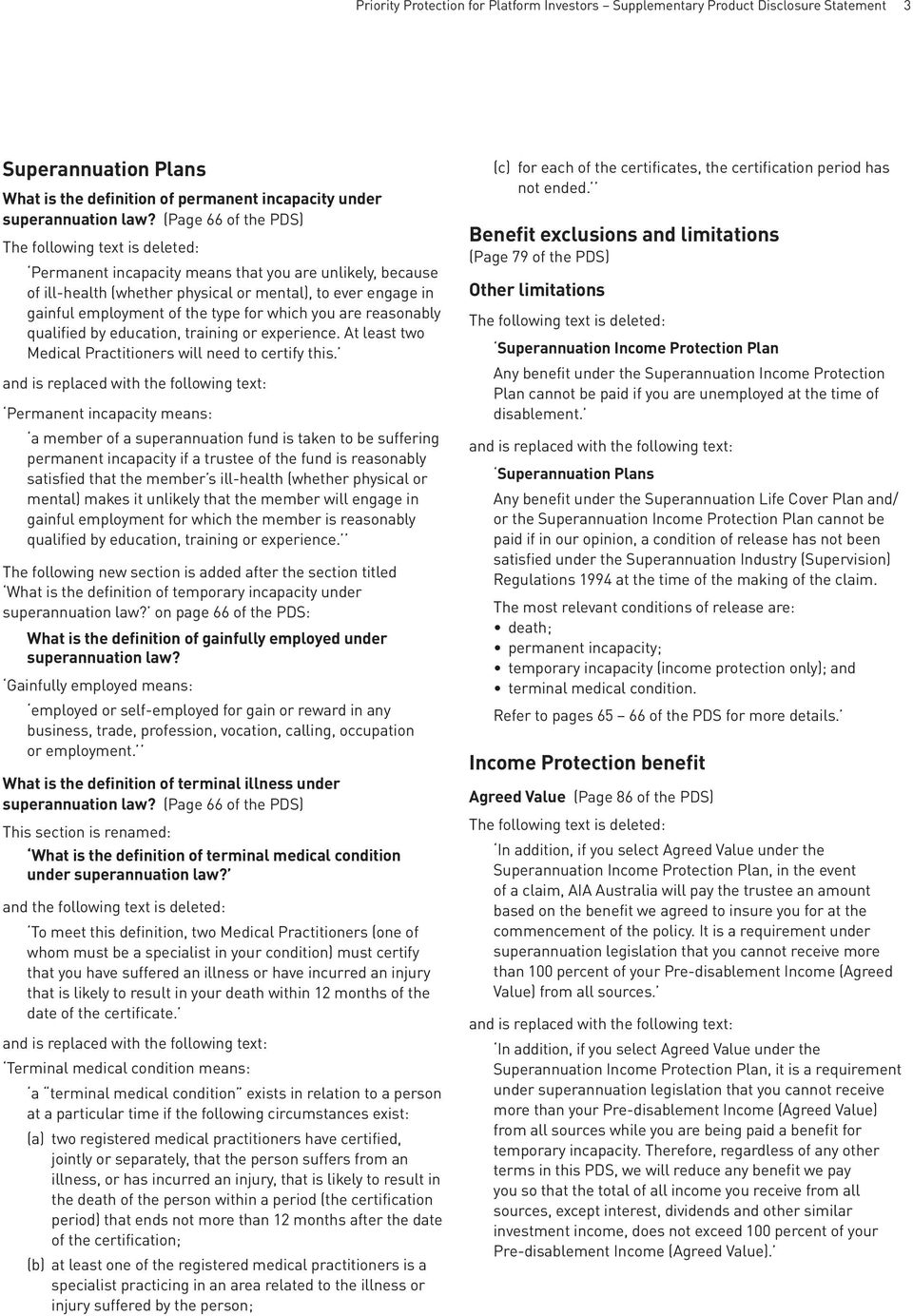
3 Priority for Platform Investors Supplementary Product Disclosure Statement Superannuation Plans What is the definition of permanent incapacity under superannuation law? (Page 66 of the PDS) The following text is deleted: Permanent incapacity means that you are unlikely, because of ill-health (whether physical or mental), to ever engage in gainful employment of the type for which you are reasonably qualified by education, training or experience. At least two Medical Practitioners will need to certify this. and is replaced with the following text: Permanent incapacity means: a member of a superannuation fund is taken to be suffering permanent incapacity if a trustee of the fund is reasonably satisfied that the member s ill-health (whether physical or mental) makes it unlikely that the member will engage in gainful employment for which the member is reasonably qualified by education, training or experience. The following new section is added after the section titled What is the definition of temporary incapacity under superannuation law? on page 66 of the PDS: What is the definition of gainfully employed under superannuation law? Gainfully employed means: employed or self-employed for gain or reward in any business, trade, profession, vocation, calling, occupation or employment. What is the definition of terminal illness under superannuation law? (Page 66 of the PDS) This section is renamed: What is the definition of terminal medical condition under superannuation law? and the following text is deleted: To meet this definition, two Medical Practitioners (one of whom must be a specialist in your condition) must certify that you have suffered an illness or have incurred an injury that is likely to result in your death within 12 months of the date of the certificate. and is replaced with the following text: Terminal medical condition means: a terminal medical condition exists in relation to a person at a particular time if the following circumstances exist: (a) two registered medical practitioners have certified, jointly or separately, that the person suffers from an illness, or has incurred an injury, that is likely to result in the death of the person within a period (the certification period) that ends not more than 12 months after the date of the certification; (b) at least one of the registered medical practitioners is a specialist practicing in an area related to the illness or injury suffered by the person; (c) for each of the certificates, the certification period has not ended. Benefit exclusions and limitations (Page 79 of the PDS) Other limitations The following text is deleted: Superannuation Plan Any benefit under the Superannuation Plan cannot be paid if you are unemployed at the time of disablement. and is replaced with the following text: Superannuation Plans Any benefit under the Superannuation Life Cover Plan and/ or the Superannuation Plan cannot be paid if in our opinion, a condition of release has not been satisfied under the Superannuation Industry (Supervision) Regulations 1994 at the time of the making of the claim. The most relevant conditions of release are: death; permanent incapacity; temporary incapacity (income protection only); and terminal medical condition. Refer to pages of the PDS for more details. benefit Agreed Value (Page 86 of the PDS) The following text is deleted: In addition, if you select Agreed Value under the Superannuation Plan, in the event of a claim, AIA Australia will pay the trustee an amount based on the benefit we agreed to insure you for at the commencement of the policy. It is a requirement under superannuation legislation that you cannot receive more than 100 percent of your Pre disablement (Agreed Value) from all sources. and is replaced with the following text: In addition, if you select Agreed Value under the Superannuation Plan, it is a requirement under superannuation legislation that you cannot receive more than your Pre-disablement (Agreed Value) from all sources while you are being paid a benefit for temporary incapacity. Therefore, regardless of any other terms in this PDS, we will reduce any benefit we pay you so that the total of all income you receive from all sources, except interest, dividends and other similar investment income, does not exceed 100 percent of your Pre disablement (Agreed Value).
4 Priority for Platform Investors Supplementary Product Disclosure Statement 4 Indemnity (Page 90 of the PDS) The following text is deleted: In addition, if you select Indemnity under the Superannuation Plan, in the event of a claim, AIA Australia will calculate your benefit by taking into account your Pre disablement (Indemnity). If the claim is admitted, AIA Australia will pay the monthly benefit to the trustee. The trustee will make the proceeds available to you subject to your having satisfied the appropriate condition of release. and is replaced with the following text: In addition, if you select Indemnity under the Superannuation Plan, it is a requirement under superannuation legislation that you cannot receive more than your Pre-disablement (Indemnity) from all sources while you are being paid a benefit for temporary incapacity. Therefore, regardless of any other terms in this PDS, we will reduce any benefit we pay you so that the total of all income you receive from all sources, except interest, dividends and other similar investment income, does not exceed 100 percent of your Pre-disablement (Indemnity). Pre-disablement (Agreed Value) (Page 94 of the PDS) The following text is deleted: PRE-DISABLEMENT INCOME (AGREED VALUE) is the life insured s highest average monthly income for any financial year since the date two years before the commencement date of the benefit up until the commencement of disablement. During disablement the Pre-disablement (Agreed Value) amount will be increased every 12 months, following the date of disablement, by % or the Consumer Price Index Increase (CPI Increase) (whichever is the greater). For the Superannuation Plan, the benefit payable cannot exceed 100% of your monthly Pre disablement at the date of disablement. and is replaced with the following text: PRE-DISABLEMENT INCOME (AGREED VALUE), under the Plan, is the life insured s highest average monthly income, except interest, dividends and other similar investment income, for any financial year since the date two years before the commencement date of the benefit up to the commencement of disablement. PRE-DISABLEMENT INCOME (AGREED VALUE), under the Superannuation Plan, is the life insured s average monthly income, except interest, dividends and other similar investment income, for the 12 consecutive months preceding the commencement of disablement. During disablement the Pre-disablement (Agreed Value) amount under both the Plan and the Superannuation Plan will be increased every 12 months, following the date of disablement, by % or the Consumer Price Index Increase (CPI Increase) (whichever is the greater). Pre-disablement (Indemnity) (Page 94 of the PDS) The following text is deleted: PRE-DISABLEMENT INCOME (INDEMNITY) is the greater of the life insured s average monthly income: for the 12 consecutive months preceding the commencement of disablement; and for the latest financial year preceding the commencement of disablement. During disablement the Pre-disablement (Indemnity) amount will be increased every 12 months, following the date of disablement, by % or the Consumer Price Index Increase (CPI Increase) (whichever is the greater). and is replaced with the following text: PRE-DISABLEMENT INCOME (INDEMNITY), under the Plan, is the greater of the life insured s average monthly income, except interest, dividends and other similar investment income, for: the 12 consecutive months preceding the commencement of disablement; and the latest financial year preceding the commencement of disablement. PRE-DISABLEMENT INCOME (INDEMNITY), under the Superannuation Plan, is the life insured s average monthly income, except interest, dividends and other similar investment income, for the 12 consecutive months preceding the commencement of disablement. During disablement the Pre-disablement (Indemnity) amount under both the Plan and the Superannuation Plan will be increased every 12 months, following the date of disablement, by % or the Consumer Price Index Increase (CPI Increase) (whichever is the greater). Total Disablement ( ) (Page 97 of the PDS) The following text is added immediately prior to the For Ordinary Plans only section: For Superannuation Plans only TOTAL DISABLEMENT (INCOME PROTECTION) means that, solely as a result of Injury or Sickness, the: life insured is unable to perform one or more duties of his or her occupation, that is important or essential in producing income; life insured is under the regular care of, and following the advice of, a Medical Practitioner; life insured is not working (whether paid or unpaid); and disablement suffered by the life insured satisfies, in our opinion, a condition of release under the Superannuation Industry (Supervision) Regulations 1994 at the time of the making of the claim.

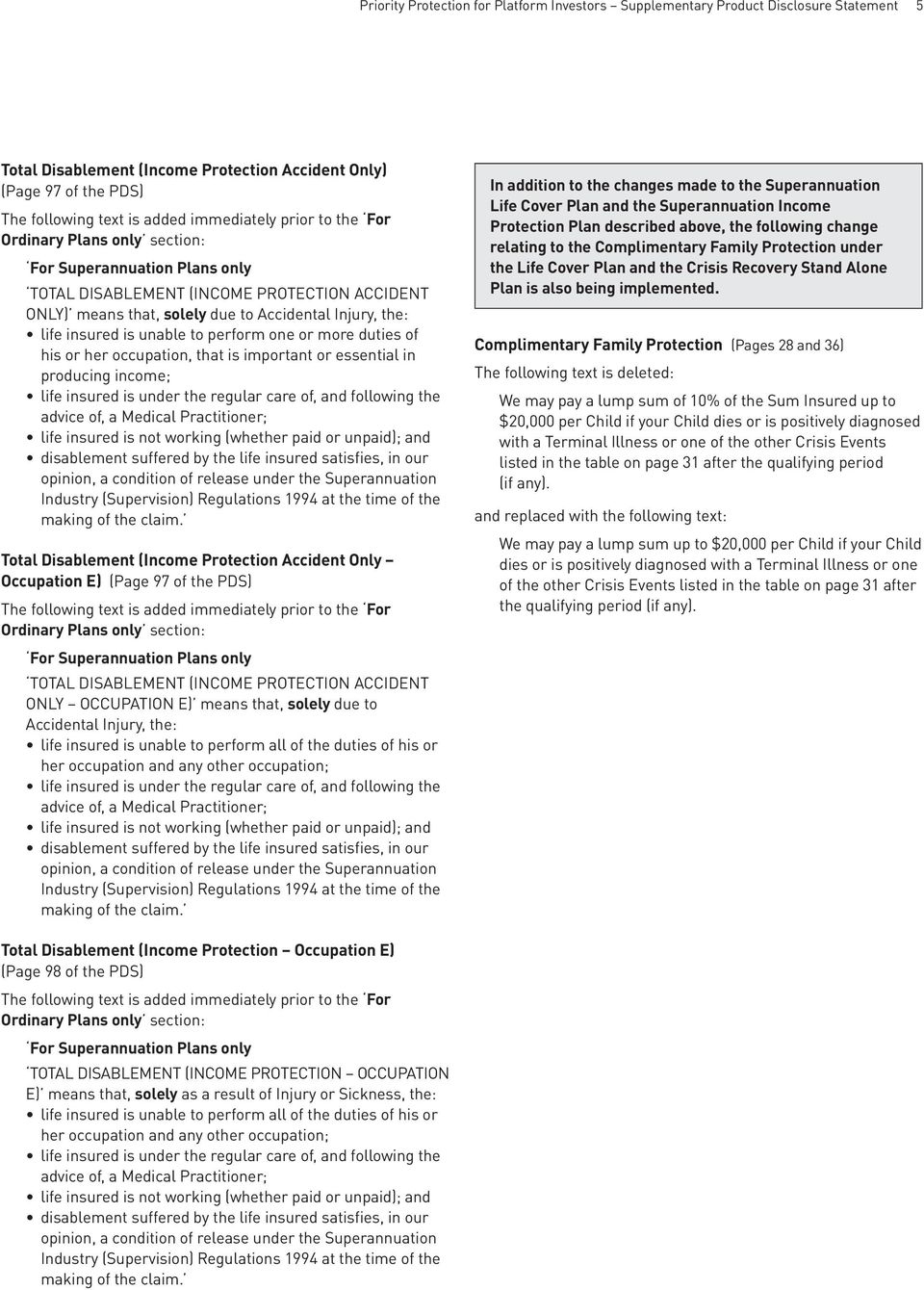
5 Priority for Platform Investors Supplementary Product Disclosure Statement 5 Total Disablement ( Accident Only) (Page 97 of the PDS) The following text is added immediately prior to the For Ordinary Plans only section: For Superannuation Plans only TOTAL DISABLEMENT (INCOME PROTECTION ACCIDENT ONLY) means that, solely due to Accidental Injury, the: life insured is unable to perform one or more duties of his or her occupation, that is important or essential in producing income; life insured is under the regular care of, and following the advice of, a Medical Practitioner; life insured is not working (whether paid or unpaid); and disablement suffered by the life insured satisfies, in our opinion, a condition of release under the Superannuation Industry (Supervision) Regulations 1994 at the time of the making of the claim. Total Disablement ( Accident Only Occupation E) (Page 97 of the PDS) The following text is added immediately prior to the For Ordinary Plans only section: For Superannuation Plans only TOTAL DISABLEMENT (INCOME PROTECTION ACCIDENT ONLY OCCUPATION E) means that, solely due to Accidental Injury, the: life insured is unable to perform all of the duties of his or her occupation and any other occupation; life insured is under the regular care of, and following the advice of, a Medical Practitioner; life insured is not working (whether paid or unpaid); and disablement suffered by the life insured satisfies, in our opinion, a condition of release under the Superannuation Industry (Supervision) Regulations 1994 at the time of the making of the claim. In addition to the changes made to the Superannuation Life Cover Plan and the Superannuation Plan described above, the following change relating to the Complimentary Family under the Life Cover Plan and the Crisis Recovery Stand Alone Plan is also being implemented. Complimentary Family (Pages 28 and 6) The following text is deleted: We may pay a lump sum of 10% of the Sum Insured up to $20,000 per Child if your Child dies or is positively diagnosed with a Terminal Illness or one of the other Crisis Events listed in the table on page 1 after the qualifying period (if any). and replaced with the following text: We may pay a lump sum up to $20,000 per Child if your Child dies or is positively diagnosed with a Terminal Illness or one of the other Crisis Events listed in the table on page 1 after the qualifying period (if any). Total Disablement ( Occupation E) (Page 98 of the PDS) The following text is added immediately prior to the For Ordinary Plans only section: For Superannuation Plans only TOTAL DISABLEMENT (INCOME PROTECTION OCCUPATION E) means that, solely as a result of Injury or Sickness, the: life insured is unable to perform all of the duties of his or her occupation and any other occupation; life insured is under the regular care of, and following the advice of, a Medical Practitioner; life insured is not working (whether paid or unpaid); and disablement suffered by the life insured satisfies, in our opinion, a condition of release under the Superannuation Industry (Supervision) Regulations 1994 at the time of the making of the claim.
6 Priority for Platform Investors Supplementary Product Disclosure Statement 6 Important contact information Should you have any questions or concerns about your policy please contact your adviser in the first instance or us direct on You can also visit aia.com.au for additional contact details and further information. AIA Australia Limited (ABN AFSL 2004) AIA /14

7 Priority for Platform Investors Product Disclosure Statement Version 1, Date Prepared 1 March 2014 Life s better with the right partner

8 Important Notes This Product Disclosure Statement ( PDS ) describes the main features of six separate insurance plans; Life Cover Plan, Crisis Recovery Stand Alone Plan, Plan, Business Expenses Plan, Superannuation Life Cover Plan and Superannuation Plan. The Life Cover Plan, Crisis Recovery Stand Alone Plan, Plan and Business Expenses Plan ( Ordinary Plans ) are benefits under a life insurance policy issued by AIA Australia Limited (ABN AFSL 2004) ( AIA Australia ) to the Policy Owner (usually you). The Superannuation Life Cover Plan and Superannuation Plan ( Superannuation Plans ) are benefits under a separate life insurance policy issued by AIA Australia to the trustee of an approved superannuation fund or Self-managed Superannuation Fund ( SMSF ) as the Policy Owner to provide one or more life insurance benefits for a fund member as the insured person. The Superannuation Plans have some different terms and conditions than the policy issued for the Ordinary Life Cover and Plans. Each of the Plans has stand alone insurance covers that can be selected individually or in combination, each with built-in benefits and optional benefits (Riders) that you can select at an additional cost. (See Structure diagram on pages 2 5.) Each of the benefits under the Plans has an entry age and expiry date, together with a maximum sum insured, depending on your Occupation Category. (See Summary tables on pages 6 12 and the list of Occupation Categories on page 102.) The formal terms and conditions of each Plan are set out in the Policy Document, which is available from If there is any inconsistency between this PDS and the Policy Document, the full terms and conditions contained in the Policy Document will prevail. AIA Australia is not bound to accept any application for cover. Structuring Priority for Platform Investors through superannuation The Superannuation Life Cover Plan and the Superannuation Plan can be acquired through an approved superannuation fund or a SMSF: you will be issued with a risk-only superannuation product in the approved superannuation fund or SMSF fund, with benefits referable solely to the Superannuation Life Cover Plan and/or the Superannuation Plan; the Policy will be owned by the approved superannuation fund or SMSF, as the trustee of the fund; and all premiums and benefit payments will be made through the approved superannuation fund or SMSF and are therefore subject to restrictions under superannuation law. Please note: your cooling off rights and the external dispute resolution scheme to deal with any complaints about the product are different, depending on whether the issuer is AIA Australia or the trustee of an approved superannuation fund or SMSF. About this PDS This PDS covers both the insurance products issued by AIA Australia and, where the Superannuation Life Cover Plan or the Superannuation Plan is issued through an approved superannuation fund or SMSF, the risk-only superannuation product issued by the trustee. AIA Australia takes full responsibility for the entirety of this PDS. This document should be read before making a decision to acquire any of the Plans. It is intended to help you decide whether the Plans will meet your needs and to compare them with other products you may be considering. The information in this PDS is current as the date of issue but may be updated or replaced at any time, and you can obtain a copy of the current version on request, free of charge, by calling AIA Australia on Changes that are not materially adverse will be updated and made available to you at You will be advised of material changes or significant events as required by law. The information in this PDS is of a general nature only and has been prepared without taking into account your objectives, financial situation or needs. Therefore, before making any decision you should consider the appropriateness of the information, having regard to your objectives, financial situation and needs. If you are deciding whether to acquire one or more of these Plans you should read this PDS before making your decision. Defined Terms There are a number of terms in this PDS that has been capitalised. These terms have a particular meaning when used in this PDS and the Policy Document. We have included some of the most important definitions at the end of this PDS. It is important to read their meanings carefully because they can affect when a claim will be paid. Also, in this PDS (which includes the applicable Application Form) any reference to: approved superannuation fund means a superannuation fund that is a complying fund, which has an arrangement with AIA Australia to purchase one or more of the life insurance benefits under the Superannuation Plans for one or more of its fund members as the insured persons. The AIA Superannuation Fund or a SMSF is not an approved superannuation fund for this purpose. A list of the external superannuation funds which have an agreement with AIA Australia is available upon request on ; Ordinary Plan means the Life Cover Plan, Crisis Recovery Stand Alone Plan, Plan or Business Expenses Plan; Policy means the Priority Policy Document and Policy Schedule issued by AIA Australia; Policy Owner means the person who legally owns the Policy, including the trustee of a superannuation fund when a Superannuation Plan is issued; Priority for Platform Investors or Plans means all of the insurance plans referred to in this PDS unless otherwise specified; SMSF means a Self-managed Superannuation Fund; Superannuation Plan means the Superannuation Life Cover Plan or Superannuation Plan; trustee means the trustee of an approved superannuation fund or the trustee of a SMSF as applicable; we, us, our or the insurer means AIA Australia Limited; you or life insured means any potential customer likely to become the person insured under the Policy unless otherwise specified. Limitations Exclusions and Benefit Reductions You should be aware that some limitations and exclusions will apply to your Policy. This means that there are circumstances when we will not pay a claim or where will pay a claim on a reduced basis. We have included a summary of Exclusions and Limitations on pages and a summary of the circumstances when benefits may be reduced on pages As a general rule, if you select a benefit as a rider to a stand alone benefit, payment of the rider benefit will reduce the Sum Insured under the stand alone benefit. For full details, see the Policy Document.

9 Contents 1 Priority for Platform Investors Structure...2 Ordinary Plans...2 Superannuation Plans...4 Priority for Platform Investors Summary...6 Life Cover Plan...6 Crisis Recovery Stand Alone Plan...8 Business Expenses Plan...8 Plan...9 Superannuation Life Cover Plan Superannuation Plan About Priority for Platform Investors... 1 Priority for Platform Investors benefits Life Cover TPD cover Total and Permanent Disablement Universal Total and Permanent Disablement Total and Permanent Disablement Buy-back Waiver of Premium... 2 Double Total and Permanent Disablement Double Universal Total and Permanent Disablement Crisis Recovery Crisis Recovery Buy-back... 2 Crisis Reinstatement... Double Crisis Recovery... 5 Family Needlestick Injury School Fees Protector... 4 Forward Underwriting cover and (Accident Only) Essentials Business Expenses Incorporated Business Expenses Superannuation Plans Insurance through Superannuation Superannuation PLUS Maximiser Super Extras benefit What are the costs? Premiums Other fees and costs Premium discounts Significant risks Your duty of disclosure Benefit exclusions and limitations Summary of exclusions Summary of Lump Sum benefit reductions Claim offsets Pre-existing Condition Other limitations Additional information When will my cover end? General information about your policy, rights and obligations Taxation Ordinary Plans Privacy statement... 8 Definitions Occupation Categories Certificates for Interim Cover Direct Debit Request Service Agreement Contact information...109

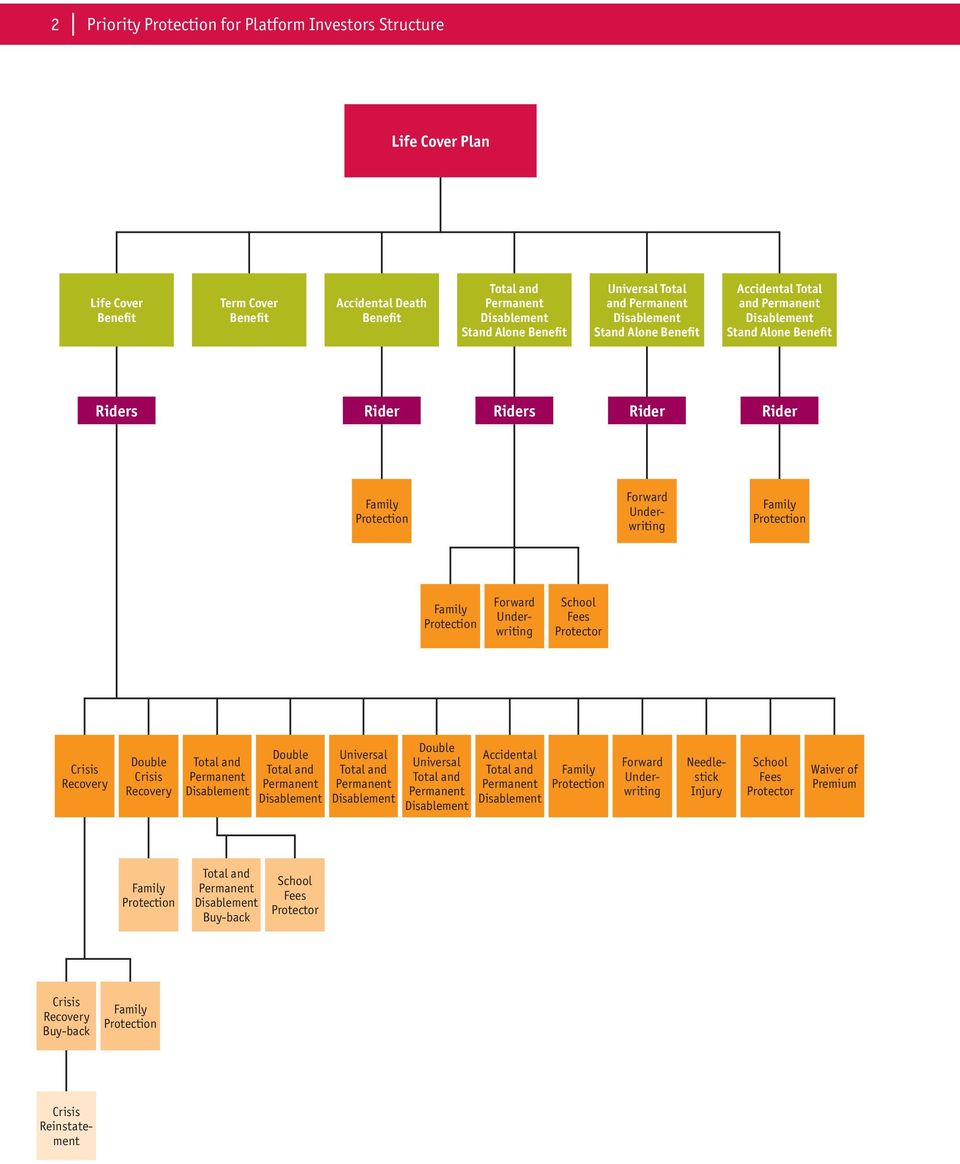
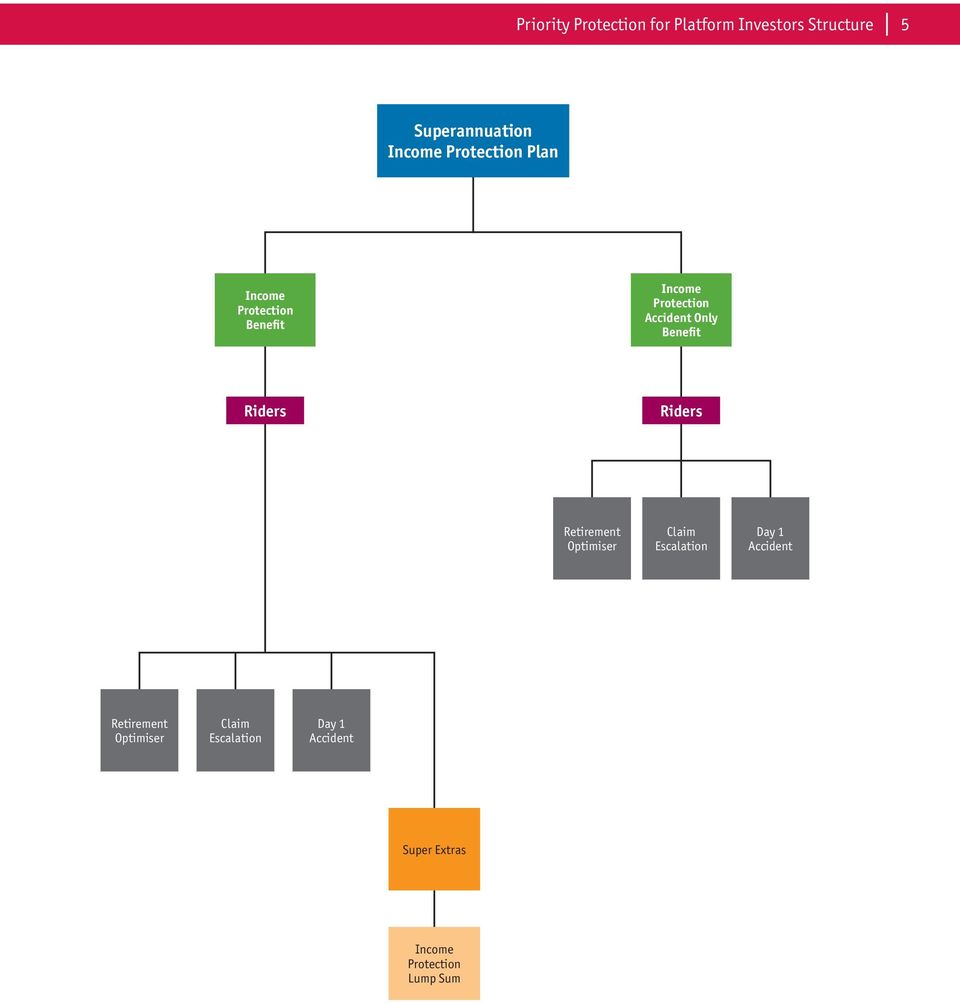
10 2 Priority for Platform Investors Structure Life Cover Plan Life Cover Benefit Term Cover Benefit Accidental Death Benefit Total and Permanent Disablement Stand Alone Benefit Universal Total and Permanent Disablement Stand Alone Benefit Accidental Total and Permanent Disablement Stand Alone Benefit Riders Rider Riders Rider Rider Family Forward Underwriting Family Family Forward Underwriting School Fees Protector Crisis Recovery Double Crisis Recovery Total and Permanent Disablement Double Total and Permanent Disablement Universal Total and Permanent Disablement Double Universal Total and Permanent Disablement Accidental Total and Permanent Disablement Family Forward Underwriting Needlestick Injury School Fees Protector Waiver of Premium Family Total and Permanent Disablement Buy-back School Fees Protector Crisis Recovery Buy-back Family Crisis Reinstatement
11 Priority for Platform Investors Structure Crisis Recovery Stand Alone Plan Plan (Agreed Value or Indemnity) Business Expenses Plan Crisis Recovery Stand Alone Benefit Benefit Accident Only Benefit Essentials Benefit Business Expenses Benefit Incorporated Business Expenses Benefit Riders Riders Riders Rider Rider Day 1 Accident Day 1 Accident Retirement Optimiser Claim Escalation Day 1 Accident Carer s Allowance Retirement Optimiser Advantage Optional PLUS Optional Claim Escalation Day 1 Accident Lump Sum Carer s Allowance Business Expenses Crisis Reinstatement Total and Permanent Disablement Universal Total and Permanent Disablement Accidental Total and Permanent Disablement Family Forward Underwriting Day 1 Accident

12 4 Priority for Platform Investors Structure Superannuation Life Cover Plan Life Cover Benefit Term Cover Benefit Accidental Death Benefit Total and Permanent Disablement Stand Alone Benefit Universal Total and Permanent Disablement Stand Alone Benefit Accidental Total and Permanent Disablement Stand Alone Benefit Riders Maximiser (Non-Super) Superannuation PLUS (outside super) Total and Permanent Disablement Double Total and Permanent Disablement Universal Total and Permanent Disablement Double Universal Total and Permanent Disablement Accidental Total and Permanent Disablement Waiver of Premium Maximiser (Non-Super) Total and Permanent Disablement Buy-back Maximiser (Non-Super) Crisis Recovery Double Crisis Recovery Total and Permanent Disablement Double Total and Permanent Disablement Universal Total and Permanent Disablement Double Universal Total and Permanent Disablement Accidental Total and Permanent Disablement Family Needlestick Injury Waiver of Premium Family Total and Permanent Disablement Buy-back Crisis Recovery Buy-back Family Crisis Reinstatement

13 Priority for Platform Investors Structure 5 Superannuation Plan Benefit Accident Only Benefit Riders Riders Retirement Optimiser Claim Escalation Day 1 Accident Retirement Optimiser Claim Escalation Day 1 Accident Super Extras Lump Sum
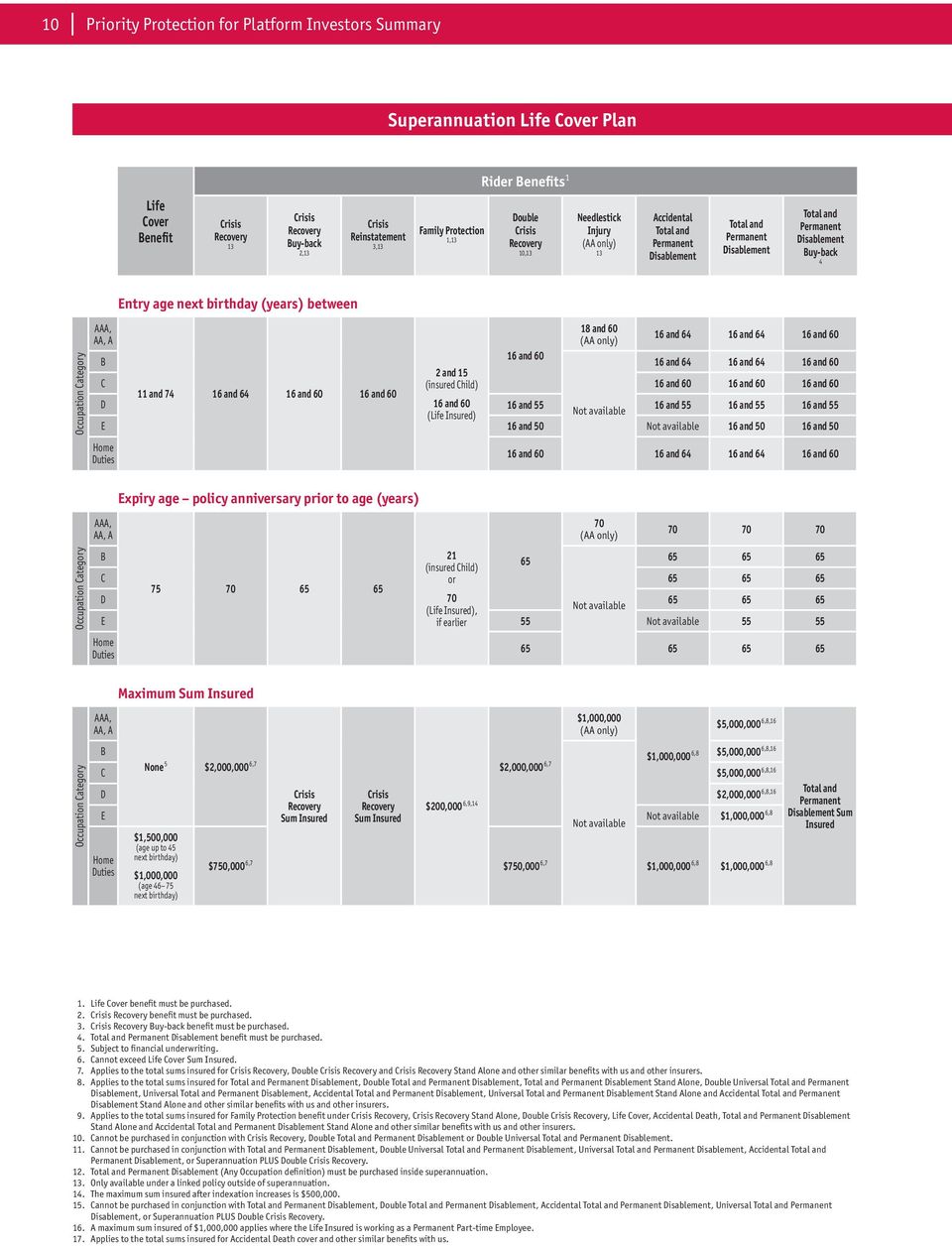
14 6 Priority for Platform Investors Summary Life Cover Plan Rider Benefits 1 Life Cover Benefit Crisis Recovery Crisis Recovery Buy back 2 Crisis Reinstatement Double Crisis Recovery 11 Total and Permanent Disablement Total and Permanent Disablement Buy back 4 Double Total and Permanent Disablement 12 Universal Total and Permanent Disablement Double Universal Total and Permanent Disablement 16 Accidental Total and Permanent Disablement Entry age next birthday (years) between AAA, AA, A 16 and and and and and 64 Occupation Category B 16 and and and and and and and 64 C 16 and and and and and and and and and 60 D 16 and and and and and 55 E 16 and and and and and and 50 Not applicable Home Duties 16 and and and and and and and 64 Expiry age policy anniversary prior to age (years) AAA, AA, A Occupation Category B C D E Not applicable Home Duties Maximum Sum Insured AAA, AA, A $5,000,000 6,10,17 $5,000,000 6,10,17 Occupation Category B $5,000,000 6,10,17 $5,000,000 6,10,17 $1,000,000 6 None 5 $2,000,000 6,7 $2,000,000 C 6,7 $5,000,000 6,10,17 $5,000,000 6,10,17 Total and D Crisis Crisis $2,000,000 6,10,17 $2,000,000 Permanent 6,10,17 Recovery Recovery $1,000,000 Disablement 6,10 $1,000,000 6,10 E Sum Insured Sum Insured $1,000,000 6,10 $1,000,000 6,10 Not applicable Sum Insured $1,500,000 (age up to 45 next birthday) Home Duties $1,000,000 (age next birthday) $750,000 6,7 $750,000 6,7 $1,000,000 6,10 $1,000,000 6,10 $1,000,000 6,10 1. Life Cover benefit must be purchased. 2. Crisis Recovery benefit must be purchased.. Crisis Recovery Buy-back benefit must be purchased. 4. Total and Permanent Disablement benefit must be purchased. 5. Subject to financial underwriting. 6. Cannot exceed Life Cover Sum Insured. 7. Applies to the total sums insured for Crisis Recovery, Crisis Recovery Stand Alone and Double Crisis Recovery and other similar benefits with us and other insurers. 8. Applies to the total sums insured for Family benefit under Crisis Recovery, Crisis Recovery Stand Alone, Double Crisis Recovery, Life Cover, Total and Permanent Disablement Stand Alone, Accidental Total and Permanent Disablement Stand Alone and Accidental Death and other similar benefits with us and other insurers. 9. Cannot exceed Crisis Recovery, Double Crisis Recovery, Accidental Death, Life Cover, Total and Permanent Disablement Stand Alone or Accidental Total and Permanent Disablement Stand Alone benefit Sum Insured. 10. Applies to the total sums insured for Total and Permanent Disablement, Total and Permanent Disablement Stand Alone, Double Total and Permanent Disablement, Accidental Total and Permanent Disablement, Accidental Total and Permanent Disablement Stand Alone, Universal Total and Permanent Disablement, Universal Total and Permanent Disablement Stand Alone and Double Universal Total and Permanent Disablement and other similar benefits with us and other insurers. 11. Cannot be purchased in conjunction with Crisis Recovery, Double Total and Permanent Disablement or Double Universal Total and Permanent Disablement. 12. Cannot be purchased in conjunction with Total and Permanent Disablement, Double Crisis Recovery, Double Universal Total and Permanent Disablement, Accidental Total and Permanent Disablement or Universal Total and Permanent Disablement. 1. Crisis Recovery benefit, Double Crisis Recovery benefit, Accidental Death benefit, Life Cover benefit, Total and Permanent Disablement Stand Alone or Accidental Total and Permanent Disablement Stand Alone must be purchased. 14. Life Cover benefit or Total and Permanent Disablement Stand Alone benefit must be purchased. 15. The maximum sum insured after indexation increases is $500, Cannot be purchased in conjunction with Total and Permanent Disablement, Double Total and Permanent Disablement, Accidental Total and Permanent Disablement or Universal Total and Permanent Disablement. 17. A maximum sum insured of $1,000,000 applies where the Life Insured is working as a Permanent Part-time Employee. 18. The minimum Sum Insured is $100,000. Total and Permanent Disablement cover and Crisis Recovery cover are capped at $5,000,000 and $2,000,000, respectively, depending on your occupational category. Universal Total and Permanent Disablement cover is capped at $1,000, Applies to the total sums insured for Accidental Death cover and other similar benefits with us.

15 Priority for Platform Investors Summary 7 Life Cover Plan (continued) Needlestick Injury (AA only) Rider Benefits 1 (continued) Waiver of Premium Forward Underwriting Family 1 School Fees Protector 14 Term Cover Benefit Total and Permanent Disablement Stand Alone Benefit Universal Total and Permanent Disablement Stand Alone Benefit Accidental Total and Permanent Disablement Stand Alone Benefit Accidental Death Benefit Entry age next birthday (years) between 18 and 60 (AA only) Not available 16 and 64 Same as AAA, 16 and and 64 Life Cover, Total AA, A and Permanent 16 and 64 Disablement 16 and and and 64 B 2 and and and 60 rider or Total (insured Child) (5 year term); 16 and and 60 C 16 and 55 and Permanent 16 and and and 60 Disablement 11 and and and 55 D (Life Insured) Stand Alone (10 year term) 16 and 50 benefit 16 and and 50 Not available E (Life Insured) Home 16 and 64 and 16 (Child) 16 and and and 64 Duties Occupation Category Expiry age policy anniversary prior to age (years) 70 (AA only) Not available 70 Same as AAA, Life Cover, Total AA, A and Permanent Disablement B (insured Child) 65 rider or Total or End of chosen C 65 and Permanent benefit term Disablement (5 or 10 years) D (Life Insured), Stand Alone 55 if earlier benefit Not available E (Life Insured) Home (Child) Duties Occupation Category Maximum Sum Insured $1,000,000 6 (AA only) $5,000,000 10,17 AAA, AA, A Not available Not available $10,000, $200,000 8,9,15 page 4 of the Product Disclosure Refer to Statement None 5 $1,500,000 (age up to 45 next birthday) $1,000,000 (age next birthday) $5,000,000 10,17 $1,000, B $5,000,000 10,17 C $2,000,000 10,17 D $1,000, $1,000, Not available $1,000, E $1,000, Home $1,000,000 Duties Occupation Category
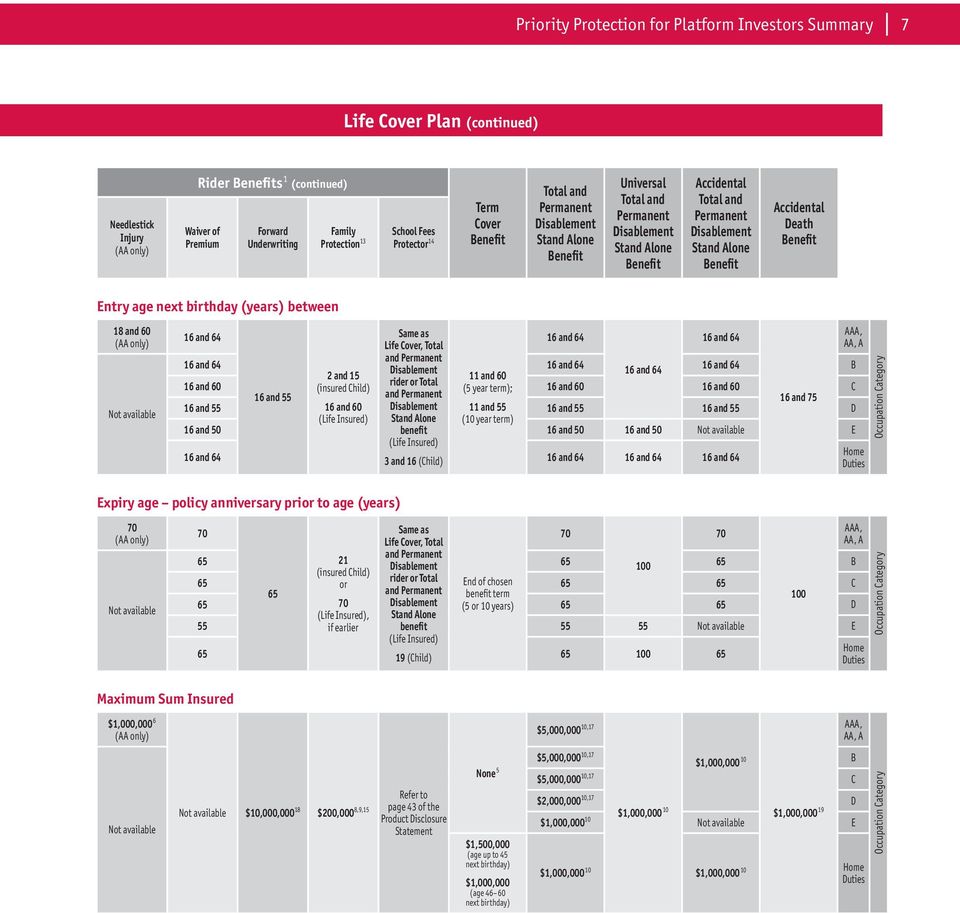
16 8 Priority for Platform Investors Summary Crisis Recovery Stand Alone Plan Business Expenses Plan Crisis Recovery Stand Alone Benefit Total and Permanent Disablement Universal Total and Permanent Disablement Rider Benefits 1 Accidental Total and Permanent Disablement Crisis Reinstatement Family Forward Underwriting Business Expenses Benefit Incorporated Business Expenses Benefit Rider Benefit Day 1 Accident Entry age next birthday (years) between Occupation Category AAA, AA, A 16 and and and 60 AAA and AA only 16 and and 60 B 16 and and and 64 2 and and 60 Not available 16 and 60 C 16 and and 60 (insured Child) 16 and 55 Not available 16 and 55 D 16 and and and and and and and 55 Not available 16 and 55 (Life Insured) E 16 and and 50 Not available Not available Not available Not available Home Duties 16 and and and 64 Not available Not available Not available Expiry age policy anniversary prior to age (years) Occupation Category AAA, AA, A 70 B (insured Child) or C Not available D (Life Insured), E Not available if earlier Not available Not available Not available Home Duties 65 AAA and AA only Not available Not available Not available 65 Maximum Sum Insured Occupation Category AAA, AA, A B C D E Home Duties $2,000,000 2 $2,000,000 4,6,7 $2,000,000 4,6,7 (age next birthday) $1,000,000 4,6 (age next birthday) $1,000,000 4 $1,000,000 4,6 Crisis Recovery Stand Alone Sum Insured $200,000,4,5 $10,000,000 8 Refer to Maximum Insured Monthly Benefit table on page 61 AAA and AA only $0,000 per month Not available Refer to Maximum Insured Monthly Benefit table on page 61 Not available Not available Not available Not available $750,000 2 $750,000 4 $750,000 4 $750,000 4,6 Not available Not available Not available 1. Crisis Recovery Stand Alone benefit must be purchased. 2. Applies to the total sums insured for Crisis Recovery, Crisis Recovery Stand Alone and Double Crisis Recovery and other similar benefits with us and other insurers.. Applies to the total sums insured for Family benefit under Crisis Recovery, Crisis Recovery Stand Alone, Double Crisis Recovery, Accidental Death, Life Cover, Total and Permanent Disablement Stand Alone and Accidental Total and Permanent Disablement Stand Alone and other similar benefits with us and other insurers. 4. Cannot exceed Crisis Recovery Stand Alone Sum Insured. 5. The maximum sum insured after indexation increases is $500, Applies to the total sums insured for Total and Permanent Disablement, Total and Permanent Disablement Stand Alone, Accidental Total and Permanent Disablement, Accidental Total and Permanent Disablement Stand Alone, Universal Total and Permanent Disablement, Universal Total and Permanent Disablement Stand Alone and Double Universal Total and Permanent Disablement Stand Alone. 7. A maximum sum insured of $1,000,000 applies where the Life Insured is working as a Permanent Part-time Employee. 8. The minimum Sum Insured is $100,000. Total and Permanent Disablement cover and Crisis Recovery cover are capped at $5,000,000 and $2,000,000, respectively, depending on your occupational category. Universal Total and Permanent Disablement cover is capped at $1,000,000.
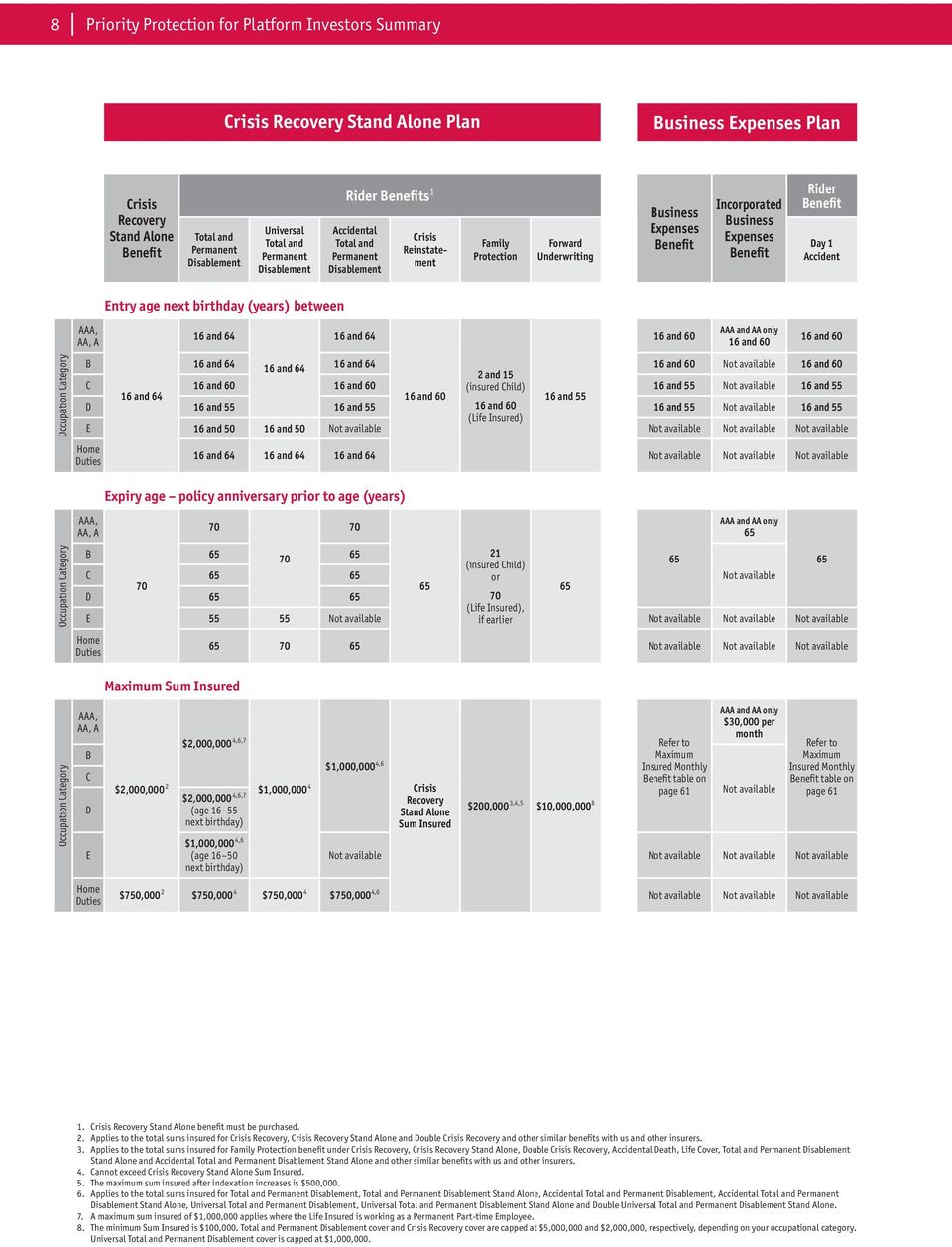
17 Priority for Platform Investors Summary 9 Plan 1 Benefit (Agreed Value or Indemnity) 1 Accident Only Benefit (Agreed Value or Indemnity) Essentials 8 Benefit (Agreed Value only) Claim Escalation PLUS Optional,6 Advantage Optional,5 Rider Benefits 2,9 Day 1 Accident 4,7 Carer s Allowance Retirement Optimiser Business Expenses Lump Sum 2 Year Benefit Period To Age 70 (Indemnity only) Entry age next birthday (years) between Occupation Category AAA, 16 and and 60 Same as Same as 16 and 60 AA, A Same as Same as Same as Same as Same as B 16 and and 60 benefit, benefit or 16 and 60 benefit C 16 and and 55 benefit or benefit benefit benefit or 16 and 55 Accident Accident 16 and and 55 D 16 and 50 Only Only 16 and 55 (Indemnity) (Indemnity) Accident benefit or benefit Accident Only Business (Life Insured) Only benefit benefit 16 and and 50 Expenses chosen and 16 chosen Not E (Indemnity) (Indemnity) Not Not benefit (insured Not available available available chosen Child) available Home Duties Not available Not available Not available Not available Not available Not available 61 and 65 Not available Expiry age policy anniversary prior to age (years) Occupation Category AAA, AA, A B C D 65 or 70 where an Age 70 Benefit Period is selected E Home Duties Not available Not available 55 Same as benefit or Accident Only benefit chosen Not available Same as benefit Not available Same as benefit Not available Same as benefit, Accident Only benefit or Business Expenses benefit chosen Not available Same as benefit or Accident Only benefit (Life Insured) 19 (insured Child) Not available Same as benefit or Accident Only benefit chosen Not available 65 Not available 65 Not available 70 Not available Maximum Sum Insured Refer to Maximum Insured Monthly Benefit table on page 5 Refer to Maximum Insured Monthly Benefit table on page 5 $4,000 per month benefit or Accident Only benefit chosen benefit benefit benefit, Accident Only benefit or Business Expenses benefit chosen $2,000 per month Refer to Retirement Optimiser benefit on page 52 Refer to Maximum Insured Monthly Benefit table on page 61 Refer to Lump Sum benefit on page 52 $20, Either the or Accident Only benefit can be selected (not both). 2. benefit or Accident Only benefit must be purchased.. Not available under Accident Only benefit. 4. A -day qualifying period is not available for Occupation Category E. 5. Cannot be purchased in conjunction with PLUS Optional. 6. Cannot be purchased in conjunction with Advantage Optional. 7. Available under benefit, Accident Only benefit and Business Expenses benefit. 8. Rider benefits are not available with Essentials benefit. 9. Where the Age 70 benefit period is selected, the rider benefits will expire at Age 65.
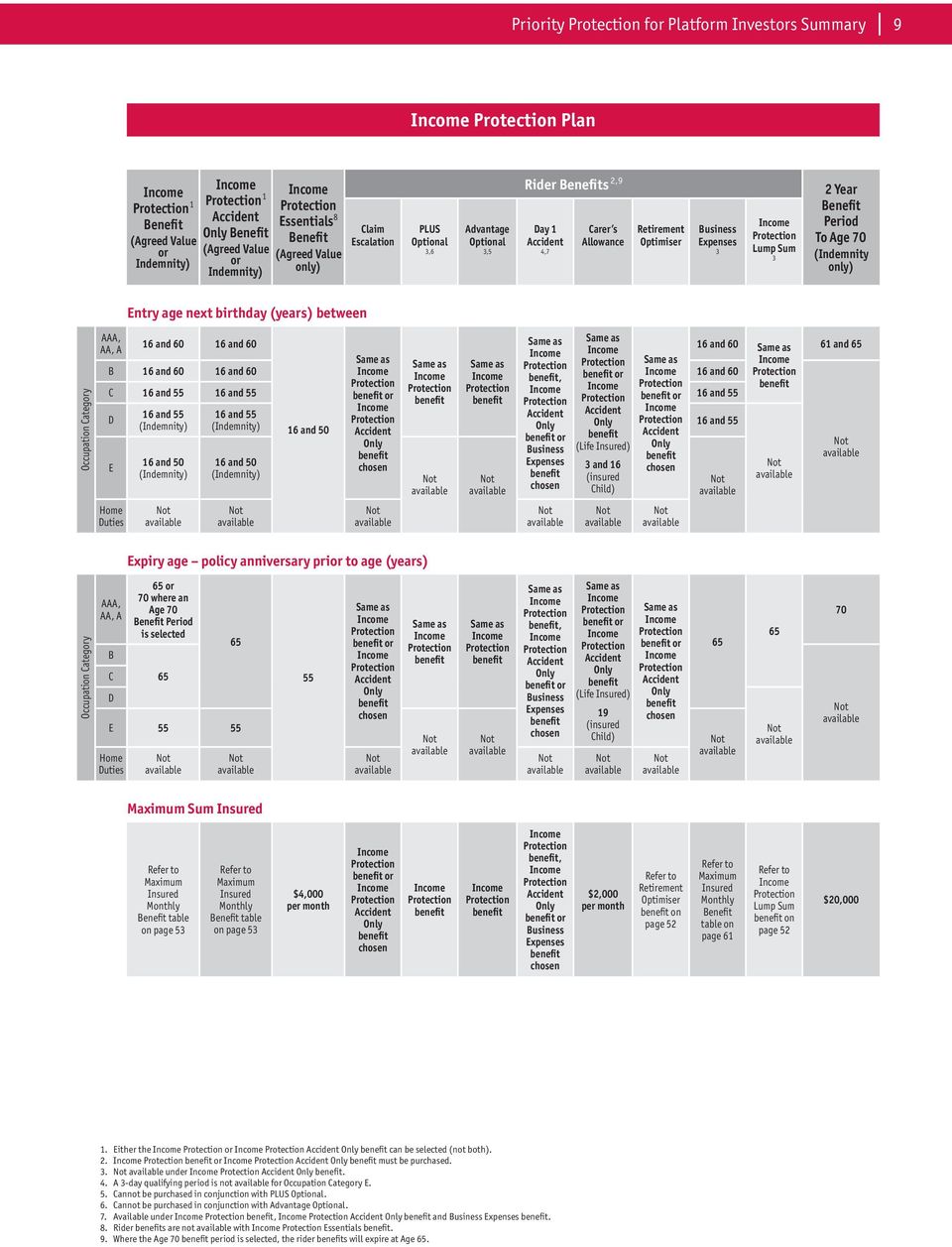
18 10 Priority for Platform Investors Summary Superannuation Life Cover Plan Rider Benefits 1 Life Cover Benefit Crisis Recovery 1 Crisis Recovery Buy back 2,1 Crisis Reinstatement,1 Family 1,1 Double Crisis Recovery 10,1 Needlestick Injury (AA only) 1 Accidental Total and Permanent Disablement Total and Permanent Disablement Total and Permanent Disablement Buy back 4 Entry age next birthday (years) between Occupation Category AAA, 18 and 60 AA, A (AA only) 16 and and and 60 B 16 and and and and 60 C 2 and 15 (insured Child) 16 and and and 60 D 11 and and and and and and 55 (Life Insured) Not available 16 and and and 55 E 16 and 50 Not available 16 and and 50 Home Duties 16 and and and and 60 Expiry age policy anniversary prior to age (years) Occupation Category AAA, AA, A 70 (AA only) B 21 (insured Child) C D or (Life Insured), Not available E if earlier 55 Not available Home Duties Maximum Sum Insured Occupation Category AAA, AA, A $1,000,000 (AA only) $5,000,000 6,8,16 B $1,000,000 6,8 $5,000,000 6,8,16 None 5 $2,000,000 6,7 $2,000,000 C 6,7 $5,000,000 6,8,16 D Crisis Crisis $2,000,000 6,8,16 Recovery Recovery $200,000 6,9,14 E Sum Insured Sum Insured Not available $1,000,000 6,8 Not available $1,500,000 (age up to 45 next birthday) Home Duties $1,000,000 (age next birthday) $750,000 6,7 $750,000 6,7 $1,000,000 6,8 $1,000,000 6,8 Total and Permanent Disablement Sum Insured 1. Life Cover benefit must be purchased. 2. Crisis Recovery benefit must be purchased.. Crisis Recovery Buy-back benefit must be purchased. 4. Total and Permanent Disablement benefit must be purchased. 5. Subject to financial underwriting. 6. Cannot exceed Life Cover Sum Insured. 7. Applies to the total sums insured for Crisis Recovery, Double Crisis Recovery and Crisis Recovery Stand Alone and other similar benefits with us and other insurers. 8. Applies to the total sums insured for Total and Permanent Disablement, Double Total and Permanent Disablement, Total and Permanent Disablement Stand Alone, Double Universal Total and Permanent Disablement, Universal Total and Permanent Disablement, Accidental Total and Permanent Disablement, Universal Total and Permanent Disablement Stand Alone and Accidental Total and Permanent Disablement Stand Alone and other similar benefits with us and other insurers. 9. Applies to the total sums insured for Family benefit under Crisis Recovery, Crisis Recovery Stand Alone, Double Crisis Recovery, Life Cover, Accidental Death, Total and Permanent Disablement Stand Alone and Accidental Total and Permanent Disablement Stand Alone and other similar benefits with us and other insurers. 10. Cannot be purchased in conjunction with Crisis Recovery, Double Total and Permanent Disablement or Double Universal Total and Permanent Disablement. 11. Cannot be purchased in conjunction with Total and Permanent Disablement, Double Universal Total and Permanent Disablement, Universal Total and Permanent Disablement, Accidental Total and Permanent Disablement, or Superannuation PLUS Double Crisis Recovery. 12. Total and Permanent Disablement (Any Occupation definition) must be purchased inside superannuation. 1. Only available under a linked policy outside of superannuation. 14. The maximum sum insured after indexation increases is $500, Cannot be purchased in conjunction with Total and Permanent Disablement, Double Total and Permanent Disablement, Accidental Total and Permanent Disablement, Universal Total and Permanent Disablement, or Superannuation PLUS Double Crisis Recovery. 16. A maximum sum insured of $1,000,000 applies where the Life Insured is working as a Permanent Part-time Employee. 17. Applies to the total sums insured for Accidental Death cover and other similar benefits with us.
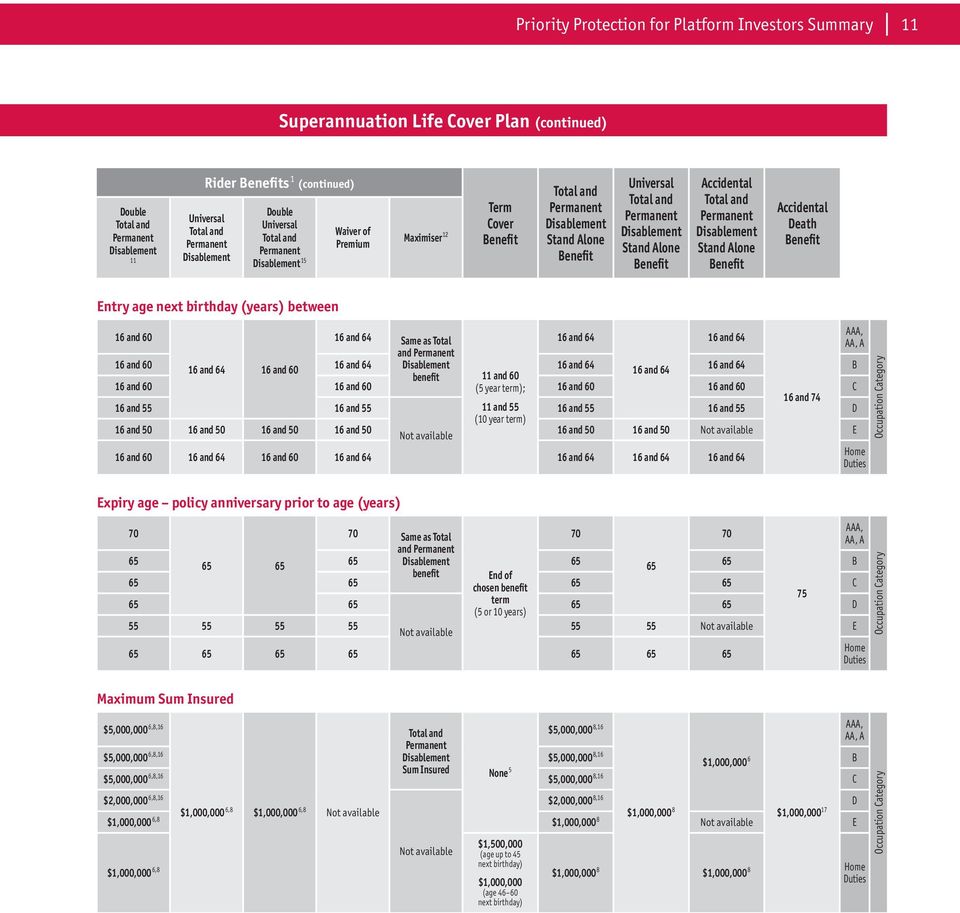
19 Priority for Platform Investors Summary 11 Superannuation Life Cover Plan (continued) Double Total and Permanent Disablement 11 Rider Benefits 1 (continued) Universal Total and Permanent Disablement Double Universal Total and Permanent Disablement 15 Waiver of Premium Maximiser 12 Term Cover Benefit Total and Permanent Disablement Stand Alone Benefit Universal Total and Permanent Disablement Stand Alone Benefit Accidental Total and Permanent Disablement Stand Alone Benefit Accidental Death Benefit Entry age next birthday (years) between 16 and and 64 AAA, Same as Total 16 and and 64 AA, A and Permanent 16 and and and and 64 Disablement 16 and and and 64 B benefit 11 and and and 60 (5 year term); 16 and and 60 C 16 and and and and and and 55 D (10 year term) 16 and and and and 50 Not available 16 and and 50 Not available E 16 and and and and and and and 64 Home Duties Occupation Category Expiry age policy anniversary prior to age (years) AAA, Same as Total AA, A and Permanent Disablement B benefit End of chosen benefit C term D (5 or 10 years) Not available Not available E Home Duties Occupation Category Maximum Sum Insured $5,000,000 6,8,16 Total and $5,000,000 8,16 AAA, AA, A Permanent $5,000,000 6,8,16 Disablement $5,000,000 8,16 $1,000,000 6 B Sum Insured None $5,000,000 6,8,16 5 $5,000,000 8,16 C $2,000,000 6,8,16 $2,000,000 8,16 D $1,000,000 6,8 $1,000,000 6,8 $1,000,000 6,8 Not available $1,000,000 8 $1,000,000 8 Not available $1,000, E $1,000,000 6,8 Not available $1,500,000 (age up to 45 next birthday) $1,000,000 (age next birthday) $1,000,000 8 $1,000,000 8 Home Duties Occupation Category
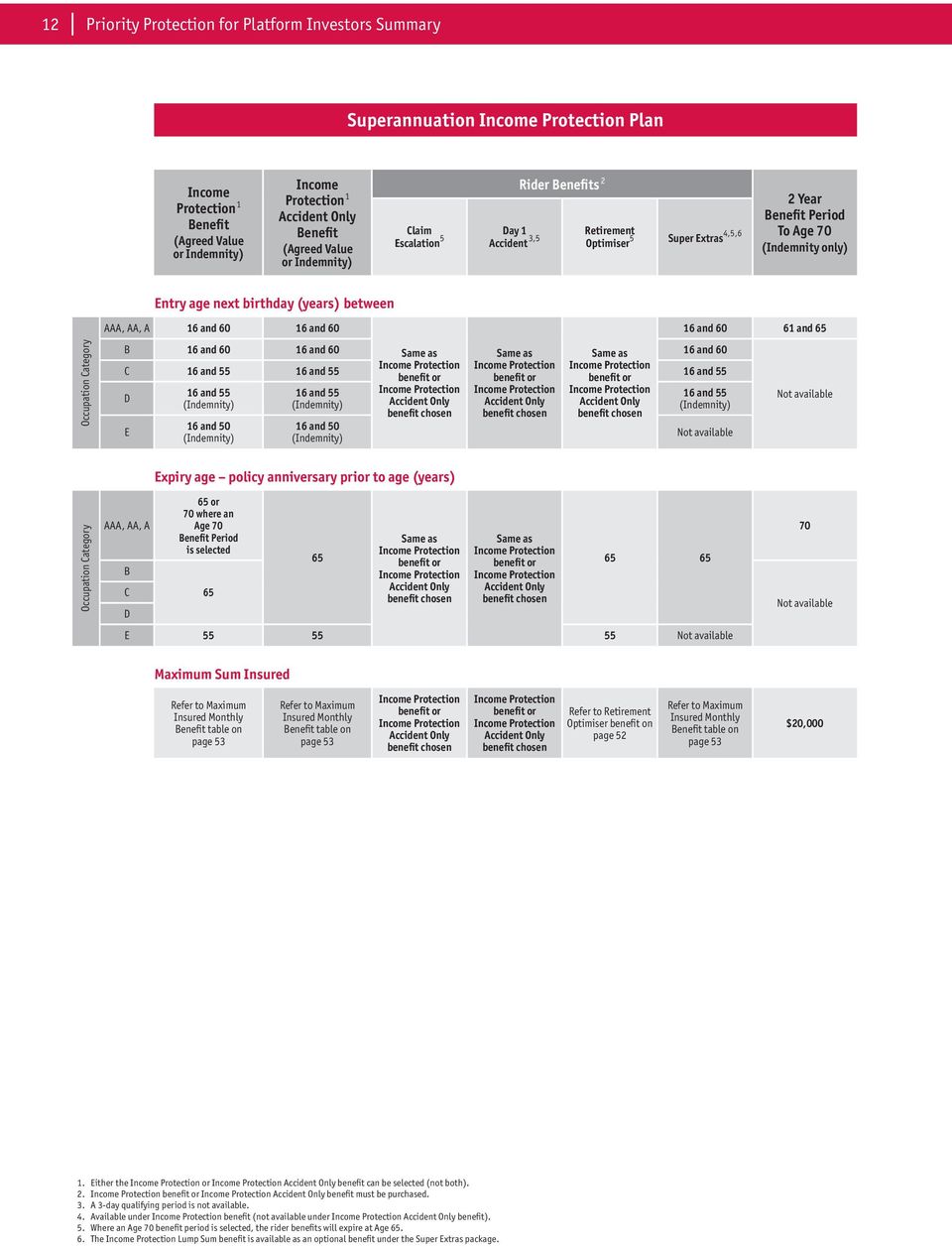
20 12 Priority for Platform Investors Summary Superannuation Plan 1 Benefit (Agreed Value or Indemnity) 1 Accident Only Benefit (Agreed Value or Indemnity) Claim Escalation 5 Day 1 Accident,5 Rider Benefits 2 Retirement Optimiser 5 Super Extras4,5,6 2 Year Benefit Period To Age 70 (Indemnity only) Entry age next birthday (years) between Occupation Category AAA, AA, A 16 and and 60 B 16 and and 60 Same as Same as Same as 16 and 60 C 16 and and and 55 benefit or benefit or benefit or 16 and and and 55 D (Indemnity) (Indemnity) Accident Only Accident Only Accident Only (Indemnity) benefit chosen benefit chosen benefit chosen 16 and and 50 E Not available (Indemnity) (Indemnity) 16 and and 65 Not available Expiry age policy anniversary prior to age (years) Occupation Category AAA, AA, A B C D 65 or 70 where an Age 70 Benefit Period is selected Same as benefit or Accident Only benefit chosen Same as benefit or Accident Only benefit chosen E Not available 70 Not available Maximum Sum Insured Refer to Maximum Insured Monthly Benefit table on page 5 Refer to Maximum Insured Monthly Benefit table on page 5 benefit or Accident Only benefit chosen benefit or Accident Only benefit chosen Refer to Retirement Optimiser benefit on page 52 Refer to Maximum Insured Monthly Benefit table on page 5 $20, Either the or Accident Only benefit can be selected (not both). 2. benefit or Accident Only benefit must be purchased.. A -day qualifying period is not available. 4. Available under benefit (not available under Accident Only benefit). 5. Where an Age 70 benefit period is selected, the rider benefits will expire at Age The Lump Sum benefit is available as an optional benefit under the Super Extras package.
21 About Priority for Platform Investors 1 About Priority for Platform Investors Priority for Platform Investors provides you with a range of insurance cover to cater for your life insurance needs. Life Cover We pay a lump sum in the event of death or Terminal Illness. Life Cover is available under an Ordinary Plan when acquired by you or under a Superannuation Plan when acquired by the trustee of a superannuation fund. Total and Permanent Disablement (TPD) We pay a lump sum for total and permanent disablement (according to the definition that applies to you). TPD cover is available under an Ordinary Plan when acquired by you or under a Superannuation Plan when acquired by the trustee of a superannuation fund. Crisis Recovery We pay a lump sum if you are diagnosed with certain medical conditions, such as Cancer, a Heart Attack or a Stroke. Crisis Recovery cover is only available under an Ordinary Plan. We pay a monthly amount if you are disabled due to Injury or Sickness and therefore unable to work. For Essentials benefits we will pay a monthly benefit if you are deemed to have met the definition of Loss of Independence. cover is available under an Ordinary Plan when acquired by you or under a Superannuation when acquired by the trustee of a superannuation fund. Business Expenses We pay a monthly amount to reimburse your business (including an incorporated business) if you are disabled due to Injury or Sickness and therefore unable to work. Business Expenses cover is only available under an Ordinary Plan. Insurance through Superannuation You can choose to structure your Priority for Platform Investors insurance through superannuation if you are a member of an approved superannuation fund or SMSF. This means that the trustee would become the Policy Owner of a Superannuation Life Cover Plan and/or a Superannuation Plan that covers you. You would make contributions to your superannuation account and the trustee would then pay the insurance premiums to us from your superannuation account. When insurance benefits are paid under the Plan, the trustee would receive them from us and pay them according to the governing rules of the superannuation fund and the superannuation law. There are some important differences when you structure your insurance through superannuation. For example: Some of the benefits available under an Ordinary Plan are not available under a Superannuation Plan. (We have noted where a benefit is not available under a Superannuation Plan throughout this PDS or where it is only available by purchasing a linked Ordinary Plan policy outside of superannuation at an additional premium cost but you should refer to the relevant Superannuation Policy.) There may be taxation advantages where a Policy is owned by the trustee of a superannuation fund. (We have provided information about taxation of superannuation on page 66, but you should obtain your own advice for your personal circumstances before you make a decision.) If you cease to be a member of a complying superannuation fund, the Superannuation Life Cover Plan and Superannuation Plan benefits will cease. Any applicable premium refund would be paid to the trustee and will be subject to preservation rules as required by superannuation legislation. More information about linking a Superannuation Plan to an Ordinary Plan is on page 67.
22 14 Life Cover Life Cover The Life Cover benefit and the 5-year and 10-year Term Cover benefits will pay a lump sum if you die or are diagnosed with a terminal illness before the benefit expires. The Accidental Death benefit will pay a lump sum if you die as a result of an accident only. The maximum total amount we will pay for accidental death benefits will be $1,000,000. Refer to pages 6 7 and for Maximum Sum Insured limits. Life Cover is available as an Ordinary Plan or as a Superannuation Plan (but the benefits marked NS do not apply under the Superannuation Life Cover Plan). Benefit Overview This table provides some important information about the benefits included with Life Cover. For the full terms and conditions, ask for a copy of the Policy Document. Life Cover Benefit 5-year Term 10-year Term Accidental Death Premium structure Level Premiums Stepped Premiums Optimum Premiums Built-in benefits Death benefit We will pay a lump sum benefit equal to the Sum Insured if you die. Terminal Illness benefit We will make an advance payment of your Sum Insured if you are diagnosed with a Terminal Illness. Premium Freeze You can freeze your premiums if you are age 5 or older and are paying your premiums on a stepped basis. This means that your premium stays the same each policy year, but your Sum Insured reduces each policy year. Benefit Indexation Your Sum Insured will automatically increase each policy year by the higher of the CPI increase and 5%. You can opt out of indexation either on your application form or before a Policy Anniversary. Final Expenses NS On receipt of the life insured s death certificate, we will make an advance payment from the Sum Insured equal to the lesser of 10% of the Sum Insured and $25,000 to assist in dealing with immediate financial expenses. Financial Planning Reimbursement NS If a claim is paid for death or Terminal Illness we will reimburse up to $,000 of the cost of obtaining advice from a financial planner/s about management of the claim proceeds incurred within the first six months of the claim payment. Other conditions apply. Guaranteed Future Insurability If you experience a significant Personal Event or Business Event before age 55, you can apply for increases in your Life Cover or Life Cover with TPD rider Sum Insured without supplying further evidence of health or insurability. A maximum number of increases and other conditions apply. Not available if there is a medical loading on the Policy or if you are on a Premium Freeze.
23 Life Cover 15 Life Cover Benefit 5-year Term 10-year Term Accidental Death Complimentary Family Final Expenses NS We may pay a lump sum of 10% of the Sum Insured up to $20,000 per Child if your Child dies or is positively diagnosed with a Terminal Illness. A maximum total payment of $200,000 and other conditions apply to this complimentary benefit. If you also hold Crisis Recovery Complimentary Family benefit, we will make only one payment per Child under both benefits. Complimentary Interim Accidental Death Cover We may pay a lump sum in the event of your Accidental Death within a period of up to 90 days from your application date see the certificate attached to this PDS. Optional Benefits at an additional cost (Rider Benefits) Total and Permanent Disablement (see pages 16 20) Accidental Total and Permanent Disablement (see pages 18 20) Total and Permanent Disablement Buy-back (see page 22) Double Total and Permanent Disablement (see pages 24 25) Universal Total and Permanent Disablement (see page 21) Double Universal Total and Permanent Disablement (see page 26) Waiver of Premium (see page 2) Crisis Recovery SP (see pages 27 1) Crisis Recovery Buy-back SP (see page 2) Crisis Reinstatement SP (see pages 4) Double Crisis Recovery SP (see pages 5 9) Family SP (see pages 40 41) Needlestick Injury SP (see page 42) Forward Underwriting benefit NS (see pages 44 45) School Fees Protector NS (see page 4) NS Not available under the Superannuation Life Cover Plan. SP Available with the Superannuation Life Cover Plan only under a linked Superannuation PLUS policy outside of superannuation. The benefits that apply to you will be shown on your Policy Schedule. For a summary of the circumstances when a benefit may not be paid or where reductions in the sum insured may apply, see pages For the date when cover ends, see page 80.
24 16 TPD cover TPD cover We offer three main types of TPD benefits: Total and Permanent Disablement Accidental Total and Permanent Disablement Universal Total and Permanent Disablement In addition, there are two optional Double TPD benefits Double Total and Permanent Disablement and Double Universal Total and Permanent Disablement. After payment of a full Double TPD benefit, the Life Cover Sum Insured is not reduced and future premiums for the Life Cover Sum Insured are waived. You can purchase TPD cover as a stand alone benefit, as a rider benefit to either Life Cover or Crisis Recovery Stand Alone cover or as a linked Maximiser benefit to a Superannuation Life Cover Plan (see pages 68 69). Limits apply to the total Sums Insured for all TPD cover. The following table is a summary of various TPD benefits available and some key details according to your employment status: Total and Permanent Disablement cover Detail Total and Permanent Disablement benefit Accidental Total and Permanent Disablement benefit Universal Total and Permanent Disablement benefit What employment types are eligible? Full-time Employment¹ Permanent Part-time Employee² Full-time Employment¹ Permanent Part-time Employee² All employment types Are any Occupation Categories not eligible for this benefit? All of the Occupation Categories are eligible. Yes, Occupation Category E is not eligible. All of the Occupation Categories are eligible. What are the weekly working requirements depending on my Occupation Category? Occupation Categories AAA, AA, A, B, C and D At least 15 hours worked per week Occupation Category E At least 20 hours worked per week Occupation Category Home Duties³ No minimum, however you must meet the definition of Home Duties (refer to Definitions section). Occupation Categories AAA, AA, A, B, C and D At least 15 hours worked per week Occupation Category Home Duties³ No minimum, however you must meet the definition of Home Duties (refer to Definitions section). Occupation Categories AAA, AA, A, B, C and D Working less than 15 hours per week. Occupation Category E Working less than 20 hours per week. Occupation Category Home Duties³ No minimum, however you must meet the definition of Home Duties (refer to Definitions section). Is cover available for self employed people? Yes Yes Yes Which type of definition will apply? Occupation Categories AAA, AA, A, B and C Own Occupation SM Minimum hours worked per week is 20 Occupation Categories AAA, AA, A, B, C and D Any Occupation Minimum hours worked per week is 15 Occupation Category E All Duties Minimum hours worked per week is 20 Occupation Category Home Duties³ Total and Permanent Disablement (Home Duties) Occupation Categories AAA, AA, A, B, C and D Accidental TPD Any Occupation Minimum hours worked per week is 15 Occupation Category Home Duties³ Accidental Total and Permanent Disablement (Home Duties) Loss of Independence Your premium varies depending on the disablement definition you select and your Occupation Category.
25 TPD cover 17 Detail Double Total and Permanent Disablement cover Double Total and Permanent Disablement benefit Double Universal Total and Permanent Disablement benefit What employment types are eligible? Are any Occupation Categories not eligible for this benefit? What are the weekly working requirements depending on my Occupation Category? Is cover available for self-employed people? Which type of definition will apply? Full-time Employment¹ Permanent Part-time Employee² All of the Occupation Categories are eligible. Occupation Categories AAA, AA, A, B, C and D At least 15 hours worked per week Occupation Category E At least 20 hours worked per week. Occupation Category Home Duties³ No minimum, however you must meet the definition of Home Duties (refer to Definitions section). Yes Occupation Categories AAA, AA, A, B and C Own Occupation SM Minimum hours worked per week is 20 Occupation Categories AAA, AA, A, B, C and D Any Occupation Minimum hours worked per week is 15 Occupation Category E All Duties Minimum hours worked per week is 20 Occupation Category Home Duties³ Total and Permanent Disablement (Home Duties) All employment types All of the Occupation Categories are eligible. Occupation Categories AAA, AA, A, B, C and D Working less than 15 hours per week. Occupation Category E Working less than 20 hours per week. Occupation Category Home Duties³ No minimum, however you must meet the definition of Home Duties (refer to Definitions section). Yes Loss of Independence 1 We classify full-time employment for this benefit as working at least 20 hours per week, for 48 weeks per year (excluding public holidays). 2 We classify part-time employment for this benefit as being employed (including self-employed) to undertake identifiable duties for at least 15 hours per week (in each and every week for 48 weeks per year (excluding public holidays) where the person accrues paid sick and holiday leave entitlements. We classify Home Duties for this benefit as being wholly engaged in full-time unpaid domestic duties in your own residence. SM Available with the Superannuation Life Cover Plan only under a linked Maximiser policy outside of superannuation.
26 18 Total and Permanent Disablement Total and Permanent Disablement The Total and Permanent Disablement benefit will pay a lump sum if you suffer Total and Permanent Disablement (according to the relevant definition) due to Injury or Sickness. The Total and Permanent Disablement benefit is available under an Ordinary Plan or under a Superannuation Plan. Benefit overview This table provides some important information about the benefits included with the Total and Permanent Disablement benefit. For the full terms and conditions, ask for a copy of the Policy Document. Total and Permanent Disablement Accidental Total and Permanent Disablement Premium structure Level Premiums Stepped Premiums Optimum Premiums Available as: Total and Permanent Disablement Stand Alone Accidental Total and Permanent Disablement Stand Alone Rider benefit (to Life Cover benefit and Crisis Recovery Stand Alone) Linked Maximiser benefit to Total and Permanent Disablement Stand Alone or TPD rider benefit with Any Occupation definition under the Superannuation Life Cover Plan. Please refer to the Maximiser section on pages Built-in benefits (Own Occupation definition) Total and Permanent Disablement We will pay a lump sum equal to the Sum Insured if you are disabled according to the applicable Total and Permanent Disablement definition: Own Occupation SM Any Occupation All Duties Home Duties. If your applicable definition is Any Occupation and you return to work in your own occupation or perform any other reasonable occupation and if your earning capacity is permanently restricted due to your disablement to the extent that the income you generate in the 12 month period following a return to work is less than 25% of the income you generated in the previous 12 months of performing your own occupation, we will pay the Total and Permanent Disablement benefit. If you have the Own Occupation definition under a linked Maximiser Policy, your claim will firstly be assessed under the Any Occupation definition under the Superannuation Life Cover Plan. Accidental Total and Permanent Disablement We will pay a lump sum equal to the Sum Insured if you are disabled according to the applicable Accidental Total and Permanent Disablement definition: Any Occupation Home Duties.
27 Total and Permanent Disablement 19 Total and Permanent Disablement Accidental Total and Permanent Disablement Partial and Permanent Disablement NS If you suffer the permanent loss of use of one arm, one leg or sight in one eye, we will make an advance payment from the Total and Permanent Disablement Sum Insured equal to the lesser of 25% of the Sum Insured and $750,000. We will only pay this benefit once during the lifetime of the Policy. If you select the Total and Permanent Disablement Stand Alone benefit, you must survive for a period of 14 days from the date of the loss to be eligible for the Partial and Permanent Disablement benefit. Partial and Permanent Disablement Accidental Total and Permanent Disablement NS If you suffer the permanent loss of use of one arm, one leg or sight in one eye as a result of an Accidental Injury, we will make an advance payment from the Accidental Total and Permanent Disablement Sum Insured equal to the lesser of 25% of the Sum Insured and $750,000. We will only pay this benefit once during the lifetime of the Policy. If you select the Accidental Total and Permanent Disablement Stand Alone benefit, you must survive for a period of 14 days from the date of the loss to be eligible for the Partial and Permanent Disablement benefit. Premium Freeze You can freeze your premiums if you are age 5 or older and are paying your premiums on a stepped basis. This means that your premium stays the same each policy year, but your Sum Insured reduces each policy year. Benefit Indexation Your Sum Insured will automatically increase each policy year by the higher of the CPI increase and 5%. You can opt out of indexation either on your application form or before a Policy Anniversary. Financial Planning Reimbursement NS If your total and permanent disablement claim is paid we will reimburse up to $,000 of the cost of obtaining advice from a financial planner/s about management of the claim proceeds incurred within the first six months of the claim payment. Day 1 TPD (removal of TPD qualifying period) We will not require you to be absent from employment for an uninterrupted period of three consecutive months if you suffer (and we confirm diagnosis of) one of the applicable Other Serious Crisis Events listed below and as a result you would otherwise meet the definition of Total and Permanent Disablement applicable under your Policy. The applicable Other Serious Crisis Events are: Alzheimer s disease Blindness Paralysis Diplegia Hemiplegia Paraplegia Quadriplegia Loss of Hearing Motor Neurone Disease Multiple Sclerosis Muscular Dystrophy Parkinson s Disease Not applicable to the Total and Permanent Disablement (All Duties) definition. NS Not available under the Superannuation Life Cover Plan. SM Available with the Superannuation Life Cover Plan only under a linked Maximiser benefit outside of superannuation.
28 20 Total and Permanent Disablement Total and Permanent Disablement Accidental Total and Permanent Disablement Conversion to Loss of Independence NS Instead of your TPD benefit expiring at the Policy Anniversary before the expiry age for your Occupation Category, we will convert the benefit to a Loss of Independence benefit until you reach the age of 100. If you make a claim after conversion: The claim will be assessed under the Loss of Independence definition The Sum Insured will be the lesser of: The TPD Sum Insured at the expiry date; and For Occupation Categories AAA, AA and A: $2,000,000; or For Occupation Categories B, C, D and Home Duties: $1,000,000. Conversion to Loss of Independence does not apply if the TPD benefit is selected as a rider to the Crisis Recovery Stand Alone benefit. Conversion to Accidental Loss of Independence NS Instead of your Accidental TPD benefit expiring at the Policy Anniversary before the expiry age for your Occupation Category, we will convert the benefit to an Accidental Loss of Independence benefit until you reach the age of 100. If you make a claim after conversion: The claim will be assessed under the Accidental Loss of Independence definition The Sum Insured will be the lesser of: The Accidental TPD Sum Insured at the expiry date; and For Occupation Categories AAA, AA and A: $2,000,000; or For Occupation Categories B, C, D and Home Duties: $1,000,000. Conversion to Accidental Loss of Independence does not apply if the Accidental TPD benefit is selected as a rider to the Crisis Recovery Stand Alone benefit. Benefits at an additional cost (Rider Benefits) Total and Permanent Disablement Buy-back (see page 22) (Rider only) School Fees Protector NS (see page 4) Family NS (see pages 40 41) Forward Underwriting NS (see pages 44 45) (Stand Alone only) (Stand Alone only) (Stand Alone only) NS Not available under the Superannuation Life Cover Plan. The benefits that apply to you will be shown on your Policy Schedule. For a summary of the circumstances when a benefit may not be paid or where reductions in the sum insured may apply, see pages For the date when cover ends, see page 80.
29 Universal Total and Permanent Disablement 21 Universal Total and Permanent Disablement The Universal Total and Permanent Disablement benefit will pay a lump sum if you suffer a Loss of Independence. The Universal Total and Permanent Disablement benefit is available under an Ordinary Plan or a Superannuation Plan. Benefit overview This table provides some important information about the benefits included with the Universal Total and Permanent Disablement benefit. For the full terms and conditions, ask for a copy of the Policy Document. Premium structure Universal Total and Permanent Disablement Level Premiums Stepped Premiums Optimum Premiums Available as: Universal Total and Permanent Disablement Stand Alone Rider benefit (to Life Cover benefit and Crisis Recovery Stand Alone) Built-in benefits Universal Total and Permanent Disablement We will pay a lump sum equal to the Sum Insured if you are disabled according to the Loss of Independence definition. Premium Freeze You can freeze your premiums if you are age 5 or older and are paying your premiums on a stepped basis. This means that your premium stays the same each policy year, but your Sum Insured reduces each policy year. Benefit Indexation Your Sum Insured will automatically increase each policy year by the higher of the CPI increase and 5%. You can opt out of indexation either on your application form or before a Policy Anniversary. Financial Planning Reimbursement NS If your total and permanent disablement claim is paid we will reimburse up to $,000 of the cost of obtaining advice from a financial planner/s about management of the claim proceeds incurred within the first six months of the claim payment. Benefit at an additional cost (Rider Benefit) Forward Underwriting NS (see pages 44 45) (Stand Alone only) NS Not available under the Superannuation Life Cover Plan. The benefits that apply to you will be shown on your Policy Schedule. For a summary of the circumstances when a benefit may not be paid or where reductions in the sum insured may apply, see pages For the date when cover ends, see page 80.
30 22 Total and Permanent Disablement Buy-back Total and Permanent Disablement Buy-back The optional Total and Permanent Disablement Buy Back benefit is available under an Ordinary Plan or a Superannuation Plan. Benefit overview This table provides some important information about the Total and Permanent Disablement Buy-Back benefit. For the full terms and conditions, ask for a copy of the Policy Document. Premium structure Total and Permanent Disablement Buy-back Level Premiums Stepped Premiums Optimum Premiums Available only as: Rider benefit to the Total and Permanent Disablement benefit when taken as an rider benefit with the Life Cover benefit Built-in benefits Total and Permanent Disablement Buy-back You have the option to re-purchase the Life Cover Sum Insured that is reduced after payment of 100% of your Total and Permanent Disablement claim. You must exercise the option within 0 days after the first anniversary of the date your claim was paid.* Benefit Indexation Your re-purchased Sum Insured will automatically increase each policy year by the higher of the CPI increase and 5%. You can opt out of indexation either on your application form or before a Policy Anniversary. Premium Freeze You can freeze your premiums if you are age 5 or older and are paying your premiums on a stepped basis. This means that your premium stays the same each policy year, but your re-purchased Sum Insured reduces each policy year. * Premiums for this buy-back benefit must continue to be paid until the date the buy-back option is exercised or expires. The benefits that apply to you will be shown on your Policy Schedule. For the date when cover ends, see page 80.
31 Waiver of Premium 2 Waiver of Premium The optional Waiver of Premium benefit will waive the premiums (including any benefit indexation increases) for specified benefits up to the Policy Anniversary before your expiry age if you become permanently disabled. To be eligible for this benefit you must be in Full-time Employment, or a Permanent Part-time Employee or Home Duties. The Waiver of Premium benefit is available under the Life Cover Plan, waving premiums under the Life Cover Plan and Crisis Recovery Stand Alone Plan or under the Superannuation Life Cover Plan, waiving premiums for benefits under that plan. The premium for this benefit varies depending on the definition you select and your Occupation Category. (You must select the same definition as you selected for the Total and Permanent Disablement benefit.) Benefit overview This table provides some important information about the Waiver of Premium benefit. For the full terms and conditions, ask for a copy of the Policy Document. Premium structure Waiver of Premium Level Premiums Available only as: Rider benefit under the Life Cover benefit Built-in benefits If you suffer: Total and Permanent Disablement under the Any Occupation definition Own Occupation definition NS All Duties definition Home Duties definition; or Partial and Permanent Disablement NS then after the qualifying period: Waives the premiums for the Life Cover benefit and rider benefits under the Life Cover benefit* Waives the premiums for Crisis Recovery Stand Alone benefit* and rider benefits under the Crisis Recovery Stand Alone benefit* NS (if purchased with a Life Cover benefit under the same policy) SP Waives the premiums for Accidental Death benefit (if purchased together with a Life Cover benefit under the same policy) Please note: The Waiver of Premium also applies to any benefit indexation increases but not to certain voluntary increases. Please refer to the terms and conditions in the Policy Document for further information. In the case of Total and Permanent Disablement each definition of Total and Permanent Disablement that you can choose for the Waiver of Premium benefit contains a qualifying period (either three or six months). During this qualifying period you must be absent from employment solely as a result of Injury or Sickness in order to be eligible to claim under the benefit. The premiums due on the policy must still be paid by the policy owner during the qualifying period. Upon acceptance of the Waiver of Premium claim, any premiums that have been paid will not be refunded. A Waiver of Premium benefit purchased under an Ordinary Plan will not waive premiums under the Superannuation Plan. In order to have premiums waived on both Ordinary and Superannuation Plans, two separate Waiver of Premium benefits must be purchased, one inside super and one outside super. * Excluding Universal Total and Permanent Disablement, Accidental Total and Permanent Disablement, Double Total and Permanent Disablement and Double Universal Total and Permanent Disablement (as applicable). NS Not available under the Superannuation Life Cover Plan. SP Also available under a linked Superannuation PLUS policy outside of superannuation. The benefits that apply to you will be shown on your Policy Schedule. For the date when cover ends, see page 80.
32 24 Double Total and Permanent Disablement Double Total and Permanent Disablement The optional Double Total and Permanent Disablement benefit will pay a lump sum if you suffer Total and Permanent Disablement according to the applicable definition. In addition, if a full Total and Permanent Disablement benefit is payable the Life Cover Sum Insured will not be reduced and future premiums on the Life Cover benefit will be waived up until the Policy Anniversary before your expiry age. The Double Total and Permanent Disablement benefit will also pay a partial benefit if you suffer Partial and Permanent Disablement, however future premiums on the Life Cover will not be waived. Your Double Total and Permanent Disablement benefit Sum Insured will be reduced by any amount paid for a Partial and Permanent Disablement benefit. The Double Total and Permanent Disablement benefit is available under an Ordinary Plan or under a Superannuation Plan. This Double Total and Permanent Disablement benefit cannot be purchased in conjunction with any other type of TPD benefit, the Double Crisis Recovery benefit or the Waiver of Premium benefit. Benefit overview This table provides some important information about the Double Total and Permanent Disablement benefit. For the full terms and conditions, ask for a copy of the Policy Document. Premium structure Double Total and Permanent Disablement Level Premiums Stepped Premiums Optimum Premiums Available as: Rider benefit to Life Cover benefit Linked Maximiser benefit to Double Total and Permanent Disablement rider benefit with Any Occupation definition under the Superannuation Life Cover Plan. Please refer to the Maximiser section on pages (Own Occupation definition) Built-in benefits Total and Permanent Disablement We will pay a lump sum equal to the Sum Insured if you are disabled according to the applicable Total and Permanent Disablement definition: Own Occupation SM Any Occupation All Duties Home Duties If your applicable definition is Any Occupation and you return to work in your own occupation or perform any other reasonable occupation and if your earning capacity is permanently restricted due to your disablement to the extent such that the income you generate in the 12 month period commencing from your return to work is less than 25% of the income you generated in the previous 12 months of performing your own occupation, we will pay the Total and Permanent Disablement benefit. If you have the Own Occupation definition under a linked Maximiser Policy, your claim will firstly be assessed under the Any Occupation definition under the Superannuation Life Cover Plan. The benefit is not payable if a Terminal Illness claim is in progress or has previously been paid by us or any other insurer or you die within 14 days of suffering the Injury or Sickness that directly or indirectly caused your Total and Permanent Disablement.
33 Double Total and Permanent Disablement 25 Double Total and Permanent Disablement No reduction of the Life Cover Sum Insured (after a full Double Total and Permanent Disablement payment). Waiver of Life Cover Premium (after a full Double Total and Permanent Disablement payment). Conditions apply. Refer to Policy Document. Partial and Permanent Disablement NS If you suffer the permanent loss of use of one arm, one leg or sight in one eye, we will make an advance payment from the Double Total and Permanent Disablement Sum Insured equal to the lesser of 25% of the Sum Insured and $750,000. We will only pay this benefit once during the lifetime of the Policy. Premium Freeze You can freeze your premiums if you are age 5 or older and are paying your premiums on a stepped basis. This means that your premium stays the same each policy year, but your Sum Insured reduces each policy year. Benefit Indexation Your Sum Insured will automatically increase each policy year by the higher of the CPI increase and 5%. You can opt out of indexation either on your application form or before a Policy Anniversary. Benefit Indexation of the Life Cover benefit will cease to apply after the Double Total and Permanent Disablement benefit becomes payable. Financial Planning Reimbursement NS If your total and permanent disablement claim is paid we will reimburse up to $,000 of the cost of obtaining advice from a financial planner/s about management of the claim proceeds incurred within the first six months of the claim payment. Conversion to Loss of Independence NS Instead of your Double Total and Permanent Disablement benefit expiring at the Policy Anniversary before the expiry age for your Occupation Category, we will convert the benefit to a Loss of Independence benefit until you reach the age of 100. If you make a claim after conversion: The claim will be assessed under the Loss of Independence definition The Sum Insured will be the lesser of: The Double Total and Permanent Disablement Sum Insured at the expiry date; and For Occupation Categories AAA, AA and A: $2,000,000; or For Occupation Categories B, C, D and Home Duties: $1,000,000. NS Not available under the Superannuation Life Cover Plan. SM Available with the Superannuation Life Cover Plan only under a linked Maximiser policy outside of superannuation. The benefits that apply to you will be shown on your Policy Schedule. For a summary of the circumstances when a benefit may not be paid or where reductions in the sum insured may apply, see pages For the date when cover ends, see page 80.
34 26 Double Universal Total and Permanent Disablement Double Universal Total and Permanent Disablement The optional Double Universal Total and Permanent Disablement benefit will pay a lump sum if you suffer a Loss of Independence. In addition, the Life Cover Sum Insured will not be reduced and future premiums on the Life Cover will be waived until the Policy Anniversary before your expiry age if a full Double Universal Total and Permanent Disablement benefit is payable. The Double Universal Total and Permanent Disablement benefit is available under an Ordinary Plan or under a Superannuation Plan. The Double Universal Total and Permanent Disablement benefit cannot be purchased in conjunction with any other type of TPD benefit, the Double Crisis Recovery benefit or the Waiver of Premium benefit. Benefit overview This table provides some important information about the Double Universal Total and Permanent Disablement benefit. For the full terms and conditions, ask for a copy of the Policy Document. Premium structure Double Universal Total and Permanent Disablement Level Premiums Stepped Premiums Optimum Premiums Available only as: Rider benefit (to Life Cover benefit) Built-in benefits Universal Total and Permanent Disablement We will pay a lump sum equal to the Sum Insured if you are disabled according to the Loss of Independence definition. You must survive for a period of 14 days from the date of suffering the Injury or Sickness that directly or indirectly caused your Loss of Independence for a benefit to be payable. The benefit is not payable if a Terminal Illness claim is in progress or has previously been paid by us or any other insurer. No reduction of the Life Cover Sum Insured (after a full Double Universal Total and Permanent Disablement payment). Waiver of Life Cover Premium (after a full Double Universal Total and Permanent Disablement payment). Conditions apply. Refer to Policy Document. Premium Freeze You can freeze your premiums if you are age 5 or older and are paying your premiums on a stepped basis. This means that your premium stays the same each policy year, but your Sum Insured reduces each policy year. Benefit Indexation Your Sum Insured will automatically increase each policy year by the higher of the CPI increase and 5%. You can opt out of indexation either on your application form or before a Policy Anniversary. Benefit indexation of the Life Cover benefit will cease to apply after the Universal Total and Permanent Disablement benefit becomes payable. Financial Planning Reimbursement NS If your Universal total and permanent disablement claim is paid we will reimburse up to $,000 of the cost of obtaining advice from a financial planner/s about management of the claim proceeds incurred within the first six months of the claim payment. NS Not available under the Superannuation Life Cover Plan. The benefits that apply to you will be shown on your Policy Schedule. For a summary of the circumstances when a benefit may not be paid or where reductions in the sum insured may apply, see pages For the date when cover ends, see page 80.
35 Crisis Recovery 27 Crisis Recovery The Crisis Recovery benefit will pay a lump sum if you are diagnosed with one or more of the serious illnesses listed within the Crisis Event groups of Cancer, Coronary and Other Serious Crisis Events. You can purchase Crisis Recovery cover as a stand alone benefit, as a rider benefit to Life Cover or as a linked PLUS benefit to a Superannuation Life Cover Plan. (If you select the rider benefit, the Sum Insured cannot be more than your Life Cover Sum Insured or Superannuation Life Cover Sum Insured.) Crisis Recovery is only available as an Ordinary Plan. Benefit overview This table provides some important information about the Crisis Recovery benefit. For the full terms and conditions, ask for a copy of the Policy Document. Premium structure Crisis Recovery Level Premiums Stepped Premiums Optimum Premiums Available as: Crisis Recovery Stand Alone Rider benefit (to Life Cover Plan or Superannuation Life Cover Plan under a linked Superannuation PLUS policy outside of superannuation) Built-in benefits Crisis Events benefit We will pay a lump sum equal to the full Crisis Recovery Sum Insured if you are diagnosed with a Cancer Event, a Coronary Event or an Other Serious Crisis Event (as listed in the table on page 29) after the applicable qualifying period. If you select the Crisis Recovery Stand Alone benefit, you must survive for a period of 14 days from the date of diagnosis. Partial payments We will make a partial payment from your Crisis Recovery Sum Insured (as set out in the table on page 0) if we are able to confirm diagnosis of the Crisis Events listed in that table. The amount of the partial payment cannot exceed the Sum Insured. If you select the Crisis Recovery Stand Alone benefit, you must survive for a period of 14 days from the date of diagnosis. After a partial payment, if you sustain another Crisis Event we will pay the reduced Sum Insured but we will make a payment for Chronic Diagnosis Advancement only once. Death Cover We will pay a lump sum benefit of up to $5,000 if you die and no benefit was payable for a Crisis Event. Premium Freeze You can freeze your premiums if you are age 5 or older and are paying your premiums on a stepped basis. This means that your premium stays the same each policy year, but your Sum Insured reduces each policy year. Benefit Indexation Your Sum Insured will automatically increase each policy year by the higher of the CPI increase and 5%. You can opt out of indexation either on your application form or before a Policy Anniversary. (Stand Alone only)
36 28 Crisis Recovery Crisis Recovery Complimentary Interim Accidental Crisis Recovery Cover We may pay a lump sum in the event of certain Crisis Events due to an Accidental Injury within a period of up to 90 days from your signed application date see the certificate attached to this PDS. Complimentary Interim Accidental Death Cover We may pay a lump sum in the event of your Accidental Death within a period of up to 90 days from your application date see the certificate attached to this PDS. Financial Planning Reimbursement If a claim is paid for the full Crisis Recovery Sum Insured we will reimburse up to $,000 of the cost of obtaining advice from a financial planner/s about management of the claim proceeds incurred within the first six months of the claim payment. Complimentary Family We may pay a lump sum of 10% of the Sum Insured up to $20,000 per Child if your Child dies or is positively diagnosed with a Terminal Illness or one of the other Crisis Events listed in the table on page 1 after the qualifying period (if any). The sum of all payments under this complimentary benefit cannot exceed the Crisis Recovery Sum Insured. There are exclusions for congenital conditions, pre-existing symptoms, intentional acts or where your Child has already suffered a particular Crisis Event. Other conditions also apply. This complimentary benefit does not include any conversion rights. If you also hold a Complimentary Family Final Expenses benefit, we will make only one payment per Child under both benefits. Conversion to Loss of Independence at age 70 Instead of your Crisis Recovery benefit expiring at the Policy Anniversary before you reach the age of 70, we will convert the benefit to a Loss of Independence benefit until you reach the age of 100. If you make a claim after conversion: The claim will be assessed under the Loss of Independence definition The Sum Insured will be the lesser of: The Crisis Recovery Sum Insured at the expiry date; and For Occupation Categories AAA, AA and A: $2,000,000; or For Occupation Categories B, C, D and Home Duties: $1,000,000. (Stand Alone only) (Rider to Life Cover benefit only) Benefits at an additional cost (Rider Benefits) Crisis Recovery Buy-back (see page 2) (Rider to Life Cover only) Crisis Reinstatement (see pages 4) Family (see pages 40 41) Forward Underwriting (see pages 44 45) (Stand Alone only) Total and Permanent Disablement (see pages 18 20) (Stand Alone only) Accidental Total and Permanent Disablement (see pages 18 20) (Stand Alone only) Universal Total and Permanent Disablement (see page 21) (Stand Alone only) The benefits that apply to you will be shown on your Policy Schedule. For a summary of the circumstances when a benefit may not be paid or where reductions in the sum insured may apply, see pages For the date when cover ends, see page 80.
37 Crisis Recovery 29 Crisis Events The following table lists the Crisis Events covered by the Crisis Recovery. Cancer Events Carcinoma in Situ of the Breast* Hodgkin s Disease* Invasive Cancer* Leukaemia* Malignant Bone Marrow Disorder* Skin Cancer* Prostate Cancer* Coronary Events Cardiomyopathy Coronary Artery Angioplasty* Coronary Artery By-pass Surgery* Heart Attack* Heart Valve Surgery* Other Serious Coronary Artery Disease* Out of Hospital Cardiac Arrest Pulmonary Arterial Hypertension (Primary)* Stroke* Surgery to the Aorta* Other Serious Crisis Events Accidental HIV Infection* Alzheimer s Disease Aplastic Anaemia Bacterial Meningitis Benign Brain Tumour* Blindness Chronic Liver Disease Chronic Lung Disease Coma Dementia Diplegia Hemiplegia Intensive Care Kidney Failure Loss of Hearing Loss of Independence Loss of Use of Limbs and/or Sight Loss of Speech Major Burns Major Head Trauma Major Organ Transplant* Motor Neurone Disease Multiple Sclerosis Muscular Dystrophy Paraplegia Parkinson s Disease Pneumonectomy Quadriplegia Severe Diabetes* Severe Rheumatoid Arthritis Terminal Illness* (Stand Alone only) Viral Encephalitis *Qualifying period The Crisis Recovery and Crisis Recovery Stand Alone benefits are not payable if you suffer a Crisis Event within three months of the benefit being activated. We will waive this three-month qualifying period if your policy replaces another policy from a previous insurer for the same Sum Insured or lower where the full qualifying period was already served. Survival Period If you select the Crisis Recovery Stand Alone benefit we will pay the benefit when you have survived for 14 days from diagnosis of the Crisis Event.
38 0 Crisis Recovery Partial benefit payments The following table lists the Crisis Events for which we will make partial payments. Crisis Event Partial amount paid* Cancer Carcinoma in situ must be confirmed by histopathology Carcinoma in situ of the breast where no mastectomy is performed and is confirmed by a biopsy. Carcinoma in situ female cancers: vagina, ovary, vulva and fallopian tube where the tumour must be classified as TIS according to the TNM staging method or FIGO Stage 0; and cervix-uteri with a grading of either TNM stage TIS or CIN or above. Carcinoma in situ male cancers: penis and testicle where the tumour must be classified as TIS according to the TNM staging method. The greater of $10,000 and 10% of the Sum Insured The greater of $10,000 and 10% of the Sum Insured. The greater of $10,000 and 10% of the Sum Insured. Skin Cancer where diagnosed by an appropriate specialist Medical Practitioner acceptable to us, we will pay: For any melanoma without ulceration and measuring less than 1mm in Breslow s depth of invasion and less than Clark Level in depth of invasion. For cutaneous squamous cell carcinomas where the tumour is diagnosed as stage TN0M0 under the TNM Classification system. The greater of $10,000 and 15% of the Sum Insured. 10% of the Sum Insured. Coronary Artery Angioplasty After any payment for coronary artery angioplasty the Sum Insured will be reduced by the payment made. Where one coronary artery is obstructed and corrected with the use of angioplasty, atherectomy, laser therapy or the insertion of up to two stents. Where two coronary arteries are obstructed and corrected with the use of either angioplasty, atherectomy or laser therapy, or, the insertion of more than two stents (regardless of the number of coronary arteries involved). Chronic Diagnosis Advancement We will pay an advance payment of your Crisis Recovery or Crisis Recovery Stand Alone benefit if we are able to confirm the diagnosis of one of the below Crisis Events and an appropriate specialist Medical Practitioner acceptable to us must also confirm that you have suffered or been medically diagnosed with one of the following Crisis Events: Motor Neurone disease, Multiple Sclerosis, Muscular Dystrophy, and Parkinson s Disease, but have not yet met the definition of that Crisis Event (please refer to pages for the above definitions). Loss of use of limbs and/or sight A one-time partial benefit will be paid in the event of the total and permanent loss of use of: one hand, one foot or sight in one eye (to the extent of 6/60 or less). 25% of the Sum Insured, with a maximum of $25,000 will be payable. 50% of the Sum Insured, with a maximum of $50,000 will be payable. The payment is 25% of the Sum Insured (up to a maximum of $25,000). 25% of the Sum Insured, with a maximum of $10,000 will be payable. *After any partial payment the Sum Insured will be reduced by the payment made. The amount of the partial payment cannot exceed the Sum Insured. Refer to Policy Document. Survival Period If you select the Crisis Recovery Stand Alone benefit we will pay the partial benefit when you have survived for 14 days from diagnosis of the Crisis Event.
39 Crisis Recovery 1 Complimentary Family Crisis Events The following table lists the Crisis Events covered by the Complimentary Family benefit. Complimentary Family benefit Crisis Events Death* Terminal Illness* Cancer Events Hodgkin s Disease* Invasive Cancer* Malignant Bone Marrow Disorder* Skin Cancer* Leukaemia* Coronary Events Heart Attack* Pulmonary Arterial Hypertension (Primary)* Stroke* Other Serious Crisis Events Aplastic Anaemia Bacterial Meningitis Benign Brain Tumour* Blindness Coma Diplegia Hemiplegia Kidney Failure Loss of Hearing Loss of Use of Limbs and/or Sight # Loss of Speech Major Burns Major Head Trauma Major Organ Transplant* Paraplegia Quadriplegia Viral Encephalitis *Qualifying Period The Complimentary Family benefit is not payable if your Child suffers a Crisis Event within three months of the benefit being activated. For Cancer No payment for carcinoma-in-situ of any organ. No payment for melanoma with a Breslow level <1 mm thickness and less than Clark Level in depth of invasion. # For Loss of Use of Limbs and/or Sight No payment for loss of use of one limb or loss of sight in one eye.
40 2 Crisis Recovery Buy-back Crisis Recovery Buy-back The optional Crisis Recovery Buy-back benefit is available under an Ordinary Life Cover Plan or under the Superannuation Life Cover Plan if you select the Crisis Recovery benefit as an optional rider under Superannuation PLUS (outside super). Benefit overview This table provides some important information about the Crisis Recovery Buy-back benefit. For the full terms and conditions, ask for a copy of the Policy Document. Premium structure Crisis Recovery Buy-back* Stepped Premiums Level Premiums Optimum Premiums Available as: Rider benefit (only to Crisis Recovery benefit under the Life Cover benefit, including under Superannuation PLUS) Built-in benefits Crisis Recovery Buy-back You have the option to re-purchase the Life Cover Sum Insured that is reduced after payment of your full Crisis Recovery benefit. You must exercise this option within 0 days of the first anniversary after the date your claim was paid.+ Benefit Indexation Your re-purchased Sum Insured will automatically increase each policy year by the higher of the CPI increase and 5%. You can opt out of indexation either on your application form or before a Policy Anniversary. Premium Freeze You can freeze your premiums if you are age 5 or older and are paying your premiums on a stepped basis. This means that your premium stays the same each policy year, but your Sum Insured reduces each policy year. Benefit at an additional cost (Rider Benefit) Crisis Reinstatement * Not available with Crisis Recovery Stand Alone benefit. + Premiums for this buy-back benefit must continue to be paid until the date the buy-back option is exercised or expires. The benefits that apply will be shown on your Policy Schedule. For the date when cover ends, see page 80.
41 Crisis Reinstatement Crisis Reinstatement The optional Crisis Reinstatement benefit is only available under an Ordinary Plan. Benefit overview This table provides some important information about the Crisis Reinstatement benefit. For the full terms and conditions, ask for a copy of the Policy Document. Crisis Recovery Reinstatement Premium structure Stepped Premiums Level Premiums Optimum Premiums Available as: Rider benefit (to the Crisis Recovery Buy-back benefit and the Crisis Recovery Stand Alone benefit) Built-in benefits Crisis Reinstatement You have the option to re-purchase the Crisis Recovery Sum Insured that is reduced after payment of 100% of your Crisis Recovery claim (or after payment of a restricted benefit on diagnosis of Prostate Cancer). The tables over the page provide an overview of how the re-purchased cover will apply for specified Crisis Events. If your Crisis Recovery cover was purchased as a rider benefit you must re-purchase the Sum Insured within 0 days of the first anniversary of the date your claim was paid and you must exercise the Crisis Recovery Buy-back option (if applicable) at the same time.* If your Crisis Recovery cover was purchased as a stand alone benefit, you must re-purchase the Sum Insured within 0 days of the date your claim was paid.* You can only reinstate your Crisis Recovery Sum Insured once except in the case of a Restricted Reinstatement under the Prostate Cancer Crisis Event (see page 4). Benefit Indexation Your Sum Insured will automatically increase each policy year by the higher of the CPI increase and 5%. You can opt out of indexation either on your application form or before a Policy Anniversary. Premium Freeze You can freeze your premiums if you are age 5 or older and are paying your premiums on a stepped basis. This means that your premium stays the same each policy year, but your Sum Insured reduces each policy year. * Premiums for this reinstatement benefit must continue to be paid until the date the reinstatement option is exercised or expires. The benefits that apply to you will be shown on your Policy Schedule. For the date when cover ends, see page 80.
42 4 Crisis Reinstatement Heart Attack Crisis Event Where the Crisis Recovery or Crisis Recovery Stand Alone Sum Insured has been reinstated following the full payment in respect of the Heart Attack Crisis Event, we will reinstate the Sum Insured covering; Cancer, all Other Serious Crisis Events (excluding Loss of Independence and Terminal Illness), and a second Heart Attack related to or caused by the same medical condition. A partial benefit will be payable in respect of the second Heart Attack Crisis Event. The partial payment will be the lower of; $50,000; and 10% of the reinstated Crisis Recovery Sum Insured. Prostate Cancer Crisis Event Reinstatement Where a Crisis Recovery or Crisis Recovery Stand Alone Sum Insured has been reinstated following the full payment or restricted payment (see below under the heading Restricted Reinstatement for details of restricted payment) of the Sum Insured as a result of diagnosis of Prostate Cancer we will reinstate the Sum Insured covering; all Coronary Crisis Events, all Other Serious Crisis Events (excluding Loss of Independence and Terminal Illness), and a second Cancer Crisis Event related to or caused by the same medical condition where a partial payment will be payable in respect of a second Cancer Crisis Event. The partial payment will be the lower of; $50,000; and 10% of the reinstated Crisis Recovery Sum Insured. Restricted Reinstatement Where a Crisis Recovery or Crisis Recovery Stand Alone Sum Insured has been reinstated following a restricted $500,000 benefit payment as a result of diagnosis of Prostate Cancer at a stage of T1a (using the TNM classification system) we will reinstate the $500,000 Sum Insured covering; all Coronary Crisis Events, all Other Serious Crisis Events (excluding Loss of Independence and Terminal Illness), and a second Cancer Crisis Event related to or caused by the same medical condition where a partial payment will be payable in respect of a second Cancer Crisis Event. The partial payment will be the lower of; $50,000; and 10% of the reinstated Crisis Recovery Sum Insured. Any benefit amount in excess of $500,000 is retained. On the further diagnosis of Prostate Cancer of stage T1b (using the TNM classification system) or the undergoing of major interventionist therapy the retained Sum Insured amount in excess of $500,000 will be paid under the Crisis Recovery or Crisis Recovery Stand Alone benefit and this amount may be reinstated (as described under the heading Reinstatement above). Cancer Crisis Event (other than Prostate Cancer) Where the Crisis Recovery or Crisis Recovery Stand Alone Sum Insured has been reinstated following the full payment of a Cancer Crisis Event we will reinstate the Sum Insured covering; all Coronary Crisis Events, all Other Serious Crisis Events (excluding Loss of Independence and Terminal Illness), and a second Cancer Crisis Event related to or caused by the same medical condition where a partial payment will be payable in respect of a second Cancer Crisis Event. The partial payment will be the lower of; $50,000; and 10% of the reinstated Crisis Recovery Sum Insured. Coronary Crisis Event (other than Heart Attack) Where the Crisis Recovery or Crisis Recovery Stand Alone Sum Insured has been reinstated following the full payment of a Coronary Crisis Event other than a Heart Attack, we will reinstate the Sum Insured covering; Cancer, and all Other Serious Crisis Events (excluding Loss of Independence and Terminal Illness). Cover for all Coronary Crisis Events including a Heart Attack will be excluded. Other Serious Crisis Events Where the Crisis Recovery or Crisis Recovery Stand Alone Sum Insured has been reinstated following the full payment of an Other Serious Crisis Event, we will reinstate the Sum Insured covering; Cancer Crisis Event, all Coronary Crisis Events, and all Other Serious Crisis Events (excluding the Crisis Event for which the original claim was made, Loss of Independence and Terminal Illness).
43 Double Crisis Recovery 5 Double Crisis Recovery The optional Double Crisis Recovery benefit will pay a lump sum if you are diagnosed with one or more of the Crisis Events listed within the Crisis Event groups of Cancer, Coronary and Other Serious Crisis Events. In addition, if a full Crisis Recovery benefit is payable the Life Cover Sum Insured will not be reduced and future premiums on the Life Cover will be waived up until the Policy Anniversary before your expiry age. The Double Crisis Recovery benefit is only available as an Ordinary Plan. The Double Crisis Recovery benefit cannot be purchased in conjunction with the Crisis Recovery benefit, any type of Double TPD benefit or the Waiver of Premium benefit. Benefit summary This table provides some important information about the Double Crisis Recovery benefit. For the full terms and conditions, ask for a copy of the Policy Document. Premium structure Double Crisis Recovery Level Premiums Stepped Premiums Optimum Premiums Available as: Rider benefit (to Life Cover benefit) Built-in benefits Crisis Events benefits We will pay a lump sum equal to the full Double Crisis Recovery Sum Insured if you are diagnosed with a Cancer Event, a Coronary Event or a Serious Crisis Event (as listed in the table opposite) after the qualifying period (if any). You must survive for a period of 14 days from the date of suffering the Injury or Illness that directly or Indirectly caused your Crisis Event. The benefit is not payable if a Terminal Illness claims is in progress or has previously been paid by us or any other insurer. No reduction of the Life Cover Sum Insured (after a full Double Crisis Recovery payment or after payment of a restricted benefit on diagnosis of Prostate Cancer)* Waiver of Life Cover Premium (after a full Double Crisis Recovery payment or after payment of a restricted benefit on diagnosis of Prostate Cancer). Refer to Policy Document. Partial Payments We will make a partial payment from your Double Crisis Recovery Sum Insured (as set out in the table on page 8) if we are able to confirm diagnosis of the Crisis Events listed in that table. The amount of the partial payment cannot exceed the Sum Insured. You must survive for a period of 14 days from the date of suffering the Injury or Illness that directly or indirectly caused your Crisis Event. After a partial payment, if you sustain another Crisis Event we will pay the reduced Sum Insured but we will make a payment for Chronic Diagnosis Advancement only once.
44 6 Double Crisis Recovery Double Crisis Recovery Premium Freeze You can freeze your premiums if you are age 5 or older and are paying your premiums on a stepped basis. This means that your premium stays the same each policy year, but your Sum Insured reduces each policy year. Benefit Indexation Your Sum Insured will automatically increase each policy year by the higher of the CPI increase and 5%. You can opt out of indexation either on your application form or before a Policy Anniversary. Benefit indexation of the Life Cover Sum Insured will cease to apply after the Double Crisis Recovery benefit becomes payable. Complimentary Interim Accidental Crisis Recovery Cover We may pay a lump sum in the event of certain Crisis Events due to an Accidental Injury within a period of up to 90 days from your application see the certificate attached to this PDS. Financial Planning Reimbursement If a claim is paid for the full Double Crisis Recovery Sum Insured we will reimburse up to $,000 of the cost of obtaining advice from a financial planner/s about management of the claim proceeds incurred within the first six months of the claim payment. Complimentary Family We may pay a lump sum of 10% of the Sum Insured up to $20,000 per Child if your Child dies or is positively diagnosed with a Terminal Illness or one of the other Crisis Events listed in the table on page 9 after the applicable qualifying period. The sum of all payments under this complimentary benefit cannot exceed the Double Crisis Recovery Sum Insured. There are exclusions for congenital conditions, pre-existing symptoms, intentional acts or where your Child has already suffered a particular Crisis Event. Other conditions also apply. This complimentary benefit does not include any conversion rights. If you also hold a Complimentary Family Final Expenses benefit, we will make only one payment per Child under both benefits. Conversion to Crisis Recovery Instead of your Double Crisis Recovery benefit expiring at the Policy Anniversary before the expiry age for your Occupation Category, we will convert the benefit to a Crisis Recovery benefit until you reach the age of 70. Benefit at an additional cost (Rider Benefit) Family (see pages 40 41) *Where a restricted $500,000 Double Crisis Recovery Sum Insured is payable as a result of diagnosis of Prostate Cancer at a stage of T1a (using the TNM classification system), the Life Cover Sum Insured amount will not be reduced. We will then retain any benefit amount in excess of the $500,000 amount paid as a restricted Double Crisis Recovery Sum Insured and premium payments will continue for this retained Double Crisis Recovery benefit. The benefits that apply to you will be shown on your Policy Schedule. For a summary of the circumstances when a benefit may not be paid or where reductions in the sum insured may apply, see pages For the date when cover ends, see page 80.
45 Double Crisis Recovery 7 Crisis Events The following table lists the Crisis Events covered by the Double Crisis Recovery benefit. Cancer Events Carcinoma in Situ of the Breast* Hodgkin s Disease* Invasive Cancer* Leukaemia* Malignant Bone Marrow Disorder* Skin Cancer* Prostate Cancer* Coronary Events Cardiomyopathy Coronary Artery Angioplasty* Coronary Artery By pass Surgery* Heart Attack* Heart Valve Surgery* Other Serious Coronary Artery Disease* Out of Hospital Cardiac Arrest Pulmonary Arterial Hypertension (Primary)* Stroke* Surgery to the Aorta* Other Serious Crisis Events Accidental HIV Infection* Alzheimer s Disease Aplastic Anaemia Bacterial Meningitis Benign Brain Tumour* Blindness Chronic Liver Disease Chronic Lung Disease Coma Dementia Diplegia Hemiplegia Intensive Care Kidney Failure Loss of Hearing Loss of Independence Loss of Use of Limbs and/or Sight Loss of Speech Major Burns Major Head Trauma Major Organ Transplant* Motor Neurone Disease Multiple Sclerosis Muscular Dystrophy Paraplegia Parkinson s Disease Pneumonectomy Quadriplegia Severe Diabetes* Severe Rheumatoid Arthritis Viral Encephalitis *Qualifying period The Double Crisis Recovery benefit is not payable if you suffer a Crisis Event within three months of the benefit being activated. We will waive this three-month qualifying period if your policy replaces another policy from a previous insurer for the same Sum Insured or lower where the full qualifying period was already served. Survival Period If you select the Double Crisis Recovery benefit we will pay the benefit when you have survived for 14 days from diagnosis of the Crisis Event.
46 8 Double Crisis Recovery Partial benefit payments The following table lists the Crisis Events for which we will make partial payments. Crisis Event Partial amount paid* Cancer Carcinoma in situ must be confirmed by histopathology Carcinoma in situ of the breast where no mastectomy is performed and is confirmed by a biopsy Carcinoma in situ female cancers: vagina, ovary, vulva and fallopian tube where the tumour must be classified as TIS according to the TNM staging method or FIGO Stage 0; and cervix-uteri with a grading of either TNM stage TIS or CIN or above. Carcinoma in situ male cancers: penis and testicle where the tumour must be classified as TIS according to the TNM staging method. The greater of $10,000 and 10% of the Sum Insured. The greater of $10,000 and 10% of the Sum Insured. The greater of $10,000 and 10% of the Sum Insured. Skin Cancer where diagnosed by an appropriate specialist Medical Practitioner acceptable to us, we will pay: For any melanoma without ulceration and measuring less than 1mm in Breslow s depth of invasion and less than Clark Level in depth of invasion For cutaneous squamous cell carcinomas where the tumour is diagnosed as stage TN0M0 under the TNM Classification system. The greater of $10,000 and 15% of the Sum Insured. 10% of the Sum Insured. Coronary Artery Angioplasty After any payment for coronary artery angioplasty the Sum Insured will be reduced by the payment made. Where one coronary artery is obstructed and corrected with the use of angioplasty, atherectomy, laser therapy or the insertion of up to two stents. Where two coronary arteries are obstructed and corrected with the use of either angioplasty, atherectomy or laser therapy, or, the insertion of more than two stents (regardless of the number of coronary arteries involved). Chronic Diagnosis Advancement We will pay an advance payment of your Double Crisis Recovery benefit if we are able to confirm the diagnosis of one of the below Crisis Events and an appropriate specialist Medical Practitioner acceptable to us must also confirm that you have suffered or been medically diagnosed with one of the following Crisis Events: Motor Neurone disease, Multiple Sclerosis, Muscular Dystrophy, and Parkinson s Disease, but have not yet met the definition of that Crisis Event (please refer to pages for the above definitions). Loss of use of limbs and/or sight A one-time partial benefit will be paid in the event of the total and permanent loss of use of: one hand, one foot or sight in one eye (to the extent of 6/60 or less). 25% of the Sum Insured, with a maximum of $25,000 will be payable. 50% of the Sum Insured, with a maximum of $50,000 will be payable. The payment is 25% of the Sum Insured (up to a maximum of $25,000). 25% of the Sum Insured, with a maximum of $10,000 will be payable. *After any partial payment the Sum Insured will be reduced by the payment made. The amount of the partial payment cannot exceed the Sum Insured. Refer to Policy Document. Survival Period If you select the Crisis Recovery Stand Alone benefit we will pay the partial benefit when you have survived for 14 days from diagnosis of the Crisis Event.
47 Double Crisis Recovery 9 Complimentary Family Crisis Events The following table lists the Crisis Events covered by the Complimentary Family benefit. Complimentary Family benefit Crisis Events Death* Terminal Illness* Cancer Events Hodgkin s Disease* Invasive Cancer* Malignant Bone Marrow Disorder* Skin Cancer* Leukaemia* Coronary Events Heart Attack* Pulmonary Arterial Hypertension (Primary)* Stroke* Other Serious Crisis Events Aplastic Anaemia Bacterial Meningitis Benign Brain Tumour* Blindness Coma Diplegia Hemiplegia Kidney Failure Loss of Hearing Loss of Use of Limbs and/or Sight # Loss of Speech Major Burns Major Head Trauma Major Organ Transplant* Paraplegia Quadriplegia Viral Encephalitis *Qualifying Period The Complimentary Family benefit is not payable if your Child suffers a Crisis Event within three months of the benefit being activated. For Cancer No payment for carcinoma-in-situ of any organ. No payment for melanoma with a Breslow level <1 mm thickness and less than Clark Level in depth of invasion. # For Loss of Use of Limbs and/or Sight No payment for loss of use of one limb or loss of sight in one eye.
48 40 Family Family The optional Family benefit will pay a lump sum if your Child suffers one of the listed Crisis Events up to the full Family Sum Insured. The maximum Sum Insured on commencement of the benefit is $200,000. The minimum age for a Child be to be insured under this benefit is two years next birthday. You can insure a maximum of 10 Children under the one benefit. The Family benefit is available under an Ordinary Plan. Benefit overview This table provides some important information about the Family benefit. For the full terms and conditions, ask for a copy of the Policy Document. Premium structure Family Level Premiums Stepped Premiums Available as: Rider benefit to Life Cover benefit Rider benefit to Accidental Death benefit Rider benefit to Total and Permanent Disablement Stand Alone benefit Rider benefit to Accidental Total and Permanent Disablement Stand Alone benefit Rider benefit to Crisis Recovery benefit (both as a stand alone or a rider benefit) Rider benefit to Double Crisis Recovery benefit Built-in benefits Crisis Events We will pay a lump sum if your Child is positively diagnosed with: a Cancer Event, a Coronary Event or an Other Serious Crisis Event as listed in the table opposite after any applicable qualifying period. Death benefit We will pay a lump sum if your Child dies. Terminal Illness benefit We will pay a lump sum if your Child dies or is positively diagnosed with a Terminal Illness. Benefit Indexation Your Sum Insured will automatically increase each policy year by the higher of the CPI increase and 5% up to a maximum Sum Insured of $500,000 only if this option has been selected on your main benefit. For limitations please refer to the Policy Document. You can opt out of indexation either on your application form or before a Policy Anniversary. Conversion Option If no claim has been made for a Family benefit, an insured Child can purchase a Crisis Recovery benefit in their own name up to the amount of cover in place at conversion without additional medical underwriting upon reaching the Policy Anniversary prior to age 21 (years). The benefits that apply to you will be shown on your Policy Schedule. For the date when cover ends, see page 80.
49 Family 41 Crisis Events The following table lists the Crisis Events included in the Family benefit. Death Terminal Illness Cancer Events (excluding Carcinoma in Situ of the Breast) Invasive Cancer* Hodgkin s Disease* Leukaemia* Malignant Bone Marrow Disorder* Skin Cancer* Coronary Events Cardiomyopathy Heart Attack* Stroke* Other Serious Crisis Events Accidental HIV infection* Aplastic Anaemia Bacterial Meningitis Blindness Coma Kidney Failure Loss of Hearing Loss of Use of Limbs and/or Sight Loss of Speech Major Burns Major Head Trauma Major Organ Transplant* Paralysis - Diplegia - Hemiplegia - Paraplegia - Quadriplegia Viral Encephalitis * Qualifying Period: The Family benefit is not payable if your Child suffers a Crisis Event within three months of the benefit being activated. We will waive this three-month qualifying period if your policy replaces another policy from a previous insurer for the same Sum Insured or lower where the full qualifying period was already served.
50 42 Needlestick Injury Needlestick Injury The optional Needlestick Injury benefit is specifically designed for individuals in the medical and allied occupations (e.g. doctors and dentists). To be eligible for this rider benefit, your Occupation Category must be AA. The Needlestick Injury Sum Insured cannot exceed the Life Cover Sum Insured calculated at the Date of Loss. The Needlestick Injury benefit is available under an Ordinary Plan. Benefit overview This table provides some important information about the Needlestick benefit. For the full terms and conditions, ask for a copy of the Policy Document. Premium structure Needlestick Injury Level Premiums Available as: Rider benefit (to Life Cover benefit) Built-in benefit Needlestick Injury benefit We will pay a lump sum equal to the lesser of the Life Cover Sum Insured up to $1,000,000, if you accidentally become infected with occupationally acquired Human Immunodeficiency Virus (HIV), Hepatitis B or Hepatitis C while working in your normal occupation. You must report the accident to us and the relevant licensing body within 0 days and have a negative HIV, Hepatitis B or Hepatitis C antibody test taken within 7 days of the accident, with sero-conversion evidence to occur within six months of the accident. If Accidental HIV Infection under Other Serious Crisis Events is payable in conjunction with a payment from the Needlestick Injury benefit, then both benefits will be paid up to a maximum of $2 million in total. Where the total payment under both benefits would exceed $2 million, the full Needlestick Injury benefit will be paid first and a portion of the Accidental HIV Infection under Other Serious Crisis Events will be paid to bring the total payment up to $2 million. Refer to Policy Document for full conditions and limitations. The benefits that apply to you will be shown on your Policy Schedule. For a summary of the circumstances when a benefit may not be paid or where reductions in the sum insured may apply, see pages For the date when cover ends, see page 80.
51 School Fees Protector 4 School Fees Protector The optional School Fees Protector benefit will pay a lump sum towards your Child s school tuition fees if you become totally and permanently disabled, terminally ill or die (as applicable). The School Fees Protector benefit can be selected for each eligible Child. You must apply to add an eligible Child. The School Fees Protector benefit is only available as an Ordinary Plan. Benefit overview This table provides some important information about the School Fees Protector benefit. For the full terms and conditions, ask for a copy of the Policy Document. Premium structure School Fees Protector Level Premiums Available as: Rider benefit (to Life Cover benefit*) Rider benefit (to Life Cover and Total and Permanent Disablement benefits*) Rider benefit (to Total and Permanent Disablement Stand Alone benefit*) Built-in benefit School Fees Protector If the full Sum Insured is paid for the principal benefit (*as asterisked above), we will pay an annual amount to reimburse your Child s annual tuition fees of an Australian School approved by the relevant State or Territory education department up to the maximums in the table below. + The annual amount will be paid until your Child completes secondary school or the end of the school year in which your Child reaches 18 years (whichever is earlier). Only one claim can be made per Child. Conditions apply if a Child repeats a school year. + Reimbursement is subject to satisfactory evidence of payment. If a benefit payment is required for part of the year we will pay a pro-rata reimbursement for that part of your Child s annual tuition fees. The benefits that apply to you will be shown on your Policy Schedule. For the date when cover ends, see page 80. Maximum Annual Limits Primary school Lesser of: $8,000, the Child s tuition fees paid, and 10% of the Sum Insured of the principal benefit Secondary school Lesser of: $16,000, and the Child s tuition fees paid, and 10% of the Sum Insured of the principal benefit Note: For the purposes of this benefit the primary/secondary school is defined by the education department within the State or Territory where your Child attends school.
52 44 Forward Underwriting Forward Underwriting The optional Forward Underwriting benefit allows you to increase your future cover for certain benefits without providing further evidence of health when a business event, personal event or other event has occurred. The Forward Underwriting benefit is only available under an Ordinary Plan. The minimum level of cover that can be selected when exercising an option is $10,000. Benefit overview This table provides some important information about the Forward Underwriting benefit. For the full terms and conditions, ask for a copy of the Policy Document. Detail Forward Underwriting Premium structure Level Premiums Stepped Premiums Optimum Premiums Available with: Life Cover benefit Total and Permanent Disablement Stand Alone benefit Universal Total and Permanent Disablement Stand Alone benefit Crisis Recovery Stand Alone benefit Built-in benefit Forward Underwriting You can exercise the option to obtain new or additional cover for a benefit you hold (as set out above) within 60 days of the occurrence of a: Personal Event Business Event Other Event up to the maximums set out in the table on page 45 or the maximum Sum Insured for the relevant benefit. This benefit secures the option to buy cover for the additional benefits. Please refer to the Policy Document for a list of these benefits. Conditions apply. Forward Underwriting Cover Amount The Forward Underwriting Benefit Cover Amount is the amount that can be used to apply for a new Life Cover benefit, Total and Permanent Disablement benefit, Universal Total and Permanent Disablement benefit or Crisis Recovery benefit, subject to the maximums set out in the table opposite. The sum of all options exercised over the term of the policy may not exceed the Forward Underwriting Cover Amount. The benefits that apply to you will be shown on your Policy Schedule. For the date when cover ends, see page 80.
53 Forward Underwriting 45 Forward Underwriting Events Type of Event Business Event options* Increase in personal liability Increase in shareholder value Increase in your value to the business Personal Event options Marriage A marriage or customary union as recognised in terms of the laws of Australia. A union recognised as a marriage in accordance with the tenets of any religion. Two adults who are in a relationship as a couple (whether or not legally married to each other), regardless of their sex, where the two adults live with each other on a permanent and genuine domestic basis and have done so for a continuous period of at least two years. An option under the marriage event can only be exercised once. The event must not have occurred within six months of a permanent separation. The life insured must be a party to the marriage/union. Permanent separation A permanent separation of two parties to a marriage as defined above. An option under the Permanent Separation event can only be exercised once. The event must not have occurred within six months of the marriage event, as defined above. The life insured must be a party to the permanent separation. Permanent Separation to be evidenced by an order of divorce or a statutory declaration signed by both parties. Mortgage The registration of a mortgage in respect of property owned by the life insured. New child dependant The birth or legal adoption of a child. The life insured must be a parent of the child. Adoption of a child can be by same sex or heterosexual couples. Child dependant s education cost A child is registered for study at a private school or tertiary education institution. This includes a University degree. Child born with Spina Bifida The protrusion of a sac containing tissue, cerebrospinal fluid, nerves and part of the spinal cord through an opening in one or more of the vertebrae of the spinal column. The life insured must be a parent of the child. Child born with Cerebral Palsy The diagnosis of Cerebral Palsy by a neurologist or paediatrician. The life insured must be a parent of the child. Other Event option Every third benefit anniversary Maximum new or additional cover that can be exercised The lesser of: 50% of Cover Amount; and the amount of increase in your monetary liabilities, shareholder value or value to business as a result of the business activity. Up to 25% of Cover Amount Up to 25% of Cover Amount The lesser of: 50% of Cover Amount; and the value of the mortgage. Up to 25% of Cover Amount The lesser of: 25% of Cover Amount; and the number of years of future attendance at an institution, multiplied by the first year s tuition fees PLUS the number of years of future attendance at an institution, multiplied by the first year s fees for accommodation provided by the institution. Up to 25% of Cover Amount Up to 25% of Cover Amount Up to 25% of Cover Amount * The life insured incurs additional monetary liability as a result of the following business activity: Life insured starts a new business. Life insured increases his/her personal liability for business debts. Life insured s shareholding/value in the business/value to the business increases.
54 46 cover cover We offer three main types of benefits: Accident Only Essentials. and Accident Only are available under an Ordinary Plan and a Superannuation Plan. Essentials is available only under an Ordinary Plan. With the benefit under an Ordinary Plan, you can also choose to add the Advantage Optional or the PLUS Optional rider benefits. With the benefit under a Superannuation Plan, you can take out a linked Super Extras benefit under an Ordinary Plan, which allows you to access many (but not all) of the features of a PLUS Optional benefit. Super Extras is not available to Occupation Category E. The following table is a summary of various benefits available and some key details according to your employment status: Detail benefit Accident Only benefit Essentials benefit What employment types are eligible? Full-time Employment 1 Permanent Part-time Employee 2 Full-time Employment 1 Permanent Part-time Employee² Home Duties Employee Are any Occupation Categories not eligible for this benefit? Yes, Occupation Category Home Duties is not eligible Yes, Occupation Category Home Duties is not eligible All of the Occupation Categories are eligible. What are the minimum hourly working requirements depending on my Occupation Category? Occupation Categories AAA, AA and A At least 20 hours worked per week Occupation Categories B, C, D and E At least 25 hours worked per week Occupation Categories AAA, AA and A At least 20 hours worked per week Occupation Categories B, C, D and E At least 25 hours worked per week Home Duties No minimum, however you must meet the definition of Home Duties (refer to Definitions section). Employee No minimum, however you must meet the definition of Employee (refer to Definitions section). Is cover available for self employed people? Yes, however you must be working on a Full-time¹ basis Yes, however you must be working on a Full-time 1 basis No Which type of definition will apply? Duties based definition Total Disablement ( ) Total Disablement ( Occupation E) Multi Definition Where a PLUS Optional or Advantage Optional rider benefit has been purchased, a Multi Definition applies Accident Only duties based definition Total Disablement ( Accident Only) Total Disablement ( Accident Only Occupation E) Home Duties Total Disablement ( Essentials Home Duties) Employee Loss of Independence Are Agreed Value and/or Indemnity benefit types available? Agreed value* Indemnity Agreed value* Indemnity Agreed value 4 1 We classify full-time employment for this benefit as working at least 25 hours per week, for 48 weeks per year (excluding public holidays). 2 We classify permanent part-time employment for this benefit as being employed (not self-employed) to undertake identifiable duties for at least 20 hours per week for 48 weeks per year (excluding public holidays) where the person accrues paid sick and holiday leave entitlements. We classify Home Duties for this benefit as being wholly engaged in full-time unpaid domestic duties in your own residence. 4 The Indemnity basis is not available for this benefit. * Under the Superannuation Plan, the monthly benefit payable cannot exceed 100% of your Pre-disablement. Your premium varies depending on the benefit you choose and your Occupation Category, including other factors (see page 71).
55 and Accident Only 47 and Accident Only The benefit (including the Advantage Optional and PLUS Optional rider benefits) will provide you with a monthly income if you become disabled due to Injury or Sickness. The Accident Only benefit will provide you with a monthly income if you become disabled as a result of an Accidental Injury only. You have a choice of Waiting Periods and Benefit Periods depending on your Occupation Category. The maximum Insured Monthly benefit also varies depending on your Occupation Category. Benefit overview This table provides some important information about the and Accident Only benefits, including the Advantage Optional and PLUS Optional rider benefits. For the full terms and conditions, ask for a copy of the Policy Document. Premium structure with Advantage Optional NS with PLUS Optional NS Accident Only Level Premiums Stepped Premiums Optimum Premiums Type of Cover Agreed Value* Your Insured Monthly Benefit is agreed with you at the time of your application based on your income at that time. Indemnity Value Your monthly benefit is the lesser of: your Insured Monthly Benefit; and 75% of your monthly Pre-disablement at the time of becoming Totally Disabled. (If your monthly Pre-disablement is more than $26,667, reduced percentages apply to amounts in excess of that figure.) Worldwide If you travel overseas full cover is provided anytime anywhere in the world. AIDS Cover Includes cover if you become disabled directly or indirectly due to HIV or AIDS. * Under the Superannuation Plan, the monthly benefit payable cannot exceed 100% of your Pre-disablement. NS Not available under the Superannuation Plan.
56 48 and Accident Only with Advantage Optional NS with PLUS Optional NS Accident Only Built-in benefits Total Disablement We will pay a total disablement monthly benefit if you meet the definition of Total Disablement after the Waiting Period.^ Payments (monthly in arrears) will commence after the Waiting Period and will continue until the end of the Benefit Period as long as you remain Totally Disabled. If you have other sources of income, your monthly benefit may be reduced. Partial Disablement We will pay a partial disablement monthly benefit if you continuously meet the definition of Total Disablement for at least 7 consecutive days^ from the start of the Waiting Period and you then meet the definition of disablement (total or partial) for the balance, and you are Partially Disabled at the end, of the Waiting Period. Payments (monthly in arrears) will commence after the Waiting Period and will continue until the end of the Benefit Period as long as you remain Partially Disabled. If you are earning less than 25% of your Pre-disablement while Partially Disabled during any of the first three months after the Waiting Period, we will pay the total disablement monthly benefit for that month. NS If you have other sources of income, your monthly benefit may be reduced. Benefit Indexation* Your Insured Monthly Benefit will automatically increase each policy year by the higher of the CPI increase and 5%. You can opt out of indexation either on your application form or before a Policy Anniversary. Waiver of Premium We waive your premiums while a monthly benefit is payable for Total Disablement or Partial Disablement. Rehabilitation Expenses NS We reimburse the cost of your participation in a pre-approved rehabilitation program (as part of your structured return to work) to a maximum of 12 times your Insured Monthly Benefit. Recurrent Disablement If you return to full-time work after payment of a disablement benefit and the same or a related disablement recurs within 12 months, we treat it as a continuation of the most recent claim and recommence payments without a further Waiting Period. Both periods of disablement are then counted towards the maximum Benefit Period. Severity benefit NS If we have been paying a benefit for more than six consecutive months after the Waiting Period and you are then totally disabled to the point where you cannot perform at least two Activities of Daily Living and you are under the constant care and supervision of another adult, we will pay an additional third of your monthly benefit until the end of the Benefit Period as long as we are satisfied that you continue to be totally disabled to the extent that you are unable to perform at least two of the Activities of Daily Living. The sum of the Total Disablement and Severity benefit cannot exceed $0,000 per month. Claim offsets may apply.
57 and Accident Only 49 with Advantage Optional NS with PLUS Optional NS Accident Only Death benefit We will pay a lump sum benefit of six times your Insured Monthly Benefit up to a maximum of $60,000 if you die before the Policy Anniversary preceding your expiry age (Expiry Date). Terminal Illness benefit If you are receiving an benefit and are diagnosed with a Terminal Illness before the Expiry Date we will make an advance payment of the Death benefit. Complimentary Interim Accidental Death Cover We may pay a lump sum of up to $0,000 in the event of your Accidental Death within a period of up to 90 days from your application see the certificate attached to this PDS. Complimentary Interim Accidental Cover We may pay a monthly benefit of up to $10,000 for up to six months after the proposed Waiting Period if you become Totally Disabled due to an Accidental Injury after applying for the benefit and remain Totally Disabled after the proposed Waiting Period. Conditions apply see the certificate attached to this PDS. Needlestick Injury benefit SE After the Waiting Period (Needlestick), we will pay a monthly benefit to top up any reduction in your monthly income as at the Date of Loss due to your accidentally becoming infected with HIV, AIDS, Hepatitis B or Hepatitis C as a result of a needlestick injury or splash injury while performing the duties of your normal occupation. You must report the accident to us and the relevant licensing body within 0 days and have a negative HIV, Hepatitis B or Hepatitis C antibody test taken within seven days of the accident, with sero-conversion evidence to occur within six months of the accident. Note: This benefit is not payable together with the Accidental HIV Infection Crisis Event under the Crisis Recovery benefit or the Occupationally Acquired Hepatitis B or Hepatitis C infection under the PLUS Optional benefit. Occupation AA only Occupation AA only Occupation AA only Cosmetic or Elective Surgery benefit We will pay a Total Disablement benefit if you remain totally disabled after the Waiting Period as a result of cosmetic or other elective surgery or as a result of surgery to transplant an organ from you into the body of another person. Note: This benefit does not apply if the surgery or transplant takes place within six months of benefit commencing, increasing or being reinstated. Normal post-surgery recovery is excluded. Multi Definition for Total Disablement NS Instead of your Total Disablement claim being assessed under the Total Disablement definition, your claim will be assessed under the Total Disablement Multi Definition. Full-time Employment other than Occupation Category E Full-time Employment other than Occupation Category E * Under the Superannuation Plan, the monthly benefit payable cannot exceed 100% of your Pre-disablement. ^ If you are in Occupation Category AAA, AA or A under the Ordinary Plan, it is sufficient if you are only partially disabled during the Waiting Period as long as you meet the relevant definition at the end of the Waiting Period. NS Not available under the Superannuation Plan. SE Available with the Superannuation Plan only under a linked Super Extras policy outside of superannuation, see page 70 for more information.
58 50 and Accident Only Multi Definition for Partial Disablement NS Instead of your Partial Disablement claim being assessed under the Partial Disablement definition, your claim will be assessed under the Partial Disablement Multi Definition. Specified Injury benefit SE If you suffer a listed event as a result of an Injury, we will pay the Insured Monthly Benefit monthly in advance for a specific period even if you are working and regardless of your Waiting Period. (See the table below for details.) If this benefit is payable it will be paid instead of a Total or Partial Disablement benefit, a Bed Confinement benefit or a Day 1 Accident benefit. If you are still disabled at the end of the payment period for that event and before the Benefit Period or the Plan expires, any other applicable benefit will then become payable in accordance with the Policy. Other conditions apply. Crisis Recovery benefit SE Subject to any qualifying period, if you are diagnosed with a Crisis Event (as listed on page 29) including the diagnosis of prostate cancer at T1a and survive for 14 days, we will pay a lump sum benefit equal to six times your Insured Monthly Benefit (or you can elect to receive the payment in monthly instalments). If this benefit is payable, it will be paid instead of a Total or Partial Disablement benefit or a Bed Confinement benefit. However, if you are still unable to work due to disablement six months after the Crisis Recovery benefit became payable, your Total Disablement benefit will then become payable (unless your Waiting Period is one or two years, in which case you must still be unable to work due to disablement at the end of the Waiting Period to receive your Total Disablement benefit). Note: A benefit for the Accidental HIV Infection Crisis Event under the Crisis Recovery benefit or for Occupationally Acquired Hepatitis B or Hepatitis C infection under the PLUS Optional benefit will not be payable together with the Needlestick Injury benefit. Also, if you suffer more than one Crisis Event simultaneously we will only pay for one event at a time. Please note that no partial payments will be made under the Crisis Recovery benefit under the benefit. Bed Confinement benefit SE We will pay 1/0 of your Insured Monthly Benefit for each complete day during your Waiting Period that you are Totally Disabled, confined to bed and requiring the full-time care of a registered nurse (as confirmed by your Medical Practitioner). We will pay the benefit after you have been confined to bed for more than three days and up to the earlier of 90 days or the end of the Waiting Period. Accommodation benefit SE We will reimburse accommodation costs for your immediate family member of up to $250 a day for up to 0 days in any 12 month period if you become Totally Disabled, are confined to a bed and are more than 100 kilometres from your home or, on the advice of your practitioner, need to travel to a place more than 100 kilometres from your home. Family Care benefit SE We will pay a monthly benefit of up to 50% of your Insured Monthly Benefit for up to three months after the end of your Waiting Period if an immediate family member s monthly income is reduced as a result of looking after you while you are Totally Disabled and totally dependent on that person for your essential everyday needs. Other conditions apply. with Advantage Optional NS Full-time Employment other than Occupation Category E with PLUS Optional NS Full-time Employment other than Occupation Category E Accident Only
59 and Accident Only 51 with Advantage Optional NS with PLUS Optional NS Accident Only Home Care benefit SE We will reimburse the lesser of $150 a day or 100% of your Insured Monthly Benefit for up to six months after the end of your Waiting Period while you are totally disabled, confined to or in the near vicinity of a bed, other than in a hospital or a similar institution that provides nursing care, and totally dependent upon a paid professional home carer. Note: This benefit will not be paid if you are already receiving the Family Care benefit or the Accommodation benefit. No Claim Bonus SE We will increase your Insured Monthly Benefit at no additional cost to you if you do not make a claim for at least three years after purchasing the PLUS Optional benefit: by 5% for three claim free years by 10% for four claim free years by 15% for five claim free years The increased benefit will be paid for up to 12 months once payments for your first claim are being made. We will only pay this benefit once during the life of your policy. Relocation Benefit SE We will reimburse the cost of a single standard economy airfare to Australia (up to three times your Insured Monthly Benefit) if you become Totally Disabled for over three months while travelling or residing outside of Australia. Offsets for other transport reimbursements and other conditions apply. Rehabilitation Incentive benefit SE We will pay a once-off benefit of three times your Insured Monthly Benefit if you return to full-time paid employment for six consecutive months after attending a pre-approved rehabilitation program. Guaranteed Future Insurability benefit SE This benefit allows you to increase your Insured Monthly Benefit by 10% of the Sum Insured up to $1,500 without medical underwriting whenever your salary package increases. Benefits at an additional cost (Optional Benefits) Day 1 Accident benefit If you are Totally Disabled for the selected qualifying period ( days or 0 days) from when an Accidental Injury occurs, we will pay monthly in arrears 1/0 of your Insured Monthly Benefit for each complete day during your Waiting Period that you are Totally Disabled until the end of the selected Benefit Period (0, 60 or 90 days). Amounts payable under the Bed Confinement, Specified Injury or Crisis Recovery benefit will be deducted from the benefit amount. Note: This benefit is not available with a 14 day Waiting Period. The day qualifying period is not available for Occupation Category E or under the Superannuation Plan. Claim Escalation benefit* If your claim is paid for more than 12 consecutive months, we will increase your claim payments by the higher of % and the CPI Increase. Your claim payments will continue to increase each year while you remain disabled until the earliest to occur of, the end of your Benefit Period, the latest Policy Anniversary prior to your age 65. Other conditions apply. * Under the Superannuation Plan, the monthly benefit payable cannot exceed 100% of your Pre-disablement. NS Not available under the Superannuation Plan. SE Available with the Superannuation Plan only under a linked Super Extras policy outside of superannuation, see page 70 for more information.
60 52 and Accident Only with Advantage Optional NS with PLUS Optional NS Accident Only Lump Sum benefit SE You can apply for, or we may offer you, a lump sum benefit of up to the lesser of $,000,000 and 180 times your Insured Monthly Benefit if we are satisfied that your disablement meets the Total and Permanent Disablement (Own Occupation) definition. The lump sum payable depends on your age at time of claim and offsets may apply. If we pay this benefit, no further rider benefits will be payable and the benefit will end. Note: This benefit is only available for To Age 65 and To Age 70 Benefit Periods with Waiting Periods other than 1 or 2 years. Carer s Allowance benefit NS If you are not earning any income because your nominated Child aged between and 16 next birthday becomes totally dependent on you solely and directly due to Accidental Injury or Sickness, we will pay a benefit of 25% of the Insured Monthly Benefit (excluding any Retirement Optimiser) up to $2,000 per month for up to six months while the Child remains totally dependent on you for their essential everyday needs. The benefit is payable only once in a 12 month period per insured child. Up to 10 Children can be insured and a separate benefit will apply to each Child. The benefit will terminate on the Policy Anniversary before the Child turns 18. Different qualifying and waiting periods apply in the event of the Child s Sickness and Accidental Injury. Retirement Optimiser You can insure up to 5% of your average monthly so the superannuation account you nominate will continue to accumulate contributions while you are paid an benefit. This means that, when we pay your monthly benefit for Total Disablement or Partial Disablement (or under the Day 1 Accident, Specified Injury or Crisis Recovery benefits, if applicable) we will also pay an additional amount into your nominated superannuation account. The additional amount we pay depends on whether your benefit is on an Agreed Value or Indemnity basis and will be affected by reductions for partial disablement and any claim offsets. Benefit Indexation and Claim Escalation (if applicable) will also apply to the Retirement Optimiser benefit. We will pay the Retirement Optimiser benefit as a non-concessional contribution to your nominated superannuation fund on your behalf. You must provide us with the information we request to enable us to pay this benefit. We cannot pay the Retirement Optimiser benefit to you in cash. Note: When the Retirement Optimiser is provided under a policy issued to the trustee of an approved superannuation fund or SMSF we will pay the entire Retirement Optimiser monthly benefit to the trustee to be credited into your superannuation account. We will not deduct or withhold tax from that payment. However, the trustee may deduct tax (including any applicable contributions tax) in respect of that payment. Business Expenses benefit NS This benefit is designed to cover fixed business expenses during a period of disablement for self-employed practitioners, whether working alone, in partnership or as a working director (see pages 59 61). NS Not available under the Superannuation Plan. SE Available with the Superannuation Plan only under a linked Super Extras policy outside of superannuation, see page 70 for more information. The benefits that apply to you will be shown on your Policy Schedule. For a summary of the circumstances when a benefit may not be paid or where reductions in the sum insured or claim offsets may apply, see pages For the date when cover ends, see page 80.
61 and Accident Only 5 Waiting Periods Occupation Categories AAA, AA, A, B and C (Agreed Value and Indemnity) D (Indemnity only) E (Indemnity only) 14, 0, 60, 90 days 1 and 2 years 0, 60, 90 days 1 and 2 years 0, 60, 90 days 1 and 2 years Benefit Periods Occupation Categories AAA, AA and A (Agreed Value and Indemnity) AAA, AA, A, B and C (Agreed Value and Indemnity) AAA, AA and A (Indemnity only) D (Indemnity only) E (Indemnity only) with Advantage Optional 14, 0, 60, 90 days 1 and 2 years 0, 60, 90 days 1 and 2 years Not available with Advantage Optional with PLUS Optional 14, 0, 60, 90 days 1 and 2 years 0, 60, 90 days 1 and 2 years Not available with PLUS Optional Accident Only 14, 0, 60, 90 days 1 and 2 years 0, 60, 90 days 1 and 2 years 0, 60, 90 days 1 and 2 years Accident Only To age 70* To age 70* To age 70* Not available 2 years 5 years To age 65 2 year Benefit Period to age 70* 2 years 5 years 2 years 2 years 5 years To age 65 Not available for 2 year Benefit Period to age 70 2 years 5 years Not available 2 years 5 years To age 65 Not available for 2 year Benefit Period to age 70 2 years 5 years Not available * Conditions apply to the To age 70 Benefit Period and the 2 year Benefit Period to age 70 see opposite. Maximum Insured Monthly Benefit 2 years 5 years To age 65 Not available for 2 year Benefit Period to age 70 2 years 5 years 2 years Conditions for To age 70 Benefit Period The maximum Insured Monthly Benefit is $0,000. Benefit reductions apply between ages 65 70, see page 78. Optional rider benefits are: Claim Escalation PLUS Optional+ Advantage Optional NS Day 1 Accident Lump Sum+ Carer s Allowance NS Retirement Optimiser The following will cease at the latest Policy Anniversary prior to age 65 years: Benefit indexation Claim Escalation PLUS Optional Advantage Optional Day 1 Accident Lump Sum Carer s Allowance Level premiums Optimum premiums If you are being paid a government age pension, this payment will be offset against any claim payments made under this benefit. + Similar benefits are available under Super Extras see page 70. NS Not available under the Superannuation Plan. Conditions for 2-year Benefit Period to age 70 The maximum Insured Monthly Benefit is $20,000. Only available if you are between 61 and 65 years of age next birthday. Indemnity only. Stepped premiums only. Benefit Indexation will apply only until the Policy Anniversary prior to age 65. If you are being paid a government age pension, this payment will not be offset against any claim payments made under this benefit. Expiry Date is the latest Policy Anniversary prior to your 70th birthday. Any claim under this benefit, in course of payment at the benefit Expiry Date will cease at that date. Occupation Categories AAA and AA + (Entry age between 16 54) AAA and AA (Entry age between 55 60) Maximum Insured Monthly Benefit $60,000 # $40,000 # A $0,000 B $22,500 C $22,500 D $15,000 E $10,000 + Not available to all occupations. # Where the insured monthly benefit exceeds $0,000, any excess must be written with a 2 year Benefit Period and a maximum expiry age of 65.
62 54 and Accident Only Advantage Optional and PLUS Optional benefits Specified Injury Events and Payment Periods Listed Event Paralysis (Quadriplegia, Paraplegia, Diplegia and Hemiplegia) Payment Period (in months) 60* Loss^ of: both feet or both hands or sight in both eyes 24* any two of a foot, a hand and sight in one eye 24* one leg or one arm 18 one foot or one hand 12 sight in one eye 12 the thumb and index finger of one hand 6 Fracture # of the: thigh (femur) pelvis leg (below the knee and above the ankle tibia and fibula) 2 knee cap (patella) 2 upper arm (humerus) 2 shoulder bone (scapula) 2 jaw (maxilla and mandible) 2 forearm (above the wrist radius and ulna) 1.5 collarbone (clavicle) 1.5 heel (calcaneous) 1 or the balance of the Benefit Period if less * If you have selected a 2 year Benefit Period, claim payments will cease at the end of the Benefit Period. ^ Loss means the total and permanent loss of: the use of the hand from the wrist or the foot from the ankle joint; or the use of the arm from the elbow or the leg from the knee joint; or the use of the thumb and index finger from the first phalange joint; or the sight (to the extent of 6/60 or less) in the eye. # Fracture means any bone fracture requiring the application of a plaster cast or an immobilising device. PLUS Optional benefit only Crisis Recovery benefit In addition to the Crisis Events listed on page 29 the PLUS Optional Crisis Recovery benefit also includes: Occupationally Acquired Hepatitis B Occupationally Acquired Hepatitis C If a Medical Practitioner diagnoses you with one of the listed Crisis Events, we will pay a lump sum benefit, equal to six times your Insured Monthly Benefit. You can also choose to receive the payment in monthly instalments. The lump sum payment is in effect the payment of the first six monthly benefit payments under the benefit which otherwise may have become payable as a result of the life insured s disablement. Please note that no partial payments will be made under the Crisis Recovery benefit under the benefit. If you are eligible to claim a Specified Injury benefit at the same time as a Crisis Recovery benefit, we will pay the benefit with the longest payment period. The Crisis Recovery benefit will be paid instead of the Total or Partial Disablement benefit or the Bed Confinement benefit under the Plan. Once the Crisis Recovery benefit has been paid for one of the listed Crisis Events, we will not pay for a second Crisis Event that is related to, or caused by, the medical condition resulting in any previous claim under the Crisis Recovery benefit. If the Waiting Period is 14, 0, 60 or 90 days, payment of the disablement monthly benefit may commence six months after the assessed date of loss if you are still unable at that time to work due to disablement. If the Waiting Period is one or two years, payment of the disablement monthly benefit may commence at the end of the Waiting Period if you are still unable at that time to work due to disablement. We must receive written confirmation from a Medical Practitioner and/or a legally qualified pathologist to enable us to pay your claim under the Crisis Event. Your Medical Practitioner and/or pathologist will need to base their diagnosis on the definition of the particular Crisis Event. Any such diagnosis must be accepted by us. The Accidental HIV Infection Crisis Event under the Crisis Recovery benefit, and the Occupationally Acquired Hepatitis B or Hepatitis C infection under the PLUS Optional benefit, are not payable in conjunction with the Needlestick Injury benefit. Survival period Any benefit payable under the Crisis Recovery benefit will only be paid when you have survived 14 days from the date of diagnosis.
63 and Accident Only 55 Qualifying Period The Crisis Recovery benefit is not payable if you suffer one of the following Crisis Events within three months of the benefit being activated, or after any increases or reinstatement. Accidental HIV Infection Benign Brain Tumour Cancer Coronary Artery By-pass Surgery Heart Attack Heart Valve Surgery Major Organ Transplant Occupationally Acquired Hepatitis B or Hepatitis C Infection Other Serious Coronary Artery Disease Pulmonary Arterial Hypertension (primary) Severe Diabetes Stroke Surgery to the Aorta We will waive this three-month qualifying period if your policy is a replacement policy from a previous insurer for the same Sum Insured or lower and the full qualifying period under that policy has been served. Qualifying Period following last claim payment After a claim has been paid under the Crisis Recovery benefit, the Crisis Recovery benefit is not payable if you suffer another unrelated Crisis Event within 12 months from the date the Crisis Recovery claim was paid. If the Crisis Event first occurs or is first diagnosed, or symptoms leading to the condition occurring or being diagnosed first become reasonably apparent before the date of the end of the qualifying period, it will not be covered and no benefit will be payable. Multiple Crisis Conditions If you suffer from more than one of the specific injuries or sicknesses at the same time, we will only pay you for one injury or one sickness at a time.
64 56 Essentials Essentials The Essentials benefit provides Employees not working full-time and people working in Home Duties with a monthly income if they become totally disabled. Benefit overview This table provides some important information about the Essentials benefit. For the full terms and conditions, ask for a copy of the Policy Document. Premium structure Essentials Level Premiums Stepped Premiums Optimum Premiums Type of Cover Agreed Value Your Insured Monthly Benefit is agreed with you at the time of your application and is limited to a maximum of $4,000. Worldwide If you travel overseas full cover is provided anytime anywhere in the world. AIDS Cover Includes cover if you become disabled directly or indirectly due to HIV or AIDS. Built-in benefits Total Disablement Employees If you are an Employee, we will pay a total disablement benefit it you meet the definition of Total Disablement ( Essentials Employees) after the Waiting Period. Payments (monthly in arrears) will commence after the Waiting Period and will continue until the end of the Benefit Period as long as you remain totally disabled. Total Disablement Home Duties If your Occupation Category is Home Duties, we will pay a total disablement benefit it you meet the definition of Total Disablement ( Essentials Home Duties) after the Waiting Period. Payments (monthly in arrears) will commence after the Waiting Period and will continue until the end of the Benefit Period as long as you remain totally disabled. Benefit Period of 24 months Where a claim has been paid for the maximum 24 month period, the benefit will end and no subsequent claims will be accepted. Waiting Period of 90 days The Waiting Period for this benefit is 90 days. Benefit Indexation Your Insured Monthly Benefit will automatically increase each policy year by the higher of the CPI increase and 5%. You can opt out of indexation either on your application form or before a Policy Anniversary.
65 Essentials 57 Essentials Waiver of Premium We will waive your Essentials premiums while a monthly benefit is payable. Crisis Recovery benefit Subject to any qualifying period, if you are diagnosed with a Crisis Event (as listed on page 29) including the diagnosis of prostate cancer at T1a and survive for 14 days, we will pay a lump sum benefit equal to six times your Insured Monthly Benefit (or you can elect to receive the payment in monthly instalments). If this benefit is payable, it will be paid instead of a total disablement benefit. However, if you are still totally disabled six months after the Crisis Recovery benefit became payable, your total disablement benefit will then become payable. Note: If you suffer from more than one Crisis Event simultaneously, we will only pay you for one Crisis Event at a time. Please note that no partial payments will be made under the Crisis Recovery benefit under the Essentials benefit. Rehabilitation Expenses We will reimburse the cost of your participation in a pre-approved rehabilitation program (as part of your structured return to work) to a maximum of 12 times your Insured Monthly Benefit. Recurrent Disablement If you were working in Home Duties before your disablement and have returned to Home Duties; or you were an Employee before your disablement and have returned to work for at least the same number of hours you were working just before the start of the Waiting Period, and the same or a related disablement recurs within 12 months of returning to Home Duties or Employment (as applicable), we will treat it as a continuation of the original claim and recommence payments without a further Waiting Period. Both periods of disablement will then be counted towards the maximum Benefit Period of 24 months. Death benefit We will pay a lump sum benefit of six times your Insured Monthly Benefit up to a maximum of $24,000 if you die before the Policy Anniversary preceding your expiry age (Expiry Date). Terminal Illness benefit If you are receiving an Essentials benefit and are positively diagnosed with a Terminal Illness before the Expiry Date we will make an advance payment of the death benefit. Complimentary Interim Accidental Death Cover We may pay a lump sum of up to $12,000 in the event of your Accidental Death within a period of up to 90 days from your application date. Conditions apply see the certificate attached to this PDS. Complimentary Interim Accidental Cover We may pay a monthly benefit of up to $4,000 for up to six months after the proposed Waiting Period if you become Totally Disabled due to an Accidental Injury after applying for the Essentials benefit and remain Totally Disabled after the proposed Waiting Period. Conditions apply see the certificate attached to this PDS. The benefits that apply to you will be shown on your Policy Schedule. For a summary of the circumstances when a benefit may not be paid or where reductions in the sum insured or claim offsets may apply, see pages
66 58 Essentials Crisis Recovery benefit The Crisis Events are listed on page 29. If a Medical Practitioner diagnoses you with one of the listed Crisis Events, we will pay a lump sum benefit, equal to six times your Insured Monthly Benefit. You can also choose to receive the payment in monthly instalments. The lump sum payment is in effect the payment of the first six monthly benefit payments under the Essentials benefit which otherwise may have become payable as a result of your disablement. Please note that no partial payments will be made under the Crisis Recovery benefit under the Essentials benefit. The Crisis Recovery benefit will be paid instead of the Essentials benefit under the Plan. Once the Crisis Recovery benefit has been paid for one of the listed Crisis Events, we will not pay for a second Crisis Event that is related to, or caused by, the medical condition resulting in any previous claim under the Crisis Recovery benefit. Payment of the total disablement monthly benefit may commence six months after the assessed date of loss if you are still unable at that time to work due to disablement. We must receive written confirmation from a Medical Practitioner and/or a legally qualified pathologist to enable us to pay your claim under the Crisis Event. Your Medical Practitioner and/or pathologist will need to base their diagnosis on the definition of the particular Crisis Event. Any such diagnosis must be accepted by us. Qualifying Period following last claim payment After a claim has been paid under the Crisis Recovery benefit, the Crisis Recovery benefit is not payable if you suffer another unrelated Crisis Event within 12 months from the date the Crisis Recovery claim was paid. If the Crisis Event first occurs or is first diagnosed, or symptoms leading to the condition occurring or being diagnosed first become reasonably apparent, before the date of the end of the qualifying period, it will not be covered and no benefit will be payable. Multiple Crisis Conditions If you suffer from more than one of the specific injuries or sicknesses at the same time, we will only pay you for one injury or one sickness at a time. Survival period Any benefit payable under the Crisis Recovery benefit will only be paid when you have survived 14 days from the date of diagnosis. Qualifying Period The Crisis Recovery benefit is not payable if you suffer one of the following Crisis Events within three months of the benefit being activated, or after any increases or reinstatement. Accidental HIV Infection Benign Brain Tumour Cancer Coronary Artery By-pass Surgery Heart Attack Heart Valve Surgery Major Organ Transplant Occupationally Acquired Hepatitis B or Hepatitis C Infection Other Serious Coronary Artery Disease Pulmonary Arterial Hypertension (primary) Severe Diabetes Stroke Surgery to the Aorta We will waive this three-month qualifying period if your policy is a replacement policy from a previous insurer for the same Sum Insured or lower and the full qualifying period under that policy has been served.
67 Business Expenses 59 Business Expenses The Business Expenses benefit is specifically designed for self-employed individuals who need to ensure that the fixed expenses of their business or practice will still be paid even if they cannot work due to Injury or Sickness. The benefit covers business expenses, less any amounts reimbursed from elsewhere. To be eligible for this benefit, your occupation must be acceptable to us as a self-employed practitioner; whether alone, in partnership with others, or a working director and you must be in Full-time Employment. The Business Expenses Plan is only available under an Ordinary Plan. You can purchase this benefit as a stand alone benefit or as an optional benefit with the benefit. You cannot purchase this benefit as an optional benefit with the Accident Only benefit or the Essentials benefit. You have a choice of Waiting Periods and the maximum Insured Monthly Benefit differs depending on your Occupation Category. Benefit overview This table provides some important information about the Business Expenses benefit. For the full terms and conditions, ask for a copy of the Policy Document. Available as: Business Expenses Business Expenses Stand Alone Rider benefit (to benefit) Premium structure Stepped Premiums Level Premiums Optimum Premiums Type of Cover Indemnity Your monthly benefit is the lesser of: your Insured Monthly Benefit; and the Business Expenses* actually incurred that relate to the period of your total disablement, minus amounts reimbursed from elsewhere. Built-in benefits Total Disablement We will pay a total disablement monthly benefit if you are totally disabled and meet the definition of Total Disablement (Business Expenses) after your Waiting Period.+ Payments (monthly in arrears) will commence after the Waiting Period and continue until the end of the Benefit Period as long as you remain totally disabled. If this benefit is selected together with the Advantage Optional or PLUS Optional benefits, the Total Disablement (Multi Definition) will apply. Claim offsets may apply.
68 60 Business Expenses Business Expenses Partial Disablement We will pay a partial disablement monthly benefit if you continuously meet the definition of Total Disablement (Business Expenses) for at least seven consecutive days from the start of the Waiting Period and then meet the definition of Partial Disablement (Business Expenses) for the balance and after the end of your Waiting Period.+ Payments (monthly in arrears) will commence after the Waiting Period and continue until the end of the Benefit Period as long as you remain partially disabled. If this benefit is selected together with the Advantage Optional or PLUS Optional benefits, the Partial Disablement (Multi Definition) will apply. Claim offsets may apply. Benefit Period of 12 months A Benefit Period of 12 months applies to this benefit but if you still meet the definition of Total Disablement (Business Expenses) at the end of the Benefit Period and the total benefit paid is less than 12 times your Insured Monthly Benefit, we will continue to pay your benefit for a further 12 months or until we have paid 12 times your Insured Monthly Benefit as long as you continue to meet the definition. Waiver of Premium We will waive your Business Expenses premiums if a monthly benefit in respect of Business Expenses becomes payable after the Waiting Period in respect of your total or partial disablement. We will waive premiums from the start of the Waiting Period. Any premiums paid during the Waiting Period will be refunded with the first benefit payment from us. The waiving of premiums will continue to apply until the earlier of the: end of the Benefit Period; and date your total or partial disablement ceases. Premium payments will recommence from the date on which the waiving of premium ceases. Benefit Indexation Your Insured Monthly Benefit will automatically increase each policy year by the higher of the CPI increase and 5%. You can opt out of indexation either on your application form or before a Policy Anniversary. Cosmetic or Elective Surgery We will pay a Total Disablement (Business Expenses) benefit if you remain totally disabled after the Waiting Period as a result of cosmetic or other elective surgery or as a result of surgery to transplant an organ from you into the body of another person. Note: This benefit does not apply if the surgery or transplant takes place within six months of the Business Expenses benefit commencing, increasing or being reinstated. Normal post-surgery recovery is excluded. Benefit at an additional cost Day 1 Accident benefit If you are Totally Disabled (Business Expenses) for the selected qualifying period ( days or 0 days) from when an Accidental Injury occurs, we will pay monthly in arrears 1/0 of your Insured Monthly Benefit for each complete day during your Waiting Period that you are Totally Disabled (Business Expenses) up to a maximum of 0 days. Note: This benefit is not available with a 14 day Waiting Period. * See page 61 for types of Business Expenses covered. + If you are in Occupation Category AAA, AA or A, it is sufficient if you are only partially disabled during the Waiting Period as long as you meet the relevant definition at the end of the Waiting Period. The benefits that apply to you will be shown on your Policy Schedule. For a summary of the circumstances when a benefit may not be paid or where reductions in the sum insured or claim offsets may apply, see pages For the date when cover ends, see page 80.
69 Business Expenses 61 Business Expenses covered These are the regular normal operating expenses of your business or practice. They include, but are not limited to, the following: Accounting and audit fees. Regular advertising costs, postage, printing and stationery. Electricity, gas, heating, water, telephone and cleaning costs. Security costs. Rent, property rates and taxes. Membership fees, publications and subscriptions to professional bodies. Leasing costs of plant and equipment. Bank charges, principal and interest on business loans. Business related insurance premiums but not including premiums for this policy. Salaries and other related costs (e.g.: payroll tax, superannuation contributions, FBT) for non-income generating employees of your business. Net costs associated with employing a locum. Please see policy terms and conditions for further details as contained in the Policy Document. Business Expenses not covered Business Expenses not covered under this benefit include, but are not limited to, the following: Salaries and other related costs (e.g.: payroll, tax, superannuation, FBT) for yourself and income generating employees of the business other than a locum. Salaries and other related costs for any of your relatives or the policy owner unless that person was employed for at least 60 consecutive days prior to your disablement. Commissions or bonuses payable to yourself. Repayments of principal of personal loan or other finance agreement. Any costs of a capital nature including the cost of any books, equipment, fittings, fixtures, furniture goods, implements, merchandise or stock. Depreciation on real estate. Losses on investments. Taxes, other than in respect of related costs for non income generating employees as above. Any payment which we determine on a fair and reasonable basis not to be a regular operating expense. Waiting Periods Maximum Insured Monthly Benefit Occupation Categories AAA, AA, A, B and C D E Waiting Periods 14 and 0 days 0 days Not available Occupation Categories Maximum Business Expenses Insured Monthly Benefit AAA, AA $60,000 A $0,000 B $25,000 C, D $15,000 The maximum combined total Insured Monthly Benefit for, Accident Only, Essentials and Business Expenses for each Occupation Category is listed as follows: Occupation Categories Maximum total Insured Monthly Benefit AAA, AA $90,000 A $60,000 B $40,000 C, D $25,000
70 62 Incorporated Business Expenses Incorporated Business Expenses The Incorporated Business Expenses benefit is specifically designed for business owners (i.e. partners or shareholders who are employed full-time in the business) who need to ensure that the fixed expenses of their business or practice will still be paid even if they cannot work due to Injury or Sickness. The benefit covers Business Expenses, less any amounts reimbursed from elsewhere. To be eligible for this benefit, the life insured s occupation must be acceptable to us as a self-employed professional or in the medical profession (Occupations AAA and AA only). The Incorporated Business Expenses benefit is only available as an Ordinary Plan owned by the business entity (i.e. partnership or company) with the business owner as the life insured. There must be a minimum of three business owners in Full-time Employment with a maximum of 10, who will all purchase an Incorporated Business Expenses benefit at the same time. Benefit overview This table provides some important information about the Incorporated Business Expenses benefit. For the full terms and conditions, ask for a copy of the Policy Document. Premium structure Incorporated Business Expenses Stepped Premiums Level Premiums Optimum Premiums Type of Cover Agreed Value (1st 12 months) Your Insured Monthly Benefit is agreed with you at the time of your application. To do this, we will validate the Business Expenses for the entire corporate entity and ascertain each owner s share according to their business agreement. Indemnity (2nd 12 months) Your monthly benefit is the lesser of your Insured Monthly Benefit and your share of the Business Expenses* actually incurred that relate to the period of your total disablement, less any amount reimbursed from elsewhere. Built-in benefits Total Disablement We will pay a total disablement monthly benefit if you are totally or partially disabled for longer than your Waiting Period and meet the definition of Total Disablement (Business Expenses) after your Waiting Period.+ Payments (monthly in arrears) will commence after the Waiting Period and continue until the end of the Benefit Period as long as you remain totally disabled. If this benefit is selected together with the Advantage Optional or PLUS Optional benefits, the Total Disablement (Multi Definition) will apply. Claim offsets may apply.
71 Incorporated Business Expenses 6 Incorporated Business Expenses Partial Disablement We will pay a partial disablement monthly benefit if you are continuously disabled (totally or partially) for and after the Waiting Period and then meet the definition of Partial Disablement (Business Expenses).+ Payments (monthly in arrears) will commence after the Waiting Period and continue until the end of the Benefit Period as long as you remain partially disabled. If this benefit is selected together with the Advantage Optional or PLUS Optional benefits, the Partial Disablement (Multi Definition) will apply. Claim offsets may apply. Choice of Waiting Period You can select a Waiting Period of 14 days or 0 days. Benefit Period A Benefit Period of 24 months applies to this benefit. Waiver of Premium We will waive your Incorporated Business Expenses premiums if a monthly benefit in respect of Incorporated Business Expenses becomes payable after the Waiting Period in respect of your total or partial disablement. We will waive premiums from the start of the Waiting Period. Any premiums paid during the Waiting Period will be refunded with the first benefit payment from us. The waiving of premiums will continue to apply until the earlier of the: end of the Benefit Period; and date your total or partial disablement ceases. Premium payments will recommence from the date on which the waiving of premium ceases. Benefit Indexation Your Insured Monthly Benefit will automatically increase each policy year by the higher of the CPI increase and 5%. You can opt out of indexation either on your application form or before a Policy Anniversary. Cosmetic or Elective Surgery We will pay a Total Disablement (Incorporated Business Expenses) benefit if you remain totally disabled after the Waiting Period as a result of cosmetic or other elective surgery or as a result of surgery to transplant an organ from you into the body of another person. Note: This benefit does not apply if the surgery or transplant takes place within six months of the Incorporated Business Expenses benefit commencing, increasing or being reinstated. Normal post surgery recovery is excluded. Benefit at an additional cost Day 1 Accident benefit If you are Totally Disabled (Business Expenses) for the selected qualifying period ( days or 0 days) from when an Accidental Injury occurs, we will pay monthly in arrears 1/0 of your Insured Monthly Benefit for each complete day during your Waiting Period that you are Totally Disabled (Business Expenses) up to a maximum of 0 days. Note: This benefit is not available with a 14 day Waiting Period. * See page 64 for types of Business Expenses covered. + If you are in Occupation Category AAA, AA or A, it is sufficient if you are only partially disabled during the Waiting Period as long as you meet the relevant definition at the end of the Waiting Period. The benefits that apply to you will be shown on your Policy Schedule. For a summary of the circumstances when a benefit may not be paid or where reductions in the sum insured or claim offsets may apply, see pages For the date when cover ends, see page 80.
72 64 Incorporated Business Expenses Business Expenses covered These are the regular normal operating expenses of your business or practice. They include, but are not limited to, the following: Accounting and audit fees. Regular advertising costs, postage, printing and stationery. Electricity, gas, heating, water, telephone and cleaning costs. Security costs. Rent, property rates and taxes. Membership fees, publications and subscriptions to professional bodies. Leasing costs of plant and equipment. Bank charges, principal and interest repayments on business loans. Business related insurance premiums but not including premiums for this policy. Salaries and other related costs (e.g.: payroll tax, superannuation contributions, FBT) for non-income generating employees of your business. Net costs associated with employing a locum. Please see policy terms and conditions for further details as contained in the Policy Document. Business Expenses not covered: Business Expenses not covered under this benefit include, but are not limited to, the following: Salaries and other related costs (e.g.: payroll, tax, superannuation, FBT) for yourself and income generating employees of the business other than a locum. Salaries and other related costs for any of your relatives or the policy owner unless that person was employed for at least 60 consecutive days prior to your disablement. Commissions or bonuses payable to yourself. Repayments of principal of any personal loan or other finance agreement. Any costs of a capital nature including the cost of any books, equipment, fittings, fixtures, furniture goods, implements, merchandise or stock. Depreciation on real estate. Losses on investments. Taxes, other than in respect of related costs for non income generating employees as above. Any payment which we determine on a fair and reasonable basis not to be a regular operating expense. Maximum Insured Monthly Benefit Occupation Categories Maximum Insured Monthly Benefit AAA, AA $0,000 The maximum combined Insured Monthly Benefit for, Accident Only, Essentials and Incorporated Business Expenses is: Occupation Categories Maximum Insured Monthly Benefit AAA, AA $60,000
73 Superannuation Plans 65 Superannuation Plans Superannuation Life Cover Plan and Superannuation Plan Who can purchase the Superannuation Life Cover Plan and Superannuation Plan? The Superannuation Life Cover Plan and the Superannuation Plan can only be purchased as part of a superannuation fund by: 1. The trustee of an approved superannuation fund; or 2. The trustee of your Self-managed Superannuation Fund (SMSF). Important: The owner of the policy will be the trustee. You (the life insured) will generally have no direct relationship with AIA Australia, except if you purchase the Super Extras benefit which is linked to the Superannuation Plan or one of the following benefits: the optional Superannuation PLUS, or Maximiser which are linked to the Superannuation Life Cover Plan. The Super Extras benefit, Superannuation PLUS benefits and Maximiser benefits are offered outside the superannuation fund and these benefits would be owned by you directly rather than the trustee. How do the superannuation arrangements work? Purchased by the trustee of your approved superannuation fund or SMSF If you are a member of an approved superannuation fund or a SMSF, the trustee can purchase the policy from us on your behalf. The policy will insure you, but the trustee will be the policy owner. Any insurance benefit due under the policy will therefore be paid to the trustee. The trustee can only pay the benefit to you (or your beneficiaries) if it is permitted to do so under the trust deed and superannuation law. Who issues the Superannuation Plans? AIA Australia is the issuer of the Superannuation Life Cover Plan and the Superannuation Plan. Insurance cover will not commence until AIA Australia accepts the risk and issues the policy to the trustee. Payment of benefits The Superannuation Life Cover Plan will pay the trustee a lump sum payment if you satisfy the conditions for the payment of an insured benefit under the Superannuation Life Cover Plan (for example, if you die, become Terminally Ill or if you become Totally and Permanently Disabled). The Superannuation Plan will pay the trustee a monthly payment if you satisfy the conditions for the payment of a monthly benefit under the Superannuation Plan (for example, you become Totally Disabled). The trustee can only pay benefits to you from the superannuation fund if a condition of release is met. The most relevant conditions of release are: death; permanent incapacity; temporary incapacity (income protection only); and terminal illness. For example, if a Total and Permanent Disablement benefit becomes payable to the trustee under the Superannuation Life Cover Plan, it must be preserved in the fund. Before the trustee can pay you the benefit, you must demonstrate to the trustee that you meet the definition of permanent incapacity under superannuation law. If you cannot satisfy the trustee that you meet the permanent incapacity definition, the insurance benefit will be retained in your superannuation fund until: you transfer the benefit to another complying superannuation fund; or the trustee is satisfied that you have met the permanent incapacity definition; or you satisfy the terminal illness definition; or you die; or you reach age 65 years; or you reach your preservation age and retire. See ATO website for more details. Your preservation age depends on your date of birth: Date of birth Preservation age Before 1 July From 1 July 1960 to 0 June From 1 July 1961 to 0 June From 1 July 1962 to 0 June From 1 July 196 to 0 June After 0 June There are other circumstances that may allow part payment of a benefit, such as financial hardship or compassionate grounds, but conditions apply. For more information contact the trustee of your superannuation fund. Superannuation benefits can be transferred to another complying superannuation fund at any time. You may have to provide proof of identity documents before your benefit is paid or transferred to another fund.
74 66 Superannuation Plans What is the definition of permanent incapacity under superannuation law? Permanent incapacity means that you are unlikely, because of ill-health (whether physical or mental), to ever engage in gainful employment of the type for which you are reasonably qualified by education, training or experience. At least two Medical Practitioners will need to certify this. What is the definition of temporary incapacity under superannuation law? Temporary incapacity means: in relation to a member who has ceased to be gainfully employed (including a member who has ceased temporarily to receive any gain or reward under a continuing arrangement for the member to be gainfully employed), means ill-health (whether physical or mental) that caused the member to cease to be gainfully employed but does not constitute permanent incapacity. If the temporary incapacity condition of release is met, income protection benefits may only be paid as a non-commutable income stream for the duration of the incapacity. What is the definition of terminal illness under superannuation law? To meet this definition, two Medical Practitioners (one of whom must be a specialist in your condition) must certify that you have suffered an illness or have incurred an injury that is likely to result in your death within 12 months of the date of the certificate. What benefit is payable if I die? If you die, AIA Australia will pay a lump sum equal to the insured amount under the Life Cover, Term Cover, Accidental Death and/ or benefits (as applicable), to the trustee, who will deal with the benefit in accordance with the rules of the superannuation fund. Superannuation law generally requires death benefits to be paid to your dependants or to the legal personal representative of your estate. What about tax? Taxation laws can change from time to time. How they may affect you depends on your individual circumstances so you should obtain advice about your own taxation situation. This general information about taxation of superannuation is based on tax laws effective as at the date of preparation of this PDS. Further information is available at Is tax payable on a death benefit? Superannuation lump sum death benefits paid to a dependant of the deceased (for tax purposes) will be tax-free. Superannuation lump sum death benefits paid to non dependants (for tax purposes) will be taxed at up to 15% plus any applicable levies (if paid from a taxed source) and up to 0% plus any applicable levies (if paid from an untaxed source). A non dependant for tax purposes includes an adult child aged 18 years or older. Where a death benefit is paid to the legal personal representative of a deceased estate, tax is payable according to who is intended to benefit from the estate. It may be tax free if the benefit is payable from the estate to dependants of the deceased (for tax purposes). Otherwise it will be taxed as a benefit paid to non dependants. Is tax payable on a total and permanent disablement benefit? Lump sum benefits received from a superannuation fund are divided into two components a tax-free component and a taxable component. The tax-free component is always tax free. The taxable component is taxed at concessional rates, depending on the person s age. In the case of a total and permanent disablement benefit, the tax-free component may be increased to include the portion of the benefit attributable to period from the date of ceasing employment due to disablement until the member 65th birthday. This usually means that a total and permanent disablement insurance benefit will be tax-free when paid from a superannuation fund. Is tax payable on a terminal illness benefit? Lump sum benefits paid from a superannuation fund to a person with a terminal medical condition are tax free. Is tax payable on an benefit? PAYG tax is payable on income protection benefits and may be deducted before the monthly benefit is paid to you by the trustee.
75 Insurance through Superannuation 67 Insurance through Superannuation In addition to the insurance benefits available under the Superannuation Life Cover Plan there are three Priority for Platform Investors benefits that are available to help you make the most of your insurance cover when it is structured through superannuation: Superannuation PLUS, Maximiser and Super Extras. Superannuation PLUS If the trustee of your superannuation fund has purchased the Superannuation Life Cover Plan for you, you can acquire Superannuation PLUS benefits under a separate Ordinary Plan policy issued by AIA Australia in your name. Benefit overview This table provides some important information about the Superannuation PLUS benefit. For the full terms and conditions, ask for a copy of the Policy Document. Premium structure PLUS (outside super) Level Premiums Stepped Premiums Optimum Premiums Built-in benefits Terminal Illness Premium Freeze Benefit Indexation Guaranteed Future Insurability Complimentary Interim Accidental Death Cover Benefits at an additional cost* Total and Permanent Disablement Accidental Total and Permanent Disablement Total and Permanent Disablement Buy-back Double Total and Permanent Disablement Universal Total and Permanent Disablement Double Universal Total and Permanent Disablement Crisis Recovery Crisis Recovery Buy-back Crisis Reinstatement Double Crisis Recovery Family Waiver of Premium Needlestick Injury The benefits that apply to you will be shown on your Policy Schedule. For a summary of the circumstances when a benefit may not be paid or where reductions in the sum insured may apply, see pages For the date when cover ends, see page 80. How it works The optional Superannuation PLUS benefits are structured outside of the superannuation environment and will be issued by AIA Australia under a separate policy in your name. This allows you to purchase eligible benefits outside of the superannuation fund and under a policy in your name. The Superannuation PLUS benefits are linked to your Superannuation Life Cover Plan and are available only if the trustee of your superannuation fund has purchased the Superannuation Life Cover Plan for you. This means that if you purchase a total and permanent disablement benefit or a crisis recovery benefit and become permanently disabled or suffer a listed Crisis Event (as per the relevant definitions), we will pay the lump sum claim amount to you directly from the Ordinary Plan policy which provides the Superannuation PLUS benefit and subsequently we will reduce # the Superannuation Life Cover benefit Sum Insured by the same claim amount. # Does not apply where Double Total and Permanent Disablement, Double Universal Total and Permanent Disablement or Double Crisis Recovery is purchased. Refer to the Policy Document. *Please refer to pages 16 41, for benefit descriptions. Note: Only Crisis Recovery, Crisis Recovery Buy-back, Crisis Reinstatement and Family are available if your Superannuation PLUS policy is linked to a Superannuation Life Cover Plan that has a Life Cover benefit with a Total and Permanent Disablement rider and Maximiser is associated with that rider (see pages 68 69).
76 68 Maximiser Maximiser Maximiser benefits are optional rider benefits available under the Superannuation Life Cover Plan to all Occupation Categories except D and E. The Maximiser benefits may allow you to structure your Total and Permanent Disablement cover under superannuation in a tax-effective way. Speak to your financial adviser for further details. Benefit overview This table provides some important information about the Maximiser benefit. For the full terms and conditions, ask for a copy of the Policy Document. Available as: Maximiser (outside super) Rider benefit (to the Total and Permanent Disablement benefit where purchased as a rider benefit to the Life Cover benefit under the Superannuation Life Cover Plan) Rider benefit (to the Total and Permanent Disablement Stand Alone benefit under the Superannuation Life Cover Plan) Rider benefit (to the Double Total and Permanent Disablement benefit where purchased as a rider benefit to the Life Cover benefit under the Superannuation Life Cover Plan) Occupation Categories AAA, AA, A, B and C Occupation Categories AAA, AA, A, B and C Occupation Categories AAA, AA, A, B and C Premium structure: Level Premiums Stepped Premiums Optimum Premiums Built-in benefits Total and Permanent Disablement (Own Occupation) Benefit Indexation Premium Freeze The benefits that apply to you will be shown on your Policy Schedule. For a summary of the circumstances when a benefit may not be paid or where reductions in the sum insured may apply, see pages For the date when cover ends, see page 80.
77 Maximiser 69 How it works Two linked Priority for Platform Investors policies are purchased: For Maximiser (Total and Permanent Disablement benefit) 1. One policy is a Superannuation Life Cover Plan containing a Life Cover benefit and a superannuation Total and Permanent Disablement benefit, with the Any Occupation definition, owned by the trustee of your superannuation fund. 2. The other is the Maximiser benefit which is a nonsuperannuation Total and Permanent Disablement benefit with the Own Occupation definition, under a nonsuperannuation Life Cover Plan owned by you. If you purchase Maximiser with the Total and Permanent Disablement rider under your Life Cover benefit and you also want to purchase a linked Superannuation PLUS policy, the only benefits available at an additional cost under the linked Superannuation PLUS policy are Crisis Recovery and its riders (see Note on page 67). The Sums Insured for Total and Permanent Disablement benefits under both policies must be the same at all times. If cover ceases under the Superannuation Policy, it will cease under the non-superannuation Life Cover Policy and vice versa. For Maximiser (Double Total and Permanent Disablement benefit) 1. One policy is a Superannuation Life Cover Plan containing a Life Cover benefit and a superannuation Double Total and Permanent Disablement benefit, with the Any Occupation definition, owned by the trustee of your superannuation fund. 2. The other is the Maximiser benefit which is a nonsuperannuation Double Total and Permanent Disablement benefit with the Own Occupation definition, under a nonsuperannuation Life Cover Plan owned by you. The Maximiser benefit must be the only benefit under the Life Cover Plan. The Sums Insured for Double Total and Permanent Disablement under both policies must be the same at all times. If cover ceases under the Superannuation Policy, it will cease under the non-superannuation Life Cover Policy and vice versa. For Maximiser (Total and Permanent Disablement Stand Alone benefit) 1. One policy is a Superannuation Life Cover Plan containing a superannuation Total and Permanent Disablement Stand Alone benefit, with the Any Occupation definition, owned by the trustee of your superannuation fund. 2. The other is the Maximiser benefit which is a nonsuperannuation Total and Permanent Disablement Stand Alone benefit with the Own Occupation definition, under a non-superannuation Life Cover Plan owned by you. The Maximiser benefit must be the only benefit under the Life Cover Plan. The Sums Insured for the Total and Permanent Disablement Stand Alone benefits under both policies must be the same at all times. If cover ceases under the Superannuation Policy, it will cease under the non-superannuation Life Cover Policy and vice versa. Further details The two policies are linked. Therefore: if the Sum Insured is reduced under one policy, the same reduction will apply to the other policy. if the total and permanent disablement cover ceases under the superannuation policy, cover will also cease under the ordinary policy. If a total and permanent disablement claim is made, it will be assessed first under the Superannuation Life Cover Plan Any Occupation definition. If you meet this definition, a lump sum equal to the Sum Insured will be paid to the trustee. If you do not meet this definition, your claim would then be assessed under the Ordinary Life Cover Plan Own Occupation definition. If you meet this definition, a lump sum equal to the Sum Insured will be paid to you. Only one Sum Insured would be paid. Limitations The Waiver of Premium benefit when purchased as a rider benefit to the Life Cover benefit under the Superannuation Life Cover Plan will not waive premiums for the Life Cover benefit when the Superannuation Life Cover Sum Insured has been reduced by a claim under the Maximiser benefit. Partial and Permanent benefits are not available under this benefit.
78 70 Super Extras benefit Super Extras benefit The Super Extras benefit is an optional rider benefit available under the Superannuation benefit to all Occupation Categories except E. The Super Extras benefit allows you to structure your cover under superannuation in a tax-effective way. Speak to your financial adviser for further details. Benefit overview This table provides some important information about the Super Extras benefit. For the full terms and conditions, ask for a copy of the Policy Document. Premium structure SUPER EXTRAS (outside super) Level Premiums Stepped Premiums Optimum Premiums Type of cover Agreed Value How does it work? Two linked Priority for Platform Investors policies are purchased: 1. One policy must be a Superannuation Plan owned by the trustee of your superannuation fund. 2. The other must be a non-superannuation Super Extras benefit, under an Ordinary Plan owned by you. This non-superannuation policy may not be assigned to any third party. The Type of Cover (agreed value or indemnity) under both policies must be the same at all times. The policy fee, where applicable, must be applied to the Superannuation Plan. Indemnity Value Built-in benefits Specified Injury benefit (outside of superannuation) Crisis Recovery benefit (outside of superannuation) Bed Confinement benefit (outside of superannuation) Accommodation benefit (outside of superannuation) Family Care benefit (outside of superannuation) Home Care benefit (outside of superannuation) Relocation Benefit (outside of superannuation) Rehabilitation Incentive benefit (outside of superannuation) Guaranteed Future Insurability benefit (outside of superannuation) No Claim Bonus (outside of superannuation) Needlestick Injury benefit (outside of superannuation) Occupation category AA Benefit at an additional cost (Optional Benefit) Lump Sum benefit (outside of superannuation) The benefits that apply to you will be shown on your Policy Schedule. For a summary of the circumstances when a benefit may not be paid or where reductions in the sum insured may apply, see pages For the date when cover ends, see page 80.
79 What are the costs? 71 What are the costs? Premiums The premiums you pay for your insurance cover may depend on your age, sex, smoking status, Occupation Category and state of health. The minimum premium is $00 per year per policy inclusive of any discounts, loadings, policy fees and stamp duty. Premium patterns When applying for cover you or the trustee (where applicable), can select from one of three premium patterns. Stepped Level Your premiums will increase at each Policy Anniversary in line with your age until the benefit Expiry Date. You can choose to keep your premiums constant each year up to the latest Policy Anniversary prior to your 65th or 70th birthday. After this time, your premiums will continue on a stepped premium basis until the benefit Expiry Date. The level premium to age 70 is available for the following Plans: Life Cover, Crisis Recovery Stand Alone, and Superannuation Life Cover Where a rider benefit under these Plans has an Expiry Date earlier than age 70, then level premiums to age 65 will apply. We may have premium frequency payment agreements with your approved superannuation fund or SMSF that limit the premium frequency options. For example the premiums may only be able to be paid monthly. Benefit indexation increases Your premium will be adjusted to allow for the higher Sum Insured and/or the higher Insured Monthly Benefit and the age of the life insured at the time. If you pay level premiums, your age at the commencement of the benefit will be used to calculate the premium for the increase. Premium guarantee The premium rates for the policies are guaranteed for a minimum of one year. Premium rates under all Plans may be varied from time to time. We will notify you in writing of either an increase or decrease and will not apply the change until your next Policy Anniversary. What happens if I stop paying premiums? If you do not pay premiums in full within 60 days from the date your premium is due under the policy which provides the Ordinary Plans, your policy will lapse and cover will cease. If the trustee does not pay premiums in full within 60 days from the date the premium is due under the policy which provides the Superannuation Plans, the policy will lapse and the cover will cease. Optimum Your premiums will commence on a stepped pattern and automatically convert to the level pattern once the stepped premium is greater than the level premium. Level premiums will remain constant each year up to the latest Policy Anniversary prior to your 65th birthday. The optimum premium type is available only when the life insured is age 5 or older. A loading according to your age at inception of your optimum premium cover will be charged up until the latest Policy Anniversary prior to your 65th birthday. Premium frequency charge Premiums can be paid monthly, half-yearly or yearly. Premium payments (including policy fee) made more frequently than yearly are subject to a premium frequency charge. Premium frequency Charge as a percentage of yearly premium Yearly 0% Half-yearly 5% Monthly 8% All benefits under your policy must be on the same premium pattern unless a benefit is solely offered as stepped or level. Can I alter my premium pattern Switches from Optimum to either a stepped or level premium structure cannot be made once your policy has commenced. Switches from level to stepped premiums can be made at any time unless otherwise specified. Switches from stepped to level premiums cannot be made without cancelling and replacing your policy. The new policy will be subject to the rates according to your age at the time of the replacement policy commencing.
80 72 What are the costs? Other fees and costs Policy fee The policy fee is currently $72 per year per life insured regardless of the number of plans, benefits or policies purchased. This fee is charged in addition to the premiums applicable per benefit and any other fees and charges that apply to your policy. You may be charged a fee up to $100 to cover the cost of reissuing a lost Policy Document. Do I pay stamp duty on my policy? Stamp duty may be payable on your policy in accordance with the stamp duty rates applicable in the State or Territory in which you live. These rates currently vary between 0% and 11% depending on your State or Territory. Changes to fees and charges We retain the right to vary any fees and charges, at our discretion, with the exception of the premium rate guarantee. Future Government charges may also vary which may affect your premium. Any change, except changes to Government charges, will be advised to you in writing 0 days prior to the change taking affect. Your policy will not be singled out for an increase in fees or charges. Commissions We may pay commission payments to your adviser and these have been included in your premium. You will not incur any additional costs for commission. From time to time, we may make payments to your adviser and their Australian Financial Services Licensee based on commercial arrangements. When we do this, this payment is made by us and does not represent a charge or cost to you. We may also provide your adviser with non monetary benefits (such as training or entertainment). We maintain a register of the non monetary benefits that we provide to advisers from time to time. If you would like to view the register please contact us on Premium discounts Initial selection discount All benefits purchased on a stepped premium basis will receive a discount for the first two years of the policy. Year 1 6% Year 2 % Year onwards 0% You have the option to not have this discount applied at the time you take out your policy. If you opt out of a discount, the discount will not apply to your policy and can not be selected at a later date. Large Sum Insured discount You may be eligible for a premium discount at the time you take out your policy. If you add a new benefit at a later stage, and are eligible for a large Sum Insured discount, the discount will only apply to the new benefit. Please note that a large Sum Insured discount does not apply to the policy fee, stamp duty or other charges. To find out if you are eligible, please refer to the tables below. Life Cover and Term Cover benefits The below discounts apply to the Life Cover and Term Cover benefits only. Sum Insured Large Sum Insured discount for all ages Up to $249,999 0% $250,000 to $499,999 10% $500,000 to $999,999 20% $1,000,000 or greater 0% Please note that the large Sum Insured discount is not available for Accidental Death Cover. Total and Permanent Disablement benefit (Rider)* Sum Insured Large Sum Insured discount for all ages Up to $999,999 0% $1,000,000 or greater 5% *Note these discounts also apply for Accidental and Universal Total and Permanent Disablement benefits (Rider)
81 What are the costs? 7 Total and Permanent Disablement Stand Alone benefit* Sum Insured Large Sum Insured discount for all ages Up to $499,999 0% $500,000 to $999,999 5% $1,000,000 or greater 10% * Note these discounts also apply for Accidental and Universal Total and Permanent Disablement Stand Alone benefits Crisis Recovery Stand Alone benefit Sum Insured Large Sum Insured discount for all ages Up to $299,999 0% $00,000 to $499,999 % This discount is applied to the premium excluding any stamp duty and policy fees that apply to the relevant policies. An increase in coverage by way of Benefit Indexation or voluntary increase, and in premiums due to an increase in age, will be taken into consideration when determining the multi-plan discount at the Policy Anniversary or the date of next alteration to the policy; whichever is earlier. The multiple plans do not have to commence at the same time to be eligible for a multi-plan discount; however each policy needs to have a commencement date on or later than 1 December 2008 to qualify. Once eligible, the multi-plan discount will be applied to new plans immediately, and will be applied automatically to existing plans at the next Policy Anniversary or the date of the next alteration to the relevant policy; whichever is earlier. If eligible for a multi-plan discount, the discount will apply to all plans under the policy, including plans with premiums of less than $500 per year. $500,000 or greater 5%, Superannuation and Business Expenses Plans Sum Insured for Monthly benefits Large Sum Insured discount for all ages Up to $2,999 0% $,000 to $4,999 5% $5,000 to $9,999 10% $10,000 or greater 15% The same premium rate discounts will apply to the Claim Escalation benefit, Advantage Optional benefit (nonsuperannuation only), PLUS Optional benefit (nonsuperannuation only), Carer s Allowance, Lump Sum benefit, Day 1 Accident benefit and Super Extras benefit (non-superannuation only) when selected. Multi-plan discount If you are the life insured under multiple plans and at least two of these plans have premiums of $500 or more per year, the plans will be eligible for a multi-plan discount as outlined in the table below. For the purpose of plan eligibility for the multi-plan discount, plan premiums will include any premium frequency charge and will exclude the multi-plan discount itself and any policy fee and stamp duty. Number of plans with premiums $500 or more per year Premium discount or more plans 10% 2 plans 5% 1 plan Nil
82 74 Significant risks Significant risks There are some significant risks associated with life insurance: Selection of wrong product You may choose an insurance product that does not meet your needs. You should read this PDS carefully to prevent this. You may wish to consult an adviser for assistance. Inadequate amount of insurance You may select the correct insurance product for your needs, but you might not choose enough cover. This might cause you to suffer financial hardship after receiving your benefit payment. You will need to assess your needs carefully to ensure that this does not occur. Again, an adviser may be able to help you. Inability to obtain an increase in cover You may not be able to obtain an increase in cover because of your particular health or circumstances, now or in the future. You should therefore ensure you do not allow your existing cover to lapse or to be cancelled until new insurance cover is firmly in place. Premium rates Notwithstanding the premium rates guarantee, your premiums may be varied from time to time. (See page 71 for more information about premiums and the premium rates guarantee.) Late payment of premiums If you or the trustee (where applicable) do not pay your premiums within 60 days of the premium due date, your policy will lapse. Although you or the trustee (where applicable) can apply for reinstatement of the policy upon payment of the unpaid premium with compound interest, AIA Australia may require evidence of continued good heath and eligibility before reinstating the policy and you will not be covered for any symptoms that were apparent before the reinstatement. Electing to freeze premiums If you elect to freeze premiums, your Sum Insured will reduce on each Policy Anniversary date. This may not suit your insurance needs and you should consider consulting an adviser before making this choice. Your duty of disclosure Before you enter into a contract of insurance with an insurer, you have a duty under the Insurance Contracts Act 1984, to disclose to the insurer every matter that you know, or could reasonably be expected to know, is relevant to the insurer s decision whether to accept the risk of the insurance and, if so, on what terms. You have the same duty to disclose those matters to the insurer before you renew, extend, vary or reinstate this contract of insurance. Your duty however does not require disclosure of a matter: that diminishes the risk to be undertaken by the insurer; that is of common knowledge; that your insurer knows or, in the ordinary course of his business, ought to know; as to which compliance with your duty is waived by the insurer. Where applicable your duty of disclosure also extends to the trustee under the terms of the Superannuation Life Cover Plan and the Superannuation Plan based on your approved superannuation membership. This ensures that your trustee is able to meet its disclosure obligations. Non-disclosure If you fail to comply with your duty of disclosure and the insurer would not have entered into the contract on any terms if the failure had not occurred, the insurer may avoid the contract within three years of entering into it. If your non-disclosure is fraudulent, the insurer may elect to avoid the contract at any time from its inception. An insurer who is entitled to avoid a contract of insurance may, within three years of entering into it, elect not to avoid it but to reduce the Sum Insured in accordance with a formula that takes into account the contribution that would have been payable if you had disclosed all relevant matters to the insurer. The consequences outlined above also apply if you elect the Superannuation Life Cover Plan or Superannuation Plan. Pre-existing Condition If a claim for an insurance benefit relates to a Pre-existing Condition (as defined on page 94) that you have not disclosed the full details of to us before the benefit commencement date (as shown on your Policy Schedule) or the date of any increase, reinstatement or improvement of the benefit, then the claim will not be paid in respect of that benefit.
83 Benefit exclusions and limitations 75 Benefit exclusions and limitations Summary of exclusions These tables summarise the exclusions that apply to the benefits payable under the Lump Sum and Plans. For full details, see the relevant Policy Document. Exclusions Lump Sum Plans Life Cover Plan, Crisis Recovery Stand Alone Plan and Superannuation Life Cover Plan Life Cover Term Cover Accidental Death All Total and Permanent 1 Disablement Stand Alone/Rider/Double *Death from suicide in the first 1 months from commencement or re instatement of the benefit. Any Crisis Event or disablement, directly or indirectly, wholly or partially, caused by intentional self inflicted injury or any such attempt by the life insured. An event directly or indirectly caused by intentional self-inflicted injury or any such attempt by the life insured. Where a cure for HIV, AIDS, Hepatitis B or Hepatitis C has become available prior to the accident giving rise to a claim. Acquiring HIV, AIDS, Hepatitis B or Hepatitis C from activities other than from performing the duties of your normal occupation. An event directly or indirectly caused by intentional self-inflicted injury or any attempt by the insured child. Waiver of Premium Needlestick Injury Family Complimentary Family Final Expense Crisis Recovery/ Double Crisis Recovery Crisis Recovery Stand Alone An event caused by a congenital condition until the 10th birthday of the insured child. An event intentionally caused by the insured child s parent, guardian or relative or someone who lives with or supervises the insured child. Any reason within three months of the benefit being activated. An intentional act of the Policy Owner. Death occurring more than six months after the accident. The direct or indirect effects of alcohol and/or drug abuse. School Fees Protector Loss of Independence War (whether formally declared or not), hostilities, civil commotion or insurrection. Non permanent residents of Australia. Any form of aviation activity other than as a fare paying passenger on a scheduled airline. Participation in or training for professional sports or speed contests. Engaging in any unlawful acts. Suicide. ¹ Including Universal Total and Permanent Disablement, Accidental Total and Permanent Disablement, Universal Total and Permanent Disablement Stand Alone, Accidental Total and Permanent Disablement Stand Alone, Double Universal Total and Permanent Disablement benefits and related Loss of Independence benefits. * This condition will be waived in respect of any death cover under the Policy provided the Policy is replacing death cover from a previous insurer and the full suicide exclusion period under the in force policy to be replaced has elapsed. This waiver applies only to the same amount of any death cover being replaced under the Policy.
84 76 Benefit exclusions and limitations Plans Plan, Business Expenses Plan and Superannuation Plan Exclusions Essentials Accident Only Claim Escalation PLUS Optional Day 1 Accident Lump Sum Needlestick Injury Carer s Allowance Business Expenses and Incorporated Business Expenses Advantage Optional Super Extras Family Retirement Optimiser *Death from suicide in the first 1 months from commencement or re instatement of the benefit. Disablement due to intentional self inflicted injury or any such attempt by the life insured. Disablement due to the life insured engaging in or taking part in service in the armed forces of any country. Normal pregnancy, uncomplicated childbirth or miscarriage. An event directly or indirectly caused by intentional self-inflicted injury or any such attempt by the life insured. Where a cure for HIV, AIDS, Hepatitis B or Hepatitis C has become available prior to the accident giving rise to a claim. Acquiring HIV, AIDS, Hepatitis B or Hepatitis C from activities other than from performing the duties of your normal occupation. * This condition will be waived in respect of any death cover under the Policy provided the Policy is replacing death cover from a previous insurer and the full suicide exclusion period under the in force policy to be replaced has elapsed. This waiver applies only to the same amount of any death cover being replaced under the Policy.
85 Benefit exclusions and limitations 77 Summary of Lump Sum benefit reductions This table summarises when the sum insured for a Lump Sum benefit may be reduced by the claim payment of another benefit under the policy or a linked policy. For full details, see the relevant Policy Document. Reduced by Benefit Terminal Illness payment Optional Total and Permanent Disablement rider benefit Optional Crisis Recovery rider benefit Partial Benefit payments* Life Cover Yes Yes Yes Yes Total and Permanent Disablement Rider Yes No Yes Yes Loss of Independence on conversion from Total and Permanent Disablement Rider Yes No Yes Yes Universal Total and Permanent Disablement Rider Yes Yes Yes No Accidental Total and Permanent Disablement Rider Yes Yes Yes Yes Total and Permanent Disablement Rider with Maximiser Yes No Yes No Total and Permanent Disablement Stand Alone with Maximiser No No No No Double Total and Permanent Disablement with Maximiser Yes No No No Double Total and Permanent Disablement Rider Yes No Yes Yes Total and Permanent Disablement Stand Alone No No No Yes Loss of Independence on conversion from Total and Permanent Disablement Stand Alone No No No No Universal Total and Permanent Disablement Stand Alone No No No No Double Universal Total and Permanent Disablement Rider Yes No Yes No Accidental Total and Permanent Disablement Stand Alone No No No Yes Crisis Recovery Stand Alone Yes Yes No Yes Crisis Recovery Rider Yes Yes No Yes Double Crisis Recovery Rider Yes Yes No Yes Superannuation PLUS Crisis Recovery Rider Superannuation PLUS Double Crisis Recovery Rider Superannuation PLUS Total and Permanent Disablement Rider Superannuation PLUS Double Total and Permanent Disablement Rider Superannuation PLUS Accidental Total and Permanent Disablement Rider Yes Yes No Yes Yes Yes No Yes Yes No Yes Yes Yes No Yes Yes Yes Yes Yes Yes Term Cover Yes No No No Accidental Death benefit No No No No * Includes Partial and Permanent Disablement benefits and partial payments for listed Crisis Events. Once total payments reach the Sum Insured, the benefit will cease. Please note that No in this table means either the benefit is not reduced or that it is not applicable.
86 78 Benefit exclusions and limitations Aged based Reductions in Sum Insured for all TPD benefits At age 65, if the total of your Sums Insured for TPD benefits is greater than $,000,000, that total will be reduced to $,000,000 (Superannuation and Ordinary Plans). At age 70, if the total of your Sums Insured for TPD benefits is greater than $2,000,000, that total will be reduced to $2,000,000 (Ordinary Plans only). Where applicable, the order in which we will reduce your Sums Insured for TPD benefits is as follows: 1. Universal Total and Permanent Disablement benefit; 2. Accidental Total and Permanent Disablement benefit and then. Total and Permanent Disablement benefit. Needlestick Injury The Needlestick Injury benefit will reduce if the Life Cover Sum Insured falls below the Needlestick Sum Insured. Benefit Reduction prior to age 70 The Insured Monthly Benefit will be reduced after the latest Policy Anniversary before you turn 65. To calculate the reduction, the Insured Monthly Benefit is multiplied by the applicable percentage shown in the table below depending on your age next birthday at Policy Anniversary. The premium you pay will be based on the reduced Insured Monthly Benefit. If you become disabled after the latest Policy Anniversary prior to you turning 65 the Insured Monthly Benefit relating to the benefit will be multiplied by the applicable percentage shown in the table below and remain for the duration of that claim. Age next birthday at Policy Anniversary Percentage of the Insured Monthly Benefit payable 65 years 100% 66 years 80% 67 years 60% 68 years 40% 69 years 20% Increases to the Insured Monthly Benefit in respect of the benefit will not be permitted after the Policy Anniversary prior to age 65. These rules apply whether your benefit is on an Agreed Value or Indemnity basis. Claim offsets, Accident Only and Essentials benefits Occupation Categories AAA and AA (Ordinary Plans only) In the event of a claim for a Total Disablement or Partial Disablement benefit we may reduce your benefit amount by amounts received from other sources. Amounts that can be offset include regular payments made from another insurance policy or from a superannuation/pension plan that you didn t disclose when you applied for your policy, or when you applied for an increase in cover. If the has a Benefit Period of to age 70, then any government age pension received after you reach age 65 years will also be offset. If the above payments are in the form of a lump sum, we will convert them to a monthly payment, equivalent to 1/60 of the lump sum. Total and Permanent Disablement benefit payments will not be offset against any benefit payments. Occupation Categories A, B, C, D and E (Ordinary Plans), all Occupation Categories (Superannuation Plans) and Essentials If you make a claim under your Total Disablement or Partial Disablement benefit we will reduce the amount of your benefit by amounts received from other sources, or amounts that you are entitled to receive, for loss of income in respect of the life insured s Injury or Sickness. Amounts that can be offset include: (i) regular payments made under: a workers compensation; or motor accident claim; or a claim made under any similar state or federal legislation; and (ii) regular payments made from another insurance policy or from a superannuation/pension plan that you didn t disclose when you applied for your policy, or when you applied for an increase in cover; and (iii) if your occupation category is A and the has a Benefit Period of to age 70, then any government age pension received after you reach age 65 years will also be offset. If the above payments are in the form of a lump sum, we will convert them to a monthly payment, equivalent to 1/60 of the lump sum. Total and Permanent Disablement benefit payments will not be offset against any benefit payments.
87 Benefit exclusions and limitations 79 All Occupation Categories (Ordinary and Superannuation Plans) If you make a claim under your Total Disablement benefit or Partial Disablement benefit the amount payable will be reduced such that: your Total Disablement benefit and any other payments made (as previously detailed according to your Occupation Category) do not exceed 75% of the first $26,667 of your monthly Pre-disablement, plus 50% of the next $20,000 of your monthly Pre-disablement plus 20% of the next $150,000 of your monthly Pre-disablement ; your Partial Disablement benefit, your usual monthly income and any other payments made (as previously detailed according to your Occupation Category) do not exceed 100% of your monthly Pre-disablement. Business Expenses and Incorporated Business Expenses benefits When you make a claim under your Business Expenses or Incorporated Business Expenses benefit, the amount payable will be reduced by the sum of: your portion of the net income of the business derived from trading during that period (only after 12 claim payments in the case of the Incorporated Business Expenses benefit) ; and any amount received from any other insurance policy for reimbursement of business expenses that was not disclosed to us when the level of cover was applied for. The amount will only be reduced to the extent the combined payments do not exceed 100% of the Business Expenses or the Incorporated Business Expenses Insured Monthly Benefit. Pre-existing Condition If you have a Pre-existing Condition and have not disclosed the full details to us before the benefit commencement date (as shown in your Policy Schedule) or the date of any increase, reinstatement or improvement of the benefit, then: the Crisis Recovery benefit will not be paid in respect of that Crisis Event and any associated Crisis Event(s); the Double Crisis Recovery benefit will not be paid in respect of that Crisis Event and any associated Crisis Event(s); the benefit and any benefit under the Advantage Optional benefit or the PLUS Optional benefit (including a Crisis Event and any associated Crisis Event(s)); and the Essentials benefit will not be payable. If your Child has a Pre-existing Condition(s) and you have not disclosed the full details to us before the benefit commencement date (as shown in your Policy Schedule) or the date of any increase, reinstatement or improvement of the benefit, then the Carer s Allowance benefit and Family benefit will not be paid in respect of that Crisis Event and any associated Crisis Event(s). Other limitations Superannuation Plan Any benefit under the Superannuation Plan cannot be paid if you are unemployed at the time of disablement. Needlestick Injury The Needlestick Injury benefit is subject to the following limitations: Infection in any other manner other than an accident while performing normal occupational duties, including by an intentional self-inflicted act, sexual activity or recreational intravenous drug use is specifically excluded. The Needlestick Injury benefit does not cover any disease, sickness or incapacity other than occupationally acquired infection of the life insured with HIV, Hepatitis B or Hepatitis C. Cover for the Needlestick Injury benefit will not apply where a cure for HIV, AIDS, Hepatitis B or Hepatitis C has become available before the accident giving rise to a claim. If Accidental HIV Infection under Other Serious Crisis Events is payable in conjunction with a payment from the Needlestick Injury benefit, then both benefits will be paid up to a maximum of $2 million in total. Where the total payout under both benefits would exceed $2 million, the full Needlestick Injury benefit will be paid first and a portion of the Accidental HIV Infection under Other Serious Crisis Events will be paid to bring the total payout up to $2 million. 2 year and 5 year Benefit Periods Where a claim for a condition has been paid for the maximum Benefit Period (2 or 5 years), we will not accept any subsequent claim for the same condition or associated complications of the same condition unless you make a full recovery (as certified by a Medical Practitioner approved by us), and in our opinion you have returned to work and have been fully undertaking all of the important income producing duties of your occupation for a period of at least 12 months prior to the subsequent claim. For a subsequent claim that is in our opinion independent of the original claim a new Waiting Period and Benefit Period will apply.
88 80 Additional information Additional information When will my cover end? This table summarises when cover for a benefit ends. For full details, see the relevant Policy Document. All Plans: (on the earliest to occur) Life Cover benefit, Term Cover benefits, Accidental Death benefit, Crisis Recovery benefit, Double Crisis Recovery benefit, Family benefit, Needlestick Injury benefit, Crisis Recovery Stand Alone benefit, Total and Permanent Disablement benefit, Double Total and Permanent Disablement, Total and Permanent Disablement Stand Alone benefit, Accidental Total and Permanent Disablement benefit, Accidental Total and Permanent Disablement Stand Alone benefit, Universal Total and Permanent Disablement benefit, Universal Total and Permanent Disablement Stand Alone benefit, Double Universal Total and Permanent Disablement benefit, Superannuation Life Cover benefit: Crisis Recovery Buy-back, Crisis Reinstatement, Total and Permanent Disablement Buy-back: Family benefit: (on the earliest to occur) All and Business Expenses Plans including Essentials and the Superannuation Plan: (on the earliest to occur) Superannuation Life Cover Plan and Superannuation Plan: (on the earlier to occur) Forward Underwriting benefit: Death of the life insured. Expiry Date of the benefit. Cancellation of the benefit. Lapse of the benefit (non-payment of premiums). Date of any conversion permitted under the benefit. Payment of the full benefit. Life Cover Plan: 0 days after first anniversary of Crisis Recovery or Total and Permanent Disablement claim payment date. Crisis Recovery Stand Alone Plan: 60 days after the Crisis Recovery claim payment date. Date that the option is exercised. The Life Cover benefit, Accidental Death benefit, Crisis Recovery Stand Alone benefit, Crisis Recovery benefit, the Double Crisis Recovery benefit, Accidental Total and Permanent Disablement Stand Alone or Total and Permanent Disablement Stand Alone is terminated or reduced to nil. Payment of the full benefit. Permanent retirement from the workforce except as a direct result of disablement. Incorporated Business Expenses benefit: Departure of the life insured from the business or practice. Ceasing to be eligible to contribute to your approved superannuation fund or your SMSF under the SIS Act. Ceasing to be a member of your approved superannuation fund or your SMSF. Full utilisation of the Forward Underwriting Benefit Cover Amount (maximum $10,000,000). Complimentary benefits terminate when cover for the principal benefit ends or the Sum Insured for the principal benefit reduces to nil. Cover for your Child under the School Fees Protector benefit will expire at the earlier of: your Child completing secondary school; the end of the secondary school year in which your Child turns 18; the cancellation of this benefit; and termination of the principal benefit. Cover under a Superannuation Plan also ceases if: there are insufficient funds in your superannuation account to pay the relevant premium; the fund ceases to be a complying superannuation fund; you ceasing to be a member of the fund that holds the policy; your permanent retirement from the workforce except as a direct result of disablement; or date the linked Maximiser (Total and Permanent Disablement, Double Total and Permanent Disablement or Total and Permanent Disablement Stand Alone) benefit is paid, lapses or is cancelled.
89 Additional information 81 General information about your policy, rights and obligations How to apply Priority for Platform Investors is sold only through advisers who are qualified to provide advice on AIA Australia products. As a member of an AIA Australia approved superannuation fund or SMSF, your adviser will provide you with a quotation detailing the benefits you wish to purchase and assist you with the application process. Health and other information required We will ask for medical and other information about you, such as health, income, occupation, residency, travel details, lifestyle and pastimes. We will treat this information as confidential. This information will enable us to assess: your eligibility for the type of cover you have selected, any exclusions or special conditions that may apply to your policy, the correct premium of your policy. In some cases we may request additional information including further medical evidence depending on your personal situation or the amount of cover you are applying for. Policy Documents Where the policy is to be owned by the trustee of an approved superannuation fund or a trustee of a SMSF, the Policy Document and Policy Schedule will be sent to the trustee. Where a policy is purchased by a trustee, or you indicate on your application that premiums for your policy are to be paid from your investment platform, AIA Australia s acceptance of the application and commencement of the applicable cover will be subject to there being sufficient funds in the approved superannuation fund or investment platform account for payment of the initial premium. What is the cooling-off period for a Policy? If you are not happy that the policy and benefits meet your needs you may cancel the policy within the 28-day cooling-off period and receive the full refund of all premiums paid.* The cooling-off period starts from when you (or the trustee) receive the Policy Document or from the end of the 5th day after the day on which we sent the Policy Document, whichever is the earliest to occur. To cancel the policy within the cooling-off period, please send us: your request to cancel the policy either by letter, fax or or in any other manner permitted by law, and the Policy Document and Policy Schedule. If the Superannuation Life Cover Plan or the Superannuation Plan was obtained by a trustee, please send the Policy Document and Policy Schedule to the trustee with your request to cancel the policy. If you instruct us directly in these circumstances, we may need to confirm those instructions with the trustee. *Note: You will lose the right to cancel (or request cancellation of) your policy within the cooling-off period when you first exercise any right or power, other than this right to return your policy, which you have under the terms of your policy. Nomination of beneficiary You are entitled to nominate a beneficiary to receive all death claim proceeds payable under an Ordinary Plan. Where the policy is held by the trustee for the Superannuation Life Cover Plan or the Superannuation Plan, you can nominate beneficiaries direct to the trustee of your superannuation fund, subject to the rules of the fund. Policy upgrades From time to time we will review the benefits provided under the Policy. Should we improve the benefits under the Policy and such improvements result in no increase in premium rates, we will automatically add these benefit improvements to the Policy. These benefit improvements will be effective from the first date on which a Priority for Platform Investors policy containing the benefit improvements could have been purchased from us. If the life insured is suffering a Pre-existing Condition (as defined on page 94) at the effective date of the benefit improvement, the improvement will not apply to any claim affected by that Pre existing Condition. Should a situation arise where the policy owner is disadvantaged in any way as a result of the upgrade, the previous policy wording will apply. Guaranteed renewable We guarantee to renew your benefits each year until the Expiry Date of the benefit as long as you pay the required premium. This will apply regardless of changes in your health, occupation or pastimes or if you have made a claim under the or Business Expenses Plan. Statutory fund The policies which provide the Priority for Platform Investors Plans will be written in the AIA Australia Statutory Fund No. 1. Changes in ownership (assignment) If you purchased a non-superannuation policy for the Ordinary Plans, you may transfer ownership of that policy to another person or company provided that policy does not include any superannuation PLUS, Maximiser or Super Extras benefits. If you purchased a superannuation policy, you may request the trustee to transfer ownership of that policy to the trustee of another approved superannuation fund or SMSF, subject to the rules of the fund. Cancelling your policy You are allowed to cancel the policy which provides the Ordinary Plans at any time. Where premiums have been paid in advance from the date of cancellation, or where the cancellation of your policy or a policy benefit is a result of a claim being paid, we may refund the unexpired portion of the premium less any cancellation fees and charges to the policy owner. Any voluntary request to cancel this policy must be made in writing to our office, signed by the policy owner.
90 82 Additional information If a Superannuation Life Cover Plan or Superannuation Plan was obtained for you by the trustee, the trustee can cancel the policy that provides these benefits for you. However, in some cases, your trustee may not be able to process refund receipts in all circumstances. Please check the quote generated in respect of this product to determine if this is relevant to your trustee. If so, we will only provide a premium refund to your trustee in respect of the Superannuation Life Cover Plan or Superannuation Plan if the policy is validly cancelled during the cooling-off period (see page 81) and your trustee (as policyholder) exercises their refund right, or if otherwise required by law. Please note that any paid premiums in respect of the Superannuation Life Cover Plan or Superannuation Plan are preserved in accordance with superannuation legislation and the rules of your superannuation fund and any refund of such premiums must be paid to an eligible superannuation fund and not direct to you. Policy reinstatement You or the trustee (where applicable), can apply for your policy to be reinstated after it has lapsed; however, you may be required to provide evidence of continued good health and eligibility prior to reinstatement of your policy. Making a claim We should be notified at the earliest possible opportunity of any claim or potential claim against the policy. If a Superannuation Life Cover Plan or Superannuation Plan was obtained for you by the trustee, the trustee of the fund should also be notified at the earliest opportunity. When a claim against the policy is to be made, the necessary claim form(s) can be requested from AIA Australia s Claims Department (visit for the most up to date contact details). The completed claim form(s) and any other particulars we reasonably request as proof of any entitlement to claim must be provided to us. You may need to be medically examined by our Medical Practitioner. Financial Ombudsman Service (FOS) GPO Box MELBOURNE VIC 001 Telephone: Facsimile: (0) [email protected] Taxation Ordinary Plans The following general information is based on the tax laws and rulings at the issue date of the PDS. Individual circumstances may vary. You should consult your professional tax adviser for advice regarding your personal situation. The tax treatment of premiums and benefits for insurance held outside super are explained below. Benefit type Life Cover Total and Permanent Disablement Crisis Recovery Business Expenses Tax treatment of premiums Generally not deductible Generally not deductible Generally not deductible Generally deductible Generally deductible * Capital gains tax may apply in some situations. Tax treatment of benefits Generally not assessable income* Generally not assessable income* Generally not assessable income* Generally treated as assessable income Generally treated as assessable income Goods and services tax (GST) You do not have to pay GST on your premiums or on any benefits you receive. Please refer to the What about Tax? section on page 66 for information on taxation for the Superannuation Life Cover Plan and the Superannuation Plan. Your questions or concerns If you have any questions or concerns about your policy please contact your adviser first or us directly on We will promptly investigate your enquiry. If necessary we will refer you to our Internal Dispute Resolution Committee. Internal complaints are normally resolved within 45 days. In special circumstances we may take longer. If this is the case we will advise you. Should you not be satisfied with our response to your concerns after they have been ruled upon by the Committee, then you may take the matter up with the independent Financial Ombudsman Service (FOS). FOS can consider complaints in relation to the policies which provide the Ordinary Plans or the Superannuation PLUS and Maximiser benefits which have been issued to you. FOS can also consider complaints in relation to the policy which provides the Superannuation Plans to the extent that the complaint relates to our conduct as insurer. Details as follows:
91 Additional information 8 Privacy statement How we handle your information We are part of the AIA Group. We are bound by privacy principles under the Privacy Act 1988 (Cth) which apply to private sector organisations, and other laws which protect your privacy. Details about how we use your personal information and your rights are contained in our Privacy Policy. This section of the PDS summarises our Privacy Policy as at the date of this PDS. Please ensure that you refer to the most up-to-date version of our Privacy Policy at privacy-statement (the Website). To the extent that this section of the PDS is inconsistent with the Privacy Policy on the Website, the latter prevails. We reserve the right to review and amend the Privacy Policy for any reason and to make the updated version available on the Website, which you should check periodically. If you have any questions about the AIA Australia Privacy Policy, or have difficulty accessing the Privacy Policy on the Website, please call AIA Australia on Collection of personal information We collect personal information when you contact us, make an enquiry or use or request our products or services. We collect (amongst other things) information provided by you in any application forms or other information submitted in respect of your insurance or membership, transactional information when using cards and other facilities in respect of your membership, insurance or other product application information (including health, family and beneficiary information), insurance claims information and payment information, some sensitive and health and medical-related information, information about your name and contact details, identifying information (e.g. date of birth), demographic characteristics (e.g. gender), health, occupation and pastimes, financial information and payment details. We may collect this information from you when you fill out an application form or statement, or when we are dealing with you over the telephone or the internet. We are required or authorised to collect your personal information under various laws including the Life Insurance Act, Insurance Contracts Act, Corporations Act, Crimes Act (Vic), Crimes Act (NSW), Criminal Law Consolidation Act (SA) and the Criminal Codes of Queensland, Tasmania, WA, NT, ACT and the Commonwealth. We may take steps separate to this Privacy Policy to ensure you are aware of any other relevant laws. We may also monitor and record your communications with us. We collect personal information directly from you as well as from third parties and we may take steps to verify information collected (including information service providers, partners, affiliates and related companies, joint venture partners and business partners in co-branded activities, public sources), your financial planner or adviser, your employer or employer s adviser, financial institutions you nominate, your health professional or accountant, or any other party with which we have an arrangement for the promotion and sale of products offered or distributed by us and anyone acting on your behalf. We may take steps to verify information collected and to confirm this information is up to date. Where you provide us with personal information about someone else you must have their consent to provide their personal information to us based on our Privacy Policy. If you visit or any other websites, portals or smart phone/tablet applications where this Privacy Policy is made available, as well as facilities, tools or utilities offered (collectively the Website) to read, browse or download information, our system may record information such as the date and time of your visit to the Website, the pages accessed and any information downloaded. This information is used for statistical, reporting and website administration and maintenance purposes. Like many other websites, the Website may use cookies from time to time. A cookie is a piece of information that allows our system to identify and interact more effectively with your device. The cookie helps us to maintain the continuity of your browsing session and remember your details and preferences when you return. You can configure your web browser software to reject cookies however some parts of our website may not have full functionality in that case. When we send you s or other electronic messages, we may record where you open the message and click on particular links. This helps us to better understand what information is of interest to you. In some cases third parties may use cookies and other technologies such as web beacons and JavaScript on our Website in connection with online services like banner advertising, website analytics and surveys. Use and disclosure of your personal information We collect, use and disclose your personal information for underwriting purposes, to process your application, assess and process claims and any other administration relevant to our insurance policies, for our internal purposes to manage our business, to meet our legal obligations and protect our interests, to communicate with you, to conduct research and development relevant to our products and services, for statistical, prudential and actuarial purposes and to investigate and manage improper conduct such as non disclosure or fraud as well as other purposes which we may notify to you. If you are unwilling to provide us with the information we need then we may not be able to do these things, for example, we may not be able to provide you with insurance cover, or other services or process your claim. We, and other members of the AIA Group, may also use your personal information to provide marketing communications that may be of interest to you on an ongoing basis by telephone, electronically and other means. If you do not wish to receive these direct marketing communications please indicate this where prompted (e.g. in an application form or by following unsubscribe instructions in the communications themselves) or by contacting us as set out below. Your personal information may be made available to third parties, including those described in this section of the PDS, and third parties who provide services to us such as (without limitation) health, insurance, reinsurance, archival, customer contact, claims assessment, data, information, IT, research, investigative and professional services. We may also disclose personal information to law enforcement agencies or government authorities where disclosure is required by law or where we agree to the disclosure. Some of the third parties to whom we may disclose personal information (as described in this section and our Privacy Policy) may be located in other countries and you agree that while they will often be subject to confidentiality or privacy obligations,
92 84 Additional information they may not always follow the particular requirements of Australian privacy laws. The countries may include the United States, South Africa, Japan, members of the European Union, Switzerland and countries in which AIA Group companies operate (see Accessing and updating your personal information You can request the correction of your personal data if it is inaccurate, incomplete or out of date. Requests for access or correction should be directed to our Compliance Manager (see Questions or concerns below). In some circumstances, we may not permit access to your personal information where, for example, such access would be unlawful or denying access is authorised by law. Accessing and updating your personal information You have the right to access the personal information we hold about you, and can request the correction of your personal data if it is inaccurate, incomplete or out of date. Requests for access or correction should be directed to our Compliance Manager (see Questions or concerns below). In some circumstances, we may not permit access to your personal information where, for example, such access would be unlawful or denying access is authorised by law. Questions or concerns If you have any questions or concerns about your personal information, please contact our Compliance Manager at: The Compliance Manager AIA Australia Limited PO Box 6111 St Kilda Road Central VIC 8008 Phone If you have a complaint about our handling of your personal information, you should submit it in writing to the Compliance Manager at the address specified above. Our Privacy Policy explains how we deal with privacy complaints, but in the summary we have established an internal dispute resolution process for handling customer complaints (including matters involving compliance with privacy laws). This dispute resolution mechanism is designed to be fair and timely to all parties and is free of charge. Our Internal Disputes Resolution Committee will handle any escalated complaints that cannot be addressed at an operational level. We will aim to resolve your complaint within 45 days of receipt. If your complaint is not resolved to your satisfaction by our internal dispute resolution process, you may take your complaint to the Information Commissioner, who can be reached at: Office of the Australian Information Commissioner GPO Box 5218 Sydney NSW 2001 Phone: Web: For further information about our Privacy practices, access and complaints procedures, please refer to our Privacy Policy at
93 Definitions 85 Definitions Words used in this PDS that are capitalised have a particular meaning given to them in the Policy. Some relevant definitions are included below but you should read the relevant Policy Document to understand all defined terms. There can be some differences between a defined term for an Ordinary Policy and a Superannuation Policy. Accidental Death ACCIDENTAL DEATH means that death is a result of a physical injury which is caused solely and directly by violent, external and unexpected means that is not traceable, even indirectly, to the life insured s state of mental or physical health before the event. Accidental HIV Infection ACCIDENTAL HIV INFECTION means infection with the human immunodeficiency virus (HIV) acquired by accident or violence during the course of the life insured s normal occupation or through the medium of a blood transfusion, transfusion of blood products, organ transplant, assisted reproduction technique or other medical procedure or operation performed by a doctor or at a recognised medical facility. Sero conversion evidence of the HIV infection must occur within six months of the accident. HIV infection transmitted by any other means, including but not limited to sexual activity or non medical intravenous drug use, is not Accidental HIV Infection under the policy. Any accident giving rise to a potential claim must be reported to us within 0 days and be supported by a negative HIV antibody test taken within seven days after the accident. We must be given access to test independently all blood samples used, if we require. We retain the right to take further independent blood tests or other medically accepted HIV tests. Accidental Injury ACCIDENTAL INJURY means a physical injury which is caused solely and directly by violent, accidental, external and visible means, which occurs while the benefit is in force and which results solely and directly and independently of a Pre existing Condition or any other cause in total disablement. Sickness directly resulting from medical or surgical treatment rendered necessary by the physical injury will not constitute an Accidental Injury. Accidental Loss of Independence ACCIDENTAL LOSS OF INDEPENDENCE means, solely as a result of an Accidental Injury: A condition, where the life insured is totally and irreversibly unable to perform at least two of the Activities of Daily Living. The condition should be confirmed by a consultant physician; or Cognitive impairment, meaning a deterioration or loss in the life insured s intellectual capacity which requires another person s assistance or verbal cueing to protect himself or herself as measured by clinical evidence and standardised tests which reliably measure the impairment in the following areas: short or long term memory; orientation as to person (such as personal identity), place (such as location) and time (such as day, date and year); deductive or abstract reasoning; or Loss of Use of Limbs and/or Sight. The life insured would be required to be under continuous care and supervision by another adult person for at least six consecutive months. At the end of that six-month period, the life insured must, in our opinion on the basis of medical evidence, require ongoing continuous care and supervision by another adult person. Accidental Total and Permanent Disablement (Any Occupation) ACCIDENTAL TOTAL AND PERMANENT DISABLEMENT (ANY OCCUPATION) means solely as a result of an Accidental Injury that: (a) the life insured has suffered the total and irrecoverable loss of the: sight of both eyes; use of two limbs; or sight of one eye and use of one limb; or (b) the life insured, where engaged in any business, profession or occupation, whether as an employee or otherwise, or where unemployed or on leave without pay for less than six months immediately prior to the Accidental Injury causing disablement: has been absent from employment solely as a result of an Accidental Injury for an uninterrupted period of at least three consecutive months; and is attending a Medical Practitioner and has undergone all reasonable and usual treatment including rehabilitation for the Accidental Injury; and at the end of the period of three months, after consideration of all the medical evidence and such other evidence as we may require, has become in our opinion incapacitated to such an extent as to render the life insured unlikely ever to engage in any business, profession or occupation for which the life insured is reasonably suited by education, training or experience; or (c) the life insured has suffered Accidental Loss of Independence. If the life insured was not engaged in any business, profession or occupation or was on leave without pay for more than six months immediately prior to the time of the Accidental Injury causing disablement then the Accidental Total and Permanent Disablement (Any Occupation) definition will continue to apply. The life insured is Accidentally Totally and Permanently Disabled (Any Occupation) if the life insured satisfies the definition of Accidental Total and Permanent Disablement (Any Occupation). The life insured will be deemed to be on Home Duties if wholly engaged in full-time unpaid domestic duties in his or her own residence. If the life insured is on Home Duties at the time of application and again at the time of claim, the life insured will be assessed against the Accidental Total and Permanent Disablement (Home Duties) definition.
94 86 Definitions Accidental Total and Permanent Disablement (Home Duties) ACCIDENTAL TOTAL AND PERMANENT DISABLEMENT (HOME DUTIES) means that solely as a result of an Accidental Injury: (a) the life insured has suffered the total and irrecoverable loss of the: sight of both eyes; use of two limbs; or sight of one eye and use of one limb; or (b) the life insured, where wholly engaged in full-time unpaid domestic duties in his or her own residence: has been unable to perform all Normal Domestic Duties and engage in any employment for an uninterrupted period of at least three consecutive months; and is attending a Medical Practitioner and has undergone all reasonable and usual treatment including rehabilitation for the Accidental Injury; and at the end of the period of three months, after consideration of all the medical evidence and such other evidence as we may require, has become in our opinion incapacitated to such an extent as to render him or her likely to require indefinite ongoing medical care and unable ever to perform all Normal Domestic Duties and engage in any form of employment; or (c) the life insured has suffered Accidental Loss of Independence. The life insured is Accidentally Totally and Permanently Disabled (Home Duties) if the life insured satisfies the definition of Accidental Total and Permanent Disablement (Home Duties). Activities of Daily Living ACTIVITIES OF DAILY LIVING means the following activities: Bathing Means the ability of the life insured to wash himself or herself either in the bath or shower or by sponge bath without the standby assistance of another person. The life insured will be considered to be able to bathe himself or herself even if the above tasks can only be performed by using equipment or adaptive devices. Dressing Means the ability to put on and take off all garments and medically necessary braces or artificial limbs usually worn, and to fasten and unfasten them, without the standby assistance of another person. The life insured will be considered able to dress himself or herself even if the above tasks can only be performed by using modified clothing or adaptive devices such as tape fasteners or zipper pulls. Eating Means the ability to get nourishment into the body by any means once it has been prepared and made available to the life insured without the standby assistance of another person. Toileting Means the ability to get to and from and on and off the toilet, to maintain a reasonable level of personal hygiene and to care for clothing without the standby assistance of another person. The life insured will be considered able to toilet himself or herself even if he or she has an ostomy and is able to empty it himself or herself, or if the life insured uses a commode, bedpan or urinal and is able to empty and clean it without the standby assistance of another person. Transferring Means the ability to move in and out of a chair or bed without the standby assistance of another person. The life insured will be considered able to transfer himself or herself even if equipment such as canes, quad canes, walkers, crutches or grab bars or other support devices including mechanical or motorised devices are used. In respect of all of these activities, the life insured would be required to be under continuous care and supervision by another adult person for at least six consecutive months. At the end of that six month period, the life insured must, in our opinion on the basis of the medical evidence, require ongoing continuous care and supervision by another adult person. Agreed Value AGREED VALUE means: The Insured Monthly Benefit is agreed with you at the time of application and is based on the life insured s income at that time; The Insured Monthly Benefit is guaranteed subject to receipt by us of financial evidence in relation to your application. That evidence must be satisfactory to us. If financial evidence in relation to your application is not provided to us at time of application, that evidence must be provided before the payment of any claim and must be satisfactory to us. Claim offsets for other sources of income may apply; and Cover on an agreed value basis is available only to Occupation Categories AAA, AA, A, B and C. In addition, if you select Agreed Value under the Superannuation Plan, in the event of a claim, AIA Australia will pay the trustee an amount based on the benefit we agreed to insure you for at the commencement of the policy. It is a requirement under superannuation legislation that you cannot receive more than 100 percent of your Pre-disablement (Agreed Value) from all sources. Alzheimer s Disease ALZHEIMER S DISEASE means the diagnosis of Alzheimer s disease as confirmed by a consultant neurologist or geriatrician resulting in significant cognitive impairment. Significant cognitive impairment means deterioration in the life insured s mini-mental state examination, or equivalent thereof, scores to 20 or less. Aplastic Anaemia APLASTIC ANAEMIA means permanent bone marrow failure that results in anaemia, neutropenia and thrombocytopenia requiring treatment by at least one of the following: blood product transfusion marrow stimulating agents immunosuppressive agents bone marrow transplantation. Bacterial Meningitis BACTERIAL MENINGITIS means the diagnosis of the life insured with bacterial meningitis. The meningitis must produce neurological deficit causing permanent and significant functional impairment. Significant functional impairment shall mean that the life insured is either: totally and permanently unable to perform any one of the Activities of Daily Living (see page 86 for definition); or
95 Definitions 87 suffering at least a 25% impairment of whole person function as defined in Guides to the Evaluation of Permanent Impairment (Guides) 5th edition, American Medical Association. Diagnosis must be confirmed by a consultant neurologist. Bacterial meningitis in the presence of HIV infection is excluded. All other forms of meningitis, including viral, are excluded. Benefit Period BENEFIT PERIOD is the maximum period during which a monthly income benefit is payable. Benign Brain Tumour BENIGN BRAIN TUMOUR means a non-cancerous tumour on the brain or spine giving rise to symptoms of increased intracranial pressure such as papilloedema, mental symptoms, seizures and sensory or motor skills impairment. The tumour must result in permanent neurological deficit, resulting in the life insured either; being totally and permanently unable to perform any one of the Activities of Daily Living (see page 86 for definition); or suffering at least a 25% impairment of whole person function as defined in Guides to the Evaluation of Permanent Impairment (Guides) 5th edition, American Medical Association. The presence of the underlying tumour must be confirmed by imaging studies such as CT scan or MRI (Magnetic Resonance Imaging). Cysts, granulomas, cholesteatomas, malfunctions in or of the arteries or veins of the brain, haematomas and tumours in the pituitary gland are not covered. Diagnosis must be confirmed by a consultant neurologist. Blindness BLINDNESS means that as a result of disease or accident and certified by an ophthalmologist, the: (a) visual acuity on the Snellen Scale after correction by suitable lenses is less than 6/60 in both eyes; or the (b) field of vision is constricted to 20 degrees or less of arc around central fixation in the better eye irrespective of corrected visual activity (equivalent to 1/100 white test object); or the (c) combination of visual defects results in the same degree of vision impairment as that occurring in (a) or (b) above. Cancer CANCER means the presence of one or more malignant tumours including Hodgkin s disease, leukaemia and other malignant bone marrow disorders, and characterised by the uncontrolled growth and spread of malignant cells and the invasion and destruction of normal tissue, but does not include the following: all hyperkeratoses or basal cell carcinomas of the skin; cutaneous squamous cell carcinomas of T2N0M0 and below grade tumours, where the tumour is less than 5 cm in greatest diameter; and Polycythemia Rubra Vera requiring treatment by venesection alone. Skin cancer Skin cancer where diagnosed by an appropriate specialist Medical Practitioner acceptable to us, we will pay: 100% of the Sum Insured for any melanoma where the tumour is with ulceration or is diagnosed as 1mm or greater in Breslow s depth of invasion or Clark Level or greater in depth of invasion; the greater of 15% of the Sum Insured and $10,000 for any melanoma without ulceration and measuring less than 1mm in Breslow s depth of invasion and less than Clark Level in depth of invasion. The amount of the payment cannot exceed the Sum Insured; 100% of the Sum Insured for cutaneous squamous cell carcinomas where the tumour is diagnosed as greater than TN0M0 or any stage T where N1, 2 or or metastases are present; 10% of the Sum Insured for cutaneous squamous cell carcinomas where the tumour is diagnosed as stage TN0M0 under the TNM Classification system. Prostate Cancer On the diagnosis of prostate cancer at a stage of T1b or greater (using the TNM classification system), 100% of the Sum Insured will be paid less any previous amount paid. Any stage of prostate cancer where the life insured undergoes major interventionist therapy, 100% of the Sum Insured will be paid less any previous amount paid. On the diagnosis of prostate cancer at a stage of T1a (using the TNM classification system), 100% of the Sum Insured is paid up to a restricted maximum of $500,000 across all policies that cover you. Major interventionist therapy includes, but is not limited to, prostatectomy, radiotherapy, brachytherapy, chemotherapy, biologic response modifiers or any other major treatment. Refer to page 4 for the terms and conditions pertaining to Crisis Reinstatement after a T1a claim. Carcinoma in situ Carcinoma in situ refers to a primary uncontrolled growth of cells that remains in the original location and has not invaded or destroyed neighbouring tissues nor penetrated the basement membrane. Carcinoma in situ covered by this Policy must be confirmed by histopathology. Staging of carcinoma in situ is based on FIGO (International Federation of Gynecology and Obstetrics) classification and TNM classification. The disease of Carcinoma in Situ covered by this Policy must be confirmed by a biopsy and is limited to the following sites for which we will pay the greater of $10,000 and 10% of the Sum Insured for the Crisis Recovery, Double Crisis Recovery or Crisis Recovery Stand Alone benefit: Vagina, ovary, vulva, fallopian tube, penis, testicle where the tumour must be classified as TIS according to the TNM staging method or FIGO Stage 0. Cervix-Uteri with a grading of either TNM stage TIS or CIN or above. Carcinoma in situ of the breast where no mastectomy is performed. The amount of the partial payment cannot exceed the Sum Insured. The full Sum Insured will be paid for carcinoma in situ of the breast where the entire breast is removed or where other surgery and adjuvant therapy (such as radiotherapy and/or chemotherapy) is performed specifically to arrest the spread of malignancy, and this procedure is the appropriate and necessary treatment as confirmed by an appropriate specialist Medical Practitioner acceptable to us. After any payment for cancer the Sum Insured will be reduced by the payment made.
96 88 Definitions Cardiomyopathy CARDIOMYOPATHY means a condition of impaired ventricular function of variable aetiology (often not determined) resulting in significant physical impairment i.e. Class III on the New York Heart Association classification of cardiac impairment. The New York Heart Association classifications are: Class I no limitation of physical activity, no symptoms with ordinary physical activity. Class II slight limitation of physical activity, symptoms occur with ordinary physical activity. Class III marked limitation of physical activity and comfortable at rest, symptoms occur with less than ordinary physical activity. Class IV symptoms with any physical activity and may occur at rest, symptoms increased in severity with any physical activity. Child CHILD means the natural child, the stepchild or the legally adopted child of the life insured. Chronic Liver Disease CHRONIC LIVER DISEASE means end stage liver failure, together with two of the following conditions: Permanent jaundice, Ascites, and Hepatic encephalopathy. Chronic Lung Disease CHRONIC LUNG DISEASE means end stage respiratory failure requiring permanent oxygen therapy with FEV 1 test results consistently showing less than one litre. Coma COMA means a state of unconsciousness with no reaction to external stimuli or internal needs, persisting continuously with the use of a life support system for at least 72 hours. Excluded from this definition is coma induced medically or resulting from alcohol or drug abuse. Consumer Price Index Increase CONSUMER PRICE INDEX INCREASE (CPI Increase) means the percentage increase in the average CPI for the six state capital cities published by the Australian Bureau of Statistics and covering the most recent period of 12 months for which figures are available at the date the policy fee, Sum Insured or Insured Monthly Benefit is to be increased. In the event of any suspension or discontinuance of the CPI, such other index as we shall consider appropriate shall be adopted for the purposes of the policy. Coronary Artery Angioplasty CORONARY ARTERY ANGIOPLASTY means the actual undergoing of either: balloon angioplasty; insertion of a stent; atherectomy; or laser therapy to correct a narrowing or blockage of coronary arteries within the same procedure. Angiographic evidence, indicating obstruction of the coronary arteries is required to confirm the need for this procedure. The procedure must be considered necessary by a cardiologist to correct or treat coronary artery disease. 25% of the Sum Insured, with a maximum of $25,000, will be payable where one coronary artery is obstructed and corrected with the use of angioplasty, atherectomy, laser therapy or the insertion of up to two stents. 50% of the Sum Insured, with a maximum of $50,000, will be payable where two coronary arteries are obstructed and corrected with the use of either angioplasty, atherectomy or laser therapy, or, the insertion of more than two stents (regardless of the number of coronary arteries involved). 100% of the Sum Insured will be payable where three or more coronary arteries are obstructed and corrected with the use of angioplasty, atherectomy, laser therapy or stents. After any payment for coronary artery angioplasty the Sum Insured will be reduced by the payment made. Coronary Artery By-pass Surgery CORONARY ARTERY BY-PASS SURGERY means the actual undergoing of by-pass surgery (including saphenous vein or internal mammary graft(s)) for the treatment of coronary artery disease. The operation must be for the treatment of one or more coronary arteries and angioplasty contra-indicated and must be considered necessary by a consultant cardiologist. Cosmetic or Elective Surgery Benefit COSMETIC OR ELECTIVE SURGERY BENEFIT means where the life insured is totally disabled as a result of cosmetic or other elective surgery or as a result of surgery to transplant an organ from the life insured into the body of another person, then the total disablement benefit is payable, provided that such surgery took place more than six months after the commencement date of the benefit or any increase or reinstatement. Date of Loss (Needlestick) DATE OF LOSS (NEEDLESTICK) is determined as the date that sero-conversion takes place (i.e. the date upon which the life insured is diagnosed as HIV positive, Hepatitis B positive or Hepatitis C positive). Dementia DEMENTIA means the diagnosis of dementia as confirmed by a consultant neurologist or geriatrician resulting in significant cognitive impairment. Significant cognitive impairment means deterioration in the life insured s mini-mental state examination, or equivalent thereof, scores to 20 or less. Dependant DEPENDANT of the life insured includes: spouse (including a de facto spouse and certain same-sex partners), or Child/children (including Child/children of same-sex partners), or a person who is financially dependent on the Life Insured. Diplegia DIPLEGIA means the total and permanent loss of function of both sides of the body due to spinal cord injury or disease, or brain injury or disease.
97 Definitions 89 Employee EMPLOYEE means you are paid for time worked and are required to perform the prescribed duties and work hours of your position set by an employer for at least 20 weeks per year. You cannot be self-employed or an employee of an immediate family member or employee of your own company. Expiry Date EXPIRY DATE for a benefit means the premium expiry date shown on the Policy Schedule for that benefit. Full-time Employment FULL-TIME EMPLOYMENT means working a minimum of 20 hours per week, 48 weeks per year excluding public holidays for the following benefits: Total and Permanent Disablement, Total and Permanent Disablement Stand Alone, Double Total and Permanent Disablement, Accidental Total and Permanent Disablement, Accidental Total and Permanent Disablement Stand Alone, and Waiver of Premium. Full-time Employment means working a minimum of 25 hours per week, 48 weeks per year excluding public holidays for the following benefits:, Accident Only, Business Expenses, and Incorporated Business Expenses. Guaranteed Future Insurability This is a summary only please see the Policy Document for all terms and conditions applicable to Sum Insured increases. Personal Events covered are: Marriage; Divorce: Death of a Spouse; Birth or adoption of a child; Dependent child commences Tertiary Education Effecting a first mortgage on the purchase of a home, or increasing an existing first mortgage for the purpose of building or renovation works on the home. (The mortgage must be on the life insured s principal place of residence with a mortgage provider.) For marriage, divorce, death of a spouse, birth or adoption of a child and dependent child commences tertiary education events, the Life Cover/Total and Permanent Disablement Sum Insured may be increased under this option by the lesser of: 25% of the original Life Cover/Total and Permanent Disablement Sum Insured; and $200,000. For the effecting a first mortgage on the purchase of a home, or increasing an existing first mortgage event, the Life Cover/ Total and Permanent Disablement Sum Insured may be increased under this option by the lesser of: 50% of the original Life Cover/Total and Permanent Disablement Sum Insured; amount of the first mortgage; amount of the increase of the first mortgage; and $200,000. Business Events covered are: Where the life insured is a key person in a business (e.g. working partner or director, significant shareholder) and the value of their financial interest, including loan guarantees in the business, averaged over the last three years, increases; Where the life insured is a key person in a business, and the life insured s value to the business, averaged over the last three years, increases; Where the policy forms part of a written buy/sell, share purchase or business succession agreement and the life insured is a partner, shareholder or unit holder in the business, and the value of the life insured s financial interest in the business, averaged over the last three years, increases; Where the policy forms part of a loan guarantee from the life insured. For a business event, the Life Cover/Total and Permanent Disablement Sum Insured may be increased under this option by the lesser of: 25% of the original Life Cover/Total and Permanent Disablement Sum Insured; the increase in the value of the life insured s financial interest in the business or of the life insured s value to the business, whichever is appropriate, averaged over the last three years; and $500,000. Heart Attack HEART ATTACK (myocardial infarction) means the death of heart muscle as a result of inadequate blood supply to the relevant area. The diagnosis must be confirmed by a cardiologist and evidenced by typical rise and/or fall of cardiac biomarker blood test (Troponin T, Troponin I or CK-MB) with at least one level above the 99th percentile of the upper reference limit PLUS: acute cardiac symptoms and signs consistent with myocardial infarction (e.g. chest pain) OR new serial ECG changes with the development of any of the following: ST elevation or depression, T wave inversion, pathological Q waves or left bundle branch block (LBBB) OR imaging evidence of new loss of viable myocardium or new regional wall motion abnormality. If the above tests are inconclusive we will consider other appropriate and medically recognised tests. Other acute coronary syndromes including but not limited to angina pectoris are excluded. Heart Valve Surgery HEART VALVE SURGERY means the actual undergoing of a procedure to replace or repair cardiac valves as a consequence of heart valve defects or abnormalities occurring after the commencement date or last reinstatement date of the policy. Hemiplegia HEMIPLEGIA means the total and permanent loss of function of one side of the body due to spinal cord injury or disease, or brain injury or disease.
98 90 Definitions Home Duties Home Duties means you are wholly engaged in full-time unpaid domestic duties in your own residence. (Employed Person) INCOME in the case of an employed person is the pre-tax remuneration paid by an employer, including salary, fees and fringe benefits for the last financial year. This will include any statutory superannuation contributions and any other superannuation contributions made by an employer including those that are part of a salary sacrifice arrangement between the employed person and the employer. Where commissions and bonuses form over 40% of the pre-tax remuneration for the last financial year, we will take them into account. Where the employed person is a professional person employed by a professional practice company, income will include all commissions and bonuses paid, in addition to salary, fees, fringe benefits and superannuation contributions made by an employer, for the last financial year. (Self-employed Person) INCOME in the case of a self-employed person, a working director or partner in a partnership, is the income generated by the business or practice due to his or her personal exertion or activities, less his or her share of necessarily incurred business expenses, for the last financial year. does not include other unearned income such as dividends, interest, rental income or proceeds from the sale of assets, or ongoing commission or royalties. Loss of Independence For Essentials Loss of Independence see LOSS OF INDEPENDENCE. Indemnity INDEMNITY The monthly benefit payable in the event of total disablement is the lower of the Insured Monthly Benefit under the income protection benefit and 75% of the first $26,667 of the life insured s monthly Pre-disablement (Indemnity) at the start of the total disablement plus 50% of the next $20,000 of the life insured s monthly Pre-disablement (Indemnity) plus 20% of the next $150,000 of the life insured s monthly Pre-disablement (Indemnity). See page 94 for the definition of Pre-disablement (Indemnity); The Insured Monthly Benefit is not guaranteed; Financial evidence must be provided before the payment of any claim and must be satisfactory to us. Claim offsets for other sources of income may apply (see pages 78 79); and Cover on an indemnity basis is available to Occupation Categories AAA, AA, A, B, C, D and E. In addition, if you select Indemnity under the Superannuation Plan, in the event of a claim, AIA Australia will calculate your benefit by taking into account your Predisablement (Indemnity). If the claim is admitted, AIA Australia will pay the monthly benefit to the trustee. The trustee will make the proceeds available to you subject to your having satisfied the appropriate condition of release. Injury INJURY means a physical injury which occurs whilst the policy is in force and which results solely and directly and independently of a Pre-existing Condition or any other cause, in Total or Partial Disablement within one year of the date of its occurrence. Sickness directly resulting from medical or surgical treatment rendered necessary by the physical injury will not constitute an Injury. Insured Monthly Benefit INSURED MONTHLY BENEFIT is stated on the Policy Schedule (unless otherwise disclosed to you or agreed with you) and may be adjusted by any benefit alterations the policy owner has effected, or which have been imposed by us and notified to the policy owner. Intensive Care INTENSIVE CARE means an Injury or Sickness has resulted in the life insured requiring continuous mechanical ventilation by means of tracheal intubation for ten consecutive days (24 hours per day) in an authorised intensive care unit of an acute care hospital. Excluded from this definition is Intensive Care as a result of medically induced coma. Kidney Failure KIDNEY FAILURE means end stage renal failure, which presents as chronic irreversible failure of both kidneys to function, as a result of which regular renal dialysis is initiated or renal transplantation carried out. Loss of Hearing LOSS OF HEARING means complete and irrecoverable loss of hearing, both natural and assisted, from both ears as a result of Injury or Sickness, as certified by an appropriate medical specialist. Loss of Independence LOSS OF INDEPENDENCE means: A condition as a result of Injury or Sickness, where the life insured is totally and irreversibly unable to perform at least two of the Activities of Daily Living. The condition should be confirmed by a consultant physician. or Cognitive impairment, meaning a deterioration or loss in the life insured s intellectual capacity which requires another person s assistance or verbal cueing to protect himself or herself as measured by clinical evidence and standardised tests which reliably measure the impairment in the following areas: short or long term memory; orientation as to person (such as personal identity), place (such as location), and time (such as day, date and year); deductive or abstract reasoning. or Loss of Use of Limbs and/or Sight. The life insured would be required to be under continuous care and supervision by another adult person for at least six consecutive months. At the end of that six-month period, the life insured must, in our opinion on the basis of medical evidence, require ongoing continuous care and supervision by another adult person.
99 Definitions 91 Under Essentials Loss of Independence, the life insured would be required to be under continuous care and supervision by another adult person for at least three consecutive months. At the end of that three month period, the life insured must, in our opinion on the basis of medical evidence, require ongoing continuous care and supervision by another adult person. Loss of Use of Limbs and/or Sight LOSS OF USE OF LIMBS AND/OR SIGHT means the total and irrecoverable loss by the life insured of any of the following: use of both hands use of both feet sight of both eyes (to the extent of 6/60 or less) use of one hand and one foot use of one hand and the sight of one eye use of one foot and the sight of one eye. Loss of Speech LOSS OF SPEECH means the complete and irrecoverable loss of the ability to speak as a result of Injury or Sickness which must be established and the diagnosis reaffirmed after a continuous period of three months of such loss by an appropriate medical specialist. Major Burns MAJOR BURNS means third degree burns or full thickness burns to at least: 20% of the body surface area as measured by the Lund and Browder Body Surface Chart; 50% of both hands, requiring surgical debridement and/or grafting; or 50% of the face, requiring surgical debridement and/or grafting. Major Head Trauma MAJOR HEAD TRAUMA means an accidental head injury resulting in permanent neurological deficit, resulting in the life insured either: being totally and permanently unable to perform any one of the Activities of Daily Living (see page 86 for definition); or suffering at least a 25% impairment of whole person function as defined in Guides to the Evaluation of Permanent Impairment (Guides) 5th edition, American Medical Association. Diagnosis must be confirmed by a consultant neurologist. Major Organ Transplant MAJOR ORGAN TRANSPLANT means having received, from a human donor, a medically necessary transplant involving one or more of the following organs: kidney, heart, liver, lung, bone marrow, pancreas and small bowel. The full Sum Insured under the Crisis Recovery, Double Crisis Recovery and Crisis Recovery Stand Alone benefit will be paid if the life insured has been placed on the Australian or New Zealand waiting list to receive a major organ transplant of the kind described above for the Major Organ Transplant Crisis Event and that the procedure is unrelated to any previous procedure or surgery undergone by the life insured. Manifests MANIFESTS means that symptoms exist which would cause an ordinarily prudent person to seek diagnosis, care or treatment, or that medical advice or treatment has been recommended by or received from a Medical Practitioner. Marriage MARRIAGE means: a marriage or customary union as recognised in terms of the laws of Australia. a union recognised as a marriage in accordance with the tenets of any religion. two adults who are in a relationship as a couple (whether or not legally married to each other), regardless of their sex, where the two adults live with each other on a permanent and genuine domestic basis and have done so for a continuous period of at least two years. Medical Practitioner MEDICAL PRACTITIONER means a legally qualified and registered Medical Practitioner other than the policy owner or the life insured, or a family member, business partner, employee or employer of either the policy owner or the life insured. Motor Neurone Disease MOTOR NEURONE DISEASE means the unequivocal diagnosis of Motor Neurone Disease confirmed by a consultant neurologist. Multiple Sclerosis MULTIPLE SCLEROSIS means the unequivocal diagnosis of Multiple Sclerosis confirmed by a consultant neurologist. Muscular Dystrophy MUSCULAR DYSTROPHY means the unequivocal diagnosis of muscular dystrophy, confirmed by a consultant neurologist. Non Smoker NON-SMOKER means that, at a point in time, not having smoked tobacco or any other substance for a continuous period of 12 months ending at that point in time. Normal Domestic Duties NORMAL DOMESTIC DUTIES means the household duties normally performed by a person who remains at home and is not working in a regular occupation including part time and/or paid voluntary work. Normal domestic duties specifically include: Cooking and preparing meals meaning the ability to prepare meals using kitchen appliances; Cleaning the home meaning the ability to carry out the basic internal household chores using domestic equipment such as a vacuum and mop; Washing clothes meaning the ability to do the household s laundry to a basic standard; Shopping for groceries meaning the ability to purchase general household grocery items; Caring for children meaning the ability to care for and supervise children (where applicable).
100 92 Definitions The life insured will not be considered to be unable to carry out all Normal Domestic Duties if the life insured is able to perform any one of these duties. Occupationally Acquired Hepatitis B or Hepatitis C Infection OCCUPATIONALLY ACQUIRED HEPATITIS B OR HEPATITIS C INFECTION means the life insured is infected with Hepatitis B or Hepatitis C as a result of an occupational accident. An occupational accident means an accident that happens whilst the life insured is performing the usual duties of his or her normal occupation and involves contact with a body substance which puts the life insured at risk of transmission of the infections. This benefit will only be paid if all the following conditions for payment are satisfied. We require that: the life insured reports the accident to us within 48 hours after it happens; the life insured is tested for infections within 48 hours after the accident and the results are negative; a Medical Practitioner diagnoses the life insured to be: positive to Hepatitis C within 180 days after the accident; or positive to Hepatitis B within 180 days after the accident and still be positive within 180 days after the first diagnosis; the life insured complies with all infection control precautions that apply; the life insured is vaccinated or immunised for the infections as required by us; and all tests be carried out according to the procedures we specify. Other Serious Coronary Artery Disease OTHER SERIOUS CORONARY ARTERY DISEASE means the narrowing of the lumen of at least three coronary arteries by a minimum of 60%, as proven for the first time by coronary arteriography, regardless of whether or not any form of coronary artery surgery has been performed. Out of Hospital Cardiac Arrest OUT OF HOSPITAL CARDIAC ARREST means cardiac arrest which is not associated with any medical procedure and is documented by an electrocardiogram, occurs out of hospital and is due to: cardiac asystole; or ventricular fibrillation with or without ventricular tachycardia. Paraplegia PARAPLEGIA means the total and permanent loss of function of the lower limbs due to spinal cord injury or disease, or brain injury or disease. Parkinson s Disease PARKINSON S DISEASE means the unequivocal diagnosis of idiopathic Parkinson s disease as confirmed by a consultant neurologist. All other types of Parkinsonism are excluded (e.g. secondary to medication). Partial and Permanent Disablement PARTIAL AND PERMANENT DISABLEMENT means the life insured has suffered a permanent loss of use of: one arm, or one leg, or sight in one eye. We will pay the lesser of: 25% of the Total and Permanent Disablement Sum Insured, and $750,000. We will only pay this benefit once during the lifetime of your policy. Partial Disablement ( ) PARTIAL DISABLEMENT (INCOME PROTECTION) means that solely due to Injury or Sickness, the life insured is: unable to work in his or her own occupation at full capacity but is working in a reduced capacity in any occupation; earning a monthly income which is less than his or her Pre disablement ; and under the regular care of, and following the advice of, a Medical Practitioner. The life insured is Partially Disabled ( ) if the life insured satisfies the definition of Partial Disablement ( ). Partial Disablement ( Accident Only) PARTIAL DISABLEMENT (INCOME PROTECTION ACCIDENT ONLY) means that solely due to Accidental Injury, the life insured is: unable to work in his or her own occupation at full capacity but is working in a reduced capacity in any occupation; and earning a monthly income which is less than his or her Pre disablement ; and under the regular care of, and following the advice of, a Medical Practitioner. The life insured is Partially Disabled ( Accident Only) if the life insured satisfies the definition of Partial Disablement ( Accident Only). Partial Disablement Capability Clause PARTIAL DISABLEMENT INCOME PROTECTION CAPABILITY CLAUSE Partial Disablement Benefit Amount (Agreed Value and Indemnity) will be: (A B)/A x C, where A = Pre-disablement, B = Monthly while partially disabled; and C = Insured Monthly Benefit If the life insured s monthly income while partially disabled is negative, we will treat it as zero. If there is a delay between the time the life insured generated the monthly income and when the life insured actually received it, we will deem the income to have been received in the month in which it was actually generated and this income will form the basis of our calculation of B. If the life insured is partially disabled and is not working to the extent of his/her capability as a result of causes other than Injury or Sickness and this situation continues for at least 2 months,
101 Definitions 9 then B will be calculated based on what the life insured could reasonably be expected to earn if he/she were working to the extent of his/her capability. In determining what the life insured could reasonably be expected to earn if he/she were working to the extent of his/her capability, we will take into account available medical evidence (including the opinion of the life insured s Medical Practitioner) and any other relevant considerations directly related to the life insured s medical condition (including information provided by the life insured). If we are making monthly benefit payments and intend to adjust future payments due to a change in how we calculate B, we will notify you 0 days prior to this taking place. If the life insured is unable to perform the important incomeproducing duties of his/her usual occupation for more than 10 hours per week then we will not change how we calculate B. The amount of benefit payable will be adjusted for any claim offsets (see pages 78 79). If the life insured is earning 25% or less of Pre-disablement during any of the first three months immediately after the end of the Waiting Period, we will pay the total disablement benefit for that month. Partial Disablement Multi Definition (Advantage Optional or PLUS Optional benefit) PARTIAL DISABLEMENT Multi Definition (Advantage Optional or PLUS Optional benefit) If you are employed, or have been unemployed or on maternity or paternity leave for less than 12 consecutive months immediately before your disability started, we will consider you to be partially disabled if, solely due to Injury or Sickness: you are working for more than 10 hours per week in your usual occupation, or a gainful occupation or you are able to work in your usual occupation or a gainful occupation; your monthly income is more than 20% of your Pre-disablement but less than your Pre-disablement ; you are working in a reduced capacity in your usual occupation or a gainful occupation; you are not totally disabled; and you are under the regular care of, and following the advice of, a Medical Practitioner. If you have been unemployed or on maternity or paternity leave for 12 consecutive months or more immediately before your disablement started, we will treat your usual occupation as being any occupation for which you are reasonably suited by education training or experience. Note: This Partial Disablement Multi Definition will be applicable to Business Expenses or Incorporated Business Expenses when selected together with the Advantage Optional or the PLUS Optional benefit under the benefit. Partial Disablement (Superannuation ) PARTIAL DISABLEMENT (SUPERANNUATION INCOME PROTECTION) means that solely due to Injury or Sickness the life insured: has been continuously totally disabled for at least 7 consecutive days from the start of the Waiting Period; and has been continuously disabled (totally or partially) during the balance of the Waiting Period; and has been continuously disabled (partially) since the end of the Waiting Period; and is now partially disabled; and is under the regular care of, and following the advice of, a Medical Practitioner. The life insured is Partially Disabled (Superannuation ) if the life insured satisfies the definition of Partial Disability (Superannuation ). Partial Disablement (Superannuation Accident Only) PARTIAL DISABLEMENT (SUPERANNUATION INCOME PROTECTION ACCIDENT ONLY) means that solely due to Accidental Injury, the life insured: has been continuously totally disabled for at least 7 consecutive days from the start of the Waiting Period; and has been continuously disabled (totally or partially) during the balance of the Waiting Period; and has been continuously disabled (totally or partially) since the end of the Waiting Period; and is now partially disabled; and is under the regular care of, and following the advice of, a Medical Practitioner. The life insured is Partially Disabled (Superannuation Accident Only) if the life insured satisfies the definition of Partial Disablement (Superannuation Accident Only). Permanent Part-time Employee PERMANENT PART-TIME EMPLOYEE means a person who is employed to undertake identifiable duties for at least three days a week for a minimum of 15 hours per week, for 48 weeks per year (excluding public holidays) and is paid sick and holiday leave entitlements, for the following benefits: Total and Permanent Disablement, Total and Permanent Disablement Stand Alone, Double Total and Permanent Disablement, Accidental Total and Permanent Disablement, Accidental Total and Permanent Disablement Stand Alone. PERMANENT PART-TIME EMPLOYEE means a person who is employed to undertake identifiable duties for at least three days a week for a minimum of 20 hours per week, for 48 weeks per year (excluding public holidays) and is paid sick and holiday leave entitlements, for the following benefits:, Accident Only, Business Expenses, and Incorporated Business Expenses. People who are self-employed are not eligible to be considered as a Permanent Part-time Employee. Pneumonectomy PNEUMONECTOMY means undergoing a surgical procedure in which an entire lung is removed due to underlying lung disease or disorder. Policy Anniversary POLICY ANNIVERSARY means an anniversary of the due date of the first premium shown on the Policy Schedule.
102 94 Definitions Pre-disablement (Agreed Value) PRE-DISABLEMENT INCOME (AGREED VALUE) is the life insured s highest average monthly income for any financial year since the date two years before the commencement date of the benefit up until the commencement of disablement. During disablement the Pre-disablement (Agreed Value) amount will be increased every 12 months, following the date of disablement, by % or the Consumer Price Index Increase (CPI Increase) (whichever is the greater). For the Superannuation Plan, the benefit payable cannot exceed 100% of your monthly Pre-disablement at the date of disablement. Pre-disablement (Indemnity) PRE-DISABLEMENT INCOME (INDEMNITY) is the greater of the life insured s average monthly income: for the 12 consecutive months preceding the commencement of disablement; and for the latest financial year preceding the commencement of disablement. During disablement the Pre-disablement (Indemnity) amount will be increased every 12 months, following the date of disablement, by % or the Consumer Price Index Increase (CPI Increase) (whichever is the greater). Pre-existing Condition PRE-EXISTING CONDITION means, in relation to a claim under an insurance benefit, the a) health condition was diagnosed or investigated; b) symptoms leading to a diagnosis first appeared; or c) event giving rise to the claim (e.g. Crisis Event, Accidental Injury, death etc.) occurred; prior to the effective date of the commencement or the effective date of any increase or reinstatement of the insurance benefit, or the effective date of any improvement in the insurance benefit, as appropriate. This includes circumstances or symptoms which you or the Policy Owner (or a reasonable person in the same position) was aware of, or should have been aware of, including the need to consult a medical practitioner or other health professional. Premium Pattern PREMIUM PATTERN Level premium rates remain constant until the latest Policy Anniversary prior to the life insured s 65th/70th birthday as applicable or the Expiry Date of the benefit, if earlier, whereas stepped premium rates generally increase as the life insured s age increases. In addition, stepped or level premiums will change if: you request a change in your Sum Insured; you choose to have your Sum Insured or Insured Monthly Benefit automatically increased to keep pace with inflation; or premium rates are reviewed (see Premium guarantee on page 71). You can switch between stepped and level premiums at any time unless otherwise specified by the policy/benefit. Pulmonary Arterial Hypertension (Primary) PULMONARY ARTERIAL HYPERTENSION (PRIMARY) means primary pulmonary hypertension associated with right ventricular enlargement established by cardiac catheterisation, resulting in significant irreversible physical impairment of at least Class III of the New York Heart Association classification of cardiac impairment. Pulmonary Hypertension in association with chronic lung disease is specifically excluded. Other forms of hypertension (involving increased blood pressure) are specifically excluded. The New York Heart Association classifications are: Class I no limitation of physical activity, no symptoms with ordinary physical activity. Class II slight limitation of physical activity, symptoms occur with ordinary physical activity. Class III marked limitation of physical activity and comfortable at rest, symptoms occur with less than ordinary physical activity. Class IV symptoms with any physical activity and may occur at rest, symptoms increased in severity with any physical activity. Quadriplegia QUADRIPLEGIA means the total and permanent loss of function of the lower and upper limbs due to spinal cord injury or disease, or brain injury or disease. Rider Benefit RIDER BENEFIT refers to any optional benefit that can be added to another benefit. Severe Diabetes SEVERE DIABETES means Diabetes Mellitus, either insulin or non-insulin dependent, as certified by a consultant Endocrinologist and resulting in at least two of the following criteria: severe diabetic retinopathy resulting in visual acuity (uncorrected and corrected) of 6/6 or worse in both eyes despite treatment; diabetic gangrene resulting in the need for surgical amputation and Loss of Digit* severe diabetic nephropathy causing chronic irreversible renal impairment as measured by a corrected creatinine clearance less than 28ml/min (CKD stage 4, International Chronic Kidney Disease classification); Neuropathy including: irreversible autonomic neuropathy resulting in postural hypotension, and/or motility problems in the gut with intractable diarrhoea. Polyneuropathy leading to significant mobility problems due to sensory and/or motor deficits. * Loss of Digit means the surgical removal of a finger or toe from the hand or foot at the proximal interphalangeal joint.
103 Definitions 95 Severe Rheumatoid Arthritis SEVERE RHEUMATOID ARTHRITIS means the unequivocal diagnosis of severe rheumatoid arthritis by a consultant rheumatologist. The diagnosis must be supported by, and evidence, all of the following criteria: at least a six week history of severe Rheumatoid Arthritis, which involves three or more of the following joint areas: proximal interphalangeal joints in the hands; metacarpophalangeal joints in the hands; and metatarsophalangeal joints in the foot, wrist, elbow, knee, or ankle; simultaneous bilateral and symmetrical joint soft tissue swelling or fluid (not bony overgrowth alone); typical rheumatoid joint deformity; and at least two of the following criteria: morning stiffness; rheumatoid nodules; erosions seen on x-ray imaging; the presence of either a positive rheumatoid factor or the serological markers consistent with the diagnosis of Severe Rheumatoid Arthritis. Degenerative osteoarthritis and all other arthridities are excluded. Sickness SICKNESS means illness or disease which Manifests itself after the policy is in force and which results in Total or Partial Disablement. Spouse SPOUSE means: a person to whom the life insured is legally married; or a person (whether of the same or a different sex) who, although not legally married to the life insured, lives with the life insured on a genuine domestic basis in a relationship as a couple (de facto); or a person (whether of the same or different sex) with whom the life insured is in a relationship that is registered under a relevant law of a State or Territory. Stroke STROKE means an acute neurological event caused by a cerebral or subarachnoid haemorrhage, cerebral embolism or cerebral thrombosis, where the following conditions are met: There is an acute onset of objective and ongoing neurological signs that last more than 24 hours, and Findings on magnetic resonance imaging, computerised tomography, or other reliable imaging techniques, demonstrate a lesion consistent with the acute haemorrhage, embolism or thrombosis. Brain damage due to an accident, infection, reversible ischaemic neurological deficit, transient Ischaemic attack, vasculitis or an inflammatory disease is excluded. Surgery to the Aorta SURGERY TO THE AORTA means surgical repair to the aorta to correct any narrowing, dissection or aneurysm of the thoracic or abdominal aorta but does not include angioplasty, intra arterial procedures or other non-surgical techniques. Terminal Illness TERMINAL ILLNESS means the diagnosis of the life insured with an illness which in the opinion of an appropriate specialist physician approved by us, is likely to result in the death of the life insured within 12 months of the diagnosis regardless of any treatment that may be undertaken. Under a Superannuation Plan, two Medical Practitioners (one of whom must be a specialist in the life insured s condition) must certify. Total and Permanent Disablement (All Duties) TOTAL AND PERMANENT DISABLEMENT (ALL DUTIES) means that: (a) the life insured has suffered the total and irrecoverable loss of the: sight of both eyes; use of two limbs; or sight of one eye and use of one limb; or (b) the life insured, where engaged in any business, profession or occupation, whether as an employee or otherwise, immediately prior to the Injury or Sickness causing disablement: has been absent from employment solely as a result of Injury or Sickness for an uninterrupted period of at least six consecutive months; and is attending a Medical Practitioner and has undergone all reasonable and usual treatment including rehabilitation for the Injury or Sickness; and at the end of the period of six months, after consideration of all the medical evidence and such other evidence as we may require, has become in our opinion incapacitated to such an extent as to render the life insured unable to perform all of the tasks of his or her occupation or any other occupation. Under the Superannuation Life Cover Plan, at least two Medical Practitioners will need to certify that the life insured has satisfied this definition. The life insured is Totally and Permanently Disabled (All Duties) if the life insured satisfies the definition of Total and Permanent Disablement (All Duties). Sum Insured SUM INSURED means the Sum Insured for that benefit stated on the Policy Schedule adjusted by any benefit alterations the policy owner has effected, or which have been imposed by us and notified to the policy owner.
104 96 Definitions Total and Permanent Disablement (Any Occupation) TOTAL AND PERMANENT DISABLEMENT (ANY OCCUPATION) means that: (a) the life insured has suffered the total and irrecoverable loss of the: sight of both eyes; use of two limbs; or sight of one eye and use of one limb; or (b) the life insured, where engaged in any business, profession or occupation, whether as an employee or otherwise, or where unemployed or on leave without pay for less than six months immediately prior to the Injury or Sickness causing disablement: has been absent from employment solely as a result of Injury or Sickness for an uninterrupted period of at least three consecutive months; and is attending a Medical Practitioner and has undergone all reasonable and usual treatment including rehabilitation for the Injury or Sickness; and at the end of the period of three months, after consideration of all the medical evidence and such other evidence as we may require, has become in our opinion incapacitated to such an extent as to render the life insured unlikely ever to engage in any business, profession or occupation for which the life insured is reasonably suited by education, training or experience; or (c) the life insured has suffered Loss of Independence. Under the Superannuation Life Cover Plan, at least two Medical Practitioners will need to certify that the life insured has satisfied this definition. If the life insured was not engaged in any business, profession or occupation or was on leave without pay for more than six months immediately prior to the time of the Injury or Sickness causing disablement then the Total and Permanent Disablement (Any Occupation) definition will continue to apply. The life insured is Totally and Permanently Disabled (Any Occupation) if the life insured satisfies the definition of Total and Permanent Disablement (Any Occupation). The life insured will be deemed to be on Home Duties if wholly engaged in full-time domestic duties in his or her own residence. If the life insured is on Home Duties at the time of application and again at the time of claim, the life insured will be assessed against the Total and Permanent Disablement (Home Duties) definition. Total and Permanent Disablement (Home Duties) TOTAL AND PERMANENT DISABLEMENT (HOME DUTIES) means that: (a) the life insured has suffered the total and irrecoverable loss of the: sight of both eyes; use of two limbs; or sight of one eye and use of one limb; or (b) the life insured, where wholly engaged in full-time unpaid domestic duties in his or her own residence: has been unable to perform all Normal Domestic Duties and engage in any employment for an uninterrupted period of at least three consecutive months solely as a result of Injury or Sickness; and is attending a Medical Practitioner and has undergone all reasonable and usual treatment including rehabilitation for the Injury or Sickness; and at the end of the period of three months, after consideration of all the medical evidence and such other evidence as we may require, has become in our opinion incapacitated to such an extent as to render him or her likely to require indefinite ongoing medical care and unable ever to perform all Normal Domestic Duties and engage in any form of employment; or (c) the life insured has suffered Loss of Independence. Under the Superannuation Life Cover Plan, at least two Medical Practitioners will need to certify that the life insured has satisfied this definition. The life insured is Totally and Permanently Disabled (Home Duties) if the life insured satisfies the definition of Total and Permanent Disablement (Home Duties). Total and Permanent Disablement (Own Occupation) TOTAL AND PERMANENT DISABLEMENT (OWN OCCUPATION) means that: (a) the life insured has suffered the total and irrecoverable loss of the: sight of both eyes; use of two limbs; or sight of one eye and use of one limb; or (b) the life insured: has been absent from their own occupation solely as a result of Injury or Sickness for an uninterrupted period of at least three consecutive months; and is attending a Medical Practitioner and has undergone all reasonable and usual treatment including rehabilitation for the Injury or Sickness; and at the end of the period of three months, after consideration of all the medical evidence and such other evidence as we may require, has become in our opinion incapacitated to such an extent as to render him or her unlikely ever to engage in his or her own occupation; or (c) the life insured has suffered Loss of Independence. The life insured is Totally and Permanently Disabled (Own Occupation) if the life insured satisfies the definition of Total and Permanent Disablement (Own Occupation).
105 Definitions 97 Total and Permanent Disablement (Universal) TOTAL AND PERMANENT DISABLEMENT (UNIVERSAL) means solely as a result of Injury or Sickness, the life insured has suffered Loss of Independence. The life insured is Totally and Permanently Disabled (Universal) if the life insured satisfies the definition of Total and Permanent Disablement (Universal). Total Disablement (Business Expenses) TOTAL DISABLEMENT (BUSINESS EXPENSES) means that, solely as a result of Injury or Sickness, the life insured is: unable to perform one or more duties of his or her occupation, that is important or essential in producing income; under the regular care of, and following the advice of, a Medical Practitioner; and not working (whether paid or unpaid). The life insured is Totally Disabled (Business Expenses) if the life insured satisfies the definition of Total Disablement (Business Expenses). Total Disablement ( ) TOTAL DISABLEMENT (INCOME PROTECTION) means that, solely as a result of Injury or Sickness, the life insured is: unable to perform one or more duties of his or her occupation, that is important or essential in producing income; and under the regular care of, and following the advice of, a Medical Practitioner; and not working (whether paid or unpaid). The life insured is Totally Disabled ( ) if the life insured satisfies the definition of Total Disablement ( ). For Ordinary Plans only If the life insured has been unemployed or on maternity or paternity leave for more than 12 consecutive months immediately preceding the occurrence of an event giving rise to a claim, then Total Disablement ( ) means that, solely as a result of Injury or Sickness, the life insured is: unable to perform any occupation for which the life insured is reasonably suited by education, training or experience; and under the regular care of, and following the advice of, a Medical Practitioner; and not working (whether paid or unpaid). If the life insured is on sabbatical leave it will not be considered as unemployment. Sabbatical leave must be for the purpose of research and cannot exceed 12 months or the sabbatical period specified in the Award covering the life insured, whichever is the shorter period. Total Disablement ( Accident Only) TOTAL DISABLEMENT (INCOME PROTECTION ACCIDENT ONLY) means that, solely due to Accidental Injury, the life insured is: unable to perform one or more duties of his or her occupation, that is important or essential in producing income; and under the regular care of, and following the advice of, a Medical Practitioner; and not working (whether paid or unpaid). The life insured is Totally Disabled ( Accident Only) if the life insured satisfies the definition of Total Disablement ( Accident Only). For Ordinary Plans only If the life insured has been unemployed or on maternity or paternity leave for more than 12 consecutive months immediately preceding the occurrence of an event giving rise to a claim, then Total Disablement ( Accident Only) means that, solely due to Accidental Injury, the life insured is: unable to perform any occupation for which the life insured is reasonably suited by education, training or experience; and under the regular care of, and following the advice of, a Medical Practitioner; and not working (whether paid or unpaid). If the life insured is on sabbatical leave it will not be considered as unemployment. Sabbatical leave must be for the purpose of research and cannot exceed 12 months or the sabbatical period specified in the Award covering the life insured, whichever is the shorter period. Total Disablement ( Accident Only Occupation E) TOTAL DISABLEMENT (INCOME PROTECTION ACCIDENT ONLY OCCUPATION E) means that, solely due to Accidental Injury, the life insured is: unable to perform all of the duties of his or her occupation and any other occupation; under the regular care of, and following the advice of, a Medical Practitioner; and not working (whether paid or unpaid). The life insured is Totally Disabled ( Accident Only Occupation E) if the life insured satisfies the definition of Total Disablement ( Accident Only Occupation E). For Ordinary Plans only If the life insured has been unemployed or on maternity or paternity leave for more than 12 consecutive months immediately preceding the occurrence of an event giving rise to a claim, then Total Disablement ( Accident Only Occupation E) means that, solely due to Accidental Injury, the life insured is: unable to perform any occupation; under the regular care of, and following the advice of, a Medical Practitioner; and not working (whether paid or unpaid). Total Disablement ( Essentials Employees) TOTAL DISABLEMENT (INCOME PROTECTION ESSENTIALS EMPLOYEES) means that, solely as a result of Injury or Sickness, the life insured has suffered Loss of Independence. The life insured is Totally Disabled ( Essentials Employees) if the life insured satisfies the definition of Total Disablement ( Essentials Employees).
106 98 Definitions Total Disablement ( Essentials Home Duties) TOTAL DISABLEMENT (INCOME PROTECTION ESSENTIALS HOME DUTIES) means that, solely as a result of Injury or Sickness, the life insured is: unable to perform three out of five of the duties specified in the definition of Normal Domestic Duties ; and under the regular care of, and following the advice of, a Medical Practitioner; and not working (whether paid or unpaid). The life insured is Totally Disabled ( Essentials Home Duties) if the life insured satisfies the definition of Total Disablement ( Essentials Home Duties). Total Disablement ( Occupation E) TOTAL DISABLEMENT (INCOME PROTECTION OCCUPATION E) means that, solely as a result of Injury or Sickness, the life insured is: unable to perform all of the duties of his or her occupation and any other occupation; under the regular care of, and following the advice of, a Medical Practitioner; and not working (whether paid or unpaid). The life insured is Totally Disabled ( Occupation E) if the life insured satisfies the definition of Total Disablement ( Occupation E). For Ordinary Plans only If the life insured has been unemployed or on maternity or paternity leave for more than 12 consecutive months immediately preceding the occurrence of an event giving rise to a claim, then Total Disablement ( Occupation E) means that, solely as a result of Injury or Sickness, the life insured is: unable to perform any occupation; under the regular care of, and following the advice of, a Medical Practitioner; and not working (whether paid or unpaid). Total Disablement Multi Definition (Advantage Optional or PLUS Optional benefit) TOTAL DISABLEMENT Multi Definition (Advantage Optional or PLUS Optional benefit Ordinary Plans only) Should the life insured fall into any Occupation Category other than Category E and becomes totally disabled, he/she will be assessed under the following definitions for total disablement; (a) If you are employed, or have been unemployed or on maternity or paternity leave for less than 12 consecutive months immediately before your disablement started, we will consider you to be totally disabled if, solely as a result of Injury or Sickness you are: unable to perform the important income producing duties of your usual occupation for more than 10 hours per week; and not working more than 10 hours per week in your usual occupation or any gainful occupation; and under the regular care of, and following the advice of, a Medical Practitioner. However, if you have been unemployed or on maternity or paternity leave for more than 12 consecutive months immediately before your disablement started, we will consider you to be totally disabled if, solely as a result of Injury or Sickness you are; unable to perform the important income producing duties of any occupation for which you are reasonably suited by education, training or experience for more than 10 hours per week; and not working more than 10 hours per week in any gainful occupation; and under the regular care of, and following the advice of, a Medical Practitioner. Working hours for this benefit will equate to 25 hours per week. or, (b) We will consider you to be totally disabled if solely as a result of Injury or Sickness, you are: unable to perform one or more duties of your usual occupation, that is important or essential in producing income; and under the regular care of, and following the advice of, a Medical Practitioner; and not working (whether paid or unpaid). However, if you have been unemployed or on maternity or paternity leave for more than 12 consecutive months immediately preceding the occurrence of an event giving rise to a claim, then Total Disablement ( ) means that solely as a result of Injury or Sickness, you are: unable to perform any occupation for which you are reasonably suited by education, training or experience; and under the regular care of, and following the advice of, a Medical Practitioner; and not working (whether paid or unpaid). or, (c) We will consider you to be totally disabled if solely as a result of Injury or Sickness, you are: unable to perform one or more duties of your usual occupation, that is important or essential in producing income; and under the regular care of, and following the advice of, a Medical Practitioner; and earning 20% or less of your Pre-disablement in your usual occupation. However, if you have been unemployed or on maternity or paternity leave for more than 12 months immediately before your disablement started, then we will consider you to be totally disabled if solely as a result of Injury or Sickness, you are: unable to perform any occupation for which you are reasonably suited by education, training or experience; and under the regular care of, and following the advice of, a Medical Practitioner; and earning 20% or less of your Pre-disablement in any occupation for which you are reasonably suited by education, training or experience. If you are on sabbatical leave it will not be considered as unemployment. Sabbatical leave must be for the purpose of research and cannot exceed 12 months or the sabbatical period specified in the Award covering you, whichever is the shorter period. Note: This Total Disablement Multi Definition will also be applicable to Business Expenses or Incorporated Business Expenses when selected together with the Advantage Optional or the PLUS Optional benefit under the benefit.
107 Definitions 99 Viral Encephalitis VIRAL ENCEPHALITIS means severe inflammation of the brain resulting in permanent neurological deficit resulting in the life insured either: being totally and permanently unable to perform any one of the Activities of Daily Living (see page 86 for definition); or suffering at least a 25% impairment of whole person function as defined in Guides to the Evaluation of Permanent Impairment 5th edition, American Medical Association. Diagnosis must be confirmed by a consultant neurologist. Waiting Period WAITING PERIOD is stated on the Policy Schedule and means the number of days at the beginning of a period of disablement (applicable to occupational categories AAA, AA and A only) or of total disablement, in respect of which no total or partial disablement benefit is payable. The Waiting Period begins on the earlier to occur of the date: the life insured first consults a Medical Practitioner about the condition that is causing the disablement; and the life insured first ceases work due to the condition that is causing the disablement as long as it is not more than seven days before the life insured first consults a Medical Practitioner about the condition and provides reasonable medical evidence about when the disablement began. If during the Waiting Period the life insured returns to work, as defined in our definition of full-time employment for: five consecutive days or a shorter period for a Waiting Period of 14 or 0 days, or 10 consecutive days or a shorter period for a Waiting Period of 60, 90 days, 1 year or 2 years, then the Waiting Period will not recommence but will be extended by the number of days worked. If the life insured returns to work for a longer period, the Waiting Period will restart from the day after the last day worked, provided a Medical Practitioner confirms that the life insured is totally disabled. Waiting Period (Needlestick) WAITING PERIOD (NEEDLESTICK) is stated on the Policy Schedule and means the number of days at the beginning of a Needlestick Injury benefit claim (applicable to Occupational Category AA only) in respect of which no Needlestick Injury benefit is payable. The Waiting Period begins at the Date of Loss (Needlestick).
108 100 Occupation Categories Occupation Categories Occupation Category Characteristics of Occupation Category AAA Professional white collar workers, other than those in medical and allied occupations, who must have tertiary qualifications, and other successful high income white collar workers, who have long-standing experience in their field of business. AA Professionals, who must have tertiary qualifications in the medical and allied occupations. e.g. doctors, dentists, optometrists, physiotherapists. A Other white collar occupations that involve clerical and administrative workers only, who are not working in a warehouse, manufacturing or industrial environment. These workers are generally office bound. The working environment must present minimal Injury or Sickness risk. B Occupations not classified as white collar, involving some light manual work, including supervisors of manual workers and persons in a totally administrative job within a warehouse, manufacturing or industrial environment. The working environment may present slight Injury or Sickness risk. C Fully qualified skilled tradespersons of various occupations, who perform a moderate level of manual work. e.g. qualified electricians, chefs and mechanics. The working environment may present a moderate Injury or Sickness risk. D Semi-skilled workers and unqualified tradespersons, who perform heavy manual work. e.g. cleaners, drivers, fencing contractors. The working environment may present a significant Injury or Sickness risk. E Unskilled workers, who perform extra heavy manual work. e.g. concreters, earth-moving workers, carpet layers. The working environment may present a significant Injury or Sickness risk. Home Duties Where the life insured is wholly engaged in full-time unpaid domestic duties in his or her own residence.
109 Complimentary Interim Accidental Death Cover 101 Complimentary Interim Accidental Death Cover AIA Australia Limited (ABN AFSL 2004) will provide... (name of proposer) with Interim Accidental Death Cover in the event of the life to be insured s Accidental Death.* (The benefit payable is explained overleaf.) This certificate is valid for 90 days from... (date of application) or until the policy is issued or the application is declined or withdrawn, whichever is the earliest to occur.... Adviser s Signature *Refer to Definitions section of this PDS
110 102 Occupation Categories The following information applies to the Complimentary Interim Accidental Death Cover certificate AIA Australia Limited provides you with Complimentary Interim Accidental Death Cover at no additional cost to you. This cover is provided from the date the certificate is issued, until the earliest of the following to occur: an assessment decision is made; or 90 days after the date the application is signed; or the policy is issued; or the application is withdrawn by the proposer. Please note your application must be received within five working days of the issue date of the certificate. A payment equal to your first yearly, half-yearly or monthly premium needs to accompany your application form or a Direct Debit Request, Credit Card Authority or partial rollover request from your superannuation fund has been completed. Your adviser will provide you with this interim cover certificate once you have completed the application form. Maximum payment under this cover The maximum payment under the Complimentary Interim Accidental Death Cover is $1,000,000. Risks not covered The following risks are NOT covered. Death directly or indirectly caused by: (a) war (whether declared or not), invasion or civil war; (b) intentional self-inflicted injury or suicide; and (c) the direct or indirect effects of alcohol and/or drug abuse. Lump sum benefit payable on accidental death under this cover Life Cover Plan and Superannuation Life Cover Plan Crisis Recovery Stand Alone benefit Plan and Superannuation Plan The lesser of: The total of the sums insured proposed under the Life Cover benefit, Term Cover benefits and the Accidental Death benefit; and $1,000,000. The lesser of: The Crisis Recovery Stand Alone Sum Insured proposed; and $5,000. Three times the Insured Monthly Benefit proposed under the benefit and Accidental Only benefit up to a maximum payment of $0,000. Three times the Insured Monthly Benefit proposed under the Essentials NS benefit up to a maximum payment of $12,000. NS Not available under the Superannuation Plan.
111 Complimentary Interim Accidental Cover 10 Complimentary Interim Accidental Cover AIA Australia Limited (ABN AFSL 2004) will provide... (name of proposer) with Interim Accidental Cover in the event of the total disablement** of the life to be insured due to an Accidental Injury.* (The benefit payable is explained overleaf.) This certificate is valid for 90 days from... (date of application) or until the policy is issued or the application is declined or withdrawn, whichever is the earliest to occur.... Adviser s Signature *Refer to Definitions section of this PDS ** total disablement means Total Disablement ( Accident Only) in the Definitions section of this PDS
112 104 Complimentary Interim Accidental Cover The following information applies to the Complimentary Interim Accidental Cover certificate AIA Australia Limited provides you with Complimentary Interim Accidental Cover at no additional cost to you. This cover is provided from the date the certificate is issued, until the earliest of the following to occur: an assessment decision is made; or 90 days after the date the application is signed; or the policy is issued; or the application is withdrawn by the proposer. Please note your application must be received within five working days of the issue date of the certificate. A payment equal to your first yearly, half-yearly or monthly premium needs to accompany your application form or a Direct Debit Request, Credit Card Authority or partial rollover request from your superannuation fund has been completed. Your adviser will provide you with this interim cover certificate once you have completed the application form. The benefit will be calculated on a daily basis and will be paid monthly in arrears. The monthly benefit payable on your total disablement under this cover due to an accidental injury cover under Plan and Superannuation Plan The lesser of: the Insured Monthly Benefit proposed as shown in the application; $10,000; and the benefit that would normally be acceptable under our underwriting rules (medical and financial). The Complimentary Interim Accidental Cover will be paid for a maximum of six months. The benefit is payable subject to the following conditions: the proposed Waiting Period for the or Accident Only benefit must be 14, 0 or 60 days; you must be totally disabled for longer than the proposed Waiting Period; the accidental injury must occur after the policy application date but prior to the acceptance or rejection of the application by us; the monthly benefit will commence from the end of the proposed Waiting Period for the remainder of the period of total disablement or for six months, whichever is the lesser. If during the application process we decide to offer a modified policy, the Interim Accidental Cover will also be adjusted to incorporate the modified terms. If we require an additional premium due to your medical history or pastimes, the level of your Interim Accidental Cover will be recalculated based on your proposed premium. If you make a claim under the Interim Accidental Cover, when we underwrite your application, we will take into account any change in your state of health. This cover does not apply: to any benefit other than total disablement; or where the Waiting Period proposed is 90 days or longer; or to total disablement which has been caused by an accidental injury that occurs after this cover ends; or to any illness or disease; or if an application for a similar type of policy, with any insurer, has been declined, cancelled or withdrawn; or if the application is one that we would not normally accept under our standard underwriting guidelines and practices; or in respect of any optional benefit added to the benefit. The following risks are NOT covered. Total Disablement caused by or contributed to by: (a) an intentional self-inflicted injury or any such attempt by you or the proposer; (b) your participation in any occupation, sport or pastime that we would not normally cover on standard terms; (c) an Injury or Sickness that you had before this cover began that you or the proposer didn t tell us about; (d) football injuries (all codes); (e) normal pregnancy, uncomplicated childbirth or miscarriage; (f) the direct or indirect effects of alcohol and/or drug abuse; (g) war (whether declared or not) invasion or civil war; (h) disease or illness; (i) AIDS, AIDS related conditions or HIV.
113 Complimentary Interim Accidental Crisis Recovery Cover 105 Complimentary Interim Accidental Crisis Recovery Cover AIA Australia Limited (ABN AFSL 2004) will provide... (name of proposer) with Interim Accidental Crisis Recovery Cover in the event that the life to be insured suffers a listed crisis event* due to an Accidental Injury**. (The benefit payable is explained overleaf.) This certificate is valid for 90 days from... (date of application) or until the policy is issued or the application is declined or withdrawn, whichever is the earliest to occur.... Adviser s Signature * List of crisis events found overleaf ** Refer to the Definitions section of this PDS
114 106 Complimentary Interim Accidental Crisis Recovery Cover The following information applies to the Complimentary Interim Accidental Crisis Recovery Cover certificate AIA Australia Limited provides you with Complimentary Interim Accidental Crisis Recovery Cover at no additional cost to you. This cover is provided from the date the certificate is issued, until the earliest of the following to occur: an assessment decision is made; or 90 days after the date the application is signed; or the policy is issued; or the application is withdrawn by the proposer. Please note your application must be received within five working days of the issue date of the certificate. A payment equal to your first yearly, half-yearly or monthly premium needs to accompany your application form or a Direct Debit Request or Credit Card Authority has been completed. Your adviser will provide you with this interim cover certificate once you have completed the application form. Lump sum benefit payable on accidental injury under this over Crisis Recovery and Crisis Recovery Stand Alone benefit The lesser of: the total of the sums insured proposed under the Crisis Recovery and Crisis Recovery Stand Alone benefit; and $1,000,000. This cover does not apply: to a claim resulting directly or indirectly from a Pre-existing Condition; or if the life to be insured dies within 14 days of the accidental injury; or to an accidental injury that occurs after this cover ends; or if an application for a similar type of policy, with any insurer, has been declined, cancelled or withdrawn; or if the application is one that we would not normally accept under our standard underwriting guidelines and practices. Risks not covered The following risks are NOT covered. Accidental injury directly or indirectly caused by: (a) war (whether declared or not), invasion or civil war; or (b) an intentional self-inflicted injury or any such attempt by the life to be insured or the proposer; or (c) suicide; or (d) participation in any occupation, sport or pastime that we would not normally cover on standard terms; or (e) an injury or sickness that was not disclosed to us with the application; or (f) football injuries (all codes); or (g) the direct or indirect effects of alcohol and/or drug abuse. ** Refer to the Definitions section of this PDS List of crisis events covered**: Major Head Trauma Blindness Coma Diplegia, Hemiplegia, Paraplegia and Quadriplegia Loss of Use of Limbs and/or Sight Major Burns Loss of Speech Loss of Hearing
115 Direct Debit Request Service Agreement 107 Direct Debit Request Service Agreement This is your Direct Debit Request Service Agreement with AIA Australia Limited (ABN AFSL 2004). It explains what your obligations are when undertaking a Direct Debit arrangement with us. It also details what our obligations are to you as your Direct Debit provider. Please keep this agreement for future reference. It forms part of the terms and conditions of your Direct Debit Request (DDR) and should be read in conjunction with your DDR authorisation. Definitions account means the account held at your financial institution from which we are authorised to arrange for funds to be debited. agreement means this Direct Debit Request Service Agreement between you and us. banking day means a day other than a Saturday or a Sunday or a public holiday listed throughout Australia. debit day means the day that payment by you to us is due. debit payment means a particular transaction where a debit is made. direct debit request means the Direct Debit Request between us and you. us or we means AIA Australia Limited (ABN ) (Direct Debit User ID ), (the Debit User) you have authorised by requesting a Direct Debit Request. you means the customer who has signed or authorised by other means the Direct Debit Request. your financial institution means the financial institution nominated by you on the DDR at which the account is maintained. 1. Debiting your account 1.1 By signing a Direct Debit Request or by providing us with a valid instruction, you have authorised us to arrange for funds to be debited from your account. You should refer to the Direct Debit Request and this agreement for the terms of the arrangement between us and you. 1.2 We will only arrange for funds to be debited from your account as authorised in the Direct Debit Request. or We will only arrange for funds to be debited from your account if we have sent to the address nominated by you in the Direct Debit Request, a billing advice which specifies the amount payable by you to us and when it is due. 1. If the debit day falls on a day that is not a banking day, we may direct your financial institution to debit your account on the following banking day. If you are unsure about which day your account has or will be debited you should ask your financial institution. 2. Amendments by us 2.1 We may vary any details of this agreement or a Direct Debit Request at any time by giving you at least fourteen (14) days written notice.. Amendments by you.1 You may change*, stop or defer a debit payment, or terminate this agreement by providing us with at least fourteen (14) days notification by writing to: Policy Services Department, AIA Australia, PO Box 6111, St Kilda Road Central, VIC 8008 or by telephoning us on during business hours; or arranging it through your own financial institution, which is required to act promptly on your instructions. *Note: in relation to the above reference to change, your financial institution may change your debit payment only to the extent of advising us of your new account details. 4. Your obligations 4.1 It is your responsibility to ensure that there are sufficient clear funds available in your account to allow a debit payment to be made in accordance with the Direct Debit Request. 4.2 If there are insufficient clear funds in your account to meet a debit payment: (a) you may be charged a fee and/or interest by your financial institution; (b) you may also incur fees or charges imposed or incurred by us; and (c) you must arrange for the debit payment to be made by another method or arrange for sufficient clear funds to be in your account by an agreed time so that we can process the debit payment. 4. You should check your account statement to verify that the amounts debited from your account are correct. 5. Dispute 5.1 If you believe that there has been an error in debiting your account, you should notify us directly on and confirm that notice in writing with us as soon as possible so that we can resolve your query more quickly. Alternatively you can take it up directly with your financial institution. 5.2 If we conclude as a result of our investigations that your account has been incorrectly debited we will respond to your query by arranging for your financial institution to adjust your account (including interest and charges) accordingly. We will also notify you in writing of the amount by which your account has been adjusted. 5. If we conclude as a result of our investigations that your account has not been incorrectly debited we will respond to your query by providing you with reasons and any evidence for this finding in writing.
116 108 Direct Debit Request Service Agreement 6. Accounts You should check: (a) with your financial institution whether direct debiting is available from your account as direct debiting is not available on all accounts offered by financial institutions. (b) your account details which you have provided to us are correct by checking them against a recent account statement; and (c) with your financial institution before completing the Direct Debit Request if you have any queries about how to complete the Direct Debit Request. 7. Confidentiality 7.1 We will keep any information (including your account details) in your Direct Debit Request confidential. We will make reasonable efforts to keep any such information that we have about you secure and to ensure that any of our employees or agents who have access to information about you do not make any unauthorised use, modification, reproduction or disclosure of that information. 7.2 We will only disclose information that we have about you: (a) to the extent permitted or specifically required by law; or (b) for the purposes of this agreement (including disclosing information in connection with any query or claim). 8. Notice 8.1 If you wish to notify us in writing about anything relating to this agreement, you should write to Policy Services Department, AIA Australia, PO Box 6111, St Kilda Road Central, VIC We will notify you by sending a notice in the ordinary post to the address you have given us in the Direct Debit Request. 8. Any notice will be deemed to have been received on the third banking day after posting.
117 Contact information 109 Contact information Should you have any questions or concerns about your policy please contact your adviser in the first instance or us direct on You can also visit for additional contact details and further information. Policy Services Department AIA Australia PO Box 6111 ST KILDA ROAD CENTRAL, VIC 8008 Phone: Fax: or Claims Department AIA Australia PO Box 6111 ST KILDA ROAD CENTRAL, VIC 8008 Phone: Fax: Privacy Concerns Compliance Manager AIA Australia PO Box 6111 ST KILDA ROAD CENTRAL, VIC 8008 The Privacy Commissioner Office of the Australian Information Commissioner GPO Box 5218 SYDNEY NSW 2001 Phone: Complaints Complaints Coordinator AIA Australia PO Box 6111 ST KILDA ROAD CENTRAL, VIC 8008 Financial Ombudsman Service (FOS) GPO Box MELBOURNE VIC 001 Phone: Fax: (0) [email protected] Superannuation Complaints Tribunal Locked Bag 060 MELBOURNE VIC 001 Telephone: Fax: (0)
118 AIA Australia 55 St Kilda Road Melbourne VIC 004 aia.com.au AIA06785v1 0/14
Priority Protection for Platform Investors
 Priority for Platform Investors Product Disclosure Statement Version 1.1, Date Prepared 22 August 2014 Life s better with the right partner Important Notes This Product Disclosure Statement ( PDS ) describes
Priority Protection. Product Disclosure Statement Version 13, Date Prepared 1 March 2014. Life s better with the right partner
 Priority Product Disclosure Statement Version 1, Date Prepared 1 March 2014 Life s better with the right partner Important Notes This Product Disclosure Statement ( PDS ) describes the main features of
Priority Protection for Platform Investors
 Priority Protection for Platform Investors Product Disclosure Statement Version 12, Issued 8 June 2013 aia.com.au Life s better with the right partner Who issues Priority Protection for Platform Investors?
Priority Protection. Product Disclosure Statement Version 15, Date Prepared 21 November 2015. Life s better with the right partner
 Priority Get a 12.5% initial discount on eligible lump sum AIA Australia policies with Turn to the back to find out about AIA Vitality, our health and wellness rewards program. Product Disclosure Statement
Professional Insurance Portfolio
 Product Disclosure Statement Please read this Product Disclosure Statement carefully. It contains important information about the above product. Version 9 Issued 6 June 2014 Professional Insurance Portfolio
Priority Protection Supplementary Product Disclosure Statement
 Priority Supplementary Product Disclosure Statement Date Prepared 4 May 2015 Life s better with the right partner This Priority Supplementary Product Disclosure Statement ( SPDS ) supplements information
Product Summary. Life s better with the right partner. Life Cover. November 2015. Complimentary Final Family Expenses. Why consider Life Cover?
 Product Summary November 2015 Life s better with the right partner This is a summary of the main features and terms of the AIA Australia Priority Protection for Platform Investors product. For full details,
Product Disclosure Statement Version 11, Issued 21 May 2012. Life s better with the right partner AIA.COM.AU. Priority Protection
 Priority Protection Product Disclosure Statement Version 11, Issued 21 May 2012 Life s better with the right partner AIA.COM.AU Who issues Priority Protection? This Product Disclosure Statement ( PDS )
Westpac Protection Plans
 Westpac Protection Plans Supplementary Product Disclosure Statement and Policy Addendum (SPDS) Dated 1 July 2014 This SPDS is dated 1 July 2014 and supplements the information contained in the Westpac
Zurich Wealth Protection
 Issue Date: 21 December 2015 Zurich Wealth Protection Product Disclosure Statement including policy conditions This PDS, prepared on 25 November 2015, is provided in two parts: Part 1 Policy information
dependab e IMAGE AREA
 AMP Elevate insurance Product Disclosure Statement Issue Number 14, 19 May 2014 insurance that s dependab e IMAGE AREA because life is unpredictable Life Insurance Life Insurance Superannuation Life Insurance
dependab e because life is unpredictable.
 AMP Elevate insurance Product Disclosure Statement Insurance that s dependab e because life is unpredictable. Issue Number 12, 21 May 2012 Life Insurance Life Insurance Superannuation Total and Permanent
BT Protection Plans. Product Disclosure Statement and Policy Document (PDS)
 BT Protection Plans Product Disclosure Statement and Policy Document (PDS) Dated 19 May 2014 Who s responsible for BT Protection Plans The Insurer is Westpac Life Insurance Services Limited ABN 31 003
BT Protection Plans Supplementary Product Disclosure Statement and Policy Addendum (SPDS)
 BT Protection Plans Supplementary Product Disclosure Statement and Policy Addendum (SPDS) Dated 1 July 2014 This SPDS is dated 1 July 2014 and supplements the information contained in the BT Protection
SAMPLE ONLY. Priority Protection Superannuation. Policy Document. Version 13.1, Date Prepared 1 July 2014. Life s better with the right partner
 Priority Protection Superannuation Policy Document Version 13.1, Date Prepared 1 July 2014 This is an important document. Please keep in a safe place. Life s better with the right partner If you need to
WA Super Insurance Guide
 MY SUPER APPROVED WA Super Insurance Guide The information in this document forms part of the WA Super Product Disclosure Statement, November 2013 You should read the PDS in conjunction with this Member
sgard s choice of insurance options comparison guide
 sgard s choice of insurance options comparison guide Page 1 Policy comparison for insurance through Asgard super accounts Page 2 Life/Total & Permanent Disablement (TPD) comparison Page 6 Income Protection/Salary
Zurich Life Risk Zurich Income Replacement
 Product Summary Issued 1 March 2015 Zurich Life Risk Zurich Income Replacement Adviser use only Summary These tables outline the in-built benefits, optional extras and product parameters for Zurich Income
Product Disclosure Statement
 Product Disclosure Statement 30 September 2013 ClearView LifeSolutions is issued by ClearView Life Assurance Limited: ABN 12 000 021 581, AFS Licence No. 227682. ClearView LifeSolutions Super is issued
CommInsure Protection
 CommInsure Protection Combined Product Disclosure Statement (PDS) and Policy Issue date: 11 May 2014 Product Disclosure Statement This Product Disclosure Statement (PDS) is issued by the insurer, The Colonial
Suncorp Financial Protection Plan. Product Disclosure Statement Prepared on: 1st September 2006. Effective date: 23rd October 2006.
 Suncorp Financial Protection Plan Product Disclosure Statement Prepared on: 1st September 2006. Effective date: 23rd October 2006. 2 Suncorp Financial Protection Plan Product Disclosure Statement Prepared:
SAMPLE ONLY SAMPLE ONLY. Priority Protection. Policy Document. Version 13, Date Prepared 1 March 2014. Life s better with the right partner
 Priority Protection Policy Document Version 13, Date Prepared 1 March 2014 This is an important document. Please keep in a safe place. Life s better with the right partner If you need to make a claim or
Product Information GROUP INSURANCE PRODUCT DISCLOSURE STATEMENT. Steadfast 1
 Product Information GROUP INSURANCE PRODUCT DISCLOSURE STATEMENT Steadfast 1 CONTENTS OVERVIEW Overview 3 General advice notice 3 How to read this document 3 How to contact us 3 About MetLife 4 About Steadfast
Product Summary Zurich Income Replacement Insurance Plus
 Zurich Life Risk Product Summary Zurich Income Replacement Insurance Plus Zurich proudly supports Adviser use only. Preparation Date: 1 April 2008 Zurich Australia Limited ABN 92 000 010 195 AFSLN 232510
Wealthpac Superannuation Service Insurance Options
 Date Issued: 12 October 2009 SUPPLEMENTARY PRODUCT DISCLOSURE STATEMENT Wealthpac Superannuation Service Insurance Options Important Notice For Members and Employers This notice is supplementary to the
Zurich Life Risk Zurich Income Protector / Plus
 Product Summary Issued 21 December 2015 Zurich Life Risk Zurich / Adviser use only Summary These tables outline the in-built benefits, optional extras and product parameters for Zurich. They show which
SMSF. Comprehensive life insurance cover for members of self managed super funds. Product Disclosure Statement
 SMSF Comprehensive life insurance cover for members of self managed super funds Product Disclosure Statement Issued: 18 April 2013 Contents About Insure Me Now 3 About Hannover 3 Explaining this Product
Simply Smarter Life Insurance. Budget Direct Life Insurance and Budget Direct Accidental Death Insurance Product Disclosure Statement
 Simply Smarter Life Insurance Budget Direct Life Insurance and Budget Direct Accidental Death Insurance Product Disclosure Statement Budget Direct Life Insurance and Budget Direct Accidental Death Insurance
Zurich Wealth Protection. Product Disclosure Statement including policy conditions Issue date: 1 March 2014
 Zurich Wealth Protection Product Disclosure Statement including policy conditions Issue date: 1 March 2014 This PDS, prepared on 6 February 2014, is provided in two parts: Part 1 Policy information Part
Update to CommInsure Protection Combined Product Disclosure Statement (PDS) and Policy
 Update to CommInsure Protection Combined Product Disclosure Statement (PDS) and Policy Effective 25 June 2014, this document updates the Sum m ary of incom e p ro t ect ion d if f erences in sid e an d
MLC Personal Protection Portfolio MLC Life Cover Super
 MLC Personal Protection Portfolio MLC Life Cover Super Product disclosure statement This Product Disclosure Statement was prepared by: MLC Limited ABN 90 000 000 402 AFSL 230694 Issuer of MLC Personal
ADDITIONAL DESCRIPTION DATE INSURANCE GUIDE FOR EMPLOYERS AND THEIR EMPLOYEES 25 MAY 2015. Tailored Employer Plans
 ANZ Smart Headline Choice goes Super here ADDITIONAL DESCRIPTION DATE INSURANCE GUIDE FOR EMPLOYERS AND THEIR EMPLOYEES 25 MAY 2015 Tailored Employer Plans Legal entity referred to in this Guide Name of
Asgard Personal Protection Package
 Asgard Personal Protection Package Supplementary Product Disclosure Statement (SPDS) This SPDS is dated 1 February 2009 and relates to the Product Disclosure Statement (PDS) dated 18 February 2008 for
Zurich Wealth Protection. Product Disclosure Statement including Policy conditions Issue date: 1 March 2012
 Zurich Wealth Protection Product Disclosure Statement including Policy conditions Issue date: 1 March 2012 About this PDS Date of preparation: 25 January 2012 This Product Disclosure Statement (PDS) is
Tasplan Super Insurance Booklet ISSUED JANUARY 2015
 Tasplan Super Insurance Booklet ISSUED JANUARY 2015 TASPLAN INSURANCE BOOKLET Contact Details Head Office: Level 8, 1 Franklin Wharf Hobart TAS 7000 Postal Address: GPO Box 1547 Hobart TAS 7001 Telephone:
Sunsuper for life. Insurance guide. Learn more about your insurance Identify your insurance needs
 Sunsuper for life Insurance guide Learn more about your insurance Identify your insurance needs Preparation date: 9 June 2015 Issue date: 1 July 2015 INSURANCE IN YOUR SUPER Contents 1 Why have insurance?
BT Protection Plans Supplementary Product Disclosure Statement and Policy Addendum (SPDS) Dated 22 August 2011
 BT Protection Plans Supplementary Product Disclosure Statement and Policy Addendum (SPDS) Dated 22 August 2011 This SPDS is dated 22 August 2011 and supplements the information contained in the BT Protection
INSURANCE Group Salary Continuance Insurance
 INSURANCE Group Salary Continuance Insurance Product Disclosure Statement 15 November 2010 About OnePath Helping you shape and protect your future OnePath Life Limited (OnePath Life) is one of Australia
Specimen copy of the Master Policy. Life Protection for Superannuation Accounts
 Specimen copy of the Master Policy Life Protection for Superannuation Accounts Asgard Capital Management Limited ABN 92 009 279 592 AFSL 240695 is the Trustee and Administrator and is the owner of this
Zurich Wealth Protection
 Issue date: 1 March 2015 Zurich Wealth Protection Product Disclosure Statement including policy conditions This PDS, prepared on 4 February 2015, is provided in two parts: Part 1 Policy information Part
Issued ₁ July ₂₀₁₅. Insurance Guide. SignatureSuper AIA fact sheet. AMP Corporate Super Registered trademark of AMP Life Limited ABN 84 079 300 379.
 Issued ₁ July ₂₀₁₅ Insurance Guide SignatureSuper AIA fact sheet AMP Corporate Super Registered trademark of AMP Life Limited ABN 84 079 300 379. The information in this document forms part of the product
FutureWise at a glance. Macquarie Life
 FutureWise at a glance Macquarie Life Macquarie Life FutureWise offers a comprehensive and competitively priced suite of products that enables you to choose the right combination of cover types and benefits
CommInsure Protection
 CommInsure Protection Supplementary Product Disclosure Statement (SPDS) and Reference Document Supplement Supplementary Product Disclosure Statement (SPDS) Preparation date: 3 August 2010 This Supplementary
Asteron Lifeguard Enhancements Life Cover Super
 Enhancements Life Cover Super Contents 1.0 Summary of changes 2 2.0 Improved Included Benefits 3 2.1 Improved Special Events Increase Benefit New Trigger Events 3 2.2 Improved Removal of $2,000,000 cap
Insurance guide. SignatureSuper AMP Life fact sheet. Issued ₁ July ₂₀₁₅
 Issued ₁ July ₂₀₁₅ Insurance guide SignatureSuper AMP Life fact sheet AMP Corporate Super Registered trademark of AMP Life Limited ABN 84 079 300 379. The information in this document forms part of the
The Insurer s definitions 12. Nominating your beneficiary 16
 Russell iq Super 1 July 2014 JUMP TO Insurance in your superannuation 3 The Insurer s definitions 12 Nominating your beneficiary 16 The information in this document provides additional information to the
BT Lifetime Super Employer Plan
 BT Lifetime Super Employer Plan Additional Information Booklet Part 3 Insurance Dated: 1 July 2015 Last updated: 1 July 2015 About this Additional Information Booklet This document is Part 3 of the Additional
Life and Total and Permanent Disability Superannuation Insurance
 AMP Elevate Life and Total and Permanent Disability Superannuation Insurance Contents A Important information 2 A.1 Keep this document safe 2 A.2 This plan is not a savings plan 2 A.3 Cooling-off period
SuperSure Insurance Plan for Self-Managed Super Funds Supplementary Product Disclosure Statement
 SuperSure Insurance Plan for Self-Managed Super Funds Supplementary Product Disclosure Statement 16 February 2015 TAL Life Limited ABN 70 050 109 450, AFSL 237848 (TAL) is the issuer of this Supplementary
ANZ Super Advantage INSurANce GuIde
 ANZ Super Advantage Insurance Guide 27 February 2012 ANZ Super Advantage Entity details in this Insurance Guide Name of legal entity Registered numbers Abbreviated terms used throughout this Guide OnePath
Insurance in your superannuation 3. Death and Total and Permanent Disablement (TPD) cover 3. Income protection cover 8. The Insurer s definitions 12
 1 July 2014 JUMP TO Insurance in your superannuation 3 Death and Total and Permanent Disablement (TPD) 3 Income protection 8 The Insurer s definitions 12 Nominating your beneficiary 16 The information
BT Business Super. Additional Information Booklet Part 3 Insurance. Dated: 1 July 2015 Last updated: 1 July 2015
 BT Business Super Additional Information Booklet Part 3 Insurance Dated: 1 July 2015 Last updated: 1 July 2015 About this Additional Information Booklet This document is Part 3 of the Additional Information
REST Super Insurance Guide
 REST Super Insurance Guide Including Application for insurance Effective 1 January 2016 The information in this document forms part of the REST Super Product Disclosure Statement (PDS) effective 1 October
Flexible Lifetime Super
 Issued ₁ July ₂₀₁₅ Flexible Lifetime Super Insurance fact sheet Registered trademark of AMP Life Limited ABN 84 079 300 379. This document is a fact sheet for the product disclosure statement (PDS) dated
Personal Choice Private Insurance Service
 Personal Choice Private Insurance Service Product Disclosure Statement I Issue date: 28 March 2011 Life Protection Total & Permanent Disablement (TPD) Salary Continuance Please read this Product Disclosure
Macquarie Superannuation Plan Group Income Protection Contract
 Macquarie Superannuation Plan Group Income Protection Contract This Contract applies to the following products: Macquarie Superannuation Insurance Macquarie Super Manager Life Insurance SuperOptions Insurance
Asteron Life Complete. Product Disclosure Statement and Policy Document
 Asteron Life Complete Product Disclosure Statement and Policy Document Issue 1 Issued 12 March 2014 Preparation Date 13 February 2014 Asteron Life Complete Supplementary Product Disclosure Statement (SPDS)
COMMINSURE PROTECTION
 COMMINSURE PROTECTION SUPPLEMENTARY COMBINED PRODUCT DISCLOSURE STATEMENT AND POLICY Issue date: 18 October 2015 This Supplementary Combined Product Disclosure Statement (SPDS) and Policy supplements the
MemberCare Life Insure Policy
 MemberCare Life Insure Policy Product Disclosure Statement incorporating the Policy Wording Your family s complete protection Introduction & Welcome We understand how important it is to be comfortable
SMSF insurance options and strategies
 SMSF insurance options and strategies Agenda Will be looking at: Requirement to consider insurance Why hold insurance through an SMSF? Life Insurance Permanent Incapacity Temporary Incapacity. Requirement
Income Protection Policy Addendum Dated 10 October 2010
 Income Protection Policy Addendum Dated 10 October 2010 Policy Addendum for Income Protection Please read this document and keep it in a safe place with your Income Protection Policy Document. It is important
ANZ Smart Choice Super. Insurance Guide For employers and their employees
 ANZ Smart Choice Super Insurance Guide For employers and their employees INSURANCe GUIDE 11 NOVEMBER 2013 ANZ Smart Choice Super Entity details in this Insurance Guide Name of legal entity Registered numbers
Important changes to insurance
 Important changes to insurance Effective 1 July 2013 rest.com.au 1800 063 627 Contents Why have these changes been made? 2 New cover levels 2 New insurance costs 5 Access to higher cover under the new
Super for creative people. INSURANCE GUIDE. Issued 1 July 2014 MY SUPER AUTHORISED PRINT. MEDIA. ENTERTAINMENT. ARTS.
 Super for creative people. INSURANCE GUIDE Issued 1 July 2014 PRINT. MEDIA. ENTERTAINMENT. ARTS. MY SUPER AUTHORISED CONTENTS 1. Protection when you need it most 3 Three types of cover available 3 Which
Understanding the insurance changes to your Asgard Employee Super Account
 Understanding the insurance changes to your Asgard Employee Super Account Effective 1 May 2015 In conjunction with AIA Australia Limited (AIA), we are making changes to the insurance premium rates and
MLC Insurance. MLC Insurance (Super) Product Disclosure Statement. Preparation date: 10 September 2012
 Insurance from MLC This SPDS supplements and should be read together with the MLC Insurance and MLC Insurance (Super) Product Disclosure Statement dated 10 September 2012. Please read this SPDS carefully
Insurance. Life. Insurance. Product Disclosure Statement and Policy
 Insurance Life Insurance Product Disclosure Statement and Policy Effective 11 October 2013 The information provided in this PDS is general information only and does not take into account your individual
Retail insurance through the Annex IOOF Pursuit platform
 your investment & insurance needs Financial adviser use only November 2013 Retail insurance through the Annex IOOF Pursuit platform In or out, it s up to you Life insurance is about protecting the things
Term Life. Product Disclosure Statement and Insurance Policy
 Term Life Product Disclosure Statement and Insurance Policy Administrator Intermediary The information provided in this PDS is general information only and does not take into account your individual objectives,
ENERGY SUPER INSURANCE GUIDE. Prepared and issued 1 July 2015
 ENERGY SUPER INSURANCE GUIDE Prepared and issued 1 July 2015 CONTENTS Insurance Overview 1 Death & TPD cover 1 Income Protection cover 10 Other insurance information 18 Definitions 19 ABOUT THIS ENERGY
GIO Funeral Insurance
 GIO Funeral Insurance Product Disclosure Statement and Policy Document Prepared on: 19 September 2014 Effective date: 20 October 2014 This product and combined Product Disclosure Statement and Policy Document
POLICY NO. MP9958, MP9959, MP9961 - ENDORSEMENT 01
 AIA Australia Limited (ABN 79 004 837 861 AFSL 230043) PO Box 6111 St Kilda Road Central VIC 8008 Phone : 1800 333 613 Fax : 1800 832 266 AIA.COM.AU POLICY NO. MP9958, MP9959, MP9961 - ENDORSEMENT 01 This
Insurance in your super
 Insurance in your super Fact sheet Information in this fact sheet is current as at 1 July 2015 Contents Overview 1 What is Life cover? 5 How your Life cover works 6 When is your insured benefit payable?
AMP Life Insurance. Product Disclosure Statement and policy document
 AMP Life Insurance Product Disclosure Statement and policy document Issue date: 12 March 2014 Contents Summary 1 Product issuer 1 Other companies involved in providing services 1 for the AMP Life Insurance
Tasmanian Accumulation Scheme Death and Incapacity Cover
 Death and Incapacity Cover Retirement Benefits Fund Tasmanian Accumulation Scheme Death and Incapacity Cover Information in this brochure is current as at 18 January 2012 Retirement Benefits Fund Tasmanian
Asteron Life Complete. Product Disclosure Statement and Policy Document
 Asteron Life Complete Product Disclosure Statement and Policy Document Issue 1 Issued 12 March 2014 Preparation Date 13 February 2014 Asteron Life Complete Supplementary Product Disclosure Statement (SPDS)
Income Protection Fact Sheet
 Income Protection Fact Sheet Who should read this fact sheet? The information in this fact sheet applies to most Defined Contribution (accumulation) members of Energy Super. It is not relevant to Defined
Insurance Guide. Superannuation Master Fund. 1 June 2015. Super Accelerator Super Wrap. Issuer/trustee details: netwealth Investments Limited
 Insurance Guide Superannuation Master Fund 1 June 2015 Super Accelerator Super Wrap Gold rating Standard Income Stream and Personal Super* SuperRatings does not issue, sell, guarantee or underwrite this
Reliance Super (a membership category of Maritime Super) Maritime Super Division Insurance Supplement
 Reliance Super (a membership category of Maritime Super) Maritime Super Division Insurance Supplement 1 July 2015 About this Supplement The information in this Supplement forms part of the Reliance Super
How To Change Your Income Shield Benefits
 Enhancements Income Shield Super CONTENTS 1.0 Summary of changes 2 2.0 Enhancements to Included Income Shield Super Benefits 3 2.1 New 5 Year Benefit Period for S Class Occupations 3 2.2 Improved Sick
Insurance guide. SignatureSuper AMP Life Association and Personal fact sheet. Issued ₁ July ₂₀₁₅
 Issued ₁ July ₂₀₁₅ Insurance guide SignatureSuper AMP Life Association and Personal fact sheet AMP Corporate Super Registered trademark of AMP Life Limited ABN 84 079 300 379. The information in this document
Important insurance changes are on the way
 LGsuper Level 20, 333 Ann Street Brisbane Qld 4000 GPO Box 264 Brisbane Qld 4001 Toll free 1800 444 396 Facsimile 07 3244 4344 [email protected] www.lgsuper.org The Queensland Local Government Superannuation
LIFE INSURANCE. Product Disclosure Statement
 LIFE INSURANCE Product Disclosure Statement This product and Product Disclosure Statement are issued by Suncorp Life & Superannuation Limited ABN 87 073 979 530 AFSL 229880 under the brand, AAMI. Contents
Name : Joe Bloggs Quote Id : Q810742 Date of Birth : 01/01/1985 Quote Creation Date : 05/06/2015 Age Next Birthday : 31 Current Date : 18/06/2015
 Full Quote Report Thank you for considering AIA Australia as your life insurance provider. We are pleased to provide you with the following quote report. Life Insured Quote Details Name : Joe Bloggs Quote
Death and Total and Permanent Disablement (TPD) Cover Fact Sheet
 Death and Total and Permanent Disablement (TPD) Cover Fact Sheet Who should read this fact sheet? The information in this fact sheet applies to most Defined Contribution (accumulation) members of Energy
Insurance Booklet. IOOF Portfolio Service Corporate Superannuation IOOF Portfolio Service Employer Superannuation
 Insurance Booklet IOOF Portfolio Service Corporate Superannuation IOOF Portfolio Service Employer Superannuation Part 3: Insurance Booklet Supplementary Product Disclosure Statement Dated: 1 November 2007