
VA Housing: Guaranteed Loans, Direct Loans, and Specially Adapted Housing Grants
|
|
|
- Poppy Ball
- 10 years ago
- Views:
Transcription
1 VA Housing: Guaranteed Loans, Direct Loans, and Specially Adapted Housing Grants Libby Perl Specialist in Housing Policy April 24, 2012 CRS Report for Congress Prepared for Members and Committees of Congress Congressional Research Service R42504

2 Summary The Department of Veterans Affairs (VA) has assisted veterans with homeownership since 1944, when Congress enacted the loan guaranty program to help veterans returning from World War II purchase homes. The loan guaranty program assists veterans by insuring mortgages made by private lenders, and is available for the purchase or construction of homes as well as to refinance existing loans. The loan guaranty has expanded over the years so that it is available to (1) all veterans who fulfill specific duration of service requirements or who were released from active duty due to service-connected disabilities, (2) members of the reserves who completed at least six years of service, and (3) spouses of veterans who died in action or of service-connected disabilities. Under the loan guaranty, the VA agrees to reimburse lenders for a portion of losses if borrowers default. Unlike insurance provided through the Federal Housing Administration (FHA) insurance program, the VA does not insure 100% of the loan, and instead the percentage of the loan that is guaranteed is based on the principal balance of the loan (see Table 3). Veterans who enter into VA-guaranteed loans must pay an up-front fee based on a number of factors that include the type of loan entered into (for example purchase or refinance), whether service was active duty or in the reserves, whether the loan is the first or subsequent VA loan a borrower has entered into, and the amount of down payment (see Table 6). Borrowers are not required to make a down payment for a VA-guaranteed loan, but the up-front fee is reduced if there is a down payment of 5% or more. Most borrowers (88% in FY2011) do not make a down payment. In addition to guaranteeing loans from private lenders, the VA also makes direct loans to borrowers in certain circumstances. The original VA direct loan, which was targeted to veterans in rural areas, is now available only to veterans or servicemembers with certain service-connected disabilities. Another direct loan program, originally enacted as a demonstration program in 1992, serves Native American veterans, including veterans living in American Samoa, Guam, and the Commonwealth of the Northern Mariana Islands. In addition, the VA may enter into direct loans in cases where a borrower is delinquent or defaults on a VA-guaranteed loan. The VA may either acquire a loan from a lender and continue servicing itself (called acquired loans ) or, in cases of foreclosure, the VA may purchase the property and resell it. In these cases, the VA may enter into a loan with a purchaser whether he or she is a veteran or not (called vendee loans ). A third way in which the VA provides housing assistance to both veterans and active duty servicemembers is through the Specially Adapted Housing (SAH) Program. Through the SAH program, veterans with certain service-connected disabilities may obtain grants from the VA to purchase or remodel homes to fit their needs. The amount of a grant depends on the disability, and in some cases grants can be used to modify the homes of family members with whom veterans or servicemembers are staying (see Table 7). This report discusses these three types of housing assistance the loan guaranty program, direct loan programs, and Specially Adapted Housing program their origins, how they operate, and how they are funded. The report also has a section that discusses the default and foreclosure of VA-guaranteed loans. Congressional Research Service
3 Contents Introduction... 1 The VA Loan Guaranty Program... 1 Borrower Eligibility... 2 Service Criteria... 2 Financial Criteria... 4 Uses of the Loan Guaranty... 5 Financing the Purchase, Construction, or Improvement of Dwellings or Farm Residences... 5 Loan Guaranty for Manufactured Housing... 6 Refinancing Loans...8 Number and Amount of Loans Guaranteed... 9 Amount of Coverage Provided by the Loan Guaranty Maximum Loan Amount Subsequent Loans: The Veteran s Entitlement How the VA Loan Guaranty Differs from FHA Insurance Direct VA Loans The Original Direct Loan for Veterans in Rural Areas, Now Limited to Veterans with Disabilities Direct Loans for Native American Veterans (Including Guam, American Samoa, and CNMI) Direct Loans Resulting from Borrower Delinquency or Default (Acquired and Vendee Loans) Funding for the VA Direct and Guaranteed Loan Programs Sources of Funding for Loan Programs The VA Budget and Congressional Appropriations for VA Loan Programs Fees from Borrowers Collection of Loan Payments and Property Sales The Specially Adapted Housing Program Specially Adapted Housing Grants, 38 U.S.C. Section 2101(a) Special Housing Adaptation Grants, 38 U.S.C. Section 2101(b) Use of Grants to Modify the Home of a Family Member Grant Limits Special Considerations on Trust Lands VA Actions in Event of Delinquency, Default, and Foreclosure Options to Prevent Foreclosure VA Actions in the Event of Foreclosure Tables Table 1. Service Eligibility for the Loan Guaranty... 3 Table 2. VA Loans Guaranteed by Fiscal Year, FY2000-FY Table 3. Limits on the Level of Loan Guaranty Table 4. Direct Loans for Native American Veterans, FY2000-FY Congressional Research Service
4 Table 5. Guaranteed Loans Acquired by VA, Vendee Loans Extended, and Direct Loans Sold Table 6. Current Loan Guaranty Fees Table 7. Specially Adapted Housing Grant Limits, Table 8. Specially Adapted Housing and Special Housing Adaptation Grants FY2000- FY Table 9. VA Loans in Foreclosure Process and Foreclosed Properties in VA Inventory, FY2001-FY Contacts Author Contact Information Congressional Research Service
5 Introduction The U.S. Department of Veterans Affairs (VA) administers several programs that assist individual veterans in purchasing and/or rehabilitating homes. The specific ways in which the VA assists veterans include (1) guaranteeing home mortgages from private lenders (through the Loan Guaranty Program, a form of insurance) to help veterans obtain financing for home purchases, improvements, or refinancing; (2) providing direct loans for home purchases to Native American veterans and to purchasers of homes that are in the VA inventory due to default and foreclosure; and (3) extending grants and loans to veterans with service-connected disabilities so that they can adapt housing to fit their needs through the Specially Adapted Housing Program. This report discusses some of the legislative history behind each of these housing programs, and provides details about how the programs currently operate. There is a separate section on funding for VA loan programs, and the final section of the report discusses VA efforts to assist borrowers who face default and foreclosure. While the VA also provides housing assistance for homeless veterans, this report does not address these programs. For more information about homeless veterans and programs that assist them, see CRS Report RL34024, Veterans and Homelessness, by Libby Perl. The VA Loan Guaranty Program The VA Loan Guaranty Program is a mortgage insurance program through which eligible veterans enter into mortgages with private lenders, and the VA guarantees that it will pay lenders a portion of losses that may be suffered as a result of borrower default. VA-guaranteed loans are available for the purchase, construction, or repair/rehabilitation of a dwelling defined to include homes with up to four units, single condominium units, and manufactured homes classified as real property 1 or a farm and farm residence. The guaranty is also available to finance the purchase of a manufactured home not classified as real property, and to refinance an existing loan. The VA loan guaranty came about as an alternative to a cash bonus for veterans returning from World War II, considered less expensive than a bonus, but still a way to provide benefits to veterans. 2 Credit was seen as one of the areas where veterans were at a disadvantage compared to their non-veteran counterparts because they had not had the time to establish a career or credit history that would allow them to obtain a mortgage without a guaranty. 3 The Servicemen s Readjustment Act of 1944 (P.L ) created the loan guaranty as part of a package of benefits for returning veterans. The act also included educational benefits (the 1944 Act introduced the GI Bill), employment counseling and placement services, and payments for unemployed veterans. The package of benefits was meant to help veterans reintegrate into the civilian economy. 4 The 1 38 C.F.R U.S. Congress, House Veterans Affairs Committee, The Historical Development of Veterans Benefits in the United States, A Report on Veterans Benefits in the United States, committee print, prepared by The President s Commission on Veterans Pensions, 84 th Cong., 2 nd sess., May 9, 1956, H.Prt (Washington: GPO, 1956), p Ibid. 4 U.S. Congress, House Committee on World War Veterans Legislation, Providing Federal Government Aid for the Readjustment in Civilian Life of Returning World War II Veterans, report to accompany S. 1767, 78 th Cong., 2 nd sess., May 5, 1944, H.Rept. 1418, p. 2. Congressional Research Service 1
6 law provided that the VA would guaranty loans for veterans to purchase or construct a home, purchase a farm or farm equipment, or purchase a business. The guaranty was limited to the greater of 50% of the loan or $2,000, and loans could not have an interest rate above 4%. The VA paid the interest on the guaranteed portion of the loan during its first year. Veterans had the greater of two years from the termination of the war, or two years from their date of separation from the military, to apply. Within a year, Congress amended the loan guaranty to address some of the aspects of the program that did not seem to be working (P.L ). The maximum guaranty was raised to $4,000 (prices of homes had risen), the maximum maturity was increased from 20 to 25 years (the shorter maturity period had resulted in higher payments), and veterans were given 10 years from the end of the war to apply (2 years had been too short a time frame). 5 Over time, the loan guaranty has been expanded to include all veterans who served on active duty from World War II on, with varying length of service requirements, as well as those who served in the selected reserves; the amount of the guaranty has grown; business purchases are no longer eligible and farm purchases have been limited; and the uses have expanded to include refinancing, energy efficiency improvements, and the purchase of manufactured homes. This section of the report describes eligibility for the loan guaranty ( Borrower Eligibility ), ways in which it can be used ( Uses of the Loan Guaranty ), coverage ( Amount of Coverage Provided by the Loan Guaranty ), and how the VA loan guaranty differs from the Federal Housing Administration (FHA) mortgage insurance program ( How the VA Loan Guaranty Differs from FHA Insurance ). Borrower Eligibility Service Criteria Veteran eligibility for the VA loan guaranty started narrowly, targeted to individuals who served during World War II. As additional conflicts arose, veterans of those conflicts, as well as peacetime eras, were made eligible for the program. A veteran is defined as a person who served in the active military, naval, or air service, and who was discharged or released therefrom under conditions other than dishonorable. 6 To be eligible for VA loan benefits (and most other VA benefits), veterans must fulfill specific time period and duration of service requirements. In addition, reservists with at least six years of service are eligible for the loan guaranty. 7 Reservists need not have served on active duty, unlike what is required for some other veterans benefits, as long as they fulfill the duration of service requirement. In addition, the spouses of veterans who died in action, died of a service-connected 5 U.S. Congress, House Conference Committee, Providing Federal Government Aid for the Readjustment to Civilian Life of Returning World War II Veterans, report to accompany S. 1767, 78 th Cong., 2 nd sess., June 12, 1944, H.Rept. 1624, pp U.S.C. 101(2). For more information about who is a veteran, see CRS Report R42324, Who is a Veteran? Basic Eligibility for Veterans Benefits, by Christine Scott 7 Reservists were made eligible as part of the Veterans Home Loan Program Amendments of 1992 (P.L ). Congressional Research Service 2

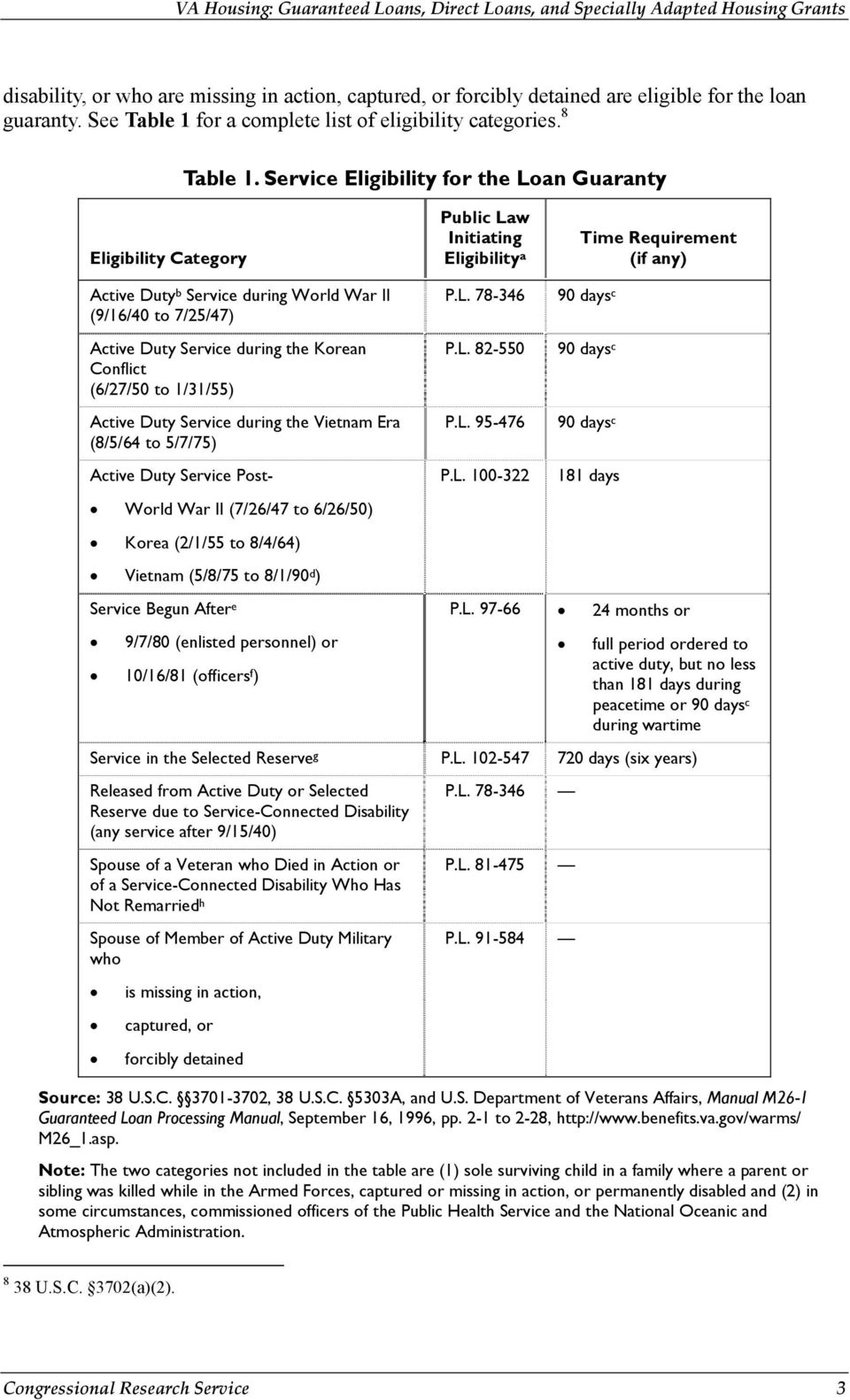
7 disability, or who are missing in action, captured, or forcibly detained are eligible for the loan guaranty. See Table 1 for a complete list of eligibility categories. 8 Table 1. Service Eligibility for the Loan Guaranty Eligibility Category Active Duty b Service during World War II (9/16/40 to 7/25/47) Active Duty Service during the Korean Conflict (6/27/50 to 1/31/55) Active Duty Service during the Vietnam Era (8/5/64 to 5/7/75) Active Duty Service Post- World War II (7/26/47 to 6/26/50) Korea (2/1/55 to 8/4/64) Vietnam (5/8/75 to 8/1/90 d ) Public Law Initiating Eligibility a P.L P.L P.L P.L Time Requirement (if any) 90 days c 90 days c 90 days c 181 days Service Begun After e 9/7/80 (enlisted personnel) or 10/16/81 (officers f ) P.L months or full period ordered to active duty, but no less than 181 days during peacetime or 90 days c during wartime Service in the Selected Reserve g P.L days (six years) Released from Active Duty or Selected Reserve due to Service-Connected Disability (any service after 9/15/40) Spouse of a Veteran who Died in Action or of a Service-Connected Disability Who Has Not Remarried h Spouse of Member of Active Duty Military who is missing in action, captured, or forcibly detained P.L P.L P.L Source: 38 U.S.C , 38 U.S.C. 5303A, and U.S. Department of Veterans Affairs, Manual M26-1 Guaranteed Loan Processing Manual, September 16, 1996, pp. 2-1 to 2-28, M26_1.asp. Note: The two categories not included in the table are (1) sole surviving child in a family where a parent or sibling was killed while in the Armed Forces, captured or missing in action, or permanently disabled and (2) in some circumstances, commissioned officers of the Public Health Service and the National Oceanic and Atmospheric Administration U.S.C. 3702(a)(2). Congressional Research Service 3
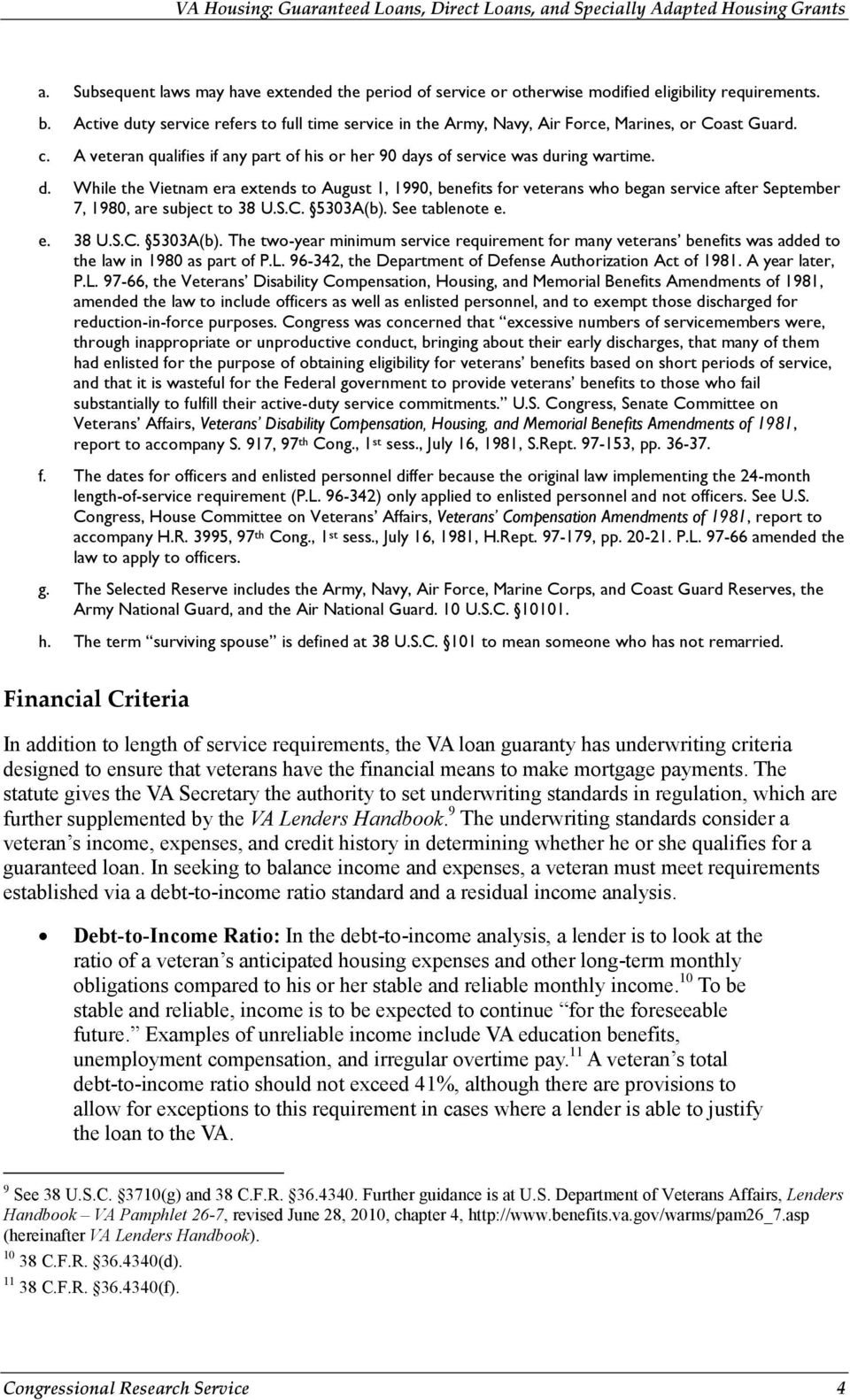
8 a. Subsequent laws may have extended the period of service or otherwise modified eligibility requirements. b. Active duty service refers to full time service in the Army, Navy, Air Force, Marines, or Coast Guard. c. A veteran qualifies if any part of his or her 90 days of service was during wartime. d. While the Vietnam era extends to August 1, 1990, benefits for veterans who began service after September 7, 1980, are subject to 38 U.S.C. 5303A(b). See tablenote e. e. 38 U.S.C. 5303A(b). The two-year minimum service requirement for many veterans benefits was added to the law in 1980 as part of P.L , the Department of Defense Authorization Act of A year later, P.L , the Veterans Disability Compensation, Housing, and Memorial Benefits Amendments of 1981, amended the law to include officers as well as enlisted personnel, and to exempt those discharged for reduction-in-force purposes. Congress was concerned that excessive numbers of servicemembers were, through inappropriate or unproductive conduct, bringing about their early discharges, that many of them had enlisted for the purpose of obtaining eligibility for veterans benefits based on short periods of service, and that it is wasteful for the Federal government to provide veterans benefits to those who fail substantially to fulfill their active-duty service commitments. U.S. Congress, Senate Committee on Veterans Affairs, Veterans Disability Compensation, Housing, and Memorial Benefits Amendments of 1981, report to accompany S. 917, 97 th Cong., 1 st sess., July 16, 1981, S.Rept , pp f. The dates for officers and enlisted personnel differ because the original law implementing the 24-month length-of-service requirement (P.L ) only applied to enlisted personnel and not officers. See U.S. Congress, House Committee on Veterans Affairs, Veterans Compensation Amendments of 1981, report to accompany H.R. 3995, 97 th Cong., 1 st sess., July 16, 1981, H.Rept , pp P.L amended the law to apply to officers. g. The Selected Reserve includes the Army, Navy, Air Force, Marine Corps, and Coast Guard Reserves, the Army National Guard, and the Air National Guard. 10 U.S.C h. The term surviving spouse is defined at 38 U.S.C. 101 to mean someone who has not remarried. Financial Criteria In addition to length of service requirements, the VA loan guaranty has underwriting criteria designed to ensure that veterans have the financial means to make mortgage payments. The statute gives the VA Secretary the authority to set underwriting standards in regulation, which are further supplemented by the VA Lenders Handbook. 9 The underwriting standards consider a veteran s income, expenses, and credit history in determining whether he or she qualifies for a guaranteed loan. In seeking to balance income and expenses, a veteran must meet requirements established via a debt-to-income ratio standard and a residual income analysis. Debt-to-Income Ratio: In the debt-to-income analysis, a lender is to look at the ratio of a veteran s anticipated housing expenses and other long-term monthly obligations compared to his or her stable and reliable monthly income. 10 To be stable and reliable, income is to be expected to continue for the foreseeable future. Examples of unreliable income include VA education benefits, unemployment compensation, and irregular overtime pay. 11 A veteran s total debt-to-income ratio should not exceed 41%, although there are provisions to allow for exceptions to this requirement in cases where a lender is able to justify the loan to the VA. 9 See 38 U.S.C. 3710(g) and 38 C.F.R Further guidance is at U.S. Department of Veterans Affairs, Lenders Handbook VA Pamphlet 26-7, revised June 28, 2010, chapter 4, (hereinafter VA Lenders Handbook) C.F.R (d) C.F.R (f). Congressional Research Service 4
9 Residual Income: The residual income test is used to determine whether a veteran s income after payments for shelter expenses and other debts is adequate to meet living expenses. Unlike the debt-to-income ratio, the residual income test looks at additional expenses such as food, clothing, health care, and gasoline that are not captured as part of debt. 12 The loan guaranty regulations contain a guide to sufficient residual income by region. 13 The Loan Guaranty Program does not require veterans to have a specific credit score to qualify for a loan, but the underwriting guidelines require lenders to analyze a borrower s credit history. 14 Lenders must be able to explain decisions to extend credit to borrowers who have an adverse credit history, and certain situations, such as an unpaid court-ordered judgment or a bankruptcy within the previous one or two years, may disqualify a borrower from obtaining a guaranteed loan. A previous foreclosure is not a bar to obtaining a VA-guaranteed loan, but borrowers who had previous VA-guaranteed loans that were foreclosed upon may have to repay the government for any losses suffered prior to obtaining a new loan. 15 Uses of the Loan Guaranty Financing the Purchase, Construction, or Improvement of Dwellings or Farm Residences Loan guarantees are available for the purchase or construction, or to make improvements (including energy efficiency improvements) to either a dwelling or farm residence. 16 A dwelling is defined as a building primarily used and occupied as a home (defined as a place of residence ) 17, and that consists of no more than four single family units (under most circumstances) 18, one of which will be occupied by an eligible veteran. While a daily physical presence is not necessary to occupy the property as a home, occupancy of the property must be more than intermittent. 19 For example, the property should be near a borrower s place of employment, and if his or her job requires an absence for a substantial amount of time, there must be a history of continuous presence in the community prior to the absence, and there should be no attempt to establish a principal residence elsewhere. 20 Use of a property as a vacation home would not qualify for the VA loan guaranty. A range of housing qualifies as a dwelling for VA loan guaranty purposes. A single condominium unit qualifies as a dwelling, and a manufactured home may also be a dwelling if the veteran owns 12 VA Lenders Handbook, p C.F.R (e) C.F.R (g). 15 Ibid U.S.C C.F.R Ibid. There is an exception for a dwelling owned by more than one veteran in that case there may be an extra unit for each additional veteran owner. For example, if three veterans owned a property together, it could consist of six units as long as three of the six units were occupied by the veteran owners. 19 VA Lenders Handbook, p Ibid. Congressional Research Service 5

10 the land to which it is affixed and the state classifies it as real property. 21 Note, however, that a manufactured home that does not meet these requirements may qualify separately under the manufactured housing section of the law (for more information, see the next section of this report entitled Loan Guaranty for Manufactured Housing ). The loan guaranty can also include the purchase of land for both the construction of a single-family home 22 or for placement of a manufactured home. 23 In addition to purchasing property, an eligible veteran may enter into a guaranteed loan for the construction of housing or to make improvements to property the veteran already owns. In general, the loan guaranty cannot be used to purchase a property that requires significant work (i.e., a fixer-upper) due to minimum property standards for homes purchased with VA-guaranteed loans. 24 However, if a property meets minimum property standards, and a veteran wants to include funds for improvements in a purchase money loan, the appraiser is to take the value of the improvements into account, increasing the loan amount for which a borrower could potentially qualify. 25 The loan guaranty can also be used for loans to make energy efficiency improvements to a property a veteran is purchasing or to a property already owned. Energy efficiency improvements were added as a permissible use of the loan guaranty in 1978 as part of the Veterans Housing Benefits Act (P.L ). Energy efficiency improvements are limited to $6,000, and may include such things as solar heating and cooling or conservation measures, such as insulation, weatherizing, and furnace replacement. 26 Loan Guaranty for Manufactured Housing The VA loan guaranty has evolved so that there are two ways in which manufactured housing is classified and guaranteed. First, as mentioned in the previous section, manufactured housing can be classified as a dwelling that may be guaranteed under the regular guaranty provisions of the statute (38 U.S.C. 3710). In addition, it can be classified and guaranteed under a separate manufactured housing portion of the law (38 U.S.C. 3712). Congress created the latter program first in 1970 (see the Veterans Housing Act of 1970, P.L ), and later specified that manufactured housing could be included as a dwelling for the regular guaranty provisions in Section 3710 (see the Veterans Compensation and Program Improvements Amendments of 1984, P.L ). Despite this flexibility, it appears that the VA has not guaranteed new manufactured housing loans under Section 3712 of the law since C.F.R Ibid., definition of residential property U.S.C. 3710(a)(9)(A)(ii). 24 VA Lenders Handbook, Chapter See VA response to questions for the record, U.S. Congress, House Committee on Veterans Affairs, Subcommittee on Economic Opportunity, Hearing on the Loan Guaranty Program, 111 th Cong., 2 nd sess., May 20, 2010, p For a complete list of acceptable improvements, see 38 U.S.C. 3710(d). 27 During the 1990s, the VA insured a decreasing number of manufactured housing units per year as reported in the VA Annual Reports. From FY1971 through FY1990, the VA guaranteed 112,786 manufactured home loans. U.S. Department of Veterans Affairs, FY1990 Annual Report of the Secretary of Veterans Affairs, March 1991, p. 29. In FY1991, the VA insured 313 loans, with this number decreasing to 126 in FY1992, 67 in FY1993, 24 in FY1994, 23 in FY1995, and 9 in FY1996, the last year in which manufactured home loans were separately noted in either the VA Annual Reports or the VA Annual Benefits Reports. Congressional Research Service 6

11 The VA has slightly different definitions for manufactured housing based on the portion of the statute under which it is guaranteed. The definitions share in common that manufactured housing is [a] movable dwelling unit designed and constructed for year-round occupancy on land by a single family, which dwelling unit contains permanent eating, cooking, sleeping, and sanitary facilities. A double-wide manufactured home is a movable dwelling designed for occupancy by one family consisting of (1) two or more units intended to be joined together horizontally when located on a site, but capable of independent movement or (2) a unit having a section or sections which unfold along the entire length of the unit. 28 The definitions differ in that the regulations governing the Section 3710 guaranty require that the manufactured home be permanently affixed to a lot and classified as real property under state law. To be permanently affixed, the home must be placed on a foundation in a way that satisfies local building codes. 29 This generally means being placed on a permanent foundation, and in some, but not all cases, connection to utilities and ownership of the land, although long-term rental agreements may suffice. 30 Once a home is permanently affixed, it may be titled as real property rather than personal property (as a vehicle is titled). According to the Census Bureau, in 2010, approximately 73% of new manufactured homes were titled as personal property and 22% as real property. 31 Separate Loan Guaranty for Manufactured Housing, 38 U.S.C. Section 3712 When Congress created the separate loan guaranty for manufactured housing in 1970, it was concerned that returning Vietnam veterans, some without significant financial resources, were unable to afford conventional homes and the costs of financing. 32 The recommendation to include mobile homes as eligible properties for the loan guaranty originated from the President s Committee on the Vietnam Veteran, whose members saw growing construction costs of conventional homes as a barrier to home ownership for veterans. 33 According to the committee, the lower costs of mobile homes represented an enormous potential in meeting the housing needs of many veterans with low to moderate incomes. 34 It was necessary to add a new manufactured housing portion to the law because, unlike loans for site-built homes, manufactured 28 This definition is from the manufactured housing portion of the regulations at 38 C.F.R The definition of manufactured housing for the regular home loan guaranty at 38 C.F.R is substantially the same. 29 VA Lenders Handbook, p For state laws governing the titling of manufactured housing as well as the conversion of housing titled as a motor vehicle to real property, see the Fannie Mae website, manufachousing/titlingmanufhsing.jsp. 31 U.S. Census Bureau, Selected Characteristics of New Manufactured Homes Placed: By Region , p. 1, 32 U.S. Congress, Senate Labor and Public Welfare Committee, Extension of Veterans Home Loan Entitlements and Inclusion of Mobile Home Purchases, report to accompany S. 3656, 91 st Cong., 2 nd sess., September 23, 1970, S.Rept , p. 13. When the Veterans Housing Act (H.R ) was considered and passed by the Senate, the bill was amended by and replaced with S. 3656, the companion bill to H.R , which contained a similar version of the loan guaranty program. See Veterans Housing Act of 1970, Senate debate, Congressional Record, vol. 116 (September 25, 1970), pp Report of the President s Committee on the Vietnam Veteran, Washington, DC, 1970, p Ibid. Congressional Research Service 7

12 housing is often financed with chattel mortgages, which are designed for moveable property and governed by different laws than mortgages for real property. Manufactured housing loans that are guaranteed through Section 3712 differ from the Section 3710 loan guaranty in that the term of the mortgage is generally shorter depending on the type of manufactured housing, 35 the maximum loan guaranty amount is set differently (see Table 3), and fees charged by the VA are less than for conventional housing (see Table 6), among other differences. However, as mentioned previously, the VA does not appear to have guaranteed loans pursuant to Section 3712 since FY1996. Refinancing Loans Veterans may use the loan guaranty to refinance an existing loan in two different ways: to reduce the interest rate of an existing VA-guaranteed loan (sometimes referred to as an interest rate reduction refinancing loan or IRRRL), 36 or to refinance generally with fewer restrictions. Loans in the latter category are sometimes referred to as cash out refinancings because veterans may choose to take out equity as part of the transaction. The ability to refinance a loan on a property owned and occupied by an eligible veteran became part of the loan guaranty law as part of the Veterans Housing Act of 1970 (P.L ). 37 Manufactured housing loans became eligible for refinancing as part of the Veterans Compensation and Program Improvements Amendments of 1984 (P.L ). IRRRL: When a veteran refinances a loan that is already guaranteed by the VA as an IRRRL, generally the interest rate on the new loan should be lower than the loan being refinanced. 38 However, a veteran may refinance from an adjustable-rate loan to a fixed-rate loan without the requirement for a lower rate. The amount of the new loan may not exceed the principal balance of the original loan, plus any closing costs, and the term of the new loan cannot exceed the original loan term by more than 10 years. 39 A veteran may also take advantage of energy efficiency improvements as part of an IRRRL, in which case the principal balance of the new loan may be increased by the amount of the improvements. 40 Another aspect of an IRRRL refinancing is that a veteran need not occupy the residence as a home after refinancing as long as it had been occupied as a home prior to refinancing. The limitation on occupancy was removed in 1987 (P.L ) due to concern that servicemembers who were transferred or stationed elsewhere were unable to take advantage of refinancing. 41 In general, no appraisal and no new underwriting are required for an IRRRL, 42 and, unlike purchase-money VA loans, closing costs may be financed as part of the loan U.S.C. 3712(d). The maximum loan terms are: single-wide, about 20 years for home and lot; double-wide, a maximum of 25 years for home and lot; or lot purchase, approximately 15 years U.S.C. 3710(a)(8) and (a)(9)(i) U.S.C. 3710(a)(5) U.S.C. 3710(e). 39 Ibid U.S.C. 3710(e)(1)(C). 41 U.S. Congress, House Committee on Veterans Affairs, Veterans Housing Rehabilitation and Program Improvement Act of 1987, report to accompany H.R. 2672, 100 th Cong., 1 st sess., July 30, 1987, H.Rept , p VA Lenders Handbook, p Ibid., p Congressional Research Service 8

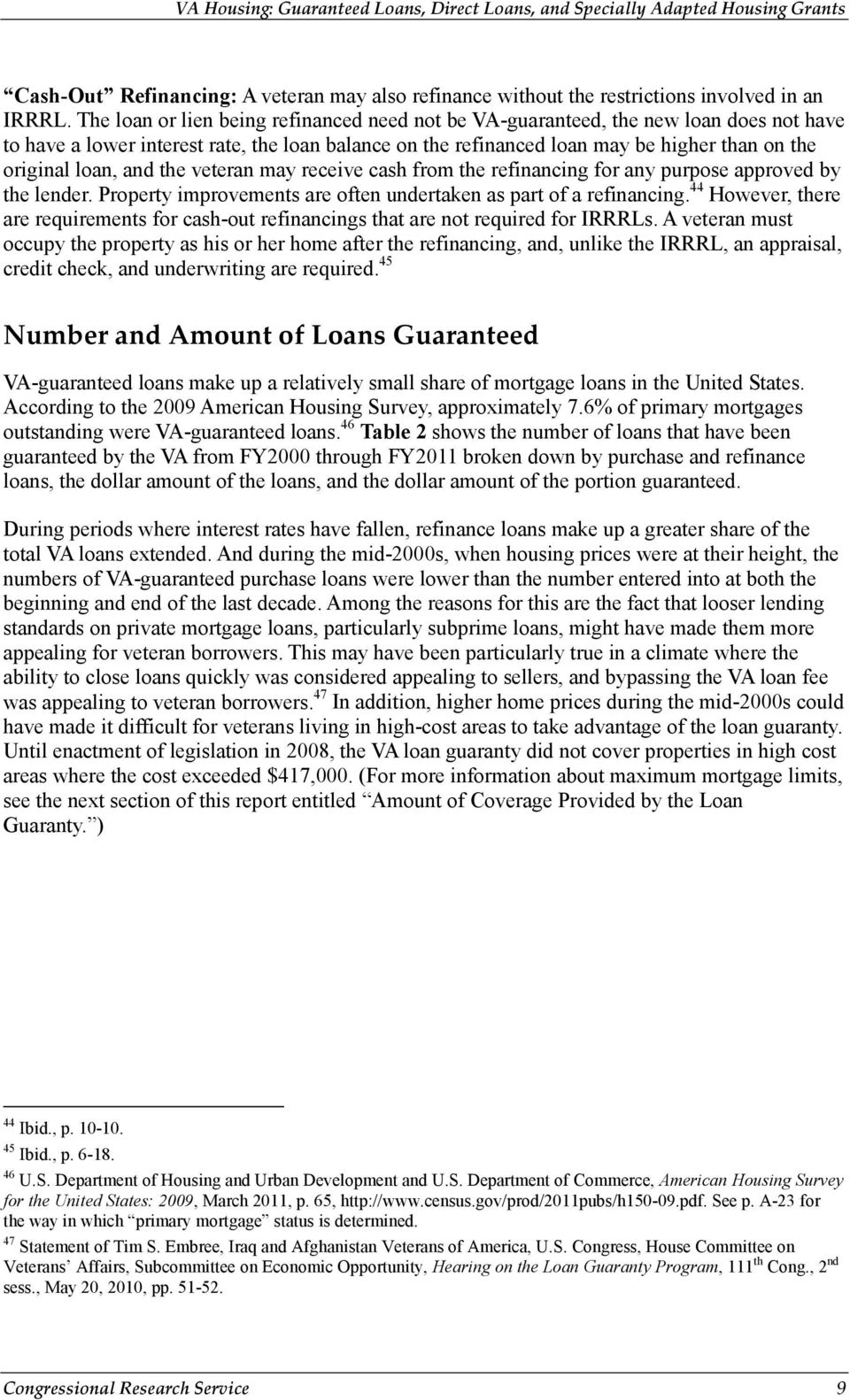
13 Cash-Out Refinancing: A veteran may also refinance without the restrictions involved in an IRRRL. The loan or lien being refinanced need not be VA-guaranteed, the new loan does not have to have a lower interest rate, the loan balance on the refinanced loan may be higher than on the original loan, and the veteran may receive cash from the refinancing for any purpose approved by the lender. Property improvements are often undertaken as part of a refinancing. 44 However, there are requirements for cash-out refinancings that are not required for IRRRLs. A veteran must occupy the property as his or her home after the refinancing, and, unlike the IRRRL, an appraisal, credit check, and underwriting are required. 45 Number and Amount of Loans Guaranteed VA-guaranteed loans make up a relatively small share of mortgage loans in the United States. According to the 2009 American Housing Survey, approximately 7.6% of primary mortgages outstanding were VA-guaranteed loans. 46 Table 2 shows the number of loans that have been guaranteed by the VA from FY2000 through FY2011 broken down by purchase and refinance loans, the dollar amount of the loans, and the dollar amount of the portion guaranteed. During periods where interest rates have fallen, refinance loans make up a greater share of the total VA loans extended. And during the mid-2000s, when housing prices were at their height, the numbers of VA-guaranteed purchase loans were lower than the number entered into at both the beginning and end of the last decade. Among the reasons for this are the fact that looser lending standards on private mortgage loans, particularly subprime loans, might have made them more appealing for veteran borrowers. This may have been particularly true in a climate where the ability to close loans quickly was considered appealing to sellers, and bypassing the VA loan fee was appealing to veteran borrowers. 47 In addition, higher home prices during the mid-2000s could have made it difficult for veterans living in high-cost areas to take advantage of the loan guaranty. Until enactment of legislation in 2008, the VA loan guaranty did not cover properties in high cost areas where the cost exceeded $417,000. (For more information about maximum mortgage limits, see the next section of this report entitled Amount of Coverage Provided by the Loan Guaranty. ) 44 Ibid., p Ibid., p U.S. Department of Housing and Urban Development and U.S. Department of Commerce, American Housing Survey for the United States: 2009, March 2011, p. 65, See p. A-23 for the way in which primary mortgage status is determined. 47 Statement of Tim S. Embree, Iraq and Afghanistan Veterans of America, U.S. Congress, House Committee on Veterans Affairs, Subcommittee on Economic Opportunity, Hearing on the Loan Guaranty Program, 111 th Cong., 2 nd sess., May 20, 2010, pp Congressional Research Service 9
14 Table 2. VA Loans Guaranteed by Fiscal Year, FY2000-FY2011 Number of Loans in Year Volume of Loans Made in Year ($ in billions) Cumulative Volume of Loans Outstanding a ($ in billions) Fiscal Year Purchase Loans Refinance Loans b Total Loans Amount of Loans Amount Guaranteed Amount of Loans Amount Guaranteed ,553 13, , c c ,158 72, , , , , , , , , , , ,130 46, , ,604 20, , ,941 15, , ,340 37, , , , , , , , , , , Source: The data on the number and dollar amount of guaranteed loans in a fiscal year are from the Department of Veterans Affairs, Annual Benefits Reports. The data on the cumulative volume of loans come from the VA Performance and Accountability Reports. a. The cumulative volume of loans is the total dollar amount of all guaranteed loans that was outstanding at the end of the fiscal year. b. Refinance loans include interest rate reduction refinancing loans and cash-out or other refinancing transactions. c. The FY2000 Performance and Accountability Report did not provide information about the total loan volume. Congressional Research Service 10

15 Amount of Coverage Provided by the Loan Guaranty While there is technically no limit to the amount that a veteran can borrow and still receive a loan guaranty through the VA, the VA limits the guaranty that it will provide based on the amount of the loan as well as the type of loan (purchase money, refinance, or energy efficiency mortgage). In most cases, the VA guaranty covers at least 25% of the principal balance of a loan. While the VA guaranty does not insure 100% of the loan (as Federal Housing Administration loan insurance does, for example), the guaranty covers what would typically be required as a down payment in a conventional mortgage transaction to avoid the requirement for private mortgage insurance. In cases where the loan guaranty does not cover 25% of the loan amount, a veteran may have to make a down payment. The statute governing the loan guaranty for home purchase sets out four categories of coverage depending on the principal balance of the loan. 54 (For all guaranty amounts, including manufactured housing, refinance loans, and energy efficiency mortgages, see Table 3.) In general, the amount of the loan guaranty is based on the amount borrowed by a veteran. Freddie Mac Conforming Loan Limit The conforming loan limit is a ceiling on the value of loans that Freddie Mac, one of the Government Sponsored Enterprises, can purchase from lenders. 48 The single-family home loan limit in statute was initially pegged to the FHA insurance limit $33,750 in then revised to follow the loan limits for savings and loans. 50 However, beginning in 1980 as part of the Housing and Community Development Act (P.L ), Congress inserted the maximum loan limit directly in the Freddie Mac statute. P.L set the single-family limit at $93,750, and it was to be adjusted administratively each year based on the national average single-family home price. 51 While Congress did not amend the statute to increase the loan limit until 2008, the limit was changed administratively 27 times. 52 As part of the Housing and Economic Recovery Act of 2008 (P.L ), Congress amended the Freddie Mac statute to raise the statutory conforming loan limit from $93,750 to $417,000, which was the level that had been established administratively for 2006 and P.L also added a sentence to the statute allowing the limit to increase in high-cost areas where 115% of the median home price exceeds the conforming loan limit. In these high-cost areas, the loan limit may go up to 115% of the area median home price, not to exceed 150% of the loan limit (or as high as $625,500). Since the enactment of P.L , the Freddie Mac statute itself has not been amended, although Congress temporarily raised the loan limits for high-cost areas through September 30, 2011, via several laws. This limit was the lower of 125% of the area median home price or 175% of the Freddie Mac limit (or $729,750). 53 These temporary limits expired at the end of FY2011. At loan levels at or below $45,000, the VA guaranties 50% of the loan. For loans above $45,000 and up to and including $56,250, the guaranty is $22, For more information about Freddie Mac and the conforming loan limits, see CRS Report RS22172, The Conforming Loan Limit, by N. Eric Weiss and Sean M. Hoskins. 49 P.L , 305. The FHA statute was amended in 1969 to raise the limit to $33,000 (P.L ). 50 P.L , 805. The federal savings and loan limits on mortgage lending were codified at 12 U.S.C. 1464(c) (1976). 51 P.L , Federal Housing Finance Agency, History of Conforming Loan Limits, loanlimitshistory07.pdf. Limits were increased in each year with the exception of P.L returned the limit for high-cost areas to the level first instituted in 2008 as part of the Economic Stimulus Act of 2008 (P.L ) U.S.C Congressional Research Service 11

16 At loan levels above $56,250 and up to and including $144,000, the VA guaranty is the lesser of $36,000 or 40% of the loan. For loan levels above $144,000, the maximum loan guaranty is the lesser of the maximum guaranty amount or 25% of the loan. The maximum guaranty amount is defined in statute as 25% of the Freddie Mac conforming loan limit limitation determined under section 305(a)(2) of the Federal Home Loan Mortgage Corporation Act. 55 The Freddie Mac statute has most recently set the conforming loan limit at $417,000 for single-family homes (for more information about the Freddie Mac conforming loan limit, see the text box). 56 However, for certain highcost areas, the loan limit may be as high as 115% of the area median home price, though it may not exceed 150% of the conforming loan limit (or $625,500). 57 Therefore, depending on where a property is located, the maximum VA loan guaranty is 25% of $625,500, or $156,375. The VA publishes a list of counties where the loan limits exceed $417, If the amount of a mortgage exceeds the county Freddie Mac limit (for example, the amount of the mortgage is $500,000 in a county where the loan limit is $417,000), then a veteran may have to make a down payment equal to 25% of the amount over the Freddie Mac limit to qualify for the loan due to secondary market considerations (see the next section of this report entitled Maximum Loan Amount for more information about the secondary market). However, the majority of VA-guaranteed loans are made with no down payment (88% of purchase loans in FY2011 had no down payment), 59 so the limits described here will apply to most veteran borrowers. Maximum Limit for Alaska, Hawaii, U.S. Virgin Islands, and Guam The maximum single-family guaranty limit for Alaska, Hawaii, the U.S. Virgin Islands, and Guam is higher than in the other states and the District of Columbia due to costs of construction. 60 The Freddie Mac conforming loan limit for these states and territories is 50% higher than the $417,000 limit for the rest of the country, resulting in a current loan limit of $625, Further, with the provision allowing the area limit to be increased up to 150% of the conforming loan limit for high-cost areas, it is possible for the loan limit in Alaska, Hawaii, the U.S. Virgin Islands, and Guam to be as high as $938,250 (150% of $625,500), with the VA guaranty set at 25% of this U.S.C. 3703(a)(1)(C) U.S.C This is based on the provision in the Freddie Mac statute for areas where 115% of median home prices exceed the conforming loan limit. 12 U.S.C. 1454(a)(2)(C). See the text box for more information. 58 For FY2012 county limits see 59 U.S. Department of Veterans Affairs, FY2011 Annual Benefits Report, p. 66, _abr.pdf U.S.C. 1454(a)(2)(C). 61 The higher conforming loan limit for Alaska, Hawaii, and Guam was introduced in 1980 (P.L ). The U.S. Virgin Islands was added to the list in 1992 (P.L ). See also, U.S. Congress, Conference Report, report to accompany S. 2719, 96 th Cong., 2 nd sess., September 26, 1980, H.Rept , p Congressional Research Service 12

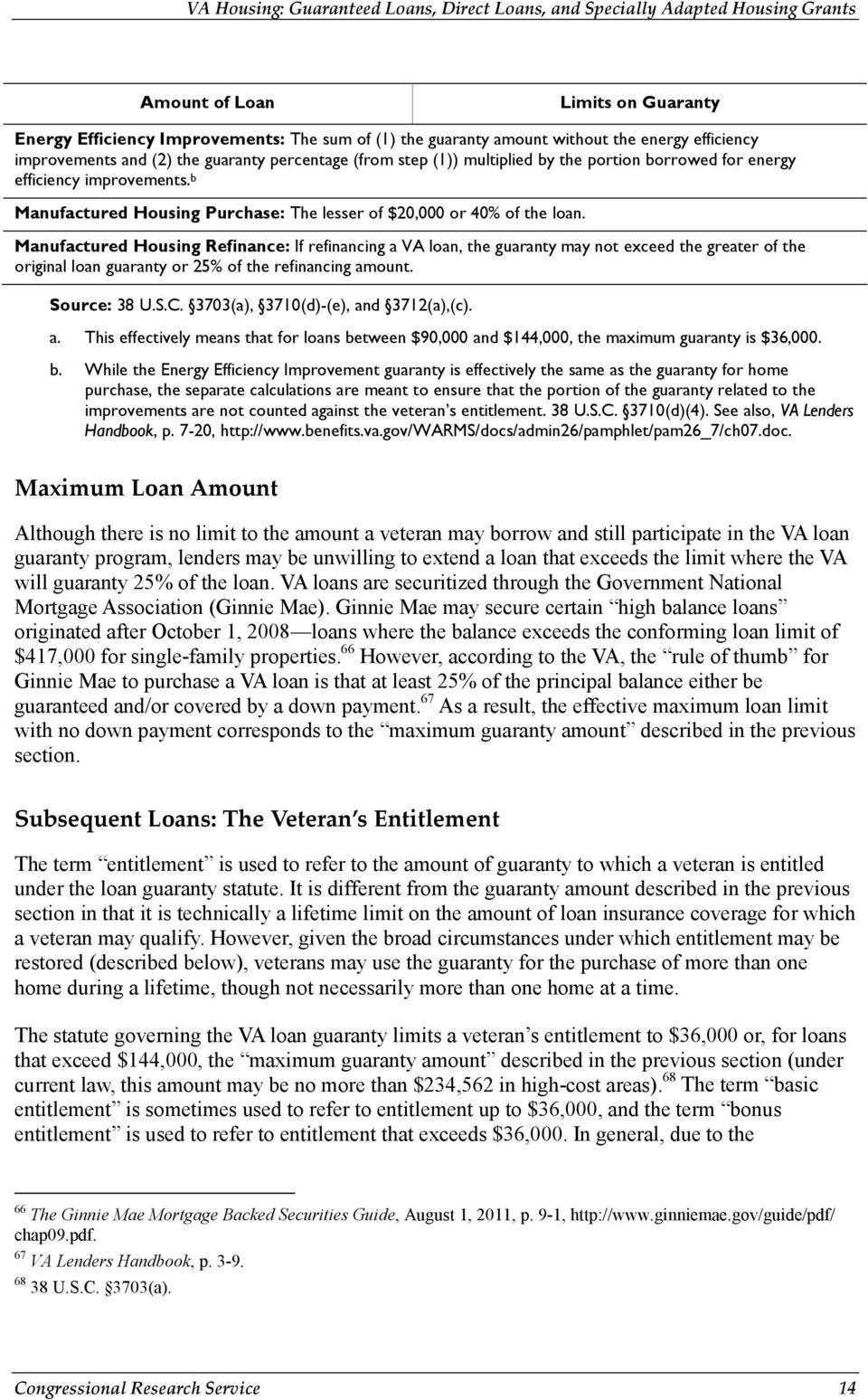
17 amount, or $234,562. However, in 2012, only Honolulu County exceeded the $625,500 loan limit level. 62 Loan Limits Prior to January 1, 2012 For a period beginning in 2008 and continuing through December 31, 2011, limits to the VA loan guaranty for loan levels above $144,000 were higher than they are currently. The Veterans Benefits Improvement Act of 2008 (P.L ) temporarily increased the maximum guaranty amount (it did not make the change in statute). The law set the maximum guaranty amount at the higher of 25% of: The Freddie Mac conforming loan limit, or 125% of the area median home price, but no higher than 175% of the limit determined under the Freddie Mac statute. According to guidance issued by the VA, 63 this meant that in high-cost areas where the Freddie Mac statutory loan limit reached $625,500, the VA could guarantee loans up to 175% of $625,500, or $1,094, Loan limits in a number of communities exceeded the current maximum level of $625,500 during this time period. 65 The same held true for Alaska, Hawaii, Guam, and the U.S. Virgin Islands. Technically, the maximum loan limit could have been set at $1,641, (175% of $938,250), though no community in the territories reached this level (and only one, Honolulu County, saw its limit exceed $625,500). Table 3. Limits on the Level of Loan Guaranty Amount of Loan Limits on Guaranty Home Loan Guaranty $45,000 or less 50% of the loan amount from $45,000 up to and including $56,250 $22,500 from $56,250 up to and including $144,000 Lesser of $36,000 or 40% of the loan amount a more than $144,000 Lesser of (1) 25% of the loan amount or (2) 25% of the higher of (a) the Freddie Mac conforming loan limit ($417,000) or (b) 115% of the area median home price, not to exceed 150% of the Freddie Mac conforming loan limit ($625,500). Refinance: Same as for purchase, but in the case of an interest rate reduction refinancing loan (IRRRL), the guaranty may not exceed the greater of the original loan s guaranty or 25% of the loan. 62 See 63 U.S. Department of Veterans Affairs, VA Circular , Implementation of Loan Guaranty Provisions of P.L , October 16, 2008, p. 2, 64 Based on this, the greatest amount of guaranty for which a veteran could qualify in a high-cost area was $273, (($625,500 * 1.75) *.25). 65 See, for example, the 2011 VA County Loan Limits for High-Cost Counties, docs/2011_county_loan_limits.pdf. Congressional Research Service 13

18 Amount of Loan Limits on Guaranty Energy Efficiency Improvements: The sum of (1) the guaranty amount without the energy efficiency improvements and (2) the guaranty percentage (from step (1)) multiplied by the portion borrowed for energy efficiency improvements. b Manufactured Housing Purchase: The lesser of $20,000 or 40% of the loan. Manufactured Housing Refinance: If refinancing a VA loan, the guaranty may not exceed the greater of the original loan guaranty or 25% of the refinancing amount. Source: 38 U.S.C. 3703(a), 3710(d)-(e), and 3712(a),(c). a. This effectively means that for loans between $90,000 and $144,000, the maximum guaranty is $36,000. b. While the Energy Efficiency Improvement guaranty is effectively the same as the guaranty for home purchase, the separate calculations are meant to ensure that the portion of the guaranty related to the improvements are not counted against the veteran s entitlement. 38 U.S.C. 3710(d)(4). See also, VA Lenders Handbook, p. 7-20, Maximum Loan Amount Although there is no limit to the amount a veteran may borrow and still participate in the VA loan guaranty program, lenders may be unwilling to extend a loan that exceeds the limit where the VA will guaranty 25% of the loan. VA loans are securitized through the Government National Mortgage Association (Ginnie Mae). Ginnie Mae may secure certain high balance loans originated after October 1, 2008 loans where the balance exceeds the conforming loan limit of $417,000 for single-family properties. 66 However, according to the VA, the rule of thumb for Ginnie Mae to purchase a VA loan is that at least 25% of the principal balance either be guaranteed and/or covered by a down payment. 67 As a result, the effective maximum loan limit with no down payment corresponds to the maximum guaranty amount described in the previous section. Subsequent Loans: The Veteran s Entitlement The term entitlement is used to refer to the amount of guaranty to which a veteran is entitled under the loan guaranty statute. It is different from the guaranty amount described in the previous section in that it is technically a lifetime limit on the amount of loan insurance coverage for which a veteran may qualify. However, given the broad circumstances under which entitlement may be restored (described below), veterans may use the guaranty for the purchase of more than one home during a lifetime, though not necessarily more than one home at a time. The statute governing the VA loan guaranty limits a veteran s entitlement to $36,000 or, for loans that exceed $144,000, the maximum guaranty amount described in the previous section (under current law, this amount may be no more than $234,562 in high-cost areas). 68 The term basic entitlement is sometimes used to refer to entitlement up to $36,000, and the term bonus entitlement is used to refer to entitlement that exceeds $36,000. In general, due to the 66 The Ginnie Mae Mortgage Backed Securities Guide, August 1, 2011, p. 9-1, chap09.pdf. 67 VA Lenders Handbook, p U.S.C. 3703(a). Congressional Research Service 14
19 requirement that VA-guaranteed loans be used to purchase properties that a veteran will occupy as his or her home, 69 unused entitlement cannot be used to purchase more than one home at a time. In addition to being able to put unused entitlement toward a future guaranteed loan, there are instances in which already-used entitlement may be restored so that a veteran may use the maximum available loan guaranty to purchase another home. 70 These circumstances cover most situations where a veteran has ended the previous loan transaction in some way. Entitlement is restored where a veteran has disposed of the property (e.g., through sale) or the property has been destroyed through natural disaster, and either (1) the loan is paid off in full; (2) if the VA suffered a loss on the loan, the loss is repaid; or (3) the VA has been released from liability on the loan. When one veteran assumes a guaranteed loan from another, entitlement is restored to the original mortgagor. In cases of refinancing, entitlement is restored either when a veteran has paid off the original loan prior to entering into a new loan or where proceeds from the refinancing will be used to pay off the original loan. 71 Where a veteran has paid off a VA-guaranteed loan, but has not yet sold the property that secured it, the VA may do a one-time restoration of entitlement to be used toward the purchase of another property. 72 If available entitlement is less than 25% of the loan, then a lender may require a veteran to make a down payment to make up the difference between the loan guaranty and 25% of the loan to meet secondary market requirements. 73 How the VA Loan Guaranty Differs from FHA Insurance Both the Federal Housing Administration (FHA) loan insurance program and the VA loan guaranty program provide borrowers with the federal government s promise to reimburse lenders in the event of borrower default on private mortgages. Due to the insurance features of each program, borrowers who might not otherwise have the resources for a conventional mortgage may still be able to purchase a home. Despite similar purposes, however, the programs differ in their specifics. Aside from the requirement that a borrower through the VA meet service requirements, other features such as the amount of coverage, borrower fees, loan processing and underwriting, terms of the loan, etc., vary between the two. Amount of Coverage: As discussed earlier in the Amount of Coverage Provided by the Loan Guaranty section, the VA loan guaranty covers only a portion of the mortgage loan in the event of a borrower s default. Insurance through FHA covers 100% of the loan amount (up to a certain limit). 69 VA Lenders Handbook, pp and U.S.C. 3702(b). 71 Ibid. See also VA Lenders Handbook, p VA Lenders Handbook, p Ibid., p Congressional Research Service 15
20 Maximum Loan Amount: As a practical matter, the maximum loan amount for the VA loan guaranty in certain high-cost areas is $625,500 (see the Maximum Loan Amount section of this report). In the case of FHA, the insurance will currently cover loans up to $729,750 in certain high-cost areas. 74 Borrower Fees: Fees paid by veterans participating in the VA loan guaranty program are paid up front as a percentage of the loan (see Table 6), and borrowers do not pay additional annual premiums. Borrowers who go through the FHA program currently pay an up-front fee of 1.75% of the loan amount, and then pay annual premiums of 1.20% or 1.25% of the mortgage balance, depending on the loan-to-value ratio. 75 Beginning on June 11, 2012, FHA borrowers with mortgages greater than $625,500 will pay annual premiums of 1.45% or 1.50%. Down Payment: Veteran borrowers who participate in the VA loan guaranty program are not required to make a down payment. However, if the loan balance exceeds loan limits, the borrower generally must make up the difference between the guaranty and 25% of the loan amount. In general, borrowers through FHA must make a 3.5% down payment (10% for credit scores ranging from 500 to 579). 76 Fees Charged at Closing: While both the VA loan guaranty and the FHA insurance program have rules about what lenders may charge borrowers at closing, the VA loan guaranty is more restrictive. VA loan guaranty regulations list services where lenders are allowed to charge itemized fees to borrowers (such as appraisal, recording, and credit report fees), 77 and any other fees must be recouped through a flat fee not to exceed 1% of the loan, limiting such charges as application fees, document preparation, interest rate lock-in fees, and charges from mortgage brokers. 78 FHA rules are more general, specifying that lenders may only collect fair, reasonable, and customary fees and charges from borrowers. 79 Minimum Credit Score: The VA loan guaranty does not require a specific credit score from a borrower, while FHA requires a credit score of at least Appraisal: Appraisers for properties that are to be guaranteed through the VA loan guaranty program must go through a separate VA certification procedure, and they are chosen by the VA rather than lenders. 81 The statute requires the VA to review appraisals prior to loan closings, although the VA has a program in 74 See CRS Report RS20530, FHA-Insured Home Loans: An Overview, by Katie Jones. 75 Ibid. 76 Ibid C.F.R See VA Lenders Handbook, p U.S. Department of Housing and Urban Development, Handbook , Lender s Guide to the Single Family Mortgage Insurance Process, p. 6-A-12, 80 CRS Report RS20530, FHA-Insured Home Loans: An Overview, by Katie Jones U.S.C requires the VA Secretary to set up a process for approving appraisers that includes a testing process and recommendations from other appraisers, and to develop and maintain a list of approved appraisers. Congressional Research Service 16
21 place to allow lenders to process appraisals after application and training. 82 FHA does not have similar policies regarding appraisers, and they may be selected by lenders. In addition, for a number of years, veterans were given special terms when entering into FHA loans. The Housing and Urban Development Act of 1965 (P.L ) first allowed veterans to enter into FHA loans with slightly higher maximum mortgages compared to nonveteran borrowers, and it also exempted them from what was then a 3% cash down payment requirement on the first $15,000 of the loan. Over time, some of the specifics of the maximum mortgage and down payment requirements have changed, but veterans still retained favorable levels compared to nonveterans. In 2002, the FHA Downpayment Simplification Act (P.L ) removed statutory language that allowed for higher maximum mortgages for veteran borrowers. 83 And when the Housing and Economic Recovery Act of 2008 (P.L ) was enacted, it eliminated the provision exempting veterans from the requirement of what had previously been a 3% down payment in cash or its equivalent. 84 Direct VA Loans In addition to the VA loan guaranty program, through which the VA insures loans made to veterans by private lenders, there are several circumstances under which the VA makes loans directly to veterans, as well as occasionally to nonveterans. The direct loans through the VA can be put into two broad categories. The first category involves loans that are targeted to specific veteran populations: one program was created to address the needs of rural veterans, but has evolved to serve veterans with certain disabilities, and the other program is designed for Native American veterans. The second category involves loans made as the result of borrower default on guaranteed loans these are referred to as acquired loans and vendee loans. The Original Direct Loan for Veterans in Rural Areas, Now Limited to Veterans with Disabilities The VA first made direct housing loans available to veterans who were unable to obtain mortgages through private lenders and were therefore unable to participate in the loan guaranty program. The direct loan portion of the program was enacted as part of the Housing Act of 1950 (P.L ), and was meant to be a last resort where private financing was not available to veterans. 85 The enacting legislation did not specify that the program was directed to veterans in rural areas, but about eight years later, in 1958, Congress changed the law to apply specifically to veterans living in rural areas and small towns as part of P.L The law provided that the 82 VA Lenders Handbook, chapter See Section 2(1)(B)(ii)(I). Just prior to the enactment of P.L , veteran borrowers qualified for a principle balance of 100% of the first $25,000 of the appraised value, compared to 97% for non-veteran borrowers. In addition, the maximum principle balance on amounts above $125,000 was 90% for non-veteran borrowers, compared to 95% for veteran borrowers. 84 See Section 2113 of P.L U.S. Congress, Senate Committee on Banking and Currency, Housing Act of 1950, report to accompany S. 2246, 81 st Cong., 2 nd sess., February 24, 1950, S.Rept , p The old U.S. Code Section, 38 U.S.C. 694l (1952), was replaced by 38 U.S.C (1958). See the table of contents for Title 38 of the U.S. Code 1958 version. Congressional Research Service 17
22 VA Secretary would designate an area without private loan options for veterans as a housing credit shortage area and make loans to veterans at a rate not exceeding the rate set for guaranteed loans at a maximum principal balance (at the time the law was enacted) of $13,500. In the Veterans Housing Act of 1970 (P.L ), Congress made direct loans available to veterans who qualified for Specially Adapted Housing grants for veterans with certain disabilities, who it recognized might also have difficulty obtaining credit for home purchases. 87 The VA direct loan program continues to exist today, but in limited form. 88 A 1980 review of the direct loan program found that 98% of veterans in rural areas received loans from private lenders, and only 2% received VA direct loans. 89 As a result of the increased availability of private loan funds in rural areas, beginning in the FY1981 Department of Housing and Urban Development- Independent Agencies Appropriation Act (P.L ), Congress specified that VA direct loans be made only for veterans with disabilities through the Specially Adapted Housing Program (described in a later section of this report entitled The Specially Adapted Housing Program ). Congress has continued to include similar language in subsequent appropriations acts. 90 Currently, direct loans are limited to $500,000 in obligations for Specially Adapted Housing loans of not more than $33,000 apiece. 91 Interest rates on the loans are to be determined by the VA Secretary, and veterans are eligible as long as they qualify for the loan guaranty program. Direct Loans for Native American Veterans (Including Guam, American Samoa, and CNMI) While the VA loan guaranty program is available to Native American veterans, 92 due in part to certain tribal land ownership issues, Congress enacted a direct loan program specifically to provide mortgage assistance for Native American veterans. The direct loan program may also be used by veteran borrowers who are Native Hawaiians, Alaska Natives, and those who are native to American Samoa, Guam, and the Commonwealth of the Northern Mariana Islands (CNMI). 93 Prior to enactment of the direct loan program for Native American veterans, VA housing assistance to Native American veterans was minimal. In fact, the Advisory Committee on Native 87 U.S. Congress, House Committee on Veterans Affairs, Subcommittee on Housing, Bills to Provide for Purchase of Mobile Homes Under Veterans Administration Guaranty and Other Bills Related to Veterans Housing, 91 st Cong., 2 nd sess., July 14 and 16, 1970, pp U.S.C U.S. Veterans Administration, Annual Report 1981, May 1982, p For example, the language in the FY2012 Consolidated Appropriations Act (P.L ) was not to exceed $500,000 in gross obligations for direct loans are authorized for specially adapted housing loans. According to the Conference Committee Report, the law limits obligations for direct loans to not more than $500,000. See H.Rept U.S. Department of Veterans Affairs, FY2013 Congressional Budget Submission, Volume III, Benefits and Burial Programs and Departmental Administration, pp. 2E-1 and 2E-6, Fy2013_Volume_III-Benefits_Burial_Dept_Admin.pdf (hereinafter FY2013 VA Budget Justifications). 92 See U.S. Department of Veterans Affairs, M26-1 Guaranteed Loan Processing Manual, p , U.S.C. 3765(3). The statute refers to Pacific Islander as one who is who is indigenous to a United States territory or possession located in the Pacific Ocean, as defined by the Native American Programs Act of 1974, 42 U.S.C. 2992c(7). The three U.S. territories in the Pacific are American Samoa, Guam, and the Commonwealth of the Northern Mariana Islands. Congressional Research Service 18
23 American Veterans had been unable to find a single instance of a Native American veteran benefitting from the loan guaranty program. 94 While factors such as poverty and unemployment among Native American veterans may have contributed to their lack of participation, the unique nature of tribal land also presented obstacles to private lenders entering into mortgages. Much of tribal land is held in trust by the federal government, either for a tribe or for individual Native Americans (the latter situation is sometimes referred to as an allotment). Of the approximately 56 million acres of trust land, 45 million are held in trust for tribes and 11 million for individuals. 95 In the case of tribal trust land, the land may be assigned or leased to individual tribal members. However, in neither case (tribal or individual trust) may the land be encumbered or transferred without federal government approval. 96 Lenders could be reluctant to enter into mortgage arrangements where they would be unable to have the land transferred to them in the event of a veteran s default. 97 Similar issues apply to residents of American Samoa and CNMI, where land ownership is restricted. In American Samoa, approximately 90% of land is communally held, 98 it may not be transferred without government approval, and it may not be transferred to anyone who is less than one half Samoan. 99 The CNMI Constitution restricts land ownership and long-term interests (such as leases) to those of Northern Marianan descent. 100 As with tribal land, a private lender may not be willing to extend a loan where transfer of the land in the event of default would violate territorial law. Guam does not have these restricted land ownership issues. After finding that only 15 of 24,000 veterans living on trust land had participated in any sort of housing benefit all of whom received the Specially Adapted Housing benefit and none the loan guaranty Congress initially enacted a demonstration program to make loans to Native American veterans that was included in the Veterans Home Loan Program Amendments of 1992 (P.L ). 101 The program was made permanent as part of the Veterans Housing Opportunity and Benefits Improvement Act of 2006 (P.L ). In order to participate in the VA direct loan program, and circumvent the issues of land ownership, a tribe must enter into a memorandum of understanding (MOU) with the VA to provide avenues for addressing default and foreclosure. 94 U.S. Congress, Senate Committee on Veterans Affairs, Veterans Benefits and Health Care Act of 1989, report to accompany S. 13, 101 st Cong., 1 st sess., September 13, 1989, S.Rept (Washington: GPO, 1989), pp The Senate amended H.R. 901 (which would ultimately become P.L ) with provisions from S U.S. Department of the Interior, DOI Trust Reform: As-Is Trust Business Model Report, March 21, 2003, p. 2-1, 96 U.S. Department of Agriculture, Lending on Native American Lands: A Guide for Rural Development Staff, June 2006, p. 24, 97 See U.S. Congress, Senate Committee on Veterans Affairs, Native American Veterans Home Loan Equity Act of 1992, report to accompany S. 2528, 102 nd Cong., August 12, 1992, S.Rept , p. 11. Quoting from an evaluation of VA lending on tribal land, the report stated that The inability to use tribal land as security for a mortgage loan is the most significant factor in limiting access to the VA loan guaranty benefit that can be affected by VA. S was incorporated into P.L See Veterans Home Loan Program Revitalization Act of 1992, House debate, Congressional Record, vol. 138, part 22 (October 5, 1992), p See the Department of the Interior website, Insular Area Summary for American Samoa, Islandpages/asgpage.htm. 99 AM. SAMOA CODE ANN N.M.I. Const., Art. XII, Sec Congress, in response to the concerns of the Advisory Committee on Native American Veterans, directed the Departments of Veterans Affairs and Interior to look into the extent to which Native American veterans on trust land participated in the loan guaranty program and release a report (see the Veterans Benefits Amendments of 1989 (P.L )). The findings of the report are summarized in S.Rept , p. 10. Congressional Research Service 19
24 Typically individuals enter into long-term leases for use of trust land. The MOU requires that a participating tribe set up a process through which a veteran borrower s leasehold interest in a property can be transferred to a lender, whether private or government, or their assignee in the event of default. 102 The tribe must also establish a procedure for evicting and foreclosing on the veteran s interest in the land and property. As of FY2011, the VA had entered into MOUs with 83 tribes or Pacific Island territories. 103 Through FY2011, the VA had entered into 869 loans through the direct loan program, 41 of which were made in that year. 104 The Direct Loan program for Native American veterans has had much of its participation in Hawaii and the territories. Prior to the program being made permanent in 2006, the VA noted in hearing testimony that the program was most successful in American Samoa, Guam, CNMI, and Hawaii, with 90% of loans at the time made in American Samoa and Hawaii. 105 Reasons behind the lack of lending to Native American veterans were thought to include low income, lack of infrastructure, and poor credit. 106 As of calendar year 2011, 90% of loans were still made in American Samoa and Hawaii. 107 Table 4. Direct Loans for Native American Veterans, FY2000-FY2011 Fiscal Year Number of Loans Amount of Loans Made During the Year ($ in millions) Source: U.S. Department of Veterans Affairs, Annual Benefits Reports, FY2000 to FY The MOU is available at U.S. Department of Veterans Affairs, Annual Benefits Report FY2011, p. 63, _abr.pdf. 104 Ibid. 105 U.S. Congress, Senate Committee on Veterans Affairs, Pending Benefits-Related Legislation, 109 th Cong., 1 st sess., June 23, 2005, S.Hrg , p Ibid., p communication from the VA, April 13, Congressional Research Service 20
25 Direct Loans Resulting from Borrower Delinquency or Default (Acquired and Vendee Loans) The VA may also enter into a direct loan arrangement in two situations involving a veteran s delinquency and/or default on a guaranteed loan. Acquired Loans: In situations where a veteran borrower with a guaranteed loan has difficulty making payments, the VA may purchase the loan from the lender (or current servicer) and continue to hold and service the loan. 108 Vendee Loans: In cases where a veteran defaults on a guaranteed loan and the lender forecloses, the VA often acquires the property from the servicer and then resells it. As part of the resale, the VA may enter into a direct loan with a purchaser of the home, whether or not the purchaser is a veteran. The VA briefly suspended the vendee loan program in 2003, but Congress reinstated it as part of the Veterans Benefits Act (P.L ). The law also amended the statute to require that, of the properties acquired and sold by the VA as the result of veteran default, between 50% and 85% are to be financed by the VA as part of their purchase. 109 Generally, the VA has had the authority to bundle and sell pools of vendee loans. 110 The loans are sold to a trust, which in turn issues certificates that are backed by the mortgages and sold to investors. The VA guarantees that investors in the certificates will receive full and timely payments of principal and interest from the loans as well as against losses at foreclosure. 111 The bundled loans appear in the VA budget as Guaranteed Loan Sales Securities. However, the authority to bundle and sell the loans expired on December 31, The VA may still sell loans individually. 112 The number of loans acquired by the VA, vendee loans entered into, and sales of vendee loans in a given year depend on borrower defaults, purchaser interest in foreclosed VA homes, and investor interest in VA securities. Table 5 shows the number of acquired loans, vendee loans entered into, and vendee loans sold from FY1998 through FY2011. As a result of the vendee loan program suspension in 2003, the number of vendee loans sold decreased during the following years and has only recently begun to pick up again. This has also resulted in the sale of fewer vendee loans. In addition, the number of VA acquired loans has fallen in recent years. According to the VA, there have been fewer acquired loans since the 1990s and early 2000s because both the VA and loan servicers focused efforts on loan modification and other options to help borrowers keep their homes, reducing the need for the VA to acquire loans. 113 Efforts particularly increased 108 U.S. Department of Veterans Affairs, FY2011 Performance and Accountability Report, November 15, 2011, p. III- 13, (hereinafter FY2011 Performance and Accountability Report) U.S.C. 3733(a)(1) and (a)(7). 110 See FY2011 Performance and Accountability Report, pp. III-30 to III-31. Congress authorized the VA to guarantee principal and interest payments on these certificates as part of P.L , which is codified at 38 U.S.C. 3720(h). 111 FY2011 Performance and Accountability Report, p. III FY2013 VA Budget Justifications, p. 2E communication from the VA, April 13, Congressional Research Service 21
26 in 2008 and thereafter, when the VA offered new incentives for servicers to work with borrowers (see the section of this report Options to Prevent Foreclosure ). Table 5. Guaranteed Loans Acquired by VA, Vendee Loans Extended, and Direct Loans Sold Fiscal Year Loans Acquired and Serviced by VA Vendee Loans Entered Into by VA as Part of Property Sale Vendee Loans Sold by VA ,001 15,856 a ,573 16,871 11, ,256 13,698 18, ,775 11,186 9, ,693 8,786 11, ,740 4,621 3, , , ,161 1, , , ,081 2, ,660 1,725 Source: VA Budget Justifications for Veterans Benefits Programs, FY2000-FY2013. a. The number of vendee loans for FY1998 was not available. Congressional Research Service 22
27 Funding for the VA Direct and Guaranteed Loan Programs Both the VA direct loan and loan guaranty programs are funded through several sources. These sources include congressional appropriations, fees paid by borrowers, proceeds from the rental or sale of foreclosed properties, collection of principal and interest payments made by borrowers, and any penalties paid by lenders. 115 An important aspect of understanding how VA loans are funded, apart from the sources of funding, is how loans are accounted for in the federal budget. In most federally funded grant programs, the cost to the federal budget is the amount appropriated, and federal involvement in funding generally ends after the outlay of funds. By contrast, the cost of loan programs may involve both an up-front outlay of funds as well as the recoupment of costs through payments of principal and interest, and/or collection of fees and penalties, over the lifetime of the loans. Loan programs may also suffer losses in subsequent years through defaults or lower-than-expected collection of fees. As a result, it is not always possible to capture the budgetary effects of loans in one particular year. Current government practice, instituted in 1992, is to determine the net Federal Credit Reform Act of 1990 The FCRA (P.L ) changed the way in which the federal government budgets for loan and loan guaranty programs like those administered by the VA. Prior to the FCRA, if a federal agency extended direct loans to borrowers in a given fiscal year, the disbursement of the principal balance of the loans was recorded as an outlay in that year, and the budget did not account for the fact that the government would recoup principal and interest payments in future years. Loan guarantees, by contrast, could appear costless in the early years, or even income-generating if fees were collected, but did not reflect potential costs due to defaulted loans in the future. Beginning in 1992, the FCRA required agency budgets to reflect the net present value of outflows and inflows of a loan over its lifetime. The estimated cash inflows and outflows of a program are discounted to the present fiscal year using a discount rate. A credit subsidy in the form of an appropriation from the federal government may be required to support loan programs when the net present value is positive. Due to the uncertainty involved in making the net present value estimates, OMB and federal agencies re-estimate the credit subsidy each year to determine the actual subsidy required. Additional funding in subsequent years that may be required due to underestimates of the subsidy comes from permanent indefinite authority provided through the FCRA rather than annual discretionary appropriations. Within their budgets, federal agencies account for loans entered into prior to 1992 separately, in a liquidating account. present value of loans over their lifetime and to record this amount in the budget in the year the loans are extended. (See the text box for an explanation of the law implementing this budget process.) The concept of net present value is helpful both in understanding how funds are appropriated for VA loans and in reading VA budget documents. The federal funding process is described briefly in the following subsection of this report, The VA Budget and Congressional Appropriations for VA Loan Programs. The two subsequent subsections describe loan fees paid by borrowers, and funds obtained through loan payments and property sales. 114 The FCRA was part of the Omnibus Reconciliation Act of It is found under Title XIII, Budget Enforcement, as Title V, Credit Reform. 115 Ibid. Congressional Research Service 23
28 Sources of Funding for Loan Programs The VA Budget and Congressional Appropriations for VA Loan Programs The VA direct and guaranteed loan programs receive both discretionary and mandatory appropriations from Congress. The discretionary funds pay for the administrative expenses of the VA loan programs. The mandatory funding supports the loans themselves, and typically appears in appropriations laws as such sums as necessary. Mandatory funding for the loan guaranty and direct loan programs is expressed as a percentage of the total loan volume. This is sometimes referred to as the subsidy rate ; each year the estimated subsidy rate appears in the President s Budget Appendix for the Department of Veterans Affairs. The estimated subsidy rate of loans guaranteed or made in a given fiscal year is based on the net present value of expected expenses in the event of borrower defaults as well as expected income through fees and other sources. If the estimated present value of payments by the VA for a cohort of loans guaranteed or extended in a given fiscal year exceeds the estimated present value of fees paid by borrowers, recoveries, and other collections, then the subsidy rate is positive (i.e., the government subsidizes the loan program), and the program receives mandatory funding. If the net present value of cash flows for a cohort of loans is expected to result in a surplus of funds (more taken in than paid out), then the subsidy rate is negative (i.e., the program has excess revenue that is returned to Treasury). As part of the annual budget process, the VA estimates individual subsidy rates for each of the four types of loans either made directly by the VA or guaranteed by the VA. The four programs for which the VA estimates subsidy rates are guaranteed loans, guaranteed loan sale securities, acquired loans, and vendee loans. The initial estimated subsidy rate for each of these programs for a given fiscal year represents the net present value for that year s cohort of loans. However, the initial estimated subsidy rate may differ from the actual subsidy rate for the cohort of loans over their lifetime. Projecting the net present value of cash flows is uncertain, so subsidy reestimates are made by the VA each year, and additional mandatory funding is permanently available by the FCRA to cover any shortfalls. 116 Factors that can affect the subsidy rate (and resulting mandatory appropriation) include changes in the interest rate used to determine the present value of future funding streams, revisions in estimates of borrower default or prepayment rates, the outcomes of property management decisions, and changes in the amount of fees actually paid by borrowers (compared to what was expected). Due to reestimates, a negative subsidy rate calculated in one year may be recalculated as positive in a subsequent year, resulting in an increased amount of mandatory funding needed for a loan program. Or, if the subsidy rate is recalculated as negative, funds are returned to Treasury. Appropriations for VA direct and guaranteed loans are captured in one on-budget account, called the Veterans Housing Benefit Program Fund, sometimes referred to as the program account. 117 (Note that direct loans for Native American veterans are funded separately.) In 116 The reestimates are part of the Supplemental Materials on the OMB Budget website. There are tables for reestimates of direct loan subsidy rates and loan guarantee subsidy rates. See Office of Management and Budget, FY2013 Federal Credit Supplement, pp for guaranteed loans and pp for direct loans, default/files/omb/budget/fy2013/assets/cr_supp.pdf U.S.C The fund was instituted in 1998 as part of P.L , the Veterans Programs Enhancement Act. Prior to this, the loan guaranty and direct loan programs had been funded through three accounts, the Guaranty and (continued...) Congressional Research Service 24
29 addition, several separate, off-budget accounts reflect inflows and outflows for direct and guaranteed loan cohorts, depending on when the loans were extended. Funds for direct and guaranteed loans made prior to 1992 are shown in a housing liquidating account, and funds for loans extended after 1992 are shown in direct and guaranteed loan financing accounts. The multiple accounts may be cause for confusion, so it is useful to keep in mind that appropriations appear in the Veterans Housing Benefit Program Fund, while the financing and liquidating accounts reflect the specific income and expenses associated with particular loan cohorts. Fees from Borrowers The costs of the VA direct and loan guaranty programs are supported, in part, by fees paid by the borrowers. The amount of a borrower s fee is based on the amount of down payment, if any; whether the loan is extended through the loan guaranty or direct loan program; whether the borrower had active duty service or was a reservist; when the loan closed; whether the loan is purchase money or a refinance; whether the borrower is accessing the guaranty for the first time or entering into a subsequent loan; and whether the property is purchased under the manufactured housing portion of the loan guaranty statute. 118 (See Table 6.) Fees may be waived for veterans receiving compensation for a service-connected disability or for the surviving spouse of a servicemember who died of a service-connected disability. 119 Veterans may finance the fees as part of the loan, and the guaranty is based on the loan amount, including the fees. 120 Veterans were not always charged fees as part of the loan guaranty transaction and, in general, fees were not required prior to When the loan guaranty program was created, it was considered a benefit or entitlement for veterans. However, in 1982, the VA administrator wrote a letter to the Speaker of the House, together with draft legislation, suggesting that the VA require veterans to pay a 0.5% fee on the principal balance of each loan. 122 The letter expressed concern regarding the costs to the taxpayers of operating the program, and noted that paying claims on the approximately 3.7 percent of the loans resulting in foreclosure are significant. 123 Despite objections from veterans groups, 124 Congress instituted the fee as part of the Omnibus Budget Reconciliation Act of 1982 (P.L ). The fee was to be in effect for transactions entered into from FY1983 through FY1985, with an exemption for veterans with service-connected disabilities. Congress continued the fee beyond FY1985, and after the fee was raised to 1% as (...continued) Indemnity Fund, and two liquidating accounts U.S.C U.S.C. 3729(c) U.S.C. 3729(a). See also, VA Lenders Handbook, p The Veterans Readjustment Benefits Act of 1966 (P.L ) imposed a fee of 0.5% on veterans who served during the post-korean War era, but this fee was withdrawn four years later as part of the Veterans Housing Act of 1970 (P.L ). 122 The letter and draft legislation were made part of the House Veterans Affairs Committee report for H.R. 6782, a bill where the section regarding loan fees was eventually incorporated into the Omnibus Budget Reconciliation Act of 1982 (P.L ). See CQ Almanac 1982, 38 th ed., Reconciliation Savings: $130 Billion by 1985, 1983, pp , The VA administrator letter is at U.S. Congress, House Committee on Veterans Affairs, Veterans Disability Compensation and Survivors Benefits Amendments of 1982, report to accompany H.R. 6782, 97 th Cong., 2 nd sess., July 23, 1982, H.Rept , pp Ibid. 124 See, for example, U.S. Congress, House Committee on Veterans Affairs, Subcommittee on Housing and Memorial Affairs, VA Home Loan Guaranty Program, 97 th Cong., 2 nd sess., March 23, Congressional Research Service 25
30 part of the Deficit Reduction Act of 1984 (P.L ), Congress began to institute the more complicated fee schedule that exists today, with fees varying based on amount of down payment and whether the veteran received a loan guaranty or direct loan (Veterans Benefits Amendments of 1989, P.L ). The most recent changes to borrowers fees occurred as part of P.L , which was enacted on November 21, Prior to the enactment of P.L , fees for both active duty and reserve veterans entering into purchase money guaranteed loans were scheduled to be reduced starting on October 1, 2011, pursuant to the Veterans Benefits Act of 2003 (P.L ). However, the Veterans Health Care Facilities Capital Improvement Act of 2011 (P.L ), enacted on October 5, 2011, initially extended the existing, higher fees implemented in P.L through November 18, Then, P.L further extended existing fees through October 1, The fees in P.L took effect on the date of enactment. For loans that closed from October 1 through October 5, and from November 18 through November 21, the VA issued guidance stating that the lower fees in P.L applied. 126 Table 6. Current Loan Guaranty Fees Effective Until October 1, 2016 Loan Type Down Payment Fee as % of Loan Amount First Loan or Subsequent Active Duty Reservist Loan to Purchase or Construct Dwelling (38 U.S.C. 3710(a)) Less than 5% First 2.15% 2.40% Less than 5% Subsequent 3.30% 3.30% 5%-10% First or Subsequent 1.50% 1.75% 10% or more First 1.25% 1.50% Cash-Out Refinancing NA First 2.15% 2.40% Loan (38 U.S.C. 3710) NA Subsequent 3.30% 3.30% Manufactured Housing Loan to Purchase or Construct or for Cash- Out Refinancing (38 U.S.C. 3712) Interest Rate Reduction Refinancing Loan (38 U.S.C. 3710, 3712, and 3762) Any Either 1.00% 1.00% NA Either 0.50% 0.50% 125 Note that prior to the extension of existing fees in P.L , in August 2011 the Restoring GI Bill Fairness Act of 2011 (P.L ) changed fees for subsequent loans with less than 5% down payment for both active duty veterans and reservists. 126 See U.S. Department of Veterans Affairs, VA Circular , Updated Funding Fee Changes, October 6, 2011, and VA Circular , Funding Fee Update as of November 22, 2011, November 22, 2011, Congressional Research Service 26
31 Loan Type Down Payment Fee as % of Loan Amount First Loan or Subsequent Active Duty Reservist Direct Loan for Specially Adapted Housing (38 U.S.C. 3711) Direct Loans for Native American Veterans to Purchase or Construct (38 U.S.C. 3762) Assumption of Guaranteed Loan (38 U.S.C. 3714) Vendee Loan (38 U.S.C. 3733(a)) Any Either 1.00% 1.00% Any Either 1.25% 1.25% Any Either 0.50% 0.50% Any Either 2.25% 2.25% Source: 38 U.S.C as amended by P.L and P.L and the VA Lenders Handbook, p Collection of Loan Payments and Property Sales In its direct loan portfolio, the VA owns some loans on which it collects principal and interest payments (acquired loans), and it also sells properties that it has acquired through foreclosure and enters into direct loans with the borrowers (vendee loans). In addition, until the authority expired at the end of 2011, the VA could pool and sell loans to investors. Each of these transactions results in income to the VA, although the income may not be sufficient to counteract losses. For example, because the VA guarantees payment of principal and interest on the loans that it sells, borrower default may result in greater outflows than inflows. The Specially Adapted Housing Program The Specially Adapted Housing Program provides grants to veterans and servicemembers with certain service-connected disabilities to assist them in purchasing or remodeling homes to fit their needs. 127 While Specially Adapted Housing loans are available (see discussion in the The Original Direct Loan for Veterans in Rural Areas, Now Limited to Veterans with Disabilities section of this report), the majority of funds are distributed as grants that veterans and servicemembers need not pay back. The Specially Adapted Housing Program, which was introduced in 1948 in P.L , initially targeted veterans with a total service-connected disability causing paralysis in the legs or lower body. Over the years, Congress amended the law to expand the range of disabilities eligible for assistance, to make family members homes eligible for adaptation (P.L ), to include active duty servicemembers with service-connected disabilities (P.L ), to expand benefits 127 The Specially Adapted Housing Program is codified at 38 U.S.C Congressional Research Service 27
32 to individuals residing outside the United States (P.L ), and to include loans as well as grants (P.L ). Within the Specially Adapted Housing Program are two grant programs for veterans and active duty servicemembers, which are discussed in separate subsections, below. 128 The first, sometimes referred to as the Specially Adapted Housing Grant (or 2101(a) grant, after the section of the U.S. Code), is targeted to veterans with mobility impairments, while the second, sometimes referred to as the Special Housing Adaptation Grant (or 2101(b) grant) assists veterans who are blind or who have lost the use of their hands. The grant limits for the first category of adapted housing are higher than for the second, and both types of adapted housing are available to veterans with severe burn injuries. Specially Adapted Housing Grants, 38 U.S.C. Section 2101(a) The original law authorizing the Specially Adapted Housing Program was enacted to assist veterans who had lost use of their legs due to either spinal cord disease or injury. The law originally provided for grants of up to $10,000 for veterans to build homes with features adapted to their disabilities, to purchase homes that were already adapted, or to purchase homes without adaptations and then modify them. Since the program was introduced, the grant limit has increased (see Grant Limits ) and the original disability requirement was modified and expanded to include veterans and servicemembers with a broader range of mobility impairments: Those who have lost the use of both lower extremities and require the aid of braces, crutches, canes, or a wheelchair (P.L ). Veterans and servicemembers who are blind and have lost the use of at least one lower extremity requiring braces, crutches, canes, or a wheelchair for mobility (P.L ). Veterans and servicemembers who have lost the use of a lower extremity, together with an organic disease or injury requiring use of a cane, crutches, braces, or wheelchair (P.L ). Those who have lost the use of a lower extremity together with one of two conditions that requires use of a cane, crutches, braces, or wheelchair: the loss or loss of use of an upper extremity, or residuals of an organic disease or injury (P.L ); Veterans and servicemembers who have lost the use of both upper extremities such that they cannot use their arms at or above the elbows (P.L ). Veterans and servicemembers with severe burn injuries (P.L ). VA regulations define this to mean full thickness or subdermal burns reducing mobility in two or more extremities or at least one extremity and the trunk of the body The first is addressed in 38 U.S.C. 2101(a) and the second in 38 U.S.C. 2101(b) C.F.R Congressional Research Service 28
33 Special Housing Adaptation Grants, 38 U.S.C. Section 2101(b) In the Veterans Disability Compensation and Housing Benefits Amendments of 1980 (P.L ), Congress expanded the Specially Adapted Housing Program to include veterans who may need to modify their homes, but not to the degree required for veterans eligible for the Section 2101(a) grant. This portion of the program is sometimes referred to as the Special Housing Adaptation Grant. The impetus to expand the Specially Adapted Housing Program grew out of the concern that the needs of totally blind veterans were not being met. 130 Unless blind veterans were also without use of a lower extremity, they did not qualify for the Specially Adapted Housing Program, and while they could receive home modifications through VA s home health program, the modifications were limited to $2,500. Congress was concerned that the health program s home modifications were not sufficient to serve veterans who were blind, so it requested a study of the needs of blind veterans as part of P.L , the Veterans Health Care Amendments of While the report did not contain definitive data about the modification needs of blind veterans, the same year that the report was released, Congress enacted the Veterans Disability Compensation and Housing and Housing Benefits Amendments of 1980 (P.L ), which created a new category in the Specially Adapted Housing Program for veterans who were totally blind, as well as those who had lost use of both hands. The Senate Veterans Affairs Committee noted that home adaptation needs for these veterans might not be as extensive as those with mobility issues, and they did not warrant grant amounts at the same level. 132 At the time the law was enacted, Specially Adapted Housing Grants were limited to $30,000; the portion of the program to assist blind veterans and those without use of their hands was limited to $5,000 in Since enactment, the Special Housing Adaptation Grant has been expanded to include veterans with severe burn injuries (P.L ). According to VA regulations, a veteran qualifies for the grant if (1) the burns are considered deep partial thickness burns and result in limitation in motion of two or more extremities or at least one extremity and the trunk of the body, (2) the burns are considered full thickness or subdermal burns and result in limitation in motion of one or more extremities or the trunk of the body, or (3) the veteran has residuals of an inhalation injury. 133 Use of Grants to Modify the Home of a Family Member The law provides that veterans may use the Special Housing Adaptation grant ( 2101(b)) to modify homes of family members in cases where a veteran or servicemember plans to continue living there. In addition, a separate provision in the law, enacted in 2006, specifically provides the authority to give these grants to veterans or servicemembers living temporarily in the homes of 130 See U.S. Congress, Senate Committee on Veterans Affairs, Veterans Disability Compensation and Housing Benefits Amendments of 1980, report to accompany S. 2649, 96 th Cong., 2 nd sess., July 30, 1980, S.Rept , pp The resulting report was published as a committee print, U.S. Congress, House Committee on Veterans Affairs, The Needs of Veterans Who Are Totally Blind from Service-Connected Causes for Home Modifications, committee print, prepared by Veterans Administration, 96 th Cong., 2 nd sess., January 11, 1980, H.Prt U.S. Congress, Senate Committee on Veterans Affairs, Veterans Disability Compensation and Housing Benefits Amendments of 1980, report to accompany S. 2649, 96 th Cong., 2 nd sess., July 30, 1980, S.Rept , pp C.F.R a. Congressional Research Service 29
34 family members, whether the individual meets disability requirements for Section 2101(a) or Section 2101(b). This is sometimes referred to as the Temporary Residence Adaptation (TRA) grant. The TRA grant was set up as a five-year pilot program and enacted as part of the Veterans Housing Opportunity and Benefits Improvement Act of 2006 (P.L ). There was concern that many injured veterans returning from Operation Iraqi Freedom and Operation Enduring Freedom did not have homes of their own and were instead returning to family members homes. 134 The grants for veterans and servicemembers living temporarily in the homes of family members allow individuals to access a portion of the full grant to which they are entitled. The program is authorized through December 31, 2012 (P.L ). Grant Limits When the Specially Adapted Housing and Special Housing Adaptation grant programs were created, the Section 2101(a) grant had a limit of $10,000, while the Section 2101(b) limit was set at $5,000. Over the years, Congress increased the limits, most recently to $60,000 and $12,000, respectively. In addition, the Housing and Economic Recovery Act of 2008 (P.L ) provided that the VA Secretary shall annually adjust the levels based on a residential home costof-construction index, to be established by the Secretary. 135 Most recently, in 2010, as a result of this index adjustment, the levels were set at $63,780 for Section 2101(a) grants and $12,756 for Section 2101(b) grants. The VA maintained the same grant limits for FY2011 and FY The limits for the TRA grants $14,000 for Section 2101(a)-eligible recipients and $2,000 for Section 2101(b)-eligible recipients have not changed since the pilot program was enacted. A veteran may qualify for more than one housing grant under the Specially Adapted Housing Program. For example, a veteran or servicemember could make some improvements to his or her home using a Section 2101(a) grant, and receive an additional grant later, as long as the total of all grants did not exceed the $63,780 cap. However, grants used in one component of the program count against the maximum grant for another component. For example, if a veteran received a TRA grant to improve the home of a parent with whom he was residing temporarily, the amount of that grant would reduce the total Section 2101(a) grant he would be eligible to receive if he later purchased his own home. Similarly, a veteran or servicemember who receives a Section 2101(b) grant, and who later qualifies for a Section 2101(a) grant, would have the maximum grant reduced by the amount already used. 134 U.S. Congress, House Committee on Veterans Affairs, Veterans Housing and Employment Improvement Act of 2005, report to accompany H.R. 3665, 109 th Cong., 1 st sess., November 1, 2005, H.Rept , p The cost of construction index is to reflect the average change in construction costs from year to year. The VA chose an existing index, the Turner Building Cost Index. See U.S. Department of Veterans Affairs, Loan Guaranty: Assistance to Eligible Individuals in Acquiring Specially Adapted Housing; Cost-of-Construction Index, 74 Federal Register 48658, September 24, See VA website, VA Announces Amounts of Assistance for Veterans Under the VA Specially Adapted Housing Program for Fiscal Year 2012, Congressional Research Service 30
35 Table 7. Specially Adapted Housing Grant Limits, 2012 Location 2101(a) Specially Adapted Housing Grant 2101(b) Special Housing Adaptation Grant Veteran s or Servicemember s Own Home $63,780 $12,756 Family Member s Home (indefinite) NA $12,756 Family Member s Home (temporary) $14,000 $2,000 Source: 38 U.S.C. 2102, 38 U.S.C. 2102A, and Department of Veterans Affairs, VA Announces Amounts of Assistance for Veterans Under the VA Specially Adapted Housing Program for Fiscal Year The number and amount of Section 2101(a) and Section 2101(b) grants made in recent years are in Table 8, below. Funding for the Specially Adapted Housing Program is mandatory funding provided through the Readjustment Benefits portion of the Veterans Benefits Administration budget. Grants are available to veterans and servicemembers based on eligibility rather than amounts appropriated. The appropriation does not contain a specific allocation for Specially Adapted Housing grants. Instead, the VA estimates the amount that will be obligated as part of its Congressional Budget Justifications, which is subsumed in the total for Readjustment Benefits. The number and dollar amount of Specially Adapted Housing ( 2101(a)) grants nearly doubled from FY2007 to FY2008, and have remained higher than in previous years since that time. In addition to an increase in need due to veterans returning from the wars in Iraq and Afghanistan, VA cited broadened eligibility as a factor contributing to the increases in grants distributed. 137 The Housing and Economic Recovery Act of 2008 (P.L ) made a number of changes to the grants, among them making active duty servicemembers eligible for the grants, including severe burn injuries as an eligible disability, and increasing maximum grants from $50,000 to $60,000 for Section 2101(a) grants, and from $10,000 to $12,000 for Section 2101(b) grants. The increases applied to veterans who had previously received grant assistance. Table 8. Specially Adapted Housing and Special Housing Adaptation Grants FY2000-FY2011 Specially Adapted Housing Grants Special Housing Adaptation Grants Fiscal Year Number of Grants Amount of Grants in Year ($ in millions) Number of Grants Amount of Grants in Year ($ in millions) U.S. Department of Veterans Affairs, FY2009 Performance and Accountability Report, November 16, 2009, p. II-4, Congressional Research Service 31
36 Specially Adapted Housing Grants Special Housing Adaptation Grants Fiscal Year Number of Grants Amount of Grants in Year ($ in millions) Number of Grants Amount of Grants in Year ($ in millions) , , , , Source: U.S. Department of Veterans Affairs, Annual Benefits Reports, FY1999-FY2011, available at Special Considerations on Trust Lands In order to qualify for the maximum available assistance through the Section 2101(a) grant, a veteran or servicemember must have an ownership interest in the property being purchased or modified. 138 Until recently, the allowable forms of ownership were somewhat limited. An ownership interest, defined in regulation, included a fee simple interest, a lease or interest in a cooperative of at least 50 years, or a life estate through a revocable trust. As mentioned in the section about the VA direct loan program, individuals living on Native American trust land may not have a traditional interest in property, and individuals living in American Samoa and the Commonwealth of the Northern Mariana Islands may not own property unless they meet nativity requirements. In 2010, the VA, recognizing the limitations facing veterans or servicemembers living on trust land or in the territories, issued a final rule that updated the regulations defining an ownership interest (among other changes). 139 Individuals may now qualify for the 2101(a) grant if they have a life estate (without the limitation of a revocable trust), the functional equivalent of a life estate (such as a long-term lease or land installment contract), a lease pursuant to a memorandum of understanding between a tribe and the VA, or a beneficial interest in property located outside of the United States, defined as an interest deemed by the Secretary as one that provides (or will provide) an eligible individual a meaningful right to occupy a housing unit as a residence. 140 Veterans or servicemembers using the Section 2101(b) grants may qualify for the full grant if they live in the home of a family member, so ownership interests may not be as important. For C.F.R U.S. Department of Veterans Affairs, Loan Guaranty: Assistance to Eligible Individuals in Obtaining Specially Adapted Housing, 75 Federal Register , September 17, In advance of the final rule, the VA had issued guidance broadening property ownership categories. See U.S. Department of Veterans Affairs, Circular , Expansion of the Types of Ownership Interests Permissible Under the Specially Adapted Housing (SAH) Grant Program, March 10, 2008, C.F.R Congressional Research Service 32
37 example, a veteran who does not meet the nativity requirements for property ownership in the territories may have a spouse who does. VA Actions in Event of Delinquency, Default, and Foreclosure Delinquencies and foreclosures for all categories of loans, including VA-guaranteed loans, have increased in recent years. Beginning about the same time that the country entered recession (December 2007) 141, the housing market began to experience difficulties, with the percentage of all loans past due and the percentage of loans in foreclosure both beginning to grow. In the first quarter of 2007, the overall foreclosure rate was 1.28%; by the fourth quarter of 2011, the rate was 4.38%. 142 During the same period, the percentage of loans 90 days or more past due increased from 0.98% to 3.11%. The peak for loans 90 days or more past due was 5.02% in the first quarter of 2010, and foreclosures reached 4.64% in the fourth quarter of While foreclosures for all categories of loans have increased since the beginning of the recession, the foreclosure and delinquency rates for VA-guaranteed loans have been lower than the rates for FHA loans, as well as lower than the overall rates. 143 During the period from the first quarter of 2007 through the fourth quarter of 2011, the foreclosure rate for VA-guaranteed loans increased from 1.05% to 2.37%, and for FHA loans from 2.19% to 3.54%. 144 The rate for loans 90 days or more past due for VA loans increased from 1.52% to 2.26%, and for FHA loans from 3.34% to 5.10%. Foreclosure and delinquency rates for VA loans have not always been lower than FHA loans or loans in general. 145 The VA has suggested a number of factors that could contribute to the recently exhibited lower default rates, including underwriting practices, oversight of lenders, and a robust default servicing program where the VA gets directly involved with borrowers and servicers, if necessary. 146 The increased popularity of subprime loans leading up to the recession may also have contributed to comparably lower rates for VA loans by moving veterans away from VA loans. 141 National Bureau of Economic Research, Determination of the December 2007 Peak in Economic Activity, December 11, 2008, Mortgage Bankers Association, National Delinquency Survey, First Quarter 2007, data as of March 31, 2007, p. 3, and National Delinquency Survey, Fourth Quarter 2011, data as of December 31, 2011, p The Mortgage Bankers Association releases quarterly National Delinquency Surveys with delinquency and foreclosure data that includes subprime loans, prime loans, FHA loans, and VA loans. From 2002 to the present, the VA foreclosure rate has been lower than the FHA foreclosure rate; since 2007, the VA foreclosure rate has been lower than the rate for all loans; and since the end of 2010, the VA loan foreclosure rate has been lower than fixed-rate prime loans. 144 Mortgage Bankers Association, National Delinquency Surveys, see footnote See, for example, Historical Statistics of the United States, Table Dc , Mortgage foreclosures and delinquencies: , and Mortgage Bankers Association Historical National Delinquency Survey Data. 146 Statement of Thomas J. Pamperin, VA Associate Deputy Under Secretary for Policy and Program Management, U.S. Congress, House Committee on Veterans Affairs, Subcommittee on Economic Opportunity, Hearing on the Loan Guaranty Program, 111 th Cong., 2 nd sess., May 20, 2010, pp Congressional Research Service 33
38 Options to Prevent Foreclosure A number of options may exist for veterans who entered into mortgages through the VA Loan Guaranty Program and find themselves facing delinquency or foreclosure. Servicer Workouts: One way in which the VA Loan Guaranty Program attempts to prevent properties from going to foreclosure is to encourage servicers to work out agreements with borrowers. In cases where veterans are delinquent on VA-guaranteed loans, the VA may make incentive payments to servicers that are able to work out arrangements with borrowers to prevent foreclosure. 147 These arrangements, or loss mitigation efforts, include repayment plans, forbearance agreements, loan modifications, sales for less than the amount owed ( compromise sales ), or deeds in lieu of foreclosure. Most of these efforts were introduced when VA revised its regulations in Under existing VA regulations, a lender may enter into a loan modification with a borrower without prior VA approval in circumstances where the borrower is in default, the reasons for loan default have been resolved and are not expected to recur, the borrower is a reasonable credit risk, at least 12 payments have been made since the loan closed, and a loan modification would reinstate the loan. 149 On February 7, 2011, the VA published an interim final rule in the Federal Register modifying these regulations to further help encourage modifications. 150 In cases where the conditions listed above have not been met, lenders will be able to request approval from the VA to modify loans nonetheless. In addition, maximum interest rates for modified loans will be tied to the Freddie Mac weekly maximum interest rate (to make it easier to re-pool and securitize modified loans with loans having similar interest rates), and legal fees and foreclosure costs can now be added to the principal balance of a modified loan. VA Servicing: The VA may intervene to assist with loss mitigation efforts if the servicer has been unwilling or unable to work with the borrower, or if the VA has determined that the loan servicing is inadequate. 151 If loss mitigation is unsuccessful, the VA may purchase the loan and take over servicing; however, this occurs rarely, and only if the circumstances causing delinquency were temporary and the veteran is able to resume payments. 152 HAMP-Style Modifications: In 2009, the Obama Administration introduced the Home Affordable Modification Program (HAMP), an initiative to help borrowers who are behind on their mortgage payments. 153 Through HAMP, homeowners whose mortgage payments exceed 31% of their incomes (in general) 154, and who face additional hardships that make it difficult to C.F.R U.S. Department of Veterans Affairs, Loan Guaranty: Loan Servicing and Claims Procedures Modifications, 73 Federal Register , February 1, C.F.R U.S. Department of Veterans Affairs, Loan Guaranty Revised Loan Modification Procedures, 76 Federal Register , February 7, U.S. Department of Veterans Affairs, VA Loan Electronic Reporting Interface VA Servicer Guide, July 31, 2009, p. 87, C.F.R For more information about HAMP and other foreclosure prevention initiatives, see CRS Report R40210, Preserving Homeownership: Foreclosure Prevention Initiatives, by Katie Jones. 154 Until June 1, 2012, in order to participate in HAMP, borrowers were required to have mortgage payments that exceeded 31% of their income. However, the Obama Administration announced HAMP Tier II on March 9, 2012, in (continued...) Congressional Research Service 34
39 remain current on their mortgages, may work with their loan servicers to modify their loans so that they are affordable. Technically, VA loans are not included as part of the HAMP program, but the VA has issued guidance requiring loan servicers to determine whether borrowers are eligible for HAMP-style modifications before proceeding with foreclosure or similar alternatives. 155 Where a borrower has missed payments and loss mitigation efforts have been unsuccessful, loan servicers are to evaluate the borrower to see if the loan could be modified through methods such as reduced interest rates or forebearance on principal payments to a point where the payments are at or below 31% of borrower income. If necessary, the VA will adjust its guaranty for larger loan amounts. Unlike HAMP (where loans must have originated on or before January 1, 2009), any VA-guaranteed loan is potentially eligible. If a lender and borrower enter into a modified loan, unlike HAMP, there is no trial period, and any reduced interest rate lasts for the life of the loan. Mortgages That Are Underwater, But Current: In addition to increased foreclosures, the downturn in the economy has resulted in situations where some borrowers may have mortgages that exceed the value of their homes, sometimes referred to as being underwater. This makes it difficult to refinance mortgages to take advantage of lower interest rates because lenders generally do not want to lend more than a home s appraised value. In cases where borrowers are current on their mortgage payments, but owe more than their homes are worth, they may qualify for an interest rate reduction refinancing loan (IRRRL) through the VA, despite the fact that their debt exceeds their homes values. 156 Because an IRRRL does not require an appraisal, it is possible that some lenders may be willing to enter into a refinancing loan even where the loan exceeds the current property value. Agreement Between State Attorneys General and Large Mortgage Servicers: VA borrowers who are delinquent and/or underwater may also be eligible for assistance through an agreement reached between 49 state attorneys general, 157 the attorney general for the District of Columbia, and five large mortgage servicers in March Under the agreement, $25 billion is to be made available to assist certain borrowers. 158 In order to qualify for assistance, loans cannot have been purchased by Fannie Mae or Freddie Mac (and VA loans are not purchased by Fannie Mae or Freddie Mac), and they must be serviced by Bank of America, JPMorgan Chase, Wells Fargo, Citigroup, or Ally Financial. Pursuant to the settlement, the servicers must commit a minimum of $17 billion for foreclosure prevention, including principal reduction, and they must commit another $3 billion to assist underwater homeowners. Another $5 billion is to be awarded to the states, some of which, about $1.5 billion, will consist of payments to borrowers who lost their homes to foreclosure. 159 (...continued) order to try to assist additional borrowers. Beginning June 1, 2012, borrowers may have mortgage payments that make up less than 31% of their income and still qualify for HAMP. See Making Home Affordable Supplemental Directive 12-02, March 9, 2012, U.S. Department of Veterans Affairs, Circular , Revised VA Making Home Affordable Program, May 24, 2010, VA Circular states that veterans who are current on their VA-guaranteed loans should be evaluated for the IRRRL. 157 Oklahoma was not a party to the agreement. 158 U.S. Department of Justice, Federal Government and State Attorneys General Reach $25 Billion Agreement with Five Largest Mortgage Servicers to Address Mortgage Loan Servicing and Foreclosure Abuses, press release, February 9, 2012, For more information, see the website devoted to the settlement, Congressional Research Service 35
40 Servicemembers Civil Relief Act: Another potential protection for borrowers may come through the Servicemembers Civil Relief Act (SCRA), which provides financial protections for active duty servicemembers, including home mortgage protections. 160 The act may assist veterans who entered into mortgages (including VA loans) prior to being called to active duty, and who are having trouble making their mortgage payments. In cases where a lender brings an action against a borrower for a mortgage obligation during a period of active duty, or within nine months after, the SCRA gives courts the authority to stay the proceedings. 161 In addition, the SCRA also generally declares invalid any foreclosure or home sale that takes place during this time period. VA Actions in the Event of Foreclosure If arrangements cannot be worked out to avoid foreclosure and properties proceed to sale, in most instances, loan servicers acquire the property at foreclosure sale and, in turn, sell it to the VA. 162 Whether a transfer to the VA occurs depends on the property value and the amount owed by the veteran borrower; each of these values is determined prior to the foreclosure sale. 163 The procedures that the VA goes through in order to determine when it will acquire a property, and for how much, were set up to ensure that the VA would not spend more than the amount for which the loan was guaranteed. 164 When a property goes to foreclosure, the VA will also pay the lender s claim against the guaranty. If the total indebtedness has been reduced over the life of the loan, then the guaranty is prorated, 165 and the guaranty is limited to the borrower s total indebtedness minus the VA s purchase price. 166 Veterans who default on guaranteed loans are liable to the VA for losses suffered, and, in general, cannot have entitlement restored and obtain a new loan unless the loss is repaid to the VA. 167 The VA may waive the debt in cases where it determines collection would be against equity and good conscience. 168 A veteran must request a waiver within one year of being notified about the debt. Circumstances that might result in a waiver could include job loss, disability, or other financial 160 For more information, see CRS Report RL34575, The Servicemembers Civil Relief Act (SCRA): An Explanation, by R. Chuck Mason U.S.C. Appendix Veterans Benefits Administration Powerpoint Presentation, Loan Guaranty Program Overview U.S.C. 3732(c) gives the VA the authority to purchase property from the loan servicer where the net value of the property exceeds the unguaranteed portion of the loan. Further, pursuant to 38 C.F.R (b), the VA may acquire properties even where the net value does not exceed the unguaranteed portion of the debt. However, in these cases, the servicer must waive the amount of the indebtedness that exceeds the net value (i.e., the servicer will not pursue the veteran borrower for the deficiency) for the VA to be able to accept the transfer. 164 See U.S. Congress, conference report to accompany H.R. 4170, 98 th Cong., 2 nd sess., June 23, 1984, H.Rept , pp See 38 U.S.C. 3703(b): The liability of the United States under any guaranty, within the limitations of this chapter, shall decrease or increase pro rata with any decrease or increase of the amount of the unpaid portion of the obligation. But [i]n no event may the liability of the United States under a guaranteed loan exceed the amount guaranteed with respect to that loan under section 3703 (b) of this title. 38 U.S.C. 3732(c)(9) U.S.C. 3732(c)(5). The VA pays the net value for the property its fair market value minus costs the VA would incur while holding the property U.S.C. 3702(b) U.S.C. 5302(b). Congressional Research Service 36
41 hardship. The VA may also accept a compromise payment and settle a debt for less than the amount owed. 169 Table 9, below, shows the number of properties with VA-guaranteed loans that are at some point in the foreclosure process, as well as foreclosed properties held in the VA inventory over the past decade. Since 2008, when the housing market began to experience difficulty, the number of homes with VA loans in foreclosure has increased. In 2011, the number of homes in foreclosure was double the highest previous number in the decade. Once the VA has acquired properties through the process of foreclosure, it attempts to resell them. In doing so, purchasers need not be veterans. In FY2011, the average time between VA acquisition of a foreclosed property and sale was seven months. 170 For more information about disposition of property, see the earlier section of this report entitled Direct Loans Resulting from Borrower Delinquency or Default (Acquired and Vendee Loans). Table 9. VA Loans in Foreclosure Process and Foreclosed Properties in VA Inventory, FY2001-FY2011 Fiscal Year Foreclosed Properties Held in VA Inventory a Properties in the Foreclosure Process b ,543 8, ,981 10, ,832 10, ,539 10, ,288 6, ,490 4, ,975 4, ,605 9, ,464 17, ,835 20, ,322 22,000 Source: VA Performance and Accountability Reports, FY2002-FY2011. The reports are available on the VA website, a. Properties as of the end of the fiscal year. b. The Performance and Accountability Reports do not indicate exactly what the foreclosure process entails U.S.C. 3720(a). 170 FY2011 Performance and Accountability Report, November 15, 2011, p. III-33. Congressional Research Service 37
42 Author Contact Information Libby Perl Specialist in Housing Policy Congressional Research Service 38
Loan Guaranty. Home Loan Guaranty Program Objectives. Current Benefits. 631,142 Loans Guaranteed Average Loan $243,174 Total Loan Amount: $153 Billion
 Loan Guaranty Home Loan Guaranty Program Objectives The objective of the VA Home Loan Guaranty program is to help eligible Veterans, active-duty personnel, surviving spouses, and members of the Reserves
Financing Residential Real Estate. Lesson 12: VA-Guaranteed Loans
 Financing Residential Real Estate Lesson 12: VA-Guaranteed Loans Introduction In this lesson we will cover: characteristics of VA loans, eligibility requirements, VA guaranty, VA loan amounts, and underwriting
Understand the VA Loan Program. Serve the mortgage lending needs of borrowers who serve our country
 Understand the VA Loan Program Serve the mortgage lending needs of borrowers who serve our country Eligible Borrowers A veteran is eligible for VA home loan benefits if he or she served in the Army, Navy,
Chapter 6. Refinancing Loans
 Chapter 6. Refinancing Loans VA Pamphlet 26-7, Revised Overview In this Chapter This chapter contains the following topics. Topic Topic Name See Page 1 Interest Rate Reduction Refinancing Loans (IRRRLs)
VA HOME LOANS A QUICK GUIDE FOR HOMEBUYERS AND REAL ESTATE PROFESSIONALS
 VA HOME LOANS A QUICK GUIDE FOR HOMEBUYERS AND REAL ESTATE PROFESSIONALS Disclaimer: The information contained herein is strictly provided as information only. Veterans seeking more detailed information
Chapter 6: Refinancing Loans
 VA Pamphlet 26-7, Revised Chapter 6: Refinancing Loans Chapter 6 Refinancing Loans Overview In this Chapter This chapter contains the following topics. Topic See Page 6.01 Interest Rate Reduction Refinancing
Financing Residential Real Estate. Lesson 12: VA-Guaranteed Loans
 Financing Residential Real Estate Lesson 12: VA-Guaranteed Loans Introduction In this lesson we will cover: characteristics of VA loans, eligibility requirements, VA guaranty, VA loan amounts, and underwriting
Chapter 2. Veteran s Eligibility and Entitlement Overview
 Chapter 2. Veteran s Eligibility and Entitlement Overview In this Chapter This chapter contains the following topics. Topic Topic Name See Page 1 How to Establish the Applicant s Eligibility for a VA Loan
Get in the FAST LANE with WesLend Wholesale! VA Home Loan Guarantee Program Program Overview
 VA Home Loan Guarantee Program Program Overview Eligible Borrowers All veterans are eligible for VA home loan benefits if they served in the Army, Navy, Air Force, Marine Corps, Coast Guard, Reserves or
Government Loans Department of Veteran Affairs
 Module 6 Module 6 Government Loans Explanation: This pdf is only a copy of the module slides. To proceed through the course, you must read and click through each slide. VA The Servicemen s Readjustment
Who is a Veteran? Basic Eligibility for Veterans Benefits
 Who is a Veteran? Basic Eligibility for Veterans Benefits Noah P. Meyerson Analyst in Income Security June 26, 2015 Congressional Research Service 7-5700 www.crs.gov R42324 Summary The U.S. Department
May I Increase My Debt Load While I am in Process for My VA Loan?
 What is a VA Loan? During WW II, the U.S. government created a military loan guaranty program to help service men and women purchase homes when they returned from the war. The result was the VA Loan which
Veterans and CalVet Home. Loan Programs
 Veterans and CalVet Home Loan Programs What is a VA Guaranteed Loan? VA guaranteed loans are made by private lenders, such as banks, savings & loans, or mortgage companies to eligible veterans for the
Chapter 3. The VA Loan and Guaranty Overview
 Chapter 3. The VA Loan and Guaranty Overview In this Chapter This chapter contains the following topics. Topic Topic Name See Page 1 Basic Elements of a VA-Guaranteed Loan 3-2 2 Eligible Loan Purposes
Real Estate Professionals Selling to Veterans. St. Petersburg Regional Loan Center
 Real Estate Professionals Selling to Veterans St. Petersburg Regional Loan Center Agenda Overview and History of VA Home Loan Program Understanding VA Home Loan Entitlement Occupancy Requirements Qualifying
Underwriting Guidelines VA Interest Rate Reduction Refinancing Loans (IRRRL)
 VA Interest Rate Reduction Refinancing Loans (IRRRL) OVERVIEW Purpose The following document describes the responsibilities and requirements of the Carrington Mortgage Services, LLC (CMS) Underwriter (Underwriter)
Who is a Veteran? Basic Eligibility for Veterans Benefits
 Who is a Veteran? Basic Eligibility for Veterans Benefits Umar Moulta-Ali Analyst in Disability Policy January 23, 2014 CRS Report for Congress Prepared for Members and Committees of Congress Congressional
E MORTGAGE MANAGEMENT, LLC 704 VA
 E MORTGAGE MANAGEMENT, LLC 704 VA IRRRLs PRODUCT GUIDELINES 1/26/2015 Mortgage Eligibility Product Code Short Long Description Description Description VF15IRL VA 15 YR IRRRL VF15IRL - VA 15 YR IRRRL VF30IRL
The VA Loan and Guaranty
 Chapter 3 The VA Loan and Guaranty Overview In this Chapter This chapter contains the following topics. Topic See Page 3.01 Basic Elements of a VA-Guaranteed Loan 3-2 3.02 Eligible Loan Purposes 3-5 3.03
VA-GUARANTEED HOME LOANS FOR VETERANS
 VA-GUARANTEED HOME LOANS FOR VETERANS FOREWORD The main purpose of the VA home loan program is to help veterans finance the purchase of homes with favorable loan terms and at a rate of interest which is
What Every Veteran Should Know About the VA Mortgage
 What Every Veteran Should Know About the VA Mortgage P a g e 2 TABLE OF CONTENTS COMMON QUESTIONS VA MORTGAGE ELIGIBILITY VA ENTITLEMENT (Loan Limit) QUALIFICATION - Credit QUALIFICATION - Occupancy QUALIFICATION
Table of Contents. Moseley Flint Schools of Real Estate 1 All rights reserved
 Table of Contents Chapter One: Mortgages... 3 Important Terms... 3 Mortgage Markets Defined... 4 Lenders / Loan Originators... 4 Types of Real Estate Loans... 5 Federally Regulated... 5 Types of Federally
Mortgage Terms Glossary
 Mortgage Terms Glossary Adjustable-Rate Mortgage (ARM) A mortgage where the interest rate is not fixed, but changes during the life of the loan in line with movements in an index rate. You may also see
Program Type Occupancy Units LTV/CLTV * Purchase Owner-occupied 1-4 100%
 Maximum DTI: 41% Maximum Loan Amount: 1-unit $417,000 2-units $533,850 DU Approve/ 3-units $645,300 4-units $801,850 Minimum Loan Amount: $75,000 Maximums LTVs Purchase 100% LTV Rate/term & Cash-out 90%
VA FIXED RATE PROGRAM HIGHLIGHTS
 Program Summary Loan Term & Program Category Entitlement These guidelines represent underwriting requirements for VA fixed rate mortgages. Also review the VA Lender s Handbook for any guidelines not specifically
VA Homeowners Guide PRESENTED BY. www.lowvarates.com
 VA Homeowners Guide PRESENTED BY www.lowvarates.com TABLE OF CONTENTS Introduction to LowVARates Why a VA Loan? VA Loan Eligibility What is a COE? Occupancy Requirements Credit/Income Requirements VA Funding
Contents. VA Credit Overlays
 Contents... 1 Introduction... 3 Links... 3 Transaction Types... 3 Purchase Transactions... 3 Refinance Transaction Regular Refinance... 3 Refinance Transaction Interest Rate Reduction Refinance Loan/IRRRL...
VA Refinance Cash Out
 VA Refinance Cash Out This matrix is intended as an aid to help determine whether a property/loan qualifies for certain financing. It is not intended as a replacement for VA guidelines. Users are expected
Chapter 2 Veterans Eligibility and Entitlement Overview
 VA Pamphlet 26-7, Revised Chapter 2: Veteran s Eligibility and Entitlement Chapter 2 Veterans Eligibility and Entitlement Overview In this Chapter This chapter contains the following topics. Topic See
Mortgage Lending Basics
 Welcome to PMI s On Demand Training Bootcamp Mortgage Lending Basics PRESENTED BY PMI MORTGAGE INSURANCE CO. Introduction to Mortgage Lending Course Overview Mortgage Lending Basics Origination Process
PUBLIC LAW 110 185 FEB. 13, 2008
 PUBLIC LAW 110 185 FEB. 13, 2008 122 STAT. 613 Public Law 110 185 110th Congress An Act To provide economic stimulus through recovery rebates to individuals, incentives for business investment, and an
Home Buying for Veterans
 Home Buying for Veterans You ve defended the American dream, now live it." Lori Anonen (612) 695-3582 Brad Williams (612) 408-1953 [email protected] [email protected] Table of Contents
Program Type Occupancy Units LTV/CLTV * Purchase Owner-occupied 1-4 100%
 Maximum DTI: 41% Maximum Loan Amount: 1 unit $417,000 2-units $533,850 DU Approve/Eligible Minimum Credit Score: 620 2 2- units $645,300 3-units $801,805 (Excluding VA IRRRL) Maximum LTVs Purchase 100%
www.countrysidefinancial.com
 VA Home Loan Benefits 1. VA loans limits up to $805,000. In Santa Cruz County and Monterey $ 525,000.00 with NO down payment. VA loans above are allowed but a partial down payment may be required. 2. No
Glossary of Foreclosure Fairness Mediation Terminology
 Glossary of Foreclosure Fairness Mediation Terminology Adjustable-Rate Mortgage (ARM) Mortgage repaid at the rate of interest that increases or decreases over the life of the loan based on market conditions.
Contents. About Alaska Housing Finance Corporation
 Contents Welcome 1 Mortgage Eligibility Requirements 2 Income Limits 2 Acquisition Cost 2 Exclusions to Acquisition Cost 3 Targeted and Non-Targeted Areas of the State 3 Prior Ownership Limitation 3 Targeted
Who Is a Veteran? Basic Eligibility for Veterans Benefits
 Who Is a Veteran? Basic Eligibility for Veterans Benefits Scott D. Szymendera Analyst in Disability Policy August 19, 2015 Congressional Research Service 7-5700 www.crs.gov R42324 Summary The U.S. Department
How To Understand The Veteran Loan Policy
 Chapter 8. Borrower Fees and Charges and the VA Funding Fee Overview In this Chapter This chapter contains the following topics. Topic Topic Name See Page 1 VA Policy on Fees and Charges Paid by the Veteran-Borrower
MORTGAGE TERMINOLOGY DEFINED
 MORTGAGE TERMINOLOGY DEFINED 1-year Adjustable Rate Mortgage Mortgage where the annual rate changes yearly. The rate is usually based on movements of a published index plus a specified margin, chosen by
Social Security Disability Insurance (SSDI): The Five-Month Waiting Period for Benefits
 Social Security Disability Insurance (SSDI): The Five-Month Waiting Period for Benefits Umar Moulta-Ali Analyst in Disability Policy January 24, 2013 CRS Report for Congress Prepared for Members and Committees
MORTGAGE BANKING TERMS
 MORTGAGE BANKING TERMS Acquisition cost: Add-on interest: In a HUD/FHA transaction, the price the borrower paid for the property plus any of the following costs: closing, repairs, or financing (except
Name Account Executive. Contact Number E-Mail Address Website Address
 VA Loan Information Name Account Executive Contact Number E-Mail Address Website Address Benefits of VA No Down Payment, 100% up to $417,000. No Monthly Mortgage Insurance Premiums. Leniency on Credit
LANDLORD-TENANT AND OTHER REAL ESTATE ISSUES FOR MILITARY MEMBERS
 I. Landlord Tenant LANDLORD-TENANT AND OTHER REAL ESTATE ISSUES FOR MILITARY MEMBERS A. Generally. As a member of the military, there are special laws that can have a substantial influence on your rights
E MORTGAGE MANAGEMENT, LLC 702 VA ARMS PRODUCT GUIDELINES
 E MORTGAGE MANAGEMENT, LLC 702 VA ARMS PRODUCT GUIDELINES 2/24/2015 Mortgage Eligibility Product Code Short Description Long Description Description VF31 VA 3 YR ARM VF31 - VA 3-1 ARM VF51 VA 5 YR ARM
Testimony of. James B. Barber. On Behalf of the AMERICAN BANKERS ASSOCIATION. Before the. Subcommittee on Economic Opportunity.
 Testimony of James B. Barber On Behalf of the AMERICAN BANKERS ASSOCIATION Before the Subcommittee on Economic Opportunity Of the Committee on Veterans Affairs United States House of Representatives Testimony
VA supports Servicemembers and Veterans families. Summary of VA Dependents and Survivors Benefits
 VA supports Servicemembers and Veterans families Summary of VA Dependents and Survivors Benefits VA honors the sacrifices of Servicemembers and Veterans dependents and survivors through many benefit programs,
Financing Residential Real Estate
 Financing Residential Real Estate Chapter 1: Finance and Investment Borrowing Money to Buy a Home Investments and Returns Types of Investments Ownership Investments Debt Investments Securities Investment
CALHOME MORTGAGE ASSISTANCE PROGRAM GUIDELINES
 PLANNING AND DEVELOPMENT DEPARTMENT HOUSING AND COMMUNITY DEVELOPMENT DIVISION CALHOME MORTGAGE ASSISTANCE PROGRAM GUIDELINES PROGRAM OVERVIEW The CalHome Mortgage Assistance Program is a program funded
VA Borrower Fees and Charges
 VA Borrower Fees and OVERVIEW Purpose The VA home loan program involves a veteran s benefit. VA policy has evolved around the objective of helping the veteran to use his/her home loan benefit. Therefore,
VA Quick Reference Guides
 Finance Type Occupancy Product Codes Purchase, Cash-Out and Rate & Term Refinance, Interest Rate Reduction Refinance Loan (IRRRL) Owner Occupied only, Second Homes not allowed, Investment properties not
NCSHA Conference Washington, DC. Ted Tozer January 16, 2014
 NCSHA Conference Washington, DC Ted Tozer January 16, 2014 0 Overview U.S. Government-owned corporation within HUD Guarantee Mortgage-Backed Securities (MBS), which raise funding for virtually all loans
MORTGAGE TERMS. Assignment of Mortgage A document used to transfer ownership of a mortgage from one party to another.
 MORTGAGE TERMS Acceleration Clause This is a clause used in a mortgage that can be enforced to make the entire amount of the loan and any interest due immediately. This is usually stipulated if you default
Magnolia Bank VA Refinance Options
 Interest Rate Reduction Refinance Loans (IRRRLS) Eligibility Cash Out Refinance 1. ELIGIBLE PRODUCTS VA Fixed Rate Product VA Hybrid ARMs VA High Balance Products VA Fixed Rate Product VA Hybrid ARMs VA
Appraiser: a qualified individual who uses his or her experience and knowledge to prepare the appraisal estimate.
 Mortgage Glossary 203(b): FHA program which provides mortgage insurance to protect lenders from default; used to finance the purchase of new or existing one- to four family housing; characterized by low
NOTE: This matrix includes overlays, which may be more restrictive than VA requirements. A thorough reading of this matrix is recommended.
 VA Refinance IRRRL This matrix is intended as an aid to help determine whether a property/loan qualifies for certain financing. It is not intended as a replacement for VA guidelines. Users are expected
10/3/2015. Presenter Jennifer Cash US Navy Veteran, VA Home Loan Expert
 Veteran (VA) Home Loan Presenter Jennifer Cash US Navy Veteran, VA Home Loan Expert Outline Intro to VA Home Loans (5 minutes) Appraisal / Property Requirements (10 minutes) Underwriting (7 minutes) Buyer
Department of Veterans Affairs FY2016 Appropriations: In Brief
 Cornell University ILR School DigitalCommons@ILR Federal Publications Key Workplace Documents 11-18-2015 Department of Veterans Affairs FY2016 Appropriations: In Brief Sidath Viranga Panangala Congressional
VA Product Guidelines
 July 16, 2015 VA Product Guidelines Purchase Occupancy Units LTV CLTV Minimum Credit Score Primary 1-4 100 100 620 Rate/Term Refinance Occupancy Units LTV CLTV Minimum Credit Score Primary 1-4 90 90 620
BORROWER Q&AS. 2. I'm current on my mortgage. Will the Home Affordable Refinance help me?
 MAKING HOME AFFORDABLE BORROWER Q&AS 1. What is Making Home Affordable" all about? Making Home Affordable is part of President Obama's comprehensive strategy to get the housing market back on track. Through
VA Product Guidelines
 August 10, 2015 VA Product Guidelines Purchase Occupancy Units LTV CLTV Primary 1-4 100 100 620 Rate/Term Refinance Occupancy Units LTV CLTV Primary 1-4 100 100 620 IRRRL Occupancy Units LTV CLTV Primary
E MORTGAGE MANAGEMENT, LLC 703 VA HIGH BALANCE PRODUCT GUIDELINES
 E MORTGAGE MANAGEMENT, LLC 703 VA HIGH BALANCE PRODUCT GUIDELINES 4/30/2014 Mortgage Eligibility Product Code Short Description Long Description Description VF30HB 30 YR VA HB VF30HB - 30 YR VA HIGH BALANCE
Different Types of Loans
 Different Types of Loans All loans, no matter what they are, are either secured or unsecured. Knowing the difference can better help you understand how they work and what to expect when applying for one.
Housing Opportunities for Native Americans & Alaska Natives NativeNatives
 Housing Opportunities for Native Americans & Alaska Natives NativeNatives The Section 184 Indian Home Loan Guarantee program is a home loan product for federally recognized tribal members, tribes, and
TABLE OF CONTENTS Home Ownership Program
 Public Works Commissioner Sec. 8-84 page 1 (10-96) TABLE OF CONTENTS Home Ownership Program Definitions... 8-84-1 Loans... 8-84-2 Borrowers.... 8-84-3 Housing.... 8-84-4 Loan correspondents... 8-84-5 Fees
Massachusetts State Veteran's Benefits
 Massachusetts State Veteran's Benefits The state of Massachusetts provides several veteran benefits. This section offers a brief description of each of the following benefits. Housing Benefits Financial
MORTGAGE DICTIONARY. Amortization - Amortization is a decrease in the value of assets with time, which is normally the useful life of tangible assets.
 MORTGAGE DICTIONARY Adjustable-Rate Mortgage An adjustable-rate mortgage (ARM) is a product with a floating or variable rate that adjusts based on some index. Amortization - Amortization is a decrease
VA Loan Training Overviews & Updates June 3, 2015
 VA Loan Training Overviews & Updates June 3, 2015 Choose one of the following audio options: TO USE YOUR COMPUTER'S AUDIO: When the webinar begins, you will be connected to audio using your computer's
WHOLESALE VA IRRRL WITH APPRAISAL
 Program Code(s): WHOLESALE VA IRRRL WITH APPRAISAL Maximum LTV/CLTV and Credit Score Requirements VF30 = 30 year VF15 = 15 year VA IRRRL With Appraisal 1 Occupancy LTV/CLTV 4 Min Credit Score 5 Investor
Borrower Fees and Charges and the VA Funding Fee
 VA Pamphlet 26-7, Revised Chapter 8: Borrower Fees and Charges and the VA Funding Fee Chapter 8 Borrower Fees and Charges and the VA Funding Fee Overview Introduction This chapter contains information
E MORTGAGE MANAGEMENT, LLC 701 VA FIXED PRODUCT GUIDELINES
 E MORTGAGE MANAGEMENT, LLC 70 VA FIXED PRODUCT GUIDELINES 2/24/205 Mortgage Eligibility Product Code Short Description Long Description Description VF5 VA 5 YR VF5 - VA FIXED 5 YEAR VF20 VA 20 YR VF20
Benefits Available for Disabled Veterans
 Veterans Benefits: Benefits Available for Disabled Veterans Christine Scott Specialist in Social Policy Carol D. Davis Information Research Specialist July 31, 2009 Congressional Research Service CRS Report
Review of FHA s Policies
 Review of FHA s Policies January 16, 2014 Presented by Arlene Nunes 1 Agenda HUD s Qualified Mortgage Rule 2014 FHA Loan Limits (ML 2013 43) Manual Underwriting Final Notice Single Family Housing Policy
Announcement 08-05 March 6, 2008. Temporary Increase to Our Conventional Loan Limits
 Announcement 08-05 March 6, 2008 Amends these Guides: Selling Temporary Increase to Our Conventional Loan Limits Introduction The Economic Stimulus Act of 2008, signed into law on February 13, 2008, establishes
Chapter 19. Residential Real Estate Finance: Mortgage Choices, Pricing and Risks. Residential Financing: Loans
 Chapter 19 Residential Real Estate Finance: Mortgage Choices, Pricing and Risks 10/25/2005 FIN4777 - Special Topics in Real Estate - Professor Rui Yao 1 Residential Financing: Loans Loans are classified
Veterans Benefits Administration Circular 26-14-22 Department of Veterans Affairs September 2, 2014 Washington, DC 20420
 Veterans Benefits Administration Circular 26-14-22 Department of Veterans Affairs September 2, 2014 Washington, DC 20420 VA Making Home Affordable Program 1. Purpose. This Circular provides authority and
VA IRRL 2. CURRENT FIRST MORTGAGE ELIGIBILITY
 1. PRODUCT DESCRIPTION VA Fixed Rate and ARM Mortgages for Refinance Transactions Fixed Rate Mortgage 10 to 30 years in 5 year increments Fully amortizing Qualified Mortgage (QM) Safe Harbor loans are
VA Refinance IRRRL. VA Refinance IRRRL
 This matrix is intended as an aid to help determine whether a property/loan qualifies for certain financing. It is not intended as a replacement for VA guidelines. Users are expected to know and comply
U.S. Bank Home Mortgage
 U.S. Bank Home Mortgage VA Presentation This material is not to be reproduced without the approval of U.S. Bank Corporate Compliance. The information is provided to assist Mortgage Brokers and is not intended