
Including pupils with SEN and/or disabilities in primary physical education
|
|
|
- Shon Thompson
- 11 years ago
- Views:
Transcription
1 Special educational needs and/or disabilities Training toolkit For primary PGCE tutors and trainees Including pupils with SEN and/or disabilities in primary physical education
2 Contents 1 Including pupils with SEN and/or disabilities in primary physical education (PE) lessons 3 2 Removing barriers to the primary physical education curriculum for pupils with SEN and/or disabilities 6 3 Self-audit for inclusive physical education lessons: planning teaching, learning and support 7 4 Physical education and Every Child Matters 24 5 Early development in the National Curriculum: the P scales for physical education 26 6 Bilingual learners 27 7 Sources of information and advice 28 Appendix A: Including all pupils in the physical education curriculum 29 2

3 1 Including pupils with SEN and/or disabilities in primary physical education (PE) lessons Introduction This booklet gives tutors and trainees information about subject-specific issues in the physical education curriculum for pupils with SEN and/or disabilities. It offers a straightforward introduction to planning inclusive physical education lessons. There are also suggestions for further reading and support in section 7. Each booklet in this series contains a self-audit table (section 3). This offers a range of ideas that you can use to check against your practice and the practice you observe. The organisation of information in this table is based on the most recent research evidence and the views of expert teachers. Recent evidence (eg Davis and Florian, 2004) suggests that much of what has traditionally been seen as pedagogy for pupils with SEN and/or disabilities consists of the approaches used in ordinary teaching, extended or emphasised for particular individuals or groups of pupils. This applies even when teaching approaches may look very different, eg when teachers are working with pupils with complex needs. Trials of these materials in 2007/08 suggested that grouping teaching approaches into themes helps new teachers and those who work with them to consider and discuss their practice. Therefore each self-audit table is grouped under eight themes: maintaining an inclusive learning environment multi-sensory approaches, including information and communication technology (ICT) working with additional adults managing peer relationships adult-pupil communication formative assessment/assessment for learning motivation, and memory/consolidation. There are many overlaps between these themes, but the model offers a useful starting point to help you develop teaching approaches that include pupils with SEN and/or disabilities. 3
4 Physical education A high-quality PE curriculum enables all pupils to enjoy and succeed in many kinds of physical activity. They develop a wide range of skills and the ability to use tactics, strategies and compositional ideas to perform successfully. When they are performing, they think about what they are doing, analyse the situation and make decisions. They also reflect on their own and others performances and find ways to improve them. As a result, they develop the confidence to take part in different physical activities and learn about the value of healthy, active lifestyles. Discovering what they like to do, what their aptitudes are at school, and how and where to get involved in physical activity helps them make informed choices about lifelong physical activity. PE helps pupils develop personally and socially. They work as individuals, in groups and in teams, developing concepts of fairness and of personal and social responsibility. They take on different roles and responsibilities, including leadership, coaching and officiating. Through the range of experiences that PE offers, they learn how to be effective in competitive, creative and challenging situations. National Curriculum, QCA, 2009 Roles and responsibilities Recent legislation and guidance make clear that all the teaching staff in a school are responsible for the provision for pupils with SEN and/or disabilities. All staff should be involved in developing school policies and fully aware of the school s procedures for identifying, assessing and making provision for pupils with SEN and/or disabilities. Staff should help pupils with SEN to overcome any barriers to participating and learning, and make any reasonable adjustments needed to include disabled pupils in all aspects of school life. The Disability Discrimination Act (DDA) has substantial implications for everyone involved in planning and teaching the curriculum. Schools have specific duties under the DDA to: make reasonable adjustments to their policies and practice to prevent discrimination against disabled pupils increase access for disabled pupils, including access to the curriculum, through accessibility planning, and promote disability equality and have a disability equality scheme showing how they will do so. These duties are important and significant. They require schools to: take a proactive, systematic and comprehensive approach to promoting disability equality and eliminating discrimination, and build disability equality considerations in from the start at every level of activity, including developing and delivering the curriculum and classroom practice. Schools must address their various DDA duties together in a way that brings greater benefits to disabled pupils, staff, parents and other users of the school. Using the self-audit table in this booklet to develop an inclusive approach to your teaching will help you carry out these duties in your subject. 4
5 Modifying the curriculum and the National Strategies to match pupils needs Teachers have a statutory duty to modify the programmes of study (or National Strategy materials). Schools have a responsibility to provide a broad and balanced curriculum for all pupils. National Curriculum, QCA, 2008 This is more than just giving pupils access to the curriculum. The curriculum is not immovable, like some building, to which pupils with SEN and/or disabilities have to gain access. It is there to be changed, where necessary, to include all pupils. The statutory inclusion statement in the National Curriculum sets out a framework for modifying the curriculum to include all pupils. Teachers have to: set suitable learning challenges respond to pupils diverse learning needs, and overcome potential barriers to learning and assessment for particular individuals and groups of pupils. These principles allow you to: choose objectives for pupils with SEN and/or disabilities that are different from those of the rest of the group, or modify the curriculum to remove barriers so all pupils meet the same objectives. Planning for pupils with SEN and/or disabilities should be part of the planning that you do for all pupils, rather than a separate activity. It doesn t need to be complicated or time-consuming. You can simply jot down brief notes in your lesson plans on the learning objectives and approaches you will use to remove barriers for pupils with SEN and/or disabilities. Any personal targets the pupil has can inform this planning. At times it may be appropriate to plan smaller steps to achieve the learning goal or provide additional resources. It is often possible to use the support available to do this, either from the SENCO or teaching assistant/mentor. You should also think about the questions you will ask different groups and individuals and the ways you will check that pupils understand. Some pupils with SEN and/or disabilities will show they understand in different ways from their peers, so you should look at a range of opportunities for pupils to demonstrate what they know and can do. 5
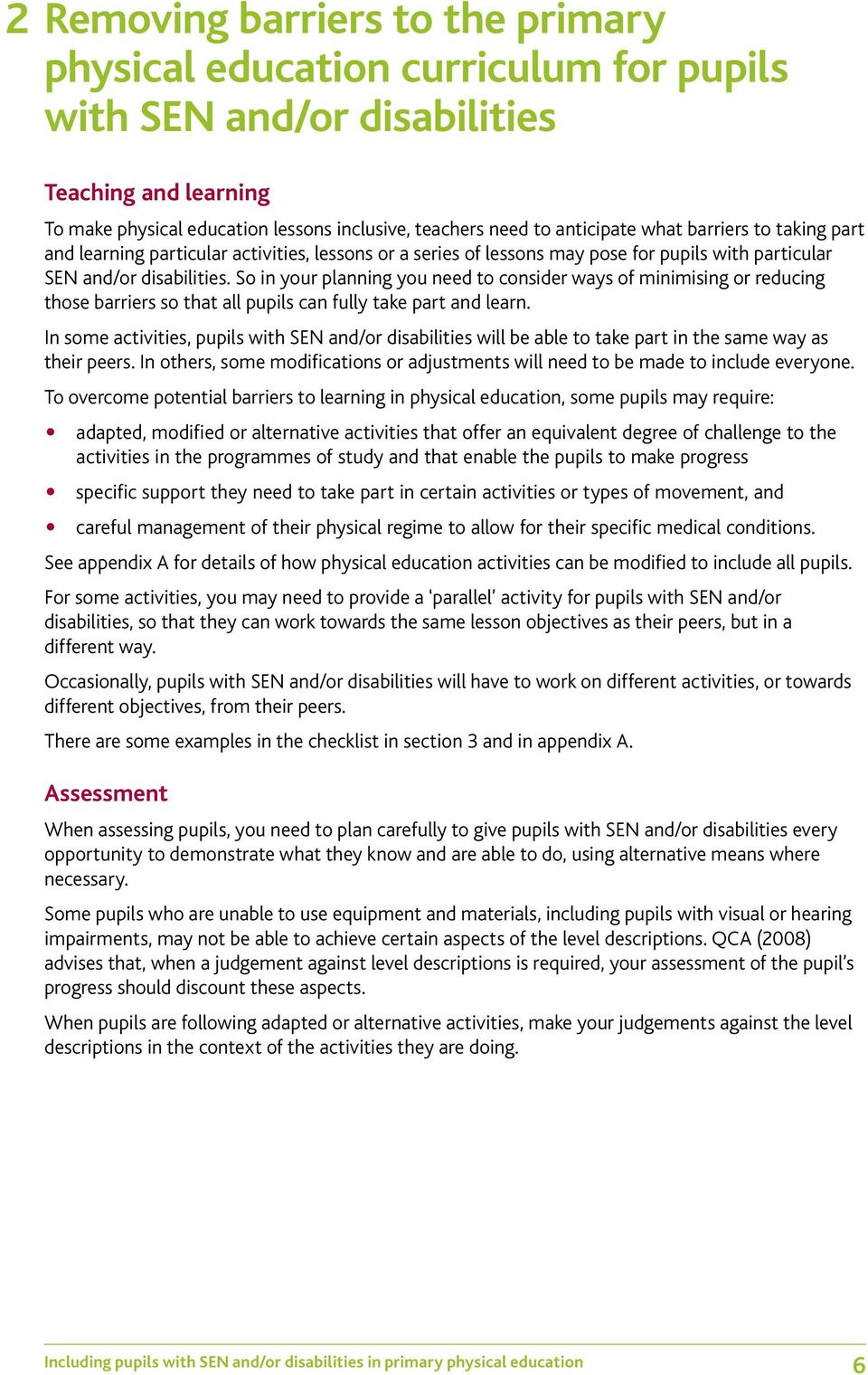
6 2 Removing barriers to the primary physical education curriculum for pupils with SEN and/or disabilities Teaching and learning To make physical education lessons inclusive, teachers need to anticipate what barriers to taking part and learning particular activities, lessons or a series of lessons may pose for pupils with particular SEN and/or disabilities. So in your planning you need to consider ways of minimising or reducing those barriers so that all pupils can fully take part and learn. In some activities, pupils with SEN and/or disabilities will be able to take part in the same way as their peers. In others, some modifications or adjustments will need to be made to include everyone. To overcome potential barriers to learning in physical education, some pupils may require: adapted, modified or alternative activities that offer an equivalent degree of challenge to the activities in the programmes of study and that enable the pupils to make progress specific support they need to take part in certain activities or types of movement, and careful management of their physical regime to allow for their specific medical conditions. See appendix A for details of how physical education activities can be modified to include all pupils. For some activities, you may need to provide a parallel activity for pupils with SEN and/or disabilities, so that they can work towards the same lesson objectives as their peers, but in a different way. Occasionally, pupils with SEN and/or disabilities will have to work on different activities, or towards different objectives, from their peers. There are some examples in the checklist in section 3 and in appendix A. Assessment When assessing pupils, you need to plan carefully to give pupils with SEN and/or disabilities every opportunity to demonstrate what they know and are able to do, using alternative means where necessary. Some pupils who are unable to use equipment and materials, including pupils with visual or hearing impairments, may not be able to achieve certain aspects of the level descriptions. QCA (2008) advises that, when a judgement against level descriptions is required, your assessment of the pupil s progress should discount these aspects. When pupils are following adapted or alternative activities, make your judgements against the level descriptions in the context of the activities they are doing. 6
7 3 Self-audit for inclusive physical education lessons: planning teaching, learning and support You can use the following checklist to audit your practice and plan for more inclusive lessons. The left-hand column of the table suggests approaches that are appropriate for pupils with SEN and/or disabilities in all subjects. The right-hand column suggests extensions and emphases that may be helpful in removing barriers for pupils with SEN and/or disabilities in physical education. In most cases, the actions recommended are good practice for all pupils, regardless of their particular SEN and/or disability. In other cases, the actions taken will depend on the barriers to taking part and learning identified in relation to the lesson being taught and pupils particular SEN and/or disabilities. For example, the challenges of including wheelchair users in athletics activities may be quite different from those for including pupils with other SEN and/or disabilities. Some children with identified needs such as behaviour difficulties may benefit from changes in activities or working with selected others or rest breaks. In these cases it is helpful to discuss and plan with a support assistant who knows the child well. The SENCO, subject associations and/or organisations supporting people with particular SEN/disabilities may be able to offer more specialist advice. These examples are not comprehensive or exhaustive. They are intended to stimulate thinking rather than offer detailed advice on how to teach the subject to pupils with different types of special educational needs and/or disabilities. You will wish to add your own general or subject-specific ideas to the self-audit table. 7

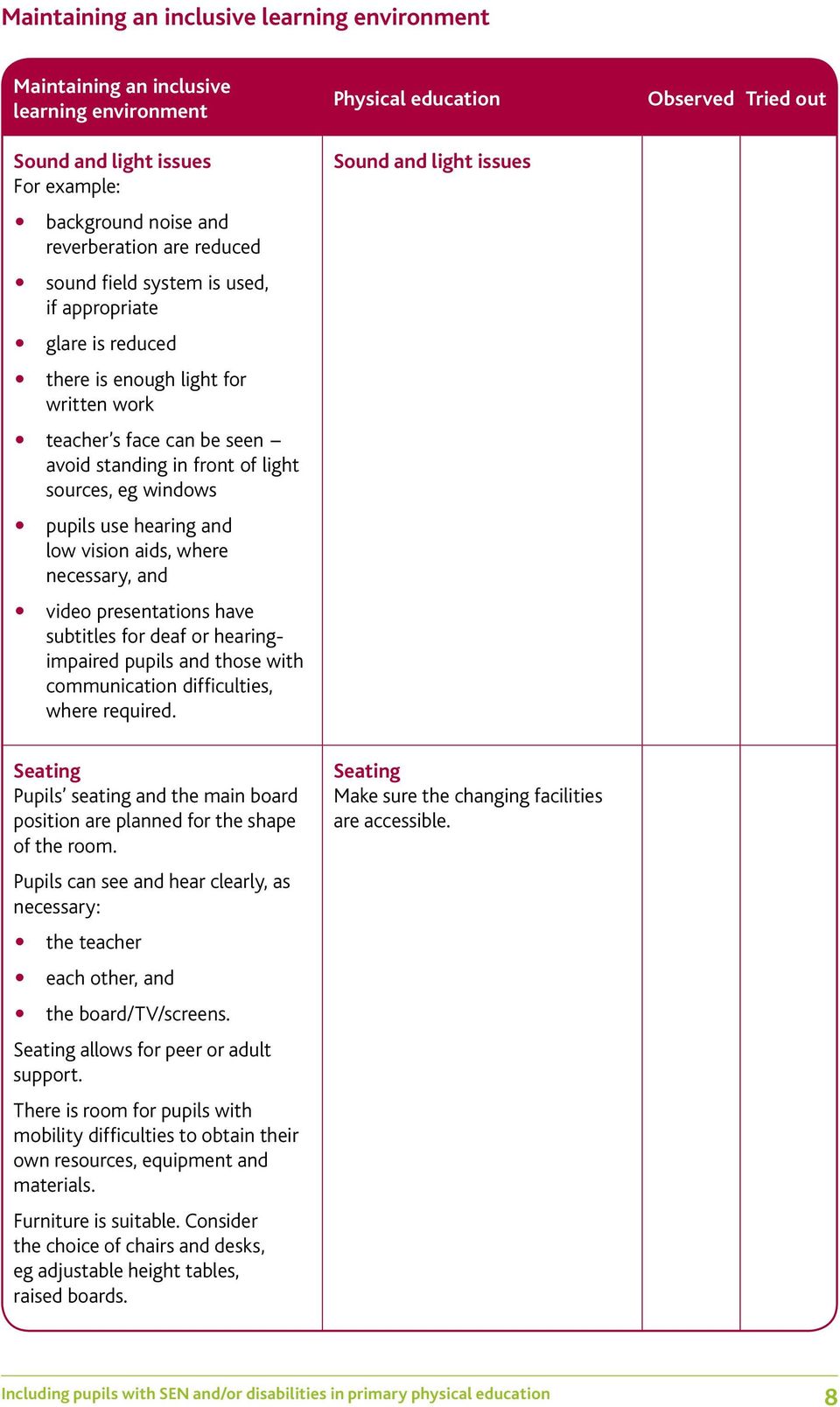
8 Maintaining an inclusive learning environment Maintaining an inclusive learning environment Sound and light issues For example: background noise and reverberation are reduced sound field system is used, if appropriate glare is reduced there is enough light for written work teacher s face can be seen avoid standing in front of light sources, eg windows pupils use hearing and low vision aids, where necessary, and video presentations have subtitles for deaf or hearingimpaired pupils and those with communication difficulties, where required. Physical education Sound and light issues Observed Tried out Seating Pupils seating and the main board position are planned for the shape of the room. Pupils can see and hear clearly, as necessary: the teacher each other, and the board/tv/screens. Seating allows for peer or adult support. There is room for pupils with mobility difficulties to obtain their own resources, equipment and materials. Furniture is suitable. Consider the choice of chairs and desks, eg adjustable height tables, raised boards. Seating Make sure the changing facilities are accessible. 8
9 Maintaining an inclusive learning environment Resources Storage systems are predictable. Resources are: accessible, eg within reach, and labelled clearly to encourage independent use, eg using images, colour coding, large print, symbols, Braille, as appropriate. Displays Displays are: accessible, within reach, visual, tactile informative, and engaging. Be aware of potentially distracting elements of wall displays. Low-arousal areas A low-arousal area is planned for pupils who may need it and is available for use by all pupils. The area only needs to have immediately relevant materials/ resources to minimise distraction. Health and safety Health and safety issues have been considered, eg trailing leads secured, steps and table edges marked. There is room for pupils with mobility difficulties to leave the site of an accident. Remember that pupils with an autistic spectrum disorder (ASD) may have low awareness of danger. Physical education Resources Displays Low-arousal areas Health and safety Some pupils will require careful management of their physical regime to allow for their specific medical conditions. In some games, using different zones can create safe playing areas or areas where pupils can be matched by ability see appendix A. Consider what clothing may be required for expeditions or camps for pupils who have limited mobility or sensation. Observed Tried out 9

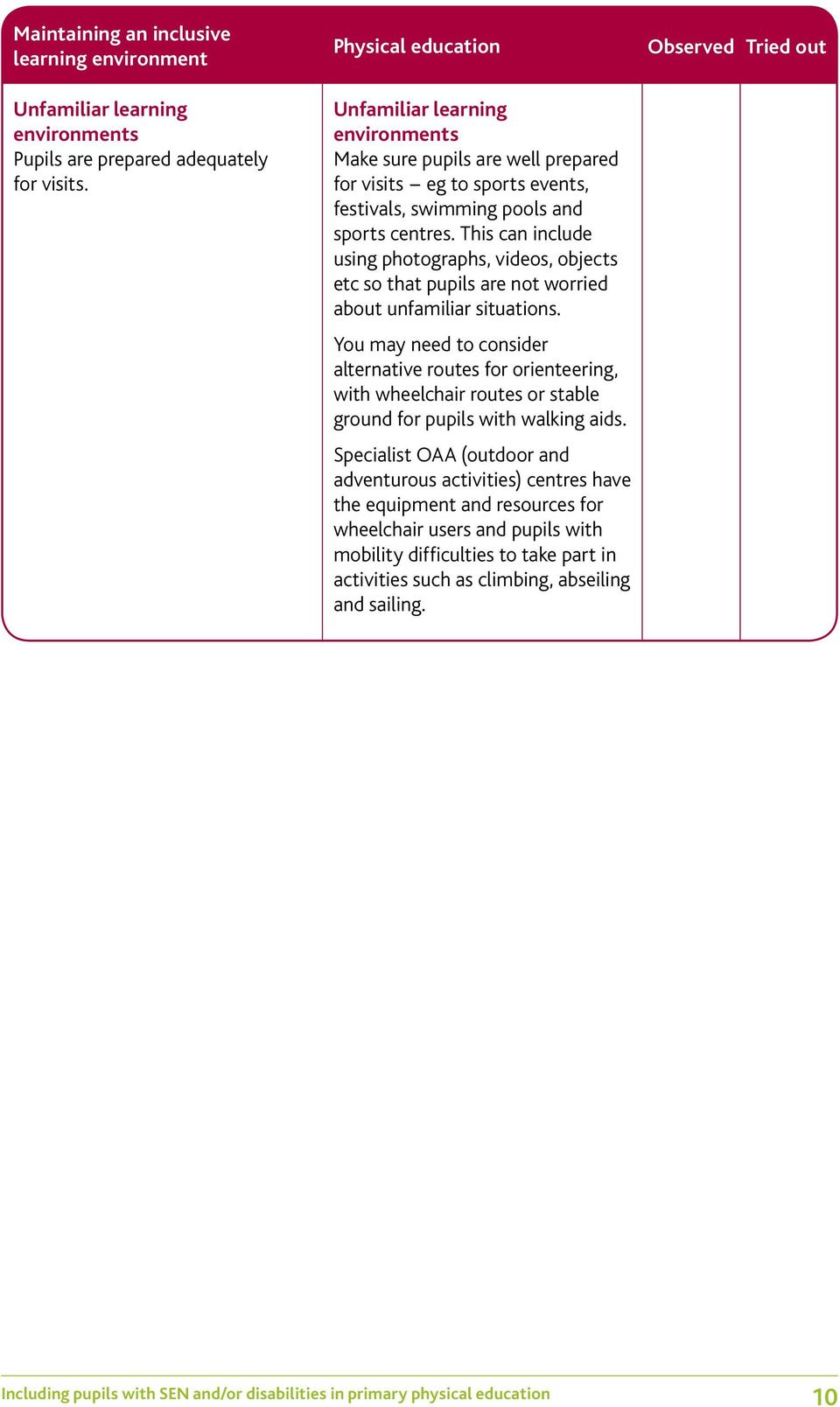
10 Maintaining an inclusive learning environment Unfamiliar learning environments Pupils are prepared adequately for visits. Physical education Unfamiliar learning environments Make sure pupils are well prepared for visits eg to sports events, festivals, swimming pools and sports centres. This can include using photographs, videos, objects etc so that pupils are not worried about unfamiliar situations. You may need to consider alternative routes for orienteering, with wheelchair routes or stable ground for pupils with walking aids. Specialist OAA (outdoor and adventurous activities) centres have the equipment and resources for wheelchair users and pupils with mobility difficulties to take part in activities such as climbing, abseiling and sailing. Observed Tried out 10
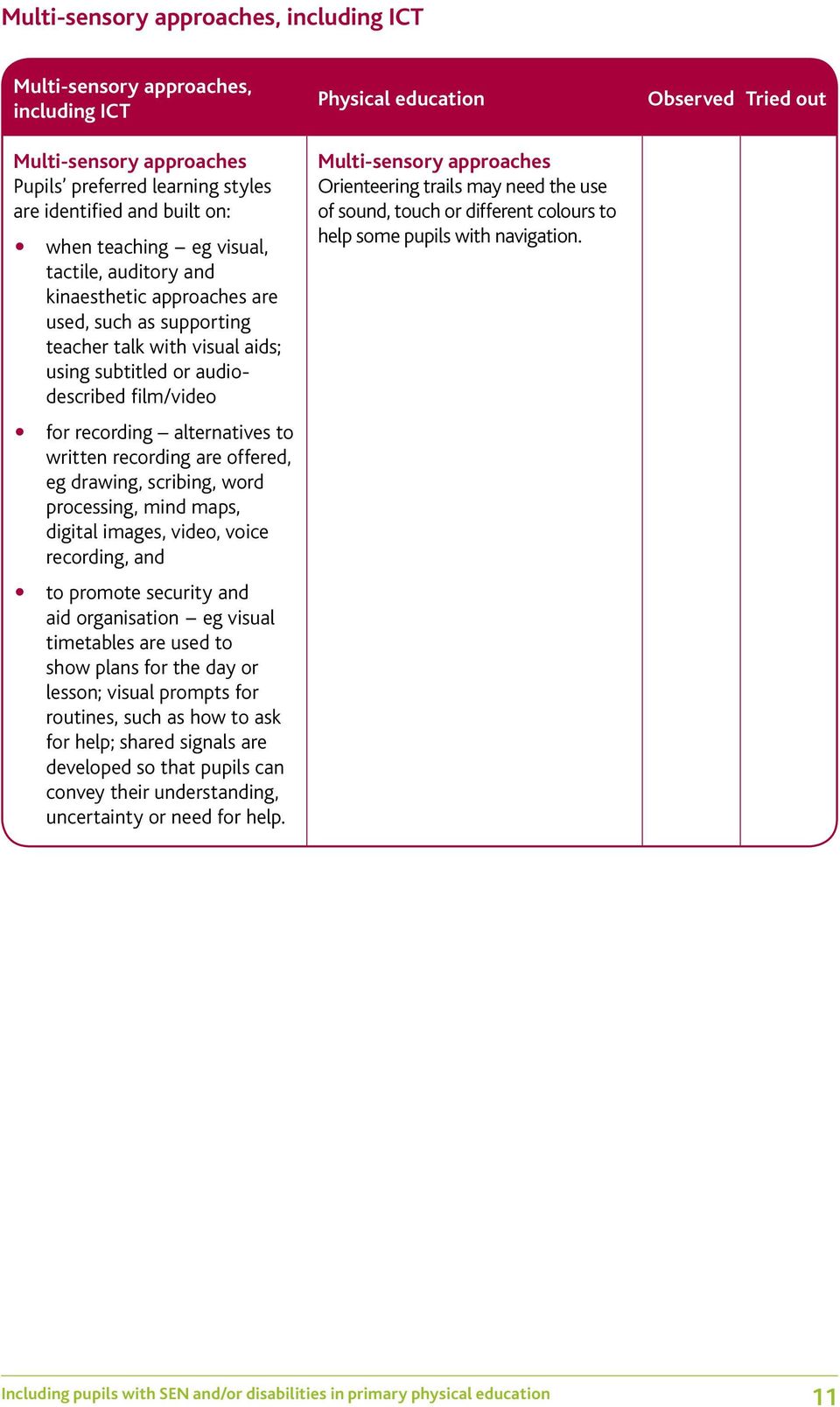
11 Multi-sensory approaches, including ICT Multi-sensory approaches, including ICT Multi-sensory approaches Pupils preferred learning styles are identified and built on: when teaching eg visual, tactile, auditory and kinaesthetic approaches are used, such as supporting teacher talk with visual aids; using subtitled or audiodescribed film/video for recording alternatives to written recording are offered, eg drawing, scribing, word processing, mind maps, digital images, video, voice recording, and to promote security and aid organisation eg visual timetables are used to show plans for the day or lesson; visual prompts for routines, such as how to ask for help; shared signals are developed so that pupils can convey their understanding, uncertainty or need for help. Physical education Multi-sensory approaches Orienteering trails may need the use of sound, touch or different colours to help some pupils with navigation. Observed Tried out 11
12 Multi-sensory approaches, including ICT ICT ICT is used to support teaching and learning. Accessibility features are used to include pupils with SEN and/or disabilities, as appropriate, eg: keyboard shortcuts instead of a mouse sticky keys a foot-controlled mouse, a head-controlled mouse or a wireless mouse screen filters to cut down glare increased font sizes for screen extension in any case, fonts used in printed material should not be smaller than 12 pt (24 pt for screen presentations) clear font type (normally sans serif, such as Arial or Comic Sans) appropriate contrast between background and text, and/or a talking word processor to read out text. Pupils with poor motor control may gain confidence and achieve success through writing/drawing on the computer. Predictive text can encourage pupils to use a more extensive vocabulary and attempt difficult spellings. It can be enhanced by using subject-specific dictionaries. Physical education ICT In physical education, ICT 1 allows pupils to: record their performance using digital cameras or video and replay it to help improve their performance eg using programs such as Dartfish 2 record, monitor and track personal performance communicate with others watch elite performances, and carry out research eg Webwise offers a simplified version of web pages. Observed Tried out 1 Where this booklet refers to a specific product, no recommendation or endorsement of that product is intended, nor should be inferred. 2 Dartfish allows teachers and instructors to integrate video feedback in real time in the classroom. You can capture events happening in the lesson and replay them immediately. Teachers and pupils can then enhance the video with information, annotations etc. 12

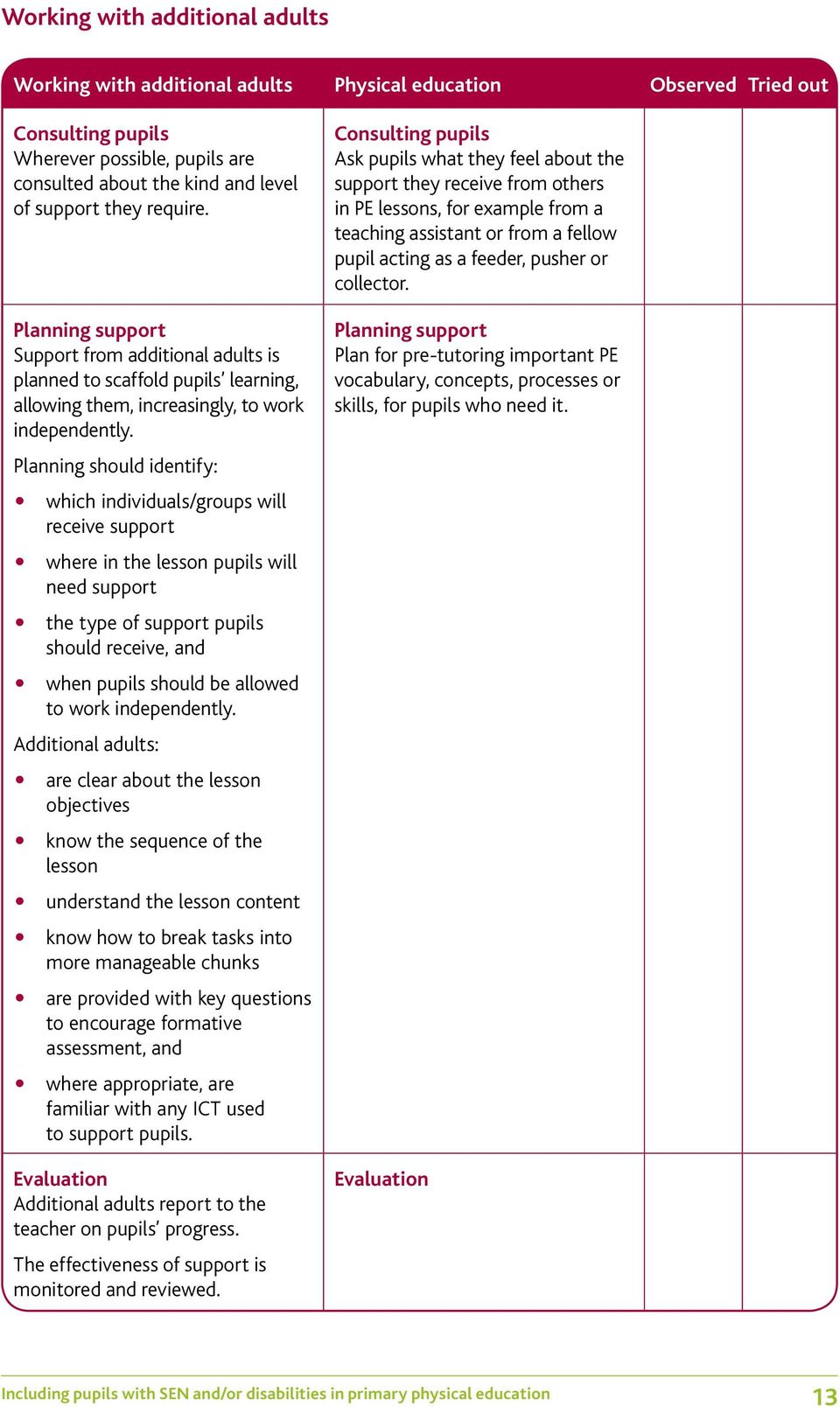
13 Working with additional adults Working with additional adults Physical education Observed Tried out Consulting pupils Wherever possible, pupils are consulted about the kind and level of support they require. Planning support Support from additional adults is planned to scaffold pupils learning, allowing them, increasingly, to work independently. Planning should identify: which individuals/groups will receive support where in the lesson pupils will need support the type of support pupils should receive, and when pupils should be allowed to work independently. Additional adults: are clear about the lesson objectives know the sequence of the lesson understand the lesson content know how to break tasks into more manageable chunks are provided with key questions to encourage formative assessment, and where appropriate, are familiar with any ICT used to support pupils. Evaluation Additional adults report to the teacher on pupils progress. The effectiveness of support is monitored and reviewed. Consulting pupils Ask pupils what they feel about the support they receive from others in PE lessons, for example from a teaching assistant or from a fellow pupil acting as a feeder, pusher or collector. Planning support Plan for pre-tutoring important PE vocabulary, concepts, processes or skills, for pupils who need it. Evaluation 13
14 Managing peer relationships Managing peer relationships Physical education Observed Tried out Grouping pupils All forms of pupil grouping include pupils with SEN and/or disabilities. Manageable mixed-ability grouping or pairing is the norm, except when carefully planned for a particular purpose. Sequence of groupings is outlined for pupils. The transition from whole-class to group or independent work, and back, is clearly signalled. This is particularly helpful for pupils on the autistic spectrum. Managing group work and discussion Pupils move carefully from paired discussion to group discussion the language necessary for whole-class discussion work may be a barrier for pupils who find it difficult to express themselves in public. Paired and small group discussions provide opportunities for all to take part. Pupils are assigned specific roles (eg chair, writer, reporter, observer) which gives all pupils something to do and keeps them focused. Grouping pupils Managing group work and discussion 14

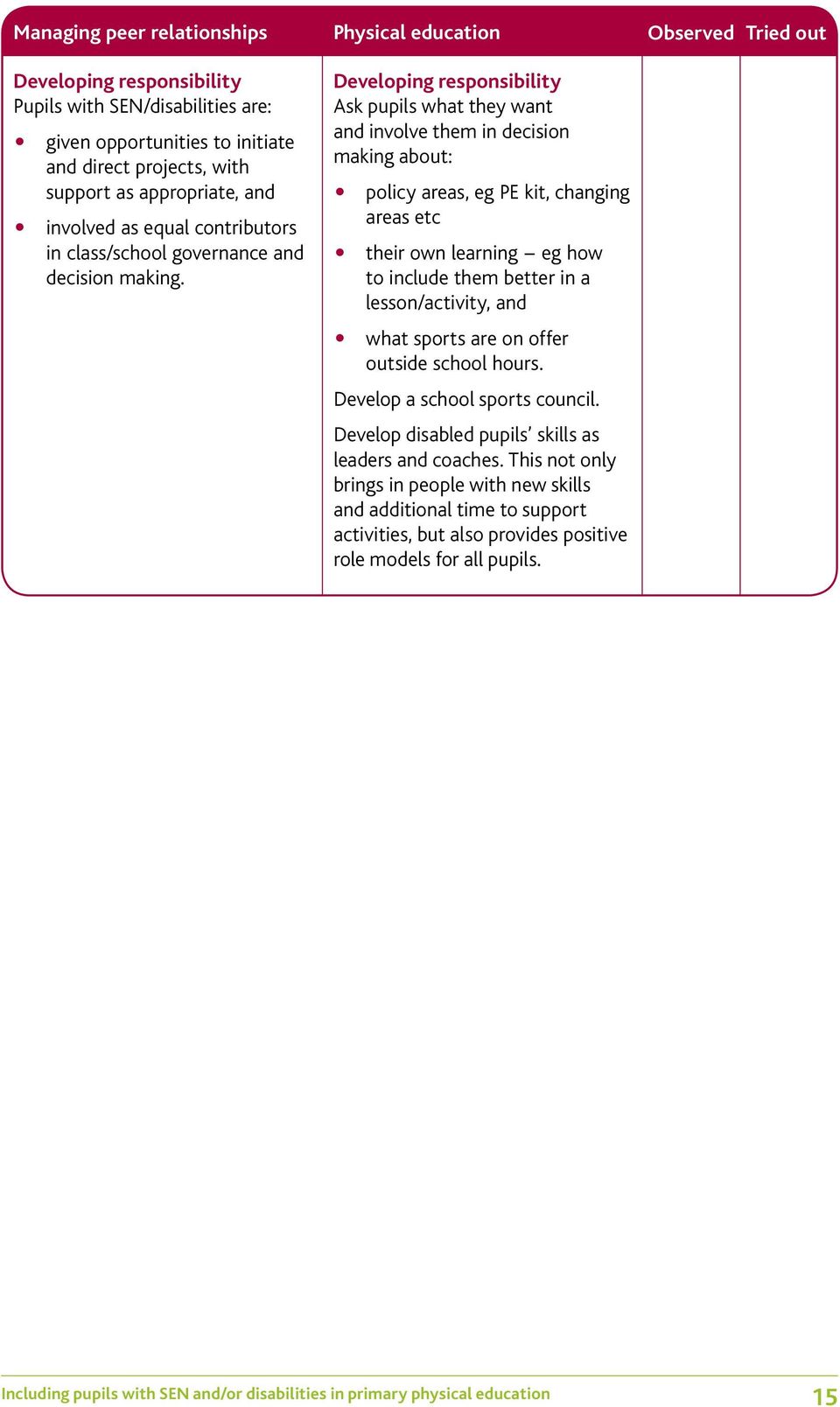
15 Managing peer relationships Physical education Observed Tried out Developing responsibility Pupils with SEN/disabilities are: given opportunities to initiate and direct projects, with support as appropriate, and involved as equal contributors in class/school governance and decision making. Developing responsibility Ask pupils what they want and involve them in decision making about: policy areas, eg PE kit, changing areas etc their own learning eg how to include them better in a lesson/activity, and what sports are on offer outside school hours. Develop a school sports council. Develop disabled pupils skills as leaders and coaches. This not only brings in people with new skills and additional time to support activities, but also provides positive role models for all pupils. 15
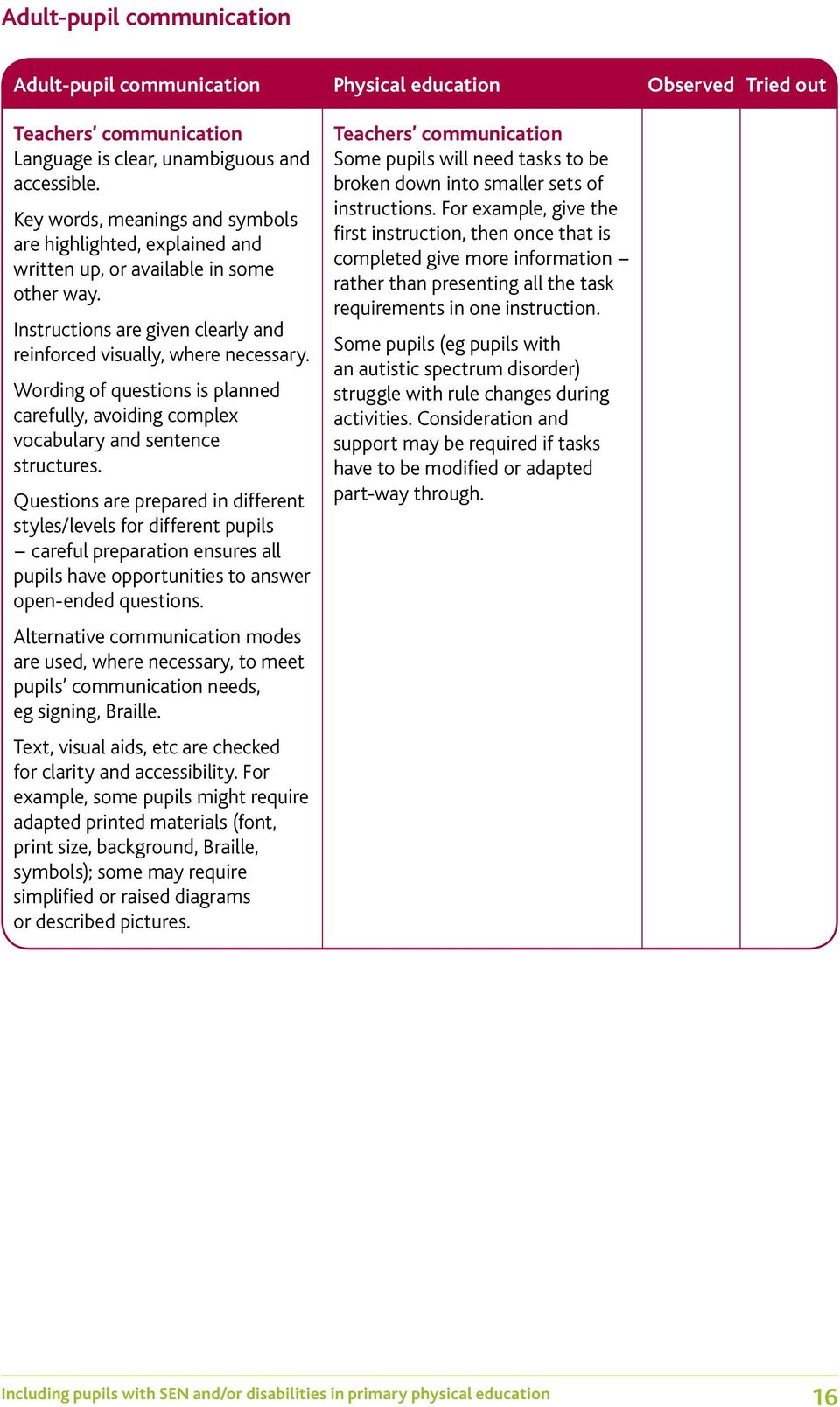
16 Adult-pupil communication Adult-pupil communication Physical education Observed Tried out Teachers communication Language is clear, unambiguous and accessible. Key words, meanings and symbols are highlighted, explained and written up, or available in some other way. Instructions are given clearly and reinforced visually, where necessary. Wording of questions is planned carefully, avoiding complex vocabulary and sentence structures. Questions are prepared in different styles/levels for different pupils careful preparation ensures all pupils have opportunities to answer open-ended questions. Alternative communication modes are used, where necessary, to meet pupils communication needs, eg signing, Braille. Text, visual aids, etc are checked for clarity and accessibility. For example, some pupils might require adapted printed materials (font, print size, background, Braille, symbols); some may require simplified or raised diagrams or described pictures. Teachers communication Some pupils will need tasks to be broken down into smaller sets of instructions. For example, give the first instruction, then once that is completed give more information rather than presenting all the task requirements in one instruction. Some pupils (eg pupils with an autistic spectrum disorder) struggle with rule changes during activities. Consideration and support may be required if tasks have to be modified or adapted part-way through. 16
17 Adult-pupil communication Physical education Observed Tried out Pupils communication Alternative communication modes, such as sign or symbol systems, are encouraged, and pupils contributions are valued. Advice is sought from the SENCO, a speech and language therapist, local authority advisory staff, and/or the pupil themselves on the best way of using such communication modes in lessons. Discussion of experiences and investigations is encouraged to help pupils understand them. Pupil-teacher interaction Where appropriate, pupils are allowed time to discuss the answers to questions in pairs, before the teacher requests verbal responses. Pupils with communication impairments are given: time to think about questions before being required to respond time to explain, and respect for their responses to questions and contributions to discussions. Additional adults prepare pupils to contribute to feedback sessions, where necessary. Pupils communication Different forms of communication may be required to give pupils full access to activities such as orienteering eg verbal prompts, buddy systems or sign language. Pupil-teacher interaction 17

18 Formative assessment/assessment for learning Formative assessment/ assessment for learning Understanding the aims of the lesson Lesson objectives are made clear in pictures/symbols/writing, as appropriate. Objectives are challenging yet achievable. This will promote selfesteem and enable all pupils to achieve success. Focus on how pupils learn Pupils own ways of learning and remembering things are emphasised. Pupils are encouraged to talk about how they achieved something. Dialogue is the key to successful assessment for learning. Teachers communicate in ways pupils are comfortable with. Pupils know where they are in relation to learning aims End-of-lesson discussions focus on one or more of the ideas explored and the progress that pupils have made towards them during the lesson. Pupils are encouraged to look back to previous work/photos/ records to see how much progress they have made. Half-termly or termly selfassessment sheets are used for pupils to assess their progress a range of recording methods is accepted. Physical education Understanding the aims of the lesson Before starting an activity, clarify the rules of any game to be played and set how long it will be played. Identify specific areas that activities are designed to aid or improve: eg activity A will help with coordination, activity B will improve flexibility. Build up a chart (using a wallchart or other space) to show each lesson s focus and how successive lessons or topics link together to develop an area of work in PE. This could include symbols, images or objects to make it more accessible. Focus on how pupils learn Pupils know where they are in relation to learning aims Still or video images can be used to build a visual or audio-visual record of pupils progress in developing new skills. Revisiting a mind map of the same area of learning, say after three weeks of studying a topic in PE, can be a good way of assessing through the added branches of the map how pupils understanding of concepts is developing. This approach can be particularly valuable for pupils for whom oral and written communication present a barrier, as pictures and symbols can be included. Observed Tried out 18

19 Formative assessment/ assessment for learning Giving feedback Marking and other feedback helps pupils improve their performance. Feedback is given in an appropriate form verbally, in writing. Specific, rather than general, feedback is given. Comments are positive, explicit and evaluative. Emphasis is on the pupils progress and achievement. Weaknesses are presented as areas for development. Opportunities are offered for pupils to attempt a piece of work again. These approaches are particularly useful for pupils who find it difficult to receive comments about improving their work. Praise is given discreetly where pupils find public praise embarrassing or difficult. Physical education Giving feedback Observed Tried out Understanding assessment criteria The number of goals/assessment criteria is kept small. Teachers talk to pupils about what they are trying to achieve. Pupils are involved in setting their own goals. Some pupils may find it difficult to understand the need for targets. Others may need time and support in target setting. Self-assessment and peer assessment are encouraged. Pupils are taught to use the language of assessment, eg better. Peer marking is encouraged, where buddies can evaluate each other s work in relation to success criteria. Understanding assessment criteria 19

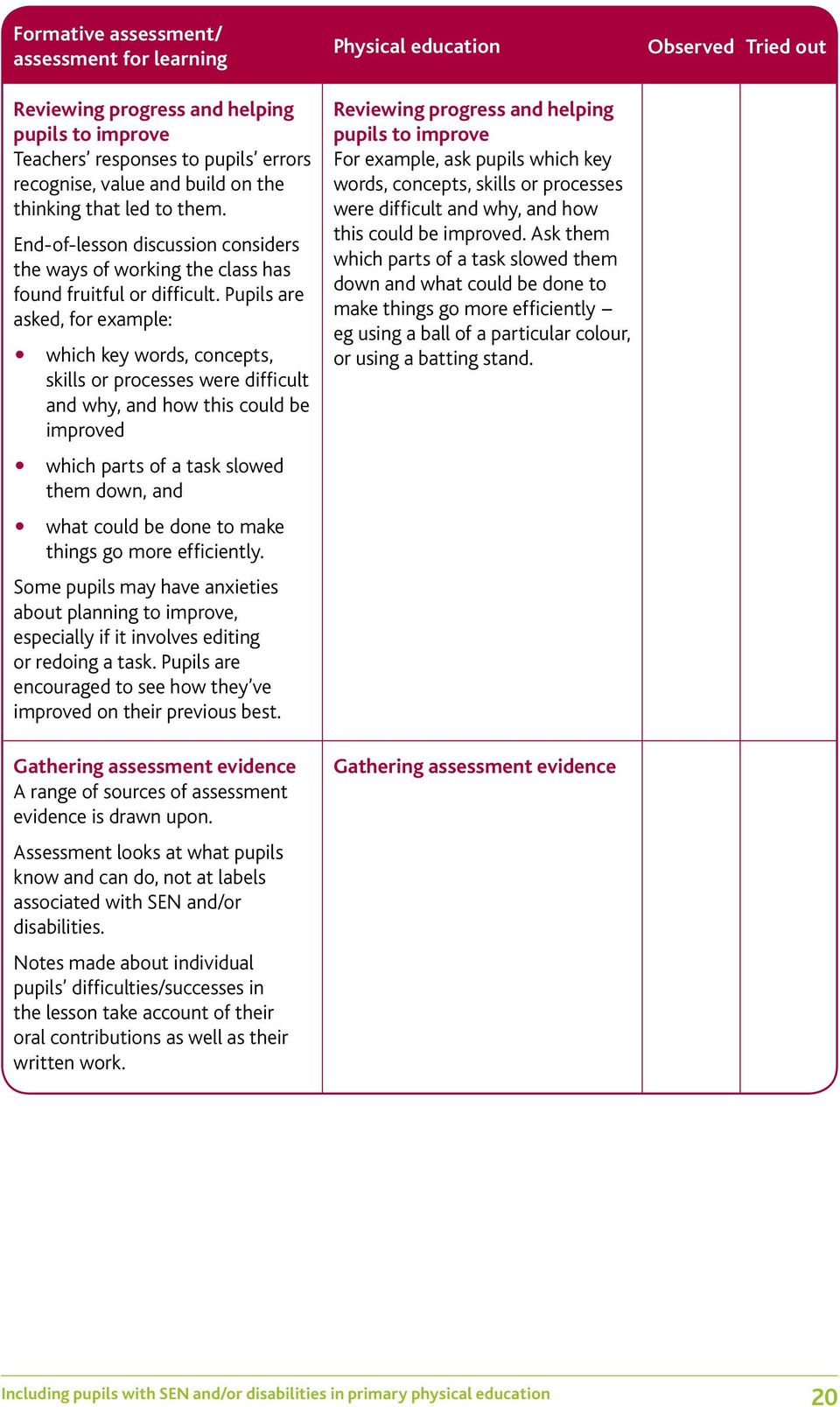
20 Formative assessment/ assessment for learning Reviewing progress and helping pupils to improve Teachers responses to pupils errors recognise, value and build on the thinking that led to them. End-of-lesson discussion considers the ways of working the class has found fruitful or difficult. Pupils are asked, for example: which key words, concepts, skills or processes were difficult and why, and how this could be improved which parts of a task slowed them down, and what could be done to make things go more efficiently. Some pupils may have anxieties about planning to improve, especially if it involves editing or redoing a task. Pupils are encouraged to see how they ve improved on their previous best. Gathering assessment evidence A range of sources of assessment evidence is drawn upon. Assessment looks at what pupils know and can do, not at labels associated with SEN and/or disabilities. Notes made about individual pupils difficulties/successes in the lesson take account of their oral contributions as well as their written work. Physical education Reviewing progress and helping pupils to improve For example, ask pupils which key words, concepts, skills or processes were difficult and why, and how this could be improved. Ask them which parts of a task slowed them down and what could be done to make things go more efficiently eg using a ball of a particular colour, or using a batting stand. Gathering assessment evidence Observed Tried out 20
21 Motivation Motivation Physical education Observed Tried out Understanding the structure of the lesson Pupils are clear about the duration and overall structure of the lesson. Visual timetables or other devices are used to indicate the structure and progress of lessons. Relevant and motivating tasks Tasks motivate pupils. They: stimulate interest and enthusiasm are challenging but manageable draw on real and familiar contexts are relevant to pupils lives, and build on previous learning in the subject and in other areas of the curriculum. Reward systems Pupils understand reward systems and are motivated to achieve the rewards available. Understanding the structure of the lesson Relevant and motivating tasks Reward systems 21
22 Memory/consolidation Memory/consolidation Physical education Observed Tried out Recapping Recap learning from the previous lesson. Main points from the lesson are fed back by pupils, noted down and saved so pupils can refer to them. Reducing reliance on memory The amount of material to be remembered is reduced. Repeat or display important information. The meaningfulness and familiarity of the material is increased. Mental processing and explanations of complex tasks are simplified. The use of memory aids is encouraged. These can include wallcharts and posters, useful spellings, personalised dictionaries, cubes, counters, abacus, Unifix blocks, number lines, multiplication grids, calculators, memory cards, audio recorders and computer software. Activities are structured so that pupils can use available resources, such as word banks. Strategies, including using ICTbased records, are used to reduce the need for pupils to rely on their short- or long-term memories. New learning fits into the framework of what the pupil already knows. Teaching assistants prepare pupils to contribute to feedback sessions, where appropriate. Recapping Reducing reliance on memory Consider ways of supporting pupils recall eg use a digital camera to capture the various stages of a gymnastic skill for future reference. In dance, if pupils find it difficult to remember a sequence of movements, work out a system of cues, which give clues as to what comes next. The cues can be in the music, spoken words or additional sounds, etc. 22
23 Memory/consolidation Physical education Observed Tried out Consolidating learning Pupils understanding is checked, eg by inviting pupils to reformulate key learning. Using visual or concrete ( real ) materials, or activities involving movement, to reinforce or consolidate learning through a range of sensory channels. Reteach or revise material, where necessary, eg post-lesson tutoring. Opportunities are provided for pupils to repeat and reinforce previously learnt skills and processes on a regular basis, in similar and different contexts. Encourage pupils to develop their own strategies, eg an agreed approach to asking for help, rehearsal, note-taking, use of longterm memory, and place-keeping and organisational strategies. Independent study/homework Independent study/homework is explained during the lesson, not at the end, to make sure it is understood and recorded. Teachers check all pupils are clear about homework tasks. Homework tasks are accessible after the lesson, eg published on a noticeboard or on the school learning platform, so pupils can return to them, if necessary, after the lesson. Consolidating learning Independent study/homework 23
24 4 Physical education and Every Child Matters In 2003, the green paper Every Child Matters: Change for children was published. The key outcomes for the Every Child Matters (ECM) agenda were drawn up after consultation with children, young people and families. The five outcomes that mattered most to children and young people are set out below. Each of the outcomes can be addressed through the physical education curriculum. Outcome General educational aspects Through the PE curriculum Be healthy Work towards independent learning Actively enquire about differing environments Keep mentally and emotionally healthy Learning that promotes pupils health, safety and well-being so they are committed to PE and sport and make them a central part of their lives both in and out of school. They know and understand what they are trying to achieve and how to go about doing it. Pupils understand that PE and sport are an important part of a healthy, active lifestyle. Stay safe Keep safe in school and on school trips PE promotes pupils health, safety and well-being. Have stability and security Know about their place in the wider community Enjoy and achieve Achieve personal and social development Enjoy lessons Achieve to their potential Use alternatives to written recording, where appropriate All pupils, whatever their circumstances or ability, can take part in and enjoy PE and school and community sport. PE builds pupils stamina, suppleness and strength to persevere in academic and social tasks. Pupils show a desire to improve and achieve in relation to their own abilities. Make a positive contribution Understand issues of difference and diversity through studying other environments and cultures Understand about, and support, the local community Involve themselves in extra-curricular activities The learning should enable all pupils to: have the confidence to get involved in PE and sport gain the skills and control that they need to take part in PE and sport take part willingly in a range of competitive, creative and challengetype activities, as individuals and as part of a team or group, and think about what they are doing and make appropriate decisions for themselves. 24
25 Outcome General educational aspects Through the PE curriculum Achieve economic well-being Learn about ways to ensure their own economic well-being in the future Problem solving and team working helps equip pupils for work in later life. Experience visits from people who do various jobs Visit different workplaces Learn about different economies in different countries 25
26 5 Early development in the National Curriculum: the P scales for physical education For pupils working below level 1 of the National Curriculum, performance descriptions (P scales) for PE can be used to describe a best fit for a pupil s performance. All schools must report on pupils attainment at the end of each key stage in terms of both P scales and national curriculum levels. P scales 1 3 address very early levels of learning and are the same in all subjects, but illustrated with subject-specific examples. As a trainee teacher, you may not meet pupils assessed at these very early levels very often. If you have to teach these pupils during your placements, you should expect a great deal of support in differentiating teaching and learning. From P4 each subject has its own progression. At P4, pupils movement patterns are established and they perform single actions, for example rolling, running, jumping or splashing. By P6, they link movements in a simple sequence, although they may require support to do this. At P8, pupils follow and imitate sequences and patterns in their movements. They play simple games and may require support to keep score and follow game rules. From P8, pupils move to the national curriculum levels. While a typically developing child will have achieved P8 by the age of four, some pupils will take considerably longer. At all times you should be aware of the need to respect the developmental maturity of the pupils you are planning for. Choose materials and tasks appropriate to the age and maturity of the pupils. This is a particular issue when using software and other published resources. 26
27 6 Bilingual learners Children must not be regarded as having a learning difficulty solely because the language or form of language of their home is different from the language in which they will be taught. SEN Code of Practice (DfES, 2001) Pupils must not be regarded as having a learning difficulty because they are learning English as an additional language (EAL). Bilingual learners take up to two years to develop basic communication skills (street and playground survival language). Some pupils may take a long time before they feel confident enough to actively take part in classroom activities and use the English they have learnt. A silent period is typical of this learning and should not be seen as a learning difficulty. Many learners with EAL do not acquire language in the same way as first language learners. A pupil may be fluent orally but struggle considerably with reading or writing; or a pupil may be very literate in written English, but lack confidence in the rapid flow of speech required in conversational dialogue. It is therefore important to assess language competence in all language modes and not to assume a level of competence based on performance in one mode. A Language in Common (QCA, 2000) is a common assessment scale that can be used to gauge where pupils are in their acquisition of English. It gives assessment steps for pupils with EAL working below national curriculum level 1 and is useful in helping teachers reach a common understanding of the nature of each step or level of language acquisition. It also shows how the information can be used for target setting and what support may be needed to ensure progress. Another useful resource is Assessing the Needs of Bilingual Pupils: Living in two languages by Deryn Hall. When a class or subject teacher feels that a lack of progress in a bilingual pupil s learning may be due to a learning difficulty (SEN or disability) they should consult the SENCO or inclusion manager and work with them to develop an appropriate response. 27
28 7 Sources of information and advice Publications Andrews, C, 2005, Meeting SEN in the Curriculum: PE/sports, David Fulton Publishers Beveridge, S and Wiegand, P, 1999, Developing spatial independence among children with learning difficulties, in Robertson, M and Gerber, R (eds), The Child s World: Triggers for learning, Australian Council for Educational Research, Hawthorn, Victoria Davis, P and Florian, L, 2004, Teaching Strategies and Approaches for Pupils with Special Educational Needs: A Scoping Study, DfES Research Report RR516 Hall, D, 2001, Assessing the Needs of Bilingual Pupils: Living in two languages, David Fulton Publishers QCA, 2000, A Language in Common: Assessing English as an additional language QCA, 2009, Planning, Teaching and Assessing the Curriculum for Pupils with Learning Difficulties: Physical education available online at: Sugden, D and Talbot, M, 1998, Physical Education for Children with Special Needs in Mainstream Education, Carnegie National Sports Development Centre, Leeds TOP Sportsability resources and training (range of inclusive sports and activities) information sheet available online at: Vickerman, P, 2006, Teaching Physical Education to Children with Special Educational Needs, Routledge Winnick, J P (ed), 1990, Adapted Physical Education and Sport, 4th Edition, Human Kinetics Publishers Wright, H C, and Sugden, D, 1999, Physical Education for All: Developing physical education in the curriculum for pupils with special educational needs, David Fulton Publishers CD ROM DfES, 2003, Success for All: An inclusive approach to PE and school sport. For copies contact the Youth Sport Trust Inclusion Officer on DVD DfES and Youth Sport Trust, 2006, Don t Forget Me! An inclusive approach to outdoor and adventurous activities. For copies contact the Youth Sport Trust Inclusion Officer on Websites Association for Physical Education (AfPE) has some good resources: The new British Paralympics pack for schools: Ability vs. Ability is a cross-curricular resource for any subject area and includes specific links to curriculum content. There are links to the ECM and Pupils First initiatives. 28
29 1 Appendix A Including all pupils in the physical education curriculum The STEP process of modifying and adapting the PE curriculum Modifying an activity can make it easier or harder. One way of looking at this modification process is the STEP method. The STEP principle underpins the delivery of inclusive PE. STEP stands for How can I change? S Space Where the activity is happening? T Task What is happening? E Equipment What is being used? P People Who is involved? Whatever you want to achieve eg making an activity more challenging physically or easier to understand you can change the space, task, equipment or people to achieve this. Making the activity easier will enable pupils to take part. Making the activity harder will challenge and extend their skills. Space How can we change the size/height/location/length/distance? Where? Shorter distances or smaller areas may make the activity easier Using a zoned playing area can create safe playing areas or areas where pupils can be matched by ability Nearer targets make games easier More space in ball games may give more reaction time Throwing activities, such as foam javelin practice, can be carried out in front of walls, making it easier to collect items Floor-based activities have different requirements from those played on a level surface, and from seated or ambulant activities Pupils can start at different times or from different places eg varying space in striking games to challenge more able pupils 29
30 Task How can we change the way we take part/complexity/ role/rules/speed/progressions? What? Simplify the activity by changing an aspect of it eg long jump to standing jump Make the activity harder eg long jump to triple jump Give pupils specific roles eg timer, measurer Change rules to increase inclusion eg allow different starting places or rules to ensure everyone is involved Be flexible Vary the speed of the activity eg everyone walks Vary the speed of the ball eg slow underarm delivery Try different forms of involvement eg seated, standing, lying down Use different targets for some pupils More able pupils use their non-dominant hand Everyone closes their eyes in balance activities Equipment Can be varied by type: These can vary in: What is being used? balls, mats, flags, scarves, feet, cones, bean bags, floats, hurdles, plastic markers, ropes, canes, soft equipment, bats, racquets, etc size, shape, colour, texture, weight, environment, play surface, indoor/outdoor, length of handle, etc A change of equipment can change the activity in a variety of ways: lighter balls travel more slowly in the air and give more reaction time larger balls are easier to see and catch softer/slightly deflated balls are easier to catch noise (ie jingle trainer) gives audio as well as visual stimulus different coloured balls are easier to distinguish from the background colour 30
31 People How can we change the groupings/interaction/way the pupils play together? Who with? Independently, in groups, in pairs, in teams, with friends Change groupings between activities, and monitor groupings to make sure they vary (especially when involving a learning support assistant) In their own space: big or small Restricted space or open space Different mediums eg on poolside or in water Different or the same roles Different or the same ability Mixed ability Using a zoned playing area to create safe playing areas or areas where pupils can be matched on ability Using a buddy system where one pupil helps to facilitate an activity for another eg as a guide for a visually impaired runner 31
32 2 The inclusion spectrum The inclusion spectrum gives teachers the opportunity to respond to pupils diverse learning needs by providing five different, but complementary, ways of including disabled pupils. Inclusion can be achieved by changing the environment of the activity or the way it is presented. Teachers can provide inclusive, adapted, modified or separate activities or approaches to learning. In most lessons, the teacher will use more than one approach, to ensure that all pupils are included throughout the lesson. Open activity In an open activity, all pupils are included in the same task with minimal or no adaptation or modification. Open activities need to be adapted so that they consist of elements that everyone can do. If an activity has a component that is too hard for a pupil, STEP can be used to change that aspect of the activity. Modified activity In a modified activity, changes are made to the task so that all pupils are included and can take part at a level appropriate to their ability. Modifications can be made to equipment, space, rules, speed, interaction and/or position. Modified activities use STEP to make sure elements of the activity stretch all pupils. All pupils are at different skill levels, so the activity has to be pitched at different skill levels too! Parallel activity Everyone does the same activity but different groups do it in different ways according to their abilities. Parallel activities rely on STEP to adapt each game so that pupils are all playing a game at a level that challenges them, but also gives them a degree of success. STEP enables parallel activities to be planned and developed. Disability sport activities have often been adapted and pupils could be taught to understand the STEP process by swimming hybrid strokes. Disability sport activity Disability sports activities such as Trail-O are developed or modified specifically with disabled people in mind. Non-disabled people can take part in disability sports activities. Separate activity Occasionally, it may be appropriate for some pupils to take part in activities separately from the rest of the class eg when preparing for a disability sport activity. However, this should not happen at the expense of these pupils being included in outdoor and adventurous activities more generally as part of the PE curriculum. Disabled pupils should be encouraged to pursue disability sports outside school hours, through school clubs or local sports clubs. Separate activities need to continually use STEP to reinforce existing skills and work on new ones at the right level. 32
33 3 Addressing concerns Two concerns are regularly expressed about disabled pupils taking part in PE and sport. 1 Disabled pupils do not take part in PE and sport as they cannot be included in PE games Possible solutions: audit current PE and sport opportunities to identify areas where improvements could be made and use STEP, and where disabled pupils cannot be included, produce alternative schemes of work with more appropriate activities eg using TOP Sportsability. 2 Disabled pupils do not have opportunities for competition Possible solutions: develop joint festivals with other special or mainstream schools in the area to allow for greater interaction between disabled pupils use festivals as part of the school s gifted and talented initiatives, linking pupils to local, county or regional events, and use alternative activity competitions eg boccia for both disabled and non-disabled pupils. 33
34 4 Examples 1 Ask pupils what they want and involve them in decision making about: policy areas eg PE kit, changing areas, etc their own learning eg how to include a disabled pupil in a lesson/activity, and what sports are on offer outside school hours. Develop a school sports council. 2 Ask pupils what they feel about the support they receive from others in PE lessons, for example from a teaching assistant or from a fellow pupil acting as a feeder, pusher or collector. 3 Involve pupils in developing their own noticeboards and designing posters to promote events, etc. 4 Dare to be a bit different. Be innovative. Try things out. If we always do what we have always done, we will always get the same result. Enthuse and excite pupils by creating new and different opportunities. Becoming more inclusive is a process not an end result. Introduce change over a period of time and anticipate where changes can be made in future provision. Use pupils creativity! 5 Identify agencies that have mutual interests and work with them on PE and school sport (PESS) inclusion initiatives. 6 Use different people as role models and leaders. Developing disabled pupils skills as leaders and coaches not only brings in people with new skills and additional time to support activity, but also provides different role models. 7 Learn from others. Take advantage of the support structures: locally, eg community groups area-based, eg Youth Sport Trust area teams, Sport England, English Federation of Disability Sport regional managers, and other partnerships, eg School Sport Partnerships and County Sports Partnerships. 34
35 5 Planning to remove barriers across the physical education curriculum Athletics Open activity Practise skills together, with minimal adaptation or modification eg sprints, middle distance, javelin, discus and shot using orthodox throwing methods Modified space Vary the size and width of throwing zones Modified rules Measure long jump from last position of take-off foot Posture walker users: lift knees high instead of hopping or skipping, or swing their legs through from two feet to two feet instead of jumping from two feet to two feet Run in and out of slalom cones/markers instead of moving sideways or backwards Modified equipment Lighter or safer indoor/foam javelin/discus/shot Pupils Work with others of the same ability Parallel activity Throwing javelin from a standing or seated position (throwing frame or wheelchair) Throwing discus/shot without turning, using their trunk and arms to gain forward and upward momentum Disability sport activity (adapted athletics) Height throw (vary weight/size of implement) Wheelchair slalom: indoor and outdoor courses can be used by non-disabled athletes running or using a wheelchair take it in turns to time keep Disability sport activity (separate) Individuals practise with disabled peers in disability athletics events for local, regional or national pan-disability or disability sport athletics competitions Javelin ball Distance club/precision club/precision bean bag/height throw Shuttle relay 60 metres Examples Open activity Modified activity Parallel activity Disability sport activity A group practise throwing a tennis ball underarm, sideways, overarm and backwards Shot putt with different weight shots and a handicap system of measuring distances Groups practise two pushes of their wheelchair, standing long jump, traditional long jump and triple jump Group do a wheelchair slalom course, some in chairs, some running 35
36 Running Distance Easier Short distance sprints, slalom courses or shuttle relays Harder Longer distance sprints, relays around the track Task Easier Longer distance covered by a group of people between them/ staggered starts, star runs (outwards from a central starting point) Harder Longer distance sprints Equipment Easier Use touch instead of baton in relays Harder Relay baton used, takeovers timed People Easier Mixed-ability groups Harder Time banded, rank order 36
37 Dance Examples Open activity Modified activity Modified group activity Everyone travels to meet and greet, using high fives, shaking hands or even a nod of the head Jumping may involve jumping a part of their body a hand or arm, or even an eye Group choreography with pupils interpreting motifs in different ways Parallel activity Disability sport activity Use of sticks, ribbons and material to explore space and dimensions Use of visual and auditory prompts, working in pairs or small groups Developing solo performances Wheelchair dance Dance teaching, as with any subject, is about choosing the pupil s channel. It is about looking at what they can do, spotting their potential, and giving them a safe framework in which to develop and progress. It is about having high but realistic expectations. Teaching ideas Use a variety of sounds: percussion, pop music, music from other cultures Use a range of apparatus: balloons, ribbons, material, bubbles, scarves, hoops Use pupils as choreographers give them a sound structure and let them develop the detail Use adaptations if someone can t use one side of the body, use the other or facilitate one side; use hands instead of feet Consider what level a pupil can work at aim for a mood rather than a complicated step pattern with some pupils Use a pupil s aid as a prop or a focus for the dance Move from concrete to abstract Use repetitive patterns Use visual and sound cues Use particular pupils as visual cues 37
38 Frequently asked questions about dance Q How can you dance if you can t use your feet? A You can dance with any part of your body. Q What other body parts can you use? A You can use your arms, your face, your eyes, your mouth, your head. Q How can using your eyes or mouth mean you are dancing? A Because you are still using responses to stimuli, direction, speed, dynamics, relationships. Pupils can put together and remember sequences, etc. Minimal movement does not mean minimal input. Q What do you do if pupils can t remember a sequence of movements, particularly in a performance piece? A You have to work out a system of cues, which give clues as to what comes next. The cues can be in the music, or by adding spoken words, sounds, etc. Q What do you do if pupils are unable to perform particular steps? A Make adaptations. Include step sequences for those who have the potential to perform them, but encourage pupils to think creatively about how the other dancers can be developed during step sequences. Perhaps it is to follow a theme or to pick up a motif. The possibilities are endless. Q How can pupils movement work be improved? A To perform quality dance, pupils need to see it. Use video to show examples of good practice. Work with gifted pupils from mainstream schools. Film the pupils work and view it with them. Q If pupils are performing in a dance piece and they are dancing using minimal movements eg with their eyes how can people see what they are doing? A Use film to capture small movements and display it on a large screen. Use technology in live performance work. Movements that may otherwise have been lost can then be enjoyed by everyone. 38
39 Games Open activity The vast majority of disabled pupils can be included in physical activity with little or no adaptation focus on what they can do Cooperative games include everyone at all times, sometimes in different roles It is important to make sure all pupils warm up by increasing blood flow to the muscle groups to be used, that joints are moved and muscles stretched ready for activity Modified rules Some players have more lives Players change role when caught Time out More bounces/steps/pushes/seconds Modified space Increase or decrease Alter width of goal lines Modified equipment Vary the size/weight of ball, or the size/weight/length of racket/stick Use ramps or slopes to send a ball Parallel activity Pupils play the same game as everyone else, in their own way eg standing or seated (if seated they have feet flat on the floor) Using a T stand to strike the ball in cricket, rounders, baseball or softball Zone hockey players in ability-matched zones eg electric wheelchair users Balloon tennis played indoors over a bench with their hand and a balloon Balloon badminton, using the same racket and net as the rest of the class, but using a balloon instead of a shuttlecock Disability sport activity Non-disabled pupils take part in disability sports Youth Sport Trust Sportsability resource cards, which are developing skills towards the games below Separate Polybat, boccia, table cricket, goal ball, short mat bowls practised for disability sport competitions 39
40 Strategies for modifying games STEPS: space, task, equipment, people, safety (Easier Harder) Hold Using the whole body, two arms / hands, one hand etc Koosh ball (fingers only) Spider ball 3 Balzac ball Floater ball Make the balls larger, lighter, slower, brighter colours (cartoon ball), or sound balls (bell ball) Aim Target near further away Target large smaller Target low higher Assistive device (guttering) Enabler (helper) Throw Hit with Objects: small, light, soft, flexible Assistive device (ramp/slope) or enabler Release over target Hand or foot Bat small/large/light Object large/light/soft/contrasting colour/bell Off T ball stand Enabler Runner 3 A giant inflatable ball with a soft cloth covering: see 40
41 Gymnastics Open activity Practise skills together, with little or no adaptation or modification Provide visual cues eg coloured shapes to enable pupils with poor spatial awareness to find a space or know where their starting/finishing place is Pupils who wear special boots/shoes/splints are able to balance and move more easily if they wear them in gymnastics Pupils with visual impairments who wear glasses may have poor spatial awareness or be at risk because of further impaired judgement without them Make sure pupils with limited sensation in their lower limbs wear tracksuit bottoms/leggings to avoid cuts and grazes Allow pupils with cerebral palsy time to respond and time to complete their tasks, especially on apparatus Modified activity Provide slopes or inclined benches to enable pupils with poor balance or coordination to climb high In direction games, when other pupils move sideways, wheelchair users can turn on the spot Access and exit points may be needed to allow a pupil to have choices and to explore the large apparatus Space: reduce or increase the area used Duration: vary according to pupils exercise tolerance Height: consider the width of the surface for balance (higher = wider, lower = narrower) and the height for impact Individual differences eg in flexibility may mean skills are performed differently Parallel activity Working towards common aims but in a specific way eg moving in a lying, seated or standing position, or travelling, whether on hands, feet or wheels Disability sport activity (adapted gymnastics) Concentration on movement exploration, such as Sherborne, involving group or pair work and individual trust, cooperation and expressive movement activities Separate activity Pupils work individually or with disabled peers in disability sports activities, eg for local, regional or national gymnastics competitions such as the Special Olympics or Special Gymnastics Association 41
42 Example: modified gymnastics (balance) Aspect Easier Harder Space " Designated space " Higher " Smaller area (larger for wheelchair " Space used freely users) " Apparatus with limited entry " Floor/lower and exit routes " Following arrows/colour cues Task Equipment People " Balance along a line " Balance on a shape on the floor " Balance in your wheelchair " A line on the floor " A shape on the floor " A mat " Low apparatus " Large surfaces " Support from teaching assistant " Individual " Balance along an upturned bench " Balance along a beam " Balance along an inclined bench " Longer, narrower bench/beam " Higher beam " Smaller, narrower surfaces " Inclined apparatus " With a partner " In a group Example: modified gymnastics (flight) Aspect Easier Harder Space Choice of exit routes Linear pathway, only one exit route (Different heights) lower apparatus Higher apparatus Task On and off instead of jump Flight from feet to hands Shape in the air Equipment Floor level Narrow Wide Inclined People Assisted flight Flight over partner Flight to land in water (swimming) Partner on apparatus 42
43 Outdoor and adventurous activities (OAA) Outdoor and adventurous activities are ideal for including all pupils, with minimal or no adaptations. The range of activities may take place at school (indoors or outdoors), in the local community or at specialist centres such as the Calvert trust in Keswick and Northumberland. In many activities, all pupils can work together in cooperative tasks at a level appropriate to their individual needs. Consequently, all pupils are capable of taking part in activities where their individual contribution is recognised and valued in meeting joint team tasks. Outdoor and adventurous activities also offer many opportunities for individual participation at levels appropriate to particular pupils needs. In considering the use of the inclusion spectrum in outdoor and adventurous activities, it is important to recognise that in many activities all pupils can participate and perform together. The critical success factor may not be to group pupils according to ability, but to set open tasks that recognise individual ability and designate roles in which all can contribute to a shared group outcome. As with all activities it is important that health and safety and risk assessments are undertaken beforehand. Local authorities and schools require the permission of the governing body for educational visits involving outdoor and adventurous activities. They must be satisfied that centres have met all the necessary statutory requirements. Cooperative tasks such as orienteering or navigation around trails can involve everyone, with different tasks according to pupils individual needs. Trails may need the use of sound, touch or different colours to help some pupils with navigation. Different forms of communication may be required for some pupils to complete tasks such as raft building, orienteering, sailing and canoeing. For example, verbal prompts, buddy systems and sign language may help to give them full access to activities. Alternative routes for orienteering may need to be considered, with wheelchair routes or stable ground for pupils with walking aids. All pupils can take part in abseiling activities, and specialist centres have the equipment and resources to support wheelchair users and pupils with mobility needs to fully access these sessions. Many specialist outdoor centres (eg the Calvert Trust) have adapted canoes and sailing boats which allow wheelchair access, and can stabilise pupils own wheelchairs in the vessels. Appropriate clothing may need to be considered on expeditions or camps for pupils with limited mobility or sensation. Support staff or buddy systems may need to be set up so that people look out for each other. Many outdoor and adventurous activities such as orienteering and team-based tasks can be modified for indoor or outdoor environments, either on or off school sites. Some pupils will need tasks to be broken down into smaller sets of instructions. For example, give the first instruction, then once that is completed, give more information rather than presenting all the task requirements in one instruction. Some pupils (eg pupils with an autistic spectrum disorder) struggle with rule changes during activities. Consideration and support may be required if tasks have to be modified or adapted part-way through. Activities such as the Kielder Challenge are examples of outdoor adventurous activities in which disabled and non-disabled pupils can work effectively together. 43
44 Swimming Examples Open activity Modified activity Parallel activity Disability sport activity Water confidence activities eg the number game, where odd numbers indicate a change of direction and even numbers a type of floating shape Some swimmers will do each stroke but on their back or just moving their arms Some groups will swim lengths where others will swim across the width or round a circuit in the shallow water All pupils try out a specific aid that a disabled pupil needs to use in the water Enable inclusion by allowing in-water support Many pupils will learn to swim on their backs, and this may continue to be their main stroke Some swimmers will always swim using a buoyancy aid Teach a safe breathing or safe resting position, either at the poolside or with the pupil floating on their back if they are unable to stand Rotation is an important early skill to enable pupils to reach their safe resting position Initially, arm actions and recoveries will be under the water: often a double arm pull from chest or shoulder to hip Swimmers with coordination impairment (eg cerebral palsy, dyspraxia or DCD) will often swim using only their arms, with their legs remaining straight and still (especially those with cerebral palsy, diplegia or quadraplegia) Swimmers with power impairment (eg dystrophies, Fredrich s ataxia or multiple sclerosis) will swim on their backs and need to keep their faces/mouths out of the water on the whole check with their physiotherapist Provide opportunities for pupils to walk or move in an upright position, in deeper water, using their arms either alternating or symmetrically Provide opportunities for pupils to play the games they are unable to play on land (see the QCDA s Safe swimming homepage at which includes core tasks at four levels: non-swimmers, beginners, improvers and intermediates) 44
45 The TDA is committed to providing accessible information. To request this item in another language or format, contact TDA corporate communications at the address below or Please tell us what you require and we will consider with you how to meet your needs. Training and Development Agency for Schools City Tower, Piccadilly Plaza, Manchester, M1 4TD TDA switchboard: t Publications: t e [email protected] TDA0626u/ TDA 2009
Health and wellbeing across learning 7 Literacy across learning 19 Numeracy across learning 38
 Table of Contents To make it easier to use this file, there are links in the table below. Hover your mouse over the text and then select control and click to follow the link. Introduction 3 Responsibility
How to develop thinking and assessment for learning in the classroom
 How to develop thinking and assessment for learning in the classroom Guidance Guidance document No: 044/2010 Date of revision: November 2010 How to develop thinking and assessment for learning in the classroom
Learning: creative approaches that raise standards
 Learning: creative approaches that raise standards This survey evaluates and illustrates how 44 schools used creative approaches to learning. These schools had aspirations for their pupils to ask questions
First Steps Providing for the Early Years in museums
 First Steps Providing for the Early Years in museums Contents 02 Foreword 03 Using this handbook 04 Early Years children in museums 06 The Early Years context Developing high quality 09 Catering for unique
Guidance on partnership working between allied health professions and education
 Guidance on partnership working between allied health professions and education INCLUDED HEALTHY WORKING TOGETHER CONFIDENT Guidance on partnership working between allied health professions and education
Tuning in to Two Year Olds. Improving Outcomes for Two Year Olds
 Tuning in to Two Year Olds Improving Outcomes for Two Year Olds Contents Introduction... 3 Building a Two Year old brain... 4 Attachment... 6 Key person... 8 Partnership with parents... 10 Children with
Parents as partners. in their children s learning REPRESENTED. Toolkit CHOICE
 Parents as partners in their children s learning Toolkit CHOICE ED REPRESENTED IBUTING Parents as partners in their children s learning Toolkit Scottish Executive, Edinburgh 2006 Crown copyright 2006 ISBN:
Shared Solutions. A Guide to Preventing and Resolving Conflicts. Regarding Programs and Services for Students. With Special Education Needs
 Shared Solutions A Guide to Preventing and Resolving Conflicts Regarding Programs and Services for Students With Special Education Needs Une publication équivalente est disponible en français sous le titre
THE CHILD AT THE CENTRE SELF-EVALUATION IN THE EARLY YEARS
 THE CHILD AT THE CENTRE SELF-EVALUATION IN THE EARLY YEARS THE CHILD AT THE CENTRE SELF-EVALUATION IN THE EARLY YEARS Crown copyright 2007 ISBN: 978-0-7053-1109-0 HM Inspectorate of Education Denholm House
Development Matters in the Early Years Foundation Stage (EYFS)
 Development Matters in the Early Years Foundation Stage (EYFS) This non-statutory guidance material supports practitioners in implementing the statutory requirements of the EYFS. Children develop quickly
The Work-related Learning Guide First edition. A guidance document for employers, schools, colleges, students and their parents and carers
 The Work-related Learning Guide First edition A guidance document for employers, schools, colleges, students and their parents and carers The Work-related Learning Guide The Work-related Learning Guide
Matching Provision to Need A tool to support schools
 Matching Provision to Need A tool to support schools 5 14 years version A TOOL TO SUPPORT SCHOOLS WHEN IDENTIFYING AND MAPPING PROVISION FOR PUPILS WITH SPECIAL EDUCATIONAL NEEDS AND DISABILITY (SEND)
Writing and Spelling Strategies. Assisting students who have additional learning support needs
 Writing and Spelling Strategies Assisting students who have additional learning support needs Writing and Spelling Strategies: Assisting students who have additional learning support needs Writing and
HOW GOOD IS OUR SCHOOL?
 HOW GOOD ARE WE NOW? HOW GOOD IS OUR SCHOOL? HOW GOOD CAN WE BE? THE JOURNEY TO EXCELLENCE: PART 3 HOW GOOD ARE WE NOW? HOW GOOD IS OUR SCHOOL? HOW GOOD CAN WE BE? THE JOURNEY TO EXCELLENCE: PART 3 Please
Fair access by design. Guidance for qualifications regulators and awarding bodies on designing inclusive qualifications
 Guidance for qualifications regulators and awarding bodies on designing inclusive qualifications Guidance Date of issue: October 2010 Audience Overview Action required Awarding bodies; qualifications regulators;
of Scotland s looked after children & young people.
 JANUARY 2007 looked after children & young people: Working together to build improvement in the educational outcomes of Scotland s looked after children & young people. looked after children & young people:
The Work-Related Learning Guide (Second Edition) A guidance document for employers, schools, colleges, students and their parents and carers
 The Work-Related Learning Guide (Second Edition) A guidance document for employers, schools, colleges, students and their parents and carers The work-related learning guide 3 The Work-Related Learning
HOW DO WE DO IT? At the end of this component learners will be able to: Demonstrate a range of effective verbal and non-verbal communication skills.
 38 National Youth Council of Ireland HOW DO WE DO IT? INTRODUCTION Component 5 introduces volunteers to the nuts and bolts of youth work practice. Having been introduced to the role of the volunteer in
Helping Students Develop Their IEPs
 TA2, 2nd Edition, January 2002 TECHNICAL ASSISTANCE GUIDE A publication of the National Information Center for Children and Youth with Disabilities Helping Students Develop Their IEPs N IC H CY This guide
Guidelines for Research with Children and Young People. Catherine Shaw, Louca-Mai Brady and Ciara Davey
 Guidelines for Research with Children and Young People [Blank page] Guidelines for Research with Children and Young People NCB s vision is a society in which children and young people are valued, their
Getting the most from your interactive whiteboard. A guide for primary schools
 While every care has been taken in the compilation of this information to ensure that it is accurate at the time of publication, Becta cannot be held responsible for any loss, damage or inconvenience caused
Rethinking Classroom Assessment with Purpose in Mind
 Rethinking Classroom Assessment with Purpose in Mind Assessment for Learning Assessment as Learning Assessment of Learning Rethinking Classroom Assessment with Purpose in Mind Assessment for Learning
A teacher s guide to research evidence on teaching and learning
 A teacher s guide to research evidence on teaching and learning STAFFROOM POSTER INSIDE INTRODUCTION Research into action this is an exciting time to be a teacher. It may not always feel that way, on a
Make it Easy: A guide to preparing Easy to Read Information
 These guidelines were prepared by the Accessible Information Working Group: Rozanne Barrow, Maura Bolger, Frances Casey, Sarah Cronin, Teresa Gadd, Karen Henderson, Aine Ní Aileagáin, Stephanie O'Connor,
A simple guide to improving services
 NHS CANCER DIAGNOSTICS HEART LUNG STROKE NHS Improvement First steps towards quality improvement: A simple guide to improving services IMPROVEMENT. PEOPLE. QUALITY. STAFF. DATA. STEPS. LEAN. PATIENTS.
As Good As They Give. Providing volunteers with the management they deserve. Workbook Two Attracting and Selecting Volunteers
 As Good As They Give Providing volunteers with the management they deserve Workbook Two Attracting and Selecting Volunteers Volunteering takes many forms - traditional service giving, mutual aid and self-help,
Away. A resource book for English language support in primary schools
 Up and Away A resource book for English language support in primary schools Integrate Ireland Language and Training received the European Award for Languages 2006 for the in-service programme on which
What makes great teaching?
 What makes great teaching? Review of the underpinning research Robert Coe, Cesare Aloisi, Steve Higgins and Lee Elliot Major October 2014 Executive Summary A framework for professional learning This review
Victorian Early Years Learning and Development Framework. For all Children from Birth to Eight Years
 Victorian Early Years Learning and Development Framework For all Children from Birth to Eight Years Published by Early Childhood Strategy Division Department of Education and Early Childhood Development