
HEALTH AND SAFETY EXECUTIVE MANAGEMENT STANDARDS SECTION 3
|
|
|
- Kathleen Eustacia Andrews
- 10 years ago
- Views:
Transcription
1 HEALTH AND SAFETY EXECUTIVE MANAGEMENT STANDARDS SECTION 3 Stress Management Toolkit Section 3 Health and Safety Executive Management Standards Page 1 of 10

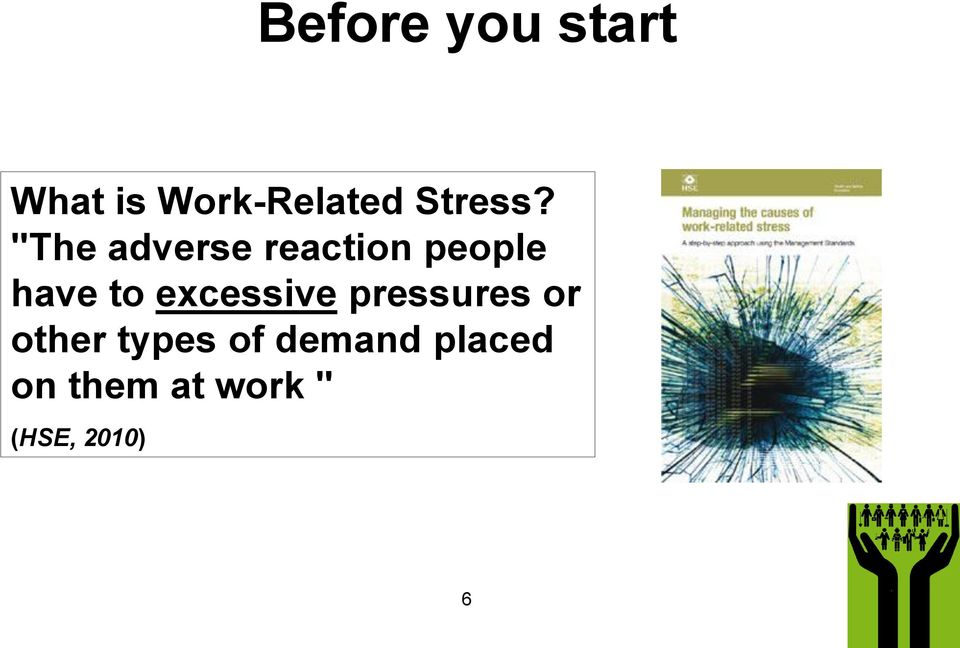
2 3.1 HEALTH AND SAFETY EXECUTIVE MANAGEMENT STANDARDS Before you start The Health and Safety Executive in Great Britain have developed management standards as the key to managing work-related stress risks. They have defined stress as the adverse reaction people have to excessive pressures or other types of demand placed on them at work The Management Standards for work-related stress describe a set of conditions that reflect high levels of health, well-being and organisational performance. HSE's management standards are one way to manage work-related stress risks. The management standards encourage good management practice and the contribution of all employees. Following this advice will enable you to identify the gap between what is happening in your organisation and these ideal conditions. Commitment from both management and staff is crucial for implementing the management standards effectively. Good project planning, communication and staff time are required. Steering groups or health and safety committees have proven useful for selecting issues and helping with the on-the ground implementation. The Management Standards are based on a risk assessment approach. The first step is to identify the hazards, then decide who might be harmed, evaluate the risk and take action, record your findings and finally monitor and review. With work-related stress these steps can often be uncertain or uncoordinated. By fully implementing the management standards your organisation will have assessed the risks of work-related stress and minimised the causes. Whilst on the face of it the standards may seem to be another administrative burden, for the most part, it should be a matter of adjusting existing procedures, systems or practices to take the issue of work-related stress into consideration. (See section 1 for further information on the business case and section 2 for further information on stress policies.) See for further information Stress Management Toolkit Section 3 Health and Safety Executive Management Standards Page 2 of 10
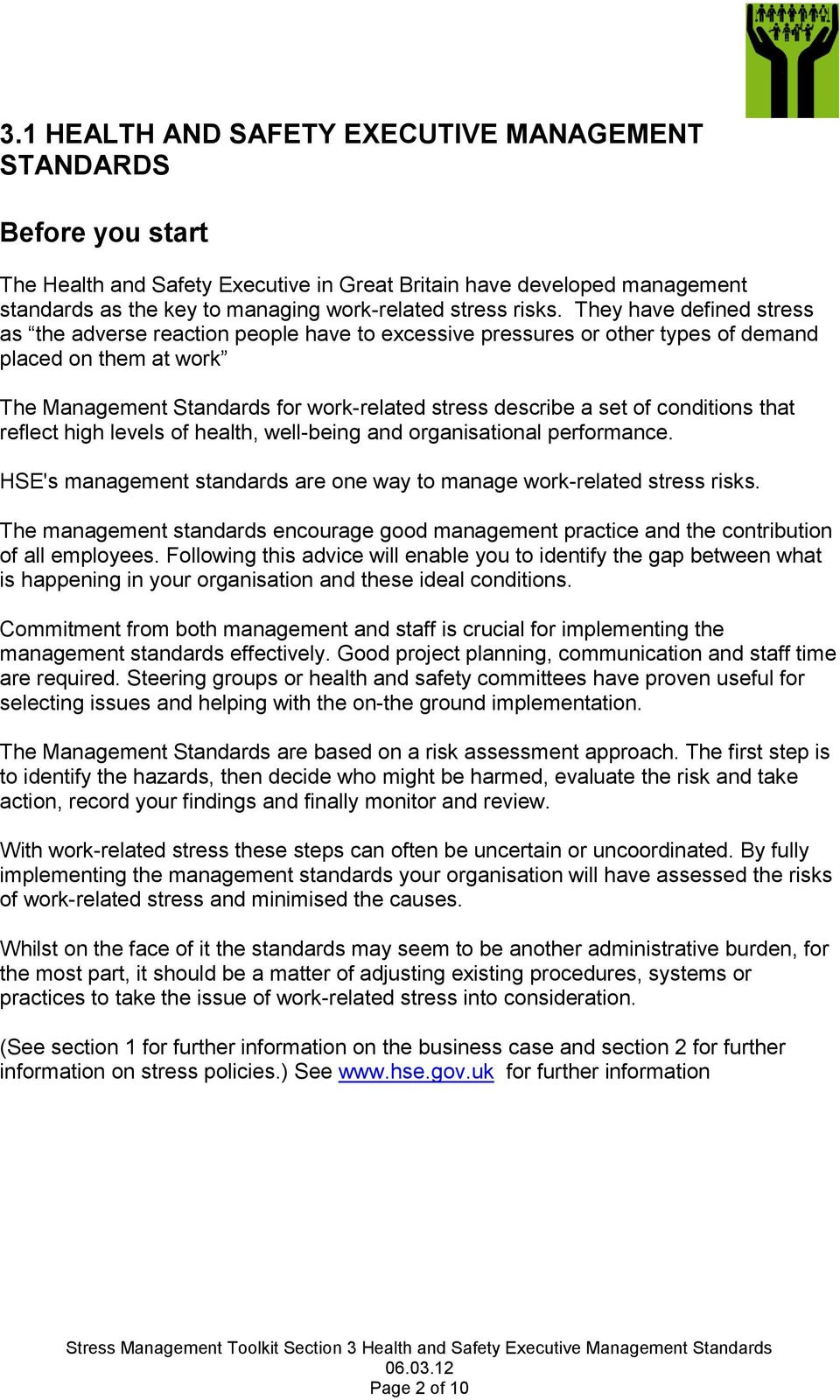
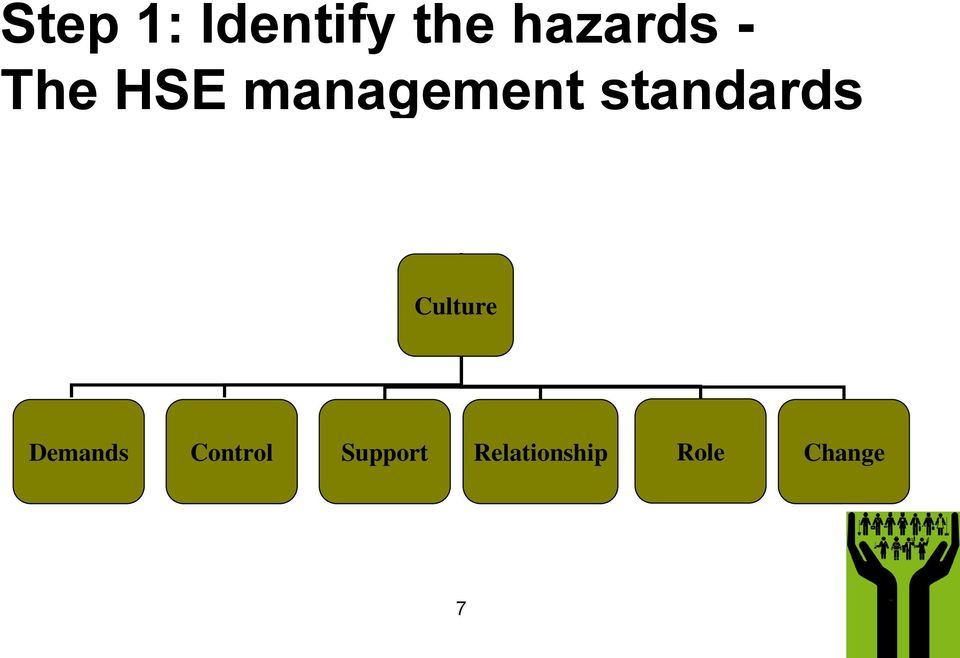
3 Step 1: Identify the hazards HSE have carried out the first step of the risk assessment by identifying the hazards. They have identified six key aspects of work which if not properly managed, can lead to work-related stress. These are demands, control, support, relationships, role and change. Each hazard has a management standard associated with it and they are not complicated or complex. They are simple statements that define good management practice as it relates to each stressor area. Demands include issues like workload, work patterns and the work environment. The management standard is that employees indicate that they are able to cope with the demands of their job and systems are in place locally to respond to any individual concerns. The standards have also identified the states to be achieved with respect to these key aspects. Demands on the individual are often quoted as the main cause of work-related stress. These are the states to be achieved regarding demands. Including having adequate and achievable demands, matching skills and capabilities and addressing concerns about the environment. Stress Management Toolkit Section 3 Health and Safety Executive Management Standards Page 3 of 10
4 There are examples where organisations have looked at patterns of demand and match capacity to meet busy times. Control involves how much say the person has in the way they do their work. The standard is that employees indicate that they are able to have a say about the way they do their work and systems are in place locally to respond to any individual concerns. These are the states to be achieved regarding control. Research suggests that when there are greater opportunities for participating in decision making, greater satisfaction and higher feelings of self-esteem are reported. The states to be achieved under control include where possible employees having control over their pace of work, being able to use their skills and develop. And being consulted regarding breaks and work patterns. An example is to structure work in a way which allows staff to see a task through from start to finish. Support includes the encouragement, sponsorship and resources provided by the organisation, line management and colleagues. The standard is that employees indicate that they receive adequate information and support from their colleagues and supervisors and that systems are in place locally to respond to any individual concerns. Other people can be important sources of support, but they can also be sources of stress. Studies have found that low social support at work is associated with poor mental health, poor health and increased sickness absence. [1] (2002) Ill-Health Work Environment, Alcohol Consumption and Ill-Health: The Whitehall II Study. Health and Safety Executive Contract Research Report 422/2002, Sudbury, HSE Books. Some of the things required are systems to be in place and accessible to allow staff to be supported. Relationships includes promoting positive working to avoid conflict and dealing with unacceptable behaviour. The standard is that employees indicate that they are not subjected to unacceptable behaviours e.g. bullying at work and systems are in place locally to respond to any individual concerns. There are two particular aspects of relationships that are associated with work-related stress bullying and harassment. States to be achieved regarding relationships include having procedures to prevent or deal with unacceptable behaviour and to report it. Role deals with whether people understand their role within the organisation and whether the organisation ensures that the person does not have conflicting roles. The standard is that employees indicate that they understand their role and responsibilities and there are systems in place locally to respond to any individual concerns. Stress Management Toolkit Section 3 Health and Safety Executive Management Standards Page 4 of 10
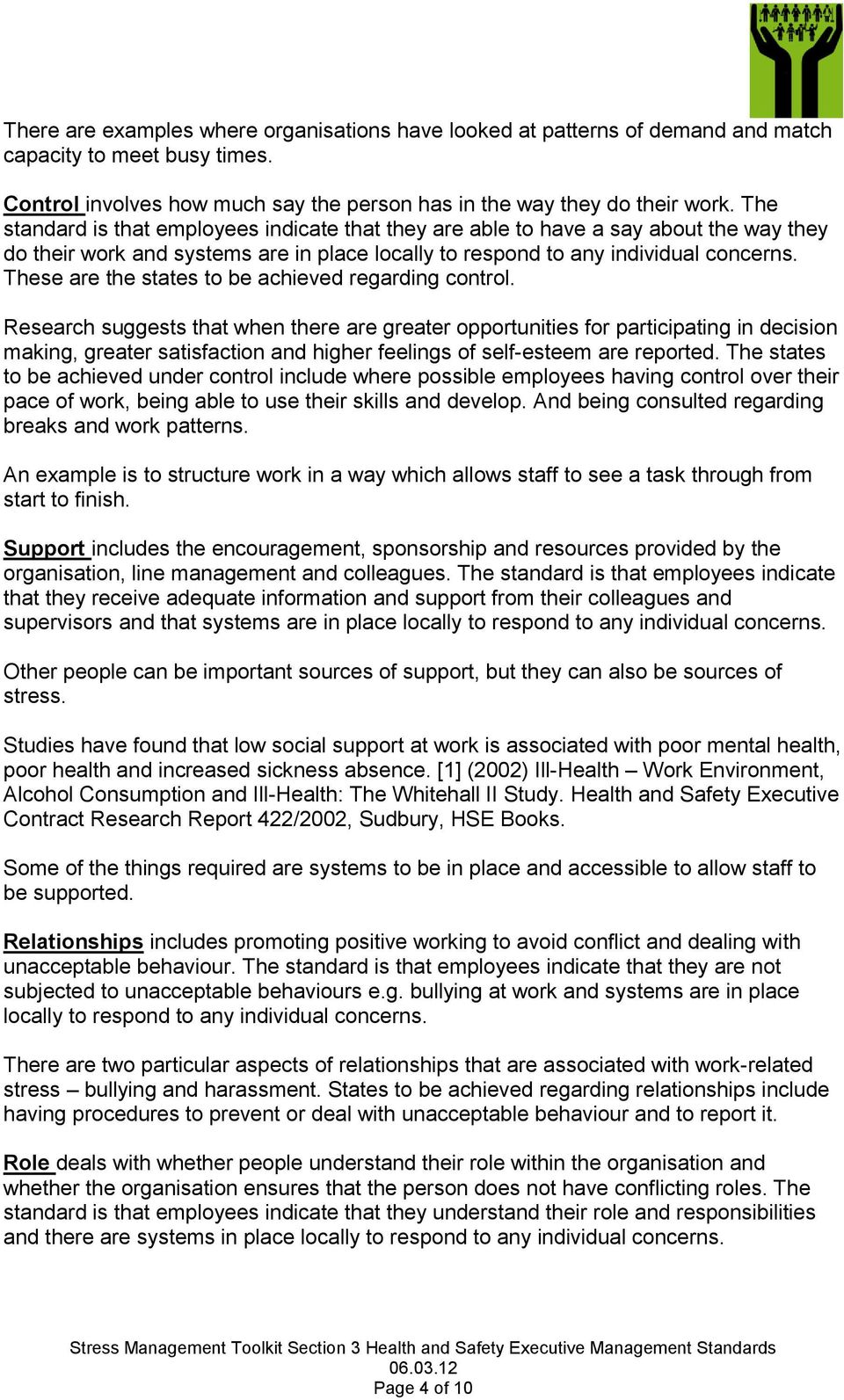
5 There are two potentially stressful areas associated with an employee s role. They are role conflict and role ambiguity. Conflict includes having differing demands or doing things which the employee does not believe are part of their job. To prevent role ambiguity employees should have a clear picture about work objectives, colleague s expectations and the scope of their responsibilities. Change includes how organisational change (whether large or small) is managed and communicated in the organisation. The standard is that employees indicate that the organisation engages them frequently when undergoing an organisational change and systems are in place locally to respond to any individual concerns. What should be happening regarding change? Among other things an organisation should allow adequate employee consultation, make employees aware of time scales and give necessary support. Culture Demands Control Support Relationship Role Change Stress Management Toolkit Section 3 Health and Safety Executive Management Standards Page 5 of 10

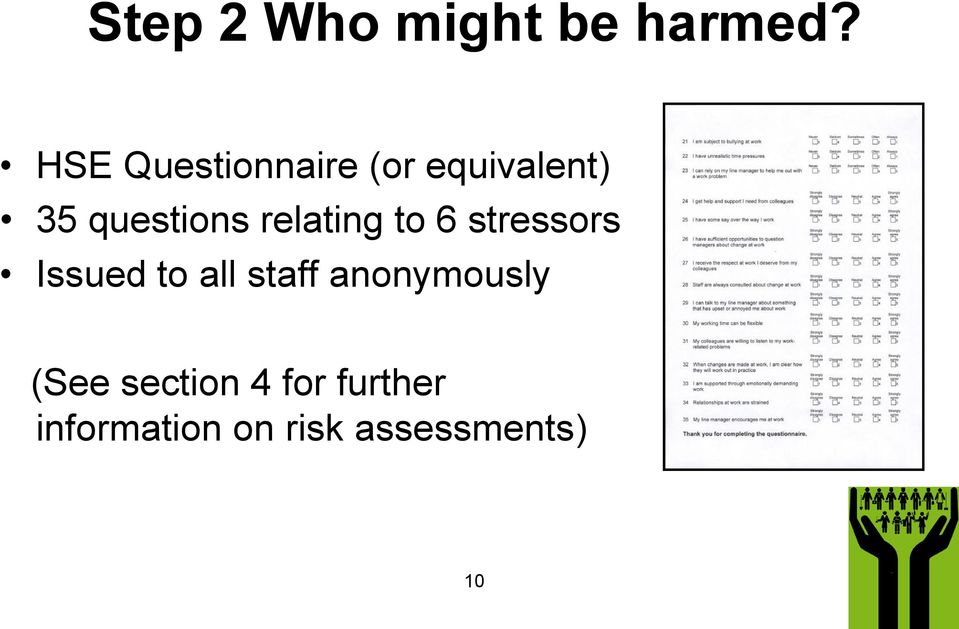
6 Step 2: Who might be harmed? The next step is to identify who might be harmed. The questionnaire is a risk assessment tool which investigates the presence or absence of known organisational stressors. The 35 questions rate employees perceptions of the six key aspects from demands through to change. These questionnaires should be issued to all staff anonymously. The success of the initiative is based on having as wide a response as possible. It provides an overall anonymous organisation result. It does not provide results of individual well-being. HSE advise that a response rate of 50% can be considered adequate. These results are only one source of information. They need to be considered alongside data from a variety of sources which might indicate problem areas e.g. sick absence rates, employee turnover or exit interviews. (See section 4 for further information on risk assessments) Step 3: Evaluate the risk Details of the responses obtained from the questionnaire can then be analysed using an Analysis Tool programme. Key stressor Demands Control Managers support Peer support Relationships Role Change Your Results Upper 20 Percent Above average Lower 20 percent Lower 20 percent Lower 20 percent Above average Below average This is a summary of the data in graphical form. Both the analysis tool programme and the user manual down load are provided free of charge and without copyright on the HSE web site. There are several methods of displaying information. The table rates employees perceptions of the six stress factors using a colour coding system. The colour coding identifies hot spots and helps organisations recognize priority areas for improvement. The results obtained indicated that this company are performing satisfactorily in the areas of control and managers support. They have an urgent need for action regarding role and they have a need for improvement in the areas of relationships, demands, peer support and change. HSE recommend that these results are seen as a general appraisal rather than the definitive result. Other data which may be considered includes sickness absence data, Stress Management Toolkit Section 3 Health and Safety Executive Management Standards Page 6 of 10

7 productivity data, exit/return to work interviews, performance appraisals and informal talks. The questionnaire results provide a skeleton of information and focus groups put meat on the bones. Focus groups are normally a 2 hour meeting of staff of similar backgrounds. Focus groups are an excellent method of consulting with staff and obtaining their views. Staff should be encouraged to participate and have an open honest discussion to get to the root of any issues. The staff participating should represent all job types and a full range of grades. It is better to have similar grades and similar job types together at a focus group. The facilitator should be impartial and be able to reassure the group that all information will be kept anonymous. Each focus group will note what they see as the main issues of concern and potential solutions. Any individual concerns e.g. a report of bullying need to be dealt with individually. Information on running focus groups is available in section 5 Focus Groups. Step 4: Record findings and developing an action plan It has been found useful to communicate the results of the questionnaire during the focus group sessions and then to combine the suggestions from all the focus groups to form the basis of an Action Plan. It is often not possible to address all issues immediately and therefore items need to be selected for prioritisation and agreed with senior management and union representatives. Issues may be prioritised because they are of a serious nature, they affect the majority of staff or affect groups most of the time. Many companies are already doing more than they realise to tackle stress simply by managing staff well. Solutions based on a clear understanding of a problem are going to be the most effective. It has been found that the most effective improvements have been based on consultations with staff. As staff have participated they are then committed to seeing the solutions put in place. A number of examples are documented in HSE's Real Solutions Real People and also in the Work Positive resource pack and various websites including and A champion or often a steering group can recommend possible interventions, prioritise actions and plan the on-the-ground implementation. Some of the things this group will consider include: Can the organisation tackle the source of this problem? Stress Management Toolkit Section 3 Health and Safety Executive Management Standards Page 7 of 10
8 What are the options? How workable is this option? What are the costs/benefits of this option? What are the advantages of this option? There are three levels of intervention for dealing with workplace stress: 1. The first is Primary interventions. These are aimed at eliminating or modifying workplace stressors to reduce their negative impact on all individuals in the organisation. Systems and mechanisms to prevent stress arising in the first place are normally based on good management methods. These can include job redesign or work-life balance policies. Interventions should be focussed on stress factors that can be controlled at the organisational level. 2. Secondary interventions focus on increasing the awareness and coping skills of the individual e.g. stress management training and health promotion activities. 3. Tertiary interventions are concerned with the treatment and rehabilitation of distressed individuals e.g. counselling or return to work policies. (See sections 6, 7 & 8 for further information on action plans, interventions and HR implications respectively.) Step 5: Monitor and review Regular reviewing is required to check that the action plan has been put in place and is effective. Reviewing will also pick up if the stressors have changed and if the action plan needs to be amended. The management standards encourage continuous improvement. Conclusion In conclusion stress is a serious problem for both the individual and the organisation. For organisations to avoid risk and be employers of choice they must identify and mitigate the causes of stress. It can be a challenging subject to tackle. However the stress management standards and the stress analysis indicator tool provide a means of measuring the impact of stress and standards to aim for. There are solutions which have been tried and tested in individual case studies. Real Solutions Real People has examples from many sectors. It gives case studies that have resulted in improved efficiency, improved staff morale and reduced sickness absence rates which brought considerable savings. Management of work related stress is a complex problem and therefore a long term commitment is required. Stress Management Toolkit Section 3 Health and Safety Executive Management Standards Page 8 of 10

9 Is Stress A Reportable Industrial Injury Under Reporting Of Injuries, Diseases And Dangerous Occurrences Regulations? No. Stress was not included as a RIDDOR reportable disease under the current regulations. This is because the causes of stress-related ill-health are usually extremely complex and linking conditions to specific types of work activity (as is done for other diseases and conditions in RIDDOR) would be difficult. X Stress Management Toolkit Section 3 Health and Safety Executive Management Standards Page 9 of 10

10 3.2 A Training Presentation on the Management Standards Process Stress Management Toolkit Section 3 Health and Safety Executive Management Standards Page 10 of 10
11 Management standards for work-related stress 1

12 Outline Before you start The hazards (what is work-related stress?) Who might be harmed Evaluate the risk (data and staff engagement) Develop an action plan Monitor and review 2
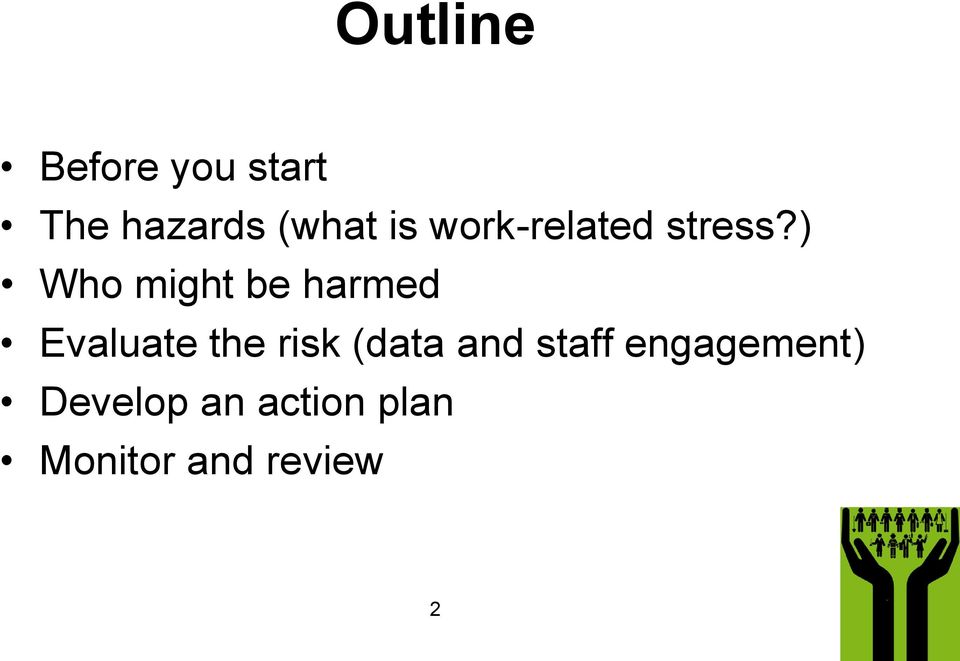
13 Stress - 5 step risk assessment process 3
14 Before you start The management standards approach: Encourages organisations to take reasonable steps towards improving their workplace Requires resources especially communication but also commitment from management, employees and union/representatives (See sections 1 for the business case slides & 2 for further information on 4 stress policies)

15 Before you start Consider steering group health and safety committee or health promotion group to oversee implementation of management standards, for: Generation and approval of action plans Project management, planning Resources: time, experience, finance Communications Monitor progress: schedule, budget WEEK No. STEPS/ACTIVITIES BEFORE YOU START Secure management commitment Secure commitment from employees and TU Audit stress policy STEP 1- IDENTIFY THE HAZARDS Find out what's causing stress in you workplace Familiarization with the Management Standards Identify hazards within workplace against MS STEP 2 -DECIDE WHO MIGHT BE HARMED & HOW Who can be harmed (based on identified hazards) How? (can hazards identified harm employees) Gathering information Existing information Survey data Focus groups STEP 3 - EVALUATE RISK & TAKE ACTION How well are you doing? (understand where you are now) Linking problems to solutions (interventions) Identify biggest problems Identify where they are having greatest impact Talk to employees (focus groups) Identify possible solutions (interventions) 5 STEP 4 RECORD YOUR FINDINGS Make a plan (to implement interventions) Communicate (plan to employees) STEP 5- MONITOR & REVIEW Monitor against action plan Evaluate effectiveness of interventions (success criteria) Follow up surveys / focus groups (min 12 months after intervention)

16 Before you start What is Work-Related Stress? "The adverse reaction people have to excessive pressures or other types of demand placed on them at work " (HSE, 2010) 6
17 Step 1: Identify the hazards - The HSE management standards Culture Demands Control Support Relationship Role Change 7
18 Step 1: Identify the hazards - The HSE management standards Demands: Includes issues like workload, work patterns and the work environment. Control: How much say a person has in the way they do their work. Support: Includes the encouragement, sponsorship and resources provided by the organisation, line management and colleagues. 8
19 Step 1: Identify the hazards - The HSE management standards Relationships: Includes promoting positive working to avoid conflict and dealing with unacceptable behaviour. Role: Whether people understand their role within the organisation and whether the organisation ensures that the person does not have conflicting roles. Change: How organisational change (large or small) is managed and communicated in the organisation. 9
20 Step 2 Who might be harmed? HSE Questionnaire (or equivalent) 35 questions relating to 6 stressors Issued to all staff anonymously (See section 4 for further information on risk assessments) 10
21 Step 3 Evaluate the risks analysis of data Analyse survey results using Excel based HSE analysis tool Consider other data (e.g. sickness absence data, productivity data, exit/return to work interviews, performance appraisals, informal talks) 11
22 Step 3 Evaluate the risks analysis of data Example of analysis tool results Key stressor Demands Control Managers support Peer support Your Results Upper 20 Percent Above average Lower 20 percent Lower 20 percent Key Key: Doing very well - need to maintain performance Good, but need for improvement Clear need for improvement Relationships Lower 20 percent Urgent action needed Role Above average Change Below average 12
23 Step 3: Evaluate the risks staff focus groups Engage with (randomly selected) staff through an impartial facilitator Groups with similar issues/grades Confirm/challenge results of Indicator Tool Note main issues of concern (and discussions) Discuss practical improvements/interventions Deal with individual concerns (See section 5 for further information 13 on focus groups)
24 Step 3: Evaluate the risks staff focus groups The organisation Representative sample of: Management/staff Departments (May also consider sickness absence, age, gender) Individual focus group Similar grade Similar issues Comfortable discussing sensitive issues within group 14
25 Step 4 Record your findings & Link problems to solutions - gap implement action plan analysis, develop and implement adequate prioritised action plans (See sections 6 & 7 for further information on action plans and interventions) 15
26 Step 4 Record your findings & implement action plan Prioritise Address what affects most people most of the time (whole organisation or team/ department?) Address serious issues Early action Requires steering group/champion to drive forward Implement stress policy Reasons for not actioning issues also communicated 16
27 Step 4 Record your findings & implement action plan Primary interventions (prevention focused): Flexible work/ improved work life balance Changes in work organisation Risk assessments/stress audits Secondary interventions (resiliance focused): Stress management training Systems for employees to raise concerns Tertiary interventions (individual support): Employee assistance programmes/counselling Greater involvement of occupational health specialist 17
28 Step 5 Monitor and review: Action plans and assessment of effectiveness (the outcome is the key not the process) Inform employees regularly of progress. (See section 8 for further information on HR implications) 18
STRESS POLICY. Stress Policy. Head of Valuation Services. Review History
 STRESS POLICY Title Who should use this Author Stress Policy All Staff SAC Approved by Management Team Approved by Joint Board Reviewer Head of Valuation Services Review Date 2018 REVIEW NO. DETAILS Review
How to tackle work-related stress A guide for employers on making the Management Standards work
 A guide for employers on making the Management Standards work Health and Safety Introduction A guide for employers on making the Management Standards work Going to work is generally good for us, but only
Work-related stress risk assessment guidance
 Safety and Health Services Work-related stress risk assessment guidance Document control information Published document name: stress-ra-gn Date issued: Version: 5.0 Previous review dates: Next review date:
STRESS MANAGEMENT AND WORKING TIME HR28
 STRESS MANAGEMENT AND WORKING TIME HR28 Applies to: ALL EMPLOYEES AND OTHER WORKERS Date of Board Approval: March 2011 Review Date: March 2014 Stress Management and Working Time Introduction 1 The Authority
STRESS MANAGEMENT POLICY FOR SCHOOLS
 DONCASTER METROPOLITAN BOROUGH COUNCIL STRESS MANAGEMENT POLICY FOR SCHOOLS 1. Introduction 1.1 Doncaster Metropolitan Borough Council and all its schools are committed to protecting the health, safety
Managing the causes of work-related stress
 Managing the causes of work-related stress A step-by-step approach using the Management Standards This is a free-to-download, web-friendly version of HSG218 (Second edition, published 2007). This version
The policy also aims to make clear the actions required when faced with evidence of work related stress.
 STRESS MANAGEMENT POLICY 1.0 Introduction Stress related illness accounts for a significant proportion of sickness absence in workplaces in the UK. Stress can also be a contributing factor to a variety
MANAGEMENT OF STRESS AT WORK POLICY
 MANAGEMENT OF STRESS AT WORK POLICY Co-ordinator: Director of HR Reviewer: Grampian Area Partnership Forum Approver: Grampian Area Partnership Forum Signature Signature Signature Identifier: NHS/OH&S/Pol
STRESS MANAGEMENT POLICY
 STRESS MANAGEMENT POLICY NWAS Stress Management Policy Page: 1 of 21 Recommending Committee: Health, Safety and Security Sub Committee Approving Committee: Trust Board Approval Date: October 2010 Version
Stress Management Policy
 , Stress Management Policy January 2014 Also available in large print (16pt) and electronic format. Ask Student Services for details. www.perth.uhi.ac.uk Perth College is a registered Scottish charity,
MANAGEMENT OF STRESS AT WORK POLICY
 MANAGEMENT OF STRESS AT WORK POLICY Co-ordinator: Director of HR Reviewer: Employee Stress Management Advisory Group Approver: OH&S Committee; Grampian Area Partnership Forum Signature: Signature: Signature:
St. John s Church of England Junior School. Policy for Stress Management
 St. John s Church of England Junior School Policy for Stress Management Review Date: September 2012 Policy to be reviewed next: September 2014 ST. JOHN S C OF E JUNIOR SCHOOL STRESS MANAGEMENT FRAMEWORK
Stress Management Policy, Procedure and Toolkit
 Issue No: 04 Date: April 2009 Resources Human Resources and Organisational Development Stress Management Policy, Procedure and Toolkit This blank page is for the purpose of printing in duplex format Contents
Stress Risk Assessment. The key to tackling stress in the workplace by Dr Hillary Bennett, Director PsychAssessments Ltd.
 The key to tackling stress in the workplace by Dr Hillary Bennett, Director PsychAssessments Ltd. Healthy Work A healthy workplace promotes employee well being and improves organisational effectiveness.
Stress Management Policy
 Level 3 - H&S Policy Structure Stress Management Policy BACKGROUND The Health & Safety Executive (HSE) define stress as the adverse reaction people have to excessive pressures or other types of demand
WORKPLACE STRESS POLICY AND PROCEDURE
 WORKPLACE STRESS POLICY AND PROCEDURE NORTHERN IRELAND FIRE & RESCUE SERVICE WORKPLACE STRESS POLICY & PROCEDURE SECTION 1 INTRODUCTION 1.1 Introduction 1.2 Aims and Objectives 1.3 Scope 1.4 Confidentiality
Manual handling. Introduction. The legal position
 Manual handling Introduction Work-related musculoskeletal disorders (MSDs), including manual handling injuries, are the most common type of occupational ill health in the UK. Back pain and other MSDs account
BODY STRESSING RISK MANAGEMENT CHECKLIST
 BODY STRESSING RISK MANAGEMENT CHECKLIST BODY STRESSING RISK MANAGEMENT CHECKLIST This checklist is designed to assist managers, workplace health staff and rehabilitation providers with identifying and
Work-related stress can be caused by psychological hazards such as work design, organisation and management, and issues like bullying and violence.
 Work-related Stress Work-related stress is a very significant occupational health and safety problem for teachers which can lead to conditions such as depression, anxiety, nervousness, fatigue and heart
BEYOND WORKING WELL: A BETTER PRACTICE GUIDE. A practical approach to improving psychological injury prevention and management in the workplace
 BEYOND WORKING WELL: A BETTER PRACTICE GUIDE A practical approach to improving psychological injury prevention and management in the workplace CONTENTS INTRODUCTION 5 RESEARCH 7 HOLISTIC SYSTEMS APPROACH
Policy for Prevention and Management of Stress in the Workplace
 Policy for Prevention and Management of Stress in the Workplace Document reference number HSAG 2012/2 Document developed by Revision number 1.0 Document approved by Consultation with 14 September 2012
STRESS MANAGEMENT INTERVENTION TRAINING SECTION 7
 STRESS MANAGEMENT INTERVENTION TRAINING SECTION 7 Stress Management Toolkit Section 7 Stress Intervention Training 06.03.12 Page 1 of 15 7.0 STRESS MANAGEMENT INTERVENTION TRAINING 7.1 INTRODUCTION This
FOCUS GROUPS FOR THE HSE MANAGEMENT STANDARDS SECTION 5
 FOCUS GROUPS FOR THE HSE MANAGEMENT STANDARDS SECTION 5 Page 1 of 16 5.0 FOCUS GROUPS FOR THE HSE MANAGEMENT STANDARDS 5.1 What is a Focus Group? Page 3 5.2 Why use Focus Groups? Page 3 5.3 Purpose Page
TOPIC INSPECTION PACK WORK-RELATED STRESS
 TOPIC INSPECTION PACK WORK-RELATED STRESS OCTOBER 2011 1 WORK RELATED STRESS INSPECTION PACK CONTENTS 1 Introduction 1.1 What is work-related stress 1.2 Nature of the problem 1.3 Diversity 2 Stress inspections
Getting the occupational safety basics organised
 Getting the occupational safety basics organised 10 important measures Introduction Occupational health and safety are the foundation of wellbeing at work. The employer is responsible for providing safe
Management Competencies - 360 Assessment
 Management Competencies - 360 Assessment Up-skill managers to prevent and reduce workplace stress Line managers play a vital role in the identification and management of workplace stress. Managers will
Stress has serious and profound implications for individual and organisational performance.
 Workplace Stress Stress has serious and profound implications for individual and organisational performance. Stressed staff will invariably take more sickness leave and as well as this effecting services,
Violence at work A guide for employers
 at work A guide for employers People who deal directly with the public may face aggressive or violent behaviour. They may be sworn at, threatened or even attacked. AT WORK a guide for employers This document
Managing the Risk of Work-related Violence and Aggression in Healthcare
 Managing the Risk of Work-related Violence and Aggression in Healthcare Information Sheet November, 2014 The purpose of this information sheet is to provide information and guidance on managing the risk
PRESENTATION OVERVIEW
 WORK PLACE STRESS AND MANAGING SICKNESS ABSENCE - A PRESENTATION BY PAUL MAYNARD PRESENTATION OVERVIEW Work Place Stress - What is stress - Why is it a problem for you - HSE Management Guidelines - Benefits
WORK-RELATED STRESS: A GUIDE. Implementing a European Social Partner agreement
 WORK-RELATED STRESS: A GUIDE Implementing a European Social Partner agreement Foreword The workplace of the 21st century is a fast-paced, dynamic, highly stimulating environment which brings a large number
MEDICINA y SEGURIDAD del trabajo
 Editorial Senior Specialist on Occupational Health. Programme on Health Promotion and Well-being. International Labour Office. Correspondencia Specialist on Occupational Health Programme on Health Promotion
HOW TO ORGANISE AND RUN FOCUS GROUPS
 HOW TO ORGANISE AND RUN FOCUS GROUPS BACKGROUND Focus groups can form an important part of the process of using the Management Standards to assess and control risks related to work-related stress. Focus
The Newcastle upon Tyne Hospitals NHS Foundation Trust. Management of Stress in the Workplace Policy
 The Newcastle upon Tyne Hospitals NHS Foundation Trust Management of Stress in the Workplace Policy Version No. 3.0 Effective from: 1 October 2015 Expiry date: 1 October 2018 Date ratified: 22 September
Managing work related stress in the rail industry
 Managing work related stress in the rail industry Sharon Mawhood RIAC meeting 16 October 2012 1 Aim to cover Work related stress in the rail industry. What s the size of the problem? Reasons to act Where
THE WELL MANAGED ORGANISATION GUIDELINES FOR BOARDS
 MINISTERIAL TASK FORCE ON HEALTH, SAFETY AND PRODUCTIVITY THE WELL MANAGED ORGANISATION GUIDELINES FOR BOARDS SEPTEMBER 2006 THE WELL MANAGED ORGANISATION - GUIDELINES FOR BOARDS Workplace absence and
Policy for Preventing and Managing Critical Incident Stress
 Policy for Preventing and Managing Critical Incident Stress Document reference number HSAG 2012/3 Document developed by Revision number 1.0 Document approved by Consultation with 14 September 2012 Presented
Work Related Stress - Information for Managers / Supervisors
 Work Related Stress - Information for Managers / Supervisors What is Stress? The Health and Safety Executive have defined stress as:- 'The adverse reaction people have to excessive pressure or other types
Self Assessment STANDARDS
 Self Assessment STANDARDS www.wellbeingcharter.org.uk This pack contains an overview of the Workplace Wellbeing Charter, including the Charter Framework, the Assessment Standards and other useful information.
Work-related stress What the law says
 Guide Work-related stress What the law says Stress at work is a major issue together we can successfully manage and prevent it. Health and Safety Executive (HSE) Whatever your industry, size of business
DEVON COUNTY COUNCIL STRESS MANAGEMENT POLICY
 DEVON COUNTY COUNCIL STRESS MANAGEMENT POLICY Policy Date: July 2008 Page 1 of 7 Policy: Stress Management Policy Reviewed 2011 Next Review Date: 2013 STRESS MANAGEMENT POLICY Date Reviewed 2011 Policy
UNIVERSITY OF SUSSEX
 UNIVERSITY OF SUSSEX STRESS MANAGEMENT POLICY 1. INTRODUCTION 1.1 Introductory note 1.2 Note on terminology CONTENTS 2. STRESS MANAGEMENT POLICY 2.1 Policy statement 2.2 Stress in the workplace 2.3 The
Work-related stress. A good practice guide for RCN representatives
 Work-related stress A good practice guide for RCN representatives Acknowledgements The Royal College of Nursing wishes to thank the following people for their input in developing this guidance: Maria Bryson,
This booklet answers some common questions about work-related stress. It explains what it is, and what you can do about it. The advice is intended
 This booklet answers some common questions about work-related stress. It explains what it is, and what you can do about it. The advice is intended specifically for managers of small firms, or organisations
POLICY FOR ALCOHOL, DRUG AND OTHER SUBSTANCE ABUSE IN EMPLOYMENT
 POLICY FOR ALCOHOL, DRUG AND OTHER SUBSTANCE ABUSE IN EMPLOYMENT Approved By: Trust Executive Date Approved: 10 March 2004 Trust Reference: B6/2004 Version: V2 Supersedes: V1 (Approved by Trust Executive
Alcohol and Other Drugs in the Workplace. employer guide
 Alcohol and Other Drugs in the Workplace employer guide 1 2 Managing alcohol and other drugs as hazards in the workplace Introduction This resource has been developed by the Alcohol Advisory Council of
WORKPLACE STRESS: a collective challenge WORLD DAY FOR SAFETY AND HEALTH AT WORK 28 APRIL 2016
 WORKPLACE STRESS: a collective challenge WORLD DAY FOR SAFETY AND HEALTH AT WORK 28 APRIL 2016 WHAT IS WORK-RELATED STRESS? Stress is the harmful physical and emotional response caused by an imbalance
HSE Management Standards Indicator Tool. User manual
 HSE Management Standards Indicator Tool User manual Background HSE s Management Standards Indicator Tool is a 35-item questionnaire relating to the six primary stressors identified in the Management Standards
Management of Stress Policy & Procedure. All employees HR, NEL CSU. Policy Screened Yes
 1 SUMMARY Management of Stress Policy & Procedure Jennie Williams, Executive Nurse and 2 RESPONSIBLE PERSON: Director of Quality & Integrated Governance 3 ACCOUNTABLE DIRECTOR: 4 APPLIES TO: 5 6 GROUPS/
UNIVERSITY HOSPITALS OF LEICESTER NHS TRUST. Alcohol, Drug and Other Substance Abuse in Employment
 UNIVERSITY HOSPITALS OF LEICESTER NHS TRUST Alcohol, Drug and Other Substance Abuse in Employment Approved by: Trust Executive Trust Ref: B6/2004 Date of Approval: 10 March 2004 Originator: Director of
The Cost of Workplace Stress in Australia
 The Cost of Workplace Stress in Australia August 2008 Workplace stress is costing the Australian economy $14.81 billion a year. Stress related presenteeism and absenteeism are directly costing Australian
Officers have taken action on this and created a detailed action plan to improve sickness absence performance attached as Appendix 1.
 BACKGROUND Measuring and monitoring sickness absence is a requirement of the Audit Commission and is calculated across all local authorities (BVPPI 12 the number of working days/shifts lost due to sickness
HSE MANAGEMENT STANDARDS INDICATOR TOOL USER MANUAL
 HSE MANAGEMENT STANDARDS INDICATOR TOOL USER MANUAL Background HSE s Management Standards Indicator Tool is a 35-item questionnaire relating to the six primary stressors identified in the Management Standards
Human Resources Report 2014 and People Strategy
 24 February 2015 Council 5 To consider Human Resources Report 2014 and People Strategy Issue 1 The annual report on Human Resources issues and a proposed People Strategy. Recommendations 2 Council is asked
Occupational Stress in the Construction Industry
 Occupational Stress in the Construction Industry Survey 2006 Research by: Fiona Campbell, CIOB CONTENTS 1 Foreword 2 Abstract 3 Introduction What is occupational stress? Background research Legal requirements
Corporate Health and Safety Policy
 Corporate Health and Safety Policy November 2013 Ref: HSP/V01/13 EALING COUNCIL Table of Contents PART 1: POLICY STATEMENT... 3 PART 2: ORGANISATION... 4 2.1 THE COUNCIL:... 4 2.2 ALLOCATION OF RESPONSIBILITY...
Health & Wellbeing Framework. Absence Management Policy
 Health & Wellbeing Framework Absence Management Policy 1 Introduction This Policy is part of the Health & Wellbeing Framework which is made up of a number of elements which together encompass all formal
WEEK SIX Performance Management
 WEEK SIX Performance Management Performance Management: objective-setting and systematic performance review Monitoring Performance: control/monitoring systems, absence control and the design of disciplinary
UK CIA Sustainable Health Metrics Indicator Tool
 UK CIA Sustainable Health Metrics Indicator Tool A tool to promote establishing a sustainable healthy workplace One easy to use tool Simple questionnaire enables self-assessment and reporting of key aspects
Guide. Building the business case for managing stress in the workplace
 Guide Building the business case for managing stress in the workplace Contents Introduction 2 1 Impact of stress on individual employees 4 2 Impact of stress on the organisation 5 3 How to manage stress
Huntingdonshire District Council Equality Impact Assessment
 Service area Date of assessment December 2010 Name of strategy/policy/function/service to be assessed Is this a new or existing strategy/policy/function/service? Name of manager responsible for strategy/policy/function/service
Overview of work-related stress
 Department of Justice and Attorney-General www.worksafe.qld.gov.au Overview of work-related stress 01 Stress is a term that is widely used in everyday life and most people have some idea of its meaning.
Alcohol and drugs. Introduction. The legal position
 Alcohol and drugs Introduction There are no reliable figures for the misuse of drugs and alcohol by NHS staff but a survey in 2001 by Alcohol Concern and Drugscope suggested that 60 per cent of employers
Chelmsford City Council. Human Resources. Drugs and Alcohol at Work
 Chelmsford City Council Human Resources Drugs and Alcohol at Work Table of contents 1. Introduction... 1 2. Scope... 1 3. Advice... 1 4. Assistance... 2 5. Further Support and Information... 3 1. Introduction
PPC Worldwide Manager Resource
 PPC Worldwide Manager Resource Guide Act as if what you do makes a difference. It does. William James (1842-1910 American Philosopher) Take control of the Employee Assistance Program in your workplace.
Stressed out THE REPORT OF A SURVEY INTO OCCUPATIONAL STRESS IN ADULT EDUCATION
 Stressed out THE REPORT OF A SURVEY INTO OCCUPATIONAL STRESS IN ADULT EDUCATION GAIL KINMAN and SIOBHAN WRAY JULY 203 Contents Summary 3 Introduction Findings Biographical information 2 Responses to HSE
ATTENDANCE MANAGEMENT POLICY
 ATTENDANCE MANAGEMENT POLICY Co-ordinator: Director of HR Reviewer: Grampian Area Partnership Forum Approver: Grampian Area Partnership Forum Signature Signature Signature Identifier: NHSG/POL/39/HR Review
Leading Experts in Employment Law, Industrial Relations and best practice Human Resource Management in Ireland
 Leading Experts in Employment Law, Industrial Relations and best practice Human Resource Management in Ireland Who We Are Established in 2003, we are one of Ireland s best-known and respected providers
City and County of Swansea. Human Resources & Workforce Strategy 2013-2017. Ambition is Critical 1
 City and County of Swansea Human Resources & Workforce Strategy 2013-2017 Ambition is Critical 1 Delivering quality services for a safer, greener, smarter, fairer, healthier, richer Swansea Executive Summary
ROLE PROFILE. Performance Consultant (Fixed Term) Assistant Director for Human Resources
 ROLE PROFILE Job Title Reports to Service area No. of staff responsible for Budget responsibility ( ) Performance Consultant (Fixed Term) Assistant Director for Human Resources HR 0 None Purpose of Job
Managing Stress and Improving Employee Health & Wellbeing Policy and Procedure
 Managing Stress and Improving Employee Health & Wellbeing Policy and Procedure Ratification Process Lead Author: Developed by: Approved by: Ratified on and by: Senior OD & HR Manager, C&P CCG Senior OD
STRESS RISK ASSESSMENT FORM Subject of risk assessment Role / Team / Individual / Location / Job Type. No of employees
 STRESS RISK ASSESSMENT FORM Subject of risk assessment Role / Team / Individual / Location / Job Type No of employees Reason or Trigger for Risk Assessment Current Control measures things that are already
Employee Assistance Programmes Manager s Guide
 March 2012 Employee Assistance Programmes Manager s Guide Support and assistance when you need it Vhi Corporate Solutions Employee Assistance Programme Confidential Professional Help Support Communicate
Supporting staff involved in a stressful or traumatic incident, complaint or claim.
 Supporting staff involved in a stressful or traumatic incident, complaint or claim. Version: V2.00 Ratified by: Date ratified: October 2010 Name of originator/author/job title Name of responsible committee
TAFE SA Student Alcohol and Other Drug Policy Under the umbrella of Drugs and Alcohol Policy (DFEEST OHS&IM 026)
 TAFE SA Student Alcohol and Other Drug Policy Under the umbrella of Drugs and Alcohol Policy (DFEEST OHS&IM 026) 1. Purpose of the policy The purpose of the Student Alcohol and Other Drug Policy is to
Bullying and Harassment at Work Policy
 Bullying and Harassment at Work Policy i) Statement Everyone should be treated with dignity and respect at work, irrespective of their status or position within the organisation. Bullying and harassment
Manchester Metropolitan University. Policy for the Reporting and Investigation of Accidents and Incidents
 Manchester Metropolitan University Policy for the Reporting and Investigation of Accidents and Incidents 1 Contents Section 1 Introduction 1.1 Purpose 1.2 Scope & Definitions 1.3 Roles and Responsibilities
Working Well An organisational approach to preventing psychological injury
 Working Well An organisational approach to preventing psychological injury A GUIDE FOR CORPORATE, HR AND OHS MANAGERS Disclaimer This publication is intended to provide only a summary and general overview
JOB TITLE: Community Manager, Mental Health & Addiction Services
 JOB TITLE: Community Manager, Mental Health & Addiction Services 1. PURPOSE OF POSITION The Community Manager will work in partnership with the area Clinical Leads, Clinical Director and Clinical Services
Managing Employees Health in the Workplace Policy (Sickness Absence Management) Version 4.1
 Managing Employees Health in the Workplace Policy (Sickness Absence Management) Version 4.1 Previously known as Attendance Management Policy Lead executive Name / title of author: Janet Wilkinson, Director
1. 2. Health, safety and. Unit 1: Principles of personal responsibilities and how to develop and evaluate own performance at work
 1. 2 security Health, safety and procedures All employers and employees have a responsibility to adhere to the legislation that affects them, such as: health and safety legislation, which may relate to
Dealing with wellness and lifestyle issues. DEPT OF MEDICINE AND OCCUPATIONAL HEALTH, CRI
 Dealing with wellness and lifestyle issues. DEPT OF MEDICINE AND OCCUPATIONAL HEALTH, CRI Workplace Health refers to efforts to assist employees (and their families) to make voluntary lifestyle changes
Human Resources & Facilities Services. Service Delivery Plan 2014/15. Overview of the Human Resources Service
 Human Resources & Facilities Services Service Delivery Plan 2014/15 Overview of the Human Resources Service The role of the HR Service is to support the Council in achieving its corporate objectives, priorities
Drugs and Alcohol in the Workplace. Guidance for Workplace Representatives
 Drugs and Alcohol in the Workplace Guidance for Workplace Representatives Health and safety May 2010 Introduction The use of drugs and alcohol can be a serious workplace issue. Not only can their use lead
Employee Wellness and Engagement
 Employee Wellness and Engagement HEALTH POLICIES 01. Proactive Health Policy 02. Internal Health Relationships 03. Health Surveillance and Screening 04. Mental Health and Stress 05. Getting People Back
A Guide to Accident Investigations
 A Guide to Accident Investigations Introduction The Health and Safety Executive (HSE) report that in 2010/2011 171 workers were killed at work. A further 121,430 other injuries to employees were reported
Managing drug and alcohol misuse at work
 Survey report September 2007 Managing drug and alcohol misuse at work Contents Summary of key findings 2 Policies and procedures 4 Testing 10 Managing and supporting employees with drug and/or alcohol