
Implementation of changes to the Paris and Brussels Conventions on nuclear third party liability. A Public Consultation
|
|
|
- Steven Henry
- 10 years ago
- Views:
Transcription
1 Implementation of changes to the Paris and Brussels Conventions on nuclear third party liability A Public Consultation January 2011
2 2

3 Table of contents 1. Executive summary... 5 Purpose of the consultation... 5 Implementation Introduction... 9 The Scope of the Conventions and their implementation... 9 Out of scope Who will have an interest in the proposals? How to respond Post consultation Background Purpose of the Paris and Brussels Conventions Changes to the Conventions The Nuclear Installations Act The new categories of damage Overview of the changes Overview of our implementation Economic loss arising from personal injury or property damage Costs of measures of reinstatement of impaired environment Loss of income deriving from a direct economic interest in the environment Costs of preventive measures Geographical scope Paris Convention Brussels Supplementary Convention Crown Dependencies and Overseas Territories Limitation periods Time for bringing claims Liability during transport Convention changes Implementation Financial liability levels Convention Changes Implementation Reduced Operator Liability Amounts Reduced limits where the damage is not covered by the Brussels Convention Single set of proceedings Availability of insurance or other financial security Operator solutions Government intervention J uris diction Allocation of jurisdiction between Paris countries Allocation of jurisdiction within the UK Occurrences Nuclear Waste Dis pos al Facilities Convention Changes Implementation Representative Actions Convention Changes Implementation Annexes
4 Annex A - Consultation and impact assessment questions Annex B - Response form for the consultation document Annex C Background information on the Paris and Brussels Conventions Appendix 1- Draft Nuclear Ins tallations (Liability for Damage) Order 2011 Appendix 2 - Impact Assessment 4

5 1. Executive summary Purpose of the consultation 1.1 This consultation sets out the Government's proposals for implementing the 2004 Protocols amending the Paris Convention 1 on nuclear third party liability and the Brussels Supplementary Convention ( the Conventions ). 1.2 It consists of: this consultation paper a draft Order, with the proposed amendments to the Nuclear Installations Act 1965 ("the 1965 Act") to implement the Convention changes (Appendix 1) an Impact Assessment (Appendix 2). Implementation 1.3 In order for the UK to be able to ratify the amendments to the Conventions we need to implement the changes in UK law. Section 76 of the Energy Act 2004 permits Government to implement the changes to the Conventions in the 1965 Act through secondary legislation - an Order subject to the approval of both Houses of Parliament. 1.4 The amendments made to the Conventions in 2004 fall into three main areas: categories (heads) of damage, geographical scope and financial liability levels. Damage - the scope of the damage for which compensation can be claimed has been extended. In addition to personal injury/death and property damage, nuclear operators will now be liable for four new categories of damage. These are: (i) economic loss arising from property damage or personal injury; (ii) the cost of measures of reinstatement of the impaired environment; (iii) loss of income deriving from a direct economic interest in any use or enjoyment of the environment; and (iv) the cost of preventive measures. Geographical scope -The geographical scope of the Paris Convention has been extended so that, as well as requiring compensation to be made 1 See Annex C which sets out the full Convention titles, amending Protocols, signatory countries, and information on ratification. 5

6 available for damage suffered in the Paris signatory countries 2, it will also require compensation to be made available for damage suffered in certain non-paris countries (in particular, those without nuclear installations and those with liability regimes that afford equivalent reciprocal benefits). The geographical scope of the Brussels Convention is more limited generally extending only to damage suffered in the countries that are party to the Brussels Convention. This means that the additional funds made available under the Brussels scheme may not be used to provide compensation for damage suffered in Paris countries that are not party to 3 the Brussels Convention and the non-paris countries mentioned above. Financial liability levels the amount of funds available to pay compensation has been significantly increased by the revised regime, from currently about 300 million to 1500 million. Within this operators will be required to bear much greater financial responsibility for a nuclear incident as, under the Paris Convention changes, their liability levels are required to be increased to at least 700 million per incident (up from approximately 150 million). In addition, Convention countries are permitted to impose a higher liability limit or unlimited liability. They may also set a lower liability amount for installations and transport of nuclear substances where, in the event of an incident, there is unlikely to be significant damage. Operators will be required to put in place insurance or other financial security to cover their increased liability. 1.5 The categories of damage are dealt with in Chapter 4 of this consultation; the geographical scope in Chapter 5 and financial liability levels are addressed in Chapter The Government s general approach in implementing the new categories of damage is to adopt the wording and definitions used in the Convention without further elaboration, as far as this is possible and sensible. This is in line with the approach taken by other Convention countries. It will help to avoid under or over implementation of the Convention amendments and will secure consistency internationally. These factors are especially important given the reciprocal nature of the regime established by the Convention. 1.7 For operator financial liability levels, Government proposes to increase them from: the current 140 million (about 160 million) per incident to 1200 million for standard installations such as nuclear power plants. This level will be phased in over 5 years starting at 700 million, from the date the legislation comes into force, and increased by 100 million each year until it reaches 1200 million; 2 See Annex C 3 Greece, Portugal and Turkey are not Parties to the Brussels Supplementary Convention. 6

7 the current 10m per incident to 70 million for low risk installations as prescribed under legislation 4, such as research reactors and nuclear disposal facilities; 1.8 We also propose to apply the discretion provided in the revised Paris Convention to set a lower liability (of 80 million) for transport of certain nuclear material which is unlikely to cause large scale third party damage in the event of an incident. Carriage not deemed to be lower risk will have a liability limit of 1200 million (phased-in as for standard sites). Summary of remaining chapters 1.9 The remaining chapters are summarised below: Limitation Periods (Chapter 6): Sets out the limitation period of operators with respect to claims for personal injury, property damage and the other new categories of damage. In line with the Paris Convention we propose to set a general limitation period of 10 years from the date of the incident for property damage and the new categories of damage. For personal injury we propose to extend the limitation period to 30 years as required by the Convention. Liability during Transport (Chapter 7): Sets out how we propose to implement a change in the Paris Convention rules on operator liability during the carriage of nuclear substances. This change means that liability may only be transferred from one Convention operator to another where the receiving operator has a direct economic interest in the nuclear substances being carried. Availability of insurance or other financial security (Chapter 9): The Paris Convention require operators to maintain insurance or other financial security to cover their liabilities under the regime. This requirement will continue to apply under the amended 1965 Act. The insurance market is able to cover most of liabilities arising from the new categories of damage but Government acknowledges that there may be gaps in the cover for which the operator will have to identify alternative sources of financial security. Government therefore encourages the financial market and nuclear operators to come forward with proposals to help meet this requirement. Jurisdiction (Chapter 10): The changes to Article 13 of the Paris Convention update the provisions on jurisdiction to take into account the exclusive economic zones (EEZs) of the parties 5. They also specify that only one court in a Convention country should deal with claims arising from a particular nuclear incident. The Chapter sets out how these 4 Nuclear Installations (Prescribed Sites) Regulations 1983 (SI 1983/919) 5 Established under international maritime law. 7

8 changes will be implemented in the UK through arrangements for determining intra-uk jurisdiction. Disposal facilities (Chapter 11): The revised Paris Convention now brings nuclear waste disposal facilities within the definition of a nuclear installation and therefore within the liability regime. The Government proposes to bring such facilities within the 1965 Act liability regime but considers that the liability regime should only apply to nuclear waste disposal facilities which present the level of hazard which the Paris Convention was designed to cover. Government therefore intends to seek an exclusion for low level nuclear waste disposal facilities from the Paris Convention. Representative actions (Chapter 12): The revised Paris Convention now requires every Paris country to ensure that its law allows another country to bring representative action claims on behalf of its people. The Chapter sets out how the Government proposes to implement this requirement in the UK including the changes that will be necessary to court procedure rules. 8

9 2. Introduction 2.1 This consultation sets out the Government's proposals on the implementation of amendments to the Paris Convention 6 on nuclear third party liability and its supplementary Brussels Convention ( the Conventions ). 2.2 The UK is a signatory to the Conventions which establish a largely western European framework for compensating victims of a nuclear incident. The regime has been in place since the 1960s and is one of the cornerstones of international nuclear liability law. The Conventions are implemented in the UK by the Nuclear Installations Act 1965 ( the 1965 Act ). 2.3 Amendments to the Conventions were agreed by the Paris and Brussels signatory countries in They upgrade the existing regime and are intended to ensure that, in the event of a nuclear incident, an increased amount of compensation will be available to a larger number of claimants in respect of a broader range of damage than is currently the case. 2.4 The amendments to the Conventions are not yet in force. This will take place once the amendments have been ratified by the signatories to the Conventions. The signatories who are also EU Member States have agreed to ratify the amendments at the same time. 2.5 The UK is committed to ratifying the amended Conventions, and to do so we need to implement the changes in UK legislation. Government intend to do this through secondary legislation an Order subject to approval by both Houses of Parliament - made under section 76 of the Energy Act We would welcome comments on the proposals set out in this consultation document and the draft Order. Comments on the impact assessment would also be welcome. The Scope of the Conventions and their implementation 2.7 Despite the high level of safety achieved in this field, the production and use of nuclear energy involves hazards of a special character. The Paris Convention provides an exceptional regime to deal with these special risks for which general tort law rules and practice are not considered suitable. Whenever risks, even those associated with nuclear activities, can properly be dealt with under ordinary law they are left outside the scope of the Convention. 6 See Annex C which sets out the full Convention titles, amending Protocols, signatory countries, and information on ratification. 9

10 2.8 The special regime of the Paris Convention therefore applies to nuclear incidents occurring at or in connection with nuclear installations, or during the transport of nuclear substances to and from nuclear installations, (all of which terms are defined in Article 1 of the Convention). Out of scope 2.9 The following do not fall under the scope of the regime: radioisotopes usable for any industrial, commercial, agricultural, medical, scientific or educational purposes, provided the radioisotopes have reached their final stage of manufacture and are outside a nuclear installation. These are excluded from the Convention s definition of nuclear substances. Radioisotopes are widely used and, while their use requires continual and careful observance of health protection precautions, no special third party liability issues are thought to be posed and third party liability falls to be determined under the ordinary law. the transport of radioactive material (including the radioisotopes mentioned above) that does not fall within the Convention s definition of nuclear substances. activities, such as mining, milling and the physical concentration of uranium ores, which do not involve high levels of radioactivity. Such hazards as there are concern persons immediately involved in those activities rather than the public at large This consultation only considers the amendments to the 1965 Act that are required to implement the amendments to the Conventions. Who will have an interest in the proposals? 2.11 The proposed changes will be of particular interest to : existing operators of nuclear licensed sites. In the UK at present there are 31 civil nuclear licensed sites, of which 18 are the responsibility of the Government's Nuclear Decommissioning Authority (NDA) - including former UKAEA sites. The proposed changes will also apply to operators of any new licensed sites in the future; commercial facilities used for the disposal of nuclear waste, that will now fall under the liability regime; public bodies that have the power to undertake measures of reinstatement of the environment as set out in Chapter 4; and 10
11 the insurance and financial sector who currently provide liability cover and who may want to provide insurance or financial security to cover the new operator liabilities. How to respond 2.12 Consultation questions are set out at the end of each chapter and a full list is set out in Annex A When responding, please state whether you are responding as an individual or representing the views of an organisation. If you are responding on behalf of an organisation, please make it clear who the organisation represents and, where applicable, how you assembled the views of members When responses to this consultation have been analysed, the Government will issue a response. It would be helpful if responses are supported by argument and evidence, rather than simple expressions of support or opposition The consultation period will be between 24 January 2011 and 28 April Any responses after the closing date may not be considered A response form is at Annex B. Please send completed forms by post or to the following address. By post Consultation on Paris and Brussels Conventions on nuclear third party liability Department of Energy and Climate Change Area 3C 3 Whitehall Place London, SW1A 2AW By [email protected] Additional copies 2.17 You may make copies of this document without seeking permission. An electronic version can be downloaded from DECC s website at: ussels.aspx Other versions of the document in Braille, large print or audio-cassette are available on request. This includes a Welsh version. Please contact us at the above address to request alternative versions. 11

12 Confidentiality and data protection 2.19 Responses to this consultation, including names (and supporting evidence), will be made public and may be used by Parliament as evidence in the Parliamentary scrutiny process, and may be published under the authority of Parliament, unless respondents specifically request confidentiality Respondents who wish for their responses to remain confidential should clearly mark the document/s to that effect and explain the reasons for confidentiality. Any confidentiality disclaimer that may be generated by your organisation s IT system will be taken to apply only to information in your response for which confidentiality has specifically been requested Respondents should be aware that confidentiality cannot always be guaranteed. For example, responses, including personal information, may be subject to publication or release in accordance with the access to information regimes (primarily the Freedom of Information Act 2000, the Data Protection Act 1998 and the Environmental Information Regulations 2004). Consultation conduct 2.22 A copy of the Government's consultation code of practice criteria is available at Please direct any queries about the consultation to our mailbox: [email protected] or in writing to the above address If you have any comments or complaints about the way the consultation has been conducted (as opposed to comments about the issues which are the subject of the consultation), these should be sent to the DECC Consultation Coordinator: Consultation Coordinator Department of Energy and Climate Change Area 6A 3 Whitehall Place London SW1A 2AW [email protected] Post consultation 2.25 The timetable for implementation following the consultation will be dependent on, among other things, the responses to this consultation as well as parliamentary time and progress towards joint ratification with the other EU signatories to the Conventions. 12
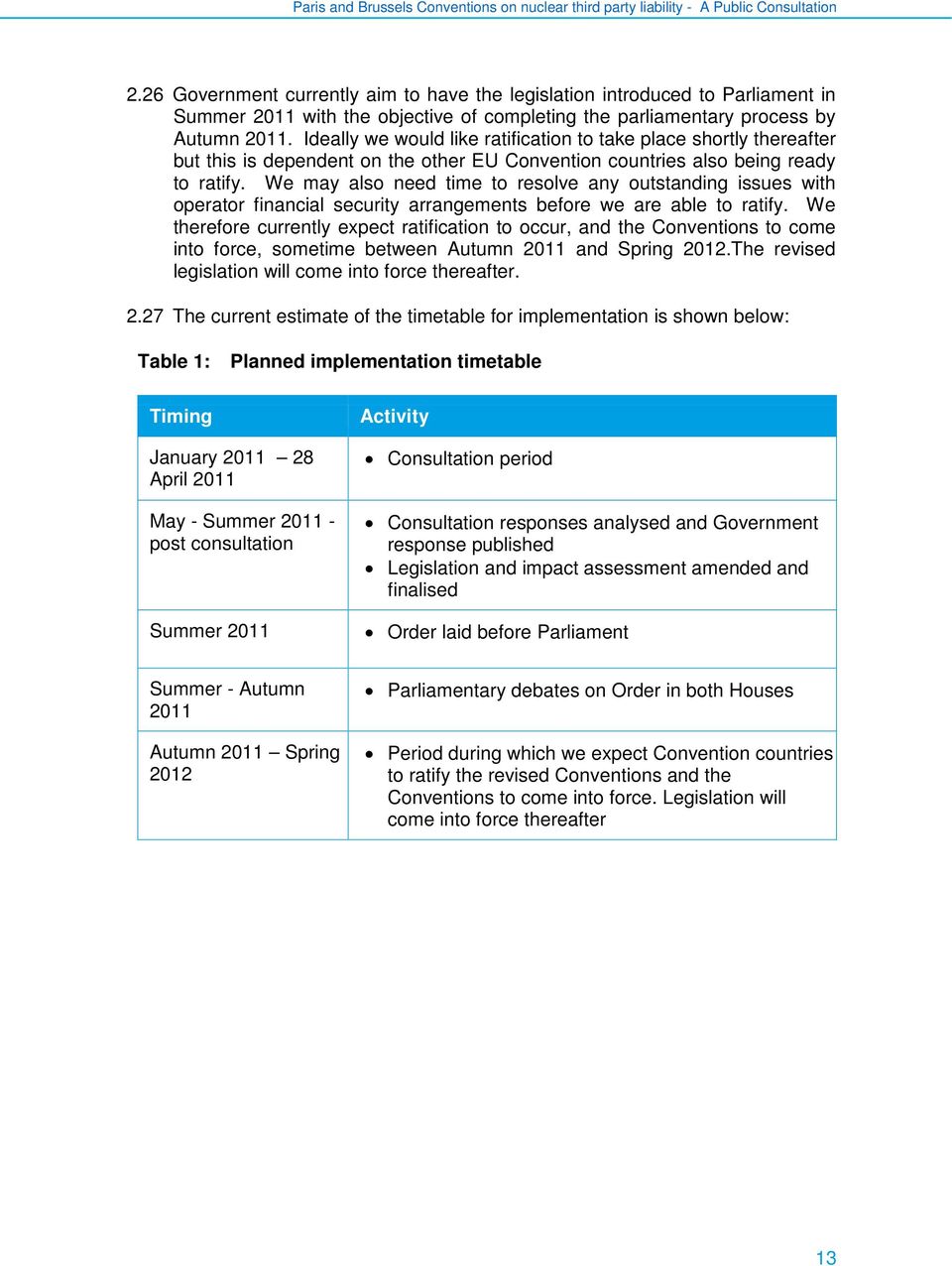
13 2.26 Government currently aim to have the legislation introduced to Parliament in Summer 2011 with the objective of completing the parliamentary process by Autumn Ideally we would like ratification to take place shortly thereafter but this is dependent on the other EU Convention countries also being ready to ratify. We may also need time to resolve any outstanding issues with operator financial security arrangements before we are able to ratify. We therefore currently expect ratification to occur, and the Conventions to come into force, sometime between Autumn 2011 and Spring 2012.The revised legislation will come into force thereafter The current estimate of the timetable for implementation is shown below: Table 1: Timing Planned implementation timetable Activity January April 2011 May - Summer post consultation Summer 2011 Consultation period Consultation responses analysed and Government response published Legislation and impact assessment amended and finalised Order laid before Parliament Summer - Autumn 2011 Autumn 2011 Spring 2012 Parliamentary debates on Order in both Houses Period during which we expect Convention countries to ratify the revised Conventions and the Conventions to come into force. Legislation will come into force thereafter 13
14 3. Background Purpose of the Paris and Brussels Conventions 3.1 The production and use of nuclear power necessarily involves the use of hazardous radioactive materials and an incident at a nuclear installation or during the transport of radioactive materials to or from a nuclear installation could have far-reaching adverse consequences for human health and the environment. Guarding against these risks is therefore of the highest priority and the UK has in place robust safety, security and environmental protection regimes that comply with frameworks laid down at EU and international level. 3.2 Given the strength of these regimes, the likelihood of an incident occurring is very small. Nevertheless, if an incident does occur, the Conventions put in place a well established international regime for compensating third parties who suffer damage as a result of the incident. 3.3 This regime is aimed at ensuring adequate and fair compensation for victims who suffer damage as a result of a nuclear incident at a nuclear installation or during the transport of nuclear substances to and from that installation. At the same time, it is aimed at ensuring that the operators of such installations, who are in the best position to ensure the safety of their installations, take responsibility for any failure in safety. Further, recognising that the effects of a nuclear incident do not stop at national boundaries, the Conventions also aim to provide uniformity in certain basic rules across its signatory countries. 3.4 In order to meet these aims, the current Paris Convention is based on the following key principles: The operator of a nuclear installation is exclusively liable for personal injury or property damage resulting from nuclear incidents. All claims for injury or damage are channelled to the operator and, with limited exception, no other party can be liable. This means claimants have an easily identifiable person to bring a claim against in the event of a nuclear incident; The operator is strictly liable for the injury and damage. There is no need for a claimant to establish fault on the part of the operator; The operator s liability is capped in amount per incident by the legislation of its home country (but not at an amount less than the minimum liability amount per incident specified by the Convention); The right to compensation expires if legal action is not brought within 10 years following the nuclear incident; 14

15 The operator is under an obligation to maintain insurance or other financial security up to the limit of its liability; Where there is a nuclear incident in a nuclear installation in one Paris Convention country, claims for compensation can be brought against the operator in respect of injury or damage incurred in another Convention country; and In general, the courts of the State where the nuclear incident has occurred deal with compensation claims (irrespective of where the damage has been incurred). 3.5 The Paris Convention is augmented by the Brussels Supplementary Convention. Soon after the adoption of the Paris Convention, a number of its signatories developed the Brussels supplementary compensation regime to provide additional public funds, should the compensation under the Paris Convention prove insufficient to meet claims for damage caused by a nuclear incident. Currently public funds must be made available to top-up operators funds to a total of 300 million Special Drawing Rights 7 per incident. These public funds are to be provided, through a three tier system, not only by the responsible operator s home country, but also by contributions from all parties to the Brussels Supplementary Convention. The Brussels Supplementary Convention is thus based on a strong bond of financial solidarity between its signatory countries. 3.6 It should be noted that the Brussels Supplementary Convention does not establish its own liability regime; rather it relies on the liability regime established in the Paris Convention. No country may become or remain a party to the Brussels Supplementary Convention unless it is a party to the Paris Convention. 3.7 The parties to the Paris Convention largely consist of countries in western Europe - see Annex C for a list. Most, but not all, of the parties to the Paris Convention are parties to the Brussels Supplementary Convention. Changes to the Conventions 3.8 Amendments to the Conventions were agreed in There are substantial amendments to both the Paris and the Brussels Conventions, though without disturbing the essential features of the system. The most significant changes are: 7 A unit of account defined by the International Monetary Fund (IMF) based upon a basket of key international currencies. 1 pound sterling is equivalent to 1.02 SDR (as at ) 15

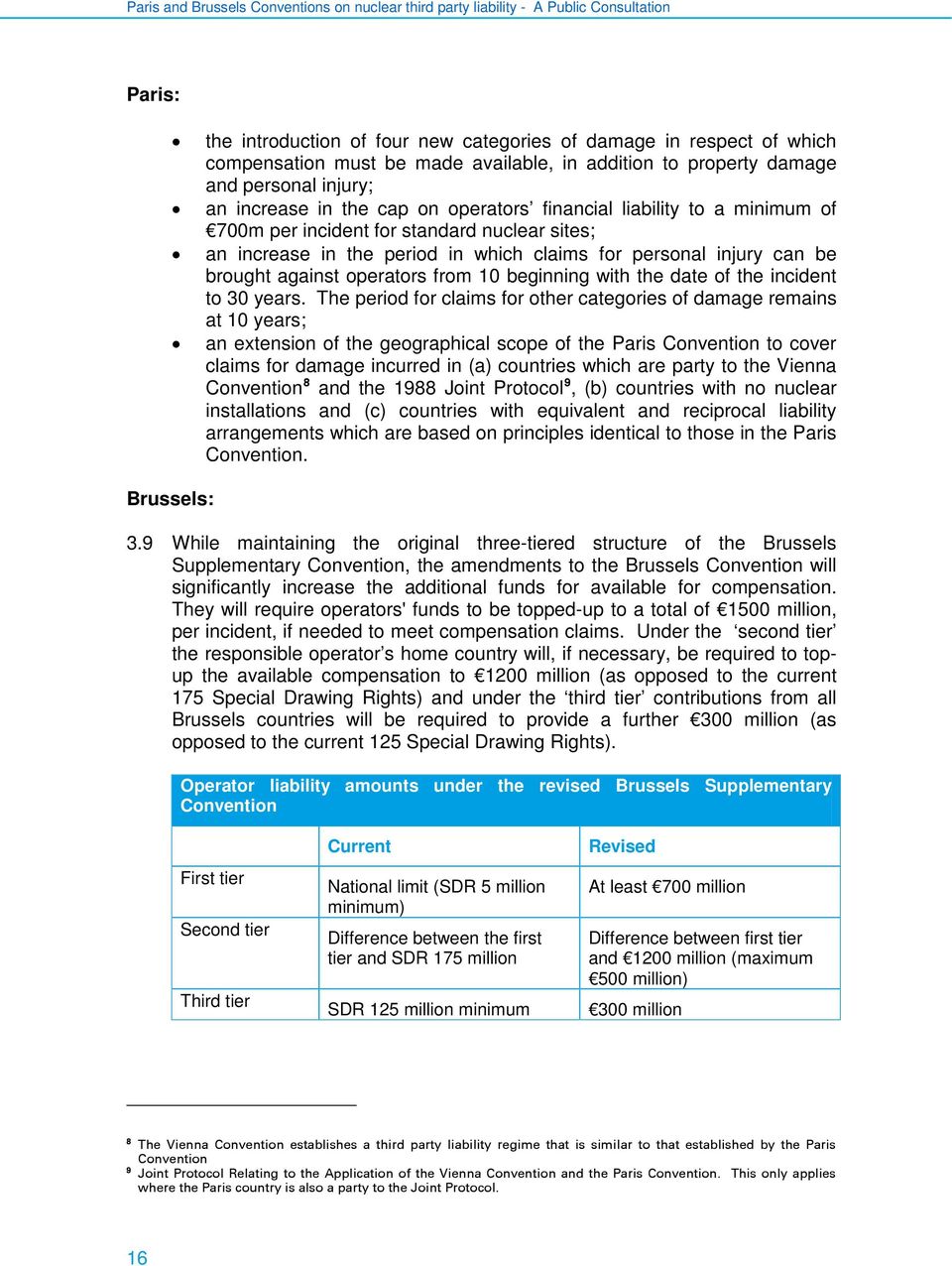
16 Paris: the introduction of four new categories of damage in respect of which compensation must be made available, in addition to property damage and personal injury; an increase in the cap on operators financial liability to a minimum of 700m per incident for standard nuclear sites; an increase in the period in which claims for personal injury can be brought against operators from 10 beginning with the date of the incident to 30 years. The period for claims for other categories of damage remains at 10 years; an extension of the geographical scope of the Paris Convention to cover claims for damage incurred in (a) countries which are party to the Vienna Convention 8 and the 1988 Joint Protocol 9, (b) countries with no nuclear installations and (c) countries with equivalent and reciprocal liability arrangements which are based on principles identical to those in the Paris Convention. Brussels: 3.9 While maintaining the original three-tiered structure of the Brussels Supplementary Convention, the amendments to the Brussels Convention will significantly increase the additional funds for available for compensation. They will require operators' funds to be topped-up to a total of 1500 million, per incident, if needed to meet compensation claims. Under the second tier the responsible operator s home country will, if necessary, be required to topup the available compensation to 1200 million (as opposed to the current 175 Special Drawing Rights) and under the third tier contributions from all Brussels countries will be required to provide a further 300 million (as opposed to the current 125 Special Drawing Rights). Operator liability amounts under the revised Brussels Supplementary Convention First tier Second tier Third tier Current National limit (SDR 5 million minimum) Difference between the first tier and SDR 175 million SDR 125 million minimum Revised At least 700 million Difference between first tier and 1200 million (maximum 500 million) 300 million 8 The Vienna Convention establishes a third party liability regime that is similar to that established by the Paris Convention 9 Joint Protocol Relating to the Application of the Vienna Convention and the Paris Convention. This only applies where the Paris country is also a party to the Joint Protocol. 16
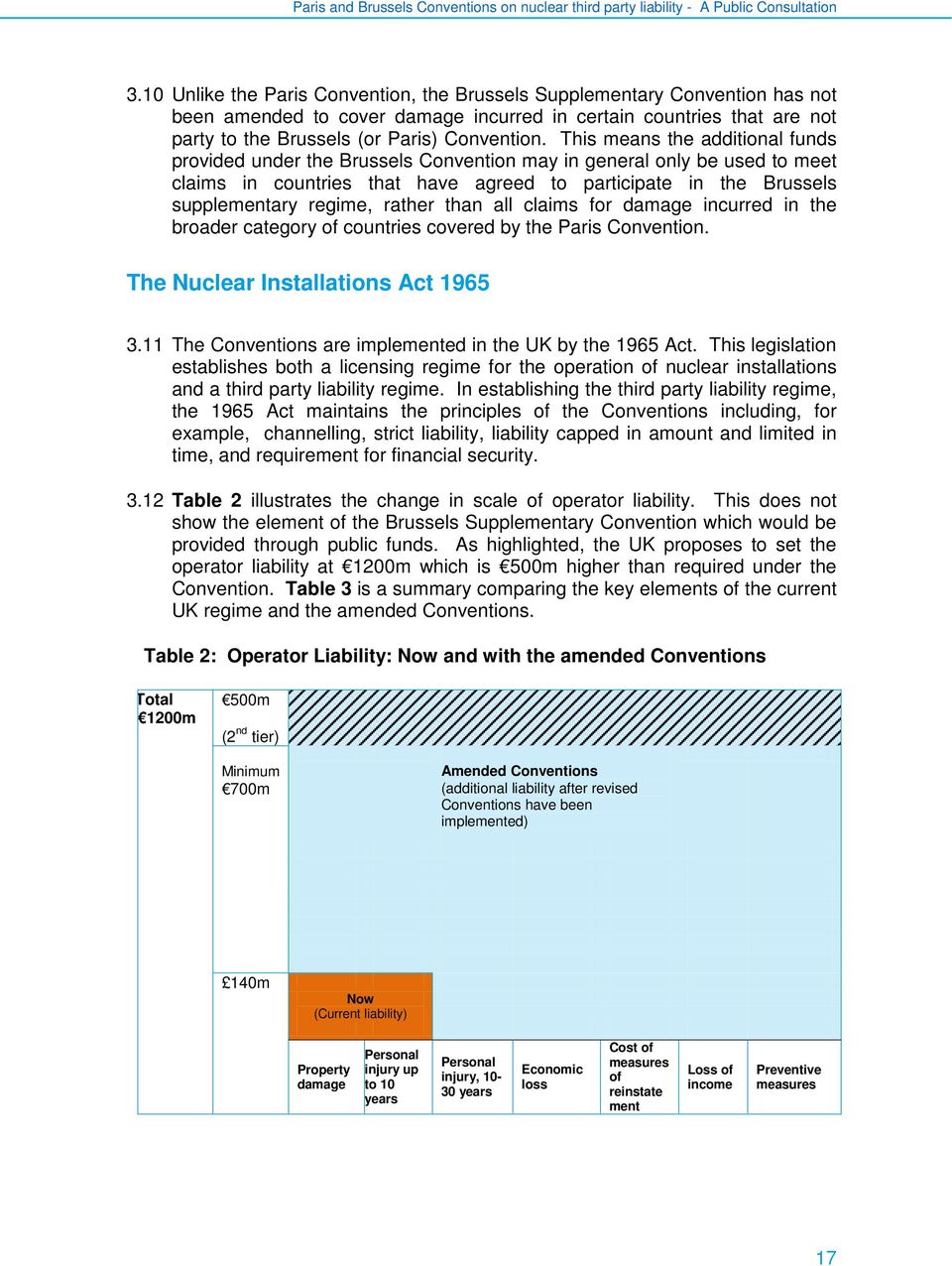
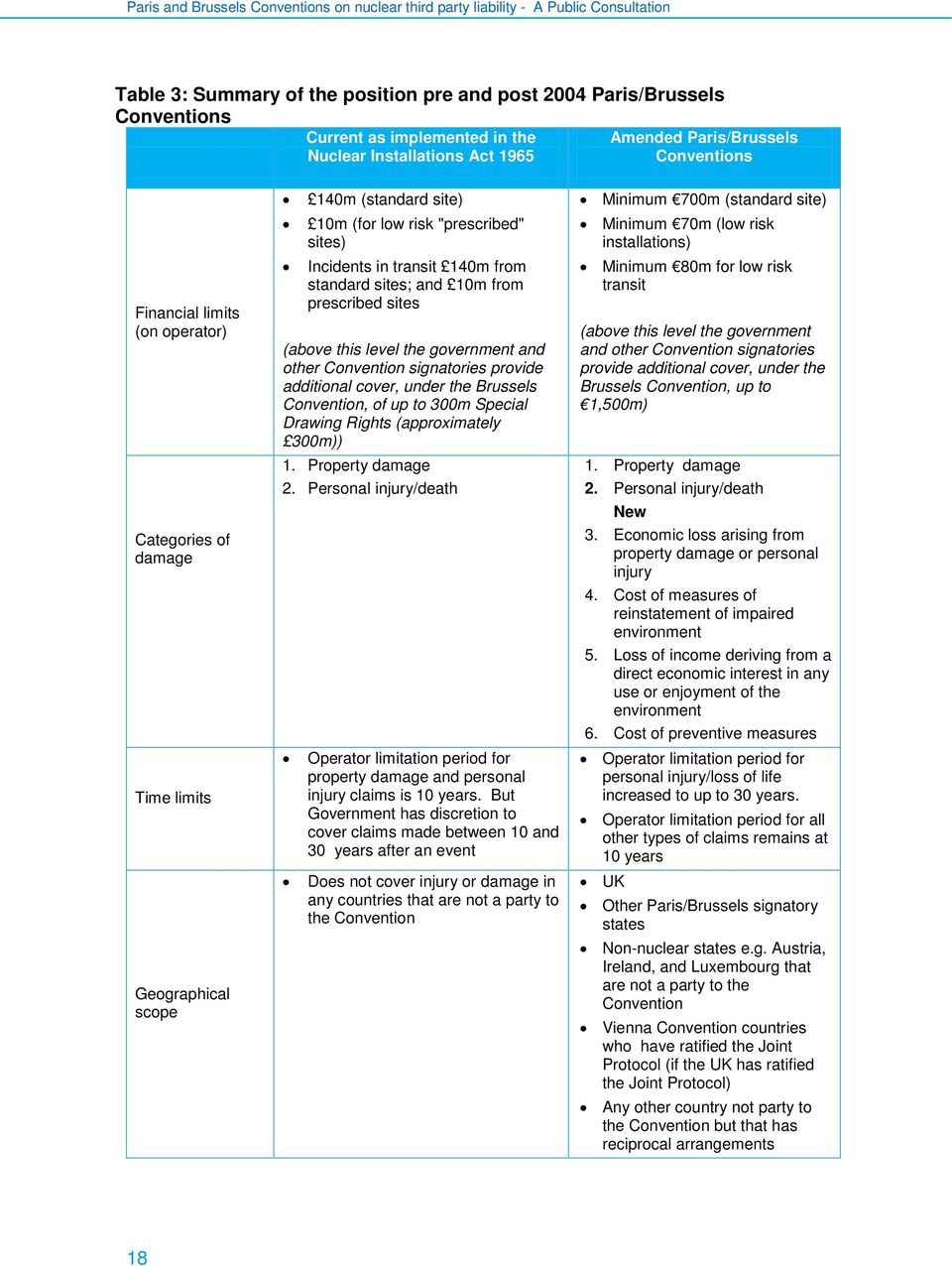
17 3.10 Unlike the Paris Convention, the Brussels Supplementary Convention has not been amended to cover damage incurred in certain countries that are not party to the Brussels (or Paris) Convention. This means the additional funds provided under the Brussels Convention may in general only be used to meet claims in countries that have agreed to participate in the Brussels supplementary regime, rather than all claims for damage incurred in the broader category of countries covered by the Paris Convention. The Nuclear Installations Act The Conventions are implemented in the UK by the 1965 Act. This legislation establishes both a licensing regime for the operation of nuclear installations and a third party liability regime. In establishing the third party liability regime, the 1965 Act maintains the principles of the Conventions including, for example, channelling, strict liability, liability capped in amount and limited in time, and requirement for financial security Table 2 illustrates the change in scale of operator liability. This does not show the element of the Brussels Supplementary Convention which would be provided through public funds. As highlighted, the UK proposes to set the operator liability at 1200m which is 500m higher than required under the Convention. Table 3 is a summary comparing the key elements of the current UK regime and the amended Conventions. Table 2: Operator Liability: Now and with the amended Conventions Total 1200m 500m (2 nd tier) Minimum 700m Amended Conventions (additional liability after revised Conventions have been implemented) 140m Now (Current liability) Property damage Personal injury up to 10 years Personal injury, years Economic loss Cost of measures of reinstate ment Loss of income Preventive measures 17
18 Table 3: Summary of the position pre and post 2004 Paris/Brussels Conventions Current as implemented in the Nuclear Installations Act 1965 Amended Paris/Brussels Conventions Financial limits (on operator) Categories of damage Time limits Geographical scope 140m (standard site) 10m (for low risk "prescribed" sites) Incidents in transit 140m from standard sites; and 10m from prescribed sites (above this level the government and other Convention signatories provide additional cover, under the Brussels Convention, of up to 300m Special Drawing Rights (approximately 300m)) 1. Property damage 2. Personal injury/death Operator limitation period for property damage and personal injury claims is 10 years. But Government has discretion to cover claims made between 10 and 30 years after an event Does not cover injury or damage in any countries that are not a party to the Convention Minimum 700m (standard site) Minimum 70m (low risk installations) Minimum 80m for low risk transit (above this level the government and other Convention signatories provide additional cover, under the Brussels Convention, up to 1,500m) 1. Property damage 2. Personal injury/death New 3. Economic loss arising from property damage or personal injury 4. Cost of measures of reinstatement of impaired environment 5. Loss of income deriving from a direct economic interest in any use or enjoyment of the environment 6. Cost of preventive measures Operator limitation period for personal injury/loss of life increased to up to 30 years. Operator limitation period for all other types of claims remains at 10 years UK Other Paris/Brussels signatory states Non-nuclear states e.g. Austria, Ireland, and Luxembourg that are not a party to the Convention Vienna Convention countries who have ratified the Joint Protocol (if the UK has ratified the Joint Protocol) Any other country not party to the Convention but that has reciprocal arrangements 18
19 4. The new categories of damage Overview of the changes 4.1 The Paris Convention ( the Convention ) provides that an operator of a nuclear installation is to be liable to pay compensation for certain categories of third party damage caused by a nuclear incident. 4.2 Under the provisions of the Convention that are currently in force, the categories of damage are limited to damage to or loss of life of any person and damage to or loss of any property 10. The amendments to the Convention add four new categories of damage for which operators will be liable. The new definition of nuclear damage means that compensation will be available in respect of the following categories of damage: 1. loss of life or personal injury 2. loss of or damage to property and each of the following to the extent determined by the law of the competent court, 3. economic loss arising from loss or damage referred to in paragraph 1. or 2. above insofar as not included in those paragraphs, if incurred by a person entitled to claim in respect of such loss or damage; 4. the costs of measures of reinstatement of impaired environment, unless such impairment is insignificant, if such measures are actually taken or to be taken and insofar as not included in paragraph 2 above; 5. loss of income deriving from a direct economic interest in any use or enjoyment of the environment, incurred as a result of a significant impairment of that environment; and insofar as not included in paragraph 2 above; 6. the costs of preventive measures, and further loss or damage caused by such measures In the case of the categories of damage in paragraphs 1 to 5, in order to qualify as nuclear damage for which an operator is liable to pay compensation, the loss or damage must have been caused by ionising radiation emitted either in the operator s nuclear installation or during the 10 Article 3 (a) of the Convention. Damage to the nuclear installation itself and any other nuclear installation, including a nuclear installation under construction, on the site where that installation is located; and any property on that same site which is used or to be used in conjunction with any such installation is excluded. The position remains the same under the revisions to the Convention. 11 Article 1(a)(vii) of the consolidated text of the Convention. 19

20 transport of nuclear substances to or from the installation. Provision is made for non-radiological loss to be assimilated with loss caused by radioactivity 12. Overview of our implementation 4.4 In implementing the new categories of damage Government proposes to adopt the wording and definitions used in the Convention without further elaboration, as far as this is possible and sensible. This is in line with the approach taken by other Convention countries. It will help to avoid under or over implementation of the Convention amendments and will secure consistency internationally. These factors are especially important given the reciprocal nature of the regime established by the Convention. 4.5 The categories of nuclear damage in paragraphs 1 and 2 of the Convention (personal injury and property damage), are the existing categories of damage under the Convention. They are already implemented by the 1965 Act, in particular sections 7, 8, 9, 10 and 12. In the circumstances, Government does not consider that any amendments need to be made to the 1965 Act to implement the categories of damage in paragraphs 1 and 2. Section 7(1) imposes a duty on licensees of a nuclear installation to secure that certain occurrences involving nuclear matter or certain emissions of radiation do not cause injury to any person or damage to any property. Section 7 is applied to the United Kingdom Atomic Energy Authority and the Crown by section 8 and 9 of the 1965 Act respectively. Where jurisdiction lies with the UK under the Convention, section 10 imposes on operators of installations in other Convention countries a duty similar (albeit more limited) to that imposed by section Subject to various qualifications, section 12 of the 1965 Act gives a right to compensation where there has been a breach of duty imposed by sections 7, 8, 9 and 10 of the Act. Compensation is payable to victims in respect of the injury or damage that has been caused in breach of the duty. Section 12 also reflects the principles in the Convention relating to the channelling and limitation of liability. It prevents any liability for injury or damage caused in breach of a duty from being incurred by any person other than the person subject to the duty under section 7, 8, 9 or 10 of the 1965 Act and it provides that compensation is payable up to the financial limits in section Government considers that the category of nuclear damage in paragraph 3 of the Convention (economic loss arising from personal injury or property damage) is sufficiently covered by the existing provision for personal injury and damage in the 1965 Act described above. This means that no amendments to the 1965 Act will be needed to implement this new category of damage. 12 Loss or damage qualifies as nuclear damage to the extent that the loss or damage arises out of or results from ionising radiation emitted by any source of radiation inside a nuclear installation, or emitted from nuclear fuel or radioactive products or waste in, or of nuclear substances coming from, originating in, or sent to, a nuclear installation, whether so arising from the radioactive properties of such matter, or from a combination of radioactive properties with toxic, explosive or other hazardous properties of such matter. 20

21 4.8 The categories of nuclear damage in paragraphs 4 to 6 of the Convention are new and amendments to the 1965 Act need to be made to implement them. In order to implement these new categories of damage Government proposes, in particular, to amend the duties imposed on licensees and others in sections 7 to 10 of the 1965 Act and to provide for a right to compensation to reflect the new categories of damage In the case of the categories of nuclear damage in paragraph 4 (costs of measures of reinstatement of the environment) and paragraph 5 (loss of income deriving from a direct economic interest in the environment), the harm that they are intended to address is a (significantly) impaired environment. The level of compensation turns on the cost of reinstating, or on the economic cost of not being able to use or enjoy, that environment. Accordingly, we propose to make amendments to section 7 to put significant impairment of the environment on the same footing as injury to any person and damage to any property. This means there will be a duty on a licensee to secure that certain occurrences involving nuclear matter or certain emissions of radiation do not cause significant impairment to the environment, as well as personal injury or property damage: see the duties in new section 7(1A) and (1B) inserted by Article 3 of the draft Order In addition, Government proposes to add new provisions setting out rights to claim compensation in respect of the cost of measures of reinstatement of the environment and loss of income deriving from a direct economic interest in the environment: see new sections 11A to 11G inserted by Articles 6 and 7 of the draft Order. These rights will apply where significant impairment of the environment has been caused in breach of a section 7 duty In the case of the category of nuclear damage in paragraph 6 of the Convention (costs of preventive measures), the definition of preventive measures in the revised Convention 14 requires compensation to be available where there is a grave and imminent threat of nuclear damage falling within paragraphs 1 to 5 (as well as where a nuclear incident has actually occurred). Government therefore plan to impose a new duty on licensees to secure that no event arises that creates a grave and imminent threat of a breach of the other duties imposed by section 7 of the 1965 Act: see new section 7(1D) inserted by Article 3 of the draft Order. In addition, Government proposes to include a new provision setting out a person s right to claim compensation for the costs of preventive measures and further loss or damage caused by such measures: see new section 11H inserted by Article 8 of the draft Order. This right will apply where the person has taken the preventive measures after a breach of duty In order to comply with the principles of channelling and limited liability in the Convention, it is necessary to amend the 1965 Act to provide that, where there has been a breach of duty under section 7, it will not be possible to 13 For simplicity, the remainder of this chapter refers only to the duties imposed on licensees by section 7 but the points will apply similarly in relation to the duties imposed by sections 8 to Article 1(a)(ix) of the Convention 21
22 recover compensation in respect of the new categories of damage outside the 1965 Act: see new section 12E inserted by Article 9 of the draft Order In the event of a nuclear incident, it may be that a person suffers loss or damage that could be treated as falling within more than one category of damage. Generally speaking, unless the Convention provides otherwise, Government does not propose to be prescriptive about what category of damage a claim is brought under. We believe that the courts will, in accordance with the general law, ensure that compensation will not be awarded more than once for the same loss or damage In addition, there is a question whether Government should provide that an operator (or government where the operator s liability limit is exceeded) should meet claims for compensation for certain categories of nuclear damage before it meets claims for other categories of nuclear damage. At present the draft Order does not contain any provision for prioritising certain types of claim over others. Therefore claims will be met on a first-come firstserved basis. We are presently of the view that a system of prioritisation may be difficult to operate in practice and the claims that ought to be prioritised may depend on the nature of the incident. Economic loss arising from personal injury or property damage 4.15 The new definition of nuclear damage means that operators are to be required to meet claims for: Aim economic loss arising from loss or damage referred to in paragraph 1. or 2. above insofar as not included in those sub-paragraphs, if incurred by a person entitled to claim in respect of such loss or damage; This new category of nuclear damage is aimed at ensuring compensation is available in respect of economic (i.e. monetary or financial) loss arising from the categories of damage relating to personal injury or property damage. In order for compensation to be available there must be a causal link between the economic loss and personal injury or property damage. And the right to claim compensation for this category of damage is to extend only to a person who has a right to claim compensation for the personal injury or property damage from which the economic loss arose. In other words, this category of damage is intended to give rise to an entitlement to compensation for consequential economic loss as opposed to pure economic loss. Further, compensation for this category of damage is only required to be made available where it is not already included (according to the applicable national 15 Note paragraph 4.29 below 16 Article 1 (A)(vii)(3) of the revised Convention 22
23 law) in the compensation that can be claimed for personal injury or property damage. Implementation 4.17 Government considers that this category of nuclear damage is sufficiently covered by the existing provision for personal injury and property damage in the 1965 Act. The amount of compensation for personal injury or property damage caused in breach of a duty under section 7 of the 1965 Act is determined in accordance with the normal rules that apply for assessing damages which aim to put victims in the same position as they would have been if they had not suffered the injury or damage. Once it is established that personal injury or property damage has occurred in breach of a duty under the 1965 Act, the person in breach will be liable for the foreseeable losses caused by the breach providing they are not too remote The question of what is reasonably foreseeable and not too remote would need to be answered on a case-by-case basis. However, in our view, it would be capable of covering this category of economic loss arising from personal injury or property damage. In the case of personal injury, it might be expected to include consequential economic losses such as loss of earning capacity, or loss of support in the case of a claim by a dependent. In the case of property damage, consequential losses might include, for example, the diminution in value of a property over and above the cost of repairs or remedial work, the costs incurred by a householder as a result of the loss of use of property or the loss of income or profit from a business premises In the circumstances, Government considers that no amendments to the 1965 Act are needed to implement this new category of damage. Costs of measures of reinstatement of impaired environment 4.20 The new definition of nuclear damage means that operators are to be required to meet claims for: the costs of measures of reinstatement of impaired environment, unless such impairment is insignificant, if such measures are actually taken or to be taken and insofar as not included in paragraph 2 above; See Blue Circle Industries Plc v Ministry of Defence CA Judgment of 10 June This case relates to property damage. 18 Article 1(a)(vii)(4) of the Convention. This wording bears a striking resemblance to part of the wording in the definition of pollution damage in the 1992 International Convention on Civil Liability for Oil Pollution Damage : loss or damage caused outside the ship by contamination resulting from the escape or discharge of oil from the ship, wherever such escape or discharge may occur, provided that compensation for impairment of the environment other than loss of profit from such impairment shall be limited to costs of reasonable measures of reinstatement actually undertaken or to be taken. 23
24 Aim 4.21 Where there has been a breach of the existing duty in section 7 of the 1965 Act not to cause property damage, a claimant (with a sufficient interest in the property) will generally be able to recover his or her reasonable reinstatement costs, among other things 19. Compensation in such cases is aimed at protecting a private interest in property. By contrast, Government considers that this new category of nuclear damage is aimed at the compensation of those who incur expense reinstating the environment in the public interest. Domestic case law has recognised such a distinction between claims for costs incurred by authorities or bodies acting in the public interest and private claims for property damage Various arrangements exist for public authorities or other bodies to take steps in the public interest to reinstate the environment in the event of a nuclear incident 21. Different arrangements for reinstatement may apply in different parts of the UK 22 and of course the different countries covered by the Convention will have their own arrangements for reinstatement The Government believes that this new category of damage is aimed at ensuring that claims can be made against operators for the costs of reinstatement measures incurred by authorities or other public bodies acting under these various arrangements for reinstatement of the environment, where the impairment of the environment is significant and, subject to the other parameters on cost recovery set out in the Convention. We are therefore required to provide for a flexible cost recovery regime that will work in relation to the different arrangements for reinstatement that may apply in the UK and in other countries covered by the Convention. We do not consider that this new category of damage requires us to create a new freestanding regime for the reinstatement of the environment. This approach is in line with the purpose of the Convention which is concerned with the payment of compensation According to this approach the compensation that operators can be required to pay for will be determined by: the underlying arrangements for the reinstatement of the environment (including the scope of the powers of the relevant authority or body); and in addition 19 The principle measure of compensation in the case of damage to land is the diminution in value to the claimant or the cost of reasonable reinstatement (see e.g. Blue Circle Industries Plc v Ministry of Defence (footnote 17); Halsbury s Laws of England Volume 12(1), paragraph 868). 20 Bartoline Ltd v Royal & Sun Alliance Insurance plc [2007] 1 All ER (Comm) Arrangements in the UK include those in the Environmental Permitting (England and Wales) Regulations 2010, the Radioactive Substances Act 1993 and the radioactive contaminated land regime under Part 2A of the Environmental Protection Act 1990 as modified by the Radioactive Contaminated Land (Modification of Enactments)(England) Regulations 2006 (SI 2006/1379) as amended by SI 2007/3245 and SI 2008/520; the Radioactive Contaminated Land (Modification of Enactments) (Wales) Regulations 2006 (SI 2006/2988) as amended by SI 2007/3250 and SI 2008/521; the Radioactive Contaminated Land (Scotland) Regulations 2007 (SSI 2007/179) as amended by SI 2007/3240 and SSI 2009/202 ;and the Radioactive Contaminated Land Regulations (Northern Ireland) 2006 (S.R. (NI) 2006 No 345) as amended by SI 2007/ For example, see section 22 of the Water Environment and Water Services (Scotland) Act
25 the parameters on cost recovery set out in the Convention as applied by the 1965 Act. Implementation 4.25 In order to implement this new category of damage, it is proposed that new subsections (1A) and (1B) of section 7 impose on licensees duties to secure that certain occurrences involving nuclear matter or certain emissions of radiation do not cause significant impairment to the environment, as well as personal injury or property damage. In addition, new section 11A inserted by Article 6(1) of the draft Order sets out an entitlement to claim the cost of measures of reinstatement of the impaired environment which will apply where the significant impairment has been caused in breach of a section 7 duty In order to create a flexible cost recovery regime that will work in relation to the different arrangements for reinstatement of the environment that may apply in the UK and in other countries covered by the scheme of the Convention Government does not propose to limit further what is covered by the environment, for example by limiting the term to particular components of the environment, such as land or water 23. Of course the scope of the particular underlying reinstatement arrangements will determine what components of the environment can be reinstated Government is considering whether it will be necessary or desirable to adjust particular existing domestic reinstatement regimes in order to make them fit better the proposed cost recovery provisions in the 1965 Act 24. It may be necessary or desirable to make amendments to other cost recovery provisions in particular. Any amendments will need to be consistent with the devolution settlements 25. (In any event, it will not be possible to recover the cost of measures of reinstatement outside the 1965 Act - see paragraph 4.12 above.) 4.28 Article 1(vii)(4) of the revised Paris Convention provides for the payment of the cost of measures of reinstatement of impaired environment insofar as not included in [a property damage claim]. We believe this is to ensure that the operator does not have to pay twice over for the same costs or loss. Even though the costs of reasonable reinstatement can in certain cases be recovered in a claim for property damage, we do not consider that the Convention requires us to preclude claims by a public authority for these costs where the costs could be claimed through a claim for property damage (by the person with the necessary property interest rather than the public authority). This would not take into account the different purpose for which a public authority would undertake reinstatement measures (to protect the 23 Although we propose to exclude the recovery of the cost of reinstatement measures that would benefit the operator s property or property that is treated as the operator s under section 7 of the 1965 Act: see section 11A(3). 24 For example, see footnote Any amendments to reinstatement arrangements in Scotland, Northern Ireland or Wales would be for the relevant Devolved Administration to determine. 25
26 public interest) and for which a property owner would act (to protect his private interest) That said, there is a question about what would happen if a property owner is compensated under the 1965 Act for the diminution in value of his land (as opposed to the cost of reasonable reinstatement), but does not reinstate the land, and later a public body makes a claim for the cost of reinstatement measures in respect of the land. We are considering whether we ought to make provision for this situation The following paragraphs discuss the implementation of the parameters set by the Convention. Significant impairment 4.31 The new definition of nuclear damage includes the costs of measures of reinstatement of impaired environment, unless such impairment is insignificant. This means that, under the Convention, operators are not liable for the costs of reinstating the environment where the damage to the environment is insignificant. In order to reflect this limit Government intends to limit the right to compensation to cases where significant impairment of the environment has been caused in breach of the duty in section Government proposes to specify that in order for the impairment to be treated as significant it must, at the very least, be of such a degree that it would be eligible for compensation as property damage under the 1965 Act: see the new definition of "significant impairment of the environment" inserted in section 26 by Article 32(3) of the draft Order. The Court of Appeal has held that in order to qualify as property damage under the 1965 Act there needs to be some alteration in the physical characteristics of the property which render it less useful or valuable 26. We think that this test provides an appropriate threshold below which it cannot be said there is significant impairment of the environment although the intention is that a court (or Secretary of State- see below) will be able to set the bar higher if it thinks fit, having regard to all the relevant circumstances of the case. This provision should also help to prevent anomalies arising with regard to what can be claimed under the different categories of damage Beyond this, in line with our policy of providing a flexible cost recovery regime, Government does not propose to define or limit the meaning of significant impairment. Government considers it is desirable that all relevant circumstances relating to a particular case are taken into account when deciding whether or not impairment of the environment is significant for the purposes of the 1965 Act. It seems likely that the level of radioactivity and its impact on human health and the geographical extent of the impact will be relevant factors. But there may be others, such as whether habitats or species protected under national or EU law are affected. In any event, the 26 Blue Circle Industries Plc v Ministry of Defence see footnote
27 underlying reinstatement regimes which provide the authority to undertake reinstatement measures may set their own thresholds for intervention 27. Definition of measures of reinstatement 4.34 The amended Convention defines measures of reinstatement as: any reasonable measures which have been approved by the competent authorities of the State where the measures were taken, and which aim to reinstate or restore damaged or destroyed components of the environment, or to introduce, where reasonable, the equivalent of these components into the environment. The legislation of the State where the nuclear damage is suffered shall determine who is entitled to take such measures 28. Who can claim the cost of measures of reinstatement? 4.35 The definition provides that the legislation of the State where the nuclear damage is suffered shall determine who is entitled to take such measures. This reflects the fact that different countries will have their own reinstatement arrangements. Government believes that this wording permits us to determine who in the UK can claim for the costs of measures of reinstatement. Given our view that this new category of nuclear damage is aimed at the compensation of those who incur expense in relation to the reinstatement of the environment in the public interest, we plan to extend the right to claim to public authorities that have powers or duties to take reinstatement measures (or to arrange for such measures to be taken on their behalf) or to public authorities that pay for other public authorities to act: see new section 11A inserted by Article 6(1) of the draft Order. This will enable public authorities such as the Government, local authorities and the environment agencies to claim. What are measures of reinstatement? 4.36 The definition of measures of reinstatement in the amended Convention defines such measures as those that aim to reinstate or restore damaged or destroyed components of the environment, or to introduce, where reasonable, the equivalent of these components into the environment. New section 11A(5) contains wording intended to mirror the Convention definition of measures of reinstatement The amended Convention does not specify what is meant by reinstating or restoring the environment or introducing equivalent components. Similarly, we do not propose to define these terms any further in the 1965 Act. Government does not believe the term measures of reinstatement should be construed restrictively. We believe such measures could potentially cover clean-up costs (such as the costs of removing and disposing of contaminated 27 For example the radioactive contaminated land regime effectively sets a threshold of 3mSv per year. 28 Article 1(a)(viii). 27
28 material), the cost of implementing shielding options (such as dilution or using shielding material) as well as restorative or replacement actions (such as replacing top-soil or organisms) Government considers reinstatement measures could also cover assessment or monitoring of the environment in circumstances where it is sufficiently closely connected to possible reinstatement action. For example, assessing the condition of the impaired environment to establish what reinstatement action (if any) should be taken would, we believe, be covered. However, assessing more generally or taking steps to discover if there is an impairment seems to go beyond what is contemplated by the Convention. Further, although some on-going monitoring may be covered as part of a reinstatement programme, it seems doubtful that monitoring the environment after such a programme has been implemented would be covered There is a question whether the definition of reinstatement measures under new section 11A could cover so-called compensatory remediation which is aimed at providing compensation in respect of the time taken for the impaired environment to be reinstated and during which the environment is not available to perform its usual functions. It can legitimise reliance on natural regeneration rather than more active (and costly) measures. A court would probably have regard to the norm for environmental reinstatement at the time which could mean the position changes over time. We are considering whether we should make provision to clarify the position by expressly including or excluding this type of remediation. Reasonable measures 4.40 The definition of measures of reinstatement means that operators should only be liable to pay the costs of reasonable measures. The amended Convention defines reasonable measures as follows: measures which are found under the law of the competent court to be appropriate and proportionate, having regard to all the circumstances, for example: o the nature and extent of the nuclear damage incurred o the extent to which, at the time they are taken, such measures are likely to be effective; and o relevant scientific and technical expertise The requirement of reasonableness is included in the new provision in the 1965 Act setting out an entitlement to claim the cost of reinstatement measures (see new section 11A(5) and (6)). The cost of measures of reinstatement will only be recoverable to the extent that the measures are reasonably taken. A measure will be deemed to be reasonably taken if taking the measure is appropriate and proportionate in the circumstances. The intention is to ensure compensation for measures that are the right sort of 28
29 response at the right level or intensity, taking into account the benefits and disadvantages of the response There is a question whether we should set out in the 1965 Act particular matters that must be taken into account when assessing the reasonableness of reinstatement measures 29. Given our desire to create a flexible cost recovery mechanism that can apply in relation to a variety of underlying reinstatement regimes, we do not propose to take this approach. In principle, Government considers it should be possible to take into account all matters that are relevant in a particular case. This approach is taken in some other regimes that allocate responsibility for funding reinstatement measures, in particular the International Maritime Organisation regime for compensation of damage caused by oil pollution Lastly on the issue of reasonableness, we have specified that the cost of the measures of reinstatement should be reasonable, as well as the measures themselves (see new section 11A(1)). Such a requirement is not made express in the Convention but seems to be implied. Approval of measures by the competent authorities 4.44 The definition of measures of reinstatement refers to any reasonable measures which have been approved by the competent authorities of the State where the measures were taken. Where reinstatement measures are taken, or to be taken, in the UK Government proposes to provide that, before an operator can be required to pay compensation in respect of the costs of those measures, the measures must be approved by the Secretary of State: see new sections 11B and 11C inserted by Article 6(1) of the draft Order. It will be possible for an authority to seek approval either before or after the measures have been taken. It is intended that approval will be given where the Secretary of State is satisfied that the measures have been, or are to be, taken by or on behalf of an appropriate authority and where the measures meet the requirements for reinstatement measures laid down in the amended 1965 Act (as to significant impairment, reasonableness and so forth) Where the Secretary of State is the person making the claim a deputy will need to be appointed to carry out the approval functions (new section 11B(12)). (There is analogous provision in the Environmental Damage (Prevention and Remediation) Regulations ). 29 See for example, the list of factors in Schedule 4 to the Environmental Damage (Prevention and Remediation) (England) Regulations 2009 SI 2009/ See International Convention on Civil Liability for Oil Pollution Damage (CLC), See also the Water Resources Act 1991: where the Agency carries out works, operations or investigations under section 161 or 161ZA, section 161ZC (2)) confers an entitlement on the Agency to recover expenses reasonably incurred ; and the Radioactive Substances Act 1993: section 29(3) confers a right on the Secretary of State to make reasonable charges for the use of facilities for disposal or accumulation of radioactive waste and section 30(1) confers a power on the Agency to recover any expenses reasonably incurred in disposing of radioactive waste. Note: also see paragraph SI 2009/153, Part 2 of Schedule 5 29
30 4.46 If an incident at a nuclear installation in the UK harms the environment in another country covered by the scheme of the Convention (namely another Convention country, a non-nuclear country or a country with reciprocal arrangements), the definition of measures of reinstatement contemplates that any reinstatement measures will be approved by competent authorities in that country. However, it should be noted that under Article 13 of the Convention, jurisdiction in such as case would ultimately lie with courts in the UK. New Schedule 1A to the 1965 Act inserted by Article 6(2) of the draft Order is intended to deal with claims made in the UK for the cost of measures of reinstatement undertaken outside the UK In the reverse situation where an incident in another Convention country harms the environment in the UK, the law in the other Convention country may specify that in order to bring a claim for the costs of measures of reinstatement, those measures must be approved by the competent authorities in the UK. New section 11E is intended to provide for approval in these circumstances New section 11D provides a right to appeal to a court in the UK against the decision of the Secretary of State taken under section 11B or 11E. The right of appeal should be available to the authority that made the application for approval of the reinstatement measures and the operator who would be required to pay the costs of those measures 32. It is proposed that the court will be able to re-take the decision of the Secretary of State whether or not to approve the reinstatement measures We will need to ensure that the approval and appeal procedures fit with any court proceedings to determine whether there has been a breach of duty under the 1965 Act. It is envisaged where there is a dispute as to whether there has been a breach of duty by an operator, the issue of liability (i.e. whether there has been a breach of duty and whether this caused significant impairment of the environment) will be determined through ordinary court proceedings. The Secretary of State approval process and (if used) the statutory appeal in section 11D will follow on after this. By contrast, where there is no dispute as to liability, there will be no need for ordinary court proceedings and the public authority will apply for the Secretary of State s approval at the outset. The statutory appeal under section 11D will be available after the Secretary of State has taken his decision. Loss of income deriving from a direct economic interest in the environment 4.50 The new definition of nuclear damage means that operators are to be required to meet claims for: 32 The decision could be challenged by way of judicial review by others with sufficient standing in the usual way. 30
31 loss of income deriving from a direct economic interest in any use or enjoyment of the environment, incurred as a result of a significant impairment of that environment; and insofar as not included in paragraph 2 above; 33 Aim 4.51 As already discussed, it is possible for a person to claim consequential economic loss where they have suffered personal injury or property damage in breach of a duty under the 1965 Act. By contrast, this category of nuclear damage is aimed at economic loss which is not related to personal injury or property damage An example of this type of loss would be that suffered by fishermen where fish in the sea are contaminated by radiation and are not permitted to be sold. Since the fishermen do not own the fish or the sea, this kind of loss could not be recovered through a claim for property damage (although they could of course bring a property damage claim for loss caused by damage to their vessels or equipment). Another example would be the loss suffered by the owner of a hotel next to a public beach that had been closed as a result of radioactive contamination Generally speaking, in the UK pure economic loss can only be recovered in very limited circumstances. Therefore Government believes this new category of damage will provide a new entitlement to compensation. That said, we do not believe this category is wide in scope The term direct economic interest is intended to ensure that compensation will not be awarded for loss that is too causally remote from the impairment to the environment. Taking the example of contaminated fish in the sea, while fishermen are likely to be considered to have a direct economic interest in the contaminated fish and sea, it is unlikely that a supplier of goods to those fishermen or a purchaser of the fish caught by the fishermen would be able to demonstrate such a direct economic interest. Implementation 4.55 As already mentioned, it is intended that new section 7(1A), 7(1B) (inserted by Article 3 of the draft Order) will impose on licensees a duty to secure that certain occurrences involving nuclear matter or certain emissions of radiation do not cause significant impairment of the environment. New section 11G inserted by Article 7 of the draft Order then sets out an entitlement to claim in respect of a loss of income derived from the environment where significant impairment to the environment has been caused in breach of a section 7 duty. In line with the Convention, the loss will be limited to: 33 Article 1(a)(vii)(5) of the amended Convention. 31
32 income deriving from a direct economic interest in any use or enjoyment of the part of the environment that is significantly impaired as a result of the breach of duty; and loss that is attributable to the effect of the impairment on the use or enjoyment of that part of the environment Consistent with our approach in relation to the category of damage relating to costs of measures of reinstatement, we propose to set a minimum threshold for significant impairment (see paragraph 4.32 above and the definition in amended section 26). However, Government does not propose to define the environment or to make provision about what constitutes a direct economic interest in any use or enjoyment of the environment. Although in the UK damages are not generally available for pure economic loss, the courts are accustomed to considering the kinds of issues that will need to be taken into account when applying the new provision Given the proviso in the Convention that compensation for this category of damage is to be available insofar as not included in [a claim for property damage], we have included a provision in new section 11G(3) which means that it will not be possible to bring a claim for this category of damage if the loss of income in question could be claimed through a claim for property damage under the 1965 Act In addition, Government proposes to say that compensation will not be payable for loss of income under section 11G if the loss of income relates to the use or enjoyment of the operator s site. It seems to us that this is not the sort of damage which the amended Convention is aimed at compensating (see in particular Article 3(a)) and would fall more appropriately to be dealt with via contractual arrangement 35. Costs of preventive measures 4.59 The new definition of nuclear damage means that operators are to be required to meet claims for: the costs of preventive measures, and further loss or damage caused by such measures The amended Convention defines preventive measures as: 34 In particular note the cases concerning oil pollution from shipping accidents e.g. Land v The International Oil Pollution Compensation Fund [1992] 2 Lloyd s Rep 316; P&O Scottish Ferries v The Braer Corporation and International Oil Pollution Compensation Fund [1999] 2 Lloyd s Rep 535; Algrete Shipping Co Inc v International Oil Pollution Compensation Fund and Others [2003] 1 Lloyd s Rep We are considering whether to make provision along the lines of section 12(3A) of the 1965 Act. 36 Article 1(a)(vii)(6) of the amended Convention. 32
33 any reasonable measures taken by any person after a nuclear incident or an event creating a grave and imminent threat of nuclear damage has occurred, to prevent or minimise nuclear damage referred to in paragraphs 1 to 5 subject to any approval of the competent authorities required by the law of the State where the measures were taken 37. Aim 4.61 In the event of a nuclear incident, or where there is a serious threat of one, a range of actions may be taken by a range of persons to prevent or mitigate the damage that might result from the incident. Public authorities such as the police, fire service, NHS bodies, local authorities, government departments and advisory bodies may take action to protect the public and the environment. Their actions may include securing the area affected, monitoring radiation, evacuating the local population and providing alternative accommodation, decontamination activities, distributing iodine tablets and taking measures to prevent the consumption of contaminated food. In addition, private individuals and organisations could take actions such as leaving the affected area on their own initiative and finding alternative accommodation, evacuating animals, taking iodine tablets and seeking hospital treatment Government believes that this category of nuclear damage is designed to ensure that the cost of the kinds of actions described above can be claimed from an operator, subject to the parameters set out in the Convention. It assumes there are existing national plans and powers to take preventive measures and, as in the case of the category of damage for costs of reinstatement measures, Government considers it requires us to provide for a flexible cost recovery regime that will work in relation to the different arrangements for preventive measures that may apply in the UK and in other countries covered by the scheme of the Convention. We do not consider that this category of damage requires us to create a new free-standing regime for taking preventive measures The Convention definition of preventive measures makes it clear that compensation is only to be available in respect of preventive measures that are reasonable measures. The definition of reasonable measures is the same as that which applies in the case of reinstatement measures. 37 Article 1(a)(ix). 38 Emergency plans exist at various levels. For example, the Radiation (Emergency Preparedness and Public Information) Regulations 2001 (SI 2001/2975) require operators and local authorities to have emergency plans. The Nuclear Emergency Planning Liaison Group has produced Guidance on emergency planning idance/guidance.aspx 33
34 Implementation 4.64 The definition of preventive measures means compensation needs to be available in respect of costs of measures taken after an event that creates a grave and imminent threat of nuclear damage, as well as following a nuclear incident. This requires Government to impose a new sort of duty on licensees - to secure that no event arises that creates a grave and imminent threat of a breach of the other duties imposed by section 7 of the 1965 Act: see new section 7(1D) inserted by Article 3 of the draft Order We have not included any further provision on what constitutes a grave and imminent threat of nuclear damage. Government has considered whether we might link this to the circumstances in which operators are required to implement their emergency plans under the Radiation (Emergency Preparedness and Public Information) Regulations This may assist in clarifying what would amount to a breach of the duty in section 7(1D) but we would not wish considerations about compensation to interfere with the implementation of emergency plans In addition, we have included a new provision new section 11H inserted by Article 8 of the draft Order setting out a person s right to claim compensation for the reasonable cost of preventive measures reasonably taken after a breach of duty Government's proposed definition of preventive measures reflects the Convention definition. As for reinstatement measures, Government proposes to provide that preventive measure is reasonably taken if taking the measure is appropriate and proportionate in the circumstances. The comments on implementing the reasonableness requirement in relation to reinstatement measures are also relevant in this context This category of damage includes further loss or damage caused by preventive measures. It seems to us that such consequential losses could be suffered by someone other than the person taking the preventive measures. For example, it could include damage to a person s property caused by preventive works and operations undertaken by another person Government intends to provide that claims for consequential losses may be brought directly against the operator, rather than the person who took the preventive measures. The Convention does not qualify in any way the consequential loss or damage that may be claimed for. Government considers it is desirable to impose some sort of limit on the type of consequential losses that can be claimed and therefore we have specified that claims may be made for personal injury or property damage caused by preventive measures reasonably taken after a breach of duty. Additionally, compensation will not be available for consequential injury or damage to the extent that it has been caused by preventive measures taken maliciously or 39 SI 2001/
35 negligently (although the proposed provision will not exclude the possibility of claiming from the person who took the preventive measures) The words subject to any approval of the competent authorities required by the law of the State where the measures were taken in the definition of preventive measures indicate that it would be open to us to limit the measures for which compensation can be claimed to measures approved by the Secretary of State or some other public authority. However, given the range of preventive measures that could be taken following a nuclear incident or where there is a grave and imminent threat of one, the range of persons they could be taken by, and the likely urgency of such measures, we do not propose to require the approval of preventive measures. This contrasts with our position in relation to reinstatement measures. Questions for Chapter 4 1 We would welcome views on our proposed implementation of the new categories of damage as described in this chapter and as set out in the draft Order. Particular questions you may wish to consider include: a) should particular types of claim be prioritised, and if so, how (see paragraph 4.14) b) should we make provision to deal with the case where a claim is made by a public authority for the cost of reinstating property in respect of which compensation has already be paid to the owner (see paragraph 4.29) c) should "compensatory remediation" be expressly included or excluded from the measures of reinstatement that can be claimed for (see paragraph 4.39) d) should we define what constitutes a "grave and imminent threat and, if so, how (see paragraph 4.65)? 35
36 5. Geographical scope 5.1 This chapter covers the changes to the geographical application of the Paris Convention and the Brussels Supplementary Convention. It should be read with Chapter 8 dealing with increased liability limits on compensation. 5.2 Taking each of the Conventions in turn: Paris Convention Paris Convention changes 5.3 The current Paris Convention does not apply to nuclear incidents occurring in a non-paris country 40 or to damage suffered in such a country (Article 2 of the Convention). The amendments to the Paris Convention mean that the Convention will apply to damage suffered in certain non-paris countries, as well as in the Paris countries. This will allow victims in a wider set of countries to benefit from the liability regime. The amendments also take into account countries maritime zones established in accordance with international law. 5.4 Article 2 of the amended Paris Convention provides that the Convention will apply to nuclear damage suffered in the territory or maritime zones (established in accordance with international law) of: a. The Paris countries; b. Non-Paris countries which are contracting parties to the Vienna Convention and the 1988 Joint Protocol 41 provided the Paris country in whose territory the installation of the liable operator is situated is also a contracting party to the Joint Protocol (the UK is not); c. Non-Paris countries with no nuclear installations; and d. Non-Paris countries with equivalent and reciprocal liability arrangements which are based on principles identical to those in the Paris Convention. 5.5 The countries mentioned in paragraphs (a) to (d) are referred to collectively in this consultation document as countries covered by the scheme of the Paris Convention. 40 This term is used to describe a State that is not a contracting party to the Paris Convention. We use Paris country to refer to a State that is a contracting party to the Paris Convention. Similar references are made in relation to the Brussels Convention. 41 Joint Protocol Relating to the Application of the Vienna Convention and the Paris Convention. The UK is not a Contracting Party to the Joint Protocol, but some Paris States are. 36
37 5.6 Revised Article 2 provides that the Convention will also apply to nuclear damage suffered on board a ship or aircraft registered by the countries covered by the scheme of the Convention regardless of where the damage is suffered including on the high seas - except where the damage is suffered within the territorial limits of a non-paris country that is not covered by the scheme of the Convention. 5.7 There is an exception to the current limit on the geographical application of the Paris Convention in Article 6(e). This provision permits a claim to be made for damage caused by a nuclear incident occurring in a non-paris country or damage suffered in such a country in certain limited circumstances. Where a person, (other than the operator perhaps a carrier) who has his principal place of business in a Paris country, has had to pay compensation in respect of damage ordinarily outside the Paris Convention, that person is permitted to claim the amount he has had to pay back from the responsible Convention operator (subject to liability limits etc). The amendments to the Paris Convention delete Article 6(e) and therefore there will no longer be any express exception to the geographical application set out in revised Article 2 (although Article 2(b) will continue to permit Paris countries to provide for a broader scope of application so far as its own operators are concerned see paragraph 5.13 below). Paris Convention Implementation 5.8 At present the Paris Convention provisions on geographical application are given effect largely through section 13 of the 1965 Act, in particular subsections (1)(b), (2) and (5) and (5A). The draft Order includes amendments to these provisions to reflect the Convention changes described above: see new subsections (1)(c), (d) and (e), (2), (5) and (5ZA) of section 13 inserted by Articles 10 and 11 of the draft Order. 5.9 Our implementation assumes maritime zones established in accordance with international law in Article 2 of the Convention includes a country s territorial sea, continental shelf, exclusive economic zone ("EEZ") and other marine zones in respect of which a country has claimed particular exclusive rights under international law 42 (such as the Renewable Energy Zone ("REZ") 43 and the Gas Importation and Storage Zone ("GISZ") 44 in the UK). 42 The main aspects of the law of the sea are set out in the United Nations Convention on the Law of the Sea 1982 (UNCLOS and Agreement on Part XI - Preamble and frame index). The Explanatory Notes to the Marine and Coastal Access Act 2009 contain an explanation of the main terminology describing the UK s marine areas (Marine and Coastal Access Act Explanatory Notes). 43 Provision for the establishment of a REZ was made in section 84 of the Energy Act It is an area in respect of which the UK has claimed exclusive rights relating to the production of energy from water or winds under Part V of UNCLOS (which makes provision about exclusive economic zones). The area covered by the REZ is designated by the Renewable Energy Zone (Designation of Area) Order 2004 (SI 2004/2668) which is made under section 84(4) of the Energy Act Both the REZ and the GISZ areas are the same as (and defined by reference to) the UK Pollution Zone. 44 Provision for the establishment of a GISZ was made in section 1 of the Energy Act This is an area in respect of which the UK has claimed exclusive rights in relation to the importation and storage of gas under Part V of UNCLOS. The area covered by the GISZ is designated by the Gas Importation and Storage Zone (Designation of Area) Order 2009 (SI 2009/223) made under section 1(5) of the Energy Act
38 5.10 The amendments to the 1965 Act reflect Government's view that, although the Convention changes will expand the geographical application of the Paris Convention to certain non-paris countries, they mean that the Paris Convention will no longer cover nuclear damage suffered on the high seas (other than damage suffered on board a ship or aircraft registered in a country covered by the scheme of the Paris Convention). Article 2 of the current Convention says what is not covered (nuclear incidents or damage in non- Paris countries), whereas revised Article 2 says what is covered (damage in the territories and maritime zones of the countries within the scheme of the Convention) The countries covered by the scheme of the Paris Convention are defined as qualifying territories in amended section 26(1) (see Article 32 of the draft Order). Amended section 26(1) also includes a definition of a relevant reciprocating territory which is intended to refer to the countries mentioned in paragraph 5.4(d) above. Section 26(3) is amended so that it will ultimately fall to the Minister to determine questions about whether a country has no nuclear installations, or is a relevant reciprocating territory or whether a place is in an EEZ or on the continental shelf of a country The deletion of Article 6(e) of the current Paris Convention is given effect through the replacement of existing section 13(5) which currently implements Articles 6(d) and 6(e). Whereas existing section 13(5) permits claims in respect of an occurrence or injury or damage in a non-paris country, replacement sections 13(5) and (5ZA) will not permit claims in respect of nuclear damage suffered in countries outside the scheme of the Paris Convention Current section 13(2) of the 1965 Act allows claims to be brought for injury or damage suffered within the territorial limits of a non-paris country on board a ship or aircraft registered in the UK. This is an exercise of the option in Article 2 of the existing Paris Convention that permits Convention countries to provide for a broader geographical application of the liability regime for their own operators. The option to provide for broader geographical application is retained in the revised Convention. However, our preference is to align our legislation with the Paris Convention by deleting current section 13(2). Brussels Supplementary Convention Brussels Convention changes 5.14 The Brussels Supplementary Convention provides for a system to make additional resources available from public funds to compensate victims where the amount needed to compensate claimants for damage caused by a nuclear 45 We understand that Recommendation [NE/M(68)1] of the Steering Committee for the Nuclear Energy dated 25 April 1968 and Recommendation [NE/M(71)1 of the same Committee dated 22 April 1971 will become obsolete and will be revoked once the changes to the Paris Convention come into force for all parties. 38
39 incident exceeds the operator s liability limit under the Paris Convention. Currently public funds must be made available to top-up operators funds to a total of 300 million Special Drawing Rights per incident. Under the revised Brussels Convention a total of 1500 million per incident must be made available The geographical application of the revised Brussels Convention is more limited than that of the revised Paris Convention. In particular, it will not extend to nuclear damage suffered in countries that are not party to the Brussels Convention 46. The rationale for this is that the Convention provides for significant additional amounts to be made available for compensation, at least some of which will be provided from public funds contributed on a mutual basis by all the Brussels countries. Accordingly, it is thought that these funds should only be allocated to victims in countries that have agreed to participate in the supplementary funding system Article 2(a) of the amended Brussels Convention provides that it will apply to nuclear damage suffered: 1) in a Brussels country 2) in or above the maritime areas beyond the territorial sea of a Brussels country (but excluding damage suffered in or above the territorial sea of a non-brussels country) as long as it is suffered: (i) by a national of a Brussels country 47 (ii) on board or by a ship or aircraft registered by a Brussels country, or (iii) on or by an artificial island, installation or structure under the jurisdiction of a Brussels country 3) in or above the EEZ, of a Brussels country or on the continental shelf of such a country in connection with the exploitation or exploration of natural resources of that zone or shelf Article 2(b) and (c) of the Brussels Convention make further provision about what or who should be treated as a national of a Brussels country. Paragraph (b) allows Brussels countries to declare that individuals or categories of individuals considered under their national law to have habitual residence are to be treated as nationals for the purposes of Article 2. Paragraph (c) provides that the a national should include the Brussels country itself and any of its constituent sub-divisions, a partnership and any public or private body whether corporate or not, established in the of the Brussels country. 46 The benefits of the Brussels Supplementary Convention will not be available to: (a) Paris countries that are not party to the Brussels Supplementary Convention; and (b) non-paris countries, that are now eligible under the revised Paris Convention. 47 But note this will be subject to the limit on the geographical application of the revised Paris Convention see paragraph
40 Brussels Convention Implementation 5.18 The 1965 Act does not currently have different geographical scope rules relating to the compensation deriving from the Paris Convention and the compensation deriving from the Brussels Convention. However, given the divergence in geographical scope of the revised Conventions we now need to reflect the narrower application of the Brussels Convention in the 1965 Act Government proposes to revise the 1965 Act so that the additional compensation required by the Brussels Convention) should only be available to compensate nuclear damage within the geographical scope of the amended Brussels Convention. This is done through the amendments to sections 16 and 18 of the 1965 Act and in particular new section 16A(3) to (8) which sets out the claims relevant claims that are covered by the Brussels Convention and in respect of which the additional Brussels compensation can be made available. Chapter 8 sets out the liability levels and the compensation available to meet those claims that are covered by the Brussels Convention and those that are not In defining the scope of geographical application, the Brussels Convention refers to the EEZ and continental shelf of a Brussels country. By contrast, the Paris Convention refers more generally to any maritime zones established in accordance with international law. On the face of it, the Brussels definition does not seem to cover zones over which a country has claimed particular EEZ rights 48 (such as the REZ and the GISZ in the UK ) in circumstances where that country has not established a full EEZ. This is an issue for the UK because it has yet to establish its EEZ 49. Government does not believe the intention behind the amendments to the Brussels Convention was to exclude these specific zones and therefore the expansive definition of exclusive economic zone (under section 26(1A) and (1B)) applies in the context of section 16A We are currently considering how to define who should be treated as a UK national for the purposes of section 16A and therefore who benefit from the additional compensation available if they suffer damage outside the Brussels countries (or their EEZs/continental shelf). Crown Dependencies and Overseas Territories 5.22 The Paris and Brussels Conventions automatically apply to the metropolitan territories of the Convention country. Both Conventions contain a procedure for applying the Conventions to the non-metropolitan territories of the Convention countries. The Paris Convention states that any non-metropolitan 48 i.e. rights under Part V of the United Nations Convention on the Law of the Sea. 49 See Chapter 8 for more detail. 40
41 territories to which the Convention does not apply are, for the purposes of the Convention, to be treated as being a territory of a non-paris country The UK has applied the Conventions to a number of its territories outside the 51 UK and some of the provisions of the 1965 Act have been extended to those territories by Orders in Council made under section 28 of the 1965 Act. This allows persons suffering damage in the territories in question to obtain compensation within the liability regime rather than be excluded on the grounds that the damage was suffered in the territory of a non-paris country The Government would like to be able to amend these Orders in Council to give effect to the revisions to the Conventions. However, the vires under section 76 of the Energy Act 2004 does not extend to allow us to do this at present. We therefore propose to amend section 76 of the Energy Act 2004 at the earliest opportunity to allow us to be able to make the necessary amendments In any event, it seems to us that, if the territories to which the amended Paris Convention does not apply are to be regarded as non-paris countries, it is arguable that they could be covered by the revised Paris Convention as nonnuclear countries (see paragraph 5.4(c) above). Questions for Chapter 5 2 We would welcome views on our proposed implementation of the revised geographical scope of the Paris Convention and the Brussels Supplementary Convention as described in this chapter and as set out in the draft Order. Particular questions you may wish to consider include: a) should we align our legislation with the Paris Convention by deleting current section 13 (2) of the 1965 Act. Would any important protections be lost (see paragraph 5.13)? b) how should we define who should be treated as a UK national for the purposes of section 16A (see paragraph 5.21)? 50 See Article 23 of the Paris Convention and Article 24 of the Brussels Convention. 51 The Brussels Convention has been extended to a more limited number of territories than the Paris Convention, 41
42 6. Limitation periods Time for bringing claims 6.1 This chapter covers our implementation of the Paris Convention changes relating to the time for bringing claims. Convention amendments 6.2 The current Paris Convention ("the Convention") says that the right to compensation under the Convention is extinguished if an action is not brought within 10 years from the date of the nuclear incident. It does, however, permit a Convention country to establish a period of longer than 10 years provided that country has taken measures to cover its operators in respect of claims brought after the 10 year period and provided the extension does not affect the right to compensation under the Convention of any person who has made a claim for loss of life or personal injury within the 10 year period The amendments to the Convention mean that a claimant will be allowed a longer time 30 years from the date of the nuclear incident in which to bring a claim against an operator for loss of life or personal injury. The 10 year 53 period will continue to apply to claims in respect of other types of damage. Convention countries can continue to set longer periods subject to provisos very similar to those mentioned above 54. The reason for the extension of time for loss of life and personal injury claims is that bodily injury caused by radioactive contamination may not become apparent for some time after the exposure to radiation has actually occurred. Implementation 6.4 The UK currently exercises the option under the Convention to set a longer time for bringing claims. Section 15(1) of the 1965 Act sets a general limitation period of 30 years from the date of the occurrence 55. However, the liability of the operator to meet a claim is cut down by section 16(3)(b) which provides that where the claim is made after the expiry of the relevant period, which is defined in section 16(5) as 10 years from the date of the occurrence, the claim must be made to the appropriate authority and not the operator. If these later claims are established to the satisfaction of the appropriate authority, they are to be met by the authority under section 16(3) to such 52 Article 8(a) of the current Paris Convention. 53 Article 8(a) of the amended Paris Convention 54 Articles 8(b) and (c) of the amended Paris Convention. The claims within the 30 or 10 year periods which must not be affected are not now limited to loss of life/personal injury claims. 55 There is provision about determining what happens where the occurrence is a continuing one or is one of a succession of occurrences - see paragraph of the Chapter on jurisdiction. 42
43 extent and out of funds provided by such means as Parliament may determine 56. In other words, these later claims are met at the discretion of Parliament. 6.5 In implementing the Convention changes Government proposes to align section 15 of the 1965 Act more closely with the amended Convention. We propose to amend this section so that the general limitation period is 30 years for personal injury claims and 10 years for claims for other types of damage: see the amendments to Section 15 made by Article 14(1) to (4) of the draft Order. However, where a claim is made after the expiry of the relevant limitation period and is established to the satisfaction of the appropriate authority, the discretion of Parliament to meet the claim will remain: see new section 16(3D)(c) and (3E) inserted by Article 17(2) of the draft Order. 6.6 We are considering whether the 30 year limitation period should apply to claims in respect of personal injury caused by preventive measures taken after a breach of duty by an operator, as well as to claims for personal injury directly caused by a breach of operator duty. The rationale for a longer limitation period mentioned in paragraph 6.3 may not be thought to apply in the case of personal injury caused by preventive measures. 6.7 Government intends to make two further changes to section 15: a) the deletion of subsection (2), which sets a 20 year limitation period where the breach of duty involved nuclear matter that is stolen, lost, jettisoned or abandoned: see Article 15 of the draft Order. This reflects the deletion of Article 8(b) of the Convention; and b) the addition of new provisions in section 15 to allow for an extension of the limitation period where a claim has been referred to the European Nuclear Energy Tribunal for a determination on which Convention country court is to have jurisdiction: see new section 15(4) to (7) inserted by Article 14(5)of the draft Order. Questions for Chapter 6 3 We would welcome views on our proposed implementation of the revised provisions on limitation periods in the Paris Convention as described in this chapter and as set out in the draft Order. A particular question that you may wish to consider is whether we should apply the 30 year limitation period to claims in respect of injury caused by preventive measures (see paragraph 6.6). 56 These claims are not met under section 18 because they would not fall within the relevant period as required by section 18(1). 43
44 7. Liability during transport 7.1 This chapter covers our proposed implementation of the Paris Convention change regarding liability for transport and a small number of related issues. Convention changes 7.2 Articles 4 and 5 of the Paris Convention ("the Convention") deal with who is to be liable for damage arising from a nuclear incident involving nuclear substances in the course of carriage. The aim of the scheme is to ensure that, where nuclear substances are being transported to or from an installation in a Convention country, there will always be one clearly identifiable Convention operator to claim against in the event of a nuclear incident. 7.3 To this end the provisions aim to set out when a Convention operator s liability begins and when its liability ends. The general rule is that liability is imposed on the operator sending the nuclear substances since it will be responsible for packing the nuclear substances and complying with the regulations laid down for transport. However, the Convention allows the sending operator to shed its liability in certain limited circumstances. These are: (a) (b) (c) where the operator passes liability on to another Convention operator, either by agreement or where the other Convention operator takes charge of the nuclear substances; where the nuclear substances are intended to be used in a reactor comprised in a means of transport, once the person authorised to operate that reactor has taken charge of the substances; or where the nuclear substances are being sent to a non-convention country, once the substances have been unloaded from the means of transport by which they arrived in the non-convention country. 7.4 The Convention makes provision for where there is no Convention operator sending the nuclear substances (to whom liability would attach). Where nuclear substances are being sent from a non-convention country to a Convention operator, the Convention says that, provided the substances have been sent with the agreement of the Convention operator, that operator will be liable once the substances have been loaded onto the means of transport by which they are to be carried from the non-convention country. Where nuclear substances are being carried by a Convention operator from a reactor comprised in a means of transport, that operator is to be liable after it has taken charge of the substances from the person authorised to operate the reactor. 7.5 The Convention amendments include a new Article 4(c) which provides that liability may only be transferred from one Convention operator to another in 44
45 the circumstances mentioned in paragraph 7.3(a) above where that other operator has a direct economic interest in the nuclear substances that are in the course of carriage. The purpose of this change is to prevent an operator in a Convention country, which imposes a lower liability limit for transport activities, from acting as a sort of intermediary and assuming liability for damage occurring during the transport of nuclear substances between two other nuclear operators, for the sole purpose of reducing the cost of the transport by virtue of that operator s less expensive liability insurance premiums. Otherwise, in the event of a nuclear incident causing damage in excess of the relatively low liability limit, the intermediary s Convention country would be required to provide public funding up to the minimum liability limit (of 700 million) in circumstances where neither it nor the operator derives any real benefit from the substances being transported. Implementation 7.6 In the 1965 Act the Convention rules on liability during transport are given effect through section 7(1)(a) in conjunction with section 7(2)(b) and (c). As they currently stand, section 7(2)(b) and (c) deal with the different circumstances mentioned in paragraphs 7.3(a) to (c) and 7.4 altogether. As already stated, however, the direct economic interest rule only applies to the circumstances covered in paragraph 7.3(a). So, in order to implement the direct economic interest rule as the Convention requires, it has been necessary to separate out the various cases currently covered by section 7(2)(b) and (c) (see new sections 7(2) and 7A) inserted by Article 3 of the draft Order. 7.7 There is a question as to what is meant by a direct economic interest in nuclear substances. This test would clearly be met by owning the substances, but it is also thought that it could cover the case where an operator is being paid to process or treat the substances in some way. New section 7A(14) makes it clear that being paid simply to transport or store the substances in transit is not sufficient. 7.8 The implementation of the direct economic interest change has raised a question about who should be liable for nuclear substances that are temporarily stored at an operator s installation while in transit to another destination. The Convention suggests that the general rule should be that liability should remain with the operator responsible for the carriage of the substances, rather than be transferred to the operator of the installation where the substances are being temporarily stored (see Article 5(b) of the Convention). 7.9 The 1965 Act takes a slightly different approach. It was considered that it would be better for the operator of an installation to have all-embracing responsibility for damage arising from its installation (even that caused by nuclear substances in transit) so as to avoid any uncertainty about which operator to claim against. This was reconciled with the Convention because it 45
46 was intended that the operator of the installation would always take charge of nuclear substances when they were delivered to the installation; and this is one of the ways in which the Convention permits liability to be transferred (see paragraph 7.3(a) above) Government is now bound to implement the direct economic interest rule in the context of nuclear substances stored temporarily at an installation while in transit. The rule means that it will not be permissible for liability to transfer from the operator responsible for carriage to the operator of the installation where the operator of the installation does not have a direct economic interest in the nuclear substances that it is storing. In other words, it is no longer possible to take the all-embracing approach in the case of nuclear substances stored temporarily at an operator s installation while in transit and in which the operator does not have a direct economic interest In order to deal with this our preferred option is to align ourselves more closely with the scheme of the Convention and to provide that in all cases where nuclear substances come to an installation while in transit, liability should remain with the operator responsible for the carriage of the nuclear substances and liability should not transfer to the operator of the installation. This is option is reflected in the draft Order; see in particular, draft new section 7A(12). It seems to us that the advantage of this solution is that there would be no need to assess whether the operator of the installation has a direct economic interest in the substances (we have assumed that, where substances are merely transiting an installation, it would be common for the operator not to have a direct economic interest) The alternative would be for Government to provide that liability for the nuclear substances should transfer from the operator responsible for carriage to the operator of the installation where the substances are being temporarily stored, provided the operator of the installation has a direct economic interest in the substances. Under this solution, liability for nuclear substances in transit would transfer in some cases (where there was a direct economic interest), but would not in other cases (where there was no direct economic interest). It might therefore be regarded as staying closer to the current allembracing solution An issue arises in connection with transport to and from non-convention countries. As noted in paragraphs 7.3(c) and 7.4, it is the point at which the substances are loaded onto, or unloaded from, the means of transport by which they are to be carried from, or have arrived at, the non-convention country that marks the beginning or the end of liability for the Convention operator Although sections 7(2)(b) and (c) of the 1965 Act produce a result that is broadly in line with the Convention, they do not expressly refer to the loading/unloading point. The effect of this is that under the 1965 Act, where a UK operator is transporting nuclear substances to a non-convention country, 46
47 its liability could end sooner or later than the unloading of the substances, depending on the circumstances 57. And where nuclear substances are being transported from a non-convention country to a UK operator, that operator s liability could commence earlier than the loading of the substances This difference was regarded as being largely theoretical because the 1965 Act (reflecting the terms of the Convention) provides that compensation is not payable in respect of damage is suffered in a non-convention country (see Article 13(1) of the Convention). However, the Convention changes mean that the Convention and the 1965 Act as amended will have a broader geographical application. UK operators will be bound to pay compensation for damage suffered in the non-convention countries identified in Article 2(a) of the Convention. This means that the difference between the Convention and the 1965 Act will not be as theoretical as it is now. We have therefore sought to align the 1965 Act more closely with the Convention: see draft new section 7A(2) and (3) Lastly in this chapter, we should mention the Nuclear Installations (Excepted Matter) Regulations 1978 (SI 1978/1779) ( the Excepted Matter Regulations ) Liability for off-site occurrences under section 7(2) extends only to occurrences involving nuclear matter which is not excepted matter as defined in section 26. The Excepted Matter Regulations, made under section 26 of the 1965 Act, establish one category of excepted matter. They reflect two exclusions from the Convention adopted by the OECD Nuclear Energy Agency Steering Committee in 1977 under Article 1(b) of the Convention which permits the Steering Committee to exclude any nuclear installation, nuclear fuel, or nuclear substances from the application of this Convention if in the view of the Steering Committee the small extent of the risk so warrants. The exclusions are technically complex but, broadly speaking, cover reprocessed uranium and small quantities of nuclear substances outside a nuclear installation In 2007 the Steering Committee adopted a new exclusion covering small quantities of nuclear substances outside a nuclear installation to take into account revised International Atomic Energy Authority Regulations. We propose to amend the Excepted Matter Regulations to give effect to the 2007 exclusion. 57 Section 7(2)(c) means liability could finish earlier where the nuclear substances come within the territorial limits of a country which is not a relevant territory and they are not being carried on behalf of the operator; liability could finish later if the substances continue to be carried on behalf of the operator after they have been unloaded from the transport by which they arrived in the non-convention country. 58 Section 7(2)(b) means liability could commence earlier if it goes into the course of carriage before the substances are loaded onto the means of transport by which they are to be carried from the non-convention country. 47
48 Questions for Chapter 7 4 We would welcome views on our proposed implementation of the change to the Paris Convention regarding liability for transport of nuclear substances and the other related matters as discussed in this chapter and set out in the draft Order. In particular, we would welcome views on the options set out in paragraphs 7.11 and Is it common for nuclear substances to transit a licensed site while en route from one nuclear installation to another? 48
49 8. Financial liability levels 8.1 This chapter concerns the amount of liability imposed on operators and the availability of public funds for compensation. It also deals with the requirement to enable claimants to recover compensation without having to bring separate proceedings according to the source of funding for such compensation. Convention Changes 8.2 The amendments to the Paris and Brussels Conventions increase significantly the amount of funds that will be available for compensation in the event of a nuclear incident. The principal new requirements are set out in Articles 7 and 10 of the amended Paris Convention and Article 3 of the amended Brussels Supplementary Convention. 8.3 The key change in Article 7(a) of the Paris Convention is that Convention countries are now required to set the operator s financial liability to no less than 700m. Convention countries are permitted, however, to set a higher level or impose unlimited liability on the operator. Where a liability level is set, operators are also required to put in place insurance or other financial security to cover their liability. The aim of this requirement is to ensure that operators always have sufficient funds to meet any claims for compensation. If unlimited liability is imposed, there is still a requirement to set an insurance/financial security level of at least 700 million. 8.4 In addition, Article 7(b) of the Paris Convention gives a discretion to Convention countries to set a lower level of liability for installations or transport where such installations or transport are capable of causing only a limited amount of damage. The operator would then only be required to put in place insurance or other financial security for that lower amount (minimum 70 million in the case of a nuclear installation and 80 million in the case of carriage of nuclear substances). 8.5 The Brussels Supplementary Convention provides for a system to make additional resources available from public funds to compensate victims where the amount needed to compensate claimants for damage caused by a nuclear incident exceeds the operator s liability limit under the Paris Convention. Currently public funds must be made available to top-up operators funds to a total of 300 million Special Drawing Rights (SDR) per incident (the equivalent of about 300 million) 59. Under the revised Brussels Convention a total of 1500 million per incident must be made available. 59 The unit of account used in the Paris Convention is the Special Drawing Right (SDR), a unit of account defined by the International Monetary Fund (IMF) based upon a basket of key international currencies. 1 pound sterling is equal to 1.02 SDR (as at ). 49
50 8.6 The Brussels Convention establishes a three tier system. Following the revisions the position is as follows : The first tier is to be provided by the operator and corresponds to the level of liability imposed on the operator under the Paris Convention (minimum 700m); The second tier is to be provided from public funds made available by the country in which the responsible operator s installation is located and is the difference between the operator s limit under the first tier and 1200 million (so if an operator limit of 700 million is imposed, the second tier amount would be 500 million; by contrast if an operator limit of 1200 million is imposed, there will be nothing to pay under the second tier unless there is a shortfall in insurance or other financial security); The third tier is to be provided from public funds contributed by all the countries that are party to the Brussels Convention and is 300 million in total. The second and third tiers are activated when the funds in the previous tier are exhausted. Countries may choose to use additional public funds for compensation once the three tiers are exhausted in the UK this requires Parliamentary approval. It is also worth noting the method of calculating each party's financial contribution to the third tier has been changed. The new method of calculation is based 35% on gross domestic product and 65% on installed nuclear capacity, reflecting the sense of responsibility which Brussels Contracting Parties place on nuclear power generating states. 8.7 Irrespective of the liability amount that is imposed on operators (and even if operator liability is unlimited) the Convention countries are not permitted to avoid financial responsibility completely. As a party to the Brussels Convention the UK would be bound to contribute to the third tier for incidents involving installations both in the UK and in other Brussels countries. In addition, under the revised Paris Convention the UK would be obliged to provide funds for compensation up to 700 million where the claims arise from an incident for which a UK operator is responsible and to the extent that insurance or other financial security is not available or sufficient Given the differing geographical scope of the Paris and Brussels Conventions (see Chapter 5) the scope of the damage that is to be compensated under the first tier (up to 700 million) is broader than the scope of the damage that can be compensated under the second tier ( 500 million) and third tier ( 300 million). Article 10(c) of the Paris Convention. 50
51 Implementation Summary 8.9 In order to implement the changes to the Paris and Brussels Conventions Government proposes to increase operator liability levels: from the current level of 140 million per incident to 1200 million per incident for standard installations, such as nuclear power plants. This will be introduced progressively starting at 700 million, when the new legislation comes into force, and increased by 100 million each year over 5 years, until it reaches 1200 million; and from the current level of 10 million per incident to 70 million per incident for low hazard installations 61, such as research reactors Government also proposes to exercise the discretion in the revised Paris Convention to set a lower liability of 80 million per incident for transport of nuclear substances which are unlikely to cause significant third party damage in the event of an incident. Carriage of nuclear substances which are deemed to pose a higher hazard will be subject to the higher liability level of 1200 million The revised operator liability levels are given effect through amendments to section 16 of the 1965 Act and new section 16A: see Articles 16 and 18 of the draft Order. The amendments to the Brussels Convention levels are reflected in changes to section 16 and new section 16A as well as section 18: see Articles 17, 18 and 25 of the draft Order. (The draft Order shows the position once the full liability level of 1200 million is in place 62.) 8.12 The Government believes that the maintenance of a limit on operator liability set at an appropriate level is justifiable in the public interest and is the right way of ensuring that risk is appropriately managed, The Government believes any potential cost or risk to public funds can be justified by the corresponding benefits of the regime Limiting the liability of nuclear operators under the Paris Convention and providing for the availability of public funds is sometimes criticised as being a subsidy in favour of operators, at the expense of victims of a nuclear incident and the tax payer. However, the Government considers that this arrangement represents an effective package that seeks to achieve a practical solution for ensuring the availability of compensation in the event of a nuclear incident while balancing the interests of operators, victims and the taxpayer. 61 Nuclear Installations (Prescribed Sites) Regulations 1983 (SI 1983/919) 62 Transitional provisions will be needed to implement the progressive introduction of this liability limit. 51
52 8.14 Limiting liability at an appropriate level ensures the risk is appropriately managed. We do not believe that seeking to transfer the entire risk of catastrophic accidents (which has a very low risk of occurring but would give rise to very high costs) to operators and insurers would be effective or provide a real incentive toward ensuring safety. It is very unlikely that there would be sufficient capacity in the insurance market to cover this level of liability and there is a real risk that operators would not be able to meet all of the costs from their own funds. In the circumstances, the state would be the only entity capable of providing cover at such a high level. But as the likelihood of such a catastrophic accident is very small, any charge for taking this risk calculated on a probability basis would not be material. The most effective way of guarding against catastrophic accidents is to have a robust regulatory regime to ensure the probability of a significant release of radioactive material is kept vanishingly small. In effect, the nuclear industry pays to protect society from a very low probability but high consequence incident through meeting the exacting requirements of the regulatory authorities Although operators benefit from limited liability, they are required to accept other more onerous obligations regarding the provision of compensation than they would have under the ordinary law. This provides significant benefits to victims. In the event of a nuclear incident, several different persons (including manufacturers and other suppliers) could be responsible for causing the damage. In all likelihood, under ordinary tort law, victims would have great difficulty establishing which of those persons was legally responsible for particular damage. The Paris Convention seeks to address this by channelling liability exclusively to operators who are deemed to be liable for the damage irrespective of whether or not they are in fact at fault. This means victims have a readily identifiable person against whom claims can be brought without the need to establish fault. In addition, an award of compensation against an operator is only as good as its ability to pay. In the event of an incident, there are likely to be numerous competing claims on an operator s resources and it could be that by the time any litigation is complete or settlement negotiated, there are insufficient funds to pay compensation to victims. The Paris Convention seeks to address this issue by requiring operators to put in place insurance or other financial security specifically to cover their third party liabilities. Standard liability at 1200m 8.16 Most of the Paris Contracting Parties are proposing to set the operator s liability limit at the minimum 700 million. The exceptions are Sweden and Finland who have proposed uncapped liability (but with a limit on the level of financial security) and Germany which has a long standing system of uncapped liabilities within the context of a retrospective pooling arrangement. Switzerland also has uncapped liability with a financial security limit of approximately 600m which is expected to rise to 1 billion. Spain has also proposed operator liability of 1200m. 52
53 8.17 The Government considers that the maintenance of a limit on operator liability set at an appropriate level, provided that it is justifiable in the public interest, is the right way of ensuring that risk is appropriately managed, and that, overall, any potential cost or risk to the Government can be justified by the corresponding benefits of the Paris/Brussels regime If the UK were to adopt the minimum level of 700 million this would mean that the Government would be obliged to contribute up to 500 million of public funds, under the Brussels Convention second tier, in the event of an incident which exceeded the operators liability (as well as potentially having to contribute to the third tier) Government considers that public funds should not have be used to meet the costs of compensation up to the level of the second tier. We believe that it is right and proper for operators to be required to fund both the first and second tiers of the Brussels regime and we therefore propose to set the liability level at 1200 million However, we recognise this may require a period of adjustment on the part of operators and insurers or other providers of financial security. Therefore we propose to phase-in the 1200 million limit over a 5 year period. When the changes come into force we intend to set an initial limit of 700 million and then increase the limit annually by 100 million until 1200 million is reached. Please note the draft Order reflects a liability limit of 1200 million - transitional provisions will be needed to implement the progressive introduction of this liability limit No amendments to the 1965 Act are required to give effect to the revised formula for calculating a Brussels country s contribution to the third tier. In particular, section 18 means that where liability is incurred under the 1965 Act the Government will, if necessary, make available all of the third tier funds and recover contributions from other Brussels countries behind the scenes as a matter of international law. Reduced Operator Liability Amounts Low Risk (Prescribed) Sites 8.22 The current Paris Convention allows operators of low-risk sites to be set a lower financial liability than the minimum amount for standard sites 63. The operator of such a low-risk site is then required to provide insurance or other financial security only for that lesser amount. Such a lower limit does not mean that less compensation would be available in the event that damage is caused by a site where a lower limit applies, because any damage in excess of the reduced amount would be met from public funds in accordance with the 63 The lower limit is 5 million Special Drawing Rights. 53
54 Paris and Brussels Conventions 64. The purpose of a reduced liability amount is to reduce the burden on the operator to a level more in keeping with the hazard, not to make less compensation available The UK has exercised this option and the 1965 Act currently limits the liability of an operator of a low-risk site to 10 million (see section 16(1)). The criteria for categorising sites as low-risk are set out in the Nuclear Installations (Prescribed Sites) Regulations 1983 (SI 1983/919). Of the 31 civil nuclear licensed sites in the UK only 2 are prescribed sites benefitting from the lower liability level The amended Paris Convention increase the liability limit for low-risk sites to a minimum of 70 million 65 and this figure is reflected in proposed new section 16(1)(a) of the 1965 Act inserted by Article 16 of the draft Order. Transport 8.25 The Paris Convention also allows for an operator to be liable for an amount that is less than the standard amount in respect of an incident occurring during the transport of nuclear substances. Such a lower limit is, however, only permitted if justified by the nature of the nuclear substances involved and the likely consequences of a nuclear incident involving those substances. As with prescribed sites the total amount of available compensation remains unchanged, with any difference between the liability of the operator and the standard Paris or Brussels Convention amounts having to be made available from public funds. Under the Convention as it stands the reduced liability limit permitted for low-risk transport is the same as for low-risk sites. However, the amendments to the Paris Convention establish a minimum liability amount of 80 million specifically for low-risk transport The 1965 Act does not currently set a lower operator limit specifically for transport. Rather the Act sets the liability limit for the transport of nuclear material at the same amount as that which applies to the liable operator s site (i.e. 140 million for the operator of a standard site and 10 million in the case of the operator of a prescribed site). Government now proposes to set a lower liability amount specifically for low-risk transport: see proposed new section 16(1)(b) of the 1965 Act inserted by Article 16 of the draft Order 8.27 If we do not implement a specific liability amount for low-risk transport and retain the current approach in the 1965 Act, then the limit would be 1200 million for the operator of a standard site irrespective of the nuclear substances being transported. There would be a difficulty in imposing a limit of 70 million for operators of prescribed sites as this is below the minimum liability level for transport set by the revised Paris Convention - it appears we would need to impose liability of at least 80m. In any event we do not 64 Note Article 10(c) of the Paris Convention in particular. 65 But note, unless a transport specific limit is introduced, it appears this figure will in fact have to be at least 80 million in order to ensure compliance with the revised Convention liability limits for transport. 54
55 believe that this solution would appropriately reflect the potential consequences of the damage that the cargo could cause. Whilst it is true that the nuclear material being transported from a prescribed site is of a nature which is unlikely to cause a large scale impact in an incident; it is not the case that all nuclear material from standard sites is of high activity and likely to cause significant damage. Indeed our understanding is that a very small proportion of the transport of radioactive material relates to transport from nuclear installations (and hence would be covered by this regime) and of which about 50% 66 is deemed to be of a low impact type Government proposes to take a risk based approach and we want to find a practical solution that allows a distinction to be drawn between transport that presents a low risk of significant third party damage in the event of an incident and transport that carries a higher risk of such damage without imposing significant additional administrative burdens. Our current thinking is that we could, subject to the practicality of doing so, link the level of liability with existing regulations on transport of nuclear material. The transport of nuclear material is governed by the Carriage of Dangerous Goods and Use of Transportable Pressure Equipment Regulations 2009 (SI 2009/1348) (the transport regulations). These regulations implement EU rules which in turn are based on International Atomic Energy Agency (IAEA) regulations. They impose more rigorous packaging requirements in the case of more hazardous substances and less rigorous packaging requirements in the case of less hazardous substances. We are considering whether we could rely on these requirements to determine when the higher or lower liability limit should apply, so where the higher level of packaging is required, liability and insurance could be set at the standard level; and where the nuclear substances being transported are subject to less onerous packaging requirements, the lower liability limit and insurance should be imposed We propose that the criteria for categorising transport as low-risk will be prescribed in regulations, as for low-risk sites: see proposed new section 16(1)(b). Setting a reduced limit specifically for low-risk transport will require amendments to be made to section 19 of the 1965 Act which imposes the requirement on operators to put in place insurance or other financial security to cover their liabilities: see the amendments to section 19 (and 20) in Article 26 of the draft Order. Reduced limits where the damage is not covered by the Brussels Convention 8.30 As explained in Chapter 5, the geographical scope of the Paris Convention has been extended so that, as well as requiring compensation to be made available for damage suffered in the Paris countries, it will also require 66 Survey into the Radiological Impact of the Normal Transport of Radioactive Material in the UK by Road and Rail: Health Protection Agency (NRPB-W66) 55
56 compensation to be made available for damage suffered in certain non-paris countries (in particular, those without nuclear installations and those with liability regimes that afford equivalent reciprocal benefits) By contrast, the geographical scope of the revised Brussels Convention is more limited extending only to damage suffered in the countries that are 68 party to the Brussels Convention. This means that the additional funds made available under the Brussels scheme may not be used to provide compensation for damage suffered in Paris countries that are not party to the Brussels Convention and the non-paris countries mentioned above. In effect, the claims permitted under the Brussels Convention will form a subset of the claims permitted under the Paris Convention As Government's proposal is for operators to provide funds to cover the second Brussels tier (as well as the first tier), we will need in effect to create two pots One of 700 million funded by the operator from which the wider class of Paris compensation can be paid 69 ; and Another of 800 million ( 500m of which will be funded by the operator and 300m of which will funded by contributions from Brussels countries) 70 from which the narrower class of Brussels compensation can be paid. It seems to us that the first pot will need to be emptied by Paris Convention claims (including Brussels claims) before compensation can be drawn from the second pot to meet Brussels claims As noted above the amended Paris Convention covers claims for damage in countries that afford equivalent reciprocal benefits. However if such a country sets a liability limit that is lower than the minimum set in the Paris Convention. Article 7(g) of the Convention permits us to reflect that lower liability limit. Government propose to exercise this option These reduced limits for claims for damage that is not covered by the Brussels Convention are given effect primarily through new section 16(1ZA), (1ZB), 3(B) and (3C) inserted by Articles 16 and 17 of the draft Order, and new section 16A inserted by Article 18 of the draft Order. Single set of proceedings 8.35 The Paris Convention has been amended to so that claimants are able to recover compensation without having to bring separate proceedings 67 Article 2 of the Paris Convention. 68 Article 2 of the Brussels Convention. 69 Article 3(b)(i) of the Brussels Convention provides that the first tier funds must be distributed up to 700 million euro, in accordance with the Paris Convention. 70 This refers to the position for a standard site. 56
57 according to the source of funding for such compensation (i.e. whether the funding is provided by a nuclear operator or from public funds) (new Article 7(j)). Currently, under the 1965 Act there are two separate mechanisms for recovering compensation from operators and from public funds (under section 16(3) and (4)). In particular, where a claimant wants to obtain compensation from public funds, the claimant has, in the first instance, to make a special non-court claim under section 16(3) and (4). Therefore, in relation to operator funds and public funds that must be made available for compensation under the Paris and Brussels Conventions, the legislation needs to be amended so that it is possible for a claimant to bring a single set of court proceedings The draft Order provides that section 16(3) of the 1965 Act is to be amended so that claims which do not fall to be met by an operator (for example, because the operator s liability limit has been exceeded) may be the subject of proceedings for compensation brought against the appropriate authority - who in most cases will be the Secretary of State: see Article 17(2) and (4) of the draft Order. A claimant will be able to bring a claim against both the operator and appropriate authority in a single set of proceedings from the outset. Alternatively, if a claimant has already begun proceedings against an operator, the claimant will be able to rely on ordinary court rules on the addition and substitution of parties to enable the appropriate authority to be joined as a defendant In addition, we want to make provision to enable the appropriate authority to make representations in proceedings where they are not a party (for example, where there is a case in which an important legal principle is likely to be decided that could have an impact on the use of public funds for compensation in the future). The Brussels Convention also requires us to allow another Convention party to make representations where one of its operators is being sued in a case before one of the UK courts. The provisions would also include a requirement for the appropriate authority to be notified of proceedings We are proposing to retain the special procedure under section 16(3) and 16(4) for claims which are not required to be paid by the Paris or Brussels Conventions, in respect of which Parliament will have a discretion to provide funds: see in particular new section 16(3D) and (3E) inserted by Article 17 of the draft Order. 57
58 Questions for Chapter 8 5 We would welcome views on our proposed implementation of the revised financial liability levels as described in this chapter and set out in the draft Order. In particular, we would welcome views on: a) the likely impact of increasing the standard liability level to 1200 million as compared to 700 million; b) the proposal to set a reduced level specifically for low-risk transport and to use the criteria in the Carriage of Dangerous Goods and Use of Transportable Pressure Equipment Regulations Is this a practical solution? Would it add significant administrative burdens? Are there alternative criteria that could be used to identify low-risk transport? 58
59 9. Availability of insurance or other financial security 9.1 One of the central features of the Paris liability regime is the requirement on operators to maintain insurance or other financial security to cover their liabilities under the Paris Convention ( the Convention ). The aim of this requirement is to ensure that operators always have sufficient funds to meet any claims for compensation. 9.2 The current requirement is set out in Article 10(a) of the Convention and is implemented in the UK by section 19 of the 1965 Act. The arrangements put in place by a licensee are required to be approved by the Secretary of State for Energy and Climate Change 71 who in turn needs the consent of the Treasury to approve the arrangements. 9.3 Operators in the UK meet the requirement under section 19 of the 1965 Act largely by purchasing commercial insurance. Much of this is provided by a number of insurers who pool their capacity and act through the intermediary, Nuclear Risk Insurers Ltd - although operators do use other sources including, for example, their own captives. At the present time UK operators are able to 72 obtain insurance to cover the full extent of their liabilities under the 1965 Act. 9.4 The requirement to maintain financial security to cover operators liabilities will 73 continue to apply under the amended Convention and the 1965 Act. However, the changes to the Convention require us to increase significantly the liabilities imposed on operators. In particular: the financial liability will be increased from 140 million to 1200 million ( 700 million to 1200 million phased in over 5 years); a broader range of damage will qualify for compensation; operators will be exposed to claims for damage incurred in an increased number of countries; and operators will be exposed to claims for personal injury for a period of 30 years rather than 10 years. 9.5 At this point it is not possible to set out precisely the extent to which commercial insurance will be available to cover the new or increased liabilities. The commercial insurance market is fluid and the scope of the 71 Section 19 refers to the Minister which is defined in section 26 as in the application of this Act to England and Wales the Minister of Power [whose functions are now generally exercised by the Secretary of State for the Department of Energy and Climate Change]; in the application of this Act to Scotland, the Secretary of State 72 Except in the case of authorised discharges. 73 The requirement in section 19 will be amended to reflect the reduced liability limit for low-risk transport. 59
60 insurance on offer, at the time the legislation comes into force, may be different from that which the insurance market has indicated would be available today. 9.6 Government's understanding is that insurance should be available for any confirmed sudden and accidental release of radiation covering: i. the existing types of liabilities i.e. property damage and personal injury for the first 10 years; and ii. the new liabilities covering: economic loss arising from property damage and personal injury; costs of measures of reinstatement of the impaired environment insofar as they are restricted to reinstatement measures taken in the UK; loss of income deriving from a direct economic interest in the environment; and preventive measures Insurance is unlikely to be available for personal injury beyond 10 years. But, the Convention changes mean that operators should be made liable for personal injury claims for a period of 30 rather than 10 years. 9.8 The commercial insurance market is generally very wary of covering liabilities that will persist for long periods of time known as long-tail liabilities. In the past insurers have experienced serious difficulties in meeting claims for such long-tail liabilities. One of the main problems with insuring this type of liability is that it is very difficult for insurers to estimate what funds they need to reserve to cover these liabilities over such a long period of time. In the circumstances, it seems unlikely that commercial insurance will be available to cover the long-tail liabilities for personal injury that we propose to impose on operators. 9.9 Government also understands that insurance will not be available to cover the costs of measures of reinstatement of the impaired environment outside the UK. Under the revised Convention, UK operators will be required to pay compensation in respect of the costs of measures of reinstatement of the impaired environment, not only where the environmental impairment occurs in the UK, but also where it occurs in other Convention countries and other countries covered by the scheme of the Convention (including countries with no nuclear installations or with equivalent and reciprocal liability arrangements). As explained in Chapter 4 on the new categories of damage, we want to establish a regime for the recovery of reinstatement costs that will 74 See paragraphs
61 work in relation to the different arrangements for reinstatement that will apply in the UK and in other countries covered by the scheme of the Convention In addition, the Convention does not distinguish between foreseeable/ gradually occurring events (such as authorised discharges) and sudden/extraordinary events giving rise to nuclear damage and it obliges us to impose liability on operators (and to require insurance or other financial security) in both cases. All insurance is generally provided to respond to sudden, accidental and unforeseen events, therefore insurers have hitherto provided only very limited insurance to cover liability for nuclear damage arising from normal operations or from releases within prescribed limits. Any insurance available has been for a low financial amount or with an obligation for operators to repay insurers for any such claims. With the introduction of the new and increased liabilities, insurers have indicated that this limited cover is likely to be withdrawn, leaving liabilities arising from normal operations entirely the responsibility of operators At present, therefore, it seems that there may be a gap in insurance cover for non-uk reinstatement costs. This may be due to a lack of information about, and understanding of, the potential financial impact of a nuclear incident in this area and how claims for these reinstatement costs may develop. Over time, as a claims history develops and the general insurance market for environmental impairment liability exposures matures, insurers may be encouraged to provide greater cover. In addition, greater cover may become available as it becomes clearer to insurers how the revised 1965 Act provisions on jurisdiction will work The current gap in the availability of insurance is not unique to the UK. Other Convention countries are also actively looking at ways in which the gap in insurance in their market may be covered. Operators should consider the extent to which they could put in place alternative forms of financial security, in particular in relation to claims associated with less severe incidents. This may also reduce the cost of insurance Commercial insurers have no fundamental problem with covering nuclear risks indeed the insurance market has been able to provide stable cover since the beginning of the nuclear industry over 50 years ago and a large proportion of the new liabilities can be covered by insurance. The areas of difficultly appear to relate to concerns about uncertainty in how the legislation will apply in practice and about speculative and/or protracted litigation in relation to relatively low level incidents It is important to note that this is the position at the present time. As already mentioned, insurance for the increased liabilities will not need to be put in place until the amendments to the 1965 Act come into force. Insurance markets are fluid and it may be that the insurance on offer will change in the period before the 1965 Act amendments come into force. Government strongly encourages commercial insurers to continue to review the insurance they are willing to make available in the light of this consultation and going forward. 61
62 Operator solutions 9.15 Section 19(1) of the 1965 Act requires operators who are licensees to make such provision (either by insurance or by some other means) to meet established claims. This means that operators are not limited to covering their liabilities through insurance; they are permitted to have alternative types of cover subject to approval. Government recognises that some operators have been assessing the alternative financial security arrangements available to fill any gaps in, or supplement, insurance. We would encourage others to do the same. Government also encourages operators to submit their proposals to us soon as they are able Operators and insurers will need to determine how the risks are allocated between them - we would imagine that this will largely be dependent on the availability of insurance - and the mechanism for allocating those risks Where an operator does retain elements of risk it would be for that operator to determine what alternative security it put in place to cover the retained risks. Operators will need to judge the most appropriate financial security package for them, which could include different types of cover However we would encourage operators to use insurance where it is available, particularly with respect to larger scale incidents and to consider alternative financial security arrangements to cover smaller scale claims. It has been suggested that alternative loss funding mechanisms might include parent company security, an external fund and industry risk pooling. Operators who have installations in a number of Paris countries may want to consider solutions across their organisation. The use of a captive insurer to provide additional coverage is another method that could be considered by the industry, subject to the requirement that any such structure were designed purely for sound commercial reasons Section 19(1) of the 1965 Act means that the Government would have to approve any arrangements proposed by an operator. The Government will need to look at each operator s proposal on its own merits but, in essence, we would need to assess whether the proposal would provide financial security that is genuinely fit for purpose: would it provide sufficient funds when needed? We are still considering the detail of how we will assess operators proposals, but the broad principle is that we would need to subject the proposals to rigorous financial assessment in order to determine whether the proposed forms of cover would be sufficiently robust and stable over time and would ensure that the necessary funds are readily available for the payment of compensation whenever and wherever required. The position on such matters as accessibility of funds, enforceability, insolvency and claims handling would need to be taken into account. 75 See also presentation by Julia Schwartz, Head of Legal Affairs NEA/OECD: Workshop on the prospects of a civil nuclear liability regime in the framework of the European Union on 17 and 18 June
63 Government intervention 9.19 Government is mindful that even with the use of alternative financial security mechanisms there is a possibility that there may still be gaps in cover. This is likely to be a particular issue for the long tail liabilities for personal injury Failure to find a solution to the insurance/financial security gap would mean either that: we do not ratify the amendments to the Convention (and the Brussels Convention) because we cannot introduce the necessary changes into UK law in full (since operators would not be able to comply with the requirements as to insurance or financial security); or we ratify the amendments to the Convention (and the Brussels Convention) but in our implementation of the changes we do not oblige nuclear operators to have insurance or financial security in place to cover the categories of damage in respect of which commercial insurance or other financial security is unavailable. Those excluded liabilities would in effect fall to Government to pay in the event of a claim In Government's view neither of these outcomes would be desirable. With regard to outcome (a), not ratifying and implementing the Convention changes would be disadvantageous for potential victims, the Government and ultimately the tax-payer. Implementing the changes will provide a clear mechanism under the 1965 Act for victims to claim in respect of an increased range of damage arising from a nuclear incident. In addition, an increased amount of compensation will be available to an increased number of potential victims. So far as the Government and ultimately the tax-payer are concerned, the increase in the financial cap from 140 million to 1200 million means that, if the changes are implemented in full, the threshold from which Government is required to provide supplementary funding to meet claims for compensation will be greatly increased. Operators will bear much greater financial responsibility for the consequences of a nuclear incident. In addition, if the changes are implemented in full, there will be a mechanism for public authorities to recover their costs of reinstatement and preventive measures from operators So far as outcome (b) is concerned, victims would receive the benefits of the Convention amendments but Government and the tax payer would have to pay for what should under the Convention fall to the operator to provide. New paragraph (c) in Article 10, which is aimed at strengthening the requirement for funds to be available to meet claims, provides: The Contracting Party within whose territory the nuclear installation of the liable operator is situated shall ensure the payment of claims for compensation for nuclear damage which have been established against the operator by providing the necessary funds to the extent that the insurance or 63
64 other financial security is not available or sufficient to satisfy such claims, up to an amount not less than [ million] 9.23 Government therefore believes it is important to find a solution to the insurance/financial security issue to enable us to ratify and fully implement the amendments to the Paris and Brussels Conventions. It seems to us that this is a case where the Government should consider stepping in as a last resort to fill any gap in the provision of commercial insurance or other financial security in return for a charge that reflected our assessment of the probability of a major incident occurring and its potential magnitude. To facilitate this we propose to insert a new provision in the 1965 Act conferring a power on the Secretary of State to make arrangements for the purpose of enabling licensees to comply with their section 19(1) requirements: see draft new sections 20A and 20B of the 1965 Act inserted by Article 27 of the draft Order. Questions for Chapter 9 6 We would welcome views on the availability of insurance or other financial security. In particular, we would welcome views on: a) what forms of alternative financial security should be acceptable and over what classes of liability might alternative forms of financial security be appropriate? b) how Government should assess operators' proposals for alternative financial security arrangements? c) In addition, we would welcome views on the Government stepping in as a last resort to fill any insurance gap. How should Government calculate the charge for this? 64
65 10. Jurisdiction 10.1 This chapter covers the changes to the provisions on jurisdiction in Article 13 of the Paris Convention. The changes cover both the allocation of jurisdiction between Paris countries and the allocation of jurisdiction within a Paris Country. This chapter also explains our proposed clarification of the meaning of occurrence in the 1965 Act Allocation of jurisdiction between Paris countries Convention changes 10.2 Article 13 sets out criteria for the allocation of jurisdiction that are intended to ensure that the courts of only one Paris country deal with all claims for compensation arising from a particular nuclear incident. This is important to avoid conflicting judgments as to liability, as well as to ensure that the responsible operator s liability limit is not exceeded and to ensure equitable distribution of compensation Under the current Paris Convention ( the Convention ) jurisdiction generally lies with the courts of the Paris country in whose territory the nuclear incident occurred. The territory of a country includes its territorial sea (Article 13(a)). Alternative criteria apply where the incident takes place outside the territory of the Paris countries or where there is uncertainty about where the incident occurred, and to deal with the case where application of the usual criteria would result in the courts of more than one Paris country having jurisdiction (Article 13(b) and(c)) Article 13 of the Convention has been updated to take into account the establishment of exclusive economic zones (EEZs) 76. It has been amended so that a Paris country is to have jurisdiction in respect of claims arising from nuclear incidents occurring in its EEZ, as well as in its territory. Where a country has not established an EEZ, such as the UK, the Convention allows that country to claim jurisdiction of an area in lieu of its EEZ as long as the area does not exceed the limits of an EEZ, were one to be established, and the area has been notified to the Secretary-General of the Organisation of Economic Cooperation and Development (OECD) prior to the nuclear incident. Implementation 10.5 The UK has not yet established its EEZ, although section 41 of the Marine and Coastal Access Act 2009 makes provision for this. Pending the 76 See paragraph 5.9 in Chapter 5 for further detail on EEZs. 65
66 establishment of the UK s EEZ Government proposes to exercise the option to claim jurisdiction over an area in lieu of our EEZ. We intend to notify the UK s Renewable Energy Zone (REZ) and/or the Gas Importation and Storage Zone (GISZ) (which are the same 77 ) to the Secretary-General of the OECD at the time the revisions to the Convention are ratified. If we do not make such a notification, exclusive jurisdiction in respect of an incident occurring in the UK s REZ or GISZ would go to the courts of the Paris country in whose territory the nuclear installation of the liable operator is situated: see new Article 13(c). Clearly if the UK s EEZ is established before we ratify the Convention changes, there will be no need for us to notify an area in lieu So far as the 1965 Act is concerned, this change to Article 13 of the Convention is reflected in our proposed amendments to current section 13(1)(a) of the 1965 Act which has the effect of preventing the payment of compensation under the 1965 Act where jurisdiction should fall to the courts of another Paris country. What is currently dealt with by section 13(1)(a) will be dealt with by new section 13(1)(a) and (b), together with new section 13(1A): see Article 10(2) of the draft Order In formulating our amendments Government has had to take into account the fact that the amended Convention provisions on jurisdiction are slightly different in scope from those governing the geographical application of the Paris Convention. Revised Article 13 of the Convention does not give a country jurisdiction over claims arising from incidents on its continental shelf. This contrasts with revised Article 2 which, through its reference to any maritime zones established in accordance with international law means that the Paris Convention applies to nuclear damage suffered both in a Paris country s EEZ and on its continental shelf. This is only of any practical significance if a country s continental shelf extends beyond its EEZ (as it does in the UK in some places). In addition, revised Article 2 does not make provision for notifying an area in lieu of an EEZ, although it does in any event cover zones where a country exercises particular exclusive rights such as the UK s REZ or GISZ. Allocation of jurisdiction within the UK Convention changes 10.8 A new provision has been added to Article 13 of the Convention - new Article 13(h) - which says that the Paris country whose courts have jurisdiction shall ensure that only one of its courts shall be competent to rule on compensation for nuclear damage arising from any one nuclear incident, the criteria for such selection being determined by the national legislation of the Paris country in question. 77 See footnotes 43 and 44 in Chapter 5 for further detail on the REZ and the GISZ. These zones are also the same as (and defined by reference to the) UK Pollution Zone. 66
67 10.9 This means that, if there were to be a nuclear incident in relation to which the UK courts has exclusive jurisdiction, our law needs to specify which particular court in the UK has jurisdiction to hear all claims arising from that incident. Implementation As the 1965 Act stands, section 17(1) and (2) allows the Minister to certify that a particular claim falls to be determined by a court in one part of the UK rather than a court in any other part of the UK. However, Government believes that the requirement in Article 13(h) for national legislation to determine criteria for selecting a court means that we have to make additional provision in the 1965 Act. to spell out how jurisdiction is to be allocated between the High Court of Justice, the Court of Session and the High Court of Justice of Northern Ireland Our proposed criteria are set out in new section 16B of the 1965 Act, inserted by Article 19 of the draft Order. They are intended broadly to follow the scheme in Article 13 of the Convention and are as follows: a. The main test for determining intra-uk jurisdiction will be where the nuclear occurrence (or event that creates a grave and imminent threat) takes place so, if an occurrence takes place in Scotland, then the Court of Session will have jurisdiction; if it takes place in Northern Ireland then the High Court of Northern Ireland will have jurisdiction and in England and Wales the High Court will have jurisdiction. b. If the application of this test results in more than one court having jurisdiction (for example, in the unlikely event that the occurrence takes place across a border), then the decision on jurisdiction will be based on where the occurrence (or event) has most impact, judged according to the likely value of compensation claims. c. If the nuclear occurrence (or event) does not take place in any part of the UK, the test will be where the responsible nuclear operator s installation is located. So, for example, if an occurrence occurs during transit outside the UK which causes damage for which an operator with an installation based in England is responsible under the Convention, the High Court of Justice will have jurisdiction. d. If the application of this test gives rise to more than one court having jurisdiction because the occurrence (or event) involves two or more breaches of duty under the 1965 Act by operators - for example, where there is an incident involving a ship on which two operators are transporting nuclear matter - the decision will be based on an assessment of which breach of duty is likely to have the greatest the impact. The operator responsible for the breach of duty with the greatest impact will then be the one that counts for the purposes of allocating jurisdiction. 67
68 e. If none of the above tests apply, jurisdiction will fall to the High Court of Justice It is evident that in order to apply the criteria in paragraphs (a) and (b) above, it will be very important to determine the place where the occurrence happens. It is hoped that our proposed amendment to the 1965 Act to define further what amounts to an occurrence will assist in this regard see paragraphs to The criteria for allocating jurisdiction need to take into account the sea over which the UK will have jurisdiction under the revised Convention. The existing Convention already gives the UK jurisdiction in respect of incidents occurring in its territorial sea. And, as already mentioned, the revised Paris Convention will give the UK jurisdiction over incidents occurring in its EEZ or area notified in lieu of an EEZ (which the UK proposes to notify). This means that, for the purposes of allocating jurisdiction to a court in England and Wales, Scotland or Northern Ireland, we need to divide up the UK s territorial sea, EEZ (when established) and, until then, our area notified in lieu At present, new section 16B, as set out in Article 19 of the draft Order, simply refers to any part of the territorial sea or EEZ or area in lieu of an EEZ adjacent to England and Wales, Scotland and Northern Ireland without further definition. Government considers that it would be desirable to include further provision dividing up these areas of sea more precisely prior to finalising the draft Order. We note that this has been done in a number of other contexts 78 and we are considering whether it would be appropriate to rely on one of the existing sets of boundaries In formulating the criteria under paragraphs 10.11(a) and (b) for the purposes of events creating a grave and imminent threat (see the duty in new section 7(1D)), we have considered whether one should have regard to the place where the event happens, or alternatively the hypothetical place where the threatened occurrence would happen. We have opted for the former on the basis that it would be easier to determine - although we think it is unlikely to make a practical difference in most cases The tie-breaker provisions in paragraphs 10.11(b) and (d) turn on determining where the occurrence, event or breach of duty has the greatest impact, judged according to the likely value of claims for compensation. This reflects the scheme in the Convention - see Article 13(f)(ii). If it would be very difficult to make this determination, then the alternative would be simply to say that the High Court of Justice has jurisdiction in tie-breaker situations. In addition, 78 In relation to the waters within the British fisheries limits, zones have been established for Northern Ireland and Scotland under the respective devolution settlements (see the Scottish Adjacent Waters Boundaries Order 1999 SI 1999/1126 and the Adjacent Waters Boundaries (Northern Ireland) Order 2002 SI 2002/791). In relation to the REZ, a boundary has been established between Scotland and England and Wales for the purposes of determining jurisdiction and applicable law in the Civil Jurisdiction (Application to Offshore Renewable Energy Installations etc) Order 2009 SI 2009/1743 and in the Criminal Jurisdiction (Application to Offshore Renewable Energy Installations etc) Order 2009 SI 2009/1739. There is also a division of jurisdiction between Scotland, Northern Ireland and England and Wales in relation to (oil and gas related) offshore activities in the Civil Jurisdiction (Offshore Activities) Order 1987 SI
69 we would note that the greatest impact test will give more weight to areas that generate large claims As noted in paragraph 10.11(e), new section 16B(13) currently contains a fall-back provision giving jurisdiction to the High Court of Justice where jurisdiction cannot be allocated through the application of the other criteria section 16B. Government is not sure that there are in fact any cases where this situation might arise and therefore we are currently of the view that there is no need for this fall-back provision. Occurrences In order to apply the criteria for allocating jurisdiction to the different courts in the UK it will be important to be able to identify an occurrence A clear example of an occurrence would be the uncontrolled release of ionising radiation. In the Magnohard 79 case the court took an expansive view of the meaning of occurrence, and held that an occurrence took place every time nuclear matter that had been discharged on a previous occasion was disturbed and moved to a new place. The Government does not consider that occurrence should be so broadly construed. We propose to make new provision to clarify that the mere presence of nuclear matter in a place as a result of a previous occurrence is not to be treated as a separate occurrence: see new section 26(2A) inserted by Article 32(5) of the draft Order The 1965 Act relies heavily on the concept of an occurrence. Sections 7 to 11 of the Act impose a duty on operators to secure that certain occurrences do not cause particular types of damage. Compensation is recoverable where those types of damage have been caused in breach of such a duty. Occurrence is then used throughout the 1965 Act. In particular, the provisions dealing with the time for bringing claims (section 15) and the amount of available compensation (sections 16 and 18) work by reference to occurrences. As described above, new section 16B, which will allocate jurisdiction to the different UK courts has provisions the effect of which will depend on where an occurrence takes place An occurrence in the 1965 Act broadly corresponds to a nuclear incident in the Convention (and the Brussels Convention). Article 3 of the amended Paris Convention provides that the operator of a nuclear installation is to be liable for nuclear damage (as defined) 80 caused by a nuclear incident. The Conventions use nuclear incident in a similar way to the 1965 Act s use of occurrence in that, under the Conventions, the nuclear incident then serves as a point of reference against which matters such as the time for bringing a 79 Magnohard Limited and Others v The United Kingdom Atomic Energy Authority and the Scottish Environment Protection Agency 2004 SC 247, 2003 SLT See paragraph 4.2 in the Chapter 4 - categories of damage. 69
70 claim, the amount of compensation and allocation jurisdiction can be determined Section 26 of the current 1965 Act defines occurrence for sections 16(1) and (1A) and 17(3) and 18 only. Under this definition, a continuing occurrence, or succession of occurrences attributable to a particular happening or to a particular operation carried out from time to time, counts as one occurrence. These sections are picked out, because the idea is to identify a single happening or thing for the purposes of establishing the amount of compensation payable. Similar provision is made in the context of section 15(1) which makes provision for the time for bringing claims Occurrence is not defined for the purposes of sections 7 to 11, making it possible as the court did in Magnohard - to say that every occasion when harm might result constitutes a separate occurrence, even if these occasions follow on from a single incident and are the result of continuing contamination. The purpose of Government's proposed amendment is to tie the presence of previously released nuclear matter to the original release. It is intended to govern the use of occurrence in sections 7 to 11 and, indirectly, its use in section 15 and as defined in section 26(1). Questions for Chapter 10 7 We would welcome views on our proposed implementation of the Paris Convention changes regarding allocation of jurisdiction, both between Paris countries and within a Paris country, as described in this chapter and set out in the draft Order. In particular, we would appreciate views on: a) whether basing our tie-breaker provisions on the impact of an occurrence, event or breach of duty would be a workable solution how practicable would it be to measure impact (see paragraph 10.16)? b) whether we need a fall back provision giving jurisdiction to the High Court of Justice (see paragraph 10.17). In addition we would welcome views on our proposed clarification of occurrence in new section 26(2A) of the 1965 Act. 70
71 11. Nuclear Waste Disposal Facilities 11.1 The consultation draft Order does not yet contain provisions in relation to nuclear waste disposal facilities. Instead, here we outline the Paris Convention requirement and the UK s proposal in relation to implementation. We expect that our eventual drafting in the Order will be in line with the implementation plan below, taking account of consultation responses as appropriate. Convention Changes 11.2 The revised Paris Convention ( the Convention ) requires that disposal facilities for nuclear substances in both their pre-closure and post closure phase are to be covered by the liability regime This would mean that the provisions on strict liability, limits on liability, financial security, etc would have to apply to disposal facilities accepting nuclear substances (as defined under Article 1(a)(v) of the Convention) This aspect of the revised Conventions creates two implementation issues for the UK: Deciding on the best way to bring disposal facilities within the liability regime, and, in particular, deciding whether it is appropriate to use the current method of securing the liability regime in the 1965 Act through the introduction of duties on the licensees of nuclear sites (which would require these sites to be licensed) or whether we should use alternative means; and Ensuring that the liability regime applies only to waste disposal facilities which present the level of hazard for which the Convention was designed to cover. Implementation De-coupling the licensing and liability regime of the 1965 Act 11.5 Government proposes to bring disposal facilities, which accept nuclear waste, within the liability regime of the 1965 Act At present commercial waste disposal facilities that accept some radioactive waste from nuclear sites and dedicated nuclear waste disposal facilities, 71
72 other than those on existing nuclear licensed sites are not subject to the nuclear licensing regime. We do not propose to change this position Such nuclear disposal facilities have not been brought into the licensing regime as they are already subject to appropriate regulatory controls under normal health and safety legislation and dedicated environmental regulation regimes which are more relevant to radioactive waste disposal - in particular, the Environmental Permitting Regulations (England and Wales) 2010, and the Radioactive Substances Act 1993 (RSA) in Scotland. Under these enactments prior authorisation is required to dispose of radioactive waste, including from nuclear installations. The enactments empower the appropriate environment agency to attach conditions and limitations to any permit that it issues. Government believes there is no need to introduce an additional layer of controls through the licensing regime, for disposal facilities which do not in general pose a significant nuclear safety risk The revised Convention requires that disposal facilities for nuclear substances (as defined in Article 1 of the Convention) in both their pre-closure and post closure phase are to be covered by the liability regime. The liability regime in the 1965 Act is currently secured through the introduction of duties on the licensees of nuclear sites and so ties the two issues of liability and licensing together. If we simply extend the existing licensing regime to disposal facilities, this will result in every UK waste disposal facility that accepts some radioactive material from a nuclear site, no matter how little or how low in activity, requiring a nuclear site licence. Other signatories to the Conventions do not have the same issue as their legislation does not tie nuclear site licensing to the Paris liability requirements in the same way A blanket application of the full nuclear licensing regime on all disposal facilities from the outset would appear to be an inappropriate way in which to apply the Convention liability requirements as it would: introduce an unnecessary and disproportionate burden on business, particularly given that the largest percentage of these facilities will be used only for disposal of low level waste (LLW) and very low level waste (VLLW), where the risks may be more appropriately mitigated by normal health and safety legislation and disposal authorisations held under the environmental permitting regulations/ RSA; and divert the Nuclear Installations Inspectorate s (NII) resources away from installations that do have sufficient nuclear hazard to warrant licensing Government therefore proposes to amend the 1965 Act to apply all of the aspects of the liability regime in the revised Convention (and the Brussels Convention) to disposal sites but without extending the scope of the existing nuclear licensing regime to cover them. 72
73 11.11 Disposal facilities which are based on the same site as a nuclear installation that requires a nuclear site licence will continue to be subject to their existing requirements under that licence This does not preclude the future application of the requirements of the nuclear licensing regime to particular classes of disposal facilities if they are intended to handle materials or undertake activities that are considered to warrant further nuclear safety regulation Government believes that this is a proportionate way of applying the new liability regime to these facilities. Excluding Low Level Waste Disposal Facilities from the Liability Regime Government considers that the liability regime should not apply to LLW disposal facilities, on the basis that they do not present a sufficient level of hazard or risk to require inclusion within the requirements of the Paris regime. LLW is defined in the document Policy for the Long Term Management of Solid Low Level Radioactive Waste in the UK (March 2007) as radioactive waste having a radioactive content not exceeding four gigabecquerels per tonne (GBq/te) of alpha or 12 GBq/te of beta/gamma activity LLW facilities do not present the level of hazard that the Convention was intended to address. Apart from the Low Level Waste Respository at Drigg (which is a nuclear licensed site due to historical activities there) LLW and VLLW can be sent to other waste management facilities on the basis that it can be treated in the same way as conventional waste. Government therefore proposes to apply to the Nuclear Energy Agency for a formal exclusion of such facilities from the Convention on the grounds that levels of hazard and risk at these sites are so low that the Convention should not apply The Convention provides a dedicated mechanism for applications to exclude low risk installations Until and unless the exclusion is obtained, LLW facilities would be subject to the 1965 Act liability regime and require to have the necessary financial security to cover compensation claims. This is necessary to comply with the current requirements of the Paris regime although it is not, in our view, proportionate to the level of hazard. We expect that all LLW disposal sites would qualify for the lower liability limit of 70m due to the lower hazard they present Eventual exclusion of LLW disposal facilities from the Paris liability regime does not mean that these facilities would be exempt from liability if damage was caused due to a radioactivity release from the site. They would be subject to the general law which would allow claims to be brought by those that have suffered damage from a radioactive release. The purpose of excluding these facilities is to ensure that we implement the changes in a 73
74 way which is proportionate to the hazard of the disposal site. We do not consider it is proportionate regulation to require all disposal facilities that may accept some LLW or VLLW to have additional predetermined levels of financial security or insurance specifically for radioactive waste Obtaining the exclusion Government has considered excluding LLW disposal facilities without obtaining a formal exclusion under the Convention on the grounds that there is an implied de minimis or proportionality test under the Convention, which such sites would fall under. However we believe that operators of such sites and the wider public would have more confidence in these being outside of the liability regime if the decision to exclude has been made by the Nuclear Energy Agency Government therefore proposes to seek a formal exclusion for LLW disposal facilities from the Convention using the mechanism provided for in the Convention for excluding low risk installations. The exclusion must be sought from the Nuclear Energy Agency. This would entail all of the other parties to the Convention agreeing to the exclusion. Experience of other parties suggests that obtaining an exclusion can be a lengthy process and can take several years. There is also no guarantee that an exclusion will be agreed. In the period prior to getting an exclusion LLW and VLLW facilities would be subject to the 1965 Act liability regime including the requirement to have insurance or financial security - we believe that such facilities would qualify for the lower level of liability of 70m, as set out in Chapter 8. Once an exclusion has been granted we would remove LLW and VLLW facilities from the scope of the 1965 Act liability regime. Questions for Chapter 11 8 We would welcome views on our proposals for implementing the Paris Convention requirements in respect of nuclear waste disposal facilities. In particular, we would welcome views on the number of commercial waste disposal facilities who may be affected by the proposed changes and how they may be affected. 74
75 12. Representative Actions 12.1 The draft Order does not yet contain provisions in relation to representative actions. Instead, we outline the Paris Convention requirement and the UK s proposal in relation to implementation. We expect that our eventual drafting in the Order will be in line with the implementation plan below, taking account of consultation responses as appropriate. We will not create any new right to compensation merely an alternate avenue for gaining that compensation. Convention Changes Article 13(g)(i) of the revised Paris Convention is entirely new. It requires every party to the Paris Convention ( the Convention ) to ensure that for situations where its courts have jurisdiction any state may bring an action for compensation on behalf of other persons The intention of Article 13(g) is to allow any state to bring a representative action on behalf of persons who: have suffered nuclear damage which can be compensated under the Convention; are a national of that state, or domiciled or resident there; and have consented to the action being brought on their behalf The new wider geographical scope of the Convention, explained in Chapter 5, means that this will include claims by countries representing people who have suffered nuclear damage in certain non-paris countries The aims behind representative actions are (a) to help people gain legal redress in a country whose legal system may be alien to them; and (b) to potentially help to alleviate the administrative burden on the courts which could flow from a large volume of cases, and in turn potentially reduce the associated legal costs Whilst the representative action mechanism does not increase the number of persons who are entitled to claim against a UK based operator, its existence could be argued to have the potential to increase the number of claims that come forward in practice - in particular where a claim might be minor in nature. 75
76 Implementation 12.7 The existing law on representative actions in the UK does not go far enough to implement this new provision. Apart from certain types of proceedings before the Competition Appeal Tribunal, the courts do not recognise representative actions where one party who has no cause of action itself seeks to bring a claim on behalf of those who do Government therefore proposes to amend the 1965 Act to add rights for other countries to bring representative actions in the UK, along the lines described in paragraph 12.3 above Our proposal is that to qualify for being represented by a country, a party must be a national of, or to be domiciled or resident in, that state, at the time that the action is brought. This means that the damage does not have to have been suffered within the territory of the country bringing the action. We do not propose to give any unusual or special meaning to the terms national, domiciled or resident The right of a foreign country under this new provision will enable it to bring legal proceedings against the liable operator and/or the UK government (where relevant). Government does not propose to place a restriction on the number of representative actions that a country can bring (although we will not alter UK court s normal discretion to group claims together and otherwise manage its case load in an appropriate way) In addition to changes in the 1965 Act, it will also be necessary to make changes to the Civil Procedure Rules in relation to representative actions in England and Wales and do likewise for rules of court in Scotland and Northern Ireland. These will ensure that things like disclosure, single issue trials, and notifications work properly for the new type of action. Government also proposes to make provision that the distribution of compensation obtained in legal proceedings will be a matter for the country which brought the representative action Further, we want to enable the UK Government to take the steps necessary to make a claim for nuclear damage under the Paris and Brussels Convention schemes in foreign courts on behalf of UK nationals. We propose to include a power to allow the Secretary of State the discretion to bring representative actions in foreign courts on behalf of UK nationals, and those who are domiciled or resident in the UK at the time the action is brought in relation to damage claims covered by the Convention The Government will have the discretion to choose not to undertake representative actions. For example the Government may decide that in some cases it would be disproportionate (e.g. if only a few UK nationals had been affected). 76
77 12.14 The existence of the power would not affect the ability of people to bring their own action instead, and the UK will only be able to represent people that elect to be so represented. This power would not extend to the Secretary of State bringing representative actions within the UK We also propose to include several powers to protect the Government s financial position in the event that it undertakes a representative action. These will include a power to charge represented parties on an ongoing basis for costs incurred, and also a power to retain monies from an eventual damages/ costs award to fully cover the costs of mounting the case In addition to the UK, through the Secretary of State bringing representative action, we believe there is a case for providing that a devolved administration may bring a representative action in a foreign court in respect of people who are subject to their administrative jurisdiction at the time of the claim where the UK Government has elected not to bring a representative action in relation to them. For example if a radioactive release affected only a specific territory or territories of a devolved administration, for example Scottish Hebridean islands, then it may be more appropriate for the Scottish Government to bring the representative action instead of the UK Government. The power would not extend to allow devolved administrations to bring representative actions cases within the court of another party of the UK. Question for Chapter 12 9 We would welcome views on our proposals for implementing the new Paris Convention requirements in respect of representative actions. 77
78 Annexes Annex A - Consultation and impact assessment questions Consultation questions No. Chapter Question Chapter 4 Categories of Damage - page 35 Chapter 5 Geographical Scope - page 41 We would welcome views on our proposed implementation of the new categories of damage as described in this chapter and as set out in the draft Order. Particular questions you may wish to consider include: a) should particular types of claim be prioritised, and if so, how (see paragraph 4.14) b) should we make provision to deal with the case where a claim is made by a public authority for the cost of reinstating property in respect of which compensation has already be paid to the owner (see paragraph 4.29) c) should "compensatory remediation" be expressly included or excluded from the measures of reinstatement that can be claimed for (see paragraph 4.39) d) should we define what constitutes a "grave and imminent threat and, if so, how (see paragraph 4.66)? We would welcome views on our proposed implementation of the revised geographical scope of the Paris Convention and the Brussels Supplementary Convention as described in this chapter and as set out in the draft Order. Particular questions you may wish to consider include: a) should we align our legislation with the Paris Convention by deleting current section 13 (2) of the 1965 Act. Would any important protections be lost (see paragraph 5.13)? b) how should we define who should be 78
79 Chapter 6 Limitation periods - page 43 Chapter 7 Liability during transport - page 48 Chapter 8 Financial liability levels - page 58 Chapter 9 Availability of insurance/financial security page 64 treated as a UK national for the purposes of section 16A (see paragraph 5.21)? We would welcome views on our proposed implementation of the revised provisions on limitation periods in the Paris Convention as described in this chapter and as set out in the draft Order. A particular question that you may wish to consider is whether we should apply the 30 year limitation period to claims in respect of injury caused by preventive measures (see paragraph 6.6). We would welcome views on our proposed implementation of the change to the Paris Convention regarding liability for transport of nuclear substances and the other related matters as discussed in this chapter and set out in the draft Order. In particular, we would welcome views on the options set out in paragraphs 7.11 and Is it common for nuclear substances to transit a licensed site while en route from one nuclear installation to another? We would welcome views on our proposed implementation of the revised financial liability levels as described in this chapter and set out in the draft Order. In particular, we would welcome views on: a) the likely impact of increasing the standard liability level to 1200 million as compared to 700 million; b) the proposal to set a reduced level specifically for low-risk transport and to use the criteria in the Carriage of Dangerous Goods and Use of Transportable Pressure Equipment Regulations Is this a practical solution? Would it add significant administrative burdens? Are there alternative criteria that could be used to identify low-risk transport? We would welcome views on the availability of insurance or other financial security. In particular, we would welcome views on: a) what forms of alternative financial security 79
80 should be acceptable and over what classes of liability might alternative forms of financial security be appropriate? b) how Government should assess operators' proposals for alternative financial security arrangements? c) In addition, we would welcome views on the Government stepping in as a last resort to fill any insurance gap. How should Government calculate the charge for this? Chapter 10 - Jurisdiction - page 70 We would welcome views on our proposed implementation of the Paris Convention changes regarding allocation of jurisdiction, both between Paris countries and within a Paris country, as described in this chapter and set out in the draft Order. In particular, we would appreciate views on: 7. a) whether basing our tie-breaker provisions on the impact of an occurrence, event or breach of duty would be a workable solution how practicable would it be to measure impact (see paragraph 10.16)? Chapter 11 nuclear waste disposal facilities - page 74 Chapter 12 Representative actions - page 77 b) whether we need a fall back provision giving jurisdiction to the High Court of Justice (see paragraph 10.17). In addition we would welcome views on our proposed clarification of occurrence in new section 26(2A) of the 1965 Act. We would welcome views on our proposals for implementing the Paris Convention requirements in respect of nuclear waste disposal facilities. In particular, we would welcome views on the number of commercial waste disposal facilities who may be affected by the proposed changes and how they may be affected. We would welcome views on our proposals for implementing the new Paris Convention requirements in respect of representative actions. 80
81 Impact assessment questions IA 1. IA 2. IA 3. Questions Can you provide information on current actual costs of insurance or other financial security and the impact of the proposed changes? If you cannot provide actual costs, are you able to provide information on the scale of change for the costs of insurance or other financial security through higher insurance premiums or alternatives? Are these estimates for a standard installation or a low risk installation or for transport activities? IA 4. Can you provide information on ongoing legal and administrative costs as a result of the changes and the likely scale and nature of transition costs? 81
82 Annex B - Response form for the consultation document You may respond to this consultation by or by post. Respondent details Name Organisation Address Town/City Post code Telephone Fax Tick this box if you are requesting non-disclosure of your response. Please return by 28 April 2011 to: Consultation on Paris and Brussels Conventions on nuclear 3 rd party liability Department of Energy and Climate Change Area 3C 3 Whitehall Place London SW1A 2AW You can also submit this form by [email protected] 82
83 Please select the category below which best describes who you are responding on behalf of. Business representative organisation/trade body Central Government Charity or social enterprise Individual Large business ( over 250 staff) Legal representative Local Government Medium business (50 to 250 staff) Micro business (up to 9 staff) Small business (10 to 49 staff) Trade union or staff association Other (please describe): Thank you for taking the time to let us have your views. The Government does not intend to acknowledge receipt of individual responses unless you tick the box. 83
84 Consultation questions 1 Chapter 4 Categories of damage We would welcome views on our proposed implementation of the new categories of damage as described in this chapter and as set out in the draft Order. Particular questions you may wish to consider include: a) should particular types of claim be prioritised, and if so, how (see paragraph 4.14) b) should we make provision to deal with the case where a claim is made by a public authority for the cost of reinstating property in respect of which compensation has already be paid to the owner (see paragraph 4.29) c) should "compensatory remediation" be expressly included or excluded from the measures of reinstatement that can be claimed for (see paragraph 4.39) d) should we define what constitutes a "grave and imminent threat and, if so, how (see paragraph 4.66)? Response 2 Chapter 5 Geographical Scope We would welcome views on our proposed implementation of the revised geographical scope of the Paris Convention and the Brussels Supplementary Convention as described in this chapter and as set out in the draft Order. Particular questions you may wish to consider include: a) should we align our legislation with the Paris Convention by deleting current section 13 (2) of the 1965 Act. Would any important protections be lost (see paragraph 5.13)? b) how should we define who should be treated as a UK national for the purposes of section 16A (see paragraph 5.21)? 84
85 Response 3 Chapter 6 Limitation periods We would welcome views on our proposed implementation of the revised provisions on limitation periods in the Paris Convention as described in this chapter and as set out in the draft Order. A particular question that you may wish to consider is whether we should apply the 30 year limitation period to claims in respect of injury caused by preventive measures (see paragraph 6.6). Response 4 Chapter 7 Liability during transport We would welcome views on our proposed implementation of the change to the Paris Convention regarding liability for transport of nuclear substances and the other related matters as discussed in this chapter and set out in the draft Order. In particular, we would welcome views on the options set out in paragraphs 7.11 and Is it common for nuclear substances to transit a licensed site while en route from one nuclear installation to another? Response 85
86 5 Chapter 8 Financial liability levels We would welcome views on our proposed implementation of the revised financial liability levels as described in this chapter and set out in the draft Order. In particular, we would welcome views on: a) the likely impact of increasing the standard liability level to 1200 million as compared to 700 million; the proposal to set a reduced level specifically for low-risk transport and to use the criteria in the Carriage of Dangerous Goods and Use of Transportable Pressure Equipment Regulations Is this a practical solution? Would it add significant administrative burdens? Are there alternative criteria that could be used to identify low-risk transport? Response 6 Chapter 9 Availability of insurance/financ ial security We would welcome views on the availability of insurance or other financial security. In particular, we would welcome views on: a) what forms of alternative financial security should be acceptable and over what classes of liability might alternative forms of financial security be appropriate? b) how Government should assess operators' proposals for alternative financial security arrangements? In addition, we would welcome views on the Government stepping in as a last resort to fill any insurance gap. How should Government calculate the charge for this? Response 86
87 7 Chapter 10 - Jurisdiction We would welcome views on our proposed implementation of the Paris Convention changes regarding allocation of jurisdiction, both between Paris countries and within a Paris country, as described in this chapter and set out in the draft Order. In particular, we would appreciate views on: a) whether basing our tie-breaker provisions on the impact of an occurrence, event or breach of duty would be a workable solution how practicable would it be to measure impact (see paragraph 10.16)? b) whether we need a fall back provision giving jurisdiction to the High Court of Justice (see paragraph 10.17). In addition we would welcome views on our proposed clarification of occurrence in new section 26(2A) of the 1965 Act. Response 8 Chapter 11 nuclear waste disposal facilities We would welcome views on our proposals for implementing the Paris Convention requirements in respect of nuclear waste disposal facilities. In particular, we would welcome views on the number of commercial waste disposal facilities who may be affected by the proposed changes and how they may be affected. Response 9 Chapter 12 Representative actions We would welcome views on our proposals for implementing the new Paris Convention requirements in respect of representative actions. Response 87
88 Impact assessment questions IA1 Can you provide information on current actual costs of insurance or other financial security and the impact of the proposed changes? Response IA2 If you cannot provide actual costs, are you able to provide information on the scale of change for the costs of insurance or other financial security through higher insurance premiums or alternatives? Response IA3 Are these estimates for a standard installation or a low risk installation or for transport activities? Response IA4 Can you provide information on ongoing legal and administrative costs as a result of the changes and the likely scale and nature of transition costs? Response 88
89 Annex C Background information on the Paris and Brussels Conventions 1. The Paris Convention - the Convention on third party liability in the field of Nuclear Energy - was established on 29 July 1960 under the auspices of the Nuclear Energy Agency. 2. The Contracting Parties to the Paris Convention are: Belgium Greece Slovenia Denmark Italy Spain Finland Netherlands Sweden France Norway* Turkey* Germany Portugal United Kingdom *non-eu countries 3. Coverage under the Paris Convention is extended by the Supplementary Convention on Third Party Liability in the Field of Nuclear Energy of 31 January 1963 (the Brussels Supplementary Convention). 4. Of the Paris Contracting Parties - Greece, Portugal and Turkey are not signatories to the Brussels Convention. 5. The Paris Convention and Brussels Supplementary Convention have each been amended three times, by additional Protocols adopted in 1964, 1982 and The 2004 Protocol is not yet in force. Ratification 6. Ratification is an act whereby a State establishes on the international plane its consent to be bound by a treaty. 7. In the case of the Paris Convention, the amendments will come into force following ratification of two thirds of the signatories - see Part II(e) of the Protocol amending the Paris Conventions and Article 20 of the Paris conventions. For each contracting party ratifying thereafter the amendments come into force at the date of such ratification. 8. In the case of the Brussels Convention, the amendments will come into force following ratification of all signatories - see Part II(e) of the Protocol amending the Brussels Supplementary Convention and Article 21 of the Brussels Supplementary Convention. 89
90 EU Contracting Parties 9. The EU Contracting Parties to the Paris Convention are bound by Council Decision 2004/294/EC of 8 March to ratify the 2004 Protocol at the same time
91 91
92 Crown copyright 2011 Department of Energy & Climate Change 3 Whitehall Place London SW1A 2AW URN 10D974
Implementation of changes to the Paris and Brussels Conventions on nuclear third party liability
 Implementation of changes to the Paris and Brussels Conventions on nuclear third party liability Summary of responses and Government response to consultation March 2012 Contents Executive Summary... 3
ACT ON LIABILITY FOR NUCLEAR DAMAGE
 ACT ON LIABILITY FOR NUCLEAR DAMAGE Published in the Official Gazette of the Republic of Slovenia - International Treaties, No. 77/2010 UNOFFICIAL TRANSLATION I. GENERAL PROVISIONS Article 1 (Contents)
PROTOCOL ON CLAIMS, LEGAL PROCEEDINGS AND INDEMNIFICATION. To the. Framework Agreement
 PROTOCOL ON CLAIMS, LEGAL PROCEEDINGS AND INDEMNIFICATION To the Framework Agreement On a Multilateral Nuclear Environmental Programme in the Russian Federation The Government of the Kingdom of Belgium,
Practice Note. 10 (Revised) October 2010 AUDIT OF FINANCIAL STATEMENTS OF PUBLIC SECTOR BODIES IN THE UNITED KINGDOM
 October 2010 Practice Note 10 (Revised) AUDIT OF FINANCIAL STATEMENTS OF PUBLIC SECTOR BODIES IN THE UNITED KINGDOM The Auditing Practices Board (APB) is one of the operating bodies of the Financial Reporting
1) Uninsured Loss Recovery An event causing damage to the insured vehicle and/or personal property in or on it
 MOTORING LEGAL SOLUTIONS MCE ASSIST THIS IS YOUR INSURANCE POLICY This policy is evidence of the contract between you and the Insurer. Following an Insured Event the Insurer will pay the Insured s Legal
New environmental liabilities for EU companies
 New environmental liabilities for EU companies The ELD applies to all businesses that operate within the EU, even if the parent company is located outside of the EU. The ELD applies to all businesses,
IBC 2100. Nuclear Energy Liability Exclusion. Explained
 IBC 2100 Nuclear Energy Liability Exclusion Explained By Colleen DeMerchant Assistant Manager Nuclear Insurance Association of Canada June 22, 2005 Nuclear Energy Liability Exclusion (IBC 2100 CGL form)
Motoring Legal Solutions Policy Document
 Motoring Legal Solutions Policy Document Please read this document carefully to familiarise yourself with our terms and conditions and how you can contact us if you are involved in an accident which is
EMR: Consultation on industry code and licence modifications
 EMR: Consultation on industry code and licence modifications January 2014 Department of Energy and Climate Change 3 Whitehall Place London SW1A 2AW Telephone: 0300 068 4000 Website: https://www.gov.uk/government/organisations/department-of-energy-climate-change
Employers Liability Policy specimen
 Employers Liability Policy Royal & Sun Alliance Insurance plc (No. 93792). Registered in England & Wales at St. Mark's Court, Chart Way, Horsham, West Sussex, RH12 1XL. Authorised by the Prudential Regulation
Asda Value Car Insurance. Excess Protection. money
 Asda Value Car Insurance Excess Protection money Contents page number Motor Excess Protection Policy Wording... 3 Introduction... 3 Regulatory Information... 3 Your Insurer... 3 What Makes up this Policy?...4
Energy Act 2013 CHAPTER 32. Explanatory Notes have been produced to assist in the understanding of this Act and are available separately
 Energy Act 2013 CHAPTER 32 Explanatory Notes have been produced to assist in the understanding of this Act and are available separately Energy Act 2013 CHAPTER 32 CONTENTS PART 1 DECARBONISATION 1 Decarbonisation
under the EC Directive on Environmental Liability. Comparative Legal Point of View
 Legal Counsel Department on Environment, Nature & Energy Belgium Natural Resource Damage Assessment under the EC Directive on Environmental Liability. Comparative Legal Point of View International Workshop
TOP-UP EXCESS PUBLIC LIABILITY POLICY
 ACE European Group Ltd. ACE Building, 100 Leadenhall Street, London, EC3A 3BP. 020 7173 7000 tel. 020 7173 7800 fax www.aceeurope.co.uk ACE European Group Limited is authorised and regulated by the Financial
Third Parties (Rights against Insurers) Act 2010
 Third Parties (Rights against Insurers) Act 2010 CHAPTER 10 CONTENTS Transfer of rights to third parties 1 Rights against insurer of insolvent person etc 2 Establishing liability in England and Wales and
ACTIVITIES INDUSTRY MUTUAL LIMITED EMPLOYERS LIABILITY COVER WORDING
 ACTIVITIES INDUSTRY MUTUAL LIMITED EMPLOYERS LIABILITY COVER WORDING Activities Industry Mutual Limited Registered in England No. 05372198. Registered Office: 7 Maltings Place, 169 Tower Bridge Road, London
Motor Excess Protect Insurance Policy Wording
 Motor Excess Protect Insurance Policy Wording www.cvd-insurance.co.uk Motor Excess Protect Insurance Policy Wording Introduction Thank You for choosing Motor Excess Protect Insurance. The information in
The implementation of the European Union Environmental Liability Directive
 RSPB Briefing January 2006 The implementation of the European Union Environmental Liability Directive Briefing on the main issues arising in relation water I. Introduction The European Union s Environmental
Motor Excess Protection Insurance
 Motor Excess Protection Insurance For Private Cars, Motorcycles and Commercial Vehicles. Questor Insurance Services Limited First Floor Suite West A Orchard House, Station Road Rainham, Kent ME8 7RS United
Mesothelioma Act 2014
 Mesothelioma Act 2014 CHAPTER 1 Explanatory Notes have been produced to assist in the understanding of this Act and are available separately 5.75 Mesothelioma Act 2014 CHAPTER 1 CONTENTS Diffuse Mesothelioma
EMR: Consultation on Balancing and Settlement Code subsidiary documents
 EMR: Consultation on Balancing and Settlement Code subsidiary documents URN: 14D/108 April 2014 Department of Energy and Climate Change 3 Whitehall Place London SW1A 2AW Telephone: 0300 068 4000 Website:
ROAD ACCIDENT FUND (TRANSITIONAL PROVISIONS) BILL
 REPUBLIC OF SOUTH AFRICA ROAD ACCIDENT FUND (TRANSITIONAL PROVISIONS) BILL (As amended by the Portfolio Committee on Transport (National Assembly)) (The English text is the offıcial text of the Bill) (MINISTER
ROAD ACCIDENT FUND (TRANSITIONAL PROVISIONS) BILL
 REPUBLIC OF SOUTH AFRICA ROAD ACCIDENT FUND (TRANSITIONAL PROVISIONS) BILL (As amended by the Portfolio Committee on Transport (National Assembly)) (The English text is the offıcial text of the Bill) (MINISTER
Energy Act 2011 CHAPTER 1 CONTENTS PART 1 ENERGY EFFICIENCY GREEN DEAL
 Energy Act 2011 CHAPTER 16 CONTENTS PART 1 ENERGY EFFICIENCY CHAPTER 1 GREEN DEAL Introductory 1 Green deal plans 2 Green deal plans: supplementary 3 Framework regulations Green deal plan 4 Assessment
The Control of Major Accident Hazards Regulations (Northern Ireland) 2015
 STATUTORY RULES OF NORTHERN IRELAND 2015 No. 325 HEALTH AND SAFETY The Control of Major Accident Hazards Regulations (Northern Ireland) 2015 Made - - - - 26th August 2015 Coming into operation - 28th September
2006 No. 246 TERMS AND CONDITIONS OF EMPLOYMENT. The Transfer of Undertakings (Protection of Employment) Regulations 2006
 STATUTORY INSTRUMENTS 2006 No. 246 TERMS AND CONDITIONS OF EMPLOYMENT The Transfer of Undertakings (Protection of Employment) Regulations 2006 Made - - - - 6th February 2006 Laid before Parliament 7th
Carriers Cargo Liability Insurance. Policy Wording
 Carriers Cargo Liability Insurance Policy Wording Contents ZU10587 - V5 05/13 - CGEL-007554-2013 Welcome to Zurich About Zurich... 2 Duty of Disclosure... 2 Non-disclosure or Misrepresentation... 2 Our
2015 No. 0000 FINANCIAL SERVICES AND MARKETS. The Small and Medium Sized Businesses (Credit Information) Regulations 2015
 Draft Regulations to illustrate the Treasury s current intention as to the exercise of powers under clause 4 of the the Small Business, Enterprise and Employment Bill. D R A F T S T A T U T O R Y I N S
THE DECOMMISSIONING OF THE UK NUCLEAR INDUSTRY S FACILITIES
 THE DECOMMISSIONING OF THE UK NUCLEAR INDUSTRY S FACILITIES Introduction 1. This statement of the UK Government and devolved administrations policy on the decommissioning of nuclear facilities updates
late payment The Late Payment of Commercial Debts (Interest) Act 1998: A User s Guide
 late payment The Late Payment of Commercial Debts (Interest) Act 1998: A User s Guide Index Introduction The importance of prompt payment Legal Warning Section 1: Understanding the legislation What is
Employers Liability Policy of Insurance
 Employers Liability Policy of Insurance EMPLOYERS' LIABILITY POLICY OF INSURANCE MSI Corporate Capital Limited as the Underwriting Member of MIT Syndicate 3210 at Lloyd s hereinafter referred to as the
Environmental damage: extending the Environmental Liability Directive into marine waters
 www.gov.uk/defra Environmental damage: extending the Environmental Liability Directive into marine waters Consultation on amending the Environmental Damage (Prevention and Remediation) Regulations 2009
Financial Services (Banking Reform) Act 2013
 Financial Services (Banking Reform) Act 2013 CHAPTER 33 26.75 Financial Services (Banking Reform) Act 2013 CHAPTER 33 CONTENTS PART 1 RING-FENCING Ring-fencing 1 Objectives of Prudential Regulation Authority
PUBLIC & PRODUCTS LIABILITY INSURANCE
 PUBLIC & PRODUCTS LIABILITY INSURANCE ASSURED: SCHEDULE TO THE POLICY POLICY NUMBER: BUSINESS: PERIOD OF INSURANCE: From: To: (both dates inclusive) INDEMNITY LIMITS: Section: A: Section B: Section C:
NHS REDRESS ACT 2006
 INTRODUCTION These notes refer to the NHS Redress Act 2006 (c. 44) NHS REDRESS ACT 2006 EXPLANATORY NOTES 1. These explanatory notes relate to the NHS Redress Act 2006, which received Royal Assent on 8th
PUBLIC AND PRODUCTS LIABILITY INSURANCE SCHEDULE TO THE POLICY
 PUBLIC AND PRODUCTS LIABILITY INSURANCE SCHEDULE TO THE POLICY INSURED: POLICY NO: BUSINESS: PERIOD OF INSURANCE: From: To: (both dates inclusive) INDEMNITY LIMITS: Section A: Section B: Section C: EXCESS:
BUILDING MANAGEMENT (THIRD PARTY RISKS INSURANCE) REGULATION CONTENTS
 BUILDING MANAGEMENT (THIRD PARTY RISKS INSURANCE) REGULATION CONTENTS Section Page 1. Commencement 1 2. Interpretation 1 3. Requirements in respect of policies: liabilities to be covered 3 4. Requirement
Consumer Rights Act 2015
 Consumer Rights Act 2015 CONSUMER RIGHTS ACT 2015 CHAPTER 15 Explanatory Notes have been produced to assist in the understanding of this Act and are available separately Published by TSO (The Stationery
Contractors Plant and Equipment Insurance Policy
 Contractors Plant and Equipment Insurance Policy Please read this Policy carefully to ensure that it meets your requirements This policy the Schedule (including any Schedule issued in substitution) and
EXPLANATORY MEMORANDUM TO THE CONDITIONAL FEE AGREEMENTS ORDER 2013. 2013 No. 689
 EXPLANATORY MEMORANDUM TO THE CONDITIONAL FEE AGREEMENTS ORDER 2013 2013 No. 689 1. This explanatory memorandum has been prepared by the Ministry of Justice and is laid before Parliament by Command of
How To Manage Claims At The Trust
 GWASANAETHAU AMBIWLANS CYMRU YMDDIRIEDOLAETH GIG WELSH AMBULANCE SERVICES NHS TRUST CLAIMS MANAGEMENT POLICY Clinical Negligence, Personal Injury, Losses and Compensation Claims Approved by Date Review
PRIORITY RULES ON COMPENSATION FOR NUCLEAR DAMAGE IN NATIONAL LEGISLATION
 PRIORITY RULES ON COMPENSATION FOR NUCLEAR DAMAGE IN NATIONAL LEGISLATION (As of December 2009) The OECD Nuclear Energy Agency attempts to maintain the information contained in the attached table in as
2015 No. 1945 FINANCIAL SERVICES AND MARKETS. The Small and Medium Sized Business (Credit Information) Regulations 2015
 S T A T U T O R Y I N S T R U M E N T S 2015 No. 1945 FINANCIAL SERVICES AND MARKETS The Small and Medium Sized Business (Credit Information) Regulations 2015 Made - - - - 26th November 2015 Coming into
2016 No. 696 ELECTRONIC COMMUNICATIONS. The Electronic Identification and Trust Services for Electronic Transactions Regulations 2016
 S T A T U T O R Y I N S T R U M E N T S 2016 No. 696 ELECTRONIC COMMUNICATIONS The Electronic Identification and Trust Services for Electronic Transactions Regulations 2016 Made - - - - 30th June 2016
2015 No. 0000 FINANCIAL SERVICES AND MARKETS. The Small and Medium Sized Business (Finance Platforms) Regulations 2015
 Draft Regulations to illustrate the Treasury s current intention as to the exercise of powers under clause 5 of the Small Business, Enterprise and Employment Bill. D R A F T S T A T U T O R Y I N S T R
Act quickly after an accident and call us now on 0800 783 6066
 DASDrive Plus legal protection This is your policy wording Act quickly after an accident and call us now on 0800 783 6066 www.dasdrive.co.uk Important information This is your DASDrive Plus legal protection
PROPERTY DEVELOPMENT CONTINGENCY INSURANCE. Your Policy Terms and Conditions September 2013 Edition
 PROPERTY DEVELOPMENT CONTINGENCY INSURANCE Your Policy Terms and Conditions September 2013 Edition WELCOME TO AXA Introducing AXA One of the world s largest insurers With more than 50 million customers
DESIGN RIGHT (JERSEY) LAW 200-
 DESIGN RIGHT (JERSEY) LAW 200- Report Explanatory Note Article 1 is an interpretation provision. Article 2 specifies who is the design right owner of a design. Article 3 specifies that the Law applies
Modern Slavery Act 2015
 Modern Slavery Act 2015 CHAPTER 30 Explanatory Notes have been produced to assist in the understanding of this Act and are available separately 14.25 Modern Slavery Act 2015 CHAPTER 30 CONTENTS PART 1
MERCHANT SHIPPING (CIVIL LIABILITY AND COMPENSATION FOR OIL POLLUTION) ACT (CHAPTER 180)
 MERCHANT SHIPPING (CIVIL LIABILITY AND COMPENSATION FOR OIL POLLUTION) ACT (CHAPTER 180) History Act 33 of 1998 -> 1999REVISED EDITION An Act to give effect to the International Convention on Civil Liability
Damages (Asbestos-related Conditions) Bill
 Research and Library Service 13 January 2010 Damages (Asbestos-related Conditions) Bill NIAR 644-10 This paper provides an overview and discussion of the Damages (Asbestos-related Conditions) Bill. Paper
Limitation of Liability
 Limitation of Liability Submission to the Attorney-General (Western Australia) July 2000 The Institution of Engineers, Australia Institution of Engineers, Australia 11 National Circuit, Barton, ACT, 2604
Making the polluter pay Environmental Damage Regulations March 2009
 Making the polluter pay Environmental Damage Regulations March 2009 Introduction... 1 When do the Regulations apply?... 2 Type of damage... 2 Cause of damage... 3 When did the incident or damage occur?...
NATIONAL INTEREST ANALYSIS
 Attachment 2 NATIONAL INTEREST ANALYSIS Protocol of 1996 to Amend the Convention on Limitation of Liability for Maritime Claims 1976 (LLMC Protocol) Executive Summary 1. As an island nation dependent on
SOLICITORS EXCESS PROFESSIONAL INDEMNITY INSURANCE POLICY
 SOLICITORS EXCESS PROFESSIONAL INDEMNITY INSURANCE POLICY DECLARATIONS Policy Number: Chubb Insurance Company of Europe SE (herein called the Company ) Item 1. Policyholder: Address Item 2. Limit of Liability:
The HNS Compensation Regime. Regional workshop on the 2010 HNS Convention Rome, Italy 10 October 2014 Jose Maura Director
 The HNS Compensation Regime Regional workshop on the 2010 HNS Convention Rome, Italy 10 October 2014 Jose Maura Director The HNS Convention Principles Based on the successful model of the Civil Liability
B 4815 Suppliment tal-gazzetta tal-gvern ta Malta, Nru. 17,506, 21 ta Novembru, 2003 Taqsima B MERCHANT SHIPPING ACT (CAP. 234)
 B 4815 Suppliment tal-gazzetta tal-gvern ta Malta, Nru. 17,506, 21 ta Novembru, 2003 Taqsima B L.N. 361 of 2003 MERCHANT SHIPPING ACT (CAP. 234) Merchant Shipping (Limitation of Liability for Maritime
Athens Convention relating to the Carriage of Passengers and their Luggage by Sea
 TREATY SERIES 2007 Nº 116 Athens Convention relating to the Carriage of Passengers and their Luggage by Sea Done at Athens on 13 December 1974 Ireland s instrument of accession deposited with the International
Carriers Cargo Liability Insurance. Policy Wording
 Carriers Cargo Liability Insurance Policy Wording Effective date: 1 December 2011 Page 2 of 6 Schedule Contents About our Carriers Cargo Liability Insurance About Zurich... 2 How to apply for this insurance...
EXPLANATORY MEMORANDUM TO THE CONTRACTS FOR DIFFERENCE (ELECTRICITY SUPPLIER OBLIGATIONS) REGULATIONS 2014. 2014 No. [XXXX]
![EXPLANATORY MEMORANDUM TO THE CONTRACTS FOR DIFFERENCE (ELECTRICITY SUPPLIER OBLIGATIONS) REGULATIONS 2014. 2014 No. [XXXX]](/thumbs/39/19228373.jpg "EXPLANATORY MEMORANDUM TO THE CONTRACTS FOR DIFFERENCE (ELECTRICITY SUPPLIER OBLIGATIONS) REGULATIONS 2014. 2014 No. [XXXX]") EXPLANATORY MEMORANDUM TO THE CONTRACTS FOR DIFFERENCE (ELECTRICITY SUPPLIER OBLIGATIONS) REGULATIONS 2014 2014 No. [XXXX] 1. This explanatory memorandum has been prepared by the Department for Energy
EXPLANATORY MEMORANDUM TO THE CONTRACTS FOR DIFFERENCE (ELECTRICITY SUPPLIER OBLIGATIONS) REGULATIONS 2014 2014 No. [XXXX] 1. This explanatory memorandum has been prepared by the Department for Energy
Commercial & Motor Trade Excess Reimbursement Policy Wording. Please refer to Your Certificate of Insurance for confirmation of coverage details
 Please refer to Your Certificate of Insurance for confirmation of coverage details This is Your Commercial & Motor Trade Excess Reimbursement Insurance Policy. It contains details of cover, conditions
COMMUNITY RESIDENTIAL POLICY SCHEDULE
 COMMUNITY RESIDENTIAL POLICY SCHEDULE LEASEHOLD AND MORTGAGED BUILDINGS INSURANCE Policy Number N0A4N0V15A0T Agents Name Gallagher Heath Policyholder s Name Guildford Borough Council Millmead House, Millmead,
2015 No. 1392 CONSUMER PROTECTION. The Alternative Dispute Resolution for Consumer Disputes (Amendment) Regulations 2015
 S T A T U T O R Y I N S T R U M E N T S 2015 No. 1392 CONSUMER PROTECTION The Alternative Dispute Resolution for Consumer Disputes (Amendment) Regulations 2015 Made - - - - 18th June 2015 Laid before Parliament
International Nuclear Third Party Liability Law: The Response to Chernobyl
 International Nuclear Third Party Liability Law: The Response to Chernobyl by Julia A. Schwartz I. Introduction Twenty years ago a nuclear accident occurred at the Chernobyl Nuclear Power Plant in Ukraine
Fleet Excess Protect
 Fleet Excess Protect Policy Wording Thank you for choosing Fleet Excess Protect Insurance. The information in this policy wording contains important information and we have made it as easy as possible
London Stock Exchange Testing Services Order Form
 London Stock Exchange Testing Services Order Form For the purposes of the Data Protection Act 1998 and the Privacy and Electronic Communications (EC Directive) Regulations 2003, the information provided
Province of Alberta LIMITATIONS ACT. Revised Statutes of Alberta 2000 Chapter L-12. Current as of December 17, 2014. Office Consolidation
 Province of Alberta LIMITATIONS ACT Revised Statutes of Alberta 2000 Current as of December 17, 2014 Office Consolidation Published by Alberta Queen s Printer Alberta Queen s Printer 5 th Floor, Park Plaza
2015 No. 548 (L. 6) MENTAL CAPACITY, ENGLAND AND WALES. The Court of Protection (Amendment) Rules 2015
 S T A T U T O R Y I N S T R U M E N T S 2015 No. 548 (L. 6) MENTAL CAPACITY, ENGLAND AND WALES The Court of Protection (Amendment) Rules 2015 Made - - - - 4th March 2015 Laid before Parliament 9th March
EMPLOYERS LIABILITY INSURANCE POLICY
 EMPLOYERS LIABILITY INSURANCE POLICY GENERAL PROVISIONS This Policy is evidence of the contract between the Insured and the Insurers. The Insured by a Proposal and Declaration which shall be the basis
Insurance Contracts Bill
 Insurance Contracts Bill CONTENTS PART 1 1 Main definitions MAIN DEFINITIONS PART 2 2 Application and interpretation 3 The duty of fair presentation 4 Knowledge of insured Knowledge of insurer 6 Knowledge:
Insurance and compensation in the event of injury in Phase I clinical trials
 Insurance and compensation in the event of injury in Phase I clinical trials Guidance developed by the Association for the British Pharmaceutical Industry, the BioIndustry Association and the Clinical
Electricity Market Reform: Consultation on Proposals for Implementation
 Electricity Market Reform: Consultation on Proposals for Implementation October 2013 2 Electricity Market Reform: Consultation on Proposals for Implementation Presented to Parliament by the Secretary of
Marriage (Same Sex Couples) Act 2013
 Marriage (Same Sex Couples) Act 2013 CHAPTER 30 Explanatory Notes have been produced to assist in the understanding of this Act and are available separately 10.75 Marriage (Same Sex Couples) Act 2013 CHAPTER
PLEASE READ THIS POLICY (AND THE SCHEDULE WHICH FORMS AN INTEGRAL PART OF THE POLICY) TO ENSURE THAT IT MEETS YOUR REQUIREMENTS
 PLEASE READ THIS POLICY (AND THE SCHEDULE WHICH FORMS AN INTEGRAL PART OF THE POLICY) TO ENSURE THAT IT MEETS YOUR REQUIREMENTS The Legal Defence Union (the insurer), and the insured agree that This Policy
United Nations Convention on the Assignment of Receivables in International Trade
 United Nations Convention on the Assignment of Receivables in International Trade UNITED NATIONS UNITED NATIONS CONVENTION ON THE ASSIGNMENT OF RECEIVABLES IN INTERNATIONAL TRADE UNITED NATIONS New York,
Environmental damage: Extending the Environmental Liability Directive into marine waters
 Environmental damage: Extending the Environmental Liability Directive into marine waters Consultation on amending the Environmental Liability (Prevention and Remediation) Regulations (Northern Ireland)
COMPENSATION REGIMES APPLICABLE TO RADIATION WORKERS IN OECD COUNTRIES*
 COMPENSATION REGIMES APPLICABLE TO RADIATION WORKERS IN OECD COUNTRIES* The purpose of this Note is to consider the compensation regime in force in OECD Member countries for workers who may be exposed
IN THE MATTER OF PART VII OF THE FINANCIAL SERVICES AND MARKETS ACT 2000 AND IN THE MATTER OF:
 CLAIM NO 5279 OF 2012 IN THE HIGH COURT OF JUSTICE CHANCERY DIVISION COMPANIES COURT IN THE MATTER OF PART VII OF THE FINANCIAL SERVICES AND MARKETS ACT 2000 AND IN THE MATTER OF: (1) THE UNITED KINGDOM
Disability Discrimination Act 2005
 Disability Discrimination Act 2005 CHAPTER 13 Explanatory Notes have been produced to assist in the understanding of this Act and are available separately 7 50 Disability Discrimination Act 2005 CHAPTER
COMMISSION OF THE EUROPEAN COMMUNITIES. Proposal for a COUNCIL DECISION
 COMMISSION OF THE EUROPEAN COMMUNITIES Brussels, 24.06.2003 COM(2003) 375 final 2003/0132 (AVC) Proposal for a COUNCIL DECISION concerning the conclusion by the European Community of the Protocol of 2002
the parties may request a review of the provisions of this MoU.
 MEMORANDUM OF UNDERSTANDING between THE CROWN PROSECUTION SERVICE and the AIR ACCIDENTS INVESTIGATION BRANCH, MARINE ACCIDENT INVESTIGATION BRANCH, AND RAIL ACCIDENT INVESTIGATION BRANCH. Introduction
Liability and Compensation for Oil Pollution Damage. 2011 Edition
 Liability and Compensation for Oil Pollution Damage Texts of The 1992 Civil Liability Convention, the 1992 Fund Convention and the Supplementary Fund Protocol 2011 Edition International Oil Pollution Compensation
Public and Product Liability - General
 Section 3E Public and Product Liability - General Definitions Business The business stated in the specification to this section and includes: a) the provision and management of canteen, sports, social,
2011 No. 1824 TOWN AND COUNTRY PLANNING. The Town and Country Planning (Environmental Impact Assessment) Regulations 2011
 STATUTORY INSTRUMENTS 2011 No. 1824 TOWN AND COUNTRY PLANNING The Town and Country Planning (Environmental Impact Assessment) Regulations 2011 Made - - - - 19th July 2011 Laid before Parliament 26th July