
Close Brothers Group plc Annual Report Modern Merchant Banking
|
|
|
- Jordan Ramsey
- 10 years ago
- Views:
Transcription
1 Close Brothers Group plc Annual Report Modern Merchant Banking

2 Close Brothers is a leading UK merchant banking group providing lending, deposit taking, wealth management services and securities trading. Welcome to Modern Merchant Banking

3 Modern Merchant Banking Modern Merchant Banking is about meeting the financial needs of our clients today while applying the traditional values of our past. At Close Brothers we provide financial support and advice to small businesses and individuals in the UK. Our clients are the makers of things, the wealth creators, the investors, and the savers. They are playing an important role driving growth in the British economy and we are supporting them as they grow. Throughout our distinguished history, we have remained focused on upholding our traditional values, based on service and integrity. At the same time, we encourage innovation and support enterprise, reflecting how our clients do business. This is Modern Merchant Banking at Close Brothers. We believe our traditional values and modern thinking are the reason behind our success and why our clients continue to turn to us.

4 Our Values Our Modern Merchant Banking values align our businesses, making our strategy meaningful to our people and our clients. Through all market conditions, we have remained focused on: Providing straightforward products and services. Maintaining a prudent approach and strong financial position. Building lasting relationships. Above all, we value our clients over everything else. Our values, founded in our past but applied to the modern world today, are embedded in our culture and underpin everything we do.

5 Close Brothers Group plc Annual Report 1 Financial Highlights for the year ended 31 July Strategic Report 4 Chairman s and Chief Executive s Statement 8 Business Model 12 Our Services 14 Strategy and Key Performance Indicators 16 Financial Overview 22 Banking 26 Securities 28 Asset Management 30 Principal Risks and Uncertainties 34 Sustainability Report Governance 42 Board of Directors 44 Executive Committee 45 Report of the Directors 47 Corporate Governance 60 Report of the Board on Directors Remuneration Financial Statements 82 Independent Auditor s Report to the Members of Close Brothers Group plc 85 Consolidated Income Statement 86 Consolidated Statement of Comprehensive Income 87 Consolidated Balance Sheet 88 Consolidated Statement of Changes in Equity 89 Consolidated Cash Flow Statement 90 Company Balance Sheet 91 The Notes 136 Investor Relations 136 Cautionary Statement 200.6m (2013: 167.2m 1 ) Adjusted 2 operating profit 195.7m (2013: 163.8m) Operating profit before tax 149.8m (2013: 120.0m) Profit attributable to shareholders 104.1p (2013: 83.5p) Adjusted 3 basic earnings per share 101.5p (2013: 82.0p) Basic earnings per share 49.0p (2013: 44.5p) Ordinary dividend per share % (2013: 15.8%) Return on equity 5 Adjusted operating profit Adjusted basic earnings per share pence Ordinary dividend per share pence Return on equity per cent Strategic Report Governance Financial Statements The 2013 adjusted operating profit of million has been restated to million following the adoption of IAS 19 (Revised) Employee Benefits and, where applicable, 2013 balances have been restated. Further details are set out in notes 1 and 32 of the Financial Statements. 2 Stated before exceptional items and amortisation of intangible assets on acquisition. A reconciliation to operating profit before tax is shown on page Stated before exceptional items, amortisation of intangible assets on acquisition and the tax effect of such adjustments. 4 Represents the final dividend proposed for the respective years together with the interim dividend declared and paid in those years. 5 Return on opening equity calculated as adjusted operating profit after tax and non-controlling interests on opening equity less non-controlling interests.

6 2 Close Brothers Group plc Annual Report Strategic Report 4 Chairman s and Chief Executive s Statement 8 Business Model 12 Our Services 14 Strategy and Key Performance Indicators 16 Financial Overview 22 Banking 26 Securities 28 Asset Management 30 Principal Risks and Uncertainties 34 Sustainability Report
7 Close Brothers Group plc Annual Report 3 Strategic Report Governance Financial Statements

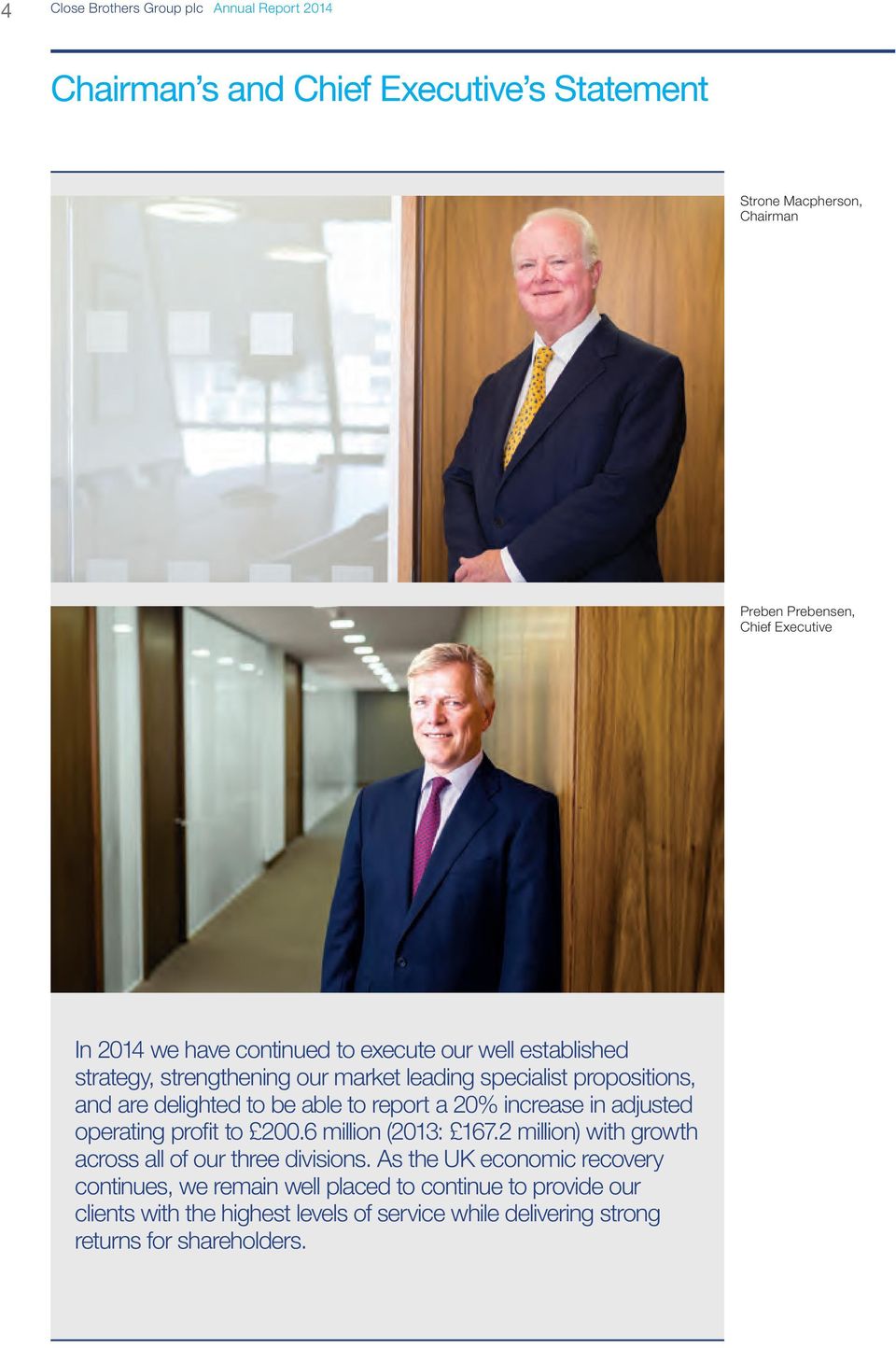
8 4 Close Brothers Group plc Annual Report Chairman s and Chief Executive s Statement Strone Macpherson, Chairman Preben Prebensen, Chief Executive In we have continued to execute our well established strategy, strengthening our market leading specialist propositions, and are delighted to be able to report a 20% increase in adjusted operating profit to million (2013: million) with growth across all of our three divisions. As the UK economic recovery continues, we remain well placed to continue to provide our clients with the highest levels of service while delivering strong returns for shareholders.
9 Close Brothers Group plc Annual Report 5 Overview of Financial Performance This year s results build on the momentum established in In Banking, adjusted operating profit rose by 15% to million (2013: million) and the loan book increased by 14% to 5.3 billion (2013: 4.6 billion) with good demand in Property and motor finance more than offsetting additional competition in some of our markets. Adjusted operating profit in Securities increased by 30% to 33.5 million (2013: 25.7 million) as Winterflood benefited from more favourable trading conditions and improved retail investor risk appetite. Asset Management more than doubled its adjusted operating profit to 9.9 million (2013: 4.0 million) reflecting good inflows into our integrated management and advice proposition. Adjusted basic earnings per share increased 25% to 104.1p (2013: 83.5p). Overall the group s return on opening equity improved to 18.5% (2013: 15.8%) and we have maintained our strong funding and capital positions. In recognition of this year s excellent financial performance and the continued confidence in the group s longer-term prospects, the board is recommending a 10% increase to our final dividend to 32.5p per share (2013: 29.5p). Differentiated Businesses Built for the Long Term In the midst of the global financial crisis, we outlined a strategy to position Close Brothers as a group leveraging its specialist knowledge and relationships to generate sustainable returns through the economic cycle. We focused on our traditional values of service and integrity, underpinned by our conservative and prudent approach to capital and funding, to ensure that we could be there for our clients in all economic conditions. Five years on, Close Brothers is a Modern Merchant Banking group of three core divisions, specialised in their niche markets, united by our traditional values and delivering our services in a modern way. In Banking, we are committed to our core proposition of building lasting customer relationships while delivering strong returns. This is achieved by maintaining a local presence in all our markets, recognising that every customer has particular needs, with specialist teams who are able to devise flexible solutions and make fast decisions. Our proposition is supported by a consistent approach to lending through the cycle; we write predominantly secured, short-term and small ticket loans to SMEs and individuals. These differentiated lending attributes have allowed us to price and manage risk appropriately, and together with our conservative approach to funding and liquidity, have enabled our consistent and profitable loan book growth over the last 30 years. In Securities, Winterflood is a marketmaker, committed to providing continuous liquidity while maintaining its trading capacity and market leading position. Winterflood tailors its offering to its clients specific requirements, by combining the expertise of its staff with the technological advantages of its proprietary IT systems, to assist them in meeting their best execution requirements. By focusing principally on market-making, Winterflood has been able to trade continuously and profitably in all market conditions. In Asset Management, we have shaped and positioned the division to benefit from regulatory, market and demographic changes. We remain focused on meeting the needs of our clients through our high quality, integrated proposition which offers financial advice, investment management and an online investment portal. This proposition provides our clients with the flexibility they need to create and implement a lifetime financial plan according to their personal circumstances. In a highly competitive but fragmented market place, our multi-channel distribution and diverse sources of revenue are compelling differentiators and, as a result, the division is well positioned for future growth. Successfully executing this group strategy during an unprecedented period of volatility and market dislocation has demonstrated our ability to navigate challenging periods while generating strong growth and excellent net returns as well as mitigating downside risk. As the economy recovers and competition returns, it is this emphasis on service and integrity which will allow us to strengthen our competitive positioning and continue to grow. Strategic Report Governance Financial Statements

10 6 Close Brothers Group plc Annual Report Chairman s and Chief Executive s Statement continued Investing in Building our Competitive Advantage Our traditional principles of service, expertise and building long-term relationships underpin our financial performance and market leading specialist propositions. Evolving consumer behaviour, regulatory reform and technological advances are all impacting what constitutes excellent service. The group is committing resources to ensure that our products and services meet with client needs and increasing regulatory focus. This investment is significant but appropriate to ensure we have the capacity to support our high touch model, manage risks and deliver long-term growth for shareholders. We have the resources to support large scale investment programmes while being small enough to implement them effectively and, by investing as we grow, can maintain and build our competitive advantage. Importance of our people Across the group, our people are characterised by their focus on serving our clients and communities with dedication. The way we do business resonates with our client base and our trusted, reliable service is rewarded by long-term relationships. In order to ensure we can continue to provide our clients with the service they have come to expect, we are committed to enabling our people to perform at the highest level. The group has made good progress in a number of areas this year. As each of our divisions operate in niche markets, we need to identify and train tomorrow s revenue generators internally. For example, we are developing the concept of the financial planner as a true professional who provides the highest quality financial advice to their clients. Aspire, a two year programme for school leavers, provides participants with an apprenticeship in a number of front office roles. Additionally, to engage with and develop our next set of leaders, we have created an Emerging Leaders Programme that enables us to improve our succession pipeline into senior roles and build a culture of career development across the group. Keeping pace with regulatory reform Our three divisions share the same commitment to provide straightforward and transparent products tailored to their clients needs. This ethos, alongside our simple corporate structure, means that we are well placed to respond to regulatory reform. However the evolution of regulatory policy is an increasing burden. Identifying, reviewing and implementing regulatory policy changes is resource intensive and requires investment in both our people and our operations. We have expanded our risk and compliance functions as well as enhancing our systems and processes to ensure we continue to operate in the best interests of our clients. Technology investment to complement our service proposition Technology both supports the effectiveness of our people and enables us to adapt to changes in client behaviour and the wider market environment. We have invested significant resources in strengthening our IT infrastructure and enhancing our front-end technology. We are focused on protecting our systems, clients and assets from cyber threats and data loss as well as ongoing programmes to replace legacy systems and develop technologies to enhance our front-end proposition. Making the Most of our Opportunities Pursuing existing opportunities in our three divisions will underpin the future success of the group. Our focus on traditional merchant banking values delivered in a modern way has created a proposition that is well regarded by clients. When applied to specialist niches, we can develop leading market positions with high levels of sustainable profitability. However, as markets and behaviours continually evolve, we always look to expand into complementary sectors or geographical segments to maintain our competitive positioning.

11 Close Brothers Group plc Annual Report 7 In Banking, we are confident that attractive opportunities are available within our core risk/return boundaries. Competition remains fragmented, albeit increasing, and our long-term loan book performance demonstrates our ability to grow in all market conditions. However, we are not complacent and always look for opportunities to expand into adjacent niche sectors or geographies while maintaining our strict underwriting discipline. As an example, in we successfully recruited a renewable energy team within our asset finance business to fund a range of technologies including land based wind, hydro and solar renewables. Diversified income streams in our Securities division provide us with income protection through volatile market conditions. Winterflood has demonstrated the flexibility to adapt its products based on client requirements by offering a wider range of equities to its clients. Winterflood s specialism in providing liquidity in all market conditions and client led solutions to retail, institutional and international investors will allow it to adapt as client needs evolve. In Asset Management, we have built a flexible and diverse proposition that provides clients with the services and tools to meet their investment objectives. The division is well positioned to build further scale through organic growth, infill acquisitions and selective portfolio manager and adviser hires. In we recruited a number of portfolio managers in our high net worth business and will seek to recruit selectively over the next few years to enhance our proposition and benefit from the structural market opportunities created by the Retail Distribution Review. Board Changes There has been considerable change in the non-executive composition of the board this year, as explained on page 49 of the Corporate Governance report. Bruce Carnegie-Brown has decided to stand down as a director of the company and consequently will not seek re-election at the Annual General Meeting on 20 November. He was appointed to the board in June 2006 and has served as chairman of the Remuneration Committee and as senior independent director. We thank him for his valued contribution to the group. Outlook We are confident that our strategy, combined with our Modern Merchant Banking values of service and integrity, will continue to deliver the right propositions for our clients and provide ongoing returns and long-term value for our shareholders. In Banking, we continue to see ongoing growth opportunities in our core markets. Winterflood remains well placed to benefit from a sustained cyclical recovery but remains susceptible to market conditions. As it continues to build scale, we expect Asset Management to continue to deliver growth at attractive margins. We are well positioned to benefit from the growth opportunities we see in all of our core divisions and have the resources available to pursue them. We enter the 2015 financial year with confidence. Strategic Report Governance Financial Statements Bridget Macaskill has been appointed to succeed Bruce Carnegie-Brown as chairman of the Remuneration Committee and Geoffrey Howe to succeed him as senior independent director with effect from the conclusion of the Annual General Meeting on 20 November.
12 8 Close Brothers Group plc Annual Report Business Model Close Brothers provides lending, deposit taking, wealth management services and securities trading. Although we operate through three distinct divisions, all of our businesses share common values which keep our clients interests at the core of our model. Our focus on maintaining a strong financial position, providing straightforward services, and employee engagement, has supported our strategic progress, helping generate long-term value for our shareholders. Our resources Our services Our people Strong financial position We have consistently maintained a strong funding position, diversified by source and tenor. We hold a prudent level of high quality liquid assets, predominantly with the Bank of England. Our capital and leverage ratios have remained strong through the cycle, ahead of both regulatory and peer benchmarks. Straightforward products and services In Banking, our lenders and deposit takers are experts in their areas of specialism. Their knowledge and experience enables us to provide flexible solutions and make fast decisions. In Securities, our market-makers are exceptionally skilled in executing client orders. We believe technologyled innovation is critical to the development of our business, supporting our traders with fast electronic trading systems that are developed internally. In Asset Management we are focused on meeting the individual needs of private clients, to help them create and implement a lifetime financial plan. We aim to achieve the highest level of trust in every aspect of our service, underpinned by solid investment performance. Talented and engaged employees Close Brothers employs 2,800 people and remains focused on recruiting and retaining talented employees. We encourage training and development and our culture is highly supportive of innovation and enterprise. The group is committed to providing equal opportunities and promoting a culture of diversity amongst the workforce. Value created Our prudent and efficient balance sheet management has ensured our ability to grow in all market conditions. Our strong cash generation has enabled us to reinvest in the business while continuing to improve our shareholder returns. Value created Our straightforward products and services, and transparent pricing ensure we maintain the confidence of our clients. Our emphasis on delivering services that meet our clients changing needs supports sustainable, recurring revenues and helps generate strong returns through the cycle. Value created By investing in our people we create better skilled, more engaged and more productive employees. Through remuneration structures that balance long and short-term performance, we promote sustainable growth and ensure that our employees interests remain strongly aligned to those of our shareholders.

13 Close Brothers Group plc Annual Report 9 Our model is underpinned by three divisions who share the same focus on expertise, service and relationships. While our model in itself creates long-term shareholder value, it is the differentiated way in which we attract, serve, support Creating value Enabling us to reinvest in our resources, improve our services and attract the best employees. Our model creates value through our: Strong financial position. Straightforward products and services. Talented and engaged employees. Relationships Local presence provides critical market insight and supports a superior level of service Expertise Detailed knowledge underpins fast, flexible service and builds lasting relationships and retain our clients that sustains our value creation through the cycle. Service Our high-touch model and in-depth expertise reinforces strong relationships This supports our strategy to build leadership in specialist markets. Enabling us to achieve our objectives of delivering longterm sustainable growth and generating strong returns. Strategic Report Governance Financial Statements This enhances our competitive client proposition. Our model sustains value by supporting small businesses and individuals through all market conditions. Our clients are core to our model and we are differentiated in the way we attract, serve, support and retain them. Sustaining value

14 10 Close Brothers Group plc Annual Report Business Model continued Sustaining value: How our model supports lasting client relationships. Attract Generating new client business How we are differentiated Close Brothers is a trusted brand developed over the last one hundred years with a strong reputation in the financial services market. By remaining focused on straightforward products and services we know and understand, we have developed leading market positions. Our experience working with small businesses means we have developed a strong understanding of their needs and requirements. We have a decentralised model, enabling us to provide a local and personal service. Serve Providing a superior level of service How we are differentiated Our expertise provides us with an in-depth understanding of our clients requirements. This enables us to provide highly flexible services and tailored financial solutions that evolve alongside our clients. We engage in regular, open and transparent communication. We carry out our services with honesty and integrity, building trusted relationships with our clients. Future priorities Continue to develop greater awareness of our strong brand, highlighting the quality of the services we provide. Explore new routes to market while remaining focused on niche products and services where we can differentiate ourselves. Expand and develop our distribution channels to improve the local service we provide. Continue to invest in our risk and compliance functions to maintain our strong track record. Future priorities Invest in our employees training and development to enhance their knowledge and expertise. Continue to allow our employees an appropriate level of decision making authority to support their flexibility. Continue to listen to our clients and develop new products and services to fit with their changing requirements. Explore cross-selling opportunities to provide a more comprehensive level of service to our clients.

15 Close Brothers Group plc Annual Report 11 Support Being there when it matters How we are differentiated We have proven our ability to deliver for our clients through the cycle: We have built our loan book over 30 years, through both periods of recession and easy credit. Our traders have provided continuous liquidity and committed capital, providing two-way prices even in extreme adverse market conditions. Our wealth managers are highly experienced in all markets, with our Asset Management division in a stronger position than ever today. Our strong financial position and prudent financial management provides our clients with the confidence that they can depend on us in any economic environment. Retain Sustaining long-term relationships How we are differentiated We provide continuity of support for our clients and seek to build lasting relationships. Our focus is on generating long-term value and we are there for our clients when it matters. We value feedback, actively seeking new and better ways to do business. Even as we have grown, we have retained the culture and characteristics of a smaller bank: We are large enough to provide clients with the reassurance that comes from our scale of resources but small enough to provide a personal service. Strategic Report Governance Financial Statements Future priorities Continue to apply the same strategy which has supported sustainable growth through the cycle. Maintain our financial discipline and strong funding, liquidity and capital positions. Protect our future by only engaging in sustainable business practices. Monitor our environmental imprint and contribution to social and economic development. Future priorities Remaining focused on upholding our Modern Merchant Banking values which underpin our business model. Invest in developing our services and our technology. Ensure our employee reward and development policies remain strongly aligned to those of our key stakeholders. Continue to keep our clients interests at the core of Close Brothers.

16 12 Close Brothers Group plc Annual Report Our Services Close Brothers provides lending, deposit taking, wealth management services and securities trading through our three divisions: Banking, Securities and Asset Management. We are listed on the London Stock Exchange and are a member of the FTSE 250. Banking Our Banking division provides lending to small businesses and individuals, with an emphasis on specialist finance. We also offer deposit taking services to UK businesses and individuals. We have always recognised the importance of building lasting customer relationships. This is made possible by maintaining a local presence in our markets. We operate from an extensive network of locations in the UK and connect with our customers through dedicated teams who oversee all lending decisions from origination to collection. Our people, across our Retail, Commercial and Property divisions, are experts in their fields and have the authority to make decisions. We recognise that every customer has different needs, and our specialist knowledge enables us to come up with flexible solutions and make fast decisions. Securities In Securities, we provide trading services in the UK through Winterflood, a leading market-maker. We are committed to providing liquidity enabling our clients to trade securities in any market, at any time. We have grown from a niche business, making markets in small cap stocks, to become a major liquidity provider, with the largest stock coverage in the UK. Our success lies in our traditional trading culture, focusing on pure market-making and our advanced technology. Our traders, who are exceptionally skilled in executing client orders, are supported by our fast electronic trading systems, which are developed internally. As a result, we are able to provide immediate liquidity, transparent prices, and best execution for all our clients. This expertise has enabled us to trade continuously, and profitably, through all market conditions. Asset Management Our Asset Management division provides a range of financial advice, investment management and online investing services, helping clients to secure their financial future. We believe everyone should think ahead, have a financial plan and invest wisely. We aim to provide clients with everything they need to secure a better financial future. Our advisers operate from a network of UK offices, advising on all aspects of financial planning. We offer a range of diversified investment strategies to cater for different portfolio sizes and investment styles. Our online investment portal provides access to all main market and AIM listed UK equities, over 1,000 funds, ETFs, gilts and fixed-term deposits. Regardless of how our clients choose to use our services, we aim to build trusted, long-term relationships based on high levels of service.

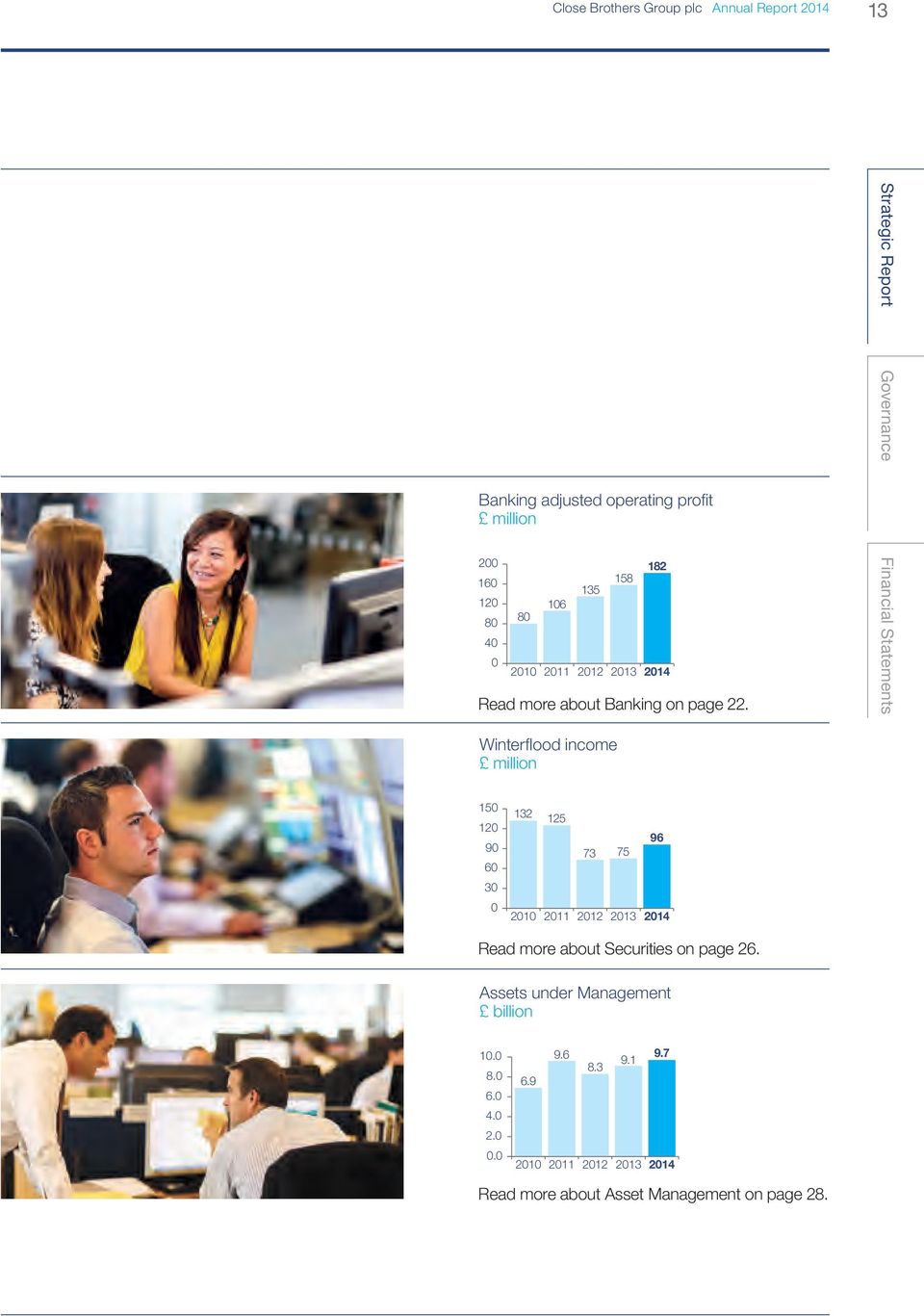
17 Close Brothers Group plc Annual Report 13 Banking adjusted operating profit Read more about Banking on page 22. Strategic Report Governance Financial Statements Winterflood income Read more about Securities on page 26. Assets under Management billion Read more about Asset Management on page 28.
18 14 Close Brothers Group plc Annual Report Strategy and Key Performance Indicators Our strategy is to be the leading UK merchant banking group, providing consistent support to small businesses and individuals in all market conditions. Strategic objectives progress Key performance indicators Build leading market positions Focus on well defined market niches where we can differentiate ourselves and build client value. Our customer loan book stands at 5.3 billion, with continued good growth in the year. Winterflood maintained its market share as the leading market-maker in the UK. Assets under Management growth of 7% to 9.7 billion. Loan book growth of 14% to 5.3 billion. Winterflood income up 29%. Net inflows of 5% into our wealth management proposition. Develop our client proposition Build lasting relationships with new and existing clients by investing in our brand, distribution, systems and people. Investment in our controls ensuring our clients continue to experience a high quality service. Strong growth in client numbers across the group. Continuing to generate recurring income and high levels of repeat business. Up to 85% repeat business levels in the Banking division. 23% growth in Winterflood s technology focused team. Client numbers up 6% in Asset Management. Remain prudent and efficient Drive operational efficiency while maintaining a strong balance sheet. Continued to hold prudent funding and liquidity positions. Maintained a strong capital ratio. Strong underwriting discipline with low bad debt ratio and consistent loan-to-value ratios. Common equity tier 1 capital ratio of 13.1%. Leverage ratio of 9.2%. Total funding as a percentage of loan book stable at 135%. Deliver long-term sustainable growth Consistently apply our business model to build a strong financial position and generate high quality, recurring earnings. Continued growth in all three divisions. Strong profit growth in Banking as favourable credit environment continues. Improved performance in Winterflood as market conditions recovered. Further growth in Assets under Management. Adjusted operating profit growth of 20% to million. Adjusted basic earnings per share of 104.1p, up 25%. Generate strong shareholder returns Maintain a progressive dividend policy and continue to grow shareholder returns while holding a strong financial position. Continued improvement in return on equity reflecting growth in all three divisions. Increased the full year dividend. Continued strong share price performance. Return on equity of 18.5%. Dividend of 49.0p per share, up 10%. Total shareholder return of 26%.

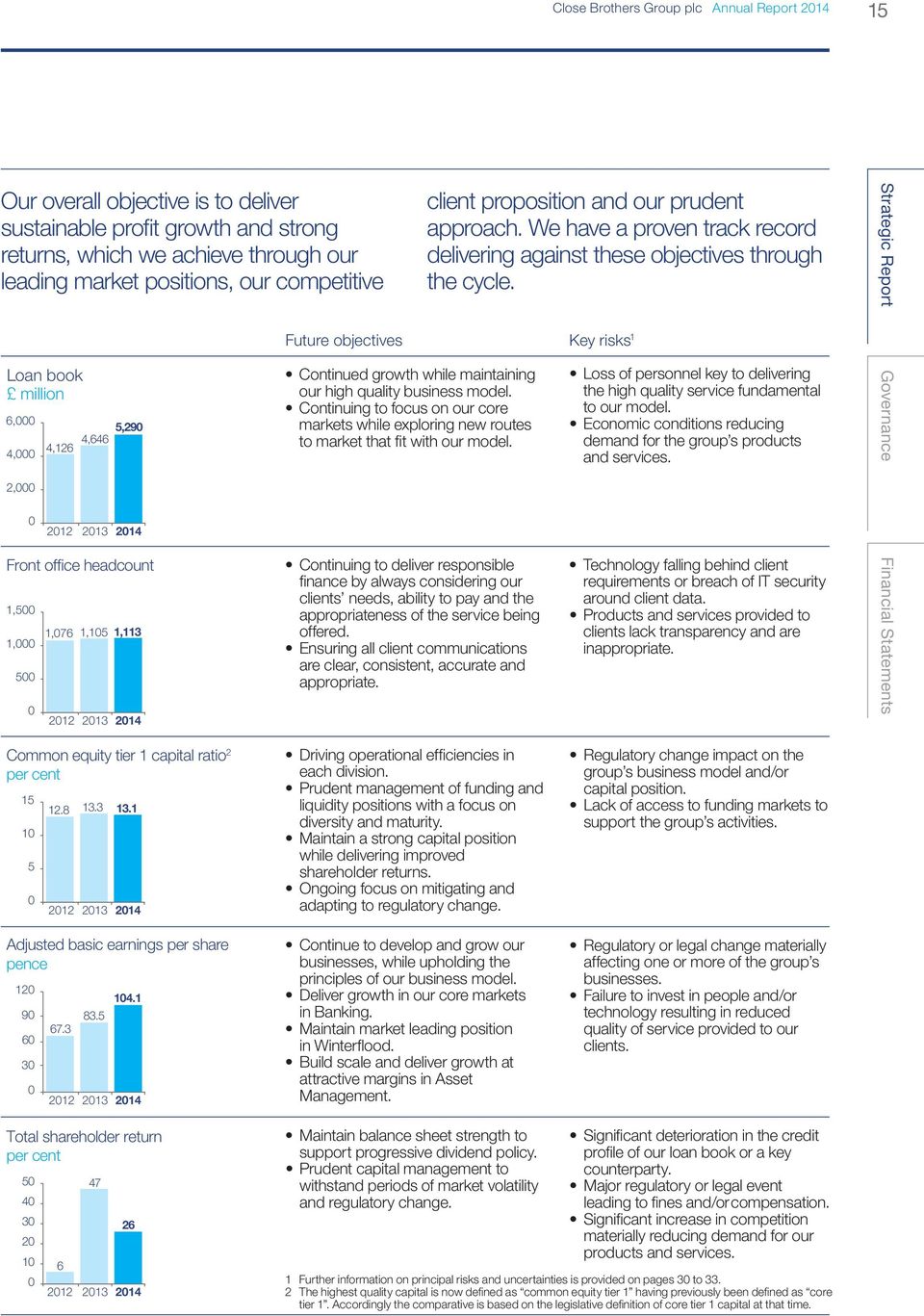
19 Close Brothers Group plc Annual Report 15 Our overall objective is to deliver sustainable profit growth and strong returns, which we achieve through our leading market positions, our competitive Loan book 6,000 4,000 2, , ,646 5, Front office headcount 1,500 1, ,076 1,105 1, Continued growth while maintaining our high quality business model. Continuing to focus on our core markets while exploring new routes to market that fit with our model. Continuing to deliver responsible finance by always considering our clients needs, ability to pay and the appropriateness of the service being offered. Ensuring all client communications are clear, consistent, accurate and appropriate. client proposition and our prudent approach. We have a proven track record delivering against these objectives through the cycle. Future objectives Key risks 1 Loss of personnel key to delivering the high quality service fundamental to our model. Economic conditions reducing demand for the group s products and services. Technology falling behind client requirements or breach of IT security around client data. Products and services provided to clients lack transparency and are inappropriate. Strategic Report Governance Financial Statements Common equity tier 1 capital ratio 2 per cent Adjusted basic earnings per share pence Driving operational efficiencies in each division. Prudent management of funding and liquidity positions with a focus on diversity and maturity. Maintain a strong capital position while delivering improved shareholder returns. Ongoing focus on mitigating and adapting to regulatory change. Continue to develop and grow our businesses, while upholding the principles of our business model. Deliver growth in our core markets in Banking. Maintain market leading position in Winterflood. Build scale and deliver growth at attractive margins in Asset Management. Regulatory change impact on the group s business model and/or capital position. Lack of access to funding markets to support the group s activities. Regulatory or legal change materially affecting one or more of the group s businesses. Failure to invest in people and/or technology resulting in reduced quality of service provided to our clients. Total shareholder return per cent Maintain balance sheet strength to support progressive dividend policy. Prudent capital management to withstand periods of market volatility and regulatory change. Significant deterioration in the credit profile of our loan book or a key counterparty. Major regulatory or legal event leading to fines and/or compensation. Significant increase in competition materially reducing demand for our products and services. 1 Further information on principal risks and uncertainties is provided on pages 30 to The highest quality capital is now defined as common equity tier 1 having previously been defined as core tier 1. Accordingly the comparative is based on the legislative definition of core tier 1 capital at that time.
20 16 Close Brothers Group plc Annual Report Financial Overview Close Brothers has delivered another strong performance in, reporting our fifth consecutive year of adjusted operating profit growth. The Banking division continued to be the main driver of group performance, benefiting from improved loan book growth of 14% (2013: 13%) and a favourable credit environment. Overall, adjusted operating profit increased 20% to million (2013: million), reflecting the strong performance in Banking, but also supported by better trading conditions for Securities and improved net flows and operating leverage in Asset Management.

21 Close Brothers Group plc Annual Report 17 Delivering Long-Term Sustainable Growth Revenue growth of 13% in the year was driven by the Banking division and improved trading conditions for Winterflood. In total, adjusted operating income increased by 76.3 million to million (2013: million). Adjusted operating expenses increased by 14% to million (2013: million), predominantly reflecting an uplift in staff costs as the group grows. Banking costs increased principally due to continued investment and higher staff costs to support the loan book growth, while variable costs in Securities increased as trading performance improved. The Asset Management cost base has remained broadly stable since 2012 notwithstanding good growth in assets and revenues. Overall, the group s compensation ratio (total staff costs on Group Income Statement adjusted operating income excluding associate income) and expense/ income ratio have both remained stable at 37% (2013: 37%) and 63% (2013: 63%) respectively. As a result of the ongoing favourable credit environment and our continued strong underwriting discipline, impairment losses on loans and advances ( bad debts ) reduced further to 44.1 million (2013: 50.6 million) in the year despite the growth in the loan book. Reflecting this, the bad debt ratio improved to 0.9% (2013: 1.2%). In total, adjusted operating profit for the group increased by 33.4 million, or 20%, to million (2013: million). This includes the net of group income and expenses which increased to a loss of 24.4 million (2013: loss of 20.9 million) with the prior year benefiting from one-off income of 1.7 million. The underlying increase in group costs is 8% to 25.1 million (2013: 23.2 million) due to higher performance related compensation. Overall, the group s operating margin improved to 30% (2013: 29%). There were no exceptional items in the period. In the prior year we recorded exceptional income of 1.6 million relating to a partial sale of our holding in Mako from 27.3% to 21.3%. In we have further reduced our investment holding in Mako to 8.5%. Amortisation of intangible assets, principally relating to acquisitions in Asset Management, is consistent at 4.9 million (2013: 5.0 million). After exceptional income and amortisation of intangible assets on acquisition, operating profit before tax is up 19% to million (2013: million) Adjusted operating income Adjusted operating expenses (414.5) (365.1) 14 Impairment losses on loans and advances (44.1) (50.6) (13) Change % Strategic Report Governance Financial Statements Adjusted operating profit Exceptional income 1.6 Amortisation of intangible assets on acquisition (4.9) (5.0) (2) Operating profit before tax Tax (45.5) (42.7) 7 Non-controlling interests (0.4) (1.1) (64) Profit attributable to shareholders Adjusted basic earnings per share 104.1p 83.5p 25 Basic earnings per share 101.5p 82.0p 24 Ordinary dividend per share 49.0p 44.5p 10 Note: Adjusted operating income, expenses, profit and earnings per share exclude the effect of exceptional items and amortisation of intangible assets on acquisition, and in the case of earnings per share, the tax effect of such adjustments. Divisional Adjusted Operating Profit/(Loss) 2013 % % Banking Securities Asset Management Total divisions Group (24.4) (20.9) 17 Adjusted operating profit Change %
22 18 Close Brothers Group plc Annual Report Financial Overview continued The group has recorded a tax charge for the financial year of 45.5 million (2013: 42.7 million), up 7% due to the increase in operating profit in the year. This corresponds to an effective tax rate of 23% (2013: 26%), slightly ahead of the UK corporate tax rate of 22% (2013: 24%) reflecting normal nontax deductible items. Generating strong shareholder returns In total, the group delivered profit attributable to shareholders of million (2013: million), up 25% in the year. Basic earnings per share increased 24% to 101.5p (2013: 82.0p), and adjusted basic earnings per share, excluding exceptional income and amortisation of intangible assets on acquisition, increased 25% to 104.1p (2013: 83.5p). Overall, the group s return on opening equity improved to 18.5% (2013: 15.8%). Reflecting the strong profit growth in the period, the board is recommending a 3.0p increase in the final dividend to 32.5p (2013: 29.5p) per share. This increase maintains our progressive dividend policy and strengthens our dividend cover. In total, this corresponds to a 10% increase in the overall dividend to 49.0p (2013: 44.5p) per share. The final dividend will be paid on 25 November to shareholders on the register at 17 October. Maintaining a Strong Balance Sheet The group maintained its high quality and transparent balance sheet in the year through its ongoing focus on holding a strong funding position and a prudent, but efficient, level of liquidity. In, total assets increased 13% to 7,700.4 million (2013: 6,831.1 million), principally reflecting the 14% growth in the loan book during the year. Growing a high quality loan book In the year, total loans and advances to customers increased 14% to 5,289.7 million (31 July 2013: 4,645.6 million), and now accounts for 69% (31 July 2013: 68%) of the group s total assets. We have maintained our strict underwriting criteria during the year, reflected in the low impairment charge, and the majority of our lending continues to be on a secured basis with low average loan sizes, and over a short-term duration. At 31 July, over half of the loan book had a residual contractual maturity of less than one year, while the average maturity of the total loan book was 14 months (31 July 2013: 13 months). Managing other assets and liabilities efficiently The group remains focused on optimising the efficiency of our balance sheet management, while holding an appropriate level of high quality liquid assets to support its Banking operations. At 31 July, we held 1,259.2 million (31 July 2013: 1,025.2 million) cash and loans and advances to banks, up million in the year, reflecting funding raised in the second half to support loan book growth. The combined value of our customer loan book and high quality liquid assets now accounts for 85% of the group s total assets. The remainder of the group s balance sheet assets remained broadly stable in the year. Non-trading debt securities reduced to 45.6 million (31 July 2013: 96.2 million) as the last of the group s less liquid floating rate notes ( FRNs ) were sold (31 July 2013: 39.4 million), and the existing certificates of deposit ( CDs ) portfolio matured (31 July 2013: 10.1 million). The remainder of the balance at 31 July relates to the group s holding of gilts, unchanged on 31 July Settlement balances, long and short trading positions and loans to and from money brokers were higher at the balance sheet date, reflecting increased market-making activity in Securities. At 31 July, the asset and liability balances were million (31 July 2013: million) and million (31 July 2013: million) respectively, slightly higher relative to the prior year. However overall, the net position of million (31 July 2013: million) was largely unchanged. The majority of the group s liabilities relate to deposit and wholesale funding for the loan book. Total available funding at 31 July increased by 14% to 7,127.9 million (31 July 2013: 6,267.9 million), broadly in line with the growth in the loan book. Overall, the group s equity increased by 81.1 million to million (31 July 2013: million) reflecting profit for the period of million, offset by dividend payments of 67.1 million. This corresponds to an improved return on the group s assets of 1.9% in, up from 1.8% in 2013.
23 Close Brothers Group plc Annual Report 19 Focusing on Funding Diversity and Maturity The objective of our Treasury function is to provide funding for the Banking division s lending. We minimise interest rate risk by matching fixed and floating rate assets to liabilities where appropriate, and swapping our long-term interest rate exposure to short-term. In we have continued to benefit from favourable funding markets and low interest rates, and the group s strong financial position helped us to access deposit and wholesale markets, as well as debt capital markets, in the year. Group Balance Sheet At 31 July, the group had 7,127.9 million (31 July 2013: 6,267.9 million) total available funding from a diverse range of funding sources with a prudent maturity profile. We manage the group s funding relative to the loan book, to ensure that the group always maintains an appropriate level of available funding to support continued growth. At year end this position remained strong at 135% (31 July 2013: 135%) of the loan book. Customer deposits comprise corporate deposits, representing around two thirds of the balance, and retail deposits, which are longer term in duration. In the year the balance increased by million to 4,513.7 million (31 July 2013: 4,015.4 million) as the group grew its more competitively priced corporate deposit base. Overall the level of retail deposits remained stable, although two new term deposit offerings in the year replaced more expensive retail deposits as they matured. None of the group s existing wholesale facilities matured in the year and, as a result, drawn and undrawn facilities remained stable at 1,191.2 million (31 July 2013: 1,211.1 million). 52% (31 July 2013: 53%) of the group s funding has a maturity profile greater than one year. 31 July 31 July 2013 Assets Cash and loans and advances to banks 1, ,025.2 Settlement balances, long trading positions and loans to money brokers Loans and advances to customers 5, ,645.6 Non-trading debt securities Intangible assets Other assets Strategic Report Governance Financial Statements Total assets 7, ,831.1 Liabilities Settlement balances, short trading positions and loans from money brokers Deposits by banks Deposits by customers 4, ,015.4 Borrowings 1, ,170.2 Other liabilities Total liabilities 6, ,994.6 Equity Total liabilities and equity 7, ,831.1 Group Funding 31 July 31 July 2013 Change Customer deposits 4, , Drawn and undrawn facilities 1 1, ,211.1 (19.9) Senior unsecured bonds Equity Total available funding 7, , Includes million (31 July 2013: million) of undrawn facilities and excludes 9.4 million (31 July 2013: 19.3 million) of non-facility overdrafts included in borrowings.
24 20 Close Brothers Group plc Annual Report Financial Overview continued Taking advantage of favourable funding markets in, the Banking division also issued a 300 million, 3.875%, seven year senior unsecured bond, which further enhanced the diversity and maturity profile of the group s funding position. The group s funding maturity profile has improved and, at 31 July, term funding with a residual maturity of greater than one year increased to 3,699.5 million (31 July 2013: 3,314.8 million). The weighted average maturity of this term funding, excluding equity, improved to 30 months (31 July 2013: 26 months) and remains significantly ahead of our weighted average total loan book maturity of 14 months (31 July 2013: 13 months). The group is committed to maintaining a prudent duration of funding relative to the loan book and, at the balance sheet date, the loan book was 70% (31 July 2013: 71%) covered by term funding. Given its prudent approach to funding and liquidity, the group also expects to meet the requirements for the new funding and liquidity ratios proposed under Capital Requirements Directive IV ( CRD IV ) when they come into force. Holding an appropriate level of high quality liquid assets The group s liquidity position is carefully managed by its Treasury function to ensure we hold sufficient liquid assets to support our Banking operations and remain comfortably ahead of the minimum regulatory requirements. As a core part of our liquidity risk management, we regularly carry out stress testing using various stress scenarios and are confident we hold sufficient liquidity to cover net cash outflows under stressed conditions. In the year, total treasury assets increased to 1,217.3 million (31 July 2013: 1,031.5 million) due to an increase in deposits at the Bank of England to 1,171.7 million (31 July 2013: million) reflecting funding not yet deployed in the loan book. The group s gilt portfolio remained stable at 45.6 million (31 July 2013: 46.7 million). High quality liquid assets now account for all of the group s treasury assets, up from 95% at 31 July 2013, after we sold the last of our less liquid FRNs in the year. The group currently has no holding of CDs (31 July 2013: 10.1 million) as those that have matured were not replaced in the low yield environment. Credit ratings The credit ratings for Close Brothers Group plc and Close Brothers Limited ( CBL ), the group s regulated banking subsidiary, from Fitch Ratings ( Fitch ) and Moody s Investors Services ( Moody s ) were reviewed in the year. In November 2013 Fitch reaffirmed its ratings for Close Brothers Group plc and CBL at A/F1, both with stable outlooks. Moody s ratings for Close Brothers Group plc and CBL were reaffirmed in June at Baa1/P2 and A3/P2 respectively, both with stable outlooks. Strong Capital Position Maintained Under CRD IV, the group s capital remains strong and comfortably in excess of minimum capital ratios on both a transitional and fully loaded basis, including the new Capital Conservation Buffer which is due to be applied from At 31 July, the common equity tier 1 capital ratio remained stable at 13.1% (31 July 2013: core tier 1 ratio 13.3%) and the impact of CRD IV was broadly neutral. A beneficial discount to the risk weighting for lending to SMEs, which applies to a significant proportion of the group s risk weighted assets, was largely offset by a deduction for foreseeable dividends. The foreseeable dividend deduction at 31 July amounts to the proposed final dividend of 47.7 million which is subject to approval at the Annual General Meeting in November. A reconciliation setting out the impact of CRD IV at 31 July is shown in note 24 of the Financial Statements. During the year, the common equity tier 1 capital increased to million (31 July 2013: core tier 1 capital million). Risk weighted assets increased to 5,445.8 million (31 July 2013: 5,184.5 million) due to the growth in credit and counterparty risk associated with the loan book net of the benefit of the SME discount. Notional risk weighted assets for market risk also increased by 46.9 million reflecting increased trading positions in Securities. The Prudential Regulation Authority ( PRA ) has accelerated the majority of the transitional arrangements set out in CRD IV meaning that, in the UK, CRD IV is now substantially in force. We therefore do not currently expect any material impact on our common equity tier 1 capital ratio from the full implementation of CRD IV and our pro forma, fully loaded common equity tier 1 capital ratio at 31 July is 13.1%. However, as the European Banking Authority is still developing and refining its technical standards, further impact from CRD IV may yet emerge.
25 Close Brothers Group plc Annual Report 21 The strength of the group s capital position is further supported by the strong leverage ratio, which is a transparent, comparable measure not affected by risk weightings. At 31 July, the leverage ratio was 9.2% (31 July 2013: 9.8%) with the reduction largely reflecting the inclusion of the foreseeable dividend. Over the last few years, our strong capital position has enabled us to continue to grow during a period of economic uncertainty and regulatory change. We remain focused on holding an appropriate level of capital and continue to monitor and manage capital resources carefully. Group Funding Maturity Profile Leverage ratio per cent Less than one year Total funding of loan book per cent One to two years Greater than two years Total Deposits by customers 2, , ,513.7 Drawn and undrawn facilities ,191.2 Senior unsecured bonds Equity Total available funding at 31 July 3, , , ,127.9 Strategic Report Governance Financial Statements Total available funding at 31 July , , , ,267.9 Treasury Assets 31 July 31 July 2013 Change Gilts (1.1) Bank of England deposits 1, High quality liquid assets 1, Certificates of deposit Floating rate notes 10.1 (10.1) 39.4 (39.4) Total treasury assets 1, , Group Capital Position 31 July 31 July 2013 Common equity tier 1 capital ratio % 13.3% Total capital ratio % 14.6% Leverage ratio 2 9.2% 9.8% Common equity tier 1 capital Total regulatory capital Risk weighted assets 5, , The highest quality capital is now defined as common equity tier 1 having previously been referred to as core tier 1. Accordingly the comparative is based on the legislative definition of core tier 1 capital at that time. 2 The leverage ratio is calculated under the Basel Committee methodology applicable at that time; the ratio is based on the January version as required by the PRA. It is calculated as tier 1 capital as a percentage of total balance sheet assets, adjusting for certain capital deductions, including intangible assets, and off balance sheet exposures.
26 22 Close Brothers Group plc Annual Report Banking The Banking division s strategy is focused on delivering sustainable growth throughout the economic cycle. As our loan book has grown, we have maintained its high quality through disciplined underwriting, consistent lending parameters and strong risk management. This has enabled us to deliver strong returns through the cycle, which have been supported by our differentiated approach to banking. Our lenders are experts in their areas of specialism and remain focused on building long-term relationships and providing a high quality level of service to our customers and intermediaries. Strategic Priorities and Progress Overall, the strategic priorities of the Banking division are unchanged, having enabled us to deliver consistently strong profitability in all economic conditions: Optimising opportunities for sustainable growth. Maintaining our strong returns. Continuing investment to support the model, manage risks and deliver long-term growth.
27 Close Brothers Group plc Annual Report 23 Overview of Financial Performance The division delivered another strong result in, with continued profit growth and a 14% increase in the loan book to 5.3 billion (31 July 2013: 4.6 billion). Overall we improved our returns in the year, with the return on net loan book increasing to 3.7% (2013: 3.6%) and the return on opening equity improving to 25% (2013: 24%). Adjusted operating income increased 13% to million (2013: million), principally reflecting 11% growth in net interest and fees on the loan book to million (2013: million) across the Retail, Commercial and Property portfolios. Treasury and other non-lending income increased to 19.4 million (2013: 9.6 million) reflecting a reduction in the division s cost of funding as we grew our more competitively priced corporate deposit base, replacing retail deposits as they matured. Adjusted operating expenses increased by 18% to million (2013: million). The uplift is principally volume driven, reflecting a higher headcount and loan book, but we have also continued to invest in strengthening our IT infrastructure and enhancing our front end technology. As a result of the favourable credit environment and our strict underwriting criteria, impairment losses on loans and advances continued to reduce in the year, down 13% to 44.1 million (2013: 50.6 million). Overall, adjusted operating profit for the division increased 15% to million (2013: million), corresponding to an improved operating margin of 41% (2013: 40%). Optimising Opportunities for Sustainable Growth We have been able to grow organically across our core lending businesses through the cycle by providing a differentiated, local service to retain and attract new customers. We also aim to generate new business through marketing initiatives, intended to raise Close Brothers profile and awareness of our lending capabilities as well as highlight the quality of the service we provide. In the year the loan book grew 14% to 5.3 billion (31 July 2013: 4.6 billion). This was primarily driven by improving demand in our existing markets but we are also benefiting from new lending initiatives and an increased sales headcount. The portfolio composition remains largely unchanged year-onyear reflecting strong new business generated across the loan book. While we are seeing a cyclical return in competition, overall credit supply in our markets still remains below precrisis levels and has been balanced by an improvement in demand in some of our niche markets. For example, our motor finance business has been most impacted by a return of competition and new entrants competing aggressively on price. However, demand is at a 10 year high and we have been able to deliver a good growth rate in the year while maintaining our strong returns. Overall we continue to see good demand for our specialist and tailored finance solutions and we continue to generate strong levels of new and repeat business. Our Retail loan book, providing intermediated lending through motor dealers and insurance brokers, increased 10% to 2,092.8 million (31 July 2013: 1,906.0 million) driven by good growth in motor finance. The motor loan book increased 14% to 1,458.9 million (31 July 2013: 1,278.3 million) reflecting increased volumes from existing dealers as a result of the strong market growth. Premium finance is a relatively mature market but with strong repeat business levels, the loan book remained broadly flat in the year, up 1% at million (31 July 2013: million). The Commercial loan book, which is focused on providing alternative lending for the SME market, grew 11% in the year to 2,047.2 million (31 July 2013: 1,845.7 million). Although we have yet to see a broad based increase in SME demand, we are benefiting from our expansion into new areas of lending. Asset finance, the largest part of the loan book, was up 12% to 1,656.0 million (31 July 2013: 1,482.3 million), with growth across all asset classes. In particular, the intermediated broker sector saw good new business volumes while both the Irish and leasing businesses benefited from new hires. Invoice finance had good growth from new clients in the year, and increased its loan book by 8% to million (31 July 2013: million). In Property we have seen strong growth in both residential development loans and bridging finance, largely from existing customer relationships as the developers we work with have benefited from the improvement in the property market in the year. Reflecting this, the loan book increased by 29% to 1,149.7 million (31 July 2013: million). We continue to uphold our strict lending criteria which have sustained our low impairment levels in recent years, and we have maintained consistent average loan sizes and loan-to-value ratios, only lending where planning permission has already been granted. Strategic Report Governance Financial Statements
28 24 Close Brothers Group plc Annual Report Banking continued Maintaining Our Strong Returns While the division has seen good growth in the year, we remain very focused on the quality of our lending and have maintained our lending model and strict underwriting criteria which support our strong returns. We also benefit from our continued focus on delivering a high quality and differentiated customer proposition. Our local distribution network of over 500 sales representatives is hard to replicate and we are continually growing and developing this network. For example, we have increased our presence in Ireland in the year and now have a loan book of million (31 July 2013: million) in this market, generating the same high quality returns as our UK book. In, the net interest margin, which includes net interest income and other lending related income, reduced slightly to 8.6% (2013: 8.8%). We have benefited from a lower cost of funding in the year but this has been offset by a reduction in default fees as the quality of our lending improves, as well as changes in the mix of the loan book. Other income, which includes net fees and commissions as well as operating lease income, accounted for around 22% (2013: 24%) of total net interest and fee income. We continuously focus on maintaining the credit quality of the loan book as it grows, which has continued to benefit our level of impairments in the year. The bad debt ratio is now at 0.9% (2013: 1.2%) reflecting the favourable lending market in and our strong credit controls. In the year the reduction was mainly driven by an improvement in Property and asset finance. Overall, the reduction in bad debts has more than offset the fall in the net interest margin, with the result that the division s returns have continued to improve. We have consistently maintained strong returns through the cycle, and our return on net loan book is now 3.7% (2013: 3.6%). Continued Investment to Support the Model, Manage Risks and Deliver Growth To ensure the division is able to sustain its high levels of customer service, while protecting the business against risks and regulatory change, we continue to invest. While we operate a relatively high cost model, we believe our spend is necessary to support our lending, manage risks and deliver sustainable growth. In, adjusted operating expenses were 18% higher at million (2013: million). A large proportion of the increase was volume driven reflecting the loan book growth in the year. In particular, fixed staff costs have increased as we have expanded our front line sales team as well as our back-office risk, compliance and technology functions. Variable staff costs were also higher reflecting the division s strong performance, but overall the compensation ratio has remained stable at 27% (2013: 27%). We also continue to invest to keep pace with regulatory change and improve our customer service offering. In the year, we continued to strengthen our IT infrastructure and technology, reducing risk by replacing legacy systems as well as enhancing our security to protect against cyber threats. Reflecting this ongoing investment, the depreciation expense was greater year-on-year, and we also recorded a higher marketing and project spend as we look to improve the quality of our customer service. Overall, the division s total expense/ income ratio increased in the year to 49% (2013: 47%). Well Positioned for Further Growth at Attractive Margins In 2015 we expect to benefit from ongoing growth opportunities in our core markets and the favourable credit environment. Our model remains focused on the customer, supported by our ongoing investment to strengthen our systems and protect our strong returns. We will also continue to look at new adjacent markets and explore opportunities within our existing risk/ return boundaries. We look ahead to the next financial year with confidence.
29 Close Brothers Group plc Annual Report 25 Key Performance Indicators Net interest margin 1 per cent Bad debt ratio 2 per cent Return on net loan book 3 per cent Net interest and fees on average net loans and advances to customers. 2 Impairment losses on average net loans and advances to customers. 3 Adjusted operating profit before tax on average net loans and advances to customers. 4 Adjusted operating profit after tax and non-controlling interests on opening equity less non-controlling interests. Key Financials Return on opening equity 4 per cent Adjusted operating income Net interest and fees on loan book Retail Commercial Property Treasury and other non-lending income Adjusted operating expenses (221.0) (187.2) 18 Impairment losses on loans and advances (44.1) (50.6) (13) Change % Strategic Report Governance Financial Statements Adjusted operating profit Includes million (2013: million) net interest income and 95.1 million (2013: 92.6 million) other income. Other income includes net fees and commissions, operating lease income, and other miscellaneous income. For further information on our operating leases, please refer to note 16 of the Financial Statements. Loan Book Analysis 31 July 31 July 2013 Retail 2, , Motor finance 1, , Premium finance Commercial 2, , Asset finance 1, , Invoice finance Property 1, Closing loan book 5, , Change %
30 26 Close Brothers Group plc Annual Report Securities Improved Trading Conditions Over the last financial year, the strengthening UK economy has helped underpin a resilient equity market and a significant increase in companies raising capital via a stock market listing. Supported by a number of positive government initiatives, such as the inclusion of AIM shares in ISAs, investors have gained confidence and trading volumes have improved. However, this recovery has not been without volatility. Political uncertainty and a rotation out of mid caps into large caps in the third quarter of our financial year created periods of uncertainty, but overall, conditions have been more favourable than those seen in 2012 and Within the Securities division, our strategic focus continues to be on maintaining our leading market positions in all trading conditions. Strategic Priorities and Progress During the year we have delivered on our strategic priorities: Maximising revenue opportunities as trading conditions improved. Maintaining trading capacity and market leading position. Remaining well positioned for any sustained cyclical recovery. Adjusted operating income increased 20% to million (2013: million) reflecting increased trading volumes in the division and a change in mix towards higher margin sectors at Winterflood. Adjusted operating expenses increased 17% to 93.9 million (2013: 80.6 million) principally driven by higher variable costs as a result of the improved financial performance. Overall, the expense/ income ratio improved to 74% (2013: 76%) and the compensation ratio was stable at 45% (2013: 45%). During 2013 we recorded 0.9 million of associate income in relation to Mako, which was subsequently reclassified as an available for sale equity investment and is therefore no longer reported as part of the Securities division. The group s current investment holding in Mako is 8.5% (2013: 21.3%). In total, adjusted operating profit for the division increased by 30% to 33.5 million (2013: 25.7 million), corresponding to an improved operating margin of 26% (2013: 24%). The division s return on opening equity increased to 26%, up from 20% in Improved Trading in Smaller Cap Stocks in Winterflood Winterflood s broad market coverage, trading capacity and expertise allow it to respond quickly to changes in investor demand. As retail investor risk appetite increased, specifically in the volatile and less liquid AIM and small cap sectors where its market-makers are particularly experienced, Winterflood s performance improved.
31 Close Brothers Group plc Annual Report 27 Key Performance Indicators Winterflood income per bargain Winterflood average bargains per day Securities operating margin 1 per cent Adjusted operating profit on adjusted operating income excluding associate income. 2 Adjusted operating profit excluding associate income after tax and non-controlling interests on opening equity less non-controlling interests. Winterflood s adjusted operating income increased 29% to 96.1 million (2013: 74.6 million) reflecting an increase in income per bargain and stronger trading volumes. Despite periods of market volatility in the second half of the year, the number of loss days declined to four (2013: eight). Income per bargain increased to 6.81 (2013: 6.33) principally due to a change in mix towards more profitable AIM trading. Investors were also encouraged by positive market sentiment and increased IPO activity; there were 80 IPOs on AIM in our financial year (2013: 49). Key Financials Securities return on opening equity 2 per cent Change % Adjusted operating income Winterflood Seydler Mako (associate income after tax) Adjusted operating expenses (93.9) (80.6) 17 Winterflood (69.5) (57.7) 20 Seydler (24.4) (22.9) 7 Adjusted operating profit Winterflood Seydler (13) Mako (associate income after tax) Strategic Report Governance Financial Statements Average bargains per day also increased from 46,610 in 2013 to 55,749 due to stronger trading in AIM and international sectors. Winterflood joined the European exchange, Equiduct in 2013 and, as its brand has become more established, has benefited from an increase in international order flow. This trading generates strong revenues for Winterflood but it is high volume and low margin. This increased trading activity has had a positive impact on Winterflood s volumes per day but a negative impact on income per bargain, particularly in the second half of the year. As market activity has improved, Winterflood has been able to benefit from its core operational efficiency. Adjusted operating expenses increased 20% to 69.5 million (2013: 57.7 million) predominantly reflecting an increase in variable performance related costs and settlement fees. 1 In the 2013 financial year Mako was reclassified to an available for sale equity investment and no longer generates associate income. Overall Winterflood delivered a 57% increase to adjusted operating profit of 26.6 million (2013: 16.9 million) in the year with performance in the second half broadly consistent with the first. Consistent Performance in Seydler Seydler s adjusted operating income remained broadly stable on 2013 at 31.3 million (2013: 30.8 million) as improved trading volumes on the Frankfurt Stock Exchange were offset by a modest decline in capital markets fees. Adjusted operating expenses were up 7% to 24.4 million (2013: 22.9 million) due to the recruitment of a number of senior hires, resulting in a 1.0 million decrease to adjusted operating profit to 6.9 million (2013: 7.9 million). Seydler maintains its market leading position, with an established client base and strong capital markets franchise in the German small and mid cap market. Well Positioned for Stronger Cyclical Recovery We have demonstrated the resilience of our model through the difficult trading conditions in 2012 and 2013; Winterflood, in particular, has generated stronger returns as markets and investor sentiment have improved. By maintaining our trading capability and market leading position, we are well placed to benefit should equity markets and retail investor risk appetite continue to recover. However, performance will continue to be sensitive to market conditions which have been subdued at the start of the 2015 financial year.
32 28 Close Brothers Group plc Annual Report Asset Management seen good inflows both from our high net worth business, where we have recruited a number of bespoke portfolio managers, and from our private client advisers. The level of outflows reduced to 0.9 billion (2013: 1.4 billion) predominately due to client drawdowns in the normal course of business, although the prior year included 0.5 billion of one-off outflows. Overall net flows were positive at 0.4 billion and, at 5% of opening AuM, represent an improvement on the prior year s net outflows. The Asset Management division has been shaped and positioned to benefit from regulatory, market and demographic changes. We remain focused on meeting the needs of our clients through our high quality, integrated proposition which offers financial advice, investment management and an online investment portal. Strategic Priorities and Progress The division is well positioned for future growth having performed well against its strategic priorities in the year: Driving organic private client inflows. Continuing to build scale and maximise revenue generation. Identify opportunities to further enhance the division. Overview of Financial Performance The Asset Management division has built on the momentum it established in 2013, more than doubling its adjusted operating profit to 9.9 million (2013: 4.0 million). Adjusted operating income increased 8% to 84.4 million (2013: 78.1 million). Income on Assets under Management ( AuM ) was up 10% to 83.8 million (2013: 76.3 million), reflecting the 7% growth in AuM to 9.7 billion (31 July 2013: 9.1 billion) and a slightly improved revenue margin of 89 basis points (2013: 88 basis points). Other income declined to 0.6 million (2013: 1.8 million) as the prior year included the one-off gain on the sale of the division s residual investment in a private equity fund. Demonstrating the operational efficiency within the division, adjusted operating expenses were held broadly flat at 74.5 million (2013: 74.1 million) despite the increased levels of income and AuM in the year. The expense/income ratio continued to improve to 88% (2013: 95%) and the compensation ratio declined to 58% (2013: 60%). As a result the operating margin improved to 12% (2013: 5%), on track to meet our medium-term profitability target of 15% in 2015, and the return on opening equity increased to 25% (2013: 10%). Good Inflows Across our Distribution Channels Reflecting the quality of our advice and investment proposition and the breadth of our distribution, AuM increased 7% to 9.7 billion at 31 July (31 July 2013: 9.1 billion). The increase was driven by good net inflows across our distribution channels and supported by positive market movements. Gross inflows, at 1.3 billion, were 9% greater than the prior year. Validating the quality of our investment management, the strongest inflows have been from third party IFAs, where we are benefiting from a growing distribution network. We have also Over the last year the Diversified Income, Balanced and Growth funds have all outperformed their benchmarks whereas the Bond and Conservative funds, which provide high quality income while maintaining a low risk approach, underperformed their respective IMA benchmarks. In addition, we are benefiting from the continued strong investment performance in our bespoke high net worth portfolios, all of which have consistently outperformed their ARC peer groups over a five year period. Continuing to Build Scale and Maximise Revenue Generation We are continuing to build scale and are establishing ourselves as a leading provider of wealth management services to the UK private client market. Our experienced team of advisers and investment managers have been able to leverage our infrastructure and client service capabilities and deliver good organic growth in revenue and assets. Total advised AuM grew 2% to 5.2 billion (31 July 2013: 5.1 billion) largely due to positive market movements. We continue to focus on improving the operational capacity of our personal advisers to increase net flows. Income from advice and other services increased 4% to 36.6 million (2013: 35.2 million) due to the uplift in higher margin private client assets and improved levels of initial fees. We have seen a small reduction in corporate advice income and as a result the revenue margin has declined slightly to 71 basis points (2013: 73 basis points). Total managed AuM grew 12% to 6.9 billion (31 July 2013: 6.2 billion) due to strong inflows from third party IFAs and our bespoke portfolio managers, supported by modest market movements. In particular we have seen strong demand for our multi-asset
33 Close Brothers Group plc Annual Report 29 Key Performance Indicators Assets under Management billion Revenue margin 1 bps Key Financials Operating margin per cent 1 Income from advice and other services and investment management over average AuM. 2 Adjusted operating profit after tax and non-controlling interests on opening equity less non-controlling interests. Close Discretionary Funds. These Funds now manage 2.6 billion (2013: 2.1 billion) of assets, up 23% on the prior year. Investment management income increased 15% to 47.2 million (2013: 41.1 million), with the revenue margin improving to 72 basis points (2013: 71 basis points) due to the stronger growth in higher margin high net worth assets. Importantly, we saw good inflows into our core integrated proposition providing both management and advice. These assets grew by 9% to 2.4 billion (2013: 2.2 billion), and now represent 46% (2013: 43%) of total advised assets. We are encouraged by the good demand from new clients, particularly in the second half of the financial year, as well as the continued progress in migrating existing clients. Opportunities to Further Enhance our Business In a highly competitive and regulated market place, we believe our proposition, multi-channel distribution and diverse sources of revenue are strong differentiators. Our primary focus is organic growth. To support this, we are developing the concept of the financial planner as a true professional who provides the highest quality financial advice to their clients. In addition, we will increase our advisers capacity with more efficient processes and capitalise on our longerterm investment performance to help build stronger relationships with third party IFAs. We will look to take advantage of opportunities to add further scale and geographic presence through selected infill acquisitions and hiring of advisers and portfolio managers Change % Adjusted operating income Income on AuM Advice and other services Investment management Other income (67) Adjusted operating expenses (74.5) (74.1) 1 Adjusted operating profit Income from financial advice and self directed services, excluding investment management income. 2 Net interest income, income on investment assets and other income. Movement in Assets under Management At 1 August ,080 Inflows 1,312 Outflows (874) Net inflows 438 Market movement 187 At 31 July 9,705 Change 7% Assets under Management by Type (6) Return on opening equity 2 per cent 2013 Change % Total AuM 9,705 9,080 7 Advised AuM 1 5,151 5,067 2 Managed AuM 2 6,922 6, Both advised and managed AuM 2,368 2, All personal and corporate advised and self directed client assets, including those which are also managed by Close Brothers. 2 All client assets which are invested in Close Brothers investment products, including funds, separately managed accounts and bespoke high net worth client portfolios. We are positive about the far reaching reforms to the savings and retirement income rules announced earlier this year by the UK Government which should result in increased demand for high quality financial advice and flexible investment propositions. As (2) our distribution channels continue to mature and the capability of our advice proposition improves, we are confident that we are well placed to deliver profitable growth at attractive and improving margins. Strategic Report Governance Financial Statements
34 30 Close Brothers Group plc Annual Report Principal Risks and Uncertainties In delivering the group s strategy the group faces a number of risks. These risks are managed by: Adhering to our prudent and established business model; Following an integrated risk management approach; and Setting clearly defined risk appetites and monitoring these with specific metrics and within set limits. A summary of the principal risks and uncertainties which may impact the group s ability to deliver its strategy, how we seek to mitigate these risks and the change in the perceived level of risk over the year is set out below. The risks identified remain broadly unchanged from the prior year. This summary should not be regarded as a complete and comprehensive statement of all potential risks and uncertainties faced by the group but rather those risks which the group currently believes may have a significant impact on the group s performance and future prospects. In preparing disclosures for the Annual Report related to these risks and our approach to risk management, as set out on pages 51 to 54 of the Corporate Governance report, the group has considered the recommendations of the Enhanced Disclosure Task Force issued in October Key: No change Risk decreased Risk increased Risk Mitigation Change Credit losses The group is exposed to credit and counterparty risk particularly in the Banking division. The Banking division has a loan book of 5.3 billion to a range of small businesses and individuals and remains exposed to credit losses if these customers are unable to repay loans and any outstanding interest and fees. The group is also exposed to counterparties with which it places deposits or trades and has limited derivative contracts to hedge interest rate, foreign exchange and equity exposures. The Banking division s loan book is predominately secured with conservative loan-to-values. Average loan size remains small with short average tenor. The portfolio is diversified with a limited number of individual deals which could materially impact the group s earnings. Control and governance is exercised both within the business and through oversight by a central team. Strict lending criteria are applied when testing the credit quality and covenant of the underlying borrower and significant emphasis is placed on the quality of the underlying security. Rigorous and timely collections and arrears management processes are also in place. The Banking division currently places the majority of its liquidity requirements and surplus funding with the Bank of England. The credit quality of the counterparties with whom it places deposits or trades is continuously monitored and all trading is performed within approved limits. Interest rate and foreign exchange derivatives are held for hedging purposes only and material exposures are cash collateralised. Our Securities businesses predominately trade in exchange traded instruments with regulated counterparties on a delivery against payment basis. Counterparty exposure and settlement failure monitoring controls are also in place. The Banking division s loan book impairment rate is at a 10 year low reflecting our strong lending discipline, favourable market conditions and the improved credit quality of our borrowers. However, against a backdrop of a recovering economy and the potential for rising interest rates the outlook for our customers remains challenging. At 31 July the Banking division s liquidity requirements and surplus funding was placed with the Bank of England or held in UK gilts. Further commentary on the credit quality of our loan book is outlined on page 24. Further details on loans and advances to customers and debt securities held are in notes 11 and 12 on pages 104 and 105 of the Financial Statements.
35 Close Brothers Group plc Annual Report 31 Risk Mitigation Change Economic environment Despite the improved outlook, any downturn in economic conditions could impact the group s performance through: Lower demand for the group s product and services; Lower investor risk appetite as a result of financial markets instability; and Higher bad debts as a result of customers inability to service debt and lower asset values on which loans are secured. Legal and regulatory The evolving legal and regulatory environment has the ability to impact materially the group s performance, capital and liquidity, the markets in which we operate, the behaviour and expectations of our clients and the way we conduct our business. Not treating customers fairly, failing to adequately safeguard client assets or providing advice and products which are not in our customer s best interest or fit for purpose, whether in the future or in respect of past business, has the potential to damage the group s reputation, impact performance and may lead to legal or regulatory sanctions including litigation and customer redress. Failure to identify, interpret and comply with relevant legal requirements, or obligations has the potential to impact significantly on the group s performance. The group operates in specialist areas where staff have significant expertise of the market and our products along with an in depth understanding of our clients requirements. Across our businesses we aim to build long-term relationships with clients improving our resilience in difficult economic conditions. Regular stress testing on our performance and financial position is performed to test our resilience in adverse economic conditions. We continue to invest significantly in both staff and operating systems to ensure the group remains well placed to respond to changes in regulation. Our staff review key legal and regulatory developments in order to anticipate their potential impact on our performance and our business model. This is supported by a constructive dialogue with regulatory bodies and strong compliance procedures across the group to ensure we remain well placed to meet current regulatory and legislative requirements. Across the group we are committed to providing straightforward and transparent products and services to our clients. New products and services are subject to our business initiatives policy and both new and existing products and services are regularly reviewed by risk and compliance committees to ensure they remain fit for purpose. Whilst the UK outlook has improved, we are yet to see a sustained global recovery particularly in the Eurozone. Further commentary on the attributes and resilience of the group s business model is shown on pages 8 to 11. Following changes to the UK regulatory regime in April 2013 and recent well publicised focus on the financial services industry, the risk of legal or regulatory action resulting in fines, penalties, censure or other sanction from failure to identify or meet regulatory and legislative requirements has increased. The group s approach to regulatory reform during the year is discussed in the Chairman and Chief Executive s Statement on page 6 and the Risk Committee report on pages 53 and 54 of the Corporate Governance report. Further detail on the group s capital, funding and liquidity position is outlined on pages 18 to 21. Further information on our approach to conduct risk can be found in the Sustainability Report on pages 34 to 39. Strategic Report Governance Financial Statements The conduct of our employees is a priority and the group has developed a robust framework to control, monitor and report conduct risk. During the year we have looked to embed fully the organisations culture and traditional values of service and integrity through initiatives such as the Vision and Values programme and the Banking Customer Service Programme.
36 32 Close Brothers Group plc Annual Report Principal Risks and Uncertainties continued Risk Mitigation Change Competition The group operates in highly competitive markets and as the UK economy improves we expect to see increased competition particularly in the Banking division which may impact the group s performance. Technology Maintaining robust and secure IT infrastructure, systems and software is fundamental to allow the group to operate effectively, respond to new technology, protect client and company data and counter the evolving cyber threat. Failure to keep up with technological innovation and changing customer expectations has the potential to impact group performance. The group has a strong track record of operating in specialist areas where we aim to be market leaders. Across the group we value our clients and build strong long-term relationships which result in high levels of repeat business. Our differentiated proposition, strong financial position and prudent financial management allows us to support our clients and trade profitably through the economic cycle and is based on the following key principles: Speed and flexibility of service; Local presence with experienced and knowledgeable staff; and Tailored product offerings. We continued to invest in IT infrastructure, information security and software during the year which has included the replacement of legacy systems and the enhancement of front end technology. The progress of major IT projects is regularly reviewed and all systems are subjected to rigorous testing before going live. The UK Government and Bank of England has highlighted cyber threat as an issue across the financial sector. The group s audit and risk functions have carried out cyber threat reviews which included testing our internal controls framework and reviewing planned investment on cyber risk to ensure we remain well placed to detect and resist threats. We have well established and regularly tested business continuity and disaster recovery plans. These plans are subject to periodic external review to ensure they remain robust. We continue to see increased competition in parts of our Banking division. Competition in Securities and Asset Management has remained high. Further commentary on the market environment for the Banking division is outlined on page 23. Our business model is set out on pages 8 to 11. The group maintains a robust IT infrastructure and remains well placed to respond to new technology. However, the risk of new technology impacting our business model or a cyber threat to data or our services is increasing. Further detail on the technology related investment is outlined on page 6. For further information on our response to cyber risk and the independent review on our business continuity plans see page 54 of the Corporate Governance report. Employees The calibre, quality and expertise of employees is critical to the success of the group. The loss of key individuals or teams may have an adverse impact on the group s operations and ability to deliver its strategy. The group operates in specialist areas and across our businesses we are committed to developing staff. Key roles have succession planning in place and through the Emerging Leaders Programme we aim to develop a strong pipeline of future leaders throughout the group. During the year we also launched a graduate scheme which follows the Aspire programme for school leavers created last year. The group s performance management framework ensures remuneration structures are competitive and recognise and reward performance. As competition increases we expect our highly skilled employees to be targeted. However, we remain confident in our ability to retain key employees, a view supported by the bi-annual employee survey carried out last year which identified 90% of employees surveyed were either satisfied or very satisfied working at Close Brothers. Further detail on the employee survey and our investment in our people is outlined in the Sustainability Report on pages 34 to 39.
37 Close Brothers Group plc Annual Report 33 Risk Mitigation Change Funding The Banking division s access to funding remains key to support its lending activities and the liquidity requirements of the group. Exposure to markets Volatility or a sudden dislocation in financial markets may impact the group s profitability particularly in the Securities division. Changes in interest rates have the potential to impact the group s earnings particularly interest income. While the majority of the group s activities are located in the UK and are transacted in sterling there is limited foreign exchange exposure principally arising on deposits, lending and funding balances in the Banking division. At 31 July the group s funding position was strong with total funding 135% of the loan book. This surplus provides a significant liquidity risk reserve. Our funding sources remain diversified and during the year we accessed the following markets: Retail funding; Corporate deposits; Interbank facilities; Securitised funding; and Debt capital markets. The Banking division assesses liquidity on a daily basis and weekly tests are performed to ensure adequate liquidity is held for stressed situations. At 31 July high quality liquid assets accounted for all of the group s treasury assets. Our Securities division primarily act as market-makers in exchange traded cash securities. Trading positions are monitored on a real time basis and both individual and book limits are set to limit exposure. The group s policy is to match fixed and variable interest rate assets and liabilities using swaps where appropriate. The group s capital and reserves are not hedged as a matter of policy. A sensitivity analysis on interest rate exposures is shown in note 31 on page 132 of the Financial Statements. Foreign exchange exposures in the Banking division are hedged using currency swaps with exposures monitored daily against approved limits. The group does not speculate on foreign currency movements. The group remains well funded, retains sufficient liquidity and is well placed to access further funding if required. Further commentary on funding and liquidity is provided on pages 19 and 20. Further financial analysis of our funding at 31 July is shown in note 20 on page 113 of the Financial Statements. The group s approach to managing exposure to markets is consistent with prior year and the associated risks remain unchanged. Further detail on the group s exposure to market risk is outlined in note 31 on pages 132 and 133 of the Financial Statements. Strategic Report Governance Financial Statements Stress tests are regularly performed on market risks to ensure we maintain adequate liquidity and capital even under extreme downside scenarios.
38 34 Close Brothers Group plc Annual Report Sustainability Report Our business model, outlined on pages 8 to 11, creates and sustains value through investment in our resources, our services and our people, helping us to achieve our strategic objectives to deliver long-term sustainable growth and generate strong returns. However, the success of our strategy is influenced not just by our internal value creation, but also by the way we interact with our stakeholders and the external environment. As a financial services organisation, the ESG risks faced by the group are relatively limited but we constantly monitor and refine our risk management processes to ensure we perform ethically and with integrity. In 2013 our primary focus was on our contribution to communities and our charitable work. In alongside our charitable work, we have also made good progress in the areas of responsible finance, ethical business practice, community investment and team member engagement, having benefited from our ongoing focus on relationships, service and expertise. At Close Brothers, we aim to provide our clients with a safe, trustworthy and capable financial partner through the economic cycle by maintaining the highest standards of practice in dealing with environmental, social and governance ( ESG ) issues. We achieve this not only by maintaining a strong financial position, but by investing in our employees, considering environmental and social practices in our business strategies and operating responsibly to protect natural resources. Our focus on developing sustainable business practices will ensure our future continuity and success, enabling us to continue to provide the support that small businesses and individuals need. The Executive Committee ( ExCo ) and board receive updates throughout the year on ESG related matters, particularly on employees, governance and responsible finance. The group has a corporate responsibility committee, chaired by the head of human resources who sits on ExCo, that focuses particularly on our charity and community work. Employee related key risk indicators are reviewed by local risk and compliance committees and reported to the group risk and compliance committee on a monthly basis, with overall oversight by ExCo and the divisional chief executives. Additionally, our environmental policies are monitored locally by the facilities department of each business, also overseen by ExCo.
39 Close Brothers Group plc Annual Report 35 Employees The group aims to create a culture of integrity and engagement, recognising that investment in our employees development promotes talent retention. Underpinning our culture, our strong governance framework and approach to risk management ensures that our strategy is aligned with our ethical values and that we are promoting good business practices throughout the organisation. Strategic priorities Promote employee engagement and provide opportunities for talent development. Ensure all stakeholders are treated fairly, operating with the highest ethical standards at all times. Supporting policies We are committed to promoting good ethical and governance standards and comply with the UK Corporate Governance Code. Each of our divisions has an equal opportunity policy to promote a culture of diversity amongst the workforce. progress Employee engagement The group actively promotes employee engagement through several initiatives including local focus groups across the businesses. For example, the Banking division successfully piloted the Banking Innovation Network in : a web-based platform accessible by all Banking division employees, intended to encourage idea sharing. Every two years we also conduct a comprehensive employee opinion survey. The results from the latest survey in 2013 identified that 90% of our employees surveyed were satisfied or very satisfied working for Close Brothers, with significant improvements noted since the 2011 survey, principally in career development and communication. Employee turnover and retention At 31 July, the group employed 2,776 (2013: 2,650) people, up 5% in the year. We have developed new initiatives in the year to support our employee retention. For example, our Emerging Leaders Programme in the Banking division was established to improve the succession pipeline by providing talented individuals with development and networking opportunities. This will be rolled out across the rest of the group in We also encourage promotion from within, making opportunities for internal career progression available on our intranet, which supports our retention strategy and promotes career development internally. In the year 4% of jobs across the group were placed with internal candidates and 15% of new hires in our Banking division were employee referrals. Employee benefits We aim to provide a comprehensive and competitive range of benefits to our employees, supporting our recruitment and retention as well as seeking to improve the overall health and wellbeing of our staff. These include: Pension and matched funding, made available to all permanent and fixed-term employees. Additional benefits such as life assurance, childcare vouchers, a cycle to work scheme, discounted medical health assessments, and season ticket loans. An Employee Assistance Programme providing confidential support and information on a wide variety of everyday issues. A Save as You Earn scheme At 31 July approximately one third (31 July 2013: one third) of UK based employees were participating. 90% of employees surveyed satisfied or very satisfied working for Close Brothers. The board is also seeking shareholder approval at the AGM for the establishment of an all employee share incentive plan (further detail is provided on page 66 of the Report of the Board on Directors Remuneration). Occupational health and safety We recognise that better working conditions enhance our employees morale and productivity, while protecting their wellbeing and the group s reputation. Given the nature of our business, our injury rates are low, and in, there were no RIDDOR reportable accidents or fatalities across the group and no enforcement notices were received by any of our divisions. Talent development The group is committed to creating a culture of learning and development that enables our people to maximise their potential. Each year employees receive annual performance reviews and discuss their career goals with their managers. This supports their professional development while ensuring individual remuneration is aligned with the group s strategic objectives. We also provide tools and initiatives, including a mentoring programme, and training in management, personal effectiveness and communication skills, in addition to training on regulation. Our employees completed on average four hours of this training during the financial year. Our school leavers initiative, Aspire, continues to build on the success of its first year in This structured training programme and opportunities for career progression are attracting high calibre individuals to the group. Strategic Report Governance Financial Statements
40 36 Close Brothers Group plc Annual Report Sustainability Report continued At 31 July, women made up 30% of our board. 10% increase in charitable donations in. We have also launched a graduate scheme within the Banking division and at our group head office. Our new intake joined in September and we will be recruiting more school leavers and graduates for the September 2015 intake. Diversity and equal opportunity Through our equal opportunity policy, we provide a framework for consistent fair treatment of employees regardless of race, gender, age, disability, sexual orientation, nationality or religion. At 31 July, women made up 42% of our workforce. Our board has three female directors, equal to 30%, and our ExCo has three female members, accounting for 38% of the committee. This is higher than the target set by Lord Davies for women to make up 25% of FTSE 100 boards by The board is committed to ensuring a diverse pool of candidates is considered for any vacancies that may arise and that they are filled by the most qualified candidates based on merit, with due regard to the benefits of diversity. 24% of our employees are under 30 years old with 60% aged between 30 and 50, while 16% are above 50 years old. Gender Diversity 1 Includes non-executive directors excluded from Close Brothers Group plc headcount calculations. 2 Senior employees identified as Material Risk Takers who are not directors or subsidiary directors. Responsible Finance The group has a wide range of policies to establish best practice and ensure our relationships with all stakeholders are underpinned by trust and transparency. In particular, we aim to reinforce our strong relationships by providing additional support to the local communities where we do business. Through volunteering and charitable donations, we are benefiting our communities, while improving the group s reputation and enhancing our ability to attract and retain high quality employees. Strategic priorities Ensure all employees are aligned to our culture of putting clients first. Continue to support our local communities through charitable initiatives. Supporting policies The group has a comprehensive policy on conduct risk and treating customers fairly that is overseen by the group head of compliance and implemented in each division. Male Female Number of board directors Number of directors of subsidiaries Number of senior managers, other than board directors Number of employees, other than board directors and senior managers 1,521 1,164 We have implemented policies and procedures in accordance with anti-money laundering regulations and allocate a dedicated money laundering reporting officer to each regulated company to ensure relevant issues are reported. All staff receive regular training to raise awareness of their responsibilities. The group s whistle-blowing policy aims to protect employees who expose misconduct. Our anti-bribery and corruption policy, under the Bribery Act 2010, sets out the group standards and best practice for business conduct and is overseen by the group s compliance, risk and internal audit functions The policy is communicated to staff at induction and update training is provided periodically. The group has a privacy policy in place, which is reviewed periodically and set out in client contracts, to ensure the protection and correct treatment of client data in accordance with the requirements of the Data Protection Act 1998.
41 Close Brothers Group plc Annual Report 37 progress Conduct risk Our client focus and board led culture promote positive client outcomes and ensure our clients interests are appropriately protected. Product design and governance is managed through the risk and compliance committees and existing products are reviewed on a regular basis to ensure that they remain fit for purpose. New products are only introduced after a rigorous process which considers risks that can arise throughout the product s life cycle. Complaints handling We seek to ensure transparency in dealing with all stakeholders and encourage high standards of openness and accountability. Client feedback and complaints are taken seriously and we are committed to providing timely responses and taking prompt corrective action if we have made an error. We also seek to identify the root cause of complaints and make consequent improvements to our processes. Each division operates a complaints handling process, accessible to all clients and we are continually seeking to improve the quality of the service we provide. For example, a customer service programme was developed to reinforce the Banking division s employees understanding of their individual roles in putting customers first. Supplier relationships All transactions are settled in accordance with the applicable terms and conditions of business agreed with the counterparty. An outsourcing policy is maintained across the group to ensure that the risks associated with the use of third party services are managed appropriately and meet our regulatory obligations, with controls in place to protect our clients. Safety and privacy To maintain our status as a trusted merchant banking group, we take the necessary steps to safeguard client data and protect our systems from failure and cyber attack. We are continually investing in our IT infrastructure to enhance our systems and controls and we have upgraded our data centres. Cancer Research UK are delighted to have been chosen as Close Brothers lead charitable partner. We are grateful for their continued support and have enjoyed working with their different businesses, particularly during their charity week in May. Together we have found a number of innovative ways to raise money in the year, helping to support our fight against cancer. Summary of Charitable Giving 2013 Change Total charitable donations 251, ,000 10% Matched funding contribution 1 54% 24% GAYE participation rate 11% 10% 1 The group continues to provide matched funding, donating an additional 50% of all amounts raised, up to a maximum of 250 per person. Tax policy The group aims to adopt a responsible approach to financial management and its tax policy reflects this. We believe our tax liabilities should reflect the commercial substance of the group s activities and, through this approach, we maintain a low risk tax profile. Substantially all the group s trading remains within the UK, subject to UK corporation tax. Over the last five years, the group s tax expense has moderately exceeded the headline UK corporation tax rate 1. Human rights The board gives due regard to human rights considerations, as defined under the European Convention on Human Rights and the UK Human Rights Act Community Various initiatives take place across the group to support the local communities where we do business. For example, we continue to run our successful schools programmes, where our employees volunteer to help children with their reading at a school in east London. Additionally, the group s Matching for Voluntary Time scheme supports employees in their local voluntary work, by making a donation to their chosen charity based on the number of hours the employee spends volunteering. We are also working with The Prince s Foundation for Children and the Arts to run a national art competition for primary school aged children. Charitable giving Following the 2013 employee opinion survey, Cancer Research UK ( CRUK ) continues to be the group s lead charitable partner, although a number of additional charities are also supported by our local businesses, including Macmillan Cancer Support, the Motor Neurone Disease charity and The Prince s Trust. During, the group significantly increased its charitable donations, helping to raise funds for CRUK and build awareness of the work they are doing to beat cancer. The total amount raised for charitable causes increased by 10% to 251,000 (2013: 228,000) through ongoing fundraising activities, supported by our inaugural charity week. Employees from across the group were actively encouraged to participate in a range of events held during charity week, and throughout the year, including sponsored fitness initiatives, dress down days, baking competitions and quizzes. Employees are also encouraged to donate to charities of their own choice through the Give As You Earn ( GAYE ) payroll giving scheme. The group maintained its Payroll Giving Quality Mark Gold Award for the fourth consecutive year in recognition of the ongoing strong participation rate of 11% (2013: 10%) in the scheme. 1 After adjustments for impairments and business disposals, associate profits recognised on a post-tax basis, the impact of write-down of deferred tax assets, and a small impact from profits subject to overseas tax rates. Strategic Report Governance Financial Statements
42 38 Close Brothers Group plc Annual Report Sustainability Report continued 62% head office waste recycled in. Environment We are aware of our responsibility to minimise our environmental impact by protecting natural resources and operating sustainably. We do not believe the group has a material exposure to environmental risks or opportunities, as we require limited natural resources to carry out our business activities. Our direct environmental impact arises from our office network in the UK and Europe, from staff travel, and indirectly from our supply chain. By focusing on reducing our emissions and waste across all these areas, we are protecting against climate change while making efficiency savings for the business. Each business manages its resources and recycling locally. Strategic priorities Reduce our energy consumption by recording and monitoring our greenhouse gas ( GHG ) emissions. Minimise our impact on the environment by reducing waste. Supporting policies In line with the GHG protocol framework, we have reported our and 2013 GHG emissions. progress Energy consumption Our commitment to reducing GHG emissions determines how we manage our office facilities, the contractors we work alongside and also extends to the products and services that we provide. In, our Banking division completed the integration of a new, more energy efficient provider across 19 offices following an extensive review in By the end of 2015, all of the division s sites will be supplied from renewable sources. At the group s head office, a new management information system implemented in 2013, has enabled more accurate data monitoring. We also require our mechanical and engineering contractors to prioritise energy management, and we review the services they provide to us, in order to determine where further efficiencies can be introduced. With the help of an external specialist, advising on the energy markets and most appropriate green energy rates, we aim to continue to reduce our GHG emissions. In addition to reviewing our providers, small changes to the management of our offices have made a difference. New energy saving initiatives implemented this year in the group s head office included changing our main stairwell lighting to LED lamps and also renewing the building s plant management system to ensure that it continues to be run cost effectively. We are also focused on providing more sustainable products and services to our clients. Acknowledging the rapid growth of the renewable energy market, Close Brothers Leasing in our Banking division has developed specialist green teams who provide funding for projects such as onshore wind farms and waste-to-energy plants. In 2013, we were awarded Green Lessor of the Year at the Leasing World Awards in recognition of the quality service we provide in helping our customers find funding solutions for sustainable products. Waste reduction and recycling In addition to our energy management projects, the group also seeks to improve the efficiency of its waste reduction, water and paper usage. Initiatives including replacing individual desk bins with central recycling stations, encouraging double sided printing and delivering board and other papers electronically to staff via tablets, have all contributed to a reduction in our waste in. Data is collected by third party contractors and monitored and reviewed by the head office facilities department to identify areas for improvement. In, 62% of waste was recycled at the group s headquarters, which avoided 276 cubic metres of landfill and saved 1,654 trees.
43 Close Brothers Group plc Annual Report 39 GHG Emissions Summary by Division GHG emissions tco 2 e 4,500 4,000 3,500 3,000 2,500 2,000 1,500 1, Group 1 3,374 3,928 Banking 1, Group reflects the group headquarters emissions which include some Banking division businesses. Greenhouse Gas Emissions performance In line with the GHG protocol framework, we have calculated the GHG emissions associated with our Scope 1 and 2 operations. Scope 1 includes fuel emissions from buildings and company vehicles, and Scope 2 includes our emissions from electricity. 1,166 Securities GHG Emissions Summary (tco 2 e) In, our total GHG emissions were 6,520 tco 2 e, equating to 2.39 tco 2 e per employee, down 8% overall and 0.20 per employee since As expected, given the nature of Close Brothers business activities, the largest source of GHG emissions in was our Scope 2 electricity consumption. Given its relative size in terms of profitability and headcount, our Banking division contributes the majority of our GHG emissions. A full breakdown of our GHG emissions is shown above Asset Management Calculation We have gathered data on a quarterly basis since 2013, working with an independent third party GHG emissions reporting company. This increases our confidence in the accuracy of our data and will enable us to monitor our GHG emissions performance on an ongoing basis. Our total GHG emissions are reported as tonnes of carbon dioxide equivalent ( tco 2 e ) and are calculated in line with the GHG protocol framework. In addition to reporting our total emissions, we have also disclosed the emissions per employee as an intensity metric to enable a comparable analysis in future disclosures. Outlook We will continue to monitor and report our GHG emissions, working to improve our energy efficiency across our businesses. 8% reduction in GHG emissions per employee in. Scope GHG emissions source 2013 Scope 1 Fuel (Buildings) Fuel (Owned vehicles) 2,675 2,635 Scope 2 Electricity (Excluding Scope 3 T&D losses) 3,691 3,936 Average number of employees 2,731 2,601 Total GHG emissions 6,520 6,726 Total per employee Our offices also report their Scope 3 emissions for water and waste each quarter, where this information is available to facilitate continued performance monitoring. After assessing the materiality of fugitive gas consumption across the group, we have excluded them from this year s GHG emissions report, but will review their significance for future disclosure during The Strategic Report was approved by the board and signed on its behalf by: Preben Prebensen Chief Executive 23 September Strategic Report Governance Financial Statements
44 40 Close Brothers Group plc Annual Report Governance 42 Board of Directors 44 Executive Committee 45 Report of the Directors 47 Corporate Governance 60 Report of the Board on Directors Remuneration
45 Close Brothers Group plc Annual Report 41 Strategic Report Governance Financial Statements
46 42 Close Brothers Group plc Annual Report Board of Directors Strone Macpherson Chairman Appointment to the board Strone was appointed a director in March 2003, senior independent director in 2004, deputy chairman in 2006 and chairman in June He is chairman of the Nomination and Governance Committee. Experience Strone is also chairman of British Empire Securities and General Trust plc, a governor of Heriot-Watt University and a trustee of the King s Fund. He was previously a director of Flemings, chairman of Tribal Group plc and of JP Morgan Smaller Companies Investment Trust plc, executive deputy chairman of Misys plc and a non-executive director of AXA UK plc and of Kleinwort Benson Private Bank Limited. Elizabeth Lee Group Head of Legal and Regulatory Affairs Appointment to the board Elizabeth was appointed a director in August 2012 with responsibility for legal and regulatory affairs. Experience Elizabeth joined Close Brothers as general counsel in September She was previously with Lehman Brothers and General Electric s financial services businesses. Jonathan Howell Finance Director Appointment to the board Jonathan was appointed to the board as finance director in February 2008 when he joined Close Brothers. Experience Jonathan was previously finance director of London Stock Exchange Group plc from Prior to that he was at Price Waterhouse where he qualified as a chartered accountant. He is also a non-executive director of The Sage Group plc where he chairs the audit committee. Bruce Carnegie-Brown Senior Independent Director Appointment to the board Bruce was appointed a director in June 2006 and senior independent director in June He is chairman of the Remuneration Committee. Experience Bruce is chairman of Aon UK Limited and of Moneysupermarket.com Group PLC and a non-executive director of Santander UK plc. He was previously with 3i Group, Marsh & McLennan and JP Morgan and was senior independent director of Catlin Group Limited. Lesley Jones Independent Non-executive Director Appointment to the board Lesley was appointed a director in December 2013 and chairman of the Risk Committee in March. Experience Lesley was group chief credit officer of Royal Bank of Scotland plc until January. She has extensive banking experience, having previously held several line management positions within Citigroup. She is also a non-executive director of Northern Bank Limited.
47 Close Brothers Group plc Annual Report 43 Preben Prebensen Chief Executive Appointment to the board Preben was appointed to the board as chief executive in April 2009 when he joined Close Brothers. Experience Preben previously spent his career in a number of senior positions at JP Morgan over 23 years, as well as being chief executive of Wellington Underwriting plc from 2004 to 2006, and then chief investment officer and a member of the group executive committee at Catlin Group Limited. Stephen Hodges Managing Director and Banking Chief Executive Appointment to the board Stephen was appointed a director in August 1995 with responsibility for the Banking division and became managing director in November Experience Stephen spent eight years at Hambros before joining the Banking division of Close Brothers in Bridget Macaskill Independent Non-executive Director Appointment to the board Bridget was appointed a director in November Experience Bridget is president and chief executive officer of First Eagle Investment Management LLC in New York City and is also a trustee of the TIAA-CREF funds. She was previously a non-executive director of Prudential plc, Scottish & Newcastle plc, J Sainsbury plc, Hillsdown Holdings plc and of the Federal National Mortgage Association in the US. Strategic Report Governance Financial Statements Geoffrey Howe Independent Non-executive Director Appointment to the board Geoffrey was appointed a director in January Experience Geoffrey is chairman of Nationwide Building Society and of Jardine Lloyd Thompson Group plc. He was previously chairman of Railtrack plc, a non-executive director of Investec plc and of JP Morgan Overseas Investment Trust plc, a director of Robert Fleming Holdings Limited and managing partner of Clifford Chance. Oliver Corbett Independent Non-executive Director Appointment to the board Oliver was appointed a director in June and chairman of the Audit Committee in July. Experience Oliver is a chartered accountant and was finance director of LCH. Clearnet Group Limited until May and prior to that of Novae Group plc. He previously worked for SG Warburg, Phoenix Securities (later Donaldson Lufkin Jenrette) and Dresdner Kleinwort Wasserstein, where he was managing director of investment banking. He was also a non-executive director of Rathbone Brothers plc.
48 44 Close Brothers Group plc Annual Report Executive Committee Preben Prebensen Chief Executive Elizabeth Lee Group Head of Legal and Regulatory Affairs Stephen Hodges Managing Director and Banking Chief Executive Jonathan Howell Finance Director Julian Palfreyman Winterflood Chief Executive Rebekah Etherington Group Head of Human Resources Martin Andrew Asset Management Chief Executive Tazim Essani Group Head of Corporate Development
49 Close Brothers Group plc Annual Report 45 Report of the Directors Results and Dividends The consolidated results for the year are shown on page 85 of the Financial Statements. The directors recommend a final dividend for the year of 32.5p (2013: 29.5p) on each ordinary share which, together with the interim dividend of 16.5p (2013: 15.0p), makes an ordinary distribution for the year of 49.0p (2013: 44.5p) per share. The final dividend, if approved by shareholders at the Annual General Meeting ( AGM ), will be paid on 25 November to shareholders on the register at 17 October. Directors The names of the directors of the company at the date of this report, together with biographical details, are given on pages 42 and 43 of this Annual Report. Bridget Macaskill, Lesley Jones and Oliver Corbett were appointed to the board on 21 November 2013, 23 December 2013 and 3 June respectively. Douglas Paterson and Ray Greenshields retired from the board on 21 November 2013 and 31 March respectively, whilst Shonaid Jemmett-Page stood down as a director on 1 July due to the requirements of Capital Requirements Directive IV ( CRD IV ). All other directors held office throughout the year. In accordance with the UK Corporate Governance Code, all directors offer themselves for reappointment at the AGM with the exception of Bruce Carnegie-Brown who is standing down from the board after nearly nine years service. Directors interests The directors interests in the share capital of the company at 31 July are set out on pages 77 and 78 of the Report of the Board on Directors Remuneration. Powers and appointment of directors Details on the powers and appointment of directors are set out on pages 50 and 51 of the Corporate Governance report. Directors indemnity The company has granted indemnities to all of its directors on terms consistent with the applicable statutory provisions. Qualifying third party indemnity provisions for the purposes of section 234 of the Companies Act 2006 were accordingly in force during the course of the year, and remain in force at the date of this report. Share Capital The company s share capital comprises one class of ordinary share with a nominal value of 25p each. At 31 July, 150,622,583 ordinary shares were in issue. Details of changes in the company s ordinary share capital during the year are given in note 22 on page 113 of the Financial Statements. On a show of hands, each member has the right to one vote at general meetings of the company. On a poll, each member would be entitled to one vote for every share held. The shares carry no rights to fixed income. No person has any special rights of control over the company s share capital and all shares are fully paid. During the year the company issued 15,739 ordinary shares of 25p each in satisfaction of option exercises. Full details of options exercised, the weighted average option exercise price and the weighted average market price at the date of exercise can be found in note 29 on page 121 of the Financial Statements. Restrictions on the transfer of shares There are no specific restrictions on the transfer of the company s shares which are governed by the general provisions of the articles of association and prevailing legislation. The company is unaware of any arrangements between its shareholders that may result in restrictions on the transfer of shares and/or voting rights. New issues of share capital Under section 551 of the Companies Act 2006, the directors may allot equity securities only with the express authorisation of shareholders which may be given in general meeting, but which cannot last more than five years. Under section 561 of the Companies Act, the board may also not allot shares for cash (otherwise than pursuant to an employee share scheme) without first making an offer to existing shareholders to allot such shares to them on the same or more favourable terms in proportion to their respective shareholdings, unless this requirement is waived by a special resolution of the shareholders. The existing authorities given to the company at the last AGM to allot shares will expire at the conclusion of the forthcoming AGM. Details of the resolutions renewing these authorities are included in the Notice of AGM. Purchase of Own Shares Under section 724 of the Companies Act 2006 a company may purchase its own shares to be held in treasury ( Treasury Shares ). The existing authority given to the company at the last AGM to purchase Treasury Shares of up to 10% of its issued share capital will expire at the conclusion of the next AGM. The board considers it would be appropriate to renew this authority and intends to seek shareholder approval to purchase Treasury Shares of up to 10% of its issued share capital at the forthcoming AGM in line with current investor sentiment. Details of the resolution renewing the authority are included in the Notice of AGM. Awards under the company s employee share plans are met from a combination of shares purchased in the market and held either in treasury or in the employee share trust as well as by newly issued shares. During the year the company transferred 1,125,734 shares out of treasury, to satisfy share option awards, for a total consideration of 2.2 million. It did not purchase any Treasury Shares. The maximum number of Treasury Shares held at any time during the year was 2,850,694 with a nominal value of 0.7 million. Strategic Report Governance Financial Statements
50 46 Close Brothers Group plc Annual Report Report of the Directors continued Employee Share Trust Bedell Trustees Limited is the trustee of the Close Brothers Group Employee Share Trust, an independent trust, which holds shares for the benefit of employees and former employees of the group. The trustee has agreed to satisfy a number of awards under the employee share plans. As part of these arrangements the company funds the trust, from time to time, to enable the trustee to acquire shares to satisfy these awards, details of which are set out in note 29 on pages 121 and 122 of the Financial Statements. During the year, the employee share trust made market purchases of 625,000 ordinary shares. Substantial Shareholdings Details on substantial shareholdings in the company are set out on page 59 of the Corporate Governance report. Significant Contracts A change of control of the company, following a takeover bid, may cause a number of agreements to which the company is party to take effect, alter or terminate. These include the company bonds due 2017, certain insurance policies, bank facility agreements and employee share plans. The group had committed facilities totalling 1.2 billion at 31 July which contain clauses which require lender consent for any change of control. Should consent not be given, a change of control would trigger mandatory repayment of 1.1 billion of the facilities. All of the company s employee share plans contain provisions relating to a change of control. Outstanding awards and options may vest and become exercisable on a change of control, subject where appropriate to the satisfaction of any performance conditions at that time and pro-rating of awards. In the context of the company as a whole, these agreements are not considered to be significant. Business Activities The group s business activities, together with the factors likely to affect its future development and performance and its summarised financial position are set out on pages 4 to 33 of the Strategic Report. Financial Risk Management The group has procedures in place to identify, monitor and evaluate the significant risks it faces. The group s risk management objectives and policies are described on pages 51 and 52 and the risks associated with the group s financial instruments are analysed in note 31 on pages 124 to 134 of the Financial Statements. Going Concern The group has a strong, proven and conservative business model, a diversified range of financial services businesses and has traded profitably during the year. It is well positioned in each of its core businesses, well capitalised, soundly funded and has adequate access to liquidity. After making enquiries, the directors have a reasonable expectation that the company and the group have adequate resources to continue in operational existence for the foreseeable future. Accordingly, they continue to adopt the going concern basis in preparing the Annual Report. Sustainability Information on the company s employment practices and greenhouse gas emissions is set out on pages 35, 36, and 39 of the Strategic Report. Branches The group continues to operate a number of overseas branches. Post-balance Sheet Events There were no material post-balance sheet events. Political Donations No political donations were made during the year (2013: nil). Resolutions at the AGM The company s AGM will be held on 20 November. Resolutions to be proposed at the AGM include the renewal of the directors authority to allot shares, the disapplication of pre-emption rights, authority for the company to purchase its own shares and the re-election of all the directors standing for reappointment. The full text of the resolutions is set out in the Notice of AGM sent to the company s shareholders. A letter from the chairman, which explains the purpose of the resolutions, accompanies the Notice of AGM. Auditor Resolutions to reappoint Deloitte LLP as the company s auditor and to give the directors the authority to determine the auditor s remuneration will be proposed at the forthcoming AGM. Disclosure of Information to Auditor Each of the persons who are directors at the date of approval of this Annual Report confirms that: So far as the director is aware, there is no relevant audit information of which the company s auditor is unaware; and They have taken all the steps that they ought to have taken as a director in order to make themselves aware of any relevant audit information and to establish that the company s auditor is aware of that information. This confirmation is given and should be interpreted in accordance with the provisions of section 418 of the Companies Act By order of the board Nicholas Jennings Company Secretary 23 September
51 Close Brothers Group plc Annual Report 47 Corporate Governance Strone Macpherson, Chairman As chairman of Close Brothers, I view the governance and oversight of its distinctive and prudent business model and strategy as key to the continuing creation and delivery of value to its stakeholders. To accomplish this the board has held eight regular meetings this year and prior to each board meeting receives reports, not only on the results of each of the three divisions and key performance indicators, but also detailed updates on the progress and implementation of the agreed strategies for each division. The board has the opportunity to discuss the reports and challenge each of the divisional chief executives, who attend all or part of the board meetings, directly on the progress and implementation of their divisional strategy. In addition, in May the board attended two strategy days dedicated to discussing and reviewing the group s long-term strategy with executive management. There were also four ad hoc meetings called at short notice to approve new board appointments and the Internal Capital Adequacy Assessment Process ( ICAAP ). There has been considerable change in the non-executive composition of the board this year due mainly to planned departures. We have welcomed three new non-executive directors, each with extensive financial services experience as well as with specialist skills in remuneration, risk and audit respectively, and each has secured regulatory approval. Our executive management team, which has been in place for several years, has remained stable. The group s overarching strategy is well defined and set and is producing strong growth and excellent returns. This year the board s focus has been on monitoring its delivery in a continuously changing market and competitive backdrop. The board has reviewed the Banking division s robust operating model and its information systems. For the Securities division the focus has been particularly on how Winterflood is meeting the challenge of a constantly changing market environment. For Asset Management the board has reviewed its good progress in meeting its strategic objectives, now that its core proposition and technology are in place. The board has also spent time considering challenges facing the businesses involving people, regulatory changes, technology, competitors and evolving customers habits and expectations. Strategic Report Governance Financial Statements We are committed to the principles established in the UK Corporate Governance Code ( the Code ) issued by the Financial Reporting Council ( FRC ) in September 2012 and this report will explain and demonstrate how the group has applied the principles set out in the Code and complied with its provisions of best practice. Strone Macpherson Chairman 23 September
52 48 Close Brothers Group plc Annual Report Corporate Governance continued Compliance The Code has been applied by the company throughout the financial year. It sets out guidance on best practice in the form of principles and provisions on how companies should be directed and controlled to follow good governance practice. The Financial Conduct Authority ( FCA ) requires companies with a premium listing in the UK to disclose, in relation to the Code, how they have applied its principles and whether they have complied with its provisions throughout the financial year. Where the provisions have not been complied with, companies must provide an explanation for this. It is the board s view that the company s governance regime has been fully compliant with the best practice set out in the Code for the financial year. A copy of the Code can be found on the FRC s website: The Board Leadership of the board The board s primary role is to provide leadership, ensure that the company is appropriately managed and delivers long-term shareholder value. It sets the group s strategic objectives and provides direction for the group as a whole. A number of key decisions are reserved for and may only be made by the board, which enables the board and executive management to operate within a clear governance framework. These specific responsibilities are set out in a schedule of matters reserved to the board which is published on the company s website and are summarised opposite. Governance Framework Board governance structure The Board Audit Committee Remuneration Committee Risk Committee Nomination and Governance Committee Executive Committee Responsible for developing strategy, setting business objectives and assisting the chief executive with management of the group. Board and committee meeting attendance 2013/ The attendance of directors at board and committee meetings of which they were members during the financial year is shown in the table below. Some directors also attended committee meetings as invitees during the year. This is not reflected in the table. Regular attended Board 1 Ad hoc attended Total eligible to attend Audit Committee Regular attended Total eligible to attend Remuneration Committee Regular attended Total eligible to attend Regular attended Risk Committee Ad hoc attended Total eligible to attend Nomination and Governance Committee Regular attended Ad hoc attended Total eligible to attend Executive director Preben Prebensen Jonathan Howell Stephen Hodges Elizabeth Lee Non-executive director Strone Macpherson Bruce Carnegie-Brown Oliver Corbett Ray Greenshields Geoffrey Howe Shonaid Jemmett-Page Lesley Jones Bridget Macaskill Douglas Paterson Of the 12 board meetings held during the year, eight were regular meetings and four were ad hoc meetings. Of the ad hoc meetings, three were held to approve appointments to the board and its committees and one to approve the ICAAP. All serving directors were invited to these ad hoc meetings and provided with board papers, but were not always able to attend at short notice. 2 The regular board meetings were attended by all directors eligible to attend (being held during their tenure of office), except that Stephen Hodges was unable to attend one of them. 3 Bruce Carnegie-Brown was unable to attend one Audit Committee meeting. 4 Ray Greenshields, Geoffrey Howe and Shonaid Jemmett-Page were each unable to attend one of the ad hoc Nomination and Governance Committee meetings. 5 Lesley Jones was unable to attend one Remuneration Committee meeting. 6 Bridget Macaskill was unable to attend one Audit Committee meeting, one ad hoc Risk Committee meeting and one ad hoc Nomination and Governance Committee meeting.
53 Close Brothers Group plc Annual Report 49 Specific responsibilities Setting and monitoring strategy; Oversight of regulatory compliance and internal control; Ensuring adequate financial resources; Acquisitions and disposals over certain thresholds; Approval of communications to shareholders; Board membership and other appointments; and Corporate governance matters. The board has delegated specific powers for some matters to its committees, as set out in each committee s terms of reference. These terms of reference, which are reviewed annually, detail a full list of each committee s responsibilities and are available on our website at investor-relations/company-information/corporategovernance. The chairman of each committee reports regularly to the board on matters discussed at committee meetings. At each regular scheduled meeting the board receives reports from the chief executive and finance director on the performance and results of the group. In addition, the heads of the Banking, Securities and Asset Management divisions update the board on performance, strategic developments and initiatives in their respective areas and the head of legal and regulatory affairs provides updates on legal matters. In addition the board receives updates from the group operating functions on compliance, human resources and corporate development matters. There is an annual schedule of rolling agenda items to ensure that all matters are given due consideration and are reviewed at the appropriate point in the financial and regulatory cycle. Meetings are structured to ensure that there is sufficient time for consideration and debate of all matters. Board size, composition and independence During the majority of the financial year the board comprised ten members: the chairman, four executive directors and five independent non-executive directors. The executive team has remained stable, but there was considerable change in the composition of the independent non-executive directors due mainly to planned departures. Douglas Paterson retired at the AGM in November 2013 and was succeeded as Audit Committee chairman by Shonaid Jemmett-Page. On the same day, Bridget Macaskill joined the board. In December 2013, Lesley Jones was appointed to the board, succeeding Ray Greenshields as Risk Committee chairman on 31 March on his retirement as a director. In June, Oliver Corbett was appointed to the board, following the decision of Shonaid Jemmett-Page to stand down as a non-executive director of the company from 1 July due to the requirements of CRD IV, restricting the number of nonexecutive directorships which may be held by a director of some regulated entities. After a brief interim period, Oliver Corbett was appointed chairman of the Audit Committee on 14 July, following receipt of regulatory approval. The structure of the board continues to ensure that no individual or group of individuals is able to dominate the decision making process and no undue reliance is placed on any individual. Details of the individual directors and their biographies are set out on pages 42 and 43. The board has assessed the independence of each of the current five non-executive directors and is of the opinion that each acts in an independent and objective manner and therefore, under the Code, is independent and free from any relationship that could affect their judgement. The board s opinion was determined by considering for each nonexecutive director: Whether they are independent in character and judgement; How they conduct themselves in board and committee meetings; Whether they have any interests which may give rise to an actual or perceived conflict of interest; and Whether they act in the best interests of the company and of all its shareholders at all times. The company has therefore complied with the Code provision that at least half the board, excluding the chairman, should comprise independent non-executive directors. Each non-executive director is required to confirm at least annually, whether any circumstances exist which could impair their independence. Strategic Report Governance Financial Statements During the year, the board has spent time particularly on: Presentations from the businesses; Presentations on IT strategy and information systems; Engagement with the regulators; The ICAAP and reverse stress testing; and The group s Modern Merchant Banking branding campaign. All directors also attended a dedicated two day strategy session in May on strategy development and execution. Following the various changes in its composition, the board now comprises seven male and three female members. This means that 30% of the directors are women. The board is committed to ensuring a diverse pool of candidates is considered for any vacancies that may arise and that they are filled by the most qualified candidates based on merit, having regard to the benefits of diversity. Meetings and attendance The board normally holds eight regular scheduled meetings in addition to the two day strategy session. During the year four ad hoc board meetings were also called to deal with specific time critical matters. These concerned approval of the appointment of the three new directors and of the ICAAP prior to its submission to the Prudential Regulation Authority ( PRA ). No additional board meetings were convened to deal with operational issues. Details of attendance at board meetings can be found on page 48. The directors receive detailed papers in advance of each board meeting. The board agenda is carefully structured by the chairman in consultation with the company secretary and the chief executive. Each director may review the agenda and propose items for discussion with the chairman s agreement. Additional information is also circulated to directors between meetings including relevant updates on the business and regulatory announcements.
54 50 Close Brothers Group plc Annual Report Corporate Governance continued The annual schedule of board meetings is decided a substantial time in advance in order to ensure the availability of each of the directors. In the event that directors are unable to attend meetings due to conflicts in their schedule, they receive papers in the normal manner and have the opportunity to relay their comments in advance of the meeting, as well as follow up with the chairman if necessary. The same process applies in respect of the various board committees. Chairman and chief executive The roles of the chairman and chief executive are separate and there is a clear division of responsibilities between the two roles. In accordance with the Code, there is a written statement of the division of responsibilities which has been reviewed and approved by the board. The chairman is Strone Macpherson. His other significant commitments are set out in his biography on page 42. The board is satisfied that his other commitments do not restrict him from carrying out his duties effectively. As chairman, Strone Macpherson is primarily responsible for leading the board and ensuring the effective engagement and contribution of all the directors. His other responsibilities include setting the agenda for board meetings, providing the directors with information in an accurate, clear and timely manner and the promotion of effective decision making. The chairman is also charged with ensuring that the directors continually update their skills and knowledge and that the performance of the board, its committees and the individual directors is evaluated on an annual basis. The group chief executive is Preben Prebensen who is primarily responsible for the day-to-day management of the group s business. His other responsibilities include proposing and developing strategic objectives for the group, managing the group s risk exposures in line with board policies, implementing the decisions of the board and facilitating appropriate and effective communication with shareholders and regulatory bodies. Senior independent director The senior independent director is Bruce Carnegie-Brown. In addition to the existing channels for shareholder communications, shareholders may discuss any issues or concerns they may have with the senior independent director. Powers of directors The directors are responsible for the management of the company. They may exercise all powers of the company, subject to any directions given by special resolution and the articles of association. The directors have been authorised to allot and issue ordinary shares and to make market purchases of the company s ordinary shares by virtue of resolutions passed at the company s 2013 AGM. Board evaluation In 2013, the evaluation of the board and its committees was carried out by an external consultant. The evaluation explored three key aspects of board and committee effectiveness: the board environment, the work of the board and the use of time. Overall, the conclusions from the evaluation were positive and identified a number of board strengths. These initiatives were developed over the course of the financial year. In April, the Nomination and Governance Committee recommended that the board evaluation be undertaken internally, as permitted by the Code. The evaluation was led by the company secretary and took the form of confidential questionnaires which assessed the performance of the board and its committees. The questions were set to develop the themes explored in previous years evaluations in order to assess the progress of the board over the year, particularly in the light of its changed composition. The evaluation therefore focused on the following areas: Board and committee competencies and experience; Strategic direction; Effectiveness of the board and director commitment; Board induction and training; Succession planning for the executive population; and Use of time at board meetings. The feedback from the evaluations was collated by the company secretary, reviewed with the chairman and presented to the board by the chairman in June. The majority of responses were positive and the verbal feedback was substantive, driven by the insights of the new non-executive directors. They were concentrated on board competencies and depth of non-executive experience, particularly in the light of the rapid change in the composition of the board and in its range of skills, driven by the need to appoint specialists to the board to meet regulatory expectations. The evaluation also assessed the effectiveness of each of the board s committees. The committee members were asked questions regarding governance arrangements, the quality of advice and input from external advisers, the quality of contribution of relevant internal functions, the timeliness, relevance and quality of presentations and disclosure by the executive and the overall effectiveness of the committees. The feedback was positive. The evaluation confirmed the directors opinion that the board and its committees continue to be effective. In addition to the board evaluation process, the senior independent director led a separate performance review in respect of the chairman which involved a review with the non-executive directors, excluding the chairman, and separate consultation with the chief executive. The senior independent director subsequently provided feedback to the chairman on his appraisal which confirmed his effectiveness. Appointment of directors The appointment of directors is governed by the company s articles of association, the Companies Act 2006 and other applicable regulations and policies. Directors may be elected by shareholders in general meeting or appointed by the board of directors in accordance with the provisions of the articles of association. The articles of association may be amended by special resolution of the shareholders and were last amended in November 2009.
55 Close Brothers Group plc Annual Report 51 In accordance with the Code all directors are subject to re-election at the AGM. The board will only recommend to shareholders that executive and non-executive directors be proposed for re-election at an AGM after evaluating the performance of the individual directors. Following the performance evaluations, the board will be recommending that all directors standing for re-election be re-elected by shareholders and confirms that each director continues to be effective and demonstrates commitment to their role. Letters of appointment are available for inspection by shareholders at each AGM and during normal business hours at the company s registered office. Induction and professional development On appointment all new directors receive a comprehensive and personalised induction programme to familiarise them with the company and to meet their specific requirements. The company also provides bespoke inductions for directors when they are appointed as a committee chairman. Induction programmes are tailored to a director s particular requirements, but would typically include site visits, one-toone meetings with executive directors, the company secretary, senior management for the business areas and support functions and a confidential meeting with the external auditor. Directors also receive guidance on directors liabilities and responsibilities. Extensive induction programmes were completed by each of the new nonexecutive directors during the year. There is a central training programme in place for the directors which is reviewed and considered by the board. In addition, the chairman discusses and agrees any specific requirements as part of each non-executive director s half year and year end reviews. During the year, training took the form of informal meetings with senior management within the businesses and control functions, in-depth business reviews, attendance at external seminars and briefings from the regulators and from internal and external advisers covering topics such as: Boardroom developments; Changes in Companies Act and accounting requirements; Regulatory developments; and Cyber security. Training and development records are maintained by the company secretary and reviewed annually by the chairman and each individual director. The company secretary is responsible for ensuring that the board procedures and applicable rules and regulations are observed. All directors have direct access to the services and advice of the company secretary. Directors are able to take independent external professional advice to assist with the performance of their duties at the company s expense. Risk and Control Framework The board has overall responsibility for maintaining a system of internal control to ensure that an effective risk management and oversight process operates across the group. The risk management framework and associated governance arrangements are designed to ensure that there is a clear organisation structure with well defined, transparent and consistent lines of responsibility and effective processes to identify, manage, monitor and report the risks to which the group is, or might become, exposed. The board has a well defined risk appetite with risk appetite measures which are integrated into decision making, monitoring and reporting processes, with early warning trigger levels set to drive the required corrective action before overall tolerance levels are reached. The risk framework through key committees, including the Risk Committee and Audit Committee, is the mechanism that ensures the board receives comprehensive risk information in a timely manner. Identification, measurement and management of risk are fundamental to the success of the group. Over the past 12 months the group has continued to strengthen its risk management framework and further develop the group s risk committees, at both board and divisional level, and these continue to work efficiently and effectively. The group s risk and control framework is designed to allow the capture of business opportunities while maintaining an appropriate balance of risk and reward within the group s agreed risk appetite. It further ensures that the risks to which the group is or may become exposed are appropriately identified and that those which the group chooses to take are managed, controlled and, where necessary, are mitigated so that the group is not subject to material unexpected loss. The group reviews and adjusts its risk appetite annually as part of the strategy setting process. This aligns risk taking with the achievement of strategic objectives. Adherence to appetite is monitored by the group s risk committees. The Risk Committee conducted its annual review of the adequacy and effectiveness of the group s risk management and internal control arrangements in relation to the group s strategy and risk profile for the financial year. This review was approved by the board which considers that it has in place adequate systems and controls with regard to the company s profile and strategy. The risk management framework is based on the concept of three lines of defence, as set out in the table on page 52, and the key principles underlying risk management in the group are: Business management own all the risks assumed throughout the group and are responsible for ensuring that these are managed on a day-to-day basis to ensure that risk and return are balanced; The board and business management promote a culture in which risks are identified, assessed and reported in an open, transparent and objective manner; The overriding priority is to protect the group s long-term viability and produce sustainable medium to long-term revenue streams; Risk functions are independent of the businesses and provide oversight of and advice on the management of risk across the businesses; Risk management across the group is proportionate to the scale and complexity of the group s individual businesses; Risk mitigation and control activities are commensurate with the degree of risk; and Risk management and control supports decision making. Strategic Report Governance Financial Statements
56 52 Close Brothers Group plc Annual Report Corporate Governance continued Risk Management Framework First line of defence Second line of defence Third line of defence The businesses Risk and Compliance Internal Audit Group Risk and Compliance Committee (Reports to the Risk Committee) Risk Committee (Reports to the board) Audit Committee (Reports to the board) Chief executive delegates to divisional and operating business heads day-today responsibility for risk management, regulatory compliance, internal control and conduct in running their divisions or businesses. Business management has day-today ownership, responsibility and accountability for risks: Identifying and assessing risks; Managing and controlling risks; Measures risk (key risk indicators/early warning indicators); Mitigating risks; and Reporting risks. Key features Promotes a strong risk culture and focus on sustainable risk-adjusted returns; Implements the risk framework; Promotes a culture of adhering to limits and managing risk exposures; Promotes a culture of customer focus and appropriate behaviours; Ongoing monitoring of positions and management of risks; Portfolio optimisation; and Self-assessment. Risk Committee delegates to the group chief risk officer day-to-day responsibility for oversight and challenge on risk related issues. Risk functions (including compliance) provide support and independent challenge on: Risk framework; Risk assessment; Risk appetite and strategy; Performance management; Risk reporting; Adequacy of mitigation plans; and Group risk profile. Key features Overarching risk oversight unit takes an integrated view of risk (qualitative and quantitative); Risk management separate from risk control but work together; Supports through developing and advising on risk strategies; Creates constructive tension through challenge critical friend / trusted adviser ; and Oversight of business conduct. Audit Committee mandates the head of group internal audit with day-to-day responsibility for independent assurance. Internal audit provides independent assurance on: First and second line of defence; Appropriateness/effectiveness of internal controls; and Effectiveness of policy implementation. Key features Draws on deep knowledge of the group and its businesses; Independent assurance on the activities of the firm including the risk management framework; Assesses the appropriateness and effectiveness of internal controls; and Incorporates review of culture and conduct.
57 Close Brothers Group plc Annual Report 53 Lesley Jones, Chairman of the Risk Committee This report explains the role and responsibilities of the Risk Committee which supports the board in its oversight of risk management across the group. The following sections set out the Committee s membership, its key responsibilities and the principal areas of risk upon which we have focused during the year. The identification, management and mitigation of risk is fundamental to the success of the group. The Committee plays an important role in setting the tone and culture that promotes effective risk management across the group. Risk Committee Chairman s overview This year has seen some particular challenges for the Risk Committee in its oversight of risk management. The external environment remains difficult; the UK economy continues to recover but against a background of tight fiscal policy, restrictive credit conditions, weak consumer purchasing power and potential for shocks from the Eurozone and global economy. In addition, the regulatory and political environment continues to evolve, and conduct risk remains in high focus. Our regulators continue to seek assurance on the robustness of the industry s risk management infrastructure and on the ability of financial institutions to maintain a strong capital and liquidity profile in a stressed environment. Notwithstanding these external challenges, I am pleased to report that the group s prudent and consistent strategy and risk management discipline has enabled it to maintain a robust capital position and low risk profile. The Committee maintains an appropriate balance of its scheduled review of key risks, whilst maintaining a dynamic approach so that emerging risks are appropriately escalated and considered and management actions and plans are constructively challenged. The Committee continued its focus on improving the quality of the management information it receives in order to better understand the current and emerging risks facing the group. A strong risk culture is an important prerequisite for the group s adherence to risk appetite and for the effective operation of its risk framework and associated policies, practices and procedures. The Committee continues to oversee management s focus on embedding a sound risk culture across the group. Committee roles and responsibilities The Committee s key roles and responsibilities are therefore in summary to: Oversee the maintenance and development of a supportive culture in relation to the management of risk; Review and set risk appetite, which is the level of risk the group is willing to take in pursuit of its strategic objectives; Monitor risk profile against the prescribed appetite; Review the effectiveness of the risk framework to ensure that key risks are identified and appropriately managed; and Provide input from a risk perspective into the alignment of remuneration with performance against risk appetite (through the Remuneration Committee). Membership and meetings The Committee comprises me as chairman and each of the independent non-executive directors. I succeeded Ray Greenshields as chairman on 31 March following his retirement as a director of the company. Douglas Paterson and Shonaid Jemmett-Page were also members for part of the year. Five regular meetings were held during the year, together with two ad hoc meetings convened to consider the ICAAP. Full details of attendance by the non-executive directors at these meetings during the year are set out on page 48. Strategic Report Governance Financial Statements
58 54 Close Brothers Group plc Annual Report Corporate Governance continued In addition to the members of the Committee, standing invitations are extended to the company chairman, the executive directors, chief risk officer, head of compliance and the head of internal audit. All of them attend meetings as a matter of practice and have supported and informed the Committee s discussions. The company secretary acts as secretary to the Committee. Other executives, subject matter experts and external advisers may also be invited to attend the Committee to present and advise on reports commissioned. I continue to meet regularly with the chief risk officer and have regular formal and informal meetings with senior management across the group to discuss key risks and emerging issues. Activity in financial year The Committee has continued to devote considerable time to assessing the changing external environment and in particular new and emerging risks and their impact on the group. Standing discussion topics included speed of recovery of the UK economy and the continued risk of shocks from the Eurozone. An aggressive competitive landscape including the threat posed by challenger banks and the evolving shape of operational risk, in particular increased cyber threats, were also considered in detail. We have maintained our focus on ensuring that, as the loan book continues to grow, we remain vigilant on the credit quality of new business and adhere to our agreed credit risk appetite. In support of this we have overseen a strengthening of the credit risk management framework including the further enhancement of governance and control through better management information and a comprehensive programme of credit quality assurance reviews which challenge the rigour of our controls and the sustainability of our loan book growth. The Committee receives regular reports from the credit risk function on individual credit portfolios with historically higher risk characteristics. Specifically this year as part of the ICAAP process, we have stressed the impact of a significant fall in property prices in the south east of England, as well as the impact on our portfolios of a significant rise in interest rates. Following robust debate and challenge, the Committee and board were satisfied that the group s business model and risk appetite model remained appropriate under each of these stresses. The Committee additionally received regular updates across the spectrum of operational risks and information technology. In response to the growing threat posed by cyber crime, we conducted a deep dive on cyber risk and reviewed the threat posed by the external environment, the adequacy of the group s internal control framework to respond to this threat and our planned investment to deal with increasing levels of cyber risk. Given the impact of high profile IT failings seen elsewhere across the industry, the group commissioned an independent review of its business continuity and disaster recovery capabilities. The findings and proposed enhancements were discussed at Committee and are being rolled out across the group. Relationships with third parties remained under review to ensure that outsourcing arrangements are appropriately controlled and the financial condition of third party agents or suppliers is monitored and understood. The introduction of a new regulatory regime under the dual management of the PRA and FCA has increased the level of supervisory interaction and the group has devoted increased resources to ensure that it is well placed to implement new regulation. The Committee now receives a presentation on conduct risk at each of its meetings. Conduct topics debated during the year included: the progress of new product risk assessments; the results of outcome testing including mystery shopping results and complaint metrics; rewards and incentives; and specific deep dives, including reviews of individual products prior to and following their launch. We continue to oversee and review the change management programmes across the group, and in our regular Committee meetings we review and challenge the progress of key projects. Remuneration We provided input to the Remuneration Committee to ensure that risk behaviours and the management of operational risk incidents over the course of the financial year were appropriately reflected in the annual management performance and compensation review process. Looking ahead to 2015 Key priorities for the coming year include: A continued focus on emerging risks and an assessment of the mechanisms we use to anticipate these, in particular in cyber crime and customer conduct risk; An appraisal of the changing economic and regulatory environment and the continued strength of controls in our product suite; and A continued investment in development of our Committee s management information to ensure that we remain well equipped to assess the ongoing challenge in balancing risk appetite with our product and customer ambitions. Lesley Jones Chairman of the Risk Committee 23 September
59 Close Brothers Group plc Annual Report 55 Oliver Corbett, Audit Committee Chairman The Audit Committee continues to play a key role in supporting the board in its oversight of the financial reporting and internal controls of the group. Audit Committee Chairman s overview This report sets out the work performed by the Committee for the year under review. The group s business model and activities have remained broadly unchanged during the year and as a result the Committee has focused in particular on reviewing and challenging the group s key accounting judgements. This is described in more detail below. In addition to our normal oversight of internal audit we have spent time this year on establishing new criteria for assessing the effectiveness of the function in future. Overall the Committee believes the group s reporting is fairly presented, key accounting judgements are reasonable and appropriate, and that both external and internal audit remain effective. Looking forward the Committee will continue to focus on its core responsibilities while also assessing the impact of future accounting and regulatory changes on the group. Committee roles and responsibilities The Committee s key roles and responsibilities are to: Monitor the integrity of the group s external financial reporting, in particular reviewing significant financial reporting judgements to ensure they are appropriate; Review the effectiveness of the group s internal controls; and Monitor and review the activities and performance of both internal and external audit. Membership and meetings The Committee comprises me as chairman and each of the independent non-executive directors. After a brief interim period, I succeeded Shonaid Jemmett-Page as Audit Committee chairman from 14 July following her decision to stand down as a director of the company. Douglas Paterson and Ray Greenshields were also members for part of the year. The Committee acts independently of the executive to ensure interests of shareholders are protected. Each of the Committee members is independent. Five meetings were held during the year scheduled to coincide with the financial reporting cycle of the group. Each of the Committee members attended all meetings held after their appointment with the exception of Bruce Carnegie-Brown and Bridget Macaskill who missed a single meeting. Full details of attendance are shown in the table on page 48. Strategic Report Governance Financial Statements The qualifications of the members of the Committee are outlined in their biographies on pages 42 and 43. I am deemed to have recent and relevant experience by the board.
60 56 Close Brothers Group plc Annual Report Corporate Governance continued Standing invitations are extended to the chairman of the board and the executive directors, all of whom attend meetings as a matter of practice. The company secretary acts as secretary to the Committee. I meet with the group finance director, the heads of internal audit, risk and compliance and the group financial controller in advance of each of the scheduled meetings to agree the agenda and receive full briefing on relevant issues. This group also attends the meetings by invitation together with other senior executives as required. The lead external audit partner attends all of the Committee meetings and meets in private with the Committee on each occasion. In addition I, and my predecessors as chairman, have had regular contact with the lead audit partner throughout the year. Key Accounting Judgements Credit provisioning The Committee received reports prior to both the interim and full year results explaining the approach taken to credit provisioning. The key areas of review and challenge were: Understanding the approach taken to each business line, including the triggers used to determine evidence of impairment; and The governance in place to ensure that loans were assessed in line with stated policies and on a consistent basis. The Committee challenged in particular the supporting evidence for the further reduction in the loan impairment rate and the consistency of the key assumptions for the current year against prior periods. The Committee was satisfied that the approach taken and judgements made were reasonable. Revenue recognition A paper was presented to the Committee explaining revenue recognition across the group. In particular the paper focused on the timing of income recognition and the consistency of the approach to determining whether revenue should be recognised immediately or spread over time. The Committee focused on the effective interest rate calculations in the Banking division, fee and commission income in Asset Management and gains less losses on Securities trading and concluded that the policies in place were appropriate noting the generally straightforward nature of the group s products and services. Goodwill The Committee reviewed the annual assessment of the carrying value of goodwill. In particular the Committee assessed the following key inputs to the value in use calculations for each of the group s cash generating units to which goodwill is allocated: Future cash flow projections ensuring consistency with the group s wider forecasts; and Assessing the rationale and reasonableness of the discount rates and future growth rates applied. The Committee also looked at the levels of headroom above carrying value and were satisfied with management s conclusion that the carrying value of goodwill remains appropriate. Fair, Balanced and Understandable The Committee considered on behalf of the board whether the Annual Report and accounts taken as a whole are fair, balanced and understandable. The Committee reviewed the group s processes around preparation, review and challenge of the report and the consistency of the narrative sections with the financial statements including the limited amount of adjusting items. The Committee also had the opportunity to discuss the balance and tone of the overall report with the chief executive. The Committee was satisfied that it is appropriate to recommend to the board that the report is fair, balanced and understandable. Internal Audit The group has operated a co-source internal audit function with PwC since This provides flexible resourcing and ensures access to a full range of audit expertise across the group s businesses. The Committee assessed the appropriate level of overall resources required and the mix of internal and external resources to optimise the internal audit function and concluded that resources remain sufficient. During the year, the Committee approved the annual internal audit plan. It also received a report from the head of internal audit at each meeting summarising audits concluded in the period and updates on outstanding agreed actions from previous reports including explanations around any overdue actions. The reports have also included new measures around culture and behaviour. The function completed 18 audits across the group during the financial year. The head of internal audit meets the Committee privately at each meeting as well as meeting regularly with the Audit Committee chairman throughout the year. In addition, the Committee reviewed an internal summary of internal audit effectiveness during the year. Results were satisfactory and action plans put in place to further enhance effectiveness, including establishing new criteria against which the effectiveness of the internal audit function will be assessed in future. External Audit The Committee assesses the independence and objectivity, qualifications and effectiveness of the external auditor on an annual basis. The Committee also concludes on whether to recommend the reappointment of the auditor to the board. Our annual evaluation focused on the following key areas: The quality of audit expertise, judgement and dialogue with the Committee and senior management; The independence and objectivity demonstrated by the audit team; and The quality of service including consistency of approach and responsiveness. This process was facilitated by an enhanced group-wide survey of finance teams, formal interviews with management, a survey of the Deloitte LLP senior audit team s view on the group and a review of audit and non-audit fees. The Committee discussed the results in the absence of Deloitte LLP although the results were shared to ensure enhancements could be made for future years.
61 Close Brothers Group plc Annual Report 57 The Committee oversees the group s policy on the provision of non-audit services by the external auditor. The Committee continues to see benefits for the group in engaging Deloitte LLP where: Work is closely related to the audit; A detailed understanding of the group is required; and Deloitte LLP is able to provide a higher quality and/or better value service. However, the key principle of our policy is that permission to engage the external auditor will always be refused when a threat to independence and/or objectivity is perceived. During the year non-audit fees amounted to 1.0 million and were 92% of the overall audit fee (2013: 57%). Non-audit fees in the year were: Assurance work on: Systems and controls 0.3 Securitisation funding 0.1 Tax compliance 0.2 Other Underlying non-audit fees were similar to the prior year but a one-off fee of 0.3 million to support the group with a potential corporate transaction was agreed in the year. The Committee concluded that Deloitte LLP were best placed to undertake this work given their knowledge of the group, the quality of their team and the confidentiality of the potential transaction. The Committee concluded that all of these fees fell within its criteria for engaging Deloitte LLP and does not believe they pose a threat to the auditor s independence or objectivity. The Committee has concluded that Deloitte LLP remain independent and that their audit is effective. Deloitte LLP or its predecessor firm has audited the group since it was first listed in 1984, but has only acted as the group s sole auditor since Although a full audit tender was not carried out, a detailed proposal was reviewed at that time prior to Deloitte LLP s appointment as sole auditor to the group. No audit tender is planned for the current year given the continuing effectiveness of Deloitte LLP. However, as reported last year, the Committee intends that an audit tender will take place no later than completion of the current lead partner s five year term in 2017 in line with the Code and within the transitional period set out in recent EU legislation. Oliver Corbett Audit Committee Chairman Nomination and Governance Committee This report sets out the role and responsibilities of the Nomination and Governance Committee. Committee roles and responsibilities The Committee s key roles and responsibilities are: Considering the appointment or retirement of directors; Evaluation of the skills, knowledge and experience required for a particular appointment, normally with the assistance of external advisers used to facilitate the search for suitable candidates; Regularly reviewing the structure, size and composition of the board; Considering the leadership needs of the group and considering succession planning for directors and other senior executives; and Assessing the contribution of non-executive directors. Membership and meetings The Committee comprises myself as chairman, Bruce Carnegie-Brown, Oliver Corbett and Lesley Jones who chair the Remuneration, Audit and Risk Committees respectively, Geoffrey Howe and Bridget Macaskill. Ray Greenshields, Shonaid Jemmett-Page and Douglas Paterson were also members for part of the year. Each of the Committee members is independent. Four regular meetings were held during the year, together with three ad-hoc meetings convened to recommend new board appointments. All members attended each of the meetings held during their tenure of office, except that Geoffrey Howe, Ray Greenshields, Shonaid Jemmett-Page and Bridget Macaskill were each unable to attend one of the ad-hoc meetings. In addition, the chief executive and, where appropriate, the group head of human resources, attend meetings by invitation. The company secretary acts as secretary to the Committee. Activity in financial year During the year the Committee focused on: The search for and nomination of new non-executive directors with the appropriate skills; Reviewing the non-executive directors skill sets to ensure that an appropriate balance of skills has been maintained; Executive management succession planning; and Board evaluation. The Committee recommended the appointment of Bridget Macaskill, Lesley Jones and Oliver Corbett to the board as new independent non-executive directors. In each case, it determined from its search of candidates with a respective background in remuneration, risk and audit that they had the right technical and commercial skills, breadth of experience and capacity to take on the role given other commitments. Strategic Report Governance Financial Statements 23 September
62 58 Close Brothers Group plc Annual Report Corporate Governance continued The Committee nominated Bridget Macaskill on the basis of her extensive financial services experience and significant remuneration committee credentials and familiarity with FCA/ PRA and EU remuneration regulations. Its nomination of Lesley Jones was made, having determined that she had the appropriate experience within a financial services organisation and familiarity with FCA/PRA and EU risk regulations. It nominated Oliver Corbett on the basis of his recent and relevant financial experience and strong financial and audit skills and a track record of audit committee experience including as chairman, as well as recent experience as a finance director. An external search consultancy, Russell Reynolds, was used for each appointment, but advertising was not required in these instances. Russell Reynolds has no other connection with the company. The Committee considered the benefits of diversity, including gender, during its deliberations on these positions, which were filled by the most qualified candidates based on merit. Whilst these appointments required specialist qualifications, each has widened the range of insights and perspectives brought to the board s deliberations. Strone Macpherson Chairman of the Nomination and Governance Committee 23 September Remuneration Committee The Report of the Board on Directors Remuneration is set out on pages 60 to 79. Conflicts of Interest The articles of association include provisions giving the directors authority to approve conflicts of interest and potential conflicts of interest as permitted under the Companies Act A procedure has been established whereby actual and potential conflicts of interest are regularly reviewed and appropriate authorisation sought, prior to the appointment of any new director or if a new conflict arises. The decision to authorise a conflict of interest can only be made by nonconflicted directors and in making such a decision the directors must act in a way they consider, in good faith, will be most likely to promote the success of the company. The board believes this procedure operated effectively throughout the year. Investor Relations The group has a comprehensive investor relations ( IR ) programme to ensure that current and potential shareholders, as well as financial analysts, are kept well informed of the group s performance and have appropriate access to management to understand the company s business and strategy. The board believes it is important to maintain open and constructive relationships with all shareholders. The IR team, reporting to the finance director, are responsible for managing a structured programme of meetings, calls and presentations around the financial reporting calendar as well as throughout the year. The chief executive and finance director meet with the group s major institutional shareholders on a regular basis. In addition, the chairman arranges to meet with them once a year to discuss challenges facing the board, particularly in relation to strategy, corporate governance and remuneration. Separately the senior independent director is available, should shareholders wish to discuss any concerns they may have. All shareholders also have the opportunity to raise questions with the board at the AGM, either in person or by submitting written questions in advance. The chairman of each of the board committees attends the AGM and all other directors are expected to attend the meeting. The board is regularly updated on the IR programme. An IR report, summarising share price performance, share register composition and feedback from any investor meetings, is produced for each board meeting. All results announcements, annual reports, regulatory news announcements, presentations, webcasts and other relevant documents are available on the IR section of the group website ( The group s investor briefcase app for ipads and iphones also offers analysts and investors access to financial reports, presentations and news releases.
63 Close Brothers Group plc Annual Report 59 Substantial Shareholdings The company has been notified to 12 September under the provisions of the Disclosure and Transparency Rules of the following significant interests in the voting rights of the company. Ordinary shares millions Voting rights % Standard Life Investments Aberdeen Asset Managers Prudential Schroders Artemis Investment Management Caledonia Investments Royal London Asset Management Substantial shareholders do not have different voting rights from those of other shareholders. Statement of Directors Responsibilities The directors are responsible for preparing the Annual Report and accounts in accordance with applicable law and regulations. Company law requires the directors to prepare financial statements for each financial year. Under that law the directors are required to prepare the group financial statements in accordance with International Financial Reporting Standards ( IFRSs ) as adopted by the European Union and Article 4 of the International Accounting Standards Regulation ( IAS ). The directors have elected to prepare the parent company financial statements in accordance with United Kingdom Generally Accepted Accounting Practice (United Kingdom Accounting Standards and applicable law). Under company law the directors must not approve the accounts unless they are satisfied that they give a true and fair view of the state of affairs of the company and of the profit or loss of the company for that period. In preparing the parent company financial statements, the directors are required to: Select suitable accounting policies and then apply them consistently; Make judgements and accounting estimates that are reasonable and prudent; State whether applicable UK Accounting Standards have been followed, subject to any material departures disclosed and explained in the financial statements; and Prepare the financial statements on the going concern basis unless it is inappropriate to presume that the company will continue in business. Provide additional disclosures when compliance with the specific requirements in IFRSs are insufficient to enable users to understand the impact of particular transactions, other events and conditions on the entity s financial position and financial performance; and Make an assessment of the company s ability to continue as a going concern. The directors are responsible for keeping adequate accounting records that are sufficient to show and explain the company s transactions and disclose with reasonable accuracy at any time the financial position of the company and enable them to ensure that the financial statements comply with the Companies Act They are also responsible for safeguarding the assets of the company and hence for taking reasonable steps for the prevention and detection of fraud and other irregularities. Under applicable law and regulations, the directors are also responsible for preparing a strategic report, directors report, directors remuneration report and corporate governance report that complies with that law and those regulations. The directors are responsible for the maintenance and integrity of the corporate and financial information included on the company s website. Legislation in the UK governing the preparation and dissemination of financial statements may differ from legislation in other jurisdictions. Responsibility statement We confirm that to the best of our knowledge: The financial statements, prepared in accordance with the relevant financial reporting framework, give a true and fair view of the assets, liabilities, financial position and profit or loss of the company and the undertakings included in the consolidation taken as a whole; The Strategic Report includes a fair review of the development and performance of the business and the position of the company and the undertakings included in the consolidation taken as a whole, together with a description of the principal risks and uncertainties that they face; and The Annual Report and accounts, taken as a whole, are fair, balanced and understandable and provide the information necessary to assess the group s performance, business model and strategy. By order of the board Nicholas Jennings Company Secretary 23 September Strategic Report Governance Financial Statements In preparing the group financial statements, IAS 1 requires that directors: Properly select and apply accounting policies; Present information, including accounting policies, in a manner that provides relevant, reliable, comparable and understandable information;
64 60 Close Brothers Group plc Annual Report Report of the Board on Directors Remuneration Annual Statement from the Remuneration Committee Chair I am pleased to present the report on directors remuneration for the financial year. The report is split into three sections: Governance (pages 62 and 63) This section of the report covers the objectives, responsibilities, membership and activities of the Remuneration Committee (the Committee ) during the financial year. The Directors Remuneration Policy (pages 63 to 71) This section explains the group s proposed policy on directors remuneration for three years from the AGM and the key factors taken into account in setting the policy. The Directors Remuneration Policy is subject to a binding shareholder vote at this year s AGM and after that at least every third year. Bruce Carnegie-Brown, Chairman of the Remuneration Committee This report sets out our approach to remuneration for the group s employees and directors for the financial year. This report has been prepared in compliance with Schedule 8 of the Large and Medium-sized Companies and Groups (Accounts and Reports) (Amendment) Regulations 2013 and the listing rules. It has been approved by the board. It will be presented to shareholders for approval at the AGM on 20 November. Certain parts of this report are audited by the company s auditor Deloitte LLP and are marked as audited for clarity. The Annual Report on Remuneration (pages 71 to 79) This section reports on the payments and awards made to the directors and details the link between company performance and remuneration for the financial year. The Annual Report on Remuneration together with this letter is subject to an advisory shareholder vote at the AGM in November. Our Approach to Remuneration The remuneration structures within the group are designed to support the key attributes of the group s business model, which are expertise, service and relationships. In order to attract the calibre of employees which can support these attributes, remuneration must be competitive and designed to encourage the right behaviours. Although the risk profile of the business is short-term in nature, we seek to promote prudence, strong client relationships and sustained performance over the medium to long term with a remuneration structure for executives and senior employees which includes deferral of a proportion of the annual bonus above certain thresholds and a Long Term Incentive Plan ( LTIP ) subject to performance measures applicable over a three year period. All our businesses have a pay for performance culture. Performance management is integral to our annual compensation review processes and assessment of performance for discretionary bonus awards takes into account a broad range of performance measures, both financial and non-financial. These include an assessment of risk management behaviour which ensures that negative behaviours are penalised, resulting in lower or no variable compensation, regardless of financial performance. As a Level Three company for regulatory purposes we have retained our existing remuneration structure with an element of variability based on performance rather than increasing fixed and reducing variable remuneration. Our review process to determine annual awards includes input from the group control functions (risk, compliance and internal audit) to ensure awards have been adjusted to take into account positive or negative issues from a risk and compliance perspective.
65 Close Brothers Group plc Annual Report 61 The remuneration policies aim to balance the requirements of all key stakeholders, including clients, shareholders, regulators and employees. The shareholder share of adjusted operating profit, calculated as the dividend and retained earnings as a percentage of adjusted operating profit before bonus and after tax, has increased over the last three years from 47% to 64% for the financial year. The ratio of total compensation to adjusted operating income for the financial year is 37%. The Committee believes that the group s strong performance over the past three years shows that the group s remuneration policies provide an effective incentive for executive directors ( EDs ) and employees while striking a balance between risk and reward for the business as a whole. Summary of Proposed Major Changes to Directors Remuneration The proposed remuneration policy remains largely unchanged from the prior year, with the exception of two notable changes: The Committee proposes to change the financial measure to be used to determine the annual bonus for EDs in the future policy from adjusted operating profit ( AOP ) to return on equity ( RoE ). RoE continues to align the interests of EDs and shareholders but also has the benefit of capturing both profit and capital management metrics. It also proposes to increase the weighting of the financial measure in the annual bonus from 50% to 60%, with the exception of the group head of legal and regulatory affairs, for whom the financial measure will determine 40% of the annual bonus because this is a control function and a lower proportion of the bonus should be based on financial measures. The Committee proposes to offer all employees, including EDs, the opportunity to participate in the Share Incentive Plan ( SIP ), which is a voluntary plan where the maximum contribution is 1,800 per annum. This is intended to increase shareholdings in the company by the broader employee population. Performance for the Financial Year The group s financial results have been strong this year, and over the past three financial years. AOP has increased 20% in to million, and it has grown 53% or 15% per annum compounded over the last three financial years. RoE has increased from 15.8% to 18.5% in the year, and it is up from 13.1% in Dividend growth was 10% this year and dividend cover has increased to 2.1 times, from 1.9 times last year and 1.6 times in The Banking division had a strong year, with the loan book growing by 14% to 5.3 billion, AOP increasing by 15% to million, and with bad debts at 0.9%, which is a 10 year low. These results have been achieved despite increased competition in the markets in which the Banking division operates. AOP in Securities increased by 30% to 33.5 million as Winterflood benefited from more favourable trading conditions and improved retail investor risk appetite. The Asset Management division has built on the momentum it established in 2013, more than doubling its AOP to 9.9 million since last year. Strategic Report Governance Financial Statements Summary of Major Decisions on Remuneration for the Financial Year Chief Executive Managing Director and Banking Chief Executive Finance Director Group Head of Legal and Regulatory Affairs Preben Prebensen Stephen Hodges Jonathan Howell Elizabeth Lee Previous salary 513, , , ,000 Salary with effect from 1 August 528, , , ,000 Percentage salary increase 2.9% 2.8% 2.6% 2.9% bonus 1,539,000 1,386,000 1,125, ,000 bonus as a percent of salary 300% 300% 288% 86% LTIP award 1,000, , , ,000 LTIP award as a percent of salary 195% 184% 192% 114% These decisions reflect the strong performance of the group this year. The Committee also assessed the Strategic Goals element of the LTIP award vesting in October at 85%. The rationale for this is outlined on page 73. The adjusted earnings per share ( EPS ) and absolute total shareholder return ( TSR ) measures will vest at 100%. Taking all three measures together, the LTIP will vest at 95% in October. I hope that you will find this report on the directors remuneration useful, understandable and clear. I will be available to answer questions at the forthcoming AGM on 20 November. Bruce Carnegie-Brown Chairman of the Remuneration Committee
66 62 Close Brothers Group plc Annual Report Report of the Board on Directors Remuneration continued Governance Remuneration Committee Committee roles and responsibilities The Committee s key objectives are to: Determine the over-arching principles and parameters of remuneration policy on a group-wide basis; Establish and maintain a competitive remuneration package to attract, motivate and retain high calibre EDs and senior management across the group; Promote the achievement of the group s annual plans and its strategic objectives by providing a remuneration package that contains appropriately motivating targets that are consistent with the group s risk appetite; and Align senior executives remuneration with the interests of shareholders. The Committee s main responsibilities are to: Review and determine the total remuneration packages of EDs and other senior executives in consultation with the chairman and chief executive and within the terms of the agreed policy; Approve the design and targets of any performance related pay schemes operated by the group; Review the design of all employee share incentive plans; Ensure that contractual terms on termination and any payments made are fair to the individual and the group, that failure is not rewarded and that a duty to mitigate risk is fully recognised; Review any major changes in employee benefits structures throughout the group; Select, appoint and determine terms of reference for independent remuneration consultants to advise the Committee on remuneration policy and levels of remuneration; Ensure that the remuneration structures in the group are compliant with the rules and requirements of regulators, and all relevant legislation; Ensure that provisions regarding disclosure of remuneration are fulfilled; and Seek advice from group control functions to ensure remuneration structures and annual bonuses are appropriately aligned to the group s risk appetite. Meeting Standing agenda items Other agenda items 19 September 2013 Performance testing results for the 2010 LTIP, 2010 Share Match Plan ( SMP ), Matching Share Award ( MSA ) and the 2003/2004 Executive Share Option Scheme H options; Final review and approval of the Directors Remuneration Report; and Review of regulatory and legislative changes and developments. 17 January Review of regulatory and legislative changes and developments. 24 April Review of the anticipated compensation spend including variable remuneration for the financial year; Annual review and approval of the group remuneration policy; and Review of regulatory and legislative changes and developments. 30 June Review of the initial proposals for the financial year compensation process; Review and approval of impact of risk on bonus pools and individual bonus decisions; Review whether or not to exercise malus 1 adjustment for awards vesting in ; and Review of regulatory and legislative changes and developments. 24 July Determination of LTIP award grants for ; Review of LTIP performance target ranges for grants; Review and approval of final bonus pools; Review and approval of salary and bonus awards to the EDs and Material Risk Takers 2 within the group; and Review of regulatory and legislative changes and developments. Review and approval of the Pillar 3 remuneration disclosure. Review of the legislative changes arising under CRD IV and the new rules on reporting directors remuneration; Review of approach to employee sales incentive schemes in the group; and Review of the remuneration governance framework within the group. Review and approval of a new governance framework, and approach to assessing the suitability of employee sales incentive schemes in the group. Review and approval of changes to the remuneration structure for Material Risk Takers 2 ; and Review and approval of the Material Risk Takers 2 for financial year. Assessment of vesting of the Strategic Goals element of the 2011 LTIP award vesting in October. 1 Malus is the provision under which deferred awards are subject to forfeiture or may be reduced after grant in certain adverse circumstances. 2 Material Risk Takers are the group s employees whose professional activities have a material impact on the group s risk profile.
67 Close Brothers Group plc Annual Report 63 Membership The Committee comprises Bruce Carnegie-Brown as chairman, together with each of the other independent non-executive directors, Oliver Corbett, Geoffrey Howe, Lesley Jones and Bridget Macaskill. Ray Greenshields, Shonaid Jemmett-Page and Douglas Paterson were also members for part of the year. Five meetings were held during the year. Each of the Committee members attended all meetings held during their tenure of office with the exception of Lesley Jones who was unable to attend one. A record of attendance at meetings during the year is set out on page 48. The chairman of the board, chief executive, group head of human resources and the group head of reward also attend meetings. The company secretary acts as secretary to the Committee. Activity in the financial year The Committee has a standing calendar of items within its remit. In addition to these standing items, it discusses matters relating to the operation of the remuneration policy and emerging regulatory and market practices. The Committee discussed, amongst others, the issues set out on the previous page. Directors Remuneration Policy This section sets out the company s forward looking remuneration policy for directors and explains each element of the directors remuneration policy and how it operates. The policy described in this section will be subject to a shareholders binding vote at the AGM on 20 November. It is intended to apply for three years beginning on the date of the AGM, subject to shareholder approval. The key proposed change in the policy is in the annual bonus performance measures. The Committee proposes to change the financial measure for the future policy from AOP to a RoE. It also proposes to increase the weighting of the financial measure in the annual bonus from 50% to 60%, with the exception of the group head of legal and regulatory affairs, for whom the financial measure will determine 40% of the annual bonus. The only other proposed notable change is the addition of the opportunity to participate in the SIP, which is a voluntary plan available to all employees where the maximum contribution is 1,800 per annum payable out of pre-tax salary. The reward structure aims to: Attract, motivate and retain high calibre employees across the group; Reward good performance; Promote the achievement of the group s annual plans and its long-term strategic objectives; Align the interests of employees with those of all key stakeholders in particular our shareholders, clients and regulators; and Support effective risk management and promote a positive client conduct culture. Strategic Report Governance Financial Statements Future Remuneration Policy for EDs Element and how it supports the company s short-term and long-term strategic objectives Operation and maximum payable Performance framework, recovery and withholding Base salary Attracts and retains high calibre employees. Reflects the employee s role and experience. Set annually based on the individual s role and experience, pay for the broader employee population, and external factors, where applicable. Increases normally take effect from 1 August. Paid monthly in cash. Increases will generally not exceed increases for the broader employee population unless there is a change in role or responsibility. Benefits Private medical cover. Enable the EDs to perform their role Health screening. effectively by contributing Life assurance cover. to their wellbeing and security. Income protection cover. Provide competitive Allowance in lieu of a company car. benefits consistent with The maximum allowance in lieu of a company the role. car is 18,000 for the chief executive and 12,000 for the other EDs. Other benefits provided from time to time. Pension Provides an appropriate and competitive level of personal and dependant retirement benefits. Cash allowance in lieu of employer pension contributions equal to 22.5% of base salary. The maximum is 22.5% of base salary and the absolute values will only increase in line with any base salary increases. None. None. None.
68 64 Close Brothers Group plc Annual Report Report of the Board on Directors Remuneration continued Element and how it supports the company s short-term and long-term strategic objectives Operation and maximum payable Performance framework, recovery and withholding Annual bonus Rewards good performance. Motivates employees to support the group s goals, strategies and values over both the medium and long term. Aligns the interests of senior employees and executives with those of key stakeholders, including shareholders, and increase retention for senior employees, through the use of deferrals. Set annually based on the achievement of pre-determined objectives. Annual bonus up to 100% of base salary is delivered in cash. Annual bonus above 100% of base salary is deferred into group shares vesting one third per year over three years. Shares may be called for at any time up to 12 months from the date of vesting. When the shares are called for, the ED is entitled to the gross value of accumulated dividends in respect of the shares held under the deferred awards prior to calling. The annual bonus for EDs is capped at 300% of base salary. The annual bonus for the group head of legal and regulatory affairs is capped at 100% of base salary given that this is a control function, and so a lower proportion of the remuneration should be variable. Individual bonuses are differentiated based on both financial and non-financial performance, including adherence to relevant risk and control frameworks. The financial measure used to determine the bonus is RoE. The non-financial metric is individual performance. This includes risk, compliance and control measures, and others applicable to each role. The actual performance targets will be set at the beginning of each financial year, but will not be disclosed in advance for commercial sensitivity reasons. The actual targets set for each year will be designed to align the interests of EDs with the key stakeholders over the medium term, be challenging but also provide an effective incentive for the EDs. 60% of the annual bonus for the chief executive, the Banking chief executive and the finance director will be determined based on RoE. 40% of the annual bonus for the group head of legal and regulatory affairs will be determined based on RoE. The remainder will be determined based on individual performance. Threshold performance would result in a bonus of no more than one third of the maximum being paid for the chief executive, the Banking chief executive and the finance director, and no more than 60% of the maximum being paid for the group head of legal and regulatory affairs. The deferred awards would be forfeited if the ED leaves employment in certain circumstances or is dismissed for cause before the relevant vesting date. The deferred awards may also be reduced and/or the deferral period increased in certain additional circumstances, in line with the malus conditions. The malus conditions are gross misconduct, misconduct, instances where the individual has operated outside the risk parameters or risk profile appropriate to their position, and where the level of the award is not sustainable when assessing the financial viability of the group.
69 Close Brothers Group plc Annual Report 65 Element and how it supports the company s short-term and long-term strategic objectives Operation and maximum payable Performance framework, recovery and withholding Long Term Incentive Plan Awards are made in the form of nil cost options Motivates executives to or conditional shares. achieve the group s longer-term strategic objectives. Aids the attraction and retention of key staff. Aligns executive interests with those of shareholders. Awards vest after three years subject to achieving absolute TSR, adjusted EPS growth and risk management objectives. On vesting, EDs receive an amount (in cash or shares) equal to the dividends which would have been paid on vested shares during the period from the beginning of the performance period to the time that the ED calls for the award. EDs are eligible to receive an annual award of shares with a face value of up to 200% of base salary, excluding dividend equivalents. The group head of legal and regulatory affairs is eligible to receive an annual award of shares with a face value of up to 125% of base salary, excluding dividend equivalents, given that this is a control function, and so a lower proportion of remuneration should be variable. Awards vest after three years subject to achieving absolute TSR, adjusted EPS growth and risk management objectives. The weighting of the performance measures is 40% TSR, 40% EPS and 20% risk management objectives. The TSR and EPS performance targets are determined at the time of each grant, are set to support the objectives of the LTIP, and be challenging but achievable. The risk management objectives are: capital and balance sheet management; and risk, compliance and controls. These two elements have equal weighting. For each element of the award, vesting starts at 25% for threshold performance, rising on a straight line basis to 100% for maximum performance. The actual target ranges set for each grant and performance against the targets at vesting will be reported in the Annual Report on Remuneration for the relevant financial year. The LTIP awards will be forfeited if the ED leaves employment in certain circumstances or is dismissed for cause before the relevant vesting date. Strategic Report Governance Financial Statements Share Matching Plan Aligns the interests of executives with those of shareholders. EDs can choose to invest up to a maximum value of 100% of base salary from their bonus into Close Brothers Group plc shares ( Invested Shares ) for three years. The deferred awards may also be reduced and/or the deferral period increased in certain additional circumstances, in line with the malus conditions outlined in the Annual bonus section. The performance conditions for the Matching Shares are the same as the performance conditions in respect of the LTIP awards, outlined above. Invested Shares are matched with free matching shares ( Matching Shares ) for every Invested Share. The Invested Shares are released in full at the end of the three year deferral. The Matching Shares are subject to performance conditions over the three year deferral period. On vesting, EDs receive an amount (in cash or shares) equal to the dividends which would have been paid on vested shares during the period from the beginning of the performance period to the time that the ED calls for the award. The maximum matching ratio will be two Matching Shares for each Invested Share. For each performance element of the Matching Share award, vesting starts at 25% for threshold performance, rising on a straight line basis to 100% for maximum performance. The actual target ranges set for each grant and performance against the targets at vesting will be reported in the Annual Report on Remuneration for the relevant financial years. The Invested Shares and Matching Shares are forfeited if the ED leaves employment in certain circumstances or is dismissed for cause before the relevant vesting date. The Invested Shares and Matching Shares may also be reduced and/or the deferral period increased in certain additional circumstances, in line with the malus conditions outlined in the Annual bonus section.
70 66 Close Brothers Group plc Annual Report Report of the Board on Directors Remuneration continued Element and how it supports the company s short-term and long-term strategic objectives Operation and maximum payable Performance framework, recovery and withholding Save As You Earn ( SAYE ) Aligns the interests of executives with those of shareholders through building a shareholding. Employees save a fixed amount per month over a three or five year time frame. At the end of the period employees can withdraw all of their savings, or use some or all of their savings to buy shares at the guaranteed option price. The option price is set at the beginning of the participation period and is usually set at a 20% discount to the share price at invitation. Employees can make total maximum contributions of 6,000 per annum, in line with HMRC rules. None as this is a voluntary scheme where employees have invested their own earnings. Share Incentive Plan Aligns the interests of executives with those of shareholders through building a shareholding. The Committee reserves the discretion to increase the maximum contributions in line with any HMRC rule changes during the period of the policy. To be introduced after the AGM. Employees will be able to contribute up to a maximum of 1,800 per year from pre-income tax and national insurance earnings to buy Partnership Shares. None as this is a voluntary scheme where employees have invested their own earnings. The Committee anticipates only offering employees the ability to buy Partnership Shares; however it retains the discretion to offer Matching Shares of up to twice the number of Partnership Shares. This will be on the same basis for all employees should the Committee exercise this discretion. Dividends paid on shares held in the SIP are to be reinvested to acquire further Dividend Shares. The Committee reserves the discretion to increase the maximum contributions in line with any HMRC rule changes during the period of the policy. Shareholding requirement The chief executive, the Banking chief executive Aligns the interests of and the finance director are required to build and executives with those of maintain a shareholding of 200% of base salary shareholders. over a reasonable timeframe. The group head of legal and regulatory affairs is required to build a shareholding of 100% of base salary, given that it is a control function. Short-term share price fluctuations are disregarded for these calculations. Other The company will pay legal, training and other reasonable and appropriate fees incurred by the EDs as a result of doing their job. None. None.
71 Close Brothers Group plc Annual Report 67 Element and how it supports the company s short-term and long-term strategic objectives Operation and maximum payable Performance framework, recovery and withholding Legacy arrangements The company will have the ability to honour any commitments entered into with current or former directors that have been disclosed to shareholders in previous remuneration reports. The Committee reserves the right to allow awards to vest or make payments subject to arrangements that were granted or agreed before the individual became a director and not in contemplation of becoming a director. Additional Details on the Remuneration Policy Annual bonus: Performance measures and targets As outlined in the table on page 64, 60% of the annual bonus will be determined based on RoE and 40% on individual performance for the chief executive, the Banking chief executive and the finance director. It will be determined based on 40% RoE and 60% individual performance for the group head of legal and regulatory affairs, given that it is a control function and should therefore have less of the short-term remuneration dependent on financial measures. The Committee chose RoE as it aligns the interests of the shareholders and the executives and it captures both profit and capital management metrics. Individual performance was selected to ensure that the EDs are implementing and executing the groups strategies and objectives over the short and medium term. Risk, compliance and controls are included as part of the personal objectives to ensure that the EDs support the group s goals, strategies and values over the long term. The actual performance targets for each financial year will be set at the beginning of the financial year based on prior year performance, the budget for the following year, and other internal and external factors as appropriate. LTIP and SMP: Performance measures Adjusted EPS was chosen as the Committee believes it is the best measure of long-term performance for the group. It is consistent with the group s long-term strategy focusing on growth. Absolute TSR was selected as it is the key objective for most of our shareholders and it supports both the delivery of a good return on equity for shareholders and strong alignment of interests between executives and shareholders. Capital and balance sheet management was included to ensure capital is used efficiently and in a disciplined way to support the long-term health of the group. Risk, compliance and controls was selected to ensure that the long-term interests of the group are protected and to support key requirements for our business such as good customer outcomes. None. Additional details on performance measures for the annual bonus, LTIP and SMP The Committee has the discretion to change the overall weighting of each category over the duration of the policy where it is deemed appropriate and reasonable to do so. The Committee can also make adjustments to performance targets to reflect significant one-off items which occur during the measurement period (for example a major transaction), where it is deemed appropriate and reasonable to do so. The Committee will make full and clear disclosure of any such adjustments within the Annual Report on Remuneration for the relevant financial year. Consistency of executive remuneration across the group Remuneration structures and arrangements for employees below the EDs are based on the individual s role, experience, performance and relevant market practice. Annual bonuses for those below ED level are based on role, business performance, market conditions and individual performance. These are not capped; however highly remunerated employees have a portion of their bonus deferred. This is in line with the treatment for EDs for the majority of employees, although there are differing approaches in some parts of the group. A limited group of senior employees receive LTIP awards on the same basis as the EDs, but the maximum face value of these awards is generally at or below the level of the employee s base salary. Members of the group Executive Committee who are not EDs are required to build and maintain shareholdings of at least one times base salary and as such are also eligible to participate in the SMP. No other employees have shareholding requirements or are eligible to participate in the SMP. All employees will be eligible to participate in the SAYE and SIP plans. Strategic Report Governance Financial Statements
72 68 Close Brothers Group plc Annual Report Report of the Board on Directors Remuneration continued Illustrations of Application of Remuneration Policy for EDs Preben Prebensen 000 Stephen Hodges 000 Jonathan Howell 000 Elizabeth Lee 000 5,000 4,000 3,000 2,000 1, ,363 49% 2,536 32% 36% 42% % 26% 15% Minimum On target Maximum 5,000 4,000 3,000 2,000 1, ,921 49% 2,251 32% % 42% 26% 36% 15% Minimum On target Maximum 5,000 4,000 3,000 2,000 1, ,304 49% 1,916 32% % 36% 100% 26% 15% Minimum On target Maximum 3,000 2,000 1, ,985 59% 1, % 25% 18% 100% 40% 23% Minimum On target Maximum Fixed remuneration Annual bonus Performance awards The following assumptions were made in developing the scenarios: Fixed remuneration Minimum On target Maximum Other Consists of 2015 base salary, benefits and 2015 pension allowance. No variable elements are awarded. Annual bonus: Awarded at 200% of base salary for all EDs, with the exception of Elizabeth Lee, where the award is 80% of base salary. LTIP: Awards with a face value of 1,000,000 for Preben Prebensen, 850,000 for Stephen Hodges, 750,000 for Jonathan Howell and 400,000 for Elizabeth Lee (the level of the financial year awards), and vesting at 53% (average level of vesting for the last five years). SMP: The ED invests 50% of the policy maximum in the SMP, the investment is matched at two times the Invested Shares and vests at 53% (average level of vesting for the last five years). Annual bonus: Awarded at policy maximum (300% of base salary for all EDs, with the exception of Elizabeth Lee, where the policy maximum is 100% of base salary). LTIP: Maximum award with a face value equal to 200% of base salary for all EDs with the exception of Elizabeth Lee where the award is 125% of salary. Assumes 100% vesting. SMP: The ED invests 100% of the maximum in the SMP (that is equal to 100% of base salary), the investment is matched at two times the Invested Shares and vests at 100%. No adjustment for share price growth or dividends paid. At maximum performance, the ratio of financial to non-financial measures for the EDs across the annual bonus, LTIP and SMP is approximately 70% to 30%. The Committee believes this combination provides a good balance of financial and non-financial measures, supports the medium and long-term strategic objectives of the group, and alignment of EDs and shareholders interests. Future Remuneration Policy for the Chairman and Independent Non-executive Directors Element and how it supports the company s short-term and long-term strategic objectives Fees Attract and retain a chairman and independent nonexecutive directors who have the requisite skills and experience to determine the strategy of the group and oversee its implementation. Operation and maximum payable There is no performance framework, recovery or withholding. Fees are paid in cash and are reviewed periodically. Fees for the chairman and non-executive directors are set by the board based on a recommendation from the Nomination and Governance Committee. The non-executive directors do not participate in that discussion. The chairman of the board receives a fee as chairman but receives no other fees for chairmanship or membership of any committees. Non-executive directors receive a base fee. The senior independent director receives an additional fee for this role. Additional fees are paid for chairmanship of each of the Audit, Remuneration and Risk Committees. Additional fees are paid for membership of committees, with the exception of the Nomination and Governance Committee, for which no additional fees are payable. The chairman and non-executive directors are entitled to claim reimbursement for reasonable expenses incurred performing their duties of the company, including travel expenses. Overall aggregate fees will remain within the 1 million authorised by our articles of association.
73 Close Brothers Group plc Annual Report 69 Consideration of Shareholders Views The chairman of the board consults our key shareholders on a regular basis on key issues, including remuneration. The Committee took issues of concern raised by shareholders in prior years into account when determining the proposed policy. Shareholder input was sought, and approval gained, prior to the change to the current remuneration policy in Shareholder input was also sought on the changes to the risk management objectives in the current LTIP plan in Consideration of Employees Pay, Employment and Views The pay and employment conditions of employees within the group were taken into consideration when setting the policy and pay of the EDs. For example key factors when determining the increases in base salaries for EDs, if appropriate, include the average and overall increases for the entire employee population. In particular, the Committee considered how the remuneration structures and potential values align with those of the next level of management. Component General approach Fixed remuneration Maximum variable levels of pay Buyout of existing remuneration Other Recruitment of non-executive directors Operation For example the next level of management are generally eligible for LTIP. The principles of remuneration are applied throughout the group and are designed to support the group s key attributes across our businesses, which are expertise, service and relationships. The Committee does not formally consult with employees when setting the policy; however the employee opinion survey conducted every two years includes remuneration as one of the topics surveyed. Approach to Recruitment Remuneration The remuneration package for new EDs will comply with the Executive Directors Remuneration Policy outlined on pages 63 to 68. Further details are provided in the table below. The Committee s objectives on setting the remuneration package are: Attract and motivate high calibre directors; Have the ability to reward for good performance; Promote the achievement of the group s annual plans and its long-term strategic objectives; Align the interests of the directors with those of all key stakeholders; and Support good risk management procedures and a positive client conduct culture. The Committee will seek to pay no more than is necessary to secure the right candidate. Directors joining the board may receive higher salary increases in the first years as they work toward the target salary for the role. The maximum levels of annual bonus, LTIP and SMP which may be awarded to a new ED will be in line with those outlined in the policy table on pages 64 and 65. These are an annual bonus of 300% of base salary, a maximum LTIP award of 200% of base salary and a maximum potential investment of 100% of base salary into the SMP, with a maximum SMP matching ratio of two shares for each Invested Share. This limit excludes buy-out awards. The Committee may decide to buyout remuneration that the director forfeits as a result of joining the company. In such cases, the Committee will seek to replace this with awards that match the quantum and terms of the forfeited awards as closely as possible. This includes, but is not limited to: The form of the award (for example where the forfeited award is in shares, the buyout will be in Close Brothers Group plc shares); The length of the vesting period; The likelihood of vesting; The use of performance conditions where the prior award had them; and Potentially adjusting the quantum to account for any difference in the level of challenge in performance targets, with the intention being to replace any forfeited awards with a fair value of replacement award. There may be situations where a new director has to relocate in order to take up the post with the company. In such situations reasonable financial and, or, practical support will be provided to enable the relocation. This may include the cost of any tax that is incurred as a result of the move. The Committee will structure the remuneration for new non-executive directors in line with that outlined in the Future Remuneration Policy for the Chairman and Independent Non-executive Directors on page 68. Strategic Report Governance Financial Statements
74 70 Close Brothers Group plc Annual Report Report of the Board on Directors Remuneration continued Service Contracts and Policy for Payment on Loss of Office Standard provision Policy Details Notice period Compensation for loss of office in service contracts Treatment of annual bonus on termination Treatment of unvested deferred awards under the annual bonus plan and the Invested Shares under the SMP Treatment of the LTIP and the matched shares under the SMP 12 months notice from the company. 12 months notice from the ED. No more than 12 months salary, pension allowance and benefits. The standard approach is no payment unless employed on date of payment. EDs may be required to work during the notice period or may be provided with pay in lieu of notice if not required to work the full period. All EDs are subject to annual re-election by shareholders. Payment will be commensurate with the company s legal obligations and we will seek appropriate mitigation of loss by the director. The Committee may award a pro-rated bonus to good leavers (as determined by the Committee) in certain circumstances, although there is no automatic entitlement. Good leaver status may be granted in cases such as death, disability and retirement. The Committee has discretion to reduce the entitlement of a good leaver in line with performance, the circumstances of the termination, and the malus conditions outlined in the policy table. The Committee has the discretion under Where the director is designated a good leaver, the relevant plan rules to determine whether awards vest in full over the original schedule and good leaver status should be applied on remain subject to the malus conditions. termination. The deferred shares are released in full in the event The current approach provides that of a change in control. discretion may be afforded in cases such Awards lapse in the event the employee is declared as death, disability, retirement, redundancy bankrupt, joins another financial services company and mutual separation. within 12 months of termination (unless this condition is waived under good leaver status), or leaves and is not designated a good leaver. All awards lapse except for good leavers. The Committee has the discretion under the relevant plan rules to determine how good leaver status should be applied on termination. The current approach provides that discretion may be afforded in cases such as death, disability, retirement, redundancy and mutual separation. For good leavers, vesting is pro-rated for the period of employment during the performance period. Vesting is subject to the achievement over the original performance period against the performance targets and is on the original schedule. This remains subject to the malus conditions. In the event of a change in control, the awards will vest subject to the service factor and the achievement against the performance targets at that point. However, the Committee retains the discretion to increase the amount vesting depending on the circumstances of the change in control. Outside appointments EDs may accept external appointments. Board approval must be sought before accepting the appointment. The fees may be retained by the director. Chairman and nonexecutive directors Other Other notable provisions in service contracts Engaged under letters of appointment for terms not exceeding three years. Renewable by mutual agreement and can be terminated on one month s notice. The company may pay settlement payments, legal, training and outplacement fees incurred on exit, if appropriate. There are no other notable provisions in the service contracts. All non-executive directors are subject to annual re-election. No compensation is payable if required to stand down. Copies of the directors service contracts and letters of appointment are available for inspection at the company s registered office.
75 Close Brothers Group plc Annual Report 71 Dates of EDs Service Contracts Name Date of service contract Preben Prebensen 9 February 2009 Stephen Hodges 22 January 2001 Jonathan Howell 8 October 2007 Elizabeth Lee 1 August 2012 Non-executive Directors Appointment Letters Name Date of initial appointment Letter of appointment start date Date of resignation Bruce Carnegie-Brown 22 June October 2011 Oliver Corbett 3 June 3 June Ray Greenshields 13 November 2008 n/a 31 March Geoffrey Howe 4 January November 2013 Shonaid Jemmett-Page 1 August 2012 n/a 1 July Lesley Jones 23 December December 2013 Bridget Macaskill 21 November November 2013 Strone Macpherson 3 March November 2011 Douglas Paterson 29 July 2004 n/a 21 November 2013 Annual Report on Remuneration This section explains how our Directors Remuneration Policy was implemented during. Single Total Figure of Remuneration for EDs (Audited) Name Salary Benefits Annual bonus Performance awards Pension Total Preben Prebensen ,539 1,500 4,849 3, ,040 5,748 Stephen Hodges ,386 1,320 2,907 2, ,873 4,145 Jonathan Howell ,125 1,100 2,742 2, ,359 3,769 Elizabeth Lee ,581 1,186 Strategic Report Governance Financial Statements Link between reward and performance The group s financial results have been strong this year, and over the past three years. AOP has increased 20% in the year to million, and it has grown 53%, or 15% per annum compounded over the last three financial years. RoE has increased from 15.8% in 2013 to 18.5% this year, and it is up from 13.1% in Dividend growth was 10% this year and dividend cover has increased to 2.1 times, from 1.9 times last year and 1.6 times in Notes to the Single Total Figure of Remuneration for EDs Table (Audited) Salary The per annum salaries paid during the year are as shown in the single figure of remuneration table. The increase was with effect from 1 August Benefits The EDs each received an allowance in lieu of a company car. Preben Prebensen received 18,000 while the others received 12,000. They also received private health cover, with the exception of Elizabeth Lee, who elects not to take it. The discount to the share price on grant of SAYE options is included in the year of grant. Preben Prebensen and Elizabeth Lee elected to participate in SAYE in. Pension The EDs all received a monthly cash pension allowance equivalent to 22.5% of base salary. They do not receive any additional pension provision. Annual bonus Bonus payments made in respect of the financial year were determined by reference to a number of financial and non-financial metrics, which include risk and compliance measures. Preben Prebensen and Jonathan Howell s bonuses were determined 50% by reference to group performance and 50% by reference to individual performance. The measures for Jonathan Howell included financial key performance indicators, capital and balance sheet management. 50% of Stephen Hodges bonus was determined by reference to group and Banking division performance. The remaining 50% of Stephen Hodges bonus was determined by reference to individual performance. Elizabeth Lee s bonus was determined by reference to her individual performance, regulatory, legal and compliance performance and the financial performance of the group. For, the key financial measure in determining the ED bonuses was AOP growth. The financial performance for the financial year exceeded the expectations for maximum annual bonus payment.
76 72 Close Brothers Group plc Annual Report Report of the Board on Directors Remuneration continued AOP before tax for the group for the financial year was million, a 20% increase on the prior year. AOP before tax for the Banking division for the financial year was million, a 15% increase on the prior year. Given the strong AOP results for for the group and the Banking division and their own exceptional performance based on their individual objectives, Preben Prebensen and Stephen Hodges received the maximum level of bonus at 300% of base salary, Jonathan Howell received a bonus of 288% of base salary and Elizabeth Lee received a bonus of 300,000. Any annual bonus above the level of the base salary was deferred into group shares vesting one third per year over three years, in line with the approach outlined in the proposed remuneration policy. 67% of the annual bonus was deferred for Preben Prebensen and Stephen Hodges, 65% was deferred for Jonathan Howell and there was no deferral for Elizabeth Lee. There are no performance conditions for the deferral from the annual bonus. Bonus payments are not pensionable. Performance awards In, the single total figure for remuneration has increased significantly for all directors. This is primarily due to two factors: The share price for the LTIP and SMP Matching Shares increased by 92% over the three year period from the date of grant to the end of the performance period. The average share price used to value the awards vesting in October was 1,313p (from 1 May to 31 July, which was the performance measurement period). The 2011 LTIP and SMP awards were originally granted at 685p, and the Matching Share Award ( MSA ) at 643p. As a result the EDs have been well rewarded and these rewards are aligned with shareholders who have also benefited due to this significant share price increase over the period. The impact on the performance awards for the chief executive is shown in the graph below. The vesting of the LTIP and SMP awards increased from 79% in 2013 to 95% in. The primary reason for this increase was that both the adjusted EPS and absolute TSR measures significantly exceeded the maximum performance targets. The adjusted EPS targets are RPI+3% per annum to RPI+10% per annum and the absolute TSR targets are +10% per annum to +20% per annum. Compounded adjusted EPS growth over the three year period was a very strong 17% per annum, whilst the TSR was 25% per annum, meaning both elements vested at 100%. The average LTIP vesting percentage over the last five years has been 53%. Performance Awards Vesting Against Share Price Increases: Chief Executive 000 % increase 6, % 5, % 4, , , ,000 32% 1, , ,944 0% 8% 168 1, Year in which awards vested LTIP SMP Matching MSA LTIP share price increase % SMP share price increase % MSA share price increase % Preben Prebensen did not have any performance awards vesting in Preben Prebensen did not have any LTIP and SMP awards vesting in The 2011 MSA award was the first of four tranches. 3 Preben Prebensen did not have any SMP awards vesting in The MSA award vesting in is the final tranche of the MSA there are no further MSA awards outstanding.
77 Close Brothers Group plc Annual Report 73 The figures for the performance awards include the 2011 LTIP grant and the 2011 Matching Shares under the SMP. Both of these will vest on 4 October. The value for Preben Prebensen also includes the final tranche of his MSA that was granted in 2009 at the time of his appointment as chief executive. This vested following the preliminary results announcement on 23 September. These awards are reported here as the vesting was determined as a result of achievement against performance targets over the period of the last three months of the financial year. There are no more MSA awards for Preben Prebensen outstanding to be reported in future. The Strategic Goals element of the 2011 LTIP, SMP Matching Shares and the final tranche of the MSA were assessed at 85% by the Committee. More details on the rationale for the assessment are provided below. The performance targets were equally weighted between adjusted EPS, absolute TSR and Strategic Goals. Accordingly, the 2011 LTIP, SMP Matching Shares and the final tranche of the MSA will vest at 95%. As outlined in last year s report, the LTIP, SMP and MSA vested at 79% in The performance awards also include the amount (in cash or shares) equal to the dividends which would have been paid during the period from the beginning of the performance period to the time that the awards vest. The strong, progressive dividend payout also contributed significantly to the single figures for remuneration. Details of the Assessment of the Strategic Goals for the LTIP and SMP Strategic priorities The strategy is clear and well communicated; the execution of the strategy in the Banking division and Winterflood is very good; progress has been made in Asset Management and profits continue to grow, but there is still work required in that business to fully realise the investment made over the past few years. People The executive team sets the right tone at the top and works hard to embed the company s cultural values into the organisation; succession planning has improved significantly; objective setting and performance evaluation are more rigorous; and there has been a good deal of investment in entry level programmes. Capital and balance sheet management We continue to operate a very conservative policy with respect to balance sheet management and liquidity; our common equity tier 1 capital ratio remains strong at 13.1%; funding sources are diverse; dividend growth has risen by 10% this year, dividend cover will increase to 2.1 times; and we continue to hold high quality liquidity. Risk, compliance and controls Risk, compliance and controls have improved over the last year and the quality of reporting to the board has also improved significantly. However, the bar required from risk management continues to rise. In forming a view about the effectiveness of our risk management processes, the Committee considered customer conduct outcomes and the interactions with our regulators. Financial key performance indicators The group is operating very strongly on all key metrics including loan book growth, loan losses, RoE, profit growth, dividend and dividend cover; the AOP growth and the increase in the RoE this year have been very good; and the vast majority of the financial key performance indicators have seen strong positive movement this year. The following graph and table show the level of LTIP vesting following performance testing for the last five years. Historical vesting of LTP awards compared to adjusted EPS and TSR Adjusted EPS and TSR growth % 33% 2007 award vested award vested % 2009 award vested % LTIP vesting % 95% 2010 award 2011 award vested vested 2 TSR Adjusted EPS LTIP vesting 1 Vesting was subject to two thirds adjusted EPS and one third TSR for all awards granted up to and including Vesting has been subject to one third adjusted EPS, one third absolute TSR and one third Strategic Goals for all awards granted since 2009, inclusive. Note: This graph shows the vesting percentage of the LTIP compared with the adjusted EPS rebased to 100 at 31 July 2009, and the TSR based on 100 invested in Close Brothers Group plc on 31 July Strategic Report Governance Financial Statements LTIP Vesting for the Last Five Years Year awarded Year vested Vesting percentage Adjusted EPS TSR Goals Total % n/a 33% % n/a 33% % 25% % 92% 80% 79% % 100% 85% 95% 1 Vesting was subject to two thirds adjusted EPS and one third TSR for all awards granted up to and including Vesting has been subject to one third adjusted EPS, one third absolute TSR and one third Strategic Goals for all awards granted since 2009, inclusive.
78 74 Close Brothers Group plc Annual Report Report of the Board on Directors Remuneration continued Performance Graph The graph below shows a comparison of TSR for the company s shares for the five years ended 31 July against the TSR for the companies comprising the FTSE 250 Index. TSR has been calculated assuming that all dividends are reinvested on their ex-dividend date. The index has been selected because the company has been a constituent of the index throughout the period. The closing mid-market price of the company s shares on 31 July was 1,271p and the range during the year was 1,035p to 1,470p July 2009 July 2010 July 2011 July 2012 July 2013 July Close Brothers TSR FTSE 250 TSR Source: Thomson Reuters Datastream. Note: This graph shows the value, by 31 July, of 100 invested in Close Brothers Group plc on 31 July 2009 compared with the value of 100 invested in the FTSE 250 Index. The other points plotted are the intervening financial year ends. Chief Executive: Historical Information (Audited) Financial year Preben Prebensen Single figure of total remuneration ( 000) 1 1,890 2,187 2,496 5,748 7,040 Annual bonus against maximum opportunity 90% 95% 90% 100% 100% LTIP, SMP and MSA vesting 33% 33% 25% 79% 95% 1 The figures for 2011 to include the MSA awards that were granted in 2009 at the time of his appointment as chief executive. There are no further outstanding MSA awards to be reported in the future.
79 Close Brothers Group plc Annual Report 75 Change in Remuneration of the Chief Executive The following table shows how the pay of the chief executive increased compared to the general employee population for the financial year. Average change in salary for (from 1 August 2013) 1 Average change in benefits for (from 1 August 2013) 2 Average change in annual bonus for 3 Preben Prebensen 3% 3% 3% All employee population 3% 3% 13% 1 Calculated as the average percentage increase in salary for those eligible for an increase at 1 August Calculated as the average percentage increase in benefits for those eligible for a salary increase at 1 August The percentage increase in the average bonus calculated as the total bonus spend divided by the average headcount for financial years 2013 and. Relative Importance of Spend on Pay The following table shows the total remuneration paid compared to the total distributions to shareholders Change Remuneration paid % Distributions to shareholders % 1 The 2013 remuneration paid of million has been restated to million following the adoption of IAS 19 (Revised) Employee Benefits. Further details are set out in notes 1 and 32 of the financial statements. 2 Interim dividend paid and final dividend proposed for the financial year. Single Total Figure of Remuneration for Non-Executive Directors (Audited) Name Bruce Carnegie-Brown Oliver Corbett Ray Greenshields Geoffrey Howe Shonaid Jemmett-Page Lesley Jones Bridget Macaskill Strone Macpherson Douglas Paterson Oliver Corbett was appointed a director on 3 June. 2 Ray Greenshields retired as a director on 31 March. 3 Geoffrey Howe acted as interim chairman of the Audit Committee. 4 Shonaid Jemmett-Page stood down as a director on 1 July. 5 Lesley Jones was appointed a director on 23 December Bridget Macaskill was appointed a director on 21 November Douglas Paterson retired as a director on 21 November Fees Total Strategic Report Governance Financial Statements Notes to the Single Total Figure of Remuneration for Non-Executive Directors The fees payable to non-executive directors for the and 2015 financial years are as follows: Role 2015 Chairman 1 210, ,000 Non-executive director 60,000 60,000 Supplements Senior independent director 10,000 10,000 Chairman of Audit Committee 25,000 25,000 Chairman of Remuneration Committee 25,000 25,000 Chairman of Risk Committee 25,000 25,000 Committee membership 2 5,000 5,000 1 The chairman receives no other fees for chairmanship or membership of board committees. 2 No fees are payable to the chairman, or for membership, of the Nomination and Governance Committee.
80 76 Close Brothers Group plc Annual Report Report of the Board on Directors Remuneration continued Scheme Interests Awarded during the Year (Audited) The face value and key details of the share awards granted in the financial year are shown in the table below. These were all delivered as nil cost options. The Deferred Share Award ( DSA ) is a mandatory deferral of a portion of the annual bonus. The share price used to calculate the number of shares awarded was , the average mid-market closing price for the five days prior to grant. Name Award type Vesting period Performance conditions Face value 000 Percentage vesting at threshold Number of shares Vesting/ performance period end date Preben Prebensen DSA years No 500 n/a 42,801 1 Oct 2016 LTIP 3 years Yes % 81,322 1 Oct 2016 SMP-Invested 3 years No 500 n/a 42,801 1 Oct 2016 SMP-Matching 3 years Yes 1,000 25% 85,602 1 Oct 2016 Stephen Hodges DSA years No 870 n/a 74,474 1 Oct 2016 LTIP 3 years Yes % 66,085 1 Oct 2016 SMP-Invested 3 years No 450 n/a 38,521 1 Oct 2016 SMP-Matching 3 years Yes % 77,042 1 Oct 2016 Jonathan Howell DSA years No 340 n/a 29,105 1 Oct 2016 LTIP 3 years Yes % 63,346 1 Oct 2016 SMP-Invested 3 years No 380 n/a 32,529 1 Oct 2016 SMP-Matching 3 years Yes % 65,058 1 Oct 2016 Elizabeth Lee DSA years No n/a 1 Oct 2016 LTIP 3 years Yes % 29,961 1 Oct 2016 SMP-Invested 3 years No 100 n/a 8,561 1 Oct 2016 SMP-Matching 3 years Yes % 17,122 1 Oct The DSA vests one third per year over three years. Performance conditions The Committee undertook an extensive review during the year of the adjusted EPS and absolute TSR growth targets and determined that the targets for the LTIP and SMP Matching Share award grants this year are as outlined in the table below. These are unchanged from the 2013 grants. The Committee believes these are appropriately stretching and effectively align the executives interests with those of shareholders. Element Threshold vesting (25% vests) Maximum vesting (100% vests) Absolute TSR + 10% p.a. + 20% p.a. or greater Adjusted EPS RPI + 3% p.a. RPI + 10% p.a. or greater There is straight-line vesting between the threshold and maximum targets. External Appointments Jonathan Howell received 71,333 in fees (2013: 12,826) from The Sage Group plc during the Close Brothers financial year. None of the other EDs held any external directorships during the year. Payments to Past Directors There were no payments to past directors after they had left office during the year. Payments for Loss of Office There were no payments made to directors for loss of office during the year. Statement of Voting on the Remuneration Report at the 2013 AGM For Against Abstain Percentage Number 93,642,284 8,700,586 8,971,552
81 Close Brothers Group plc Annual Report 77 The primary reasons cited for the votes against, and actions taken in response are as follows: Reason EPS targets in the LTIP not challenging enough against analyst forecasts Quantum of bonuses Action taken by the Committee The EPS targets were reviewed this year and not adjusted, as outlined on page 76. The Committee believes these targets are challenging and align with the company s long-term strategic objectives. Analyst forecasts frequently assume a continuation of the current strong performance, and whilst they are used as a point of reference, they are not an appropriate measure to be used in isolation. The Committee believes that the outstanding financial results this year merit annual bonuses at the top of the policy range. EDs Shareholding and Share Interests (Audited) The interests of the directors in the ordinary shares of the company are set out below: Name Shareholding requirement at 31 July 1 Number of shares owned outright 2 Outstanding share awards not subject to performance conditions 3 Outstanding share awards subject to performance conditions 4 Outstanding options Preben Prebensen 80, , , , , ,256 1,745 1,525 Stephen Hodges 72, , , , , ,921 1,645 58,369 Jonathan Howell 61, , , , , ,817 Elizabeth Lee 27,538 36,358 33,323 28, , ,080 1,745 1,525 1 Based on the closing mid-market share price of 1,271p on 31 July. 2 This includes shares owned outright by connected persons. 3 This includes DSA and SMP Invested Shares. 4 This includes LTIP awards, SMP Matching Shares and MSA (MSA for Preben Prebensen only). 5 This includes SAYE options and options granted under the 1995 Executive Share Option Scheme (Stephen Hodges only, no awards granted since 2004 and these awards have lapsed). No EDs held shares that were vested but unexercised at 31 July. There were no changes in notifiable interests between 31 July and 12 September. Details of EDs Share Exercises During the Year (Audited) Award type Held at 1 August 2013 Called Lapsed Market price on award p Market price on calling p Total value on calling 1 Dividends paid on vested shares Preben Prebensen 2012 NDSA 2 32,635 32, , ,886 26, DSA 45,052 45, , ,922 61, LTIP 124,902 98,711 26, , ,249, , SMP-Invested 63,879 63, , , , SMP-Matching 127, ,968 26, , ,281, , MSA 3 65,902 52,082 13, , , ,892 Stephen Hodges 2011 DSA 2,257 1, , ,647 1, LTIP 101,499 80,215 21, , ,078, , SMP-Invested 49,422 49, , ,008 66, SMP-Matching 98,844 78,117 20, , , ,892 Jonathan Howell 2012 NDSA 2 34,398 34, , ,592 16, DSA 45,397 45, , ,120 81, LTIP 97,292 76,890 20, , , , SMP-Invested 48,414 48, , ,746 65, SMP-Matching 96,828 76,524 20, , , ,733 Elizabeth Lee 2010 LTIP 41,086 32,471 8, , ,676 54, SMP-Invested 3,363 3, , ,741 5, SMP-Matching 3,363 2, , ,781 4,474 1 These are the actual values realised on calling and may not sum to the number of shares multiplied by the market price on calling because the market price on calling is rounded. 2 Non-Deferred Share Awards ( NDSA ) formed part of the annual bonus awards for the 2012 financial year. 3 This is the third tranche of the MSA which vested in September Strategic Report Governance Financial Statements
82 78 Close Brothers Group plc Annual Report Report of the Board on Directors Remuneration continued Notes to the Details of Directors Share Exercises During the Year The Non-Deferred Share Awards ( NDSA ) formed part of the annual bonus awards for the 2012 financial year. These were an award of a portion of the annual bonus in Close Brothers Group plc shares. This has now been discontinued. The DSA is a mandatory deferral of a portion of the annual bonus. The DSA, LTIP and SMP consist of the right for EDs to call for shares in the company from the employee benefit trust or treasury shares, at nil cost, together with a cash amount representing accrued notional dividends thereon. The DSA, LTIP and SMP awards may be forfeited if the ED leaves employment in certain circumstances preceding the vesting date. They may be called for at any time up to 12 months from the date of vesting. The value of the awards is charged to the group s income statement in the year to which the award relates for the DSA and SMP Invested Shares, and spread over the vesting period for the LTIP and SMP Matching Share awards. The LTIP awards are held under the 2009 LTIP and are subject to the performance criteria described in the remuneration policy on page 65. The SMP Matching Shares are subject to the same performance criteria. Preben Prebensen joined the group as chief executive on 1 April His remuneration package as agreed prior to the commencement of his employment included a MSA. The MSA was subject to a personal investment in shares of 500,000, satisfaction of the same performance conditions as the 2009 LTIP and continued employment until the vesting date. The final annual tranche of Preben Prebensen s MSA vested on 23 September, with vesting subject to the 2011 LTIP award performance conditions. As outlined in the section Performance Awards on page 72, this vested at 95%. Details of EDs Option Exercises during the Year (Audited) Name Award type Held at 1 August 2013 Exercised Lapsed Exercise price p Market price on exercise p Preben Prebensen 2010 SAYE 1,525 1, , ,789 Elizabeth Lee 2010 SAYE 1,525 1, , ,032 Gain on calling Non-executive Directors Share Interests (Audited) The interests of the directors in the ordinary shares of the company are set out below: Shares held beneficially at 31 July 1 Shares held beneficially at 1 August Bruce Carnegie-Brown 20,000 20,000 Oliver Corbett 3 Ray Greenshields 4 3,000 3,000 Geoffrey Howe 5,000 5,000 Shonaid Jemmett-Page Lesley Jones 6 Bridget Macaskill 7 2,500 2,500 Strone Macpherson 13,300 13,300 Douglas Paterson 8 14,000 14,000 1 Or the date of retirement, if earlier. 2 Or the date of appointment, if later. 3 Oliver Corbett was appointed as a director on 3 June. 4 Ray Greenshields retired as a director on 31 March. 5 Shonaid Jemmett-Page retired as a director on 1 July. 6 Lesley Jones was appointed as a director on 23 December Bridget Macaskill was appointed as a director on 21 November Douglas Paterson retired as a director on 21 November There were no changes in notifiable interests between 31 July and 12 September.
83 Close Brothers Group plc Annual Report 79 Advice During the year under review and up to the date of this report, the Committee consulted and took advice from the following advisers and executives: PwC; Chairman of the board; Chief executive; Group head of human resources; Group head of reward; and Group chief risk officer. Where the Committee seeks advice from employees this never relates to their own remuneration. PwC also provided consultancy services to the group during the financial year and were originally engaged to advise on remuneration in PwC is a member of, and adhere to, the Remuneration Consultants Group Voluntary Code of Conduct. PwC were paid approximately 52,000 in fees for remuneration services related to the financial year. The Committee has satisfied themselves that the advice received from all parties named above was objective and independent. Statement of Implementation of Remuneration Policy in the Following Financial Year Salary The Committee approved the following salary increases for the EDs with effect from 1 August : Preben Prebensen to 528,000 (2.9% increase); Stephen Hodges to 475,000 (2.8% increase); Jonathan Howell to 400,000 (2.6% increase); and Elizabeth Lee to 360,000 (2.9% increase). Benefits The EDs will receive benefits in line with those outlined in the Remuneration Policy table on page 63. There are no increases to the allowances or benefits, other than any potential increase in the cost of providing them. Annual bonus The annual bonuses will be subject to the caps and determined based on assessment against the performance measures outlined in the Remuneration Policy table. Because of commercial sensitivity reasons, the details of the performance targets and achievement against those will be outlined in the 2015 Annual Report on Remuneration. Performance awards The LTIP awards will be subject to the caps and determined in line with the objectives outlined in the Remuneration Policy table. The performance measures will be in line with those outlined in the Remuneration Policy table. The details of the achievement against performance targets will be outlined in the 2015 Annual Report on Remuneration. Pension The EDs will continue to receive a cash allowance in lieu of a pension equivalent to 22.5% of base salary. This report was approved by the board of directors on 23 September and signed on its behalf by: Bruce Carnegie-Brown Chairman of the Remuneration Committee Strategic Report Governance Financial Statements
84 80 Close Brothers Group plc Annual Report Financial Statements 82 Independent Auditor s Report to the Members of Close Brothers Group plc 85 Consolidated Income Statement 86 Consolidated Statement of Comprehensive Income 87 Consolidated Balance Sheet 88 Consolidated Statement of Changes in Equity 89 Consolidated Cash Flow Statement 90 Company Balance Sheet 91 The Notes 136 Investor Relations 136 Cautionary Statement
85 Close Brothers Group plc Annual Report 81 Strategic Report Governance Financial Statements
86 82 Close Brothers Group plc Annual Report Independent Auditor s Report to the Members of Close Brothers Group plc Opinion on Financial Statements of Close Brothers Group plc In our opinion: The financial statements give a true and fair view of the state of the group s and of the parent company s affairs as at 31 July and of the group s profit for the year then ended; The group financial statements have been properly prepared in accordance with International Financial Reporting Standards ( IFRSs ) as adopted by the European Union; The parent company financial statements have been properly prepared in accordance with United Kingdom Generally Accepted Accounting Practice; and The financial statements have been prepared in accordance with the requirements of the Companies Act 2006 and, as regards the group financial statements, Article 4 of the IAS Regulation. The financial statements comprise the Consolidated Income Statement, the Consolidated Statement of Comprehensive Income, the Consolidated Balance Sheet, the Consolidated Statement of Changes in Equity, the Consolidated Cash Flow Statement, the Company Balance Sheet and the related notes 1 to 32. The financial reporting framework that has been applied in the preparation of the group financial statements is applicable law and IFRSs as adopted by the European Union. The financial reporting framework that has been applied in the preparation of the parent company financial statements is applicable law and United Kingdom Accounting Standards (United Kingdom Generally Accepted Accounting Practice). Going concern As required by the Listing Rules we have reviewed the directors statement contained within Corporate Governance that the group is a going concern. We confirm that: We have not identified any material uncertainties that may cast significant doubt on the group s ability to continue as a going concern; and We have concluded that the directors use of the going concern basis of accounting in the preparation of the financial statements is appropriate. However, because not all future events or conditions can be predicted, this statement is not a guarantee as to the group s ability to continue as a going concern. Our assessment of risks of material misstatement The assessed risks of material misstatement described below are those that had the greatest effect on our audit strategy, the allocation of resources in the audit and directing the efforts of the engagement team: Risk Loan impairment provisions As detailed in note 2, Critical accounting estimates and judgements on page 96, loan impairment provisions in the Banking division reflect estimates of the amount and timing of future recoveries which require an assessment of matters such as future economic conditions and the value of collateral. Revenue recognition Interest income Interest income on loans and advances made by the group is recognised using the effective interest rate method and any fees and direct transaction costs that form an integral part of the yield should be included in the effective interest rate. The identification of fees and direct costs to be included in the effective interest rate can be judgemental. How the scope of our audit responded to the risk Our procedures included understanding and testing the controls in respect of the group s loan impairment process, such as the timely recognition of impairment provisions, the completeness and accuracy of reports used in the loan monitoring process and the review process over the calculation of collective and specific provisions. We tested the inputs used in collective impairment models and considered whether those inputs reflected default and recovery experience across each of the Banking division s portfolios appropriately adjusted to reflect current experience and economic conditions where relevant. We audited a sample of specific provisions against individually significant impaired loans including challenging collateral values and discount rates assumed in the provisions and, where relevant, with the assistance of our property valuation specialists. We audited the effective interest rate models by testing controls, challenging the assumptions used to estimate the effective interest rates used in determining interest income and reperforming a sample of effective interest rate calculations. This included using our computer audit specialists to review and test the extraction of data used in the calculations. We audited a sample of lending arrangements by agreeing them to loan agreements and cash receipts and we assessed whether the appropriate fees and costs had been reflected in the effective interest rate.
87 Close Brothers Group plc Annual Report 83 Risk Revenue recognition continued Fee and commission income Fee and commission income primarily arises in the Banking and Asset Management divisions. The timing of recognition of fees can be judgemental. Fees may be recognised immediately or over a period depending on the nature of the service provided. Gains less losses arising from dealing in securities Gains less losses arising from dealing in securities comprise realised and unrealised gains on securities which are recorded at fair value. Given the high volume nature of transactions in the Securities division, robust internal controls over trade recording, settlement, reconciliation and valuation are important to ensure the completeness and accuracy of revenues. Goodwill impairment The directors assess the carrying value of goodwill for impairment on an annual basis and when there are indicators of impairment. Recoverable amounts are determined using forecast cash flows discounted using a discount rate appropriate to the relevant business and hence involve a number of assumptions and estimates. How the scope of our audit responded to the risk We obtained a sample of asset management client agreements and checked that the fees received had been recognised appropriately. Where fees related to ongoing services, we confirmed that the period of recognition was correct and we tested the calculation of the spreading of the fees. We tested controls over revenue recognition in the Banking division. We audited a sample of lending fees receivable by agreeing them to loan agreements and cash receipts; and we assessed the accounting treatment and timing of recognition of the fee. We tested the operating effectiveness of controls related to trade recording, settlement, reconciliation and valuation including related IT system controls. We agreed positions in securities at the year end to central securities depositaries. We tested securities valuations using independently sourced market prices and we recalculated a sample of both realised and unrealised gains less losses from dealing in securities. Particular focus was given to gains and losses recorded around the year-end to ensure they were recognised in the correct period. We challenged management s assumptions used in the impairment model for goodwill, described in note 15 to the financial statements, including considering the past accuracy of cash flow projections, comparing discount rates and annual growth rates to external market data, and reperforming sensitivity analyses on the key inputs. Strategic Report Governance Financial Statements Management s consideration of these risks is set out in note 2, Critical accounting estimates and judgements, on page 96. The Audit Committee s consideration of these risks is set out on page 56. Our audit procedures relating to these matters were designed in the context of our audit of the financial statements as a whole, and not to express an opinion on individual accounts or disclosures. Our opinion on the financial statements is not modified with respect to any of the risks described above, and we do not express an opinion on these individual matters. Our application of materiality We define materiality as the magnitude of misstatement in the financial statements that makes it probable that the economic decisions of a reasonably knowledgeable person would be changed or influenced. We use materiality both in planning the scope of our audit work and in evaluating the results of our work. We determined materiality for the group financial statements as a whole to be 9.5 million based on 5% of operating profit before tax. We agreed with the Audit Committee that we would report to the Committee all audit differences in excess of 200,000, as well as differences below that threshold that, in our view, warranted reporting on qualitative grounds. We also report to the Audit Committee on disclosure matters that we identified when assessing the overall presentation of the financial statements. An overview of the scope of our audit Our group audit scope focused on the three operating divisions of the group, all of which comprise subsidiaries which are subject to full scope audits for the year ended 31 July. Our audits of each subsidiary were planned using levels of materiality appropriate for each subsidiary on a standalone basis up to 7.5 million. Together with the group s central functions, which were also subject to a full scope audit, our audit scope covered the entire group. The group audit team worked closely with the divisional and subsidiary audit teams throughout the audit and the Senior Statutory Auditor met with divisional senior management during the year. Opinion on other matters prescribed by the Companies Act 2006 In our opinion: The part of the Report of the Board on Directors Remuneration to be audited has been properly prepared in accordance with the Companies Act 2006; and The information given in the Strategic Report and the Directors Report for the financial year for which the financial statements are prepared is consistent with the financial statements.
88 84 Close Brothers Group plc Annual Report Independent Auditor s Report to the Members of Close Brothers Group plc continued Matters on which we are required to report by exception Adequacy of explanations received and accounting records Under the Companies Act 2006 we are required to report to you if, in our opinion: we have not received all the information and explanations we require for our audit; or adequate accounting records have not been kept by the parent company, or returns adequate for our audit have not been received from branches not visited by us; or the parent company financial statements are not in agreement with the accounting records and returns. We have nothing to report in respect of these matters. Directors remuneration Under the Companies Act 2006 we are also required to report if in our opinion certain disclosures of directors remuneration have not been made or the part of the Report of the Board on Directors Remuneration to be audited is not in agreement with the accounting records and returns. We have nothing to report arising from our review. Corporate Governance Statement Under the Listing Rules we are also required to review the part of the Corporate Governance Statement relating to the company s compliance with nine provisions of the UK Corporate Governance Code. We have nothing to report arising from our review. Our duty to read other information in the Annual Report Under International Standards on Auditing (UK and Ireland), we are required to report to you if, in our opinion, information in the annual report is: materially inconsistent with the information in the audited financial statements; or apparently materially incorrect based on, or materially inconsistent with, our knowledge of the group acquired in the course of performing our audit; or otherwise misleading. In particular, we are required to consider whether we have identified any inconsistencies between our knowledge acquired during the audit and the directors statement that they consider the annual report is fair, balanced and understandable and whether the annual report appropriately discloses those matters that we communicated to the audit committee which we consider should have been disclosed. We confirm that we have not identified any such inconsistencies or misleading statements. Respective responsibilities of directors and auditor As explained more fully in the Statement of Directors Responsibilities, the directors are responsible for the preparation of the financial statements and for being satisfied that they give a true and fair view. Our responsibility is to audit and express an opinion on the financial statements in accordance with applicable law and International Standards on Auditing (UK and Ireland). Those standards require us to comply with the Auditing Practices Board s Ethical Standards for Auditors. We also comply with International Standard on Quality Control 1 (UK and Ireland). Our audit methodology and tools aim to ensure that our quality control procedures are effective, understood and applied. Our quality controls and systems include our dedicated professional standards review team, strategically focused second partner reviews and independent partner reviews. This report is made solely to the company s members, as a body, in accordance with Chapter 3 of Part 16 of the Companies Act Our audit work has been undertaken so that we might state to the company s members those matters we are required to state to them in an auditor s report and for no other purpose. To the fullest extent permitted by law, we do not accept or assume responsibility to anyone other than the company and the company s members as a body, for our audit work, for this report, or for the opinions we have formed. Scope of the audit of the financial statements An audit involves obtaining evidence about the amounts and disclosures in the financial statements sufficient to give reasonable assurance that the financial statements are free from material misstatement, whether caused by fraud or error. This includes an assessment of: whether the accounting policies are appropriate to the group s and the parent company s circumstances and have been consistently applied and adequately disclosed; the reasonableness of significant accounting estimates made by the directors; and the overall presentation of the financial statements. In addition, we read all the financial and nonfinancial information in the annual report to identify material inconsistencies with the audited financial statements and to identify any information that is apparently materially incorrect based on, or materially inconsistent with, the knowledge acquired by us in the course of performing the audit. If we become aware of any apparent material misstatements or inconsistencies we consider the implications for our report. Robert Topley (Senior statutory auditor) for and on behalf of Deloitte LLP Chartered Accountants and Statutory Auditor London, United Kingdom 23 September An audit does not provide assurance on the maintenance and integrity of the website, including controls used to achieve this, and in particular on whether any changes may have occurred to the financial statements since first published. These matters are the responsibility of the directors but no control procedures can provide absolute assurance in this area. Legislation in the United Kingdom governing the preparation and dissemination of financial statements differs from legislation in other jurisdictions.
89 Close Brothers Group plc Annual Report 85 Consolidated Income Statement for the year ended 31 July Note Interest income Interest expense 4 (139.2) (150.7) Net interest income Fee and commission income Fee and commission expense 4 (27.7) (26.4) Gains less losses arising from dealing in securities Share of profit of Mako 0.9 Other income Non-interest income Operating income Administrative expenses 4 (414.5) (365.1) Impairment losses on loans and advances 11 (44.1) (50.6) Total operating expenses before exceptional income and amortisation of intangible assets on acquisition (458.6) (415.7) Operating profit before exceptional income and amortisation of intangible assets on acquisition Exceptional income Amortisation of intangible assets on acquisition 15 (4.9) (5.0) Operating profit before tax Tax 7 (45.5) (42.7) Profit after tax Profit attributable to non-controlling interests Strategic Report Governance Financial Statements Profit attributable to shareholders Basic earnings per share p 82.0p Diluted earnings per share p 80.6p Interim dividend per share paid p 15.0p Final dividend per share p 29.5p 1 Restated see notes 1 and 32.
90 86 Close Brothers Group plc Annual Report Consolidated Statement of Comprehensive Income for the year ended 31 July Profit after tax for the year Other comprehensive (expense)/income that may be reclassified to income statement Currency translation (losses)/gains (4.2) 4.0 Gains on cash flow hedging Gains/(losses) on financial instruments classified as available for sale: Gilts (0.1) Floating rate notes 1.1 Equity shares Transfer to income statement of realised currency translation gains (7.4) Tax relating to items that may be reclassified (0.8) (1.5) Total other comprehensive income that may be reclassified to income statement Other comprehensive (expense)/income that will not be reclassified to income statement Defined benefit pension scheme (losses)/gains (1.6) 2.4 Tax relating to items that will not be reclassified 0.3 (0.5) Total other comprehensive (expense)/income that will not be reclassified to income statement (1.3) 1.9 Other comprehensive (expense)/income for the year, net of tax (1.2) 4.7 Total comprehensive income for the year Attributable to Non-controlling interests Shareholders Restated see notes 1 and
91 Close Brothers Group plc Annual Report 87 Consolidated Balance Sheet at 31 July Note Assets Cash and balances at central banks 1, Settlement balances Loans and advances to banks Loans and advances to customers 11 5, ,645.6 Debt securities Equity shares Loans to money brokers against stock advanced Derivative financial instruments Intangible assets Property, plant and equipment Deferred tax assets Prepayments, accrued income and other assets Total assets 7, ,831.1 Liabilities Settlement balances and short positions Deposits by banks Deposits by customers 20 4, ,015.4 Loans and overdrafts from banks Debt securities in issue 20 1, ,055.3 Loans from money brokers against stock advanced Derivative financial instruments Current tax liabilities Accruals, deferred income and other liabilities Subordinated loan capital Strategic Report Governance Financial Statements Total liabilities 6, ,994.6 Equity Called up share capital Share premium account Retained earnings Other reserves 5.2 (0.5) Total shareholders equity Non-controlling interests Total equity Total liabilities and equity 7, , Restated see notes 1 and 32. Approved and authorised for issue by the Board of Directors on 23 September and signed on its behalf by: P.S.S. Macpherson Chairman P. Prebensen Chief Executive Registered number:
92 88 Close Brothers Group plc Annual Report Consolidated Statement of Changes in Equity for the year ended 31 July Called up share capital Share premium account Retained earnings Available for sale movements reserve Other reserves Sharebased payments reserve Exchange movements reserve Cash flow hedging reserve Total attributable to equity holders Noncontrolling interests Total equity At 1 August (19.0) 8.6 (5.3) Restatement (see notes 1 and 32) (6.5) (6.5) (6.5) Restated (19.0) 8.6 (5.3) Profit for the year Other comprehensive income/(expense) (3.4) Total comprehensive income/(expense) for the year (3.4) Exercise of options Dividends paid (61.5) (61.5) (0.1) (61.6) Shares purchased Shares issued Shares released Other movements (1.0) (0.5) Income tax At 31 July (13.1) 5.2 (1.7) Profit for the year Other comprehensive (expense)/income (1.3) 0.5 (4.2) 3.8 (1.2) (1.2) Total comprehensive income/(expense) for the year (4.2) Exercise of options Dividends paid (67.1) (67.1) (0.2) (67.3) Shares purchased (7.8) (7.8) (7.8) Shares issued Shares released Other movements (5.7) (0.3) (6.0) (2.8) (8.8) Income tax At 31 July (7.5)
93 Close Brothers Group plc Annual Report 89 Consolidated Cash Flow Statement for the year ended 31 July Note Net cash inflow from operating activities 30(a) Net cash (outflow)/inflow from investing activities Purchase of: Property, plant and equipment (5.9) (4.1) Intangible assets software (19.9) (13.1) Equity shares held for investment (0.1) (0.3) Non-controlling interests 30(b) (7.5) (5.0) Sale of: Equity shares held for investment Associate 30(c) 4.8 (24.7) (11.0) Net cash inflow before financing Financing activities Issue of ordinary share capital, net of transaction costs 30(d) Purchase of own shares for employee share award schemes (7.8) Equity dividends paid (67.1) (61.5) Dividends paid to non-controlling interests (0.2) (0.1) Interest paid on subordinated loan capital and debt financing (18.6) (18.6) Net increase in cash Cash and cash equivalents at beginning of year 1, Cash and cash equivalents at end of year 30(e) 1, , Restated see notes 1 and 32. Strategic Report Governance Financial Statements
94 90 Close Brothers Group plc Annual Report Company Balance Sheet at 31 July Note 2013 Fixed assets Intangible assets Property, plant and equipment Investments in subsidiaries Interest free loan to subsidiary Current assets Cash at bank Amounts owed by subsidiaries Other investments Corporation tax receivable Deferred tax assets Other debtors Creditors: Amounts falling due within one year Accruals and deferred income Provisions Other creditors Net current assets Total assets less current liabilities Creditors: Amounts falling due after more than one year: Debt securities in issue Net assets Capital and reserves Share capital Share premium account Profit and loss account Other reserves 23 (7.1) (11.6) Shareholders funds Approved and authorised for issue by the Board of Directors on 23 September and signed on its behalf by: P.S.S. Macpherson Chairman P. Prebensen Chief Executive
95 Close Brothers Group plc Annual Report 91 The Notes 1. Significant accounting policies (a) Reporting entity Close Brothers Group plc ( the company ), a public limited company incorporated and domiciled in the UK, together with its subsidiaries (collectively, the group ), operates through three divisions: Banking, Securities and Asset Management, and is primarily located within the UK. The company financial statements ( the company accounts ) have been prepared and approved by the directors in accordance with Section 395 of the Companies Act 2006, the Large and Medium-Sized Companies and Groups (Accounts and Reports) Regulations 2008 and with applicable UK Generally Accepted Accounting Practice. The company has taken advantage of the exemption in Section 408 of the Companies Act 2006 not to present its company income statement and related notes. (b) Compliance with International Financial Reporting Standards The consolidated financial statements ( the consolidated accounts ) have been prepared and approved by the directors in accordance with all relevant IFRSs as issued by the International Accounting Standards Board ( IASB ), and interpretations issued by the IFRS Interpretations Committee, endorsed by the European Union ( EU ). In the current year, the group adopted the following standards and amendments: IAS 19 (Revised) Employee benefits The amendments to IAS 19 (Revised) principally affect the accounting for and disclosure of defined benefit plans. Actuarial gains and losses arising from the valuation of defined benefit pension schemes are no longer permitted to be deferred using the corridor approach and must be recognised immediately in other comprehensive income. In addition, IAS 19 (Revised) requires a single rate to be applied to the net defined benefit asset or liability to calculate the net interest income or expense, remove the options for presentation of gains and losses and enhances the disclosure requirements in respect of defined benefit plans and the risks arising on those plans. The amendments have been applied retrospectively with comparative information restated accordingly. The impact of the restatement is presented in note 32. IFRS 13 Fair value measurement IFRS 13 establishes a single source of guidance under IFRS for fair value measurement and introduces new disclosures to help users to better assess the valuation techniques and inputs used to measure fair value. The standard has been applied prospectively. Adoption of the standard has not had a significant impact on the financial statements. IFRS 7 (Amended) Financial instruments: Disclosures Offsetting financial assets and financial liabilities The amendments to IFRS 7 require entities to disclose information to enable users of the financial statements to evaluate the effect or potential effect of netting arrangements on the balance sheet. Adoption of the amendments has not had a significant impact on the financial statements. IFRS Annual improvements 2009 to 2011 The IASB uses the annual improvements process to make necessary, but non-urgent, amendments to IFRSs that will not be included as part of a major project. The amendments primarily remove inconsistencies and clarify wording. Adoption of the amendments has not had a significant impact on the financial statements. The following standards, amendments and interpretations have been issued with effective dates, subject to EU endorsement in some cases, which do not impact on these financial statements: Effective for annual periods beginning on or after IFRS 10 Consolidated financial statements 1 January IFRS 11 Joint arrangements 1 January IFRS 12 Disclosure of interests in other entities 1 January IAS 27 Separate financial statements 1 January IAS 28 Investments in associates 1 January IAS 32 Presentation: Offsetting financial assets and financial liabilities 1 January IFRIC 21 Levies 1 January IFRS Annual Improvements 2010 to 2012 and 2011 to July IFRS 15 Revenue from contracts with customers 1 January 2017 IFRS 9 Financial instruments 1 January 2018 The impact of future standards and amendments on the financial statements is being assessed by the group. (c) Basis of preparation The consolidated and company accounts have been prepared under the historical cost convention, except for the revaluation of financial assets and liabilities held at fair value through profit or loss, available for sale financial assets and all derivative financial instruments ( derivatives ). The financial statements are prepared on a going concern basis as disclosed in the Report of the Directors. (d) Consolidation Subsidiaries Subsidiaries are all entities over which the group has the power to directly or indirectly govern the financial and operating policies, generally accompanying a shareholding of more than one half of the voting rights. Subsidiaries are fully consolidated from the date on which the group effectively obtains control. They are de-consolidated from the date that control ceases. Special purpose entities ( SPEs ) are consolidated when the substance of the relationship between the group and its entity indicates control by the group. Strategic Report Governance Financial Statements
96 92 Close Brothers Group plc Annual Report The Notes 1. Significant accounting policies continued The acquisition method of accounting is used to account for the acquisition of subsidiaries. Under the acquisition method of accounting, with some limited exceptions, the assets, liabilities and contingent liabilities of a subsidiary are measured at their fair values at the date of acquisition. Any non-controlling interest is measured either at fair value or at the non-controlling interest s proportion of the net assets acquired. Acquisition related costs are accounted for as expenses when incurred, unless directly related to the issue of debt or equity securities. Any excess of the cost of acquisition over net assets is capitalised as goodwill. All intra group balances, transactions, income and expenses are eliminated. Associates The consolidated accounts also incorporate the financial statements of entities that are neither subsidiaries nor joint ventures but over which the company has significant influence ( associates ), using the equity method of accounting. This applies where the company and the group hold 20% or more of an entity s voting rights, unless it can be clearly demonstrated that no significant influence exists. The group s share of an associate s results is included in the consolidated income statement from the date it becomes an associate to the date it stops being so. Under the equity method of accounting, the investment in an associate is initially recognised at cost. This carrying amount subsequently increases for the group s share of any profit and decreases for the group s share of any losses or distributions received. The carrying amount is reviewed annually for impairment. (e) Assets held for sale Assets are classified as held for sale when their carrying amount is to be recovered principally through a sale transaction and a sale is considered highly probable. They are stated at the lower of carrying amount and fair value less costs to sell. Assets and liabilities classified as held for sale are shown separately on the face of the consolidated balance sheet. (f) Foreign currency translation For the company and those subsidiaries whose balance sheets are denominated in sterling which is the company s functional and presentation currency, monetary assets and liabilities denominated in foreign currencies are translated into sterling at the closing rates of exchange at the balance sheet date. Foreign currency transactions are translated into sterling at the average rates of exchange over the year and exchange differences arising are taken to the consolidated income statement. The balance sheets of subsidiaries and an associate denominated in foreign currencies are translated into sterling at the closing rates. The income statements for these subsidiaries and associate are translated at the average rates and exchange differences arising are taken to equity. Such exchange differences are reclassified to the consolidated income statement in the period in which the subsidiary or associate is disposed of. (g) Revenue recognition Interest income Interest on loans and advances made by the group, and fee income and expense and other direct costs relating to loan origination, restructuring or commitments are recognised in the consolidated income statement using the effective interest rate method. The effective interest rate method applies a rate that discounts estimated future cash payments or receipts relating to a financial instrument to its net carrying amount. The cash flows take into account all contractual terms of the financial instrument including transaction costs and all other premiums or discounts but not future credit losses. Fees and commissions Where fees that have not been included within the effective interest rate method are earned on the execution of a significant act, such as fees arising from negotiating or arranging a transaction for a third party, they are recognised as revenue when that act has been completed. Fees and corresponding expenses in respect of other services are recognised in the consolidated income statement as the right to consideration or payment accrues through performance of services. In particular, upfront commissions paid in respect of managing, as opposed to originating, fund products are initially included within accruals and deferred income and then recognised as revenue as the services are provided. To the extent that fees and commissions are recognised in advance of billing they are included as accrued income or expense. Dividends Dividend income is recognised when the right to receive payment is established. Gains less losses arising from dealing in securities This includes the net gains arising from both buying and selling securities and from positions held in securities, including related interest income and dividends. (h) Exceptional items Items of income and expense that are material by size and/or nature and are non-recurring are classified as exceptional items on the face of the consolidated income statement. The separate reporting of these items helps give an indication of the group s underlying performance. (i) Financial assets and liabilities (excluding derivatives) Classification The group classifies its financial assets into the following measurement categories: (i) financial assets held at fair value through profit or loss; (ii) loans and receivables; and (iii) available for sale. Financial liabilities are classified as either held at fair value through profit or loss, or at amortised cost using the effective interest method. Management determines the classification of its financial assets and liabilities at initial recognition.
97 Close Brothers Group plc Annual Report 93 Financial assets and liabilities held at fair value through profit or loss This category has two sub-categories: financial assets and liabilities held for trading, and those designated at fair value through profit or loss at inception. A financial asset or liability is classified as trading if acquired principally for the purpose of selling in the short term, which for the group relates to the securities trading businesses. Financial assets and liabilities may be designated at fair value through profit or loss when: The designation eliminates or significantly reduces a measurement or recognition inconsistency that would otherwise arise from measuring assets or liabilities on a different basis; A group of financial assets and/or liabilities is managed and its performance evaluated on a fair value basis; or The assets or liabilities include embedded derivatives and such derivatives are required to be recognised separately. Financial assets and liabilities held at fair value through profit or loss are subsequently carried at fair value, with gains and losses arising from changes in fair value taken directly to the consolidated income statement. Loans and receivables Loans and receivables are non-derivative financial assets with fixed or determinable payments that are not quoted in an active market and it is expected that substantially all of the initial investment will be recovered, other than because of credit deterioration. Loans and receivables are subsequently carried at amortised cost using the effective interest method and recorded net of provisions for impairment losses. Available for sale Available for sale assets are those non-derivative financial assets intended to be held for an indefinite period of time, which may be sold in response to liquidity requirements or changes in interest rates, exchange rates or equity prices. Available for sale financial assets are subsequently carried at fair value, with gains and losses arising from changes in fair value taken to a separate component of equity until the asset is sold, or is impaired, when the cumulative gain or loss is transferred to the consolidated income statement. The fair values of quoted financial assets or financial liabilities in active markets are based on current prices. If the market for a financial asset or financial liability is not active, or they relate to unlisted securities, the group establishes fair value by using valuation techniques. These include the use of recent arm s length transactions, discounted cash flow analysis, option pricing models and other valuation techniques commonly used by market participants. Derecognition Financial assets are derecognised when the rights to receive cash flows from the financial assets have expired or where the group has transferred substantially all risks and rewards of ownership. If substantially all the risks and rewards have been neither retained nor transferred and the group has retained control, the assets continue to be recognised to the extent of the group s continuing involvement. Financial liabilities are derecognised when they are extinguished. (j) Impairment of financial assets The group assesses at each balance sheet date whether there is any objective evidence that a financial asset or group of financial assets classified as available for sale or loans and receivables is impaired. A financial asset or group of financial assets is impaired and an impairment loss incurred if there is objective evidence that an event or events since initial recognition of the asset have adversely affected the amount or timing of future cash flows from the asset. Financial assets at amortised cost If there is objective evidence that an impairment loss on a financial asset or group of financial assets classified as loans and receivables has been incurred, the group measures the amount of the loss as the difference between the carrying amount of the asset or group of assets and the present value of estimated future cash flows from the asset or group of assets discounted at the effective interest rate of the instrument at initial recognition. Impairment losses are assessed individually for financial assets that are individually significant and individually or collectively for assets that are not individually significant. In making collective assessment of impairment, financial assets are grouped into portfolios on the basis of similar risk characteristics. For loans and receivables, the amount of the loss is measured as the difference between the loan s carrying amount and the present value of estimated future cash flows, excluding future credit losses that have not been incurred, discounted at the original effective interest rate. As the loan amortises over its life, the impairment loss may amortise. All impairment losses are reviewed at least at each reporting date. If subsequently the amount of the loss decreases as a result of a new event, the relevant element of the outstanding impairment loss is reversed. Interest on impaired financial assets is recognised at the original effective interest rate applied to the carrying amount as reduced by an allowance for impairment. For loans that are not considered individually significant, the group adopts a formulaic approach which allocates a loss rate dependent on the overdue period. Loss rates are based on the discounted expected future cash flows and are regularly benchmarked against actual outcomes to ensure they remain appropriate. Financial assets carried at fair value When a decline in the fair value of a financial asset classified as available for sale has been recognised directly in equity and there is objective evidence that the asset is impaired, the cumulative loss is removed from equity and recognised in the consolidated income statement. The loss is measured as the difference between the amortised cost of the financial asset and its current fair value. Impairment losses on available for sale equity instruments are not reversed through the consolidated income statement, but those on available for sale debt instruments are reversed, if there is an increase in fair value that is objectively related to a subsequent event. Strategic Report Governance Financial Statements
98 94 Close Brothers Group plc Annual Report The Notes 1. Significant accounting policies continued (k) Settlement accounts Settlement balance debtors and creditors are the amounts due to and from counterparties in respect of the group s market-making activities, and are carried at amortised cost. The balances are short term in nature, do not earn interest and are recorded at the amount receivable or payable. (l) Loans to and from money brokers against stock advanced Loans to money brokers against stock advanced is the cash collateral provided to these institutions for stock borrowing by the group s market-making activities, and is carried at amortised cost. Interest is paid on the stock borrowed and earned on the cash deposits advanced. The stock borrowing to which the cash deposits relate is short term in nature and is recorded at the amount receivable. Loans from money brokers against stock collateral provided is recorded at the amount payable. Interest is paid on the loans payable. (m) Finance leases, operating leases and hire purchase contracts A finance lease is a lease or hire purchase contract that transfers substantially all the risks and rewards incidental to ownership of an asset to the lessee. Finance leases are recognised as loans at an amount equal to the gross investment in the lease discounted at its implicit interest rate. Finance charges on finance leases are taken to income in proportion to the net funds invested. Rental costs under operating leases and hire purchase contracts are charged to the consolidated income statement in equal annual amounts over the period of the leases. (n) Sale and repurchase agreements and other secured lending and borrowings Securities may be sold subject to a commitment to repurchase them. Such securities are retained on the consolidated balance sheet when substantially all the risks and rewards of ownership remain with the group. The transactions are treated as collateralised borrowing and the counterparty liability is included within loans and overdrafts from banks. Similar secured borrowing transactions including securities lending transactions and collateralised short-term notes are treated and presented in the same way. These secured financing transactions are initially recognised at fair value, and subsequently valued at amortised cost, using the effective interest method. (o) Securitisation transactions Where the group securitises its own financial assets, this is achieved via the sale of these assets to an SPE, which in turn issues securities to investors. All financial assets continue to be held on the group s consolidated balance sheet and debt securities in issue are recognised for the proceeds of the funding transaction. (q) Derivatives and hedge accounting In general, derivatives are used to minimise the impact of interest, currency rate and equity price changes to the group s financial instruments. They are carried on the consolidated balance sheet at fair value which is obtained from quoted market prices in active markets, including recent market transactions and discounted cash flow models. On acquisition, certain derivatives are designated as a hedge and the group formally documents the relationship between these derivatives and the hedged item. The group also documents its assessment, both at hedge inception and on an ongoing basis, of whether the derivative is highly effective in offsetting changes in fair values or cash flows of hedged items. If a hedge was deemed partially ineffective but continues to qualify for hedge accounting, the amount of the ineffectiveness, taking into account the timing of the expected cash flows where relevant, would be recorded in the consolidated income statement. If the hedge is not, or has ceased to be, highly effective the group discontinues hedge accounting. For fair value hedges, changes in the fair value are recognised in the consolidated income statement, together with changes in the fair value of the hedged item. For cash flow hedges, the fair value gain or loss associated with the effective proportion of the cash flow hedge is recognised initially directly in equity and recycled to the consolidated income statement in the period when the hedged item affects income. Some contracts ( hybrid contracts ) contain both a derivative ( embedded derivative ) and a non-derivative ( host contract ). Where the economic characteristics and risks of the embedded derivatives are not closely related to those of the host contract and the host contract itself is not carried at fair value through profit or loss, the embedded derivative is bifurcated and reported at fair value and gains and losses are recognised in the consolidated income statement. (r) Intangible assets Computer software (acquired and costs associated with development) and intangible assets on acquisition (excluding goodwill) are stated at cost less accumulated amortisation and provisions for impairment. Amortisation is calculated to write off their cost on a straight-line basis over the estimated useful lives as follows: Computer software Intangible assets on acquisition Goodwill on acquisitions of subsidiaries is included in intangible assets. Goodwill is assessed annually for impairment and carried at cost less any accumulated impairment. 3 to 5 years 8 to 20 years (p) Offsetting financial instruments Financial assets and financial liabilities are offset and the net amount presented on the consolidated balance sheet if, and only if, there is a legally enforceable right to set off the recognised amounts and there is an intention to settle on a net basis, or to realise an asset and settle the liability simultaneously.
99 Close Brothers Group plc Annual Report 95 (s) Property, plant and equipment Property, plant and equipment is stated at cost less accumulated depreciation and provisions for impairment. Depreciation is calculated to write off their cost on a straightline basis over their estimated useful lives as follows: Long leasehold property 40 years Short leasehold property Over the length of the lease Fixtures, fittings and equipment 3 to 5 years Assets held under operating leases 5 to 15 years Motor vehicles 5 years (t) Share capital Share issue costs Incremental costs directly attributable to the issue of new shares or options including those issued on the acquisition of a business are shown in equity as a deduction, net of tax, from the proceeds. Dividends on ordinary shares Dividends on ordinary shares are recognised in equity in the period in which they are paid or, if earlier, approved by shareholders. Treasury shares Where the company or any member of the group purchases the company s share capital, the consideration paid is deducted from shareholders equity as treasury shares until they are cancelled. Where such shares are subsequently sold or reissued, any consideration received is included in shareholders equity. (u) Employee benefits The group operates defined contribution pension schemes for eligible employees as well as a defined benefit pension scheme which is closed to new members and further accrual. Under the defined contribution scheme the group pays fixed contributions into a fund separate from the group s assets. Contributions are charged in the consolidated income statement when they become payable. The expected cost of providing pensions within the funded defined benefit scheme, determined on the basis of annual valuations using the projected unit method, is charged to the consolidated income statement. Actuarial gains and losses are recognised in full in the period in which they occur and recognised in other comprehensive income. The retirement benefit obligation recognised in the balance sheet represents the present value of the defined benefit obligation, as adjusted for unrecognised past service cost, and as reduced by the fair value of scheme assets at the balance sheet date. Both the return on investment expected in the period and the expected financing cost of the liability, as estimated at the beginning of the period are recognised in the results for the period. Any variances against these estimates in the year form part of the actuarial gain or loss. (v) Share-based payments to employees The group operates five share-based award schemes, an annual bonus plan and four long-term incentive schemes ( Incentive Schemes ); the Share Matching Plan ( SMP ), the 2009 Long Term Incentive Plan, the 1995 Executive Share Option Scheme ( ESOS ) and the Inland Revenue approved Save As You Earn ( SAYE ) scheme. The costs of the awards granted under the annual bonus plan are based on the salary of the individual at the time the award is made. The value of the share award at the grant date is charged to the group s consolidated income statement in the year to which the award relates. The cost of the Incentive Schemes is based on the fair value of awards on the date of grant. Fair values for market based performance conditions are determined using a stochastic (Monte Carlo simulation) pricing model for the SMP and LTIP and the Black-Scholes pricing model for the other schemes. Both models take into account the exercise price of the option, the current share price, the risk free interest rate, the expected volatility of the company s share price over the life of the option award and other relevant factors. For nonmarket based performance conditions, vesting conditions are not taken into account when measuring fair value, but are reflected by adjusting the number of shares in each award such that the amount recognised reflects the number that are expected to, and then actually do, vest. The fair value is expensed in the consolidated income statement on a straight line basis over the vesting period, with a corresponding credit to the share-based payments reserve. At the end of the vesting period, or upon exercise, lapse or forfeit if earlier, this credit is transferred to retained earnings. Further information on the group s schemes is provided in note 29 and in the Report of the Board on Directors Remuneration. (w) Provisions and contingent liabilities Provisions are recognised in respect of present obligations arising from past events where it is probable that outflows of resources will be required to settle the obligations and they can be reliably estimated. Contingent liabilities are possible obligations whose existence depends on the outcome of uncertain future events or those present obligations where the outflows of resources are uncertain or cannot be measured reliably. Contingent liabilities are not recognised in the financial statements but are disclosed unless they are remote. (x) Taxes, including deferred taxes Current tax is the expected tax payable on the taxable profit for the year. Taxable profit differs from net profit as reported in the consolidated income statement because it excludes items of income and expense that are taxable or deductible in other years and items that are never taxable or deductible. The group s liability for current tax is calculated using tax rates that have been enacted or substantively enacted by the balance sheet date. Strategic Report Governance Financial Statements The assets of the scheme are held separately from those of the group in an independently managed fund.
100 96 Close Brothers Group plc Annual Report The Notes 1. Significant accounting policies continued To enable the tax charge to be based on the profit for the year, deferred tax is provided in full on temporary timing differences, at the rates of tax expected to apply when these differences crystallise. Deferred tax assets are recognised only to the extent that it is probable that sufficient taxable profits will be available against which temporary differences can be set. All deferred tax liabilities are offset against deferred tax assets in accordance with the provisions of IAS 12 Income taxes. (y) Cash and cash equivalents For the purposes of the cash flow statement, cash and cash equivalents comprises cash and demand deposits with banks together with short-term highly liquid investments that are readily convertible to known amounts of cash. (z) Segment reporting Operating segments are reported in a manner consistent with the internal reporting provided to the Executive Committee which is considered the group s chief operating decision maker. All transactions between business segments are conducted on an arm s length basis, with intra-segment revenue and costs being eliminated on consolidation. Income and expenses directly associated with each segment are included in determining business segment performance. 2. Critical accounting estimates and judgements The reported results of the group are sensitive to the accounting policies, assumptions and estimates that underlie the preparation of its financial statements. UK company law and IFRS require the directors, in preparing the group s financial statements, to select suitable accounting policies, apply them consistently and make judgements and estimates that are reasonable and prudent. The group s estimates and assumptions are based on historical experience and expectation of future events and are reviewed periodically. The actual outcome may be materially different from that anticipated. The judgements and assumptions involved in the group s accounting policies that are considered by the board to be the most important to the portrayal of its financial condition are as follows: (a) Loan impairment provisions Allowances for loan impairment represent management s estimate of the losses incurred in the loan portfolios at the balance sheet date. Changes to the allowances for loan impairment are reported in the consolidated income statement as impairment losses on loans and advances. Impairment provisions are made if there is objective evidence of impairment as a result of one or more subsequent events regarding a significant loan or a portfolio of loans and its impact can be reliably estimated. Individual impairment losses are determined as the difference between the carrying value and the present value of estimated future cash flows, discounted at the loans original effective interest rate. Impairment losses determined on a portfolio basis are calculated using a formulaic approach which allocates a loss rate dependent on the overdue period. Loss rates are based on the discounted expected future cash flows and are regularly benchmarked against actual outcomes to ensure they remain appropriate. Estimating the amount and timing of future recoveries involves significant judgement, and considers the level of arrears as well as the assessment of matters such as future economic conditions and the value of collateral. All impairment losses are reviewed at least annually. (b) Revenue Interest income The effective interest rate method applies a rate that discounts estimated future cash payments or receipts relating to a financial instrument to its net carrying amount. The estimated future cash flows take into account all contractual terms of the financial instrument including transaction costs and all other premiums or discounts but not future credit losses. Models are reviewed at least annually to assess expected lives of groups of assets based upon actual repayment profiles. Fee and commission income Fee and commission income is recognised depending on the nature of service provided: Income which forms an integral part of the effective interest rate is recognised as an adjustment to the effective interest rate and recorded in interest income; Income earned from provision of services is recognised as the services are provided; and Income earned on the execution of a significant act is recognised when act is completed. (c) Goodwill impairment The directors review goodwill for impairment at least annually or when events or changes in economic circumstances indicate that impairment may have taken place. The recoverable amounts of relevant cash generating units ( CGUs ) are based on value in use calculations using management s best estimate of future cash flows and performance, discounted at a rate which the directors estimate to be the return appropriate to the business.
101 Close Brothers Group plc Annual Report Segmental analysis The Executive Committee, which is considered to be the group s chief operating decision maker, manages the group by class of business as determined by the products and services offered and presents the segmental analysis on that basis. The group s activities are organised in three primary operating divisions: Banking, Securities and Asset Management. A description of the activities, including products and services offered by these divisions, is given in the Strategic Report. The Group segment includes the group s central functions which comprise Group Executive, Finance, Investor Relations, Legal, Human Resources, Audit, Compliance, Corporate Development, Company Secretariat and Risk. Group administrative expenses include staff costs, legal and professional fees and property costs attributable to the central functions which support and assist the development of the divisions. Income within Group is typically immaterial and will include interest on cash balances at Group. In the segmental reporting information which follows, Group consists of the central functions described above as well as various non-trading head office companies and consolidation adjustments, in order that the information presented reconciles to the consolidated income statement and balance sheet. Divisions charge market prices for services rendered to other parts of the group. Funding charges between Banking businesses are determined by the Banking division s Treasury operation taking into account commercial demands. Funding arrangements between other segments is limited. More than 90% of all the group s activities, revenue and assets are located in the UK. Banking Securities Asset Management Group Total Summary Income Statement for the year ended 31 July Net interest income/(expense) (1.2) (0.3) Non-interest income Operating income Administrative expenses (194.7) (92.5) (73.1) (24.4) (384.7) Depreciation and amortisation (26.3) (1.4) (1.4) (0.7) (29.8) Impairment losses on loans and advances (44.1) (44.1) Total operating expenses (265.1) (93.9) (74.5) (25.1) (458.6) Strategic Report Governance Financial Statements Adjusted operating profit/(loss) (24.4) Exceptional income Amortisation of intangible assets on acquisition (0.5) (4.4) (4.9) Operating profit/(loss) before tax (24.4) Tax (42.0) (7.8) (0.9) 5.2 (45.5) Non-controlling interests (0.3) (0.1) (0.4) Profit/(loss) after tax and non-controlling interests (19.3) External operating income/(expense) (13.2) Inter segment operating (expense)/income (12.8) (1.1) 13.9 Segment operating income Adjusted operating profit/(loss) is stated before exceptional income, amortisation of intangible assets on acquisition and tax.
102 98 Close Brothers Group plc Annual Report The Notes 3. Segmental analysis continued The following table provides further detail on operating income: 2013 Banking Retail Commercial Property Treasury and other non-lending income Securities Market-making and related activities Asset Management Advice and other services Investment management Other income Group Operating income Banking Securities Asset Management Group Total Summary Balance Sheet at 31 July Assets Cash and loans and advances to banks 1, ,259.2 Settlement balances, long trading positions and loans to money brokers Loans and advances to customers 5, ,289.7 Non-trading debt securities Intangible assets Other assets Total assets 6, ,700.4 Liabilities Settlement balances, short trading positions and loans from money brokers Deposits by banks Deposits by customers 4, ,513.7 Borrowings 1, ,441.0 Other liabilities Intercompany balances (376.5) Total liabilities 6, (154.1) 6,782.8 Equity Total liabilities and equity 6, ,700.4 Other segmental information for the year ended 31 July Property, plant, equipment and intangible asset expenditure Employees (average number) 1, ,731
103 Close Brothers Group plc Annual Report 99 Banking Securities Asset Management Group Total Summary Income Statement for the year ended 31 July Net interest income/(expense) (1.0) (0.8) Non-interest income Operating income Administrative expenses (168.2) (78.7) (72.6) (22.5) (342.0) Depreciation and amortisation (19.0) (1.9) (1.5) (0.7) (23.1) Impairment losses on loans and advances (50.6) (50.6) Total operating expenses (237.8) (80.6) (74.1) (23.2) (415.7) Adjusted operating profit/(loss) (20.9) Exceptional income Amortisation of intangible assets on acquisition (0.6) (4.4) (5.0) Operating profit/(loss) before tax (0.4) (20.9) Tax (40.3) (7.1) (42.7) Non-controlling interests (0.9) (0.2) (1.1) Profit/(loss) after tax and non-controlling interests (0.2) (16.6) External operating income/(expense) (11.4) Inter segment operating (expense)/income (12.2) (1.5) 13.7 Segment operating income Restated see notes 1 and Adjusted operating profit/(loss) is stated before exceptional income, amortisation of intangible assets on acquisition and tax. Strategic Report Governance Financial Statements
104 100 Close Brothers Group plc Annual Report The Notes 3. Segmental analysis continued Banking Securities Asset Management Group Total Summary Balance Sheet at 31 July Assets Cash and loans and advances to banks ,025.2 Settlement balances, long trading positions and loans to money brokers Loans and advances to customers 4, ,645.6 Non-trading debt securities Intangible assets Other assets Total assets 6, ,831.1 Liabilities Settlement balances, short trading positions and loans from money brokers Deposits by banks Deposits by customers 4, ,015.4 Borrowings ,170.2 Other liabilities Intercompany balances (359.4) Total liabilities 5, (135.3) 5,994.6 Equity Total liabilities and equity 6, ,831.1 Other segmental information for the year ended 31 July 2013 Property, plant, equipment and intangible asset expenditure Employees (average number) 1, ,601 1 Restated see notes 1 and 32.
105 Close Brothers Group plc Annual Report Operating profit before tax 2013 Interest income Cash and balances at central banks Loans and advances to banks 0.1 Loans and advances to customers Other interest income Interest expense Deposits by banks Deposits by customers Borrowings Other interest expense Net interest income Fee and commission income Banking Asset Management Securities Strategic Report Governance Financial Statements Fee and commission expense (27.7) (26.4) Net fee and commission income Fee income and expense (other than amounts calculated using the effective interest rate method) on financial instruments that are not at fair value through profit or loss were 78.1 million (2013: 79.3 million) and 20.2 million (2013: 16.6 million) respectively. Fee income and expense arising from trust and other fiduciary activities amounted to 90.2 million (2013: 84.4 million) and 6.8 million (2013: 8.5 million) respectively Administrative expenses Staff costs: Wages and salaries Social security costs Share-based awards Pension costs Depreciation and amortisation Other administrative expenses Restated see notes 1 and Exceptional income 1.6 million exceptional income in 2013 principally reflects realised foreign exchange gains offset by a revaluation on reclassification of Mako from an associate to an available for sale equity investment
106 102 Close Brothers Group plc Annual Report The Notes 6. Information regarding the auditor 2013 Fees payable Audit of the company s annual accounts Audit of the company s subsidiaries pursuant to legislation Other services pursuant to legislation Tax services Other services The auditor of the group is Deloitte LLP. 7. Tax expense Tax charged/(credited) to the income statement Current tax: UK corporation tax Foreign tax Adjustments in respect of previous years 0.4 (7.8) Deferred tax: Deferred tax credit for the current year (7.2) (1.9) Adjustments in respect of previous years Tax on items not charged/(credited) to the income statement Current tax relating to: Financial instruments classified as available for sale 0.2 Share-based transactions tax allowance in excess of expense recognised (3.0) (0.5) Deferred tax relating to: Cash flow hedging Defined benefit pension scheme (0.3) 0.5 Financial instruments classified as available for sale (0.1) 0.1 Share-based transactions tax allowance in excess of expense recognised 0.8 (2.9) (1.7) (1.4) Reconciliation to tax expense UK corporation tax for the year at 22.3% (2013: 23.7%) on operating profit Gain on sale of subsidiary and associate (0.4) Effect of different tax rates in other jurisdictions Share of associate consolidated profit after tax (0.2) Disallowable items and other permanent differences Deferred tax impact of reduced UK corporation tax rate Prior year tax provision 0.4 (0.9) 1 Restated see notes 1 and The effective tax rate for the year is 23.2% (2013: 26.1%) which is above the UK corporation tax rate of 22.3% (2013: 23.7%) principally due to normal disallowables and to deferral of the tax deduction for certain expenses until future periods when the standard UK corporation tax rate is lower than for the current period.
107 Close Brothers Group plc Annual Report Earnings per share The calculation of basic earnings per share is based on the profit attributable to shareholders and the number of basic weighted average shares. When calculating the diluted earnings per share, the weighted average number of shares in issue is adjusted for the effects of all dilutive share options and awards Earnings per share Basic 101.5p 82.0p Diluted 100.0p 80.6p Adjusted basic p 83.5p Adjusted diluted p 82.1p 1 Restated see notes 1 and Excludes exceptional income, amortisation of intangible assets on acquisition and their tax effects Profit attributable to shareholders Adjustments: Exceptional income (1.6) Amortisation of intangible assets on acquisition Tax effect of adjustments (1.0) (1.1) Adjusted profit attributable to shareholders Restated see notes 1 and 32. million Average number of shares Basic weighted Effect of dilutive share options and awards million Strategic Report Governance Financial Statements Diluted weighted Dividends 2013 For each ordinary share Final dividend for previous financial year paid in November 2013: 29.5p (2012: 27.5p) Interim dividend for current financial year paid in April : 16.5p (2013: 15.0p) A final dividend relating to the year ended 31 July of 32.5p, amounting to an estimated 47.7 million, is proposed. This final dividend, which is due to be paid on 25 November, is not reflected in these financial statements. 10. Loans and advances to banks On demand Within three months Between three months and one year Between one and two years Between two and five years Total At 31 July At 31 July
108 104 Close Brothers Group plc Annual Report The Notes 11. Loans and advances to customers On demand Within three months Between three months and one year Between one and two years Between two and five years After more than five years Impairment provisions Total At 31 July , , , , (48.3) 5,289.7 At 31 July , , (61.9) 4, Impairment provisions on loans and advances to customers At 1 August Charge for the year Amounts written off net of recoveries (57.7) (59.0) At 31 July Loans and advances to customers comprise Hire purchase agreement receivables 2, ,040.5 Finance lease receivables Other loans and advances 2, ,189.5 At 31 July 5, ,645.6 At 31 July, gross impaired loans were million (31 July 2013: million) and equate to 3% (31 July 2013: 4%) of the gross loan book before impairment provisions. The majority of the group s lending is secured and therefore the gross impaired loans quoted do not reflect the expected loss. The following table shows a reconciliation between gross investment in finance lease and hire purchase agreement receivables to present value of minimum lease and hire purchase payments: 2013 Gross investment in finance leases and hire purchase agreement receivables due: Within one year 1, ,108.3 Between one and five years 2, ,766.1 After more than five years , ,881.2 Unearned finance income (459.2) (410.1) Present value of minimum lease and hire purchase agreement payments 2, ,471.1 Of which due: Within one year 1, Between one and five years 1, ,508.9 After more than five years , ,471.1 The aggregate cost of assets acquired for the purpose of letting under finance leases and hire purchase agreements was 4,576.6 million (2013: 4,152.5 million). The average effective interest rate on finance leases approximates to 10.8% (2013: 11.1%). The present value of minimum lease and hire purchase agreement payments reflects the fair value of finance lease and hire purchase agreement receivables before deduction of impairment provisions.
109 Close Brothers Group plc Annual Report Debt securities Held for trading Available for sale Loans and receivables Total Long trading positions Certificates of deposit Floating rate notes Gilts At 31 July Held for trading Available for sale Loans and receivables Total Long trading positions Certificates of deposit Floating rate notes Gilts At 31 July Movements on the book value of gilts and floating rate notes ( FRNs ) comprise: Available for sale Gilts Floating rate notes Total At 1 August Disposals (66.7) (66.7) Redemptions at maturity (50.0) (25.5) (75.5) Currency translation differences Movement in value (3.4) 1.2 (2.2) Strategic Report Governance Financial Statements At 31 July Disposals (37.8) (37.8) Redemptions at maturity Currency translation differences (1.6) (1.6) Movement in value (1.1) (1.1) At 31 July At 31 July 2013, 39.4 million of FRNs were due to mature within one year with 21.9 million issued by corporates and the remainder issued by banks and building societies.
110 106 Close Brothers Group plc Annual Report The Notes 13. Equity shares 31 July 31 July 2013 Long trading positions Other equity shares Movements on the book value of other equity shares held during the year comprise: Available for sale Fair value through profit or loss Total At 1 August Additions Disposals (0.3) (7.3) (7.6) Currency translation differences Movement in value of: Equity shares classified as available for sale Unlisted equity shares held at fair value Reclassification from investment in Mako At 31 July Additions Disposals (8.2) (0.5) (8.7) Currency translation differences (1.8) (1.8) Movement in value of: Equity shares classified as available for sale Unlisted equity shares held at fair value At 31 July
111 Close Brothers Group plc Annual Report Derivative financial instruments The group enters into derivative contracts with a number of financial institutions as a principal only to minimise the impact of interest and currency rate changes to its financial instruments. The group s total derivative asset and liability position as reported on the consolidated balance sheet is as follows: Notional value 31 July 31 July 2013 Assets Liabilities Notional value Assets Liabilities Exchange rate contracts Interest rate contracts 4, , Equity derivatives , , Notional amounts of interest rate contracts totalling 3,127.6 million (31 July 2013: 2,597.0 million) and exchange rate contracts totalling nil (31 July 2013: 43.8 million) have a residual maturity of more than one year. The notional amounts of equity and associated embedded derivatives with a residual maturity of more than one year total nil (31 July 2013: million). Included in the derivatives above are the following cash flow and fair value hedges: Notional value 31 July 31 July 2013 Assets Liabilities Notional value Assets Liabilities Cash flow hedges Interest rate contracts 1, , Fair value hedges Interest rate contracts 1, , Strategic Report Governance Financial Statements The cash flow hedges relate to exposure to future interest payments or receipts on recognised financial instruments and on forecast transactions for periods of up to eight (2013: seven) years; there was immaterial ineffectiveness. The cash flow hedge amounts that were removed from equity and included in the consolidated income statement for the years ended 31 July and 2013 were immaterial. The gains recognised in equity for cash flow hedges during the year was 3.8 million (2013: 3.6 million). The fair value hedges hedge the interest rate risk in recognised financial instruments; the gain on the hedged items was 5.2 million (2013: 4.6 million) which was largely offset by a loss of 5.3 million (2013: 4.3 million) on the hedging instrument.
112 108 Close Brothers Group plc Annual Report The Notes 15. Intangible assets Goodwill Software Intangible assets on acquisition Group total Company software Cost At 1 August Additions Disposals (0.2) (0.2) Foreign exchange At 31 July Additions Disposals (2.7) (2.7) Foreign exchange (0.4) (0.4) At 31 July Amortisation and impairment At 1 August Amortisation charge for the year Disposals At 31 July Amortisation charge for the year Disposals (2.6) (2.6) At 31 July Net book value at 31 July Net book value at 31 July Net book value at 1 August Intangible assets on acquisition relates to broker and customer relationships. In the financial year, 4.9 million (2013: 5.0 million) of the amortisation charge is included in amortisation of intangible assets on acquisition and 9.8 million (2013: 6.5 million) of the amortisation charge is included in administrative expenses shown in the consolidated income statement. Impairment tests for goodwill At 31 July, goodwill has been allocated to 10 individual CGUs. Seven of these CGUs are within the Banking division, two are within the Securities division and the remaining one is the Asset Management division. Goodwill impairment reviews are carried out annually by assessing the recoverable amount of the group s CGUs, which is the higher of fair value less costs to sell and value in use. The recoverable amounts for all CGUs were measured based on value in use. A value in use calculation uses discounted cash flow projections based on the most recent board approved budgets and three year plans to determine the recoverable amount of each CGU. For cash flows beyond the group s three year planning horizon, a terminal value was calculated using a prudent annual growth rate of 0% (2013: 0%), except for the Close Brothers Asset Management CGU where a growth rate of 2% (2013: 2%) is considered more appropriate as the business is expected to grow at a steady rate in line with GDP growth rates. These cash flows are discounted using a pre-tax estimated weighted average cost of capital that reflects current market rates appropriate to the CGU as set out in the table below. The inputs used in the value in use calculations are sensitive, primarily to the impact of changes in the assumptions for future cash flows, discount rates, and long-term growth rates. At 31 July, the results of the review indicate there is no goodwill impairment. Having performed stress tested value in use calculations, the group believes that any reasonably possible change in the key assumptions which have been used would not lead the carrying value of any CGU to exceed its recoverable amount.
113 Close Brothers Group plc Annual Report 109 Details of the CGUs in which the goodwill carrying amount is significant in comparison with total goodwill, together with the pre-tax discount rate used in determining value in use are disclosed separately in the table below: Cash generating unit Goodwill 31 July 31 July 2013 Pre-tax discount rate % Goodwill Pre-tax discount rate % Winterflood Securities Close Brothers Asset Management Close Brothers Asset Finance Other Property, plant and equipment Leasehold property Fixtures, fittings and equipment Assets held under operating leases Motor vehicles Total Group Cost At 1 August Additions Disposals (4.6) (18.5) (0.1) (23.2) At 31 July Additions Disposals (10.6) (12.5) (0.5) (23.6) At 31 July Strategic Report Governance Financial Statements Depreciation At 1 August Charge for the year Disposals (4.5) (5.3) (9.8) At 31 July Charge for the year Disposals (10.4) (8.1) (0.4) (18.9) At 31 July Net book value at 31 July Net book value at 31 July Net book value at 1 August Assets held under operating leases relate to our rentals businesses within the Banking division. In addition to the depreciation charged in the year of 13.9 million (2013: 10.2 million), these assets generated other income of 32.4 million (2013: 27.5 million) and interest and fee expense of 11.1 million (2013: 8.6 million). The gains from the sale of assets held under operating leases for the year ended 31 July was 0.3 million (2013: 0.4 million).
114 110 Close Brothers Group plc Annual Report The Notes 16. Property, plant and equipment continued 31 July 31 July 2013 Future minimum lease rentals receivable under non-cancellable operating leases Within one year Between one and five years After more than five years Leasehold property Fixtures, fittings and equipment Total Company Cost At 1 August Additions At 31 July Additions At 31 July Depreciation At 1 August Charge for the year At 31 July Charge for the year At 31 July Net book value at 31 July Net book value at 31 July Net book value at 1 August The net book value of leasehold property comprises: 31 July Group 31 July July Company 31 July 2013 Long leasehold property Short leasehold property
115 Close Brothers Group plc Annual Report Deferred tax assets Movements in deferred tax assets and liabilities were as follows: Capital allowances Pension scheme Share-based payments and deferred compensation Available for sale assets Cash flow hedging Intangible assets Other Total Group At 1 August (0.2) 9.0 (1.7) 1.6 (6.3) (Charge)/credit to the income statement (4.8) (0.5) 1.1 (0.8) (5.0) Charge to other comprehensive income (0.5) (0.1) (1.2) (1.8) Credit to equity At 31 July (1.2) 11.9 (1.8) 0.4 (5.2) Credit/(charge) to the income statement 6.6 (0.1) (0.2) 1.0 (0.1) 7.2 Credit/(charge) to other comprehensive income (0.9) (0.5) Charge to equity (0.8) (0.8) At 31 July 27.8 (1.0) 10.9 (1.7) (0.5) (4.2) Restated see notes 1 and 32. Capital allowances Pension scheme Share-based payments and deferred compensation Total Company At 1 August (1.9) (Charge)/credit to the income statement (0.1) (0.4) Credit to statement of recognised gains and losses At 31 July (2.3) Credit/(charge) to the income statement 0.1 (0.1) (0.7) (0.7) Credit to statement of recognised gains and losses Strategic Report Governance Financial Statements At 31 July 0.3 (1.0) As the group has been and is expected to continue to be consistently profitable, it is appropriate to recognise the full deferred tax assets. 18. Other assets and other liabilities 31 July 31 July Prepayments, accrued income and other assets Prepayments and accrued income Trade and other receivables Accruals, deferred income and other liabilities Accruals and deferred income Trade and other payables Provisions Restated see notes 1 and
116 112 Close Brothers Group plc Annual Report The Notes 18. Other assets and other liabilities continued Provisions movement in the year: Claims Property Restructuring Other Total Group At 1 August Additions Utilised (0.4) (1.5) (0.9) (1.3) (4.1) Released (0.5) (0.3) (0.4) (1.2) At 31 July Additions Utilised (0.6) (2.2) (4.5) (7.3) Released (0.6) (2.0) (0.4) (3.0) At 31 July Property Other Total Company At 1 August Additions Utilised (0.4) (0.4) At 31 July Additions Utilised (4.1) (4.1) Released (1.4) (1.4) At 31 July Claims and other items for which provisions are made arise in the normal course of business and include those related to employee benefits. The timing and outcome of these claims and other items are uncertain. Property provisions are in respect of leaseholds where rents payable exceed the value to the group, in respect of potential dilapidations and onerous leases. These property provisions will be utilised and released over the remaining lives of the leases which range from one to nine years. 19. Settlement balances and short positions 31 July 31 July 2013 Settlement balances Short positions held for trading: Debt securities Equity shares
117 Close Brothers Group plc Annual Report Financial liabilities On demand Within three months Between three months and one year Between one and two years Between two and five years After more than five years Total Deposits by banks Deposits by customers , , , ,513.7 Loans and overdrafts from banks Debt securities in issue ,354.4 At 31 July , , , ,927.1 On demand Within three months Between three months and one year Between one and two years Between two and five years After more than five years Total Deposits by banks Deposits by customers , ,015.4 Loans and overdrafts from banks Debt securities in issue ,055.3 At 31 July , , ,174.9 Of the debt securities in issue, million mature on 27 June 2021, million mature on 10 February 2017 and million relate to the insurance premium and motor loan receivables securitisations as discussed in note 31. At 31 July 2013 the group had a repurchase agreement whereby FRNs to the value of 21.9 million were lent in exchange for cash of 18.3 million which were included within loans and overdrafts from banks. Residual maturities of the repurchase agreement were as follows: Strategic Report Governance Financial Statements On demand Within three months Between three months and one year Between one and two years Between two and five years After more than five years At 31 July Subordinated loan capital Prepayment date Initial interest rate 31 July Total 31 July 2013 Final maturity date % % % All the subordinated loan capital has been issued by Close Brothers Limited ( CBL ) and is denominated in sterling. If CBL opts not to prepay at the prepayment date, the interest rate is reset to a margin over the yield on five year UK Treasury securities. 22. Share capital 31 July 31 July 2013 million million Group and company Authorised Ordinary shares of 25p each Allotted, issued and fully paid At 1 August Issues 0.1 At 31 July
118 114 Close Brothers Group plc Annual Report The Notes 23. Company reserves Profit and loss account Other reserves At 1 August (17.3) Profit attributable to shareholders 23.2 Dividends paid (61.5) Shares purchased Shares released 5.7 Other movements 4.2 At 31 July (11.6) Profit attributable to shareholders 80.8 Dividends paid (67.1) Shares purchased (7.8) Shares released 13.7 Other movements (6.5) (1.4) At 31 July (7.1) Movements in the group reserves are presented in the consolidated statement of changes in equity. 24. Capital The group s policy is to be well capitalised and its approach to capital management is driven by strategic and organisational requirements, while also taking into account the regulatory and commercial environments in which it operates. The PRA supervises the group on a consolidated basis and receives information on the capital adequacy of, and sets capital requirements for, the group as a whole. In addition, a number of subsidiaries are regulated for prudential purposes by either the PRA or the FCA. The aim of the capital adequacy regime is to promote safety and soundness in the financial system. It is structured around three pillars : Pillar 1 on minimum capital requirements; Pillar 2 on the supervisory review process; and Pillar 3 on market discipline. The group s Pillar 1 information is presented in the following table. Under Pillar 2, the group completes an annual self assessment of risks known as the Internal Capital Adequacy Assessment Process ( ICAAP ). The ICAAP is reviewed by the PRA which culminates in the PRA setting Individual Capital Guidance ( ICG ) on the level of capital the group and its regulated subsidiaries are required to hold. Pillar 3 requires firms to publish a set of disclosures which allow market participants to assess information on that firm s capital, risk exposures and risk assessment process. The group s Pillar 3 disclosures can be found on the group s website The group maintains a strong capital base to support the development of the business and to ensure the group meets the Pillar 1 capital requirements and ICG at all times. As a result, the group maintains capital adequacy ratios above minimum regulatory requirements. The group s individual regulated entities complied with all of the externally imposed capital requirements to which they are subject for the years ended 31 July and On 1 January, European legislation came into force implementing Basel III in Europe through Capital Requirements Directive and Regulation (collectively known as CRD IV ). CRD IV changes both the composition of regulatory capital and the calculation of risk weighted assets. The highest quality capital is now defined as common equity tier 1, having been previously referred to as core tier 1. A full analysis of the composition of regulatory capital and Pillar 1 risk weighted assets is shown in the following table, including a reconciliation between equity and common equity tier 1 capital after deductions. At 31 July, the group s common equity tier 1 capital ratio remained broadly stable at 13.1% (31 July 2013: core tier 1 capital ratio 13.3%) even after the implementation of CRD IV, the overall impact of which was neutral, as shown in the final table of this note. Common equity tier 1 capital increased to million (31 July 2013: core tier 1 capital million) due to growth in profit attributable to shareholders which was partly offset by the foreseeable dividend deduction required under CRD IV, being the proposed final dividend of 47.7 million. Risk weighted assets increased to 5,445.8 million (31 July 2013: 5,184.5 million) as a result of growth in credit and counterparty risk associated with the loan book, which was partly offset by the discount to the risk weighting for lending to SMEs set out in CRD IV. Notional risk weighted assets for market risk also increased reflecting increased trading positions in Securities.
119 Close Brothers Group plc Annual Report 115 The composition of capital remained stable with 91.1% (31 July 2013: 90.6%) of the total capital consisting of common equity tier 1 capital (2013: core tier 1 capital). 31 July 31 July Common equity tier 1 capital 2 Called up share capital Share premium account Retained earnings Other reserves recognised for common equity tier 1 capital Non-controlling interests 3.7 Deductions from common equity tier 1 capital 2 Intangible assets 3 (142.1) (141.6) Foreseeable dividend 4 (47.7) Investment in own shares (27.9) (33.9) Pension asset, net of associated deferred tax liabilities (3.9) Additional valuation adjustments (0.3) Common equity tier 1 capital Deductions from tier 1 capital 50% of material holdings (6.2) Tier 1 capital Tier 2 capital Subordinated debt Unrealised gains on available for sale equity shares Deductions from tier 2 capital 50% of material holdings (6.1) Strategic Report Governance Financial Statements Tier 2 capital Deductions from total of tier 1 and tier 2 capital Other regulatory adjustments (0.4) Total regulatory capital Risk weighted assets (notional) unaudited Credit and counterparty credit risk 4, ,366.5 Operational risk Market risk , ,184.5 Common equity tier 1 capital ratio % 13.3% Total capital ratio 14.3% 14.6% 1 Restated see notes 1 and Under CRD IV, the highest quality capital is now defined as common equity tier 1 being previously referred to as core tier 1. Accordingly 2013 comparatives are based on the legislative definition of core tier 1 capital in force at that time. 3 At 31 July, under CRD IV requirements intangible assets have been reduced by the level of associated deferred tax liabilities. 4 Under the Regulatory Technical Standard on own funds, a deduction has been recognised at 31 July for a foreseeable dividend being the proposed final dividend (as set out in note 9). 5 Under CRD IV transitional arrangements, 80% of the principal value of subordinated debt is recognised at 31 July. 6 Operational and market risk include a notional adjustment at 8% in order to determine notional risk weighted assets.
120 116 Close Brothers Group plc Annual Report The Notes 24. Capital continued The following table shows a reconciliation between equity and common equity tier 1 capital after deductions: 31 July 31 July Equity Regulatory deductions from equity: Intangible assets 2 (142.1) (141.6) Foreseeable dividend 3 (47.7) Pension asset, net of associated deferred tax liabilities (3.9) Additional valuation adjustments (0.3) Other reserves not recognised for common equity tier 1 capital 4 : Available for sale movements reserve (9.6) (9.1) Cash flow hedging reserve (2.1) 1.7 Non-controlling interests (1.1) Common equity tier 1 capital Restated see notes 1 and At 31 July, under CRD IV requirements intangible assets have been reduced by the level of associated deferred tax liabilities. 3 Under the Regulatory Technical Standard on own funds, a deduction has been recognised at 31 July for a foreseeable dividend being the proposed final dividend (as set out in note 9). 4 Under CRD IV, the highest quality capital is now defined as common equity tier 1 being previously referred to as core tier 1. Accordingly 2013 comparatives are based on the legislative definition of core tier 1 capital in force at that time. The following table shows a summary of the impact of CRD IV at 31 July : 31 July Core tier 1 capital (pre CRD IV) CRD IV impact: Foreseeable dividend 1 (47.7) Associated deferred tax liabilities on intangible assets 4.2 Pension asset, net of associated deferred tax liabilities (3.9) Non-controlling interests (1.1) Additional valuation adjustments (0.3) Common equity tier 1 capital (post CRD IV) Risk weighted assets (pre CRD IV) 5,798.1 CRD IV impact: SME lending discount (426.1) Other Risk weighted assets (post CRD IV) unaudited 5,445.8 Core tier 1 capital ratio (pre CRD IV) 13.1% Common equity tier 1 capital ratio (post CRD IV) 13.1% 1 Under the Regulatory Technical Standard on own funds, a deduction has been recognised at 31 July for a foreseeable dividend being the proposed final dividend (as set out in note 9). 2 Includes higher risk weighting on deferred tax assets and credit valuation adjustments on derivatives.
121 Close Brothers Group plc Annual Report Investments in subsidiaries The group s principal subsidiaries as permitted by Section 410(2) of the Companies Act 2006, at 31 July were: Name of subsidiary Principal activity Equity held by group % Country of registration and operation Close Asset Management Holdings Limited Asset management holding company 100 England Close Brothers Holdings Limited 1 Group holding company 100 England Close Brothers Limited Banking services provider 100 England Winterflood Securities Limited Market-making 100 England 1 Direct subsidiary of the company. Full information on all related undertakings will be included in the Companies House Annual Return. During 2013 the group completed the hive up of the assets and liabilities of Close Asset Finance Limited to CBL. 26. Contingent liabilities, guarantees and commitments Contingent liabilities Financial Services Compensation Scheme ( FSCS ) A principal subsidiary of the group, CBL, by virtue of being a regulated deposit taker, contributes to the FSCS which provides compensation to customers of financial institutions in the event that an institution is unable, or is likely to be unable, to pay claims against it. The FSCS raises levies on UK licensed deposit taking institutions to meet such claims based on their share of UK deposits on 31 December of the year preceding the scheme year (which runs from 1 April to 31 March). At 31 July, the group has accrued 2.2 million (2013: 1.6 million) for its share of levies that will be raised by the FSCS. Compensation has previously been paid out by the FSCS funded by loan facilities provided by HM Treasury to FSCS in support of FSCS s obligations to the depositors of banks declared in default. The facilities are expected to be repaid wholly from recoveries from the failed deposit takers, except for an estimated shortfall of 1.0 billion which the FSCS has announced it intends to collect in three equal instalments beginning in 2013/, in addition to the ongoing interest charges on the outstanding loans. Strategic Report Governance Financial Statements The ultimate FSCS levy to the industry as a result of the collapse of certain financial services firms is dependent on various uncertain factors including the potential recoveries of assets by the FSCS. The group s share of the ultimate FSCS levy will also depend on the level of protected deposits and the population of FSCS members at the time. Guarantees 31 July Group 31 July July Company 31 July 2013 In respect of subsidiaries bank facilities In respect of subsidiaries property leases Commitments Undrawn facilities, credit lines and other commitments to lend 31 July 31 July 2013 Within one year 1, ,028.3 After more than one year , ,036.4
122 118 Close Brothers Group plc Annual Report The Notes 26. Contingent liabilities, guarantees and commitments continued Operating lease commitments Minimum operating lease payments recognised in the consolidated income statement amounted to 10.9 million (2013: 10.4 million). At 31 July, the group had outstanding commitments for future minimum lease rentals payable under non-cancellable operating leases, which fall due as follows: Premises 31 July 31 July 2013 Other Premises Other Within one year Between one and five years After more than five years Other commitments The group is committed to purchase non-controlling interests in certain subsidiaries at agreed fair valuations. While not material, these non-controlling interests were recognised, where appropriate, in the fair values attributed to the acquisition of the subsidiaries. Subsidiaries had contracted capital commitments relating to capital expenditure of 3.2 million (2013: 4.2 million) and contracted commitments to invest in private equity funds of nil (2013: 1.6 million). 27. Related party transactions Transactions with key management Details of directors remuneration and interests in shares are disclosed in the Report of the Board on Directors Remuneration on pages 60 to 79. Key management personnel are those persons having authority and responsibility for planning, directing and controlling the activities of an entity; the group s key management are the members of the group s Executive Committee, which includes all executive directors, together with its non-executive directors. The table below details, on an aggregated basis, key management personnel emoluments: 2013 Emoluments Salaries and fees Benefits and allowances Performance related awards in respect of the current year: Cash Deferred Share-based awards Company pension contributions Gains upon exercise of options by key management personnel, expensed to the income statement in previous years, totalled 16.2 million (2013: 3.2 million). Key management have banking relationships with group entities which are entered into in the normal course of business. Amounts included in deposits by customers at 31 July attributable, in aggregate, to key management were 2.6 million (31 July 2013: 1.2 million).
123 Close Brothers Group plc Annual Report Pensions The group operates defined contribution pension schemes for eligible employees as well as a defined benefit pension scheme which is closed to new members and further accrual. Assets of all schemes are held separately from those of the group. Defined contribution scheme During the year the charge to the consolidated income statement for the group s defined contribution pension schemes was 8.9 million (2013: 7.8 million) representing contributions payable by the group and is included in administrative expenses. Defined benefit pension scheme The group s only defined benefit pension scheme ( the scheme ) is a final salary scheme which operates under trust law. The scheme is managed and administered in accordance with the scheme s Trust Deed and Rules and all relevant legislation by a trustee board made up of trustees nominated by both the company and the members. The scheme was closed to new entrants in August 1996 and closed to further accrual during At 31 July this scheme had 64 (2013: 69) deferred members and 34 (2013: 32) pensioners and dependants. Funding position The scheme s most recent triennial actuarial valuation at 31 July 2012 identified a 6.0 million funding deficit. The group contributed 3.3 million towards this deficit during the year ended 31 July 2013 and has agreed to fund the remaining 2.7 million deficit plus interest over the period to 31 July 2017 subject to the next triennial valuation at 31 July The maximum contribution that is expected to be made during the year to 31 July 2015 is 0.6 million. The IAS 19 valuation at 31 July As explained in note 1(b) the group adopted IAS 19 (Revised) on 1 August 2013 and has restated information for the preceding comparative year. The amount of the restatement affected by retrospective application of IAS 19 (Revised) is provided in note 32. Significant actuarial assumptions of the IAS 19 (Revised) valuation at 31 July : Inflation rate (RPI) Inflation rate (CPI) Discount rate for scheme liabilities Expected interest/expected long-term return on plan assets Mortality assumptions 2 : Existing pensioners from age 65, life expectancy (years): Men Women Non-retired members currently aged 50, life expectancy from age 65 (years): Men Women Based on market yields at 31 July and 2013 on high quality sterling-denominated corporate bonds, adjusted to be consistent with the estimated term of the post employment benefit obligation, using the Towers Watson model Global RATE:Link. 2 Based on standard tables SAPS S1 Light produced by the CMI Bureau of the Institute and Faculty of Actuaries with adjusted mortality multipliers for pensioners and nonpensioners, together with projected future improvements in line with the CMI 2011 core projection model with a long-term trend of 1.5% per annum. % 2013 % Strategic Report Governance Financial Statements The surplus of the scheme disclosed below has been accounted for as an asset of the group within note 18 Prepayments, accrued income and other assets. The group has the unconditional right to any surpluses that arise within the scheme once all benefits have been secured in full. As such no asset ceiling has been applied Fair value of scheme assets: Equities Bonds Cash Total fair value of scheme assets Present value of scheme liabilities (35.0) (31.9) (34.7) (39.9) (30.9) Surplus/(deficit) (4.6) (1.6) 1 These assets have quoted market prices. 2 Restated see notes 1 and 32.
124 120 Close Brothers Group plc Annual Report The Notes 28. Pensions continued Movement in the present value of scheme liabilities during the year: 2013 Carrying amount at 1 August (31.9) (34.7) Interest expense (1.4) (1.5) Benefits paid Actuarial losses (3.3) (2.2) Carrying amount at 31 July (35.0) (31.9) Movement in the fair value of scheme assets during the year: 2013 Carrying amount at 1 August Interest income Benefits paid (1.6) (6.5) Contributions by employer 3.3 Return on scheme assets, excluding interest income Carrying amount at 31 July Historical experience of actuarial gains/(losses) are shown below: Experience gains/(losses) on scheme assets (0.8) Experience (losses)/gains on scheme liabilities (0.1) (1.8) Impact of changes in assumptions on scheme liabilities (3.2) (2.7) 2.0 (5.7) (3.1) Total actuarial (losses)/gains on scheme liabilities (3.3) (2.2) 2.6 (7.5) (3.1) Total actuarial (losses)/gains (1.6) (6.2) (1.6) Total actuarial losses have been recognised in other comprehensive income. Income of 0.3 million (2013: 0.1 million) from the interest on the scheme surplus has been recognised within administrative expenses in the consolidated income statement. The valuation of the scheme s liabilities is sensitive to the key assumptions used in the valuation. The effect of a change in those assumptions in is set out below. The analysis has been presented for the first time and reflects the variation of the individual assumptions. The variation in price inflation includes all inflation-linked pension increases in deferment and in payment. Impact on defined benefit obligation increase/(decrease) Key assumption Sensitivity % Discount rate 0.25% increase (5.0) (1.7) Price inflation (RPI and CPI) 0.25% increase Mortality Increase in life expectancy at age 65 by one year Changes in the assumptions used in the valuation due to external factors would affect the carrying value of the scheme. The most significant risks are: (a) Market factors (movements in equity and bond markets) 80% of the scheme s assets are invested in global equities and the scheme s liabilities are measured with reference to corporate bond yields. The performance of both of these asset classes can be volatile. Underperformance of either of these markets would have an adverse impact on the carrying value of the scheme. (b) Inflation deferred pensions and pensions in payment increase at specified periods in line with inflation subject to certain caps and floors in place. Changes in inflation may impact scheme liabilities. (c) Life expectancy change in the life expectancy of the scheme s members may impact scheme liabilities. The weighted average duration of the benefit payments reflected in the scheme liabilities is 20 years.
125 Close Brothers Group plc Annual Report Share-based awards The following share-based awards have been granted under the group s share schemes. The general terms and conditions for these share-based awards are described in the Report of the Board on Directors Remuneration on pages 60 to 79. In order to satisfy a number of the awards below the company has purchased company shares into Treasury and the Close Brothers Group Employee Share Trust has purchased company shares. At 31 July, 1.7 million (2013: 2.9 million) and 2.1 million (2013: 2.4 million) of these shares were held respectively and in total 27.9 million (2013: 33.9 million) was recognised within the share-based payments reserve. During the year 13.7 million (2013: 5.7 million) of these shares were released to satisfy share-based awards to employees. The share-based payments reserve as shown in the consolidated statement of changes in equity also includes the cumulative position in relation to unvested share-based awards charged to the consolidated income statement of 20.4 million (2013: 20.8 million). The share-based awards charge of 7.3 million (2013: 6.8 million) is included in administrative expenses shown in the consolidated income statement. Movements in the number of share-based awards outstanding and their weighted average share prices are as follows: Number ESOS SAYE LTIP DSA 1 SMP Weighted average exercise price Number Weighted average exercise price Number Weighted average exercise price Number Weighted average exercise price Number Weighted average exercise price At 1 August , p 1,185, p 2,678,478 1,064,442 1,146,201 Granted 164, p 689, , ,177 Exercised (148,378) 692.6p (127,061) 596.9p (261,118) (455,759) Forfeited (5,236) 618.6p Lapsed (53,905) 627.8p (23,082) 553.3p (790,658) (49,229) At 31 July , p 1,194, p 2,316, ,766 1,489,378 Granted 708,536 1,041.4p 494, , ,918 Exercised (11,796) 714.1p (459,850) 475.9p (595,807) (481,471) (508,217) Forfeited (132,086) 654.9p Lapsed (215,937) 709.2p (10,872) 576.7p (167,463) (21,729) (78,466) Strategic Report Governance Financial Statements At 31 July 133, p 1,300, p 2,047, ,860 1,295,613 Exercisable at: 31 July 133, p 16, , July , p 359,178 1 Includes all awards made under the group s Deferred Share Awards plan ( DSA ) and Matching and Restricted awards granted to new employees on commencement of employment with the group. The table below shows the weighted average market price at the date of exercise: 2013 ESOS 1,266.2p 1,001.0p SAYE 1,336.3p 861.2p LTIP 1,285.1p 840.3p DSA 1,248.0p 995.8p SMP 1,258.1p
126 122 Close Brothers Group plc Annual Report The Notes 29. Share-based awards continued The range of exercise prices and weighted average remaining contractual life of awards and options outstanding are as follows: Options outstanding Number outstanding Weighted average remaining contractual life Years 2013 Options outstanding Number outstanding Weighted average remaining contractual life Years ESOS Between 6 and 7 133, , Between 7 and 8 215, SAYE Between 4 and 5 317, Between 5 and 6 421, , Between 6 and 7 197, , Between 9 and , Between 11 and , LTIP Nil 2,047, ,316, DSA Nil 730, , SMP Nil 1,295, ,489, Total 5,508, ,290, For the share-based awards granted during the year, the weighted average fair value of those options at 31 July was 677.3p (2013: 595.8p). The main assumptions for the valuation of these share-based awards comprised: Exercise period Share price at issue Exercise price Expected volatility Expected option life in years Dividend yield Risk free interest rate SAYE 1 December 2016 to 31 May ,164.0p 931.0p 22.0% 3 3.8% 0.8% 1 December 2018 to 31 May ,164.0p 931.0p 29.0% 5 3.8% 1.6% 1 June 2017 to 30 November ,443.0p 1,155.0p 22.0% 3 3.8% 1.3% 1 June 2019 to 30 November ,443.0p 1,155.0p 22.0% 5 3.8% 2.1% LTIP 2 October 2015 to 1 October ,185.0p 22.0% 3 3.8% 0.9% DSA 2 April 2013 to 1 October ,185.0p SMP 2 October 2015 to 1 October ,185.0p 22.0% 3 3.8% 0.9% Expected volatility was determined mainly by reviewing share price volatility for the expected life of each option up to the date of grant.
127 Close Brothers Group plc Annual Report Consolidated cash flow statement reconciliation 31 July 31 July (a) Reconciliation of operating profit before tax to net cash inflow from operating activities Operating profit before tax Tax paid (35.3) (36.0) Depreciation and amortisation Decrease/(increase) in: Interest receivable and prepaid expenses 4.9 (3.3) Net settlement balances and trading positions (8.8) (3.8) Net money broker loans against stock advanced 0.2 (3.2) Increase in interest payable and accrued expenses Net cash inflow from trading activities (Increase)/decrease in: Loans and advances to banks not repayable on demand (2.6) 0.9 Loans and advances to customers (644.1) (519.7) Assets let under operating leases (41.4) (27.0) Floating rate notes classified as available for sale Debt securities held for liquidity 50.0 Other assets less other liabilities (Decrease)/increase in: Deposits by banks (17.0) (21.4) Deposits by customers Loans and overdrafts from banks (28.2) (167.4) Debt securities in issue, net of transaction costs Net cash inflow from operating activities Strategic Report Governance Financial Statements (b) Analysis of net cash outflow in respect of the purchase of non-controlling interests Cash consideration paid (c) Analysis of net cash inflow in respect of the sale of associate Cash consideration received (7.5) (5.0) 4.8 (d) Analysis of changes in financing activities Share capital (including premium) and subordinated loan capital 2 : Opening balance Shares issued for cash Closing balance (e) Analysis of cash and cash equivalents 3 Cash and balances at central banks 1, Loans and advances to banks repayable on demand Certificates of deposit Restated see notes 1 and Excludes accrued interest. 3 Excludes Bank of England cash reserve account and amounts held as collateral. 1, ,017.4
128 124 Close Brothers Group plc Annual Report The Notes 31. Financial risk management As a diversified group of financial services businesses, financial instruments are central to the group s activities. The risk associated with financial instruments represents a significant component of those faced by the group and is analysed in more detail below. The group s financial risk management objectives are summarised within the Risk and Control Framework in Corporate Governance on page 51 and 52. Details of the significant accounting policies and methods adopted, including the criteria for recognition, the basis of measurement and the basis on which income and expenses are recognised, in respect of each class of financial asset, financial liability and equity instrument are disclosed in note 1. (a) Classification The following tables analyse the group s assets and liabilities in accordance with the categories of financial instruments in IAS 39. Held for trading Designated at fair value through profit or loss Available for sale Loans and receivables Other financial instruments amortised cost Derivatives held for hedging Total At 31 July Assets Cash and balances at central banks 1, ,171.8 Settlement balances Loans and advances to banks Loans and advances to customers 5, ,289.7 Debt securities Equity shares Loans to money brokers against stock advanced Derivative financial instruments Other financial assets , ,327.2 Liabilities Settlement balances and short positions Deposits by banks Deposits by customers 4, ,513.7 Loans and overdrafts from banks Debt securities in issue 1, ,354.4 Loans from money brokers against stock advanced Subordinated loan capital Derivative financial instruments Other financial liabilities , ,661.6
129 Close Brothers Group plc Annual Report 125 Held for trading Designated at fair value through profit or loss Available for sale Loans and receivables Other financial instruments amortised cost Derivatives held for hedging Total At 31 July 2013 Assets Cash and balances at central banks Settlement balances Loans and advances to banks Loans and advances to customers 4, ,645.6 Debt securities Equity shares Loans to money brokers against stock advanced Derivative financial instruments Other financial assets , ,486.4 Liabilities Settlement balances and short positions Deposits by banks Deposits by customers 4, ,015.4 Loans and overdrafts from banks Debt securities in issue 1, ,055.3 Loans from money brokers against stock advanced Subordinated loan capital Derivative financial instruments Other financial liabilities Strategic Report Governance Financial Statements , ,902.0 (b) Valuation The fair values of the group s financial assets and liabilities are not materially different from their carrying values, with the exception of subordinated loan capital, the CBG plc and CBL bonds. The fair value of the subordinated loan capital at 31 July was 88.3 million (31 July 2013: 84.9 million) and the carrying value was 77.2 million (31 July 2013: 77.3 million). The fair value of the CBG plc bond at 31 July was million (31 July 2013: million) and the carrying value was million (31 July 2013: million). At 31 July the fair value of the CBL bond, which was issued during the year, was million and the carrying value was million. Valuation hierarchy The group holds financial instruments that are measured at fair value subsequent to initial recognition. Each instrument has been categorised within one of three levels using a fair value hierarchy that reflects the significance of the inputs used in making the measurements. These levels are based on the degree to which the fair value is observable and are defined as follows: Level 1 fair value measurements are those derived from quoted prices (unadjusted) in active markets for identical assets or liabilities where prices are readily available and represent actual and regularly occurring market transactions on an arm s length basis. An active market is one in which transactions occur with sufficient frequency to provide ongoing pricing information; Level 2 fair value measurements are those derived from inputs other than quoted prices included within Level 1 that are observable for the asset or liability, either directly as prices or indirectly derived from prices; and Level 3 fair value measurements are those derived from valuation techniques that include inputs for the asset or liability that are not based on observable market data ( unobservable inputs ). Investments classified as Level 1 predominantly comprise UK government securities and listed equity shares. Investments classified as Level 2 predominantly comprise investment grade corporate bonds, less liquid listed equities and over the counter derivatives.
130 126 Close Brothers Group plc Annual Report The Notes 31. Financial risk management continued Investments classified as Level 3 predominantly comprise investments in unlisted equity shares including an entity offering post trade services in securities, a legacy investment property fund and the group s residual shareholding in Mako. The valuations of these investments are determined using generally accepted valuation techniques including discounted cash flow models and net asset values. The group believes that there is no reasonably possible change to the inputs used in the valuation of these positions which would have a material effect on the group s consolidated income statement. The tables below show the classification of financial instruments held at fair value into the valuation hierarchy at 31 July and Level 1 Level 2 Level 3 Total At 31 July Assets Debt securities: Long positions held for trading Floating rate notes classified as available for sale Gilts classified as available for sale Equity shares: Long positions held for trading Fair value through profit or loss Available for sale Derivative financial instruments Liabilities Derivative financial instruments Short positions held for trading: Debt securities Equity shares Level 1 Level 2 Level 3 Total At 31 July 2013 Assets Debt securities: Long positions held for trading Floating rate notes classified as available for sale Gilts classified as available for sale Equity shares: Long positions held for trading Fair value through profit or loss Available for sale Derivative financial instruments Liabilities Derivative financial instruments Short positions held for trading: Debt securities Equity shares There were no significant transfers between Level 1, 2 and 3 in and
131 Close Brothers Group plc Annual Report 127 Movements in financial assets categorised as Level 3 during the year were: Available for sale Equity shares Fair value through profit/(loss) At 1 August Total gains recognised in the consolidated income statement 2.6 Total gains recognised in other comprehensive income 1.6 Purchases and issues 0.2 Sales and settlements (7.2) Transfers in At 31 July Total gains recognised in the consolidated income statement Total gains recognised in other comprehensive income 0.5 Purchases and issues 0.1 Sales and settlements (8.2) (0.5) Transfers in At 31 July At 30 April 2013, Mako was reclassified from an investment in an associate to an available for sale equity share. The gains recognised in the consolidated income statement relating to instruments held at the year end amounted to nil (2013: 0.3 million). (c) Credit risk Credit risk is the risk of a reduction in earnings and/or value, as a result of the failure of a counterparty or associated party with whom the group has contracted to meet its obligations in a timely manner and arises mainly from the lending and treasury activities of the Banking division. Strategic Report Governance Financial Statements The group s lending activities are generally short-term in nature with low average loan size in order to control concentration risk in the loan book and associated collateral. In addition the group applies consistent and prudent lending criteria mitigating credit risk. The credit quality of counterparties with whom the group deposits or whose debt securities are held is monitored within approved limits. Loans and advances are spread across asset classes, short-term and with a low average loan size. The Banking division monitors the credit quality of the counterparties with whom the group places deposits, enters into derivative contracts or whose debt securities are held against established limits. Whilst these amounts may be material, the counterparties are all regulated institutions with high credit ratings assigned by international credit rating agencies and fall within the large exposure limits set by the regulatory requirements. Credit risk in the Securities division is limited as the businesses in that division trade in the cash markets with regulated counterparties on a delivery versus payment basis such that any credit exposure is limited to price movements in the underlying securities. Counterparty exposure and settlement failure monitoring controls are in place. Credit and counterparty risk, and the measures taken to mitigate or manage these risks, are disclosed within the Principal Risks and Uncertainties section of the Strategic Report on pages 30 to 33.
132 128 Close Brothers Group plc Annual Report The Notes 31. Financial risk management continued Maximum exposure to credit risk The table below presents the group s maximum exposure to credit risk, before taking account of any collateral and credit risk mitigation, arising from its on balance sheet and off balance sheet financial instruments at 31 July. For off balance sheet instruments, the maximum exposure to credit risk represents the contractual nominal amounts. 31 July 31 July 2013 On balance sheet Cash and balances at central banks 1, Settlement balances Loans and advances to banks Loans and advances to customers 5, ,645.6 Debt securities Loans to money brokers against stock advanced Derivative financial instruments Other financial assets , ,415.0 Off balance sheet Undrawn commitments 1, ,036.4 Total maximum exposure to credit risk 8, ,451.4 Loans and advances to customers: Exposure outside the UK The group has limited exposure outside the UK. At 31 July, the group has loans and advances to customers in Ireland of million (31 July 2013: million). These relate to loans in the group s Retail and Commercial businesses and are issued with the same approach to lending as applied within the UK. Assets pledged and received as collateral The group pledges assets for repurchase agreements and securities borrowing agreements which are generally conducted under terms that are usual and customary to standard securitised borrowing contracts. The group has securitised without recourse and restrictions 1,134.1 million (31 July 2013: 1,112.7 million) of its insurance premium and motor loan receivables in return for debt securities in issue of million (31 July 2013: million). As the group has retained exposure to substantially all the credit risk and rewards of the residual benefit of the underlying assets it continues to recognise these assets in loans and advances to customers in its consolidated balance sheet. At 31 July 2013, the group had a repurchase agreement whereby FRNs to the value of 21.9 million were lent in exchange for cash of 18.3 million which were included within loans and overdrafts from banks. These FRNs remained on the group s consolidated balance sheet as the group retained the risks and rewards of ownership. The majority of loans and advances to customers are secured against specific assets. The security will correspond to the type of lending as detailed in the segmental loan book analysis on page 25 of the Strategic Report. Consistent and prudent lending criteria is applied across the whole loan book with emphasis on the quality of the security provided. Loans to money brokers against stock advanced is the cash collateral provided to these institutions for stock borrowing by the group s market-making activities. The stock borrowing to which the cash deposits relate is short term in nature and is recorded at the amount payable.
133 Close Brothers Group plc Annual Report 129 Financial assets: Loans and advances to customers Credit risk management and monitoring Within the Banking division the overall credit risk appetite is set by the CBL board. The monitoring of credit policy is the responsibility of the Banking division s risk and compliance committees. All large loans are subject to approval by the Banking division s Credit Committees. Retail, Commercial and Property each use credit underwriting and monitoring measures appropriate to the diverse and specialised nature of their lending. The Bank s collections and recoveries processes are designed to provide a fair, consistent and effective operation for arrears management. The Bank seeks to engage in early communication with borrowers experiencing difficulty in meeting their repayments, to obtain their commitment to maintaining or re-establishing a regular payment plan. The Bank maintains a forbearance policy to support customers in financial difficulty and ensures the necessary processes and policies are in place to enable consistently fair treatment of each customer. At the same time, the Bank ensures these processes and policies do not restrict the ability to manage customers based on their individual circumstances. This includes considering whether it is appropriate to change the terms and conditions of a loan, e.g. by extending its term, changing the type of loan, deferring interest or by capitalising arrears to assist a customer in financial difficulties. The Bank seeks to ensure that any forbearance results in a fair outcome for the customer and will not repossess an asset unless all other reasonable attempts to resolve the position have failed. Retail is typically high volume secured lending with a small average loan size. Credit issues are identified early via predominantly automated tracking processes. Remedial actions are implemented promptly to restore customers to a performing status or recovery methods are applied to minimise potential loss. Commercial is a combination of several niche lending businesses with a diverse mix of loans in terms of assets financed, and average loan size and loan to valuation ( LTV ) percentage. Credit quality is assessed on an individual loan by loan basis. Recovery activity is executed promptly by experts in the specialised assets. This approach allows remedial action to be implemented at the appropriate time to minimise potential loss. Property is a portfolio of higher value, low volume lending. Loans are continually monitored to determine whether they are performing satisfactorily. Performing loans with elevated levels of credit risk may be placed on watch lists depending on the perceived severity of the credit risk. The Banking division has a dual approach to mitigate credit risk by: Lending on a secured basis with emphasis on both the customers ability to repay and the quality of the underlying security to minimise any loss should the customer not be able to repay; and Where the security collateralising a loan is less tangible, or in cases of higher LTVs, greater scrutiny is applied both analytically and in terms of escalation of sanctioning authority. Strategic Report Governance Financial Statements Much of the Banking division s lending is short term and average loan size is small with the result that few individual loans have the capacity to materially impact the group s earnings. Credit risk reporting Loans and advances to customers within the Banking division, as disclosed in note 11, are analysed between the following categories for credit risk reporting: (i) Neither past due nor impaired These loans and advances to customers reflect the application of consistent and conservative lending criteria on inception and the quality and level of security held. The contractual repayments are monitored to ensure that classification as neither past due nor impaired remains appropriate. It also demonstrates the short-term nature of the lending, with 2.9 billion (2013: 2.5 billion) having a contractual maturity of less than 12 months. The following table shows the ageing of loans and advances to customers split by credit assessment method which are neither past due nor impaired. 31 July Loans and advances to customers Individually assessed Collectively assessed Total 31 July 2013 Loans and advances to customers Individually assessed Collectively assessed Total Within one month Between one and three months Between three months and one year , ,130.7 Over one year , , , , , , , , , ,262.6
134 130 Close Brothers Group plc Annual Report The Notes 31. Financial risk management continued (ii) Past due but not impaired Loans and advances to customers are classified as past due but not impaired when the customer has failed to make a payment when contractually due but there is no evidence of impairment. This includes loans which are individually assessed for impairment but where the value of security is sufficient to meet the required repayments. This also includes loans to customers which are past due for technical reasons such as delays in payment processing or rescheduling of payment terms. The following table shows the ageing of loans and advances to customers split by credit assessment method which are past due but for which no impairment provision has been raised. 31 July Loans and advances to customers Individually assessed Collectively assessed Total 31 July 2013 Loans and advances to customers Individually assessed Collectively assessed Total Within one month Between one and three months Between three months and one year Over one year (iii) Impaired The factors considered in determining whether assets are impaired are outlined in the accounting policies in note 1(j). Impaired loans and advances to customers are analysed according to whether the impairment provisions are individually or collectively assessed. Individually assessed provisions are determined on a case by case basis, taking into account the financial condition of the customer and an estimate of potential recovery from the realisation of security. Typically this methodology is applied by the Property business and by the invoice finance business within Commercial. Collectively assessed provisions are considered on a portfolio basis, to reflect the homogeneous nature of the assets. A percentage of the portfolio is impaired by evaluating the ageing of missed payments combined with the historical recovery rates for that particular portfolio as discussed in note 2(a). Typically this methodology is applied by the Retail businesses and the asset finance business within Commercial. The gross impaired loans are quoted without taking account of any collateral or security held, which could reduce the potential loss. The application of conservative loan-to-value ratios on inception and the emphasis on the quality of the security provided are reflected in the low provision to gross impaired balance ratio ( coverage ratio ) of 30% (2013: 31%). The following table shows gross impaired loans and advances to customers and the provision thereon split by assessment method. 31 July Loans and advances to customers Individually assessed Collectively assessed Total 31 July 2013 Loans and advances to customers Individually assessed Collectively assessed Total Gross impaired loans Provisions (32.2) (16.1) (48.3) (43.4) (18.5) (61.9) Net impaired loans The amount of interest income accrued on impaired loans and advances to customers was 13.4 million (31 July 2013: 19.9 million).
135 Close Brothers Group plc Annual Report 131 The group holds collateral against loans and advances to customers in the form of residential and commercial property, charges over business assets such as equipment, inventory and accounts receivable. Analysis by LTV ratio is provided below based on the group s lending facilities to customers where the exposure at origination exceeded 1.0 million, excluding Property facilities written pre Lending below this threshold has greater homogeneity predominately in the motor and premium finance businesses with typical LTV ratio between 80% to 90%. The value of collateral used in determining the LTV ratio is based upon data captured at loan origination, or where available, a more recent updated valuation. Gross loans and advances to customers where exposure at origination exceeded 1.0 million: Asset Invoice Property Total LTV Less than 70% , % to 90% Greater than 90% At 31 July ,281.4 Asset Invoice Property Total LTV Less than 70% % to 90% Greater than 90% At 31 July Financial assets: Settlement balances Credit risk management and monitoring The credit risk presented by settlement balances in the Securities division is limited as such balances represent delivery versus payment transactions where delivery of securities occurs simultaneously with payment. The credit risk is therefore limited to the change in market price of a security between trade date and settlement date and not the absolute value of the trade. The Securities businesses are market-makers and they trade on a principal only basis. The Securities businesses trade only with regulated counterparties including stockbrokers, wealth managers, in institutions and hedge funds who are either authorised and regulated by the PRA and/or FCA or equivalent regulator in the respective country. Strategic Report Governance Financial Statements Credit risk reporting Settlement balances are classified as neither past due nor impaired when the respective trades have not yet reached their settlement date. Settlement balances are classified as past due but not impaired when trades fail to be settled on their contractual settlement date. The credit risk presented by settlement balances which are past due is mitigated by the delivery versus payment mechanism, as well as by the Securities businesses trading only with regulated counterparties. Counterparty exposure and settlement failure monitoring controls are in place as part of an overall risk management framework and settlement balances past due are actively managed. The following table shows the ageing of settlement balances: Neither past due nor impaired 31 July 31 July 2013 Past due but not impaired Total Neither past due nor impaired Past due but not impaired Total Within one month Between one and three months Between three months and one year Over one year
136 132 Close Brothers Group plc Annual Report The Notes 31. Financial risk management continued (d) Market risk Market risk is the risk that a change in the value of an underlying market variable, such as interest or foreign exchange rates, will give rise to an adverse movement in the value of the group s assets and arises primarily in the Securities division. Interest rate risk The group s exposure to interest rate fluctuations relates primarily to the returns from its capital and reserves that are used to fund the loan book. The group s policy is to match repricing characteristics of assets and liabilities naturally where possible or by using interest rate swaps where necessary to secure the margin on its loans and advances to customers. These interest rate swaps are disclosed in note 14. The sensitivities below are based upon reasonably possible changes in interest rate scenarios, including parallel shifts in the yield curve. At 31 July changes in interest rates compared to actual rates would increase/(decrease) the group s annual net interest income by the following amounts: % increase % decrease (2.1) (1.4) At 31 July changes in interest rates compared to actual rates would increase/(decrease) the group s equity by the following amounts: % increase % decrease (6.3) (5.8) Foreign currency risk The group has a limited number of currency investments in subsidiaries and has chosen not to hedge these exposures. These investments are predominantly in euros. Foreign exchange differences which arise from the translation of these operations are recognised directly in equity. At 31 July a change in the euro exchange rate would decrease the group s equity by the following amounts: % strengthening of sterling against the euro (5.3) (5.7) The group has additional material currency assets and liabilities primarily as a result of treasury operations in the Banking division. These assets and liabilities are matched by currency, using exchange rate derivative contracts where necessary. Details of these contracts are disclosed in note 14. Other potential group exposures arise from share trading settled in foreign currency in the Securities division, and foreign currency equity investments. The group has policies and processes in place to manage foreign currency risk, and as such the impact of any reasonably expected exchange rate fluctuations would not be material. Market price risks Trading financial instruments: Equity shares and debt securities The group s trading activities relate to Winterflood and Seydler. The following table shows the group s trading book exposure to market price risk. Highest exposure Lowest exposure Average exposure Exposure at 31 July For the year ended 31 July Equity shares Long Short Debt securities Long Short (7.5) 14.3
137 Close Brothers Group plc Annual Report 133 Highest exposure Lowest exposure Average exposure Exposure at 31 July For the year ended 31 July 2013 Equity shares Long Short Debt securities Long Short With respect to the long and short positions on debt securities 2.7 million and 5.1 million (2013: 1.6 million and 4.0 million) were due to mature within one year respectively. The average exposure has been calculated on a daily basis. The highest and lowest exposures occurred on different dates and therefore a net position of these exposures does not reflect a spread of the trading book. Based upon the trading book exposure given above, a hypothetical fall of 10% in market prices would result in a 4.1 million decrease (2013: 2.9 million decrease) in the group s income and net assets on the equity trading book and a 1.4 million decrease (2013: 0.7 million decrease) on the debt securities trading book. However, the group s trading activity is mainly market-making where positions are managed throughout the day on a continuous basis. Accordingly the sensitivity referred to above is purely hypothetical. Non-trading financial instruments Net gains and losses on non-trading financial instruments are disclosed in notes 12 and 13. (e) Liquidity risk Liquidity risk is the risk that liabilities cannot be met when they fall due or can only be met at an uneconomic price and arises mainly in the Banking division. Strategic Report Governance Financial Statements The group has a prudent liquidity position with total available funding at 31 July of 7.1 billion (31 July 2013: 6.3 billion). This funding is significantly in excess of its loans and advances to customers at 31 July of 5.3 billion (31 July 2013: 4.6 billion). The group has a large portfolio of high quality liquid assets principally including cash placed on deposit with the Bank of England and gilts. The group measures liquidity risk with a variety of measures including regular stress testing and cash flow monitoring, and reporting to both the group and divisional boards. The following table analyses the contractual maturities of the group s on-balance sheet financial liabilities on an undiscounted cash flow basis. On demand In less than three months In more than three months but not more than six months In more than six months but not more than one year In more than one year but not more than five years In more than five years Total At 31 July Settlement balances Deposits by banks Deposits by customers , , , ,603.7 Loans and overdrafts from banks Debt securities in issue ,497.4 Loans from money brokers against stock advanced Subordinated loan capital Derivative financial instruments Other financial liabilities Total , , , ,953.3
138 134 Close Brothers Group plc Annual Report The Notes 31. Financial risk management continued On demand In less than three months In more than three months but not more than six months In more than six months but not more than one year In more than one year but not more than five years In more than five years Total At 31 July 2013 Settlement balances Deposits by banks Deposits by customers , ,101.0 Loans and overdrafts from banks Debt securities in issue , ,135.5 Loans from money brokers against stock advanced Subordinated loan capital Derivative financial instruments Other financial liabilities Total , , , ,099.7 Derivative financial instruments in the table above includes net currency swaps. The following table shows the currency swaps on a gross basis: On demand In less than three months In more than three months but not more than six months In more than six months but not more than one year In more than one year but not more than five years In more than five years Total At 31 July At 31 July
139 Close Brothers Group plc Annual Report Restatement of prior period information As explained in note 1, the group adopted IAS 19 (Revised) on 1 August The group has restated information for the preceding comparative year. The amount of the restatement for each financial statement line item affected by retrospective application of IAS 19 (Revised) is provided below. The group has not presented a balance sheet for the beginning of the earliest comparative period as the impact is not material. As reported 2013 IAS 19 (Revised) Restated 2013 Consolidated Income Statement Administrative expenses (365.8) 0.7 (365.1) Total operating expenses before exceptional income and amortisation of intangible assets on acquisition (416.4) 0.7 (415.7) Operating profit before exceptional income and amortisation of intangible assets on acquisition Operating profit before tax Tax (42.6) (0.1) (42.7) Profit after tax for the period Profit attributable to shareholders Basic earnings per share 81.6p 0.4p 82.0p Diluted earnings per share 80.2p 0.4p 80.6p Consolidated Statement of Comprehensive Income Profit after tax for the period Other comprehensive income that will not be reclassified to income statement Defined benefit pension scheme gains Tax relating to items that will not be reclassified (0.5) (0.5) Total other comprehensive income that will not be reclassified to income statement Other comprehensive income for the period, net of tax Total comprehensive income for the period Attributable to shareholders Strategic Report Governance Financial Statements As reported at 31 July 2013 IAS 19 (Revised) Restated at 31 July 2013 Consolidated Balance Sheet Deferred tax assets Prepayments, accrued income and other assets (5.0) Total assets 6,835.0 (3.9) 6,831.1 Accruals, deferred income and other liabilities Total liabilities 5, ,994.6 Retained earnings (4.0) Total shareholders equity (4.0) Total equity (4.0) Total liabilities and equity 6,835.0 (3.9) 6,831.1 Consequential amendments have also been made to the consolidated statement of cash flows and the notes to the financial statements. The impact of retrospective application on each component of equity is shown in the consolidated statement of changes in equity, as required by IAS 1 Presentation of financial statements.
140 136 Close Brothers Group plc Annual Report Investor Relations Financial calendar (provisional) Event Annual General Meeting 20 November First quarter Interim Management Statement November Final dividend payment 25 November Pre-close trading update January 2015 Half year end 31 January 2015 Interim results March 2015 Third quarter Interim Management Statement May 2015 Pre-close trading update July 2015 Financial year end 31 July 2015 Preliminary results September 2015 The financial calendar is updated on a regular basis throughout the year. Please refer to our website for up to date details. Cautionary Statement Date Certain statements included or incorporated by reference within this report may constitute forward-looking statements in respect of the group s operations, performance, prospects and/or financial condition. Forward-looking statements are sometimes, but not always, identified by their use of a date in the future or such words as anticipates, aims, due, could, may, will, should, expects, believes, intends, plans, potential, targets, goal or estimates. By their nature, forward-looking statements involve a number of risks, uncertainties and assumptions and actual results or events may differ materially from those expressed or implied by those statements. Accordingly, no assurance can be given that any particular expectation will be met and reliance should not be placed on any forward-looking statement. Additionally, forward-looking statements regarding past trends or activities should not be taken as a representation that such trends or activities will continue in the future. No responsibility or obligation is accepted to update or revise any forward-looking statement resulting from new information, future events or otherwise. Nothing in this report should be construed as a profit forecast. This report does not constitute or form part of any offer or invitation to sell, or any solicitation of any offer to purchase any shares or other securities in the company, nor shall it or any part of it or the fact of its distribution form the basis of, or be relied on in connection with, any contract or commitment or investment decisions relating thereto, nor does it constitute a recommendation regarding the shares and other securities of the company. Past performance cannot be relied upon as a guide to future performance and persons needing advice should consult an independent financial adviser. Statements in this report reflect the knowledge and information available at the time of its preparation. Liability arising from anything in this report shall be governed by English Law. Nothing in this report shall exclude any liability under applicable laws that cannot be excluded in accordance with such laws.
141 Auditor Deloitte LLP Solicitor Slaughter and May Corporate Brokers J.P. Morgan Cazenove UBS Investment Bank Registrar Capita Asset Services The Registry 34 Beckenham Road Beckenham Kent BR3 4TU Shareholder helpline: (Calls cost 10p per minute plus network extras) From overseas: +44 (0) Lines are open from 9.00 am to 5.30 pm Monday to Friday, excluding UK public holidays Website: Registered Office Close Brothers Group plc 10 Crown Place London EC2A 4FT Telephone: +44 (0) Website: Company No Printed by Park Communications on FSC certified paper. Park is EMAS certified; its Environmental Management System is certified to ISO % of the inks used are vegetable oil based, 95% of press chemicals are recycled for further use and, on average 99% of any waste associated with this production will be recycled. This document is printed on Carbon Balanced Regency Satin; a paper made from 10% recycled fibre and 90% virgin fibre sourced from responsibly managed forests, certified in accordance with the Forest Stewardship Council. The unavoidable carbon emissions generated during the manufacture and delivery of this document, have been reduced to net zero through a verified carbon offsetting project. Designed by Emperor Design Consultants Limited. Typeset by RR Donnelley. Photography by Piranha Photography Limited.
142 Close Brothers Group plc 10 Crown Place London EC2A 4FT Tel: +44 (0) LENDING DEPOSITS WEALTH MANAGEMENT SECURITIES
Secure Trust Bank PLC. 2014 YEAR END RESULTS 19th March 2015
 Secure Trust Bank PLC 2014 YEAR END RESULTS 19th March 2015 Introduction PAUL LYNAM Chief Executive Officer Strategy Continues to Deliver Maximise shareholder value by: To maximise shareholder value through
Close Brothers Close Brothers Finance plc (incorporated with limited liability in England and Wales with registered number 4322721)
 SUPPLEMENTARY PROSPECTUS DATED 9 APRIL Close Brothers Close Brothers Finance plc (incorporated with limited liability in England and Wales with registered number 4322721) 1,000,000,000 Euro Medium Term
Secure Trust Bank PLC. 2015 INTERIM RESULTS 21st July 2015
 Secure Trust Bank PLC 2015 INTERIM RESULTS 21st July 2015 Introduction & business review PAUL LYNAM Chief Executive Officer Strategy continues to deliver Maximise shareholder value: To maximise shareholder
AIB Group (UK) p.l.c. Highlights of 2015 Business and Financial Performance. For the year ended 31 December 2015. Company number: NI018800
 AIB Group (UK) p.l.c. Highlights of 2015 Business and Financial Performance For the year ended 31 December 2015 Company number: NI018800 Contents Page Financial and Business review 1. 2015 Performance
N Brown Group plc Interim Report 2013
 N Brown Group plc Interim Report 2013 2013 4CUSTOMER CENTRIC SEGMENTS FINANCIAL SUMMARY Financial Highlights 2013 2012 Revenue 409.6m 379.3m Operating profit 48.4m 45.7m Adjusted profit before taxation*
Banking Division Investor presentation. 30 May 2013
 Banking Division Investor presentation 30 May 2013 Disclaimer Certain statements included or incorporated by reference within this presentation may constitute forward-looking statements in respect of the
How To Improve Profits At Bmoi
 Bank of America Merrill Lynch Banking and Insurance CEO Conference London, 29 September 2009 Good morning. I d like to thank Bank of America Merrill Lynch for letting us speak this morning. Before I talk
Q3 INTERIM MANAGEMENT STATEMENT Presentation to analysts and investors. 28 October 2014
 INTERIM MANAGEMENT STATEMENT Presentation to analysts and investors 28 October HIGHLIGHTS FOR THE FIRST NINE MONTHS OF Continued successful execution of our strategy and further improvement in financial
PRESS RELEASE. Ana Botín: Santander is well positioned to face the challenges. We will lead change GENERAL SHAREHOLDERS MEETING
 PRESS RELEASE GENERAL SHAREHOLDERS MEETING Ana Botín: Santander is well positioned to face the challenges. We will lead change Banco Santander has room for growth within our customer base and in our ten
MMS Group FY15 Results Presentation. August 2015
 August 2015 Group Overview 2 Overview MMS generated a record financial result in FY15 o EBITDA up 20%, NPAT up 23%, EPS up 18% MMS has entered a new stage in its evolution o Step change in scale, competitiveness
Northern Rock plc: Half Year Results 2011
 Press Release 3 August 2011 Northern Rock plc: Half Year Results 2011 Northern Rock has continued to build momentum during the first half of the year and considerably improved its position over 2010 The
Close Brothers Group plc
 Close Brothers Group plc Pillar 3 disclosures for the year ended 31 July 2008 Close Brothers Group plc Pillar 3 disclosures for the year ended 31 July 2008 Contents 1. Overview 2. Risk management objectives
Bank of America Merrill Lynch Banking & Insurance CEO Conference Bob Diamond
 4 October 2011 Bank of America Merrill Lynch Banking & Insurance CEO Conference Bob Diamond Thank you and good morning. It s a pleasure to be here and I d like to thank our hosts for the opportunity to
WESTPAC DELIVERS SOUND RESULT IN CHALLENGING CONDITIONS
 Media Release 2 May 2016 WESTPAC DELIVERS SOUND RESULT IN CHALLENGING CONDITIONS Westpac Group today announced First Half 2016 statutory net profit of $3,701 million, up 3% over the prior corresponding
HSBC BANK CANADA FIRST QUARTER 2014 RESULTS
 7 May 2014 HSBC BANK CANADA FIRST QUARTER 2014 RESULTS Profit before income tax expense for the quarter ended 2014 was C$233m, a decrease of 13.4% compared with the same period in and broadly unchanged
Group Financial Review
 Management Discussion and Analysis of Financial Statements. Fifth consecutive year of record performance for the Group. Simplified Income Statement RM Million +/- RM Million % Net interest income 2,065.9
for Analysing Listed Private Equity Companies
 8 Steps for Analysing Listed Private Equity Companies Important Notice This document is for information only and does not constitute a recommendation or solicitation to subscribe or purchase any products.
mr. M.G.F.M.V. Janssen Secretary to the Managing Board T: +31 20 557 52 30 I: www.kasbank.com
 Date: 27 August 2015 For information: mr. M.G.F.M.V. Janssen Secretary to the Managing Board T: +31 20 557 52 30 I: www.kasbank.com Growth of 20% in net result, excluding non-recurring items, to EUR 8.3
APPENDIX 4E ANNUAL REPORT THORN GROUP LIMITED ACN 072 507 147 YEAR ENDED 31 MARCH 2015. Page 1 of 7
 APPENDIX 4E ANNUAL REPORT THORN GROUP LIMITED ACN 072 507 147 YEAR ENDED 31 MARCH 2015 1 Details of the reporting period and the previous corresponding period Current period: 1 April 2014 to 31 March 2015
GOLDMAN SACHS REPORTS EARNINGS PER COMMON SHARE OF $17.07 FOR 2014
 The Goldman Sachs Group, Inc. 200 West Street New York, New York 10282 GOLDMAN SACHS REPORTS EARNINGS PER COMMON SHARE OF $17.07 FOR 2014 FOURTH QUARTER EARNINGS PER COMMON SHARE WERE $4.38 NEW YORK, January
RISK MANAGEMENT REPORT (for the Financial Year Ended 31 March 2012)
 RISK MANAGEMENT REPORT (for the Financial Year Ended 31 March 2012) Integrated Risk Management Framework The Group s Integrated Risk Management Framework (IRMF) sets the fundamental elements to manage
Definition of Capital
 Definition of Capital Capital serves as a buffer to absorb unexpected losses as well as to fund ongoing activities of the firm. A number of substantial changes have been made to the minimum level of capital
Quarterly Financial Supplement - 1Q 2016
 Quarterly Financial Supplement - 1Q 2016 Page # Consolidated Financial Summary... 1 Consolidated Income Statement Information... 2 Consolidated Financial Information and Statistical Data... 3 Consolidated
SLM CORPORATION SUPPLEMENTAL FINANCIAL INFORMATION FIRST QUARTER 2006 (Dollars in millions, except per share amounts, unless otherwise stated)
 SLM CORPORATION SUPPLEMENTAL FINANCIAL INFORMATION FIRST QUARTER 2006 (Dollars in millions, except per share amounts, unless otherwise stated) The following supplemental information should be read in connection
I know it s a busy day as HSBC are also reporting. and we re doing the same again today. with the equivalent period in 2008
 Barclays Interim Management Statement 10 November 2009 Chris Lucas Good morning and thanks for joining us I know it s a busy day as HSBC are also reporting so I m going to talk for about fifteen minutes
MORGAN STANLEY Financial Supplement - 4Q 2015 Table of Contents
 Page # MORGAN STANLEY Financial Supplement - 4Q 2015 Table of Contents 1. Quarterly Consolidated Financial Summary 2. Quarterly Consolidated Income Statement Information 3. Quarterly Consolidated Financial
Fairpoint Group plc. Half year results for the six months ended 30 June 2015
 3 September 2015 Fairpoint Group plc Half year results for the six months ended 30 June 2015 Fairpoint Group plc ( Fairpoint or the Group ), one of the UK s leading providers of consumer professional services,
10 th March 2015 Embargoed until 7.00 a.m. InterQuest Group plc ( InterQuest or Group )
 10 th March 2015 Embargoed until 7.00 a.m. InterQuest Group plc ( InterQuest or Group ) The InterQuest Group is a specialist recruitment business operating in high growth areas in the new digital economy
ST IVES PLC HALF YEAR REPORT 2014
 ST IVES PLC HALF YEAR REPORT 2014 ST IVES PLC HALF YEAR REPORT 2014 CONTENTS Overview 01 Highlights 02 Group at a Glance 04 Chief Executive s Statement 02 04 Group at a glance Our business operates in
Morgan Stanley Reports Third Quarter 2015:
 Media Relations: Michele Davis 212-761-9621 Investor Relations: Kathleen McCabe 212-761-4469 Morgan Stanley Reports Third Quarter 2015: Net Revenues of $7.8 Billion and Earnings per Diluted Share of $0.48
GOLDMAN SACHS REPORTS FIRST QUARTER EARNINGS PER COMMON SHARE OF $4.02
 The Goldman Sachs Group, Inc. 200 West Street New York, New York 10282 GOLDMAN SACHS REPORTS FIRST QUARTER EARNINGS PER COMMON SHARE OF $4.02 NEW YORK, April 17, 2014 - The Goldman Sachs Group, Inc. (NYSE:
SAGICOR FINANCIAL CORPORATION
 Interim Financial Statements Nine-months ended September 30, 2015 FINANCIAL RESULTS FOR THE CHAIRMAN S REVIEW The Sagicor Group recorded net income from continuing operations of US $60.4 million for the
QBE INSURANCE GROUP Annual General Meeting 2009. All amounts in Australian dollars unless otherwise stated.
 Annual General Meeting 2009 All amounts in Australian dollars unless otherwise stated. John Cloney Chairman 2 Results of proxy voting A total of 4,874 valid proxy forms were received. The respective votes
SUB: STANDARD CHARTERED PLC (THE "COMPANY") STOCK EXCHANGE ANNOUNCEMENT
 April 26, 2016 To, Ms. D'souza AVP, Listing Department National Stock Exchange of India Exchange Plaza Bandra Complex Bandra (East) 400 001 Limited SUB: STANDARD CHARTERED PLC (THE "COMPANY") STOCK EXCHANGE
Lloyds Banking Group plc. Strategic Update
 Lloyds Banking Group plc Strategic Update 28 October 2014 FORWARD LOOKING STATEMENTS This document contains certain forward looking statements with respect to the business, strategy and plans of Lloyds
Statement of Principles
 Statement of Principles Bank Registration and Supervision Prudential Supervision Department Document Issued: 2 TABLE OF CONTENTS Subject Page A. INTRODUCTION... 3 B. PURPOSES OF BANK REGISTRATION AND SUPERVISION...
Electronic Data Processing PLC (EDP) Half-year results 6 months to 31 March 2016
 2 June 2016 Electronic Data Processing PLC (EDP) Half-year results 6 months to 31 March 2016 EDP is an IT solution provider to the UK wholesale distribution industry and a supplier of Sales Intelligence
RIT Capital Partners plc Shareholder Disclosure Document January 2015
 RIT Capital Partners plc Shareholder Disclosure Document January 2015 This document is intended to provide shareholders with specific information required by the FCA and ESMA in accordance with the Alternative
How To Calculate Solvay'S Financial Results
 SOLVAC SOCIETE ANONYME Rue de Ransbeek 310 - B-1120 Brussels Belgium Tel. + 32 2 639 66 30 Fax + 32 2 639 66 31 www.solvac.be Press Release Embargo, 27 February 2015 at 5:40 p.m. Regulated information
Significantly improved cash flow from operations of 1.3m (2013: outflow 1.3m)
 Thu, 24th Jul 2014 07:00 RNS Number : 1728N RTC Group PLC 24 July 2014 RTC Group Plc ("RTC", "the Company" or "the Group") Interim results for the six months June 2014 RTC Group Plc,the business services
Specialist skills continue to yield impressive credit performance.
 MEDIA RELEASE 5 May 2015 Transaction Capital generates 22% organic growth in HEPS Specialist skills continue to yield impressive credit performance. Commenting on the results, David Hurwitz, group chief
Measurement of Banks Exposure to Interest Rate Risk and Principles for the Management of Interest Rate Risk respectively.
 INTEREST RATE RISK IN THE BANKING BOOK Over the past decade the Basel Committee on Banking Supervision (the Basel Committee) has released a number of consultative documents discussing the management and
AIB Group. Interim Results 2002
 AIB Group Interim Results 2002 Forward looking statement A number of statements we will be making in our presentation and in the accompanying slides will not be based on historical fact, but will be forward-looking
Financial Data Supplement 2Q2013
 Deutsche Bank Financial Data Supplement 2Q2013 30 July 2013 1 2 2Q2013 Financial Data Supplement Deutsche Bank consolidated Financial summary 2 Group Core Bank Non-Core Operations Unit 3 Consolidated Statement
NEWCASTLE BUILDING SOCIETY ANNOUNCES FINANCIAL RESULTS FOR THE YEAR ENDED 31 DECEMBER 2013
 Stock Exchange Announcement Strictly embargoed until 9.00 a.m. Tuesday 25 th February 2014 NEWCASTLE BUILDING SOCIETY ANNOUNCES FINANCIAL RESULTS FOR THE YEAR ENDED 31 DECEMBER 2013 Newcastle Building
EMPRESARIA GROUP PLC
 5 September EMPRESARIA GROUP PLC Half Yearly Results for the six months ended Empresaria Group plc ( Empresaria or the Group, AIM: EMR), the international specialist staffing group announces its unaudited
GOLDMAN SACHS REPORTS FIRST QUARTER EARNINGS PER COMMON SHARE OF $5.94 AND INCREASES THE QUARTERLY DIVIDEND TO $0.65 PER COMMON SHARE
 The Goldman Sachs Group, Inc. 200 West Street New York, New York 10282 GOLDMAN SACHS REPORTS FIRST QUARTER EARNINGS PER COMMON SHARE OF $5.94 AND INCREASES THE QUARTERLY DIVIDEND TO $0.65 PER COMMON SHARE
Morgan Stanley Reports Fourth Quarter and Full Year 2015:
 Media Relations: Michele Davis 212-761-9621 Investor Relations: Kathleen McCabe 212-761-4469 Morgan Stanley Reports Fourth Quarter and Full Year 2015: Fourth Quarter Net Revenues of $7.7 Billion and Earnings
Rating Methodology for Domestic Life Insurance Companies
 Rating Methodology for Domestic Life Insurance Companies Introduction ICRA Lanka s Claim Paying Ability Ratings (CPRs) are opinions on the ability of life insurance companies to pay claims and policyholder
Asset quality remained strong and in line with expectations with a continued low level of impairments in the quarter.
 VIRGIN MONEY: Q3 2015 TRADING UPDATE Virgin Money Holdings (UK) plc (the Group ) has delivered a strong trading performance in the third quarter of 2015 as it continues to create Britain s leading challenger
Basel II, Pillar 3 Disclosure for Sun Life Financial Trust Inc.
 Basel II, Pillar 3 Disclosure for Sun Life Financial Trust Inc. Introduction Basel II is an international framework on capital that applies to deposit taking institutions in many countries, including Canada.
GOLDMAN SACHS REPORTS THIRD QUARTER LOSS PER COMMON SHARE OF $0.84
 The Goldman Sachs Group, Inc. 200 West Street New York, New York 10282 GOLDMAN SACHS REPORTS THIRD QUARTER LOSS PER COMMON SHARE OF $0.84 NEW YORK, October 18, 2011 - The Goldman Sachs Group, Inc. (NYSE:
Risks and uncertainties
 Risks and uncertainties Our risk management approach We have a well-established risk management methodology which we use throughout the business to allow us to identify and manage the principal risks that
Presentation to Analysts 2009 Preliminary Results. 16 March 2010
 Presentation to Analysts 2009 Preliminary Results 16 March 2010 Contents Executive Summary Delivering returns 2009 performance overview Business progress Market place Positive outlook The numbers behind
GOLDMAN SACHS REPORTS THIRD QUARTER EARNINGS PER COMMON SHARE OF $2.90
 The Goldman Sachs Group, Inc. 200 West Street New York, New York 10282 GOLDMAN SACHS REPORTS THIRD QUARTER EARNINGS PER COMMON SHARE OF $2.90 NEW YORK, October 15, 2015 - The Goldman Sachs Group, Inc.
RISK MANAGEMENt AND INtERNAL CONtROL
 RISK MANAGEMENt AND INtERNAL CONtROL Overview 02-09 Internal control the Board meets regularly throughout the year and has adopted a schedule of matters which are required to be brought to it for decision.
ACCELERATING THE TRANSFORMATION
 Paris, September 12, 2011 ACCELERATING THE TRANSFORMATION SOCIETE GENERALE: THE HARD FACTS GIIPS: we have a low, declining and manageable sovereign exposure of EUR 4.3 billion Legacy assets: we accelerated
Halma has a very long record of growing its dividend, increasing it by 5% or more for every one of the last 35 years.
 Financial Review Long-term model delivering widespread growth This is another set of record results with widespread growth in all sectors and all regions. High returns were maintained and good cash generation
Deutsche Bank UK Banks Conference 07 April 2011 Chris Lucas, Group Finance Director
 Deutsche Bank UK Banks Conference 07 April 2011 Chris Lucas, Group Finance Director Slide: Name Slide Thanks very much, it s a great pleasure to be here today and I d like to thank our hosts Deutsche Bank
Consultation Paper CP11/16 Underwriting standards for buy-tolet mortgage contracts
 Consultation Paper CP11/16 Underwriting standards for buy-tolet mortgage contracts March 2016 Prudential Regulation Authority 20 Moorgate London EC2R 6DA Prudential Regulation Authority, registered office:
Annual Highlights. Book value per common share increased by 5% during the year to $171.03.
 The Goldman Sachs Group, Inc. 200 West Street New York, New York 10282 GOLDMAN SACHS REPORTS EARNINGS PER COMMON SHARE OF $12.14 FOR 2015; RMBS WORKING GROUP SETTLEMENT (1) REDUCED EARNINGS PER COMMON
MLC MasterKey Unit Trust Product Disclosure Statement (PDS)
 MLC MasterKey Unit Trust Product Disclosure Statement (PDS) Preparation date 1 July 2014 Issued by MLC Investments Limited (MLC) ABN 30 002 641 661 AFSL 230705 This information is general and doesn t take
GOLDMAN SACHS REPORTS FIRST QUARTER EARNINGS PER COMMON SHARE OF $2.68
 The Goldman Sachs Group, Inc. 200 West Street New York, New York 10282 GOLDMAN SACHS REPORTS FIRST QUARTER EARNINGS PER COMMON SHARE OF $2.68 NEW YORK, April 19, 2016 - The Goldman Sachs Group, Inc. (NYSE:
International Financial Reporting Standard 7. Financial Instruments: Disclosures
 International Financial Reporting Standard 7 Financial Instruments: Disclosures INTERNATIONAL FINANCIAL REPORTING STANDARD AUGUST 2005 International Financial Reporting Standard 7 Financial Instruments:
Results for the 3 months to 31 March 2015
 Results for the Key highlights Recommended offer from Banco de Sabadell (Sabadell) TSB received a 340p per share cash offer for the entire business, which has been recommended by the Board to the Group
Personal and Commercial Client Group Canada
 Management s Discussion and Analysis Personal and Commercial Client Group Canada Robert W. Pearce President and Chief Executive Officer, Personal and Commercial Client Group Canada Group Description Personal
Frankfurt am Main 26 April 2015. Deutsche Bank reports first quarter 2015 net income of EUR 559 million
 Release Frankfurt am Main 26 April 2015 Deutsche Bank reports first quarter 2015 net income of EUR 559 million Group results Income before income taxes (IBIT) of EUR 1.5 billion, a decrease of 12% from
Interim Financial Report 2015
 Interim Financial Report 2015 ABN AMRO Bank N.V. Notes to the reader Introduction This is the Interim Financial Report for the year 2015 of ABN AMRO Bank N.V. (ABN AMRO Bank). ABN AMRO Bank N.V. is a wholly
The Internal Capital Adequacy Assessment Process (ICAAP) and the Supervisory Review and Evaluation Process (SREP)
 Supervisory Statement SS5/13 The Internal Capital Adequacy Assessment Process (ICAAP) and the Supervisory Review and Evaluation Process (SREP) December 2013 Prudential Regulation Authority 20 Moorgate
Introduction to mbank Group The most successful organic growth story in Poland
 Introduction to mbank Group The most successful organic growth story in Poland August 2015 mbank Group in a snapshot General description Key financial data (PLN M) Set up in 1986, mbank (originally BRE
18,343 18,308 3 Accumulated other comprehensive income (and other reserves)
 The information in this report is prepared quarterly based on the ADI financial records. The financial records are not audited for the Quarters ended 30 September, 31 December and 31 March. The report
Financial Review. 16 Selected Financial Data 18 Management s Discussion and Analysis of Financial Condition and Results of Operations
 2011 Financial Review 16 Selected Financial Data 18 Management s Discussion and Analysis of Financial Condition and Results of Operations 82 Quantitative and Qualitative Disclosures About Market Risk 90
Standard Chartered today releases its Interim Management Statement for the third quarter of 2015.
 Standard Chartered PLC Interim Management Statement 3 November 2015 Standard Chartered today releases its Interim Management Statement for the third quarter of 2015. Bill Winters, Group Chief Executive,
FOR IMMEDIATE RELEASE 17 September 2013 BOND INTERNATIONAL SOFTWARE PLC UNAUDITED INTERIM RESULTS
 FOR IMMEDIATE RELEASE 17 September 2013 BOND INTERNATIONAL SOFTWARE PLC UNAUDITED INTERIM RESULTS Bond International Software Plc ( the Group ), the specialist provider of software for the international
GOLDMAN SACHS REPORTS SECOND QUARTER EARNINGS PER COMMON SHARE OF $3.72. Highlights
 The Goldman Sachs Group, Inc. 200 West Street New York, New York 10282 GOLDMAN SACHS REPORTS SECOND QUARTER EARNINGS PER COMMON SHARE OF $3.72 NEW YORK, July 19, 2016 - The Goldman Sachs Group, Inc. (NYSE:
MACQUARIE GROUP ANNOUNCES $A730 MILLION FULL-YEAR PROFIT
 Macquarie Group Limited ABN 94 122 169 279 No.1 Martin Place Telephone (61 2) 8232 3333 Sydney NSW 2000 Facsimile (61 2) 8232 7780 GPO Box 4294 Internet http://www.macquarie.com.au Sydney NSW 1164 AUSTRALIA
The Westpac Group third quarter 2011 sound core earnings growth
 Media Release 16 August 2011 The Westpac Group third quarter 2011 sound core earnings growth Third quarter 2011 highlights (compared to results for the average of 1Q and 2Q 2011) 1 Cash earnings of approximately
INTERIM RESULTS. For the six months ended 31 December 2014
 INTERIM RESULTS For the six months ended 31 December 1 CONTENTS Page Six Month Key Highlights 3 Overview 4-6 Consolidated Income Statement 7 Consolidated Statement of Comprehensive Income 8 Consolidated
NN Group N.V. 30 June 2015 Condensed consolidated interim financial information
 Interim financial information 5 August NN Group N.V. Condensed consolidated interim financial information Condensed consolidated interim financial information contents Condensed consolidated interim
METRO GROUP increases sales 2012 in a challenging consumer environment
 METRO GROUP increases sales in a challenging consumer environment Sales rose by 1.2% to 66.7 billion (adjusted for portfolio measures: +2.3%); EBIT before special items reached around 2.0 billion Operating
EAST AYRSHIRE COUNCIL CABINET 21 OCTOBER 2009 TREASURY MANAGEMENT ANNUAL REPORT FOR 2008/2009 AND UPDATE ON 2009/10 STRATEGY
 EAST AYRSHIRE COUNCIL CABINET 21 OCTOBER 2009 TREASURY MANAGEMENT ANNUAL REPORT FOR 2008/2009 AND UPDATE ON 2009/10 STRATEGY Report by Executive Head of Finance and Asset Management 1 PURPOSE OF REPORT
FITCH AFFIRMS NORWEGIAN SAVINGS BANKS
 FITCH AFFIRMS NORWEGIAN SAVINGS BANKS Fitch Ratings-London-04 November 2015: Fitch Ratings has affirmed SpareBank 1 Nord-Norge's (SNN) Long-term Issuer Default Rating (IDR) at 'A', SpareBank 1 SMN's (SMN),
Morgan Stanley Reports First Quarter 2016:
 Media Relations: Michele Davis 212-761-9621 Investor Relations: Kathleen McCabe 212-761-4469 Morgan Stanley Reports First Quarter 2016: Net Revenues of $7.8 Billion and Earnings per Diluted Share of $0.55
For personal use only
 17 August 2015 Lodged to the ASX Online The Manager Company Announcements Office ASX Limited Level 6, 20 Bridge Street Sydney NSW 2000 Strategy Update Dear shareholders and investors The mortgage sector
Frenkel Topping Group plc ("Frenkel Topping" or "the Company") Final Results
 23 March 2015 Frenkel Topping Group plc ("Frenkel Topping" or "the Company") Final Results Frenkel Topping (AIM: FEN), a leading provider of specialist independent financial advice on the investment of