
Title: Transforming a traditional lecture-based course to online and hybrid models of learning
|
|
|
- Horatio Fox
- 10 years ago
- Views:
Transcription
1 Title: Transforming a traditional lecture-based course to online and hybrid models of learning Author: Susan Marshall, Lecturer, Psychology Department, Dole Human Development Center, University of Kansas. [email protected] Summary: A professor re-designs her traditional lecture-based cognitive psychology course and creates two different kinds of courses: a fully online format and a hybrid format. Background PSYC 318 is an undergraduate cognitive psychology course that focuses on the scientific study of human cognitive processes. I have taught this course a number of times in a lecture format. In Spring 2012, I launched PSYC 318 as an online course for the first time. In Fall 2012, I retained the online version of the course as well as developed a hybrid version of the same course, teaching two different sections simultaneously. The current portfolio focuses on the two versions of Cognitive Psychology that I taught in Fall There were approximately 30 students in the online course and 120 in the hybrid course (the latter met twice a week at the regularly scheduled lecture time). PSYC 318 is one of the core psychology courses required for majors and is an elective for minors. It also appeals to a wide range of students outside of psychology because it deals with human cognition. I often have a handful of students from architecture, engineering, journalism, and business enrolled in the course. When I taught this course in the past in a lecture format, I typically had one large section, often with over 300 students. Due to the large class size and having only one teaching assistant, I did not incorporate a lot of writing assignments. I evaluated student learning using online Blackboard quizzes and multiple-choice exams administered during class time. I was troubled by the lack of writing in the course and wanted to re-design it to include more writing assignments. Students were also frustrated at not being able to express their knowledge and thoughts in multiple formats. Many students suffer from test anxiety and perform poorly when faced with a limited number of exams that carry a great deal of weight. Those same students might excel when asked to write about a topic, showing a deep understanding of the concepts. I believe that writing is an important part of a college education, not just for developing communication and writing skills, but also for working on critical thinking skills. With this in mind, I re-designed the course and developed new writing assignments for the initial online course (in Spring 2012), which I have incorporated into both Fall 2012 courses (online as well as hybrid versions). I was very pleased with the end product of the initial online course. It was well-organized but had the potential to become even better. As I tried some of my new materials (e.g.,

2 weekly written assignments), I saw students struggle with questions that I thought were clear and straight-forward. I also witnessed students demonstrating a depth of understanding that I was never aware of when teaching a large lecture section. It was eyeopening and rewarding. Probably the biggest success to come from that first semester of teaching online was that it forced me to think about my course and the material differently. I tried to organize it in a way that would be more intuitive to the student so that the course content was easily navigated. This wasn t necessarily the way I thought about the material or how I had taught it for years, but rethinking that organization renewed my enthusiasm for some of the material, as well. The move to a hybrid version for my lecture class in the Fall of 2012 was a natural one. I had improved the course greatly and had the foundation built for a hybrid version where students were responsible for some of the material outside the classroom, which would free up time during class meetings. I was excited to include more dynamic activities during class instead of simply lecturing. We could now do demonstrations so that students could see cognitive phenomena first-hand and understand why their minds work in certain ways. We could discuss these demonstrations, which meant my students were more actively involved in their learning as opposed to passively listening to me talk. I (re)designed both versions online and hybrid of the course with the following goals in mind: Understand basics of Cognitive Psychology Spark an interest in Cognitive Psychology Connect course materials to everyday lives Foster critical thinking and writing skills Be a critical consumer of information
3 Implementation I will first discuss some of the ways in which the online and hybrid courses differ, and then discuss common methods of evaluation used across both sections. Online course When I first began to develop the online course, I re-visited my course goals, and using a process of backward design, considered the course content and methods of evaluation that I needed to facilitate and measure students achievement of those goals. I realized that I did not need to be completely exhaustive and cover everything in Cognitive Psychology. Instead, I decided to focus on the material that best aligned with my course goals. In doing so, I chose material that would offer the greatest diversity in representing Cognitive Psychology as a field and would spark student interest. Moreover, I needed to think about how to organize the course material in a way that would not be too overwhelming for students as they were no longer going to be led through it during class time. I worked with the Center for Distance and Online Learning and developed online lectures that students could navigate at their own pace. **Please click here to view examples of my online lectures.** Hybrid course I used my online course as a starting point for developing the hybrid course. I already had all the material online, so I began by deciding what material I wanted to use in-class that would make for interesting discussion and group learning activities. I decided to use some of the online lectures to free up class time for those discussions and activities. For example, as part of a class on memory and mnemonic devices, we had our own memory competition during class. I had students read an article outside of class about the U.S. Memory Championships and then asked them to come to class with a detailed mental map of some location in which they could mentally store a list of words. In class I gave them five minutes to study and memorize a list of 40 unrelated words, presumably by mentally placing their words in the mental map. I then proceeded with my lecture, and after minutes I asked students to recall the 40 words that they studied. They were amazed at their very high levels of performance and saw firsthand how they could organize, store and retrieve information effectively. A handful even had perfect performance! We then talked about the memory process and how elaboration and visualization can be used to improve recall. Since students had already come prepared to do this exercise, they were more engaged in class and actively participated in the class discussion on memory. In another class demonstration, I asked students to bring their wireless devices to class for data collection and reporting. I had them complete a classic experiment on the Stroop effect, which demonstrates the influence of an automatic cognitive process (reading a word) on a more controlled cognitive process (naming the color of the ink in which the word is printed). Students worked in small groups and took turns timing each other doing the task. They then posted their reaction times using their laptops, smart phones, or tablets to our class website. My teaching assistant compiled the data as it was being

4 reported, and we were able to immediately look at it during class and see their results. This led to a discussion about automaticity and cognitive resources, including the benefits and drawbacks of various tasks being automatic and not under our cognitive control. Along with the lectures, in both hybrid and online versions, I provided students with links to Internet resources (some of which came with the textbook), such as online study materials, demonstrations of cognitive phenomena, and popular press reports that focused on some of the course concepts. Methods of assessment My course material is divided into 10 sections, and there is a written assignment, quiz, and lecture material for each section. The grading system for both versions of the course is based on two areas: Mastery of concepts and Effort on the coursework. Students must do well in both categories to achieve a high grade. Mastery of concepts is measured using quiz and exam performance. Effort is based on pass/fail scoring of students weekly written assignments. As part of the Mastery grade for both courses, I created online quizzes that students had to complete for each chapter in order to evaluate their familiarity with concepts and to give students an opportunity to gauge their mastery of the material prior to taking an exam. The quiz is available to them the entire time we are covering a certain section of material, and students can take it as many times as they like in order to achieve a perfect score. The ten quizzes throughout the semester are equivalent to 25% of their Mastery grade, so students are encouraged to continue to interact with the material during each section until they master it. There are also three regular online exams throughout the semester, in addition to an optional comprehensive final exam that can replace a low regular exam score if students so choose. Exam performance makes up the other 75% of the Mastery grade. The Effort portion of the course involves the satisfactory completion of weekly written assignments. The assignments are intended to foster critical thinking and deeper analysis of the concepts discussed in each section of material. I developed detailed instructions that guided students in what was expected for each assignment. Not only did these detailed instructions help students achieve my expectations, but they made the objective evaluation of each student s work much easier and something that could be completed by a TA in the larger hybrid section of the course. Assignments were graded on a pass/fail basis, so students received credit if they met the objectives outlined in the assignment each week.
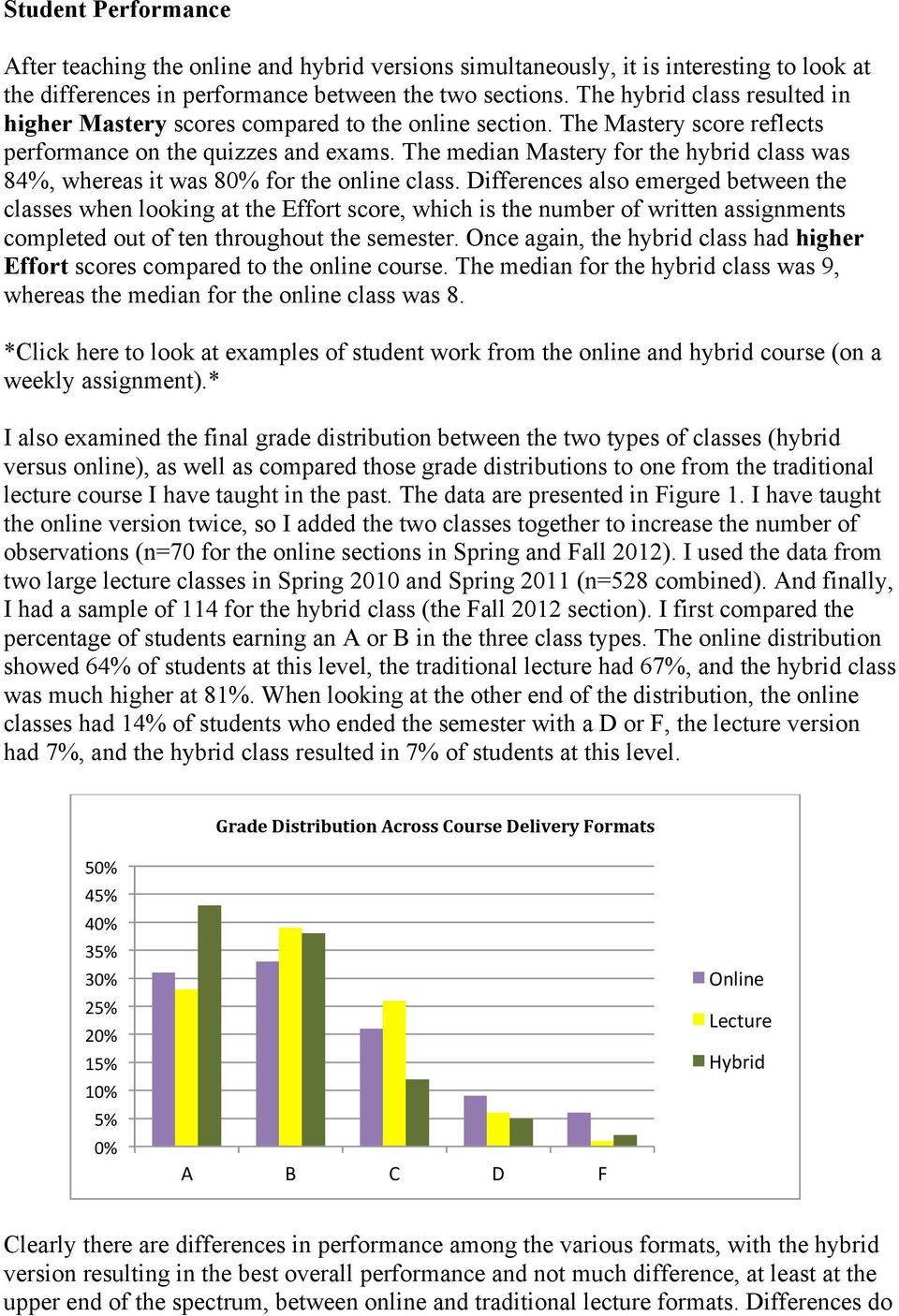
5 Student Performance After teaching the online and hybrid versions simultaneously, it is interesting to look at the differences in performance between the two sections. The hybrid class resulted in higher Mastery scores compared to the online section. The Mastery score reflects performance on the quizzes and exams. The median Mastery for the hybrid class was 84%, whereas it was 80% for the online class. Differences also emerged between the classes when looking at the Effort score, which is the number of written assignments completed out of ten throughout the semester. Once again, the hybrid class had higher Effort scores compared to the online course. The median for the hybrid class was 9, whereas the median for the online class was 8. *Click here to look at examples of student work from the online and hybrid course (on a weekly assignment).* I also examined the final grade distribution between the two types of classes (hybrid versus online), as well as compared those grade distributions to one from the traditional lecture course I have taught in the past. The data are presented in Figure 1. I have taught the online version twice, so I added the two classes together to increase the number of observations (n=70 for the online sections in Spring and Fall 2012). I used the data from two large lecture classes in Spring 2010 and Spring 2011 (n=528 combined). And finally, I had a sample of 114 for the hybrid class (the Fall 2012 section). I first compared the percentage of students earning an A or B in the three class types. The online distribution showed 64% of students at this level, the traditional lecture had 67%, and the hybrid class was much higher at 81%. When looking at the other end of the distribution, the online classes had 14% of students who ended the semester with a D or F, the lecture version had 7%, and the hybrid class resulted in 7% of students at this level. Grade Distribution Across Course Delivery Formats 50% 45% 40% 35% 30% 25% 20% 15% 10% 5% 0% A B C D F Online Lecture Hybrid Clearly there are differences in performance among the various formats, with the hybrid version resulting in the best overall performance and not much difference, at least at the upper end of the spectrum, between online and traditional lecture formats. Differences do
6 exist, however, at the bottom of the distribution between online and lecture classes, with more online students scoring poorly. The cause of these differences is unclear. The Fall 2012 online course was originally supposed to be a small lecture section taught by another instructor who had to take a medical leave of absence. I picked up the course at the last minute and the Psychology department made it an online class to prevent a conflict in my schedule, to avoid cancelling it, and to continue to give students the option of taking it that semester. Therefore, the online students may not have really wanted or been prepared for the online experience, which requires a certain amount of selfmotivation and planning. Their performance may have suffered as a result. Indeed, the performance of the Fall 2012 class (the impromptu online class) was lower (A&B=58%, D&F=19%) than the Spring 2012 class (the planned online class; A&B=68%, D&F=11%), which pulls down the combined distribution percentages reported above. I think the data from the two online sections must be interpreted with caution for this reason. As more students complete the online course, a better picture of typical performance from this format may emerge. It is also possible that having regular contact with me and/or the TA resulted in better performance for the hybrid and lecture classes as compared to the online classes, because of reminders about due dates or interactions that helped to further understanding of the material. In comparing the hybrid and online versions, while the basic material and requirements were the same, the hybrid class got more opportunities to do interactive activities: more in-class exercises and demonstrations, in-class discussions, in-class exam review sessions, and opportunities to network during class to form study groups for out of class interaction. Overall, I was very pleased with the results from the hybrid class but somewhat disappointed with the performance of online students, at least from the Fall 2012 semester. The process of putting the class online in Spring 2012 is what made the hybrid version possible, and I think that the online format definitely serves a certain population of students that it is important to reach. However, the learning environment that the hybrid students experienced and resulting depth of understanding that they displayed suggests that these two formats are unequal in terms of outcomes as well as student experience.
7 Reflections In comparing the hybrid and online courses, I found that students had more content related questions in the hybrid and lecture courses. Students had a greater number of interactions with me and with their peers when there was a physical meeting. Based on this, I think I need to create more opportunities for students to interact in an online course. For instance, for the next round, I plan on using a discussion board. However, I am still unsure about how to use this. Students take online classes because they are convenient for a variety of reasons: location, schedule, etc. Requiring everyone to log on at a certain time so we can mimic the classroom experience is probably unrealistic. Yet, an online discussion board simply is not the same as the dynamic conversations you get from everyone being together at the same time. I am teaching the same class as an online course in Spring I plan to incorporate some of the activities (e.g., class demos) that I did in the hybrid class in Fall 2012 where we collect class data and use web tools to compile it so that everyone can see the results. This might increase engagement and a connection that students feel to others who are enrolled. I also want to add discussion groups, but have not incorporated them into the regular grading requirement of the course because I first want to see how they work. I might use them as an extra credit opportunity or a way to make up a missed assignment. I am still mulling it over and will see where they might fit in well as the semester progresses. For the hybrid class, I had several attendees who continuously participated and made the classroom environment inclusive and engaging. However, because so much material was online, there were some students who never attended class. Given that the classroom activities were designed to provide more in-depth understanding the course material, I believe that these students, ones who just relied on the online material, got only a superficial grasp of the course content. Since I did not take attendance, I do not have the data to show the association between attendance and level of understanding (demonstrated by performance in assignments and exams). For the next round, however, I am considering taking attendance to not only encourage students to come to class but also to have the data to demonstrate the relationship between attendance/participation and performance in class.
ABNORMAL PSYCHOLOGY - CLP 3144
 ABNORMAL PSYCHOLOGY - CLP 3144 Instructor Greg J. Neimeyer, Ph.D., Professor of Psychology and Graduate Coordinator, Department of Psychology, University of Florida, Gainesville, Florida Email: Please
PSYCHOLOGY 1115 - Section M01 Mixed Mode Spring Semester 201110. Fundamentals of Psychology I MW 11:30 - A130. Course Description
 PSYCHOLOGY 1115 - Section M01 Mixed Mode Spring Semester 201110 Fundamentals of Psychology I MW 11:30 - A130 ***You are responsible for all information in this syllabus!*** Instructor: Dr. Jennifer Poole,
CLASS PARTICIPATION: MORE THAN JUST RAISING YOUR HAND
 STUDENT LEARNING SUPPORT TUTORIAL PRODUCED BY THE CENTER FOR TEACHING AND FACULTY DEVELOPMENT CLASS PARTICIPATION: MORE THAN JUST RAISING YOUR HAND CHAPTER 1: LEARNING THROUGH CLASS PARTICIPATION CLASS
BA 561: Database Design and Applications Acct 565: Advanced Accounting Information Systems Syllabus Spring 2015
 BA 561: Database Design and Applications Acct 565: Advanced Accounting Information Systems Syllabus Spring 2015 Course Logistics Where Rehn 18 2:00 4:45 Tuesday Instructor Dr. Jim Nelson Rehn 208A Office
Psychology 2510: Survey of Abnormal Psychology (Section 2) Fall 2015
 Psychology 2510: Survey of Abnormal Psychology (Section 2) Fall 2015 Instructor: Julianne Gray Ludlam, Ph.D. Class Location: Psychology Building 313 Class Time: MWF, 9:00-9:50 AM CST Office Location: 25
Introduction. The busy lives that people lead today have caused a demand for a more convenient method to
 On-Line Courses: A Comparison of Two Vastly Different Experiences by Sharon Testone, Ph.D. Introduction The busy lives that people lead today have caused a demand for a more convenient method to gain a
Case Based Scenarios: Evidence Based Teaching Learning Strategy in Nursing Education Pharmacology Course
 International Journal of Nursing December 2014, Vol. 1, No. 2, pp. 147-154 ISSN 2373-7662 (Print) 2373-7670 (Online) Copyright The Author(s). 2014. All Rights Reserved. Published by American Research Institute
How To Pass The Cnnu Test
 Policy for CLEP and Procedures for Course Challenges Updated by the Provost -Fall 2015 General Policy for the College-Level Examination Program (CLEP) Through College-Level Examination Program (CLEP),
Developing Critical Thinking Skills Saundra Yancy McGuire. Slide 1 TutorLingo On Demand Tutor Training Videos
 Developing Critical Thinking Skills Saundra Yancy McGuire Slide 1 TutorLingo On Demand Tutor Training Videos To view Closed Captioning, click on the Notes tab to the left. For screen reader accessible
MyMathLab User Guide
 MyMathLab User Guide For Students By: Nathan Kurtz The following is a guide on how to join your course in MyMathLab (MML) and some ideas of how MyMathLab can help you in your class. MyMathLab Support If
Assessing the Impact of a Tablet-PC-based Classroom Interaction System
 STo appear in Proceedings of Workshop on the Impact of Pen-Based Technology on Education (WIPTE) 2008. Assessing the Impact of a Tablet-PC-based Classroom Interaction System Kimberle Koile David Singer
PSYCHOLOGY 1115. Fall Semester 2010 - Section M02 CRN #30377. Fundamentals of Psychology I. Tuesdays and Thursdays, 12:30-13:20 A130 (Newberry Hall)
 Instructor: Office: PSYCHOLOGY 1115 Fall Semester 2010 - Section M02 CRN #30377 Fundamentals of Psychology I Tuesdays and Thursdays, 12:30-13:20 A130 (Newberry Hall) ***You are responsible for all of the
How To Complete Psychology 1010-D Online General Psychology
 Psychology 1010-D Online General Psychology Instructor Information: Janelle Seegmiller University of Utah Department of Psychology Email: [email protected] Phone: 801-581-4743 Office Hours:
Get the Most Out of Class
 Get the Most Out of Class Academic Resource Center, tel: 684-5917 Class preparation is an essential element of studying for any course. The time you spend in class each week shouldn t be a time in which
DESIGNING A HYBRID CLASS IN ACCOUNTING: HOW TO GET MAXIMUM MILEAGE?
 DESIGNING A HYBRID CLASS IN ACCOUNTING: HOW TO GET MAXIMUM MILEAGE? Gaurav Kumar Assistant Professor Department of Accounting, College of Business University of Arkansas at Little Rock 2801 S University
The Impact of Online Quizzes on Student Engagement and Learning
 The Impact of Online Quizzes on Student Engagement and Learning Dr. Jennifer Hillman Fall 2011-Spring 2012 Introduction PSYCH 270: Introduction to Abnormal Psychology is typically a large lecture class
Strategies for Winning at Math. Student Success Workshop
 Strategies for Winning at Math Student Success Workshop Just the Facts Poor performance in math is NOT due to a lack of intelligence. The key to success in math is having the right approach to studying
PSYC 201 GENERAL PSYCHOLOGY Fall 2013
 PSYC 201 GENERAL PSYCHOLOGY Fall 2013 T/TH 8:00 9:55 Instructor: Angela Christian, Ph.D. Sections: F58 Credit Hours: 4 Email: Office: [email protected] Office Phone: 616-638-5785 (call
Teaching large lecture classes online: Reflections on engaging 200 students on Blackboard and Facebook
 Teaching large lecture classes online: Reflections on engaging 200 students on Blackboard and Facebook By Marcus Messner, Ph.D. Assistant Professor, VCU School of Mass Communications VCU Online Learning
PSY 211 Psychology of Learning San Diego State University Fall Semester 2010 Tuesday 8:00-9:15 and Online
 PSY 211 Psychology of Learning San Diego State University Fall Semester 2010 Tuesday 8:00-9:15 and Online Instructor: B. Charles Tatum, Ph.D. Office: Life Sciences 24B (Basement Level) Phone: (619) 226-7726
CEDAR CREST COLLEGE General Psychology Psychology - 100 Spring 2009 Faculty: Dr. Diane M. Moyer [email protected] Office: Curtis 123
 CEDAR CREST COLLEGE General Psychology Psychology - 100 Spring 2009 [email protected] Office: Curtis 123 Course Description: The purpose of this course is to provide students with an introduction
Flip Your Classroom to Increase Active Learning and Student Engagement
 Flip Your Classroom to Increase Active Learning and Student Engagement Bethany B. Stone, Ph.D. Associate Teaching Professor University of Missouri Columbia Background Like all technologies, new teaching
Psychology 4978: Clinical Psychology Capstone (Section 1) Fall 2015
 Psychology 4978: Clinical Psychology Capstone (Section 1) Fall 2015 Instructor: Julianne Gray Ludlam, Ph.D. Class Location: McAlester 101 Class Time: T/Th, 9:30 AM 10:45 AM CST Office Location: McAlester
CMST 2010 Section 4 Spring 2014 Interpersonal Communication ONLINE ONLY Instructor Office Hours:
 CMST 2010 Section 4 Spring 2014 Interpersonal Communication ONLINE ONLY Instructor ReRe Pride Shaw 132 Coates Hall 578-2120 [email protected] Office Hours: Tuesday/Thursday - 12:00am-1:20pm and by appointment
Final Exam Performance. 50 OLI Accel Trad Control Trad All. Figure 1. Final exam performance of accelerated OLI-Statistics compared to traditional
 IN SEARCH OF THE PERFECT BLEND BETWEEN AN INSTRUCTOR AND AN ONLINE COURSE FOR TEACHING INTRODUCTORY STATISTICS Marsha Lovett, Oded Meyer and Candace Thille Carnegie Mellon University, United States of
Redesigned College Algebra. Southeast Missouri State University Ann Schnurbusch
 Redesigned College Algebra Southeast Missouri State University Ann Schnurbusch Why redesign the course? Developmental courses previously redesigned College Algebra already in transition High failure rate
Title: Enhancing Student Learning in Introduction to Sport Management. Author: Angela Lumpkin, Health, Sport, and Exercise Sciences
 Title: Enhancing Student Learning in Introduction to Sport Management Author: Angela Lumpkin, Health, Sport, and Exercise Sciences Summary: In order to enhance and document students learning, a sports
Lesson 1: Note Cards
 Studying for Foreign Language Exams 1001 When studying for a foreign language exam, there are certain ways to study smart. Some students think that just reading the book and taking notes is enough. However,
Student Achievement and Satisfaction in Introductory Psychology: No Significant Differences Between Face- to- Face and Hybrid Sections
 Student Achievement and Satisfaction in Introductory Psychology: No Significant Differences Between Face- to- Face and Hybrid Sections Final L. L. Stewart Faculty Development Fund Report Kathryn Becker-
PSYC 2301 General Psychology Course Syllabus. PSYC 2301 General Psychology. Psychology. Behavioral Sciences Department. Division of Arts and Sciences
 PSYC 2301 General Psychology Psychology Behavioral Sciences Department Division of Arts and Sciences Asst. Professor Robyn Inmon Summer II 2012 South Plains College Note: The first section of the syllabus
Reflective Essay on Teaching Lucinda S. Baker
 Reflective Essay on Teaching Lucinda S. Baker The purpose of this essay is to summarize the contents of my teaching portfolio, and also to reflect on what I've learned and how my approach to teaching has
Teaching and Encouraging Meaningful Reading of Mathematics Texts
 Teaching and Encouraging Meaningful Reading of Mathematics Texts Jane Friedman, Perla Myers and Jeff Wright Department of Mathematics and Computer Science University of San Diego 5998 Alcala Park, San
Comparison of Student Performance in an Online with traditional Based Entry Level Engineering Course
 Comparison of Student Performance in an Online with traditional Based Entry Level Engineering Course Ismail I. Orabi, Ph.D. Professor of Mechanical Engineering School of Engineering and Applied Sciences
FACULTY PEER ONLINE CLASSROOM OBSERVATIONS AA
 Philosophy Online class observations are meant to facilitate an instructor s professional growth. They will be used to create an opportunity for reflection and stimulate ideas for improvement in the online
PSYCHOLOGY 2301 INTRODUCTION TO PSYCHOLOGY BROOKHAVEN COLLEGE & DALLAS COLLEGES ONLINE DCCCD SOCIAL SCIENCE
 PSYCHOLOGY 2301 INTRODUCTION TO PSYCHOLOGY BROOKHAVEN COLLEGE & DALLAS COLLEGES ONLINE DCCCD SOCIAL SCIENCE PROFESSOR: Bill Sigsbee, MA, LPA OFFICE: K210 PHONE: 972 / 860-4360 E-MAIL: [email protected]
Assessment Findings and Curricular Improvements Department of Psychology Undergraduate Program. Assessment Measures
 Assessment Findings and Curricular Improvements Department of Psychology Undergraduate Program Assessment Measures The Department of Psychology uses the following measures to assess departmental learning
How To Find Out If Distance Education Is A Good Thing For A Hispanic Student
 Spring 2010 Students Perceptions and Opinions of Online Courses: A Qualitative Inquiry A Report by South Texas College s Office of Research & Analytical Services South Texas College Spring 2010 Inquiries
A PhD in Public Affairs?
 A PhD in Public Affairs? The Basics A Doctor of Philosophy degree, abbreviated Ph.D. for the Latin Philosophiae Doctor, is an advanced academic degree earned in many fields, signifying major interests
General Psychology (PSY 101A) Spring 2013. MWF 8:30-9:20am, Sloan 201
 General Psychology (PSY 101A) Spring 2013 MWF 8:30-9:20am, Sloan 201 Dr. Jessica Good E-mail: [email protected] Office: Watson 205 Phone: 704-894-2131 Office Hours: Mon, Wed 9:30am 11:30pm, Tues 2pm-4pm,
Abnormal Behavior Psychology 3400-090: Spring 2010
 Abnormal Behavior Psychology 3400-090: Spring 2010 Instructor: Office: E-mail Address: Office Hours: Malinda J. Freitag BEH S 515 (Mailbox on 5 th Floor) [email protected] By Appointment Only*
DEPARTMENT OF PSYCHOLOGY RESEARCH PARTICIPATION POLICIES AND PROCEDURES
 DEPARTMENT OF PSYCHOLOGY RESEARCH PARTICIPATION POLICIES AND PROCEDURES The Department of Psychology provides opportunities for students to become familiar with the nature of psychological research through
Middlesex Community College Fall 2015 Course Syllabus. Course Information: Social Problems (SOC103 CRN 1320 Section 30) 3 Credits
 Middlesex Community College Fall 2015 Course Syllabus Course Information: Social Problems (SOC103 CRN 1320 Section 30) 3 Credits Location: Online Instructor: Carmela Smith, MSW, LCSW Phone: best to contact
PSYCH 412: Psychological Testing and Measurement Fall 2014 Tuesdays & Thursdays 2:50-4:05pm VMMC 219
 PSYCH 412: Psychological Testing and Measurement Fall 2014 Tuesdays & Thursdays 2:50-4:05pm VMMC 219 Course Instructor Tahira Probst, Ph.D. Industrial/Organizational Psychology Office: VCLS 208K Telephone:
Math Center Services and Organization
 STUDENT AFFAIRS FORUM Math Center Services and Organization Custom Research Brief Research Associate Amanda Michael Research Manager Nalika Vasudevan October 2012 2 of 12 3 of 12 Table of Contents I. Research
Blended course redesign for large enrollment classes. Alan Aycock, Ph.D. Learning Technology Center University of Wisconsin Milwaukee June 2009
 Blended course redesign for large enrollment classes Alan Aycock, Ph.D. Learning Technology Center University of Wisconsin Milwaukee June 2009 Challenges to blended course redesign in large enrollment
A Primer on Writing Effective Learning-Centered Course Goals
 A Primer on Writing Effective Learning-Centered Course Goals Robert K. Noyd (DFB) & The Staff of The Center for Educational Excellence (CEE) US Air Force Academy A Shift from a Topic-Centered to a Learning-Centered
Effects of Test-Enhanced Learning in a Cognitive Psychology Course
 Effects of Test-Enhanced Learning in a Cognitive Psychology Course Shanta Hattikudur & Bradley R. Postle University of Wisconsin Madison Given recent findings that test-enhanced learning (TEL) improves
College Success Workshops Online, On-Demand
 College Success Workshops Online, On-Demand Click on the link to Online Success Workshops in your MyCSN portal. All you need is your NSHE ID number to log in. ACADEMIC & CAREER EXPLORATION Maximizing Your
The University of Texas at Austin McCombs School of Business Foundations of Accounting (ACC 310F) Course Syllabus Spring 2015
 The University of Texas at Austin McCombs School of Business Foundations of Accounting (ACC 310F) Course Syllabus Spring 2015 Course Information Section Time Location 02160 MW from 9:30-11am UTC 2.112A
Blackboard Learning System: Student Instructional Guide
 Blackboard Learning System: Student Instructional Guide This manual was prepared to assist students in the understanding, orientation, and usage of the Blackboard Learning System online course management
Improving Distance Education Through Student Online Orientation Classes
 Abstract Improving Distance Education Through Student Online Orientation Classes Scott Mensch Indiana University of Pennsylvania When offering an online class the academic institution s major concern should
THE UNIVERSITY OF NORTH CAROLINA AT GREENSBORO BRYAN SCHOOL OF BUSINESS AND ECONOMICS
 THE UNIVERSITY OF NORTH CAROLINA AT GREENSBORO BRYAN SCHOOL OF BUSINESS AND ECONOMICS Professor: Evan Shough Office: Bryan 342 Phone: 256-0127 Email: [email protected] Office Hours: By Appointment MBA
EDF 6211 Educational Psychology
 EDF 6211 Educational Psychology Instructor: Dr. Sharon McGee Time: Tuesday 5:00-7:40 Home: 305-253-8757 Email: [email protected] Room: GC 285 Office Hours: Before and after class General Course Description
BA530 Financial Management Spring 2015
 BA530 Financial Management Spring 2015 Professor: Wanli Zhao, Ph.D. Class Time: 4:00 ~ 6:45 PM on Wednesday in Lawson 101 Office: Rehn 124, College of Business Phone: (618) 453-7109 Email: [email protected]
Phase 2 The System Specification
 Team W2 Video-Conferencing-Based Classroom Extension Sergio Bana Andrew Carland Matt Dyson Sarah Jordan Andrew Wantuch Phase 2 The System Specification 1 P a g e TABLE OF CONTENTS 1. INTRODUCTORY PROBLEM
This material is intended for use by undergraduate students who are contemplating taking a course with me.
 This material is intended for use by undergraduate students who are contemplating taking a course with me. I have pasted, without edits, all Section C comments from my recent online evaluations from SIRS
NOTE TAKING AND THE TABLET PC
 NOTE TAKING AND THE TABLET PC 1. ABSTRACT Scott Turner, Kibum Kim, Manuel A. Pérez-Quiñones, Stephen H. Edwards [email protected], [email protected], [email protected], [email protected] Virginia Tech Computer
Psychology 318, Thinking and Decision Making Course Syllabus, Spring 2015 TR 8-9:20 in Lago W262
 Psychology 318, Thinking and Decision Making Course Syllabus, Spring 2015 TR 8-9:20 in Lago W262 Instructor: Dr. Veronica J. Dark TA: Jason Geller Office: Science I Room 374 Office: Science I Room 54 Email:
CHEM 112-03 PRINCIPLES OF CHEMISTRY Lecture
 CHEM 112-03 PRINCIPLES OF CHEMISTRY Lecture Spring 2016 COURSE DESCRIPTION An introductory course in chemistry emphasizing theoretical aspects and designed primarily for students who intend to take one
Syllabus. Finance 367: Investment Management
 Syllabus Finance 367: Investment Management Summer II 2012 Course Unique Number 71710 Instructor: Sergey Maslennikov Instructor s Office: CBA 3.332E E-mail: [email protected] Phone:
EDUCATIONAL BENEFITS OF A PAPERLESS CLASSROOM UTILIZING TABLET PCS. R. Ellis-Behnke, J. Gilliland, G.E. Schneider, D. Singer
 EDUCATIONAL BENEFITS OF A PAPERLESS CLASSROOM UTILIZING TABLET PCS R. Ellis-Behnke, J. Gilliland, G.E. Schneider, D. Singer Massachusetts Institute of Technology, Cambridge, Massachusetts Our research
High School Psychology and its Impact on University Psychology Performance: Some Early Data
 High School Psychology and its Impact on University Psychology Performance: Some Early Data John Reece Discipline of Psychology School of Health Sciences Impetus for This Research Oh, can you study psychology
INSC 102 Technologies for Information Retrieval FALL 2014 SECTION 002 Delivered online via Asynchronous Distance Education (ADE)
 INSC 102 Technologies for Information Retrieval FALL 2014 SECTION 002 Delivered online via Asynchronous Distance Education (ADE) Instructor: Rebecca Davis Email: [email protected] Office: 103 Communications
Iowa Online AP Academy Site Coordinator and Mentor Handbook 2015 2016
 Iowa Online AP Academy Site Coordinator and Mentor Handbook 2015 2016 TABLE OF CONTENTS Welcome to the Iowa Online AP Academy 3 Getting Started with the Iowa Online AP Academy 4 Registration and Enrollment
PSYCHOLOGY 101 ONLINE. Course Information and Syllabus Summer 2014
 PSYCHOLOGY 101 ONLINE Course Information and Syllabus Summer 2014 Professor: Shelly Fichtenkort, Ph.D. Phone: (209) 575-6898 E-mail: Please use e-mail within Blackboard Web page: http://fichtenkorts.faculty.mjc.edu
STUDENT LEARNING OUTCOMES:
 SYLLABUS Course Information: PSYC 2320.060: Lifespan Psychology ONLINE Instructor Information: Anthony Todd Lawson Email: [email protected] COURSE DESCRIPTION: Physiological, perceptual, cognitive, social
Teaching Portfolio. Teaching Philosophy
 Teaching Portfolio Teaching Philosophy Over the course of my education, I have had the privilege of interacting with some truly excellent teachers, who have shaped my knowledge, reasoning, and technical
Psychology of Aging GEY 4612 Fall 2012 M W F 12:55-1:45 CWY 109
 Psychology of Aging GEY 4612 Fall 2012 M W F 12:55-1:45 CWY 109 Instructor: Elizabeth Handing Office Hours: Mon & Wed 2:00 4:00 pm or by appointment Office: MHC 1136 Email: [email protected] Phone:
Introduction to General Psychology Spring 2014 PSY 1101-03, 30013 Mon. & Wed.: 6-7:15
 Introduction to General Psychology Spring 2014 PSY 1101-03, 30013 Mon. & Wed.: 6-7:15 Instructor: Jen Wallin-Ruschman Office Hours in Bowen 216: Mon., Wed., & Fri. 1-2; Mon. & Wed. 3:15-5; Tues. & Thur.
PSYC 101: General Psychology
 PSYC 101: General Psychology Course Overview PSYC 101 is structured to provide you with an overview of the rapidly changing science of psychology. No prerequisite is required, and no prior knowledge of
UNIVERSITY OF MARYLAND MONEY AND BANKING Economics 330 Fall 2015
 UNIVERSITY OF MARYLAND MONEY AND BANKING Economics 330 Fall 2015 Professor: Martina Copelman Office: TDY 3127 F at College Park Phone:(301) 405-3548 Lecture: Fridays 9:40-12:20 pm Email: [email protected]
Introduction to Physiological Psychology PSB3002 Spring Semester 2014
 Introduction to Physiological Psychology PSB3002 Spring Semester 2014 Instructor: Professor David W. Smith Program in Behavioral and Cognitive Neuroscience, Dept. of Psychology UF Center for Smell and
Essays on Teaching Excellence. Practice Tests: a Practical Teaching Method
 Essays on Teaching Excellence Toward the Best in the Academy Volume 17, Number 7, 2005-06 A publication of The Professional & Organizational Development Network in Higher Education (www.podnetwork.org).
Student Feedback on Online Summer Courses
 Student Feedback on Online Summer Courses October 8, 2015 Santa Clara University Office of Assessment Report Introduction In the summer of 2015, approximately 700 undergraduate students were enrolled in
Master of Healthcare Administration Frequently Asked Questions
 Master of Healthcare Administration Frequently Asked Questions Is your program CAHME accredited? Yes, the Seton Hall MHA program received initial CAHME accreditation effective May 20, 2014. This extends