
A Comparison of Student Learning Outcomes in Traditional and Online Personal Finance Courses
|
|
|
- Gwendoline Byrd
- 10 years ago
- Views:
Transcription
1 A Comparison of Student Learning Outcomes in Traditional and Online Personal Finance Courses Eddie J. Ary Associate Professor Frank D. Hickingbotham School of Business Ouachita Baptist University Arkadelphia, AR 71998, USA Christopher W. Brune Assistant Professor Frank D. Hickingbotham School of Business Ouachita Baptist University Arkadelphia, AR 71998, USA Abstract Numerous studies have compared student outcomes in online classes and traditional classes, but with mixed results. This paper adds to the existing body of evidence through an examination of students in Personal Finance courses. Primary results indicate that the delivery method made little difference in student performance. Secondary results identify pre-course GPAs, and to a lesser extent ACT scores, as predictors of student success in Personal Finance. Keywords: online learning outcomes, online learning, distance education, personal finance Introduction How do student learning outcomes in an online environment compare to outcomes in a traditional classroom approach? As online classes have become more common, this question has received increasing attention from researchers. In spite of the numerous studies in this area, no definitive answer as to which is the better approach has been found. However, as the literature review will later show, online classes appear to be at least as effective as traditional classes. This study examines learning outcomes in traditional and online personal finance classes taught by one of the authors during the spring of 2009, fall of 2009, and spring of 2010 at a small private university in Arkansas. There were a total of 94 students in the traditional classes and 91 in the online classes. Tests of the relationship between learning outcomes (as measured by the percentage of total points earned over the course of the semester) and variables such as ACT scores, pre-course GPA, gender, major, etc. were conducted for statistical significance. Scores on a pre- and post-test were also compared. Literature Review Over the years, an abundance of research has been done on various courses offered in both a traditional and online format. However, no research studies comparing online and traditional personal finance courses could be located by the authors. Since personal finance is normally taught by business faculty, and in an attempt to narrow the scope of the literature review, research studies concentrating on business courses will be highlighted. Weber and Lennon (2007) compared learning outcomes in four junior level Principles of Marketing sections (two were online and two traditional with a section of each type being offered in each of two semesters) at two private southeastern universities. The study consisted of a total of 66 traditional 465
2 students and 51 online students. Students were not given advance notice of the nature of the course in which they had enrolled, but were allowed to switch sections once they were told; however, no student did so. Variables like the textbook used, the instructor, exams, projects, assignments, and course content were the same for both the traditional and online sections. The main differences in the two courses were instructor contact and delivery method. Scores on the final exam, a graded project, and end-of-semester final grades were used to assess learning outcomes. Utilizing means analysis, frequency analysis, and a t-test, the authors found no significant difference between learning outcomes when controlling for the following variables: pre-course GPA, gender, student academic level, and prior knowledge and experience with online courses. Regression analysis revealed that GPA and academic level were significant in explaining learning outcomes in both the traditional and online sections, but that course format was not. Smith and Stephens (2010) compared the final exam scores of 67 students taking Marketing Principles in a traditional setting with 24 students taking the course online during the fall of 2009 at a state university in northern Minnesota. The mean score on the final exam was for traditional students and for online students. A t-test indicated that this difference was statistically significant. Smith and Stephens used the results of student evaluations to measure student satisfaction; they found no significant difference between the means on student evaluations for the two learning formats. Learning outcomes of 58 online students and 98 traditional students enrolled in Principles of Microeconomics were compared in a study by Gratton-Lavoie and Stanley (2009) at California State University, Fullerton. The students involved took the class either in the spring semester of 2002, the fall semester of 2002, or the fall semester of 2003 and were allowed to choose the online or traditional class. Textbook, course content, problems assigned, and exam format were the same for both the traditional and online classes. The researchers found that, when controlling for GPA and age, there was no significant difference in scores on the final exam. They did discover that older working women, students with high GPAs, and non-business majors were more likely to choose the online class in microeconomics. Bennett, Padgham, McCarty, and Carter (2007) compared learning outcomes of 406 traditional and 92 online students in principles of macroeconomics and microeconomics at Jacksonville State University in They found no difference in performance of the online and traditional classes overall; the final average of traditional students was 69.5 compared to 69.3 for online students. However, the researchers did find a significant difference at the 10 percent level in microeconomics where the traditional students had a final average of 67.1 compared to 60.2 for online students. Conversely, in the macroeconomics classes, the online students had a better final average (81.2 compared to 71.6 for traditional students) with significance at the 1 percent level. Females had significantly better final averages in the traditional classes; even though their averages were also higher in the online classes, the difference was not significant. A study by Friday, Friday-Stroud, Green, and Hill (2006) of 380 online students and 213 traditional students enrolled in Organization and Management over an eight-semester period from the spring of 1999 to the summer of 2002 at a commuter university in the southeastern United States revealed no significant difference in performance after controlling for professor experience and time period. However, the researchers did find that women significantly outperformed men in both learning environments. A concurrent study conducted by the same authors over the eight-semester time period of 298 students enrolled in online Strategic Management and 465 students taking the same course in a traditional setting came to similar conclusions. Daymont and Blau (2008) conducted a study of 64 online students and 181 traditional students enrolled in an undergraduate Organization and Management course during either the fall of 2006 or the spring of 2007 at a large public university in a large eastern city. They found no significant difference in the final grades of students in the two learning settings (overall, online students had slightly higher final grades); however, the online students scored higher on quiz scores (the difference in the scores of online and traditional students was statistically significant at the.05 level). Both online and traditional students took the quizzes online and were allowed to use their textbooks. Sue (2005) compared the performance of 41 students in an introductory business statistics course to 46 students in an online section at a mid-sized California university. The same professor taught both classes. Online students were required to meet on campus three times during the term; there were two other optional meetings (exam review sessions). Students in both learning environments were given 466
3 three exams during the term, as well as a final. The online students took the first and third exam online, but were required to come to campus for the second exam and the final. The mean exam scores were higher for traditional students on all the exams, but Sue only found significant differences in the scores on the second exam and the final (the two taken on campus by the online students). She hypothesized that the online students may have been at a disadvantage due to being used to approaching the course from an online perspective. Tucker (1999) completed a study of 23 students enrolled in a traditional business communications class, and a distance education class composed of 24 students. Variables such as instructor, course materials, assignments, course content, homework, research project, and final exam were the same for both classes. Tucker found that the post-test scores and final exam scores of the distance education students were higher and significantly different at the.05 alpha level; however, pre-test scores, homework grades, research paper grades, and final courses grades were not significantly different. Because of the broadness of its scope, a study by SRI International commissioned by the Department of Education will conclude the literature review (even though it does not relate directly to business course research). SRI examined over 1,000 empirical studies comparing online and classroom performance in various courses conducted from 1996 to The studies were screened and only those meeting the following characteristics were utilized: (a) contrasted an online to a face-to-face condition, (b) measured student learning outcomes, (c) used a rigorous research design, and (d) provided adequate information to calculate an effect size. Approximately 45 of the studies met these criteria; most of these studies were done in colleges and continuing education programs for adults. SRI found a small but significant difference in student outcomes on tests; online-oriented students scored in the 59 th percentile while classroom-oriented students scored in the 50 th percentile. A combination of online and face-to-face instruction produced the best results. Methods One of the authors taught a section of face-to-face personal finance and a section of online personal finance during each of the following semesters: the spring of 2009, the fall of 2009, and the spring of The learning outcomes of students in these classes are the basis for this study. There were a total of 185 students in the study, 94 in the traditional sections and 91 in the online sections. Of the 185 students, 78 (42 percent) were male and 107 (58 percent) were female. In the online classes, 33 (36 percent) were male and 58 (64 percent) were female. Forty-five (48 percent) of the students in the traditional classes were male and 49 (52 percent) were female. The coursework in the online classes was completed online except for a pre-and post-test, a mid-term exam, and a final exam, all of which were given on campus. The same pre-and post-test was given in each of the two types of classes. The mid-term exam and the final exam for the online classes each were worth 200 points. Students were given the option of attending a face-to-face review session the day before each of these exams were administered. Approximately 70 to 80 percent of students attended these sessions. During the review sessions, the instructor worked through examples of major problems which would appear on the exams, and answered student questions. The mid-term and final exam constituted approximately 50 percent of the total points for the online courses. The mid-term exam tested over nine to ten chapters while the final exam covered eleven to twelve chapters (the final exam was not comprehensive). Exam items were based on learning objectives made available to students. Including the final exam, there were five exams given in the traditional sections of personal finance. Each of these exams (except the final which was comprehensive) covered from three to six chapters. Four of the exams were worth 110 points (ten points of each exam was over video clips shown in class while covering the unit); the final exam was worth 100 points. Of the total points in the traditional classes, exam scores constituted from 54 to 58 percent. Learning objectives were provided for each of the exams. A personal finance simulation, online open-book quizzes, and a track-your-spending-for- a-month assignment were common to both the online and traditional sections. Assignments which were not the same for the two types of classes only constituted six to seven percent of the points possible. 467

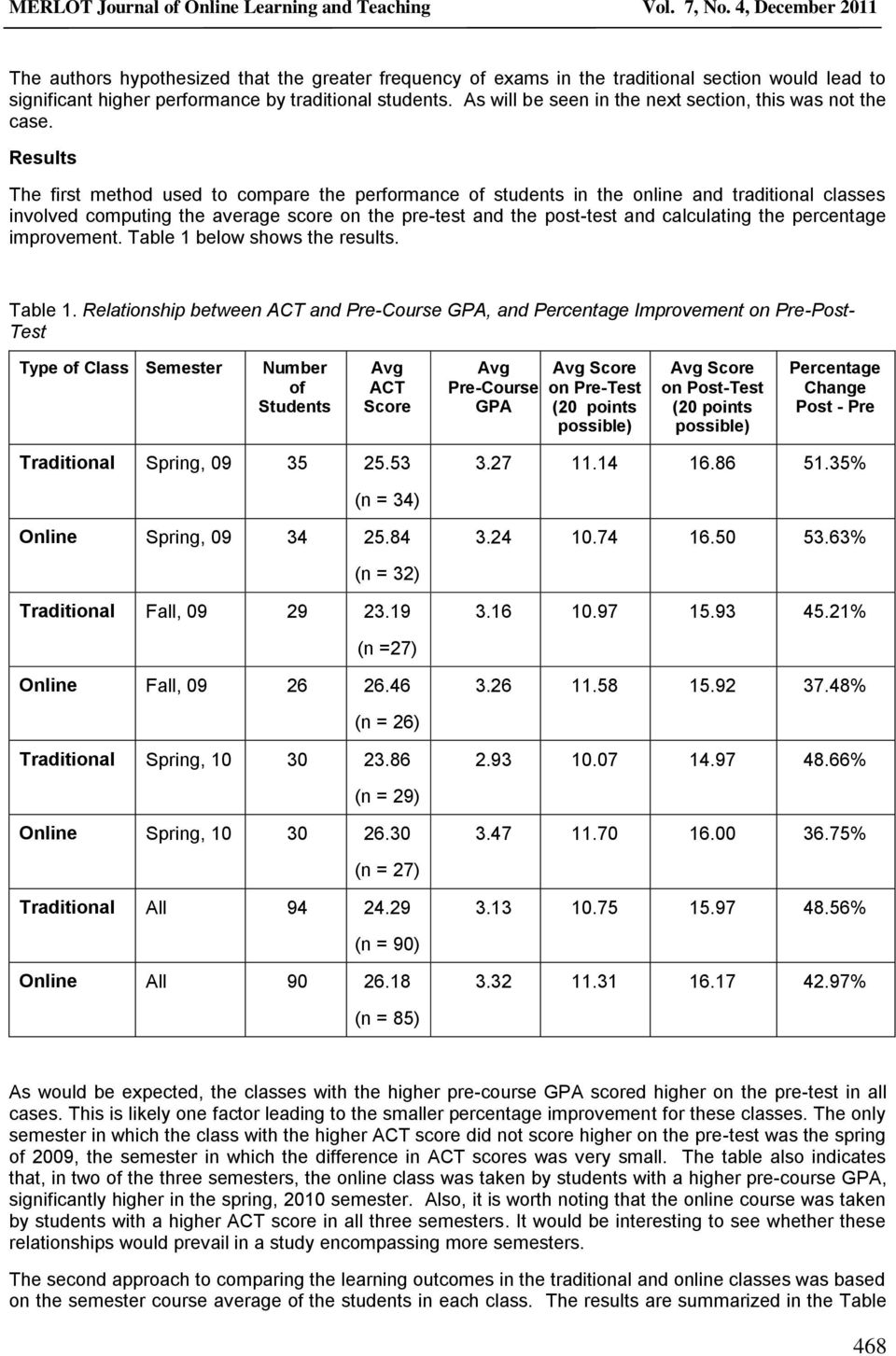
4 The authors hypothesized that the greater frequency of exams in the traditional section would lead to significant higher performance by traditional students. As will be seen in the next section, this was not the case. Results The first method used to compare the performance of students in the online and traditional classes involved computing the average score on the pre-test and the post-test and calculating the percentage improvement. Table 1 below shows the results. Table 1. Relationship between ACT and Pre-Course GPA, and Percentage Improvement on Pre-Post- Test Type of Class Semester Number of Students ACT Score Pre-Course GPA Score on Pre-Test (20 points possible) Score on Post-Test (20 points possible) Percentage Change Post - Pre Traditional Spring, % (n = 34) Online Spring, (n = 32) Traditional Fall, % % (n =27) Online Fall, (n = 26) Traditional Spring, (n = 29) Online Spring, (n = 27) Traditional All (n = 90) Online All % % % % % (n = 85) As would be expected, the classes with the higher pre-course GPA scored higher on the pre-test in all cases. This is likely one factor leading to the smaller percentage improvement for these classes. The only semester in which the class with the higher ACT score did not score higher on the pre-test was the spring of 2009, the semester in which the difference in ACT scores was very small. The table also indicates that, in two of the three semesters, the online class was taken by students with a higher pre-course GPA, significantly higher in the spring, 2010 semester. Also, it is worth noting that the online course was taken by students with a higher ACT score in all three semesters. It would be interesting to see whether these relationships would prevail in a study encompassing more semesters. The second approach to comparing the learning outcomes in the traditional and online classes was based on the semester course average of the students in each class. The results are summarized in the Table 468
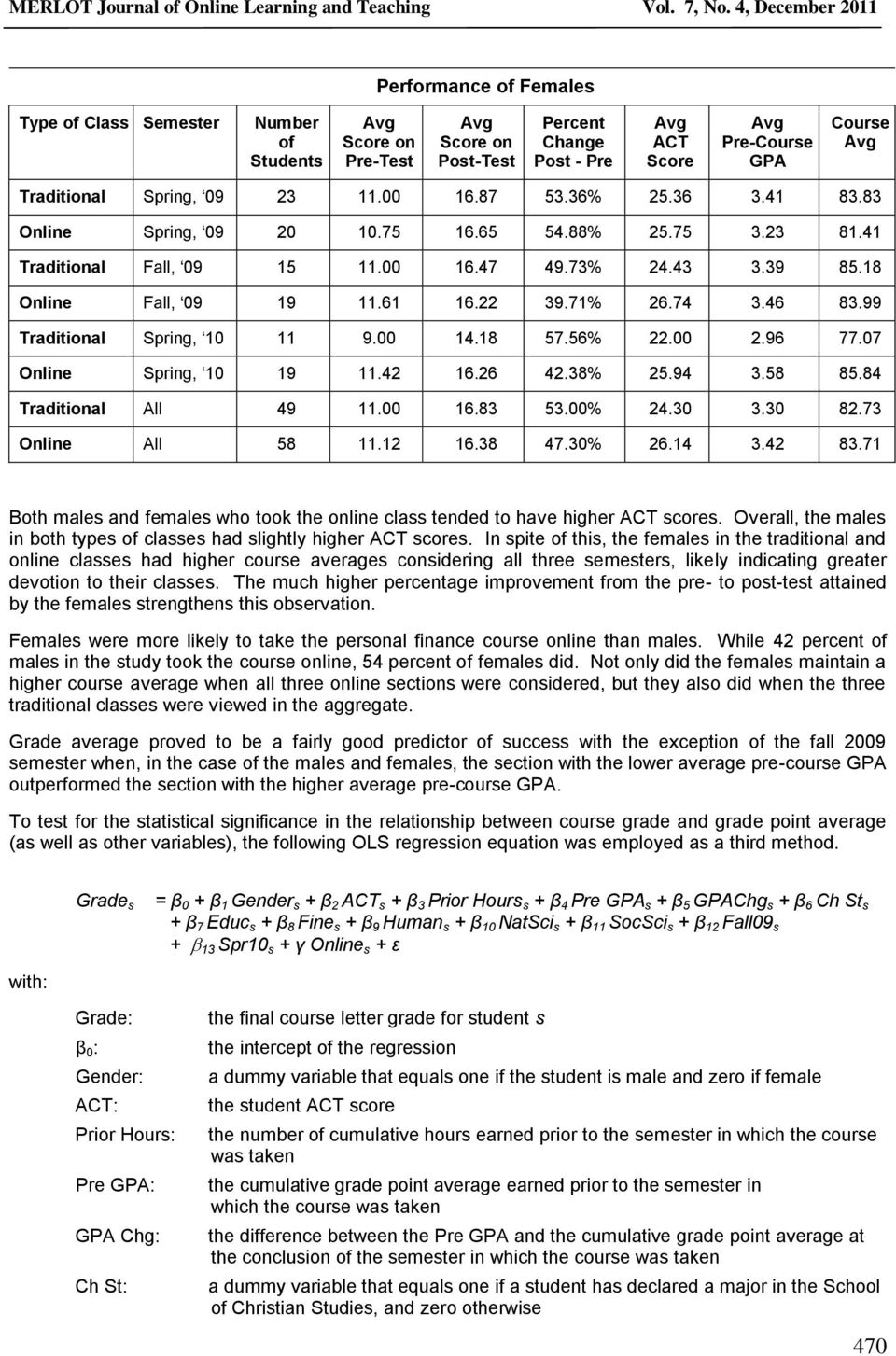
5 2 which also looks at the relationship between the semester average and the average class ACT and as the average pre-course GPA. Table 2. Relationship between ACT and Pre-Course GPA, and Course Semester Average Type of Class Semester Number of Students Average ACT Score Average Pre-Course GPA* Semester Average Traditional Spring, (n = 34) Online Spring, (n = 32) Traditional Fall, (n =27) Online Fall, (n = 26) Traditional Spring, (n = 29) Online Spring, (n = 27) Traditional All (n = 90) Online All (n = 85) *4.0 scale The table reveals that the semester average of students in the online sections was higher in two of the three semesters with the exception of the spring semester of The much higher average ACT of students in the online classes during the fall semester of 2009 and the spring of 2010, as well as the higher pre-course GPA, likely are factors contributing to this outcome. However, it is surprising that the class average of the traditional section in the spring of 2009 was considerably higher than that of the online section in spite of the fact that the average ACT of the traditional students was only.31 lower and the average pre-course GPA was only.03 higher. The following comparison (Table 3) of the performance of males and females in the online and traditional sections reveals several interesting differences. Table 3. Performance of males and females in the online and traditional sections Performance of Males Type of Class Semester Number of Students Score on Pre-Test Score on Post-Test Percent Change Post - Pre ACT Score Pre-Course GPA Course Traditional Spring, % Online Spring, % Traditional Fall, % Online Fall, % Traditional Spring, % Online Spring, % Traditional All % Online All %

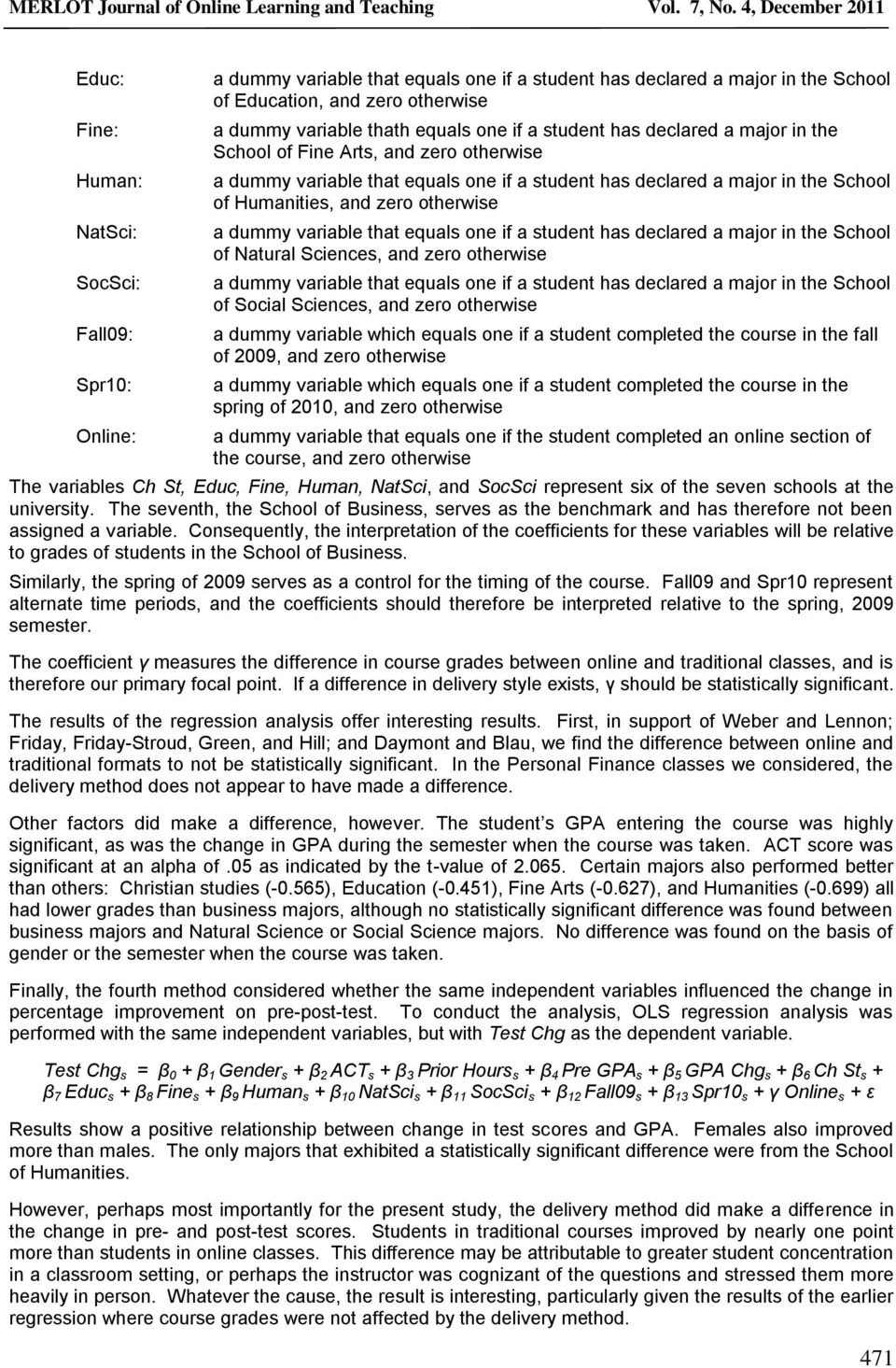
6 Performance of Females Type of Class Semester Number of Students Score on Pre-Test Score on Post-Test Percent Change Post - Pre ACT Score Pre-Course GPA Course Traditional Spring, % Online Spring, % Traditional Fall, % Online Fall, % Traditional Spring, % Online Spring, % Traditional All % Online All % Both males and females who took the online class tended to have higher ACT scores. Overall, the males in both types of classes had slightly higher ACT scores. In spite of this, the females in the traditional and online classes had higher course averages considering all three semesters, likely indicating greater devotion to their classes. The much higher percentage improvement from the pre- to post-test attained by the females strengthens this observation. Females were more likely to take the personal finance course online than males. While 42 percent of males in the study took the course online, 54 percent of females did. Not only did the females maintain a higher course average when all three online sections were considered, but they also did when the three traditional classes were viewed in the aggregate. Grade average proved to be a fairly good predictor of success with the exception of the fall 2009 semester when, in the case of the males and females, the section with the lower average pre-course GPA outperformed the section with the higher average pre-course GPA. To test for the statistical significance in the relationship between course grade and grade point average (as well as other variables), the following OLS regression equation was employed as a third method. Grade s = β 0 + β 1 Gender s + β 2 ACT s + β 3 Prior Hours s + β 4 Pre GPA s + β 5 GPAChg s + β 6 Ch St s + β 7 Educ s + β 8 Fine s + β 9 Human s + β 10 NatSci s + β 11 SocSci s + β 12 Fall09 s + 13 Spr10 s + γ Online s + ε with: Grade: β 0 : Gender: ACT: Prior Hours: Pre GPA: GPA Chg: Ch St: the final course letter grade for student s the intercept of the regression a dummy variable that equals one if the student is male and zero if female the student ACT score the number of cumulative hours earned prior to the semester in which the course was taken the cumulative grade point average earned prior to the semester in which the course was taken the difference between the Pre GPA and the cumulative grade point average at the conclusion of the semester in which the course was taken a dummy variable that equals one if a student has declared a major in the School of Christian Studies, and zero otherwise 470
7 Educ: Fine: Human: NatSci: SocSci: Fall09: Spr10: Online: a dummy variable that equals one if a student has declared a major in the School of Education, and zero otherwise a dummy variable thath equals one if a student has declared a major in the School of Fine Arts, and zero otherwise a dummy variable that equals one if a student has declared a major in the School of Humanities, and zero otherwise a dummy variable that equals one if a student has declared a major in the School of Natural Sciences, and zero otherwise a dummy variable that equals one if a student has declared a major in the School of Social Sciences, and zero otherwise a dummy variable which equals one if a student completed the course in the fall of 2009, and zero otherwise a dummy variable which equals one if a student completed the course in the spring of 2010, and zero otherwise a dummy variable that equals one if the student completed an online section of the course, and zero otherwise The variables Ch St, Educ, Fine, Human, NatSci, and SocSci represent six of the seven schools at the university. The seventh, the School of Business, serves as the benchmark and has therefore not been assigned a variable. Consequently, the interpretation of the coefficients for these variables will be relative to grades of students in the School of Business. Similarly, the spring of 2009 serves as a control for the timing of the course. Fall09 and Spr10 represent alternate time periods, and the coefficients should therefore be interpreted relative to the spring, 2009 semester. The coefficient γ measures the difference in course grades between online and traditional classes, and is therefore our primary focal point. If a difference in delivery style exists, γ should be statistically significant. The results of the regression analysis offer interesting results. First, in support of Weber and Lennon; Friday, Friday-Stroud, Green, and Hill; and Daymont and Blau, we find the difference between online and traditional formats to not be statistically significant. In the Personal Finance classes we considered, the delivery method does not appear to have made a difference. Other factors did make a difference, however. The student s GPA entering the course was highly significant, as was the change in GPA during the semester when the course was taken. ACT score was significant at an alpha of.05 as indicated by the t-value of Certain majors also performed better than others: Christian studies (-0.565), Education (-0.451), Fine Arts (-0.627), and Humanities (-0.699) all had lower grades than business majors, although no statistically significant difference was found between business majors and Natural Science or Social Science majors. No difference was found on the basis of gender or the semester when the course was taken. Finally, the fourth method considered whether the same independent variables influenced the change in percentage improvement on pre-post-test. To conduct the analysis, OLS regression analysis was performed with the same independent variables, but with Test Chg as the dependent variable. Test Chg s = β 0 + β 1 Gender s + β 2 ACT s + β 3 Prior Hours s + β 4 Pre GPA s + β 5 GPA Chg s + β 6 Ch St s + β 7 Educ s + β 8 Fine s + β 9 Human s + β 10 NatSci s + β 11 SocSci s + β 12 Fall09 s + β 13 Spr10 s + γ Online s + ε Results show a positive relationship between change in test scores and GPA. Females also improved more than males. The only majors that exhibited a statistically significant difference were from the School of Humanities. However, perhaps most importantly for the present study, the delivery method did make a difference in the change in pre- and post-test scores. Students in traditional courses improved by nearly one point more than students in online classes. This difference may be attributable to greater student concentration in a classroom setting, or perhaps the instructor was cognizant of the questions and stressed them more heavily in person. Whatever the cause, the result is interesting, particularly given the results of the earlier regression where course grades were not affected by the delivery method. 471
8 Table 4. Results of OLS Regression with Grade as Dependent Variable Coefficient t-statistic p-value Constant Gender ACT Prior Hours Pre GPA GPA Chg Ch St Educ Fine Human NatSci SocSci Fall Spr Online Adj R n 184 Conclusions This paper considers whether learning outcomes differ between online and traditional Personal Finance classes at a small private university in Arkansas during the spring 2009, fall 2009, and spring 2010 semesters. First, descriptive statistics are analyzed to compare the primary characteristics of the students. Results reveal higher mean GPAs for students in online classes; semester course grades were also higher in two of the three online classes. Next, OLS regression analysis was used to examine the relationship between multiple student characteristics and two separate dependent variables. The results indicate that the delivery method did not make a difference in the final course grade. However, students in traditional classes did show a greater improvement on a pre-post-test. Even though the average ACT and average pre-course GPA of online students was 7.78 percent and 6.07 percent higher respectively than that of traditional students, the semester average of online students was only 1.07 percent higher. The greater frequency of exams in the traditional sections may account for this, even though it did not lead to significantly higher performance by traditional students as the authors had initially hypothesized. Maintaining the same exam schedule in both types of classes in a future study would likely reveal its role in influencing student outcomes. 472

9 Table 5. Results of OLS Regression with Test Change as Dependent Variable Coefficient t-statistic p-value Constant Gender ACT Prior Hours Pre GPA GPA Chg Ch St Educ Fine Human NatSci SocSci Fall Spr Online Adj R n 184 Many educators would regard the fact that the online students tended to have a higher pre-course GPA as a positive, since there is a common perception that online courses require greater discipline and selfmotivation. Overall, as most similar studies, this study revealed that the delivery method made little difference in student performance. The study did find pre-course GPAs, and to a lesser extent ACT scores, as predictors of student success in personal finance, whether taught online or in a traditional setting. References Bennett, D., Padgham, G., McCarty, C., & Carter, M. (2007). Teaching Principles of Economics: Internet vs. Traditional Classroom Instruction. Journal of Economics and Economic Education Research. Daymount, T., & Blau, G. (2008). Student Performance in Online and Traditional Sections of an Undergraduate Management Course. Journal of Behavioral and Applied Management, 9, Friday, E., Friday-Stroud, S., Green, A, & Hill, A. (2006). A Multi-Semester Comparison of Student Performance between Multiple Traditional and Online Sections of Two Management Classes. Journal of Behavioral and Applied Management, 8,

10 Gratton-Lavoie, C., & Stanley, D. (2009). Teaching and Learning Principles of Microeconomics Online: An Empirical Assessment. Research in Economic Education, 40, Means, B., Toyama, Y., Murphy, R., Bakia, M., & Jones, K. (2009). Evaluation of Evidence-based Practices in Online Learning: A Meta-analysis and Review of Online-learning Studies. U.S. Department of Education. Smith, D. & Stephens, B. (2010). Marketing Education: Online vs Traditional. Proceedings of the American Society of Business and Behavioral Sciences, 17, Sue, V. (2005). Comparing Online and Traditional Courses. Academic Exchange Quarterly, 9, Tucker, S. (2001). Distance Education: Better, Worse, or as Good as Traditional Education?. Online Journal of Distance Learning Administration, 4. Weber, J., & Lennon, R. (2007). Multi-Course Comparison of Traditional Versus Web-based Course Delivery Systems. The Journal of Education Online, 4, Manuscript received 18 Jun 2011; revision received 18 Nov This work is published under a Creative Commons Attribution-Non-Commercial-Share-Alike License For details please go to: 474
TEACHING PRINCIPLES OF ECONOMICS: INTERNET VS. TRADITIONAL CLASSROOM INSTRUCTION
 21 TEACHING PRINCIPLES OF ECONOMICS: INTERNET VS. TRADITIONAL CLASSROOM INSTRUCTION Doris S. Bennett, Jacksonville State University Gene L. Padgham, Jacksonville State University Cynthia S. McCarty, Jacksonville
Teaching college microeconomics: Online vs. traditional classroom instruction
 Teaching college microeconomics: Online vs. traditional classroom instruction ABSTRACT Cynthia McCarty Jacksonville State University Doris Bennett Jacksonville State University Shawn Carter Jacksonville
MARKETING EDUCATION: ONLINE VS TRADITIONAL
 MARKETING EDUCATION: ONLINE VS TRADITIONAL Smith, David F. Bemidji State University [email protected] Stephens, Barry K. Bemidji State University [email protected] ABSTRACT Online higher
Determining Student Performance in Online Database Courses
 in Online Database Courses George Garman The Metropolitan State College of Denver ABSTRACT Using data collected from 2002 to 2011, this paper analyzes the determinants of scores earned by students in a
Can Web Courses Replace the Classroom in Principles of Microeconomics? By Byron W. Brown and Carl E. Liedholm*
 Can Web Courses Replace the Classroom in Principles of Microeconomics? By Byron W. Brown and Carl E. Liedholm* The proliferation of economics courses offered partly or completely on-line (Katz and Becker,
Comparing Student Learning in a Required Electrical Engineering Undergraduate Course: Traditional Face-to-Face vs. Online
 Comparing Student Learning in a Required Electrical Engineering Undergraduate Course: Traditional Face-to-Face vs. Online Carolyn Plumb and Brock LaMeres Montana State University, Bozeman, Montana, U.S.A.,
A Comparison of Course Delivery Methods: An Exercise in Experimental Economics
 JOURNAL OF ECONOMICS AND FINANCE EDUCATION Volume 7 Number 1 Summer 2008 21 A Comparison of Course Delivery Methods: An Exercise in Experimental Economics Roy Howsen and Stephen Lile 1 ABSTRACT This paper
Student Performance in Traditional vs. Online Format: Evidence from an MBA Level Introductory Economics Class
 University of Connecticut DigitalCommons@UConn Economics Working Papers Department of Economics 3-1-2007 Student Performance in Traditional vs. Online Format: Evidence from an MBA Level Introductory Economics
Success rates of online versus traditional college students
 ABSTRACT Success rates of online versus traditional college students Dawn Wilson Fayetteville State University David Allen Fayetteville State University Are students setting themselves up for failure by
Communication Program Assessment Report
 Communication Program Assessment Report Narrative: The communication faculty at Georgia Perimeter College (GPC) is committed to the mission of the college which includes strengthening student success,
Research Proposal: Evaluating the Effectiveness of Online Learning as. Opposed to Traditional Classroom Delivered Instruction. Mark R.
 1 Running head: Effectiveness of Online Learning Research Proposal: Evaluating the Effectiveness of Online Learning as Opposed to Traditional Classroom Delivered Instruction Mark R. Domenic University
Textbook Readability and Student Performance in. Online Introductory Corporate Finance Classes
 The Journal of Educators Online-JEO July 2015 ISSN 1547-500X Vol 13 Number 2 35 Textbook Readability and Student Performance in Online Introductory Corporate Finance Classes Chien-Chih Peng, Morehead State
COMPARATIVE ASSESSMENT OF ONLINE HYBRID AND FACE-TO- FACE TEACHING METHODS
 COMPARATIVE ASSESSMENT OF ONLINE HYBRID AND FACE-TO- FACE TEACHING METHODS Sahlemedhin Sertsu 1, Fabio Chacon 2 1 Department of Natural Sciences, Bowie State University, MD (UNITED STATES) 2 Division of
Emese Ivan. Teaching Sports Economics through Technology
 Emese Ivan St John s University, Queens NY, USA Teaching Sports Economics through Technology Abstract: Although still in infancy, the use of the internet as a means of teaching college courses including
USING THE ETS MAJOR FIELD TEST IN BUSINESS TO COMPARE ONLINE AND CLASSROOM STUDENT LEARNING
 USING THE ETS MAJOR FIELD TEST IN BUSINESS TO COMPARE ONLINE AND CLASSROOM STUDENT LEARNING Andrew Tiger, Southeastern Oklahoma State University, [email protected] Jimmy Speers, Southeastern Oklahoma State
Knowledge Management & E-Learning
 Knowledge Management & E-Learning, Vol.5, No.3. Sep 2013 Knowledge Management & E-Learning ISSN 2073-7904 A brief examination of predictors of e-learning success for novice and expert learners Emily Stark
Validity of Selection Criteria in Predicting MBA Success
 Validity of Selection Criteria in Predicting MBA Success Terry C. Truitt Anderson University Abstract GMAT scores are found to be a robust predictor of MBA academic performance. Very little support is
Student Achievement and Satisfaction in Introductory Psychology: No Significant Differences Between Face- to- Face and Hybrid Sections
 Student Achievement and Satisfaction in Introductory Psychology: No Significant Differences Between Face- to- Face and Hybrid Sections Final L. L. Stewart Faculty Development Fund Report Kathryn Becker-
GRADUATE STUDENT SATISFACTION WITH AN ONLINE DISCRETE MATHEMATICS COURSE *
 GRADUATE STUDENT SATISFACTION WITH AN ONLINE DISCRETE MATHEMATICS COURSE * Amber Settle DePaul University 243 S. Wabash Avenue Chicago, IL 60604 (312) 362-5324 [email protected] Chad Settle University
Student Success in Business Statistics
 JOURNAL OF ECONOMICS AND FINANCE EDUCATION Volume 6 Number 1 Summer 2007 19 Student Success in Business Statistics Carolyn F. Rochelle and Douglas Dotterweich 1 Abstract Many universities require Business
Running Head: COMPARISON OF ONLINE STUDENTS TO TRADITIONAL 1. The Comparison of Online Students Education to the
 Running Head: COMPARISON OF ONLINE STUDENTS TO TRADITIONAL 1 The Comparison of Online Students Education to the Traditional Students of Classroom Education Brent Alan Neumeier The University of Arkansas
How To Study Online Accounting
 Dr. Sara Schmidt, CPA Northern State University Overview Introduction Purpose of the Study Research Design Findings Conclusions Recommendations for Practice Recommendations for Further Study Final Thoughts
Teaching Without a Classroom: Delivering Courses Online
 Teaching Without a Classroom: Delivering Courses Online Gary McDonald, Professor Department of Computer Science and Information Systems Northwest Missouri State University [email protected] Merry
ARE ONLINE COURSES CANNIBALIZING STUDENTS FROM EXISTING COURSES?
 ARE ONLINE COURSES CANNIBALIZING STUDENTS FROM EXISTING COURSES? Joseph K. Cavanaugh Department of Business Wright State University, Lake Campus ABSTRACT One of the reasons most often cited for the increasing
Professor and Student Performance in Online Versus Traditional Introductory Finance Courses
 JOURNAL OF ECONOMICS AND FINANCE EDUCATION Volume 6 Number 1 Summer 2007 40 Professor and Student Performance in Online Versus Traditional Introductory Finance Courses Joseph Farinella 1 ABSTRACT According
Journal of College Teaching & Learning August 2008 Volume 5, Number 8
 A Comparison Of Student Outcomes And Student Satisfaction In Three MBA Human Resource Management Classes Based On Traditional Vs. Online Learning Jane Whitney Gibson, Nova Southeastern University, USA
Examining Students Performance and Attitudes Towards the Use of Information Technology in a Virtual and Conventional Setting
 The Journal of Interactive Online Learning Volume 2, Number 3, Winter 2004 www.ncolr.org ISSN: 1541-4914 Examining Students Performance and Attitudes Towards the Use of Information Technology in a Virtual
PSEO - Advantages and Disadvantages
 Undergraduate Economic Review Volume 3 Issue 1 Article 3 2007 PSEO: Are Your Tax Dollars Really Paying Off? Erin McQuillan College of St. Scholastica Recommended Citation McQuillan, Erin (2007) "PSEO:
Achievement and Satisfaction in a Computer-assisted Versus a Traditional Lecturing of an Introductory Statistics Course
 Australian Journal of Basic and Applied Sciences, 3(3): 1875-1878, 2009 ISSN 1991-8178 2009, INSInet Publication Achievement and Satisfaction in a Computer-assisted Versus a Traditional Lecturing of an
Department of Management Information Systems Terry College of Business The University of Georgia. Major Assessment Plan (As of June 1, 2003)
 Department of Management Information Systems Terry College of Business The University of Georgia Major Assessment Plan (As of June 1, 2003) Note to Readers: The MIS Faculty takes seriously our challenge
Determinants of Success in Economics Principles: Online vs. Face-to-Face Courses 1
 Perspectives on Economic Education Research 9(1) 86-99 Journal homepage: www.isu.edu/peer/ Determinants of Success in Economics Principles: Online vs. Face-to-Face Courses 1 David Switzer a,2, Kenneth
A Modest Experiment Comparing HBSE Graduate Social Work Classes, On Campus and at a. Distance
 A Modest Experiment 1 Running Head: Comparing On campus and Distance HBSE Courses A Modest Experiment Comparing HBSE Graduate Social Work Classes, On Campus and at a Distance A Modest Experiment 2 Abstract
Final Exam Performance. 50 OLI Accel Trad Control Trad All. Figure 1. Final exam performance of accelerated OLI-Statistics compared to traditional
 IN SEARCH OF THE PERFECT BLEND BETWEEN AN INSTRUCTOR AND AN ONLINE COURSE FOR TEACHING INTRODUCTORY STATISTICS Marsha Lovett, Oded Meyer and Candace Thille Carnegie Mellon University, United States of
Do Supplemental Online Recorded Lectures Help Students Learn Microeconomics?*
 Do Supplemental Online Recorded Lectures Help Students Learn Microeconomics?* Jennjou Chen and Tsui-Fang Lin Abstract With the increasing popularity of information technology in higher education, it has
Online, ITV, and Traditional Delivery: Student Characteristics and Success Factors in Business Statistics
 Online, ITV, and Traditional Delivery: Student Characteristics and Success Factors in Business Statistics Douglas P. Dotterweich, East Tennessee State University Carolyn F. Rochelle, East Tennessee State
Calculus and success in a business school
 Calculus and success in a business school Dong-gook Kim Dalton State College Fernando Garcia, MBA Dalton State College Ishita Dey University of Georgia ABSTRACT Many business schools or colleges require
A QUALITATIVE ANALYSIS OF STUDENT ADVICE FROM ONLINE QUANTITATIVE MBA COURSES
 SBAJ: Volume 11 Number 1 (Spring 2011) Pages 1-11 A QUALITATIVE ANALYSIS OF STUDENT ADVICE FROM ONLINE QUANTITATIVE MBA COURSES Blake A. Frank, University of Dallas, Irving, TX Robert J. Walsh, University
Comparison of Student and Instructor Perceptions of Best Practices in Online Technology Courses
 Comparison of and Perceptions of Best Practices in Online Technology s David Batts Assistant Professor East Carolina University Greenville, NC USA [email protected] Abstract This study investigated the perception
The International College Teaching Methods & Styles Journal Volume 1, Number 3. Abstract
 Comparing Student Performance, Attitudes and Preferences in an Introduction to Business Course: Online, Hybrid and Traditional Delivery Methods Who Makes the A Grade? Daniel Gutierrez, (E-mail: [email protected])
Econ 1a - Introduction to Macroeconomic Analysis.
 Econ 1a - Introduction to Macroeconomic Analysis. Course Description: Introductory inquiry into the workings and interrelationships of the aggregate economic system. The primary focus is on total production
A Longitudinal Comparison of Online Versus Traditional Instruction
 A Longitudinal Comparison of Online Versus Traditional Instruction Suzanne C. Wagner Niagara University Niagara University, NY14109 USA [email protected] Sheryl J. Garippo Niagara University Niagara
Switching Economics Courses from Online Back to the Classroom: Student Performance and Outcomes
 International Journal of Business and Social Science Vol. 2 No. 22; December 2011 Switching Economics Courses from Online Back to the Classroom: Student Performance and Outcomes Richard Vogel Department
Program Outcome Assessment Report. Criminal Justice Program. Department of Behavioral Sciences. Southeastern Oklahoma State University 2010-2011
 Program Outcome Assessment Report Criminal Justice Program Department of Behavioral Sciences Southeastern Oklahoma State University 2010-2011 Program Assessment Report Evaluation 2010-2011 Report Criminal
REDESIGNING STUDENT LEARNING ENVIRONMENTS
 REDESIGNING STUDENT LEARNING ENVIRONMENTS TODAY S DISCUSSION Overview of the Methodology and Findings of the Successful Redesign Projects Proven Models for Successful Redesign Established in 1999 as a
An Analysis of how Proctoring Exams in Online Mathematics Offerings Affects Student Learning and Course Integrity
 An Analysis of how Proctoring Exams in Online Mathematics Offerings Affects Student Learning and Course Integrity Introduction Reliable assessment is central to education and educational institutions for
The Effect of Flexible Learning Schedule on Online Learners Learning, Application, and Instructional Perception
 1060 The Effect of Flexible Learning Schedule on Online Learners Learning, Application, and Instructional Perception Doo H. Lim University of Tennessee Learning style has been an important area of study
Student Performance Online Vs. Onground: A Statistical Analysis of IS Courses
 Student Performance Vs. : A Statistical Analysis of IS Courses Gary Ury [email protected] Merry McDonald [email protected] Gary McDonald [email protected] Computer Science/Information
Innovative Educational Practice: Using Virtual Labs in the Secondary Classroom
 Innovative Educational Practice: Using Virtual Labs in the Secondary Classroom Marcel Satsky Kerr, Texas Wesleyan University. Kimberly Rynearson, Tarleton State University. Marcus C. Kerr, Texas Wesleyan
Journal of College Teaching & Learning July 2008 Volume 5, Number 7
 Prerequisite Coursework As A Predictor Of Performance In A Graduate Management Course Amy McMillan-Capehart, East Carolina University Tope Adeyemi-Bello, East Carolina University ABSTRACT There have been
Journal of Student Success and Retention Vol. 2, No. 1, October 2015 THE EFFECTS OF CONDITIONAL RELEASE OF COURSE MATERIALS ON STUDENT PERFORMANCE
 THE EFFECTS OF CONDITIONAL RELEASE OF COURSE MATERIALS ON STUDENT PERFORMANCE Lawanna Fisher Middle Tennessee State University [email protected] Thomas M. Brinthaupt Middle Tennessee State University
Presented at the 2014 Celebration of Teaching, University of Missouri (MU), May 20-22, 2014
 Summary Report: A Comparison of Student Success in Undergraduate Online Classes and Traditional Lecture Classes at the University of Missouri Presented at the 2014 Celebration of Teaching, University of
A Better Predictor of Graduate Student Performance in Finance: Is it GPA or GMAT? Stephen F. Borde University of Central Florida
 Abstract A Better Predictor of Graduate Student Performance in Finance: Is it GPA or GMAT? Stephen F. Borde University of Central Florida This study explores the relative importance of two widely used
Teaching Hybrid Principles Of Finance To Undergraduate Business Students Can It Work? Denise Letterman, Robert Morris University
 Teaching Hybrid Principles Of Finance To Undergraduate Business Students Can It Work? Denise Letterman, Robert Morris University ABSTRACT The purpose of this study was to examine the relationship between
HOW DO ONLINE STUDENTS DIFFER FROM LECTURE STUDENTS?
 HOW DO ONLINE STUDENTS DIFFER FROM LECTURE STUDENTS? John Dutton College of Management North Carolina State University PO Box Dutton 7229 Raleigh, NC 27695-7229 Phone: 919-515-6948 Fax: 919-515-6943 Email:
Term paper quality of online vs. traditional students
 ABSTRACT Term paper quality of online vs. traditional students Stephen Hayward West Texas A&M University Rex Pjesky West Texas A&M University This paper uses a blind grading process to test if the performance
Michael P. Watters Henderson State University. Paul J. Jep Robertson University of Texas-Brownsville. Renae K. Clark Henderson State University
 ABSTRACT Student perceptions of cheating in online business courses Michael P. Watters Henderson State University Paul J. Jep Robertson University of Texas-Brownsville Renae K. Clark Henderson State University
A Hybrid Approach to Teaching Managerial Economics
 e-journal of Business Education & Scholarship of Teaching Vol. 8, Iss. 2, 2014, pp: 123-130. http://www.ejbest.org A Hybrid Approach to Teaching Managerial Economics Matthew Metzgar Department of Economics
Virtual Teaching in Higher Education: The New Intellectual Superhighway or Just Another Traffic Jam?
 Virtual Teaching in Higher Education: The New Intellectual Superhighway or Just Another Traffic Jam? Jerald G. Schutte California State University, Northridge email - [email protected] Abstract An experimental
Issues in Information Systems Volume 13, Issue 2, pp. 193-200, 2012
 EXPECTED ADVANTAGES AND DISADVANTAGES OF ONLINE LEARNING: PERCEPTIONS FROM COLLEGE STUDENTS WHO HAVE NOT TAKEN ONLINE COURSES Melody W. Alexander, Ball State University, [email protected] Allen D. Truell,
Evaluation in Online STEM Courses
 Evaluation in Online STEM Courses Lawrence O. Flowers, PhD Assistant Professor of Microbiology James E. Raynor, Jr., PhD Associate Professor of Cellular and Molecular Biology Erin N. White, PhD Assistant
Blended Learning vs. Traditional Classroom Settings: Assessing Effectiveness and Student Perceptions in an MBA Accounting Course
 Blended Learning vs. Traditional Classroom Settings: Assessing Effectiveness and Student Perceptions in an MBA Accounting Course Clement C. Chen, University of Michigan - Flint Keith T. Jones, Illinois
How To Study The Academic Performance Of An Mba
 Proceedings of the Annual Meeting of the American Statistical Association, August 5-9, 2001 WORK EXPERIENCE: DETERMINANT OF MBA ACADEMIC SUCCESS? Andrew Braunstein, Iona College Hagan School of Business,
College Teaching Methods & Styles Journal May 2008 Volume 4, Number 5
 Evidence On The Effectiveness Of On-Line Homework Jane Dillard-Eggers, Belmont University Tommy Wooten, Belmont University Brad Childs, Belmont University John Coker, Belmont University ABSTRACT The purpose
Department of Political Science. College of Social Science. Undergraduate Bachelor s Degree in Political Science
 Student Outcomes Assessment Plan (SOAP) I. Mission Statement Department of Political Science College of Social Science Undergraduate Bachelor s Degree in Political Science The Department of Political Science
An Investigation on Learning of College Students and the Current Application Situation of the Web-based Courses
 2011 International Conference on Computer Science and Information Technology (ICCSIT 2011) IPCSIT vol. 51 (2012) (2012) IACSIT Press, Singapore DOI: 10.7763/IPCSIT.2012.V51.127 An Investigation on Learning
The purpose of this study was to determine what variables Arkansas Tech University
 Capstone Project, Fall 2008 Group 2: Marsha Oels, Brandie Soar, Kathi Stewart, Sonya Thomas What variables do faculty associate with student success in online courses? Assessment presentation by Marsha
How To Find Out If Online And Traditional Students Perform Better In A Management Course
 Student Performance in Online and Traditional Sections of an Undergraduate Management Course Thomas Daymont and Gary Blau Temple University ABSTRACT Few previous studies comparing online and traditional
Web-based versus classroom-based instruction: an empirical comparison of student performance
 Web-based versus classroom-based instruction: an empirical comparison of student performance ABSTRACT Evelyn H. Thrasher Western Kentucky University Phillip D. Coleman Western Kentucky University J. Kirk
Aurora University Master s Degree in Teacher Leadership Program for Life Science. A Summary Evaluation of Year Two. Prepared by Carolyn Kerkla
 Aurora University Master s Degree in Teacher Leadership Program for Life Science A Summary Evaluation of Year Two Prepared by Carolyn Kerkla October, 2010 Introduction This report summarizes the evaluation
Quality Measurement and Good Practices in Web-Based Distance Learning:
 Volume 20, Number 4 - September 2004 through December 2004 Quality Measurement and Good Practices in Web-Based Distance Learning: A Case Study of the Industrial Management Program at Central Missouri State
American Journal Of Business Education July/August 2012 Volume 5, Number 4
 The Impact Of The Principles Of Accounting Experience On Student Preparation For Intermediate Accounting Linda G. Carrington, Ph.D., Sam Houston State University, USA ABSTRACT Both students and instructors
Comparison of Student Performance in an Online with traditional Based Entry Level Engineering Course
 Comparison of Student Performance in an Online with traditional Based Entry Level Engineering Course Ismail I. Orabi, Ph.D. Professor of Mechanical Engineering School of Engineering and Applied Sciences
Online Simulations in the Classroom. Eric Cox Associate Professor Department of Political Science Texas Christian University e.cox@tcu.
 Online Simulations in the Classroom Eric Cox Associate Professor Department of Political Science Texas Christian University [email protected] Prepared for Presentation in Buenos Aires, Argentina FLACSO-ISA
Program Overview and Assessment Methodology for Online Instruction in Chemistry at Oregon State University
 Program Overview and Assessment Methodology for Online Instruction in Chemistry at Oregon State University Kim Thackray and Michael M. Lerner Department of Chemistry, Oregon State University, Corvallis,
Assessing varied instructional approaches in the instruction of online graduate students
 Assessing varied instructional approaches in the instruction of online graduate students Mary Francis Abstract Distance learners, and in particular distance graduate students, can be a neglected portion
Donna Hawley Wolfe Professor Emeritus Wichita State University
 Donna Hawley Wolfe Professor Emeritus Wichita State University RFP from KBOR and KSDE requested studies using the their respective longitudinal databases These databases include individual level information
ENVS 101: Introduction to Environmental Science Learning Outcomes Assessment Project Executive Summary
 Submitted by Elizabeth Shrader ENVS 101: Introduction to Environmental Science Learning Outcomes Assessment Project Executive Summary Stage 1: Designing and proposing a Learning Outcomes Assessment Project: