
Identity-based Encryption with Efficient Revocation
|
|
|
- Sharyl Dalton
- 10 years ago
- Views:
Transcription
1 A preliminary version of this paper appears in Proceedings of the 14th ACM Conference on Computer and Communications Security, CCS 2008, ACM Press, This is the full version. Identity-based Encryption with Efficient Revocation Alexandra Boldyreva Vipul Goyal Virendra Kumar Abstract Identity-based encryption IBE) is an exciting alternative to public-key encryption, as IBE eliminates the need for a Public Key Infrastructure PKI). Any setting, PKI- or identity-based, must provide a means to revoke users from the system. Efficient revocation is a well-studied problem in the traditional PKI setting. However in the setting of IBE, there has been little work on studying the revocation mechanisms. The most practical solution requires the senders to also use time periods when encrypting, and all the receivers regardless of whether their keys have been compromised or not) to update their private keys regularly by contacting the trusted authority. We note that this solution does not scale well as the number of users increases, the work on key updates becomes a bottleneck. We propose an IBE scheme that significantly improves key-update efficiency on the side of the trusted party from linear to logarithmic in the number of users), while staying efficient for the users. Our scheme builds on the ideas of the Fuzzy IBE primitive and binary tree data structure, and is provably secure. Keywords: Identity-based encryption, revocation, provable security. School of Computer Science, College of Computing, Georgia Institute of Technology, 266 Ferst Drive, Atlanta, GA 30332, USA. [email protected].. Supported in part by NSF CAREER award and NSF Cyber Trust grant Dept. of Computer Science, University of California, Los Angeles, CA, USA. [email protected]. The author was supported in part from grants from the NSF ITR and Cybertrust programs including grants , , and ), a subgrant from SRI as part of the Army Cyber-TA program, an equipment grant from Intel, a Microsoft Research Fellowship, an Alfred P. Sloan Foundation Fellowship, and an Okawa Foundation Research Grant. School of Computer Science, College of Computing, Georgia Institute of Technology, 266 Ferst Drive, Atlanta, GA 30332, USA. [email protected].. Supported in part by the grant of the first author. 1

2 Contents 1 Introduction Motivation Related work Contributions Notation and Conventions 5 3 Revocable IBE and its Security Syntax of Revocable IBE Security of Revocable IBE Main Construction 8 5 Addressing CCA Security 20 6 Revocable ABE and Fuzzy IBE 29 7 Conclusions 30 8 Acknowledgements 30 2
3 1 Introduction 1.1 Motivation Identity ID)-based encryption, or IBE for short, is an exciting alternative to public-key encryption, which eliminates the need for a Public Key Infrastructure PKI) that makes publicly available the mapping between identities, public keys, and validity of the latter. The senders using an IBE do not need to look up the public keys and the corresponding certificates of the receivers, because the identities e.g. s or IP addresses) together with common public parameters are sufficient for encryption. The private keys of the users are issued by a trusted third party called the private key generator PKG). Ideas of identity-based cryptography go back to 1984 and Shamir [24], but the first IBE scheme was constructed by Boneh and Franklin only in 2001 [6], building on the progress in elliptic curves with bilinear pairings. Any setting, PKI- or identity-based, must provide a means to revoke users from the system, e.g. if their private keys get compromised. In a PKI setting a certification authority informs the senders about expired or revoked keys of the users via publicly available digital certificates and certificate revocation lists. As a solution to this problem for IBE, Boneh and Franklin [6] suggested that users renew their private keys periodically, e.g. every week, and senders use the receivers identities concatenated with the current time period, e.g. week 15 of Notice that since only the PKG s public key and the receiver s identity are needed to encrypt, and there is no way to communicate to the senders that an identity has been revoked, such a mechanism to regularly update users private keys seems to be the only viable solution to the revocation problem. This means that all users, regardless of whether their keys have been exposed or not, have to regularly get in contact with the PKG, prove their identity and get new private keys. The PKG must be online for all such transactions, and a secure channel must be established between the PKG and each user to transmit the private key. Taking scalability of IBE deployment into account, we observe that for a very large number of users this may become a bottleneck. We note that alternatively, in order to avoid the need for interaction and a secure channel, the PKG may encrypt the new keys of non-revoked users under their identities and the previous time period, and send the ciphertexts to these users or post them online). With this approach, for every non-revoked user in the system, the PKG is required to perform one key generation and one encryption operation per key update. We note that this solution, just as the original suggestion, requires the PKG to do work linear in the number of users, and does not scale well as the number of users grow. The goal of the paper is to study this problem and find solutions to alleviate it. 1.2 Related work Efficient revocation is a well-studied problem in the traditional PKI setting, e.g. [18, 21, 1, 20, 19, 11, 12]. However in the setting of IBE, there has been little work on studying the revocation mechanisms. Hanaoka et al. [15] propose a way for the users to periodically renew their private keys without interacting with the PKG. The PKG publicly posts the key update information, which is much more convenient. However, each user needs to posses a tamper-resistant hardware device. This assumption makes the solution rather cumbersome. Revocation has been studied in the ID-based setting with mediators [5, 17]. In this setting there is a special semi-trusted third party called a mediator who holds shares of all users private keys and helps users to decrypt each ciphertext. If an identity is revoked then the mediator is instructed 3

4 to stop helping the user. But we want to focus on a much more practical standard IBE setting where users are able to decrypt on their own. The goal of broadcast encryption is to prevent revoked users from accessing secret information being broadcast. The broadcast encryption solutions, however, and in particular ID-based broadcast encryption ones, do not directly translate into solutions for our problem. In broadcast encryption, a non-revoked user can help a revoked user gain access to the sensitive information being broadcast since this information is the same for all parties). On the other hand, in the IBE setting a revoked user, or the adversary holding its private key, should not be able to decrypt messages even if it colludes with any number of non-revoked users. Thus, to the best of our knowledge, the solution proposed by Boneh and Franklin in [6] remains the most practical user revocation solution in the IBE setting. 1.3 Contributions We propose a new way to mitigate the limitation of IBE with regard to revocation, and improve efficiency of the previous solution. We want to remove interaction form the process of key update, as keeping the PKG online can be a bottleneck, especially if the number of users is very large. At the same time we do not want to employ trusted hardware and we want to significantly minimize the work done by the PKG and users. First we define the Revocable IBE primitive and its security model that formalizes the possible threats. The model, of course, takes into account all adversarial capabilities of the standard IBE security notion. I.e. the adversary should be able to learn the private keys of the users with identities of its choice, and in the case of chosen-ciphertext attack to also see decryptions under the private key of the challenge identity of the ciphertexts of its choice. The adversary should not be able to learn any partial information about the messages encrypted for the challenge identity. In addition we consider the adversary having access to periodic key updates as we assume this information is public) and being able to revoke users with IDs of its choice. The adversary should not be able to learn any partial information about the messages encrypted for any revoked identity when the ciphertext is created after the time of revocation i.e. for the ID containing the time past the revocation time). We show that it is possible to reduce the amount of work a PKG has to do for key updates and the total size of key updates to logarithmic in the number of users, while keeping the key update process non-interactive, and encryption and decryption efficient. Our idea is to build on the Fuzzy IBE construction by Sahai and Waters [23]. The Fuzzy IBE primitive provides some sort of error-tolerance, i.e. identities are viewed as sets of attributes, and a user can decrypt if it possesses keys for enough of but not necessarily all) attributes a ciphertext is encrypted under. At the same time, colluding users cannot combine their keys to decrypt a ciphertext which none of them were able to decrypt independently. We propose to combine the Fuzzy IBE construction from [23] with the binary tree data structure, which was previously used to improve efficiency of revocations in the PKI setting [21, 1]. In order to decrypt a ciphertext encrypted for an identity and time period the user must possess the keys for these two attributes. The PKG publicly posts and regularly updates the keys for the current time attribute. Even though the time attributes are the same for all users, this does not have to compromise security, thanks to the collusion-resistance property of Fuzzy IBE. To reduce the size of key updates from linear to logarithmic in the number of users, the binary tree data structure is used. Here we employ a trick to modify the Fuzzy IBE scheme in such a way that collusion of some users corresponding to non-revoked users in our scheme) on some attributes i.e. time attribute) 4

5 is possible. We provide more details and present the full construction in Section 4. While our scheme provides major computation and bandwidth efficiency improvements at the stage of key update, it also permits efficient encryption and decryption. We show that our scheme provably guarantees security assuming the decisional bilinear Diffie-Hellman DBDH) problem is hard, which is a quite common assumption nowadays cf. e.g. [3, 23, 25, 14]). We also show two ways to address chosen-ciphertext attack. Our first solution is to modify our scheme by additionally employing a strongly-unforgeable one-time signature scheme in a manner somewhat similar to that from [7, 14]. We also show that it is possible to employ the Fujisaki- Okamoto FO) transform [9, 10]. Security of the latter solution relies on the random oracle model [2], but unlike the former solution, it is generic, in that it can be applied to any Revocable IBE scheme. Since the existing Fuzzy IBE schemes are only secure in the weaker selective-id model [8], where the adversary has to declare the challenge identity up front, with the above approach we can only achieve selective-id security as well. We leave it as an interesting open problem to achieve full security without such limitation. Finally we note that the problem of revocation is equally important for Fuzzy IBE and attributebased encryption ABE) [14] schemes. While the same periodic key update solution due to Boneh and Franklin applies, it similarly limits scalability. We show that it is possible to extend our techniques to provide efficient non-interactive key update to Fuzzy IBE and ABE schemes. 2 Notation and Conventions Let N denote the set of natural numbers and R denote the set of real numbers. For n N, let Z n denote the set of integers modulo n and Z n denote the set Z n \ 0. We denote by {0, 1} the set of all binary strings of finite length. If x is string then x denotes its length in bits and if x R then x denotes its absolute value. If x, y are strings then x y denotes the concatenation of x and y, and we assume that x and y can be efficiently and unambiguously recovered from x y. If κ N then 1 κ denotes the string consisting of κ consecutive 1 bits. We denote by φ the empty set. If x, y are strings then x y denotes the concatenation of x and y, and we assume that x and y can be efficiently and unambiguously recovered from x y. If S is a finite set then s $ S denotes that $ s is selected uniformly at random from S. We will often write s 1, s 2,..., s n S as a shorthand $ $ $ for s 1 S; s2 S;... ; sn S. When describing algorithms, a b denotes that a is assigned the value b. If A is a randomized algorithm and n N, then a $ Ai 1, i 2,..., i n ) denotes that a is assigned the outcome of the experiment of running A on inputs i 1, i 2,..., i n. If A is deterministic, then we drop the dollar sign above the arrow. If S = {s 1, s 2,..., s n }, then {x s } s S denotes the set {x s1, x s2,..., x sn }. An adversary is an algorithm. By convention, the running time of an adversary includes that of its overlying experiment. All algorithms are assumed to be randomized and efficient i.e. polynomial in the size of the input), unless noted otherwise. In the rest of the paper κ N is the security parameter, n ) denotes a polynomial in κ, but for simplicity we use the notation n. 3 Revocable IBE and its Security 3.1 Syntax of Revocable IBE We start with defining the general syntax of a Revocable IBE scheme. 5
![We show that our scheme provably guarantees security assuming the decisional bilinear Diffie-Hellman DBDH) problem is hard, which is a quite common assumption nowadays cf. e.g. [3, 23, 25, 14]).](/docs-images/45/4042998/images/page_5.jpg "We also show two ways to address chosen-ciphertext attack.")
6 Definition 3.1 [Revocable IBE] An identity-based encryption with efficient revocation or simply Revocable IBE scheme RIBE = S, SK, KU, DK, E, D, R) is defined by seven algorithms and has associated message space M, identity space I and time space T. We assume that the size of T is polynomial in the security parameter. Each algorithm is run by either one of three types of parties - key authority, sender or receiver. Key authority maintains a revocation list rl and state st. Revocation list rl can be part of state st, but we keep it explicit for clarity. In what follows, we call an algorithm stateful only if it updates rl or st. We treat time as discrete as opposed to continuous. The stateful setup algorithm S run by key authority) takes input security parameter 1 κ and number of users n, and outputs public parameters pk, master key mk, revocation list rl initially empty) and state st. The stateful private key generation algorithm SK run by key authority) takes input public parameters pk, master key mk, identity ω I and state st, and outputs private key sk ω and an updated state st. The key update generation algorithm KU run by key authority) takes input public parameters pk, master key mk, key update time t T, revocation list rl and state st, and outputs key update ku t. The deterministic decryption key generation algorithm DK run by receiver) takes input private key sk ω and key update ku t, and outputs decryption key dk ω,t or a special symbol indicating that ω was revoked. We say an identity ω was revoked at time t if revocation algorithm R was run by key authority on input ω, t, rl, st) for any rl, st.) The encryption algorithm E run by sender) takes input public parameters pk, identity ω I, encryption time t T and message m M, and outputs ciphertext c. For simplicity and wlog we assume that ω, t are efficiently computable from c. The deterministic decryption algorithm D run by receiver) takes input decryption key dk ω,t and ciphertext c, and outputs a message m M or, a special symbol indicating that the ciphertext is invalid. The stateful revocation algorithm R run by key authority) takes input identity to be revoked ω I, revocation time t T, revocation list rl and state st, and outputs an updated revocation list rl. The consistency condition requires that for all κ N and polynomials in κ) n, all pk and mk output by setup algorithm S, all m M, ω I, t T and all possible valid states st and revocation lists 1 rl, if identity ω was not revoked before or, at time t then the following experiment returns 1 with probability 1: sk ω, st) $ SKpk, mk, ω, st) ; ku t $ KUpk, mk, t, rl, st) dk ω,t DKsk ω, ku t ) ; c $ Epk, ω, t, m) If Ddk ω,t, c) = m then return 1 else return 0. Remarks. Note that we differentiate between the terms private key and decryption key. One can also define the decryption key generation algorithm that instead of private key sk ω takes input the decryption key for the previous time period dk ω,t 1. We do not further discuss this version here since it is not used in our construction. 1 A valid state is the one that is output by either setup algorithm S or private key generation algorithm SK. A valid revocation list is the one that is output by either setup algorithm S or revocation algorithm R. 6

7 3.2 Security of Revocable IBE We define the selective-revocable-id security for Revocable IBE schemes. Our security model captures the standard notion of selective-id security but it also takes into account possible revocations. Since we explicitly consider time periods, in the beginning of the experiment in addition to the challenge identity the adversary also declares the challenge time. Just as in the standard slective-id security definition the adversary can request to learn users keys. In addition we let the adversary to revoke users of its choice including the challenge identity) at any period of time and see all key updates. Unlike in the standard security model, we allow the adversary to learn the private key for the challenge identity, but only if it was revoked prior to or at the challenge time. The adversary is given a ciphertext of one of the two messages of its choice encrypted for the challenge identity and time. It has to guess which of the messages was encrypted. First we define selective) security against chosen-plaintext attack and then show how to extend the definition to chosen-ciphertext attack. Definition 3.2 [srid Security] Let RIBE = S, SK, KU, DK, E, D, R) be a Revocable IBE scheme. The adversary first outputs the challenge identity and time, and also some information state it wants to preserve. Later it is given access to three oracles that correspond to the algorithms of the scheme. The oracles share state. 2 Since we use the simplified notation for the oracles, we define them now: The private key generation oracle SK ) takes input identity ω and runs SKpk, mk, ω, st) to return private key sk ω. The key update generation oracle KU ) takes input time t and runs KUpk, mk, t, rl, st) to return key update ku t. The revocation oracle R, ) takes input identity ω and time t and runs Rω, t, rl, st) to update rl. For adversary A and number of users n define the following experiments: Experiment Exp srid cpa RIBE,A,n 1κ ) b $ {0, 1} ω, t, state) $ A1 κ ) pk, mk, rl, st) $ S1 κ, n) m 0, m 1, state) $ A SK ),KU ),R, ) pk, state) c $ Epk, ω, t, m b ) The following conditions must always hold: 1. m 0, m 1 M and m 0 = m 1. d $ A SK ),KU ),R, ) pk, c, state) If b = d return 1 else return KU ) and R, ) can be queried on time which is greater than or equal to the time of all previous queries i.e. the adversary is allowed to query only in non-decreasing order of time 3. 2 To be more formal we could define a single oracle that maintains the state and invokes these oracles as subroutines. We do not do it for simplicity. 3 This is wlog because, the adversary can query the oracles for all possible time periods, one by one. 7

8 Also, the oracle R, ) cannot be queried on time t if KU ) was queried on t If SK ) was queried on identity ω then R, ) must be queried on ω, t) for any t t. We define the advantage of the adversary Adv srid cpa RIBE,A,n κ) as [ ] 2 Pr Exp srid cpa RIBE,A,n 1κ ) = 1 1. The scheme RIBE is said to be srid-cpa secure if the function Adv srid cpa for any efficient A and polynomial n. RIBE,A,n ) is negligible in κ Chosen-ciphertext attack. We extend the above definition in the standard way to take into account chosen-ciphertext attack. Whenever the adversary is given the oracles, it is also given the decryption oracle D ) that takes input ciphertext c and runs Ddk ω,t, c) to return message m or. The usual restriction is that D ) cannot be queried on challenge ciphertext c. The advantage of the adversary Adv srid cca RIBE,A,n κ) and srid-cca security are defined analogously to the CPA setting. 4 Main Construction Intuition. At a high level we build on the large universe) construction of Fuzzy IBE [23] and the binary tree data structure. We briefly recall the Fuzzy IBE primitive ideas and the basics of the construction. In the Fuzzy IBE construction from [23], users keys and ciphertexts are associated with sets of descriptive attributes. A user s key can decrypt a particular ciphertext only if some number of attributes so called error-tolerance ) match between the ciphertext and the key. The number of attributes used to encrypt and the error-tolerance are fixed during the setup. Security of Fuzzy IBE requires that different users should not be able to pool their attributes together in order to decrypt a ciphertext which none of them were able to decrypt individually. To prevent collusions, the key generation algorithm of Fuzzy IBE generates a random polynomial of degree one less than the error-tolerance) for each user. This polynomial is used to compute keys corresponding to a set of attributes. Since all the keys are computed on different polynomials, they cannot be combined in any meaningful way. In our IBE scheme messages are encrypted for two attributes : identity of the receiver and time period. The decryption key is also computed for attributes identity and time, on a first-degree polynomial, meaning both attributes of the decryption key must match with those of a ciphertext in order to decrypt. We split the decryption key in two components corresponding to identity and time that we call private key and key update respectively. The private key is issued to each user by the key authority, 5 just like regular private keys in IBE. The key update is published by the key authority and is publicly available to all users. To be able to decrypt a ciphertext a user needs both the private key and the key update. Thus, when the key authority needs to revoke a user it may simply stop publishing key updates for that user. As we recalled above, in Fuzzy IBE the polynomial of a decryption key is selected at random to prevent collusion between different keys. Using Fuzzy IBE in a naive way would thus require computing key updates for each user separately. We use a different approach to reduce the number of key updates that key authority 4 This is because we assume that the key update is done at the end of the time period t. 5 We use a different name than PKG to emphasize a new way to handle revocations. 8
9 needs to compute. We use a binary tree of height h with at least as many leaves as the number of users in the system) and assign a random polynomial to each node of the tree. Next, we associate each user to a unique leaf node. Every user gets keys corresponding to its identity) computed on polynomials of all nodes on the path from the leaf node corresponding to that user to the root node. To be able to decrypt a ciphertext encrypted with time t, any user just needs one key update corresponding to t) computed on any one of the polynomials of nodes on the path from the leaf node of the user to the root node. Thus, when no user is revoked, key authority just needs to publish the key update computed on the polynomial of the root node. When a subset of the users is revoked, key authority first finds the minimal set of nodes in the tree which contains an ancestor or, the node itself) among all the leaf nodes corresponding to non-revoked users. Then, key authority publishes key updates on polynomials of the nodes in this set. We first address chosen-plaintext attack only, and later show how to extend the scheme to resist chosen-ciphertext attack as well. Before we give a formal description of the scheme, we define bilinear maps aka. pairings). Bilinear maps and group generator. Let G, G T be groups of prime order p so they are cyclic). A pairing is an efficiently computable map e: G G G T such that the following two conditions hold: Bilinearity: For all g 1, g 2 G and x, y Z, we have eg x 1, gy 2 ) = eg 1, g 2 ) xy. Non-degeneracy: For any generator g of G, eg, g) is a generator of G T. Note that e, ) is symmetric since eg x, g y ) = eg, g) xy = eg y, g x ). A bilinear group generator G is an algorithm that on input 1 κ returns G, which is a description of groups G, G T of order p and the bilinear map e as defined above, and also p and a generator g of G. There can be numerous such prime order bilinear group generators. We will not specify a particular one but will use it as a parameter to the hardness assumption that we use for our security proof. The description of a group should specify the algorithms for group operations multiplication, inverse and pairing), the algorithm for testing group membership, and also the random group element sampling algorithm. Here and further in the paper we assume that the group elements are uniquely encoded as strings. Construction. We now specify the scheme RIBE[G] = S, SK, KU, DK, E, D, R) in detail. We assume that all users agree on how time is divided by time periods and how each time period is specified, e.g. by days and In our RIBE scheme messages are encrypted using identity and time. Identity is a string associated with any user, e.g. an [email protected]. Time indicates when the ciphertext is supposed to be decrypted, e.g. on The message space M is G T. The identity space I is {0, 1}, and the time space T is an arbitrary bitstring set of size polynomial in the security parameter. We require that the strings specifying identities and times can be distinguished, e.g. by reserving the most significant bit MSB) 0 for identity strings and 1 for time strings. In our construction the identity and time strings are mapped to unique elements of Z p if needed, a collision-resistant hash function {0, 1} Z p can be used). From now on for simplicity we assume that identity and time are distinguished elements in Z p. For x, i Z, set J Z the Lagrange coefficient i,j x) is defined as i,j x) def = ) x j. i j j J, j i 9

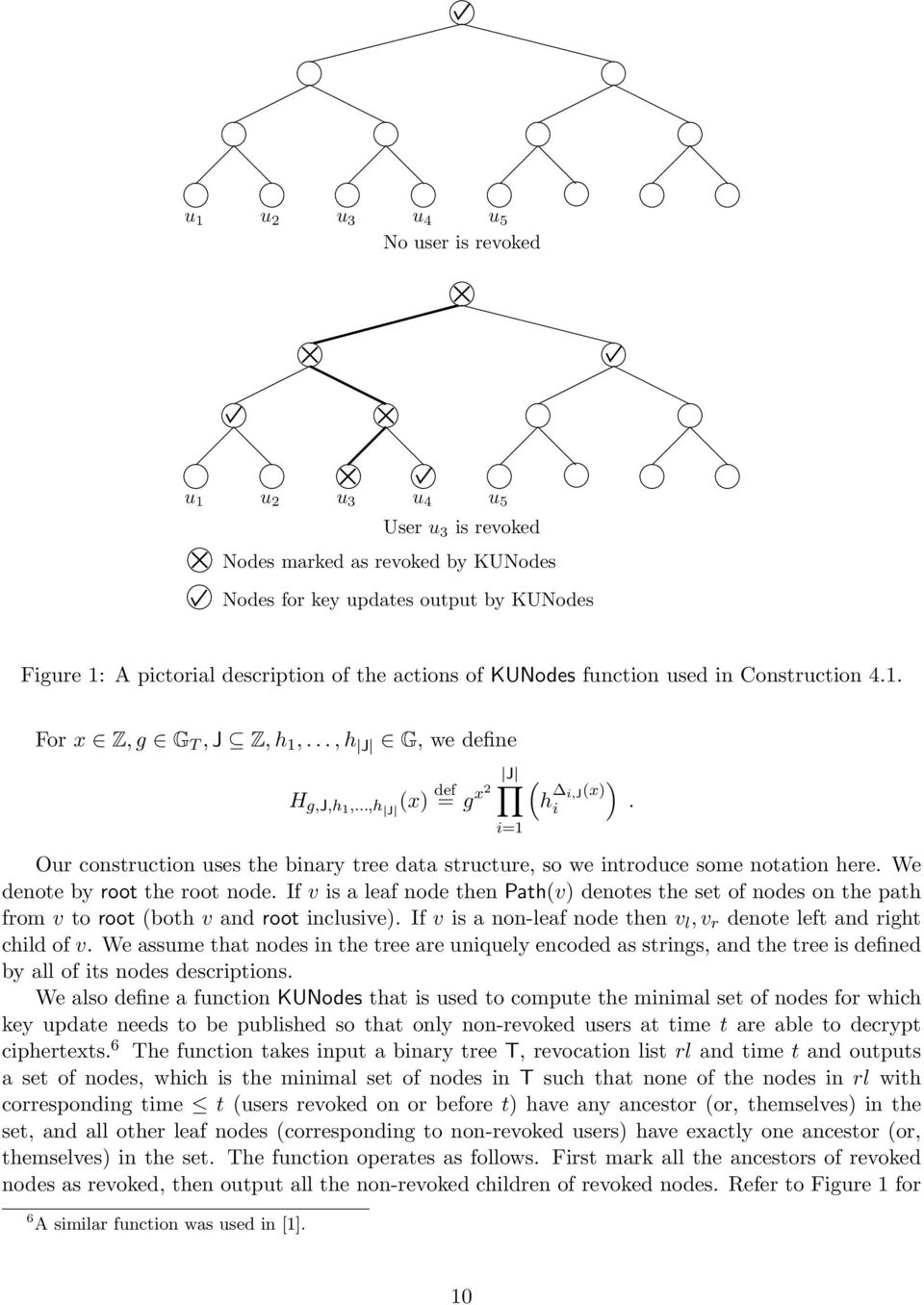
10 u 1 u 2 u 3 u 4 u 5 No user is revoked u 1 u 2 u 3 u 4 u 5 User u 3 is revoked Nodes marked as revoked by KUNodes Nodes for key updates output by KUNodes Figure 1: A pictorial description of the actions of KUNodes function used in Construction 4.1. For x Z, g G T, J Z, h 1,..., h J G, we define J H g,j,h1,...,h J x) def = g x2 i=1 h i,jx) i Our construction uses the binary tree data structure, so we introduce some notation here. We denote by root the root node. If v is a leaf node then Pathv) denotes the set of nodes on the path from v to root both v and root inclusive). If v is a non-leaf node then v l, v r denote left and right child of v. We assume that nodes in the tree are uniquely encoded as strings, and the tree is defined by all of its nodes descriptions. We also define a function KUNodes that is used to compute the minimal set of nodes for which key update needs to be published so that only non-revoked users at time t are able to decrypt ciphertexts. 6 The function takes input a binary tree T, revocation list rl and time t and outputs a set of nodes, which is the minimal set of nodes in T such that none of the nodes in rl with corresponding time t users revoked on or before t) have any ancestor or, themselves) in the set, and all other leaf nodes corresponding to non-revoked users) have exactly one ancestor or, themselves) in the set. The function operates as follows. First mark all the ancestors of revoked nodes as revoked, then output all the non-revoked children of revoked nodes. Refer to Figure 1 for 6 A similar function was used in [1]. ). 10
11 a pictorial depiction. Here is a formal specification. KUNodesT, rl, t) X, Y φ v i, t i ) rl if t i t then add Pathv i ) to X x X if x l / X then add x l to Y if x r / X then add x r to Y If Y = φ then add root to Y Return Y We are now ready to present the description of Revocable IBE. We could not use the algorithms of the Fuzzy IBE construction from [23] in a black-box manner. The reason is that there the polynomial for each key is picked independently by the key generation algorithm. And in our construction some polynomials need to be shared by different keys. After we provide the details for each algorithm, we give some intuition and relation to the construction from [23] following // sign. Construction 4.1 Let G be a prime order bilinear group generator. Let J be {1, 2, 3}. Setup S1 κ, n): G, p, g) $ G1 κ ) ; a $ Z p ; g 1 g a ; g 2, h 1, h 2, h 3 $ G. Let rl be an empty set and T be a binary tree with at least n leaf nodes. Return pk = g, g 1, g 2, h 1, h 2, h 3 ), mk = a ; rl, st = T. // Besides the additional outputs of rl and st, it is essentially the same as Setup of Fuzzy IBE where 2 out of 2 attributes need to be matched. Private Key Generation SKpk, mk, ω, st): Parse pk as g, g 1, g 2, h 1, h 2, h 3 ), mk as a, st as T. 7 and store ω in that node. Pick an unassigned leaf node v from T x Pathv) $ if a x is undefined, then a x Zp, store a x in node x, $ r x Zp ; D x g2 axω+a H g2,j,h 1,h 2,h 3 ω) rx ; d x g rx. Return sk ω = {x, D x, d x )} x Pathv), st. // We note that a x above fixes first-degree polynomial q x y) = a x y + a corresponding to node x. The algorithm computes the ω-components of the decryption key using the polynomials of all the nodes on the path from leaf node corresponding to ω to the root node. 7 Every node x in T stores an element a x Z p and in addition, every leaf node stores an identity ω. If no such identity is stored at a leaf node we say that the leaf node is unassigned. 11
![the description of Revocable IBE. We could not use the algorithms of the Fuzzy IBE construction from [23] in a black-box manner.](/docs-images/45/4042998/images/page_11.jpg "The reason is that there the polynomial for each key is picked independently by the key generation algorithm. And in our construction some polynomials need to be shared by different keys.")
12 Key Update Generation KUpk, mk, t, rl, st): Parse pk as g, g 1, g 2, h 1, h 2, h 3 ), mk as a, st as T. x KUNodesT, rl, t) $ r x Zp ; E x g2 axt+a H g2,j,h 1,h 2,h 3 t) rx ; e x g rx. Return ku t = {x, E x, e x )} x KUNodesT,rl,t). // The algorithm first finds a minimal set of nodes which contains an ancestor or, the node itself) of all the non-revoked nodes. Then it computes the t- component of the decryption key using the polynomials of all the nodes in that set. Decryption Key Generation DKsk ω, ku t ): Parse sk ω as {i, D i, d i )} i I, ku t as {j, E j, e j )} j J for some set of nodes I, J. i, D i, d i ) sk ω, j, E j, e j ) ku t If i, j) s.t. i = j then dk ω,t D i, E j, d i, e j ) Else if sk ω and ku t don t have any node in common) then dk ω,t. Return dk ω,t. // Above we can drop the subscripts i, j since they are equal, i.e. dk ω,t = D, E, d, e). The algorithm finds components of sk ω and ku t which were computed on the same polynomial. Encryption Epk, ω, t, m): Parse pk as g, g 1, g 2, h 1, h 2, h 3 ). z $ Z p ; c 1 m eg 1, g 2 ) z ; c 2 g z ; c ω H g2,j,h 1,h 2,h 3 ω) z ; c t H g2,j,h 1,h 2,h 3 t) z. Return c = ω, t, c ω, c t, c 1, c 2 ). // The Encryption algorithm is essentially the same as that of Fuzzy IBE. Decryption Ddk ω,t, c): Parse dk ω,t as D, E, d, e), c as ω, t, c ω, c t, c 1, c 2 ). ) t ) ω m c ed,cω) t ω ee,c t) ω t 1 ed,c 2 ) ee,c 2 ). Return m. // The decryption algorithm is essentially the same as that of Fuzzy IBE. Revocation Rω, t, rl, st): For all nodes v associated with identity ω add v, t) to rl. Return rl. 12
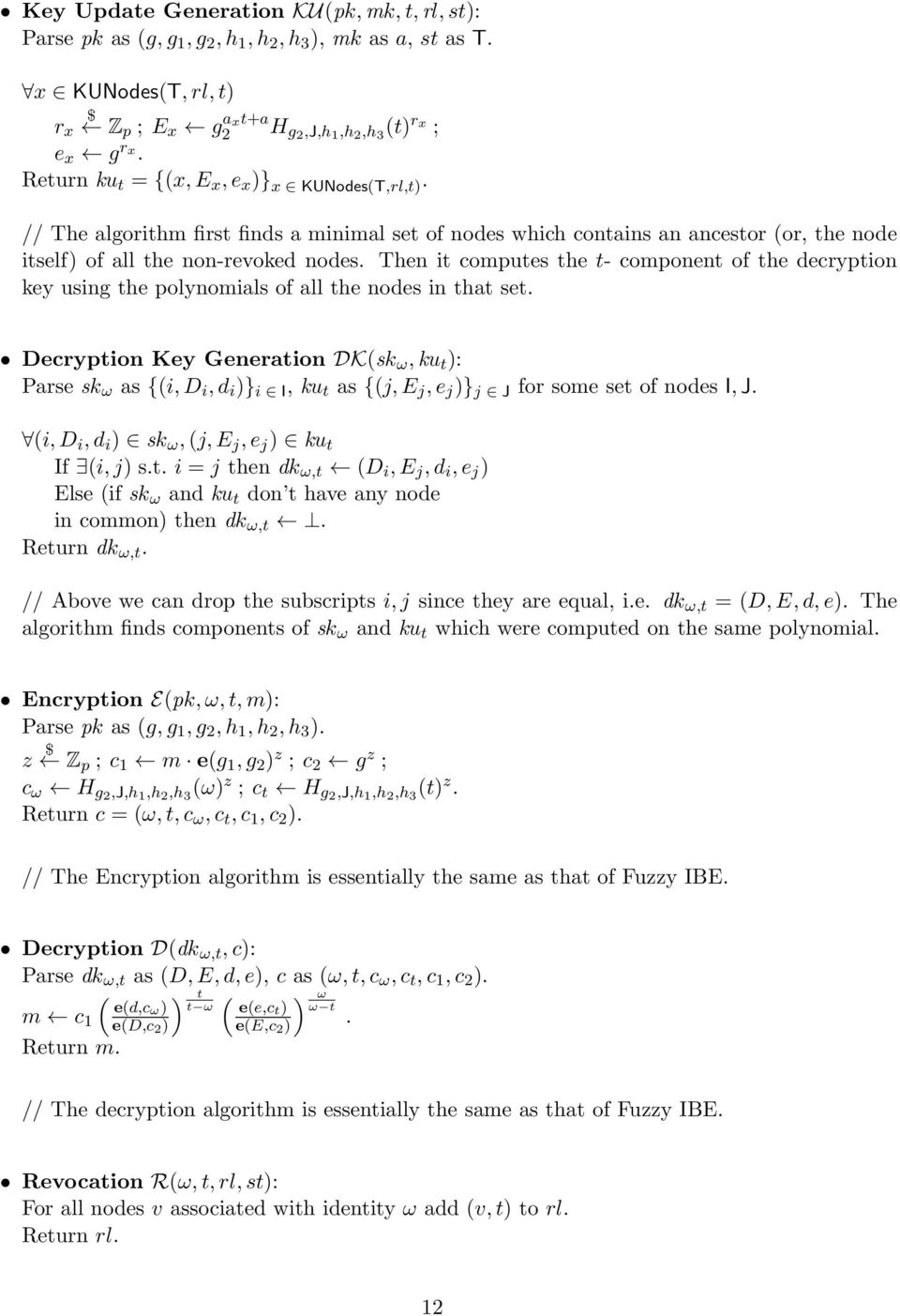
13 Consistency. If identity ω was not revoked before or, at time t, then we will show that Ddk ω,t, c) = m where dk ω,t, m and c are computed as per the consistency requirement in Section 3.1. From the definition of KUNodes we see that if ω was not revoked before or, at t then the set of nodes output by KUNodes has one ancestor or, the node itself) of the leaf node associated with ω which implies that there will be a common node in sk ω and ku t and hence DK will not output. Now from the above construction we have that for a, a x, z, r ω, r t Z p : g, g 2, h 1, h 2, h 3 G, g 1 = g a dk ω,t = D, E, d, e), where D = g2 axω+a H g2,j,h 1,h 2,h 3 ω) rω, E = g2 axt+a H g2,j,h 1,h 2,h 3 t) rt, d = g rω, e = g rt, c = ω, t, c ω, c t, c 1, c 2 ), where c ω = H g2,j,h 1,h 2,h 3 ω) z, c t = H g2,j,h 1,h 2,h 3 t) z, c 1 = m eg 1, g 2 ) z, c 2 = g z. So, Ddk ω,t, c) ) t ed, cω ) ) ω t ω ee, c t ) ω t = c 1 ed, c 2 ) ee, c 2 ) = m eg 1, g 2 ) z eg rω, H g2,j,h 1,h 2,h 3 ω) z ) t ) t ω eg2 axω+a H g2,j,h 1,h 2,h 3 ω) rω, g z ) eg r t, H g2,j,h 1,h 2,h 3 t) z ) ω ) ω t eg2 axt+a H g2,j,h 1,h 2,h 3 t) rt, g z ) ) t = m eg 1, g 2 ) z 1 t ω eg2 axω+a, g z ) ) ω 1 ω t eg2 axt+a, g z ) = m eg 1, g 2 ) z 1 eg axω+a) t t ω )+axt+a) ω ω t ) 2, g z ) = m eg 1, g 2 ) z 1 eg2 a, gz ) = m eg 1, g 2 ) z 1 eg 2, g 1 ) z = m. Remarks. The function KUNodes needs to be executed only when rl has changed, so key authority can store the output of KUNodes and use it until rl changes. If the number of users exceeds n, the capacity of the current tree, it is possible to extend the tree and permit n more users as follows. Take an empty tree of the same size and connect the roots of the current and new trees to the new parent root node. Now the combined tree has 2n leaf nodes, and new users can be accommodated. Each user will need an additional private key component computed on the polynomial of the new root node. This new private key component can be encrypted under the corresponding identity and time) and published. Efficiency. We first analyze communication and time complexity of key authority in computing and publishing key updates as a function of the number of users n and number of revoked users r. 13

14 r = 0 1 < r n/2 n/2 < r n BF [6] On) On r) On r) Revocable IBE O1) Or log n r )) On r) Table 1: Key update complexity comparison. Above n is the total number of users and r is the number of revoked users. We compare the worst case complexity of our scheme with that of the general revocation solution suggested by Boneh-Franklin [6] that we outlined in the Introduction. Table 1 summarizes the results. The complexity analysis for our construction follows directly from Theorem 1 of [1], as the number of necessary key updates in our scheme corresponds to the number of nodes returned by function KUNodes, and a similar function on the binary tree was used in [1]. As the table shows, our scheme represents a significant improvement over the Boneh-Franklin solution for small values of r. For larger values of r especially as it reaches close to n), this advantage is lost. We however note that as r becomes large, our scheme can be reset to keep key update efficient by running the setup algorithm again which will make the revocation list empty and releasing new private keys for only non-revoked users). In terms of encryption and decryption, our construction is slightly less efficient than the existing IBE schemes. E.g. the decryption algorithms of IBEs by Waters [25] and Boneh-Boyen [3] require 2 pairing computations the slowest computation compared to group operations and exponentiations), and our scheme requires 4. Encryption in the schemes of [25, 3] is dominated by 3 and 4 exponentiations, while our scheme uses 12. We chose Waters and Boneh-Boyen constructions for comparison because they are the most efficient IBE schemes secure in standard RO devoid) model under standard assumptions. This may be a reasonable price to pay for the significant improvement in key-update efficiency, which may become a bottleneck for a large number of users. We note that the size of secret keys is larger in our scheme, a user needs to store up to 3h = 3 log n group elements. We note that using the suggestion from [22], efficiency of our scheme, and in particular, its encryption algorithm, can be improved, if a hash function is used in place of the function H. Security analysis in this case will need to rely on the random oracle RO) model [2]. This will improve the number of exponentiations in encryption to 4 while the decryption algorithm will still be dominated by 4 paring operations. In contrast, the cost of encryption and decryption in the Boneh-Franklin scheme [6] is dominated by one pairing each. Security. Even though different users have their private keys computed on the same polynomial this does not introduce insecurity in RIBE as opposed to Fuzzy IBE. In our scheme collusion among different users is possible, however such collusion is not useful. No matter how many revoked users try to collude, they will still be unable to decrypt a ciphertext for a new time period, as they cannot obtain the necessary decryption key component. One might be tempted to reduce the security of RIBE to the security of Fuzzy IBE since, after all RIBE uses Fuzzy IBE as its base construction. However, we want to point out that such a straightforward reduction of security in a black box manner does not seem possible. The main reason for this is that in Fuzzy IBE each time key generation algorithm is run it chooses a random polynomial and then computes the key using that polynomial however, in RIBE it is essential that private key and key update be computed on some fixed polynomials. Security of RIBE is based on the hardness of decisional bilinear Diffie-Hellman DBDH) prob- 14
![We compare the worst case complexity of our scheme with that of the general revocation solution suggested by Boneh-Franklin [6] that we outlined in the Introduction. Table 1 summarizes the results.](/docs-images/45/4042998/images/page_14.jpg "The complexity analysis for our construction follows directly from Theorem 1 of [1], as the number of necessary key updates in our scheme corresponds to the number of nodes returned by function")
15 lem, which we now recall. Definition 4.2 [Decisional bilinear Diffie-Hellman ] Let G be a prime order bilinear group generator. The decisional bilinear Diffie-Hellman DBDH) problem is said to be hard for G if for every efficient adversary A its advantage Adv dbdh G,A k) defined as [ ] [ ] Pr Exp dbdh-real G,A 1 κ ) = 1 Pr Exp dbdh-rand G,A 1 κ ) = 1 is a negligible function in κ, and where the experiments are as follows: We now state the security result. Experiment Exp dbdh-real G,A 1 κ ) G, p, g) $ G1 κ ) ; x, y, z $ Z p X g x ; Y g y ; Z g z ; W eg, g) xyz d $ A1 κ, G, p, g, X, Y, Z, W ) Return d Experiment Exp dbdh-rand G,A 1 κ ) G, p, g) $ G1 κ ) ; x, y, z, w $ Z p X g x ; Y g y ; Z g z ; W eg, g) w d $ A1 κ, G, p, g, X, Y, Z, W ) Return d Theorem 4.3 Let G be a prime order bilinear group generator and RIBE[G] = S, SK, KU, DK, E, D, R) be the associated Revocable IBE scheme defined by Construction 4.1. Then for any adversary A attacking srid-cpa security of RIBE with n users, whose running time is t A and who asks q p private key generation queries, q k key update generation queries and q r revocation queries, there exists an adversary B solving DBDH problem for G such that where the running time of B, t B = t A + Oκ 3 ). Adv srid cpa RIBE,A,n κ) 4 Advdbdh G,B κ), 1) Proof: We construct an adversary B for the DBDH problem associated with G. B gets 1 κ, G, p, g, X, Y, Z, W ) as input and it has to return a bit d. It is going to use A. 15

16 B1 κ, G, p, g, X, Y, Z, W ) : ω, t, state) $ A1 κ ) g 1 X, g 2 Y Pick random second-degree polynomials fx), ux) with coefficients in Z p, s.t. ux) = x 2 for x = ω, t, o.w. ux) x 2 For i = 1, 2, 3 : h i g ui) 2 g fi) pk g, g 1, g 2, h 1, h 2, h 3 ) Let rl be an empty set and T be a binary tree with at least n leaf nodes. Pick a leaf node v from T and a random bit rev Run A and answer its queries to the SK ), KU ), R, ) oracles using the subroutines defined. m 0, m 1, state ) $ A SK ),KU ),R, ) 1 κ, pk, state) b $ {0, 1} c 1 m b W, c 2 Z, c ω Z fω ), c t Z ft ) c ω, t, c ω, c t, c 1, c 2 ) d $ A SK ),KU ),R, ) 1 κ, pk, c, state ) If any of the oracles abort return 1 Else if b = d return 1 else return 0 Now, we present the subroutines for answering the oracle queries. functions that we define here. For i, j, l, r Z p, S = {0, j} define F 1 i, j, l, r ) def = g l j,si) 2 F 2 i, r ) def = g fi) i 2 +ui) 1 1 ) 0,Si) i g 2 +ui) 1 g r. g i2 +ui) 2 g fi)) r ) 0,Si), These subroutines use the SKω) : If rev = 0 and ω = ω then abort If rev = 1 and ω = ω then: v v, $ Zp x Pathv) r x $ if l x then l x Zp and store l x in node x D x g2 lx H g 2,h 1,h 2,h 3 ω ) rx, d x g rx If rev = 0 and ω ω then: Pick an unassigned leaf node v from T and store ω in node v $ x Pathv) r x Z p, $ if l x then l x Zp and store l x in node x i ω, j t, l l x, r r x D x F 1 i, j, l, r ), d x F 2 i, r ) If rev = 1 and ω ω then: Pick an unassigned leaf node v from T and store ω in node v x Pathv) r x $ Z p, 16
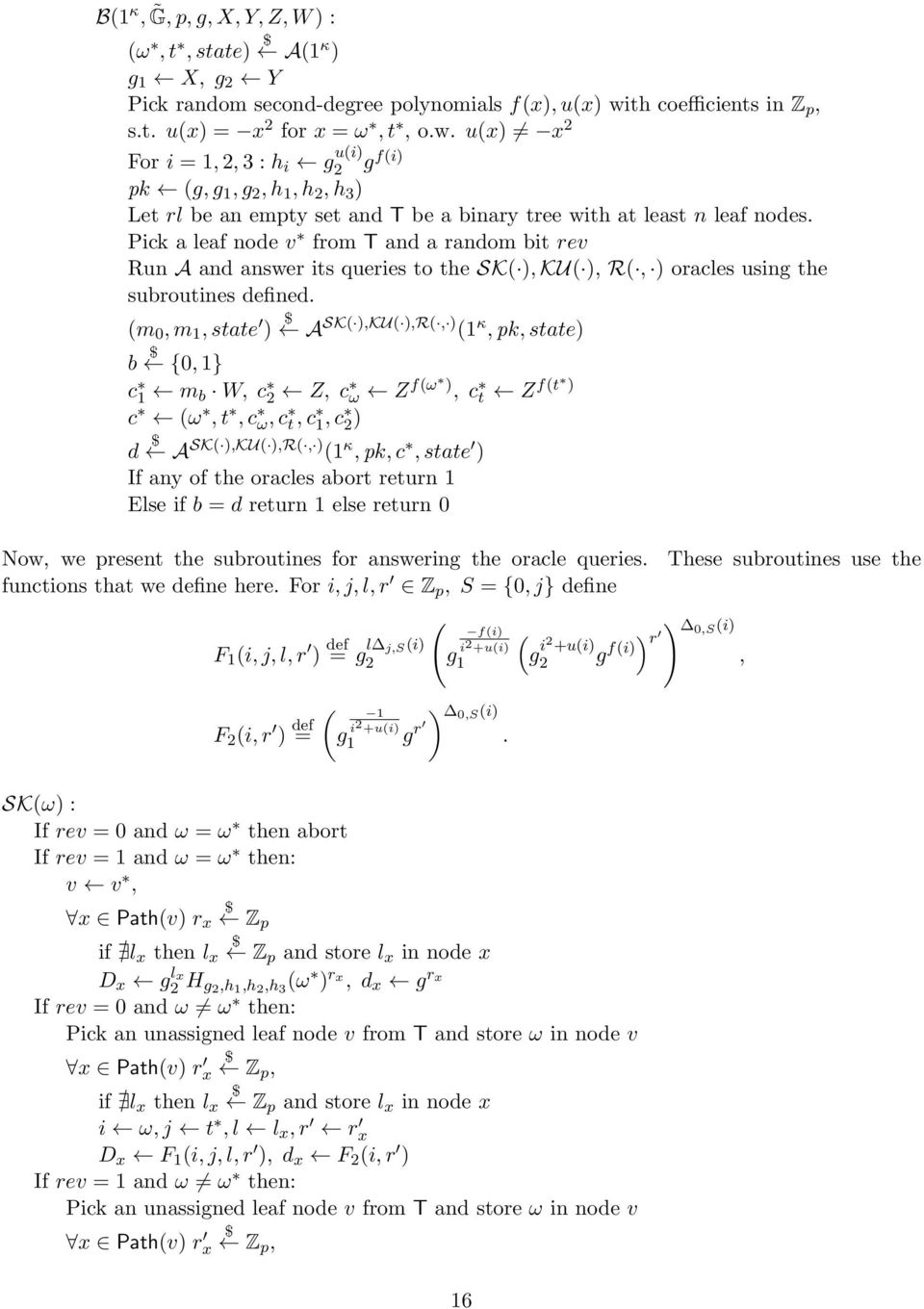
17 $ if l x then l x Zp and store l x in node x i ω, l l x, r r x x Pathv) \ Pathv )) j t D x F 1 i, j, l, r ), d x F 2 i, r ) x Pathv) Pathv )) j ω D x F 1 i, j, l, r ), d x F 2 i, r ) Return sk ω = {x, D x, d x )} x Pathv) Rω, t) : For all leaf nodes v associated with identity ω, add v, t) to rl KUt) : If rev = 1 and t = t and t t we have that ω, t) / rl, then abort Else if t = t then: $ Zp x KUNodesT, rl, t), r x E x g2 lx H g 2,h 1,h 2,h 3 t ) rx, e x g rx If rev = 1 and t t then: x KUNodesT, rl, t) \ Pathv )) r x $ Z p, i t, j t, l l x, r r x E x F 1 i, j, l, r ), e x F 2 i, r ) x KUNodesT, rl, t) Pathv )) r x $ Z p, i t, j ω, l l x, r r x E x F 1 i, j, l, r ), e x F 2 i, r ) If rev = 0 and t t then: x KUNodesT, rl, t) r x $ Z p, i t, j t, l l x, r r x E x F 1 i, j, l, r ), e x F 2 i, r ) Return ku t = {x, E x, e x )} x KUNodesT,rl,t) Analysis. fx) being a random polynomial ensures that h 1, h 2, h 3 are random so, pk has the right distribution. For i = 1, 2, 3 h i = g ui) 2 g fi) which implies H g2,h 1,h 2,h 3 x) = g x2 +ux) 2 g fx). Since x = ω, t ux) = x 2, then H g2,h 1,h 2,h 3 ω ) = g fω ), H g2,h 1,h 2,h 3 t ) = g ft ). If W = eg, g) xyz, then c 1 = m b W = m b eg 1, g 2 ) z, c ω = Z fω ) = g zfω ) = H g2,h 1,h 2,h 3 ω ) z, c t = Z ft ) = g zft ) = H g2,h 1,h 2,h 3 t ) z. So, if B is in Exp dbdh-real G,B κ) then c is a well-formed ciphertext of m b. Otherwise, if W = eg, g) w for a random w, then c 1 = m b W = m b eg, g) w, so w being random and independent from x, y, z ensures that c 1 is also random and thus c hides bit b informationtheoretically. In what follows let g 1 = g a to simplify notation). Case 1. rev = 1, ω = ω in SKω) oracle simulation: Define a x = 1 ω l x a). Then D x = g axω +a 2 H g2,h 1,h 2,h 3 ω ) rx, d x = g rx. So, sk ω has the right 17

18 distribution. Case 2. rev = 0, ω ω in SKω) oracle simulation: Define a x = 1 t l x a), r x = r x a ω 2 +uω) ) 0,Sω). Then F 2 i, r ) = = = 1 ) 0,Si) i g 2 +ui) 1 g r ) g r a 0,S i) i 2 +ui) g r a ) 0,S ω) x ω 2 +uω) = g r x and F 1 i, j, l, r ) = g l j,si) 2 g fi) i 2 +ui) 1 ) g i2 +ui) 2 g fi)) r ) 0,Si) ) = g l j,si) 2 g afi) i 2 +ui) g i2 +ui) 2 g fi)) r ) 0,Si) = g l j,si) 2 g2 a g i2 +ui) = g l j,si) 2 So, sk ω has the right distribution. 2 g fi)) a i 2 +ui) g2 a g i2 +ui) 2 g fi)) r a i 2 +ui) = g l j,si)+a 0,S i) 2 g i2 +ui) g i2 +ui) 2 g fi)) r ) 0,Si) ) 0,S i) 2 g fi)) r a i 2 +ui) = g l j,si)+a 0,S i) 2 H g2,h 1,h 2,h 3 i) = g lx j,sω)+a 0,S ω) 2 H g2,h 1,h 2,h 3 ω) = g2 axω+a H g2,h 1,h 2,h 3 ω) rx. r a i 2 +ui) r x a ω 2 +uω) ) 0,S i) ) 0,S i) ) 0,S ω) Case 3. rev = 1 and ω ω. Similar arguments as above apply if we define a x = 1 ω l x a), r x = r x a ω 2 +uω) ) 0,Sω) for nodes on the path of v and a x = 1 t l x a), r x = r x a ω 2 +uω) ) 0,Sω) for rest of the nodes. Similar arguments as above apply for all cases in KUt) oracle simulation if we define: In case rev = 0 a x = 1 t l x a), r x = r x a t 2 +ut) ) 0,St) for all nodes. And, in case rev = 1 a x = 1 ω l x a), r x = r x a t 2 +ut) ) 0,St) for nodes on the path of v and a x = 1 t l x a), r x = r x a t 2 +ut) ) 0,St) for rest of the nodes. 18

19 Note that we are defining a x consistently in both oracle simulations, i.e. in case rev = 0, a x = 1 t l x a) for all nodes, and in case rev = 1, a x = 1 ω l x a) for all nodes on the path from v to the root node, a x = 1 t l x a) for rest of the nodes. Also note that values l x which are stored in node x, and identities ω which are stored in leaf nodes of tree T have the right distribution and also that they are modified only by SKω) oracle. KUt) and Rω, t) oracles do not modify them. Similarly, revocation list rl is modified only by Rω, t) oracle. SKω) and KUt) oracles do not modify them. Thus, oracles maintain the state and revocation list consistently and with right distribution. Claim 4.4 Let sreal, srand denote the events that none of the oracles abort in Exp dbdh-real G,B 1 κ ), Exp dbdh-rand G,B 1 κ ) respectively. Then, Pr [ sreal ] = Pr [ srand ] 1 2. Proof: We will prove the claim in two parts. First we will show that Pr [ sreal ] = Pr [ srand ] and then we will show that Pr [ sreal ] 1 2. First part is easy to see. The probability that SKω) and KUt) oracles abort depends on the bit rev which is chosen independently from whether B is in Exp dbdh-real G,B 1 κ ) or Exp dbdh-rand G,B 1 κ ). So, Pr [ sreal ] = Pr [ srand ]. Now it remains to show that Pr [ sreal ] 1 2. Condition 3 of Definition 3.2 says that SKω) oracle can be queried on ω only if Rω, t) oracle was queried on ω, t) for any t t. Thus, we have Pr [ ω = ω ] Pr [ ω, t) rl, t t ] 1 Pr [ ω = ω ] Pr [ ω, t) / rl, t t ] 1 Pr [ ω = ω ] Pr [ t = t ) ω, t) / rl, t t ) ]. We see that SKω) oracle aborts if rev = 0 and ω = ω and KUt) oracle aborts if rev = 1, t = t and t t ω, t) / rl. Thus, Pr [ sreal ] = Pr [ rev = 0) ω = ω ) ] + Pr [ rev = 1) t = t ) ω, t) / rl, t t ) ] = Pr [ rev = 0 ] Pr [ ω = ω ] + Pr [ rev = 1 ] Pr [ t = t ) ω, t) / rl, t t ) ] 1 2 Pr [ ω = ω ] Pr [ ω = ω ]) 1 2. Therefore, Pr [ sreal ]

20 We have shown above that when B is in Exp dbdh-real G,B 1 κ ) and none of the oracles abort, then B is simulating the exact experiment Exp srid cpa RIBE,A,n 1κ ) for A. So, ] [ Pr Exp dbdh-real G,B κ) = 1 sreal Pr [ Exp srid cpa RIBE,A,n 1κ ) = 1 When B is in Exp dbdh-rand G,B 1 κ ) and none of the oracles abort then as explained earlier bit b is information-theoretically hidden from A. So, [ Pr ] Exp dbdh-rand G,B κ) = 1 srand 1 2. Also, since B outputs 1 when either of the oracles aborts, so Thus, [ Pr [ Pr ] Exp dbdh-real G,B 1 κ ) = 1 sreal Exp dbdh-rand G,B 1 κ ) = 1 srand = 1, ] = 1 [ ] [ ] Adv dbdh G,B κ) = Pr Exp dbdh-real G,B 1 κ ) = 1 Pr Exp dbdh-rand G,B 1 κ ) = 1 [ ] = Pr [ sreal ] Pr Exp dbdh-real G,B 1 κ ) = 1 sreal + Pr [ sreal ] [ ] Pr Exp dbdh-real G,B 1 κ ) = 1 sreal [ ] Pr [ srand ] Pr Exp dbdh-rand G,B 1 κ ) = 1 srand Pr [ srand ] [ ] Pr Exp dbdh-rand G,B 1 κ ) = 1 srand 1 [ ] 2 Pr Exp dbdh-real G,B 1 κ ) = 1 sreal [ ] ) Pr Exp dbdh-rand G,B 1 κ ) = 1 srand 1 [ ] 2 Pr Exp srid cpa RIBE,A,n 1κ ) = 1 1 ) 2 ]. 1 4 Advsrid cpa RIBE,A,n κ). Finally we observe that t B = t A + Oκ 3 ) as B does only a constant number of modulo exponentiations and multiplications and picks a constant number of random group elements recall that by convention t A includes the time of the experiment including computations done by the oracles. 5 Addressing CCA Security We suggest two ways to construct RIBE schemes that resist chosen-ciphertext attacks. Our first solution is a modification of our main construction. Our second solution is generic in that it is based on any srid-cpa secure scheme, though CCA security relies on the RO model. RIBE CCA Construction. We combine the ideas of [4] used there for a different problem of constructing an IND-CCA public-key encryption scheme) with the error-tolerance property of Fuzzy 20
![information-theoretically hidden from A. So, [ Pr ] Exp dbdh-rand G,B κ) = 1 srand 1 2.](/docs-images/45/4042998/images/page_20.jpg "Also, since B outputs 1 when either of the oracles aborts, so Thus, [ Pr [ Pr ] Exp dbdh-real G,B 1 κ ) = 1 sreal Exp dbdh-rand G,B 1 κ ) = 1 srand = 1, ] = 1 [ ] [ ] Adv dbdh G,B κ) = Pr Exp")
21 IBE to modify our Revocable IBE scheme. Changes are mainly in the encryption and decryption algorithms. We employ a strongly-unforgeable one-time signature scheme cf. [4] that recalls the primitive and its security definition). The setup algorithm of the new scheme is very similar to the one in Fuzzy IBE where 2 out of 3 attributes of ciphertexts should match with those of the decryption key. The private key generation and key update generation algorithms are very similar to those of RIBE except that we now use second-degree polynomials as opposed to first-degree polynomials in RIBE. The encryption algorithm runs the key generation algorithm of one-time signature to obtain a signing key and verification key and then encrypts the message with three attributes: identity, time and verification key. Then it signs the resulting intermediate ciphertext using the signing key. The decryption algorithm verifies the signature, and that ciphertext is properly formed by using a ciphertext sanity check due to [13]) before decrypting. Let G be a bilinear group generator and OT S = SGen, Sign, Ver) be a strongly-unforgeable onetime signature scheme. Let RIBE[G] = S, SK, KU, DK, E, D, R) be the scheme of Construction 4.1. We define RIBE CCA [G, OT S] = S, SK, KU, DK, E, D, R) by specifying the differences from RIBE. Here we require that identities, time periods and the verification keys for the one-time signature output by SGen are mapped to distinguished elements in Z p e.g., by pre-pending 00, 01 and 11 to strings of these types and then using a collision-resistant hash function that maps {0, 1} to Z p. Let J be {1, 2, 3, 4}. Setup S κ, n): Everything is the same as in S except that pk has an additional element h 4 pk = g, g 1, g 2, h 1, h 2, h 3, h 4 ). $ G and Private Key Generation SK pk, mk, ω, st): Everything is the same as in SK except that now we pick a random second-degree polynomial q x y) with coefficients in Z p and the same restriction that q x 0) = a. Parse pk as g, g 1, g 2, h 1, h 2, h 3, h 4 ), mk as a, st as T. Pick an unassigned leaf node v from T and store ω in that node. x Pathv) if q x is undefined, then pick a random second-degree polynomial q x, s.t. q x 0) = a and store q x in node x $ r x Zp ; D x g qxω) 2 H g2,j,h 1,h 2,h 3,h 4 ω) rx ; d x g rx Return sk ω = {x, D x, d x )} x Pathv), st. Key Update Generation KU pk, mk, t, rl, st): Parse pk as g, g 1, g 2, h 1, h 2, h 3, h 4 ), mk as a, st as T. x KUNodesT, rl, t) $ r x Zp ; E x g qxt) 2 H g2,j,h 1,h 2,h 3,h 4 t) rx ; e x g rx Return ku t = {x, E x, e x )} x KUNodesT,rl,t). Encryption E pk, ω, t, m): Parse pk as g, g 1, g 2, h 1, h 2, h 3, h 4 ) sigk, vk) $ SGen1 κ ). z $ Z p ; c 1 m eg 1, g 2 ) z ; c 2 g z ; c ω H g2,j,h 1,h 2,h 3,h 4 ω) z 21
22 c t H g2,j,h 1,h 2,h 3,h 4 t) z ; c vk H g2,h 1,h 2,h 3,h 4 vk) z c ω, t, c ω, c t, c vk, c 1, c 2 ) σ Signsigk, c) Return c = c, σ, vk). Decryption D dk ω,t, c): Parse dk ω,t as D, E, d, e), c as c = ω, t, c ω, c t, c vk, c 1, c 2 ), σ, vk) If Vervk, c, σ) 1 then return. $ Zp Else pick r 1, r 2, r 3 If ec 2, H g2,j,h 1,h 2,h 3,h 4 ω) r1 H g2,j,h 1,h 2,h 3,h 4 t) r 2 H g2,j,h 1,h 2,h 3,h 4 vk) r 3 ) eg, c r 1 ω c r 2 ) then return t cr 3 vk Else m c ed,cω) 1 ed,c 2 ) Return m. ) t t ω ee,c t) ee,c 2 ) ) ω ω t One can verify that consistency follows directly from consistency of OT S and RIBE. RIBE CCA Security. We claim the following. Theorem 5.1 Let G be a prime order bilinear group generator, OT S = SGen, Sign, Ver) be a onetime signature scheme and RIBE CCA [G, OT S] = S, SK, KU, DK, E, D, R) be the associated Revocable IBE scheme as per construction above. Then for any adversary A attacking srid-cca security of RIBE with n users, whose running time is t A and who asks q p private key generation queries, q k key update generation queries, q r revocation queries and q d decryption queries, there exist an adversary B solving DBDH problem for G and an adversary F attacking strong unforgeability of OT S such that Adv srid cca RIBE,A,n κ) 4 Advdbdh G,B κ) + Adv suf ots OT S,F κ), 2) where the last term refers to the advantage of F breaking strong unforgeability of OT S cf. [4] for the definition) and t B t F t A + q d 2tp log n ) + Ok3 ). We provide some intuition before giving the actual proof. It is not hard to show that RIBE CCA is srid-cpa secure, the security proof is very similar to the proof of Theorem 4.3. Even though a ciphertext is encrypted under an additional attribute: the verification key, the key authority never issues the corresponding decryption key component. To show that RIBE CCA is also srid- CCA secure, the simulator the DBDH adversary) needs to simulate the decryption oracle. Using the arguments very similar to those used in [13] we can show that the randomized check in the decryption algorithm that the simulator can perform as well, does guarantee with overwhelming probability that a ciphertext was formed correctly according to the encryption algorithm). If the adversary queries a ciphertext whose verification key component is the same as that of the challenge ciphertext, then the decryption query cannot be answered correctly, but in this case one can construct an adversary breaking security of the one-time signature scheme. If the verification keys are different and the ciphertext passes the randomized check, then the simulator can generate the decryption key corresponding to identity and verification key of the queried ciphertext, and such a decryption key will successfully decrypt the ciphertext because we know from the randomized check that the queried ciphertext is a well-formed ciphertext. Generating such a decryption key is possible because the verification key is different from the challenge verification key, and following the proof of security of Fuzzy IBE, it is possible for the simulator to generate valid keys for a set of 22
23 attributes if they overlap with the challenge set of attributes in fewer than the threshold number of attributes. Proof: We construct an adversary B for the DBDH problem associated with G. B gets 1 κ, G, p, g, X, Y, Z, W ) as input and it has to return a bit d. It is going to use A. B1 κ, G, p, g, X, Y, Z, W ) : ω, t, state) $ A1 κ ) g 1 X, g 2 Y sigk, vk $ SGen1 κ ), uk 01 vk, l uk $ Z p Pick random third-degree polynomials fx), ux) with coefficients in Z p, s.t. ux) = x 3 for x = ω, t, uk, o.w. ux) x 3 For i = 1, 2, 3, 4 : h i g ui) 2 g fi) pk = g, g 1, g 2, h 1, h 2, h 3, h 4 ) Let rl be an empty set and T be a binary tree with at least n leaf nodes Pick a leaf node v from T and a random bit rev. Run A and answer its queries to the SK ), KU ), R, ), D ) oracles using subroutines defined below m 0, m 1, state ) $ A SK ),KU ),R, ),D ) 1 κ, pk, state) b $ {0, 1} c ω Z fω ), c t Z ft ), c uk Zfuk ), c 1 m b W, c 2 Z c ω, t, c ω, c t, c uk, c 1, c 2 ) σ Signsigk, c ). c c, σ, vk ). d $ A SK ),KU ),R, ),D ) 1 κ, pk, c, state ) If any of the oracles abort return 1 Else if b = d return 1 else return 0 Now, we present the subroutines for answering the oracle queries. Subroutines for SK ), KU ), R, ) oracles are very similar to those in the Proof of Theorem 4.3, but we give them here too for the sake of completeness. The oracles use the functions that we define here. For i, j, l, r Z p, uk uk, l uk l uk, S = {0, j, uk} define F 1 i, j, l, r ) def = g l j,si)+l uk uk,s i) 2 g fi) i 3 +ui) 1 g i3 +ui) 2 g fi)) r ) 0,Si) F 2 i, r ) def = 1 ) 0,Si) i g 3 +ui) 1 g r. SK ω) : If rev = 0 and ω = ω then abort If rev = 1 and ω = ω then v v, x Pathv) r x $ Zp 23
24 $ if l x then l x Zp and store l x in node x D x g2 lx H g 2,h 1,h 2,h 3,h 4 ω ) rx, d x g rx If rev = 0 and ω ω then Pick an unassigned leaf node v from T and store ω in node v $ x Pathv) r x Z p $ if l x then l x Zp and store l x in node x i ω, j t, l l x, r r x D x F 1 i, j, l, r ), d x F 2 i, r ) If rev = 1 and ω ω then: Pick an unassigned leaf node v from T and store ω in node v $ x Pathv) r x Z p $ if l x then l x Zp and store l x in node x i ω, l l x, r r x x Pathv) \ Pathv )) j t D x F 1 i, j, l, r ), d x F 2 i, r ) x Pathv) Pathv )) j ω D x F 1 i, j, l, r ), d x F 2 i, r ) Return sk ω = {x, D x, d x )} x Pathv) Rω, t) : For all leaf nodes v associated with identity ω, add v, t) to rl KU t) : If rev = 1, t = t and t t ω, t) / rl then abort Else if t = t then: $ Zp x KUNodesT, rl, t), r x E x g2 lx H g 2,h 1,h 2,h 3,h 4 t ) rx, e x g rx If rev = 1, t t then x KUNodesT, rl, t) \ Pathv )) r x $ Z p, i t, j t, l l x, r r x E x F 1 i, j, l, r ), e x F 2 i, r ) x KUNodesT, rl, t) Pathv )) r x $ Z p, i t, j ω, l l x, r r x E x F 1 i, j, l, r ), e x F 2 i, r ) If rev = 0, t t then x KUNodesT, rl, t) r x $ Z p, i t, j t, l l x, r r x E x F 1 i, j, l, r ), e x F 2 i, r ) Return ku t = {x, E x, e x )} x KUNodesT,rl,t) 24
25 D c) : Parse c as c = ω, t, c ω, c t, c uk, c 1, c 2 ), σ, vk) We assume that ω = ω, t = t, o.w. such a decryption query can be trivially replied by generating a decryption key using SKω) and KUt) oracles If Vervk, c, σ) 1 i.e. invalid ciphertext), then abort If Vervk, c, σ) = 1 and vk = vk, then return a random bit If Vervk, c, σ) = 1 and vk vk then First do a ciphertext sanity check on c as explained in Section 5) If c passes sanity check then generate dk ω,uk = D, E, d, e) as follows uk 01 vk, r ω, l ω, l t, r uk $ Z p, S {0, ω, t} D g2 lω H g 2,h 1,h 2,h 3,h 4 ω) rω, d g rω E e g g lω ω,suk)+l t t,s uk) 2 ) 1 ) 0,S uk) uk 3 +uuk) 1 g r uk g fuk) uk 3 +uuk) 1 Now use dk ω,uk to decrypt c as follows m c ed,cω) 1 ed,c 2 ) Return m ) uk uk ω ee,c uk ) ee,c 2 ) ) ω ω uk g uk3 +uuk) 2 g fuk) ) r uk ) 0,Suk) Analysis. Justification mostly follows directly from the Proof of Theorem 4.3 except for the justification for the simulation of the decryption oracle that we present here. Note that in RIBE CCA, only 2 out of 3 attributes need to be matched between a ciphertext and decryption key for successful decryption, as opposed to 2 out of 2 attributes in RIBE. Therefore, in the decryption algorithm, the ciphertext component corresponding to the verification-key attribute is used only for the ciphertext sanity check and not for actual decryption. However, the decryption oracle needs to use this ciphertext component for decrypting ciphertexts encrypted for the challenge identity and challenge time. The decryption oracle will therefore fail to decrypt malformed ciphertexts, in particular those ciphertexts whose verification key components are invalid. So, the ciphertext sanity check which discards all such ciphertexts with a very high probability, ensures that the decryption oracle will be able to answer all but a negligible fraction of valid decryption queries. Let qy) be a second-degree polynomial. Let g 1 = g a to simplify notation). Define q0) = a, qω) = l ω, qt) = l t, r uk = r uk a uk 3 +uuk) ) 0,Suk) then as in Section 6.3 of [23] we can show that D = g qω) 2 H g2,h 1,h 2,h 3,h 4 ω) rω, d = g rω, E = g quk) 2 H g2,h 1,h 2,h 3,h 4 uk) r uk, e = g r uk. From the consistency condition of RIBE CCA it follows that decryption of c using dk ω,uk will yield the right message. Hence B correctly simulates the decryption oracle except for the event when A queries a ciphertext c, σ, vk ) to the decryption oracle where c, σ) c, σ ) and Vervk, c, σ) = 1. We denote this event by forge. Note that the definition of forge is essentially the same as in the Proof of Theorem 1 of [4] but we write it here too for the sake of completeness. Event forge also includes the case where A queries c, σ, vk ) before receiving the challenge ciphetext in which case c, σ) may or may not be equal to c, σ ). Now, it is easy to see that c, σ, vk ) can be used to forge a signature of OT S with probability Pr [ forge ]. Namely one can construct an adversary F such that Adv suf ots OT S,F κ) Pr [ forge ]. 25
26 Thus, from Theorem 4.3 and decryption oracle oracle simulation we have Adv srid cca RIBE CCA,A,nκ) 4 Advdbdh G,B κ) + Pr [ forge ] 4 Adv dbdh G,B κ) + Adv suf ots OT S,F κ). The above implies the statement of the theorem. We note that alternatively we could utilize simulation-sound NIZK proofs in a way similar to the construction of CCA secure Fuzzy IBE in [23], but our construction is more efficient. Generic CCA construction. The Fujisaki-Okamoto or FO for short) transform [10, 9] is a generic transform to convert a CPA secure public key encryption scheme to a CCA secure one in the RO model. The transform can also be applied to IBE schemes as shown in [16]. Here we show how to apply the FO transform to Revocable IBE schemes. Unlike the previous approach, this solution is generic in that it applies to any Revocable IBE scheme. If applied to our construction the only secure Revocable IBE scheme currently known), then we suggest to use its more efficient RO modification we discussed, since the FO transform also relies on the RO model. Let RIBE = S, SK, KU, DK, E, D, R) be any Revocable IBE scheme as per Definition 3.1. We can construct another Revocable IBE scheme FO-RIBE CCA = S, SK, KU, DK, E, D, R) as follows we only specify the differences from RIBE). Let M, I, T ) and M, I, T ) be the message space, identity space, time space) of RIBE and FO-RIBE CCA resp. Let COIN S be the set from where E draws its random coins. We require that for every m M, σ {0, 1} κ we have that m σ M. To make the use of randomness explicit we use notation r $ COIN S ; E,,, ; r) as opposed to the traditional shorthand E,,, ). The setup algorithm S 1 κ, n) follows S. In addition, it specifies a hash function H : {0, 1} COIN S and outputs it as part of public parameters pk. The encryption and decryption algorithms are as follows. Encryption E pk, ω, t, m): σ $ {0, 1} κ ; r Hm σ ω t) c Epk, ω, t, m σ ; r) Return c. Decryption D dk ω,t, c): m Ddk ω,t, c) Parse m as m σ ; r Hm σ ω t) If c = Epk, ω, t, m σ ; r) then return m else return. Consistency follows from the justification of the consistency requirement for RIBE. Before we present the security analysis of FO-RIBE CCA, we define a property γ-uniformity for Revocable IBE schemes. γ-uniformity. The γ-uniformity property has been defined earlier in the context of public key encryption schemes [10] and identity-based encryption schemes [26]. Here we define it for Revocable IBE schemes. Definition 5.2 [γ-uniformity] Let RIBE = S, SK, KU, DK, E, D, R) be a Revocable IBE scheme. For any public parameter pk output by S, any given identity ω I, time t T, the corresponding decryption key dk, message m M and a ciphertext c output by E define 26
27 [ ] γm, c) = Pr r $ COIN S : c = Epk, ω, t, m; r). We say that RIBE is γ-uniform if for any ω I, t T, m M and any ciphertext c output by E, γm, c) γ. FO-RIBE CCA Security. Theorem 5.3 Let RIBE be a γ-uniform Revocable IBE scheme with message space M, identity space I, time space T and set of coins COIN S for its encryption algorithm. Let H be a hash function mapping M I T to COIN S modeled as the RO) and FO-RIBE CCA be the associated Revocable IBE scheme as per construction above. Then for an adversary A attacking srid-cca security of FO-RIBE CCA with n users, whose running time is t A and who asks q d decryption queries and q h random oracle queries, there exists an adversary B attacking srid-cpa security of RIBE such that Adv srid cca FO-RIBE CCA,A,n κ) Adv srid cpa RIBE,B,n κ) where the running time of B, t B t A + κq h. ) ) 1 + q h 1 γq d 2 κ 1 2, 3) Proof: We construct an adversary B attacking srid-cpa security of RIBE using adversary A attacking srid-cca security of FO-RIBE CCA in RO model). It has access to SK ), KU ) and R, ) oracles. It needs to simulate random oracle RO ) for hash function H) and decryption oracle D ). B SK ),KU ),R, ) 1 κ ) : ω, t, state) $ A1 κ ) Return ω, t, state) and get back pk Run A and answer its queries to the SK ), KU ) and R, ) oracles by using own oracles. For RO ) and D ) oracles use subroutines defined below m 0, m 1, state ) $ A SK ),KU ),R, ),D ),RO ) 1 κ, pk, state) $ σ 0, σ 1 {0, 1} κ Return m 0 σ 0, m 1 σ 1, state ) and get back c d $ A SK ),KU ),R, ),D ),RO ) 1 κ, pk, c, state ) If any of the oracles or A aborts then for i {0, 1} find a tuple m i σ i, ω, t, r) in the list stored by RO. If such a tuple is found return i else return 1 Else if neither the oracles nor A aborts return d Below we present the subroutines for answering RO ) and D ) oracle queries. ROm ω t) : If m, ω, t) was queried before then return the corresponding r Else r $ COIN S, store m, ω, t, r) and return r 27
28 D c) : Compute ω, t from c Find a tuple m, ω, t, r) stored by RO ) oracle, such that c = Epk, ω, t, m ; r) If no such pair found then abort Else parse m as m σ where m M and σ {0, 1} κ Return m Analysis. Let the challenge bit for the adversary B be b. Define the following events. abort: Decryption oracle aborts in the srid-cca experiment simulated by B. succa: A succeeds in the srid-cca experiment simulated by B, given that abort does not occur. succb: B succeeds in the srid-cpa experiment, given that abort does not occur. queryb: A queries m b σ b, ω, t, r) to the random oracle in the srid-cca experiment simulated by B. queryb : A queries m b σ b, ω, t, r) to the random oracle in the srid-cca experiment simulated by B. Pr [ succa ] = Pr [ succa queryb ] Pr [ queryb ] +Pr [ succa queryb queryb ] Pr [ queryb queryb ] +Pr [ succa queryb queryb ] Pr [ queryb queryb ] Pr [ succb ] = Pr [ succb queryb ] Pr [ queryb ] +Pr [ succb queryb queryb ] Pr [ queryb queryb ] From the description of B we have Thus we have +Pr [ succb queryb queryb ] Pr [ queryb queryb ]. Pr [ succb queryb ] = 1, Pr [ succb queryb ] = 0, Pr [ succa queryb queryb ] = Pr [ succb queryb queryb ]. Pr [ succb ] Pr [ succa ] = 1 Pr [ succa queryb ]) Pr [ queryb ] Pr [ succa queryb queryb ] Pr [ queryb queryb ] Pr [ queryb queryb ]. But, we know that the probability that A queries a m b σ b, ω, t, r) tuple to the random oracle is at most 2 κ, because σ b is a randomly chosen κ-bit value that is information theoretically hidden from A. So, Pr [ queryb queryb ] q h 2 κ. 28
29 Also, Pr [ succa ] = Adv srid cca FO-RIBE CCA,A,nκ) + 1/2. So, Pr [ succb ] Adv srid cca FO-RIBE CCA,A,n κ) q h 2 κ. It remains to estimate Pr [ abort ]. The event abort occurs when A queries the decryption oracle for some ciphertext without querying the random oracle for the randomness that was used to generate the ciphertext. From the definition of γ-uniformity Definition 5.2, we know that this can happen with probability at most γ. Thus, Therefore, Pr [ abort ] 1 γ) q d 1 γq d ). Adv srid cpa RIBE,B,n κ) 1 γq d) Adv srid cca FO-RIBE CCA,A,n κ) q ) ro 2 κ 1 2. Thus, Equation 3) follows from the above, Adv srid cca FO-RIBE CCA,A,n κ) Adv srid cpa RIBE,B,n κ) + 1 ) 1 2 The above implies the statement of the theorem. 1 γq d ) + q ro 2 κ Revocable ABE and Fuzzy IBE Key-policy attribute-based encryption KP-ABE) [14] is a generalization of Fuzzy IBE which allows the authority to specify more advanced decryption policies. In KP-ABE, as in Fuzzy IBE, each ciphertext is labeled by the sender with a set of descriptive attributes. However, each private key is associated with an access tree that specifies which type of ciphertexts the key can decrypt. A particular key can decrypt a particular ciphertext only if the ciphertext attributes satisfy the access tree of the key. The problem of revocation of attributes is as relevant to KP-ABE as the problem of identity revocation is relevant for IBE. There is no solution known other than the frequent key update for all attributes. As we explained in the Introduction this solution does not scale well. We extend our ideas to construct a key-policy attribute-based encryption with efficient revocation or simply Revocable KP-ABE. Here we just explain how we obtain a Revocable KP-ABE and that will imply a Revocable Fuzzy IBE as well. The security of our construction holds only in a weaker selective revocation list model, where the adversary must declare in advance all the users to be revoked prior to the challenge time. The construction uses the KP-ABE construction from [14] and a binary tree in the following way. Messages are encrypted with attributes β and time, where β is the set of attributes which is used in encryption in KP-ABE. The root node of the access tree of decryption key is a 2-out-of-2 gate whose one child is time similarly to Revocable IBE) and the other child is the root node of access tree A. The component of decryption key corresponding to A and time are called private key and key update, respectively. Private key for access tree A is computed in the same way as keys are computed in KP-ABE except that, instead of the root polynomial of A, the root polynomial of decryption key evaluates to the master key at 0. The use of binary tree is essentially the same in both Revocable IBE and Revocable KP-ABE e.g., the way users are assigned to leaf nodes, the way polynomials are selected for each node, the number of private keys each user gets, the way key updates are computed etc. 29
30 7 Conclusions We proposed an IBE scheme with efficient revocation, whose complexity of key updates is significantly reduced from linear to logarithmic in the number of users) compared to the previous solution. We discussed several variants achieving different levels of security. We also discussed how to construct an attribute-based encryption scheme with efficient revocation. Our schemes should be particularly useful in the settings where a large number of users is involved and scalability is an issue. 8 Acknowledgements We thank Amit Sahai and Hakan Seyalioglu for pointing out that the security of our revocable KP-ABE holds in a weaker selective revocation list) model than was claimed in the conference proceedings version. We also thank Adam O Neill and anonymous reviewers for useful comments and suggestions, and Goichiro Hanaoka for clarifications on [15]. References [1] W. Aiello, S. Lodha, and R. Ostrovsky. Fast digital identity revocation extended abstract). In CRYPTO, pages , [2] M. Bellare and P. Rogaway. Random oracles are practical: A paradigm for designing efficient protocols. In ACM Conference on Computer and Communications Security, pages 62 73, [3] D. Boneh and X. Boyen. Efficient selective-id secure identity-based encryption without random oracles. In EUROCRYPT, pages , [4] D. Boneh, R. Canetti, S. Halevi, and J. Katz. Chosen-ciphertext security from identity-based encryption. SIAM J. Comput., 365): , [5] D. Boneh, X. Ding, G. Tsudik, and M. Wong. A method for fast revocation of public key certificates and security capabilities. In USENIX Security Symposium, pages 22 22, [6] D. Boneh and M. K. Franklin. Identity-based encryption from the Weil pairing. In CRYPTO, pages , [7] R. Canetti, S. Halevi, and J. Katz. Chosen-ciphertext security from identity-based encryption. In EUROCRYPT, pages , [8] Ran Canetti, Shai Halevi, and Jonathan Katz. A forward-secure public-key encryption scheme. In EUROCRYPT, pages , [9] E. Fujisaki and T. Okamoto. How to enhance the security of public-key encryption at minimum cost. In Public Key Cryptography, pages 53 68, [10] E. Fujisaki and T. Okamoto. Secure integration of asymmetric and symmetric encryption schemes. In CRYPTO, pages , [11] Craig Gentry. Certificate-based encryption and the certificate revocation problem. In EUROCRYPT, pages , [12] V. Goyal. Certificate revocation using fine grained certificate space partitioning. In Financial Cryptography, pages Springer, [13] V. Goyal. Reducing trust in the PKG in identity based cryptosystems. In CRYPTO, pages ,
31 [14] V. Goyal, O. Pandey, A. Sahai, and B. Waters. Attribute-based encryption for fine-grained access control of encrypted data. In ACM Conference on Computer and Communications Security, pages 89 98, [15] Y. Hanaoka, G. Hanaoka, J. Shikata, and H. Imai. Identity-based hierarchical strongly key-insulated encryption and its application. In ASIACRYPT, pages , [16] T. Kitagawa, P. Yang, G. Hanaoka, R. Zhang, H. Watanabe, K. Matsuura, and H. Imai. Generic transforms to acquire CCA-security for identity based encryption: The cases of FOpkc and REACT. In ACISP, pages , [17] B. Libert and J.-J. Quisquater. Efficient revocation and threshold pairing based cryptosystems. In PODC, pages , [18] S. Micali. Efficient certificate revocation. Technical Report MIT/LCS/TM-542b, [19] S. Micali. Novomodo: Scalable certificate validation and simplified PKI management. In PKI Research Workshop, [20] D. Naor, M. Naor, and J. Lotspiech. Revocation and tracing schemes for stateless receivers. In CRYPTO, [21] M. Naor and K. Nissim. Certificate revocation and certificate update. In USENIX Security Symposium, [22] M. Pirretti, P. Traynor, P. McDaniel, and B. Waters. Secure attribute-based systems. In ACM Conference on Computer and Communications Security, pages , [23] A. Sahai and B. Waters. Fuzzy identity-based encryption. In EUROCRYPT, pages , [24] A. Shamir. Identity-based cryptosystems and signature schemes. In CRYPTO, pages 47 53, [25] B. Waters. Efficient identity-based encryption without random oracles. In EUROCRYPT, pages , [26] P. Yang, T. Kitagawa, G. Hanaoka, R. Zhang, K. Matsuura, and H. Imai. Applying Fujisaki-Okamoto to identity-based encryption. In AAECC, pages ,
Identity-Based Encryption from the Weil Pairing
 Appears in SIAM J. of Computing, Vol. 32, No. 3, pp. 586-615, 2003. An extended abstract of this paper appears in the Proceedings of Crypto 2001, volume 2139 of Lecture Notes in Computer Science, pages
MESSAGE AUTHENTICATION IN AN IDENTITY-BASED ENCRYPTION SCHEME: 1-KEY-ENCRYPT-THEN-MAC
 MESSAGE AUTHENTICATION IN AN IDENTITY-BASED ENCRYPTION SCHEME: 1-KEY-ENCRYPT-THEN-MAC by Brittanney Jaclyn Amento A Thesis Submitted to the Faculty of The Charles E. Schmidt College of Science in Partial
Lecture 9 - Message Authentication Codes
 Lecture 9 - Message Authentication Codes Boaz Barak March 1, 2010 Reading: Boneh-Shoup chapter 6, Sections 9.1 9.3. Data integrity Until now we ve only been interested in protecting secrecy of data. However,
Identity-based Encryption with Post-Challenge Auxiliary Inputs for Secure Cloud Applications and Sensor Networks
 Identity-based Encryption with Post-Challenge Auxiliary Inputs for Secure Cloud Applications and Sensor Networks Tsz Hon Yuen - Huawei, Singapore Ye Zhang - Pennsylvania State University, USA Siu Ming
Chosen-Ciphertext Security from Identity-Based Encryption
 Chosen-Ciphertext Security from Identity-Based Encryption Dan Boneh Ran Canetti Shai Halevi Jonathan Katz Abstract We propose simple and efficient CCA-secure public-key encryption schemes (i.e., schemes
Provable-Security Analysis of Authenticated Encryption in Kerberos
 Provable-Security Analysis of Authenticated Encryption in Kerberos Alexandra Boldyreva Virendra Kumar Georgia Institute of Technology, School of Computer Science 266 Ferst Drive, Atlanta, GA 30332-0765
1 Digital Signatures. 1.1 The RSA Function: The eth Power Map on Z n. Crypto: Primitives and Protocols Lecture 6.
 1 Digital Signatures A digital signature is a fundamental cryptographic primitive, technologically equivalent to a handwritten signature. In many applications, digital signatures are used as building blocks
Certificate Based Signature Schemes without Pairings or Random Oracles
 Certificate Based Signature Schemes without Pairings or Random Oracles p. 1/2 Certificate Based Signature Schemes without Pairings or Random Oracles Joseph K. Liu, Joonsang Baek, Willy Susilo and Jianying
Lecture 5 - CPA security, Pseudorandom functions
 Lecture 5 - CPA security, Pseudorandom functions Boaz Barak October 2, 2007 Reading Pages 82 93 and 221 225 of KL (sections 3.5, 3.6.1, 3.6.2 and 6.5). See also Goldreich (Vol I) for proof of PRF construction.
1 Signatures vs. MACs
 CS 120/ E-177: Introduction to Cryptography Salil Vadhan and Alon Rosen Nov. 22, 2006 Lecture Notes 17: Digital Signatures Recommended Reading. Katz-Lindell 10 1 Signatures vs. MACs Digital signatures
New Efficient Searchable Encryption Schemes from Bilinear Pairings
 International Journal of Network Security, Vol.10, No.1, PP.25 31, Jan. 2010 25 New Efficient Searchable Encryption Schemes from Bilinear Pairings Chunxiang Gu and Yuefei Zhu (Corresponding author: Chunxiang
Lecture 10: CPA Encryption, MACs, Hash Functions. 2 Recap of last lecture - PRGs for one time pads
 CS 7880 Graduate Cryptography October 15, 2015 Lecture 10: CPA Encryption, MACs, Hash Functions Lecturer: Daniel Wichs Scribe: Matthew Dippel 1 Topic Covered Chosen plaintext attack model of security MACs
An Introduction to Identity-based Cryptography CSEP 590TU March 2005 Carl Youngblood
 An Introduction to Identity-based Cryptography CSEP 590TU March 2005 Carl Youngblood One significant impediment to the widespread adoption of public-key cryptography is its dependence on a public-key infrastructure
CIS 5371 Cryptography. 8. Encryption --
 CIS 5371 Cryptography p y 8. Encryption -- Asymmetric Techniques Textbook encryption algorithms In this chapter, security (confidentiality) is considered in the following sense: All-or-nothing secrecy.
Efficient Unlinkable Secret Handshakes for Anonymous Communications
 보안공학연구논문지 (Journal of Security Engineering), 제 7권 제 6호 2010년 12월 Efficient Unlinkable Secret Handshakes for Anonymous Communications Eun-Kyung Ryu 1), Kee-Young Yoo 2), Keum-Sook Ha 3) Abstract The technique
Lecture 3: One-Way Encryption, RSA Example
 ICS 180: Introduction to Cryptography April 13, 2004 Lecturer: Stanislaw Jarecki Lecture 3: One-Way Encryption, RSA Example 1 LECTURE SUMMARY We look at a different security property one might require
Chapter 11. Asymmetric Encryption. 11.1 Asymmetric encryption schemes
 Chapter 11 Asymmetric Encryption The setting of public-key cryptography is also called the asymmetric setting due to the asymmetry in key information held by the parties. Namely one party has a secret
Breaking Generalized Diffie-Hellman Modulo a Composite is no Easier than Factoring
 Breaking Generalized Diffie-Hellman Modulo a Composite is no Easier than Factoring Eli Biham Dan Boneh Omer Reingold Abstract The Diffie-Hellman key-exchange protocol may naturally be extended to k > 2
Introduction. Digital Signature
 Introduction Electronic transactions and activities taken place over Internet need to be protected against all kinds of interference, accidental or malicious. The general task of the information technology
Message Authentication Codes 133
 Message Authentication Codes 133 CLAIM 4.8 Pr[Mac-forge A,Π (n) = 1 NewBlock] is negligible. We construct a probabilistic polynomial-time adversary A who attacks the fixed-length MAC Π and succeeds in
Outline. Computer Science 418. Digital Signatures: Observations. Digital Signatures: Definition. Definition 1 (Digital signature) Digital Signatures
 Outline Computer Science 418 Digital Signatures Mike Jacobson Department of Computer Science University of Calgary Week 12 1 Digital Signatures 2 Signatures via Public Key Cryptosystems 3 Provable 4 Mike
1 Message Authentication
 Theoretical Foundations of Cryptography Lecture Georgia Tech, Spring 200 Message Authentication Message Authentication Instructor: Chris Peikert Scribe: Daniel Dadush We start with some simple questions
Capture Resilient ElGamal Signature Protocols
 Capture Resilient ElGamal Signature Protocols Hüseyin Acan 1, Kamer Kaya 2,, and Ali Aydın Selçuk 2 1 Bilkent University, Department of Mathematics [email protected] 2 Bilkent University, Department
QUANTUM COMPUTERS AND CRYPTOGRAPHY. Mark Zhandry Stanford University
 QUANTUM COMPUTERS AND CRYPTOGRAPHY Mark Zhandry Stanford University Classical Encryption pk m c = E(pk,m) sk m = D(sk,c) m??? Quantum Computing Attack pk m aka Post-quantum Crypto c = E(pk,m) sk m = D(sk,c)
Introduction to Cryptography
 Introduction to Cryptography Part 3: real world applications Jean-Sébastien Coron January 2007 Public-key encryption BOB ALICE Insecure M E C C D channel M Alice s public-key Alice s private-key Authentication
Improved Online/Offline Signature Schemes
 Improved Online/Offline Signature Schemes Adi Shamir and Yael Tauman Applied Math. Dept. The Weizmann Institute of Science Rehovot 76100, Israel {shamir,tauman}@wisdom.weizmann.ac.il Abstract. The notion
Simplified Security Notions of Direct Anonymous Attestation and a Concrete Scheme from Pairings
 Simplified Security Notions of Direct Anonymous Attestation and a Concrete Scheme from Pairings Ernie Brickell Intel Corporation [email protected] Liqun Chen HP Laboratories [email protected] March
A New Generic Digital Signature Algorithm
 Groups Complex. Cryptol.? (????), 1 16 DOI 10.1515/GCC.????.??? de Gruyter???? A New Generic Digital Signature Algorithm Jennifer Seberry, Vinhbuu To and Dongvu Tonien Abstract. In this paper, we study
RSA Attacks. By Abdulaziz Alrasheed and Fatima
 RSA Attacks By Abdulaziz Alrasheed and Fatima 1 Introduction Invented by Ron Rivest, Adi Shamir, and Len Adleman [1], the RSA cryptosystem was first revealed in the August 1977 issue of Scientific American.
Verifiable Outsourced Computations Outsourcing Computations to Untrusted Servers
 Outsourcing Computations to Untrusted Servers Security of Symmetric Ciphers in Network Protocols ICMS, May 26, 2015, Edinburgh Problem Motivation Problem Motivation Problem Motivation Problem Motivation
Overview of Public-Key Cryptography
 CS 361S Overview of Public-Key Cryptography Vitaly Shmatikov slide 1 Reading Assignment Kaufman 6.1-6 slide 2 Public-Key Cryptography public key public key? private key Alice Bob Given: Everybody knows
Lecture 25: Pairing-Based Cryptography
 6.897 Special Topics in Cryptography Instructors: Ran Canetti and Ron Rivest May 5, 2004 Lecture 25: Pairing-Based Cryptography Scribe: Ben Adida 1 Introduction The field of Pairing-Based Cryptography
Comments on "public integrity auditing for dynamic data sharing with multi-user modification"
 University of Wollongong Research Online Faculty of Engineering and Information Sciences - Papers Faculty of Engineering and Information Sciences 2016 Comments on "public integrity auditing for dynamic
MTAT.07.003 Cryptology II. Digital Signatures. Sven Laur University of Tartu
 MTAT.07.003 Cryptology II Digital Signatures Sven Laur University of Tartu Formal Syntax Digital signature scheme pk (sk, pk) Gen (m, s) (m,s) m M 0 s Sign sk (m) Ver pk (m, s)? = 1 To establish electronic
How To Create A Cryptosystem With A Tree Access Structure
 Attribute-Based Encryption for Fine-Grained Access Control of Encrypted Data Vipul Goyal Omkant Pandey Amit Sahai Brent Waters Abstract As more sensitive data is shared and stored by third-party sites
Authentication and Encryption: How to order them? Motivation
 Authentication and Encryption: How to order them? Debdeep Muhopadhyay IIT Kharagpur Motivation Wide spread use of internet requires establishment of a secure channel. Typical implementations operate in
Non-Black-Box Techniques In Crytpography. Thesis for the Ph.D degree Boaz Barak
 Non-Black-Box Techniques In Crytpography Introduction Thesis for the Ph.D degree Boaz Barak A computer program (or equivalently, an algorithm) is a list of symbols a finite string. When we interpret a
Chapter 12. Digital signatures. 12.1 Digital signature schemes
 Chapter 12 Digital signatures In the public key setting, the primitive used to provide data integrity is a digital signature scheme. In this chapter we look at security notions and constructions for this
Forward Security. Adaptive Cryptography: Time Evolution. Gene Itkis. Computer Science Department Boston University
 Forward Security Adaptive Cryptography: Time Evolution Gene Itkis Computer Science Department Boston University Abstract. We survey the development of forward security and relate it to other concepts and
MACs Message authentication and integrity. Table of contents
 MACs Message authentication and integrity Foundations of Cryptography Computer Science Department Wellesley College Table of contents Introduction MACs Constructing Secure MACs Secure communication and
1 Construction of CCA-secure encryption
 CSCI 5440: Cryptography Lecture 5 The Chinese University of Hong Kong 10 October 2012 1 Construction of -secure encryption We now show how the MAC can be applied to obtain a -secure encryption scheme.
CryptoVerif Tutorial
 CryptoVerif Tutorial Bruno Blanchet INRIA Paris-Rocquencourt [email protected] November 2014 Bruno Blanchet (INRIA) CryptoVerif Tutorial November 2014 1 / 14 Exercise 1: preliminary definition SUF-CMA
SYMMETRIC ENCRYPTION. Mihir Bellare UCSD 1
 SYMMETRIC ENCRYPTION Mihir Bellare UCSD 1 Syntax A symmetric encryption scheme SE = (K,E,D) consists of three algorithms: K and E may be randomized, but D must be deterministic. Mihir Bellare UCSD 2 Correct
Cryptographic hash functions and MACs Solved Exercises for Cryptographic Hash Functions and MACs
 Cryptographic hash functions and MACs Solved Exercises for Cryptographic Hash Functions and MACs Enes Pasalic University of Primorska Koper, 2014 Contents 1 Preface 3 2 Problems 4 2 1 Preface This is a
The Mathematics of the RSA Public-Key Cryptosystem
 The Mathematics of the RSA Public-Key Cryptosystem Burt Kaliski RSA Laboratories ABOUT THE AUTHOR: Dr Burt Kaliski is a computer scientist whose involvement with the security industry has been through
Signature Schemes. CSG 252 Fall 2006. Riccardo Pucella
 Signature Schemes CSG 252 Fall 2006 Riccardo Pucella Signatures Signatures in real life have a number of properties They specify the person responsible for a document E.g. that it has been produced by
3-6 Toward Realizing Privacy-Preserving IP-Traceback
 3-6 Toward Realizing Privacy-Preserving IP-Traceback The IP-traceback technology enables us to trace widely spread illegal users on Internet. However, to deploy this attractive technology, some problems
Authenticated Encryption: Relations among Notions and Analysis of the Generic Composition Paradigm By Mihir Bellare and Chanathip Namprempre
 Authenticated Encryption: Relations among Notions and Analysis of the Generic Composition Paradigm By Mihir Bellare and Chanathip Namprempre Some slides were also taken from Chanathip Namprempre's defense
EFFICIENT AND SECURE ATTRIBUTE REVOCATION OF DATA IN MULTI-AUTHORITY CLOUD STORAGE
 EFFICIENT AND SECURE ATTRIBUTE REVOCATION OF DATA IN MULTI-AUTHORITY CLOUD STORAGE Reshma Mary Abraham and P. Sriramya Computer Science Engineering, Saveetha University, Chennai, India E-Mail: [email protected]
Expressive, Efficient, and Revocable Data Access Control for Multi-Authority Cloud Storage
 Expressive, Efficient, and Revocable Data Access Control for Multi-Authority Cloud Storage Abstract: Cloud computing is one of the emerge technologies. To protect the data and privacy of users the access
Chosen-Ciphertext Security from Identity-Based Encryption
 Chosen-Ciphertext Security from Identity-Based Encryption Dan Boneh Ran Canetti Shai Halevi Jonathan Katz June 13, 2006 Abstract We propose simple and efficient CCA-secure public-key encryption schemes
Digital Signatures. What are Signature Schemes?
 Digital Signatures Debdeep Mukhopadhyay IIT Kharagpur What are Signature Schemes? Provides message integrity in the public key setting Counter-parts of the message authentication schemes in the public
DIGITAL SIGNATURES 1/1
 DIGITAL SIGNATURES 1/1 Signing by hand COSMO ALICE ALICE Pay Bob $100 Cosmo Alice Alice Bank =? no Don t yes pay Bob 2/1 Signing electronically Bank Internet SIGFILE } {{ } 101 1 ALICE Pay Bob $100 scan
Secure Attribute Based Mechanism through Access cipher policy in Outsourced Cloud Data
 Secure Attribute Based Mechanism through Access cipher policy in Outsourced Cloud Data V.Abinaya PG Scholar Kalasalingam Institute of Technology Krishnankoil. V.Ramesh Assistant professor Kalasalingam
Overview of Cryptographic Tools for Data Security. Murat Kantarcioglu
 UT DALLAS Erik Jonsson School of Engineering & Computer Science Overview of Cryptographic Tools for Data Security Murat Kantarcioglu Pag. 1 Purdue University Cryptographic Primitives We will discuss the
Lecture 17: Re-encryption
 600.641 Special Topics in Theoretical Cryptography April 2, 2007 Instructor: Susan Hohenberger Lecture 17: Re-encryption Scribe: Zachary Scott Today s lecture was given by Matt Green. 1 Motivation Proxy
Victor Shoup Avi Rubin. fshoup,[email protected]. Abstract
 Session Key Distribution Using Smart Cards Victor Shoup Avi Rubin Bellcore, 445 South St., Morristown, NJ 07960 fshoup,[email protected] Abstract In this paper, we investigate a method by which smart
MAC. SKE in Practice. Lecture 5
 MAC. SKE in Practice. Lecture 5 Active Adversary Active Adversary An active adversary can inject messages into the channel Active Adversary An active adversary can inject messages into the channel Eve
Secure and Efficient Data Retrieval Process based on Hilbert Space Filling Curve
 Secure and Efficient Data Retrieval Process based on Hilbert Space Filling Curve N.S. Jeya karthikka PG Scholar Sri Ramakrishna Engg Collg S.Bhaggiaraj Assistant Professor Sri Ramakrishna Engg Collg V.Sumathy
CIS 6930 Emerging Topics in Network Security. Topic 2. Network Security Primitives
 CIS 6930 Emerging Topics in Network Security Topic 2. Network Security Primitives 1 Outline Absolute basics Encryption/Decryption; Digital signatures; D-H key exchange; Hash functions; Application of hash
Notes on Network Security Prof. Hemant K. Soni
 Chapter 9 Public Key Cryptography and RSA Private-Key Cryptography traditional private/secret/single key cryptography uses one key shared by both sender and receiver if this key is disclosed communications
Cryptography and Network Security Chapter 10
 Cryptography and Network Security Chapter 10 Fifth Edition by William Stallings Lecture slides by Lawrie Brown (with edits by RHB) Chapter 10 Other Public Key Cryptosystems Amongst the tribes of Central
Secure Group Oriented Data Access Model with Keyword Search Property in Cloud Computing Environment
 Secure Group Oriented Data Access Model with Keyword Search Property in Cloud Computing Environment Chih Hung Wang Computer Science and Information Engineering National Chiayi University Chiayi City 60004,
Time-Based Proxy Re-encryption Scheme for Secure Data Sharing in a Cloud Environment
 Time-Based Proxy Re-encryption Scheme for Secure Data Sharing in a Cloud Environment Qin Liu a,b, Guojun Wang a,, Jie Wu b a School of Information Science and Engineering Central South Uversity Changsha,
Lecture 13: Message Authentication Codes
 Lecture 13: Message Authentication Codes Last modified 2015/02/02 In CCA security, the distinguisher can ask the library to decrypt arbitrary ciphertexts of its choosing. Now in addition to the ciphertexts
Ciphertext verification security of symmetric encryption schemes
 www.scichina.com info.scichina.com www.springerlink.com Ciphertext verification security of symmetric encryption schemes HU ZhenYu 1, SUN FuChun 1 & JIANG JianChun 2 1 National Laboratory of Information
A New and Efficient Signature on Commitment Values
 International Journal of Network Security, Vol.7, No., PP.0 06, July 2008 0 A New and Efficient Signature on Commitment Values Fangguo Zhang,3, Xiaofeng Chen 2,3, Yi Mu 4, and Willy Susilo 4 (Corresponding
Dr. Jinyuan (Stella) Sun Dept. of Electrical Engineering and Computer Science University of Tennessee Fall 2010
 CS 494/594 Computer and Network Security Dr. Jinyuan (Stella) Sun Dept. of Electrical Engineering and Computer Science University of Tennessee Fall 2010 1 Introduction to Cryptography What is cryptography?
Simulation-Based Security with Inexhaustible Interactive Turing Machines
 Simulation-Based Security with Inexhaustible Interactive Turing Machines Ralf Küsters Institut für Informatik Christian-Albrechts-Universität zu Kiel 24098 Kiel, Germany [email protected]
A Survey and Analysis of Solutions to the. Oblivious Memory Access Problem. Erin Elizabeth Chapman
 A Survey and Analysis of Solutions to the Oblivious Memory Access Problem by Erin Elizabeth Chapman A thesis submitted in partial fulfillment of the requirements for the degree of Master of Science in
Faster deterministic integer factorisation
 David Harvey (joint work with Edgar Costa, NYU) University of New South Wales 25th October 2011 The obvious mathematical breakthrough would be the development of an easy way to factor large prime numbers
CSCE 465 Computer & Network Security
 CSCE 465 Computer & Network Security Instructor: Dr. Guofei Gu http://courses.cse.tamu.edu/guofei/csce465/ Public Key Cryptogrophy 1 Roadmap Introduction RSA Diffie-Hellman Key Exchange Public key and
Foundations of Group Signatures: The Case of Dynamic Groups
 A preliminary version of this paper appears in Topics in Cryptology CT-RSA 05, Lecture Notes in Computer Science Vol.??, A. Menezes ed., Springer-Verlag, 2005. This is the full version. Foundations of
Two Factor Zero Knowledge Proof Authentication System
 Two Factor Zero Knowledge Proof Authentication System Quan Nguyen Mikhail Rudoy Arjun Srinivasan 6.857 Spring 2014 Project Abstract It is often necessary to log onto a website or other system from an untrusted
Data Sharing on Untrusted Storage with Attribute-Based Encryption
 Data Sharing on Untrusted Storage with Attribute-Based Encryption by Shucheng Yu A Dissertation Submitted to the Faculty of the WORCESTER POLYTECHNIC INSTITUTE In partial fulfillment of the requirements
References: Adi Shamir, How to Share a Secret, CACM, November 1979.
 Ad Hoc Network Security References: Adi Shamir, How to Share a Secret, CACM, November 1979. Jiejun Kong, Petros Zerfos, Haiyun Luo, Songwu Lu, Lixia Zhang, Providing Robust and Ubiquitous Security Support
Advanced Cryptography
 Family Name:... First Name:... Section:... Advanced Cryptography Final Exam July 18 th, 2006 Start at 9:15, End at 12:00 This document consists of 12 pages. Instructions Electronic devices are not allowed.
Secure Deduplication of Encrypted Data without Additional Independent Servers
 Secure Deduplication of Encrypted Data without Additional Independent Servers Jian Liu Aalto University [email protected] N. Asokan Aalto University and University of Helsinki [email protected] Benny Pinkas
Lecture 2: Universality
 CS 710: Complexity Theory 1/21/2010 Lecture 2: Universality Instructor: Dieter van Melkebeek Scribe: Tyson Williams In this lecture, we introduce the notion of a universal machine, develop efficient universal
The Order of Encryption and Authentication for Protecting Communications (Or: How Secure is SSL?)
 The Order of Encryption and Authentication for Protecting Communications (Or: How Secure is SSL?) Hugo Krawczyk Abstract. We study the question of how to generically compose symmetric encryption and authentication
Department Informatik. Privacy-Preserving Email Forensics. Technical Reports / ISSN 2191-5008. Frederik Armknecht, Andreas Dewald
 Department Informatik Technical Reports / ISSN 2191-5008 Frederik Armknecht, Andreas Dewald Privacy-Preserving Email Forensics Technical Report CS-2015-03 April 2015 Please cite as: Frederik Armknecht,
CSC474/574 - Information Systems Security: Homework1 Solutions Sketch
 CSC474/574 - Information Systems Security: Homework1 Solutions Sketch February 20, 2005 1. Consider slide 12 in the handout for topic 2.2. Prove that the decryption process of a one-round Feistel cipher
Hash-based Digital Signature Schemes
 Hash-based Digital Signature Schemes Johannes Buchmann Erik Dahmen Michael Szydlo October 29, 2008 Contents 1 Introduction 2 2 Hash based one-time signature schemes 3 2.1 Lamport Diffie one-time signature
Network Security. Gaurav Naik Gus Anderson. College of Engineering. Drexel University, Philadelphia, PA. Drexel University. College of Engineering
 Network Security Gaurav Naik Gus Anderson, Philadelphia, PA Lectures on Network Security Feb 12 (Today!): Public Key Crypto, Hash Functions, Digital Signatures, and the Public Key Infrastructure Feb 14: