
2007 Change Management. Survey Report A Study by the Society for Human Resource Management
|
|
|
- Eustace Parrish
- 10 years ago
- Views:
Transcription
1 2007 Change Management Survey Report A Study by the Society for Human Resource Management
2

3 2007 Change Management Survey Report Amanda Benedict Survey Research Specialist SHRM April 2007 Research
4 This report is published by the Society for Human Resource Management (SHRM). All content is for informational purposes only and is not to be construed as a guaranteed outcome. The Society for Human Resource Management cannot accept responsibility for any errors or omissions or any liability resulting from the use or misuse of any such information Society for Human Resource Management. All rights reserved. Printed in the United States of America. This publication may not be reproduced, stored in a retrieval system or transmitted in whole or in part, in any form of by any means, electronic, mechanical, photocopying, recording or otherwise, without the prior written permission of the Society for Human Resource management, 1800 Duke Street, Alexandria, VA 22314, USA. For more information, please contact: SHRM Research Department 1800 Duke Street, Alexandria, VA 22314, USA Phone: (703) Fax: (703) Web:
5 2007 Change Management Survey Report Contents vii v v v v v viii x About This Report About SHRM About SHRM Research About the Author Acknowledgments Introduction Methodology Key Findings 1 Survey Results 1 Types of Major al Changes 6 Leadership and Design of Change Management Initiatives 14 Impact of Major al Changes 20 Obstacles, Evaluations and Outcomes of Major al Changes 29 Conclusions 31 An HR Perspective: Change Management 33 Demographics 35 SHRM Survey Reports

6

7 SHRM Research About This Report In November 2006, the Society for Human Resource Management (SHRM) conducted the Change Management Survey, which asked manager-level and above HR professionals in the United States about their experiences with major organizational changes and HR department s role in change management initiatives. HR professionals reported the types of major changes their organizations planned or implemented, the ways that HR had been involved in those changes, how employees received communications and training related to major changes within their organizations and outcomes achieved as a result of HR involvement in change management initiatives. This report presents an analysis of the SHRM Change Management Survey results and examines differences among organizations change management practices and experiences according to organization staff size and employment sector. There were very few significant differences by organization industry; therefore, those analyses are not included. About SHRM The Society for Human Resource Management (SHRM) is the world s largest association devoted to human resource management. Representing more than 210,000 individual members, the Society s mission is to serve the needs of HR professionals by providing the most essential and comprehensive resources available. As an influential voice, the Society s mission is also to advance the human resource profession to ensure that HR is recognized as an essential partner in developing and executing organizational strategy. Founded in 1948, SHRM currently has more than 550 affiliated chapters within the United States and members in more than 100 countries. Visit SHRM Online at About SHRM Research SHRM Research, as part of the Knowledge Development Division supporting SHRM, produces high-quality, leading-edge research and provides expertise on human resource and business issues. It acts as an advisor to SHRM for the purpose of advancing the HR profession and generates and publishes cutting-edge research used by human resource professionals to develop their knowledge and to provide strategic direction to their organizations. As leading experts in the field of HR, SHRM Research works closely with leading academics, policy makers and business leaders. About the Author Amanda Benedict is a survey research specialist for SHRM. Her responsibilities include designing, conducting and analyzing surveys on HR-related topics. She has worked in survey research for the past eight years. Acknowledgments This report is the culmination of a team effort. The SHRM Change Management Survey instrument SHRM 2007 Change Management Survey Report v
8 was developed by the SHRM Survey Program. The al Development Special Expertise Panel, specifically Maggie Aldrich, SPHR, Fernán R. Cepero, Isaac Dixon, SPHR, John Lewison, SPHR, Nancy Nelson, SPHR, and William D. Young, Ed.D., SPHR, along with an internal committee of SHRM staff, provided valuable insight and recommendations for the survey instrument. The SHRM Survey Program staff facilitated modifications made to the survey instrument and coordinated data collection efforts. vi SHRM 2007 Change Management Survey Report
9 Introduction SHRM Research To keep pace in a constantly evolving business world, organizations often find it necessary to implement major enterprise-wide changes affecting their processes, products and people. Going beyond project management and technical tasks undertaken to enact organizational changes, change management leads the people side of major change within an organization. The primary goal of change management is to successfully implement new processes, products and business strategies while minimizing negative outcomes. s can have a clear vision of the changes they want to implement and a technically and structurally sound foundation for making these changes, but the change initiatives can still flounder due to obstacles that arise during implementation. Failing to engage employees and to inform them of the reasons, processes and expected benefits of major organizational changes can lead to lack of acceptance of the changes and, ultimately, failure of these initiatives. This can affect not only the organization and relations within the organization, but also clients and the organization s reputation. Change management leaders must promote awareness and understanding of the change initiative to influence employees willingness to embrace the change. HR is the obvious candidate for the role of leading the people side of change, but is HR being involved in major organizational changes, and if so, when and how is HR involved? Throughout this report, the responses of HR professionals will be presented to illustrate how change management initiatives are implemented across organizations of various staff sizes and employment sectors. Gaining insight into HR s role in major organizational changes and positive outcomes related to HR involvement in change management programs and activities will provide insight into HR s contribution as a strategic partner during transitions within organizations. SHRM 2007 Change Management Survey Report vii
10 Methodology The SHRM Change Management Survey was conducted among HR professionals employed by organizations operating in the United States. The survey instrument 1 included questions regarding types of major changes that organizations implemented, practices related to change management and characteristics of the responding organizations. A sample of HR professionals of manager level and above who were located at companies within the United States was randomly selected from SHRM s membership database, which at the time included approximately 210,000 individual members. Only members who had not participated in an SHRM survey or poll in the previous six months were included in the sampling frame. Members who were students, consultants, academics, located internationally or had no address on file were excluded from the sampling frame. Beginning in November 2006, an that included a link to the survey was sent to 3,000 SHRM members. Of these, 2,594 surveys were successfully delivered, and 403 HR professionals responded, yielding a response rate of 16%. The survey was fielded for a period of three weeks, and three reminders were sent to sample members in an effort to increase the response rate. The sample of 403 HR professionals of manager level and above was generally representative of the SHRM membership population, although there were some differences by organization staff size, with more HR professionals in this sample from smalland medium-staff-sized organizations and fewer from large-staff-sized organizations. HR professionals in this sample were more likely to report that their HR departments had 1-4 and employees and less likely to report that their HR departments had 5-9, 10-24, and 100 or more employees. Compared with the general SHRM membership, HR professionals in this sample were more likely to be from the service (profit and nonprofit) and educational service industries and less likely to be from the finance or other industries. Notes and Caveats Differences: Conventional statistical methods were used to determine if observed differences were statistically significant (i.e., there is a small likelihood that the differences occurred by chance). Therefore, in most cases, only results that were significant are included, unless otherwise noted. 1 This survey instrument is available upon request by contacting the SHRM Survey Program at [email protected] or by phone at viii SHRM 2007 Change Management Survey Report
11 SHRM Research Generalization of results: As with any research, readers should exercise caution when generalizing results and take individual circumstances and experiences into consideration when making decisions based on these data. While SHRM is confident in its research, it is prudent to understand that the results presented in this survey report are only truly representative of the sample of HR professionals responding to the survey. Number of respondents: The number of respondents (indicated by n in figures and tables) varies from table to table and figure to figure because some respondents did not answer all of the questions. Individuals may not have responded to a question on the survey because the question or some of its parts were not applicable or because the requested data were unavailable. This also accounts for the varying number of responses within each table or figure. Confidence level and margin of error: A confidence level and margin of error give readers some measure of how much they can rely on survey responses to represent all of SHRM members. Given the level of response to the survey, SHRM is 95% confident that responses given by respondents can be generalized to all SHRM members with a margin of error of approximately 5%. For example, 82% of HR professionals in the sample reported that their organizations had planned or implemented changes requiring change management initiatives in the past 24 months. With a 5% margin of error, the reader can be 95% certain that between 77% and 87% of SHRM members in the United States would report that their organizations planned or implemented change management initiatives related to a major organizational change within the 24 months prior to the survey. It is important to know that as the sample size decreases, the margin of error increases, and therefore the margin of error for each individual question will vary depending on the number of responses to that particular question. SHRM 2007 Change Management Survey Report ix
12 Key Findings More than four out of five HR professionals reported that their organizations had planned or implemented major organizational changes requiring change management initiatives during the 24 months prior to the survey. The top three reported major organizational changes that organizations had planned or implemented in the 24 months preceding the survey were new and/or revised performance management and review processes, major facilities changes and organizational culture changes. The largest proportions of organizational changes that were considered fully implemented at the time of the survey were acquisitions, initial public offering or corporate ownership changes and facilities changes. Nearly twothirds of organizations that reported organizational repositioning or realignment indicated that this change was in the process of being implemented at the time of the survey. More than one-third of organizations that reported diversity and/or cross-cultural communication initiatives indicated that they were in the planning stage at the time of the survey. Almost three-quarters of HR professionals indicated that when HR was involved in processes related to major organizational changes, that involvement began prior to the change being introduced to staff. An additional nearly one-quarter of respondents reported that HR became involved in major organizational changes during the implementation of the change. Fewer than one-quarter of HR professionals indicated that their organizations dedicated HR staff full time to change management activities during major changes within their organizations. About two out of five organizations had used change management consultant services during major organizational changes. Nearly two-thirds of HR professionals reported that no particular change management model was followed by their organizations during major changes. Nearly three-quarters of HR professionals reported that their HR departments roles during major changes within their organizations included the initial communication to employees about the changes. Only about one out of six respondents reported that HR was responsible for estimating potential return on investment prior to implementing major changes within their organizations, and one out of 10 respondents indicated that HR was responsible for calculating actual return on investment following implementation of major changes. The top two reported obstacles faced during major organizational changes were employee resistance and communication breakdown. About three-quarters of respondents indicated that these obstacles had occurred during major changes in their organizations. Nearly three-quarters of respondents reported improved employee understanding of the changes taking place within the organization as a positive outcome related to HR involvement in their organizations change management processes. x SHRM 2007 Change Management Survey Report

13 SHRM Research Survey Results Types of Major al Changes According to HR professionals, more than four out of five organizations (82%) had implemented or planned to implement new processes, products, services and/or policies requiring organizationwide change management initiatives during the 24 months prior to the survey. When responses were analyzed by organization staff size, large-staff-sized organizations (89%) were more likely than smallstaff-sized organizations (71%) to report that changes requiring change management initiatives were planned or implemented in the 24 months prior to the survey. These data are depicted in Figure 1 and Table 1. s implemented or planned to implement a broad range of major organizational changes (Figure 2). The most frequently reported major change planned or implemented by organizations during the 24 months prior to the survey was new and/or revised performance management and review processes (58%), a change that is typically led by organizations HR departments and that affects the entire staff. Performance management and review Figure 1 (n = 356) Yes 82% Change Management Initiatives During Past 24 Months Note: HR professionals who responded not sure were excluded. No 18% Table 1 Change Management Initiatives During Past 24 Months (by Staff Size) (n = 356) Small (1-99 Employees) (n = 75) Medium ( Employees) (n = 110) Large (500 or More Employees) (n = 98) Differences Based on Staff Size Yes 82% 71% 80% 89% Large > small No 18% 29% 20% 11% Note: HR professionals who responded not sure were excluded. The sample sizes and percentages shown in the organization staff size categories are based on the actual number of respondents who provided their number of employees and responded to this item. Blank cells indicate that no statistically significant differences were found. SHRM 2007 Change Management Survey Report 1

14 processes are subject to feedback from employees across all levels, and organizations may discover which aspects of performance management systems work well or don t work for their organizations only after trying them out. s may also adjust their performance management processes to retain key talent through fair practices, provide additional dimensions for employee appraisals and incorporate other changes within the organization (e.g., organizational goals, organizational culture changes). More than one-half of organizations also implemented or planned to implement facilities changes (57%), Figure 2 Changes Planned or Implemented During 24 Months Prior to Survey (n = 305) New/revised performance management and review process Facilities change (e.g., new security procedures, relocation of organization s operations, facility closures) al culture changes (e.g., executive leadership turnover, organization values changes) New/revised HR information systems (e.g., time tracking software) 58% 57% 54% 53% New/revised IT systems (e.g., operating systems, other software) 51% al repositioning or re-alignment (including centralization or decentralization, international expansion, market expansion or refocusing or organization mission change) New/revised financial/accounting systems 41% 45% Major staffing changes (e.g., downsizing, layoffs) 40% Diversity and/or cross-cultural communication initiatives 38% Operational changes in response to new legislation, changing economic conditions or national/international events 33% Product rebranding 26% Acquisition 25% Offshoring or outsourcing 16% Merger 10% Initial public offering or corporate ownership change 8% Notes: Excludes HR professionals who responded n/a or not sure and those who indicated that changes were aborted or abandoned. Percentages do not total 100% due to multiple response options. 2 SHRM 2007 Change Management Survey Report
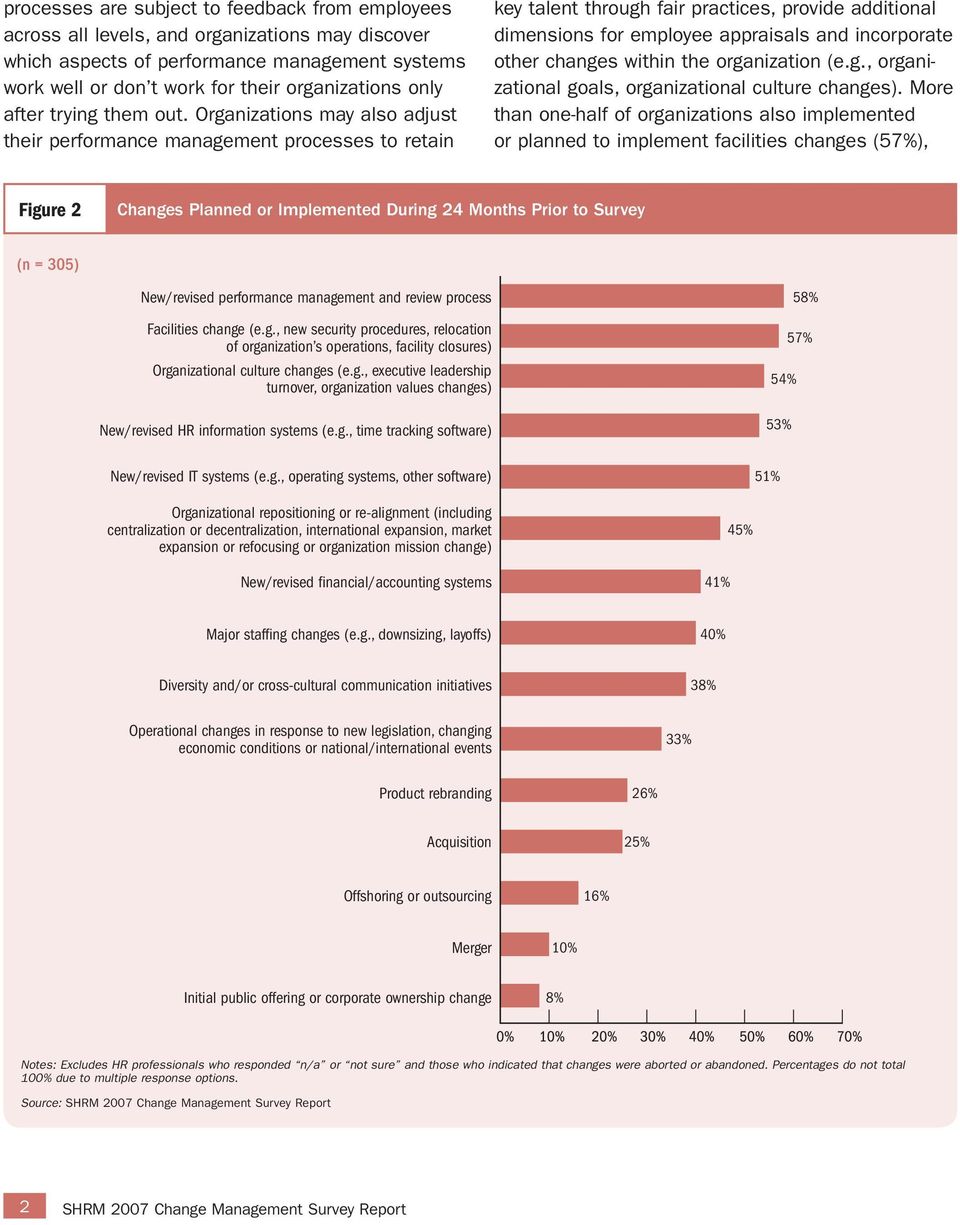
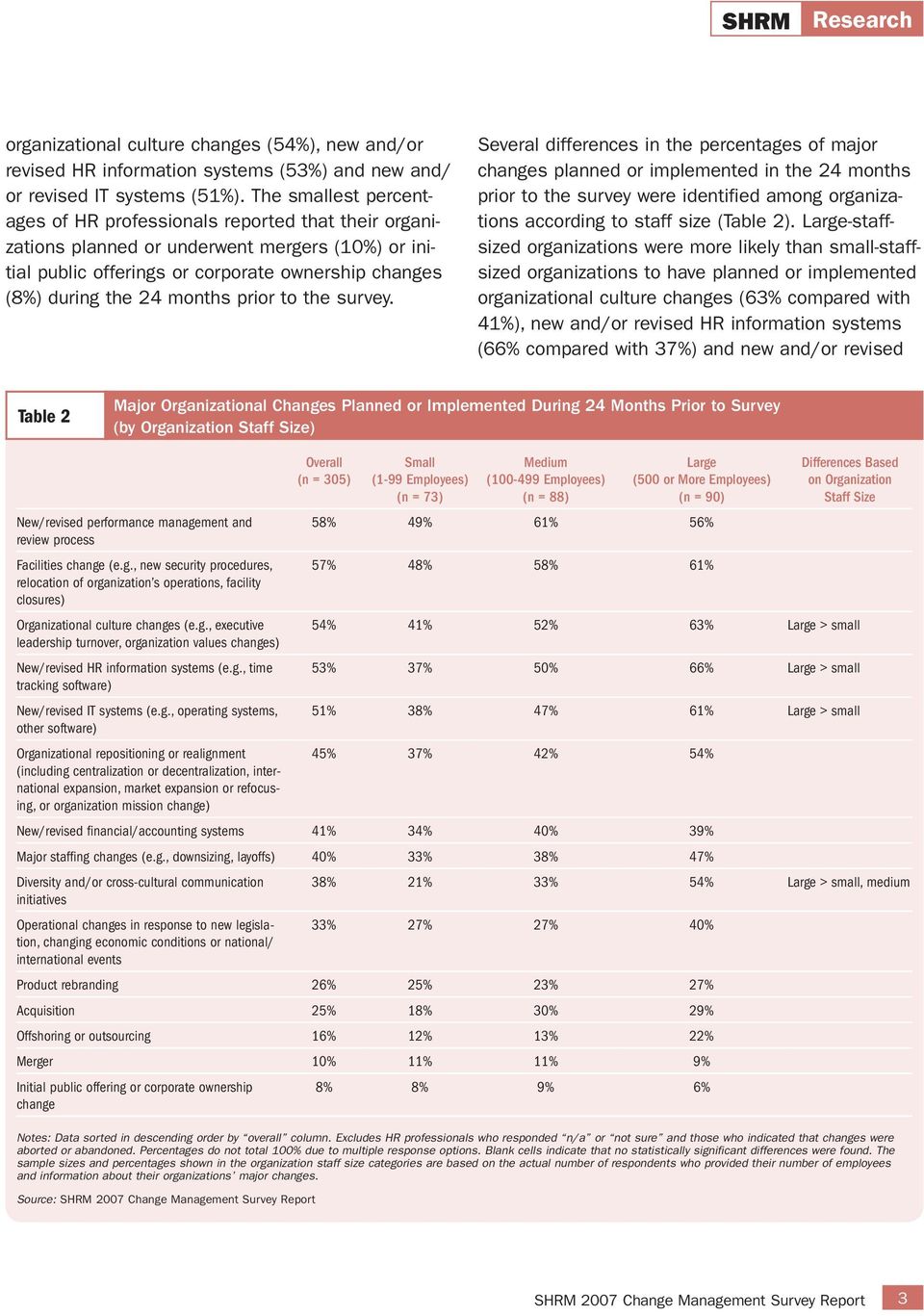
15 SHRM Research organizational culture changes (54%), new and/or revised HR information systems (53%) and new and/ or revised IT systems (51%). The smallest percentages of HR professionals reported that their organizations planned or underwent mergers (10%) or initial public offerings or corporate ownership changes (8%) during the 24 months prior to the survey. Several differences in the percentages of major changes planned or implemented in the 24 months prior to the survey were identified among organizations according to staff size (Table 2). Large-staffsized organizations were more likely than small-staffsized organizations to have planned or implemented organizational culture changes (63% compared with 41%), new and/or revised HR information systems (66% compared with 37%) and new and/or revised Table 2 Major al Changes Planned or Implemented During 24 Months Prior to Survey (by Staff Size) New/revised performance management and review process Facilities change (e.g., new security procedures, relocation of organization s operations, facility closures) al culture changes (e.g., executive leadership turnover, organization values changes) New/revised HR information systems (e.g., time tracking software) New/revised IT systems (e.g., operating systems, other software) al repositioning or realignment (including centralization or decentralization, international expansion, market expansion or refocusing, or organization mission change) (n = 305) Small (1-99 Employees) (n = 73) Medium ( Employees) (n = 88) Large (500 or More Employees) (n = 90) 58% 49% 61% 56% 57% 48% 58% 61% Differences Based on Staff Size 54% 41% 52% 63% Large > small 53% 37% 50% 66% Large > small 51% 38% 47% 61% Large > small 45% 37% 42% 54% New/revised financial/accounting systems 41% 34% 40% 39% Major staffing changes (e.g., downsizing, layoffs) 40% 33% 38% 47% Diversity and/or cross-cultural communication initiatives Operational changes in response to new legislation, changing economic conditions or national/ international events 38% 21% 33% 54% Large > small, medium 33% 27% 27% 40% Product rebranding 26% 25% 23% 27% Acquisition 25% 18% 30% 29% Offshoring or outsourcing 16% 12% 13% 22% Merger 10% 11% 11% 9% Initial public offering or corporate ownership change 8% 8% 9% 6% Notes: Data sorted in descending order by overall column. Excludes HR professionals who responded n/a or not sure and those who indicated that changes were aborted or abandoned. Percentages do not total 100% due to multiple response options. Blank cells indicate that no statistically significant differences were found. The sample sizes and percentages shown in the organization staff size categories are based on the actual number of respondents who provided their number of employees and information about their organizations major changes. SHRM 2007 Change Management Survey Report 3
16 Table 3 Major al Changes Planned or Implemented During 24 Months Prior to Survey (by Sector) New/revised performance management and review process Facilities change (e.g., new security procedures, relocation of organization s operations, facility closures) al culture changes (e.g., executive leadership turnover, organization values changes) New/revised HR information systems (e.g., time tracking software) New/revised IT systems (e.g., operating systems, other software) al repositioning or realignment (including centralization or decentralization, international expansion, market expansion or refocusing, or organization mission change) New/revised financial/accounting systems Major staffing changes (e.g., downsizing, layoffs) Diversity and/or cross-cultural communication initiatives Operational changes in response to new legislation, changing economic conditions or national/international events (n = 305) Publicly Owned For-Profit (n = 73) Privately Owned For-Profit (n = 97) Nonprofit (n = 55) Government Agency (n = 23) 58% 59% 57% 55% 39% 57% 62% 57% 44% 70% 54% 56% 47% 53% 57% Differences Based on Sector 53% 63% 51% 35% 65% Publicly owned for-profit organization > nonprofit organization 51% 42% 49% 55% 61% 45% 59% 41% 29% 52% Publicly owned for-profit organization > nonprofit organization 41% 34% 46% 20% 57% Privately owned for-profit organization > nonprofit organization Government agency > nonprofit organization 40% 53% 33% 27% 52% Publicly owned for-profit organization > privately owned for-profit organization, nonprofit organization 38% 56% 26% 31% 52% Publicly owned for-profit organization > privately owned for-profit organization, nonprofit organization 33% 34% 32% 27% 48% Product rebranding 26% 27% 26% 22% 13% Acquisition 25% 41% 27% 9% 4% Publicly owned for-profit organization > nonprofit organization, government agency Offshoring or outsourcing 16% 32% 13% 5% 0% Publicly owned for-profit organization > privately owned for-profit organization, nonprofit organization Merger 10% 11% 13% 5% 9% Initial public offering or corporate ownership change 8% 5% 14% 2% 0% Privately owned for-profit organization > nonprofit organization Notes: Data sorted in descending order by overall column. Excludes HR professionals who responded n/a or not sure, those who indicated that changes were aborted or abandoned and those from other organization sectors. Percentages do not total 100% due to multiple response options. Blank cells indicate that no statistically significant differences were found. The sample sizes and percentages shown in the organization sector categories are based on the actual number of respondents who provided their organization sector and information about their organizations major changes. 4 SHRM 2007 Change Management Survey Report

17 SHRM Research IT systems (61% compared with 38%). Large organizations (54%) were also more likely than medium (33%) and small organizations (21%) to have planned or implemented diversity and/or cross-cultural communication initiatives in the 24 months prior to the survey. These differences may be partially explained by workforce management needs that vary according to number of employees. Among the respondents who reported major organizational changes during the 24 months prior to the survey, the largest percentage of fully implemented Table 4 Stages of Major al Changes Fully Implemented Implementation in Progress Planning/ Pre-Implementation Acquisition (n = 75) 52% 32% 16% Initial public offering or corporate ownership change (n = 23) 52% 39% 9% Facilities change (e.g., new security procedures, relocation of organization s operations, facility closures) (n = 173) 46% 35% 19% Major staffing changes (e.g., downsizing, layoffs) (n = 123) 44% 38% 18% Merger (n = 32) 41% 41% 19% New/revised financial/accounting systems (n = 125) 39% 41% 20% Offshoring or outsourcing (n = 48) 31% 48% 21% New/revised performance management and review process (n = 176) 30% 38% 32% al culture changes (e.g., executive leadership turnover, organization values changes) (n = 165) Operational changes in response to new legislation, changing economic conditions or national/international events (n = 101) 29% 55% 15% 29% 49% 23% New/revised IT systems (e.g., operating systems, other software) (n = 157) 27% 50% 23% New/revised HR information systems (e.g., time tracking software) (n = 162) 26% 44% 30% Product rebranding (n = 78) 22% 54% 24% Diversity and/or cross-cultural communication initiatives (n = 117) 17% 44% 39% al repositioning or realignment (including centralization or decentralization, international expansion, market expansion or refocusing, or organization mission change) (n = 137) 15% 64% 21% Notes: Data sorted in descending order by fully implemented column. Excludes HR professionals who responded n/a or not sure and those who indicated that changes were aborted or abandoned. Row percentages do not total 100% due to rounding. Table 5 Average Number of Major al Changes (by Staff Size) (n = 305) Small (1-99 Employees) (n = 73) Medium ( Employees) (n = 88) Large (500 or More Employees) (n = 90) Differences Based on Staff Size Large > small, medium Notes: Excludes HR professionals who responded n/a or not sure and those who indicated that changes were aborted or abandoned. The sample sizes and percentages shown in the organization staff size categories are based on the actual number of respondents who provided their number of employees and information about their organizations major changes. SHRM 2007 Change Management Survey Report 5
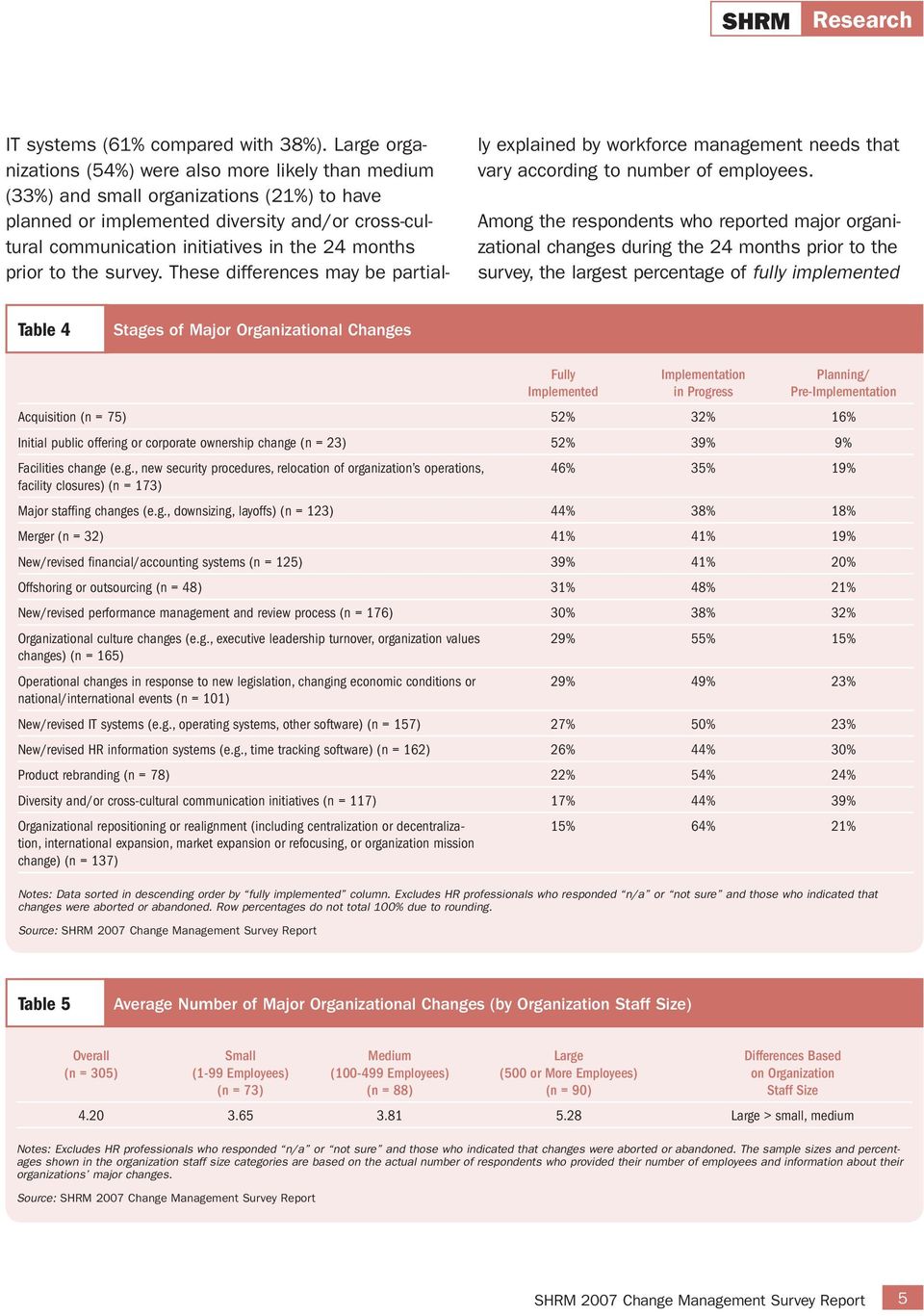
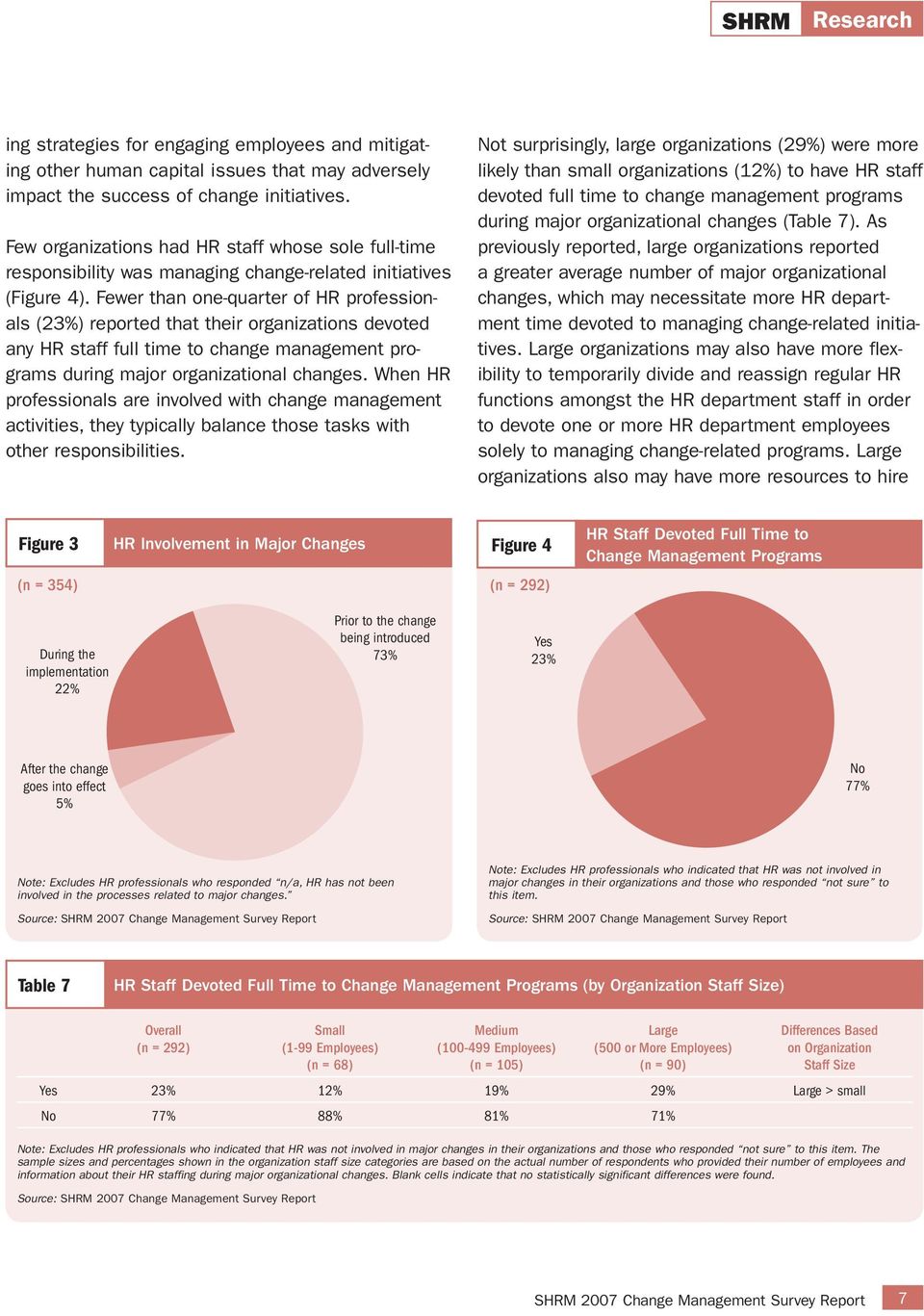
18 changes was reported for acquisitions (52%) and initial public offerings or corporate ownership changes (52%). The largest percentages of changes for which implementation was in progress were reported for organizational repositioning or realignment (64%), organizational culture changes (55%) and product rebranding (54%). The largest percentage of major organizational changes in the planning/pre-implementation stage was reported for diversity and/or crosscultural communication initiatives (39%). These data are shown in Table 4. As shown in Table 5, compared with small- and medium-staff-sized organizations, large-staff-sized organizations reported greater average numbers of major organizational changes in the 24 months prior to the survey. This finding is not unexpected, given that large organizations may be more sensitive to internal and external pressures necessitating major organizational changes and are more likely to have the resources to manage multiple major organizational changes at the same time. According to respondents, publicly owned for-profit organizations planned or implemented a greater average number of major organizational changes in the 24 months prior to the survey than did privately owned for-profit organizations and nonprofit organizations (Table 6). As with differences among organizations due to staff size, across organization sectors, there are varying degrees of need to undertake selected major organizational changes. This finding may indicate that publicly owned for-profit organizations have greater accountability for keeping pace with changes in the market and may respond by implementing enterprise-wide changes. Leadership and Design of Change Management Initiatives According to respondents, HR departments at about one-tenth of organizations (11%) were not involved in processes related to major organizational changes. When HR departments were involved in the processes related to major organizational changes, nearly three-quarters (73%) became involved prior to the change being introduced to all employees (Figure 3). About one-quarter of HR departments (22%) reported becoming involved in major organizational changes during the implementation process. Only 5% of respondents indicated that their organizations HR departments weren t involved in major organizational changes until after these changes went into effect. There were no significant differences in HR involvement in change management processes based on organization staff size or organization sector. The finding that HR departments were most likely to be involved with the planning for major changes indicates that more often than not HR is viewed as a strategic partner for the change process. HR departments and functions are best able to support their organizations business goals in major organizational changes when they are involved early in develop- Table 6 Average Number of Major al Changes (by Sector) (n = 305) Publicly Owned For- Profit (n = 73) Privately Owned For- Profit (n = 97) Nonprofit (n = 55) Government Agency (n = 23) Differences Based on Sector Publicly owned for-profit organization > privately owned for-profit organization, nonprofit organization Notes: Excludes HR professionals who responded n/a or not sure and those who indicated that changes that were aborted or abandoned. The sample sizes and percentages shown in the organization sector categories are based on the actual number of respondents who provided their organization sector and information about their organizations major changes. 6 SHRM 2007 Change Management Survey Report

19 SHRM Research ing strategies for engaging employees and mitigating other human capital issues that may adversely impact the success of change initiatives. Few organizations had HR staff whose sole full-time responsibility was managing change-related initiatives (Figure 4). Fewer than one-quarter of HR professionals (23%) reported that their organizations devoted any HR staff full time to change management programs during major organizational changes. When HR professionals are involved with change management activities, they typically balance those tasks with other responsibilities. Not surprisingly, large organizations (29%) were more likely than small organizations (12%) to have HR staff devoted full time to change management programs during major organizational changes (Table 7). As previously reported, large organizations reported a greater average number of major organizational changes, which may necessitate more HR department time devoted to managing change-related initiatives. Large organizations may also have more flexibility to temporarily divide and reassign regular HR functions amongst the HR department staff in order to devote one or more HR department employees solely to managing change-related programs. Large organizations also may have more resources to hire Figure 3 HR Involvement in Major Changes Figure 4 HR Staff Devoted Full Time to Change Management Programs (n = 354) (n = 292) During the implementation 22% Prior to the change being introduced 73% Yes 23% After the change goes into effect 5% No 77% Note: Excludes HR professionals who responded n/a, HR has not been involved in the processes related to major changes. Note: Excludes HR professionals who indicated that HR was not involved in major changes in their organizations and those who responded not sure to this item. Table 7 HR Staff Devoted Full Time to Change Management Programs (by Staff Size) (n = 292) Small (1-99 Employees) (n = 68) Medium ( Employees) (n = 105) Large (500 or More Employees) (n = 90) Differences Based on Staff Size Yes 23% 12% 19% 29% Large > small No 77% 88% 81% 71% Note: Excludes HR professionals who indicated that HR was not involved in major changes in their organizations and those who responded not sure to this item. The sample sizes and percentages shown in the organization staff size categories are based on the actual number of respondents who provided their number of employees and information about their HR staffing during major organizational changes. Blank cells indicate that no statistically significant differences were found. SHRM 2007 Change Management Survey Report 7
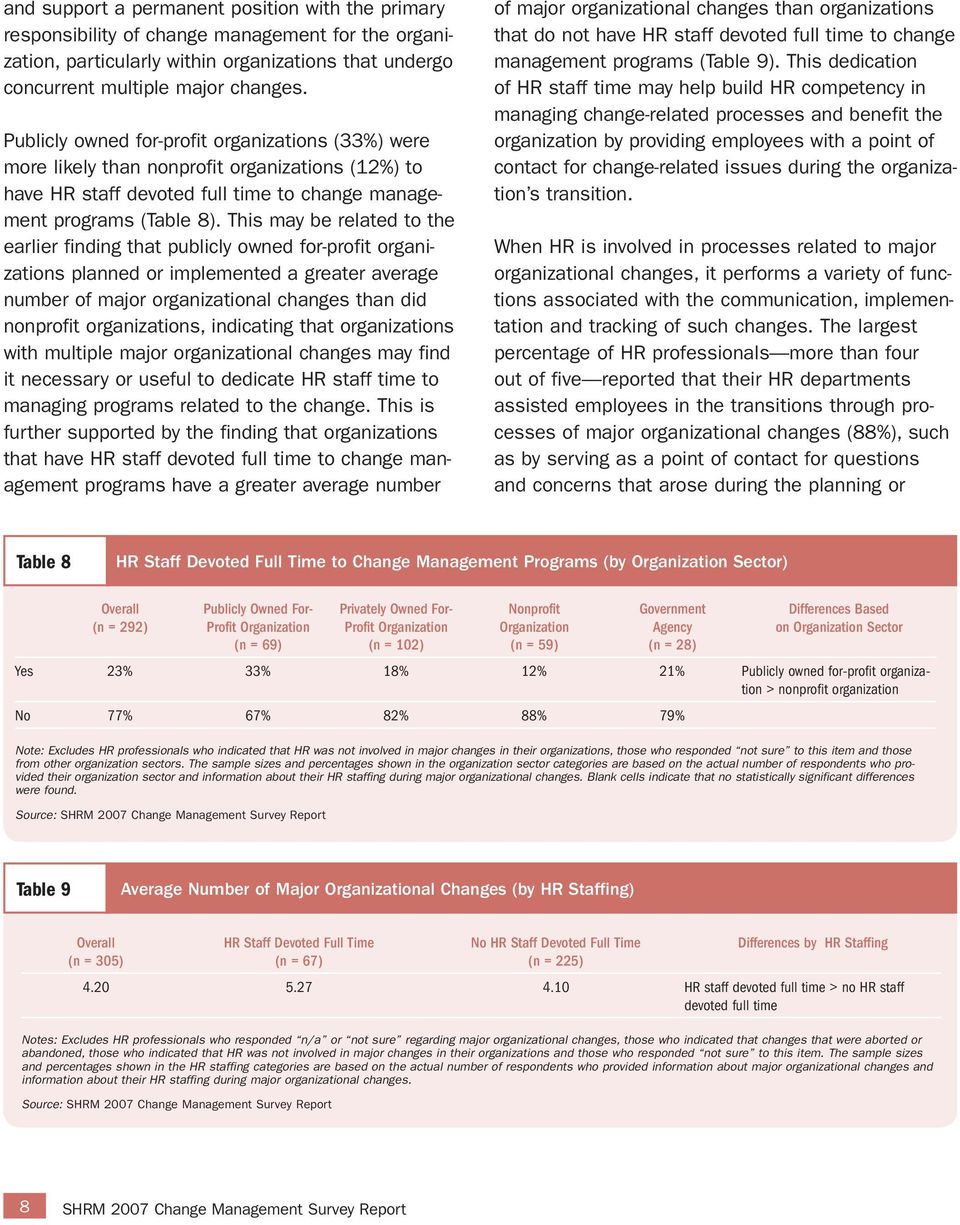
20 and support a permanent position with the primary responsibility of change management for the organization, particularly within organizations that undergo concurrent multiple major changes. Publicly owned for-profit organizations (33%) were more likely than nonprofit organizations (12%) to have HR staff devoted full time to change management programs (Table 8). This may be related to the earlier finding that publicly owned for-profit organizations planned or implemented a greater average number of major organizational changes than did nonprofit organizations, indicating that organizations with multiple major organizational changes may find it necessary or useful to dedicate HR staff time to managing programs related to the change. This is further supported by the finding that organizations that have HR staff devoted full time to change management programs have a greater average number of major organizational changes than organizations that do not have HR staff devoted full time to change management programs (Table 9). This dedication of HR staff time may help build HR competency in managing change-related processes and benefit the organization by providing employees with a point of contact for change-related issues during the organization s transition. When HR is involved in processes related to major organizational changes, it performs a variety of functions associated with the communication, implementation and tracking of such changes. The largest percentage of HR professionals more than four out of five reported that their HR departments assisted employees in the transitions through processes of major organizational changes (88%), such as by serving as a point of contact for questions and concerns that arose during the planning or Table 8 HR Staff Devoted Full Time to Change Management Programs (by Sector) (n = 292) Publicly Owned For- Profit (n = 69) Privately Owned For- Profit (n = 102) Nonprofit (n = 59) Government Agency (n = 28) Differences Based on Sector Yes 23% 33% 18% 12% 21% Publicly owned for-profit organization > nonprofit organization No 77% 67% 82% 88% 79% Note: Excludes HR professionals who indicated that HR was not involved in major changes in their organizations, those who responded not sure to this item and those from other organization sectors. The sample sizes and percentages shown in the organization sector categories are based on the actual number of respondents who provided their organization sector and information about their HR staffing during major organizational changes. Blank cells indicate that no statistically significant differences were found. Table 9 Average Number of Major al Changes (by HR Staffing) (n = 305) HR Staff Devoted Full Time (n = 67) No HR Staff Devoted Full Time (n = 225) Differences by HR Staffing HR staff devoted full time > no HR staff devoted full time Notes: Excludes HR professionals who responded n/a or not sure regarding major organizational changes, those who indicated that changes that were aborted or abandoned, those who indicated that HR was not involved in major changes in their organizations and those who responded not sure to this item. The sample sizes and percentages shown in the HR staffing categories are based on the actual number of respondents who provided information about major organizational changes and information about their HR staffing during major organizational changes. 8 SHRM 2007 Change Management Survey Report
21 SHRM Research implementation of the change initiatives and explaining any impact on staffing that might result from the changes. The second largest percentage of HR professionals reported that their HR departments coordinated meetings and communications about the change and related initiatives (76%). The smallest percentage of HR professionals reported that their HR departments were responsible for calculating the post-implementation return on investment for major organizational changes (11%). These data are shown in Figure 5., HR departments were least likely to be responsible for tasks that involved calculations of return on investment or measuring the success of change initiatives. While organizations might consider return-on-investment calculations to fit best within their finance departments, HR has considerable expertise in human capital issues and could benefit their organizations by producing metrics for these areas related to the major organizational changes. Figure 5 HR Roles During Major al Changes (n = 316) Assisting employees in the transition through the process 88% Coordinating meetings and communications about the change and related initiatives Providing initial communication to employees of changes within the organization Developing the training program related to the change (including designing training materials and/or contracting consultant services) 72% 70% 76% Preparing other informational documents about the change 65% Assessing organizational readiness for change (pre-implementation) 55% Analyzing potential impact of change on stakeholders (pre-implementation) 51% Developing the timeline for the change management initiative 43% Building a rewards system to maintain and reinforce change 37% Measuring success of change management activities (post-implementation) 33% Estimating potential return on investment for the change (pre-implementation) 18% Calculating actual return on investment of the change (post-implementation) 11% Note: Excludes HR professionals who indicated that their HR departments were not involved in processes related to major changes in their organizations. Percentages do not total 100% due to multiple response options. SHRM 2007 Change Management Survey Report 9
22 As shown in Table 10, large organizations (61%) were more likely than medium organizations (43%) to have reported that their HR departments analyzed the potential impact of major organizational changes prior to the implementation of the changes. This was the only role for which significant differences were identified based on organization staff size. One difference was identified among organization sectors in the percentages of respondents whose HR departments had responsibility for various tasks during major organizational changes. Respondents employed by government agencies (3%) were less likely than those employed by nonprofit organizations (38%), publicly owned for-profit organizations (35%) and privately owned for-profit organizations (34%) to report that the HR departments measured the success of change management activities in promoting employee adoption of major changes within their organizations (Table 11). This finding indicates that across organization sectors, HR departments provide similar functions during major organizational changes. Table 10 HR Roles During Major al Changes (by Staff Size) (n = 316) Small (1-99 Employees) (n = 72) Medium ( Employees) (n = 113) Large (500 or More Employees) (n = 98) Assisting employees in the transition through the process 88% 85% 88% 93% Coordinating meetings and communications about the change and related initiatives Initial communication to employees about changes within the organization Developing the training program related to the change (including designing training materials and/or contracting consultant services) Preparing other informational documents about the change Assessing organizational readiness for change (preimplementation) Analyzing potential impact of change on stakeholders (pre-implementation) Developing the timeline for the change management initiative Building a rewards system to maintain and reinforce change Measuring success of change management activities in promoting employee awareness and acceptance of changes within organization (post-implementation) Estimating potential return on investment for the change (pre-implementation) Calculating actual return on investment of the change (post-implementation) 76% 81% 78% 74% 72% 73% 76% 67% 70% 67% 72% 71% 65% 66% 60% 66% 55% 47% 58% 58% Differences Based on Staff Size 51% 45% 43% 61% Large > medium 43% 47% 35% 50% 37% 32% 35% 44% 33% 32% 34% 33% 18% 16% 16% 20% 11% 10% 11% 11% Note: Data sorted in descending order by overall column. Excludes HR professionals who indicated that their HR departments were not involved in processes related to major changes in their organizations. Percentages do not total 100% due to multiple response options. Blank cells indicate that no statistically significant differences were found. The sample sizes and percentages shown in the organization staff size categories are based on the actual number of respondents who provided their number of employees and information about HR s role during major organizational changes. 10 SHRM 2007 Change Management Survey Report
23 SHRM Research Slightly fewer than one-half of HR professionals (41%) reported that their organizations had used a change management consultant during major organizational changes (Figure 6). Use of external change management consultants varied among organizations of different staff sizes (Table 12). Large organizations (57%) were more likely than medium (35%) and small organizations (26%) to have used a change management consultant during major organizational changes. These differences may be related to availability of financial resources to hire a consultant as well as the perceived need for change management consultant services. Change management consultants might be seen as more necessary in large organizations where there are greater complexities in organiza- Table 11 HR Roles During Major al Changes (by Sector) Assisting employees in the transition through the process Coordinating meetings and communications about the change and related initiatives Initial communication to employees about changes within the organization Developing the training program related to the change (including designing training materials and/or contracting consultant services) Preparing other informational documents about the change Assessing organizational readiness for change (pre-implementation) Analyzing potential impact of change on stakeholders (pre-implementation) Developing the timeline for the change management initiative Building a rewards system to maintain and reinforce change Measuring success of change management activities in promoting employee awareness and acceptance of changes within organization (post-implementation) Estimating potential return on investment for the change (pre-implementation) Calculating actual return on investment of the change (post-implementation) (n = 316) Publicly Owned For-Profit (n = 79) Privately Owned For-Profit (n = 110) Nonprofit (n = 60) Government Agency (n = 29) 88% 91% 89% 83% 90% 76% 76% 77% 85% 62% 72% 78% 75% 67% 55% 70% 66% 72% 75% 66% 65% 62% 65% 65% 62% 55% 48% 57% 57% 48% 51% 43% 49% 53% 59% 43% 38% 41% 53% 34% 37% 41% 40% 38% 17% Differences Based on Sector 33% 35% 34% 38% 3% Publicly owned for-profit organization > government agency 18% 14% 21% 18% 14% 11% 9% 13% 12% 0% Privately owned for-profit organization > government agency Nonprofit organization > government agency Note: Data sorted in descending order by overall column. Excludes HR professionals who indicated that their HR departments were not involved in processes related to major changes in their organizations. Percentages do not total 100% due to multiple response options. Blank cells indicate that no statistically significant differences were found. The sample sizes and percentages shown in the organization sector categories are based on the actual number of respondents who provided their organization sector and information about HR s role during major organizational changes. SHRM 2007 Change Management Survey Report 11
24 Figure 6 (n = 262) Yes 41% External Change Management Consultant Services Used During Major al Changes Notes: Excludes HR professionals who responded not sure. No 59% tional structures that present potential change-related communication and training challenges. Some differences emerged among organization sectors in the use of external change management consultants (Table 13). Government agencies (58%) and publicly owned for-profit organizations (55%) were more likely than privately owned for-profit organizations (26%) to have used a change management consultant during major organizational changes. Among the organizational characteristics that may have contributed to these differences is transparency of operations: publicly owned for-profit organizations and government agencies may be more subject to external accountability and standards of practice and thus may feel more pressure to employ expert professional services to guide their organizations through major changes. Table 12 External Change Management Consultant Services Used During Major al Changes (by Staff Size) (n = 262) Small (1-99 Employees) (n = 70) Medium ( Employees) (n = 100) Large (500 or More Employees) (n = 82) Differences Based on Staff Size Yes 41% 26% 35% 57% Large > small, medium No 59% 74% 65% 43% Notes: Excludes HR professionals who responded not sure. The sample sizes and percentages shown in the organization staff size categories are based on the actual number of respondents who provided their number of employees and information about the use of external change management consultants. Blank cells indicate that no statistically significant differences were found. Table 13 External Change Management Consultants Services Used During Major al Changes (by Sector) (n = 262) Publicly Owned For-Profit (n = 56) Privately Owned For-Profit (n = 100) Nonprofit (n = 61) Government Agency (n = 25) Differences Based on Sector Yes 41% 55% 26% 45% 58% Publicly owned for-profit organization > privately owned for-profit organization Government agency > privately owned for-profit organization No 59% 45% 74% 55% 42% Notes: Excludes HR professionals who responded not sure. The sample sizes and percentages shown in the organization sector categories are based on the actual number of respondents who provided their organization sector and information about the use of external change management consultants. Blank cells indicate that no statistically significant differences were found. 12 SHRM 2007 Change Management Survey Report
25 SHRM Research Table 14 (n = 305) Average Number of Major al Changes (by Use of Change Management Consultant) Used Change Management Consultant (n = 108) Did Not Use Change Management Consultant (n = 154) Differences by Use of Change Management Consultant Used change management consultant > did not use change management consultant Notes: Excludes HR professionals who responded n/a or not sure regarding major organizational changes, those who indicated that changes were aborted or abandoned and those who responded not sure to this item. The sample sizes and percentages shown in the use of change management consultant categories are based on the actual number of respondents who indicated whether their organizations used external change management consultants and provided information about their organizations major changes. Figure 7 (n = 254) Yes 35% Change Management Model Used During Major al Changes HR professionals from organizations that used change management consultants during major organizational changes reported significantly greater average numbers of major changes during the 24 months prior to the survey compared with organizations that did not use change management consultants (Table 14). The organizations that used change management consultants may have chosen to do so due to such factors as the anticipated impact of the major changes being implemented, concurrent implementation of multiple changes, availability of HR department time to devote to change management initiatives and public relations issues. s tended to develop their change management initiatives according to the perceived needs of their organizations rather than strictly based on theories of change management incorporated in change management models. About two-thirds of HR professionals (65%) reported that their organizations did not follow any particular change management model during major organizational changes (Figure 7). Notes: Excludes HR professionals who responded not sure. No 65% According to respondents, more than one-half of largestaff-sized organizations (55%) followed a particular change management model during major organizational changes. This proportion decreased precipitously for organizations with fewer than 500 employees. Large organizations were more likely than medium (26%) and small organizations (19%) to have followed any particular change management model (Table 15). Table 15 Change Management Model Used During Major al Changes (by Staff Size) (n = 254) Small (1-99 Employees) (n = 67) Medium ( Employees) (n = 96) Large (500 or More Employees) (n = 84) Differences Based on Staff Size Yes 35% 19% 26% 55% Large > small, medium No 65% 81% 74% 45% Notes: Excludes HR professionals who responded not sure. The sample sizes and percentages shown in the organization staff size categories are based on the actual number of respondents who provided their number of employees and information about the use of change management models. Blank cells indicate that no statistically significant differences were found. SHRM 2007 Change Management Survey Report 13
26 Among organization sectors, publicly owned for-profit organizations (57%) were more likely than privately owned for-profit organizations (29%) and nonprofit organizations (23%) to report using a particular change management model during their major organizational changes. These data are shown in Table 16. According to HR respondents, the larger the number of major changes an organization experienced, the greater the likelihood that the organization used a change management model (Table 17). s that indicated having followed a particular change management model during major organizational changes reported a greater average number of major changes compared with organizations that did not follow any particular change management model during their major organizational changes. For organizations with multiple major changes occurring in a relatively short period of time, following a model of change management may provide direction for consistency of practices for the change management leaders and, in turn, provide a familiar sequence to implementation for the employees who are affected by the changes. Impact of Major al Changes Within organizations experiencing major changes, a larger percentage of executive, managerial and nonmanagerial staff was affected by change management initiatives compared with CEO/president and/or owner or the board of directors. More than three-quarters of HR professionals reported that change management initiatives at their organizations affected the executive team or senior management (81%), nonexecutive-level managers and supervisors (80%) and nonmanagerial-level employees (77%). Fewer than one-quarter of HR professionals (22%) reported that their organizations boards of directors had been affected by change management initiatives related to major organizational changes. This finding is not surprising, given that boards are not typically involved in the behind-the- Table 16 Change Management Model Used During Major al Changes (by Sector) (n = 254) Publicly Owned For- Profit (n = 58) Privately Owned For- Profit (n = 99) Nonprofit (n = 60) Government Agency (n = 26) Differences Based on Sector Yes 35% 57% 29% 23% 27% Publicly owned for-profit organization > privately owned for-profit organization, nonprofit organization No 65% 43% 71% 77% 73% Notes: Excludes HR professionals who responded not sure. The sample sizes and percentages shown in the organization sector categories are based on the actual number of respondents who provided their organization sector and information about the use of change management models. Blank cells indicate that no statistically significant differences were found. Table 17 Average Number of Major al Changes (by Use of Change Management Model) (n = 305) Used Change Management Model (n = 88) Did Not Use Change Management Model (n = 166) Differences by Use of Change Management Model Used change management model > did not use change management model Notes: Excludes HR professionals who responded n/a or not sure and those who indicated that changes that were aborted or abandoned. The sample sizes and percentages shown in the use of change management model categories are based on the actual number of respondents who provided information about their organizations use of change management models and information about their major organizational changes. 14 SHRM 2007 Change Management Survey Report
27 SHRM Research scenes aspects of organizations business operations that include major organizational changes such as new/revised performance management and reviews, HR information systems and IT systems. These data are shown in Figure 8. One difference was identified among organizations of different staff sizes in the proportion of stakeholders within organizations who were affected by change management initiatives. According to HR professionals, nonexecutive managers and supervisors were more likely to be affected by change management initiatives in large organizations (87%) than in small organizations (73%), possibly because this staff category is more likely to be found in larger organizations. These data are shown in Table 18. Analyzed by organization sector, the data revealed two types of stakeholders that were differently affected by change management initiatives (Table 19). Privately owned for-profit organizations (56%) were more likely than government agencies (27%) to report that their CEO, president and/or owner was affected by change management initiatives. Nonprofit organizations (35%) were more likely than publicly owned for-profit organizations (14%) to report that their board of directors was affected by their organizations change management initiatives. These differences may be attributable in part to differences in hierarchical structures within the various organization sectors. How do employees receive communications related to major impending and in-progress organizational changes? As shown in Figure 9, about two-thirds of HR professionals reported that information related to major changes within their organizations was communicated through department meetings (67%), e mails, voic s and/or letters to employees from the organizations executive management (67%) and all-employee meetings (63%). Nearly one-half of respondents (46%) reported that employees received change-related communications via , voic or letter from their organizations HR departments, a finding that indicates that HR is viewed as a leader during major organizational changes. Only about one out of five organizations used s, voic s and/or letters to employees from departments other than HR or executive management (19%) and video and/or phone conference broadcasts (19%) to communicate information about major organizational changes to employees. Figure 8 Stakeholders Affected by Change Management Initiatives (n = 329) Executive team/senior management Nonexecutive managers and supervisors 81% 80% Nonmanagerial-level employees 77% CEO/president/owner 50% Board of directors 22% Note: Data sorted in descending order. Percentages do not total 100% due to multiple response options. SHRM 2007 Change Management Survey Report 15
28 It stands to reason that methods for communicating information and announcements related to major changes would vary according to the size of the organization. Numerous differences were identified among organizations of various staff sizes in the proportions of companies that used various methods of communicating major organizational changes to employees. Large-staff-sized organizations (81%) were more likely than medium- (64%) or small-staffsized organizations (51%) to report that their employees received s, voic s or letters related to major organizational changes from their organizations executive management. Large staff-sized organizations were also more likely to communicate information related to the changes via the company Web site or intranet (66%), press releases (36%) and s, voic s or letters to employees from departments other than HR (26%). Medium organizations (45%) were more likely than small organizations (29%) to communicate changes to employees via materials posted in break rooms, on bulletin boards Table 18 Stakeholders Affected by Change Management Initiatives (by Staff Size) (n = 329) Small (1-99 Employees) (n = 68) Medium ( Employees) (n = 105) Large (500 or More Employees) (n = 90) Executive team/senior management 81% 83% 76% 83% Differences Based on Staff Size Nonexecutive managers and supervisors 80% 73% 77% 87% Large > small Nonmanagerial-level employees 77% 76% 73% 79% CEO/president/owner 50% 55% 48% 46% Board of directors 22% 17% 22% 24% Note: Data sorted in descending order by overall column. Percentages do not total 100% due to multiple response options. Blank cells indicate that no statistically significant differences were found. The sample sizes and percentages shown in the organization staff size categories are based on the actual number of respondents who provided their number of employees and information about stakeholders affected during major organizational changes. Table 19 Stakeholders Affected by Change Management Initiatives (by Sector) (n =329) Publicly Owned For-Profit (n = 84) Privately Owned For-Profit (n = 124) Nonprofit (n = 69) Government Agency (n = 30) Executive team/senior management 81% 79% 81% 80% 83% Nonexecutive managers and supervisors 80% 82% 77% 78% 80% Nonmanagerial-level employees 77% 77% 74% 75% 80% Differences Based on Sector CEO/president/owner 50% 46% 56% 49% 27% Privately owned for-profit organization > government agency Board of directors 22% 14% 19% 35% 17% Nonprofit organization > publicly owned for-profit organization Note: Data sorted in descending order by overall column. Percentages do not total 100% due to multiple response options. Blank cells indicate that no statistically significant differences were found. The sample sizes and percentages shown in the organization sector categories are based on the actual number of respondents who provided their organization sector and information about stakeholders affected during major organizational changes. 16 SHRM 2007 Change Management Survey Report
29 SHRM Research or elsewhere on organization premises. These data are illustrated in Table 20. Several differences were identified among organization sectors in the percentage of organizations that used various methods to communicate change-related information to employees, with publicly owned forprofit organizations more likely than organizations in several other sectors to use the company Web site or intranet, press releases and video and/or phone broadcasts to communicate information about major organizational changes to employees (Table 21). Government agencies were more likely than nonprofit organizations to use , voic or letters from executive management to employees (84% compared with 57%) and were more likely than privately owned for-profit organizations to post change-related information on their organizations Web sites or intranet (55% compared with 29%). Privately owned for-profit organizations (73%) were more likely than publicly owned for-profit organizations (54%) to use all-employee meetings for communicating changes within their organizations. More than one-quarter of HR professionals (26%) reported that training related to major organizational changes was not mandatory at any staff level within their organizations. Among the HR professionals who reported that their organizations had mandatory training related to major changes within their organizations, the employee level for which the largest percentage of organizations had mandatory training was nonexecutive managers and supervisors (92%). Only 65% of HR professionals reported that training Figure 9 Change-Related Communications (n = 334) Department meetings , voic or letter to employees from organization s executive management 67% 67% All-employee meeting 63% Training sessions Information posted on company Web site or intranet 49% 46% , voic or letter to employees from HR 46% Materials posted in break rooms, on bulletin boards or elsewhere on organization premises 39% Press release or other media communication , voic or letter to employees from department other than HR Video/phone conference broadcast 19% 19% 24% Note: Excludes HR professionals who indicated that their organizations had not communicated major changes to employees. Percentages do not total 100% due to multiple response options. SHRM 2007 Change Management Survey Report 17
30 related to major changes was mandatory for their organizations CEO/president and/or owner. These data are depicted in Figure 10. One out of 10 organizations (10%) did not provide training related to major organizational changes to their employees. This may be partly explained by the types of changes being planned or implemented: in some cases, communication about the changes may suffice. Among organizations that trained employees about major organizational changes, the largest percentage of HR professionals (79%) reported that their organizations trained employees through group or one-on-one sessions led by instructors. More than one-half of organizations (51%) distributed hardcopy training materials. Smaller percentages of organizations indicated that their employees received online or software-based training. These data are illustrated in Figure 11. Among organizations that trained employees about major organizational changes, large-staff-sized organizations (57%) were more likely than small- (36%) and medium-staff-sized organizations (32%) to report that their organizations provided training through online (i.e., downloadable) training manuals, job aides or other documentation. Large organizations (44%) were more likely than medium (26%) and small organizations (8%) and medium organizations were more likely than small organizations to provide training through e-learning modules on their organizations Web sites. Large organizations (26%) were also more likely than small (11%) and medium organizations (11%) to report providing training through software-based tutorials. Large organizations may be more likely to offer Web-based or softwarebased training as a convenient means to reinforce other training methods or to allow large numbers of employees to train at the convenience of their Table 20 Methods of Communicating Major al Changes to Employees (by Staff Size) (n = 334) Small (1-99 Employees) (n = 87) Medium ( Employees) (n = 121) Large (500 or More Employees) (n = 107) Department meetings 67% 59% 67% 74% , voic or letter to employees from organization s executive management Differences Based on Staff Size 67% 51% 64% 81% Large > small, medium All-employee meeting 63% 70% 64% 57% Training sessions 49% 44% 48% 52% Information posted on company Web site or intranet , voic or letter to employees from HR Materials posted in break rooms, on bulletin boards or elsewhere on organization premises 46% 18% 45% 66% Medium > small 46% 43% 43% 48% Large > small, medium 39% 29% 45% 37% Medium > small Press release or other media communication 24% 10% 22% 36% Large > small , voic or letter to employees from department other than HR 19% 14% 12% 26% Large > medium Video/phone conference broadcast 19% 14% 20% 21% Note: Data sorted in descending order by overall column. Excludes HR professionals who indicated that their organizations had not communicated major changes to employees. Percentages do not total 100% due to multiple response options. Blank cells indicate that no statistically significant differences were found. The sample sizes and percentages shown in the organization staff size categories are based on the actual number of respondents who provided their number of employees and information about methods of communicating major organizational changes. 18 SHRM 2007 Change Management Survey Report
31 SHRM Research schedule and learning pace. These data are shown in Table 22. As shown in Table 23, publicly owned for-profit organizations were more than twice as likely as privately owned for-profit organizations to conduct employee training related to major organizational changes through e-learning modules on company Web sites (43% compared with 21%) and software-based tutorials (26% compared with 10%)., these training methods were used least frequently across all organization sectors. Although the differences were not significant, smaller percentages of publicly owned for-profit organizations, compared with other sectors, trained employees by providing group or individual instructor-led sessions and hardcopy training manuals, job aides or other documentation. Similarly, larger percentages of publicly owned for-profit organizations provided training through online downloadable manuals, job aides or other documentation. These findings suggest that, compared with other organization sectors, publicly owned for-profit organizations are more likely to employ electronic methods of training employees. Table 21 Methods of Communicating al Changes to Employees (by Sector) (n = 334) Publicly Owned For-Profit (n = 84) Privately Owned For-Profit (n = 127) Nonprofit (n = 69) Government Agency (n = 31) Department meetings 67% 69% 63% 74% 65% , voic or letter to employees from organization s executive management Differences Based on Sector 67% 75% 61% 57% 84% Government agency > nonprofit organization All-employee meeting 63% 54% 73% 55% 68% Privately owned for-profit organization > publicly owned for-profit organization Training sessions 49% 44% 53% 46% 48% Information posted on company web site or intranet , voic or letter to employees from HR Materials posted in break rooms, on bulletin boards or elsewhere on organization premises Press release or other media communication , voic or letter to employees from department other than HR Video/phone conference broadcast 46% 64% 29% 46% 55% Publicly owned for-profit organization > privately owned for-profit organization 46% 45% 51% 46% 35% 39% 46% 39% 28% 35% Government agency > privately owned for-profit organization 24% 35% 17% 16% 39% Publicly owned for-profit organization > privately owned for-profit organization 19% 20% 18% 16% 19% 19% 36% 18% 9% 6% Publicly owned for-profit organization > privately owned for-profit organization, nonprofit organization, government agency Note: Data sorted in descending order by overall column. Excludes HR professionals who indicated that their organizations had not communicated major changes to employees. Percentages do not total 100% due to multiple response options. Blank cells indicate that no statistically significant differences were found. The sample sizes and percentages shown in the organization sector categories are based on the actual number of respondents who provided their organization sector and information about methods of communicating major organizational changes. SHRM 2007 Change Management Survey Report 19
32 Obstacles, Evaluations and Outcomes of Major al Changes What are the main challenges and obstacles that organizations face during major changes? According to HR professionals, while major organizational changes are planned or in progress, challenges more frequently originate from within the organization than from external sources (Figure 12). Employee resistance (76%) was the obstacle most frequently experienced during major organizational changes. Nearly three-quarters of organizations reported communication breakdown (72%), and almost one-half indicated that insufficient time devoted to training (44%) posed challenges during major organizational change. The smallest percentage of organizations (12%) reported that their major organizational changes were challenged due to downturn in the market or economy. Large-staff-sized organizations (81%) were more likely than small-staff-sized organizations (63%) to report that their major organizational changes had been challenged by communication breakdown. Large organizations (44%) were also more likely than small (26%) and medium organizations (23%) to report that Figure 10 Mandatory Training for Major al Changes Nonexecutive managers and supervisors (n = 142) Nonmanagerial-level employees (n = 196) 89% 92% Executive team/senior management (n = 226) 82% CEO/president/owner (n = 215) 65% Note: Excludes HR professionals who indicated that training related to major organizational changes was not mandatory at any level. Figure 11 Employee Training for Major al Changes (n = 291) Group or one-on-one sessions led by an instructor 79% Hardcopy training manuals, job aides or other documentation 51% Online (i.e., downloadable) training manuals, job aides or other documentation 43% E-learning modules through organization s Web site 28% Software-based tutorials 16% Note: Excludes HR professionals who indicated that their employees had not received training related to major organizational changes. Percentages do not total 100% due to multiple response options. 20 SHRM 2007 Change Management Survey Report
33 SHRM Research costs exceeded the budget for their major organizational changes. These data are shown in Table 24. As depicted in Table 25, differences among organization sectors were identified for three obstacles or challenges that organizations faced during major changes. HR professionals employed by government agencies (94%) were more likely to report having encountered employee resistance to changes, compared with respondents employed by privately owned Table 22 Employee Training for Major al Changes (by Staff Size) Group or one-on-one sessions led by an instructor Hardcopy training manuals, job aides or other documentation Online (i.e., downloadable) training manuals, job aides or other documentation E-learning modules through organization s Web site (n = 291) Small (1-99 Employees) (n = 75) Medium ( Employees) (n = 109) Large (500 or More Employees) (n = 93) 79% 76% 81% 80% 51% 47% 52% 54% Differences Based on Staff Size 43% 36% 32% 57% Large > small, medium 28% 8% 26% 44% Medium > small Large > small, medium Software-based tutorials 16% 11% 11% 26% Large > small, medium Note: Data sorted in descending order by overall column. Excludes HR professionals who indicated that their employees had not received training related to major organizational changes. Percentages do not total 100% due to multiple response options. Blank cells indicate that no statistically significant differences were found. The sample sizes and percentages shown in the organization staff size categories are based on the actual number of respondents who provided their number of employees and information about training related to major organizational changes. Table 23 Employee Training for Major al Changes (by Sector) Group or one-on-one sessions led by an instructor Hardcopy training manuals, job aides or other documentation Online (i.e., downloadable) training manuals, job aides or other documentation E-learning modules through organization s Web site (n = 291) Publicly Owned For-Profit (n = 84) Privately Owned For-Profit (n = 127) Nonprofit (n = 69) Government Agency (n = 31) 79% 66% 82% 84% 85% 51% 45% 52% 56% 56% 43% 54% 39% 33% 41% Differences Based on Sector 28% 43% 21% 23% 22% Publicly owned for-profit organization > privately owned for-profit organization Software-based tutorials 16% 26% 10% 18% 11% Publicly owned for-profit organization > privately owned for-profit organization Note: Data sorted in descending order by overall column. Excludes HR professionals who indicated that their employees had not received training related to major organizational changes. Percentages do not total 100% due to multiple response options. Blank cells indicate that no statistically significant differences were found. The sample sizes and percentages shown in the organization sector categories are based on the actual number of respondents who provided their organization sector and information about training related to major organizational changes. Source: 2007 Change Management Survey Report SHRM 2007 Change Management Survey Report 21
34 for-profit organizations (69%). According to HR professionals, publicly owned for-profit organizations (59%) were more likely than nonprofit organizations (35%) to report that their major organizational changes were challenged by insufficient time devoted to training. Publicly owned for-profit organizations (53%) were more likely than privately owned for-profit organizations (30%) and nonprofit organizations (26%) to report that staff turnover during the transition presented an obstacle to their major organizational changes. According to HR professionals, fewer than one-third of organizations (32%) conducted evaluations of the change management initiatives after major organizational changes had been implemented. These data are shown in Figure 13. As shown in Table 26, large-staff-sized organizations (44%) were more likely than medium- (26%) or smallstaff-sized organizations (25%) to have conducted evaluations of their change management initiatives following implementation of major changes. Larger organizations undoubtedly have greater resources and more at stake to allow them to conduct evaluations. Larger organizations may also be more likely to be subject to external expectations for post-implementation evaluations of changes. The impetus for conducting evaluations of change management initiatives is evidently less sensitive to organization sector than to other organization characteristics. Although publicly owned for-profit organizations (39%) reported the largest percentage of post-implementation evaluations compared with other Figure 12 Obstacles and Challenges During Major al Changes (n = 307) Employee resistance Communication breakdown 72% 76% Insufficient time devoted to training 44% Staff turnover during transition Costs exceeded budget 32% 36% Timeline developed for change implementation was not feasible 31% Insufficient employee participation in training (for voluntary training) 24% Software/hardware malfunctions 23% Downturn in market or economy 12% Note: Excludes HR professionals who indicated that their organizations had not experienced any obstacles or challenges during major organizational changes. Percentages do not total 100% due to multiple response options. 22 SHRM 2007 Change Management Survey Report
35 SHRM Research Table 24 Obstacles Encountered During Major al Changes (by Staff Size) (n = 307) Small (1-99 Employees) (n = 82) Medium ( Employees) (n = 112) Large (500 or More Employees) (n = 105) Employee resistance 76% 76% 73% 80% Communication breakdown 72% 63% 67% 81% Large > small Insufficient time devoted to training 44% 39% 40% 52% Staff turnover during transition 36% 33% 33% 42% Differences Based on Staff Size Costs exceeded budget 32% 26% 23% 44% Large > small, medium Timeline developed for change implementation was not feasible Insufficient employee participation in training (for voluntary training) 31% 26% 26% 37% 24% 16% 27% 29% Software/hardware malfunctions 23% 23% 22% 23% Downturn in market or economy 12% 10% 12% 13% Note: Data sorted in descending order by overall column. Excludes HR professionals who indicated that their organizations had not experienced any obstacles or challenges during major organizational changes. Percentages do not total 100% due to multiple response options. Blank cells indicate that no statistically significant differences were found. The sample sizes and percentages shown in the organization staff size categories are based on the actual number of respondents who provided their number of employees and information about obstacles or challenges encountered during major organizational changes. Table 25 Obstacles Encountered During Major al Changes (by Sector) (n = 307) Publicly Owned For-Profit (n = 81) Privately Owned For-Profit (n = 118) Nonprofit (n = 65) Government Agency (n = 31) Differences Based on Sector Employee resistance 76% 75% 69% 80% 94% Government agency > privately owned for-profit organization Communication breakdown 72% 72% 69% 74% 81% Insufficient time devoted to training 44% 59% 42% 35% 35% Publicly owned for-profit organization > nonprofit organization Staff turnover during transition 36% 53% 30% 26% 42% Publicly owned for-profit organization > privately owned for-profit organization, nonprofit organization Costs exceeded budget 32% 35% 32% 31% 26% Timeline developed for change implementation was not feasible Insufficient employee participation in training (for voluntary training) 31% 35% 25% 31% 39% 24% 25% 21% 26% 35% Software/hardware malfunctions 23% 22% 26% 12% 32% Downturn in market or economy 12% 17% 10% 12% 6% Note: Data sorted in descending order by overall column. Excludes HR professionals who indicated that their organizations had not experienced any obstacles or challenges during major organizational changes. Percentages do not total 100% due to multiple response options. Blank cells indicate that no statistically significant differences were found. The sample sizes and percentages shown in the organization sector categories are based on the actual number of respondents who provided their organization sector and information about obstacles or challenges encountered during major organizational changes. SHRM 2007 Change Management Survey Report 23
36 organization sectors, this difference was not statistically significant (Table 27). As shown in Table 28, organizations that conducted post-implementation evaluations of their change Figure 13 (n = 254) Yes 32% Post-Implementation Evaluations of Change Management Initiatives management initiatives reported a significantly greater average number of major organizational changes during the 24 months prior to the survey, compared with organizations that did not conduct post-implementation evaluations of their major changes. This finding suggests that the more experience organizations have with implementing major changes, the more likely they are to evaluate the success of their change management programs and activities. This could be due to anticipating future major organizational changes and desiring to identify best practices to incorporate and obstacles and challenges to avoid in future change management initiatives. Notes: Excludes HR professionals who responded not sure. No 68% HR professionals were asked to identify the top three positive outcomes resulting from HR involvement in change management initiatives. Nearly three-quarters of HR professionals reported that when HR was involved in their organizations change management processes, employee understanding of the change improved (74%). More than one-half of HR professionals (55%) reported that communication improved between managerial and nonmanagerial employees, Table 26 Post-Implementation Evaluations of Change Management Initiatives (by Staff Size) (n = 254) Small (1-99 Employees) (n = 67) Medium ( Employees) (n = 97) Large (500 or More Employees) (n = 81) Differences Based on Staff Size Yes 32% 25% 26% 44% Large > small, medium No 68% 75% 74% 56% Notes: Excludes HR professionals who responded not sure. Blank cells indicate that no statistically significant differences were found. Table 27 Post-Implementation Evaluations of Change Management Initiatives (by Sector) (n = 254) Publicly Owned For- Profit (n = 56) Privately Owned For- Profit (n = 100) Nonprofit (n = 61) Government Agency (n = 25) Yes 32% 39% 30% 30% 28% No 68% 61% 70% 70% 72% Differences Based on Sector Notes: Excludes HR professionals who responded not sure. Blank cells indicate that no statistically significant differences were found. 24 SHRM 2007 Change Management Survey Report
37 SHRM Research Table 28 Average Number of Major al Changes (by Post-Implementation Evaluations of Change Management Initiatives) (n = 305) Post-Implementation Evaluations (n = 81) No Post-Implementation Evaluations (n = 173) Differences by Post-Implementation Evaluations Post-implementation evaluations > no post-implementation evaluations Notes: Excludes HR professionals who responded n/a or not sure about changes, those who indicated that changes were aborted or abandoned and those who responded not sure to this item. The sample sizes and percentages shown in the evaluation categories are based on the actual number of respondents who provided information about their post-implementation evaluations and information about their major organizational changes. Source: 2007 Change Management Survey Report Figure 14 Positive Outcomes of HR Involvement in Change Management (n = 295) Employee understanding of change was improved (i.e., clarified objectives or vision for the change) 74% Communication between management and nonmanagerial-level employees was improved 55% Potential risks were identified and mitigated 32% Employee satisfaction was increased Trust between management and nonmanagerial-level employees was increased Employee skills and proficiency were improved (i.e., through changerelated training initiatives) Cohesiveness of leadership was increased Employees were recognized and/or rewarded for successful adoption of change Unplanned staff turnover was reduced or remained comparable to pre-change levels Change was sustained long term 21% 20% 16% 16% 12% 30% 29% Positive return on investment was calculated for change initiatives 7% Notes: Excludes HR professionals who indicated that their HR departments were not involved in processes related to major changes in their organizations. Percentages do not total 100% due to multiple response options. SHRM 2007 Change Management Survey Report 25
38 and nearly one-third of respondents (32%) indicated that potential risks were identified and mitigated as a result of HR involvement in change-related processes. The smallest percentage of HR professionals (7%) indicated that a positive return on investment was calculated for the change due to HR involvement in the change management processes. These data are illustrated in Figure 14. As depicted in Table 29, small-staff-sized organizations (36%) and medium-staff-sized organizations (36%) were more likely than large-staff-sized organizations (17%) to have reported increased employee satisfaction as a positive outcome of HR s involvement in change management processes. HR departments at small and medium organizations may be able to connect more personally with a greater proportion of employees during change management initiatives and thus perceive more direct contribution to improved employee satisfaction. Positive outcomes of change management processes were fairly consistently attributed to HR involvement across organization sectors. One difference emerged among sectors: publicly owned for-profit organizations (23%) were more likely than nonprofit organizations (6%) to report that employees were recognized and/or rewarded for successfully adopting the change initiated within the organization (Table 30). Table 29 Positive Outcomes of HR Involvement in Change Management (by Staff Size) Improved employee understanding of change (i.e., clarified objectives or vision for the change) Improved communication between managerial and nonmanagerial employees (n = 295) Small (1-99 Employees) (n = 67) Medium ( Employees) (n = 107) Large (500 or More Employees) (n = 93) 74% 73% 78% 72% 55% 52% 56% 61% Potential risks were identified and mitigated 32% 24% 31% 37% Differences Based on Staff Size Increased employee satisfaction 30% 36% 36% 17% Small > large Increased trust between managerial and nonmanagerial levels of employees Improved employee skills and proficiency (i.e., through change-related training initiatives) 29% 36% 28% 29% 21% 28% 19% 16% Increased cohesiveness of leadership 20% 19% 18% 25% Employees were recognized and/or rewarded for successful adoption of change Unplanned staff turnover was reduced or remained comparable to pre-change levels 16% 16% 18% 13% 16% 7% 17% 17% Change was sustained long term 12% 7% 16% 14% Positive return on investment was calculated for change initiatives 7% 7% 5% 11% Medium > large Notes: Data sorted in descending order by overall column. Excludes HR professionals who indicated that their HR departments were not involved in processes related to major changes in their organizations. Percentages do not total 100% due to multiple response options. The sample sizes and percentages shown in the organization staff size categories are based on the actual number of respondents who provided their number of employees and information about positive outcomes resulting from HR involvement in major organizational changes. Blank cells indicate that no statistically significant differences were found. 26 SHRM 2007 Change Management Survey Report
39 SHRM Research Table 30 Positive Outcomes of HR Involvement in Change Management (by Sector) Improved employee understanding of change (i.e., clarified objectives or vision for the change) Improved communication between managerial and nonmanagerial employees Potential risks were identified and mitigated (n = 295) Publicly Owned For-Profit (n = 75) Privately Owned For-Profit (n = 106) Nonprofit (n = 54) Government Agency (n = 26) 74% 69% 77% 80% 73% 55% 60% 55% 59% 42% 32% 32% 28% 33% 35% Increased employee satisfaction 30% 31% 34% 28% 15% Increased trust between managerial and nonmanagerial levels of employees Improved employee skills and proficiency (i.e., through change-related training initiatives) 29% 20% 37% 33% 19% 21% 17% 22% 22% 27% Increased cohesiveness of leadership 20% 21% 19% 22% 19% Employees were recognized and/or rewarded for successful adoption of change Unplanned staff turnover was reduced or remained comparable to pre-change levels Differences Based on Sector 16% 23% 18% 6% 12% Publicly owned for-profit organization > nonprofit organization 16% 15% 17% 11% 12% Change was sustained long term 12% 17% 14% 7% 8% Positive return on investment was calculated for change initiatives 7% 9% 8% 6% 4% Notes: Data sorted in descending order by overall column. Excludes HR professionals who indicated that their HR departments were not involved in processes related to major changes in their organizations. Percentages do not total 100% due to multiple response options. Blank cells indicate that no statistically significant differences were found. The sample sizes and percentages shown in the organization sector categories are based on the actual number of respondents who provided their organization sector and information about positive outcomes resulting from HR involvement in major organizational changes. SHRM 2007 Change Management Survey Report 27
40
41 Conclusions SHRM Research The results of this survey support the notion that major organizational changes have the potential to affect organizations across all levels of stakeholders. As the organizational department or function with primary responsibility for policies and practices affecting human capital, HR needs to be involved from the beginning when major organizational changes are being eyed for implementation. Indeed, this research finds that more often than not, HR is present during the organization s planning for major changes: among respondents whose HR departments were involved in processes related to major organizational changes, nearly three-quarters (73%) reported that HR became involved prior to the changes being introduced to employees. This indicates that not only is HR viewed as a strategic partner in decisions to implement changes, HR also has early input into developing change management initiatives. In order for major organizational changes to be successfully implemented and fully adopted by employees, the change management approach must be well-planned and well-timed. Effective communication to employees is an essential step in promoting awareness and understanding of why the changes being implemented are necessary. HR professionals indicated multiple forms of communicating changerelated information to employees (e.g., s, meetings, training sessions, press releases), originating from multiple sources (e.g., executive management, HR, other departments within the organization). Twothirds of HR professionals (67%) reported that their organizations communicated changes by s, voic s or letters to employees from executive management, two-thirds of organizations (67%) reported that information about major changes was communicated in department meetings, slightly fewer than two-thirds (63%) reported using all-employee meetings to communicate changes and nearly onehalf of organizations (46%) sent change-related e mails, voic s or letters to employees from HR. s can help promote awareness of changes in the organization through frequent information and updates as well as consistent messages about the change initiatives, particularly when information about changes comes from multiple departments within the organization. Gaining employee support and trust for new processes and products will increase participation in and long-term acceptance of the changes being implemented. After employees understand the changes being implemented and the factors that led to decisions to implement the changes, training should be provided to promote proficiency with and reinforcement of new processes. One out of 10 respondents indicated that their organizations did not provide employee training related to major organizational changes. According to HR professionals, organizations are using a variety of methods to train employees about major organizational changes. Nearly four out five organizations SHRM 2007 Change Management Survey Report 29
42 (79%) offer group or one-on-one instructor-led training sessions, followed by one-half of organizations (51%) that provide hardcopy training manuals, job aides and other documents related to their major changes. At this time, most organizations are not using change management consultant services or following particular change management models during their major organizational changes. Although organizations may develop proficiency with developing change management initiatives through multiple experiences with implementing major organizational changes, how do organizations know that they are selecting best practices for their change management programs? This is an area in which HR could be more involved. Only 32% of organizations reported conducting post-implementation evaluations of their change management programs. s would be well-advised to measure the success of their change management initiatives in promoting long-term adoption of the changes among employees, identifying the strategies that worked well in accomplishing the change management goals and developing a systematic approach to change management that can be adapted for future changes within their organizations. 30 SHRM 2007 Change Management Survey Report
43 SHRM An HR Perspective: Change Management By Nancy Lockwood, M.A., SPHR, GPHR, Manager, HR Content Program Research As noted in the SHRM Glossary of HR Terms, change management is defined as the systematic approach and application of knowledge, tools and resources to deal with change. Change management means defining and adopting corporate strategies, structures, procedures and technologies to deal with changes in external conditions and the business environment. The survey report findings highlight that 82% of HR practitioners have worked with change management initiatives in the past 24 months. In addition, HR was involved with major change at various stages of the change management process 73% were involved prior to the change being introduced, 22% were involved during the implementation and 5% got involved in the change initiative after it had gone into effect. In addition, 32% of HR professionals conducted post-implementation evaluations of change management initiatives. These data emphasize the overall integral HR role in change management. Traditionally, HR has been known as the change agent, someone who intentionally or indirectly causes or accelerates behavioral, cultural or social change. With intention to improve the company for all stakeholders, HR change agents are motivated to find better ways to do things and make things happen in the organization. HR change agents most often focus on organizational culture and behavior and related processes. For example, the top three major organizational changes cited by survey respondents new and/or revised performance management and review processes, major facilities changes and organizational culture changes were directly related to the HR function. Further, HR s role in change management today has substantially expanded, with the focus on being a well-rounded, insightful and effective strategic business partner. As highlighted in a Harvard Business Review article Cracking the Code of Change, 2 change is either economically driven or focused on organizational development, or a combination of both, with the goal to maximize shareholder value and organizational development capabilities. Within the realm of change management are five primary dimensions of change: leadership, focus, process, reward system and use of consultants. Therefore, with the goal of the organization to be competitive in its respective industry sector, HR professionals are increasingly playing a role in the strategic planning for change management initiatives. As the survey findings reflect, however, there can be bumps in the road that may have a negative effect on change management initiatives. According to the survey results, the following are among the most prevalent challenges: employee resistance (76%), communication breakdown (72%), insufficient time devoted to training (44%), staff turnover during transition (36%), costs exceeding budget (32%) and insufficient timeline developed for effective change implementation (31%). Despite these challenges, HR has the ability to make a significant impact and contribution to the organization by initiating change, leading change and measuring change effectiveness. The top five areas where it is essential for HR to demonstrate value for change management are 1) clearly communicating plans and goals regarding change initiatives; 2) hiring and developing good leaders; 3) designing and implementing transparent reward systems; 2 Beer, M., & Nohria, N. (2000, May-June). Cracking the code. Harvard Business Review, 137. SHRM 2007 Change Management Survey Report 31
44 4) giving people the opportunity to be involved in the processes; and 5) overall, making each interaction with internal clients a positive experience. In addition to these recommendations, thoughtful and careful design and implementation that focus on clear and open communication and have appropriate time tables will empower HR to be an effective strategic business partner in change management. 32 SHRM 2007 Change Management Survey Report
45 Demographics SHRM Research Staff Size (n = 319) Small organization (1-99 employees) 28% Medium organization ( employees) 39% Large organization (500 or more employees) 34% Note: Percentages may not total 100% due to rounding. Sector HR Department Staff Size (n = 313) % % % % % 100 or more 4% Note: Percentages may not total 100% due to rounding. (n = 324) Publicly owned for-profit organization 40% Privately owned for-profit organization 26% Nonprofit organization 22% Government agency 10% Other 3% Note: Percentages may not total 100% due to rounding. SHRM 2007 Change Management Survey Report 33
46 Industry (n = 325) Services (profit) 18% Health 10% Services (nonprofit) 10% Manufacturing (durable goods) 9% Educational services 8% Manufacturing (nondurable goods) 7% Government 6% Wholesale/retail trade 6% High-tech 5% Finance 4% Insurance 3% Utilities 3% Construction and mining/oil and gas 2% Newspaper publishing/broadcasting 1% Telecommunications 1% Transportation 1% Other 6% Note: Percentages may not total 100% due to rounding. 34 SHRM 2007 Change Management Survey Report
47 SHRM Survey Reports SHRM Research Available to members and the public 1. SHRM/CareerJournal.com 2006 Job Retention Poll (39 pages, December 2006) 2. SHRM/CareerJournal.com 2006 Workplace Vacation Poll (30 pages, September 2006) 3. SHRM/CareerJournal.com 2006 Workplace Romance Poll Findings (17 pages, January 2006) 4. SHRM/CareerJournal.com 2005 U.S. Job Recovery and Retention Survey Report (40 pages, November 2005) 5. al Communication Poll Findings (24 pages, June 2005) 6. Workplace Productivity Poll Findings (17 pages, January 2005) 7. SHRM/CareerJournal.com Workplace Privacy Poll Findings (47 pages, January 2005) 8. SHRM/CareerJournal.com 2004 U.S. Job Recovery and Retention Poll Findings (33 pages, November 2004) 9. Employee Trust and Loyalty Poll Findings (21 pages, July 2004) 10. Job Negotiation Survey Findings (41 pages, April 2004) 11. Job Opportunities Survey (39 pages, September 2003) 12. Job Recovery Survey (28 pages, August 2003) 13. Job Opportunities Poll (39 pages, April 2003) 14. Job Satisfaction Poll (74 pages, December 2002) 15. HR Implications of the Attack on America (23 pages, September 2002) 16. Corporate Credibility and Employee Communications Survey (14 pages, August 2002) 17. Job Opportunities Poll (30 pages, August 2002) 18. Workplace Romance Survey (24 pages, February 2002) 19. School-to-Work Programs Survey (16 pages, January 2002) 20. HR Implications of the Attack on America: Executive Summary of Results of a Survey of HR Professionals (13 pages, October 2002) 21. Negotiating Rewards Poll (14 pages, October 2001) 22. Search Tactics Poll (8 pages, April 2001) Available to members only Corporate Social Responsibility Pilot Study (40 pages, March 2007) Weapons in the Workplace Survey Report (33 pages, November 2006) Workplace Diversity and Changes to the EEO-1 Process (34 pages, October 2006) Strategic HR Management Survey Report (31 pages, October 2006) 5. Manufacturing Industry Findings on Human Resource Topics (47 pages, July 2006) Benefits Survey Report (80 pages, June 2006) Job Satisfaction Survey Report (57 pages, June 2006) Succession Planning Survey Report (33 pages, June 2006) SHRM 2007 Change Management Survey Report 35
48 Executive Compensation Survey Report (33 pages, May 2006) Access to Human Capital and Employment Verification Survey Report (34 pages, March 2006) Talent Management Survey Report (30 pages, January 2006) Disaster Preparedness Survey Report (48 pages, October 2005) Workplace Diversity Practices Survey Report (40 pages, October 2005) Offshoring Survey Report (51 pages, October 2005) Fair Labor Standards Act Survey Report (22 pages, August 2005) Benefits Survey Report (72 pages, June 2005) Future of the U.S. Labor Pool Survey Report (58 pages, June 2005) Job Satisfaction Survey Report (52 pages, June 2005) 19. SHRM/Catalyst Employee Development Survey Report (36 pages, April 2005) HR Technology Report (37 pages, March 2005) Rewards Programs and Incentive Compensation Survey Report (38 pages, March 2005) 22. The Maturing Profession of HR: Worldwide and Regional View Survey Report (33 pages, February 2005) 23. Reference and Background Checking Survey Report (41 pages, January 2005) 24. Job Satisfaction Series Survey Report (193 pages, August 2004) 25. Generational Differences Survey Report (41 pages, August 2004) 26. Employer-Sponsored Investment Advice Survey Report (60 pages, July 2004) 27. Human Resources Outsourcing Survey Report (40 pages, July 2004) Benefits Survey Report (76 pages, June 2004) 29. Health Care Survey Report (40 pages, June 2004) 30. SHRM/CNNfn Job Satisfaction Series: Job Satisfaction Survey Report (52 pages, April 2004) 31. SHRM/CNNfn Job Satisfaction Series: Job Compensation/Pay Survey Report (36 pages, February 2004) 32. The Maturing Profession of Human Resources in the United States Survey Report (48 pages, January 2004) 33. Workplace Violence Survey (52 pages, January 2004) 34. SHRM Eldercare Survey (40 pages, December 2003) 35. SHRM/CNNfn Job Satisfaction Series: Job Benefits Survey (57 pages, December 2003) 36. Undergraduate HR Curriculum Study (45 pages, October 2003) 37. SHRM Equal Employment Opportunity Commission Survey (10 pages, October 2003) 38. Fair Labor Standards Act (FLSA) Survey (20 pages, August 2003) 39. SHRM/SHRM Foundation 2003 Benefits Survey (81 pages, June 2003) 40. SHRM Job Satisfaction Series: Job Security Survey (41 pages, June 2003) 41. SHRM/NOWCC/CED Older Workers Survey (53 pages, June 2003) 42. March 2003 Current Events Survey (28 pages, May 2003) FMLA Poll (20 pages, April 2003) Business Ethics Survey (48 pages, April 2003) 45. Employer Incentives for Hiring Individuals With Disabilities (66 pages, April 2003) 46. Fun Work Environment Survey (56 pages, November 2002) 47. Aligning HR With al Strategy (53 pages, November 2002) 48. Recruiter Cost/Budget Survey (30 pages, October 2002) SHRM/Fortune Survey on the Changing Face of Diversity (16 pages, October 2002) 50. Workplace Demographic Trends Survey (37 pages, June 2002) 36 SHRM 2007 Change Management Survey Report
49 SHRM Research 51. Global Leadership Survey (36 pages, June 2002) 52. SHRM 2002 Benefits Survey Results (57 pages, April 2002) 53. A Study of Effective Workforce Management (36 pages, February 2002) 54. Resource Strategies, Stages of Development and Size Survey (46 pages, January 2002) 55. Job Security and Layoffs Survey (76 pages, December 2001) 56. World Events Survey-Impact on Global Mobility (4 pages, November 2001) 57. Religion in the Workplace (58 pages, June 2001) 58. Employee Referral Programs (40 pages, June 2001) 59. Impact of Diversity Initiatives on the Bottom Line (41 pages, June 2001) Benefits Survey (59 pages, April 2001) FMLA Survey (51 pages, January 2001) 62. Workplace Privacy Survey (51 pages, December 2000) 63. Performance Management Survey (43 pages, December 2000) 64. Impact of Diversity Initiatives Poll (5 pages, October 2000) Retention Survey (40 pages, June 2000) 66. SHRM Cover Letters and Resume Survey (39 pages, May 2000) Benefits Survey (52 pages, April 2000) SHRM 2007 Change Management Survey Report 37
50
51 SHRM members can download this survey report and many others free of charge at If you are not a SHRM member and would like to become one, please visit
52 SHRM 2007 Change Management Survey Report $79.95 member/$99.95 nonmember
Critical Skills Needs and Resources for the Changing Workforce. Keeping Skills Competitive
 A study by the Society for Human Resource Management and WSJ.com/ Careers Critical Skills Needs and Resources for the Changing Workforce Keeping Skills Competitive Critical Skills Needs and Resources for
Research SHRM. SURVEY REPORT A study by the Society for Human Resource Management. SHRM Human Resource Outsourcing
 SHRM Human Resource Outsourcing SURVEY REPORT A study by the Society for Human Resource Management HR: Leading People, Leading Organizations Human Resource Outsourcing Survey Report Evren Esen Survey
2006 Strategic HR Management
 2006 Strategic HR Management Survey Report A Study by the Society for Human Resource Management 2006 Strategic HR Management Survey Report Shawn Fegley Survey Specialist SHRM October 2006 This report is
HR s Evolving Role in Organizations and Its Impact on Business Strategy
 A Survey Report by the Society for Human Resource Management HR s Evolving Role in Organizations and Its Impact on Business Strategy Linking Critical HR Functions to Organizational Success Project Team
SHRM Job Satisfaction Series: Job Security Survey. Research SHRM
 Job Satisfaction Series: Job Security Survey SHRM Job Satisfaction Series: Job Security Survey Evren Esen Survey Program Coordinator SHRM June 2003 This report is published by the Society for Human Resource
Employee Development. Survey Report A Study by the Society for Human Resource Management and Catalyst
 Employee Development Survey Report A Study by the Society for Human Resource Management and Catalyst Employee Development Survey Report Evren Esen SHRM Survey Analyst Jessica Collison SHRM Survey Program
What Senior HR Leaders Need to Know. An Executive Summary by the Society for Human Resource Management
 An Executive Summary by the Society for Human Resource Management What Senior HR Leaders Need to Know Perspectives From the United States, Canada, India, the Middle East and North Africa About This Report
Key Priorities for the HR Profession Through 2015: Are You Ready?
 SHRM Survey Brief Key Priorities for the HR Profession Through 2015: Are You Ready? Data Highlights The vast majority of HR professionals believe that HR serves as a partner (has partial or shared responsibility)
How To Manage Social Media In The Workplace
 SHRM Foundation Executive Briefing Social Media in the Workplace: Issues and Strategic Questions By Robert E. Ployhart, Ph.D. sponsored by Spherion Social media is revolutionizing the way people connect
2007 Advances in E-Recruiting: Leveraging the.jobs Domain. A Survey Report by the Society for Human Resource Management
 2007 Advances in E-Recruiting: Leveraging the.jobs Domain A Survey Report by the Society for Human Resource Management Project Team Project leader: Project contributors: External reviewers: Editor: Design:
Staffing Research. The Employer Brand: A Strategic Tool to Attract, Recruit and Retain Talent. Published by the Society for Human Resource Management
 April June 2008 Staffing Research Published by the Society for Human Resource Management The Employer Brand: A Strategic Tool to Attract, Recruit and Retain Talent By implementing a well-aligned employment
Survey Findings. HR Outsourcing Trends and Insights 2009
 Survey Findings HR Outsourcing Trends and Insights 2009 About Hewitt Associates Hewitt Associates (NYSE: HEW) provides leading organizations around the world with expert human resources consulting and
2014 HIMSS Workforce Survey AUGUST 2014
 2014 HIMSS Workforce Survey AUGUST 2014 www.himss.org Introduction Information technology (IT) professionals (such as help desk, project management or implementation specialists) are without a doubt critical
THE NEXT GENERATION OF HR SHARED SERVICES SUBHEADLINE RUNS HERE AND HERE AND HERE AND HERE
 THE NEXT GENERATION OF HR SHARED SERVICES SUBHEADLINE RUNS HERE AND HERE AND HERE AND HERE SAP Executive Insight It s no secret that implementing HR shared services can help organizations generate significant
How to Pursue a Career in. Human Resources. Four Simple Steps to Success
 How to Pursue a Career in Human Resources Four Simple Steps to Success Introduction Managing and motivating people effectively to inspire them to do their best the essence of human resource management
STAFFING RESEARCH. Getting to Know the Candidate Conducting Reference Checks. Research SHRM. Mary Elizabeth Burke Survey Analyst
 STAFFING RESEARCH Getting to Know the Candidate Conducting Reference Checks Mary Elizabeth Burke Survey Analyst Jennifer Schramm Manager, Workplace Trends and Forecasting Hiring a new employee is a huge
James D. Emery, PhD Management Instructor & Research Director, Center on Leadership and Ethics The Fuqua School of Business, Duke University
 Fuqua/Coach K Center on Leadership & Ethics (COLE) Mission: Executive Survey Purpose and Objectives: Administration: Participants: Researchers: To prepare academics, students, and practitioners to address
Understanding PHR, SPHR, and GPHR recertification
 Understanding PHR, SPHR, and GPHR recertification What is the PHR, SPHR, and GPHR? Each certification widely recognized in the HR Industry, by HRCI, and by SHRM Like the CPA of HR Varying levels How to
SHRM Survey Findings: Employee Recognition Programs, Spring 2013. In collaboration with and commissioned by Globoforce
 SHRM Survey Findings: Employee Recognition Programs, Spring 2013 In collaboration with and commissioned by Globoforce May 29, 2013 Introduction Twice a year, Globoforce conducts a survey with the Society
Best Practices in Change Management 2014 Edition
 Best Practices in Change Management 2014 Edition Executive Overview A look at Prosci s latest change management research In Brief: Since 1998, Prosci has conducted eight benchmarking studies to discover
RECERTIFICATION: IT S EASIER THAN YOU THINK
 RECERTIFICATION: IT S EASIER THAN YOU THINK The Recertification Team HR Certification Institute Note: There is no recertification credit awarded for attending this presentation. BEFORE WE START Download
CERTIFICATIONS IN HUMAN RESOURCE MANAGEMENT PROFESSIONAL HRMP EXAM CONTENT OUTLINE
 CERTIFICATIONS IN HUMAN RESOURCES» HRMP HUMAN RESOURCE MANAGEMENT PROFESSIONAL HRMP EXAM CONTENT OUTLINE HRMP EXAM CONTENT OUTLINE AT-A-GLANCE HRMP EXAM WEIGHTING BY FUNCTIONAL AREA:» HR as a Business
Human Resource Curriculum Guidebook and Templates. for Undergraduate and Graduate Programs. A Learning Module and Business Approach
 A Learning Module and Business Approach Human Resource Curriculum Guidebook and Templates for Undergraduate and Graduate Programs Foreword by AACSB International HR Education SHRM Human Resource Curriculum
Manager s Toolkit for Managing Change
 Note to L&D: Fulfilling Your Role in Change Management Remove this cover page before distributing the toolkit to managers. Manager s Toolkit for Managing Change Supporting Change is Difficult for All Changes
McKINSEY & COMPANY NONPROFIT BOARD SELF ASSESSMENT TOOL OVERVIEW
 OVERVIEW The Nonprofit Board Self Assessment Tool is designed to help nonprofit organizations assess their board's and identify priorities for board activities going forward. We believe this combination
Employee engagement is promoted by a myriad of
 SHRM Foundation Executive Briefing Employee Engagement: Your Competitive Advantage Sponsored by Randstad Employee engagement is promoted by a myriad of consultants, books and articles, but does it really
This page was left intentionally blank.
 This page was left intentionally blank. Workforce Planning Model Steps What This Step Accomplishes 1. Define the Scope Determines our focus could be long or short term could be a specific business unit
2009 Talent Management Factbook
 2009 Talent Management Factbook Executive Summary Karen O Leonard Principal Analyst May 2009 BERSIN & ASSOCIATES RESEARCH REPORT V.2.0 2009 Talent Management Factbook: Executive Summary i The Bersin &
OUTSOURCING HUMAN RESOURCES FUNCTIONS
 Second Edition OUTSOURCING HUMAN RESOURCES FUNCTIONS HOW, WHY, WHEN, AND WHEN NOT TO CONTRACT FOR HR SERVICES MARY F. COOK and SCOTT B. GILDNER Society for Human Resource Management Alexandria, Virginia
Defining Human Resources Moving to Strategic HR
 Defining Human Resources Moving to Strategic HR P r e s e n t e d b y : S a s k a t c h e w a n S c h o o l B o a r d s A s s o c i a t i o n S c h o o l F o r T r u s t e e s - J a n u a r y 1 7, 1 8,
Leadership Competency Self Assessment
 USDA Virtual University School of Talent Management Leadership Essentials Certificate Program Leadership Competency Self Assessment Building Blocks for Workforce Development Based on OPM Competencies Updated:
Competency Requirements for Executive Director Candidates
 Competency Requirements for Executive Director Candidates There are nine (9) domains of competency for association executives, based on research conducted by the American Society for Association Executives
SHRM Human Capital Benchmarking Study 2005 EXECUTIVE SUMMARY
 2005 EXECUTIVE SUMMARY 2005 EXECUTIVE SUMMARY JOHN DOONEY / Manager, Strategic Research NOËL SMITH / Strategic Research Specialist Also introducing SHRM Customized Human Capital Benchmarking Service Database
Nonprofits Focus on a More Robust Investment Oversight Process
 Survey: Nonprofit Investment Challenges 2014 Nonprofits Focus on a More Robust Investment Oversight Process SEI s Nonprofit Management Research Panel recently completed a survey of executives and Investment
The HR Image Makeover: From Cost Center to Profit Maker
 The HR Image Makeover: From Cost Center to Profit Maker Human resources human assets human capital. Call it what you will, the collected people power or workforce value of an organization is an asset that
The Role of Internal Audit in Risk Governance
 The Role of Internal Audit in Risk Governance How Organizations Are Positioning the Internal Audit Function to Support Their Approach to Risk Management Executive summary Risk is inherent in running any
SHRM Human Resource Curriculum Guidebook and Templates for Undergraduate and Graduate Programs
 SHRM Human Resource Curriculum Guidebook and Templates for Undergraduate and Graduate Programs A Learning Module and Business Approach Foreword by AACSB International HR Education SHRM Human Resource
ERP Survey Questionnaire
 0 ERP Survey Questionnaire Thank you for your participation in the EDUCAUSE study of Enterprise Resource Planning (ERP) systems. The survey is a key part of a major study on ERP in higher education in
State of Washington. Guide to Developing Strategic Workforce Plans. Updated December 2008
 State of Washington Guide to Developing Strategic Workforce Plans Updated December 2008 Table of Contents Introduction... 3 What Is Workforce Planning?... 3 Workforce Planning Strategy Areas... 4 Strategic
Preventing Fraud: Assessing the Fraud Risk Management Capabilities of Today s Largest Organizations
 Preventing Fraud: Assessing the Fraud Risk Management Capabilities of Today s Largest Organizations Overview In late 2006 and 2007, Protiviti commissioned a study to gauge the fraud risk management (FRM)
HRM. Human Resource Management Rapid Assessment Tool. A Guide for Strengthening HRM Systems. for Health Organizations. 3rd edition
 HRM Human Resource Management Rapid Assessment Tool for Health Organizations A Guide for Strengthening HRM Systems 3rd edition . Human Resource Management Rapid Assessment Tool Copyright 2005, renewed
Strategy Leadership Talent Culture Market. HR Leadership Development Program Pulse Survey Analysis
 Strategy Leadership Talent Culture Market HR Leadership Development Program Pulse Survey Analysis Playbook About i4cp i4cp enables high performance in the world s top companies. i4cp is the world's largest
Talent Management Essential Toolkit
 Talent Management Essential Toolkit Talent Management Essential Toolkit This presentation has been prepared to to provide the reader with an initial overview of five talent management tools that can assist
SHRM Human Resource Curriculum: An Integrated Approach to HR Education. Guidebook and Templates for Undergraduate and Graduate Programs
 SHRM Human Resource Curriculum: An Integrated Approach to HR Education Guidebook and Templates for Undergraduate and Graduate Programs Project Team Internal contributors: Nancy A. Woolever, SPHR Deb Cohen,
e-colt Services Recruitment Process Outsourcing (RPO)
 e-colt Services Recruitment Process Outsourcing (RPO) Introduction Recruitment Process Outsourcing (RPO) offers executives a potential competitive advantage in the marketplace as it provides organizations
Emerging trends in Human Resources Management
 Emerging trends in Human Resources Management Robert c. myrtle, dpa Director, executive master of leadership Professor of public administration, and Professor of gerontology Session Outcomes: Discover
The New HR Competencies: Business Partnering from the Outside-In
 The RBL White Paper Series The New HR Competencies: Business Partnering from the Outside-In DAVE ULRICH, JON YOUNGER, WAYNE BROCKBANK, AND MIKE ULRICH The New HR Competencies: Business Partnering from
Alaska Employer Health-Care Benefits: A Survey of Alaska Employers
 Alaska Employer Health-Care Benefits: A Survey of Alaska Employers By Mouhcine Guettabi Rosyland Frazier Gunnar Knapp Institute of Social and Economic Research University of Alaska Anchorage 3211 Providence
STRATEGIC HUMAN RESOURCE MANAGEMENT IN NORTH CAROLINA NONPROFIT ORGANIZATIONS
 STRATEGIC HUMAN RESOURCE MANAGEMENT IN NORTH CAROLINA NONPROFIT ORGANIZATIONS By WREN DAVISSON A paper submitted to the faculty of the University of North Carolina at Chapel Hill in partial fulfillment
A guide to strategic human resource planning
 A guide to strategic human resource planning By Workinfo.com, www.workinfo.com 1. Introduction A comprehensive Human Resource Strategy plays a vital role in the achievement of an organisation's overall
Project Management Issues in the Finance Transformation Arena
 Project Management Issues in the Finance Transformation Arena Projects, and the ability to deliver them on time and on budget, not only represent an ongoing challenge for any organization, but also require
Effectively Managing Change in Your IT Modernization Effort
 Leveraging People, Processes, and Technology Effectively Managing Change in Your IT Modernization Effort A White Paper 7500 Old Georgetown Road, 11th Floor Bethesda, MD 20814-6198 Tel: 240-482-2100 Fax:
Executive Brief: What Factors Influence Cost-per-Hire?
 Executive Brief: What Factors Influence Cost-per-Hire? The SHRM Benchmarking Database provides members with more than 400 metrics based on their organization s industry, employee size, geographic region
A REPORT BY HARVARD BUSINESS REVIEW ANALYTIC SERVICES The Age of Modern HR. Sponsored by
 A REPORT BY HARVARD BUSINESS REVIEW ANALYTIC SERVICES The Age of Modern HR Sponsored by The Age of Modern HR Building human resources management systems that deliver ACROSS THE GLOBE, human resources
IN THE HOSPITALITY INDUSTRY. DAVID K. HAYES I PNIWE'to IER
 HUMAN RESOURCES MANAGEMENT IN THE HOSPITALITY INDUSTRY DAVID K. HAYES I PNIWE'to IER WlLEY Preface ix About WileyPLUS Learning Space xvii Acknowledgments and Dedication xix CHARTER 1 % INTRODUCTION TO
RESEARCH REPORT SHRM / GLOBOFORCE. Employee Recognition Survey WINTER 2012 REPORT THE IMPACT OF RECOGNITION ON EMPLOYEE ENGAGEMENT AND ROI
 SHRM / GLOBOFORCE Employee Recognition Survey WINTER 2012 REPORT THE IMPACT OF RECOGNITION ON EMPLOYEE ENGAGEMENT AND ROI RESEARCH REPORT SHRM/Globoforce Winter 2012 Report // 2 EXECUTIVE SUMMARY For the
Change is happening: Is your workforce ready? Many power and utilities companies are not, according to a recent PwC survey
 January 2012 Change is happening: Is your workforce ready? Many power and utilities companies are not, according to a recent PwC survey At a glance Our utilities-industry survey shows that many companies
Succession planning: What is the cost of doing it poorly or not at all?
 Energy insights At a glance There are substantial benefits to be gained by identifying talented employees including those deep in the organization with specialized skills and coordinating their training
What If Your In-House Physician Recruiting is Not Working? The Benefits of Recruitment Process Outsourcing for Healthcare Organizations
 What If Your In-House Physician Recruiting is Not Working? The Benefits of Recruitment Process Outsourcing for Healthcare Organizations www.practicematch.com What If Your In-House Physician Recruiting
Nonprofit Fundraising Study
 Nonprofit Fundraising Study Covering Charitable Receipts at U.S. Nonprofit Organizations in 2011 April 2012 Nonprofit Research Collaborative Acknowledgements The Nonprofit Research Collaborative (NRC)
Business leaders have long recognized that attracting and
 SHRM Foundation Executive Briefing Developing an Employee Engagement Strategy Sponsored by SurveyMonkey Business leaders have long recognized that attracting and retaining top talent is critical for organizational
PROPOSAL FOR RECRUITMENT PROCESS OUTSOURCING
 PROPOSAL FOR RECRUITMENT PROCESS OUTSOURCING SUBMITTED BY: TYRO HUMAN RESOURCE (P) LIMITED N-4/243, IRC village, Bhubaneswar Tel: +91-674-6511376/6444665 E-mail: [email protected] www.tyrohr.com Why companies
Activity Guide Innovation & Growth Nova Scotia Public Service Commission
 TALENT MANAGEMENT Activity Guide This document is protected by copyright. The consent of the copyright owner must be obtained for reproduction. Innovation & Growth Nova Scotia Public Service Commission
strategic workforce planning: building blocks to success
 strategic workforce planning: building blocks to success Foreword by Tom Kaminsky The ability to attract and retain people with valuable skills that meet business objectives is vital for companies seeking
State of Washington Supervisors Guide to Developing Operational Workforce Plans. Updated December 2008
 State of Washington Supervisors Guide to Developing Operational Workforce Plans Updated December 2008 Table of Contents Introduction... 3 What Is Workforce Planning?... 3 Workforce Planning Strategy Areas...
ANALYSIS OF HR METRICS for the Northern Non Profit Service Providers
 ANALYSIS OF HR METRICS for the Northern Non Profit Service Providers Part of the 2011/12 Shared Human Resource (HR) Services Pilot Program for Small Non Profit Agencies Serving A Large Geographic Area
American institute of certified public accountants
 American institute of certified public accountants Strategic Plan 2009 2011 American institute of certified public accountants STRATEGIC PLAN 2009 2011 Making sense of a changing and complex world CPAs
A Collaborative Approach to Creating an Agile Workforce
 A Collaborative Approach to Creating an Agile Workforce In periods of economic uncertainty, every company strives to increase its agility. During past economic downturns, companies employed tighten your
Governance Guideline SEPTEMBER 2013 BC CREDIT UNIONS. www.fic.gov.bc.ca
 Governance Guideline SEPTEMBER 2013 BC CREDIT UNIONS www.fic.gov.bc.ca INTRODUCTION The Financial Institutions Commission 1 (FICOM) holds the Board of Directors 2 (board) accountable for the stewardship
Best Practices of the Most Effective Workforce Management Solutions
 White Paper Recruitment Process Outsourcing Best Practices of the Most Effective Workforce Management Solutions MSP or Contractor RPO? Today, organisations recognise that managing their contingent workforce
HKIHRM HR PROFESSIONAL STANDARDS MODEL
 HKIHRM HR PROFESSIONAL STANDARDS MODEL Creating Values For You and For Organisations Setting Standards Recognising s ABOUT HKIHRM The Hong Kong Institute of Human Resource Management (HKIHRM) is the leading
Enterprise Resource Planning Systems in Higher Education
 EDUCAUSE Center for Applied Research Research Bulletin Volume 2002, Issue 22 November 12, 2002 Enterprise Resource Planning Systems in Higher Education Paula King, EDUCAUSE Center for Applied Research
Course Author: Dr. Monica Belcourt, School of Human Resource Management, York University; Ron Alexandrowich and Mark Podolsky
 Strategic Human Resources Planning Course Author: Dr. Monica Belcourt, School of Human Resource Management, York University; Ron Alexandrowich and Mark Podolsky Description: The course provides students
2014 HIMSS Analytics Cloud Survey
 2014 HIMSS Analytics Cloud Survey June 2014 2 Introduction Cloud services have been touted as a viable approach to reduce operating expenses for healthcare organizations. Yet, engage in any conversation
Copyrighted Material. How-to Series for the HR Professional. Mergers & Acquisitions. Jerry T. Edge, CCP. Copyrighted Material
 How-to Series for the HR Professional Mergers & Acquisitions Jerry T. Edge, CCP About WorldatWork : The Total Rewards Association WorldatWork (www.worldatwork.org) is a nonprofit human resources association
Online Technologies and Their Impact on Recruitment Strategies: Using Social Networking Websites To Attract Talent
 Online Technologies and Their Impact on Recruitment Strategies: Using Social Networking Websites To Attract Talent Introduction Building relationships and networking has always been one of the best ways
D 1. Working with people Develop productive working relationships with colleagues. Unit Summary. effective performance.
 1 Develop productive working relationships with colleagues Unit Summary What is the unit about? This unit is about developing working relationships with colleagues, within your own organisation and within
Executive Summary. At the end of the twentieth century and. Enterprise Systems for Higher Education Vol. 4, 2002
 01 Executive Summary At the end of the twentieth century and into the twenty-first, higher education has invested, by a conservative estimate, $5 billion in administrative and enterprise resource planning
Cloud Computing. Exclusive Research from
 2014 Cloud Computing Exclusive Research from Cloud Computing Continues to Make Inroads Companies are expanding their use of cloud as they work through implementation and organizational challenges Cloud
LexisNexis State of the Legal Industry Survey Complete Survey Findings
 LexisNexis State of the Legal Industry Survey Complete Survey Findings 1 Table of Contents Research Objectives Methodology Executive Summary Detailed Findings Appendix Sample Disposition TNS Global Company
Improving SAP HR Support Levels and Usability
 Whitaker-Taylor Whitepaper Improving SAP HR Support Levels and Usability maintaining peak performance while reducing fixed costs 2010 Whitaker-Taylor 404 253-7760 whitakertaylor.com Atlanta Los Angles
Volunteer Management. Capacity in America s. Charities and Congregations
 Volunteer Management Capacity in America s Charities and Congregations A BRIEFING REPORT February 2004 The Urban Institute Citation: Urban Institute. 2004. Volunteer Management Capacity in America s Charities
Creating Line of Sight
 Creating Line of Sight How to Get to the Bottom Line Through Your Employees Presented by: Ed Krow, SPHR, CCP, SHRM-SCP, CHCM Objectives Identify key behaviors of all levels of employees and the link between
ASAE s Job Task Analysis Strategic Level Competencies
 ASAE s Job Task Analysis Strategic Level Competencies During 2013, ASAE funded an extensive, psychometrically valid study to document the competencies essential to the practice of association management
RECERTIFICATION: IT S EASIER THAN YOU THINK! Note: There is no recertification credit awarded for attending viewing this presentation.
 RECERTIFICATION: IT S EASIER THAN YOU THINK! Note: There is no recertification credit awarded for attending viewing this presentation. Goals Why recertify? Categories Specified hours Upcoming recertification
IMPLEMENTATION OF THE CLARIFIED INTERNATIONAL STANDARDS ON AUDITING (ISAs)
 Enhancing Audit Quality IMPLEMENTATION OF THE CLARIFIED INTERNATIONAL STANDARDS ON AUDITING (ISAs) 2 Implementation of the Clarified ISAs The International Auditing and Assurance Standards Board (IAASB)
How To Be A Successful Senior Har Leader
 Leading Now, Leading the Future: What Senior HR Leaders Need to Know Executive Summary About This Report In June and August 2008, the Society for Human Resource Management (SHRM) convened groups of HR
PERFORMANCE MANAGEMENT ROADMAP
 PERFORMANCE MANAGEMENT ROADMAP Building a high-performance culture PERFORMANCE MANAGEMENT ROADMAP a The Partnership for Public Service is a nonpartisan, nonprofit organization that works to revitalize
APPENDIX I. Best Practices: Ten design Principles for Performance Management 1 1) Reflect your company's performance values.
 APPENDIX I Best Practices: Ten design Principles for Performance Management 1 1) Reflect your company's performance values. Identify the underlying priorities that should guide decisions about performance.
SHRM-CPSM SHRM-SCPSM
 SHRM CERTIFICATION ONLINE TUTORIAL Pathway THE NEW CREDENTIALS FOR HR PROFESSIONALS shrmcertification.org/pathway SHRM-CPSM SHRM-SCPSM EVOLUTION OF HR CERTIFICATION Business leadership has changed over