
CardOS V4.4 CNS. Edition 04/2010. Security Target CardOS V4.4 CNS with Application for QES
|
|
|
- Katrina Underwood
- 10 years ago
- Views:
Transcription
1 CardOS V4.4 CNS Security Target CardOS V4.4 CNS with Application for QES Edition 04/2010 CardOS V4.4 CNS: ST Edition 04/2010 Public 1
2 The reproduction, transmission or use of this document or its contents is not permitted without express written authority. Offenders will be liable for damages. All rights, including rights created by patent grant or registration of a utility model or design, are reserved. Siemens AG SIS PS CNS SCS Otto-Hahn-Ring 6 D Munich Germany Disclaimer of Liability We have checked the contents of this manual for agreement with the hardware and software described. Since deviations cannot be precluded entirely, we cannot guarantee full agreement. However, the data in this manual are reviewed regularly and any necessary corrections included in subsequent editions. Suggestions for improvement are welcomed. Subject to change without notice Siemens AG 2010 CardOS is a registered trademark of Siemens AG. CardOS V4.4 CNS: ST Edition 04/2010 Public 2

3 Contents Contents 1 ST INTRODUCTION ST Reference TOE Reference TOE Overview TOE Description CONFORMANCE CLAIMS CC conformance claim PP claim, Package claim Conformance Rationale PP Claims Rationale Rationale for Assurance Level 4 Augmented SECURITY PROBLEM DEFINITION Assumptions Threats to Security Organisational Security Policies SECURITY OBJECTIVES Security Objectives for the TOE Security Objectives for the Operational Environment Security Objectives Rationale Security Objectives Coverage Security Objectives Sufficiency Policies and Security Objective Sufficiency Threats and Security Objective Sufficiency Assumptions and Security Objective Sufficiency EXTENDED COMPONENTS DEFINITION Rationale for Extensions SECURITY REQUIREMENTS Security Functional Requirements Cryptographic support (FCS) Cryptographic key generation (FCS_CKM.1) Cryptographic key destruction (FCS_CKM.4) Cryptographic operation (FCS_COP.1) User data protection (FDP) Subset access control (FDP_ACC.1) Security attribute based access control (FDP_ACF.1) Export of user data without security attributes (FDP_ETC.1) Import of user data without security attributes (FDP_ITC.1) Subset residual information protection (FDP_RIP.1) Stored data integrity monitoring and action (FDP_SDI.2) Data exchange integrity (FDP_UIT.1) Identification and authentication (FIA) Authentication failure handling (FIA_AFL.1) User attribute definition (FIA_ATD.1) Timing of authentication (FIA_UAU.1) Timing of identification (FIA_UID.1) Security management (FMT) Management of security functions behaviour (FMT_MOF.1) Management of security attributes (FMT_MSA.1) Secure security attributes (FMT_MSA.2) Static attribute initialisation (FMT_MSA.3) CardOS V4.4 CNS: ST Edition 04/2010 Public 3

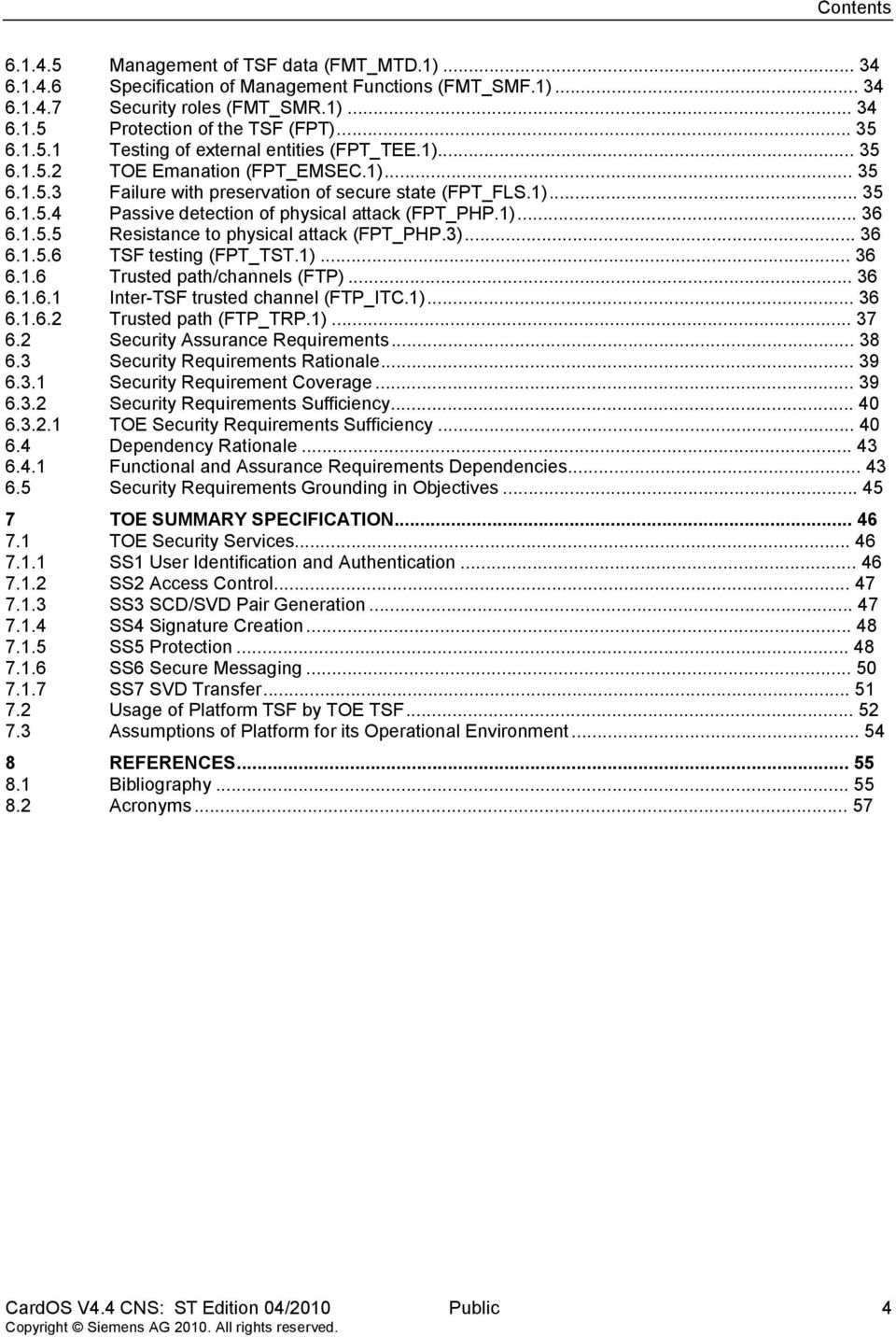
4 Contents Management of TSF data (FMT_MTD.1) Specification of Management Functions (FMT_SMF.1) Security roles (FMT_SMR.1) Protection of the TSF (FPT) Testing of external entities (FPT_TEE.1) TOE Emanation (FPT_EMSEC.1) Failure with preservation of secure state (FPT_FLS.1) Passive detection of physical attack (FPT_PHP.1) Resistance to physical attack (FPT_PHP.3) TSF testing (FPT_TST.1) Trusted path/channels (FTP) Inter-TSF trusted channel (FTP_ITC.1) Trusted path (FTP_TRP.1) Security Assurance Requirements Security Requirements Rationale Security Requirement Coverage Security Requirements Sufficiency TOE Security Requirements Sufficiency Dependency Rationale Functional and Assurance Requirements Dependencies Security Requirements Grounding in Objectives TOE SUMMARY SPECIFICATION TOE Security Services SS1 User Identification and Authentication SS2 Access Control SS3 SCD/SVD Pair Generation SS4 Signature Creation SS5 Protection SS6 Secure Messaging SS7 SVD Transfer Usage of Platform TSF by TOE TSF Assumptions of Platform for its Operational Environment REFERENCES Bibliography Acronyms CardOS V4.4 CNS: ST Edition 04/2010 Public 4
5 Contents Document History Version Release Date Changed Chapter(s) Remarks Author Sent to Receiver on Date First version Ulrike Ludwig Siemens (with effects on Cover Page and Footer), 1.2, 1.3, 1.4, 4.3.1, and editorial changes (typos) , table 8 7.2, table and , 1.5 (deleted), , 7.2, , 3.3, 4.2, 4.3, 8.3 Changes according to section 5.11 of SER Version 0.7 (CardOSv4.4-ETR- Part_ASE_v0.7.doc) Dependencies update Platform SFRs versus TOE SFRs (RP and IP) Additions in 7.2 Addition of 7.3 Editorial updates Update of Lifecycle security Update of table 12 Editorial changes, corrections within table 1 Editorial changes, corrections within table 1, moved FCS_COP.1 (RSA) and FCS_CKM.1 (RSA) from table 10 to table 11, renaming of keygen algorithm, added OSP and OE, added section 8.3 Glossary Ulrike Ludwig, Andreas Furch, Siemens Ulrike Ludwig Ulrike Ludwig Ulrike Ludwig Andreas Furch, Siemens Andreas Furch, Siemens Dr. Alla Gnedina, Evaluator, T-Systems Dr. Alla Gnedina, Evaluator, T-Systems on Dr. Alla Gnedina, Evaluator, T-Systems on Dr. Alla Gnedina, Evaluator, T-Systems on Dr. Alla Gnedina, Evaluator, T-Systems on Dr. Alla Gnedina, Dr. Igor Furgel, Evaluator, T-Systems on Dr. Igor Furgel, Dr. Alla Gnedina, Evaluator, T- Systems, CardOS V4.4 CNS: ST Edition 04/2010 Public 5

6 ST Introduction 1 ST Introduction 1.1 ST Reference Title: Security Target CardOS V4.4 CNS with Application for QES Authors: Siemens AG, H SR CRM IPD CC Version: 3.1, Revision 2 General Status: Draft Version Number: 0.70, ( ) The TOE is based on the Infineon chip SLE66CX680PE as ICC platform, which requires a composite evaluation. This ST provides an introduction, in this section, the conformance claims in section 2, the security problem definition in section 3, the security objectives in section 4, the extended components definition in section 5 the security and assurance requirements in section 6, the TOE summary specification (TSS) in section 7, the references in section TOE Reference The TOE CardOS V4.4 CNS with Application for QES Version 1.00 is based on the Infineon chip SLE66CX680PE (m1534-a14) as ICC platform, which is loaded by the chip manufacturer with the operating system CardOS V4.4. The hardware and the software of the TOE is determined by the components listed within Table 1. The Trustcenter afterwards personalizes the chipcard with an Application for Qualified Electronic Signatures (QES). The operating system CardOS V4.4 has the version identifier C80D. The TOE may additionally be identified by its factory key values, the historical bytes in the default ATR and the responses to the version dependent GET DATA modes. The Application for QES can be personalized in three different ways, which are named Pre-loaded variant 1, Pre-loaded variant 2 and Post-loaded variant. These variants are determined through the use of the appropriate personalization scripts (cf. Table 1, row 2) or through other personalization processes that guarantee the same result. 1.3 TOE Overview TOE type The TOE as defined by this Composite Security Target is a smart card. It is to be used as a Secure Signature Creation Device (SSCD Type 3). The smart card is based on an Infineon Chip. Usage and major security features of the TOE CardOS V4.4 CNS: ST Edition 04/2010 Public 6

7 ST Introduction The TOE allows to generate cryptographically strong Signatures over previously and externally calculated hash-values. The TOE generates the signature key pair (SCD/SVD) and ensures that the Signature Verification Data (SVD, i.e. public key) is protected from modification and insertion errors during export. The TOE is able to protect the secrecy of the internally generated and stored Signature Creation Data (SCD, i.e. secret key) and restricts the usage access to the authorised Signatory only. The restriction on the access to the secret key is done via the well-known PIN authentication mechanism. Required non-toe hardware/software/firmware The TOE is realized as a smart card conforming to ISO 7816 that needs the usual IT environment for such smart cards, i.e. at least a smart card terminal connected to a host equipped with software that is able to communicate with the terminal. As the TOE is conformant to certain laws and regulations concerning qualified electronic signatures, the IT environment may have to be conformant to the same laws and regulations as well if they are applicable for the intended usage. 1.4 TOE Description The TOE is a secure signature-creation device (SSCD) according to Directive 1999/93/ec of the European parliament and of the council of 13 December 1999 on a Community framework for electronic signatures [1]. The TOE consists of i) configured software (OS, packages and signature application) ii) the underlying hardware (SLE66CX680PE from Infineon) used to implement the secure signature-creation device (SSCD) and iii) the pertaining guidance documentation Administrator Guidance CardOS V4.4 CNS [22], and User Guidance CardOS V4.4 CNS [31]. Therefore the TOE is considered to be a product. The TOE developer delivers the ROM mask, script-files and pertaining documentation. The CA (certification authority) or entities acting under the CA policy initialize and personalize the TOE. The TOE utilises the evaluation of the underlying platform, which includes the Infineon chip SLE66CX680PE, the IC Dedicated Software and the RSA2048 crypto library V1.5. The chip is certified for the production site Dresden in Germany (production line indicator 2 ) (cf [18], Certification Report BSI-DSZ-CC for SLE66CX680PE / m1534-a14, SLE66CX360PE / m1536- a14, SLE66CX482PE / m1577-a14, SLE66CX480PE / m1565-a14, SLE66CX182PE / m1564-a14, all optional with RSA 2048 V1.5, and all with specific IC dedicated software from Infineon Technologies AG, 27.Mai 2008, Bundesamt für Sicherheit in der Informationstechnik (BSI)). Other production sites that will be added in the future via Maintenance Reports published by the BSI are also possible. Table 1: Components of the TOE No. Type Term Version Date Form of delivery 1 2 Software (Operating System) V4.4 Software Application Digital Signature (Application / Data Structure) CardOS V4.4 C80D Pre-loaded variant 1: V44_InitScript_1.csf V44_InitScript_1_DF_DS_x.csf V44_CAScript_1.csf V44_CAScript_1_DF_DS_x.csf V44_PersScript_1.csf V44_PersScript_1_DF_DS_x.csf V44_RAScript_1.csf V44_RAScript_1_DF_DS_x.csf The final versions of these files will be defined at the end of the evaluation loaded in ROM / EEPROM Personalization Script Files in CSF format, after whose execution the CardOS V4.4 CNS: ST Edition 04/2010 Public 7

8 ST Introduction No. Type Term Version Date Form of delivery Pre-loaded variant 2: V44_InitScript_2.csf V44_InitScript_2_DF_DS_x.csf V44_CAScript_2.csf V44_CAScript_2_DF_DS_x.csf and will be listed in the ADS will be loaded in EEPROM V44_CaScript_2_DF_DS_x_cert.csf V44_PersScript_2.csf V44_PersScript_2_DF_DS_x.csf V44_RAScript_2.csf V44_RAScript_2_DF_DS_x.csf Post-loaded variant: V44_InitScript_Post.csf V44_LRAScript_Post.csf V44_LRAScript_Post_DF_DS_x.csf All variants: V44_Default.csf certification report 3 Service Package (mandatory) Service Package Software Command_Set_ Extension Package (mandatory) Software CNS Package (mandatory) Software SISS Package (optional) CommandSet_Ext_Package CNS Package SISS Package The final versions of these files will be defined at the end of the evaluation Personalization Script Files in CSF format, after whose execution the resp. code will be loaded in EEPROM (included in Init_Scripts) 7 Software SHA-2 Package (optional) SHA-2 Package and will be listed in the 8 Software SSCR Package Technical SSCR_Tech_Package certification report 9 Software SSCR Package Organizational SSCR_Org_Package 10 Documentation CardOS License Package Tool Manual / Documentation CardOS V4.2B User s Manual / Documentation CardOS V4.4 Packages & Release Notes 13 Documentation CardOS V4.4 CNS, SISS, SSCR Packages & Release Notes 14 Admin Documentation CardOS V4.4 CNS Administrator Guidance 15 User Documentation CardOS V4.4 CNS User Guidance The final versions of these documents will be defined at the end of the evaluation and listed in the certification report Personalization Script Files in CSF format (code only temporarily in EEPROM) Paper form or PDF-File CardOS V4.4 CNS: ST Edition 04/2010 Public 8
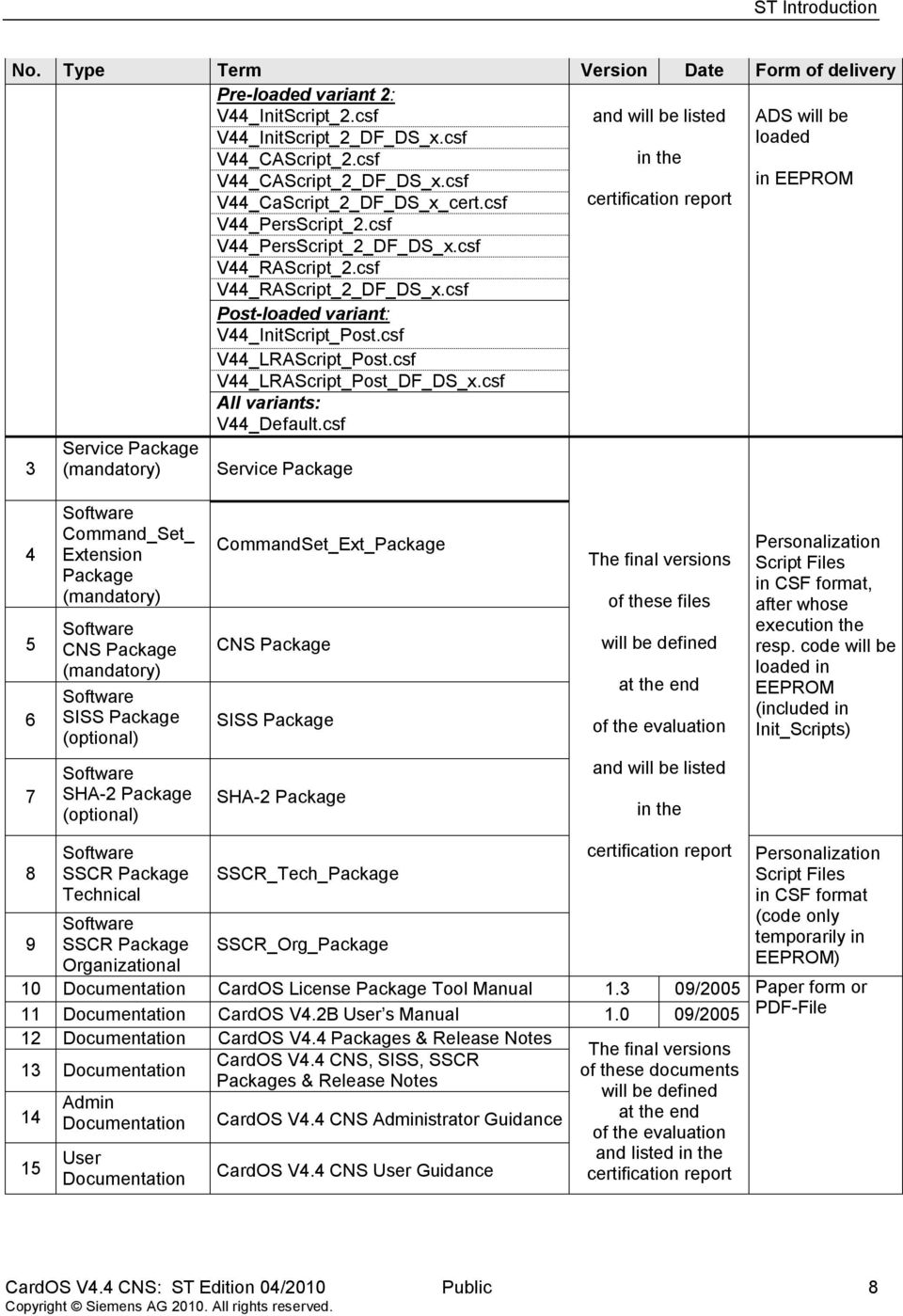
9 ST Introduction No. Type Term Version Date Form of delivery ADS Documentation Hardware (Chip) CardOS V4.4 CNS ADS_Description Infineon SLE66CX680PE m1534-a14 (Dresden) Firmware RMS RMS RMS V2.5 Software crypto library Module Stored in reserved area of User ROM RSA2048 crypto library Version 1.5 Loaded in ROM 18 Firmware STS Self Test Software V55.0B.07 Stored in Test ROM The TOE provides the following functions necessary for devices involved in creating qualified electronic signatures: (1) to generate the SCD and the correspondent signature-verification data (SVD) and (2) to create qualified electronic signatures (a) after allowing for the data to be signed (DTBS) to be (i) displayed correctly and (ii) hashed with appropriate hash functions that are, according to Algorithms and parameters for algorithms, list of algorithms and parameters eligible for electronic signatures, procedures as defined in the directive 1999/93/EC, article 9 on the Electronic Signature Committee in the Directive [4] agreed as suitable for qualified electronic signatures, where the display and hash functions are provided by the TOE environment (b) after appropriate authentication of the signatory by the TOE. (c) using appropriate cryptographic signature function that employs appropriate cryptographic parameters agreed as suitable according to Algorithms and parameters for algorithms, list of algorithms and parameters eligible for electronic signatures, procedures as defined in the directive 1999/93/EC, article 9 on the Electronic Signature Committee in the Directive [4]. The TOE implements all IT security functionality which is necessary to ensure the secrecy of the SCD. To prevent the unauthorised usage of the SCD the TOE provides user authentication and access control. The interface for the user authentication is provided by the trusted TOE environment. The TOE protects the SCD during the whole life cycle as to be solely used in the signature-creation process by the legitimate signatory. The TOE will be initialised for the signatory s use by (1) generating a SCD/SVD pair (2) personalisation for the signatory by means of the signatory s verification authentication data (VAD). The SVD corresponding to the signatory s SCD will be included in the certificate of the signatory by the certificate-service-provider (CSP). The human interface for user authentication is implemented in the trusted TOE environment and used for the input of VAD for authentication by knowledge. The TOE holds RAD to check the provided VAD. Figure 1 shows the ST scope from the structural perspective. The TOE comprises the underlying hardware, the operating system (OS), the SCD/SVD generation, SCD storage and use, and signature-creation functionality. The SCA and the CGA (and possibly other applications) are part of the immediate environment of the TOE. They communicate with the TOE via a trusted path or trusted channel, whenever authenticity, and/or confidentiality of the transferred data is required. CardOS V4.4 CNS: ST Edition 04/2010 Public 9
10 ST Introduction Immediate environment Human interface I/O Network interface SCA CGA Other application Communication Channel Communication Channel Trusted environment Signature creation SCD/SVD generation SCD storage and use SSCD Operating system Hardware Figure 1: Scope of the SSCD, structural view The contact based physical interface of the TOE is provided by a connection according to ISO 7816 part 3 [12]. This interface is used to transmit an APDU command to the TOE and receive the corresponding response APDU from the TOE as specified in ISO 7816 part 4 [13] and part 8 [14]. The TOE life cycle is shown in Figure 2. Basically, it consists of a development phase and the operational phase. This document refers to the operational phase which starts with personalisation including SCD/SVD generation. This phase represents installation, generation, and start-up in the CC terminology. After fabrication, the TOE is initialised and personalised for the signatory, i.e. the SCD/SVD key pair is generated and the RAD used for authentication of the signatory is imported. The main functionality in the usage phase is signature-creation including supporting functionality like secure SCD storage and use. The TOE protects the SCD during the relevant life cycle phases. Only the legitimate signatory can use the SCD for signature-creation by means of user authentication and access control. The SVD corresponding to the signatory s SCD will be included in the certificate of the signatory by the certificate-service provider (CSP). The life cycle ends with the life cycle phase DEATH in which the SCD is permanently blocked. CardOS V4.4 CNS: ST Edition 04/2010 Public 10
![7816 part 3 [12]. This interface is used to transmit an APDU command to the TOE and receive the corresponding response APDU from the TOE as specified in ISO 7816 part 4 [13] and part 8 [14].](/docs-images/43/4019060/images/page_10.jpg "The TOE life cycle is shown in Figure 2. Basically, it consists of a development phase and the operational phase.")
11 ST Introduction Design Fabrication Initialisation HW design OS design Application design HW fabrication OS and application implementation Loading of general application data Development phase Personalisation Usage Death SCD/SVD generation, VAD import Signature-creation TOE blocked Operational phase Figure 2: SSCD life cycle CardOS V4.4 CNS: ST Edition 04/2010 Public 11

12 Conformance claims 2 Conformance claims The TOE is a composite product, as it is based on the Infineon Security Controller SLE66CX680PE, which has been evaluated and certified as being conformant to the Common Criteria version 2.3, CC Part 2 extended, and CC Part 3 conformant (cf. [18]). As required by AIS36 [29] compatibility between this Composite Security Target and the Platform Security Target [23] of the Infineon chip SLE66CX680PE is claimed.. A In section 7.2, Usage of Platform TSF by TOE TSF a detailed mapping shows how the Platform TSF are separated into i) relevant Platform TSF (Table 10) being used by the composite ST and ii) irrelevant Platform TSF (Table 11) not being used by the composite ST. 2.1 CC conformance claim This ST claims conformance to the Common Criteria version 3.1 Release 2, cf. [8], [9], and [10]. The ST is CC Part 2 [9] extended, CC Part 3 [10] conformant and the assurance level for this ST is EAL4 augmented. The short terms for Common Criteria version 3.1 Release 2, Part 1, Part 2 and Part 3 and for the Common Methodology for Information Technology Security Evaluation, version 3.1 used in this document are CC-3.1-P1, CC-3.1-P2, CC-3.1-P3, and CEM-3.1 respectively. For the evaluation the following methodology will be used: Common Methodology for Information Technology Security Evaluation, Evaluation Methodology, Version 3.1, Revision 2, September 2007, CCMB PP claim, Package claim This Security Target claims strict conformance to the following protection profile: Protection Profile Secure Signature-Creation Device (SSCD-PP) Type 3, Version 1.05, CWA 14169:2002 (E), , [16] The short term for this protection profile used in this document is SSCD-PP-T3. The SSCD-PP-T3 has been evaluated and certified as being conformant to the Common Criteria version 2.1 [26], CC Part 2 [27] extended, and CC Part 3 [28] conformant. The assurance level for the SSCD-PP-T3 and therefore for the TOE is EAL4 augmented. Augmentation results from the selection of: AVA_VAN.5 Vulnerability Assessment - Advanced Methodical Vulnerability Analysis Highly resistant As the CC versions of this security target and of the SSCD-PP-T3, which it claims strict conformance to, differ in the major versions, 3.1 and 2.1 respectively, the contents of the SSCD-PP-T3 is completely included in this security target. Where changes are necessary they will be commented. For details cf. section 6.1 Security Functional Requirements and section 6.2 Security Assurance Requirements. CardOS V4.4 CNS: ST Edition 04/2010 Public 12
![As required by AIS36 [29] compatibility between this Composite Security Target and the Platform Security Target [23] of the Infineon chip SLE66CX680PE is claimed.. A In section 7.](/docs-images/43/4019060/images/page_12.jpg "2, Usage of Platform TSF by TOE TSF a detailed mapping shows how the Platform TSF are separated into i) relevant Platform TSF (Table 10) being used by the composite ST and ii) irrelevant Platform TSF")
13 Conformance claims The evaluation is a composite evaluation and uses the results of the chips CC evaluation provided by [18]. The IC with its primary embedded software is evaluated at level EAL 5 with a minimum strength level for its security functions of SOF-high. The chip SLE66CX680PE is conformant to the Smartcard IC Platform Protection Profile (SSVG-PP), Version 1.0, July 2001; registered and certified by Bundesamt für Sicherheit in der Informationstechnik (BSI) under the reference BSI-PP , [17] Refinements concerning SSCD-PP-T3 were made for the following Security Functional Requirements: FDP_ACF.1 / Signature Creation SFP (cf. section ): The set of rules that explicitly deny access to the controlled objects (stated within element FDP_ACF.1.4 / Signature Creation SFP) are completed to prevent any ambiguity. Within the following SFRs the term List of approved algorithms and parameters as given by [16] is specified more precisely by stating the concrete list of standards: FCS_CKM.1.1 (cf. section ) FCS_COP.1.1 / Corresp (cf. section ) FCS_COP.1.1 / Signing (cf. section ) Due to CC-3.1-P2 [9] the Functional Security Requirement FMT_SMF.1 (cf ) has been added as a direct dependency from FMT_MOF.1 and FMT. CardOS V4.4 CNS: ST Edition 04/2010 Public 13
14 Conformance claims 2.3 Conformance Rationale PP Claims Rationale According to section 2.2 this Security Target claims strict conformance to the Protection Profile Secure Signature-Creation Device (SSCD-PP) Type 3, [16]. The sections of this document, where threats, objectives and security requirements are defined, clearly state, which of these items are taken from the Protection Profile and which are added in this ST (cf. also sections 3, 4, and 6). Therefore this is not repeated here. In addition the items added in this Security Target do not contradict the items included in the Protection Profile. The operations done for the SFRs taken from the SSCD-PP-T3 are also clearly indicated. The assurance level claimed for this target (EAL4+, shown in section 2 and 6.2) meets the requirements claimed by the SSCD-PP-T3 (EAL4+). These considerations show that the Security Target correctly claims conformance to the SSCD-PP-T Rationale for Assurance Level 4 Augmented The assurance level for this security target is EAL4 augmented. It is exactly the same package claim that holds for the protection profile SSCD-PP-T3. EAL4 allows a developer to attain a reasonably high assurance level without the need for highly specialized processes and practices. It is considered to be the highest level that could be applied to an existing product line without undue expense and complexity. As such, EAL4 is appropriate for commercial products that can be applied to moderate to high security functions. The TOE described in this security target is just such a product. Augmentation results from the selection of: AVA_VAN.5 Vulnerability Assessment - Advanced Methodical Vulnerability Analysis Highly resistant To allow the evaluator an advanced methodical vulnerability analysis and the required penetration testing the developer has to provide the following items: the Security Target, the functional specification, the TOE design, the security architecture description, the implementation representation, the guidance documentation, and the TOE suitable for testing The TOE shall be shown to be highly resistant to penetration attacks to meet the security objectives OT.SCD_Secrecy, OT.Sigy_SigF and OT.Sig_Secure. AVA_VAN.5 has the following dependencies ADV_ARC.1 Security Architecture Description, ADV_FSP.2 Security Enforcing Functional Specification, ADV_TDS.3 Basic Modular Design, ADV_IMP.1 Implementation Representation AGD_OPE.1 Operational User Guidance, AGD_PRE.1 Preparative Procedures All of these are met or exceeded in the EAL4 assurance package. CardOS V4.4 CNS: ST Edition 04/2010 Public 14
15 Security Problem Definition 3 Security Problem Definition This chapter defines the assets, subjects and threat agents used for the definition of the assumptions, threat and organisational security policies in the following subsections. Assets: 1. SCD: private key used to perform an electronic signature operation (confidentiality of the SCD must be maintained). 2. SVD: public key linked to the SCD and used to perform an electronic signature verification (integrity of the SVD when it is exported must be maintained). 3. DTBS and DTBS-representation: set of data, or its representation which is intended to be signed (Their integrity must be maintained during transmission to the TOE). 4. VAD: PIN, PUK and Transport PIN code entered by the End User to perform a signature operation resp. the changing and unblocking of the PIN (confidentiality and authenticity of the VAD as needed by the authentication method employed) 1 5. RAD: Reference PIN, PUK and Transport PIN code used to identify and authenticate the End User (integrity and confidentiality of RAD must be maintained) 2 6. Signature-creation function of the SSCD using the SCD: (The quality of the function must be maintained so that it can participate in the legal validity of electronic signatures) 7. Electronic signature: (Unforgeability of electronic signatures must be assured). Subjects: Subjects S.User S.Admin S.Signatory Threat agents: S.OFFCARD Definition End user of the TOE which can be identified as S.Admin or S.Signatory User who is in charge to perform the TOE initialisation, TOE personalisation or other TOE administrative functions. User who holds the TOE and uses it on his own behalf or on behalf of the natural or legal person or entity he represents. Attacker. A human or a process acting on his behalf being located outside the TOE. The main goal of the S.OFFCARD attacker is to access Application sensitive information. The attacker has a high level attack potential and knows no secrets. Application note: Throughout this document and the evaluation documentation the following synonyms will be used: Subjects and Threat agents defined in the SSCD-PP-T3 [16] S.User S.Admin S.Signatory S.OFFCARD Synonyms used in this evaluation User Administrator Signatory Attacker 1 2 The TOE does not support biometric authentication. Therefore the authors changed this asset definition by deleting the term biometric data, see also section 3 [16]. The TOE does not support biometric authentication. Therefore the authors changed this asset definition by deleting the term biometric authentication references, see also section 3 [16]. CardOS V4.4 CNS: ST Edition 04/2010 Public 15
16 Security Problem Definition 3.1 Assumptions A.CGA Trustworthy certification-generation application The CGA protects the authenticity of the Signatory s name and the SVD in the qualified certificate by an advanced signature of the CSP. A.SCA Trustworthy signature-creation application The Signatory uses only a trustworthy SCA. The SCA generates and sends the DTBS-representation of data the Signatory wishes to sign in a form appropriate for signing by the TOE. 3.2 Threats to Security T.Hack_Phys Physical attacks through the TOE interfaces An attacker interacts with the TOE interfaces to exploit vulnerabilities, resulting in arbitrary security compromises. This threat addresses all the assets. T.SCD_Divulg Storing, copying, and releasing of the signature-creation data An attacker can store, copy, the SCD outside the TOE. An attacker can release the SCD during generation, storage and use for signature-creation in the TOE. T.SCD_Derive Derive the signature-creation data An attacker derives the SCD from public known data, such as SVD corresponding to the SCD or signatures created by means of the SCD or any other data communicated outside the TOE, which is a threat against the secrecy of the SCD. T.Sig_Forgery Forgery of the electronic signature An attacker forges the signed data object maybe together with its electronic signature created by the TOE and the violation of the integrity of the signed data object is not detectable by the signatory or by third parties. The signature generated by the TOE is subject to deliberate attacks by experts possessing a high attack potential with advanced knowledge of security principles and concepts employed by the TOE. T.Sig_Repud Repudiation of signatures If an attacker can successfully threaten any of the assets, then the non repudiation of the electronic signature is compromised. This results in the signatory being able to deny having signed data using the SCD in the TOE under his control even if the signature is successfully verified with the SVD contained in his un-revoked certificate. T.SVD_Forgery Forgery of the signature-verification data An attacker forges the SVD presented by the TOE to the CGA. This result in loss of SVD integrity in the certificate of the signatory. CardOS V4.4 CNS: ST Edition 04/2010 Public 16

17 Security Problem Definition T.DTBS_Forgery Forgery of the DTBS-representation An attacker modifies the DTBS-representation sent by the SCA. Thus the DTBS-representation used by the TOE for signing does not match the DTBS the signatory intended to sign T.SigF_Misuse Misuse of the signature-creation function of the TOE An attacker misuses the signature-creation function of the TOE to create SDO for data the signatory has not decided to sign. The TOE is subject to deliberate attacks by experts possessing a high attack potential with advanced knowledge of security principles and concepts employed by the TOE. 3.3 Organisational Security Policies P.CSP_QCert Qualified certificate The CSP uses a trustworthy CGA to generate the qualified certificate for the SVD generated by the SSCD. The qualified certificate contains at least the elements defined in Annex I of the Directive [1], i.e., inter alia the name of the signatory and the SVD matching the SCD implemented in the TOE under sole control of the signatory. The CSP ensures that the use of the TOE is evident with signatures through the certificate or other publicly available information. P.QSign Qualified electronic signatures The signatory uses a signature-creation system to sign data with qualified electronic signatures. The DTBS are presented to the signatory by the SCA. The qualified electronic signature is based on a qualified certificate (according to Annex I of the Directive [1]) and is created by a SSCD. P.Sigy_SSCD TOE as secure signature-creation device The TOE implements the SCD used for signature creation under sole control of the signatory. The SCD used for signature generation can practically occur only once. P.Env_KeyGen* Environment for key generation Generation of the SCD/SVD key pair only takes place during initialisation/personalisation within a trusted environment. *Comment: This OSP is not part of the SSCD-PP-T3 but has been added by the ST. CardOS V4.4 CNS: ST Edition 04/2010 Public 17

18 Security Objectives 4 Security Objectives This section identifies and defines the security objectives for the TOE and its environment. Security objectives reflect the stated intent and counter the identified threats, as well as comply with the identified organisational security policies and assumptions. This section has been taken from [16] with some necessary modifications. 4.1 Security Objectives for the TOE OT.EMSEC_Design Provide physical emanations security Design and build the TOE in such a way as to control the production of intelligible emanations within specified limits. OT.Lifecycle_Security Lifecycle security The TOE shall detect flaws during the initialisation, personalisation and operational usage. The TOE shall provide safe destruction techniques for the SCD in case of re-generation. OT.SCD_Secrecy Secrecy of the signature-creation data The secrecy of the SCD (used for signature generation) is reasonably assured against attacks with a high attack potential. OT.SCD_SVD_Corresp Correspondence between SVD and SCD The TOE shall ensure the correspondence between the SVD and the SCD. The TOE shall verify on demand the correspondence between the SCD stored in the TOE and the SVD if it has been sent to the TOE. OT.SVD_Auth_TOE TOE ensures authenticity of the SVD The TOE provides means to enable the CGA to verify the authenticity of the SVD that has been exported by that TOE. OT.Tamper_ID Tamper detection The TOE provides system features that detect physical tampering of a system component, and uses those features to limit security breaches. OT.Tamper_Resistance Tamper resistance The TOE prevents or resists physical tampering with specified system devices and components. OT.Init SCD/SVD generation The TOE provides security features to ensure that the generation of the SCD and the SVD is invoked by authorised users only. OT.SCD_Unique Uniqueness of the signature-creation data The TOE shall ensure the cryptographic quality of the SCD/SVD pair for the qualified electronic signature. The SCD used for signature generation can practically occur only once and cannot be reconstructed from the SVD. In that context practically occur once means that the probability of equal SCDs is negligibly low. CardOS V4.4 CNS: ST Edition 04/2010 Public 18
![This section has been taken from [16] with some necessary modifications. 4.1 Security Objectives for the TOE OT.](/docs-images/43/4019060/images/page_18.jpg "EMSEC_Design Provide physical emanations security Design and build the TOE in such a way as to control the production of intelligible emanations within specified limits. OT.")
19 Security Objectives OT.DTBS_Integrity_TOE Verification of the DTBS-representation integrity The TOE shall verify that the DTBS-representation received from the SCA has not been altered in transit between the SCA and the TOE. The TOE itself shall ensure that the DTBS-representation is not altered by the TOE as well. Note that this does not conflict with the signature-creation process where the DTBS itself could be hashed by the TOE. OT.Sigy_SigF Signature generation function for the legitimate signatory only The TOE provides the signature generation function for the legitimate signatory only and protects the SCD against the use of others. The TOE shall resist attacks with high attack potential. OT.Sig_Secure Cryptographic security of the electronic signature The TOE generates electronic signatures that can not be forged without knowledge of the SCD through robust encryption techniques. The SCD cannot be reconstructed using the electronic signatures. The electronic signatures shall be resistant against these attacks, even when executed with a high attack potential. CardOS V4.4 CNS: ST Edition 04/2010 Public 19
20 Security Objectives 4.2 Security Objectives for the Operational Environment OE.CGA_QCert Generation of qualified certificates The CGA generates qualified certificates which include inter alia (a) the name of the signatory controlling the TOE, (b) the SVD matching the SCD implemented in the TOE under sole control of the signatory, (c) the advanced signature of the CSP. OE.SVD_Auth_CGA CGA verifies the authenticity of the SVD The CGA verifies that the SSCD is the sender of the received SVD and the integrity of the received SVD. The CGA verifies the correspondence between the SCD in the SSCD of the signatory and the SVD in the qualified certificate. OE.HI_VAD Protection of the VAD If an external device provides the human interface for user authentication, this device will ensure confidentiality and integrity of the VAD as needed by the authentication method employed. OE.SCA_Data_Intend Data intended to be signed The SCA (a) generates the DTBS-representation of the data that has been presented as DTBS and which the signatory intends to sign in a form which is appropriate for signing by the TOE, (b) sends the DTBS-representation to the TOE and enables verification of the integrity of the DTBS-representation by the TOE and (c) attaches the signature produced by the TOE to the data or provides it separately. OE.Env_KeyGen* Generation of SCD/SVD key pairs Generation of the SCD/SVD key pair is only started by the Administrator during initialisation/personalisation within a trusted environment. *Comment: This OE is not part of the SSCD-PP-T3 but has been added by the ST. CardOS V4.4 CNS: ST Edition 04/2010 Public 20

21 Security Objectives 4.3 Security Objectives Rationale Security Objectives Coverage Table 2: Security Environment to Security Objectives Mapping Threats Assumptions - Policies / Security objectives OT.EMSEC_Design OT.Lifecycle_Security OT.Init OT.SCD_Secrecy OT.SCD_SVD_Corresp OT.SVD_Auth_TOE OT.Tamper_ID x OT.Tamper_Resistance OT.SCD_Unique OT.DTBS_Integrity_TOE OT.Sigy_SigF OT.Sig_Secure OE.CGA_QCert OE.SVD_Auth_CGA OE.HI_VAD OE.SCA_Data_Intend OE.Env_KeyGen T.Hack_Phys x x x x T.SCD_Divulg T.SCD_Derive x x x T.SVD_Forgery x x T.DTBS_Forgery x x T.SigF_Misuse x x x x T.Sig_Forgery x x x x x x x x x x x T.Sig_Repud x x x x x x x x x x x x x x A.CGA x x A.SCA P.CSP_QCert x x P.QSign x x x x P.Sigy_SSCD x x x P.Env_KeyGen x x x CardOS V4.4 CNS: ST Edition 04/2010 Public 21
22 Security Objectives Security Objectives Sufficiency Policies and Security Objective Sufficiency P.CSP_QCert (CSP generates qualified certificates) establishes the qualified certificate for the signatory and provides that the SVD matches the SCD that is implemented in the SSCD under sole control of this signatory. P.CSP_QCert is addressed by the TOE by OT.SCD_SVD_Corresp concerning the correspondence between the SVD and the SCD and in the TOE IT environment by OE.CGA_QCert for generation of qualified certificates by the CGA, respectively. P.QSign (Qualified electronic signatures) provides that the TOE and the SCA may be employed to sign data with qualified electronic signatures, as defined by the Directive [1], article 5, paragraph 1. Directive [1], recital (15) refers to SSCDs to ensure the functionality of advanced signatures. The requirement of qualified electronic signatures being based on qualified certificates is addressed by OE.CGA_QCert. OE.SCA_Data_Intend ensures that the SCA presents the DTBS to the signatory and sends the DTBS-representation to the TOE. OT.Sig_Secure and OT.Sigy_SigF address the generation of advanced signatures by the TOE. P.Sigy_SSCD (TOE as secure signature-creation device) establishes the TOE as secure signaturecreation device of the signatory with practically unique SCD. This is addressed by OT.Sigy_SigF ensuring that the SCD is under sole control of the signatory and OT.SCD_Unique ensuring the cryptographic quality of the SCD/SVD pair for the qualified electronic signature. OT.Init provides that generation of the SCD/SVD pair is restricted to authorised users. P.Env_KeyGen (Environment for key generation) provides that the SCD/SVD key pair is only generated during initialisation/personalisation within a trusted environment. This is obviously assured by OE.Env_KeyGen and supported by the TOE through OT.Init Threats and Security Objective Sufficiency T.Hack_Phys (Exploitation of physical vulnerabilities) deals with physical attacks exploiting physical vulnerabilities of the TOE. OT.SCD_Secrecy preserves the secrecy of the SCD. Physical attacks through the TOE interfaces or observation of TOE emanations are countered by OT.EMSEC_Design. OT.Tamper_ID and OT.Tamper_Resistance counter the threat T.Hack_Phys by detecting and by resisting tamper attacks. T.SCD_Divulg (Storing,copying, and releasing of the signature-creation data) addresses the threat against the legal validity of electronic signatures due to storage and copying of SCD outside the TOE, as expressed in the Directive [1], recital (18). This threat is countered by OT.SCD_Secrecy which assures the secrecy of the SCD used for signature generation. T.SCD_Derive (Derive the signature-creation data) deals with attacks on the SCD via public known data produced by the TOE. This threat is countered by OT.SCD_Unique that provides cryptographic secure generation of the SCD/SVD-pair. OT.Sig_Secure ensures cryptographic secure electronic signatures. T.DTBS_Forgery (Forgery of the DTBS-representation) addresses the threat arising from modifications of the DTBS-representation sent to the TOE for signing which then does not correspond to the DTBS-representation corresponding to the DTBS the signatory intends to sign. The TOE counters this threat by means of OT.DTBS_Integrity_TOE by verifying the integrity of the DTBS-representation. The TOE IT environment addresses T.DTBS_Forgery by means of OE.SCA_Data_Intend CardOS V4.4 CNS: ST Edition 04/2010 Public 22
23 Security Objectives T.SigF_Misuse (Misuse of the signature-creation function of the TOE) addresses the threat of misuse of the TOE signature-creation function to create SDO by others than the signatory or to create SDO for data the signatory has not decided to sign, as required by the Directive [1], Annex III, paragraph 1, literal (c). This threat is addressed by the OT.Sigy_SigF (Signature generation function for the legitimate signatory only), OE.SCA_Data_Intend (Data intended to be signed), OT.DTBS_Integrity_TOE (Verification of the DTBSrepresentation integrity), and OE.HI_VAD (Protection of the VAD) as follows: OT.Sigy_SigF ensures that the TOE provides the signature-generation function for the legitimate signatory only. OE.SCA_Data_Intend ensures that the SCA sends the DTBS-representation only for data the signatory intends to sign. The combination of OT.DTBS_Integrity_TOE and OE.SCA_Data_Intend counters the misuse of the signature generation function by means of manipulation of the channel between the SCA and the TOE. If the SCA provides the human interface for the user authentication, OE.HI_VAD provides confidentiality and integrity of the VAD as needed by the authentication method employed. T.Sig_Forgery (Forgery of the electronic signature) deals with non-detectable forgery of the electronic signature. This threat is in general addressed by OT.Sig_Secure (Cryptographic security of the electronic signature), OE.SCA_Data_Intend (SCA sends representation of data intended to be signed), OE.CGA_QCert (Generation of qualified certificates), OT.SCD_SVD_Corresp (Correspondence between SVD and SCD), OT.SVD_Auth_TOE (TOE ensures authenticity of the SVD), OE.SVD_Auth_CGA (CGA proves the authenticity of the SVD), OT.SCD_Secrecy (Secrecy of the signature-creation data), OT.EMSEC_Design (Provide physical emanations security), OT.Tamper_ID (Tamper detection), OT.Tamper_Resistance (Tamper resistance) and OT.Lifecycle_Security (Lifecycle security), as follows: OT.Sig_Secure ensures by means of robust encryption techniques that the signed data and the electronic signature are securely linked together. OE.SCA_Data_Intend provides that the methods used by the SCA (and therefore by the verifier) for the generation of the DTBS-representation are appropriate for the cryptographic methods employed to generate the electronic signature. The combination of OE.CGA_QCert, OT.SCD_SVD_Corresp, OT.SVD_Auth_TOE, and OE.SVD_Auth_CGA provides the integrity and authenticity of the SVD that is used by the signature verification process. OT.Sig_Secure, OT.SCD_Secrecy, OT.EMSEC_Design, OT.Tamper_Resistance, and OT.Lifecycle_Security ensure the confidentiality of the SCD implemented in the signatory s SSCD and thus prevent forgery of the electronic signature by means of knowledge of the SCD. T.Sig_Repud (Repudiation of electronic signatures) deals with the repudiation of signed data by the signatory, although the electronic signature is successfully verified with the SVD contained in his un-revoked certificate. This threat is in general addressed by OE.CGA_QCert (Generation of qualified certificates), OT.SVD_Auth_TOE (TOE ensures authenticity of the SVD), OE.SVD_Auth_CGA (CGA proves the authenticity of the SVD), OT.SCD_SVD_Corresp (Correspondence between SVD and SCD), OT.SCD_Unique (Uniqueness of the signature-creation data), OT.SCD_Secrecy (Secrecy of the signaturecreation data), OT.EMSEC_Design (Provide physical emanations security), OT.Tamper_ID (Tamper detection), OT.Tamper_Resistance (Tamper resistance), OT.Lifecycle_Security (Lifecycle security), OT.Sigy_SigF (Signature generation function for the legitimate signatory only), OT.Sig_Secure (Cryptographic security of the electronic signature), OE.SCA_Data_Intend (SCA sends representation of data intended to be signed) and OT.DTBS_Integrity_TOE (Verification of the DTBS-representation integrity). OE.CGA_QCert ensures qualified certificates which allow to identify the signatory and thus to extract the SVD of the signatory. OE.CGA_QCert, OT.SVD_Auth_TOE and OE.SVD_Auth_CGA ensure the integrity of the SVD. OE.CGA_QCert and OT.SCD_SVD_Corresp ensure that the SVD in the certificate correspond to the SCD that is implemented by the SSCD of the signatory. OT.SCD_Unique provides that the signatory s SCD can practically occur just once. OT.Sig_Secure, OT.SCD_Secrecy, OT.Tamper_ID, OT.Tamper_Resistance, OT.EMSEC_Design, and OT.Lifecycle_Security ensure the confidentiality of the SCD implemented in the signatory s SSCD. OT.Sigy_SigF provides that only the signatory may use the TOE for signature generation. OT.Sig_Secure ensures by means of robust cryptographic techniques that valid electronic signatures may only be generated by employing the SCD corresponding to the SVD that is used for signature verification and only for the signed data. CardOS V4.4 CNS: ST Edition 04/2010 Public 23
24 Security Objectives OE.SCA_Data_Intend and OT.DTBS_Integrity_TOE ensure that the TOE generates electronic signatures only for DTBS-representations which the signatory has decided to sign as DTBS. T.SVD_Forgery (Forgery of the signature-verification data) deals with the forgery of the SVD exported by the TOE to the CGA for the generation of the certificate. T.SVD_Forgery is addressed by OT.SVD_Auth_TOE which ensures that the TOE sends the SVD in a verifiable form to the CGA, as well as by OE.SVD_Auth_CGA which provides verification of SVD authenticity by the CGA Assumptions and Security Objective Sufficiency A.SCA (Trustworthy signature-creation application) establishes the trustworthiness of the SCA according to the generation of DTBS-representation. This is addressed by OE.SCA_Data_Intend (Data intended to be signed) which ensures that the SCA generates the DTBS-representation of the data that has been presented to the signatory as DTBS and which the signatory intends to sign in a form which is appropriate for being signed by the TOE. A.CGA (Trustworthy certification-generation application) establishes the protection of the authenticity of the signatory s name and the SVD in the qualified certificate by the advanced signature of the CSP by means of the CGA. This is addressed by OE.CGA_QCert (Generation of qualified certificates) which ensures the generation of qualified certificates and by OE.SVD_Auth_CGA (CGA proves the authenticity of the SVD) which ensures the verification of the integrity of the received SVD and the correspondence between the SVD and the SCD that is implemented by the SSCD of the signatory. CardOS V4.4 CNS: ST Edition 04/2010 Public 24
25 Extended Components Definition 5 Extended Components Definition The additional family FPT_EMSEC (TOE Emanation) of the Class FPT (Protection of the TSF) is defined in the Protection Profile Secure Signature-Creation Device (SSCD-PP) Type 3 [16], section 6.6. This ST does not define or use other extensions to CC-3.1-P2 [9]. 5.1 Rationale for Extensions The additional family FPT_EMSEC TOE Emanation was defined in the SSCD-PP-T3 [16]. The developer decided to inherit FPT_EMSEC TOE Emanation from [16]. The rationale for the extension is transferable and reproduced here for clarity reasons. The additional family FPT_EMSEC (TOE Emanation) of the Class FPT (Protection of the TSF) is defined here to describe the IT security functional requirements of the TOE. The TOE shall prevent attacks against the SCD and other secret data where the attack is based on externally observable physical phenomena of the TOE. Examples of such attacks are evaluation of TOE s electromagnetic radiation, simple power analysis (SPA), differential power analysis (DPA), timing attacks, etc. This family describes the functional requirements for the limitation of intelligible emanations. CardOS V4.4 CNS: ST Edition 04/2010 Public 25
26 Security Requirements 6 Security Requirements This chapter provides the security functional requirements and the security assurance requirements for the TOE. Security functional requirements components given in section 6.1 Security Functional Requirements (except FPT_EMSEC.1 which is explicitly stated) are drawn from Common Criteria part 2 [9]. Some security functional requirements represent extensions to [9]. Differences between the text of CC-3.1-P 2 [9] and the text of the SSCD-PP-T3 are marked by an asterisk (*) after the new text. All differences are commented directly underneath the respective SFR. Where operations for assignment, selection and refinement have been made, all these operations are typographically accentuated by underlining these passages (e.g. RSA). Where any of these operations have changed due to CC3.1-P2 this is commented directly underneath the respective SFR. Operations that were already carried out within the SSCD-PP-T3 [16] are only underlined (e.g. RSA), whereas those operations that are carried out or changed later on are underlined and also italicised, (e.g. RSA). The Security Requirements for the IT Environment defined by the SSCD-PP-T3 in section 5.3, are not in the scope of CC-3.1-P 2 [9]. The same holds for the Security Requirements for the Non-IT Environment defined by the SSCD-PP-T3 in section 5.4. The TOE security assurance requirements given in section 5.2 TOE Security Assurance Requirement are drawn from the security assurance components from Common Criteria part 3 [10]. As these SARs differ considerately from the SARs stated in the SSCD-PP-T3, it is shown in Table 5 of section 6.2 how the SARs from the SSCD-PP-T3 are covered by the SARs from CC-3.1-P3 [10]. The original text for the elements taken from CC3.1-P2 [9] for each in this ST performed operation is additionally stated in footnotes. 6.1 Security Functional Requirements Cryptographic support (FCS) Cryptographic key generation (FCS_CKM.1) FCS_CKM.1.1 The TSF shall generate cryptographic keys in accordance with a specified cryptographic key generation algorithm RSA Key Generator 3 and specified cryptographic key size 1024 bit 4 that meet the following: 1) Algorithms and parameters for algorithms, list of algorithms and parameters eligible for electronic signatures, procedures as defined in the directive 1999/93/EC, article 9 on the Electronic Signature Committee in the Directive [4] 5. Refinement: The already within [16] executed operation List of approved algorithms and parameters is replaced with the concrete statement of references [assignment: cryptographic key generation algorithm] [assignment: cryptographic key sizes] [assignment: list of standards] CardOS V4.4 CNS: ST Edition 04/2010 Public 26
27 Security Requirements Cryptographic key destruction (FCS_CKM.4) FCS_CKM.4.1 The TSF shall destroy cryptographic keys* in accordance with a specified cryptographic key destruction method key overwriting 6 that meets the following: none 7. * Comment (editorial): in case of regeneration of a new SCD from the SSCD-PP-T3 has been deleted. Application note: The cryptographic key SCD will be destroyed on demand of the Administrator. The destruction of the SCD is mandatory before the SCD/SVD pair is re-generated by the TOE. The SCD key data are physically overwritten when the new key is generated Cryptographic operation (FCS_COP.1) FCS_COP.1.1/ CORRESP FCS_COP.1.1/ SIGNING The TSF shall perform SCD / SVD correspondence verification 8 in accordance with a specified cryptographic algorithm RSA 9 and cryptographic key size 1024 bit 10 that meet the following: RSA and PKCS#1, v. 1.5, BT 1 [6] 11. The TSF shall perform digital signature-generation 8 in accordance with a specified cryptographic algorithm RSA 9 and cryptographic key size 1024 bit 10 that meet the following: (1) RSA and PKCS#1, v. 1.5, BT 1 [6] (2) Algorithms and parameters for algorithms, list of algorithms and parameters eligible for electronic signatures, procedures as defined in the directive 1999/93/EC, article 9 on the Electronic Signature Committee in the Directive [4] 11 Refinement: The already within [16] executed operation List of approved algorithms and parameters is replaced with the concrete statement of references User data protection (FDP) Subset access control (FDP_ACC.1) FDP_ACC.1.1/ Initialisation SFP The TSF shall enforce the Initialisation SFP 12 on generation of SCD/SVD pair by User 13. FDP_ACC.1.1/ Personalisation SFP The TSF shall enforce the Personalisation SFP 12 on creation of RAD by Administrator 13. FDP_ACC.1.1/ Signaturecreation SFP The TSF shall enforce the Signature-creation SFP 12 on 1. sending of DTBS-representation by SCA, 2. signing of DTBS-representation by Signatory [assignment: cryptographic key destruction method] [assignment: list of standards] [assignment: list of cryptographic operations] [assignment: cryptographic algorithm] [assignment: cryptographic key sizes] [assignment: list of standards] [assignment: access control SFP] [assignment: list of subjects, objects, and operations among subjects and objects covered by the SFP] CardOS V4.4 CNS: ST Edition 04/2010 Public 27
28 Security Requirements FDP_ACC.1.1/ SVD Transfer SFP The TSF shall enforce the SVD Transfer SFP 12 on export of SVD by User Security attribute based access control (FDP_ACF.1) The following table lists the subjects and objects controlled by the SFPs of section and the SFPrelevant security attributes: User, subject or object the attribute is associated with Attribute Status General attribute User Role Administrator, Signatory Initialisation attribute User SCD / SVD management authorised, not authorised Signature-creation attribute group SCD SCD operational no, yes DTBS sent by an authorised SCA no, yes Initialisation SFP FDP_ACF.1.1/ Initialisation SFP FDP_ACF.1.2/ Initialisation SFP FDP_ACF.1.3/ Initialisation SFP FDP_ACF.1.4/ Initialisation SFP Table 3: Security attributes of the different SFP The TSF shall enforce the Initialisation SFP 14 to objects based on the following*: General attribute and Initialisation attribute 15. The TSF shall enforce the following rules to determine if an operation among controlled subjects and controlled objects is allowed: The user with the security attribute role set to Administrator or set to Signatory and with the security attribute SCD / SVD management set to authorised is allowed to generate SCD/SVD pair 16. The TSF shall explicitly authorise access of subjects to objects based on the following additional rules: none 17. The TSF shall explicitly deny access of subjects to objects based on the* The user with the security attribute role set to Administrator or set to Signatory and with the security attribute SCD / SVD management set to not authorised is not allowed to generate SCD/SVD pair 18. * Comment:: ACF.1.1 (editorial) the following has been included in CC-3.1-P2. ACF.1.4 (editorial) rule from the SSCD-PP-T3 has been deleted. Application note: The generation of the SCD/SVD pair is only possible for the Administrator (restricted by SCD / SVD management. See also FMT_MSA.1.1 / Administrator). Personalisation SFP FDP_ACF.1.1/ The TSF shall enforce the Personalisation SFP 14 to objects based on the [assignment: access control SFP] [assignment: list of subjects and objects controlled under the indicated SFP, and for each, the SFP-relevant security attributes, or named groups of SFP-relevant security attributes] [assignment: rules governing access among controlled subjects and controlled objects using controlled operations on controlled objects] [assignment: rules, based on security attributes, that explicitly authorise access of subjects to objects] [assignment: rules, based on security attributes, that explicitly deny access of subjects to objects] CardOS V4.4 CNS: ST Edition 04/2010 Public 28
29 Security Requirements Personalisation SFP following*: General attribute 15. FDP_ACF.1.2/ Personalisation SFP FDP_ACF.1.3/ Personalisation SFP FDP_ACF.1.4/ Personalisation SFP The TSF shall enforce the following rules to determine if an operation among controlled subjects and controlled objects is allowed: User with the security attribute role set to Administrator is allowed to create the RAD 16. The TSF shall explicitly authorise access of subjects to objects based on the following additional rules: none 17. The TSF shall explicitly deny access of subjects to objects based on the none 18. * Comment:: ACF.1.1 (editorial) the following has been included in CC-3.1-P2. ACF.1.4 (editorial) rule from the SSCD-PP-T3 has been deleted. Signature-creation SFP FDP_ACF.1.1/ Signaturecreation SFP FDP_ACF.1.2/ Signaturecreation SFP FDP_ACF.1.3/ Signaturecreation SFP FDP_ACF.1.4/ Signaturecreation SFP The TSF shall enforce the Signature-creation SFP 14 to objects based on the following*: General attribute and Signature-creation attribute group 15. The TSF shall enforce the following rules to determine if an operation among controlled subjects and controlled objects is allowed: User with the security attribute role set to Signatory is allowed to create electronic signatures for DTBS sent by an authorised SCA with SCD by the Signatory which security attribute SCD operational is set to yes 16. The TSF shall explicitly authorise access of subjects to objects based on the following additional rules: none 17. The TSF shall explicitly deny access of subjects to objects based on the (a) User with the security attribute role set to Signatory is not allowed to create electronic signatures for DTBS which is not sent by an authorised SCA with SCD by the Signatory which security attribute SCD operational is set to yes. (b) User with the security attribute role set to Signatory is not allowed to create electronic signatures for DTBS sent by an authorised SCA with SCD by the Signatory which security attribute SCD operational is set to no. (c) User with the security attribute role set to Signatory is not allowed to create electronic signatures for DTBS not sent by an authorised SCA with SCD by the Signatory whose security attribute SCD operational is set to no. (d) User with the security attribute role set to Administrator is not allowed to create electronic signatures for any DTBS with SCD whose security attribute SCD operational is set to any status 18. * Comment:: ACF.1.1 (editorial) the following has been included in CC-3.1-P2. ACF.1.4 (editorial) rule from the SSCD-PP-T3 has been deleted. Application note: The corresponding TSFR of the SSCD-PP-T3 [16], section was refined for reasons of clarity regarding all possible combinations of relevant security attributes. The following table is added for additional support. CardOS V4.4 CNS: ST Edition 04/2010 Public 29
30 Security Requirements Administrator SCD operational Signatory SCD operational DTBS no yes no yes sent by an authorised SCA no not allowed 19 not allowed 19 not allowed 20 not allowed 21 sent by an authorised SCA yes not allowed 19 not allowed 19 not allowed 22 allowed 23 Table 4: Additional support for the refinement of Signature-creation SFP SVD Transfer FDP_ACF.1.1/ SVD Transfer SFP FDP_ACF.1.2/ SVD Transfer SFP FDP_ACF.1.3/ SVD Transfer SFP FDP_ACF.1.4/ SVD Transfer SFP The TSF shall enforce the SVD Transfer SFP 14 to objects based on General attribute 15. The TSF shall enforce the following rules to determine if an operation among controlled subjects and controlled objects is allowed: The user with the security attribute role set to Administrator or to Signatory is allowed to export SVD 16. The TSF shall explicitly authorise access of subjects to objects based on the following additional rules: none 17. The TSF shall explicitly deny access of subjects to objects based on the rule: none Export of user data without security attributes (FDP_ETC.1) FDP_ETC.1.1/ SVD Transfer FDP_ETC.1.2/ SVD Transfer The TSF shall enforce the SVD Transfer 24 when exporting user data, controlled under the SFP(s), outside of the TOE*. The TSF shall export the user data without the user data s associated security attributes Import of user data without security attributes (FDP_ITC.1) FDP_ITC.1.1/DTBS FDP_ITC.1.2/DTBS FDP_ITC.1.3/DTBS The TSF shall enforce the Signature-creation SFP 25 when importing user data, controlled under the SFP, from outside of the TOE*. The TSF shall ignore any security attributes associated with the user data when imported from outside the TOE*. The TSF shall enforce the following rules when importing user data controlled under the SFP from outside the TOE*: DTBS-representation shall be sent by an authorised SCA 26. * Comment ( and ) (editorial): TOE replaces the former TSC from the SSCD-PP-T3. Application note: An SCA is authorised to send the DTBS-representation if it is actually used by the Signatory to create an electronic signature and able to establish a trusted channel to the SSCD as required by FTP_ITC.1.3/SCA DTBS See FDP_ACF.1.4/ Signature-creation SFP, point (d). See FDP_ACF.1.4/ Signature-creation SFP, point (c). See FDP_ACF.1.4/ Signature-creation SFP, point (a). See FDP_ACF.1.4/ Signature-creation SFP, point (b). See FDP_ACF.1.2/ Signature-creation SFP. [assignment: access control SFP(s) and/or information flow control SFP(s)] [assignment: access control SFP and/or information flow control SFP] [assignment: additional importation control rules] CardOS V4.4 CNS: ST Edition 04/2010 Public 30
31 Security Requirements Subset residual information protection (FDP_RIP.1) FDP_RIP.1.1 The TSF shall ensure that any previous information content of a resource is made unavailable upon the de-allocation of the resource from 27 the following objects: SCD, VAD, RAD Stored data integrity monitoring and action (FDP_SDI.2) The following data persistently stored by TOE have the user data attribute "integrity checked persistent stored data": 1. SCD 2. RAD 3. SVD (if persistently stored by TOE). FDP_SDI.2.1/ Persistent FDP_SDI.2.2/ Persistent The TSF shall monitor user data stored in containers controlled by the TSF* for integrity error 29 on all objects, based on the following attributes: integrity checked persistent stored data 30. Upon detection of a data integrity error, the TSF shall 1. prohibit the use of the altered data 2. inform the Signatory about integrity error 31. * Comment (editorial): in containers controlled by the TSF replaces the former within the TSC. The DTBS-representation temporarily stored by TOE has the user data attribute "integrity checked stored data": FDP_SDI.2.1/DTBS FDP_SDI.2.2/DTBS The TSF shall monitor user data stored in containers controlled by the TSF* for integrity error 29 on all objects, based on the following attributes: integrity checked stored data 30. Upon detection of a data integrity error, the TSF shall 1. prohibit the use of the altered data 2. inform the Signatory about integrity error 31. * Comment (Editorial): in containers controlled by the TSF replaces the former within the TSC Data exchange integrity (FDP_UIT.1) FDP_UIT.1.1/ SVD Transfer FDP_UIT.1.2/ SVD Transfer The TSF shall enforce the SVD Transfer SFP 32 to be able to transmit 33 user data in a manner protected from modification and insertion 34 errors. The TSF shall be able to determine on receipt of user data, whether modification and insertion 35 has occurred [selection: allocation of the resource to, deallocation of the resource from] [assignment: list of objects] [assignment: integrity errors] [assignment: user data attributes] [assignment: action to be taken] [assignment: access control SFP(s) and/or information flow control SFP(s)] [selection: transmit, receive] [selection: modification, deletion, insertion, replay] [selection: modification, deletion, insertion, replay] CardOS V4.4 CNS: ST Edition 04/2010 Public 31
32 Security Requirements FDP_UIT.1.1/ TOE DTBS FDP_UIT.1.2/ TOE DTBS The TSF shall enforce the Signature-creation SFP 32 to be able to receive 33 the DTBS-representation in a manner protected from modification, deletion and insertion 34 errors. The TSF shall be able to determine on receipt of user data, whether modification, deletion and insertion 35 has occurred Identification and authentication (FIA) Authentication failure handling (FIA_AFL.1) FIA_AFL.1.1 The TSF shall detect when 3 (PIN and PIN_T), resp (PUK) unsuccessful authentication attempts occur related to consecutive failed authentication attempts 37. Comment: The SSCD-PP-T3 offered only the [assignment: number] for unsuccessful authentication attempts. CC-3.1-P2 now offers the selection shown under footnote 36. FIA_AFL.1.2 When the defined number of unsuccessful authentication attempts has been met 38, the TSF shall block RAD 39. Comment: Where the text of the SSCD-PP-T3 said met or surpassed, CC-3.1-P2 now requires the selection of one of the two verbs (shown under footnote 38) User attribute definition (FIA_ATD.1) FIA_ATD.1.1 The TSF shall maintain the following list of security attributes belonging to individual users: RAD Timing of authentication (FIA_UAU.1) FIA_UAU.1.1 FIA_UAU.1.2 The TSF shall allow (1) Identification of the user by means of TSF required by FIA_UID.1. (2) Establishing a trusted path between local user and the TOE by means of TSF required by FTP_TRP.1/TOE. (3) Establishing a trusted channel between the SCA and the TOE by means of TSF required by FTP_ITC.1/DTBS import. 41 on behalf of the user to be performed before the user is authenticated. The TSF shall require each user to be successfully authenticated before allowing any other TSF-mediated actions on behalf of that user. Application note: Local user mentioned in component FIA_UAU.1.1 is the user using the trusted path provided between the SCA in the TOE environment and the TOE as indicated by FTP_TRP.1/SCA and FTP_TRP.1/TOE [selection: [assignment: positive integer number], an administrator configurable positive integer within [assignment: range of acceptable values] ] [assignment: list of authentication events] [selection: met, surpassed] [assignment: list of actions] [assignment: list of security attributes] [assignment: list of TSF mediated actions] CardOS V4.4 CNS: ST Edition 04/2010 Public 32
33 Security Requirements Timing of identification (FIA_UID.1) FIA_UID.1.1 FIA_UID.1.2 The TSF shall allow (1) Establishing a trusted path between local user and the TOE by means of TSF required by FTP_TRP.1/TOE. (2) Establishing a trusted channel between the SCA and the TOE by means of TSF required by FTP_ITC.1/DTBS import. 42 on behalf of the user to be performed before the user is identified. The TSF shall require each user to be successfully identified before allowing any other TSF-mediated actions on behalf of that user Security management (FMT) Management of security functions behaviour (FMT_MOF.1) FMT_MOF.1.1 The TSF shall restrict the ability to enable 43 the functions* signature-creation function 44 to Signatory 45. * Comment: (editorial) functions has been newly inserted in CC-3.1-P Management of security attributes (FMT_MSA.1) FMT_MSA.1.1/ Administrator The TSF shall enforce the Initialisation SFP 46 to restrict the ability to modify 47 the security attributes SCD / SVD management 48 to Administrator 49. FMT_MSA.1.1/ Signatory The TSF shall enforce the Signature-creation SFP 46 to restrict the ability to modify 47 the security attributes SCD operational 48 to Signatory 49. Application Note: The security attribute SCD operational is set from no to yes after successful verification of the PIN_T which is only known by the signatory Secure security attributes (FMT_MSA.2) FMT_MSA.2.1 The TSF shall ensure that only secure values are accepted for * SCD/SVD parameters 50. * Comment: Where the text of the SSCD-PP-T3 said only security attributes, CC-3.1-P2 now requires an assignment of security attributes Static attribute initialisation (FMT_MSA.3) FMT_MSA.3.1 The TSF shall enforce the Initialisation SFP and Signature-creation SFP 51 to provide restrictive 52 default values for security attributes that are used to enforce the SFP [assignment: list of TSF-mediated actions] [selection: determine the behaviour of, disable, enable, modify the behaviour of] [assignment: list of functions] [assignment: the authorised identified roles] [assignment: access control SFP, information flow control SFP] [selection: change_default, query, modify, delete, [assignment: other operations]] [assignment: list of security attributes] [assignment: the authorised identified roles] [assignment: list of security attributes] [assignment: access control SFP, information flow control SFP] CardOS V4.4 CNS: ST Edition 04/2010 Public 33
34 Security Requirements Refinement: The security attribute of the SCD SCD operational is set to no after first generation of the SCD. FMT_MSA.3.2 The TSF shall allow the Administrator 53 to specify alternative initial values to override the default values when an object or information is created. Application note: The Administrator is required by the guidance not to override the default value. The security attribute of the SCD SCD operational which has been set to yes after the first authentication of the Signatory by Transport-PIN, must not be reset to no after re-generation of the SCD. The new SCD is immediately operational Management of TSF data (FMT_MTD.1) FMT_MTD.1.1 The TSF shall restrict the ability to modify or unblock 54 the RAD 55 to Signatory Specification of Management Functions (FMT_SMF.1) FMT_SMF.1.1 The TSF shall be capable of performing the following security management functions: (1) Modifying the SCD/SVD management attribute (2) Modifying the SCD operational attribute (3) Creation of RAD (4) Changing or unblocking of RAD 57. Application note: This TSFR is not taken from [16] but has been introduced due to CC-3.1-P Security roles (FMT_SMR.1) FMT_SMR.1.1 FMT_SMR.1.2 The TSF shall maintain the roles 1. Administrator and 2. Signatory 58. The TSF shall be able to associate users with roles [selection: choose one of: restrictive, permissive, [assignment: other property]] [assignment: the authorised identified roles] [selection: change_default, query, modify, delete, clear, [assignment: other operations]] [assignment: list of TSF data] [assignment: the authorised identified roles] [assignment: list of management functions to be provided by the TSF] [assignment: the authorised identified roles] CardOS V4.4 CNS: ST Edition 04/2010 Public 34
35 Security Requirements Protection of the TSF (FPT) Testing of external entities (FPT_TEE.1) FPT_TEE.1.1 The TSF shall run a suite of tests during initial start-up 59 to check the fulfillment of the none 60. FPT_TEE.1.2 If the test fails the TSF shall preserve a secure state 61 Note: This element replaces the SFR FPT_AMT.1 from the SSCD-PP-T3. Application Note: The assignment none within FPT_TEE1.1 comes from the fact that the TOE is the whole smartcard and that no external entities are to be tested. The Security Requirement has nevertheless been taken from the SSCD-PP-T3 in its replaced form (see note above) and using this assignment to reflect the strict conformance to the SSCD-PP-T3. The same equivalently holds for FPR_TEE TOE Emanation (FPT_EMSEC.1) FPT_EMSEC.1.1 FPT_EMSEC.1.2 The TOE shall not emit information about IC power consumption 62 in excess of unintelligible limits 63 enabling access to RAD 64 and SCD 65. The TSF shall ensure S.User and S.OFFCARD 66 are unable to use the following interface physical contacts of the underlying IC hardware 67 to gain access to RAD 68 and SCD 69. Note: The additional family FPT_EMSEC TOE Emanation is defined in section of the SSCD-PP-T Failure with preservation of secure state (FPT_FLS.1) FPT_FLS.1.1 The TSF shall preserve a secure state when the following types of failures occur: (1) Failures during random number generation (2) Failures during cryptographic operations (3) Memory failures during TOE execution (4) Out of range failures of temperature, clock and voltage sensors [selection: during initial start-up, periodically during normal operation, at the request of an authorised user, assignment [other conditions]] [assignment: list of properties of the external entities] [assignment: action(s)] [assignment: types of emissions] [assignment: specified limits] [assignment: list of types of TSF data] [assignment: list of types of user data] [assignment: type of users] [assignment: type of connection] [assignment: list of types of TSF data] [assignment: list of types of user data] [assignment: list of types of failures in the TSF] CardOS V4.4 CNS: ST Edition 04/2010 Public 35
36 Security Requirements Passive detection of physical attack (FPT_PHP.1) FPT_PHP.1.1 FPT_PHP.1.2 The TSF shall provide unambiguous detection of physical tampering that might compromise the TSF. The TSF shall provide the capability to determine whether physical tampering with the TSF s devices or TSF s elements has occurred Resistance to physical attack (FPT_PHP.3) FPT_PHP.3.1 The TSF shall resist tampering scenarios by intrusion of physical or mechanical means 71 to the underlying IC hardware 72 by responding automatically such that the SFRs are always enforced*. * Comment (editorial): SFRs are always enforced replaces the former TSP is not violated TSF testing (FPT_TST.1) FPT_TST.1.1 FPT_TST.1.2 FPT_TST.1.3 The TSF shall run a suite of self tests during initial start-up and at the conditions 73 (1) Generation of the SCD/SVD key pair according to FCS_CKM.1 (2) Signature-creation according to FCS_COP.1/SIGNING (3) VAD verification (4) RAD modification (5) RAD unblocking 74 to demonstrate the correct operation of the TSF 75. The TSF shall provide authorised users with the capability to verify the integrity of TSF data 76. The TSF shall provide authorised users with the capability to verify the integrity of stored TSF executable code. Comment: The SSCD-PP-T3 said only TSF (TST.1.1) and TSF data (TST.1.2) while CC-3.1-P2 now offers the selections shown under footnotes 75 and Trusted path/channels (FTP) Inter-TSF trusted channel (FTP_ITC.1) FTP_ITC.1.1/ SVD Transfer FTP_ITC.1.2/ SVD Transfer The TSF shall provide a communication channel between itself and another* trusted IT product CGA that is logically distinct from other communication channels and provides assured identification of its end points and protection of the channel data from modification or disclosure. The TSF shall permit another trusted IT product 77 to initiate communication via the trusted channel [assignment: physical tampering scenarios] [assignment: list of TSF devices/elements] [selection: during initial start-up, periodically during normal operation, at the request of the authorised user, at the conditions ] [assignment: conditions under which self test should occur] [selection: [assignment: parts of TSF, the TSF]] [selection: [assignment: parts of TSF, TSF data]] [selection: the TSF, another trusted IT product ] CardOS V4.4 CNS: ST Edition 04/2010 Public 36
37 Security Requirements FTP_ITC.1.3/ SVD Transfer The TSF or the CGA shall initiate communication via the trusted channel for export SVD 78. * Comment (editorial, FTP_ITC.1.1 and 1.2): another replaces the former text a/the remote. FTP_ITC.1.1/DTBS import The TSF shall provide a communication channel between itself and another* trusted IT product that is logically distinct from other communication channels and provides assured identification of its end points and protection of the channel data from modification or disclosure. FTP_ITC.1.2/DTBS import The TSF shall permit the SCA 77 to initiate communication via the trusted channel. FTP_ITC.1.3/DTBS import The TSF or the SCA shall initiate communication via the trusted channel for signing DTBS-representation 78. * Comment (editorial): another replaces the former text a remote Trusted path (FTP_TRP.1) The trusted path between the TOE and the SCA will be required only if the human interface for user authentication is not provided by the TOE itself but by the SCA. FTP_TRP.1.1/TOE The TSF shall provide a communication path between itself and local 79 users that is logically distinct from other communication paths and provides assured identification of its end points and protection of the communicated data from modification or disclosure 80. FTP_TRP.1.2/TOE FTP_TRP.1.3/TOE The TSF shall permit local users 81 to initiate communication via the trusted path. The TSF shall require the use of the trusted path for (1) initial user authentication, (2) modification of the RAD and (3) unblocking the RAD 82.. Comment: CC-3.1-P2 now offers the selections shown under the footnotes 80 and [assignment: list of functions for which a trusted channel is required] [selection: remote, local] [selection: modification, disclosure [assignment: other types of integrity or confidentiality violation]] [selection: the TSF, local users, remote users] [selection: initial user authentication, [assignment: other services for which trusted path is required]] CardOS V4.4 CNS: ST Edition 04/2010 Public 37
38 Security Requirements 6.2 Security Assurance Requirements In this chapter a mapping of the EAL4 Security Assurance Requirements from the SSCD-PP-T3 [16] (Table 5.1 in section 5.2) and those of CC-3.1-P3 [10] is provided. Table 5 shows how the Security Assurance Requirements from the SSCD-PP-T3 are covered by those of CC-3.1-P3 [10], (the augmentation is now done within the Family AVA_VAN, typographically indicated by the bold face setting). The CC-3.1-P3 lists the EAL4 Security Assurance Requirements within section 8.6 of [10]. SSCD-PP-T3 Assurance Class Component Comments regarding coverage of the SSCD-PP- T3 components CC-3.1-P3 Assurance Component Class ACM ADO ADV AGD ALC ATE AVA ACM_AUT.1 contents have been combined and are covered by ALC_CMC.4 ACM_CAP.4 ALC ACM_SCP.2 content completely covered by ALC_CMS.4 ADO_DEL.2 content now covered by two components ALC_DEL.1 ALC AGD_PRE.1 AGD ADO_IGS.1 content now covered by two components ADV_ARC.1. ADV AGD_PRE.1 AGD ADV_FSP.2 content completely covered by ADV_FSP.4 ADV_HLD.2 ADV_LLD.1 contents have been combined and are covered by ADV_TDS.3 ADV_RCR.1 ADV ADV_IMP.1 completely covered by ADV_ IMP.1 ADV_SPM.1 for EAL4 not required anymore - AGD_ADM.1 AGD contents have been combined and are covered by AGD_OPE.1 AGD_USR.1 ALC_DVS.1 ALC_DVS.1 ALC_LCD.1 content completely covered by ALC_LCD.1 ALC ALC_TAT.1 ALC_TAT.1 ATE_COV.2 ATE_COV.2 ATE_DPT.1 ATE_DPT.2 content completely covered by ATE_FUN.1 ATE_FUN.1 ATE ATE_IND.2 ATE_IND.2 AVA_MSU.3 AVA_SOF.1 contents have been combined and are covered by AVA_VAN.5 AVA AVA_VLA.4 Table 5: SARs from SSCD-PP-T3 versus SARs from CC-3.1-P3 CardOS V4.4 CNS: ST Edition 04/2010 Public 38
39 Security Requirements 6.3 Security Requirements Rationale Security Requirement Coverage Table 6: Functional Requirement to TOE Security Objective Mapping TOE Security Functional Requirement / TOE Security objectives OT.EMSEC_Design FCS_CKM.1 x x FCS_CKM.4 x x FCS_COP.1/CORRESP x FCS_COP.1/SIGNING x FDP_ACC.1/INITIALISATION SFP x x FDP_ACC.1/PERSONALISATION SFP x FDP_ACC.1/SIGNATURE-CREATION SFP x x FDP_ACC.1/SVD TRANSFER SFP x FDP_ACF.1/INITIALISATION SFP x x FDP_ACF.1/PERSONALISATION SFP x FDP_ACF.1/SIGNATURE-CREATION SFP x x FDP_ACF.1/SVD TRANSFER SFP x FDP_ETC.1/SVD Transfer x FDP_ITC.1/DTBS x FDP_RIP.1 x x FDP_SDI.2/Persistent x x x x FDP_SDI.2/DTBS x FDP_UIT.1/SVD TRANSFER x FDP_UIT.1/TOE DTBS x FIA_AFL.1 x x FIA_ATD.1 x x FIA_UAU.1 x x FIA_UID.1 x x FMT_MOF.1 x x FMT_MSA.1/Administrator x x FMT_MSA.1/Signatory x FMT_MSA.2 x FMT_MSA.3 x x x FMT_MTD.1 x FMT_SMF.1 83 x x x FMT_SMR.1 x x FPT_TEE.1 x x x FPT_EMSEC.1 x OT. Lifecycle_Security OT.Init OT.SCD_Secrecy OT.SCD_SVD_Corresp OT.SVD_Auth_TOE OT.Tamper_ID OT.Tamper_Resistance OT.SCD_Unique OT.DTBS_Integrity_TOE OT.Sigy_SigF OT.Sig_Secure 83 See the note in section CardOS V4.4 CNS: ST Edition 04/2010 Public 39
40 Security Requirements TOE Security Functional Requirement / TOE Security objectives OT.EMSEC_Design FPT_FLS.1 x x FPT_PHP.1 x FPT_PHP.3 x FPT_TST.1 x x FTP_ITC.1/SVD TRANSFER x FTP_ITC.1/DTBS IMPORT x FTP_TRP.1/TOE x OT. Lifecycle_Security OT.Init OT.SCD_Secrecy OT.SCD_SVD_Corresp OT.SVD_Auth_TOE OT.Tamper_ID OT.Tamper_Resistance OT.SCD_Unique OT.DTBS_Integrity_TOE OT.Sigy_SigF OT.Sig_Secure Table 7: Assurance Requirements to Security Objective Mapping Objectives OT.Lifecycle_Security OT.SCD_Secrecy OT.Sigy_SigF OT.Sig_Secure Security Objectives Security Assurance Requirements ALC_DVS.1, ALC_LCD.1, ALC_TAT.1, ALC_DEL.1, AGD_PRE.1 ADV_ARC.1, AGD_PRE.1, AVA_VAN.5 AVA_VAN.5 AVA_VAN.5 ADV_ARC.1, ALC_CMC.4, ALC_CMS.4, ALC_DEL.1, AGD_OPE.1, AGD_PRE.1, ADV_FSP.4, ADV_TDS.3, ADV_IMP.1, ATE_COV.2, ATE_DPT.1, ATE_FUN.1, ATE_IND Security Requirements Sufficiency TOE Security Requirements Sufficiency OT.EMSEC_Design (Provide physical emanations security) covers that no intelligible information is emanated. This is provided by FPT_EMSEC.1.1. OT.Init (SCD/SVD generation) addresses that generation of a SCD/SVD pair requires proper user authentication. FIA_ATD.1 define RAD as the corresponding user attribute. The TSF specified by FIA_UID.1 and FIA_UAU.1 provide user identification and user authentication prior to enabling access to authorised functions. The attributes of the authenticated user are provided by FMT_MSA.1/ADMINISTRATOR, FMT_MSA.3 and FMT_SMF.1 for static attribute initialisation. Access control is provided by FDP_ACC.1/INITIALISATION SFP and FDP_ACF.1/INITIALISATION SFP. Effort to bypass the access control by a frontal exhaustive attack is blocked by FIA_AFL.1. OT.Lifecycle_Security (Lifecycle security) is provided by the security assurance requirements ALC_DVS.1, ALC_LCD.1, ALC_TAT.1, ALC_DEL.1, and AGD_PRE.1 that ensure the lifecycle security during the development, configuration and delivery phases of the TOE. The test functionality of FPT_TST.1 CardOS V4.4 CNS: ST Edition 04/2010 Public 40
41 Security Requirements and FPT_TEE.1 provides failure detection throughout the lifecycle. FCS_CKM.4 provides secure destruction of the SCD. OT.SCD_Secrecy (Secrecy of signature-creation data) counters that, with reference to recital (18) of the Directive [1], storage or copying of SCD causes a threat to the legal validity of electronic signatures. OT.SCD_Secrecy is provided by the security functionality specified by FDP_ACC.1/INITIALISATION SFP and FDP_ACF.1/INITIALISATION SFP that ensure that only authorised users can initialise the TOE and create or load the SCD. The authentication and access management functionality specified by FMT_MOF.1, FMT_MSA.1, FMT_MSA.3, FMT_SMF.1 corresponding to the actual TOE (i.e., FMT_MSA.1/ADMINISTRATOR, FMT_MSA.3), and FMT_SMR.1 ensures that only the signatory can use the SCD and thus avoid that an attacker may gain information on it. The security functionality specified by FDP_RIP.1 and FCS_CKM.4 ensures that residual information on SCD is destroyed after the SCD has been used for signature creation and that destruction of SCD leaves no residual information. Cryptographic quality of SCD/SVD pair shall prevent disclosure of SCD by cryptographic attacks using the publicly known SVD. The security functionality specified by FDP_SDI.2/Persistent ensures that no critical data is modified which could alter the efficiency of the security functions or leak information of the SCD. FPT_TEE.1 and FPT_FLS.1 test the working conditions of the TOE and guarantee a secure state when integrity is violated and thus assure that the specified security functionality is operational. An example where compromising error conditions are countered by FPT_FLS is differential fault analysis (DFA). The assurance requirements ADV_IMP.1 by requesting evaluation of the TOE implementation and AVA_VAN.5 by requesting a methodical vulnerability analysis of the TOE which has to prove that the TOE resists attacks with a high attack potential assure that the security functionality is efficient. OT.SCD_SVD_Corresp (Correspondence between SVD and SCD) addresses that the SVD corresponds to the SCD implemented by the TOE. This is provided by the algorithms specified by FCS_CKM.1 to generate corresponding SVD/SCD pairs. The security functionality specified by FDP_SDI.2/Persistent ensures that the keys are not modified, to retain the correspondence. Cryptographic correspondence is provided by FCS_COP.1/CORRESP OT.SCD_Unique (Uniqueness of the signature-creation data) implements the requirement of practically unique SCD as laid down in the Directive [1], Annex III, article 1(a), which is provided by the cryptographic algorithms specified by FCS_CKM.1. OT.DTBS_Integrity_TOE (Verification of DTBS-representation integrity) covers that integrity of the transferred DTBS-representation to be signed is to be verified, and that the DTBS-representation is not altered by the TOE.. This is provided by the trusted channel integrity verification mechanisms of FDP_ITC.1/DTBS, FTP_ITC.1/DTBS IMPORT, and by FDP_UIT.1/TOE DTBS. The verification that the DTBS-representation has not been altered by the TOE is done by integrity functionality specified by FDP_SDI.2/DTBS. The access control requirements of FDP_ACC.1/SIGNATURE CREATION SFP and FDP_ACF.1/SIGNATURE CREATION SFP keep unauthorised parties off from altering the DTBS-representation. OT.Sigy_SigF (Signature generation function for the legitimate signatory only) is provided by FIA_UAU.1 and FIA_UID.1 that ensure that no signature generation function can be invoked before the signatory is identified and authenticated. The security functionality specified by FDP_ACC.1/PERSONALISATION SFP, FDP_ACC.1/SIGNATURE- CREATION SFP, FDP_ACF.1/PERSONALISATION SFP, FDP_ACF.1/SIGNATURE-CREATION SFP, FMT_MTD.1, FMT_SMF.1 and FMT_SMR.1 ensures that the signature process is restricted to the signatory. The security functionality specified by FIA_ATD.1, FMT_MOF.1, FMT_MSA.2, and FMT_MSA.3 ensures that the access to the signature generation functions remain under the sole control of the signatory, as well as FMT_MSA.1/SIGNATORY provides that the control of corresponding security attributes is under signatory s control. The security functionality specified by FDP_SDI.2 and FTP_TRP.1/TOE ensures the integrity of stored data both during communication and while stored. CardOS V4.4 CNS: ST Edition 04/2010 Public 41
42 Security Requirements The security functionality specified by FDP_RIP.1 and FIA_AFL.1 provides protection against a number of attacks, such as cryptographic extraction of residual information, or brute force attacks against authentication. The assurance requirement specified by AVA_VAN.5 which requests that the evaluator performs i) an independent methodical vulnerability analysis and ii) penetration testing, assuming a high attack potential assures that the security functionality is efficient. OT.Sig_Secure (Cryptographic security of the electronic signature) is provided by the cryptographic algorithms specified by FCS_COP.1/SIGNING which ensures the cryptographic robustness of the signature algorithms and by AVA_VAN.5 by requesting that these resist attacks with a high attack potential. The security functionality specified by FPT_TEE.1 and FPT_TST.1 ensures that the TOE s functions are performing correctly. FDP_SDI.2/Persistent corresponds to the integrity of the SCD implemented by the TOE. OT.SVD_Auth_TOE (TOE ensures authenticity of the SVD) is provided by a trusted channel guaranteeing SVD origin and integrity by means of FTP_ITC.1/SVD TRANSFER and FDP_UIT.1/SVD TRANSFER. The cryptographic algorithms specified by FDP_ACC.1/SVD TRANSFER SFP, FDP_ACF.1/ SVD TRANSFER SFP and FDP_ETC.1/SVD TRANSFER ensure that only authorised users can export the SVD to the CGA. OT.Tamper_ID (Tamper detection) is provided by FPT_PHP.1 by means of passive detection of physical attacks. OT.Tamper_Resistance (Tamper resistance) is provided by FPT_PHP.3 to resist physical attacks. FPT_FLS.1 preserves a secure state in occurrence of a failure caused by external effects. CardOS V4.4 CNS: ST Edition 04/2010 Public 42
43 Security Requirements 6.4 Dependency Rationale Functional and Assurance Requirements Dependencies The functional and assurance requirements dependencies for the TOE are completely fulfilled. Table 8: Functional and Assurance Requirements Dependencies FCS_CKM.1 FCS_CKM.4 Requirement FCS_COP.1 / CORRESP FCS_COP.1 / SIGNING FDP_ACC.1 / Initialisation SFP FDP_ACC.1 / Personalisation SFP FDP_ACC.1 / Signature-Creation SFP FDP_ACC.1 / SVD Transfer SFP FDP_ACF.1 / Initialisation SFP FDP_ACF.1 / Personalisation SFP FDP_ACF.1 / Signature-Creation SFP FDP_ACF.1 / SVD Transfer SFP FDP_ETC.1 / SVD Transfer SFP FDP_ITC.1 / DTBS FDP_UIT.1 / SVD Transfer FDP_UIT.1 / TOE DTBS FIA_AFL.1 FIA_UAU.1 Functional Requirements Dependencies FCS_COP.1/SIGNING, FCS_COP.1/CORRESP, FCS_CKM.4 FCS_CKM.1 FDP_ITC.1/DTBS, FCS_CKM.1, FCS_CKM.4 FDP_ITC.1/DTBS, FCS_CKM.1, FCS_CKM.4 FDP_ACF.1/Initialisation SFP FDP_ACF.1/Personalisation SFP FDP_ACF.1/Signature Creation SFP FDP_ACF.1/SVD Transfer SFP FDP_ACC.1/Initialisation SFP, FMT_MSA.3 FDP_ACC.1/Personalisation SFP, FMT_MSA.3 FDP_ACC.1/Signature-Creation SFP, FMT_MSA.3 FDP_ACC.1/SVD Transfer SFP, FMT_MSA.3 FDP_ACC.1/ SVD Transfer SFP FDP_ACC.1/ Signature-Creation SFP, FMT_MSA.3 FTP_ITC.1/SVD Transfer, FDP_ACC.1/SVD Transfer SFP FDP_ACC.1/Signature_Creation SFP, FTP_ITC.1/DTBS Import FIA_UAU.1 FIA_UID.1 FMT_MOF.1 FMT_SMR.1, FMT_SMF.1 84 FMT_MSA.1 / Administrator FDP_ACC.1/Initialisation SFP, FMT_SMR.1, FMT_SMF.1 84 FMT_MSA.1 / Signatory FMT_MSA.2 FMT_MSA.3 FDP_ACC.1/ Signature_Creation SFP, FMT_SMR.1, FMT_SMF.1 84 FDP_ACC.1/Personalisation SFP, FMT_SMR.1 FMT_MSA.1/Administrator, FMT_MSA.1/Signatory FMT_MTD.1 FMT_SMR.1, FMT_SMF.1 84 FMT_MSA.1/Administrator, FMT_MSA.1/Signatory, FMT_SMR.1 84 See the note in section CardOS V4.4 CNS: ST Edition 04/2010 Public 43
44 Security Requirements Requirement FMT_SMR.1 FPT_FLS.1 FPT_PHP.1 FPT_TST.1 ADV_ARC.1 ADV_FSP.4 ADV_TDS.3 ADV_IMP.1 AGD_OPE.1 AGD_PRE.1 ALC_CMC.4 ALC_CMS.4 ALC_DEL.1 ALC_DVS.1 ALC_LCD.1 ALC_TAT.1 ATE_COV.2 ATE_DPT.2 ATE_FUN.1 ATE_IND.2 AVA_VAN.5 FIA_UID.1 Assurance Requirements ADV_FSP.1, ADV_TDS.1 ADV_TDS.1 ADV_FSP.4 ADV_TDS.3, ALC_TAT.1 ADV_FSP.1 Dependencies ALC_CMS.1, ALC_DVS.1, ALC_LCD.1 ADV_IMP.1 ADV_FSP.2, ATE_FUN.1 ADV_ARC.1, ADV_TDS.2, ATE_FUN.1 ATE_COV.1 ADV_FSP.2, AGD_PRE.1, AGD_OPE.1, ATE_COV.1, ATE_FUN.1 ADV_ARC.1, ADV_FSP.2, ADV_TDS.3, ADV_IMP.1, AGD_OPE.1, AGD_PRE.1 CardOS V4.4 CNS: ST Edition 04/2010 Public 44
45 Security Requirements 6.5 Security Requirements Grounding in Objectives This chapter covers the grounding that has not been done in the precedent chapter. Table 9: Assurance Requirement to Security Objective Mapping Requirement Security Objectives Security Assurance Requirements ADV_ARC.1 EAL 4 ADV_FSP.4 EAL 4 ADV_TDS.3 EAL 4 ADV_IMP.1 EAL 4 AGD_OPE.1 EAL 4 AGD_PRE.1 EAL 4 ALC_CMC.4 EAL 4 ALC_CMS.4 EAL 4 ALC_DEL.1 EAL 4 ALC_DVS.1 EAL 4, OT.Lifecycle_Security ALC_LCD.1 EAL 4, OT.Lifecycle_Security ALC_TAT.1 EAL4, OT.Lifecycle_Security ATE_COV.2 EAL4 ATE_DPT.2 EAL4 ATE_FUN.1 EAL 4 ATE_IND.2 EAL 4 AVA_VAN.5 EAL 4, OT.Sigy_SigF, OT.SCD_Secrecy, OT.Sig_Secure CardOS V4.4 CNS: ST Edition 04/2010 Public 45
46 TOE Summary Specification 7 TOE Summary Specification 7.1 TOE Security Services This section provides a description of the TOE s Security Services, which show how the TOE meets each SFR of section SS1 User Identification and Authentication This Security Service is responsible for the identification and authentication of the Administrator and Signatory (FMT_SMR.1). The Administrator is at first implicitly identified and authenticated after the card has changed its lifecycle from MANUFACTURING to ADMINISTRATION and (if required by the personalization model) later on by a successful authentication with an administrator key until all access conditions are correctly set for the dedicated file containing the digital signature application data (DF_DS). The Signatory is successfully authenticated after transmitting the correct VAD to the TOE, e.g. the user has to transmit the correct PIN to be associated with the role Signatory. The following types of VAD / RAD are defined for the TOE: PIN to authenticate the user as Signatory PUK to unblock and change the blocked PIN by the Signatory Transport-PIN for the activation of the dedicated file containing the SCD. The Transport-PIN is used to secure the TOE delivery process. Therefore, the TOE allows identification of the user before the authentication takes place (FIA_UAU.1). The TOE does not allow the execution of any TSF-mediated actions before the user is identified (FIA_UID.1), authenticated and associated to one of the two roles. The Transport-PIN (PIN_T) is used to secure the TOE delivery process. It will be used only once for the activation of the dedicated file containing the SCD/SVD key pair. The TOE will check that the provided VAD (PIN, PUK and Transport-PIN) is equal to the stored and individual value of the corresponding RAD (FIA_ATD.1). The number of unsuccessful consecutive authentication attempts by the user is limited to three for PIN and Transport-PIN and ten for PUK. Thereafter SF1 will block the corresponding RAD (FIA_AFL.1). The ability to modify or unblock the RAD is restricted to the Signatory (FMT_MTD.1). The Signatory has to provide the correct PIN to change resp. modify the PIN the correct PUK to unblock and change the blocked PIN the correct PUK to change resp. modify the PUK (FMT_SMF.1 (4)) The ability to initially create the RAD (PIN, PUK and Transport-PIN) is restricted to the Administrator (FDP_ACC.1 / Personalisation SFP, FDP_ACF.1 / Personalisation SFP and FMT_SMF.1 (3)). After the successful verification of the Transport-PIN the value of the attribute SCD operational is changed from no to yes, which is irreversible, see also SS2 Access Control. It is important that an attacker can not guess the RAD values by measuring or probing physical observables like TOE power consumption or electromagnetic radiation (FPT_EMSEC.1) (cf. also SS5 Protection). CardOS V4.4 CNS: ST Edition 04/2010 Public 46
47 TOE Summary Specification SS2 Access Control This Security Service is responsible for the realisation of Signature-creation SFP. The security attributes used for these policies are stated in Generally, this access control policy is assigned to user roles. The identification, authentication and association of users to roles is realised by SS1 User Identification and Authentication (FMT_SMR.1). SS2 controls the access to the signature creation functionality of the TOE. The TOE allows the generation of a signature if and only if: the security attribute SCD operational is set to yes, the signature request is sent by an authorised signatory (see also SS1 User Identification and Authentication), the DTBS are sent by an authorised SCA (FDP_ACC.1 / Signature creation SFP, FDP_ACF.1 / Signature creation SFP and FMT_MOF.1). During DTBS import any security attribute associated with the user data will be ignored (FDP_ITC.1 / DTBS). After the generation of the SCD/SVD key pair, the security attribute SCD operational is set to no (FMT_MSA.3) by the Administrator. The Administrator is able to set other default values. Thereafter only the Signatory is allowed to modify the security attribute SCD operational (FMT_MSA.1 / Signatory and FMT_SMF.1 (2)). The security attribute SCD operational is set to yes by the TOE after the Transport-PIN which is only known by the Signatory has successfully been verified, see also SS1 User Identification and Authentication. Only the Signatory is allowed to modify or unblock the RAD in form of the PIN (FMT_MTD.1 and FMT_SMF.1 (4)), see also SS1 User Identification and Authentication. The PUK can be modified but not unblocked. The Transport-PIN can neither be modified nor unblocked. After the first successful verification of the Transport-PIN the security attribute SCD operational cannot be set to no again by the TOE, see also SS1 User Identification and Authentication. The SCD / SVD key-pair generation is only possible for the administrator with the attribute SCD / SVD management set to authorised. After the key-pair has been generated the SCD / SVD management is set to not authorised by the administrator (FDP_ACC.1 / Initialisation SFP, FDP_ACF.1 / Initialisation SFP, FMT_MSA.1 / Administrator and FMT_SMF.1 (1)). Before the generation of a new SCD / SVD key-pair the attribute SCD / SVD management has to be set to authorised, which can be done only by the administrator SS3 SCD/SVD Pair Generation This Security Service is responsible for the correct generation of the SCD/SVD key pair which is used by the Signatory to create signatures. The TOE generates RSA signature key pairs with a module length of The key pairs fulfil the corresponding requirements of [4] for RSA key pairs (FMT_MSA.2 and FCS_CKM.1). For the generation of primes used for the key pair a GCD (Greatest Common Divisor) test and enough rounds of the Rabin Miller Test are performed. The TOE uses the random number generator of the underlying hardware for the generation of the SCD/SVD key pair. The generation is furthermore protected against electromagnetic emanation, SPA and timing attacks (FPT_EMSEC.1), see also SS5 Protection. During key pair generation the correspondence between the generated SCD and SVD is always checked before the key pair is stored persistently (FCS_COP.1/CORRESP), see also SS7 SVD Transfer. The destruction of the old SCD takes place during regeneration of the new SCD by physical overwriting of the exactly same memory area of the stored SCD, which will be re-used, when the new key is generated (FCS_CKM.4). CardOS V4.4 CNS: ST Edition 04/2010 Public 47
48 TOE Summary Specification SS4 Signature Creation This Security Service is responsible for signature creation using the SCD of the Signatory. Before a signature is generated by the TOE, the Signatory has to be authenticated successfully, see SS1 User Identification and Authentication. Technically, SS4 generates RSA signatures for SHA-1 [7], RIPEMD160 [5] or SHA-2 hash values with PKCS#1 padding (block type 1) using the SCD of the Signatory. The signatures generated by this Security Service meet the following standards: [4] Algorithms and parameters for algorithms, list of algorithms and parameters eligible for electronic signatures, procedures as defined in the directive 1999/93/EC, article 9 on the Electronic Signature Committee in the Directive [5] ISO/IEC : 1998 Information technology Security techniques Hash functions - Part 3: Dedicated hash functions [6] RSA Laboratories, PKCS #1 v2.1: RSA Encryption Standard, RSA Laboratories, June 14th, 2002 [7] FIPS PUB 180-1: Secure Hash Standard, U.S. Department of Commerce, Technology Administration, National Institute of Standards and Technology, [32] FIPS PUB Change Notice to include SHA-224: Secure Hash Standard, U.S. Department of Commerce, Technology Administration, National Institute of Standards and Technology, 2002, August 1 The Security Service SS4 supports RSA key length of 1024 bit (FMT_MSA.2 and FCS_COP.1). The hash value used for the signature creation is calculated over the DTBS in the TOE IT environment and sent to the TOE under the control of the Signature-creation SFP, see SS1 User Identification and Authentication. The signature creation process is implemented in a way which does not disclose the SCD by measuring the IC power consumption of the TOE during the signature calculation (FPT_EMSEC.1). It is furthermore not possible to gain unauthorised access to the SCD using the physical contacts of the underlying hardware SS5 Protection This Security Service is responsible for the protection of the TSF, TSF data and user data. The TOE runs a suite of tests to demonstrate the correct operation of the security assumptions provided by the IC platform that underlies the TSF (FPT_TEE.1). The following tests are performed during initial start-up (FPT_TST.1): The SLE66CX680PE provides a high security initialization software concept. The self test software (STS) is activated by the chip after a cold or warm reset (ISO-reset with I/O=1). It contains diagnostic routines for the chip, see [3] chapter 8. After erasure of RAM and XRAM the state of the EEPROM is tested and, if not yet initialised, this will be done. The EEPROM heap is checked for consistency. If it is not valid the TOE will preserve a secure state (lifecycle DEATH). The backup buffer will be checked and its data will be restored to EEPROM, if they were saved because of a command interruption. The integrity of stored TSF executable code is verified. If this check fails the TOE will preserve a secure state (lifecycle DEATH). The integrity of stored data (objects and files) is verified before their use. The hardware sensors will be tested. If the first test fails, another test will be executed. If this fails again the TOE will preserve a secure state (lifecycle DEATH). CardOS V4.4 CNS: ST Edition 04/2010 Public 48
49 TOE Summary Specification The random number generator will be tested. If the first test fails, another test will be executed. If this fails again the TOE will preserve a secure state (lifecycle DEATH). The TOE will furthermore run tests during the generation of the SCD/SVD key pair (SS3 SCD/SVD Pair Generation), during signature creation (SS4 Signature Creation), the verification of VAD, the unblocking and changing of the RAD (FPT_TST.1). The correct operation of the TSF is demonstrated by performing the following checks: The TOE s lifecycle phase is checked. Before command execution the functioning of the Random Number Generator (RNG), of the sensors and of the Active Shield is tested. All command parameters are checked for consistency. Prerequisites for command execution are checked (see also SS2). Before a random number from the RNG is used for the generation of the SCD/SVD key pair or for random padding used by Secure Messaging the correct functioning of the random number generator will be tested according to functionality class P2 with SOF high of AIS31 as described in the Infineon application note SLE66CxxxP and SLE66CxxxPE, Testing the Random Number Generator [30]. If a critical failure occurs during these tests, the TOE will preserve a secure state (FPT_FLS.1). This comprises the following types of failures: Failure of RNG double check Failure of double check of all sensors Failure of Active Shield test Failure of the extensive RNG test (AIS31) e.g. during key pair generation Failure of cryptographic operation, e.g. during signature creation Memory failures during TOE execution The TOE is furthermore able to detect physical or mechanical tampering attempts (FPT_PHP.1). This comprises tampering attempts before start-up and during operation. If the underlying IC hardware is attacked by physical or mechanical means the TOE will respond automatically in form of a continuously generated reset and the TOE functionality will be blocked (FPT_PHP.3). SS5 actively destructs temporarily stored SCD, VAD and RAD immediately after their use (as soon as these data are dispensable) (FDP_RIP.1). The following data persistently stored by TOE have the user data attribute integrity checked persistent stored data : SCD RAD SVD If the integrity of SCD or RAD is violated, the TOE will prohibit the usage of the altered data and inform the Signatory about the integrity error by means of an error code (FDP_SDI.2/ Persistent). The following data (temporarily) stored by TOE have the user data attribute integrity checked stored data : DTBS If the integrity of the DTBS is violated, the TOE will prohibit the usage of the altered data and inform the Signatory about the integrity error by means of an error code (FDP_SDI.2/ DTBS). CardOS V4.4 CNS: ST Edition 04/2010 Public 49
50 TOE Summary Specification The TOE protects itself against interference and logical tampering by the following measures: Each application removes its own data from the used memory area at the latest after execution of a command. Clearance of sensitive data, as soon as possible (when they are dispensable) Removal of channel data, when the channel is closed No parallel but only serial execution of commands Encapsulation of context data (security relevant status variables, etc.) Use of the chips MMU (Memory Management Unit) Separation of User ROM and Test ROM, where the chip s self test software is located, and to which entries are not possible (apart from cold or warm reset) The TOE protects itself against bypass by not allowing any function in the TSF to proceed if a prior security enforcement function was not executed successfully. The TOE always checks that the appropriate user is successfully authenticated (cf ) for a certain action (cf ) and/or enforces secure messaging (cf ) SS6 Secure Messaging This Security Service is responsible for the secure messaging between TOE and the external entities. Secure messaging (SS6) is always used when the TOE establishes at least one of the following three types of communication: a communication channel between itself and the CGA. This trusted channel, either initiated by the TOE or the CGA is used for the SVD export (FTP_ITC.1/SVD Transfer) and SVD import (FDP_UIT.1/SVD Transfer). a communication channel between itself and SCA. This trusted channel, either initiated by the TOE or the SCA is used for import of the DTBS-representation from the SCA intended to be signed by the TOE (FTP_ITC.1/DTBS import and FDP_UIT.1 / TOE DTBS) a communication path (using a trusted channel) between itself and a local user. This trusted channel (used for establishing the trusted path), either initiated by the TOE or the local user, is used for initial user authentication (VAD). Application note: To obtain a complete trusted path, the SCA (environment) has to protect the data during those parts of the transmission from the user that are not protected by secure messaging (i.e. the trusted channel). All three of these secure messaging communications represent channels (paths) that are logically distinct from other communication channels (paths) and provide assured identification of its end points and protection of the channel (path) data from modification or disclosure. The TOE permits the CGA, the SCA and the local user to initiate communication via the trusted channel (path) (FTP_ITC.1/SVD Transfer, FTP_ITC.1/DTBS import and FTP_TRP.1/TOE). The TOE enforces secure messaging (integrity and confidentiality) for changing the RAD in form of PIN/PUK with entry of the old PIN/PUK data (VAD) (FMT_SMF.1(4)). The TOE enforces secure messaging (integrity and confidentiality) for unblocking and changing the RAD in form of PIN with entry of the PUK data (VAD) and new PIN data (FMT_SMF.1(4)). CardOS V4.4 CNS: ST Edition 04/2010 Public 50
51 TOE Summary Specification The TOE enforces secure messaging (integrity and confidentiality) for verification of the Transport-PIN data (VAD) needed for the setting of the security attribute SCD operational to yes. The secure messaging is done by using card and application individual keys KA and KC, being derived from the card serial number (ICCSN) and a set of global master keys MK_KA and MK_KC. The KA and KC stored in the card are pre-calculated during the personalization phase. The KA and KC used by the terminal will be temporarily calculated (derived) from the appropriate global master keys MK_KA and MK_KC after the ICCSN has been requested from the card. KA is used to ensure the integrity in the authentic mode (MAC3 resp. Retail-MAC with ANSI Padding) and KC is used to additionally protect the confidentiality in the combined mode (3 key DES3 CBC with ISO- Padding) SS7 SVD Transfer The TOE allows the SVD to be exported by the users Administrator or Signatory (FDP_ACC.1/SVD Transfer SFP and FDP_ACF.1/SVD Transfer SFP). When exporting the SVD the TSF shall export the SVD without the user data s associated security attributes (FDP_ETC.1/SVD Transfer). The TOE enforces the SVD to be exported in a manner ensuring these user data to be protected from modification and insertion errors during transmission. Furthermore, the TOE is also able to determine on receipt of user data, whether modification and insertion has occurred (FDP_UIT.1/SVD Transfer). Therefore, the TOE or the CGA initiates communication via the trusted channel (with properties described in SS6 in the previous section) for export SVD (FTP_ITC.1/SVD Transfer). The TOE can perform a SCD / SVD correspondence verification method with the Signatory being authenticated, with the Signatory not being authenticated and during key pair generation. These methods are in accordance with the cryptographic algorithm RSA with a key size of 1024 bit (FCS_COP.1/CORRESP): SCD / SVD correspondence verification with Signatory: In the presence of the Signatory the Administrator prepares a certificate request for the CGA that is signed with the SCD for which the Signatory has to enter his PIN (VAD). The signature allows the CGA to verify the authenticity of the SVD. SCD / SVD correspondence verification without Signatory: o The TOE provides a command Proof of Correspondence, which always allows to ensure the correspondence of SVD data sent to the TOE and the SCD stored in the TOE. o Still during personalization the authenticated Administrator prepares a certificate request for the CGA that is signed with the SCD without prior PIN entry. The Administrator in this case acts on behalf of the Signatory, who must have given his consent for this special use of the SCD. The signature allows the CGA to verify the authenticity of the SVD. SCD / SVD correspondence verification during key pair generation: During key pair generation the correspondence between the generated SCD and SVD is always checked before the key pair is stored persistently. CardOS V4.4 CNS: ST Edition 04/2010 Public 51
52 TOE Summary Specification 7.2 Usage of Platform TSF by TOE TSF The relevant SFRs (RP_SFR) of the platform being used by the Composite ST are listed in table 10 below. RP_SFR Meaning Used by TOE SFR FRU_FLT.2 Limited Fault Tolerance FPT_TST.1 FPT_FLS.1 Failure with Preservation of Secure State FPT_FLS.1 FPT_PHP.3 Resistance to Physical Attack FPT_PHP.3 FDP_ITT.1 Basic Internal Transfer Protection FPT_EMSEC.1 FDP_IFC.1 Subset Information Flow Control FPT_EMSEC.1 FPT_ITT.1 Basic Internal TSF Data Transfer Protection FPT_EMSEC.1 FCS_RND.1 Quality Metric for Random Numbers FCS_CKM.1 (signature key pair generation) FTP_ITC.1/SVD Transfer FTP_ITC.1/DTBS Import FTP_TRP.1/TOE (SM with random padding for communication with SCA) FPT_EMSEC.1 (blinding) FPT_TST.2 Subset TOE Security Testing FPT_TST.1 FPT_PHP.3 (active shield and sensors) FCS_COP.1 (3DES) Cryptographic Support (3DES) FMT_SMR.1 (authentication of Administrator) FDP_UIT.1/SVD Transfer FDP_UIT.1/TOE DTBS FTP_ITC.1/SVD Transfer FTP_ITC.1/DTBS import FTP_TRP.1/TOE (Secure Messaging) FDP_SDI.2 Stored Data Integrity Monitoring and Action FDP_SDI.2/Persistent Table 10: Relevant Platform SFRs used by Composite ST CardOS V4.4 CNS: ST Edition 04/2010 Public 52
53 TOE Summary Specification The irrelevant SFRs (IP_SFR) of the platform not being used by the Composite ST are listed in table 11 below. IP_SFR Meaning Comment FPT_SEP.1 TSF Domain Separation only transparent mode used FDP_SDI.1 Stored Data Integrity Monitoring Not used by TOE TSF FMT_LIM.1 Limited Capabilities Implicitly prevents manipulations FMT_LIM.2 Limited Availability in test mode FAU_SAS.1 Audit Storage Reading of chip data not used by TOE TSF FDP_ACC.1 Subset Access Control Only default setting FDP_ACF.1 Security Attribute Based Access Control transparent mode MT_MSA.3 Static Attribute Initialisation is used FMT_MSA.1 Management of Security Attributes FMT_SMF.1 Specification of Management Functions FCS_COP.1 (RSA) Cryptographic Support (RSA) Not used by TOE TSF FCS_CKM.1 Cryptographic Key Generation Table 11: Irrelevant Platform SFRs not being used by Composite ST. There is no conflict between the security problem definition, the security objectives and the security requirements of the current Composite Security Target and the Platform Security Target (security target of the controller SLE66CXxxxPE). All related details (operations on SFRs, definition of security objectives, threats etc.) can be found in both the documents. The Security Objectives for the Platform support the Security Objectives for the TOE. The Platform Security Requirements for the development of the Smartcard Embedded Software RE.Phase-1 (Design and Implementation of the Smartcard Embedded Software) and RE.Cipher (Cipher Schemas) are met. CardOS V4.4 CNS: ST Edition 04/2010 Public 53
54 TOE Summary Specification 7.3 Assumptions of Platform for its Operational Environment Assumptions of the hardware platform related to its operational environment as stated in [23], chap. 3.2 inherited from the BSI-PP-0002: A.Plat-Appl A.Resp-Appl A.Process-Card dedicated defined in [23]: A.Key-Function Short Description Categorisation Comment The Smartcard Embedded Software is designed so that the requirements from the following documents are met: (i) TOE guidance documents as the hardware data sheet [3], and the hardware application notes, and (ii) findings of the TOE evaluation report [18] relevant for the Smartcard Embedded Software. All security relevant User Data (especially cryptographic keys) are treated by the Smartcard Embedded Software as defined for the specific application context. Security procedures are used after delivery of the TOE by the TOE Manufacturer up to delivery to the end-user to maintain confidentiality and integrity of the TOE and of its manufacturing and test data (to prevent any possible copy, modification, retention, theft or unauthorised use). Key-dependent functions (if any) shall be implemented in the Smartcard Embedded Software in a way that they are not susceptible to leakage attacks (as described under T.Leak- Inherent and T.Leak- Forced). automatically fulfilled (CfPA) automatically fulfilled (CfPA) automatically fulfilled (CfPA) automatically fulfilled (CfPA) Will be automatically fulfilled by the technical design and the implementation Can be mapped at least to the following security objectives for the Composite-TOE: OT.EMSEC_Design OT.SCD_Secrecy OT.Sigy_SigF OT.Tamper_Resistance Will automatically be fulfilled by application of the security assurance requirements of the families ALC_DVS and ALC_DEL Can be mapped at least to the following security objectives for the Composite-TOE: OT.EMSEC_Design OT.SCD_Secrecy Table 12: Categorisation of the assumptions of Platform for its Operational Environment CardOS V4.4 CNS: ST Edition 04/2010 Public 54
55 References 8 References 8.1 Bibliography [1] Directive 1999/93/ec of the European parliament and of the council of 13 December 1999 on a Community framework for electronic signatures [2] Italian Signature Law: Decreto del Presidente del Consiglio dei Ministri 8 febbraio 1999; Regole tecniche per la formazione, la trasmissione, la conservazione, la duplicazione, la riproduzione e la validazione, anche temporale, dei documenti informatici ai sensi dell'art. 3, comma 1, del decreto del Presidente della Repubblica 10 novembre 1997, n [3] Data Book SLE66CxxxPE / MicroSlim Security Contoller Family, incl. the errata sheet, Version 07.05, , Infineon [4] Algorithms and parameters for algorithms, list of algorithms and parameters eligible for electronic signatures, procedures as defined in the directive 1999/93/EC, article 9 on the Electronic Signature Committee in the Directive [5] ISO/IEC : 1998 Information technology Security techniques Hash functions - Part 3: Dedicated hash functions [6] RSA Laboratories, PKCS #1 v2.1: RSA Encryption Standard, RSA Laboratories, June 14th, 2002 [7] FIPS PUB 180-1: Secure Hash Standard, U.S. Department of Commerce, Technology Administration, National Institute of Standards and Technology, [8] Common Criteria for Information Technology Security Evaluation Part1: Introduction and general model, Version 3.1, Revision 1, September 2006, CCMB [9] Common Criteria for Information Technology Security Evaluation Part2: Security functional requirements, Version 3.1, Revision 2, September 2007, CCMB [10] Common Criteria for Information Technology Security Evaluation Part3: Security assurance requirements, Version 3.1, Revision 2, September 2007, CCMB [11] Common Methodology for Information Technology Security Evaluation, Evaluation Methodology, Version 3.1, Revision 2, September 2007, CCMB [12] ISO/IEC : 1997 Information technology Identification cards Integrated circuit(s) cards with contacts Part 3: Electronic signals and transmission protocols, International Standard [13] ISO/IEC : 1995 Identification cards Integrated circuit(s) cards with contacts Part 4: Interindustry command for interchange [14] ISO/IEC :1998 Identification cards Integrated circuit(s) cards with contacts Part 8: Security related interindustry commands [15] ISO/IEC :1998 Identification cards Integrated circuit(s) cards with contacts Part 9: Additional interindustry commands and security attributes [16] Protection Profile Secure Signature-Creation Device (SSCD-PP) Type 3, Version 1.05, CWA 14169:2002 (E), [17] Smartcard IC Platform Protection Profile (SSVG-PP), Version 1.0, July 2001; registered and certified by Bundesamt für Sicherheit in der Informationstechnik (BSI) under the reference BSI-PP [18] Certification Report BSI-DSZ-CC for SLE66CX680PE / m1534-a14, SLE66CX360PE / m1536-a14, SLE66CX482PE / m1577-a14, SLE66CX480PE / m1565-a14, SLE66CX182PE / m1564- a14, all optional with RSA 2048 V1.5, and all with specific IC dedicated software from Infineon Technologies AG, 27.Mai 2008, Bundesamt für Sicherheit in der Informationstechnik (BSI) CardOS V4.4 CNS: ST Edition 04/2010 Public 55
56 References [19] Data Encryption Standard (DES), FIPS PUB 46-3, US NBS, 1977, reaffirmed 1999 October 25, Washington [20] NIST Special Publication , Modes of Operation Validation System for the Triple Data Encryption Algorithm, US Department of Commerce, October 1999 [21] ANSI X9.19, Financial Institution Retail Message Authentication, 1996 [22] Administrator Guidance CardOS V4.4 CNS with Application for QES, Siemens AG [23] Security Target BSI-DSZ-CC-0437, SLE66CX680PE / m1534-a14, SLE66CX360PE / m1536-a14, SLE66CX482PE / m1577-a14, SLE66CX480PE / m1565-a14, SLE66CX182PE / m1564-a14, All Products with RSA 2048 library, Version 1.3, , Infineon AG [24] ADS Description CardOS V4.4 CNS with Application for QES, Siemens AG [25] Errata & delta Sheet - SLE66CxxxPE / MicroSlim Security Contoller Family, Controllers - Products and Bondouts, Release 11.07, Infineon [26] Common Criteria for Information Technology Security Evaluation Part1: Introduction and general model, Version 2.1, August 1999, CCIMB [27] Common Criteria for Information Technology Security Evaluation Part2: Security functional requirements, Version 2.1, August 1999, CCIMB [28] Common Criteria for Information Technology Security Evaluation Part3: Security assurance requirements, Version 2.1, August 1999, CCIMB [29] Anwendungshinweise und Interpretationen zum Schema, AIS36: ETR-lite für zusammengesetzte EVGs, Version 1, , Bundesamt für Sicherheit in der Informationstechnik [30] Security and Chip Card ICs, SLE66CxxxP and SLE66CxxxPE, Testing the Random Number Generator, Confidential Application Note, , Infineon [31] User Guidance CardOS V4.4 CNS with Application for QES, Siemens AG [32] FIPS PUB Change Notice to include SHA-224: Secure Hash Standard, U.S. Department of Commerce, Technology Administration, National Institute of Standards and Technology, 2002, August 1 [33] Geeignete Algorithmen zur Erfüllung der Anforderungen nach 17 Abs. 1 bis 3 SigG in Verbindung mit Anlage 1 Abschnitt I Nr. 2 SigV, Veröffentlicht am 27.Januar 2009 im Bundesanzeiger Nr. 13, S. 346, Vom 17. November 2008, Bundesnetzagentur für Elektrizität, Gas, Telekommunikation, Post und Eisenbahnen CardOS V4.4 CNS: ST Edition 04/2010 Public 56
57 References 8.2 Acronyms CC CGA DS DTBS EAL IT PIN PIN_T PP PUK QES RAD SCA SCD SDO SF SFP SFR SOF SSCD ST SVD TOE TSC TSF TSFI VAD Common Criteria Certification Generation Application Digital Signature Data to be signed Evaluation Assurance Level Information Technology Personal Identification Number Transport-PIN Protection Profile Personal Unblocking Key Qualified Electronic Signature Reference Authentication Data Signature Creation Application Signature Creation Data Signed Data Object Security Function Security Function Policy Security Functional Requirement Strength of Function Secure Signature Creation Device Security Target Signature Verification Data Target of Evaluation TSF Scope of Control TOE Security Functionality TSF Interface Verification Authentication Data CardOS V4.4 CNS: ST Edition 04/2010 Public 57
58 References 8.3 Glossary Operation SCD / SVD correspondence verification Digital signature-generation Generation of SCD/SVD pair by User Creation of RAD by Administrator Sending of DTBS representation by SCA Signing of DTBS-representation by Signatory Export of SVD by User Create the RAD DTBS-representation shall be sent Prohibit the use of the altered data Inform the Signatory about integrity error Block RAD Modifying the SCD/SVD management attribute Modifying the SCD operational attribute Creation of RAD Changing or unblocking of RAD Meaning Verification that the SCD and the SVD correspond cryptographically, i.e. it is assured that the SVD can be used to verify signatures created by the SCD. Process of signing a hash value sent by SCA and returning the signature as response to SCA. Process, done by the Administrator, of sending an external command with the aim to generate an SCD/SVD cryptographic key pair together with the processing of the command. Process, done by the Administrator, of sending an external command with the aim to create RAD together with the processing of the command. Process of sending a hash value that represents the DTBS by the SCA. Only the user authenticated as Signatory may invoke the signing process. The DTBS-representation is a hash value of the data to be signed. Process of sending a command to read the SVD and of responding with the proper data. Process of sending an external command with the aim to create RAD together with the processing of the command. Possibility to check the source sending a hash value that represents the DTBS. All commands using SCD, RAD or SVD check the integrity of the corresponding entities and abort execution if the data have been altered. Abortion of command execution because of an integrity error results in an appropriate return code sent to the SCA/CGA. RAD (Transport PIN, PIN, PUK) is made unusable (except for unblocking, if allowed). Setting the ability or non-ability to generate an SCD/SVD key pair. After generation of SCD/SVD key pair the SCD will not be operational until the signatory has used the Transport PIN to unblock, i.e. reset the retry counter of the initially blocked signature PIN. The entities containing RAD are created in the EEPROM by the administrator. The Transport PIN value is set by the administrator. The values of the signature PIN and optional PUK are set by the signatory. The internally stored values of the signature PIN and optional PUK can always be changed with the appropriate command by the signatory after successful corresponding CardOS V4.4 CNS: ST Edition 04/2010 Public 58
59 References VAD verification RAD modification RAD unblocking RF interface authentication. If a PUK is present, a blocked signature PIN (with Retry Counter == zero) can be changed and thus unblocked (Retry Counter => max) after successful authentication with PUK. Comparison of the presented VAD value with the corresponding internally stored RAD value. Overwriting of the internally stored RAD value in EEPROM. With new data Setting a PIN s Retry Counter of zero back to its maximum Radio frequency interface, synonymous to contactless interface CardOS V4.4 CNS: ST Edition 04/2010 Public 59
Protection Profile Secure Signature-Creation Device Type 3
 Protection Profile Secure Signature-Creation Device Type 3 Version: 1.05, EAL 4+ Wednesday, 25 July 2001 Prepared By: ESIGN Workshop - Expert Group F Prepared For: CEN/ISSS Note: This Protection Profile
EPASSPORT WITH BASIC ACCESS CONTROL AND ACTIVE AUTHENTICATION
 COMMON CRITERIA PROTECTION PROFILE EPASSPORT WITH BASIC ACCESS CONTROL AND ACTIVE AUTHENTICATION Draft Version 1.0 TURKISH STANDARDS INSTITUTION TABLE OF CONTENTS Common Criteria Protection Profile...
LINQUS USIM 128K Smartcard
 LINQUS USIM 128K Smartcard ESIGN PKI Signature Application On GemXplore Generations G152B-EP3B OS platform, Running on Infineon SLE88CFX4002P/m8834b17 chip Ref T1004530 A3 / Version 1.0 Common Criteria
J-SIGN Security Target Public Version
 STMicroelectronics J-SIGN Security Target Public Version Common Criteria for IT security evaluation J-SIGN_Security_Target_Lite Rev. A April 2015 J-SIGN_Security_Target_Lite_A - page 1 BLANK J-SIGN_Security_Target_Lite_A
BSI-PP-0004-2002. for. Protection Profile Secure Signature-Creation Device Type 1, Version 1.05. developed by
 BSI-PP-0004-2002 for Protection Profile Secure Signature-Creation Device Type 1, Version 1.05 developed by CEN/ISSS Information Society Standardization System, Workshop on Electronic Signatures - Bundesamt
Joint Interpretation Library
 for smart cards and similar devices Document purpose: provide requirements to developers and guidance to evaluators to fulfill the Security Architecture requirements of CC V3 ADV_ARC family. Version 2.0
Protection Profile for UK Dual-Interface Authentication Card
 Protection Profile for UK Dual-Interface Authentication Card Version 1-0 10 th July 2009 Reference: UNKT-DO-0002 Introduction This document defines a Protection Profile to express security, evaluation
SLE66CX322P or SLE66CX642P / CardOS V4.2B FIPS with Application for Digital Signature
 Security Confirmation and Report T-Systems.02192.TE.08.2007 SLE66CX322P or SLE66CX642P / CardOS V4.2B FIPS with Application for Digital Signature Siemens AG Confirmation concerning Products for Qualified
Supporting Document Guidance. Security Architecture requirements (ADV_ARC) for smart cards and similar devices. April 2012. Version 2.
 Supporting Document Guidance Security Architecture requirements (ADV_ARC) for smart cards and similar devices April 2012 Version 2.0 CCDB-2012-04-003 Foreword This is a supporting document, intended to
Cryptographic Modules, Security Level Enhanced. Endorsed by the Bundesamt für Sicherheit in der Informationstechnik
 Common Criteria Protection Profile Cryptographic Modules, Security Level Enhanced BSI-CC-PP-0045 Endorsed by the Foreword This Protection Profile - Cryptographic Modules, Security Level Enhanced - is issued
English version. Guidelines for the implementation of Secure Signature-Creation Devices
 CEN WORKSHOP CWA 14355 March 2004 AGREEMENT ICS 03.160; 35.040; 35.100.05 Supersedes CWA 14355:2002 English version Guidelines for the implementation of Secure Signature-Creation Devices This CEN Workshop
Security Target Lite STARCOS 3.4 Health HBA C1
 Security Target Lite STARCOS 3.4 Health HBA C1 Version 2.0/09.06.2011 Author: Giesecke & Devrient GmbH Document status: Final Giesecke & Devrient GmbH Prinzregentenstr. 159 Postfach 80 07 29 81607 München
Certification Report
 Certification Report EAL 4+ (AVA_VAN.5) Evaluation of ID&Trust Ltd. HTCNS Applet v1.03 issued by Turkish Standards Institution Common Criteria Certification Scheme Certificate Number: 21.0.01/TSE-CCCS-29
Protection Profile for Portable Storage Media (PSMPP) Common Criteria Protection Profile BSI-CC-PP-0081-2012 Version 1.0
 Protection Profile for Portable Storage Media (PSMPP) Common Criteria Protection Profile BSI-CC-PP-0081-2012 Version 1.0 German Federal Office for Information Security PO Box 20 03 63 D-53133 Bonn Tel.:
Mobile Billing System Security Target
 Mobile Billing System Security Target Common Criteria: EAL1 Version 1.2 25 MAY 11 Document management Document identification Document ID Document title Product version IDV_EAL1_ASE IDOTTV Mobile Billing
Common Criteria Protection Profile. Electronic Identity Card (ID_Card PP) BSI-CC-PP-0061. Approved by the Federal Ministry of Interior. Version 1.
 Common Criteria Protection Profile Approved by the Federal Ministry of Interior Version 1.03, 1 Common Criteria Protection Profile Version 1.03, Foreword This Protection Profile is issued by Bundesamt
Smartcard IC Platform Protection Profile
 Smartcard IC Platform Protection Profile Version 1.0 July 2001 developed by Atmel Smart Card ICs Hitachi Europe Ltd. Infineon Technologies AG Philips Semiconductors Registered and Certified by Bundesamt
CERTIFICATION REPORT
 REF: 2011-11-INF-837 v1 Target: Público Date: 17.04.2012 Created by: CERT8 Revised by: CALIDAD Approved by: TECNICO CERTIFICATION REPORT File: 2011-11 KONA 102J1 epassport EAC v1.1 Applicant: KEBTechnology
LEGIC advant Series. LEGIC card-in-card AFS4096-JP12 V1.2. Security Target Lite. Common Critera ISO 15408 EAL4+
 LEGIC advant Series Security Target Lite LEGIC card-in-card AFS4096-JP12 V1.2 Common Critera ISO 15408 EAL4+ Classification: Public Document No.: LA-23-615a-en / BSI-DSZ-CC-0812 Edition: 6.2012 www.legic.com
Courtesy Translation
 Direction centrale de la sécurité des systèmes d information Protection Profile Electronic Signature Creation Application Date : July 17th, 2008 Reference : Version : 1.6 Courtesy Translation Courtesy
Secuware Virtual System (SVS)
 Secuware Virtual System (SVS) SECURITY TARGET EAL2 Copyright 2008 by SECUWARE All rights reserved. The information in this document is exclusive property of SECUWARE and may not be changed without express
Low Assurance Protection Profile for a VPN gateway
 LAPP VPN gateway Low Assurance Protection Profile for a VPN gateway Version: 1.4 Date: 29/04/2005 Filename: lapp4_14 Product: VPN gateway Sponsor: SRC Security Research & Consulting GmbH, Graurheindorfer
Security IC Platform Protection Profile
 Security IC Platform Protection Profile Version 1.0 15.06.2007 developed by Atmel Infineon Technologies AG NXP Semiconductors Renesas Technology Europe Ltd. STMicroelectronics Registered and Certified
Protection Profile for the Security Module of a Smart Meter Gateway (Security Module PP)
 Protection Profile for the Security Module of a Smart Meter Gateway (Security Module PP) Schutzprofil für das Sicherheitsmodul der Kommunikationseinheit eines intelligenten Messsystems für Stoff- und Energiemengen
Protection Profiles for TSP cryptographic modules Part 1: Overview
 Date: 2015-08 prts 419221-1:2015 Protection Profiles for TSP cryptographic modules Part 1: Overview Document type: Technical Specification Document language: E Contents Introduction...3 1 Scope...4 2 References...4
MIFARE DESFire EV1 MF3ICD81
 MIFARE DESFire EV1 MF3ICD81 Rev.1.5 10 May 2011 BSI-DSZ-CC-0712 Evaluation Documentation Document information Info Keywords Abstract Content, MF3ICD81 Evaluation of the NXP Secure Smart Card Controller
Security Target. Astaro Security Gateway V8 Packet Filter Version 1.000. Assurance Level EAL4+ Common Criteria v3.1
 Astaro Security Gateway V8 Packet Filter Version 1.000 Assurance Level EAL4+ Common Criteria v3.1 This Security Target also covers the secunet wall 2 packet filter Version : 1.03 Date: 2011-05-20 Author:
Common Criteria Protection Profile for Inspection Systems (IS) BSI-CC-PP-0064. Version 1.01 (15 th April 2010)
 Common Criteria Protection Profile for BSI-CC-PP-0064 Version 1.01 (15 th April 2010) Federal Office for Information Security Postfach 20 03 63 53133 Bonn Phone: +49 228 99 9582-0 e-mail: [email protected]
Certification Report
 Certification Report EAL 2 Evaluation of Revenue Administration Department of Turkey/Gelir İdaresi Başkanlığı Common Criteria Protection Profile for New Generation Cash Register Fiscal Application Software-2
Common Criteria Protection Profile
 Machine Readable Travel Document using Standard Inspection Procedure with PACE (PACE PP) Version 1.01, 22th July 2014 Foreword This Protection Profile Electronic Passport using Standard Inspection procedure
LUNA PCI CONFIGURED FOR USE IN LUNA SA 4.1 WITH BACKUP SECURITY TARGET
 LUNA PCI CONFIGURED FOR USE IN LUNA SA 4.1 WITH BACKUP SECURITY TARGET DOCUMENT NUMBER: AUTHOR: DEPARTMENT: LOCATION OF ISSUE: CR-2386 Terry Fletcher Engineering Ottawa DATE ORIGINATED: November 20, 2006
JMCS Northern Light Video Conferencing System Security Target
 JMCS Northern Light Video Conferencing System Security Target Common Criteria: EAL2 Version 1.2 22 FEB 12 Document management Document identification Document ID Document title Product version NLVC_ST_EAL2
COMMON CRITERIA PROTECTION PROFILE. for NEW GENERATION CASH REGISTER FISCAL APPLICATON SOFTWARE (NGCRFAS PP) TSE-CCCS/PP-002
 COMMON CRITERIA PROTECTION PROFILE for NEW GENERATION CASH REGISTER FISCAL APPLICATON SOFTWARE (NGCRFAS PP) TSE-CCCS/PP-002 Revision No 1.7 Revision Date 28.08.2013 Document Code File Name NGCRFAS PROTECTION
Common Criteria for Information Technology Security Evaluation. Part 2: Security functional components. September 2007. Version 3.
 Common Criteria for Information Technology Security Evaluation Part 2: Security functional components September 2007 Version 3.1 Revision 2 CCMB-2007-09-002 Foreword This version of the Common Criteria
EMC Corporation Data Domain Operating System Version 5.2.1.0. Security Target. Evaluation Assurance Level (EAL): EAL2+ Document Version: 0.
 EMC Corporation Data Domain Operating System Version 5.2.1.0 Security Target Evaluation Assurance Level (EAL): EAL2+ Document Version: 0.11 Prepared for: Prepared by: EMC Corporation 176 South Street Hopkinton,
Security Target. NetIQ Access Manager 4.0. Document Version 1.13. August 7, 2014. Security Target: NetIQ Access Manager 4.0
 Security Target NetIQ Access Manager 4.0 Document Version 1.13 August 7, 2014 Document Version 1.13 NetIQ Page 1 of 36 Prepared For: Prepared By: NetIQ, Inc. 1233 West Loop South Suite 810 Houston, TX
Firewall Protection Profile
 samhällsskydd och beredskap 1 (38) ROS-ISÄK Ronny Janse 010-2404426 [email protected] Firewall Protection Profile samhällsskydd och beredskap 2 (38) Innehållsförteckning 1. Introduction... 4 1.1 PP reference...
Firewall Protection Profile V2.0 2008. 4. 24
 Firewall Protection Profile V2.0 2008. 4. 24 (This page left blank on purpose for double-side printing) Protection Profile Title Firewall Protection Profile for Government Evaluation Criteria Version This
Protection Profile for the Gateway of a Smart Metering System (Smart Meter Gateway PP)
 1 2 3 4 Protection Profile for the Gateway of a Smart Metering System (Smart Meter Gateway PP) Schutzprofil für die Kommunikationseinheit eines intelligenten Messsystems für Stoff- und Energiemengen 5
SECURITY TARGET FOR FORTIANALYZER V4.0 MR3 CENTRALIZED REPORTING
 SECURITY TARGET FOR FORTIANALYZER V4.0 MR3 CENTRALIZED REPORTING Document No. 1735-005-D0001 Version: 1.0, 3 June 2014 Prepared for: Fortinet, Incorporated 326 Moodie Drive Ottawa, Ontario Canada, K2H
CERTIFICATION REPORT
 REF: 2011-12-INF-1089 v1 Target: Expediente Date: 17.12.2012 Created by: CERT8 Revised by: CALIDAD Approved by: TECNICO CERTIFICATION REPORT File: 2011-12 POLYMNIE LDS BAC applet Applicant: B340709534
Microsoft Forefront UAG 2010 Common Criteria Evaluation Security Target Microsoft Forefront Unified Access Gateway Team
 Microsoft Forefront UAG 2010 Common Criteria Evaluation Security Target Microsoft Forefront Unified Access Gateway Team Author: Microsoft Corp. Version: 1.0 Last Saved: 2011-03-10 File Name: MS_UAG_ST_1.0.docx
Extended Package for Mobile Device Management Agents
 Extended Package for Mobile Device Management Agents 31 December 2014 Version 2.0 REVISION HISTORY Version Date Description 1.0 21 October 2013 Initial Release 1.1 7 February 2014 Typographical changes
Joint Interpretation Library. Security Evaluation and Certification of Digital Tachographs
 Joint Interpretation Library Security Evaluation and Certification of Digital Tachographs JIL interpretation of the Security Certification according to Commission Regulation (EC) 1360/2002, Annex 1B Version
COMMON CRITERIA PROTECTION PROFILE. for SECURE COMMUNICATION MODULE FOR WATER TRACKING SYSTEM (SCM-WTS PP)
 COMMON CRITERIA PROTECTION PROFILE for SECURE COMMUNICATION MODULE FOR WATER TRACKING SYSTEM (SCM-WTS PP) Revision No 1.1 Revision Date 11.07.2014 Document Code File Name SCM-WTS PROTECTION PROFILE Prepared
McAfee Web Gateway Version 7.2.0.1 EAL 2 + ALC_FLR.2 Security Target
 McAfee Web Gateway Version 7.2.0.1 EAL 2 + ALC_FLR.2 Release Date: 5 October 2012 Version: 1.0 Prepared By: Primasec Ltd. Prepared For: McAfee Inc. 3965 Freedom Circle Santa Clara, CA 95054 Document Introduction
C038 Certification Report
 C038 Certification Report TAXSAYA Online File name: Version: v1a Date of document: 15 August 2013 Document classification: For general inquiry about us or our services, please email: [email protected]
Common Criteria Protection Profile. electronic Health Card (ehc) elektronische Gesundheitskarte (egk) BSI-PP-0020-V2-2007-MA01
 VERSION 2.50 (ehc) elektronische Gesundheitskarte (egk) BSI-PP-0020-V2-2007-MA01 Approved by the Federal Ministry of Health Version 2.50, 2 nd January 2008 Version 2.50, 2nd January 2008 this page was
Joint Interpretation Library
 Document purpose: provide rules to ensure that CC is used for hardware integrated circuits in a manner consistent with today s state of the art hardware Version 3.0 February 2009 Joint Interpretation Library
Common Criteria for Information Technology Security Evaluation. Part 2: Security functional requirements. August 2005. Version 2.
 Common Criteria for Information Technology Security Evaluation Part 2: Security functional requirements August 2005 Version 2.3 CCMB-2005-08-002 Foreword This version of the Common Criteria for Information
Certification Report
 Certification Report EAL 4 Evaluation of SecureDoc Disk Encryption Version 4.3C Issued by: Communications Security Establishment Certification Body Canadian Common Criteria Evaluation and Certification
U.S. Government Protection Profile for Application-level Firewall In Basic Robustness Environments
 U.S. Government Protection Profile for Application-level Firewall In Basic Robustness Environments Information Assurance Directorate Version 1.1 July 25, 2007 Forward This Protection Profile US Government
Common Criteria Protection Profile. Electronic Identity Card (ID_Card PP)
 elektronischer Die PDF-Datei der amtlichen Veröffentlichung ist aus Sicherheitsgründen mit einer qualifizierten elektronischen Signatur gemäß 2 Nr. 3 Signaturgesetz (SigG) versehen. Solange die elektronische
Low Assurance Protection Profile for a VoIP Infrastructure
 Low Assurance Protection Profile for a VoIP Infrastructure Version 1.1 Date Author(s) Dirk-Jan Out Certification ID Sponsor File name No of pages 12 TNO-ITSEF BV VoIP Low Assurance Protection Profile 1.1
Forefront Identity Manager (FIM) 2010
 Forefront Identity Manager (FIM) 2010 Security Target Common Criteria: EAL4 augmented with ALC_FLR.3 Version 1.0 24-MAR-2012 Document history Version Date Description 0.1 28-APR-11 Initial draft for review.
Common Criteria Protection Profile. electronic Health Card (ehc) elektronische Gesundheitskarte (egk)
 electronic Health Card (ehc) elektronische Gesundheitskarte (egk) BSI-CC-PP-0020-V3-2010-MA-01 Approved by the Federal Ministry of Health Version 2.9, 19th April 2011 electronic Health Card Version 2.9,
MINISTERIO DE DEFENSA CENTRO NACIONAL DE INTELIGENCIA CENTRO CRIPTOLÓGICO NACIONAL ORGANISMO DE CERTIFICACIÓN
 REF: 2010-22-INF-764 V1 Distribution: Expediente Date: 21.11.2011 Created: CERT3 Reviewed: CALIDAD Approbed: TECNICO CERTIFICATION REPORT FOR FOR HUAWEI INTEGRATED MANAGEMENT APPLICATION PLATFORM VERSION
PROTECTION PROFILE DEVELOPMENT
 PROTECTION PROFILE DEVELOPMENT FOR CARD ACCEPTANCE DEVICE (CAD) WITH BIOMETRIC Norahana Salimin [email protected] ICCC 2013 Sept 10-12 Orlando Content PPWG Background Challenge Lesson Learn Sneak
U.S. Government Protection Profile for Database Management Systems
 U.S. Government Protection Profile for Database Management Systems Information Assurance Directorate Version 1.3 December 24, 2010 Protection Profile Title: 1 U.S. Government Protection Profile for Database
Certification Report. NXP Secure Smart Card Controller P40C012/040/072 VD
 TÜV Rheinland Nederland B.V. Version 20101101 Certification Report NXP Secure Smart Card Controller P40C012/040/072 VD Sponsor and developer: NXP Semiconductors Germany GmbH, Business Unit Identification
ΙΒΜ SECURITY TARGET LITE. NXP P521G072V0P (JCOP 21 v2.3.1) Secure Smart Card Controller. Version 1.0
 ΙΒΜ SECURITY TARGET LITE NXP P521G072V0P (JCOP 21 v2.3.1) Secure Smart Card Controller Version 1.0 2007-07-23 IBM Deutschland Entwicklung GmbH Smart Card Development Schoenaicher Str. 220 D-71032 Boeblingen
Korean National Protection Profile for Voice over IP Firewall V1.0 Certification Report
 KECS-CR-16-36 Korean National Protection Profile for Voice over IP Firewall V1.0 Certification Report Certification No.: KECS-PP-0717-2016 2016. 6. 10 IT Security Certification Center History of Creation
Lessons learnt in writing PP/ST. Wolfgang Killmann T-Systems
 Lessons learnt in writing PP/ST Wolfgang Killmann T-Systems Overview of the talk Lessons learnt in writing PP/ST Practical experience of PP/ST writing Issues with and suggestions for PP/ST writing Conformance
BSI-PP-0003-2001. for. Smart Card Security User Group Smart Card Protection Profile (SCSUG-SCPP) Version 3.0. developed by
 Certification Report Bundesamt für Sicherheit in der Informationstechnik BSI-PP-0003-2001 for Smart Card Security User Group Smart Card Protection Profile (SCSUG-SCPP) Version 3.0 developed by Smart Card
National Information Assurance Partnership. Common Criteria Evaluation and Validation Scheme Validation Report
 National Information Assurance Partnership Common Criteria Evaluation and Validation Scheme Validation Report TM HP Network Node Management Advanced Edition Software V7.51 with patch PHSS_35278 Report
Security Target. McAfee Enterprise Mobility Management 9.7. Document Version 0.9. July 5, 2012
 Security Target McAfee Enterprise Mobility Management 9.7 Document Version 0.9 July 5, 2012 Document Version 0.9 McAfee Page 1 of 39 Prepared For: Prepared By: McAfee, Inc. 2821 Mission College Blvd. Santa
Joint Interpretation Library
 Joint Interpretation Library Security Architecture requirements (ADV_ARC) for smart cards and similar devices Document purpose: provide guidance to developers to fulfill the Security Architecture requirements
MINISTERIO DE DEFENSA CENTRO NACIONAL DE INTELIGENCIA CENTRO CRIPTOLÓGICO NACIONAL ORGANISMO DE CERTIFICACIÓN
 REF: 2010-12-INF-626 V1 Distribution: Public Date: 29.04.2011 Created: CERT3 Reviewed: TECNICO Approved: JEFEAREA CERTIFICATION REPORT FOR EADS GROUND SEGMENT SYSTEMS PROTECTION PROFILE (GSS-PP) ISSUE
EMC Documentum. EMC Documentum Content Server TM V5.3. and EMC Documentum Administrator TM V5.3. Security Target V2.0
 EMC Documentum EMC Documentum Content Server TM V5.3 and EMC Documentum Administrator TM V5.3 Security Target V2.0 December 8, 2005 ST prepared by Suite 5200, 4925 Jones Branch Drive McLean, VA 22102-3305
SAMSUNG SDS FIDO Server Solution V1.1 Certification Report
 KECS-CR-15-73 SAMSUNG SDS FIDO Server Solution V1.1 Certification Report Certification No.: KECS-ISIS-0645-2015 2015. 9. 10 IT Security Certification Center History of Creation and Revision No. Date Revised
McAfee Web Gateway Version 7.0.1.1 EAL 2 + ALC_FLR.2 Security Target
 McAfee Web Gateway Version 7.0.1.1 EAL 2 + ALC_FLR.2 Security Target Release Date: September 2010 Document ID: Version: Draft J Prepared By: Primasec Ltd. Prepared For: McAfee Inc. 3965 Freedom Circle
Certification Report
 Certification Report EAL 4+ Evaluation of ncipher nshield Family of Hardware Security Modules Firmware Version 2.33.60 Issued by: Communications Security Establishment Canada Certification Body Canadian
Security Target for Citrix Presentation Server 4.0 For Windows
 Security Target for Citrix Presentation Server 4.0 For Windows Reference: ST/T488 July 2005 Version: 1.0 This document has been prepared on behalf of: Prepared by: Citrix Systems, Inc BT 851 West Cypress
Certification Report
 Certification Report McAfee Network Security Platform v7.1 (M-series sensors) Issued by: Communications Security Establishment Canada Certification Body Canadian Common Criteria Evaluation and Certification
Security Target. McAfee Enterprise Mobility Management 12.0. Document Version 1.16
 Security Target McAfee Enterprise Mobility Management 12.0 Document Version 1.16 September 17, 2014 Prepared For: Prepared By: McAfee, Inc. 2821 Mission College Blvd. Santa Clara, CA 95054 Primasec Ltd
Marimba Client and Server Management from BMC Software Release 6.0.3
 Marimba Client and Server Management from BMC Software Release 6.0.3 Version 2.3.0 4 June, 2007 Prepared by: BMC Software, Inc. 2101 City West Blvd. Houston, Texas 77042 TABLE OF CONTENTS 1. Introduction...
BSI-DSZ-CC-0889-2013. for. tru/cos tacho v1.1. from. Trueb AG
 BSI-DSZ-CC-0889-2013 for tru/cos tacho v1.1 from Trueb AG BSI - Bundesamt für Sicherheit in der Informationstechnik, Postfach 20 03 63, D-53133 Bonn Phone +49 (0)228 99 9582-0, Fax +49 (0)228 9582-5477,
Certification Report
 Certification Report EAL 4+ Evaluation of Entrust Authority Security Manager and Security Manager Administration v8.1 SP1 Issued by: Communications Security Establishment Canada Certification Body Canadian
Protection Profile for Server Virtualization
 Protection Profile for Server Virtualization 29 October 2014 Version 1.0 i 0 Preface 0.1 Objectives of Document This document presents the Common Criteria (CC) Protection Profile (PP) to express the fundamental
utimaco SafeGuard Enterprise - Device Encryption
 utimaco SafeGuard Enterprise - Device Encryption Document Version: 1.00.00 Document Type: Security Target (public version) Project Id: SGN 5.60 File Name: SGN_EAL4_ST_L.docx Author(s): Office / Company:
Security Target Microsoft SQL Server Team
 Security Target Microsoft SQL Server Team Author: Roger French Version: 1.27 Date 2008-07-23 File Name: MS_SQL_ST_1.27 Abstract This document is the Security Target (ST) for the Common Criteria evaluation
Enterasys Networks, Inc. Netsight/Network Access Control v3.2.2. Security Target
 Enterasys Networks, Inc. Netsight/Network Access Control v3.2.2 Security Target Evaluation Assurance Level: EAL2+ Document Version: 0.7 Prepared for: Prepared by: Enterasys Networks, Inc. Corsec Security,
Cisco 800, 1900, 2900, 3900 Series Integrated Service Routers (ISR) Security Target
 Cisco 800, 1900, 2900, 3900 Series Integrated Service Routers (ISR) Security Target Revision 1.0 August 2011 1 Table of Contents 1 SECURITY TARGET INTRODUCTION... 6 1.1 ST and TOE Reference... 6 1.2 Acronyms
Technical Security in Smart Metering Devices: A German Perspective S4 SCADA Security Scientific Symposium 2012-01-18, Miami Beach FL / USA
 Technical Security in Smart Metering Devices: A German Perspective S4 SCADA Security Scientific Symposium 2012-01-18, Miami Beach FL / USA Dr. Stephan Beirer [email protected] Sichere ebusiness
Windows Mobile 6.5 Security Target
 EAL4 augmented with ALC_FLR.1 Version 1.0 January 2010 The information contained in this document represents the current view of Microsoft Corporation on the issues discussed as of the date of publication.
GuardianEdge Data Protection Framework 9.0.1 with GuardianEdge Hard Disk Encryption 9.0.1 and GuardianEdge Removable Storage Encryption 3.0.
 GuardianEdge Data Protection Framework 9.0.1 with GuardianEdge Hard Disk Encryption 9.0.1 and GuardianEdge Removable Storage Encryption 3.0.1 Security Target Version 2.01 Common Criteria EAL4 augmented
CERTIFICATION REPORT
 REF: 2010-24-INF-831 v1 Target: Público Date: 07.03.2012 Created by: CERT3 Revised by: CALIDAD Approved by: TECNICO CERTIFICATION REPORT File: 2010-24 Huawei BSC6900 Multimode Base Station Controller (MBSC)
Common Criteria for Information Technology Security Evaluation. Part 1: Introduction and general model. August 1999. Version 2.
 Common Criteria for Information Technology Security Evaluation Part 1: Introduction and general model August 1999 Version 2.1 CCIMB-99-031 Part 1: Introduction and general model Foreword This version of
MINISTERIO DE DEFENSA CENTRO NACIONAL DE INTELIGENCIA CENTRO CRIPTOLÓGICO NACIONAL ORGANISMO DE CERTIFICACIÓN CERTIFICATION REPORT
 REF: 2010-15-INF-681 v1 Difusión: Expediente Fecha: 05.07.2011 Creado: CERT2 Revisado: TECNICO Aprobado: JEFEAREA CERTIFICATION REPORT Expediente: 2010-15 Datos del solicitante: 440301192W HUAWEI References:
Protection Profile for Full Disk Encryption
 Protection Profile for Full Disk Encryption Mitigating the Risk of a Lost or Stolen Hard Disk Information Assurance Directorate 01 December 2011 Version 1.0 Table of Contents 1 Introduction to the PP...