
WESTMINSTER COLLEGE NEW WILMINGTON, PA
|
|
|
- Steven Freeman
- 10 years ago
- Views:
Transcription
1 WESTMINSTER COLLEGE NEW WILMINGTON, PA SUPERINTENDENT PROGRAM PENNSYLVANIA: LETTER OF ELIGIBILITY OHIO: LICENSURE Founded 1852 New Wilmington, PA Graduate Program Rev. July

2 Table of Contents Page Cover.. 1 Table of Contents 2 Mission Statement for Educational Leadership/Superintendency.. 3 Pennsylvania Inspired Leadership Standards.. 4 Pennsylvania s Competencies Westminster College s Program alignment with PA Standards 9-10 Ohio s Competencies Westminster College Review Sheet for Pennsylvania.. 17 Westminster College s Courses tied to Pennsylvania Standards Superintendency Course Related Experiences Internship Memorandum of Agreement between College and School District. 36 EAD 990 Graduate Student s Application for Internship. 37 Documentation of Internship Hours.. 38 Appendices Portfolio Reading Lists

3 Educational Leadership at Westminster College Mission Statement The graduate program in educational leadership at Westminster College is designed to develop the requisite knowledge, applicable skills, and appropriate attitudes in aspiring school leaders. The expected outcome of the program is not a credential or collection of courses but rather professionals who desire to be effective leaders people whose actions, words, and beliefs demonstrate leadership at its finest. The Pennsylvania Inspired Leadership (PIL) and the Interstate School Leaders Licensure Consortium (ISLLC) Standards are woven through the coursework, the related field s, and the culminating internship which seeks to integrate theory and practice. The integration of practical fieldwork, technological applications, simulations, problem-solving activities, and ethical consideration within the academic coursework is central to the program which focuses on responsibility, accountability, student achievement, and school improvement. There exists a cognizance that the understanding of self is critical to the understanding of others; thus opportunities for personal growth and professional development are important. The program is undergirded by - a sense of service a positive spirit an emphasis on an ethical foundation the promotion of the highest professional standards The goal of the program is to develop servant leaders who pursue a call rather than a job who maintain a focus on the vision of better schools for our children who manage themselves, their personnel, and their students with strength and gentleness, expertise and understanding, fairness and firmness, respect and truth, and goodness and grace. 3

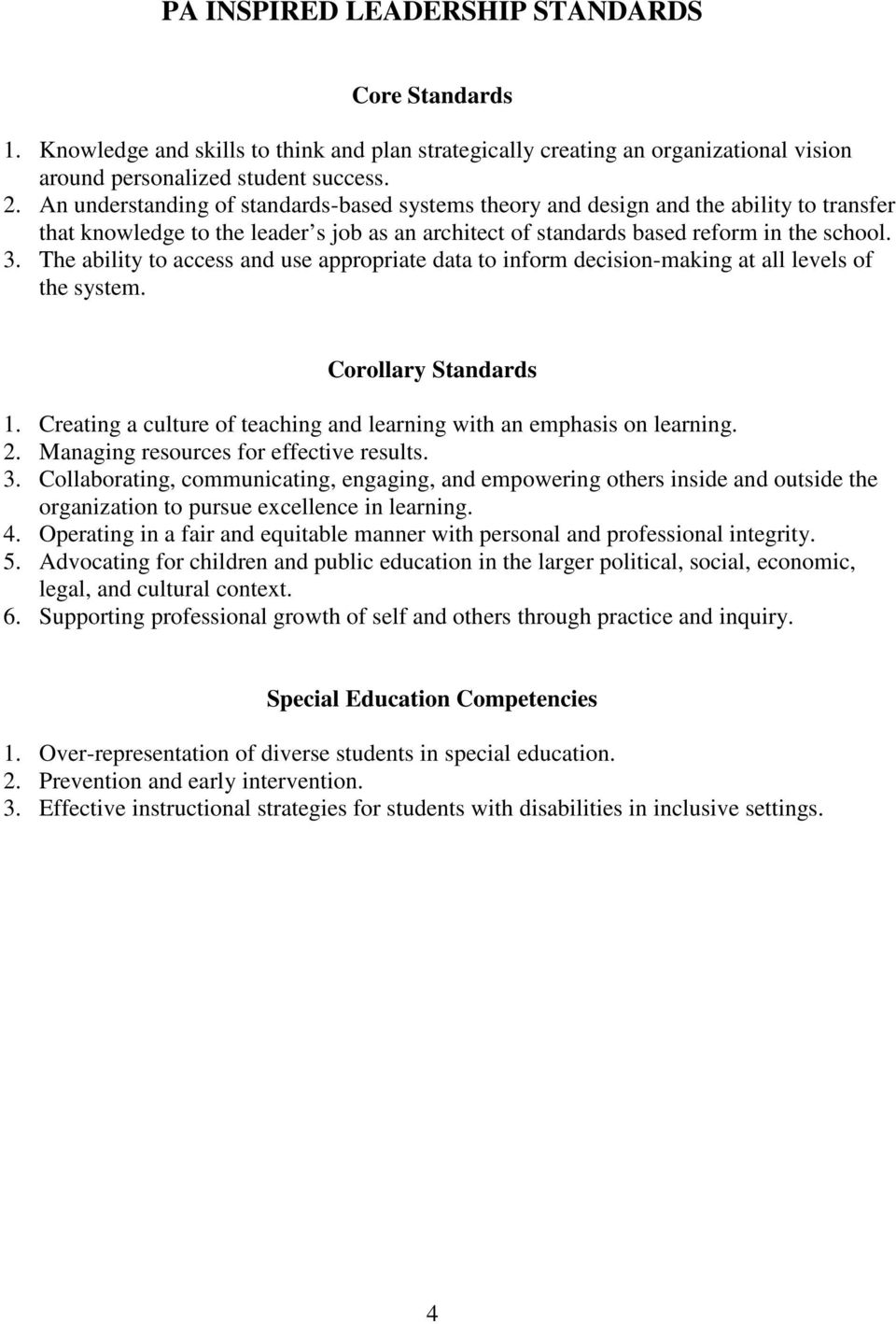
4 PA INSPIRED LEADERSHIP STANDARDS Core Standards 1. Knowledge and skills to think and plan strategically creating an organizational vision around personalized student success. 2. An understanding of standards-based systems theory and design and the ability to transfer that knowledge to the leader s job as an architect of standards based reform in the school. 3. The ability to access and use appropriate data to inform decision-making at all levels of the system. Standards 1. Creating a culture of teaching and learning with an emphasis on learning. 2. Managing resources for effective results. 3. Collaborating, communicating, engaging, and empowering others inside and outside the organization to pursue excellence in learning. 4. Operating in a fair and equitable manner with personal and professional integrity. 5. Advocating for children and public education in the larger political, social, economic, legal, and cultural context. 6. Supporting professional growth of self and others through practice and inquiry. Special Education Competencies 1. Over-representation of diverse students in special education. 2. Prevention and early intervention. 3. Effective instructional strategies for students with disabilities in inclusive settings. 4
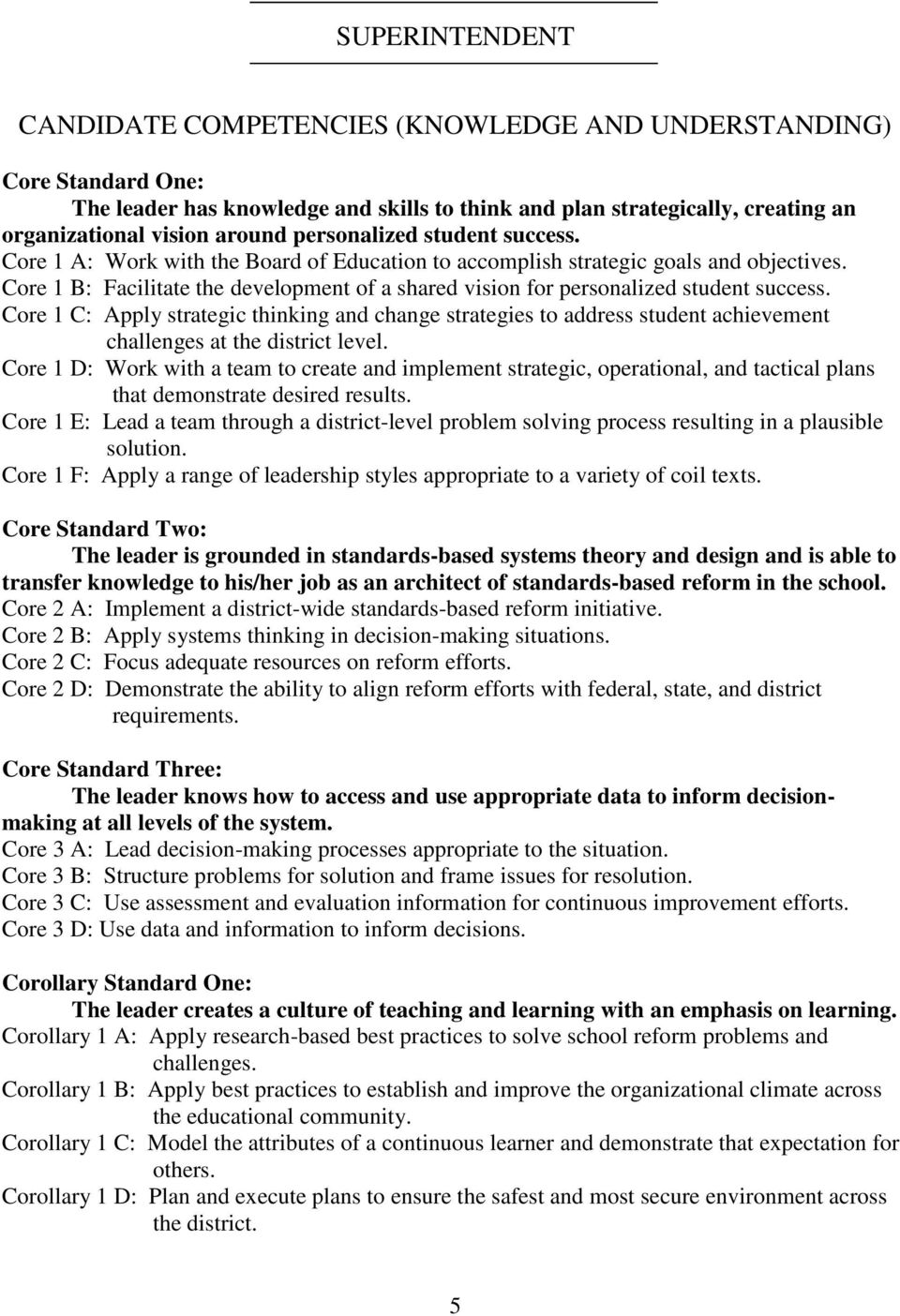
5 SUPERINTENDENT CANDIDATE COMPETENCIES (KNOWLEDGE AND UNDERSTANDING) Core Standard One: The leader has knowledge and skills to think and plan strategically, creating an organizational vision around personalized student success. Core 1 A: Work with the Board of Education to accomplish strategic goals and objectives. Core 1 B: Facilitate the development of a shared vision for personalized student success. Core 1 C: Apply strategic thinking and change strategies to address student achievement challenges at the district level. Core 1 D: Work with a team to create and implement strategic, operational, and tactical plans that demonstrate desired results. Core 1 E: Lead a team through a district-level problem solving process resulting in a plausible solution. Core 1 F: Apply a range of leadership styles appropriate to a variety of coil texts. Core Standard Two: The leader is grounded in standards-based systems theory and design and is able to transfer knowledge to his/her job as an architect of standards-based reform in the school. Core 2 A: Implement a district-wide standards-based reform initiative. Core 2 B: Apply systems thinking in decision-making situations. Core 2 C: Focus adequate resources on reform efforts. Core 2 D: Demonstrate the ability to align reform efforts with federal, state, and district requirements. Core Standard Three: The leader knows how to access and use appropriate data to inform decisionmaking at all levels of the system. Core 3 A: Lead decision-making processes appropriate to the situation. Core 3 B: Structure problems for solution and frame issues for resolution. Core 3 C: Use assessment and evaluation information for continuous improvement efforts. Core 3 D: Use data and information to inform decisions. Standard One: The leader creates a culture of teaching and learning with an emphasis on learning. 1 A: Apply research-based best practices to solve school reform problems and challenges. 1 B: Apply best practices to establish and improve the organizational climate across the educational community. 1 C: Model the attributes of a continuous learner and demonstrate that expectation for others. 1 D: Plan and execute plans to ensure the safest and most secure environment across the district. 5
6 Standard Two: The leader manages resources for effective results. 2 A: Develop a budget plan that is aligned to district goals and priorities. 2 B: Ensure that technology is appropriately implemented throughout the district. 2 C: Know how to manage human resources effectively. 2 D: Increase and allocate available resources. 2 E: Assess the way resources are utilized and the results produced. 2 F: Know regulations and policies and how to interpret them accurately and apply them appropriately. 2 G: Provide consistent and effective management practice through written policies and procedures. Standard Three: The leader collaborates, communicates, engages, and empowers others inside and outside the organization to pursue excellence in learning. 3 A: Establish and improve the culture of learning throughout the district. 3 B: Communicate effectively. 3 C: Involve key community, district, and school stakeholders in reform efforts. 3 D: Model appropriate leadership behavior and develop leadership skills in others through mentoring and coaching. 3 E: Assemble appropriate stakeholders into effective teams for problem solving. Standard Four: The leader operates in a fair and equitable manner with personal and professional integrity. 4 A: Demonstrate impeccable personal and professional ethics at all times. 4 B: Embrace and utilize diversity to improve performance and learning. 4 C: Use data and information from multiple sources to improve decision-making across the district. 4 D: Address conflict and resolve differences to achieve effective results. Standard Five: The leader advocates for children and public education in the larger political, social, economic, legal, and cultural context. 5 A: Identify and interpret external influences and how they impact local educational decisions. 5 B: Exhibit continuous focus on all children and their individual learning needs. 5 C: Exhibit sound judgment in operational and educational decisions to maximize learning opportunities for all children. 5 D: Engage with governmental and political leaders to effectively address the developmental and educational needs of all children. 5 E: Demonstrate knowledge of the law. 6

7 Standard Six: The leader supports professional growth of self and others through practice and inquiry. 6 A: Use professional development as a way to increase individual and institutional capability. 6 B: Engage staff and Board members in relevant professional development activities. 6 C: Develop professional development plans that create challenging opportunities for all staff. 6 D: Demonstrate the ability to identify and nurture individual strengths and leverage the human resources to benefit the district. 6 E: Design professional development plans that lead to improved student learning. Special Education One: Over-representation of diverse students in Special Education SED 1 A: Identify factors contributing to the over-representation of culturally and linguistically diverse students in programs for individuals with disabilities and implement strategies for the reduction of the over-representation. SED 1 B: Demonstrate an understanding of over-representation of minorities in special education so as to not misinterpret behaviors that represent cultural, linguistic differences as indicative of learning problems. SED 1 C: Interact and meet effectively with families. SED 1 D: Distinguish between the culture and the family and the economic situation of the family and how poverty affects families. SED 1 E: Identify how the family s culture and values affect how they view disabilities. SED 1 F: Celebrate heritages and cultures and their link to learning. SED 1 G: Incorporate stories and resources from many cultural and ethnic traditions. SED 1 H: Build on students strengths when teaching literacy skills to language minority students. SED 1 I: Directly use best, evidenced-based practices for teaching students from diverse backgrounds. SED 1 J: Implement processes that successfully prevent inappropriate placement and ensure that the opportunities for educational achievement to minority students equal those offered to majority group. 7

8 Special Education Two: Prevention and Early Intervention SED 2 A: Connect general education curriculum, compensatory, and special education in providing high quality standards-based instruction/intervention that is matched to students academic, social, emotional, and behavioral needs. SED 2 B: Demonstrates high-quality instruction for all students, through scientific research and evidenced-based practice to produce high rates of learning for all students. SED 2 C: Implement universal screening of all students with periodic monitoring of students progress in the curriculum SED 2 D: Provide interventions for struggling learners at increasing levels of intensity and matched to individual student need. SED 2 E: Implement an integrated system of assessment and data collection for identification of students struggling to meet academic and behavioral expectations. SED 2 F: Monitor students learning rates and levels of performance and use that information in ongoing problem solving and decision-making. SED 2 G: Determine which students need additional help regarding the intensity and likely duration of interventions, based on each student s response to instruction across multiple tiers of intervention. SED 2 H: Know how to implement school-wide approaches to intervention and effective instruction. SED 2 I: Demonstrate evidenced-based practices for use in both the special and regular education settings in the school. Special Education Three: Effective instructional strategies for students with disabilities in Inclusive Settings. SED 3 A: Identify effective instructional strategies to address areas of need. SED 3 B: Scaffold instruction to maximize instructional access to all students. SED 3 C: Monitor student progress to provide mediated scaffolding and increase academic rigor when appropriate. SED 3 D: Provide feedback to students at all levels to increase awareness in areas of strengths, as well as areas of concern. SED 3 E: Strategically aligns standards-based curriculum with effective instructional practices. SED 3 F: Identify and implement instructional adaptations based on evidenced-based practices to provide curriculum content in a variety of ways without compromising curriculum intent. SED 3 G: Analyze performance of all learners and make appropriate modifications. SED 3 H: Design and implement programs that reflect knowledge, awareness and responsiveness, to diverse needs of students with disabilities. SED 3 I: Use research-supported methods for academic and non-academic instruction for students with disabilities. SED 3 J: Develop and implement universally designed instruction. SED 3 K: Demonstrate an understanding of the range and the appropriate use of assistive technology (i.e. no tech, low tech, high tech). SED 3 L: Demonstrate efficient differentiated instruction and an understanding of efficient planning, coordination, and delivery for effective instruction required for inclusive settings. 8

9 SUPERINTENDENT PROGRAM Alignment with PA Inspired Leadership Standards Note: Alignment is coded to PDE Certification Program Rubric (revision date 8/14/2009) and to The Framework and Guidelines for Preparation Programs EAD 900 EAD 990 Superintendency Internship Core Standard One: The leader has knowledge and skills to think and plan strategically, creating an organizational vision around personalized student success. Core Standard Two: The leader is grounded in standards-based systems theory and design and is able to transfer knowledge to his/her job as an architect of standards-based reform in the school. Core Standard Three: The leader knows how to access and use appropriate data to inform decision-making at all levels of the system. Standard One: The leader creates a culture of teaching and learning with an emphasis on learning. Standard Two: The leader manages resources for effective results. Standard Three: The leader collaborates, communicates, engages and empowers others inside and outside of the organization to pursue excellence in learning. Standard Four: The leader operates in a fair and equitable manner with personal and professional dignity. Standard Five: The leader advocates for children and public education in the larger political, social, economic, legal and cultural context. Standard Six: The leader supports professional growth of self and others through practice and inquiry. Special Ed Standard One: Over representation of diverse students in special education Special Ed Standard Two: Prevention and early intervention Special Ed Standard Three: Effective instructional strategies for students with disabilities in inclusive settings 1A 1C 1D 1E 1F 2A 3D 1B 1C 1D 2B 3B 3D 4A See EP820: Special Education for School Leaders Principal Program See EP820: Special Education for School Leaders Principal Program See EP820: Special Education for School Leaders Principal Program EAD 901 Business and Resource Management 1E 1F 2B 2C 2D 3A 3B 3D 2A 2B 2D 2E 2F 2G 4A 4B 4C 4D 5B 5C 6A 6B 6C 6E EAD 902 Strategic Planning: Physical Plant 1A 1B 1D 1E 1F 3A 3B 1A 1B 1D 2A 2B 2D 2F 3C 4A 4B 4C 4D 5A 5C EAD 903 Negotiation and Human Resources 1B 4D 4C 6A 2A 3C 3D 2B 2C 3A 3C 3E 4A 5B 5D 5E 6A 6B 6C 6D 6E EAD 970 Topics in Administration X X X X X X X X X 9

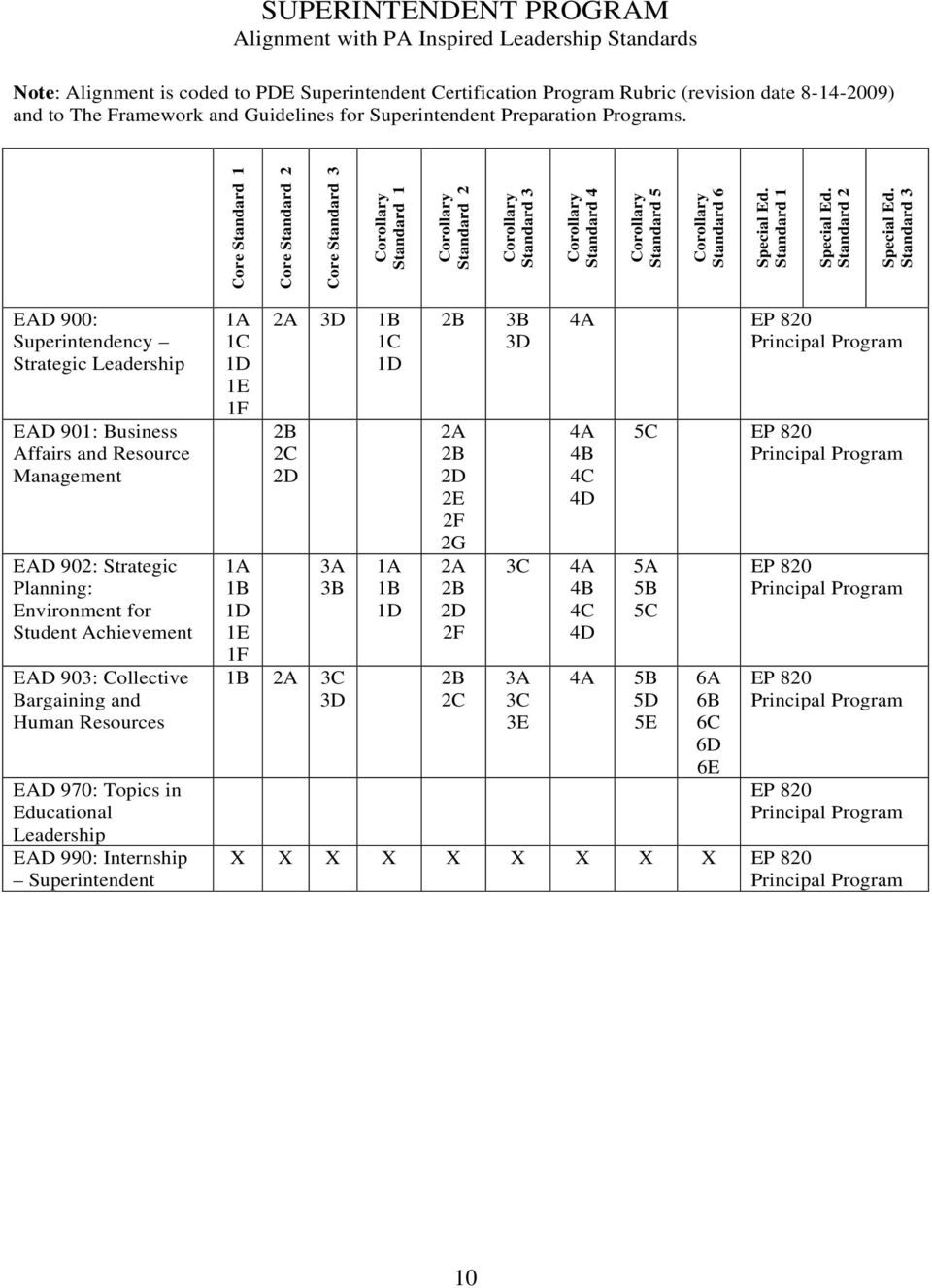
10 SUPERINTENDENT PROGRAM Alignment with PA Inspired Leadership Standards Note: Alignment is coded to PDE Certification Program Rubric (revision date ) and to The Framework and Guidelines for Preparation Programs. Core Standard 1 Core Standard 2 Core Standard 3 Standard 1 Standard 2 Standard 3 Standard 4 Standard 5 Standard 6 Special Ed. Standard 1 Special Ed. Standard 2 Special Ed. Standard 3 EAD 900: Superintendency Strategic Leadership EAD 901: Business Affairs and Resource Management EAD 902: Strategic Planning: Environment for Student Achievement EAD 903: Collective Bargaining and Human Resources EAD 970: Topics in Educational Leadership EAD 990: Internship 1A 1C 1D 1E 1F 1A 1B 1D 1E 1F 2A 3D 1B 1C 1D 2B 2C 2D 3A 3B 1B 2A 3C 3D 1A 1B 1D 2B 2A 2B 2D 2E 2F 2G 2A 2B 2D 2F 2B 2C 3B 3D 3C 3A 3C 3E 4A EP 820 Principal Program 4A 4B 4C 4D 4A 4B 4C 4D 4A 5C EP 820 Principal Program 5A 5B 5C 5B 5D 5E 6A 6B 6C 6D 6E EP 820 Principal Program EP 820 Principal Program EP 820 Principal Program X X X X X X X X X EP 820 Principal Program 10
11 Competencies (Ohio) AREA I. STRATEGIC LEADERSHIP The knowledge, skills and attributes to identify contexts, development with others vision and purpose, utilize information, frame problems, exercise leadership processes to achieve common goals, and to act ethically for educational communities. IA. Professional and Ethical Leadership The institution s program prepares school leaders who understand and demonstrate the ability to: LA.1 Facilitate the development and implementation of a shared vision and strategic plan for the school or district that focuses on teaching and learning. LA.2 Understand and create conditions that motivate staff, students and families to achieve the school s vision. LA.3 Frame, analyze, and resolve problems using appropriate problem solving techniques and decision making skills. LA.4 Initiate, manage and evaluate the change process. LA.5 Identify and critique several theories of leadership and their application to various school environments. LA.6 Act with a reasoned understanding of major historical, philosophical, ethical, social and economic influences affecting education in a democratic society. LA.7 Manifest a professional code of ethics and values. IB. Information Management and Evaluation The institution s program prepares school leaders who understand and demonstrate the ability to: LB.1 Conduct needs assessments by collecting information on students, on staff, and the school environment; on family and community values, expectations and priorities; and on national and global conditions affecting schools. LB.2 Use qualitative and quantitative data to make informed decisions, to plan and assess school programs, to design accountability systems, to plan for school improvement, and to develop and conduct research. LB.3 Engage staff in an ongoing study of current best practices and relevant research and demographic data, and analyze their implications for school improvement. LB.4 Analyze and interpret educational data, issues, and trends for boards, committees and other groups, outlining possible actions and their implications. 11

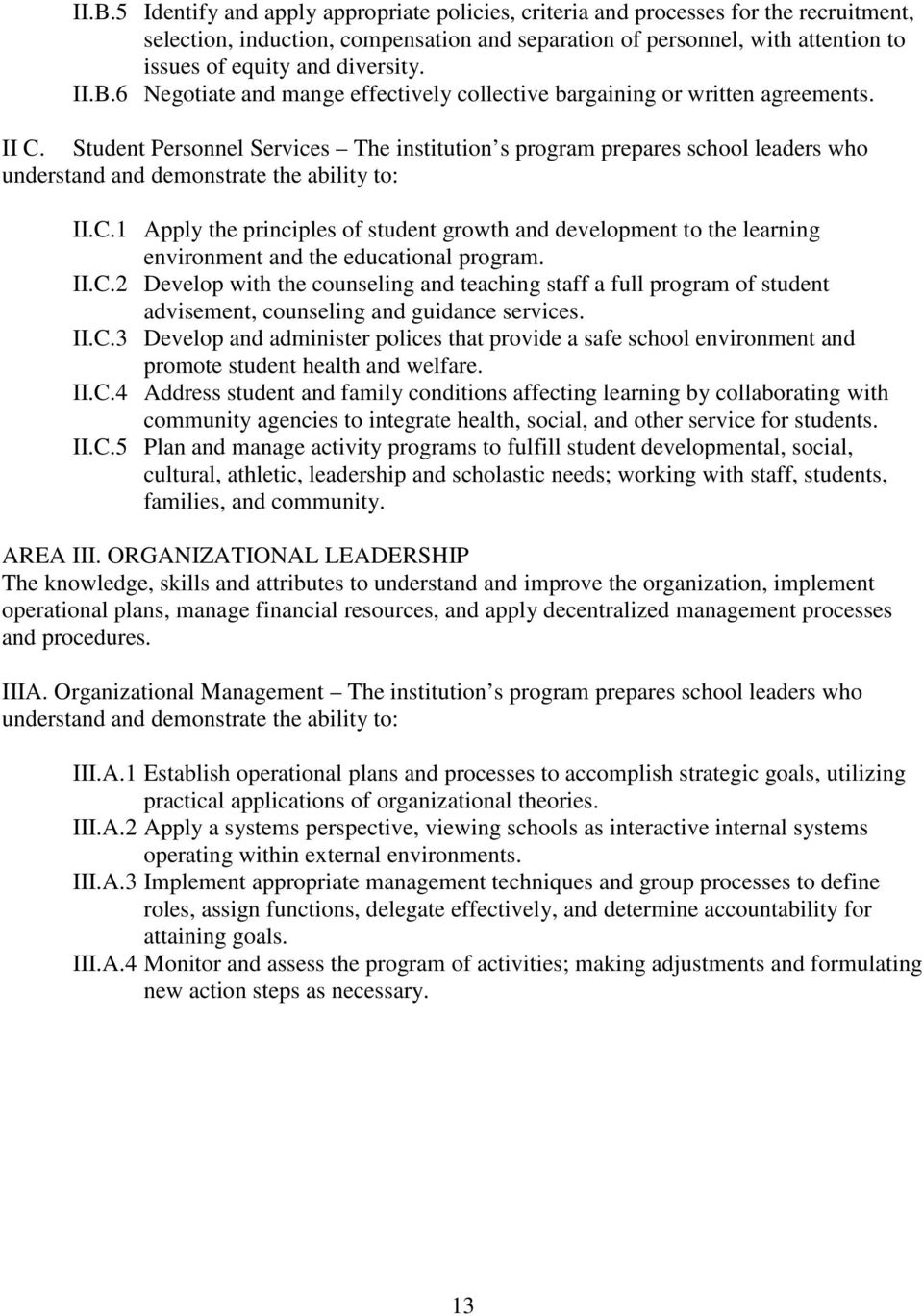
12 AREA II. INSTRUCTIONAL LEADERSHIP The knowledge, skills and attributes to design with others appropriate curricula and instructional programs, to develop student personnel services, and to plan with faculty professional development activities aimed at improving instruction. IIA. Curriculum, Instruction, Supervision and the Learning Environment The institution s program prepares school leaders who understand and demonstrate the ability to: II.A.1 Create with teachers, parents and students a positive school culture that promotes learning. II.A.2 Develop collaboratively a learning organization that supports instructional improvement, builds an appropriate curriculum, and incorporates best practices. II.A.3 Base curricular decisions on research, applied theory, informed practice, the recommendations of the learned societies, and state and federal policies and mandates. II.A.4 Design curricula with consideration for philosophical, sociological, and historic foundations, democratic values, and the community s values, goals, social needs, and changing conditions. II.A.5 Align curricular goals and objectives with instructional goals and objectives and desired outcomes when developing scope, sequence, balance, etc. II.A.6 Develop with other curriculum and instruction appropriate for varied teaching and learning styles and specific student needs based on gender, ethnicity, culture, social class and exceptionalities. II.A.7 Utilize a variety of supervisory models to improve teaching and learning. II.A.8 Use various staffing patterns, student grouping plans, class scheduling forms, school organizational structures, and facilities design process, to support various teaching strategies and desired student outcomes. II.A.9 Assess student progress using a variety of appropriate techniques. II B. Professional Development and Human Resources The institution s program prepares school leaders who understand and demonstrate the ability to: II.B.1 Work with faculty and other stakeholders to identify needs for professional development, to organize, facilitate, and evaluate professional development programs, to integrate district and school priorities, to build faculty as a resource, and to ensure that professional development activities focus on improving student outcomes. II.B.2 Apply adult learning strategies to professional development, focusing on authentic problems and tasks, and utilizing mentoring, coaching, conferencing and other techniques to ensure that the new knowledge and skills are practiced in the workplace. II.B.3 Apply effective job analysis procedures, supervisory techniques and performance appraisal for instructional and non-instructional staff. II.B.4 Formulate and implement a self-development plan, endorsing the value of careerlong growth, and utilizing a variety of resources for continuing professional development. 12

13 II.B.5 Identify and apply appropriate policies, criteria and processes for the recruitment, selection, induction, compensation and separation of personnel, with attention to issues of equity and diversity. II.B.6 Negotiate and mange effectively collective bargaining or written agreements. II C. Student Personnel Services The institution s program prepares school leaders who understand and demonstrate the ability to: II.C.1 Apply the principles of student growth and development to the learning environment and the educational program. II.C.2 Develop with the counseling and teaching staff a full program of student advisement, counseling and guidance services. II.C.3 Develop and administer polices that provide a safe school environment and promote student health and welfare. II.C.4 Address student and family conditions affecting learning by collaborating with community agencies to integrate health, social, and other service for students. II.C.5 Plan and manage activity programs to fulfill student developmental, social, cultural, athletic, leadership and scholastic needs; working with staff, students, families, and community. AREA III. ORGANIZATIONAL LEADERSHIP The knowledge, skills and attributes to understand and improve the organization, implement operational plans, manage financial resources, and apply decentralized management processes and procedures. IIIA. Organizational Management The institution s program prepares school leaders who understand and demonstrate the ability to: III.A.1 Establish operational plans and processes to accomplish strategic goals, utilizing practical applications of organizational theories. III.A.2 Apply a systems perspective, viewing schools as interactive internal systems operating within external environments. III.A.3 Implement appropriate management techniques and group processes to define roles, assign functions, delegate effectively, and determine accountability for attaining goals. III.A.4 Monitor and assess the program of activities; making adjustments and formulating new action steps as necessary. 13
14 IIIB. Interpersonal Relationships The institution s program prepares school leaders who understand and demonstrate the ability to: III.B.1 Use appropriate interpersonal skills, e.g., exhibiting sensitivity, showing respect and interest, perceiving needs and concerns, showing tact, exhibiting consistency and trustworthiness. III.B.2 Use appropriate written, verbal, and non-verbal communications in a variety of situations. III.B.3 Apply appropriate communications strategies, e.g., identifying audiences, determining messages, selecting transmission mediums, identifying reaction of receivers, soliciting responses. III.B.4 Promote multi-cultural awareness, gender sensitivity, and racial and ethnic appreciation. III.B.5 Apply counseling and mentoring skills, and utilize stress management and conflict management techniques. IIIC. Financial Management and Resource Allocation The institution s program prepares school leaders who understand and demonstrate the ability to: III.C.1 Identify and analyze the major sources of fiscal and non-fiscal resources for schools and school districts. III.C.2 Acquire and manage financial and material assets, and capital goods and services, allocating resources according to district or school priority, e.g., property, plant, equipment, transportation and food services. III.C.3Develop an efficient budget planning process that is driven by district and school priorities and involves staff and community. III.C.4 Performs budget management functions including financial planning, monitoring, cost control, expenditures accounting, and cash flow management. IIID. Technology and Information Systems The institution s program prepares school leaders who understand and demonstrate the ability to: III.D.1 Use technology, telecommunications and information systems to enrich curriculum and instruction, e.g., CD ROM retrieval systems, in-line networks, distance learning, interactive video. III.D.2 Apply and assess current technologies for school management and business procedures. III.D.3Develop and monitor long range plans for school and district technology and information systems, making informed decisions about computer hardware and software, and about staff development, keeping in mind the impact of technologies on student outcomes. 14
15 AREA IV. POLITICAL AND COMMUNITY LEADERSHIP The knowledge, skills and attributes to act in accordance with legal provisions and statutory requirements, to apply regulatory standards, to develop and apply appropriate policies, to be conscious of ethical implications of policy initiatives and political actions, to relate public policy initiatives to student welfare, to understand schools as political systems, to involve citizens and service agencies, and to develop effective staff communications and public relations programs. IVA. Community and Media Relations The institution s program prepares school leaders who understand and demonstrate the ability to: IV.A.1 Analyze community and district power structures, and identify major opinion leaders and their relationships to school goals and programs. IV.A.2 Articulate the district s or school s vision, mission and priorities to the community and media, and build community support for district or school priorities and programs, e.g., form collaborative relationships with businesses, citizen groups, neighborhood associations, social service agencies, parent organizations, advocacy groups, universities, and religious institutions. IV.A.3 Communicate effectively with various cultural, ethnic, racial, and special interest groups in the community. IV.A.4 Involve family and community in appropriate policy development, program planning, and assessment processes. IV.A.5 Develop an effective and interactive staff communications plan and public relations program. IV.A.6 Utilize and respond effectively to electronic and printed news media. IVB. Educational Law, Public Policy and Political Systems The institution s program prepares school leaders who understand and demonstrate the ability to: IV.B.1 Apply knowledge of federal and state constitutional, statutory and regulatory provisions and judicial decisions governing education. IV.B.2 Apply knowledge of common law and contractual requirements and procedures in an educational setting, e.g., tort liability, contract administration, formal hearings. IV.B.3Define and relate the general characteristics of internal and external political systems as they apply to school settings. IV.B.4 Describe the processes by which federal, state, district and school-site policies are formulated, enacted, implemented and evaluated, and develop strategies for influencing policy development. IV.B.5 Make decisions based on the moral and ethical implications of policy options and political strategies. IV.B.6 Analyze the major philosophical tenets of contemporary intellectual movements and analyze their effect on school contexts, e.g., critical theory, feminism, fundamentalism, etc. IV.B.7 Develop appropriate procedures and relationships for working with local governing boards. 15
16 AREA V. INTERNSHIP The internship is defined as the process and product that result from the application in a workplace environment of the strategic, instructional, organizational and contextual leadership guidelines. When coupled with integrating s through related clinics or report seminars, the outcome should be a powerful synthesis of knowledge and skills useful to practicing school leaders. The internship includes a variety of substantial concurrent or capstone s in diverse settings planned and guided cooperatively by university and school district personnel for credit hours and conducted in schools and school districts over an expanded period of time. The s should reflect increasing complexity and responsibility, and include some work in private, community, or social service organizations. An optimum internship would be a yearlong, full time. Part time internships involving limited periods of time are insufficient. Participating school districts should be committed to the value of internships and supportive of the Guidelines for the internship. VA. Internship The internship provides significant opportunities in the workplace to synthesize and apply the knowledge, and to practice and develop skills, identified in the eleven Guideline areas. Therefore, the preparation program: V.A.1 Requires a variety of substantial in-school/district s over an extended period of time in diverse settings, planned cooperatively and supervised by university and school district personnel. V.A.2 Establishes relationships with school leaders acting as trained mentors/clinical professors who guide individuals preparing for school leadership in appropriate in-school/district s. V.A.3 Includes s in social service, private and/or community organizations. 16

17 REVIEW SHEET PA: /IU Director OH: /ESC Name Date (Last) (First) (M.I) Address (Street) (City) (State) (Zip) Home Phone Work Cell Fax Course/Sequence Course Title Completed/Planned EAD 900 The Superintendency Strategic Leadership EAD 901 Business Affairs and Resource Management EAD 902 Strategic Planning: Environment for Student Achievement EAD 903 Collective Bargaining and Human Resources EAD 970 Topics in School Leadership EAD 990 Internship: Note: Application for state certification or licensure as a school superintendent is separate from this college checklist of required coursework. PA students should apply online to the Pennsylvania Department of Education at and then click on PA Certification left menu bar, click on Administrative/Supervisory, then click on s Letter of Eligibility. Note: PA students must take and pass the PA state SSA 6021 test prior to applying for Letter of Eligibility. OH students should apply online to the Ohio Department of Education and then click on Educator Licensure, and then click on Apply for a new license. Note: OH students must take and pass the Ohio state Pearson test prior to applying for state license. For more detailed information, consult Westminster s Program Handbook. 17 Revised July 2014

18 EDUCATIONAL LEADERSHIP SUPERINTENDENT EAD 900 SUPERINTENDENCY: STRATEGIC LEADERSHIP Standard Knowledge or Skill Competence Performance/ Demonstration Core 1A Understands role and Demonstrates how to - Practical knows how to engage work with a Board of exercise with Boards of Education to Education accomplish a strategic goal or objective Simulations Core 1C Core 1D Core 1E Core 1F Knows and understands organizational change theories and strategies Knows and understands the difference between strategic, operational, and tactical planning Understands problemsolving and critical/creative/ strategic thinking Understands and exercises appropriate leadership styles and strategies Demonstrates how to apply strategic thinking and change strategies to address student achievement challenges at the district level Demonstrates how to work with a team to create and implement strategic, operational, and tactical plans that demonstrate desired results Demonstrates how to lead a team through district-level problemsolving process resulting in a plausible solution Demonstrates how to apply a range of leadership styles appropriate to a variety of contexts - Practical exercise Simulations - Practical exercise Simulations - Practical exercise Simulations - Practical exercise Simulations Assessment 18

19 Core 2A Core 3D 1B 1C 1D 2B 3B Understands standardsbased systems theory and how to implement, support, and lead successful standardsbased reform across the district Understands how to interpret, report, and act on data-informed conclusions (e.g., student test data and other data related to student achievement) Knows how to assess the organizational culture and to engage the school community in improving the culture Understands how to model the behaviors of Lead learner & teacher and encourages others to apply those behaviors Understands how to ensure a safe and secure climate for learning throughout the district Understands how to use technology effectively and efficiently Knows how to communicate effectively orally and in writing Demonstrates the ability to implement a district-wide standards-based reform initiative Demonstrates how to use data and information to inform decisions Applies best practices to establish and improve the organizational climate across the educational community Models the attributes of a continuous learner and the expectation for others Ability to plan and execute plans to ensure the safest and most secure environment across the district Exhibits the ability to ensure that technology is appropriately implemented throughout the district Demonstrates effective communication abilities - Internship under mentorship of simulations - Scenario response - Practical exercises in course - Scenario response - Practical exercises in course - Job embedded - Internship under mentorship of - Internship under mentorship of - Scenario response - Practical exercises in course - Scenario response - Practical exercise in course DP DP 19

20 EDUCATIONAL LEADERSHIP SUPERINTENDENT EAD 901 BUSINESS AFFAIRS and RESOURCE MANAGEMENT Standard Knowledge or Skill Competence Performance/Demonstration Assessment Core 2B Understands systems thinking and how to integrate into the decisionmaking process Demonstrates how to apply systems thinking in decision-making situations - Job embedded simulations DP Core 2C Core 2D 2A 2B 2D 2E 2F 2G 3D 4A 5C Understands how to align resources with reform strategies Understands current federal, state, and district standards and requirements Knows and understands effective fiscal planning and management Understands how to use technology effectively and efficiently Understands sources of funding and how to acquire resources Understands how to assess/evaluate the effectiveness of resource allocation to achieve desired results Understands how legal requirements impact local decisions (e.g., federal and state regulations and labor relations) Knows and understands how to create, revise and implement policies and procedures Understands how to develop and encourage leadership in others Understands professional and personal ethics and exemplifies a professional code of conduct Understands how all district operational and educational decisions affect student learning Demonstrates ability to focus adequate resources on reform efforts Demonstrates ability to align reform efforts with federal, state and district requirements Knows how to develop a budget plan that is aligned to district goals and priorities Exhibits the ability to ensure that technology is appropriately implemented throughout the district Demonstrates how to increase and allocate the available resources Demonstrates how to assess the way resources are utilized and the results produced Demonstrates knowledge of regulations and policies and how to interpret them accurately and apply them appropriately Demonstrates how to provide consistent and effective management practice through written policies and procedures Models appropriate leadership behavior and develops leadership skills in other through mentoring and coaching Demonstrates impeccable personal and professional ethics at all times Exhibits sounds judgment in operational and educational decisions to maximize learning opportunities for children 20 - Practical exercise - Case studies simulations simulations - Practical exercises simulations - Scenario response - Practical exercises - Scenario response - Practical exercise - Practical exercise -Scenarios and simulations - Scenario response - Practical exercises - Practical exercise simulations - Practical exercises

21 EDUCATIONAL LEADERSHIP SUPERINTENDENT EAD 902 STRATEGIC PLANNING: ENVIRONMENT FOR STUDENT ACHIEVEMENT Standard Core 1A Core 1B Core 1D Core 1E Core 1F Core 3A Core 3B Knowledge or Skill Understands role and knows how to engage with Boards of Education Understands how to lead a school district to a shared vision of a student success Knows and understands the difference between strategic, operational, and tactical planning Understands problemsolving and critical/creative/ strategic thinking Understands and exercise appropriate leadership styles and strategies Understands multiple decision-making processes and knows how and when to use the appropriate processes Understands inquirybased problem solving and how to frame issues and acquire relevant data Competence Demonstrates how to work with a Board of Education to accomplish a strategic goal or objective Demonstrates how to facilitate the development of a shared vision for personalized student success Demonstrates how to work with a team to create and implement strategic, operational, and tactical plans that demonstrate desired results. Demonstrates how to lead a team through district-level problem-solving process resulting in a plausible solution Demonstrates how to apply a range of leadership styles appropriate to a variety of contexts Demonstrates the ability to lead decision-making processes appropriate to the situation Demonstrates how to structure problems for solution and frame issues for resolution Performance/ Demonstration - Practical exercise simulations - Practical exercise simulations - Practical exercise simulations - Practical exercise simulations - Practical exercise simulations - Practical exercise simulations - Scenario response - Practical exercises in course - Case studies Assessme nt DP DP 21
22 1A 1B 1D 2A 2D 2E 2F 2G 4A 5C Knows and understands how to apply research, theory, design and strategies that result in a districtwide focus on teaching and learning Knows how to assess the organizational culture and to engage the school community in improving the culture Understands how to ensure a safe and secure climate for learning throughout the district Knows and understands effective fiscal planning and management Understands sources of funding and how to acquire resources Understands how to assess/evaluate the effectiveness of resource allocation to achieve desired results Understands how legal requirements impact local decisions (e.g., federal and state regulations and labor relations Knows and understands how to create, revise, and implement policies and procedures Understands professional and personal ethics and exemplifies a professional code of conduct Understands how all district operational and educational decisions affect student learning Demonstrates the ability to apply research-based best practices to solve school reform problems and challenges Applies best practices to establish and improve the organizational climate across the educational community Ability to plan and execute plans to ensure the safest and most secure environment across the district Knows how to develop a budget plan that Is aligned to district goals and priorities Demonstrates how to increase and allocate the available resources Demonstrates how to assess the way resources are utilized and the results produced Demonstrates knowledge of regulations and policies and how to interpret them accurately and apply them appropriately Demonstrates how to provide consistent and effective management practice through written policies and procedures Demonstrates impeccable personal and professional ethics at all times Exhibits sound judgment in operational and educational decisions to maximize learning opportunities for children - Scenario response - Practical exercises in course simulations - Scenario response - Practical exercises in course - Practical exercises in course simulations - Scenario response - Practical exercises in course - Practical exercise -Scenarios and simulations - Scenario response - Practical exercises in course - Practical exercises in course 22
23 EDUCATIONAL LEADERSHIP SUPERINTENDENT EAD 902 STRATEGIC PLANNING: ENVIRONMENT FOR STUDENT ACHIEVEMENT Standard Knowledge or Skill Competence Performance/ Demonstration Core 1A Understands role and knows how to engage with Boards of Education Core 1B Understands how to lead a school district to a shared vision of student success Demonstrates how to work with a Board of Education to accomplish a strategic goal or objective Demonstrates how to facilitate the development of a shared vision for personalized student success - Practical exercise Simulations - Practical exercise Simulations Assessment DP Core 1D Knows and understands the difference between strategic, operational, and tactical planning Demonstrates how to work with a team to create and implement strategic, operational, and tactical plans that demonstrate desired results - Practical exercise Simulations Core 1E Understands problemsolving and critical/creative/strategic thinking Demonstrates how to lead a team through districtlevel problemsolving process resulting in a plausible solution - Practical exercise Simulations Core 1F Understands and exercises appropriate leadership styles and strategies Demonstrates how to apply a range of leadership styles appropriate to a variety of contexts - Practical exercise Simulations 23
24 Core 3A Core 3B 1A 1B 1D 2A Understands multiple decision-making processes and knows how and when to use the appropriate processes Understands inquirybased problems solving and how to frame issues and acquire relevant data Knows and understands how to apply research, theory, design, and strategies that result in a district-wide focus on teaching and learning Knows how to assess the organizational culture and to engage the school community in improving the culture Understands how to ensure a safe and secure climate for learning throughout the district Knows and understands effective fiscal planning and management Demonstrates the ability to lead decision-making processes appropriate to the situation Demonstrates how to structure problems for solution and frame issues for resolution Demonstrates the ability to apply research-based best practices to solve school reform problems and challenges Applies best practices to establish and improve the organizational climate across the educational community Ability to plan and execute plans to ensure the safest and most secure environment across the district Knows how to develop a budget plan that is aligned to district goals and priorities - Practical exercise Simulations - Scenario response - Practical exercises - Case studies - Scenario response - Practical exercises - Case studies simulations - Scenario response - Practical exercises - Practical exercises simulations DP 24
25 2B 2D 2F 3C 4A 4B 4C Understands how to use technology effectively and efficiently Understands sources of funding and how to acquire resources Understands how legal requirements impact local decisions (e.g., federal and state regulations and labor relations) Understands community engagement and how to establish and maintain positive community relations Understands professional and personal ethics and exemplifies a professional code of conduct Understands diverse populations and establishes systems that support equity and fairness for all Displays informed and thoughtful judgment in all decision making Exhibits the ability to ensure that technology is appropriately implemented throughout the district Demonstrates how to increase and allocate the available resources Demonstrates knowledge of regulations and policies and how to interpret them accurately and apply them appropriately Demonstrates how to involve key community, district, and school stakeholders in reform efforts Demonstrates impeccable personal and professional ethics at all times Demonstrates how to embrace and utilize diversity to improve performance and learning Demonstrates how to use data and information from multiple sources to improve decision making across the district - Scenario response - Practical exercises - Practical exercise simulations superintendent - scenarios and simulations - Practical exercises -Internship under simulations DP 25
26 4D 4B 4C Knows and understands how to employ conflict resolution skills Understands the political, social, economic, legal, and cultural context in which the education system operates Understands how all district operational and educational decisions affect student learning Demonstrates how to address conflict and resolve differences to achieve effective results Demonstrates how to identify and interpret external influences and how they impact local educational decisions Exhibits sound judgment in operational and educational decisions to maximize learning opportunities for children - Scenario response - Practical exercises - Scenario response - Practical exercises - Practical exercises DP 26
27 EDUCATIONAL LEADERSHIP SUPERINTENDENT EAD 903 COLLECTIVE BARGAINING and HUMAN RESOURCE MANAGEMENT Standard Knowledge or Skill Competence Performance/ Demonstration Core 1B Understands how to lead a school district to a shared vision of student success Core 2A Core 3C Core 3D 2B Understands standardsbased systems theory and how to implement, support, and lead successful standardsbased reform across the district Understands how to assess/evaluate programs and personnel against goals for continuous improvement efforts Understands how to interpret, report, and act on data-informed conclusions (e.g., student test data and other data related to student achievement) Understands how to use technology effectively and efficiently Demonstrates how to facilitate the development of a shared vision for personalized student success Demonstrates the ability to implement a district-wide standards-based reform initiative Demonstrates how to use assessment and evaluation information for continuous improvement efforts Demonstrates how to use data and information to inform decisions Exhibits the ability to ensure that technology is appropriately implemented throughout the district - Practical exercises -Internship under simulations -Internship under simulations - Practical exercises - Case studies -Internship under simulations -Scenario response -Practical exercises -Scenario response -Practical exercises Assessment DP DP DP DP DP 27
28 2C 3A 3C 3E 4A 4B Understands human recources (e.g., personnel-hiring practices, performance appraisal, assignment, dismissal regulations/ laws, policies, procedures) Understands how to create a learning culture within a community to pursue high standards for all learners Understands community engagement and how to establish and maintain positive community relations Able to assemble and build high performing teams Understands professional rules personal ethics and exemplifies a professional code of conduct Knows how to advocate for all children and learning Knows how to manage human resources effectively Demonstrates how to establish and improve the culture of learning throughout the district Demonstrates how to involve key community, district, and school stakeholders in reform efforts Demonstrates how to assemble appropriate stakeholders into effective teams for problem solving Demonstrates impeccable personal and professional ethics at all times Exhibits continuous focus on all children and their individual learning needs -Internship under - Practical exercises -Internship under simulations -Internship under simulations - Practical exercises -Internship under -Internship under - Practical exercises -Internship under 28
29 5C 5E 6A 68 Understands how to influence decisions that impact children and their education within the district, community, state, and nation Knows federal, state, and local laws, regulations, and policies that define parameters for the education, health, and welfare of all children Understands the research on effective professional development Understands the need for continuous professional growth of all stakeholders in the education system Demonstrates how to engage with governmental and political leaders to effectively address the developmental and educational needs of all children Demonstrates knowledge of the law Demonstrates how to use professional development as a way to increase individual and institutional capability Demonstrates how to engage staff and Board members in relevant professional development activities - Scenario response - Practical exercises - Scenario response - Practical exercises - Practical exercises -Internship under - Practical exercises -Internship under 6C 6D Understands how to develop challenging career opportunities for staff Understands how to identify talent and potential talent and leverage for the benefit of the district Demonstrates the ability to develop professional development plans that create challenging opportunities for all staff Demonstrates the ability to identify and nurture individual strengths and leverage the human resources to benefit the district - Practical exercises -Internship under simulations - Practical exercises -Internship under 6E Understands how to align professional development with student learning goals Demonstrates how to design professional development plans that lead to improved student learning - Practical exercises -Internship under DP 29
30 COURSE-RELATED FIELD EXPERIENCES SUPERINTENDENT PROGRAM These examples of field s, practical, problem based tasks, and hands-on skill building assignments are offered to reinforce the belief that learning is enhanced when theory and practice are linked. This list is not intended to be complete. Instructors are encouraged to identify other s as appropriate to content area and course of study. The suggestions are useful in identifying tasks or projects for completion during the internship and as a source of artifacts for the exit portfolio. EAD 900: SUPERINTENDENCY STRATEGIC LEADERSHIP 1. Identify available evaluation/assessment instruments to be used in assisting the board of education to do a self-study or evaluation. 2. Attend board meetings to study interactions of board members, boardsuperintendent, board-visitors, and superintendent-visitors. Prepare a short paper describing your perception of existing relationships. 3. Assist the superintendent in the preparation of board meeting agenda and related materials as needed. 4. Prepare a brochure to be distributed to visitors at official meetings explaining the role of the board of education, procedures related to meetings and community participation. 5. Complete a review of the existing district policy manual, identify needs, suggest revisions, and make recommendations for the superintendent and board approval. 6. Under the direction of the of Schools, identify areas of needed policy statements, research and prepare a draft of recommended policy for the superintendent and board consideration. 7. Prepare and make a presentation to community groups on an issue in the district or a pertinent topic of choice. 8. Prepare a news release on a topic of general interest to be disseminated to news media. 9. Prepare a brochure describing the school district which would be useful in recruiting new personnel or for distribution to newcomers to the community. 10. Conduct a community survey of attitudes toward the school district and its programs. 11. Participate in development of district strategic plans. 12. Observe district networking activities including: vocational-technical schools, intermediate units, and other agencies. Complete a written description of the districts networking efforts. 30
31 EAD 901: BUSINESS AFFAIRS and RESOURCE MANAGEMENT 1. Participate as a team member in the simulation titled XYZ Annual School Budget. Appropriate for students who have not participated in a similar project in the Principal Program-School Finance and Fiscal Affairs. 2. Using the current budget of your employing school district, identify total cost related to all personnel employed by the school district. (Salaries, fringe benefits, etc.) 3. Using data from the personnel cost study (2 above), calculate the average annual salaries and fringe benefits for each class of employee, including teachers, administrators, custodial/maintenance, secretarial, etc. 4. Reviewing the current budget in your school district, calculate total cost for selected school programs, e.g. athletics, music, mathematics, language arts, social sciences, home economics, industrial arts, etc. Compare at least three. 5. Under the direction of the or Business Officer, collect and tabulate data needed for budget preparation. 6. Assist in the completing of an inventory of equipment, supplies, textbooks, and other instructional materials useful in identifying budgetary needs. 7. Assist in the preparation of specifications and identify possible suppliers to facilitate the required bidding process. 8. Assist the business officer in the development of cash flow reports and identify short and long term revenues and expenditures. 9. Provide a report describing the school district s technology for financial operations (payroll, accounts payable, budget reports, etc.) 10. Explore the district s investment program. If one exists, prepare a brief description. 11. In cooperation with the of Schools, develop a budget calendar identifying specific activities and critical dates for the school board, superintendent, principals, department heads, business manager and others as appropriate. Attend board budget planning meetings, if possible. 12. Participate in a team problem-based learning project to develop a technology plan for a selected school district. Additional materials and guidance will be provided by the instructor. 13. Accompany the superintendent and/or business manager to intermediate unit meetings, school business officials meetings, and seminars to become aware of regulations, issues, and trends in financial management. 31
32 EAD 902: SCHOOL PHYSICAL PLANT, STRATEGIC PLANNING: ENVIRONMENT FOR STUDENT ACHIEVEMENT 1. If the district is involved in new construction or renovation, attend planning meetings, project financing sessions, job conferences, and other activities related to the building project. 2. Perform building inspections to determine needed repairs and/or maintenance projects to be completed by staff or outside contractors. 3. After identifying appropriate assessment evaluation instruments, prepare a report describing status of existing facilities to be shared with the board of education and the of Schools. Identify the instruments and process used in written report. 4. Review the district s insurance program and determine adequacy of coverage in relation to replacement value of buildings and equipment. 5. Complete a demographic study of your school district as a regular assignment for the course. Directions will be provided during class time. 6. Review the use of technology in the instructional program. 7. Analyze the use of data in various sectors of the district operation. 8. Complete a data project designated by and under the direction of the superintendent-mentor. 32
33 EAD 903: COLLECTIVE BARGAINING and HUMAN RESOURCE MANAGEMENT 1. Review district procedures for recruitment, selections, and evaluation of a professional and non-instructional staff and recommend revisions if needed. 2. The business manager in your school district has recently announced plans to retire at the end of the school year. In conjunction with the of Schools and other appropriate personnel, prepare and advertisement for publication in area newspapers and professional journals announcing the vacancy. Your submitted project shall include the advertisement, a description of the process used in preparation of the advertisement, and list of others who contributed to its development. 3. Write a job description for your school district that may be needed but does not exist. 4. Complete an analysis of job descriptions of personnel employed in the business operations of your school district. Are there necessary tasks or responsibilities that are not assigned to anyone? If so, revise necessary job descriptions to accommodate them. This assignment will require research regarding effective school business operations. 5. Complete an analysis of job descriptions for any sub-group of employees, for example, custodial-maintenance, secretarial, administrative, etc. Are there necessary tasks or responsibilities that are not assigned to anyone? If so, revise necessary descriptions to accommodate them. Complete any needed research relative to duties related to the selected sub-group. 6. Your task is to obtain copies of job descriptions for persons assigned to the business operations of the school district in which you are employed. Compare these against competencies discussed in class. Prepare recommended revisions as needed. 7. Review existing professional and support personnel collective bargaining agreements and identify provisions which influence the performance of administrative duties. 8. Participate in planning of staff development efforts. 9. Participate as a team in the completion of a problem-based activity titled, Selection of a Middle School Principal. Directions and related materials will be distributed by the instructor. 10. If appropriate, assist the superintendent or school business official in preparation for collective bargaining. 11. If appropriate, assist the superintendent or school business official with a counterproposal for negotiations with the certified and/or non-certified staff. EAD 970: TOPI IN SCHOOL ADMINISTRATION 1. This course is designed to provide a broad range of for the aspiring superintendent. 2. Class format will include a self-assessment of candidate s needs, research, writing, and class presentations. 3. Research topics or related field projects and studies will be identified at the first class session. Students wills elect priority topics with instructor approval. 33
34 Letter of Eligibility Program Pennsylvania EAD 900 Superintendency-Strategic Leadership (3) EAD 901 Business Affairs and Resource Management (3) EAD 902 Strategic Planning-Environment for Student Achievement (3) EAD 903 Human Resource Management and Collective Bargaining (3) EAD 970 Topics in Educational Leadership (3) EAD 990 Internship- (3) 34
35 OTHER RELATED FIELD EXPERIENCES 1. Initiate development of a professional portfolio or up-date an existing portfolio. (Required) 2. Complete a self-assessment of personal professional needs based on Commonwealth of Pennsylvania for the Letter of Eligibility Standards or ISLLC Standards on superintendent competencies. 3. Examine the school s procedures for selecting and assigning students into remedial or advanced courses. 4. Under the direction of a mentoring, establish an ethics committee consisting of administrators, parents, teachers, and students to assess and examine the district s and/or school ethical practices. 5. Prepare a presentation to the faculty on ethics, including sharing educator s professional code of conduct. Lead discussion related to ethical practices and identify possible ethical conflicts. 6. Create your personal educational platform, which include your personal values and beliefs and explain how the school or district you lead will function in an ethical manner. 7. Examine the school district s practices related to the sharing of confidential information. 8. If none exists, create a conflict resolution program for teachers and/or students. 9. Select one or two books that will help expand your knowledge based on topics related to PIL or ISLLC standards. 35
36 EDUCATIONAL LEADERSHIP at WESTMINSTER COLLEGE COLLEGE SCHOOL DISTRICT EDUCATIONAL LEADERSHIP MEMORANDUM OF AGREEMENT The purpose of this partnership between Westminster College and the designated school district is to collaboratively prepare school leaders within the spirit of the mission statement of the Educational Leadership Program. The particular emphasis of the collaboration is the improvement of student achievement. The College and the School District will collaborate in: Candidate Selection * Internships Program Curriculum * Candidate evaluation Field Experiences * Post-certification support School District Responsibilities College Responsibilities Select qualified candidates * Admit qualified candidates Provide qualified mentors * Train mentors Enable field /internship * Provide college liaison Assist with district-specific activities * Facilitate internship design Provide feedback * Provide feedback Support, supervise, assess * Support, supervise, and assess Ensure year-long 360 hour * Ensure year-long 360 hour * Coordinate mentor/liaison/student meeting This is not a legal document but rather an understanding of cooperation. Westminster College College Representative Signature College Representative Name and Title Date School District District Representative Signature District Representative Name and Title Date Note 1: School District mentors who supervise a principle candidate must have a minimum of three years of service as a principal. Note 2: A School District mentor who supervises a superintendent candidate must have a minimum of three years of service as a superintendent Note 3: Agreement valid for one school year /2014
37 EAD 990 Internship: Application Name: Home Address: School District: Position: Address: Phone: Phone: Cell: Date: Signatures Course Completed: EAD 900 EAD 903 EAD 901 EAD 970 EAD 902 A) Intern s Signature Date B) Mentor s Signature Date Name/Title of Mentor School District: Address: Office Phone: College Supervisor s Approval Date 37
38 Graduate School of Education Westminster College DOCUMENTATION OF INTERNSHIP HOURS FOR SUPERINTENDENCY Date Experience Hours 1) 2) 3) 4) 5) 6) 7) 8) 9) 10) 11) 12) A minimum of 180 hours is required for completion of the Superintendency internship. I certify that the above listed field s and hours have been completed. Student s Signature: Mentor s Signature: Date: Date: 38
39 Appendices 39
40 PORTFOLIO DOCUMENTATION OF PROFESSIONAL DEVELOPMENT Introduction The use of portfolios is seen by many educators as an authentic method to document personal growth and professional development of students and teachers. The success of this practice has been widely documented. The Graduate Program at Westminster College believes the portfolio can be a useful took in the assessment of those pursuing administrative certification. When used in conjunction with the comprehensive examination and exit interview, a more accurate picture of the student emerges. The portfolio is a documented history of the graduate students or aspiring school leader s progress against a set of standards. It provides a clear assessment of an individual s performance in the Educational Leadership Program. In addition, the portfolio provides an individualized portrait of the student as a professional. The portfolio can benefit both the faculty and the student in assessing one s progress toward an administrative certification and a career as a school leader. Advantages For the graduate faculty, the portfolio serves as: a. An authentic assessment and documentation of s b. A summative record of a student s performance over time c. A monitoring instrument identifying personal needs of the student d. A vehicle to facilitate development of positive faculty-student relationship For the graduate student, the portfolio serves as: a. An opportunity for self-evaluation b. An opportunity for reflection of one s philosophy and practice c. A collection of artifacts which will be used for assessment d. A resource file for future job searches Portfolio Requirements 1. Each student admitted to the Educational Leadership Program will begin development of a portfolio which will be periodically monitored. 2. A final review of the portfolio by the graduate faculty will be completed prior to approval for graduation or recommendation for administrative certification in the Commonwealth of Pennsylvania or the State of Ohio. 3. The student will be responsible for the collection of artifacts for inclusion into the portfolio. An artifact is defined as any evidence used to document how standards are met. In addition, a student may include materials deemed to be useful in appraising a student s growth as a graduate student or aspiring school administrator. 40
41 Portfolio Artifacts Artifacts are part of a collection of professional documents that help inform others about the individual. The following artifacts are required for all portfolios: a. A current professional resume b. Credentials c. Transcripts d. Educational Platform an individual s personal beliefs in specific areas Sergiovanni and Staratt recommend the following consideration: Aims of education Social significance of learning Curriculum value Image of learners Image of teachers Preferred pedagogy Preferred student-teacher relationships Preferred school climate Administrative goals Preferred administrative processes (Source: T.J. Sergiovanni and R.J. Staratt. Supervision of Redefinition. McGraw Hill, 1993.) e. Professional development plan as identified for use during the internship f. Documented field s, simulations, and projects Other self-selected artifacts are recommended: a. Letters of recommendation or references b. Awards or honors c. Lists of professional accomplishments d. Work samples e. Research samples f. Exemplary projects g. Communication samples h. Personal writing or reflection i. Committee participation, curriculum or program design, etc. j. Professional memberships Advisory Comment Be cautious in attempting to include too much material in a portfolio. The lack of or growth will be evident to the reviewer. Avoid the trivial. The inclusion of questionable material may detract from a professional and useful portfolio. Thoughtful reflection, not a color printer, is the key to portfolio success. Bryan Painter, Educational Leadership, V. 58, No. 5,
42 READING LIST Bennis, Warren G. On Becoming a Leader. 2 nd Ed. New York: Perseus Publishing, Bennis, Warren and Joan Goldsmith. Learning to Lead: A Workbook On Becoming A Leader. Reading, MA: Addison- Wesley, Bernhardt, Victoria L. Data Analysis for Comprehensive School-wide Improvement. Larchmont, NY: Eye on Education, Blanchard, Kenneth H. The Heart of a Leader. Tulsa, OK: Honor Books, Blase, Jo, and Joseph Blase. Handbook of Instructional Leadership: How Really Good Principals. Promote Teaching and Learning. Thousand Oaks, CA: Corwin Calabrese, Raymond L. The Leadership Assignment: Creating Change. Boston, MA; Allyn- Bacon, Combs, Arthur W., Ann B. Miser, and Kathryn S. Whitaker. On Becoming a School Leader: A Person-Centered Challenge. Alexandria, VA: ASCD, Creighton, Theodore B. Schools and Data. Thousand Oaks, CA: Corwin, Crow, Gary M., and L. Joseph Mathews. Finding One's Way: How Mentoring Can Lead to Dynamic Leadership. Thousand Oaks, CA: Corwin, Daresh, John C. The Beginning Principalship: A Practical Guide For New School Leaders. 2 nd Ed. Thousand Oaks, CA: Corwin, DePree, Max. Leadership Is An Art. NY: Dell Publishing, DePree. Max. Leadership Jazz: The Ari of Conducting Business Through Leadership. Fellowship, Teamwork, Voice. Touch. NY: Dell Publishing, DePree, Max. Leading Without Power: Finding Hope in Serving Community. San Francisco: Jossey-Rass, Donaldson, Gordon A., and G. Mamik. As Leaders Learn: Personal Stories of Growth In School Leadership. Thousand Oaks, CA: Corwin, 1995 Donaldson, Gordon A., and Michael Fullan. Cultivating Leadership in Schools: Connecting People. Purpose, and Practice. New York: Teacher College Press, Fullan, Michael. The Moral Imperative of Leadership. Thousand Oaks, CA: Corwin,
43 Glickman, Carl D. Leadership for Learning; How to Help Teachers Succeed. Alexandra, VA: ASCD, Goldberg, Marie. Lessons from Exceptional School Leaders. Alexandra, VA: ASCD, Guskey, Thomas R. Evaluation Professional Development. Thousand Oaks, CA: Corwin, Hart, Ann Weaver, and Paul V. Bredeson. The Principalship. New York: McGraw Hill, Hesselbein, Frances, Marshall Goldsmith, and Richard Beckhard, eds. The Leader of the Future. San Francisco: Jolley, Bass, Hoyle, John.R. Leadership and the Force of Love. Thousand Oaks, CA: Corwin, Kozol, Jonathan. Amazing Grace: the Lives of Children and the Conscience of a Nation. New York: Harper Trade, Kozol, Jonathan. Ordinary Resurrection: Children in the Years of Hope. New York: Harper Collins, Kozol, Jonathan. Savage Inequalities: Children in America's Schools. New York: Harper Trade, Kouzes, James M., and Barry Z. Posner. The Leadership Challenge: How To Keep Getting Extraordinary Things Done In Organizations: San Francisco: Jossesy-Bass, Lambert, Linda. Leadership Capacity for Lasting School Improvement. Alexandra, VA: ASCD, Lambert, Linda. Building Leadership Capacity in Schools. Alexandria, VA: ASCD, Maxcy, Spencer J. Ethical School Leadership. Lanham, MD: Scarecrow, Palestini, Robert H. Ten Steps to Educational Reform: Making Change Happen. 2 nd Ed. Lanham, MD: Scarecrow Press, Pellicer, Leonard 0. Caring Enough To Lead: Schools and the Sacred Trust. Thousand Oaks, CA: Corwin, Schmoker, Mike. The Results Fieldbook: Practical Strategies From Dramatically Improved Schools. Alexandria, VA: ASCD,
44 Schwan, Charles, J. and William G. Spady. Total Leaders: Applying the Best Future- Focused Change Strategies in. Education. Lanham, MD: Scarecrow Press, Sergiovanni, Thomas J. Rethinking Leadership. Arlington Heights. JL: Skylight Training and Publishing, Short, Paula M., and John T. Greer. Leadership in Empowered Schools. Upper Saddle River, NJ: Merrill Prentice Hall, Streshly, William A., and Lany E. Frase. Avoiding Legal Hassles: What School Administrators Really Need To Know. Thousand Oaks, CA: Corwin, Villani, Susan. Are You Sure You're The Principal? On Becoming An Authentic Leader. Thousand Oaks, CA: Sage Publications, Wallace, Richard C., Jr. From Vision To Practice: The Art Of Educational Leadership. Thousand Oaks, CA: Corwin, Wallace, Richard C., Jr., David E. Engel, and James E. Mooney. The Learning School: A Guide to Vision-Based Leadership. Thousand Oaks, CA: Corwin, Wynn, Richard and Charles W. Guditus. Team Management: Leadership by Consensus. Columbus, OH: Menill Publishing, Additional Readings Using Data To Improve Schools: What s Working? American Association of School Administrators. Arlington, VA: undated. Spirituality in Leadership. American Association of School Administrators. Arlington, VA: The School Administrator, No. 8, Vol. 59, Sept
Framework and Guidelines for Principal Preparation Programs
 THE FRAMEWORK FOR PRINCIPAL PREPARATION PROGRAM GUIDELINES PENNSYLVANIA DEPARTMENT OF EDUCATION 1 Purpose Of all the educational research conducted over the last 30 years in the search to improve student
CALIFORNIA PRELIMINARY ADMINISTRATIVE CREDENTIAL EXAMINATION (CPACE)
 Education Code section 44270.5 allows an examination alternative to the Administrative Services preparation program as long as the examination is aligned with the current Administrative Services Program
Alabama Standards for Instructional Leaders
 Alabama Standards for Instructional Leaders To realize the mission of enhancing school leadership among principals and administrators in Alabama resulting in improved academic achievement for all students,
Standards for Advanced Programs in Educational Leadership
 Standards for Advanced Programs in Educational Leadership for Principals, Superintendents, Curriculum Directors, and Supervisors NATIONAL POLICY BOARD FOR EDUCATIONAL ADMINISTRATION Published January,
Standards for Educational Leaders (Principals, Superintendents, Curriculum Directors, and Supervisors)
 Standards for Educational Leaders (rincipals, Superintendents, Curriculum Directors, and Supervisors) Introduction These Standards and Indicators were adapted from the Educational Leadership Constituencies
K - 12 Principal & Superintendent
 BOSA COMPETENCY MATRIX Minnesota Administrative Licensure K - 12 Principal & Superintendent WINONA STATE UNIVERSITY COLLEGE OF EDUCATION DEPARTMENT OF EDUCATIONAL LEADERSHIP Name: Place of Employment Mailing
Program: Educational Administration Masters, Director of Vocational Education
 1.3.1 facilitating the development, articulation, implementation, and stewardship of a vision of learning that is shared and supported by the school. Program: Educational Administration Masters, Director
Educational Leadership Program Standards. ELCC Revised Standards
 Educational Leadership Program Standards ELCC Revised Standards For Advanced Programs that Prepare Principals, Superintendents, Curriculum Directors, and Supervisors March 2009 NATIONAL POLICY BOARD FOR
SBEC/TExES Framework for Principal Certification
 SBEC/TExES Framework for Principal Certification The following SBEC Principal Domains, Competencies and supporting standards represent the knowledge, skills and dispositions principal candidates should
Crosswalk of the New Colorado Principal Standards (proposed by State Council on Educator Effectiveness) with the
 Crosswalk of the New Colorado Principal Standards (proposed by State Council on Educator Effectiveness) with the Equivalent in the Performance Based Principal Licensure Standards (current principal standards)
UNIVERSITY OF TEXAS AT EL PASO DEPARTMENT OF EDUCATIONAL LEADERSHIP AND FOUNDATIONS
 UNIVERSITY OF TEXAS AT EL PASO DEPARTMENT OF EDUCATIONAL LEADERSHIP AND FOUNDATIONS EDAD 5312: Instructional Leadership Competency Area: Instructional Leadership Course Syllabus Departmental Mission Statement
Illinois Professional School Leader Standards [29.100]
![Illinois Professional School Leader Standards [29.100]](/thumbs/25/6856783.jpg "Illinois Professional School Leader Standards [29.100]") III. STANDARDS FOR ADMINISTRATIVE CERTIFICATION Illinois Professional School Leader Standards [29.100] STANDARD 1 - Facilitating a Vision of Learning facilitating the development, articulation, implementation,
III. STANDARDS FOR ADMINISTRATIVE CERTIFICATION Illinois Professional School Leader Standards [29.100] STANDARD 1 - Facilitating a Vision of Learning facilitating the development, articulation, implementation,
Educational Administration
 Graduate School of Education Educational Administration Education Specialist Degree The Education Specialist Degree (Ed.S.) in Educational Administration program is designed for students who already have
Field Experience and Student Teaching Competencies
 Field Experience and Student Teaching Competencies Introduction The Pennsylvania Department of Education (PDE) has developed a general set of field experience and student teaching competencies that will
The School Leadership Collaborative Intern and Administrative Mentor Guide
 Gonzaga University School of Education The School Leadership Collaborative Intern and Administrative Mentor Guide Principal Certification Program Administrator Certification Department of Educational Leadership
EDUCATIONAL LEADERSHIP PROGRAM Recognition. Standards:
 EDUCATIONAL LEADERSHIP PROGRAM Recognition Standards: District Level For institutions undergoing NCATE Accreditation and ELCC Program Review For Advanced Programs at the Master, Specialist, or Doctoral
Handbook. For. The Comprehensive Portfolio Examination. And. The Internship In Educational Leadership. School of Education
 Handbook For The Comprehensive Portfolio Examination And The Internship In Educational Leadership School of Education Educational Administration, Leadership And Technology Program November 2007 2 CONTENTS
Master of Arts in Educational Administration, Principal Endorsement Program Course Sequence and Descriptions
 Master of Arts in Educational Administration, Principal Endorsement Program Course Sequence and Descriptions EDU 615 Principal as School Leader (3 credit hours) In this course, candidates will develop
Doctor of Education Program In Educational Leadership Superintendent Internship Guide ED 658 & 659
 Doctor of Education Program In Educational Leadership Internship Guide ED 658 & 659 School of Education 84 West South Street Wilkes-Barre, Pennsylvania 18766 2012-2013 Edition Table of Contents Certification
HAMPTON UNIVERSITY ONLINE College of Education and Continuing Studies PhD in Educational Management
 Program Overview The accelerated program provides candidates with an opportunity to develop the critical leadership skills and knowledge that are required in today s increasingly complex, diverse, and
Section Three: Ohio Standards for Principals
 Section Three: Ohio Standards for Principals 1 Principals help create a shared vision and clear goals for their schools and ensure continuous progress toward achieving the goals. Principals lead the process
EDUCATION SPECIALIST IN EDUCATIONAL LEADERSHIP
 EDUCATION SPECIALIST IN EDUCATIONAL LEADERSHIP SCHOOL OF EDUCATION 56 Available on the Jackson, Germantown and Hendersonville Campuses; in School Reform available online The purpose of the Education Specialist
Internship Manual Educational Specialist (EdS) Florida Gulf Coast University
 Internship Manual Educational Specialist (EdS) Florida Gulf Coast University 2 Table of Contents The College of Education Vision... 3 The College of Education Mission... 3 Purpose of the Internship...
*Performance Expectations, Elements and Indicators
 C o m m o n C o r e o f L e a d i n g : Connecticut School Leadership Standards *Performance Expectations, Elements and Indicators *For further information, visit: http://www.sde.ct.gov/sde/cwp/view.asp?a=2641&q=333900
Approved by the Virginia Board of Education on September 27, 2012. Virginia Department of Education P. O. Box 2120 Richmond, Virginia 23218-2120
 Advancing Virginia's Leadership Agenda Guidance Document: Standards and Indicators for School Leaders and Documentation for the Principal of Distinction (Level II) Administration and Supervision Endorsement
PERFORMANCE EXPECTATION 1: Vision, Mission, and Goals
 PERFORMANCE EXPECTATION 1: Vision, Mission, and Goals PERFORMANCE EXPECTATION 1: Vision, Mission, and Goals Education leaders ensure the achievement of all students by guiding the development and implementation
Elementary and Middle School Technology Curriculum Guidelines
 Elementary and Middle School Technology Curriculum Guidelines Catholic Schools Office Diocese of Erie March, 2007 PHILOSOPHY STATEMENT... 1 TECHNOLOGY CURRICULUM FOUNDATION... 1 TECHNOLOGY FOUNDATION STANDARDS
GUIDELINES RECOMMENDED FOR USE WITH RULE 24 (ENDORSEMENTS)
 NEBRASKA DEPARTMENT OF EDUCATION GUIDELINES RECOMMENDED FOR USE WITH RULE 24 (ENDORSEMENTS) Approved by the State Board of Education February 4, 2014 NOTE: Rule 24 governs the provision of endorsements
EDUC 605 Curriculum Development and Assessment.. 3 cr
 MASTER OF ARTS IN EDUCATION The Master of Arts in Education degree program combines online learning with practical and applied learning in the classroom. The master s candidate must earn and successfully
Educational Leadership and Policy Studies Ritchie Program for School Leaders & Executive Leadership for Successful Schools (ELSS)
 Contact: Susan Korach [email protected] Morgridge Office of Admissions [email protected] Lead in Denver www.leadindenver.com Educational Leadership and Policy Studies Ritchie Program for School Leaders &
EDUCATIONAL LEADERSHIP PROGRAM Recognition. Standards:
 EDUCATIONAL LEADERSHIP PROGRAM Recognition Standards: Building Level For institutions undergoing NCATE Accreditation and ELCC Program Review Page 2 For Advanced Programs at the Master, Specialist, or Doctoral
Utah Educational Leadership Standards, Performance Expectations and Indicators
 Utah Educational Leadership Standards, Performance Expectations and Indicators Standard 1: Visionary Leadership An educational leader promotes the success of every student by facilitating the development,
Masters Comprehensive Exam and Rubric (Rev. July 17, 2014)
 1 Educational Leadership & Policy Studies Masters Comprehensive Exam and Rubric (Rev. July 17, 2014) The comprehensive exam is intended as a final assessment of a student s ability to integrate important
Educational Leadership
 Master of Science in Education: Educational Leadership School Building Leader (SBL) Program or School Building Leader (SBL) /School District Leader (SDL) Program Program Overview The Educational Leadership
HAMPTON UNIVERSITY ONLINE School of Education and Human Development PhD in Educational Management
 Program Overview This accelerated program provides candidates with an opportunity to develop the critical leadership skills and knowledge that are required in today s increasingly complex, diverse, and
Framework for Leadership
 Framework for Leadership Date Leader Self-Assessment Evaluator Assessment Domain 1: Strategic/Cultural Leadership Principals/school leaders systemically and collaboratively develop a positive culture to
Educational Leadership Advising Handbook: Addendum to the Graduate Handbook
 Educational Leadership Advising Handbook: Addendum to the Graduate Handbook Educational Leadership Program Overview The program consists of ten (10) courses for thirty (30) credit hours. It is a licensure
LICENSURE PROGRAMS BUILDING LEVEL LICENSURE CENTRAL OFFICE LICENSURE ARKANSAS CURRICULUM/PROGRAM LICENSURE
 College of Education and Health Professions Educational Administration and Curriculum & Instruction Programs LICENSURE PROGRAMS BUILDING LEVEL LICENSURE CENTRAL OFFICE LICENSURE ARKANSAS CURRICULUM/PROGRAM
Massachusetts Department of Elementary and Secondary Education. Professional Development Self- Assessment Guidebook
 Massachusetts Department of Elementary and Secondary Education Professional Development Self- Assessment Guidebook For Teacher Professional Development Offerings Modified for use by the District and School
School Leadership Concentration
 School Leadership Concentration The School Leadership Concentration (SLC) is designed for aspiring school leaders. Candidates will learn the necessary skills, ranging from financial management to instructional
Collier County Public School District Principal Mentor Handbook
 Collier County Public School District Principal Mentor Handbook Masterful mentors inspire people by helping them recognize the previously unseen possibilities that lay embedded in their existing circumstances.
ELPS 606 INTERNSHIP PORTFOLIO PROCEDURES AND REQUIREMENTS UNIVERSITY OF NORTHERN COLORADO COLLEGE OF EDUCATION
 PRINCIPAL INTERNSHIP IN EDUCATIONAL LEADERSHIP INTERNSHIP PORTFOLIO PROCEDURES AND REQUIREMENTS UNIVERSITY OF NORTHERN COLORADO COLLEGE OF EDUCATION DIVISION OF EDUCATIONAL LEADERSHIP AND POLICY STUDIES
Massachusetts Model System for Educator Evaluation
 Massachusetts Model System for Educator Evaluation Part III: Guide to Rubrics and Model Rubrics for Superintendent, Administrator, and Teacher Appendix A. January 2012 Massachusetts Department of Elementary
Executive Leadership for Successful Schools
 Program Contact: Susan Korach Email: [email protected] Morgridge Office of Admissions: [email protected] http://www.du.edu/education Executive Leadership for Successful Schools at DPS A Partnership between
Performance Factors and Campuswide Standards Guidelines. With Behavioral Indicators
 Performance Factors and Campuswide Standards Guidelines With Behavioral Indicators Rev. 05/06/2014 Contents PERFORMANCE FACTOR GUIDELINES... 1 Position Expertise... 1 Approach to Work... 2 Quality of Work...
Masters of Reading Information Booklet. College of Education
 Masters of Reading Information Booklet College of Education Department of Teaching and Learning Bloomsburg University's Masters in Reading/Reading Certification degree program provides theoretical, analytical
NEW YORK STATE TEACHER CERTIFICATION EXAMINATIONS
 NEW YORK STATE TEACHER CERTIFICATION EXAMINATIONS ASSESSMENT DESIGN AND FRAMEWORK March 2014 Authorized for Distribution by the New York State Education Department NYSTCE, New York State Teacher Certification
Self Assessment Tool for Principals and Vice-Principals
 The Institute for Education Leadership (IEL) brings together representatives from the principals' associations, the supervisory officers' associations, councils of directors of education and the Ministry
Delaware Performance Appraisal System
 Delaware Performance Appraisal System Building greater skills and knowledge for educators DPAS-II Guide for Administrators (Principals) Principal Practice Rubric Updated July 2015 1 INEFFECTIVE A. DEVELOPS
NEW YORK STATE TEACHER CERTIFICATION EXAMINATIONS
 NEW YORK STATE TEACHER CERTIFICATION EXAMINATIONS TEST DESIGN AND FRAMEWORK September 2014 Authorized for Distribution by the New York State Education Department This test design and framework document
The school principal practices effective cultural leadership when he or she
 Strategic Leadership Summary: School leadership creates conditions that result in the strategic re-imaging of the school s vision, mission, and goals in the 21 st Century. The leader exhibits the understanding
Arkansas Teaching Standards
 Arkansas Teaching Standards The Arkansas Department of Education has adopted the 2011 Model Core Teaching Standards developed by Interstate Teacher Assessment and Support Consortium (InTASC) to replace
CHAPTER 77 STANDARDS FOR TEACHER INTERN PREPARATION PROGRAMS
 Ch 77, p.1 CHAPTER 77 STANDARDS FOR TEACHER INTERN PREPARATION PROGRAMS 281 77.1(256) General statement. Programs of teacher intern preparation leading to licensure in Iowa are subject to approval by the
HANDBOOK FOR THE. Department of Educational Leadership Texas A&M University-Commerce. Effective 2005
 HANDBOOK FOR THE SUPERINTENDENT S CERTIFICATION PROGRAM Department of Educational Leadership Texas A&M University-Commerce Effective 2005 Note: This handbook is subject to change! Updates will be available
EDUCATION SPECIALIST DEGREE IN EDUCATIONAL LEADERSHIP
 EDUCATION SPECIALIST DEGREE IN EDUCATIONAL LEADERSHIP Available for the Jackson and Germantown Campuses Program Purpose The purpose of the Education Specialist Degree is to prepare leaders who will make
New York State Professional Development Standards (PDF/Word) New York State. Professional Development Standards. An Introduction
 New York State Professional Development Standards New York State Professional Development Standards (PDF/Word) Background on the Development of the Standards New York State Professional Development Standards
ALIGNING DANIELSON FRAMEWORK WITH ASCA s SCHOOL COUNSELOR COMPETENCIES AND ETHICAL STANDARDS
 1a: Demonstrating knowledge of counseling theory and techniques 1b: Demonstrating knowledge of child and adolescent behavior 1c: Establishing goals for the counseling program appropriate to the setting
Special Education (Dual) PA Instructional I Certification Coursework, Clinical Supervision and Mentoring Program Overview 2015-2016
 Special Education (Dual) PA Instructional I Certification Coursework, Clinical Supervision and Mentoring Program Overview 2015-2016 Overview: Intern teachers in the PennGSE Teach for America Urban Teacher
Oak Park School District. Administrator Evaluation Program
 Oak Park School District Administrator Evaluation Program Table of Contents Evaluation Purpose...1 Evaluation Timeline...2 Rubric for Instructional Administrator Standard 1...3 Standard 2...5 Standard
Principal Job Description
 Anfield School Anfield International Kindergarten Anfield International Kindergarten & Nursery Principal Job Description RESPONSIBLE TO: The School Board INTRODUCTION: This job description is based on
CASS Practice Standards: Reflective Tool and Rubric
 CASS Practice Standards: Reflective Tool and Rubric Revised January 2015 College of Alberta School Superintendents Appendix D: CASS Practice Standard Reflective Tool Leadership Dimension 1: Visionary Leadership
Standard 2: The program shall have an explicit philosophical statement and clearly defined knowledge base.
 Council for Standards in Human Service Education National Standards MASTER S DEGREE IN HUMAN SERVICES http://www.cshse.org 2013 (2010, 2009) I. GENERALPROGRAM CHARACTERISTICS A. Institutional Requirements
SECTION 5: MASTER OF EDUCATION DEGREE
 SECTION 5: MASTER OF EDUCATION DEGREE Beginning with the summer session in 1954, a fifth-year program of teacher education leading to the degree Master of Teaching was instituted at Northwestern Oklahoma
SECTION 5: MASTER OF EDUCATION DEGREE
 SECTION 5: MASTER OF EDUCATION DEGREE Beginning with the summer session in 1954, a fifth-year program of teacher education leading to the degree Master of Teaching was instituted at Northwestern Oklahoma
Commission on Teacher Credentialing (CTC) and Council on Social Work Education Educational Policy Standards and Accreditation Standards (CSWE-EPAS)
 (CTC) and Educational Policy Standards and Accreditation Standards (CSWE-) Standards Crosswalk June 2013 An institution that is offering a nationally accredited Pupil Personnel Services: School Social
Program Administrator Definition and Competencies
 I. Program Administrator Definition The program administrator is the individual responsible for planning, implementing, and evaluating a child care, preschool or kindergarten program. The role of the administrator
Leadership Portfolio
 California State University, Fresno Education Administration Program Developing Your Leadership Portfolio September 2005 Table of Contents What is the Leadership Portfolio?........... 1 Why develop the
Colorado Professional Teaching Standards
 Colorado Professional Teaching Standards Standard I: Teachers demonstrate knowledge of the content they teach a. Teachers provide instruction that is aligned with the Colorado Academic Standards and their
Accreditation Standards
 ACCREDITING COMMISSION FOR COMMUNITY AND JUNIOR COLLEGES Western Association of Schools and Colleges Accreditation Standards (Adopted June 2002; Revised June 2012; Edited November 2012) Introduction: Shaping
Competencies for School Counselor, Grades K-12 FIRST TIME STANDARD LICENSURE
 In addition to the Arkansas Teaching Standards, School Counselors in grades K-12 shall demonstrate knowledge and competencies in the following areas: 1. Knowledge CACREP: A1, A2, A3, A4, A5, A6, A7, C1,
Members of the Alabama State Board of Education. Governor Bob Riley President of the State Board of Education. District
 2 Members of the Alabama State Board of Education Governor Bob Riley President of the State Board of Education District I Mr. Randy McKinney President Pro Tem II Mrs. Betty Peters III Mrs. Stephanie Bell
M.A. in Special Education / 2013-2014 Candidates for Initial License
 M.A. in Special Education / 2013-2014 Candidates for Initial License Master of Arts in Special Education: Initial License for Teachers of Students with Moderate Disabilities (PreK-8 or 5-12) Candidates
Council on Social Work Education. Curriculum Policy Statement for Baccalaureate Degree Programs in Social Work Education
 Council on Social Work Education Curriculum Policy Statement for Baccalaureate Degree Programs in Social Work Education B1.0 SCOPE AND INTENT OF THE CURRICULUM POLICY STATEMENT B1.1 This document sets
Oregon Framework for Teacher and Administrator Evaluation and Support Systems
 Oregon Framework for Teacher and Administrator Evaluation and Support Systems Revised for 2014 2015 State Guidelines for ESEA Waiver & SB 290 OREGON DEPARTMENT OF EDUCATION 255 Capitol St, NE, Salem, OR
National Standards. Council for Standards in Human Service Education. http://www.cshse.org 2013 (2010, 1980, 2005, 2009)
 Council for Standards in Human Service Education National Standards BACCALAUREATE DEGREE IN HUMAN SERVICES http://www.cshse.org 2013 (2010, 1980, 2005, 2009) I. GENERAL PROGRAM CHARACTERISTICS A. Institutional
National Standards. Council for Standards in Human Service Education. http://www.cshse.org 2013 (2010, 1980, 2005, 2009)
 Council for Standards in Human Service Education National Standards ASSOCIATE DEGREE IN HUMAN SERVICES http://www.cshse.org 2013 (2010, 1980, 2005, 2009) I. GENERAL PROGRAM CHARACTERISTICS A. Institutional
Testimony of the New Jersey Principals & Supervisors Association on Proposed Changes to N.J.A.C.
 Testimony of the New Jersey Principals & Supervisors Association on Proposed Changes to N.J.A.C. 6A:9 (Certification of State District Chief School Administrators) May 4, 2011 Thank you for the opportunity
CLINICAL EXPERIENCE HANDBOOK PRINCIPAL PREPARATION PROGRAM
 CLINICAL EXPERIENCE HANDBOOK PRINCIPAL PREPARATION PROGRAM DRAKE UNIVERSITY EDUCATION LEADERSHIP 2 TABLE OF CONTENTS CLINICAL EXPERIENCE HANDBOOK PRINCIPAL PREPARATION PROGRAM DESCRIPTION OF THE CLINICAL
TOOL KIT for RESIDENT EDUCATOR and MENT OR MOVES
 Get to Know My RE Observe Collect Evidence Mentor Moments Reflect Review Respond Tailor Support Provide Provide specific feedback specific Feedback What does my RE need? Practice Habits Of Mind Share Data
Competencies for School Guidance and Counselor, Grades K-12 ADD-ON LICENSURE
 In addition to the Arkansas Teaching Standards, School Counselors in grades K-12 shall demonstrate knowledge and competencies in the following areas: 1. Knowledge CACREP: A1, A2, A3, A4, A5, A6, A7, C1,
Commission on Teacher Credentialing. Education Specialist Clear Program Standards
 Commission on Teacher Credentialing Education Specialist Clear Program Standards Clear (Induction) Program Standards Adopted by the Commission, March 2009 1 Program Standards for the Clear (Induction)
St. Charles School District. Counselor Growth Guide and. Evaluation Documents
 St. Charles School District Growth Guide and Evaluation Documents 2014-2015 City of St. Charles School District MISSION The City of St. Charles School District will REACH, TEACH, and EMPOWER all students
Doctorate in Educational Leadership. Purpose. Requirements. Philosophy, Goals and Objectives
 Doctorate in Educational Leadership Purpose This program is designed for the development and certification of educational leaders who can lead and manage private and public K-12 systems, higher education
TEAC Quality Principles for Educational Leadership
 TEAC Quality Principles for Educational Leadership Faculty members seeking TEAC accreditation for their programs in educational leadership must affirm that their goal is to prepare competent, caring, and
Regulations Governing the Certification of Educators in Rhode Island. Promulgated November 3, 2011 Effective: January 1, 2012
 Regulations Governing the Certification of Educators in Rhode Island Promulgated November 3, 2011 Effective: January 1, 2012 8 1 INTRODUCTION These Regulations Governing the Certification of Educators
Standards for the School Nurse [23.120]
![Standards for the School Nurse [23.120]](/thumbs/25/4559478.jpg "Standards for the School Nurse [23.120]") Standards for the School Nurse [23.120] STANDARD 1 Content Knowledge The certificated school nurse understands and practices within a framework of professional nursing and education to provide a coordinated
Standards for the School Nurse [23.120] STANDARD 1 Content Knowledge The certificated school nurse understands and practices within a framework of professional nursing and education to provide a coordinated
The Massachusetts Tiered System of Support
 The Massachusetts Tiered System of Support Chapter 1: Massachusetts Tiered System of Support (MTSS) Overview Massachusetts has developed a blueprint outlining a single system of supports that is responsive
ACS WASC Accreditation Status Determination Worksheet
 ACS WASC Accreditation Status Determination Worksheet How are students achieving? Is the school doing everything possible to support high achievement for all its students? Directions 1. Discuss the evidence
Commission on Peer Review and Accreditation
 Commission on Peer Review and Accreditation Network of Schools of Public Policy, Affairs, and Administration ACCREDITATION STANDARDS For Master s degree programs Adopted October 16, 2009 at the NASPAA
The MSPA Rubric for Evaluation of School Psychologists
 The MSPA Rubric for Evaluation of School Psychologists The Massachusetts School Psychologists Association (MSPA) has developed this rubric for the evaluation of school psychologists for adoption, in part
Superintendent Effectiveness Rubric*
 Public Document 3 Purpose: Outlines the standards that are the foundation for the evaluation. Name of Superintendent: Date: Performance Rating Scale: Distinguished (4) Accomplished (3) standards for most
Teacher Leader Doctorate Available Format: Online & Face-to-Face
 Teacher Leader Doctorate Understand the complexities of educational settings in relation to adult learning and development, culture and organizational change, student achievement, assessment and data-driven
Master Technology Teacher Standards
 Master Technology Teacher Standards FINAL Approved on January 4, 2002 Texas State Board for Educator Certification MASTER TECHNOLOGY TEACHER STANDARDS Standard I. Standard II. Standard III. Standard IV.
SECTION 4: MASTER OF EDUCATION DEGREE
 SECTION 4: MASTER OF EDUCATION DEGREE Beginning with the summer session in 1954, a fi fth-year program of teacher education leading to the degree Master of Teaching was instituted at Northwestern Oklahoma
EDUCATIONAL ADMINISTRATION AND FOUNDATIONS (EAF)
 Educational Administration and Foundations 155 EDUCATIONAL ADMINISTRATION AND FOUNDATIONS (EAF) 331 DeGarmo Hall, (309) 438-5422 Education.IllinoisState.edu/EAF Chairperson: Wendy Troxel. Office: 331 DeGarmo