
STUDENT HANDBOOK MASTER'S PROGRAM IN MARRIAGE AND FAMILY THERAPY
|
|
|
- Jack Moore
- 10 years ago
- Views:
Transcription
1 STUDENT HANDBOOK MASTER'S PROGRAM IN MARRIAGE AND FAMILY THERAPY DEPARTMENT OF COUNSELING & FAMILY THERAPY SCHOOL OF EDUCATION AND PROFESSIONAL STUDIES CENTRAL CONNECTICUT STATE UNIVERSITY NEW BRITAIN, CONNECTICUT The Masters program in Marriage and Family Therapy at Central Connecticut State University is accredited by the Commission on Accreditation for Marriage and Family Therapy Education of the American Association for Marriage and Family Therapy (AAMFT) through June 15, 2015.

2 Table of Contents Introduction... 5 "Grow With Us"... 6 General Information - CCSU... 7 The University... 7 The School of Education and Professional Studies... 7 The Department... 7 Diversity and the CCSU Marriage and Family Therapy Program... 7 CCSU Non-Discrimination Statement... 8 Description of the Program... 9 Program Philosophy What is a Marriage and Family Therapist? MFT Job Market - What Does the Program Prepare a Student For? Typical Jobs of MFT Graduates From CCSU - Where Will Jobs be Found Upon Graduation? Requirements of Graduate Study Matriculation, Prerequisites, and Degree Candidacy Graduation Requirements for the M.S. Degree The "Capstone Project": The Case Presentation The Thesis Option Curriculum Pre-Candidacy: Prerequisites and the Core Counseling Sequence Course Sequence in MFT Course Descriptions Optional School-Based Mft Certification Courses: Clinical Training and Supervision Sequence Full-time or Part-time? Marriage and Family Therapy Plan of Study by Semester (Full-time Schedule) (Sample Part-Time Schedule) Practicum and Internship Procedures The Practicum Sequence The Internship Sequence Raw Data Requirement The Liaison System Finding a Placement Documentation of Clinical and Supervisory Hours Professional and Ethical Considerations Confidentiality Dual Supervision Malpractice/Liability Insurance Extension of the Internship Beyond 12 Months Summary of Requirements of the Internship Evaluations Student Evaluations Program Evaluations Student File Documentation
3 MFT Program Student File Documentation AAMFT and Connecticut Licensure Considerations AAMFT Accreditation MFT Licensure in Connecticut Preparation for the Licensing Exam AAMFT Student Membership AAMFT Clinical Membership The AAMFT Code of Ethics and Expected Conduct School Certification for MFTs CCSU Approved Offerings for MFTs in the Schools Certification Sequence Post-Graduate Official Certificate Program (OCP) in School-based MFT Personal and Professional Growth Socialization Into a New Professional Identity A Word on Personal Therapy Support Services for Students Graduate Student Association Attendance at Conferences and Professional Meetings Unique Offerings Through the CCSU MFT Program Statement Regarding Independent (Private) Practice Upon Graduation General Policies and Procedures Tuition and Refund Policies Scholarships and Grants Non-Discrimination Policy Disclosure of Personal Information Probation Grievance Policy Important Points to Remember Appendices Appendix I: Admissions Policy Appendix II: Recommendation Form Appendix III: Attitudes and Attributes Appendix IV: Clinical Placements - Internship and Practicum Appendix V: Clinical Documentation Monthly Client Contact And Supervision Hours Reporting Form CCSU MFT Internship Release For Audio/Videotaping Of Counseling Sessions Appendix VI: Student File Verification Form Appendix VII: Capstone Requirements - The Clinical Case Conference Capstone Project Case Presentation (Q & A) Capstone Oral Presentation Guidelines

4 Appendix VIII: Department Writing Guidelines Outlining & Rewriting Style Introductory Section Summaries Plagiarism Evaluation Criteria for Written Work Writing Center Appendix IX: Graduate School Policies and Procedures Sample Planned Program Graduate School Summary Sheet Appendix X: CCSU Resources Websites and Contact Information

5 Introduction This Student Handbook has been prepared to serve as a guide throughout the training process for students enrolled in the Master's program in Marriage and Family Therapy at Central Connecticut State University's Department of Counseling & Family Therapy. The handbook is designed to provide detailed information about each stage of the process toward completing the Master's degree and to inform students about the unique characteristics of the program and the practice of Marriage and Family Therapy. Each student is also assigned an academic advisor. The advisor will serve as a guide while the student is in the Marriage and Family Therapy program. It is recommended that students make contact with their advisors periodically and utilize the faculty member's services. Students may meet with advisors during regularly scheduled office hours or by appointment. We also encourage you to add your address to the department distribution (See Appendix III) so that you may receive regular announcements and information bulletins. We hope that you find your experience at Central Connecticut State University an enlightening and fulfilling one. Suggestions on the part of all who use this handbook are encouraged. Please send your comments directly to: Dr. Ralph Cohen Director, MFT Program Department of Counseling & Family Therapy Central Connecticut State University 1615 Stanley Street New Britain, CT (860) [email protected] or [email protected] The Department of Counseling & Family Therapy and Central Connecticut State University reserves the right to revise, amend or change items set forth in this handbook from time to time. Accordingly, readers of this handbook should inquire as to whether any such revisions, amendments or changes have been made since the date of publication. The University reserves the right to cancel course offerings, to set minimum and maximum size of classes, to change designated instructors in courses and to make decisions affecting the academic standing of anyone participating in a course or program offered by the University. Revised: June,
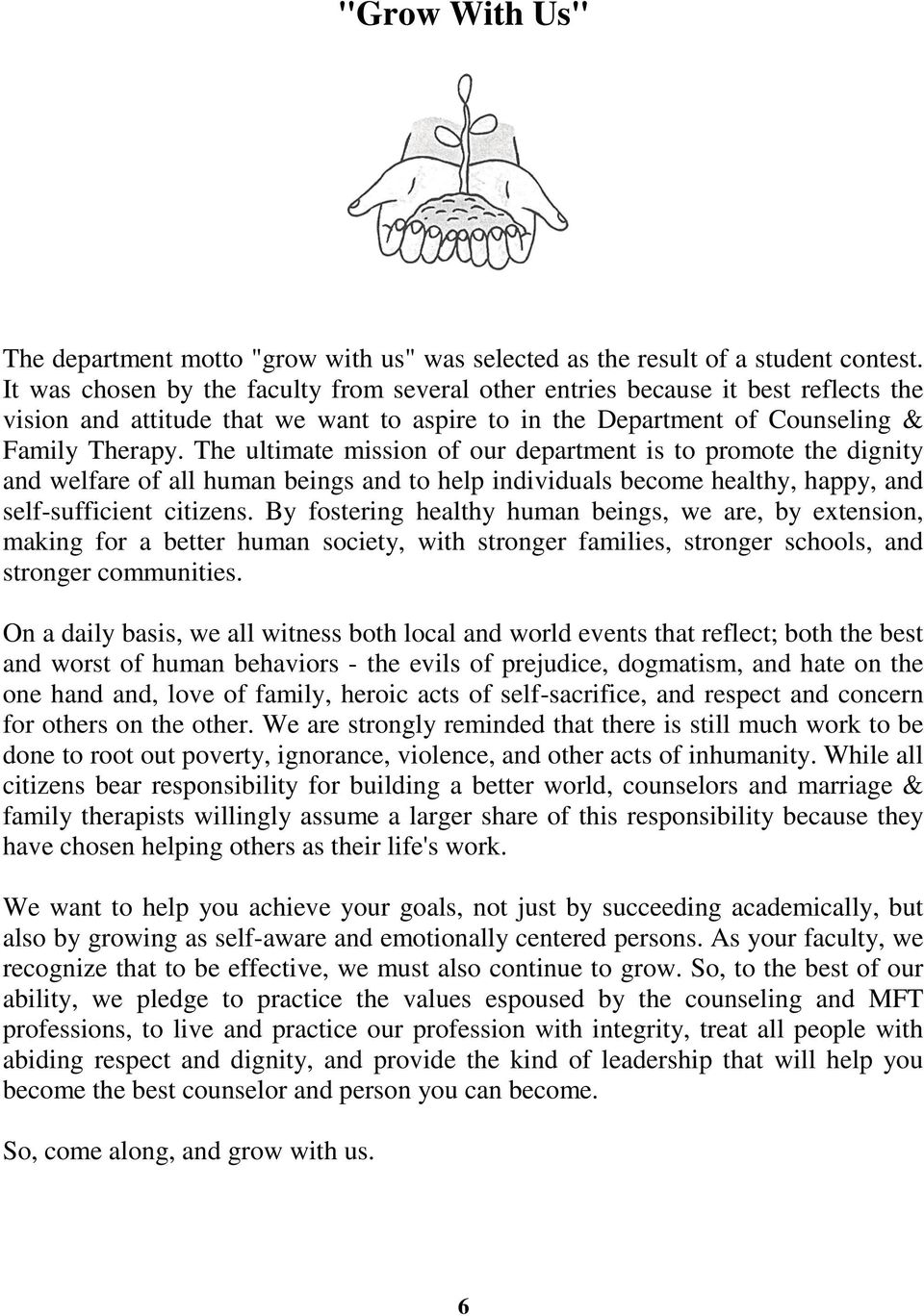
6 "Grow With Us" The department motto "grow with us" was selected as the result of a student contest. It was chosen by the faculty from several other entries because it best reflects the vision and attitude that we want to aspire to in the Department of Counseling & Family Therapy. The ultimate mission of our department is to promote the dignity and welfare of all human beings and to help individuals become healthy, happy, and self-sufficient citizens. By fostering healthy human beings, we are, by extension, making for a better human society, with stronger families, stronger schools, and stronger communities. On a daily basis, we all witness both local and world events that reflect; both the best and worst of human behaviors - the evils of prejudice, dogmatism, and hate on the one hand and, love of family, heroic acts of self-sacrifice, and respect and concern for others on the other. We are strongly reminded that there is still much work to be done to root out poverty, ignorance, violence, and other acts of inhumanity. While all citizens bear responsibility for building a better world, counselors and marriage & family therapists willingly assume a larger share of this responsibility because they have chosen helping others as their life's work. We want to help you achieve your goals, not just by succeeding academically, but also by growing as self-aware and emotionally centered persons. As your faculty, we recognize that to be effective, we must also continue to grow. So, to the best of our ability, we pledge to practice the values espoused by the counseling and MFT professions, to live and practice our profession with integrity, treat all people with abiding respect and dignity, and provide the kind of leadership that will help you become the best counselor and person you can become. So, come along, and grow with us. 6
7 General Information - CCSU The University Founded in 1849 as the New Britain Normal School - a teacher-training facility- CCSU is Connecticut's oldest publicly supported institution of higher education. It became the Teachers College of Connecticut in 1933, and after a period of extensive institutional growth and external expansion it became the Central Connecticut State College in In recognition of the institution's continual development in mission and aspiration, the present name and educational charter were conferred in Honoring our "visionary innovations in undergraduate education," the Association of American Colleges & Universities selected CCSU as one of only 16 "Leadership Institutions" in the nation - and the only one in Connecticut. The School of Education and Professional Studies The Department of Counseling & Family Therapy is part of the School of Education and Professional Studies (SEPS). The school offers both undergraduate and graduate programs that lead to teacher certification in the State of Connecticut and advanced programs in educational leadership, counseling, nursing, physical education and health fitness, reading and language arts, and special education. Whether they are teachers, principals, counselors or nurses, all educational and human service professionals share the common purpose of facilitating the academic, career, and social-emotional growth of our nation's citizens. Consequently, an overarching conceptual framework that provides a philosophical and theoretical foundation for all programs, courses, candidate performance, scholarship, service and accountability guides all educational programs within the School of Education and Professional Studies. The unifying theme for the conceptual framework is Preparing Leaders for Service in Our Communities. This theme is a reflection of the university's mission to be "a community of learners dedicated to teaching and scholarship." The theme also underscores the expectation that graduates from the school will offer service to their communities and will be thoughtful, responsible citizens. The Dean of the School of Education and Professional Studies is Dr. Mitchell Sakofs. The Department The Department of Counseling & Family Therapy prepares students for professional career in Professional Counseling, School Counseling, Marriage and Family Therapy, and Student Development in Higher Education. Courses are designed to develop student competence in the application of theory-based counseling models, to understand the concerns of diverse client populations and to enhance students' personal and professional development. All programs have practicum experiences and clinical internships that provide students with valuable opportunities to apply their skills in a field-based setting under close supervision. The Chair of the Department of Counseling & Family Therapy is Dr. Connie Tait. Diversity and the CCSU Marriage and Family Therapy Program The Marriage and Family Therapy program at Central Connecticut State University defines human diversity as: perceived variability along any category or dimension which differentiates individual persons, or groups of persons, one from another. Insofar as all human beings are unique, diversity is a ubiquitous phenomenon resulting from the universal habit of perceiving differences both consciously and unconsciously. Awareness of diversity itself is neither a virtue nor a problem. However, judgment accompanying such awareness of diversity can be problematic, particularly when such judgments entail presumptions of superiority or inferiority, or expectations unfounded by direct experience with the particular individuals or groups perceived as similar or different from the perceiver. Historically, injustices have resulted from two broad types of acts: (1) those that result from unfounded judgments of specific persons or groups from the perceiver and (2) those that establish policies which result in favor or disfavor to persons or groups from any one or more category or dimension. 7

8 Some of the major categories that have been attended to with consequent injustices are: Race, religion, national origin, ethnicity, gender, socioeconomic class, sexual orientation, and political belief. Some of the major dimensions are: Age, height, weight, physical attractiveness, and skin tone. We refer to such variables as HCADs (Historical Categories and Dimensions). The Marriage and Family Therapy (MFT) program is deeply committed, as is Central Connecticut State University of which we are a part, to the goal of maximal opportunity for all persons, irrespective to their membership in any perceived categories and dimensions. To this end, our program has adopted a policy of admissions to anyone having earned a Baccalaureate degree from an accredited institution with a G.P.A. of 2.7 or better, along with favorable recommendations and a well-written essay. Recognizing that economic circumstances limit some persons from attending our program, we encourage students to seek financial aid and offer a limited number of graduate assistantships. To our knowledge, graduate education, at the two Connecticut State University MFT programs are the most affordable of any in the state. Central Connecticut State University prides itself on its diversity and its emphasis on the Non-traditional Student. The MFT program has been designed to accommodate both full-time and part-time students. Most of the courses in the program are offered in the evenings; some are offered during Intersession and summer and occasionally weekends. The program is designed to allow both full-time and part-time students to stay together as a cohort through critical stages in their training, thus creating an atmosphere of cohesiveness and connection to each other and the program. Students value this atmosphere, finding that it generates support, reinforcement, collegiality, and a sense of ownership in the program. Since the mid-1990 s, our program has attracted a student body diverse with respect to all the above-mentioned HCADs. We offer coursework that addresses the importance of respect for all persons; we support our MFT graduate student organization, which provides social as well as professional activities open to all. We encourage our students to inform their communities about our program, a policy which has resulted in continued HCAD diversity of our student body with respect to HCADs. We facilitate both practicum and internship placements with agencies that service an HCAD-diverse population. Our program student body consists of over 20% males and over 20% non-european-americans, which attests to the success our policies allow us to enjoy in regard to racial and ethnic diversity. Because of our emphasis on diversity, our program attracts students of all walks of life, cultural backgrounds, and ethnic origins. We have attracted students from all over the world, and have had students in our program representing such countries as Bangladesh, Brazil, Canada, China, Columbia, India, Iran, Israel, Italy, Japan, Nicaragua, Peru, Poland, Russia, South Africa, South Korea, Spain, Syria, Turkey, Vietnam, and the West Indies. Our program faculty and clinical site supervisors are diverse along many dimensions of the historical categories and dimensions as stated above. Regarding our faculty, we are diverse in respect to age, gender, ethnicity, religious affiliation, educational backgrounds, clinical experiences, and many other HCADs. The program offers a broad selection of clinical placements across the State of Connecticut in diverse settings as urban, suburban, and rural settings, and across the spectrum of clinical venues. Students have the opportunity to work with minority clients and field supervisors. CCSU Non-Discrimination Statement Central Connecticut State University is committed to a policy of non-discrimination, equal opportunity and affirmative action for all persons regardless of race, color, religion, sex, sexual orientation, age, national origin, marital or veteran status, or disability. This policy is applicable to all employment practices, admission of students, programs and services to students, faculty, staff and the community. Central Connecticut s affirmative action policy seeks to include persons of color, women, veterans and persons with disabilities in its educational programs and in all job groups of its workforce. The University Office of Counsel to the President/Multicultural Affairs is located in Davidson Hall, Room 104 ( ). 8
9 Program Philosophy. Description of the Program The Marriage and Family Therapy program at Central Connecticut State University (CCSU) is designed to prepare students for professional careers as Marriage and Family Therapists in a wide variety of settings and roles. First, students are taught theories and techniques of practice in individual and group counseling modalities, as well as developmental theory. The foundation of the specialized training in Marriage and Family Therapy is Systems Theory, serving as the linchpin for the study of clinical theories and practices that are taught in preparation for clinical training. The philosophy of the program is that a student must integrate theories and techniques as tools for enhancing one's effectiveness as an agent of intervention and change. The program does so by interweaving theory and practice throughout the duration of the training process via graduated practical experiences while studying theory. Thus, through the process of study and practice, the student has an opportunity to incorporate a wide array of learnings gradually and comprehensively. The end product of such training is a therapist who is well-grounded in theory, and who has had the nurturing through an on-going training and supervisory process to use him- or herself effectively, professionally, and ethically as an agent of change at a variety of levels. MFT Educational Outcomes. The broad aims of the MFT program are: 1. To develop competent entry-level Marriage and Family Therapists at point of graduation. Graduating students will: 1) possess knowledge of systems theory, major models of family therapy, procedures for assessing and intervening in human problems from a family systems perspective, as specified in the program Student Learning Outcomes and 2) Demonstrate competence at the entry level in the implementation of individual, couple, and family assessment and interventions from a family systems perspective as defined in the Student Learning Outcomes. 2. To advance and disseminate the Metaframeworks paradigm as a valued systemic basis for teaching and practicing marriage and family therapy The Metaframeworks paradigm, as a fundamental model for teaching systems theory and therapy in the CCSU MFT Program, is a unique defining feature of the program. Students will demonstrate proficiency in: 1) understanding the principles of the Metaframeworks paradigm; 2) assessing how presenting problems and symptoms can be tied to systemic constraints based on core conceptual domains of the Metaframeworks paradigm; 3) identifying MFT models of intervention that correspond to combinations of Metaframeworks domains to be used in removing systemic constraints in a given case; and 4) developing treatment plans and implementing constraint-removing interventions in systems, informed by the Metaframeworks paradigm. 3. To promote cultural competence in systemic mental health practice Students will demonstrate: 1) awareness of the importance of understanding similarities and differences among people of various ethnic, racial, and cultural groups; 2) knowledge of core issues impacting members of both the dominant and minority cultures in our society, including burdens of privilege, discrimination, assimilation/accommodation, immigration, poverty, educational disadvantage, language barriers, etc.; 3) self-awareness of their own cultural burdens, belief systems, and biases; and 4) respect, openness and curiosity regarding similarities and differences between themselves and their clients. 9

10 4. To promote leadership in the MFT field among our students, faculty, and graduates Leadership is defined as engagement of students, faculty, and graduates in activities to advance the knowledge and practice of marriage and family therapy in the larger mental health field. Such activities include: 1) Participating in the national and local AAMFT/CTAMFT organizations; 2) participating in AAMFT/CTAMFT activities (e.g., networking events, continuing education, committee and board participation, etc.); 3) holding a primary professional identification as an MFT; 4) obtaining licensing as a LMFT after graduation; 5) Pursuing the AAMFT Approved Supervisor designation; 6) Teaching; 7) conducting and disseminating research on MFT topics; and 8) promoting awareness in the community of the unique contributions of MFT. To accomplish these ends, the program has established standards and benchmarks for students achievements while in the program, graduates accomplishments after graduation, and ensuring that our faculty and administration are qualified and prepared for delivering the quality of educational experiences that will ensure success the of our graduates in the field. MFT Student Learning Outcomes that support attainment of the Educational Outcomes As a result of successful completion of the MFT program, students will: 1. Demonstrate knowledge in the major schools of marriage and family therapy; 2. Demonstrate proficiency in practices of systemically-oriented therapy approaches to human problems in a variety of clinical settings; 3. Demonstrate an articulated personal model of therapy upon which they base their intervention, derived from Metaframeworks; 4. Embody professional identities as Marriage and Family Therapists through participation in activities that facilitate the process of socialization in the field; 5. Demonstrate knowledge as consumers of MFT relevant research and ongoing professional enrichment through the valuing of continued self study and skill development; 6. Demonstrate awareness, knowledge, and skills in providing culturally informed MFT; 7. Demonstrate ability to apply the standards of ethical professional conduct in the field; and 8. Show a strong and clear sense of self as an intervener in human problems. 10
11 What is a Marriage and Family Therapist? A Marriage and Family Therapist is a helping professional who is trained to intervene in human problems holistically. A Marriage and Family Therapist (i.e., "MFT") is trained in various forms of theories and methods stemming from a model of understanding human interaction called SYSTEMS THEORY. Systems theory is an integrated set of concepts which describes how each person is interconnected with his or her context in complex ways, and looks at the individual as simultaneously a whole entity and as part of a larger system. Systems theory holds that individuals function in relation to others and in relation to a set of circumstances that dictate how each person is to react. Conversely, the individual is also seen as being capable of having powerful input into how the larger system operates and can have an influence in changing his or her environment. Since each person in a system has a unique perspective and role in the system's operation, there are "multiple realities" that exist in a family or other social unit that an MFT identifies and works with to assist the members in understanding themselves in new ways. The MFT identifies dysfunctional processes, structures, sequences, and beliefs in the family or system that maintain problems, symptoms, and constraints that keep individuals from developing their potentials. With an understanding of how the system operates and the relationship between the presenting symptom and the system's operation, the MFT then designs interventions aimed at altering dysfunctional structures or processes and assisting the system in developing new realities and competencies that permit growth and individuation of its members while neutralizing symptoms. Therapies based on systems theory often involve entire families or groups, but can involve individuals alone, couples, or entire networks of individuals who are interconnected in some way. Regardless of the unit of treatment, the MFT operates on the interconnections between the individuals and attempts to alter or "restructure" how systems function in order to permit the individuals that comprise such systems to realize their fullest potentials. MFTs are taught not only techniques and theories of individual counseling, but also how to assess and treat larger social structures. MFTs are trained in understanding complex relationships, and as such, are capable of intervening with non-family systems, including work groups, schools, medical settings, neighborhood organizations, political groups, etc. MFTs often work with other human service professionals to ensure that both dysfunctional aspects of the system and strengths are appropriately assessed and addressed. The MFT professional must have competence in case management procedures, including referral skills, coordination skills, and communication skills. Marriage and Family Therapy is an active approach toward intervention, and often requires that the MFT extend his or her work outside the boundaries of the consultation room during the Clinical Hour. Such activities as home visits, conferences with teachers, visits to the probation department, coordination of treatment planning meetings with other professionals involved with a case, and many other tasks are often part and parcel of the work of the MFT. Such is in keeping with the principles of systems theory and the understanding of the complex interrelationships among parts of a system. MFT Job Market - What Does the Program Prepare a Student For? MFTs are licensed by the State of Connecticut after completing intensive post-graduate clinical work and supervisory requirements and passing a state exam (see page 33 for details). Such licensure permits the collection of third-party (insurance) payments, protects therapist-client privilege, and provides a standard of excellence and accountability to the profession. Application for licensure is made to the State of Connecticut, and information can be obtained by contacting the state Department of Public Health at (860) An exciting new opportunity for MFTs is to become certified to be hired by school systems as School Certified Marriage and Family Therapists. In 2007, the State of Connecticut passed the first law in the nation to certify Marriage and Family Therapists. This certification allows school districts to hire MFTs as employees, thus bringing family intervention into the educational environment to address environmental factors that impact students learning. Details on how the CCSU MFT program prepares our students for this certification can be found on page
12 Typical Jobs of MFT Graduates From CCSU - Where Will Jobs be Found Upon Graduation? MFTs find employment in a wide variety of settings. Graduates of the CCSU MFT program can be found working in mental health facilities (outpatient and inpatient), hospitals, managed care centers, drug and alcohol rehabilitation centers, outpatient medical facilities, schools, family service agencies, family preservation programs, alternative incarceration programs, and private practice. Populations served by our MFT graduates span the full range of the life cycle and across many treatment populations. Other innovative employment possibilities for MFTs include such diverse settings as management consultation firms, courts, law offices, alternative health or holistic treatment settings, social welfare programs, and any other setting in which the systemic approach may lend itself to assist in the delivery of human services. 12
13 Requirements of Graduate Study Matriculation, Prerequisites, and Degree Candidacy. Admission into the Marriage and Family Therapy Program at CCSU requires several steps. First, a prospective student must apply to the School of Graduate Studies for admission into the Graduate School. Students are required to submit official transcripts directly from all undergraduate and graduate programs attended. An undergraduate G.P.A. of 2.70 has been set as the minimum standard for admission. A student with a lower G.P.A. may be considered (at the discretion of the faculty) if upper division courses subsequent to graduation have been taken in a related field with "A" or "B" grades demonstrating potential for graduate studies. Other steps include submitting 3 letters of recommendation from professionals outside the program who can attest to a candidate s ability and readiness for graduate study in the field and a written essay as part of the determination of acceptance into the MFT program. All students accepted into the MFT program enter the Pre-Candidacy phase; they granted provisional acceptance into the MFT program and are assigned an academic advisor from the MFT faculty. An initial meeting with the advisor will orient the student as to prerequisites, scheduling of courses, acceptability of possible transfer courses, and draft a planned program of study. During the Pre-Candidacy phase, Students take three (3) prerequisite courses (CNSL 50, CNSL 501, and PSY 512) and MFT 541. Students must achieve a grade of B or better in each of the four courses in order to qualify for Degree Candidacy. Students who have been admitted conditionally (i.e., with a GPA of below 2.70 may have special conditions placed on them to qualify for Degree Candidacy (e.g., requiring a grade of B+ or A- or better in each of the pre-candidacy courses, depending on how far below the minimum 2.70 GPA the student enters with). After completing the pre-candidacy requirements, students must apply for Degree Candidacy to continue in the Marriage and Family Therapy program. On completion of the above courses, the candidate will meet with his or her advisor, review progress, and determine the acceptability of the student to continue into the program. If the student meets the requirement for the next step, the application for Degree Candidacy" and Planned Program of Study forms will be completed and submitted to the Graduate Dean for final approval. Degree Candidacy allows the student to pursue courses in the MFT program and to qualify for graduation on completion of the Planned Program. Curriculum requirements will be presented later in this handbook. In addition to meeting academic criteria, a successful MFT student is expected to be mature, motivated for graduate studies, and invested in the welfare of others. Training in MFT is a process of learning to apply theory to practice and of learning to use oneself as an instrument of change with people who are in distress. The faculty assesses each candidate's adherence to the departmental "Attitudes and Attributes", which reflect a student's values and ability to relate to others (see Appendix III). Meeting with the faculty advisor during the admissions process provides an opportunity for frank dialog as to the appropriateness of such training for each applicant. Academic Advising. Your advisor will serve as your guide while in the program - it is necessary that you make contact with your advisor periodically and utilize the faculty member's services on your behalf. You may meet with your advisor during regularly scheduled office hours or by appointment. Your advisor also provides you with structure and guidance to navigate the paperwork and procedures associated with your graduate studies. The program has a protocol for meeting with students to carry out specific tasks at set points in the program (see Appendix VI). Each semester prior to completing the requirements for Degree Candidacy your advisor will provide you with a registration PIN number, which you will need in order to register each semester. After you have completed your degree candidacy and have a Planned Program of Study on file in the Graduate Dean s office, you will no longer need a PIN number in order to register for classes. 13
14 Graduation Requirements for the M.S. Degree. Graduation is the first major milestone in launching a student's career as a professional, and marks the beginning of an ongoing process of credentialing, continuing education, and ongoing personal growth. The faculty must recommend that the student is ready to take on the challenges of professional life. In preparing for graduation, the student must have be accepted as a Degree Candidate; must have completed all of the items listed on his or her Planned Program, including all of the prerequisite courses, core counseling courses, specialization courses, practicum and internship (including 500 clinical contact hours and a minimum of 100 supervision hours by an AAMFT Approved Supervisor), and capstone project; and must complete the thesis, if this option was chosen. At various points, faculty members have opportunities to provide each student with feedback as to progress toward graduation and professional development. Once all requirements have been satisfactorily met, an "Application for Graduation" form must be filed with the School of Graduate Studies by March 1 of the year the student wishes to graduate for May and August graduations, and by September 15 for December conferral of the Master's degree. It is the student's responsibility to ensure that the proper paperwork is filed by the appropriate deadline. The Graduate School will then check to ensure that you have completed all of the courses listed on your Planned Program. Students will graduate with a Master of Science in Marriage and Family Therapy (M.S.M.F.T.). The "Capstone Project": The Case Presentation. All graduate students must complete "capstone project" in order to qualify for graduation. In the Marriage and Family Therapy Program, the Capstone Project takes the form of a Case Presentation, to be done after documenting the completion of most (at least 300) of the 500 clinical contact hours during the student's internship year. The format is designed to serve as a comprehensive written and oral examination, centered on application of the student's learning while in the program. The Case Presentation is made to a panel of the MFT full-time and part-time faculty at the end of the Spring semester, or by special arrangement. Toward the end of the internship, the student will apply for the Case Presentation at least one month prior to the scheduled presentation. Students will receive an outline of all of the requirements of the presentation (including its format - see Appendix VII). The case to be presented will be taken from the student's caseload during the internship and must be of a session with either a couple or family. An individual case is not acceptable. The "Metaframeworks" model, which is taught throughout the curriculum, will be used as a "template" for developing the case presentation, and the student must demonstrate proficiency in formulating and implementing a treatment plan based on the principles of the model and the student's personal preference for any given "school" of family therapy. A written summary, an oral presentation, and presentation of edited pieces of videotape will be required. The student must obtain a release of information from the clients, signed by all family members involved in the case. Clinical material must be disguised to protect the family's confidentiality, using proper precautions and procedures. The presentation will be graded on a pass/fail basis, with the faculty panel using pre-set criteria to judge the quality of the presentation and the student's degree of proficiency in handling him/herself in a clinical situation. Credit for completion of the Capstone Project will be given on recommendation of the Faculty Panel and on documentation of completion of the 500 clinical contact hours. Upon passing, the student will be permitted to file for graduation, given that all other requirements have been completed. Failing the presentation suggests that the student has a serious deficiency in his/her capacity to function in a clinical setting. In such cases, a plan for remediation will be drawn up with the MFT Program Director and advisor, which may involve one or more of the following actions, depending on the particular circumstances: Repeating the Case Presentation, undertaking additional clinical contact in a supervised setting with more intensive faculty supervision, receiving a recommendation for psychotherapy, or counseling out of the program. 14

15 The Thesis Option. In addition to the Clinical Case Presentation, students have the option of completing a master's thesis. A thesis is a major scholastic exercise demonstrating the ability for critical thinking, expressing ideas in writing to a professional audience, and showing the ability to make an original contribution to the field. Such a project involves considerable time and effort in order to develop a quality product. The thesis, being optional for MFT students at CCSU, is not a graduation requirement. Students who are interested in research or writing or plan to pursue doctoral studies, are likely candidates for taking this option. Students who choose to do a thesis must formally apply to the School Graduate Studies with a proposal. A handbook on how to prepare a thesis and the procedures for pursuing the thesis option are available through the School of Graduate Studies, located on the first floor of Barnard Hall or can be downloaded from Three credits are awarded toward the thesis beyond the program s typical 63 credit hours. A thesis student must have a departmental faculty member serve as Thesis Advisor, and a second reader must be chosen prior to the undertaking of the thesis project. The thesis student works closely with his or her advisor in the design, implementation, and write-up of the thesis project. The role of the second reader is to provide secondary input and to provide an "outsider's" critique of the finished product. On the advisor's and second reader's recommendation, the final product is sent to the School of Graduate Studies for final approval. Students who are considering doing a thesis must keep in mind that this undertaking is a major project and may take over a year to complete. It is wise to begin a thesis project early in one's program and to choose a topic of strong interest. It is also wise to keep a project simple and manageable, since most thesis students have limited resources with which to do the project. Some student research grants may be available; check with the School of Graduate Studies or private sources to learn how to obtain grant funding for thesis projects. Also, all projects involving the use of human subjects must be approved by the Human Subjects Committee of the University. Thesis students are encouraged to write up their projects for submission to professional journals for publication or for presentation at professional conferences. Curriculum The curriculum of the MFT program is designed to provide students with a rich theoretical foundation for ultimately developing a set of complex clinical skills required for Marriage and Family Therapists to intervene at many levels of human problems and concerns. The program integrates theoretical foundations with clinical practice, culminating in the Clinical Case Conference, the capstone of MFT training. Pre-Candidacy: Prerequisites and the Core Counseling Sequence. To qualify for Degree Candidacy, students must complete the prerequisite courses (CNSL 500, CNSL 501, and PSY 512) and MFT 541, achieving a grade of B or better in each course and receive favorable ratings on the "Attitudes and Attributes" scale by instructors for CNSL 501 and MFT 541. On fulfillment of these requirements, students meet with their advisors to complete their Planned Programs of Study and the Application for Degree Candidacy. These documents are submitted to the Dean of the School of Graduate Studies for final approval and acceptance into the program as Degree Candidates. Any Student who does not meet the criteria for degree candidacy (as specified above) is not permitted to continue in the program and will be recommended to the Dean of Graduate Studies for dismissal from the program. The four courses listed above are offered at CCSU and students are permitted to take them after they have been accepted into the MFT program as pre-candidates : CNSL 500, CNSL 501 and PSY 512 are designated as prerequisites may waived if they can demonstrate that they have completed these courses at other educational institutions on the graduate level and have earned a B or better in the courses. MFT 541 is also taken during this period, but is part of the core curriculum and is not considered as an official prerequisite (i.e., the course must be taken at CCSU and cannot be waived). 15

16 The MFT program places a heavy emphasis on human development (individual and family life cycle). Thus, the Seminar in Developmental Psychology (PSY 512) is viewed as a cornerstone of the program and underscores the importance of understanding basic developmental principles early in the training. The core counseling sequence is a critical piece in the development of skills needed in becoming a competent Marriage and Family Therapist. The program emphasizes the development of generic counseling skills in both individual and group modalities, as much of the work of MFTs in the work place requires flexibility in treatment approaches. CNSL 500 and CNSL 501 prepare the student for beginning clinical training prior to the practicum and internship. In addition to the three prerequisite courses, "Introduction to Theories of Family Systems" (MFT 541), which is one of the core MFT courses, is also taken during the Pre-candidacy period. This course provides an overview of the field of Marriage and Family Therapy, organized according to the "Metaframeworks" model. This model provides a framework for understanding the complex aspects of General Systems Theory and provides a "road map" for understanding how various "schools" of family therapy relate to General Systems Theory and to each other. The goals of the course are to provide the student with an outline of the MFT program, to ensure that the basic premises of systems theory are understood, and to expose the student to the major treatment models in the field. Once admitted into pre-candidacy, students may enroll as full-time or part-time students. Full-time students take a minimum of 9 credits during fall and spring semesters, follow a prescribed program schedule, may attend during the summer, and complete the program in 3 years. Part-time students may take 3 or 6 credits per semester (including summers) and must complete the program within a 6-year period. Their program of study is arranged with their advisor. Students may shift between full-time and part-time status as individually determined between the student and his or her advisor. Typically, students are enrolled parttime during their internship (3 rd year), and are eligible for consideration for part-time equivalency if they are only taking a practicum or internship field placement course. Course Sequence in MFT The Marriage and Family Therapy program is designed to provide a firm grounding in systems theory and to help each student develop a foundation of selected treatment models stemming from the systems theory approach. The "Metaframeworks" orientation provides a conceptual framework for putting each of the several treatment models in a theoretical perspective and allows the students the opportunity to develop flexible, yet sound and consistent parameters for formulating treatment plans and developing intervention strategies. The content areas of the MFT program align with the AAMFT Marriage & Family Therapy Core Competencies and the program s Educational and Student Learning Outcomes (see above). The Core Competencies consist of 128 skill areas, divided into six (6) core domains (Admission to Treatment; Clinical Assessment & Diagnosis; Treatment planning & Case Management; Therapeutic Interventions; Legal Issues, Ethics, & Standards; and Research & Program Evaluation) and five (5) sub-domains (Conceptual, Perceptual, Executive, Evaluative, and Professional Skills). Our program culminates with a Capstone project (the Clinical Case Presentation) for which students must demonstrate their proficiency in the Core Competencies. Following MFT 541, students take the two-course Family Therapy Models sequence (MFT 551 and MFT 552), presenting in-depth exposure and practice in several of the major "schools" of marriage and family therapy. Several courses on various topics important to general clinical practice and MFT practice in particular are required to expand the breadth of awareness of the student to the human condition. The Research Methods course provides exposure to statistics and research design to train the MFT student to review research studies with a scientific and critical "eye". Also important in the MFT's training is concentrated study in the areas of professional ethics, multiculturalism, sexuality, and gender issues. The curriculum is tied together with a holistic perspective on human systems, as exemplified in the "Metaframeworks" model taught in the Introduction to Theories of Family Systems course. 16

17 The core courses in the MFT program are: MFT 541 Introduction to Theories of Family Systems MFT 542 Ethical, Legal, and Professional Issues in Marriage & Family Therapy MFT The Family Life Cycle MFT Families in Context: Gender & Cultural Dimensions MFT Structural/Strategic/Behavioral Family Therapies MFT Experiential, Intergenerational & Psychodynamic Family Therapies MFT Couples Therapy MFT Dysfunctional Family Processes MFT Systemic Perspectives on Mental Disorders MFT Action Methods in Marital and Family Therapy MFT 558 Internal Family Systems Therapy (Optional - Elective) MFT Marriage & Family Therapy Practicum I MFT Marriage & Family Therapy Practicum II MFT Marriage & Family Therapy Internship MFT Research Methods Elective Capstone Project: Case Presentation Sample full-time and part-time sequences can be found on pages 21 through 23. Course Descriptions CNSL THE DYNAMICS OF GROUP BEHAVIOR - Prereq.: Admission to the graduate program and/or permission of department chair. Experiential approach to more effective interpersonal communication. Opportunity is offered for personal growth in awareness and understanding both of self and others, and in the communication of that self-awareness and understanding. The orientation of this course is educational. Students enrolled in this course may be observed by students in CNSL 507.(Program prerequisite). CNSL THEORIES AND TECHNIQUES IN COUNSELING (6 credits) - Prereq.: CNSL 500 (may be taken concurrently).investigation of theories and techniques in counseling, including research findings and skill development. (Program prerequisite) PSY SEMINAR IN DEVELOPMENTAL PSYCHOLOGY - Prereq.: PSY 112 or equivalent or permission of instructor. Study of human development from conception through old age, including analysis of theory and research findings. (Program prerequisite). MFT COUNSELING AND HUMAN DEVELOPMENT ACROSS THE LIFESPAN - The nature and needs of persons at all developmental levels with a focus on the physical, cognitive, emotional, and social aspects of growth. Psychosocial theories of development and counseling models will be addressed as they apply to the stages of the lifespan. Cross listed with CNSL 505. No credit given to students with credit for CNSL 505. MFT 510 INTENSIVE IN-HOME EVIDENCE-BASED MODELS IN FAMILY THERAPY - Prereq.: MFT 541 or permission of instructor. Introduction to definitions and competencies connected with Evidence-Based Practice (EBP); overview of the history, theoretical foundations, and implementation of several evidence-based in-home family treatment models. Training in the theory and practice of treatment models; and hands-on training exercises with specific treatment toools. Cross-listed with CNSL 510. No credit given to students with credit for CNSL 510. Spring. MFT 542 PROFESSIONAL, ETHICAL, AND LEGAL ISSUES IN MARRIAGE AND FAMILY THERAPY - Prereq.: Matriculation into the MFT Program. Professional, ethical, and legal issues in marriage and family therapy. MFT 541 INTRODUCTION TO THEORIES OF FAMILY SYSTEMS - Prereq: Admission to department. Historical and theoretical underpinnings of General Systems Theory as it applies to families and family therapy. Major models of family therapy will be presented to orient the student to an understanding of functional and dysfunctional processes in human interaction. This course lays the foundation for the subsequent assessment and treatment courses which focus specifically on the major schools of family therapy. MFT THE FAMILY LIFE CYCLE - Prereq.: MFT 541. Developmental aspects of the family system over time, delineating critical issues for individual and other subsystems at various stages and transition points of the family life cycle. This course covers divorce, remarriage and blended families within the various stages a family may experience. MFT FAMILIES IN CONTEXT: GENDER AND CULTURAL DIMENSIONS -Prereq.: MFT 541. Integral principles of human organization that influence family growth and development. Students gain an understanding of ethnicity and gender from a systemic framework. MFT STRUCTURAL/STRATEGIC & BEHAVIORAL FAMILY THERAPIES - Prereq: MFT 541. Assessment and interventions from the Structural, Strategic and Behavioral schools of family therapy are examined. Students learn about diagnosis and treatment of human dilemmas and symptomatology within a systemic context. MFT EXPERIENTIAL, INTERGENERATIONAL AND PSYCHODYNAMIC FAMILY THERAPIES - Prereq.: MFT 551. Assessment and interventions from Experiential, Intergenerational and Psychodynamic schools of family therapy are explored. Students learn diagnosis and treatment of human dilemmas and symptomatology from these schools of therapy. 17

18 MFT COUPLES THERAPY - Prereq.: MFT 541. Assessment and treatment approaches to problematic dyadic relationships within a systemic framework are explored. Problems unique to couples are discussed, including sexual, communication and role expectations. This course covers treatment of spousal violence, sexual dysfunctions, mate selection, types of marriages, communication problems, gender and power issues, and the developmental stages of marriage. MFT DYSFUNCTIONAL FAMILY PROCESSES - Prereq.: MFT 541. Examination of structures and processes of family dysfunction, including substance abuse, family violence and sexual abuse. Assessment and intervention strategies from a systemic framework. MFT SYSTEMIC PERSPECTIVES ON MENTAL DISORDERS - Prereq.: MFT 541. Diagnostic classifications of mental, emotional and behavioral disorders of individuals within a systemic framework. Students learn how to communicate within a medical model framework using systemic conceptualizations. MFT ACTION METHODS IN MARITAL AND FAMILY THERAPY - Prereq.: MFT 541 or permission of instructor. Introduces students to action methods involving physical movement and dramatic role-play in MFT. Uses hands on experience and theory to compare action-oriented and exclusively verbal methods regarding therapeutic effectiveness and skill level. MFT 558 INTERNAL FAMILY SYSTEMS THERAPY (Non-required Elective Summer only) Prereq: MFT 541 or permission from instructor. Basic theory and techniques and clinical applications of the Internal Family Systems model of psychotherapy will be presented. This experiential course will emphasize exploration of the student's own "internal family system" through in-class exercises and written assignments. MFT MARRIAGE AND FAMILY THERAPY PRACTICUM I (Fall only) - Prereq.: MFT 551 and permission of MFT coordinator. Students participate in direct client contact, staff meetings, and supervision in a clinical setting. MFT MARRIAGE AND FAMILY THERAPY PRACTICUM II (Spring only) - Prereq.: MFT 583. Students participate in direct client contact, staff meetings, and supervision in a clinic setting. MFT MARRIAGE AND FAMILY THERAPY INTERNSHIP - Prereq.: MFT 584 and permission of the MFT coordinator. Placement in a community agency providing marital and family therapy under supervision. May be repeated as needed to complete minimum requirement of 12 consecutive months (and 500 clinical contact hours/100 supervision hours). Students begin in the Summer semester and must complete 3 consecutive semesters in order to satisfy program requirements. MFT RESEARCH METHODS IN MARRIAGE AND FAMILY THERAPY - Prereq.: Admission to M.S. in MFT graduate program or permission of department chair. Quantitative and qualitative research design, data analysis, interpretation, and program evaluation methods related to marriage and family therapy. ELECTIVES: MFT degree candidates must take one free elective (3 credits). Students may take any graduate-level course that fits their interests, with permission of their faculty advisor. OPTIONAL THESIS: CNSL Thesis - Prereq.: Permission of advisor; ED 598 or equivalent as accepted by advisor. Preparation of the thesis under the supervision of the thesis advisor. OPTIONAL SCHOOL-BASED MFT CERTIFICATION COURSES: MFT SCHOOL-BASED FAMILY COUNSELING - School-Based Family Counseling Spring, Summer. Prereq.: CNSL 500, CNSL 501, PSY 512 and MFT 541 or permission of instructor. MFT practice and intervention in public schools, school-based systems theory, learning theory, state and federal education laws pertaining to the health and education of children, and statutory requirements for mandated reporting, suspensions/expulsions, and school/district accountability; strategies for communicating and collaborating with families about students' progress; school-based ethics, and policies and procedures governing special and general ed. services for collaboration, referral and placement. Spring, Summer. MFT SCHOOL-BASED MARRIAGE/FAMILY THERAPY PRACTICUM AND SEMINAR I - School-Based Marriage and Family Therapy Practicum and Seminar I Fall. Supervision of Marriage and Family practice in public schools with direct client contact. Covers school-based learning and systems theories, Federal and state education laws (e.g., IDEA and ADA); professional ethics and code of professional responsibility for educators; FERPA; statutory requirements for mandated reporting, suspensions and expulsions; and school and district accountability. Fulfills 1/2 of the required 300 hours of practicum for state certification. MFT SCHOOL-BASED MARRIAGE/FAMILY THRAPY PRACTICUM AND SEMINAR II - School-Based Marriage and Family Therapy Practicum and Seminar II. Spring. Continuation of the two-semester School-Based Marriage and Family Therapy Practicum and Seminar. Further development of content areas covered in MFT 593. Fulfills the second 1/2 of the required 300 hours of practicum for state certification. ED PROFESSIONAL ETHICS & LAW FOR TEACHERS - Professional Ethics and Law for Teachers Prereq.: EDT 540, EDL 555, ED 598 Ethical and legal basis of local, state, and national policies dealing with classroom practices and student rights, with emphasis on professional responsibility for meeting the diverse needs of students. SPED EDUCATION OF THE EXCEPTIONAL LEARNER - Education of the Exceptional Learner Examines growth and development of students with disabilities, including those identified as gifted and talented, and methods for assessing, planning for and working effectively with these students. Meets State of Connecticut requirement for teacher certification (10 hours of off-campus field experience required). CT law requires fingerprinting and a criminal background check for the field experiences in this class. Fingerprinting must be completed prior to the beginning of class. 18
19 Clinical Training and Supervision Sequence Clinical training is the second major component of the training experience in marriage and family therapy. Following the completion of prerequisite courses, the MFT foundation course (MFT 541), and the first MFT therapy course (MFT 551) students are able to begin a two-semester (Fall and Spring) practicum, followed by a 12-month (Summer, Fall, and Spring) internship. For the practicum, each student is required to provide services at an approved clinical site in the community for 12 hours per week. This experience provides the student with basic skills and techniques in interviewing, clinical assessment, and case management at the novice level. Students attend a weekly course seminar for one hour per week with a faculty instructor. Following the practicum, each student undertakes a 12-month, intensive (20-25 hours per week) internship in a clinical facility, where the intern may hone his/her skills as an "apprentice" clinician under the mentorship of an on-site supervisor and oversight of a faculty supervisor. The internship is designed to be a much more extensive experience than the practicum experience, with the intern assuming primary responsibility for clinical cases per week. The student can expect much guidance during the internship experience, with over three hours per week spent in supervision to discuss clinical assessment, case dynamics, skill development, and use of self in the role of "therapist". By the end of the program, students must complete 500 clinical contact hours with a minimum of 100 hours of supervision of those clinical contact hours under an AAMFT Approved Supervisor. The specifics of these requirements will be discussed later. Full-time or Part-time? Central Connecticut State University prides itself on its diversity and its emphasis on the "non-traditional" student. In line with the University's mission, the MFT program has been designed to accommodate both fulltime and part-time students. Most of the courses in the program are offered in the evenings; some are offered during the summer and occasionally on weekends. The program is designed to allow both full-time and parttime students to stay together as a "cohort" through critical stages in their training, thus creating an atmosphere of cohesiveness and connection to each other and the program. Students highly value this atmosphere, finding that it generates support, reinforcement, collegiality, and a sense of "ownership" in the program. Since clinical training requires intensive study, practice, and supervision in a systematic fashion, both full-time and part-time students are expected to follow the sequence of: (1) Prerequisites (PSY 512, CNSL 500, and CNSL 501); (2) MFT 541; (3) MFT 551 and MFT 552; (4) Practicum; and (5) Internship. Other required courses may be taken when offered following completion of the prerequisites and MFT 541, and following full acceptance into the specialization. Feedback from students over the past several years also suggest that taking MFT 542 and MFT 556 early in the program. Part-time students are advised to plan on taking two courses per semester prior to taking the practicum sequence. Practicum and Internship experiences must each be done in adjoining semesters; i.e., the practicum being taken during the Fall and Spring semesters and the internship being taken from Summer through Fall and Spring semesters (12 continuous months). Full-time students carry a minimum of 9 credit hours per semester. Parttime students carry less than 9 credit hours per semester. Part-time students are not required to take an internship during their third year, but are expected to follow the program's sequential pattern over a longer period of time. Full-time students can complete the program in three years; all students must finish the program within a six-year time frame from the time they begin the program (students may take an additional 3 years with permission of the Dean of Graduate Studies). For students with financial aid who complete their academic courses by the time they start their practicum or internship, the Financial Aid Office can grant a Part-time Equivalency to students in field placement courses to allow them to qualify for part-time financial aid without penalty. Students must request this status through the Department Chairperson (currently, Dr. Connie Tait). Below are sample programs for full-time and part-time students: 19

20 Marriage and Family Therapy Plan of Study by Semester (Full-time Schedule). PHASE 1 PRE-CANDIDACY (Sample Full Time Schedule) Prerequisites: May be taken during Fall, Spring, or Summer semesters as offered prior to start of specialization program. PSY Seminar in Developmental Psychology (3) CNSL Dynamics of Group Behavior (3)** CNSL Theories and Techniques in Counseling (6)** YEAR 1 Fall Semester MFT Intro to Theories of Family Systems (3)** MFT 542 Ethical, Legal, and Professional issues in MFT (3)** Prerequisite courses may be taken during this semester. Student degree candidacy at the end of this semester. Join AAMFT ( as a student member. Spring Semester PHASE 2 DEGREE CANDIDACY MFT Structural/Strategic/Behavioral Family Therapies (3) MFT Systemic Perspectives on Mental Disorders (3)* MFT Action Methods in MFT (3)** Last Friday in January MFT Placement Fair for Practicum and Internship, held at CCSU Summer Semester NOTE: Many MFT courses that are scheduled for the Fall and Spring semesters (except sequenced courses in BOLD) are taught during Summer and Intersession semesters on a rotational basis for students' convenience. Students may take courses in the summer, as offered (denoted by an asterisk [*]. Courses taught every Summer are designated with [**]). YEAR 2 Fall Semester PHASE 3 PRACTICUM YEAR MFT The Family Life Cycle (3)* MFT Families in Context: Gender & Cultural Dimensions (3)* MFT Experiential, Intergenerational & Psychodynamic Family Therapies (3) MFT Marriage & Family Therapy Practicum I (3) Spring Semester MFT Research Methods in MFT (3)** MFT Dysfunctional Family Processes (3)* MFT Marriage & Family Therapy Practicum II (3) (Note: Practicum includes 12 hours on-site at agency per week plus weekly 2-hour seminar with MFT faculty MFT 583 and MFT 584. Agency provides supervision minimum one hour/week) Summer Semester PHASE 4 INTERNSHIP MFT Marriage & Family Therapy Internship (3) 3 semesters (12 months) requiring 500 clinical contact hours (250 must be relational ) with minimum 100 hours of supervision by an AAMFT Approved Supervisor (offered via faculty supervision at CCSU) 50 hours of supervision must use raw clinical data (audio/video/live supervision formats) YEAR 3 Fall Semester MFT Couples Therapy (3)* MFT Marriage & Family Therapy Internship (3) Elective* Spring Semester MFT Marriage & Family Therapy Internship (3) Capstone Project: Case Presentation Student applies for graduation by 3/1 Notes: This curriculum is designed to expose students to key theoretical knowledge and clinical techniques prior to the Internship experience. MFT 541 is a prerequisite for all MFT specialization courses. All MFT students must follow the sequence of MFT 541, MFT 551, MFT 552, MFT 583, MFT 584, and MFT 585 during the specified semesters. All other MFT courses may be taken anytime after completion of MFT 541 and acceptance into the program. The elective course can be any graduate-level course that fits coherently with the student's professional interests. MFT 598 (Research Methods) and MFT 542 (Ethical, Legal, and Professional Issues in MFT) may be taken anytime in the program, including prior to Degree Candidacy. MFT 558 (Internal Family Systems Therapy) is an elective that is taught each summer for students interested in learning the IFS model. 20

21 Marriage and Family Therapy Plan of Study by Semester (Sample Part-Time Schedule) PHASE 1 PRE-CANDIDACY (Part-time). Prerequisites: May be taken during Fall, Spring, or Summer semesters as offered prior to start of specialization program. PSY Seminar in Developmental Psychology (3) CNSL Dynamics of Group Behavior (3) CNSL Theories and Techniques in Counseling (6) Marriage and Family Therapy Specialization Curriculum (sample part-time program): YEAR 1 Fall Semester MFT Intro to Theories of Family Systems (3)* MFT 542 Professional, Ethical, and Legal Issues in MFT (3)* Prerequisite courses may be taken during this semester. Student applies for degree candidacy at the end of this semester. Spring Semester PHASE 2 DEGREE CANDIDACY MFT Structural/Strategic/Behavioral Family Therapies (3) Elective (3)* YEAR 2 Summer Semester MFT 557-Action Methods in MFT (3)* Fall Semester MFT Experiential, Intergenerational & Psychodynamic Family Therapies (3) MFT Families in Context: Gender & Cultural Dimensions (3)* Spring Semester MFT Systemic Perspectives on Mental Disorders (3)* MFT Research Methods (3) Summer Semester YEAR 3 Fall Semester PHASE 3 PRACTICUM YEAR MFT The Family Life Cycle (3)* MFT Marriage & Family Therapy Practicum I (3) Spring Semester MFT Dysfunctional Family Processes (3)* MFT Marriage & Family Therapy Practicum II (3) Summer Semester PHASE 4 INTERNSHIP MFT Marriage & Family Therapy Internship (3) YEAR 4 Fall Semester MFT Couples Therapy (3)* MFT Marriage & Family Therapy Internship (3) Spring Semester MFT Marriage & Family Therapy Internship (3) Capstone Project: Case Presentation Student applies for graduation by 3/1 21
22 Notes: Courses are offered only during semesters as listed on the full-time Curriculum sample. This 4-year part-time program assumes that the student will take two (2) courses per semester and will take prerequisites during the year prior to Degree Candidacy, for a total of 5 years of graduate study. This curriculum is designed to expose students to key theoretical knowledge and clinical techniques prior to the Internship experience. MFT 541 is a prerequisite for all MFT specialization courses. All MFT students must follow the sequence of MFT 541, MFT 551, MFT 552, MFT 583, MFT 584, and MFT 585 during the specified semesters. All other specialization courses may be taken any time after completion of MFT 541 and acceptance into the program. It is recommended that students take MFT 556 prior to taking MFT 555. The elective course can be any graduate-level course that fits coherently with the student's professional interests. Many MFT courses that are scheduled for the Fall and Spring semesters (except sequenced courses) are taught during Summer and Intersession semesters on a rotational basis for students' convenience. Students may take courses in the summer, as offered (denoted by an asterisk [*]) MFT 598 (Research Methods) and MFT 542 (Professional, Ethical, and Legal Issues in MFT) may be taken anytime in the program, including prior to Degree Candidacy. MFT 558 (Internal Family Systems Therapy) is an elective that is taught each summer for students interested in learning the IFS model. MFT Program Summer Course Rotational Schedule. Odd Years MFT 541 MFT 542 MFT 543* MFT 556* MFT 557 MFT 558 MFT 585 MFT 598 Intro to Theories of Family Systems Ethical, Legal, and Professional Issues Family Life Cycle Systemic Perspectives on Mental Disorders Action Methods in MFT Internal Family Systems Therapy (Elective) Internship Research Methods in MFT Even Years MFT 541 MFT 542 MFT 544* MFT 554* MFT 555* MFT 557 MFT 558 MFT 585 MFT 598 Other Electives Intro to Theories of Family Systems Ethical, Legal, and Professional Issues Families in Context: Gender and Cultural Dimensions Couples Therapy Dysfunctional Family Processes Action Methods in MFT Internal Family Systems Therapy (Elective) Internship Research Methods in MFT MFTs in the Schools** Evidence-Based and Intensive In-Home Programs** * Every other year ** As demand dictates 22
23 The Practicum Sequence. Practicum and Internship Procedures Students enroll in their first semester of Practicum experience after they have completed MFT 541 (Introduction to Theories of Family Systems) and MFT 551 (Structural, Strategic, and Behavioral Family Therapies). The first semester of practicum (MFT 583) can begin in the Fall of their second year in the program. The second semester of practicum (MFT 584) would commence after the student had completed MFT 552 (Experiential, Intergenerational and Psychodynamic Family Therapies). For the Practicum, students are placed in approved clinical sites in the community for 12 hours per week and receive an hour of supervision per week by an agency supervisor. This experience provides students with basic skills and techniques in interviewing, clinical assessment, and case management. Students attend a weekly course seminar for two hours per week with a faculty instructor. There are over 60 approved training sites across the state, which include mental health centers, youth service bureaus, family service agencies, hospitals, and schools. The Internship Sequence. After completing the practicum sequence, students have Internship placements in outside agencies where they will work approximately 20 to 25 hours a week for a full calendar year. The primary supervision of cases is done by the university faculty supervisor with one hour per week of individual supervision and two hours of group supervision weekly. The program's standard for supervision is that supervision must occur at a ratio of 1 hour of supervision for every 5 hours of clinical contact, with a minimum of 100 hours of supervision for the internship. A minimum of 50 hours of this supervision must be individual supervision. Fifty (50) hours of supervision must be spent reviewing raw clinical data, including videotapes of therapy sessions, live supervision, or audiotape review. Supervision hours count only if with an AAMFT Approved Supervisor that has been approved by the MFT Program Liaison or if with a faculty supervisor. Students are required to complete a minimum of five hundred (500) hours of direct contact hours during their internship experience. Fifty-percent of these hours (250 hours) must be "relational"; i.e., with couples and families. If a student has not met these requirements, s/he may continue to sign up for supervision (MFT 585) until they are completed. A student is deemed to be prepared for the internship is s/he has completed the two semesters of practicum with an acceptable grade (i.e., "B" or better) and upon recommendation of the student's faculty practicum instructor. NOTE: If a student has demonstrated problems that call attention to concerns regarding performance, emotional stability or immaturity, ethical or professional breaches, or other concerns that would mitigate successful completion of the program, his or her entry into internship may be delayed until such time that a remediation plan has been satisfied. Such a plan is drawn up between the Program Coordinator, academic advisor, faculty supervisor and the student in the form of a written contract, which clearly delineates expectations, criteria for successful completion, and a time frame for satisfying the terms agreed upon in the contract. The student may also be counseled as to the feasibility of continuing in the program or may be asked to resign from the program. The student may appeal such decision through a departmental appeal process or may file a grievance with the Dean of the School of Education and Professional Studies. A new qualification process is being developed that will assess a practicum student s readiness to continue on to Internship, which will take place during the Spring semester of the Practicum Year. Raw Data Requirement. Fifty (50) hours of supervision must be spent with an AAMFT-Approved Supervisor engaging in raw data supervision with each intern. This can be either live supervision (i.e., the supervisor observing the intern s session behind a one-way mirror), or reviewing audiotapes and/or videotapes of sessions. A minimum of twenty-five (25) hours of supervision must be spent reviewing videotapes. Videotaping is required. 23
24 The Liaison System. The Program's Internship Liaison is a faculty member who is responsible for establishing relationships with placement sites. The Liaison makes site visits to various agencies and clinical settings to ensure that each site meets appropriate standards for training and supervision. The Liaison maintains data on various clinical sites in the greater community who meet criteria for acceptable placements, either for practicum or internships. Finding a Placement. A system has been developed to assist you in finding an appropriate placement that matches your interests and geographical requirements. The process for selecting an internship or practicum begins in January prior to the summer you wish to begin the internship or fall semester you wish to begin the practicum. In January, the program holds a Placement Fair - an assembly of internship supervisors and prospective interns/practicum students takes place to share information and to have preliminary "informal" interviews. In February, the Liaison coordinates interviews at the various sites. By October prior to this mid-winter assembly, persons anticipating starting their internships the next summer, or practica the next Fall, should notify the Liaison of their intent. Practica begin during the fall semester and are two semesters in total. Students may begin their internship after completing the two semesters of practicum and with their advisor's permission. Internships begin during the summer and must be a minimum of 12 consecutive months in duration. The purpose of the practicum is to provide the student with exposure to a clinical setting and to familiarize her or him with clinical practices prior to entering a more advanced internship experience. Criteria for practicum sites are somewhat less stringent and requirements are more general than those of internship sites. Students in practicum settings should be exposed to clinical cases through co-therapy or a small, carefully monitored caseload, record-keeping procedures, diagnosis and assessment procedures, and exposure to staffings. Like the internship site, the practicum placement should adhere to standard clinical practices regarding record keeping, releases, confidentiality, storing and transporting of clinical material, etc. Students looking for internships may obtain their own placements, after clearing the site with the Liaison/Program Director. An appropriate clinical site should have a variety of case types and should be able to provide marital and family therapy cases; provide the student with adequate clinical space and administrative space to do paperwork; be able to provide a minimum of one hour per week of individual administrative and clinical supervision on clinic cases; have adequate emergency procedures (including medical consultation or back-up) and liability coverage; be willing to permit CCSU MFT faculty supervisors access to "raw" clinical data (i.e., audio and/or videotapes of sessions) for supervision and to allow faculty to provide clinical input on cases; and should adhere to standard clinical practices regarding record keeping, releases, confidentiality, storing of clinical material, etc. In addition, an appropriate internship site should be able to provide an intern with 500 clinical contact hours over the course of 12 months. The Liaison has final "right of refusal" in determining the appropriateness of a site proposed by a student. After a site is selected, an information packet and "letter of understanding" is sent to the agency supervisor for signature. The Klingberg/CCSU Family Therapy Institute. In September, 2007, the CCSU MFT program, in partnership with Klingberg Family Centers, opened the Klingberg/CCSU Family Therapy Institute (FTI), located at 185 Main Street in New Britain, Connecticut. The FTI is a student-run outpatient treatment and family therapy training facility that is operated by the students and faculty of the CCSU MFT program, under the auspices of Klingberg Family Centers. The Institute provides a rich opportunity for intensive family systems training with state-of-the-art live supervision experiences. One team of interns and practicum students from the CCSU MFT program run the operation of the Institute, supervised by a CCSU Faculty Supervisor who has a dual appointment as the Clinical Coordinator of the Family Therapy Institute. This partnership provides students an opportunity to learn how to run a clinical operation in addition to developing and honing their clinical skills in working with children and families. Students who are interested in participating in training at the Institute should contact the Clinical Coordinator. 24
25 Documentation of Clinical and Supervisory Hours. Clinical contact hours and supervisory hours during the internship year only are to be carefully documented by the student on a form provided by the faculty supervisor and are to be handed in at the beginning of each month. Students should make a photocopy of the documentation for their own records. The originals are kept on file in the department. Professional and Ethical Considerations. How you conduct yourself professionally at this stage will influence your credibility with colleagues and supervisors, and will influence your employability after graduation. A major part of the training experience is the socialization aspects of developing a new professional identity. Thus, while at your placement site, it is important to dress appropriately (fitting with the norms of the setting), and always maintaining a professional decorum. Students are expected to be familiar with and conduct themselves according to the AAMFT Code of Ethics (available on-line at Confidentiality. Maintaining confidentiality at all times protects everyone. Do not discuss cases with persons who are not involved with the case or involved in supervisory activities around the case, including your significant others. Do not speak to authorized persons in inappropriate contexts, such as in hallways or in cafeterias or restaurants. Insure that you have privacy when discussing cases on the phone. It is required by law that signed releases are obtained from the clients before any discussion regarding a case can occur with parties not associated with the agency; there are instances in which releases are necessary for intra-agency discussions. Check with the agency regarding policies on releases. Also, clinical documentation should be protected at all times, never being taken outside of the facility and always kept in locked files in a secured room. For written materials used for university-based supervision, make notes on clinical record-keeping forms provided by your supervisor and use codes to disguise any identifying information in the case. For audio and videotaping, you should also have obtained signed releases prior to proceeding with recording sessions (see Appendix V). Tapes or other imaging media should be secured at all times and you should never allow unauthorized persons to review a recording of clinical material without written permission of the client or clients. Recorded material must be kept in your physical possession whenever transporting recorded media to or from supervisory sessions and you must prevent any unauthorized persons from having access to the recordings. Whenever recordings on tape or digital memory media are away from the agency and not in your immediate possession (e.g., at home) they are to be kept in secured and locked receptacles. Any tapes or digital files of sessions must be erased or disposed of properly when no longer needed for training purposes. Dual Supervision. To prevent confusion regarding clinical decisions, dual supervision (i.e., a student's having intensive, on-going supervision from two supervisors on the same case) must be avoided. A stipulation of an agency's accepting an intern from CCSU is the agreement to allow the student to present cases to a faculty supervisor and supervisory group. If there are concerns or disputes regarding a case, the differences should be discussed between the agency supervisor and the faculty supervisor (with liaison involvement, as appropriate). Malpractice/Liability Insurance. Students providing clinical services must be covered by Professional Liability (malpractice) insurance. Insurance is obtained as a free benefit of student membership in AAMFT ( Minimum recommended limits are $1,000,000/$3,000,000. Higher limits are usually only a few dollars more and are suggested, such as $1,000,000/$5,000,000. Student membership in one of the above professional organizations is required to be eligible for low-cost liability insurance. A copy of each student s malpractice insurance face sheet must be on file prior to beginning clinical practice for both the practicum and internship. 25
26 Paid Practica and Internships. The MFT Internship is intended to provide a supervised clinical training experience for students in the program. The relationship between the agency and the MFT program constitutes an articulation agreement on behalf of students who are understood to be working at the agency under a supervised training capacity. As such, students who are serving as interns are considered trainees, and are expected to perform and function at the level of an advanced Master's-level student in training. Agencies that employ such students as regular clinicians, by definition, are holding the students at two different standards (i.e., one of "employee" and one of "trainee"). This constitutes a dual relationship between the student and agency, and is to be avoided. The rationale behind this policy is that if a student does not, by virtue of being in training, live up to standards set as an employee, then the student's training may be compromised. Also, consistent with the AAMFT Code of Ethics, students should not practice beyond the scope of their level of competence; as trainees, they are not expected to be able to practice independently as would be expected from "staff clinicians". While some students may be more experienced than others or may have previously functioned as clinicians by virtue of other academic degrees or training, the above rationale still holds while they are receiving specialized MFT training under supervision during their internship. Students may receive payment or count clinical hours toward their program requirements from their places of employment under the following conditions: 1) The agency or other funding source provides training stipends for students, which are not directly tied to an employment contract; 2) A student works for internship hours at times that do not correspond to regular employment hours, and are clearly designated as "internship hours". The student must have an agency-assigned supervisor (different from the supervisor who evaluates the student as an "employee") who meets with the student for a minimum of one hour per week for administrative supervision. Further, there must be a Letter of Agreement" signed between the agency and the MFT Program delineating responsibilities of the student for the "internship" portion of the time spent at the agency. Job performance and intern performance must be clearly separated. Extension of the Internship Beyond 12 Months. Any student who has not completed all of the AAMFT clinical and supervisory requirements by mid-may will receive an Incomplete for a grade for MFT 585 for the spring semester. If a student, by mid-may, has 20 hours or fewer left to complete the clinical hour requirements (including the 250 hour relational requirement) and is likely to complete these hours by May 31, the student will not need to register for summer supervision. If the student has an on-site AAMFT Approved Supervisor, then the faculty supervisor who has been supervising the student may arrange for continuing weekly supervision of the student by the agency supervisor until the hours are completed. The faculty supervisor will maintain weekly telephone contact in the intervening weeks until the requirements are completed. Summary of Requirements of the Internship. 1. You will receive an hour of individual supervision and 2 academic hours of group supervision weekly. Each student will present a case in the group on a rotating basis (e.g., every third week). A schedule will be generated during the first meeting. Individual supervision will consist of pairs of interns, utilizing audio and videotape. You will receive in-depth, focused supervision on your cases in this format. Since the academic hour is 50 minutes (and we will be working on the basis of clock hours), group supervision will be counted as 2 hours, although the actual time allotment is 90 minutes. Individual supervision will go for a full 60 minutes. 2. You should come to class prepared to present case material on clients being seen at your internship placement. 26
27 3. You are required to present raw clinical data in the form of audio or video. Proper release forms need to be obtained from the client to allow you to present such material in supervision. The format for such releases will be discussed during the first class. Videos should be cued to specific sections for playback in the group. 4. You will need to purchase a portable video recorder/camera, such as a camcorder or a flip video. Prices have dropped and they are now affordable the price of two textbooks ($100 - $200 range for a decent video camera). You can purchase these on-line or at Best Buy, Staples, Office Depot, or other retailers. The new digital cameras have a USB port that allow playback on computers and come with software that allows for easy editing. 5. If you are using audio or video media that you purchased to record therapy sessions, the media belong to you, but the material on the media is to be considered confidential clinical material that should be stored properly at the agency. All possible precautions must be taken to protect confidential material, including keeping recorded material in your physical possession whenever transporting recordings of sessions to or from supervisory sessions and preventing any unauthorized persons from having access to the material. Whenever such material are away from the agency and not in your immediate possession (e.g., at home) they are to be kept in secured and locked receptacles. Any tapes, memory cards, or other recordings of sessions must be erased or disposed of properly when no longer needed for training purposes. Clients are to sign consent forms authorizing video recording prior to your recording of sessions. 6. You are responsible for keeping track of your clinical and supervisory hours. A "Monthly Documentation" form will be provided for you by the instructor to facilitate this. The form should be updated at the end of each month and turned in no later than the second supervisory session of the following month. Both the on-site supervisor and faculty supervisor need to sign off on your hours on this form. Make a copy for your own records before handing them in to your faculty supervisor. 7. You should carry a minimum of cases at your internship site. Each case should be rotated into supervision periodically. You will need to accumulate 500 clinical contact hours by the end of your internship over 12 calendar months. 250 hours of your clinical contact must be with couples and families. You will need 100 supervision hours minimum, including individual and group supervision. Fifty hours of supervision must consist of review of taped material. Only supervision from AAMFT Approved Supervisors or Supervisor Candidates may be counted. 8. The faculty supervisor will want to contact your external site supervisor for coordination of your supervision. Dual clinical supervision on clinical cases should be avoided; however, the on-site supervisor should be providing you with administrative supervision on your cases. It is your responsibility to insure that you are not receiving contradictory messages from different supervisors, as this leads to poor clinical outcomes! 9. You will be expected to do a self-evaluation on your development as a marriage and family therapist at the end of the semester on a form provided to you. Bring this with you to your evaluation session. 10. You will be expected to provide a completed Supervision Report Form (provided by the supervisor) for every case that you present for supervision. 11. Weekly Case Documentation forms are to be filled out, summarizing all cases on your caseload, which were seen. A second page documents cases not seen during the week, along with the reason why the case was not seen. This form is important because it provides the supervisor with a means of tracking your caseload. 12. You will be provided with an electronic file via of all the forms. It is your responsibility to make duplicate copies for ongoing use. 27
28 13. You will be expected to be familiar with the AAMFT Code of Ethics and to adhere to them in a professional manner. This includes, among other things, respect for confidentiality of clients, avoidance of dual relationships, being aware of limitations and making appropriate referrals, and understanding when confidentiality is to be broken (i.e., the Tarasoff decision, report of abuse). Also, if you are a student member of AAMFT, you may not represent yourself officially as a "member of AAMFT" - it is misleading and unethical. 14. Regular attendance is important for both group process and for you to have adequate supervision on your cases. You are expected to come regularly, prepared for presenting your work. 15. You will be responsible for carrying professional liability insurance. You must carry a minimum $1,000,000/$3,000,000 Professional Liability Insurance, obtainable as a Student Member of AAMFT (go to for information on how to join and obtain insurance). INSURANCE IS FREE AS A STUDENT MEMBER BENEFIT. A copy of your insurance face sheet must be filed with the MFT Program Director. 16. At the completion of 300 or more clinical hours, interns are required to complete the University s Capstone requirement. For our program, the capstone consists of a comprehensive written summary of a case seen at their internship site and an oral presentation with a videotape demonstration of their work with the family. The format of the Clinical Case Presentation capstone project is included in Summer syllabus for MFT In the Spring semester, the Capstone Clinical Case Conferences will be held during regular group supervision days in April. This will provide a forum for all supervision sections to interact, for the supervisors to work together in presenting their own styles, and for interns to present their Capstone Projects to a clinical audience. The format of the Clinical Case Presentation capstone project will be handed out in supervision during the Fall semester. A sample Capstone presentation done by Dr. Wiener is on reserve in the library. Please note: On the day of your capstone, plan on being present for the entire session to support your peers and to provide feedback. You will not be required to attend on the day that you are not presenting (but are certainly welcome to attend). You may count your attendance as Group Supervision Video on your monthly documentation. 18. Who can come to your capstone? The Capstone oral presentation is done in the presence of CCSU faculty members/supervisors and other MFT students in the program. Interns who are presenting may invite their onsite supervisor(s) to be present during their presentations. ONLY THOSE LISTED ABOVE MAY BE PRESENT DURING THE CAPSTONE PRESENTATION. To protect confidentiality, students family members or other guests are not allowed to participate in the audience. Also, interns are asked to disguise the family s identity to the extent possible. 19. The capstone presentations may be video recorded for the purpose of faculty review and evaluation. However, video portions of the presentation are not videotaped, and videos of the presentations are archived in a secure storage area. Any written materials distributed to the audience are collected by the intern following his/her presentation and are disposed of. 20. Any student who has not completed all of the AAMFT clinical and supervisory requirements by mid- May will receive an Incomplete for a grade for MFT 585 for the Spring semester. If a student, by mid-may, has 20 hours or fewer left to complete the clinical hour requirements (including the 250 hour relational requirement) and is likely to complete these hours by May 31, the student will not need to register for summer supervision. If the student has an on-site AAMFT Approved Supervisor, then the faculty supervisor who has been supervising the student may arrange for continuing weekly supervision of the student by the agency supervisor until the hours are completed. The faculty supervisor will maintain weekly telephone contact in the intervening weeks until the requirements are completed. 28
29 Evaluations Student Evaluations. In the process of training students in developing new skills, evaluation is crucial for providing students with feedback regarding their progress in the program. Students are evaluated at various points in the program to monitor and assess the accomplishment of learning goals. Students receive class grades in didactic portions of their education, as well as grades on assignments. In clinical supervision, students set learning goals, which become part of the basis by which they are evaluated at the end of each semester of practicum or internship. Prior to starting the internship, the student and advisor should sit down and discuss the student's goals and determine the student's readiness for intensive training. All students must culminate their training experience with the Case Conference capstone project requirement, by which they are evaluated by a panel of faculty members as to the degree to which the student has integrated theory and clinical practice. Students pursuing a master's thesis are evaluated on the basis of their scholarly accomplishments. The process of evaluation is, in fact, a series of checkpoints that allow the student and faculty to ensure an ongoing "fit" between the student and the program in a respectful and helpful manner. The faculty is in the process of designing a new system of assessing students progress in the program, based on the four Program Educational Outcomes and the eight Student Learning Outcomes (see pages 9 and 10, above). New means of assessment are being developed and will be tested to establish benchmarks for achievement. Program Evaluations. Students are asked to assist the program in ensuring the quality of the educational experience by providing feedback by means of written evaluations on courses and professors, clinical supervisors, internship sites, and the overall quality of the program. 29
30 MFT Program Student File Documentation. Student File Documentation Student files and materials are subject to the Family Educational Rights and Privacy Act (FERPA) regulations and are to be handled accordingly. The Departmental student files provide documentation of milestones and requirements of the program. The student files document student admissions, degree candidacy, clinical placements, evaluations (including clinical evaluations and capstones), graduation audit, and other official documents (e.g. thesis documents, remediation contracts and other correspondence pertaining to the student s progress in the program). Each file is set up with two folders: the Academic file and the Clinical file. The contents of these files include: Academic File Application form Undergraduate transcripts Reference letters (2) Pre-admission correspondence Attitudes and Attributes (CNSL 500, CNSL 501, MFT 541) Degree Candidacy form AAMFT Student Member Verification Planned Program of study Change in Planned Program forms Change of Advisor form (if applicable) Grade Change forms Correspondence/memos Application for Graduation Clinical File Professional Liability Cover Page Placement contracts (copies) Practicum Evaluations Intern Evaluations Clinical Record Keeping (Clinical & Supervisory Hours Internship) Capstone Materials A checklist is used to ensure that documents are present in the student file by specific milestone dates. During these milestone dates, the student and faculty advisor will meet to review progress in the programs and to audit the file to ensure that all necessary documents are present in the file to date. These milestones are: Initial Pre-candidacy Degree Candidacy Internship Approval Pre-Graduation Review The faculty advisor and student will review the student file and verify that the appropriate documents for the particular milestone are present by signing the Student File Verification Form (see Appendix), found on the inside front cover of the student file. For missing documents or documents that have not yet been filed, the Academic Advisor will be responsible for identifying and retrieving the unfilled document(s) at the various milestone points. The section of the Student File Verification form should not be signed until all the required documents are materially present in the student s file. The final audit, the Pre-Graduation Review, should be completed prior to the student s graduation date. Final evaluations (internship site supervisor, faculty supervisor and self-evaluation) must be collected and filed prior to conferring a grade to the final semester of MFT 585 (MFT Internship). 30
31 AAMFT and Connecticut Licensure Considerations AAMFT Accreditation. AAMFT accreditation is a voluntary distinction that represents the acceptance of training and educational standards set by the Commission on Accreditation for Marriage and Family Therapy Education (COAMFTE) of the American Association for Marriage and Family Therapy (AAMFT). Such standards include all aspects of the program, including the degree the program is supported by the university; quality of the faculty, content of the curriculum; clinical training facilities and internships; and policies and procedures regarding admissions, documentation of clinical and supervisory hours, evaluations, grievances, dismissals, and other aspects of the program that influence quality of education and clinical training. The process includes submitting a comprehensive Self Study and hosting a site visit by representatives of the Commission on Accreditation. The site visit is the culmination of the program's moving toward meeting all the standards set forth by the Commission on Accreditation, and involves administration, faculty, students, and internship sites in the process. AAMFT accreditation provides several benefits for the university, the program, and our students. First, it adds prestige to both the university and to the graduates of our program. Second, the State of Connecticut recognizes the curriculum of AAMFT-accredited programs as meeting the educational standards for licensure as a Connecticut Licensed Marital and Family Therapist. This is important, as it qualifies our students to sit for the licensing exam if all other requirements have been fulfilled. Licensing is important for graduates who intend on working in settings that involve collection of insurance payments for services. Third, accreditation helps our graduates obtain Clinical Membership in AAMFT. In August, 1997, the program was awarded Full Accreditation, which was renewed for a 6-year period in 2002 and again in Full Accreditation means that the program meets the accreditation standards set by AAMFT. A fully accredited program is recognized by the State of Connecticut department of Public Health as a requirement of MFT licensure. The self-study and site visit processes create an opportunity for revising and upgrading the program standards, policies, and procedures. Recent changes that resulted from this review process have been an upgrading of the curriculum, creation of a student-operated training clinic (in partnership with Klingberg Family Centers), the upgrading of our liaison system with internship sites, and the University's changing its graduation policy, allowing for multiple graduation dates during the year. The renewal date for COAMFTE accreditation for the Master s program in MFT at CCSU is June 15, MFT Licensure in Connecticut. In June, 1995, The State of Connecticut enacted a law providing for the licensing of Marital and Family Therapists (MFTs). With only a few exceptions (those licensed during a "grandfathering" period) all Licensed MFTs (LMFTs) will need to have a Master's degree in Marriage and Family Therapy or the equivalent, as defined by the State of Connecticut. Licensure has several benefits. First, the law provides for both vendorship and privilege. "Vendorship" means that insurance companies must reimburse LMFTs for covered services (although managed health care organizations may restrict who they include as preferred providers). Efforts are being made by the Connecticut Association for Marriage and Family Therapy to educate insurance and managed health care companies regarding the new law to ensure that MFTs will be included as providers and to influence legislation to make it easier for MFTs to be included in the delivery of mental health care. "Privilege" means that the therapist and client's conversations are considered to be confidential in a legal sense; i.e., confidentiality can only be broken under highly specific conditions (such as if the client provides a written release, on court order from a judge, or under conditions where mandated reporting of abuse or potential harm to self/others is required). A therapist with such licensing is more desirable in the job market, since it is easier for employers to collect fees for LMFTs' services and their liability is reduced because of the right of Privilege. A second benefit of being licensed is that it denotes that a therapist has achieved a recognized standard of knowledge and proficiency in the field, which instills confidence in clients and employers. 31
32 The licensing process involves several steps, including appropriate graduate study and clinical experience on both the graduate and post-graduate levels. Steps include: Meeting academic standards, working for a minimum of 12 months (1,000 clinical hours) post-graduation under the supervision of a LMFT (100 hours; 50 hours must be individual supervision), and finally, taking a national exam (and, of course, paying a fee). For post-degree supervision, the licensure candidate must obtain supervision through the agency in which s/he is employed, through an institution that offers clinical supervision, or may hire a private supervisor. Graduation from an AAMFT Accredited or Candidacy program ensures that the State Board will qualify a student for sitting for the exam and obtaining the license. It should be noted that the licensing law is very complicated and rigid: The regulations must be followed to the letter, or else an applicant will be disqualified. Requirements for clinical internship during graduate studies must also be adhered to precisely, with clear documentation of clinical and supervisory contact. For further information regarding MFT licensure, you may contact the LMFT section of the Department of Public Health at (860) in Hartford or write for a copy of the regulations from the State of Connecticut Department of Public Health, Marital and Family Therapy Licensure, 410 Capitol Ave, MS 12APP, P.O. Box , Hartford, CT You can download the application and supporting document forms on a PDF file from the DPH MFT Licensing website at Preparation for the Licensing Exam. For several years, CCSU s MFT program has sponsored a weekend MFT licensing preparation course by the Family Solutions Institute from the Boston area, which is taught on our campus. For graduates of the program who are preparing for the licensing exam, this course provides guidelines for taking the exam, comprehensive study materials, and an opportunity to take a practice exam. They can be contacted at: Family Solutions Institute, 19 Peter Parley Road, Jamaica Plain, MA Telephone: , [email protected] FSI Home Page is at: AAMFT Student Membership. Another significant part of the socialization process in becoming an MFT is in interaction with professionals in the field. It is strongly suggested that students become Student Members in AAMFT and begin to participate in the state organization's activities. Such activities include: Conferences, committee work and other volunteer work, group discussions, social activities, study groups for the state MFT exam, and other professionally-related activities. Benefits include: Discounts on liability insurance, attendance at conferences, and other activities; ability to attend conferences free in exchange for volunteer services at the conferences, receipt of the organization's newsletters and Journal of Marital and Family Therapy, and updates on the changes that are occurring rapidly in the field. Students often strive for the achievement of Clinical Membership following the completion of their Master's degree, which represents a minimal level of competence and training. To join, go to click Not a member yet? in the light blue box in the upper-right of the home page, and follow the links. AAMFT Clinical Membership. On completing graduate work, MFTs often join the AAMFT organization as either Associate or Clinical Members. Associate members are graduates who are working toward meeting specific criteria for clinical membership. Clinical Members may advertise themselves as such in advertisements and telephone directories, and are considered by their peers and the general public to meet the top standards of the profession. Associate Members of AAMFT are eligible for Clinical Membership by holding a state license in MFT. This means that graduates who complete the post-degree requirements for licensure may apply for Clinical Membership to AAMFT. However, in Connecticut, such membership does not work the other way around: Licensing is not tied to AAMFT organizational membership. This is not true in all states. 32
33 Why would someone go through such a "gauntlet" to become credentialed? Such a person has high personal and professional standards and takes pride in his or her profession. This person is concerned about being competitive in the job market. There is no reciprocity guaranteed between Connecticut and other states for licensure; AAMFT Clinical Membership is portable and is recognized nationally. Thus, a person moving to another state in which AAMFT Clinical Membership is a prerequisite for clinical certification or licensing will have fulfilled his/her requirements for a smoother professional transition. The benefits of AAMFT membership are described below. The AAMFT Code of Ethics and Expected Conduct. All MFT students at CCSU are required to join AAMFT as student members. By doing so, students are bound by the Code of Ethics of AAMFT. The program is accredited by the COAMFTE (the accrediting body of AAMFT) and our faculty members are all Clinical Members of AAMFT. Hence, all students, faculty, and program administrators must be familiar with the Code of Ethics and conduct themselves in a professional and ethical manner, according to the standards of the profession. The Code of Ethics can be found on-line at Student ethical behavior is expected in the classroom, on campus, at clinical placements, and anytime they are in public venues representing themselves as MFT students. Failure to maintain ethical behavior (as specified by the AAMFT Code of ethics) may result in disciplinary action, including possible dismissal from the MFT program. 33
34 School Certification for MFTs. In July 2007, a law was passed in Connecticut to provide school certification for Licensed MFTs. Connecticut is the first state in the nation to certify MFTs to be hired directly to work in the public schools. Regulations by the Connecticut Department of Higher Education (DHE) specify requirements for this certification. The regulations require at minimum that MFTs be licensed by the Department of Public Health, pass the PRAXIS I exam, fulfill course requirements specific to the certification of MFTs in the schools, and complete a 300-hour practicum in a public school under the joint supervision of the school s Special Services and the MFT program. The CCSU MFT program has developed a specialty track for those students who wish to seek certification for employment as a School MFT, which includes a specialized practicum that covers the required course content specified in the Department of Higher Education regulations. CCSU Approved Offerings for MFTs in the Schools Certification Sequence. The following Sequence has been pre-approved at CCSU by the State Department of Education Certification Bureau for the Educator Certificate for Marriage and Family Therapists as meeting requirements specified in the regulations: 1) MFT 592 School-Based Family Counseling - School-Based Family Counseling. MFT practice and intervention in public schools, school-based systems theory, learning theory, state and federal education laws pertaining to the health and education of children, and statutory requirements for mandated reporting, suspensions/ expulsions, and school/district accountability; strategies for communicating and collaborating with families about students' progress; school-based ethics, and policies and procedures governing special and general ed. services for collaboration, referral and placement. 2) MFT School-Based Marriage and Family Therapy Practicum and Seminar I. Supervision of Marriage and Family practice in public schools with direct client contact. Covers school-based learning and systems theories, Federal and state education laws (e.g., IDEA and ADA); professional ethics and code of professional responsibility for educators; FERPA; statutory requirements for mandated reporting, suspensions and expulsions; and school and district accountability. Fulfills 1/2 of the required 300 hours of practicum for state certification. 3) MFT 594 School-Based Marriage and Family Therapy Practicum and Seminar II. School-Based Marriage and Family Therapy Practicum and Seminar II Spring. Continuation of the two-semester School-Based Marriage and Family Therapy Practicum and Seminar. Further development of content areas covered in MFT 593. Fulfills the second 1/2 of the required 300 hours of practicum for state certification. 4) Practicum Placements Students must be placed in a public school for a minimum of 300 clock hours (easily obtained through the MFT program s requirement of 12 hours per week). Your MFT 593 and MFT 594 seminar meets the state s requirement for joint supervision between the school and the MFT program. 5) ED School Law - School Law Teachers study legal bases of chosen profession and develop more adequate understanding of federal, state, and local laws applicable to teachers and pupils of public school. Primary emphasis is placed on Connecticut statutes and judicial interpretations. 6) SPED 501 Education of the Special Learner Education of the Exceptional Learner Examines growth and development of students with disabilities, including those identified as gifted and talented, and methods for assessing, planning for and working effectively with these students. Meets State of Connecticut requirement for teacher certification (10 hours of off-campus field experience required). CT law requires fingerprinting and a criminal background check for the field experiences in this class. Fingerprinting must be completed prior to the beginning of class. 7) PSY Seminar in Developmental Psychology - Study of human development from conception through old age, including analysis of theory and research findings. This course is already a requirement of the MFT program s regular curriculum. 34
35 These courses are all required to fulfill the certification requirements. In addition to meeting these course and practicum requirements, persons interested in the MFT School Certification must also obtain their professional practice license (LMFT) through the Department of Public Health after graduation. The Praxis I teacher s exam or the equivalent is also required for the certificate. This may be taken either during a student s graduate studies or post-graduation. For Students enrolled in the MFT program, one course would count toward your required elective; there are two extra courses required beyond the regular MFT curriculum (6 credit hours). Post-Grads - Through program contacts, post-master s MFTs who wish to undertake the MFT School Certification process may enroll as a non-matriculated student in the MFT program. You may take the required courses up to nine (9) credits and the program will refer the student to various school-based sites. As an alternative, post-grads may enroll in the Official Certificate Program (OCP) in School-based MFT, which is awaiting final approval to open (see below). Post-Graduate Official Certificate Program (OCP) in School-based MFT. The MFT program is developing an Official Certificate Program (OCP) in School-based Marriage and Family Therapy, designed to provide a course of study for post-graduate students who wish to complete requirements for a Provisional Educator Certificate in Marriage and Family Therapy through the State of CT Department of Education. The program has received preliminary approval by the CCSU Curriculum Committee and is expected to be instituted in 2013, The 12 credit hour planned program of study will include existing courses, including: ED School Law MFT School-based Family Counseling MFT School-Based Marriage and Family Therapy Practicum and Seminar I MFT School-Based Marriage and Family Therapy Practicum and Seminar II Prerequisite: SPED 501 Special Education for the Exceptional and Gifted Learner (may be taken concurrently) Admission Requirements: a) Holds a bachelor s degree from an approved institution; b) Holds a master s degree from an approved institution with a planned program in marriage and family therapy accredited by the Commission on Accreditation for Marriage and Family Therapy Education (COAMFTE); Admission Process: Fall and Spring Once courses are completed, students will need to apply for certification with the State Department of Education. They will need to provide proof of completing the Praxis I exam or evidence of waiver and proof of licensure by the Department of Public Health (DPH) as a Licensed Marital and Family Therapist (LMFT). 35
36 Personal and Professional Growth Socialization Into a New Professional Identity. The Marriage and Family Therapist's development involves socializing into a new professional identity. This is no small task; in the course of learning how to be an MFT, a student will find him/herself encountering unresolved personal issues and situations that have not been mastered in one's own life. The MFT student will begin to question roles and rules played in one's own family (both family of origin and family of choosing), which may generate stress and changes in relationships with family members and friends. Part of the training as an MFT is the exploration of patterns in one's own life (both functional and dysfunctional) that may become activated in the course of working with others. The MFT is constantly utilizing various parts of one's self as instruments of change for clients, and as such, must be able to discover both strengths and "stuck points". You will be asked, in an atmosphere of safety and respect, to share some of these patterns with instructors through assignments, and sometimes with classmates in a classroom discussion or supervisory context. It is understood that any personal information divulged by students will be treated with respect and discretion. While confidentiality cannot be assured in such a public setting, each student has a responsibility to contribute to creating a safe environment in which deeply personal information may be disclosed for training purposes. A Word on Personal Therapy. Training as an MFT is neither psychotherapy or a substitute for psychotherapy or counseling when intense issues arise that may need exploration and/or resolution. While instructors or course material might stimulate the emergence of such issues and provide you with an opportunity to identify them, it is the student's responsibility to seek professional guidance outside the realm of the department. Faculty members who instruct you are not permitted to provide psychotherapy or counseling to you, as this constitutes a "dual relationship", from which you are protected by the AAMFT Code of Ethics and Departmental policy. Our faculty will be glad to provide guidance and referral to you, and may perhaps suggest that a course of therapy is warranted in the event that a concern is brought to light. Students who have not experienced their own personal therapy or counseling or marital or family therapy should consider undergoing such an experience. Your advisor or the Program Director can assist you in locating an appropriate therapist. Support Services for Students. The CCSU Counseling & Wellness Center offers free counseling, which is available to all students and faculty. The MFT Program Director can also provide referrals for therapy. Some referrals may be on a sliding-fee basis. Also, your academic advisor is an invaluable resource, who can provide guidance regarding your program of study, career choices, and other professional issues. Graduate Student Association. The Graduate Student Association of Central Connecticut State University includes as members all full-time graduate students and, as associate members, any part-time student who pays a nominal membership fee. (Full-time student dues are included in the fees paid by full-time students.) The Graduate Student Association (GSA) sponsors orientation activities for new graduate students, lectures, the GSA Scholarship, and Leadership Development Grants. The latter assists graduate students to attend conferences and workshops or to complete research associated with the preparation of a thesis. The GSA also funds the activities of graduate student societies in the academic departments. In addition to sponsoring graduate student programs and activities, the GSA serves as a representative organization promoting graduate student interests on the Central Connecticut State University campus. Both the Counseling and the MFT programs in our department have GSA chapters in their respective disciplines. 36
37 Attendance at Conferences and Professional Meetings. Students are encouraged to attend professional conferences and meetings. Such activities provide broad exposure to the field and an opportunity to meet others at various levels of professional development in the field of Marriage and Family Therapy. The Graduate Student Association has some funds to help subsidize a limited number of workshops and conferences. Contact the Alison Wilson, president of the MFT Graduate Student Association for details. Unique Offerings Through the CCSU MFT Program. CCSU s MFT program has several unique features that set it apart from other MFT programs and provides opportunities to our students, graduates, and the professional community for continuing growth. The program regularly offers the following: AAMFT Approved Supervisor training and required coursework for the designation Post-graduate supervision toward LMFT licensing requirements Coursework and practicum opportunities toward Certification for School MFTs Licensing preparation workshops Level 1 and Level 2 training in Internal Family Systems sm (IFS) Therapy Rehearsals! for Growth training by Dr. Dan Wiener, founder of this program in Action Methods For further information regarding any of these offerings, please contact Dr. Ralph Cohen, MFT Program Director. Statement Regarding Independent (Private) Practice Upon Graduation. According to the program s Educational Outcomes, the aim of the CCSU MFT program is to develop competent entry-level Marriage and Family Therapists at point of graduation. The MFT program prepares our graduates to perform at an entry level, which means that they are expected to be able to function competently under appropriate supervision and within the scope of general training in an organized clinical setting. Opening a private practice is not condoned and is considered by the program as operating beyond the scope of a new graduate s training and preparation, and as a potential ethical violation (see AAMFT Code of Ethics, sections 3.7, 3.11, 4.4, 4.5, 8.1, 8.7, 8.8). We strongly emphasize the importance of licensure and AAMFT Clinical Membership as the minimal standards for independent practice; even so, we stress the importance of ongoing supervision/consultation and accountability. Activities deemed by us as within a recent graduate s (pre-licensure) scope of practice include: Supervised agency/institutional clinical positions, administrative (non-supervisory) positions, fee-for-service under supervision by an LMFT, post-graduate externships, and school-based practica. Graduates who choose to pursue a private practice upon graduation do so at their own risk and we have an ethical obligation to inform our graduates of such risks. Graduates are also required to adhere to the state laws and regulations governing the conduct and practice of Marital and Family Therapists (see the Department of Public Health website at for applicable laws.) Of particular note in regard to this statement, Chapter 383a of the Connecticut statutes states the following: Sec f. When license as marital and family therapist not required. Advertising. (a) No license as a marital and family therapist shall be required of: (1) A student pursuing a course of study in an educational institution meeting the requirements of section c if such activities constitute a part of his supervised course of study; (2) a faculty member within an institution of higher learning performing duties consistent with his position; (3) a person holding a graduate degree in marriage and family therapy or a certificate of completion of a post-degree program for marriage and family therapy education, provided such activities and services constitute a part of his supervised work experience required for licensure; or (4) a person licensed or certified in this state in a field other than marital and family therapy practicing within the scope of such license or certification. (b) A person practicing marriage and family therapy pursuant to subdivision (4) of subsection (a) of this section may advertise or present himself as practicing marriage and family therapy provided he clearly sets forth, in his 37
38 advertisement or presentation, the type of license pursuant to which he is practicing. 38
39 General Policies and Procedures Tuition and Refund Policies. Policies regarding registration for courses, tuition, fees, and refunds are listed in the Graduate Catalog. Please refer to the catalog for detailed information regarding such policies. Scholarships and Grants. The Graduate Catalog describes various opportunities for financial assistance, including Graduate Assistantships, scholarship opportunities, and loans. Graduate merit scholarships are periodically offered by the School of Graduate Studies and are announced through the Department of Counseling & Family Therapy. The library is also an excellent source of information regarding the availability of scholarships and other sources of funding for education. The American Association for Marriage and Family Therapy offers Minority scholarships and research grants. Information regarding AAMFT grants can be obtained from your advisor. Non-Discrimination Policy. The University has a clear policy statement on the prohibition against discrimination, which can be found in the graduate catalog and on promotional materials for the program. The policy states: "Central Connecticut State University is committed to a policy of non-discrimination and equal opportunities for all persons regardless of race, color, religion, sex, sexual orientation, age, national origin, ancestry, marital status, veteran status, or the presence of any sensory, physical, or mental handicap. This policy is applicable to employment practices, admission of students, and services to students, staff, faculty, and the community. The University's affirmative action program seeks to include minorities, women, veterans and people with disabilities in the educational programs of the University and in all areas of the work force..." Disclosure of Personal Information. Information regarding students status in the program, personal information regarding performance, disciplinary actions, and evaluations, and other such information is considered to be confidential and is kept in the student s departmental file. Faculty members who are involved in the student s education and training may have access to information regarding the student s academic and clinical performance at the discretion of the Program Director and/or Department Chair. Students have a right to review their files, and may do so by arrangement with the Department Chair. Probation. At its regular meetings, the Marriage & Family Therapy faculty reviews the progress of students. If and when adequate mastery is not demonstrated, it may be necessary to initiate a probationary process resulting from a majority vote of the Marriage and Family Therapy faculty. The faculty members reserve the right to place a student in clinical training on probationary status if it is clear that the student is not progressing in a manner expected at that particular time. The student will be notified, in writing, that the probation has been initiated. This probationary period means that a student, with his or her advisor, would then go over specific feedback related to the performance criteria required and expected of a student at that particular point in time, and an action plan will be developed to address identified deficits. If the academic and/or professional issues are resolved within the designated probationary period, the student would be removed from probation. If a student is unable to successfully resolve the conditions of his or her probationary status within the designated probationary period, said student will be terminated from the program. The student may appeal such a decision through the Dean of the School of Education and Professional Studies. 39
40 Grievance Policy. In general, if you have a complaint or dispute concerning a professor or supervisor or if you have concerns with any aspect of the program, you should first attempt to resolve the problem directly with the party involved. If a satisfactory outcome cannot be worked out, then you can bring your concern to the Program Director. Every attempt shall be made to explore the issue thoroughly and to work out an informal remedy, if possible. If, after discussing the concern with the Program Director (or if the person with whom you have the dispute is the Program Director), you may present the case to the Department Chair, who can mediate the concern or settle the matter. If further appeal is warranted, the case can be brought through the office of the Dean of the School of Education and Professional Studies. If you have a dispute regarding a grade, the university sets a policy regarding Grade Appeals, which can be found in the Graduate Catalog. The university also has an Ombudsman, who is located in Davidson Hall, and can be reached at The Ombudsman s role is described in the University Student Handbook, HELP. The Ombudsman serves as an impartial and confidential mediator of disputes among members of the University community. He is an excellent source of information and assistance in addressing concerns with faculty and other students. 40
41 Important Points to Remember As a condition for degree candidacy into the Marriage and Family Therapy program, faculty will complete the Attitudes and Attributes scale (See Appendix III) on all students that take MFT 541 and CNSL 501. The purpose of this is to ensure that no student has personal problems significant enough to limit his or her effectiveness as a professional counselor. It is important that students are aware that they are being evaluated and that it is both their right and responsibility to monitor and set appropriate limits on the degree of self-disclosure. Students have the right to see their Attitudes and Attributes scale and discuss the results with their professor and/or advisor. Students must complete a planned program of study before completing 15 credits of graduate work. Up to nine credits of equivalent graduate courses may be transferred in with the permission of the advisor. The courses must carry a grade of B or better. Courses taken on a pass-fail basis will not transfer. All courses on the planned program of study, including courses transferred in, must be finished within a six-year period. Students may request an extension through the Dean of the Graduate School. Students must maintain a 3.0 grade point average to be in good academic standing. Students must be accepted into candidacy before beginning the supervised MFT practicum. If a student withdraws from class without officially notifying the Registrar's Office, he/she will automatically receive an "F" for the course. If a student takes an incomplete in a course and does not complete the required work within one year, the incomplete grade will automatically convert to an "F." Students must apply in advance, through the MFT Program, to get into the practicum or internship courses. All students in the MFT program are required to join the American Association for Marriage and Family Therapy. All field experience courses require the student to have professional liability insurance. Students must apply in advance for graduation by March 1 preceding their graduation date. 41
42 MFT Program Faculty BARBARA BENNETT, LMFT Part-time Instructor WILLIAM M. BOYLIN, Ph.D., LMFT Part-time Professor AAMFT Approved Supervisor JOAN CALVERT, Ph.D., LMFT Professor (Full-Time; part-time in MFT program) AAMFT Approved Supervisor MICHELLE CIAK, LMFT Part-time Instructor AAMFT Approved Supervisor RALPH S. COHEN, Ph.D., LMFT Professor (Full-Time) AAMFT Approved Supervisor MFT Program Director Academic Advisor (Students A M) NORJA CUNNINGHAM, PhD CANDIDATE Part-time Instructor AAMFT Approved Supervisor Candidate INGRID HELANDER, LMFT Part-time Instructor AAMFT Approved Supervisor LOUISA KRAUSE, LMFT Part-time Instructor AAMFT Approved Supervisor KATHLEEN LAUNDY, M.S.W., Psy.D, LMFT Part-time Professor AAMFT Approved Supervisor NELBA MARQUEZ-GREENE, LMFT Part-time Instructor AAMFT Approved Supervisor Candidate CHARLOTTE RAMSEUR, MSMFT, LMFT Part-time Instructor AAMFT Approved Supervisor SANDRA S. SCHRADER, Ph.D., LMFT Part-time Professor AAMFT Approved Supervisor ANN SINKO, MFT, LMFT Part-time Instructor GAIL TOMALA, PH.D. Part-time Instructor DANIEL J. WIENER, Ph.D., LMFT Professor (Full-time) AAMFT Approved Supervisor Academic Advisor (Students N Z) 42
43 Appendices Appendix I - Appendix II - Appendix III - Appendix IV - Appendix V - Appendix VI - Appendix VII - Admissions Policy Recommendation Form Attitudes and Attributes Clinical Placements - Internships and Practica Clinical Documentation: Clinical and Supervisory Hour forms Release of Information form Student File Verification Form Capstone Requirements - The Clinical Case Conference Appendix VIII - Department Writing Guidelines Appendix IX - Graduate School Policies and Procedures: Sample Planned Program Degree Candidacy form Change of Planned Program form Change of Program/Advisor form Graduate School Summary Sheet Appendix X - CCSU Resources Websites and Contact Information 43
44 Appendix I: Admissions Policy 44
45 APPENDIX 1 Admissions Policy and Procedures CCSU MFT Program Admission Requirements for Marriage and Family Therapy Admissions to the Master s program in Marriage and Family Therapy are made on a competitive basis two times per year (Fall and Spring). All applications must be completed and received by May 1 for fall admission of the following academic year and by November 1 for admission the following Spring semester. Approximately twenty (20) students are accepted per academic semester (Fall and Spring). The decision to admit a student into pre-candidacy status for the MFT program is based on the candidate's cumulative grade point average (GPA), three (3) recommendations by persons able to judge the candidate s aptitude for success in the profession, and a personal statement as to the candidate s personal background and motivation for entering the MFT field (see below). The admission standard for this program requires a minimum of 2.70 combined undergraduate and previous graduate GPA (of at least a 3.00 for graduate work) based on a 4.00 point scale where A is Students with grade point averages between 2.40 and 2.69 may appeal their denials for admission. Conditional admission may be considered on a space-available basis. All students who are accepted into the department are initially granted pre-candidacy status and are assigned an academic advisor. The advisor will orient the student regarding prerequisites, course scheduling, potential course transfers and substitutions, and the planned program of study. Pre-candidacy status allows the student to begin taking classes (see below). To qualify for Degree Candidacy, students must complete the prerequisite courses (CNSL 500, CNSL 501, and MFT 505 or PSY 512) and MFT 541, achieving a grade of B or better in each course and receive favorable ratings on the "Attitudes and Attributes" scale by instructors for CNSL 501 and MFT 541. On fulfillment of these requirements, students meet with their advisors to complete their Planned Programs of Study and the Application for Degree Candidacy. These documents are submitted to the Dean of the School of Graduate Studies for final approval and acceptance into the program as Degree Candidates. Any Student who does not meet the criteria for degree candidacy (as specified above) is not permitted to continue in the program and will receive a dismissal letter. Once admitted into pre-candidacy, students may enroll as full-time or part-time students. Full-time students take a minimum of 9 credits during fall and spring semesters, follow a prescribed program schedule, may attend during the summer, and complete the program in 3 years. Part-time students may take 3 or 6 credits per semester (including summers) and must complete the program within a 6-year period. Their program of study is arranged with their advisor. Students may shift between full-time and part-time status as individually determined between the student and his or her advisor. Typically, students are enrolled part-time during their internship (3 rd year), and are eligible for consideration for part-time equivalency if they are only taking a practicum or internship field placement course. Candidates for initial admission will be selected on the basis of the following criteria: 1. Grade point average: Minimum 2.70 grade point average (GPA) based on a 4.00 point scale where A is Three recommendations from individuals able to attest to the student's suitability as a prospective Marriage and Family Therapist 3. Personal essay regarding the applicant s motivation and readiness to pursue a degree in Marriage and Family Therapy. Candidates will be asked to respond to the following questions (three to five pages maximum, double-spaced): a. Personal and professional experiences and reasons that influenced you to pursue the field of Marriage and Family Therapy. b. Personal characteristics you believe will contribute to your success as a Marriage and Family Therapist. c. Attitudes and beliefs regarding the importance of engaging in a therapy experience as part of becoming a marriage and family therapist. 45
46 Appendix II: Recommendation Form 46
47 CENTRAL CONNECTICUT STATE UNIVERSITY Department of Counseling and Family Therapy RECOMMENDATION FORM APPL I CANT: Please fill in the personal data information below with your name and address. NAME: TELEPHONE: ADDRESS: PROGRAM APPLYING FOR: PROFESSIONAL COUNSELING PROFESSIONAL COUNSELING SCHOOL COUNSELING MARRIAGE & FAMILY THERAPY STUDENT DEVELOPMENT IN HIGHER ED ************ EVALUATOR The above named applicant is applying for admission to graduate studies in Counseling and has given your name as a reference. We ask you to use this form for your recommendation. We will appreciate your appraisal of the applicant s personal qualities including motivation, academic skill level, ability to express him/herself orally and in writing, overall reliability, and commitment to the helping professions. Careful and candid discrimination between strong and limited characteristics is more helpful than routine praise. Please take as much space as you require using additional sheets of paper if you desire. Thank you for your help. ************ As required by the Family Education Rights Act of 1974, a registered student may reserve the privilege of viewing this recommendation form. Thus, you should consider this evaluation to be non-confidential. Please make a narrative statement here: ************ Continued on back page 47
48 RECOMMENDATION FORM (continued) I NSTRUCTI ONS: Please rate the applicant on the qualities listed below by placing a check mark to the right of those you feel qualified to judge. Use as your standard of comparison other graduate students or professionals in this field. CHARACTERISTIC: Academic Potential Written Expression of Ideas Oral Expression of Ideas Dependability Understanding of Human Behavior Self-Motivation Personal Enthusiasm Patience Ability to Work Cooperatively Ability to Express Feelings Appropriately Ability to Deal With Conflict Aware of Impact of Self on Others Willingness to articulate/demonstrate personal convictions Interest in Further Personal Growth Uses Feedback From Others Constructively Able to Accept Personal Responsibility Demonstrates Ethical Behavior Demonstrates sensitivity to and respect for the needs and feelings of others Respects and Appreciates Individual Differences Professional Success Thus Far L ower 50% Upper 50% Upper 25% Upper 10% Upper 5% No Basis f or Judgement REFERENCE NAME PRESENT POSITION ADDRESS TELEPHONE RELATION TO APPLICANT HOW WELL AND FOR HOW LONG HAVE YOU KNOWN THE CANDIDATE? Please indicate the strength of your overall impression of the applicant s academic promise and capacity to become an effective counselor. Outstanding Above average Satisfactory Marginal SIGNATURE DATE Thank you for your assistance. Please place this completed form in an envelope, seal it, sign the envelope across the seal, and return it to the applicant. Revised 10/02 48
49 Appendix III: Attitudes and Attributes 49
50 Central Connecticut State University Department of Counseling & Family Therapy Attitudes and Attributes Scale Student:: Date: Please rate the student according to the scale described below. 1 = I have observed behavior in student that indicates that the student possesses this attitude or attribute 2= I have not observed this attitude or attribute. Neither have I observed any problematic behaviors associated with these attitudes or attributes. 3 = I have observed specific behaviors that suggest that the student has a problem with this attitude or attribute. These behaviors are discussed on the attached page. ATTITUDE OR ATTRIBUTE 1 Communicates personal enthusiasm RATING Comment 2 Shows appropriate level of patience Comment 3 Demonstrates ability to work cooperatively Comment 4 Able to express feelings effectively and appropriately Comment 5 Able to deal with conflict Comment 6 Aware of impact of self on others Comment 7 Willing to articulate/demonstrate personal convictions Comment 8 Displays interest in further personal growth Comment. 9 Uses feedback from others constructively Comment 10 Able to accept personal responsibility Comment 11 Demonstrates ethical behavior Comment 12 Demonstrates sensitivity to and respect for the needs and feelings of others Comment 13 Recognizes and understands the worth of all individuals and the opportunity that racial, Cultural, sexual and religious diversity present in the classroom Comment Circle: Program: SC MFT PC HE Continued on reverse 50
51 Central Connecticut State University Department of Counseling and Family Therapy Attitudes and Attributes Scale Student: Date: Special strengths noted in student: Areas in whieh improvements arc needed: Plans For improvement: I recommend this student for admission for candidacy without reservation My reservations about recommending this student are noted above. In order to provide the student with an opportunity to show improvement. I have suspended my decision until I do not recommend this student for candidacy for the reasons outlined above. INSTRUCTOR: Signature COURSE: I have review the completed A&A scale and comments; STUDENT: Signature DATE: I have reviewed the above information. Advisor Signature Circle Program: SC MFT PC HE 51
52 Appendix IV: Clinical Placements - Internship and Practicum 52
53 DEPARTMENT OF HEALTH & HUMAN SERVICE PROFESSIONS MARRIAGE AND FAMILY THERAPY PROGRAM (860) To: From: Subject: MFT Internship and Practicum Students Ralph Cohen, Ph.D. MFT Placement Liaison Information re: Placements Instructions for Practicum and Internship Procurement As soon as you know where you will be doing your clinical work this coming year, please return the Placement Information form to me. In pursuing a placement, please follow the following guidelines: 1. Decide from the Placement List what your top choices are and begin with these in calling agencies. Call only those sites that you have designated as your first and second choice. If these do not work out, then move on to your next two choices. 2. Be prepared to talk about yourself BRIEFLY on the phone. Most places will want to set up an interview with you. 3. Prepare a BRIEF (1-2 pages) descriptive resume, outlining your history, including relevant job history prior to your entering graduate school. Use your judgment about what might be relevant. 4. Agencies have a right to "first refusal" - Don't assume that your call or even an interview will guarantee you a position. You will need to sell yourself. Be courteous, enthusiastic, and friendly. 5. When interviewing, DO YOUR HOMEWORK! Make sure that you know about the agency, its clientele, and other pertinent facts. Use the enclosed listing as a starting point. 6. When negotiating a position, understand that the agency cannot accommodate their staff meetings, etc. to YOUR schedule - try to be as flexible as possible as to scheduling times. 7. You should expect to tell the contact person that as a PRACTICUM STUDENT, you can put in 12 hours per week for two semesters (it's up to you if you would like to do additional hours), or as an INTERN, you are to put in hours for 12 months. For internships, they should also know that you must have 500 clinical hours (50% couples and families), must be able to present audio or videotapes to the faculty supervisor, and should be given a minimum of 1 hour per week of individual supervision. AAMFT Approved Supervisors can opt to be the primary clinical supervisor, but this must be negotiated with the MFT Program Director IN ADVANCE. Interns must also carefully document their clinical and supervisory activities. Agency representatives should already know what to expect because the requirements have been discussed with them; however, remind them of the requirements of the position. 8. After you have worked through your selections and a decision has been mutually arrived at by you and the chosen site, notify me ( or at [email protected]) as soon as possible. Return the Practicum and Internship Placement Information Form to me, and I will send the agency a contract packet. If you have any questions or concerns, please do not hesitate to call me. 53
54 CENTRAL CONNECTICUT STATE UNIVERSITY MFT PROGRAM PRACTICUM AND INTERNSHIP PLACEMENT INFORMATION Date: Internship Practicum Student Name: Starting Semester Address: Telephone: (H) (W) Cell: Agency Name: Address: Agency Telephone: Fax: Supervisor's Name: AAMFT Approved Supervisor? yes no (Internship) Agency Director: Starting Date: (Month/Year) Names of other CCSU Students at site: Description of the site: Description of your duties: Clinical Populations Served/Treatment Modalities: Office use only: Packet sent Contract Rec'd Clinical Fac. Packet sent Terms ok 54
55 CENTRAL CONNECTICUT STATE UNIVERSITY MARRIAGE & FAMILY THERAPY PROGRAM CLINICAL FIELD PLACEMENT LISTING Boys & Girls Village Outpatient Clinic 69 Meriden Rd., Waterbury, CT Phone x402 Fax Supervisor: Stephanie Misiewicz. LCSW Contact Person: Stephanie Misiewcz AAMFT Approved Supervisor? Facility Director: Ann Golec # Interns Accepted: 1 # Practicum Students Accepted: 1 Types of Clients Served: Treatment Modalities Offered by the Agency: Clinical Experiences Available to Students: Languages Spoken at Agency (by clientele): Boys and Girls Village Inc. 170 Bennett Street, Bridgeport, CT Phone Fax [email protected] Supervisor: Megan Lonegran Contact Person: Megan Lonergan AAMFT Approved Supervisor? True Facility Director: Megan Lonegran # Interns Accepted: 2 # Practicum Students Accepted: 2 Types of Clients Served: All ethnicities ages Internal in-home wrap around services that address variety of issues on extended day treatment that favor on behavioral issues. Supervisor administers psychosexuals, specializing in sexual and complex trauma. Treatment Modalities Offered by the Agency: Wide variety. Behavioral, CBT, Biofeedback, Narrative, Humanistic, Collaborative, Solution-focused in all modalities. Staff APRN and psychiatrist for medication management. Clinical Experiences Available to Students: Case management, wrap around service work, evaluations, psychosocial, observe psychosexuals, internal trainings, external opportunities, live supervision, group consultation, group therapy, treatment planning and training. Languages Spoken at Agency (by clientele): English Bristol Hospital Counseling Center 440-C North Main Street, Bristol, CT Phone x240 Fax [email protected] Supervisor: Ed Federici Contact Person: Ed Federici AAMFT Approved Supervisor? False Facility Director: Ed Federici # Interns Accepted:? # Practicum Students Accepted:? Types of Clients Served: Treatment Modalities Offered by the Agency: Individual Therapy in the public schools (mostly middle and high schools) Clinical Experiences Available to Students: Languages Spoken at Agency (by clientele): Bristol Youth & Family Services 51 High Street, Bristol, CT Phone [email protected] Supervisor: Sandra Schrader Contact Person: Eileen McNulty AAMFT Approved Supervisor? True Facility Director: Eileen McNulty # Interns Accepted: 1 # Practicum Students Accepted: 1 Types of Clients Served: Treatment Modalities Offered by the Agency: Group Therapy in the public schools (mostly middle and high schools) and in a community center for low income families Clinical Experiences Available to Students: Languages Spoken at Agency (by clientele): Catholic Charities of Norwich 331 Main Street, Norwich, CT Phone Fax [email protected] Supervisor: Ciro Massa Contact Person: Marek Kukulka AAMFT Approved Supervisor? False Facility Director: Marek Kukulka # Interns Accepted:? # Practicum Students Accepted:? Types of Clients Served: Catholic Charities of Norwich Treatment Modalities Offered by Agency: Catholic Charities of Norwich Clinical Experiences Available to Students: Languages Spoken at Agency (by clientele): Catholic Charities of Norwich Notes: Catholic Charities of Norwich Catholic Family Services of Hartford 896 Asylum Avenue, Hartford, CT Phone Fax [email protected] Supervisor: James Osborn Contact Person: James Osborn AAMFT Approved Supervisor? True Facility Director: Paula Mannanew # Interns Accepted: 1 # Practicum Students Accepted: 1 Types of Clients Served: Self-referrals; DCF referrals; general counseling; urban, poverty population primarily. Substance abuse; children, adolescents, adults, families, couples; domestic violence; trauma survivors; economic hardships Treatment Modalities Offered by the Agency: Individual, group, family, marital/couple, psychiatric consults on site; social services; larger systems collaboration; human needs support Clinical Experiences Available to Students: Case management; therapy cases; co-therapy; intakes; group therapy; psychoeducation; exposure to DSM-IV; staff trainings, etc. Languages Spoken at Agency (by clientele): English, Vietnamese, Laotian; Cambodian Notes: Prefer candidates with some interviewing or counseling or human services experience. Desire & tolerance for work with mixed racial, ethnic, & economic background; primarily inner-city families, children, & individuals. CCSU Counseling & Prevention Services 100 Willard Hall, CCSU, 1615 Stanley St., New Britain, CT Phone Fax [email protected] Supervisor: Timothy Corbitt, LCSW Contact Person: Timothy Corbitt, LCSW AAMFT Approved Supervisor? False Facility Director: Timothy Corbitt, LCSW # Interns Accepted: 0 # Practicum Students Accepted: 1 Types of Clients Served: CCSU university students with a variety of presenting problems, cultural groups, etc. Treatment Modalities Offered by the Agency: Individual tx; Marital/family therapy; integrative therapy; cognitive-behavioral, relaxation training Clinical Experiences Available to Students: case management, cotherapy, intakes, staffings, psychoeducation, exposure to DSM-IV, staff trainings Languages Spoken at Agency (by clientele): English Chaffee Elementary School 55
56 160 Superior Avenue, Newington, CT Phone Fax Supervisor: Edward Cassinari, M.A. Contact Person: Edward Cassinari AAMFT Approved Supervisor? False Facility Director: Edward Cassinari, M.A. # Interns Accepted: 0 # Practicum Students Accepted: 1 Types of Clients Served: School-based services offered with MFT/School Psychologist Treatment Modalities Offered by the Agency: Individual tx; some family Clinical Experiences Available to Students: Case management, cotherapy, working with teachers and school administrators in a public school setting Languages Spoken at Agency (by clientele): English, Spanish Charlotte Hungerford Hospital Center for Youth & Families 1061 East Main Street, Torrington, CT Phone Fax [email protected] Supervisor: Kim Monahan, LMFT Contact Person: Kim Monahan, LMFT AAMFT Approved Supervisor? True Facility Director: Joan Neveski, LCSW # Interns Accepted: 2 # Practicum Students Accepted: 1 Types of Clients Served: We are a child guidance clinic where clients (IP) are from age 3-18 and their families. A multitude of presenting problems are addressed including family discord, anxiety, depression, ADHD,PTSD,Spectrum disorders and adjustment issues etc. We have a trau Treatment Modalities Offered by the Agency: Individual, Family, Group, Psycho-education (as part of groups) and psychiatric supports. We have been experimenting with a difficult case or two and trying the "behind the mirror": Palo Alto group, positive reinforcement/reframes for families and inters Clinical Experiences Available to Students: All of the above are available to students. We take pride in our commitment to them and also offer an Intern Support Group (a la Whitaker Cuddle Group). Typically, we have the students shadow the staff and learn the paperwork and become comfortable "bei Languages Spoken at Agency (by clientele): English, Spanish Cheshire Department of Human Services 84 South Main Street, Cheshire, CT Phone Fax [email protected] Supervisor: Michelle Piccerillo, Director, MFT Contact Person: Michelle Piccerillo, MFT AAMFT Approved Supervisor? False Facility Director: Robert Bohannon # Interns Accepted: 0 # Practicum Students Accepted: 1 Types of Clients Served: Teenagers, ages 12-19; families in a mostly White, upper-class community. Presenting problems include: Substance abuse, sex issues, delinquent behavior, pregnancy, family violence, divorce/parenting issues Treatment Modalities Offered by the Agency: Individual, group, family therapies Clinical Experiences Available to Students: Case management, therapy cases; co-therapy; intakes; group therapy; psychoeducation Languages Spoken at Agency (by clientele): English Children's Center of Hamden 1400 Whitney Avenue, Hamden, CT Phone x321 Fax CENTRAL CONNECTICUT STATE UNIVERSITY MARRIAGE & FAMILY THERAPY PROGRAM CLINICAL FIELD PLACEMENT LISTING [email protected] Supervisor: Ellen Fields, LMFT Contact Person: Ellen Fields AAMFT Approved Supervisor? True Facility Director: # Interns Accepted: 1 # Practicum Students Accepted: 1 Types of Clients Served: Low Socioeconomic class, Multiple DSMIV dx, wide array of cultural groups. Youth, ages 7-18 with psychiatric diagnoses and their families. Most clients are insured by Title XIX; all races Treatment Modalities Offered by the Agency: Outpatient, day treatment, and short term residential; milieu tx, individual, group & family tx, psychotropic meds Clinical Experiences Available to Students: Case management, cotherapy, individual therapy, family therapy, multifamily therapy, intakes, staffings, group therapy, psychoeducation, exposure to DSM, staff trainings Languages Spoken at Agency (by clientele): English, some Spanish Notes: For interns, 20 hours/week, at least 3 days. Must be here Thursdays 10-6 and other hours (evenings). Children's Home of Cromwell 60 Hicksville Rd., Cromwell, CT Phone X 316 Fax [email protected] Supervisor: Jamie Bellenoit PhD Contact Person: Jamie Bellenoit AAMFT Approved Supervisor? False Facility Director: Jamie Bellenoit # Interns Accepted: 1 # Practicum Students Accepted: 1 Types of Clients Served: Residential Treatment. Children ages 8-17 who have failed in less restrictive settings, many who have been hospitalized several times. Diverse ethnic/cultural mix. Families from cities, suburban, rural; children are conduct disordered, personality diso Treatment Modalities Offered by the Agency: Individual, group, family tx (Structural, Strategic). Can supervise solution focused, metaframeworks, etc. Clinical Experiences Available to Students: Case management, cotherapy, intakes, group therapy, psychoeducation, staff trainings Languages Spoken at Agency (by clientele): English, Spanish City of Hartford Department of Health & Human Services - Community Renewal Team (CRT) 2 Holcomb Street, 5th Floor, Hartford, CT Phone [email protected] Supervisor: Dave Ketner Contact Person: Dave Ketner AAMFT Approved Supervisor? False Facility Director: Dave Ketner # Interns Accepted: 0 # Practicum Students Accepted: 3 Types of Clients Served: Young parents, 19 and younger including parents and siblings. Treatment Modalities Offered by the Agency: Case management, advocacy, counseling Clinical Experiences Available to Students: Case management, positive youth and family development/psychoeducation/employment services, group sessions. Languages Spoken at Agency (by clientele): English, Spanish Notes: Practicum and intern students must attend a minimum of 3 days each week. Hours can be negotiable, but therapy groups run from 1-5 pm daily.
57 CENTRAL CONNECTICUT STATE UNIVERSITY MARRIAGE & FAMILY THERAPY PROGRAM CLINICAL FIELD PLACEMENT LISTING Community Health Resources 587 East Middle Turnpike, Manchester, CT Phone Fax Supervisor: John Suchocki Contact Person: John Suchocki, LMFT AAMFT Approved Supervisor? False Facility Director: Kathy Schiessl # Interns Accepted: 1 # Practicum Students Accepted: 2 Types of Clients Served: Youth and their families; emotional & behavioral disorders, trauma, substance abuse. Treatment Modalities Offered by the Agency: Multi Family psychotherapy, in-home therapy (IICAPS, EMFS,FFT,MDFT) Opportunities for co-therapy. Clinical Experiences Available to Students: Case management, inhome services, crisis intervention, co-therapy, intakes, TX planning, DSM, trainings, meetings with schools, DCF, Courts. Languages Spoken at Agency (by clientele): English, Spanish Community Mental Health Affiliates 965 South Main Street, Waterbury, CT Phone [email protected] Supervisor: Suzanne DeRosa Contact Person: Suzanne DeRosa AAMFT Approved Supervisor? False Facility Director: Suzanne DeRosa # Interns Accepted: 1 # Practicum Students Accepted: 1 Types of Clients Served: Children & adolescents with a variety of psychiatric issues participatins in IOP & EDT level of care along with individual & family therapy. Treatment Modalities Offered by the Agency: Evidenced based therapy, solution-focused, structural & strategic models used along with a metaframeworks background. Clinical Experiences Available to Students: Psycho-education, casemanagement, co-therapy, DSM-IV, intakes, group-therapy, family therapy, individual therapy. Languages Spoken at Agency (by clientele): English, Spanish Community Mental Health Affiliates, Children & Family Services 26 Russell Street, New Britain, CT Phone Fax [email protected] Supervisor: Regina Moller Contact Person: Regina Moller AAMFT Approved Supervisor? Facility Director: Michael Kromidas # Interns Accepted: 1 # Practicum Students Accepted: 1 Types of Clients Served: Children from 6-14 y.o. Clientele referred from DCF, hospitals, schools, juvenile court. Clients are from diverse socioeconomic backgrounds in transition to the community from residential placement or at risk of placement. Variety of presenting proble Treatment Modalities Offered by the Agency: Extended day treatment involves 4 days per week (M, T, Th, F). Individual, group, family, parents group, multifamily therapies. 1-day (Wednesday) community-based program; parents group, home visits, other case management activities. Clinical Experiences Available to Students: Case management, individual therapy, group therapy, family therapy, co-therapy, intakes, staffings, psychoeducation, exposure to DSM-IV, staff trainings, home visits, assist crisis management. Languages Spoken at Agency (by clientele): English, Spanish Phone [email protected] Supervisor: Kathleen Saucier Contact Person: Kathleen Saucier AAMFT Approved Supervisor? False Facility Director: Col. Robert Cody, J1 # Interns Accepted: 1 # Practicum Students Accepted: 1 Types of Clients Served: Military members and their families. Population yr old males and female. Army and air guard members, children age range Clinical issues include: PTSD, anxiety, depression, substance abuse, reintegration following deployment, marital conflict Treatment Modalities Offered by the Agency: Wid range of treatment modalities to include: CBT, Solution focused, EMDR, systems-model, multisystemic. Clinical Experiences Available to Students: Individual therapy, family therapy, case management, co-therapy, intakes, group therapy, psychoeducation, exposure to DSM-IV, staff trainings-resiliency training for military, Periodic Health Assesments for military personnel, BH Screenings Languages Spoken at Agency (by clientele): English Connections Counseling and Wellness Center 163 Boston Post Road, Suites 3 & 4, PO Box 328, Waterford, CT Phone Fax [email protected] Supervisor: Sue Ellen Daniels Contact Person: Jonathan Dean, LMFT AAMFT Approved Supervisor? True Facility Director: Sue Ellen Daniels # Interns Accepted: 2 # Practicum Students Accepted: 0 Types of Clients Served: Ages 2-adult Low-Middle SES, court referrals, school referrals, military referrals, all DSM Diagnosis Treatment Modalities Offered by the Agency: IFS, Structural Strategic, Experiential, Psyhoeducational Clinical Experiences Available to Students: Private Practice, Family Therapy, Group Therapy, maintain caseload Languages Spoken at Agency (by clientele): English, French, Spanish Danbury Youth Services 91 West Street, Danbury, CT Phone Fax [email protected] Supervisor: Joe Arconti Contact Person: Joe Arconti AAMFT Approved Supervisor? False Facility Director: Julie Schmitter # Interns Accepted: 1 # Practicum Students Accepted: 1 Types of Clients Served: Work with disadvantaged youth & families, multi-diverse, loss, behavioral, academic, oppositional etc. Licensed agency with attending psychiatrist. Treatment Modalities Offered by the Agency: Family systems, CBT, DBT, medical, group Clinical Experiences Available to Students: Co-therapy, individual, family, individual supervision, assessment & diagnosis experience. Languages Spoken at Agency (by clientele): English Notes: Students should be capable, knowledgeable, self initiative. Beginners can apply Connecticut National Guard-Department of the Army and Air Force 360 Broad St, Hartford, CT
58 CENTRAL CONNECTICUT STATE UNIVERSITY MARRIAGE & FAMILY THERAPY PROGRAM CLINICAL FIELD PLACEMENT LISTING Dual Language & Arts Magnet Middle School 51 Daniels Ave., Waterford, CT Phone Fax languageandarteacademy.org Supervisor: David Sanz Contact Person: Peter DeLisa AAMFT Approved Supervisor? False Facility Director: Peter DeLisa # Interns Accepted: 0 # Practicum Students Accepted: 1 Types of Clients Served: Wide range of social issues in middle school setting. Treatment Modalities Offered by the Agency: Clinical Experiences Available to Students: Students would work with social work and students in group and individual therapeutic settings; case management, co-therapy, intakes, staffings, group therapy, psychoeducation. Languages Spoken at Agency (by clientele): English and Spanish Notes: Spanish competency would be an asset. East Hampton Youth & Family Services 240 Middletown Ave, East Hampton, CT Phone Fax [email protected] Supervisor: Wendy Regan Contact Person: Wendy Regan AAMFT Approved Supervisor? False Facility Director: Wendy Regan # Interns Accepted: 1 # Practicum Students Accepted: 0 Types of Clients Served: Families, individuals,couples. Wide range of presenting problems: substance abuse, eating disorders, comminication issues Treatment Modalities Offered by the Agency: Family Systems work; individual, couple, family, group therapies; case management, crisis intervention, services to schools, Juvenile Review Board Clinical Experiences Available to Students: Co-therapy, case management, DCF meetings, school groups, intakes, working with town agencies. Languages Spoken at Agency (by clientele): English Notes: Mailing Address: 20 E High St. East Hamptom CT East Hartford High School 869 Forbes Street, East Hartford, CT Phone Fax [email protected] Supervisor: Brian Reynolds Contact Person: Brian Reynolds AAMFT Approved Supervisor? False Facility Director: Matt Ryan # Interns Accepted: 2 # Practicum Students Accepted: 8 Types of Clients Served: Depression, conduct disorder, oppositional defiant disorder, physical and sexual abuse, family issues, suicide ideation, cutting. Treatment Modalities Offered by the Agency: Cognitive behavioral, solution focused, play therapy, IFS Clinical Experiences Available to Students: Individual caseload, group therapy, crisis intervention Languages Spoken at Agency (by clientele): English, Spanish ECHN-Adult Services 150 North Main Street, Manchester, CT Phone Fax [email protected] Supervisor: Mary Keenan LCSW Contact Person: Mary Heenan LCSW 58 AAMFT Approved Supervisor? False Facility Director: Walter Payne # Interns Accepted:? # Practicum Students Accepted:? Types of Clients Served: Treatment Modalities Offered by the Agency: Clinical Experiences Available to Students: Languages Spoken at Agency (by clientele): Enfield Youth Services Bureau 19 North Main Street, 2nd Floor, Enfield, CT Phone Fax [email protected] Supervisor: Erika Kraselsky Contact Person: Erika Kraselsky AAMFT Approved Supervisor? False Facility Director: Jean Haughey # Interns Accepted: 1 # Practicum Students Accepted: 1 Types of Clients Served: Serve the youth and families in the town on Enfield; lower-middle class to low incomes; diverse populations. Treatment Modalities Offered by the Agency: Art & play therapy & a variety of Family System Therapies. Clinical Experiences Available to Students: Case management, clinical assessments, co-therapy, intakes, staff meetings, case reviews, individual therapy, family therapy, group therapy, psychoeducation groups, school based process's, treatment plants, exposure to DSM-IV, staff trainings, supervision Languages Spoken at Agency (by clientele): Primarily English, some Spanish Notes: Students must go through a background check and follow town ethics and guidelines. Family Intervention Center 22 Chase River Road, Waterbury, CT Phone Fax [email protected] Supervisor: Joseph Futschik Contact Person: Joseph Futschik AAMFT Approved Supervisor? True Facility Director: Joseph Futschik # Interns Accepted: 1 # Practicum Students Accepted: 1 Types of Clients Served: We are a licensced as a mental health & substane abuse outpatient clinic. Treatment Modalities Offered by the Agency: Outpatient clinic evaluation, individual, groups, couples & families. Clinical Experiences Available to Students: Co-therapy, intakes, staffins, group therapy, exposure to DSM-IV, staff trainings. Languages Spoken at Agency (by clientele): Spanish, French, English Family Therapy Center LLC 38 Kelly Street, Bristol, CT Phone x.2 Fax [email protected] Supervisor: Helen Skovran, LMFT, MS Contact Person: Helen Skovran, LMFT, MS AAMFT Approved Supervisor? False Facility Director: Helen Skovran, LMFT # Interns Accepted: 1 # Practicum Students Accepted: 1 Types of Clients Served: Bristol is a very diverse city. Our referrals come from schools, local doctors, ESPN, Bristol police Dept and the military. Issues include but not limited to : adolescent issues, marriage issues, grief and loss, bulling, divorce, anxiety, & depression. Treatment Modalities Offered by the Agency: Marriage/couple therapy, family therapy, individual therapy, group therapy. Clinical Experiences Available to Students: The student will learn how
59 CENTRAL CONNECTICUT STATE UNIVERSITY MARRIAGE & FAMILY THERAPY PROGRAM CLINICAL FIELD PLACEMENT LISTING to do intakes, case management, how to use the DSM-V, and how to present cases. Once a month the intern will be part of our group supervision/meetings and staff trainings. The intern is welcome to do cotherapy with the other t Languages Spoken at Agency (by clientele): English,Spanish,Italian,Korean Franciscan Life Center 271 Finch Ave, Meriden, CT Phone Fax [email protected] Supervisor: Sister Barbara Johnson, Sister Mary Elizabeth Endee Contact Person: Sister Barbara Johnson AAMFT Approved Supervisor? True Facility Director: Sister Barbara Johnson # Interns Accepted: 2 # Practicum Students Accepted: 2 Types of Clients Served: Wide range of clients (diagnoses, ages, cultural background, socioeconimic level) Treatment Modalities Offered by the Agency: Many different MFT modalities, CBT Clinical Experiences Available to Students: Intakes, co-therapy, staffings, exposure to DSM IV, Psychoeducation Languages Spoken at Agency (by clientele): Spanish, Polish Haddam-Killingworth Youth & Family Services 91 Little City Road, Higganum, CT Phone Fax [email protected] Supervisor: Rachael Leombruno, LMFT Contact Person: Rachael Leombruno, LMFT AAMFT Approved Supervisor? False Facility Director: Cheryl Chandler # Interns Accepted: 2 # Practicum Students Accepted: 2 Types of Clients Served: Clientele from Haddam and Killingworth communities. Families, couples, individuals, adolescents, children. I:'fS cqllaborates with regional school district #17, providing grotlp~ to local schools. Presenting problems include: Anxiety, depression, school c Treatment Modalities Offered by the Agency: Systems theory, structural, solution-focused, strategic Clinical Experiences Available to Students: Group co-facilitation of middle school and high school students, After School programs, case management, intakes, staffings, group therapy, psychoeducation, DSM-IV exposure etc. Languages Spoken at Agency (by clientele): English Notes: Drug testing and background checks required. Hartford Public Schools 85 Edwards Street, Hartford, CT Phone Fax [email protected] Supervisor: Ms. Venetia Richardson Contact Person: Kathy Nazario AAMFT Approved Supervisor? False Facility Director: Mrs. Richardson, Vice Principal # Interns Accepted: 3 # Practicum Students Accepted: 6 Types of Clients Served: Individual Psychotherapy, group therapy, brief counseling Treatment Modalities Offered by the Agency: Case management, intakes, group therapy, psychoeducation, professional development opportunities. Clinical Experiences Available to Students: Languages Spoken at Agency (by clientele): 59 Hospital of Saint Raphael Adolescent and Outpatient Psychiatric Services 646 George Street, New Haven, CT Phone Fax [email protected] Supervisor: Jennifer Barba, LCSW Contact Person: Jennifer Barba, LCSW AAMFT Approved Supervisor? False Facility Director: # Interns Accepted: 1 # Practicum Students Accepted: 1 Types of Clients Served: Multicultural population serving the New Haven area. The patients age from 11 to 18 years. The majority reside with their families, with some in foster care. Wide range of presenting problems, including: Trauma, depression, behavioral dyscontrol, and p Treatment Modalities Offered by the Agency: Intensive Outpatient Program (IOP) and Partial Hospital Program (PHP). Clinical Experiences Available to Students: There is exposure to DCF and managed care systems as well as collaboration with outpatient clinics. Students will also be exposed to DSM-IV and medical rounds with our psychiatrist. Grand rounds and in-services are available to students on a monthly bas Languages Spoken at Agency (by clientele): English, Spanish Human Resources Agency- Head Start Program of New Britain 180 Clinton Street, New Britain, CT Phone Fax [email protected] Supervisor: Elena Trueworthy Contact Person: Elena Trueworthy AAMFT Approved Supervisor? False Facility Director: Elizabeth Donnellan # Interns Accepted: 0 # Practicum Students Accepted: 1 Types of Clients Served: HRA Head Start/School Readiness program is a preschool program for low-income children ages 3-4 and serves 365 families. The majority of families are Latino, however, also serve Polish and Middle Eastern population. Treatment Modalities Offered by the Agency: Full-day and half-day preschool classrooms, health, nutrition, dental, mental health, social services. Clinical Experiences Available to Students: Case management, group and individual psychoeducation and support, workshop facilitation, one-onone work with children, staff and parents. Also, classroom time. Languages Spoken at Agency (by clientele): English, Spanish, Polish, Arabic Notes: Must have a physical with TB test done; should be available between 8:30 am & 4 pm during the school year. This is not a traditional placement. Successful students will be self-motivated. Good placement for bi-lingual students. Huntington Counseling Center 8 Huntington Street, Shelton, CT Phone Fax [email protected] Supervisor: Edward Keane, Ph.D., LMFT Contact Person: Edward C. Keane, Ph.D., LMFT AAMFT Approved Supervisor? False Facility Director: Edward C. Keane, Ph.D., LMFT # Interns Accepted: 0 # Practicum Students Accepted: 1 Types of Clients Served: Outpatient Caseload Treatment Modalities Offered by the Agency: Individual, couple and family therapies Clinical Experiences Available to Students: Outpatient clinical services Languages Spoken at Agency (by clientele): English Notes: NO VIDEO TAPING
60 CENTRAL CONNECTICUT STATE UNIVERSITY MARRIAGE & FAMILY THERAPY PROGRAM CLINICAL FIELD PLACEMENT LISTING Klingberg Family Centers - Extended Day Program 373 Linwood Street, New Britain, CT Phone [email protected] Supervisor: Ellen Conroy Contact Person: Ellen Conroy AAMFT Approved Supervisor? False Facility Director: Dr. David Lawrence-Hawley # Interns Accepted: 0 # Practicum Students Accepted: 1 Types of Clients Served: Residential Treatment Program Treatment Modalities Offered by the Agency: Individual, group, family therapies Clinical Experiences Available to Students: Case Management, milieu treatment, individual, group, family Languages Spoken at Agency (by clientele): English, Spanish Klingberg/CCSU Family Therapy Institute 185 Main Street, New Britain, CT Phone Fax [email protected] Supervisor: Linda Terry, E.D.D., LMFT Contact Person: Linda Terry,E.D.D., LMFT AAMFT Approved Supervisor? True Facility Director: Dr. David Lawrence-Hawley # Interns Accepted: 6 # Practicum Students Accepted: 2 Types of Clients Served: Children are the I.P.s (ages 4-17), lots of family work. Typical symptoms/problems include "ADHD" behaviors, depression, oppositional behavior, PTSD, anxiety, family relationship problems. Many environmental struggles and majority of clients are Hispanic Treatment Modalities Offered by the Agency: Individuals, couples, families. Children are identified patients. Multidisciplinary site with psychiatrist, social work staff, MFT supervisor. Clinical Experiences Available to Students: Work with medical (DSM- IV-TR) and systemic models; case management; collaboration with larger systems; learn state/behavioral health partnership procedures; co-therapy; treatment planning; psychiatric consultation; live supervision; staff training. Languages Spoken at Agency (by clientele): English, Spanish, Polish Notes: Interest and openness to working with culturally diverse, lowincome, urban population, bi-lingual (Spanish and Polish) Manchester High School - Student Support Center 134 East Middle Turnpike, Manchester, CT Phone Fax [email protected] Supervisor: Laurie Pels-Roulier Contact Person: Laurie Pels-Roulier AAMFT Approved Supervisor? False Facility Director: Laurie Pels-Roulier # Interns Accepted: 1 # Practicum Students Accepted: 3 Types of Clients Served: Adolescents aged representing a wide spectrum of race, age, sexual orientation, religious affiliations and socioeconimic status. Treatment Modalities Offered by the Agency: Structurual family therapy, short term solution focused, cognitive behavioral. Clinical Experiences Available to Students: Case management, cotherapy, group therapy, individual therapy, intakes. Languages Spoken at Agency (by clientele): Spanish, French, Urdu, Mandarin Chinese Manchester Youth Service Bereau 63 Linden St., Manchester, CT Phone [email protected] Supervisor: Heather Wlochowski 60 Contact Person: Erica Bromley AAMFT Approved Supervisor? Facility Director: Erica Bromley # Interns Accepted: 1 # Practicum Students Accepted: 1 Types of Clients Served: Treatment Modalities Offered by the Agency: Middletown Social/Youth Services Department 425 Hunting Hill Avenue, Middletown, CT Phone Fax (860) [email protected] Supervisor: David Blumenkrantz, Ph.D, Ed.M., LADC Contact Person: Justin Carbonella AAMFT Approved Supervisor? True Facility Director: Justin Carbonella # Interns Accepted: 0 # Practicum Students Accepted: 2 Types of Clients Served: Adolescents (12-17) and their parents (truancy, court involvement, social/school problems) Treatment Modalities Offered by the Agency: Outpatient services (individual, group, and family therapies) Clinical Experiences Available to Students: Case management, intakes, groups, psychoeducation Languages Spoken at Agency (by clientele): English Notes: Students will interface with external agencies Natchaug Hospital-The Joshua Center - Mansfield 189 Storrs Rd., PO Box 260, Mansfield Center, CT Phone Fax [email protected] Supervisor: Teo Anderson Diaz Contact Person: Teo Anderson-Diaz AAMFT Approved Supervisor? False Facility Director: Anthony Morelli, LCSW # Interns Accepted: 1 # Practicum Students Accepted: 0 Types of Clients Served: Child & Adolescent program, ages 5-18, serving children with ADHD, trauma, bipolar, depression, & Substance abuse. Caucasian, Hispanic; Low SES Treatment Modalities Offered by the Agency: Psychopharmacology, Individual tx, group therapy, family therapy; IFS Clinical Experiences Available to Students: Case Management, cotherapy, intakes, group therapy, psychoeducation, trainings, clinical rounds, family therapy, individual therapy Languages Spoken at Agency (by clientele): English, Spanish Notes: Would ge an AAMFT Approved Supervisor through the agency. Natchaug Hospital-The Joshua Center - Montville 20 Maple Avenue, Uncasville, CT Phone Fax [email protected] Supervisor: Peter DeRosa Contact Person: Peter DeRosa AAMFT Approved Supervisor? False Facility Director: Peter DeRosa # Interns Accepted: 1 # Practicum Students Accepted: 1 Types of Clients Served: Partial hospitilization, intensive output serivces for children/adolescents. Treatment Modalities Offered by the Agency: group primarily, some family and individual. Clinical Experiences Available to Students: Case-management, cotherapy, intakes, staffings, group therapy, psychoeducation, exposure to DSM-IV, staff trainings. Languages Spoken at Agency (by clientele): English, some Spanish
61 CENTRAL CONNECTICUT STATE UNIVERSITY MARRIAGE & FAMILY THERAPY PROGRAM CLINICAL FIELD PLACEMENT LISTING Naylor-CCSU Leadership Academy 639 Franklin Avenue, Hartford, CT Phone Fax Supervisor: Marjorie Loughlin, Gail Tomala Contact Person: Marjorie Loughlin AAMFT Approved Supervisor? False Facility Director: Rob Travaglini, Principal # Interns Accepted: 0 # Practicum Students Accepted: 1 Types of Clients Served: Large urban school with primarily Hispanic and Bosnian populations. Treatment Modalities Offered by the Agency: Clinical Experiences Available to Students: Case management, intakes, staff meetings, professional development, group. Languages Spoken at Agency (by clientele): English, Spanish, Bosnian New Britain Youth & Family Services 27 West Main Street #301, New Britain, CT Phone (860) Fax (860) [email protected] Supervisor: Robb Ledder, LMFT Contact Person: Robb Ledder, LMFT AAMFT Approved Supervisor? True Facility Director: Chris Montes # Interns Accepted: 0 # Practicum Students Accepted: 1 Types of Clients Served: New Britain youth and their families. School, court and community issues. Treatment Modalities Offered by the Agency: Individual, family and life skills group. Clinical Experiences Available to Students: Clinical staffing, Juvenile Review Board assignments, Intakes/Assessment, Groups, School Interventions, Case management and In-service training. Languages Spoken at Agency (by clientele): English, Spanish Notes: Because of the limited number of couples and families, additional placement sites may be necessary. Newtown Youth & Family Services 17 Church Hill Rd, Newtown, CT Phone (203) Fax (203) Supervisor: Jill Pluta Contact Person: Jill Pluta AAMFT Approved Supervisor? False Facility Director: Jill Pluta # Interns Accepted:? # Practicum Students Accepted:? Types of Clients Served: Youth and Families Treatment Modalities Offered by the Agency: Children up to age 21 and their families. Northwest Center for Family Services and Mental Health 100 Commercial Blvd, Torrington, CT Phone x119 Fax [email protected] Supervisor: Heather Paluso PhD Contact Person: Heather Paluso PhD AAMFT Approved Supervisor? True Facility Director: Heather Paluso PhD # Interns Accepted: 1 # Practicum Students Accepted: 1 Types of Clients Served: Outpatient Mental Health Services for Children and Families Treatment Modalities Offered by the Agency: Individual, couple, family, and group Clinical Experiences Available to Students: Intakes, case management, individual, group, and family therapies 61 Languages Spoken at Agency (by clientele): English Notes: Tuesday afternoon clinical meeting weekly. Some Saturday hours preferred. Brief TX; supervisor uses SFBT, CBT, Narrative. Other available offices: Torrington, Lakeville, Winsted, and New Milford Nurturing Families Program - Uconn Health Center 263 Farmington Avenue, Dowling North Suite G2010, Farmington, CT Phone Fax [email protected] Supervisor: Julia Gonzalez Candela Contact Person: Julia Gonzalez-Candela AAMFT Approved Supervisor? False Facility Director: Karen Steinberg # Interns Accepted: 2 # Practicum Students Accepted: Types of Clients Served: First time parents of infants (intervention until child is age 5), presenting issues-poverty, mental health, single parenting, family problems. Treatment Modalities Offered by the Agency: Attachment based intervention focusing on nurturing parenting, healthy families, parent life outcomes, school readiness. Clinical Experiences Available to Students: Weekly in home parentchild visits providing exploration of attachment, family dynamics; case management;developmental assessment;psychoeducation parenting groups. Languages Spoken at Agency (by clientele): English, Spanish Notes: Students should be able to see clients in client homest, must have own transportation; students should have a strong interest an/or experience in early childhood. Old Saybrook Youth & Family Services 322 Main Street, Old Say brook CT Phone Fax [email protected] Supervisor: Heather McNeil Contact Person: Heather McNeil AAMFT Approved Supervisor? True Facility Director: Heather McNeal # Interns Accepted: 2 # Practicum Students Accepted: 2 Types of Clients Served: Ages pre-school to age 65+. School behavioral issues (i.e. Anxiety to Bi-Polar). Accept state & commercial insurance & have all ends of socio-econimc spectrum. Treatment Modalities Offered by the Agency: Individual, couples, group and family. Clinical Experiences Available to Students: Case management, cotherapy, intakes, staffings, group therapy, psychoeducation, exposure to DSM-IV, staff trainings. All an opportunity to work withint the 3 schools (elementary, middle & high school) Languages Spoken at Agency (by clientele): English, some Spanish Perspectives Counseling Center, Inc. 710 Main St. #6, Plantsville, CT Phone Fax [email protected] Supervisor: Amy Korte, LMFT Contact Person: Amy Korte AAMFT Approved Supervisor? True Facility Director: Amy Korte # Interns Accepted: 2 # Practicum Students Accepted: 6 Types of Clients Served: Depression, anxiety, relationships, conflicts, substance abuse, personality disorders, AHDH, grief/loss,trauma, parenting. Treatment Modalities Offered by the Agency: Individual, couples, family, group.
62 Clinical Experiences Available to Students: Co-therapy, Case Management, Intakes, Group Supervision Languages Spoken at Agency (by clientele): English, Spanish Portland Youth Services Counseling & Resource Center 265 Main Street, Portland, CT Phone Fax Supervisor: Chris Napolitano, LMFT Contact Person: Chris Napolitano, LMFT AAMFT Approved Supervisor? False Facility Director: Mary Pont # Interns Accepted: 0 # Practicum Students Accepted: 1 Types of Clients Served: Anxiety disorders, mood disorders, substance use disorders, school issues, family conflict, divorce. individual, family and couples therapy, child, adolescent and adult-aged clients. Treatment Modalities Offered by the Agency: Structural and strategic family therapy, Internal Family Systems therapy, Rehearsals for Growth exercises, meditation and guided imagery, Positive Psychology philosophies. Emphasis on joining and accommodating, use of humor & the rediculous. Expect the Clinical Experiences Available to Students: Co-therapy with Chris Napolitano,opportunities to work in elementary school, intake evaluations, DSM-IV diagnosing, individual therapy and family therapy consultation sessions, psychoeducation. Languages Spoken at Agency (by clientele): English Prudence Crandall Center P.O. Box 895, New Britain, CT Phone Fax [email protected] Supervisor: Lorraine Gauthier Contact Person: Lorraine Gauthier AAMFT Approved Supervisor? True Facility Director: Barbara Damon # Interns Accepted: 0 # Practicum Students Accepted: 2 Types of Clients Served: Individuals affected by domestic violence Treatment Modalities Offered by the Agency: 24-hour shelter, adult and children. Support groups, individual counseling, advocacy in the courts Clinical Experiences Available to Students: Case management, support groups, individual counseling, intakes, psychoeducation, on-going staff training Languages Spoken at Agency (by clientele): English, Spanish, Polish Rimmon Pond Counseling 100 Bank Street, Suite 306, Seymour, CT Phone Fax [email protected] Supervisor: Mary Plunkett Kruger, LMFT Contact Person: Mary Kruger, LMFT AAMFT Approved Supervisor? True Facility Director: Mary Plunkett Kruger, LMFT # Interns Accepted: 1 # Practicum Students Accepted: 2 Types of Clients Served: Diverse population from various socioeconomic & cultural groups. Suburban setting. Eating disorders and addiction cases available. Treatment Modalities Offered by the Agency: Bowenian, Structural/Strategic, Experiential, Solution-focused/Brief, Feminist, Narrative, Constructivistic, Internal Family Systems (IFS) - Individual, family, couples, groups, psychoeducational workshops. Clinical Experiences Available to Students: Case management, cotherapy, intakes, staffings, group therapy, psychoeducation, exposure to DSM-IV, staff training, referrals, intakes, insurance, networking, treatment planning. Live taping available. IFS training/practice group bi-weekly. CENTRAL CONNECTICUT STATE UNIVERSITY MARRIAGE & FAMILY THERAPY PROGRAM CLINICAL FIELD PLACEMENT LISTING Languages Spoken at Agency (by clientele): English, Spanish Riverview Hospital-DCF 915 River Road, Middletown, CT Phone Fax [email protected] Supervisor: Janice Katilius Contact Person: Michelle Sarofin AAMFT Approved Supervisor? False Facility Director: Michelle Sarofin # Interns Accepted: 1 # Practicum Students Accepted:? Types of Clients Served: Riverview serves a very diverse group of youth & families. Interns get a wide range of mental illness. Treatment Modalities Offered by the Agency: Individual, family & group therapies as well as assessment & diagnosis. Clinical Experiences Available to Students: Case-management, cotherapy,intakes, staffings,group therapy,psychoeducation, exposure to DSM-IV, staff trainings, etc. Languages Spoken at Agency (by clientele): English, Spanish, others Rushford Behavioral Health Services 883 Paddock Avenue, Meriden, CT Phone Fax [email protected] Supervisor: Christy Jackson Contact Person: Christy Jackson AAMFT Approved Supervisor? Facility Director: Christy Jackson # Interns Accepted: 1 # Practicum Students Accepted: 1 Types of Clients Served: Adolescent program addressing issues of substance abuse, mental health problems Treatment Modalities Offered by the Agency: Structural, strategic, Brief solution-focused, Internal Family Systems (IFS) Clinical Experiences Available to Students: Case management, cotherapy, intakes, staffings, group therapy, psychoeducation, exposure to DSM-IV, staff trainings, etc. Languages Spoken at Agency (by clientele): English, Spanish Rushford Center, Inc Silver Street, Middletown, CT Phone Fax [email protected] Supervisor: Rosann Rufala Contact Person: Rosann Rufala AAMFT Approved Supervisor? False Facility Director: Rosann Rufala # Interns Accepted: 1 # Practicum Students Accepted: 1 Types of Clients Served: Adolescent population ages Primary diagnosis of mental health, substance abuse, and dual diagnosis. Wide ethnic and racial backgrounds with weekly family sessions. Treatment Modalities Offered by the Agency: Group, individual, family, psychiatric consultation and med management. Clinical Experiences Available to Students: Group, individual, family, pscyhiatric consultation and med management. Languages Spoken at Agency (by clientele): English, Spanish Notes: Students need proof of insurance, physical, PPT Test, and drug screening - about $125 for medical/drug screening. Stratford Community Services 468 Birdseye Street, Stratford, Ct Phone Fax lperezcabello@ townofstartford.com, [email protected] Supervisor: Denise Parent, LMFT
63 CENTRAL CONNECTICUT STATE UNIVERSITY MARRIAGE & FAMILY THERAPY PROGRAM CLINICAL FIELD PLACEMENT LISTING Contact Person: Denise Parent, LMFT AAMFT Approved Supervisor? True Facility Director: Tammy Trosanowski # Interns Accepted: 2 # Practicum Students Accepted: 0 Types of Clients Served: Stratford town residents up to age 18 and their families. Emphasis is on youth, adolescents & families. Treatment Modalities Offered by the Agency: Family & individual therapy; psycho-educational groups for youths, parents, & professional populations Clinical Experiences Available to Students: Case management, cotherapy, intakes, staffings, group therapy, psychoeducation, exposure to DSM-IV, provide case conference format for case review and clinical intake team to assess appropriateness of each intake. Languages Spoken at Agency (by clientele): English The Bridge Family Center Inc Farmington Ave., West Hartford, CT Phone Fax [email protected] Supervisor: Marji Vitale, PsyD Contact Person: Marji Vitale AAMFT Approved Supervisor? False Facility Director: Pat Doherty # Interns Accepted: 1 # Practicum Students Accepted: 0 Types of Clients Served: Children & famlies of diverse backgrounds who present with a variety of issues including anxiety, depression, grief & loss, familial discord, exposure to violence, truancy and other school problems, divorce, etc. Treatment Modalities Offered by the Agency: Individual, couples, family & group. Clinical Experiences Available to Students: Intakes, individual, family and group, team meetings, group supervision, case management, paperwork including initial assessments, treatment plans and discharge summeries. Languages Spoken at Agency (by clientele): English, Spanish The Hospital of Central CT - Outpatient Substance Abuse Clinic 33 Highland Street, New Britain, CT Phone Fax [email protected] Supervisor: Pam Salvatore Contact Person: Pam Salvatore AAMFT Approved Supervisor: No Facility Director: Pam Salvatore # Interns Accepted: 1 # Practicum Students Accepted: 1 Types of Clients Served: Outpatient Substance Abuse Treatment Program Treatment Modalities Offered by the Agency: Individual, group, family therapies Clinical Experiences Available to Students: Financial aid assistance, case management, group therapy, co-therapy, staff training, community fundraising/marketing, school programming, community collaboration, group and individual supervision. Languages Spoken at Agency (by clientele): English, Spanish, Polish The Village for Familes & Children, Inc Albany Avenue, Hartford, CT Phone Fax [email protected] Supervisor: Steven Bradley Contact Person: Steven Bradley AAMFT Approved Supervisor? False Facility Director: Katherine Corto-Mergins # Interns Accepted: 1 63 # Practicum Students Accepted: 0 Types of Clients Served: Clinicians at the Village serve families from several backrounds, including, but not limited to: West Indian, Hispanic, Latino, African American and Caucasion famlies with several presenting challenges. Provide further support and structure in the communi Treatment Modalities Offered by the Agency: Individual, family, group. Clinical Experiences Available to Students: Individual, family, group. Wide range of programs. Languages Spoken at Agency (by clientele): English, Spanish Town of Granby Youth Service Bureau 15C N. Granby Road, Granby, CT Phone Fax [email protected] Supervisor: Ingrid Helander, LMFT Contact Person: Anne Marie Cox AAMFT Approved Supervisor? True Facility Director: Kerry Ann Kielbasa # Interns Accepted: 1 # Practicum Students Accepted: Types of Clients Served: Children and families-birth to 18 Treatment Modalities Offered by the Agency: Systems Theory, individual, group, family, school consultations. Clinical Experiences Available to Students: Case-management, intakes, groups,staff inservice, play therapy Languages Spoken at Agency (by clientele): English Tri-Town Youth Services Bureau, Inc. 56 High Street P.O Box 897, Deep River, CT Phone Fax [email protected] Supervisor: Gail M. Onofrio, LPC Contact Person: Gail M. Onofrio AAMFT Approved Supervisor? False Facility Director: Gail M. Onofrio # Interns Accepted: 1 # Practicum Students Accepted: 1 Types of Clients Served: Demographically, this area is fairly white, middle class. Presenting problems, ages vary: Depression, alcohol, behavior problems, school/legal issues, anger management, etc. Treatment Modalities Offered by the Agency: Systems orientation, work with individuals, groups, families Clinical Experiences Available to Students: Opportunity to do cotherapy or therapy on own; group work, staff meetings, involvement with schools, outside agencies; case management, psychoeducation groups, crisis intervention as it may arise; presentations in community to gain exposure. Languages Spoken at Agency (by clientele): English United Community & Family Services (Offices in Norwich, New London, Colchester, Griswold) 47 Town Street, Norwich, CT Phone Fax [email protected] Supervisor: Lily Gill, LMFT Contact Person: Lily Gill, LMFT AAMFT Approved Supervisor? True Facility Director: Lily Gill, LMFT # Interns Accepted: 3 # Practicum Students Accepted: 3 Types of Clients Served: Children 3+, adults, families, groups, couples; very wide range of clinical presentations and cultures. Treatment Modalities Offered by the Agency: Individual, group, couple & family. Clinical Experiences Available to Students: Co-therapy, case management, intakes, group therapy, team meetings, psychoeducation,school collaboration, in-school therapy, collaboration with
64 CENTRAL CONNECTICUT STATE UNIVERSITY MARRIAGE & FAMILY THERAPY PROGRAM CLINICAL FIELD PLACEMENT LISTING social services, trainings. Languages Spoken at Agency (by clientele): English, Spanish Waterbury Hospital Child and Adolescent Services 88 Grandview Avenue, Waterbury, CT Phone Fax Supervisor: Cheryl Planten Contact Person: Cheryl Planten AAMFT Approved Supervisor? True Facility Director: Laura Nesta, LCSW # Interns Accepted: 2 # Practicum Students Accepted: 2 Types of Clients Served: Children ages 9-12/adolescent ages Presenting problems: significant depression, anxiety or mood instability, behavioral, psychosis, suicidal and self harming behaviors, family conflict, diverse cultural & socioeconimical population. Treatment Modalities Offered by the Agency: OP,IOP,PHP. Group therapies, family therapy, multifamily therapy, group, parent, support groups. Clinical Experiences Available to Students: Co-therapy for groups & family therapy, intakes, staff meeting, daily rounds, documentation of progress, notes and tx plans/updates, case management to DCF & schools. Exposure to DSM-IV; multidisciplinary team meeting. Languages Spoken at Agency (by clientele): English Waterbury Hospital Grandview Adult Program 88 Grandview Avenue, Waterbury, CT Phone Fax [email protected] Supervisor: Sheila Zimmerman, LMFT, LADC Contact Person: Sheila Zimmerman AAMFT Approved Supervisor? False Facility Director: Doreen Elnitsky # Interns Accepted: 1 # Practicum Students Accepted: 1 Types of Clients Served: Individuals with substance dependence - many with co-occurring psychiatric disorders such as depression, bipolar, PTSD, anxiety. Treatment Modalities Offered by the Agency: Group therapy, family therapy, individual therapy, multifamily therapy. Clinical Experiences Available to Students: co-facilitate groups, participate in team meetings, staff trainings, case management, utilization review, treatment planning Languages Spoken at Agency (by clientele): English, Spanish Wellpath 70 Pine Street, Waterbury, CT Phone x217 Fax [email protected] Supervisor: Mark Augustine, LMFT Contact Person: Mark Augustine AAMFT Approved Supervisor? True Facility Director: Catherine Scheidel LMFT # Interns Accepted: 2 # Practicum Students Accepted: 0 Types of Clients Served: All ranges of cultures and socioeconomic status. Diagnosis such as: ADHD, ODD, trauma-related as well as moodrelated. Treatment Modalities Offered by the Agency: TFCBT, Brief, Family, DBT Clinical Experiences Available to Students: Case management, assessment, DSM IV (must know), staffings, disposition mtg., possible group therapy Languages Spoken at Agency (by clientele): English, Spanish Westbrook Youth & Family Services Agency 1163 Boston Post Road, PO Box 918, Westbrook, CT Phone x 11 Fax [email protected] Supervisor: Michelle Ciak LMFT Contact Person: Michelle Ciak, MFT AAMFT Approved Supervisor? False Facility Director: Michelle Ciak, MFT # Interns Accepted: 0 # Practicum Students Accepted: 4 Types of Clients Served: Youth Service Bureau and Westbrook Public school sites, all ages and populations, common clinical issues include: autism, ADHD, substance abuse, anxiety, depression, grief & loss, relational issues, domestic violence, eating disorders. Treatment Modalities Offered by the Agency: Individual, couples, families and groups. Clinical Experiences Available to Students: Case management, cotherapy, intakes, staffings, group therapy, psychoeducation, exposure to DSM-IV, staff trainings, etc. Languages Spoken at Agency (by clientele): English, Spanish Notes: Would love bi-lingual Spanish speaking prac or intern student Wheeler Clinic 91 Northwest Drive, Plainville, CT Phone Fax [email protected] Supervisor: Jessica Smith Contact Person: Jessica Smith AAMFT Approved Supervisor? False Facility Director: Bill Kania # Interns Accepted: 1 # Practicum Students Accepted: 1 Types of Clients Served: Full range of DSM diagnoses, individual, family & group therapy as well as clinical intake assessments. Treatment Modalities Offered by the Agency: Individual, family, group, multifamily group, PSB/TFCBT/DBT/PMT Clinical Experiences Available to Students: Clinical intake assessments, staff meetings, clinical consults for evidence based practice (see anove), clinical formulation & diagnosis. Languages Spoken at Agency (by clientele): English, Spanish Wheeler Clinic Extended Day Program 632 King Street, Bristol, CT Phone Fax [email protected] Supervisor: Sandra Cuoco, LMFT, LADC Contact Person: Sandra Cuoco, LMFT AAMFT Approved Supervisor? False Facility Director: Sandra Cuoco # Interns Accepted: 2 # Practicum Students Accepted: 0 Types of Clients Served: Clients ages 6-17 years old with a variety of diagnoses, including but not limited to: ADHD, ODD, Depressive Disorder, etc. Treatment Modalities Offered by the Agency: Extended day treatment offers weekly family therapy, weekly individual therapy, daily group therapy and medication management. Clinical Experiences Available to Students: Milieu therapy, individual, group, and family therapies; intakes, co-therapy, case management, staff meetings (Treatment team), weekly intern trainings and other staff trainings. Languages Spoken at Agency (by clientele): English, Spanish, Polish Notes: 20 hours per week for internship. 64
65 CENTRAL CONNECTICUT STATE UNIVERSITY MARRIAGE & FAMILY THERAPY PROGRAM CLINICAL FIELD PLACEMENT LISTING Boys & Girls Village Outpatient Clinic Waterbury, CT Boys and Girls Village Inc. Bridgeport, CT Bristol Hospital Counseling Center Bristol, CT Bristol Youth & Family Services Bristol, CT Catholic Charities of Norwich Norwich, CT Catholic Family Services of Hartford Hartford, CT CCSU Counseling & Prevention Services New Britain, CT Chaffee Elementary School Newington, CT Charlotte Hungerford Hospital Center for Youth & Families Torrington, CT Cheshire Department of Human Services Cheshire, CT Children's Center of Hamden Hamden, CT Children's Home of Cromwell Cromwell, CT City of Hartford Department of Health & Human Services - Community Renewal Team (CRT) Hartford, CT Community Health Resources Manchester, CT Community Mental Health Affiliates Waterbury, CT Community Mental Health Affiliates, Children & Family Services New Britain, CT Connecticut National Guard-Department of the Army and Air Force Hartford, CT Connections Counseling and Wellness Center Waterford, CT Danbury Youth Services Danbury, CT Dual Language & Arts Magnet Middle School Waterford, CT East Hampton Youth & Family Services East Hampton, CT East Hartford High School East Hartford, CT ECHN-Adult Services Manchester, CT Enfield Youth Services Bureau Enfield, CT Family Intervention Center Waterbury, CT Family Re-entry, Inc. Norwalk, CT Family Therapy Center LLC Bristol, CT Franciscan Life Center Meriden, CT Haddam-Killingworth Youth & Family Services Higganum, CT Hartford Public Schools Hartford, CT Hospital of Saint Raphael Adolescent and Outpatient Psychiatric Services New Haven, CT Human Resources Agency- Head Start Program of New Britain New Britain, CT Huntington Counseling Center Shelton, CT Klingberg Family Centers - Extended Day Program New Britain, CT Klingberg/CCSU Family Therapy Institute New Britain, CT Manchester High School - Student Support Center Manchester, CT Manchester Youth Service Bereau Manchester, CT Middletown Social/Youth Services Department Middletown, CT Natchaug Hospital-The Joshua Center - Mansfield Mansfield Center, CT Natchaug Hospital-The Joshua Center - Montville Uncasville, CT Naylor-CCSU Leadership Academy Hartford, CT New Britain Youth & Family Services New Britain, CT Newtown Youth & Family Services Newtown, CT Northwest Center for Family Services and Mental Health Torrington, CT Nurturing Families Program - Uconn Health Center Farmington, CT Old Saybrook Youth & Family Services Old Say brook CT Perspectives Counseling Center, Inc. Plantsville, CT Portland Youth Services Counseling & Resource Center Portland, CT Prudence Crandall Center New Britain, CT Rimmon Pond Counseling Seymour, CT Riverview Hospital-DCF Middletown, CT Rushford Behavioral Health Services Meriden, CT Rushford Center, Inc. Middletown, CT Stratford Community Services Stratford, Ct The Bridge Family Center Inc. West Hartford, CT The Hospital of Central CT - Outpatient Substance Abuse Clinic New Britain, CT The Village for Familes & Children, Inc. Hartford, CT Town of Granby Youth Service Bureau Granby, CT Tri-Town Youth Services Bureau, Inc. Deep River, CT United Community & Family Services (Offices in Norwich, New London, Colchester, Griswold) Norwich, CT Waterbury Hospital Child and Adolescent Services Waterbury, CT Waterbury Hospital Grandview Adult Program Waterbury, CT Wellpath Waterbury, CT Westbrook Youth & Family Services Agency Westbrook, CT Wheeler Clinic Plainville, CT Wheeler Clinic Extended Day Program Bristol, CT
66 Appendix V: Clinical Documentation Clinical and Supervisory Hour Forms Release of Information Form 66
67 page 1 of 3 COAMFTE FORM C MONTHLY CLIENT CONTACT AND SUPERVISION HOURS REPORTING FORM - MFT INTERNSHIP - CCSU PLEASE REPORT YOUR CUMULATIVE TOTALS TO DATE ON THIS FORM (ROW C FROM PAGES 2 & 3) Name: Faculty Supervisor: Date started internship (mo/yr): Date started program (mo/yr) Month of Report * : Site Name & On-Site Supervisor Site #1: Modality IND Indiv Col (p. 2) CLIENT CONTACT HOURS Couple (Relational) Col (p. 2) Family (Relational) Col (p. 2) Relational (add couple & family hours) 250 hours Total Client Hours 500 hrs Case Rpt (Col. 1 & 5 (p. 3) Live (raw data) Col 2 & 6 ( p. 3) SUPERVISION HOURS Video (raw data) Col. 3 & 7 ( p. 3) Audio (raw data) Col. 4 & 8 ( p. 3) Direct Obs. (add audio, video, & live) 50 hrs Total Superv. Hours 100 hrs (AAMFT-Approved Supervisor only) GRP ALT Site #2: IND (AAMFT-Approved Supervisor only) GRP ALT Site: CCSU MFT Program (Supervision) IND Faculty Supervisor: GRP CUMULATIVE TOTALS (add hours earned at all sites) Aa bb RATIO OF SUPERVISION TO CLIENT CONTACT (1:5) = bb/aa = Signatures: INTERN: SITE #1 SUPERVISOR: SITE #2 SUPERVISOR: FACULTY SUPERVISOR: PROGRAM DIRECTOR: (Should equal.20 or greater) - PLEASE CALCULATE THE RATIO Date: Date: Date: Date: Date: * Turn all forms in to your faculty supervisor by the second week of the following month. 67
68 page 2 of 3 CCSU MARRIAGE AND FAMILY THERAPY PROGRAM INTERNSHIP MONTHLY DOCUMENTATION OF CLINICAL HOURS INTERN CLINICAL SITE ON-SITE SUPERVISOR CLINICAL CONTACT * MONTH/YEAR FACULTY SUPERVISOR CASE CODE ** CASE TYPE (I, C, F); G (group) PRESENTING PROBLEM CLINICAL HOURS INDIVIDUAL (MONTH) CLINICAL HOURS COUPLE (MONTH) CLINICAL HOURS FAMILY (MONTH) TOTAL CLINICAL AND RELATIONAL HOURS TOTAL TOTAL SINGLE CASE GROUP ALT SINGLE CASE GROUP ALT SINGLE CASE GROUP ALT RELATIONAL HOURS (add columns CLINICAL HOURS (add columns 4-9) 1-9) A. TOTALS FOR MONTH * B. PREVIOUS CUMULATIVE TOTALS (take from last month's Cumulative Totals) C. CUMULATIVE TOTALS (Add A and B in each column) *** Transfer totals on this line to the appropriate row on FORM C (page 1) for this month Use a separate sheet for each internship site, if you are placed at more than one site. ** Please use a code name or number to disguise the identity of the case in order to protect confidentiality of your clients. 68
69 page 3 of 3 CENTRAL CONNECTICUT STATE UNIVERSITY MARRIAGE AND FAMILY THERAPY PROGRAM MONTHLY DOCUMENTATION OF CLINICAL & SUPERVISORY HOURS INTERN MONTH/YEAR SUPERVISION HOURS SUPERVISION SITE #1 # INDIVIDUAL SUPERVISION HOURS # GROUP SUPERVISION HOURS Date of Supervision On-Site Supervisors (AAMFT Approved only) CASE RPT LIVE VIDEO AUDIO CASE RPT LIVE VIDEO AUDIO A. TOTALS THIS MONTH (add hours earned at this site) B. PREVIOUS CUMULATIVE TOTALS C. CUMULATIVE TOTALS (Add A & B) SUPERVISION SITE #2 # INDIVIDUAL SUPERVISION HOURS # GROUP SUPERVISION HOURS Date of Supervision On-Site Supervisors (AAMFT Approved only) CASE RPT LIVE VIDEO AUDIO CASE RPT LIVE VIDEO AUDIO A. TOTALS THIS MONTH (add hours earned at this site) B. PREVIOUS CUMULATIVE TOTALS C. CUMULATIVE TOTALS (Add A & B) SUPERVISION SITE: CCSU MFT Program # INDIVIDUAL SUPERVISION HOURS # GROUP SUPERVISION HOURS Date of Supervision Faculty Supervisor CASE RPT LIVE VIDEO AUDIO CASE RPT LIVE VIDEO AUDIO A. TOTALS THIS MONTH (add hours earned at this site) B. PREVIOUS CUMULATIVE TOTALS C. CUMULATIVE TOTALS (Add A & B) ***IMPORTANT*** You must be accurate about recording case report, live, video, and audio supervision hours. If your supervisor reviewed your case by observing you or another student in your group directly, via video tape or listening to case material via audiotape, then you are to count the supervisory hour accordingly. In our program, we mostly use audio and videotape. If you review such material with your supervisor and discuss the material using it as a stimulus for supervision, then you are to count the entire hour. If you spend only a half of a supervisory session on "raw data" (as described above) and spend the other half discussing another case without using raw data, then split the time in half-hour increments. It is important that you record the time you spend in supervision reviewing raw data. TOTAL YOUR SUPERVISORY HOURS AND TRANSFER THE CUMULATIVE TOTALS FOR EACH GRID (ROW C) ONTO FORM C (PAGE 1) 69
70 CENTRAL CONNECTICUT STATE UNIVERSITY DEPARTMENT OF COUNSELING AND FAMILY THERAPY MFT INTERNSHIP - MARRIAGE AND FAMILY THERAPY RELEASE FOR AUDIO/VIDEOTAPING OF COUNSELING SESSIONS FOR SUPERVISORY PURPOSES Name of Intern:. Name of Client:. I/we, the undersigned client(s), understand that the above-named Master's degree intern in Marriage and Family Therapy from Central Connecticut State University is receiving training under supervision by a faculty supervisor. I/we understand that the sessions may be audio and/or videotaped for training purposes, and that such tapes will only be reviewed by the intern and his/her supervision group. The intern is obligated to keep our sessions confidential with the exception of sharing relevant information with the supervisor and designated trainees working with the intern in his/her supervision sessions and in certain emergency situations (i.e., threats of harm to self or to others). Any information shared with a supervision team that may reveal my/our identity (such as my/our last name(s), etc.) will be disguised to protect my/our privacy. Any tapes of our sessions will be erased or disposed of properly when no longer needed for training purposes. I/we agree to participate and to allow my/our minor child(ren) to participate in counseling sessions with our therapist, with the above understood and agreed to. SIGNATURES: Client Date. Client Date. Client Date. Client Date. Intern Date. B:\RELEASE 70
71 Appendix VI: Student File Verification Form 71
72 MFT Program Advisement/Student File Verification Form Student Name: Advisor: I. Pre-Candidacy Application form Transcript(s) Acceptance letter from Dean of Graduate Studies Other Admissions correspondence (optional) Student Signature Advisor Signature Date: Date: II. Degree Candidacy Recommendation Letters (2) Attitudes and Attributes CNSL 501 CNSL 541 Planned Program of Study Syllabi and Transcripts for courses transferred/waived (optional) Application for Degree Candidacy AAMFT Student Membership Verification Other (optional) Student Signature Advisor Signature Date: Date: III. Internship Approval (Done at completion of practicum) Practicum documents Letter of Agreement Site: Professional Liability Insurance Face Sheet FALL Evaluations SPRING Evaluations Site Supervisor Site Supervisor Student Self-Evaluation Student Self-Evaluation Student Signature Advisor Signature IV. Pre-Graduation Review Internship documents Letter(s) of Agreement Student Signature Advisor Signature 72 Date: Date: Site 1: (if applicable) Site 2: Professional Liability Insurance Face Sheet FALL Evaluations Site Supervisor Faculty Supervisor Student Self-Evaluation SPRING Evaluations Site Supervisor Faculty Supervisor Student Self-Evaluation Clinical Record Keeping (CRK Monthly & Supervision Hours) CRK Final Audit Capstone Copy of capstone Faculty Scoring sheets Disposition Letter Copy of Application for Graduation Transcript/Curriculum Audit sheet (Review of Planned Program) Date: Date:
73 Appendix VII: Capstone Requirements - The Clinical Case Conference 73
74 MFT Program / Capstone Project Central Connecticut State University Department of Counseling & Family Therapy Master's Program in Marriage and Family Therapy Capstone Project Case Presentation (Q & A) All graduate students who enrolled in the MFT Program since May, 1994 must complete a "Capstone Project" in order to qualify for graduation. In the MFT Program, the Capstone Project takes the form of a Clinical Case Presentation with supporting written material. This handout sets forth practical questions and answers which contain the requirements, orienting guidelines, and suggestions for successful completion of your Capstone Project. Q. What is the purpose of the MFT Capstone Project requirement? A. The MFT Capstone Project requirement offers the student candidate for graduation the opportunity to integrate and demonstrate the practical and theoretical knowledge acquired from the MFT program and expected of a professional Marriage and Family therapist. The MFT program faculty use the Capstone Project to evaluate the student's proficiency in handling him/herself in professional clinical settings. Q. When and how do I begin my MFT Capstone Project? A. From the beginning of your clinical internship you should consider which of the couples and families you are treating might be the subject(s) of your Capstone Project, since individual or group cases are not acceptable. Generally, you will need one case in which you saw the same clients at least four times, meaning that you may need to arrange for an additional internship placement if your present agency does not provide you such cases. Your project must include the presentation of a completed case, an event that may not be foreseeable at the time you begin gathering material. It is therefore advisable for you to get most or all your couples and families in treatment to consent to videotaping, to videotape all possible sessions, and to erase/record over videotapes from those cases only when they are no longer needed for supervisory feedback or the case appears unsuitable for your Capstone Project presentation. Q. How and when do I apply to schedule a Capstone Project Presentation? A. Capstone presentations will occur on Saturdays in March, April, and/or May. On the date that you are scheduled for your presentation, you should plan on staying the entire day (9:00 am - 4:30 pm) to participate in the presentations of your colleagues. By the time of your presentation you should have documented the completion of at least 300 clinical contact hours. The dates will be announced in February, and will be assigned by the Program Director, based on completion of the required clinical contact hours, student preference, and space availability. Q. What written materials am I to prepare as part of my Capstone Project? A. In addition to the materials you distribute at your Case Presentation (see next Q. & A.) you will hand in four (4) copies of a case narrative to the Program Director at least two weeks prior to your case presentation. Using the case selected, you must demonstrate your skills and understanding of the clinical process, as well as of the client and treatment systems, in each of the following areas: 74
75 MFT Program / Capstone Project A) Conceptual (Theoretical rationale): 1) Systemic Orientation 2) Metaframeworks domains 3) Role and function of the therapist regarding: a) Self-disclosure of therapist b) Hierarchical stance of therapist c) Attitude toward differences between therapist and family (due to: operating styles, gender, ethnicity/race, class, religion, and life-cycle stage) B) Perceptual (Observational data based on chosen conceptual frame) 1) Assessment data (bio-psycho-social) regarding estimated resources (strengths) and constraints (weaknesses) of: a) Individuals (including any relevant DSM dx) b) Family/Relational System Dynamics c) Extrafamilial Systems, if relevant d) Person/self of the therapist 2) Rationale for selective attention to observations C) Executive (Processes, assessments, and interventions) 1) "Blueprint" a) Joining/Engaging in treatment b) Problem Identification c) Hypothesizing d) Planning/Contracting e) Conversing/intervening i. change-facilitating language ii. change-facilitating technique f) Reading feedback from: i. In-session family behavior/process ii. Reported out-of-session family behavior/process iii. Therapist's subjective responses 2) Handling of treatment phases, including termination 3) Case management a) Timing and pacing of interventions b) Administrative procedures followed (i.e., describe how intake record was produced, progress notes, summaries, consultations, referrals made and other collaborations, releases signed, protection of confidentiality, etc.) c) Clinical/referral context of treatment (including larger systems) i. Constraints ii. Resources/opportunities D) Description of any actual or potential ethical dilemmas or problems and how handled. The written material you provide should be prepared with a view to demonstrate your awareness of how your case was handled in light of each of the above-mentioned topics, NOT to demonstrate your scholarly knowledge of them. One suggestion is to write a case narrative, which includes the above outline numbers and letters in brackets. For example, at the end of a sentence in which you write of the family's report of some change since the last session, you can add "[C)1)f)ii]." This will make it easier for both you and your reader to determine if you covered all points. 75
76 MFT Program / Capstone Project Q. What should I be prepared to do at my Capstone Project Presentation? A. The purpose of the case presentation is to demonstrate your clinical proficiency. This is accomplished by showing how you formulated and implemented a coherent plan for treatment. The videotape excerpts should be used primarily to demonstrate to a professionally trained audience what YOU did, not to illustrate family interaction. Be prepared to give a pre-timed thirty-minute oral presentation, delivered to faculty, other MFT interns, and guests (either yours or the faculty's). You should provide: (a) (b) (c) Between 5 and 10 minutes of edited videotape, cued and ready to show. Videotape can be of multiple segments of the same session or of multiple sessions, if desired; Sufficient copies of a case summary (no more than 5 pages) for faculty, interns, and guests. Case summary information should protect client confidentiality and include: genogram, family composition, and presenting problem; and A written transcript for each faculty member on your panel of all video segments shown. Ten additional minutes at the end of your prepared oral presentation will be available for questions by faculty. It is important that you rehearse your 30-minute presentation in advance, as time at the Plenary Supervision meetings is tightly scheduled and you need to use the time to convey the quality of the work you did with the case. A further suggestion is that you plan to spend a minimum of your time on verbal description of the family, on family history, or on description of what occurred in sessions other than those shown on your videotape segments. See the attached Recommended Structure for Capstone Oral Presentation sheet for an outline on how to structure your presentation. Q. How is my Capstone Project evaluated? A. The Capstone Project is graded on a Pass/Fail basis by the faculty panel. The Capstone Project is judged both by the quality of the written materials submitted and the student's presentation. Q. What happens if I fail my Capstone Project? A. Failing the Capstone Project is an unusual event, which suggests that the student has a serious deficiency in his/her capacity to function competently and professionally in a clinical setting. In the event that you fail the Capstone Project, the MFT Program Director and Advisor will draw up a plan for Remediation, which may involve one or more of the following: (a) (b) (c) (d) Repeating the Case Presentation or re-writing either all or a portion of the case narrative; Undertaking additional clinical experience in a supervised setting with more intensive faculty supervision; Receiving a recommendation for personal psychotherapy; Counseling out of the program. Q. What happens if I pass my Capstone Project? A. The Capstone Project is part of the grade for the semester you do your Presentation. Most important, passing constitutes an acknowledgement of your professional capability and should be CELEBRATED AS A RITE OF PASSAGE INTO THE NEXT STAGE OF YOUR PROFESSIONAL DEVELOPMENT! Prepared: 8/27/96 Revised: November 13,
77 MFT Program / Capstone Project CAPSTONE ORAL PRESENTATION GUIDELINES The Oral Capstone Presentation addresses the integration of the two central themes of the MFT Program: (a) application of the Metaframeworks approach in clinical practice and (b) the growth of the self of the therapist. While your Capstone Case Narrative Paper is about the case (your theoretical perspective and your assessment of it), your Oral Presentation is about you (your clinical skills and your personal/professional growth). The main purpose of the oral presentation is to demonstrate your use of self and strength of presence. 1. Your Oral Presentation is a demonstration of professionalism with respect to both your delivery and the content of your presentation. Prepare to be organized, clear in your expression and thoughtful about how you would like to be viewed. 2. Your case should be about a couple or family you worked with do not present an individual case. Your video clips should include multiple members of the family or therapeutic system (e.g. DCF guardian or foster parent). 3. The complete presentation takes 30 minutes (one half hour). The 30 minutes should be sequenced as follows: (a) 5-7 minutes: concise introduction to the case and the primary Metaframeworks domains demonstrated; statement of purpose in showing the particular video clips (this statement reflects the meaning-making that underpins your narrative*) (b) 5-10 minutes: video clips (2-4 clips) (c) 5 minutes: summary of how you grew/changes and/or what you learned. (d) The above 3 segments should total no more than 20 minutes (e) 10 minutes: questions from the faculty and your answers. (f) If your presentation extends beyond the time allocated, you will be interrupted. Remember that there are many presentations. One person s extended presentation can affect the attention and time provided to others. 4. The video clips should support the telling of a coherent story or narrative* about your work with the case. Here are three possible narratives: (a) The narrative of how you facilitated clinical change in the family over time. (This story emphasizes: carrying out theory-guided intervention(s); improved skills in intervening; or, showed persistence in achieving change). (b) (c) The narrative of how you improved your clinical effectiveness over time. (This story features: how you overcame a personal barrier; or, took a more productive approach to the case [i.e., shifted gears ] ). (d) (e) The narrative of how you utilized changes outside of the therapy relationship to accomplish therapeutic goals (This option addresses how you modified your therapy in response to changed circumstances occurring while you worked with the family. It could include focus on any Metaframeworks variables). 5. Select and edit your clips to develop your story, i.e to demonstrate your theme and meaningful changes. In most cases, you will need to provide verbal links between clips to guide the story or clarify what each clip will show as part of the introduction. While you are free to enhance the video presentation of your clips with technical features, the words on screen are to be limited to titles, as we wish students to demonstrate personally their understanding of the case throughout their oral presentation, rather than rely on prepared material to accomplish this. 6. Check and re-check your clips and equipment prior to the presentation to prevent technical glitches during your presentation. 7. Faculty evaluators will ask three (3) questions. Please ask for clarification if you are unsure that you understand any question. 8. As derived from narrative therapy, the concept narrative means the particular way you make meaning of your developmental experience as a budding MFT. Narrative or story captures the view that there is no Ultimate Truth. There are always multiple descriptions that can be gleaned from experience. The Capstone provides an opportunity to reflect on the events and experiences that link together for you into a meaningful sequence. Core to the concept of narrative is that you are the meaning-maker of your journey. Review & Revised 2/18/11 77
78 MFT Program / Capstone Project Recommended Structure for Capstone Oral Presentation CCSU MFT Program Overview I. Overview Treatment Context Presenting Problem/brief history Family Composition Rationale for choice of therapy models used, based on assessment/hypotheses (i.e., Metaframeworks analysis) Video II. Theme/Thesis Setup for video, stemming from statement of hypotheses and chosen treatment model(s) Video Should illustrate some aspect of the theme, demonstrating how you intervened (e.g., progression of clips demonstrating reinstating parents in the hierarchy) III. Conclusion Re-statement of the Theme Summary statement of video progression Implications and outcomes Description of your growth process as a therapist as a result of the case Questions 78
79 Appendix VIII: Department Writing Guidelines 79
80 CENTRAL CONNECTICUT STATE UNIVERSITY DEPARTMENT OF COUNSELING AND FAMILY THERAPY Departmental Writing Guide All required papers will be graded according to certain standards which include content, quality of research, clarity of presentation, use of standard, academic language skills, organization and bibliographical technique. The Department uses APA format for all papers. All papers must be typed unless otherwise instructed. In the event you believe you need assistance in writing, please take a rough draft of your paper to the Writing Center, located in Willard Hall, Room 305. Appointments for one-to-one assistance may be made by calling Outlining & Rewriting 1. Prepare a detailed outline of your paper before you write it. Decide on your thesis or argument, your main points in support of the argument and your anticipated conclusion. Your conclusion may change as you write -- but you need a preliminary sense of it before you begin so you can know where you are going. Follow the outline as you write. 2. Assume that you will have to rewrite your paper at least once before you submit it. 3. Do not turn in a paper that you composed between 2:00 A.M. and 3:00 A.M. of the day on which the paper is due. Read and revise it at least once before you turn in the paper. 4. You should not expect someone else to read your material if it shows no evidence that you have first read it yourself and corrected errors in typing, spelling, punctuation, and the like. Remember to use the spell check on your computer. Style 5. Every paper should have at least one introductory paragraph and one concluding paragraph. 6. A paper usually calls for expository writing. Your job is to explain things. Write enough to make your explanation clear to the reader. 7. Effective exposition often explains a point more than once: first, in a general, comprehensive way; later, in detail, point by point. 8. When you make assertions that something is true or is an accurate description of a situation, you must support your assertions. You may describe the reasoning you used in developing this assertion or data from empirical research, which supports your statement. You may also use personal experience as supporting data, but you must label it as your experience and not claim that something is generally true or true in all cases just because it happened to you or to someone you know. You cannot make credible Statements without some sort of support either from reason or data. 9. Use Standard English vocabulary, sentence structure, spelling and punctuation. Write in an active voice. Depending on the assignment, it may be appropriate to write in the first person, (check with the faculty member if in question) e.g., When I am faced with that situation, I! 10. Short, simple sentences are more comprehensible to the reader than long, complex sentences. 80
81 11. Prefer short, familiar words to long ones. Avoid jargon whenever possible. 12. Use simple and direct statements and avoid verbal ornaments. 13. Complete your paper one or more days before it is due. Then read it over. Is it clear? Would someone else be able to get every point with difficulty? Introductory Section 14. Start your paper by stating your problem or purpose in the very first sentence. 15. Follow that sentence by other sentences that amplify or clarify the statement of the problem. Show your reader at once what your paper is about. 16. You might find it appropriate to include in the first section some material or discussion to justify or establish the context for your paper. 17. Finish the first section with a statement as to the plan of the rest of the paper, i.e., as to its topical organization. Summaries 18. The last section should be a summary of the entire paper. The purpose is to provide a comprehensive statement that can be read entirely apart from the earlier sections. 19. A summary should summarize. It is not enough to list topics that have been treated. Abstract -- i.e., put into very brief form -- the main things said about each topic. 20. Do not add new material in the summary. Plagiarism 21. Plagiarism is the use in one's written work of the writing of another person as if it were one's own. Since most students have to prepare papers based to some degree upon books and/or articles, mastery of the proper forms of citation is essential. 22. The deliberate copying of the work of someone else, without credit, is a serious offense and will result, at a minimum, in a failing grade on the assignment. It could result in dismissal from the program! Readers of student papers do not look with favor on passages that they recognize as lifted from a book or article. Moreover, few students can write in the style of the authors they quote; fancy phrases and elegant sentences are not likely to be accepted. 23. Simple, direct statements free from flourishes are more likely to appear when you write about your own experiences or ideas than when you write with a book open in front of you. Read the book or article, close it or put it aside, then write. If you quote, do so because the quotation is needed, not just for show. 24. In any case, give credit for assistance when credit is due. The rule to follow is: When in doubt, cite the reference. See APA manual for reference and citation format. 81
82 Form for Submitting Papers 25. Covers for term papers impress students more than they do faculty members. Expensive covers are often bulky, make it hard to turn pages, and are not worth their cost unless the faculty member requests their use. Some faculty members prefer a paper that has one wire staple at the upper left comer, and no cover at all. Find out the faculty's preference and be guided by this. 26. Cover page of every assignment should include: name of the college/university, course number and name, name of faculty, title of the paper/assignment, your name and the date. Evaluation Criteria for Written Work Written work will be graded on: A. Substance B. Organization & Style C. Correctness Please check with each faculty member about assignment specific criteria. Writing Center The Writing Center, located in Willard Hall, offers its services to all students free of charge. Appointments for oneto-one assistance may be made by calling
83 Appendix IX: Graduate School Policies and Procedures Sample Planned Program Degree Candidacy form Change of Planned Program form Change of Program/Advisor form Graduate School Summary Sheet 83
84 Sample Planned Program --Central Connecticut State University Planned Program of Graduate Study Name: Social Security #: Street: Degree: M.S. City/St/Zip: Major: Marriage & Family Therapy Country: Advisor: CCSU Requirements Only MFT 541-TH FM SYS *Precedes MFT sequence 3 SESSION GRAD MFT 542-ETH LEG PROF 3 SESSION GRAD MFT 543-FM LF CYC 3 SESSION GRAD MFT 544-FM IN CNT 3 SESSION GRAD MFT 551-S/S/BHV FT 3 SESSION GRAD MFT 552-EX/INIPS FT 3 SESSION GRAD MFT 554-CPLS THPY 3 SESSION GRAD MFT 555-DYS FM PR 3 SESSION GRAD MFT 556-SY P MT DS 3 SESSION GRAD MFT 557-AC MT MFT 3 SESSION GRAD MFT 583-M/F PRAC I 3 SESSION GRAD MFT 584-M/F PRC II 3 SESSION GRAD MFT 585-M/F INTSHP *3 semesters; 3rd is below 6 SESSION GRAD MFT 598-RESEARCH 3 SESSION GRAD APPROVED ELECT 3 SESSION GRAD Capstone Choice 6 credit fill for Plan A> 3 SESSION GRADE Total required degree credits (Plan A-54 SH; Plan C-51 SH) > 51 Notes from the academic advisor regarding course additions to equal the required degree total, endorsed extensions of time for the student, or any other matter related to this study plan: The graduate planned program of study is an important document. It represents an official agreement between the student and the University, with the academic advisor and dean acting in its behalf, regarding courses and other requirements which must be completed prior to graduation or program conclusion. A planned program is not official until the advisor and the dean sign it. A planned program must be approved before completion of 15 course credits. Fully approved copies are provided to the student and the academic advisor. A signed original is retained in the student's University permanent file. No more than 9 credits of 400-level courses may be included in a graduate degree program. Advisor's Signature: Date: Advisor's Campus Phone: Student's Signature: Date: Student's H#: W#: Dean (or designee): Date: Campus Phone: 84
85 85
86 86
87 Graduate School Summary Sheet GUIDELINES FOR GRADUATE STUDENTS: A QUICK REFERENCE SHEET This sheet briefly describes some of the: check-points in a graduate student's career at Central Connecticut State University. It is not intended to replace the Graduate Catalog included with your admission packet, but is provided to summarize some useful policy information you will need to know as you pursue your gr.1duate program. Development of the planned program according to every graduate student's particular needs is essential. When a graduate student is formally admitted to the University, an academic advisor is assigned and a study plan form is provided for the major area selected. Students are encouraged to meet with advisor as soon as possible to discuss their scheduling plans and to complete the program form. The signed study plan is then submitted to the Graduate School for the Dean's approval, appropriate distribution, and retention in the student's official file. The approved Planned Program of Study represents a formal agreement between the University and the student regarding specific courses to be undertaken and completed within the degree or certification program. Any course changes which occur within an approved study plan must be submitted and signed by the academic advisor and the Graduate Dean. Course substitution forms are avai1able in the Graduate School office. An approved Planned program of study must be on file for all accepted graduate students. Whether you are enrolled for a master's degree, sixth-year certificate, initial teacher or professioo.a1 certification, or a post-master's program designed to meet school district/contractual obligations, the Planned Program of study is an official document which lists courses that you must finish prior to graduation., certification receipt, or official verification of program completion. Changes in Planned Programs Whenever you need to modify the requirements of your Planned Program (i.e., to substitute different courses for those previously agreed upon with your advisor), you must obtain and initiate a ''Request for Course Changes in Planned Program of Study." This form is available in the Graduate School Office. All such changes must be approved by the academic advisor and the Dean of Graduate Studies and Research. Transfer of Graduate Credit from another regionally accredited institution of higher education is possible for students enrolled in Central Connecticut State University's graduate degree and certification programs. If you are interested in exercising this option, consult the Graduate Catalog for detailed guidelines regarding credit transfer. Capstone Academic Requirements; All MASTER'S DEGREE PROGRAMS at Central Connecticut State University include as a capstone requirement: either a thesis, a comprehensive examination, or a special project appropriate to the major. Plan A (Thesis) The thesis represents a report of original scholarship completed under the supervision of a faculty thesis advisor. Depending on department policy, students receive either three or six semester hours of credit for completing the thesis requirement. Plan B. (Comprehensive Examination) The comprehensive examination is a written examination covering the coursework in the student's Planned Program. At the option of the department, the comprehensive examination may include an oral examination and/or an oral defense of the written examination. Plan C (Special Project) In general, the special project will require the student to complete a body of work appropriate to the degree specialization. The faculty advisor or another department faculty member will supervise the project. The student's work will be evaluated by the advisor and by other member of the department as appropriate. Six Year Time Limit. All coursework for master's degree programs, sixth-year certificate programs, and post-master planned programs of study must be completed during the six years which precede program conclusion. The student has six years from the earliest course listed on the planned program (including any work transferred from another institution or completed prior to matriculation) to finish all applicable requirements. The above docs not necessarily apply to students in teacher and in non-degree professional certification programs. Please consult your academic advisor for this information. Application for Graduation (required of all Master's Degree and Sixth- Year Certificate candidates only) The Graduate Commencement is an annual event held each May. In order for you to receive a diploma, if you are eligible to do so and your program requirements have been met. And in order for your academic record to indicate that you have completed your program either prior to or at the time of Graduate Commencement, you must file an Application for Graduation in the Graduate School office. Applications for Graduation may be submitted three (3) times each year in advance of official grade reporting periods for purposes of record completion and diploma award: on or before September 15 of any year for DECEMBER completion and on or before March I of any year for May or AUGUST completion. At the University 's annual Graduate Commencement, degrees are officially conferred upon students who have completed their academic requirements and applied for their diplomas. 87
88 Appendix X: CCSU Resources Websites and Contact Information 88
89 Resources Graduate Studies, MFT Program Website MFT Student Handbook Financial Aid Graduate Catalog Tuition and Fees Graduate Assistantships Graduate Student Association MFT Academic Advisors Dr. Ralph Cohen, Professor MFT Program Director Ralph S. Cohen, Ph.D. is a Professor in the Department of Counseling and Family Therapy at Central Connecticut State University and is director of the Master's program in Marriage and Family Therapy. Dr. Cohen is active in the professional community in promoting the field of Marriage and Family Therapy; having served as president of the Family Study Center of Connecticut, on the Board of Directors of the Connecticut Association for Marriage and Family Therapy (CTAMFT), and as Chair of the Advocacy Committee of the CTAMFT. His professional affiliations include: Clinical Membership and Approved Supervisor designation in the American Association for Marriage and Family Therapy (AAMFT), membership in the American Family Therapy Academy (AFTA), and membership in the American Psychological Association. A Licensed MFT and Licensed Psychologist, Dr. Cohen has a private practice in West Hartford, Connecticut, in which he works with individuals, couples, and families. He coordinates and is a Lead Trainer in the Internal Family Systems Therapy training program at CCSU. Dr. Daniel Wiener, Professor [email protected] Daniel Wiener, Ph.D., a Professor in the Department of Counseling and Family Therapy at Central Connecticut State University, is licensed both as a Psychologist and Marriage and Family Therapist in Connecticut. He is a Certified Group Psychotherapist, a Diplomate in Family Psychology, an AAMFT-Approved supervisor and a Registered Drama Therapist. He has published four books and numerous professional chapters and articles. He is the founder of Rehearsals for Growth, a method of psychotherapy which uses theater improvisation games. Adjunct Faculty Barbara Bennett, LMFT William M. Boylin, Ph.D., LMFT Joan Calvert, Ph.D., LMFT Michelle Ciak, LMFT Ingrid Helander, LMFT Kathleen Laundy, PsyD, LMFT Nelba Marquez-Greene, LMFT Charlotte Ramseur, MS, LMFT Sandra S. Schrader, Ph.D., LMFT Ann Sinko, MFT, LMFT Gail Tomala, Ph.D., LMFT 89
SCHOOL COUNSELING MARRIAGE AND FAMILY THERAPY PROFESSIONAL COUNSELING STUDENT DEVELOPMENT IN HIGHER EDUCATION
 M-1 SCHOOL COUNSELING MARRIAGE AND FAMILY THERAPY PROFESSIONAL COUNSELING STUDENT DEVELOPMENT IN HIGHER EDUCATION DEPARTMENT OF COUNSELING & FAMILY THERAPY CENTRAL CONNECTICUT STATE UNIVERSITY Telephone
STUDENT HANDBOOK MASTER OF SCIENCE SCHOOL COUNSELING 2013-2014
 STUDENT HANDBOOK MASTER OF SCIENCE SCHOOL COUNSELING 2013-2014 DEPARTMENT OF COUNSELING & FAMILY THERAPY SCHOOL OF EDUCATION AND PROFESSIONAL STUDIES CENTRAL CONNECTICUT STATE UNIVERSITY NEW BRITAIN, CONNECTICUT
M.A. Counseling Psychology 2015 2016 Program Guidebook
 M.A. Counseling Psychology 2015 2016 Program Guidebook NOTE: 1) This guidebook is subject to change. If it does, students will be notified via email and will be provided with the revised version. 2) Policies
Masters of Science in Clinical Psychology: MFT & LPCC Program Information Packet
 Masters of Science in Clinical Psychology: MFT & LPCC Program Information Packet Department of Psychology One Washington Square San Jose CA 95192-0120 psych.sjsu.edu/grad/clinical Dear Prospective Student,
The University of Louisiana at Monroe
 i The University of Louisiana at Monroe Online Doctoral Program in Marriage and Family Therapy: Concentration in Creative Systemic Studies Doctor of Philosophy Degree Program Handbook Policies and Procedures
Counseling Psychology, M.Ed.
 Counseling Psychology, M.Ed. 1 Counseling Psychology, M.Ed. COLLEGE OF EDUCATION (http://www.temple.edu/education) About the Program The Counseling Psychology program offers a 60-credit master's degree
Stephen F. Austin State University
 Stephen F. Austin State University Department of Human Services School Counselor Education Program Information Packet Revised January 2016 1 THE DEPARTMENT OF HUMAN SERVICES Stephen F. Austin State University,
Ph.D. Counselor Education and Supervision 2014 2015 Program Guidebook
 Ph.D. Counselor Education and Supervision 2014 2015 Program Guidebook NOTE: 1) This guidebook is subject to change. If it does, students will be notified via email and will be provided with the revised
National Standards. Council for Standards in Human Service Education. http://www.cshse.org 2013 (2010, 1980, 2005, 2009)
 Council for Standards in Human Service Education National Standards BACCALAUREATE DEGREE IN HUMAN SERVICES http://www.cshse.org 2013 (2010, 1980, 2005, 2009) I. GENERAL PROGRAM CHARACTERISTICS A. Institutional
Graduate Student HANDBOOK. Rehabilitation Counseling Program
 Graduate Student HANDBOOK Rehabilitation Counseling Program 2014-2015 Dear Rehabilitation Counseling Students, On behalf of the Rehabilitation Counseling faculty, staff, and second year students, I would
National Standards. Council for Standards in Human Service Education. http://www.cshse.org 2013 (2010, 1980, 2005, 2009)
 Council for Standards in Human Service Education National Standards ASSOCIATE DEGREE IN HUMAN SERVICES http://www.cshse.org 2013 (2010, 1980, 2005, 2009) I. GENERAL PROGRAM CHARACTERISTICS A. Institutional
Education and Counseling (M.A.Ed.)
 III: Influencing Literacy Instruction and Leadership RDG 5320 Diversity and Multicultural Education RDG 5330 Leadership in Reading RDG 5610 Diagnosis, Assessment, Instruction, and Practicum in Reading
DEPARTMENT OF EDUCATIONAL LEADERSHIP, COUNSELING, AND POSTSECONDARY EDUCATION STUDENT OUTCOMES, COMPETENCIES, AND METHODS OF ASSESSMENT
 DEPARTMENT OF EDUCATIONAL LEADERSHIP, COUNSELING, AND POSTSECONDARY EDUCATION STUDENT OUTCOMES, COMPETENCIES, AND METHODS OF ASSESSMENT SCHOOL AND MENTAL HEALTH COUNSELING I. Departmental Philosophy The
Winston-Salem State University RSA Scholars Program
 Winston-Salem State University RSA Scholars Program School of Education and Human Performance Department of Educational Leadership, Counseling, and Professional Studies Rehabilitation Counseling Program
Stephen F. Austin State University Department of Human Services. Clinical Mental Health Counselor Education Program
 Stephen F. Austin State University Department of Human Services Clinical Mental Health Counselor Education Program Information Packet Revised January 2016 THE DEPARTMENT OF HUMAN SERVICES Stephen F. Austin
CSL 502 Legal, Ethical, and Professional Issues. CSL 503 Human Relations Methods and Skills
 CSL 501 Evaluation and Assessment This course is designed to provide students with an understanding of individual, couple, family, group and environmental/community approaches to assessment and evaluation.
Counselor Education CAREER COUNSELING, CLINICAL MENTAL HEALTH COUNSELING, AND SCHOOL COUNSELING
 Counselor Education CAREER COUNSELING, CLINICAL MENTAL HEALTH COUNSELING, AND SCHOOL COUNSELING Dr. Peggy Whiting, Coordinator Counselor Education Program Program Telephone: (919) 530-6182 Fax: (919) 530-5328
MFT Educational Guidelines
 1. Standard Curriculum MFT Educational Guidelines 1.01 The program will document that all students have completed, or will complete while in the program, all coursework and clinical requirements of the
Master of Science in Education Counseling
 Program Director Matthew Paylo 3312 Beeghly Hall (330) 941-3264 [email protected] Program Description Master of Science in Education Counseling The counseling program prepares individuals as professional
Master of Science in Mental Health Counseling Advanced Certificate in Mental Health Counseling
 Advanced Certificate in Mental Health Counseling Program Overview The program at St. John Fisher College educates students to provide therapeutic mental health interventions in the community. This program
Practicum and Internship Manual
 "One of America s Great Metropolitan Research Universities" DEPARTMENT OF COUNSELING, EDUCATIONAL PSYCHOLOGY AND RESEARCH The College of Education The University of Memphis Memphis, TN 38152 (901) 678-2841
Master of Arts, Counseling Psychology Course Descriptions
 Master of Arts, Counseling Psychology Course Descriptions Advanced Theories of Counseling & Intervention (3 credits) This course addresses the theoretical approaches used in counseling, therapy and intervention.
How To Become A Clinical Mental Health Counselor
 CMHC Student Handbook 1 APPALACHIAN STATE UNIVERSITY REICH COLLEGE OF EDUCATION DEPARTMENT OF HUMAN DEVELOPMENT AND PSYCHOLOGICAL COUNSELING (HPC) CLINICAL MENTAL HEALTH COUNSELING STUDENT HANDBOOK Revised
Graduate Programs in Education and Human Development
 Graduate Programs in Education and Human Development Department of Curriculum and Instruction Two master s degree options and a doctorate degree are offered in Curriculum and Instruction. The Master of
UTAH STATE UNIVERSITY. Professional School Guidance Counselor Education Program Mapping
 UTAH STATE UNIVERSITY Professional School Guidance Counselor Education Program Mapping Course Key: PSY 6130 Evidence-Based Practice: School Intervention PSY 6240 Comprehensive School Counseling Programs
Rehabilitation & Mental Health Counseling Program Manual 1
 Rehabilitation & Mental Health Counseling Program Manual 1 I. INTRODUCTION ILLINOIS INSTITUTE OF TECHNOLOGY DIVISION OF COUNSELING AND REHABILITATION SCIENCE MASTER OF SCIENCE IN REHABILITATION AND MENTAL
College of Education. Rehabilitation Counseling
 * 515 MEDICAL AND PSYCHOSOCIAL ASPECTS OF DISABILITIES I. (3) This course is designed to prepare rehabilitation and mental health counselors, social works and students in related fields with a working
GRADUATE SCHOOL OF EDUCATION AND HUMAN DEVELOPMENT
 GRADUATE SCHOOL OF EDUCATION AND HUMAN DEVELOPMENT Dean M.J. Feuer Senior Associate Dean C.A. Kochhar-Bryant Associate Dean for Research and External Relations M.B. Freund Administrative Dean and Chief
School Psychologist Graduate Program: Frequently Asked Questions by Applicants
 Brooklyn College of the City University of New York Department of School Psychology, Counseling and Leadership School Psychologist Graduate Program Room 1107 James Hall 2900 Bedford Avenue Brooklyn, New
Certificate Program in Family and Relationship Therapy. Guidebook. Revised 08/12/14
 Certificate Program in Family and Relationship Therapy Guidebook Revised 08/12/14 Program Objectives: Certificate Program in Family and Relationship Therapy The Certificate Program in Family and Relationship
Georgia Regents University M.Ed. Counselor Education Program
 Georgia Regents University M.Ed. Counselor Education Program Information for Prospective Students The Counselor Education Master of Education (M.Ed.) degree graduate program at Georgia Regents University
GRADUATE DEGREE REGULATIONS
 Graduate Regulations-Spring 2014 1 GRADUATE DEGREE REGULATIONS DEPARTMENT OF PSYCHOLOGY UNIVERSITY OF FLORIDA GRADUATE DEGREE REGULATIONS 1 I. GENERAL INFORMATION 2 A. Graduate Advisor/Supervisory Committee.
COPPIN STATE COLLEGE REHABILITATION COUNSELING PROGRAM STUDENT HANDBOOK
 COPPIN STATE COLLEGE REHABILITATION COUNSELING PROGRAM STUDENT HANDBOOK Available in Alternative Formats 2500 West North Avenue, Baltimore, Maryland 21216-9978 (410) 951-3510 (Voice/TTY) * (410) 951-3511
MASTER S IN PROFESSIONAL COUNSELING 2007-2008
 MASTER S IN PROFESSIONAL COUNSELING 2007-2008 THE COUNSELING PROFESSION Professional mental health counselors facilitate the growth and development of individuals, families, and groups. The helping relationship
Augusta University Counselor Education Program. Information for Prospective Student (M.Ed.)
 Augusta University Counselor Education Program Information for Prospective Student (M.Ed.) The Counselor Education Master of Education (M.Ed.) degree graduate program at Augusta University prepares students
Master of Library and Information Science (MLIS)
 St. Catherine University 1 Master of Library and Information Science (MLIS) Mission The Master of Library and Information Science (MLIS) program at St. Catherine educates students in the principles, practices
MASTER OF SOCIAL WORK
 MASTER OF SCHOOL OF Program Delivery The MSW Program accepts students as full-time or part-time students to begin in fall or spring semesters. Students entering with a degree other than the BSW must complete
1. List proposed program changes related to merging, splitting, renaming or modifying a program. Community Counseling and School Counseling.
 Proposal to Modify the MA in School Counseling Department of Counseling Prepared and Submitted by Department of Counseling DATE: November, 2013 SEHS COI Approved: December 3, 2013 1. List proposed program
MPH Program Policies and Procedures Manual
 MPH Program Policies and Procedures Manual Curriculum and Advising Academic Advising Academic advisors are appointed by the chairs, in consultation with the MPH Director Curriculum Decisions All changes
HAWAII PACIFIC UNIVERSITY
 HAWAII PACIFIC UNIVERSITY PROGRAM OVERVIEW DEPARTMENT OF PSYCHOLOGY MASTER OF ARTS IN CLINICAL MENTAL HEALTH COUNSELING The Clinical Mental Health Counseling Master s Degree Program (CMHC-MA) is a post-baccalaureate
Master of Science in Counseling Psychology
 Emphasis Options Addictions Counseling Psychology Child and Family Counseling Psychology Providing training in professional psychology at the graduate level, the program is designed for those pursuing
HANDBOOK FOR GRADUATE NURSING STUDENTS Supplement to the Ferris State University Code of Student Community Standards
 FERRIS STATE UNIVERSITY COLLEGE OF HEALTH PROFESSIONS SCHOOL OF NURSING HANDBOOK FOR GRADUATE NURSING STUDENTS Supplement to the Ferris State University Code of Student Community Standards JULY 2012 TABLE
PRINCIPLES AND STANDARDS FOR EDUCATION IN PSYCHOANALYSIS
 309 East 49 th Street New York, NY 10017 212-752-0450 http://www.apsa.org PRINCIPLES AND STANDARDS FOR EDUCATION IN PSYCHOANALYSIS Approved by the Board on Professional Standards of the American Psychoanalytic
COUNSELOR EDUCATION (COU) M.S. in Counselor Education Director: Debra L. Ponec
 CTS 795 Directed Independent Study (2-3) In this course, each scholar will be supervised by faculty members; will pursue in-depth reading and discussions on current research topics of interest to faculty
DEPARTMENT OF EDUCATION SCHOOL PSYCHOLOGY PROGRAM
 DEPARTMENT OF EDUCATION SCHOOL PSYCHOLOGY PROGRAM PRACTICUM 2015-2016 The Practicum To the Student: This handbook is intended to address some initial questions you may have regarding field placements.
SCHOOL PSYCHOLOGY PROGRAM
 SCHOOL PSYCHOLOGY PROGRAM THE UNIVERSITY OF ALABAMA Handbook of General Program Policies and Procedures ON-CAMPUS PROGRAM ONLY * For new students entering the on-campus program in 2015 School Psychology
Master s in Educational Psychology. School Counseling Track
 Master s in Educational Psychology School Counseling Track Student Handbook Summer 2013 Table of Contents Introduction 3 TAMU School Counseling Mission 3 Student Contract 4 School Counseling Track Faculty
Information for Applicants
 Graduate Studies in Clinical Psychology at the University of Victoria Information for Applicants Program Philosophy and Mission Our CPA-accredited graduate program in clinical psychology is based on the
Department of Psychology
 Colorado State University 1 Department of Psychology Office in Behavioral Sciences Building, Room 201 (970) 491-3799 colostate.edu/depts/psychology (http://www.colostate.edu/depts/ Psychology) Professor
Psychology. Forensic Psychology Master of Science (M.S.)
 University of North Dakota 1 Psychology http://www.und.edu/dept/psych/ Bradley, Derenne, De Young, Ferraro, Grabe, Holm, Kehn, Kelly, King, Legerski, Looby, McDonald, Miller, Peters, Petros, Plumm, Poltavski,
SOCIAL WORK, MASTER OF (M.S.W.) WITH A CONCENTRATION IN CLINICAL PRACTICE
 VCU 1 SOCIAL WORK, MASTER OF (M.S.W.) WITH A CONCENTRATION IN CLINICAL PRACTICE Program accreditation Council on Social Work Education Program goal The VCU School of Social Work offers a graduate professional
Counseling (MA) Degrees. Program Description. Learning Outcomes. Counseling (MA)
 This program offered by College of Arts & Sciences Program Description The mission of the Webster University graduate professional counseling degree program is to provide high-quality learning experiences
NATIONAL CATHOLIC SCHOOL OF SOCIAL SERVICE Baccalaureate Study in Social Work Goals and Assessment of Student Learning Outcomes
 NATIONAL CATHOLIC SCHOOL OF SOCIAL SERVICE Baccalaureate Study in Social Work Goals and Assessment of Student Learning Outcomes In keeping with the social teachings and values of the Roman Catholic Church,
1. PROFESSIONAL SCHOOL COUNSELOR IDENTITY:
 Utah State University Professional School Counselor Education Program Learning Objectives (Adapted from the Standards for Utah School Counselor Education Programs and the Council for Accreditation of Counseling
MASTER OF ARTS IN CLINICAL MENTAL HEALTH COUNSELING
 MASTER OF ARTS IN CLINICAL MENTAL HEALTH COUNSELING Department Chair & Professor: Nancy G. Calleja, Ph.D., LPC Office: 234 Reno Hall Telephone: (313) 578-0436 Email: [email protected] Assistant Professor:
The University of Alabama Rehabilitation Counselor Education. Information for Prospective Students
 The University of Alabama Rehabilitation Counselor Education Information for Prospective Students Thank you for your interest in the Rehabilitation Counselor Education (RCE) program at The University of
STUDENT MANUAL FOR THE REHABILITATION COUNSELING PROGRAM. (M.S. Degree)
 STUDENT MANUAL FOR THE REHABILITATION COUNSELING PROGRAM (M.S. Degree) Department of Counselor Education Emporia State University Emporia, Kansas 66801 620-341-5220 http://www.emporia.edu/ce/rehabilitation-counseling/
Master of Education School Counseling Degree Program
 Advanced Certificate Portfolio Guidelines Master of Education School Counseling Degree Program Revised Spring 2008 Southeastern Oklahoma State University Durant, Oklahoma 1 TABLE OF CONTENTS Introduction...page
Master of Science in Counseling Psychology
 Certificates Addictions Counseling Psychology Child and Family Counseling Psychology Providing training in professional psychology at the graduate level, the program is designed for those pursuing further
STUDENT HANDBOOK Graduate Programs in Special Education
 STUDENT HANDBOOK Graduate Programs in Special Education Masters Degree Programs Leading to Initial/Professional Certification & Post-Masters Advanced Certification Programs Graduate Programs in Special
Master of Arts in Psychology
 Master of Arts in Psychology Introduction This handbook describes the major milestones, program regulations and requirements that students will encounter as they complete the Master s program in Psychology
Department of Psychology
 Department of Psychology 159 Chair Assistant Chair Adjunct Faculty Hiroshi M. Sasaki, PhD Kin Cheung (George) Lee, PhD Morgan Blackledge, MFT Lauren Ford, MFT John Gallacci, LMFT Schuyler Ha, LMFT David
Southern Illinois University At Carbondale
 Southern Illinois University At Carbondale School of Social Work Graduate Program Handbook of Field Instruction Dr. Mizan Miah, Director Judith McFadden Graduate Field Practicum Coordinator School of Social
Counselor Education Courses
 Counselor Education Courses COUNSED 690 Workshop 1-3 u COUNSED 696 Special Studies 1-3 u COUNSED 718 Principles Of Counseling 3 u Principles of relationship building, conducting interviews and the counseling
Counselor Education Program Mission and Objectives
 Counselor Education Program Mission and Objectives Our Mission The LSU Counselor Education program prepares students to function as professional counselors in a variety of human service settings such as
JACKSON STATE UNIVERSITY DEPARTMENT OF SCHOOL, COMMUNITY AND REHABILITATION REHABILITATION COUNSELING PROGRAM
 JACKSON STATE UNIVERSITY DEPARTMENT OF SCHOOL, COMMUNITY AND REHABILITATION REHABILITATION COUNSELING PROGRAM NATURE AND SCOPE Jackson State University in cooperation with the U.S. Department of Education,
MASTER OF EDUCATION (M.Ed.) PROGRAMS
 MASTER OF EDUCATION (M.Ed.) PROGRAMS 1. M.ED. PROGRAM GRID..................... 90 2. MASTER OF EDUCATION (GENERAL)........ 90 a. Statement of Purpose.................... 90 b. Admission Requirements.................
Counselor Education COLLEGE OF EDUCATION AND HUMAN SERVICES. Master of Science in Education. 136 / Graduate Catalog 2015-2016 Chapter 2
 136 / Graduate Catalog 2015-2016 Chapter 2 Counselor Education http://epse.ehs.siu.edu/ COLLEGE OF EDUCATION AND HUMAN SERVICES Graduate Faculty: Asner-Self, Kimberly K., Associate Professor, Ed.D., George
HANDBOOK FOR GRADUATE NURSING STUDENTS Supplement to the Ferris State University Code of Student Community Standards
 FERRIS STATE UNIVERSITY COLLEGE OF HEALTH PROFESSIONS SCHOOL OF NURSING HANDBOOK FOR GRADUATE NURSING STUDENTS Supplement to the Ferris State University Code of Student Community Standards JULY 2015 TABLE
OKLAHOMA STATE UNIVERSITY. School of Applied Health and Educational Psychology
 OKLAHOMA STATE UNIVERSITY School of Applied Health and Educational Psychology Doctorate in Educational Psychology Option: Counseling Psychology Overview The Counseling Psychology Program leading to the
GRADUATE PROGRAM CURRICULUM
 GRADUATE PROGRAM CURRICULUM COLLEGE OF EDUCATION & HUMAN SERVICES Dr. Hank Weddington, Dean Dr. Neal Grey, Chair SCHOOL OF COUNSELING & HUMAN SERVICES MASTER OF ARTS IN COUNSELING OFFERED IN HICKORY, ASHEVILLE
CHADRON STATE COLLEGE. Department of Counseling, Psychology, and Social Work. Counseling Program. Graduate Student Handbook
 CHADRON STATE COLLEGE Department of Counseling, Psychology, and Social Work Counseling Program Graduate Student Handbook Revised 2008 1 INTRODUCTION The Chadron State College Department of Counseling,
Program in Rehabilitation Counseling
 Program in Rehabilitation Counseling The RC Profession Work and working are highly valued in our society. Rehabilitation Counselors provide and coordinate services for individuals with a range of physical,
Department of School Counseling Field Placement Manual I. INTRODUCTION
 I. INTRODUCTION his manual includes pertinent information regarding requirements for practicum/field experience in the School Counseling program. Be sure to read it over carefully as you are responsible
GRADUATE and POST-GRADUATE SCHOOL COUNSELING PROGRAMS
 GRADUATE and POST-GRADUATE SCHOOL COUNSELING PROGRAMS Department Chair & Professor: Nancy G. Calleja, Ph.D., LPC Office: 234 Reno Hall Telephone: (313) 578-0436 Email: [email protected] Assistant Professor
Counseling Student Handbook
 Counseling Student Handbook Auburn Montgomery School of Education Department of Counselor, Leadership and Special Education September 16, 2014 TABLE OF CONTENTS Area Description... 3 Master of Education
. P S Y C H O L O G Y.
 . P S Y C H O L O G Y. MASTER OF ARTS DEGREE PROGRAMS IN PSYCHOLOGY As a special-purpose institution of higher education for urban programming, Texas Southern University embraces the concept of liberal
College of Agriculture, School of Human Environmental Sciences
 251 PERSONAL AND ILY FINANCE. (3) Management of personal and family financial resources throughout the lifespan. A study of individual and family finances as related to planning, credit, savings, investment,
Western Kentucky University Master of Social Work Program Information
 Western Kentucky University Master of Social Work Program Information Dear Prospective Student, I am so pleased that you are considering pursuing the Master of Social Work degree at Western Kentucky University!
Council on Social Work Education. Curriculum Policy Statement for Baccalaureate Degree Programs in Social Work Education
 Council on Social Work Education Curriculum Policy Statement for Baccalaureate Degree Programs in Social Work Education B1.0 SCOPE AND INTENT OF THE CURRICULUM POLICY STATEMENT B1.1 This document sets
MASTER OF SCIENCE IN PASTORAL CARE AND COUNSELING
 MASTER OF SCIENCE IN PASTORAL CARE AND COUNSELING Recognizing that the field of pastoral care and counseling requires both general common course work, as well as a concentration in one s particular area
JACKSON STATE UNIVERSITY DEPARTMENT OF SCHOOL, COMMUNITY AND REHABILITATION REHABILITATION COUNSELING PROGRAM
 JACKSON STATE UNIVERSITY DEPARTMENT OF SCHOOL, COMMUNITY AND REHABILITATION REHABILITATION COUNSELING PROGRAM NATURE AND SCOPE Jackson State University in cooperation with the U.S. Department of Education,
2011-2012 Program Guidebook
 2011-2012 Program Guidebook Organizational Leadership, PhD Online-Blended 1 Table of Contents Department Educational Model and Goals... 3 TCSPP Individual and Cultural Differences... 4 Program Competencies...
Department of Special Education
 Graduate Studies Department of Special Education College of Education Working directly with children is a key element of all degree programs. Experience Utah s natural beauty GRADUATE STUDIES IN SPECIAL
Proposal for a. Post-Graduate Certificate in Rehabilitation Counseling. Department of Special Education and Rehabilitation Counseling
 Proposal for a Post-Graduate Certificate in Rehabilitation Counseling Department of Special Education and Rehabilitation Counseling Introduction The College of Education proposes a graduate certificate
Master of Arts in Higher Education (both concentrations)
 Higher Education Dickinson Hall, Room 419 (501) 569-3267 Master of Arts and Doctor of Education The Master of Arts in Higher Education is designed for those individuals who are interested in entering or
PSYD DEGREE REQUIREMENTS
 Dysfunctional behavior and psychopathology; Historical and philosophical context of psychology; Lifespan development; Professional ethics and standards; Psychological measurement; Social bases of behavior;
FIELD EDUCATION MANUAL
 Graduate Social Work FIELD EDUCATION MANUAL The University of Toledo College of Health and Human Services Department of Criminal Justice and Social Work Health and Human Services Bldg. MS # 119 Toledo,
Applied Behavior Analysis, M.S.Ed.
 Applied Behavior Analysis, M.S.Ed. 1 Applied Behavior Analysis, M.S.Ed. COLLEGE OF EDUCATION (http://education.temple.edu) About the Program The mission of the Master of Science in Education program in
MASTER S DEGREE IN PROFESSIONAL COUNSELING 2009-2010 http://pc.ed.utah.edu/
 MASTER S DEGREE IN PROFESSIONAL COUNSELING 2009-2010 http://pc.ed.utah.edu/ UPDATED: JUNE 1, 2009 Professional mental health counselors facilitate the growth and development of individuals, families, and
GRADUATE PROFESSIONAL COUNSELOR
 CHAPTER 91 GRADUATE PROFESSIONAL COUNSELOR 9100 GENERAL PROVISIONS 9100.1 This chapter shall apply to applicants for and holders of a license to practice as a graduate professional counselor. 9100.2 Chapters
Department of Computer Science Academic Policies
 Department of Computer Science Academic Policies January 2012 This manual describes the academic policies for the Master of Science Degree in Computer Science, Master of Science Degree in Computer Information
Program Assessment Summary Table 16: Masters in Social Work (MSW)
 Program Assessment Summary Table 16: Masters in Social Work (MSW) Term 2005-2007 Learning Outcomes Assessment Outcome/Goal Assessed Annual review of all outcomes both foundational year and concentration
Master of Science Special Education
 August 2014 Master of Science Special Education including Endorsement Information Master of Science in Special Education Kansas State University College of Education Preparing Educators to be Knowledgeable,
Standard 2: The program shall have an explicit philosophical statement and clearly defined knowledge base.
 Council for Standards in Human Service Education National Standards MASTER S DEGREE IN HUMAN SERVICES http://www.cshse.org 2013 (2010, 2009) I. GENERALPROGRAM CHARACTERISTICS A. Institutional Requirements
Post Graduate/APRN Certificate Programs
 POST-GRADUATE CERTIFICATE Post Graduate/APRN Certificate Programs Purpose This distance education program is designed for the experienced registered nurse who has earned a master s or doctoral degree in