
Common Data Set
|
|
|
- Tyrone Aldous Watkins
- 10 years ago
- Views:
Transcription
1 A1. Address Information A. GENERAL INFORMATION Name of College or University: Minnesota State University, Mankato Mailing Address, City/State/Zip/Country: South Road and Ellis Avenue Mankato, MN Street Address (if different), City/State/Zip/Country Main Phone Number: (507) WWW Home Page Address: Admissions Phone Number: (507) Admissions Toll-free Number: Admissions Office Mailing Address, City/State/Zip/Country: Minnesota State University, Mankato TC 122 Mankato, MN Admissions Fax Number: (507) Admissions Address: admissions.mnsu.edu Is there a separate URL application site on the Internet? If so, please specify: A2. Source of institutional control (check one only) Public Private (nonprofit) Proprietary A3. Classify your undergraduate institution: Coeducational college Men s college Women s college A4. Academic year calendar Semester Quarter Continuous Trimester Differs by program (describe): Other (describe): A5. Degrees offered by your institution Certificate Postbachelor s certificate Diploma Master s Associate Post-master s certificate Transfer Doctoral Terminal First professional Bachelor s First professional certificate Page 1 of 23

2 B. ENROLLMENT AND PERSISTENCE B1. Institutional Enrollment Men and Women Provide numbers of students for each of the following categories as of the institution s official fall reporting date or as of October 15, Undergraduates Degree-seeking, first-time freshmen Other first-year, degreeseeking FULL-TIME PART-TIME Men Women Men Women 1,008 1, All other degree-seeking 3,959 4, Total degree-seeking 4,967 5, All other undergraduates enrolled in credit courses Total undergraduates 5,003 5, First-professional First-time, first-professional students All other first-professionals Total first-professional Graduate Degree-seeking, first-time All other degree-seeking All other graduates enrolled in credit courses Total graduate Total all undergraduates: 11,640 Total all graduate and professional students: 1,602 GRAND TOTAL ALL STUDENTS: 13,242 Page 2 of 23

3 B2. Enrollment by Racial/Ethnic Category. Provide numbers of undergraduate students for each of the following categories as of the institution s official fall reporting date or as of October 15, Complete the Total Undergraduates column only if you cannot provide data for the first two columns. Degree-seeking First-time First year Degree-seeking Undergraduates (include first-time first-year) Nonresident aliens Black, non-hispanic American Indian or Alaskan Native 4 25 Asian or Pacific Islander Hispanic White, non-hispanic 858 7,381 Race/ethnicity unknown 1,297 3,138 Total 2,203 11,365 Total Undergraduates (both degree- and nondegree-seeking) Persistence B3. Number of degrees awarded by your institution from July 1, 2000, to June 30, Certificate/diploma Associate degrees 48 Bachelor s degrees 1,606 Postbachelor s certificates Master s degrees 409 Post-master s certificates 85 Doctoral degrees First professional degrees First professional certificates Graduation Rates The items in this section correspond to data elements collected by the IPEDS Web-based Data Collection System s Graduation Rate Survey (GRS). For complete instructions and definitions of data elements, see the IPEDS GRS instructions and glossary on the 2001 Web-based survey. For Bachelor s or Equivalent Programs Report for the cohort of full-time first-time bachelor s (or equivalent) degree-seeking undergraduate students who entered in fall Include in the cohort those who entered your institution during the summer term preceding fall B4. Initial 1995 cohort of first-time, full-time bachelor s (or equivalent) degree-seeking undergraduate students; total all students: 1,676 B5. Of the initial 1995 cohort, how many did not persist and did not graduate for the following reasons: deceased, permanently disabled, armed forces, foreign aid service of the federal government, or official church missions; total allowable exclusions: 2 B6. Final 1995 cohort, after adjusting for allowable exclusions: 1,674 (Subtract question B5 from question B4) B7. Of the initial 1995 cohort, how many completed the program in four years or less (by August 31, 1999): 304 B8. Of the initial 1995 cohort, how many completed the program in more than four years but in five years or less (after August 31, 1999 and by August 31, 2000): 340 Page 3 of 23

4 B9. Of the initial 1995 cohort, how many completed the program in more than five years but in six years or less (after August 31, 2000 and by August 31, 2001): 86 B10. Total graduating within six years (sum of questions B7, B8, and B9): 730 B11. Six-year graduation rate for 1995 cohort (question B10 divided by question B6): 44% For Two-Year Institutions: B12. Initial 1998 cohort, total of first-time, full-time degree/certificate-seeking students: B13. Of the initial 1998 cohort, how many did not persist and did not graduate for the following reasons: deceased, permanently disabled, armed forces, foreign aid service of the federal government, or official church missions; total allowable exclusions: B14. Final 1998 cohort, after adjusting for allowable exclusions (Subtract question B13 from question B12) B15. Completers of programs of less than two years duration (total): B16. Completers of programs of less than two years within 150 percent of normal time: B17. Completers of programs of at least two but less than four years (total): B18. Completers of programs of at least two but less than four-years within 150 percent of normal time: B19. Total transfers-out (within three years) to other institutions: B20. Total transfers to two-year institutions: B21. Total transfers to four-year institutions: Retention Rates Report for the cohort of all full-time, first-time bachelor s (or equivalent) degree-seeking undergraduate students who entered in fall 2000 (or the preceding summer term). The initial cohort may be adjusted for students who departed for the following reasons: deceased, permanently disabled, armed forces, foreign aid service of the federal government or official church missions. No other adjustments to the initial cohort should be made. B22. For the cohort of all full-time bachelor s (or equivalent) degree-seeking undergraduate students who entered your institution as freshmen in fall 2000 (or the preceding summer term), what percentage was enrolled at your institution as of the date your institution calculates its official enrollment in fall 2001? 78% Page 4 of 23

5 C. FIRST-TIME, FIRST-YEAR (FRESHMAN) ADMISSION Applications C1. First-time, first-year (freshman) students: Provide the number of degree-seeking, first-time, first-year students who applied, were admitted, and enrolled (full- or part-time) in fall Include early decision, early action, and students who began studies during summer in this cohort. Applicants should include only those students who fulfilled the requirements for consideration for admission (i.e., who completed actionable applications) and who have been notified of one of the following actions: admission, nonadmission, placement on waiting list, or application withdrawn (by applicant or institution). Admitted applicants should include wait-listed students who were subsequently offered admission. Total first-time, first-year (freshman) men who applied 2,579 Total first-time, first-year (freshman) women who applied 2,823 Total first-time, first-year (freshman) men who were admitted 2,038 Total first-time, first-year (freshman) women who were admitted 2,385 Total full-time, first-time, first-year (freshman) men who enrolled 1,001 Total part-time, first-time, first-year (freshman) men who enrolled 28 Total full-time, first-time, first-year (freshman) women who enrolled 1,114 Total part-time, first-time, first-year (freshman) women who enrolled 42 C2. Freshman wait-listed students (students who met admission requirements but whose final admission was contingent on space availability) Do you have a policy of placing students on a waiting list? Yes No If yes, please answer the questions below for fall 2001 admissions: Number of qualified applicants placed on waiting list Number accepting a place on the waiting list Number of wait-listed students admitted Admission Requirements C3. High school completion requirement Check the appropriate box to identify your high school completion requirement for degree-seeking entering students: High school diploma is required and GED is accepted High school diploma is required and GED is not accepted High school diploma or equivalent is not required C4. Does your institution require or recommend a general college-preparatory program for degree-seeking students? Require Recommend Neither require nor recommend Page 5 of 23

6 C5. Distribution of high school units required and/or recommended. Specify the distribution of academic high school course units required and/or recommended of all or most degree-seeking students using Carnegie units (one unit equals one year of study or its equivalent). If you use a different system for calculating units, please convert. Units Required Units Recommended Total academic units 16 English 4 Mathematics 3 Science 3 Of these, units that must be lab (3) Foreign language 2 Social studies 2 History 1 Academic electives Other (specify) 1 ( one year of world culture or an arts elective) Basis for Selection C6. Do you have an open admission policy, under which virtually all secondary school graduates or students with GED equivalency diplomas are admitted without regard to academic record, test scores, or other qualifications? Ranking in top 50% of high school class or equivalent. ACT score is most important. College Preparatory courses are also reviewed. If so, check which applies: Open admission policy as described above for all students Open admission policy as described above for most students, but selective admission for out-of-state students selective admission to some programs other (explain) C7. Relative importance of each of the following academic and nonacademic factors in your first-time, first-year, degree-seeking (freshman) admission decisions. Academic Secondary school record Class rank Recommendation(s) Standardized test scores Essay Nonacademic Interview Extracurricular activities Talent/ability Character/personal qualities Alumni/ae relation Geographical residence State residency Religious affiliation/commitment Minority status Volunteer work Work experience Very Important Important Considered Not Considered Page 6 of 23

7 SAT and ACT Policies C8. Entrance exams A. Does your institution make use of SAT I, SAT II, or ACT scores in admission decisions for first-time, first-year, degreeseeking applicants? Yes No If yes, place check marks in the appropriate boxes below to reflect your institution s policies for use in admission. SAT I ACT SAT I or ACT (no preference) SAT I or ACT--SAT I preferred SAT I or ACT--ACT preferred SAT I and SAT II SAT I and SAT II or ACT SAT II ADMISSION Require Recommend Require for Some Consider If Submitted In addition, does your institution use applicants' test scores for placement or counseling? Placement Yes No Counseling Yes No Not Used B. Does your institution use the SAT I or II or the ACT for placement only? If so, please mark the appropriate boxes below: PLACEMENT Require Recommend Require for some SAT I SAT II ACT SAT I or ACT C. Latest date by which SAT I or ACT scores must be received for fall-term admission Latest date by which SAT II scores must be received for fall-term admission N/A D. If necessary, use this space to clarify your test policies (e.g., if tests are recommended for some students, or if tests are not required of some students): Page 7 of 23

8 Freshman Profile Provide percentages for ALL enrolled, degree-seeking, full-time and part-time, first-time, first-year (freshman) students enrolled in fall 2001, including students who began studies during summer, international students/nonresident aliens, and students admitted under special arrangements. C9. Percent and number of first-time, first-year (freshman) students enrolled in fall 2001 who submitted national standardized (SAT/ACT) test scores. Include information for ALL enrolled, degree-seeking, first-time, first-year (freshman) students who submitted test scores. Do not include partial test scores (e.g., mathematics scores but not verbal for a category of students) or combine other standardized test results (such as TOEFL) in this item. SAT scores should be recentered scores. The 25th percentile is the score that 25 percent scored at or below; the 75th percentile score is the one that 25 percent scored at or above. Percent submitting SAT scores Number submitting SAT scores Percent submitting ACT scores 93% Number submitting ACT scores 2,046 25th Percentile 75th Percentile SAT I Verbal SAT I Math ACT Composite ACT English ACT Math Percent of first-time, first-year (freshman) students with scores in each range: SAT I Verbal SAT I Math ACT Composite ACT English ACT Math % 2% 3% % 20% 25% % 54% 54% % 24% 18% 6-11 Below 6 C10. Percent of all degree-seeking, first-time, first-year (freshman) students who had high school class rank within each of the following ranges (report information for those students from whom you collected high school rank information). Percent in top tenth of high school graduating class 8 % Percent in top quarter of high school graduating class 27 % Percent in top half of high school graduating class 70 % Percent in bottom half of high school graduating class 30 % Percent in bottom quarter of high school graduating class 4 % Percent of total first-time, first-year (freshman) students who submitted high school class rank: 94 % Page 8 of 23

9 C11. Percentage of all enrolled, degree-seeking, first-time, first-year (freshman) students who had high school gradepoint averages within each of the following ranges (using 4.0 scale). Report information only for those students from whom you collected high school GPA. Percent who had GPA of 3.0 and higher Percent who had GPA between 2.0 and 2.99 Percent who had GPA between 1.0 and 1.99 Percent who had GPA below 1.0 C12. Average high school GPA of all degree-seeking, first-time, first-year (freshman) students who submitted GPA: Percent of total first-time, first-year (freshman) students who submitted high school GPA: % Admission Policies C13. Application fee Does your institution have an application fee? Yes No Amount of application fee: $20 Can it be waived for applicants with financial need? Yes No C14. Application closing date Does your institution have an application closing date? Yes No Application closing date (fall): Priority date: C15. Are first-time, first-year students accepted for terms other than the fall? Yes No C16. Notification to applicants of admission decision sent (fill in one only) On a rolling basis beginning (date): Each June after high school junior year rank has been calculated. By (date): Other: C17. Reply policy for admitted applicants (fill in one only) Must reply by (date): No set date: Must reply by May 1 or within weeks if notified thereafter Other: C18. Deferred admission: Does your institution allow students to postpone enrollment after admission? Yes No If yes, maximum period of postponement: C19. Early admission of high school students: Does your institution allow high school students to enroll as full-time, firsttime, first-year (freshman) students one year or more before high school graduation? Yes No C20. Common application: Will you accept the Common Application distributed by the National Association of Secondary School Principals if submitted? Yes No If yes, are supplemental forms required? Yes No Is your college a member of the Common Application Group? Yes No Page 9 of 23

10 Early Decision and Early Action Plans C21. Early decision: Does your institution offer an early decision plan (an admission plan that permits students to apply and be notified of an admission decision well in advance of the regular notification date and that asks students to commit to attending if accepted) for first-time, first-year (freshman) applicants for fall enrollment? Yes No If yes, please complete the following: First or only early decision plan closing date First or only early decision plan notification date Other early decision plan closing date Other early decision plan notification date For the Fall 2001 entering class: Number of early decision applications received by your institution Number of applicants admitted under early decision plan Please provide significant details about your early decision plan: C22. Early action: Do you have a nonbinding early action plan whereby students are notified of an admission decision well in advance of the regular notification date but do not have to commit to attending your college? Yes No If yes, please complete the following: Early action closing date Early action notification date Page 10 of 23

11 D. TRANSFER ADMISSION Fall Applicants D1. Does your institution enroll transfer students? Yes No (If no, please skip to Section E) If yes, may transfer students earn advanced standing credit by transferring credits earned from course work completed at other colleges/universities? Yes No D2. Provide the number of students who applied, were admitted, and enrolled as degree-seeking transfer students in fall Applicants Admitted Applicants Enrolled Applicants Men Women 1, Total 2,153 1,689 1,009 Application for Admission D3. Indicate terms for which transfers may enroll: Fall Winter Spring Summer D4. Must a transfer applicant have a minimum number of credits completed or else must apply as an entering freshman? Yes No ( however, if post high school credits are less than 24 semester or 36 quarter hours, a high school record is requested ) If yes, what is the minimum number of credits and the unit of measure? D5. Indicate all items required of transfer students to apply for admission: High school transcript College transcript(s) Essay or personal statement Interview Standardized test scores Statement of good standing from prior institution(s) Required of All X X Recommended of All Recommended of Some Required of Some X X X Not required X D6. If a minimum high school grade point average is required of transfer applicants, specify (on a 4.0 scale): D7. If a minimum college grade point average is required of transfer applicants, specify (on a 4.0 scale): 2.0 D8. List any other application requirements specific to transfer applicants: Official transcripts from each prior college or university at which student enrolled Page 11 of 23

12 D9. List application priority, closing, notification, and candidate reply dates for transfer students. If applications are reviewed on a continuous or rolling basis, place a check mark in the Rolling admission column. Fall Spring Summer Priority Date Closing Date Notification Date Reply Date 2 weeks prior to start of term 2 weeks prior to start of term 2 weeks prior to start of term Rolling Admission X X X D10. Does an open admission policy, if reported, apply to transfer students? Yes No D11. Describe additional requirements for transfer admission, if applicable: 75% completion rate of all attempted credits Transfer Credit Policies D12. Report the lowest grade earned for any course that may be transferred for credit: 1.0 D13. Maximum number of credits or courses that may be transferred from a two-year institution: Number Unit type D14. Maximum number of credits or courses that may be transferred from a four-year institution: Number Unit type D15. Minimum number of credits that transfers must complete at your institution to earn an associate degree: 20 semester credits D16. Minimum number of credits that transfers must complete at your institution to earn a bachelor s degree: 30 semester credits D17. Describe other transfer credit policies: Page 12 of 23

13 E. ACADEMIC OFFERINGS AND POLICIES E1. Special study options: Identify those programs available at your institution. Refer to the glossary for definitions. Accelerated program Cooperative (work-study) program Cross-registration Distance learning Double major Dual enrollment English as a Second Language (ESL) Exchange student program (domestic) External degree program Other (specify): E2. Has been removed from the CDS. Honors program Independent study Internships Liberal arts/career combination Student-designed major Study abroad Teacher certification program Weekend college E3. Areas in which all or most students are required to complete some course work prior to graduation: Arts/fine arts Computer literacy English (including composition) Foreign languages History Other (describe): Humanities Mathematics Philosophy Sciences (biological or physical) Social science Library Collections Report the number of holdings. Refer to the most recent Academic Libraries Survey for corresponding equivalents. E4. Books, serial backfiles, and government documents (titles) that are accessible through the library s catalog: 457,959 E5. Current serial subscriptions (paper, microform): 3,126 E6. Microforms (units): 253,560 E7. Audiovisual materials (units): 30,686 F. STUDENT LIFE F1. Percentages of first-time, first-year (freshman) students and all degree-seeking undergraduates enrolled in fall 2001 who fit the following categories: First-time, first-year Undergraduates (freshman) students Percent who are from out of state (exclude international/nonresident aliens) 14% 13% Percent of men who join fraternities 3% 1% Percent of women who join sororities 3% 1% Percent who live in college-owned, -operated, or -affiliated housing 79% 25% Percent who live off campus or commute 21% 75% Percent of students age 25 and older 1% 13% Average age of full-time students Average age of all students (full- and part-time) Page 13 of 23

14 F2. Activities offered Identify those programs available at your institution. Choral groups Marching band Student government Concert band Music ensembles Student newspaper Dance Musical theater Student-run film society Drama/theater Opera Symphony orchestra Jazz band Pep band Television station Literary magazine Radio station Yearbook F3. ROTC (program offered in cooperation with Reserve Officers Training Corps) Army ROTC is offered: On campus At cooperating institution (name): Naval ROTC is offered: On campus At cooperating institution (name): Air Force ROTC is offered: On campus At cooperating institution (name): F4. Housing: Check all types of college-owned, -operated, or -affiliated housing available for undergraduates at your institution. Coed dorms Special housing for disabled students Men s dorms Special housing for international students Women s dorms Fraternity/sorority housing Apartments for married students Cooperative housing Apartments for single students Other housing options (specify): Special rooms for disabled students Page 14 of 23

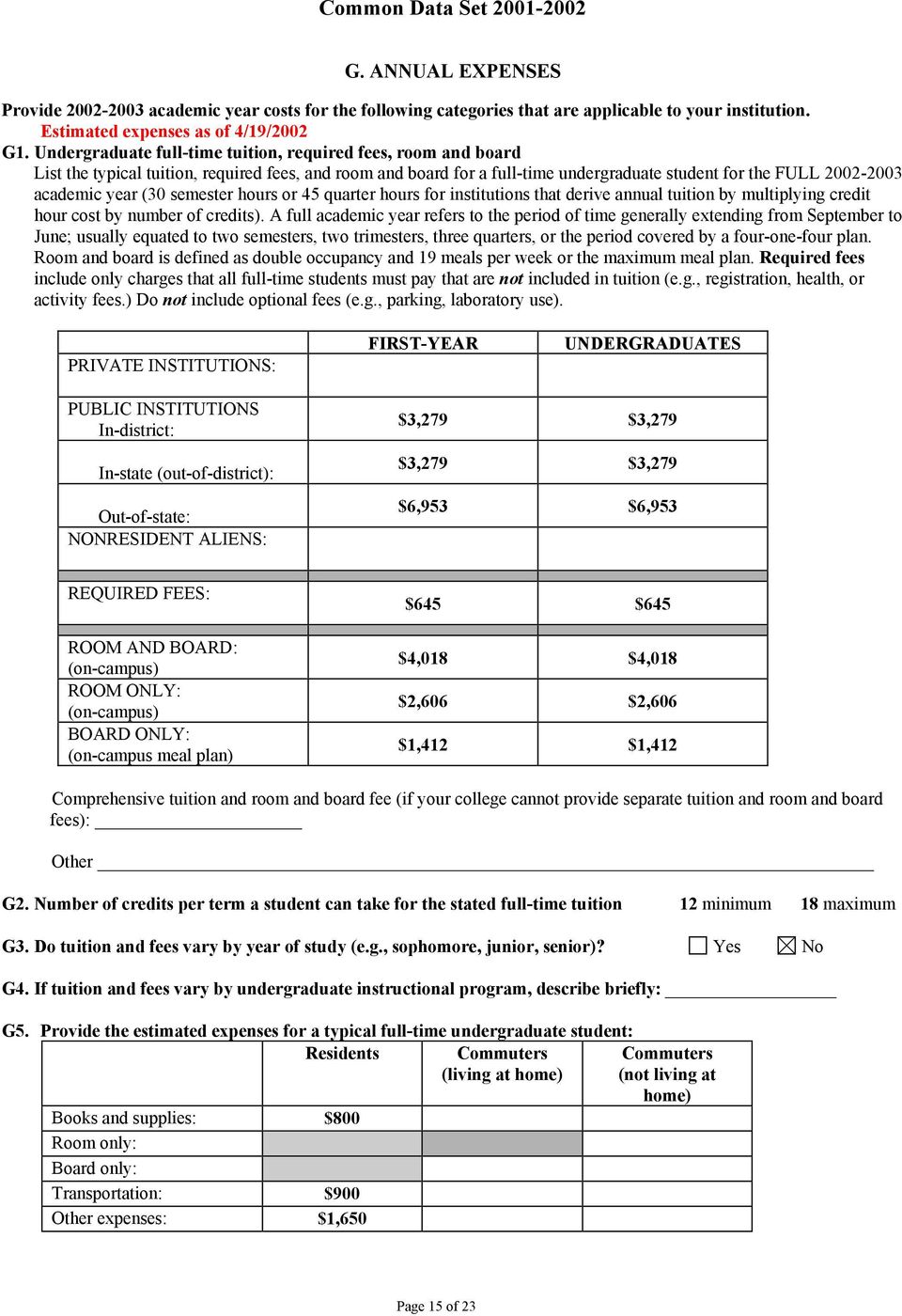
15 G. ANNUAL EXPENSES Provide academic year costs for the following categories that are applicable to your institution. Estimated expenses as of 4/19/2002 G1. Undergraduate full-time tuition, required fees, room and board List the typical tuition, required fees, and room and board for a full-time undergraduate student for the FULL academic year (30 semester hours or 45 quarter hours for institutions that derive annual tuition by multiplying credit hour cost by number of credits). A full academic year refers to the period of time generally extending from September to June; usually equated to two semesters, two trimesters, three quarters, or the period covered by a four-one-four plan. Room and board is defined as double occupancy and 19 meals per week or the maximum meal plan. Required fees include only charges that all full-time students must pay that are not included in tuition (e.g., registration, health, or activity fees.) Do not include optional fees (e.g., parking, laboratory use). PRIVATE INSTITUTIONS: FIRST-YEAR UNDERGRADUATES PUBLIC INSTITUTIONS In-district: In-state (out-of-district): Out-of-state: NONRESIDENT ALIENS: $3,279 $3,279 $3,279 $3,279 $6,953 $6,953 REQUIRED FEES: ROOM AND BOARD: (on-campus) ROOM ONLY: (on-campus) BOARD ONLY: (on-campus meal plan) $645 $645 $4,018 $4,018 $2,606 $2,606 $1,412 $1,412 Comprehensive tuition and room and board fee (if your college cannot provide separate tuition and room and board fees): Other G2. Number of credits per term a student can take for the stated full-time tuition 12 minimum 18 maximum G3. Do tuition and fees vary by year of study (e.g., sophomore, junior, senior)? Yes No G4. If tuition and fees vary by undergraduate instructional program, describe briefly: G5. Provide the estimated expenses for a typical full-time undergraduate student: Residents Commuters (living at home) Books and supplies: $800 Room only: Board only: Transportation: $900 Other expenses: $1,650 Commuters (not living at home) Page 15 of 23
16 G6. Undergraduate per-credit-hour charges: PRIVATE INSTITUTIONS: PUBLIC INSTITUTIONS In-district: $122 In-state (out-of-district): $122 Out-of-state: $259 NONRESIDENT ALIENS: Page 16 of 23

17 Aid Awarded to Enrolled Undergraduates H. FINANCIAL AID H1. Enter total dollar amounts awarded to full-time and less than full-time degree-seeking undergraduates (using the same cohort reported in CDS Question B1, total degree-seeking undergraduates) in the following categories. Include aid awarded to international students (i.e., those not qualifying for federal aid). Aid that is non-need-based but that was used to meet need should be reported in the need-based aid columns. (For a suggested order of precedence in assigning categories of aid to cover need, see the entry for non-need-based gift aid on the last page of the definitions section.) Indicate the academic year for which data are reported for items H1, H2, H2A, and H6 below: estimated or final Scholarships/Grants Federal Need-based Non-need-based $ $ State Institutional (endowment, alumni, or other institutional awards) and external funds awarded by the college excluding athletic aid and tuition waivers (which are reported below) Scholarships/grants from external sources (e.g., Kiwanis, National Merit) not awarded by the college Total Scholarships/Grants Self-Help Student loans from all sources (excluding parent loans) Federal Work-Study State and other work-study/ employment Total Self-Help Parent Loans Tuition Waivers Athletic Awards Page 17 of 23

18 H2. Number of Enrolled Students Receiving Aid: List the number of degree-seeking full-time and less-than-full-time undergraduates who applied for and received financial aid. Aid that is non-need-based but that was used to meet need should be counted as need-based aid. Numbers should reflect the cohort receiving the dollars reported in H1. Note: In the chart below, students may be counted in more than one row, and full-time freshmen should also be counted as full-time undergraduates. a) Number of degree-seeking undergraduate students (CDS Item B1 if reporting on Fall 2001 cohort) b) Number of students in line a who were financial aid applicants (include applicants for all types of aid) c) Number of students in line b who were determined to have financial need d) Number of students in line c who received any financial aid e) Number of students in line d who received any need-based gift aid f) Number of students in line d who received any need-based self-help aid g) Number of students in line d who received any non-need-based gift aid h) Number of students in line d whose need was fully met (exclude PLUS loans, unsubsidized loans, and private alternative loans) i) On average, the percentage of need that was met of students who received any need-based aid. Exclude any resources that were awarded to replace EFC (PLUS loans, unsubsidized loans, and private alternative loans) j) The average financial aid package of those in line d. Exclude any resources that were awarded to replace EFC (PLUS loans, unsubsidized loans, and private alternative loans) k) Average need-based gift award of those in line e First-time Full-time Freshmen Full-time Undergrad (Incl. Fresh) Less Than Full-time Undergrad 2,132 10,221 1,144 1,647 7, ,022 4, ,019 4, , , , % 82% 61% $5,159 $5,600 $4,302 $2,754 $2,953 $1,867 l) Average need-based self-help award (excluding PLUS loans, unsubsidized loans, and private alternative loans) of those in line f $3,121 $3,477 $3,444 m) Average need-based loan (excluding PLUS loans, unsubsidized loans, and private alternative loans) of those in line f who received a needbased $2,568 $3,208 $3,436 loan H2A. Number of Enrolled Students Receiving Non-need-based Grants and Scholarships: List the number of degreeseeking full-time and less-than-full-time undergraduates who had no financial need and who received non-need-based gift aid. Numbers should reflect the cohort receiving the dollars reported in H1. Note: In the chart below, students may be counted in more than one row, and full-time freshmen should also be counted as full-time undergraduates. First-time Full-time Freshmen Full-time Undergrad (Incl. Fresh) Less Than Full-time Undergrad n) Number of students in line a who had no financial need and who received non-need-based gift aid (exclude those receiving athletic awards and tuition benefits) o) Average dollar amount of non-need-based gift aid awarded to students in line n $1,287 $1,585 $1,183 p) Number of students in line a who received a non-need-based athletic grant or scholarship q) Average dollar amount of non-need-based athletic grants and scholarships awarded to students in line p $1,651 $2,962 Page 18 of 23

19 H3: Which needs-analysis methodology does your institution use in awarding institutional aid? Federal methodology (FM) Institutional methodology (IM) Both FM and IM H4. Percent of the 2001 undergraduate class who graduated between July 1, 2000 and June 30, 2001 and borrowed through any loan programs (federal, state, subsidized, unsubsidized, private, etc.; exclude parent loans). Include only students who borrowed while enrolled at your institution. 75% H5. Average per-borrower cumulative undergraduate indebtedness of those in line H4. Do not include money borrowed at other institutions: $13,600 Aid to Undergraduate Degree-seeking Nonresident Aliens (Note: Report numbers and dollar amounts for the same academic year checked in item H1.) H6. Indicate your institution s policy regarding financial aid for undergraduate degree-seeking nonresident aliens: College-administered need-based financial aid is available College-administered non-need-based financial aid is available College-administered financial aid is not available If college-administered financial aid is available for undergraduate degree-seeking nonresident aliens, provide the number of undergraduate degree-seeking nonresident aliens who received need-based or non-need-based aid: Average dollar amount awarded to undergraduate degree-seeking nonresident aliens: $ Total dollar amount of financial aid from all sources awarded to all undergraduate degree-seeking nonresident aliens: $ Process for First-Year/Freshman Students H7. Check off all financial aid forms domestic first-year (freshman) financial aid applicants must submit: FAFSA Institution s own financial aid form CSS/Financial Aid PROFILE State aid form Noncustodial (Divorced/Separated) Parent s Statement Business/Farm Supplement Other: H8. Check off all financial aid forms nonresident alien first-year financial aid applicants must submit: Institution s own financial aid form CSS/Financial Aid PROFILE Foreign Student s Financial Aid Application Foreign Student s Certification of Finances Other: H9. Indicate filing dates for first-year (freshman) students: Priority date for filing required financial aid forms: March 15 Deadline for filing required financial aid forms: No deadline for filing required forms (applications processed on a rolling basis): Page 19 of 23

20 H10. Indicate notification dates for first-year (freshman) students (answer a or b): a.) Students notified on or about (date): b.) Students notified on a rolling basis: yes If yes, starting date: March 15 H11. Indicate reply dates: Students must reply by (date): or within 2 weeks of notification. Types of Aid Available Please check off all types of aid available to undergraduates at your institution: H12. Loans FEDERAL DIRECT STUDENT LOAN PROGRAM (DIRECT LOAN) Direct Subsidized Stafford Loans Direct Unsubsidized Stafford Loans Direct PLUS Loans FEDERAL FAMILY EDUCATION LOAN PROGRAM (FFEL) FFEL Subsidized Stafford Loans FFEL Unsubsidized Stafford Loans FFEL PLUS Loans Federal Perkins Loans Federal Nursing Loans State Loans College/university loans from institutional funds Other (specify): Self Loans H13. Scholarships and Grants NEED-BASED: Federal Pell SEOG State scholarships/grants Private scholarships College/university gift aid from institutional funds United Negro College Fund Federal Nursing Scholarship Other (specify): H14. Check off criteria used in awarding institutional aid. Check all that apply. Non-need Need-based Non-need Need-based Academics Alumni affiliation Art Athletics Job skills ROTC Leadership Minority status Music/drama Religious affiliation State/district residency Page 20 of 23

21 I. INSTRUCTIONAL FACULTY AND CLASS SIZE I-1. Please report number of instructional faculty members in each category for Fall The following definition of instructional faculty is used by the American Association of University Professors (AAUP) in its annual Faculty Compensation Survey. Instructional Faculty is defined as those members of the instructional-research staff whose major regular assignment is instruction, including those with released time for research. Institutions are asked to EXCLUDE: (a) instructional faculty in preclinical and clinical medicine (b) administrative officers with titles such as dean of students, librarian, registrar, coach, and the like, even though they may devote part of their time to classroom instruction and may have faculty status, (c) undergraduate or graduate students who assist in the instruction of courses, but have titles such as teaching assistant, teaching fellow, and the like (d) faculty on leave without pay, and (e) replacement faculty for faculty on sabbatical leave. Full-time: faculty employed on a full-time basis Part-time: faculty teaching less than two semesters, three quarters, two trimesters, or two four-month sessions. Also includes adjuncts and part-time instructors. Minority faculty: includes faculty who designate themselves as black, non-hispanic; American Indian or Alaskan native; Asian or Pacific Islander; or Hispanic. Doctorate: includes such degrees as Doctor of Education, Doctor of Juridical Science, Doctor of Public Health, and Doctor of Philosophy degree in any field such as agronomy, food technology, education, engineering, public administration, ophthalmology, or radiology. First-professional: includes the fields of dentistry (DDS or DMD), medicine (MD), optometry (OD), osteopathic medicine (DO), pharmacy (DPharm or BPharm), podiatric medicine (DPM), veterinary medicine (DVM), chiropractic (DC or DCM), law (JD) and theological professions (MDiv, MHL). Terminal degree: the highest degree in a field: example, M. Arch (architecture) and MFA (master of fine arts). Full-time Part-time Total a.) Total number of instructional faculty b.) Total number who are members of minority groups c.) Total number who are women d.) Total number who are men e.) Total number who are nonresident aliens (international) f.) Total number with doctorate, first professional, or other terminal degree g.) Total number whose highest degree is a master s but not a terminal master s h.) Total number whose highest degree is a bachelor s i.) Total number whose highest degree is unknown or other (Note: Items f, g, h, and i must sum up to item a.) I-2. Student to Faculty Ratio Report the Fall 2001 ratio of full-time equivalent students (full-time plus 1/3 part time) to full-time equivalent instructional faculty (full time plus 1/3 part time). In the ratio calculations, exclude both faculty and students in stand-alone graduate or professional programs such as medicine, law, veterinary, dentistry, social work, business, or public health in which faculty teach virtually only graduate level students. Do not count undergraduate or graduate student teaching assistants as faculty. Fall 2001 Student to Faculty ratio: 23 to 1. Page 21 of 23
22 I-3. Undergraduate Class Size In the table below, please use the following definitions to report information about the size of classes and class sections offered in the Fall 2001 term. Class Sections: A class section is an organized course offered for credit, identified by discipline and number, meeting at a stated time or times in a classroom or similar setting, and not a subsection such as a laboratory or discussion session. Undergraduate class sections are defined as any sections in which at least one degree-seeking undergraduate student is enrolled for credit. Exclude distance learning classes and noncredit classes and individual instruction such as dissertation or thesis research, music instruction, or one-to-one readings. Exclude students in independent study, co-operative programs, internships, foreign language taped tutor sessions, practicums, and all students in one-on-one classes. Each class section should be counted only once and should not be duplicated because of course catalog cross-listings. Class Subsections: A class subsection includes any subsection of a course, such as laboratory, recitation, and discussion subsections that are supplementary in nature and are scheduled to meet separately from the lecture portion of the course. Undergraduate subsections are defined as any subsections of courses in which degree-seeking undergraduate students enrolled for credit. As above, exclude noncredit classes and individual instruction such as dissertation or thesis research, music instruction, or one-to-one readings. Each class subsection should be counted only once and should not be duplicated because of cross-listings. Using the above definitions, please report for each of the following class-size intervals the number of class sections and class subsections offered in Fall For example, a lecture class with 800 students who met at another time in 40 separate labs with 20 students should be counted once in the 100+ column in the class section column and 40 times under the column of the class subsections table. Number of Class Sections with Undergraduates Enrolled CLASS SECTIONS CLASS SUB- SECTIONS Undergraduate Class Size (provide numbers) Total , Total Page 22 of 23
23 Degrees conferred between July 1, 2000 and June 30, 2001 Reference: IPEDS Completions, Part A J. DEGREES CONFERRED For each of the following discipline areas, provide the percentage of diplomas/certificates, associate, and bachelor s degrees awarded. Category Diploma/ CIP Categories to Associate Bachelor s Certificates Include Agriculture < 1 % 1 and 2 Architecture 4 Area and ethnic studies < 1 % 5 Biological/life sciences 3 % 26 Business/marketing 17 % 8 and 52 Communications/communication technologies 2 % 9 and 10 Computer and information sciences 8 % 11 Education 17 % 13 Engineering/engineering technologies 4 % 14 and 15 English 3 % 23 Foreign languages and literature 1 % 16 Health professions and related sciences 40 % 7 % 51 Home economics and vocational home economics 2 % 19 and 20 Interdisciplinary studies 2 % 30 Law/legal studies <1 % 22 Liberal arts/general studies 60 % <1 % 24 Library science 25 Mathematics <1 % 27 Military science and technologies 28 and 29 Natural resources/environmental science <1 % 3 Parks and recreation 5 % 31 Personal and miscellaneous services 12 Philosophy, religion, theology <1 % 38 and 39 Physical sciences <1 % 40 and 41 Protective services/public administration 11% 43 and 44 Psychology 4 % 42 Social sciences and history 6 % 45 Trade and industry 2 % 46, 47, 48, and 49 Visual and performing arts 2 % 50 Other TOTAL 100% 100% Page 23 of 23
University of Michigan - Ann Arbor Common Data Set 1999-2000
 University of Michigan - Ann Arbor Common Data Set 1999-2000 A. GENERAL INFORMATION A1. Address Information University of Michigan-Ann Arbor Ann Arbor, Michigan 48109 USA Main Phone: (734) 764-1817 Home
Berea College Common Data Set 2008-2009
 GENERAL INFORMATION A0. Respondent Information (Not for Publication) Name: Clara Chapman Title: Assistant Director Office: Institutional Research and Assessment Mailing Address, City/State/Zip/Country:
Berea College Common Data Set 2015-2016
 GENERAL INFORMATION A0. Respondent Information Name: Clara Chapman Title: Assistant Director Office: Institutional Research and Assessment Mailing Address, City/State/Zip/Country: CPO 2177, 310 Lincoln
Common Data Set 2012 2013 GENERAL INFORMATION
 GENERAL INFORMATION A0. Respondent Information (Not for Publication) Name: Connie W. Peyton Title: External Reporting and Survey Support Specialist Office: Office of Planning and Decision Support Mailing
Common Data Set 2010-2011
 GENERAL INFORMATION A0. Respondent Information (Not for Publication) Name Donna R. Hutcheson Title Director of Enterprise Academic Reporting Office Enterprise Information Management Mailing Address, City/State/Zip/Country
Common Data Set 2015-2016
 A0. Respondent Information (Not for Publication) Name Title Office Mailing Address, City/State/Zip/Country Phone Fax E-mail Address GENERAL INFORMATION Are your responses to the CDS posted for reference
Common Data Set 2014-2015
 Common Data Set 2014-2015 1 A. GENERAL INFORMATION A0. Respondent Information (Not for Publication) Name Laura Velasco Title Office Mailing Address Phone Fax E-mail Address Publications and Projects Manager
Common Data Set 2014-2015
 Common Data Set 2014-2015 1 A. GENERAL INFORMATION A0. Respondent Information (Not for Publication) Name Laura Velasco Title Office Mailing Address Phone Fax E-mail Address Publications and Projects Manager
Common Data Set 2007-2008
 Common Data Set 2007-2008 A. GENERAL INFORMATION Are your responses to the CDS posted for reference on your institution s Web site? Yes No If yes, please provide the URL of the corresponding Web page:
Common Data Set Items 2005-06 (for publication in August 2005)
 CDS 2005-2006 Common Data Set Items 2005-06 (for publication in August 2005) Summary of key changes: A1: New address requested (if relevant) C2: Wait list question C7: Several new categories added; some
Washington University in St. Louis Common Data Set 2014-2015
 Washington University in St. Louis A. GENERAL INFORMATION A1. Address Information Name of College or University Mailing Address, City/State/Zip/Country Street Address (if different), City/State/Zip/Country
Swarthmore College Common Data Set 2010 2011
 Common Data Set 2010 2011 Office of Institutional Research, 2010 Common Data Set 2010-2011 Table of Contents Section Page A. General Information... 1 B. Enrollment and Persistence... 2 C. First-Time, First-Year
Common Data Set 2008-09
 SUMMARY OF SIGNIFICANT CHANGES TO THE CDS FOR 2008-09 The items listed below are shaded in yellow throughout the spreadsheet's worksheets. CHANGED ITEMS C8C: Add a column so SAT essay and ACT essay gathered
A. General Information
 A0 Respondent Information (Not for Publication) A0 Name: Sarah Jane Bernard A0 Title: Interim Director of Institutional Research A0 Office: Institutional Research and Assessment Support A0 Mailing Address:
Wellesley College Common Data Set 2014-2015
 Wellesley College Common Data Set 2014-2015 A. General Information B. Enrollment and Persistence C. First-Time, First-Year Admission D. Transfer Admission E. Academic Offerings and Policies F. Student
A. General Information
 A0 Respondent Information (Not for Publication) A0 Name: Andrea Stigdon A0 Title: Administrative Services Officer A0 Office: Strategic Planning and Analysis A0 Mailing Address: 800 West Campbell Road,
Yale University Common Data Set 2013-14
 A. GENERAL INFORMATION A1. Address Information Name of College or University Yale University Mailing Address, City/State/Zip/Country New Haven, CT Street Address (if different), City/State/Zip/Country
Common Data Set 2013-2014. https://www.commonapp.org/commonapp/default.aspx
 A. General Information A1 Address Information A1 Name of College/University: Harvard University A1 Mailing Address: 86 Brattle Street A1 City/State/Zip/Country: Cambridge, MA 02138 A1 Street Address (if
Common Data Set 2013-2014
 GENERAL INFORMATION A0. Respondent Information (Not for Publication) Name Gebre Tesfagiorgis Title Director of Institutional Research Office Institutional Research Mailing Address, City/State/Zip/Country
A. General Information
 A0 Respondent Information (Not for Publication) A0 Name: Tricia J Douthit A0 Title: Director of Institutional Research A0 Office: President's Office A0 Mailing Address: 1500 Illinois Street A0 City/State/Zip/Country:
Common Data Set 2008-09 H. FINANCIAL AID
 H. FINANCIAL AID Aid Awarded to Enrolled Undergraduates Enter total dollar amounts awarded to enrolled full-time and less than full-time degree-seeking undergraduates (using the same cohort reported in
Williams College 2012-2013 Common Data Set
 Williams College 2012-2013 Common Data Set A. General Information B. Enrollment and Persistence C. First-time, First-year Admission D. Transfer Admission E. Academic Offerings and Policies F. Student Life
Common Data Set 2013-2014 GENERAL INFORMATION
 GENERAL INFORMATION A1. Address Information Name of College or University: Clarkson University Mailing Address, City/State/Zip/Country: 8 Clarkson Ave, Potsdam, New York, 13699 Street Address (if different),
Swarthmore College Common Data Set 2014 2015
 Swarthmore College Common Data Set 2014 2015 Office of Institutional Research Swarthmore College Common Data Set 2014-2015 Table of Contents Section Page A. General Information... 1 B. Enrollment and Persistence...
Common Data Set 2015-2016 Fairleigh Dickinson University-Metropolitan Campus GENERAL INFORMATION
 GENERAL INFORMATION A1. Address Information Name of College or University Fairleigh Dickinson University, Metropolitan Campus Mailing Address, City/State/Zip/Country 1000 River Road, Teaneck, NJ 07666
Common Data Set 2012-2013 Florida Institute of Technology Florida Tech Online GENERAL INFORMATION
 GENERAL INFORMATION A1. Address Information Name of College or University Florida Tech University Online Mailing Address, City/State/Zip/Country 150 W. University Blvd., Melbourne/FL/32901 Street Address
H. FINANCIAL AID. Please refer to the following financial aid definitions when completing Section H.
 H. FINANCIAL AID Please refer to the following financial aid definitions when completing Section H. Awarded aid: The dollar amounts offered to financial aid applicants. Financial aid applicant: Any applicant
Peabody Conservatory of Johns Hopkins University Baltimore, MD
 C O L L E G E P R O F I L E - O V E R V I E W Peabody Conservatory of Johns Hopkins University Baltimore, MD The Peabody Conservatory is a private, coeducational school of music and dance affiliated with
Benedict College Columbia, SC
 C O L L E G E P R O F I L E - O V E R V I E W Benedict College Columbia, SC Benedict, founded in 1870, is a private, liberal arts college. Its 100-acre campus is located in Columbia. Web Site www.benedict.edu/
New England Conservatory of Music Boston, MA
 New England Conservatory of Music Boston, MA C O L L E G E P R O F I L E - O V E R V I E W The New England Conservatory of Music, founded in 1867, is the oldest private conservatory of its kind in the
Berklee College of Music Boston, MA
 C O L L E G E P R O F I L E - O V E R V I E W Berklee College of Music Boston, MA Berklee, founded in 1945, is a private college. Its urban campus is located in Boston's Back Bay area. Web Site www.berklee.edu/
New Hope Christian College Eugene, OR
 C O L L E G E P R O F I L E - O V E R V I E W New Hope Christian College Eugene, OR New Hope Christian College (formerly Eugene Bible College), founded in 1925, is a private, coeducational, church-affiliated
San Francisco Conservatory of Music San Francisco, CA
 San Francisco Conservatory of Music San Francisco, CA C O L L E G E P R O F I L E - O V E R V I E W The San Francisco Conservatory of Music, founded in 1917, is a private conservatory of music. Its five-acre
Macalester College 2014-2015 Common Data Set CONTENTS:
 Macalester College 2014-2015 Common Data Set CONTENTS: Section A - General Information Section B - Enrollment and Persistence (includes graduation and retention rates) Section C - First-time, First-Year
ELON UNIVERSITY: Common Data Set 2007-2008 H. FINANCIAL AID
 ELON UNIVERSITY: Common Data Set 2007-2008 H. FINANCIAL AID Please refer to the following financial aid definitions when completing Section H. Awarded aid: The dollar amounts offered to financial aid applicants.
South Georgia State College Douglas, GA
 C O L L E G E P R O F I L E - O V E R V I E W South Georgia State College Douglas, GA South Georgia State College is a co-ed public college of the University System of Georgia. In addition to associate