
Getting Your Claims Right
|
|
|
- Griselda Anis Douglas
- 10 years ago
- Views:
Transcription
1 Getting Your Claims Right A guide to complying with the Nutrition, Health and Related Claims Standard of the Australia New Zealand Food Standards Code
2 Disclaimer The information presented here has been developed by the Implementation Subcommittee for Food Regulation (ISFR) for, and on behalf of, the Food Regulation Standing Committee (FRSC) and is presented as an information source only. The information is provided solely on the basis that readers will be responsible for making their own assessment of the matters presented herein and readers are advised to verify all relevant representations, statements and information. The information does not constitute legal or professional advice and should not be relied upon as such. Formal advice from appropriate advisers should be sought on particular matters. ISFR does not accept liability to any person for the information or advice provided in the document, or incorporated into it by reference or for loss or damages incurred as a result of reliance upon the material contained herein. In no event shall ISFR be liable (including liability for negligence) for any damages (including without limitation, direct, indirect, punitive, special or consequential) whatsoever arising out of a person s use of, access to, or inability to use or access the document.

3 Contents 1. Introduction 1 Diagram Are you making a nutrition content, health or related claim? 4 2. General conditions and restrictions for making claims 5 3. Making a nutrition content claim 8 Compliance template nutrition content claims Making a health claim Making a general level health claim 22 Compliance template general level health claims (pre-approved) 24 Compliance template general level health claims (systematic review) 28 6 Making a high level health claim 35 Compliance template high level health claims Endorsing bodies and endorsements 41 Compliance template endorsements Glossary 45 Checklist for Nutrition Content Claims 49 Checklist for General Level Health Claims (pre approved) 52 Checklist for General Level Health Claims (systematic review) 55 Checklist for High Level Health Claims 60 Getting Your Claims Right i

4

5 1. Introduction This document, developed by the Implementation Subcommittee for Food Regulation (ISFR), provides advice on how to comply with the Nutrition, Health and Related Claims Standard (Standard 1.2.7) in the Australia New Zealand Food Standards Code (the Food Standards Code). ISFR is made up of representatives from government agencies and departments in Australia and New Zealand that are responsible for monitoring the implementation of food laws and enforcing those laws. These agencies and departments work together through ISFR to ensure food laws are implemented and enforced consistently. Food sold in Australia and New Zealand is required to comply with Parts 1 and 2 of the Food Standards Code. All food businesses in Australia and New Zealand must comply with Standard when making nutrition content claims and health claims on food labels, in advertisements and in endorsements on food from 18 January Standard applies to food labels and advertising materials for foods that are sold or prepared for sale in Australia or New Zealand and imported into Australia and New Zealand. This document is not a legal document. The legal document is Standard of the Food Standards Code. Food businesses using this document should also refer to Standard and the associated explanatory information. Where guidance is offered in this document about a clause or schedule in Standard or a paragraph, the number of the clause and paragraph or schedule is provided in bold text. The diagram on page 4 can help you consider whether Standard applies to any claims made. This is followed by explanatory text about general conditions and requirements for making claims. A glossary of key terms (based on definitions in Standard 1.2.7) is on page 45. You can find Standard on the ComLaw website. The explanatory statement, which provides detail about the purpose and intent of the Standard and its associated clauses, can be found on the ComLaw website. Getting Your Claims Right 1

6 For information about establishing food-health relationships by systematic review, refer to the Food Standards Australia New Zealand (FSANZ) document Guidance on establishing food-health relationships for general level health claims (as described in Schedule 6 of Standard 1.2.7). Guidance on calculating scores for the nutrient profiling scoring criterion is also available on the FSANZ website. This guidance document should be read in conjunction with associated checklists: Checklist for Nutrition Content Claims Checklist for General Level Health Claims (pre-approved) Checklist for General Level Health Claims (systematic review) Checklist for High Level Health Claims. State and territory government departments and local government in Australia, the Department of Agriculture (for imported food) and the New Zealand Ministry for Primary Industries are responsible for monitoring the implementation of food laws and enforcing those laws. Standards are adopted by law into state and territory and New Zealand legislation. These food laws give regulators a range of tools they can use in responding to non-compliance. Generally, when a business supplies a product that does not meet the legal requirements, the regulator will look at what steps the business has taken to comply with the Standard when deciding on appropriate enforcement action. Food businesses should contact the relevant food regulator in their state or territory or in New Zealand if further guidance is required about complying with Standard or any other requirements of the Food Standards Code. Full details of state and territory and New Zealand agencies responsible for administering and enforcing the Food Standards Code can be found on the FSANZ website. 2 Getting Your Claims Right
7 Food businesses must not make false or misleading claims. It is a an offence for food businesses to engage in conduct that is misleading or deceptive in relation to the advertising, packaging or labelling of food for sale or intended for sale. Fair trading laws and food laws in Australia and New Zealand require that goods sold do not misinform through false, misleading or deceptive representations. In Australia, the Australian Competition and Consumer Commission (ACCC) and state and territory consumer authorities enforce Australian Consumer Law. In New Zealand, the Commerce Commission is responsible for enforcing the Fair Trading Act More information is available from: Australian Competition and Consumer Commission (ACCC) New Zealand Commerce Commission New Zealand Ministry of Business, Innovation and Employment (MBIE) (formerly Ministry of Consumer Affairs). Getting Your Claims Right 3
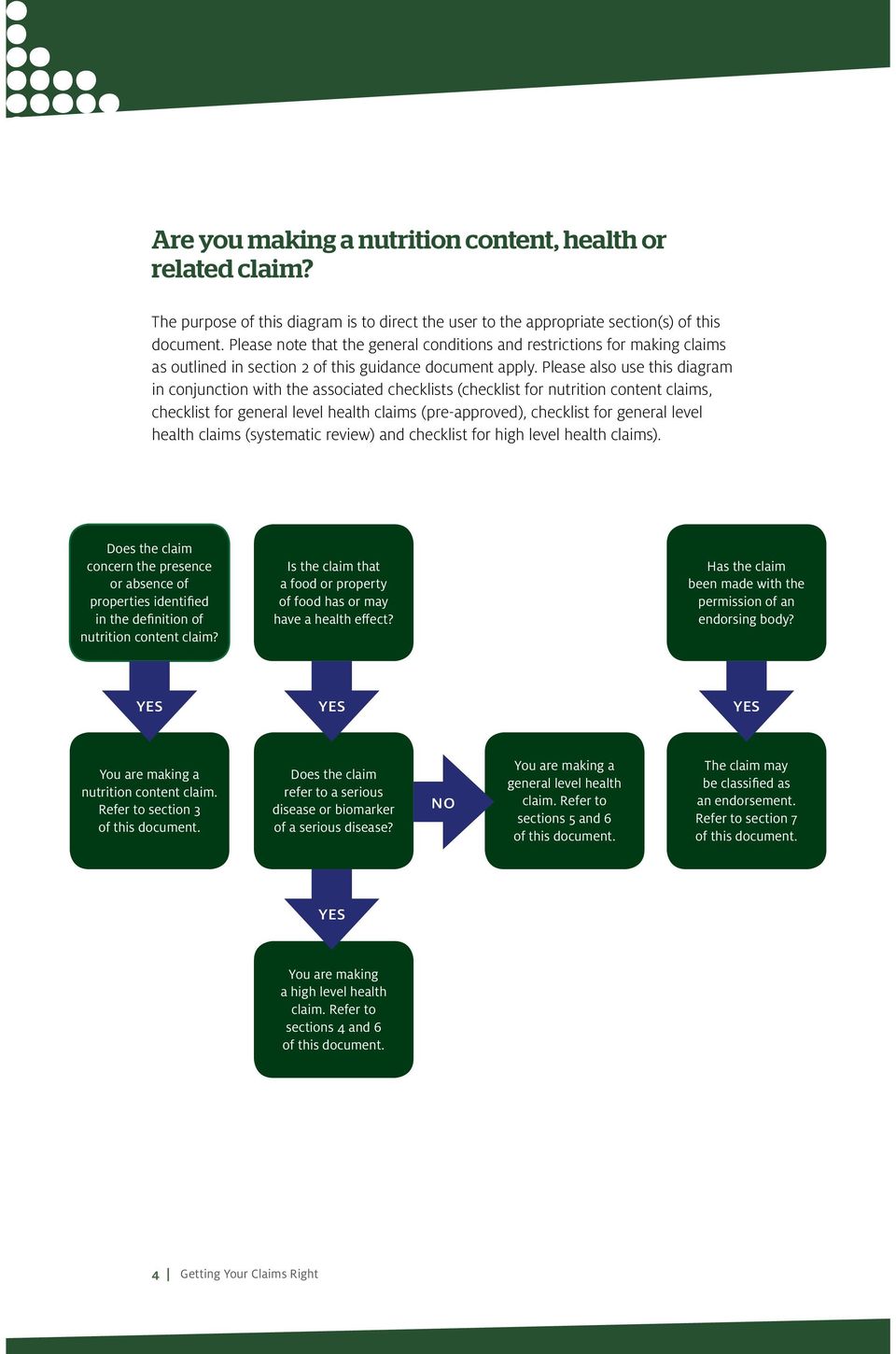
8 Are you making a nutrition content, health or related claim? The purpose of this diagram is to direct the user to the appropriate section(s) of this document. Please note that the general conditions and restrictions for making claims as outlined in section 2 of this guidance document apply. Please also use this diagram in conjunction with the associated checklists (checklist for nutrition content claims, checklist for general level health claims (pre-approved), checklist for general level health claims (systematic review) and checklist for high level health claims). Does the claim concern the presence or absence of properties identified in the definition of nutrition content claim? Is the claim that a food or property of food has or may have a health effect? Has the claim been made with the permission of an endorsing body? YES YES YES You are making a nutrition content claim. Refer to section 3 of this document. Does the claim refer to a serious disease or biomarker of a serious disease? NO You are making a general level health claim. Refer to sections 5 and 6 of this document. The claim may be classified as an endorsement. Refer to section 7 of this document. YES You are making a high level health claim. Refer to sections 4 and 6 of this document. 4 Getting Your Claims Right
9 2. Gen eral conditions and restrictions for making claims Claims are defined in Standard of the Food Standards Code as an express or implied statement, representation, design or information in relation to a food or property of food which is not mandatory in the Code (Standard Preliminary Provisions Application, Interpretation and General Prohibitions). Standard regulates the following types of claims: nutrition content claims (claims about the presence or absence of certain nutritional properties of food) high level health claims (claims that a food or a property of food, has or may have a health effect and refers to a serious disease or biomarker of a serious disease) general level health claims (claims that a food or a property of food has or may have a health effect and that are not a high level health claim). These claims are regulated whether they are made on a label, in advertisements or by way of a third party endorsement e.g. a logo licensing scheme. Claims that are not regulated by Standard include those made about non nutrient characteristics of the food e.g. pure, fresh, or natural or process claims e.g. pasteurised and halal. You can find more information about the different types of claims on the FSANZ website. Restrictions and conditions on making claims under Standard are outlined below. 2.1 General restrictions Nutrition content and health claims cannot be made for (Clause 3): kava a food that contains more than 1.15% alcohol by volume, other than a nutrition content claim about energy or carbohydrate content an infant formula product. Nutrition content and health claims must not: refer to the prevention, diagnosis, cure or alleviation of a disease, disorder or condition (Clause 7) Getting Your Claims Right 5
10 compare a food with a good that is represented in any way to be for therapeutic use; or likely to be taken for therapeutic use, whether because of the way in which the food or substance is presented or for any other reason (Clause 7) compare the vitamin or mineral content of a food with another food (Clause 8) unless permitted by the Food Standards Code. A health claim (and certain nutrition content claims as indicated in Schedule 1 of Standard 1.2.7) must not be made about a food that does not comply with the nutrient profiling scoring criterion (NPSC) (subclause 17(2)). However, special purpose foods (standardised in Part 2.9 of the Food Standards Code) do not need to meet the NPSC for health claims. A guideline on calculating NPSC scores can be found on the FSANZ website Standard does not apply to (Clauses 4 and 5): food, other than food in a package, provided to a patient in a hospital or other similar institution meals provided to a vulnerable person by a delivered meal organisation foods intended for further processing, packaging or labelling before retail sale a claim that is expressly permitted by another standard a claim about the risks or dangers of alcohol intake or about moderating alcohol intake a declaration that is required by the Act as defined in Standard see glossary. 2.2 Form of the food (Clause 6) The requirements for nutrition content claims and health claims must be applied to the appropriate form of the food, as set out in Clause 6. This does not prevent claims being made on foods that someone needs to prepare (e.g. heating or reconstituting) or that may be used with other foods, so long as the claim applies to one of the forms of the food as determined in accordance with the Table to Clause 6. To determine the form of the food you should take into account: the information on the label for the food, including the directions for use any information provided in an advertisement for the food. When making a nutrition content or health claim, the form of the food must be stated together with the claim, unless the claim relates to the form of the food as sold (Clause 10 and subclauses 19(3)(b) and 19(6)). 6 Getting Your Claims Right

11 2.3 Claim wording Standard does not prescribe the words to be used when making a claim. Any statement or information required by Standard may be modified if the modification does not alter or contradict the effect of the required statement or information (Clause 9). 2.4 Information to support compliance Food businesses may wish to maintain documentation to demonstrate that claims made on their food products comply with the conditions and requirements of Standard This information may include: test results documents demonstrating that a product complies with appropriate clauses in Standard and content in Schedule 1, 2, 3, 4, 5 or 6 of Standard checklists and templates you have filled out in accordance with due diligence. 2.5 Nutrition Information Panel Food for retail sale must bear a label setting out all the information prescribed in the Food Standards Code, including a nutrition information panel (NIP), as outlined in Standard Nutrition Information Requirements. Exceptions from the requirement to bear a label are in paragraphs 2(1) (a) to (h) of Standard When a nutrition content or health claim is made about foods exempt from the requirement to bear a label, this exemption no longer applies, and a NIP must be displayed on or in connection with the display of the food or provided to the purchaser on request (subclause 4(3) of Standard 1.2.8). There are also exemptions for foods that are required to bear a label, to be labelled with a NIP (clause 3 of Standard 1.2.8). However, if a nutrition content or health claim is made about these foods, the exemptions in clause 3 do not apply, and a NIP must be provided on the label (subclause 4(2) of Standard 1.2.8). Clause 5 of Standard sets out what is required in a NIP, including the name and the average quantity of any nutrient or biologically active substance that a nutrition content or health claim refers to. Standard does exempt food in small packages (see glossary) from havi ng an NIP, but additional labelling requirements must still be met when certain claims are made (subclause 4(4) and clauses 8 and 8A of Standard 1.2.8). Getting Your Claims Right 7

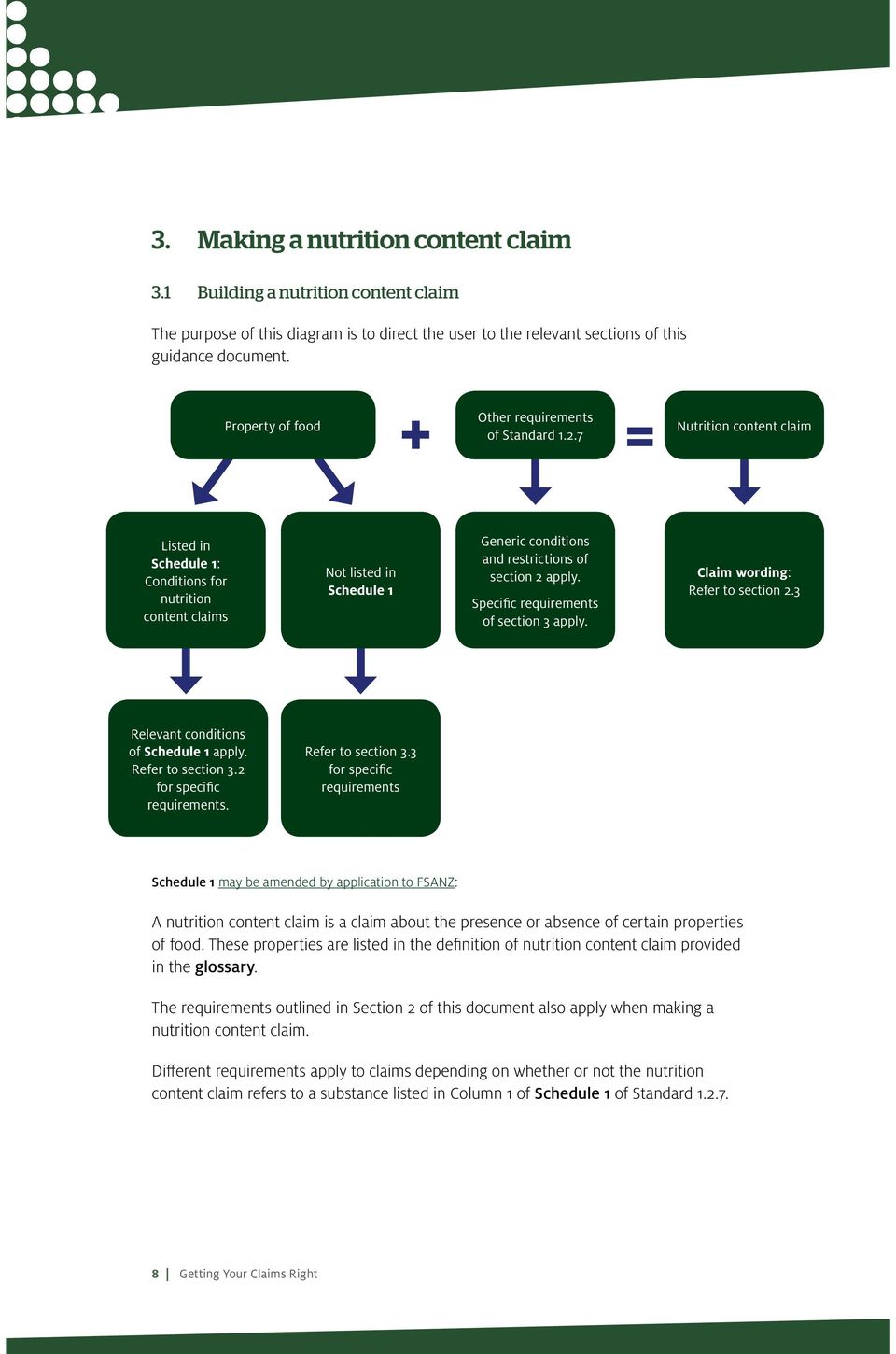
12 3. Making a nutrition content claim 3.1 Building a nutrition content claim The purpose of this diagram is to direct the user to the relevant sections of this guidance document. Property of food + Other requirements = of Standard Nutrition content claim Listed in Schedule 1: Conditions for nutrition content claims Not listed in Schedule 1 Generic conditions and restrictions of section 2 apply. Specific requirements of section 3 apply. Claim wording: Refer to section 2.3 Relevant conditions of Schedule 1 apply. Refer to section 3.2 for specific requirements. Refer to section 3.3 for specific requirements Schedule 1 may be amended by application to FSANZ: A nutrition content claim is a claim about the presence or absence of certain properties of food. These properties are listed in the definition of nutrition content claim provided in the glossary. The requirements outlined in Section 2 of this document also apply when making a nutrition content claim. Different requirements apply to claims depending on whether or not the nutrition content claim refers to a substance listed in Column 1 of Schedule 1 of Standard Getting Your Claims Right
13 3.2 Nutrition content claims about properties of food listed in Schedule 1 (Clause 11) Schedule 1 of Standard provides conditions for making nutrition content claims about the properties of food listed in Column 1 of Schedule 1. If a claim is made about a property of food listed in Column 1, the food and/or claim must comply with any general conditions in Column 2. If the claim has the same effect as a qualifier (descriptor) listed in Column 3, the food and/or claim must also comply with any additional conditions in Column 4. If there is an inconsistency between the conditions in Columns 2 and 4, the specific conditions in Column 4 override those in Column 2 (subclause 11(4)). A claim about a property listed in Column 1 can be made without qualifiers (descriptors) (for example, a contains or source of claim), in which case only the general conditions in Column 2 apply, together with other prohibitions in the Standard. A claim about a property of food listed in Column 1 may also be made with a qualifier (descriptor) that is not mentioned in Column 3, including quantification claims specifying the amount of the property in the food (subclause 11(8)). In this case, the general conditions in Column 2 apply together with other prohibitions in the Standard. Building a nutrition content claim based on Schedule 1: Protein: is listed in Schedule 1. Column 1 (Property of food): Protein. Column 2 (General claim conditions that must be met): The food contains at least 5g of protein per serving unless the claim is about low or reduced protein. Column 3 (Specific descriptor or synonym): Good source, Increased. Column 4 (Conditions that must be met if using specific descriptor in Column 3): Good source the food contains at least 10g of protein per serving. Increased the food contains at least 25% more protein than in the same quantity of reference food; and the reference food meets the general conditions for a nutrition content claim about protein. Getting Your Claims Right 9
14 Nutrition content claims about vitamins and minerals There are also conditions for making nutrition content claims about vitamins and minerals in other standards in the Food Standards Code. Standard Vitamins and Minerals prescribes the maximum claims that can be made about foods that contain added vitamins or minerals. Specific conditions for making nutrition content claims about special purpose foods are in Part 2.9 Special Purpose Foods. If a claim is expressly permitted by another Standard, Standard does not apply (clause 5(a)). Claims that directly or indirectly compare the vitamin or mineral content of a food with that of another food must not be made unless such a claim is permitted by the Food Standards Code (clause 8). 3.3 Nutrition content claims about properties of food not listed in Schedule 1 (Clause 12) Food businesses are not limited to the properties of food listed in Schedule 1 for making nutrition content claims. If a business makes a nutrition content claim about a property of food not listed in Schedule 1, the claim may: only state that the food does or does not contain the property of food; or state that a specified amount of the food contains a specified amount of the property of food; or a combination of the above. For example, a nutrition content claim that is a comparative claim (such as reduced ) cannot be made about a property of food unless the property is listed in Schedule Conditions for certain nutrition content claims Lactose or trans/fatty acids (Subclause 11(5)) If you are making nutrition content claims about lactose or trans fatty acids, only the descriptors in Column 3 relating to lactose or trans fatty acids, or synonyms of those descriptors from Schedule 1, may be used. Glycaemic index and glycaemic load (Subclause 11(6)) If nutrition content claims are made about glycaemic index (GI) or glycaemic load, the food must meet the nutrient profiling scoring criterion (NPSC). For claims about GI, the numerical value of the GI of the food must be included either in the claim or in the NIP, however the GI descriptor (low, medium, high) is not required to be included as part of the GI claim. For claims about glycaemic load, no descriptors other than a number or a descriptor expressed in numeric form may be used. 10 Getting Your Claims Right

15 Gluten (Subclause 11(7)) If nutrition content claims are made about gluten, only the descriptors in Column 3 of Schedule 1 relating to gluten may be used (or a synonym of that descriptor). Alternatively, the claim may state that a food contains gluten or is high in gluten. Folic acid, choline or fluoride (Clause 13) No nutrition content claim about folic acid, choline or fluoride may be made unless a health claim is also made in relation to the property. When a health claim is made, no descriptors (e.g. high, low, rich) can be used when making the nutrition content claim. Must not imply slimming effects (Clause 14) Claims about energy that meet the conditions to use the descriptor diet must not use another descriptor that directly or indirectly imply a slimming effect (or a synonym for slimming ). Claims using the descriptor diet must also meet the specific conditions for this descriptor as set out in Column 4 of Schedule 1. In addition, and among other conditions covered in later sections of this document, claims using the descriptor diet can only be used on foods meeting the NPSC. Comparative claims (Clause 15) A comparative claim is a nutrition content claim that directly or indirectly compares the nutrition content of one food or brand of food with another, and includes claims that use the following descriptors: light, lite, reduced, increased (subclause 15(1)). In addition, a diet nutrition content claim is deemed to be a comparative claim if it meets the conditions for making the diet claim by having at least 40% less energy than the same quantity of reference food (subclause 15(2)). Additional wording is required to be included with comparative claims. The identity of the reference food (see glossary) and the difference between the amount of the property of food in the claimed food and the reference food must be included together with the comparative claim (subclause 15(3)). Conditions for making comparative claims about certain properties are included in Column 4 of Schedule 1. Getting Your Claims Right 11
16 Note that descriptors listed in Column 3 of Schedule 1, such as increased and reduced, cannot be used in a nutrition content claim about a property of food that is not mentioned in Schedule 1 (clause 12). Claims that directly or indirectly compare the vitamin or mineral content of a food with that of another food must not be made unless such a claim is permitted by the Food Standards Code (Clause 8). A template is provided to help food businesses build a nutrition content claim; and demonstrate due diligence in attempting to comply with the Food Standards Code. This template should be used with the associated Checklist for Nutrition Content Claims. A separate template and associated check list should be used for each claim. 12 Getting Your Claims Right
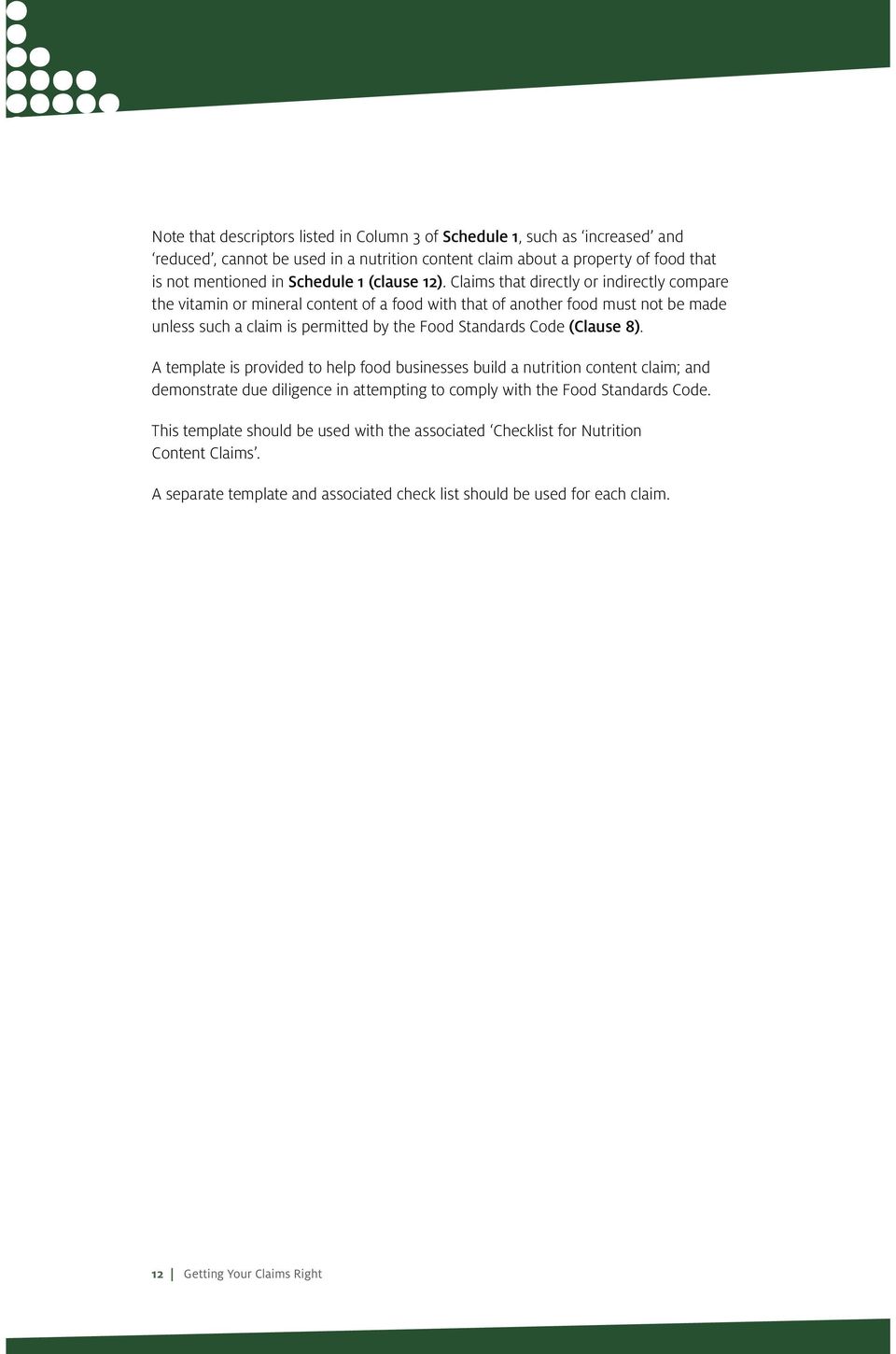
17 Compliance template nutrition content claims This template may help food businesses build a nutrition content claim; and demonstrate due diligence in attempting to comply with the Food Standards Code. See sections 2 and 3 of this document for the conditions for making nutrition content claims. General information 1. What is the wording of your proposed nutrition content claim? 2. What food will you be applying the nutrition content claim to? 3. Has the form of the food to which the claim relates been determined in accordance with the Table to clause 6 of Standard 1.2.7? Yes No If NO, the claim is NOT permitted. 4. Does the nutrition content claim state the form of the food to which the claim applies together with the claim as required by clause 10 of Standard unless the form of the food is as sold? Yes No If NO, the claim is NOT permitted in its current form. Getting Your Claims Right 13
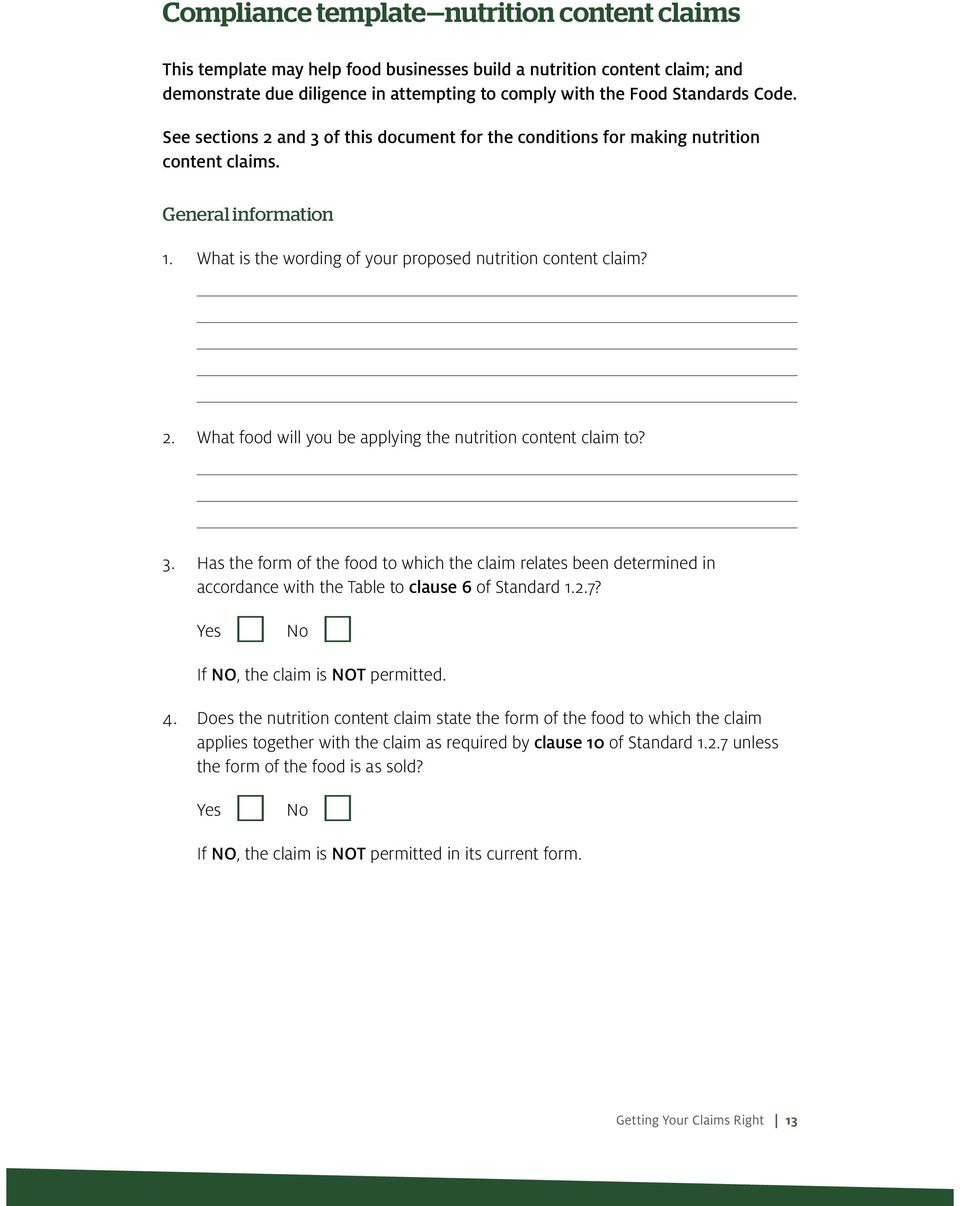
18 5. Do words in the nutrition content claim refer to the prevention, diagnosis, cure, or alleviation of a disease, disorder or condition or compare a food with a good that is represented in any way to be for therapeutic use or likely to be taken to be for therapeutic use, whether because of the way in which the good is presented or for any other reason? Yes No If YES, the claim is NOT permitted. 6. Do any words used in the nutrition content claim alter or contradict the effect of a statement or information required by Standard 1.2.7? Yes No If YES, the claim is NOT permitted. 7. Do the details of the nutrient or biologically active substance used to make the nutrition content claim appear in the nutrition information panel (NIP) on the label of the package of the food as required by clause 5 of Standard 1.2.8? Yes No If NO, the particulars of the nutrient or biologically active substance MUST BE declared in the NIP, or if no label is required under subclause 2(1) of Standard 1.2.1, the NIP (with the particulars of the claimed nutrient or biologically active substance) should be displayed on or in connection with the display of the food or provided to the purchaser on request. This requirement does not apply to food in small packages; however certain information must be included on the label of the small package (clauses 8 and 8A of Standard 1.2.8). 8. What property of food (e.g. a vitamin, fat, energy or beta glucan) will the nutrition content claim be about? 9. Is the property of food listed in Column 1 of Schedule 1 of Standard 1.2.7? Yes No If NO, proceed to question Getting Your Claims Right
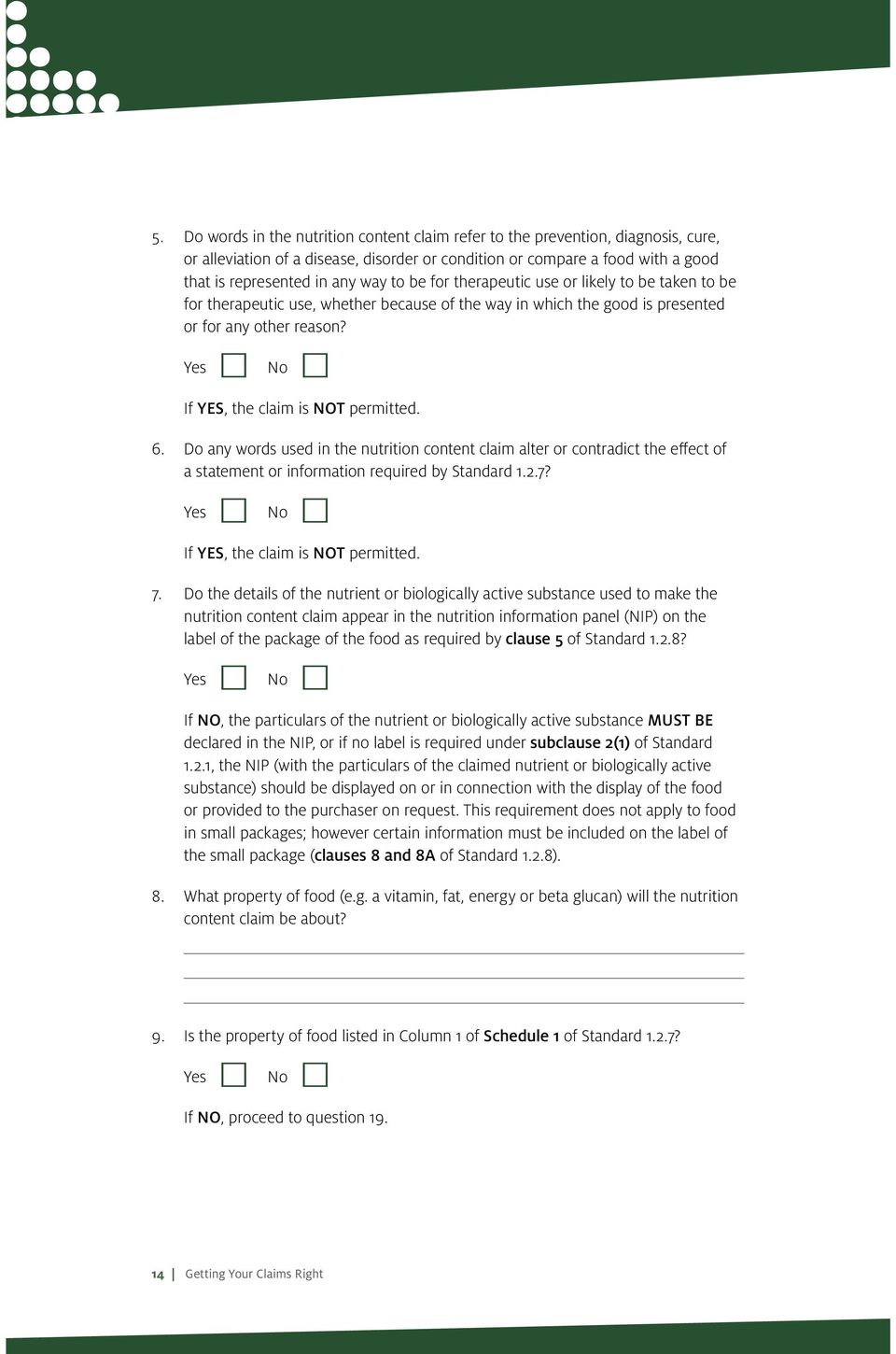
19 10. Does the food and claim meet the applicable conditions in Column 2 (if any) for the property of food in Column 1 identified above, and if a descriptor or synonym of a descriptor in Column 3 is used in the claim, does the food and claim meet the applicable conditions in Column 4? Yes No If YES, go to question 11. If NO, claim is NOT permitted. 11. Demonstrate, as appropriate, how the nutrition content claim complies with all relevant conditions from Schedule 1 of Standard (e.g. amount of substance in food, testing results). If the claim is not about gluten, glycaemic index, glycaemic load or trans fatty acids, proceed to question 24 (comparative claims). Specific substances: gluten, lactose, glycaemic index, glycaemic load or trans fatty acids 12. Is your nutrition content claim made about lactose or trans fatty acids? Yes No If NO, proceed to question If yes, what descriptors (if any) are applied? 14. Are the descriptors derived from Column 3 of Schedule 1 corresponding to the appropriate substance, or are they synonyms of those descriptors provided in Column 3 of Schedule 1? Yes No If NO, the claim is NOT permitted. If YES, proceed to question 24. Getting Your Claims Right 15
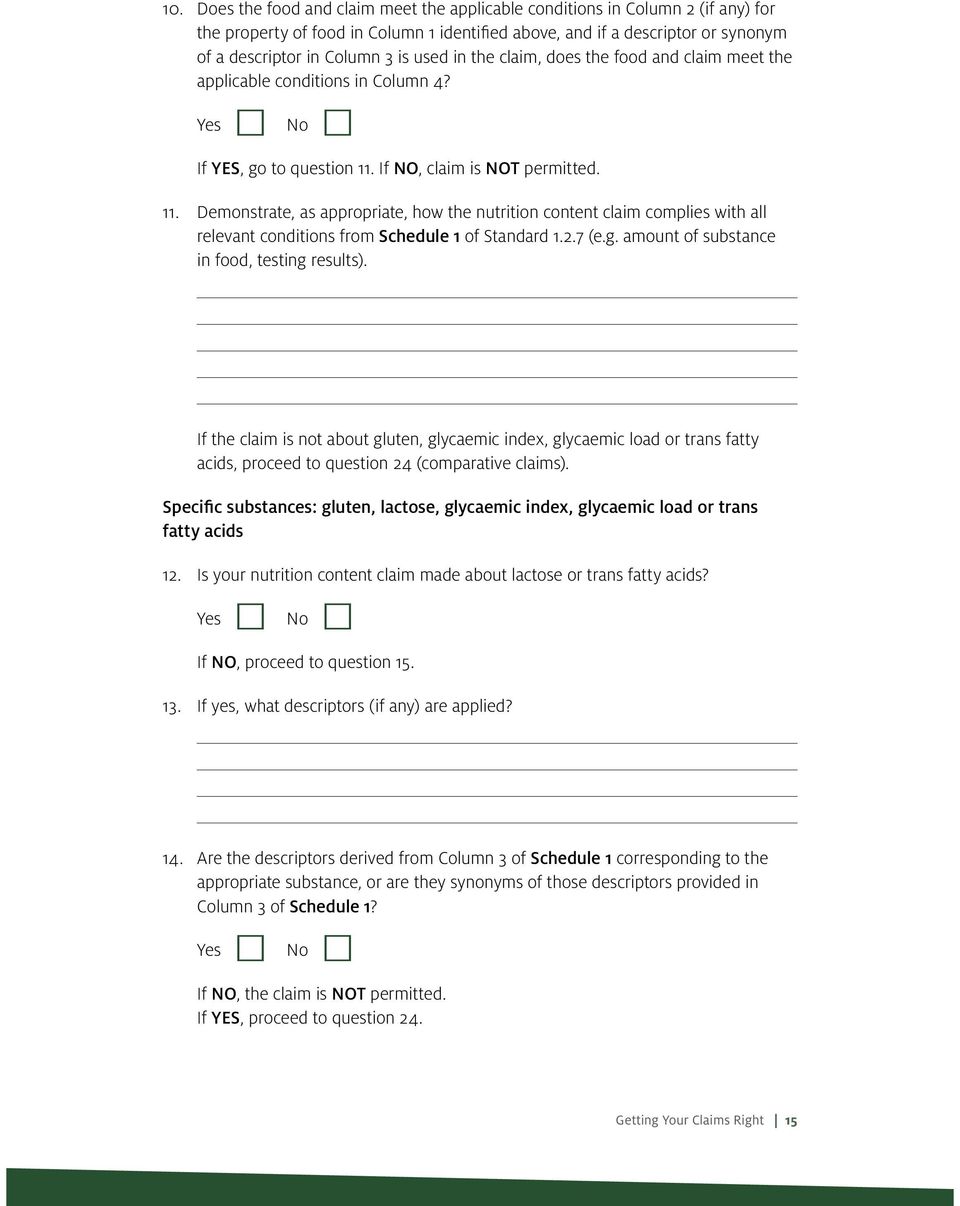
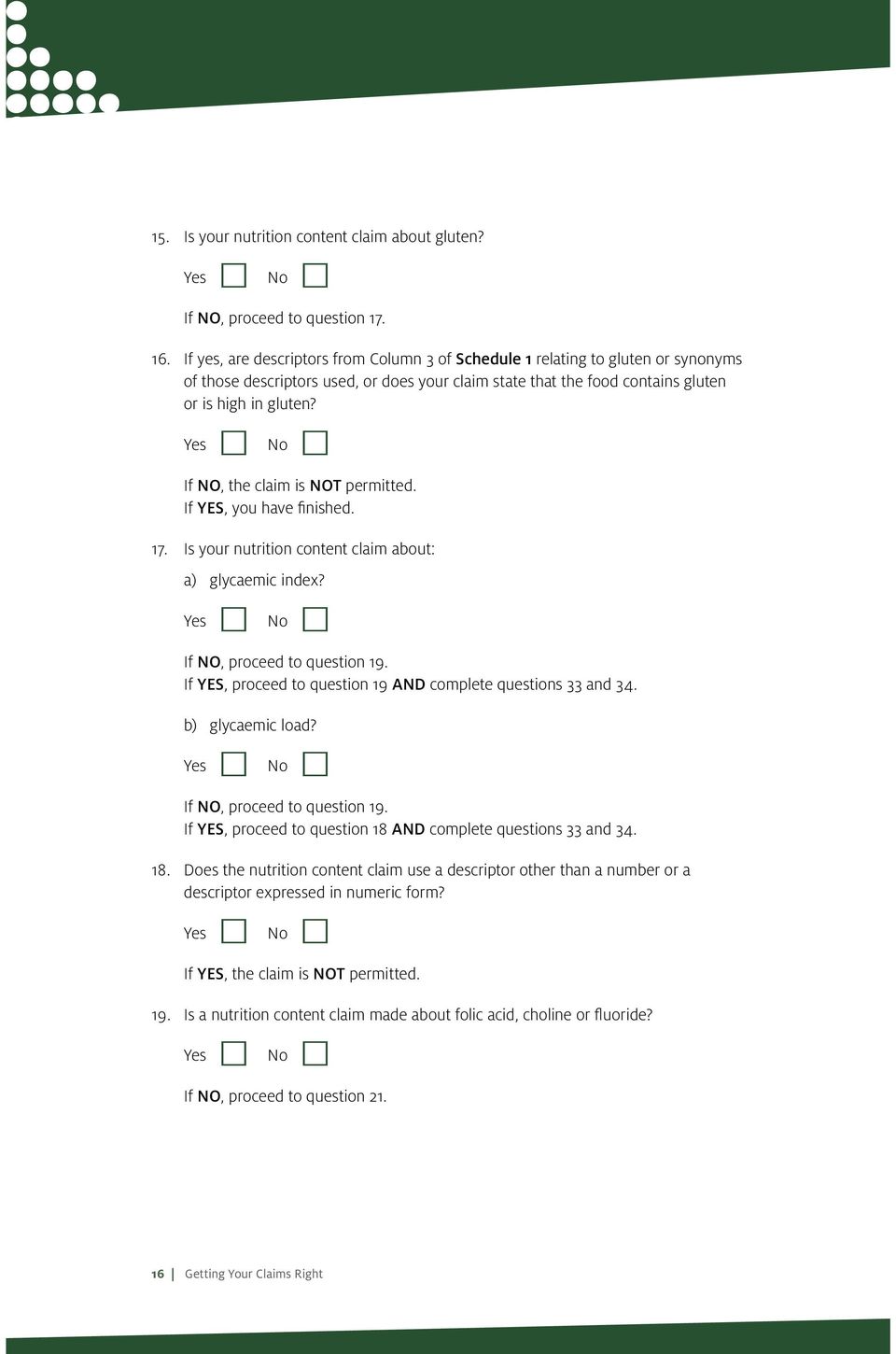
20 15. Is your nutrition content claim about gluten? Yes No If NO, proceed to question If yes, are descriptors from Column 3 of Schedule 1 relating to gluten or synonyms of those descriptors used, or does your claim state that the food contains gluten or is high in gluten? Yes No If NO, the claim is NOT permitted. If YES, you have finished. 17. Is your nutrition content claim about: a) glycaemic index? Yes No If NO, proceed to question 19. If YES, proceed to question 19 AND complete questions 33 and 34. b) glycaemic load? Yes No If NO, proceed to question 19. If YES, proceed to question 18 AND complete questions 33 and Does the nutrition content claim use a descriptor other than a number or a descriptor expressed in numeric form? Yes No If YES, the claim is NOT permitted. 19. Is a nutrition content claim made about folic acid, choline or fluoride? Yes No If NO, proceed to question Getting Your Claims Right
21 20. If yes, does the food also carry a health claim about folic acid, choline or fluoride (as applicable, as referred to in the nutrition content claim)? Yes No If NO, nutrition content claim MAY NOT be made about that food. If YES, you have finished. The nutrition content CLAIM MAY ONLY BE MADE about presence of folic acid, choline or fluoride or the amount of folic acid, choline or fluoride in a specified amount of the food. No descriptors in Column 3 of Schedule 1 (or any other descriptor) may be used for nutrition content claims made about folic acid, choline or fluoride. If your claim is in Schedule 1, go to question 24 (comparative claims) 21. Is a nutrition content claim made about a property of food not mentioned in Schedule 1? Yes No If NO, proceed to question If yes, does the claim use a descriptor listed in Column 3 of Schedule 1 or any other descriptor except for a descriptor that indicates the food does not contain the property of food? Yes No If YES, the claim is NOT permitted. If NO, proceed to question Does the claim refer to the presence or absence of that substance, the specific amount of that property of food in a specified amount of the food or a descriptor that indicates the food does not contain the property of food? Yes No If NO, the claim is NOT permitted. If YES, you have finished. Specific conditions for nutrition content claims: comparative claims 24. Does the nutrition content claim compare the nutrition content of one food with another or is the word diet used in a nutrition content claim? Yes No If NO, you do not need to address any further questions. Getting Your Claims Right 17
22 25. If yes, are the descriptors, light or lite, increased, or reduced used in the nutrition content claim? Yes No If yes, which of these terms is used? 26. If the above words are not used, but the nutrition content claim compares the nutrition content of one food with another, what words are used to describe the comparison between the claimed food and the reference food? 27. Does the comparative claim state the identity of the reference food and the difference between the amount of the relevant property in the claimed food and reference food? Yes No If NO, the claim is NOT permitted. 28. Does the claim directly or indirectly compare the vitamin or mineral content of a food with that of another food? Yes No If YES, the claim is NOT permitted unless the claim is permitted by another Standard in the Food Standards Code. 29. Is the word diet used in a nutrition content claim? Yes No If YES, proceed to question 30 AND address questions 33 and 34. If NO, you have finished. 18 Getting Your Claims Right
23 30. If yes, is the diet claim a comparative claim, i.e. does the food meet the conditions for making the diet claim by having at least 40% less energy than the same quantity of reference food? Yes No If NO, proceed to question If yes, is the identity of the reference food and the difference between the energy content in the reference food compared to the claimed food provided together with the claim? Yes No If NO, the claim is NOT permitted. 32. For claims using the word diet as a descriptor (i.e. claims that comply with the conditions for use of the diet descriptor), are other descriptors used that directly or indirectly refer to slimming or synonyms of slimming used? Yes No If YES, the claim is NOT permitted. Questions 33 and 34 apply only if you are making a glycaemic index, glycaemic load or diet claim 33. What category does the food belong to in the Nutrient Profiling Scoring Criterion (NPSC) as listed in the Category column of Schedule 4 of Standard 1.2.7? Category 1 Category 2 Category What is the final nutrient profiling score of the food in its specific category, as listed in the NPSC category column of Schedule 4 of Standard 1.2.7? For information on calculating the nutrient profiling score see the FSANZ website. If food is Category 1, nutrient profiling score must be less than 1 to qualify for the claim. If food is Category 2, nutrient profiling score must be less than 4 to qualify for the claim. If food is Category 3, nutrient profiling score must be less than 28 to qualify for the claim. If the food does not meet the NPSC the glycaemic index, glycaemic load or diet claim is NOT permitted. Getting Your Claims Right 19
24 4. Making a health claim A health claim is any claim that states, suggests or implies that a food or property of food has or may have a health effect. See the glossary on page 45 for definitions of property of food, health claim and health effect. There are two types of health claims, general level health claims and high level health claims. This document provides guidance on making both types of health claim. A food health relationship is the relationship between a food or property of food and a health effect. All health claims require a food health relationship to be established. A high level health claim must be based on a food health relationship provided in Schedule 2 of Standard A food health relationship for general level health claims can be established in one of two ways: it is listed in Schedule 3 of Standard or following a process of systematic review as described in Schedule 6 of Standard Guidance on establishing a food health relationship for a general level health claim by systematic review is available on the FSANZ website. A health claim must not be made on a food that does not meet the NPSC described in Schedule 4 of Standard This requirement does not apply to foods standardised in Part 2.9 of the Food Standards Code. The method to calculate a food s nutrient profiling score is described in Schedule 5 of Standard You can use the Nutrient Profiling Scoring Calculator to help you determine if a food meets the NPSC. A health claim must state the food or the property of food and the specific health effect (derived from the established food health relationship). If the health effect only applies to a specific sector of the population rather than the whole population this information must be included as part of the health claim. Dietary context statements must be included with the health claim (paragraph 19(3) (a)). The dietary context statement must state that the health effect must be considered in the context of a healthy diet involving the consumption of a variety of foods and must be appropriate for the claim being made (paragraph 19(3)(a) and subclause 19(4)). In addition, for health claims based on a pre approved food health relationship (a relationship described in Schedules 2 or 3), words to the effect of the relevant dietary context statement in Column 4 of those Schedules must also be used. 20 Getting Your Claims Right
25 For general level health claims based on a food-health relationship established by following the process of systematic view (Schedule 6), the dietary context statement must be consistent with the conclusions of the systematic review. There is an exemption from the dietary context statement if the health claim is on a label of a small package (see glossary) (subclause 19(5)). The food or property of food and the health effect may be presented as a separate, shortened statement in what is called a split health claim. However, the shortened statement must appear on the same label or in the same advertisement as the complete statement that includes all the claim elements required by Standard An indication of where the complete statement is located must be provided with the shortened statement (clause 20). If a health claim is made about phytosterols, phytostanols and their esters and it is presented with the advisory statements required by clause 2 of Standard then a statement that the health effect must be considered in the context of a healthy diet involving the consumption of a variety of foods as part of a dietary context statement is not required (clause 21). Getting Your Claims Right 21
26 5. Making a general level health claim Building a general level health claim The purpose of this diagram is to direct users to the relevant sections of this guidance document. Food health relationship + = Other requirements of Standard Health claim Pre-approved relationships Relevant conditions of Schedule 3 apply. Refer to sections 4 and 5 of this document. Established by systematic review Relevant conditions of Schedule 6 apply. Refer to sections 4 and 5 of this document. Generic conditions and restrictions of section 2 apply. Specific requirements of sections 4 and 5 apply Claim wording Refer to section 2.3. Schedule 3 may be amended by application to FSANZ. Refer to the Guidance on establishing food health relationships for general level health claims for establishing a food health relationship by systematic review in accordance with Schedule 6 22 Getting Your Claims Right
27 A general level health claim is defined as a health claim that is not a high level health claim (see glossary). The requirements outlined in Sections 2 and 4 of this document also apply when making a general level health claim. There are two ways to establish food health relationships that underpin a general level health claim: pre approved relationships as listed in Schedule 3 of Standard by following the process of systematic review as described in Schedule 6 of Standard Any of the relationships listed in Schedule 3 may be used for making general level health claims. If a relationship from Schedule 3 is used, all necessary conditions relating to that relationship need to be met. If a food health relationship is established by systematic review, the person responsible for making the claim must notify the FSANZ CEO of the details of the relationship between the food or property of food and the health effect. Refer to the FSANZ website for information to consider when notifying self substantiated food health relationship in accordance with Standard Building a general level health claim based on Schedule 3: Calcium is listed in Schedule 3. Column 1 (Food or property of food): Calcium. Column 2 (Specific health effect): Necessary for normal teeth and bone structure. Column 3 (Relevant population): No relevant population required. Column 4 (Dietary Context): No additional dietary context required. Column 5 (Conditions): The food must meet the general claim conditions for making a nutrition content claim about calcium. Templates are provided to help food businesses build a general level health claim based on either a pre approved food health relationship or systematic review; and demonstrate due diligence in attempting to comply with the Food Standards Code. These templates should be used with the associated Checklist for General Level Health Claims (pre approved) and Checklist for General Level Health Claims (systematic review). A separate template and associated checklist should be used for each claim. Getting Your Claims Right 23
28 Compliance template general level health claims (Schedule 3 pre-approved food-health relationship) This template may help food businesses to build a general level health claim based on a pre-approved food-health relationship; and demonstrate due diligence in attempting to comply with the Food Standards Code. See sections 2, 4 and 5 of this document for conditions on making of general level health claims. General information 1. What is the wording of the proposed general level health claim? 2. What food will the general level health claim be applied to? 3. Has the form of the food to which the claim relates been determined in accordance with the Table to clause 6 of Standard 1.2.7? Yes No If NO, the claim is NOT permitted. 4. Does the general level health claim state the form of the food to which the claim applies together with the claim as required by subclause 19(3)(b) of Standard unless the form of the food is as sold? Yes No If NO, the claim is NOT permitted in its current form. 24 Getting Your Claims Right
29 5. Do the words in the general level health claim refer to the prevention, diagnosis, cure, or alleviation of a disease, disorder or condition or compare a food with a good that is represented in any way to be for therapeutic use or likely to be taken to be for therapeutic use, whether because of the way in which the good is presented or for any other reason? Yes No If YES, the claim is NOT permitted. 6. Do words used in the general level health claim alter or contradict the effect of a statement or information required by Standard 1.2.7? Yes No If NO, the claim is NOT permitted in its current form. 7. Does the claim refer to a serious disease or a biomarker of a serious disease? Yes No If YES, the claim is NOT permitted as a general level health claim. 8. What category does the food belong to in the Nutrient Profiling Scoring Criterion (NPSC) as listed in the Category column of Schedule 4 of Standard 1.2.7? Category 1 Category 2 Category 3 Note: Foods defined in Part 2.9 of the Food Standards Code do not need to comply with the NPSC. 9. What is the final nutrient profiling score of the food (see the NPSC category column of Schedule 4 of Standard 1.2.7)? For information on calculating the nutrient profiling score refer to the FSANZ website. If food is Category 1, nutrient profiling score must be less than 1 to qualify for health claim. If food is Category 2, nutrient profiling score must be less than 4 to qualify for health claim. If food is Category 3, nutrient profiling score must be less than 28 to qualify for health claim. If the food does not meet the NPSC the health claim is NOT permitted. Getting Your Claims Right 25
30 10. What is the food-health relationship identified in Schedule 3 of Standard that is used as the basis for making the general level health claim? 11. Does the claim meet the conditions identified in Column 3 (relevant population) or Column 4 (dietary context) of Schedule 3 applicable to the food-health relationship identified above? Yes No If NO, the claim is NOT permitted in its current form. 12. Are the conditions in Column 5 of Schedule 3 applicable to the food-health relationship identified above, met? Yes No If NO, the claim is NOT permitted. 13. Demonstrate how the general level health claim complies with all relevant criteria identified in Schedule 3 of Standard Does the general level health claim advise consumers that the claimed health effect must be considered in the context of a healthy diet involving the consumption of a variety of foods and is the dietary context statement appropriate for the claim being made as required by subclause 19(4) (a) and (b) of Standard 1.2.7? Yes No If NO, the claim is NOT permitted in its current form (unless the food is contained in a small package). Health claims about phytosterols, phytostanols and their esters do not require a statement that the health effect must be considered in the context of a healthy diet involving the consumption of a variety of foods as part of a dietary context statement to be made in conjunction with the health claim if the claim is presented together with the advisory statements required by clause 2 of Standard Getting Your Claims Right
31 15. Is the general level health claim being made as a split claim? If so, is a statement available with the stated food or property of food and the health effect on the label of the food or advertisement, indicating where all required elements of the general level health claim may be found on the label or advertisement, as required by clause 20 of Standard 1.2.7? Yes No If NO, the claim is NOT permitted in its current form. 16. Do the details of the nutrients or biologically active substances used to make the general level health claim appear in the nutrition information panel (NIP) on the label of the package of the food as required by clause 5 of Standard 1.2.8? Yes No If NO, the particulars of the nutrient or biologically active substance must be declared in the NIP, or if no label is required under subclause 2(1) of Standard 1.2.1, the NIP (with the particulars of the claimed nutrient or biologically active substance) should be displayed on or in connection with the display of the food or provided to the purchaser upon request. This requirement does not apply to food in small packages however certain information must be included on the label of the small package (clauses 8 and 8A of Standard 1.2.8). Getting Your Claims Right 27
32 Compliance template general level health claims (systematic review) This template may help food businesses build a general level health claim based on a food-health relationship established by systematic review; and demonstrate due diligence in attempting to comply with the Food Standards Code. See sections 2, 4 and 5 of this document for conditions on making general level health claims. General information 1. What is the wording of the proposed general level health claim? 2. What food will the general level health claim be applied to? 3. Has the form of the food to which the claim relates been determined in accordance with the Table to clause 6 of Standard 1.2.7? Yes No If NO, the claim is NOT permitted. 4. Does the general level health claim state the form of the food to which the claim applies together with the claim as required by subclause 19(3)(b) of Standard 1.2.7, unless the form of the food is as sold? Yes No If NO, the claim is NOT permitted in its current form. 28 Getting Your Claims Right
33 5. Do the words in the general level health claim refer to the prevention, diagnosis, cure, or alleviation of a disease, disorder or condition or compare a food with a good that is represented in any way to be for therapeutic use or likely to be taken to be for therapeutic use, whether because of the way in which the good is presented or for any other reason? Yes No If YES, the claim is NOT permitted. 6. Do words used in the general level health claim alter or contradict the effect of a statement or information required by Standard 1.2.7? Yes No If YES, the claim is NOT permitted. 7. Does the claim refer to a serious disease or a biomarker of a serious disease? Yes No If YES, the claim is NOT permitted as a general level health claim. 8. What category does the food belong to in the Nutrient Profiling Scoring Criterion (NPSC) as listed in the Category column of Schedule 4 of Standard 1.2.7? Category 1 Category 2 Category 3 9. What is the final nutrient profiling score of the food in its specific category, as listed in the NPSC category column of Schedule 4 of Standard 1.2.7? For information on calculating the nutrient profiling score refer to the FSANZ website If food is Category 1, nutrient profiling score must be less than 1 to qualify for health claim. If food is Category 2, nutrient profiling score must be less than 4 to qualify for health claim. If food is Category 3, nutrient profiling score must be less than 28 to qualify for health claim. Foods defined in Part 2.9 of the Food Standards Code do not need to comply with the NPSC. If the food DOES NOT meet the NPSC the health claim is NOT permitted. Getting Your Claims Right 29
34 10. Does the general level health claim advise consumers that the claimed health effect must be considered in the context of a healthy diet involving the consumption of a variety of foods and include words to the effect of a relevant dietary context statement that is a reasonable conclusion of the systematic review and is the dietary context statement appropriate for the claim being made, as required by paragraph 19(3) (a) of Standard 1.2.7? Yes No If NO, the claim is NOT permitted in its current form (unless the food is contained in a small package). Health claims about phytosterols, phytostanols and their esters do not require a statement that the health effect must be considered in the context of a healthy diet involving the consumption of a variety of foods as part of a dietary context statement to be made in conjunction with the health claim if the claim is presented together with the advisory statement required by Clause 2 of Standard Is the general level health claim being made as a split claim? If so, is a statement available with the stated food or property of food and the health effect on the label of the food or advertisement indicating where all required elements of the general level health claim may be found on the label or advertisement, as required by clause 20 of Standard 1.2.7? Yes No If NO, the claim is NOT permitted in its current form. 12. Do the details of the nutrients or biologically active substances used to make the general level health claim appear in the nutrition information panel (NIP) on the label of the package of the food as required by clause 5 of Standard 1.2.8? Yes No If NO, the particulars of the nutrient or biologically active substance MUST BE declared in the NIP, or if no label is required under subclause 2(1) of Standard 1.2.1, the NIP (with the particulars of the claimed nutrient or biologically active substance) should be displayed on or in connection with the display of the food or provided to the purchaser upon request. This requirement does not apply to food in small packages however certain information must be included on the label of the small package (clauses 8 and 8A of Standard 1.2.8). 30 Getting Your Claims Right
35 13. If the general level health claim is based on a relationship between a food or property of food and a health effect that has been established by a process of systematic review described in Schedule 6 of Standard 1.2.7, has the person responsible for making the claim notified the CEO of FSANZ of the details of that relationship? Yes No If NO, the claim does NOT comply with Standard Has a person giving notice in question 13 above to the CEO of FSANZ provided: (i) The name of the person giving the notice and the Yes address in Australia or New Zealand of that person, and No (ii) Consent to the publication by the Authority of information concerning the relationship that is the Yes No subject of the notice plus information in (i) above, and; (iii) Certification that the relationship that is the subject of the notice provided in question 13 above has been Yes established by a process of systematic review that is No described in Schedule 6. If NO to any of the above, the claim DOES NOT COMPLY with Standard Would the person giving notice in question 13 above to the CEO of the Authority, if requested by a relevant authority, be able to provide records to the relevant authority that demonstrate that: (i) The systematic review was conducted in accordance with the process of systematic review described in Schedule 6; and (ii) The notified relationship is a reasonable conclusion of the systematic review. Required elements of a systematic review Yes Yes No No 16. Do you intend to undertake a systematic review by reviewing the original (primary) literature or starting with an existing systematic review and updating it? Getting Your Claims Right 31
36 If undertaking a systematic review by reviewing the original (primary) literature, answer questions If starting with an existing systematic review and updating it answer questions for the updated systematic review including any relevant scientific data not included in the existing systematic review. 17. Has a statement been made that describes the food or property of food, the health effect and the proposed relationship between the food or property of food and the health effect? Yes No If NO, the systematic review HAS NOT BEEN CONDUCTED in accordance with the process described in Schedule Has a search strategy been provided that describes how scientific evidence has been captured relevant to the proposed relationship between the food or property of food and the health effect, including the inclusion and exclusion criteria? Yes No If NO, the systematic review HAS NOT BEEN CONDUCTED in accordance with the process described in Schedule Has a final list of studies, based on the inclusion and exclusion criteria, been provided to support the proposed relationship? Yes No If NO, the systematic review HAS NOT BEEN CONDUCTED in accordance with the process described in Schedule If yes to question 19, are there studies among this list that involve studies in humans? Yes No If NO, the systematic review HAS NOT BEEN CONDUCTED in accordance with the process described in Schedule 6. Studies in humans are essential. 32 Getting Your Claims Right
37 21. Has a table with key information from each included study been provided? This table must include information on: (a) the study reference Yes No (b) the study design Yes No (c) the objectives Yes No (d) the sample size in the study groups and loss to follow up or non-response Yes No (e) the participant characteristics Yes No (f) method used to measure the food or property of food including amount consumed Yes No (g) confounders measured Yes No (h) the method used to measure the health effect Yes No (i) the study results, including effect size and statistical significance Yes No (j) any adverse effects. Yes No If NO to any of the above, the systematic review HAS NOT BEEN CONDUCTED in accordance with the process described in Schedule Has an assessment of the quality of each included study been undertaken, based on consideration of, as a minimum: (a) a clearly stated hypothesis Yes No (b) minimisation of bias Yes No (c) adequate control for confounding Yes No (d) the study participants background diets and other relevant lifestyle factors (e) study duration and follow-up adequate to demonstrate the health effect Yes Yes No No (f) the statistical power to test the hypothesis. Yes No If NO to any of the above, the systematic review HAS NOT BEEN CONDUCTED in accordance with the process described in Schedule 6. Getting Your Claims Right 33
38 23. Has an assessment of the results of the included studies as a group been provided, that considers whether: (a) is a consistent association between the food or property of food and the health effect across all high quality studies. (b) there is a causal association between the consumption of the food or property of food and the health effect that is independent of other factors (with most weight given to well-designed experimental studies in humans). (c) the proposed relationship between the food or property of food and the health effect is biologically plausible. (d) the amount of the food or property of food to achieve the health effect can be consumed as part of a normal diet of the Australian and New Zealand populations. Yes Yes Yes Yes No No No No If NO to any of the above, the systematic review HAS NOT BEEN CONDUCTED in accordance with the process described in Schedule Has a conclusion been provided based on the results of the studies that includes: (a) whether a causal relationship has been established between the food or property of food and the health effect based on the totality and weight of evidence. (b) where there is a causal relationship between the food or property of food and the health effect: (i) the amount of the food or property of food required to achieve the health effect (ii) whether the amount of the food or property of food to achieve the health effect is likely to be consumed in the diet of the Australian and New Zealand populations or by the target population group, where relevant. Yes Yes Yes No No No If NO to any of the above, the systematic review HAS NOT BEEN CONDUCTED in accordance with the process described in Schedule Getting Your Claims Right
39 6 Making a high level health claim Building a high level health claim The purpose of this diagram is to direct users to the relevant sections of this guidance document. Food-health relationship + = Other requirements of Standard Health claim A high level health claim may only be made if the food-health relationship is in Schedule 2 Relevant conditions of Schedule 2 apply. Refer to sections 4 and 6 of this document. Generic conditions and restrictions of section 2 apply. Specific requirements of sections 4 and 6 of this document apply. Claim wording Refer to Section 2.3. Schedule 2 may be amended by application to FSANZ. A high level health claim means a health claim that refers to a serious disease or a biomarker of a serious disease. The requirements outlined in Sections 2 and 4 of this document also apply when making a high level health claim. Only food health relationships described in Schedule 2 of Standard may be used for the making of high level health claims. Getting Your Claims Right 35
40 Building a high level health claim based on Schedule 2: Calcium is listed in Schedule 2. Column 1 (Food or property of food): Calcium. Column 2 (Specific health effect): Reduced risk of osteoporosis. Column 3 (Relevant population): Persons 65 years and over. Column 4 (Dietary context): Diet high in calcium, and adequate Vitamin D status. Column 5 (Conditions): The food contains no less than 290mg of calcium per serving. A high level health claim made about calcium and reduced risk of osteoporosis must comply with all above stated conditions. A template is provided to assist food businesses to: build a high level health claim; and demonstrate due diligence in attempting to comply with the Food Standards Code. This template should be used with the associated Checklist for High Level Health Claims. A separate template and associated checklist should be used for each claim. 36 Getting Your Claims Right
41 Compliance template high level health claims This template may help food businesses build a high level health claim; and demonstrate due diligence in attempting to comply with the Food Standards Code. See sections 2, 4 and 6 of this document for conditions on making health claims. General information 1. What is the wording of the proposed high level health claim? Examples of serious diseases are coronary heart disease, osteoporosis, osteoporotic fracture and neural tube defects. Examples of biomarkers of serious disease are blood cholesterol and blood pressure. 2. What food will the high level health claim be applied to? 3. Has the form of the food to which the claim relates been determined in accordance with the Table to clause 6 of Standard 1.2.7? Yes No If NO, the claim is NOT permitted. 4. Does the high level health claim state the form of the food to which the claim applies together with the claim as required by subclause 19(3)(b) of Standard unless the form of the food is as sold? Yes No If NO, the claim is NOT permitted in its current form. Getting Your Claims Right 37
42 5. Do words used in the high level health claim alter or contradict the effect of a statement or information required by Standard 1.2.7? Yes No If YES, the claim is NOT permitted. 6. What is the serious disease or biomarker of a serious disease referred to in the claim? 7. What category does the food belong to in the Nutrient Profiling Scoring Criterion (NPSC) as listed in the Category column of Schedule 4 of Standard 1.2.7? Category 1 Category 2 Category 3 8. What is the final nutrient profiling score of the food in its specific category, as listed in the NPSC category column of Schedule 4 of Standard 1.2.7? For information on calculating the nutrient profiling score, refer to the FSANZ website: If food is Category 1, nutrient profiling score must be less than 1 to qualify for health claim. If food is Category 2, nutrient profiling score must be less than 4 to qualify for health claim. If food is Category 3, nutrient profiling score must be less than 28 to qualify for health claim. Foods defined in Part 2.9 of the Food Standards Code do not need to comply with the NPSC. If the food DOES NOT MEET THE NPSC the health claim is NOT permitted. 9. Do the words in the high level health claim refer to the prevention, diagnosis, cure, or alleviation of a disease, disorder or condition or compare a food with a good that is represented in any way to be for therapeutic use or likely to be taken to be for therapeutic use, whether because of the way in which the good is presented or for any other reason? Yes No If YES, the claim is NOT permitted. 38 Getting Your Claims Right
43 10. What is the food-health relationship listed in Columns 1 and 2 of Schedule 2 of Standard that is to be used for making the high level health claim? If a food-health relationship is not in Schedule 2 the claim is NOT permitted. 11. Does the claim meet the conditions identified in Column 3 (relevant population) or Column 4 (dietary context) of Schedule 2, applicable to the food-health relationship identified above? Yes No If NO, the claim is NOT permitted in its current form. 12. Are the conditions in Column 5 of Schedule 2 applicable to the food-health relationship identified above, met? Yes No If NO, the claim is NOT permitted. 13. Demonstrate how the high level health claim complies with all relevant criteria identified in Schedule 2 of Standard Does the high level health claim advise consumers that the claimed health effect must be considered in the context of a healthy diet involving the consumption of a variety of foods and is it appropriate for the claim being made as required by subclause 19(4) (a) and (b) of Standard 1.2.7? Yes No If NO, the claim is NOT permitted in its current form (unless the food is contained in a small package). Health claims about phytosterols, phytostanols and their esters do not require a statement that the health effect must be considered in the context of a healthy diet involving the consumption of a variety of foods as part of a dietary context statement to be made in conjunction with the health claim if the claim is presented together with the advisory statement required by clause 2 of Standard Getting Your Claims Right 39
44 15. Do the details of the nutrients or biologically active substances used to make the high level health claim appear in the nutrition information panel (NIP) on the label of the package of the food as required by clause 5 of Standard 1.2.8? Yes No If NO, the particulars of the nutrient or biologically active substance must be declared in the NIP, or if no label is required under subclause 2(1) of Standard 1.2.1, the NIP (with the particulars of the claimed nutrient or biologically active substance) should be displayed on or in connection with the display of the food or provided or declared to the purchaser upon request. This requirement does not apply to food in small packages however certain information must be included on the label of the small package (clauses 8 and 8A of Standard 1.2.8). 16. Is the high level health claim being made as a split claim? If so, is a statement available with the stated food or property of food and the health effect on the label of the food or advertisement indicating where all required elements of the high level health claim may be found on the label or advertisement, as required by clause 20 of Standard 1.2.7? Yes No If NO, the claim is NOT permitted in its current form. 40 Getting Your Claims Right
45 7. Endorsing bodies and endorsements Endorsements are nutrition content claims or health claims made with the permission of an endorsing body. Endorsements are not subject to Part 2 of Standard (excluding clause 7) and Part 3 Divisions 1, 2 and 4. Endorsements can only be made if the requirements below are met (clauses 22 and 23 of Standard 1.2.7). Subclause 22 (1) states that endorsing bodies must: not be related to the supplier (subclause 22(2)) outlines when an endorsing body is related to a supplier) be independent of the supplier be free from influence by the supplier. In this subclause, supplier is the supplier of the food in relation to which an endorsement is made. The supplier using the endorsement must (during sale or advertising for sale and for 2 years after the product was supplied or advertised) keep and make available to the relevant authority, if requested, records demonstrating that (clause 23): it has the permission of the endorsing body to use the endorsement; (e.g. a certificate of accreditation) the endorsing body has a nutrition or health-related function or purpose (articles of association outlining the function of the endorsing body may demonstrate this) the endorsing body is a not-for-profit entity not related to the supplier using the endorsement (company documents may demonstrate this). Endorsements must comply with clause 7 (claims must not be therapeutic in nature) and not refer to a serious disease except when referring to the endorsing body if the serious disease is part of the name of the endorsing body. If these requirements are not met, endorsements are treated as nutrition content or health claims and must comply with all relevant requirements in the Standard. A template is provided to help suppliers, that make nutrient content claims or heath claims with the permission of an endorsing body, demonstrate due diligence in attempting to comply with the Food Standards Code. Getting Your Claims Right 41
46 Compliance template Endorsements This template is to help suppliers (including importers, see glossary) making nutrition content claims or health claims with the permission of an endorsing body. Part 2 (other than clause 7) and Part 3 Divisions 1, 2 and 4 of Standard do not apply to an endorsement. General information 1. Describe the endorsement (refer to glossary) and how it is made. 2. Describe the food that carries the endorsement? 3. What is the name of the endorsing body? Endorsing bodies 4. Is the endorsing body a not-for-profit entity that has a nutrition or health-related function or purpose? Yes No If NO, the endorsement CANNOT be made by the supplier. 5. Has the endorsing body given the supplier permission to use the endorsement? Yes No If NO, the endorsement CANNOT be made by the supplier. 42 Getting Your Claims Right
47 Relationship between endorsing body and supplier 6. Is the endorsing body related in any way to the supplier? Yes No If YES, the endorsement CANNOT be made by the supplier. 7. Is the endorsing body independent of, and free from influence by, the supplier of the food? Yes No If NO, the endorsement CANNOT be made by the supplier. 8. Does the supplier have any financial interest in the endorsing body? Yes No If YES, the endorsement CANNOT be made by the supplier. 9. Did the supplier establish the endorsing body, whether by itself or with others? Yes No If YES, the endorsement CANNOT be made by the supplier. 10. Does the supplier exercise direct or indirect control over the endorsing body? Yes No If YES, the endorsement CANNOT be made by the supplier. Criteria for endorsements 11. Does the endorsement refer to a serious disease (except in reference to the endorsing body if the serious disease is part of the name of the endorsing body)? Yes No If YES, the endorsement CANNOT be made by the supplier. Getting Your Claims Right 43
48 12. If you are the supplier (including an importer) of the food that carries the endorsement, have you kept the required records and are you able to provide these to the relevant authority if requested? Yes No If NO, then you do not meet the criteria for endorsements. If the label on, or advertisement for, an imported food makes or includes an endorsement, the supplier must keep required records for the information period. Information period, in relation to food, means the period (a) during which the food is available for sale or advertised for sale; and (b) the period of 2 years after the food was last sold, or advertised or available for sale, whichever is the latest. Required records means a document or documents that demonstrate that (a) a supplier using an endorsement has obtained the permission of the endorsing body to use the endorsement; and (b) the endorsing body has a nutrition- or health-related function or purpose; and (c) the endorsing body is a not-for-profit entity; and (d) the endorsing body is not related to the supplier using the endorsement. 13. Does the endorsement comply with clause 7 of Standard (claims must not be therapeutic in nature)? Yes No If NO, the endorsement CANNOT be made. 44 Getting Your Claims Right
49 8. Glossary Act means the Act, as amended or, as the case may be, ordinance of a state, territory, external territory, Commonwealth or New Zealand, under the authority of which the Food Standards Code is enforced. Biologically active substance is as defined in Standard Biomarker means a measurable biological parameter that is predictive of the risk of a serious disease when present at an abnormal level in the human body. Claim means an expressed or implied statement, representation, design or information in relation to a food or property of food which is not mandatory in the Food Standards Code. Comparative claim means a nutrition content claim that directly or indirectly compares the nutrition content of one food or brand of food with another, and includes claims using the descriptors a) light or lite, b) increased, or c) reduced, or words of similar import. A nutrition content claim using the descriptor diet is also a comparative claim, if it meets the conditions for making that claim by having at least 40% less energy than the same quantity of reference food. Endorsement means a nutrition content claim or a health claim that is made with the permission of an endorsing body. Endorsing body is a not-for-profit entity which has a nutrition or health-related purpose or function, that permits a supplier to make an endorsement. Food group is referred to in the definition of reference food, for the purposes of comparative claims and means any of the following groups: (a) bread (both leavened and unleavened), grains, rice, pasta and noodles (b) fruit, vegetables, herbs, spices and fungi (c) milk and milk products as standardised in Part 2.5 and analogues derived from legumes and cereals mentioned in Column 1 of the Table to clause 3 in Standard (d) meat, fish, eggs, nuts, seeds and dried legumes (e) fats including butter, edible oils and edible oil spreads. Getting Your Claims Right 45
50 Fruit means the edible portion of a plant or constituents of the edible portion that are present in the typical proportion of the whole fruit (with or without the peel or water), but does not include nuts, spices, herbs, fungi, legumes and seeds. General level health claim means a health claim that is not a high level health claim. High level health claim means a health claim that refers to a serious disease or a biomarker of a serious disease. Health claim means a claim which states, suggests or implies that a food or a property of food has, or may have, a health effect. Health effect means an effect on the human body, including an effect on one or more of the following: (a) a biochemical process or outcome (b) a physiological process or outcome (c) a functional process or outcome (d) growth and development (e) physical performance (f) mental performance (g) a disease, disorder or condition. Infant formula product means a product based on milk or other edible food constituents of animal or plant origin which is nutritionally adequate to serve as the principal liquid source of nourishment for infants. Information period, in relation to food, means the period: (a) during which the food is available for sale or advertised for sale; and (b) the period of 2 years after the food was last sold, or advertised or available for sale, whichever is the latest. Label means any tag, brand, mark or statement in writing or any representation or design or descriptive matter on or attached to or used in connection with or accompanying any food or package. NPSC means the nutrient profiling scoring criterion. 46 Getting Your Claims Right
51 Nutrition content claim means a claim about (a) the presence or absence of (i) (ii) (iii) (iv) (v) (vi) a biologically active substance; or dietary fibre; or energy; or minerals; or potassium; or protein; or (vii) carbohydrate; or (viii) fat; or (ix) (x) (xi) the components of any one of protein, carbohydrate or fat; or salt; or sodium; or (xii) vitamins; or (b) glycaemic index or glycaemic load; that does not refer to the presence or absence of alcohol, and is not a health claim. Property of food means a component, ingredient, constituent or other feature of food. Reference food means a food that is: (a) of the same type as the food for which a claim is made and that has not been further processed, formulated, reformulated or modified to increase or decrease the energy value or the amount of the nutrient for which the claim is made; or (b) a dietary substitute for the food in the same food group as the food for which a claim is made. Relevant authority means the authority responsible for the enforcement of the Food Standards Code. Getting Your Claims Right 47
52 Required records means documents regarding endorsement which demonstrate that: (a) a supplier using an endorsement has obtained the permission of the endorsing body to use the endorsement; and (b) the endorsing body has a nutrition or health-related function or purpose; and (c) the endorsing body is a not-for-profit entity; and (d) the endorsing body is not related to the supplier using the endorsement. Serious disease means a disease, disorder or condition which is generally diagnosed, treated or managed in consultation with or with supervision by a health care professional. Small package means a package with a surface area of less than 100 cm 2. Supplier means the packer, manufacturer, vendor or importer of the food in question. Vegetable means the edible portion of a plant or constituents of the edible portion that are present in the typical proportion of the whole vegetable (with or without the peel or water), but excludes nuts, spices, herbs, fungi, dried legumes (including dried legumes that have been cooked or rehydrated) and seeds. 48 Getting Your Claims Right
53 Checklist for Nutrition Content Claims This checklist is to assist food businesses when making nutrition content claims and is useful for documenting due diligence. It should be read in conjunction with Getting Your Claims Right: A Guide to Complying with the Nutrition, Health and Related Claims Standard of the Australia New Zealand Food Standards Code. Claims not permitted or foods not permitted to carry claims by Standard You need to tick all of the following boxes to ensure that you are not making a claim prohibited by Standard The claim is not about kava or about an infant formula product. The claim is not about a food that contains more than 1.15% alcohol by volume, other than a nutrition content claim about energy or carbohydrate content. The claim does not refer to the prevention, diagnosis, cure or alleviation of a disease, disorder or condition. The claim does not compare a food with a good that is represented in any way to be for therapeutic use; or likely to be taken for therapeutic use, whether because of the way in which the food or substance is presented or for any other reason. The claim does not compare the vitamin or mineral content of a food with another food, unless specifically permitted by the Food Standards Code. Standard applies You need to tick all of the following boxes to ensure that Standard applies to the claim and to the food that the claim is about. The food the claim is made about does not require further processing, packaging, or labelling before retail sale. The food will not be delivered to a vulnerable person by a delivered meals organisation, or provided to a patient in a hospital or other similar institution, other than a food in a package. The claim is not managed by another standard of the Australia New Zealand Food Standards Code (e.g. Standard Foods for Special Medical Purposes). Getting Your Claims Right 49
54 The claim does not concern risks or dangers of alcohol consumption, or concern moderating alcohol intake. The claim concerns the presence or absence of a biologically active substance, or dietary fibre, or energy, or minerals, or potassium, or protein, or carbohydrate, or fat, or the components of any one of protein, carbohydrate or fat, or salt, or sodium, or vitamins, or glycaemic index or glycaemic load; that does not refer to a health effect or the presence or absence of alcohol. The claim is not a mandatory declaration required by the Act (as defined in the Food Standards Code). Conditions for making nutrition content claims You need to tick all the applicable boxes to ensure that your claim complies with Standard If the nutrition content claim is based on a property of food in Column 1 of Schedule 1; (i) the claim states the property of food as mentioned in Column 1 of Schedule 1 of Standard 1.2.7; (ii) the food meets the general claim conditions that must be met as mentioned in Column 2 of Schedule 2 of Standard 1.2.7; and (iii) the claim complies with any relevant conditions that must be met as defined in Column 4 of Schedule 1 if using a specific descriptor (or synonym) provided in Column 3 of Schedule 1. If the claim concerns lactose or trans fatty acids, any descriptor used is mentioned in Column 3 of Schedule 1, corresponding with the relevant property of food (lactose or trans fatty acids), or is a synonym of one of those descriptors. If the claim concerns gluten, any descriptor used is mentioned in Column 3 of Schedule 1 in conjunction with gluten, or is a synonym of one of those descriptors, or the claims states that the food contains gluten or is high in gluten. If the claim is made about glycaemic load (GL), it only uses a numeric descriptor, or descriptor expressed in numeric form. If the claim is made about glycaemic index (GI), glycaemic load (GL), or is a diet claim, the food carrying the claim meets the nutrient profiling scoring criterion (NPSC). 50 Getting Your Claims Right
55 If the claim concerns choline, fluoride or folic acid, there is an accompanying health claim about that substance made on the same food, and the claim states only: (i) the food contains choline, fluoride or folic acid; or (ii) the food contains a specified amount of choline, fluoride or folic acid in a specified amount of food; or (iii) a combination of the above. If the claim meets the conditions for using the descriptor diet, a descriptor that directly or indirectly refers to slimming or a synonym for slimming is not used. If the nutrition content claim is a comparative claim, including a diet claim where the food meets the conditions for making the diet claim by having at least 40% less energy than the same quantity of reference food, the identity of the reference food and the difference between the amount of the property of food in the reference food to the claimed food is provided together with the claim. If the nutrition content claim is not based on a property of food in Column 1 of Schedule 1, the claim states only: (i) that the food contains or does not contain the property of food; or (ii) that the food contains a specified amount of the property of food in a specific amount of that food; or (iii) both of the above. A statement concerning the form of the food to which the claim relates is included with the nutrition content claim (unless the claim relates to the form of the food as sold). The nutrient or biologically active substance that is the subject of the claim has been included in the nutrition information panel (NIP) on the label of the package containing the food. None of the words used in the nutrition content claim alter or contradict the effect of a statement or information required by Standard Getting Your Claims Right 51
56 Checklist for General Level Health Claims (pre approved) This checklist is to assist food businesses when making general level health claims based on pre-approved food-health relationships and is useful for documenting due diligence. It should be read in conjunction with Getting Your Claims Right: A Guide to Complying with the Nutrition, Health and Related Claims Standard of the Australia New Zealand Food Standards Code. Claims not permitted or foods not permitted to carry claims by Standard You need to tick all of the following boxes to ensure that you are not making a claim prohibited by Standard The claim is not about kava or about an infant formula product. The claim is not about a food that contains more than 1.15% alcohol by volume, other than a nutrition content claim about energy or carbohydrate content. The claim does not refer to the prevention, diagnosis, cure or alleviation of a disease, disorder or condition. The claim does not compare a food with a good that is represented in any way to be for therapeutic use; or likely to be taken for therapeutic use, whether because of the way in which the food or substance is presented or for any other reason. The claim does not compare the vitamin or mineral content of a food with another food, unless specifically permitted by the Food Standards Code. Standard applies You need to tick all of the following boxes to ensure that Standard applies to the claim and to the food that the claim is about. The food the claim is made about does not require further processing, packaging, or labelling before retail sale. The food will not be delivered to a vulnerable person by a delivered meals organisation, or provided to a patient in a hospital or other similar institution, other than a food in a package. 52 Getting Your Claims Right
57 The claim is not managed by another standard of the Australia New Zealand Food Standards Code (e.g. Standard Foods for Special Medical Purposes). The claim does not concern risks or dangers of alcohol consumption, or concern moderating alcohol intake. The claim is not a mandatory declaration required by the Act (as defined in the Food Standards Code). Conditions for making general level health claims You need to tick all the following boxes to ensure that your claim complies with Standard The words in the claim do not refer to a serious disease or a biomarker of a serious disease. The correct Nutrient Profiling Scoring Criterion (NPSC) category is identified for the food (Schedule 4), except for food standardised in part 2.9 of the Food Standards Code. The nutrient profiling score is calculated correctly and is below the number specified for its category in the NPSC (Schedule 4). The health claim states the food or property of food mentioned in Column 1 of Schedule 3 of Standard The health claim states the specific health effect mentioned in Column 2 of Schedule 3 that is claimed for that food or property of food. The health claim refers to the relevant population group in Column 3 of Schedule 3 to which the health effect relates (if any). A dietary context statement1 is included with the health claim which: (i) states that the stated health effect must be considered in the context of a healthy diet involving the consumption of a variety of food; and (ii) is appropriate to the type of food or property of food that is the subject of the claim and the health effect claimed. 1 Not required on foods in a small package Getting Your Claims Right 53
58 The dietary context statement includes words to the effect of any relevant dietary context statement provided in Column 4 of Schedule 3. The food complies with any relevant conditions in Column 5 of Schedule 3 of Standard A statement concerning the form of the food to which the claim relates is included with the health claim (unless the claim relates to the form of the food as sold). The nutrient or biologically active substance that is the subject of the claim has been included in the nutrition information panel (NIP) on the label of the package containing the food. None of the words used in the health claim alter or contradict the effect of a statement or information required by Standard Getting Your Claims Right
59 Checklist for General Level Health Claims (systematic review) This checklist is to assist food businesses when making general level health claims based on self-substantiated food-health relationships and is useful for documenting due diligence. It should be read in conjunction with Getting Your Claims Right: A Guide to Complying with the Nutrition, Health and Related Claims Standard of the Australia New Zealand Food Standards Code. Claims not permitted or foods not permitted to carry claims by Standard You need to tick all of the following boxes to ensure that you are not making a claim prohibited by Standard The claim is not about kava or about an infant formula product. The claim is not about a food that contains more than 1.15% alcohol by volume, other than a nutrition content claim about energy or carbohydrate content. The claim does not refer to the prevention, diagnosis, cure or alleviation of a disease, disorder or condition. The claim does not compare a food with a good that is represented in any way to be for therapeutic use; or likely to be taken for therapeutic use, whether because of the way in which the food or substance is presented or for any other reason. The claim does not compare the vitamin or mineral content of a food with another food, unless specifically permitted by another Standard in the Code. Standard applies You need to tick all of the following boxes to ensure that Standard applies to the claim and to the food that the claim is about. The food the claim is made about does not require further processing, packaging, or labelling prior to retail sale. The food will not be delivered to a vulnerable person by a delivered meals organisation, or provided to a patient in a hospital or other similar institution, other than a food in a package. Getting Your Claims Right 55
60 The claim is not managed by another standard of the Australia New Zealand Food Standards Code (e.g. Standard Foods for Special Medical Purposes). The claim does not concern risks or dangers of alcohol consumption, or concern moderating alcohol intake. The claim is not a mandatory declaration required by the Act (as defined in the Food Standards Code). Conditions for making general level health claims You need to tick all the following boxes to ensure that your claim complies with Standard The words in the claim do not refer to a serious disease or a biomarker of a serious disease. The correct Nutrient Profiling Scoring Criterion (NPSC) category is identified for the food (Schedule 4), except for food standardised in part 2.9 of the Food Standards Code. The nutrient profiling score is calculated correctly and is below the number specified for its category in the NPSC (Schedule 4). The health claim is based on the details of a relationship between a food or property of food and a health effect that has been established by a process of systematic review described in Schedule 6 of Standard The person responsible for making the claim has notified the CEO of FSANZ of the details of the relationship between a food or property of food and a health effect that has been established by a process of systematic review described in Schedule 6 of Standard The person giving notice to the CEO of the Authority has provided: (i) the name of the person giving the notice and the address in Australia or New Zealand of that person; (ii) consent to the publication by the Authority of information concerning the relationship that is the subject of the notice plus information in (i) above; and (iii) certification that the relationship that is the subject of the notice provided in question 3 above has been established by a process of systematic review that is described in Schedule Getting Your Claims Right
61 The responsible person has records to demonstrate, if requested by a relevant authority, (i) the systematic review was conducted in accordance with the process of systematic review described in Schedule 6; and (ii) the notified relationship is a reasonable conclusion of the systematic review. A dietary context statement1 is included with the health claim which: (i) states that the stated health effect must be considered in the context of a healthy diet involving the consumption of a variety of food; (ii) is appropriate to the type of food or the property of food that is the subject of the claim and the health effect claimed; and (iii) is a reasonable conclusion of the systematic review. A statement concerning the form of the food to which the claim relates is included with the health claim (unless the claim relates to the form of the food as sold). The nutrient or biologically active substance that is the subject of the claim has been included in the nutrition information panel (NIP) of the package containing the food. None of the words used in the health claim alter or contradict the effect of a statement or information required by Standard Schedule 6 components A statement has been made that describes the food or property of food, the health effect and the proposed relationship between the food or property of food and the health effect. A search strategy has been provided that describes how scientific evidence has been captured relevant to the proposed relationship, between the food or property of food and the health effect, including inclusion and exclusion criteria. A final list of studies has been provided, based on the inclusion and exclusion criteria, in support of the proposed relationship. Studies in humans have been reviewed and are included as part of the evidence provided in support of the claimed food-health relationship. 1 Not required on foods in a small package Getting Your Claims Right 57
62 A table with key information from each included study has been provided as part of demonstrating compliance with Schedule 6. This table must include information on: (a) the study reference; (b) the study design; (c) the objectives; (d) the sample size in the study groups and loss to follow-up or non-response; (e) the participant characteristics; (f) method used to measure the food or property of food including amount consumed; (g) confounders measured; (h) the method used to measure the health effect; (i) the study results, including effect size and statistical significance; and (j) any adverse effects. An assessment of the quality of each included study has been undertaken that includes, as a minimum: (a) a clearly stated hypothesis; (b) minimisation of bias; (c) adequate control for confounding; (d) the study participants background diets and other relevant lifestyle factors; (e) study duration and follow-up adequate to demonstrate the health effect; and (f) the statistical power to test the hypothesis. An assessment of the results of the included studies as a group has been provided, that considers whether: (a) there is a consistent association between the food or property of food and the health effect across all high quality studies; (b) there is a causal association between the consumption of the food or property of food and the health effect that is independent of other factors (with most weight given to well-designed experimental studies in humans); 58 Getting Your Claims Right
63 (c) the proposed relationship between the food or property of food and the health effect is biologically plausible; and (d) the amount of the food or property of food to achieve the health effect can be consumed as part of a normal diet of the Australian and New Zealand populations. A conclusion has been provided based on the results of the studies that includes: (a) whether a causal relationship has been established between the food or property of food and the health effect based on the totality and weight of evidence. (b) where there is a causal relationship between the food or property of food and the health effect: (i) the amount of the food or property of food required to achieve the health effect; and (ii) whether the amount of the food or property of food to achieve the health effect is likely to be consumed in the diet of the Australian and New Zealand populations or by the target population group, where relevant. Getting Your Claims Right 59
64 Checklist for High Level Health Claims This checklist is to assist food businesses when making high level health claims and is useful for documenting due diligence. It should be read in conjunction with Getting Your Claims Right: A Guide to Complying with the Nutrition, Health and Related Claims Standard of the Australia New Zealand Food Standards Code. Claims not permitted or foods not permitted to carry claims by Standard You need to tick all of the following boxes to ensure that you are not making a claim prohibited by Standard The claim is not about kava or about an infant formula product. The claim is not about a food that contains more than 1.15% alcohol by volume, other than a nutrition content claim about energy or carbohydrate content. The claim does not refer to the prevention, diagnosis, cure or alleviation of a disease, disorder or condition. The claim does not compare a food with a good that is represented in any way to be for therapeutic use; or likely to be taken for therapeutic use, whether because of the way in which the food or substance is presented or for any other reason. The claim does not compare the vitamin or mineral content of a food with another food, unless specifically permitted by the Food Standards Code. Standard applies You need to tick all of the following boxes to ensure that Standard applies to the claim and to the food that the claim is about. The food the claim is made about does not require further processing, packaging, or labelling before retail sale. The food will not be delivered to a vulnerable person by a delivered meals organisation, or provided to a patient in a hospital or other similar institution, other than a food in a package. The claim is not managed by another standard of the Australia New Zealand Food Standards Code (e.g. Standard Foods for Special Medical Purposes). 60 Getting Your Claims Right
65 The claim does not concern risks or dangers of alcohol consumption, or concern moderating alcohol intake. The claim is not a mandatory declaration required by the Act (as defined in the Food Standards Code). Conditions for making high level health claims You need to tick all the following boxes to ensure that your claim complies with Standard The words in the claim refer to a serious disease or a biomarker of a serious disease. The correct Nutrient Profiling Scoring Criterion (NPSC) category is identified for the food (Schedule 4), except for food standardised in part 2.9 of the Food Standards Code. The nutrient profiling score is calculated correctly and is below the number specified for its category in the NPSC (Schedule 4). The health claim states the food or property of food mentioned in Column 1 of Schedule 2 of Standard The health claim states the specific health effect mentioned in Column 2 of Schedule 2 of Standard The health claim refers to the relevant population group in Column 3 of Schedule 2 to which the health effect relates (if any). A dietary context statement1 is included with the health claim which: (i) states that the stated health effect must be considered in the context of a healthy diet involving the consumption of a variety of food; and (ii) is appropriate to the type of food or property of food that is the subject of the claim and the health effect claimed. The dietary context statement includes words to the effect of any relevant dietary context statement provided in Column 4 of Schedule 2. 1 Not required on foods in a small package Getting Your Claims Right 61
66 The food complies with any relevant conditions in Column 5 of Schedule 2 of Standard A statement concerning the form of the food to which the claim relates is included with the health claim (unless the claim relates to the form of the food as sold). The nutrient or biologically active substance that is the subject of the claim has been included in the nutrition information panel (NIP) of the package containing the food. None of the words used in the health claim alter or contradict the effect of a statement or information required by Standard Getting Your Claims Right
67
68
Overview and Application of Food Labelling and Information Requirements
 Overview and Application of Food Labelling and Information Requirements User Guide To Standard 1.2.1 Labelling and Other Information Requirements November 2011 1 Background Food Standards in Australia
User Guide. Standard 1.2.4 Labelling of Ingredients. December 2013. Ingredient Labelling of Foods
 Ingredient Labelling of Foods User Guide to Standard 1.2.4 Labelling of Ingredients December 2013 Ingredient Labelling of Foods Contents Background... 2 Food Standards in Australia and New Zealand... 2
Nutrition and health claims
 Nutrition and health claims Guidance to compliance with Regulation (EC) 1924/2006 on nutrition and health claims made on foods Version 2, November 2011 1 This guidance applies to the whole of the UK and
GUIDE TO IMPLEMENTING A REGULATORY FOOD SAFETY AUDITOR SYSTEM
 GUIDE TO IMPLEMENTING A REGULATORY FOOD SAFETY AUDITOR SYSTEM FEBRUARY 2016 2 Contents Introduction... 4 Scope and objectives... 5 Scope... 5 Objectives... 5 Responsibilities... 5 The role of the licensee
WA Food Regulation: Temporary and Mobile Food Businesses
 WA Food Regulation: Temporary and Mobile Food Businesses This document contains information on the application of the Food Act 2008 (the Act) in relation to temporary and mobile food businesses. It is
Legislative and Governance Forum on Food Regulation (convening as the Australia and New Zealand Food Regulation Ministerial Council)
 Legislative and Governance Forum on Food Regulation (convening as the Australia and New Zealand Food Regulation Ministerial Council) Policy Guideline on Food Safety Management for General Food Service
Liquor Licensing Act 1997 General Code of Practice
 Part 1 - Preliminary 1 Citation This code of practice may be cited as the under the Liquor Licensing Act 1997. 2 Commencement This code of practice came into operation on 18 January 2013 and was amended
TECHNICAL GUIDANCE NOTES ON NUTRITION LABELLING AND NUTRITION CLAIMS (Draft) Introduction 1-2. Objective of Legislative Amendment 4-6
 TECHNICAL GUIDANCE NOTES ON NUTRITION LABELLING AND NUTRITION CLAIMS (Draft) CONTENT Paragraph Introduction 1-2 Disclaimer 3 Objective of Legislative Amendment 4-6 Definitions 7 Nutrition Labelling Coverage
Food supplements. Summary information on legislation relating to the sale of food supplements
 Food supplements Summary information on legislation relating to the sale of food supplements 1 This guidance applies to the whole of the UK and was prepared by the Department of Health in association with
Nutrient Reference Values for Australia and New Zealand
 Nutrient Reference Values for Australia and New Zealand Questions and Answers 1. What are Nutrient Reference Values? The Nutrient Reference Values outline the levels of intake of essential nutrients considered,
Licence Agreement (the Agreement )
 Licence Agreement (the Agreement ) PLEASE CAREFULLY READ THIS AGREEMENT BEFORE ACCEPTING BELOW. PROCEEDING WITH REGISTRATION, OR ACCESSING, USING, PRINTING, OR DISPLAYING THE PRODUCTS OR SERVICES INDICATES
National Food Safety Standard Standard for nutrition labelling of prepackaged foods
 National Standards of People s Republic of China GB 28050 2011 National Food Safety Standard Standard for nutrition labelling of prepackaged foods (Nota: traducción no oficial) Issued on: 2011-10-12 Implemented
Youngevity Essential Life Sciences & Youngevity International, Inc.
 Youngevity Essential Life Sciences & Youngevity International, Inc. Guidelines for Distributor created and maintained websites The following excerpts from Youngevity s Policies and Procedures are compiled
BASICSCARD MERCHANT APPROVAL FRAMEWORK MERCHANT APPROVAL POLICY
 BASICSCARD MERCHANT APPROVAL FRAMEWORK MERCHANT APPROVAL POLICY JANUARY 2012-1 - INDEX i Definition of terms BasicsCard ii Purpose Section 1 Merchant Approval Policy 1.1 Income management 1.2 BasicsCard
ANSWERS TO FREQUENTLY ASKED QUESTIONS ON THE PUBLIC HEALTH ACT 2005
 S TO FREQUENTLY ASKED S ON THE PUBLIC HEALTH 2005 Introduction This document has been prepared to assist regulators of the Public Health Act 2005 and Public Health Regulation 2005 with developing an understanding
Knowledge is power. Consumer Protection Act Series #1
 www.pwc.com/za/retail-and-consumer Knowledge is power Consumer Protection Act Series #1 Make sure you don t get it wrong on consumer rights November 2010 In this issue: We provide an overview of the Consumer
Regulatory requirements for Australia: Medicines, Cosmetics, Household Cleaning and Food Products RFA 2014
 Regulatory requirements for Australia: Medicines, Cosmetics, Household Cleaning and Food Products Overview Regulation of medicines in Australia Regulation of cosmetic and household products in Australia
TEXTURA AUSTRALASIA PTY LTD ACN 160 777 088 ( Textura ) CONSTRUCTION PAYMENT MANAGEMENT SYSTEM TERMS AND CONDITIONS OF USE
 TEXTURA AUSTRALASIA PTY LTD ACN 160 777 088 ( Textura ) CONSTRUCTION PAYMENT MANAGEMENT SYSTEM TERMS AND CONDITIONS OF USE Welcome to the Textura Construction Payment Management ( CPM ) System. By clicking
Chapter 7. ELECTRONIC COMMERCE ACT (Assented to December 1, 2004)
 Chapter 7 ELECTRONIC COMMERCE ACT (Assented to December 1, 2004) The Commissioner of Nunavut, by and with the advice and consent of the Legislative Assembly, enacts as follows: Definitions 1. (1) In this
ZIMPERIUM, INC. END USER LICENSE TERMS
 ZIMPERIUM, INC. END USER LICENSE TERMS THIS DOCUMENT IS A LEGAL CONTRACT. PLEASE READ IT CAREFULLY. These End User License Terms ( Terms ) govern your access to and use of the zanti and zips client- side
Accreditation Marketing Policy
 T-300.1 Accreditation Marketing Policy 21 May 2015 Version 2.1 T-300.1 Table of Contents Document Control... 3 Document Details... 3 Custodian Details... 3 Version Control History... 3 List of Figures...
No. 22 663 SUPPLEMENTARY GAZETTE THE SOUTH AUSTRALIAN GOVERNMENT GAZETTE. www.governmentgazette.sa.gov.au PUBLISHED BY AUTHORITY
 No. 22 663 SUPPLEMENTARY GAZETTE THE SOUTH AUSTRALIAN GOVERNMENT GAZETTE www.governmentgazette.sa.gov.au PUBLISHED BY AUTHORITY ALL PUBLIC ACTS appearing in this GAZETTE are to be considered official,
Definitions. Broker means Veda Advantage Information Systems and Solutions Limited;
 Definitions Authorised Purposes means: (a) dealings with interests in land authorised by Law; or (b) a purpose directly related to such dealing provided that the purpose is not contrary to any Law; or
Imperial Tobacco Group International Standard for the Marketing of Tobacco Products
 Imperial Tobacco Group International Standard for the Marketing of Tobacco Products STATEMENT OF PURPOSE Imperial Tobacco Group PLC (the "Group") believes that tobacco products are for adults. The Group
Terms and Conditions for Certification, Assessment Services and TradeMark Licence
 Terms and Conditions for Certification, Assessment Services and TradeMark Licence To be read in conjunction with your application. For contact information, please refer to the back page. Terms and Conditions
DIGITAL COMMUNICATIONS
 DIGITAL COMMUNICATIONS INTRODUCTION In the UK, the promotion of prescription medicines to health professionals is carried out within a robust regulatory framework to support high quality patient care.
In recent years the number of DNA genetic tests that you can
 Inside How accurate are the tests? 2 How useful are the tests? 2 What can Direct-to-Consumer DNA genetic tests tell me? 2 What happens to my personal information? 3 What protections are there in Australia?
Guidance Notes for Applicants of the Certificate for Clinical Trial on Medical Device
 Guidance Notes for Applicants of the Certificate for Clinical Trial on Medical Device List of Contents Page 1. Introduction 1.1 The Medical Device Administrative Control System and the 3 proposed legislation
GUIDELINE NO. 22 REGULATORY AUDITS OF ENERGY BUSINESSES
 Level 37, 2 Lonsdale Street Melbourne 3000, Australia Telephone.+61 3 9302 1300 +61 1300 664 969 Facsimile +61 3 9302 1303 GUIDELINE NO. 22 REGULATORY AUDITS OF ENERGY BUSINESSES ENERGY INDUSTRIES JANUARY
Tax Agent Services Act 2009
 Tax Agent Services Act 2009 No. 13, 2009 An Act to establish the Tax Practitioners Board and to provide for the registration of tax agents and BAS agents, and for related purposes Note: An electronic version
GUIDELINES FOR ADVERTISING AND MARKETING OF FINANCIAL PRODUCTS. Issued under section 7(1) (a) of the Financial Services Act 2007
 GUIDELINES FOR ADVERTISING AND MARKETING OF FINANCIAL PRODUCTS Issued under section 7(1) of the Financial Services Act 2007 October 2014 TABLE OF CONTENTS CHAPTER 1 - INTRODUCTION... 2 1.1 Background and
The Mortgage Brokerages and Mortgage Administrators Act
 MORTGAGE BROKERAGES AND 1 The Mortgage Brokerages and Mortgage Administrators Act being Chapter M-20.1* of The Statutes of Saskatchewan, 2007 (effective October 1, 2010), as amended by the Statutes of
PARTICIPATION AGREEMENT. GlobalDairyTrade operates the Trading Platform known as GlobalDairyTrade to facilitate sales of certain dairy Products.
 GLOBALDAIRYTRADE Global Dairy Trade Holdings Limited 23 Customs Street East Auckland 1010, New Zealand Paul Grave Director GlobalDairyTrade GlobalDairyTrade operates the Trading Platform known as GlobalDairyTrade
Movember Clinical Trial Award (CTA)
 Movember Clinical Trial Awards Part 1: Overview Participating Organisation (s) Funding Category Description The Movember Foundation and Prostate Cancer Foundation of Australia Movember Clinical Trial Award
How To Get A Loan From A Bank
 RAISING EQUITY FINANCE A GUIDE TO THE UK REGULATORY FRAMEWORK A key source of financing for start-up companies is by way of equity financing. This often takes the form of personal investment or investment
Food Production (Dairy Food Safety Scheme) Amendment (Goat and Sheep Dairy Products) Regulation 2003
 New South Wales Food Production (Dairy Food Safety Scheme) Amendment (Goat and Sheep Dairy Products) Regulation 2003 under the Food Production (Safety) Act 1998 Her Excellency the Governor, with the advice
e. With effect from 1 July 2007, stations will not broadcast any food or drink advertisement unless it has either an FNH or an FNL Code.
 Content and Scheduling Rules for HFSS Food and Drink Advertising Practical Guidance 1. Background New content and scheduling rules were introduced in January 2007 which had an impact on advertising deemed
Welcome to Toozly. These Employer Terms apply to You if You place any Job Ads on Toozly.
 Employer Terms Welcome to Toozly. These Employer Terms apply to You if You place any Job Ads on Toozly. By accepting these Employer Terms, You also accept the Site Terms. We may vary the Site terms and
GUIDANCE DOCUMENT FOR COMPETENT AUTHORITIES FOR THE CONTROL OF COMPLIANCE WITH EU LEGISLATION ON:
 EUROPEAN COMMISSION HEALTH AND CONSUMERS DIRECTORATE-GENERAL December 2012 GUIDANCE DOCUMENT FOR COMPETENT AUTHORITIES FOR THE CONTROL OF COMPLIANCE WITH EU LEGISLATION ON: Regulation (EU) No 1169/2011
Insolvency INSOLVENCY PRACTITIONER REGULATIONS 2014
 Insolvency Legislation made under s. 486. 2011-26 (LN. ) Commencement 1.11.2014 Amending enactments Relevant current provisions Commencement date LN. 2015/133 rr. 9, 22 20.8.2015 Regulation 1. Title and
Referral Agency and Packaging Agency Agreement
 Referral Agency and Packaging Agency Agreement Please read this agreement carefully. In signing this agreement, you acknowledge that you have read, understood and agree to be bound by each and every provision
ANGUS COUNCIL SUPPLEMENTARY CONDITIONS OF CONTRACT. SC 01 - Contract Performance Guarantee Insurance
 SC 01 - Contract Performance Guarantee Insurance For contracts equal to or exceeding 750,000 in value the Contractor shall, within 28 days of the date of the award of the Contract, obtain and provide to
NORTHERN TERRITORY ELECTRICITY RING-FENCING CODE
 NORTHERN TERRITORY ELECTRICITY RING-FENCING CODE JULY 2001 Table of Provisions Clause Page 1. Authority...2 2. Application...2 3. Objectives...2 4. Ring-Fencing Minimum Obligations...2 5. Compliance with
Luxbet CASH OUT TERMS AND CONDITIONS ( Luxbet Cash Out T&Cs )
 Luxbet CASH OUT TERMS AND CONDITIONS ( Luxbet Cash Out T&Cs ) 1. WHAT IS LUXBET CASH OUT AND HOW DO I USE IT? 1.1 What is Luxbet Cash Out? Luxbet Cash Out is a function that allows Eligible Participants
Procurement of Goods, Services and Works Policy
 Procurement of Goods, Services and Works Policy Policy CP083 Prepared Reviewed Approved Date Council Minute No. Procurement Unit SMT Council April 2016 2016/0074 Trim File: 18/02/01 To be reviewed: March
Request for proposals (RFP) The supply of a computer based Library Management System for the CSIR. RFP No. 579/29/05/2015
 Request for proposals (RFP) The supply of a computer based Library Management System for the CSIR RFP No. 579/29/05/2015 Date of Issue: 15 May 2015 Closing Date: Friday, 29 th May 2015 Place: Tender box,
SERVICES AGREEMENT Agreement Consultant MBA SERVICES Consultancy Terms Consultant Notification Form FEES EXPENSES
 SERVICES AGREEMENT This Services Agreement ( Agreement ) is a contract between you (the Consultant ) and MBA & Company Consultancy Limited ( MBA ), a company incorporated and registered in England and
Clinical Trials - Insurance and Indemnity
 Policy Directive Clinical Trials - Insurance and Indemnity Document Number PD2011_006 Publication date 25-Jan-2011 Functional Sub group Corporate Administration - Governance Clinical/ Patient Services
SPECIAL CONDITIONS PART A SPECIFIC CONDITIONS OF CONTRACT
 Ministry of Education Page 1 of 5 SPECIAL CONDITIONS PART A SPECIFIC CONDITIONS OF CONTRACT Clause references below refer to clauses in the General Conditions of Contract for Consultancy Services August
AUDITOR-GENERAL S AUDITING STANDARD 4 (REVISED) THE AUDIT OF SERVICE PERFORMANCE REPORTS. Contents
 AUDITOR-GENERAL S AUDITING STANDARD 4 (REVISED) THE AUDIT OF SERVICE PERFORMANCE REPORTS Contents Page Introduction 3-8301 Scope of this Statement 3-8301 Application 3-8303 Objectives 3-8304 Definitions
TERMS AND CONDITIONS MAINTENANCE SERVICES. Value Added Asset Management Pty Ltd shall hereinafter be referred to as "Value Added Asset Management".
 TERMS AND CONDITIONS MAINTENANCE SERVICES 1. DEFINITIONS (e) Value Added Asset Management Pty Ltd shall hereinafter be referred to as "Value Added Asset Management". The person, firm or company with whom
Nutrition. September 2001. Module Descriptor. www.fetac.ie
 The Further Education and Training Awards Council (FETAC) was set up as a statutory body on 11 June 2001 by the Minister for Education and Science. Under the Qualifications (Education & Training) Act,
Privacy fact sheet 17
 Privacy fact sheet 17 Australian Privacy Principles January 2014 From 12 March 2014, the Australian Privacy Principles (APPs) will replace the National Privacy Principles Information Privacy Principles
DODO POWER & GAS INFINITE REWARDS. Terms and Conditions
 DODO POWER & GAS INFINITE REWARDS Terms and Conditions 1. Terms and Conditions 1.1. These terms and conditions apply between Infinite Rewards Pty Ltd and those individuals who sign up to the Infinite Rewards
Guidelines approved under Section 95A of the Privacy Act 1988. December 2001
 Guidelines approved under Section 95A of the Privacy Act 1988 December 2001 i Commonwealth of Australia 2001 ISBN Print: 1864961074 Online: 1864961139 This work is copyright. Apart from any use as permitted
MEDICAL PRACTITIONERS SEEKING APPROVAL AS INDEPENDENT MEDICAL EXAMINERS - GENERAL PRACTITIONERS
 MEDICAL PRACTITIONERS SEEKING APPROVAL AS INDEPENDENT MEDICAL EXAMINERS - GENERAL PRACTITIONERS 1. Personal Details What is your medical specialty (if any)? Title: Dr Mr Mrs Ms Other (please specify) Family
Technical Help Desk Terms of Service
 Technical Help Desk Terms of Service This esecuritel Technical Help Desk Terms of Service (the Agreement ) is provided in connection with the eligible tablet enrolled in either the Advanced Protection
1.3 Your access to and use of the Site, including your order of Products through the Site, is subject to these terms and conditions.
 Home Support Network Terms and Conditions General 1.1 This Home Care site at www.homesupportnetwork.com.au ( Site ) is a shopping website where you can browse, select and order products advertised on the
Freeview CHANNEL OPERATOR TRADE MARK LICENCE. THIS LICENCE is made BETWEEN:
 Freeview CHANNEL OPERATOR TRADE MARK LICENCE THIS LICENCE is made BETWEEN: a company incorporated under the laws of with company registration no. whose principal office is at: (the Licensee ); and DTV
Preparation of a Rail Safety Management System Guideline
 Preparation of a Rail Safety Management System Guideline Page 1 of 99 Version History Version No. Approved by Date approved Review date 1 By 20 January 2014 Guideline for Preparation of a Safety Management
Guide to inquiries into disputes about bulk interconnection services
 Guide to inquiries into disputes about bulk interconnection services Part 3 of the Australian Postal Corporation Regulations 1996 December 2012 Commonwealth of Australia 2012 This work is copyright. Apart
Please use this template when responding to the consultation and e-mail it to:
 Annex 5 Please use this template when responding to the consultation and e-mail it to: [email protected] Question 1. The Commission proposal restricts the scope of PARNUTS foods to three
NORTHERN TERRITORY OF AUSTRALIA HEALTH SERVICES ACT 2014. As in force at 1 July 2014. Table of provisions
 NORTHERN TERRITORY OF AUSTRALIA HEALTH SERVICES ACT 2014 As in force at 1 July 2014 Table of provisions Part 1 Preliminary matters 1 Short title... 1 2 Commencement... 1 3 Principles and objectives of
Module 3 Licensed Software TABLE OF CONTENTS. Version 3.0
 1 Module 3 Licensed Software Version 3.0 TABLE OF CONTENTS 1. AGREED TERMS AND INTERPRETATION... 2 2. LICENCE TERMS... 3 3. SUPPLY OF... 8 4. UPDATES AND NEW RELEASES... 9 5. OPEN SOURCE SOFTWARE... 10
Appendix. 1. Scope of application of the user evaluation license agreement
 Appendix 1. Scope of application of the user evaluation license agreement 1.1 This user evaluation license agreement (the "Agreement") is a legal agreement between the licensee (the "Licensee") and the
LONDON STOCK EXCHANGE HIGH GROWTH SEGMENT RULEBOOK 27 March 2013
 LONDON STOCK EXCHANGE HIGH GROWTH SEGMENT RULEBOOK 27 March 2013 Contents INTRODUCTION... 2 SECTION A ADMISSION... 3 A1: Eligibility for admission... 3 A2: Procedure for admission... 4 SECTION B CONTINUING
CUSTOMS BROKER LICENCE
 n c' Australian Government 4-t Australian Customs and Border Protection Service AUSTRALIAN CUSTOMS AND BORDER PROTECTION NOTICE 2012/29 Customs Broker Licence Conditions and Continuing Professional Development
Queensland PERSONAL INJURIES PROCEEDINGS ACT 2002
 Queensland PERSONAL INJURIES PROCEEDINGS ACT 2002 Act No. 24 of 2002 Queensland PERSONAL INJURIES PROCEEDINGS ACT 2002 TABLE OF PROVISIONS Section Page CHAPTER 1 PRELIMINARY PART 1 INTRODUCTION 1 Short
Policy of Insurance under the HBCF (Home Building Compensation Fund)
 Policy of Insurance under the HBCF (Home Building Compensation Fund) How to read the policy (i) The policy covers you for the types of loss, and for the amounts of loss, described in clause 1. (ii) Clause
Asset Protection Agreement Templates - Customer Explanatory Notes. Explanatory Notes on Asset Protection Agreement
 Asset Protection Agreement Templates - Customer Explanatory Notes Explanatory Notes on Asset Protection Agreement Clause Heading Background The Asset Protection Agreement is intended for use where the
Discussion Paper: Clarification and Guidance on Inappropriate Promotion of Foods for Infants and Young Children
 BACKGROUND Discussion Paper: Clarification and Guidance on Inappropriate Promotion of Foods for Infants and Young Children 1. Appropriate feeding of infants and young children is central to health and
Advertising Terms & Conditions
 Nova Entertainment Pty Ltd - Advertising Terms and Conditions This document sets out the terms and conditions which apply to the provision of advertising services by any radio station owned or operated
Health and Human Development
 Health and Human Development 2010 2013 Victorian Certificate of Education Study Design Victorian Curriculum and Assessment Authority 2009 Accredited by the Victorian Registration and Qualifications Authority
Release: 1. CPPDSM5032A Market the agency
 Release: 1 CPPDSM5032A Market the agency CPPDSM5032A Market the agency Modification History Not Applicable Unit Descriptor Unit descriptor This unit of competency specifies the outcomes required to develop
Code of Conduct for Marketing Retail Energy in Victoria
 Code of Conduct for Marketing Retail Energy in Victoria January 2009 TABLE OF CONTENTS Page INTRODUCTION...1 1. MARKETING REPRESENTATIVES - TRAINING...3 2. CONTACT WITH CONSUMERS...4 2.1 Personal contact...4
CODEX STANDARD FOR FOLLOW-UP FORMULA CODEX STAN 156-1987. This standard applies to the composition and labelling of follow-up formula.
 CODEX STAN 156-1987 Page 1 of 9 CODEX STANDARD FOR FOLLOW-UP FORMULA CODEX STAN 156-1987 1. SCOPE This standard applies to the composition and labelling of follow-up formula. It does not apply to foods
Motor Vehicle Insurance. and. Repair Industry. Code of Conduct
 . Motor Vehicle Insurance and Repair Industry Code of Conduct Revised March 2011 MOTOR VEHICLE INSURANCE AND REPAIR INDUSTRY CODE OF CONDUCT 1 TABLE OF CONTENTS PREAMBLE... 3 1. PRINCIPLES OF THE CODE...
The following Terms and Conditions of Service apply to all products and services provided by 4C Creatives.
 The following Terms and Conditions of Service apply to all products and services provided by 4C Creatives. All work is carried out by 4C CREATIVES on the understanding that the client has agreed to 4C
Business Banking Online application.
 Business Banking Online application. This application will register you to Business Banking Online and allow you to: Access accounts held by ONE company or business entity Process Credit Direct Entry file
CONTRACT MANAGEMENT POLICY
 CONTRACT MANAGEMENT POLICY Section Finance Approval Date 25/08/2014 Approved by Directorate Next Review Aug 2016 Responsibility Chief Operating Officer Key Evaluation Question 6 PURPOSE The purpose of
Terms & Conditions Template
 Terms & Conditions Template AGREEMENT BETWEEN USER AND [INSERT NAME] [INSERT NAME] Web Site is comprised of various Web pages operated by [INSERT NAME]. The [INSERT NAME] Web Site is offered to you conditioned
Key Rules for General Insurance Brokers
 Key Rules for General Insurance Brokers Contents 1. Introduction 3 2. Principles for businesses 6 3. Conduct of business rules 7 Financial promotion 7 Initial disclosure 9 Arranging and suitable advice
TERMS AND CONDITIONS
 TERMS AND CONDITIONS These Terms and Conditions are applicable to the use of this website (the Website ), regardless of how You accessed it. You or any derivation thereof, as used herein refers to a user
CREDIT REPAIR ORGANIZATIONS ACT 15 U.S.C. 1679 et. seq.
 CREDIT REPAIR ORGANIZATIONS ACT 15 U.S.C. 1679 et. seq. Please note that the information contained herein should not be construed as legal advice and is intended for informational purposes only. In addition,
USER AGREEMENT FOR: ELECTRONIC DEALINGS THROUGH THE CUSTOMS CONNECT FACILITY
 USER AGREEMENT FOR: ELECTRONIC DEALINGS THROUGH THE CUSTOMS CONNECT FACILITY CONDITIONS OF USE FOR ELECTRONIC DEALINGS THROUGH THE CUSTOMS CONNECT FACILITY Between: the Commonwealth of Australia, acting