
NCIC 2000 Operating Manual WANTED PERSON FILE
|
|
|
- May Park
- 10 years ago
- Views:
Transcription
1 NCIC 2000 Operating Manual WANTED PERSON FILE INTRODUCTION 1.1 CRITERIA FOR ENTRY 1.2 MESSAGE KEY (MKE) CODES 1.3 RECORD RETENTION PERIOD 1.4 RETENTION PERIOD FOR A TEMPORARY FELONY WANT RECORD 1.5 AUTOMATIC RETIREMENT 1.6 VALIDATION 1.7 POSTING OF WANTED PERSON NOTICES 1.8 MESSAGE FIELD CODES AND EDITS 1.9 CRITERIA FOR ENTERING NAMES AND DATES OF BIRTH FOR STOLEN/ FRAUDULENT IDENTIFIERS 1.10 CRITERIA FOR REJECTING DUPLICATE RECORDS 1.11 IMAGE CAPABILITY 1.12 INVESTIGATIVE INTEREST ENTRY 2.1 EXAMPLE OF AN ENTRY 2.2 MESSAGE FIELD CODES FOR ENTRY 2.3 MANDATORY FIELDS FOR ENTRY 2.4 MANDATORY FIELDS FOR JUVENILE OFFENDER (MKE/EWJ) ENTRY 2.5 ADDITIONAL GUIDELINES FOR ENTRY 2.6 CRITERIA FOR ENTRY OF "JOHN DOE" OR "JANE DOE" WARRANTS 2.7 MESSAGE FIELD CODE EDITS FOR ENTRY 2.8 VEHICLE OR LICENSE PLATE DATA AND THE $.8. PROGRAM 2.9 NCIC 2000 MESSAGE FIELD CODE EDITS FOR ENTRY MODIFICATION 3.1 WHEN TO USE A MODIFICATION MESSAGE 3.2 EXAMPLE OF A MODIFICATION MESSAGE 3.3 MESSAGE FIELD CODES FOR MODIFICATION 3.4 IDENTIFICATION OF A RECORD TO BE MODIFIED 3.5 ADDITIONAL GUIDELINES FOR MODIFICATION 3.6 MODIFICATION TO REMOVE VEHICULAR DATA 3.7 ADDITIONAL GUIDELINES FOR NCIC MODIFICATION

2 CANCELLATION 4.1 WHEN TO USE A CANCELLATION MESSAGE 4.2 EXAMPLE OF A CANCELLATION MESSAGE 4.3 MESSAGE FIELD CODES FOR CANCELLATION 4.4 IDENTIFICATION OF A RECORD TO BE CANCELED 4.5 ADDITIONAL GUIDELINE FOR CANCELLATION 4.6 ADDITIONAL GUIDELINE FOR NCIC 2000 CANCELLATION INQUIRY 5.1 EXAMPLE OF INQUIRIES WITH NEGATIVE AND POSITIVE RESPONSES 5.2 MESSAGE FIELD CODES FOR INQUIRY 5.3 REQUIREMENTS FOR INQUIRY 5.4 ADDITIONAL GUIDELINES FOR INQUIRY 5.5 ADDITIONAL GUIDELINES FOR NCIC 2000 INQUIRY 5.6 BATCH INQUIRY (QWB) 5.7 QWI INQUIRY - COMBINED III AND QWI TRANSACTIONS 5.8 QWI TRANSACTION FORMAT 5.9 PROCEDURES FOR HANDLING A HIT LOCATE 6.1 WHEN TO USE A LOCATE MESSAGE 6.2 EXAMPLE OF A LOCATE MESSAGE 6.3 MESSAGE FIELD CODES FOR LOCATE 6.4 IDENTIFICATION OF A RECORD TO RECEIVE LOCATE 6.5 LOCATE PROCEDURE 6.6 EXTR/NOEX/DETN IN A LOCATE MESSAGE 6.7 SUBSEQUENT LOCATE TRANSACTIONS 6.8 ADDITIONAL GUIDELINE FOR NCIC 2000 LOCATE CLEAR 7.1 WHEN TO USE A CLEAR MESSAGE 7.2 EXAMPLE OF A CLEAR MESSAGE WITH BENEFITS AND EFFECTIVENESS DATA 7.3 MESSAGE FIELD CODES FOR CLEAR 7.4 IDENTIFICATION OF A RECORD TO BE CLEARED

3 7.5 CLEAR PROCEDURE IF WANTED PERSON APPREHENDED BY AGENCY THAT ENTERED RECORD 7.6 CLEAR PROCEDURES IF WANTED PERSON APPREHENDED BY AN AGENCY OTHER THAN ORI 7.7 ADDITIONAL GUIDELINE FOR NCIC 2000 CLEAR DETAINER 7a.1 WHEN TO USE A DETAINER 7a.2 POSITIVE RESPONSE CONTAINING DETAINER INFORMATION 7a.3 EXAMPLE OF A DETAINER ENTRY 7a.4 MESSAGE FIELD CODES FOR A DETAINER ENTRY 7a.5 IDENTIFICATION OF A WANTED PERSON FILE RECORD TO BE APPENDED WITH DETAINER INFORMATION 7a.6 MANDATORY FIELDS FOR A DETAINER ENTRY 7a.7 ADDITIONAL GUIDELINES FOR A DETAINER ENTRY 7a.8 NOTIFICATIONS OF DETAINER 7a.9 MODIFICATION TO DETAINER INFORMATION 7a.10 WHEN TO CANCEL DETAINER INFORMATION 7a.11 EXAMPLE OF A CANCEL DETAINER TRANSACTION 7a.12 IDENTIFICATION OF RECORD FOR WHICH DETAINER IS BEING CANCELED 7a.13 MANDATORY FIELDS FOR A CANCEL DETAINER TRANSACTION SUPPLEMENTAL RECORD 8.1 MESSAGE FIELD CODES FOR SUPPLEMENTAL RECORD ENTRY 8.2 WHEN TO ENTER A SUPPLEMENTAL RECORD 8.3 EXAMPLE OF A SUPPLEMENTAL RECORD ENTRY 8.4 IDENTIFICATION OF A RECORD FOR SUPPLEMENTAL ENTRY 8.5 NUMBER OF ADDITIONAL IDENTIFIERS IN A SUPPLEMENTAL RECORD 8.6 MAXIMUM NUMBER OF ADDITIONAL IDENTIFIERS IN A SUPPLEMENTAL ENTRY 8.7 ADDITIONAL GUIDELINES FOR SUPPLEMENTAL RECORD ENTRY 8.8 MESSAGE FIELD CODE EDITS FOR SUPPLEMENTAL RECORD ENTRY 8.9 MODIFICATION OF ALIAS(ES) AND/OR OTHER IDENTIFIERS IN A SUPPLEMENTAL RECORD 8.10 EXAMPLE OF A SUPPLEMENTAL RECORD ALIAS AND OTHER IDENTIFIERS CANCELLATION 8.11 IDENTIFICATION OF A RECORD FOR CANCELLATION OF ADDITIONAL IDENTIFIERS 8.12 MAXIMUM NUMBER OF ADDITIONAL IDENTIFIERS IN A CANCELLATION MESSAGE

4 8.13 ADDITIONAL GUIDELINES FOR SUPPLEMENTAL DATA CANCELLATION 8.14 ADDITIONAL GUIDELINES FOR NCIC 2000 SUPPLEMENTAL CANCELLATION SUPPLEMENTAL STOLEN/FRAUDULENT RECORD 9.1 MESSAGE FIELD CODES FOR FRAUDULENT DATA ENTRY 9.2 ENTRY OR CANCELLATION OF SUPPLEMENTAL STOLEN/FRAUDULENT RECORD 9.3 EXAMPLE OF A SUPPLEMENTAL S/F RECORD ENTRY/CANCELLATION 9.4 IDENTIFICATION OF A RECORD FOR S/F RECORD ENTRY/CANCELLATION 9.5 NUMBER OF ADDITIONAL FIELDS IN A SUPPLEMENTAL S/F RECORD 9.6 ADDITIONAL GUIDELINES FOR A SUPPLEMENTAL S/F RECORD 9.7 MODIFICATION OF A S/F IDENTIFIER RECORD INTERSTATE COMPACT ON JUVENILES SUPPLEMENTAL DENTAL RECORD 11.1 MESSAGE FIELD CODES FOR DENTAL RECORD ENTRY 11.2 WHEN TO USE A SUPPLEMENTAL DENTAL RECORD ENTRY 11.3 AUTOMATIC CROSS-SEARCH WITH UNIDENTIFIED PERSON RECORDS 11.4 EXAMPLE OF A SUPPLEMENTAL DENTAL RECORD ENTRY 11.5 IDENTIFICATION OF A RECORD FOR ENTRY OF DENTAL DATA 11.6 ADDITIONAL GUIDELINES FOR SUPPLEMENTAL DENTAL RECORD ENTRY 11.7 DENTAL CHARACTERISTICS (DCH) FIELD 11.7.a NDIR DATA AVAILABLE (NDIR) FIELD 11.8 EXAMPLE OF A SUPPLEMENTAL DENTAL RECORD MODIFICATION 11.9 REQUIREMENTS FOR SUPPLEMENTAL DENTAL RECORD MODIFICATION EXAMPLE OF A SUPPLEMENTAL DENTAL RECORD CANCELLATION ADDITIONAL GUIDELINES FOR SUPPLEMENTAL DENTAL RECORD CANCELLATION 1.1 CRITERIA FOR ENTRY 1. GENERAL CRITERIA SECTION 1--INTRODUCTION An entry in the Wanted Person File should be made immediately after: 1) the decision to arrest or authorize arrest has been made, and 2) the decision has been made regarding extradition. The criteria for entry follow. Agencies must have a warrant (electronic or hard copy) on file to support a wanted person entry. Only the agency that holds the warrant may make an NCIC wanted person entry. The only

5 exception is that any criminal justice agency or regional dispatch center may act as holder of the record for another agency that has no telecommunications equipment. When such an entry is made, the agency holding the record may place its own Originating Agency Identifier (ORI) in the ORI Field but only when there is a written agreement between the two agencies that delineates the legal responsibility of each for the record. Additional information concerning these responsibilities can be found in the Introduction of this manual. 2. ADULT 1. An individual (including a juvenile who will be tried as an adult) for whom a federal warrant is outstanding. Federal fugitives are persons who: 1. Are being sought because they have been charged with one or more federal crimes, 2. Have failed to appear for a required court action or for deportation, or 3. Have escaped from federal custody. 2. An individual (including a juvenile who will be tried as an adult) for whom a felony or misdemeanor warrant is outstanding. Records for nonserious misdemeanor warrants must include the Extradition Limitation (EXL) Field. 3. Probation and parole violators meeting the criteria above. 3. JUVENILE Juvenile status is determined by the laws of the state of residence of the parent, guardian, person, or agency entitled to legal custody of such juvenile. The criteria for entry are the following: 1. A juvenile who has been adjudged delinquent and is subject to the jurisdiction of the court making such adjudication or to the jurisdiction or supervision of an agency or institution pursuant to an order of such court (Category 1), and 1. Who has escaped from an institution or agency vested with the legal custody or supervision of such juvenile, or 2. Who has absconded while on probation or parole. Entry of a record in this category must be supported by a copy of the judgment, formal adjudication, or order of commitment which subjects such a delinquent to probation or parole or to the legal custody of the institution or agency concerned. Entry of a record in this category must be supported by a copy of the judgment, formal adjudication, or order of commitment which subjects such a delinquent to probation or parole or to the legal custody of the institution or agency concerned. Specifically excluded from this category are "status offenders," i.e., children who commit noncriminal but legally proscribed acts, such as truancy, disobedience to parents, running

6 away, and violating curfew. 2. A juvenile who has been charged with the commission of a delinquent act that would be a crime if committed by an adult and who has fled from the state where the act was committed. (Category 2) Entry of a record in this category is permitted only when a petition has been filed in a court of competent jurisdiction in the requesting state where the violation of criminal law is alleged to have been committed. Only agencies in states where the Rendition Amendment to the Interstate Compact on Juveniles (ICS) has been signed will be permitted to enter Category 2 records. (The ICS and the Rendition Amendment can be found in Section 10 of this chapter.) The following states are permitted entry: Alabama Indiana Nebraska Rhode Island Alaska Iowa Nevada South Carolina Arizona Kansas New Hampshire Tennessee Arkansas Kentucky New Jersey Texas California Louisiana New Mexico Utah Colorado Maine New York Vermont Delaware Maryland North Carolina Virginia Florida Massachusetts North Dakota Washington Georgia Minnesota Ohio West Virginia Hawaii Mississippi Oklahoma Wisconsin Idaho Missouri Oregon Wyoming Illinois Montana Pennsylvania District of Columbia Agencies in states not listed that attempt to enter an EWJ record with an offense code other than 8100, 8101, or 8102 will receive the reject message: REJECT - NOT AUTHORIZED. A positive record response is also restricted to those states listed above for EWJ entries with an offense code other than 8100, 8101, or Agencies in states not listed above will receive a NO RECORD response. 4. TEMPORARY FELON A temporary felony want record, message key (MKE) ET, may be entered to establish a "want" entry when a law enforcement agency needs to take prompt action to apprehend a person (including a juvenile) who has committed, or the officer has reasonable grounds to believe has committed, a felony. This individual may seek refuge by fleeing across jurisdictional boundaries while circumstances prevent the immediate acquisition of a warrant. A temporary felony want record must be specifically identified as such. A warrant for the arrest of the individual must be obtained as soon as possible, and thereafter, the temporary felony want

7 record must be either canceled and a permanent wanted person record (MKE/EW) must be entered or the MKE must be modified to the permanent wanted person record MKE/EW. A temporary felony want record will be automatically retired after 48 hours. 5. EXTRADITION 1. Before entering a record of a wanted person in NCIC, the entering agency must attempt to determine, to the maximum extent possible, if extradition will be authorized when the individual is located in another state. For NCIC purposes, extradition is the surrender by one state to another of an individual charged with or convicted of an offense outside its own territory and within the territorial jurisdiction of the other. Agencies entering warrants that do not meet the NCIC definition of extradition (e.g., intrastate only) must code the EXL Field as 4 (NO EXTRADITION) for felony warrants or D (MISDEMEANOR - NO EXTRADITION) for misdemeanor warrants. Additional details regarding intrastate limitations may be placed in the MIS Field. 2. In situations where an agency is absolutely certain that the wanted person will not be extradited, the individual's record may be entered in NCIC 2000 using the appropriate code in the Extradition Limitation Field. For NCIC Legacy-formatted messages, NOEX may be entered as the first four characters of the Miscellaneous (MIS) Field along with the additional details regarding the intrastate limitations. Please refer to the Personal Descriptors chapter of the NCIC 2000 Code Manual (December 2000). 3. At the time of entry, if there is a limitation concerning extradition of the wanted person, such information should be entered using the appropriate code in the Extradition Limitation Field with any specific limitations placed in the MIS Field of the record (NCIC 2000). For NCIC Legacy-formatted messages, the entering agency may place extradition limitation information in the MIS Field. More information can be found in the Personal Descriptors chapter of the NCIC 2000 Code Manual (December 2000). EXTR ADJACENT STATES ONLY EXTR WEST OF MISS ONLY EXTR WITHIN 1000 MILES ONLY NOEX 4. In many instances, however, no forecast of extradition can be made at the time the wanted person is entered on file because extradition is not a law enforcement decision. In such cases, use the codes 6 or F in the Extradition Limitation (EXL) Field to indicate PENDING EXTRADITION DETERMINATION. If at some future time, the entering agency learns that the individual definitely will not be extradited, the NCIC 2000 record must be modified using the appropriate code in the EXL Field. For NCIC Legacy formatted messages the entering agency must enter NOEX as the first four characters of the MIS Field. 5. When SVIN is used with vehicular data included in the record, NOEX is placed second in the MIS Field. Additional information on SVIN can be found in the Vehicle File chapter.

8 1.2 MESSAGE KEY (MKE) CODES Message MKE Translation Entry EW WANTED PERSON EWJ WANTED-JUVENILE DELINQUENT-ADJUDGED or WANTED-EMANCIPATED JUVENILE DELINQUENT- ADJUDGED or WANTED-JUVENILE DELINQUENT-CHARGED or WANTED-EMANCIPATED JUVENILE DELINQUENT- CHARGED ET WANTED PERSON-TEMPORARY FELONY Modify MDW MT Cancel XW XT Inquiry QW ZW QWA QWE QWF QWS QWB QWI QV

9 ZV Locate LW* LOCATED WANTED PERSON or LOCATED WANTED JUVENILE DELINQUENT-ADJUDGED or LOCATED WANTED JUVENILE DELINQUENT-CHARGED or LOCATED WANTED EMANCIPATED JUVENILE DELINQUENT-ADJUDGED or LOCATED WANTED EMANCIPATED JUVENILE DELINQUENT-CHARGED LT LOCATED WANTED PERSON- TEMPORARY FELONY Entry of a detainer Cancellation of a detainer DW XDW DETAINED WANTED PERSON or DETAINED WANTED JUVENILE DELINQUENT-ADJUDGED or DETAINED WANTED JUVENILE DELINQUENT-CHARGED or DETAINED WANTED EMANCIPATED JUVENILE DELINQUENT- ADJUDGED or DETAINED WANTED EMANCIPATED JUVENILE DELINQUENT- CHARGED

10 Clear CW CT Entry of supplemental record of aliases and/or additional identifiers EN Entry of supplemental stolen/fraudulent identifiers ENS Cancellation of supplemental record XN Cancellation of stolen/fraudulent identifiers XNS Entry of dental information Modification of dental information ED MD Cancellation of dental information XD *The LW MKE will only translate as indicated when the locate appended to the record shows that the subject will be extradited (EXTR) or detained (DETN). 1. A caution indicator should be added to the MKEs EW, ET, or EWJ when it is known that an individual is armed and dangerous, has suicidal tendencies, has previously escaped custody, is a drug addict, or whatever is appropriate to the particular circumstances of the individual. 2. The reason for the caution must be entered in the MIS Field (NCIC format) or in the Caution and Medical Conditions (CMC) Field (NCIC 2000 format). For example, a record with MKE/EW-C might include one of the following in the MIS Field or a corresponding code in CMC: ARMED AND DANGEROUS SUICIDAL TENDENCIES HEMOPHILIAC PREVIOUSLY ESCAPED CUSTODY

11 HEROIN ADDICT DIABETIC 3. For the MKEs EW and ET, the caution indicator C is preceded by a dash, e.g., EW-C; however, the message key EWJ does not allow space for the dash, e.g., EWJC. 4. The MKE EW-C translates WANTED PERSON - CAUTION. The MKE ET-C translates WANTED PERSON - TEMPORARY FELONY/CAUTION. 5. The MKE EWJC translates as one of the following: WANTED - JUVENILE DELINQUENT - ADJUDGED/CAUTION WANTED - EMANCIPATED JUVENILE DELINQUENT - ADJUDGED/CAUTION WANTED - JUVENILE DELINQUENT - CHARGED/CAUTION WANTED - EMANCIPATED JUVENILE DELINQUENT - CHARGED/CAUTION 1.3 RECORD RETENTION PERIOD Wanted person records have an unlimited retention period. A wanted person (EW) record that has not been located or has one locate message appended with no extradition (NOEX) will remain on file indefinitely or until action is taken to clear or cancel the record or a second NOEX locate is placed upon the record. The same rules apply to a located juvenile record (whether emancipated or not). Other exceptions to the record retention period will occur in the event a serious error is detected in the record on file. Additional information on serious error detection can be found in the Introduction chapter of this manual. 1.4 RETENTION PERIOD FOR A TEMPORARY FELONY WANT RECORD Temporary felony want records have a 48-hour retention period. A temporary felony want record will be retired at the end of 48 hours, and a $.P. administrative message will be sent to the originating agency. Additional information concerning the $.P. administrative message can be found in the Introduction chapter of this manual. 1.5 AUTOMATIC RETIREMENT 1. A record with MKE/EW or MKE/EWJ to which one locate message has been appended indicating that the subject will not be extradited (NOEX) will be retired immediately upon receipt of a second locate message with NOEX. The ORI of the record will be notified that the record has been retired. 2. A record with the MKE/EW or MKE/EWJ to which one locate is appended indicating that the subject will be extradited (EXTR) or detained (DETN) will be retired 5 days from the date of the locate transaction. The originating agency will be notified by a $.P. message. If a second locate

12 is received within those 5 days, the retirement date will be reset to 5 days from the date of the second locate transaction. 3. Records for juveniles will not be retired when the juvenile reaches the age of emancipation. Once the individual has been emancipated, NCIC 2000 will notify the entering agency with a $.J. message, change the MKE translation, and add a caveat to the record indicating that the juvenile has reached the age of emancipation. Additional information concerning the $.J. administrative message can be found in the Introduction chapter of this manual. 4. Data in the License Plate Number (LIC), License Plate Year of Expiration (LIY), and License Plate Type (LIT) Fields will remain in a wanted person base record or supplemental record for the year of entry plus 4 years, provided the license information has expired. Entering agencies are not notified of records from which expired license data are retired. If the expired license plate is the only searchable identifier in the Wanted Person File record, the entire record will be retired, and the originating agency will not be notified. 5. A nonexpiring license plate (LIY/NX) contained in a Wanted Person File record will remain on file until action is taken by the originating agency to remove the license data or clear or cancel the entire record. 1.6 VALIDATION For validation policy and procedures, refer to the Validation Section in the Introduction of this manual. The Name of Validator (VLN) Field will be returned when the requester of the record is the entering agency, the CJIS Systems Agency of the entering agency, the FBI, and in the $.C. Request for Validation Notification and fixed format validation files. For all other responses, the VLN Field will be suppressed. 1.7 POSTING OF WANTED PERSON NOTICES 1. Users are reminded that when possible the FBI number should be included in a wanted person entry. When a Wanted Person File entry contains an FBI number, the same wanted information is posted in the subject's criminal history record maintained by the FBI Criminal Justice Information Services (CJIS) Division. The FBI CJIS staff will then notify a wanting agency of subsequent fingerprints received that are identified with the wanted person. 2. A user may request a copy of a subject's criminal history record by placing the acronym SIR (Send Identification Record) as the last item of the MIS Field of a Wanted Person File entry that contains an FBI number. A wanted notice will not be posted in the CJIS Division nor will an identification record be forwarded when the NCIC 2000 entry contains an incorrect FBI number. When an entry contains an incorrect FBI number, the ORI will be notified and requested to correct the NCIC 2000 record using a modification message.

13 3. The modification of an NCIC 2000 Wanted Person File record to add or correct an FBI number will cause a wanted notice to be posted in the subject's criminal history record. When a clear, cancel, or locate transaction is processed, a notification will be transmitted to remove the wanted notice from the criminal history record. 4. When a located NCIC 2000 Wanted Person File record containing an FBI number has detainer information appended, a Wanted Person Notice will be posted in the subject's criminal history record. 1.8 MESSAGE FIELD CODES AND EDITS Code Field Edits AKA Alias May include alphabetics, numerics, a comma, hyphens, and spaces; the comma must follow the last name; there can be no more than one space after the comma. The hyphen cannot be in the first position or directly precede the comma. More information in Personal Descriptors, NCIC 2000 Code Manual. CTZ DCH Citizenship Dental Characteristics Must be a valid NCIC assigned country code as listed in State and Country Codes, NCIC 2000 Code Manual May contain a maximum of 319 codes consisting of two numerics followed by one to seven alphabetic characters or one special character. The only exceptions are that the codes ALL or UNK will be permitted in the DCH Field. If the code ALL or UNK is entered, no additional information may be entered in the DCH Field. More details can be found in Section 11 of this chapter. DCL Date of Clear Must be a valid Gregorian date (YYYYMMDD) equal to or less than current date. DOB Date of Birth Must be a valid Gregorian date (YYYYMMDD) if it is the only numeric identifier. The DOB cannot be later than the current date or DOW. If the DOB is not the only numeric identifier, 00 may be entered for the month and/or day when the actual date is unknown. If MKE is EWJ or EWJC, the DOB must be a valid Gregorian date. More

14 DOC DOE DOR DOV DOW DRE Date of Cancellation Date of Emancipation Date of Recovery Date of Violation Date of Warrant Dentist's Remarks information in Personal Descriptors, NCIC 2000 Code Manual. Must be a valid Gregorian date (YYYYMMDD) equal to current date or current date minus one. Must be a valid Gregorian date (YYYYMMDD). The DOE must be later than the DOV. The DOE is mandatory when the MKE is EWJ or EWJC. If the MKE is not EWJ or EWJC, the DOE must be left blank. Must be a valid Gregorian date (YYYYMMDD) equal to or less than current date. Must be a valid Gregorian date (YYYYMMDD) equal to or less than current date. (Juvenile) Must be a valid Gregorian date (YYYYMMDD) equal to or less than current date. (Adult) Maximum of 50 alphanumeric and/or special characters (free text). DXR Dental X-rays Available Must be a valid NCIC 2000-assigned code as listed in Personal Descriptors, NCIC 2000 Code Manual. EBS EXL Expanded Date of Birth Search Extradition Limitation Must be 1, 2, 3, or blank. The default valie is blank. If 2 or 3 is entered, the day of birth in the DOB Field must be 12 or less. Must be a valid NCIC-assigned code as listed in the Personal Descriptors Chapter of the NCIC 2000 Code Manual (December 2000). EXT Extradition Must be EXTR, NOEX, or DETN EYE FBI Eye Color FBI Number Must be a valid NCIC 2000-assigned code as listed in Personal Descriptors, NCIC 2000 Code Manual. May be up to seven numerics or one to six numerics followed by an alphabetic character A through H; or one to six numerics followed by an

15 FPC HAI HGT LIC Fingerprint Classification Hair Color Height License Plate Number alphabetic character J through Z, followed by one or two check digits; or one to six numerics followed by two alphabetics followed by one check digit. If the number contains one alphabetic character (J-Z), the check digit(s) will be 1 to 11. If the number contains two alphabetic characters, the first cannot be B, G, I, O, Q, S, U, Y, or Z; the second must be A, B, C, D, or E; and the check digit will be 0 to 9. The alphabetic characters I and O are always invalid. More information in Personal Descriptors, NCIC 2000 Code Manual. Must be a valid NCIC 2000-assigned code as listed in Personal Descriptors, NCIC 2000 Code Manual. If the first character of any finger is numeric, the second character must also be numeric. Codes 00 and 50 may not be used. Must be a valid NCIC 2000-assigned code as listed in Personal Descriptors, NCIC 2000 Code Manual. The first character represents feet and the second and third represent inches. May be a minimum of 400 but not more than 711. More information in Personal Descriptors, NCIC 2000 Code Manual. The characters UNK, UNKN, or UNKNOWN may be used in inquiry transactions. For entry of a record with UNK, UNKN, or UNKNOWN, contact the FBI CJIS Division staff. If VMA is AERO, LIS is US, and LIT is PP or NP, the first character in the LIC Field must be the alphabetic N. If the license plate number exceeds eight characters (NCIC format) or ten characters (NCIC 2000 format), only the first eight characters (NCIC) or ten characters (NCIC 2000) should be entered in the LIC Field. The full plate number must be shown in the MIS Field. LIS LIT License Plate State License Plate Type Must be a valid NCIC 2000-assigned code as listed in State and Country Data Codes, NCIC 2000 Code Manual. Must be a valid NCIC 2000-assigned code as listed in Vehicular Codes, NCIC 2000 Code
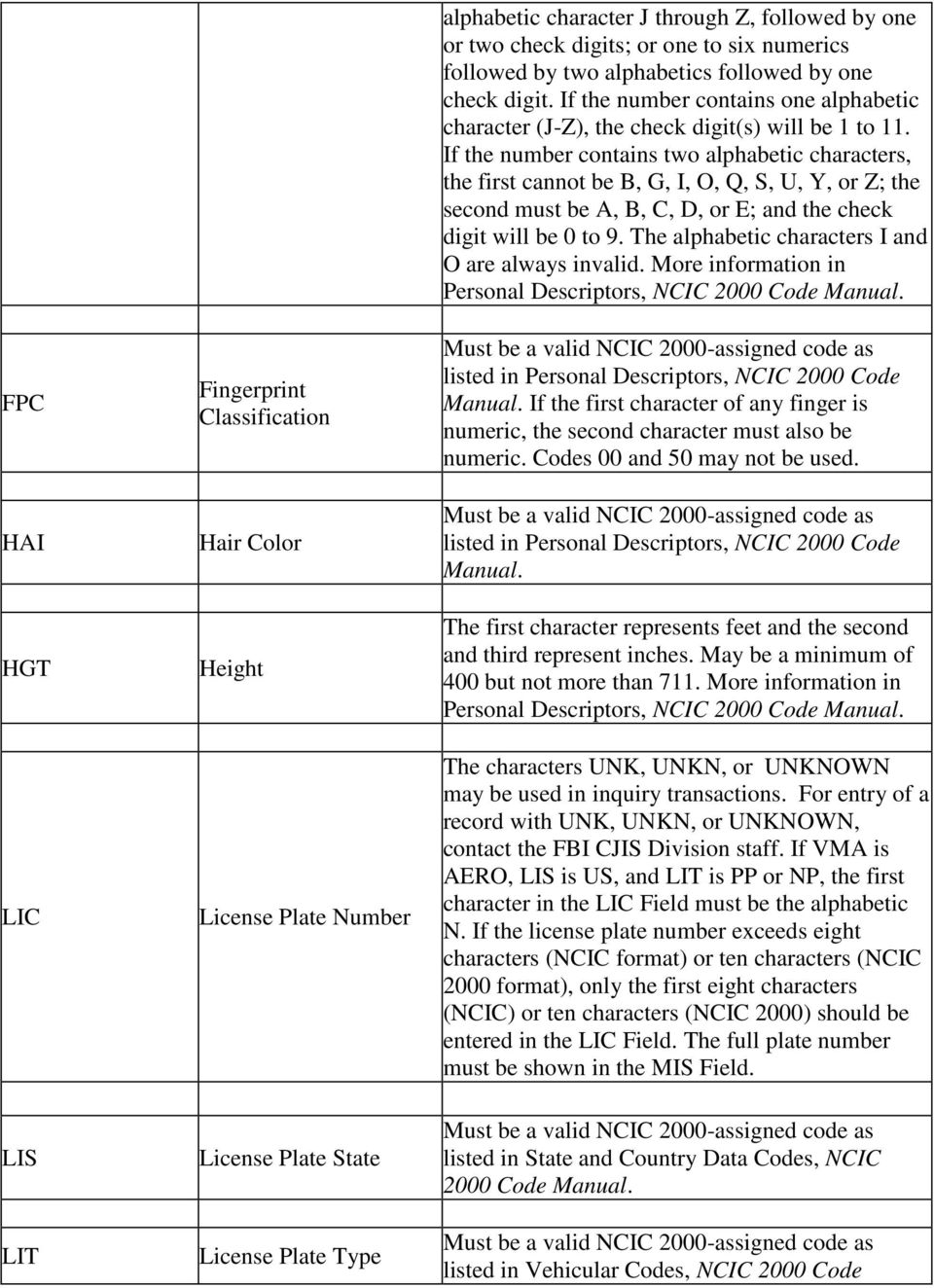
16 LIY MIS License Plate Year of Expiration Miscellaneous Manual. Must be a valid four-character year (YYYY) or the alphabetics NX to represent a nonexpiring registration.. If VMA is AERO, ATV, COEQ, CYL, FARM, SNOW, SPEC, TRLR, TRUK, and the message is in NCIC format, the MIS Field must include the name of the manufacturer. If OFF is 0199, 0299, 0399, 4901, 5005, 5011, 5012, 5015, 5099, 7099, 7199, 7299, or 7399, and the message is in NCIC format, the MIS Field must contain an explanation of the offense. If the MKE contains a caution indicator (C) and the message is in NCIC format, the MIS Field must identify the caution or medical condition. SVIN must be the first four characters in the MIS Field if the VIN is a state-assigned or nonconforming 17-character VIN. If the message is in NCIC format and the ORI wants to be notified each time there is a hit on the record, the MIS Field must contain NOAH. For NCIC 2000, if EXL code is 2 or B or is 5 or E, the MIS Field must contain additional information. For NCIC Legacy-formatted messages, NOEX must be entered in the MIS Field if the wanted person will not be extradited. It is entered as the first four characters of the MIS Field unless SVIN is used. MKE Message Key Must be a valid message key. MNU MPA Miscellaneous Number Dental Models and/or Photographs of Teeth Available The first two characters must be a valid NCIC 2000-assigned code as listed in Personal Descriptors, NCIC 2000 Code Manual. The third character must be a hyphen. Entry of one zero only or a run of zeros only is prohibited in positions 4 through 15. An originating agency police or identification number in MNU cannot be the only numeric identifier in the record. If the MNU exceeds 15 characters, the first 15 characters should be entered in the MNU Field. The full MNU should be entered in the MIS Field. Must be a valid NCIC 2000-assigned code as listed in Personal Descriptors, NCIC 2000 Code Manual.

17 NAM NIC Name NCIC Number The name may include alphabetics, numerics, a comma, hyphens, and spaces; the comma must follow the last name; there can be no more than one space after the comma. The hyphen cannot be in the first position or directly precede the comma. The NCIC 2000 Code Manual, Personal Descriptors, provides coding instructions. A self-checking number automatically assigned by NCIC 2000 to each accepted record and consists of an alphabetic character (W in the Wanted Person File) followed by nine numeric characters. Must have valid check digits when used to identify the record in a subsequent transaction. OCA Must not contain a single zero only, a run of zeros only, the word NONE, or a single alphabetic only. Originating Agency Case The first seven characters of the OCA cannot Number equal the first seven characters of the ORI. The only valid special character is the hyphen. OFF OLN OLS OLY ORI Offense Operator's License Number Operator's License State Operator's License Year Of Expiration Originating Agency Identifier Must be a valid code from the NCIC 2000 Code Manual, Uniform Offense Codes. If code 0201 or 0299 is used, ORI must be military or FBI. If codes 8100, 8101, or 8102 are used, MKE must be EWJ or EWJC. One zero only or a run of zeros only may not be used. More information in Personal Descriptors, NCIC 2000 Code Manual. Must be a valid NCIC 2000-assigned code as listed in State and Country Codes, NCIC 2000 Code Manual. More information also in Personal Descriptors, NCIC 2000 Code Manual. Must represent the year the license expires (XXXX), the alphabetics NX to represent nonexpiring, or the code UNKN for unknown. More information in Personal Descriptors, NCIC 2000 Code Manual. Must be a valid NCIC 2000-assigned ORI.
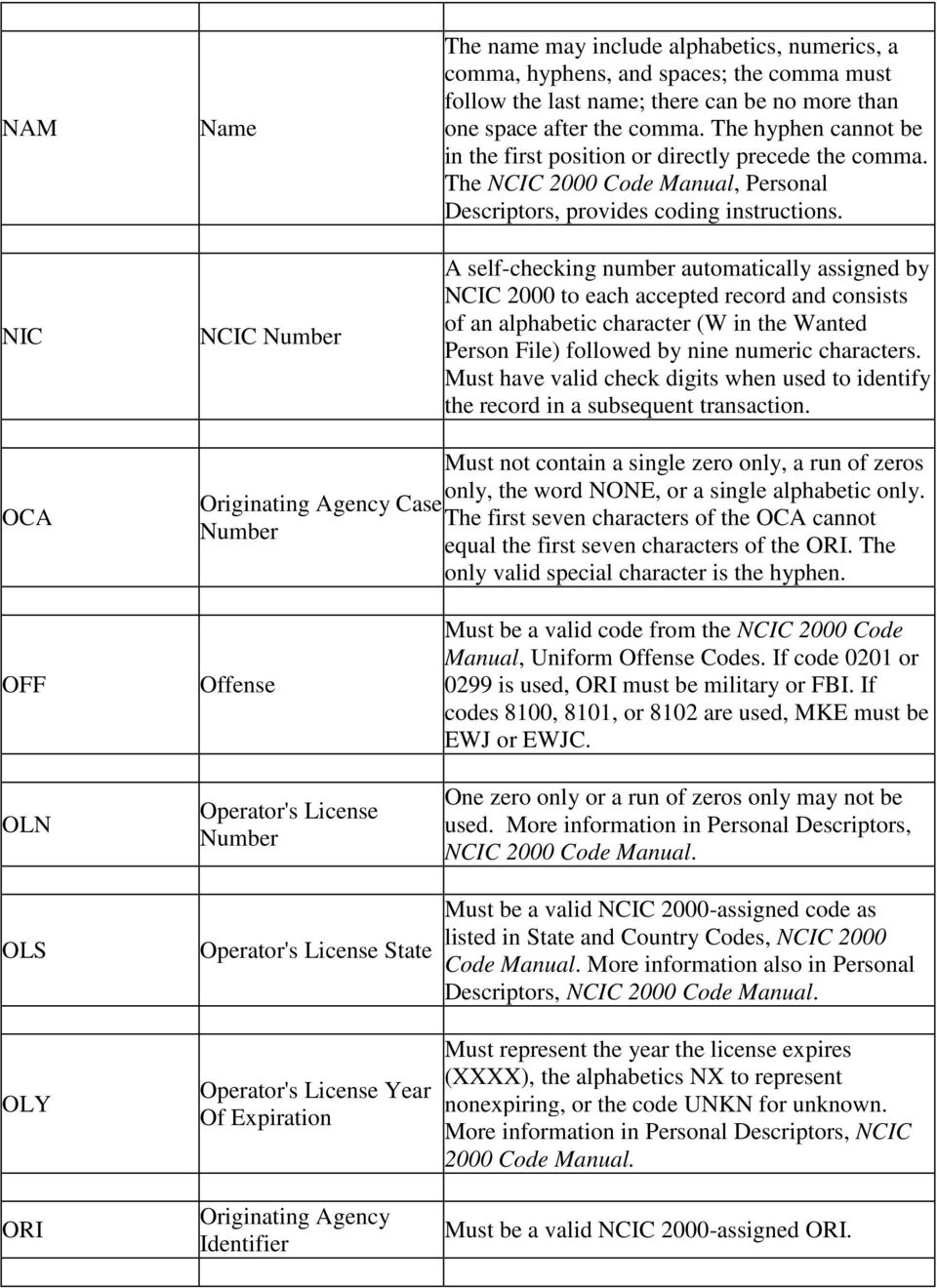
18 POB RAC Place of Birth Race Must be a valid NCIC 2000-assigned code as listed in State and Country Codes, NCIC 2000 Code Manual. More information also in Personal Descriptors, NCIC 2000 Code Manual. Must be a valid NCIC 2000-assigned code as listed in Personal Descriptors, NCIC 2000 Code Manual. RCA Must not contain a single zero only, a run of zeros only, the word NONE, or a single alphabetic only. Recovering Agency Case The first seven characters of the RCA cannot equal Number the first seven characters of the RRI. The only valid special character is the hyphen. RRI SEX SKN Recovering Agency Identifier Sex Skin Tone Must be a valid NCIC 2000-assigned ORI. Must be a valid NCIC 2000-assigned code as listed in Personal Descriptors, NCIC 2000 Code Manual. Must be a valid NCIC 2000-assigned code as listed in Personal Descriptors, NCIC 2000 Code Manual. SMT Must be a valid NCIC 2000-assigned code as Scars, Marks, Tattoos, listed in Personal Descriptors, NCIC 2000 Code and Other Characteristics Manual. SOC VCO VIN Social Security Number Vehicle Color Vehicle Identification Number Must not be less than The SOC cannot have a value of 8 or 9 in the first position or have a value of 00 in the fourth and fifth positions. Invalid and/or unissued numbers are accepted but cause a SOC attention message. More information in Personal Descriptors, NCIC 2000 Code Manual. Must be valid NCIC 2000-assigned code as listed in Vehicular Data Codes, NCIC 2000 Code Manual. If two color codes are used, they must be separated by a slash (/). Single zero only, run of zeros only, single alphabetic only, all alphabetics only, or spaces cannot be used. The Vehicle File chapter has additional edits on the VIN Field. If state-assigned

19 VMA Vehicle Make (Jeep) (aircraft) or nonconforming 17- character VIN, SVIN must be entered in the first four characters of the MIS Field. If the VIN exceeds 20 characters, only the last 20 characters should be entered in the VIN Field. The full VIN must then be shown in the MIS Field. For NCIC 2000 messages, the VMA Field can be up to 24 characters. The first four characters must be alphabetic and a valid code. If the VMA code is less than four characters and data are included in positions 5 through 24, positions 3 and/or 4 should be blanks. The remaining characters are free text and must contain the name of the manufacturer when the VMA code is AERO, ATV, COEQ, CYL, FARM, SNOW, SPEC, TRLR, or TRUK. If the VMO is other than TL, the VMA code must be a valid NCIC 2000-assigned code as listed in Vehicular Data Codes, NCIC 2000 Code Manual. If the VMO is TL, the VMA code must not be the characters ASM, ASMB, ASSE, ASSM, MB, MC MK, MP, MS, NA, TK, TL, UNK, UNKN, XX, XXX, XXXX, YY, YYY, YYYY, ZZ, ZZZ, or ZZZZ. For every assembled vehicle that does not have a manufacturer-assigned VIN, the VMA code must be ASVE. If the VMA code is JEP, the VYR must be 1969 or earlier. If the VMA code is AMER, the VYR must be 1988 or earlier. If the VMA code is JEEP, the VYR must be 1989 or later. If VST is 1J, 2J, 3J, MJ, 1P, 2P, 3P, MP, BP, HP, or SA, the VMA code must be AERO. (all-terrain vehicle, dune buggy, go-cart, golf carts, and snowmobile) If VST is EB, EN, or OP, the VMA code must be SPEC, ATV, SNOW, CYL, or one of the approved VMA codes for snowmobiles or motorcycles listed in the NCIC 2000 Code Manual, Vehicular Data Codes. If VST is MV, the VMA code must be SPEC, ATV, CYL, or one of the approved VMA codes for snowmobiles or motorcycles listed in the
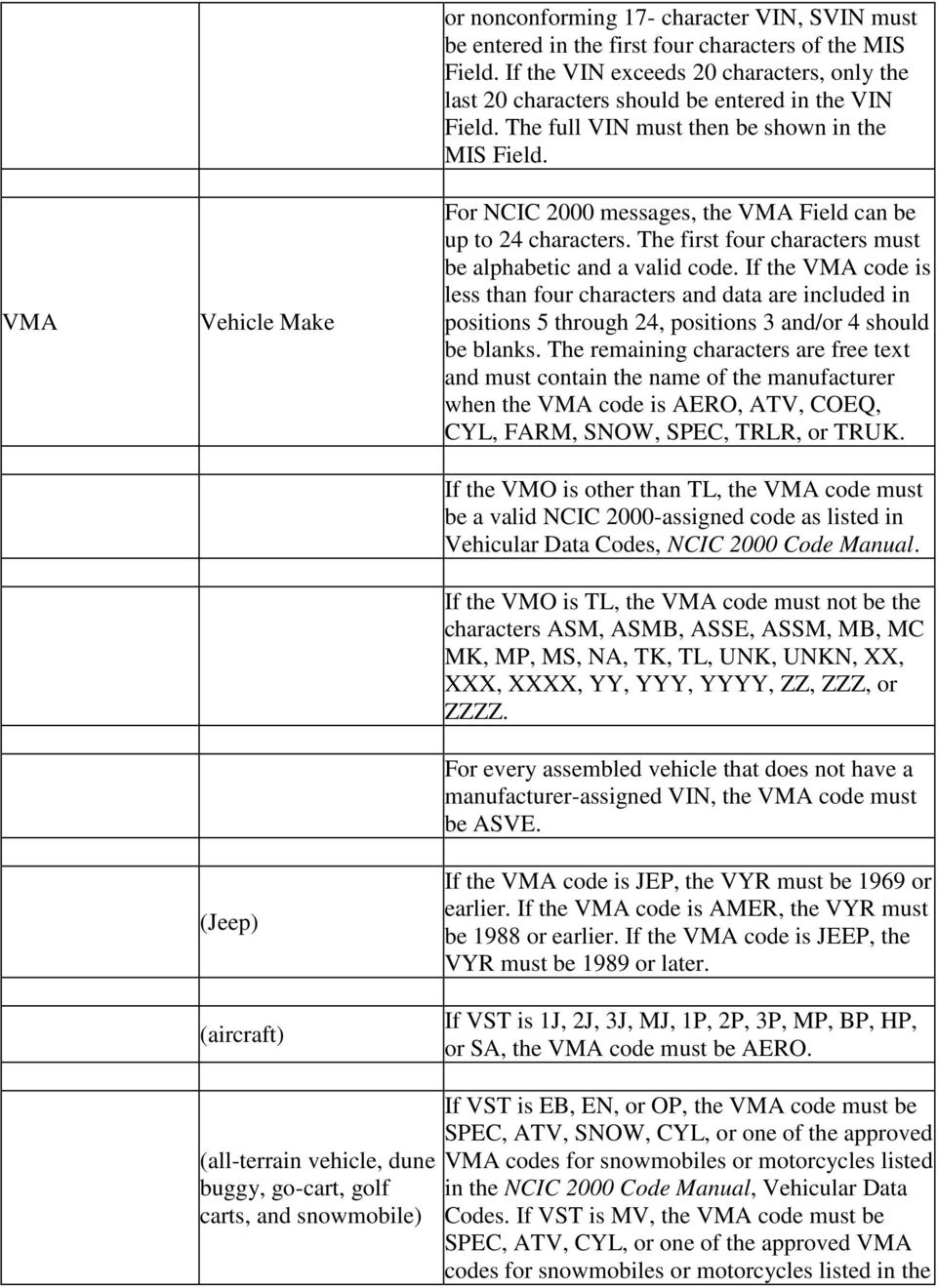
20 VMO Vehicle Model (assembled automobile) NCIC 2000 Code Manual, Vehicular Data Codes. If VMA code is ATV or SPEC, the VST must be EB, EN, MV, or OP, and the name of the manufacturer must be entered in the MIS Field (NCIC format). Spaces cannot be skipped. Hyphens or symbols should be used. More information in Vehicular Data Codes, NCIC 2000 Code Manual. The only valid VMO codes for vehicles with VST codes EB, EN, MV, or OP are (blank), ATV, CYL, DUN, GOF, GRT, SKT, SKW, TOY, TRA, TRW, or WHE. If the first four characters of the VMA are ASVE, the VMO must be AV or REP. If the first four characters of the VMA are COEQ, (construction equipment) the VMO must be CE. VST VYR (farm and garden equipment) (motorcycle) (snowmobile) (trailer) (truck) Vehicle Style Vehicle Year If the first four characters of the VMA are FARM, the VMO must be FE. If the VST is MB, MC, MD, MK, MS, or MY, the VMO required is CYL. If the first four characters of the VMA are SNOW or one of the valid snowmobile manufacturer's codes listed in Vehicular Data Codes, NCIC 2000 Code Manual, the VMO must be SKT, SKW, TRA, TRW, or WHE. If the first four characters of the VMA are TRLR, or HMDE, the VMO must be TL. If the first four characters of the VMA are TRUK, the VMO must be TK. Must be a valid code listed in Vehicular Data Codes, NCIC 2000 Code Manual. Must represent the production (model) year during which the vehicle was manufactured (YYYY). Year cannot be more than one year beyond the

21 WGT Weight current year. For entries of model year 1981 or later, when the VIN is 17 characters, the tenth position (vehicle year) of a VIN must represent the VYR. Minimum of 050 and maximum of 499. More information in Personal Descriptors, NCIC 2000 Code Manual. NCIC 2000-formatted Messages May Also Contain the Following Fields: ADD Address Type Must be a valid NCIC 2000-assigned code as listed in the Personal Descriptors Codes, NCIC 2000 Code Manual. ADO Additional Offense Must be Y, N, or blank. The default value is blank. ATN Attention Free text. CMC Caution and Medical Conditions Must be a valid NCIC 2000-assigned code as listed in Personal Descriptors, NCIC 2000 Code Manual. COU County Free text (alphabetical). CTI Court Identifier Must be a valid NCIC-2000 assigned ORI. CTY City Free text (alphabetical). DDA Date of Documented Address Must be a valid Gregorian date, (YYYYMMDD) and cannot be later than the current date. DIS Must be a valid Gregorian date (YYYYMMDD) Date Incarceration Starts equal to or less than current date. DOD Date of Detainer Must be a valid Gregorian date (YYYYMMDD) equal to or less than current date. DNO DSE DLO Detainer Case Number Date of Sentence Expiration DNA Location Must not contain a single zero only, a run of zeros only, the word NONE, or a single alphabetic only.the first seven characters of the DNO cannot equal the first seven characters of the ORI. The only valid special character is the hyphen. Must be a valid Gregorian date (YYYYMMDD)greater than current date plus 5 days. Free text. If the DNA field is N or defaulted to N, then the DLO must be blank.
22 DNA DNA Profile Indicator Must be either a Y or N. N is the default value. If Y is entered, then the DLO Field must contain data. ETN Ethnicity Must be a valid NCIC-assigned code as listed in Personal Descriptors, NCIC 2000 Code Manual. ENS Expanded Name Search Must be Y or N. HIT IMN Wanted/Missing Person Hit Results Image NCIC Number Must be a valid code as listed in the Introduction chapter of this manual. Can be entered only if RPS is entered. A self-checking number consisting of alphabetic character I followed by nine numeric characters automatically assigned by NCIC 2000 to each accepted image record. Must have valid check digit. INC Place of Incarceration Free text (alphanumeric and special characters). IMT Image Type Must be a valid NCIC 2000-assigned code as listed in the Image File chapter. IND Image Indicator Must be Y or N. IRI Incarcerating Agency Must be a valid NCIC-assigned ORI. LKA LKI NOA NPA Linkage Case Number Linkage Agency Identifier Notify Originating Agency Number of Persons Apprehended Must not contain a single zero only, a run of zeros only, a single alphabetic only, or the word NONE. The first seven characters of the LKA cannot equal the first seven characters of the LKI. The only valid special character is the hyphen. The LKA must be valid for the LKI. (There must be an ORI and matching OCA in the System.) Must be a valid ORI. Must be Y or N. NCIC 2000 will default to N if left blank. Count of persons arrested as a result of locating wanted person. Can be entered only if RPS is
23 NPF OOC PAR PUR RPS Number of Missing Persons Found Original Offense Code Person Armed Purpose-III Reason for Person Record Removal entered. Must be blank or 0 if RPS is OTHER MEANS or PREVIOUSLY LOCATED. First three characters must be numeric. The fourth character must be J for juvenile or O for other missing person. Fifth character must be I or N for indexed or not indexed in NCIC Can be entered only if RPS is entered. Must be blank or 0 if RPS is OTHER MEANS or PREVIOUSLY LOCATED. Must be a valid code from Uniform Offense Codes, NCIC 2000 Code Manual. Entry of OOC is required (and permitted only) when OFF is 4901, 4999, 5001, 5002, 5011, 5012, 5013, 5014, 5015, 8100, 8101, or The OOC Field cannot equal 4901, 4999, 5001, 5002, 5011, 5012, 5013, 5014, 5015, 8100, 8101, or If OOC is 8100, 8101, or 8102, MKE should be EWJ or EWJC. If OOC is 8002, then the FBI Field should contain data Must be a valid NCIC 2000-assigned code as listed in the Introduction chapter of this manual. Can be entered only if RPS is entered. Must be a valid NCIC 2000-assigned code as listed in the Interstate Identification Index chapter. Must be a valid NCIC 2000-assigned code as listed in the Introduction chapter of this manual. RSH Related Search Hit Must be Y or N. SID The first two characters must be a valid state code. State Identification-III Foreign country codes are not permitted. Number Embedded blanks are not permitted. SNA Street Name Free text (alphanumerical and special characters). SNU Street Number Free text (alphanumerical and special characters). STA State Must be a valid NCIC 2000-assigned code as listed in the State and Country Codes, NCIC 2000 Code Manual. VLN Name of Validator Any valid characters representing validator. VNP Value of Recovered Property Must be blank or 0.
24 VOR VRC WNO ZIP Value of Other Recovered Property Value of Recovered Contraband Warrant Number ZIP Code Fair market value (in whole dollars) of property recovered as a result of locating wanted person who is subject of the record. Can be entered only if RPS is entered. Must be blank or 0 if RPS is OTHER MEANS or PREVIOUSLY RECOVERED. Fair market value (in whole dollars) of any contraband recovered as a result of locating a wanted person who is subject of the record. Can be entered only if RPS is entered. Must be blank or 0 if RPS is OTHER MEANS or PREVIOUSLY RECOVERED. May be up to 15 alphabetic and/or numeric characters. Must be either five numerics or ten characters with five numerics followed by a hyphen and another four numerics. 1.9 CRITERIA FOR ENTERING NAMES AND DATES OF BIRTH FOR STOLEN/ FRAUDULENT IDENTIFIERS The general rule for the use of stolen/fraudulent (S/F) identifier fields is that they must be used whenever a wanted person is known to be using identification documents that are stolen/fraudulent. If the wanted person is using a made-up name or numerical identifier for which it is not known whether identification documents (Social Security card, operator's license, etc.) exist, these identifiers should be entered in the appropriate base record or supplemental identifier fields, such as the DOB Field. If the identity of the thief is known and there is an arrest warrant, the victim information should be entered in the S/F fields. The base record NAM must be entered for each record. This field should contain the wanted person's true name regardless of whether it is the name contained on the arrest warrant. Listed below are guidelines for coding the "true" and S/F NAM Fields and the "true" and S/F DOB Fields. 1. If the name on the arrest warrant is believed to be the wanted person's real name, the name should be entered in only the base record NAM. If the wanted person's date of birth is available, it should be entered in the base record DOB. Any known S/F identifiers should be entered in the S/F identifier fields. 2. If the name on the arrest warrant is known to be S/F and the wanted person's true name is known, the S/F name should be entered in the S/F NAM Field. The wanted person's real name must be entered in the base record NAM. The date of birth from the S/F identification, if known,
25 must be entered in the S/F DOB. If the wanted person's real date of birth is known, it should be entered in the base record DOB. 3. If an arrest warrant is issued in the name of "John Doe" or "Jane Doe" because the wanted person's true identity is unknown and the wanted person is known to be using stolen or fraudulent identification documents, entry of a Wanted Person File record is permitted provided the identifiers from the stolen or fraudulent documents are included in the wanted person record and identified as such. FBI numbers should not be entered in these types of records. Refer to SECTION 2.6 CRITERIA FOR ENTRY OF "JOHN DOE" OR "JANE DOE" WARRANTS for further information. 4. This enhancement only serves to highlight information when the record subject is known to use S/F identification documents. It does not alter current policy concerning entry of "John Doe" or "Jane Doe" records without a warrant which is currently allowed only when the record subject is using a homicide victim's identification. 5. When a record is entered into the Identity Theft File, if the identity of the thief is known and a warrant is obtained, the thief's personal information should be entered in the base Wanted Person File record. Additionally, the victim information should be entered in the supplemental stolen/fraudulent data fields CRITERIA FOR REJECTING DUPLICATE RECORDS If the following fields of an NCIC 2000 wanted person or temporary felony want message are the same as those field codes of a wanted person record already on file, the second entry will be rejected with the message REJECT ON FILE: FBI and ORI; NAM, MNU, and ORI; NAM, SOC, and ORI; OLN, OLS, and ORI; VIN, VMA, NAM, and ORI; LIC, LIS, LIY, LIT, NAM, and ORI; OCA, NAM, and ORI; and DOB, NAM, and ORI. Whenever the message REJECT ON FILE is sent by NCIC 2000, the record on file will also be transmitted. A duplicate record will be accepted if the ORI in the second message is different or the person type is other than wanted, for example, Protection Order File, Gang File, etc. A duplicate record will also be accepted if there are vehicle data in the wanted person message which match data in the Vehicle File. In those cases, the duplicate record(s) will be furnished with the acknowledgment IMAGE CAPABILITY The Image File chapter of this manual contains information regarding entry, modification, cancellation, and inquiry of images in NCIC SECTION INVESTIGATIVE INTEREST The Other Transactions chapter of this manual contains information regarding investigative interest supplemental records in NCIC 2000.
26 SECTION 2--ENTRY 2.1 EXAMPLE OF AN ENTRY 1N01HEADER.EW-C.MD101783J.SMITH, JOHN J.M.W.TX BRO. BRO..DRK.SC R HND CO141159TTCI13.AS MD MD101783J.KNOWN TO BE VERY AGGRESSIVE WITH LAW ENFORCEMENT OFFICERS.Y.ABC123.MD.2000.PC. 2Y27H5L PONT.SUN.2D.BLU Y.FBI LAB, QUANTICO, VA , VA , MTDNA, CODIS NUMBER - ABC-UHR US Acknowledgment: 1L01HEADER MD101783J NAM/SMITH, JOHN J NIC/W OCA/ Note: When vehicular data have been entered, all entries and modifications will cross-search all person files (except the NICS Denied Transaction and Unidentified Person Files), and Vehicle, Boat, Vehicle/Boat Part, and License Plate Files. 2.2 MESSAGE FIELD CODES FOR ENTRY FIELD NAME REQUIREMENTS MESSAGE FIELD CODE FIELD LENGTH HEADER MANDATORY HDR 9-19 MESSAGE KEY MANDATORY MKE 2-4 ORIGINATING AGENCY IDENTIFIER MANDATORY ORI 9-9 NAME MANDATORY NAM 3-30 SEX MANDATORY SEX 1-1 DATA TYPE NUMERIC, SPECIAL SPECIAL NUMERIC NUMERIC, SPECIAL CODE AS DEFINED IN NCIC 2000 CODE MANUAL RACE MANDATORY RAC 1-1 CODE AS
27 DEFINED IN NCIC 2000 CODE MANUAL PLACE OF BIRTH OPTIONAL POB 2-2 CODE AS DEFINED IN NCIC 2000 CODE MANUAL DATE OF BIRTH CONDITIONAL DOB 8-8 NUMERIC DATE OF EMANCIPATION MANDATORY** DOE 8-8 NUMERIC HEIGHT MANDATORY 1 HGT 3-3 NUMERIC WEIGHT MANDATORY 1 WGT 3-3 NUMERIC EYE COLOR OPTIONAL EYE 3-3 CODE AS DEFINED IN NCIC 2000 CODE MANUAL HAIR COLOR MANDATORY 1 HAI 3-3 CODE AS DEFINED IN NCIC 2000 CODE MANUAL FBI NUMBER CONDITIONAL FBI 1-9 NUMERIC SKIN TONE OPTIONAL SKN 3-3 CODE AS DEFINED IN NCIC 2000 CODE MANUAL SCARS, MARKS, TATTOOS, AND OTHER CHARACTERISTICS FINGERPRINT CLASSIFICATION MISCELLANEOUS NUMBER SOCIAL SECURITY NUMBER OPERATOR'S LICENSE NUMBER OPERATOR'S LICENSE STATE OPTIONAL SMT 3-10 OPTIONAL FPC CONDITIONAL MNU 4-15 CODE AS DEFINED IN NCIC 2000 CODE MANUAL NUMERIC NUMERIC, SPECIAL CONDITIONAL SOC 9-9 NUMERIC CONDITIONAL SET OLN 1-20 SET OLS 2-2 NUMERIC CODE AS DEFINED IN NCIC 2000 CODE
28 2-2 OPERATOR'S LICENSE YEAR OF EXPIRATION SET OLY OFFENSE CODE MANDATORY OFF ORIGINAL OFFENSE CODE DATE OF WARRANT OR DATE OF VIOLATION 2 ORIGINATING AGENCY CASE NUMBER LINKING AGENCY IDENTIFIER LINKING CASE NUMBER * CONDITIONAL OOC* 4-4 MANDATORY MANDATORY DOW DOV OCA MANUAL ALPHABETIC (2) OR NUMERIC (4) CODE AS DEFINED IN NCIC 2000 CODE MANUAL CODE AS DEFINED IN NCIC 2000 CODE MANUAL 8-8 NUMERIC * OPTIONAL SET LKI* 9-9 SET LKA* 1-20 WARRANT NUMBER OPTIONAL WNO* 1-15 COURT IDENTIFIER OPTIONAL CTI* 9-9 MISCELLANEOUS OPTIONAL MIS NOTIFY ORIGINATING AGENCY LICENSE PLATE NUMBER * NUMERIC, SPECIAL NUMERIC NUMERIC, SPECIAL NUMERIC NUMERIC NUMERIC, SPECIAL OPTIONAL NOA* 1-1 ALPHABETIC CONDITIONAL SET LIC * NUMERIC LICENSE PLATE STATE SET LIS 2-2 CODE AS DEFINED IN NCIC 2000 CODE MANUAL LICENSE PLATE YEAR SET LIY 2-2 ALPHABETIC (2),
29 OF EXPIRATION LICENSE PLATE TYPE SET LIT 2-2 VEHICLE IDENTIFICATION NUMBER CONDITIONAL SET 4-4 VIN 1-20 NUMERIC (4) CODE AS DEFINED IN NCIC 2000 CODE MANUAL NUMERIC VEHICLE YEAR SET VYR 4-4 NUMERIC VEHICLE MAKE SET VMA 2-4 CODE AS DEFINED IN NCIC 2-24* 2000 CODE MANUAL CODE AS VEHICLE MODEL OPTIONAL VMO 2-3 DEFINED IN NCIC 2000 CODE MANUAL VEHICLE STYLE SET VST 2-2 CODE AS DEFINED IN NCIC 2000 CODE MANUAL VEHICLE COLOR OPTIONAL VCO 3-3 CODE AS DEFINED IN NCIC CODE MANUAL CAUTION AND OPTIONAL CMC* 2-2* MEDICAL CONDITIONS NAME OPTIONAL NAM*** 3-30 CODE AS DEFINED IN NCIC 2000 CODE MANUAL NUMERIC, SPECIAL DATE OF BIRTH OPTIONAL DOB*** 8-8 NUMERIC SOCIAL SECURITY NUMBER OPTIONAL SOC*** 9-9 NUMERIC MISCELLANEOUS NUMBER OPERATOR'S LICENSE NUMBER OPTIONAL MNU*** 4-15 CONDITIONAL SET OLN*** 1-20 NUMERIC, SPECIAL NUMERIC
30 OPERATOR'S LICENSE STATE SET OLS*** 2-2 ALPHABETIC 2-2 OPERATOR'S LICENSE OF YEAR EXPIRATION SET OLY*** EXTRADITION LIMITATION DNA PROFILE INDICATOR 4-4 MANDATORY EXL* 1-2 ALPHABETIC (2) NUMERIC (4) NUMERIC OPTIONAL DNA 1-1 ALPHABETIC DNA LOCATION CONDITIONAL DLO CITIZENSHIP OPTIONAL CTZ* 2-2 STREET NUMBER STREET NAME CITY NAME COUNTY STATE ZIP CODE ADDRESS TYPE DATE OF DOCUMENTED ADDRESS OPTIONAL WITHIN SET OPTIONAL WITHIN SET OPTIONAL WITHIN SET OPTIONAL WITHIN SET OPTIONAL WITHIN SET OPTIONAL WITHIN SET OPTIONAL WITHIN SET OPTIONAL WITHIN SET SNU* 1-7 SNA* 1-25 NUMERIC, SPECIAL CODE AS DEFINED IN NCIC 2000 CODE MANUAL NUMERIC, SPECIAL NUMERIC, SPECIAL CTY* 1-20 ALPHABETIC COU* 1-20 ALPHABETIC STA* 2-2 ZIP* ADD* 2-2 CODE AS DEFINED IN NCIC 2000 CODE MANUAL NUMERIC, SPECIAL CODE AS DEFINED IN NCIC 2000 CODE MANUAL DDA* 8-8 NUMERIC
31 ETHNICITY OPTIONAL ETN* 1-1 ADDITIONAL OFFENSE OPTIONAL WITH DEFAULT CODE AS DEFINED IN NCIC 2000 CODE MANUAL ADO* 1-1 ALPHABETIC 1 Optional for foreign fugitive 2 Date of Violation (DOV) Field is used when the MKE is EWJ. *NCIC 2000 format only **Mandatory blank for MKE EW/EW-C/ET/ET-C ***Fraudulent data 2.3 MANDATORY FIELDS FOR ENTRY 1. The following fields are mandatory to cause acceptance of a wanted person entry into NCIC 2000: HDR, MKE, ORI, NAM (base record NAM must be included in all entry messages, and it must be the individual's true name if known), SEX, RAC, HGT, WGT, HAI, OFF, DOW, OCA, EXL and at least one of the following numeric identifiers: DOB (including year, month, and day); FBI; MNU (other than originating agency police or identification number); SOC; OLN with OLS and OLY; LIC with LIS, LIY, and LIT; VIN with VYR, VMA, and VST; or S/F NAM and S/F DOB, (a S/F NAM is required if a S/F DOB is entered as the only searchable numeric identifier); S/F MNU (other than originating agency police or identification number); S/F SOC; or S/F OLN with S/F OLS and S/F OLY. 2. STOLEN/FRAUDULENT (S/F) IDENTIFIERS 1. The mandatory fields for entry of a record permit entry when the only known numerical identifier for an individual is a S/F identifier. Since S/F identifiers are processed as a supplemental record, and since at least one unique numerical identifier is required to enter a base record, the Wanted Person File record entry format allows an entering agency to transmit both the base record and one of each type of S/F identifier (NAM, DOB, MNU, SOC, and OLN with OLS and OLY) in one transaction. This provides for the inclusion of a numerical identifier for record entry purposes. If the S/F DOB is the only numerical identifier, the S/F NAM must be included as well, or the record will be rejected. 2. Any agency transmitting a base record entry message for an individual who is known to be using an S/F identification and whose real identifiers are unknown must include a minimum of one S/F numerical identifier, SOC, MNU, OLN with OLS and OLY, or NAM and DOB with the base record entry message. For example: 1N01HEADER.EW-C.MD DOE,JOHN.M.W BRO.BRO.. FAR MD101783J.
32 BELIEVED TO BE USING HOMICIDE VICTIM PETER SMITH DRIVERS LICENSE AND SSN.Y...00.SMITH, PETER DC DC The base record entry format includes one of each of the S/F identifier fields. These fields immediately follow the VCO Field and are entered in the following order: S/F NAM; S/F DOB; S/F SOC; S/F MNU; and S/F OLN, OLS, and OLY. Any agency transmitting a base record entry message may optionally include one of each type of the S/F identifiers. The following is an example of a entry with base numerical identifiers as well as S/F data: 1N01HEADER.EW.MD JONES,RANDY.M.W.US BRO.BRO..FAR.SC UL ARM AF MD MD MD101783J.PETER SMITH DRIVERS LICENSE AND SSN TAKEN DURING BURGLARY MD.2003.PC CHEV.IMP.4T.BLU.05. SMITH,PETER A WV Although the S/F fields are appended to the base record entry message, NCIC 2000 will process the data therein as a supplemental S/F identifier record entry message. Thus, S/F identifiers included in a base record entry message cannot be changed or deleted with a modify message, i.e., MKEs MW and MT. Stolen/fraudulent identifiers can be changed or deleted only by using the supplemental S/F identifier record entry and cancel transactions, i.e., MKEs ENS and XNS, respectively. 5. To preclude the illogical association of a S/F name with a true date of birth, NCIC 2000 does not cross-index S/F names and dates of birth with base record names and dates of birth or supplemental aliases and dates of birth. 2.4 MANDATORY FIELDS FOR JUVENILE OFFENDER (MKE/EWJ) ENTRY The following fields are mandatory to cause acceptance of a juvenile offender record entry into NCIC 2000: MKE, ORI, NAM, SEX, RAC, DOB, DOE, HGT, WGT, HAI, OFF, DOV, OCA, and EXL. 2.5 ADDITIONAL GUIDELINES FOR ENTRY 1. The entering agency (ORI) must account for all fields in the Wanted Person File record format. In the original entry, all available data called for in the record must be entered. In addition, all available critical data should be entered. Missing data obtained at a later time should be promptly added through the use of a modify message (MKE/MW or MKE/MT). Guidelines for the entry of aliases and/or other additional identifiers as a supplemental record to a wanted person record are located in Section 8 of this chapter. 2. For training and administrative purposes, agencies may enter test records into NCIC 2000 by using the header TL01 (NCIC) or TN01 (NCIC 2000). The test records will not generate any notifications, nor will batch processing be performed in the test system. 3. If a DOB is the only known numerical identifier, it must be a valid Gregorian date (YYYYMMDD) or the entry will be rejected.
33 4. All numerical identifiers except the OCA and the MNU are to be entered omitting spaces, hyphens, and symbols. A hyphen may be used in the OCA Field, and a hyphen is used to separate the first two alphabetics from the number itself in the MNU Field. If the MNU exceeds 15 characters, the first 15 characters should be entered in the MNU Field. The full MNU should be entered in the MIS Field. 5. When a warrant issued for a subject contains multiple charges, the entering agency should enter the code for the more serious charge in the Offense Code (OFF) Field with the additional charge(s) shown in the MIS Field. Two separate entries by an ORI for the same person should not be made. It is only necessary for an ORI to enter one record on a person, no matter how many separate charges are lodged against him/her. 6. The ADO Field should be used to indicate that multiple warrants exist for the same individual by the same ORI. Additional offenses should be listed in the MIS Field. 7. A record in the Wanted Person File may contain a minimum number of personal descriptors, license, and vehicle data because little was known of the individual at the time of entry. This lack of information limits the chance of a hit on the record. One possible source of additional identification data may be the Interstate Identification Index (III). Thus, an inquiry (MKE/QH) should be made prior to or soon after making the wanted person entry to determine if the criminal history record of the subject is in III. A positive response to this inquiry may reveal not only physical descriptors, identifying numbers, and aliases not known to the inquirer, but also arrest, court, and/or custody-supervision data which might provide investigative leads. 8. An ORI attempting to enter a record on a person it already has entered will receive a reject message. An entry on the same individual will be accepted providing the originating agencies are different. The agency making the second entry will receive the record already on file at the time the second entry is acknowledged. This notification should lead to some form of communication between the two agencies, as valuable lead information might be available. 9. The entry of invalid and/or unissued numbers in the SOC Field is allowed. A caveat will be generated stating that the SOC has not been assigned and that the agency should check for a possible data entry error. For example: ATTENTION -- THE SOC USED IN YOUR TRANSACTION HAS NOT BEEN ASSIGNED BY THE SOCIAL SECURITY ADMINISTRATION. PLEASE CHECK FOR A DATA ENTRY ERROR. 10. If the NCIC 2000-formatted entry does not contain data in the EXL Field, the entry will be rejected. 11. The following caveat will be generated with the entry acknowledgment when a Wanted Person File record entry contains EXL 5, 6, E, or F.
34 RECORD INCLUDES EXTRADITION ARRANGEMENTS PENDING OR PENDING EXTRADITION DETERMINATION. WHEN EXTRADITION HAS BEEN DETERMINED, THE EXTRADITION LIMITATION FIELD SHOULD BE MODIFIED IMMEDIATELY. YOU WILL RECEIVE A REMINDER NOTIFICATION EVERY 15 DAYS UNTIL THE EXTRADITION LIMITATION FIELD HAS BEEN MODIFIED TO INCLUDE SPECIFIC EXTRADITION INFORMATION OR THE RECORD IS CLEARED. 12. When additional numeric identifiers and personal descriptors regarding the subject of the record are found in other databases or documentation, the entering agency must make an informed decision as to whether or not the subject is the same as the one in the NCIC record. In the absence of biometric identifiers, the determination should be based on multiple factors such as known criminal activity, date of birth, scars, marks, tattoos, photographs, Social Security number, operators license number, passport, military identification, last known address, and aliases. Particular attention should be paid to discrepancies in height, age, etc. When uncertain, do not include the additional information in the NCIC record and maintain documentation in the case file. 2.6 CRITERIA FOR ENTRY OF "JOHN DOE" OR "JANE DOE" WARRANTS 1. In jurisdictions authorized to use "John Doe" or "Jane Doe" warrants, an agency may enter a Wanted Person File record in the name of "John Doe" or "Jane Doe" using the identifiers from the stolen or fraudulent documents, provided this type of warrant has been obtained. 2. If an arrest warrant is issued in the name of "John Doe" or "Jane Doe," the name from the S/F documents should be listed as S/F. Any identifiers should be placed in the appropriate S/F identifier field(s), and a statement should be placed in the MIS Field indicating that the documents may be in the possession of "John Doe" or "Jane Doe." FBI numbers should not be included in these types of entries. 3. If an agency is located in a jurisdiction that does not issue this type of warrant, only those cases involving a homicide where the wanted person is believed to be using the victim's identification can be entered as "John Doe" or "Jane Doe." The criteria below list the instructions to enter "John Doe" or "Jane Doe" records without a warrant: 1. To allow specific identification of "John Doe" or "Jane Doe" entries in cases involving a homicide where a warrant could not be secured, OFF 0913 has been added for use in the OFF Field. 2. A variation in the DOW Field will be required when the OFF/0913 is used. Because a warrant could not be issued, the date the investigation was opened should be entered in the DOW. Use of OFF/0913 will generate the following caveat at the end of the records: NO WARRANT. SUBJECT POSSIBLY IN POSSESSION OF HOMICIDE VICTIM'S PERSONAL IDENTIFICATION. CONTACT ORI IMMEDIATELY.
35 3. OFF 0913 is restricted to open homicide investigations where the victim's identification was missing at the time the body was located and to agencies unable to obtain a "John Doe" or "Jane Doe" warrant. The report must indicate that the victim's identification was missing and must be available for audit purposes by FBI CJIS staff. 2.7 MESSAGE FIELD CODE EDITS FOR ENTRY 1. PERSONAL DESCRIPTORS Entry instructions and valid codes for name; sex; race; ethnicity; date of birth; height; weight; eye color; hair color; FBI number; skin tone; scars, marks, and tattoos; fingerprint classification; miscellaneous number; Social Security number; operator's license number; and extradition limitation can be found in Personal Descriptors, NCIC 2000 Code Manual. Codes for entering the place of birth and citizenship can be found in State and Country Codes, NCIC 2000 Code Manual. Codes for entering license and vehicle data can be found in the Vehicular Data Codes, NCIC 2000 Code Manual. 2. DATE OF EMANCIPATION (DOE) 1. The DOE Field is mandatory when the message key is EWJ or EWJC. It is mandatory blank for all other wanted person MKEs. The DOE indicates the exact day that an unemancipated juvenile will reach the age of emancipation (majority) as defined by the laws of his/her state of residence. The DOE must be later than the DOV. The DOE is entered in the same manner as a DOB (year, month, and day). For example, a wanted person who was born on July 5, 1988, and is emancipated at the age of 18 years would be entered in file with DOB/ and DOE/ The entry of February 29 ( ) in the DOE Field for a year that is not a leap year is prohibited. If the DOB is February 29 and the year of emancipation is not a leap year, the DOE should be entered as March 1. The DOE must be complete (year, month, and day) or the entry will be rejected. 2. Most states have a fixed age of emancipation which is commonly referred to as the age of majority. However, many states have exceptions which cause a person to become emancipated at an earlier age. For example, a person who is not married and is unemancipated until he/she reaches the age of 18 may be emancipated at an earlier age if his/her marital status changes or if he/she enters the military. 3. The exceptions concerning age of emancipation may be changed at any time by the passage of state law. Before entering a record for a missing person who is a resident of another state, an agency should contact the CTO of that state to obtain information concerning the age of emancipation. 3. UNIFORM OFFENSE CLASSIFICATIONS The appropriate code for the particular offense should be entered in the OFF. The codes listed in the NCIC 2000 Code Manual, Uniform Offense Codes, are the only codes approved for use in the OFF. If the OFF Field contains 0199, 0299, 0399, 5099, 7099, 7199, 7299, 7399, 5005, or
36 5015, and the message is in NCIC 2000 format, positions 5 through 24 must contain an explanation of the offense code. 4. MISCELLANEOUS (MIS) DATA 1. If a caution indicator is used in the MKE, the reason for the caution must be entered as the first item in the MIS Field (NCIC format only). 2. Aliases, nicknames (monikers), vehicular data, dates of birth, Social Security numbers, and operator's license numbers should not be entered in the MIS Field. All additional searchable data should be entered as a supplemental record (MKE/ EN), illustrated and explained in Section 8 of this chapter, to increase the chances of a hit on the record. 3. If the entry contains an FBI number, the entering agency may obtain a copy of the subject's manual identification record by entering the alphabetic code for Send Identification Record (SIR) as the last item in the MIS Field. A blank character must precede SIR if other information is included in the MIS Field. 4. When an agency makes wanted person entries on two or more fugitives who are known to be associating with each other, each existing fugitive record entry should be crossreferenced to the other. This cross-referencing can be done by placing the name and NIC of each fugitive's record in the MIS Field of the other fugitive's record with an appropriate explanatory notation. An agency receiving the record of one of the fugitives then will have the information needed to obtain other records. In NCIC 2000 format, the LKA and the LKI Fields should be used. 5. In a case in which the ORI believes that notification each time its record is hit will provide investigative leads, regardless of whether the person is being detained, the entering agency should place the code NOAH (Notify ORI of All Hits) in the MIS Field (NCIC format only). When using an NCIC 2000 format, this is done by setting the NOA Field to Y. 6. For NCIC 2000-formatted records with a code of 2 or B (LIMITED EXTRADITION SEE MIS FIELD) in the EXL Field, the MIS Field must contain details regarding the extradition authorized; with the code of 5 or E (EXTRADITION ARRANGEMENTS PENDING SEE MIS FIELD) in the EXL Field, the MIS Field must contain the location from where the extradition is pending. 7. When an agency enters a record for a wanted person who will not be extradited, NOEX must be entered as the first four characters of the MIS Field. An exception to this policy occurs when the letters SVIN are entered first in the MIS Field to disable VIN edits in the case of an OAN entered in vehicle data of the record. Additional information on vehicle data follows. 5. VEHICLE OR LICENSE PLATE DATA 1. A vehicle and/or license plate may be entered as part of a wanted person record (EW, EWJ, or ET) provided the location of the vehicle and/or license plate is unknown, and the entering agency has reasonable grounds to believe that the wanted person may be operating the vehicle or a vehicle bearing the license plate.
37 2. Mere knowledge or verification with the appropriate Department of Motor Vehicles that a vehicle and/or license plate is registered to the wanted person does not meet the criteria for entry of either or both as part of his/her wanted record. 3. In instances where the vehicle or license plate in a wanted person entry has been stolen, a notation that the vehicle or license plate is stolen should be placed in the MIS Field. Also, a separate entry of the stolen vehicle, felony vehicle, or license plate should be made in the Vehicle or License Plate Files by the agency possessing the theft report or handling the felony investigation. In NCIC 2000 format, the LKI and the LKA Fields should be used. 4. The wanted person and stolen vehicle or license plate records should be cross-referenced in the MIS Field. For example, the MIS Field of the wanted person record might read SUBJ STOLE VEH BELOW-SEE NIC/V , and the MIS Field of the vehicle record might contain SEE NIC/W Additionally, records entered with the same OCA and ORI are automatically linked in NCIC 2000, and both will be returned with an inquiry on either record if the RSH Field contains Y. Otherwise, a record cross-referencing another record via the LKI and LKA Fields will also receive both records if the RSH Field contains Y. 5. Should the wanted person entry contain data about a vehicle or license plate which has already been entered in the Vehicle or License Plate Files, the agency making the entry will be furnished the vehicle or license plate record already on file at the time the wanted person entry is acknowledged. 6. When the vehicle in the record has been recovered, the vehicle data must be removed from the wanted person record. 6. ORIGINATING AGENCY CASE NUMBER (OCA) The entering agency should ensure the OCA is a unique number assigned to the case within the agency. For NCIC records not related to an investigative case, the OCA Field must still be unique (e.g., state system-assigned number, filing system number, state identification number). 7. DNA PROFILE INDICATOR (DNA) and DNA LOCATION (DLO) The DNA Field has a default value of N, meaning no DNA data is available. When the user sets the DNA Field to Y, indicating DNA data are available, then specific information regarding location of the DNA sample must be entered in the DLO Field. The DLO Field can include contact information, type of DNA sample, and other information deemed appropriate by the agency. If the DNA Field is set to Y and the DLO is blank, then the record will be rejected. 8. ADDRESS DATA 1. All fields will be optional within the set. 2. The DDA Field should include the date on which the subject, his/her employer, relative, or associate was last known to be at that address.
38 3. If foreign address information is available, only the NCIC assigned country code, as listed in the NCIC 2000 Code Manual, should be entered into the STA Field. 4. Punctuation should be omitted from the CTY and COU Fields. For example: St. Louis would be entered as ST LOUIS or SAINT LOUIS. 5. The use of standard address abbreviations are recommended (e.g., Street: ST). 6. Additional address components such as Apartment Number should be included in the SNA Field. 7. Post Office box address information should be included in the SNA Field as PO BOX and the number. 8. The type of address is entered into the ADD Field. The ADD Field is a valid NCIC assigned code as listed in the NCIC 2000 Code Manual. If code 05 Other is chosen, agencies should enter additional information in the MIS Field. 2.8 VEHICLE OR LICENSE PLATE DATA AND THE $.8. PROGRAM An agency making a wanted person entry containing data on a vehicle or license plate registered in another state must advise the NCIC 2000 CTA in the state of registry about such an entry if the state of registry is not a $.8. Program participant. Additional information concerning the $.8. administrative message can be found in the Introduction chapter of this manual. Only those states listed as Rendition States (Section 1 of this chapter) will receive notification if license data from their state are included in a Juvenile Offender (Category 2) record transaction. 2.9 NCIC 2000 MESSAGE FIELD CODE EDITS FOR ENTRY 1. CAUTION AND MEDICAL CONDITIONS (CMC) When a wanted person record is entered with a caution indicator (the MKE ends with -C), the CMC Field must contain a valid caution and medical code. Section 8 of this chapter describes procedures for entry of additional CMC codes as a supplemental record to a wanted person record. The allowable CMC codes and their translations are the following: 00 = Armed and Dangerous 60 = Allergies 05 = Violent Tendencies 65 = Epilepsy 10 = Martial Arts Expert 70 = Suicidal 15 = Explosive Expertise 80 = Medication Required
39 20 = Known to abuse drugs 85 = Hemophiliac 25 = Escape Risk 90 = Diabetic 30 = Sexually Violent Predator - Contact ORI for Detailed Information 40 = International Flight Risk 50 = Heart Condition 01 = Other (Explain in MIS Field) 55 = Alcoholic 2. COURT IDENTIFIER (CTI) The CTI Field must be a valid criminal justice ORI for a court. Court ORIs are designated by the character J in position nine of the ORI Field. 3. LINKAGE DATA (LKI and LKA) The Linkage ORI and OCA Fields are provided as separate fields to associate incidents that are handled by multiple departments. An agency entering a record which shares the same incident of a record entered by a different ORI and/or OCA can link the records by entering the associated ORI and OCA in the linkage fields (LKI and LKA). The NCIC System will automatically link records entered within 30 days of the original entry that contain the same ORI and OCA. An ORI may use the LKI and LKA Fields to link related records that contain the same ORI and OCA entered more than 30 days after the original record entry. In the entry message the LKI and LKA Fields immediately follow the OCA Field entry. The message will be rejected if the first seven characters of the LKA are the same as the first seven characters of the LKI. 4. NOTIFY ORIGINATING AGENCY (NOA) When the ORI believes that notification each time its record is hit will provide investigative leads, regardless of whether the location of the wanted person is known, Y should be entered into the NOA Field. Previously, this was indicated by placing NOAH in the MIS Field. If NOA is left blank, the field will default to N. The NOA Field will be returned in record responses when the inquiring agency ORI matches the entering agency ORI and in unsolicited notifications ($. messages) to the ORI of record. 5. ORIGINAL OFFENSE CODE (OOC) This field is entered immediately after the offense code. It has to be a valid code from the Uniform Offense Classifications, NCIC 2000 Code Manual. Entry of the OOC is mandatory (and permitted only) when the OFF is one of the following: 4901, 4999, 5001, 5002, 5011, 5012, 5013, 5014, 5015, 8100, 8101, or 8102.
40 In a wanted person hit response, the OOC Field will be translated just as the OFF Field is translated currently. 6. WARRANT NUMBER (WNO) The WNO is entered immediately after the LKA Field. This optional field may contain up to 15 alphabetic/numeric characters. Along with the CTI Field, the WNO is intended to improve the hit confirmation and validation process. SECTION 3--MODIFICATION 3.1 WHEN TO USE A MODIFICATION MESSAGE Modification of a record is restricted to the agency that entered the record. A modification message is used to add, delete, or change data in an active wanted person base record. If a wanted person record has been retired, it cannot be modified and, therefore, must be reentered. A wanted person record cannot be modified if the record is in a located status (MKE/LOCATED WANTED PERSON). An MW message to delete information in a field of the base record will cause the same data, except for vehicle and license data, in the supplemental record to move up to the base record. 3.2 EXAMPLE OF A MODIFICATION MESSAGE 1N01HEADER.MW.MD NAM/SMITH, JOHN J.NIC/W SOC/ OLY/1999 Acknowledgment: 1L01HEADER MD MODIFY NAM/SMITH, JOHN J NIC/W The above modification example contains: header (1N01HEADER), message key (MW), Originating Agency Identifier (MD ), two record identifiers (NAM/SMITH, JOHN J and NIC/W ), the fields being modified, and the data being changed (SOC/ and OLY/1999). 3.3 MESSAGE FIELD CODES FOR MODIFICATION FIELD NAME REQUIREMENTS MESSAGE FIELD CODE FIELD LENGTH HEADER MANDATORY HDR 9-19 DATA TYPE NUMERIC, SPECIAL
41 MESSAGE KEY MANDATORY MKE 2-2 ALPHABETIC ORIGINATING AGENCY IDENTIFIER MANDATORY ORI 9-9 NUMERIC NAME CONDITIONAL NAM 3-30 NUMERIC, SPECIAL NCIC NUMBER CONDITIONAL NIC NUMERIC ORIGINATING AGENCY CASE NUMBER NAME OF VALIDATOR ANY FIELD(S) FROM ENTRY TRANSACTION (except fraudulent data) * NCIC 2000 format only CONDITIONAL OCA * OPTIONAL VLN* IDENTIFICATION OF A RECORD TO BE MODIFIED NUMERIC, SPECIAL NUMERIC, SPECIAL The record to be modified must be identified by either NAM and NIC, in that order; or NAM and OCA, in that order; or NIC and OCA, in that order, preceded by the proper MFC. The name used in identifying the record to be modified must be set forth with the exact spelling and spacing as shown in the record on file. 3.5 ADDITIONAL GUIDELINES FOR MODIFICATION 1. Section 8 of this chapter provides further instructions for modifying an alias and/or an additional identifier previously appended to a wanted person record by means of a supplemental record. 2. If an agency has entered a temporary felony want record, it can be modified to an EW by modifying the MKE using MT. 3. An agency modifying a wanted person record to insert the FBI number may also request a copy of the subject's identification record by modifying the MIS Field to place SIR as the last item in the field. If any other information is already entered in the MIS Field, it must all be reentered in the modify transaction and a blank character must precede SIR. Only the agency that entered the record may request a copy of the identification record through this means.
42 4. For NCIC 2000-formatted records, in instances where an ORI will not honor the extradition of an individual, the ORI must initiate a modify message to include the extradition limitations by using the appropriate code in the EXL Field and any additional information in the MIS Field of the record, such as, WILL NOT EXTR FROM OHIO. 5. If an entering agency subsequently learns that the person is using one of the S/F identifiers with one of his "true" identifiers, the record must be modified to add the S/F identifier to the appropriate "true" identifier field. 6. For NCIC 2000-formatted records, when the subject of the record has been located and extradition is pending, the entering agency may modify the record to include code 5 or E (EXTRADITION ARRANGEMENTS PENDING SEE MIS FIELD) in the EXL Field and indicate the location from which extradition is pending in the MIS Field. 7. The following caveat will be generated with the modify acknowledgment when a Wanted Person File record is modified to contain EXL 5, 6, E, or F. RECORD INDICATES EXTRADITION ARRANGEMENTS PENDING OR PENDING EXTRADITION DETERMINATION. WHEN AN EXTRADITION DECISION OR ARRANGEMENTS ARE COMPLETE, THE EXTRADITION LIMITATION FIELD SHOULD BE MODIFIED IMMEDIATELY. YOU WILL RECEIVE A REMINDER NOTIFICATION EVERY 15 DAYS UNTIL THE EXTRADITION LIMITATION FIELD HAS BEEN MODIFIED TO INCLUDE SPECIFIC EXTRADITION INFORMATION OR THE RECORD IS CLEARED. 3.6 MODIFICATION TO REMOVE VEHICULAR DATA 1. TO REMOVE ALL VEHICULAR DATA When a vehicle which was included in a wanted person record is recovered prior to apprehension/location of the wanted person, a special modification message may be used to remove all vehicular data without identifying each individual field. The record to be modified must be identified by either NAM and NIC, in that order; NAM and OCA, in that order; or NIC and OCA, in that order, preceded by the proper MFC. The characters LIC-VCO/. follow the two record identifiers. Entry of LIC-VCO/. causes NCIC 2000 to delete the following fields: LIC, LIS, LIY, LIT, VIN, VYR, VMA, VMO, VST, and VCO. For example: 1N01HEADER.MW.MD NAM/SMITH, JOHN J.NIC/W LIC-VCO/. Acknowledgment: 1L01HEADER MD MODIFY NAM/SMITH, JOHN J NIC/W
43 The above modification example to remove all vehicular data contains: header (1N01HEADER), message key (MW), Originating Agency Identifier (MD ), two record identifiers (NAM/SMITH, JOHN J and NIC/W ), and the fields being removed (LIC-VCO) immediately followed by slash period (/.). 2. TO REMOVE PART OF VEHICULAR DATA The special modification message explained above cannot be used to remove less than all of the vehicular data from a wanted person record. If only the four fields of license plate data (LIC, LIS, LIY, LIT) are to be deleted from the record, the usual modification procedure must be followed, with each field to be deleted explicitly set forth as shown in the following modify message: 1N01HEADER.M W.MD NAM/DOE, JOHN J.NIC/W LIC/.LIS/.LIY/.LIT/. 3.7 ADDITIONAL GUIDELINES FOR NCIC MODIFICATION 1. LINKAGE DATA (LKI and LKA) 1. The Linkage ORI and OCA Fields are provided as separate fields to associate incidents that are handled by multiple departments. A record which shares the same incident of a record entered with a different ORI and/or OCA can be modified to link the records by entering the associated ORI and OCA into the linkage fields (LKI and LKA) of both records. If a modify transaction is used to add a linkage to another record, then both LKI and LKA must be entered. 2. LKI and LKA Fields already existing in the wanted person record can be modified individually. 3. The LKI and LKA Fields must be deleted as a pair; otherwise, the message will be rejected. 2. NAME OF VALIDATOR (VLN) FIELD DATA For NCIC validation, a name of validator may be added to the Name of Validator (VLN) Field of a wanted person record to indicate that the record has been validated. When data are entered into the VLN Field, NCIC enters the current date in the Date of Last Validation (VLD) Field of the record. If the user attempts to delete or modify the VLN Field to all blanks, the message will be rejected. The acknowledgment for the modify message containing VLN data will indicate the record has been validated. Each CSA can determine the specific data to be included in the VLN Field for the validation of the record. For example: 1N01HEADER.MW.MD NAM/SMITH, JOHN J.NIC/W VLN/JONES, DAVID E
44 Acknowledgment: 1L01HEADER MD VALIDATE NAM/SMITH, JOHN J NIC/W SECTION 4--CANCELLATION 4.1 WHEN TO USE A CANCELLATION MESSAGE Cancellation of a record is restricted to the agency that entered the record. A cancellation message is used when the entering agency determines that the record is invalid; for example, the warrant which was the basis for the record has been dismissed. 4.2 EXAMPLE OF A CANCELLATION MESSAGE 1N01HEADER.XW.MD NAM/SMITH, JOHN J.NIC/W Acknowledgment: 1L01HEADER MD CANCEL NAM/SMITH, JOHN J NIC/W The above cancellation example contains: header (1N01HEADER), message key (XW), Originating Agency Identifier (MD ), two record identifiers (NAM/SMITH, JOHN J and NIC/W ), and date of cancellation ( ). When a wanted person record is canceled, the entire record, including all data appended to the record by means of a S/F record entry, are automatically canceled. 4.3 MESSAGE FIELD CODES FOR CANCELLATION FIELD NAME REQUIREMENTS MESSAGE FIELD CODE FIELD LENGTH DATA TYPE HEADER MANDATORY HDR 9-19 NUMERIC, SPECIAL MESSAGE KEY MANDATORY MKE 2-2 ALPHABETIC ORIGINATING AGENCY IDENTIFIER MANDATORY ORI 9-9 NUMERIC NCIC NUMBER CONDITIONAL NIC 10-10
45 NAME CONDITIONAL NAM 3-30 ORIGINATING AGENCY CASE NUMBER DATE OF CANCELLATION REASON FOR PERSON RECORD REMOVAL *NCIC 2000 format only CONDITIONAL OCA * NUMERIC NUMERIC, SPECIAL NUMERIC, SPECIAL MANDATORY DOC 8-8 NUMERIC OPTIONAL RPS* IDENTIFICATION OF A RECORD TO BE CANCELED NUMERIC The record to be canceled must be identified by either NAM and NIC, in that order; NAM and OCA, in that order; or NIC and OCA, in that order, preceded by the proper MFC. The name used in identifying the record to be canceled must be set forth with the exact spelling and spacing as shown in the record on file. The Date of Cancellation (DOC) must follow the two record identifiers and must be the current date or the current date minus one. 4.5 ADDITIONAL GUIDELINE FOR CANCELLATION Information regarding the cancellation of an alias and/or additional identifiers appended to a wanted person record by means of a supplemental record can be found in Section 8 of this chapter. 4.6 ADDITIONAL GUIDELINE FOR NCIC 2000 CANCELLATION When canceling a record in an NCIC 2000 format, the user is expected to enter benefits and effectiveness data. The RPS Field is entered directly after the DOC Field. For a cancellation message, the RPS value will be either CASE DROPPED, NOT WANTED, or WARRANT DISMISSED. The following is an example of a cancellation transaction containing benefits and effectiveness data: 1N01HEADER.XW.MD NAM/SMITH, JOHN J.NIC/W CASE DROPPED SECTION 5--INQUIRY
46 5.1 EXAMPLES OF INQUIRIES WITH NEGATIVE AND POSITIVE RESPONSES The MKEs QW, QWA, QWE, QWF, QWS, and ZW are used for Wanted Person File inquiries. Record responses will be filtered based on each individual MKE used at the time of inquiry. The design of each MKE is as follows: The Wanted Person File Inquiry (QW/ZW) is designed to limit responses to possible extraditable misdemeanor records and felony records regardless of extradition. The QW/ZW inquiry returns records with EXL Field codes 1-6, A, B, E, F, and code C if the entering agency is from an adjacent state. The Wanted Person File Inquiry - All (QWA) is designed to return all felony and misdemeanor records regardless of extradition. Not all records included in a QWA response may be actionable by the inquiring agency; however, the information returned may provide investigative leads. The Wanted Person File Inquiry - Extraditable (QWE) is designed to limit responses to felony and misdemeanor records that are possibly extraditable from the inquiring agency s location. The QWE returns records with EXL Field codes 1, 2, 5, 6, A, B, E, and F and codes 3 and C if the entering agency is from an adjacent state. The Wanted Person File Inquiry - Felony (QWF) is designed to limit responses to only felony records regardless of extradition and will return records with EXL Field codes 1-6. The Wanted Person File Inquiry - State (QWS) is designed to serve states that use NCIC in lieu of a state warrant database. The QWS returns all felony records with an EXL Field code of 1-6, and possible extraditable misdemeanors with an EXL Field code of A, B, E, F and C if the entering agency is from an adjacent state. The QWS also returns nonextraditable misdemeanors with an EXL Field code of D and the entering agency's ORI matches the first two characters of the inquiring agency's ORI. In a positive response, Wanted Person File records will be returned first in the order of seriousness based on the EXL Field code at the time of entry (i.e., felonies 1-6 followed by misdemeanors A-F). Other records will be returned in the following order: Foreign Fugitive, Missing Person, Gang, Known or Appropriately Suspected Terrorist, Violent Person, Supervised Release, Immigration Violator, Protection Order, Identity Theft, Protective Interest, License Plate, Vehicle, Boat, Vehicle/Boat Part, and Article Files and National Sexual Offender Registry. If a Violent Person File record is returned, the following caveat will precede all file hits, including the Wanted Person File record: WARNING-A SUBJECT IN THIS RESPONSE HAS BEEN IDENTIFIED AS A VIOLENT OFFENDER OR A SERIOUS THREAT TO LAW ENFORCEMENT OFFICERS. REVIEW THIS RESPONSE IN ITS ENTIRETY TO OBTAIN ADDITIONAL INFORMATION ON THIS SUBJECT. USE EXTREME CAUTION IN APPROACHING THIS INDIVIDUAL. Wanted Person File inquiries will also cause an automatic cross-search of the Foreign Fugitive, Missing Person, Gang, Known or Appropriately Suspected Terrorist, Violent Person, Protection
47 Order, Immigration Violator, Supervised Release, Identity Theft, and Protective Interest Files and the National Sex Offender Registry. If vehicle identifiers are included in the inquiry, the Vehicle, Boat, Vehicle/Boat Part, and License Plate Files will also be searched. If MNU, SOC, or OLN is included in the inquiry, the Article File personal identifier records will also be searched. Note: Wanted Person File inquiries do not search the NICS Denied Transaction File. Examples: 1. Wanted Person File Inquiry (QW/ZW) 1N01HEADER.QW.WA NAM/SMITH, JOHN J.SEX/M.RAC/W.DOB/ VIN/ABC123DEF Negative QW/ZW Response: 1L01HEADER WA NO NCIC WANT DOB/ NAM/SMITH, JOHN J SEX/M RAC/W NO RECORD VIN/ABC123DEF ***VERIFY VIN/ABC123DEF ; IT DOES NOT CONFORM TO VIN STANDARDS FOR 1981 AND LATER VEHICLES. ***MESSAGE KEY QW SEARCHES WANTED PERSON FILE FELONY RECORDS REGARDLESS OF EXTRADITION AND MISDEMEANOR RECORDS INDICATING POSSIBLE INTERSTATE EXTRADITION FROM THE INQUIRING AGENCY S LOCATION. ALL OTHER NCIC PERSONS FILES ARE SEARCHED WITHOUT LIMITATIONS. Positive QW Response (with supplemental record): 1L01HEADER WA ***MESSAGE KEY QW SEARCHES WANTED PERSON FILE FELONY RECORDS REGARDLESS OF EXTRADITION AND MISDEMEANOR RECORDS INDICATING POSSIBLE INTERSTATE EXTRADITION FROM THE INQUIRING AGENCY S LOCATION. ALL OTHER NCIC PERSONS FILES ARE SEARCHED WITHOUT LIMITATIONS. MKE/WANTED PERSON - CAUTION CMC/00 - ARMED AND DANGEROUS 2 -LIMITED EXTRADITION SEE MIS FIELD ORI/MD NAM/SMITH,JOHN J SEX/M RAC/W ETN/H POB/TX DOB/ HGT/510 WGT/175 EYE/BRO HAI/BRO CTZ/US SKN/DRK SMT/SC R HND FPC/121011CO141159TTCI13 MNU/AS SOC/ OLN/ OLS/MD OLY/1999 OFF/HOMICIDE - WILLFUL KILL POL OFF GUN DOW/ OCA/ WNO/635F1129 CTI/MD101261J MIS/EXTR EAST OF MISSISSIPPI ONLY KNOWN TO COLLECT, DRIVE AND STEAL MIS/CLASSIC CARS
48 LIC/ABC123 LIS/MD LIY/2000 LIT/PC VIN/2Y27H5LI00009 VYR/1975 VMA/PONT VMO/VEN VST/2D VCO/BLU ORI IS ANY CITY PD MD ADD/01 RESIDENCE (LAST KNOWN) DDA/ SNU/11 SNA/MAIN STREET CTY/ANY STA/MD ZIP/00000 COU/ANY DOB/ DOB/ AKA/BUCK,ROBERT J AKA/DEER,JIM SMT/CAUL L EAR SMT/TAT R ARM LIC/ABC654 MD 2003 PC LIC/DFE987 MD 2003 PC VIN/3J57K5D OLDS CUT 2T BLU NIC/W DTE/ EST DLU/ EST IMMED CONFIRM WARRANT AND EXTRADITION WITH ORI NO RECORD VIN/ABC123DEF ***VERIFY VIN/ABC123DEF ; IT DOES NOT CONFORM TO VIN STANDARDS FOR 1981 AND LATER VEHICLES. In these examples, the check-digit edit was applied to the 17-character VIN in the inquiry message and resulted in the Verify VIN caveat. When an inquiry contains one or more VINs, the System will compute the check digit for each 17-character VIN. Each VIN, up to a maximum of three in any inquiry, must be separated by a comma. 2. Wanted Person File Inquiry - All (QWA) 1N01HEADER.QWA.WA NAM/SMITH, JOHN J.SEX/M.RAC/W.DOB/ Negative QWA Response: 1L01HEADER WA NO NCIC WANT DOB/ NAM/SMITH, JOHN J SEX/M RAC/W ***MESSAGE KEY QWA SEARCHES ALL NCIC PERSONS FILES WITHOUT LIMITATIONS. Positive QWA Response: 1L01HEADER WA
49 ***MESSAGE KEY QWA SEARCHES ALL NCIC PERSONS FILES WITHOUT LIMITATIONS. MKE/WANTED PERSON EXL/B - LIMITED EXTRADITION SEE MIS FIELD ORI/MD NAM/SMITH,JOHN J SEX/M RAC/W ETN/H POB/TX DOB/ HGT/510 WGT/175 EYE/BRO HAI/BRO SKN/DRK SMT/SC R HND MNU/AS SOC/ OFF/RAPE - GUN DOW/ OCA/ MIS/EXTR EAST OF MISSISSIPPI ONLY ORI IS ANY CITY PD MD NIC/W DTE/ EST DLU/ EST IMMED CONFIRM WARRANT AND EXTRADITION WITH ORI 3. Wanted Person File Inquiry - Extraditable (QWE) 1N01HEADER.QWE.WA NAM/SMITH, JOHN J.SEX/M.RAC/W.DOB/ Negative QWE Response: 1L01HEADER WA NO NCIC WANT DOB/ NAM/SMITH, JOHN J SEX/M RAC/W ***MESSAGE KEY QWE SEARCHES WANTED PERSON FILE FELONY AND MISDEMEANOR RECORDS INDICATING POSSIBLE INTERSTATE EXTRADITION FROM THE INQUIRING AGENCY S LOCATION. ALL OTHER NCIC PERSONS FILES ARE SEARCHED WITHOUT LIMITATIONS. Positive QWE Response: 1L01HEADER WA ***MESSAGE KEY QWE SEARCHES WANTED PERSON FILE FELONY AND MISDEMEANOR RECORDS INDICATING POSSIBLE INTERSTATE EXTRADITION FROM THE INQUIRING AGENCY S LOCATION. ALL OTHER NCIC PERSONS FILES ARE SEARCHED WITHOUT LIMITATIONS. MKE/WANTED PERSON EXL/2 - LIMITED EXTRADITION SEE MIS FIELD ORI/MD NAM/SMITH,JOHN J SEX/M RAC/W ETN/H POB/TX DOB/ HGT/510 WGT/175 EYE/BRO HAI/BRO CTZ/US SKN/DRK SMT/SC R HND MNU/AS SOC/ OFF/MARIJUANA - SELL
50 DOW/ OCA/ MIS/EXTR EAST OF MISSISSIPPI ONLY ORI IS ANY CITY PD MD NIC/W DTE/ EDT DLU/ EDT IMMED CONFIRM WARRANT AND EXTRADITION WITH ORI 4. Wanted Person File Inquiry - Felony (QWF) 1N01HEADER.QWF.WA NAM/SMITH, JOHN J.SEX/M.RAC/W.DOB/ Negative QWF Response: 1L01HEADER WA NO NCIC WANT DOB/ NAM/SMITH, JOHN J SEX/M RAC/W ***MESSAGE KEY QWF SEARCHES WANTED PERSON FILE FELONY RECORDS REGARDLESS OF EXTRADITION. ALL OTHER NCIC PERSONS FILES ARE SEARCHED WITHOUT LIMITATIONS. Positive QWF Response: 1L01HEADER WA ***MESSAGE KEY QWF SEARCHES WANTED PERSON FILE FELONY RECORDS REGARDLESS OF EXTRADITION. ALL OTHER NCIC PERSONS FILES ARE SEARCHED WITHOUT LIMITATIONS. MKE/WANTED PERSON EXL/2 - LIMITED EXTRADITION SEE MIS FIELD ORI/MD NAM/SMITH,JOHN J SEX/M RAC/W ETN/H POB/TX DOB/ HGT/510 WGT/175 EYE/BRO HAI/BRO CTZ/US SKN/DRK SMT/SC R HND MNU/AS SOC/ OFF/HIT AND RUN DOW/ OCA/ MIS/EXTR EAST OF MISSISSIPPI ONLY ORI IS ANY CITY PD MD NIC/W DTE/ EDT DLU/ EDT IMMED CONFIRM WARRANT AND EXTRADITION WITH ORI 5. Wanted Person File Inquiry - State (QWS) 1N01HEADER.QWS.MD NAM/SMITH, JOHN J.SEX/M.RAC/W.DOB/ Negative QWS Response: 1L01HEADER MD NO NCIC WANT DOB/ NAM/SMITH, JOHN J SEX/M RAC/W ***MESSAGE KEY QWS SEARCHES WANTED PERSON FILE FELONY RECORDS REGARDLESS OF
51 EXTRADITION, ALL MISDEMEANOR RECORDS INDICATING POSSIBLE EXTRADITION FROM THE INQUIRING AGENCY S LOCATION, AND ALL INTRASTATE MISDEMEANOR RECORDS. ALL OTHER NCIC PERSONS FILES ARE SEARCHED WITHOUT LIMITATIONS. Positive QWS Response: 1L01HEADER MD ***MESSAGE KEY QWS SEARCHES WANTED PERSON FILE FELONY RECORDS REGARDLESS OF EXTRADITION, ALL MISDEMEANOR RECORDS INDICATING POSSIBLE EXTRADITION FROM THE INQUIRING AGENCY S LOCATION, AND ALL INTRASTATE MISDEMEANOR RECORDS. ALL OTHER NCIC PERSONS FILES ARE SEARCHED WITHOUT LIMITATIONS. MKE/WANTED PERSON EXL/4 - NO EXTRADITION ORI/MD NAM/SMITH,JOHN J SEX/M RAC/W ETN/H POB/TX DOB/ HGT/510 WGT/175 EYE/BRO HAI/BRO CTZ/US SKN/DRK SMT/SC R HND MNU/AS SOC/ OFF/SIMPLE ASSLT DOW/ OCA/ MIS/INTRASTATE EXTRADITION ONLY ORI IS ANY CITY PD MD NIC/W DTE/ EDT DLU/ EDT IMMED CONFIRM WARRANT AND EXTRADITION WITH ORI 6. An example of a positive response depicting multiple offenses is listed below: 1L01HEADER WA ***MESSAGE KEY QW SEARCHES WANTED PERSON FILE FELONY RECORDS REGARDLESS OF EXTRADITION AND MISDEMEANOR RECORDS INDICATING POSSIBLE INTERSTATE EXTRADITION FROM THE INQUIRING AGENCY S LOCATION. ALL OTHER NCIC PERSONS FILES ARE SEARCHED WITHOUT LIMITATIONS. MKE/WANTED PERSON - CAUTION CMC/00 - ARMED AND DANGEROUS ADO/Y - THIS SUBJECT HAS MULTIPLE WARRANTS FROM THIS AGENCY 2-LIMITED EXTRADITION SEE MIS FIELD ORI/MD NAM/SMITH,JOHN J SEX/M RAC/W ETN/H POB/TX DOB/ HGT/510 WGT/175 EYE/BRO HAI/BRO CTZ/US SKN/DRK SMT/SC R HND FPC/121011CO141159TTCI13 MNU/AS SOC/ OLN/ OLS/MD OLY/2009 OFF/HOMICIDE-WILLFUL KILL POL OFF GUN DOW/ OCA/ WNO/635F1129 CTI/MD101261J MIS/EXTR EAST OF MISSISSIPPI ONLY KNOWN TO COLLECT, DRIVE AND STEAL MIS/BURGLARY, DOW , WNO LIC/ABC123 LIS/MD LIY/2010 LIT/PC VIN/2Y27H5LI00009 VYR/1975 VMA/PONT VMO/VEN VST/2D VCO/BLU ORI IS ANY CITY PD MD
52 NIC/W DTE/ EST DLU/ EST IMMED CONFIRM WARRANT AND EXTRADITION WITH ORI 5.2 MESSAGE FIELD CODES FOR INQUIRY FIELD NAME REQUIREMENTS MESSAGE FIELD CODE FIELD LENGTH DATA TYPE HEADER MANDATORY HDR 9-19 NUMERIC, SPECIAL MESSAGE KEY MANDATORY MKE 2-3 ALPHABETIC ORIGINATING AGENCY IDENTIFIER MANDATORY ORI 9-9 NUMERIC NAME CONDITIONAL NAM 3-30 NUMERIC, SPECIAL DATE OF BIRTH CONDITIONAL DOB 8-8 NUMERIC SEX OPTIONAL SEX 1-1 ALPHABETIC RACE OPTIONAL RAC 1-1 ALPHABETIC FBI NUMBER CONDITIONAL FBI 1-9 NUMERIC MISCELLANEOUS NUMBER SOCIAL SECURITY NUMBER OPERATOR'S LICENSE NUMBER LICENSE PLATE NUMBER LICENSE PLATE STATE VEHICLE IDENTIFICATION CONDITIONAL MNU 4-15 NUMERIC, SPECIAL CONDITIONAL SOC 9-9 NUMERIC CONDITIONAL OLN 1-20 CONDITIONAL SET LIC * SET LIS 2-2 CONDITIONAL SET VIN 1-20 NUMERIC NUMERIC CODE AS DEFINED IN NCIC 2000 CODE MANUAL NUMERIC
53 NUMBER VEHICLE MAKE SET VMA ORIGINATING CASE AGENCY NUMBER CONDITIONAL OCA * * NCIC NUMBER CONDITIONAL NIC CODE AS DEFINED IN NCIC 2000 CODE MANUAL NUMERIC, SPECIAL NUMERIC IMAGE INDICATOR* OPTIONAL IND 1-1 ALPHABETIC RELATED SEARCH HIT* OPTIONAL RSH 1-1 ALPHABETIC EXPANDED NAME SEARCH* OPTIONAL ENS 1-1 ALPHABETIC EXPANDED DATE OF BIRTH SEARCH* OPTIONAL EBS 1-1 NUMERIC *NCIC 2000 format only 5.3 REQUIREMENTS FOR INQUIRY 1. An inquiry of the Wanted Person File may be made by name and one, more than one, or all of the following alphanumeric identifiers: DOB (including year, month, day), FBI, MNU, SOC, and OLN with each data element preceded by the proper MFC. Additionally, inquiries may be made using vehicle data (LIC, LIS, and/or VIN and VMA); NAM and OCA only, in that order; or NIC only, with each data element preceded by the proper MFC. Note: Exact spelling of the name as contained in the record is required when inquiring with only NAM and OCA. 2. A juvenile offender (Category 2) record response will be restricted to those agencies in states that have signed the Rendition Amendment to the Interstate Compact on Juveniles. Only those federal agencies located in Rendition states will be allowed access to Category 2 records. 5.4 ADDITIONAL GUIDELINES FOR INQUIRY 1. When only one numeric identifier is used in a Wanted Person File inquiry, the response will include only the record on file containing that specific numeric identifier. For example, if an inquiry contains only the Social Security number, the response(s) will include records on file with that Social Security number even though there may be other records on file for the same individual which do not contain that particular number.
54 2. An agency making an inquiry with limited personal descriptors should make a second inquiry using all available identifiers contained in the response record to ensure the receipt of all records on file which could possibly pertain to the person in question. 3. An NCIC inquiry containing a DOB will search on the exact date of birth; therefore, additional inquiries may be made varying the year. Some state systems employ a search method to automatically extend the search parameter to a period before and after the DOB in the inquiry (e.g., plus or minus 5 years). If a record from the state system is received via this search method, the new DOB should be used in an NCIC inquiry. 4. If a positive response (hit) includes vehicle or license plate data in the wanted person record, the Vehicle File should be queried to ascertain if the vehicle and/or license plate is stolen. 5. Currently, all names and dates of birth are cross-indexed so as to produce a hit regardless of the name and date of birth combination used in an inquiry message. To preclude the illogical association of a S/F name with a true date of birth, the NCIC 2000 System will not cross-index S/F names and dates of birth with base record names and dates of birth or supplemental aliases and dates of birth. If the only numerical identifier being entered into the record is a DOB, then both the NAM and DOB must be entered as the same type of identifier, i.e., either both must be entered as a base record NAM and DOB or both must be entered as a S/F NAM and DOB. 6. When the inquiry contains a NAM and complete DOB as the only numeric identifier, the date of birth in the inquiry must match the exact date of birth in a record before a record will be retrieved. When the subject of the inquiry uses more than one DOB, the person's name should be checked using each available birth date. NCIC will search for all matching records that contain the exact DOB and a surname that is a phonetic match to the surname in the inquiry. Sex and race should be included to minimize multiple hits by limiting the scope of the name search. Including sex will cause NCIC 2000 to search only those records containing the same SEX code as the SEX code in the inquiry. Also, the inclusion of race in an inquiry can limit the search made by NCIC Race Field codes and the race codes that will be searched when each is included in an inquiry are the following: Race Code In Inquiry A Asian or Pacific Islander I American Indian or Alaskan Native B Black W White U Unknown Race Codes Searched All All All except W All except B All
55 7. When the inquiry contains a name and an alphanumeric identifier other than DOB, i.e., the SOC, FBI, MNU, or OLN, a name search is not generated. In this situation, only the alphanumeric identifier is searched. Including sex and race in this inquiry will not confine the search. 8. If an alphanumeric identifier is not available, an alphabetical search by NAM can be requested by contacting the FBI CJIS staff. 9. An inquiry can provide a secondary hit response from other files in NCIC 2000 when the primary hit contains a SOC, FBI, or VIN, and those fields were not part of the original search criteria. A second computer search is automatically generated on the SOC, FBI, and VIN contained in the primary record response. The second search is against all person files (except the NICS Denied Transaction and Unidentified Person Files), Vehicle, Boat, and Vehicle/Boat Part Files. If the hit response contains more than 20 hit responses (primary and/or secondary), the following will be included after the first 20 hit responses to indicate a file is being created with up to an additional 100 hit responses. ADDITIONAL HITS AVAILABLE, FILE NOTIFICATION TO FOLLOW A $.B. administrative message will be sent to the ORI to identify the file name to be requested to retrieve the hit responses. The File Transfer (FT) transaction in the Other Transactions chapter of this manual contains additional information on retrieving the file. 10. VEHICLE INQUIRY OF WANTED PERSON FILE An inquiry (QV or ZV) by LIC, LIS, and/or VIN, and, when available, VMA will also identify a person record into which the vehicle and/or license plate data have been entered. 11. LOCATED DATA IN A POSITIVE RESPONSE If the subject of a wanted person record has been apprehended/located and a locate message has been transmitted, apprehension/locate information will appear near the end of the record printout following the word LOCATED. This information will contain the date of apprehension/location, apprehending/locating agency identifier, apprehending/locating agency case number, and extradition data, that is, EXTR, DETN, or NOEX. Entry of a locate message in the Wanted Person File record does not change the MKE code translation for EW or ET when the subject will not be extradited (NOEX). However, when the subject will be extradited (EXTR), or detained (DETN), the MKE will translate indicating the located status. 12. DETAINER DATA IN A POSITIVE RESPONSE If a detainer has been filed against a subject of a Wanted Person record in located status, detainer information will appear near the end of the record. Detainer information may contain the date incarceration starts, date of detainer, detainer case number, date of sentence expiration, place of incarceration, and incarcerating agency identifier. Additionally, the message key will indicate "DETAINED WANTED PERSON."
56 13. If a hit response contains expired license plate information, the following caveat will be included: WARNING - THE FOLLOWING RECORD CONTAINS EXPIRED LICENSE PLATE DATA. USE CAUTION, CONTACT ENTERING AGENCY TO CONFIRM STATUS. 14. If an inquiry hits on more than 100 records, the NCIC System will discontinue processing the response and return the first 100 records with the following caveat. MAXIMUM RECORD COUNT EXCEEDED FOR AN ON-LINE SEARCH. RESUBMIT MODIFIED SEARCH PARAMETERS OR SUBMIT A GLOBAL INQUIRY TO RETRIEVE ALL RECORDS. To modify the search parameters to possibly prevent excessive hits, omit DOB and use NAM and a different numeric identifier. Also, using SEX and RAC with NAM and DOB may reduce the number of hits. To request a Global Inquiry, contact your CSA or the FBI s CJIS Division. 15. A Wanted Person File response can contain supplemental data fields of AKA, DOB, SMT, MNU, SOC, CMC, CTZ, operator s license data, license plate data, vehicle identification data, address data, and image data. All supplemental fields will be sorted by special character, alphabetically, then numerically. Within supplemental data sets, the fields will be sorted as follows: operator s license data by OLS, license plate data by LIS, vehicle data by VIN, address data set by STA, and image data by IMN. 5.5 ADDITIONAL GUIDELINES FOR NCIC 2000 INQUIRY Regardless of whether the transaction is submitted in an NCIC or an NCIC 2000 format, the response always appears in an NCIC 2000 format. 1. IMAGE INDICATOR (IND) Inquiries submitted in an NCIC 2000 format may contain an Image Indicator (IND) to specify whether an image should be returned if available. If the IND is Y, image data related to each primary hit response will be returned. For a person, this would be a mugshot, if available; for property, it would be either the identifying image or the generic image, if available. If IND is not entered, the field will default to N. For example: 1N01HEADER.QW.WA NAM/SMITH, JOHN J.SEX/M.RAC/W. DOB/ IND/Y. The following would be returned after the immediate confirm caveat for a mugshot image: IMR/MNAM:SMITH, JOHN J DOB: RAC:W HGT:510 WGT:165 DOI: NIC:W IMN:I MIS: MUGSHOT FROM 1982 ARREST
57 <image> The Image Response (IMR) is composed of the following data: the Image Type (M for mugshot) and standard person MFCs (NAM, DOB, RAC, HGT, and WGT). The Date of Image (DOI) is next. Then the NIC of the base record is provided, followed by the Image NCIC Number (IMN). Following the IMN is the Image MIS Field, then image size in bytes (00256), and, last, < image> would be replaced with the actual image. The following would be returned after the immediate confirm caveat for an identifying vehicle image: IMR/IVIN:2P4555P LIC:ABC123 LIS:MD VYR:1995 VMA:PONT NIC:V IMN:I MIS: PHOTO SHOWING UNIQUE PAINT SCHEME <image> The IMR is composed of the following data: the Image Type (I for identifying image) and standard vehicle MFCs (VIN, LIC, LIS, VYR, and VMA). The NIC of the base record is next, followed by the IMN. Following the IMN is the Image MIS Field, then image size in bytes (00512), and, last, <image> would be replaced with the actual image. 2. RELATED SEARCH HIT (RSH) Inquiries may also contain a RSH Field. If the RSH is Y, secondary hit responses will be returned for all linked records. The NCIC System links records when: 1) ORI/OCA matches the primary hit response and the dates of entry for those records are within 30 days of each other and 2) the LKI/LKA are the same as ORI/OCA contained in the primary hit response. If RSH is not entered, the field will default to N. For example: 1N01HEADER.QW.WA NAM/SMITH, JOHN J.SEX/M.RAC/W. DOB/ IND/Y.RSH/Y The following would be returned after the primary hit response based on the ORI/OCA of the two records being the same: ***RELATED RECORDS*** MKE/STOLEN GUN ORI/MD SER/B MAK/REM CAL/308 MOD/MOHAWK TYP/RC DOT/ OCA/ NIC/G DTE/ EST DLU/ EST ORI IS ANY CITY PD MD IMMED CONFIRM RECORD WITH ORI The following would be returned after the primary hit response if the primary hit response has an LKI/DC LKA/CS12345 that matches another record's ORI/OCA:
58 ***RELATED RECORDS*** MKE/MISSING PERSON OTHER ORI/DC NAM/THOMAS, TOM SEX/M RAC/W ETN/H POB/FL DOB/ HGT/509 WGT/153 EYE/BRO HAI/BRO SKN/FAR SMT/TAT L LEG FPC/PMPICI SOC/ MNP/MP DLC/ OCA/CS12345 MIS/LAST SEEN WEARING BLUEJEANS AND BLACK PULL OVER SHIRT ORI IS ANY CITY PD DC NIC/M DTE/ EDT DLU/ EST IMMED CONFIRM MISSING PERSON STATUS WITH ORI If the hit response contains more than ten secondary hit responses, the following will be included in the hit response to indicate a file is being created with up to an additional 100 hit responses. ADDITIONAL HITS AVAILABLE, FILE NOTIFICATION TO FOLLOW A $.B. administrative message will be sent to the ORI to identify the file name to be requested to retrieve the hit responses. The File Transfer (FT) transaction in the Other Transactions chapter of this manual contains additional information on retrieving the file. 3. EXPANDED NAME SEARCH (ENS) Inquiries may also contain an ENS Field. If the ENS is Y and both NAM and DOB are specified as search criteria, then each name part included in the inquiry will be used as a surname, interchanging the remaining name pairs as given names. If the ENS is not entered, the field will default to N. Additional information can be found in the Introduction chapter of this manual. 4. If the MNU exceeds 15 characters, the first 15 characters should be entered in the MNU Field. The MIS Field in the hit response should be reviewed to confirm that the first 15 characters are the same as the complete MNU. 5. EXPANDED DATE OF BIRTH SEARCH (EBS) When an inquiry transaction includes the numeric 1 in the EBS Field, the expanded date of birth search will return records with the exact input DOB as well as records with the exact month and day and a range of plus or minus one year of the input DOB. When an inquiry transaction includes the numeric 2 in the EBS Field, the expanded date of birth search will return records with the exact input DOB as well as records with the exact year of birth with the month and day transposed. When the inquiry transaction includes the numeric 3 in the EBS Field, the expanded date of birth search will return the following: records with the exact input DOB, records with the exact month and day and a range of plus or minus 1 year of the input DOB, and records with the exact year of birth with the month and day of the input DOB transposed. 5.6 BATCH INQUIRY (QWB)
59 1. The batch inquiry allows users to create a file of multiple QWA inquiries in one message. Each inquiry is delimited by a sequence number (SEQ) at the beginning of the inquiry and an "&" as a separator. The SEQ is three numerics and is used to match the responses (hit or no hit) to the specific inquiries from which they were generated. Prior to each response SEQUENCE NUMBER: <SEQ> will be returned to identify those responses that follow as coming from the inquiry with that sequence number. For example: 1N01HEADER.QWB.DC NAM/DOE, JOHN.DOB/ & 002.NAM/SMITH,BOB.DOB/ &005.NIC/W &010. NAM/BROWN,JOHN.SOC/ Acknowledgment: 1L01HEADER DC BATCH INQUIRY RECEIVED 2. The sequence numbers do not have to be sequential, but they should be unique. The HDR, ORI, MKE, and SEQ are entered without the MFC. The identifiers available in the QW/ZW inquiry are available for use in the QWB message, including the IND, RSH, ENS, and EBS indicators, preceded by the proper MFC. 3. Including the header and all control characters, a batch inquiry is limited to 1800 characters. 4. The results of the batch inquiry are transmitted via a file to be retrieved by the user. The maximum number of inquiry batched records is 2,000. If the maximum number is exceeded, the Introduction chapter of this manual provides the necessary message translation. The user is notified of the file by the $.B. administrative message. The following is an example of the contents of the file: The following is an example of the contents of the file: 1L01HEADER DC SEQUENCE NUMBER: 001 NO NCIC WANT NAM/SMITH, JOHN DOB/ ***MESSAGE KEY QWB SEARCHES ALL NCIC PERSONS FILES WITHOUT LIMITATIONS. SEQUENCE NUMBER: 002 ***MESSAGE KEY QWB SEARCHES ALL NCIC PERSONS FILES WITHOUT LIMITATIONS. MKE/MISSING PERSON INVOLUNTARY ORI/DC NAM/SMITH, BARRY SEX/M RAC/W POB/FL DOB/ HGT/509 WGT/153 EYE/BRO HAI/BRO SKN/FAR SMT/TAT L LEG FPC/PMPICI SOC/ MNP/MP DLC/ OCA/CS12345 MIS/LAST SEEN AT THE TYSONS CORNER MALL ORI IS ANY CITY PD DC NIC/M DTE/ EDT DLU/ EDT IMMED CONFIRM MISSING PERSON STATUS WITH ORI
60 SEQUENCE NUMBER: 005 NO NCIC WANT NIC/W ***MESSAGE KEY QWB SEARCHES ALL NCIC PERSONS FILES WITHOUT LIMITATIONS. SEQUENCE NUMBER: 010 ***MESSAGE KEY QWB SEARCHES ALL NCIC PERSONS FILES WITHOUT LIMITATIONS. MKE/MISSING PERSON INVOLUNTARY ORI/DC NAM/BROWN, JOHN SEX/M RAC/W POB/FL DOB/ HGT/509 WGT/153 EYE/BRO HAI/BRO SKN/FAR SMT/TAT L LEG FPC/PMPICI SOC/ MNP/MP DLC/ OCA/CS12345 MIS/LAST SEEN AT THE TYSONS CORNER MALL ORI IS ANY CITY PD DC NIC/M DTE/ EDT DLU/ EDT IMMED CONFIRM MISSING PERSON STATUS WITH ORI 5.7 QWI INQUIRY - COMBINED III AND QWI TRANSACTIONS The QWI transaction allows the user to access both III and NCIC by performing one transaction. Because this inquiry is treated by NCIC as a QWA and by III as a QH, the same policies for performing transactions apply to the QWI transaction. NCIC and III will return positive and/or negative responses independently. NCIC will return Wanted Person File records matching the search criteria regardless of the seriousness of the offense or extradition. The IND,RSH, ENS, and EBS Fields are not used by III. The PUR and ATN Fields are not used by NCIC. The following caveat will be included in the QWI response: ***MESSAGE KEY QWI SEARCHES ALL NCIC PERSONS FILES WITHOUT LIMITATIONS. Additional information on the QH can be found in the III chapter. QWI Transaction Example 1N01HEADER.QWI.NY NAM/GREEN, BENJAMIN C.PUR/C.FBI/ MNU/AF SOC/ SEX/M.RAC/W. DOB/ IND/N.RSH/N.ENS/N.ATN/DET JONES NCIC Response: 1L NY NO NCIC WANT DOB/ NAM/GREEN, BENJAMIN C SEX/M RAC/W NO NCIC WANT SOC/ NO NCIC WANT MNU/AF ***MESSAGE KEY QWI SEARCHES ALL NCIC PERSONS FILES WITHOUT LIMITATIONS
61 III Response: 2L01HEADER NY THIS INTERSTATE IDENTIFICATION INDEX RESPONSE IS THE RESULT OF YOUR INQUIRY ON NAM/GREEN, BENJAMIN C SEX/M RAC/W DOB/ PUR/C NAME FBI NO. INQUIRY DATE GREEN, BENJAMIN C SEX RACE BIRTH HEIGHT WEIGHT EYES HAIR SKIN BIRTH DATE PLACE M W BLU BRO MED MICHIGAN FINGERPRINT CLASS PO PM 14 CO XX ALIAS NAMES GREEN, JOHN MISC NUMBERS AS IDENTIFICATION DATA UPDATED THE CRIMINAL HISTORY RECORD IS MAINTAINED AND AVAILABLE FROM THE FOLLOWING: FLORIDA - STATE ID/FL FBI - FBI/ THE RECORD(S) CAN BE OBTAINED THROUGH THE INTERSTATE IDENTIFICATION INDEX BY USING THE APPROPRIATE NCIC TRANSACTION. END In this example, III returns a positive response, whereas there is a no hit response on the NCIC System. The two responses are returned to the user independently. 5.8 QWI TRANSACTION FORMAT FIELD NAME REQUIREMENTS MESSAGE FIELD FIELD LENGTH DATA TYPE
62 CODE HEADER MANDATORY HDR 9-19 NUMERIC, SPECIAL MESSAGE KEY MANDATORY MKE 3-3 ALPHABETIC ORIGINATING AGENCY IDENTIFIER MANDATORY ORI 9-9 NUMERIC NAME MANDATORY NAM 3-30 NUMERIC, SPECIAL PURPOSE MANDATORY PUR 1-1 ALPHABETIC MISCELLANEOUS NUMBER CONDITIONAL MNU 4-15 NUMERIC, SPECIAL SOCIAL SECURITY NUMBER CONDITIONAL SOC 9-9 NUMERIC SEX CONDITIONAL SEX 1-1 ALPHABETIC RACE CONDITIONAL RAC 1-1 ALPHABETIC DATE OF BIRTH CONDITIONAL DOB 8-8 NUMERIC IMAGE INDICATOR OPTIONAL IND 1-1 ALPHABETIC RELATED SEARCH HIT EXPANDED NAME SEARCH EXPANDED DATE OF BIRTH SEARCH OPTIONAL RSH 1-1 ALPHABETIC OPTIONAL ENS 1-1 ALPHABETIC OPTIONAL EBS 1-1 NUMERIC ATTENTION OPTIONAL ATN PROCEDURES FOR HANDLING A HIT NUMERIC, SPECIAL 1. When an agency receives a record in response to an NCIC inquiry and 1) the whereabouts of the person inquired upon is known and 2) the person inquired upon appears to be identical with the subject of one or more of the records, the agency must contact the ORI of the record possibly identical with the person in question to confirm the record information prior to taking official action based on the record information. 2. An exception occurs when an NCIC 2000-formatted wanted person record contains a no extradition indication or other extradition limitations indication and the agency finding the wanted person is outside the geographic area of extradition indicated. These records need not be confirmed, and the record should not be located. However, if the code NOAH (Notify ORI of All Hits) is in the MIS Field of the record, the ORI of the record is to be notified and furnished details concerning the inquiry. The use of NOAH applies to records entered in the NCIC format.
63 3. When an NCIC inquiry returns a record on an individual being detained on local charges and the individual is found within the geographical area of extradition, the inquiring agency must contact the entering agency to confirm the hit. 4. When an agency receives a record in response to an NCIC 2000 inquiry and the whereabouts of the person inquired upon is not known, the hit should not be confirmed. However, if the code NOAH is in the MIS Field of the record, the ORI of the record is to be notified and furnished details concerning the inquiry. 5. This system is based on two levels of priority: urgent and routine, with a different response time governing each level. Hit confirmation procedures are detailed in the Introduction chapter of this manual. 6. When an agency receives a record response to an NCIC query containing investigative interest information, the inquiring agency is not required to notify the investigative interest agency(s). If the investigative interest agency requests notification of all hits, this agency should place a "Y" in the Notify Investigative Agency (NIA) Field. Refer to the Other Transactions chapter of this manual for additional information on investigative interest supplemental records. 6.1 WHEN TO USE A LOCATE MESSAGE SECTION 6--LOCATE 1. Any agency, except the agency that entered the record, that apprehends or locates a person who is indexed in the NCIC 2000 Wanted Person File must place a locate message on the wanted person record. 2. When an agency receives a record or multiple records in response to an inquiry, the inquiring agency must contact the ORI of each record possibly identical with the person in question to confirm the hit. 3. Following confirmation with the originating agencies, a locate message must be transmitted for each record on file for the subject. A record should not be located if no extradition is indicated or the locating agency is outside of the extradition limitations set forth in the record. 4. When an agency places a locate of NOEX on a record, the record will be retired upon any second locate with NOEX. 5. When the locating agency intends to hold the subject on local charges, the locate transaction should include DETN in the EXT Field. A locate message should be transmitted only when the individual is found within the geographical area of extradition. 6. When extradition is pending, the entering agency may request that the locating agency not place a locate message when the entering agency intends to modify the Wanted Person record to indicate that extradition arrangements are pending. An NCIC 2000-formatted Wanted Person
64 record containing a code of 5 or E (EXTRADITION ARRANGEMENTS PENDING SEE MIS FIELD) in the EXL Field should not have a locate placed against it. 6.2 EXAMPLE OF A LOCATE MESSAGE 1N01HEADER.LW.WA NAM/SMITH, JOHN J.NIC/W EXTR.HIT NCIC JI Acknowledgment: 1L01HEADER WA LOCATED NAM/SMITH, JOHN J NIC/W The above locate example contains: header (1N01HEADER), message key (LW), apprehending/ locating agency ORI (WA ), two record identifiers (NAM and NIC), date of apprehension/location ( ), apprehending/locating agency OCA (8592), extradition (EXTR), and benefits and effectiveness data: reason for person record removal (HIT NCIC ), person armed (1), wanted/missing person hit results (14)*, number of persons apprehended (1), number of missing persons found (002JI), value of other property recovered (20000), and value of recovered contraband (750). *1=Subject arrested on charge in wanted person record 4=Held for extradition 6.3 MESSAGE FIELD CODES FOR LOCATE FIELD NAME REQUIREMENTS MESSAGE FIELD CODE FIELD LENGTH DATA TYPE HEADER MANDATORY HDR 9-19 NUMERIC, SPECIAL MESSAGE KEY MANDATORY MKE 2-2 ALPHABETIC ORIGINATING AGENCY IDENTIFIER MANDATORY ORI 9-9 NCIC NUMBER CONDITIONAL NIC NAME CONDITIONAL NAM 3-30 NUMERIC NUMERIC NUMERIC, SPECIAL ORIGINATING CONDITIONAL OCA 1-9
65 AGENCY CASE NUMBER 1-20* NUMERIC, SPECIAL DATE OF RECOVERY MANDATORY DOR 8-8 NUMERIC RECOVERING AGENCY CASE NUMBER OPTIONAL RCA * NUMERIC, SPECIAL EXTRADITION MANDATORY EXT 4-4 ALPHABETIC REASON FOR PERSON RECORD REMOVAL OPTIONAL RPS* NUMERIC PERSON ARMED OPTIONAL PAR* 1-1 ALPHABETIC WANTED/MISSING PERSON HIT RESULTS NUMBER OF PERSONS APPREHENDED NUMBER OF MISSING PERSONS FOUND VALUE OF RECOVERED PROPERTY VALUE OF OTHER RECOVERED PROPERTY VALUE OF RECOVERED CONTRABAND *NCIC 2000 format only OPTIONAL HIT* 1-2 NUMERIC OPTIONAL NPA* 1-3 NUMERIC OPTIONAL NPF* 1-20 NUMERIC OPTIONAL VNP* 1-8 NUMERIC OPTIONAL VOR* 1-8 NUMERIC OPTIONAL VRC* 1-8 NUMERIC 6.4 IDENTIFICATION OF A RECORD TO RECEIVE LOCATE The record to receive a locate must be identified by either NAM and NIC, in that order; or NAM and OCA, in that order; or NIC and OCA, in that order, with each data element preceded by the proper MFC. The name used in identifying the record to receive the locate must be set forth with the exact spelling and spacing as shown in the record on file. The OCA used as an identifier will be that of the agency that entered the record as shown in the record received from NCIC 2000 in reply to the apprehending/locating agency's inquiry.
66 6.5 LOCATE PROCEDURE 1. Following the two record identifiers, the date of apprehension/location, apprehending/locating agency case number, and the appropriate abbreviation DETN, EXTR, or NOEX are next entered, in that order, without field codes. The date of apprehension/location must be entered or the locate message will be rejected. The apprehending/ locating agency case number should be entered to ensure that complete apprehension/locate information is in the record. When contacting the originating agency to confirm the warrant, extradition information must be obtained to include in the locate message. In the response to any subsequent inquiry on the located record, the date of location, locating agency ORI, locating agency case number, and extradition information will be appended to the wanted person record following the word LOCATED. When the locating agency intends to hold the subject on local charges and the individual is found within the geographical area of extradition, the locate transaction should include DETN in the EXT Field. When the locating agency intends to hold the subject on local charges, the locate transaction should include DETN in the EXT Field. 2. The ORI has the responsibility of immediately advising an apprehending/ locating agency concerning extradition of the individual when contacted about the apprehension/location. 3. In instances where an ORI receives information that an apprehending/locating agency will not honor the extradition of an individual, the ORI must initiate a modify message to include in the MIS Field of the record the words CANNOT EXTR FROM (and indicate limitations). 6.6 EXTR/NOEX/DETN IN A LOCATE MESSAGE 1. EXTR EXTR indicates that the subject will be returned to the wanting agency and must be included in the locate message when: 1. The agency that entered the record advises that the apprehended/located person will be extradited or picked up intrastate. Or 2. The person is wanted by a federal agency and has been apprehended/located by federal or local authorities. 2. NOEX NOEX indicates that the subject will not be returned to the wanting agency and must be included in the locate message when:
67 1. The agency that entered the record advises that the apprehended/located person will not be extradited based on circumstances at the time of apprehension/location. Or 2. The apprehending/locating agency has received no information concerning an extradition decision after making a concerted effort to obtain such information. Or 3. DETN DETN indicates that the subject is being detained and will be returned to wanting agency upon release and must be included in the locate message when: 1. The locating agency intends to hold the subject on local charges. 2. The wanted person has been found in a government holding facility, such as in prison. 6.7 SUBSEQUENT LOCATE TRANSACTIONS NOEX to NOEX When a record has been previously located with NOEX and a second locate with NOEX is placed against the record, the complete wanted person record, including all supplemental data, is automatically retired.the locate acknowledgment will indicate that the record is being retired. For example: 1L01HEADER DCFBIWA00 2ND LOCATE NAM/DILBERT, ROBERT OCA/ RECORD BEING CANCELED 2. EXTR or DETN to EXTR or DETN When a record is in located status and the Extradition (EXT) Field is EXTR or DETN, any subsequent locate transactions with EXTR or DETN will reset the retirement date and update the Date of Recovery (DOR), Recovering Agency Identifier (RRI), Recovering Agency Case Number (RCA), and EXT Fields. The record will be retired 5 days from the date of the locate transaction. 3. NOEX to EXTR or DETN When a record has been located with an EXT Field of NOEX, a second locate transaction with EXTR or DETN will place the record in located status and add the DOR, RRI, RCA, and EXT Fields. The record will be retired 5 days from the date of the locate transaction. 4. EXTR or DETN to NOEX
68 When a record is in located status and the EXT Field is EXTR or DETN, any subsequent locate transaction with NOEX will be rejected. 6.8 ADDITIONAL GUIDELINE FOR NCIC 2000 LOCATE Following the extradition information, users are expected to enter benefits and effectiveness data. These fields include: RPS, PAR, HIT, NPA, NPF, VNP (must be left blank or zero for a Wanted Person File record), VOR, and VRC. Example of a Locate Message with Benefits and Effectiveness Data: 1N01HEADER.LW.WA NIC/W OCA/ EXTR.HIT STATE The entry of benefits and effectiveness data is not MFC-dependent. Therefore, any field not entered should be accounted for with a period. In the above example, a wanted person has been located as a result of a state hit, which occurred on October 29, The subject was arrested on the charge stated in the wanted person record, the number of persons found was 1, along with $400 worth of other recovered property, and $1000 of recovered contraband. Additional information on benefits and effectiveness data can be found in the Introduction chapter of this manual. 7.1 WHEN TO USE A CLEAR MESSAGE SECTION 7--CLEAR Clearance of a record is restricted to the agency that entered the record. A clear message is transmitted: 1. When the agency apprehending the wanted person is the agency that entered the record. Or 2. When the agency that entered the record is officially advised that the wanted person is in custody of another agency unless the individual is being detained. The use of a clear transaction results in the immediate removal of the subject record and all associated identifiers. 7.2 EXAMPLE OF A CLEAR MESSAGE WITH BENEFITS AND EFFECTIVENESS DATA 1N01HEADER.CW.MD NAM/SMITH, JOHN J.NIC/W WA HIT STATE Acknowledgment:
69 1L01HEADER MD CLEAR NAM/SMITH, JOHN J NIC/W The above clear example contains: header (1N01HEADER), message key (CW), Originating Agency Identifier (MD ), two record identifiers (NAM/SMITH, JOHN J and NIC/W ), date of apprehension ( ), the apprehending agency identifier (WA ), apprehending agency case number (8592), and benefits and effectiveness data: reason for person record removal (HIT STATE ), wanted/missing person hit results (3*), number of missing persons found (1), value of other recovered property (400), and value of recovered contraband (1000). *3-Detainer filed 7.3 MESSAGE FIELD CODES FOR CLEAR FIELD NAME REQUIREMENTS MESSAGE FIELD CODE FIELD LENGTH DATA TYPE HEADER MANDATORY HDR 9-19 NUMERIC, SPECIAL MESSAGE KEY MANDATORY MKE 2-2 ALPHABETIC ORIGINATING AGENCY IDENTIFIER MANDATORY ORI 9-9 NUMERIC NCIC NUMBER CONDITIONAL NIC NUMERIC NAME CONDITIONAL NAM 3-30 NUMERIC, SPECIAL ORIGINATING AGENCY CASE NUMBER CONDITIONAL OCA * NUMERIC, SPECIAL DATE OF CLEAR MANDATORY DCL 8-8 NUMERIC RECOVERING AGENCY IDENTIFIER OPTIONAL RRI 9-9 NUMERIC RECOVERING AGENCY CASE NUMBER OPTIONAL RCA * NUMERIC, SPECIAL
70 REASON FOR PERSON RECORD REMOVAL OPTIONAL RPS* NUMERIC PERSON ARMED OPTIONAL PAR* 1-1 ALPHABETIC WANTED/MISSING PERSON HIT RESULTS NUMBER OF PERSONS APPREHENDED NUMBER OF MISSING PERSONS FOUND VALUE OF RECOVERED PROPERTY VALUE OF OTHER RECOVERED PROPERTY VALUE OF RECOVERED CONTRABAND *NCIC 2000 format only OPTIONAL HIT* 1-2 NUMERIC OPTIONAL NPA* 1-3 NUMERIC OPTIONAL NPF* 1-20 NUMERIC OPTIONAL VNP* 1-8 NUMERIC OPTIONAL VOR* 1-8 NUMERIC OPTIONAL VRC* 1-8 NUMERIC 7.4 IDENTIFICATION OF A RECORD TO BE CLEARED The record to be cleared must be identified by either NAM and NIC, in that order; or NAM and OCA, in that order; or NIC and OCA, in that order, with each data element preceded by the proper MFC. The name used in identifying the record to be cleared must be set forth with the exact spelling and spacing as shown in the record on file. 7.5 CLEAR PROCEDURE IF WANTED PERSON APPREHENDED BY AGENCY THAT ENTERED RECORD If the agency that entered the record apprehends the wanted person, only the date of apprehension must be entered following the two record identifiers. 7.6 CLEAR PROCEDURES IF WANTED PERSON APPREHENDED BY AN AGENCY OTHER THAN ORI If an agency other than the ORI of the record apprehends the wanted person, use of the following procedures will ensure that the cleared record contains complete apprehension data (date of apprehension, apprehending agency identifier, and apprehending agency case number).
71 1. If the record being cleared is in a located status, only the date of apprehension must be entered following the two record identifiers. 2. If the record being cleared is in an active status, the date of apprehension followed by the apprehending agency identifier and the apprehending agency case number, in that order, without field codes, must be entered after the two record identifiers. The apprehending agency must provide this information to the originating agency for it to be included in the clear message. 3. Even though the record may be cleared without these data, including the apprehending agency identifier and case number makes an historical record complete. 4. When the NCIC 2000-formatted Wanted Person record contains code 5 or E (EXTRADITION ARRANGEMENTS PENDING SEE MIS FIELD) in the EXL Field, the Wanted Person record should be cleared by the entering agency once the subject has been extradited. 7.7 ADDITIONAL GUIDELINE FOR NCIC 2000 CLEAR Following the recovering agency information (RRI and RCA), users are expected to include benefits and effectiveness data. These fields include RPS, PAR, HIT, NPA, NPF, VNP, VOR, and VRC. Additional information on benefits and effectiveness data can be found in the Introduction chapter of this manual. SECTION 7a - DETAINER SECTION 7a.1 -- WHEN TO USE A DETAINER Detainer information may be appended only to NCIC Wanted Person File records in located status. When an inquiring agency receives a positive response, confirms that the subject is identical, the warrant is outstanding, and authorizes extradition is authorized, it must perform a locate transaction to place the record in located status. If the locating agency intends to hold the individual on local charges, the locate transaction should indicate detention by placing DETN in the Extradition (EXT) Field. At this point, the agency of record should append any detainer information to its record within 5 days of the locate transaction. Appending a detainer will allow the record to remain in NCIC until extradition can occur. SECTION 7a.2 -- POSITIVE RESPONSE CONTAINING DETAINER INFORMATION 1L01HEADER WV WARNING- A DETAINER HAS BEEN FILED FOR THE SUBJECT OF THIS RECORD. PLEASE CONTACT ORI TO OBTAIN ADDITIONAL INFORMATION. MKE/DETAINED WANTED PERSON - CAUTION CMC/70 - SUICIDAL ORI/MD NAM/SMITH, JOHN J SEX/M RAC/W POB/OH DOB/
72 HGT/510 WGT/175 EYE/BRO HAI/BRO FBI/416249J4 SKN/FAR SMT/SC L EAR FPC/121011CO141159TTC113 MNU/AS SOC/ OLN/N OLS/MD OLY/2002 OFF/HOMICIDE - WILLFUL KILL - FAMILY - GUN DOW/ OCA/ ORI IS ANY CITY CORRECTIONS AGENCY LOCATED/ PA A DETN DOD/ DNO/ IRI/PA202230C DIS/ DSE/ INC/PENNSYLVANIA STATE PEN NIC/W DTE EST DLU/ EST IMMED CONFIRM WARRANT AND EXTRADITION WITH ORI SECTION 7a.3 -- EXAMPLE OF A DETAINER ENTRY 1N01HEADER.DW.MD NAM/SMITH, JOHN J.NIC/W WV202230C DODDRIDGE REGIONAL JAIL Acknowledgment 1L01HEADER MD ENTER DETAINER NAM/SMITH, JOHN J NIC/W The above enter detainer information example contains: Header (1N01HEADER), message key (DW), originating agency identifier (MD ), two record identifiers (NAM/SMITH, JOHN J and NIC/W ), date of detainer ( ), detainer case number ( ), incarcerating agency identifier (WV202230C), date incarceration starts ( ), date of sentence expiration ( ) and place of incarceration (DODDRIDGE REGIONAL JAIL). SECTION 7a.4 -- MESSAGE FIELD CODES FOR A DETAINER ENTRY FIELD NAME REQUIREMENTS MESSAGE FIELD CODE FIELD LENGTH DATA TYPE HEADER MANDATORY HDR 9-19 NUMERIC SPECIAL MESSAGE KEY MANDATORY MKE 2-2 ALPHABETIC ORIGINATING AGENCY IDENTIFIER MANDATORY ORI 9-9 NUMERIC NCIC NUMBER CONDITIONAL* NIC NUMERIC NAME CONDITIONAL* NAM 3-30
73 ORIGINATING AGENCY CASE NUMBER CONDITIONAL* OCA 1-20 NUMERIC SPECIAL NUMERIC SPECIAL DATE OF DETAINER MANDATORY DOD 8-8 NUMERIC DETAINER CASE NUMBER INCARCERATING AGENCY IDENTIFIER DATE INCARCERATION STARTS DATE OF SENTENCE EXPIRATION PLACE OF INCARCERATION *Base record identifier MANDATORY DNO 1-20 NUMERIC SPECIAL MANDATORY IRI 9-9 NUMERIC OPTIONAL DIS 8-8 NUMERIC OPTIONAL DSE 8-8 NUMERIC OPTIONAL INC 1-50 NUMERIC, SPECIAL SECTION 7a.5 -- IDENTIFICATION OF A WANTED PERSON FILE RECORD TO BE APPENDED WITH DETAINER INFORMATION The record to have detainer information appended or removed must be identified by NAM and NIC, in that order; NAM and OCA, in that order; or NIC and OCA, in that order. The name used in identifying the record to be appended must be set forth with the exact spelling and spacing as shown in the record on file. SECTION 7a.6 -- MANDATORY FIELDS FOR A DETAINER ENTRY The following fields are mandatory to cause acceptance of a detainer entry into NCIC 2000: HDR, MKE, ORI, (NAM and OCA) or (NIC and OCA) or (NAM and NIC), DOD, DNO, and IRI. SECTION 7a.7 -- ADDITIONAL GUIDELINES FOR DETAINER ENTRY 1. A Wanted Person record must be in located status before a detainer can be appended to the record. 2. The ORI of the Wanted Person Record is the only agency that can append a detainer.
74 3. The entering agency (ORI) must account for all fields in the detainer record format. If optional fields are not included, then a period must be included for the field place holder. 4. A wanted person record can only be appended with one detainer. 5. The place of incarceration is the facility that has the individual detained, whether it be a local, state, federal, or private facility. 6. The incarcerating agency identifier is the NCIC assigned ORI of the agency who will receive the Incarcerating Agency Notification ($.O.) advising that a detainer has been filed. (Prior to trial, this would likely be the arresting agency or holding facility. Post trial, it would probably be a correctional facility). SECTION 7a.8 -- NOTIFICATIONS OF DETAINER Upon entry of detainer information, an unsolicited message, $.O. Incarcerating Agency Notification, is sent to the incarcerating agency. In addition, upon modification of detainer information, an unsolicited message, $.O.MDW. Modify Detainer Notification, is sent to the incarcerating agency. An example of these this notifications can be found in the Introduction of this manual. SENTENCE EXPIRATION NOTIFICATION ($.P.) Five days prior to the date of sentence expiration (date shown in the DSE), the ORI of record will receive a $.P. message. This unsolicited message from NCIC is a reminder to the agency of the subject's pending release and the need to contact the incarcerating agency to arrange extradition. An example of this notification can be found in the Introduction of this manual. SECTION 7a.9 -- MODIFICATION OF DETAINER INFORMATION 7a WHEN TO USE A MODIFICATION MESSAGE Modification of a record is restricted to the agency that entered the record. A modification message is used to change detainer data in the Wanted Person File record. When a detainer has been implemented, only the detainer information can be modified (the base record cannot be modified). If an agency attempts to perform a MW transaction for a record that is in a detained status, it will receive a reject not authorized error message. 7a EXAMPLE OF A MODIFICATION MESSAGE 1N01HEADER.MDW.MD NAM/SMITH, JOHN J.NIC/W DOD/ IRI/PA202230C Acknowledgment: 1L01HEADER MD
75 MODIFY DETAINER NAM/SMITH, JOHN J NIC/W
76 The above modification example contains: header (1N01HEADER), message key (MDW), Originating Agency Identifier (MD ), two record identifiers (NAM/SMITH, JOHN J and NIC/W ), the fields being modified, and the data being changed (DOD/ and IRI/PA202230C). 7a MESSAGE FIELD CODES FOR MODIFICATION FIELD NAME REQUIREMENTS MESSAGE FIELD CODE FIELD LENGTH DATA TYPE HEADER MANDATORY HDR 9-19 NUMERIC, SPECIAL MESSAGE KEY MANDATORY MKE 2-2 ALPHABETIC ORIGINATING AGENCY IDENTIFIER MANDATORY ORI 9-9 NUMERIC NAME CONDITIONAL NAM 3-30 NUMERIC, SPECIAL NCIC NUMBER CONDITIONAL NIC NUMERIC ORIGINATING AGENCY CASE NUMBER NAME OF VALIDATOR ANY FIELD(S) FROM DETAINER TRANSACTION *NCIC 2000 format only CONDITIONAL OCA NUMERIC, SPECIAL OPTIONAL VLN* 3-30 NUMERIC, SPECIAL 7a IDENTIFICATION OF A RECORD TO BE MODIFIED The record to be modified must be identified by either NAM and NIC, in that order; or NAM and OCA, in that order; or NIC and OCA, in that order, preceded by the proper MFC. The NAM used in identifying the record to be modified must be the exact spelling and spacing as shown in the record on file. 7a ADDITIONAL GUIDELINES FOR NCIC MODIFICATION NAME OF VALIDATOR (VLN) FIELD DATA
77 For NCIC validation, a name of validator may be added to the Name of Validator (VLN) Field of a Wanted Person record in detained status to indicate that the record has been validated. When data are entered into the VLN Field, NCIC enters the current date in the Date of Last Validation (VLD) Field of the detainer. If the user attempts to delete or modify the VLN Field to all blanks, the message will be rejected. The acknowledgment for the modify detainer message containing VLN data will indicate the record has been validated. Each CSA can determine the specific data to be included in the VLN Field for the validation of the record. For example: 1N01HEADER.MDW.MD NAM/SMITH, JOHN J.NIC/W VLN/JONES, DAVID E Acknowledgment: 1L01HEADER MD VALIDATE DETAINER NAM/SMITH, JOHN J NIC/W SECTION 7a WHEN TO CANCEL DETAINER INFORMATION This transaction is used to cancel a detainer on a Wanted Person record by using MKE XDW. SECTION 7a EXAMPLE OF A CANCEL DETAINER TRANSACTION (XDW) 1N01HEADER.XDW.MD NAM/DOE, JOHN J.NIC/W Acknowledgment 1L01HEADER MD CANCEL DETAINER NAM/DOE, JOHN J NIC/W The above cancel detainer information example contains: Header (1N01HEADER), message key (XDW), originating agency identifier (MD ), two record identifiers (NAM/DOE, JOHN J and NIC/W ), and detainer case number ( ). SECTION 7a IDENTIFICATION OF A RECORD FOR WHICH DETAINER IS BEING CANCELED The record to have detainer information removed must be identified by NAM and NIC, in that order; NAM and OCA, in that order; or NIC and OCA, in that order. The name used in identifying the detained record to be removed must be set forth with the exact spelling and spacing as shown in the record on file.
78 SECTION 7a MANDATORY FIELDS FOR A CANCEL DETAINER TRANSACTION The following fields are mandatory to cause acceptance of a detainer cancel into NCIC 2000: HDR, MKE, ORI, (NAM and OCA) or (NIC and OCA) or (NAM and NIC) and DNO. SECTION 8--SUPPLEMENTAL RECORD 8.1 MESSAGE FIELD CODES FOR SUPPLEMENTAL RECORD ENTRY FIELD NAME REQUIREMENTS MESSAGE FIELD CODE FIELD LENGTH DATA TYPE HEADER MANDATORY HDR 9-19 NUMERIC SPECIAL MESSAGE KEY MANDATORY MKE 2-2 ALPHABETIC ORIGINATING AGENCY IDENTIFIER MANDATORY ORI 9-9 NCIC NUMBER CONDITIONAL** NIC NAME CONDITIONAL** NAM 3-30 ORIGINATING AGENCY CASE NUMBER CONDITIONAL** OCA * ALIAS OPTIONAL AKA 3-30 NUMERIC NUMERIC NUMERIC SPECIAL NUMERIC SPECIAL NUMERIC SPECIAL DATE OF BIRTH OPTIONAL DOB 8-8 NUMERIC SCARS, MARKS, TATTOOS, AND OTHER CHARACTERISTICS MISCELLANEOUS NUMBER OPTIONAL SMT 3-10 OPTIONAL MNU 4-15 CODE AS DEFINED IN NCIC 2000 CODE MANUAL NUMERIC SPECIAL
79 SOCIAL SECURITY NUMBER OPERATOR'S LICENSE NUMBER SET LICENSE PLATE NUMBER SET VEHICLE IDENTIFICATION NUMBER SET CAUTION AND MEDICAL CONDITIONS IMAGE NCIC NUMBER SET CITIZENSHIP OPTIONAL SOC 9-9 NUMERIC OPTIONAL SET OLN 1 OPTIONAL SET LIC 2 OPTIONAL SET VIN 3 OPTIONAL CMC* 2-2 OPTIONAL SET IMN* 4 OPTIONAL CTZ* ADDRESS SET OPTIONAL SET SNU* CODE AS DEFINED IN NCIC 2000 CODE MANUAL CODE AS DEFINED IN NCIC 2000 CODE MANUAL 1 OLN/<OLN>.<OLS>.<OLY> 5 SNU/<SNU><SNA><CTY><COU><STA> <ZIP> 2 LIC/<LIC>.<LIS>.<LIY>.<LIT> <ADD> <DDA> 3 VIN/<VIN>.<VYR>.<VMA>.<VMO>.<VST>.< *NCIC 2000 format only VCO> 4 IMN/<IMN>.<IMT> **Base record identifier 8.2 WHEN TO ENTER A SUPPLEMENTAL RECORD An enter supplemental record is utilized when additional identifiers, such as an alias or scars, marks, tattoos, and other characteristics etc., need to be added to a wanted person record (to be placed in NCIC 2000 by an entry separate from the wanted person entry). The enter supplemental record message may be made only by the agency that entered the wanted person record. 8.3 EXAMPLE OF A SUPPLEMENTAL RECORD ENTRY 1N01HEADER.EN.MD NAM/DOE, JOHN J.OCA/ AKA/DEER, JIM.BUCK,ROBERT J.DOB/ LIC/ABC123.MD.2003.PC.LIC/123ABC.MD PC.VIN/3J57K5D OLDS.CUT.2T.BLU. SMT/CAUL L EAR.TAT R ARM
80 Acknowledgment: 1L01HEADER MD SUPP NAM/DOE, JOHN J OCA/ The above supplemental record entry example contains: header (1N01HEADER), message key (EN), Originating Agency Identifier (MD ), two record identifiers (NAM/DOE, JOHN J and OCA/ ), and the supplemental data added to the record: two aliases (AKA/DEER, JIM.BUCK, ROBERT J), two dates of birth (DOB/ and ), two sets of license plate data (LIC/123ABC.MD.2003.PC), one set of vehicle information (VIN/3J57K5D OLDS. CUT.2T.BLU), and two scars, marks, and tattoos (SMT/CAUL L EAR and TAT R ARM). 8.4 IDENTIFICATION OF A RECORD FOR SUPPLEMENTAL ENTRY The wanted person record to which a supplemental record of alias(es) and/or other additional identifiers is to be added must be identified by either NAM and NIC, in that order; or NAM and OCA, in that order; or NIC and OCA, in that order, with each data element preceded by the proper MFC. The name used in identifying the record to which a supplemental record is to be added must be set forth with the exact spelling and spacing as shown in the record on file. 8.5 NUMBER OF ADDITIONAL IDENTIFIERS IN A SUPPLEMENTAL RECORD The AKA Field and all other identifying data fields which may be included in a supplemental record with their field codes and the maximum number of aliases and/or other identifiers that may be added to a wanted person record are the following: Field Field Code Maximum Number Permitted Alias AKA 99 Date of Birth DOB 9 Scars, Marks, Tattoos, and Other Characteristics SMT 9 Miscellaneous Identifying Number MNU 9 Social Security Number SOC 9 Operator's License Number, State, and Year of OLN 9
81 Expiration (entered as a set) License Plate Number, State, Year of Expiration, and Type (entered as a set) LIC 9 Vehicle Identification Number, Year, Make, Model, Style, and Color (entered as a set; model and color not required for entry, but should be entered if known) VIN 9 Caution and Medical Conditions CMC* 10 Image NCIC Number and Image Type (entered as a set) IMN* 12 Citizenship CTZ* 9 Street Number, Street Name, City, State, County, Zip Code, Address Type, and Date of Documented SNU* 9 Address *NCIC 2000 format only 8.6 MAXIMUM NUMBER OF ADDITIONAL IDENTIFIERS IN A SUPPLEMENTAL ENTRY 1. A maximum of nine additional identifiers of various kinds may be entered in one supplemental record entry message. Additional messages are required if more identifiers are to be entered. Each alias (or variation of name spelling); date of birth; scar, mark, tattoo, etc.; miscellaneous number; Social Security number; citizenship; or caution and medical condition is counted as one identifier. Each set of data relating to an operator's license, license plate, vehicle, address, or image is likewise counted as one identifier. 2. For example, a record relating to JOHN HARRY DOE might have appended supplemental data consisting of three other names (AKAs), nine dates of birth, five scars, two miscellaneous numbers (e.g. army serial number and a mariner's document number), two sets of data describing operator's licenses known to have been issued in two states, three sets of data describing license plates known to have come into his possession, and one set of data concerning an automobile known to be in his possession. Entry of these additional data would require several supplemental record entry messages, as all of these additional identifiers could not be included in one supplemental record entry message. 3. Supplemental entry of an IMN/IMT set is used to link the base wanted person record with an existing image record in the NCIC 2000 database. A wanted person may be associated with a
82 maximum of one each of the following image types: mugshot, right index fingerprint, and signature. Up to ten images, other than mugshot, fingerprint, and signature, may also be associated with a single base wanted person record through a supplemental entry for a maximum of 13 images. Only fingerprint images can be linked to multiple wanted person records. 8.7 ADDITIONAL GUIDELINES FOR SUPPLEMENTAL RECORD ENTRY 1. After the wanted person record has been identified, each field included in a supplemental record entry, except those entered as sets of data, must be identified by the appropriate field code followed by a slash and the item(s) of data, e.g., AKA/<AKA>.SOC/<SOC>.DOB/<DOB>. The data elements must be separated by a period, and each field must end with a period. Fields that are not part of sets of data may be entered in any order in a supplemental record entry. 2. The OLN, LIC, VIN, and IMN Fields in the supplemental record format are multiple element data fields; i.e., these fields have more than one data element following the field code and slash and are entered as sets, e.g., OLN/<OLN>.<OLS>.<OLY>. 3. Each set of data must be preceded by the appropriate field code followed by a slash. The data elements within a set of data must be entered in sequence after the slash, and each data element must be accounted for. 4. The field in the base record must be filled before any supplemental entry for that same field will be accepted. For example, any attempt to enter a Social Security number in a supplemental record will be rejected as a format error if the base record does not contain a Social Security number in the SOC Field. 5. All numeric identifiers excluding the OCA and MNU Fields are to be entered omitting spaces, hyphens, and symbols. A hyphen may be used in the OCA, and a hyphen must be used to separate the two alphabetics from the number itself in the MNU Field. 6. The criteria for rejecting duplicate records, as defined in the Introduction section of this chapter, apply to the entry of supplemental information. 7. Personal Descriptor, State and Country Codes, and Vehicular Data Codes, NCIC 2000 Code Manual, contain appropriate coding of personal identifiers and vehicular data. 8.8 MESSAGE FIELD CODE EDITS FOR SUPPLEMENTAL RECORD ENTRY 1. ALIAS (AKA) 1. Field code AKA followed by a slash is used to identify an alias. An alias includes any name in which any last, first, or middle name is different from that in the NAM Field (or those previously entered in the AKA Fields) for the record, i.e., NAM/SMITH, MICHAEL LEE and AKA/SMITH, LEE MICHAEL.
83 2. An alias is to be listed with the last name, comma (space after comma is optional), first name or initial, space, middle name or initial, if any, space, and suffix indicating seniority, if any, e.g., SR or III. Aliases and/or variations in name spelling must be separated by a period without repeating the MFC AKA. 3. Nicknames (monikers) are to be entered in the AKA Field of the wanted person record. The term nickname in NCIC is defined as a name added to or substituted for the proper name of a person, such as their street name (i.e., Shorty). It is not a familiar form of a proper name, such as Jim for James. The nickname is to be entered in the AKA Field, followed by a comma (space after comma is optional), then an X (i.e., Peanut, X). 4. Further guidelines for the coding of aliases are provided in Personal Descriptors, NCIC 2000 Code Manual. 2. OPERATOR'S LICENSE SET (OLN) Field code OLN followed by a slash is used to identify additional operator's license data in an entry. The three data elements making up this field are OLN, OLS, and OLY. All three elements must be included in the order listed in the format and must be separated by a period. For example: OLN/L VA.2000 In the event more than one operator's license is to be entered at the same time, each set of operator's license data must be preceded by MFC OLN/. 3. LICENSE PLATE SET (LIC) Field code LIC followed by a slash is used to identify additional license plate data in an entry. This set contains four data elements: LIC, LIS, LIY, and LIT. Elements must be entered in the order listed in the format and must be separated by a period. For example: LIC/CBA321.MD.2000.TK In the event more than one set of license plates is to be included in one supplemental message, each set of license plate data must be preceded by MFC LIC/. 4. VEHICULAR DATA SET (VIN) 1. Field code VIN followed by a slash is used to identify an additional vehicle in a supplemental entry. This field contains six data elements: VIN, VYR, VMA, VMO, VST, and VCO. 2. The VIN, VYR, VMA, and VST are required for entry. However, model and color should be entered in proper order when available. Elements must be separated by periods and each
84 element must be accounted for. For example: VIN/1L69X6J CHEV.IMP.4D.BLK. or VIN/1D37Q6R CHEV..2D.. 3. In the event data related to other vehicles are entered at the same time, each set of vehicular data must be preceded by MFC VIN/. 5. ADDITIONAL IDENTIFYING DATA IN A SUPPLEMENTAL RECORD ENTRY The MFCs followed by a slash are used to identify additional data to be included in a supplemental record, i.e, DOB/, SMT/, MNU/, and SOC/. Multiples can be entered without repeating the MFC and separated only by periods. For example, an entry might include: DOB/ SMT/SC L CHK.POCKMARKS.MNU/AF SOC/ When identifying data are entered in a supplemental record, the corresponding fields in the corresponding base record must be filled. 8.9 MODIFICATION OF ALIAS(ES) AND/OR OTHER IDENTIFIERS IN A SUPPLEMENTAL RECORD No one-step procedure is available to modify an alias or other identifier in a supplemental record to a wanted person record. To modify (change) an alias or other identifier in a supplemental record, the incorrect alias or other identifier must be canceled and reentered EXAMPLE OF A SUPPLEMENTAL RECORD ALIAS AND OTHER IDENTIFIERS CANCELLATION 1N01HEADER.XN.MD NAM/DOE, JOHN J.NIC/W AKA/BUCK, ROBERT J.DOB/ LIC/ABC654.MD.2003.PC Acknowledgment: 1L01HEADER. MD CANCEL SUPP NAM/DOE, JOHN J NIC/W AKA/BUCK, ROBERT J DOB/ LIC/ABC654.MD.1983.PC This example of a cancellation of an alias and other additional identifiers in a supplemental record contains: header (1N01HEADER), message key (XN), Originating Agency Identifier
85 (MD ), two record identifiers (NAM/DOE, JOHN J and NIC/W ), and data to be canceled (AKA/BUCK, ROBERT J), (DOB/ ), and (LIC/ABC654.MD.2003.PC) IDENTIFICATION OF A RECORD FOR CANCELLATION OF ADDITIONAL IDENTIFIERS When canceling an alias(es) and/or other additional identifiers contained in a supplemental record, the wanted person record to which the supplemental record is appended must be identified by either NAM and NIC, in that order; or NAM and OCA, in that order; or NIC and OCA, in that order, with each data element preceded by the proper MFC. The supplemental data to be canceled, with each field preceded by the proper MFC, are then entered MAXIMUM NUMBER OF ADDITIONAL IDENTIFIERS IN A CANCELLATION MESSAGE A maximum of nine identifiers of various kinds may be canceled in one message. Additional messages are required if more than nine identifiers are to be canceled. Each AKA, DOB, SMT, MNU, CTZ, or SOC is counted as one identifier. Each set of OLN, LIC, VIN, or IMN (multiple data element fields) is counted as one identifier ADDITIONAL GUIDELINES FOR SUPPLEMENTAL DATA CANCELLATION 1. Aliases; dates of birth; scars, marks, tattoos, and other characteristics; miscellaneous numbers; Social Security numbers; citizenships; and caution and medical conditions to be canceled should be set out in the cancellation message in the same manner as in a supplemental record entry. That is, more than one identifier of the same type may follow the MFC without repetition of the MFC. However, character for character, each identifier to be canceled must be set out exactly as it appears in the supplemental record on file. 2. Each set of operator's license or license plate data (multiple data element fields) must be preceded by OLN/ or LIC/, respectively, and all data elements of the set must appear exactly as they appear in the supplemental record on file. When canceling vehicular data, only the VIN and VMA are required following VIN/, with a period to account for the intervening VYR. For example: VIN/1L69X6JO CHEV This transaction would result in deletion of the entire VIN set. 3. When a Wanted Person File record is canceled, its entire supplemental record is automatically canceled ADDITIONAL GUIDELINES FOR NCIC 2000 SUPPLEMENTAL CANCELLATION 1. IMAGE SET (IMN)
86 Up to nine images can be canceled in a supplemental cancel transaction. The format is IMN/<IMN>.<IMT>. The IMN is the NCIC Number of the image, and the image type is either signature (S), mugshot (M), or identifying image (I). If the image type of the record is not the same type as defined by the IMT, the supplemental data will be rejected. 2. SUPPLEMENTAL CANCELLATION ACKNOWLEDGMENT MESSAGE A cancel supplemental transaction can contain up to nine supplemental data. All supplemental data will be processed except data that do not meet field edits or do not exist. The cancel supplemental message will list all supplemental data that were successfully canceled, list all supplemental data not on file, and then list all supplemental data that failed due to a REJ SUPP MFC ERROR. For example: 1N01HEADER.XN.MD NAM/DOE, JOHN J. NIC/W AKA/ROE,EDWARD.DOE, EDWARD.DOB/ Acknowledgment: 1L01HEADER MD CANCEL SUPP NAM/DOE, JOHN NIC/W AKA/ROE, EDWARD DOB/ REJ SUPP MFC ERROR DOB/ REJ SUPP NOT ON FILE AKA/DOE, EDWARD This example of a supplemental cancellation acknowledgment message indicates that the AKA (ROE, EDWARD) and DOB ( ) were successfully canceled. However, the DOB ( ) was rejected due to a field edit error, as was the AKA (DOE, EDWARD) which was not on file. SECTION 9--SUPPLEMENTAL STOLEN/FRAUDULENT RECORD 9.1 MESSAGE FIELD CODES FOR FRAUDULENT DATA ENTRY MESSAGE FIELD FIELD NAME REQUIREMENTS DATA TYPE FIELD LENGTH CODE HEADER MANDATORY HDR 9-19 NUMERIC ORIGINATING AGENCY IDENTIFIER MANDATORY ORI 9-9 NUMERIC MESSAGE KEY MANDATORY MKE 3-3 ALPHABETIC
87 NCIC NUMBER CONDITIONAL NIC ORIGINATING AGENCY CASE NUMBER CONDITIONAL OCA * NAME CONDITIONAL NAM 3-30 (FRAUDULENT) NAME OPTIONAL NAM 3-30 NUMERIC NUMERIC, SPECIAL NUMERIC, SPECIAL NUMERIC, SPECIAL DATE OF BIRTH OPTIONAL DOB 8-8 NUMERIC SOCIAL SECURITY NUMBER MISCELLANEOUS NUMBER OPERATOR'S LICENSE NUMBER SET *NCIC 2000 format only 1 OLN/<OLN>.<OLS>.<OLY> OPTIONAL SOC 9-9 NUMERIC OPTIONAL MNU 4-15 OPTIONAL SET OLN 1 NUMERIC, SPECIAL 9.2 ENTRY OR CANCELLATION OF SUPPLEMENTAL STOLEN/FRAUDULENT RECORD A supplemental stolen/fraudulent (S/F) identifier record may be appended to or removed from a base record only by the agency that entered the base record. 9.3 EXAMPLE OF A SUPPLEMENTAL S/F RECORD ENTRY/CANCELLATION Following is an example of a supplemental S/F identifier record entry message. This example is appending two S/F names, three dates of birth, two Social Security numbers, and two operator's license numbers: 1N01HEADER.ENS.MD NAM/JONES, RANDY.OCA/ DOB/ NAM/BROOKS, PETER.SMITH, THOMAS.SOC/ OLN/ DC.1993.OLN/VA VA.1992 Acknowledgment: 1L01HEADER
88 MD S/F SUPP NAM/JONES, RANDY OCA/ Following is an example of a supplemental S/F identifier record cancellation message. This example is removing two S/F dates of birth, one Social Security number, and one operator's license number: 1N01HEADER.XNS.MD JONES, RANDY.OCA/ DOB/ SOC/ OLN/ DC.2003 Acknowledgment: 1L01 HEADER MD CANCEL S/F SUPP NAM/JONES, RANDY OCA/ S/F DOB/ S/F DOB/ S/F SOC/ S/F OLN/ DC IDENTIFICATION OF A RECORD FOR S/F RECORD ENTRY/CANCELLATION The base record to which a supplemental S/F identifier record is being added or canceled must be identified by either the NAM and NIC, in that order; NAM and OCA, in that order; or NIC and OCA, in that order, with each data element preceded by the proper MFC. The name used to identify the base record must be entered with the exact spelling and spacing as shown in the base record on file. 9.5 NUMBER OF ADDITIONAL FIELDS IN A SUPPLEMENTAL S/F RECORD The identifiers which may be included in a supplemental S/F identifier record entry or cancel message with their message field codes and the maximum number that may be appended to a base record are the following: Field Field Code Maximum Number Permitted Stolen/Fraudulent Name NAM 99 Stolen/Fraudulent Date of Birth DOB 9 Stolen/Fraudulent Miscellaneous Identifying Number Stolen/Fraudulent Social Security Number Stolen/Fraudulent Operator's License Number, Operator's MNU 9 SOC 9 OLN 9
89 License State, and Operator's License Year of Expiration 9.6 ADDITIONAL GUIDELINES FOR A SUPPLEMENTAL S/F RECORD 1. A maximum of nine additional identifiers of various kinds may be entered or canceled in one supplemental record message. Additional messages are required if more identifiers are to be entered. Each S/F NAM, DOB, SOC, and MNU is counted as one identifier. Each set of data relating to an OLN (i.e., OLN, OLS, and OLY) is counted as one identifier. 2. The S/F identifiers being entered or canceled follow the two base record identifiers. Each type of identifier included in a supplemental S/F record entry or cancellation, except the operator's license field, must be identified by the proper MFC followed by a slash and the identifier(s). Multiple identifiers may be entered following the MFC. The identifiers must be separated by a period, and each field must end with a period. All fields except the operator's license field may be entered in any order in a supplemental record entry. For example, two SOCs and two DOBs contained in an entry or cancel transaction might appear as follows: SOC/ DOB/ The OLN is a set (multiple data element fields). Each OLN must be preceded by the MFC OLN and a slash (/). The OLS and OLY must immediately follow the OLN and are entered without a MFC. For example, two OLNs might appear as follows in an entry or cancellation transaction: OLN/ DC.1993.OLN/VA VA MODIFICATION OF A S/F IDENTIFIER RECORD Supplemental S/F identifier records cannot be modified. To change an existing identifier, the entering agency must cancel it using the supplemental S/F identifier record cancellation message (MKE/XNS). The correct information can then be reentered using the supplemental S/F identifier record entry message (MKE/ENS). SECTION 10--INTERSTATE COMPACT ON JUVENILES The contracting states solemnly agree: THE INTERSTATE COMPACT ON JUVENILES ARTICLE I-Findings and Purposes That juveniles who are not under proper supervision and control, or who have absconded, escaped or run away, are likely to endanger their own health, morals and welfare, and the health, morals and welfare of others. The cooperation of the states party to this compact is therefore
90 necessary to provide for the welfare and protection of juveniles and of the public with respect to (1) cooperative supervision of delinquent juveniles on probation or parole; (2) the return, from one state to another, of delinquent juveniles who have escaped or absconded; (3) the return, from one state to another, of nondelinquent juveniles who have run away from home; and (4) additional measures for the protection of juveniles and of the public, which any two or more of the party states may find desirable to undertake cooperatively. In carrying out the provisions of this compact the party states shall be guided by the noncriminal, reformative and protective policies which guide their laws concerning delinquent, neglected or dependent juveniles generally. It shall be the policy of the states party to this compact to cooperate and observe their respective responsibilities for the prompt return and acceptance of juveniles and delinquent juveniles who become subject to the provisions of this compact. The provisions of this compact shall be reasonably and liberally construed to accomplish the foregoing purposes. Article II -- Existing Rights and Remedies That all remedies and procedures provided by this compact be in addition to and not in substitution for other rights, remedies and procedures, and shall not be in derogation of parental rights and responsibilities. Article III -- Definitions That, for the purposes of this compact, "delinquent juvenile" means any juvenile who has been adjudged delinquent and who, at the time the provisions of this compact are invoked, is still subject to the jurisdiction of the court that has made such adjudication or to the jurisdiction or supervision of an agency or institution pursuant to an order of such court; "probation or parole" means any kind of conditional release of juveniles authorized under the laws of the states party hereto; "court" means any court having jurisdiction over delinquent, neglected or dependent children; "state" means any state, territory or possession of the United States, the District of Columbia, and the Commonwealth of Puerto Rico; and "residence" or any variant thereof means a place at which a home or regular place of abode is maintained. Article IV -- Return of Runaways (a) That the parent, guardian, person or agency entitled to legal custody of a juvenile who has not been adjudged delinquent but who has run away without the consent of such parent, guardian, person or agency may petition the appropriate court in the demanding state for the issuance of a requisition for his return. The petition shall state the name and age of the juvenile, the name of the petitioner and the basis of entitlement to the juvenile's custody, the circumstances of his running away, his location if known at the time application is made, and such other facts as may tend to show that the juvenile who has run away is endangering his own welfare or the welfare of others and is not an emancipated minor. The petition shall be verified by affidavit, shall be executed in duplicate, and shall be accompanied by two certified copies of the document or documents on which the petitioner's entitlement to the juvenile's custody is based, such as birth certificates, letters of guardianship, or custody decrees. Such further affidavits and other documents as may be deemed proper may be submitted with such petition. The judge of the court to which this application is made may hold a hearing thereon to determine whether for the
91 purposes of this compact the petitioner is entitled to the legal custody of the juvenile, whether or not it appears that the juvenile has in fact run away without consent, whether or not he is an emancipated minor, and whether or not it is in the best interest of the juvenile to compel his return to the state. If the judge determines, either with or without a hearing, that the juvenile should be returned, he shall present to the appropriate court or to the executive authority of the state where the juvenile is alleged to be located a written requisition for the return of such juvenile. Such requisition shall set forth the name and age of the juvenile, the determination of the court that the juvenile has run away without the consent of a parent, guardian, person or agency entitled to his legal custody, and that it is in the best interest and for the protection of such juvenile that he be returned. In the event that a proceeding for the adjudication of the juvenile as a delinquent, neglected or dependent juvenile is pending in the court at the time when such juvenile runs away, the court may issue a requisition for the return of such juvenile upon its own motion, regardless of the consent of the parents, guardian, person or agency entitled to legal custody, reciting therein the nature and circumstances of the pending proceeding. The requisition shall in every case be executed in duplicate and shall be signed by the judge. One copy of the requisition shall be filed with the compact administrator of the demanding state, there to remain on file subject to the provisions of law governing records of such court. Upon the receipt of a requisition demanding the return of a juvenile who has run away, the court or the executive authority to whom the requisition is addressed shall issue an order to any peace officer or other appropriate person directing him to take into custody and detain such juvenile. Such detention order must substantially recite the facts necessary to the validity of its issuance hereunder. No juvenile detained upon such order shall be delivered over to the officer whom the court demanding him shall have appointed to receive him, unless he shall first be taken forthwith before a judge of a court in the state, who shall inform him of the demand made for his return, and who may appoint counsel or guardian ad litem for him. If the judge of such court shall find that the requisition is in order, he shall deliver such juvenile over to the officer whom the court demanding him shall have appointed to receive him. The judge, however, may fix a reasonable time to be allowed for the purposes of testing the legality of the proceeding. Upon reasonable information that a person is a juvenile who has run away from another state party to this compact without the consent of a parent, guardian, person or agency entitled to his legal custody, such juvenile may be taken into custody without a requisition and brought forthwith before a judge of the appropriate court who may appoint counsel or guardian ad litem for such juvenile and who shall determine after a hearing whether sufficient cause exists to hold the person, subject to the order of the court, for his own protection and welfare, for such a time not exceeding 90 days as will enable his return to another state party to this compact pursuant to a requisition for his return from a court of that state. If, at the time when a state seeks the return of a juvenile who has run away, there is pending in the state wherein he is found any criminal charge, or any proceeding to have him adjudicated a delinquent juvenile for an act committed in such state, or if he is suspected of having committed within such state a criminal offense or an act of juvenile delinquency, he shall not be returned without the consent of such state until discharged from prosecution or other form of proceeding, imprisonment, detention or supervision for such offense or juvenile delinquency. The duly accredited officers of any state party to this compact, upon the establishment of their authority and the identity of the juvenile being returned, shall be permitted to transport such juvenile through any and all the states party to this compact, without interference. Upon his return to the state from which he ran away, the
92 juvenile shall be subject to such further proceedings as may be appropriate under the laws of that state. (b) That the state to which a juvenile is returned under this Article shall be responsible for payment of the transportation costs of such return. (c) That "juvenile" as used in this Article means any person who is a minor under the law of the state of residence of the parent, guardian, person or agency entitled to the legal custody of such minor. Article V -- Return of Escapees and Absconders (a) That the appropriate person or authority from whose probation or parole supervision a delinquent juvenile has absconded or from whose institutional custody he has escaped shall present to the appropriate court or to the executive authority of the state where the delinquent juvenile is alleged to be located a written requisition for the return of such delinquent juvenile. Such requisition shall state the name and age of the delinquent juvenile, the particulars of his adjudication as a delinquent juvenile, the circumstances of the breach of the terms of his probation or parole or of his escape from an institution or agency vested with his legal custody or supervision, and the location of such delinquent juvenile, if known, at the time the requisition is made. The requisition shall be verified by affidavit, shall be executed in duplicate, and shall be accompanied by two certified copies of the judgment, formal adjudication, or order of commitment which subjects such delinquent juvenile to probation or parole or to the legal custody of the institution or agency concerned. Such further affidavits and other documents as may be deemed proper may be submitted with such requisition. One copy of the requisition shall be filed with the compact administrator of the demanding state, there to remain on file subject to the provisions of law governing records of the appropriate court. Upon the receipt of a requisition demanding the return of a delinquent juvenile who has absconded or escaped, the court or the executive authority to whom the requisition is addressed shall issue an order to any peace officer or other appropriate person directing him to take into custody and detain such delinquent juvenile. Such detention order must substantially recite the facts necessary to the validity of its issuance hereunder. No delinquent juvenile detained upon such order shall be delivered over to the officer whom the appropriate person or authority demanding him shall have appointed to receive him, unless he shall first be taken forthwith before a judge of an appropriate court in the state, who shall inform him of the demand made for his return and who may appoint counsel or guardian ad litem for him. If the judge of such court shall find that the requisition is in order, he shall deliver such delinquent juvenile over to the officer whom the appropriate person or authority demanding him shall have appointed to receive him. The judge, however, may fix a reasonable time to be allowed for the purpose of testing the legality of the proceeding. Upon reasonable information that a person is a delinquent juvenile who has absconded while on probation or parole, or escaped from an institution or agency vested with his legal custody or supervision in any state party to this compact, such person may be taken into custody in any other state party to this compact without a requisition. But in such event, he must be taken forthwith before a judge of the appropriate court, who may appoint counsel or guardian ad litem for such person and who shall determine, after a hearing, whether sufficient cause exists to hold
93 the person subject to the order of the court for such a time, not exceeding 90 days, as will enable his detention under a detention order issued on a requisition pursuant to this Article. If, at the time when a state seeks the return of a delinquent juvenile who has either absconded while on probation or parole or escaped from an institution or agency vested with his legal custody or supervision, there is pending in the state wherein he is detained any criminal charge or any proceeding to have him adjudicated a delinquent juvenile for an act committed in such state, or if he is suspected of having committed within such state a criminal offense or an act of juvenile delinquency, he shall not be returned without the consent of such state until discharged from prosecution or other form of proceeding, imprisonment, detention or supervision for such offense or juvenile delinquency. The duly accredited officers of any state party to this compact, upon the establishment of their authority and the identity of the delinquent juvenile being returned, shall be permitted to transport such delinquent juvenile through any and all states party to this compact, without interference. Upon his return to the state from which he escaped or absconded, the delinquent juvenile shall be subject to such further proceedings as may be appropriate under the laws of that state. (b) That the state to which a delinquent juvenile is returned under this Article shall be responsible for payment of the transportation costs of such return. Article VI -- Voluntary Return Procedure That any delinquent juvenile who has absconded while on probation or parole, or escaped from an institution or agency vested with his legal custody or supervision in any state party to this compact, and any juvenile who has run away from any state party to this compact, who is taken into custody without a requisition in another state party to this compact under the provisions of Article IV (a) or of Article V (a), may consent to his immediate return to the state from which he absconded, escaped or ran away. Such consent shall be given by the juvenile or delinquent juvenile and his counsel or guardian ad litem if any, by executing or subscribing a writing, in the presence of a judge of the appropriate court, which states that the juvenile or delinquent juvenile and his counsel or guardian ad litem, if any, consent to his return to the demanding state. Before such consent shall be executed or subscribed, however, the judge, in the presence of counsel or guardian ad litem, if any, shall inform the juvenile or delinquent juvenile of his rights under this compact. When the consent has been duly executed, it shall be forwarded to and filed with the compact administrator of the state in which the court is located and the judge shall direct the officer having the juvenile or delinquent juvenile in custody to deliver him to the duly accredited officer or officers of the state demanding his return, and shall cause to be delivered to such officer or officers a copy of the consent. The court may, however, upon the request of the state to which the juvenile or delinquent juvenile is being returned order him to return unaccompanied to such state and shall provide him with a copy of such court order; in such event a copy of the consent shall be forwarded to the compact administrator of the state to which said juvenile or delinquent juvenile is ordered to return. Article VII -- Cooperative Supervision of Probationers and Parolees (a) That the duly constituted judicial and administrative authorities of a state party to this compact (herein called "sending state") may permit any delinquent juvenile within such state, placed on probation or parole, to reside in any other state party to this compact (herein called "receiving state") while on probation or parole, and the receiving state shall accept such
94 delinquent juvenile, if the parent, guardian or person entitled to the legal custody of such delinquent juvenile is residing or undertakes to reside within the receiving state. Before granting such permission, opportunity shall be given to the receiving state to make such investigations as it deems necessary. The authorities of the sending state shall send to the authorities of the receiving state copies of pertinent court orders, social case studies and all other available information which may be of value to and assist the receiving state in supervising a probationer or parolee under this compact. A receiving state, in its discretion, may agree to accept supervision of a probationer or parolee in cases where the parent, guardian or person entitled to the legal custody of the delinquent juvenile is not a resident of the receiving state, and if so accepted the sending state may transfer supervision accordingly. (b) That each receiving state will assume the duties of visitation and of supervision over any such delinquent juvenile and in the exercise of those duties will be governed by the same standards of visitation and supervision that prevail for its own delinquent juveniles released on probation or parole. (c) That, after consultation between the appropriate authorities of the sending state and of the receiving state as to the desirability and necessity of returning such a delinquent juvenile, the duly accredited officers of a sending state may enter a receiving state and there apprehend and retake any such delinquent juvenile on probation or parole. For that purpose, no formalities will be required, other than establishing the authority of the officer and the identity of the delinquent juvenile to be retaken and returned. The decision of the sending state to retake a delinquent juvenile on probation or parole shall be conclusive upon and not reviewable within the receiving state, but if, at the time the sending state seeks to retake a delinquent juvenile on probation or parole, there is pending against him within the receiving state any criminal charge or any proceeding to have him adjudicated a delinquent juvenile for any act committed in such state, or if he is suspected of having committed within such state a criminal offense or an act of juvenile delinquency, he shall not be returned without the consent of the receiving state until discharged from prosecution or other form of proceeding, imprisonment, detention or supervision for such offense or juvenile delinquency. The duly accredited officers of the sending state shall be permitted to transport delinquent juveniles being so returned through any and all states party to this compact, without interference. (d) That the sending state shall be responsible under this Article for paying the costs of transporting any delinquent juvenile to the receiving state or of returning any delinquent juvenile to the sending state. Article VIII -- Responsibility for Costs (a) That the provisions of Articles IV (b), V (b) and VII (d) of this compact shall not be construed to alter or affect any internal relationship among the departments, agencies and officers of and in the government of a party state, or between a party state and its subdivisions, as to the payment of costs, or responsibilities therefore. (b) That nothing in this compact shall be construed to prevent any party state or subdivision thereof from asserting any right against any person, agency or other entity in regard to costs for
95 which such party state or subdivision thereof may be responsible pursuant to Articles IV (b), V (b) or VII (d) of this compact. Article IX -- Detention Practices That, to every extent possible, it shall be the policy of states party to this compact that no juvenile or delinquent juvenile shall be placed or detained in any prison, jail or lockup nor be detained or transported in association with criminal, vicious or dissolute persons. Article X -- Supplementary Agreements That the duly constituted administrative authorities of a state party to this compact may enter into supplementary agreements with any other state or states party hereto for the cooperative care, treatment and rehabilitation of delinquent juveniles whenever they shall find that such agreements will improve the facilities or programs available for such care, treatment and rehabilitation. Such care, treatment and rehabilitation may be provided in an institution located within any state entering into such supplementary agreement. Such supplementary agreements shall (1) provide the rates to be paid for the care, treatment and custody of such delinquent juveniles, taking into consideration the character of facilities, services and subsistence furnished; (2) provide that the delinquent juvenile shall be given a court hearing prior to his being sent to another state for care, treatment and custody; (3) provide that the state receiving such a delinquent juvenile in one of its institutions shall act solely as agent for the state sending such delinquent juvenile; (4) provide that the sending state shall at all times retain jurisdiction over delinquent juveniles sent to an institution in another state; (5) provide for reasonable inspection of such institutions by the sending state; (6) provide that the consent of the parent, guardian, person or agency entitled to the legal custody of said delinquent juvenile shall be secured prior to his being sent to another state; and (7) make provision for such other matters and details as shall be necessary to protect the rights and equities of such delinquent juveniles and of the cooperating states. Article XI -- Acceptance of Federal and Other Aid That any state party to this compact may accept any and all donations, gifts and grants of money, equipment and services from the federal or any local government, or any agency thereof and from any person, firm or corporation, for any of the purposes and functions of this compact, and may receive and utilize the same subject to the terms, conditions and regulations governing such donations, gifts and grants. Article XII -- Compact Administrators That the governor of each state party to this compact shall designate an officer who, acting jointly with like officers of other party states, shall promulgate rules and regulations to carry out more effectively the terms and provisions of this compact. Article XIII -- Execution of Compact
96 That this compact shall become operative immediately upon its execution by any state as between it and any other state or states so executing. When executed it shall have the full force and effect of law within such state, the form of execution to be in accordance with the laws of the executing state. Article XIV -- Renunciation That this compact shall continue in force and remain binding upon each executing state until renounced by it. Renunciation of this compact shall be by the same authority which executed it, by sending six months' notice in writing of its intention to withdraw from the compact to the other states party hereto. The duties and obligations of a renouncing state under Article VII hereof shall continue as to parolees and probationers residing therein at the time of withdrawal until retaken or finally discharged. Supplementary agreements entered into under Article X hereof shall be subject to renunciation as provided by such supplementary agreements, and shall not be subject to the six months' renunciation notice of the present article. Article XV -- Severability That the provisions of this compact shall be severable and if any phrase, clause, sentence or provision of this compact is declared to be contrary to the constitution of any participating state or of the United States or the applicability thereof to any government, agency, person or circumstances is held invalid, the validity of the remainder of this compact and the applicability thereof to any government, agency, person or circumstance shall not be affected thereby. If this compact shall be held contrary to the constitution of any state participating therein, the compact shall remain in full force and effect as to the remaining states and in full force and effect as to the state affected as to all severable matters. Member States and Statutory Citations Alabama: Ala. Code, Title 49, Sec (1965) Alaska: Al. Stat to 80 (1960) Arizona: Ariz. Rev. Stat to 67 (1961) Arkansas: Act No. 155 of 1961 (1961) California: Welf. Code, Ch. 1363, Sec (1955) Colorado: Colo. Rev. Stat to 8 (1957) Connecticut: Conn. Gen. Stat., Sec to 81 (1957) Delaware: Del. Laws, Ch. 64, Vol. 54 (1963) Florida: Fla. Stat., Ch to 31 (1957) Georgia: Act No of 1972 (1972) Hawaii: H.R.S., Sec (1955) Idaho: Idaho Code, , Ch. 194 (1961) Illinois: I.R.S., Ch. 23, Sec et seq.
97 Indiana: Acts of 1957, Ch. 98 (1957) Iowa: Iowa Code, Ch (1961) Kansas: Kan. Stat. 38-l001 to 7 (1965) Kentucky: K.R.S (1960) Louisiana: La. Rev. Stat. 46:1451 (1958) Maine: Me. Rev. Stat., Title 34, Ch. 9, Sec. 181 (1955) Maryland: Md. Ann. Code, Art. 41, Sec. 387 (1966) Massachusetts: Ch. 687, Laws of 1955 (1955) Michigan: Public Act 203, as amended (1958) Minnesota: Minn. Stat ; Laws 1957, Ch. 892 (1957) Mississippi: Miss. Code. Ann., Sec (1958) Missouri: Mo. Rev. Stat., Sec (1955) Montana: Mont. Rev. Codes, Sec (1967) Nebraska: Laws of 1963, Ch. 248, Sec (1963) Nevada: Nev. Rev. Stat , Art. 4 (1957) New Hampshire: N.H. Rev. Stat. Ann., 169-A-1 (1957) New Jersey: N.J. Stat. Ann., 9:23-1 (1955) New Mexico: N.M. Stat. Ann., (1973) New York: Unconsol. Laws, Sec. 1801, Title 5 (1955) North Carolina: N.C. Gen. Stat (1965) North Dakota: N.D. Cent. Code, (1969) Ohio: Ohio Rev. Code Ann., (1957) Oklahoma: 10 Okla. Stat. 532 (1967) Oregon: Oreg. Rev. Stat. 417 (1959) Pennsylvania: 62 P.S Rhode Island: R.I. Gen. Laws, Title 14, Ch. 6 (1957) South Carolina: S.C. Code, Sec (1970) South Dakota: S.D. Comp. Laws, Ch (1961) Tennessee: Tenn. Code Ann., (1955) Texas: Vern. Civil Stat., Art. 514e (1965) Utah: Utah Code Ann., (1955) Vermont: Vt. Stat. Ann., Title33, Sec. 551 (1968) Virginia: Ch. 452, Acts of 1956 (1956) Washington: Wash. Rev. Code, (1955)
98 West Virginia: W. Va. Code, Art. 8, Chap. 49 (1963) Wisconsin: Wisc. Stat., Sec (1957) Wyoming: Wyo. Stat., (1957) Dist. of Col.: P.L of 1970 (1970) Guam: P.L of 1973 (1973) Congress: 48 Stat. 909 (1934) RENDITION AMENDMENT This article shall provide additional remedies, and shall be binding only as among and between those party states which specifically execute the same. All provisions and procedures of Articles V and VI of the Interstate Compact on Juveniles shall be construed to apply to any juvenile charged with being a delinquent by reason of a violation of any criminal law. Any juvenile, charged with being a delinquent by reason of violating any criminal law shall be returned to the requesting state upon a requisition to the state where the juvenile may be found. A petition in such case shall be filed in a court of competent jurisdiction in the requesting state where the violation of criminal law is alleged to have been committed. The petition may be filed regardless of whether the juvenile has left the state before or after the filing of the petition. The requisition described in Article V of the compact shall be forwarded by the judge of the court in which the petition has been filed. SECTION 11--SUPPLEMENTAL DENTAL RECORD 11.1 MESSAGE FIELD CODES FOR DENTAL RECORD ENTRY FIELD NAME REQUIREMENTS MESSAGE FIELD CODE FIELD LENGTH DATA TYPE HEADER MANDATORY HDR 9-19 NUMERIC, SPECIAL MESSAGE KEY MANDATORY MKE 2-2 ALPHABETIC ORIGINATING AGENCY IDENTIFIER MANDATORY ORI 9-9 NUMERIC NCIC NUMBER MANDATORY NIC NUMERIC ORIGINATING AGENCY CASE NUMBER MANDATORY OCA 1-9 NUMERIC, SPECIAL 1-20* DENTAL X-RAYS MANDATORY DXR 1-1 ALPHABETIC
99 AVAILABLE DENTAL MODELS MANDATORY MPA 1-1 ALPHABETIC DENTIST'S REMARKS OPTIONAL DRE 1-50 NUMERIC, SPECIAL DENTAL CHARACTERISTICS * NCIC 2000 format only MANDATORY DCH NUMERIC, SPECIAL 11.2 WHEN TO USE A SUPPLEMENTAL DENTAL RECORD ENTRY The Wanted Person File includes dental characteristics for the purpose of matching information against records in the NCIC 2000 Unidentified Person File. Only the agency that entered the wanted person record may enter dental data into that record. The agency must enter (MKE/ED) separately from the base record and other supplemental data AUTOMATIC CROSS-SEARCH WITH UNIDENTIFIED PERSON RECORDS Once the comparisons are made to the unidentified person records, the system sends $.M. administrative messages to all entering agencies. The $.M. administrative message advises an agency that a possible match has been made on its record. This message is transmitted to the ORIs of the matched records. The message includes abbreviated records for up to 35 possible matches for the dental cross-search. If there are more than 35 matches using dental characteristics for the wanted/unidentified cross-search, the remaining records can be obtained by contacting FBI CJIS staff at If the cross-search does not produce any match, all entering/updating agencies are notified through a $.N. administrative message EXAMPLE OF A SUPPLEMENTAL DENTAL RECORD ENTRY The following is an example of a supplemental data entry adding dental characteristics data to the base record: 1N01HEADER.ED.DCFBIWA00.NIC/W OCA/ABC Y.N. INDIVIDUAL HAS NUMEROUS CARIES.01X,02M,03V,04O,05V,06V,07V,08F,09V,10V, 11V,12V,13V,14V,15V,16X,17X,18V,19V,20V,21V,22V,23V,24V,25V,26V,27V,28V, 29V,30V,31D,32V Acknowledgment: 1LO1HEADER DCFBIWA00 ENTRY DENTAL DATA NIC/W OCA/ABC324569
100 The above supplemental record entry contains: header (1N01HEADER), message key (ED), Originating Agency Identifier (DCFBIWA00), two record identifiers (NIC/W and OCA/ABC324569), and the dental information to be added to the record IDENTIFICATION OF A RECORD FOR ENTRY OF DENTAL DATA The wanted person record to which dental data are to be added must be identified by NIC and OCA, in that order, followed by the dental information ADDITIONAL GUIDELINES FOR SUPPLEMENTAL DENTAL RECORD ENTRY Supplemental dental information and other supplemental identifiers cannot be transmitted in the same message. Dental information must be entered with MKE/ED. The entry of a supplemental dental record to a Wanted Person File record will cause a crosssearch of all Unidentified Person File records containing dental data. 1. The DXR Field must contain Y or N. 2. The MPA Field must contain Y or N. 3. The DRE Field can hold up to 50 characters. This field should contain dental remarks which cannot be coded in the DXR, MPA, or DCH Fields DENTAL CHARACTERISTICS (DCH) FIELD 1. The DCH Field describes the status of each tooth, restorations for each surface of the tooth (MODFL), missing (X), virgin (V), no information remembered (/), root canal (R), or crown (C). 1. An NCIC 2000 Missing Person Dental Report, or one similar, can be completed by a dentist or forensic odontologist and returned to the user for entry. 2. If all 32 permanent teeth are present with no restorations, the agency can enter the code ALL in the DCH Field. If the agency enters ALL in the DCH Field, it cannot add information, and the system transmits the following after the DRE Field in a positive response: ALL 32 PERMANENT TEETH ARE PRESENT WITH NO RESTORATIONS Note: If an agency enters ALL in the DCH Field, the code V will be used for all 32 teeth, and the system will generate a dental cross-search comparison. 3. If dental characteristics are not available for coding, then the agency should enter UNK in the DCH Field. If the agency enters the code UNK in the DCH Field, the system transmits the following after the DRE Field in a positive response:
101 DENTAL CHARACTERISTICS (DCH) ARE NOT AVAILABLE Note: If an agency enters UNK in the DCH Field, NCIC will not generate a dental crosssearch comparison. 2. The codes must be entered using a comma as a separator with the exception of the last code which must be followed by a period (field delimiter) or logical end of transmission. 3. If the agency does not enter the code ALL or UNK, the only valid codes shall be 01 through 32. Each code shall be used only once. These codes shall be followed by the appropriate letter(s) or special character (e.g., 01M). A modification of any code for the 01 through 32 tooth codes will replace any coding for that specific tooth, (for example, 01MO was initially entered, 01FL was modified into the record, the record will then list only 01FL). If new codes must be added to the existing codes for a tooth, the existing codes must be reentered along with the new codes, (for example, 01MO was initially entered for tooth number 1 and FL must be added, then 01MOFL should be entered to list 01MOFL). 4. The DCH Field shall contain a maximum of 32 codes consisting of two numerics followed by option 1, 2, or 3: 1. One special character /, or one special character / followed by R. 2. One alphabetic character M, O, D, F, L, X, or V. 3. Two to seven alphabetic characters M, O, D, F, L, C, and R. 5. Any combination of M, O, D, F, or L should be entered in the sequence of M, O, D, F, L. 6. The R character should follow any combination of M, O, D, F, L, C or the / character. 7. The C character should follow any combination of M, O, D, F, or L. 8. The only character that should be used with / is the R character. 9. The characters V and X should not be used with any combination of characters. 10. The characters M, O, D, F, L, C, R, /, V, and X may be used only once per numeric a NDIR DATA AVAILABLE (NDI) FIELD The NDI Field is a one-character field included in the MD transaction that allows the FBI to add an indicator to NCIC records that have corresponding dental information available on Law Enforcement Online in the National Dental Image Repository (NDIR). The field has a default value of N and can be modified to Y. If the NDI Field contains Y, NCIC will notify the FBI of
102 all subsequent modify, cancel, locate, or clear transactions so the FBI can make appropriate changes to the corresponding NDIR records. The following caveat will follow the DCH Field data in a positive record response: DENTAL IMAGES FOR THE SUBJECT OF THIS RECORD ARE AVAILABLE ON THE LEO NDIR 11.8 EXAMPLE OF A SUPPLEMENTAL DENTAL RECORD MODIFICATION 1N01HEADER.MD.DCFBIWA00.NIC/W OCA/ABC DCH/08V,16V Acknowledgment: 1L01HEADER DCFBIWA00 MODIFY DENTAL DATA NIC/W OCA/ABC The above modify supplemental example contains: header (1N01HEADER), message key (MD), Originating Agency Identifier (DCFBIWA00), the NCIC Number (NIC/W ), the case number (OCA/ABC324569), and the dental field to be modified (DCH/08V,16V) REQUIREMENTS FOR SUPPLEMENTAL DENTAL RECORD MODIFICATION A supplemental dental record may be modified (MKE/MD) to: 1. Change the code entered in DXR and/or MPA Fields. Since these fields are mandatory, the codes cannot be deleted using a modify message. 2. Change or delete the information entered in the DRE Field. 3. Change any coding for the 32 tooth codes of the DCH Field. 4. Change the NDI value to Y. The NDI Field may be modified by authorized FBI ORIs only EXAMPLE OF A SUPPLEMENTAL DENTAL RECORD CANCELLATION 1N01HEADER.XD.DCFBIWA00.NIC/W OCA/ABC Acknowledgment: 1L01HEADER DCFBIWA00 CANCEL DENTAL DATA NIC/W OCA/ABC324569
103 The above cancel supplemental example contains: header (1N01HEADER), message key (XD), Originating Agency Identifier (DCFBIWA00), and two record identifiers (NIC/W and OCA/ABC324569) ADDITIONAL GUIDELINES FOR SUPPLEMENTAL DENTAL RECORD CANCELLATION A supplemental dental cancellation message will delete all dental information from the record identified. When a Wanted Person File record is canceled or cleared, all supplemental dental information are retired.
NCIC Operating Manual IDENTITY THEFT FILE
 NCIC Operating Manual IDENTITY THEFT FILE This portion of the NCIC Operating Manual was added per TOU 04-2, issued April 30, 2004, effective April 2005. INTRODUCTION 1.1 BACKGROUND 1.2 CRITERIA FOR ENTRY
Impacts of Sequestration on the States
 Impacts of Sequestration on the States Alabama Alabama will lose about $230,000 in Justice Assistance Grants that support law STOP Violence Against Women Program: Alabama could lose up to $102,000 in funds
Public School Teacher Experience Distribution. Public School Teacher Experience Distribution
 Public School Teacher Experience Distribution Lower Quartile Median Upper Quartile Mode Alabama Percent of Teachers FY Public School Teacher Experience Distribution Lower Quartile Median Upper Quartile
Three-Year Moving Averages by States % Home Internet Access
 Three-Year Moving Averages by States % Home Internet Access Alabama Alaska Arizona Arkansas California Colorado Connecticut Delaware Florida Georgia Hawaii Idaho Illinois Indiana Iowa Kansas Kentucky Louisiana
Chex Systems, Inc. does not currently charge a fee to place, lift or remove a freeze; however, we reserve the right to apply the following fees:
 Chex Systems, Inc. does not currently charge a fee to place, lift or remove a freeze; however, we reserve the right to apply the following fees: Security Freeze Table AA, AP and AE Military addresses*
Workers Compensation State Guidelines & Availability
 ALABAMA Alabama State Specific Release Form Control\Release Forms_pdf\Alabama 1-2 Weeks ALASKA ARIZONA Arizona State Specific Release Form Control\Release Forms_pdf\Arizona 7-8 Weeks by mail By Mail ARKANSAS
FELONY DUI SYNOPSIS. 46 states have felony DUI. Charts 1 and 2 detail the felony threshold for each of the 46 states analyzed.
 FELONY DUI SYNOPSIS The information in the following charts was compiled by examining the felony DUI laws in all 50 sates and the District of Columbia. The analysis focuses on the felony DUI threshold,
NON-RESIDENT INDEPENDENT, PUBLIC, AND COMPANY ADJUSTER LICENSING CHECKLIST
 NON-RESIDENT INDEPENDENT, PUBLIC, AND COMPANY ADJUSTER LICENSING CHECKLIST ** Utilize this list to determine whether or not a non-resident applicant may waive the Oklahoma examination or become licensed
State-Specific Annuity Suitability Requirements
 Alabama Alaska Arizona Arkansas California Colorado Connecticut Delaware District of Columbia Effective 10/16/11: Producers holding a life line of authority on or before 10/16/11 who sell or wish to sell
State FCRA Rulings. Abide by the Federal Trade Commission s Fair Credit Reporting Act (FCRA), 15 U. S. C. 1661 et seq. and the following state ruling:
 State FCRA Rulings Alabama Alaska and the following state ruling: AS 12.62.160 (b) (8)Release and Use of Criminal Justice Information Subject to the requirements of this section, and except as otherwise
Penalties by State for Driving While Revoked, Suspended or Otherwise Unlicensed
 Penalties by State for Driving While Revoked, Suspended or Otherwise Unlicensed State Citation Penalties Alabama 32-6-19 Misdemeanor.100-$500 fine, additional fine of $50; Possible jail sentence of not
MAINE (Augusta) Maryland (Annapolis) MICHIGAN (Lansing) MINNESOTA (St. Paul) MISSISSIPPI (Jackson) MISSOURI (Jefferson City) MONTANA (Helena)
 HAWAII () IDAHO () Illinois () MAINE () Maryland () MASSACHUSETTS () NEBRASKA () NEVADA (Carson ) NEW HAMPSHIRE () OHIO () OKLAHOMA ( ) OREGON () TEXAS () UTAH ( ) VERMONT () ALABAMA () COLORADO () INDIANA
American C.E. Requirements
 American C.E. Requirements Alaska Board of Nursing Two of the following: 30 contact hours 30 hours of professional nursing activities 320 hours of nursing employment Arizona State Board of Nursing Arkansas
BUSINESS DEVELOPMENT OUTCOMES
 BUSINESS DEVELOPMENT OUTCOMES Small Business Ownership Description Total number of employer firms and self-employment in the state per 100 people in the labor force, 2003. Explanation Business ownership
High Risk Health Pools and Plans by State
 High Risk Health Pools and Plans by State State Program Contact Alabama Alabama Health 1-866-833-3375 Insurance Plan 1-334-263-8311 http://www.alseib.org/healthinsurance/ahip/ Alaska Alaska Comprehensive
Question by: Karon Beyer. Date: March 28, 2012. [LLC Question] [2012-03-29]
![Question by: Karon Beyer. Date: March 28, 2012. [LLC Question] [2012-03-29]](/thumbs/39/18786001.jpg "Question by: Karon Beyer. Date: March 28, 2012. [LLC Question] [2012-03-29]") Topic: LLC Question Question by: Karon Beyer : Florida Date: March 28, 2012 Manitoba Corporations Canada Alabama Alaska Arizona Arkansas California Colorado Arizona uses "manager" or "member," but not
Topic: LLC Question Question by: Karon Beyer : Florida Date: March 28, 2012 Manitoba Corporations Canada Alabama Alaska Arizona Arkansas California Colorado Arizona uses "manager" or "member," but not
Englishinusa.com Positions in MSN under different search terms.
 Englishinusa.com Positions in MSN under different search terms. Search Term Position 1 Accent Reduction Programs in USA 1 2 American English for Business Students 1 3 American English for Graduate Students
Net-Temps Job Distribution Network
 Net-Temps Job Distribution Network The Net-Temps Job Distribution Network is a group of 25,000 employment-related websites with a local, regional, national, industry and niche focus. Net-Temps customers'
Licensure Resources by State
 Licensure Resources by State Alabama Alabama State Board of Social Work Examiners http://socialwork.alabama.gov/ Alaska Alaska Board of Social Work Examiners http://commerce.state.ak.us/dnn/cbpl/professionallicensing/socialworkexaminers.as
NAIC ANNUITY TRAINING Regulations By State
 Select a state below to display the current regulation and requirements, or continue to scroll down. Light grey text signifies states that have not adopted an annuity training program. Alabama Illinois
State Specific Annuity Suitability Requirements updated 10/10/11
 Alabama Alaska Ai Arizona Arkansas California This jurisdiction has pending annuity training legislation/regulation Initial 8 Hour Annuity Training Requirement: Prior to selling annuities in California,
State Tax Information
 State Tax Information The information contained in this document is not intended or written as specific legal or tax advice and may not be relied on for purposes of avoiding any state tax penalties. Neither
A-79. Appendix A Overview and Detailed Tables
 Table A-8a. Overview: Laws Expressly Granting Minors the Right to Consent Disclosure of Related Information to Parents* Sexually Transmitted Disease and HIV/AIDS** Treatment Given or Needed Alabama 14
RENEWAL APPLICATION TECHNOLOGY PROFESSIONAL LIABILITY APPLICATION
 Kinsale Insurance Company P. O. Box 17008 Richmond, VA 23226 (804) 289-1300 www.kinsaleins.com RENEWAL APPLICATION TECHNOLOGY PROFESSIONAL LIABILITY APPLICATION APPLICANT S INFORMATION 1. Current Kinsale
STATE-SPECIFIC ANNUITY SUITABILITY REQUIREMENTS
 Alabama Alaska Arizona Arkansas California This jurisdiction has pending annuity training legislation/regulation Annuity Training Requirement Currently Effective Initial 8-Hour Annuity Training Requirement:
*Time is listed as approximate as an offender may be charged with other crimes which may add on to the sentence.
 Victims of drunk driving crashes are given a life sentence. In instances of vehicular homicide caused by drunk drivers, these offenders rarely receive a life sentence in prison. Laws vary greatly on the
Real Progress in Food Code Adoption
 Real Progress in Food Code Adoption The Association of Food and Drug Officials (AFDO), under contract to the Food and Drug Administration, is gathering data on the progress of FDA Food Code adoptions by
State Pest Control/Pesticide Application Laws & Regulations. As Compiled by NPMA, as of December 2011
 State Pest Control/Pesticide Application Laws & As Compiled by NPMA, as of December 2011 Alabama http://alabamaadministrativecode.state.al.us/docs/agr/mcword10agr9.pdf Alabama Pest Control Alaska http://dec.alaska.gov/commish/regulations/pdfs/18%20aac%2090.pdf
********************
 THE SURETY & FIDELITY ASSOCIATION OF AMERICA 1101 Connecticut Avenue, N.W., Suite 800 Washington, D. C. 20036 Phone: (202) 463-0600 Fax: (202) 463-0606 Web page: www.surety.org APPLICATION Application
NAIC Annuity Suitability Requirements by State
 NAIC Annuity Suitability Requirements by Specific Alabama Alaska 10/16/2011 TBD Arizona Arkansas If you obtained a life insurance license prior to 10/16/11, you must complete the NAIC course by 4/16/12.
Auto Theft & Carjacking State Statutes
 Auto Theft & Carjacking State Statutes Alabama Alaska Arizona Arkansas California Colorado Connecticut Delaware 13A-8-3: Provides that the theft of a motor vehicle, regardless of its value, constitutes
Data show key role for community colleges in 4-year
 Page 1 of 7 (https://www.insidehighered.com) Data show key role for community colleges in 4-year degree production Submitted by Doug Lederman on September 10, 2012-3:00am The notion that community colleges
SUPPLEMENTAL APPLICATION COMMERCIAL GENERAL LIABILITY COMPLETE IN ADDITION TO ACORD APPLICATIONS. ATTACH ADDITIONAL SHEETS AS NECESSARY.
 Kinsale Insurance Company P. O. Box 17008 Richmond, VA 23226 (804) 289-1300 www.kinsaleins.com MANUFACTURERS SUPPLEMENTAL APPLICATION COMMERCIAL GENERAL LIABILITY COMPLETE IN ADDITION TO ACORD APPLICATIONS.
INSTRUCTIONS FOR.TXT FIXED FILE SSA UPLOAD QUARTERLY WAGE & TAX REPORTING
 INSTRUCTIONS FOR.TXT FIXED FILE SSA UPLOAD QUARTERLY WAGE & TAX REPORTING LWC_Instructions_Rev:06/2/5 TABLE OF CONTENTS I. Instruction for Quarterly wage reporting..3 II. General Information. 4 A. What
STATE MOTORCYCLE LEMON LAW SUMMARIES
 STATE MOTORCYCLE LEMON LAW SUMMARIES The Federal Lemon Law covers motorcycles and each state also has its own unique Lemon Law. In the chart below, Covered means whether or not a motorcycle is normally
State Drivers License Identification & Resource Directory Prepared by:
 State Drivers License Identification & Resource Directory Prepared by: Northwind International Corp. Grand Rapids, MI (866) 977 7900 State Driver s License Formats State License Format Alabama Alaska Arizona
State Tax Information
 State Tax Information The information contained in this document is not intended or written as specific legal or tax advice and may not be relied on for purposes of avoiding any state tax penalties. Neither
LLC Member/Manager Disclosure Question by: Cathy Beaudoin. Jurisdiction. Date: 01 March 2011. LLC Member/Manager Disclosure 2011 March 01
 Topic: LLC Member/Manager Disclosure Question by: Cathy Beaudoin : Maine Date: 01 March 2011 Manitoba Corporations Canada Alabama Alaska Arizona Arkansas California Our statement of information (aka annual
NAIC Annuity Suitability Requirements by State
 NAIC Annuity Suitability Requirements by Specific Alabama Alaska 10/16/2011 TBD Arizona Arkansas If you obtained a life insurance license prior to 10/16/11, you must complete the NAIC course by 4/16/12.
REAL ESTATE RELATED ERRORS & OMISSIONS APPLICATION
 Kinsale Insurance Company P. O. Box 17008 Richmond, VA 23226 (804) 289-1300 www.kinsaleins.com REAL ESTATE RELATED ERRORS & OMISSIONS APPLICATION APPLICANT S INFORMATION 1. Legal name of the business who
State by State Summary of Nurses Allowed to Perform Conservative Sharp Debridement
 State by State Summary of Nurses Allowed to Perform Conservative Sharp Debridement THE FOLLOWING ARE ONLY GENERAL SUMMARIES OF THE PRACTICE ACTS EACH STATE HAS REGARDING CONSERVATIVE SHARP DEBRIDEMENT
NOTICE OF PROTECTION PROVIDED BY [STATE] LIFE AND HEALTH INSURANCE GUARANTY ASSOCIATION
![NOTICE OF PROTECTION PROVIDED BY [STATE] LIFE AND HEALTH INSURANCE GUARANTY ASSOCIATION](/thumbs/25/5402451.jpg "NOTICE OF PROTECTION PROVIDED BY [STATE] LIFE AND HEALTH INSURANCE GUARANTY ASSOCIATION") NOTICE OF PROTECTION PROVIDED BY This notice provides a brief summary of the [STATE] Life and Health Insurance Guaranty Association (the Association) and the protection it provides for policyholders. This
NOTICE OF PROTECTION PROVIDED BY This notice provides a brief summary of the [STATE] Life and Health Insurance Guaranty Association (the Association) and the protection it provides for policyholders. This
States Ranked by Alcohol Tax Rates: Beer (as of March 2009) Ranking State Beer Tax (per gallon)
 States Ranked by Alcohol Tax Rates: Beer (as of March 2009) Ranking State Beer Tax (per gallon) Sales Tax Applied 1 Wyoming $0.02 4% 2 4 8 10 Missouri $0.06 4.225% Wisconsin $0.06 5% Colorado $0.08 2.9%
The Obama Administration and Community Health Centers
 The Obama Administration and Community Health Centers Community health centers are a critical source of health care for millions of Americans particularly those in underserved communities. Thanks primarily
Prompt Payment Laws by State & Sample Appeal Letter
 Prompt Payment Laws by State & Sample Appeal Letter State Payment Timeframe Penalty(ies) Contact Alabama 30 working for electronic claims; 45 paper DOI fine Alabama Department of Insurance, Life and Health
What to Know About State CPA Reciprocity Rules. John Gillett, PhD, CPA Chair, Department of Accounting Bradley University, Peoria, IL
 What to Know About State CPA Reciprocity Rules Paul Swanson, MBA, CPA Instructor of Accounting John Gillett, PhD, CPA Chair, Department of Accounting Kevin Berry, PhD, Assistant Professor of Accounting
Supplier Business Continuity Survey - Update Page 1
 Supplier Business Continuity Survey - Update Page 1 Supplier Business Continuity Survey A response is required for every question General Information Supplier Name: JCI Supplier Number: Supplier Facility
Hole-In-One Application
 > Hole-In-One Application All questions must be answered in full. Application must be signed and dated by the applicant.
Zurich Term Death Benefit Protection With Options
 Zurich Term Death Benefit Protection With Options Offered by Zurich American Life Insurance Company Zurich Term life insurance provides death benefit protection plus a contractual right to convert to any
Summary of Laws Regarding International Adoptions Finalized Abroad 50 States and 6 U.S. Territories
 Summary of Laws Regarding International Adoptions Finalized Abroad 50 States and 6 U.S. Territories (7/01) Effect of Foreign Adoption Decree Twenty-five States and one territory (Commonwealth of the Northern
Fuel Taxes: December 2012. A State-by-State Comparison
 Fuel Taxes: A -by- Comparison December 2012 The 18th Amendment to the Washington Constitution dedicates motor fuel tax collections to highway purposes. Strategic Planning and Finance Number of s Fuel
2014 INCOME EARNED BY STATE INFORMATION
 BY STATE INFORMATION This information is being provided to assist in your 2014 tax preparations. The information is also mailed to applicable Columbia fund non-corporate shareholders with their year-end
Compulsory Auto Insurance and Financial Responsibility Laws State Reporting Programs
 NATIONAL CONFERENCE OF STATE LEGISLATURES EMPLOYMENT AND INSURANCE PROGRAM Compulsory Auto Insurance and Laws State Reporting Programs 1 Alabama 32-7-6 32-7A-6 2000 32-7A-7 32-7A-7 Alaska 28.20 28.22.011
Summary Chart of Key Provisions of State Motorcycle Safety Laws
 State Alabama 1 Law Universal Requirements All cabs more more than 4 Alaska Age-specific Included Younger than 18 more than $300 / Arizona Age-specific Younger than 18 more than $250 Arkansas Age-specific
Question for the filing office of Texas, Re: the Texas LLC act. Professor Daniel S. Kleinberger. William Mitchell College of Law, Minnesota
 Topic: Question by: : Question for the filing office of Texas, Re: the Texas LLC act Professor Daniel S. Kleinberger William Mitchell College of Law, Minnesota Date: March 18, 2012 Manitoba Corporations
At yearend 2013, an estimated 4,751,400 adults
 U.S. Department of Justice Office of Justice Programs Bureau of Justice Statistics Revised January 21, 2015 Probation and Parole in the United States, 2013 Erinn J. Herberman, Ph.D., and Thomas P. Bonczar,
Schedule B DS1 & DS3 Service
 Schedule B DS1 & DS3 Service SCHEDULE B Private Line Data Services DS1 & DS3 Service... 2 DS-1 Local Access Channel... 2 DS-1 Local Access Channel, New Jersey... 2 DS-1 Local Access Channel, Out-of-State...
We do require the name and mailing address of each person forming the LLC.
 Topic: LLC Managers/Members Question by: Jeff Harvey : Idaho Date: March 7, 2012 Manitoba Corporations Canada Alabama Alaska Arizona Arkansas California Colorado Arizona requires that member-managed LLCs
Use of "Mail Box" service. Date: April 6, 2015. [Use of Mail Box Service] [April 6, 2015]
![Use of Mail Box service. Date: April 6, 2015. [Use of Mail Box Service] [April 6, 2015]](/thumbs/26/8624083.jpg "Use of Mail Box service. Date: April 6, 2015. [Use of Mail Box Service] [April 6, 2015]") Topic: Question by: : Use of "Mail Box" service Kathy M. Sachs Kansas Date: April 6, 2015 Manitoba Corporations Canada Alabama Alaska Arizona Arkansas California Colorado Connecticut Delaware District
Topic: Question by: : Use of "Mail Box" service Kathy M. Sachs Kansas Date: April 6, 2015 Manitoba Corporations Canada Alabama Alaska Arizona Arkansas California Colorado Connecticut Delaware District
Department of Legislative Services
 Department of Legislative Services Maryland General Assembly 2007 Session SB 584 FISCAL AND POLICY NOTE Senate Bill 584 (Senator Britt, et al.) Education, Health, and Environmental Affairs Health Occupations
IRS Request for Assistance re New EIN and True Owner. Question by: Sarah Steinbeck on behalf of Leslie Reynolds. Date: 5 August 2010
 Topic: IRS Request for Assistance re New EIN and True Owner Question by: Sarah Steinbeck on behalf of Leslie Reynolds Jurisdiction: Colorado/NASS Date: 5 August 2010 Jurisdiction Question(s) Have you spoken
STATE DATA CENTER. District of Columbia MONTHLY BRIEF
 District of Columbia STATE DATA CENTER MONTHLY BRIEF N o v e m b e r 2 0 1 2 District Residents Health Insurance Coverage 2000-2010 By Minwuyelet Azimeraw Joy Phillips, Ph.D. This report is based on data
SECTION 109 HOST STATE LOAN-TO-DEPOSIT RATIOS. The Board of Governors of the Federal Reserve System (Board), the Federal Deposit
 SECTION 109 HOST STATE LOAN-TO-DEPOSIT RATIOS The Board of Governors of the Federal Reserve System (Board), the Federal Deposit Insurance Corporation (FDIC), and the Office of the Comptroller of the Currency
Current State Regulations
 Current State Regulations Alabama: Enacted in 1996, the state of Alabama requires all licensed massage therapists to * A minimum of 650 classroom hours at an accredited school approved by the state of
Effective Use of the National Crime Information Center Database With Missing-Child Incidents
 Proper Message-Key and Code Use Effective Use of the National Crime Information Center Database With Missing-Child Incidents A Reference Guide for Public-Safety Telecommunications Personnel Record Packaging
State Individual Income Taxes: Treatment of Select Itemized Deductions, 2006
 State Individual Income Taxes: Treatment of Select Itemized Deductions, 2006 State Federal Income Tax State General Sales Tax State Personal Property Tax Interest Expenses Medical Expenses Charitable Contributions
International Registration Plan (IRP) Application (Rev 3/16/2015)
 International Registration Plan (IRP) Application (Rev 3/16/2015) SELECT THE APPROPRIATE APPLICATION TYPE- Additional instructions are located on page 4 ORIGINAL Application for NEW IRP account. Complete
County - $0.55/$500 - $.75/$500 depending on +/- 2 million population 0.11% - 0.15% Minnesota
 22-Apr-13 State Deed Transfer and Mortgage Tax Rates, 2012 Alabama State Tax Description Transfer Fee Rate Deeds $0.50/$500 0.10% Mortgages $0.15/$100 0.15% Alaska Arizona $2 fee per deed or contract Flat
Real Progress in Food Code Adoption
 Real Progress in Food Code Adoption August 27, 2013 The Association of Food and Drug Officials (AFDO), under contract to the Food and Drug Administration, is gathering data on the progress of FDA Food
REPORT SPECIAL. States Act to Help People Laid Off from Small Firms: More Needs to Be Done. Highlights as of April 14, 2009
 REPORT April 2009 States Act to Help People Laid Off from Small Firms: More Needs to Be Done In the past two months, several states have taken action to make sure state residents who lose their jobs in
Low-Profit Limited Liability Company (L3C) Date: July 29, 2013. [Low-Profit Limited Liability Company (L3C)] [July 29, 2013]
![Low-Profit Limited Liability Company (L3C) Date: July 29, 2013. [Low-Profit Limited Liability Company (L3C)] [July 29, 2013]](/thumbs/27/11522934.jpg "Low-Profit Limited Liability Company (L3C) Date: July 29, 2013. [Low-Profit Limited Liability Company (L3C)] [July 29, 2013]") Topic: Question by: : Low-Profit Limited Liability Company (L3C) Kevin Rayburn, Esq., MBA Tennessee Date: July 29, 2013 Manitoba Corporations Canada Alabama Alaska Arizona Arkansas California Colorado
Topic: Question by: : Low-Profit Limited Liability Company (L3C) Kevin Rayburn, Esq., MBA Tennessee Date: July 29, 2013 Manitoba Corporations Canada Alabama Alaska Arizona Arkansas California Colorado
SECTION 109 HOST STATE LOAN-TO-DEPOSIT RATIOS. or branches outside of its home state primarily for the purpose of deposit production.
 SECTION 109 HOST STATE LOAN-TO-DEPOSIT RATIOS The Board of Governors of the Federal Reserve System, the Federal Deposit Insurance Corporation, and the Office of the Comptroller of the Currency (the agencies)
STATISTICAL BRIEF #273
 STATISTICAL BRIEF #273 December 29 Employer-Sponsored Health Insurance for Employees of State and Local Governments, by Census Division, 28 Beth Levin Crimmel, M.S. Introduction Employees of state and
14-Sep-15 State and Local Tax Deduction by State, Tax Year 2013
 14-Sep-15 State and Local Tax Deduction by State, Tax Year 2013 (millions) deduction in state dollars) claimed (dollars) taxes paid [1] state AGI United States 44.2 100.0 30.2 507.7 100.0 11,483 100.0
MISSISSIPPI STATE BOARD OF COSMETOLOGY P O BOX 55689 JACKSON, MS 39296-5689 MAIN: (601) 359-1820 FAX: (601) 987-6840
 MISSISSIPPI STATE BOARD OF COSMETOLOGY P O BOX 55689 JACKSON, MS 39296-5689 MAIN: (601) 359-1820 FAX: (601) 987-6840 APPLICATION FOR EXAMINATION WHERE TRAINING WAS RECEIVED OUT OF STATE; APPLICATION FOR
Tax Research: Understanding Sources of Tax Law (Why my IRC beats your Rev Proc!)
 Tax Research: Understanding Sources of Tax Law (Why my IRC beats your Rev Proc!) Understanding the Federal Courts There are three levels of Federal courts that hear tax cases. At the bottom of the hierarchy,
Intercountry Adoptions Finalized Abroad
 State Statutes Series Current Through July 2005 Adoptions Finalized Abroad adoptions may be finalized abroad or domestically. Most State statutes give full effect and recognition to intercountry adoptions
IN THE UNITED STATES DISTRICT COURT FOR THE DISTRICT OF COLUMBIA ) ) ) ) ) ) ) ) ) ) ) ) ) ) CONSENT JUDGMENT
 IN THE UNITED STATES DISTRICT COURT FOR THE DISTRICT OF COLUMBIA UNITED STATES OF AMERICA, et al., v. Plaintiffs, HSBC NORTH AMERICA HOLDINGS INC., et al., Defendants. ) ) ) ) ) ) ) ) ) ) ) ) ) ) Civil
NCSL Capitol Security Survey (2009 2010)
 NCSL Capitol Security Survey (2009 2010) 1. Please list your state Alabama 2 3% Alaska 1 2% Arizona 0 0% Arkansas 1 2% California 1 2% Colorado 3 5% Connecticut 0 0% Delaware 1 2% Florida 1 2% Georgia
Truth in Sentencing. Highlights. State prisons, 1996 First releases 62 mo All. sentence. time served Violent. 85 mo offenders 45 mo New admissions
 U.S. Department of Justice Office of Justice Programs Bureau of Justice Statistics Special Report Truth in Sentencing January 99, NCJ 170032 in State Prisons By Paula M. Ditton Doris James Wilson BJS Statisticians
Motor Vehicle Financial Responsibility Forms
 Alphabetical Index Forms are listed alphabetically by form title. Important Note: The forms shown herein for each state may not be a complete listing of all the financial responsibility forms that are
United States Bankruptcy Court District of Arizona NOTICE TO: DEBTOR ATTORNEYS, BANKRUPTCY PETITION PREPARERS AND DEBTORS
 United States Bankruptcy Court District of Arizona NOTICE TO: DEBTOR ATTORNEYS, BANKRUPTCY PETITION PREPARERS AND DEBTORS UPDATED REQUIREMENTS FOR FORMAT OF MASTER MAILING LIST The meeting of creditors
Motor Vehicle Financial Responsibility Forms
 Alphabetical Index Forms are listed alphabetically by form title. Important Note: The forms shown herein for each state may not be a complete listing of all the financial responsibility forms that are
Prepared by : Michael R. Fowlkes CBP / Fraudulent Document Officer San Ysidro Port of Entry 720 E. San Ysidro Blvd. San Ysidro, CA 92173 (619)
 Prepared by : Michael R. Fowlkes CBP / Fraudulent Document Officer San Ysidro Port of Entry 720 E. San Ysidro Blvd. San Ysidro, CA 92173 (619) 662-7342 Social Security Facts: The Social Security act was
Consent to Appointment as Registered Agent
 Consent to Appointment as Registered Agent This form is used by the person or business entity that agrees to act as the registered agent for a limited liability company. Every person or business entity
Acceptable Certificates from States other than New York
 Alabama 2 2 Professional Educator Certificate 5 Years Teacher Yes Professional Educator Certificate 5 Years Support Services Yes Alaska 2 Regular Certificate, Type A 5 Years, renewable Teacher Yes At least
Recruitment and Retention Resources By State List
 Recruitment and Retention Resources By State List Alabama $5,000 rural physician tax credit o http://codes.lp.findlaw.com/alcode/40/18/4a/40-18-132 o http://adph.org/ruralhealth/index.asp?id=882 Area Health
STATE INCOME TAX WITHHOLDING INFORMATION DOCUMENT
 STATE INCOME TAX WITHHOLDING INFORMATION DOCUMENT Zurich American Life Insurance Company (ZALICO) Administrative Offices: PO BOX 19097 Greenville, SC 29602-9097 800/449-0523 This document is intended to
Supreme Court Strikes Down DOMA, Clears Way for Same-Sex Marriage in California
 Brought to you by Alamo Insurance Group Supreme Court Strikes Down DOMA, Clears Way for Same-Sex On June 26, 2013, the U.S. Supreme Court announced decisions in two significant cases regarding laws affecting
United States Bankruptcy Court District of Arizona
 United States Bankruptcy Court District of Arizona NOTICE TO: DEBTOR ATTORNEYS, BANKRUPTCY PETITION PREPARERS AND DEBTORS UPDATED REQUIREMENTS FOR FORMAT OF MASTER MAILING LIST The meeting of creditors
Exploring the Impact of the RAC Program on Hospitals Nationwide
 Exploring the Impact of the RAC Program on Hospitals Nationwide Overview of AHA RACTrac Survey Results, 4 th Quarter 2010 For complete report go to: http://www.aha.org/aha/issues/rac/ractrac.html Agenda
Attachment A. Program approval is aligned to NCATE and is outcomes/performance based
 Attachment A The following table provides information on student teaching requirements across several states. There are several models for these requirements; minimum number of weeks, number of required
$7.5 appropriation $6.5 2011 2012 2013 2014 2015 2016. Preschool Development Grants
 School Readiness: High-Quality Early Learning Head Start $10.5 $9.5 $10.1 +$1.5 +17.7% $8.5 $7.5 +$2.1 +27.0% $6.5 for fiscal year 2010 Included in the budget is $1.078 billion to ensure that every Head
RECIPROCITY BY STATE FOR MILITARY MEMBERS Status & Information
 State RECIPROCITY BY STATE FOR MILITARY MEMBERS Status & Information Yes/No Comments Alabama No See state explanation Alaska Arizona Yes No response to e-mail Arkansas No See state explanation California
List of State Residual Insurance Market Entities and State Workers Compensation Funds
 List of State Residual Insurance Market Entities and State Workers Compensation Funds On November 26, 2002, President Bush signed into law the Terrorism Risk Insurance Act of 2002 (Public Law 107-297,
Who May Adopt, Be Adopted, or Place a Child for Adoption?
 State Statutes Series Current Through February 2006 Who May Adopt, Be Adopted, or Place a Child for Adoption? In order for an adoption to take place, a person available to be adopted must be placed in