
Characterization and Tracing
|
|
|
- Cornelia Higgins
- 10 years ago
- Views:
Transcription
1 WebbAckels.com Characterization and Tracing Brian L. Webb Webb & Ackels, P.C Maxus Energy Tower 717 N. Harwood Dallas, Texas Phone: (214) Fax: (214) Miriam L. Ackels Webb & Ackels, P.C Maxus Energy Tower 717 N. Harwood Dallas, Texas Phone: (214) Fax: (214) Lifted from papers by: Gary L. Nickelson and J. Steven King

2 Marriage Dissolution Course 2000 May 11-12, 2000 Fort Worth, Texas

3 ACKNOWLEDGMENTS The author would like to thank L. Nickelson, Sydney Aaron Beckman, Kimberly M. Naylor, Bruce L. Beverly, and Robyn Strobel Accipiter for the use of their article, Characterization and Tracing, 1999 Advanced Family Law Course, Dallas, Texas, in preparation of this article. The author would also like to thank J. Steven King, Anne Turner Beletic, and Heather L. King for the use of their article, The Potential Effect of The New Texas Family Law Legislation Regarding Proportional Ownership, Equitable Interests, Division Under Special Circumstances, & a Look At New Legislative Provisions For Transmutation Agreements, 1999 Advanced Family Law Course, Dallas, Texas, in preparation of this article

4 Characterization and Tracing 12-i Table of Contents I. Introduction...1 II. The Community Property System...1 A. In General...1 B. Community Property Texas Constitution Texas Family Code...1 C. Separate Property Texas Constitution Texas Family Code Separate Property Summary...3 D. Equitable Interest Subchapter E...4 E. Transmutation Agreements Subchapter C...6 F. The Importance of Characterization...7 III. Establishing the Character of Property A. Doctrine of Inception of Title Property Acquired Before Marriage Property Acquired During Marriage Property Acquired After Dissolution of Marriage B. Presumption of Community Property In General Specific Presumptions Rebuttal of Presumption...13 C. What Constitutes Separate Property Property Owned or Claimed Before Marriage Property Acquired by Gift...14 a. In General...14

5 rd 12-ii 23 Annual Marriage Dissolution Institute (1) Real Estate...15 (2) Bank Accounts...17 (3) Stocks...18 (4) Life Insurance...19 (5) Gifts from Parents or Grandparents (6) Wedding Gifts...19 (7) Other...19 b. Interspousal Gifts...19 c. Attempted Gifts to the Community Property Acquired by Devise or Descent Recovery for Personal Injuries...22 a. To Spouse...22 b. To Child...23 c. Intangible Damages...23 (1) Wrongful death damages...23 (2) Physical pain...23 (3) Mental anguish...23 (4) Emotional distress...23 (5) Loss of consortium...23 (6) Loss of companionship of a child (7) Disfigurement...23 (8) Loss of part of body...23 (9) Loss of mental and intellectual function d. Tangible or Economic Damages (1) Medical expenses during marriage (2) Loss of services of other spouse during marriage (3) Loss of earning capacity during the marriage (4) Property Acquired from Punitive Damages D. Presumption of Separate Property When Presumption Arises...24 a. Separate Property Recital Defined

6 Characterization and Tracing 12-iii b. Conveyance Containing No Separate Property Recital (1) Third Party Grantor: - Normal Community Property Presumption a. Wife as grantee...24 b. Husband as grantee...25 c. Both spouses named as grantees (2) Spouse as Grantor: - Presumption of Gift...25 (3) Spouse Furnishes Separate Property Consideration - Presumption of Gift...25 c. Conveyance Containing Separate Property Recital Rebuttal of Separate Property Presumption When Presumption is Irrebuttable a. Spouse as Grantor...29 b. Spouse Joins in Conveyance...29 c. Spouse Signs Executory Contract d. Spouse Signs Promissory Note or Deed of Trust e. Spouse Participates in Transaction E. Effect of Remarriage (Same Parties)...31 IV. Effect of Changes in Form of Separate Property A. Mutations and Changes In General Mixed Title...32 B. Identifying and Tracing Separate Property In General...33 a. Burden of Proof...33 b. Degree of Proof Methods of Tracing...34 a. Clearing House and Identical Sum Inference Methods b. Minimum Sum Balance Method...35 c. Community Out First Rule...35

7 rd 12-iv 23 Annual Marriage Dissolution Institute d. ProRata Approach...35 e. Item Tracing...36 f. Value Tracing...36 g. Before and After Accounting (Not Valid Method) Parol Evidence Expert Witness Testimony...40 a. In General...40 b. Use of Summaries...41 c. Opinions or Inferences...42 d. Statements and Interpretations of Law C. Commingled Funds In General Tracing Through Bank Accounts Community-Out-First Rule Careful Records Rule Hopelessly Commingled...50 D. Bidirectional Commingling Important Exception Husband or Wife? Fiduciary Duty is Owned by Managing Spouse Background in Trust Accounting Rules E. Credit Purchases In General Separate Credit...55 a. Agreement between Creditor and Spouse b. Intention of the Spouses...57 V. Characterization of Particular Interests A. Acquisition by Adverse Possession...60 B. Assumption of Debt...61 C. Business Interests Sole Proprietorship...62

8 Characterization and Tracing 12-v 2. Partnerships...62 a. Partnership Interest...63 b. Profits Distributed...65 c. Undistributed Profit...66 d. Partnership Property...67 e. Community Reimbursement...67 f. Alter Ego Corporations...67 a. Increase in Value...69 b. Disregarding the Corporate Entity c. Subchapter S Corporation...72 D. Cemetery Plot...72 E. Children Earnings of a child Injury to a Child...73 F. Crops Grown on Separate Land...73 G. Debts and Liabilities...73 H. Earnings of Spouses...76 I. Employee Benefits State Statutory Plans Federal Pre-emption...79 a. Military Retirement Pay...79 b. Military Disability Benefits...80 c. Federal Worker s Compensation d. Civil Service Retirement Pay...80 e. Civil Service Disability Benefits f. Fleet Reserve Pay...80 g. Military Readjustment Benefits h. Railroad Retirement Benefits i. Social Security Benefits...80 j. Veterans Administration Benefits k. National Service Life Insurance

9 rd 12-vi 23 Annual Marriage Dissolution Institute l. Other...81 J. Engagement Gifts...81 K. Goodwill...81 L. Improvements on Separate Property...83 M. Insurance on the Person Life Insurance National Service Life Insurance Disability Insurance...85 N. Interest Income Interest Payments from One Spouse to the Other O. Livestock...86 P. Loans...87 Q. Loss of Consortium...87 R. Lottery Prizes and Gambling Winnings S. Mineral Interests Leasehold Interest Working Interest Interest Located in Foreign State Royalty Interest Bonus Payments Delay Rentals...89 T. Property Insurance...89 U. Rents, Revenues, and Income From Separate Property V. Social Security Benefits...90 W. Stocks and Dividends Cash Dividends Stock Dividends Stock Splits Liquidating Dividends Mergers Mutual Funds...90 X. Toil, Talent, and Industry...90

10 Characterization and Tracing 12-vii Y. Trust Income...91 Z. Wedding Gifts...95 VI. Agreements to Change the Character of Marital Property A. Premarital Agreements General Requirements Amendment or Revocation...97 B. Marital Property Agreement In General Income from Separate Property Requirements...97 C. Agreement to Change the Character or Marital Property in Existence VII. Conclusion...98

11 Characterization and Tracing 12-1 CHARACTERIZATION AND TRACING I. INTRODUCTION B. Community Property There was an extraordinary family practitioner from Dallas, Texas, named Don Smith and he wrote many, pages of articles on these subjects. We took the last three articles Mr. Smith did and brought them up to date and with statutory and case law. This, if I may be so bold to say, will be your new touchstone article on this issue - re-reacted out of the original works of Don Smith. II. THE COMMUNITY PROPERTY SYSTEM A. In General Texas has what is known as the community system of property rights of husband and wife. All marital property is either separate or community. All property of whatsoever kind acquired by the husband and wife, or either of them, during the marriage other than that specifically declared to belong to the one or to the other separately, becomes the community property of the two. Our lawmakers have not troubled themselves to define community property, other than to say that it shall include all property acquired by either the husband or wife during marriage, except that which is the separate property of either one or the other. The Supreme Court has held no other definition is necessary. Lee v. Lee, 247 S.W. 828 (Tex. 1923). The principle that lies at the foundation of the system of community property is, that whatever is acquired by the joint efforts of the husband and wife, shall be their common property. This is true, even though that in a particular case, satisfactory proof may be made, that one spouse contributed nothing to the acquisitions; or, on the other hand, that the acquisitions of property were owing wholly to that spouse's industry. Graham v. Franco, 488 S.W.2d 390 (Tex. 1972). 1. Texas Constitution No definition of community property is contained in the Texas Constitution. Art. XVI, sec. 15 provides only that: The character of the estate is determined by operation of law according to the time and circumstances of acquisition. Property acquired before marriage by any method, or after marriage by gift, devise, or descent, is separate property. Recovery for personal injuries is separate. Property purchased with separate funds is separate, and community property partitioned in the manner provided by statute becomes separate property. All other property, whether acquired actually by the husband or the wife or by their joint efforts or in any other way, becomes community property. The community estate is a variable one; it begins at the marriage with nothing and ends at the dissolution of the marriage with everything, presumptively, of which the parties are possessed. laws shall be passed more clearly defining the rights of the spouse in relation to separate and community property.. 2. Texas Family Code Texas Family Code, sec defines community property as follows: Community property consists of the property, other than separate property, acquired by either spouse during marriage. The statutory provision is based upon the concept

12 rd Annual Marriage Dissolution Institute that all marital property which is not specifically within the scope of the constitutional definition of separate property is by implication excluded, and therefore is community regardless of how it may be acquired. Hilley v. Hilley, 342 S.W.2d 565 (Tex. 1961); Arnold v. Leonard, 272 S.W. 799 (Tex. 1925); Lee v. Lee, supra. In a later case the Supreme Court applied an affirmative test; i.e. that property is community which is acquired by the work efforts, or labor of the spouses or their agents, as income from the property, or as a gift to the community. Such property acquired by the joint efforts of the spouses, was regarded as acquired by "onerous title" and belonged to the community. Graham v. Franco, supra. And whether the new acquisition is the result of the husband's individual labor, skill, or profession, or of the wife's, the rule is the same. Lee v. Lee, supra; Norris v. Vaughan, 260 S.W.2d 676 (Tex. 1953). C. Separate Property 1. Texas Constitution Art. XVI, sec. 15 defines separate property as that acquired prior to the marriage or that acquired afterward by gift, devise, or descent: "All property, both real and personal, a spouse owned or claimed before marriage, and that acquired afterwards by gift, devise, or descent, shall be the separate property of that spouse." The 1980 amendment to sec. 15 revises that part of the constitutional provision added in 1948 to allow partition of the community property to extend to a partition of property existing or to be acquired, and includes income from separate property: spouse in other community property then existing or to be acquired, whereupon the portion or interest set aside to each spouse shall be and constitute a part of the separate property and estate of such spouse or future spouse; and the spouses may from time to time, by written instrument, agree between themselves that the income or property from all or part of the separate property then owned by one of them, or which thereafter might be acquired, shall be the separate property of that spouse; and if one spouse makes a gift of property to the other the gift is presumed to include all the income or property which might arise from that gift of property." Early court decisions interpreted our community property laws as establishing an inflexible system that forbade contracts attempting to recharacterize community property. E.g. Gorman v. Gause, 56 S.W.2d 855 (Tex. Comm'n App. 1933, holding approved); Williams v. McKnight, 402 S.W.2d 505 (1966). These decisions were the legal manifestations of the now outmoded belief that women were not capable of managing their affairs and needed the law's protection. Cameron, Hoffman & Ytterberg, Martial and Premarital Agreements, 39 Baylor L.Rev. 1095, (1987). In Beck v. Beck, 814 S.W.2d 745 (Tex. 1991) the Supreme Court held that the 1980 constitutional amendment to article XVI, section 15, of the Texas Constitution superseded the effect of prior court decisions. See Williams v. Williams, 569 S.W.2d 867 (Tex. 1978) where the court stated that any agreement attempting to recharacterize income or property acquired during marriage as separate property was "void" under article XVI, section 15, of the Texas Constitution. See also Estate of Castleberry v. Commissioner of the Internal Revenue Service, 610 F.2d 1281 (5th Cir. 1980). "provided that persons about to marry and spouses, without the intention to defraud pre-existing creditors, may by written instrument from time to time partition between themselves all or part of their property, then existing or to be acquired, or exchange between themselves the community interest of one spouse or future spouse in any property for the community interest of the other spouse or future The court in Beck also stated: "We hold that the 1980 amendment to article XVI, section 15, of the Texas Constitution demonstrates an intention on the part of the legislature and the people of Texas to not only authorize future premarital agreements, but to impliedly validate section 5.41

13 Characterization and Tracing 12-3 (Now Section 4.001) of the Texas Family Code and all premarital agreements entered into before 1980 pursuant to that statute. The legislature and the people of Texas have made the public policy determination that premarital agreements should be enforced. If we refuse to enforce Audrian's and Lillian's premarital agreement, we would thwart, rather than advance, our state's public policy enforcing these contracts. This we decline to do." One spouse's separate property may not by a divorce decree be changed from the separate property of one spouse into the separate property of the other. That is a type of separate property which is not embraced within the constitutional definition of the term. Eggemeyer v. Eggemeyer, 554 S.W.2d 137 (Tex. 1977). v. Bluebonnet Express. Inc., 489 S.W.2d 279 (Tex. 1973). Texas Family Code Section provides that: At any time, the spouses may partition or exchange between themselves any part of their community property, then existing or to be acquired, as the spouses may desire. Property or a property interest transferred to a spouse by a partition or exchange agreement becomes that spouse s separate property. Texas Family Code Section provides that: 2. Texas Family Code Texas Family Code Section defines the separate property of a spouse as follows: At any time, the spouses may agree that the income or property arising from the separate property that is then owned by one of them, or that may thereafter be acquired, shall be the separate property of the owner. A spouse's separate property consists of: 3. Separate Property Summary (1) the property owned or claimed by the spouse before marriage; (2) the property acquired by the spouse during the marriage by gift, devise, or descent; and (3) the recovery for personal injuries sustained by the spouse during marriage, except any recovery for loss of earning capacity during marriage. Although the Texas courts have held that the legislature is without power to enlarge or to diminish the scope of the constitutional definition of separate property, the language of the statute providing for recovery for personal injuries to the body of a spouse, including disfigurement and physical pain and suffering, as separate property has been held within the scope of the constitutional provision and therefore valid. Graham v. Franco, supra; Schwinn In summary, separate property is defined as follows: 1. Property owned or claimed by a spouse before marriage, subject to equitable interest or transmutation if applicable; 2. Property acquired during marriage by gift, subject to equitable interest or transmutation if applicable; 3. Property acquired during marriage by devise or descent, subject to equitable interest or transmutation if applicable; 4. Current or future community property that the spouses have agreed in writing, in a premarital or marital partition and exchange agreement will be separate property; 5. Income or property derived from a spouse s existing or future separate

14 rd Annual Marriage Dissolution Institute property shall be separate property, if agreed on in a written partition and exchange agreement between the spouses; 6. All income or property arising from a gift of property from one spouse to the other spouse, subject to equitable interest or transmutation if applicable; 7. By survivorship for probate purposes, any part of the community property that the spouses have agreed in writing shall become the property of the surviving spouse on the death of the other spouse; and, 8. Property received as recovery for personal injuries sustained by a spouse during marriage, except any recovery for loss of earning capacity; and 9. Property owned or claimed by a spouse before marriage, subject to equitable interest or transmutation if applicable. For characterization purposes, it does not matter that part of the unpaid purchase price is from community funds if the inception of title is before marriage. If one spouse executes a contract for the purchase of real estate before the marriage, and community funds are used to make payments on the real estate after the marriage, the real estate is separate property and the community estate only has an equitable claim for reimbursement. Colden v. Alexander, 171 S.W.2d 328 (Tex. 1943); Villarreal v. Villarreal 618 S.W.2d 99 (Tex.Civ.App.-Corpus Christi 1981, no writ). The community estate may also have an equitable interest or lien on such real estate, pursuant to the changes in the Texas Family Code in 1999 and The discussion of this follows. D. Equitable Interest The Legislature passed the following additions to Texas Family Code, which became effective as of September 1, The sections and text are as follows: The terms "owned and claimed" as used in the Constitution and the Texas Family Code mean that where the right to the property accrued before the marriage, the property would be separate, even though the legal title or evidence of the title might not be obtained until after marriage. Inception of title occurs when a party first has a right of claim to the property by virtue of which title is finally nested. Welder v. Lambert 44 SW. 281 (Tex. 1898). Under the Inception of Title Doctrine, the character of property, whether separate or community, is fixed at the time of acquisition. Henry S. Miller Co. v. Evans, 452 S.W.2d 426 (Tex. 1970). Acquiring an ownership interest or claim to property refers to the inception of the right, rather than the completion or ripening thereof. The existence or non-existence of the marriage at the time of incipiency of the right of which title finally vests determines whether property is community or separate. Creamer v. Briscoe, 109 S.W. 911 (Tex. 1908). Inception of title occurs when a party first has a right of claim to the property. Thus, land acquired by an earnest money contract that is signed prior to the marriage but the deed is not acquired until after the marriage, is separate property. 1. Subchapter E SUBCHAPTER E. EQUITABLE INTEREST OF COMMUNITY ESTATE IN ENHANCED VALUE OF SEPARATE PROPERTY Sec Enhancement in Value Due to Financial Contribution of Community of Community Property. (a) (b) The enhancement in value during a marriage of separate property owned by a spouse due to a financial contribution made with community property creates an equitable interest of the community estate in the separate property. The equitable interest created under this section is measured by the net amount of the enhancement in value of the separate property during the marriage due to the financial contribution made with the

15 Characterization and Tracing 12-5 community property. Sec Use of Community Property to Discharge Debt On Separate Property. (a) This subchapter does not affect the rule of the inception of title under which the character of property is determined at the time the right to the property is acquired. (a) The use of community property to discharge all or part of a debt on separate property owned by a spouse during a marriage creates an equitable interest of the community estate in the separate property. (b) The equitable interest created under this subchapter does not create an ownership interest in the property. (b) The equitable interest created under Subsection (a) in the enhanced value of separate property due to financial contributions made with community property is computed by multiplying the net enhanced value of the separate property by the sum created by dividing: (1) the total amount of the payments made by the community estate to re-duce the principal of the debt on the separate property; by Sec Equitable Interest of Separate Property Estate (a) The separate estate of a spouse has an equitable interest in the enhanced value of the separate estate of the other spouse or in the enhanced value of the community estate for: (1) a financial contribution made to the other separate estate or to the community estate; and (c) (2) the sum of: (A) the amount computed under Subdivision (1); (B) the total amount of the payments made by the separate estate to re-duce the principal on the debt; and (C) the total amount of any additional amount spent by the separate estate to acquire the interest in the property. For the purposes of this section, the cost of any improvements made to the separate property paid for by either the separate or community estate is included as part of the principal of the debt. (b) (2) the discharge of all or part of a debt of the other separate estate or of the community estate. The equitable interest created by this section is measured in the manner provided by Section 3.401(b) or 3.402(b), as appropriate. Sec Use and Enjoyment of Property. The use and enjoyment of property during the marriage does not create a claim of offsetting benefits to the equitable interest created by this subchapter. Sec Application of Inception of Title Rule. Sec Equitable Lien. On termination of a marriage, the court shall impose an equitable lien on the community or separate property to secure a claim arising by reason of an equitable interest as provided

16 rd Annual Marriage Dissolution Institute by this subchapter. It appears that this equitable interest is automatically created by the enhancement in value and/or discharge of debt on property with no offset, which is secured by the imposition of a mandatory equitable lien. Although there is not authority to support this apparent translation of the new statutes, the legislature attempted to codify Anderson v. Gilliland, 684 S.W.2d 683 (Tex. 1985). Also the new statutes of the Family Code actually incorporates this equitable lien along with quasi-community property, into the mandatory just and right division in section as follows: The equitable interest appears to reflect the legislative commentary, which states that the net enhancement value is created by the community contribution. And, the enhancement in value is the proper measure of reimbursement. Anderson, id. Further, the new statute may have the effect of completely removing the court s discretion to make equitable reimbursement decisions in order to make a fair and equitable division of the marital estate in section 3.006, which is cited below. Note the this section references the old inception of title rule Proportional Ownership of Property By Marital Estates. (a) If the community estate of the spouses and the separate estate of a spouse have an ownership interest in property, the respective ownership interests of the marital estates are determined by the rule of inception of title. (b) An equitable interest created by Subchapter E: (1) does not create an ownership interest in a spouse s separate property; and (2) creates a claim against the spouse who owns the property that matures on termination of the marriage.

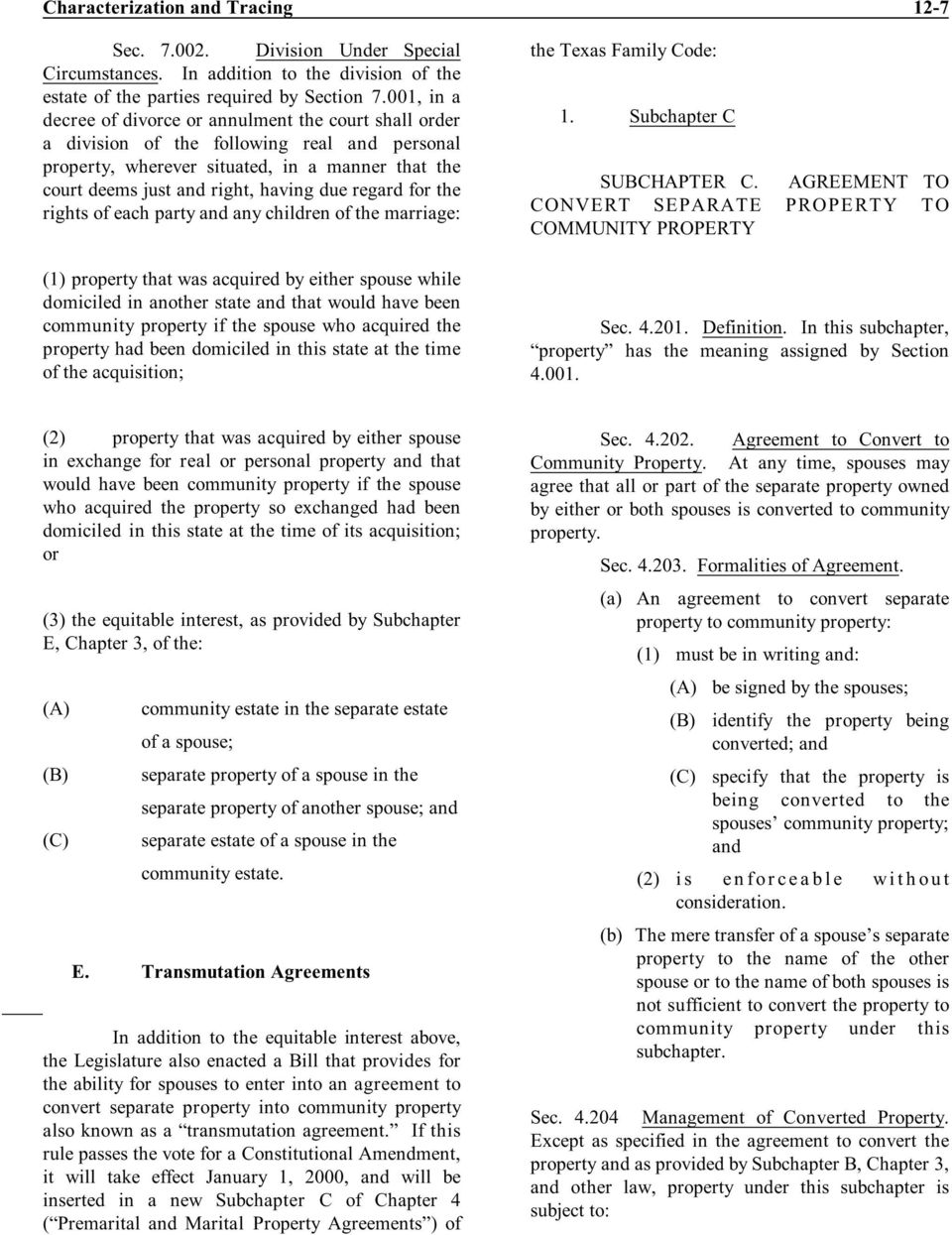
17 Characterization and Tracing 12-7 Sec Division Under Special Circumstances. In addition to the division of the estate of the parties required by Section 7.001, in a decree of divorce or annulment the court shall order a division of the following real and personal property, wherever situated, in a manner that the court deems just and right, having due regard for the rights of each party and any children of the marriage: (1) property that was acquired by either spouse while domiciled in another state and that would have been community property if the spouse who acquired the property had been domiciled in this state at the time of the acquisition; the Texas Family Code: 1. Subchapter C SUBCHAPTER C. AGREEMENT TO CONVERT SEPARATE PROPERTY TO COMMUNITY PROPERTY Sec Definition. In this subchapter, property has the meaning assigned by Section (2) property that was acquired by either spouse in exchange for real or personal property and that would have been community property if the spouse who acquired the property so exchanged had been domiciled in this state at the time of its acquisition; or (3) the equitable interest, as provided by Subchapter E, Chapter 3, of the: (A) (B) (C) community estate in the separate estate of a spouse; separate property of a spouse in the separate property of another spouse; and separate estate of a spouse in the community estate. E. Transmutation Agreements In addition to the equitable interest above, the Legislature also enacted a Bill that provides for the ability for spouses to enter into an agreement to convert separate property into community property also known as a transmutation agreement. If this rule passes the vote for a Constitutional Amendment, it will take effect January 1, 2000, and will be inserted in a new Subchapter C of Chapter 4 ( Premarital and Marital Property Agreements ) of Sec Agreement to Convert to Community Property. At any time, spouses may agree that all or part of the separate property owned by either or both spouses is converted to community property. Sec Formalities of Agreement. (a) An agreement to convert separate property to community property: (1) must be in writing and: (A) (B) (C) be signed by the spouses; identify the property being converted; and specify that the property is being converted to the spouses community property; and (2) is enforceable without consideration. (b) The mere transfer of a spouse s separate property to the name of the other spouse or to the name of both spouses is not sufficient to convert the property to community property under this subchapter. Sec Management of Converted Property. Except as specified in the agreement to convert the property and as provided by Subchapter B, Chapter 3, and other law, property under this subchapter is subject to:
18 rd Annual Marriage Dissolution Institute (1) the sole management, control, and disposition of the spouse in whose name the property is held; (2) the sole management, control, and disposition of the spouse who transferred the property if the property is not subject to evidence of ownership; (3) the joint management, control, and disposition of the spouses if the property is held in the name of both spouses; or (4) the joint management, control, and disposition of the spouses if the property is not subject to evidence of ownership and was owned by both spouses before the property was converted to community property. Sec Enforcement. (a) (b) An agreement to convert property to community property under this subchapter is not enforceable if the spouse against whom enforcement is sought proves that the spouse did not: (1) execute the agreement voluntarily; or (2) receive a fair and reasonable disclosure of the legal effect of converting the property to community property. An agreement that contains the following statement, or substantially similar words, prominently displayed in bold-faced type, capital letters, or underlined, is rebuttably presumed to provide a fair and reasonable disclosure of the legal effect of converting property to community property: This instrument changes separate property to community property. This may have adverse consequences during marriage and on termination of the marriage by death or divorce. For example: Exposure to creditors. If you sign this agreement, all or part of the separate property being converted to community property may become subject to the liabilities of your spouse. If you do not sign this agreement, your separate property is generally not subject to the liabilities of your spouse unless you are personally liable under another rule of law. Loss of management rights. If you sign this agreement, all or part of the separate property being converted to community property may become subject to either the joint management, control, and disposition of you and your spouse or the sole management, control, and disposition of your spouse alone. In that event, you will lose your management rights over the property. If you do not sign this agreement, you will generally retain those rights. Loss of property ownership. If you sign this agreement and your marriage is subsequently terminated by death of either spouse or by divorce, all or part of the separate property being converted to community property may become the sole property of your spouse or your spouse s heirs. If you do not sign this agreement, you generally cannot be deprived of ownership of your separate property on termination of your marriage, whether by death or divorce. Sec Rights of Creditors; Recording. (a) A conversion of separate property to community property does not affect the

19 Characterization and Tracing 12-9 (b) (c) rights of a preexisting creditor of the spouse whose separate property is being converted. A conversion of separate property to community property may be recorded in the deed records of the county in which a spouse resides and of the county in which any real property is located. A conversion of real property from separate property to community property is constructive notice to a good faith purchaser for value or a creditor without actual notice only if the agreement to convert the property is acknowledged and recorded in the deed records of the county in which the real property is located. st [1 Dist.] 1974, no writ); Muns v. Muns, 567 S.W.2d 563 (Tex. Civ. App. Dallas 1978, no writ); Myers v. Myers, 503 S.W.2d 404 (Tex. Civ. App. Houston (14th Dist.] 1973, writ dism'd w.o.j.). The trial court, pursuant to the mandate of to divide the estate of the parties having due regard for the rights of each party, must determine the character of the marital property, in light of the definition provided by the constitution and the statutes. F. The Importance of Characterization The community property concept is imbedded in the Constitution of this State, Art. XVI, 15 and is treated in detail in Chapter 3 of the Texas Family Code. Characterization of property is necessary for the property determination of the rights of each spouse upon divorce. Section of the Texas Family Code provides for division of property in a suit for dissolution of marriage by divorce or annulment. It provides that: "In a decree of divorce or annulment, the court shall order a division of the estate of the parties in a manner that the court deems just and right, having due regard for the rights of each party and any children of the marriage." The starting point in developing a case where the question of division of property is contested is the task of establishing the nature of the property to be divided as separate or community. Cooper v. Cooper, 513 S.W.2d 229 (Tex. Civ. App. Houston The trial court has broad latitude in the division of the community estate of the parties, but that discretion does not extend to the taking of the fee to the separate property of one spouse and its donation to the other whether real property or personal property. Eggemeyer v. Eggemeyer, supra; Cameron v. Cameron, 641 S.W.2d 210 (Tex. 1982). The trial court has no authority to divest an interest in separate property even though the interest is small and to require the spouses to maintain a tenancy-in-common is economically unrealistic and impractical. See Whorrall v. Whorrall, 691 S.W.2d 32 (Tex. Civ. App. Austin 1985, writ dism'd), where husband owned a 9/10 of 1% interest in a house as his separate property. Ability to characterize marital property as separate or as community is essential if the lawyer is to properly discharge the professional responsibility to the client. Busby v. Busby, 457 S.W.2d 551 (Tex. 1970); Cearley v. Cearley, 544 S.W.2d 661 (Tex. 1976); Smith v. Lewis, 530 P. 2d 589 (Cal. 1975). III. ESTABLISHING THE CHARACTER OF PROPERTY Unless equitable interest and/or transmutation are applicable, the basic rules of characterization are: (1) property acquired before marriage or representing an element of the person or personality of a spouse brought into marriage is separate property; (2) property acquired during the marriage is presumed to

20 r d Annual Marriage Dissolution Institute be community property, but this presumption may be disproved by showing (a) acquisition by gift or inheritance, or (b) mutation of separate property demonstrated by tracing; and (3) community property partitioned in the manner provided by law becomes separate property. The character of property as separate or community is determined by the time and circumstances of its acquisition. Ray v. United States, 385 F.Supp. 372 (S.D.Tex. 1974), aff d. 538 F.2d 1228 (5th Cir. 1976); Janes v. Gulf Production Co., 15 S.W (Tex. Civ. App. Beaumont 1929, writ ref d); Stringfellow v. Sorrells, 18 S.W. 689 (Tex. 1891); Hilley v. Hilley, supra; Bradley v. Bradley, 540 S.W.2d 504 (Tex. Civ. App. Fort Worth 1976, no writ). A. Doctrine of Inception-of-Title Property is characterized as separate or community at the time of inception of the title. Saldana v. Saldana, 791 S.W.2d 316 (Tex. Civ. App. Corpus Christi 1990, no writ). Under the inception of title doctrine, the character of property, whether separate or community is fixed at the time of acquisition. Henry S. Miller Company v. Evans, 452 S.W.2d 426 (Tex. 1970); Strong v. Garrett, 224 S.W.2d 471 (Tex. 1949); Colden v. Alexander, 171 S.W.2d 328 (Tex. 1943); Villarreal v. Villarreal, 618 S.W.2d 99 (Tex. Civ. App. Corpus Christi 1981, no writ); Bell v. Bell, 593 S.W.2d 424 (Tex. Civ. App. Houston [14th Dist.] 1980, no writ); Hernandez v. Hernandez, 703 S.W.2d 250 (Tex. Civ. App. Corpus Christi 1985, no writ). 1. Property Acquire Before Marriage The essential elements of inception of title are as follow: a. Inception of title occurs when a party first has a right of claim to the property by virtue of which title is finally vested. That is, the separate or community character of property is determined by the origin of the title to property and not by the acquisition of the final title. Welder v. Lambert, 44 S.W. 281 (1898); Jensen v. Jensen, 665 S.W.2d 107 (Tex. 1984); Roach v. Roach, 672 S.W.2d 524 (Tex. Civ. App. Amarillo 1984, no writ); Strong v. Garrett, supra; Wierzchula v. Wierzchula, 623 S.W.2d 730 (Tex. Civ. App. - Houston [lst Dist.] 1981, no writ). b. The existence or non-existence of the marriage at the time of incipiency of the right by which title finally vests determines whether the property is community or separate. Creamer v. Briscoe, 109 S.W. 911 (Tex. 1908); Williamson v. Williamson, 457 S.W.2d 311 (Tex. Civ. App. Austin 1970, no writ); Peterson v. Peterson, 595 S.W.2d 889 (Tex. Civ. App. Austin 1980, writ dism'd). c. When character as separate property attaches, it is immaterial that part of the unpaid purchase price is thereafter paid from community funds, since the status of property as being either separate or community is determined by the very time of its acquisition and such status is fixed by the facts of its acquisition. Villarreal v. Villarreal, 618 S.W.2d 99 (Tex.Civ.App. - Corpus Christi 1981, no writ). Smith v. Buss, 144 S.W.2d 529 (Tex. 1940); Hilley v. Hilley, supra; Lindsay v. Clayman, 254 S.W.2d 777 (Tex. 1952); Grost v. Grost, 561 S.W.2d 223 (Tex. Civ. App. Tyler 1977, writ dism'd). In such a case the community estate is entitled only to a right of reimbursement of the separate estate. Welder v. Lambert, supra; Smith v. Buss, supra; Colden v. Alexander, supra; Bishop v. Williams, 223 S.W. 512 (Tex. Civ. App. Austin 1920, writ ref d).

21 Characterization and Tracing Property Acquired During Marriage Property which has its inception of title during marriage is community property unless it is acquired in the following manner, in which event it is the separate property of the acquiring spouse: by gift; by devise or descent; by partition or exchange; as income from separate property made separate by a spousal separate income agreement; by survivorship; in exchange for other separate property; or as recovery for personal injuries sustained by the spouse during marriage, except any recovery for loss of earning capacity during marriage. 3. Property Acquired After Dissolution of Marriage Property that has its inception of title after the marriage is dissolved is not community property. A problem sometimes arises as to just what step in the purchase of property marks the acquisition of ownership, after which purchase-money tracing establishes, not an interest in the property, but a right of reimbursement. Is the ownership of land acquired, for example, when the executory contract to buy is entered into, when possession of the land is delivered, when the deed is delivered, or when the vendor's lien is discharged? It is well established that a claim to real property can arise before the legal title or evidence of title has been attained. The Supreme Court in the leading case of Welder v. Lambert, supra, established the rule that title and ownership refer back to the time of making the contract. The term "claimed" means that where the right to property accrues prior to marriage, the property is separate, even though the legal title or evidence of title might not be obtained until after the marriage. The word "acquired" as used in the Constitution and Texas Family Code refers to the origin or inception of the right, rather than the completion or ripening thereof. In Welder, a contract right giving the husband the right to acquire land was obtained before marriage, but the conditions of the contract were not met until after marriage, at which time title vested. The court held that the property was the husband's separate property because his claim to the property was acquired before marriage. In Wierzchula v. Wierzchula, supra, the husband entered into an earnest money contract to purchase a home before marriage. He applied as a single man for a home loan guaranty with the Veterans Administration and was issued a certificate of loan commitment as a single man. Thereafter, the parties were married and the husband received a deed conveying the property to him after marriage. The court held the house to be the separate property of the husband: "In our case, the appellee acquired a claim to the property at the time the purchase money contract was entered into. The earnest money date being prior to the marriage of the parties, the appellee's right of claim to the property preceded the marriage, and the character of the property as separate property was established and the community property presumption was rebutted." Where a parol contract for purchase of land is made before marriage, and title to the land is received by the spouse after marriage, the parol contract constitutes such an equitable right to purchase prior to marriage as to establish the character as separate. Evans v. Ingram, 288 S.W. 494 (Tex. Civ. App. Waco 1926, no writ). In one case a single man contracted to perform certain services for his mother and she contracted to convey certain realty to him in payment for these services. The man married before all the services were performed and completed his part of the
22 r d Annual Marriage Dissolution Institute bargain while he was married, at which time the promised conveyance was made to him. It was said that the conveyance was an integral part of the premarital contract and the property was, therefore, the man's separate property. Bishop v. Williams, supra. Similarly applied, if a single man enters into a contract of insurance on his life and after the marriage he keeps his part of the bargain by paying premiums, the proceeds payable on his death while married are separate property since the performance of the contract relates back to its inception. McCurdy v. McCurdy, 372 S.W.2d 381 (Tex. Civ. App. Waco 1963, writ ref d). Again, if realty is conveyed to a single man who asserts a claim of right and if title is acquired by running of adverse possession during marriage, the title relates back to its acquisition by conveyance. Strong v. Garrett, supra. However, in Duke v. Duke, 605 S.W.2d 408 (Tex. Civ. App. El Paso 1980, writ dism'd), although earnest money contract for purchase of realty had been entered into by husband prior to marriage, was signed only by husband, and husband paid $500 earnest money listed as part of consideration, the earnest money contract provided that property would be conveyed to both husband and wife and the property was conveyed to both husband and wife as grantees by warranty deed after marriage. The court held: "Title to the property was by the deed and, being in both of their names and acquired during marriage, prima facie establishes that the property is community property. Title is from the deed, and the contract of sale is merged in it... It is a rule of general application that in the absence of fraud, accident or mistake, all prior agreements entered into between the parties are considered merged in the deed." Id at 410. In Carter v. Carter, 736 S.W.2d 775 (Tex. Civ. App. Houston [14th Dist.] 1987, no writ) husband signed an earnest money contract for a house on October 29, This was prior to the December 7, 1974, marriage. The closing took place on January 15, 1975, and both husband and wife signed the note and deed of trust. The wife claimed that there was insufficient "clear and convincing evidence" that husband had acquired the right to title in the property prior to marriage, basing her argument on the fact that the earnest money contract was not offered into evidence and on the lack of evidence to indicate when the contract was accepted by the seller. The court held: "Ownership of real property is governed by the rule that the character of title to property as separate or community depends upon the existence or nonexistence of the marriage at the time of the incipience of the right in virtue of which the title is finally extended and that the title, when extended, relates back to that time'. Appellee acquired a right to title to the property when he entered into the earnest money contract. As the date of execution of the earnest money contract was prior to the marriage, appellee's right to title preceded the marriage and the separate character of the property was thereby established.... The date of acceptance by the seller is not relevant." Id. At 779. In Carter, the wife also contended that the earnest money contract merged into the deed; therefore, the right to acquire the property ripened after marriage. Wife cited Duke v. Duke, supra, to support her proposition. The court stated: "However, though the earnest money contract in Duke had been entered into prior to marriage, it provided that the property would be conveyed to "James H. Duke and wife, Barbara J. Duke... In this case there is no evidence that both spouses were named in the earnest money contract. Therefore, Duke
23 Characterization and Tracing is not applicable... Id. at 780. In Dawson v. Dawson, 767 S.W.2d 949 (Tex. Civ. App. - Beaumont 1989, no writ), the husband had begun the purchase of property under a "contract for deed" prior to the marriage. The warranty deed to the property was received during marriage in the name of both husband and wife. The court held the contract for deed was the origin for inception of title, and determined the character of the property as the separate property of husband. If a contract is entered into prior to marriage, its incidents are then fixed and the proceeds of that contract are characterized as separate property. It is immaterial that part of the purchase price is thereafter paid from community funds, the community estate being entitled in such case to reimbursement out of the separate estate to the extent of the community funds used. Welder v. Lambert, supra; Smith v. Buss, supra; Colden v. Alexander, supra; Bishop v. Williams, supra; Dakan v. Dakan, 83 S.W.2d 620 (Tex. 1935); Villarreal v. Villarreal, supra; Pruske v. Pruske, 601 S.W.2d 746 (Tex. Civ. App. Austin 1980, writ dism d). See also Bybee v. Bybee, 644 S.W.2d 218 (Tex. Civ. App. Forth Worth 1982, no writ) where the court held that the fact the parties utilized community funds to make payments on land, this could not create a resulting trust under relation back theory because there was no enforceable agreement upon the part of the wife concerning payments to be made after the title was vested. In Gutierrez v. Gutierrez, 791 S.W.2d 659 (Tex. Civ. App. San Antonio, 1990, no writ) the court held that a car purchased two years before marriage is separate property under the inception of title rule, even though it may have been paid for with community funds and its final title acquired during marriage. In Burgess v. Easley, 893 S.W.2d 87 (Tex. Civ. App. Dallas 1995, no writ), Wife filed a post-divorce action requesting that the court partition property that was deeded to Husband by his parents during their marriage. Although the deed was dated on July 28, 1980 it was not recorded until July 18, 1984 which was after husband and wife were divorced. The Court found that husband had no right in the property itself until the deed was delivered. The earliest time that husband s right vested in such property was when his father recorded the deed on July 18, 1984 which was two months after husband s marriage to wife was dissolved therefore making the property his separate property. B. Presumption of Community Property 1. In General An evaluation of the legal rights of the parties must begin with Texas Family Code 3.003(a) which provides: Property possessed by either spouse during or on dissolution of marriage is presumed to be community property. Texas Family Code 3.003(b) states that: The degree of proof necessary to establish that property is separate property is clear and convincing evidence. The statute creates a rebuttable presumption that all property possessed by a husband and wife when their marriage is dissolved is their community property and imposes the burden upon one asserting otherwise to prove the contrary by satisfactory evidence. Tarver v. Tarver, 394 S.W.2d 780 (Tex. 1965); Wilson v. Wilson, 201 S.W.2d 226 (Tex. 1947); Schreiner v. Schreiner, 502 S.W.2d 840 (Tex. Civ. App. San Antonio 1973, writ dism d); Southern Title Guaranty Company, Inc. v. Prendergast, 494 S.W.2d
24 r d Annual Marriage Dissolution Institute 154 (Tex. 1973). This provision is a codification of two presumptions with respect to the character of property as community. One presumption was that all property acquired during the marriage was community. Hardee v. Vincent, 147 S.W.2d 1072 (Tex. 1941); Fuhrman v. Fuhrman, 302 S.W.2d 205 (Tex. Civ. App. El Paso 1957, writ dism d); Newland v. Newland, 529 S.W.2d 105 (Tex. Civ. App. Fort Worth 1975, writ dism d). The other which restates the basic presumption of community property in old Art was that all the effects which the husband and wife possessed at the time the marriage was dissolved shall be regarded as common effects or gains, unless the contrary be satisfactorily proved. See Dillard v. Dillard, 341 S.W.2d 668 (Tex. Civ. App. Austin 1960, writ ref d n.r.e.). The statutory presumption of Section 3.003(a) makes no distinction between property acquired before and that acquired after the marriage; it refers to property possessed by either spouse. Gameson v. Gameson, 162 S.W Tex. Civ. App. Austin, 1913, no writ); Stephens v. Stephens, 292 S.W. 290 (Tex. Civ. App. Amarillo 1927, writ dism d). Since property possessed by either husband of wife during or on dissolution of marriage is presumed to be community property, it makes no difference whether the conveyance is in form to the husband, to the wife, or to both. Cooke v. Bremond, 27 Tex. 457 (1864); McGee v. McGee, 537 S.W.2d 94 (Tex. Civ. App. Amarillo 1976, no writ); Hilley v. Hilley, supra. 2. Specific Presumptions a. Purchase Money presumed to have been community funds unless the evidence to the contrary is clear and convincing. See Cooke v. Cordray, 333 S.W.2d 461 (Tex. Civ. App. Beaumont 1960, no writ). b. Debts and Loans A debt or loan acquired during the marriage is presumptively a community debt unless the lender agreed to look solely to the borrowing spouse s separate property for repayment. Cockerham v. Cockerham, 527 S.W.2d 162, 171 (Tex. 1975). Property acquired with community credit is community and property acquired with separate credit is separate property. But, property acquired with community property can become separate property by interspousal gift or partition. Id., Anderson v. Royce, 624 S.W.2d 621, 623 (Tex. Civ. st App. Houston [1 Dist.] 1981, writ ref d n.r.e.); Glover v. Henry, 749 S.W.2d 502, 503 (Tex. Civ. App. Eastland 1988, no writ). c. Withdrawals From Accounts Money spent during the marriage is presumed to be community property. Horlock v. Horlock, 533 S.W.2d 52, 59 st (Tex. Civ. App. Houston [1 Dist.] 1976, writ dism d). d. Transfer to Child A parent s transfer of a property interest to a child is presumptively a gift but may be rebutted by evidence showing the facts and circumstances surrounding the conveyance. Woodworth v. Cortez, 660 S.W.2d 561, 564 (Tex. Civ. App. San Antonio 1983, writ ref d n.r.e.). Money used for the purchase of property is
25 Characterization and Tracing e. Deed Recitals When a deed recites that separate property was paid for the acquisition, or that the property is taken as the receiving spouse s separate estate, a rebuttable presumption arises. When the other spouse is grantor or otherwise chargeable with causing or acquiescing in the recital, the presumption becomes irrebuttable absent fraud. Kahn v. Kahn, 94 Tex. 114, 58 S.W. 825, 826 (1900); Kyles v. Kyles, 832 S.W.2d 194, 196 (Tex. Civ. App. Beaumont 1992, no writ); Henry S. Miller Co. v. Evans, 452 S.W.2d 426, 431 (Tex. 1970). f. Interspousal Conveyance When one spouse conveys property to the other spouse, there is a rebuttable presumption of gift, even absent a recital in the instrument of conveyance. Kahn v. Kahn, supra. g. Including Other Spouse s Name in Title Where one spouse makes a gift of property to the other spouse, that gift is presumed to include all the income or property which might arise from the property given. Texas Family Code i. Withdrawal of Commingled Funds Where an accounts contains both community and separate monies, it is presumed that community money is withdrawn first. Horlock v. Horlock, 533 S.W.2d 52, 59 (Tex. Civ. App. Houston th [14 Dist.] 1976, writ dism d); Harris v. Ventura, 582 S.W.2d 853, (Tex. Civ. App. Beaumont 1979, no writ). The act of placing separate property funds into a joint account does not make the funds community property or a gift. Celso v. Celso, 864 S.W.2d 652, 655 (Tex. Civ. App. Tyler 1993, no writ); Higgins v. Higgins, 458 S.W.2d 498, 500 (Tex. Civ. App. Eastland 1970, no writ). 3. Rebuttal of Presumption Where one spouse furnishes separate property consideration and title is taken in the name of the other spouse, a rebuttable presumption of a gift arises. Where one spouse furnishes separate property consideration and title is taken in both spouse s name, a rebuttable presumption arises that the purchasing spouse intended to make a gift of a one-half separate property interest to the other spouse. Pemelton v. Pemelton, 809 S.W.2d 642, 646 (Tex. Civ. App. Corpus Christi 1991, rev d on other grounds sub nom.); Heggen v. Pemelton, 836 S.W.2d 145 (Tex. 1992); In re Marriage of Thurmond, 888 S.W.2d 269, 273 (Tex. Civ. App. Amarillo 1994, no writ). h. Income From Interspousal Gift The statutory presumption that property possessed by either spouse upon dissolution of the marriage is community is a rebuttable presumption and is overcome by evidence that a specific item of property is the separate property of one spouse or the other. Peaslee-Gaulbert Corp. v. Hill, 311 S.W.2d 461 (Tex. Civ. App. Dallas 1958, no writ); Jackson v. Jackson, 524 S.W.2d 308 (Tex. Civ. App. Austin 1975, no writ). The general rule is to introduce evidence which traces and/or clearly identifies the property claimed as separate property. McKinley v. McKinley, 496 S.W.2d 540 (Tex. 1973). The Supreme Court has clearly held that the statute creates only a rebuttable presumption. In Tarver v. Tarver, supra, Chief Justice Calvert wrote:
26 r d Annual Marriage Dissolution Institute "The plain wording of the statute creates a rebuttable presumption that all property possessed by a husband and wife when their marriage is dissolved is their community property and imposes the burden upon one asserting otherwise to prove the contrary by satisfactory evidence." In McClintic v. Midland Grocery & Dry Goods Co., 154 S.W (Tex. 1913) the Supreme Court said: "But in all such cases the presumption (of) community property may be overcome by proof that, as between husband and wife (it) is the separate property of one or the other." While the presumption is rebuttable, the general rule is that to discharge the burden imposed by the statute, a spouse, or one claiming through a spouse, must trace and clearly identify property claimed as separate property. McKinley v. McKinley, supra; Tarver v. Tarver, supra; Cooper v. Texas Gulf Industries, Inc., 513 S.W.2d 200 (Tex. 1974). In Cockerham v. Cockerham, 527 S.W.2d 162 (Tex. 1975), the Supreme Court held: "In order to overcome this presumption, the party asserting separate ownership must clearly trace the original separate property into the particular assets on hand during the marriage." C. What Constitutes Separate Property l. Property Owned or Claimed Before Marriage Any property owned or claimed by a spouse before marriage remains the separate property of that spouse after marriage. Tex. Const. Art. XVI, 15; Texas \Family Code See Tarver v. Tarver, supra, where evidence showed that husband had received conveyance of a specific tract of land before marriage, and that land was held to be separate property; Norris v. Vaughan, supra, where the husband's interest in a partnership acquired before marriage was held to be separate property, although salary and profits received from the partnership during marriage were community property; Beeler v. Beeler, 363 S.W.2d 305 (Tex. Civ. App. Beaumont 1962, writ dism'd) where a note for the balance due on sale of a ranch and herd of cattle owned by husband prior to his marriage and sold thereafter was the husband's separate property. The terms "owned or claimed" mean that where the right to the property had accrued before marriage, the property would be separate, even though the legal title or evidence of title might not be obtained until after marriage. Welder v. Lambert, supra. The word "acquired" as used in the Constitution and Texas Family Code refers to the inception of the right, rather than the completion or ripening thereof. Where the contract to purchase was entered into before marriage, although the title is not finally extended until after marriage, the property becomes the separate property of the purchaser-spouse. The leading case of Welder v. Lambert, supra, establishes the rule that title and ownership refer back to the time of making the contract. See also Creamer v. Briscoe, 109 S.W. 911 (Tex. 1908). It is the well-established rule that existence or nonexistence of the marriage at the time of
27 Characterization and Tracing incipiency of the right by which title finally vests determines whether the property is community or separate. Creamer v. Briscoe, supra; Williamson v. Williamson, supra; Peterson v. Peterson, supra; MacRae v. MacRae, supra; Stiles v. Hawkins, supra. It is immaterial that part of the purchase price is thereafter paid from community funds, the community estate being entitled in such case to reimbursement out of the separate estate to the extent of the community funds so used. Welder v. Lambert, supra; Smith v. Buss, supra; Colden v. Alexander, supra; Bishop v. Williams, supra. See Evans v. Ingram, supra, where parol contract for purchase of land had been made before grantee s marriage, and land was conveyed to him after marriage, the parol contract was held to constitute such an equitable right to property prior to marriage as to establish the character as separate. 2. Property Acquired by Gift a. In General Property acquired by a spouse by gift, whether before or during the marriage, is separate property. Tex. Const. Art. XVI, 15; Texas Family Code If one spouse makes a gift of property to the other, the gift is presumed to include all the income and property which may arise from that property. Tex. Const. Art. XVI, 15; Texas Family Code A "gift" is a voluntary transfer of property to another made gratuitously and without consideration. Hilley v. Hilley, supra; Bradley v. Bradley, supra. The well-established rule of law regarding gifts is that three elements are necessary to establish the existence of a gift: They are (1) intent to make a gift; (2) delivery of the property, and (3) acceptance of the property. Harrington v. Bailey, 351 S.W.2d 946 (Tex. Civ. App. Waco 1961, no writ); Sumaruk v. Todd, 560 S.W.2d 141 (Tex. Civ. App. Tyler 1977, no writ); Pankhurst v. Weitinger & Tucker, 850 S.W.2d 726 (Tex. Civ. App. Corpus Christi 1993, writ denied). Generally, one who is claiming the gift has the burden of proof. Grimsley v. Grimsley, 632 S.W.2d 174 (Tex. Civ. App. Corpus Christi 1982, no writ). But where the conveyance is from one spouse to the other spouse, there is a presumption of gift. Harmon v. Schmitz, 39 S.W.2d 587 (Tex. Comm n App , holding approved) is one of the early discussions of an effective gift. The court said: To constitute a valid gift inter vivos the purpose of the donor to make the gift must be clearly and satisfactorily established and the gift must be complete by actual, constructive, or symbolic delivery without power of revocation." See also Akin v. Akin, 649 S.W.2d 700 (Tex. Civ. App. Fort Worth 1983, writ ref d n.r.e.); Ellsworth v. Ellsworth, 151 S.W.2d 628 (Tex. Civ. App. El Paso 1941, writ ref d); Kennedy v. Beasley, 606 S.W.2d 1 (Tex. Civ. App. Houston [lst Dist.] 1980, writ ref d n.r.e.). The promise to give property in the future is generally not a gift, being unenforceable without consideration. Woodworth v. Cortez, 660 S.W.2d 561, 564 (Tex. Civ. App. San Antonio 1983, writ ref d n.r.e.). Our courts have held that the crucial point of any inquiry when a gift is asserted is, what was the intent of the asserted donor? The controlling factor in establishing a gift is the donative intent of the grantor at the time of the conveyance. Ellebracht v. Ellebracht, 735 S.W.2d 659 (Tex. Civ. App. Austin 1987, no writ). If there is a fair inference that a gift was intended then there remains the question did the donor intend for it to be effective at that time or in the future? An effective means of determining if an immediate gift was intended is to inquire if the possession was delivered to the donee. Hester v. Hester, 205 S.W.2d 115 (Tex. Civ. App. Fort Worth 1947, no writ).
28 r d Annual Marriage Dissolution Institute Delivery of the property should be such that all dominion and control over the property is released by the owner. The rule has been stated in Harmon v. Schmitz, supra, as follows: "Among the indispensable conditions of the valid gift and the intention of the donor to absolutely and irrevocably divest himself of the title, dominion and control of the subject of the gift and the praesenti at the very time he undertakes to make the gift. "The irrevocable transfer of the present title, dominion, and control of the thing given to the donee, so that the donor can exercise no further set of the dominion or control over it. "A mere intention to make a gift, however clearly expressed, which has not been carried into effect, amounts to nothing, and enforces no rights in the subject matter of the proposed gift upon the intended donee. The intention must be effective by complete and unconditional delivery." Actual delivery is not always necessary; rather, where the circumstances make actual delivery impractical, delivery may be symbolical or constructive. Bridges v. Mosebrook, 662 S.W.2d 116 (Tex. Civ. App. Fort Worth 1983, writ ref'd n.r.e.); Mortenson v. Trammell, 604 S.W.2d 269 (Tex. Civ. App. Corpus Christi 1980, writ ref d n.r.e.). App. Waco 1970, writ ref d n.r.e.). The dispute in Grimsley v. Grimsley, supra, focused on a letter that the husband had written to the wife shortly before their marriage. In it the husband related that he was giving her an extensive list of real and personal property. Shortly after their marriage the spouses purchased a home with a down payment from the proceeds of the sale of assets that were included in the premarital letter. On divorce the district court awarded the home and several items of listed real and personal property to the wife as her separate property. The court attempted to determine whether the husband had made a gift of all of the assets to his wife prior to marriage, thus making the down payment for the home a part of her separate estate. The court of appeals held that the attempted gift of the husband's realty could be accomplished only by deed or by showing (1) a present gift, (2) possession by the donee with the donor's consent, and (3) the donee's having made valuable improvements. The court found none of the prerequisites satisfied. Moreover, the purported gift of the personalty was invalid because the husband never relinquished total dominion and control. The husband was therefore entitled to a separate property interest in the house to the extent his separate property was used as the down payment. It is not stated in whose name title to the house was taken, and the court did not discuss the presumption of an interspousal gift when the husband's separate property is used to purchase property with title taken wholly or partially in the wife's name. (1) Real Estate There are two ways to make a gift of real estate, one is by deed, and the other is by parol gift of realty when certain conditions are met. Grimsley v. Grimsley, supra. A parol gift of realty is enforceable in equity if there is established, (1) a gift in praesenti, (2) possession under the gift by the donee with the donor's consent and (3) permanent valuable improvement made on the property by donee with donor's knowledge or consent or without improvements, the existence of such facts as would make it a fraud upon the donee not to enforce the gift. Moody v. Ireland, 456 S.W.2d 494 (Tex. Civ. In Purser v. Purser, 604 S.W.2d 411 (Tex. Civ. App. Texarkana 1980, no writ) the court held that in the absence of any other evidence, husband's testimony that he did not intend to make a gift to his wife of any interest in certain real property, deed to which was taken in both parties' name, was not sufficient to establish conclusively that husband did not intend to make a gift to his wife; and that the testimony of an interested witness without corroboration, even when uncontradicted, only raises an issue of fact. In In the Matter of the Marriage of York, 613 S.W.2d 764 (Tex. Civ. App. Amarillo 1981, no writ) wife's parents conveyed real property to husband and wife as grantees. The consideration
29 Characterization and Tracing recited in the deed as "the sum of Ten and no/100 ($10.00) Dollars. (sic) and other good and valuable consideration. Wife s father testified he intended to give the real property to wife as her sole and separate property. However, at the time of the conveyance, the Yorks contemplated building a house on the property to serve as the primary residence. Further contemplating community indebtedness to pay for a part of the construction of the residence, husband told wife that he would not go in to debt for the house construction unless he owned the property with her. Holding that the presumption of community was not overcome by wife, the court held the evidence in support of wife's separate property claim as to the residential property created no more than issue for the trier of facts. In Hall v. Barrett, 126 S.W.2d 1045 (Tex. Civ. App. Fort Worth 1939, no writ), husband's father executed a general warranty deed conveying a tract of land to his two sons. The deed recited: "For and in consideration of the sum of Ten and 00/100 Dollars to me in hand paid by H. O. Hall and C. E. Hall and the future consideration of the law and affection that I have and bear toward my two sons and for the further consideration that the said (sons) are to care for me in sickness and in health and provide such funds as shall be necessary to provide me with the necessities of life, such as food, clothing and such medical attention as I may need during my natural life." The court held: "Much ado is made of the recited consideration of "Ten Dollars" paid to the grantor. All of us know that this is the usual and customary formal recitation used in deeds of gift. No one attempted to prove that these grantees actually paid the grantor such sum. We see nothing in the contention. The Supreme Court, in Sisk v. Randon, 123 Tex. 326, 70 S.W.2d 689, affirming the Court of Civil Appeals, 33 S.W.2d 1082, holds that a grantee's agreement to support the grantor when recited as a consideration for a deed, will be treated as a covenant rather than a condition, unless the deed clearly and explicitly makes the agreement a condition. We believe that the deed in question shows upon its face that the grantor made a gift of the land to his sons. But see Saldana v. Saldana, supra, where husband's mother conveyed title to property by a general warranty deed to her son and daughter-in-law during their marriage. The wife testified that she paid husband's mother $10.00 at the time his mother executed the deed. Husband offered no evidence to rebut the presumption that the $10.00 came from the community estate. The court held: "Thus, as a result of their ten dollar community investment, whatever right (the spouses) owned vested as a part of the community estate." The court also noted that a consideration of $1.00 is sufficient to support a deed conveying land or an interest in land. In Smith v. Smith, 620 S.W.2d 619 (Tex. Civ. App. Dallas 1981, no writ) the wife's mother conveyed to husband and wife by deed which recited ten dollars paid and other valuable consideration and the execution of a promissory note. The wife claimed that the principal payments were set up to be "gifts back" under a method to take advantage of the Internal Revenue Code life-time and annual gift exclusion. The court held that where the gifts by wife's mother were entirely voluntary and could have been discontinued at any time (as they subsequently were) the conveyance evidenced a sale rather than a gift, and the property was community property. In Massey v. Massey, 807 S.W.2d 391 (Tex. Civ. App. Houston [lst Dist.] 1991, writ denied) husband acquired property during marriage by two deeds which reflected a $180,000 promissory note. Husband did not plead the documents were ambiguous. Nevertheless, he offered the testimony of his brother and his mother that, contrary to the terms of the documents, the transactions were actually intended to be gifts and were treated as gifts but were made to look like credit transactions in order to avoid gift taxes. The court held: "Parol evidence is not admissible to vary the terms of an unambiguous document. It is for the court to
30 r d Annual Marriage Dissolution Institute construe an unambiguous document as a matter of law. The courts will give effect to the intention of the parties as is apparent in an unambiguous writing. When a writing is intended as a completed memorial of a legal transaction, the parol evidence rule excludes other evidence of any prior or contemporaneous expressions of the parties relating to that transaction. A spouse who is a party to a deed transaction may not introduce parol or extrinsic evidence to contradict the express recitals in the deed without first tendering evidence of fraud, accident, or mistake. only if the intention of the parties as expressed on the face of the document is doubtful may the court resort to parol evidence to resolve the doubt. (Emphasis in original). (Cites omitted). The court also noted that even if parol evidence had been admitted to show that no payments had yet been made on the due dates under the note, the transaction would still not qualify as a gift. In order to be a valid inter vivos gift, the transfer of the property must be absolute. It may not be open for future reconsideration by the donee, as would this alleged gift on each of the payment due dates. Akin v. Akin, supra. A gift may generally not be made to take effect in the future since a mere promise to give is unenforceable without consideration. Cooper v. Durham, 565 S.W.2d 308 (Tex. Civ. App. Eastland 1978, writ ref d n.r.e.). However, by virtue of statutory authority an estate in realty may be made to commence in futuro by deed. Davis v. Zeanon, 111 S.W.2d 772 (Tex. Civ. App. Waco 1937, writ ref d). When the instrument conforms to the requirement of our statutes and purports to be an executed conveyance of land, the delivery of such instrument has effect, as between the parties, to vest title in the grantee in all respects the same when there is no consideration for the conveyance as when there is one. Woodworth v. Cortez, 660 S.W.2d 561 (Tex. Civ. App. San Antonio 1983, writ ref d n.r.e.). estate of freehold or inheritance that commences in the future, in the same manner as by a will." (2) Bank Accounts The opening of an "or" account does not of itself constitute a gift of the funds by one of the depositing parties to the other. Carnes v. Meador, 533 S.W.2d 365 (Tex. Civ. App. Dallas 1975, writ ref d n.r.e.); Higgins v. Higgins, 458 S.W.2d 498 (Tex. Civ. App. Eastland 1970, no writ). Signature card language that such deposited sums "shall be owned by the undersigned jointly and be subject to the withdrawal or receipt of (1) either of them, or (2) the survivor of them" does not conclusively establish an agreement between the parties as to the ownership of the funds deposited. Kennedy v. Beasley, supra. The controlling question in determining whether there has been a gift of a joint interest in a bank account is always the donor's true intent; and likewise a joint tenancy or a joint ownership of a deposit is created only when it clearly appears to have been a divesting by the original owner of the exclusive ownership and control of the money and a vesting of such ownership and control jointly in himself and another, with the attendant right or survivorship. Ottjes v. Littlejohn, 285 S.W.2d 243 (Tex. Civ. App. Waco 1955, writ ref d n. r. e); Kennedy v. Beasley, supra. In Olive v. Olive, 231 S.W.2d 480 (Tex. Civ. App. Dallas 1950, no writ) the court held that, where aunt intended to retain beneficial interest in her funds which were in a joint deposit with nephew, there was no completed gift to nephew, and on aunt's death the title to funds passed to aunt's estate, notwithstanding that aunt intended that on her death the nephew should become sole owner of the account and that during aunt's lifetime the nephew had legal right to withdraw funds and had done so for convenience of aunt. The court stated: The Texas Property Code, 5.041, provides: "A person may make an inter vivos conveyance of an "Under the above testimony the conclusion is well-nigh compelling that it was the purpose of Miss Olive to retain the beneficial interest in aforesaid joint deposit
31 Characterization and Tracing during lifetime, intending merely that whatever was left at her death should pass to appellant. That, under these circumstances, the survivor's rights cannot be. sustained as a gift is the holding of the courts the country over; our own courts being firmly committed to the rule that to constitute a gift inter vivos there must not only be a donative intention but also a complete stripping of the donor of all dominion or control over the things given." The court further stated: "A gift intended to take effect at death is uniformly characterized as an attempted testamentary disposition of property and effectuated only by means of a valid will." To sustain a gift of a joint interest in a bank account two requisites are necessary: (1) intention by the depositor to make a gift of a joint interest in the deposit by the co-depositor, (2) divesting by the depositor of exclusive dominion and control over the money, and a vesting of such dominion and control jointly in himself and another. Ottjes v. Littlejohn, supra; Kennedy v. Beasley, supra. In Akin v. Akin, supra, the husband told the wife: "Honey, on your way home, stop at the bank, take that money out and put it in your own name, because the kids are going to give you trouble." The court held the evidence did not necessarily intend a gift, and there was no showing that the husband intended a gift at the time the wife actually withdrew the money from the account (one and one half days after the alleged parol gift). When husband removed his name from a community bank account opened in the names of both spouses, it was held that this act alone does not change the funds from community to the separate estate of the wife. Wohlenberg v. Wohlenberg, 485 S.W.2d 342 (Tex. Civ. App. El Paso 1972, no writ); and no presumption of gift to the husband results from the wife depositing her inheritance to their joint bank accounts. Higgins v. Higgins, supra. (3) Stock The law on the gift of stock is clearly stated in the case of Carrington v. Commissioner of Internal Revenue, 476 F.2d 704, In that case, the Fifth Circuit said: "A gift of stock between competent parties requires donative intent, actual delivery, and relinquishment of dominion and control by the donor. See also Grimsley v. Grimsley, supra. However, physical delivery of the stock certificates and possession thereof is not the only method by which a donor may make a gift of corporate stock to a donee. What will constitute delivery depends on the nature of the corpus and the circumstances of the case. Webb v. Webb, 184 S.W.2d 153 (Tex. Civ. App. Eastland 1944, writ ref d). Testimony of wife that husband purchased stock for her and placed it in her name, verified by the custodian of records of the corporation who testified that stock was issued in her name, has been held to support finding that the stock was a gift to wife by the husband. Mortenson v. Trammell, supra. See Grost v. Grost, supra, where wife transferred separate property stock certificate to husband, the court held a presumption arose that she made a gift to her husband. (4) Life Insurance In Daubert v. United States, 533 F.Supp. 66 (W.D.Tex. 1981), the executors of a decedent's estate sought to have the deceased spouse s community interest in the proceeds of a $75,000 life insurance policy excluded from his taxable estate. The executors alleged that the husband made a gift of his community interest to his wife at the time the policy was purchased by buying it in her name as owner. The court held that to effect a gift of the policy the donor must "perform an affirmative act which would clearly reflect an intention to make a gift of community interest. The federal court, imposing a very strict standard of proof supported this conclusion by reference to the husband's continued control of the policy and the argument that designation of the wife as the policy owner did not constitute a "clear and conscious choice" reflecting donative intent. A purchase with community property in the name of either spouse does not change its character. if the purchase was intended to
32 r d Annual Marriage Dissolution Institute belong to the wife, she should have been designated not merely as its owner but it should have been stated to be her separate property. (5) Gifts From Parents or Grandparents When a person conveys property to a natural object of the grantor s bounty, such as a parent to a child or a grandparent to a grandchild, it creates a rebuttable presumption that the property conveyed is a gift. The person claiming the property was not a gift must prove lack of donative intent by clear and convincing evidence. Kyles v. Kyles, 832 S.W.2d 194, 197 (Tex. Civ. App. Beaumont 1992, no writ). (6) Wedding Gifts The controlling factor in establishing whether a wedding gift is the separate property of one spouse or the other is the intent of the donor. If the donor intended to make a gift to both spouses, each spouse would have an undivided one-half interest in the wedding gift as their separate property. There is, however, a presumption that a parent intended to make a gift to their child if the parent delivers possession, conveys title, or purchases property in the name of the child. Woodworth v. Cortez, 660 S.W.2d 561 (Tex. Civ. App. San Antonio 1983, writ ref d n.r.e.) affection. Lowe v. Ragland, 297 S.W.2d 668 (Tex. 1957). v. Property deeded in consideration of $10.00, love and affection, and care to be furnished. Hall v. Barrett, supra. In Zorn v. Tarver, 57 Tex. 388, (1882) a wife's cousin purchased at execution sale a tract of land, and immediately executed to wife, a bond for title to the property in consideration of payment to her of the amount of her bid at such sale, and accepted the wife's notes therefor due at a subsequent date, intending to sell to the wife to the extent of the notes, and to make her a gift of the difference between such amount and the real value of the land, which was considerable. Later the notes were fully paid off from moneys arising from a sale of the portion of the land. Upon a contest between the wife and the husband's creditors, the property was held to be her separate estate as a gift from her cousin. b. Interspousal Gifts The legal definition of separate property and community property are given controlling effect in transactions between the spouses affecting property they have already acquired. If the husband and wife were to convert their separate property into community property, or vice versa, they must do it in such a way that the transaction can be fitted into the legal definitions. iii. iv. (7) Other i. Gift of money. McFadden v.mcfadden, 213 S.W.2d 71 (Tex. Civ. App. Amarillo 1948, mand. overr.). ii. Proceeds of donated checks. Lindley v. Lindley, 201 S.W.2d 108 (Tex. Civ. App. Fort Worth 1947, writ ref d n.r.e.). Cashier s check from a relative. Caldwell v. Dabney, 208 S.W.2d 127 (Tex. Civ. App. - Austin 1948, writ ref d n.r.e.). Property deeded in consideration of love and It has long been the law that one spouse may make a valid gift of his or her separate property to the other spouse. Riley v. Wilson, 24 S.W. 394 (Tex. 1893); Bohn v. Bohn, 455 S.W.2d 401 (Tex. Civ. App. Houston [lst Dist.] 1970, writ dism'd); Grost v. Grost, supra. One spouse can convert community property into the separate property of the other spouse by a gift to that spouse. King v. Bruce, 201 S.W.2d 803 (Tex. 1947); Hilley v. Hilley, supra; Stratton v. Robinson, 67 S.W. 539 (Tex. Civ. App. 1902, writ ref d). See Pankhurst v. Weitinger & Tucker, supra where the court found that husband s assignment of an interest in a federal lawsuit was a gift of a portion of his community
33 Characterization and Tracing property interest to his wife as her separate property. If a spouse conveys their interest in a parcel of jointly managed community property to the other spouse, the entire parcel become the separate property of the receiving spouse. Morrison v. Morrison, 913 S.W.2d 689 (Tex. App. Texarkana 1995, writ denied). If one spouse makes a gift of property to the other the gift is presumed to include all income and property which may arise from that property. Texas Family Code c. Attempted Gifts to the Community stated: "(T)hat property is community which is acquired by the work, efforts or labor of the spouses or their agents, as income from their property, or as a gift to the community." (Emphasis added). In Norris v. Vaughan, supra, the court "Separate funds spent for community living in such a manner shall be deemed a gift to the community for its well-being and use." (Emphasis added). In Lee v. Lee, supra, the court stated: An attempted gift to the community by a spouse has been held to be entirely ineffective. [See, however, Community Property... Now You See It, Now You Don t: The Potential Effect of the New Texas Family Law Legislation Regarding Proportional Ownership, Equitable Interests, Division Under Special Circumstances & Transmutation Agreements, by J. Steven King and Heather King in the 1999 Advanced Family Law Course.] See Tittle v. Tittle, 220 S.W.2d 637 (Tex. 1949), where deed from husband to wife and husband as grantees reciting purpose of converting separate property of husband into community property, was ineffective to accomplish that purpose and was void. See also Hilley v. Hilley, supra. Under this analysis if a third person attempts to make a gift to the community each spouse will acquire an undivided one-half interest as separate property, and not as a community property interest. Bradley v. Love, 60 Tex. 472 (1883); Roctan v Williams & Co., 63 Tex. 123 (Tex. 1885); Kamel v. Kamel, 721 S.W.2d 450 (Tex. Civ. App. Tyler 1986, no writ); McLemore v. McLemore, 641 S.W.2d 395 (Tex. Civ. App. Tyler 1982, no writ). However, the Supreme Court has referred to "a gift to the community" in a number of opinions. In Graham v. Franco, supra, (citing Norris v. Vaughan and several opinions of the Court) stated: "That property is community which is acquired by the work, efforts or labor of the spouses or their agents, as income from property, or as a gift to the community." (Emphasis added). And, in Patt v. Patt, 689 S.W.2d 505 (Tex. Civ. App. Houston [lst Dist.] 1985, no writ) the court referred to separate funds spent for community living as "deemed a gift to the community for its well-being and use." In Hendrick v. Hendrick, 222 S.W.2d 281 (Tex. Civ. App. Amarillo 1949, no writ) for a period of several years, $1,200 per year was placed in a certain Investors Syndicate Certificate issued in the joint names of the husband and wife. Of this sum, about $900 came from governmental disability payments conceded to be husband's separate funds. The remainder of the yearly payment came from community funds. The wife claimed that the parties agreed prior to their marriage and long prior to the purchase of the certificate that they would "save the money received from the disability checks. The court held: "The intentions of the parties are controlling in transactions of this nature, and it is settled that these intentions may be judged by the facts surrounding the case. When at the (husband's) request the certificate
34 r d Annual Marriage Dissolution Institute was made out jointly to the parties, the (husband), in the opinion of the trial court and in our opinion, declared his intent to make the investment a community asset." (Emphasis added). See White v. White, 590 S.W.2d 587 (Tex. Civ. App. Houston [lst Dist.] 1979, no writ), where the court stated: "the deed itself does not recite it was a gift to the community, nor is there any testimony to that effect." Also see Cummins v. Cummins, 224 S.W. 903 (Tex. Civ. App. Amarillo 1920, no writ) where the court stated that if the intent of the parties was for the property to be community, this intent would be given effect; Jones v. Jones, 181 S.W.2d 988 (Tex. Civ. App. Dallas 1944, writ ref d w.o.m.). But see Higgins v. Higgins, supra, where the court held as a matter of law that there was not, nor could there be, a gift to the community. The court quoted an earlier opinion: "There is no warrant in law or logic for the proposition that the separate property of either spouse may be the subject of a gift to the community estate... It is true that in the acquisition or afterwards the husband may give to the wife all his interest in the property, and thus, by gift, make it hers; but this would be true only because the facts defined in the law existed, and the separate right is derived through a gift. Hilley v. Hilley, supra; Tittle v. Tittle, supra. In Cox v. Miller, 54 Tex. 16 (1884), it is said that while the husband may make a direct gift of his separate property or the community estate to his wife, the spouses cannot by a mere agreement change the character and nature of the rights and interest in property owned or acquired by them from that prescribed by law. It has been held that a husband lacks authority to give his wife's interest in community property to himself. Dent v. Dent, 689 S.W.2d 521 (Tex. Civ. App. Fort Worth 1985, no writ). 3. Property Acquired by Devise or Descent Whether by devise or decent, legal title vests in beneficiaries upon the death of the decedent. Texas Probate Code 37. Any interest devised to a spouse, whether a fee or a lesser interest will belong to that spouse as separate property. See Sullivan v. Skinner, 66 S.W. 680 (Tex. Civ. App. 1902, writ ref d). Where a wife was willed property "for the term of her natural life, with full power to receive for her sole and separate use, and no other, the rents and profits of the same, and on her death the same to belong to any child or children of the wife, the rents and profits were held to be her separate property. If a spouse receives property in consideration for releasing an interest in an estate, such property is the separate estate of that spouse. O'Connor v. Vinyard, 44 S.W. 485 (Tex. 1898). When character as separate property attaches, it is immaterial that part of the unpaid purchase price is thereafter paid from community funds. Property acquired by devise and descent does not become community through the use of community funds to discharge a lien or make improvements. Henry v. Reinle, 245 S.W.2d 743 (Tex. Civ. App. Waco 1952, writ ref d n.r.e.). An expectancy has been held to be a present existing right. Barre v. Dacigett, 153 S.W. 120 (Tex. 1913); Martin v. Martin, 222 S.W. 291 (Tex. Civ. App. Texarkana 1920, writ ref d). Property received in consideration of the assignment and release of the heir's expectancy is in the nature of property acquired by descent and is therefore the separate property of the spouse receiving it. In Barre v. Daggett, supra, the court stated: "The status of the expectancy, as a separate or community right and interest, would be determined, we think, by the character of the right in which it had its origin. Without question the expectancy here, if and when it shall fall into possession, would follow, under the laws of descent and distribution, from the fact that Mrs.
35 Characterization and Tracing Barre was in the relation of child. So, in measuring the legal rights of Mrs. Barre, the expectancy, or contingent interest, in controversy, should be, it is not doubted, treated and regarded as a separate, and not community, right and interest of Mrs. Barre, and controlled as to ownership and sale, by the laws governing in such respects." When property is acquired by inheritance, subsequent partition deeds among the heirs do not alter the character of the property. Westhoff v. Reitz, 554 S.W.2d 1 (Tex. Civ. App. Fort Worth 1977, writ ref d n.r.e.). See also Odstrcil v. Odstrcil, 384 st S.W.2d 403 (Tex. Civ. App. Houston [1 Dist.] 1964, writ dism'd w.o.j.), where husband inherited an undivided interest in land, a subsequent partition deed does not operate as a conveyance or transfer of title, the effect being to divide the property to give him the share which he already owned; Orr v. Pope, 400 S.W.2d 614 (Tex. Civ. App. Amarillo 1966, no writ), holding family settlements of estates are looked upon with favor. 4. Recovery for Personal Injuries The recovery for personal injuries sustained by a spouse during marriage, except for recovery for loss of earning capacity during marriage is the separate property of the injured spouse. See Texas Family Code 3.001(3). This concept, now in the Family Code, was first acknowledged in Graham v. Franco, 488 S.W.2d 390 (Tex. 1972) where the Texas Supreme Court held that a recovery for personal injuries to a spouse, including disfigurement and past and future physical pain and suffering, was the separate property of that spouse. However, recovery for medical expenses incurred during the marriage and lost earnings during the marriage, is community property. Osborn v. Osborn, 961 S.W.2d 408 (Tex. st App. - Houston [1 Dist.] 1997, no writ). a. To a Spouse Recovery for personal injuries to the body of a spouse, including disfigurement and pain and suffering, past and future is separate property of the injured party. See Graham v. Franco, supra; Pedernales Electric Cooperative, Inc. v. Schultz, 583 S.W.2d 882, 886 (Tex. Civ. App. Waco 1979, writ ref d n.r.e.); Recovery for medical and related expenses incurred during the marriage is community property. The reasoning being that it is the burden of the community to pay these expenses. Graham v. Franco, supra; Osborn v. Osborn, 961 S.W.2d 408 st (Tex. Civ. App. Houston [1 Dist.] 1997, writ denied). Recovery for lost wages, past and future, is community in character. The earning capacity, as such, would presumably be translated to earnings during the marriage which would be community property. Graham v. Franco, supra; Osborn v. Osborn, supra. Contributory negligence of one spouse does not bar recovery for personal injuries to the body of the other spouse. But comparative negligence is attributed to the marital community as far as it affects any recovery on behalf of the marital community for medical expenses and lost earnings. Graham v. Franco, supra; Osborn v. Osborn, supra. See also Moreno v. Alejandro, 775 S.W.2d 735 (Tex. Civ. App. San Antonio 1989, writ denied); Dawson v. Garcia, 666 S.W.2d 254 (Tex. Civ. App. Dallas 1984, no writ). Many times when there is a settlement from a personal injury lawsuit during the marriage, there is no distinction made in the settlement as to what portion of the judgment is attributable to personal injuries for a spouse, pain and suffering, medical expenses incurred during the marriage, future medical expenses to be incurred after divorce, lost earnings during the marriage, future lost earnings after the divorce, loss of corsortium, or punitive damages. When a spouse receives a settlement from a lawsuit during the marriage, some of which may be community property, it is the spouse s burden to demonstrate what portion of the settlement is his or
36 r d Annual Marriage Dissolution Institute her separate property. If a party does not prove what amount, if any, of the proceeds from a personal injury settlement was for separate property or community property, it must be conclusively presumed that the entire proceeds are community property. See Kyles v. Kyles, 832 S.W.2d 194 (Tex. Civ. App. Beaumont 1992, no writ). b. To a Child Pecuniary loss, loss of companionship and mental pain and anguish awarded for the death of a child are separate property of the spouse. Contributory negligence of the other spouse, cannot, bar recovery by the innocent spouse. Johnson v. Holly Farms of Texas, Inc., 731 S.W.2d 641, 646 (Tex. Civ. App. Amarillo 1987, no writ). Enochs v. Brown, 872 S.W.2d 312, 322 (Tex. Civ. App. Austin 1994, no writ); Williams v. Steves Industries, Inc., 678 S.W.2d 205, 210 (Tex. Civ. App. Austin 1984) aff d 669 S.W.2d 570 (Tex. 1985). Graham v. Franco, 488 S.W.2d at ; see also, Hernandez v. Baucus, 344 S.W.2d 498, 500 (Tex.Civ.App.-San Antonio 1961, writ refd n.r.e.); (3) Mental anguish Franco v. Graham, 470 S.W.2d 429, 438 (Tex.Civ.App.-Corpus Christi 1971), reformed, 488 S.W.2d 390 (1972); Kirkpatrick v. Horst, 472 S.W.2d 295, 304 (Tex.Civ. App.-Texarkana 1971), rev'd on other grounds, 484 S.W.2d 587 (Tex. 1972); Texas N.O.R. Co. v. Cammack, 280 S.W.2d 864 (Tex.Civ.App.-Texarkana 1926, writ refd), cert. denied, 273 U.S. 720 (1926). (4) Emotional distress See, Tidelands Automobile Club 699 S.W.2d at 939, 945 (Tex.App.-Beaumont 1985, writ ref d) c. Intangible damages (5) Loss of consortium Intangible Damages such as disfigurement, pain and suffering, past and future, are the separate property of the injured party. Graham v. Franco, 488 S.W.2d 390, (Tex. 1972). Compensation to the victim of a tort for the victim's personal well-being belongs to the injured party as separate property. Id. Intangible damages have been characterized as separate property as follows: (1) Wrongful death damages Johnson v. Holly Farms of Texas. Inc., 731 S.W.2d 641, 646 (Tex.App.-Amarillo 1987, no writ) (pecuniary loss, loss of companionship, and mental paid and anguish awarded for death of a child are separate property of a spouse and contributory negligence of other spouse cannot, therefore, bar recovery by the innocent spouse); (2) Physical pain Whittlesey v. Miller, 572 S.W.2d 665, 668 (Tex. 1978); (6) Loss of companionship of a child Enochs v. Brown, 872 S.W.2d 312, 322 (Tex.App.- Austin 1994, no writ); Williams v. Steves Industries. Inc., 678 S.W.2d 205, 210 (Tex.App.Austin 1984), affd. 669 S.W.2d 570 (Tex. 1985); (7) Disfigurement Houston Transit Co. v. Felder, 146 Tex. 428, 208 S.W.2d 880, (Tex. 1948); Pedernales Electric Cooperative. Inc. v. Schultz 583 S.W.2d 882, 886 (Tex.Civ.App.-Waco 1979, writ ref d n.r.e.); (8) Loss of part of body
37 Characterization and Tracing Houston Transit Co., 208 S.W.2d at ; and (9) Loss of mental and intellectual function Western Union Telegraph Co. v. Tweed, 138 S.W. 1155, 1166 (Tex.Civ.App.-Dallas 1911), affd. 107 Tex. 247, 166 S.W.2d 696 (1914). d. Tangible or Economic Damages During the marriage, recoveries from tangible or economic damages in Texas are community property and include: (1) Medical expenses during marriage Recovery for punitive damages by a spouse during a marriage is community property. Punitive damages must be distinguished from compensatory damages. Punitive damages are damages, other than compensatory damages, awarded against a person to punish him for his outrageous conduct and to deter him and others like him from similar conduct in the future. Restatement (2d) of Torts, 908. For a lull discussion of the characterization of punitive damages, please see the article by Gary L. Nickelson entitled The Characterization of Punitive Damages, State Bar of Texas New Frontiers in Marital Property Law Based on the fact that punitive damages do not come within the definition of separate property, based on Rosenbaum v. Texas Building and Mortgage Company, 167 S.W.2d 506 (Tex. 1943) and based on the United States Supreme Court Opinion in O'Gilve v. United States U.S. 117 S.Ct 452 (1996), Gary concludes that the recovery from punitive damages is community property. Graham v. Franco, 488 S.W.2d 390, 395; Osborn v. Osborn, 961 S.W.2d 408 (Tex. App.-Houston [1st Dist.]1997, no writ); (2) Loss of services of other spouse during marriage Whittlesey v. Miller, 572 S.W.2D 665, 666 (Tex.1978). (3) Loss of earning capacity during the marriage Texas Family Code 3.001(3); Osborn v. Osborn, st 961 S.W.2d 408 (Tex.App.- Houston 1 Dist.] 1997, no writ); Dawson v. Garcia, 666 S.W.2d 254, 266 (Tex.App.-Dallas 1984, no writ). Domestic Tort Liability and Characterization of Damages, University of Texas School of Law, Texas Marital Property Institute , Ted Terry, Kirsten Proctor, and James LaRue. (4) Property Acquired from Punitive Damages D. Presumption of Separate Property 1. When Presumption Arises Generally property possessed by either husband or wife during, or on, dissolution of marriage is presumed to be community property, and it makes no difference whether the conveyance is in form to the husband, to the wife, or to both. However, a presumption of separate property arises when (1) one spouse is grantor and the other spouse is grantee; (2) one spouse furnishes separate property consideration and title is taken in the name of the other spouse; or (3) the instrument of conveyance contains a "separate property recital." a. Separate Property Recital Defined A recital in the instrument of conveyance is considered to be a "separate property recital" if it states that the consideration is paid from the separate funds of a spouse, or if it states that the property is conveyed to a spouse as his or her separate property.
38 r d Annual Marriage Dissolution Institute b. Conveyance Containing No Separate Property Recital (1) Third Party Grantor - Normal Community Property Presumption When the deed is from a third party as grantor to either spouse, or to both of the spouses, as grantee, and the conveyance does not contain a separate property recital, the normal community property presumption can be rebutted by parol evidence that the consideration was paid from the separate funds of one of the spouses, so that a resulting trust arises in favor of the separate estate of that spouse. Cooper v. Texas Gulf Industries, Inc., supra; see also Binford v. Snyder, 189 S.W.2d 471 (Tex. 1945), a trespass to try title suit where deed from grantor to grantee recited $100 consideration, grantee was allowed to show by parol evidence no money was in fact paid and the purpose was merely to reinvest grantee with title held by grantor as Trustee. a. Wife as grantee Van v. Webb, 215 S.W.2d 151 (Tex. 1948) ; Higgins v. Johnson 20 Tex. 389 (1857) ; Patterson v. Metzing, 424 S.W.2d 255 (Tex. Civ. App. Corpus Christi 1967, no writ); Hampshire v. Hampshire, 485 S.W.2d 314 (Tex. Civ. App. Fort Worth 1972, no writ); Skinner v. Vaughan, 150 S.W.2d 260 (Tex. Civ. App. El Paso 1941, writ dism'd jdgmt. cor.). b. Husband as grantee Matador Land & Cattle Co. v. Cooper, 87 S.W. 235 (Tex. Civ. App. 1905, no writ); Alexander v. Alexander, 373 S.W.2d 800 (Tex. Civ. App. Corpus Christi 1963, no writ); Bridges v. Mosebrook, supra; Crenshaw v. Harris, 41 S.W. 391 (Tex. Civ. App. 1897, no writ). c. Both spouses named as grantees Sparks v. Humble Oil & Refining Co., 129 S.W.2d 468 (Tex. Civ. App. Texarkana 1939, writ ref d); Von Hutchins v. Pope, 351 S.W.2d 642 (Tex. Civ. App. Houston 1961, writ refd n.r.e.); Connor v. Boyd, 176 S.W.2d 212 (Tex. Civ. App. Waco 1943, writ dism'd w.o.m.). But where it is shown that the conveyance was a gift and both husband and wife are named as grantees, the gift of the property vests in each spouse an undivided one-half interest as separate property.
39 Characterization and Tracing White v. White, supra. (2) Spouse as Grantor - Presumption of Gift When the conveyance is from the husband to the wife as grantee, and contains no separate property recital, the normal community property presumption is replaced by the presumption that the husband is making a gift to the wife, in the absence of parol evidence to rebut the presumption of gift. Story v. Marshall, 24 Tex. 305 (1859); Dalton v. Pruett, 483 S.W.2d 926 (Tex. Civ. App. Texarkana 1972, no writ); Babb v.mcgee, 507 S.W.2d 821 (Tex. Civ. App. Dallas 1974, writ ref d n.r.e.); Carriere v. Bodungen, 500 S.W.2d 692 (Tex. Civ. App. Corpus Christi 1973, no writ). But see McKay v. McKay, 189 S.W. 520 (Tex. Civ. App. Amarillo 1916, writ ref d), holding that deed by husband to his wife was void where part of the consideration therefore was presumption of husband's marital rights; Tanton v. Tanton, 209 S.W. 429 (Tex. Civ. App. El Paso 1919, no writ) where the court held that a deed from husband to wife invalid, and should be set aside where it was executed upon consideration upon the wife resuming the marital relation. See also Frame v. Frame, 36 S.W.2d 152 (Tex. 1931). (3) Spouse Furnishes Separate Property Consideration Presumption of Gift Where one spouse uses separate property consideration to pay for property, acquired during the marriage and takes title to the property in the name of the other spouse or both spouses jointly, the presumption is that a gift is intended. Cockerham v. Cockerham, supra; Peterson v. Peterson, supra; Hampshire v. Hampshire, supra; Carriere v. Bodungen, supra; Tate v. Tate, 299 S.W. 310 (Tex. Civ. App. Eastland 1927, no writ); Watson v. Morgan, 91 S.W.2d 1133 (Tex. Civ. App. Waco 1936, writ dism'd); Van Zandt v. Van Zandt, 451 S.W.2d 322 (Tex. Civ. App. - Houston [lst Dist.] 1970, writ dism'd). In Peterson v. Peterson, supra, the court held that when husband uses separate property consideration to pay for land acquired during the marriage and takes title to the land in the name of husband and wife, it is presumed he intended the interest placed in the wife to be a gift, but the presumption is rebuttable and parol evidence is admissible to show that a gift was not intended. See Smith v. Strahan, 16 Tex. 314 (1856) where the court held there is a presumption of gift when one spouse purchases property with separate funds and title is taken in the name of the other spouse; Powell v. Jackson, 320 S.W.2d 20 (Tex. Civ. App. - Amarillo 1958, writ ref d n.r.e.), presumption of gift arises when one spouse conveys separate property to the other spouse. See also Purser v. Purser, supra; Galvan v. Galvan, 534 S.W.2d 398 (Tex. Civ. App. Austin 1976, writ dism'd); Whorrall v. Whorrall, supra. Property Recital c. Conveyance Containing Separate The elemental presumption in favor of the community as to land acquired in the name of either spouse during the marriage is displaced by a presumption in favor of the separate estate of a spouse where the deed of acquisition recites either that the land is conveyed to the spouse as his or her separate property, or that the consideration is from his or her separate estate, or includes both types of recitation. Henry S. Miller Company v. Evans, supra. See also Magee v. Young, 198 S.W.2d 883 (Tex. 1946); Little v. Linder, 651 S.W. 2d 895 (Tex. Civ. App. Tyler 1983, writ ref d n.r.e.). Under these circumstances the party contesting the separate character must produce evidence rebutting the separate property presumption. Trawick v. Trawick, 671 S.W.2d 105 (Tex. Civ. App. El Paso 1984, no writ). Where the deed recites the consideration paid, and to be paid out of the separate property or funds or estate of a spouse, it is immaterial that a promissory note is executed for a portion of the purchase price. The
40 r d Annual Marriage Dissolution Institute purchase money debt is not there presumed to be a community debt that would otherwise result in mixed title. For example, see Smith v. Buss, supra, where the deed recited a portion of the purchase price was to be "represented by five (5)... notes... executed by the Grantee herein... ; also see Henry S. Miller Company v. Evans, supra, where the deed recited a consideration of $1.00 and a vendor's lien notes of $8000 paid and to be paid out of wife's sole and separate estate. In Morrison & Hart Ex rs. v. Clark, 55 Tex. 437 (1881) it stated: It is unquestionably true that a conveyance of land made, whether to the husband or wife, or both, is presumed to be community if made during coverture, and especially if the consideration paid is community; but it is not true that the presumption exists where, as in the present case, the conveyance is made to the sole and separate use of the wife, and where the community effects made upon the consideration and, the conveyance does not, as in this case it does, contain anything to indicate that it was not intended as a gift, it may be shown by parole evidence that the deed was taken in the name of the wife by direction of the husband and the intention of making it her separate estate... It is similarly stated in Kahn v. Kahn, 58 S.W. 825 (Tex. 1900) that: Another class of cases has arisen in which third persons have conveyed property to the wife during marriage by deed showing a purpose to make it her separate estate, either by directly so stating, or it is conveyed as a consideration was paid estate. In these cases purpose expressed in the wife separately was by a recitation that gift, or that the out of her separate it was held that the deed to vest title in prima facie evidence that it became her separate property, even against creditors of the husband or of the community; the opinions, of course, conceding the rights of creditors to attack the conveyance in the same way in which they might attack any conveyance from husband to wife. 2. Rebuttal of Separate Property Presumption Generally a presumption created by the form of conveyance is rebuttable. Intentions of parties are controlling in transactions governing acquisition of property during marriage, and intentions may be judged by facts surrounding the case. In the case of Cockerham v. Cockerham, supra, the Supreme Court considered the separate or community ownership of land where deed was taken in name of both husband and wife in partition suit involving interest in property owned by husband before marriage. Wife's trustee in bankruptcy intervened contending that if husband had a separate property interest he made a gift of an undivided onehalf of such separate property interest to his wife when title was taken in both names. The Supreme Court upheld the trial court's implied finding that the presumption the husband intended a gift to the wife was sufficiently rebutted and that, in fact, there was no such intention. In Carter v. Carter, supra, husband signed an earnest money contract on the couple's house and paid the earnest money prior to marriage. The closing took place after marriage, and the deed was made to both spouses. Husband testified that he did not intend to make a gift of one half interest in the house to wife; that he did not request both names be placed on the deed; he merely accepted and signed the papers prepared by the savings and loan company; and, he had recently moved to Texas from Michigan and was unfamiliar with Texas community property laws. The court held there was no evidence of gift and any such presumption was rebutted by the evidence.
41 Characterization and Tracing In Dawson v. Dawson, supra, the husband had begun the purchase of property under a "contract for deed" prior to marriage. The contract was completed and a warranty deed received during marriage in the name of both husband and wife. The court held: "Both parties testified Mr. Dawson had purchased the property under a contract for deed prior to the marriage. This determined the character of the property as separate. Where there is no evidence of gift, the fact that the deed is in both names does not change the character of the property." (Cites omitted). In Dewey v. Dewey, 745 S.W.2d 514 (Tex. Civ. App. Corpus Christi 1988, writ denied), the wife delivered her jewelry to husband during their divorce. Husband then claimed that he received the jewelry as a "gift" from wife and that it was his separate property. The jury found that wife did not make a gift of her jewelry to husband. The court said: "The record reveals that appellee "intended to return" the jewelry and that she delivered the jewelry to appellant and that appellant apparently accepted the jewelry. However, no evidence was presented that appellee intended to make a "gift" of the jewelry to appellant. on the contrary, the evidence indicates that (appellee s) mental condition had been deteriorating since March of 1986, and that she was depressed and didn't care about anything. In fact, the April 28, 1986 decree of divorce was later set aside by the court because appellee was not mentally competent to enter into a valid, binding contract at that time. Based on this evidence, the jury found that appellee did not make a gift of her jewelry to appellant." In Peterson, v, Peterson, supra, the husband purchased a house with separate property funds 28 days after marriage. On the day he was notified the sale was ready to close, he phoned wife to advise her of the closing. Husband testified it was at that point that he learned that his wife would not move into the house with him unless her name appeared on the deed, and that: I was real shocked. I didn't know what to do. I had just been married. I really didn't want to stir up any trouble at that early [stage] of a marriage... so I called... and asked... if we could get her name added to the deed right away The wife's name was subsequently added to the deed and the sale was consummated. Husband testified that he did not intend to make a gift to wife of any interest in the house, but that he added her name to make her happy and to assure her that "she had a place to live the rest of her life," and "then at her death, it would be passed on to my children." The court found that the presumption of gift created by the taking of title in the name of husband and wife was rebutted by evidence establishing no intent to make a gift. In Grost v. Grost, supra, the wife's aunt transferred 1,000 shares of stock to husband and wife. The aunt filed a gift tax return reflecting a gift tax exclusion one-half to husband and one-half to wife. The court held that in a suit of divorce, testimony that aunt intended to give the entire 1,000 shares of stock to wife and did not intend to give any part thereof to husband was admissible to show a gift of the stock only to the wife. Another recent enunciation to the rule that extrinsic evidence may be used to determine the character of property as community or separate is found in Galvan v. Galvan, supra. In divorce proceedings, the husband claimed certain real estate as his separate property. The facts were: (a) Deed from husband's parents was to husband and wife "in consideration of love and affection"; (b) Wife claimed an undivided one-half interest as her separate property; (c) Husband introduced parol evidence claiming land was his separate property as a gift from his parents to him; and (d) Wife claimed evidence of husband in opposition to deed violated parol evidence rule and that in absence of fraud, accident or mistake, deed may not be changed. The court made a thorough review of the parol evidence rule as applied to show
42 r d Annual Marriage Dissolution Institute the true character of property and holding that parol evidence was admissible to show intention in the making of a gift stated: "Parole evidence was admissible in this case to show either that the husband, if he furnished valuable consideration, did or did not intend to make a gift to his wife; or that the grantors did not intend to make a gift to the wife, even though she was one of the named grantees." Following an established line of cases, the court further stated: "It is elementary that whether the evidence offered to rebut the presumption of a gift, established that there was no gift to the wife and that the land was the separate property of the husband, was for the determination of the Court as the trier of the facts." See Alexander v. Alexander, supra, a divorce case, where deeds conveying property to husband as separate property from his parents contained a recital "for love and affection", it was held that such recitals are not conclusive to the true character of the transaction, and are subject to be overcome by parol testimony that in fact community property moneys were paid for the purchase. In Muran v. Muran, 210 S.W.2d 617 (Tex. Civ. App. Galveston 1948, no writ), a suit for divorce, where wife claimed purchase price of land was paid out of community funds and husband claimed separate property under deed to him as his separate property, the court held: "It is established law in this State that the wife's separate ownership of property, although standing in the name of her husband or appearing on record to be community property, may be proven as any other fact by any competent evidence, including parol evidence, surrounding circumstances, and declarations of the parties." In McCutchen v. Purinton, 84 Tex. 603, 19 S.W. 710 (1892) the deed was from a third party to the wife. The instrument recited that the consideration was "paid out of her separate estate and purported to convey the land to her as her separate property." Husband did not join in the deed and there is nothing to suggest that he participated in the transaction. It was held that the recitals in the deed, when uncontradicted and unexplained, overcame the presumption that the land was community property. The opinion further states that: "If such recitals are not true, and the payment of the consideration was made with community funds, the evidence thereof would be admissible in a proper case to establish a resulting trust in favor of the community estate, as in other cases where the title is conveyed to one party when the purchase money is paid by another." 3. When Presumption Is Irrebuttable When offered by a party to the transaction, or by one in privity with a party, parol evidence is not admissible to rebut the presumption created by a separate property recital, in the absence of allegations entitling the party to equitable relief. Messer v. Johnson, 422 S.W.2d 908 (Tex. 1968); Lindsay v. Clayman, supra; Hodcre v. Ellis, 277 S.W.2d 900 (Tex. 1955); McKivett v. McKivett, 70 S.W.2d 694 (Tex. Comm n App. 1934, opinion adopted); Kahn v. Kahn, supra; Lott v. Kaiser, 61 Tex. 665 (1884); Morrison & Hart Exlrs v. Clark, supra. In Henry S. Miller Company v. Evans, supra, the court held that extrinsic evidence offered to contradict the express recitals in the deed that the property was to be the separate property of wife was inadmissible, stating: "Under this record, Miller was unable to
43 Characterization and Tracing introduce extrinsic evidence (e.g., payment by the community and subjective intention of the parties) which would establish a resulting trust, and in turn, contradict the express recitals in the deed to the effect that this was the separate property of Nancy Sheaf, without first tendering competent evidence that there has been fraud, accident, and mistake in the insertion of the recitals in the deed." a. Spouse as Grantor The non-grantee spouse is a party to the deed if he is a grantor. In McKivett v. McKivett, supra, the husband conveyed community property to the wife by deeds reciting the payment by the wife of $10.00 and other good and valuable consideration out of her separate property funds, and the assumption of certain notes, and further that the property was conveyed to her for her own use and benefit. After the husband's death, his child by a former marriage, sued wife and attempted to introduce evidence tending to prove that the deeds were executed because of fear that Internal Revenue Service would fix a lien upon the property to secure a sum claimed to be due from husband. The court held: "The evidence offered in this case is of such character as to render the deed ineffective. It would prove that the beneficial title did not rest in the wife for her separate use, as the deed declared, but that it remained in the community... (The deeds) belong to the class of particular and contractual recitals which the parties may not deny. The deeds in express terms declare the particular purpose or use for which the property is conveyed; that is that it shall belong separately to the wife. Parol evidence should not be admitted to prove that it was conveyed for a different purpose or use." In Kahn v. Kahn, supra, the husband conveyed community property to the wife by deed containing separate property recitals substantially the same as those in the deeds in McKivett. The court held to be inadmissible parol evidence offered by the husband that the purpose of the conveyance was "to keep peace in the family" and that he did not intend by the deed to make the real estate the wife's separate property. The reason given for the decision was that the deed on its face clearly expressed the intent to convey the property to the wife for her separate use,, and that this intent so expressed in the writing could not be contradicted by parol evidence. In discussing the recital in the deed that the conveyance was for the wife's separate use and benefit, Judge Williams said: "The statement in the deed from Kahn to his wife is more than the mere statement of a fact. Under the decisions referred to, its legal effect is to show the character of the right to be created by this deed, and is as much a contractual recital as any in the instrument, and belong to that class of particular and contractual recitals which, in deeds, estop the parties from denying them." Judge Brown, in Kahle v. Stone, 95 Tex. 106 (1901) explained that the parties to the deed in Kahn were bound by its recitals because of the contractual relations between them evidenced by the deed. He referred to the language used in the deed in that case as expressing "the character of the estate conveyed." In Letcher v. Letcher, 421 S.W.2d 162 (Tex. Civ. App. San Antonio 1967, writ dism'd), the husband conveyed community property to wife by deed which noted $10.00 and other valuable consideration paid by wife "out of her own property and estate", and "to her sole and separate use and benefit" all of the husband's undivided right, title, and interest in the property. Upon divorce, husband attempted to introduce evidence that he made in the conveyance in an effort to protect the property from judgment creditors. The court held: "As a matter of law, the (husband) is precluded from showing any
44 r d Annual Marriage Dissolution Institute agreement, understanding, or interest contrary to the unequivocal language in the deed." Where it is claimed the deed was procured without consideration and without the free consent to the grantor or because of duress, but which is otherwise regular, as between the parties, the deed is voidable only and is governed by the four-year statute of limitations. See Dyer v. Dyer, 616 S.W.2d 663 (Tex. Civ. App. Corpus Christi 1981, writ dism'd) where the wife claimed the deed was given because of "pressure and strain" and to try to get their marriage back together. b. Spouse Joins in Conveyance In Messer v. Johnson, supra, the Supreme Court again examined the application of the parol evidence rule in such cases. The court stated: "In this instance the deed declared in several places that the property was conveyed to the grantee as her separate property and to her sole and separate use. The ordinary and accepted meaning of these terms is that the grantee should take and hold the land for her own benefit. It also appears that John E. Johnson went out of his way to sign the deed when there was no reason for his doing so except to evidence and intention to make a gift to his wife. It is our opinion that in these circumstances the husband should not be heard to say that he did not intend to make his wife the beneficial owner of the land as the deed declared. We adhere, therefore, to the general rule that where an inter vivos written transfer of property stipulates that the transferee is to take the property for his own benefit, extrinsic evidence is not admissible, in the absence of equitable grounds for reformation or recession, to show that he was intended to hold the property in trust. There is no allegation or evidence here of fraud, duress or mistake, and we hold that Pearl Johnson was the legal and equitable owner of the land as her separate property at the-time of her death." (Cites omitted). c. Spouse Signs Executory Contract In Lindsay v. Clayman, supra, husband joined with wife in an installment sale contract for certain lots in Houston, Texas, "for and in consideration of the sum of $950 to be paid by Mrs. Frances M. Lindsay out of her separate funds... as her separate property and for her own separate use and estate". The contract further provided that upon payment of the purchase price "to promptly execute and deliver to the said Frances M. Lindsay a general warranty deed conveying such property to her as separate property... Subsequently, the seller executed and delivered the deed which recited payment out of wife's separate funds and conveyed to wife "as her separate property and for her own separate use and estate." Husband was not a party to the deed. The court held: "(W)here the evidence shows the third party seeking to introduce evidence to vary the recitals in the deeds is in privity with the parties to the deed, the parole evidence rule also applies to him. (Husband) was a party to the contract and in privity with the parties to the deed conveying the lots to his wife. Since the deed states the nature of the estate conferred upon the wife and the consideration being contractual, parole evidence is not admissible to contradict or vary the deed in the absence of allegation of fraud, accident or mistake." In Loeb v. Wilhite, 224 S.W.2d 343 (Tex. Civ. App. Dallas 1949, writ ref d n.r.e.), the husband caused a deed to be made to his wife conveying certain property to her for a consideration recited to have been paid out of her separate funds and her assumption of an outstanding indebtedness. The deed conveyed the property to the wife as her separate property. It was sought to show that the property was paid for by community funds, and that a resulting trust arose in favor of plaintiff, a daughter by a former marriage, to an undivided one half interest. Evidence was introduced, over the objection
45 Characterization and Tracing of the surviving widow (who had since married Loeb) as to a prior agreement between husband and wife that she should take the property in her own name and as her separate estate for the protection of the community. In reversing and rendering the case in favor of the wife, the Court of Appeals held such evidence inadmissible in the absence of any allegations of fraud, accident or mistake. after receipt of the deed to wife as her separate property, "the husband with full knowledge of its contents acquiesced in conveyance to his wife without seeking a correction (if he deemed same to be incorrect) and that he joined with the wife in various instruments (deeds, mineral leases, and easements) relating to the property, all without asserting a community interest in the property." d. Spouse Signs Promissory Note or Deed of Trust A spouse is in privity with a party if he signs the promissory note or a deed of trust executed as a part of the transaction. See Hodge v. Ellis, supra, where husband signed the note and deed of trust securing purchase money loan. The deed recited conveyance to wife "as her separate property." The court held: Since he was undoubtedly a party to the transaction, we may thus hold the Wilson property separate property on the theory of implied gift from the (husband) as a matter of law, considering the recitals in the deed that the premises were conveyed as separate property, for separate property considerations, whatever be the actual character of the consideration and despite that the note may have bound the community... or we may say with almost equal certainty that the (husband) was cut off by the parol evidence rule from showing the consideration or nature of the estate conveyed, should these be at variance with the mentioned recitals... (T)hat the note itself did not speak of separate funds... and was not referred to in the deed, does not change the result. It was all one transaction and the deed recited from her separate estate. e. Spouse Participates in Transaction In Little v. Linder, supra, the evidence showed that the wife was the named grantee in the deed, that the deed recited the consideration paid out of her money, that her husband participated in the transaction in withdrawing or participation in withdrawing the funds for the payment and "saw to their being mailed." The court concluded the property to be the wife's separate property. The court also noted that A spouse is a party to the transaction even if he is merely present when the deed recitals are drafted. In Long v. Knox, 291 S.W.2d 292 (Tex. 1956) husband was present during transaction whereby wife took mineral leases as her separate property. The court held: "Title to the oil and gas leases... vested in Mrs. Knox as her separate property as a matter of law and this is true even though the consideration was found by the jury to have been paid out of community funds." See also Coggin v. Coggin, 204 S.W.2d 47 (Tex. Civ. App. Amarillo 1947, no writ). E. Effect of Remarriage (Same Parties) The remarriage of divorced parties does not affect the status or character of the property. The property divided in the prior divorce remains the separate property of the respective spouses after remarriage. Spencer v. Spencer, 589 S.W.2d 174 (Tex. Civ. App. El Paso 1979, no writ); McDaniel v. Thompson, 195 S.W.2d 202 (Tex. Civ. App. San Antonio 1946, writ ref d). But see Aaron v. Aaron, 173 S.W.2d 310 (Tex. Civ. App. Texarkana 1943, writ dism'd w.o.m.) which held that where the parties remarried two days after the divorce decree was entered, and agreed to disregard the provisions of the decree concerning property, such agreement rendered the divorce decree ineffective and the community property acquired
46 r d Annual Marriage Dissolution Institute during the first marriage remained community property after remarriage. In Marshall v. Marshall, 735 S.W.2d 587 (Tex. Civ. App. Dallas 1987, writ ref d n.r.e.), the parties were twice married and twice divorced. They executed a marital property agreement during the first marriage. At the second divorce, husband claimed the agreement was still in effect. The court held: "We conclude from these provisions that the parties were contracting in relation to the existing marriage only. It is unreasonable to assume that they anticipated a series of remarriages and divorces. The first divorce is the ascertainable contingency that determined the duration of the agreement; consequently, the agreement has no bearing on either the second marriage of the second divorce." See also Sorrels v. Sorrels, 592 S.W.2d 692 (Tex. Civ. App. Amarillo 1979, writ ref d n.r.e.), where the court upheld an alimony agreement, made in the property settlement incident to the parties first divorce, after the parties remarried and divorced for a second time. Love v. Robertson, 7 Tex 6 (1851). So long as separate property can be definitely traced and identified it remains separate property regardless of the fact that the separate property may undergo "mutations and changes." Norris v. Vaughan, supra; Horlock v. Horlock, 533 S.W.2d 52 (Tex. Civ. App.- Houston [14th Dist.] 1975, writ dism'd). Funds acquired through a sale of separate property, if traced, will remain separate property. Even frequent changes in the form of the separate estate do not change its legal status, since separate character is not affected by any number of changes and mutations in form. Farrow v. Farrow, 238 S.W.2d 255 (Tex. Civ. App. - Austin 1951, no writ); Coggin v. Coggin, supra. The requirement is satisfied in certain instances where the spouse is able to trace the original separate property into the particular assets on hand at the time of dissolution of marriage where there has been a change in form, although the spouse must both trace and clearly identify the property as his or her separate estate. Tarver v. Tarver, supra; McKinley v. McKinley, supra. See also Newland v. Newland, supra. In the absence of an agreement to the contrary, property purchased with separate funds, or taken in exchange for separate property, becomes the separate property of the spouse whose money purchases or where property is given in exchange. IV. EFFECT OF CHANGES IN FORM OF SEPARATE PROPERTY For examples of cases involving tracing of various assets, see V. Characterization of Particular Interests, infra. A. Mutations and Changes 1. In General Once determined, the character of separate property will not be altered by the sale, exchange, or substitution of the property. Gleich v. Bongio, 99 S.W.2d 881 (Tex. 1937); Coggin v. Coggin, supra; 2. Mixed Title The rule is well established that where property is purchased partly with community funds and partly with separate funds of one of the spouses, it has the
47 Characterization and Tracing effect of creating a kind of tenancy-in-common between the community and separate estates, each owning an interest in the proportion that it supplies the consideration. Love v. Robertson, supra; Gleich v. Bongio, supra; John Hancock Mut. Life Ins. Co. v. Bennett, 128 S.W.2d 791 (Tex. Comm'n App. 1939, opinion adopted); Carter v. Grabble, 341 S.W.2d 458 (Tex. Civ. App. - Austin, 1969, writ ref'd n.r.e.); Caldwell v. Dabney, supra; Baize v. Baize, 460 S.W.2d 255 (Tex. Civ. App. - Eastland 1970, no writ); Bell v. Bell, 593 S.W.2d 424 (Tex. Civ. App. - Houston [14th Dist.] 1980, no writ); Cook v. Cook, 679 S.W.2d 581 (Tex. App. - San Antonio 1984, no writ). It is also possible that the husband and wife may purchase property with their separate funds and thereby become joint owners. Estapa v. Saldana, 218 S.W.2d 222 (Tex. Civ. App. - San Antonio 1948, writ ref'd n.r.e.). Where the property is taken in the name of only one spouse, there is a resulting trust in favor of the other spouse for the proportion that the other spouse's contribution bears to the total price. Wimberly v. Kneeland, 293 S.W.2d 526 (Tex. Civ. App. - Galveston 1956, writ ref'd n.r.e.). However, the trust must result, if at all, at the very time a deed is taken and the legal title vested in the grantee. No agreement before or after the deed is taken, and no payments made after title is vested, will create a resulting trust, unless the payments are made pursuant to an enforceable agreement upon the part of the beneficiary existing at the time the deed is executed. Wright v. Wright, 132 S.W.2d 847 (Tex. 1939); Bybee v. Bybee, supra. S.W.2d 162 (Tex. Civ. App. - Corpus Christi 1964, no writ); Dean v. Goldwire, 480 S.W.2d 494 (Tex. Civ. App. - Waco 1972, writ ref'd n.r.e.); Davis v. Davis, 521 S.W.2d 603 (Tex. 1975). If the deed or instrument of transfer does not disclose what interest each is to receive, in the absence of evidence to the contrary, it will be presumed that each acquired a one-half interest in the property. John Hancock Mut. Life Ins. Co. v. Bennett, supra. Under Texas law, where one spouse of a prior marriage enters into a second marriage relationship with an innocent party who has no knowledge of the pre-existing and unterminated marriage, the properties acquired during the second, putative marriage relationship, by the putative spouses, are half owned by the second, putative spouse, and the other one-half of those properties are owned by the twice-married spouse. Caruso v. Lucius, 448 S.W.2d 711 (Tex. Civ. App. - Austin 1969, writ ref'd n.r.e.); Davis v. Davis, supra; Hammond v. Hammond, 108 S.W (Tex. Civ. App , writ ref'd); Parker v. Parker, 5th Cir., 1915, 222 F. 186, cert. den. 239 U.S. 643, 36 S.Ct. 1964; concurring opinion of Justice Bonner in Routh v. Routh, 57 Tex. 589 (1882). B. Identifying and Tracing Separate Property 1. In General The most common reasons for tracing are: Where a man and woman live together with a meretricious relationship, the property acquired by them will be owned jointly in proportion to the amount that each party contributes to its acquisition. If they thereafter marry, the property would not be community property, but would remain as the separate property of the husband and wife respectively according to their proportionate interests. Only property acquired during marriage is community property. Aspersa v. Aspersa, to establish the separate character of funds or assets held on account during marriage; 2. to establish the separate character of an asset acquired during marriage from separate funds or assets; 3. to support a reimbursement claim by demonstrating the use of funds or assets of
48 r d Annual Marriage Dissolution Institute one marital estate to benefit or enhance another marital estate; and 4. to defeat a reimbursement claim from one marital estate to another by demonstrating that the benefit or enhancement was paid by the estate receiving the benefit. The Supreme Court has clearly held that a spouse, or one claiming through a spouse, has the burden to trace and clearly identify property claimed as separate property. McKinley v. McKinley, supra; Tarver v. Tarver, supra; Cooper v. Texas Gulf Industries. Inc., supra. Tracing, State Bar of Texas Advanced Family Law Course , Cheryl L. Wilson. In Tarver v. Tarver, supra, Chief Justice Calvert wrote: Characterization is a matter of the application of presumptions and tracing. The beginning point in the characterization and tracing of property is the statutory presumption that property possessed by either spouse during or on dissolution of marriage is community property. Tex. Fam. Code sec "The plain wording of the statute creates a rebuttable presumption that all property possessed by a husband and wife when their marriage is dissolved is their community property and imposes the burden upon one asserting otherwise to prove the contrary by satisfactory evidence." This presumption may be overcome by identifying and tracing the property claimed as separate to a separate source of funds or credit used in its purchase. McKinley v. McKinley, supra. In Earnest v. Earnest, 223 S.W.2d 681 (Tex. Civ. App. -Amarillo 1949, no writ), the court stated: "our courts have held that property acquired during marriage takes its status as separate or community property at the time of its acquisition. The intentions of the parties are controlling in transactions of this nature, and it is settled that these intentions may be judged by the facts surrounding the case." (Cites omitted). In Earnest v. Earnest, supra, the court stated: "It is presumed that all the property which the husband and the wife possess at the dissolution of marriage is community property and the burden is on the party who alleges to the contrary." In Cockerham v. Cockerham, supra, the Supreme Court held: "In order to overcome this presumption, the party asserting separate ownership must clearly trace the original separate property into the particular assets on hand during the marriage." See also Hendrick v. Hendrick supra; Orr v. Pope, supra. a. Burden of Proof b. Degree of Proof The degree of proof necessary to establish the property as separate property is clear and convincing evidence. Tex. Fam. Code sec (b). See McKinley v. McKinley, supra; Whorrall v, Whorrall, supra; Allen v. Allen, 704 S.W.2d 600
49 Characterization and Tracing (Tex. App. - Fort Worth 1986, no writ;) Newland v. Newland, supra; Lettieri v. Lettieri, 654 S.W.2d 554 (Tex. App. - Fort Worth 1983, writ dism'd). In Carter v. Carter, supra, the court held: "In Texas there are but two standards by which evidence is reviewed; factual sufficiency and legal sufficiency. The requirement of clear and convincing evidence is merely another method of stating that a cause of action must be supported by factually sufficient evidence." 2. Methods of Tracing There are basic principles for tracing and clearly identifying separate property. Commentators have labeled these theories as: a. Clearinghouse method of tracing or the identical sum inference; b. Minimum sum balance method; c. Community out first rule; d. Pro-rata approach; e. Item tracing; f. Value tracing; There is also a method called referred to as before and after accounting which has been held to be invalid. a. Clearinghouse and Identical Sum Inference Methods The clearinghouse method is useful if a party had an account into which separate funds were temporarily deposited and then withdrawn (and possibly then used to acquire assets that are claimed as separate property). The clearinghouse method assumes that after one or more identifiable sums of separate funds went into the account, identifiable withdrawals were made that are clearly the withdrawals of the separate funds and are therefore separate property themselves. See e.g. Estate of Hanau v. Hanau, 730 S.W.2d 664 (Tex. 1987); Peterson v. Peterson, 595 S.W.2d 889 (Tex.Civ.App.-Austin 1980, writ dism'd w.o.j.); Latham v. Allison. 560 S.W.2d 481 (Tex.Civ.App.- Fort Worth 1978, writ refd n.r.e.) (unsuccessful tracing); Beeler v. Beeler, 363 S.W.2d 305 (Tex.Civ. App.-Beaumont 1962, writ dism'd). The clearinghouse method loses its persuasiveness if long periods of time separate the transactions. Tracing, State Bar of Texas Advanced Family Law Course , Cheryl L. Wilson. The identical sum inference method is similar to the clearinghouse method except that it involves only one deposit, rather than a series of deposits, followed by an identical withdrawal, usually a short time later. Tracing, State Bar of Texas Advanced Family Law Course , Cheryl L. Wilson. See e.g., McKinley v. McKinley 496 S.W.2d 540 (Tex. 1973). The identical sum inference method is sometimes referred to as identification of specific transaction method. b. Minimum Sum Balance Method The persuasiveness of a particular tracing rule or theory depends upon the facts of the case and the appropriateness of the tracing rule to those facts. The minimum sum balance method is useful for funds on account in which a portion can be conclusively proven to be separate property and there have been few and identifiable transactions. The party
50 r d Annual Marriage Dissolution Institute seeking to prove the amount of separate funds traces the account through each transaction to show that the balance of the account never went below the amount proven to be separate property. This theory presumes that only separate property remains after all other withdrawals are made. Tracing, State Bar of Texas Advanced Family Law Course -1995, Cheryl L. Wilson. See Pardon v. Pardon, 670 S.W.2d 354, 357 (Tex.App.-San Antonio 1984, no writ). Snider v. Snider, 613 S.W.2d 8, II (Tex.Civ.App.-Dallas 1981, no writ) (probate suit). c. Community Out First Rule Under this rule, withdrawals from a mixed separate and community fund are presumed to be community to the extent that community funds exist. Withdrawals are presumed to be from separate funds only when all community funds have been exhausted. See, e.g., Sibley v. Sibley, 286 S.W.2d 658 (Tex. 1955); Welder v. Welder, 794 S.W.2d at ; Gibson, 614 S.W.2d at 489 (court required proponent to prove separate character of funds by community out first theory); Harris v. Ventura, 582 S.W.2d 853 (Tex.Civ.App.-Beaumont 1979, no writ). The only requirement for tracing in the application of the community out first presumption is that the party attempting to overcome the community presumption must produce clear evidence of the transactions affecting the commingled account. Welder v. Welder, 794 S.W.2d at 434. Characterization, Tracing and Reimbursement in Family Law Litigation: An Overview, Checklist and Update of Advanced Issues, State Bar of Texas Advanced Family Law Course , Sally Holt Emerson and Christopher K. Wrampelmeier. d. Pro Rata Approach Under the pro rata approach, if mixed funds are withdrawn from an account, the withdrawal should be pro rata in proportion to the respective balances of separate and community funds in the account. By using the pro rata approach, it would not be necessary to analyze the character of each withdrawal. Characterization, 20 Rules -20 Examples and More, State Bar of Texas Advanced Family Law Course , Richard R. Or singer. The Fort Worth Court of Appeals used the pro rata approach in an embezzlement case in which the deceased employee's wife had to prove what funds belonging to her husband (as opposed to his employer) flowed into each asset to which the employer had traced its embezzled funds. The husband had deposited the embezzled funds into an account and used that account to pay incrementally the premiums of a life insurance policy. When he killed himself, his employer and his wife disputed who owned the policy proceeds. Mariana v. Gen. Am. Life Ins., 898 S.W.2d 397, 400, 403 (Tex.App.- Fort Worth 1995, writ denied). The employer contended that the wife failed to meet her burden of proof because she only offered evidence of the proportion of embezzled money to personal money deposited into the account used to pay the insurance premiums. The employer argued that the wife had to prove the ownership proportion of each payment to calculate the ownership of the policy, and absent such proof, the presumption is that all of the commingled funds are held in trust for the employer. The court of appeals disagreed. The court relied on G & M Motor Co. v. Thompson, 567 P.2d 80, 84 (Okla. 1977), in which the Oklahoma Supreme Court held that the employer of the embezzling employee was entitled to a pro rata share of the life insurance policy proceeds where the wrongfully acquired funds were partially used to pay the premiums. e. Item Tracing The party asserting separate ownership must clearly trace the original separate property into the particular assets on hand during the marriage. Cockerham v. Cockerham, supra; Tarver v. Tarver,
51 Characterization and Tracing supra; Love v. Robertson, supra. Any doubt as to the character of property must be resolved in favor of the community. Akin v. Akin, supra; Confreres v. Confreres, 590 S.W.2d 218 (Tex. Civ. App. -Tyler 1979, no writ). This requirement for tracing to the origin not only necessitates a showing of how one spouse obtained the property, but also requires evidence which clearly establishes the origin of the asset. Mortenson v. Trammell, supra; Loan v. Barge, 568 S.W.2d 863 (Tex. Civ. App. - Beaumont 1978, writ ref'd n.r.e.); Bile v. Tupa, 549 S.W.2d 217 (Tex. Civ. App. - Corpus Christi 1977, writ ref'd n.r.e.) where heirs of wife failed to trace proceeds from lots owned before marriage into existing assets. It has been held that it is not sufficient "to show that the separate funds could have been the source of a subsequent deposit of funds." Latham v. Allison, 560 S.W.2d 481 (Tex. Civ. App. - Fort Worth 1977, writ ref'd n.r.e.). (Emphasis in original). Some of the inconsistencies may be explained by the tendency of courts to impose a more stringent burden of tracing in creditor's cases (such as in assertions by a husband to a creditor that property is the separate estate of his wife) and estate proceedings (where the deceased spouse cannot dispute the assertions of the surviving spouse) than in a divorce suit where collusion of the spouses is less likely, and fraud by one spouse is unlikely to go unchallenged. For example, compare the strict tracing requirements of Latham v. Allison, supra, with the liberal standards used in Coggin and Holloway, and the language in Newland where the court said: "In a suit of this nature between a husband and wife the parties are each able to testify upon marital agreements, express or implied, but rarely would any third persons be able to corroborate either. The same applies to action of one with no participation of the other. To adopt the rule for which Mrs. Newland contends would be to deny justice in a great number of cases, indeed in nearly all where the facts are within the knowledge of only one spouse." A detectable trend of more liberal cases departing from strict item tracing began in the 1940's. Blumer v. Kallison, 297 S.W.2d 898 (Tex. Civ. App.-San Antonio 1956, writ ref'd n.r.e.); Barrington v. Barrington, 290 S.W.2d 297 (Tex. Civ. App. - Texarkana 1956, no writ); Sibley v. Sibley, 286 S.W.2d 657 (Tex. Civ. App. - Dallas 1955, writ dism'd); Farrow v. Farrow, supra; Coggin v. Coggin, supra. McKinlev v. McKinley, supra, has been referred to as the most liberal tracing case. Hollowav v. Holloway, supra. See Gibson v. Gibson 614 S.W.2d 487 (Tex. Civ. App. - Tyler 1981, no writ) for a discussion of varying degrees of particularity required by the courts in identifying separate property. Of course, the fact finder would be entitled to disbelieve and refuse to find for the spouse having knowledge and testifying in such instances. See also Carter v. Carter, supra. f. Value Tracing Value tracing is commonly accepted as the means by which cash assets are traced, while item tracing is required of other assets. The spouse with the burden of tracing is aided by the rule that one dollar has the same value as another, and under the law, there can be no commingling by the mixing of dollars where the number owned by each claimant is known. In Re Marriage of Tandy, 532 S.W.2d 714 (Tex. Civ. App. - Amarillo 1976, no writ), the wife contended that a loan payment to the Federal Land Bank made
52 r d Annual Marriage Dissolution Institute by husband from a commingled bank account was not sufficiently traced from husband's separate funds. The court stated: "One dollar has the same value as another; there can be no commingling of dollars where the number owned by each claimant is known." In Mortenson V, Trammell, supra, the original passbook account was opened in the name of "Jo Ellen Trammell." All subsequent withdrawals and deposits were in the name of Jo Ellen Trammell and, in fact, her signature was required to obtain a withdrawal. Additionally, all loans were made using this property as collateral. The court stated: "When Mrs. Trammell bought the certificates, they were purchased with funds from this separate passbook account. Although the certificates were issued in the name of both Vic and/or Jo Ellen Trammell, the appellees have shown by value tracing the origin of the money from her separate passbook account. It is clear that all the monies in the passbook account and the certificates were the separate property of Mrs. Trammell." Findings of market values of specified items of separate personal property at time of marriage and at time of acquisition of property during marriage and amount of proceeds from sale of separate property were not sufficient to overcome the presumption of community where the cash proceeds from the sales of the separate property are not identified at time of dissolution of marriage. Smith v. Smith, 694 S.W.2d 426 (Tex. App. - Tyler 1985, writ ref'd n.r.e.). The burden of tracing is not overcome by a showing of a decrease in net worth. Meshwert v. Meshwert, 543 S.W.2d 877 (Tex. Civ. App. - Beaumont 1976, writ ref'd n.r.e.) aff'd on other grounds 549 S.W.2d 383 (Tex. 1977); Stanley v. Stanley, 294 S.W.2d 132 (Tex. Civ. App. - Amarillo 1956, writ ref'd n.r.e.); Waheed v. Waheed, 423 S.W.2d 159 (Tex. Civ. App. - Eastland 1967, no writ); McKinley v. McKinley, supra. In Logan v. Barge, supra, it was claimed that husband kept large sums of cash in the safe in his store, a practice he had pursued for many years before his death. The court noted "with this hidden and secret hoard of cash, Defendants faced an impossible burden and their contentions, however presented, contending that the cash was separate property of the deceased, failed to do more than raise a jury issue. Also see Farrow v. Farrow, supra; Humble Oil & Refining Co. v. West, 508 S.W.2d 812 (Tex. 1974). g. Before and After Accounting (Not a Valid Method) The presumption of community is not overcome by proof of the value of property owned by one spouse at the time of marriage and the value of the property possessed upon dissolution of the marriage. Such a "before and after" procedure does not discharge the burden of tracing. Tarver v. Tarver, supra. And the fact that at the time of marriage one spouse had much property and the other had nothing and that during the marriage relationship the parties decreased in fortune will not rebut the presumption of community property, unless the purchase money or consideration for the property is explicitly traced to the separate property of the spouse having the original ownership of the "much property". In Stanley v. Stanley, supra, at the time of her marriage, wife owned certain properties consisting, in part, of interests in loan companies, and had a bank account and maintained a safety deposit box at her bank. After her marriage her employees continued to manage her property and she kept her bank account and maintained her safety deposit box, during which
53 Characterization and Tracing time the earnings or proceeds from her properties amounted to $84, She drew moneys from one or more of the loan companies and placed them in either the safety deposit box or her checking account in the bank, or one or more of the business enterprises, and interchanged the funds between the businesses, bank account and safety deposit box, thus mixing all of the moneys together with the earnings and profit in the sum of $84, realized during the marriage. The court held that the burden to trace and clearly identify property claimed to be separate property is not met by showing assets on hand at or shortly after date of marriage and showing all assets on hand at date shortly before divorce, with net amount of increase in total assets allegedly representing value of community property to be divided upon divorce, stating: "This arithmetical approach is not sufficient to rebut the presumption of the community status in Texas courts." In Re Marriage of Greer, 483 S.W.2d 490 (Tex. Civ. App. -Amarillo 1972, writ dism'd), the husband attempted to show the value of his antenuptial worth and the net amount of increase on divorce. He asserted that the community would constitute the difference. In Harris v. Ventura, 582 S.W.2d 853 (Tex. Civ. App. - Beaumont 1979, no writ), the court also applied tracing techniques to another transaction involving the husband's separate property. Prior to marriage the husband sold certain land and took in payment therefor a promissory note with deed of trust lien to secure its repayment. Subsequently, but still prior to the marriage, the husband assigned the note and lien to a bank. Though the assignment was absolute in form, it was made as collateral for a loan. Thereafter the husband foreclosed the lien through a trustee's sale. Repurchase of the land was achieved by cancellation of part of the outstanding separate note without any additional or community funds. Hence the land was the husband's separate property and the proceeds of its later sale were traced to a certificate of deposit and a promissory note that were therefore also the husband's separate property. The link in this tracing chain that most concerned the court was the absolute assignment of the note and the lien to the bank. The court was satisfied, however, that the transaction was not meant as anything more than a security device. As such, which the assignment clearly was, even if the separate indebtedness had been paid with community funds, the redemption of the security would not take the character of the debt, repayment of which the assignment secured. Where a professional association was formed during marriage and husband testified that he never signed a check or any other consideration such as a check for the stock, but that his bookkeeper might have issued check, husband did not meet burden of proving by clear and convincing evidence that stock was his separate property and, thus, stock was appropriately divided between husband and wife in dissolution proceedings. Trevino v. Trevino, 555 S.W.2d 792 (Tex. Civ. App. - Corpus Christi 1977, no writ). In Smoak v. Smoak, 525 S.W.2d 888 (Tex. Civ. App. -Texarkana 1975, writ dism'd) the husband proved ownership of fifty head of cattle prior to a marriage of long duration, during which the herd increased. This evidence was held insufficient to show separate ownership of either the original number of the augmented herd. 3. Parol Evidence
54 r d Annual Marriage Dissolution Institute It is well settled that the facts which determine the status of the property may be proven as any other fact by any competent evidence, including parol evidence, surrounding circumstances and declarations of the parties. It has been held that a spouse is competent to testify concerning the source of funds in a bank account without producing bank records on the deposits. Holloway v. Holloway, supra; Harris v. Ventura, supra. In Welder v. Welder, 794 S.W.2d 420 (Tex. App. - Corpus Christi 1990, no writ) both husband and his office manager testified that all income from whatever source had consistently been deposited in the couple's joint account at First Victoria National Bank, and all expenses had been paid from that account, and that the royalty income from husband's separate estate averaged $200,000 a month, while the community estate spent more money on living expenses and community business expenses than the community farming and ranching businesses could support. The court stated: In Hollowav v. Holloway, supra, the husband testified that he paid for his initial subscription to certain stock by a check drawn on an account in the Republic National Bank styled "Pat S. Holloway Oil & Gas Account," which was opened in 1969 or 1970 for the purpose of depositing income received from royalty interests given to him by his family so that funds subject to the depletion allowance could be kept separate from his earnings from his law practice and could easily be accounted for in income tax reporting. No salaries or legal earnings, he said, were deposited in this account before All deposits, he said, were made by his wife Robbie, who acted as his bookkeeper, and she was instructed to deposit only separate royalty monies in this account. His initial subscription to stock in Humble Exploration Company was paid in 1974 by a check drawn on this account, as was his acquisition of additional stock in The wife argued that husband's self-serving testimony concerning the character of the funds in the "Pat S. Holloway Oil & Gas Account" amounted to no more than a scintilla and should be disregarded because of his failure to establish the separate character of the funds by bank records of deposits and withdrawals. The court held: "We know of no authority holding that a witness is incompetent to testify concerning the source of funds in a bank account without producing bank records of the deposits." "This explains the consistent abundance of the husband's separate funds, and the lack of community funds, in the joint account." In Harris v. Ventura, supra, a widow claimed certain bank accounts as her separate property, but the only evidence concerning the source of the funds was her testimony that "[s]ome was gifts and some may have been my social security checks, I don't remember." This evidence, which did not even purport to establish the separate character of all the funds on deposit, was obviously insufficient to overcome the presumption of community property. In King v. King, 661 S.W.2d 252 (Tex. App. - Houston [14th Dist.] 1983, no writ), the husband testified that his brother promised to give him onehalf the shares of stock in brother's company if he would move to California and take over management of the corporation. Wife testified the stock was purchased with money given to them by her aunt, which husband disputed and stated that the money given to them by wife's aunt was used for living expenses and not to purchase the stock in question. The trial court found the stock was a gift and awarded the stock to husband as his separate property.
55 Characterization and Tracing In Carter v. Carter, supra, husband testified that he signed an earnest money contract on a house and secured it with a $1,000 check written on his separate account prior to the marriage. Although the earnest money contract was not in evidence, husband put into evidence a check for $1,000, dated October 19, 1974, (the alleged date the contract was signed) made out to Eagle Title Company. The check appeared to have been cashed on November 7, 1974, one month prior to the marriage. The court found that the contract was signed prior to marriage; The wife argued that the earnest money contract was not admitted into evidence to indicate when the contract was "accepted" by the seller. The court held the date of acceptance by the seller was not relevant. either. The same applies to action of one with no participation of the other. To adopt the rule for which Mrs. Newland contends would be to deny justice in a great number of cases, indeed in nearly all where the facts are within the knowledge of only one spouse. Of course the fact finder would be entitled to disbelieve and refuse to finds for the spouse having knowledge and testifying but in instances where he is believed and the finding made for him a judgment based thereupon should not be disturbed because of a lack of corroboration of his testimony." 4. Expert Witness Testimony In Carter v. Carter supra, the court further held that husband's testimony that he received shares of stock from his father, and later converted those shares into other stocks and proceeds which were used to finance his separate margin trading account, as well as husband's tax returns which showed shares of stock to be his alone, supported the trial court's characterization of the stock as husband's separate property. In Newland v. Newland, supra, the court stated: "While most of Mr. Newland's testimony was corroborated by bank records, etc., some was not so supported. Mrs. Newland contends that where there is no corroboration there is lacking the requirement of evidence that it be "clear and convincing." She cites Duncan v. Duncan, 374 S.W.2d 800 (Eastland, Tex. Civ. App. 1964, no writ) and West v. Austin National Bank, 427 S.W.2d 906 (San Antonio, Tex. Civ. App. 1968, writ ref. n.r.e.). We do not believe either case supports the contention. In a suit of this nature between a husband and wife the parties are each able to testify upon marital agreements, express or implied, but rarely would any third persons be able to corroborate a. In General It is common practice to engage expert witnesses to provide the primary evidence for tracing the mutations and changes in separate property. In such cases the expert witness will often prepare, as trial exhibits, summaries of daily tracing of all deposits, expenditures and purchases of assets. The expert will often testify to the separate or community nature of property based on these exhibits. Tex. R. Evid. 702 provides that if scientific, technical, or other specialized knowledge will assist the trier of fact to understand the evidence or to determine a fact in issue, a witness qualified as an expert by knowledge, skill, experience, training, or education, may testify thereto in the form of an opinion or otherwise. An excellent discussion of expert witness testimony is found in Welder v. Welder, supra. In Welder the husband hired David Howard, a tax accountant with Arthur Anderson and Company to trace the assets and liabilities of the couple in
56 r d Annual Marriage Dissolution Institute connection with the divorce. Accountant Howard's testimony provided the primary evidence tracing the oil royalty payments through the joint bank account and to the purchase of the assets in dispute. Howard analyzed and summarized the couple's business records. He treated all oil and gas royalty payments as separate property, and he applied the community-out-first presumption to expenditures from the account. Receipts from ranching and farming operations, interest income, and any other sources of income were treated as community. Specifically, Howard testified that the Welder-Dobie Ranch, and the Adami, Bridge Street, Port O'Conner, and Port Aransas properties were husband's separate property, having been purchased with funds in the joint account which were traced entirely to husband's separate royalty income. The wife's accountant challenged Howard's overall tracing as unreliable considering the state of the couple's financial records, testified that he used Howard's initial tracing work in the preparation of wife's case, and that based on his own analysis of the community and separate funds in the joint account at the time the various properties were purchased, the $300,000 down payment on the Welder-Dobie Ranch was made from husband's separate funds, the Adami tract was 62% his separate property, the Bridge Street tract was 51% separate, and the Port Aransas tract was 77% separate. The court held: "Based on tracing of separate funds as testified to by the accountants for both parties, we hold that there was legally and factually sufficient evidence for the fact finder to have determined accurately, without surmise or speculation, the interests allocated to husband in the Adami, Bridge Street, Port O'Connor and Port Aransas tracts." b. Use of Summaries The expert witness employed to trace the assets and liabilities in connection with a divorce will typically prepare summaries from the records of income, expenditures and purchases of assets for use as exhibits at trial. A discussion of the use of such summaries is found in Welder v. Welder, supra. In Welder the couple maintained, throughout the term of the marriage, a joint account at First Victoria National Bank into which they deposited all income from the oil and gas royalties, the couple's farming and ranching business, and any other source, and from which they paid all business and living expenses and purchased the majority of the assets in dispute. The husband's inherited royalty income, which he claimed as his separate property, provided the majority of the income deposited to this account, but, during the term of the marriage, husband made no attempt to distinguish the community or separate nature of these deposits and expenditures. Near the time the husband initiated the divorce proceedings, however, in order to trace his separate property interest through the account and to the purchase of various assets, husband hired a tax accountant to trace the assets and liabilities of the couple in connection with the divorce. With the help of a team of other accountants that Howard assembled to analyze the Welders' business records, Howard prepared a schedule, designated Petitioner's Exhibit 42 (PX-42), tracing community and separate income and expenditures through the joint account, to the purchase of the various assets in dispute. Specifically, PX-42 provided a daily tracing of all deposits, expenditures and purchases of assets from January 1, 1956 through May 31, 1988, based on a review of all the ledgers, cash disbursement and cash
57 Characterization and Tracing receipts journals, deposit slips, and the cash receipts analysis prepared by husband's prior accountant. Howard and his team also prepared a separate schedule, designated Petitioner's Exhibit 42A (PX- 42A), to provide background information on, and analyze the purchase of the particular items included in PX-42. PX-42A also included the Petitioner's Third Amended Inventory of Assets. Howard testified that he treated all oil and gas royalty payments as separate property, while receipts from ranching and farming operations, interest income, and any other sources of income were treated as community. With regard to expenditures from the account, Howard testified that he presumed that community funds within the account were withdrawn first before separate funds were used to pay the routine business and living expenses. In addition, Howard testified specifically on each of the properties in dispute and listed in the exhibits as the husband's separate property, that they had been accurately traced from the husband's royalty income funds. lay the proper predicate for its admission, by demonstrating that the underlying records were voluminous, were made available to the opposing party for inspection and use in cross examination, and were admissible under the Texas Business Records Act (now contained in Tex.R.Evid. 803(6) & 902(10). Aquamarine Associates v. Burton Shipyard, Inc., 659 S.W.2d 820, 821 (Tex. 1983); Black Lake Pipe Line Co. v. Union Construction Co., 538 S.W.2d 80, 92 (Tex. 1976); see also Xonu Intercontinental Industries v. Stauffer Chemical Co., 587 S.W.2d 757, 760 (Tex.Civ.App. - Corpus Christi 1979, no writ). In Aquamarine, for instance, the Texas Supreme Court held a summary to be inadmissible hearsay because the underlying business records upon which it was based were never shown to be admissible." Mark Zafereo, the husband's office manager and accountant since 1980, testified that he is the custodian of the couple's business records from which PX-42 and PX-42A were prepared, that these records were maintained in the due course of business over the years, and that they had been made fully available to wife and her accountant. The court held: The trial judge admitted the exhibits as summaries and allowed Howard to testify from them, over the objections of the wife that the exhibits and any testimony therefrom were hearsay, and that the exhibits did not come within the Tex.R.Civ.Evid [now Tex. R. Evid. 1006] exception as summaries of voluminous records. The wife also complained specifically that it was error for the trial court to admit PX-42 and PX-42A into evidence because they were hearsay which did not fall within the Rule 1006 exception: "Through Zafereo's testimony, appellee adequately established that the underlying business records had been made available to appellant, and would have been admissible themselves as business records. See Victor M. Solis Underground Utility & Paving Co. v. City of Laredo, 751 S.W.2d 532; 536 (Tex. App. -San Antonio 1988, writ denied); Tex.R.Evid. 803(6). In addition, it is apparent from the testimony of both Howard and Zafereo and the parties did not dispute that the underlying records were voluminous." The court stated: C. Opinions or Inferences "In order to bring a summary within the guidelines of Rule 1006, the party sponsoring the summary must
58 r d Annual Marriage Dissolution Institute Tex.R.Evid. 703 provides that the facts or data upon which an expert relies in a particular case need not be admissible in evidence if they are "of a type reasonably relied upon by experts in the particular field in forming opinions or inferences upon the subject." See Liptak v. Pensabene, 736 S.W.2d 953 (Tex. App. - Tyler 1987, no writ); Sharpe v. Safeway Scaffolds Company of Houston Inc., 687 S.W.2d 386 (Tex. App. - Houston [14th Dist.] 1985, no writ). Tex.R.Evid.705 provides that the expert may testify in terms of opinion or inference and give his reasons therefor without prior disclosure of the underlying facts or data, unless the court requires otherwise. The expert may in any event disclose on direct examination, or be required to disclose on crossexamination, the underlying facts or data. In Seaside Industries, Inc. v. Cooper, 766 S.W.2d 566 (Tex. App. - Dallas 1989, no writ), the court stated in dicta that an accountant expert could testify to the financial status of a party under Rule 703, even if predicated upon his review of inadmissible business records. See also Parkview General Hospital. Inc. v. Ashmore, 462 S.W.2d 360 (Tex. Civ. App. - Corpus Christi 1970, writ ref'd n.r.e.); Commercial Standard Insurance Co. v. Cisco Independent School District, 435 S.W.2d 565 (Tex. Civ. App. - Eastland 1968, writ ref'd n.r.e). In Commercial Standard Insurance Co. supra, the court allowed an accountant to base his testimony in part on his review of the work of a prior certified public accountant. In Welder v. Welder, supra, the wife complained that summaries of records of the income, expenditures, and purchases of various assets prepared by husband's accountant for use as trial exhibits in the divorce contained not only a summary of the couple's business records, but also Howard's accountant's conclusions and categorizations of the income receipts, the expenditures, and the daily balance in the account as either community or separate. In addition, the exhibits also classified the assets purchased from funds in the account as community or separate, based on the nature of the expenditures. The court stated: These characterizations are based on Howard's accountants' analysis of the nature of the deposits and expenditures. In United States Fire Insurance Co. v. Stricklin, 556 S.W.2d 575, (Tex. Civ. App. - Dallas 1977), writ) ref'd n.r.e.; 565 S.W.2d 43 (Tex. 1978), the Dallas Court of Civil Appeals held that a summary of certain repair expenses. was inadmissible because the underlying records from which it was prepared contained the hearsay notations of one of the witnesses which were used to characterize the expenses as either fire-related or routine repair. In Stricklin v. United States Fire Insurance Co., 565 S.W.2d 43 (Tex. 1978), however, the Texas Supreme Court specifically disapproved the lower court's holding that the summary was inadmissible. Similarly, in the present case, though the characterizations made by Howard and the accountants under him are included within the summary, they do not make the summary itself inadmissible." Husband's accountant, Howard, recounted the particular records he used and testified that he was able to trace adequately with these records. In addition, husband's office manager and accountant, Zafereo, testified that the couple's business records were kept in the ordinary course of business, that there was nothing unusual about them, that he has seen this general ledger system and disbursement journal-type system used in many businesses, and that the analysis of community and separate property tracing could be done from the records available. Finally, Edward Rishebarger, a San Antonio C.P.A. employed by wife, testified that he also relied upon the records and summaries
59 Characterization and Tracing prepared by Howard in the preparation of wife's case. The court held: which the jury could later infer negligence under the court's charge. "In the present case, we hold that the trial judge could reasonably have concluded that the business records and the summary were of a type reasonably relied upon by experts in the particular field in forming opinions or inferences upon the subject.... Although it is true that none of the accountants appear to have ever specifically testified that the records and summaries thereof are of a type that is generally relied upon by experts in the field, the trial court could reasonably infer this from their testimony concerning the trustworthiness of the records, that tracing could be done from the records available, and from the accountants' own use of and reliance on the records and summary." D. Statements and Interpretations of Law Tex.R.Evid. 704 provides that testimony in the form of an opinion or inference otherwise admissible is not objectionable because it embraces an ultimate issue to be decided by the trier of fact. It has been held that fairness and efficiency dictate that an expert may state an opinion on a mixed question of law and fact as long as the opinion is confined to the relevant issues and is based on proper legal concepts. Birchfield v. Texarkana Memorial Hospital, 747 S.W.2d 361, (Tex. 1987). See also Louder v. De Leon, 754 S.W.2d 148 (Tex. 1988); Dieter v. Baker Service Tools, A Division of Baker International, Inc., 776 S.W.2d 781 (Tex. App. - Corpus Christi 1989, writ denied). In Birchfield and Louder, for instance, the Texas Supreme Court specifically allowed expert testimony about a party's "negligence" directly, rather than requiring such testimony to be confined to lay terms of violation of the standard of care, from Nevertheless, these cases do not open the way for an expert to testify directly to his understanding of the law, but merely allow him to apply legal terms to his understanding of the factual matters in issue. It is still an elementary principle that witnesses are to give evidence as to facts, and not statements of law. The sound reason for this distinction is that, because of his special training and experience, the trial judge is better equipped to determine questions of law and instruct the jury accordingly. Withrow v. Shaw, 709 S.W.2d 759 (Tex. App. - Beaumont 1986, writ ref'd n.r.e.); Collins v. Gladden, 466 S.W.2d 629 (Tex. Civ. App.- Beaumont 1971, writ ref'd n.r.e.). In Welder v. Welder, supra, the wife complained that the trial court erred in refusing to permit her to crossexamine husband's accountant on the basis for his use of the presumption in tracing separate property that community funds are withdrawn first from an account in which separate and community funds are mixed. During cross-examination, wife's attorney established that Howard's tracing of appellee's funds was largely based on the community-out-first presumption as set forth in Sibley v. Sibley, supra. Appellant then proceeded to ask Howard about Sibley and other cases that followed it, in an attempt to impeach Howard by showing that Sibley's community-out-first presumption did not apply to the present case. The trial court, however, sustained appellee's objection to this line of questioning and refused to allow appellant to cross-examine Howard about the details of individual cases, on the ground that it was the court's function to instruct the jury on the law, and the court would not permit appellant to ask about specific cases or the rationale behind them. Wife, however, complained that the court's refusal improperly denied her the opportunity to show by
60 r d Annual Marriage Dissolution Institute cross-examination the fallacy of Howard's application of the community-out-first presumption. The court held: "In the present case, it certainly was acceptable for Howard to explain the methods he used to trace appellee's separate funds through the joint account, and to refer to the community-out-first presumption as one of the tools used in this tracing. However, the questions appellant's attorney asked about Howard's understanding and interpretation of specific case law improperly called for the witness to make statements of law, and it was not error for the trial court to sustain appellee's objection. Any fallacy in the methods used to trace separate funds is a legal matter for the court to determine and not a proper subject for cross-examination." The court in Welder noted, however, that a host of legal problems are raised by the application of the Birchfield rule allowing expert testimony on mixed questions of law and fact, not the least of which is the protection of a party's right to cross-examine an expert witness under Texas Rule of Civil Evidence 705 [now Texas Rules of Evidence 705]. Rule 705 provides that an expert may testify in terms of an opinion and state the reasons for his opinion without prior disclosure of the underlying facts or data. Nevertheless, Rule 705 also provides that the expert may be required to disclose, on cross-examination, the underlying facts or data. Furthermore, under Texas Rule of Evidence 611(b), a witness may be cross-examined on any matter relevant to any issue in the case. Birchfield allows an expert to testify on a mixed question of law and fact provided that the expert's opinion is based on proper legal concepts. The problem occurs when an opposing party wishes to challenge the propriety of the expert's legal concepts. We are thus confronted with several competing ideals: a proponent's Birchfield right to elicit expert testimony on mixed questions of law and fact; an opponent's 611(b) and 705 right to crossexamine the expert; and the trial court's exercise of discretion when restricting cross-examination to avoid jury confusion. C Commingled Funds 1. In General The term "commingled" is used in some court decisions to mean that separate and community property have been so intermixed that they cannot be separated and identified. However, the mere fact that separate and community funds are "mixed" or "commingled," as by deposit in the same bank account, does not automatically result in the entire fund becoming community. It is only where the identity of the separate funds cannot be traced that the statutory presumption of community property prevails. The distinction is that the "commingling" must be to such extent "as to defy resegregation and identification." Welder v. Welder, supra. When separate property has not been commingled or its identity as such can be traced, the statutory presumption is dispelled. Estate of Hanau v. Hanau, 730 S.W.2d 663 (Tex. 1987); Tarver v. Tarver, supra; Harris v. Harris, 765 S.W.2d 798 (Tex. App. - Houston [14th Dist.] 1989, writ denied). As long as separate property can be definitely traced and identified, it remains separate property regardless of the fact that it may undergo mutations and changes. Norris v. Vaughan, supra. 2. Tracing Through Bank Accounts Specifically, our courts have found no difficulty in following separate funds through bank accounts. Welder v. Welder, supra; Sibley v. Sibley, supra. A showing that community and separate funds were deposited in the same account does not divest the separate funds of their identity and establish the
61 Characterization and Tracing entire amount as community when the separate funds may be traced and the trial court is able to determine accurately the interest of each party. Holloway v. Holloway, supra. One dollar has the same value as another and under the law there can be no commingling by the mixing of dollars when the number owned by each claimant is known. Trawick v. Trawick, supra; Farrow v. Farrow, supra. The process of tracing is shown in Pardon v. Pardon 670 S.W.2d 354 (Tex. App. - San Antonio 1984, no writ). The evidence elicited at trial shows the following: During the marriage of the parties, Mr. Padon's father died leaving Mr. Padon an amount in excess of $160, On February 25, 1977, $160, was deposited in Frost National Bank in San Antonio to open an account styled "R. H. Pat Padon or Carolyn Padon." Both parties agreed Mr. Padon inherited and deposited $160, into this account. Both parties agreed that in early 1977 a house was purchased for $89,900.00, which was paid for by check. The March bank statement of the Padon's account shows no additional deposits from the time of the initial $160, deposit until March 4, On March 1, 1977, the statement shows a check cleared the account in the amount of $89, The court held the husband established as a matter of law that the house was his separate property. A simple "in-and-out" transaction through a community bank account was shown in Holloway v. Holloway, supra. Husband testified that he received the funds to purchase an oil and gas interest from a distribution of his father's estate. He deposited this distribution in a separate property checking account. On June 5, 1980, he purchased this interest with a check for $75,000 and gave a check on an account he concedes contained community funds. Husband explained that he used this account because the sellers required immediate payment and his separate account checkbook had been taken by wife, but he knew that the funds in the community account were insufficient to pay the check, and, on June 17, he transferred $75,000 from his separate account into the community account. The check and the telephone transfer order were admitted into evidence. The court stated: "In the instant case, (the husband) put a certain sum in the community account to cover a specific check that was subsequently cashed, a simple in-and-out transaction. The community account served only as an instrumentality for transmitting his separate funds. The amount of community funds actually in the account is immaterial." In Snider v. Snider, 613 S.W.2d 8 (Tex. Civ. App. - Dallas 1981, no writ) the court analyzed transactions through a bank account. On the date of the marriage, the balance in the account was $27, Upon dissolution of the community by the husband's death, the balance was $35, The account grew by interest from time to time, as well as by new deposits, and was reduced by withdrawals from time to time. The witness Wofford testified that an additional deposit of $10, of separate funds of the husband was made after the marriage and that the remaining deposits, as well as withdrawals, were made by the community. The passbook for this account was introduced into evidence and supports the separate character and balance of the account on the date of marriage. Between the marriage on October 3, 1972, and October 20, 1972, no interest was earned and no deposits were made, but withdrawals reduced the balance to $19, On April 23, 1973, a separate property deposit of $10, was made and the identifiable separate property interest in the account became $19, plus $10, or $29, Subsequent interest earned, deposits, and withdrawals to the date of the husband's death never reduced the account balance to or below $29, The court held that this record traces and identifies the husband's separate interest in the Mercantile savings account to the extent of $29, with
62 r d Annual Marriage Dissolution Institute the remainder of the account being deemed community for want of tracing or identity. his own money first, and is therefore an exception to the general rule. 3. Community-Out-First Rule Our courts have developed rules of tracing to distinguish the character of funds which are withdrawn from an account of mixed separate and community funds. Where a joint bank account contains both community and separate funds, it is presumed that the community funds are drawn out first, before separate funds are withdrawn, and where there are sufficient funds at all times to cover the separate property balance in the account at the time of divorce, it is presumed that the balance remains separate property. Sibley v Sibley, supra; Harris v. Ventura, supra; Horlock v. Horlock, supra; Barrington v Barrington, supra; Goodridge v. Goodridge, 591 S.W.2d 571 (Tex. Civ. App. - Dallas 1979, writ dism'd). See also Edsall v Edsall, 240 S.W.2d 424 (Tex. Civ. App.- Eastland 1951, no writ); Farrow v. Farrow, supra; Coggins v. Coggins, supra; Depuy v. Depuy 483 S.W.2d 883 (Tex. Civ. App. - Corpus Christi 1972, no writ); Kuehn v. Kuehn, 594 S.W.2d 158 (Tex. Civ. App. - Houston th (14 Dist.] 1980, no writ). In the case of Sibley v. Sibley, supra, it is stated: "The presumption is that where funds are commingled so as to prevent their proper identity as separate or community funds, they must be held to be community funds. However, there are exceptions to the rule or presumption. In divorce proceedings our courts have found no difficulty in following separate funds through bank accounts. Equity impresses a resulting trust on such funds in favor of the wife and where a trustee draws checks on a fund in which trust funds are mingled with those of the trustee, the trustee is presumed to have checked out "The community moneys in joint bank accounts of the parties are therefore presumed to have been drawn out first, before the separate moneys are withdrawn; and since there are sufficient funds in the bank, at all times material here, to cover appellee's separate estate balance at the time of divorce, such balance will be presumed to be her separate funds." It must be noted, however, that the court in Sibley also observed: "The joint account on October 16, 1946, with no deposits in the meantime, had been reduced through checks for living expenses..." (Emphasis added). In Welder v. Welder, supra, the wife argued that the community-out-first presumption should be limited to situations where one party is acting in a special position of trust with regard to the other's funds, over and above the trust relationship inherent in the very nature of a joint account. The court held: "Sibley, however, does not limit itself in this way. As in the present case, Sibley determined rights to a joint account held by the parties during marriage and used to pay community expenditures, in which one of the parties had deposited separate funds. The only requirement for tracing and the application of the community-out-first presumption is that the party attempting to overcome the community presumption produce clear evidence of the transactions affecting the commingled account." In DePuy v. DePuy, supra, the parties had one bank checking account and each was authorized to write checks on it. After the parties had been married for 48 days, a deposit of $66, was made in the bank checking account, the same having been inherited from the estate of husband's grandfather.
63 Characterization and Tracing The court analyzed transactions through the account as follows: "The statement of the account in the Capital National Bank, Austin, Texas from January 5, 1968 to January 7, 1969, was in evidence. It reflects that on January 10, 1968, there was a balance of $ and on January 11, 1968, there was a deposit of $66, and a debit of $30.00, leaving a balance of $67, "All of the investments made in the duplex in Austin, Texas, in the stocks, excepting three small transactions involving about $ in 1969, and in the furniture, were made during the year On January 7, 1969, there was a balance in the bank account of $2, "The stock trading account of appellee with Goodbody and Company was offered in evidence covering a period from March 1968 to April 1969, and reflects a loss of $3,787.28, not considering the loss in market value. Checks drawn on the bank account by appellee for the purchase of stock were also in evidence. "There was also evidence of the income as well as living expenses of the parties during their marriage. It is apparent that the parties had net earnings which approximated their living expenses with only small amounts, if any, left over." (Emphasis added). A similar comparison of family living expenses to community funds in a commingled account was made by the court in Coggin v. Coggin, supra: "As long as the identity of the property or of the funds can be traced, it is fundamental that the wife's separate estate may undergo changes and mutations without affecting its character as separate property. Although land purchased by a husband and wife, as in this case, is presumed to be community property, this presumption may be overcome by showing that the consideration was from one of the spouse's separate property. The record reveals, and the jury so found, that the home property and the Gill tracts were purchased with appellee's separate funds. However, the appellant asserts that these purchases were made with community funds for the reason that the evidence reveals that the separate funds of the appellee were commingled with money from rents and crops and borrowed money and, as a matter of law, these are community funds. The appellee stated that the agricultural and grass rentals from her Montague and Jefferson County property from 1940 to 1943 amounted to approximately $1,000 per year, and in 1944 only half of that amount was received. She said the family living expenses, which she paid, were $200 to $500 monthly. These rents, she declared were used as they accrued for the family living expenses." (Emphasis added). In Harris v. Ventura, supra, the court analyzed a bank account which consisted of a mixture of husband's separate property, some community property, and certain funds of unexplained origin, and found the burden of tracing was met: "The testimony with reference to this account is clearly outlined, step by step, beginning with the amount in the account on April 12, 1974, and traced each deposit and withdrawal... On April 12, 1974, the account balance was $ It is presumed that this sum was community property. The next deposit was in the sum of $7, on April 16. This deposit was admitted to have been the proceeds of the sale of real property owned by George Ventura prior to his marriage to appellee. The next deposit was $1, on July 2. This included the sum of $ which was admittedly inherited by deceased. Other deposits made between April 12, 1974, and January 1, 1975, were deposits of interest and that
64 r d Annual Marriage Dissolution Institute the total of the interest deposits and the beginning balance was $1,339.63; that all other money placed in the account was George Ventura's separate property. This testimony given as to the deposits in the account was not disputed or contradicted. There was a total amount of withdrawals during this same period in the amount of $5, "There was no attempt made to contradict any of the above facts. Appellants have clearly traced and identified the funds in this checking account in the sum of $3, as deceased's separate property." In Kuehn v. Kuehn, sudra, the testimony established that an unspecified amount of separate funds of husband was placed in a joint account at one point in time and at a later date, funds were withdrawn from the account for the down payment on the lots in question. Husband offered no evidence of how much of his separate funds from other sources were placed in the account, or what other expenditures were made therefrom. The court held: "Appellant points out that where an account contains both community and separate funds, the community funds are presumed to be withdrawn first. However, the application of this rule to the facts before us would buttress the presumption that the house and lots were paid for with community funds absent clear evidence that there were no community funds in the account at the time the withdrawals were made for the purchase pf the lots." (Cites omitted) 4. Careful Records Rule It is established that the keeping of books and records indicates a purpose to identify separate from community property. The case of Blumer v. Kallison, supra, is an excellent example of the careful records rule. The asset in question was an interest in a partnership. Records were kept only as to the profits realized and the net rents and revenues of the separate property and community profits were thus readily traceable from an examination of the records. The court held that the wife's interest in the partnership was entirely her separate property, citing Schmidt v. Huppman, 11 S.W. 175 (Tex. 1889). The court held that under the business practices and bookkeeping practice employed, there was no commingling of properties or funds that would prevent the identification of the separate property of the wife. "The evidence discloses that an attempt was made to keep the books so that at all times the principal investment (separate property) could be identified and calculated separately from the profits or earnings thereon (community property)." In Farrow v. Farrow, supra, the details of the separate sales and purchases made by husband were reflected by deeds, notes, checks, and bank accounts in evidence. The court made an extensive review of the rules governing commingling of separate and community properties and stated: "These facts, in our opinion, fall far short of those required to enforce a forfeiture of appellee's separate estate under the commingling doctrine. In the case of Lindsey v. Lindsey, 564 S.W.2d 143 (Tex. Civ. App. - Austin 1978, no writ) the wife was able to show the exact amount of her separate funds owned before marriage. The court noted that "all such funds were deposited in a joint bank account, full records of which were before the trial court." In Harris v. Ventura, supra, the court noted:
65 Characterization and Tracing "The testimony with reference to this account is clearly outlined, step by step, beginning with the amount in the account on April 12, 1974, and traced each deposit and withdrawal." In Matter of Marriage of Tandy, supra, the wife contended that a loan payment to the Federal Loan Bank made by husband from a commingled bank account was not sufficiently traced from husband's separate funds. The court stated: "The account from which the Federal Land Bank payment was made contained proceeds of grain sales as well as proceeds from the sale of real estate that was the separate property of Mr. Tandy and his two sons. It was undisputed that the proceeds from the grain sales were community property. Mr. Tandy claims, however, that since the exact amount of money that came out of the account was known, the requirements of tracing were satisfied. We agree. There was evidence that the proceeds from the real estate sale, $25,000, were deposited in February, In February and March, 1974, $6,250 was disbursed to each of Mr. Tandy's two sons as their ownership of the total. Of the $25,000 deposited, $12,500 remained, which amount Mr. Tandy paid to the Federal Land Bank in March 1974 on his separate property debt. One dollar has the same value as another; there can be no commingling of dollars where the number owned by each claimant is known." See also Humble Oil and Refining Company v. West, supra. In Skinner v. Skinner, 202 S.W.2d 318 (Tex. Civ. App. -San Antonio 1947, no writ) the court held that the wife had met the burden of tracing, although the findings as to separate property were to a large extent dependent upon the testimony given by the wife. "There appears in the statement of facts an audit prepared by both Mr. and Mrs. Skinner. It was suggested by both parties that this audit be received in evidence. It is some 22 pages in length, and covers a period of time from July 6, 1940, (the date of the second marriage) until December 31, 1945, and shows deposits and withdrawals from various bank accounts maintained by both Mr. and Mrs. Skinner. It discloses deposits of funds which were undoubtedly the separate property of Mrs. Skinner, and while certain funds of separate origin were deposited from time to time in a banking account generally used for the deposit of community funds, these separate funds can be traced into and out of the bank account. The same is true of the community funds deposited in a bank account generally used for separate funds. Seemingly the parties were endeavoring to maintain a distinction between community and separate funds and prevent commingling of a nature which would prevent successful tracing of funds. For instance, the audit discloses that in 1941 Walter S. Skinner received from Adele T. Skinner, as repayment of cash loans, $3,000.00; reimbursement for tractor, $1,400.00; reimbursement for Chevrolet, $ The audit shows corresponding expenditures made out of the bank account of Walter S. Skinner." In Stanley v. Stanley, supra, wife claimed ownership of various funds in bank accounts and safety deposit box "because I made every dime of it myself." The court found that the wife had failed to meet the burden of tracing the separate funds commingled with community funds: "The testimony reveals that no record was kept of money transferred from the safety deposit box or from one account or business to another except for notations made on two envelopes from May 20, 1948, to June 7, 1951, and none was kept on the
66 r d Annual Marriage Dissolution Institute envelopes thereafter. The notations kept on the envelopes constituted a crude sort of method that could be explained or partially explained only by appellant. The record reveals that monies in various amounts were placed in and withdrawn from the safety deposit box at various times during the marriage." In Waheed v. Waheed, supra, the court found the husband's business records were insufficient for tracing. Husband's accountant testified the business bank account shown on the balance sheet at the end of the marriage came "from the store from the sales within the store", and that he could not determine if this money was profit or capital. He further testified that it was impossible for him to determine if the inventory listed in the report at time of separation came from profit investment or capital investment. 5. "Hopelessly" Commingled When the evidence shows that separate and community property have been so commingled as to defy resegregation and identification, the statutory presumption of community controls and the entire mass is community. Tarver v. Tarver, supra; Cockerham v. Cockerham, supra. This presumption is based upon trust concepts. Where a trustee mixes trust funds with his own, it is said the whole will be treated as trust property, except so far as the trustee may be able to distinguish what is his own. The statutory presumption of community property controls only where the separate property and the community property have been so commingled that it is impossible to identify the separate property or separate property interest in the commingled whole. Tarver v. Tarver, supra. In Tarver, Chief Justice Calvert wrote:... when the evidence shows that separate and community property have been so commingled as to defy resegregation and identification, the burden (to trace and identify) is not discharged and the statutory presumption that the entire mass is community controls its disposition. (Emphasis added) Again, in McKinley v. McKinley, supra, the Supreme Court held: "In Tarver v. Tarver, 394 S.W.2d 780 (Tex. 1965), this Court reiterated the basic presumption that all property possessed by a husband and wife when their marriage is dissolved is their community property. At the time Tarver was decided the presumption was created by Article 4619, sec. 1, Vernon's Texas Civil Statutes, and the presumption remains by the clear language of Section 5.02 of the Family Code, V.T.C.A.: "Property possessed by either spouse during or on dissolution of marriage is presumed to be community property." It is the general rule that to discharge the burden imposed by the statute a spouse, or one claiming through a spouse, must trace and clearly identify property claimed as separate property. Tarver v. Tarver, supra; Wilson v. Wilson, 145 Tex. 607, 201 S.W.2d 226 (1947); Chapman v. Allen, 15 Tex. 278, 283, (1885). It is further well settled that when the evidence shows that separate and community property have been so commingled as to defy resegregation and identification, the burden is not discharged and the statutory presumption prevails. Tarver v. Tarver, supra; Hodge v. Ellis, 154 Tex. 341, 227 S.W.2d 900 (1955)." In Martin v. Martin, 759 S.W.2d 463 (Tex. App. - Houston [1st Dist.] 1988, no writ), the husband owned two lots at the time of the marriage, one of which had a small building on it. After their marriage, husband and wife built a larger building on one of the lots and purchased a third lot. Thereafter, they sold all three lots for a total purchase price of
67 Characterization and Tracing $700,000. Of that sum, $200,000 was paid in cash and the purchasers executed a promissory note for the $500,000 balance. The sales transaction did not allocate specific amounts to any of the specific lots. The couple used the cash payment and the monthly installment payments to pay their living expenses. After husband's death, the wife contended that the promissory note should be characterized proportionately as separate property and community property. Wife offered testimony of a real estate appraiser who gave his opinion of the value of each of the lots and the improvements as of trial, and that the fair market value at the time of husband's death and at the time of the sale was not appreciably different, although he admitted there had been some change in value. The appraiser reasoned that the value of the separate property represented 53% of the total sales price for all three lots. The court held: Smith's separate property, properly identified, were on hand or in existence in a specified account in a financial institution at the time of the dissolution by death of Smith's marriage to wife, they were not entitled to recover. See Bryant v. Bryant, 478 S.W.2d 602 (Tex. Civ. App. -Waco 1972, no writ):... when the evidence shows that separate and community property have been so commingled as to defy resegregation and identification, the burden is not discharged and the statutory presumption that the entire mass is community controls its disposition. The appraiser testified that he had not been asked to determine the respective sales price for each of the three lots, and he admitted that he had no knowledge of the sales price as it related to the individual properties. Thus, there is no evidence showing the allocation of the sales price among the three lots. See also Bilek v. Tupa, supra, where heirs and wife failed to trace proceeds from lots owned before marriage into existing assets. In Smith v. Smith 694 S.W.2d 426 (Tex. App. - Tyler 1985, writ ref'd n.r.e.), the surviving son and grandchildren brought an action against surviving wife to recover the proceeds from sale of personal property owned before marriage and certain real estate inherited during marriage. None of such properties were on hand at the time of the decedent's death. The jury's answers established only the market value of the specified items at the time of marriage, and at the time of acquisition during marriage, and the amount of proceeds from sale of the realty. The court held: Since (the surviving son) and the grandchildren failed to secure findings that the cash proceeds from the sales of See Cox v. Cox, 439 S.W.2d 862 (Tex. Civ. App. - San Antonio 1969, no writ): "The general rule is that to overcome the statutory presumption that property in possession of the parties at the time of the divorce is community property, a spouse must trace and clearly identify property claimed as separate property, and when the evidence shows that separate and community property have been so commingled as to defy resegregation and identification, the burden is not discharged." When title to property is mixed, if the spouse claiming a separate property interest cannot establish and define the percentage that is separate the whole will be community property. Dessommes v. Dessommes, 543 S.W.2d 165 (Tex. Civ. App. - Texarkana 1976, writ ref'd n.r.e.). See also Harris v. Ventura, supra; Farrow v. Farrow, supra; Humble Oil & Refining Company v. West, supra; Crenshaw v. Swenson, 611 S.W.2d 886 (Tex. Civ. App. -Austin 1980, writ ref'd n.r.e.). D. Bidirectional Commingling
68 r d Annual Marriage Dissolution Institute The source for this part of the paper is an article entitled Handling the Divorce Involving Tracing of Separate Property Through Accounts, State Bar of Texas Marriage Dissolution Institute , James D. Stewart and Robert L. Graul, Jr. where a trustee draws checks on a fund in which trust funds are mingled with those of the trustee, the trustee is presumed to have withdrawn his own money first, and is therefore an exception to the general rule. Commingling refers to a process by which community property and separate property are mixed together so that they cannot be separately identified or resegregated, commonly resulting in treatment of the entire mass as community property. In other words, if separate property gets too commingled with community property that the separate property loses its identity, separate property is treated as community property. McKinley v. McKinley. 496 S.W.2d 540 (Tex. 1973); Jackson v. Jackson, 524 S.W.2d 308 (Tex.Civ.App.-Austin 1975, no writ). The source of the commingling rule is from trust law. If a trustee mixes his personal property with the corpus of the trust so that it can no longer be identified, the trustee's personal property becomes a part of the trust corpus. 1. Important Exception Sibley v. Sibley, 286 S.W.2d 657 (Tex. Civ. App.-Dallas, 1955, writ dism'd) set out the general rule and the exception in a divorce case as clearly as it can be stated. The presumption is that where funds are commingled so as to prevent their proper identity as separate or community funds, they must be held to be community funds. However, there are exceptions to rules or presumptions. In divorce proceedings our courts have found no difficulty in following separate funds through bank accounts. Farrow v. Farrow, 238 S.W.2d 255 (Tex. Civ. App.-Austin, 1951, no writ); Coggin v. Coggin, 204 S.W.2d 47 (Tex. Civ. App.- Amarillo 1947, no writ). Equity impresses a resulting trust on such funds in favor of the wife and The rule is that if the commingler would benefit and the innocent spouse would suffer, then the presumption is against the wrongdoer's interest, regardless of whether that interest is community or his separate property. Under the case law that establishes community out first rule of tracing to overcome commingling, if this rule worked to the financial advantage of the "bad actor" (the spouse who manages the accounts) and to the detriment of the other spouse (the beneficiary under trust law), then the burden of tracing would shift to the managing spouse in order to protect the estate of the other spouse, as recognized in Farrow v. Farrow, 238 S.W.2d 255, 256 (Tex. Civ. App.-Austin 1951, no writ). In Andrews v. Brown, 10 S.W.2d 707 (1928), cited with approval in Mooers v. Richardson Petroleum Company, 146 Tex. 174, 204 S.W.2d 606 (Tex. 1947), the following appears: "'If a man mixes trust funds with his own,' it is said, 'the whole will be treated as trust property, except so far as he may be able to distinguish what is his own.'..., That principle seems to have recognition in most, if not all, American jurisdictions... "Analogous doctrines are part of the law of accession and specification..., and of confusion of gods... The principle, we apprehend is but a part of equity's declination to extricate the wrongdoer from self-imposed hard conditions, or to tax the innocent, where one of two not in pari delicto must suffer."
69 Characterization and Tracing If a managing spouse mixes his separate funds with community funds and fails to meet his burden to trace and prove what portion belongs to his separate estate, then the whole will become community property (normal commingling). On the other hand, if the managing spouse mixes his wife's separate funds with community funds and fails to meet his burden to trace and prove what portion is her separate property and what portion is the community estate (in which he owns an interest), then the whole will become the wife's separate property (reverse commingling). 2. Husband or Wife? With the advent of the Texas Equal Rights Amendment, Texas Constitution, Article 1, Section 3a (1972), it should not make any difference whether the spouse seeking to trace separate property is the husband or wife. However, one spouse or the other, typically the husband, will be the legal or actual "manager" of most of the assets of the parties' separate and community estates. The "trust theory" as stated in the cases of Farrow v. Farrow, supra, and Sibley v. Sibley, supra, as well as the long line of cases that have followed, provide that the spouse who is managing the assets of the marriage will be treated as a "trustee" who will suffer the loss of those assets separately belonging to him if he mixes them with the "trust assets" that are community assets and does not meet his burden of tracing. In most cases, this will mean that the managing spouse's separate property estate can be lost through commingling. The loss of the managing spouse's separate estate to commingling is consistent with the general rule that a "trust relationship" exists between a husband and wife as to property controlled by the managing spouse. Mazique v. Mazique, 742 S.W.2d 805, 807 (Tex.App.-Houston [1st Dist.] 1987, mand. overruled); Carnes v. Meador, 533 S.W.2d 365, 370 (Tex.Civ.App.-Dallas 1975, writ refd n.r.e.); Brownson v. New, 259 S.W.2d (Tex.Civ.App.-San Antonio 1953, writ dism'd w.o.j.). The burden is on the managing spouse to prove that a gift or disposition of community funds was not unfair to the other spouse. Mazique v. Mazique, 742 S.W.2d at 808; Jackson v. Smith, 703 S.W.2d 791, 795 (Tex.App.-Dallas 1979, writ refd n.r.e.). "Thus, constructive fraud will usually be presumed unless the managing spouse proves that the disposition of the community funds was not unfair to the other spouse." Mazique, 742 S.W.2d at 808; Carnes, 533 S.W.2d at 370. "Where the managing spouse has received community funds and the time had come to account for such funds, the managing spouse has the burden of accounting for their proper use." Mazique, 742 S.W.2d at 808; Maxell's Unknown Heirs v. Bolding 36 S.W.2d (Tex.Civ.App.-Waco 1931, no writ). 3. Fiduciary Duty is Owed by Managing Spouse Many cases have found a fiduciary or trust relationship to exist between spouses when the managing spouse has gifted or squandered the community assets. Reaney v. Reaney, 505 S.W.2d 338 (Tex.Civ.App.-Dallas 1974, no writ) (wife given money judgment for $9, against husband for "abuse of his managerial powers", which resulted in dissipation of community assets squandered in gambling and gifts); Pride v. Pride, 318 S.W.2d 715, 718 (Tex.Civ.App.-Dallas 1958, no writ) (wife given money judgment for her share of $3,000 cash concealed in hole in floor and not accounted for); Swisher v. Swisher, 190 S.W.2d 382 (Tex. Civ.App. Galveston 1945, no writ); Givens v. Girard Life Ins. Co. of Am., 480 S.W.2d (Tex.Civ.App.-Dallas 1972, writ refd n.r.e.) (wife had no burden to establish fraudulent intent to protect her interest in the community from "abuse of husband's managerial powers.")
70 r d Annual Marriage Dissolution Institute Once the trust relationship is established, the managing spouse has the burden to produce records and to show fairness in dealing with the interests of the other spouse. Morrison v. Morrison 713 S.W.2d 377, 380 (Tex. App.-Dallas 1986, writ dism'd) (burden on husband manager of community assets to produce records to justify expenditures on other women); Spruill v. Spruill, 624 S.W.2d 694, 697 (Tex.App.-El Paso 1981, writ dism'd) (trust relationship exists between husband and wife as to that community property controlled by each spouse. Burden of proof is upon the disposing spouse to show fairness). If the managing spouse is in fact handling both community property and the other spouse's separate property, then the managing spouse has the burden of producing records and tracing the community portion. If he fails to meet his burden, then under the trust principles announced in Farrow v. Farrow, supra, and Sibley v. Sibley, supra, the interests of the managing spouse in the community are lost and the mixture becomes the other spouse's separate property. 4. Background in Trust Accounting Rules Farrow v. Farrow, 238 S.W.2d 255 (Tex.Civ.- App-Austin 1951, no writ) was the first of the modern tracing cases to apply trust doctrine to the tracing or commingling of community and separate funds in a marriage: (a) If a man mixes trust funds with his own, the whole will be treated as trust property, except so far as he may be able to distinguish what is his own. (b) An owner who wrongfully permits the property of another to become so intermingled and confused with his own property as to render impossible the identification of either, is under the burden of disclosing such facts as will insure a fair division, and if he fails or refuses to do so, the combined property or its value will be awarded to the injured party. (c) But there must be a willful or wrongful invasion of rights in order to induce the merited consequences of forfeiture. (d) If the goods are of the same nature and value and the portion of each owner is known or if a division can be made of equal proportionate value, as in the case of a mixture of corn, coffee, tea, wine or other article of the same kind and quality, then each owner may claim his proportionate part. Under Sibley v. Sibley, 286 S.W.2d 657, 659 (Tex.Civ.App.-Dallas 1955, writ dism'd), the application of the trust doctrine in a divorce case meant that "the trustee (husband) is presumed to have checked out his money first." From these general trust principles, a number of separate accounting rules permitting tracing have developed, some of which have a life independent of their source in trust law. The primary concern in tracing cases applying trust doctrine is to see that a wrongdoer does not prosper by his actions. Most of the cases address situations where a person mixes trust funds with his or her property. The "community out first" rule of tracing is now firmly established in our Texas jurisprudence. In other words, this rule has taken on a life of its own and no longer relies on trust law. Welder v. Welder, 794 S.W.2d 420 (Tex.App.-Corpus Christ 1900, no writ); DePuy v. DePuy, 483 S.W.2d 883 (Tex.Civ. App.-Corpus Christi 1972, no writ); Horlock v. Horlock 533 S.W.2d 52 (Tex.Civ.App.Houston [14th dist.] 1975, writ dism'd); Harris v. Venture, 582 S.W.2d 853 (Tex.Civ. App.-Beaumont 1979, no writ); Snider v. Snider. 613 S.W.2d 8 (Tex.App.- Dallas 1981, no writ); Gibson v. Gibson, 614 S.W.2d 487 (Tex.Civ.App.-Tyler 1981, no writ); Kuehn v. Kuehn, 594 S.W.2d 158 (Tex.Civ.App.-Houston [14th Dist] 1980, no writ).
71 Characterization and Tracing Similarly, if a person has been given managerial powers over the other spouse's estate and uses the separate funds as collateral to obtain loans to purchase assets and the lender intends to only look to the separate funds for repayment, should not all of the assets be the separate property of the wife? What if her separate estate paid off that loan? Would this create a constructive or resulting trust? The Court of Appeals in Farrow v. Farrow, 238 S.W.2d 255 (Tex.Civ.App.-Dallas 1955, writ dism'd) cited 9 Tex.Jur. Confusion of Goods, Sec. 2 for the principle that, "(A)n owner who wrongfully permits the property of another to become so intermingled and confused with his own property as to render impossible the identification of either is under the burden of disclosing such facts as will insure a fair division, and if he fails or refuses to do so, the combined property or its value will be awarded to the injured party." Farrow 238 S.W.2d at 257. Applying this principle to the situation described above would indicate that the burden would be on the managing spouse to disclose facts insuring a fair division, or risk forfeiture of the property in which he has an interest whether community or separate, and awarding the property or its value to the injured party. Handling the Divorce Involving Tracing of Separate Propertv Through Accounts, State Bar of Texas Marriage Dissolution Institute , James D. Stewart and Robert L. Graul, Jr. E. Credit Purchases 1. In General The character of property as separate or community is fixed at the time it is acquired whether it is bought with cash or on credit. Smith v. Buss, supra; Hilley v. Hilley, supra; Lindsay v. Clayman, supra. If the property is community at the time it is acquired, the later use of separate funds to pay the purchase debt will not give the property a separate character. Goddard v. Reagan, 28 S.W. 352 (Tex. Civ. App. 1894, no writ), opinion by Justice Williams has become a leading case. See also Welder v. Lambert, supra; Colden v. Alexander, supra; Gleich v. Bonaio, supra; Contreras v. Contreras, supra; Bradley v. Bradley, supra; Carter v. Carter, supra. When property is bought on credit during the marriage, the first step in the analysis is an application of the presumption of community. Money borrowed during marriage is presumed to be community. Cockerham v. Cockerham, supra; Uranga v. Uranga, 527 S.W.2d 761 (Tex. Civ. App. - San Antonio 1975, writ dism'd). And the fact that the debt is secured by community property supports that presumption. Aronson v. Aronson, 590 S.W.2d 189 (Tex. Civ. App. - Dallas 1979, no writ). If a spouse buys land for a total purchase price of $20,000, using his separate funds to make a down payment of $5,000 at the time of the deed and executing vendor's lien note for the balance, in the absence of further evidence the spouse owns an undivided 1/4 interest in the land as his separate property and the community will own an undivided 3/4 interest. The tracing of separate funds into the purchase at the time of the deed raises a presumption of a pro tanto resulting trust in favor of the separate estate. An undivided 3/4 interest in the land will belong to the community because to that extent, there is a presumption that the property is bought on community credit. If the balance of the purchase price is later paid with separate funds, the ownership of the property is not affected, ownership of an undivided 3/4 interest vested in the community at the time of the deed and the later discharge of the purchase money debt with separate funds entitles the spouse only to reimbursement of separate money from the community. Gleich v. Bongio, supra. 2. Separate Credit It is well established that debt acquired by either spouse during marriage is presumptively community.
72 r d Annual Marriage Dissolution Institute This presumption is rebuttable. Property acquired by a spouse during marriage upon the separate credit of the spouse is separate property. A spouse may acquire property on separate credit where (1) there is an agreement between the creditor and the spouse that the creditor will look only to his or her separate estate for payment, or (2) there-is an agreement between the husband and wife that the borrowed money will be repaid out of the separate funds of one spouse. a. Agreement Between Creditor and Spouse It is well established that where it is shown the lender agrees to look solely to the separate estate of one spouse for satisfaction of the debt, such property is the separate property of the contracting spouse. Cockerham v. Cockerham, supra, Gleich v. Bongio, supra. The agreement between the borrower and the creditor is one of the primary indicators of the character of the loan to be made. Wierzchula v. Wierzchula, supra. Language in Gleich v. Bongio, supra, introduced some confusion as to what the present law is, in that the court said: "The mere intention of the husband and wife cannot convert property purchased with an obligation binding upon the community into the separate estate of either spouse. To accomplish that purpose the vendor would have agreed with the vendee to look only to his or her separate estate for satisfaction of the deferred payments." Similar language was used in Ray v. United States, supra. Two new propositions are contained in the above language: (1) the vendor must participate in the agreement, and (2) the agreement must be that the vendor will look only to the separate estate for satisfaction. Both propositions are inconsistent with prior decisions. In several cases holding that separate ownership in the wife had been established, it affirmatively appeared that the husband had signed the notes, with nothing to rebut the inference that the creditors could reach community assets through a judgment against him in the event of default. And in Mcclintic v. Midland Grocery & Drv Goods Company, supra, involving a purchase of land from the state, the vendor was not a party to the agreement that the purchase money obligation would be paid with the wife's separate funds; the court's conclusion that the land was separate was based explicitly upon an agreement between the husband and wife, with no mention of any participation by the vendor. The actual holding in Gleich v. Bongio, supra, was not inconsistent with those prior decisions; only the language was. The case was one where the husband used his entire separate estate to make a down payment on the purchase price of land bought largely on credit. It was a clear case for the application of presumption of community as to the credit portion of the purchase price. There was no agreement between the husband and wife as to how the balance of the purchase price would be paid and no other evidence to justify a claim that the presumption of community as to the credit portion had been rebutted. See also Holloway v. Holloway, supra, where the Dallas Court of Appeals stated: "Despite some judicial expression to the contrary, the law was settled in Gleich v. Bongio, 128 Tex. 606, 99 S.W.2d 881, 886 (1937), that the intention of the spouses cannot control the separate or community character of property purchased on credit or of funds borrowed during the marriage and that such property is community unless there is an express agreement on the part of the vendor or lender to look solely to the separate estate of the purchasing spouse for satisfaction of the indebtedness. Though criticized, this rule has been repeatedly reaffirmed."
73 Characterization and Tracing The foregoing language in Holloway has sometimes been cited for the proposition that an agreement between the lender and the borrower is the exclusive manner by which property can be acquired upon separate credit during the marriage. However, the actual holding of the Court was: "We do not agree that unilateral intention of the borrowing spouse is sufficient to establish the separate character of borrowed funds." (Emphasis added). The court went on to examine evidence of the loan transaction as follows: "Although there is no direct testimony of an express agreement, we conclude that there is evidence to support such a finding. Pat testified that he opened the "Pat S. Holloway, Separate Property" account with the proceeds of a loan of $10,000 form Republic National Bank. The loan papers were admitted in evidence. They included a promissory note and a security agreement from Pat to the bank, each dated May 10, 1979, and signed "Pat S. Holloway, Separate property." A statement of purpose for the loan on a bank form, also signed, "Pat S. Holloway, Separate property," recites the purpose of the loan to be "Equity in pipeline venture." This statement refers to the collateral specified in the security agreement and is certified by an officer of the bank on May 10, An affidavit by Pat Holloway, dated May 16, 1979, states that all the securities listed as collateral in the security agreement, valued at more than $40,000 are his separate property, having been acquired before his marriage to Robbie, and that the affidavit is made with knowledge that it will be relied on by the bank in making the loan for his separate account to be secured by the securities listed and in order to induce the bank to make a loan to him for which the community estate shall not be liable. Pat testified that he delivered these papers to the bank at the time of the loan transaction. There is also a deposit slip for $10,000 to the "Pat S. Holloway, Separate property" account, dated May 17, 1979, although no check in this account for the $3000 paid for the Sterling Pipeline Stock was offered in evidence. The court then held: "This evidence, in our view, is sufficient for the jury to infer that by accepting these papers on the basis for a loan to "Pat S. Holloway, Separate property," the bank agreed to look solely to Pat's separate property for repayment of the loan and that Pat purchased the stock in Sterling Pipeline with the proceeds of this loan. Consequently, we hold that the evidence supports the finding that this stock is his separate property." In Wierzchula v. Wierzchula, supra, the husband entered into an earnest money contract to purchase a home before marriage. The husband alone made application for a loan and the loan commitment was made to the husband before marriage. The deed was made to husband after marriage (but recited "as a single man") and the husband alone signed the note to secure the vendor's lien and deed of trust. The note did not recite that the lender agreed to look only to the separate property of the husband. The court held the property to be the husband's separate property, first upon the application of the inceptionof-title rule to the earnest money contract, and then further stated: "A second presumption arises that the property was community property as a result of the note being signed after the marriage. A debt acquired by either spouse during marriage is presumptively a community debt. Gleich v. Bongio, 128 Tex. 606, 99 S.W.2d 882 (1937). This presumption is also rebuttable. Proof that the lender agreed to look only to the separate property of one spouse for the security for the debt will
74 r d Annual Marriage Dissolution Institute rebut this presumption. The agreement between the borrower and the creditor is one of the primary indicators of the character of the loan to be made. "In our case, prior to marriage, the appellee alone made application for a loan as a single man. The loan commitment was made by the Veteran's Administration to the appellee as a single man. The deed was made to the appellee as a single man and the appellee alone signed the note to secure the vendor's lien and deed of trust. The lender's intention appears to be clear that it was looking only to the appellee to met the obligation contained in the note." In Mortenson v. Trammell, supra, it was held that the bank "obviously intended" to seek satisfaction of the debt from the wife alone by requiring her separate property certificate of deposit as collateral for the loan to her. belong separately to the wife, such will be its status, though the husband has signed the note and pledged his separate property to secure the loan." See also Edsall v. Edsall supra. The primary consideration affecting the community or separate nature of the property remains today the intention of the spouses as shown by the circumstances surrounding the acquisition of the property. In McClintic v. Midland Grocerv and Dry Goods Company, supra, land was purchased by the wife in her name, using separate funds to make a down payment. The purchase money note was executed jointly by husband and wife. Evidence was offered that there was an understanding between the husband and wife that the note was to be paid out of the wife's separate estate. The court held: "Execution by the husband of notes for balance of purchase money for land conveyed to the wife does not constitute such land community property... the controlling facts being the intention of the parties and the investment of the wife's separate funds." b. Intention of the Spouses It is well established law in Texas that the intention of the spouses is the primary consideration affecting the community or separate nature of property acquired with borrowed funds. Early Texas Supreme Court cases on the status of property acquired on credit spoke of the "intentions of the parties" as the controlling factor in determining whether such property was community or the separate property of one of the spouses. McClintic v. Midland Grocery & Dry Goods Co., supra; Sparks v. Taylor, 90 S.W. 485 (Tex. 1906). In Armstrong v. Turbeville, 216 S.W. 1101, 1105 (Tex. Civ. App. - El Paso 1919, writ dism'd), the court relied upon McClintic and Sparks for the proposition that, "[i]f the wife borrowed money for the benefit of her separate property, intending to repay it, out of her separate estate, and both she and her husband intended that the borrowed funds shall In Sparks v. Taylor, supra, the husband agreed with wife to apply money raised by mortgaging her separate property to pay for additional land, and to give her an interest in the land so purchased. The court held that the law in this state establishes the following propositions: "(1) The husband may enter into contracts with his wife concerning their property rights. He may purchase land from her and may sell land to her. He may borrow from her, and he may pay the debt, just as he would do any other creditor. He may become her trustee or agent for the investment of funds which belong to her, the same as he may assume those relations to any other person. In fact his power to contract with her seems to be limited only by her incapacity to convey land to him because of the fact that he cannot join her in the conveyance. (2) A married woman may, when joined by her husband, sell or
75 Characterization and Tracing mortgage her separate property. She may, with her separate funds, buy real and personal property from her husband or another, which will be her separate estate. She may borrow money, and by mortgage bind her separate estate for its payment, or she may make her separate property surety for her husband's debt or for the debt of a third person with her husband's concurrence." In Foster v. Christensen, supra, the court held: "The land, of course, presumptively became the community property of Mr. and Mrs. Newgent when it was conveyed to them jointly with no recital of her separate ownership; but her ownership of the land as her separate property would have been established by proof of the allegations in the answer that the cash payment was made out of her separate funds and that it was agreed at the time by the parties to the deed that the land should be her separate property and that the balance of the purchase money should be paid out of her separate funds. The effect of such proof would not be altered by the fact that the husband joined in the promise to pay the balance of the purchase money." A different problem is presented when one spouse acquires property on credit without any participation by the other spouse or any agreement between the spouses as to the character of the property or the source from which the purchase price will be paid. That kind of case was before the court in Gleich v Bongio, supra, and the requirement set out by the court was announced with that kind of case primarily in mind. In that context the requirement of Gleich v. Bongio, supra, is consistent with prior decisions. In Broussard v. Tian, 295 S.W.2d 405 (Tex. 1956), the Supreme Court followed the Bongio rule in establishing that the mere fact separate funds are used to pay the purchase money debt will not suffice: "The fact that the actual payment of all or some of the installments of the note were later paid out of separate funds of the husband did not affect the community ownership, but merely give rise to a debt or charge in favor of his estate against the community enforceable by appropriate proceedings." However, the court noted that the community character of the note is established only by a presumption which may be overcome: "The note is by presumption and in legal effect a community obligation, unless somehow lawfully shown to be otherwise." The opinion by the Corpus Christi court in Welder v. Welder, supra, contains an extensive analysis of Texas cases on the status of property acquired on credit. In Welder, the husband acquired the Welder-Dobie Ranch (valued at $22,284,400) after marriage with two $90,000 promissory notes and the assumption of $1,300,000 in debt already existing on the property, and paid $300,000 in cash for existing improvements on the land. The Welder-Dobie Ranch purchase agreement, the deed and the notes themselves all named the husband as the grantee/debtor. The husband testified that the wife opposed the purchase of the Welder-Dobie Ranch and never showed any interest in it, and that he intended to and did pay for the property out of his separate funds. The husband contended that his intentions to hold the ranch as separate property and pay for it out of his separate funds established the funds and the ranch as his separate property. The wife, however, claimed that the ranch was entirely community property because it was purchased with community debt. The husband testified concerning his conversations with the wife about acquiring the Welder-Dobie Ranch that the wife was specifically against it, but that, "I told her I was going to buy it, and I think that was essentially all that was ever said." Thereafter, husband alone negotiated the purchase of the ranch,
76 r d Annual Marriage Dissolution Institute taking the Deed in his name and signing the notes in his name alone. The court held: "(T)he intention of the spouses is the primary consideration affecting the community or separate nature of property acquired with borrowed funds.... These facts together with the ability of husband to pay for the ranch with his separate funds and his actions in the face of her objections to the purchase, his assertion that "I" not we, would purchase the ranch, together with the wife's apparent acquiescence to the assertion, are sufficient to justify the fact finder in determining that both spouses intended for the Welder-Dobie to be held as the husband's separate property." However, the wife complained that the trial court erred in submitting an incorrect instruction regarding separate property credit. The charge instructed the jury that: The court held: approved), the Texas Commission of Appeals stated in discussing a wife's interest in land purchased in part with cash and in part financed by the prior owner that, "ownership of the land as her separate property would have been established by proof... that the cash payment was made out of her separate funds and that it was agreed at the time by the parties to the deed that the land should be her separate property and that the balance of the purchase money should be paid out of her separate funds. (Cites omitted). These cases suggest that the intention of the lender to look solely to the property of one spouse is an evidentiary factor of prime importance in showing by clear and convincing evidence that the spouses intended to hold the property as one spouse's separate property, especially where there is no other evidence of such an agreement." "Property acquired with separate-property monies, property, or separate credit is separate property. "If the spouse evidenced a clear intention to repay the credit with his separate funds at the time of extension of credit, the credit and the proceeds from the credit is separate property." The court discussed the case law concerning the unilateral intention of one spouse, as follows: "Where all or part of the funds used in acquiring the property is borrowed, the lender's knowledge of the spouses' intentions is of significant importance. However, the intention of one spouse alone to repay a loan out of separate funds and hold the property purchased with the proceeds of that loan as separate property has never been controlling. In Foster v. Christenson, 67 S.W.2d 246, 249 (Tex.Comm'n App. 1934, holding "The present jury instruction, suggesting that the unilateral intention of the husband was controlling in determining the separate nature of the funds borrowed, and of the ranch thereby acquired, was clearly a misstatement of the law." In Edsall v. Edsall, supra, the husband desired to sell a tract of his separate land and use the proceeds to buy a different tract, but he consummated the purchase of his new tract before the sale of the old tract, using his general credit to obtain the money to pay for the new tract. He borrowed the money from a bank, giving his promissory note, and used the money to pay for the new tract. One week later he sold the old tract and used the proceeds to discharge the. note. In subsequent litigation over the separate or community character of the new tract the trier of fact found that at the time the husband obtained the loan he had the intention to sell his separate land and pay the note with the proceeds of the sale. In view of the finding, a conclusion that the borrowed money and the land bought with it belonged to husband's separate estate was upheld. The court stated:
77 Characterization and Tracing "The status of money borrowed during the marriage relationship is determined by the intention to re-pay out of the separate funds of the husband or wife or from their community funds" The language in Edsall suggests that the unilateral intention of one spouse, without an agreement with the lender, is sufficient to establish the character of borrowed funds. Such language is clearly in conflict with the well established rule that the intention of the "parties" is controlling. But see Holloway v. Holloway, supra, where the Dallas Court of Appeals declined to follow Edsall: "We do not agree that the unilateral intention of the borrowing spouse is sufficient to establish the separate character of borrowed funds." "There the Court held that unless the conveyance clearly and affirmatively reflects that it is to be property of the separate estate so that, by the contract between the vendor and vendee or otherwise, the separate estate is a loan obligation for the deferred purchase price, the total non-participation of the husband in the transaction makes the wife's agreement to pay the deferred price a community debt and the property, to the extent it is procured thereby community property." In Carter, supra, the court also stated: "The fact community funds were actually used to pay off this purchase price debt clearly indicates the absence of an agreement between Leona and C.C. Carter or between Leona Carter and the vendor, that her separate estate along was to be obligated for the deferred payment." See also Gifford v. Gabbard, 305 S.W.2d 668 (Tex. Civ. App. - El Paso 1957, no writ). In Rath v. Rath, 218 S.W.2d 217 (Tex. Civ. App. - Galveston 1949, no writ) which involved a similar situation, the husband secured the wife's consent to the use of community cash in the acquisition of a new tract of land for the husband's separate estate, it being agreed at the time of the purchase contract that other land belonging to the husband's separate estate would be sold and the proceeds used to pay the balance of the purchase price and to reimburse the community for community funds used in making the down payment. It was the view of the court that under the circumstances there was no impediment to effectuating the agreement of the spouses that the new acquisition should be the husband's separate property. See also Carter v. Bolin, 30 S.W (Tex. Civ. App , no writ); Hines v.sparks, 146 S.W. 289 (Tex. Civ. App. - Amarillo 1912, writ dism'd); Amend v. Jahns, 184 S.W. 729 (Tex. Civ. App. - Amarillo 1916, writ dism'd). V. CHARACTERIZATION OF PARTICULAR INTERESTS A. Acquisition by Adverse Possession Where the adverse possession is without "color of title" the character of the title as separate or community is determined as of the date upon which the running of the statutory period is completed. Brown v. Foster Lumber Company, 178 S.W. 787 (Tex. Civ. App. - Galveston 1915, writ ref'd). The opinion in Carter v. Grabeel, supra, cites the Circuit Court of Appeals, 5th Circuit, Phillips v.vitemb, 235 F.2d 11, in which a Texas case was reviewed as follows: If the possession is commenced under a claim of right, the character of the property is determined as of the time the claim originated. Strona v. Garrett, supra.
78 r d Annual Marriage Dissolution Institute B. Assumption of Debt It has been held that a grantor may make a gift of encumbered property and a conveyance may be a gift even if the grantee assumes an obligation to extinguish the encumbrance. Kiel v Brinkman, 668 S.W.2d 926 (Tex. App. - Houston [14th Dist.] 1984, no writ). See also Taylor v. Sanford, supra; Van v. Webb, 237 S.W.2d 827 (Tex. Civ. App. - Amarillo 1951, writ ref'd n.r.e.). In Ellebracht v. Ellebracht, 735 S.W.2d 658 (Tex. App. -Austin 1987, no writ), the husband's mother deeded him one-half of her ranch in consideration of his assumption of a $30,000 mortgage. The deed, naming only the husband as grantee, did not limit the conveyance to the. husband as his separate property, nor did the deed recite from whose estate the mortgage debt was to be paid. At the time of the transfer, the ranch was valued between $84,500 and $96,220. The divorce court classified the ranch as community property, finding that the conveyance was a "sale" and not a "gift". Interestingly, the husband failed to argue that the ranch was of mixed character - part separate by gift, part community by purchase. See also, Hall v. Barrett, 126 S.W.2d (Tex. Civ. App.- Fort Worth 1939, no writ) where husband's father executed a general warranty deed conveying a tract of land to his two sons. The deed recited: "For and in consideration of the sum of Ten and 00/100 Dollars to me in hand paid by H. O. Hall and E. C. Hall and the future consideration of the love and affection that I have and bear toward my two sons... and for the further consideration that the said (sons) are to care for me in sickness and in health and provide such funds as shall be necessary to provide me with the necessities of life, such as food, clothing and such medical attention as I may need during my natural life." In finding that this was a gift to the husband, and was thus the husband s separate property, the court stated: Much ado is made of the recited consideration of "Ten Dollars" paid to the grantor. All of us know that this is the usual and customary formal recitation used in deeds of gift. No one attempted to prove that these grantees actually paid the grantor such sum. We see nothing in the contention. The intention of the parties can also be a factor in determining the nature of property acquired during marriage. In Welder v. Welder, 794 S.W.2d 420 (Tex. App. - Corpus Christi, 1990, no writ), the court found that where the wife did not acquiesce in purchase of the property, the husband took title in his name and executed the note and deed of trust solely in his name, and had a significant separate property source of income to pay the debt, that the property was separate property. Cf. Pemelton, supra, where the same Court a year later characterized property deeded to a wife by her parents as community. In conjunction with the deed, the wife executed a promissory note to her parents payable in ten yearly installments. As part of their estate planning, the parents were forgiving each annual installment as a Christmas gift. The Court found that this transaction was more like a purchase than a gift, since, if the wife s parents chose not to forgive an installment, the community would be bound by the debt. The Supreme Court, in Sisk v. Randon, 123 Tex 326,70 S.W.2d 689, affirming Court of Civil Appeals, 33 S.W.2d 1082, holds that a grantee's agreement to support the grantor when recited as a consideration will be treated as a covenant rather than a condition, unless the deed clearly and explicitly makes the agreement a condition. We believe that the deed in question shows upon its face that the grantor made a gift of the land to his sons. C. Business Interests Characterization of business interests as separate or community is not affected by the form of the business entity. The rules regarding inception of title apply regardless of the form of the business entity. However, the burden of proof to clearly trace and
79 Characterization and Tracing establish the identity of separate property may be significantly affected by the form of business interest. The characterization of the profits derived from the operation of the business is determined by the form of the business entity. For example, undistributed profits of a separate property corporation remain separate property and investment and reinvestment of the profits prior to distribution remain separate property. Profits from the operation of a sole proprietorship, or distributed profits from a corporation or partnership, are community and acquisitions derived from investment and reinvestment of such profits are community. 1. Sole Proprietorship The value of the inventory of a business owned before marriage remains the separate property of the spouse upon dissolution of the marriage. See Schmidt v. Huppman, 11 S.W. 75 (Tex. 1889), where at the death of wife, husband filed an inventory and appraisement deducting the value of the inventory from the business at the end of the marriage. The heirs contested this and the Supreme Court held that the value of the inventory at the date of the marriage was separate property of the husband. The court pointed out the following: While the specific articles that made up the original stock had been sold, and their places supplied by others from time to time as the exigencies of the business required, the property was in fact the same, a stock of merchandise, and we think that there was not such a charge in the property as would divest it of its separate character, to the extent of the goods owned by appellant at the time of the marriage. The rule in Schmidt, supra, was followed in Blumer v. Kallison, 297 S.W.2d 898 (Tex. Civ. App. - San Antonio 1956, writ ref d n.r.e.) and in Schecter v. Schecter, 579 S.W.2d 502 (Tex. Civ. App. - Dallas 1978, no writ). In Schecter, supra, the court distinguishes cases involving creditors levying on property claimed to be separate. See also, Hardee v. Vincent, 147 S.W.2d 1072 (Tex. Com. App. 1941, no writ). Profits that are earned by a spouse from the operation of a mercantile business are part of the community estate, even though the business is owned by the spouse as separate property. In the Matter of the Marriage of York, 613 S.W.2d 764 (Tex. Civ. App. - Amarillo, 1981, no writ); Schecter v. Schecter, supra; Blumer v. Kallison, 297 S.W.2d 898 (Tex. Civ. App. - San Antonio 1956, writ ref d n.r.e.); Logan v. Logan, 112 S.W. 2d 515 (Tex. Civ. App. - Amarillo 1937, writ dism'd); Gifford v. Gabbard, 305 S.W.2d 668 (Tex. Civ. App. - El Paso 1957, no writ); Brittain v. O'Banion, 56 S.W.2d 249 (Tex. Civ. App. - Beaumont 1933, writ dism'd); Hudspeth v. Hudspeth, 198 S.W.2d 768 (Tex. Civ. App. - Amarillo 1946, writ dism'd n.r.e.); Moss v. Gibbs, 370 S.W. 2d 452 (Tex. 1963). 2 Partnerships The Texas version of the Uniform Partnership Act became effective January 1, 1962, and is codified in V.A.C.S. art. 6132b. In 1994, the Texas Revised Partnership Act, V.A.C.S. art. 6132b (the sections are numbered differently from the Uniform Act) came into effect and governed all new partnerships created after January 1, 1994, while the Uniform Partnership Act continued to govern those partnerships created prior to 1994 (unless otherwise agreed by the partnership). The Texas Uniform Partnership Act expired on January 1, 1999, and now, all partnerships, regardless of when formed, are governed by the Revised Partnership Act. Prior to the enactment of the Uniform Act, the Texas law of partnerships was largely based on common law principles. The common law tradition leaned toward the view that a partnership is a group of individuals whose rights and duties are defined by the law of joint or common tenancy and the law of joint obligations. This approach is usually referred to as the common law or "aggregate" theory of partnership.
80 r d Annual Marriage Dissolution Institute The Texas Uniform Partnership Act ( Uniform Act ) and the Texas Revised Partnership Act ( Revised Act ) modify prior Texas law in a significant way. The legal concept of a partnership is that of an entity rather than that of a status. The Uniform Act provided the extent of community property rights of a partner's spouse in sec. 28-A as follows: (1) A partner's rights in specific partnership property are not community property. (2) A partner's interest in the partnership may be community property. (3) A partner's right to participate in the management is not community property. The Revised Act provides for essentially the same concepts organized in a different manner. Section 2.04 of the Revised Act reads, Partnership property is not property of the partners. Neither the partner nor a partner s spouse has an interest in partnership property. Section 5.01 of the Revised Act provides as follows: A partner is not a co-owner of partnership property and does not have an interest that can be transferred, either voluntarily or involuntarily, in partnership property. The comments to 5.01 of the Revised Act state that a corollary of this section is that a partner s spouse has no community property right in partnership property, the same as in TUPA 28-A(1). As regards the ownership of the partnership property, the Revised Act makes a significant change from the Uniform Act. In the Uniform Act, the partners were treated as tenants in partnership. V.A.C.S. 6132b(25)(1). The Revised Act specifically states that the partners are not co-owners of the partnership property. V.A.C.S. 6132b The comments to 2.04 specifically state that the Revised Act abolished the Uniform Act s concept of tenants in partnership The Revised Act 5.02(a) states A partner s partnership interest is personal property for all purposes. A partner s partnership interest may be community property under applicable law. The comments to this section clarify that a partner s right to management of the partnership is not community property. The Revised Act clearly treats interests in partnership property and an interests in the partnership differently. Neither a partner nor his/her spouse has any interest in the property of the partnership. However, the interest in the partnership property can be community or separate. The interest in the partnership is related to specific property of the partnership entity in roughly the same way a stock in a corporation is related to specific property of the corporate entity. Bromberg, The Proposed Texas Uniform Partnership Act, 14 Sw.L.J. 437 (1960). Under the entity theory of partnership, adopted by Texas in the Uniform Partnership Act, TEX. REV. CIV. STAT. ANN. art. 6132b (Vernon 1970), and continued in the Texas Revised Partnership Act. TEX. REV. CIV. STAT. ANN. art. 6132b (Vernon 1970, pocket part), partnership property is owned by the partnership entity, not the individual partners. A partner's rights in specific partnership property are wholly subordinated to the rights of the partnership entity as owner of the property. Partnership property is therefore neither separate nor community in character. Neither the Uniform Act nor the Revised Act attempts to define the extent to which the partner's "interest in the partnership" is community or separate property. Under appropriate circumstances it can be community property. These matters are left to determination (1) by reference to the basic entity nature of partnerships under the Texas Revised Partnership Act and (2) to Texas tracing and community property doctrine. a. Partnership Interest The only partnership property right the partner has which is subject to a community or separate property characterization is his interest in the partnership, that is his right to receive his share of the partnership profits and surplus. Tex. Rev. Civ. Stat. 6132b sec. 5.02(a); Harris v. Harris, 765 S.W.2d 798 (Tex. App.- Houston [14th Dist] 1989, writ denied); and
81 Characterization and Tracing Marshall v. Marshall, 735 S.W.2d 587 (Tex. App.- Dallas 1987, writ ref d n.r.e.) on some community property factor, such was not shown by any evidence in this case. Where the "interest in the partnership" is acquired before marriage, the interest is separate property. The same is true where the interest (whether acquired as an assignee or by one who is accepted as a partner) is acquired by gift or by inheritance. This is simply the application of the well established doctrine of inception of title. Welder v. Lambert, 44 S.W. 281 (Tex. 1898); Harris v. Harris, supra. Apparently, appellant believes that if the system of valuation of appellee's partnership interest changed during the marriage, by virtue of the amendments to the original partnership agreement, any increase in the sum due to him at buy-out would presumptively be community property. We do not agree with this reasoning. In Harris v. Harris, supra, the husband and wife were twice married and twice divorced. Husband was awarded the partnership interest in his law partnership in the first divorce. However, during the second marriage of the parties the partners changed and a second partnership agreement was executed. Subsequently, husband sold his interest in the partnership under a buy-out agreement entered into among the partners of husband's law partnership. The court held: The second agreement, which was executed during their marriage, altered and controlled the terms of appellee's withdrawal from the firm. However, appellee's partner status in Andrews and Kurth was established when that association of attorneys, then known as Andrews, Kurth, Campbell and Jones, first executed their partnership agreement in He remained a partner at all relevant times thereafter. The partnership itself was never dissolved. Appellee's partnership interest upon his withdrawal from the firm was, therefore, the same partnership interest that he possessed in 1972 and which was adjudged his separate property in a prior divorce. There was no evidence presented to show that a "new" or "additional" interest had been acquired during the parties' marriage. Furthermore, while it may be possible in some cases to show that an increase in the value of a separate property asset was based While the value of appellee's separate property interest may have fluctuated from time to time, there was no evidence that any "additional" interest was acquired during the parties' marriage. As in the case of stock splits and increases, analogous to this situation involving "units" of a partnership, mutations and increases in separate property remain separate property. Also during the second marriage, husband executed a new "Reserve Capital Agreement", an agreement providing for the distribution of proceeds from a 30% contingent fee agreement with the maternal heirs of Howard Hughes (entered into between marriages). The court held: Whether the contingent fee contract was the property of a separate partnership among the partners alleged to have been created specifically for the management of the Hughes case or not, the parties to the contract-were the Hughes heirs and the Andrews and Kurth partnership. There is no evidence in the record that the fee contract was owned by the several partners individually. Under the entity theory of partnership, the undivided interest owned by individual partners in specific partnership property is not community property. Only the partner's interest in the partnership may be characterized as community property. Therefore, as partnership property, the fee contract is not subject to classification as either community or separate in nature.
82 r d Annual Marriage Dissolution Institute The court then considered the question of any increase in the amounts due to husband as a result of his work on the Hughes case: In keeping with the principles applicable to stock splits, an increase in the value, of a separate property interest resulting from fortuitous circumstances and unrelated to any expenditure of community effort will not entitle the community estate to reimbursement. Note, Community Property Rights and the Business Partnership, 57 TEX.L.REV. 1018, However, a significant line of decisions holds that the community is entitled to reimbursement for time, toil and talent spent by one spouse for the benefit and enhancement of his or her separate property interests. Jensen v.jensen, 665 S.W.2d 107, 109 (Tex. 1984); Vallone v. Vallone, 644 S.W.2d 455 (Tex. 1982); In Re Marriage of York, 613 S.W.2d 764, 770 (Tex. Civ. App. - Amarillo 1981, no writ). While the law contemplates that a spouse may expend a reasonable amount of talent or labor in the management and preservation of his separate property without impressing a community character upon it, a showing that appellee's energy was spent in such a way that increased his future right to share in the separate fee without adequate compensation to the community, may have entitled the community to reimbursement for that expenditure of community time. Vallone at 459. The burden of pleading and proof at trial is on the party asserting a right to reimbursement. Id. In the instant case, the only evidence introduced relevant to this reimbursement issue was appellee's testimony that his income from the Hughes fee was unrelated to the amount or extent of his work on the case. separate property of husband. The San Antonio Court of Appeals discussed the bookkeeper's testimony that the partnership tax return showed the husband's interest had decreased in value, noting that the tax return served a different purpose and does not reflect the "actual value" of the property. The court then stated: The record shows that during the marriage the (husband) devoted his full time to said partnership business and that all income other than a drawing account for their living expenses was devoted to furtherance of the partnership. We have concluded that the trial court erred in determining that the community owned no interest in the partnership account. The court did not refer to the Texas Uniform Partnership Act in its opinion, nor did the court speak to the aggregate vs. entity theories of partnership. The court simply stated the general rule that: to overcome the statutory presumption that property in possession of the parties at the time of divorce is community property, a spouse must trace and clearly identify property claimed as separate property, and when the evidence showed that separate and community property have been so commingled as to defy resegregation and identification, the burden is not discharged." This is the specific item tracing announced in Tarver v. Tarver, 394 S.W.2d 780 (Tex. 1965). While several documents relevant to the payment and distribution of the fee suggest to us a correlation between the time expended on the case and allocation of profit, no evidence that appellee's interest was tied to his performance on the case was introduced. In Cox v. Cox, 439 S.W.2d 862 (Tex. Civ. App. - San Antonio 1969, no writ), husband owned a 1/3 interest in a partnership prior to marriage. The jury found that the "capital investment account" of husband was greater at the time of divorce than his original investment. The trial court, however, concluded that the partnership interest was the In Smoot v. Smoot, 568 S.W.2d 177 (Tex. Civ. App. -Dallas 1978, no writ) the husband claimed a separate property interest in a partnership with his father as a gift from his father. The wife claimed the partnership was formed during marriage and that husband's interest could not have been a gift from his father because one person by himself cannot create a partnership and then give an interest in it to another. The Dallas Court of Appeals discussed at some length whether husband's interest was an interest in the land or an interest in the partnership, and held that since the land was the sole asset of the partnership, whatever the trial court did, it was
83 Characterization and Tracing harmless error because either way it was husband's separate property. The significance in the Smoot decision is that the - Dallas court reiterated the aggregate theory of partnership. The court wrote: The community or separate nature of each partner's interest depends on the source of the property. If a married partner contributes community property, or if partnership assets are accumulated from rents or profits, then, to that extent, his interest is community property, even though such rents or profits may have resulted from the use of separate property. On the other hand, if a married partner contributes separate property, then his interest in the partnership is separate property to that extent, and any appreciation in its value as a result of general economic conditions, as distinguished from labor and effort beyond that required for preservation of the separate property, remains separate property. (Cites omitted) The opinion in Smoot clearly used the aggregate theory of partnerships set out in Norris v. Vaughan. The Texas Uniform Partnership Act clearly discarded the aggregate theory used in the Norris v. Vaughan analysis and adopted the entity theory of partnerships. b. Profits Distributed Distributions of the partner's share of profits and surplus (income) received during marriage are community property even if the partner's interest in the partnership is separate property. Harris v. Harris, supra; Marshall v. Marshall, supra. Such income simply falls into the classic category of "rents, revenues, and income" from separate property. Arnold v. Leonard, 273 S.W. 799 (Tex. 1925). Marshall v. Marshall, supra, deals with the characterization of distributions from a separate property partnership. It is of particular significance in that the distributions were related to income received by the partnership from oil and gas interests, which otherwise would have been clearly the separate property of the husband. The wife claimed that $542,000 distributed to the husband during marriage was salary and profits, and therefore community property because they were "acquired" during the marriage. The husband claimed the distributions were only partly salary, but mostly consisted of return of capital from his separate property investment. The court carefully reviewed the effect of the Texas Uniform Partnership Act, and stated: With the passage of the Uniform Partnership Act in 1961, Texas discarded the aggregate theory and adopted the entity theory of partnership. Under the UPA, partnership property is owned by the partnership itself and not by the individual partners. In the absence of fraud, such property is neither community nor separate property of the individual partners. A partner's partnership interest, the right to receive his share of the profits and surpluses from the business, is the only property right a partner has that is subject to a community or separate property characterization. Further, if the partner receives his share of profits during marriage, those profits are community property, regardless of whether the partner's interest in the partnership is separate or community in nature. A withdrawal from a partnership capital account is not a return of capital in the sense that it may be characterized as a mutation of a partner's separate property contribution to the partnership and thereby remain separate. such characterization is contrary to the UPA and implies that the partner retains an ownership interest in his capital contribution. He does not; the partnership entity becomes the owner, and the partner's contributions becomes property which cannot be characterized as either separate or community property of the individual partners. TEX.REV.CIV.STAT.ANN., art. 6121b, secs. 8, 25 & 28-A(l) (Vernon 1970); Bromberg, 17 TEX.REV.CIV.STAT.ANN. at Thus, there can be no mutation of a partner's separate contribution; that rule is inapplicable in determining the characterization of a partnership distribution from a partner's capital account.
84 r d Annual Marriage Dissolution Institute In this case, all monies disbursed by the partnership were made from current income. The partnership agreement provides that "any and all distributions... of any kind or character over and above the salary here provided... shall be charged against any such distributee's share of the profits of the business." Under these facts, we hold that all of the partnership distributions that Woody received were either salary under the partnership agreement or distributions of profits of the partnership. c. Undistributed Profit When profits have been earned by the partnership but retained for the reasonable needs of the business, present or reasonably anticipated, the profits remain a part of the "partnership property" (whether in the form of cash in the bank, increased inventory, or otherwise). Jones v. Jones, 699 S.W.2d 583 (Tex. App. - Texarkana 1985, no writ); McKnight v. McKnight, 543 S.W.2d 863 (Tex. 1976). The Act explicitly provides that a partner's rights in specific partnership property are not "community property". Neither are they separate property. They are partnership property and are simply part of the partner's interest in the partnership. Where profits are not distributed and are accumulated by the partnership beyond the reasonable needs of the business and in fraud of the non-partner spouse or community or is transferred to the partnership in fraud of the non-partner spouse, the non-partner spouse would have the same rights and remedies as if the partnership were a corporation, trust, or third person. indebtedness was paid by the partnership from any (net) profits or surplus accumulated by the partnership during marriage. Thus, impliedly the wife would have been entitled to reimbursement if the evidence had shown profits and surplus accumulated during the marriage were so used. Of particular significance is that the trial court in Higley also awarded the wife an interest in growing crops and feeder pigs which were specific property of the partnership. The trial court charged the wife's interest with a lien for all expenses of production. The Court of Appeals upheld the lien without comment on the fact that the award involved specific partnership property. (For some reason husband did not complain on appeal). d. Partnership property. As referenced above, the Uniform and Revised Acts specifically provide that a partner does not have an ownership interest in partnership property. Such partnership property is not subject to division by a court in a divorce proceeding. In McKnight, the Supreme Court held that the trial court's award of specific properties of the partnership violated the Texas Uniform Partnership Act. McKnight v. McKnight, supra. The decision in McKnight impliedly overruled the prior Supreme Court decision in Norris v. Vaughan, supra, decided under the aggregate theory of partnership property. See also, discussion of Harris v. Harris, supra; Jones v. Jones, supra; Roach v. Roach, 672 S.W.2d 524 (Tex. App.- Amarillo 1984, no writ). The following case deals with the characterization of gross income receipts. In Marriage of Higley, 575 S.W.2d 432 (Tex. Civ. App. - Amarillo 1978, no writ), the wife claimed reimbursement for her "community share" of the gross income receipts in the partnership (in which husband owned an interest as separate property before marriage), during the periods of marriage, used to pay partnership indebtedness of $219, The Amarillo Court of Appeals held that gross income receipts do not automatically become community property. The court went on to say that the wife failed to show the e. Community Reimbursement Some questions may arise in situations where the partner-spouse devotes 100% of his time, toil, and talent to the partnership business, but receives only modest distributions and the bulk of the profits are accumulated in the partnership entity. in such cases the same rules of reimbursement should apply as with the corporate entity, and the community estate is entitled to reimbursement for the "time, toil and efforts expended to enhance the separate estate, other
85 Characterization and Tracing than that reasonably necessary to manage and preserve the separate estate for which the community did not receive adequate compensation." See Jensen v. Jensen, 665 S.W.2d 107 (Tex. 1984). Also, the usual rules for reimbursement between the community estate and the separate estates are applicable where appropriate. f. Alter Ego Similarly, the alter ego rules for piercing the corporate veil should apply to the partnership entity in the same manner as they apply to the corporate entity in respect to the shareholder spouse's conduct. e.g., see Bell v. Bell, 513 S.W.2d 20 (Tex. 1974); Spruill v. Spruill, 624 S.W.2d 694 (Tex. App. - El Paso 1981, writ dism'd). See discussion under Corporations below. 3. Corporations The inception of title doctrine is applied to a corporation as of the date of incorporation. Corporations organized during marriage and capitalized with traceable separate property of one spouse are characterized as the separate property of that spouse. See Holloway v. Holloway, 671 S.W.2d 51 (Tex. Civ. App.--Dallas 1983, writ dism d), where husband traced separate funds into his initial subscription to stock. In Vallone v. Vallone, 644 S.W.2d 455 (Tex. 1982), Tony and Leslie Vallone were married in During the first years of their marriage, Tony worked in a restaurant owned and operated by his father as a sole proprietorship. In January 1969, the assets of the restaurant were transferred to Tony from his father as a gift. Tony operated the restaurant as a sole proprietorship until its incorporation in August The initial capitalization consisted of $19,663 in assets. Included in the initial capital was the used restaurant equipment given to Tony by his father, valued at $9,365 (or slightly over 47% of the initial contribution). The trial court found the business to be worth $1,000,000. Finding that 47% of its initial capitalization was traceable to Tony's separate estate, the trial court set aside that proportionate share of the corporate stock as Tony's separate property. The Court of Appeals, 618 S.W.2d 820, affirmed the trial court's finding that 47% of the corporation was Tony's separate property. The Supreme Court reversed the judgment of the Court of Appeals on other grounds and affirmed the judgment of the trial court. In Hunt v. Hunt, 952 S.W.2d 564 (Tex. App.-- Eastland 1997, no writ), the husband and wife were married for a short period of time. During the marriage, Hunt s Hashknife Helicopter, Inc., was formed. The corporation owned two helicopters. Prior to the marriage and the formation of the corporation the helicopters were owned by a partnership consisting of the husband and his father. Upon his father s death, the husband received the helicopters and thereafter created a corporation with the helicopters. Therefore, the helicopters were the husband s separate property. There was no evidence provided by wife to indicate that community assets were used or that community debts were incurred in the formation of the corporation. When a corporation is funded with separate property, the corporation is separate property. Allen v. Allen, 704 S.W.2d 600 (Tex. App.--Fort Worth 1986, no writ). In Allen v. Allen, supra "Marlene's Beauty Salon" was a sole proprietorship and was owned and operated by wife for about 17 years. A corporate charter was applied for under the name of "Marlene's Beauty Salon and Cuttery, Inc." almost eight months after the marriage of husband and wife. The corporation required an initial capitalization of $1,000. There was no evidence to show that this money was funded from anything other than the community estate. All of the physical assets of the sole proprietorship "Marlene'sBeautySalon" were retained in wife's name and rented by her to the corporation. Wife continued to operate the beauty salon in the same location it had been in for the previous six years although under the new corporate name. The management, employees, and clientele of the salon remained substantially the same following the incorporation. Wife testified that her purpose in incorporating was to avoid having to purchase malpractice insurance. Wife claimed that the corporation's inception of title was in the sole
86 r d Annual Marriage Dissolution Institute proprietorship because it was an incorporation of an "ongoing business" and therefore should be characterized as wife's separate property. The court held: Appellant has not cited any authority for this "ongoing business" theory and we have not found any legal authority supporting this claim. Under Texas law, a corporation does not exist until the issuance of a certificate of incorporation. TEX. BUS. CORP. ACT ANN. art (Vernon 1980). It is undisputed that Marlene's Beauty Salon and Cuttery, Inc. was not incorporated until after the parties were married. We hold there can be no title to a corporation until it actually exists; consequently, the inception of title doctrine can only be applied to a corporation as of the date of incorporation. 764 (Tex. 1972); Austin v. Austin, 619 S.W.2d 290, 291 (Tex. Civ. App. - Austin 1981, no writ). There was no evidence in this case that any professional goodwill attached to the appellant as a result of confidence in her skill and ability. In Marriage of York, 613 S.W.2d 764 (Tex. Civ. App. - Amarillo 1981, no writ), the husband and wife entered into a written, statutory partition agreement whereby husband acquired the undivided one-half interest in York Tire Company, a partnership with his brother, as his separate property. Husband then purchased his brother's one-half interest in York Tire Company with $15,000 note. He paid the purchase money note with cash and earnings from York Tire Company. It was also shown that wife did not contribute any tangible assets to the corporation; the corporation rented all business property, equipment and furniture from wife. The only contribution of separate property that wife seemed to claim was that the corporation continued to do business in the same location, with the same employees and the same clientele. Wife claimed that she contributed "goodwill" to the corporation. The court went on to say: Although it is well established that goodwill is a property right which may be sold or transferred, appellant failed to meet her burden of clearly tracing this intangible asset as a contribution of her separate property to the corporation. While it is clear that the corporation took over the activities of appellant's sole proprietorship, there was no evidence presented at trial concerning the value of the goodwill contributed by the appellant at the time of incorporation. In a footnote, the court stated: This case is distinguishable from the line of cases that hold that goodwill of a professional practice which is attached to the person of the profession is not divisible as community property in a divorce proceeding. Nail v. Nail, 486 S.W.2d 761, Thereafter, husband formed York Tire Company, Inc., a corporation. The assets of York Tire Company and two service stations were exchanged for 100 shares of stock in the corporation. The two service stations were the community property of the parties. At the time of the exchange, husband made a valuation of the assets exchanged for the 100 shares of stock. By this valuation, the combined value of the assets of York Tire Company and the two service stations was $77, The value of the assets of the two service stations was $17, and the value of the assets of York Tire Company was $60, Husband's valuation of the assets of York Tire Company is as follows: (l) "equipment " was valued at $9,609.52; (2) "Profit to " was valued at $12,761.41; (3) leased equipment was valued at $23,442.00; (4) "Phillips Jobber" was valued at $15,000. Using husband's valuations, the court held: The "equity", Leased Equipment, and "Phillips Jobber" assets were owned ½ by the community estate and ½ by Mr. York's separate estate. We reach this conclusion because Mr. York owned ½ of York Tire Company by virtue of the 2 January 1971 partition agreement, and the community estate owned ½ of the company by virtue of the community acquisition of Tommy York's ½ interest in the company. Moreover, the evidence fails to show that any post-partition increase in value of these assets is attributable or traceable to any post-partition,
87 Characterization and Tracing community-owned profits from the business. The total value of these assets was $48,051.72, and Mr. York's separate estate interest in such was $24, a. Increase in Value The general rule is that the mere increase in value of stock does not affect the character of the stock as separate property. Similarly, an increase in a spouse's separate property which is an enhancement of its value resulting from fortuitous causes such as natural growth or the fluctuations of the market remains a part of the separate estate. Dillingham v. Dillingham, 434 S.W.2d 459 (Tex. Civ. App.- Fort Worth 1968, writ dism'd). The increase in the value of stock separately owned caused by the accumulation of surplus out of earnings is not regarded as community property. Johnson v. First National Bank of Fort Worth, 306 S.W.2d 927 (Tex. Civ. App.- Fort Worth 1957, no writ); see also Dillingham. The legal title to stock in a corporation is not affected by the acquisition of additional assets by the corporation or by the fact that, in the absence of fraud, the directors of a corporation may, in their discretion, invest its earnings in such assets instead of distributing them to the shareholders. Stringfellow v. Sorrells, 18 S.W.2d 689 (Tex. 1891); Cleaver v. Cleaver, 935 S.W.2d 431 (Tex. App.--Tyler 1996, no writ); Western Gulf Petroleum Corp.v. Frazier Jelke & Co.,163 S.W.2d 860 (Tex. Civ.App. -Galveston 1942, writ ref d w.o.m.); Fain v. Fain, 93 S.W.2d 1226 (Tex. Civ. App. - Fort Worth 1936, writ dism'd). Where corporate stock owned by a spouse as separate property has increased in value during marriage due, at least in part, to the time and effort of either or both spouses, the stock remains separate property. Texas has adopted the rule that the community will be reimbursed for the value of time and effort expended by either or both spouses to enhance the separate estate of either, other than that reasonably necessary to manage and preserve the separate estate, less the remuneration received for that time and effort in the form of salary, bonus, dividends and other fringe benefits, those items being community property when received. Jensen v. Jensen, 665 S.W.2d 107 (Tex. 1984). The court further held that a non-owning spouse has the burden to affirmatively plead and prove that he or she is entitled to such reimbursement. See Trawick v. Trawick, 671 S.W.2d 105 (Tex. App.--El Paso 1984, no writ); see Holloway v. Holloway where there was evidence that as a result of the time and effort of husband the value of his stock in one corporation rose from $1,000 to $30,000,000, and the value of his stock in another corporation rose from $3,000 to $60,000, S.W.2d 51 (Tex. App.--Dallas 1983, writ dism d). The Court, in Zisblatt v. Zisblatt, 693 S.W.2d 944 (Tex. App.--Fort Worth 1985, writ dism d), in discussing the Vallone case, stated that: While the majority opinion in Vallone is lacking in direction for lower courts on the issue of alter ego in divorce cases, Justice Sondock's dissenting opinion offers what we find to be sound judicial reasoning in this area. Justice Sondock states: "Basic principles and policies of community property support the proposition that the earnings of a spouse-owned business to which one or both spouses devote time, talent, and toil should be subject to division on divorce." Id. at 465. She cites with approval this Court's holding in Dillingham, and then states that: I would hold that in a divorce case where a non-owner spouse proves that a spouse's time, talent, and toil are primarily responsible for the increase in the value of a business operated as a corporation, the increase in the value is community property, even though a business or a part thereof is separate property. [Footnotes omitted.] Vallone at 466. In a footnote, Justice Sondock goes on to state that: I feel compelled to suggest that this Court adopt a legal standard that does not revolve around a factual finding of fraud for divorce cases in which a business would be classified as a sole proprietorship but for the fact of incorporation. This is obviously one of the "exceptional situations" referred to in Pace Corp. v. Jackson, 155 Tex. 179, 284 S.W.2d 340 (1955). Vallone at 466, n. 9.
88 r d Annual Marriage Dissolution Institute b. Disregarding the Corporate Entity Where it is shown that in substance and in fact the corporation is merely a spouse's instrumentality for the conduct of his or her business affairs, the corporation is considered to be that spouse's "alter ego," and the increase in value of the corporation becomes a part of the spouse's community estate. Moreover, when there has been a commingling of the community property with the purported corporation, the usual rules of tracing apply, and when the evidence shows that separate and community property have been so commingled as to defy resegregation and identification, the statutory presumption controls and the entire mass is community. Dillingham; see also Bell v. Bell, 513 S.W.2d 20 (Tex. 1974); Zisblatt v. Zisblatt, 693 S.W.2d 944 (Tex. App. -Fort Worth 1985, writ dism'd); Uranga v. Uranga, 527 S.W.2d 761 (Tex. Civ. App. - San Antonio 1975, writ dism'd); Mea v. Mea, 464 S.W.2d 201 (Tex. Civ. App. - Tyler 1971, no writ). In Dillingham v. Dillingham, 434 S.W.2d 459 (Tex.Civ.App.--Fort Worth 1968, writ dism'd.), the Court of Appeals court upheld the decision of the trial court in finding that the husband's wholly owned corporation, for the purposes of the divorce litigation, was indeed the husband's alter ego and that the increase in the value of the corporation was part of the community estate. The Court cited with approval and adopted the rationale and conclusions contained in the exhaustive study reported in the Attorney General of Texas' Opinion # handed down on September 18, Op.Tex.Att'y Gen. No (1945). The Attorney General's Opinion concluded that inheritance tax will accrue on one-half of accumulated surplus of a corporation when all of such corporation's stock was owned prior to, during and after marriage by a surviving spouse who transacted personal business through the corporation. The Attorney General s Opinion states in pertinent part as follows: While the recognition of a corporation as an entity separate and distinct from the members who compose it is fundamental, it is a legal fiction and is not a sacrosanct principal inevitably followed when the fiction is opposed to the facts. Practically, it is necessary to disregard the fiction in order to cope with some abuses of the corporate method of conducting business. The larger principles of justice must not be obscured by the corporate veil. A fiction should not prevail over fact. The ownership of all of a corporation's stock by one man is not prohibited in Texas, but when a stockholder is the sole owner (or even practically the sole owner) and treats the corporation as his alter ego, the corporate entity should be disregarded if its use is repugnant to broader principles or provisions of law. In Merrill v Timmons, the court (Court of Civil Appeals, Galveston) said:... It is well settled in such instances that, to prevent injustice, our courts will look through the mere corporate form of things to the reality, and hold one who is in that manner and form merely carrying on transactions for and in behalf of himself personally... [In] In re Chas. K. Horton, Inc., the language of the court is particularly applicable here: It must be conceded that a corporation entity will not be ignored because one individual owns all of the stock. Courts exercise great caution in ignoring the artificial entity and such ignoring only comes if and when the proof substantiates the thought, and drives any conclusion from the mind, that the entity is in fact the tool or mere agency of the owner of the stock. * * * Among the circumstances when this will be done [disregarding the corporate fiction] are included those situations in which the use of the corporate fiction operates to circumvent a statute, prejudice the rights of third parties, or result in an evasion or [sic] existing legal obligation. The following is quoted
89 Characterization and Tracing from the case cited (55 S.W.[2d] 622) [sic] [Continental Supply Co. v. Forest [Forrest] E. Gilmore Co. of Texas, 55 S.W.2d 622 (Tex.Civ.App.--Amarillo 1932, writ dism'd) ]: (Vernon s Supp. 1998), to the extent that failure to observe corporate formalities and constructive fraud are no longer factors in proving alter ego in a contract claim. Nonetheless, Upon ascertainment of the facts, the courts will disregard the fiction of corporate entity where the fiction (1) is used as a means of perpetrating fraud; (2) where a corporation is organized and operated as a mere tool or business conduit of another corporation; (3) where the corporate fiction is resorted to as a means of evading an existing legal obligation; (4) where the corporate fiction is employed to achieve or perpetrate monopoly; (5) where the corporate fiction is used to circumvent a statute; and (6) where the corporate fiction is relied upon as a protection of crime or to justify wrong. In Castleberry v. Branscom, 721 S.W.2d 270 (Tex. 1986), the Supreme Court wrote: The court went on to state: We disregard the corporate fiction, even though corporate formalities have been observed and corporate and individual property have been kept separately, when the corporate form has been used as part of a basically unfair device to achieve an inequitable result. The basis used here to disregard the corporate fiction, a sham to perpetrate a fraud, is separate from alter ego. It is sometimes confused with an intentional fraud; however, [n]either fraud or an intent to defraud need be shown as a prerequisite to disregarding the corporate entity; it is sufficient if recognizing the separate corporate existence would bring about an inequitable result. However, Castleberry was subsequently overruled by Texas Business Corporation Act, article 2.21A the purpose in disregarding the corporate fiction is to prevent use of the corporate entity as a cloak for fraud or illegality or to work an injustice, and that purpose should not be thwarted... Castleberry at 273 quoting Gentry v. Credit Plan Corp. of Houston, 528 S.W.2d 571, 575 (Tex. 1975). The Texas Supreme Court has since held that [w]here a corporate entity is owned or controlled by an individual who operated the company in a manner indistinguishable from his personal affairs and in a manner calculated to mislead those dealing with him to their detriment, the corporate fiction may be disregarded. Mancorp, Inc. v. Culpepper, 802 S.W.2d 226, 229 (Tex. 1990). The Court has further stated that [w]hen the corporate form is used as an essentially unfair device--when it is used as a sham--courts may act in equity and disregard the usual rules... Matthews Const. Co., Inc. v. Rosen, 796 S.W.2d 692, 693 (Tex. 1990); see also Sims v. Western Waste Industries, 918 S.W.2d 682 (Tex. App.--Beaumont 1996, writ denied)(not a divorce case but discussing alter ego and sham to perpetrate a fraud under the new statute). In one case involving a medical professional association, the court (without a finding of alter ego) awarded the wife cash from the corporate bank accounts of the husband's professional association. In Eikenhorst v. Eikenhorst, 746 S.W.2d 882 (Tex. App. - Houston [lst Dist.] 1988, no writ), the husband, a medical doctor, incorporated his medical practice and was the sole shareholder in that professional association. The trial court awarded the wife $48, in cash from the corporate bank
90 r d Annual Marriage Dissolution Institute accounts of the husband's professional association. The court held: Although the appellant has never contended that the assets of the professional association were anything other than community property, he contends that the Texas Supreme Court's ruling in McKnight v. McKnight, 543 S.W.2d 863 (Tex. 1976), supports his position. In McKnight, the Court held that a divorcing spouse's interest can attach to a husband's interest in a partnership only, and not in any specific partnership property. The McKnight ruling is distinguishable because: (1) McKnight involved partnership, with independent third party partners, and this award involves a corporation in which the appellant is the only shareholder; and (2) under Tex.Rev.Civ.Stat.Ann. art. 1528f, sec. 10 (Vernon 1980), shares of professional associations are transferable only to persons who are licensed to practice the same type of profession for which the professional association was formed. Because the appellee could not be awarded shares in a professional association in which she had community interest, we hold that it was not improper for the trial court to award the appellee her community interest from the cash assets of the professional medical association in which her physician husband was the sole shareholder. c. Sub S Corporation It has been held that a Subchapter S election under the Internal Revenue Code does not affect the status of the corporation as separate property. In Thomas v. Thomas, 738 S.W.2d 342 (Tex. App. - Houston (1st Dist.) 1987, no writ) the appellate court rejected the argument that the retained earnings of a separate property Subchapter S corporation should be treated as community property because the community had paid income tax on them, and held that retained earnings are a corporate asset: Subchapter S status does not determine who owns the corporation's earnings. It merely provides an alternate method to tax the corporation's income.... [W]hile the corporation retained some earnings as 'previously taxed income' of the shareholders, the earnings remained the corporation's exclusive property and never belonged to the [husband] or the marital estate. D. Cemetery Plot A plot in which the exclusive right of sepulture is conveyed is presumed to be the separate property of the person named as grantee in the instrument of conveyance. Health & Safety Code, (a) (Vernon s Supp. 1999). See III. D. Presumption of Separate Property for discussion of when a separate property presumption is irrebuttable. E. Children 1. Earnings of a Child The earnings of an unemancipated minor, as well as any property that might be purchased with proceeds derived from such earnings, belong to and become a part of the community property of the father and mother of such child. Insurance Company of Texas v. Stratton, 287 S.W.2d 320 (Tex. Civ. App. - Waco 1956, writ ref d n.r.e.). If the mother and father are not married, presumably the parent appointed managing conservator would thereby receive the right to the services and earnings of the child. If the child is not the common child of the husband and wife, but the child's earnings for any reason belong to either spouse, such earnings are presumably community property. TEX. FAM. CODE, It also appears that the earnings of a child would be community property even where the spouse managing conservator is not the parent of the child. TEX. FAM. CODE, &
91 Characterization and Tracing Injury to a child The damages recoverable by the parents for injury to, or the death of a child are community property, to the extent that such damages are based on the loss of services of the child, which services belong to the community. Hawkins v. Schroeter, 212 S.W.2d 843 (Tex. Civ. App. - San Antonio 1948, no writ); Folsom Investments, Inc. v. Troutz, 632 S.W.2d 872 (Tex. App. - Fort Worth 1982, writ ref d n.r.e.). Recovery by the parents for loss of companionship and society and damages for mental anguish for the death of his or her minor child may now be recovered; recovery in such cases is separate property. Sanchez v. Schindler, 651 S.W.2d 249(Tex. 1983); Williams v. Stevens Industries, Inc.,678 S.W.2d 205 (Tex.App. - Austin 1984, aff d 699 S.W.2d 570 (Tex. 1985)). A crop acreage allotment has been held to be a valuable right, and where the allotment is acquired during the marriage, other than by gift, devise or descent, it is community property. Although crop acreage allotments cannot be independently divided by the court upon divorce without compliance with Federal regulations for transfer, the trial court has the authority to enter an order compelling a spouse to comply with the regulation for transfer. Walker v. Miller, 507 S.W.2d 606 (Tex. Civ. App.--Austin 1974, no writ); Miquez v. Miguez, 453 S.W.2d 514 (Tex. Civ. App. - Beaumont 1970, no writ). G. Debts and Liabilities It is sometimes necessary to characterize marital property as separate or as community in order to determine liability of that property for obligations incurred by the spouses. F. Crops Grown on Separate Land It is the rule of this state that crops produced by annual cultivation are distinct in nature from the land on which they are grown and are community property. Whether the crop is growing or matured or already harvested at the time of divorce makes no difference. Cleveland v. Cole, 65 Tex. 402 (1886); Coggins v. Coggins, 738 S.W.2d 375 (Tex. Civ. App.--Corpus Christi 1987, no writ); McGarraugh v. McGarraugh, 177 S.W.2d 296 (Tex. Civ. App.- Amarillo 1943, writ dism'd); Kreisle v. Wilson, 148 S.W (Tex. Civ. App. - San Antonio 1912, no writ). Where the crop is undeveloped at time of divorce, the court may appoint a receiver to take charge, develop the crop to harvest and sell. Beaty v. Beaty, 186 S.W.2d 88 (Tex. Civ. App. - Eastland 1945, no writ). In Sweetwater Production Credit Association v. O'Briant, 764 S.W.2d 230 (Tex. 1988), the court held that payment in-kind contracts under the PIK diversion program are "proceeds" of crops, characterizing the PIK contracts as "merely substitutes for the crops that otherwise would have been planted." Texas Family Code section 3.202, which provides the rules of marital property liability, states as follows: (a) A spouse's separate property is not subject to liabilities of the other spouse unless both spouses are liable by other rules of law. (b) Unless both spouses are personally liable as provided by this subchapter, the community property subject to a spouse's sole management, control, and disposition is not subject to: (1) any liabilities that the other spouse incurred before marriage; or (2) any nontortious liabilities that the other spouse incurs during marriage. (c) The community property subject to a spouse's sole or joint management, control, and disposition is subject to the liabilities
92 r d Annual Marriage Dissolution Institute incurred by the spouse before or during marriage. (d) All community property is subject to tortious liability of either spouse incurred during marriage. ratify the debt of husband, no joint liability); Miller v. City Nat'l Bank, 594 S.W.2d 823 (Tex. Civ. App. - Waco 1980, no writ)(wife not liable where she had no knowledge of debts); Pope Photo v. Malone, 539 S.W.2d 224 (Tex. Civ. App.-San Antonio 1976, no writ)(wife not liable for husband s debt where she had no knowledge of debt). It is well established that debts contracted during marriage are presumed to be community and thus, are presumed to be joint community obligations. Cockerham v. Cockerham, 527 S.W.2d 162 (Tex. 1975); Broussard v. Tian, 295 S.W.2d 405 (Tex. 1956); Gleich v. Bongio, 99 S.W.2d 881 (Tex. Comm n of App ls 1937); Kimsey v. Kimsey, 965 S.W.2d 690 (Tex. App.- El Paso 1998, writ denied); Jones v. Jones, 890 S.W.2d 471 (Tex. App.--Corpus Christi 1994, writ denied); Taylor v. Taylor, 680 S.W.2d 645 (Tex. App. - Beaumont 1984, writ ref d n.r.e.); Wall v. Wall,630 S.W.2d 493 (Tex. App. - Fort Worth 1982, writ ref d n.r.e.); Mortenson v. Trammell, 604 S.W.2d 269 (Tex. Civ. App.--Corpus Christi 1980, writ ref d n.r.e.). The fact that debts are community liabilities does not, without more, necessarily lead to the conclusion that they are joint liabilities. As one commentator notes, "Ordinarily a court terms a debt incurred by a spouse a community debt for the purpose of characterizing property bought on credit or with borrowed money. With that description, however, a court does not thereby impute liability to the noncontracting spouse." McKnight, Annual Survey of Family Law; Husband and Wife, 42 Sw.L.J. 1, 4 (1988). See also Latimer v. City Nat'l Bank, 715 S.W.2d 825 (Tex. App. Eastland 1986, no writ). Section 3.201(c) of the family code reiterates the long-standing rule that the marital relationship does not in itself make one spouse the agent of the other. Wilkinson v. Stevinson, 514 S.W.2d 895, 898 (Tex. 1974). When the obligation is a joint obligation, characterization is not necessary for the purpose of determining liability of marital property, for the reason that all property of both spouses, separate and community, is liable for the joint obligation. Even though the court in granting a divorce and making a division of the community property may order one particular spouse to pay the community debt, such order has no legal effect whatsoever upon the rights of the creditor. U.S. CONST. Art. I, 10, cl. 1; TEX. CONST. Art. I, 16; See Broadway Drug Store of Galveston Inc. v. Trowbridge, 435 S.W.2d 268 (Tex. Civ. App.- Houston [14th Dist.] 1968, no writ). A creditor of the community has the right to resort to the entire nonexempt community property and his right is in no way affected by the divorce decree. First Nat. Bank of Brownwood v. Hickman, 89 S.W.2d 838 (Tex. Civ. App. -Austin 1935, writ ref d). A discharge in bankruptcy of the contracting spouse does not have the effect of canceling or releasing the joint liability for a community debt to the extent of the community property set aside to the other spouse by a divorce decree. Swinford v. Allied Finance Company of Casa View, 424 S.W.2d 298 (Tex. Civ. App. - Dallas 1968, writ dism'd), cert. denied. 393 U.S. 923, 89 S.Ct To determine whether a debt is only that of the contracting party or if it is instead that of both the husband and wife, it is necessary to examine the totality of the circumstances in which the debt arose. In Cockerham, the court also looked to whether the noncontracting spouse acquiesced in or impliedly assented to the establishment of the debt. Cockerham, at 172. See also Humphrey v. Taylor, 673 S.W.2d 954 (Tex. App.--Tyler 1984, no writ)(where wife took no action which served to In Inwood National Bank of Dallas v. Hoppe, 596 S.W.2d 183 (Tex. Civ. App. - Texarkana 1980, writ ref d n.r.e), the creditor sued wife to recover the unpaid balance of the principal, accrued interest, and attorney's fees as provided for in a certain promissory note. No security was given to secure the loan, but her former husband and his business partner personally guaranteed the payment of the loan note and submitted their personal financial statements. In the divorce decree the note was to be discharged by
93 Characterization and Tracing the former husband. Subsequently, the former husband was adjudged to be bankrupt and was discharged from any future liability on the note. The court held: Being contracted for during marriage, the debt evidenced by the note is presumed to be credit of the community and therefore a community debt. Appellant, as a creditor of the community, has the right to resort to the entire non-exempt community property, and this right was in no way affected by the divorce decree. [Wife] was not a party to the bankruptcy proceeding [of husband] and that portion of the community estate awarded to her by the divorce decree was not subject to such proceeding. In Carlton v. Estate of Estes, 664 S.W.2d. 322 (Tex. 1983) the husband and wife were married at the time a judgment was rendered against husband in a securities fraud suit. At the time and until the death of wife, the community of husband and wife owned a certain piece of property in Jack County which was subject to their joint management, control and disposition. Petitioner Carlton, as agent for the plaintiff in the securities suit, filed a claim in the probate court to have a preferred debt and specific lien placed on certain property of the estate including the property located in Jack County. The court held: [A] spouse's interest in community property subject to joint management, control, and disposition may be reached to satisfy the liabilities of the other spouse without joinder of both spouses in the suit. In Humphrey v. Taylor, 673 S.W.2d 954 (Tex. App. - Tyler 1984, no writ), the court held: Evidence that wife had no knowledge of note transaction between husband and third parties until she was advised by telephone that note was in default, that third parties had agreed to look to husband and automobile title certificates for satisfaction of debt, that wife did not participate in transaction and did not realize any gain from it, and lack of evidence that wife took any action to ratify husband's act or to acknowledge any liability supported conclusion that there was no joint liability on the note. See also Dunlap v. Williamson, 683 S.W.2d 544 (Tex. App. - Austin 1984, rev d in part and aff d in part 693 S.W.2d 373 (Tex. 1985) where the jury found lender agreed to look solely to husband for satisfaction of promissory note debt. The Texas classification system characterizes property as either jointly managed community property or as solely managed community property for purposes of determining what property is subject to execution depending on the type of liability. TEX. FAM. CODE, Property that qualifies as solely managed community property is subject to one spouse's sole management and control even though the property counts as part of the community estate. When a spouse borrows money and the lender does not agree to limit payment to that spouse's separate property, then the debt constitutes a community debt; some community property is liable for its satisfaction. The solely managed community property of a spouse is not liable, absent agreement, for the nontortious liabilities that the other spouse incurs during marriage. TEX. FAM. CODE, 3.202(b)(2); Brooks v. Sherry Lane National Bank, 788 S.W.2d 874 (Tex. App. - Dallas 1990, no writ). In Latimer, the court held that one spouse is not personally liable for a note signed only by the other spouse, but the creditor may look to the non-exempt community property to satisfy a 'community' debt, depending on the application of Family Code section to the facts of the property holdings. Latimer v. City National Bank of Colorado City, 715 S.W.2d 825 (Tex. App.-Eastland 1986, no writ). Anderson v. Royce, 624 S.W.2d 621 (Tex. App. - Houston [14th Dist.] 1981, writ ref d n.r.e), holds that the spouse who had not signed the note could be held liable "to the extent of the community property received upon partition of the community estate after her divorce."
94 r d Annual Marriage Dissolution Institute In Dan Lawson & Associates v. Miller, 742 S.W.2d 528 (Tex. App. - Fort Worth 1987, no writ) the wife hired a firm of investigators to conduct an investigation while her divorce was pending. When the investigative agency sued to collect fees for its services from the husband, the trial court granted husband summary judgment. The court held that under Texas law a debt contracted for during the marriage is presumed to be a community debt unless it can be rebutted by showing the creditor agreed to look solely to one spouse's separate estate. In the present case, the wife contracted for the services prior to the divorce. Whether or not the agency agreed to look only to her estate for its fees was a fact question for the trial court or jury to decide. The raising of such a fact issue precludes the granting of summary judgment. SPECIAL NOTE: Much confusion and chaos has been created by the use of the term "community debt" in some court decisions which fail to clearly distinguish between characterization of loan proceeds as separate or community, and individual or joint liability of the spouses for the indebtedness. In Dunlap v. Williamson, the holder of a promissory note (a Mrs. Williamson) executed by two husbands sought to hold their former wives liable on the note, on the theory that the note was a "community debt. The court wrote: Mrs. Williamson asserts, and the trial court held, that these two defendants are liable on the note as a matter of law because the note was executed during the respective parties' marriages. We disagree. While there is a presumption that a debt incurred during the marriage is a community debt, this presumption may be rebutted by a showing that the creditor agreed to look for satisfaction only to the separate estate of the spouse incurring the debt. Cockerham v. Cockerham, 527 S.W. 2d 162 (Tex. 1975); Broussard v. Tian, 295 S.W. 2d 405 (Tex. 1956). The joint liability found in Cockerham resulted because Mr. Cockerham's "actions were consistent with an implied asset to [the debts ] establishment", not solely because they were incurred during the marriage, as Mrs. Williamson asserts. In the instant case, the jury specifically found that neither of the wives impliedly assented to the establishment of the debt and that Mrs. Williamson agreed to look only to the husbands to satisfy the debt. The trial court erred in disregarding these findings. We reverse the judgment of the trial court against Riley Butler Dunlap and Peggy Wilkinson and render judgment that Mrs. Williamson take nothing from these two defendants. However, the opinion does not give any of the facts upon which the jury found that Williamson agreed to look solely to the husbands' separate estate for satisfaction of the debt. See also Rush v. Montgomery Ward, 757 S.W.2d 521 (Tex. App - Houston [14th Dist.] 1988, writ denied), referring to a "community debt". The Texas Family Code provides that a spouse who fails to discharge the duty of support is liable to any person who provides necessaries to his/her spouse. TEX. FAM. CODE, H. Earnings of Spouses The personal earnings of a spouse accrued during the marriage become community property. Moss v. Gibbs, 370 S.W.2d 452 (Tex. 1963); Uranga v. Uranga, (Tex. Civ. App.-San Antonio 1975, writ dism d); Davis v. Davis, 108 S.W.2d 681 (Tex. Civ. App.- Fort Worth 1937, no writ). Whatever is earned from the labor and effort of either spouse is community property. Graham v. Franco,488 S.W.2d 390 (Tex. 1972); Lee v. Lee, 247 S.W.2d 828 (Tex. Com n of Appeals 1923); Norris v. Vaughan, 260 S.W.2d 767 (Tex. 1953).
95 Characterization and Tracing It has been held that a husband may not waive his claim to salary already set up and convert it into dividends, or some form of profit incident to stock ownership, and thereby converting the salary into separate property. Keller v. Keller, 141 S.W.2d 308 (Tex. Comm n App. 1940, opinion adopted). The Texas Family code specifically provides that the court shall determine the right of both spouses in a retirement plan or account or similar benefit at the time of divorce. TEX. FAM. CODE, In Cunningham v. Cunningham,183 S.W.2d 985 (Tex. Civ. App. - Dallas 1944, no writ) it was held that an insurance agent's future renewal commissions insurance policies written by the husband during the marriage but not accruing to him until after divorce were "mere expectancy". See also Vibrock v. Vibrock, 549 S.W.2d 775 (Tex. Civ. App. - Fort Worth 1977, writ ref d n.r.e.); but see Supreme Court s remarks in refusing writ of error n.r.e. per curiam at 561 S.W.2d 776 (Tex. 1977): The disposition of this case by this court indicates neither approval nor disapproval of the language contained in the opinion of the Court of Appeals which suggests that these renewal commissions are not community property. See Cearley v. Cearley, 544 S.W.2d 661 (Tex. 1976). Monies received by a spouse after marriage for services rendered prior to marriage are separate property. Moore v. Moore, 192 S.W.2d 929 (Tex. Civ. App. - Fort Worth 1946, no writ); Dessommes v. Dessommes, 543 S.W.2d 165 (Tex. Civ. App.-- Texarkana 1976, writ ref d n.r.e.). Monies earned by a spouse during marriage but received after dissolution of the marriage are community. Busby v. Busby, 457 S.W.2d 551 (Tex.1970); Cearley. Monies attributable to earnings after dissolution of marriage are not community property. McBride v. McBride, 256 S.W.2d 250 (Tex. Civ. App. - Austin 1953, no writ). Bonuses paid to corporation president after rendition of judgment for divorce, but before entry of judgment, has been held not to be community property. Echols v. Austron Inc.,529 S.W.2d 840 (Tex. Civ. App. - Austin 1975, writ ref d n.r.e). I. Employee Benefits Employee benefits acquired by the employee spouse during marriage are community property. Herring v. Blakeley, 385 S.W.2d 843 (Tex. 1965). Employee benefits earned before marriage are separate property, and such benefits earned after dissolution of the marriage are separate property. See Hatteberg v. Hatteberg, 933 S.W.2d 522 (Tex. st App.-Houston [1 Dist.] 1994, no writ). Only that portion of employee benefits earned during marriage is community property. Herring v. Blakeley, supra; Cearley v. Cearley, 544 S.W.2d 661 (Tex. 1976). The same characterization applies even though none of the funds are available or subject to possession at the time of the divorce. Herring v. Blakeley, supra. It is not necessary that the benefit be either "accrued" (i.e. necessary minimum number of years required for a pension for eligibility has been completed) or matured" (i.e. denoting that all requirements have been met for immediate collection and enjoyment). Cearley v. Cearley, 544 S.W. 2d 661 (Tex. 1976). The prospective rights prior to accrual and maturity, constitute a contingency interest in property and a community asset subject to consideration along with other property in the division of the estate of the parties under section of the Texas Family Code. Cearley v. Cearley, 544 S.W.2d 661 (Tex. 1976). Where the present value of the right is not subject to determination by reason of uncertainties affecting the vesting or maturation of the benefit, the community interest can be mathematically ascertained by apportioning the benefit between the months in the plan during marriage and the total number of months necessary for accrual and maturity. Taggart v. Taggart, 552 S.W.2d 422 (Tex. 1977). And where the benefit is a contingent interest it has been suggested the apportionment to the nonemployee spouse be made effective if, as, and when the benefits are received by the employee spouse. Cearley, 544 S.W.2d 661 (Tex. 1976); see also Miser
96 r d Annual Marriage Dissolution Institute v. Miser, 475 S.W.2d 597 (Tex. Civ. App.--Dallas 1971, writ dism d). The extent of the community interest in the employee benefits is based on the number of months in which the marriage coincides with employment dividing by the total number of months of employment. Taggart v. Taggart, 552 S.W.2d 422 (Tex. 1977). However, the value of the benefits are apportioned to the spouses based upon the value of the community interest at the time of divorce. Berry v. Berry, 647 S.W.2d 945 (Tex. 1983). The value of the community interest in military retirement is based on the pay rank held by the service member on the day of divorce. Grier v. Grier, 731 S.W.2d 931 (Tex. 1987). To the extent that the benefits increase as a result of additional years of work after divorce, the increase is the separate property of the employee spouse. Berry v. Berry, supra; see also Jensen v. Jensen, 665 S.W.2d 107 (Tex. 1984). In Dewey v. Dewey, the court, holding a defined contribution plan was a form of employee compensation and constituted community property, stated: "The inception of title doctrine simply does not apply in cases involving retirement benefits." 745 S.W.2d 514 (Tex. App.-Corpus Christi 1988, writ denied). But see In the Matter of the Marriage of Joiner, 766 S.W.2d 263 (Tex. App. -Amarillo 1988, no writ) where the court stated: neither the Dewey court nor the other authorities cited was addressing a plan providing for the vesting of interests before and during marriage; rather, they were speaking of benefits which, merely by virtue of employment, only accrued during marriage. Indeed, the first two cases cited by Charlotte acknowledge that, on the authority of Busby v. Busby, 457 S.W.2d 551 (Tex.1970), [which states that] the inception of title rule [should be] applied to determine the existence of a community interest in retirement benefits. However, in a case characterized as "a case of first impression" the Houston Court of Appeals in Hudson v. Hudson, 763 S.W.2d 603 (Tex. App. - Houston (14th Dist.] 1989, no writ) distinguished an annuity based on the length of husband's employment from the retirement benefits divided in Berry. The court computed the community property portion of this annuity by multiplying the present value of the annuity times a fraction with the number of months of the marriage as the numerator and the total months of credit service as the denominator. The separate property portion of the annuity was determined by multiplying the present value of the annuity times a fraction with the number of months he was in the program prior to the marriage as the numerator and the total months of credited service as the denominator. The court held: The fractional apportionment method of Grier, Cameron, Taggart, Cearley, May v. May, 716 S.W.2d 705 (Tex. App. - Corpus Christi 1986, no writ), should be used when the plan is based on years of service.... A division based upon any formula other than the fractional apportionment method used would have not only produced an inequity, but also divested Mr. Hudson's separate property interest in the annuity. The interest apportioned to each party on divorce is the separate property of the respective parties, and there exists a vested right to any incremental benefit of each party. Sprott v. Sprott, 576 S.W.2d 653 (Tex. Civ. App. - Beaumont 1978, writ dism'd). Disability benefits provided by an employer are community property even though they may be paid after divorce. Simmons v. Simmons, 568 S.W.2d 169 (Tex. Civ. App. - Dallas 1978, writ dism'd); Mathews v. Mathews, 414 S.W.2d 703 (Tex. Civ. App. - Austin 1967, no writ); See also Lee v. Lee, 247 S.W.2d 828 (Tex. Com n of Appeals 1923); Grost v. Grost, 561 S.W.2d 223 (Tex. Civ. App.- Tyler 1977, writ dism d w.o.j.), death benefits under a private pension plan divisible upon divorce. Life insurance premiums paid by insured spouse's employer are part of the compensation for services.
97 Characterization and Tracing The insurance is deemed to be purchased out of earnings and therefore is community property. Givens v. Girard Life Insurance Company of America, 480 S.W.2d 421 (Tex. Civ. App. - Dallas 1972, writ ref d n.r.e). In Whorrall v. Whorrall, the husband received a "special payment" which was "strictly discretionary" and given by the company as an incentive to coax him, into early retirement. Whorrall v. Whorrall, 691 S.W.2d 32 (Tex. App. - Austin 1985, writ dism d). The court held that to qualify as a retirement benefit capable of being apportioned between a spouse's separate and the community estate, the payment must be an earned property right which accrued by reason of years of service, or must be a form of deferred compensation which is earned during each month of service. The "special payment" which husband, in addition to his ordinary retirement, received from employer upon his retirement and which, rather than compensating husband for past services, appeared to have been made as an incentive to husband to retire early was properly treated entirely as community property upon divorce. 1. State Statutory Plans Benefits accruing under the various statutory retirement acts are divisible upon divorce. Collida v. Collida, 546 S.W.2d 708 (Tex. Civ. App. - Beaumont 1977, writ dism'd). Lack v. Lack, 584 S.W.2d 896 (Tex. Civ. App. - Dallas 1979, writ ref d n.r.e.), concerns a deceased fireman and the widow of the fireman over death benefits payable from the City of Dallas Pension Plan. V.A.C.S. Art. 6343a. The divorced wife claimed a prorata share of the death benefits resulting from the contributions of community funds made to the pension plan during the marriage. The court held: Any inchoate interest of a spouse of a participant never ripens into a community property interest until occurrence of the contingency on which that interest depends... Since the right to death benefits can never be established until the death of the participant, such benefits are not property acquired during the marriage and, therefore, are not community property. The court, however, noted: We express no opinion with respect to the question of whether the ex-wife would have been entitled to a share of the pension benefits if her ex-husband had retired rather than died. Nor do we determine whether a spouse's contingent interest in the fund may be considered in a division of the community estate on divorce. Furthermore, our holding here should not be construed as extending to death benefits under private pension plans. See also Duckett v. Board of Trustees, City of Houston Firemen s Relief and Retirement Fund, 832 st S.W.2d 438 (Tex. App.--Houston [1 Dist.] 1992, writ denied). Worker's compensation benefits for an injury that accrues during marriage constitutes community property. General Insurance Company of America v. Casper, 426 S.W. 2d 606 (Tex. Civ. App. - Tyler 1966, no writ); Piro v. Piro, 327 S.W.2d 335 (Tex. Civ. App. - Fort Worth 1959, writ dism'd). Generally, an award of compensation paid to an employee spouse for injuries sustained during marriage constitutes community property. Lewis v. Lewis, 944 S.W.2d 630 (Tex. 1997); Glens Falls Insurance Company v. Yarbrough, 369 S.W.2d 640 (Tex. Civ. App. -Waco 1963, no writ). The right to an award of worker's compensation is generally based on the loss of the worker's earning capacity, not on the loss of earnings. Travelers Insurance Company v. Seabolt, 361 S.W.2d 204 (Tex. 1962). In Hicks v. Hicks, 546 S.W.2d 71 (Tex. Civ. App. -Dallas 1977, no writ), the court held: Where an injured worker is married at the time of injury and remains married throughout the period of disability, the workmen's compensation award is community property.
98 r d Annual Marriage Dissolution Institute This is so because compensation awards are intended to compensate an injured worker for his loss of earning capacity, and personal injury recoveries for loss of earning capacity during marriage are community property. See also Travelers Insurance Company v. Davis, 191 S.W.2d 880 (Tex. Civ. App. - Beaumont 1945, no writ). The employee spouse has the burden of proving the separate character portion of an award by satisfactory evidence, Tarver v. Tarver, 394 S.W.2d 780 (Tex. 1965), and must clearly trace to show the settlement funds do not constitute payment for loss of earning capacity during marriage. York v. York, 579 S.W.2d 24 (Tex. Civ. App. - Beaumont 1979, no writ). 2. Federal Pre-emption. To determine whether or not a federal pension is subject to division either in whole or in part, the court must look at each pension on a statute-bystatute basis and attempt to ascertain the intent of Congress in each particular case. Anthony v. Anthony, 624 S.W.2d 388 (Tex. App. - Austin 1981, writ dism'd). The following benefits accruing to the service person during marriage have been held to be community property: a. Military Retirement Pay. other community property to balance the loss of those benefits. McCarty v.mccarty, 453 U.S. 210(1981). Subsequently, the Uniformed Services Former Spouses Protection Act. In Koepke v. Koepke, the Texas Supreme Court held that the effect of USFSPA was to erase all memory of McCarty. Koepke v. Koepke, 732 S.W.2d 299 (Tex. 1987). See Allison v. Allison, 700 S.W.2d 914 (Tex. 1985); Harrell v. Harrell, 692 S.W.2d 876 (Tex. 1985); Cameron v. Cameron, 641 S.W.2d 210 (Tex. 1982); Hoppe v. Godeka, 774 S.W.2d 368 (Tex. App. - Austin 1989, writ denied)(survivors annuity under the Act). b. Military Disability Benefits United States v. Stelter, 567 S.W.2d 797 (Tex. 1978). Schuster v. Schuster,690 S.W.2d 644 (Tex. App. - Austin 1985,no writ); Conroy v. Conroy, 706 S.W.2d 745 (Tex. App. - El Paso 1986, no writ), disagreeing with Patrick v. Patrick, 693 S.W.2d 52 (Tex. App. -Fort Worth 1985, writ ref d n.r.e.). c. Federal Worker's Compensation. Anthony v. Anthony, 624 S.W. 2d 388 (Tex. App.-Austin 1981, writ dism d). d. Civil Service Retirement Pay. Adams v. Adams, 623 S.W.2d 500 (Tex. App. - Fort Worth 1981, no writ). Busby v. Busby, 457 S.W.2d 551 (Tex. 1970); Taggart; Cearley; Koepke v. Koepke, 732 S.W.2d 299 (Tex. 1987); Harrell v. Harrell, 692 S.W.2d 876 (Tex. 1985); Ewing v. Ewing, 739 S.W.2d 470 (Tex. App. -Corpus Christi 1987, no writ). In 1981, the United States Supreme Court held that the supremacy clause precluded a state court from dividing military retirement pay on divorce and further forbid any adjustment in the award of e. Civil Service Disability Benefits. In the Matter of the Marriage of Butler, 543 S.W.2d 147 (Tex. Civ. App. - Texarkana 1976, writ dism'd). The following benefits have been held not to be subject to division at time of divorce:
99 Characterization and Tracing f. Fleet Reserve Pay. Sprott v. Sprott, 576 S.W.2d 653 (Tex. Civ. App. - Beaumont 1978, writ dism'd). g. Military Readjustment Benefits. Perez v. Perez, 587 S.W.2d 671 (Tex. 1979). h. Railroad Retirement Benefits. Hisquierdo v. Hisquierdo, 439 U.S. 572; Eichelberger v. Eichelberger, 582 S.W.2d 395 (Tex. 1979). Under the Railroad Retirement Solvency Act of 1983, Congress added a subsection to section 231m after the Hisquierdo and Eichelberger decisions were handed down. The amendment expressly permits characterization of certain components of the benefits as community property. See 45 U.S.C.A. sec. 231m(b)(2). The basic component of the benefits under sec. 23lb(a), however, remains free of a trial court's division under the amendment. Evidence must be adduced as to the value of each of the components of the retirement benefits susceptible to division by the court. Kamel v. Kamel, 760 S.W.2d 677 (Tex. App.--Tyler 1988, writ denied). I. Social Security Benefits. Ex Parte Johnson, 591 S.W.2d 453 (Tex. 1979). Kamel v.kamel, 760 S.W.2d 677 (Tex. App.-- Tyler 1988, writ denied); Mansell v. Mansell, U.S., 109 S.Ct (1989). A spouse or former spouse is empowered by federal law to elect to forego disability retirement pay and elect to receive instead the disability benefits from the Veterans Administration. 38 U.S.C The divorce court cannot prohibit the service-person from doing that which the Federal law gives the person the right to do, even though it defeats the force of the divorce decree that had adjudicated community property as it existed at the time of the divorce. Ex Parte Burson, 615 S.W.2d 192 (Tex. 1981). In Rothwell v. Rothwell, 775 S.W.2d 888 (Tex. App. - El Paso 1989, no writ) the court held that the trial court could consider V.A. disability retirement benefits which were payable to the husband in making a just and right division of the community assets, but it could not make any division of those benefits. See also Berry v. Berry, 647 S.W.2d 945 (Tex. 1983). k. National Service Life Insurance. Wissner v.wissner, 338 U.S. 655 (1950). l. Other. See Ex Parte Burson, for a list of federal benefits held not federal preemptions or preempted by supremacy clause. 615 S.W.2d 192 (Tex. 1981). Richard v. Richard, 659 S.W.2d 746 (Tex. App. - Tyler 1983, no writ); Allen v. Allen, 363 S.W.2d 312 (Tex. Civ. App. - Houston 1962, no writ). j. Veterans Administration Benefits. J. Engagement Gifts A gift to a person to whom the donor is engaged to be married, made in contemplation of marriage, although absolute in form, is conditional; and on breach of the marriage engagement by the donee the property may be recovered by the donor. See; McLain v. Gilliam, 389 S.W.2d 131 (Tex.Civ.App.
100 r d Annual Marriage Dissolution Institute -Eastland 1965, writ ref'd n.r.e.). Where woman made a gift of money to man who used the money to pay debts and thereafter broke the engagement, she was entitled to recover her money; Shaw v. Christie, 160 S.W.2d 989 (Tex.Civ.App. -Beaumont 1942, no writ), where man conveyed realty to woman in contemplation of marriage, but woman "married herself to another." See also; Davis v. Clements, 239 S.W.2d 657 (Tex.Civ.App. -Austin 1951, writ ref'd n.r.e.); Ludeau v. Phoenix Ins. Co., 204 S.W.2d 1008 (Tex.Civ.App. -Galveston 1947, writ ref'd n.r.e.). However, while a gift that is made upon a condition, then failure of, or refusal to perform the condition by the donee constitutes good general ground for revocation of the gift by the donor, a donee whose partially complies with the condition of the donation may maintain the transferred property as her separate property. Mclure v. Mclure, 870 S.W.2d 358 (Tex.App.-Fort Worth, 1994). In Mclure, the donor man had given $42, of his separate property money to the donee spouse to pay off her condo. The woman promptly partially paid the condo and put the rest of the cash into a personal account. The Court stated When the donee has partially complied with such condition to the acceptance of the donor, the donor cannot withdraw his donation without giving the donee an opportunity to fully comply. Id. at 361. K. Goodwill Goodwill is generally understood to mean the advantages that accrue to a business on account of its name, location, reputation and success. Taormina v. Culicchia, 355 S.W.2d 569 (Tex.Civ.App.-El Paso 1962, writ ref'd n.r.e.). Goodwill has been defined as "the advantage or benefit which is acquired by an establishment beyond the mere value of the capital stock, funds, or property employed therein, in consequence of the general public patronage and encouragement which it receives from constant or habitual customers on account of its local position, or common celebrity, or reputation for skill, or influence, or punctuality, or from other accidental circumstances or necessities, or even from ancient partialities or prejudices. Finn v. Finn, 658 S.W.2d 735 (Tex.App. -Dallas 1983, writ ref'd n.r.e.). Professional goodwill, as opposed to the goodwill that may attach to a trade or business, is not property in the estate of the parties and therefore not divisible upon divorce. Nail v. Nail, 486 S.W.2d 761 (Tex. 1972); Rathmell v. Morrison, 732 S.W.2d 6 (Tex. App. -Houston [14th Dist.] 1987, no writ), Guzman v. Guzman, 827 S.W.2d 445 (Tex.Civ.App. -Corpus Christi 1992, writ granted). Professional goodwill attaches to the person of the professional man or woman as a result of confidence in his or her skill and ability; it does not possess value or constitute an asset separate and apart from the professional's person, or from his individual ability to practice his profession; and it would be extinguished in the event of the professional's death, retirement, or disablement. Rathmell v. Morrison, supra. It is possible that an individual may have accrued professional goodwill and for the business or partnership to also have goodwill attributable to it. Goodwill that exists separate and part from a professional's personal skills, ability, and reputation, is divisible upon divorce. Rathmell v. Morrison, supra; Keith v. Keith, 763 S.W.2d 950 (Tex.App. - Fort Worth 1989, no writ). Similarly, it has been held that an individual's ability to practice his profession does not qualify as property subject to division by the court. Ulmer v. Ulmer, 717 S.W.2d 665 (Tex.App. -Texarkana 1986, no writ)(a janitorial service). In Nail v. Nail, supra, the Supreme Court first considered the question of whether goodwill may exist in a profession dependent on personal qualities of the owner. (The medical practice of the husband, a doctor of medicine specializing in ophthalmology was valued at $131,024.17). The court held that the accrued goodwill in the medical practice of Dr. Nail was not property subject to division on divorce, stating: It (the accrued good will in the medical practice of Dr. Nail) did not possess value or constitute an asset separate and apart from his person, or from his individual ability to
101 Characterization and Tracing practice his profession. It would be extinguished in event of his death, or retirement, or disablement, as well as in the event of the sale of his practice or the loss of his patients, whatever the cause." The court, however, went on to say: It is to be understood that in resolving the question at hand we are not concerned with good will as an asset incident to the sale of a professional practice, or that may exist in a professional partnership or corporation apart from the person of the individual member... See also, Salinas v. Rafati, 948 S.W.2d 286 (Tex. 1997, no writ). court divided the proceeds from the sale of husband's CPA practice. The sale contract included goodwill and a non-competition clause. The Court of Civil Appeals affirmed and stated: "Once a professional practice is sold, the good will is no longer attached to the person of the professional man or woman. The seller's action will no longer have significant effect on the good will. The value of the good will is fixed and it is now property that may be divided as community property." At trial the husband failed to place a value on the non-competition agreement which he claimed as separate property. Husband also failed to place a value on the goodwill of the clients he had before marriage as opposed to the value of the goodwill of new clients. Goodwill in a professional corporation is a part of the property to be taken into consideration on divorce. Geesbreght v. Geesbreght, 570 S.W.2d 427 (Tex.Civ.App. - Fort Worth 1978, writ dism'd). In Geesbreght, the Fort Worth Civil Court of Appeals distinguished the holding in Nail from an ownership interest in the professional corporation in which the husband owned a 50 percent interest. The corporation employed ten full-time and 50 to 100 part-time physicians to fulfill its obligations to furnish emergency services at eight different hospital locations. Similarly, in considering the value of stock in a professional association the value of goodwill was considered in Trick v. Trick, 587 S.W.2d 771 (Tex.Civ.App. - El Paso 1979, writ dism'd). (Where husband was medical doctor owning one-fifth of the stock in San Antonio Orthopedic Group, P.A.). See also Trevino v. Trevino, 555 S.W.2d 792 (Tex.Civ.App. -Corpus Christi 1977, no writ), where stock in doctor's professional association was held to be community. In Finn v. Finn, supra, the court announced a two-pronged test to determine whether the goodwill attached to a professional practice is subject to division upon divorce. First, goodwill must be determined to exist independently of the personal ability of the professional spouse. Second, if such goodwill is found to exist, then it must be determined whether the goodwill has a commercial value in which the community estate is entitled to share. In Eikenhorst v. Eikenhorst, 746 S.W.2d 882 (Tex.App. -Houston 1988, no writ), the husband, a medical doctor, incorporated his medical practice and was the sole shareholder in that professional association. He was also a partner in two partnerships in which each doctor owned 50%. The court mistakenly characterized the professional association and the partnership entities as separate property, but awarded wife community enhancement to husband's separate property, finding that husband's separate property had been increased by "goodwill" in the amount of $150,000. In Austin v. Austin, 619 S.W.2d 290 (Tex.Civ.App. -Austin 1981, no writ) the trial The court held:
102 r d Annual Marriage Dissolution Institute "The Texas Supreme Court has held that the good will of a medical practice that may have accrued at the time of divorce was not property of the estate of the parties. Nail v. Nail, supra. The Court, however, qualified its ruling by stating: "[I]t is to be understood that in resolving the question at hand we are not concerned with good will as an asset incident to the sale of a professional practice or that may exist in a professional partnership or corporation apart from the person of an individual member, or that may be an element of damage by reason of tortious conduct. "A two-pronged test has been developed to determine whether the good will attached to a professional practice is subject to a division upon divorce. Finn v. Finn, 658 S.W.2d 735, (Tex. App. - Dallas 1983, writ ref'd n.r.e.). First, good will must be determined to exist independently of the personal ability of the professional spouse. Second, if such good will exists, then it must be determined whether that good will has a commercial value that the community is entitled to share. "The appellee introduced evidence through an expert that the two medical partnerships had approximately $280,000 in good will. This good will derived from the contracts that the two partnerships had with four local hospitals, and the present monopoly these partnerships have in providing radiological services to the local community. There was evidence that the partnerships themselves had the contracts with the local hospitals, not the individual partners. This evidence is sufficient to support the trial court's finding that the two partnership entities did have good will of a commercial value in which the community estate of the parties to this litigation was entitled to share." In Hirsch v. Hirsch, 770 S.W.2d 924 (Tex.App. -El Paso 1989, no writ) the court noted: "Where the entity is a one person professional corporation conducting business in that person's name, it would be difficult to get past the first prong of the test." Also see Simpson v. Simpson, 679 S.W.2d 39 (Tex.App. -Dallas 1984, no writ) where the court held that the husband's professional corporation had no goodwill apart from the goodwill belonging to the individual physicians who owned the corporation. The proceeds of a covenant not to compete is separate property of the contracting spouse. Dillon v. Anderson, 358 S.W.2d 694 (Tex.Civ.App. -Dallas 1962, writ ref'd n.r.e.). L. Improvements on Separate Property The use of community funds to improve the separate property of a spouse does not change the status of the property into community and does not result in any ownership interest in the property improved. Dakan v. Dakan, 83 S.W.2d 620 (Tex. 1935, no writ); Welder v. Lambert, 44 S.W. 281; Carter v. Carter, 736 S.W.2d 775 (Tex.App.- Houston, 1987, no writ); Foxworth-Galbraith Lumber Co v. Thorp, 86 S.W.2d 644 (Tex.Civ.App.-Amarillo 1935, no writ). The general presumption that property acquired during marriage is community property does not apply to fixtures and improvements on a spouse's separate property. Welder v. Lambert, supra. Generally, money used for the purchase of property is presumed to be community funds. Cooke v. Cordray, 333 S.W.2d 461 (Tex.Civ.App. - Beaumont 1960, no writ). An important exception to the application of the community property presumption is where improvements are made on separate realty. In such situation the presumption is that the improvements were made with separate funds and the spouse claiming reimbursement is charged with the burden of proving the amount spent were from community funds. Younger v. Younger, 315 S.W.2d 449 (Tex.Civ.App. - Waco 1958, no writ); Edsall v. Edsall, 240 S.W.2d 424 (Tex.Civ.App. -Eastland 1951, no writ); King v. King, 218 S.W (Tex.Civ.App. -writ dism'd);
103 Characterization and Tracing Jenkins v. Robinson, 169 S.W.2d 250 (Tex.Civ.App. -Austin 1943, no writ); Lane v. Kittrel, 166 S.W.2d 763 (Tex Civ.App. -Amarillo 1942, no writ); Norris v. Vaughan, 260 S.W.2d 676 (Tex. 1953). The community estate will, however, be entitled to reimbursement for improvements placed on the separate estate of one of the spouses. Gleich v. Bongio, 99 S.W.2d 881 (Tex. 1937). The amount of reimbursement for funds expended by an estate for improvements to another estate is to be measured by the enhancement in value to the benefitted estate. Anderson v. Gilliland, 684 S.W.2d 673 (Tex. 1985); Cook v. Cook, 693 S.W.2d 785 (Tex.App. -Fort Worth 1985, no writ). The date of valuation for enhancement purposes is the date of partition. Pritchard v. Tuttle, 534 S.W.2d 946(Tex.Civ.App.-Amarillo 1976, no writ); Lindsay v. Clayman, 254 S.W.2d 777 (Tex. 1957). The principles of improvements to separate property and reimbursement apply, without distinction, to both the separate and community estate. United States Fidelity and Guaranty Company v. Milk Producers Association of San Antonio, 383 S.W.2d 181 (Tex.Civ.App. -San Antonio 1964, writ ref'd n.r.e.); Lindsay v. Clayman, supra; Colden v. Alexander, 171 S.W.2d 328 (Tex. 1943); Gleich v. Bongio, supra. See also: Martin v. Catterson, 981 S.W.2d 222 (Tex.App. -Houston 1998, no writ). M. Insurance on the Person 1. Life Insurance A policy of life insurance issued to a spouse before marriage is separate property, subject to a right of reimbursement to the community for the amount of premiums paid from community funds during marriage. McCurdy v. McCurdy, 372 S.W.2d 381 (Tex.Civ.App. -Waco 1963, writ ref d); Pritchard v. Snow, 530 S.W.2d 889 (Tex.Civ.App. -Houston [lst Dist.] 1975, writ ref'd n.r.e.), Camp v. Camp, 972 S.W.2d 906 (Tex.App. -Corpus Christi 1998, pet. denied)(where husband prior to marriage obtained term life insurance policy from employer and named his mother as beneficiary, the Court found separate property of the husband and affirmed summary judgment against wife who claimed that failure by husband to designate her as the beneficiary constituted fraud against the estate). A policy of life insurance issued to a spouse during marriage is community property. Brown v. Lee, 371 S.W.2d 694 (Tex. 1963). A policy purchased with community funds is an unmatured chose-in-action owned by the community which matures at the death of the insured. Prudential Ins. Co. of America v. Burke, 614 S.W.2d 847(Tex.App. -Texarkana 1981, aff'd per curiam) 621 S.W.2d 596 (Tex. 1981). Life insurance premiums paid by the insured spouse's employer are part of the compensation for services. The insurance is deemed to be purchased out of earnings and therefore is community property. Givens v. Girard Life Ins. Co. of America, 480 S.W.2d 421 (Tex.Civ.App. -Dallas 1972, writ ref d n.r.e.); Estate of Korzekwa v. Prudential Ins. Co., 669 S.W.2d 775 (Tex.App. -San Antonio 1984, writ dism'd). Ordinarily, the proceeds of life insurance purchased with community funds are community property. The proceeds of life insurance policies purchased during the marriage on the life of a third person with one of the spouses named as the beneficiary are community property. Dent v. Dent, 689 S.W.2d 521 (Tex.App. -Fort Worth 1985, no writ). But where a spouse is merely the beneficiary of a policy upon the life of a third person, the proceeds constitute a gift to the beneficiary-spouse. Prudential Ins. Co. of America v. Burke, supra. It is well settled that the cash surrender value of life insurance policies acquired during marriage constitutes community property and as such is generally regarded as the proper basis for settlement of the rights of the parties on termination of the marriage. Womack v. Womack, 172 S.W.2d 307 (Tex. 1943); Berdoll v. Berdoll, 145 S.W.2d 227
104 r d Annual Marriage Dissolution Institute (Tex.Civ.App. -Austin 1940, writ dism'd); Locke v. Locke, 143 S.W.2d 637 (Tex.Civ.App. -Beaumont 1940, no writ). One of the first steps which the courts must undertake in making an equitable distribution of the community property is to determine the value to be accorded each piece of property owned by the community estate. In cases involving life insurance the question arises as to what value is to be accorded to the policies. Some life insurance policies have value while others do not. For example, a policy acquired during marriage and providing for a cash surrender value has a value to the community estate to the extent of the community funds used to create the cash surrender value. Grost v. Grost, 561 S.W.2d 223 (Tex.Civ.App. -Tyler 1977, writ dism d). Also, in situations in which all of the premiums on a life insurance policy are paid in one lump sum with community funds during the marriage, the full amount of the insurance coverage constitutes contingent property accruing on the death of the insured. Cox v. Cox, 304 S.W.2d 175 (Tex. Civ. App. - Texarkana 1957, no writ). Where the policies do not provide for a cash surrender value and amount to nothing more than a mere contract between the insured and the insurer whereby the insured promises to pay a stipulated premium for a stipulated period of time and in consideration of the payment of a stipulated sum upon death, the insurance contract, as such, has no value. Grost v. Grost, supra. But see Towne v. Towne, 707 S.W.2d 745 (Tex.App. -Fort Worth 1986, no writ) where the court upheld a constructive trust to enforce a property settlement agreement that the wife would own husband's National Service Life Insurance policy, holding: "The federal interest in allowing a soldier to choose his beneficiary was not meant to shield fraud." 3. Disability Insurance. Disability insurance carried by a spouse at the time of divorce is a property right and belongs to the community estate. Mathews v. Mathews, 414 S.W.2d 703 (Tex.Civ.App. -Austin 1967, no writ). The right to receive the disability payment is a vested property right and is community property even though the benefits may be paid after divorce. Simmons v. Simmons, 568 S.W.2d 169 (Tex.Civ.App. -Dallas 1978, writ dism d w.o.j.), Newsom v. Petrilli, 919 S.W.2d 481 (Tex.App. - Austin 1996, no writ)(finding that disability benefits were community property divisible upon divorce). See also; Andrle v. Andrle, 751 S.W.2d 955 (Tex.App. -Eastland 1988, writ denied), where the court rejected the husband's argument that the disability payments were his separate property, holding that the payments did not acquire the character of the thing they replaced:"namely, his ability to earn money by personal labor." 2. National Service Life Insurance. N. Interest Income In Wissner v. Wissner, 338 U.S. 655 (1950), the Supreme Court concluded that community property law conflicted with certain provisions of the National Service Life Insurance Act and that the insurance proceeds are not subject to division upon divorce. In Ridgway v. Ridgway, 454 U.S. 46, 70 L.Ed.2d 39 (1981) the U.S. Supreme Court held that under a federal law a serviceman's beneficiary designation under a life insurance policy prevailed over a state court's imposition of a constructive trust. Interest which accrues during marriage on notes or funds belonging to the separate estate of a spouse constitutes community property. Mortenson v. Trammell, 604 S.W.2d 269 (Tex.Civ.App. -Corpus Christi 1980, writ ref d n.r.e.); Amarillo National Bank v. Liston, 464 S.W.2d 395 (Tex.Civ.App. -Amarillo 1970, writ ref'd n.r.e.); Lesage v. Gateley, 287 S.W.2d 193 (Tex.Civ.App. -Waco 1956, writ dism'd). See also Cruse v. Archer, 153 S.W.2d 679 (Tex.Civ.App. -Waco 1941, no writ).
105 Characterization and Tracing In Lesage v. Gateley, supra, the wife owned an unsecured demand note before marriage. The court stated: "Art of Vernon's Tex. Civ. Stats. defines interest as being "the compensation allowed by law or fixed by the parties to a contract for the use or forbearance or detention of money." Consequently, interest which accrued after marriage on the unsecured demand notes owned by appellant before marriage was the compensation fixed by the parties to the note for the use of appellant's money as evidenced by the principal amount of the note, not for any definite period of time but from day to day, until such time as neither of the parties might see fit to terminate the further uses of Lone Star Company of appellant's money." In Padgett v. Padgett, 487 S.W.2d 850 (Tex.Civ.App. -Eastland 1972, writ ref'd n.r.e.) the wife made a loan to husband out of her separate property. The court distinguished the rule of reimbursement for advances out of one spouse's separate estate to the other spouse and stated: "The rule announced in Burton v. Bell, 380 S.W.2d 561 (Tex. 1964) and Dakan v. Dakan, 83 S.W.2d 620 (Tex. 1935) does not apply when a loan is made by the wife to the husband, and should be repaid by the husband no matter whether the loan is made for the purpose of paying off debts against his separate property or for making improvements thereon. Under such circumstances the rights of appellant and her husband with respect to the money loaned to him were just the same as if they were not husband and wife." 1. Interest Payments from One Spouse to the Other. A problem that has not been resolved in Texas courts arises where the spouses enter into an agreement under which one spouse promises to pay interest on money loaned upon the separate estate of the other spouse. Sparks v. Taylor, 90 S.W. 485 (Tex. 1906); Coggin v. Coggin, 204 S.W.2d 47 (Tex.Civ.App. - Amarillo 1947, no writ). In Hall v. Hall, 52 Tex. 294 (1879) the court held that the note given to the wife by the husband in consideration of a loan to him of the wife's separate property was a valid and binding contract and that the giving of the note, under which the husband expressly promised to pay both the principal and interest, was a declaration by him of his intention that the principal and interest would be the wife's separate property. Consequently, both the principal and interest was held to be the wife's separate property. See also Hamilton-Brown Shoe Co. v. Whitaker, 23 S.W. 520 (Tex.Civ.App. 1893, no writ); Martin Brown Co. v. Perrill, 13 S.W. 975 (Tex. 1890); Swearingen v. Reed, 21 S.W. 383 (Tex. Civ.App , no writ); Engleman v. Deal, 37 S.W. 652 (Tex.Civ.App. 1896, writ ref'd). But see Caldwell v. Dabney, 208 S.W.2d 127 (Tex.Civ.App. -Austin 1948, writ ref d n.r.e.), where the wife made a loan to the husband from her separate estate, and the husband died before repaying the loan. The wife was denied recovery of interest from the deceased husbands estate: "Interest paid or accrued on a note belonging to the separate estate of the wife would be community. If the (wife)is permitted to recover interest it would be for the benefit of the community estate, the result of which would be that the community would be enriched by the same amount it became indebted. Each would offset the other." In Padgett, supra, the two and four year statutes of limitation were plead. The court held that wife was under disability as a married woman and the statute did not begin to run until her disability was removed. V.A.C.S. art was amended effective January 1, 1968, to remove the disability of coverture. It would appear the statute of limitation would run against the wife's claim against husband after January 1, See also Letcher v. Letcher, 421 S.W.2d 162 (Tex.Civ.App. -San Antonio 1967, writ dism d) where the court held: "When it is necessary for the protection of property rights, either
106 r d Annual Marriage Dissolution Institute spouse may sue the other." See also; Cruse v. Archer, supra; Frame v. Frame, 36 S.W.2d 152 (Tex. 1931). O. Livestock Livestock bred and raised during marriage, whether or not the herd is community or separate, becomes community property. Gutierrez v. Gutierrez, 791 S.W.2d 659 (Tex.App. -San Antonio 1990, no writ); Amarillo National Bank v. Liston, supra; Blum v. Light, 16 S.W (Tex. 1891); Stringfellow v. Sorrells, 18 S.W. 689 (Tex. 1891); Wagnon v. Wagnon, 16 S.W.2d 366 (Tex. Civ. App. - Austin 1929, writ ref'd). See also; Bobbitt v. Bass, 713 S.W.2d 217 (Tex.App. -El Paso 1986, writ dism'd w.o.j.), a "beefalo" herd. No cases have been found for the proposition that the individual spouse is entitled to restitution from the herd on hand at dissolution of marriage of the number of head on originally owned by a separate title. However, the principle is recognized by provisions of the Texas Trust Act applicable to the problem in allocating benefits between the income beneficiary and the remainderman. (V.A.C.S. Art. 7425(b)-32). A similar principal has been applied in cases involving the operation of a separate mercantile business. There it has been held that while the specific articles that made up the original stock had been sold, and their place supplied by others from time to time, the property was in fact the same, a stock of merchandise, and such change did not divest it of its separate character, to the extent of goods owned at the time of the marriage. Schmidt v. Huppman, 11 S.W. 175 (Tex. 1889); Blumer v. Kallison, 297 S.W.2d 898 (Tex.Civ.App. -San Antonio 1956, writ ref d n.r.e.); Schecter v. Schecter, 579 S.W.2d 502 (Tex.CivApp. -Dallas 1978, no writ). But See; Moss v. Gibbs, 370 S.W.2d 452 (Tex. 1963), where the court held that wife did not adequately trace and identify the proceeds from the cattle operation. See also; Smoak v. Smoak, 525 S.W.2d 888 (Tex.Civ.App. -Texarkana 1975, writ dism d), where the court held that the evidence supported a conclusion that production and sale of cattle was on a commercial basis and that the original separate property head of cattle and proceeds from the sale thereof were commingled with community assets of like nature. See also; U.S. Fidelity and Guaranty Co. v. Milk Producers Association of San Antonio, 383 S.W.2d 181 (Tex.Civ.App. -San Antonio 1964, writ ref'd n.r.e.), where revenues from sale of milk from dairy herd originally acquired as wife's separate property was held to be community. P. Loans Money borrowed during marriage is presumed to be community property. Uranga v. Uranga, 527 S.W.2d 761 (Tex.Civ.App. -San Antonio 1975, writ dism d w.o.j.); Goodridge v. Goodridge, 591 S.W.2d 571 (Tex.Civ.App. -Dallas 1979, writ dism'd), but this presumption can be overcome by presenting clear and satisfactory evidence that the creditor agreed to look solely to the separate estate of the contracting spouse for satisfaction of the debt. Mortenson v. Trammell, supra. An assumption of existing indebtedness as part of the purchase price of property is a use of community credit, and the property acquired on the credit of the community is community property. Goodridge v. Goodridge, supra. See also; Carter v. Grabbel, 341 S.W.2d 458 (Tex.App.Civ. -Austin 1969, writ ref d n.r.e.). The same rules and exceptions for determining the characterization for the proceeds of a loan are discussed under the topic "Credit Purchases, supra. The use of community credit or pledge of community assets as guaranty for a loan to business operated by a spouse's separate property does not destroy its separate property status. United States Fidelity and Guaranty Company v. Milk Producers Association of San Antonio, supra; Faulkner v. Faulkner, 582 S.W.2d 639 (Tex.Civ.App. -Dallas 1979, no writ), Welder v. Welder, 794 S.W.2d 240 (Tex.App. - Corpus Christi 1990, no writ). See also; Beeler v. Beeler, 363 S.W.2d 458 (Tex.Civ.App. -Beaumont 1962, writ dism d), where husband and wife gave purchase money note on home and husband was required to pledge as security
107 Characterization and Tracing a vendor's lien note he had received on sale of other separate property and payments received on lien note were momentarily deposited in joint bank account and then withdrawn to pay on bank note on home, husband did not acquire separate property ownership but his separate estate was only entitled to reimbursement for installments paid. Q. Loss of Consortium Either spouse has a cause of action for loss of consortium that may arise as a result of an injury caused to the other spouse by a third party tortfeasor's negligence. Recovery for loss of consortium is the separate property of the deprived spouse. Whittlesey v. Miller, 572 S.W.2d 665 (Tex. 1978). S. Mineral Interests Generally the word "land" includes everything from the top of the ground to the center of the earth. County School Trustees of Upshur County v. Free, 154 S.W.2d 935 (Tex.Civ.App. -Texarkana 1941, writ dism'd w.o.m.). Minerals in place, timber, sand, gravel, and stones are a part of the realty, and thus are impressed with the same character as the surface estate. Norris v. Vaughan, supra; Welder v. Commissioner, 148 F.2d 583 (5th Cir.). Production and sale of minerals is equivalent to a piecemeal sale of the corpus, and funds acquired through a sale of the separate corpus will remain separate property. Norris v.vaughan, supra. Recovery for loss of companionship of children is separate property. Williams v. Stevens Industries Inc.,678 S.W.2d 205 (Tex.App. -Austin 1984), aff d 699 S.W.2d 570 (Tex. 1985). R. Lottery Prizes and Gambling Winnings A prize drawn on a lottery ticket purchased during marriage with separate funds is community property. In Dixon v. Sanderson, 10 S.W. 535 (Tex. 1888), the wife, with $1.00 which she had before her marriage, bought a ticket in the Louisiana State Lottery on which the prize of $15, was drawn. The court held that the prize came as the fortuitous result of a contract based on valuable consideration paid, and was but the profit on a return which, like other profit not resulting from the increased value of a thing bought with separate funds, becomes the common property of the husband and wife. See also; Stanley v. Riney, 970 S.W.2d 636 (Tex.App. -Tyler 1998, no writ)(where wife purchased winning lottery ticket, then slipped an agreed order for annulment under husband, and later argued that the decree covered the lottery winnings under personal effects, and therefore, the lottery winnings were wife s separate property, to which argument the Court disagreed). The law is settled that minerals "in place" may be severed from the surface; that when so severed they constitute a distinct estate; that title to the surface estate may be in one person and title the mineral estate in another person; and that the mineral estate so severed constitutes "real property." Character of the severed mineral estate is determined by the time and circumstances of its acquisition according to the usual rules for determining the character of property. County School Trustees of Upshur Countv v. Free, supra. 1. Leasehold Interest It is well established in Texas that the lessee in the usual oil and gas lease obtains a determinable fee on the oil and gas in place, and thus an interest in realty. The lessee's determinable fee interest will last only so long as oil and gas is produced, and will become exhausted in time. Therefore, income from the production and sale of separate leasehold interests remain separate property. Norris v. Vaughan, supra. Community funds expended in developing and equipping the lease do not change the character of the oil and gas in place from separate property to community property. Cone v. Cone, 266 S.W.2d 480 (Tex.Civ.App. -Amarillo 1953, writ dism'd).
108 r d Annual Marriage Dissolution Institute The rule of enhancement in value does not apply to the development of a leasehold or mineral estate. It is clearly recognized that in such case the expenditure by the community, once production is established, has added no value to the separate mineral interest. Cone v. Cone, supra. The community is only entitled to reimbursement for funds spent out of the community estate in drilling the wells, and all operating expenses spent in the production and management of the wells after drilling. Norris v. Vaughan, supra. But when the acquisition and development of oil and gas interests are engaged in as a business, the profits therefrom are community. The fact that separate funds may have been used in the development or operation of such oil and gas interests does not change the separate or community status of the property but only, if properly proved, entitles the separate estate to reimbursement. In the Matter of the Marriage of Read, 634 S.W.2d 343 (Tex.App. -Amarillo 1982, writ dismd'). 2. Working Interest The character of income from a working interest in an oil and gas lease as separate or community is determined according to the time and circumstances of acquisition, and according to the usual rules for determining the character of the property. Cone v. Cone, supra. Where the working interest is acquired during marriage the community's acquired rights are fixed and determined at the time of the acquisition of the agreement and cannot be nullified by the use of separate funds to develop the lease. In the Matter of the Marriage of Read, supra. 3. Interest Located in Foreign State Mineral interests "in place" are real property. But oil and gas becomes moveable personal property upon its production and severance. The conflict of law rules apply and determination of its status as separate property, or community property, is made by the law of the domicile of the parties. Therefore, when the spouses are domiciled in Texas the personal moveable property and all income, profits, fruits, and benefits arising from oil and gas property located in another state, will fall as separate or community as the laws of Texas dictate. Tirado v. Tirado, 357 S.W.2d 468 (Tex.Civ.App. -Texarkana 1962, writ dism'd). 4. Royalty Interest When royalty is paid for oil and gas production from the separate property of a spouse, such royalty payment is separate property. The theory is payment for the extraction or sale of the minerals that comprise the separate estate. Norris v. Vaughan, supra. 5. Bonus Payments The usual bonus payment has been held to be money paid for the sale of minerals and when made from oil and gas lease upon separate property remains separate. Lessina v. Russek, 234 S.W.2d 891 (Tex.Civ.App. -Austin 1950, writ ref'd n.r.e.); Texas Co. v. Parks, 247 S.W.2d 179 (Tex.Civ.App. -Fort Worth 1952, writ ref'd n.r.e.). 6. Delay Rentals Rental payments derived from oil and gas leases on separate property become community property. It has been held that delay rentals on oil and gas leases are rents, that they accrued by a mere lapse of time and do not depend on the finding or production of oil and gas and do not exhaust any substance from the land. McGarraugh v. McGarraugh,177 S.W.2d 296 (Tex.Civ.App. -Amarillo 1943, writ dism d); Texas Co. v. Parks, supra. T. Property Insurance The character of insurance proceeds received as a result of losses to property is not fully resolved by the Texas courts. If the property insured was community property, and the insurance contract was taken out by the community, proceeds received are
109 Characterization and Tracing community property. First National Bank in Houston v. Finn, 132 S.W.2d 151 (Tex.Civ.App. - Galveston 1939, writ dism'd). If the insurance contract covers separate property, and such contract is paid for with separate funds, the proceeds would be separate property. Bates v. Bates, 270 S.W.2d 301 (Tex.Civ.App. -El Paso 1954, no writ). writ ref d n.r.e.); Dobrowolski v Wyman, 397 S.W.2d 930 (Tex.Civ.App. - San Antonio 1965, no writ); Coggin v. Coggin, supra; Lindley v. Lindley, supra; Uranga v. Uranga, supra; McFadden v. McFadden, 213 S.W.2d 71 (Tex.Civ.App. -Amarillo 1948, mand. overr.); Moss v. Gibbs, 370 S.W.2d 746 (Tex.App. -Tyler 1983, no writ). V. Social Security Benefits In the case of Rolater v. Rolater, 198 S.W. 391 (Tex.Civ.App. - Dallas 1917, no writ), the court stated: "The application of the rule to this case is that the policy on appellee's home attached to and formed a part of the realty, and when the house was destroyed by fire the fund arising from the policy occupied the same status which the house did, that is, the separate estate of appellee. To hold otherwise would present the startling situations of conferring upon one of the spouses the authority of converting the separate estate of the other into the joint property of both for a wholly inadequate consideration and without the other's consent since it would seem that either spouse, having as they do, an insurable interest in such property, could upon their own initiative procure insurance in their own name." Also see; Grogan v. Henderson, 313 S.W.2d 315 (Tex.Civ App. -Texarkana 1958, writ ref'd n.r.e.) where fire insurance policy on house and furniture belonged to a decedent and her husband were held to be a personal contract between husband and insurers, and proceeds of the policies are payable exclusively to the husband notwithstanding the fact that such property was community property. See also; McIntire v. McIntire, 702 S.W.2d 284 (Tex. App.- Houston [1st Dist.] 1985, no writ). U. Rents. Revenues. And Income from Separate Property Rents, revenues, and income from separate property are community property. Arnold v. Leonard, 272 S.W.2d 799 (Tex. 1925); Taylor v. Taylor, 680 S.W.2d 645 (Tex.App. -Beaumont 1984, Social Security benefits are not community property for purposes of division upon divorce. The Texas community property law was preempted by the terms of the Social Security Act. (42 U.S.C.A. Sec. 407). Richards v. Richards, 659 S.W.2d 746 (Tex.App. - Tyler 1983, no writ); Allen v. Allen, 363 S.W.2d 312 (Tex.Civ.App. -Houston 1962, no writ). W. Stocks and Dividends As a general rule, the increase in value of separate stock remains separate property. Hilton v. Hilton, 678 S.W.2d 645 (Tex.App. -Houston [14th Dist.) 1984, no writ); Bakken v. Bakken, 503 S.W.2d 315 (Tex.Civ.App. -Dallas 1973, no writ). 1. Cash Dividends Dividends on separately owned stock paid in cash or property become community property. Amarillo National Bank v. Liston, supra; Fain v. Fain, supra; Duncan v. United States, 247 F.2d 845 (5th Cir. 1957). 2. Stock Dividends Stock dividends are separate property if the stock ownership out of which the dividends are derived are separate property. Duncan v. United States, supra; Tirado v. Tirado, supra; Wohlenberg v. Wohlenberg, 485 S.W.2d 342 (Tex.Civ.App. -El Paso1972, no writ). 3. Stock Splits
110 r d Annual Marriage Dissolution Institute Stock splits belong to the estate of the original stock. If the stock splits are of separate property, such stock splits become separate property. If the stock splits are of community property stocks they, of course, belong to the community. Tirado v. Tirado, supra; Wohlenberg v.wohlenberg, supra; Johnson v. First National Bank of Fort Worth, 306 S.W.2d 927 (Tex.Civ.App. -Fort Worth 1957, no writ). 4. Liquidating Dividends Property or funds received in liquidation upon dissolution of a corporation belong to the estate of the original stock. If the original stock was separate the liquidating dividend remains separate. Wells v. Hiskett, 288 S.W.2d 257 (Tex.Civ.App. -Texarkana 1956, writ ref'd n.r.e.). dism d); DeBlane v. Hugh Lynch & Co., 23 Tex. 25 (1859). Such property acquired by the efforts of a spouse, is regarded as acquired by "onerous title" and belongs to the community. Graham v. Franco, 488 S.W.2d 390 (Tex. 1972); Norris v. Vaughan, supra. As a general rule, profits derived by a spouse through trade, speculation, investment, or venture, whether with community funds or with separate funds, belong to the community estate. For example, profits derived from the investment by a spouse of separate property in a commercial business constitutes community property. Schmidt v. Huppman, supra; Blumer v. Kallison, supra; Schecter v. Schecter, supra; Meshwert v. Meshwert, 543 S.W.2d 877 (Tex.Civ.App. - Beaumont 1976, writ ref d n.r.e.). See also; Walker-Smith Co. v. Coker, 176 S.W.2d 1002 (Tex.Civ.App. -Eastland 1943, writ ref'd w.o.m.). 5. Mergers Shares of stock acquired as a result of a merger is a mutation of property. Where the original stock was separate property, the shares acquired as a result of the merger are separate property. Horlock v. Horlock, 533 S.W.2d 52 (Tex.Civ.App. -Houston th [14 Dist.] 1975, writ dism d). 6. Mutual Funds Cash dividends received on mutual fund shares owned as separate property become community property. Bakken v. Bakken, supra. X. Toil, Talent, and Industry A spouse has the right to spend a reasonable amount of time, effort, and talent in caring for, preserving, making productive, and selling his or her separate property. Norris v. Vaughan, supra. However, it is equally well established that any property or rights acquired by one of the spouses after marriage by toil, talent, industry, or other productive faculty is community. Logan v. Logan, 112 S.W.2d 515 (Tex.Civ.App. -Amarillo 1937, writ In In the Matter of the Marriage of Read, supra, it was shown that the husband was engaged in exploration and production of oil and gas as his business and profession. The court held: "(W)hen the acquisition and development of oil and gas interests are engaged in as a business, the profits therefrom are community. (cite omitted). The fact that separate funds may have been used in the development or operation of such oil and gas interests does not change the separate or community status of the property but only, if properly proved, entitles the separate estate to reimbursement." A problem arises in determining at what point a spouse is merely exercising reasonable control and management of the separate estate as compared to engaging in a "business". A spouse has a right to spend a reasonable amount of time, effort, and talent in caring for, preserving, making productive, and selling his or her separate property. Norris v. Vaughan, supra. It is also well settled that the spouse's separate property may undergo changes and mutations, be sold and the proceeds invested, resold and reinvested, and yet preserve its separate character of the funds. McKinley v. McKinley, 496
111 Characterization and Tracing S.W.2d 540 (Tex. 1973); Tarver v. Tarver, 394 S.W.2d 780 (Tex. 1965); Love v. Robertson, 7 Tex 6 (1851). At the other extreme it is equally clear that when a spouse invests his separate property in a business, and in the course of business buys goods and resells them at a profit, the revenue from the business is community. Schecter v. Schecter, supra; Meshwert v. Meshwert, supra; Moss v. Gibbs, supra. The cases have laid down no clear, workable test for distinguishing between capital gains and ordinary income. To the extent that profits are attributable to the personal efforts or labor of a spouse, the community estate should have a just claim to them. Graham v. Franco, supra; Lee v. Lee, 247 S.W. 828 (Tex. 1923); Norris v. Vaughan, supra. When separate property has increased in value during marriage due, at least in part, to the time and effort of either or both spouses, the property remains separate property. Texas has adopted the rule that the community will be reimbursed for the value of time and effort expended by either or both spouses to enhance the separate estate of either, other than that reasonably necessary to manage and preserve the separate estate, less the remuneration received for that time and effort. Jensen v. Jensen, 665 S.W.2d 197 (Tex. 1984), Cassel v. Cassel, 1997 Tex.App.LEXIS 2641 (Tex.App. -Amarillo 1997). When the expenditure of community effort is so great as to transmute the separate property into a new and more valuable state, the result is to impress community character upon the separate asset. See, White v. Hugh Lynch & Co., 26 Tex.195(1862)(where it was held that lumber cut from wife's separate land was community property) and Croxton Wood & Co. v. Ryan, 3 Civ. Cas.Ct.App.Sec. 367(1888), where bricks were made from clay extracted from separate land were held to be community. Y. Trust Income Whether trust income is separate or community property remains an unsettled question in the Texas courts. Pre Texas Supreme Court opinions hold that the income from a trust is separate property. See McLeod v.board, 30 Tex. 239 (1867); McGee v. White, 23 Tex. 180 (1859); Gamble v. Dabney, 20 Tex. 69 (1857); Shelby v. Burtis, 18 Tex. 644 (1857); Hutchinson v. Mitchell, 39 Tex. 488 (1873); Martin Brown Co. v. Perrill, supra. And followed by the Court of Civil Appeals, Shepflin v. Small, 23 S.W. 432 (Tex.Civ.App , no writ); Monday v. Vance, 32 SW. 559 (Tex.Civ.App , no writ); Sullivan v. Skinner, 66 S.W. 680 (Tex.Civ.App , writ ref d). McClelland v. McClelland, 37 S.W. 350 (Tex.Civ.App , writ dism d) apparently was the first Texas case involving trust income in a divorce of the beneficiary and spouse. McClelland involved a suit for divorce and a determination of property rights. The wife alleged that her husband was the sole heir to a large estate held in trust and that the income accrued therefrom during marriage amounted to $120,000 at the commencement of the suit. She contended that the income was community property, notwithstanding the fact that the property had been devised by the husband's father in trust for the husband. The trustee had, under the terms of the will, the discretion to accumulate all of the income from the trust property with the exception of a small support payment. The Court of Civil Appeals held that the wife was not entitled to any income actually distributed by the trustee to the husband "because these amounts were his separate property, devised to him by the will, in which the wife had no community interest." Further, the court held that since the husband could not demand distribution of the accumulated income, the wife could not assert a claim that the husband did not have. The court stated: "It is not the purpose and object of the statutes that create the community interest of husband and wife in property to prevent a testator from making a disposition of his property to either upon conditions and trusts which limit the right of the beneficiary, or restrict his interest to a limited extent, and define what its character shall be. This is the right of the testator. The law did not impose upon him
112 r d Annual Marriage Dissolution Institute the duty of devising and bequeathing his property to his son, and when he elected to do so he had the authority to determine what interest in his estate his son should enjoy; and having defined his interest, the wife, by force of the community status, could not exceed and extend it." Subsequently, in 1925, the Texas Supreme Court announced in Arnold v. Leonard, supra, that neither the legislature nor spouses can expand the constitutional definition of separate property. Since the constitution states that separate property is that received by gift, bequeath, or inheritance, the court reasoned that all other property must be community property. After Arnold it has been argued that income from a separate property trust must be community property. In Mercantile National Bank at Dallas v. Wilson, 279 S.W.2d 650 (Tex.Civ.App. -Dallas 1955, writ ref'd n.r.e.), the Dallas Court of Civil Appeals stated, in what appears to be dictum, that undistributed trust income is community property from the date of the beneficiary's marriage. Yet, trust income which a married beneficiary does not receive, and to which he has no claim other than an expectancy interest in the corpus, has been held to constitute separate property. Cleaver v. George Staton Co., Inc., 908 S.W.2d 468, 470 (Tex. App--Tyler 1995, writ denied), Ridgell v. Ridgell, 960 S.W.2d 144 (Tex.App. -Corpus Christi 1997, no writ). In Buckler v. Buckler, 424 S.W.2d 514 (Tex.Civ.App. -Fort Worth 1967, writ dism'd w.o.j.), the provisions of a discretionary trust crated for the benefit of a husband were found to so restrict his rights and interest as to exclude his entitlement to income that the trustees had not seen fit to distribute to him. The court relied entirely on McClelland, supra, in making its determination, and rejected the wife's argument that McClelland had been indirectly overruled by Arnold v. Leonard, supra. The case of Currie v. Currie, 518 S.W.2d 386 (Tex.Civ.App. -San Antonio 1974, writ dism'd) holds that undistributed trust income is not community property in a case where trust income was added to the corpus and all distributions were made according to the trustee's "uncontrolled discretion." See also, Young v. Young, 609 S.W.2d 758 (Tex. 1980). In Re Marriage of Long, 542 S.W.2d 712 (Tex.Civ.App.-Texarkana 1976, no writ), dealt with a trust which provided that the income of the trust was to be either distributed or accumulated at the discretion of the trustee until the beneficiary (husband) reached twenty-five, at which time fifty percent of the trust corpus was to be distributed to him. When husband reached thirty, the balance of the trust was to be distributed to him. Husband and his wife separated before husband reached twenty-five, but the divorce proceeding was not commenced until a later time. When husband reached twenty-five, he "decided to leave his half interest in the trust though he was entitled to withdraw approximately $85,000." The court held that the income accumulated by the trustee prior to the time husband reached twenty-five was husband's separate property and the income accumulated in the portion of the trust not distributed until husband reached thirty was his separate property. Only the income earned after husband reached twenty-five was community property and therefore subject to distribution in the divorce proceeding. The court stated: "Unlike the situation in Currie, supra, the beneficiary in the case before us was entitled to a present possessory interest in one-half of the trust corpus and the income from that one-half. In the Mercantile Bank, supra, case, undistributed income was in the hands of the trustees but the beneficiary had a present possessory interest in the funds. In the Mercantile Bank case we conclude that the income on the trust corpus should have been labeled community property." The opinion is unclear as to whether husband's decision to allow the distributable one-half of the trust to continue in trust was in fact a reconveyance in trust subject to the terms of the existing trust to be held as part of the corpus until husband reached age thirty or was merely a decision by husband to
113 Characterization and Tracing postpone acceptance of the distribution. Since the court had said that, except for the distribution portion of the trust, the corpus and accumulated income was separate property, it would seem either that the identity of the trust settlor was relevant to the classification, or that husband's reconveyance to trust was a fraudulent transfer. See also; Kolpack v. Torres, 829 S.W.2d 913 (Tex.Civ.App. -Corpus Christi 1992), no writ). opinion stands, the court would appear to be saying that had the income been distributed it would have constituted community property. The opinion is internally inconsistent in one significant respect. The court did not seem to appreciate that the trust scheduled to terminate in 1982 was a mandatory pay trust. It called for the accumulation of income, but it also required a distribution of all of the accumulated income in1982. In Re Marriage of Burns, 573 S.W.2d 555 (Tex.Civ.App. -Texarkana 1978, writ dism'd), also decided by the Texarkana Court of Civil Appeals, husband and wife were divorcing, and wife claimed that undistributed trust income held for husband's benefit was community property. Husband was the beneficiary of six trusts, three of which had been established by his parents and grandparents. Husband had established the other three trusts. Five of the trusts came into existence prior to the marriage. Husband established the sixth trust after the marriage with separate property. The three trusts established by husband's ancestors were spendthrift trusts. Five of the six trusts were discretionary pay trusts in which "the trustee or trustees could either withhold or distribute the income and/or corpus at their sole discretion. "The remaining trust required that its income be accumulated until May 28, 1982, when the entire corpus and accumulated income was to be distributed to husband. The court held that the undistributed trust income in each of the trusts was separate property. While correct in result, the explanation offered by the court may be questionable. The court relied on (then) Sec. 5.01(b) of the Tex.Fam.Code, which provides that "(c)ommunity property consists of the property, other than separate property, acquired by either spouse during marriage". The court concluded that husband had not "acquired" the trust income during marriage as required by the statute inasmuch as it had not been distributed and he did not "have a present or past right to require its distribution so as to compel a finding that there was a constructive acquisition". The court, thus, seemed to ignore the question whether the trust income was the subject matter of the gift, and, therefore, separate property. As the While husband did not have a right to reduce the accumulated income to possession during marriage, his right to such income was certainly "acquired" during marriage. The decision in Burns appears clearly inconsistent with the Supreme Court's announcements in Herring v. Blakely, 385 S.W.2d 843 (Tex. 1965), and Cearley v. Cearley, 544 S.W.2d 661 (Tex. 1976), both divorce actions, where the Supreme Court held that it makes no difference whether the property is reduced to possession by the married beneficiary. In the case of Taylor v. Taylor, supra, the wife's parents created the "Schmidt Trust" naming the Commercial National Bank in Nacogdoches, Texas, as trustee. The court reviewed the record: "This "Trust" has been in existence for approximately ten years when wife and husband were married. At the time of the marriage of the parties, the "Schmidt Trust" had retained earnings of $62, The "Trust" made distributions of $161, of its income or retained earnings to, or for the benefit of, wife during the marriage. "The "Schmidt Trust" was established for the "use and benefit of the respective children of the Trustors, and their lineal descendants..." At its inception, the sole Trust asset was an undivided interest in Schmidts, a ladies' ready-to-wear store in Nacogdoches, Texas. This asset did not consist of any realty, but only the business enterprise known as Schmidts ladies dress wear store.
114 r d Annual Marriage Dissolution Institute "The business known as Schmidts "is conducted" in two certain buildings, one owned by Miss Emily Lee and one owned jointly by Henry P. Schmidt (wife's father) and John Louis Schmidt, the assets of which business consist of cash, furniture, fixtures, delivery equipment, accounts receivable and merchandise inventory and burdened with the obligations shown in the attached statement..(the wife), by the terms of the trust agreement, was the beneficiary of 20% interest "in said business". "The Trust agreement provided: "In order to continue the growth and expansion of said business, management is authorized to create the necessary reserves to make proper additions to capital from earnings before distribution of earnings... We give to the Trustee the right to distribute the net income at such times and in such amounts as the Trustee in its sole discretion may elect. We further provide that any undistributed income be likewise invested and reinvested, and such investments and re-investments as our said Trustee may elect.. "During the marriage the parties, wife, with the earnings distributed from this Trust, purchased realty described as the "Creekside Estates" and the "Schmidt building. The trial court awarded wife, as her separate property, the "Creekside Estates" and the "Schmidt building." The court held: The... terms of the Trust... clearly indicate that the income and profits derived from the operation of the dress shop were a part of the corpus of the trust estate. The trustors specifically directed the disposition of both. The directed the manner in which income, as distinguished from profits, could be distributed under certain conditions. The intention of the trustors clearly shown that the income and profits were as much a part of the corpus of the trust as the individual items of personal property used in the operation of the retain business. The mere operation of a dress shop by the trustee, without receiving income or profits, would be of no benefit or value to the beneficiary of the trust. We hold that the income and profits from the operation of the dress shop were not only a part of the corpus of the trust estate, but were the principal assets of the trust." Additional confusion results from the 5th Circuit tax cases which hold that Texas permits income from separate property to remain separate when the donor clearly indicates that the income was to be separate, but in other cases income from a trust is community property. See; Commissioner v. Wilson, 76 F.2d 766 (5th Cir. 1935); Commissioner v. Sims, 148 F.2d 574 (5th Cir.1935); McFadden v. Commissioner, 148 F.2d 570 (5th Cir. 1945); Commissioner v. Porter, 148 F.2d 566 (5th Cir. 1945). In Wilmington Trust Company v. United States, 4 Cl.Ct.6 (1983), aff'd 573 F.2d 1055 (1985), Mr. and Mrs. Asche were domiciled in Texas at the time of Mr. Asche's death, as they had been for the preceding 48 years. Mrs. Asche was the beneficiary of seven trusts. All of the trusts were created during her marriage to Mr. Asche. Each trust was established solely by gift, either inter-vivos or testamentary, and were irrevocable. Mrs. Asche's parents were the grantors of six trusts, and Mr. Asche was the grantor of the seventh trust. Mrs. Asche was not a grantor to any of the trusts. Under each of the seven trusts, Mrs. Asche was entitled to receive from the trustee or trustees mandatory distributions of the net income, but she was not entitled to distributions of principal. Upon Mrs. Asche's death, the corpus of each trust passes to, or for the benefit of, one or more of her issue. The sole question to be decided in this case was whether the income from the seven trusts during the marriage of Mr. and Mrs. Asche constituted Mrs.
115 Characterization and Tracing Asche's separate property or community property of Mr. and Mrs. Asche. The Claims Court stated: "The decisions by the Texas Supreme Court and by Texas intermediate appellate courts, holding that income to a married person from a trust created as a gift for the benefit of such person constituted the separate property of the beneficiary, and not community property, involved situations where the married beneficiary of a trust did not have any right to take over the corpus of the trust itself. On the other hand, if the trust instrument gives the married beneficiary the right, after the passage of years, to take over the corpus of the trust (or part of it), then it is held that, irrespective of whether the beneficiary exercises such right at the permitted time, income thereafter from the corpus (or pertinent part) ceases to be separate property and, instead, becomes community property of the husband and wife." The Court reviewed the decisions in Commissioner v. Wilson, supra, and Commissioner v. Porter, supra, and stated: "It appears that the Fifth Circuit, in the two decisions previously mentioned, failed to analyze properly the community property law of Texas, as it has been developed by the Texas courts." The Court then held: "It is concluded that, under the law of Texas, as developed and expounded by the Texas courts, the income derived during the marriage of Mr. and Mrs. Asche from the seven trusts that are involved in the present case constituted the separate property of Mrs. Asche, and was not community property of Mr. and Mrs. Asche. Mrs. Asche never "acquired" - and she will never acquire - the corpus of any of these trusts. The corpus of each trust is to be held and controlled by the trustee or trustees during Mrs. Asche's lifetime, and, upon Mrs. Asche's death, the corpus will pass to her issue. Accordingly, the corpus of each trust was not Mrs. Asche's separate property, and the trust income was not from Mrs. Asche's separate property. "What Mrs. Asche "acquired" - and what she used to purchase the stocks and establish the bank accounts that are involved in the litigation - was the income from the trust property. As the income resulted from the gifts made to trustees for Mrs. Asche's benefit, the income necessarily constituted her separate property under section 15 of article XVI of the Texas Constitution. "As the trust income whether distributed or undistributed, was Mrs. Asche's separate property. See also; Musslewhite v. Musslewhite, 555 S.W.2d 894 (Tex.Civ.App. -Tyler 1977, writ dism'd w.o.j.). Z. Wedding Gifts Disputes over the division of wedding gifts are common in divorce suits, especially where the marriage is of short duration. There are no special rules which govern such gifts. The general rules concerning gifts apply to wedding gifts. The question often arises whether the gift was made to the bride, to the groom, or both. Specifically, what was the intent of the donor when the gift was made. The process of establishing the character of a wedding gift as the separate property of one spouse or the other is the same as for any other property claimed as the separate property of a spouse. That is: "The facts which determine the status of property may be proven as any other fact by any competent evidence, including parol evidence, surrounding circumstances and declarations of the parties." Foster v. Christensen, 67 S.W.2d 246 (Tex.Comm n App. 1934, holding approved).
116 r d Annual Marriage Dissolution Institute In many instances, particularly where the value of the gift is not substantial, it may not be practical to obtain testimony from the donor as to his or her intention when the gift was made. In such cases the intent of the donor may properly be the subject of a presumption or inference based on the probable intent of the parties. There is a presumption that a parent intends to make a gift to his or her child if the parent delivers possession, conveys title, or purchases property in the name of a child. Woodworth v. Cortez, 660 S.W.2d 561 (Tex.App. -San Antonio 1983, writ ref d n.r.e). An "inference" is a mere conclusion which the trier of fact, in the exercise of natural reason and by means of data based upon common experience, may reasonably draw from the facts which are proven. Strain v. Martin, 183 S.W.2d 246 (Tex.Civ.App. -Eastland 1944, no writ). In weighing the evidence to establish an inference of gift to one spouse or the other, the court may consider such evidence as: the relationship of the donor to the bride or groom (e.g. which "side of the family" the donor was on, or whether the donor was a friend of the bride or groom); the type of gift (but difficulty may arise determining whether the blender was intended for the groom to make frozen daiquiries or for the bride to make cole slaw); whether the gift was made at a bridal shower or groom's party; or, how the spouses treated the gift (e.g. was it referred to as "his" or "hers"). It has been held that the court cannot divide property in the divorce by ordering the parties to make selections of the property by coin flip, draws, or other such methods. Whitehill v. Whitehill, 628 S.W.2d 148 (Tex.App. -Houston [14th Dist.] 1982, no writ). VI. AGREEMENTS TO CHANGE THE CHARACTER OF MARITAL PROPERTY A. Premarital Agreements 1. In General The Uniform Premarital Agreement Act in enumerated in Chapter 4 of the Texas Family Code. Premarital agreements are agreements between prospective spouses made in contemplation of marriage and to be effective on marriage. Texas Family Code Requirements A premarital agreement must be in writing and signed by both parties. Although the premarital agreement is a contract, the agreement is enforceable without consideration. As with other contracts, however, the parties must have the capacity to contract in order to enter into a binding agreement. Texas Family Code Texas Family Code 4.003(a) provides that prospective spouses may contract with respect to: e. the rights and obligations of each of the parties in any of the property of either or both of them whenever and wherever acquired or located; f. the right to buy, sell, use, transfer, exchange, abandon, lease, consume, expend, assign, create a security interest in, mortgage, encumber, dispose of, or otherwise manage and control property; g. the disposition of property an separation, marital dissolution, death, or the occurrence or nonoccurrence of any other event; h. the modification or elimination of spousal support; i. the making of a will, trust, or other arrangement to carry out the provisions of the agreement;
117 Characterization and Tracing j. the ownership rights in and disposition of the death benefit from a life insurance policy; k. the choice of law governing the construction of the agreement; and l. any other matter, including their personal rights and obligations, not in violation of public policy or a statute imposing a criminal penalty (b), however, limits such rights with respect to child support: Provision is made in Texas Family Code for the partition and exchange of community property, including property to be acquired in the future: "At any time, the spouses may partition or exchange between themselves any part of their community property, then existing or to be acquired, as the spouses may desire. Property or a property interest transferred to a spouse by a partition or exchange agreement becomes that spouse s separate property." 2. Income from Separate Property the right of a child to support may not be adversely affected by a premarital agreement. Specific provision is made in the Texas Family Code for agreements concerning income or property derived from separate property: 3. Amendment or Revocation "Property" means an interest, present or future, legal or equitable, vested or contingent, in real or personal property, including income and earnings. See Texas Family Code After marriage, a premarital agreement may be amended or revoked only by a written agreement signed by the parties. Texas Family Code The Court in Marshall v. Marshall, 735 S.W.2d 587 (Tex. Civ. App. Dallas 1987, writ ref d n.r.e.), however, held that the premarital agreement of the first marriage of the parties was inapplicable to the parties second marriage. B. Marital Property Agreements 1. In General 3. Requirements "At any time, the spouses may agree that the income or property arising from the separate property that is then owned by one of them, or that may thereafter be acquired, shall be the separate property of the owner." A partition or exchange agreement must be in writing and signed by both parties. Texas Family Code 4.104; Collins v. Collins, 752 S.W.2d 636 (Tex. Civ. App. Fort Worth 1988, writ ref d). C. Agreement to Change Character of Marital Property in Existence Historically, transactions between spouses which attempted to change the character of separate property to community property are void. Tittle v. Tittle, supra. Similarly, transactions between spouses which attempted to change the character of community property to that of separate were void. Hilley v. Hilley, supra; Williams v. McKnight,
118 r d Annual Marriage Dissolution Institute supra. The partition or exchange of community property pursuant to Texas Family Code is an exception.
CHARACTERIZATION AND TRACING OF MARITAL PROPERTY IN TEXAS
 CHARACTERIZATION AND TRACING OF MARITAL PROPERTY IN TEXAS Michael P. Geary Geary, Porter & Donovan, P.C. 16475 Dallas Parkway, Suite 500 Addison, Texas 75001-6837 University of Houston Law Foundation Family
REIMBURSEMENT CLAIMS by Greg Enos. www.divorcereality.com
 REIMBURSEMENT CLAIMS by Greg Enos www.divorcereality.com Reimbursement claims are hard to explain to clients and it is unclear to most attorneys how to prove and value such claims. Since reimbursement
MARITAL PROPERTY AND ESTATE PLANNING ISSUES: CHARACTERIZATION AND ATTACKING TRUSTS, FAMILY LIMITED PARTNERSHIPS (FLPs), ETC.
 MARITAL PROPERTY AND ESTATE PLANNING ISSUES: CHARACTERIZATION AND ATTACKING TRUSTS, FAMILY LIMITED PARTNERSHIPS (FLPs), ETC. MICHAEL P. GEARY Geary, Porter & Donovan, P.C. 16475 Dallas Parkway, Suite 500
MARITAL PROPERTY LAW. Premarital and Postmarital Agreements
 MARITAL PROPERTY LAW Premarital and Postmarital Agreements LtCol David D. Gorman Reserve (Cat B) JAG- USAF-2000-2010 Staff Judge Advocate 182 AW, Peoria, IL (IL ANG) Southeastern Ohio Legal Services Steubenville,
MARITAL PROPERTY AND ESTATE PLANNING ISSUES: CHARACTERIZATION AND ATTACKING TRUSTS, FAMILY LIMITED PARTNERSHIPS (FLPS), ETC.
 MARITAL PROPERTY AND ESTATE PLANNING ISSUES: CHARACTERIZATION AND ATTACKING TRUSTS, FAMILY LIMITED PARTNERSHIPS (FLPS), ETC. MICHAEL P. GEARY GEARY, PORTER & DONOVAN, P.C. 16475 DALLAS PARKWAY, SUITE 500
TEXAS MARITAL PROPERTY LAW
 TEXAS MARITAL PROPERTY LAW Marital property law in Texas is based upon the community property system. Although some Texans regard the community property system as an unfathomable mystery, actually its
AN OVERVIEW OF TEXAS COMMUNITY PROPERTY LAW. Texas is one of eight community property law jurisdictions in the United States.
 1. INTRODUCTION AN OVERVIEW OF TEXAS COMMUNITY PROPERTY LAW 1 Texas is one of eight community property law jurisdictions in the United States. The law of each jurisdiction is based upon Spanish community
REIMBURSEMENT: STATUTORY AND COMMON LAW RECOVERIES. MICHAEL P. GEARY [email protected]
 REIMBURSEMENT: STATUTORY AND COMMON LAW RECOVERIES MICHAEL P. GEARY [email protected] MICHAEL P. GEARY GEARY, PORTER & DONOVAN, P.C. 16475 DALLAS PARKWAY, SUITE 400 ADDISON, TEXAS 75001 Telephone: (972) 931-9901
INJURY SETTLEMENTS ARE USUALLY COMMUNITY PROPERTY IN A TEXAS DIVORCE
 INJURY SETTLEMENTS ARE USUALLY COMMUNITY PROPERTY IN A TEXAS DIVORCE by Greg Enos February 2014 A spouse s recovery for an injury claim is usually community property because most settlements mix all of
COURT OF APPEALS SECOND DISTRICT OF TEXAS FORT WORTH
 COURT OF APPEALS SECOND DISTRICT OF TEXAS FORT WORTH NO. 2-07-159-CV JACK WHITE APPELLANT V. GAIL WHITE APPELLEE ------------ FROM THE 90TH JUDICIAL DISTRICT COURT OF YOUNG COUNTY ------------ MEMORANDUM
VALUATION - THE IMPACT OF BUY SELL AGREEMENTS
 VALUATION - THE IMPACT OF BUY SELL AGREEMENTS BECKY BEAVER RACHEL BACARRI SUSANNAH STINSON The Law Office of Becky Beaver 816 Congress Avenue Suite 1600 Austin, TX 78701 State Bar of Texas ADVANCED FAMILY
CHARACTERIZATION: CATEGORIES; CODE; CASE LAW
 CHARACTERIZATION: CATEGORIES; CODE; CASE LAW R. SCOTT DOWNING McCurley, Orsinger, McCurley, Nelson & Downing, L.L.P. 5950 Sherry Lane, Suite 800 Dallas, Texas 75225 (214) 273-2400 : telephone (214) 271-2470
The Real Estate Lawyer's Divorce Primer (and the Divorce Lawyer's Guide to Real Estate) (provided by Margaret A. Bennett, P.C.)
 The Real Estate Lawyer's Divorce Primer (and the Divorce Lawyer's Guide to Real Estate) (provided by Margaret A. Bennett, P.C.) Real estate lawyers should learn the family law implications of property
15 GCA ESTATES AND PROBATE CH. 7 TESTAMENTARY ADDITIONS
 CHAPTER 7 TESTAMENTARY ADDITIONS TO TRUSTS, LIFE INSURANCE AND OTHER TRUSTS; BEQUESTS TO MINORS; DISCLAIMER OF TESTAMENTARY AND OTHER INTERESTS 2014 NOTE: Unless otherwise indicated, this Title includes
Property Puzzles: 30 Characterization Rules, Explanations & Examples
 The University of Texas School of Law Property Puzzles: 30 Characterization Rules, Explanations & Examples Presented by: R. Scott Downing Written by: R. Scott Downing Richard R. Orsinger Stephen Orsinger
TEXAS HOMESTEAD AND PROBATE LAW
 May 2, 2013 TEXAS HOMESTEAD AND PROBATE LAW Jonathan D. Baughman McGinnis Lochridge & Kilgore, LLP Houston, Texas Why Homestead Matters 2 Why Homestead Matters 3 Background/Basics 4 Texas Homestead Law
Title 18-A: PROBATE CODE
 Title 18-A: PROBATE CODE Article 6: NONPROBATE TRANSFERS Table of Contents Part 1. MULTIPLE-PARTY ACCOUNTS... 3 Section 6-101. DEFINITIONS... 3 Section 6-102. OWNERSHIP AS BETWEEN PARTIES, AND OTHERS;
NO. 01-03-00062-CV. D. B., Appellant. K. B., Appellee. On Appeal from the 311th District Court Harris County, Texas Trial Court Cause No.
 Opinion issued August 12, 2004 In The Court of Appeals For The First District of Texas NO. 01-03-00062-CV D. B., Appellant V. K. B., Appellee On Appeal from the 311th District Court Harris County, Texas
CALIFORNIA GENERAL DURABLE POWER OF ATTORNEY THE POWERS YOU GRANT BELOW ARE EFFECTIVE EVEN IF YOU BECOME DISABLED OR INCOMPETENT
 CALIFORNIA GENERAL DURABLE POWER OF ATTORNEY THE POWERS YOU GRANT BELOW ARE EFFECTIVE EVEN IF YOU BECOME DISABLED OR INCOMPETENT CAUTION: A DURABLE POWER OF ATTORNEY IS AN IMPORTANT LEGAL DOCUMENT. BY
Small Business Issues in a Texas Divorce MICHELLE MAY O NEIL AND MICHAEL D. WYSOCKI
 Small Business Issues in a Texas Divorce MICHELLE MAY O NEIL AND MICHAEL D. WYSOCKI FEBRUARY 29, 2016 WEST LEGALEDCENTER Who are we? Michelle May O Neil Jere Hight Basic rules about property division in
BERMUDA 1978 : 25 LIFE INSURANCE ACT
 Title 17 Laws of Bermuda Item 50 BERMUDA 1978 : 25 LIFE INSURANCE ACT 1978 ARRANGEMENT OF SECTIONS 1 Interpretation 2 Application 3 Insurer to issue policy 4 Contents of policy 5 Contents of group policy
TEXAS GENERAL DURABLE POWER OF ATTORNEY THE POWERS YOU GRANT BELOW ARE EFFECTIVE EVEN IF YOU BECOME DISABLED OR INCOMPETENT
 TEXAS GENERAL DURABLE POWER OF ATTORNEY THE POWERS YOU GRANT BELOW ARE EFFECTIVE EVEN IF YOU BECOME DISABLED OR INCOMPETENT NOTICE: THE POWERS GRANTED BY THIS DOCUMENT ARE BROAD AND SWEEPING. THEY ARE
Inventory and Appraisement of [Name of Party] Community Estate of the Parties
![Inventory and Appraisement of [Name of Party] Community Estate of the Parties](/thumbs/27/12153358.jpg "Inventory and Appraisement of [Name of Party] Community Estate of the Parties") Inventory and Appraisement of [Name of Party] [Name], [Petitioner/Respondent], submits this inventory and appraisement of all assets and liabilities, community and separate estates, as follows: Community
Inventory and Appraisement of [Name of Party] [Name], [Petitioner/Respondent], submits this inventory and appraisement of all assets and liabilities, community and separate estates, as follows: Community
Texas Marital Property Law 101
 Texas Marital Property Law 101 Amy P. Jetel Nearly all Texans know that Texas is a community property state. But I m not sure how many really know what that means I ve learned that most people think it
BILL NO. 31-0226. Thirty-first Legislature of the Virgin Islands. September 9, 2015
 COMMITTEE ON ECONOMIC DEVELOPMENT, AGRICULTURE AND PLANNING //-REPORTED OUT TO THE COMMITTEE ON RULES AND JUDICIARY BILL NO. -0 Thirty-first Legislature of the Virgin Islands September, 0 An Act amending
CASEY v. CASEY Court of Appeals of Arkansas No. CA 98-900, 1999 WL 138783 March 10, 1999
 CASEY v. CASEY Court of Appeals of Arkansas No. CA 98-900, 1999 WL 138783 March 10, 1999 GRIFFEN, J. Meverine Casey appeals from a decision filed on March 31, 1998, by the Faulkner County Probate Court.
IN THE COURT OF APPEALS OF IOWA. No. 3-195 / 12-1701 Filed April 10, 2013. Appeal from the Iowa District Court for Scott County, Paul L.
 IN THE COURT OF APPEALS OF IOWA No. 3-195 / 12-1701 Filed April 10, 2013 IN RE THE MARRIAGE OF KIMBERLY K. GRAMPP AND WILLIAM T. GRAMPP Upon the Petition of KIMBERLY K. GRAMPP, Petitioner-Appellee/Cross-Appellant,
BENAVIDES V. MATHIS: A WIN FOR THE ESTATE PLANNERS, A DRAW FOR THE FAMILY LAWYERS
 BENAVIDES V. MATHIS: A WIN FOR THE ESTATE PLANNERS, A DRAW FOR THE FAMILY LAWYERS Steven D. Baker IRS Circular 230 Disclosure: To ensure compliance with requirements imposed by the IRS, we inform you that
REPRESENTING THE SURVIVING SPOUSE: A HANDBOOK FOR THE LAWYER OF THE DECEDENT S SPOUSE
 REPRESENTING THE SURVIVING SPOUSE: A HANDBOOK FOR THE LAWYER OF THE DECEDENT S SPOUSE Thomas M. Featherston, Jr. Mills Cox Professor of Law Baylor University School of Law Waco, Texas Advanced Estate Planning
Insurance (Amendment) Bill
 Bill No. 28/08. Insurance (Amendment) Bill Read the first time on th October 08. A BILL i n t i t u l e d An Act to amend the Insurance Act (Chapter 142 of the 02 Revised Edition) and to make related amendments
1999, the decree ordered Molly to pay, as a part of the division of the marital estate, the $14,477
 Reverse and Remand; Opinion Filed May 4, 2015. S In The Court of Appeals Fifth District of Texas at Dallas No. 05-13-01422-CV TEXANS CREDIT UNION, Appellant V. RICHARD C. BRIZENDINE, Appellee On Appeal
CLIENT QUESTIONNAIRE - Inventory and Appraisement. Community Estate of the Parties
 CLIENT NAME: CLIENT QUESTIONNAIRE - Inventory and Appraisement. Community Estate of the Parties 1. Real Property (include any property purchased by contract for deed, such as Texas Veterans Land Board
ASSET PROTECTION PLANNING GETTING READY FOR MARRIAGE IN TEXAS
 ASSET PROTECTION PLANNING GETTING READY FOR MARRIAGE IN TEXAS Mills Cox Professor of Law Baylor University School of Law Waco, Texas Estate Planning Council of Central Texas Austin, TX April 28, 2015 Copyright
NC General Statutes - Chapter 57D Article 1 1
 Chapter 57D. North Carolina Limited Liability Company Act. Article 1. General Provisions. Part 1. Short Title; Reservation of Power; Definitions. 57D-1-01. Short title. This Chapter is the "North Carolina
CLIENT NAME: CLIENT QUESTIONNAIRE - Inventory and Appraisement. Community Estate of the Parties. Current fair market value (as of ): $
 CLIENT NAME: CLIENT QUESTIONNAIRE - Inventory and Appraisement. Community Estate of the Parties 1. Real Property (include any property purchased by contract for deed, such as Texas Veterans Land Board
HOMESTEAD EXEMPTIONS MAY LOWER YOUR HOME S PROPERTY TAXES
 HOMESTEAD EXEMPTIONS MAY LOWER YOUR HOME S PROPERTY TAXES THE TEXAS HOMESTEAD In Texas, the homestead is the place of residence for a family or a single person, secure from forced sale by general creditors.
FAMILY LAW NEWS & REVIEW
 FAMILY LAW NEWS & REVIEW LOS ANGELES COUNTY BAR ASSOCIATION FIRST QUARTER 2010 assist in the making of the child custody decision, and further delay in proceedings would have resulted if a new child custody
DIVORCE GUIDANCE IN HILLSBOROUGH COUNTY, FLORIDA Office of the Staff Judge Advocate, MacDill Air Force Base, Florida (813) 828-4422
 DIVORCE GUIDANCE IN HILLSBOROUGH COUNTY, FLORIDA Office of the Staff Judge Advocate, MacDill Air Force Base, Florida (813) 828-4422 ECONOMIC ISSUES REGARDING MARRIAGE AND DISSOLUTION OF MARRIAGE ASSETS
CLIENT QUESTIONNAIRE - Inventory and Appraisement. Community Estate of the Parties
 CLIENT NAME: [name] CLIENT QUESTIONNAIRE - Inventory and Appraisement. Community Estate of the Parties 1. Real Property (include any property purchased by contract for deed, such as Texas Veterans Land
CAUSE NO. {This Cause Number Will be Provided Upon the Filing of Divorce} AGREED FINAL DECREE OF DIVORCE
 Remove all highlighted explanation areas, including this one, and you will have a great decree to use for your divorce in San Antonio. This decree is formatted in the typical manner that a Bexar County,
How To Pay Out Of Work
 PEPCO HOLDINGS, INC. EXECUTIVE PERFORMANCE SUPPLEMENTAL RETIREMENT PLAN The Potomac Electric Power Company Executive Performance Supplemental Retirement Plan (the "Pepco plan") was established, effective
CREDITORS RIGHTS IN AND TO THE MARITAL ESTATE: WHAT PROPERTY IS LIABLE FOR WHICH DEBTS?
 CREDITORS RIGHTS IN AND TO THE MARITAL ESTATE: WHAT PROPERTY IS LIABLE FOR WHICH DEBTS? Mills Cox Professor of Law Baylor University School of Law Waco, Texas 2013 Advanced Estate Planning and Probate
How To Divide Money Between A Husband And Wife
 RENDERED: FEBRUARY 8, 2008; 10:00 A.M. NOT TO BE PUBLISHED Commonwealth Of Kentucky Court of Appeals NO. 2006-CA-002347-MR DEBRA LYNN FITZGERALD APPELLANT APPEAL FROM WARREN CIRCUIT COURT v. HONORABLE
Unclaimed Property Law and Regulations
 Unclaimed Property Law and Regulations January 2016 Betty T. Yee Code of Civil Procedure Title 10, Chapter 7 Unclaimed Property Law Article 1. Short Title: Definitions; Applications 1500. How Cited...
SUBSTITUTE FOR HOUSE BILL NO. 6122
 HB-, As Passed House, December, 00 SUBSTITUTE FOR HOUSE BILL NO. A bill to amend PA 0, entitled "State real estate transfer tax act," by amending sections,, and (MCL 0., 0., and 0.), section as amended
Fourth Court of Appeals San Antonio, Texas
 Fourth Court of Appeals San Antonio, Texas MEMORANDUM OPINION No. 04-13-00593-CV Venus MINSAL, Appellant v. Abel H. GARCIA, Appellee From the 166th Judicial District Court, Bexar County, Texas Trial Court
INVENTORY AND APPRAISEMENT OF COMMUNITY ESTATE OF THE PARTIES
 INVENTORY AND APPRAISEMENT OF COMMUNITY ESTATE OF THE PARTIES 1. Real Property (include any property purchased by contract for deed, such as Texas Veterans Land Board property, property purchased in recreational
Commonwealth of Kentucky Court of Appeals
 RENDERED: JULY 17, 2009; 10:00 A.M. NOT TO BE PUBLISHED Commonwealth of Kentucky Court of Appeals NO. 2007-CA-002387-MR GERALD L. CLAXON APPELLANT APPEAL FROM GREENUP CIRCUIT COURT v. HONORABLE JEFFREY
CALIFORNIA GENERAL DURABLE POWER OF ATTORNEY THE POWERS YOU GRANT BELOW ARE EFFECTIVE ONLY IF YOU BECOME DISABLED OR INCOMPETENT
 CALIFORNIA GENERAL DURABLE POWER OF ATTORNEY THE POWERS YOU GRANT BELOW ARE EFFECTIVE ONLY IF YOU BECOME DISABLED OR INCOMPETENT CAUTION: A DURABLE POWER OF ATTORNEY IS AN IMPORTANT LEGAL DOCUMENT. BY
BREAKING UP IS HARD TO DO: ESTATE PLANNING FOR A DIVORCE. Written and Presented by: GARY V. POST
 BREAKING UP IS HARD TO DO: ESTATE PLANNING FOR A DIVORCE Written and Presented by: GARY V. POST THE BLUM FIRM, P.C. 777 Main Street, Suite 700 Fort Worth, Texas 76102 Main (817) 334-0066 Fax (817) 334-0078
ESTATE PLANNING. Hawaii Real Property Issues and Techniques. Heather K.L. Conahan Loden & Conahan, AAL, ALC. James L. Starshak Carlsmith Ball, LLP
 ESTATE PLANNING Hawaii Real Property Issues and Techniques Heather K.L. Conahan Loden & Conahan, AAL, ALC James L. Starshak Carlsmith Ball, LLP Hawaii State Bar Association Real Property Section February
Instructions for Completing Indiana Inheritance Tax Return
 Instructions for Completing Indiana Return This form does not need to be completed for those individuals dying after Dec. 31, 2012. For those individuals dying before Jan. 1, 2013, this form may need to
In the Missouri Court of Appeals Eastern District
 In the Missouri Court of Appeals Eastern District DIVISION THREE GARY GERVICH, Deceased and ) No. ED94726 DEBORAH GERVICH, ) ) Appeal from the Labor and Appellant, ) Industrial Relations Commission ) vs.
SEPARATION AGREEMENT AND GENERAL RELEASE. into by and between ( Employee ) and ( the
 SEPARATION AGREEMENT AND GENERAL RELEASE This Separation Agreement and General Release ( this Agreement ) is made and entered into by and between ( Employee ) and ( the Agency ) (collectively, the Parties
New Texas Statutory Power of Attorney & Limitations on Use. Paul McNutt, Jr. Executive Vice President General Counsel
 New Texas Statutory Power of Attorney & Limitations on Use Paul McNutt, Jr. Executive Vice President General Counsel Powers of Attorney - Basics A power of attorney is a written instrument whereby one
GEORGIA S STATUTORY FINANCIAL POWER OF ATTORNEY
 GEORGIA S STATUTORY FINANCIAL POWER OF ATTORNEY During the 1995 Georgia General Assembly, the Legislature voted to establish within the Official Code of Georgia Annotated, at 10-6-140, a statutory form
TEXAS COURT OF APPEALS, THIRD DISTRICT, AT AUSTIN
 TEXAS COURT OF APPEALS, THIRD DISTRICT, AT AUSTIN NO. 03-05-00233-CV Jimmy Lee Rains, Jr. and Jeanine Lynn Rains, Appellants v. Construction Financial Services, Inc., Appellee FROM THE DISTRICT COURT OF
THE MARITAL RESIDENCE: THERE S NO PLACE LIKE HOME
 THE MARITAL RESIDENCE: THERE S NO PLACE LIKE HOME JIMMY VAUGHT JANET McCULLAR VAVRA MARTHA MAY McCullar Vaught, P.C. 3200 Steck Avenue, Suite 300 Austin, Texas 78757 (512) 342-9933 Fax: (512) 342-9996
THIRD AMENDED AND RESTATED CERTIFICATE OF INCORPORATION OF DYNEGY INC. Pursuant to Section 303 of the Delaware General Corporation Law
 THIRD AMENDED AND RESTATED CERTIFICATE OF INCORPORATION OF DYNEGY INC. Pursuant to Section 303 of the Delaware General Corporation Law Dynegy Inc., a corporation duly organized and validly existing under
LIFE INSURANCE TRUST AGREEMENT
 LIFE INSURANCE TRUST AGREEMENT This Trust Agreement is made and entered into this June 12th 2005, by and between Harry Miller, (hereinafter referred to as "Grantor"), and Peter Stuart (hereinafter referred
AGREED FINAL DECREE OF DIVORCE
 NO. XXXXXX IN THE MATTER OF IN THE DISTRICT COURT THE MARRIAGE OF JOHN DOE, Petitioner TARRANT COUNTY, TEXAS AND JANE DOE, Respondent 231ST JUDICIAL DISTRICT AGREED FINAL DECREE OF DIVORCE On the day of
UPDATE ON CALIFORNIA LIMITED LIABILITY COMPANIES TO WHAT EXTENT DO LLCS PROVIDE LIABILITY PROTECTION?
 UPDATE ON CALIFORNIA LIMITED LIABILITY COMPANIES - TO WHAT EXTENT DO LLCS PROVIDE LIABILITY PROTECTION? William C. Staley Attorney www.staleylaw.com 818 936-3490 SAN FERNANDO VALLEY BAR ASSOCIATION Woodland
Subd. 54. Governing statute. Governing statute means the statute that governs an organization s internal affairs.
 322B Conversion provisions 322B.03 DEFINITIONS. [...] Subd. 34. Organization. Organization means a general partnership, including a limited liability partnership, limited partnership, including a limited
Commonwealth of Kentucky Court of Appeals
 RENDERED: MAY 14, 2010; 10:00 A.M. NOT TO BE PUBLISHED Commonwealth of Kentucky Court of Appeals NO. 2009-CA-000282-MR AND NO. 2009-CA-000334-MR BRIAN G. SULLIVAN APPELLANT/CROSS-APPELLEE APPEAL AND CROSS-APPEAL
YOUR INSURED FUNDS. National Credit Union Administration Office of Consumer Protection
 YOUR INSURED FUNDS National Credit Union Administration Office of Consumer Protection The National Credit Union Administration (NCUA) operates the National Credit Union Share Insurance Fund (NCUSIF) to
Commonwealth of Kentucky Court of Appeals
 RENDERED: FEBRUARY 6, 2015; 10:00 A.M. NOT TO BE PUBLISHED Commonwealth of Kentucky Court of Appeals NO. 2013-CA-002027-MR KELLY NOBLE, JR. APPELLANT APPEAL FROM BREATHITT CIRCUIT COURT FAMILY COURT DIVISION
NC General Statutes - Chapter 28A Article 13 1
 Article 13. Representative s Powers, Duties and Liabilities. 28A-13-1. Time of accrual of duties and powers. The duties and powers of a personal representative commence upon the personal representative's
Chapter 16. Transfer of Ownership Rights and Interests A. TITLE AND EVIDENCE OF GOOD AND MARKETABLE TITLE DEFINITION OF TITLE
 Chapter 16 Transfer of Ownership Rights and Interests A. TITLE AND EVIDENCE OF GOOD AND MARKETABLE TITLE DEFINITION OF TITLE In Georgia, the title to real property is the means or the evidence by which
UTAH 75-5 DURABLE POWER OF ATTORNEY FORM
 UTAH 75-5 DURABLE POWER OF ATTORNEY FORM I. NOTICE - This legal document grants you (Hereinafter referred to as the Principal ) the right to transfer unlimited financial powers to someone else (Hereinafter
INSTRUCTIONS FOR MISSISSIPPI UNCLAIMED PROPERTY REPORTING
 501 North West Street Ste 1101 Jackson, MS 39201 INSTRUCTIONS FOR MISSISSIPPI UNCLAIMED PROPERTY REPORTING TO: Re: Businesses and Organizations Life Insurance Companies Report and Remittance of Unclaimed
REAL ESTATE ISSUES IN DIVORCE CASES. Steven L. Raynor Raynor Law Office, P.C. 211 Fifth Street, NE Charlottesville, VA 22902
 REAL ESTATE ISSUES IN DIVORCE CASES by Steven L. Raynor Raynor Law Office, P.C. 211 Fifth Street, NE Charlottesville, VA 22902 I. Introduction It is typical for divorce attorneys to oversee the transfer
CONSULTATION PAPER P006-2007 July 2007. Insurance (Amendment) Bill 2007 on Nomination of Beneficiaries
 CONSULTATION PAPER P006-07 July 07 Insurance (Amendment) Bill 07 on Nomination of Beneficiaries Insurance (Amendment) Bill 07 on Nomination of Beneficiaries July 07 PREFACE 1 Presently, there are no provisions
CHAPTER 81. LAWS OF WISCONSIN-CH. 81 121. No. 52, S.] [Published May 9, 1941.
![CHAPTER 81. LAWS OF WISCONSIN-CH. 81 121. No. 52, S.] [Published May 9, 1941.](/thumbs/26/7647518.jpg "CHAPTER 81. LAWS OF WISCONSIN-CH. 81 121. No. 52, S.] [Published May 9, 1941.") LAWS OF WISCONSIN-CH. 81 121 No. 52, S.] [Published May 9, 1941. CHAPTER 81. AN ACT to create 268.22 to 268.34 of the statutes, providing for the disposition of property of absentees unheard of for a certain
LAWS OF WISCONSIN-CH. 81 121 No. 52, S.] [Published May 9, 1941. CHAPTER 81. AN ACT to create 268.22 to 268.34 of the statutes, providing for the disposition of property of absentees unheard of for a certain
BELIZE LIMITED LIABILITY PARTNERSHIP ACT CHAPTER 258 REVISED EDITION 2003 SHOWING THE SUBSTANTIVE LAWS AS AT 31ST MAY, 2003
 BELIZE LIMITED LIABILITY PARTNERSHIP ACT CHAPTER 258 REVISED EDITION 2003 SHOWING THE SUBSTANTIVE LAWS AS AT 31ST MAY, 2003 This is a revised edition of the Substantive Laws, prepared by the Law Revision
SENATE BILL No. 510 AMENDED IN ASSEMBLY JULY 14, 2009 AMENDED IN ASSEMBLY JUNE 24, 2009 AMENDED IN SENATE MAY 5, 2009 AMENDED IN SENATE APRIL 13, 2009
 AMENDED IN ASSEMBLY JULY, 00 AMENDED IN ASSEMBLY JUNE, 00 AMENDED IN SENATE MAY, 00 AMENDED IN SENATE APRIL, 00 SENATE BILL No. Introduced by Senator Corbett (Coauthor: Assembly Member Tran) February,
Estate Procedures for
 AOC-E-850, July 2014 Estate Procedures for Executors, Administrators, Collectors By Affidavit, and Summary Administration IMPORTANT NOTES The Clerk of Superior Court in all 100 counties serves as the judge
SAMPLE BUY-SELL AGREEMENT Should be reviewed by an attorney familiar with the laws in your state before using for your business.
 SAMPLE BUY-SELL AGREEMENT Should be reviewed by an attorney familiar with the laws in your state before using for your business. This Buy-Sell Agreement (this "Agreement") is made effective as of, between
Taxation Considerations in the Purchase and Sale of a Business. Greg Vale
 Taxation Considerations in the Purchase and Sale of a Business Presented by Level 12, 111 Elizabeth Street SYDNEY NSW 2000 T: +61 2 9993 3833 F: +61 2 9993 3830 W: www.bvtaxlaw.com.au E: [email protected]
NC General Statutes - Chapter 54C Article 8 1
 Article 8. Operations. 54C-161. Generally accepted accounting principles. A savings bank shall maintain its books and records in accordance with generally accepted accounting principles. (1991, c. 680,
CHAPTER 47-10 REAL PROPERTY TRANSFERS
 CHAPTER 47-10 REAL PROPERTY TRANSFERS 47-10-01. Method of transfer. An estate in real property, other than an estate at will or for a term not exceeding one year, can be transferred only by operation of
INNS OF COURT CHARLOTTESVILLE, VIRGINIA APRIL 8, 2010 RONALD R. TWEEL MICHIE HAMLETT LOWRY RASMUSSEN AND TWEEL, PLLC
 INNS OF COURT CHARLOTTESVILLE, VIRGINIA APRIL 8, 2010 RONALD R. TWEEL MICHIE HAMLETT LOWRY RASMUSSEN AND TWEEL, PLLC THE INTERSECTION OF PERSONAL INJURY AND EQUITABLE DISTRIBUTION AWARDS: WHAT IS IT AND
Ability of a School District to make Payments on Bonds From Funds Other than a Tax Levied for the Payment of Debt Service
 ATTORNEY GENERAL OF TEXAS GREG ABBOTT May 14,2010 To All Bond Counsel Re: Ability of a School District to make Payments on Bonds From Funds Other than a Tax Levied for the Payment of Debt Service By letter
FLORIDA REAL ESTATE INFORMATION
 FLORIDA REAL ESTATE INFORMATION A. General Information on Property Transfers B. Other Considerations in Transferring Property C. Summary of Steps in Transferring Property D. Two Types of Deeds in Florida
RESTATED ARTICLES OF INCORPORATION of PHILIP MORRIS COMPANIES INC. ARTICLE I. The name of the Corporation is PHILIP MORRIS COMPANIES INC.
 RESTATED ARTICLES OF INCORPORATION of PHILIP MORRIS COMPANIES INC. ARTICLE I The name of the Corporation is PHILIP MORRIS COMPANIES INC. ARTICLE II The purpose for which the Corporation is organized is
LEGISLATIVE BILL 72. Approved by the Governor May 13, 2015
 LEGISLATIVE BILL 72 Approved by the Governor May 13, Introduced by Schumacher, 22. A BILL FOR AN ACT relating to decedents' estates; to amend sections 30-3880, 30-3881, 30-3882, and 77-2018.02, Reissue
Table of Contents. Selected Iowa Wrongful Death Laws and Rules
 Table of Contents 1. What is a wrongful death claim?... 2 2. Who may recover compensation for a wrongful death?... 3 3. How is a wrongful death claim commenced?... 4 4. What types of losses are compensated
ASSEMBLY BILL No. 597
 AMENDED IN ASSEMBLY APRIL 14, 2015 california legislature 2015 16 regular session ASSEMBLY BILL No. 597 Introduced by Assembly Member Cooley February 24, 2015 An act to amend Sections 36 and 877 of, and
The parties therefore agree as follows:
 Page 1 of 8 SEPARATION AGREEMENT (Without Minor Children of the Marriage) This is an important legal document, and you may want to get the advice of an attorney. Read this agreement carefully and completely
Secretary of the Senate. Chief Clerk of the Assembly. Private Secretary of the Governor
 Senate Bill No. 510 Passed the Senate September 9, 2009 Secretary of the Senate Passed the Assembly August 24, 2009 Chief Clerk of the Assembly This bill was received by the Governor this day of, 2009,
HIS, HER OR THEIR PROPERTY: A PRIMER ON MARITAL PROPERTY LAW IN THE COMMUNITY PROPERTY STATES
 HIS, HER OR THEIR PROPERTY: A PRIMER ON MARITAL PROPERTY LAW IN THE COMMUNITY PROPERTY STATES Thomas M. Featherston, Jr. Mills Cox Professor of Law Baylor University School of Law Waco, Texas 2014 Skills
Summary Plan Description. ExxonMobil Family Adjustment Plan ExxonMobil Family Income Plan ExxonMobil Contributory Group Life Insurance Plan
 Summary Plan Description ExxonMobil Family Adjustment Plan ExxonMobil Family Income Plan ExxonMobil Contributory Group Life Insurance Plan January 2015 About the Plans This Summary Plan Description (SPD)
CLIENT QUESTIONNAIRE - Inventory and Appraisement. INSTRUCTIONS: We prefer that you type up your answers separately, and just refer to the
 CLIENT NAME: CLIENT QUESTIONNAIRE - Inventory and Appraisement. INSTRUCTIONS: We prefer that you type up your answers separately, and just refer to the Question #. You do not have to re-type the question.
CODING: Words stricken are deletions; words underlined are additions. hb0087-00
 1 2 3 4 5 6 7 8 9 10 11 12 13 14 15 16 17 18 19 20 21 22 23 24 25 26 27 28 A bill to be entitled An act relating to mortgage foreclosures; amending s. 95.11, F.S.; revising the limitations period for commencing
Estate Planning In Saskatchewan
 Estate Planning In Saskatchewan (Last Revised April, 2005, by Allan Haubrich) The following is general information only, regarding some of the issues relating to estate planning in Saskatchewan. You should
A BILL ENTITLED CROWN GLOBAL LIFE INSURANCE (BERMUDA) LTD. ACT 2015
 A BILL ENTITLED CROWN GLOBAL LIFE INSURANCE (BERMUDA) LTD. ACT 2015 WHEREAS a petition has been presented to the Legislature by Reid Finance Limited, a company incorporated in Bermuda on 8 March 1957,