
Health Online Susannah Fox Associate Director, Pew Internet Project. Maeve Duggan Research Assistant, Pew Internet Project
|
|
|
- Gabriel Perkins
- 10 years ago
- Views:
Transcription
1 JANUARY 15, 2013 Health Online % of U.S. adults have gone online to figure out a medical condition; of these, half followed up with a visit to a medical professional Susannah Fox Associate Director, Pew Internet Project Maeve Duggan Research Assistant, Pew Internet Project Pew Research Center s Internet & American Life Project 1615 L St., NW Suite 700 Washington, D.C Phone:

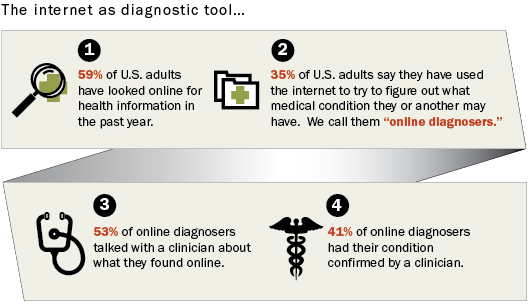
2 Summary of Findings One in three American adults have gone online to figure out a medical condition Thirty-five percent of U.S. adults say that at one time or another they have gone online specifically to try to figure out what medical condition they or someone else might have. These findings come from a national survey by the Pew Research Center s Internet & American Life Project. Throughout this report, we call those who searched for answers on the internet online diagnosers. When asked if the information found online led them to think they needed the attention of a medical professional, 46% of online diagnosers say that was the case. Thirty-eight percent of online diagnosers say it was something they could take care of at home and 11% say it was both or in-between. When we asked respondents about the accuracy of their initial diagnosis, they reported: 41% of online diagnosers say a medical professional confirmed their diagnosis. An additional 2% say a medical professional partially confirmed it. 35% say they did not visit a clinician to get a professional opinion. 18% say they consulted a medical professional and the clinician either did not agree or offered a different opinion about the condition. 1% say their conversation with a clinician was inconclusive. Women are more likely than men to go online to figure out a possible diagnosis. Other groups that have a high likelihood of doing so include younger people, white adults, those who live in households earning $75,000 or more, and those with a college degree or advanced degrees. It is important to note what these findings mean and what they don t mean. Historically, people have always tried to answer their health questions at home and made personal choices about whether and when to consult a clinician. Many have now added the internet to their personal health toolbox, helping themselves and their loved ones better understand what might be ailing them. This study was not designed to determine whether the internet has had a good or bad influence on health care. It measures the scope, but not the outcome, of this activity. Clinicians are a central resource for information or support during serious health episodes and the care and conversation take place mostly offline To try to capture a focused picture of people s health information search and information-assessment strategies, we asked respondents to think about the last time they had a serious health issue and to whom they turned for help, either online or offline: 2

3 70% of U.S. adults got information, care, or support from a doctor or other health care professional. 60% of adults got information or support from friends and family. 24% of adults got information or support from others who have the same health condition. The vast majority of this care and conversation took place offline, but a small group of people did communicate with each of these sources online. And, since a majority of adults consult the internet when they have health questions, these communications with clinicians, family, and fellow patients joined the stream of information flowing in. Eight in 10 online health inquiries start at a search engine Looking more broadly at the online landscape, 72% of internet users say they looked online for health information of one kind or another within the past year. This includes searches related to serious conditions, general information searches, and searches for minor health problems. For brevity s sake, we will refer to this group as online health seekers. When asked to think about the last time they hunted for health or medical information, 77% of online health seekers say they began at a search engine such as Google, Bing, or Yahoo. Another 13% say they began at a site that specializes in health information, like WebMD. Just 2% say they started their research at a more general site like Wikipedia and an additional 1% say they started at a social network site like Facebook. Half of health information searches are on behalf of someone else When asked to think about the last time they went online for health or medical information, 39% of online health seekers say they looked for information related to their own situation. Another 39% say they looked for information related to someone else s health or medical situation. An additional 15% of these internet users say they were looking both on their own and someone else s behalf. One in four people seeking health information online have hit a pay wall Twenty-six percent of internet users who look online for health information say they have been asked to pay for access to something they wanted to see online. Of those who have been asked to pay, just 2% say they did so. Fully 83% of those who hit a pay wall say they tried to find the same information somewhere else. Thirteen percent of those who hit a pay wall say they just gave up. The social life of health information is a low-key but steady presence in American life In past surveys, the Pew Internet Project has not defined a time period for health activities online. This time, the phrase in the past 12 months was added to help focus respondents on recent episodes. We 3

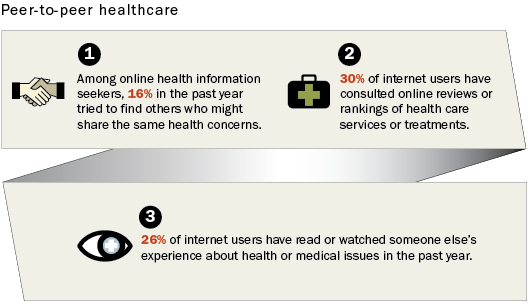
4 find once again that there is a social life of health information, as well as peer-to-peer support, as people exchange stories about their own health issues to help each other understand what might lie ahead: 26% say they read or watched someone else s experience about health or medical issues in the last 12 months. 16% of internet users say they went online in the last year to find others who might share the same health concerns. Health-related reviews and rankings continue to be used by only a modest group of consumers. About one in five internet users have consulted online reviews of particular drugs or medical treatments, doctors or other providers, and hospitals or medical facilities. And just 3-4% of internet users have posted online reviews of health care services or providers. 4

5 About this study The results reported here come from a nationwide survey of 3,014 adults living in the United States. Telephone interviews were conducted by landline (1,808) and cell phone (1,206, including 624 without a landline phone). The survey was conducted by Princeton Survey Research Associates International. Interviews were done in English and Spanish by Princeton Data Source from August 7 to September 6, Statistical results are weighted to correct known demographic discrepancies. The margin of sampling error for the complete set of weighted data is ±2.4 percentage points. The Pew Internet & American Life Project is an initiative of the Pew Research Center, a nonprofit fact tank that provides information on the issues, attitudes and trends shaping America and the world. The Project is nonpartisan and takes no position on policy issues. Support for the Project is provided by the Pew Charitable Trusts. Support for this study was provided by the California HealthCare Foundation, an independent philanthropy committed to improving the way health care is delivered and financed in California. 5

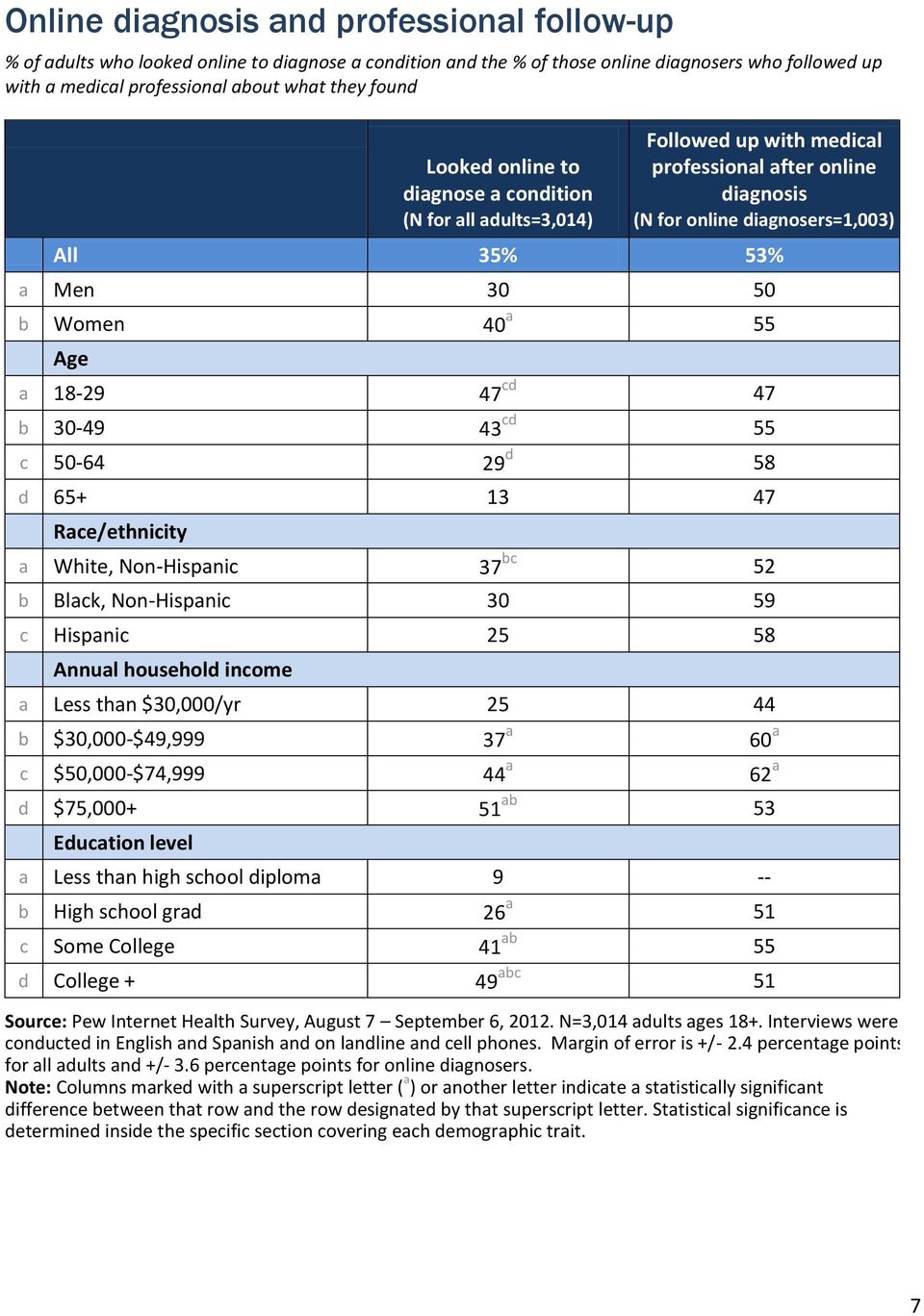
6 Part One: Information triage For one-third of U.S. adults, the internet is a diagnostic tool As of September 2012, 81% of U.S. adults use the internet and, of those, 72% say they have looked online for health information in the past year. Since online personal diagnosis is a scenario that has intrigued observers for years and caused some anxiety about people s ability to navigate the online information landscape the Pew Research Center s Internet & American Life Project explored it in some depth in its most recent health survey. Of those who have looked online for health information, 59% say they have ever gone online specifically to try to figure out what medical condition they or someone else might have. That translates to 35% of U.S. adults. Women are more likely than men to go online to figure out a possible diagnosis. Other groups that have a high likelihood of doing so include younger people, white adults, those in the highest income bracket, and those with more education (see the table below for details). The following analysis is based on questions asked only of that 35% of the population who answered that they have gone online to figure out what they or someone else might have. We will refer to them as online diagnosers. First, online diagnosers were asked if the information they found online led them to think that this was a condition that needed the attention of a doctor or other medical professional, or that it was perhaps something they could take care of at home: 46% of online diagnosers say that the condition needed the attention of a doctor; 38% say it could be taken care of at home; and 11% said it was either both or in-between. Fifty-three percent of online diagnosers say they talked with a medical professional about what they found online, 46% did not (see table below for details). Separately, we asked if a medical professional confirmed what they thought the condition was and found that: 41% of online diagnosers say yes, a medical professional confirmed their suspicions. An additional 2% say a medical professional partially confirmed them. 35% say they did not visit a clinician to get a professional opinion. 18% say a medical professional either did not agree or offered a different opinion about the condition. 1% say their conversation with a clinician was inconclusive the professional was unable to diagnose what they had. 6

7 Online diagnosis and professional follow-up % of adults who looked online to diagnose a condition and the % of those online diagnosers who followed up with a medical professional about what they found Looked online to diagnose a condition (N for all adults=3,014) Followed up with medical professional after online diagnosis (N for online diagnosers=1,003) All 35% 53% a Men b Women 40 a 55 Age a cd 47 b cd 55 c d 58 d Race/ethnicity a White, Non-Hispanic 37 bc 52 b Black, Non-Hispanic c Hispanic Annual household income a Less than $30,000/yr b $30,000-$49, a 60 a c $50,000-$74, a 62 a d $75, ab 53 Education level a Less than high school diploma 9 -- b High school grad 26 a 51 c Some College 41 ab 55 d College + 49 abc 51 Source: Pew Internet Health Survey, August 7 September 6, N=3,014 adults ages 18+. Interviews were conducted in English and Spanish and on landline and cell phones. Margin of error is +/- 2.4 percentage points for all adults and +/- 3.6 percentage points for online diagnosers. Note: Columns marked with a superscript letter ( a ) or another letter indicate a statistically significant difference between that row and the row designated by that superscript letter. Statistical significance is determined inside the specific section covering each demographic trait. 7
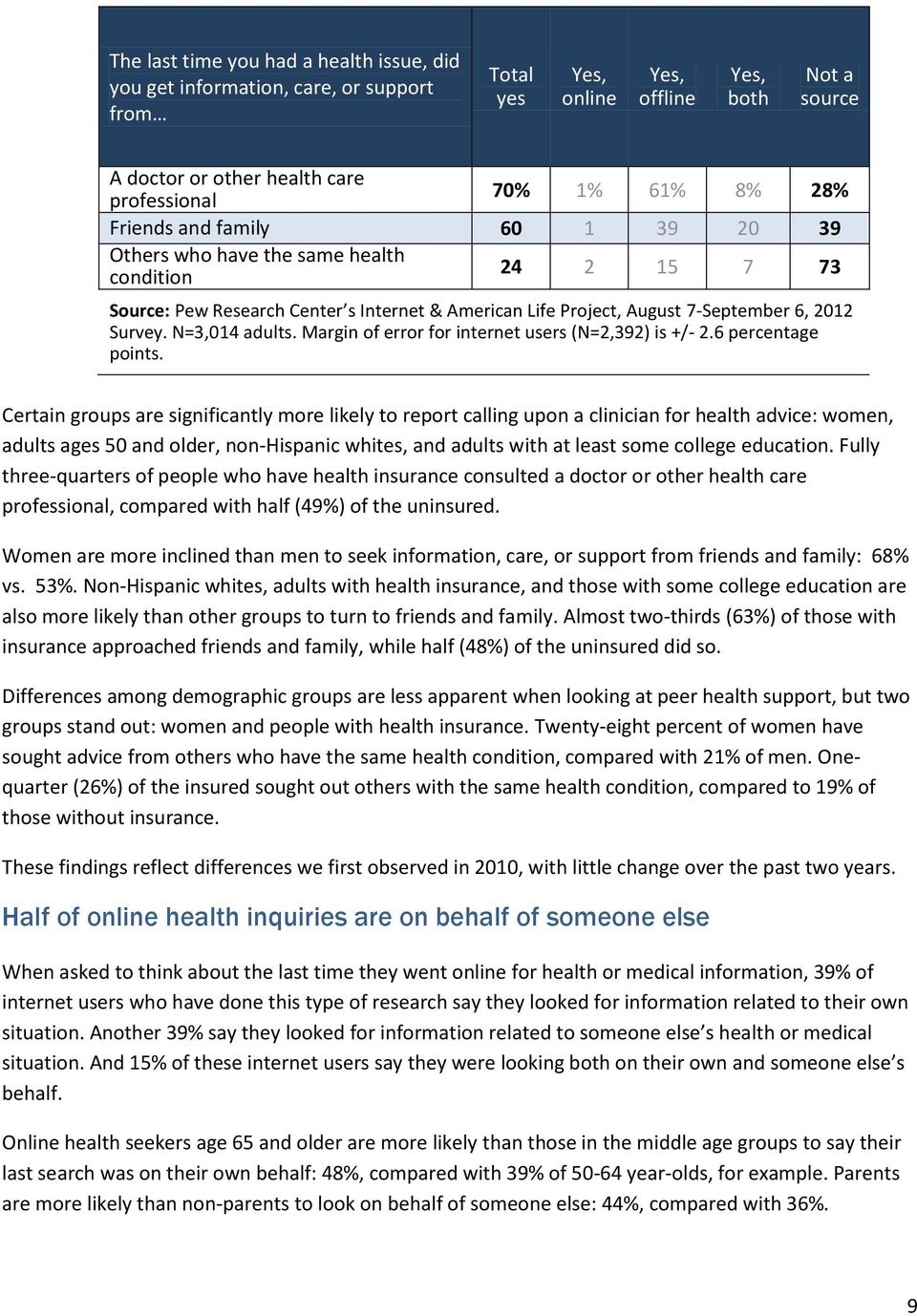
8 There is no statistically significant difference between those who have health insurance and those who do not when it comes to using the internet to figure out an illness. It is important to note what these findings mean and what they don t mean. Historically, people have always tried to answer their health questions at home and made personal choices about whether and when to consult a clinician. Many have now added the internet to their personal health toolbox, helping themselves and their loved ones better understand what might be ailing them. This study was not designed to determine whether the internet has had a good or bad influence on health care. It measures the scope, but not the outcome, of this activity. Eight in ten online health inquiries start at a search engine Again, 72% of internet users say they looked online for health information within the past year. For brevity s sake, we will refer to this group as online health seekers. When asked to think about the last time they did so, 77% of online health seekers say they began at a search engine such as Google, Bing, or Yahoo. Another 13% say they began at a site that specializes in health information, like WebMD. Just 2% say they started their research at a more general site like Wikipedia and an additional 1% say they started at a social network site like Facebook. Using a search engine is somewhat associated with being younger. For example, 82% of online health seekers age years old say they used Google, Bing, Yahoo, or another search engine, compared with 73% of those ages 50 and older. Overall, this pattern matches what we found in our very first health survey, conducted in 2000, when just half of U.S. adults had internet access. Then, as now, eight in ten online health seekers started at a general search engine when looking online for health or medical information. Clinicians are a central resource for information or support during serious health episodes and the care and conversation take place mostly offline To try to capture an accurate picture of people s health information seeking strategies, we asked respondents to think about the last time they had a serious health issue and to whom they turned for help: 70% of U.S. adults got information, care, or support from a doctor or other health care professional. 60% of adults got information or support from friends and family. 24% of adults got information or support from others who have the same health condition. The vast majority of this care and conversation took place offline (see table below). 8

9 The last time you had a health issue, did you get information, care, or support from Total yes Yes, online Yes, offline Yes, both Not a source A doctor or other health care professional 70% 1% 61% 8% 28% Friends and family Others who have the same health condition Source: Pew Research Center s Internet & American Life Project, August 7-September 6, 2012 Survey. N=3,014 adults. Margin of error for internet users (N=2,392) is +/- 2.6 percentage points. Certain groups are significantly more likely to report calling upon a clinician for health advice: women, adults ages 50 and older, non-hispanic whites, and adults with at least some college education. Fully three-quarters of people who have health insurance consulted a doctor or other health care professional, compared with half (49%) of the uninsured. Women are more inclined than men to seek information, care, or support from friends and family: 68% vs. 53%. Non-Hispanic whites, adults with health insurance, and those with some college education are also more likely than other groups to turn to friends and family. Almost two-thirds (63%) of those with insurance approached friends and family, while half (48%) of the uninsured did so. Differences among demographic groups are less apparent when looking at peer health support, but two groups stand out: women and people with health insurance. Twenty-eight percent of women have sought advice from others who have the same health condition, compared with 21% of men. Onequarter (26%) of the insured sought out others with the same health condition, compared to 19% of those without insurance. These findings reflect differences we first observed in 2010, with little change over the past two years. Half of online health inquiries are on behalf of someone else When asked to think about the last time they went online for health or medical information, 39% of internet users who have done this type of research say they looked for information related to their own situation. Another 39% say they looked for information related to someone else s health or medical situation. And 15% of these internet users say they were looking both on their own and someone else s behalf. Online health seekers age 65 and older are more likely than those in the middle age groups to say their last search was on their own behalf: 48%, compared with 39% of year-olds, for example. Parents are more likely than non-parents to look on behalf of someone else: 44%, compared with 36%. 9
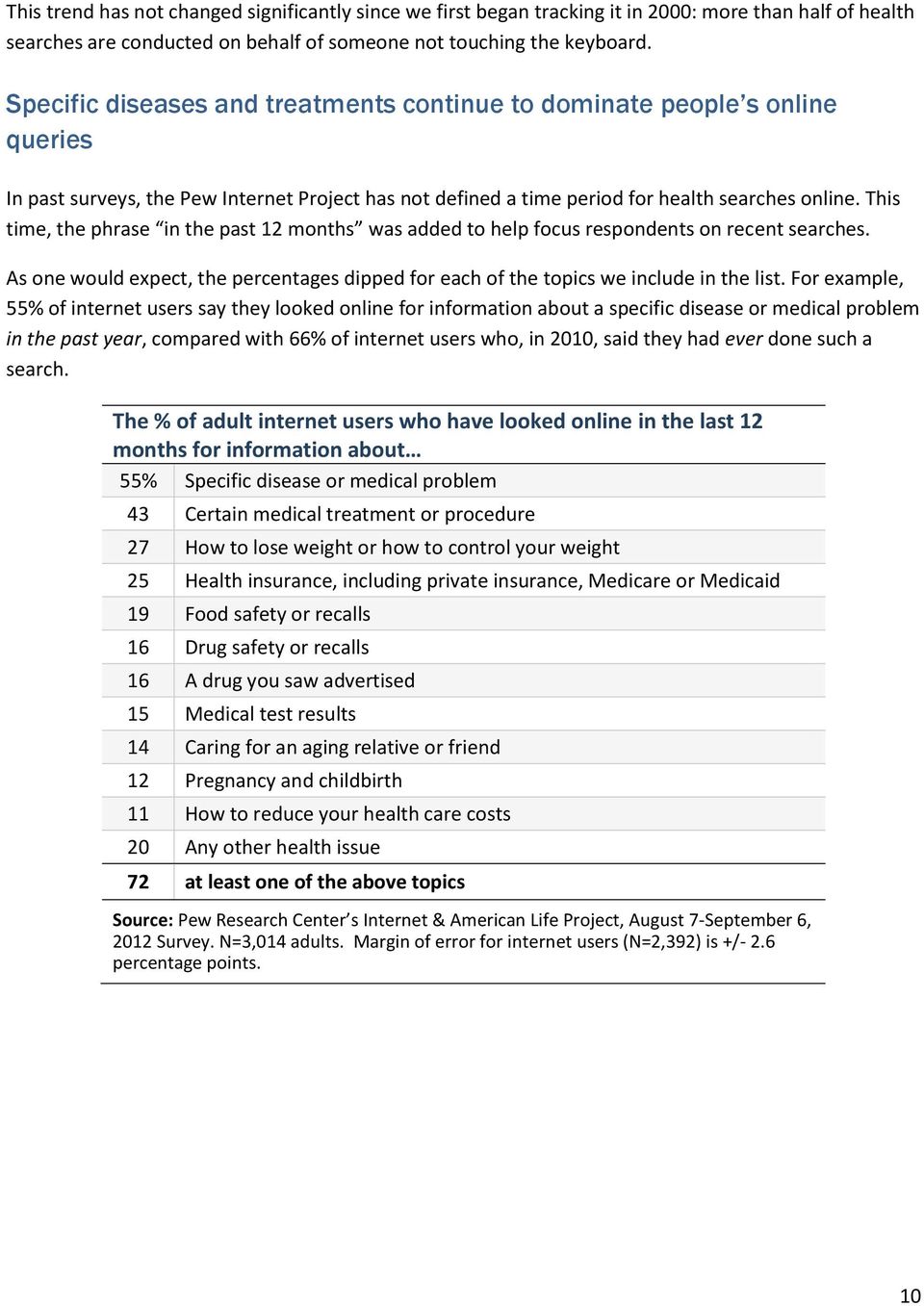
10 This trend has not changed significantly since we first began tracking it in 2000: more than half of health searches are conducted on behalf of someone not touching the keyboard. Specific diseases and treatments continue to dominate people s online queries In past surveys, the Pew Internet Project has not defined a time period for health searches online. This time, the phrase in the past 12 months was added to help focus respondents on recent searches. As one would expect, the percentages dipped for each of the topics we include in the list. For example, 55% of internet users say they looked online for information about a specific disease or medical problem in the past year, compared with 66% of internet users who, in 2010, said they had ever done such a search. The % of adult internet users who have looked online in the last 12 months for information about 55% Specific disease or medical problem 43 Certain medical treatment or procedure 27 How to lose weight or how to control your weight 25 Health insurance, including private insurance, Medicare or Medicaid 19 Food safety or recalls 16 Drug safety or recalls 16 A drug you saw advertised 15 Medical test results 14 Caring for an aging relative or friend 12 Pregnancy and childbirth 11 How to reduce your health care costs 20 Any other health issue 72 at least one of the above topics Source: Pew Research Center s Internet & American Life Project, August 7-September 6, 2012 Survey. N=3,014 adults. Margin of error for internet users (N=2,392) is +/- 2.6 percentage points. 10
11 Women are more likely than men to seek health information online, as are internet users with higher levels of education: Sex Education level Health topic All internet users Men Women Some high school High school grad Some college College grad Specific disease or medical problem Certain medical treatment or procedure N=2,392 N=1,084 N=1,308 N=107 N=574 N=656 N=1,046 (a) (b) (a) (b) (c) (d) a ab 67 abc a a 45 ab 52 abc How to lose weight or how to control your weight a b 32 b Health insurance, including private insurance, Medicare b 32 ab or Medicaid Food safety or recalls b Drug safety or recalls a ab A drug you saw advertised a 17 a Medical test results ab 23 abc Caring for an aging relative or friend ab Pregnancy and childbirth b 12 How to reduce your health care costs b Any other health issue a ab 25 ab At least one of the above topics a ab 81 abc Source: Pew Research Center s Internet & American Life Project, August 7-September 6, 2012 Survey. N=3,014 adults and the margin of error is +/- 2.6 percentage points for internet users. Margins of error for sub-populations are higher. Note: Columns marked with a superscript letter ( a ) or another letter indicate a statistically significant difference between that row and the row designated by that superscript letter. Statistical significance is determined inside the specific section covering each demographic trait. 11

12 There are only four significant differences among white, African American, and Latino internet users when it comes to health topics: specific diseases, weight control, a drug seen in advertising, and pregnancy. Differences among age groups are a much more mixed bag of topics. Race/ethnicity Age Health topic All internet users White Black Latino Specific disease or medical problem Certain medical treatment or procedure How to lose weight or how to control your weight Health insurance, including private insurance, Medicare or Medicaid N=2,392 N=1,531 N=348 N=314 N=454 N=759 N=668 N=463 (a) (b) (c) (a) (b) (c) (d) bc d 59 d 59 d ad 44 d a 35 a 32 cd 32 cd 21 d d Food safety or recalls acd Drug safety or recalls d 20 d 17 d 8 A drug you saw advertised a d 11 Medical test results ad 10 Caring for an aging relative or friend d 15 d 8 Pregnancy and childbirth a 25 bcd 13 cd 2 - How to reduce your health care costs d 13 d 11 d 5 Any other health issue ad 22 d 14 At least one of the above topics d 75 d 71 d 58 Source: Pew Research Center s Internet & American Life Project, August 7-September 6, 2012 Survey. N=3,014 adults and the margin of error is +/- 2.6 percentage points for internet users. Margins of error for sub-populations are higher. Note: Columns marked with a superscript letter ( a ) or another letter indicate a statistically significant difference between that row and the row designated by that superscript letter. Statistical significance is determined inside the specific section covering each demographic trait. Internet users with health insurance are significantly more likely than those without health insurance to research certain topics, such as a specific disease or treatment. Other topics, such as food and drug 12

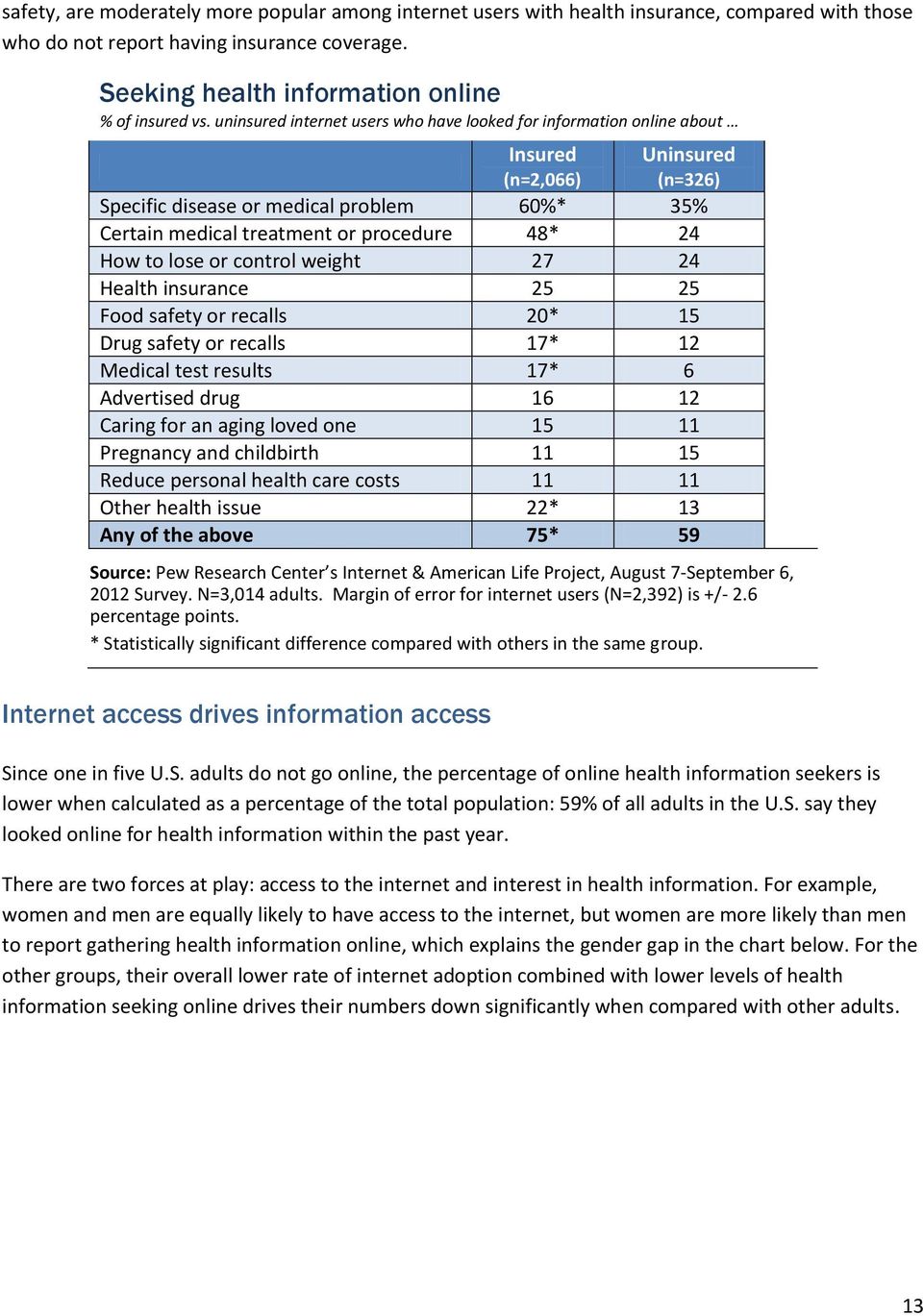
13 safety, are moderately more popular among internet users with health insurance, compared with those who do not report having insurance coverage. Seeking health information online % of insured vs. uninsured internet users who have looked for information online about Insured (n=2,066) Uninsured (n=326) Specific disease or medical problem 60%* 35% Certain medical treatment or procedure 48* 24 How to lose or control weight Health insurance Food safety or recalls 20* 15 Drug safety or recalls 17* 12 Medical test results 17* 6 Advertised drug Caring for an aging loved one Pregnancy and childbirth Reduce personal health care costs Other health issue 22* 13 Any of the above 75* 59 Source: Pew Research Center s Internet & American Life Project, August 7-September 6, 2012 Survey. N=3,014 adults. Margin of error for internet users (N=2,392) is +/- 2.6 percentage points. * Statistically significant difference compared with others in the same group. Internet access drives information access Since one in five U.S. adults do not go online, the percentage of online health information seekers is lower when calculated as a percentage of the total population: 59% of all adults in the U.S. say they looked online for health information within the past year. There are two forces at play: access to the internet and interest in health information. For example, women and men are equally likely to have access to the internet, but women are more likely than men to report gathering health information online, which explains the gender gap in the chart below. For the other groups, their overall lower rate of internet adoption combined with lower levels of health information seeking online drives their numbers down significantly when compared with other adults. 13
14 Looking online for health information: demographics % of adults who go online % of internet users who look online for health information % of all adults who look online for health information Total 81% 72% 59% Gender a Male b Female a 64 a Race a White 83 bc bc b African American c Latino Age a bcd 76 d 72 cd b cd 75 d 67 cd c d 71 d 54 d d Education a Some high school b High school 72 a a c Some college 90 ab 74 ab 67 ab d College graduate 96 abc 81 abc 78 abc Household income a < $30, b $30,000 - $49, a a c $50,000 - $74, ab 81 ab 77 ab d $75, ab 80 ab 78 ab Source: Pew Research Center s Internet & American Life Project, August 7-September 6, 2012 Survey. N=3,014 adults and the margin of error is +/- 2.4 percentage points for the full sample. Margins of error for sub-populations are higher. Note: Columns marked with a superscript letter ( a ) or another letter indicate a statistically significant difference between that row and the row designated by that superscript letter. Statistical significance is determined inside the specific section covering each demographic trait. (See the Appendix for more detailed information on specific health topics.) 14

15 Younger adults and minorities lead the way with mobile health information search Some 85% of U.S. adults own a cell phone and, of those, 31% say they have used their phone to look for health or medical information online. Some groups are more likely than others to look for health information on their phones: Latinos, African Americans, those between the ages of 18 and 49, and those who have attended at least some college education. Mobile health information: demographics % of cell phone owners within each group who use their phones to look for health or medical information online All cell phone owners (n=2,581) 31% a Men (n=1,163) 29 b Women (n=1,418) 33 Age a (n=451) 42 cd b (n=770) 39 cd c (n=710) 19 d d 65+ (n=599) 9 Race/ethnicity a White, Non-Hispanic (n=1,586) 27 b Black, Non-Hispanic (n=434) 35 a c Hispanic (n=351) 38 a Annual household income a Less than $30,000/yr (n=690) 28 b $30,000-$49,999 (n=456) 30 c $50,000-$74,999 (n=345) 37 a d $75,000+ (n=646) 37 a Education level a No high school diploma (n=187) 17 b High school grad (n=681) 26 a c Some College (n=679) 33 ab d College + (n=1020) 38 ab Source: Pew Internet/CHCF Health Survey, August 7-September 6, N=3,014 adults ages 18+. Interviews were conducted in English and Spanish, on landline and cell phones. Margin of error is +/- 2.6 percentage points for results based on cell phone owners. Note: Columns marked with a superscript letter ( a ) or another letter indicate a statistically significant difference between that row and the row designated by that superscript letter. Statistical significance is determined inside the specific section covering each demographic trait. 15

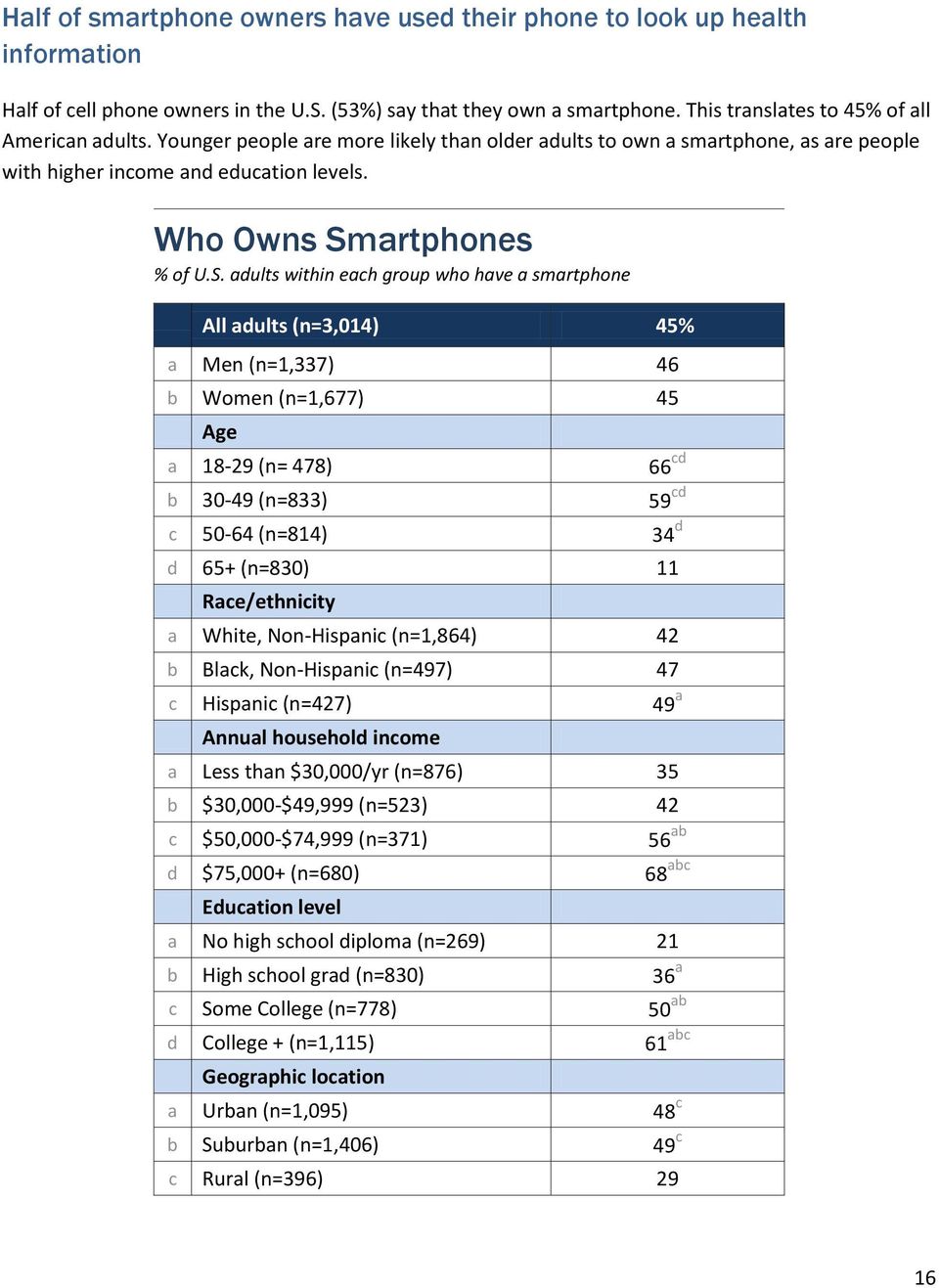
16 Half of smartphone owners have used their phone to look up health information Half of cell phone owners in the U.S. (53%) say that they own a smartphone. This translates to 45% of all American adults. Younger people are more likely than older adults to own a smartphone, as are people with higher income and education levels. Who Owns Smartphones % of U.S. adults within each group who have a smartphone All adults (n=3,014) 45% a Men (n=1,337) 46 b Women (n=1,677) 45 Age a (n= 478) 66 cd b (n=833) 59 cd c (n=814) 34 d d 65+ (n=830) 11 Race/ethnicity a White, Non-Hispanic (n=1,864) 42 b Black, Non-Hispanic (n=497) 47 c Hispanic (n=427) 49 a Annual household income a Less than $30,000/yr (n=876) 35 b $30,000-$49,999 (n=523) 42 c $50,000-$74,999 (n=371) 56 ab d $75,000+ (n=680) 68 abc Education level a No high school diploma (n=269) 21 b High school grad (n=830) 36 a c Some College (n=778) 50 ab d College + (n=1,115) 61 abc Geographic location a Urban (n=1,095) 48 c b Suburban (n=1,406) 49 c c Rural (n=396) 29 16
17 Source: Pew Internet/CHCF Health Survey, August 7-September 6, N=3,014 adults ages 18+. Interviews were conducted in English and Spanish, on landline and cell phones. Margin of error is +/- 2 percentage points for results based on all adults. Note: Columns marked with a superscript letter ( a ) or another letter indicate a statistically significant difference between that row and the row designated by that superscript letter. Statistical significance is determined inside the specific section covering each demographic trait. Fifty-two percent of smartphone owners have looked up health information on their phone, compared with just 6% of other cell phone owners. A person s likelihood to use his or her cell phone to look for health information is amplified by each of the characteristics identified in the tables above: relative youthfulness, having a higher level of education, living in a higher-income household, being Latino, being African American and owning a smartphone. Each of these observations holds true under statistical analysis isolating each factor. In other words, it is not just that smartphone owners are likely to be younger than other American adults and both groups are likely to use their phones to look up health information. Each characteristic has an independent effect on mobile health information consumption. One in four people seeking health information online have hit a pay wall Twenty-six percent of internet users who look online for health information say they have been asked to pay for access to something they wanted to see online. Seventy-three percent say they have not faced this choice while seeking health or medical information online. Of those who have been asked to pay, just 2% say they did so. Fully 83% of those who hit a pay wall say they tried to find the same information somewhere else. Thirteen percent of those who hit a pay wall say they just gave up. Men, women, people of all ages and education levels were equally likely to report hitting a pay wall when looking for health information. Respondents living in lower-income households were significantly more likely than their wealthier counterparts to say they gave up at that point. Wealthier respondents were the likeliest group to say they tried to find the same information elsewhere. No income group was more likely to say they paid the fee. 17

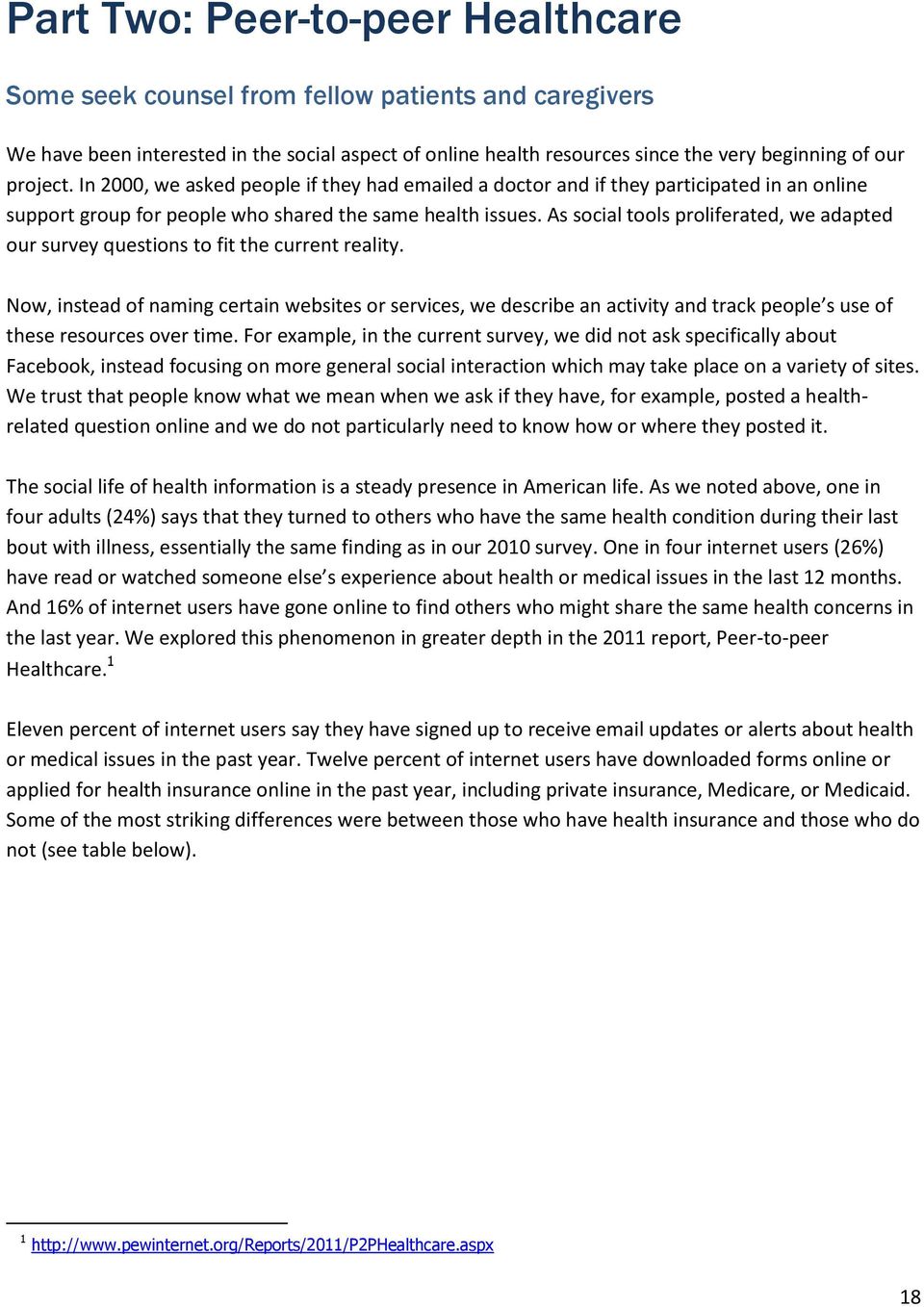
18 Part Two: Peer-to-peer Healthcare Some seek counsel from fellow patients and caregivers We have been interested in the social aspect of online health resources since the very beginning of our project. In 2000, we asked people if they had ed a doctor and if they participated in an online support group for people who shared the same health issues. As social tools proliferated, we adapted our survey questions to fit the current reality. Now, instead of naming certain websites or services, we describe an activity and track people s use of these resources over time. For example, in the current survey, we did not ask specifically about Facebook, instead focusing on more general social interaction which may take place on a variety of sites. We trust that people know what we mean when we ask if they have, for example, posted a healthrelated question online and we do not particularly need to know how or where they posted it. The social life of health information is a steady presence in American life. As we noted above, one in four adults (24%) says that they turned to others who have the same health condition during their last bout with illness, essentially the same finding as in our 2010 survey. One in four internet users (26%) have read or watched someone else s experience about health or medical issues in the last 12 months. And 16% of internet users have gone online to find others who might share the same health concerns in the last year. We explored this phenomenon in greater depth in the 2011 report, Peer-to-peer Healthcare. 1 Eleven percent of internet users say they have signed up to receive updates or alerts about health or medical issues in the past year. Twelve percent of internet users have downloaded forms online or applied for health insurance online in the past year, including private insurance, Medicare, or Medicaid. Some of the most striking differences were between those who have health insurance and those who do not (see table below)
19 Online health activities, by insurance status % of insured vs. uninsured internet users who have gone online in the past year to. Insured (n=2,601) Uninsured (n=413) Read/watch someone else s health or medical experience online 22%* 17% Find others who might have similar health concerns Download forms online or applied for health insurance online 10* 6 Receive any updates or alerts about health or medical issues 9* 6 Any of the above 33* 26 Source: Pew Research Center s Internet & American Life Project, August 7-September 6, 2012 Survey. N=3,014 adults and the margin of error is +/- 2.6 percentage points for internet users. *Statistically significant difference between groups. Eight percent of internet users say they have, in the past 12 months, posted a health-related question online or shared their own personal health experience online in any way. Of those: 40% say they posted comments or stories about personal health experiences 19% say they posted specific health questions 38% say they posted both In addition, 78% of those who posted a comment, story, or question about their health say that they did so to reach a general audience of friends or other internet users. Eleven percent say they posted somewhere specifically to get feedback from a health professional. Four percent replied that they posted for both a general and a professional audience and 5% said neither of those choices fit. Health care reviews have not caught on among general consumers The Pew Internet Project has tracked the use of online consumer reviews since 2000 and it has always ranked among the most popular activities in the commercial realm: 8 in 10 internet users say they have researched a product or service online. By contrast, only about one in five internet users have consulted online reviews and rankings of health care service providers and treatments. When it comes to writing reviews of general-interest items, 37% of internet users say they have rated a product, service, or person online and 32% have posted a comment or review online about product they bought or service they received. People are much less likely to post a review of a treatment, hospital, or clinician between 3-4% of internet users have done so. The results for health-related reviews are comparable to those we recorded in Consulting online reviews of particular drugs or medical treatments, however, took a noticeable dip in the last two years. Some 18% of internet users do so today, compared to 24% in

20 Reviews and rankings online, % of internet users who consulted or posted online reviews or rankings for the following health-related subjects 2010 (n=2,065) 2012 (n=2,392) Consulted online reviews of particular drugs or medical treatments 24%* 18% Consulted online ranking or reviews of doctors or other providers Consulted online rankings or reviews of hospitals or medical facilities Posted a review online of a doctor 4 4 Posted a review online of a hospital 3 3 Posted your experiences with a particular drug or medical treatment online 4 3 Source: Pew Research Center s Internet & American Life Project. Margins of error are +/- 2.6 percentage points for internet users. * Statistically significant difference between years. Internet users between the ages of years old are the most likely group to say they have consulted online reviews and rankings of health treatments and services. Suburban internet users are more likely than rural internet users to consult online health care reviews. Consulting reviews and rankings online, by age % of internet users within each age group who consulted online reviews or rankings for the following health-related subjects drugs or medical treatments doctors or other health care providers hospitals or other medical facilities Source: Pew Research Center s Internet & American Life Project, August 7-September 6, 2012 Survey. N=3,014 adults and the margin of error is +/- 2.6 percentage points for internet users. 20

21 Consulting reviews and rankings online, by urbanity % of internet users within each group who consulted online reviews or rankings for the following health-related subjects Urban Suburban Rural 5 0 drugs or medical treatments doctors or other health care providers hospitals or other medical facilities Source: Pew Research Center s Internet & American Life Project, August 7-September 6, 2012 Survey. N=3,014 adults and the margin of error is +/- 2.6 percentage points for internet users. Internet users with higher levels of education were more likely to consult online reviews and rankings than their less-educated counterparts. Those with an annual household income below $30,000 were less likely than all other income brackets to consult or post health-related reviews and rankings online. 21
22 Consulting reviews and rankings online, by education % of internet users within each group who consulted online reviews or rankings for the following health-related subjects No diploma High school grad some college college grad 0 drugs or medical treatments doctors or other health care providers hospitals or other medical facilities Source: Pew Research Center s Internet & American Life Project, August 7-September 6, 2012 Survey. N=3,014 adults and the margin of error is +/- 2.6 percentage points for internet users. 22
23 Consulting reviews and rankings online, by annual household income % of internet users within each group who consulted online reviews or rankings for the following healthrelated subjects <$30,000 $30,000-$49, $50,000-$74,999 $75, drugs or medical treatments doctors or other health care providers hospitals or other medical facilities Source: Pew Research Center s Internet & American Life Project, August 7-September 6, 2012 Survey. N=3,014 adults and the margin of error is +/- 2.6 percentage points for internet users. Posting online health reviews and rankings is comparatively infrequent. Just 7% of internet users have ever posted reviews or rankings on any of the the three health topics we surveyed: drugs and medical treatments, doctors, and hospitals. This translates into 6% of American adults. 23
24 Consulting vs. posting online health reviews and rankings % of internet users who consulted vs. posted online reviews or rankings for the following healthrelated subjects drugs or medical treatments 17 4 doctors Source: Pew Research Center s Internet & American Life Project, August 7-September 6, 2012 Survey. N=3,014 adults and the margin of error is +/- 2.6 percentage points for internet users hospitals Consulted online reviews/rankings Posted online reviews/rankings Unlike consulting online health rankings and reviews, there are no clear demographic trends when it comes to posting. (See Appendix for details.) 24
25 Appendix Additional details about who has searched for specific health topics. Health Topics, by Age % of all adults who have ever looked online for information about various health topics, by age Age All Adults N=3,014 N=478 N=833 N=814 N=830 (a) (b) (c) (d) Specific disease or medical problem d 52 cd 45 d 23 Certain medical treatment or procedure d 43 cd 34 d 19 Health insurance, including private insurance, Medicare or Medicaid cd 25 cd 18 d 10 Pregnancy and childbirth cde 12 de 1 0 Food safety or recalls d 22 de 14 d 7 Drug safety or recalls d 17 d 13 d 4 Medical test results d 14 d 14 d 5 How to lose weight or control your weight de 28 de 16 d 6 How to reduce health care costs 9 10 d 12 d 9 d 3 Caring for an aging relative or friend d 15 d 11 d 4 Drug you saw advertised d 14 d 14 d 6 Any other health issue d 21 d 17 d 8 Source: Pew Internet Health Survey, August 7 September 6, N=3,014 adults ages 18+. Interviews were conducted in English and Spanish and on landline and cell phones. Margin of error is +/- 2.4 percentage points for all adults. Note: Columns marked with a superscript letter ( a ) or another letter indicate a statistically significant difference between that row and the row designated by that superscript letter. Statistical significance is determined inside the specific section covering each demographic trait. 25
26 Health Topics, by Education % of all adults who have ever looked online for information about various health topics, by education level All Adults N=3,014 LT HS N=269 HS N=830 Education Some Coll. N=778 Coll+ N=1,115 (a) (b) (c) (d) Specific disease or medical problem a 52 ab 64 abc Certain medical treatment or procedure a 40 ab 50 abc Health insurance, including private insurance, Medicare or Medicaid ab 30 abc Pregnancy and childbirth ab 11 b Food safety or recalls ab 22 ab Drug safety or recalls a 15 ab 19 ab Medical test results a 13 ab 22 abc How to lose weight or control your weight ab 30 ab How to reduce health care costs ab 13 ab Caring for an aging relative or friend a 13 ab 16 ab Drug you saw advertised a 16 ab 17 ab Any other health issue a 20 ab 24 ab Source: Pew Internet Health Survey, August 7 September 6, N=3,014 adults ages 18+. Interviews were conducted in English and Spanish and on landline and cell phones. Margin of error is +/- 2.4 percentage points for all adults. Note: Columns marked with a superscript letter ( a ) or another letter indicate a statistically significant difference between that row and the row designated by that superscript letter. Statistical significance is determined inside the specific section covering each demographic trait. Additional details about the health insurance landscape in the U.S. Health Insurance Coverage, by Type of Insurance % of Americans who report having the following types of health insurance All adults (n=3,014) Private health insurance offered through an employer or union 51% Medicare 21 Medicaid or some other type of state medical assistance for low-income people 14 Private health insurance paid by the individual 17 Health insurance through any other source, including military or veteran s coverage 12 Total insured 82 Not insured 18 26
27 Source: Pew Research Center s Internet & American Life Project, August 7- September 6, 2012 Survey. N=3,014 adults and the margin of error is +/- 2.4 percentage points for the full sample. Women are more likely to have health insurance than men, along with whites and African-Americans compared to Hispanics. Those with a higher income and level of education are also more likely to have health insurance. Very nearly all adults over 65 have health insurance (99%), mostly due to Medicare. Health insurance coverage, by demographic group % of adults within each group who have health insurance All adults (n=3,014) 82% a Men (n=1,337) 79 b Women (n=1,677) 86 a Age a (n=478) 64 b (n=833) 83 a c (n=814) 86 a d 65+ (n=830) 99 abc Race/ethnicity a White, Non-Hispanic (n=1,864) 87 bc b Black, Non-Hispanic (n=497) 81 c c Hispanic (n=427) 63 Annual household income a Less than $30,000/yr (n=876) 67 b $30,000-$49,999 (n=523) 84 a c $50,000-$74,999 (n=371) 95 ab d $75,000+ (n=680) 96 ab Education level a No high school diploma (n=269) 67 b High school grad (n=830) 78 a c Some College (n=778) 82 a d College + (n=1,115) 94 abc Source: Pew Research Center s Internet & American Life Project, August 7- September 6, 2012 Survey. N=3,014 adults and the margin of error is +/- 2.4 percentage points for the full sample. Margins of error for subpopulations are higher. Note: Columns marked with a superscript letter ( a ) or another letter indicate a statistically significant difference between that row and the row designated by that superscript letter. Statistical significance is determined inside the specific section covering each demographic trait. 27
28 Additional details about those who post reviews online. Posting Online Health Reviews and Rankings % of adults within each group who post online health reviews or rankings All internet users (n=2,392) 7% a Men (n=1,084) 7 b Women (n=1,208) 8 Age a (n=454) 5 b (n=759) 9 ad c (n=668) 8 d d 65+ (n=463) 4 Race/ethnicity a White, non-hispanic (n=1,531) 7 b Black, non-hispanic (n=348) 7 c Hispanic (n=314) 9 Annual household income a Less than $30,000/yr (n=559) 5 b $30,000-$49,999 (n=439) 11 a c $50,000-$74,999 (n=352) 6 d $75,000+ (n=660) 9 a Education Level a No high school diploma (n=107) 4 b High school grad (n=574) 6 c Some college (n=656) 7 d College+ (n=1,046) 9 b Source: Pew Internet Health Survey, August 7 September 6, N=3,014 adults ages 18+. Interviews were conducted in English and Spanish and on landline and cell phones. Margin of error is +/- 2.4 percentage points for all adults. Note: Columns marked with a superscript letter ( a ) or another letter indicate a statistically significant difference between that row and the row designated by that superscript letter. Statistical significance is determined inside the specific section covering each demographic trait. 28
29 Survey questions Health Tracking Survey 2012 Revised Topline 11/27/2012 Data for August 7 September 6, 2012 Princeton Survey Research Associates International for the Pew Research Center s Internet & American Life Project Sample: n=3,014 national adults, age 18 and older, including 1,206 cell phone interviews Interviewing dates: Margin of error is plus or minus 2.4 percentage points for results based on total [n=3,014] Margin of error is plus or minus 2.6 percentage points for results based on internet users [n=2,392] Margin of error is plus or minus 2.6 percentage points for results based on cell phone owners [n=2,581] Margin of error is plus or minus 3.1 percentage points for results based on online health seekers [n=1,741] Margin of error is plus or minus 3.8 percentage points for results based on caregivers [n=1,171] Q1 Overall, how would you rate the quality of life for you and your family today? Would you say it is excellent, very good, good, fair or poor? EXCELLENT VERY GOOD GOOD FAIR POOR DON'T KNOW 2 REFUSED * * 2 For this question and many others throughout the topline, results for Don t know often reflect combined Don t know and Refused percentages. DK and REF are reported separately where available. 29
30 INTUSE Do you use the internet, at least occasionally? EMLOCC Do you send or receive , at least occasionally? INTMOB Do you access the internet on a cell phone, tablet or other mobile handheld device, at least occasionally? 3 USES INTERNET DOES NOT USE INTERNET QL1 Do you have a cell phone... or a Blackberry or iphone or other device that is also a cell phone? 4 YES NO DON T KNOW REFUSED * 0 SMPH Some cell phones are called smartphones because of certain features they have. Is your cell phone a smartphone, such as an iphone, Android, Blackberry or Windows phone, or are you not sure? 5 Based on cell phone owners CURRENT % 53 Yes, smartphone 40 No, not a smartphone 6 Not sure/don t know * Refused [n=2,581] 3 The definition of an internet user varies from survey to survey. From January 2005 thru February 2012, an internet user is someone who uses the internet at least occasionally or sends/receives at least occasionally (two-part definition with question wording Do you use the internet, at least occasionally? OR Do you send or receive , at least occasionally? ). Prior to January 2005, an internet user is someone who goes online to access the internet or to send and receive (question wording Do you ever go online to access the Internet or World Wide Web or to send and receive ? ). 4 Question was asked of landline sample only. Results shown here have been recalculated to include cell phone sample in the "Yes" percentage. In past polls, question was sometimes asked as an independent question and sometimes as an item in a series. In January 2010, question wording was Do you have...a cell phone or a Blackberry or iphone or other handheld device that is also a cell phone. In Dec 2008, Nov 2008, May 2008, January 2005 and Nov , question wording was "Do you happen to have a cell phone?" In August 2008, July 2008 and January 2008, question wording was "Do you have a cell phone, or a Blackberry or other device that is also a cell phone?" In April 2008, Dec 2007, Sept 2007 and April 2006, question wording was Do you have a cell phone? Beginning December 2007, question/item was not asked of the cell phone sample, but results shown here reflect Total combined Landline and cell phone sample. 5 Prior to the current survey, question wording was slightly different: Some cell phones are called smartphones because of certain features they have. Is your cell phone a smartphone or not, or are you not sure? 30
31 CELL1 Please tell me if you ever use your cell phone to do any of the following things. Do you ever use your cell phone to [INSERT ITEMS; ALWAYS ASK a-b FIRST in order; RANDOMIZE c-f]? 6 Based on cell phone owners YES NO DON T KNOW REFUSED a. Send or receive [N=2,581] b. Send or receive text messages c. Take a picture d. Access the internet 7 e. Look for health or medical information online 8 f. Check your bank account balance or do any online banking * * * * * * * * 6 In May 2011, the question was asked of all Form B cell phone owners and Form A cell phone owners who said in CELL7 that they do more than make calls on their phone. The percentages shown here are based on all cell phone users, counting as no Form A cell phone owners who said in CELL7 they use their phones only for making calls. Prior to May 2011, question was asked of all cell phone owners. Prior to January 2010, question wording was Please tell me if you ever use your cell phone or Blackberry or other device to do any of the following things. Do you ever use it to [INSERT ITEM]? In January 2010, question wording was Please tell me if you ever use your cell phone or Blackberry or other handheld device to do any of the following things. Do you ever use it to [INSERT ITEMS]? For January 2010, December 2009, and September 2009, an answer category Cell phone can t do this was available as a volunteered option; No percentages for those trends reflect combined No and Cell phone can t do this results. 7 In December 2007, item wording was Access the internet for news, weather, sports, or other information 8 In April 2012, question was asked of cell phone owners who use the internet or on their cell phone or download apps to their cell phone [N=953]; results are re-percentaged on all cell phone owners. In September 2010, question was a standalone question with the following question wording: Do you ever use your cell phone to look up health or medical information? 9 In April 2012, question was asked of Form A cell phone owners who use the internet or on their cell phone or download apps to their cell phone [N=953]; results are re-percentaged on all Form A cell phone owners. 31
32 Q2 Switching topics... In general, how would you rate your own health excellent, good, only fair, or poor? CURRENT % 28 Excellent 52 Good 16 Only fair 4 Poor * Don t know * Refused 32
33 Q3 Are you now living with any of the following health problems or conditions? First, [INSERT ITEM; RANDOMIZE a-e; ITEM f ALWAYS LAST]? And what about... [INSERT ITEM]? [IF NECESSARY: Are you now living with [INSERT ITEM]?] YES NO DON T KNOW REFUSED a. Diabetes or sugar diabetes b. High blood pressure c. Asthma, bronchitis, emphysema, or other lung conditions d. Heart disease, heart failure or heart attack e. Cancer f. Any other chronic health problem or condition I haven t already mentioned * * * * * 7 92 * * 3 96 * * * * Q4 In the last 12 months, have you personally...[insert ITEMS IN ORDER]? a. Faced a serious medical emergency or crisis 10 b. Gone to the emergency room or been hospitalized unexpectedly YES NO DON T KNOW REFUSED * * * * 10 In September 2010, question was asked as a standalone question. For December 2008 and earlier, trend question wording was: And in the last 12 months, have you or has someone close to you faced a serious medical emergency or crisis? 33
34 c. Experienced any significant change in your physical health, such as gaining or losing a lot of weight, becoming pregnant, or quitting smoking * * Q5 Thinking about the LAST time you had a serious health issue or experienced any significant change in your physical health... Did you get information, care or support from... [INSERT ITEM; RANDOMIZE]? [IF YES AND INTERNET USER: Did you interact with them ONLINE through the internet or , OFFLINE by visiting them in person or talking on the phone, or BOTH online and offline?] 12 a. A doctor or other health care professional YES, ONLINE YES, OFFLINE YES, BOTH NO, NOT A SOURCE DON T KNOW REFUSED b. Friends and family c. Others who have the same health condition * In September 2010, question was asked as a standalone question with the following question wording: And in the last 12 months, have you experienced any other significant change in your physical health, such as gaining or losing a lot of weight, becoming pregnant, or quitting smoking? 12 September 2010 question wording was slightly different: Thinking about the LAST time you had a health issue, did you get information, care or support from [INSERT; RANDOMIZE]? [IF YES AND INTERNET USER: Did you interact with them ONLINE through the internet or , OFFLINE by visiting them in person or talking on the phone, or BOTH online and offline?] 34
35 [READ TO ALL:] On another topic... CARE2 In the past 12 months, have you provided UNPAID care to an adult relative or friend 18 years or older to help them take care of themselves? Unpaid care may include help with personal needs or household chores. It might be managing a person s finances, arranging for outside services, or visiting regularly to see how they are doing. This person need not live with you. [IF R ASKS IF GIVING MONEY COUNTS, ASK:] Aside from giving money, do you provide any other type of unpaid care to help them take care of themselves, such as help with personal needs, household chores, arranging for outside services, or other things? CURRENT % 36 Yes 64 No * Don t know * Refused CARE3 Do you provide this type of care to just one adult, or do you care for more than one adult? Based on those who provide unpaid care to adults CURRENT % 66 One adult only 34 Provide care to multiple adults * Don t know * Refused [n=1,085] 35
36 CARE4 [ASK IF PROVIDE UNPAID CARE TO ONE ADULT:] Is this person your parent or your mother-in-law or father-in-law, or not? 13 CARE5 [ASK IF PROVIDE UNPAID CARE TO MULTIPLE ADULTS, DON T KNOW OR REFUSED:] Are any of the adults you care for your parent or your mother-in-law or father-in-law, or not? 14 Based on those who provide unpaid care to adults CURRENT % 47 Yes, parent or mother-in-law/father-in-law 53 No, not a parent or mother-in-law/father-in-law * Don t know * Refused [n=1,085] CARE6 In the past 12 months, have you provided UNPAID care to any CHILD under the age of 18 because of a medical, behavioral, or other condition or disability? This could include care for ongoing medical conditions or serious short-term conditions, emotional or behavioral problems, or developmental problems, including mental retardation. CURRENT % 8 Yes 92 No * Don t know * Refused 13 September 2010 question wording was slightly different: Is this person a parent of yours, or not? 14 September 2010 question wording was slightly different: Are any of the adults you care for a parent of yours, or not? 36
37 Q6 Now, we d like to know if you ve looked for information ONLINE about certain health or medical issues, either for yourself or someone else. Specifically, in the last 12 months, have you looked online for information about... [INSERT FIRST ITEM; ASK a-b FIRST IN ORDER THEN RANDOMIZE c-k; ITEM L ALWAYS LAST]? In the last 12 months, have you looked online for information about... [INSERT NEXT ITEM]? 15 Based on all internet users [N=2,392] YES, HAVE DONE THIS NO, HAVE NOT DONE THIS DON T KNOW REFUSED a. A specific disease or medical problem b. A certain medical treatment or procedure c. Health insurance, including private insurance, Medicare or Medicaid d. Pregnancy and childbirth e. Food safety or recalls f. Drug safety or recalls g. Medical test results h. How to lose weight or how to control your weight i. How to reduce your health care costs * * * * * * * * * * * * * * * * * 15 Prior to the current survey, question wording was: Now, we d like to ask if you ve looked for information ONLINE about certain health or medical issues. Specifically, have you ever looked online for [INSERT ITEM]? List of items may vary from survey to survey. The phrase in the last 12 months was added in the 2012 survey. 37
38 YES, HAVE DONE THIS NO, HAVE NOT DONE THIS DON T KNOW REFUSED j. Caring for an aging relative or friend k. A drug you saw advertised l. Any other health issue * * * * * * Total yes to any item above Total no to all items Q7 Thinking about the LAST time you went online for health or medical information... Did you go online to look for information related to YOUR OWN health or medical situation or SOMEONE ELSE S health or medical situation? Based on online health seekers CURRENT % 39 Own 39 Someone else s 15 Both (VOL.) 3 Don t know 3 Refused [n=1,741] 38
39 Q8 Still thinking about the LAST time you went online to look for health information... How did you begin looking? Did you start... [READ 1-4 IN ORDER] Based on online health seekers [N=1,741] CURRENT % 77 At a search engine such as Google, Bing or Yahoo 13 At a site that specializes in health information, like WebMD 2 At a more general site like Wikipedia, that contains information on all kinds of topics, OR 1 At a social network site like Facebook? 3 (VOL.) Other (SPECIFY) 2 (VOL.) Don t know 2 (VOL.) Refused There is no Question Q9. 39
40 Q10 When looking for health information online, have you ever been asked to PAY for access to something you wanted to see on the internet? Based on online health seekers [N=1,741] CURRENT % 26 Yes 73 No 1 Don t know * Refused Q11 The last time you were asked to PAY to access health content online, what did you do? Did you... [READ 1-3; READ CATEGORIES IN REVERSE ORDER FOR HALF THE SAMPLE] Based on online health seekers who have been asked to pay for health content online [N=456] CURRENT % 2 Pay for access 83 Try to find the same information somewhere else 13 Give up 1 (VOL.) Other * (VOL.) Don t know * (VOL.) Refused Q12 Have you ever gone online specifically to try to figure out what medical condition you or someone else might have? Based on online health seekers [N=1,741] CURRENT % 59 Yes 40 No * Don t know * Refused 40
41 Q13 Did the information you found online lead you to think that this was a condition that needed the attention of a doctor or other medical professional, or that it was something you could take care of at home? Based on online health seekers who have gone online to figure out what medical condition they or someone else might have [N=1,003] CURRENT % 46 Needed attention of doctor 38 Could take care of at home 11 Both/in-between (VOL.) 4 Don t know 1 Refused Q14 Did you happen to talk with a medical professional about what you found online? Based on online health seekers who have gone online to figure out what medical condition they or someone else might have [N=1,003] CURRENT % 53 Yes 46 No 1 Don t know 1 Refused Q15 Did a medical professional confirm what you thought the condition was with a medical diagnosis, did they offer a different medical opinion or diagnosis, or did you not visit a doctor or other medical professional for a diagnosis? Based on online health seekers who have gone online to figure out what medical condition they or someone else might have [N=1,003] CURRENT % 41 Yes, confirmed 18 No, did not confirm/offered different diagnosis 35 Did not visit a doctor or medical professional for a diagnosis 2 Confirmed part but not all of R s diagnosis (VOL.) 1 Medical professional was unable to diagnose (VOL.) 1 Don t know 1 Refused 41
42 Q16 Apart from looking for information online, there are many different activities related to health and medical issues a person might do on the internet. I m going to read a list of online health-related activities you may or may not have done in the last 12 months. Just tell me if you happened to do each one, or not. (First,) in the last 12 months, have you... [INSERT ITEM; RANDOMIZE]? In the last 12 months, have you...[insert ITEM]? a. Signed up to receive updates or alerts about health or medical issues internet users [N=2,392] b. Read or watched someone else's commentary or personal experience about health or medical issues online internet users c. Gone online to find others who might have health concerns similar to yours internet users d. Downloaded forms online or applied for health insurance online, including private insurance, Medicare, or Medicaid internet users YES NO DON T KNOW REFUSED * * * * * * * 0 Q17 Still thinking just about the last 12 months, have you posted a health-related question online or shared your own personal health experience online in any way? Based on all internet users [N=2,392] CURRENT % 8 Yes 92 No * Don t know 0 Refused 42
43 Q18 And what was it that you posted or shared online? Was it a specific QUESTION about your health, a COMMENT or STORY about your personal health experience, or BOTH a question and a comment? Based on internet users who have posted about a health topic or shared a health experience online [N=173] CURRENT % 19 Specific health question 40 Comments/Stories about personal health experiences 38 Both 2 Neither/Something else (VOL.) 1 Don t know 0 Refused Q19 And the LAST time you posted or shared health material online, did you post it somewhere specifically to get feedback from a health professional, or did you post it somewhere it would be read by a more general audience of friends or other internet users? Based on internet users who have posted about a health topic or shared a health experience online [N=173] CURRENT % 11 Health professional 78 More general audience 4 Both (VOL.) 5 Neither/Something else (VOL.) 1 Don t know 0 Refused 43
44 Q20 Thinking again about health-related activities you may or may not do online, have you... [INSERT ITEM; RANDOMIZE]? (Next,) have you...[insert ITEM]? 16 a. Consulted online rankings or reviews of doctors or other providers 17 internet users [N=2,392] b. Consulted online rankings or reviews of hospitals or other medical facilities 18 internet users c. Consulted online reviews of particular drugs or medical treatments internet users YES NO DON T KNOW REFUSED * * * * d. Posted a review online of a doctor internet users e. Posted a review online of a hospital internet users f. Posted your experiences with a particular drug or medical treatment online internet users * * 3 97 * 0 16 question was asked of all internet users. September 2010 trend question was also asked of all internet users, with items asked in rotated order. December 2008 trend question was asked of online health seekers, with the following question wording: There are many different activities related to health and medical issues a person might do on the internet. I m going to read a list of things you may or may not have ever done online related to health and medical issues. Just tell me if you happened to do each one, or not. Have you [INSERT ITEM; ROTATE]? 17 December 2008 trend item wording was Consulted rankings or reviews online of doctors or other providers 18 December 2008 trend item wording was Consulted rankings or reviews online of hospitals or other medical facilities 44
45 [READ TO CELL PHONE OWNERS:] Now thinking about how you might use your cell phone to help manage your health... Q21 Do you receive any TEXT updates or alerts about health or medical issues, such as from your doctors or pharmacists? Based on cell phone owners who text message [N=1,896] CURRENT % 9 Yes 91 No * Don t know * Refused Q22 On your cell phone, do you happen to have any software applications or apps that help you track or manage your health, or not? Based on cell phone owners CURRENT % 11 Yes 88 No 1 Don t know * Refused [n=2,581] 45
46 Q23 What kind of health apps do you currently have on your phone? [IF NECESSARY, CLARIFY: What health issue or topic do your apps deal with?] [DO NOT READ; PRECODED OPEN-END] Based on those who have health apps on their cell phone [N=254] CURRENT % 38 Exercise, fitness, pedometer or heart rate monitoring (includes specific types of exercise like running, ab workouts, yoga, etc.) 31 Diet, food, calorie counter 12 Weight 7 Period or menstrual cycle 5 Blood pressure 4 WebMD 3 Pregnancy 2 Blood sugar or diabetes 2 Medication management (tracking, alerts, etc.) * Mood * Sleep 14 Other (SPECIFY) 6 Don t know * Refused Note: Total may exceed 100% due to multiple responses. 46
47 [READ TO ALL:] A few last questions for statistical purposes only... INS1 Now I would like to ask you about any health insurance you CURRENTLY have that helps pay for the cost of health care. I m going to read a list of a few types of health insurance, and I d like you to tell me which of these you have, if any. (First,) are you now PERSONALLY covered by [INSERT ITEMS IN ORDER]? [IF RESPONDENT NOT SURE WHICH INSURANCE IS INCLUDED: Please think about insurance plans that cover the costs of doctor and hospital bills IN GENERAL, and NOT those that cover ONLY dental or eye care or the costs of caring for specific diseases.] [IF RESPONDENTS TRY TO TELL TYPE THEY HAVE INSTEAD OF GOING THROUGH THE LIST: I m sorry but I have to ask about each type of insurance for the survey. Just tell me no if you don t have this type.] INS2 a. Private health insurance offered through an employer or union [IF NO : This could be insurance through a current job, a former job, your job or someone else s job.] b. A private health insurance plan that you bought yourself c. Medicaid, [IF STATE CALIFORNIA: Medi-Cal], or some other type of state medical assistance for low-income people d. Medicare, the government program that pays health care bills for people over age 65 and for some disabled people Item E: Based on those who are not insured through private health insurance, Medicaid, or Medicare [N=526] e. Health insurance through ANY other source, including military or veteran s coverage YES NO DON T KNOW REFUSED * * * 1 Medicare is health insurance coverage most people receive when they turn 65 and are eligible for Social Security. This includes different kinds of health plans offered THROUGH the Medicare program like the plans called H-M-Os. Are you now covered by Medicare or by ANY Medicare plan? Based on those age 65 and older who are not covered by Medicare [N=82] CURRENT % 38 Yes, covered 56 No, not covered 3 Don t know 3 Refused 47
48 INS3 Does this mean you personally have NO health insurance now that would cover your doctor or hospital bills? Based on those who are not covered by any health insurance or are undesignated [N=450] CURRENT % 91 I do NOT have health insurance 7 I HAVE some kind of health insurance 1 Don t know 2 Refused SUMMARY OF INSURANCE STATUS (BASED ON INS1, INS2, INS3) CURRENT % 82 Insured 18 Not insured The remaining demographic questions are not reported in this topline. 48
49 Methodology Summary The 2012 Health Survey, sponsored by the Pew Research Center s Internet & American Life Project and the California HealthCare Foundation, obtained telephone interviews with a nationally representative sample of 3,014 adults living in the United States. Telephone interviews were conducted by landline (1,808) and cell phone (1,206, including 624 without a landline phone). The survey was conducted by Princeton Survey Research Associates International. Interviews were done in English and Spanish by Princeton Data Source from August 7 to September 6, Statistical results are weighted to correct known demographic discrepancies. The margin of sampling error for the complete set of weighted data is ±2.4 percentage points. DESIGN AND DATA COLLECTION PROCEDURES Sample Design A combination of landline and cell random digit dial (RDD) samples was used to reach a representative sample of all adults the United States who have access to either a landline or cellular telephone. Both samples were disproportionately-stratified to increase the incidence of African-American and Hispanic respondents. Within strata, phone numbers were drawn with equal probabilities. The landline samples were list-assisted and drawn from active blocks containing three or more residential listing while the cell samples were not list-assisted, but were drawn through a systematic sampling from dedicated wireless 100-blocks and shared service 100-blocks with no directory-listed landline numbers. Contact Procedures Interviews were conducted from August 7 to September 6, As many as 7 attempts were made to contact every sampled telephone number. Sample was released for interviewing in replicates, which are representative subsamples of the larger sample. Using replicates to control the release of sample ensures that complete call procedures are followed for the entire sample. Calls were staggered over times of day and days of the week to maximize the chance of making contact with potential respondents. Each phone number received at least one daytime call. For the landline sample, interviewers asked to speak with either the youngest male or youngest female currently at home based on a random rotation. If no male/female was available at the time of the call, interviewers asked to speak with the youngest adult of the opposite sex. This systematic respondent selection technique has been shown to produce samples that closely mirror the population in terms of age and gender when combined with cell sample. For the cell sample, interviews were attempted with the person who answered the phone. Interviewers first verified that the person was and adult and in a safe place before continuing with the interview. WEIGHTING AND ANALYSIS Weighting is generally used in survey analysis to adjust for effects of the sample design and to compensate for patterns of nonresponse that might bias results. The weighting was accomplished in 49
50 multiple stages to account for the disproportionately-stratified sample, the overlapping landline and cell sample frames and differential non-response associated with sample demographics. The first-stage of weighting compensated for the disproportionate sample design. This adjustment (called SAMPWT in the dataset) was computed by dividing the proportion of the population from each stratum by the proportion of sample drawn from the stratum. The landline and cell samples were drawn using the same relative sampling fractions within strata so the. Table 1 shows the SAMPWT values by strata. Table 1. SAMPWT by Stratum Strata Population Dist'n Sample Dist'n SAMPWT % 4.1% % 3.4% % 3.7% % 3.6% % 8.1% % 10.2% % 11.1% % 17.4% % 17.8% % 20.5% 0.53 The second stage of weighting corrected for different probabilities of selection based on the number of adults in each household and each respondents telephone use (i.e., whether the respondent has access to a landline, to a cell phone or to both types of phone). The second-stage weight can be expressed as: LL i CP S LL S CP R =1 if respondent has a landline phone and =0 if respondent has no landline phone =1 if respondent has a cell phone and =0 if respondent has no cell phone the size of the landline sample the size of the cell sample the estimated ratio of the size of the landline sample frame to the size of the cell 50
51 sample frame. For this survey R=0.55. Both adjustments were incorporated into a first-stage weight that was used as an input weight for poststratification. The data was raked to match sample distributions to population parameters. The African- American and White/Other samples were raked to match parameters for sex by age, sex by education, age by education and region. Hispanics were raked to match population parameters for sex by age, sex by education, age by education and region. In addition, the Hispanic group was raked to a nativity parameter. The combined data was then raked to match population parameters for sex by age, sex by education, age by education, region, household phone use and population density. The white, non-hispanic subgroup was also balanced by age, education and region. The telephone usage parameter was derived from an analysis of recently available National Health Interview Survey data 19. The population density parameter is county-based and was derived from Census 2000 data. All other weighting parameters were derived from the Census Bureau s 2011 Annual Social and Economic Supplement (ASEC). This stage of weighting, which incorporated each respondent's first-stage weight, was accomplished using Sample Balancing, a special iterative sample weighting program that simultaneously balances the distributions of all variables using a statistical technique called the Deming Algorithm. The raking corrects for differential non-response that is related to particular demographic characteristics of the sample. This weight ensures that the demographic characteristics of the sample closely approximate the demographic characteristics of the population. Table 2 compares full sample weighted and unweighted sample demographics to population parameters. 19 Blumberg SJ, Luke JV. Wireless substitution: Early release of estimates from the National Health Interview Survey, July-December, National Center for Health Statistics. June
52 Table 2. Sample Demographics Parameter Unweighted Weighted Gender Male Female Age Education (changed) Less than HS Graduate HS Graduate Some College/Assoc Degree College Graduate Race/Ethnicity White/not Hispanic Black/not Hispanic Hisp - US born Hisp - born outside Other/not Hispanic Region Northeast Midwest South West (continued ) Table 2. Sample Demographics ( continued) County Pop. Density 1 - Lowest Highest
53 Household Phone Use LLO Dual - few,some cell Dual - most cell CPO Effects of Sample Design on Statistical Inference Post-data collection statistical adjustments require analysis procedures that reflect departures from simple random sampling. PSRAI calculates the effects of these design features so that an appropriate adjustment can be incorporated into tests of statistical significance when using these data. The so-called "design effect" or deff represents the loss in statistical efficiency that results from a disproportionate sample design and systematic non-response. The total sample design effect for this survey is PSRAI calculates the composite design effect for a sample of size n, with each case having a weight, w i as: n 2 nwi i1 deff formula 1 n 2 i1 w i 53
54 In a wide range of situations, the adjusted standard error of a statistic should be calculated by multiplying the usual formula by the square root of the design effect ( deff ). Thus, the formula for computing the 95% confidence interval around a percentage is: pˆ(1 pˆ) pˆ deff 1.96 formula 2 n where pˆ is the sample estimate and n is the unweighted number of sample cases in the group being considered. The survey s margin of error is the largest 95% confidence interval for any estimated proportion based on the total sample the one around 50%. For example, the margin of error for the entire sample is ±2.4 percentage points. This means that in 95 out of every 100 samples drawn using the same methodology, estimated proportions based on the entire sample will be no more than 2.4 percentage points away from their true values in the population. It is important to remember that sampling fluctuations are only one possible source of error in a survey estimate. Other sources, such as respondent selection bias, question wording and reporting inaccuracy may contribute additional error of greater or lesser magnitude. Table 3 shows design effects and margins of error for key subgroups. Table 3. Design Effects and Margins of Sampling Error Sample Size Design Effect Margin of Error Total Sample 3, percentage points White, not Hispanic 1, percentage points African American, not Hispanic percentage points Hispanic percentage points 54
55 RESPONSE RATE Table 4 reports the disposition of all sampled telephone numbers ever dialed from the original telephone number samples. The response rate estimates the fraction of all eligible sample that was ultimately interviewed. 20 Table 4. Sample Disposition Landline Cell I=Completes R=Refusal and breakoff NC=Non contact O=Other OF=Business/computer/not working/child's cell phone UH/UO=Unknown household/unknown other AAPOR's e=(i+r+nc+o)/(i+r+nc+o+of) 11.5% 6.6% AAPOR RR3=I/[I+R+NC+O+(e*UH/UO)] 20 The sample disposition codes and reporting are consistent with the American Association for Public Opinion Research standards. 55
51% of U.S. Adults Bank Online
 www.pewresearch.org AUGUST 7, 2013 51% of U.S. Adults Bank Online 32% of adults transact bank business on their mobile phones Susannah Fox Associate Director, Pew Internet Project http://pewinternet.org/reports/2013/online-banking.aspx
Cell Phone Activities 2013
 www.pewresearch.org SEPTEMBER 16, 2013 Cell Phone Activities 2013 50% of cell owners download apps to their phones; 48% listen to music services; video calling has tripled since 2011; texting remains a
Family Caregivers are Wired for Health
 JUNE 20, 2013 Family Caregivers are Wired for Health 39% of U.S. adults provide care for a loved one, up from 30% in 2010, and many navigate health care with the help of technology Susannah Fox Associate
The Demographics of Social Media Users 2012
 www.pewresearch.org FEBRUARY 14, 2013 The Demographics of Social Media Users 2012 Young adults are more likely than older adults to use social media. Women, African- Americans, and Latinos show high interest
BY Aaron Smith NUMBERS, FACTS AND TRENDS SHAPING THE WORLD FOR RELEASE NOVEMBER 19, 2015 FOR FURTHER INFORMATION ON THIS REPORT:
 NUMBERS, FACTS AND TRENDS SHAPING THE WORLD FOR RELEASE NOVEMBER 19, 2015 BY Aaron Smith FOR FURTHER INFORMATION ON THIS REPORT: Aaron Smith, Associate Director, Research Dana Page, Senior Communications
Photo and Video Sharing Grow Online
 www.pewresearch.org OCTOBER 28, 2013 Photo and Video Sharing Grow Online More internet users are using photos and videos as a social currency: 54% of internet users have posted original photos or videos
35% of those ages 16 and older own tablet computers
 www.pewresearch.org OCTOBER 18, 2013 35% of those ages 16 and older own tablet computers Up from 25% last year more than half of those in households earning $75,000 or more now have tablets 24% own e-book
17% of cell phone owners do most of their online browsing on their phone, rather than a computer or other device
 JUNE 26, 2012 17% of cell phone owners do most of their online browsing on their phone, rather than a computer or other device Most do so for convenience, but for some their phone is their only option
Health Topics. 80% of internet users look for health information online. http://pewinternet.org/reports/2011/healthtopics.aspx
 Health Topics 80% of internet users look for health information online Susannah Fox, Associate Director February 1, 2011 http://pewinternet.org/reports/2011/healthtopics.aspx Pew Research Center s Internet
Americans and their cell phones
 Americans and their cell phones Mobile devices help people solve problems and stave off boredom, but create some new challenges and annoyances Aaron Smith, Senior Research Specialist 8/15/2011 http://pewinternet.org/reports/2011/cell-phones.aspx
NUMBERS, FACTS AND TRENDS SHAPING THE WORLD JANUARY 09, 2015 FOR FURTHER INFORMATION ON THIS REPORT:
 NUMBERS, FACTS AND TRENDS SHAPING THE WORLD JANUARY 09, 2015 FOR FURTHER INFORMATION ON THIS REPORT: Maeve Duggan, Research Analyst, Pew Research Center Nicole B. Ellison, Associate Professor, University
Teens and Technology 2013
 MARCH 13, 2013 Teens and Technology 2013 Smartphone adoption among teens has increased substantially and mobile access to the internet is pervasive. One in four teens are cell-mostly internet users, who
How Americans Value Public Libraries in Their Communities
 NUMBERS, FACTS AND TRENDS SHAPING THE WORLD FOR RELEASE DECEMBER 11, 2013 How Americans Value Public Libraries in Their Communities 54% of Americans have used a public library in the past year, and 72%
Social Media Usage: 2005-2015
 NUMBERS, FACTS AND TRENDS SHAPING THE WORLD OCTOBER 8, 2015 Social Media Usage: 2005-2015 65% of adults now use social networking sites a nearly tenfold jump in the past decade BY Andrew Perrin FOR FURTHER
Online Video 2013. Kristen Purcell Associate Director for Research, Pew Internet Project. www.pewresearch.org OCTOBER 10, 2013
 www.pewresearch.org OCTOBER 10, 2013 Online Video 2013 Over the past four years, the percent of American adult internet users who upload or post videos online has doubled from 14% in 2009 to 31% today.
72% of Online Adults are Social Networking Site Users
 www.pewresearch.org AUGUST 5, 2013 72% of Online Adults are Social Networking Site Users Social networking sites remain most popular among young adults, but other age groups continue to increase their
71% of online adults now use video sharing sites
 71% of online adults now use video sharing sites Kathleen Moore, Pew Internet Project 7/25/2011 http://pewinternet.org/reports/2011/video sharing sites.aspx Pew Research Center 1615 L St., NW Suite 700
Privacy and Data Management on Mobile Devices
 SEPTEMBER 5, 2012 Privacy and Data Management on Mobile Devices More than half of app users have uninstalled or avoided an app due to concerns about personal information Jan Lauren Boyles Research Intern,
BY Maeve Duggan NUMBERS, FACTS AND TRENDS SHAPING THE WORLD FOR RELEASE AUGUST 19, 2015 FOR FURTHER INFORMATION ON THIS REPORT:
 NUMBERS, FACTS AND TRENDS SHAPING THE WORLD FOR RELEASE AUGUST 19, 2015 BY Maeve Duggan FOR FURTHER INFORMATION ON THIS REPORT: Maeve Duggan, Research Associate Dana Page, Senior Communications Manager
Social Media and Political Engagement
 OCTOBER 19, 2012 Social Media and Political Engagement 66% of social media users have employed the platforms to post their thoughts about civic and political issues, react to others postings, press friends
Location-Based Services
 www.pewresearch.org SEPTEMBER 12, 2013 Location-Based Services Location tagging on social media is up: 30% of social media users now tag their posts with their location. For mobile location services, 74%
Latinos and Digital Technology, 2010
 February 9, 2011 Latinos and Digital Technology, 2010 FOR FURTHER INFORMATION CONTACT: Gretchen Livingston, Senior Researcher, 1615 L St, N.W., Suite 700 Washington, D.C. 20036 Tel(202) 419-3600 Fax (202)
NUMBERS, FACTS AND TRENDS SHAPING THE WORLD APRIL 3, 2014 FOR FURTHER INFORMATION ON THIS REPORT: Aaron Smith, Senior Researcher
 NUMBERS, FACTS AND TRENDS SHAPING THE WORLD APRIL 3, 2014 FOR FURTHER INFORMATION ON THIS REPORT: Aaron Smith, Senior Researcher 202.419.4500 RECOMMENDED CITATION: Pew Research Center, April 2014, Older
PEW INTERNET PROJECT DATA MEMO
 PEW INTERNET PROJECT DATA MEMO BY: Amanda Lenhart, Senior Research Specialist, Sydney Jones, Research Assistant & Alexandra Rankin Macgill RE: Adults and video games DATE: Sunday, December 7, 2008 Over
1 PEW RESEARCH CENTER
 1 FOR RELEASE October, 29, 2015 BY Monica Anderson FOR FURTHER INFORMATION ON THIS REPORT: Monica Anderson, Research Analyst Lee Rainie, Director Internet, Science and Technology Research Dana Page, Senior
E-reader Ownership Doubles in Six Months
 E-reader Ownership Doubles in Six Months Adoption rate of e-readers surges ahead of tablet computers Kristen Purcell, Associate Director for Research, Pew Internet Project June 27, 2011 Pew Research Center
32 PEW RESEARCH CENTER
 32 Survey Questions Pew Research Center Libraries Survey 2015 Final Topline March 17 April 12, 2015 Fieldwork conducted by Princeton Survey Research Associates International Sample: n=2,004 people ages
BY John B. Horrigan AND Maeve Duggan
 NUMBERS, FACTS AND TRENDS SHAPING THE WORLD FOR RELEASE DECEMBER 21, 2015 BY John B. Horrigan AND Maeve Duggan FOR MEDIA OR OTHER INQUIRIES: John B. Horrigan, Senior Researcher Lee Rainie, Director, Internet,
NUMBERS, FACTS AND TRENDS SHAPING THE WORLD FOR RELEASE APRIL 30, 2014 FOR FURTHER INFORMATION ON THIS REPORT:
 NUMBERS, FACTS AND TRENDS SHAPING THE WORLD FOR RELEASE APRIL 30, 2014 FOR FURTHER INFORMATION ON THIS REPORT: Lee Rainie, Director, Internet Project Maeve Duggan, Research Assistant, Internet Project
NUMBERS, FACTS AND TRENDS SHAPING THE WORLD FOR RELEASE JULY 16, 2015 MEDIA CONTACT FOR THIS REPORT: Dana Page, Communications Manager
 NUMBERS, FACTS AND TRENDS SHAPING THE WORLD FOR RELEASE JULY 16, 2015 MEDIA CONTACT FOR THIS REPORT: Dana Page, Communications Manager 202.419.4372 RECOMMENDED CITATION: Duggan, M., Lenhart, A., Lampe,
6% of Online Adults are reddit Users
 www.pewresearch.org JULY 3, 2013 6% of Online Adults are reddit Users Young men are especially likely to visit the front page of the internet. Maeve Duggan Research Assistant, Pew Internet Project Aaron
Online Product Research
 Online Product Research 58% of Americans have researched a product or service online September 29, 2010 Jim Jansen, Senior Fellow, Pew Internet Project http://pewinternet.org/reports/2010/online-product-research.aspx
Digital differences. Kathryn Zickuhr Research Specialist, Pew Internet. Aaron Smith Senior Research Specialist, Pew Internet
 APRIL 13, 2012 Digital differences While increased internet adoption and the rise of mobile connectivity have reduced many gaps in technology access over the past decade, for some groups digital disparities
Adults and Cell Phone Distractions
 Adults and Cell Phone Distractions Mary Madden, Senior Research Specialist Lee Rainie, Director June 18, 2010 http://pewinternet.org/reports/2010/cell-phone-distractions.aspx Pew Internet & American Life
Internet Access and Use: Does Cell Phone Interviewing make a difference?
 Internet Access and Use: Does Cell Phone Interviewing make a difference? By Evans Witt, Jonathan Best and Lee Rainie A paper prepared for The 2008 Conference of The American Association for Public Opinion
Americans and text messaging
 Americans and text messaging 31% of text message users prefer texting to voice calls, and young adults stand out in their use of text messaging Aaron Smith, Senior Research Specialist 9/19/2011 http://pewinternet.org/reports/2011/cell-phone-texting-2011.aspx
65% of internet users have paid for online content
 65% of internet users have paid for online content Jim Jansen, Senior Fellow 12/30/2010 http:///reports/2010/paying for online content.aspx Pew Research Center s Internet & American Life Project 1615 L
Americans Current Views on Smoking 2013: An AARP Bulletin Survey
 Americans Current Views on Smoking 2013: An AARP Bulletin Survey November 2013 Americans Current Views on Smoking 2013: An AARP Bulletin Survey Report Prepared by Al Hollenbeck, Ph.D. Copyright 2013 AARP
Further Decline in Credibility Ratings for Most News Organizations
 THURSDAY, AUGUST 16, 2012 Further Decline in Credibility Ratings for Most News Organizations FOR FURTHER INFORMATION CONTACT: Andrew Kohut President, Pew Research Center Carroll Doherty and Michael Dimock
Photos and Videos as Social Currency Online
 SEPTEMBER 13, 2012 Photos and Videos as Social Currency Online 46% of internet users post original photos and videos online they have created themselves and 41% curate photos and videos they find elsewhere
Cell Phones in Africa: Communication Lifeline
 NUMBERS, FACTS AND TRENDS SHAPING THE WORLD FOR RELEASE APRIL, 20 Cell Phones in Africa: Communication Lifeline Texting Most Common Activity, but Mobile Money Popular in Several Countries FOR FURTHER INFORMATION
Pearson Student Mobile Device Survey 2015
 Pearson Student Mobile Device Survey 2015 National Report: College Students Report date: Revised June, 2015 Conducted by Harris Poll This report contains public findings Table of Contents Background &
Anonymity, Privacy, and Security Online
 www.pewresearch.org SEPTEMBER 5, 2013 Anonymity, Privacy, and Security Online 86% of adult internet users have taken steps from time to time to avoid surveillance by other people or organizations when
Transforming Health Care: American Attitudes On Shared Stewardship
 Transforming Health Care: American Attitudes On Shared Stewardship An Aspen Institute- Survey Submitted by zogby international may 2008 2008 Report Overview A new Aspen Institute/Zogby interactive survey
2011 Cell Phone Consumer Attitudes Study
 2011 Cell Phone Consumer Attitudes Study Prepared for: CWTA April 29, 2011 Copyright 2009-2012 Quorus Consulting Group Ltd. Table of Contents Executive Summary 3 Research Objectives and Methodology 9 Detailed
Online Dating & Relationships
 www.pewresearch.org OCTOBER 21, 2013 Online Dating & Relationships One in ten Americans have used an online dating site or mobile dating app; 66% of these online daters have gone on a date with someone
Disparities in Individuals Access and Use of Health IT in 2013
 ONC Data Brief No. 26 June 2015 Disparities in Individuals Access and Use of Health IT in 2013 Vaishali Patel, PhD MPH, Wesley Barker, MS, Erin Siminerio, MPH A number of national policies, initiatives
Mobile Broadband in Nevada: Access At Home or On the Go
 March 2013 Without a doubt, cell phones and mobile Internet service have changed the way that people stay in touch and access the web. The Brookings Institute anticipates that by 2015 there will be 3.1
New National Poll Reveals Public Attitudes on Substance Abuse, Treatment and the Prospects of Recovery
 New National Poll Reveals Public Attitudes on Substance Abuse, Treatment and the Prospects of Recovery Finds some significant differences in perceptions among various population groups. Nearly half of
BY Aaron Smith NUMBERS, FACTS AND TRENDS SHAPING THE WORLD FOR RELEASE MARCH 10, 2016 FOR MEDIA OR OTHER INQUIRIES:
 NUMBERS, FACTS AND TRENDS SHAPING THE WORLD FOR RELEASE MARCH 10, 2016 BY Aaron Smith FOR MEDIA OR OTHER INQUIRIES: Aaron Smith, Associate Director, Research Dana Page, Senior Communications Manager 202.419.4372
One Year In: Americans Respond to the Affordable Care Act. With Focus on Women, Millennials, Latinos, and African Americans
 One Year In: Americans Respond to the Affordable Care Act With Focus on Women, Millennials, Latinos, and African Americans January 2015 2014 was a seminal year in the world of health care coverage. With
RECOMMENDED CITATION: Pew Research Center, July, 2015, The Evolving Role of News on Twitter and Facebook
 NUMBERS, FACTS AND TRENDS SHAPING THE WORLD FOR RELEASE July 14, 2015 FOR FURTHER INFORMATION ON THIS REPORT: Amy Mitchell, Director of Journalism Research Dana Page, Communications Manager 202.419.4372
Teens and Mobile Apps Privacy
 AUGUST 22, 2013 Teens and Mobile Apps Privacy 58% of American teens have downloaded an app to a cell phone or tablet. More than half of teen apps users have avoided an app due to concerns about sharing
Information Age Bills Keep Piling Up What Americans Pay For and How
 Information Age Bills Keep Piling Up What Americans Pay For and How FOR IMMEDIATE RELEASE Paul Taylor, Executive Vice President Cary Funk, Senior Researcher April Clark, Research Associate MEDIA INQUIRIES
After Boston, Little Change in Views of Islam and Violence
 MAY 7, 2013 45% Say Muslim Americans Face A Lot of Discrimination After Boston, Little Change in Views of Islam and Violence FOR FURTHER INFORMATION CONTACT THE PEW RESEARCH CENTER FOR THE PEOPLE & THE
Pearson Student Mobile Device Survey 2013
 Pearson Student Mobile Device Survey 2013 National Report: College Students Conducted by Harris Interactive Field dates: January 28 February 24, 2013 Report date: April 17, 2013 Table of Contents Background
Pearson Student Mobile Device Survey 2014
 Pearson Student Mobile Device Survey 2014 National Report: Students in Grades 4-12 Conducted by Harris Poll Field dates: February 13 March 12, 2014 Report date: May 9, 2014 Table of Contents Background
Health Status, Health Insurance, and Medical Services Utilization: 2010 Household Economic Studies
 Health Status, Health Insurance, and Medical Services Utilization: 2010 Household Economic Studies Current Population Reports By Brett O Hara and Kyle Caswell Issued July 2013 P70-133RV INTRODUCTION The
Search Engine Use 2012
 MARCH 9, 2012 Search Engine Use 2012 Even though online Americans are more satisfied than ever with the performance of search engines, strong majorities have negative views of personalized search results
Mixed views of the state s health care system; concerns about the future
 THE FIELD POLL THE INDEPENDENT AND NON-PARTISAN SURVEY OF PUBLIC OPINION ESTABLISHED IN 1947 AS THE CALIFORNIA POLL BY MERVIN FIELD Field Research Corporation 222 Sutter Street, Suite 700 San Francisco,
Awareness of New Jersey s Family Leave Insurance Program Is Low, Even As Public Support Remains High and Need Persists
 NEW JERSEY S FAMILY LEAVE INSURANCE PROGRAM A CENTER FOR WOMEN AND WORK ISSUE BRIEF OCTOBER 2012 Awareness of New Jersey s Family Leave Insurance Program Is Low, Even As Public Support Remains High and
UNINSURED ADULTS IN MAINE, 2013 AND 2014: RATE STAYS STEADY AND BARRIERS TO HEALTH CARE CONTINUE
 UNINSURED ADULTS IN MAINE, 2013 AND 2014: RATE STAYS STEADY AND BARRIERS TO HEALTH CARE CONTINUE December 2015 Beginning in January 2014, the federal Patient Protection and Affordable Care Act (ACA) has
LONG-TERM CARE: The Associated Press-NORC Center for Public Affairs Research. Perceptions, Experiences, and Attitudes among Americans 40 or Older
 The Associated Press-NORC Center for Public Affairs Research Research Highlights LONG-TERM CARE: Perceptions, Experiences, and Attitudes among Americans 40 or Older T. Tompson, J. Benz, J. Agiesta, D.
Data Memo. BY: Associate Director John B. Horrigan (202-419-4500) RE: USE OF CLOUD COMPUTING APPLICATIONS AND SERVICES September 2008
 Data Memo BY: Associate Director John B. Horrigan (202-419-4500) RE: USE OF CLOUD COMPUTING APPLICATIONS AND SERVICES September 2008 Cloud computing takes hold as 69% of all internet users have either
PENNSYLVANIA MALPRACTICE STUDY
 The Project on Medical Liability in Pennsylvania Funded by The Pew Charitable Trusts PENNSYLVANIA MALPRACTICE STUDY General Public Survey Small Business Survey Conducted by Princeton Survey Research Associates,
The margin of error for 805 interviews is ± 3.5%
 HART/McINTURFF Study #9669--page 1 1724 Connecticut Avenue, NW Interviews: 805 adults, including Washington, DC 20009 81 reached by cell phone (202) 234-5570 Date: August 15-17, 2009 FINAL Study #9669
RECOMMENDED CITATION: Pew Research Center, April 2014, America s Changing Drug Policy Landscape
 NUMBERS, FACTS AND TRENDS SHAPING THE WORLD FOR RELEASE APRIL 2, 2014 FOR FURTHER INFORMATION ON THIS REPORT: Carroll Doherty, Director, Political Research Juliana Menasce Horowitz, Senior Researcher Rob
Gauging Family Intimacy Dogs Edge Cats (Dads Trail Both)
 Gauging Family Intimacy Dogs Edge Cats (Dads Trail Both) FOR IMMEDIATE RELEASE MARCH 7, 2006 Paul Taylor, Executive Vice President Cary Funk, Senior Project Director Peyton Craighill, Project Director
The Rise of Apps Culture
 The Rise of Apps Culture 35% of U.S. adults have cell phones with apps, but only 24% of adults actually use them September 15, 2010 Kristen Purcell, Associate Director for Research, Pew Internet Project
Affordable Care Act Consumer Survey
 Affordable Care Act Consumer Survey Survey Findings 2014 The Tax Institute at H&R Block ABOUT THE TAX INSTITUTE AT H&R BLOCK The Tax Institute at H&R Block is the go-to source for objective insights on
NUMBERS, FACTS AND TRENDS SHAPING THE WORLD FOR RELEASE FEBRUARY 27, 2014 FOR FURTHER INFORMATION ON THIS REPORT:
 NUMBERS, FACTS AND TRENDS SHAPING THE WORLD FOR RELEASE FEBRUARY 27, 2014 FOR FURTHER INFORMATION ON THIS REPORT: Susannah Fox, Associate Director, Internet Project Lee Rainie, Director, Internet Project
Part 1. Summary of Findings
 1 Part 1. Summary of Findings 61% of American adults look online for health information. In 2000, 46% of American adults had access to the internet, 5% of U.S. households had broadband connections, and
Social Media & Mobile Internet Use Among Teens and Young Adults
 Social Media & Mobile Internet Use Among Teens and Young Adults By Amanda Lenhart, Kristen Purcell, Aaron Smith and Kathryn Zickuhr http://pewinternet.org/reports/2010/social Media and Young Adults.aspx