
Introduction The basis for ICES The Convention and the Copenhagen Declaration. The ICES organization
|
|
|
- Cecily Willis
- 10 years ago
- Views:
Transcription
1 ICES STRATEGIC PLAN

2 Contents International Council for the Exploration of the Sea Conseil International pour l Exploration de la Mer H. C. Andersens Boulevard DK-1553 Copenhagen V Denmark Telephone (+45) Telefax (+45) [email protected] ISBN: Recommended format for purposes of citation: ICES ICES Strategic Plan pp. Version 1 (December 2013) Introduction The basis for ICES The Convention and the Copenhagen Declaration The ICES organization The science and policy landscape in which ICES operates ICES core values ICES Strategy Pillars, goals, and activities Building a foundation of science Producing the information and advice decision-makers need Underpinning science and advice through data and information services Supporting the organization through the work of the Secretariat Implementation and review of ICES Strategy 18 Unless otherwise stated, the copyright for the content of ICES Strategic Plan is vested in the publisher. Material herein may not be reproduced without written permission from the copyright owners International Council for the Exploration of the Sea Image Credits: p 4, 6, 7, 12, 16, cover image, back page - p 3 - ICES p 14 - NOAA - p 15 - Institute of Marine Research, Norway p 17 - archer10(dennis) - Graphic Designer: Harriet Roth
3 Science for Sustainable Seas Ices Council October 2013 Our VISION To be a world leading scientific organization concerning marine ecosystems and to provide the knowledge to secure the sustainable use of the seas. Our MISSION To advance the scientific understanding of marine ecosystems, and provide information, knowledge, and advice on the sustainable management of human activities affecting, and affected by, marine ecosystems. The International Council for the Exploration of the Sea is a network of scientists, based on an international convention. The work of ICES is facilitated through this network of more than 4000 scientists, from over 350 marine institutes in 20 Member Countries and beyond (with experts coming from 45 countries). The ICES network engages in frequent collaborations with industry stakeholders, and with various inter-governmental, and non-governmental organizations. 2 3
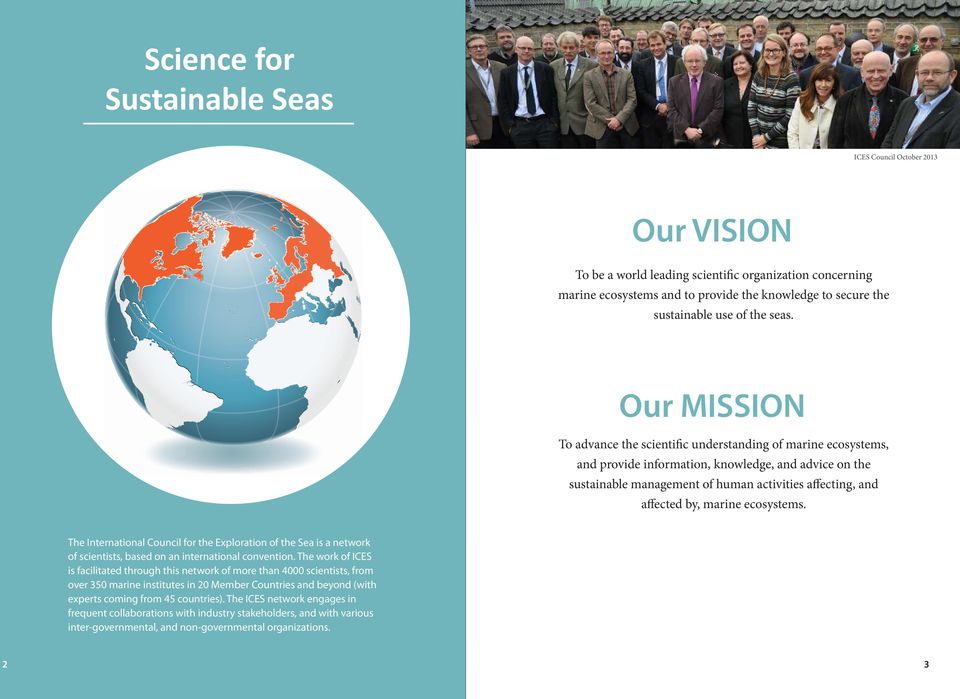
4 Introduction The ICES Strategic Plan ( ) recognizes the changing marine science and policy landscape. By launching this plan ICES offers a strong, competent and open scientific community that can support the sustainable management of the seas*. Implementation of the Strategic Plan will confront the challenges of protecting and restoring the health and productivity of the oceans for the benefit of present and future generations. The ICES Strategic Plan commits to building a foundation of science around one key challenge; integrated ecosystem understanding. ICES will produce integrated ecosystem assessments in regional seas as a fundamental link between ecosystem science and the advice required in applying the ecosystem approach. This will place a high demand on the complexity and the amount of data and knowledge needed to conduct informed science and make decisions. ICES science and advice will be underpinned with data services that deliver increasingly complex data and processes in an efficient and effective way to the users of these data. The ICES advisory process will be based on innovative and relevant science and will produce evidence based advice across industry sectors and components of ecosystems that produce the information and advice decision-makers need. The and Data and Information Services and ensure an efficient and effective organization. ICES has also made a number of strategic choices to further develop its science, advisory, and data work on the Arctic and on aquaculture. ICES will also enhance its Training Programme. A key principle for ICES in developing scientific knowledge is addressing information gaps and needs in a deliberate, well-planned manner to avoid duplication and add value to on-going processes. This is a critical consideration given the present financial and personnel constraints of Member Countries. The important and unique features of ICES are its capability to cover the entire scientific spectrum from monitoring and data provision to research and advice, and its ability to enhance capacity building through capabilities are supported by a formalized, yet highly responsive, organizational structure that strives to ensure the legitimacy and integrity of all work undertaken, and products developed and delivered by ICES. The purpose of this Strategic Plan is to present the direction of ICES in the period in addressing a rapidly changing marine science and policy landscape consistent with the ICES vision and mission. The ICES Strategic Plan will be implemented through the four associated plans for Science, Advice, Data and Information Services, and the Secretariat. ICES will continue its work as an independent marine science organization to formulate, coordinate, and conduct research on oceanic and regional ecosystems, and to provide evidence-based knowledge and advice to support management decision-making. ICES Secretariat will foster the Science, Advisory, outreach and training programmes. These 4 * Throughout the ICES Strategic Plan, reference to the marine also includes related freshwater, estuarine, and coastal ecosystems. 5
5 The basis for ICES The Convention and the Copenhagen Declaration In the Copenhagen Declaration, the Member Countries agreed to; Reaffirm their commitment to maintain ICES as a strong and independent scientific organisation in order to improve its capacity to give unbiased, sound, reliable, and credible scientific advice on human activities affecting and affected by, marine ecosystems; ICES was established in 1902 as an intergovernmental organization. The ICES Convention (1964) and the Copenhagen Declaration (2002), signed by the Contracting Parties (Member Countries of ICES), outline the fundamental purposes of ICES. Endorse the ICES Strategic Plan as a basis for future ICES scientific and advisory work; Stress the need for ICES to develop and promote science-based knowledge of living marine resources and marine ecosystems; The ICES Convention states that the purposes of ICES are: To promote and encourage research and investigations for the study of the sea particularly those related to the living resources thereof; To draw up programmes required for this purpose and to organise, in agreement with the Contracting Parties, such research and investigation as may appear necessary; To publish or otherwise disseminate the results of research and investigations carried out under its auspices or to encourage the publication thereof. Read the full text of the Convention and Copenhagen Declaration here: Stress the need for ICES to strengthen working relationships with users of scientific information on living marine resources and marine ecosystems, including fishery management organisations and environmental commissions, and with stakeholders that are affected by or have an interest in, ICES work, thus requiring that ICES: - apply a quality assurance scheme for its advisory function; - adopt procedures to ensure the full consideration of data from a wide range of stakeholders; - be flexible and timely in providing scientific advice to meet the needs of decisionmakers responsible for the stewardship of living marine resources and marine ecosystems without compromising the quality or reliability of the advice; - ensure that ecosystem considerations, including the effects of human activities and climatic and oceanographic conditions, are taken into account; 6 - frame advice in relation to fisheries management, giving full consideration to the ecosystem context. 7
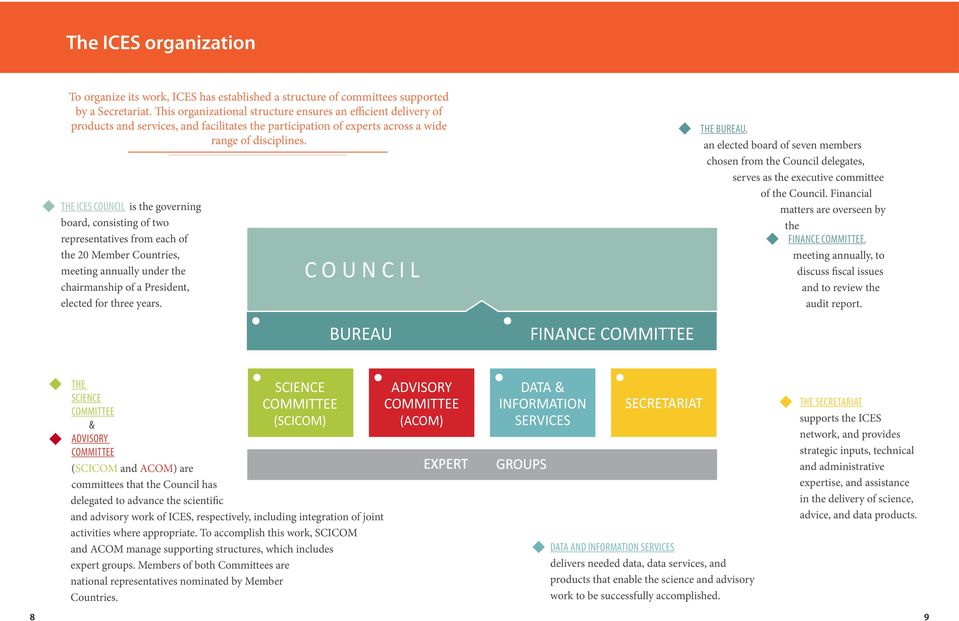
6 The ICES organization To organize its work, ICES has established a structure of committees supported by a Secretariat. This organizational structure ensures an efficient delivery of products and services, and facilitates the participation of experts across a wide range of disciplines. The ICES Council is the governing board, consisting of two representatives from each of the 20 Member Countries, meeting annually under the chairmanship of a President, elected for three years. C O U N C I L The Bureau, an elected board of seven members chosen from the Council delegates, serves as the executive committee of the Council. Financial matters are overseen by the Finance Committee, meeting annually, to discuss fiscal issues and to review the audit report. BUREAU FINANCE COMMITTEE The Science COMMITTEE & Advisory CommitteE (SCICOM and ACOM) are committees that the Council has delegated to advance the scientific SCIENCE COMMITTEE (SCICOM) and advisory work of ICES, respectively, including integration of joint activities where appropriate. To accomplish this work, SCICOM and ACOM manage supporting structures, which includes expert groups. Members of both Committees are national representatives nominated by Member Countries. ADVISORY COMMITTEE (ACOM) EXPERT DATA & INFORMATION SERVICES GROUPS SECRETARIAT Data and Information Services delivers needed data, data services, and products that enable the science and advisory work to be successfully accomplished. The Secretariat supports the ICES network, and provides strategic inputs, technical and administrative expertise, and assistance in the delivery of science, advice, and data products. 8 9
7 The science and policy landscape in which ICES operates ICES operates in a complex and changing science and policy landscape. The diagram below lists some of the organizations and sectors ICES collaborates with. The roles are overlapping and examples listed not exhaustive. The marine science and policy landscape is diverse and dynamic, and is important in establishing and understanding the context in which ICES operates. INTERNATIONAL POLICY DRIVERS E.g. EU, FAO, IOC, UNDP, UNEP INDUSTRY E.g. Aquaculture, fishing, shipping, oil and gas industry stakeholders The policy landscape is framed by intergovernmental agreements and conventions at the global, regional, and national levels. These mandates include United Nations Conventions, Regional Seas Conventions, European Union legislation, as well as bi- or multilateral agreements among ICES Member Countries, national legislation and policies. During the last decade, the landscape has evolved from focusing on separate sectoral issues (such as living resources, energy, and transport) toward the inclusion of more integrated aspects that embrace entire ecosystems. This integration has focused on linkages across sectors and disciplines, and on identifying and evaluating the cumulative pressures of different human activities on marine ecosystems. temporal and spatial scales. Growing expectations are now being placed on oceans to provide food, resources, habitats, and livelihoods; in response, policy makers increasingly recognize the need to address the multiplicity of human pressures on oceans and seas in integrated and coordinated ways. ICES recognizes that its core expertise lies in understanding the productivity of marine ecosystems. This productivity will change in response to many factors, including human pressures, and the impacts of climate change on marine ecosystems, particularly in Arctic and sub-arctic seas. ICES acknowledges the need to respond to the evolution of policy and science needs with ambitious and innovative solutions. Although INTERNATIONAL POLICY DELIVERY E.g. IPCC, CBD, CITES, IPBES, EUROSTAT ICES RECIPIENTS OF ADVICE & REGIONAL PARTNERS E.g. Arctic organizations, EEA, EU, GFCM, HELCOM, ICCAT, OSPAR, Member Countries, NAFO, NAMMCO, NASCO, NEAFC specific CIVIL human activities SOCIETY SCIENCE may have particular NETWORKS effects on the marine E.g. PICES, CIESM, BONUS, SCOR, environment, the study and management IASC, ICSU, universities of the oceans and human activities also requires an inclusive, inter-sectoral approach. Though different challenges confront different oceanic and regional sea areas, ICES possesses the expertise, experience, and creativity to address many of these challenges. E.g. Communication partners/ media, consumer organizations, environmental organizations ICES scientific activities focus on the North Atlantic and adjacent European seas, as well as the Arctic Ocean. The work of ICES is complemented by strategic partnerships e.g. in the North Pacific (with PICES) and in the Mediterranean Sea (with CIESM and GFCM). Well established links to technology and innovation platforms, industry associations, and non-governmental organizations The ICES Strategic Plan takes cognizance of these changing landscapes to ensure that ICES maintains and enhances its capability and relevance in providing scientific advice for marine management policies. Changes in the landscapes also require marine science to more fully integrate the array of scientific disciplines to better understand marine ecosystems and how these systems are affected by human activity at various 10 Marine policy and legal instruments call for a strong science foundation to support their objectives and goals. To ensure that ICES work is relevant and responsive to the needs of society, ICES is committed to providing the required scientific knowledge, in collaboration with its strategic partners. The extended version of the living document The Science and Policy Landscape in which ICES Operates is available on ICES website at: help to ensure that ICES remains relevant and responsive to recipients of advice, partners, and the general public. Interactions with clients, stakeholders, and partners are also important in identifying priorities for ICES. Figure acronyms: Baltic Marine Environment Protection Commission (HELCOM), Convention for the Protection of the Marine Environment of the North-East Atlantc (OSPAR), Convention on Biological Diversity (CBD), Convention on International Trade in Endangered Species of Wild Fauna and Flora (CITES), European Environment Agency (EEA), European Union (EU), Food and Agriculture Organization of the United Nations (FAO), General Fisheries Commission in the Mediterranean (GFCM), International Arctic Science Committee (IASC), International Commission for the Conservation of Atlantic Tunas (ICCAT), International Council for the Exploration of the Sea (ICES), International Council for Science (ICSU), Intergovernmental Panel on Climate Change (IPCC), Intergovernmental Panel on Biodiversity and Ecosystem Services (IPBES), Intergovernmental Oceanographic Commission (IOC), Mediterranean Science Commission (CIESM), Northwest Atlantic Fisheries Organization (NAFO), North Atlantic Salmon Conservation Organization (NASCO), North Atlantic Marine Mammal Commission (NAMMCO), North East Atlantic Fisheries Commission (NEAFC), North Pacific Marine Science Organization (PICES), Scientific Committee on Oceanic Research (SCOR), Statistical Office of the European Communities (EUROSTAT), United Nations Development Program (UNDP), United Nations Environment Program (UNEP). 11

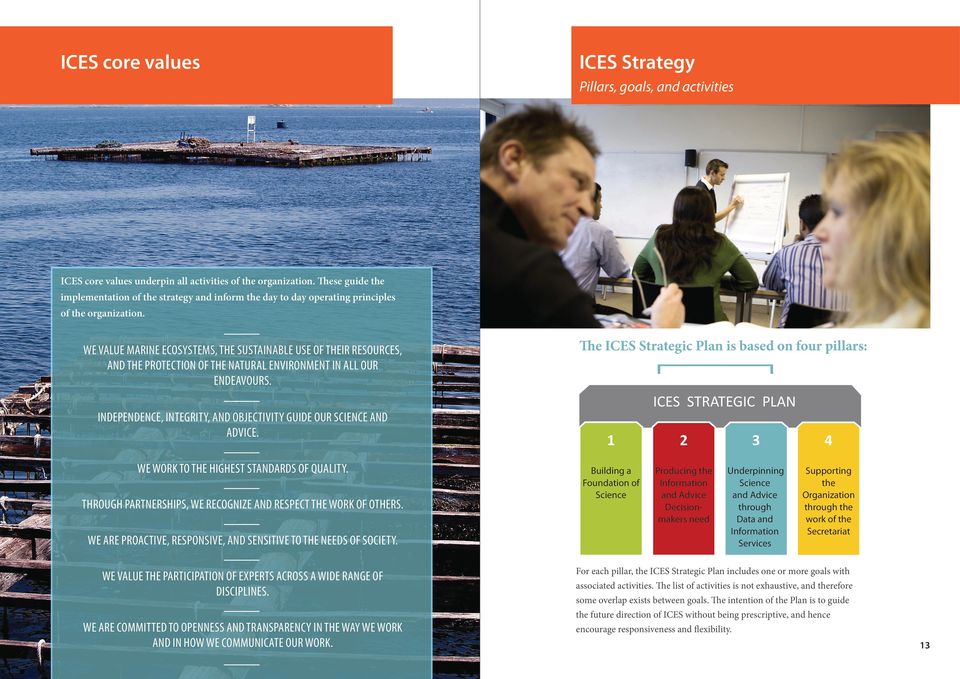
8 ICES core values ICES Strategy Pillars, goals, and activities ICES core values underpin all activities of the organization. These guide the implementation of the strategy and inform the day to day operating principles of the organization. Independence, integrity, and objectivity guide our science and advice. We work to the highest standards of quality. Through partnerships, we recognize and respect the work of others. We are proactive, responsive, and sensitive to the needs of society. We value the participation of experts across a wide range of disciplines. We are committed to openness and transparency in the way we work and in how we communicate our work. The ICES Strategic Plan is based on four pillars: ] We value marine ecosystems, the sustainable use of their resources, and the protection of the natural environment in all our endeavours. ICES STRATEGIC PLAN Building a Foundation of Science Producing the Information and Advice Decisionmakers need Underpinning Science and Advice through Data and Information Services Supporting the Organization through the work of the Secretariat For each pillar, the ICES Strategic Plan includes one or more goals with associated activities. The list of activities is not exhaustive, and therefore some overlap exists between goals. The intention of the Plan is to guide the future direction of ICES without being prescriptive, and hence encourage responsiveness and flexibility. 13
9 Building a foundation of science Producing the information and advice decision-makers need The world s oceans play a crucial role in the functioning of the global environment. Marine ecosystems are driven by physical, chemical, and biological processes that influence the development of biological communities and exploitable resources. Understanding these processes is fundamental to interpreting human dependence and influence on marine ecosystems. Goal 1 Develop an integrated, interdisciplinary understanding of the structure, dynamics, and the resilience and response of marine ecosystems to change Goal 2 Understand the relationship between human activities and marine ecosystems, estimate pressures and impacts, and develop science-based, sustainable pathways Goal 3 Evaluate and advise on options for the sustainable use and protection of marine ecosystems Scientific information is the foundation of ICES advice and this advice must meet the needs of decision-makers. ICES will continue to deliver evidence-based scientific advice on environmental issues and fishery management. ICES is committed to transition, where appropriate, from single species fisheries advice to advice in a mixed fishery, multispecies, and ecosystem context. ICES will also develop regional integrated advice based on ecosystem assessments including indicators for assessing ecosystem status, and for the management of human activities. Supporting Activities ICES will, based on relevant science, use its advisory process to produce evidence based, relevant, responsive, and credible advice across industry sectors and components of ecosystems to address the needs of Member Countries and partner commissions. ICES will achieve this by: Supporting Activities ICES will take the lead in advancing the integrated scientific understanding of marine ecosystems and provide knowledge of human activities affecting, and affected by, marine ecosystems. ICES will achieve this by: providing recurrent advice on fisheries and environmental issues in various areas of the North Atlantic and adjacent seas, such as the provision of advice on multi-annual fisheries management plans, and spatial management needs. Whenever possible, the biological, environmental, and social and economic consequences of alternative management scenarios will be presented; responding to the evolving policy context and to non-recurring special requests on fisheries, aquaculture, and environmental issues, such as the provision of precautionary and MSY-consistent advice, advice on mixed fisheries taking account of biological interactions, advice on aquaculture environmental interactions, and advice on implementation of environmental directives; promoting the use and delivery of integrated advice in an ecosystem-based approach to fisheries and environmental management, such as integrated ecosystem assessments providing guidance on how to maintain or improve good environmental status, and advice on ecosystem health and productivity that considers drivers such as climate change and various maritime activities; ensuring quality assurance, transparency, and legitimacy so that users and stakeholders have confidence in the advice. This will involve dialogue and collaborations with managers and stakeholders on both regional and international levels. 14 investigating the structure, functioning, dynamics and interconnectedness of marine ecosystems, their different biotic components, and the abiotic environment at different spatial scales; providing tools and methods for assessing the relationships between marine ecosystems, their biological resources, and the provision of services to society, including socioeconomic aspects; developing integrated ecosystem assessment methodologies and approaches that allow the use of both qualitative and quantitative data, and which can be used to address both specific advisory questions and broader ecosystem issues; establishing integrated ecosystem observation and monitoring systems that enable coordinated data collection in support of scientific and advisory needs, and which have strong links with ICES and national data centres. These and related activities will be implemented through the Science Plan. These and related activities will be implemented through the Advisory Plan. 15

10 Underpinning science and advice through Data and Information Services Supporting the organization through the work of the Secretariat Marine observations are increasingly collected, coordinated, and assembled at a regional sea scale. It is, therefore, paramount that ICES has the capacity for dealing with, and developing, data services that deliver increasingly complex and interlinked data and processes in an effective and useful way to data users. ICES must ensure that it delivers appropriate dataset collections and services to fully address scientific questions and regional management goals. ICES will maintain its leadership in marine data and information management by providing long term data stewardship and services for its advisory and science groups, as well as society at large, provide tools and knowledge to facilitate this use. Goal 4 Promote the advancement of data and information services for science and advice needs Goal 5 Catalyse best practices in marine data management, and promote the ICES data nodes as a global resource Supporting Activities The ecosystem approach places a high demand on the complexity and amount of data and knowledge needed to enhance science, and to support informed, evidence based management decisions. ICES will achieve this by: The ICES Secretariat is important to ensuring an efficient, effective organization that adds value. The Secretariat is committed to facilitating and supporting the work conducted under the ICES Convention and Copenhagen Declaration by parties and stakeholders, using the highest standards of professionalism and competence. Goal 6 Foster the science, advisory, data and information services through the work of the Secretariat Goal 7 Ensure an efficient and effective organization Supporting Activities promoting the advancement of data and information services for science and advice needs on both regional and sub-regional levels, such as providing operational products for marine spatial planning, the Data Collection Framework/Multi-annual programme, and for the Marine Strategy Framework Directive; gearing up for new/expanding areas of dataset collections, such as new datasets from integrated ecosystem monitoring, including marine litter, and anthropogenic noise in the marine environment; ensuring the use of international standards/interoperability to enable the use and application of ICES datasets, products, and services to an expanded international user base, and to provide tools and knowledge to facilitate this use. The Secretariat will provide professional management and support to the delivery of science, advisory services, data processes and products. ICES will achieve this by: securing the needed resources for the ICES Secretariat to support ICES science, advisory services, data processes and products, and for publications and communications. implementing effective tools and efficient process flows to streamline work processes and enhance the delivery of products. organizing and supporting the resource planning and coordination of network activities. fostering cooperation and communication with Member Countries and partner organizations, stakeholders, and society. 16 These and related activities will be implemented through the Data and Information Plan. These and related activities will be implemented through the Secretariat Plan. 17

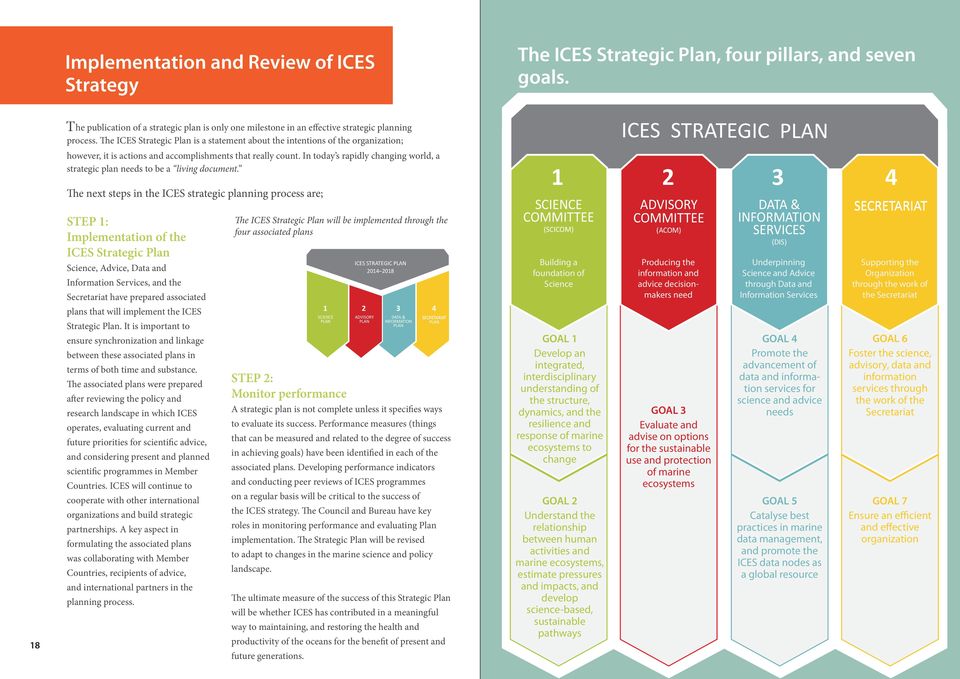
11 Implementation and Review of ICES Strategy The ICES Strategic Plan, four pillars, and seven goals. 18 T he publication of a strategic plan is only one milestone in an effective strategic planning process. The ICES Strategic Plan is a statement about the intentions of the organization; however, it is actions and accomplishments that really count. In today s rapidly changing world, a strategic plan needs to be a living document. The next steps in the ICES strategic planning process are; STEP 1: Implementation of the ICES Strategic Plan Science, Advice, Data and Information Services, and the Secretariat have prepared associated plans that will implement the ICES Strategic Plan. It is important to ensure synchronization and linkage between these associated plans in terms of both time and substance. The associated plans were prepared after reviewing the policy and research landscape in which ICES operates, evaluating current and future priorities for scientific advice, and considering present and planned scientific programmes in Member Countries. ICES will continue to cooperate with other international organizations and build strategic partnerships. A key aspect in formulating the associated plans was collaborating with Member Countries, recipients of advice, and international partners in the planning process. The ICES Strategic Plan will be implemented through the four associated plans SCIENCE PLAN ICES STRATEGIC PLAN ADVISORY PLAN DATA & INFORMATION PLAN SECRETARIAT PLAN STEP 2: Monitor performance A strategic plan is not complete unless it specifies ways to evaluate its success. Performance measures (things that can be measured and related to the degree of success in achieving goals) have been identified in each of the associated plans. Developing performance indicators and conducting peer reviews of ICES programmes on a regular basis will be critical to the success of the ICES strategy. The Council and Bureau have key roles in monitoring performance and evaluating Plan implementation. The Strategic Plan will be revised to adapt to changes in the marine science and policy landscape. The ultimate measure of the success of this Strategic Plan will be whether ICES has contributed in a meaningful way to maintaining, and restoring the health and productivity of the oceans for the benefit of present and future generations. GOAL 1 Develop an integrated, interdisciplinary understanding of the structure, dynamics, and the resilience and response of marine ecosystems to change GOAL 2 Understand the relationship between human activities and marine ecosystems, estimate pressures and impacts, and develop science-based, sustainable pathways ICES STRATEGIC PLAN SCIENCE COMMITTEE (SCICOM) Building a foundation of Science ADVISORY COMMITTEE (ACOM) Producing the information and advice decisionmakers need GOAL 3 Evaluate and advise on options for the sustainable use and protection of marine ecosystems DATA & INFORMATION SERVICES (DIS) Underpinning Science and Advice through Data and Information Services GOAL 4 Promote the advancement of data and information services for science and advice needs GOAL 5 Catalyse best practices in marine data management, and promote the ICES data nodes as a global resource SECRETARIAT Supporting the Organization through the work of the Secretariat GOAL 6 Foster the science, advisory, data and information services through the work of the Secretariat GOAL 7 Ensure an efficient and effective organization
12 International Council for the Exploration of the Sea Conseil International pour l Exploration de la Mer H. C. Andersens Boulevard DK-1553 Copenhagen V Denmark Telephone (+45) Telefax (+45) [email protected]

UNITED NATIONS ENVIRONMENT PROGRAMME. Environment for Development
 UNITED NATIONS ENVIRONMENT PROGRAMME Environment for Development UNEP is the voice for the environment within the United Nations system UNEP s mission is to provide leadership and encourage partnership
International environmental governance. Bali Strategic Plan for Technology Support and Capacity-building
 UNITED NATIONS UNEP/GC.23/6/Add.1 EP Governing Council of the United Nations Environment Programme Distr.: General 23 December 2004 Original: English Twenty-third session of the Governing Council/ Global
Northern Territory Fisheries Resource Sharing Framework
 Northern Territory Fisheries Resource Sharing Framework Page 1 of 11 Introduction Fishing is important in the Northern Territory (Territory). Coastal Aboriginal people recognise sea country out to the
Establishing large-scale trans-boundaries MPA networks: the OSPAR example in North-East Atlantic
 Establishing large-scale trans-boundaries MPA networks: the OSPAR example in North-East Atlantic Introduction A pledge to establish a representative network of marine and coastal protected areas by 2012
CALIFORNIA OCEAN PROTECTION COUNCIL. Staff Recommendation March 11, 2011 STATEWIDE SCIENCE INTEGRATION AND MARINE PROTECTED AREA MONITORING PROGRAMS
 CALIFORNIA OCEAN PROTECTION COUNCIL Staff Recommendation March 11, 2011 STATEWIDE SCIENCE INTEGRATION AND MARINE PROTECTED AREA MONITORING PROGRAMS File No.: 08-123-02 File No.: 06-090-02 Project Managers:
Ref.: SCBD/MPO/AF/CR/84948 31 August 2015 N O T I F I C A T I O N. Preparation for the United Nations Sustainable Development Summit 2015
 Ref.: SCBD/MPO/AF/CR/84948 31 August 2015 Dear Madam/Sir, N O T I F I C A T I O N Preparation for the United Nations Sustainable Development Summit 2015 I am pleased to inform you that the President of
MINISTERIAL MEETING OF THE BLUE WEEK 2015
 5 JUNE 2015 MINISTERIAL MEETING OF THE BLUE WEEK 2015 We, Ministers responsible for Ocean/ Fisheries/ Maritime Affairs, having met in Lisbon on June the 5 th, 2015, at the invitation of the Minister of
The current institutional and legal context for biodiversity conservation and management is characterised by the following features:
 National BiodiversityStrategyandActionPlan (NBSAP),St. Lucia page 8 Resource tenure and access Most agricultural lands, and a majority of forest lands, are privately owned. Two significant trends can be
GLOBAL ALLIANCE FOR CLIMATE-SMART AGRICULTURE (GACSA)
 GLOBAL ALLIANCE FOR CLIMATE-SMART AGRICULTURE (GACSA) FRAMEWORK DOCUMENT Version 01 :: 1 September 2014 I Vision 1. In today s world there is enough food produced for all to be well-fed, but one person
Development of innovative tools for understanding marine biodiversity and assessing good environmental status: the progress of the EU project DEVOTES
 Development of innovative tools for understanding marine biodiversity and assessing good environmental status: the progress of the EU project DEVOTES Angel Borja Scientific Symposium 2015, 6-7 May, Malmö,
5 Year Strategic Plan
 Mid Atlantic Fishery Management Council 5 Year Strategic Plan 2014 2018 DRAFT 5/31/2013 Table of Contents Table of Contents... 1 Introduction... 2 The Mid Atlantic Fishery Management Council... 2 Rationale
Ecosystem perspective on ORs & OCTs
 Workshop on the Application of an Ecosystem Approach for development of Sustainable Aquaculture in Europe s Outermost Regions and Overseas Countries and Territories Session 3: Stakeholders presentations
Marine biological diversity beyond areas of national jurisdiction. Legal and policy framework
 Marine biological diversity beyond areas of national jurisdiction Legal and policy framework 1. The United Nations Convention on the Law of the Sea (UNCLOS) provides the legal framework within which all
The United Nations Environment Programme and the 2030 Agenda. Global Action for People and the Planet
 The United Nations Environment Programme and the 2030 Agenda Global Action for People and the Planet Unemployment, resource scarcity, climate change, food insecurity and inequity all signal the need for
Quality. Quality Status report 2010 Ospar Commission. [email protected] www.ospar.org. New Court 48 Carey Street London WC2A 2JQ
 Quality Status report 2010 Ospar Commission OSPAR Commission New Court 48 Carey Street London WC2A 2JQ T +44 (0) 20 7430 5200 F +44 (0) 20 7430 5225 [email protected] www.ospar.org Quality StaTus Report
Mediterranean-Mare Nostrum Nature and Culture Common Destiny
 Mediterranean-Mare Nostrum Nature and Culture Common Destiny Marine conservation Protection and Management Alain Jeudy de Grissac Marine Conservation Programme Manager June 2010 Toulon La Garde France
Decision IPBES-2/5: Work programme for the period 2014 2018
 Decision IPBES-2/5: Work programme for the period 2014 2018 The Plenary, Welcoming the draft work programme of the Intergovernmental Science-Policy Platform on Biodiversity and Ecosystem Services for the
SUMMARY MISSION STATEMENT
 MISSION STATEMENT University of Maryland Center for Environmental Science SUMMARY MISSION STATEMENT Through its four laboratories across Maryland, the University of Maryland Center for Environmental Science
Environmental governance
 Environmental governance United Nations Environment Programme An overview Governing our planet s rich and diverse natural resources is an increasingly complex challenge. In our globalised world of interconnected
Secretariat Status Report
 Council Meeting October 2015 CM 2015 Del-10 Agenda item 10 Secretariat Status Report The meeting is invited to review the status report on the activities and deliverables being developed by the Secretariat.
UMCES Draft Mission Statement, March 31, 2014
 MISSION STATEMENT University of Maryland Center for Environmental Science SUMMARY MISSION STATEMENT Through its four laboratories distributed across Maryland, the University of Maryland Center for Environmental
ECOLOGICAL RESTORATION A MEANS OF CONSERVING BIODIVERSITY AND SUSTAINING LIVELIHOODS
 ECOLOGICAL A MEANS OF CONSERVING BIODIVERSITY AND SUSTAINING LIVELIHOODS RESTORATION The Society for Ecological Restoration International (SER) is a non-profit organization infused with the energy of involved
Peninsular Florida Landscape Conservation Cooperative. Charter. Background
 Charter Background The Peninsular Florida Landscape Conservation Cooperative (Conservation Cooperative) is part of a national network of Landscape Conservation Cooperatives (LCCs). LCCs are applied conservation
Ecosystem-Based Management: Making it Work in the EU Dr. Ronán Long
 Ecosystem-Based Management: Making it Work in the EU www.marinelaw.ie Overview 1. Context 2. Definitions 3. Legal Basis: International & Regional Law EU Law 4. Conclusions The Context Commission Report
Decision and scoping report for the IPBES global assessment on biodiversity and ecosystem services
 Decision and scoping report for the IPBES global assessment on biodiversity and ecosystem services Decision IPBES-4/1: Work programme of the Platform The Plenary, Welcoming the report of the Executive
Marine Protected Areas POLICY
 Marine Protected Areas POLICY Canada March 1999 Published by: Canada Marine Ecosystems Conservation Branch Oceans Directorate Ottawa, ON K1A 0E6 DFO / 5870 Minister of Public Works and Government Service
NOAA NATIONAL SEA GRANT COLLEGE PROGRAM 2014 2017 STRATEGIC PLAN
 NOAA NATIONAL SEA GRANT COLLEGE PROGRAM 2014 2017 STRATEGIC PLAN Sustaining our nation s ocean, coastal and Great Lakes resources through university based research, communications, education, extension
9.3.7 Advice December 2014
 9.3.7 Advice December 2014 ECOREGION STOCK Widely distributed and migratory stocks European eel Advice for 2015 The status of eel remains critical and ICES advises that all anthropogenic mortality (e.g.
Office of Climate Change, Energy Efficiency and Emissions Trading. Business Plan
 Office of Climate Change, Energy Efficiency and Emissions Trading Business Plan April 1, 2011 - March 31, 2014 Table of Contents Message from the Premier...3 1.0 OVERVIEW...4 2.0 MANDATE...5 3.0 LINES
Questions and Answers on the European Commission Communication: The Paris Protocol A blueprint for tackling global climate change beyond 2020
 European Commission - Fact Sheet Questions and Answers on the European Commission Communication: The Paris Protocol A blueprint for tackling global climate change beyond 2020 Brussels, 25 February 2015
How To Be Sustainable With Tourism
 QUÉBEC DECLARATION ON ECOTOURISM In the framework of the UN International Year of Ecotourism, 2002, under the aegis of the United Nations Environment Programme (UNEP) and the World Tourism Organization
THE NAIROBI WORK PROGRAMME ON IMPACTS, VULNERABILITY AND ADAPTATION TO CLIMATE CHANGE UNFCCC THE NINE WORK AREAS OF THE NAIROBI WORK PROGRAMME
 ON IMPACTS, VULNERABILITY AND ADAPTATION TO CLIMATE CHANGE 1 METHODS AND TOOLS WHAT IS? The Nairobi work programme, under the United Nations Framework Convention on Climate Change (), aims to assist countries
Article 1 Context, objectives and scope
 TRADE AND SUSTAINABLE DEVELOPMENT Article 1 Context, objectives and scope 1. The Parties recall the Agenda 21 on Environment and Development of 1992, the Johannesburg Plan of Implementation on Sustainable
Planning for a Sustainable Future: Strategy for Canada 2013 2016. Sustainable Development Office Environment Canada
 Planning for a Sustainable Future: A Federal Sustainable Development Strategy for Canada 2013 2016 Sustainable Development Office Environment Canada November 2013 ISBN 978-1-100-22627-9 Cat. No.: En4-136/2013E-PDF
ENVIRONMENT CANADA REPORT ON PLANS AND PRIORITIES
 ENVIRONMENT CANADA REPORT ON PLANS AND PRIORITIES 2012 2013 TABLE OF CONTENTS Minister s Message... 3 SECTION I: ORGANIZATIONAL OVERVIEW... 5 Raison d être... 5 Responsibilities... 5 Strategic Outcomes
New York Sea Grant Strategic Plan
 New York Sea Grant Strategic Plan Introduction and Process This is the new strategic plan for New York Sea Grant (NYSG) for the years 2010-2013 as requested by the National Sea Grant Office. This plan
Draft conclusions proposed by the Chair. Recommendation of the Subsidiary Body for Implementation
 United Nations FCCC/SBI/2012/L.47 Distr.: Limited 1 December 2012 Original: English Subsidiary Body for Implementation Thirty-seventh session Doha, 26 November to 1 December 2012 Agenda item 14 Article
Declaration on the 20th Anniversary of the Barents Euro-Arctic Cooperation. (Kirkenes, Norway, 3 4 June 2013)
 1 Declaration on the 20th Anniversary of the Barents Euro-Arctic Cooperation (Kirkenes, Norway, 3 4 June 2013) Prime Ministers and other high-level representatives of the members of the Barents Euro- Arctic
Introduction to protection goals, ecosystem services and roles of risk management and risk assessment. Lorraine Maltby
 Introduction to protection goals, ecosystem services and roles of risk management and risk assessment. Lorraine Maltby Problem formulation Risk assessment Risk management Robust and efficient environmental
GUIDELINES ON COMPLIANCE WITH AND ENFORCEMENT OF MULTILATERAL ENVIRONMENTAL AGREEMENTS
 GUIDELINES ON COMPLIANCE WITH AND ENFORCEMENT OF MULTILATERAL ENVIRONMENTAL AGREEMENTS 1. In its decision 21/27, dated 9 February 2001, the Governing Council of the United Nations Environment Programme
NOAA COASTAL SERVICES CENTER Strategic Plan: 2010 to 2015
 NOAA COASTAL SERVICES CENTER Strategic Plan: 2010 to 2015 N a t i o n a l O c e a n i c a n d A t m o s p h e r i c A d m i n i s t r a t i o n ( N O A A ) C o a s t a l S e r v i c e s C e n t e r March
Programme of Work on Protected Areas
 CBD PROGRAMMES OF WORK Programme of Work on Protected Areas Secretariat of the Convention on Biological Diversity Programme of Work on Protected Areas Secretariat of the Convention on Biological Diversity
Northern Dimension Policy Framework Document (effective as 1 January 2007)
 Northern Dimension Policy Framework Document (effective as 1 January 2007) 1. Introduction 1. The Northern Dimension covers a broad geographic area from the European Arctic and Sub- Arctic areas to the
Strategic Vision. for Stewarding the Nation s Climate Data. Our. NOAA s National Climatic Data Center
 Strategic Vision Our for Stewarding the Nation s Climate Data NOAA s National Climatic Data Center M AY 2013 Our Strategic Vision for Stewarding the Nation s Climate Data 2 FOREWORD From the Director The
Resolution XII.13. Wetlands and disaster risk reduction
 12 th Meeting of the Conference of the Parties to the Convention on Wetlands (Ramsar, Iran, 1971) Punta del Este, Uruguay, 1-9 June 2015 Resolution XII.13 Wetlands and disaster risk reduction 1. RECALLING
THE STRATEGIC PLAN OF THE HYDROMETEOROLOGICAL PREDICTION CENTER
 THE STRATEGIC PLAN OF THE HYDROMETEOROLOGICAL PREDICTION CENTER FISCAL YEARS 2012 2016 INTRODUCTION Over the next ten years, the National Weather Service (NWS) of the National Oceanic and Atmospheric Administration
How To Write A Listing Policy For A Species At Risk Act
 Fisheries and Oceans Canada Species at Risk Act Listing Policy and Directive for Do Not List Advice DFO SARA Listing Policy Preamble The Fisheries and Oceans Canada (DFO) Species at Risk Act (SARA) Listing
How To Manage Protected Areas
 ECHOES FROM BARILOCHE: Conclusions, Recommendations and Action Guidelines The Second Latin American Congress on National Parks and other Protected Areas aimed to asses, value and project the contribution
RESPONSE FROM GBIF TO QUESTIONS FOR FURTHER CONSIDERATION
 RESPONSE FROM GBIF TO QUESTIONS FOR FURTHER CONSIDERATION A. Policy support tools and methodologies developed or used under the Convention and their adequacy, impact and obstacles to their uptake, as well
Marine Stewardship Council
 Marine Stewardship Council MSC Fishery Standard Principles and Criteria for Sustainable Fishing Version 1.1 1 st May 2010 Committees responsible for this Standard This standard is intended to be used on
Barents Euro Arctic Council. Seventh Meeting of Environment Ministers
 Barents Euro Arctic Council Seventh Meeting of Environment Ministers Declaration 19 October, 2005 1. The Ministers of the Environment of the Barents Euro Arctic Council (BEAC) representing Denmark, Iceland,
AFRICAN BIOSPHERE RESERVES NETWORK AfriMAB
 AFRICAN BIOSPHERE RESERVES NETWORK AfriMAB Preamble 1. Considering that biosphere reserves are set up with the aim of promoting a balanced relationship between human beings and the Biosphere ; 2. Considering
Ecosystem Services and Convention on Biological Diversity How ecosystem services are reflected in the CBD COP Decisions in Nagoya?
 Ecosystem Services and Convention on Biological Diversity How ecosystem services are reflected in the CBD COP Decisions in Nagoya? Heikki Toivonen Finnish Environment Institute Ecosystem services and Biodiversity,
21st International Conference of The Coastal Society
 21st International Conference of The Coastal Society MARINE STEWARDSHIP AREA OFFERS A MODEL FOR INTEGRATING SCIENCE, MANAGEMENT, STEWARDSHIP AND ECOSYSTEM THINKING IN THE CONSERVATION OF COASTAL RESOURCES
DECLARATION OF THE 7 th WORLD SCIENCE FORUM ON The Enabling Power of Science. 7 th World Science Forum, Budapest, 7 th November 2015 PREAMBLE
 DECLARATION OF THE 7 th WORLD SCIENCE FORUM ON The Enabling Power of Science 7 th World Science Forum, Budapest, 7 th November 2015 PREAMBLE With the encouragement and support of the founding organisations
>> BRIEFING TO THE INCOMING MINISTERS
 >> BRIEFING TO THE INCOMING MINISTERS Natural Resources Sector 2014 The Natural Resources Sector is made up of the following organisations: Introduction New Zealand s natural resources system is defined
PRINCIPLES FOR EVALUATION OF DEVELOPMENT ASSISTANCE
 PRINCIPLES FOR EVALUATION OF DEVELOPMENT ASSISTANCE DEVELOPMENT ASSISTANCE COMMITTEE PARIS, 1991 DAC Principles for Evaluation of Development Assistance Development Assistance Committee Abstract: The following
Organisation Strategy for Denmark s Co-operation with International Union for Conservation of Nature (IUCN), 2015 2017
 Concept Note Organisation Strategy for Denmark s Co-operation with International Union for Conservation of Nature (IUCN), 2015 2017 1. Introduction The Organisation Strategy for IUCN forms the basis for
WARNING: You cannot rely on a printed version of this document to be current. Always check the DECCW intranet to ensure you have the latest version.
 New South Wales Natural Resources Monitoring, Evaluation and Reporting Strategy 2010 2015 New South Wales Natural Resources Monitoring, Evaluation and Reporting Strategy 2010 2015 WARNING: You cannot
How To Improve The Performance Of The Food And Agriculture Organization
 May, 2014 PC 115/5 Sup.1 E PROGRAMME COMMITTEE Hundred and Fifteenth Session Rome, 26-30 May 2014 Evaluation of FAO s Role in Support of Crop Production MANAGEMENT RESPONSE In line with the recommendations
National Saltwater Recreational Fisheries Policy
 National Saltwater Recreational Fisheries Policy Alaska Regional Implementation Plan 2016-2017 Photo Credit: Richard Yamada Contents Foreward 5 Alaska Regional Overview 6 Setting the Stage 8 Guiding Principles
NOAA Fisheries Office of International Affairs. Dr. Rebecca Lent
 NOAA Fisheries Office of International Affairs Dr. Rebecca Lent 1 International Responsibilities Magnuson-Stevens Act (MSA) Marine Mammal Protection Act Endangered Species Act Implementing legislation
Financial sector leadership on natural capital
 Financial sector leadership on natural capital The Natural Capital Declaration A commitment by financial institutions to mainstream natural capital in financial products and in accounting, disclosure and
REPORT OF THE CONFERENCE OF THE PARTIES ON ITS SEVENTH SESSION, HELD AT MARRAKESH FROM 29 OCTOBER TO 10 NOVEMBER 2001 Addendum
 UNITED NATIONS Distr. GENERAL FCCC/CP/2001/13/Add.1 21 January 2002 Original: ENGLISH CONFERENCE OF THE PARTIES REPORT OF THE CONFERENCE OF THE PARTIES ON ITS SEVENTH SESSION, HELD AT MARRAKESH FROM 29
C ANADA S O CEANS STRATEGY
 Ey wire / Getty I ages / 2002 C ANADA S O CEANS STRATEGY Our Oceans, Our Future DFO - Central & Arctic POLICY AND OPERATIONAL FRAMEWORK FOR INTEGRATED MANAGEMENT OF ESTUARINE, COASTAL AND MARINE ENVIRONMENTS
OUTLINE. Source: 36 C/Resolution 16, 190 EX/Decision 9 and 192 EX/Decision 6.
 37th Session, Paris, 2013 37 C 37 C/57 4 November 2013 Original: English Item 5.19 of the provisional agenda PROPOSAL FOR A GLOBAL ACTION PROGRAMME ON EDUCATION FOR SUSTAINABLE DEVELOPMENT AS FOLLOW-UP
The Fram Centre Research in the high north under innovative structure
 The Fram Centre Research in the high north under innovative structure December 2014 Nina Mari Jørgensen, Norwegian Polar Institute Photo: Jo Aarseth, Kongsfjorden, Svalbard August 2013 Governmental support
Communiqué Global Bioeconomy Summit 2015
 Communiqué Global Bioeconomy Summit 2015 Making Bioeconomy Work for Sustainable Development Communiqué of the Global Bioeconomy Summit 2015 Making Bioeconomy Work for Sustainable Development The first
GREAT BARRIER REEF. Climate Change Action Plan
 GREAT BARRIER REEF Climate Change Action Plan 2007 2011 Climate change is now recognised as the greatest long-term threat to the Great Barrier Reef. The Great Barrier Reef is internationally renowned as
Panel Remarks by Mr Mmboneni Muofhe, GEO Principal Alternate, Deputy Director General, Department of Science and Technology, South Africa
 UNGGIM- HLF, 20 22 April 2016, Addis Ababa, Ethiopia Session 1: Land Information for Sustainable Development Sub- Session: Addressing challenges confronting countries 20 April 2016: 15h45 17h00 Panel Remarks
Protected Areas Resilient to Climate Change, PARCC West Africa
 Communication Strategy (PARCC Activity 4.2) Ver. 1. Protected Areas Resilient to Climate Change, PARCC West Africa 2011 Rapid Screening of Vulnerability Assessment Tools and Framework Proposal Executive
SC2 BIOECONOMY in Horizon 2020
 SC2 BIOECONOMY in Horizon 2020 Food security, sustainable agriculture and forestry, marine and maritime and inland water research and the bioeconomy 19 DICEMBRE 2013 TAVOLA ROTONDA Iniziative e partenariati
Council conclusions on a transformative post-2015 agenda. General Affairs Council meeting Brussels, 16 December 2014
 Council of the European Union PRESS EN COUNCIL CONCLUSIONS Brussels, 16 December 2014 Council conclusions on a transformative post-2015 agenda General Affairs Council meeting Brussels, 16 December 2014
Views from Living Marine Resources Management and the Coral Triangle Project
 Views from Living Marine Resources Management and the Coral Triangle Project Annadel Salvio Cabanban Ecosystem Approach to Fisheries Management Specialist, Coral Triangle Initiative Southeast Asia Project:
Call for Expressions of Interest: Contributing to the BIOPAMA Regional Observatory for Biodiversity and Protected Areas in West and Central Africa
 Call for Expressions of Interest: Contributing to the BIOPAMA Regional Observatory for Biodiversity and Protected Areas in West and Central Africa A. Overview Protected Areas and Biodiversity Observatory
1 Background: Concept Note & Call for Abstracts 2010 ATPS Annual Conference & Workshop Page 1 of 6
 Concept note for the 2010 ATPS Annual Conference & Workshop tagged The State of Science, Technology and Innovation in Africa: Implications for Achieving the Millennium Development Goals (MDGs) 1 Background:
Marine Fisheries Stock Assessment Improvement Plan
 Marine Fisheries Stock Assessment Improvement Plan Report of the National Marine Fisheries Service National Task Force for Improving Fish Stock Assessments Pamela M. Mace (Chair), Norman W. Bartoo, Anne
MPA NETWORKS MODULE 2 2.1 INTRODUCTION TO MPA NETWORKS. Advantages of Networks 2.2 TYPES OF MPA NETWORKS. Social Networks. Ecological Networks
 2.1 INTRODUCTION TO MPA NETWORKS Advantages of Networks 2.2 TYPES OF MPA NETWORKS Social Networks Ecological Networks Management-based Networks Case Study: A Regional Approach to MPA Development in West
Publication supported in part by an Institutional Grant (NA10OAR4170099) to the Texas Sea Grant College Program from the National Sea Grant Office,
 Publication supported in part by an Institutional Grant (NA10OAR4170099) to the Texas Sea Grant College Program from the National Sea Grant Office, National Oceanic and Atmospheric Administration, U.S.
Workers health: global plan of action
 Workers health: global plan of action Sixtieth World Health Assembly 2 SIXTIETH WORLD HEALTH ASSEMBLY SIXTIETH WORLD HEALTH ASSEMBLY WHA60.26 Agenda item 12.13 23 May 2007 Workers health: global plan of