
Impact of Proposed PIP Choice Law in Michigan
|
|
|
- Mervyn Shaw
- 10 years ago
- Views:
Transcription
1 September 7, 2011 Impact of Proposed PIP Choice Law in Michigan The Potential Effects of Changes to Personal Injury Protection Liability Law Prepared by: Anderson Economic Group, LLC Erin Agemy, Senior Analyst Alex Rosaen, Consultant Commissioned by: Coalition Protecting Auto No-Fault Anderson Economic Group, LLC 1555 Watertower Place, Suite 100 East Lansing, Michigan Tel: (517) Fax: (517) Anderson Economic Group, LLC, 2011 Permission to reproduce in entirety granted with proper citation. All other rights reserved.

2 Table of Contents I. Executive Summary...1 Purpose of Report... 1 Overview of Approach... 1 Overview of Findings... 2 About Anderson Economic Group... 4 II. Personal Injury Protection Liability in Michigan 5 Personal Injury Protection Liability in Michigan... 5 Michigan Catastrophic Claims Association... 6 Proposed Legislation... 9 III. Cost and Effects of Proposed Legislation...10 Buying Behavior of Policyholders Injured Michigan Drivers Needing Alternative Funding Effects on the MCCA and Those it Funds Changes in Insurance Premiums Potential Net Impact of Policy on Michigan s Industries IV. Appendix A. Methodology...A-1 V. Appendix B: About AEG...B-1 Anderson Economic Group, LLC

3 Executive Summary I.Executive Summary Each state in the U.S. requires licensed drivers to purchase a minimum amount of auto insurance to protect themselves and other drivers in the case of an auto accident. If a driver becomes injured from an accident, they often must sue the at-fault driver s insurance company to collect damages, which can be a lengthy and costly process. In no-fault states, such as Michigan, the right to sue other drivers is limited because the injured party s own insurance company pays for damages. No-fault states require drivers to purchase a minimum amount of personal injury protection (PIP), which covers medical expenses and lost wages resulting from an auto accident. Each state varies in the amount of PIP coverage they require drivers to purchase, ranging from $3,000 to over $50,000. However, if a driver incurs costs beyond the amount of coverage purchased, he or she must pay out-of-pocket for these additional expenses. Currently, Michigan is the only state that requires each driver to purchase lifetime PIP coverage, which provides benefits to pay for reasonable and necessary treatments related to an auto accident. As there are claims that can be extremely costly, the Michigan Legislature created a non-profit unincorporated association called the Michigan Catastrophic Claims Association (MCCA), which reinsures auto insurance companies above a certain threshold ($500,000). In exchange for limited PIP liability, each Michigan auto insurance company pays the Association an annual fee, called an MCCA assessment, for each vehicle (not driver) they insure. The Michigan Legislature is considering amending the Michigan Code of Insurance to significantly lower the minimum amount of personal injury protection drivers are required to purchase. Policyholders would be able to choose from the following levels of PIP coverage for products and services necessary to an injured person s care, recovery, and rehabilitation: $50,000, $100,000, $200,000, $400,000, $500,000 and lifetime. PURPOSE OF REPORT OVERVIEW OF APPROACH The purpose of this report is to quantify the effects that the proposed legislation would have on the output, earnings and employment of Michigan s industries, as well as discuss its effects on individuals. Our approach considers how the proposed legislation would impact Michigan based on several assumptions. First, given the odds of severe accidents, cost of healthcare and choice of PIP coverage, some policyholders will purchase insufficient coverage. Second, under the proposed law, policyholder who purchase limited PIP coverage will see savings from reduced PIP premiums. We analyze the extent and frequency of the cost of changes in coverage, including policyholders who will have more disposable income and those who will need to seek alternative funding. Third, we assume that policyholders who are injured will have a limited ability to pay for or otherwise procure care and services they would otherwise have received. This will result in reduced healthcare consumption in Michigan, which will impact industries providing long-term care services. Anderson Economic Group, LLC 1

4 Executive Summary OVERVIEW OF FINDINGS 1. Proposed Policy Change Could Affect Current Catastrophic Claims Auto insurers in Michigan are currently reinsured for any PIP claim that is catastrophic (above $500,000) by the MCCA. While the proposed legislation does not change the MCCA s obligation to continue to provide coverage for its open claims, it may impact its ability to finance those claims. Although the MCCA is required to have their annual assessments (premiums) cover the lifetime claims of all persons catastrophically injured that year, it currently has fewer assets ($11.2 billion) than expected liabilities ($13.6 billion). Under current law, the MCCA recoups this deficit by adding a deficit adjustment to the annual assessment (premium) of each vehicle in Michigan. This assessment has been applied each year since Under the proposed policy change, if policyholders choose less than lifetime PIP coverage, auto insurers are no longer required to pay assessments to the MCCA on those policyholders vehicles. 1 This legislation makes it unclear how the MCCA would continue to fully fund the lifetime coverage promised to those already catastrophically injured. We discuss this in greater detail in Effects on the MCCA and Those it Funds on page Between 638 and 765 People Who Suffer Injuries of Catastrophic Cost Each Year Will Have Chosen Insufficient PIP Coverage The personal injury protection Michigan drivers are currently required to purchase ensures that anyone injured in an automobile accident will have lifelong sufficiently funded healthcare for those injuries. When given the choice, most drivers do not consider how much coverage they are getting for the price, just that they are purchasing the required coverage at the lowest possible price. 2 Under the proposed policy changes, AEG estimates between 75% and 90% of drivers would choose something lower than lifetime PIP coverage, which leaves a considerable number of people vulnerable to catastrophic costs. See Buying Behavior of Policyholders on page 10. We estimate there would be between 638 and 765 catastrophic claims each year that will have insufficient PIP coverage, which is shown in Table 1 on page 3. Given the amount and type of healthcare and services necessary for these people, alternative funding will be necessary. 1. H.B states that the MCCA s assessment would be adjusted to reflect the amount of coverage selected by each member s insureds. AEG interpreted this to mean that policyholders who choose a coverage amount below the MCCA threshold for reinsurance would not be charged this assessment. 2. In order to gain perspective on the amount of PIP coverage that policyholders purchase in practice, AEG contacted multiple auto insurers in no-fault states other than Michigan. Auto insurers estimated that 95% of their policyholders opt for their state s PIP coverage minimum. This is further discussed in Buying Behavior of Policyholders on page 10. Anderson Economic Group, LLC 2

5 Executive Summary Unfortunately, the available alternative sources of funding would provide for services substantially different than the lifelong and comprehensive medical care and rehabilitation services covered by PIP insurance. Many of the services required for recovery are not included in health plans and only minimal medical rehabilitation is supported by Medicare and Medicaid. This is further described in Injured Michigan Drivers Needing Alternative Funding on page 11. TABLE 1. Number of Injured Drivers Who Will Need Alternative Funding Low Estimate High Estimate Proportion of Drivers Choosing Less Than lifetime PIP Coverage a 75% 90% Number of Drivers Choosing Less Than lifetime PIP Coverage b 6,109,296 7,331,155 Potential Number of Drivers With Insufficient Coverage for Catastrophic Medical Expenses c Sources: Michigan State Police, Traffic Crash Facts- Statewide, Michigan Catastrophic Claims Association Annual Financial Statement FY Analysis: Anderson Economic Group, LLC a. AEG used knowledge obtained from experienced personnel in the insurance industry to create high and low estimates for the portion of drivers choosing less than lifetime PIP coverage. See Data on PIP Coverage and Claims on page A-1. b. Estimated by multiplying the proportion of drivers choosing less than lifetime PIP coverage by the most recent number of registered vehicles in Michigan (2009). c. AEG used 0.01% as an approximation for the proportion of drivers that would make a catastrophic claim and multiplied it by the number of drivers choosing less than lifetime PIP coverage. See Table 2, Number of Injured Drivers Who Would Need Alternative Funding, on page We Estimate That Annual Expenditures of Over $809 Million for Medical Care, Rehabilitation and Post-Injury Care Are At Stake Last year, auto insurance companies were reinsured for $809,586,065, which was spent by claimants on healthcare benefits and related losses. 3 As people choose less than lifetime coverage, fewer people who are catastrophically injured will have sufficient coverage and only a portion of the PIP money will still be spent on auto injury-related healthcare. There are certainly alternative methods of procuring care, such as paying out-ofpocket, using private health insurance, enrolling in publicly funded healthcare or relying on charity to receive services. However, these methods of payment may restrict choices or be of fixed size such that they limit what services the 3. According to the MCCA over 90% of their costs go to healthcare related expenses. The rest of these claims are spent on home modifications to accommodate injuries and wage loss. Anderson Economic Group, LLC 3
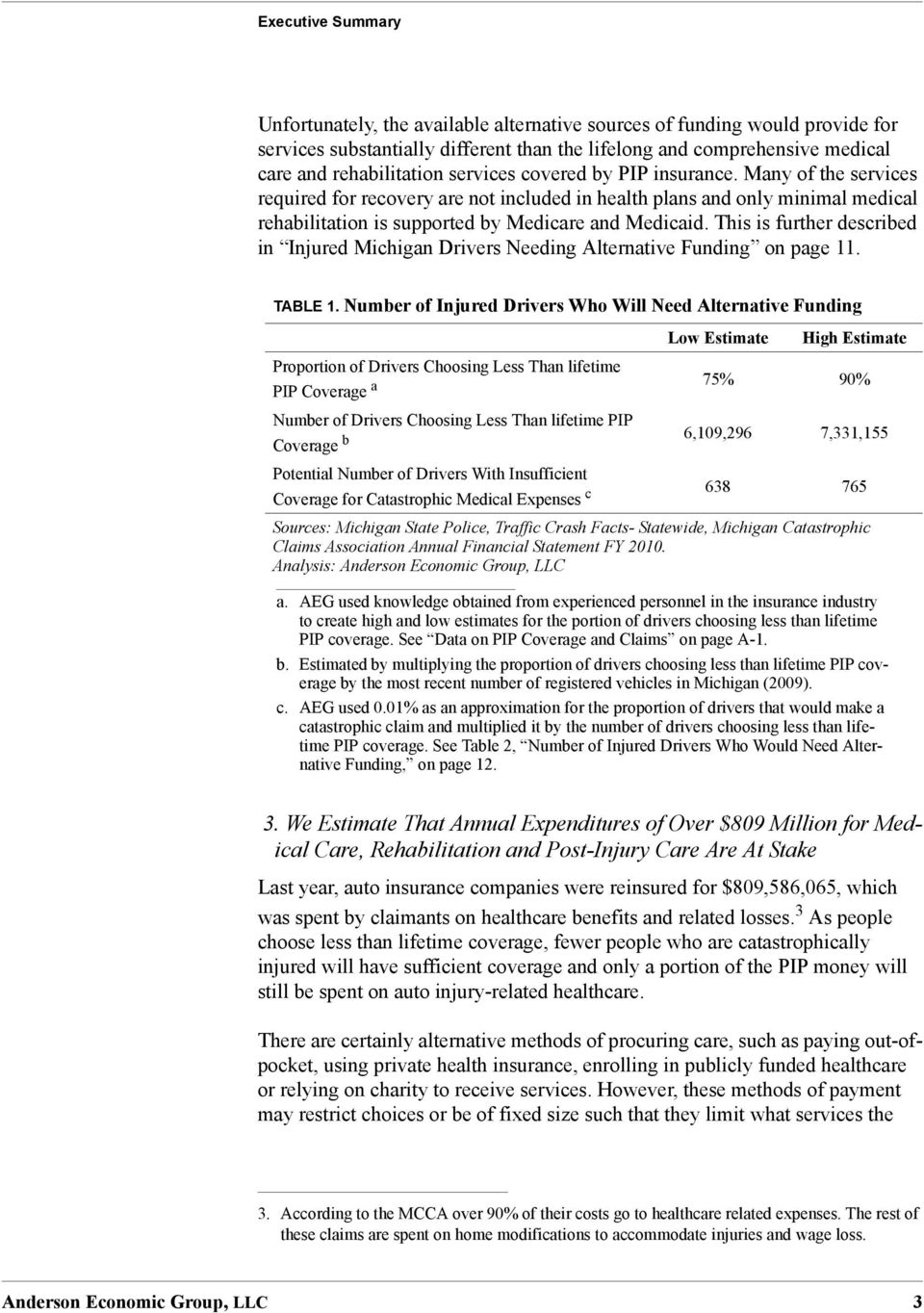
6 Executive Summary person receives; whether it is by choice, program restrictions, or limited resources. 4. After Accounting for Both Reduced Spending on Healthcare and Premium Savings for Insured Drivers, the Proposed Law Would Result in At Least 2,500 to 5,000 Fewer Jobs and $70 to $150 million Less Annual Earnings in Michigan. In order to estimate the net impact of the proposed legislation on Michigan s industries, we considered the two ways that the policy will impact the way money will be spent: 1. Less money will be given to policyholders for catastrophic medical expenses, resulting in reduced healthcare consumption Given the choice of PIP coverage, there will be some people who under insure themselves. Our analysis focuses on the changes in healthcare spending related to catastrophic claims (spending above $500,000). We do not include the cost to those with inadequate coverage that incur expenses below $500,000. We also do not take into account foregone tax revenue. 2. Less money will be spent on PIP premiums, potentially resulting in higher consumer expenditures As discussed in Changes in Insurance Premiums on page 17, policyholders who choose the minimum PIP coverage will save between $116 and $137 on their premiums annually. Our net economic impact measures the additional economic activity caused by the proposed policy changes, by measuring the impact of savings on premiums versus the reduced PIP expenditures on healthcare. Savings in the short run for policyholders leads to potentially greater costs in the long-run. We estimate that the proposed policy change will cost Michigan the following: Over $209 million in output Between $71 and $155 million in earnings Between 2,556 and 5,191 jobs ABOUT ANDERSON ECONOMIC GROUP Anderson Economic Group is a research and consulting firm specializing in economics, finance, business valuation, and industry analysis. The firm has offices in East Lansing, Michigan and Chicago, Illinois. See Appendix B: About AEG on page B-1. Anderson Economic Group, LLC 4

7 Personal Injury Protection Liability in Michigan II.Personal Injury Protection Liability in Michigan All states in the U.S. require every licensed driver to purchase a minimum amount of auto insurance, which is dictated by the state they live in. Those states that operate under a no-fault system limit a driver s ability to sue in the case of an accident, but also require personal injury protection (PIP), which reimburses medical expenses and lost wages drivers otherwise would need to sue for. In this section, we describe PIP liability in Michigan and aspects of the proposed legislation that will change PIP for both auto insurers and drivers. PERSONAL INJURY PROTECTION LIABILITY IN MICHIGAN Each state s auto insurance laws dictate the amount of coverage a driver is required to purchase. In most states, auto insurance operates under a fault-based or tort-liability system where payments from insurance companies depend on each driver s degree of fault. To avoid the cost and complications of legal disputes over claims, thirteen states, including Michigan, adopted no-fault auto insurance. Under a no-fault system, regardless of who is at fault in an accident, claims are paid to a driver by his or her own insurance company. Those drivers in no-fault states have limited rights to sue, but are required to purchase additional insurance, including personal injury protection (PIP). Should the insured become injured as a result of a car accident, PIP coverage helps pay for medical expenses and lost wages resulting from the accident. Each state that requires PIP coverage varies in the amount they require drivers to purchase, ranging from $3,000 to over $50,000. If a driver incurs costs beyond the amount of coverage purchased, he or she must pay out-of-pocket for these additional expenses. Michigan currently requires its drivers to purchase PIP coverage that includes the following: lifetime benefits for medical care, rehabilitation, and other types of ongoing post-injury care; 4 85% of the injured s lost income for three years, if he or she becomes unable to work; 5 $20 per day for three years for replacement services (e.g. maid, gardener, etc) if auto-related injuries prevent the insured from performing certain everyday tasks; and in the event of death, three years of lost wages for the deceased s family. 4. Michigan is the only state to require all drivers purchase PIP coverage that includes lifetime benefits for reasonable and necessary treatments related to auto accidents. 5. As of October 1, 2010, the cap on monthly salary compensation is $4,929. Anderson Economic Group, LLC 5

8 Personal Injury Protection Liability in Michigan These benefits extend to passengers and all family members living in the same house as the insured, even if they are in another car. Requiring auto insurance companies to provide lifetime medical coverage to automobile accident victims essentially makes insurers in Michigan obligated to pay out catastrophic claims when there is normally a ceiling of liability. Initially, insurance companies had difficulty obtaining reinsurance because of the lifetime medical benefits Michigan included in its no-fault policies. To solve this problem, the Legislature added Section 3104 into Public Act 136 of 1978, which created the Michigan Catastrophic Claims Association (MCCA). This nonprofit reinsures auto insurance companies, so that, essentially, insurers are only liable to each policyholder up to a certain threshold. MICHIGAN CATASTROPHIC CLAIMS ASSOCIATION The MCCA is a non-profit unincorporated association established on July 1, 1978 by the state legislature. The MCCA reimburses auto insurance companies for each PIP medical claim paid in excess of a certain threshold, which is currently $500, Thus the MCCA limits the amount of liability an auto insurer in Michigan must undertake for each of its claimants. In exchange for limited PIP liability, each Michigan auto insurance company pays the Association an annual fee, called an MCCA assessment, for each vehicle (not driver) they insure. 7 The MCCA is required to assess an amount each year that is sufficient to cover the lifetime claims of all persons catastrophically injured in that year. The assessment for each car is the same and is currently $ per vehicle. 8 Each assessment is broken into three parts: the pure premium, the deficit adjustment (or surplus) and a small administrative fee. The pure premium is the actual cost for each vehicle in Michigan to fund the MCCA pool. The deficit adjustment is used to slowly recoup the estimated deficit. The MCCA uses the adjustment for excesses or deficiencies in their current assets or prior actuarial assessments. We show how the MCCA s annual assessment has changed over the past fifteen years in Figure 1 on page Under Public Act 3 of 2001, as of July 1, 2011, the threshold was $500,000. Thereafter, beginning July 1, 2013, the retention will be increased each odd numbered year by 6% or the consumer price index, whichever is less. 7. The MCCA also insures commercial vehicles and motorcycles, however this is beyond the scope of this report, as we limit our discussion to passenger vehicles. 8. The $ assessment is based on the MCCA s annual actuarial evaluation of investment return that the fund receives, medical cost inflation, and any changes to coverage. Source: 9. We do not include changes in administrative fees because they are such a small part of the total MCCA assessment (it has never risen above $0.30). Anderson Economic Group, LLC 6
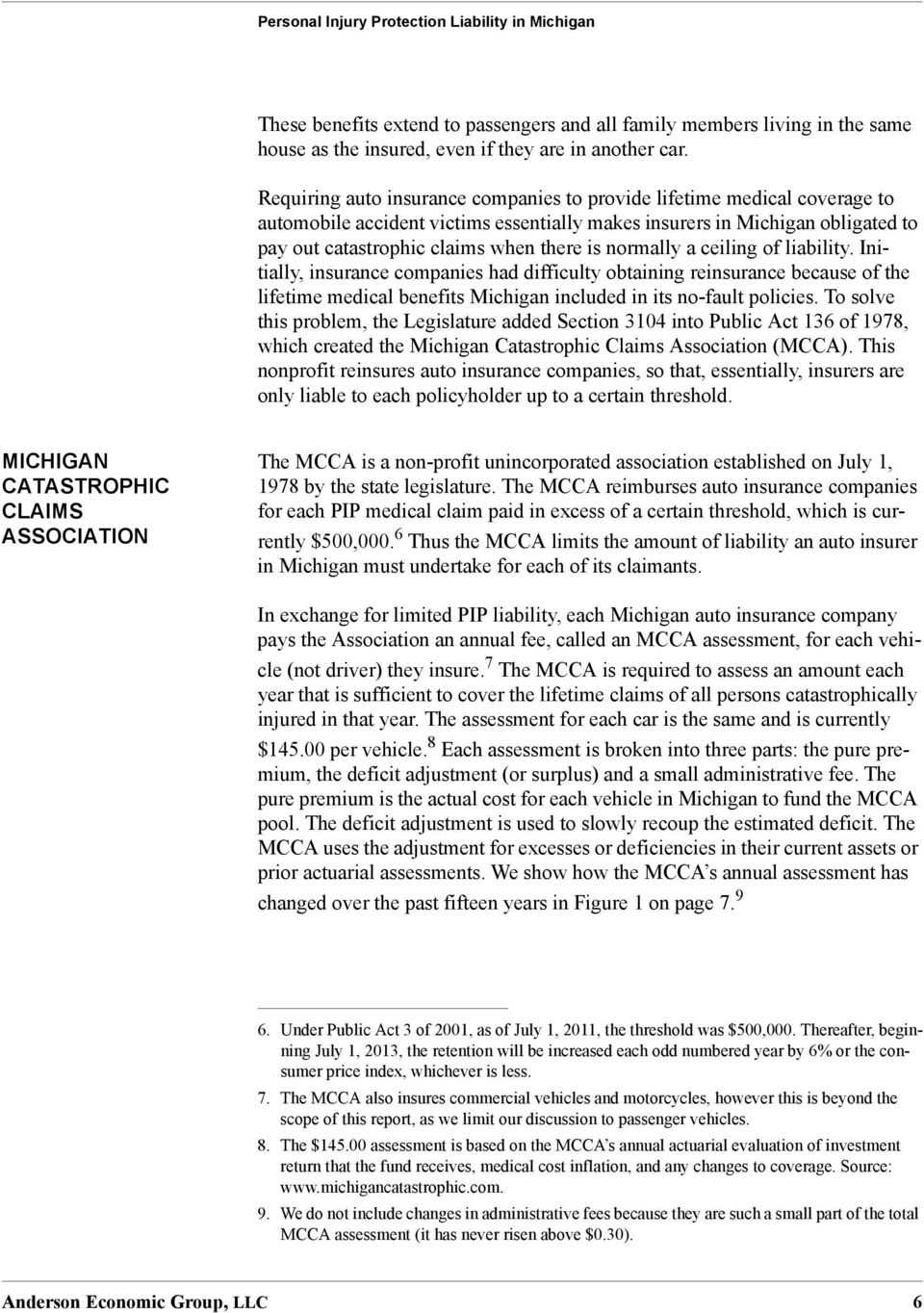
9 Personal Injury Protection Liability in Michigan In the mid 1990 s the MCCA had a considerable surplus and decided to refund it to policyholders by significantly lowering their assessment to $14.94 (1997) and $5.60 (1998). The next few years the assessment varied between roughly $100 and $ In 2002 there was no deficit adjustment needed, so the pure premium and total assessment were the same. Since then the MCCA has added a deficit adjustment in their annual assessment and currently they have fewer assets than their expected liabilities. FIGURE 1. MCCA Assessment to Michigan Drivers, $140 $107 $99 $100 $127 $142 $137 $123 $116 $113 $107 $143 $145 $125 $105 $117 $115 $90 $62 $64 $56 $52 $62 $69 $79 $96 $96 $101 $40 $15 $6 $51 $47 $14 $0 $21 $31 $25 $24 $16 $8 $24 $26 $29 -$10 '97 '98 '99 '00 '01 '02 '03 '04 '05 '06 '07 '08 '09 '10 '11 -$60 -$47 -$58 -$47 Source: Michigan Catastrophic Claims Association Analysis: Anderson Economic Group, LLC Total Assessment Pure Premium Deficit Adjustment Size of Catastrophic Claims in Michigan According to the MCCA, the claims they handle are catastrophic and generally involve injury to the brain, and/or spinal cord, which results in serious and permanent disability. The majority of the injuries claimed to the MCCA are brain related (48%). Since its inception, there have been 13,038 brain injury expenses reported to the MCCA. 11 Treating traumatic brain injuries (TBI) requires a great deal of rehabilitation and is costly. Over 30% of the nonfatal TBI hospitalizations involve a motor vehicle accident each year. 12 Michigan provides the 10.The MCCA generally plans on recovering deficits through adjustments and premiums over fifteen or twenty years, although it has the option to address their finances immediately with large deficit adjustments. Source: experienced personnel at the Michigan Catastrophic Claims Association. 11.Proportion of other injuries by type from inception to June 30, 2010, include quadriplegic (4%), paraplegic (3%), burns (1%) and miscellaneous (44%). Source: MCCA Anderson Economic Group, LLC 7
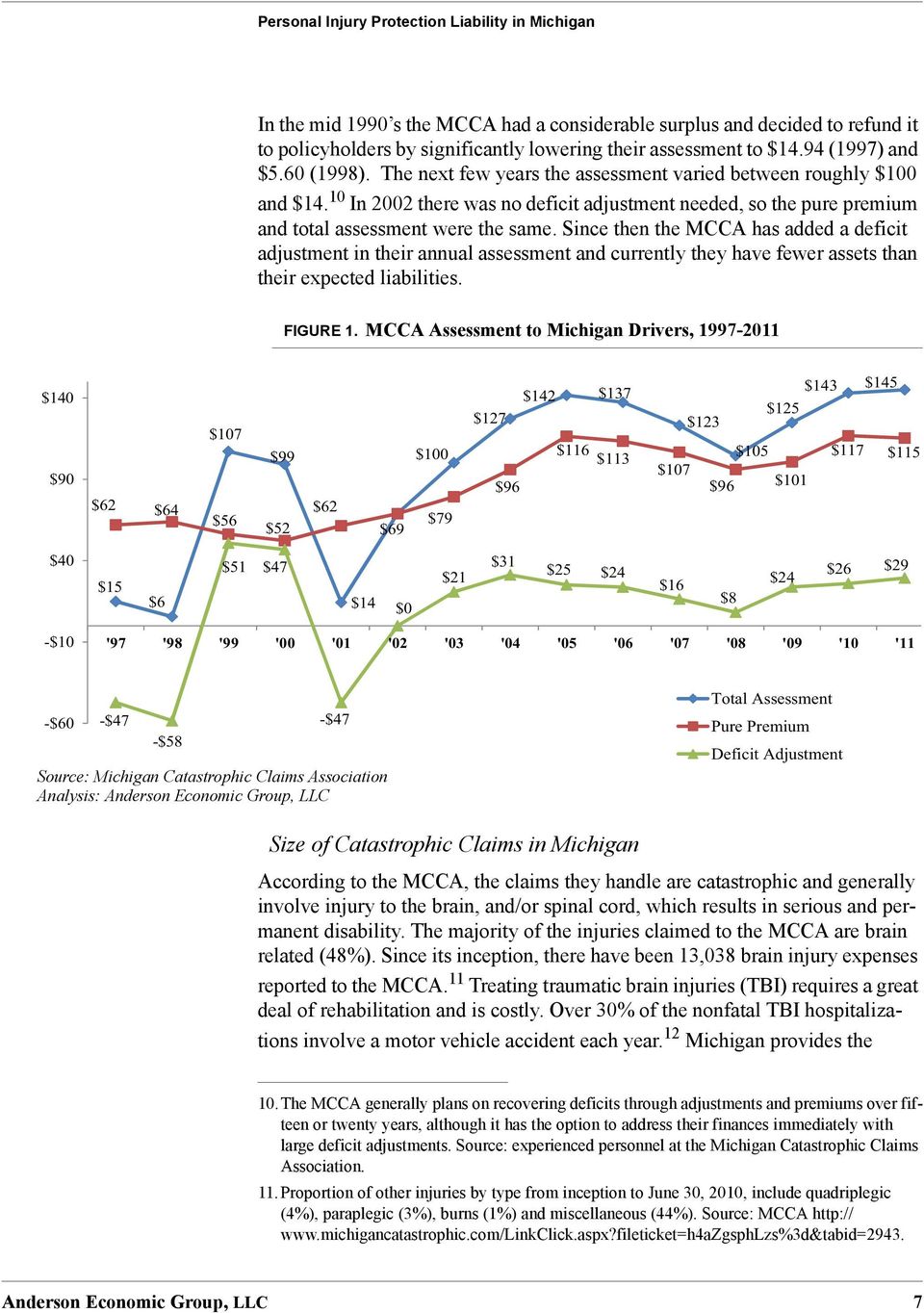
10 Personal Injury Protection Liability in Michigan unique and enviable position that for those people who receive their TBI in an automobile-related incident, medical and rehabilitation coverage is lifelong and comprehensive. Each year, approximately 850 new people are so seriously injured in car accidents that their medical expenses reach over the MCCA s threshold, thus making it a catastrophic claim. 13 The Michigan Catastrophic Claims Association has had over 25,000 claims reported to them since Last year, the MCCA reinsured over $809 million to auto insurance companies, which went to the benefit and loss related payments of catastrophic claims. Most people do not realize the size and cost of care required following a serious auto accident, particularly for those with a traumatic brain injury (TBI). Those who suffer a TBI incur expenses far beyond the $500,000 threshold, especially over a lifetime. Based on current MCCA estimates, 13,103 claims remain active, resulting in future lifetime payments in excess of $74 billion. 15 The MCCA s expected future expenses by component is shown below in Figure 2. AEG consolidated some of these cost categories for clarity, for a description see Data on PIP Coverage and Claims on page A-1. FIGURE 2. MCCA Expected Future Costs by Component Other 6.7% Rehabilitation Services 4.6% Attendant Care- Family 27.5% Residential Care 25.9% Doctor and Labs 6.5% Attendant Care- Agency 14.5% Hospitalization 1.3% Prescription and Supplies 13.0% Source: Michigan Catastrophic Claims Association Analysis: Anderson Economic Group, LLC 12.Traumatic Brain Injury and Public Services in Michigan: Highlights of the MDCH Traumatic Brain Injury Project: Source: is the MCCA s expectation of new claims for 2011 as of April 2011, according to Michigan s Financial and Insurance Regulation Office. 14. Source: Michigan Catastrophic Claims Association, Claim Statistics, 1978 to Source: State of Michigan Office of Financial and Insurance Regulation, Michigan Catastrophic Claims Association, updated April 21, Anderson Economic Group, LLC 8
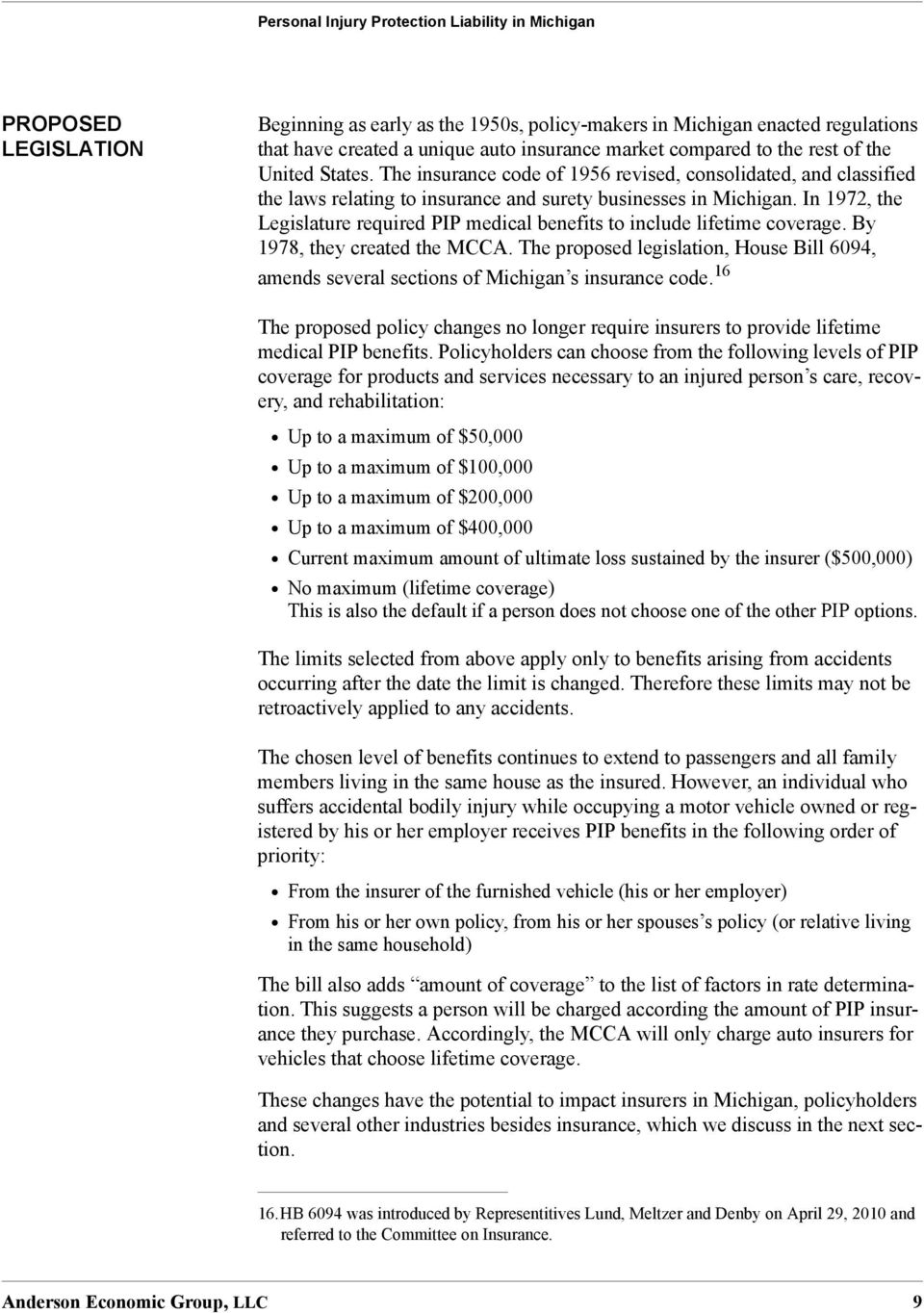
11 Personal Injury Protection Liability in Michigan PROPOSED LEGISLATION Beginning as early as the 1950s, policy-makers in Michigan enacted regulations that have created a unique auto insurance market compared to the rest of the United States. The insurance code of 1956 revised, consolidated, and classified the laws relating to insurance and surety businesses in Michigan. In 1972, the Legislature required PIP medical benefits to include lifetime coverage. By 1978, they created the MCCA. The proposed legislation, House Bill 6094, amends several sections of Michigan s insurance code. 16 The proposed policy changes no longer require insurers to provide lifetime medical PIP benefits. Policyholders can choose from the following levels of PIP coverage for products and services necessary to an injured person s care, recovery, and rehabilitation: Up to a maximum of $50,000 Up to a maximum of $100,000 Up to a maximum of $200,000 Up to a maximum of $400,000 Current maximum amount of ultimate loss sustained by the insurer ($500,000) No maximum (lifetime coverage) This is also the default if a person does not choose one of the other PIP options. The limits selected from above apply only to benefits arising from accidents occurring after the date the limit is changed. Therefore these limits may not be retroactively applied to any accidents. The chosen level of benefits continues to extend to passengers and all family members living in the same house as the insured. However, an individual who suffers accidental bodily injury while occupying a motor vehicle owned or registered by his or her employer receives PIP benefits in the following order of priority: From the insurer of the furnished vehicle (his or her employer) From his or her own policy, from his or her spouses s policy (or relative living in the same household) The bill also adds amount of coverage to the list of factors in rate determination. This suggests a person will be charged according the amount of PIP insurance they purchase. Accordingly, the MCCA will only charge auto insurers for vehicles that choose lifetime coverage. These changes have the potential to impact insurers in Michigan, policyholders and several other industries besides insurance, which we discuss in the next section. 16.HB 6094 was introduced by Representitives Lund, Meltzer and Denby on April 29, 2010 and referred to the Committee on Insurance. Anderson Economic Group, LLC 9
12 Cost and Effects of Proposed Legislation III.Cost and Effects of Proposed Legislation In this section we discuss the size of catastrophic claims in Michigan and the effects the proposed legislation may have on them. Given a choice of PIP coverage, we assume there would be a number of people each year that would underinsure themselves. 17 We estimate the number of those people who would need alternative funding and discuss some of the potential social ramifications of these choices, such as reduced healthcare consumption. Additionally, we estimate the proposed policy change s net impact on Michigan s industries given the assumption of reduced health care consumption and savings to policyholders from reduced PIP premiums. BUYING BEHAVIOR OF POLICYHOLDERS When purchasing an auto insurance policy, most drivers do not consider how much coverage they are getting for the price, just that they are purchasing the required coverage. Additionally, during an economic downturn policyholders become even more price sensitive. A 2009 study by the Insurance Research Council found that 28% of Americans reported shopping for lower auto rates when they normally would not have done so. 18 If drivers in Michigan choose less than lifetime coverage, they are assured savings of at least $145 because of the foregone MCCA assessment. In order to gain perspective on the amount of PIP that policyholders purchase in practice, AEG contacted multiple auto insurers in no-fault states other than Michigan. Auto insurers estimated that 95% of their policyholders opt for the PIP coverage minimum required in their state. 19 Under the proposed policy changes, we conservatively estimate between 75% and 90% of drivers in Michigan would purchase less than lifetime PIP coverage. What remains constant is each year over 800 people in Michigan sustain lifealtering injuries from car accidents. Under the proposed policy changes, a portion of them would be without the lifetime coverage they require. Whether policyholders choose less coverage because they do not calculate the risk, wish to save on the cost of their premiums, or do not realize the extensive costs that can be associated with serious auto-related injuries; people would under insure themselves. This is a considerable problem because the cost of the care provided 17.Based on information from the auto insurance industry on the buying behavior of policyholders, AEG estimates between 75% and 90% of drivers would purchase less than lifetime PIP coverage. We use 75% and 90% as our low and high estimate throughout this section and in our analyses of the anticipated impact of the proposed policy change. 18. Source: Source: auto insurers from other no-fault states with a similar minimum level as the one proposed in Michigan; Minnesota ($40,000), North Dakota ($30,000), and Oregon ($15,000). See PIP Coverage Policyholders in Other States Purchase in Practice on page A-1. Anderson Economic Group, LLC 10

13 Cost and Effects of Proposed Legislation is catastrophic and some health insurance policies preclude auto-related injuries. 20 To put these costs in perspective, intensive care costs can range from $150,000 to $200,000 a week. 21 A patient who chose the second highest PIP coverage available ($400,000) would only be insured up to two weeks, assuming surgery was not necessary beforehand. A patient who chose $50,000 PIP coverage would be personally billed for over $100,000 after only one week. Even if either of those patients qualified for public health services or had private health insurance (that did not exclude auto-related injuries), they would not receive the same quality and choice of services as someone with lifetime PIP coverage. Auto-insurers have very little control over how or by whom a patient receives their expensive care. This is quite unlike health maintenance, preferred provider organizations, and Medicaid programs. We discuss this further in Effect on Quality of Life for Victims of Auto Accidents on page 13. INJURED MICHIGAN DRIVERS NEEDING ALTERNATIVE FUNDING The personal injury protection Michigan drivers are currently required to purchase ensures that anyone injured in an automobile accident will have sufficiently funded healthcare for those injuries. Under the proposed policy changes, we assume that a policyholder s choice in PIP coverage does not impact a driver s chances of incurring catastrophic injuries, so statistically, some people would incur those injuries. Unfortunately a large number of people would choose less than lifetime PIP coverage (we estimate between 75% and 90% of drivers), which leaves a considerable number of people vulnerable to catastrophic costs. The majority of these drivers would not need additional coverage because the costs of treating their injuries would still be less than their insurance. However some would reach a level of expenses that qualify as catastrophic (over $500,000). We estimate there would be between 638 and 765 catastrophic claims each year that would have insufficient PIP coverage, which would need alternative funding, given the amount and type of healthcare necessary. This does not include drivers that purchase, for example, $50,000 coverage and suffer expenses of $200,000. We only examine expenses that reach above $500,000. Our estimates are specific to catastrophic claims and the costs that would bankrupt most individuals and families. Our analysis is shown in Table 2 on page 12 and further described in Alternative Funding on page A AEG does not estimate the proportion of people that would be affected by this nor do we attempt to forecast whether health insurance providers would change this policy in Michigan. 21.According to a 2003 Analysis of brain injury patients published in the journal of Archives of Physical Medicine and Rehabilitation. Anderson Economic Group, LLC 11
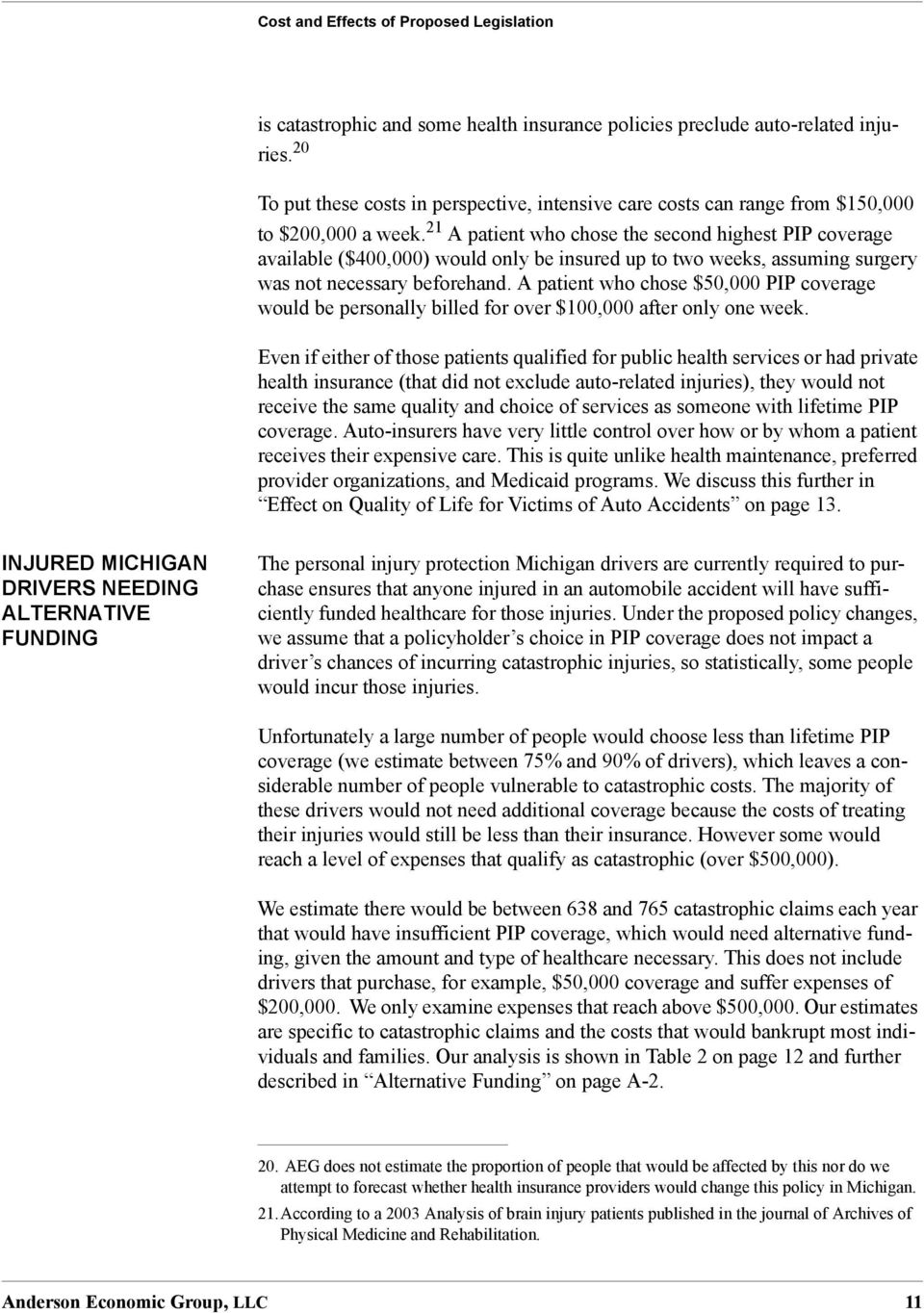
14 Cost and Effects of Proposed Legislation TABLE 2. Number of Injured Drivers Who Would Need Alternative Funding Low Estimate High Estimate Proportion of Drivers Choosing Less Than lifetime PIP Coverage a 75% 90% Number of Drivers Choosing Less Than lifetime PIP Coverage b 6,109,296 7,331,155 Potential Number of Drivers With Insufficient Coverage for Catastrophic Medical Expenses c Sources: Michigan State Police, Traffic Crash Facts- Statewide, Michigan Catastrophic Claims Association Annual Financial Statement FY Analysis: Anderson Economic Group, LLC a. AEG used knowledge obtained from experienced personnel in the insurance industry to create high and low estimates, see Data on PIP Coverage and Claims on page A-1. b. Estimated by multiplying the proportion of drivers choosing less than lifetime PIP coverage by the most recent number of registered vehicles in Michigan (2009). c. AEG multiplied drivers choosing less than lifetime PIP by 0.01% (the estimated proportion of drivers in catastrophic accidents). See footnote (e) in Table A-2 on page A-4. Since 1978, there have been 25,077 catastrophic claims made in Michigan where auto accident related expenses were above the MCCA s threshold. 22 If we project our estimates of unfunded catastrophic claims over the same time period (33 years), it is very close to the same number of claims the MCCA has reported since its inception, as shown below in Table 3. Note that these estimates assume the number of catastrophic claims would continue to be consistent each year. TABLE 3. Estimated Number of Michigan Drivers Who Would Have Insufficient Coverage for Catastrophic Medical Expenses Over Time Low Estimate High Estimate One Year After Policy Change Years After Policy Change a 6,380 7, Years After Policy Change 12,760 15, Years After Policy Change b 21,054 25,245 Source: Michigan Catastrophic Claims Association Annual Financial Statement FY Analysis: Anderson Economic Group, LLC a. AEG estimated by multiplying the number of claims after one year by ten. b. It has been 33 years since the State of Michigan created the MCCA. AEG has used the same number of years to put into perspective with the number of catastrophic claims that could be without insurance or funding for medical expenses. This is a huge unfunded liability, when the MCCA estimates that their current active claims (13,103) would result in future lifetime payments in excess of $ This is the number of reported claims to the MCCA since its inception. The threshold was considerably lower initially and has grown over time with inflation and rising medical costs. Anderson Economic Group, LLC 12
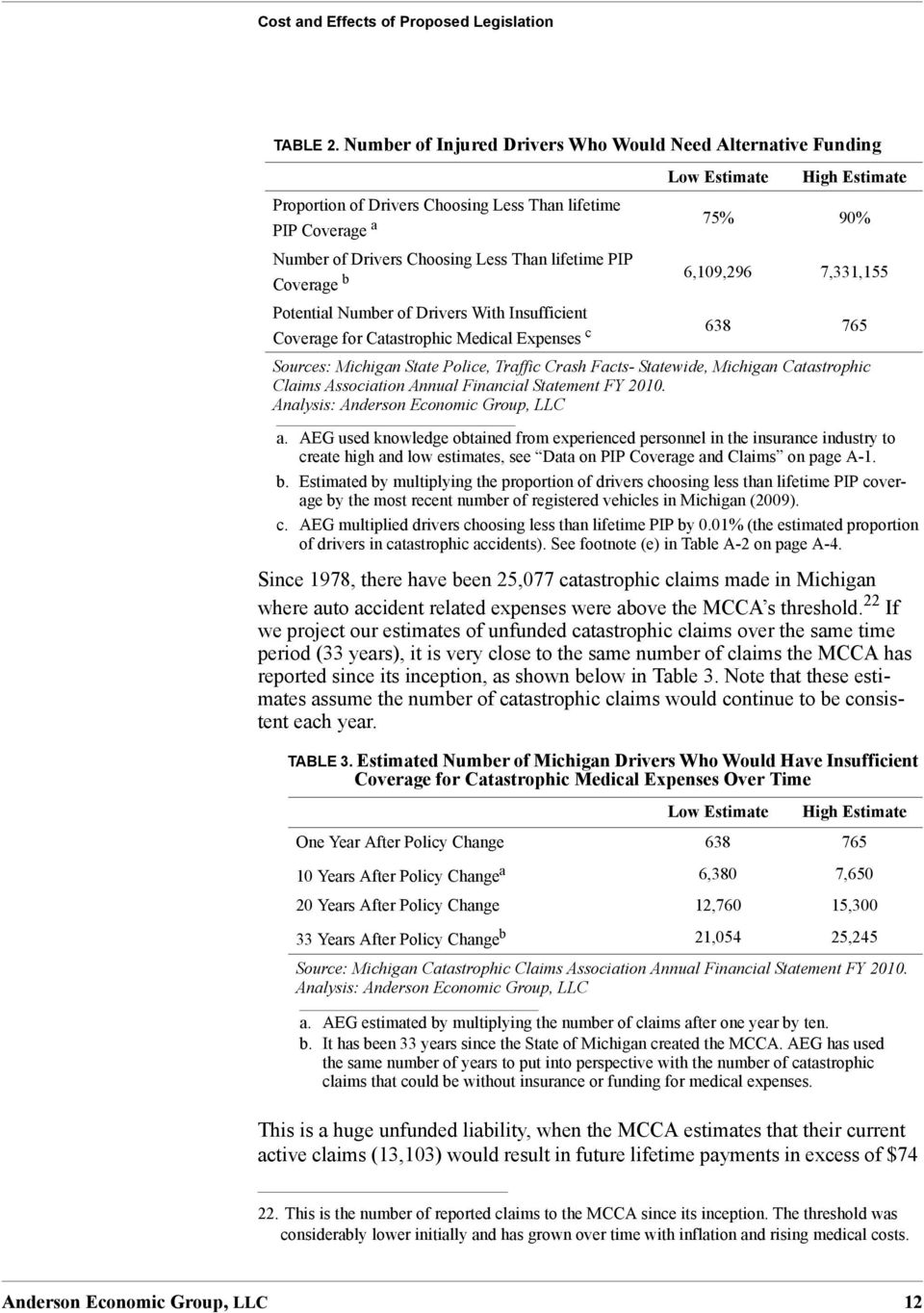
15 Cost and Effects of Proposed Legislation billion. We do not attempt to quantify the actual costs of the catastrophic medical expenses that would no longer by covered by the MCCA, but suspect they would be greater than $74 billion after 20 years. AEG does not attempt to estimate the value of the healthcare foregone or predict where these people would receive alternative sources of funding, but we do qualitatively discuss how funding may affect a person s quality of life below. Effect on Quality of Life for Victims of Auto Accidents Michigan s current PIP coverage provides lifelong and comprehensive medical care and rehabilitation services, which is especially important to people who incur serious injuries like traumatic brain injury (TBI) from an automobilerelated incident. However, alternative sources of funding is substantially different than PIP coverage. Not all individual or employer health plans would provide for all needed services when serious injuries or illnesses occur, as some policies preclude coverage of auto accident related injuries. Even if the health plan is without an auto-injury related clause, they may not be eligible for specific health services and rehabilitation. The reimbursement policies of private insurance companies have been evolving towards cost cutting measures. For example, in the 1990 s, health insurers altered the average length of stay for acute hospitalization and rehabilitation from 77 days to Limiting care is especially true in the cases of patients needing long-term or expensive care, such as traumatic brain injury (TBI) patients. The costs for inpatient acute rehab are over $1,965 a day on average for TBI patients. Outpatient care can run from $430 to $1,228 a day, depending on the level of treatment. 24 This is why many of the services required for TBIs are not included in health plans and only minimal medical rehabilitation is supported by Medicare and Medicaid. 25 Additionally the institutional bias among public payers often consigns individuals with brain injury to inappropriate placements such as nursing homes and psychiatric facilities that are not set up to provide ongoing rehabilitation and specialized care for TBI and other long-term injuries. There is a substantial waiting period for people to gain access to Medicare (generally two years). 23.Source: Kreutzer JS, Kolakowsky-Hayner SA, Ripley D, et al. Charges and lengths of stay for acute and inpatient rehabilitation treatment of traumatic brain injury Brain Injury. 2001;15: Inpatient and outpatient cost of care estimates were according to a 2003 study of brain injury patients published in the journal Archives of Physical Medicine and Rehabilitation. AEG adjusted both costs ($1,600 a day inpatient acute rehab and $350 to $1,000 ad day outpatient) using the Bureau of Labor Statistics CPI inflation calculator. 25.Medicare and Medicaid are both public health programs, but designed to serve different populations. Medicare serves seniors and individuals with permanent disabilities who are younger than the 65. Medicaid serves individuals and families with low incomes and resources. Anderson Economic Group, LLC 13

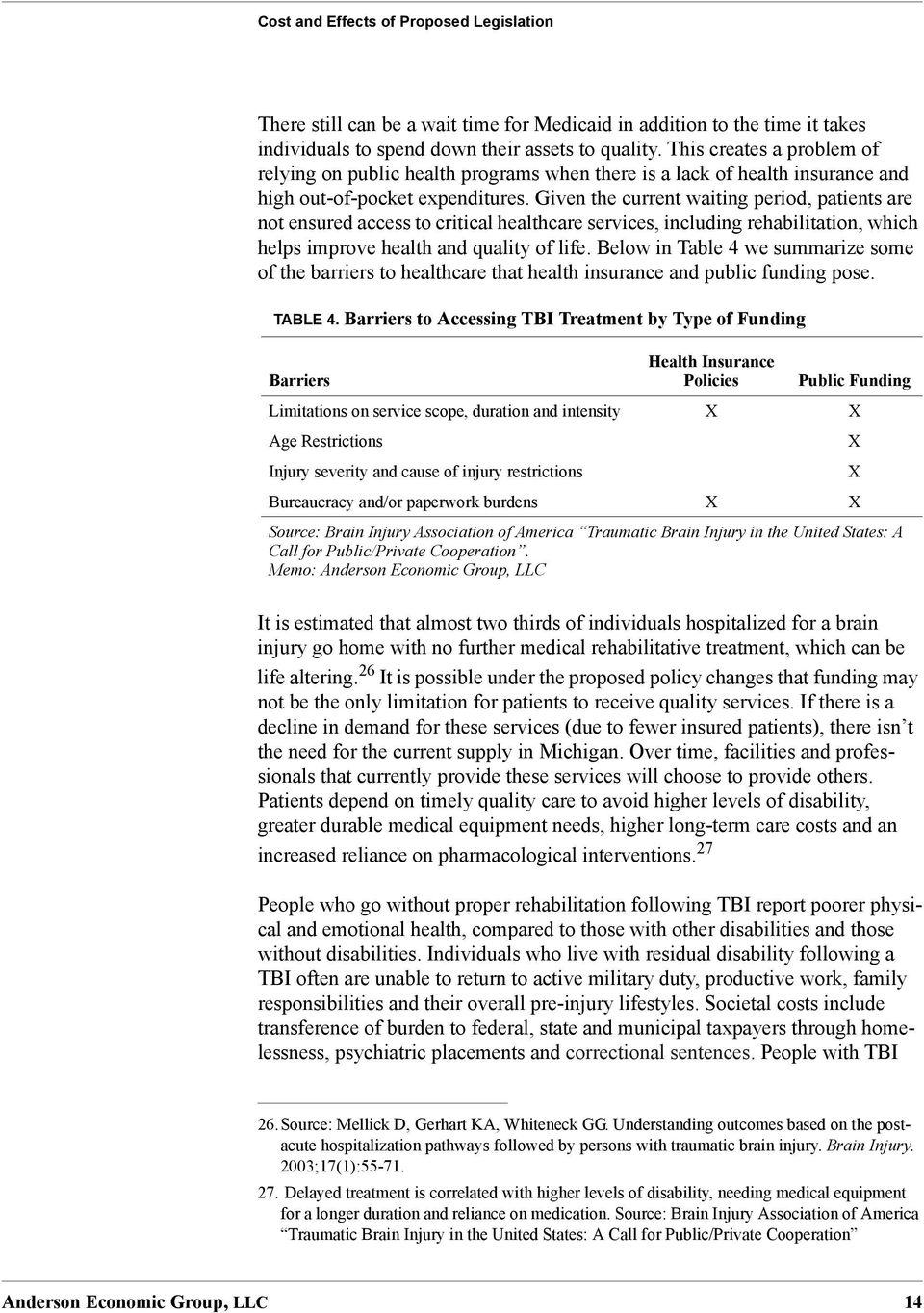
16 Cost and Effects of Proposed Legislation There still can be a wait time for Medicaid in addition to the time it takes individuals to spend down their assets to quality. This creates a problem of relying on public health programs when there is a lack of health insurance and high out-of-pocket expenditures. Given the current waiting period, patients are not ensured access to critical healthcare services, including rehabilitation, which helps improve health and quality of life. Below in Table 4 we summarize some of the barriers to healthcare that health insurance and public funding pose. TABLE 4. Barriers to Accessing TBI Treatment by Type of Funding Barriers Health Insurance Policies Public Funding Limitations on service scope, duration and intensity X X Age Restrictions Injury severity and cause of injury restrictions X X Bureaucracy and/or paperwork burdens X X Source: Brain Injury Association of America Traumatic Brain Injury in the United States: A Call for Public/Private Cooperation. Memo: Anderson Economic Group, LLC It is estimated that almost two thirds of individuals hospitalized for a brain injury go home with no further medical rehabilitative treatment, which can be life altering. 26 It is possible under the proposed policy changes that funding may not be the only limitation for patients to receive quality services. If there is a decline in demand for these services (due to fewer insured patients), there isn t the need for the current supply in Michigan. Over time, facilities and professionals that currently provide these services will choose to provide others. Patients depend on timely quality care to avoid higher levels of disability, greater durable medical equipment needs, higher long-term care costs and an increased reliance on pharmacological interventions. 27 People who go without proper rehabilitation following TBI report poorer physical and emotional health, compared to those with other disabilities and those without disabilities. Individuals who live with residual disability following a TBI often are unable to return to active military duty, productive work, family responsibilities and their overall pre-injury lifestyles. Societal costs include transference of burden to federal, state and municipal taxpayers through homelessness, psychiatric placements and correctional sentences. People with TBI 26.Source: Mellick D, Gerhart KA, Whiteneck GG. Understanding outcomes based on the postacute hospitalization pathways followed by persons with traumatic brain injury. Brain Injury. 2003;17(1): Delayed treatment is correlated with higher levels of disability, needing medical equipment for a longer duration and reliance on medication. Source: Brain Injury Association of America Traumatic Brain Injury in the United States: A Call for Public/Private Cooperation Anderson Economic Group, LLC 14
17 Cost and Effects of Proposed Legislation are 66% more likely to receive welfare or disability payments and are four times more likely to attempt suicide than people without disabilities. 28 Other personal consequences of inadequate access to continued care following a TBI include depression, substance abuse, and family dysfunction. Without rehabilitation most people require respite care, which can be especially difficult for most family members and caregivers to access, which can lead to caregiver burnout, compassion fatigue, and overall lack of quality of care. 29 Our discussion above focused on the potential consequences of people incurring catastrophic injuries without lifetime PIP benefits. Next we discuss how the proposed policy change may impact people in Michigan who have already been catastrophically injured. EFFECTS ON THE MCCA AND THOSE IT FUNDS While the proposed legislation does not change the MCCA s obligation to continue to provide coverage for its open claims, it is not clear how it would impact its finances. As discussed in Michigan Catastrophic Claims Association on page 6, the MCCA is not a pay-as-you-go operation. Its annual assessments are required to cover the lifetime claims of all persons catastrophically injured that year. However, the MCCA is also currently operating at a deficit (they have fewer assets than expected liabilities). See below in Table 5. TABLE 5. Simple MCCA Balance Sheet, 2009 and 2010 FY 2009 FY 2010 Assets (cash and investments) $10,159,360,511 $11,214,798,125 Liabilities ($12,563,211,000) ($13,569,472,000) Surplus (Deficit) ($2,403,850,489) ($2,354,673,875) Source: Michigan Catastrophic Claims Association Annual Financial Statement FY Analysis: Anderson Economic Group, LLC Under the proposed policy changes, the current funding used for catastrophic claims may be at risk due to the needed deficit adjustment. The MCCA operates under a traditional insurance structure, so most of the funding they anticipate as necessary is there. However, the current structure also relies on future premiums for the deficit adjustment. Depending on the proportion of drivers who choose less than lifetime coverage, we estimate the MCCA would forego between $638 million and $771 million in 28.Source: Silver J, Kramer R, Greenwald S, et al. The Association Between Head Injuries and Psychiatric Disorders: Findings from the New Haven NIMH Epidemiologic Catchment Area Study. Brain Injury. 2001;15(11): Source: Brain Injury Consensus Conference, Barriers and Recommendations: Addressing the Challenge of Brain Injury in America, Anderson Economic Group, LLC 15

18 Cost and Effects of Proposed Legislation written premiums each year. 30 While the Association would be insuring far fewer drivers and have a lower risk of pay outs, the drop in collected premiums would make it very difficult to close its gap in assets and expected liabilities. 31 If the MCCA wished to balance its assets and expected liabilities, it could increase the deficit adjustment or overall assessment substantially. However, people would likely react strongly to the price increase and choose lower coverage, which would perpetuate the problem until lifetime PIP medical benefits were no longer purchased or offered. 32 If the MCCA cannot recover from their $2 billion deficit through increased collected premiums or creative investing, AEG anticipates one of two things would happen to the claims the MCCA is responsible for: The State of Michigan would intercede The state may choose to provide public funding for all open claims or may be forced to because those individuals cannot afford the cost of care. The auto insurer who is normally reimbursed would incur the loss Potentially, it would fall back onto the original insurer to support these claims. Logic suggests that the costs would be spread out and not immediately great enough that an auto insurer would go out of business. Instead the insurer may try to recoup these costs by increasing the premiums of other policyholders. Additionally, the proposed policy change allows the buying behavior of policyholders to dictate how much of almost $810 million would continue to be spent on PIP-related healthcare. 33 We discuss this in greater detail in Potential Net Impact of Policy on Michigan s Industries on page 22. Next we estimate the number of injured Michigan drivers who would need alternative funding for auto-related injuries under the proposed policy changes. In this estimation, we do not assume that any of those people already injured would need additional funding. Instead our estimation reflects only those drivers who under insure themselves and incur catastrophic costs (expenses in excess of $500,000). 30.This was estimated using AEG s low and high estimate for drivers who would choose less than lifetime PIP coverage. 31. AEG assumes that under the proposed policy change, the MCCA would only collect assessments from drivers choosing maximum PIP coverage (lifelong benefits). The legislation, H.B. 6094, states the MCCA s assessment would be adjusted to reflect the amount of coverage selected by each member s insureds. AEG interpreted this to mean that policyholders who choose a coverage amount below the MCCA threshold for reinsurance would not be charged its assessment. 32. This scenario would go against the practices of the MCCA over the past 40 years, by attempting to recover large amounts of the deficit instead of using a 15 or 20 year amortization rate. 33. The MCCA paid out $809,586,065 in benefit and loss related payments to PIP claims in Source: MCCA Annual Financial Statement, FY Anderson Economic Group, LLC 16
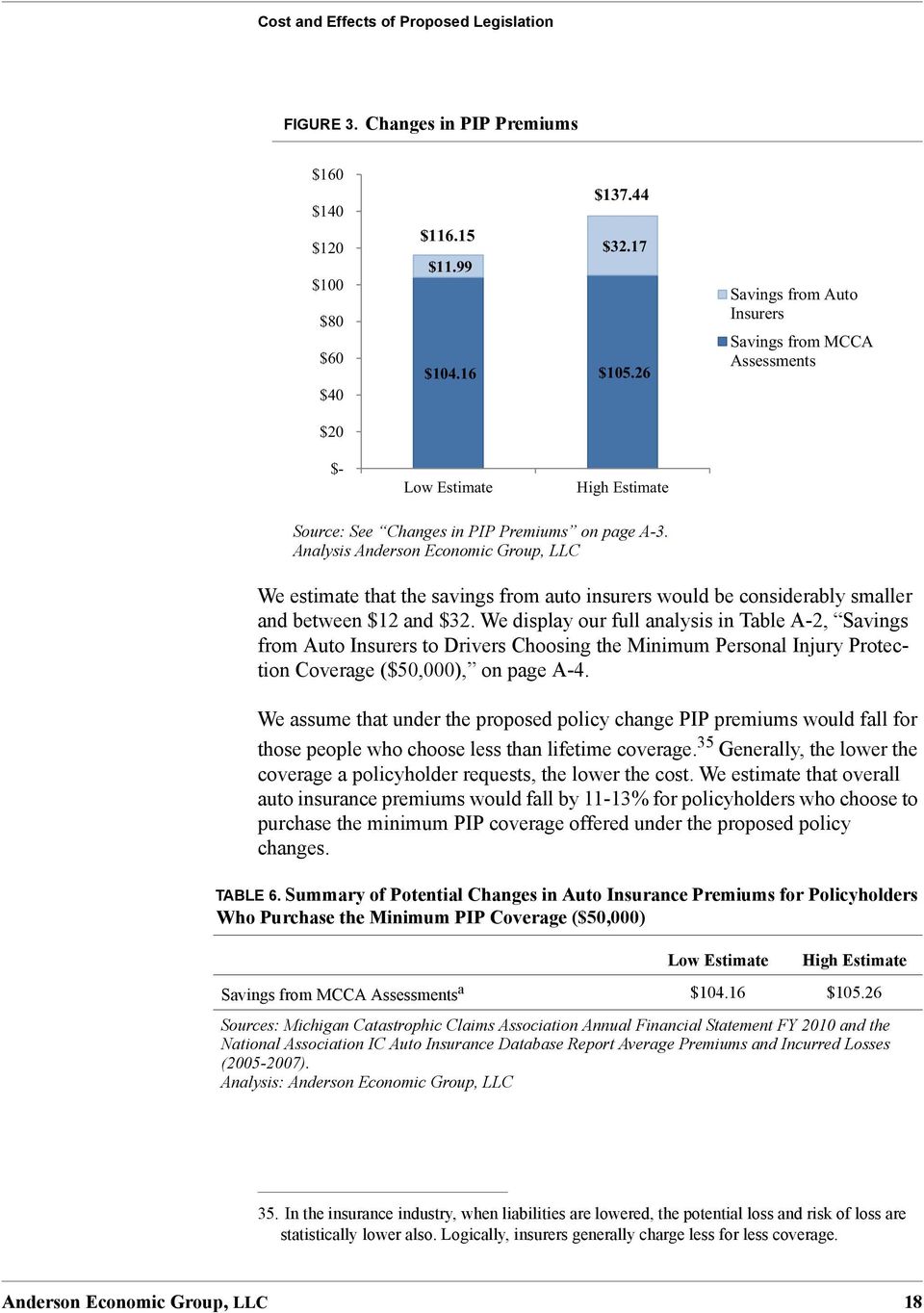
19 Cost and Effects of Proposed Legislation CHANGES IN INSURANCE PREMIUMS As we discuss the potential effect these policy changes would have on auto insurance premiums, we assume that the cost of coverage is directly related to the amount of coverage a policyholder purchases. Thus, a policyholder s PIP premium should be lower than the present, if he or she chooses less than lifetime PIP coverage. Personal Injury Protection Premiums Personal injury protection premiums are decided by two entities in Michigan: Auto insurance companies. Currently, auto insurers assume the risk of insuring drivers up to $500,000. Under the proposed policy change, they would only be liable for the coverage chosen by the policyholder, which we assume would be $50,000 for 75% to 90% of policyholders. MCCA. Currently, the MCCA reimburses auto insurers for claims greater than $500,000. Under the proposed policy change, the MCCA would no longer collect an assessment from car owners who choose less than lifetime coverage because they would no longer be responsible for their reinsurance. We assume then, that PIP premiums would fall by at least the MCCA assessment amount for those choosing less than lifetime PIP coverage. We estimate the average savings from the MCCA per driver (for those who choose less than lifetime coverage) is approximately $104 or $105, as shown below in Figure Our full analysis is shown in Table A-1, Savings from the Michigan Catastrophic Claims Association to Drivers Choosing Less than Lifetime Personal Injury Protection Coverage, on page A Note that the MCCA assessment does not apply to every driver, but every registered vehicle. In 2009 there were approximately 25% fewer vehicles than registered drivers in Michigan. Anderson Economic Group, LLC 17

20 Cost and Effects of Proposed Legislation FIGURE 3. Changes in PIP Premiums $160 $140 $120 $100 $80 $60 $40 $20 $ $ $32.17 $11.99 $ $ Savings from Auto Insurers Savings from MCCA Assessments $- Low Estimate High Estimate Source: See Changes in PIP Premiums on page A-3. Analysis Anderson Economic Group, LLC We estimate that the savings from auto insurers would be considerably smaller and between $12 and $32. We display our full analysis in Table A-2, Savings from Auto Insurers to Drivers Choosing the Minimum Personal Injury Protection Coverage ($50,000), on page A-4. We assume that under the proposed policy change PIP premiums would fall for those people who choose less than lifetime coverage. 35 Generally, the lower the coverage a policyholder requests, the lower the cost. We estimate that overall auto insurance premiums would fall by 11-13% for policyholders who choose to purchase the minimum PIP coverage offered under the proposed policy changes. TABLE 6. Summary of Potential Changes in Auto Insurance Premiums for Policyholders Who Purchase the Minimum PIP Coverage ($50,000) Low Estimate High Estimate Savings from MCCA Assessments a $ $ Sources: Michigan Catastrophic Claims Association Annual Financial Statement FY 2010 and the National Association IC Auto Insurance Database Report Average Premiums and Incurred Losses ( ). Analysis: Anderson Economic Group, LLC 35. In the insurance industry, when liabilities are lowered, the potential loss and risk of loss are statistically lower also. Logically, insurers generally charge less for less coverage. Anderson Economic Group, LLC 18
21 Cost and Effects of Proposed Legislation TABLE 6. Summary of Potential Changes in Auto Insurance Premiums for Policyholders Who Purchase the Minimum PIP Coverage ($50,000) Low Estimate High Estimate Savings from Purchasing Minimum PIP Coverage ($50,000) b $11.99 $32.17 Total Savings to Drivers Choosing Minimum PIP Coverage $ $ Decrease in Overall Insurance Premiums by Choosing to Purchase the Minimum PIP Coverage c 11.1% 13.4% Sources: Michigan Catastrophic Claims Association Annual Financial Statement FY 2010 and the National Association IC Auto Insurance Database Report Average Premiums and Incurred Losses ( ). Analysis: Anderson Economic Group, LLC a. Note that all policyholders who chose less than lifetime PIP coverage would receive these savings from the MCCA, not just those who purchased $50,000 of coverage. For full analysis see Table A-1, Savings from the Michigan Catastrophic Claims Association to Drivers Choosing Less than Lifetime Personal Injury Protection Coverage, on page A-3. b. For full analysis see Table A-2, Savings from Auto Insurers to Drivers Choosing the Minimum Personal Injury Protection Coverage ($50,000), on page A-4. c. Estimated by dividing the total savings to drivers choosing minimum PIP coverage by the total average premium in Michigan. Our estimates are slightly lower than the Insurance Institute of Michigan s prediction of savings from PIP choice (16%). 36 As shown in Table 6, we anticipate the largest saving would mostly come from not paying the MCCA assessment. However, we are unsure of how this policy would affect auto insurance premiums overall in the long run. There are other aspects of coverage required under Michigan s no-fault that may become more expensive, which we next discuss. Bodily Injury Coverage It is conceivable, however, that while PIP premiums would be lowered, auto insurance companies may choose to increase the cost of other premiums. Given the increased liability costs related to lawsuits, bodily injury (BI) coverage premiums may rise, which pays for defense costs and any damages the insured is found liable for up to the limits of the policy. 37 As in other no-fault systems, there is currently an allowance for parties to seek compensation in extreme circumstances, which is limited to exceptionally serious cases. In general, a driver in Michigan can be sued in Michigan if an accident causes someone to be killed, seriously injured or permanently disfigured Source: Michigan Association of Insurance Agents 37.Sometimes courts award more than these amounts, which the driver would then be liable for unless they purchase additional liability insurance. In practice though, it can be extremely difficult for the injured to collect beyond the limits of the BI policy. Anderson Economic Group, LLC 19
22 Cost and Effects of Proposed Legislation However, under the proposed policy changes, if the injured has insufficient PIP coverage, he or she may use the excuse of medical expenses, rather than pain and suffering to sue another driver. We are unable to include an analysis of bodily injury insurance in Michigan. Instead, we qualitatively discuss the additional costs these could impose on drivers involved in an accident below. Additional Auto Accident Related Law Suits As discussed in Personal Injury Protection Liability in Michigan on page 5, Michigan drivers receive high benefits under the no-fault law, but face large barriers to sue other drivers. Lowering PIP benefits may make more Michigan drivers vulnerable to being sued or alternatively give reason for injured drivers to want to sue others. With lower PIP coverage, suing another driver to recoup medical costs may seem like an appealing option, even if it is not the most effective way to pay for care. The proposed policy change does not affect Michigan s verbal threshold. However, it has been predicted that recent judgements in Michigan s Supreme Court will greatly affect auto negligence cases; particularly how personal injury lawyers in the state perceive compensable injuries. 39 Rodney McCormick v. Larry Carrier and Allied Group (2010) overturned a decision that created additional restrictive hurdles to pursue a noneconomic loss lawsuit (pain and suffering), which was created over 15 years ago. The changes in auto negligence filings corresponds with the timing of the court s decision. Over the past decade, the year after year growth of new auto negligence filings has been just over 1%. 40 Yet the last two years (2009 and 2010) have shown marked increase in the number of filings; growing 7% from 2008 to 2009 and almost 18% from 2009 to Michigan courts have been seeing more auto negligence cases recently than they have over the past ten years. This suggests that with lower PIP coverage options, Michigan s court systems would see more auto-related lawsuits. This could potentially increase costs for the following groups: The State of Michigan would bear the cost of an increased court case load. Policyholders (as discussed in Bodily Injury Coverage on page 19, auto insurers may shift costs to higher bodily injury coverage) 38. Source: Insurance Consumer Information from Insurance Councilor at the Office of Financial and Insurance Regulation and the Insurance Code of 1956, Act 218 of 1956, Michigan s verbal threshold permits a suit for noneconomic loss if a victim s injuries result in death, permanent disfigurement, or serious impairment of body function. Kreiner v. Fischer (1995), further introduced a requirement of long, temporal periods of disability after an auto accident in Michigan. 40.From 2000 to 2010 the compound annual growth rate for filings was 1.2%. Source: Michigan Courts, Circuit Supplements Statewide, Anderson Economic Group, LLC 20
23 Cost and Effects of Proposed Legislation People injured in auto-accidents who are under insured may decide to pursue a lawsuit, which is costly and often a lengthily process. The last group would also be affected by the time it takes to recoup costs that their auto insurer would normally pay for through PIP. He or she may bear the costs of medical bills and only be relieved years later, if the lawsuit is a success. Additionally he or she will receive less money overall than they would receive from their lifetime PIP benefits. 41 In these cases, suing someone for damages is an ineffective way to pay for needed care because recovery is time sensitive. As discussed in Effect on Quality of Life for Victims of Auto Accidents on page 13, waiting for health care treatments, which may be vital to recovery can be life altering. Insurance Industry Profits The proposed legislation includes amount of insurance as a factor to PIP rates, but does not specify beyond that. Auto insurers are not compelled by any regulation governing Michigan s insurance industry to lower premiums if a policyholder chooses lower coverage. However, the competitiveness within Michigan s auto insurance market would make any change in profits due to lack of awareness temporary. As discussed in Personal Injury Protection Premiums on page 17 and Changes in PIP Premiums on page A-2, we assume auto insurance companies would generally pass along savings to customers through lower premiums. Below in Table 7, we estimate the potential additional profits auto insurers in Michigan could sustain under the proposed policy change. TABLE 7. Estimated Change in Insurance Industry Profits Under the Proposed Policy Low Estimate High Estimate Current PIP Losses Incurred By Auto Insurers $739,837,420 $739,837,420 Amount of Savings to Auto Insurers Due to Limited Liability (Policyholders Choosing $50,000 Coverage) a ($91,506,800) ($109,808,160) PIP Losses Incurred by Auto Insurers Under Policy Change b $648,330,620 $630,029,260 Sources: See Table A-2, Savings from Auto Insurers to Drivers Choosing the Minimum Personal Injury Protection Coverage ($50,000), on page A-4. Analysis: Anderson Economic Group, LLC a. This was estimated by multiplying the number of claims AEG anticipates would incur expenses beyond their coverage (claims that would be under-insured) by their choice of coverage ($50,000). For full analysis see Table A-2 on page A-4. b. Estimated by subtracting the amount of savings to auto insurers due to limited liability from the PIP losses incurred solely by auto insurers. 41.Assuming the plaintiff is successful, lawyer fees would encroach on some of the settlement and the circumstance of the accident, along with other factors would dictate the overall amount awarded. Anderson Economic Group, LLC 21
24 Cost and Effects of Proposed Legislation Potentially, auto insurers would go from nearly $740 million PIP incurred losses to between $630 and $648 million. The auto insurance industry in Michigan stands to pay out between $91 and $109 million less in claims each year, under the proposed policy changes. 42 After exploring the potentially positive impact the proposed policy change would have on policyholders (lower premiums) and insurers (profits), we look at the impact this would have on industries in Michigan. We also examine this impact in relation to those policyholders who received savings in their premiums, but incurred catastrophic medical expenses because they were underinsured. POTENTIAL NET IMPACT OF POLICY ON MICHIGAN S INDUSTRIES In order to estimate the net impact of the proposed legislation on Michigan s industries, we considered the two ways that the policy would impact the way money would be spent: 1. Less money would be given to policyholders for catastrophic medical expenses, resulting in reduced healthcare consumption Given the choice of PIP coverage, there would be some people who under insure themselves, which we discussed in Injured Michigan Drivers Needing Alternative Funding on page 11. Our focus is on the healthcare spending related to catastrophic claims. 2. Less money would be spent on PIP premiums, resulting in higher consumer expenditures As discussed in Changes in Insurance Premiums on page 17, policyholders who choose the minimum PIP coverage would save between $116 and $137 on their premiums annually. The largest of these savings coming from no longer paying the MCCA assessment. We begin by discussing the impact we estimate reduced healthcare consumption would have in Michigan. Then we would explain our analysis of the impact we anticipate that savings from PIP premiums would have. In order to estimate the economic impact of both changes in spending, we used an economic model that translates change in demand (or consumption) into total economic impact, which can be expressed in output, earnings and employment. The model we use is from the Bureau of Economic Analysis, which uses multipliers to estimate final change in demand. This is further described, along with our assumptions for inputs, substitution effects, and multipliers in Economic Impact of Proposed Policy Change on page A-5. Impact of Reduced Healthcare Consumption In this analysis, we only include catastrophic claims, or spending on healthcare reimbursed by the MCCA. We do not consider the change in consumption for 42. Our estimates assume that between 75% and 90% of policyholders would choose the minimum PIP coverage proposed ($50,000). Anderson Economic Group, LLC 22
25 Cost and Effects of Proposed Legislation anyone below $500,000, due to data constrictions. Last year, auto insurance companies were reinsured for $809,586,065, which was spent by claimants on healthcare benefits and related losses. 43 The majority of these payments went towards recovery, as the initial care given at the hospital, for surgeries and other immediate care, were paid for by the auto insurers themselves. 44 We assume that given the option of choosing lower PIP coverage, only a portion of the money would still be spent on auto injury-related healthcare. We use the amount of money spent on catastrophic claims in FY 2010 by the MCCA as our starting point for the impact that reduced PIP-related healthcare would have in Michigan, as shown in Table A-3 on page A We then take into account substitution methods of procuring care; paying out-of-pocket, using private health insurance, enrolling in publicly funded healthcare or relying on charity to receive services. However, the aforementioned methods of payment may limit what services the person receives; whether it is by choice, program restrictions, or limited resources. In some capacity, with less PIP coverage we assume that there would be a reduced amount of healthcare consumption, particularly in long-term health services. 46 Below in Table 8 we show our estimations of the impact of reduced long-term care consumption in Michigan. 43. According to the MCCA over 90% of their costs go to healthcare related expenses. The rest of these claims are spent on home modifications to accommodate injuries and wage loss.source: MCCA Annual Financial Statement, FY Initial expenses for individuals in serious auto accidents are generally for intensive care and other immediate services provided by the hospital. Once these expenses reach over $500,000 the MCCA would become involved. Due to the arrangement of reinsurance, this analysis does not capture a great deal of care provided by hospitals. 45. We were unable to decipher the difference with our data sources between money spent on new claims versus old. See Data on PIP Coverage and Claims on page A Almost three quarters of the categories of cost were long-term care services; residential care, agency attendant care and family attendant care. Anderson Economic Group, LLC 23
26 Cost and Effects of Proposed Legislation TABLE 8. Decrease in Output due to Reduced Long-Term Care Consumption Impact by Industry Output Earnings Employment 1. Agriculture, forestry, fishing, and hunting $ 446,762 $ 805, Mining $ 60,929 $ 30, Utilities $ 2,327,386 $ 1,623, Construction $ 679,008 $ 763, Manufacturing $ 9,149,926 $ 6,285, Wholesale trade $ 2,888,810 $ 6,139, Retail trade $ 557,704 $ 11,846, Transportation and warehousing $ 2,088,052 $ 3,936, Information $ 1,730,308 $ 2,182, Finance and insurance $ 6,093,730 $ 8,484, Real estate and rental and leasing $ 7,411,283 $ 2,728, Professional, scientific, and technical services $ 6,522,888 $ 9,006, Management of companies and enterprises $ 2,643,242 $ 2,731, Administrative and waste management service $ 5,946,110 $ 5,859, Educational services $ 31,355 $ 2,905, Health care and social assistance $ 157,491,457 $ 99,550,722 3, Arts, entertainment, and recreation $ 209,250 $ 1,411, Accommodation $ 266,969 $ 838, Food Services and drinking places $ 1,497,050 $ 4,442, Other services $ 1,078,263 $ 6,143, Households $ - $ 407, Total Impact on Employment $ 209,120,481 $ 178,123,349 5,892 Notes: - Though the household industry is included in the results of earnings and employment, the Bureau of Economic Analysis does produce multipliers for the output of this sector. - Totals are from Tables A-5, A-6 and A-7 in Appendix A. Impact of Premium Savings to Policyholders Our analysis, Changes in Insurance Premiums on page 17, describes the savings we anticipate policyholders would receive if they choose minimum PIP coverage. We estimate these savings would total between $709 million and $1.0 billion if 75% to 90% of policyholders choose $50,000 PIP coverage. However, we assume that a portion of these savings would be spent on healthcare that otherwise would have been covered by PIP. Although we anticipate fewer people would be impacted by lack of sufficient PIP insurance, the overall price of those mistakes, even if distributed, is substantial because the claims are catastrophic. The earnings and employment impact of savings from PIP premiums is shown below in Table 9. As PIP premium savings return to households, there is no additional output. See Economic Impact of Proposed Policy Change on page A-5, for additional explanation and our full analysis. Anderson Economic Group, LLC 24
27 Cost and Effects of Proposed Legislation TABLE 9. Increase in Earnings and Employment Due to Savings For Policyholders Choosing Minimum PIP Coverage Low Estimate High Estimate Impact by Industry Earnings Employment Earnings Employment 1. Agriculture, forestry, fishing, and hunting $ 184,127 8 $ 875, Mining $ 6,349 0 $ 30, Utilities $ 336,508 3 $ 1,600, Construction $ 133,333 3 $ 633, Manufacturing $ 1,269, $ 6,037, Wholesale trade $ 1,365, $ 6,490, Retail trade $ 3,060, $ 14,551, Transportation and warehousing $ 838, $ 3,985, Information $ 482,539 9 $ 2,294, Finance and insurance $ 1,847, $ 8,785, Real estate and rental and leasing $ 615, $ 2,928, Professional, scientific, and technical services $ 1,593, $ 7,577, Management of companies and enterprises $ 412,698 4 $ 1,962, Administrative and waste management service $ 844, $ 4,015, Educational services $ 761, $ 3,622, Health care and social assistance $ 5,504, $ 26,174, Arts, entertainment, and recreation $ 349, $ 1,660, Accommodation $ 203, $ 966, Food Services and drinking places $ 1,041, $ 4,951, Other services $ 1,485, $ 7,064, Households $ 107, $ 513, Total Impact on Employment $ 178,123, $ 106,721,303 3,336 Notes: - Though the household industry is included in the results of earnings and employment, the Bureau of Economic Analysis does produce multipliers for the output of this sector. - Totals are from Tables A-5, A-6 and A-7 in Appendix A. Net Impact of Proposed Policy Change Our net economic impact measures the additional economic activity caused by the proposed policy changes, by measuring the impact of savings on premiums versus the reduced PIP expenditures on healthcare. Below in Table 10, we show Anderson Economic Group, LLC 25
28 Cost and Effects of Proposed Legislation the overall change in impact of lower PIP premiums, if 75% of people choose the minimum PIP premiums. TABLE 10. Estimated Net Impact of Proposed Policy Change on Industries in Michigan Using Low Estimate of Policyholders Choosing Minimum PIP Coverage Impact on Output Impact on Earnings Impact on Employment Estimated Impact in Michigan due to Lower PIP Premiums $0 $22,444, Estimated Impact due to Decreased Consumption of Long Term Care Services ($209,120,481) ($178,123,349) (5,892) Potential Net Impact of Proposed Policy Change ($209,120,481) ($155,678,922) (5,191) Analysis: Anderson Economic Group, LLC The proportion of people choosing the minimum amount of PIP premiums greatly affects the net impact of the proposed policy change. As shown below in Table 11, if 90% of people choose $50,000 PIP coverage, the net impact of the proposed policy change is lower in terms of earnings and employment. Yet the net impact is still negative. TABLE 11. Estimated Net Impact of Proposed Policy Change on Industries in Michigan Using High Estimate of Policyholders Choosing Minimum PIP Coverage Impact on Output Impact on Earnings Impact on Employment Estimated Impact in Michigan due to Lower PIP Premiums $0 $106,721,303 3,336 Estimated Impact due to Decreased Consumption of Long Term Care Services ($209,120,481) ($178,123,349) (5,892) Potential Net Impact of Proposed Policy Change ($209,120,481) ($71,402,046) (2,556) Analysis: Anderson Economic Group, LLC Savings in the short run for policyholders leads to potentially greater costs in the long-run. Despite the high estimation of drivers choosing the minimum PIP coverage, Michigan experiences a decline in output, earnings and employment. We estimate that the proposed policy change would cost Michigan the following: Over $209 million in output Between $71 and $155 million in earnings Between 2,556 and 5,191 jobs Anderson Economic Group, LLC 26
29 Appendix A: Methodology Appendix A. Methodology In this report, we estimate the effects the proposed policy change will have in Michigan. Specifically its impact on the insurance industry, healthcare and households. This section further describes our reasoning and provides our data sources and full analyses. DATA ON PIP COVERAGE AND CLAIMS AEG procured data on personal injury protection premiums specifically from two sources: 1. National Association of Insurance Commissioners AEG purchased their Auto Insurance Database Report, 2007/2008, which included average Michigan premiums, expenditures and incurred losses. 2. Michigan Catastrophic Claims Association AEG used the MCCA s website as a reference, as well as the financial statements available there. Additionally, AEG spoke with experienced personnel at the MCCA to clarify questions about the MCCA s operation and finances. AEG used the MCCA s annual financial statement FY 2010 as the main data source for the number of passenger vehicle catastrophic claims in Michigan and the associated cost. 47 Note that the MCCA is subject to the same reporting requirements as all auto insurance companies operating in Michigan. The MCCA s financial statements are prepared on the basis of statutory accounting practices as prescribed or permitted by the State of Michigan Office of Financial and Insurance Regulation (OFIR). PIP Coverage Policyholders in Other States Purchase in Practice As policyholders in Michigan currently do not have a choice in their PIP coverage, AEG spoke with auto insurers in other no-fault states about what is typically purchased. We chose to ask specifically about PIP coverage because it seemed more pertinent for our purposes than other liability insurance. Additionally, only certain no-fault states require each policyholder purchase a minimum amount of PIP coverage. We chose states that had a minimum PIP coverage similar to what is being proposed in Michigan ($50,000). Other states that we did not call had significantly lower PIP minimums ranging from $3,000 to $10,000. The states we spoke with were Minnesota ($40,000), North Dakota ($30,000), and Oregon ($15,000). None of those states offered lifetime PIP coverage in any capacity. In Minnesota, North Dakota and Oregon, all of the estimates of buying behavior was similar; 95% chose the minimum required by their state. 47. The MCCA also reinsures commercial vehicles and motorcycles, however, this goes beyond the scope of this report. AEG was careful to only use data pertaining to passenger vehicles. Anderson Economic Group, LLC A-1
30 Appendix A: Methodology MCCA Claims by Expected Future Categories of Cost For Figure 2, MCCA Expected Future Costs by Component, on page 8, we grouped some categories to allow the reader a general idea of costs. The following categories were combined into the other category, which totalled 6.7% of total costs: case management, equipment, prosthesis, purchases, transportation, modifications and others. The remaining categories were left as they were shown on the MCCA website. 48 Note that these cost categories were used in part of our net impact analysis to decipher which industries PIP expenditures (or costs to the MCCA) should be placed in. However, we did use slightly different groupings for that analysis. 49 ALTERNATIVE FUNDING Our analysis of the number of injured drivers needing alternative funding assumes that some drivers will under-insure themselves, given a choice of PIP coverage. AEG chose to use the number of catastrophic claims as a proxy for the number of people receiving PIP-related care to gain a conservative estimate instead of additionally estimating the average number of people under each claim. (Each car involved in an accident counts as one claim, therefore there may be multiple people covered under the same claim if there were passengers at the time of the accident.) Based on the number of claims reported by the MCCA since 1978 (25,216) and the number of people injured (27,191), each catastrophic claim includes 1.08 people. The analysis is limited to drivers who choose less than lifetime coverage. We do not attempt to quantify the number of people who will have insufficient PIP coverage with expenses lower than a catastrophic cost nor the actual amount of auto-related injury expenses that will not be covered by PIP. CHANGES IN PIP PREMIUMS For our analysis of the potential effect the proposed policy changes will have on auto insurance premiums, we assume the cost of coverage is directly related to the amount of coverage a policyholder purchases. Thus, a policyholder s PIP premium should be lower than it currently is, if he or she chooses less than lifetime coverage. We do not try to quantify any changes in the average auto insurance premium, except for personal injury protection. We note that the competitiveness within Michigan s auto insurance market would make any change in profits due to lack of awareness temporary. There are over 20 auto insurers in Michigan, some of which operate solely in Michigan. 48.Source: Michigan Catastrophic Claims Association, see LinkClick.aspx?fileticket=FzZwt0ugEjk%3d&tabid = We only combined cost categories when necessary, in order to place them in the RIMS industries that most corresponded with each expenditure. Anderson Economic Group, LLC A-2
31 Table A-1: Savings from the Michigan Catastrophic Claims Association to Drivers Choosing Less than Lifetime Personal Injury Protection Coverage Analysis of Current PIP System (a) Average Annual PIP Liability Premium $ (b) Lifelong Medical Coverage Premium $ (c) Medical Coverage up to $500,000 Premium $ (d) Number of Assessed Vehicles in Michigan 6,224,806 (e) Amount of Premiums Collected by the MCCA $ 861,967,693 Policy Change: PIP Choice Low Estimate High Estimate (f) Portion of Drivers That Will Choose Less than Lifetime PIP Coverage 75% 90% (g) Estimated Decline in Number of Assessments 4,668,605 5,602,325 (h) Amount of PIP Premiums Collected by the MCCA After Policy Change $225,649,218 $90,259,687 (i) Estimated Change in PIP Premiums Collected $636,318,476 $771,708,006 (j) Average Savings from the MCCA Per Driver Who Chooses Less Than $ $ Lifetime PIP Coverage Notes: (a) (b) (c) (d) (e) (f) (g) (h) (i) (j) AEG estimation, based on the average PIP premium in Michigan ( ) in the National Association of Insurance Commissioner's most recent auto insurance database report. This is the 2011 Michigan Catastrophic Claims assessment on each vehicle in Michigan. Source: MCCA Estimated by subtracting lifelong medical coverage from the average annual PIP liability. The MCCA does not charge a premium to each individual driver- instead it is charged to each vehicle. AEG used the number of MCCA assessments for 2009, which represent 75% of Michigan's registered drivers in This low representation could be accounted for by family members sharing vehicles and people choosing to stay registered drivers without owning a vehicle, such as high school and college students. Source: MCCA Annual Financial Statement, AEG used FY 2010 (July 1, 2009 through June 30,2010) for the amount of total premiums written by the MCCA. Source: Cash Flow Statement from the Annual Statement of the MCCA to the Insurance Department of Michigan, FY The low and high estimates of the policy change were determined by AEG professional judgment. The number of people who choose to change their PIP coverage can substantially affect the overall change in premiums. For this reason, we used a range instead of one estimate. Estimated by multiplying the number of assessed vehicles by the portion of drivers that choose less than lifetime PIP. Estimated by multiplying the difference between the number of assessed vehicles and decline in assessments by the portion of drivers choosing less than lifetime PIP. Estimated by subtracting premiums collected after the policy change by the premiums originally collected by the MCCA. Estimated by dividing estimated change in PIP premiums collected by the number of registered drivers in Michigan. Note this is different than the number of assessments. Anderson Economic Group, LLC A-3
32 Table A-2: Savings from Auto Insurers to Drivers Who Choose the Minimium Personal Injury Protection Coverage ($50,000) Analysis of Current PIP System (a) Total PIP Incurred Losses $1,549,423,485 (b) PIP Claims Reinsured by the MCCA $809,586,065 (c) PIP Losses Incurred Solely by Auto Insurers $739,837,420 (d) Total PIP Claims 44,425 (e) Average Number of PIP Claims Reinsured by the MCCA 850 (f) Average Number of PIP Claims Paid out By Only Auto Insurers 43,575 (g) Average Cost to Auto Insurers Per PIP Claim $ 16,979 Policy Change: Decrease Minimum Required PIP Coverage Low Estimate High Estimate (h) Portion of Drivers That Will Choose Less than Lifetime PIP Coverage 75% 90% (i) New Number of Claims Paid Out Only By Auto Insurers 33,319 39,982 (j) Estimated Portion of PIP Claims Above $50, % 5.6% (k) Estimated Number of PIP Claims With Insufficient Insurance 1,866 2,239 (l) Amount of Savings to Auto Insurers due to only paying out $50,000 $93,291,800 $111,950,160 (m) Estimated Change in PIP Losses $646,545,620 $627,887,260 (n) Anticipated Cost of $50,000 PIP Coverage $ $85.65 (o) Average Savings from Auto Insurers to Drivers Who Choose $50,000 PIP Coverage $12.28 $32.47 Notes: (a) AEG estimation, adjusted for inflation and rounded to the nearest dollar. Based on the average PIP premium in Michigan ( ) in the National Association of Insurance Commissioner's (NAIC) most recent auto insurance database report. (b) The MCCA reimburses auto insurance providers for PIP claims above a certain amount (it will be $500,000 on July 1st 2011). AEG used the MCCA's FY 2010 (July 1, 2009 through June 30,2010) for the amount of reinsurance they provided. Source: Cash Flow Statement from the Annual Statement of the MCCA to the Insurance Department of Michigan, FY (c) Estimated by subtracting PIP claims reinsured by the MCCA by the total PIP incurred losses. (d) AEG estimation, based on the average number of PIP claims in Michigan ( ) provided by the NAIC auto insurance database report. (e) Anticipated number of new catastrophic claims in 2011 by the MCCA (f) Estimated by subtracting PIP claims reinsured by the MCCA by the total PIP claims paid out. (g) Estimated by dividing PIP losses incurred by auto insurers by the average number of PIP claims paid out by auto insurers. (h) The low and high estimates of the policy change were determined by AEG professional judgment. (i) Estimated by multiplying the portion of drivers that will choose less than lifetime coverage by the number of PIP claims paid out by only Auto Insurers. (j) AEG used the distribution of PIP claims over $50,000 to estimate the proportion of claims that could be affected by choosing the minimum coverage required under the policy change. Source: Miller, Michael J. "Private Passenger Automobile Analysis of No-Fault Legislative Reforms", EPIC Consulting, June (k) AEG denotes insufficient insurance to mean drivers that incur PIP expenses above the coverage they chose. Estimated by multiplying the portion of PIP Claims above $50,000 by the new number of claims paid out soley by auto insurers. (l) AEG uses "savings" to auto insurers to mean money otherwise paid out to claimants had they been required to purchase lifetime PIP coverage. Estimated by multiplying the number of PIP claims with insufficient insurance by $50,000 (the amount of coverage chosen by the policy holder) and rounded to the nearest dollar. (m) Estimated by subtracting the amount of saving to auto insurers by PIP losses incurred solely by auto insurers. (n) Estimated by dividing the estimated change in PIP losses by registered drivers choosing $50,000 of PIP coverage. AEG's estimates for the number of drivers who will choose the minimum PIP coverage are 6,109,296 (low estimate, 75%) and 7,331,155 (high estimate, 90%). (o) AEG qualifies these savings to come from drivers choosing to limit the liability of their insurance company to $50,000 in PIP claims. This does not include the savings from no longer paying an MCCA accessment (these savings are shown in Table A-1). Estimated by subtracting the anticipated cost of $50,000 PIP coverage from $ (the portion of premiums used to cover PIP claims below $500,000, as shown in Table A-1). Anderson Economic Group, LLC A-4
33 Appendix A: Methodology ECONOMIC IMPACT OF PROPOSED POLICY CHANGE In Potential Net Impact of Policy on Michigan s Industries on page 22, we estimate the economic impact of savings to policyholders from lower auto insurance premiums compared to the reduced amount of healthcare consumption caused by underinsurance. Below we define net impact and describe the methodology used to complete this analysis. Net Impact Defined Net economic impact is the additional economic activity caused by the proposed policy changes. A net measure of economic impact must take into account potential alternative uses for the money effected; savings on premiums versus reduced PIP expenditures on healthcare. The net impact analysis quantifies the direct and indirect impact money saved on PIP premiums has on output, earnings and employment in Michigan, net of any foregone output, earnings and employment in other parts of the economy due to reduced PIP-related healthcare consumption. Any proper economic impact analysis must properly account for both the costs and benefits, including the costs and benefits from policyholders using premium savings for other expenditures. Economic Impact Analysis For our economic impact, we used the U.S. Department of Commerce Regional Input-Output Modeling System (RIMS II) multipliers to estimate final change in demand. This includes both direct and indirect effects and is expressed in output, earnings and employment. We identify our assumptions for inputs, substitution effects, and multipliers for each impact analysis in Table A-3, Impact by Industry in Michigan due to Decrease in Consumption of Long Term Care Services, on page A-6 and Table A-8, Impact by Industry in Michigan due to Savings for Policyholders Choosing Minimum PIP Coverage, on page A-11. This avoids the common problems of black box models for which some of the methodology and assumptions are hidden. We used the MCCA s expected cost categories for our input assumptions in Table A-3 on page A-6. They are different than the groupings of our cost categories mentioned in Data on PIP Coverage and Claims on page A-1. We used the same categories as the MCCA, except as follows: equipment and prosthesis 0.9%: equipment (0.16%) and prosthesis (0.41%) purchases and modifications: vehicle purchase/modifications (0.41%), noninflated (0.38%) and home purchases/modifications (0.29%). Our entire analysis of impact by industry in Michigan due to decreased consumption of long term care services is shown in Table A-4 on page A-7 through Table A-7 on page A-10. Our entire analysis of the impact of savings for policyholders who choose the minimum PIP coverage is shown in Table A-8 on page A-11 through Table A-10 on page A-13. Anderson Economic Group, LLC A-5
34 Table A-3. Impact by Industry in Michigan due to Decrease in Consumption for Long Term Care Services (a) Category of Cost (b) Share of Total PIP Spending (c) Estimated Cost (d) RIMS Industry Equipment & Prosthesis 0.9% $ 7,286,275 RIMS Industry Subtotal (e) Substitution Parameter Net Decreased Demand Rehabilitation Services 4.6% $ 37,240,959 $ 44,527,234 (f) 60% $ 17,810,893 Residential Care 25.9% $ 209,682,791 Ambulatory health care services Attendant Care- agency 14.5% $ 117,389,979 Transportation 1.6% $ 12,953,377 Case Management 1.1% $ 8,905,447 $ 348,931,594 (g) 65% $ 122,126,058 Prescription/supplies 13.0% $ 105,246,188 Nursing and residential care facilities Hospitalization 1.3% $ 10,524,619 Doctor/Labs 6.5% $ 52,623,094 $ 168,393,902 (h) 90% $ 16,839,390 Purchases and modifications 1.6% $ 12,953,377 Hospitals Attendant Care- family 27.5% $ 222,636,168 Other 1.5% $ 12,143,791 $ 247,733,336 (i) 40% $ 148,640, % $ 809,586,065 Households $ 809,586,065 $ 305,416,343 Analysis: Anderson Economic Group, LLC Note: Spending categories translate into revenue within those industries (a) The majority of these categories are directly from the MCCA. A few of these were combined by AEG due to the small share of cost they represent and are listed in the Appendix. Source: Michigan Catastrophic Claims Association, "Expected Future Costs by Reserve Component", (b) Those categories that were combined by AEG also had their share of MCCA costs combined. Source: MCCA financials, expected future component of cost (c) Estimated by multiplying the componenet of cost by the amount of reinsurance the MCCA provided in Source: MCCA Annual Financial Statement, 2010 (d) AEG determined RIMS industries using professional judgement. When in doubt, the category with the lowest multipliers was used. (e) The "substitution parameter" measures the revenue that will continue to be made even if the proposed policy change passes. AEG used conservative estimates of decreased demand (f) Based on AEG's alternative funding analysis and professional judgement, we estimate approximately 40% of the revenue normally spent on ambulatory health care services will not be spent as a result of insufficient insurance coverage and lower service fees (from publicly funded health care). AEG also estimates some patients will not be able to qualify for publicly funded health care and choose to not purchase these services. (g) Based on AEG's alternative funding analysis and professional judgement, we estimate approximately 35% of the revenue normally spent on nursing and residential care facilities will not be spent as a result of insufficient insurance coverage and lower service fees (from publicly funded health care). AEG also estimates some patients will not be able to qualify for publicly funded health care and choose to not purchase these services. (h) Based on AEG's alternative funding analysis and professional judgement, we estimate approximately 10% of the revenue normally spent on hospital services will not be spent primarily due to lower service fees (from publicly funded health care). Due to the nature of these services AEG estimates almost all patients will be able to qualify for publicly funded health care. (i) Based on AEG's alternative funding analysis and professional judgement, we estimate approximately 60% of the revenue normally spent on household services will not be spent as a result of insufficient insurance coverage. AEG also estimates a larger number of these patients will still receive care from family members, although they may not be compensated for it. Additionally, some may choose to not purchase these services. Anderson Economic Group, LLC A-6
35 Table A-4. Impact by Industry in Michigan due to Decreased Consumption of Ambulatory Health Care Services Annual Impact Decrease in Final Demand for Ambulatory Health Care Services (from Table A-3) $ 17,810,893 Final Demand Multipliers (a) Total Impact by Industry (b) Impact by Industry Output Earnings Employment (c) Output Earnings Employment 1. Agriculture, forestry, fishing, and hunting $ 7,124 $ 32, Mining $ 5,343 $ 1, Utilities $ 106,865 $ 73, Construction $ 49,871 $ 40, Manufacturing $ 1,152,365 $ 422, Wholesale trade $ 318,815 $ 336, Retail trade $ 73,025 $ 548, Transportation and warehousing $ 299,223 $ 252, Information $ 263,601 $ 133, Finance and insurance $ 781,898 $ 498, Real estate and rental and leasing $ 667,909 $ 146, Professional, scientific, and technical services $ 968,913 $ 708, Management of companies and enterprises $ 272,507 $ 190, Administrative and waste management services $ 762,306 $ 489, Educational services $ 3,562 $ 131, Health care and social assistance $ 18,124,365 $ 9,911, Arts, entertainment, and recreation $ 30,279 $ 71, Accommodation $ 46,308 $ 46, Food services and drinking places $ 154,955 $ 227, Other services $ 144,268 $ 318, Households $ - $ 17,811 2 Total Impact of Change in Consumption of Ambulatory Health Care Services in Michigan $ 24,233,502 $ 14,601, Analysis: Anderson Economic Group, LLC Notes: The output, earnings and employment from this table was added to Tables A-5, A-6, and A-7 to estimate the total impact on industries from reduced long-term care consumption, which is shown in Table 8 on page 22. (a) Final demand multipliers from RIMS II Input-Output multiplier series, 2008, from the U.S Department of Commerce, which is part of the Bureau of Economic Analysis. (b) Impact is estimated by multiplying the final demand for each industry by the final demand multiplier. For example, earnings impact on the utilities industry would be $17.8 million x = $73,025. Impact is rounded to the nearest dollar (for output and earnings) or person (for employment). (c) Employment multiplier is number of jobs per $1 million in change in output delivered to final demand. Anderson Economic Group, LLC A-7
36 Table A-5. Impact by Industry in Michigan due to Decreased Consumption of Nursing and Residential Care Facilities Annual Impact Decrease in Final Demand for Nursing and Residential Care Services (from Table A-3) $ 122,126,058 Final Demand Multipliers (a) Total Impact by Industry (b) Impact by Industry Output Earnings Employment (c) Output Earnings Employment 1. Agriculture, forestry, fishing, and hunting $ 390,803 $ 305, Mining $ 48,850 $ 12, Utilities $ 2,015,080 $ 683, Construction $ 561,780 $ 366, Manufacturing $ 6,692,508 $ 2,491, Wholesale trade $ 2,186,056 $ 2,283, Retail trade $ 378,591 $ 3,651, Transportation and warehousing $ 1,465,513 $ 1,477, Information $ 1,257,898 $ 806, Finance and insurance $ 4,616,365 $ 3,224, Real estate and rental and leasing $ 5,202,570 $ 977, Professional, scientific, and technical services $ 4,848,404 $ 4,017, Management of companies and enterprises $ 1,783,040 $ 1,257, Administrative and waste management services $ 4,469,814 $ 2,943, Educational services $ 24,425 $ 879, Health care and social assistance $ 122,199,334 $ 68,695,908 2, Arts, entertainment, and recreation $ 158,764 $ 464, Accommodation $ 195,402 $ 280, Food services and drinking places $ 1,257,898 $ 1,599, Other services $ 757,182 $ 2,051, Households $ - $ 122, Total Impact of Change in Consumption of Nursing and Residential Care in Michigan $ 160,510,278 $ 98,592,367 3,602 Analysis: Anderson Economic Group, LLC Notes: The output, earnings and employment from this table was added to Tables A-4, A-6, and A-7 to estimate the total impact on industries from reduced long-term care consumption, which is shown in Table 8 on page 22. (a) Final demand multipliers from RIMS II Input-Output multiplier series, 2008, from the U.S Department of Commerce, which is part of the Bureau of Economic Analysis. (b) Impact is estimated by multiplying the final demand for each industry by the final demand multiplier. For example, output impact on retail trade would be $122 million x = $378,591. Impact is rounded to the nearest dollar (for output and earnings) or person (for employment). (c) Employment multiplier is number of jobs per $1 million in change in output delivered to final demand. Anderson Economic Group, LLC A-8
37 Table A-6. Impact by Industry in Michigan due to Decreased Consumption of Hospital Services Annual Impact Decrease in Final Demand for Hospital Services (from Table A-3) $ 16,839,390 Final Demand Multipliers (a) Total Impact by Industry (b) Impact by Industry Output Earnings Employment (c) Output Earnings Employment 1. Agriculture, forestry, fishing, and hunting $ 48,834 $ 37, Mining $ 6,736 $ 1, Utilities $ 205,441 $ 79, Construction $ 67,358 $ 43, Manufacturing $ 1,305,053 $ 399, Wholesale trade $ 383,938 $ 323, Retail trade $ 106,088 $ 481, Transportation and warehousing $ 323,316 $ 244, Information $ 208,808 $ 112, Finance and insurance $ 695,467 $ 436, Real estate and rental and leasing $ 1,540,804 $ 163, Professional, scientific, and technical services $ 705,570 $ 548, Management of companies and enterprises $ 587,695 $ 316, Administrative and waste management services $ 713,990 $ 449, Educational services $ 3,368 $ 111, Health care and social assistance $ 17,167,758 $ 8,055, Arts, entertainment, and recreation $ 20,207 $ 58, Accommodation $ 25,259 $ 35, Food services and drinking places $ 84,197 $ 176, Other services $ 176,814 $ 294, Households $ - $ 15,155 2 Total Impact of Change in Consumption of Hospital Services in Michigan $ 24,376,701 $ 12,385, Analysis: Anderson Economic Group, LLC Notes: The output, earnings and employment from this table was added to Tables A-4, A-5, and A-7 to estimate the total impact on industries from reduced long-term care consumption, which is shown in Table 8 on page 22. (a) Final demand multipliers from RIMS II Input-Output multiplier series, 2008, from the U.S Department of Commerce, which is part of the Bureau of Economic Analysis. (b) Impact is estimated by multiplying the final demand for each industry by the final demand multiplier. For example, employment impact on manufacturing would be $16 million x = 8. Impact is rounded to the nearest dollar (for output and earnings) or person (for employment). (c) Employment multiplier is number of jobs per $1 million in change in output delivered to final demand. Anderson Economic Group, LLC A-9
38 Table A-7. Impact by Industry in Michigan due to Decreased Consumption of Household Services Annual Impact Decrease in Final Demand for Household Care Services (from Table A-3) $ 148,640,002 Final Demand Multipliers (a) Total Impact by Industry (b) Impact by Industry Output Earnings Employment (c) Output Earnings Employment 1. Agriculture, forestry, fishing, and hunting $ - $ 431, Mining $ - $ 14, Utilities $ - $ 787, Construction $ - $ 312, Manufacturing $ - $ 2,972, Wholesale trade $ - $ 3,195, Retail trade $ - $ 7,164, Transportation and warehousing $ - $ 1,962, Information $ - $ 1,129, Finance and insurance $ - $ 4,325, Real estate and rental and leasing $ - $ 1,441, Professional, scientific, and technical services $ - $ 3,730, Management of companies and enterprises $ - $ 966, Administrative and waste management services $ - $ 1,976, Educational services $ - $ 1,783, Health care and social assistance $ - $ 12,887, Arts, entertainment, and recreation $ - $ 817, Accommodation $ - $ 475, Food services and drinking places $ - $ 2,437, Other services $ - $ 3,478, Households $ - $ 252, Total Impact of Change in Consumption of Household Services in Michigan $ - $ 52,544,241 1,643 Analysis: Anderson Economic Group, LLC Notes: The output, earnings and employment from this table was added to Tables A-4, A-5 and A-6 to estimate the total impact on industries from reduced long-term care consumption, which is shown in Table 8 on page 22. (a) Final demand multipliers from RIMS II Input-Output multiplier series, 2008, from the U.S Department of Commerce, which is part of the Bureau of Economic Analysis. (b) Impact is estimated by multiplying the final demand for each industry by the final demand multiplier and then rounded to the nearest dollar (for earnings) or person (for employment). (c) Employment multiplier is number of jobs per $1 million in change in output delivered to final demand. Anderson Economic Group, LLC A-10
39 Table A-8. Impact by Industry in Michigan due to Savings For Policyholders Choosing Minimum PIP Coverage This impact estimates the effect drivers who choose $50,000 PIP coverage will have on industries in Michigan. Low Estimate of Savings (from Table A Estimated Cost (c) RIMS Industry (d) Estimated Savings to Each Driver $ Saved or Spent Outside of Michigan (e) p Health Care Related to Auto Accidents (f) Substitution Parameter Net Decreased Demand (a) Estimated Total Savings by Drivers $ 709,577,170 Households 20% 71% 91% $ 63,492,014 High Estimate of Savings (from Table A-Y) Estimated Savings to Each Driver $ (b) Estimated Total Savings by Drivers $ 1,007,585,924 Households 20% 50% 70% $ 301,899,017 Notes: (a) Estimated by multiplying the low estimate of savings to each driver by the portion of drivers we assume will purchase the minimum PIP coverage (75%). (b) Estimated by multiplying the high estimate of savings to each driver by the portion of drivers we assume will purchase the minimum PIP coverage (90%). (c) AEG determined RIMS industries using professional judgement. Households was deemed the most appropriate category as we assumed that savings would be passed on to policyholders (not held onto as profits for insurance companies). (d) AEG estimates policy holders will spend approximately 80% of their savings from lower PIP premiums in Michigan. The other 20% will be spent out of state or saved, rather than spent. (e) To estimate the amount of health care that policy holders may still need to spend on auto accident injuries, AEG used a portion of the revenue already determined in Table A-1 to be spent on auto-related health care regardless of changes in PIP coverage ($504,169,722). In the case of the low estimate, $504,169,722 was 71% of the estimated total savings and 50% of the high estimated total savings. (f) The substitution parameter is meant to take into account the savings from premiums that were not spent by households in Michigan (because they are saved, spent out of state or spent on health care that would have otherwise been covered by PIP coverage). AEG estimated the total substitution parameter by adding the portion estimated to be saved or spent out of Michigan to health care related auto accident expenses. Anderson Economic Group, LLC A-11
40 Table A-9. Impact by Industry in Michigan due to Increased Savings to Households from PIP Premiums (Low Estimate) Annual Impact Decrease in Final Demand for Hospital Services (from Table A-8) $ 63,492,014 Final Demand Multipliers (a) Total Impact by Industry (b) Impact by Industry Output Earnings Employment (c) Output Earnings Employment 1. Agriculture, forestry, fishing, and hunting $ - $ 184, Mining $ - $ 6, Utilities $ - $ 336, Construction $ - $ 133, Manufacturing $ - $ 1,269, Wholesale trade $ - $ 1,365, Retail trade $ - $ 3,060, Transportation and warehousing $ - $ 838, Information $ - $ 482, Finance and insurance $ - $ 1,847, Real estate and rental and leasing $ - $ 615, Professional, scientific, and technical services $ - $ 1,593, Management of companies and enterprises $ - $ 412, Administrative and waste management services $ - $ 844, Educational services $ - $ 761, Health care and social assistance $ - $ 5,504, Arts, entertainment, and recreation $ - $ 349, Accommodation $ - $ 203, Food services and drinking places $ - $ 1,041, Other services $ - $ 1,485, Households $ - $ 107, Total Impact of Change in Consumption of Hospital Services in Michigan $ - $ 22,444, Analysis: Anderson Economic Group, LLC Notes: (a) Final demand multipliers from RIMS II Input-Output multiplier series, 2008, from the U.S Department of Commerce, which is part of the Bureau of Economic Analysis. (b) Impact is estimated by multiplying the final demand for each industry by the final demand multiplier. It is rounded to the nearest dollar (for earnings) or person (for employment). (c) Employment multiplier is number of jobs per $1 million in change in output delivered to final demand. Anderson Economic Group, LLC A-12
41 Table A-10. Impact by Industry in Michigan due to Increased Savings to Households from PIP Premiums (High Estimate) Annual Impact Decrease in Final Demand for Household Care Services (from Table A-8) $ 301,899,017 Final Demand Multipliers (a) Total Impact by Industry (b) Impact by Industry Output Earnings Employment (c) Output Earnings Employment 1. Agriculture, forestry, fishing, and hunting $ - $ 875, Mining $ - $ 30, Utilities $ - $ 1,600, Construction $ - $ 633, Manufacturing $ - $ 6,037, Wholesale trade $ - $ 6,490, Retail trade $ - $ 14,551, Transportation and warehousing $ - $ 3,985, Information $ - $ 2,294, Finance and insurance $ - $ 8,785, Real estate and rental and leasing $ - $ 2,928, Professional, scientific, and technical services $ - $ 7,577, Management of companies and enterprises $ - $ 1,962, Administrative and waste management services $ - $ 4,015, Educational services $ - $ 3,622, Health care and social assistance $ - $ 26,174, Arts, entertainment, and recreation $ - $ 1,660, Accommodation $ - $ 966, Food services and drinking places $ - $ 4,951, Other services $ - $ 7,064, Households $ - $ 513, Total Impact of Change in Consumption of Household Services in Michigan $ - $ 106,721,303 3,336 Analysis: Anderson Economic Group, LLC Notes: (a) Final demand multipliers from RIMS II Input-Output multiplier series, 2008, from the U.S Department of Commerce, which is part of the Bureau of Economic Analysis. (b) Impact is estimated by multiplying the final demand for each industry by the final demand multiplier. It is rounded to the nearest dollar (for earnings) or person (for employment). (c) Employment multiplier is number of jobs per $1 million in change in output delivered to final demand. Anderson Economic Group, LLC A-13
42 Appendix B: About AEG Anderson Economic Group, LLC was founded in 1996 and today has offices in East Lansing, Michigan and Chicago, Illinois. AEG is a research and consulting firm that specializes in economics, public policy, financial valuation, and market research. AEG s past clients include: Governments such as the states of Michigan, North Carolina, and Wisconsin; the cities of Detroit, Cincinnati, Norfolk, and Fort Wayne; counties such as Oakland County, Michigan, and Collier County, Florida; and authorities such as the Detroit-Wayne County Port Authority. Corporations such as GM, Ford, Delphi, Honda, Taubman Centers, The Detroit Lions, PG&E Generating; SBC, Gambrinus, Labatt USA, and InBev USA; Spartan Stores, Nestle, automobile dealers and dealership groups representing Toyota, Honda, Chrysler, Mercedes-Benz, and other brands. Nonprofit organizations such as Michigan State University, Wayne State University, University of Michigan, Van Andel Institute, the Michigan Manufacturers Association, United Ways of Michigan, Service Employees International Union, Automation Alley, the Michigan Chamber of Commerce, and Detroit Renaissance. Please visit for more information. ABOUT THE AUTHORS This project was completed under the direction of Alex L. Rosaen, a consultant in the firm s public policy, fiscal, and economic analysis practice area. Erin M. Agemy, a senior analyst co-authored this report with Mr. Rosaen. Brief biographical information of the project team follows. Alex L. Rosaen Mr. Rosaen is a consultant at Anderson Economic Group, working in the Public Policy and Economics practice area. Mr. Rosaen s background is in applied economics and public finance. Prior to joining Anderson Economic Group, Mr. Rosaen worked for the Office of Retirement Services (part of the Michigan Department of Management and Budget) for the Benefit Plan Design group. He also has worked as a mechanical engineer for Williams International in Walled Lake, MI. Mr. Rosaen holds a master s in public policy from the Gerald R. Ford School of Public Policy at the University of Michigan. He also has a Master of Science degree and a Bachelor of Science degree in mechanical engineering from the University of Michigan. Anderson Economic Group, LLC B-1
43 Erin Agemy Ms. Agemy is a senior analyst at Anderson Economic Group, working in the Public Policy, Fiscal and Economic Analysis practice area. Her background is in applied economics and communicating economic ideas. Ms. Agemy s recent work consists of several economic and fiscal impact analyses including of counties and business ventures throughout the U.S.; evaluating policy changes and potential public funding mechanisms; as well as an analysis of the economic contribution research universities make in Michigan. She is also currently contributing to the book, Economics of Business Valuation, a forthcoming publication of Stanford Press. Prior to joining AEG, Ms. Agemy worked as a contract consultant providing research and detailed data analysis to economic and finance consulting firms in Michigan and Ohio. She was also one of four students selected as a graduate fellow at the Mercatus Center in Arlington, Virginia. While there she contributed to their Gulf Coast Recovery Project, which received the Templeton Freedom Award for Special Achievement. Ms. Agemy has also conducted research and original fieldwork on the political economy of charter schools in New Orleans, which she presented at an international conference for the Association of Private Enterprise Education. Ms. Agemy holds a masters degree in economics from George Mason University and a Bachelors of Science degree in Political Economy from Hillsdale College. Anderson Economic Group, LLC B-2
March 20, 2014 734-953-2779. MCCA sets 2014 2015 Insurance Company Assessment
 MICHIGAN CATASTROPHIC CLAIMS ASSOCIATION 17584 LAUREL PARK DRIVE NORTH, LIVONIA, MI 48152 (734) 953-2779 FAX: (734) 953-9511 WEBSITE: www.michigancatastrophic.com FOR IMMEDIATE RELEASE Contact: Gloria
March 22, 2016 734-953-2779. MCCA sets 2016 2017 Insurance Company Assessment
 MICHIGAN CATASTROPHIC CLAIMS ASSOCIATION 17584 LAUREL PARK DRIVE NORTH, LIVONIA, MI 48152 (734) 953-2779 FAX: (734) 953-9511 WEBSITE: www.michigancatastrophic.com FOR IMMEDIATE RELEASE Contact: Gloria
AUTOMOBILE INSURANCE: THE MINNESOTA NO-FAULT AUTOMOBILE INSURANCE LAW
 This document is made available electronically by the Minnesota Legislative Reference Library as part of an ongoing digital archiving project. http://www.leg.state.mn.us/lrl/lrl.asp.~l' ''''d:.,j i.;'~\;
Michigan Catastrophic Claims Association (MCCA) Update as of: April 14, 2015
 RICK SNYDER GOVERNOR STATE OF MICHIGAN DEPARTMENT OF INSURANCE AND FINANCIAL SERVICES LANSING ANNETTE E. FLOOD DIRECTOR Michigan Catastrophic Claims Association (MCCA) Update as of: April 14, 2015 What
FIS-PUB 0077 (6/13) Number of copies printed: 10,000 / Legal authorization to print: PA 145 of 1979 / Printed on recycled paper
 DIFS is an equal opportunity employer/program. Auxiliary aids, services and other reasonable accommodations are available upon request to individuals with disabilities. FIS-PUB 0077 (6/13) Number of copies
WHERE TO GET MORE INFORMATION AND HELP
 WHERE TO GET MORE INFORMATION AND HELP This Buyer's Guide is intended to provide general information to help you make coverage choices. It is not a substitute for the policy language, which governs. Additional
NEW JERSEY AUTO INSURANCE BUYER S GUIDE. Chris Christie Governor. Kim Guadagno Lt. Governor. Commissioner
 NEW JERSEY AUTO INSURANCE BUYER S GUIDE Chris Christie Governor Kim Guadagno Lt. Governor Commissioner WHERE DO I START?... 1 UNDERSTANDING YOUR POLICY... 2-6 Types of Coverages Standard and Basic Policies
NEW JERSEY AUTO SUPPLEMENT
 AGENCY AGENCY CUSTOMER ID: NEW JERSEY AUTO SUPPLEMENT NAMED INSURED(S) POLICY NUMBER EFFECTIVE DATE CARRIER NAIC CODE NEW JERSEY AUTO INSURANCE BUYER'S GUIDE New Jersey Department of Banking and Insurance
New Jersey AUTO INSURANCE
 New Jersey AUTO INSURANCE Buyer s Guide Chris Christie Governor Kim Guadagno Lt. Governor Ken Kobylowski Commissioner NJM Insurance Group offers personal auto insurance in the voluntary market through
NEW JERSEY AUTO INSURANCE
 NEW JERSEY AUTO INSURANCE BUYER S GUIDE Chris Christie Governor Kim Guadagno Lt. Governor Richard J. Badolato Acting Commissioner NJM Insurance Group offers personal auto insurance in the voluntary market
COMMERCIAL PPA EDITION
 NEW JERSEY AUTO INSURANCE BUYER S GUIDE COMMERCIAL PPA EDITION For Individually Owned Private Passenger Automobiles Written on Commercial Insurance Policies WHAT S INSIDE WHERE DO I START?...PAGE 2 UNDERSTANDING
NEW JERSEY AUTO INSURANCE BUYER S GUIDE *C00179480010000001* PL-50074 (03-12) Page 1 of 9 000001/00000 S1347I03 7668 07/23/12
 NEW JERSEY AUTO INSURANCE BUYER S GUIDE *C00179480010000001* 000001/00000 S1347I03 7668 07/23/12 PL-50074 (03-12) Page 1 of 9 WHAT S INSIDE WHERE DO I START?... UNDERSTANDING YOUR POLICY... Types of Coverage
NEW JERSEY AUTO INSURANCE, BUYER S GUIDE
 NEW JERSEY AUTO INSURANCE, BUYER S GUIDE BG-NJ (1/14) WHAT'S INSIDE WHEREDOISTART?...1 UNDERSTANDING YOUR POLICY...2 Types of Coverages Standard and Basic Policies What are Limits and Deductibles? UNDERSTANDING
UNITED SERVICES AUTOMOBILE ASSOCIATION NEW JERSEY AUTO INSURANCE BUYER'S GUIDE
 UNITED SERVICES AUTOMOBILE ASSOCIATION NEW JERSEY AUTO INSURANCE BUYER'S GUIDE New Jersey Department of Banking and Insurance 999NJ(31) Rev. 6-04 Page 1 of 10 WHAT'S INSIDE WHERE DO I START? PAGE 2 UNDERSTANDING
a consumers guide to No-Fault Automobile Insurance in Michigan
 a consumers guide to No-Fault Automobile Insurance in Michigan No-Fault Automobile Insurance in Michigan The Michigan no-fault system was adopted in 1973 to increase the level of benefits paid to injured
NEW JERSEY AUTO INSURANCE BUYER S GUIDE. Jon S. Corzine Governor. Steven M. Goldman Commissioner
 NEW JERSEY AUTO INSURANCE BUYER S GUIDE Jon S. Corzine Governor Steven M. Goldman Commissioner WHERE DO I START?... 1 UNDERSTANDING YOUR POLICY... 2-6 Types of Coverages Standard and Basic Policies What
General Insurance Definitions:
 General Insurance Definitions: Accidental Death Coverage Accidental death coverage is sometimes a part of your auto insurance policy's Personal Injury Protection (PIP) or may be offered as a separate Accidental
Have you or someone you know suffered a personal injury? TIPS TO MAXIMIZE COMPENSATION
 Have you or someone you know suffered a personal injury? TIPS TO MAXIMIZE COMPENSATION If you have suffered a personal injury it is important to consider all potential sources of compensation. A personal
RISK RESPONSIBILITY REALITY APPENDIX D AUTOMOBILE INSURANCE IN CANADA
 The appendix includes relevant clauses drawn from the Compulsory Minimum Insurance Coverage for Private Passenger Vehicles as prepared by the Insurance Bureau of Canada (FACTS 2005 p. 12-15) used with
CHAPTER 2 THE RELATIONSHIP BETWEEN NO-FAULT INSURANCE AND DRIVER BEHAVIOR
 -5- CHAPTER 2 THE RELATIONSHIP BETWEEN NO-FAULT INSURANCE AND DRIVER BEHAVIOR Under a traditional tort system, at-fault drivers are liable for the economic and noneconomic damages they inflict on third
Your Quick Reference for Florida Auto Accident Law
 Call Us Now (813) 269-7421 FREE Consultation Your Quick Reference for Florida Auto Accident Law At the Law Offices of Martin Schwartz, we are here to take care of your legal needs in the aftermath of an
Auto Insurance. No-Fault: Michigan's Unique Auto Insurance Law. Personal Injury Protection (PIP)
 No-Fault: Michigan's Unique Auto Insurance Law Michigan is generally recognized as having a unique no-fault auto insurance law that mandates unlimited medical benefits for people buying auto insurance.
Chapter Objectives. Chapter 13. Property and Liability Insurance. What is risk? How to manage pure risks? What are the fundamental insurance concepts?
 Chapter 13. Property and Liability Insurance Chapter Objectives To understand the foundations of insurance To learn the primary components of the homeowners and auto insurance packages To learn how to
CAR ACCIDENT GUIDE TABLE OF CONTENTS
 CAR ACCIDENT GUIDE TABLE OF CONTENTS Page Introduction... 1 First Step... 1 Finding and Hiring a Lawyer... 1 Financial Arrangements... 2 Your Claim... 3 Documenting Your Claim... 5 Parties to the Claim...
THE TOP 10 QUESTIONS YOU SHOULD ASK YOUR CAR ACCIDENT LAWYER
 THE TOP 10 QUESTIONS YOU SHOULD ASK YOUR CAR ACCIDENT LAWYER? Introduction After six straight years of decline, the National Highway Traffic Administration (NHTSA) reports that auto accidents, injuries
The Florida Senate POTENTIAL IMPACT OF MANDATING BODILY INJURY LIABILITY INSURANCE FOR MOTOR VEHICLES. Interim Project Summary 98-03 November 1998
 The Florida Senate Interim Project Summary 98-03 November 1998 Committee on Banking and Insurance Senator Mario Diaz-Balart, Chairman POTENTIAL IMPACT OF MANDATING BODILY INJURY LIABILITY INSURANCE FOR
Prepared by: Barton L. Slavin, Esq. 212-233-1010 Web site: www.nycattorneys.com
 Prepared by: Barton L. Slavin, Esq. 1. Identify Insurance Company - On the Police Report there is a three digit code that identifies the insurance company for a vehicle. The following link will take you
ST. PAUL PROTECTIVE INSURANCE COMPANY Hartford, CT NEW JERSEY AUTOMOBILE INSURANCE STANDARD POLICY COVERAGE SELECTION FORM
 ST. PAUL PROTECTIVE INSURANCE COMPANY Hartford, CT NEW JERSEY AUTOMOBILE INSURANCE STANDARD POLICY COVERAGE SELECTION FORM Name: Policy #: This Coverage Selection Form is for a STANDARD POLICY. See Buyer
Concerning the Cap on Pain and Suffering Awards for Minor Injuries
 Discussion Paper Concerning the Cap on Pain and Suffering Awards for Minor Injuries Office of the Superintendent of Insurance January, 2010 Introduction The Province of Nova Scotia regulates automobile
NEW JERSEY AUTO INSURANCE BUYER S GUIDE
 NEW JERSEY AUTO INSURANCE BUYER S GUIDE AD9460ARR-0704 American Bankers Insurance Company of Florida American Bankers Insurance Company of Florida 11222 Quail Roost Drive, Miami, FL 33157-6596 NEW JERSEY
Michigan Catastrophic Claims Association Annual Report to the Commissioner Fiscal Year Ended June 30, 2012
 Michigan Catastrophic Claims Association Annual Report to the Commissioner Fiscal Year Ended June 30, 2012 The MCCA is a private, non-profit association whose mission is to protect the financial integrity
Changing Tort Reform In Kentucky Christel Siglock. By changing its current No-Fault and Tort law options, Kentucky could; 1) Reduce the
 Changing Tort Reform In Kentucky Christel Siglock By changing its current No-Fault and Tort law options, Kentucky could; 1) Reduce the number of lawsuits filed, 2) Thus reducing insurance company payouts
Florida No-Fault Auto Insurance: A Historical Primer
 Florida No-Fault Auto Insurance: A Historical Primer Auto Insurance Fraud Strike Force Board Meeting Tallahassee, FL January 24, 2013 Lynne McChristian, Florida Representative Insurance Information Institute
COVERAGE SELECTION FORM - STANDARD POLICY
 Policy Number: COVERAGE SELECTION FORM - STANDARD POLICY This Coverage Selection Form is for a STANDARD POLICY, see Buyer s Guide, page 5. A BASIC POLICY with the minimum of required coverages is also
CHAPTER 1. Wyoming Workers Compensation. Workers Compensation Programs Benefit Injured Workers and Employers
 CHAPTER 1 Wyoming Workers Compensation Workers Compensation Programs Benefit Injured Workers and Employers Injured workers receive medical and lost wage benefits, regardless of fault. Employers receive
Your Guide to Automobile Insurance and Accidents
 Consumer Legal Guide Your Guide to Automobile Insurance and Accidents ILLINOIS STATE BAR ASSOCIATION ASK A LAWYER WHAT TYPES OF COVERAGES ARE AVAILABLE? Generally, automobile insurance policies provide
Auto Insurance. No-Fault: Michigan's Unique Auto Insurance Law. Personal Injury Protection (PIP)
 No-Fault: Michigan's Unique Auto Insurance Law Michigan is generally recognized as having the most efficient and effective auto insurance laws in the United States. In the U.S., there are two systems that
Buyer Beware. Things To Know About Buying Car Insurance In Washington State. By Christopher M. Davis, Attorney at Law
 Buyer Beware Things To Know About Buying Car Insurance In Washington State By Christopher M. Davis, Attorney at Law Davis Law Group, P.S. 2101 Fourth Avenue Suite 630 Seattle, WA 98121 206-727-4000 Davis
Estimates for Rehabilitation Liabilities: Points to Consider
 Estimates for Rehabilitation Liabilities: Points to Consider Presentation by Swee Chang & Sandra Chapman Accident Compensation Corporation of NZ This presentation will cover Overview of NZ s accident compensation
QUESTIONS AND ANSWERS ABOUT ILLINOIS AUTOMOBILE INSURANCE AND ACCIDENTS
 QUESTIONS AND ANSWERS ABOUT ILLINOIS AUTOMOBILE INSURANCE AND ACCIDENTS What types of coverages are available? Generally, automobile insurance policies provide Bodily Injury and Property Damage Liability
Private Passenger Automobile. Analysis of No-Fault Legislative Reforms. Michigan. On Behalf of the Insurance Institute of Michigan
 Private Passenger Automobile Analysis of No-Fault Legislative Reforms Michigan On Behalf of the Insurance Institute of Michigan by Michael J. Miller, FCAS, MAAA EPIC Consulting, LLC June 2007 Private Passenger
3006-001_ed02E. Ontario accident benefits
 3006-001_ed02E Ontario accident benefits TM Trademark used under licence from Northbridge Financial Corporation. All rights reserved. No part of this publication may be reproduced, stored in retrieval
What you should know
 What you should know when you have been injured in a motor vehicle accident This booklet provides information about insurance benefits and other compensation that may be available to you when you have
A Layman's Guide To ICBC Part 7 Benefits
 A Layman's Guide To ICBC Part 7 Benefits Prepared for MADD Revised January 2015 This guide was initially prepared in February, 2005 at the request of MADD to provide a layman's guide to ICBC No-fault/Part
Auto Insurance Buyers Guide
 Auto Insurance Buyers Guide Table of Contents Understand Your Rights as a Consumer...1 Introduction...... 2 Why You Need Auto Insurance...... 3 When to Shop for a New Auto Insurance Policy.. 4 How to Shop
ENROLLED HOUSE BILL No. 4455
 Act No. 204 Public Acts of 2012 Approved by the Governor June 26, 2012 Filed with the Secretary of State June 27, 2012 EFFECTIVE DATE: June 27, 2012 Introduced by Rep. Shaughnessy STATE OF MICHIGAN 96TH
A Guide to Purchasing Auto Insurance in Washington State
 A Guide to Purchasing Auto Insurance in Washington State What Full Coverage Actually Means By Christopher M. Davis, Attorney at Law Davis Law Group, P.S. 2101 Fourth Avenue Suite 630 Seattle, WA 98121
21st Century Pinnacle Insurance Company STANDARD POLICY COVERAGE SELECTION FORM
 21st Century Pinnacle Insurance Company STANDARD POLICY COVERAGE SELECTION FORM Name: Quote/Policy number: This Coverage Selection Form is for a STANDARD POLICY, see Buyer's Guide, page 3. A BASIC POLICY
MVA? PIP, OOP, MACP, ERISA, COB, SOL and Other Acronyms You Need to Know
 Why Learn About No-Fault? MVA? PIP, OOP, MACP, ERISA, COB, SOL and Other Acronyms You Need to Know A Presentation for MAHAP Mt. Pleasant, Michigan March 20, 2015 Robert E. Dice, Jr., Esq. Dice Law PLLC
auto Insurance NO-FAULT
 auto Insurance NO-FAULT Benefits N O - F A U L T Count on AAA to handle your claim promptly, courteously & professionally. Injuries as a result of auto accidents can be a stressful event in our lives.
SENATE STAFF ANALYSIS AND ECONOMIC IMPACT STATEMENT. This bill substantially amends the following section of the Florida Statutes: 316.211.
 SENATE STAFF ANALYSIS AND ECONOMIC IMPACT STATEMENT (This document is based only on the provisions contained in the legislation as of the latest date listed below.) BILL: SB 126 SPONSOR: SUBJECT: Senator
Brain Injury Waiver Proposal Concept Paper
 Brain Injury Waiver Proposal Concept Paper Overview Nearly eleven years ago, the Michigan Department of Community Health formed a group to begin the process of evaluating the potential for a program specifically
insurance auto insurance
 insurance auto insurance our mission The mission of The USAA Educational Foundation is to help consumers make informed decisions by providing information on financial management, safety concerns and significant
Fact Checker. A Check of the Facts in the Michigan Automobile and Home Insurance Consumer Advocate Report to the Governor, 2009
 Fact Checker A Check of the Facts in the Michigan Automobile and Home Insurance Consumer Advocate Report to the Governor, 2009 Published by the Insurance Institute of Michigan 334 Townsend, Lansing, MI
Motorcyclists and the Michigan No-Fault Law
 Motorcyclists and the Michigan No-Fault Law (2nd Edition) Important Questions and Answers By George T. Sinas SINAS, DRAMIS, BRAKE, BOUGHTON & MCINTYRE, P.C. ATTORNEYS AT LAW 3380 Pine Tree Road, Lansing,
The High Costs of Michigan s No-Fault Auto Insurance: Causes and Implications for Reform
 The High Costs of Michigan s No-Fault Auto Insurance: Causes and Implications for Reform Prepared for the Michigan Chamber of Commerce By Sharon Tennyson, Ph.D. Associate Professor Department of Policy
Michigan No-Fault Law: What You Don t Know Can Hurt You
 Why Learn About No-Fault? Michigan No-Fault Law: What You Don t Know Can Hurt You Third Party Payer Day Mt. Pleasant, Michigan October 30, 2015 Robert E. Dice, Jr., Esq. Dice Law PLLC 25925 Telegraph Rd.
SASKATCHEWAN AUTO INSURANCE
 Accident Benefits... 5 Added Liability Protection... 4 Affordable Premiums... 7 Coverage Summary Charts Commercial Vehicles... 9 Private Passenger Vehicles... 8 Family Protection Coverage... 4 Licence
M E M O R A N D U M. Request for Change to Special Automobile Insurance Policy Memorandum 01/06/14 Page 1
 To: Commission From: Laura C. Tharney Re: Request from Member of Public to Change N.J.S. 39:6A-3.3 special automobile insurance policy Date: January 6, 2014 M E M O R A N D U M I received a copy of a request
ZacharLawFirm.com (602) 494-4800 Page 1
 There are countless drivers across the state of Arizona that are uninsured or underinsured. In fact, it is estimated that one (1) out of every five (5) drivers on the road is driving without insurance.
No-Fault Automobile Insurance
 No-Fault Automobile Insurance By Margaret C. Jasper, Esq. Prior to the enactment of state no-fault insurance legislation, recovery for personal injuries sustained in an automobile accident were subject
NEW YORK STATE BAR ASSOCIATION. LEGALEase. If You Have An Auto Accident SAMPLE
 NEW YORK STATE BAR ASSOCIATION LEGALEase If You Have An Auto Accident If You Have An Auto Accident What should you do if you re involved in an automobile accident in New York? STOP! By law, you are required
OFFICE OF INSURANCE REGULATION Property and Casualty Product Review
 OFFICE OF INSURANCE REGULATION Property and Casualty Product Review NOTIFICATION OF PERSONAL INJURY PROTECTION BENEFITS YOUR PERSONAL INJURY PROTECTION RIGHTS AND BENEFITS UNDER THE FLORIDA MOTOR VEHICLE
NO-FAULT AUTO INSURANCE IN MICHIGAN A Summary of Loss Trends and Estimates of the Benefits of Proposed Reforms
 NO-FAULT AUTO INSURANCE IN MICHIGAN A Summary of Loss Trends and Estimates of the Benefits of Proposed Reforms Robert P. Hartwig, Ph.D., CPCU President & Economist Insurance Information Institute James
Long-Term Disability Insurance
 Long-Term Disability Insurance 817763 a 06/12 Developed for the Employees of Pennsylvania State System of Higher Education Protecting Your Family Securing Your Future As long as you've got your health.
SENATE STAFF ANALYSIS AND ECONOMIC IMPACT STATEMENT
 SENATE STAFF ANALYSIS AND ECONOMIC IMPACT STATEMENT (This document is based only on the provisions contained in the legislation as of the latest date listed below.) BILL: CS/SB 958 SPONSOR: SUBJECT: Banking
SASKATCHEWAN PRESTIGE AUTO INSURANCE
 Licence Plate Insurance... 2 Why Plate Insurance Isn t Enough... 3 Added Liability Protection... 4 Family Protection Coverage... 4 Vehicle Damage Deductible... 5 Accident Benefits... 5 Non-Owned Driver
Long-Term Disability Insurance
 Long-Term Disability Insurance Developed for the employees of Pennsylvania State System of Higher Education Protecting Your Family Securing Your Future If you re physically healthy, you can work, play,
Policy Brief June 2010
 Policy Brief June 2010 Pension Tension: Understanding Arizona s Public Employee Retirement Plans The Arizona Chamber Foundation (501(c)3) is a non-partisan, objective educational and research foundation.
Auto Insurance? Why do I need automobile insurance? Questions piling up on. What does my auto policy cover? Here's help
 Questions piling up on Auto Insurance? Why do I need automobile insurance? First, it s the law. Illinois law requires all motor vehicle owners to have certain auto insurance coverages. There may be others
Brain Injury Association of New Jersey
 Brain Injury Association of New Jersey 825 Georges Road, 2nd Floor North Brunswick, NJ 08902 Phone: 732-745-0200 Helpline: 1-800-669-4323 Website: www.bianj.org E-mail: [email protected] SOURCES OF FUNDING
Motor Vehicle Accident Claims: What are your rights?
 Motor Vehicle Accident Claims: What are your rights? If you or a loved one has been seriously injured in a motor vehicle accident, there are a number of critical decisions that must be made. Who will care
Consumer Legal Guide. Your Guide to Automobile Insurance and Accidents
 Consumer Legal Guide Your Guide to Automobile Insurance and Accidents WHAT TYPES OF COVERAGES ARE AVAILABLE? Generally, automobile insurance policies provide Bodily Injury and Property Damage Liability
Understanding Health Insurance
 Understanding Health Insurance Health insurance can play an important role when it comes to medical bills and prescription medications it can help protect you from high expenses. There are many types of
Long-Term Disability Insurance
 Long-Term Disability Insurance Developed for the class 1 Employees of Research Triangle Institute Protecting Your Family Securing Your Future As long as you've got your health. If you're physically healthy,
How To Get A Medical Insurance Plan For A Motorcycle Accident
 TR_Motorcycle_Kit_06-025 KitText.qxd 13-03-13 10:15 AM Page 1 InformatIon KIt for MOTORCYCLISTS Effective: November 1, 2012 What you need to know about your legal rights Personal Injury Litigators since
WHAT HAPPENS AFTER A FLORIDA CAR ACCIDENT?
 WHAT HAPPENS AFTER A FLORIDA CAR ACCIDENT? This free EBook provides answers to car accident victims most frequently asked questions. This EBook does not provide actual legal advice, as every accident and
What You NEED to a Car Accident
 How recent changes in the law will affect you. Know YOUR Rights. Auto Accident Basics. IN THIS ISSUE Working with an Adjuster: What NOT to sign. Page 3 Medical Expenses: How will my initial medical expenses
THIS ENDORSEMENT CHANGES THE POLICY. PLEASE READ IT CAREFULLY. PERSONAL INJURY PROTECTION COVERAGE MINNESOTA
 POLICY NUMBER: PERSONAL AUTO PP 05 67 01 15 THIS ENDORSEMENT CHANGES THE POLICY. PLEASE READ IT CAREFULLY. PERSONAL INJURY PROTECTION COVERAGE MINNESOTA With respect to coverage provided by this endorsement,
Department of Legislative Services Maryland General Assembly 2006 Session FISCAL AND POLICY NOTE
 Department of Legislative Services Maryland General Assembly 2006 Session SB 163 FISCAL AND POLICY NOTE Senate Bill 163 Judicial Proceedings (Senator Hafer, et al.) Vehicle Laws - Protective Headgear Requirement
Workshop of the Americas for Decisions on Traffic Safety and Education. Plenary Session IX: Financing Activities, Plans, and Programs
 Workshop of the Americas for Decisions on Traffic Safety and Education Plenary Session IX: Financing Activities, Plans, and Programs Paying the Cost: Legal Responsibility, Participation of the Private
NEW JERSEY AUTO STANDARD POLICY COVERAGE SELECTION FORM
 IL U 051 11 10 NEW JERSEY AUTO STANDARD POLICY COVERAGE SELECTION FORM Policy Number: Policy Effective Date: Company: Producer: Applicant/Named Insured: This Coverage Selection Form is for a STANDARD POLICY,
NEW JERSEY COMPENSATION RATING & INSPECTION BUREAU EXPLORING THE COST OF A WORKERS COMPENSATION INSURANCE POLICY
 NEW JERSEY COMPENSATION RATING & INSPECTION BUREAU EXPLORING THE COST OF A WORKERS COMPENSATION INSURANCE POLICY 2007 INTRODUCTION This booklet provides a basic explanation of how the cost of a New Jersey
Chapter 11 Auto Insurance in the United States (continued)
 Chapter 11 Auto Insurance in the United States (continued) Overview Compensating innocent motorists who have been injured in auto accidents is an important issue for society. Private insurers are not anxious
NO-FAULT INSURANCE IN OTHER STATES
 79172 Prepared by the North Dakota Legislative Council staff for the Transportation Committee November 2005 NO-FAULT INSURANCE IN OTHER STATES Saskatchewan has had no-fault insurance since 1946 and Puerto
The Michigan Auto Insurance Report
 The Michigan Auto Insurance Report The Inside Secrets To Buying Auto Insurance" By: Daniel L. Buckfire Michigan s No-Fault Insurance Lawyer Call Toll Free: (800) 606-1717 www.buckfirelaw.com www.freeautoinsurancereport.com
Will No-Fault Insurance Cost More Or Less?
 Catholic University Law Review Volume 21 Issue 2 Winter 1972 Article 13 1972 Will No-Fault Insurance Cost More Or Less? C. Arthur Williams Jr. Follow this and additional works at: http://scholarship.law.edu/lawreview
Your Long-Term Care Insurance Benefits
 Long-Term Care Long-Term Care Insurance can help you or an eligible family member pay for costly Long-Term Care assistance when you can no longer function independently. For more information on See Page