
SSI Financial Advocacy: Calculating and Avoiding Deemed Income
|
|
|
- Matilda Montgomery
- 10 years ago
- Views:
Transcription
1 SSI Financial Advocacy: Calculating and Avoiding Deemed Income David Lillesand Miami Introduction. Trustees are often asked to determine how much the parent of a disabled child can be paid as a care-giver and still have the child qualify for federal Supplemental Security Income (SSI) disability benefits, which in 31 states and jurisdictions, guarantee Medicaid eligibility per Section 1634 of the Social Security Act. Trustees, in turn, often seek professional advice from members of the Academy of Special Needs Planners in making the determination of maximum parental earnings that will not trigger loss of SSI eligibility due to parent-to-child deeming. Better yet, is to devise ways to legally avoid the deeming of income or resources altogether. This presentation discusses the SSI federal regulations and the Social Security Administration (SSA) Program Operations Manual System (POMS) regarding spouse-to-spouse, parent-to-child and sponsor-to-alien deemed income and resources. The POMS are the SSA staff manual which all components of the agency are obligated to follow. Important principles of SSI financial eligibility. There are a few important general principles to keep in mind in understanding and computing deemed income: SSI is paid to individuals who are either elderly (over age 65) or disabled between birth and age 65, and who meet financial eligibility rules. SSI eligibility is measured month-by-month SSI financial eligibility depends on meeting two tests: a resource (asset) test once, on the first moment of the first day of the month, and a monthly income test, counting any income received during any day of the month. Income is defined by public benefits income standards, not the IRS definition of income. There is no resource sliding scale: a claimant is either under the $2,000 individual or $3,000 couple resource test, or the claimant is over the standard and not eligible for any benefits that month. Resources do not affect the amount of the SSI check received. Income does. With too many countable resources, the claimant falls off the cliff; with too much income, the claimant slides down the hill towards a point of ineligibility. 1 of 22 LILLESAND ASNP 2009

2 Having determined a claimant eligible for SSI, SSA relies on individual recipients to report changes that potentially could affect the SSI payment, and failure to do so subjects the claimant, and fellow co-conspirators (attorneys?) to a possible federal felony prosecution for fraud. See 20 C.F.R. Section 416, Subpart G, for the fraud provisions. What is the maximum SSI payment? Supplemental Security Income (SSI) is a Federal income payment which is exactly the same in all 50 states and the District of Columbia. A few states supplement the federal benefit. In addition, the methodology and factors used to determine the amount of the federal SSI check is exactly the same in all parts of the country. The maximum amount that can be paid to an individual is called the Federal Benefit Rate (FBR), and for calendar year 2009, the FBR for an individual is $674. The SSI benefit amount for an eligible couple (both persons in the couple are disabled or elderly) is 1.5 times the FBR, or $1,011 ( for 2009). Every October the SSI payment for the following January is increased by a statutory cost-of-living-formula using Department of Labor data. How does SSA determine the amount of the monthly SSI check? SSA looks at the disabled person s or elder person s income and resources for each month. SSA starts out with a determination of the countable income, and subtracts that from the maximum Federal Benefit Rate. The Federal Benefit Rate minus countable income = the federal SSI payment. However, countable income is a term of art. Generally the more income a claimant has, the less the SSI benefit will be. If the countable income is over the allowable limit, the claimant cannot receive SSI benefits. But some income does not count for SSI eligibility and some other types are subject to reductions or exclusions. The SSI income rules. The SSI income rules are found at 20 C.F.R et seq. and in the POMS at SI et seq. SSA classifies income into four main types: Earned Income is gross wages, net earnings from self employment, certain royalties and honoraria, and sheltered workshop payments. POMS SI , 20 C.F. R Unearned Income is all income that is not earned, such as Social Security benefits, pensions, State disability payments, unemployment benefits, interest income, and cash from friends and relatives. POMS SI In Kind Income is food or shelter that the SSI claimant gets for free or less than its fair market value. POMS SI , 20 C.F. R of 22 LILLESAND ASNP 2009

3 Deemed Income is the part of the income of the SSI claimant s spouse with whom the claimant lives, the SSI minor child s parent(s) with whom the child lives, or the SSI claimant s sponsor (if the claimant is an alien), which is used to compute the claimant s SSI benefit amount. 20 C.F. R The SSI claimant s type of income greatly affects the amount of the SSI payment and ultimately even eligibility for any benefits. Here s where advocacy comes in. If someone wants to help a family with a disabled child and gives the parent of the minor disabled SSI eligible child $1,000, it is classified as unearned income, and the entire amount, less $20, will be included in the countable income formula for possible deeming against the child s eligibility. Instead, if the third party hires the parent and pays the same $1,000 as wages ( earned income ), the amount paid is reduced by $65, and then divided in half, and only $ is included in the parent s countable income for possible deeming against the SSI child. SSA s two-step process for determine SSI eligibility and the amount of benefits. SSA uses a two step process for determining eligibility: Step 1: SSA subtracts any income that SSA does not count from your total gross income. The remaining amount is the claimant s "countable income". Step 2: SSA subtracts the claimant s "countable income" from the SSI Federal benefit rate. The result is the claimant s monthly SSI benefit as follows: 1) Claimant s Total Income -Claimant s income that SSA does not count = Claimant s countable income 2) SSI Federal benefit rate -Claimant s countable income = Claimant s SSI Federal benefit What income does SSA count? As noted above, SSA counts four major types of income. However, each of these are subject to limitations. Some income may be completely excluded as nonincome and other income may be subjected to reduction in whole or in part due to statutory exclusions. What is not income. Non-income described in 20 C.F.R and the POMS at SI includes, for example: 3 of 22 LILLESAND ASNP 2009

4 Medical care and services, including room and board, provided by anyone while the claimant is living in a medical treatment facility such as a hospital or nursing home; Social Services; Receipts from the sale, exchange, or replacement of a resource. Income tax refunds; Payments by credit life or credit disability insurance; Proceeds of a loan [NOTE: this is one of the most important planning tools in the attorney s arsenal, especially in trust administration]; Money paid by someone else directly to a supplier on the claimant s behalf. However, goods or services the claimant may receive as a result of the payments may be in-kind income even if the third-party payments themselves are not; Replacement of income already received, e.g., replacement of a stolen paycheck; Assistance received to protect the claimant s residence from bad weather, such as insulation or storm doors. Earned income exclusions. The earned income exclusions are listed in 20 C.F.R In figuring countable earned income, certain exclusions are applied in the following order: Exclusions authorized by Federal laws other than Title XVI; The full amount of any earned income tax credit payments; Up to $20 per month of earned income if received infrequently or irregularly. For 2009, up to $1,640 in a month (but no more than $6,600 per year) for a blind or disabled child who is a student regularly attending school; Any portion of the $20 per month general income exclusion that is not used against unearned income in the same month; $65 of earned income; Impairment-related work expenses of a disabled (not blind) individual who: o Is under age 65; or o Received SSI based on a disability for the month before turning age 65; One-half of the month's remaining earned income; Any expenses reasonably typical of the earning of income for a blind (not disabled) individual who: o Is under age 65; or o Received SSI because of blindness for the month before turning age 65; and Any earned income used to fulfill an approved plan for achieving self-support in the case of a blind or disabled individual who: o Is under age 65; or 4 of 22 LILLESAND ASNP 2009

5 o Received SSI based on blindness or disability for the month before turning age 65. What constitutes unearned income. Unearned income is defined at 20 C.F.R et seq. It is the least favored of all SSI income types. It includes the following: Structured settlement and other annuities, pensions and other periodic payments including Title II Social Security benefits, VA, Railroad Retirement, private pensions benefits, state disability payments, unemployment insurance, worker s compensation, etc. Alimony and child support Dividends, interest and some royalties, excluding royalties on published work which are treated as earned income per 20 C.F.R (e) Rental income, after deducting ordinary and necessary expenses Life insurance proceeds which exceed the amount spent on the deceased person s last illness and burial Prizes and awards Gifts and inheritances (except those used for purposes of a last illness and burial In-kind support and maintenance in the form of food or shelter Deemed income from a parent, spouse or sponsor. Unearned income exclusions. However, pursuant to 20 C.F.R certain items of unearned income are excluded entirely or partially. SSA has provided a convenient POMS web page with hyperlinks to all the unearned income exclusions found at POMS SI Some examples of the most frequently used exclusions include the following: The first $20 per month of an individual's total unearned income other than income based on need; For a child SSI recipient, one-third of child support payments made by an absent parent to or for the eligible child; Payments to an individual for providing foster care to a child placed in the individual's home by a qualified agency; Crime victim compensation payments received from state-administered victim s assistance funds Exclusions authorized by Federal laws other than Title XVI (e.g., food stamps, TANF payments); Any public agency's refund of taxes on real property or food; 5 of 22 LILLESAND ASNP 2009

6 Assistance based on need and funded wholly by a State and/or one of its political subdivisions (including Indian tribes); Any portion of a grant, scholarship, or fellowship used for paying tuition, fees or other necessary educational expenses. However, any amount set aside or actually used for food or shelter is not excluded; Food raised by an individual or by his or her spouse if consumed by the household; Assistance received under the Disaster Relief and Emergency Assistance Act and assistance provided under any Federal statute because of a catastrophe declared by the President to be a major disaster; Up to $20 per month of unearned income if received infrequently or irregularly; i.e., if received only once during a calendar quarter from a single source or if its receipt cannot reasonably be expected; Payments received by certain recipients under the Alaska Longevity Bonus program; Any interest earned on excluded burial funds and any appreciation in the value of an excluded burial arrangement left to accumulate and become part of the separately identifiable burial fund; Certain home energy and other needs-based support and maintenance assistance; Any unearned income used to fulfill an approved plan for achieving self-support in the case of a blind or disabled individual who is under age 65 or received SSI based on blindness or disability for the month he or she turned 65; Federal housing assistance, whether provided directly by the Federal Government or through other entities such as local housing authorities, nonprofit organizations, etc.; Any interest accrued on (or after April 1, 1990) and left to accumulate as part of the value of an excluded burial space purchase agreement; The value of any commercial transportation ticket received as a gift and not converted to cash. This applies to travel among the 50 states, District of Columbia, Puerto Rico, Virgin Islands, Guam, American Samoa, and the Northern Mariana Islands; Hostile fire pay from the Uniformed Services received in or after October 1993; Payments received from a State fund to aid victims of crime; Relocation assistance provided under Title II of the Uniform Relocation Assistance and Real Property Acquisitions Policies Act of 1970; Austrian Social Insurance payments that are based, in whole or in part, on wage credits received for certain losses suffered before and during World War II; Payments made by the Dutch Government under the Netherlands Act on Benefits for Victims of Persecution to individuals who were victims of persecution and suffering from illnesses or disabilities resulting from the persecution. Examples of the Application of the SSI Income Rules. The following SSA examples show how the above income rules are applied to an individual SSI claimant: 6 of 22 LILLESAND ASNP 2009

7 EXAMPLE A SSI Federal Benefit with UNEARNED INCOME Total monthly income = $300 (Social Security benefit) 1) $300 (Social Security benefit) -20 (Not counted) =$280 (Countable income) 2) $674 (SSI Federal benefit rate) -280 (Countable income) =$394 (SSI Federal benefit) EXAMPLE B SSI Federal Benefit with EARNED INCOME Total monthly income = $317 (Gross wages) 1) $317 (Gross wages) -20 (general income disregard, if not used against unearned income) $ (Not counted) $232 divided by 1/2 =$116 (Countable income) 2) $674 (SSI Federal benefit rate) -116 (Countable income) =$558 (SSI Federal benefit) EXAMPLE C SSI Federal Benefit and STATE SUPPLEMENT with UNEARNED INCOME The facts are the same as example A, but federally administered State supplementation is involved. 1) $300 (Social Security benefit) -20 (Not counted) =$280 (Countable income) 2) $674 (SSI Federal benefit rate) -280 (Countable Income) =$394 (SSI Federal benefit) 3) $394 (SSI Federal benefit) +15 (State supplement payment for an individual living alone) =$409 (Total Federal and State SSI benefit) EXAMPLE D SSI Federal Benefit and STATE SUPPLEMENT with EARNED INCOME Total monthly income = $317 (Gross wages) 1) $317 (Gross wages) -20 (Not counted) $ (Not counted) 7 of 22 LILLESAND ASNP 2009

8 $232 divided by 1/2 =$116 (Countable income) 2) $674 (SSI Federal benefit rate) -116 (Countable Income) =$558 (SSI Federal benefit) 3) $558 (SSI Federal benefit) +15 (State supplement payment for an individual living alone) =$573 (Total Federal and State SSI benefit) In-kind support and maintenance. "In-kind income" is income that is not in the form of cash or negotiable instruments. See 20 C.F.R Examples of in-kind income include real property, food, and occasionally, wages (e.g., room and board as compensation for employment). In-kind income that is unearned and directly satisfies the need for food or shelter is called "in-kind support and maintenance." It has special rules for valuation. Any other in-kind income is valued at its current market value. There are two rules for placing a value on in-kind support and maintenance: the one-third reduction rule and the presumed maximum value rule. Under the one-third reduction rule, an amount equal to one-third of the FBR is considered to be the value of the in-kind support and maintenance (ISM) regardless of the actual current market value of the amount received. The one-third reduction rule applies to a claimant who lives in another person s household and receives both food and shelter from within that household, 20 C.F.R The presumed maximum value rule applies in any other situation; for example, where the claimant lives in a home owned by the claimant, and someone, like a trustee, outside the home pays the mortgage or some other food or shelter expense. Again, regardless of the amount paid, the reduction is the presumed maximum value amount (PMV), 20 C.F.R The PMV is always calculated as one-third of the FBR plus $20. It is rebuttable, if the value of the payment is less than the PMV amount for a particular year. The PMV for 2009 is $ Example: If a trustee pays the monthly mortgage of $3,000 for the SSI Special Needs Trust beneficiary, the most income that is attributable to the beneficiary, and thus subtracted from the beneficiary s SSI check, is $ On the other hand, if the trustee pays only $150 towards the 8 of 22 LILLESAND ASNP 2009

9 mortgage, and no other food and shelter expenses, the PMV is rebutted and the only deduction is $150, not $ The PMV is not applied item by item. For example, if the trustee pays the $3,000 mortgage plus $1,000 for food, the PMV of $ is not charged twice; there is a single $ deduction regardless of how many of the food and shelter items that make up in-kind support and maintenance income are paid by the trustee or another person outside the household. What are the ten items that make up food and shelter expenses that trigger the reduction of SSI by the PMV amount? Pursuant to POMS SI food and shelter (formerly, food, clothing and shelter ) expenses include the following ten items and only the following ten items: 1. Food 2. Mortgage (including property insurance required by the mortgage holder) 3. Real property taxes (less any tax rebate/credit) 4. Rent 5. Heating fuel 6. Gas 7. Electricity 8. Water 9. Sewer 10. Garbage removal What would be commonly thought of as possible shelter costs, but not on the ten-item list, that is, things which the trustee of a Special Needs Trust, a relative, or someone else outside the home can pay for the disabled or elderly SSI recipient, without the recipient suffering the PMV reduction in the SSI grant, include the following: condominium fees, however, to the extent that some household costs from the ten items above are included AND identifiable in the condo fee, those identifiable portions will be used in the computation of ISM homeowner association fees, with the same caveat as condo fees telephone cable TV pool service 9 of 22 LILLESAND ASNP 2009

10 lawn service appliance maintenance contracts pest control services or contracts alarm service contracts as many additional items as one can imagine, as long as they are not any of the ten household costs listed above in POMS SI quoted above. Deeming of Income and Resources. The last type of income to be considered in determining eligibility is deemed income. This is counted in three and only three circumstances (spouse, parent of minor child, sponsor of alien), based on an irrebuttable presumption of support. Under these circumstances, all or portions of the income or resources of a spouse, parent, or sponsor (and the sponsor s spouse) of an alien are deemed to be the income or resources of the claimant, even if any of these deemors do not actually provide the support at all. Pension funds owned by an ineligible spouse or by an ineligible parent or spouse of a parent are excluded from resources for deeming purposes. Pension funds are defined as funds held in Individual Retirement Accounts (IRAs) or in work-related pension plans. Note: the deemor s IRAs and pensions funds are excluded, but not the SSI claimant s IRAs or pension funds, under the theory that the claimant s IRAs can be converted to purchase food and shelter and therefore are NOT excluded in determining eligibility. 20 C.F.R A disabled person can withdraw IRA funds early, before age 59½, without the extra 10% income tax penalty for early distribution. See IRS Publication 590, page 53. Deeming from spouse to spouse. The deeming of spousal income and resources applies only if the parties are living in the same household. In addition, if there are children under age 21 living in the household, an allocation for their living allowance is provided (up to $337 in 2009 depending on the child s own income), as well as for the spouse who lives in the household. The allocation for the SSI ineligible spouse or SSI ineligible child is equal to the difference in the FBR for an individual and the FBR for a couple: $1,011 minus $674 = $337. The resources of an ineligible (non-disabled) spouse and the eligible (disabled) spouse claimant are added together and compared to the resource limit for a couple 10 of 22 LILLESAND ASNP 2009

11 ($3,000) to determine eligibility. In addition, the same income exclusions available to the claimant spouse, apply to the ineligible spouse s income. 20 C.F.R et seq. Please make note of who is and who is not a spouse. Under the regulations at 20 C.F. R , a spouse includes not only legally married spouses, but also boyfriends and girlfriends who hold themselves out in the community as husband and wife, and meet other requirements. 20 C.F. R (c). Spousal deeming applies even if the ineligible (healthy) spouse refuses to support the SSI claimant otherwise eligible spouse. There is no concept of spousal refusal as found in nursing home eligibility practice in states such as New York and Florida. However, a heterosexual couple who hold themselves out as if they were husband and wife, even though neither might be able to lawfully marry, will be considered married for deeming purposes, but there is no deeming between gay and lesbian couples, even if their relationship is solemnized in Massachusetts, California, or they are partners in a civil union in Vermont. This federal common law marriage concept applies only to unrelated persons of the opposite sex. 20 C.F. R (c)(1). SSA issued Emergency Memorandum EM REV on August 1, 2008, posted on the SSA Policy Net webpage, after the California Supreme Court ruling became the second to constitutionally strike down statutory limitations of marriage to only a man and a woman. The federal Defense of Marriage Act, enacted to limit the effect of the Massachusetts actions, had just the opposite effect, demonstrating the law of unintended consequences and providing an example of getting hoisted on one s own petard. Gay and lesbian spouse s income and resources cannot be deemed to prevent a gay or lesbian SSI claimant s eligibility for benefits. However, for Title II purposes, the Defense of Marriage Act would prevent a gay or lesbian spouse from becoming eligible for disabled or surviving widow or widower benefits, according to EM REV: Definition of Marriage and Spouse for Social Security Purposes An individual whose claim for benefits is based on a State-recognized same-sex marriage or having the same status as spouse for State inheritance purposes cannot meet the statutory gender-based definition of husband, wife, widow, widower of the number holder (NH), including one who is divorced. 11 of 22 LILLESAND ASNP 2009

12 Under the Defense of Marriage Act, enacted by Congress in 1996, the word marriage means only a legal union between one man and one woman as husband and wife, and the word spouse refers only to a person of the opposite sex who is a husband or a wife. Therefore, for all benefit purposes, SSA does not recognize such individual as the spouse of the NH. Deeming from sponsor to alien. Deeming rules are slightly different for sponsors of aliens. The sponsor does not have to live with the alien for the sponsor s income and resources to be deemed to the alien. Secondly, it is not only the sponsor s income and resources that count, but also the sponsor s spouse s income and resources, but the sponsor s children s income is not deducted from the dependent allocation when determining how much is deemed to the alien. 20 C.F.R a and 20 C.F.R Deeming from parent to child. Deeming does not apply if the eligible ( eligible means medically disabled) child does not live in the same household as the parent (e.g., separated or divorced parents). Children are subject to deeming from natural, adoptive parents, and a stepparent if living in the same household. However, under a new rule adopted recently, if the child is living only with the stepparent due to the death or divorce or abandonment of the home by the natural parent, the stepparent s income and resources are no longer deemed to a child. There are also living allocations for other children under age 21 (up to $337 in 2009), and the income exclusions of both parents apply in determining eligibility. 20 C.F.R A quick short-hand 2009 Deeming Chart attached as Exhibit A. Please note that it is dangerous to your malpractice carrier s well-being to use this chart willy-nilly. It is a guide only, and no substitute for actually applying the deeming formulas. Specifically, the chart does NOT apply at all in any of the following circumstances: The parent(s) receives both earned income (e.g., wages or net earnings from self employment) and unearned income (e.g., Social Security benefits, pensions, unemployment compensation, interest income, and State disability). The parent receives a public income maintenance payment such as Temporary Assistance for Needy Families (TANF), or a needs based pension from the Department of Veterans Affairs. The parent pays court ordered support payments. The disabled child has income of his or her own income either trust disbursements for In-kind support and Maintenance, other unearned income such as child support, or wage or self-employment income. 12 of 22 LILLESAND ASNP 2009

13 Any ineligible child (non-disabled or non-ssi-eligible brothers or sisters in the same household) has income of his or her own, marries, or leaves the home, or is a child for whom child support payments are being made. There is more than one disabled child applying for or receiving SSI benefits. The State supplements the Federal benefit. Deeming methodology: applying the deeming formula to parents income. SSA is required to consider the income and resources (assets) of parents, including a step-parent, who live in the same household with the disabled child. The federal law basically follows state law parental responsibilities to meet children s basic needs for food, shelter, and medical care but unlike state law, a parent s income and resources affect a disabled child s eligibility for SSI when and only when: The disabled child is living in the parents household The disabled child is not married, and The disabled child is under age 18. In other words, the income and assets of a parent who does not live with the disabled child, such as a divorced or separated father or step-father, are not counted against the child, no matter how wealthy the non-residential parent is. Income is the money a parent receives such as wages, Social Security benefits, pensions, gifts, and personal injury structured settlement proceeds. Income also includes noncash items such as food or housing provided by someone, or something else, such as a family trust. Income is treated differently depending on whether it is earned income or unearned income. Remember, Earned income is income received from wages and self-employment. Unearned income is any income other than earned income, including Social Security benefits, structured settlement annuity payments, VA payments, unemployment compensation, private pensions, and the value of food or housing received from others. SSA uses a particular order to determine how much of parents monthly income SSA counts in calculating the amount of a disabled child s SSI benefit. The calculations must be applied in order. That is very, very important. If the calculation is not made in this particular order, the result will change, and benefits could be lost. 13 of 22 LILLESAND ASNP 2009

14 1. SSA starts with the parents monthly gross earned income (before taxes) and unearned income. SSA uses retrospective monthly accounting, meaning that income two months prior is counted in determining this month s SSI benefit; for example, income in January are used to calculate the March SSI payment amounts. Parents are obligated by law to inform SSA every month that their earnings from work or any other sources change. The extra month gives SSA time to change the following month s SSI payments based on the reported change in the previous month. In the example, the change occurs in January; the parents notify SSA in February; the March SSI check is adjusted. 2. SSA starts with the parents unearned income. 3. Subtract a living allowance for each for the children in the household (living with the family) who is not eligible for SSI (that is, healthy or otherwise ineligible for SSI). The living allowance is a dollar amount equal to the difference between the SSI monthly benefit amount for a married couple and the SSI benefit amount for an individual. For 2009, the SSI amount for a couple is $1,011, and for an individual, is $674, so the difference is $337. So for each healthy child, subtract $337 (2009) ONLY IF the child has no income of his or her own. If the healthy ( ineligible ) child has income of his or her own, whether earned or unearned, such as child support received, that income is subtracted from the non-ssi ineligible child s living allowance amount. 4. If the parents unearned income is less than the living allowance for the children, SSA subtracts the balance of the living allowance from the parents earned income. 5. SSA then subtracts $20 from the parents remaining unearned income. If the parents have less than $20 in unearned income, SSA subtracts the balance of the $20 from the parents earned income. 6. SSA subtracts $65 from the parents remaining earned income, and then SSA subtracts one-half of any earnings over the $ SSA then adds the parents remaining unearned and earned income together. 14 of 22 LILLESAND ASNP 2009

15 8. SSA then subtracts a living allowance for parents in the household. If it is a two-parent household, the amount of the living allowance is $1,011 (2009), and if it is a singleparent household, subtract $674 (2009). 9. Any remaining income is counted as unearned income to the disabled child or disabled children, if more than one. 10. If SSA is determining SSI eligibility and payment amounts for more than one disabled child in the household, SSA divides the remaining income between those disabled children. 11. SSA then adds the parents deemed income to the disabled child s own unearned income, such as trustee disbursements for the disabled child s food and shelter (ISM), a child s SSA Title II dependent benefits, or any other income. 12. SSA then subtracts the child s $20 general income disregard. If the total of the child s unearned income and the parents deemed income is less than $20, SSA subtracts the balance of the $20 from the child s earned income. 13. SSA subtracts $65 from the child s earned income, and then subtracts one-half of any earnings over $ SSA then combines the child s remaining unearned and earned income to get the total income used to determine the child s SSI eligibility and payment. To determine the payment amount, start with the maximum SSI payment for a disabled individual, which is $674 in 2009, then subtract the total income from the SSI amount due the disabled child. Worksheets. Worksheets for applying the income formulas for parent-to-child deeming and spouse-to-spouse deeming are attached as Exhibit B (parent-to-child) and Exhibit C (spouse-to-spouse). Applying rules for deeming of deemor s resources. To be eligible for SSI, the SSI claimant s resources and the deemor s own resources cannot be more than the SSI resource limit. A claimant can have resources up to countable $2,000. One parent in the household can have resources up to $2,000 and two parents in the household can have resources up to $3,000. Any amount over the parents resource 15 of 22 LILLESAND ASNP 2009

16 limit is counted as a resource of the disabled child. Remember, the resources of a parent who lives with the child in the household counts but the resources of the parents who does not live with the child does not count, no matter how much. In a household headed by a grandparent, for example, and neither parent lives with the SSI eligible child, there is no deeming whatsoever. Why? Grandparents owe no legal duty of support to the child. However, if parents live with the child, they are entitled to the same resource exclusions as the disabled child one house, one car per household, contents of home, personal effects, etc. Resources include the net market value of structured settlement annuities, which can be factored or sold for a severely discounted rate to J. G. Wentworth in response to his ubiquitous 3 a.m. TV ads. Resources are counted in the following manner: 1. SSA generally does not count some of the parents resources, such as the home they live in, one automobile, pension funds, burial spaces, and certain burial funds up to $1,500. General rules for exclusion of resources apply. See 20 C.F.R et seq. 2. SSA adds together the value of all the parents resources that SSA does count. 3. SSA then subtracts the resource limit for the number of parents in the household ($2,000 for one parents or $3,000 for two parents). 4. SSA then counts the remaining amount as resources of the child. If SSA is determining SSI eligibility for more than one child in the household, SSA divides the parents remaining resource amount between those children. 5. SSA then adds the remaining amount of the parents resources to the value of any resources the disabled child owns. If the combined amount (parents plus child) is more than the child s resource limit of $2,0000, the disabled child is not eligible for SSI. Billy s SSI benefits: an example of parent-to-child deeming using 2009 figures. Assume a married couple with a household of three children, one disabled and two not. This is the husband s first marriage and he has no children other than Billy, the disabled minor child born of this marriage. Billy s brother, Jack, is the wife s minor son from a previous marriage, and gets child support of $150 per month, and also earns $100 per month in a part time job while in high school. Billy s older brother, Tommy the 16 of 22 LILLESAND ASNP 2009

17 Rock Star, is also the wife s son from a previous marriage, is 20 years old, dropped out of school, and is a lead singer in a rock band and earns in $6,000 per year, but continues to live with his mother and stepfather in the parents garage. Dad earns $2750 per month gross wages. Mom stays home to care for Billy, the disabled child. They have no investment accounts other than dad s IRA and an old 401(k) that mom had from employment between her first and second marriage, and a joint checking account with a balance on the first day of the month of $2,500 and a small savings account of $2,000 that pays 2% interest once each quarter. Thus the family household s total gross income is $3,500 per month, or $42,000 per year, not counting the savings interest of approximately $40 per year. The regular income of this family unit is comprised of dad s gross income of $2,750 plus Jack s child support of $150, plus Jack s $100 earnings from part time employment, and Tommy s rock band income of $500 for a monthly total of $3,500 or $42,000 per year. Is Billy eligible for SSI? Let s apply the monthly two part test: low resources (less than $2,000 for an individual) and income eligibility to determine the amount of his SSI check, if any. Billy s resource determination. The parents total countable resources are $4,500 (checking plus savings account balances on the first of the month. The pension funds are not deemable to the disabled child. Thus, $1,500 will be deemed a resource against Billy s eligibility ($4,500 less the couple s resource limit of $3,000). But Billy, the disabled child, is also entitled to a $2,000 resource exclusion. His total resources consist of the $1,500 deemed to him from his parents excess resources. Since this amount of $1,500 is less than the statutory exclusion amount of $2,000 for a disabled individual, Billy passes the SSI resource eligibility test for the month in question. Billy s income determination. A 2009 Deeming Chart is attached as Exhibit A. Using it, however, would give us the wrong answer, unless we are aware of the NOTE at the bottom of the Chart, and hand-perform the calculations using a worksheet. Before we can use the Parent-to-Child Deeming Worksheet (Exhibit B), we have to compute the amount of the allocations allowable for the support of the healthy or otherwise non-ssi eligible children, 17 of 22 LILLESAND ASNP 2009
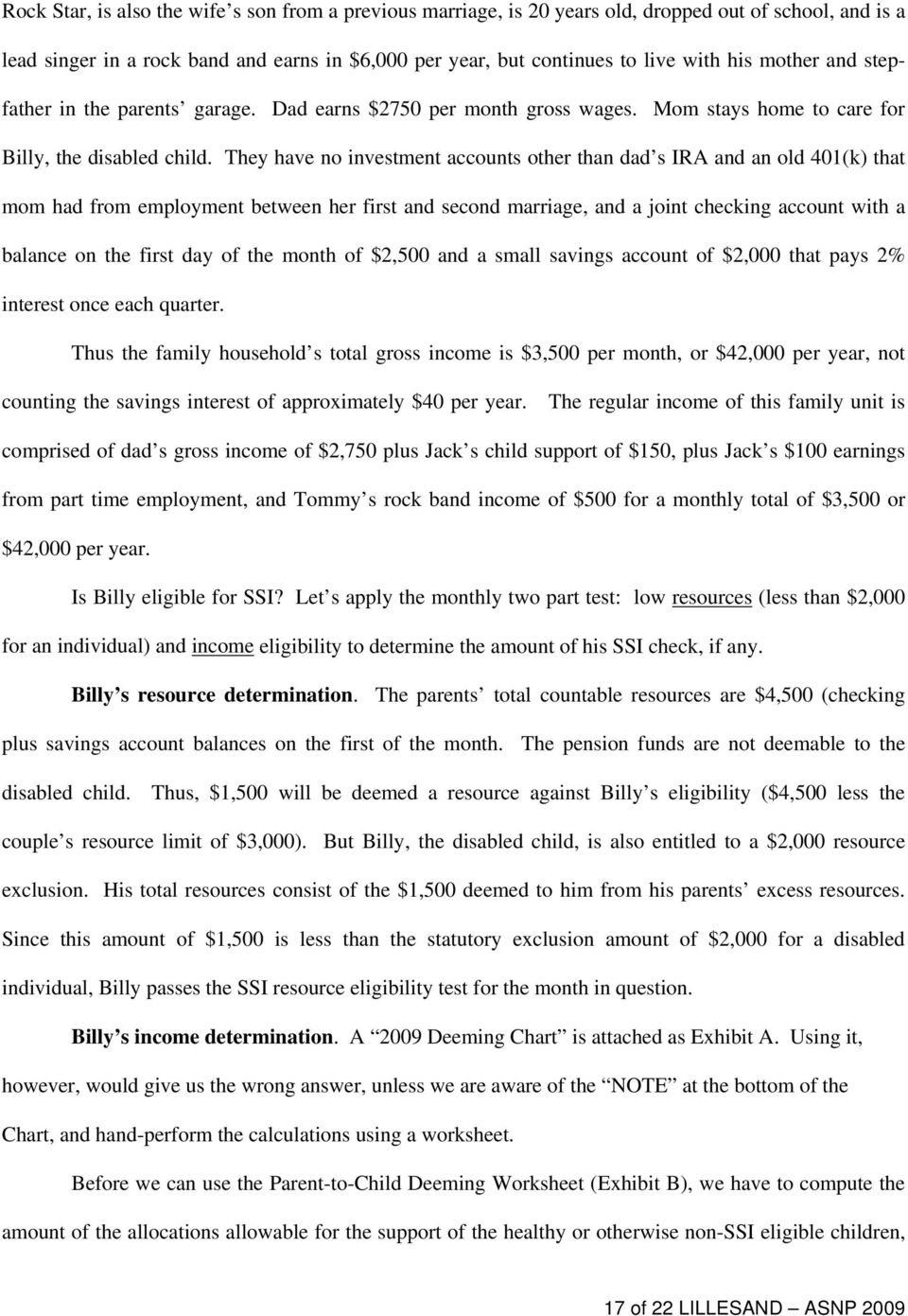
18 Jack and Tommy. As shown on the chart, the normal allocation for non-eligible children is $337 per month (computed as the difference between the FBR for an individual - $674 in 2008, and the FBR for a couple - $1,011). Can we use the entire $337 deduction times two ($337 x 2 = $674), for the two healthy children? No. Jack, the high schooler, has countable income his own unearned income consisting of child support of $150 from his birth father, plus earned income from a part time job of $100 per month gross. The $150 child support payment is reduced by one-third, so only $100 counts. [NOTE: Only the amount of child support actually received counts, not the amount ordered by the court but perhaps not fully paid]. So Jack s countable unearned income is $100. Jack s earned income from his part time job is subject to the Student Earned Income Exclusion (SEIE) of $1,640 per quarter (up to a maximum of $6,600 per year), so none of Jack s part time work income counts. Therefore, Jack s $337 allowance is reduced but only to $237. Secondly, can we deduct Tommy the Rock Star s children s allowance in the parental deeming calculation? No, because although he is under age 21, the age at which the child allowance stops, and although he earns under the $6,600 annual figure, Tommy is not a student. Therefore, Tommy s SSI healthy child allocation of $337 is reduced by his monthly income of $500, so his allowance is zero. Tommy the Rock Star s monthly band income is counted in the calculations even though the rock star spends all his money buying music on itunes. Therefore, even though the parents are feeding and housing Tommy and he is a member of the household, there is simply no allocation for him under the rules. The parents have no unearned income. Their savings account interest is only credited once each quarter, and it is not this month. If they did have unearned income, the healthy child allocations of a minus $237, and the general income disregard of minus $20, would be first subtracted from the parents unearned income. However, those deductions are not lost, since any amount not used to reduce unearned income can be used to reduce the parents earned income. Dad has $2750 gross income, less the unused negative $237 (the allocation to feed and house Jack) and the negative $20 general income disregard, leaves $2,493. Then subtract the $65 earned income disregard, leaving $2,428. Subtract one-half of that 18 of 22 LILLESAND ASNP 2009

19 (the 50% deduction from earned income) to leave $1,214. The parents are allowed to have an allocation to feed, clothe and house themselves, which is equal to the amount they would be paid if they were an SSI eligible couple themselves. In a one parent household, the deduction is $674, and in a two parent household, it is $1,011. In this case, we subtract $1,011 from the $1,214, leaving $203 to be deemed to Billy, the disabled minor child who lives with them. Then we do Billy s computations. He has unearned income of $203 deemed income from his parents. If he had a trust paying food and shelter expenses we would add another $ to his unearned income, or if he had child support payments, another 2/3 of the support actually paid. In this case, he doesn t, so we subtract the $20 general income disregard from the $203, leaving a total countable income of $183. We subtract the $183 from the SSI FBR rate of $674 for an individual, leaving an SSI check due Billy of $491. Yes! What a country! Although Billy lives in a household that has $42,000 per year family income, he is eligible for SSI, and in 31 jurisdictions of this country, automatic SSI-related Medicaid. A copy of Billy s calculations appears on the filled-in SSI parent-to-child deeming worksheet in Exhibit D attached. Some important POMS on deeming: SI Deeming concept Household SI Deeming concept Parent SI Deeming concept Temporary Absence SI Deeming concept Absence from a Deeming Household due to Military Service SI Deeming concept Household SI Waiver of Parental Deeming rules SI Deeming of Income from Ineligible Parent(s) Note: this has several examples which are instructive] SI Deeming Change of Status Parents/Children SI Monthly Deeming Worksheets SI Deeming of Resources General SI Deeming Exclusions from Resources (pension funds, and burial exclusions) SI Examples Parent-to-Child Deeming (resources) 19 of 22 LILLESAND ASNP 2009

20 Two techniques to avoid deeming of resources. SSA has a special rule that excess resources that are in the process of being sold will not be counted in eligibility determinations. This is called conditional eligibility. 20 C.F.R et seq. Under certain circumstances an individual with excess non-liquid resources may be paid an SSI benefit on agreement that they will dispose of the property in a timely fashion. This can apply to both personal or real property. Some of the benefits paid during conditional eligibility may have to be repaid to SSA when the asset is disposed of. However, it s use is not just limited to creating a cash flow during the time the real or personal property is listed for sale. It also triggers Medicaid eligibility, which can often be life-saving. A second, little known POMS section, is even more useful in parental deeming cases: although there is a prohibition on transferring resources for no or less than market value, which would prevent an SSI recipient from giving away his or her resources, that prohibition does not prevent a parent from transferring any or all of the parent s resources for no value whatsoever. See the last sentence of POMS SI E., the POMS which otherwise imposes the transfer of resources penalty: E. POLICY TYPES OF TRANSFERS AFFECTED This provision applies to transfers made: by an individual; by the individual's eligible or ineligible spouse (SI ); by persons who are co-owners of the resource being transferred; on behalf of the individual by a person acting for and legally authorized to execute a contract (e.g., a legal representative, a legal guardian, a parent for a minor child, etc.); by an individual transferring assets which he constructively received (e.g., he/she refused an inheritance). by an individual transferring assets in the month of receipt (e.g. the transfer of income that would have been considered a resource in the following month, if retained). This provision does not apply to transfers made by a deemor unless the deemor is a coowner of the resource or is the ineligible spouse. For example, the provision does not apply to a resource transfer made by a parent who is a deemor (unless the eligible child and parent are co-owners of the resource). [Emphasis added]. If the gift by the parent is over the $12,000 annual IRS gift exclusion, a gift tax return will have to be filed, and possibly gift taxes paid. However, clever estate and tax attorneys have devised ways to create irrevocable family trusts that both avoid the gift tax and comply with the SSI resource and income 20 of 22 LILLESAND ASNP 2009

21 rules by imposing SNT-type restrictions on how the trustee aids the parent deemor until the child dies or becomes age 18 and deeming ends. Waiver of parental deeming. Under limited circumstances, the deeming of parental income and resources can be completely waived. Section 1614(f)(2)(B) of the Social Security Act prohibits the application of deeming of parents income and resources in determining the child s SSI eligibility: Section 1614(f)(1) For purposes of determining eligibility for and the amount of benefits for any individual who is married and whose spouse is living with him in the same household but is not an eligible spouse, such individual's income and resources shall be deemed to include any income and resources of such spouse, whether or not available to such individual, except to the extent determined by the Commissioner of Social Security to be inequitable under the circumstances. (2)(A) For purposes of determining eligibility for and the amount of benefits for any individual who is a child under age 18, such individual's income and resources shall be deemed to include any income and resources of a parent of such individual (or the spouse of such a parent) who is living in the same household as such individual, whether or not available to such individual, except to the extent determined by the Commissioner of Social Security to be inequitable under the circumstances. (B) Subparagraph (A) [imposing deeming in determining eligibility for SSI payments] shall not apply in the case of any child who has not attained the age of 18 years who (i) is disabled; (ii) received benefits under this title, pursuant to section 1611(e)(1)(B), while in an institution described in section 1611(e)(1)(B); (iii) is eligible for medical assistance under a State home care plan approved by the Secretary under the provisions of section 1915(c) relating to waivers, or authorized under section 1902(e)(3); and (iv) but for this subparagraph, would not be eligible for benefits under this title. Summary. Knowledge of these rules can benefit our clients substantially. Our office recently used these rules to make $12 Million disappear, $6 Million of the child s medical malpractice settlement proceeds and $6 Million of the parent s derivative share settlement proceeds as well, without creating an inheritance possibility for the unwed father who had abandoned the child at birth. It was critical that the severely disabled child maintain his SSI disability benefits to trigger automatic eligibility for Medicaid. His medical expenses run between $1 million and $3 million per year at fee-for-service rates. Knowledge of the SSI parental income and deeming rules provided an opportunity to save the 21 of 22 LILLESAND ASNP 2009
22 child s life, since access to medical care is often denied, in spite of personal wealth, for lack of private or public health insurance coverage. Exhibits Exhibit A. Exhibit B. Exhibit C. Exhibit D SSI Deeming Chart Blank Parent-to-Child Deeming 2008 Worksheet Blank Spouse-to-Spouse Deeming 2008 Worksheet Billy s Eligibility: Sample Parent-to-Child Deeming using the Worksheet 22 of 22 LILLESAND ASNP 2009
Unearned income in the month of receipt. Life Insurance Proceeds of life insurance are unearned income in the month of receipt.
 Chapter: Medically Needy Countable and Income Legal Authority: 45 CFR 233.20 The Medically Needy TennCare Medicaid categories are the only TennCare categories that continue to use the AFDC financial methodology.
Supplemental Security Income (SSI)
 Helping Older Persons With Legal & Long-Term Care Problems Supplemental Security Income (SSI) 1. Who Is Eligible For SSI? You must apply and submit a signed application, be 65 or older, blind or disabled
Exemptions, Standard Deduction, and Filing Information
 Department of the Treasury Internal Revenue Service Publication 501 Cat. No. 15000U Exemptions, Standard Deduction, and Filing Information For use in preparing 2013 Returns Contents What's New... 1 Reminders...
SSI APPLICANTS AND RECIPIENTS: NOT KNOWING ABOUT IN-KIND SUPPORT AND MAINTENANCE CAN COST YOU MONEY!
 5382.01 Revised December 2010 SSI APPLICANTS AND RECIPIENTS: NOT KNOWING ABOUT IN-KIND SUPPORT AND MAINTENANCE CAN COST YOU MONEY! WHAT IS IN-KIND SUPPORT AND MAINTENANCE? In-Kind Support and Maintenance
Glossary of SSA Disability Programs and Related Terms
 Glossary of SSA Disability Programs and Related Terms A D V A N C I N G T H E W O R L D O F W O R K N O V E M B E R 2 0 0 7 Age 18 Re-determination (SSI): Any person who was found eligible for SSI as a
Supplemental Security Income. The SSI Program Background
 Supplemental Security Income Social Security Administration The SSI Program Background n Cash assistance program n Administered by SSA n Authorized by Title XVI of the Social Security Act in 1972 n Assures
Arizona Form 2013 Property Tax Refund (Credit) Claim 140PTC
 Arizona Form 2013 Property Tax Refund (Credit) Claim 140PTC NOTICE: If you are age 70 or over and meet certain tests, you may be able to defer the payment of your property taxes on your home. You should
Supplemental Security Income (SSI): Beneficiary Income/Resource Limits and Accounts Exempt from Benefit Determinations
 Supplemental Security Income (SSI): Beneficiary Income/Resource Limits and Accounts Exempt from Benefit Determinations Umar Moulta Ali Analyst in Disability Policy August 9, 2011 The House Ways and Means
Supplemental Security Income
 Supplemental Security Income Eligibility In 1972, Congress replaced the categorical Federal-State programs for the needy aged, blind, and disabled with the Federal Supplemental Security Income (SSI) program,
WORKFORCE INVESTMENT ACT
 COMMONWEALTH OF VIRGINIA VIRGINIA COMMUNITY COLLEGE SYSTEM WORKFORCE INVESTMENT ACT VIRGINIA WORKFORCE LETTER (VWL) 13 05 TO: FROM: SUBJECT: LOCAL WORKFORCE INVESTMENT BOARDS WORKFORCE DEVELOPMENT SERVICES
Thoughts on Supporting Healthy Dependents Using Funds from a Disabled Parent s or Spouse s Special Needs Trust
 Thoughts on Supporting Healthy Dependents Using Funds from a Disabled Parent s or Spouse s Special Needs Trust David Lillesand, Esq. www.floridaspecialneedslaw.com (305) 670-6999 The issue. Can the Trustee
Questions and Answers about Medicaid for Those Receiving Long-Term Care in Idaho
 Questions and Answers about Medicaid for Those Receiving Long-Term Care in Idaho Question 1: What is Medicaid? Answer: Medicaid is a government program that pays for medical services, including long-term
Child Support Computation 03EN025I
 Child Support Computation 03EN025I Purpose of form The purpose of the Child Support Computation form is to calculate a child support obligation pursuant to 43 O.S. Sections 118A 118I, effective July 1,
TITLE 8 SOCIAL SERVICES CHAPTER 230 MEDICAID ELIGIBILITY - FULL COVERAGE FOR PREGNANT WOMEN PART 500 INCOME AND RESOURCE STANDARDS
 TITLE 8 SOCIAL SERVICES CHAPTER 230 MEDICAID ELIGIBILITY - FULL COVERAGE FOR PREGNANT WOMEN PART 500 INCOME AND RESOURCE STANDARDS 8.230.500.1 ISSUING AGENCY: New Mexico Human Services Department (HSD).
Arizona Form 2002 Property Tax Refund (Credit) Claim 140PTC
 Arizona Form 2002 Property Tax Refund (Credit) Claim 140PTC NOTICE: If you are age 70 or over and meet certain tests, you may be able to defer the payment of your property taxes on your home. You should
How Income Affects SSI Eligibility and Payment Amount
 How Income Affects SSI Eligibility and Payment Amount February 2008 Introduction Supplemental Security Income or SSI is an economic needs-based income support program provided to eligible individuals who
Illinois. State Supplementation. Illinois. Mandatory Minimum Supplementation
 Illinois State Supplementation Mandatory Minimum Supplementation Administration: State Department of Human Services. Optional State Supplementation Administration: State Department of Human Services. Effective
Counting Income for MAGI What Counts as Income
 Counting Income for MAGI What Counts as Income Wages, salaries, tips, gratuities, bonuses, commissions (before taxes are taken out). Form(s) W 2. Alimony received Annuities Awards and Prizes (In addition
QUESTIONS & ANSWERS ABOUT FINANCIAL ELIGIBILITY FOR MEDICAID NURSING HOME SERVICES IN FLORIDA
 QUESTIONS & ANSWERS ABOUT FINANCIAL ELIGIBILITY FOR MEDICAID NURSING HOME SERVICES IN FLORIDA This summary is intended to provide a limited overview of Medicaid eligibility for nursing home services in
UNO-VEN Retirement Plan. Summary Plan Description As in effect January 1, 2012
 Summary Plan Description As in effect January 1, 2012 In the event of any conflict between this Summary Plan Description (SPD) and the actual text of the UNO-VEN Retirement Plan, the more detailed provisions
Employees Manual Revised September 16, 2011 Title 8 Chapter D MEDICAID RESOURCES
 Employees Manual Revised September 16, 2011 Title 8 Chapter D MEDICAID RESOURCES Title 8: Medicaid TABLE OF CONTENTS Revised July 25, 2014 Page 1 Page Overview... 1 Attribution of Resources... 1 Resources
Questions & Answers on Medical Assistance for Nursing Home Care In Maryland
 Questions & Answers on Medical Assistance for Nursing Home Care In Maryland 1. What is Medical Assistance? Will the Nursing Home or the State take my house? Will we have to use my spouse s income to pay
PLANNING A STRUCTURED SETTLEMENT FOR SOCIAL SECURITY BENEFICIARIES
 PLANNING A STRUCTURED SETTLEMENT FOR SOCIAL SECURITY BENEFICIARIES This is one of a series of articles written for benefits specialists employed by Benefits Planning, Assistance and Outreach (BPA&O) projects
QUESTIONS AND ANSWERS ON THE COPES PROGRAM
 QUESTIONS AND ANSWERS ON THE COPES PROGRAM COLUMBIA LEGAL SERVICES OCTOBER 2015 THIS PAMPHLET IS ACCURATE AS OF ITS DATE OF REVISION. THE RULES CHANGE FREQUENTLY. 1. What is COPES? COPES is a Home and
State Assistance Programs for SSI Recipients, January 2005
 State Assistance Programs for SSI Recipients, January 2005 Social Security Administration Office of Policy Office of Research, Evaluation, and Statistics Selected Features of State Assistance Programs,
QUESTIONS AND ANSWERS ON MEDICAL ASSISTANCE FOR NURSING HOME CARE
 QUESTIONS AND ANSWERS ON MEDICAL ASSISTANCE FOR NURSING HOME CARE Prepared by: Long Term Care Assistance Project, Maryland Legal Aid Updated January 2015 Medical Assistance is a government-funded program
QUESTIONS AND ANSWERS ON MEDICAID FOR NURSING HOME RESIDENTS. 1. What is Medicaid? COLUMBIA LEGAL SERVICES OCTOBER 2015
 QUESTIONS AND ANSWERS ON MEDICAID FOR NURSING HOME RESIDENTS COLUMBIA LEGAL SERVICES OCTOBER 2015 THIS PAMPHLET IS ACCURATE AS OF ITS DATE OF REVISION. THE RULES CHANGE FREQUENTLY. 1. What is Medicaid?
Social Security Administration Program Descriptions 1
 Social Security Administration Program Descriptions 1 Analysts routinely use Social Security Administration (SSA) program data to conduct research. However, these data are not created for research purposes.
LONG TERM CARE AND SPOUSAL SUPPORT
 LONG TERM CARE AND SPOUSAL SUPPORT 2014 A Guide for Nevada's Married Seniors and Their Families (Protecting the non-disabled spouse from impoverishment) By: HANCOCK AND CAVALLERA, PLLC Reno, Nevada (775)
MEDICAID. For SSI-related persons. Iowa Department of Human Services. Comm. 28 (Rev.7/10) PRINTED ON RECYCLED PAPER
 MEDICAID For SSI-related persons Comm. 28 (Rev.7/10) PRINTED ON RECYCLED PAPER Iowa Department of Human Services DHS POLICY ON NONDISCRIMINATION No person shall be discriminated against because of race,
Answering Questions about Your Family s Income When Applying for Health Insurance
 What You Need to Know about Health Insurance Applying for Health Insurance Answering Questions about Your Family s Income When Applying for Health Insurance About this fact sheet You may be able to get
Application for Benefits
 Application for Benefits If you need help reading or completing this form, please ask us for help. Keep this page for your records. How do I apply for benefits? To complete your application fill out pages
Extra Help with Medicare Prescription Drug Plan Costs. Medicare Part D
 Extra Help with Medicare Prescription Drug Plan Costs Medicare Part D What is Extra Help? Extra Help is available for beneficiaries with limited income and resources to help pay for the costs-monthly premiums,
Schedule H Frequently Asked Questions for Tax Year 2014 Only
 Schedule H Frequently Asked Questions for Tax Year 2014 Only 1. What is the DC Homeowner and Rental Property Tax Credit (Schedule H)? The DC s Homeowner and Rental Property Tax Credit (Schedule H) is a
Individual Retirement Arrangements (IRAs)
 Department of the Treasury Internal Revenue Service Publication 590 Cat. No. 15160x Individual Retirement Arrangements (IRAs) (Including Roth IRAs and Education IRAs) For use in preparing 2000 Returns
8.139.510.1 ISSUING AGENCY: New Mexico Human Services Department [02/01//95; 8.139.510.1 NMAC - Rn, 8 NMAC 3.FSP.000.
 TITLE 8 SOCIAL SERVICES CHAPTER 139 FOOD STAMP PROGRAM PART 510 ELIGIBILITY POLICY - RESOURCES AND PROPERTY 8.139.510.1 ISSUING AGENCY: New Mexico Human Services Department [02/01//95; 8.139.510.1 NMAC
SUPPLEMENTAL SECURITY INCOME (SSI)
 SUPPLEMENTAL SECURITY INCOME (SSI) The SSI program makes payments to people with low income, who are age 65 or older, or are blind, or have a disability. The Social Security Administration manages the
Individual Retirement Arrangements (IRAs)
 Department of the Treasury Internal Revenue Service Publication 590 Cat. No. 15160x Individual Retirement Arrangements (IRAs) (Including Roth IRAs and Education IRAs) For use in preparing 1999 Returns
IMPORTANT CONTACTS MEDICAID INCOME AND ASSET RULES FOR NURSING HOME RESIDENTS. As of July 1, 2015
 IMPORTANT CONTACTS For legal advice and counseling regarding the Medicaid Income and Asset Rules for Nursing Home Residents, contact the Lawyer Referral Service of the New Hampshire Bar Association at
Social Security Disability Insurance and Supplemental Security Income
 WISCONSIN COALITION FOR ADVOCACY Social Security Disability Insurance and Supplemental Security Income Roy Froemming, Attorney Wisconsin Coalition for Advocacy Introduction This chapter covers two different
REQUEST TO BE SELECTED AS PAYEE DISTRICT OFFICE CODE
 SOCIAL SECURITY ADMINISTRATION TOE 250 Name or Bene. Sym. Program FOR SSA USE ONLY Date of Birth Type Gdn. Cus. Inst. Nam. Form Approved OMB No. 0960-0014 FOR SSA USE ONLY REQUEST TO BE SELECTED AS PAYEE
Virginia Medicaid Explanation
 SPECIAL REPORT This Special Report is brought to you by HOOK LAW CENTER Legal Power for Seniors Tel: 757-399-7506 Fax: 757-397-1267 Locations: Virginia Beach 295 Bendix Road, Suite 170 Virginia Beach,
Iowa. State Supplementation. State Assistance for Special Needs. Medicaid. Iowa. Mandatory Minimum Supplementation
 Iowa Iowa Resource limitations: Federal SSI regulations apply. Income exclusions: Federal SSI regulations apply. Recoveries, liens, and assignments: None. State Supplementation Mandatory Minimum Supplementation
Special Needs Trusts and Government Benefits Preservation
 Special Needs Trusts and Government Benefits Preservation Peter H. Wayne, IV Wyatt, Tarrant & Combs, LLP (502) 562-7532 [email protected] Q. What is a special needs trust? A. A Special needs trust (
AMENDMENT TO YOUR TRADITIONAL IRA
 INDIVIDUAL RETIREMENT ANNUITY DISCLOSURE STATEMENT AMENDMENT This disclosure statement explains the rules governing a Traditional IRA. The term IRA will be used in this disclosure statement to refer to
BRIEF FRAMEWORK AND BACKGROUND T2 & T16 OBJECTIVE
 Social Security Disability Reference Material Section 202 of the Social Security Act (42 U.S.C. 402) Section 223 of the Social Security Act (42 U.S.C. 423) Section 1602 and 1614 of the Social Security
MEDICAID ELIGIBILITY MANUAL, VOLUME III REVISED 11-01-96 PAGE 6200 RESOURCES TYPES OF RESOURCES
 REVISED 11-01-96 PAGE 6200 TYPES OF A. CASH/ Cash consists of money which is on hand in the form of FINANCIAL currency or coin. Foreign currency or coins are cash to the ACCOUNTS that they can be exchanged
Determining Income Eligibility. Student Workbook
 Determining Income Eligibility Student Workbook Introduction: In this course the student will learn how to determine income eligibility for applicants on the Senior Community Service Employment Program.
MA will pay for other MA-covered services.
 BEM 405 1 of 21 MA DIVESTMENT DEPARTMENT POLICY Medicaid (MA) ONLY Divestment results in a penalty period in MA, not ineligibility. Divestment policy does not apply to Qualified Working Individuals (QDWI);
Client Tax Organizer
 Client Tax Organizer Please complete this Organizer before your appointment. Prior year clients should use the proforms Organizer provided. 1. Personal Information Name Soc. Sec.. Date of Birth Occupation
Alaska. State Supplementation. State Assistance for Special Needs. Medicaid. Alaska. Mandatory State Supplementation No recipients.
 Alaska State Supplementation Mandatory State Supplementation No recipients. Optional State Supplementation Administration: Department of Health and Social Services, Division of Public Assistance. Effective
Application for Benefits
 Application for Benefits If you need help reading or completing this form, please ask us for help. Keep this page for your records. How do I apply for benefits? To complete your application fill out pages
Glossary of SSA Disability Programs and Related Terms
 Glossary of SSA Disability Programs and Related Terms Authors: Thomas P. Golden M.S., C.R.C. Employment and Disability Institute Raymond A. Cebula, Esq. Employment and Disability Institute Edwin J. Lopez-Soto,
Lump Sum Payments and SSI/Medi- Cal Eligibility
 California s Protection & Advocacy System Toll-Free (800) 776-5746 Lump Sum Payments and SSI/Medi- Cal Eligibility November 2014, Pub #5500.01 Note: This publication contains general information only.
by John S. Kitchen, JD, LLM www.johnkitchenlawoffices.com
 Maintaining Eligibility for SSI and Medicaid: What can a Family Member or Special Needs Trust purchase for a Person with Disabilities, and what is a Person who is receiving SSI or Medicaid allowed to own?
Medicaid Nursing Home Information
 Medicaid Nursing Home Information January 2015 This pamphlet tells you about Medicaid rules for: Utah Nursing Homes. Intermediate Care Facilities for people with Intellectual Disabilities (ICF/ID) This
What Counts as Income for Premium Tax Credits and Medicaid: Beyond the Basics
 What Counts as Income for Premium Tax Credits and Medicaid: Beyond the Basics Center on Budget and Policy Priorities August 28, 2013 Topics What Counts As Income Whose Income Counts (Including a Review
A Guide To Supplemental Security Income (SSI) For Groups And Organizations
 A Guide To Supplemental Security Income (SSI) For Groups And Organizations 2015 Contact Social Security Visit our website At our website, www.socialsecurity.gov, you can: Create a my Social Security account
1) to minimize the economic impact on. 2) to promote joint parental responsibility. 3) to meet the child s survival needs in
 Preamble These guidelines shall take effect on August 1, 2013 and shall be applied to all child support orders and judgments entered after the effective date. There shall be a rebuttable presumption that
WHAT BANKRUPTCY CAN T DO
 A decision to file for bankruptcy should only be made after determining that bankruptcy is the best way to deal with your financial problems. This brochure cannot explain every aspect of the bankruptcy
SENIOR CITIZEN HOMEOWNERS (SCHE) PROPERTY TAX EXEMPTION APPLICATION
 FINANCE NEW YORK THE CITY OF NEW YORK DEPARTMENT OF FINANCE NEW YORK CITY DEPARTMENT OF FINANCE SENIOR CITIZEN HOMEOWNERS (SCHE) PROPERTY TAX EXEMPTION APPLICATION (A partial real estate tax exemption
BMO Funds State Street Bank and Trust Company Universal Individual Retirement Account Disclosure Statement. Part One: Description of Traditional IRAs
 BMO Funds State Street Bank and Trust Company Universal Individual Retirement Account Disclosure Statement Part One: Description of Traditional IRAs Part One of the Disclosure Statement describes the rules
Application for Mississippi Medicaid Aged, Blind and Disabled Medicaid Programs
 Application for Mississippi Medicaid Aged, Blind and Disabled Medicaid Programs This application is used for an individual, couple or child to apply for Medicaid due to age or disability. Please read each
Client Tax Organizer
 Client Tax Organizer Please complete this Organizer before your appointment. Prior year clients should use the proforma Organizer provided. 1. Personal Information Name Soc. Sec.. Date of Birth Occupation
Halifax Health provides emergency services to all patients, without discrimination, based on clinical need and not their ability to pay.
 Department: Patient Business Financial Services Policy Title: Financial Assistance Programs Manual Section: Adm Effective Date: Reviewed Date: 08/201, 05/02/13 Approved by: Mnemonic: PBF Type: P Revised
Attachment A Section 8 Definition of Annual Income 24 CFR, Part 5, Subpart F (Section 5.609) 5.609 Annual Income.
 Attachment A Section 8 Definition of Annual Income 24 CFR, Part 5, Subpart F (Section 5.609) 5.609 Annual Income. (a) Annual income means all amounts, monetary or not, which: (1) Go to, or on behalf of,
How To Pay Out Of Work In The United States
 U.S. Railroad Retirement Board www.rrb.gov RAILROAD RETIREMENT and SURVIVOR BENEFITS U.S. Railroad Retirement Board MISSION STATEMENT The Railroad Retirement Board s mission is to administer retirement/survivor
Application for Adults and Children with Long Term Care Needs
 State of Alaska Department of Health and Social Services Division of Public Assistance Application for Adults and Children with Long Term Care Needs Please check the services you need: Home and Community-Based
MEDICAID BASICS January
 Medicaid Institutional Care Placement Eligibility (Skilled Nursing Facility) Must meet all of: 1. US citizenship- there are certain alien eligibility issues. 2. Fla. Residency. 3. 65 years or older, blind
Probate and Estate Planning Section State Bar of Michigan. Planning for Medicaid Qualification
 Probate and Estate Planning Section State Bar of Michigan Planning for Medicaid Qualification Notes 2 Planning For Medicaid Qualification Table of Contents Background..........................................
TOWN OF GORHAM NEW HAMPSHIRE
 TOWN OF GORHAM NEW HAMPSHIRE APPLICATION FOR PUBLIC ASSISTANCE CASE # Date of Application Referred by 1. General Information: Name Date of Birth Address Telephone Social Security number US Citizen? Marital
BOARD OF REVIEW DECLARATION OF POVERTY & REQUEST FOR TAX RELIEF APPLICATION
 BOARD OF REVIEW DECLARATION OF POVERTY & REQUEST FOR TAX RELIEF APPLICATION Property ID Number: Current SEV: Current Taxable Value: Property Address: APPLICANT INFORMATION: IMPORTANT: It is necessary that
212.3 Allowable Deductions for Households with Aged/Disabled Members
 212.1 Purpose DEDUCTIONS Section 212 Page 1 This section describes the allowable Food Supplement Program (FSP) deductions. 212.2 General Information Only certain deductions are allowed when determining
Schwab Individual 401(k) Plan Summary Plan Description
 Schwab Individual 401(k) Plan Summary Plan Description Employer Instructions 1. Complete the Summary Plan Description (SPD) in accordance with the elections you made on the Adoption Agreement. 2. Provide
COMMONLY USED CALIFORNIA EXEMPTIONS (Updated January 2013)
 COMMONLY USED CALIFORNIA EXEMPTIONS (Updated January 2013) NOTE: Nothing in this document should be construed to be legal advice, or advice specific to any one person s particular situation. This listing
Instructions for Form 8938
 2015 Instructions for Form 8938 Statement of Specified Foreign Financial Assets Department of the Treasury Internal Revenue Service Section references are to the Internal Revenue Code unless otherwise
NORTHEAST INVESTORS TRUST. 125 High Street Boston, MA 02110 Telephone: 800-225-6704
 NORTHEAST INVESTORS TRUST traditional IRA INVESTOR S KIT 125 High Street Boston, MA 02110 Telephone: 800-225-6704 Table of Contents NORTHEAST INVESTORS TRUST TRADITIONAL IRA DISCLOSURE STATEMENT...1 INTRODUCTION...1
*149980110000* $.00 x.20 = 2 $.00. Personal information Your social security number (SSN)
 Government of the District of Columbia 2014 SCHEDULE H Homeowner and Renter Property Tax Credit Important: Read eligibility requirements before completing. Print in CAPITAL letters using black ink. Personal
Supplemental Security Income. Informational Paper 46
 Supplemental Security Income Informational Paper 46 Wisconsin Legislative Fiscal Bureau January, 2015 Supplemental Security Income Prepared by Sam Austin Wisconsin Legislative Fiscal Bureau One East Main,
Eligibility. What is financial eligibility? What is the difference between income and assets? Advocacy Reminder:
 Part 4 Financial Eligibility 62 What is financial eligibility? You must be financially eligible to get TAFDC benefits. To be financially eligible, your countable income and assets must be within TAFDC
47. Trusts and Annuities [Article 9J]
![47. Trusts and Annuities [Article 9J]](/thumbs/24/3683890.jpg "47. Trusts and Annuities [Article 9J]") Medi-Cal Handbook page 47-1 47. 47.1 Background The Omnibus Reconciliation Act of 1993 (OBRA 93) was amended to provide new requirements for the treatment of trusts and annuities. The new procedures for
Medi-Cal Handbook page 47-1 47. 47.1 Background The Omnibus Reconciliation Act of 1993 (OBRA 93) was amended to provide new requirements for the treatment of trusts and annuities. The new procedures for
Massachusetts Application for Health and Dental Coverage and Help Paying Costs
 Massachusetts Application for Health and Dental Coverage and Help Paying Costs THINGS TO KNOW HOW TO APPLY Use this application to see what coverage choices you may qualify for. Who can use this application?
Client Tax Organizer If you have rental property or are self-employed, please request additional organizers.
 Client Tax Organizer If you have rental property or are self-employed, please request additional organizers. 1. Personal Information Name Soc. Sec.. Date of Birth Occupation Work Phone Taxpayer Spouse
Medical Assistance Application for the Elderly and Persons with Disabilities
 Medical Assistance Application for the Elderly and Persons with Disabilities Who can use this application? Apply faster online This application is for the elderly and persons with disabilities applying
Florida Child Support Worksheet and Guidelines
 Florida Child Support Worksheet and Guidelines Florida Statute (s. 61.30, F.S.) requires guidelines to be used in establishing new child support obligations or modifying child support in a Florida court.
SOCIAL SECURITY OVERPAYMENTS:
 SOCIAL SECURITY OVERPAYMENTS: RESPONDING TO A NOTICE THAT SAYS YOU HAVE BEEN OVERPAID This document contains general information for educational purposes and should not be construed as legal advice. It
Earned Income Tax Credit. Informational Paper 3
 Earned Income Tax Credit Informational Paper 3 Wisconsin Legislative Fiscal Bureau January, 2015 Earned Income Tax Credit Prepared by Rick Olin Wisconsin Legislative Fiscal Bureau One East Main, Suite
2015-2016 Dependent Verification Worksheet
 2015-2016 Dependent Verification Worksheet Complete and return this form with the required documentation to: Office of Financial Aid and Scholarships 102 Aldrich Hall Irvine, CA 92697-2825 Phone: 949-824-8262
STATEMENT OF CURRENT MONTHLY INCOME AND MEANS TEST CALCULATION FOR USE IN CHAPTER 7 ONLY
 Form B22A (Chapter 7) (10/05) In re Debtor(s) Case Number: (If known) According to the calculations required by this statement: The presumption arises. The presumption does not arise. (Check the box as
STATEMENT OF CURRENT MONTHLY INCOME AND CALCULATION OF COMMITMENT PERIOD AND DISPOSABLE INCOME
 Form B22C (Chapter 13) (10/05) In re Debtor(s) Case Number: (If known) According to the calculations required by this statement: The applicable commitment period is 3 years. The applicable commitment period
Overview. January, 2009
 Information Guide January, 2009 Nebraska Homestead Exemption NOTE: Nebraska Homestead Exemption Application or Certification of Status, Form 458, is mailed to homestead exemption recipients in January,
Contributions to Individual Retirement Arrangements (IRAs)
 Department of the Treasury Internal Revenue Service Publication 590-A Contents What's New for 2014 1 What s New for 2015 2 Cat No 66302J Reminders 2 Contributions to Individual Retirement Arrangements
Please complete this Organizer before your appointment. Street Address City State ZIP Home Phone
 Womack Tax Prep LLC Client Tax Organizer Please complete this Organizer before your appointment. 1. Personal Information Name Soc. Sec.. Date of Birth Occupation Work Phone Taxpayer Spouse Street Address