
PART I OVERVIEW Introduction Applicability Effective Date... 2 PART II POLICY REQUIREMENTS... 3
|
|
|
- Catherine Daniel
- 10 years ago
- Views:
Transcription
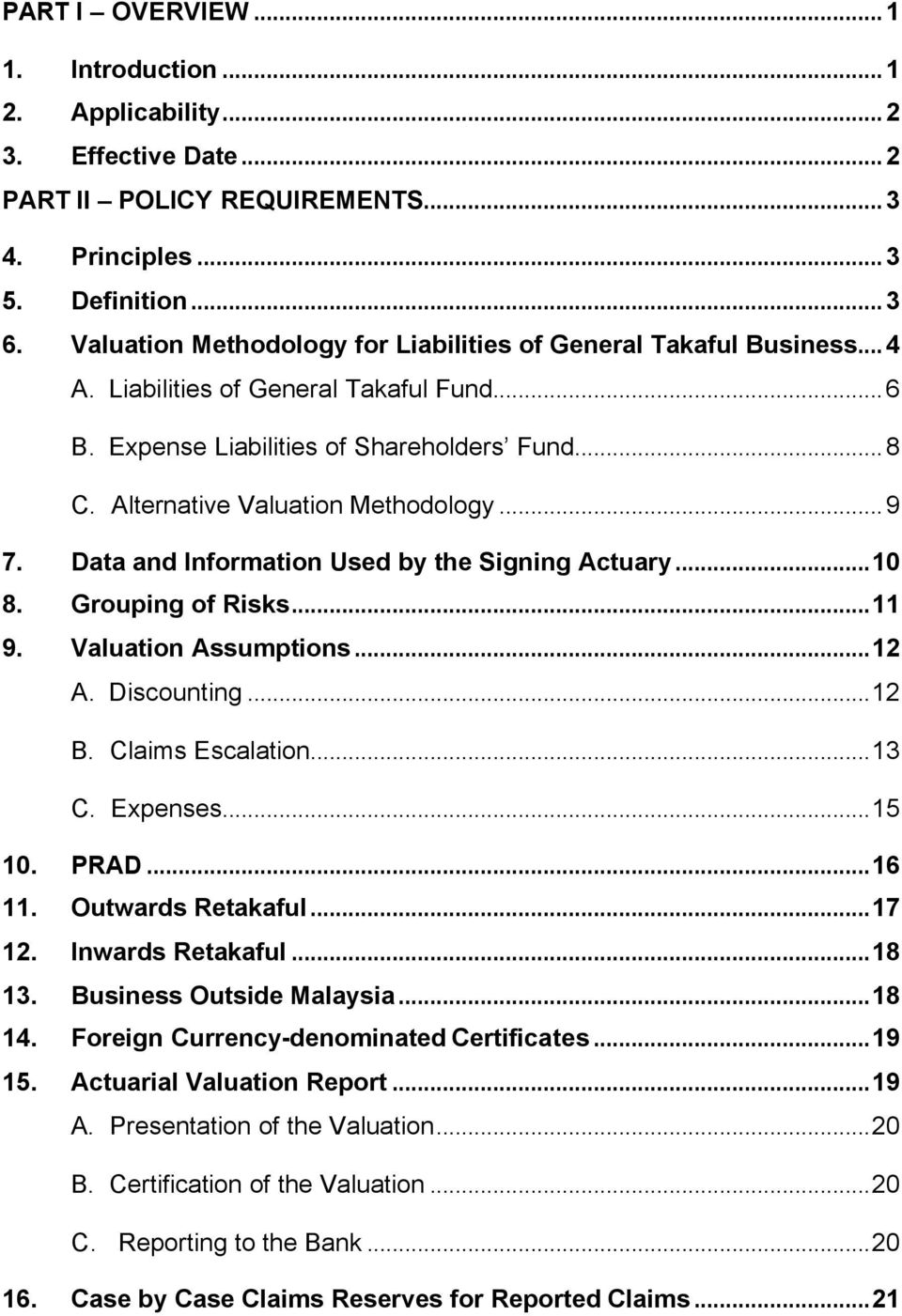
1 PART I OVERVIEW Introduction Applicability Effective Date... 2 PART II POLICY REQUIREMENTS Principles Definition Valuation Methodology for... 4 A. Fund... 6 B. Expense Liabilities of Shareholders Fund... 8 C. Alternative Valuation Methodology Data and Information Used by the Signing Actuary Grouping of Risks Valuation Assumptions A. Discounting B. Claims Escalation C. Expenses PRAD Outwards Retakaful Inwards Retakaful Outside Malaysia Foreign Currency-denominated Certificates Actuarial Valuation Report A. Presentation of the Valuation B. Certification of the Valuation C. Reporting to the Bank Case by Case Claims Reserves for Reported Claims... 21
2 17. Computation of UCR Review of Provision for Appendix I: Report on Actuarial Valuation of for the year ended dd/mm/yyyy Appendix II: Additional Guidance Notes for Inwards Retakaful Appendix III: Guidance Notes for the Presentation of the Valuation of Claim Liabilities Appendix IV: Workflow of the Computation of Table 1: Claims Liabilities. 43 Appendix V: Guidance Notes for the Presentation of the Valuation of Contribution Liabilities Appendix VI: Workflow of the Computation of Table 2: Contribution Liabilities Appendix VII: Guidance Notes for the Presentation of the Valuation of Expense Liabilities of Shareholders Fund Appendix VIII: Workflow of the Computation of Table 3: Expense Liabilities of Shareholders Fund Appendix IX: Summary of Claims and Contribution Liabilities Appendix X: Summary of Expense Liabilities of Shareholders Fund Appendix XI: Signing Actuary Appendix XII(a): Guidance Notes for Submission of Reporting Forms for Valuation of Appendix XII(b): Descriptions of Individual Forms Appendix XIII: Rating Categories... 59

3 Page 1/59 PART I OVERVIEW 1. Introduction 1.1 The contract underlying takaful operations defines a unique relationship between takaful operator and participants of a takaful scheme. While takaful fund is responsible to meet contractual benefits accorded to participants on the basis of mutual assistance amongst participants, takaful operators are expected to duly observe fundamental obligations towards participants, particularly in terms of adhering to Shariah principles and undertaking fiduciary duties to prudently manage the takaful funds as well as meet costs involved in managing the takaful business. 1.2 In carrying out their fiduciary duty, takaful operators must put in place sufficient measures to ensure sustainability of general takaful funds to meet takaful benefits and shareholders fund to support the takaful contracts for the full term. These measures include setting up of appropriate provisions for liabilities in shareholders fund and on behalf of participants in general takaful funds, to ensure that adequate funds would be available to meet all contractual obligations and commitments as they fall due, with a reasonable level of certainty. 1.3 The Shariah Advisory Council of Bank Negara Malaysia (the Bank) resolved that the setting up of provision for liabilities of takaful business is permissible. Holding provisions to ensure ability of takaful fund to meet its obligation is a prudent approach, as Shariah promotes taking precautionary measures to address future uncertainty. 1.4 The (Guidelines) sets out prudential requirements that should be observed by takaful operators in valuing liabilities of their general takaful business, with the aim of providing for those liabilities at a

4 Page 2/59 specified level of adequacy with explicit prudential margins. This Guidelines is intended to reflect the takaful operator s fiduciary duty to manage the takaful funds prudently, treat participants fairly as well as to ensure that the shareholders fund can adequately support the takaful business. 2. Applicability 2.1 All takaful operators 1 underwriting general takaful business shall value the liabilities of their general takaful business at the end of each financial year in the manner specified in this Guidelines. 2.2 This Guidelines shall be read together with, but not limited to, the following documents: (a) Guidelines on Takaful Operational Framework; and (b) Takaful Operators Statistical System Guidance Notes Guidance Notes for Completion of Annual/Monthly Returns for general takaful business. 3. Effective Date 3.1 This Guidelines shall take effect from financial year beginning on and after 1 July Notwithstanding paragraph 3.1, takaful operators may conduct the valuation of liabilities of general takaful business according to the requirements of this Guidelines, prior to the above implementation date. 1 Includes retakaful operators and international takaful operators registered under the Takaful Act 1984.

5 Page 3/59 PART II POLICY REQUIREMENTS 4. Principles 4.1 In valuing the liabilities of general takaful business, the methods and assumptions shall: (a) be appropriate to the business and risk profile of the general takaful business; (b) be consistent with one another and from year to year to preserve comparability; (c) include appropriate margins for adverse deviations in respect of the risks that arise under the takaful certificate; (d) take into account takaful operator s fiduciary duty to treat participants fairly; (e) be in accordance with generally accepted actuarial principles; and (f) accord a reasonable level of certainty for the provision held against the liabilities, which is no less certain than that accorded by a Government Investment Issues (GII). 5. Definition 5.1 In this Guidelines, unless the context otherwise requires, (a) Participants Risk Fund (PRF) refers to the fund in which a portion of contributions paid by the takaful participants is allocated and pooled for the purpose of meeting claims by takaful participants on the basis of mutual assistance or protection; (b) Takaful benefit refers to the amount of benefit secured under a takaful contract; (c) Liabilities of general takaful fund refers to the obligation of the general takaful fund to meet takaful benefits stipulated in takaful certificates and expenses payable from takaful fund; (d) Expense liabilities of shareholders fund refers to the obligation of the shareholders fund to pay for the operating costs incurred in

6 Page 4/59 managing the general takaful fund for the full contractual obligation of takaful certificates; (e) Liabilities of general takaful business refers to the sum of liabilities of general takaful fund and expense liabilities of shareholders fund; (f) The best estimate value is the statistical central estimate value of the liabilities concerned; and (g) The provision of risk margin for adverse deviation (PRAD) is the component of the value of liabilities that relates to the uncertainty inherent in the best estimate. PRAD is aimed at ensuring that the value of liabilities is established at a level such that there is a higher level of confidence (or probability) that the provisions will ultimately be sufficient. 6. Valuation Methodology for 6.1 The Signing Actuary (as defined in Appendix XI) shall be responsible to ensure that the level of provisions, based on his professional valuation of liabilities of general takaful fund and expense liabilities of shareholders fund, is sufficient to meet the requirements of this Guidelines using a basis prescribed in paragraphs 6.2 to The liabilities of general takaful business shall be determined using best estimate assumptions and with due regard to significant recent experience. In determining the best estimate values, the Signing Actuary shall use his professional judgment and considerations of materiality that reflect the individual nature of the business. 6.3 The Signing Actuary shall ensure that all contractual benefits paid from PRF are provided for in accordance with the requirements of this Guidelines. The Signing Actuary shall also provide for meeting reasonable expectations of the participants on benefits of takaful coverage, where an expectation has been created via marketing

7 Page 5/59 process or any other communication between the takaful operator or its representative and the participants. Any provision set aside to meet reasonable expectations as described above shall be held in the shareholders fund. 6.4 Where the Signing Actuary uses more than one method to evaluate the best estimate values and these methods produce significantly different results, the reasons for the difference shall be explained and documented. The Signing Actuary shall exercise his professional judgment in selecting the most appropriate method to use and provide justification for his selection. 6.5 The Signing Actuary shall include an appropriate risk margin for adverse deviation from expected experience in the valuation of takaful liabilities. The risk margin, i.e. PRAD, shall meet the requirements as outlined in paragraphs 10.1 to 10.6 of this Guidelines. 6.6 The liabilities of the general takaful business shall be valued for each homogenous class of business as determined by the Signing Actuary in accordance with paragraphs 8.1 and For each group of risks determined as per paragraphs 8.1 and 8.2, where certificates are collectively treated as an asset under the valuation method adopted for contribution liabilities and expense liabilities of shareholders fund, the Signing Actuary shall make the necessary adjustment to eliminate the asset value from the valuation. For claim liabilities, where the Signing Actuary s valuation result is lower than the aggregate case-by-case claims reserves as described in paragraphs 16.1 to 16.8, the Signing Actuary may take credit for the difference provided that the reason for a release of provisions can be appropriately justified.

8 Page 6/ Where the Bank requires the value of liabilities to be determined at any point in time other than at the financial year end, depending on the extent of the change in the business volume and profile, claims and underwriting processes, and, policy and business conditions since the last financial year, the Signing Actuary may make adjustments to his last financial year end calculations or conduct a full revaluation as appropriate. The Signing Actuary shall ensure that the value obtained is reflective of the liability profile at that point in time, in line with the requirements of this Guidelines and is consistent with the valuation basis at the last financial year end. A. Fund 6.9 The value of the general takaful fund liabilities shall be the aggregate of the values of claim liabilities and contribution liabilities. Claim Liabilities 6.10 The value of claim liabilities shall consist of the best estimate value of the claim liabilities and the PRAD calculated at the fund level In determining the claim liabilities, the Signing Actuary shall consider all obligations of the takaful fund, whether contractual or otherwise, to make future payments in relation to all claims that have been incurred as at the valuation date. These include provision for claims reported, claims incurred but not reported, claims incurred but not enough reserved and claims-related expenses that are borne by the takaful fund The Signing Actuary may adopt a standard and well understood method such as the link ratio method or the Bornheutter Ferguson method to estimate the claim liabilities. Where a non-standard method 2 Takaful operators shall ensure that expenses charged to the takaful fund are in line with the Guidelines on Takaful Operational Framework.

9 Page 7/59 or a modified standard method is used, the Signing Actuary shall ensure that detailed descriptions of the method including assumptions to validate the use of such method are appropriately provided. Contribution Liabilities 6.13 The contribution liabilities shall be taken as the higher of: (a) the aggregate of the provision for unearned contribution (UCR), calculated as described in paragraphs 17.1 to 17.8, for all lines of business; and (b) the best estimate value of the provision for unexpired risk (URR) at the valuation date and the PRAD calculated at the total fund level The best estimate value of the takaful fund s URR shall be determined based on a prospective estimate of the expected future payments arising from future events covered under certificates in force as at the valuation date. It shall also include allowance for expenses, including cost of retakaful, expected to be borne by the takaful fund 2 in administering these certificates during the unexpired period and settling the relevant claims, and shall allow for expected future contribution refunds For a reasonably homogeneous and stable portfolio, the takaful fund s URR may be estimated by leveraging on the results of the outstanding claim valuation model on the basis of claim frequencies, average claim costs and ultimate loss ratios or some similar measure of exposure. In this situation, the Signing Actuary shall adjust the assumptions to reflect changes in risk exposure, underwriting standards, contribution rate levels, and other relevant factors on the expected future claims experience. In any case, the Signing Actuary shall give due consideration to the appropriateness of the method and assumptions used.

10 Page 8/ For long-term general takaful certificates, appropriate adjustment shall be made to the valuation method such that the takaful coverage is in force for the full duration of the takaful contract. In determining the UCR, adjustment shall be made such that the method of computation takes into account the full unexpired period of the takaful coverage. In determining the URR, the Signing Actuary shall use a prospective actuarial valuation based on the sum of present value of future benefits and any expected future expenses payable from the takaful funds 2, less the present value of future gross tabarru arising from the certificate, discounted at the appropriate risk discount rate as defined in this Guidelines. B. Expense Liabilities of Shareholders Fund 6.17 The Signing Actuary shall conduct the valuation of expense liabilities separately in the shareholders fund. The expense liabilities of shareholders fund shall be taken as the higher of: (a) the aggregate of the provision for unearned wakalah fee (UWF), calculated in a similar manner as the calculation of the UCR, for all lines of business; and (b) the best estimate value of the provision for unexpired expense risk (UER) at the valuation date and the PRAD calculated at the total fund level Where distribution expenses are incurred upfront, takaful operator may exclude distribution expenses from the calculation of the UWF The method used to value the UER shall be consistent with the method used to value the URR (for example, where discounting of liabilities is used in valuation of takaful fund, the Signing Actuary should also apply discounting in valuation of expense liabilities). The best estimate value of UER shall be determined based on the expected future expenses
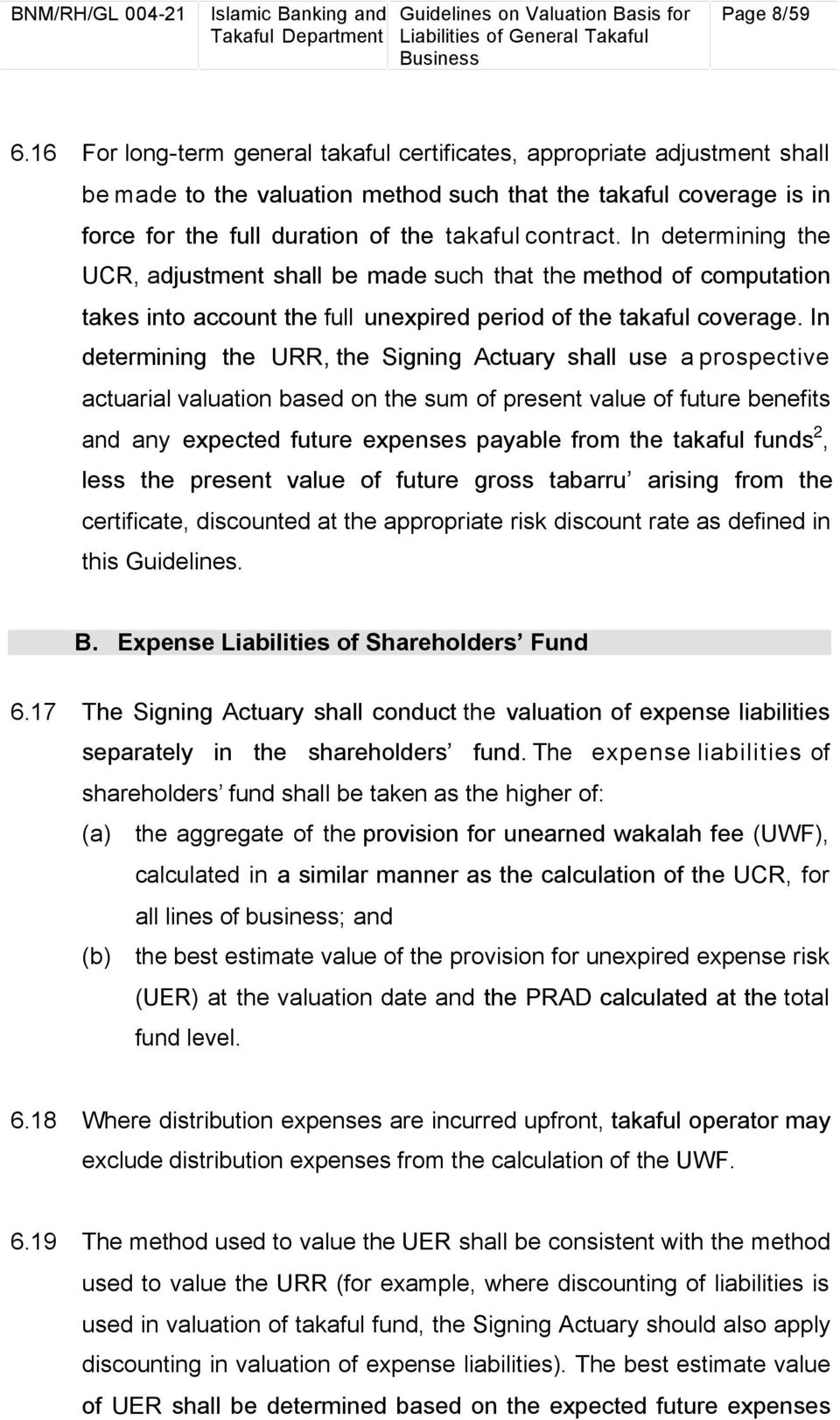
11 Page 9/59 payable from shareholders fund in managing the takaful fund for the full contractual obligation of the takaful certificate as at the valuation date, less expected shareholders fund income. The cash flows to be considered as shareholders fund income shall be future wakalah fees and any other income that the takaful operator can determine with reasonable certainty For the purpose of paragraph 6.19, the Signing Actuary may only consider distributable income from PRF as shareholders fund income cash flow subject to the following conditions: (a) the Signing Actuary can determine with reasonable certainty the distributable level of future income from the PRF or sub-funds for each future time period consistent with the expected experience then, and apply this for each group of risks determined as per paragraphs 8.1 and 8.2 of this Guidelines. The distributable income complied with the requirement of the Guidelines on Takaful Operational Framework and takaful operator's own policy of such distribution; and (b) the capital requirements that may be imposed on PRF by the Bank have been met by the takaful operator. C. Alternative Valuation Methodology 6.21 Where the Signing Actuary in his professional judgment, finds valid reasons to apply changes to the valuation method compared to the method used in preceding valuation, he shall disclose these changes in his report together with the reasons for and the impact of the change on valuation liability Where the liabilities of general takaful business cannot be appropriately valued using the valuation methodology stipulated in this Guidelines, the Signing Actuary shall value the liabilities using a methodology approved by the Bank.

12 Page 10/59 7. Data and Information Used by the Signing Actuary 7.1 The Chief Executive Officer (CEO) of a takaful operator is responsible to ensure that the takaful operator s database is properly maintained so that the data provided to the Signing Actuary is consistent, accurate and complete 3. The Signing Actuary shall be given unrestricted access to the database and management shall furnish immediately, upon request, such data and explanation as the Signing Actuary may require when conducting the valuation of liabilities of the general takaful business. 7.2 The Signing Actuary shall apply reasonableness tests to satisfy himself that the data he receives is consistent, accurate and complete. A check for both the integrity and completeness of data should precede the valuation work. 7.3 The Signing Actuary shall ensure that the data used gives an appropriate basis for estimating the liabilities of the takaful business. The data includes the takaful fund s own exposure and claim experience data, and industry data where the takaful operator s own data is insufficient for the Signing Actuary to make reasonable estimates. In circumstances where industry data is sparse, the Signing Actuary may rely on his professional judgement in making the estimates and justify his approach accordingly. 7.4 The Signing Actuary shall consider the extent to which he is reliant on the data provided by the takaful operator and any limitations of such reliance. Where the Signing Actuary has reason to believe that the data may produce material biases in the results, he shall make appropriate 3 Takaful operators should refer to the Guidelines on Data Management and Management Information System (MIS) Framework.

13 Page 11/59 allowance in his estimations to review and document the basis of such an allowance. 7.5 The Signing Actuary may make adjustments to the data collated to account for abnormal items such as large losses or catastrophe losses. Where such adjustments are made, the nature, amount and rationale for the adjustments shall be clearly documented. 7.6 Besides quantitative information, the Signing Actuary shall also seek qualitative information from the takaful operator s management regarding underwriting policy and processes, claims policy and processes, retakaful arrangements, certificate coverage, legal decisions affecting claim settlements, other operational issues such as change of computer system, turnover of key personnel, and any other relevant information relevant to his valuation of the liabilities. 8. Grouping of Risks 8.1 Generally, each class of business shall be considered separately due to the difference in nature of the risks and claims experience. The Signing Actuary shall determine the most appropriate grouping of risks into lines of business or sub-lines of business, based on the availability of data, homogeneity of the data or similarity in business characteristics, nature of exposure to loss and loss settlement pattern, for the purpose of the valuation of the takaful liabilities. It is important not to subdivide data to such an extent that the analysis becomes unreliable due to the paucity of data within a particular line or sub-line of business. 8.2 The Signing Actuary shall also consider the manner in which the takaful business is managed by the takaful operator. Where a general takaful fund or a business line is managed in smaller sub-funds, the Signing Actuary shall exercise due caution in grouping the risks, to

14 Page 12/59 ensure participants are treated fairly and that any cross subsidisation is in line with Shariah principles. 9. Valuation Assumptions 9.1 The Signing Actuary shall consider appropriate and reasonable assumptions to be used in conducting the valuation of general takaful fund liabilities and the shareholders fund expense liabilities, accordingly. 9.2 To justify the assumptions used, the Signing Actuary shall carry out a comparative study between actual experience and the expected experience from the previous valuation or earlier reports of similar nature. This may include comparing the actual amounts incurred or paid during the year with the expected amounts from the valuation model. The Signing Actuary may also carry out comparisons on the number of claims, average claim size, claim frequency or any other analysis deemed appropriate. 9.3 Should there be any major differences in the actual versus expected experience, the Signing Actuary shall consider revising the assumptions used in his valuation to reflect the trends in the experience. 9.4 The assumptions, based on but not limited to the following sections A to C, shall be considered such that the value of liabilities determined commensurate the nature of the takaful certificates. A. Discounting 9.5 The Signing Actuary shall exercise judgment on the use of discounting in the valuation of liabilities where the effect of such discounting is material. The Signing Actuary shall apply explicit discounting, and shall
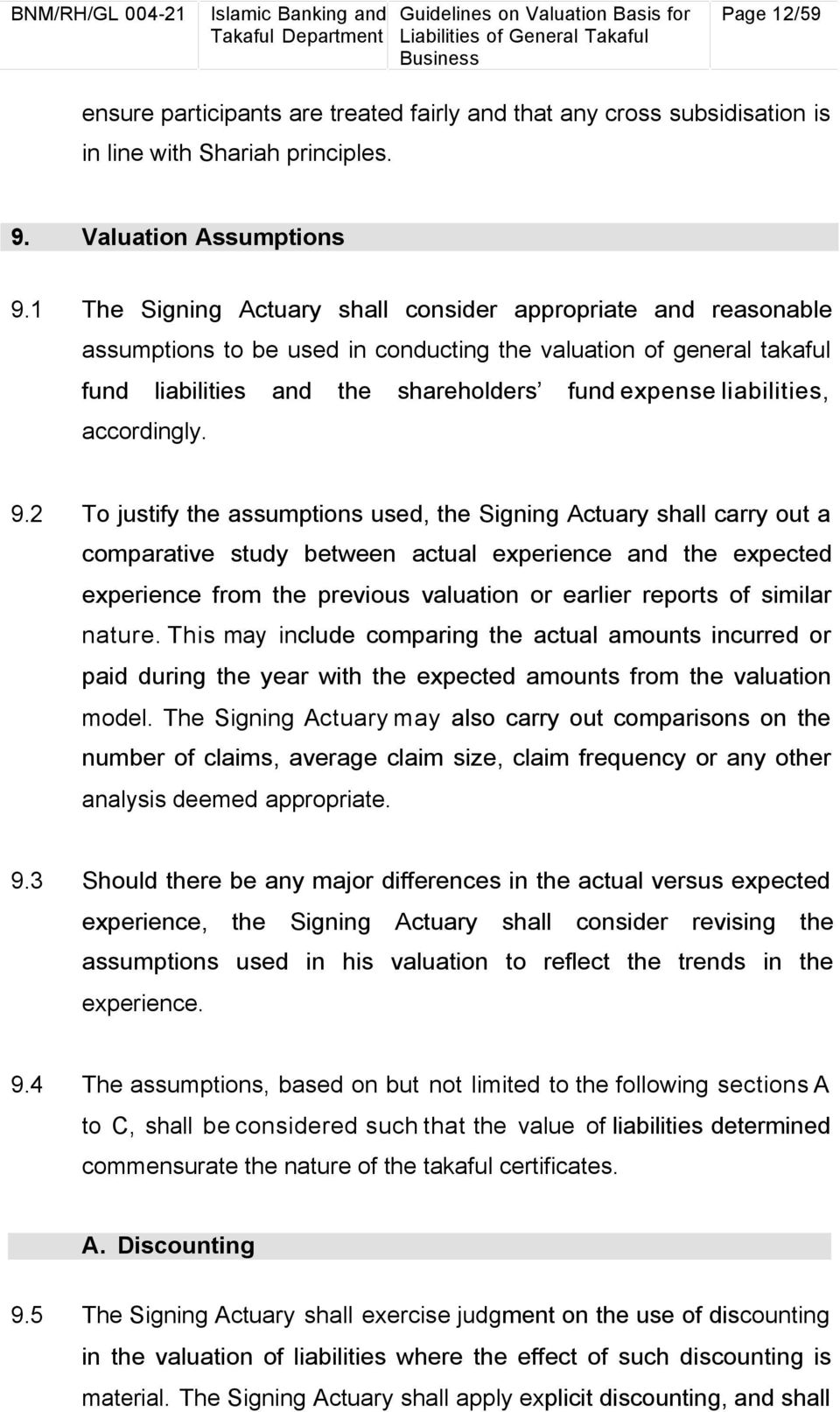
15 Page 13/59 only apply the discounting if this is deemed to be justified in his professional judgment. Where explicit discounting is deemed justified, the Signing Actuary shall not apply implicit discounting in his valuation. Explicit discounting shall be applied to all future valuation of liabilities and reversal of the application of explicit discounting is disallowed. 9.6 Where discounting is deemed to be justified, the rate to be used in discounting the expected future payments for a line of business shall be the risk free discount rate. In any case, the Signing Actuary shall ensure that the resulting provision meets the level of prudence expected of this Guidelines. 9.7 The risk-free discount rate shall be derived from a yield curve, as follows: (a) for durations of less than 15 years : zero-coupon spot yield of GII with matching duration; and (b) for durations of 15 years or more : zero-coupon spot yield of GII with 15 years term to maturity, where duration is the term to maturity of each future cash flow. 9.8 The GII zero-coupon spot yields shall be obtained from a recognised bond pricing agency in Malaysia, or any other source as may be specified by the Bank. Where yields at certain durations are not available, these yields shall be appropriately interpolated from the observable data. B. Claims Escalation 9.9 The Signing Actuary shall incorporate assumptions on claims escalation either explicitly or implicitly in his valuation. Where explicit discounting of liabilities is used, the Signing Actuary shall apply explicit claims escalation assumptions.

16 Page 14/ The Signing Actuary shall apply the following principles in considering the relevant factors for the purpose of determining explicit claims escalation assumptions as follows: (a) Appropriate analyses on the claims escalation factors shall be conducted and future claims projection shall be adjusted as appropriate. The resulting claims escalation factors shall not be lower than the levels implied by historical claims data; (b) Explicit allowance for claims escalation, in addition to that implied by historical claims data, shall be provided if the Signing Actuary views that the statistical methodologies employed do not fully capture the risks of future escalation when applied to aggregate historical claims data; (c) Case reserves shall be provided for adequately in the professional judgment of the Signing Actuary to ensure that all material risks mitigated through the holding of undiscounted liability values are considered and adequately mitigated in the case reserves; (d) Analysis of experience as per paragraphs 9.2 and 9.3 shall be conducted and applied to the claims escalation assumptions and the corresponding impact to the overall liability values are taken into consideration. The underlying assumptions shall be adjusted immediately if the subsequent review of past liability values are deemed to be insufficient at any point of time; and (e) The assumptions and explicit allowances for the claims escalation factors shall be appropriately prudent and ensure that the overall claim liabilities secure 75% level of sufficiency The Signing Actuary shall make appropriate allowance to take into account future claims escalation which may be attributable to economic inflation factors such as wages and price inflation and other noneconomic inflation factors such as increasing court awards, medical cost inflation and technological improvements: (a) Economic inflation factors may be determined based on the use of publicly available information on historic wage or price inflation

17 Page 15/59 and economists forecasts to determine the future inflation rate; and (b) Non-economic inflation factor may be determined by considering the takaful fund s own claim experience as well as known general industry trends in the lines of business written by the takaful operator. For smaller portfolios, where it is difficult to identify noneconomic inflation or its level, it may be necessary for the Signing Actuary to rely on industry analysis or other actuarially accepted views. C. Expenses 9.12 For liabilities of general takaful fund, expected future expenses payable from the takaful funds shall be included as the expense assumptions in the valuation. For expense liabilities of the shareholders fund, management expenses and any other expected future expenses payable from the shareholders fund in managing the takaful fund shall be included in the valuation The expense assumptions shall be derived based on the following: (a) Distribution expenses shall be based on the actual costs to be incurred; and (b) Expenses payable from the takaful fund and management expenses payable from shareholders fund shall be based on recent expense analysis with due regard to likely improvement or deterioration in the future Where the takaful operator s own expense analysis does not properly allocate expenses between certificate issue, ongoing certificate administration, claim establishment and claim management, the Signing Actuary may give regard to industry benchmarks. However, such effect shall be clearly documented.
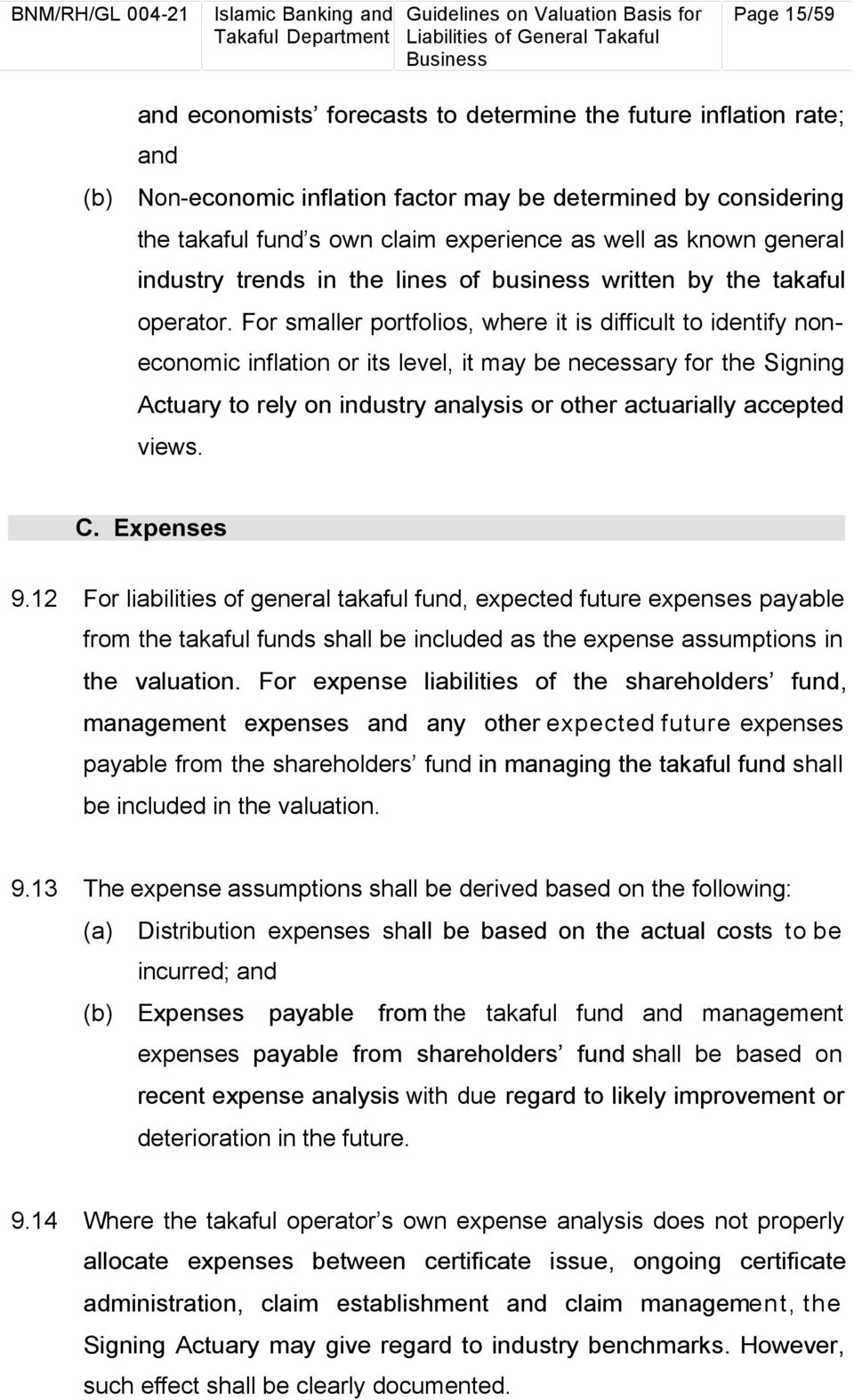
18 Page 16/ Suitable expense inflation, estimates of future wage and price inflation derived from historical data and other available information shall be factored in as appropriate and recognised in the valuation of general takaful liabilities and expense liabilities, accordingly. 10. PRAD 10.1 The PRAD for the liabilities of takaful business shall be determined such that the overall valuation of liabilities of the general takaful fund and expense liabilities of shareholders fund secure 75% sufficiency, respectively For the valuation of general takaful fund liabilities, the 75% confidence level shall be secured at the PRF level. Where a takaful operator segregates the PRF into further sub-funds and manages these subfunds separately, the Signing Actuary shall ensure the 75% sufficiency of the liabilities of these sub-funds individually In most cases, some judgment will be required in establishing appropriate levels of PRAD. It is the Signing Actuary s responsibility to support this judgment with such formal analysis as is practical In estimating PRAD, the Signing Actuary may have regard to relevant findings in external work, e.g. recent actuarial research or literature, if this is deemed to be appropriate. If reliance is placed on external work, then the source of that work shall be disclosed. If PRADs are based on internal analysis, details of this analysis shall be provided To obtain the required 75% level of sufficiency for the valuation of liabilities of general takaful fund, the Signing Actuary may allow for the diversification of risk due to correlations between the different lines of business, by reducing the levels of PRAD calculated by line of business. The amount of any credit taken for such diversification shall

19 Page 17/59 be determined consistently with the overall principles used in calculating the PRAD by line of business Diversification results obtained from a statistical method must be rationalised to ensure valid statistical reasons and that such results are not due to data quality issues or inappropriate adoption of assumptions / statistical methods. The Signing Actuary shall consider the appropriateness of using a triangle of combined data and give due regard to the extent that underlying volatilities may be obscured. A takaful operator with business primarily concentrated in one particular class of business would expect very little or no diversification credit available compared to a takaful operator with a more even spread of business in various classes. Where the Signing Actuary s calculated value of the diversification discount is more than 50% of the sum of the PRAD by class of business, the Signing Actuary shall only consider a diversification discount of a maximum of 50% of total PRAD. 11. Outwards Retakaful 11.1 Takaful liabilities may be determined net of retakaful. The Signing Actuary shall consider the nature and spread of retakaful arrangements, including significant changes to the arrangements, nonperformance of retakaful and the likelihood of obtaining the recoveries. Non-retakaful recoveries such as recoveries by sale of salvage, carriers or other third parties in respect of claims paid shall also be considered. All these considerations shall form the underlying assumptions of the treatment adopted In instances where there are significant changes in the retakaful arrangements or where outstanding retakaful recoveries have a material impact on the estimate of value of takaful liabilities, the Signing Actuary shall consider conducting the valuation on both a gross and net of retakaful basis.
20 Page 18/ The Signing Actuary shall ensure that the amount of recoveries to be recognised is based on the extent of their recoverability. Where there is considerable uncertainty concerning future recoverabilities, the Signing Actuary shall exercise a degree of caution such that liabilities are not understated Reduction for retakaful cessions shall not be taken in the calculation of URR if no reduction is taken under UCR. In such case, where UCR is used as basis for URR calculation, the Signing Actuary shall compute the URR using the gross UCR. 12. Inwards Retakaful 12.1 This Guidelines shall also apply to facultative inwards retakaful. For treaty inwards retakaful and pool inwards, where a comprehensive actuarial estimate is not possible due to the limitation of available data, the Signing Actuary shall make appropriate adjustments such that the provisions approximate to the best estimate and the 75% confidence level. Additional matters relating to inwards retakaful are set out in Appendix II. 13. Outside Malaysia 13.1 The valuation of liabilities in respect of general takaful certificates for business outside Malaysia shall be conducted on a basis: (a) not less stringent than the basis required by the laws of the country in which the certificate is issued; and (b) not less stringent than the basis prescribed in this Guidelines. In the absence of any basis specified by the laws of that country, the certificates shall be valued in accordance to this Guidelines.

21 Page 19/ Foreign Currency-denominated Certificates 14.1 Foreign currency-denominated certificates shall be valued in accordance with this Guidelines and converted into Ringgit currency using the spot currency conversion rate as at the valuation date. The method for determining the spot conversion rate should be consistently used Where relevant, in determining the discount rate assumptions, the GII as referred to in paragraph 9.7 shall be replaced by an appropriate riskfree security that is consistent with the currency the certificate is denominated in, such as government securities of the relevant country. 15. Actuarial Valuation Report 15.1 The Signing Actuary shall prepare a report on the valuation of liabilities of general takaful business referred to as The Report on Valuation of (the Report), including the Reporting Forms for Valuation of (Reporting Forms). The Signing Actuary shall disclose the extent of compliance with the requirements of this Guidelines and reasons for non-compliance, if any. The general format of the Report, outlining the minimum information required to be included and the guidance notes for submission of the Reporting Forms are set out in Appendices I and XII, respectively. The softcopy of the Reporting Forms to be completed is available via the Regulatory Handbook (refer to Attachment I) The board of directors (Board) shall provide effective oversight to ensure adequate controls are in place for the valuation process. The Board shall also ensure proper actions and timely follow ups are undertaken based on these results.
22 Page 20/59 A. Presentation of the Valuation 15.3 For the purpose of presentation of the best estimate values of claims and contribution liabilities and the PRADs in the Report, the Signing Actuary shall refer to the required format provided in Appendices III, V and IX. For further guidance, the workflows of the computation for the liabilities are also provided in Appendices IV and VI. The liabilities shall also include retakaful and pool inwards as required under paragraph For the presentation of the shareholders fund expense liabilities, the Signing Actuary shall refer to the required format in Appendices VII and X. For further guidance, the workflows of the computation for the liabilities are also provided in Appendix VIII The Signing Actuary shall provide relevant supporting documents, worksheets and other information with sufficient details on his estimations of the value of liabilities of general takaful business as appendices to the Report, such that any other suitably experienced Signing Actuary may verify the results without access to him. B. Certification of the Valuation 15.5 The Report shall be signed by the Signing Actuary and the CEO or his authorised signatory The Signing Actuary shall state in the Report, his name and professional qualifications. C. Reporting to the Bank 15.7 Takaful operators are required to submit the Report, including the hardcopy of the Reporting Forms to Pengarah, Jabatan Perkhidmatan Statistik within 3 months from the financial year end together with the annual audited financial statements or on other such date as may be requested by the Bank.
23 Page 21/ The softcopy of the Reporting Forms shall be zipped, password protected and submitted to Takaful operators are expected to provide the password(s) of the file(s) via a separate to this address. For softcopy submission, takaful operators shall be guided by the requirements as stipulated in paragraph 7 of Appendix XII(a). 16. Case by Case Claims Reserves for Reported Claims 16.1 With reference to the claims reported in paragraph 6.11, a takaful operator shall enter in its register of claims, every claim intimation it receives from any source in respect of its certificates, no later than 14 days from the date of receipt of the claim intimation, unless it establishes that the claim does not relate to any of its certificates. Where the particulars of a claim intimation are insufficient for it to determine whether the claim relates to its certificate, the takaful operator shall make necessary enquiries to determine its liability A takaful operator shall make adequate provision in its accounts for a claim, which it has not fully settled, on the basis of the particulars of the claim Where the particulars of a claim intimation are insufficient at the time of entering a claim in the register of claims to enable the takaful operator to estimate its liability in respect of that claim, it shall make, in respect of that claim, a provision which is not less than the average amount paid during the preceding financial year for a claim of that class or description A takaful operator shall make provision for a claim by a third party by taking into account the best estimate of the amount of compensation
24 Page 22/59 likely to be awarded in the circumstances of the case and on the assumption that full liability of its certificate owner is admitted A takaful operator shall make adequate provision for legal fees which may be incurred to defend its repudiation of a claim where the claim is, without any doubt, outside the scope of its certificate, and the provision may be written back only if there are no developments with regard to the claim for at least 12 months following the repudiation A takaful operator shall make provision for an amount it considers adequate for a claim, assuming that the claim will be resolved in favour of the claimant, which it repudiates in circumstances other than that under paragraph 16.5 above A takaful operator shall not reduce a provision for a claim to an insignificant amount solely because the claimant has not proceeded with any action and shall maintain an adequate provision for the claim until such time that the claim is barred by limitation of time A takaful operator shall review the provision for every outstanding claim at least once a year. 17. Computation of UCR 17.1 A takaful operator, other than a professional retakaful operator, shall determine its UCR as follows: (a) for Malaysian cargo certificates, an amount not less than 25 per cent of the contributions; and (b) for other descriptions of general takaful certificates, an amount calculated in the manner specified under the Guidance Notes for Completion of Annual/Monthly Returns for general takaful business in the Takaful Operators Statistical System Guidance Notes (TOSS Guidance Note).
25 Page 23/ For products based on wakalah contract, takaful operator shall determine the UCR based on gross contribution less the actual wakalah fee rather than the commission only as currently allowed under the TOSS Guidance Note A professional retakaful operator shall determine its UCR as an amount calculated on the basis of a method of computation no less accurate than the 1/8 th method, applied to contributions for general takaful certificates with a deduction for the actual wakalah fee With reference to paragraphs 17.1 and 17.3 above, takaful operator shall value the amount of UCR on gross basis, and deducting retakaful 4 cessions only if: (a) the retakaful arrangement achieve effective risk mitigation; (b) there is no obligation on the part of the ceding fund to repay any amount, other than the refund of deposit referred to below in (d), to the retakaful operator in the event a certificate lapses or the retakaful contract is cancelled; (c) the valuation of liability placed under retakaful coverage is made in accordance to paragraph 6.1 above; and (d) there is a deposit retained from retakaful operator, other than a retakaful operator registered under the Takaful Act 1984 (the Act) or a qualifying retakaful operator, subject to the condition that any release of deposit shall not exceed the reduction of liability of the retakaful operator 17.5 For the purpose of paragraph 17.4(d), a qualifying retakaful operator refers to a (re)takaful operator 5 which is licensed under the Labuan 4 Shall also include reinsurance companies and qualifying reinsurance companies, which complies with the requirements specified by the Bank. 5 Includes a Labuan (re)insurer licensed under the Labuan Financial Services and Securities Act 2010 that is approved to carry out takaful and retakaful services.
26 Page 24/59 Islamic Financial Services and Securities Act and satisfies the following conditions: (a) the (re)takaful operator carries a financial strength rating of category three 7 or better; or (b) i) the (re)takaful operator has obtained an explicit and irrevocable guarantee 8 from its parent company (or head office 9 ) to provide fully support the (re)takaful operator in the event of financial difficulties; and ii) its parent company (or head office) is registered under the Act or carries a financial strength rating of category three 7 or better. For the purpose of meeting the rating requirement in the event that the parent company (or head office) does not have its own financial strength rating, the rating of subordinated debt issued by the parent company (or head office) that is rated with rating of category three 7 or better may be accepted. Where there are a number of ratings available, the following principles shall be applied: a) Where two ratings are available, the lower is to be applied; or b) Where three or more ratings are available, the lower of the two highest ratings is to be applied. 6 Administered by the Labuan Financial Services Authority. 7 Refer to Appendix XIII 8 The guarantee should at least: (i) Cover all retakaful arrangements between the retakaful operator and any Malaysian entities registered under the Takaful Act 1984; (ii) Cover the amount of the retakaful operator s liabilities to Malaysian entities arising from the retakaful arrangements referred to in (i) above in its entirety (including retakaful recoveries or other liabilities as agreed upon in the retakaful transactions); (iii) Be in place for the entire duration the retakaful operator is exposed to the risk of the arrangements; and (iv) Be irrevocable, subject to the validity of the retakaful claims, and the retakaful operator shall not unilaterally cancel the guarantee under any circumstances, as long as the arrangement in (i) above still exposes the retakaful operator to the risk of claims. 9 For branches of retakaful operators, the head office shall provide an irrevocable and explicit undertaking to immediately transfer funds in the event (or expected) depletion of the working capital or in the event of a large loss being intimated.
27 Page 25/ Where the retakaful is ceded to (re)takaful operators other than those registered under the Act or qualifying retakaful operators, the reduction in the amount of UCR shall not exceed the lower of: (a) the proportion of the UCR on contributions ceded to said retakaful operators, other than in respect of special risks, with a deduction for wakalah fee at the same rate as provided under paragraph 17.2; or (b) the deposits retained from the said retakaful operators for retakaful of Malaysian general policies, other than in respect of special risks, for which contributions are accounted during the preceding 12 months, provided the deposits are held by the takaful operator; i. as security for the said retakaful operator s due performance of its obligations under the retakaful contract; and ii. for a period of at least 12 months or until termination of the related liabilities of the said retakaful operator, if earlier If only conditions stipulated in paragraphs 17.4(a), (c) and (d) are met, a deduction for retakaful ceded may be made, only to the extent of the net amount determined by deducting the amount repayable on the cancellation of the contract on the valuation date from the valuation of the credit for retakaful. 18. Review of Provision for 18.1 Where the Bank has reason to believe that the provision for liabilities of general takaful business is not appropriate having regard to the business and risk profile of the takaful business, the Bank may: (a) recommend to the takaful operator a provision amount which it considers appropriate; or (b) require the takaful operator to obtain a valuation of its liabilities of general takaful business from another Signing Actuary. The
28 Page 26/59 Signing Actuary shall report directly to the Bank within a period as the Bank may specify For the purpose of paragraph 18.1(b), the takaful operator shall submit the names of at least two actuaries together with such particulars as the Bank may require. The Bank may approve one of the two actuaries or may designate another Signing Actuary to carry out the valuation The takaful operator shall inform the approved or designated Signing Actuary of all the relevant regulatory requirements relating to the valuation of liabilities. The takaful operator shall provide the approved or designated Signing Actuary with all the data and explanation he requires, and any other additional information and facts relating to its business which the takaful operator considers relevant The takaful operator shall not require the approved or designated Signing Actuary to discuss his findings or seek its agreement to his valuation results The Bank may require, upon making the suggestion under paragraph 18.1(a), or upon considering the report made by the Signing Actuary approved or designated under paragraph 18.2, require the takaful operator to show cause within 14 working days as to why it should not be directed under subsection 43(2) of the Act to resubmit its account by altering the claims liabilities or contribution liabilities to an amount suggested by the Bank The Bank may take action under subsection 43(2) of the Act following a notice under paragraph 18.5.
29 Page 27/59 Appendix I: Report on Actuarial Valuation of Liabilities of General Takaful for the year ended dd/mm/yyyy Name of Takaful Operator/Retakaful Operator : Name of Signing Actuary : Qualifications : Section A: Profile 1. Describe the operational model adopted and the basis of separation of sub-funds. 2. Describe the company s business portfolio and comment on any significant changes in composition of business. This may include a description of history, statistics such as a breakdown of contribution income or case reserves by class of business etc. 3. Describe the company s underwriting process, including current policy, processes, systems and controls and changes over the period from which data was used in the valuation process. This may include matters such as: - specific market segments that are targeted by the underwriters; - how risks are selected; - any major recent changes in contribution rates and policy conditions; - any recent changes in levels of underwriting authorities; - any recent changes in key personnel and delegation of authority; and - any changes in level of deductibles or policy limits. 4. Describe the company s claim management process including current policy, processes, systems and controls and changes over the period
30 Page 28/59 from which data was used in the valuation process. This may include matters such as: - guidelines for setting case reserves and any recent changes in case reserving; - when claims are recognised, policy on opening and closing of claims; - any changes in the way claims are finalised; - policy on settlement of claims; - any major personnel changes; - the use of loss adjusters; and - degree of legal involvement in claims. 5. Describe the current retakaful arrangements. This may include matters such as: - The structure of retakaful arrangements, the affected blocks of business and share of participating retakaful operators. - Any significant changes to the programme over recent years. - Consideration of any pending changes to the retakaful arrangements which may have an impact on the net of retakaful/ reinsurance UCR or URR. - Consideration of the potential risk of default of retakaful recoveries based on publicly available information. 6. Describe the general business and industry conditions: - Description of significant events during the year affecting the claims experience and how these were taken into account in the valuation of the liabilities. - May include consideration of effects from factors including economic, technological, medical, legislative environment, social trends, competition, court decisions, consumerism etc.
31 Page 29/59 Section B: Data 1. Document key features of the data, including: - The basis on which the analysis has been carried out (i.e. underwriting or accident year, net or gross of retakaful). - The source of the data and how it was extracted, including reliance on work of external auditors. - How the business was subdivided into valuation classes. - Comments on the reliability and completeness of the data including the extent to which the Signing Actuary relies upon the data provided by the takaful operator and any limitation of such reliance. - Description of steps taken to test the consistency, accuracy and completeness of the data. - Description of steps taken to ensure accuracy of valuation systems - Documentation of any adjustments made to the data to allow for abnormal items such as large losses, catastrophe losses, etc, including the amount and rationale for the adjustment. - Documentation of quantitative information which may have an impact on valuation. 2. Statistics - Statistics should be built up to a minimum of seven years of data. Where more data are available and/or appropriate for use, these should be included. - For longer tailed classes, more years of data may be needed for the analysis to be appropriate. 3. Experience Analysis. Where possible the Signing Actuary should discuss matters such as: - Trends and the possible reasons for the trends in contribution growth, speed of settlement and emergence of claims, average
32 Page 30/59 claim size, average claim frequency, average cost per claim, on paid and incurred basis. - Experience of large claims within the portfolio. Section C: Valuation Methodology 1. Valuation of Best Estimate: - Describe in detail the valuation methods for estimating the best estimate provisions. - If a non-standard method has been used, provide detailed description of how the method works. Assumptions to validate the use of non-standard method or a modified standard method shall also be furnished. - Where more than one method is used, state the basis for the choice of results. - Describe certificates that would be treated as an asset and what steps have been taken to eliminate such asset from the valuation. - Disclose details of any changes in the valuation methods used since the last valuation. - Provide justification for key differences in assumptions between valuations of claims and contribution liabilities. 2. Valuation of PRAD: - Describe in detail the methods for the derivation of the PRAD at 75% confidence level by line of business. - Describe the methods, assumptions and justification for any diversification credits applicable to arrive at the PRAD to ensure 75% confidence level. 3. Presentation of the Valuation : - Summarise the results of the valuation of the claims and contribution liabilities in accordance with Table 1 in Appendix III
33 Page 31/59 and Table 2 in Appendix V respectively, and in Table 4 in Appendix IX. - Summarise the results of the valuation of shareholders fund expense liabilities in accordance with Table 3 in Appendix VIII and Table 5 in Appendix X. - Comment on the level of sufficiency of the Signing Actuary s valuation of the provisions in the general takaful fund and shareholders fund. Comment on the level of sufficiency of the takaful fund s actual held provisions relative to the Signing Actuary s valuation. - Provide provisions breakdown for retakaful and pool inwards by sources of business, in particular where these are significant. Section D: Valuation Assumptions and Analysis of Experience 1. Describe in detail and provide justification for the key assumptions made, including those related to participants reasonable expectation, for the valuation methodology used, such as: - contribution rates changes - development factors, ultimate loss ratios - expense rates - how retakaful and non-retakaful recoveries have been taken into account in the valuation of liabilities and the underlying assumptions of the treatment adopted - discounting and details of classes where discounting is used including the rationale for applying discounting - claims escalation rates including the source and methodology from which they are derived Where more than one valuation method is used, disclose the assumptions for each method. 2. Documents the results and interpretation of experience analysis or comparative studies, for example on:
34 Page 32/59 - actual experience of both URR and claims liabilities versus expected experience in previous valuations; - discussion of the results obtained from current and previous valuation, stating reasons for any material change observed; - discussion and justification for material changes in method, assumption or basis used since last valuation, including quantifying the impact on provisions; - comparison of actual experience over the past year(s) with the expected experience based on previous valuation or earlier reports of similar nature (e.g. by comparing the sum of provisions held and actual claims paid in each development year against provision estimated in the previous development year, separately by accident/ underwriting year, where possible); - where more than one valuation method was used, and the results obtained differ significantly, discuss the possible reasons for the differences; - justify any credit given for the difference in valuation results and aggregate case by case reserves; and - results of study on number of claims, average claim size, claims frequency, etc. Section E: Distribution of Surplus 1. Describe the basis to determine the allocation of surplus to participants and remuneration to shareholders fund in PRF. 2. Comment on any issues highlighted by the analysis of surplus and participants reasonable expectation before distributing the surplus. Section F: Others 1. Details of the Signing Actuary: - Party that has commissioned the report, and if different, the addressee(s) of the report;
35 Page 33/59 - The purpose of the report or the terms of reference given; - Any potential conflict of interest and how this has been resolved; - The extent, if any, to which the Report falls short of, or goes beyond, its stated purpose; - Any restriction placed on him in carrying out the valuation. 2. Compliance: - Document the extent of compliance to the requirements of the Guidelines and the reasons for non-compliance of the requirements, if any. 3. Definition of terms: - Provide definition of terms and expressions used in the Report which may be ambiguous or subject to wide interpretation. 4. Recommendations: - Where applicable, provide recommendations or comments to improve the reliability of future valuations of the liabilities for takaful business. - In cases where recommendations have been made, commentary should be provided on the responses given by the board of directors or takaful operator s management to those recommendations, and any follow up actions to be taken. - Where applicable, comment on the actions taken by the board of directors in the current valuation year, in respect of recommendations made in the previous year s valuation. Section G: Supporting Worksheet and Appendices 1. Summary of Information - Prepare detailed summary of all the data and other information used to arrive at the valuation results including:
36 Page 34/59 - accounting (e.g. financial statements) and other internal financial information/reports; - retakaful arrangements; - underwriting and claims management; - other recoveries (e.g. subrogation); - summary of claims data provided - expenses incurred in the shareholders fund in administering the takaful fund; and - sources used to set financial assumptions (e.g. discount and inflation rates). - Information sought will include both quantitative (e.g. electronic claims data and financial statements) and qualitative information (e.g. information obtained from discussions with management, finance department, underwriting and claim management). 2. Workings on Valuation Method - The workings of each valuation methodology and summary of the valuation results should be sufficiently transparent to enable another Signing Actuary to review the adopted methodology. - For example, where a chain ladder approach is applied to incurred claims, the appendix should include for each group of risk or business lines: - triangle of paid claims; - triangle of case estimates; - triangle of incurred claims; - chain ladder factors and selected factors for projection; - projection of ultimate incurred claims; - projected loss ratios; and - assessment of outstanding claim liability allowing for inflation and discounting if appropriate
37 Page 35/59 Section H: Certification by the Signing Actuary The Signing Actuary should provide certification as set out below: I hereby certify that: 1. All necessary enquiries have been made and to the best of my knowledge and professional opinion, after applying sufficient tests, the valuation of general takaful fund liabilities and shareholders fund expense liabilities obtained was reasonable; 2. I am satisfied that the credit given for retakaful in the valuation of takaful liabilities has been based on sufficiently prudent assumption of the probability of future recoveries and retakaful operator s default or inability to meet its obligations as per the terms of the retakaful arrangements; 3. I have recommended the allocation or part of surplus in general takaful fund for transfer to shareholders fund in compliance with the guidelines and circulars issued by Bank Negara Malaysia; 4. I assume full responsibility for the valuation results and this report in its entirely, including any part of the work which has been delegated to another person; and 5. I am familiar with all applicable legislation, regulations and directives of Bank Negara Malaysia and confirm that the valuation is prepared in accordance to these regulatory requirements. Signature: Name: Date: Signing Actuary
38 Page 36/59 Section I: Certification by the CEO The CEO should provide the following certification. I hereby certify that: 1. I have satisfied myself that the computation of provision for unearned contribution, provision for unearned wakalah fee and maintenance of case-by-case claims reserves are appropriate and in compliance with all applicable legislation, regulations and directives of Bank Negara Malaysia; and 2. I hereby certify that the database is properly maintained and I have satisfied myself that the data provided to the Signing Actuary is accurate and complete. Signature: Name: Date: Chief Executive Officer
39 Page 37/59 Appendix II: Additional Guidance Notes for Inwards Retakaful 1. Due to the more volatile nature of retakaful operator s claims experience and the lesser amount of data available to the retakaful operators as compared to direct takaful operators, the retakaful operator s own data may not be sufficient for the Signing Actuary to reliably estimate the provisions for takaful liabilities. As such, the Signing Actuary will have to utilise additional information obtained from external sources in the valuation and exercise more judgment than in the case of direct takaful. The Signing Actuary shall clearly document the justification for his judgment in the Report. 2. Data limitations may have significant impact on the Signing Actuary s approach in calculating the PRAD. The Signing Actuary may not be able to formulate PRAD assumptions based solely upon the retakaful operator s own data and hence, may need to consider how the levels of PRAD obtained for direct takaful operators could be adjusted in order to be applicable to retakaful. 3. In grouping data into homogeneous valuation classes, the Signing Actuary may consider analysing data by the following subgroups: (a) (b) (c) type of retakaful (e.g. Treaty proportional and non-proportional, Facultative proportional and non-proportional); geographic location of risk; and line of business (e.g. Property, Marine, Liability). 4. The classes chosen should be based upon the Signing Actuary s view of the extent and reliability of the data. The Signing Actuary shall include an explanation as to the manner in which the risks have been pooled into homogeneous groups in the Report. 5. The Signing Actuary shall seek qualitative information from the retakaful operator or the ceding company (see paragraph 7.6 of this Guidelines). Better understanding of the nature of the business written
40 Page 38/59 currently and in the past, the trends in retakaful contribution and exchange commission rates, and the types of retakaful programs, policy limits, takaful operator s deductibles, etc. will allow the Signing Actuary to make appropriate allowances in his valuation. 6. Since many property proportional treaties are accounted for on a cleancut basis and hence do not exhibit development patterns shown by treaties written on a run-off basis, the Actuary shall use an appropriate basis to allow for these contracts. 7. The Signing Actuary shall make appropriate allowances for inwards retakaful business written from countries with strong experience of litigation and also for possible latent claim exposures. 8. The Signing Actuary shall ensure that the valuation methodologies are appropriate based on the nature of the claim and exposure information available. Whilst the Incurred Claim Development, Expected Loss Ratio and Incurred Bornheutter Ferguson methods are commonly used, methods based on paid claim data are often not reliable due to the volatility of the available information. 9. The Signing Actuary may find it more appropriate to carry out the valuation on an underwriting year basis as the retakaful data is usually presented in this manner. In producing provision estimates on an underwriting year basis, the Signing Actuary will need to determine the claim and contribution liabilities separately and this is an issue for the latest underwriting year in particular. For this purpose an approach that the Signing Actuary may consider is as follows: 9.1 Determination of claim liability i) The Signing Actuary may conduct claim analysis by underwriting year and project the latest underwriting year s claims in full (ultimate claim cost), allowing for the estimated
41 Page 39/59 total written contribution for each underwriting year, i.e. produce triangulations of claims and written contributions by underwriting year and develop all years to ultimate. ii) As the claim liabilities derived from such an underwriting year analysis will include liabilities relating to both incurred outstanding claims and unexpired risks relating to unearned contributions (particularly for the most recent underwriting year where most of the unearned contribution lies), the Signing Actuary should apportion the latest underwriting years liabilities into earned and unearned components. The earned component may be determined by deducting the expected claim cost in respect of the unearned contribution from the ultimate claim cost. 9.2 Determination of contribution liability i) The contribution liability should be derived based on the expected claim cost in respect of the unearned contribution (as calculated in paragraph 9.1(ii) above) plus allowance for direct claims-related expenses and direct investment-related expenses, including cost of retakaful, expected to be incurred during the unexpired period in administering these certificates and settling the relevant claims. 9.3 Treatment of unbooked or pipeline contribution i) At the valuation date, there may exist outstanding contributions receivable by the retakaful operator relating to completed underwriting years. The amount is usually most significant for the latest underwriting year. Such outstanding contributions often referred to as unbooked or pipeline contributions, can arise from a number of sources including the periodic nature of the payment of contributions by each cedant, delays in payment of contributions by cedants and reinstatement contributions paid by cedants.
42 Page 40/59 ii) The Signing Actuary shall consider the impact of pipeline contributions at the valuation date on the valuation of liabilities and make appropriate adjustments. The Signing Actuary may use professional judgment to apportion the pipeline contribution into earned and unearned components (coinciding with the outstanding claims and unexpired risk). He shall also allow for the direct claims-related expenses and investment-related expenses with respect to the pipeline contribution.
43 Page 41/59 Appendix III: Guidance Notes for the Presentation of the Valuation of Claim Liabilities The valuation of Claim Liabilities (CL) as per Table 1 shall be computed as follows: 1. Best estimate of CL for each class of business [i.e. B(i), B(ii) until B(xiv)] shall be calculated in accordance to paragraphs 6.11 to 6.12 of this Guidelines. Best estimate of the Fund Total s CL or B(F) is the sum of best estimate of the claims for each class of business. i.e. B(F) = B(i) + B(ii) + + B(xiv). 2. Provision of Risk Margin for Adverse Deviation (PRAD) of CL for each class of business [i.e. PRAD(i), PRAD(ii) until PRAD(xiv)] is calculated at 75% level of confidence. PRAD for the Fund Total s CL [i.e. PRAD(F)] is the sum of the PRAD of CL for each class of business. i.e. PRAD(F) = PRAD(i) + PRAD(ii) PRAD(xiv). 3. Fund PRAD (FPRAD) of Fund Total s CL [i.e. FPRAD(F)] is derived from Best estimate of the Fund Total s CL to ensure 75% confidence level, after considering diversification and other interactions between classes of business. FPRAD of CL for each class of business [i.e. FPRAD(i), FPRAD(ii) until FPRAD(xiv)] is the value of FPRAD(F) allocated to each class of business. Allocation should be made in a consistent and logical manner while the value allocated should be more than zero. 4. CL for each business and the Fund Total at the adopted confidence level are the summation of respective entries for columns (I) and (III)
44 Page 42/59 i.e. CL (i) = B(i) + FPRAD (i) CL (F) = B(F) + FPRAD (F) Table 1: Claims Liabilities (CL) 10 class Best estimate of (CL) (I) PRAD of CL at 75% confidence level (II) Fund PRAD (FPRAD) of CL at 75% confidence level (III) CL (IV) = (I) + (III) 1. Aviation B(i) PRAD(i) FPRAD (i) CL(i) = B(i) + FPRAD (i) 2. Bonds B(ii) PRAD(ii) FPRAD (ii) CL(ii) = B(ii) + FPRAD (ii) 3. Cargo B(iii) PRAD(iii) FPRAD (iii) CL(iii) = B(iii) + FPRAD (iii) 4. Contractors All Risks & Engineering B(iv) PRAD(iv) FPRAD (iv) CL(iii) = B(iv) + FPRAD (iv) 5. Fire B(v) PRAD(v) FPRAD (v) CL(iii) = B(iii) + FPRAD (v) 6. Liabilities B(vi) PRAD(vi) FPRAD (vi) CL(iii) = B(iii) + FPRAD (vi) 7. Marine Hull B(vii) PRAD(vii) FPRAD (vii) CL(iii) = B(iii) + FPRAD (vii) 8. Medical and Health B(viii) PRAD(viii) FPRAD (viii) CL(iii) = B(iii) + FPRAD (viii) 9. Motor Act B(ix) PRAD(ix) FPRAD (ix) CL(iii) = B(iii) + FPRAD (ix) 10. Motor Others B(x) PRAD(x) FPRAD (x) CL(iii) = B(iii) + FPRAD (x) 11. Offshore Oil & Gas related B(xi) PRAD(xi) FPRAD (xi) CL(iii) = B(iii) + FPRAD (xi) 12. Personal Accident B(xii) PRAD(xii) FPRAD (xii) CL(iii) = B(iii) + FPRAD (xii) 13. Workmen s Compensation & Employers Liability B(xiii) PRAD(xiii) FPRAD (xiii) CL(iii) = B(iii) + FPRAD (xiii) 14. Others B(xiv) PRAD(xiv) FPRAD (xiv) CL(iii) = B(iii) + FPRAD (xiv) Fund Total B(F) PRAD(F) FPRAD (F) CL(F) = B(F) + FPRAD(F) 10 Where a general takaful fund is managed in smaller sub-funds, Table 1 shall be used to report the valuation of claim liabilities of each sub-fund.
45 Page 43/59 Appendix IV: Workflow of the Computation of Table 1: Claims Liabilities Compute B(i), B(ii) until B(xiv) Aggregate B(i), B(ii) until B(xiv) to obtain B(F) Compute PRAD(i), PRAD(ii) until PRAD(xiv) Compute FPRAD(F) based on B(F) Aggregate PRAD(i), PRAD(ii) until PRAD(xiv) to obtain PRAD(F) Arrive at FPRAD(i), FPRAD(ii) until FPRAD(xiv) based on allocation of FPRAD(F) to each business class Allocate FPRAD(F) to each business class Compute CL(i) by adding B(i) with FPRAD (i). Similarly for CL(ii) and CL(iii). Aggregate CL(i), CL(ii) until CL(xiv) to obtain CL(F)
46 Page 44/59 Appendix V: Guidance Notes for the Presentation of the Valuation of Contribution Liabilities The valuation of Contribution Liabilities (PL) as per Table 2 shall be computed as follows: 1. Provision for Unearned Contribution (UCR) for each class of business amount [i.e. A(i), A(ii) until A(xiv)] shall be calculated in accordance to section 17 of this Guidelines. UCR for the Fund Total or A(F) is the sum of UCR for each business i.e. A(F) = A(i) + A(ii) + + A(xiv) 2. Best estimate of the Provision for Unexpired Risk (URR) of each class of business [i.e. B(i), B(ii) until B(xiv)] shall be computed in accordance to paragraph 6.14 to 6.16 of this Guidelines. Best estimate of the Fund Total s URR or B(F) is the sum of best estimate of the URR for each business. i.e B(F) = B(i) + B(ii) + + B(xiv) 3. Provision of Risk Margin for Adverse Deviation (PRAD) of URR for each business [i.e. PRAD(i), PRAD(ii) until PRAD(xiv)] is calculated at 75% level of confidence. PRAD for the Fund Total s URR [i.e. PRAD(F)] is the sum of PRAD of the URR for each class of business i.e. PRAD(F) = PRAD(i) + PRAD(ii) PRAD(xiv). 4. Fund PRAD (FPRAD) of URR of the Fund Total [i.e. FPRAD(F)] is derived from Best estimate of the Fund Total s URR to ensure a 75% confidence level after considering diversification and other interactions between classes.
47 Page 45/59 FPRAD of URR for each business [i.e. FPRAD(i), FPRAD(ii) until FPRAD(xiv)] is the value of FPRAD(F) allocated to each class of business. Allocation should be made in a consistent and logical manner while the value allocated should be more than zero. 5. URR for each class of business and the Fund Total at the adopted confidence level are the summation of respective entries for columns (II) and (IV) i.e. URR for business class 1 = B(i) + FPRAD (i) URR for Fund total = B(F) + FPRAD(F) 6. Contribution liabilities for the Fund Total or PL(F) is the higher of UCR for Fund and URR at 75% confidence level. i.e Higher of A(F) and B(F) + FPRAD(F) Contribution liabilities for each class of business [i.e. PL(i), PL(ii) until PL(xiv)] is the value of PL(F) allocated to each line of business. Allocation should be made in a consistent and logical manner while the value allocated to each class of business should not be less than the respective URR.
48 Page 46/59 Table 2: Contribution Liabilities (PL) 11 class UCR Best estimate URR PRAD of URR at 75% confidence level Fund PRAD (FPRAD) of URR at 75% confidence level URR at 75% confidence level PL (I) (II) (III) (IV) (V) = (II) + (IV) 1. Aviation A(i) B(i) PRAD(i) FPRAD (i) B(i) + FPRAD (i) PL(i) 2. Bonds A(ii) B(ii) PRAD(ii) FPRAD (ii) B(ii) + FPRAD (ii) PL(ii) 3. Cargo A(iii) B(iii) PRAD(iii) FPRAD (iii) B(iii) + FPRAD (iii) PL(iii) 4. Contractors All Risks & Engineering A(iv) B(iv) PRAD(iv) FPRAD (iv) B(iii) + FPRAD (iv) PL(iv) 5. Fire A(v) B(v) PRAD(v) FPRAD (v) B(iii) + FPRAD (v) PL(v) 6. Liabilities A(vi) B(vi) PRAD(vi) FPRAD (vi) B(iii) + FPRAD (vi) PL(vi) 7. Marine Hull A(vii) B(vii) PRAD(vii) FPRAD (vii) B(iii) + FPRAD (vii) PL(vii) 8. Medical and Health A(viii) B(viii) PRAD(viii) FPRAD (viii) B(iii) + FPRAD (viii) PL(viii) 9. Motor Act A(ix) B(ix) PRAD(ix) FPRAD (ix) B(iii) + FPRAD (ix) PL(ix) 10. Motor Others 11. Offshore Oil & Gas related 12. Personal Accident 13. Workmen s Compensation & Employers Liability A(x) B(x) PRAD(x) FPRAD (x) B(iii) + FPRAD (x) PL(x) A(xi) B(xi) PRAD(xi) FPRAD (xi) B(iii) + FPRAD (xi) PL(xi) A(xii) B(xii) PRAD(xii) FPRAD (xii) B(iii) + FPRAD (xii) PL(xii) A(xiii) B(xiii) PRAD(xiii) FPRAD (xiii) B(iii) + FPRAD (xiii) PL(xiii) 14. Others A(xiv) B(xiv) PRAD(xiv) FPRAD (xiv) B(iii) + FPRAD (xiv) PL(xiv) Fund Total A(F) B(F) PRAD(F) FPRAD(F) B(F) + FPRAD(F) PL(F)* *PL(F) refers to the higher of A(F) and B(F) + FPRAD(F) 11 Where a general takaful fund is managed in smaller sub-funds, Table 2 shall be used to report the valuation of contribution liabilities of each sub-fund.
49 Page 47/59 Appendix VI: Workflow of the Computation of Table 2: Contribution Liabilities Compute A(i), A(ii) until A(xiv) Aggregate A(i), A(ii) until A(xiv) to obtain A(F) Compute B(i), B(ii) until B(xiv) Aggregate B(i), B(ii) until B(xiv) to obtain B(F) Compute PRAD(i), PRAD(ii) until PRAD(xiv) Aggregate PRAD(i), PRAD(ii) until PRAD(xiv) to obtain PRAD(F) Compute FPRAD(F) based on B(F) Allocate FPRAD(F) to each business class Arrive at FPRAD(i), FPRAD(ii) until FPRAD(xiv) based on allocation of FPRAD(F) to each business class Compute URR(biz class 1) at 75% level by adding B(i) with FPRAD (i). Similarly for URR(biz class 2) and URR(biz class 3). PL(F) is the higher of A(F) and B(F) + FPRAD(F) Obtain PL(F) Arrive at PL(i), PL(ii) until PL(xiv) based on the allocation of PL(F) to each business class
50 Page 48/59 Appendix VII: Guidance Notes for the Presentation of the Valuation of Expense Liabilities of Shareholders Fund The valuation of Expense Liabilities of Shareholders Fund (EL) as per Table 3 shall be computed as follows: 1. Provision for Unearned Wakalah Fee (UWF) for each class of business amount [i.e. A(i), A(ii) until A(xiv)] shall be calculated in accordance to paragraph 6.17(a) of this Guidelines. UWF for the Fund Total or A(F) is the sum of UWF for each business i.e. A(F) = A(i) + A(ii) + + A(xiv) 2. Best estimate of the Provision for Unexpired Expense Risk (UER) of each class of business [i.e. B(i), B(ii) until B(xiv)] shall be computed based on the definition of paragraph 6.19 of this Guidelines. Best estimate of the Fund Total s UER or B(F) is the sum of best estimate of the UER for each business. i.e B(F) = B(i) + B(ii) + + B(xiv) 3. Provision of Risk Margin for Adverse Deviation (PRAD) of UER for each business [i.e. PRAD(i), PRAD(ii) until PRAD(xiv)] is calculated at 75% level of confidence. PRAD for the Fund Total s UER [i.e. PRAD(F)] is the sum of PRAD of the UER for each class of business i.e. PRAD(F) = PRAD(i) + PRAD(ii) PRAD(xiv). 4. UER for each class of business and the Fund Total at the adopted confidence level are the summation of respective entries for columns (II) and (III) i.e. UER for business class 1 = B(i) + PRAD (i) UER for Fund total = B(F) + PRAD(F)
51 Page 49/59 5. Expense liabilities of shareholders fund for the Fund Total or EL(F) is the higher of UWF for Fund and UER at 75% confidence level. i.e Higher of A(F) and B(F) + PRAD(F) Expense liabilities of shareholders fund for each class of business [i.e. EL(i), EL(ii) until EL(xiv)] is the value of EL(F) allocated to each line of business. Allocation should be made in a consistent and logical manner while the value allocated to each class of business should not be less than the respective UER.
52 Page 50/59 Table 3: Expense Liabilities of Shareholders Fund (EL) class UWF Best estimate UER PRAD of UER at 75% confidence level UER at 75% confidence level EL (I) (II) (III) (IV) = (II) + (III) 1. Aviation A(i) B(i) PRAD(i) B(i) + PRAD (i) EL(i) 2. Bonds A(ii) B(ii) PRAD(ii) B(ii) + PRAD (ii) EL(ii) 3. Cargo A(iii) B(iii) PRAD(iii) B(iii) + PRAD (iii) EL(iii) 4. Contractors All Risks & Engineering A(iv) B(iv) PRAD(iv) B(iii) + PRAD (iv) EL(iv) 5. Fire A(v) B(v) PRAD(v) B(iii) + PRAD (v) EL(v) 6. Liabilities A(vi) B(vi) PRAD(vi) B(iii) + PRAD (vi) EL(vi) 7. Marine Hull A(vii) B(vii) PRAD(vii) B(iii) + PRAD (vii) EL(vii) 8. Medical and Health A(viii) B(viii) PRAD(viii) B(iii) + PRAD (viii) EL(viii) 9. Motor Act A(ix) B(ix) PRAD(ix) B(iii) + PRAD (ix) EL(ix) 10. Motor Others A(x) B(x) PRAD(x) B(iii) + PRAD (x) EL(x) 11. Offshore Oil & Gas related A(xi) B(xi) PRAD(xi) B(iii) + PRAD (xi) EL(xi) 12. Personal Accident A(xii) B(xii) PRAD(xii) B(iii) + PRAD (xii) EL(xii) 13. Workmen s Compensation & Employers Liability A(xiii) B(xiii) PRAD(xiii) B(iii) + PRAD (xiii) EL(xiii) 14. Others A(xiv) B(xiv) PRAD(xiv) B(iii) + PRAD (xiv) EL(xiv) Fund Total A(F) B(F) PRAD(F) B(F) + PRAD(F) EL(F)* *EL(F) refers to the higher of A(F) and B(F) + PRAD(F)
53 Page 51/59 Appendix VIII: Workflow of the Computation of Table 3: Expense Liabilities of Shareholders Fund Compute A(i), A(ii) until A(xiv) Aggregate A(i), A(ii) until A(xiv) to obtain A(F) Compute B(i), B(ii) until B(xiv) Aggregate B(i), B(ii) until B(xiv) to obtain B(F) Compute PRAD(i), PRAD(ii) until PRAD(xiv) Aggregate PRAD(i), PRAD(ii) until PRAD(xiv) to obtain PRAD(F) Compute UER(biz class 1) at 75% level by adding B(i) with PRAD (i). Similarly for UER(biz class 2) and UER(biz class 3). EL(F) is the higher of A(F) and B(F) + PRAD(F) Obtain EL(F) Arrive at EL(i), EL(ii) until EL(xiv) based on the allocation of EL(F) to each business class
54 Page 52/59 Appendix IX: Summary of Claims and Contribution Liabilities Table 4: Summary of Claims and Contribution Liabilities Contribution-related liabilities Claims-related liabilities Line of URR at 75% confidence level (a) UCR (b) PL (c ) Case Estimates (d) IBNR (e) = (f) (d) CL at 75% confidence level (f) 1. Aviation 2. Bonds 3. Cargo 4. Contractors All Risks & Engineering 5. Fire 6. Liabilities 7. Marine Hull 8. Medical and Health 9. Motor Act 10. Motor Others 11. Offshore Oil & Gas related 12. Personal Accident 13. Workmen s Compensation & Employers Liability 14. Others
55 Page 53/59 Appendix X: Summary of Expense Liabilities of Shareholders Fund Table 5: Summary of Expense Liabilities of Shareholders Fund Line of Provision for Unearned Wakalah Fee (a) Provision for Unexpired Expense Risk at 75% confidence level Expense Liabilities (c) (b) 1. Aviation 2. Bonds 3. Cargo 4. Contractors All Risks & Engineering 5. Fire 6. Liabilities 7. Marine Hull 8. Medical and Health 9. Motor Act 10. Motor Others 11. Offshore Oil & Gas related 12. Personal Accident 13. Workmen s Compensation & Employers Liability 14. Others
56 Page 54/59 Appendix XI: Signing Actuary 1. Takaful operators shall seek the Bank s approval to appoint a Signing Actuary. Application should be made in writing, at least one month before the end of each financial year. 2. Takaful operators that conduct both family and general takaful business are required to make separate applications to appoint its Appointed Actuary and Signing Actuary, even if the two positions are to be held by the same person. Criteria for Signing Actuary 3. A takaful operator shall ensure that its applicant fulfils the following criteria: a) holds a Fellowship in either the Institute or Faculty of Actuaries in the United Kingdom, Casualty Actuarial Society in the United States of America, or the Institute of Actuaries in Australia; b) is resident in Malaysia; and c) is fit and proper to carry out the function and has relevant and appropriate general insurance experience. 4. Notwithstanding paragraph 3, takaful operator may apply for exemption in the appointment of the Signing Actuary. The Bank, however, reserve the right to make a decision on the application based on its sole discretion. 5. A Signing Actuary shall cease to be the Signing Actuary of a takaful operator if he resigns or has his appointment terminated by the takaful operator or by the Bank. Where a person ceases to be the Signing Actuary of a takaful operator, the takaful operator shall notify the Bank in writing with reasons for it within 14 days from the date of cessation. Takaful operator shall appoint another person as its Signing Actuary within specified time as the Bank may approve.
57 Page 55/59 6. A Signing Actuary shall ensure that the responsibilities and duties outlined in this Guidelines and other prevailing guidelines are effectively carried out according to the standards as specified by the Bank. To ensure effective discharge of duties by the Signing Actuary, takaful operators shall furnish information which the Signing Actuary may require and shall ensure that the information furnished is not false, incomplete or misleading in any material.
58 Page 56/59 Appendix XII(a): Guidance Notes for Submission of Reporting Forms for Valuation of 1. The reporting forms on the valuation of liabilities of general takaful business to be submitted to the Bank are as follows: Form GTL1 : General Takaful Fund Claim Liabilities and Contribution Liabilities Form GTL2 : Shareholders Fund Expense Liabilities for General Takaful These reporting requirements do not affect the need to comply with the reporting requirements under the Companies Act 1965 and Takaful Operators Statistical System. Please refer to Appendix XII(b) for description of the individual form. 2. The reporting forms have been designed to capture information according to the following categories: 2.1. For General Takaful Fund within Malaysia outside Malaysia 2.2. For Shareholders Fund within Malaysia outside Malaysia 3. Data shall generally be reported in the nearest Ringgit. 4. Unless otherwise permitted by this guidance notes, negative entries are not to be reported. Where negative entries do occur in one or more of the exception items, they shall be reported with negative sign (-) on the left-hand side of the figures. 5. Where the amount of a reportable item is zero, the entry made shall be the number 0, and not other symbols or words like - or nil.
59 Page 57/59 6. In the event of resubmission of any reporting forms due to amendments, the takaful operator is required to submit a letter of explanation signed by the CEO via facsimile to Pengarah, Jabatan Perkhidmatan Statistik (Fax: ). 7. For softcopy submission of the Reporting Forms, takaful operators shall observe the following file-naming convention: Incoming File: Header Company Code Submission Type Reporting Date.xls Component Data Type Possible Values Header CONSTANT GTL for Reporting Forms for Valuation of Liabilities of General Takaful Company Code CHAR (3) 601 [All Company Code as per FICPS, e.g. 601, 602, 603 etc] Submission Type CHAR (3) FYE [Financial Year End] Reporting Date Date [DDMMYYYY] Extension.xls Example: GTL601FYE xls (Valuation of submission from takaful operator 601 for financial year ending 30/06/2012)
60 Page 58/59 Appendix XII(b): Descriptions of Individual Forms 1. Form GTL1 captures the claim liabilities and contribution liabilities by each line of business for general takaful fund. 2. Form GTL2 captures the expense liabilities by each line of business for general takaful business.
61 Page 59/59 Appendix XIII: Rating Categories 1. The rating categories below apply to both issuer and issue-specific ratings. The rating categories aim to map the respective spectrum to ratings of different rating agencies. Rating Catego ry Standard and Poor s Corporation (S&P) Moody s Investor Services (Moody s) Fitch, Inc (Fitch) Rating and Investment Information, Inc (R&I) A.M. Best Company, Inc (AM Best) RAM Holdings (RAM) Malaysian Rating Corporation Berhad (MARC) (i) One AAA Aaa AAA AAA AAA AAA AAA (ii) Two AA+ to AA- Aa1 to Aa3 AA+ to AA- AA+ to AA- AA+ to AA- AA1 to AA3 AA+ to AA- (iii) Three (iv) Four (v) Five A+ to A- A1 to A3 A+ to A- A+ to A- A+ to A- A1 to A3 A+ to A- BBB+ to BBB- BB+ to D or unrated Baa1 to Baa3 Ba1 to C or unrated BBB+ to BBB- BB+ to D or unrated BBB+ to BBB- BB+ to D or unrated BBB+ to BBB- BB+ to D BBB1 to BBB3 BB1 to D or unrated BBB+ to BBB- BB+ to D or unrated
GUIDELINES ON VALUATION OF POLICY LIABILITIES OF GENERAL BUSINESS
 Guideline No: ID 1/04 Issue Date: 24 August 2004 Last Updated: 3 January 2008 GUIDELINES ON VALUATION OF POLICY LIABILITIES OF GENERAL BUSINESS [Note: These Guidelines should be read in conjunction with
2 COMMENCEMENT DATE 5 3 DEFINITIONS 5 4 MATERIALITY 8. 5 DOCUMENTATION 9 5.1 Requirement for a Report 9 5.2 Content of a Report 9
 PROFESSIONAL STANDARD 300 VALUATIONS OF GENERAL INSURANCE CLAIMS INDEX 1 INTRODUCTION 3 1.1 Application 3 1.2 Classification 3 1.3 Background 3 1.4 Purpose 4 1.5 Previous versions 4 1.6 Legislation and
GUIDELINES ON VALUATION BASIS FOR LIABILITIES OF LABUAN LIFE INSURANCE BUSINESS
 1.0 Introduction GUIDELINES ON VALUATION BASIS FOR LIABILITIES OF LABUAN LIFE INSURANCE BUSINESS 1.1 The Guidelines on Valuation Basis for Liabilities of Labuan Life Insurance Business (the Guidelines)
PART I - PRELIMINARY...1 Objective...1 Applicability...2 Legal and Regulatory Provision...2
 PART I - PRELIMINARY...1 Objective...1 Applicability...2 Legal and Regulatory Provision...2 PART II POLICY REQUIREMENTS...3 Investment and Risk Management Policy...3 Monitoring and Control...5 Roles of
GUIDELINES ON INVESTMENT MANAGEMENT FOR LABUAN INSURANCE AND TAKAFUL BUSINESS
 GUIDELINES ON INVESTMENT MANAGEMENT FOR LABUAN INSURANCE AND TAKAFUL BUSINESS 1.0 Introduction 1.1 The Guidelines on Investment Management for Labuan Insurance and Takaful Business (the Guidelines) sets
Guidance Note on Actuarial Review of Insurance Liabilities in respect of Employees Compensation and Motor Insurance Businesses
 Guidance Note on Actuarial Review of Insurance Liabilities in respect of Employees Compensation and Motor Insurance Businesses GN9 Introduction Under the Insurance Companies Ordinance (Cap. 41) ( Ordinance
PRICING AND FINANCIAL PROJECTIONS FOR PRIVATE HEALTH INSURERS
 PRACTICE GUIDELINE 699.01 PRICING AND FINANCIAL PROJECTIONS FOR PRIVATE HEALTH INSURERS September 2012 INDEX 1. INTRODUCTION 3 1.1 Application 3 1.2 Classification 3 1.3 Background 3 1.4 Purpose 3 1.5
THE INSURANCE BUSINESS (SOLVENCY) RULES 2015
 THE INSURANCE BUSINESS (SOLVENCY) RULES 2015 Table of Contents Part 1 Introduction... 2 Part 2 Capital Adequacy... 4 Part 3 MCR... 7 Part 4 PCR... 10 Part 5 - Internal Model... 23 Part 6 Valuation... 34
Reserving Requirements for Non-Life Insurers and Non-Life and Life Reinsurers
 2014 Reserving Requirements for Non-Life Insurers and Non-Life and Life Reinsurers 1 Reserving Requirements for Non-Life Insurers and Non-Life and Life Reinsurers Contents Introduction... 3 Definitions...
Actuary s Guide to Reporting on Insurers of Persons Policy Liabilities. Senior Direction, Supervision of Insurers and Control of Right to Practice
 Actuary s Guide to Reporting on Insurers of Persons Policy Liabilities Senior Direction, Supervision of Insurers and Control of Right to Practice September 2015 Legal deposit - Bibliothèque et Archives
DRAFT May 2012. Objective and key requirements of this Prudential Standard
 Prudential Standard GPS 230 Reinsurance Management Objective and key requirements of this Prudential Standard This Prudential Standard requires a general insurer and a Level 2 insurance group to maintain,
Outstanding Claims Liability Insurance Risk Charge Australia by class of. business (Level 2 Insurance Group)
 Reporting Form GRF 210.0A_G Outstanding Claims Liability Insurance Risk Charge Australia by class of business (Level 2 Insurance Group) Instruction Guide Introduction This instruction guide is designed
Classification and Impairment Provisions for Loans/Financing
 Provisions for SECTION A... 1 1. Introduction... 1 2. Applicability... 1 3. Legal Provision... 2 4. Effective Date... 2 5. Documents Superseded... 2 SECTION B... 3 6. Compliance with the Malaysian Financial
MERCHANT NAVY OFFICERS PENSION FUND STATEMENT OF INVESTMENT PRINCIPLES
 MERCHANT NAVY OFFICERS PENSION FUND STATEMENT OF INVESTMENT PRINCIPLES Introduction The main purpose of the MNOPF is the provision of pensions for Officers in the British Merchant Navy on retirement at
Guidelines on Investment in Shares, Interest-in-Shares and Collective Investment Schemes for Islamic Banks
 Interest-in-Shares and Collective Investment Schemes for Islamic Banks BNM/RH/ GL 002-5 PART A: INTRODUCTION AND OVERVIEW...1 1. Overview of the Guidelines... 1 2. Definitions... 2 3. Legal Enforceability
GRF_115_1: Premiums Liabilities - Insurance Risk Charge
 GRF_115_1: Premiums Liabilities - Insurance Risk Charge These instructions must be read in conjunction with the general instruction guide. Explanatory notes Direct business Sections 1A, 1B and 1C are to
Insurance (Valuation of Long Term Liabilities) Regulations 2007 Consultative Document
 Insurance (Valuation of Long Term Liabilities) Regulations 2007 Consultative Document 1. Introduction The Insurance and Pensions Authority has released a consultative draft of the Insurance (Valuation
Audit of General Insurance Companies
 12 Audit of General Insurance Companies Question 1 Write a short note on - Incoming and Outgoing Co-insurance. Incoming and Outgoing Co-insurance: In cases of large risks, the business is shared between
FRAMEWORK FOR INTRODUCTION OF NEW PRODUCTS...5 SUPERVISORY EXPECTATIONS ON PRODUCT RISK MANAGEMENT AND FAIR TREATMENT OF CONSUMERS...
 PART A. INTRODUCTION...1 1. Overview of the Guidelines... 1 2. Legal Provisions... 2 3. Scope... 2 PART B. FRAMEWORK FOR INTRODUCTION OF NEW PRODUCTS...5 4. General Conditions... 5 5. General Exception...
Liability Adequacy Test in AASB 1023 General Insurance Contracts
 Invitation to Comment March 2005 Liability Adequacy Test in AASB 1023 General Insurance Contracts Prepared by the Australian Accounting Standards Board Commenting on this Invitation to Comment The AASB
Issued on: 28 June 2013. Management of Insurance Funds
 / Islamic Banking and Takaful Management of Insurance Funds TABLE OF CONTENT PART A OVERVIEW... 1 1. Introduction... 1 2. Applicability... 1 3. Legal provisions... 1 4. Effective date... 2 5. Interpretation...
Australian Accounting Standards Board (AASB)
 FACT SHEET September 2011 1023 General Insurance Contracts (This fact sheet is based on the standard as at 1 January 2011.) Important note: This standard is an Australian specific standard with no international
GN8: Additional Guidance on valuation of long-term insurance business
 GN8: Additional Guidance on valuation of long-term insurance business Classification Practice Standard MEMBERS ARE REMINDED THAT THEY MUST ALWAYS COMPLY WITH THE PROFESSIONAL CONDUCT STANDARDS (PCS) AND
The Insurance Regulatory and Development Authority (General Insurance - Claims Reserving) Regulation, 2013.
 The Insurance Regulatory and Development Authority (General Insurance - Claims Reserving) Regulation, 2013. F. No. IRDA/Reg/./2013 dated.. - In exercise of the powers conferred under Section 114A of the
IAG 1 INDUSTRY ACCOUNTING GUIDELINE 1 ACCOUNTING FOR GENERAL INSURANCE BUSINESS. Part 1 - Introduction
 IAG 1 INDUSTRY ACCOUNTING GUIDELINE 1 ACCOUNTING FOR GENERAL INSURANCE BUSINESS (Issued June 1993; revised July 2000 and December 2001) This Guideline sets out recommendations, intended to represent best
GUIDELINES ON DIFFERENTIAL LEVY SYSTEMS FRAMEWORK FOR INSURANCE COMPANIES
 GUIDELINES ON DIFFERENTIAL LEVY SYSTEMS FRAMEWORK FOR INSURANCE COMPANIES ISSUE DATE : 14 MARCH 2016 TABLE OF CONTENTS PART 1: INTRODUCTION... 1 BACKGROUND... 1 PART 2: SCOPE OF APPLICATION... 3 PART 3:
GUIDELINES ON THE CLASSIFICATION AND IMPAIRMENT PROVISIONS FOR LOANS / FINANCING FOR LABUAN BANKS
 GUIDELINES ON THE CLASSIFICATION AND IMPAIRMENT PROVISIONS FOR LOANS / FINANCING FOR LABUAN BANKS 1.0 Introduction 1.1 The Guidelines set out the minimum requirements on the classification of impaired
pwc.com.au NT WorkSafe Actuarial review of Northern Territory workers compensation scheme as at June 2014
 pwc.com.au NT WorkSafe Actuarial review of Northern Territory workers compensation scheme as at June 2014 30 June 2013 Key findings Funding ratio The following table shows the funding ratio for the scheme
1. This Prudential Standard is made under paragraph 230A(1)(a) of the Life Insurance Act 1995 (the Act).
 Prudential Standard LPS 110 Capital Adequacy Objective and key requirements of this Prudential Standard This Prudential Standard requires a life company to maintain adequate capital against the risks associated
Capital Adequacy: Asset Risk Charge
 Prudential Standard LPS 114 Capital Adequacy: Asset Risk Charge Objective and key requirements of this Prudential Standard This Prudential Standard requires a life company to maintain adequate capital
Controls and accounting policies
 Controls and accounting policies Controls and procedures Management s responsibility for financial information contained in this Annual Report is described on page 92. In addition, the Bank s Audit and
Financial Reporting of General Insurance Activities
 Accounting Standard AASB 1023 November 1996 Financial Reporting of General Insurance Activities Issued by the Australian Accounting Standards Board Obtaining a Copy of this Accounting Standard Copies of
GUIDELINES ON COMPLIANCE FUNCTION FOR FUND MANAGEMENT COMPANIES
 GUIDELINES ON COMPLIANCE FUNCTION FOR FUND MANAGEMENT COMPANIES Issued: 15 March 2005 Revised: 25 April 2014 1 P a g e List of Revision Revision Effective Date 1 st Revision 23 May 2011 2 nd Revision 16
Dumfries Mutual Insurance Company Financial Statements For the year ended December 31, 2010
 Dumfries Mutual Insurance Company Financial Statements For the year ended December 31, 2010 Contents Independent Auditors' Report 2 Financial Statements Balance Sheet 3 Statement of Operations and Unappropriated
Antigonish Farmers Mutual Insurance Company. Consolidated financial statements. December 31, 2014
 Consolidated financial statements Contents Page Management s statement of responsibility for financial reporting 1 Independent auditor s report 2 Consolidated statement of financial position 3 Consolidated
GUIDELINES ON TAKAFUL AND INSURANCE BENEFITS PROTECTION SYSTEM: SUBMISSION OF RETURNS ON CALCULATION OF PREMIUMS FOR TAKAFUL AND INSURANCE BUSINESSES
 GUIDELINES ON TAKAFUL AND INSURANCE BENEFITS PROTECTION SYSTEM: SUBMISSION OF RETURNS ON CALCULATION OF PREMIUMS FOR TAKAFUL AND INSURANCE BUSINESSES ISSUE DATE : 9 MARCH 2015 TABLE OF CONTENTS PART A:
5000 Public Personal Injury Compensation Plans
 5000 Public Personal Injury Compensation Plans Page 5001 Table of Contents 5000 Public Personal Injury Compensation Plans.5001 5100 Scope... 5003 5200 Extension of scope... 5004 5300 General... 5005 5310
Solvency II Detailed guidance notes
 Solvency II Detailed guidance notes March 2010 Section 1 - System of governance Section 1: System of Governance Overview This section outlines the Solvency II requirements for an effective system of governance,
Educational Note. Premium Liabilities. Committee on Property and Casualty Insurance Financial Reporting. November 2014.
 Educational Note Premium Liabilities Committee on Property and Casualty Insurance Financial Reporting November 2014 Document 214114 Ce document est disponible en français 2014 Canadian Institute of Actuaries
INTERNATIONAL ASSOCIATION OF INSURANCE SUPERVISORS
 Standard No. 13 INTERNATIONAL ASSOCIATION OF INSURANCE SUPERVISORS STANDARD ON ASSET-LIABILITY MANAGEMENT OCTOBER 2006 This document was prepared by the Solvency and Actuarial Issues Subcommittee in consultation
 SCHEDULE TO INSURANCE GROUP SUPERVISION AMENDMENT RULES 2015 SCHEDULE 3 (Paragraph 30) SCHEDULE OF FINANCIAL CONDITION REPORT OF INSURANCE GROUP [blank] name of Parent The schedule of Financial Condition
Fair Value Measurement
 Indian Accounting Standard (Ind AS) 113 Fair Value Measurement (This Indian Accounting Standard includes paragraphs set in bold type and plain type, which have equal authority. Paragraphs in bold type
Guideline. Large Exposure Limits. Category: Prudential Limits and Restrictions. No: B-2 Date: August 2003. I. Introduction
 Canada Bureau du surintendant des institutions financières Canada 255 Albert Street 255, rue Albert Ottawa, Canada Ottawa, Canada K1A 0H2 K1A 0H2 www.osfi-bsif.gc.ca Guideline Subject: Category: Prudential
Issued on: 15 May 2015. Introduction of New Products by Insurers and Takaful Operators
 by Insurers and Takaful 2/61 TABLE OF CONTENTS PART A OVERVIEW... 3 1. Introduction... 3 2. Applicability... 4 3. Legal Provisions... 4 4. Effective Date... 4 5. Related Legal and Policy Documents... 5
PNB Life Insurance Inc. Risk Management Framework
 1. Capital Management and Management of Insurance and Financial Risks Although life insurance companies are in the business of taking risks, the Company limits its risk exposure only to measurable and
STELLENBOSCH MUNICIPALITY
 STELLENBOSCH MUNICIPALITY APPENDIX 9 BORROWING POLICY 203/204 TABLE OF CONTENTS. PURPOSE... 3 2. OBJECTIVES... 3 3. DEFINITIONS... 3 4. SCOPE OF THE POLICY... 4 5. LEGISLATIVE FRAMEWORK AND DELEGATION
International Financial Reporting Standard 7. Financial Instruments: Disclosures
 International Financial Reporting Standard 7 Financial Instruments: Disclosures INTERNATIONAL FINANCIAL REPORTING STANDARD AUGUST 2005 International Financial Reporting Standard 7 Financial Instruments:
PART A AUTHORISATION FOR CARRYING ON BUSINESS OF INSURANCE
 PART A AUTHORISATION FOR CARRYING ON BUSINESS OF INSURANCE Chapter 1: The Application Process 1.1 Introduction 1.1.1 The application for authorisation to carry on business of insurance shall be considered
Financial Services (Insurance Companies) INSURANCE COMPANIES (ACCOUNTS AND STATEMENTS) REGULATIONS 1998
 Financial Services (Insurance Companies) Regulations made under section 118 of the Insurance Companies Act 1987. 1987-10 INSURANCE COMPANIES (ACCOUNTS AND STATEMENTS) (LN. ) 31.12.1998 Amending enactments
Australian Accounting Standards Board (AASB)
 Standards Board () FACT SHEET September 2011 1038 Life Insurance Contracts (This fact sheet is based on the standard as at 1 January 2011.) Important note: This standard is an Australian specific standard
GUIDE TO ESTABLISHING INSURANCE COMPANIES IN GUERNSEY
 GUIDE TO ESTABLISHING INSURANCE COMPANIES IN GUERNSEY CONTENTS PREFACE 1 1. Introduction 2 2. Authorisation 2 3. Minimum Criteria for Licensing 2 4. Requirements for Licensing under the Insurance Law 3
Insurance (General Insurance Business Solvency) Rules 2007 (Consolidated version with amendments as at 31 December 2010)
 The text below is an internet version of the rules issued by the Financial Services Commission under the Insurance Act 2005 and is for information purpose only. Whilst reasonable care has been taken to
Guidelines on Investment in Shares, Interest-in-Shares and Collective Investment Schemes
 Interest-in-Shares and Collective BNM/RH/GL 001-30 Prudential Financial Policy Department PART A INTRODUCTION AND OVERVIEW... 1 1. Overview of the Guidelines... 1 2. Definitions... 1 3. Legal Enforceability
GUIDELINES ON CORPORATE GOVERNANCE FOR LABUAN BANKS
 GUIDELINES ON CORPORATE GOVERNANCE FOR LABUAN BANKS 1.0 Introduction 1.1 Good corporate governance practice improves safety and soundness through effective risk management and creates the ability to execute
NOTICE 158 OF 2014 FINANCIAL SERVICES BOARD REGISTRAR OF LONG-TERM INSURANCE AND SHORT-TERM INSURANCE
 STAATSKOERANT, 19 DESEMBER 2014 No. 38357 3 BOARD NOTICE NOTICE 158 OF 2014 FINANCIAL SERVICES BOARD REGISTRAR OF LONG-TERM INSURANCE AND SHORT-TERM INSURANCE LONG-TERM INSURANCE ACT, 1998 (ACT NO. 52
Institute of Actuaries of India
 Institute of Actuaries of India GUIDANCE NOTE (GN) 6: Management of participating life insurance business with reference to distribution of surplus Classification: Recommended Practice Compliance: Members
Life Insurance Corporation (Singapore)Pte Ltd UEN 201210695E MANAGEMENT REPORT 31/12/2014
 Life Insurance Corporation (Singapore)Pte Ltd UEN 201210695E MANAGEMENT REPORT 31/12/2014 LIFE INSURANCE CORPORATION (SINGAPORE) PTE. LTD. For the financial year from 1 January 2014 to 31 December 2014
APS2 The Prudential Supervision of Long-Term Insurance Business. Definitions. Legislation or Authority. Application. General
 APS2 The Prudential Supervision of Long-Term Insurance Business Classification Mandatory Definitions Insurer Liabilities to policyholders Long-term insurance business The insurance company or other organisation
Solvency Standard for Non-life Insurance Business
 Solvency Standard for Non-life Insurance Business Insurance Policy Prudential Supervision Department October 2011 (incorporates amendments to May 2012) 2 1. Introduction 1.1. Authority 1. This solvency
GUIDANCE NOTES for Insurance Business
 GUIDANCE NOTES for Insurance Business INTRODUCTION 1. The Isle of Man Government is fully committed to encouraging the development of insurance business carried on from within the Island provided it is
Life Assurance (Provision of Information) Regulations, 2001
 ACTUARIAL STANDARD OF PRACTICE LA-8 LIFE ASSURANCE PRODUCT INFORMATION Classification Mandatory MEMBERS ARE REMINDED THAT THEY MUST ALWAYS COMPLY WITH THE CODE OF PROFESSIONAL CONDUCT AND THAT ACTUARIAL
BERMUDA MONETARY AUTHORITY
 BERMUDA MONETARY AUTHORITY BANKS AND DEPOSIT COMPANIES ACT 1999 THE BERMUDA MONETARY AUTHORITY S RELATIONSHIP WITH AUDITORS AND REPORTING ACCOUNTANTS OF BANKS AND DEPOSIT COMPANIES DECEMBER 2012 Table
Solvency Standard for Non-life Insurance Business in Run-off
 Solvency Standard for Non-life Insurance Business in Run-off Insurance Policy Prudential Supervision Department April 2012 (incorporates amendments to May 2012) 1. Introduction 1.1. Authority 1. This solvency
How To Calculate Asset Concentration Risk In New Zealand
 Solvency Standard for Non-life Insurance Business AMI Insurance Limited Insurance Policy Prudential Supervision Department September 2011 2 1. Introduction 1.1. Authority 1. This solvency standard is made
Life Insurance Contracts
 Compiled AASB Standard AASB 1038 Life Insurance Contracts This compiled Standard applies to annual reporting periods beginning on or after 1 January 2011 but before 1 January 2013. Early application is
Best Estimate of the Technical Provisions
 Best Estimate of the Technical Provisions FSI Regional Seminar for Supervisors in Africa on Risk Based Supervision Mombasa, Kenya, 14-17 September 2010 Leigh McMahon BA FIAA GAICD Senior Manager, Diversified
INSURANCE COMPANIES ORDINANCE (CAP. 41)... (Name of company making this application)
 Form IA-6G INSURANCE COMPANIES ORDINANCE (CAP. 41)... (Name of company making this application) Application for Authorization to carry on General Business in or from Hong Kong 1. We certify that we are
Life Insurance Contracts
 Compiled Accounting Standard AASB 1038 Life Insurance Contracts This compilation was prepared on 23 September taking into account amendments made up to and including 15 September 2005. Prepared by the
Standard Life Assurance Limited OCTOBER 2013. Principles and Practices of Financial Management for the UK Smoothed Managed With Profits Fund
 Standard Life Assurance Limited OCTOBER 2013 Principles and Practices of Financial Management for the UK Smoothed Managed With Profits Fund Preface... 2 Background to the Principles and Practices of Financial
Insurance Regulatory Authority
 Insurance Regulatory Authority IRA/PG/16 GUIDELINE ON VALUATION OF TECHNICAL LIABILITIES FOR GENERAL INSURERS MAY 2013 To: All Insurance & Reinsurance Companies GUIDELINE ON VALUATION OF INSURANCE TECHNICAL
CEIOPS-DOC-33/09. (former CP 39) October 2009
 CEIOPS-DOC-33/09 CEIOPS Advice for Level 2 Implementing Measures on Solvency II: Technical provisions Article 86 a Actuarial and statistical methodologies to calculate the best estimate (former CP 39)
INSURANCE RATING METHODOLOGY
 INSURANCE RATING METHODOLOGY The primary function of PACRA is to evaluate the capacity and willingness of an entity / issuer to honor its financial obligations. Our ratings reflect an independent, professional
Set-off and Extinguishment of Debt
 Accounting Standard AASB 1014 December 1996 Set-off and Extinguishment of Debt Issued by the Australian Accounting Standards Board Obtaining a Copy of this Accounting Standard Copies of this Standard are
Financial Instruments: Disclosures
 STATUTORY BOARD SB-FRS 107 FINANCIAL REPORTING STANDARD Financial Instruments: Disclosures This version of the Statutory Board Financial Reporting Standard does not include amendments that are effective
GN5: The Prudential Supervision outside the UK of Long-Term Insurance Business
 GN5: The Prudential Supervision outside the UK of Long-Term Insurance Business Classification Recommended Practice MEMBERS ARE REMINDED THAT THEY MUST ALWAYS COMPLY WITH THE PROFESSIONAL CONDUCT STANDARDS
S t a n d a r d 4. 4 a. M a n a g e m e n t o f c r e d i t r i s k. Regulations and guidelines
 S t a n d a r d 4. 4 a M a n a g e m e n t o f c r e d i t r i s k Regulations and guidelines THE FINANCIAL SUPERVISION AUTHORITY 4 Capital adequacy and risk management until further notice J. No. 1/120/2004
PART H GUIDANCE ON COMPLETION OF THE BUSINESS OF INSURANCE STATEMENTS
 S C H E D U L E (Articles 4 to 6) PART H GUIDANCE ON COMPLETION OF THE BUSINESS OF INSURANCE STATEMENTS Introduction 1. Authorised companies should begin by compiling the worksheet named Cover Sheet, by
3. ASSET REVALUATION RESERVE The asset revaluation reserve represents the surplus in fair value of land and buildings after revaluation.
 GLOSSARY The following definitions have been provided to assist readers in gaining a better understanding of this Annual Report and its Financial Statements. 1. ACERH Australian Centre for Economic Research
INDUSTRIAL-ALLIANCE LIFE INSURANCE COMPANY. FIRST QUARTER 2000 Consolidated Financial Statements (Non audited)
 INDUSTRIAL-ALLIANCE LIFE INSURANCE COMPANY FIRST QUARTER 2000 Consolidated Financial Statements (Non audited) March 31,2000 TABLE OF CONTENTS CONSOLIDATED INCOME 2 CONSOLIDATED CONTINUITY OF EQUITY 3 CONSOLIDATED
Reserve Bank of Fiji Insurance Supervision Policy Statement No. 8 MINIMUM REQUIREMENTS FOR RISK MANAGEMENT FRAMEWORKS OF LICENSED INSURERS IN FIJI
 Reserve Bank of Fiji Insurance Supervision Policy Statement No. 8 NOTICE TO INSURANCE COMPANIES LICENSED UNDER THE INSURANCE ACT 1998 MINIMUM REQUIREMENTS FOR RISK MANAGEMENT FRAMEWORKS OF LICENSED INSURERS
GRF_115_0A_G: Outstanding Claims Liabilities - Insurance Risk Charge - Australia by Class of Business (G)
 GRF_115_0A_G: Outstanding Claims Liabilities - Insurance Risk Charge - Australia by Class of Business (G) These instructions must be read in conjunction with the general instruction guide. Explanatory
Life Insurance Corporation (Singapore)Pte Ltd UEN 201210695E MANAGEMENT REPORT 31/12/2013
 Life Insurance Corporation (Singapore)Pte Ltd UEN 201210695E MANAGEMENT REPORT 31/12/2013 LIFE INSURANCE CORPORATION (SINGAPORE) PTE. LTD. For the financial period from 1 January 2013 to 31 December 2013
Partnership Life Assurance Company Limited
 Partnership Life Assurance Company Limited Annual PRA Insurance Returns for the year ended 31 December 2013 IPRU(INS) Appendices 9.1, 9.3, 9.4, 9.6 Contents Balance Sheet and Profit and Loss Account Form
REINSURANCE RISK MANAGEMENT GUIDELINE
 REINSURANCE RISK MANAGEMENT GUIDELINE Initial publication: April 2010 Update: July 2013 Table of Contents Preamble... 2 Introduction... 3 Scope... 5 Coming into effect and updating... 6 1. Reinsurance
ANNUAL RETURN: FORM 1 - FUND BALANCE SHEET
 ANNUAL RETURN: FORM - FUND BALANCE SHEET R98G General: Singapore Insurance Fund Annex Row No. ASSETS Equity securities A Debt securities B Land and buildings C Loans D Cash and deposits 5,96,57 Other invested
Central Bank of Ireland Guidelines on Preparing for Solvency II Pre-application for Internal Models
 2013 Central Bank of Ireland Guidelines on Preparing for Solvency II Pre-application for Internal Models 1 Contents 1 Context... 1 2 General... 2 3 Guidelines on Pre-application for Internal Models...
September 2008. Claims Guideline
 September 2008 Claims Guideline CLAIMS GUIDELINE Table of Contents 1 INTRODUCTION... 1 2 PURPOSE OF THE GUIDELINE... 1 3 DEFINITIONS... 2 MARKET CONDUCT 4 GENERAL REQUIREMENTS... 3 5 CLAIMS NOTIFICATION...
Disclosure of European Embedded Value as of March 31, 2015
 UNOFFICIAL TRANSLATION Although the Company pays close attention to provide English translation of the information disclosed in Japanese, the Japanese original prevails over its English translation in
EASTERN CARIBBEAN CENTRAL BANK
 EASTERN CARIBBEAN CENTRAL BANK GUIDELINES ON CREDIT RISK MANAGEMENT FOR INSTITUTIONS LICENSED TO CONDUCT BANKING BUSINESS UNDER THE BANKING ACT Prepared by the BANK SUPERVISION DEPARTMENT May 2009 TABLE
Actuarial Guidance Note 9: Best Estimate Assumptions
 ACTUARIAL SOCIETY OF HONG KONG Actuarial Guidance Note 9: Best Estimate Assumptions 1. BACKGROUND AND PURPOSE 1.1 Best estimate assumptions are an essential and important component of actuarial work. The
Consultation on Review of Participating Fund Business for Life Insurers
 CONSULTATION PAPER P004-2005 February 2005 Consultation on Review of Participating Fund Business for Life Insurers PREFACE The Participating (Par) Fund Review Workgroup, comprising representatives from