
Byzantium: Byzantine-Fault-Tolerant Database Replication
|
|
|
- Gwenda McKinney
- 10 years ago
- Views:
Transcription
1 Byzantium: Byzantine-Fault-Tolerant Database Replication Cristóvão Tavares Honorato INESC-ID and Instituto Superior Técnico Abstract. Database systems are a key component behind many of today s computer systems. As a consequence, it is crucial that database systems provide correct and continuous service despite unpredictable circumstances, such as software bugs or attacks. This paper presents the design of Byzantium, a Byzantine fault-tolerant database replication middleware that provides snapshot isolation (SI) semantics. SI is very popular because it allows increased concurrency when compared to serializability, while providing similar behavior for typical workloads. Thus, Byzantium improves on existing proposals by allowing increased concurrency and not relying on any centralized component. Our middleware can be used with off-the-shelf database systems and it is built on top of an existing BFT library. 1 Introduction Transaction processing database systems form a key component of the infrastructure behind many of todays computer systems, such as e-commerce websites or corporate information systems. As a consequence, it is crucial that database systems provide correct and continuous service despite unpredictable circumstances, which may include hardware and software faults, or even attacks against the database system. Applications can increase their resilience against faults and attacks through Byzantine-fault-tolerant (BFT) replication. A service that uses BFT can tolerate arbitrary failures from a subset of its replicas. This not only encompasses nodes that have been attacked and became malicious, but also hardware errors, or software bugs. In particular, a recent study [12] showed that the majority of bugs reported in the bug logs of three commercial database management systems would cause the system to fail in a non-crash manner (i.e., by providing incorrect answers, instead of failing silently). This supports the claim that BFT replication might be a more adequate technique for replicating databases, when compared to traditional replication techniques that assume replicas fail by crashing [2]. This paper describes the design of Byzantium, a Byzantine-fault-tolerant database replication middleware. Byzantium improves on existing BFT replication for databases both because it has no centralized components (of whose correctness the integrity of the system depends) and by allowing increased concurrency, which is essential to achieve good performance.
2 2 Cristóvão Tavares Honorato The main insight behind our approach is to aim for weaker semantics than traditional BFT replication approaches. While previous BFT database systems tried to achieve strong semantics (such as linearizability or 1-copy serializability [2]), Byzantium only ensures snapshot isolation (SI), which is a weaker form of semantics that is supported by most commercial databases (e.g., Oracle, Microsoft SQL Server). Our design minimizes the number of operations that need to execute the three-phase agreement protocol that BFT replication uses to totally order requests, and allows concurrent transactions to execute speculatively in different replicas, to increase concurrency. 1.1 Related Work The vast majority of proposals for database replication assume the crash failure model, where nodes fail by stopping or omitting some steps (e.g., [2]). Some of these works also focused on providing snapshot isolation to improve concurrency [11,10,5]. Assuming replicas fail by crashing simplifies the replication algorithms, but does not allow the replicated system to tolerate many of the faults caused by software bugs or malicious attacks. There are few proposals for BFT database replication. The schemes proposed by Garcia-Molina et al. [7] and by Gashi et al. [8] do not allow transactions to execute concurrently,which inherently limits the performance of the system. We improve on these systems by showing how ensuring weaker semantics (snaphost isolation) and bypassing the BFT replication protocol whenever possible allows us to execute transactions concurrently. HRDB [12] is a proposal for BFT replication of offthe- shelf databases which uses a trusted node to coordinate the replicas. The coordinator chooses which requests to forward concurrently, in a way that maximizes the amount of parallelism between concurrent requests. HRDB provides good performance, but requires trust in the coordinator, which can be problematic if replication is being used to tolerate attacks. Furthermore, HRDB ensures 1-copy serializability, whereas our approach provides weaker (yet commonly used) semantics to achieve higher concurrency and good performance. 1.2 Paper Outline The remainder of the paper is organized as follows. Section 2 presents an overview of the system. Section 3 describes its design. Section 4 discusses correctness and Section 5 addresses some implementation issues. 2 Bizantium Overview 2.1 System model Byzantium uses the BFT state machine replication algorithm [3] as one of its components, so we inherit the system model and assumptions of this system.

3 Byzantium: Byzantine-Fault-Tolerant Database Replication 3 Thus, we assume a Byzantine failure model where faulty nodes (client or servers) may behave arbitrarily. We assume the adversary can coordinate faulty nodes but cannot break cryptographic techniques used. We assume at most f nodes are faulty out of n = 3f + 1 replicas. Our system guarantees safety properties in any asynchronous distributed system where nodes are connected by a network that may fail to deliver messages, corrupt them, delay them arbitrarily, or deliver them out of order. Liveness is only guaranteed during periods where the delay to deliver amessage does not grow indefinitely. 2.2 Database model In a database, the state is modified by applying transactions. A transaction is started by a BEGIN followed by a sequence of read or write operations, and ends with a COMMIT or ROLLBACK. When issuing a ROLLBACK, the transaction aborts and has no effect on the database. When issuing a COMMIT, if the commit succeeds, the effects of write operations are made permanent in the database. Different semantics (or isolation levels) have been defined for database systems [1], allowing these systems to provide improved performance when full serializability is not a requirement. Byzantium provides the snapshot isolation (SI) level. In SI, a transaction logically executes in a database snapshot. A transaction can commit if it has no write-write conflict with any committed concurrent transaction. Otherwise, it must abort. SI allows increased concurrency among transactions when compared with serializability. For example, when enforcing serializability, if a transaction writes some data item, any concurrent transaction that reads the same data item cannot execute (depending on whether the database uses a pessimistic or optimistic concurrency control mechanism, the second transaction will either block until the first one commits or will have to abort due to serializability problems at commit time). With SI, as only write-write conflicts must be avoided, both transactions can execute concurrently. This difference not only allows increased concurrency for transactions accessing the same data items, but it is also beneficial for readonly transactions, since they can always execute without ever needing to block or to abort. The SI level is very popular, as many commercial database systems implement it and it has been shown that for many typical workloads (including the mostwidely used database benchmarks, TPC-A, TPC-B, TPC-C, and TPC-W), the execution under SI is equivalent to strict serializability [4]. Additionally, is has been shown how to transform a general application program so that its execution under SI is equivalent to strict serializability [6].
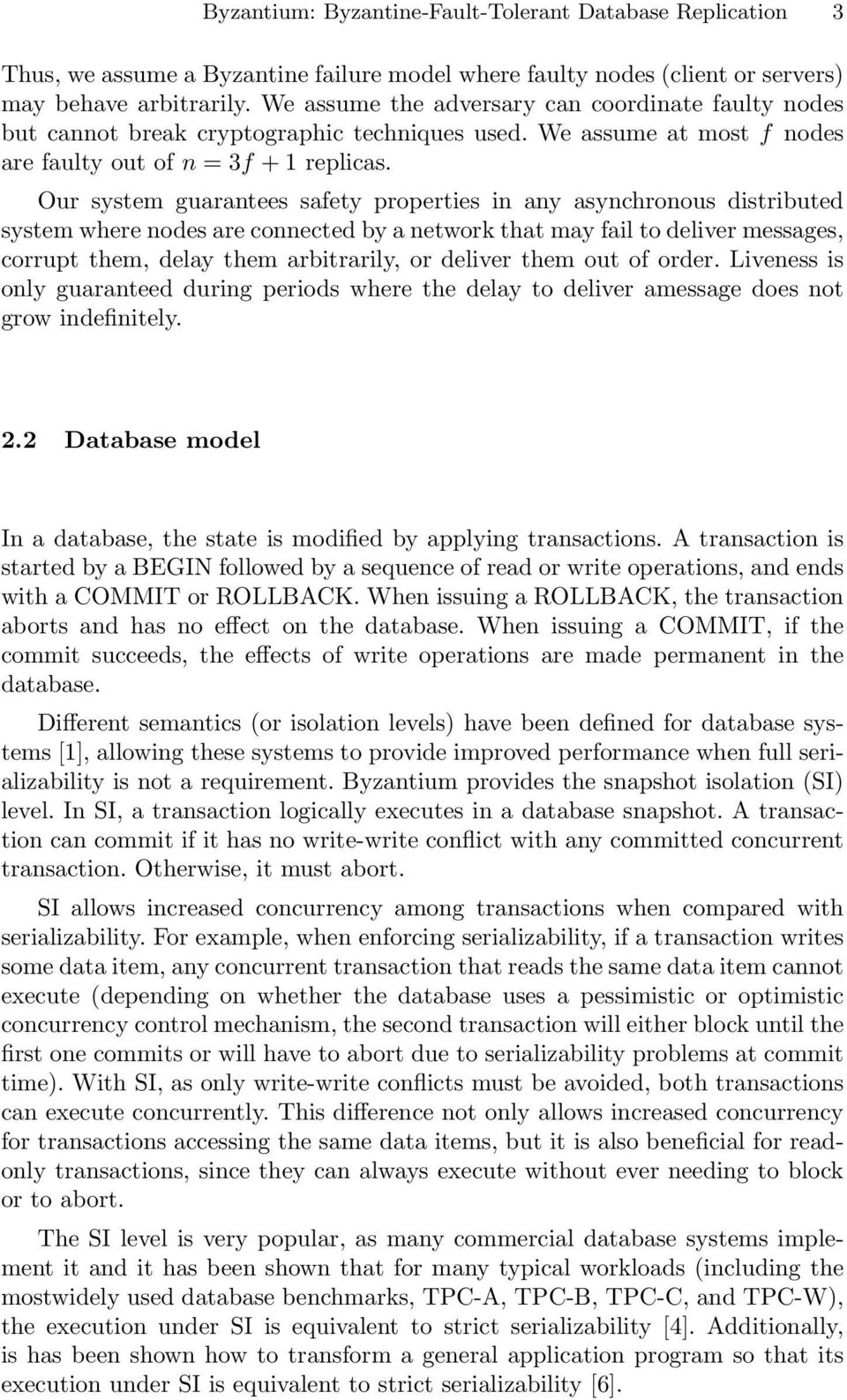
4 4 Cristóvão Tavares Honorato 2.3 System Architecture Byzantium is built as a middleware system that provides BFT replication for database systems. The system architecture, depicted in Figure 1, is composed by a set of n = 3f + 1 servers and a finite number of clients. Fig. 1. System Architecture Each server is composed by the Byzantium replica proxy, which is linked to the BFT replica library [3], and a database system. The database system maintains a full copy of the database. The replica proxy is responsible for controlling the execution of operations in the database system. The replica proxy receives inputs from both the BFT replication library (in particular, it provides the library with an execute upcall that is called after client requests run through the BFT protocol and are ready to be executed at the replicas), and it also receives messages directly from the Byzantium clients (which are not serialized by the BFT protocol). The database system used in each server can be different, to ensure a lower degree of fault correlation, in particular if these faults are caused by software bugs [12]. The only requirement is that they all must implement the snapshot isolation semantics and support savepoints1, which is common in most database systems. Users applications run in client nodes and access our system using a standard database interface (in this case, the JDBC interface). Thus, applications that access conventional database systems using a JDBC interface can use Byzantium with no modification. The JDBC driver we built is responsible for implementing

5 Byzantium: Byzantine-Fault-Tolerant Database Replication 5 the client side of the Byzantium protocol (and thus we refer to it as the Byzantium client proxy). Some parts of the client side protocol consist of invoking operations that run through the BFT replication protocol, and therefore this proxy is linked with the client side of the BFT replication library. In our design, BFT is used as a black box. This enables us to easily switch this replication library with a different one, provided both offer the same guarantees (i.e., state machine replication with linearizable semantics) and have a similar programming interface. 3 System Design 3.1 System Operation In this section, we describe the process of executing a transaction. We start by assuming that clients are not Byzantine and address this problem in the next section. The code executed by the client proxy is presented in Figure 2 and the code executed by the replica proxy is presented in Figure 3. We omitted some details (such as error and exception handling) from the code listing for simplicity. Fig. 2. Byzantium client proxy code The approach taken to maximize concurrency and improve performance is to restrict the use of the BFT protocol to only the operations that need to be

6 6 Cristóvão Tavares Honorato totally ordered among each other. Other operations can execute speculatively in a single replica (that may be faulty and provide incorrect replies) and we delay validating these replies until commit time. The application program starts a transaction by executing a BEGIN operation (function db begin, Figure 2, line 1). The client starts by generating a unique identifier for the transaction and selecting a replica responsible to speculatively execute the transaction - we call this the coordinator replica for the transaction or simply coordinator. Then, the client issues the corresponding BFT operation to execute in all replicas (by calling the BFT exec(< BEGIN,... >) method from the BFT library, which triggers the corresponding upcall at all replicas, depicted in Figure 3, line 1). At each replica, a database transaction is started. Given the properties of the BFT system, and as both BEGIN and COMMIT operations execute serially as BFT operations, this guarantees that the transaction is started in the same (equivalent) snapshot of the database in every correct replica. Fig. 3. Byzantium replica proxy code

7 Byzantium: Byzantine-Fault-Tolerant Database Replication 7 After executing BEGIN, an application can execute a sequence of read and write operations (function db op, Figure 2, line 11). Each of these operations executes only in the coordinator of the transaction (by calling replica exec, which triggers the corresponding upcall at the coordinator replica, depicted in Figure 3, line 27). The client proxy stores a list of the operations and corresponding results (or a secure hash of the result, if it is smaller). The transaction is concluded by executing a COMMIT operation (function db commit, Figure 2, line 18). The client simply issues the corresponding BFT operation that includes the list of operations of the transaction and their results. At each replica, the system verifies if the transaction execution is valid before committing it (by way of the BFT exec(< COMMIT,... >) upcall, Figure 3, line 6). To validate a transaction prior to commit, the following steps are executed. All replicas other than the primary have to execute the transaction operations and verify that the returned results match the results previously obtained in the coordinator. Given that the transaction executes in the same snapshot in every replica (as explained in the BEGIN operation), if the coordinator was correct, all other correct replicas should obtain the same results. If the coordinatorwas faulty, the results obtained by the replicas will not match those sent by the client. In this case, correct replicas will abort the transaction and the client throws an exception signaling Byzantine behavior. In Section 5, we discuss some database issues related with this step. Additionally, all replicas including the coordinator, need to verify if the SI properties hold for the committing transaction. This verification is the same that is executed in non-byzantine database replication systems (e.g. [5]) and can be performed by comparing the write set of the committing transaction with the write sets of transactions that have previously committed after the beginning of the committing transaction. As this process is deterministic, every correct replica will consequently either commit or abort the transaction. A transaction can also end with a ROLLBACK operation. A straightforward solution is to simply abort transaction execution in all replicas. We discuss the problems of this approach and propose an alternative in Section Tolerating Byzantine clients The system needs to handle Byzantine clients that might try to cause the replicated system to deviate from the intended semantics. Note that we are not trying to prevent a malicious client from using the database interface to write incorrect data or delete entries from the database. Such attacks can be limited by enforcing security/access control policies and maintaining additional replicas that can be used for data recovery [9]. As we explained, BFT is used by the client to execute operations that must be totally ordered among each other. Since BFT already addresses the problem of Byzantine client behavior in each individual operation, our system only needs to address the validity of the operations that are issued to the database engines running in the replicas.

8 8 Cristóvão Tavares Honorato First, replicas need to check if they are receiving a valid sequence of operations from each client. Most checks are simple, such as verifying if a BEGIN is always followed by a COMMIT/ROLLBACK and if the unique identifiers that are sent are valid. There is one additional aspect that could be exploited by a Byzantine client: the client first executes operations in the coordinator and later propagates the complete sequence of operations (and results) to all replicas. At this moment, the coordinator does not execute the operations, as it has already executed them. A Byzantine client could exploit this behavior by sending a sequence of operations during the COMMIT BFT requests that is different from the sequence of operations that were previously issued to the coordinator, leading to divergent database states at the coordinator and the remaining replicas. To address this problem, while avoiding a new round of message among replicas, we have decided to proceed with transaction commitment using the latest sequence of operations submitted by the client. To be able to compare if the sequence of operations submitted initially is the same that is submitted at commit time, the coordinator also logs the operations and their results as they are executed. At commit time, if the received list differs from the log, the coordinator discards executed operations in the current transaction and executes operations in the received list, as any other replica. For discarding the executed operations in the current transaction, we rely on a widely available database mechanism, savepoints, that enables rolling back all operations executed inside a running transaction after the savepoint is established. When the BEGIN operation executes, a savepoint is created in the initial database snapshot. Later, when it is necessary to discard executed operations but still use the same database snapshot, the transaction is rolled back to the savepoint previously created. This ensures that all replicas, including the coordinator, execute the same sequence of operations in the same database snapshot, guaranteeing a correct behavior of our system. 3.3 Tolerating a faulty coordinator A faulty coordinator can return erroneous results or fail to return any results to the clients. The first situation is addressed by verifying, at commit time, the correctness of results returned to all replicas, as explained previously. This guarantees that correct replicas will only commit transactions for which the coordinator has returned correct results for every operation. If the coordinator fails to reply to an operation, the client selects a new coordinator to replace the previous one and starts by re-executing all previously executed operations of the transaction in the new coordinator. If the obtained results do not match, the client aborts the transaction by executing a ROLL- BACK operation and throws an exception signaling Byzantine behavior. If the results match, the client proceeds by executing the new operation. At commit time, a replica that believes to be the coordinator of a transaction still verifies that the sequence of operations sent by the client is the same that the replica has executed. Thus, if a coordinator that was replaced is active, it will find
9 Byzantium: Byzantine-Fault-Tolerant Database Replication 9 out that additional operations have been executed. As explained in the previous section, it will then discard operations executed in the current transaction and it will execute the list of received operations, as any other replica. This ensures a correct behavior of our system, as all replicas, including replaced coordinators, execute the same sequence of operations in the same database snapshot. 3.4 Handling aborted transactions When a transaction ends with a ROLLBACK operation, a possible approach is to simply abort the transaction in all replicas without verifying if previously returned results were correct (e.g., this solution is adopted in [12]). In our system, this could be easily implemented by executing a BFT operation that aborts the transaction in each replica. This approach does not lead to any inconsistency in the replicas as the database state is not modified. However, in case of a faulty coordinator, the application might have observed an erroneous database state during the course of the transaction, which might have led to the spurious decision of aborting the transaction. For example, consider a transaction trying to reserve a seat in a given flight with available seats. When the transaction queries the database for seat availability, a faulty coordinator might incorrectly return that no seats are available. As a consequence, the application program may decide to end the transaction with a ROLLBACK operation. If no verification of the results that were returned was performed, the client operation would have made a decision to rollback based on an incorrect database state. To detect this, we decided to include an option to force the system to verify the correctness of the returned results also when a transaction ends with a ROLLBACK operation. When this option is selected, the execution of a rollback becomes similar to the execution of a commit (with the obvious difference that it is not necessary to check for write-write conflicts and that the transaction always aborts). If the verification fails, the ROLLBACK operation raises an exception. 4 Correctness In this section we present a correctness argument for the design of Byzantium. We leave a formal correctness proof as future work. 4.1 Safety Our safety condition requires that transactions that are committed on the replicated database observe SI semantics. Our correctness argument relies on the guarantees provided by the BFT algorithm [3], namely that the BFT replicated service is equivalent to a single, correct server that executes each operation sequentially. Since both the BEGIN and the COMMIT operations run as BFT requests, this implies that every correct replica will observe the same state (in terms of which transactions have

10 10 Cristóvão Tavares Honorato committed so far) both when they begin a transaction and when they try to commit it. Furthermore, they decide on whether a transaction should commit or abort based on the sequence of values that clients observed (the same sequence is transmitted to all correct replicas as an argument to the BFT request), and according to the SI semantics of their own local databases (whose state, as mentioned, is identical and reflects all transactions that have previously committed in the system). This implies that a correct replica will only allow a transaction to commit if it observed SI semantics (from the standpoint of this common database state) and therefore the outcome of the BFT commit operation is also conforming to this semantics. 4.2 Liveness Under the same assumptions as BFT, we guarantee that the BEGIN, COMMIT, and ABORT operations are eventually executed. Furthermore, operations that do not go through the BFT protocol are simple RPCs which are live under the same set of assumptions. This guarantees the system makes progress. 5 Implementation 5.1 Deterministic behavior in database systems Our design requires deterministic behavior of operations, but some database operations are not deterministic (e.g., select). However, it is possible to force a deterministic behavior using some standard techniques (e.g., as used in [12]). 5.2 Database locking issues When trying to commit a transaction in a replica, the transaction operations must be executed concurrently with other ongoing transactions (for which the replica is the primary replica). For database systems that use an optimistic concurrency control approach, this imposes no problems. However, for database systems that rely on locks, this can cause problems because executing a write operation requires obtaining a lock on the row that is being modified. However, some ongoing transaction could have already obtained the lock on that row for another write operation. This problem is similar to the problem experienced by non-byzantine replication systems that use snapshot isolation semantics and similar techniques can be used to address it (e.g., [5]) - either using write-sets or using widely available database operations for testing blocking behavior (select... for update nowait). An ongoing transaction that would block the execution of the commitment process can then be aborted (this transaction would have to abort anyway due to a write-write conflict with the committing transaction).

11 Byzantium: Byzantine-Fault-Tolerant Database Replication 11 References 1. Hal Berenson, Phil Bernstein, Jim Gray, Jim Melton, Elizabeth O Neil, and Patrick O Neil. A critique of ansi sql isolation levels. In SIGMOD 95: Proceedings of the 1995 ACM SIGMOD international conference on Management of data, pages 1 10, Philip A. Bernstein, Vassos Hadzilacos, and Nathan Goodman. Concurrency control and recovery in database systems. Longman Publishing Co., Inc., Boston, MA, USA, Miguel Castro and Barbara Liskov. Practical byzantine fault tolerance. In OSDI 99: Proceedings of the third symposium on Operating systems design and implementation, Berkeley, CA, USA, pages , Sameh Elnikety, Steven Dropsho, and Fernando Pedone. Tashkent: uniting durability with transaction ordering for high-performance scalable database replication. In EuroSys 06: Proceedings of the 1st ACM SIGOPS/EuroSys European Conference on Computer Systems, pages , Sameh Elnikety, Willy Zwaenepoel, and Fernando Pedone. Database replication using generalized snapshot isolation. In SRDS 05: Proceedings of the 24th IEEE Symposium on Reliable Distributed Systems (SRDS 05), pages 73 84, Alan Fekete, Dimitrios Liarokapis, Elizabeth O Neil, Patrick O Neil, and Dennis Shasha. Making snapshot isolation serializable. acm trans. database syst. 30(2): , Hector Garcia-Molina, Frank M. Pittelli, and Susan B. Davidson. Applications of byzantine agreement in database systems. ACM Trans. Database Syst., 11(1):27 47, Ilir Gashi, Peter T. Popov, Vladimir Stankovic, and Lorenzo Strigini. On designing dependable services with diverse off-the-shelf sql servers. In Rogério de Lemos, Cristina Gacek, and Alexander B. Romanovsky, editors, WADS, volume 3069 of Lecture Notes in Computer Science, pages , Samuel T. King and Peter M. Chen. Backtracking intrusions. ACM Trans. Comput. Syst., 23(1):51 76, Yi Lin, Bettina Kemme, Marta Patino-Martinez, and Ricardo Jimenez-Peris. Middleware based data replication providing snapshot isolation. In SIGMOD 05: Proceedings of the 2005 ACM SIGMOD international conference on Management of data, pages , Christian Plattner and Gustavo Alonso. Ganymed: scalable replication for transactional web applications. In Middleware 04: Proceedings of the 5th ACM/IFIP/USENIX international conference on Middleware, pages , Ben Vandiver, Hari Balakrishnan, Barbara Liskov, and Sam Madden. Tolerating byzantine faults in transaction processing systems using commit barrier scheduling. In SOSP 07: Proceedings of twenty-first ACMSIGOPS symposium on Operating systems principles, pages 59 72, 2007.

Efficient Middleware for Byzantine Fault Tolerant Database Replication
 Efficient Middleware for Byzantine Fault Tolerant Database Replication Rui Garcia CITI / Departamento de Informática, Faculdade de Ciências e Tecnologia, Universidade Nova de Lisboa Quinta da Torre, Caparica,
DATABASE REPLICATION A TALE OF RESEARCH ACROSS COMMUNITIES
 DATABASE REPLICATION A TALE OF RESEARCH ACROSS COMMUNITIES Bettina Kemme Dept. of Computer Science McGill University Montreal, Canada Gustavo Alonso Systems Group Dept. of Computer Science ETH Zurich,
Tashkent: Uniting Durability with Transaction Ordering for High-Performance Scalable Database Replication
 EuroSys 2006 117 Tashkent: Uniting Durability with Transaction Ordering for High-Performance Scalable Database Replication Sameh Elnikety Steven Dropsho Fernando Pedone School of Computer and Communication
Survey on Comparative Analysis of Database Replication Techniques
 72 Survey on Comparative Analysis of Database Replication Techniques Suchit Sapate, Student, Computer Science and Engineering, St. Vincent Pallotti College, Nagpur, India Minakshi Ramteke, Student, Computer
Data Distribution with SQL Server Replication
 Data Distribution with SQL Server Replication Introduction Ensuring that data is in the right place at the right time is increasingly critical as the database has become the linchpin in corporate technology
Conflict-Aware Load-Balancing Techniques for Database Replication
 Conflict-Aware Load-Balancing Techniques for Database Replication ABSTRACT Vaidė Zuikevičiūtė University of Lugano (USI) CH-9 Lugano, Switzerland [email protected] Middleware-based database
Database Replication: a Tale of Research across Communities
 Database Replication: a Tale of Research across Communities ABSTRACT Bettina Kemme Department of Computer Science McGill University Montreal, Canada [email protected] Replication is a key mechanism to
A Replication Protocol for Real Time database System
 International Journal of Electronics and Computer Science Engineering 1602 Available Online at www.ijecse.org ISSN- 2277-1956 A Replication Protocol for Real Time database System Ashish Srivastava 1 Udai
Geo-Replication in Large-Scale Cloud Computing Applications
 Geo-Replication in Large-Scale Cloud Computing Applications Sérgio Garrau Almeida [email protected] Instituto Superior Técnico (Advisor: Professor Luís Rodrigues) Abstract. Cloud computing applications
Conflict-Aware Load-Balancing Techniques for Database Replication
 Conflict-Aware Load-Balancing Techniques for Database Replication Vaidė Zuikevičiūtė Fernando Pedone University of Lugano (USI) CH-6904 Lugano, Switzerland Phone: +41 58 666 4695 Fax: +41 58 666 4536 [email protected]
Extending Multidatabase Transaction Management Techniques to Software Development Environments
 Purdue University Purdue e-pubs Computer Science Technical Reports Department of Computer Science 1993 Extending Multidatabase Transaction Management Techniques to Software Development Environments Aidong
Database Replication Techniques: a Three Parameter Classification
 Database Replication Techniques: a Three Parameter Classification Matthias Wiesmann Fernando Pedone André Schiper Bettina Kemme Gustavo Alonso Département de Systèmes de Communication Swiss Federal Institute
Correctness Criteria for Database Replication: Theoretical and Practical Aspects
 Correctness Criteria for Database Replication: Theoretical and Practical Aspects Vaidė Zuikevičiūtė and Fernando Pedone University of Lugano (USI), CH-69 Lugano, Switzerland Abstract. In this paper we
Data Management in the Cloud
 Data Management in the Cloud Ryan Stern [email protected] : Advanced Topics in Distributed Systems Department of Computer Science Colorado State University Outline Today Microsoft Cloud SQL Server
Data Replication and Snapshot Isolation. Example: Cluster Replication
 Postgres-R(SI) Data Replication and Snapshot Isolation Shuqing Wu McGill University Montreal, Canada Eample: Cluster Replication Cluster of DB replicas Read-one-Write-All- Available Performance Distribute
Locality Based Protocol for MultiWriter Replication systems
 Locality Based Protocol for MultiWriter Replication systems Lei Gao Department of Computer Science The University of Texas at Austin [email protected] One of the challenging problems in building replication
On Non-Intrusive Workload-Aware Database Replication
 On Non-Intrusive Workload-Aware Database Replication Doctoral Dissertation submitted to the Faculty of Informatics of the University of Lugano in partial fulfillment of the requirements for the degree
PostgreSQL Concurrency Issues
 PostgreSQL Concurrency Issues 1 PostgreSQL Concurrency Issues Tom Lane Red Hat Database Group Red Hat, Inc. PostgreSQL Concurrency Issues 2 Introduction What I want to tell you about today: How PostgreSQL
Conflict-Aware Load-Balancing Techniques for Database Replication
 Conflict-Aware Load-Balancing Techniques for Database Replication Vaidė Zuikevičiūtė Fernando Pedone Faculty of Informatics University of Lugano 6900 Lugano, Switzerland University of Lugano Faculty of
Managing Transaction Conflicts in Middleware-based Database Replication Architectures
 Managing Transaction Conflicts in Middleware-based Database Replication Architectures F. D. Muñoz-Escoí - J. Pla-Civera - M. I. Ruiz-Fuertes - L. Irún-Briz - H. Decker Instituto Tecnológico de Informática
The Cost of Increased Transactional Correctness and Durability in Distributed Databases
 The Cost of Increased Transactional Correctness and Durability in Distributed Databases Aspen Olmsted [email protected] Csilla Farkas [email protected] Center for Information Assurance Engineering Department
Postgres-R(SI): Combining Replica Control with Concurrency Control based on Snapshot Isolation
 Postgres-R(SI): Combining Replica Control with Concurrency Control based on Snapshot Isolation Shuqing Wu Bettina Kemme School of Computer Science, McGill University, Montreal swu23,kemme @cs.mcgill.ca
DATABASE ENGINES ON MULTICORES SCALE: A PRACTICAL APPROACH. João Soares and Nuno Preguiça
 DATABASE ENGINES ON MULTICORES SCALE: A PRACTICAL APPROACH João Soares and Nuno Preguiça Context 2 Multicore processors are here to stay With an increasing number of cores Reports show that multicores
A Reputation Replica Propagation Strategy for Mobile Users in Mobile Distributed Database System
 A Reputation Replica Propagation Strategy for Mobile Users in Mobile Distributed Database System Sashi Tarun Assistant Professor, Arni School of Computer Science and Application ARNI University, Kathgarh,
Modular Communication Infrastructure Design with Quality of Service
 Modular Communication Infrastructure Design with Quality of Service Pawel Wojciechowski and Péter Urbán Distributed Systems Laboratory School of Computer and Communication Sciences Swiss Federal Institute
(Pessimistic) Timestamp Ordering. Rules for read and write Operations. Pessimistic Timestamp Ordering. Write Operations and Timestamps
 (Pessimistic) stamp Ordering Another approach to concurrency control: Assign a timestamp ts(t) to transaction T at the moment it starts Using Lamport's timestamps: total order is given. In distributed
Designing a Cloud Storage System
 Designing a Cloud Storage System End to End Cloud Storage When designing a cloud storage system, there is value in decoupling the system s archival capacity (its ability to persistently store large volumes
Transactional Support for SDN Control Planes "
 Transactional Support for SDN Control Planes Petr Kuznetsov Telecom ParisTech WTTM, 2015 Software Defined Networking An emerging paradigm in computer network management Separate forwarding hardware (data
Segmentation in a Distributed Real-Time Main-Memory Database
 Segmentation in a Distributed Real-Time Main-Memory Database HS-IDA-MD-02-008 Gunnar Mathiason Submitted by Gunnar Mathiason to the University of Skövde as a dissertation towards the degree of M.Sc. by
Udai Shankar 2 Deptt. of Computer Sc. & Engineering Madan Mohan Malaviya Engineering College, Gorakhpur, India
 A Protocol for Concurrency Control in Real-Time Replicated Databases System Ashish Srivastava 1 College, Gorakhpur. India Udai Shankar 2 College, Gorakhpur, India Sanjay Kumar Tiwari 3 College, Gorakhpur,
Serializable Snapshot Isolation for Replicated Databases in High-Update Scenarios
 Serializable Snapshot Isolation for Replicated Databases in HighUpdate Scenarios Hyungsoo Jung University of Sydney Hyuck Han Seoul National University Alan Fekete University of Sydney Uwe Röhm University
Ph.D. Thesis Proposal Database Replication in Wide Area Networks
 Ph.D. Thesis Proposal Database Replication in Wide Area Networks Yi Lin Abstract In recent years it has been shown that database replication is promising in improving performance and fault tolerance of
Database Replication with Oracle 11g and MS SQL Server 2008
 Database Replication with Oracle 11g and MS SQL Server 2008 Flavio Bolfing Software and Systems University of Applied Sciences Chur, Switzerland www.hsr.ch/mse Abstract Database replication is used widely
Scalable Transaction Management on Cloud Data Management Systems
 IOSR Journal of Computer Engineering (IOSR-JCE) e-issn: 2278-0661, p- ISSN: 2278-8727Volume 10, Issue 5 (Mar. - Apr. 2013), PP 65-74 Scalable Transaction Management on Cloud Data Management Systems 1 Salve
Transaction Management Overview
 Transaction Management Overview Chapter 16 Database Management Systems 3ed, R. Ramakrishnan and J. Gehrke 1 Transactions Concurrent execution of user programs is essential for good DBMS performance. Because
Vbam - Byzantine Atomic Multicast in LAN Based on Virtualization Technology
 Vbam - Byzantine Atomic Multicast in LAN Based on Virtualization Technology Marcelo Ribeiro Xavier Silva, Lau Cheuk Lung, Leandro Quibem Magnabosco, Luciana de Oliveira Rech 1 Computer Science Federal
Separating Agreement from Execution for Byzantine Fault-Tolerant Services
 Separating Agreement from Execution for Byzantine Fault-Tolerant Services Rethinking Replicated State Machines Jian Yin, Jean-Philippe Martin, Arun enkataramani, Lorenzo Alvisi and Mike Dahlin [email protected],
Transactions and the Internet
 Transactions and the Internet Week 12-13 Week 12-13 MIE253-Consens 1 Schedule Week Date Lecture Topic 1 Jan 9 Introduction to Data Management 2 Jan 16 The Relational Model 3 Jan. 23 Constraints and SQL
Conflict-Aware Scheduling for Dynamic Content Applications
 Conflict-Aware Scheduling for Dynamic Content Applications Cristiana Amza Ý, Alan L. Cox Ý, Willy Zwaenepoel Þ Ý Department of Computer Science, Rice University, Houston, TX, USA Þ School of Computer and
A Proposal for a Multi-Master Synchronous Replication System
 A Proposal for a Multi-Master Synchronous Replication System Neil Conway ([email protected]), Gavin Sherry ([email protected]) January 12, 2006 Contents 1 Introduction 3 2 Design goals 3 3 Algorithm
Dr Markus Hagenbuchner [email protected] CSCI319. Distributed Systems
 Dr Markus Hagenbuchner [email protected] CSCI319 Distributed Systems CSCI319 Chapter 8 Page: 1 of 61 Fault Tolerance Study objectives: Understand the role of fault tolerance in Distributed Systems. Know
Replication: Analysis & Tackle in Distributed Real Time Database System
 Replication: Analysis & Tackle in Distributed Real Time Database System SANJAY KUMAR TIWARI, A.K.SHARMA, V.SWAROOP Department of Computer Sc. & Engg. M.M.M. Engineering College, Gorakhpur, U.P., India.
CAP Theorem and Distributed Database Consistency. Syed Akbar Mehdi Lara Schmidt
 CAP Theorem and Distributed Database Consistency Syed Akbar Mehdi Lara Schmidt 1 Classical Database Model T2 T3 T1 Database 2 Databases these days 3 Problems due to replicating data Having multiple copies
BookKeeper overview. Table of contents
 by Table of contents 1 BookKeeper overview...2 1.1 BookKeeper introduction... 2 1.2 In slightly more detail...2 1.3 Bookkeeper elements and concepts...3 1.4 Bookkeeper initial design... 3 1.5 Bookkeeper
Serializable Isolation for Snapshot Databases
 Serializable Isolation for Snapshot Databases This thesis is submitted in fulfillment of the requirements for the degree of Doctor of Philosophy in the School of Information Technologies at The University
Improving the Scalability of Cloud-Based Resilient Database Servers
 Improving the Scalability of Cloud-Based Resilient Database Servers Luís Soares and José Pereira University of Minho {los,jop}@di.uminho.pt Abstract. Many rely now on public cloud infrastructure-as-a-service
USING REPLICATED DATA TO REDUCE BACKUP COST IN DISTRIBUTED DATABASES
 USING REPLICATED DATA TO REDUCE BACKUP COST IN DISTRIBUTED DATABASES 1 ALIREZA POORDAVOODI, 2 MOHAMMADREZA KHAYYAMBASHI, 3 JAFAR HAMIN 1, 3 M.Sc. Student, Computer Department, University of Sheikhbahaee,
Distributed Databases
 C H A P T E R19 Distributed Databases Practice Exercises 19.1 How might a distributed database designed for a local-area network differ from one designed for a wide-area network? Data transfer on a local-area
How To Store Data On An Ocora Nosql Database On A Flash Memory Device On A Microsoft Flash Memory 2 (Iomemory)
 WHITE PAPER Oracle NoSQL Database and SanDisk Offer Cost-Effective Extreme Performance for Big Data 951 SanDisk Drive, Milpitas, CA 95035 www.sandisk.com Table of Contents Abstract... 3 What Is Big Data?...
Introduction to Database Management Systems
 Database Administration Transaction Processing Why Concurrency Control? Locking Database Recovery Query Optimization DB Administration 1 Transactions Transaction -- A sequence of operations that is regarded
All about Eve: Execute-Verify Replication for Multi-Core Servers
 All about Eve: Execute-Verify Replication for Multi-Core Servers Manos Kapritsos, Yang Wang, Vivien Quema, Allen Clement, Lorenzo Alvisi, Mike Dahlin The University of Texas at Austin Grenoble INP MPI-SWS
This paper defines as "Classical"
 Principles of Transactional Approach in the Classical Web-based Systems and the Cloud Computing Systems - Comparative Analysis Vanya Lazarova * Summary: This article presents a comparative analysis of
Comparing Microsoft SQL Server 2005 Replication and DataXtend Remote Edition for Mobile and Distributed Applications
 Comparing Microsoft SQL Server 2005 Replication and DataXtend Remote Edition for Mobile and Distributed Applications White Paper Table of Contents Overview...3 Replication Types Supported...3 Set-up &
New method for data replication in distributed heterogeneous database systems
 New method for data replication in distributed heterogeneous database systems Miroslaw Kasper Department of Computer Science AGH University of Science and Technology Supervisor: Grzegorz Dobrowolski Krakow,
Pronto: High Availability for Standard Off-the-shelf Databases
 Pronto: High Availability for Standard Off-the-shelf Databases Fernando Pedone Svend Frølund University of Lugano (USI) Switzerland Gatehouse A/S Denmark Abstract Enterprise applications typically store
Distributed File System. MCSN N. Tonellotto Complements of Distributed Enabling Platforms
 Distributed File System 1 How do we get data to the workers? NAS Compute Nodes SAN 2 Distributed File System Don t move data to workers move workers to the data! Store data on the local disks of nodes
Lecture 7: Concurrency control. Rasmus Pagh
 Lecture 7: Concurrency control Rasmus Pagh 1 Today s lecture Concurrency control basics Conflicts and serializability Locking Isolation levels in SQL Optimistic concurrency control Transaction tuning Transaction
Scalable Database Replication through Dynamic Multiversioning
 Scalable Database Replication through Dynamic Multiversioning Kaloian Manassiev, Cristiana Amza Department of Computer Science, University of Toronto, Canada Department of Electrical and Computer Engineering,
Special Relativity and the Problem of Database Scalability
 Special Relativity and the Problem of Database Scalability James Starkey NimbusDB, Inc. The problem, some jargon, some physics, a little theory, and then NimbusDB. Problem: Database systems scale badly
Optimizing Concurrent Processing of Write-then-Read Transactions
 Optimizing Concurrent Processing of Write-then-Read Transactions c Alexander Kalinin Institute for System Programming of the Russian Academy of Sciences [email protected] Abstract Write-then-read
DISTRIBUTED AND PARALLELL DATABASE
 DISTRIBUTED AND PARALLELL DATABASE SYSTEMS Tore Risch Uppsala Database Laboratory Department of Information Technology Uppsala University Sweden http://user.it.uu.se/~torer PAGE 1 What is a Distributed
A Trustworthy and Resilient Event Broker for Monitoring Cloud Infrastructures
 A Trustworthy and Resilient Event Broker for Monitoring Cloud Infrastructures Diego Kreutz, António Casimiro, Marcelo Pasin LaSIGE, Faculty of Sciences, University of Lisbon, Portugal [email protected],
F1: A Distributed SQL Database That Scales. Presentation by: Alex Degtiar ([email protected]) 15-799 10/21/2013
 F1: A Distributed SQL Database That Scales Presentation by: Alex Degtiar ([email protected]) 15-799 10/21/2013 What is F1? Distributed relational database Built to replace sharded MySQL back-end of AdWords
Scalable Transaction Management with Snapshot Isolation on Cloud Data Management Systems
 1 Scalable Transaction Management with Snapshot Isolation on Cloud Data Management Systems Vinit Padhye and Anand Tripathi Department of Computer Science University of Minnesota Minneapolis, 55455, Minnesota,
Overview Motivating Examples Interleaving Model Semantics of Correctness Testing, Debugging, and Verification
 Introduction Overview Motivating Examples Interleaving Model Semantics of Correctness Testing, Debugging, and Verification Advanced Topics in Software Engineering 1 Concurrent Programs Characterized by
Snapshots in Hadoop Distributed File System
 Snapshots in Hadoop Distributed File System Sameer Agarwal UC Berkeley Dhruba Borthakur Facebook Inc. Ion Stoica UC Berkeley Abstract The ability to take snapshots is an essential functionality of any
Queue Weighting Load-Balancing Technique for Database Replication in Dynamic Content Web Sites
 Queue Weighting Load-Balancing Technique for Database Replication in Dynamic Content Web Sites EBADA SARHAN*, ATIF GHALWASH*, MOHAMED KHAFAGY** * Computer Science Department, Faculty of Computers & Information,
Bounded Cost Algorithms for Multivalued Consensus Using Binary Consensus Instances
 Bounded Cost Algorithms for Multivalued Consensus Using Binary Consensus Instances Jialin Zhang Tsinghua University [email protected] Wei Chen Microsoft Research Asia [email protected] Abstract
Outline. Failure Types
 Outline Database Management and Tuning Johann Gamper Free University of Bozen-Bolzano Faculty of Computer Science IDSE Unit 11 1 2 Conclusion Acknowledgements: The slides are provided by Nikolaus Augsten
TRANSACÇÕES. PARTE I (Extraído de SQL Server Books Online )
 Transactions Architecture TRANSACÇÕES PARTE I (Extraído de SQL Server Books Online ) Microsoft SQL Server 2000 maintains the consistency and integrity of each database despite errors that occur in the
Data Consistency on Private Cloud Storage System
 Volume, Issue, May-June 202 ISS 2278-6856 Data Consistency on Private Cloud Storage System Yin yein Aye University of Computer Studies,Yangon [email protected] Abstract: Cloud computing paradigm
Distributed File Systems
 Distributed File Systems Mauro Fruet University of Trento - Italy 2011/12/19 Mauro Fruet (UniTN) Distributed File Systems 2011/12/19 1 / 39 Outline 1 Distributed File Systems 2 The Google File System (GFS)
A new Cluster Resource Manager for heartbeat
 A new Cluster Resource Manager for heartbeat Lars Marowsky-Brée [email protected] January 2004 1 Overview This paper outlines the key features and design of a clustered resource manager to be running on top
IV Distributed Databases - Motivation & Introduction -
 IV Distributed Databases - Motivation & Introduction - I OODBS II XML DB III Inf Retr DModel Motivation Expected Benefits Technical issues Types of distributed DBS 12 Rules of C. Date Parallel vs Distributed
How To Make A Multi-Server Cluster More Efficient
 Improving the Scalability of Cloud-Based Resilient Database Servers Luís Soares and José Pereira University of Minho {los,jop}@di.uminho.pt Abstract. Many rely now on public cloud infrastructure-as-a-service