
Lesson: Ways to Communicate ESSENTIAL QUESTION: What are some ways humans communicate?
|
|
|
- James Hunter
- 10 years ago
- Views:
Transcription
1 Communication: Participants practice effective communication skills. Lesson plans: 1) Ways to Communicate 2) Conflict Resolution 3) Online communication: Internet safety 4) Human knot 5) Forgiveness Lesson: Ways to Communicate ESSENTIAL QUESTION: What are some ways humans communicate? OBJECTIVES/PERFORMANCE EXPECTATIONS: Participants learn about different forms of communication; participants practice different forms of communication. SUMMARY OF THE ISSUE: Communication is what we do to give and get understanding; it is the process of sending and receiving messages. Successful communication occurs when there is understanding. Communication can be verbal, using oral language to convey a message, or nonverbal, including facial expressions, body language, text or written based language. Sometimes a message s original meaning gets lost in the translation between thought and the act of communicating it. Teaching young people how to communicate effectively helps them maintain healthy relationships, resolve conflicts peacefully, excel in school, and eventually get and keep jobs. MATERIALS: Paper Pens and pencils LENGTH OF LESSON: 30 minutes PROCEDURE: 1. Begin by playing the game Telephone. Have participants sit in a circle. Ask one participant to think of a phrase or sentence. Direct them to whisper it in the ear of the person sitting next to them. Each participant whispers what they think they heard to the next participant next to them. The last participant says the phrase or sentence out loud. Ask the first participant if that was their phrase. Did anything change? Did the message get lost or changed in translation? This is an example of verbal communication. 2. Now play the game Charades. Have participants get up one at a time to act out a phrase or sentence without using any words or sounds while the others guess the phrase or sentence. Ask participants to explain what they did to communicate their message when they were unable to use words (ex: facial expressions, body language, gestures). Were others able to guess the 53

2 phrase or sentence? Was the message delivered effectively? This is an example of non-verbal communication. Explain that we all communicate all day long, whether or not we are using words. Explain that others pick up messages from our facial expressions, body language, gestures, and general demeanor. 3. Have partners get in pairs. Direct them to communicate hello to their partner three different ways. If they need help, remind them that they can use verbal words, written text, their body or a gesture, or even do something creative. 4. Next have them communicate a feeling to their partner. Give examples of feelings: sad, angry, happy, excited, jealous, confused, or worried. The other partner will guess what feeling they are portraying. For example if their feeling was sad they could say or write I feel sad, make a facial expression, or show with their body how they feel) 5. Give examples from telephone and charades to demonstrate that what you want to communicate is not always what others understand. Explain this is how rumors and gossip spread: someone tells someone a secret and it gets passed on and it gets changed and distorted along the way, just as the message did in telephone. 6. Remind participants that being clear and concise in their verbal and non-verbal communication is an important life skill that needs to be practiced. 7. Finish by using non-verbal communication to ask participants to take out their journals or that you ll see them later or that you love them! Have participants guess your message and then do the action. JOURNAL PROMPT: How do you communicate most often? How would you get people to understand you if you couldn t communicate that way anymore? EVALUATION: Did participants practice communicating in multiple ways? RELATED ACTIVITIES: Have participants tell a story about themselves without using words. Or using only words! Lesson: Conflict Resolution ESSENTIAL QUESTION: How can conflicts be resolved peacefully? OBJECTIVES/PERFORMANCE EXPECTATIONS: Participants use scenarios and role playing to learn ways to resolve conflicts peacefully; participants examine choices and consequences involved in settling disagreements or tension. SUMMARY OF THE ISSUE: Conflict resolution means working out a problem or disagreement without fighting, running away or going against your feelings. Knowing how to handle conflicts in a positive way can help people stay safe from violence, feel good about themselves, and learn to respect others. Physical violence, name-calling, threats, bullying, teasing, and other forms of negative communication often escalate conflicts and leads to serious consequences, including physical injury, lowered self-esteem, and punishment. Good communication involves being a good listener, considering and respecting the other person s point of view, working 54

3 together to think of solutions, and learning to relax the body and calm the mind during hightension situations. Practicing these positive communication skills can help people make responsible choices during high-tension situations and avoid violence and further problems. MATERIALS: Role playing scenarios Large paper or board to write feelings and ideas LENGTH OF LESSON: 30 to 45 minutes PROCEDURE: 1. Begin by asking the participants to raise their hands if they ve ever been involved in a conflict (ex: a disagreement or a fight with someone). Brainstorm what might cause a conflict (ex: bullying, teasing, gossip, jealousy, prejudice, broken friendships, broken romances, possessions, different points of view, wanting a different outcome to a problem). 2. Ask them to brainstorm some feelings that might go along with being in a conflict (ex: angry, jealous, lonely, scared, confused, disappointed, worried, sad). Write these feelings on the board or large paper as the students say them. 3. Explain that when we are involved in a disagreement or any conflict, there are choices we can make; every choice we make has a consequence. Explain that learning about conflict resolution, or learning about how to work things out peacefully without fighting, running away, or going against your own beliefs, can keep your safe from violence, make you feel good about yourself, and help you learn to respect others. 4. Explain the role playing activity. For every scenario, watch the set-up scene, have a volunteer come and help resolve the conflict, and then brainstorm ideas together about what choices can be made and what the consequences are of those choices. Demonstrate a scenario and the conflict resolution. Ask if there are any questions. 5. Ask for volunteers or choose participants to be the actors. 6. Read the scenario and then have participants act out the scenario (see sample scenarios below, or come up with your own). Have someone come in to help resolve the conflict. Step in as needed to give suggestions. Have the participants actually say the words of the peaceful conflict resolution to practice. 7. Have the group identify the problem, the feelings that may be involved, and then have the group come up with a list of choices and their corresponding consequences. Ask: What choices can be made to escalate this incident or make it worse? What choices can be made to resolve this conflict peacefully or make it better? What choices could have been made to avoid this incident altogether? When is it helpful to ask someone (a teacher, a friend, a parent, a trusted adult) to mediate/step in and help solve a conflict? 8. Finish by asking the participants if they have an example of a positive conflict resolution situation they were part of and would like to share. Scenarios with scripting: 55

4 Scenario #1: I was sitting here first (problem: stealing) Sarah was sitting in a chair. She got up to use the bathroom. When she came back, Dana was sitting in that seat. The person who was sitting there first wants their seat back and the other person doesn t want to give the seat up. (Choices: hit each other and get into a fight someone gets hurt, they both get in trouble, no one gets the chair. OR Discuss and explain calmly, both people compromise, get another chair everyone has a chair, no one gets hurt OR Ask a teacher for help the teacher assists them discussing and explaining calmly, everyone gets a chair, no one gets hurt.) Scenario #2: That s mine (problem: stealing) Jolie and Carrie are sitting next to each other eating a snack. When Jolie turns to talk to another friend, Carrie grabs Jolie s snack and hides it in her lap. Jolie turns back and notices her snack is gone and suspects that Carrie stole it. (Choices: call names, yell to give back the snack, threaten to slap her if she doesn t give it back, grab the snack back out of her lap someone gets hurt, both get in trouble, they stay mad at each other OR discuss and explain calmly or get a teacher, Jolie gives the snack back and apologizes, Carrie accepts the apology they both get to eat the snack, no one gets hurt or in trouble, they stay friends) Scenario #3: I heard you said you didn t like me (problem: gossiping, teasing, bullying) Amina overhears a group of girls making fun of the outfit she is wearing today. She notices that Lauren, a girl who has teased her about her clothes before, is part of that group. Amina feels like crying. (Choices: go yell at the group, punch Lauren, run away and hope it doesn t happen again someone gets hurt, everyone gets in trouble, Lauren continues to tease and bully Amina, Amina continues to feel sad OR Amina walk up to the group and tells them how their comments make her feel Lauren and the group apologize, Lauren and the group continue to tease Amina OR Amina gets a teacher to help her confront the group) Scenario #4: I thought we were friends (problem: ditching, silent treatment, leaving out) Camille and Stephanie are good friends. They have sleepovers and hang out together at recess every day. Over the summer Camille s cousin Breanne from Los Angeles moved into Camille s family s home. Since the school year started, Camille and her cousin have been hanging out at recess together every day and Stephanie has not been invited to any sleepovers. One day at recess Stephanie walks over to Camille and Breanne to say hi and the two girls run away from her. The next day at recess Stephanie walks over to try to say hi again and hang out with her best friend. This time instead of running away Camille and Breanne look at each other, cross their arms, and give Stephanie the silent treatment. (Choices? Consequences?) JOURNAL PROMPT: Describe a situation you were in recently that was not solved peacefully. How would you go back and change it if you could? EVALUATION: Were the scenarios representative of real-life situations the girls might encounter? Did the girls participate in the scenarios and the conflict resolution? Were ideas brainstormed for resolving conflict without violence or escalating the conflict? RELATED ACTIVITIES: Start a conflict managers club where students act as mediators for their peers. 56

5 Lesson: Online Communication Internet Safety ESSENTIAL QUESTION: How can you stay safe on the internet? OBJECTIVES/PERFORMANCE EXPECTATIONS: Participants learn about potential dangers of the internet; participants plan how they will stay safe when using the internet. SUMMARY OF THE ISSUE: The internet has created new ways for people to communicate and be connected. Through the internet and other computer technology, young people have the opportunity to gain media literacy, become technically savvy, construct identities, socialize, and be connected to people all over the world. Despite the benefits of computer innovation, cyberbullying and the spread of rumors and gossip on social networking sites such as Facebook, Twitter, and MySpace, as well as through chat room, instant messaging, and , are growing problems. The FBI reports that by the age of 14, 77% of teens have been contacted by a predator online, 12% of teenage girls admitted to eventually meeting strangers they first met online in person, and chat room strangers are implicated in nearly 20% of cases of missing teens aged 15 to 17 each year (Baeza 6). Teaching young people about online safety is as important as teaching them about the benefits of computer technology. MATERIALS: Computer with internet access Videos or online videos about online safety Paper Pens and pencils LENGTH OF LESSON: 45 minutes to 1 hour PROCEDURE: 1. Begin a discussion about internet use. Ask participants: Have you ever used the internet before? What do YOU use the internet for? What CAN the internet be used for? (ex: research/learn about things, get/share news, chat with friends, look up the bus/train/airplane schedule, watch movies/tv shows, play computer games, listen to music, look up books at the library, check the weather, look up sports scores, find a job, etc) 2. Explain that although the internet can be used for all of these amazing purposes, sometimes it is used to hurt others. Explain it is important to learn about the potential dangers of the internet so you can use it for all its benefits while staying safe. 3. Show videos or online videos about online safety. Show public service announcements about cyber-bullying, stories of spreading gossip or photos that have led to suicide, and stories about kidnapping or someone getting hurt that happened as a result of meeting someone online. 4. Ask participants to think about the videos they saw and answer: What do you need to be careful about on the internet? Explain they need to be careful about: Predators people aren t always who they say they are, people might lie to you, people might try to entice you with something they know you like and then trick you into meeting them; Bullying if you wouldn t 57

6 say it out loud, why say it online?; Website content if you see something that makes you uncomfortable, report it to a trusted adult. 5. Help participants understand the Internet is forever: everything they post online is tracked and stored and will follow them to future job interviews and college entrance interviews. Also, explain that victims/targets of bullying should not respond to the messages, but should print out the messages or pictures as evidence and report it to a trusted adult. 6. Ask if there are any questions about anything they have heard or seen today. 7. Pass out paper and pens. Have participants create a rule sheet about internet safety to post by a computer. Assist as necessary. Have participants write 5 to 10 rules to remind them how to be safe when using the internet. Use the Online Safety Rules for Kids by the National Center for Missing and Exploited Children and ikeepsafe.org as examples: I will not give out personal information such as my address, telephone numbers, parent s work address/telephone number, or the name and location of my school to anyone online. I will tell my parent/guardian right away if I come across any information that makes me feel uncomfortable. I will never agree to get together with someone I meet online. If my parents/guardians agree to a meeting, I will be sure that it is in a public place and bring my parent/guardian along. I will never send someone my picture or anything else without first checking with my parents/guardians. I will not respond to any messages that are mean or in any way makes me feel uncomfortable. It is not my fault if I get a message like that. If I do, I will print out the messages or pictures as evidence and report it to a trusted adult. I will talk with my parents/guardians so that we can set up rules for going online. We will decide upon a time of day that I can be online, the length of time I can be online and appropriate areas for me to visit. I will not access other areas or break these rules without their permission. 8. Have participants post their rules next to computers in the Girls Only space, at school, or at home. JOURNAL PROMPT: What would you like to look up on the internet? If you had a pen-pal from another country that you communicated with over the internet, what would you tell them about yourself? If you created your own website, what would it be about? EVALUATION: Did participants learn about potential dangers regarding the internet? Did participants brainstorm ways to stay safe on the internet? Did participants create a paper to post by their computer reminding them about internet safety? RELATED ACTIVITIES: Help the participants set up their own account. Engage participants in weekly internet searches on various topics related to Girls Only. 58

7 Lesson: Human knot ESSENTIAL QUESTIONS: How are we all connected? What does it mean to work as a team? OBJECTIVES/PERFORMANCE EXPECTATIONS: Students work together to untangle their human knot to form a connected circle without letting go of their hands. SUMMARY OF THE ISSUE: This is a fun, physical and visual way for students to see that we are all connected and practice various communication and problem solving skills. LENGTH OF LESSON: 15 minutes PROCEDURE: 1. Clear a space so there is enough room for groups of 10 to stand comfortably in a circle. 2. Have participants stand shoulder to shoulder facing each other in the circle. 3. Explain that this game is about working together and seeing how we can communicate to untangle ourselves. Remind participants they will try to untangle themselves without letting go of their hands. 4. Direct participants to reach across the circle with one hand and shake hands with another participant. If this is used as an ice breaker, have participants introduce themselves and then continue holding hands. 5. Now direct participants to reach their other hand across and hold hands with someone else. 6. Explain that you'd like them to untangle themselves, without letting go of hands, into a circle. 7. Have group work for 10 minutes. 8. Remind students that by making small adjustments with their hands, arms, legs, feet, and whole bodies, as well as by maintaining a positive attitude (ex: we can untangle ourselves ), they can make a big difference for their team. 9. If there is too much of a struggle, offer the group one unclasp and reclasp of hands. The group must discuss and decide which unclasp and reclasp would be most useful. 10. If a group untangles into a circle quickly, have them try the exercise again. It is okay if some group members are facing backwards when the circle is finished. 11. Congratulate a group when it untangles itself, though it is unnecessary to make this into a race or competition since the process of untangling is the focus of this exercise. JOURNAL PROMPT: What did you like about the human knot activity? What did you learn about yourself by doing this activity? EVALUATION: Were students able to cooperate with each other as they worked to untangle their bodies? What lessons were learned about communication throughout the activity? RELATED ACTIVITIES: Try this in larger or smaller groups and see how the activity varies. Use this as a sponge activity to get the group moving between activities or as a getting to know you activity. 59

8 Lesson: Forgiveness ESSENTIAL QUESTIONS: What is forgiveness? What can forgiveness look like? OBJECTIVES/PERFORMANCE EXPECTATIONS: Participants discuss what forgiveness means; participants discuss the benefits of forgiveness; participants strategize how to practice forgiveness. SUMMARY OF THE ISSUE: Forgiveness is letting go of anger and resentment you feel towards somebody who has done something to you. Forgiving someone for something they have done to you, no matter how big or small, requires compassion, empathy, and courage. Recognizing the power of forgiveness helps young people maintain healthy relationships, build strong friendships, and think before they act. MATERIALS: Board or large paper Videos or online videos Stories of forgiveness Writing paper Pens and pencils LENGTH OF LESSON: 45 minutes to 1 hour PROCEDURE: 1. Ask participants what forgiveness means. Record their ideas as they give them. 2. Explain that forgiveness is letting go of anger and resentment you feel towards somebody who has done something to you. You may forgive someone for something minor like bumping into you or taking your seat at Girls Only. You may forgive someone for something like leaving you out at recess or forgetting to call you on your birthday. You may forgive someone for something major like breaking up with you or physically hurting someone in your family. Forgiveness is not easy and it might take a long time to forgive someone or for someone to forgive you. 3. Show videos, online videos, and stories of examples of forgiveness. Share stories such as: Elizabeth Eckford was a 15-year old African-American student who attended Little Rock High School in Arkansas in She is known as one of the Little Rock Nine because she is one of the nine young African-American students who went to the all-white high school after the Brown vs. Board of education decision in This law made segregation, or separation, of blacks and whites illegal in education; before this, black children and white children could not attend the same school. Many white students were not supportive of this decision and did not treat the black students as equals. On her very first day of high school, Elizabeth had to walk through a mob of white students and grown-ups who were yelling and threatening to hurt her. She was brave but very afraid. During her time at Little Rock High, Elizabeth was threatened and harassed and even had to have the National Guard come to protect her and the other black students. 60

9 Elizabeth suffered from nightmares and paranoia for a long time because of her experience at Little Rock High. There is a famous picture of Elizabeth walking to school bravely while the white mob follows her. 34 years after the picture was taken, Hazel Massery, one of the white women shown in the picture yelling, apologized to Elizabeth. They started talking more and Elizabeth forgave her and they are now friends. Tariq Khamisa was 20-years-old when he was killed while delivering a pizza. His assailant was 14-year-old Tony Hicks who shot him on orders from an 18-year-old gang leader. After his son s murder, Tariq s dad, Azim Khamisa, didn t seek revenge, but saw two children lost, one forever and one to the state prison system. Azim established the Tariq Khamisa Foundation (TKF) to honor his son and to stop kids from killing kids. He reached out to Ples Felix, Tony Hicks grandfather and guardian. Together, they have spoken to thousands of children about the power of forgiveness in order to break the cycle of youth violence. Tony Hicks pled guilty to murder in 1996 and delivered a remorseful speech at his sentencing, accepting responsibility for his actions and praying for Tariq s dad s forgiveness. Tony was sentenced to prison for 25 years to life. The foundation continues to change the lives of young people by empowering them to make positive and nonviolent choices (TKF). 4. Ask participants what they would have done in each situation. Could they have forgiven the person? Why or why not? There is no right or wrong answer! 5. Begin a discussion about forgiveness by asking: Why might you want to forgive someone? (ex: they asked for forgiveness; they said they were sorry; they made it up to me; I think they paid enough; I wanted to let go of my own anger; I was over it; it made me feel good to forgive them) Why might you want someone to forgive you? (ex: you know what you did hurt them; you said you were sorry; you have changed) Who are you hurting if you don t forgive someone? 61

10 (ex: yourself because the anger and resentment live inside of you) Who benefits from forgiveness? (if it is genuine, everyone!) 6. Explain that forgiveness is a process. Forgiving someone for something they have done which hurt you and made you angry or sad is difficult. It requires compassion, empathy, and courage. 7. Continue the discussion about forgiveness by asking: How could you tell someone that you forgive them? (ex: I forgive you; it s ok; thank you for telling me you re sorry) How could you show them? (ex: give them a hug) How could you ask for forgiveness? (ex: I am sorry; please forgive me) Is forgiving the same as forgetting? If you forgive someone, does it mean you have to forget what they did to you? Do you have to forgive someone? If you ask for forgiveness and you don t get it, what will you do? (respect their decision; leave them alone; be patient; live with the consequences) There is no right or wrong answer! 8. Pass out paper, pens and pencils. Explain they will now have a chance to ask someone for forgiveness or to give someone forgiveness by writing a letter. They do not have to send the letters! 9. Ask participants to think about the following questions: Is there something you would like to be forgiven for? Why do you deserve forgiveness for that? Is there someone you would like to forgive for something? What would you like to say to them? 10. Have participants write their forgiveness letters. If they are asking for forgiveness they should begin their letter with: Please forgive me for If they are giving forgiveness they should begin their letter with: I forgive you for Assist as necessary. JOURNAL PROMPT: What do you like about forgiveness? What don t you like about forgiveness? EVALUATION: Did participants define forgiveness? Were participants exposed to examples of forgiveness? Did participants brainstorm ideas for practicing forgiveness? Did participants write a letter asking for or giving forgiveness? RELATED ACTIVITIES: Invite a guest speaker to Girls Only to share a story of forgiveness and compassion. 62

Getting-to-know-you/Sponge Activities: These activities can be used as gettingto-know-you
 Getting-to-know-you/Sponge Activities: These activities can be used as gettingto-know-you activities, as in-between activities to redirect participant s energy and attention, and to soak up time if necessary,
Related KidsHealth Links
 Grades 9 to 12 Personal Health Series KidsHealth.org/classroom Teacher s Guide This guide includes: Standards Related Links Discussion Questions Activities for Students Reproducible Materials Standards
Practicing Interventions: Role Playing
 Practicing Interventions: Role Playing You cannot simply explain an intervention technique to students and expect them to use it. They need practice these skills using multiple scenarios, before we can
What does compassion look like?
 Lesson One: What does compassion look like? Learning Objectives: Students will: Demonstrate an understanding of the concept compassion. Identify elements of compassion shown in various images. Begin to
Bullying 101: Guide for Middle and High School Students
 Bullying 101: Guide for Middle and High School Students A guide to the basics of bullying, what it is and isn t, the role of students, and tips on what you can do. 952.838.9000 PACERTeensAgainstBullying.org
National Health Education Standards and Performance Indicators. Interpersonal Communication [4.12.1; 4.12.2; 4.12.3] Self Management [7.12.2; 7.12.
![National Health Education Standards and Performance Indicators. Interpersonal Communication [4.12.1; 4.12.2; 4.12.3] Self Management [7.12.2; 7.12.](/thumbs/27/9539429.jpg "National Health Education Standards and Performance Indicators. Interpersonal Communication [4.12.1; 4.12.2; 4.12.3] Self Management [7.12.2; 7.12.") LESSON 8 Interpersonal Communication and Self Management Student Learning Objectives Identify how interpersonal communication and self management are needed for healthy living. Expand on the definition
LESSON 8 Interpersonal Communication and Self Management Student Learning Objectives Identify how interpersonal communication and self management are needed for healthy living. Expand on the definition
It s hard to know what to do when you know or suspect that a friend or family member is living with violence.
 How can you help? A B It s hard to know what to do when you know or suspect that a friend or family member is living with violence. How do I know what is the right thing to do? Should I say something or
Human trafficking is the buying and selling of men, women and children within countries and across borders in order to exploit them for profit.
 Learn. Act. Share. Human trafficking is the buying and selling of men, women and children within countries and across borders in order to exploit them for profit. The trafficker takes away the basic human
Bullying Awareness Lesson Plan Grades 4-6
 Bullying Awareness Lesson Plan Grades 4-6 1 Estimated Time of Completion: Two to three classroom periods, or stretched out throughout the school year. Each activity will take between 15-30 minutes. Bullying
Mental Health Role Plays
 Mental Health Role Plays Goals: To discuss various mental health issues and mental illnesses. To discuss stigma, support and treatment options surrounding mental health issues and mental illnesses. Requirements:
School-Based Health Education Standards:
 School-Based Health Education Standards: Accessing Valid Health Information (A.V.I.) Interpersonal Communication (I.C.) California Healthy Kids Resource Center (C.H.K.R.C.) Hello. This is the third module
Bullying. Take Action Against. stealing money. switching seats in the classroom. spreading rumors. pushing & tripping
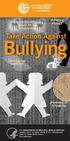 switching seats in the classroom stealing money Take Action Against Bullying spreading rumors pushing & tripping U.S. DEPARTMENT OF HEALTH & HUMAN SERVICES Substance Abuse and Mental Health Services Administration
MATERIALS: Chart paper/markers; pens; Student handouts: Instant Replay and Staying SAFE
 LESSON PLAN: INSTANT REPLAY OVERVIEW: Students discuss and practice safe and realistic responses to name-calling and bullying by role-playing fictional scenarios. They use the instant replay technique,
Chapter 3. Online Bullying
 Chapter 3 Online Bullying Children and teens often face online cruelty (as well as cruelty in the real world). For younger kids, instant messaging and texting can become platforms for teasing and meanness.
Connectedness and the Emotional Bank Account
 Connectedness and the Emotional Bank Account Directions This is a self-guided activity that can be completed by parents, teens or both. It contains five parts and should take about 45 minutes to complete.
Digital Citizenship Lesson Plan
 Digital Citizenship Lesson Plan This course is to help people to understand how to use the Internet in a safe, productive way. Additional resources and links are available on the TechTECS website. http://techtecs.com/digital-citizenship
 Only talk with people online that you know in person Time does not equal trust It doesn t mean you really know the person Be suspicious; ANY person worth having as a friend wouldn t ask you to put yourself
2 nd - Watch My Online Neighborhood Video: https://www.commonsensemedia.org/videos/my- online- neighborhood
 K- Going Places Safely Essential Question: How do I go places safely on the computer? Students will: discover the Internet can be used to visit far- away places and learn new things; compare how staying
Cyberbullying. Understanding and Addressing Online Cruelty. Students Handouts and Supporting Materials for Teachers
 Cyberbullying Understanding and Addressing Online Cruelty Students Handouts and Supporting Materials for Teachers Elementary Level Lesson: Building a Foundation for Safe and Kind Online Communication Resources
S. No. WHAT KIDS WANTS THEIR PARENTS TO KNOW. 1 Encourage me when I do a good job ! " #$ % & "
 1 Encourage me when I do a good job 2 Let me teach you some things. Don't always be the teacher! " #$ % & " '()&% 3 Don't show too much affection in public ( # &% 4 Let me take some risks; you did when
Imagine It! ICEBREAKER:
 ICEBREAKER: Imagine It! FOCUS: To develop creativity and increase participants comfort with acting in front of a group PURPOSE: To help participants relax before working on their public presentation skills
Related KidsHealth Links
 Grades 3 to 5 Health Problems Series KidsHealth.org/classroom Teacher s Guide This guide includes: Standards Related Links Discussion Questions Activities for Students Reproducible Materials Standards
Grade 2 Lesson 3: Refusing Bullying. Getting Started
 Getting Started Lesson Concepts You can refuse to let bullying happen to you or to others. Being assertive is one way to refuse bullying. Key Words Refuse, assertive Objectives Students will be able to:
Skills for Adolescence unit 6, Lesson 10
 Skills for Adolescence unit 6, Lesson 10 Unit 6, Lesson 10 STANDING UP TO PRESSURE TO USE DRUGS IN THIS LESSON Studies show that drug use jumps significantly between grades six and seven, making it likely
Their stories are tragic. A new chapter starts now. now.
 ! Their stories are tragic. A new chapter starts now. now.! Bully is a movie that tells powerful stories about children and their families dealing with extreme pain and tragic consequences related to bullying.
What Is the Olweus Bullying Prevention Program?
 Dear Parent/Guardians, Your child s school will be using the Olweus Bullying Prevention Program. This research-based program reduces bullying in schools. It also helps to make school a safer, more positive
BABIES FEBRUARY 2015. Basic Truth: Hold or rock a baby and sing the following song to the tune of Are You Sleeping.
 BABIES FEBRUARY 2015 Basic Truth: Jesus wants to be my friend forever. Hold or rock a baby and sing the following song to the tune of Are You Sleeping. Jesus loves you. Jesus loves you. Yes, He does. Yes,
National Cybersecurity Awareness Campaign. Kids Presentation
 National Cybersecurity Awareness Campaign Kids Presentation About Stop.Think.Connect. In 2009, President Obama asked the Department of Homeland Security to create the Stop.Think.Connect. Campaign to help
e-rate toolkit Cyberbullying: Crossing the Line
 e-rate toolkit Cyberbullying: Crossing the Line Lesson Plan Essential Question: When does inappropriate online behavior cross the line to cyberbullying, and what can you do about it? Learning Overview
SCRIPT FOR OUTREACH. Disconnected and Cyber Predators. Introduction. How many of you have your own cell phones or smart phone?
 SCRIPT FOR OUTREACH Disconnected and Cyber Predators Introduction Hello! How is everyone doing today? My name is and I am here with some friends of mine from the American Bar Association Young Lawyers
PEER PRESSURE TEACHER S GUIDE:
 TEACHER S GUIDE: PEER PRESSURE LEARNING OBJECTIVES Students will be able to identify peer pressure as both a positive and negative force. Students will understand how peer pressure impacts everyone. Students
Private Today, Public Tomorrow
 Estimated time: 45 minutes Essential Question: How can you respect the privacy of others online? Learning Overview and Objectives Overview: Students reflect on their responsibility to protect the privacy
Lesson 7 Dealing with Troublesome Feelings
 Lesson 7 Dealing with Troublesome Feelings Overview This lesson teaches about dealing with troublesome feelings and the importance of getting help when needed. Students review the benefits of expressing
Teacher Guide TEEN SAFETY
 The Vulnerable Teacher Guide TEEN SAFETY This companion to the online course provides questions and topics for classroom discussion and activities. 2012 ShieldTheVulnerable.org 1277 Treat Blvd #530 Walnut
A Guide for Parents. of Elementary and Secondary School Students
 A Guide for Parents of Elementary and Secondary School Students The effects of bullying go beyond the school yard. As a parent, here s what to watch for, what you can do, and where you can go to get help.
The Good Roommate Guide
 The Good Roommate Guide Contents: p. 2 COMMUNICATING WITH YOUR ROOMMATE 101 p. 3 IDENTIFYING COMMUNICATION STYLES p. 4 TOP 10 TIPS FOR HEALTHY RELATIONSHIP p. 5 10 EFFECTIVE WAYS TO HANDLE CONFLICT p.
Related KidsHealth Links. Discussion Questions
 Grades 6 to 8 Personal Health Series Online Safety and Cyberbullying KidsHealth.org/classroom Teacher s Guide This guide includes: Standards Related Links Discussion Questions Activities for Students Reproducible
Overexposed: Sexting and Relationships & Private Today, Public Tomorrow Grades 9-12
 Overexposed: Sexting and Relationships & Private Today, Public Tomorrow Grades 9-12 Essential Question: What are the risks and responsibilities when you share online in a relationship? How can you respect
CyberbullyNOT Student Guide to Cyberbullying
 CyberbullyNOT Student Guide to Cyberbullying WHAT IS CYBERBULLYING? Cyberbullies use the Internet or cell phones to send hurtful messages or post information to damage people s reputation and friendships.
Girl Scout Journey: It's Your World Change It!
 Girl Scout Journey: It's Your World Change It! amaze! Four-week Girl Scout Journey Program amaze!: The Twists and Turns of Getting Along Life is a maze of relationships and this journey has Girl Scout
UNDERSTANDING YOUR ONLINE FOOTPRINTS: HOW TO PROTECT YOUR PERSONAL INFORMATION ON THE INTERNET
 UNDERSTANDING YOUR ONLINE FOOTPRINTS: HOW TO PROTECT YOUR PERSONAL INFORMATION ON THE INTERNET SPEAKING NOTES FOR GRADES 4 TO 6 PRESENTATION SLIDE (1) Title Slide SLIDE (2) Key Points It can be really
FAMILY GUIDE TO. Mobile Safety. How to keep your children safe and connected in today s mobile world SPONSORED BY:
 FAMILY GUIDE TO Mobile Safety How to keep your children safe and connected in today s mobile world SPONSORED BY: Is Your Child Ready for a Mobile Phone? MOBILE PHONES ARE PART OF OUR LIVES. They re powerful
I Miss My Pet: A workbook for children about pet loss
 I Miss My Pet. Unpublished workbook, Katie Nurmi 2002 1/30 I Miss My Pet: A workbook for children about pet loss Illustration by Joseph, age 6, The Solid Foundation Association, State College, PA. Developed
Discussing Bullying Behaviors with Teens: Tips for Adults at School and Home
 Discussing Bullying Behaviors with Teens: Tips for Adults at School and Home Bullying is a common problem affecting youth of all ages and it can have a negative impact on every student, as well as the
Building Healthy Relationships:
 Building Healthy Relationships: Conflict Resolution Alberta Education Health & Life Skills Program of Studies Outcomes 8Grade The student will R - 8.5 R - 8.7 Develop strategies for maintaining healthy
WHOLE SCHOOL ANTI-BULLYING POLICY
 130 High Road, Buckhurst Hill, Essex IG9 5SD Telephone number: 0208 504 1133 WHOLE SCHOOL ANTI-BULLYING POLICY 1 Persons responsible: The Head Teacher, in consultation with the Directors, the Governing
Young people and drugs
 Young people and drugs Many parents worry about whether their son or daughter is taking illegal drugs, how they can tell, and what to do about it. While there s a lot of concern about illegal drugs in
Teen Online & Wireless Safety Survey
 Teen Online & Wireless Safety Survey Cyberbullying, Sexting, and Parental Controls Research Findings May 2009 Contact: Kim Thomas Cox Communications [email protected] 404-269-8057 Cox Communications
Fact Sheet #1: Skills to Expect from 0 to 18 months
 Fact Sheet #1: Skills to Expect from 0 to 18 months Mental Skills Remember people and objects that are not present Imitate other people s facial expressions, sounds, and actions Imitate what they see on
Role Plays for Teacher Classroom Management
 Role Plays for Teacher Classroom Management Collaboration, Workshop 1 After Vignette #4 Making connection with quiet child Practice making a connection with a child who is quiet, shy, or sad. Think about
RESOURCES.RESULTS.RELIEF.
 RESOURCES.RESULTS.RELIEF. Helping Your Anxious Child Make Friends One of childhood's toughest lessons is learning how to be a good friend. However, some anxious children and teens find it tough to face
Related KidsHealth Links Articles for Kids:
 Grades 3 to 5 Personal Health Series KidsHealth.org/classroom Teacher s Guide This guide includes: Standards Related Links Discussion Questions Activities for Students Reproducible Materials Standards
Adult Retrospective Questionnaire
 Adult Retrospective Questionnaire These are questions about some things that might have happened during your childhood. Your childhood begins when you are born and continues through age 17. It might help
Online Safety for Middle and High School
 Online Safety for Middle and High School Presented by Warren County Schools Technology Department 2010-2011 Internet & Technology Safety The purpose of this presentation is to TEACH YOU about INTERNET
Media: Participants learn about the media s influence on our lives; participants identify how
 Media: Participants learn about the media s influence on our lives; participants identify how the media influences their attitudes; participants brainstorm ways to combat the media s negative influence.
Working with Youth to Develop Critical Thinking Skills On Sexual Violence and Dating Violence: Three Suggested Classroom Activities
 Working with Youth to Develop Critical Thinking Skills On Sexual Violence and Dating Violence: Three Suggested Classroom Activities The Southern Arizona Center Against Sexual Assault s Rape Prevention
From The Desk of Mrs. Samine Charles Pierre.. INTRODUCING YOUR SCHOOL COUNSELOR
 From The Desk of Mrs. Samine Charles Pierre.. INTRODUCING YOUR SCHOOL COUNSELOR What is a school counselor? Your school counselor is a person who is specially trained to help you realize your full potential
A Time to Tell Troop Meeting Guide
 A Time to Tell Troop Meeting Guide Using This Guide The video A Time to Tell shows several strategies child molesters use to attempt sexual molestation. In addition, one scenario introduces bullying as
Voir Dire in Domestic Violence Cases
 Voir Dire in Domestic Violence Cases By Sarah M. Buel, Co-Director, University of Texas School of Law Domestic Violence Clinic Voir dire provides the opportunity to educate jurors while probing for bias,
THE FORGIVING FATHER
 BOOK 1, PART 3, LESSON 4 THE FORGIVING FATHER THE BIBLE: Luke 15:11-32 THEME: We can discover what Jesus wants us to do and be by hearing the parables Jesus told. PREPARING FOR THE LESSON MAIN IDEA: Jesus
Students will be able to explain the difference between harmless teasing and verbal bullying
 LESSON PLAN: I WAS JUST KIDDING! OVERVIEW: Students are asked to consider the difference between good-natured teasing and bullying through discussion of fictional scenarios and reflection on real-life
Everything You Need To Know About Middle School. This planning guide belongs to:
 Everything You Need To Know About Middle School This planning guide belongs to: 1 Table of Contents What Happens in Middle School? Page 3 What to Expect Page 4 How to be a Self-Directed Student Page 5
3Session. Why Do Children Do What They Do? Positive Solutions for Families. The Center on the Social and Emotional Foundations for Early Learning
 Why Do Children Do What They Do? 3Session Positive Solutions for Families The Center on the Social and Emotional Foundations for Early Learning Learner Objectives Suggested Agenda Examine why children
a threat made in school
 a threat made in school ADAM S BACKGROUND LEADING UP TO THE CRIME Adam, 15, is the youngest of four children. His parents are divorced. He lives with his mother, has regular contact with his father, and
Private Today, Public Tomorrow
 Estimated time: 40 minutes Essential Question: How can you respect the privacy of others online? Learning Overview and Objectives Overview: Students reflect on their responsibility to protect the privacy
WORKSHEET ONE FIRST ACTIVITY. Treating others with respect. List of ideas for treating others with respect
 WORKSHEET ONE FIRST ACTIVITY Have the group brainstorm what they think it means to treat other people with. Write the answers on the whiteboard, if it helps use this list on the worksheet as a guide. List
Facts for Teens: Youth Violence
 P.O. Box 6003 Rockville, MD 20849-6003 [email protected] www.safeyouth.org Facts for Teens: Youth Violence Introduction Many teenagers are concerned about youth violence, and with good reason. Each
WHY DO WE GET ANGRY? EVERYONE FEELS ANGRY SOMETIMES
 FEELING ANGRY? WHY DO WE GET ANGRY? There are lots of things that can make us angry. Here are a few examples... EVERYONE FEELS ANGRY SOMETIMES It s normal and healthy to get angry when there is a good
Youth Online Behavior
 Youth Online Behavior Created by: Andrea Pieters, Project Researcher, Youth and Education Christine Krupin, Project Researcher, Youth and Education June 1, 2010 Harris Interactive 6/21/2010 1 Methodology
Using the Second Step: Social-Emotional Skills for Early Learning and Devereux Early Childhood Assessment (DECA-P2) Preschool Program Together
 Using the Second Step: Social-Emotional Skills for Early Learning and Devereux Early Childhood Assessment (DECA-P2) Preschool Program Together The Second Step program and DECA Preschool Program are both
A Publication of the GCPS Information Management Division
 GCPS A Publication of the GCPS Information Management Division Gwinnett County Public Schools is committed to providing information related to student technology use in a manner that is clear, concise,
Lesson One: Introduction to Customer Service
 Student s Name: Date: / / Lesson One: Introduction to Customer Service 1. Customer service is a relatively complex puzzle. While engaging customers, we are attempting to offer services in a manner that
EADS up. stop think connect
 EADS up stop think connect table of contents 2 4 8 12 Share with Care Interact with Tact The Protection Connection Word Search You text, you play games, you share photos and video. You update your status,
HEALTHY BOUNDARIES PROGRAM For Assistance and Programming, Contact Officer Tressa S. Johnson Community Affairs 419-530-4964
 page 1 HEALTHY BOUNDARIES PROGRAM For Assistance and Programming, Contact Officer Tressa S. Johnson Community Affairs 419-530-4964 Relationship Equality Wheel The Healthy Boundaries program provides a
Creating a Safe and Healthy Environment for Neighborhood Councils
 Creating a Safe and Healthy Environment for Neighborhood Councils Department of Neighborhood Empowerment Regional Roundtable and Training Day 2009 Patrick Prince, M.A. & Ann Phelps, Ph.D. PRINCE & PHELPS
She Wants Out Part II. Female gang members are second-class citizens. The guys sometimes throw
 Carol Adams Huntington Junior College Literary Dictation Material Marked in 20 Word Groups She Wants Out Part II Female gang members are second-class citizens. The guys sometimes throw parties and don
Program Summary: Stop the Bullying Day*
 Program Summary: Stop the Bullying Day* THEME: Highlight lessons from the American Girl advice book Stand Up for Yourself & Your Friends. The program includes fun, interactive lessons and role-playing
Total Time 2 hours over 2-3 meetings plus team-building and get-to-know-you activities
 LESSON 5: GETTING G ORGANIZED 5: G Goals/Purpose This lesson provides some concrete steps to structure your group. Its purpose is to establish group norms and to agree on decision-making. Objectives Come
RELATE Workshop 1: My Feelings and Your Feelings SUBUNITS: IDENTIFYING FEELINGS, OUR FEELINGS, OTHERS FEELINGS
 RELATE Workshop 1: My Feelings and Your Feelings SUBUNITS: IDENTIFYING FEELINGS, OUR FEELINGS, OTHERS FEELINGS P a g e 2 Materials Provided in Packet: Coloring Sheets (Feelings) List of 16 Feelings Feelings
Negotiation and Refusal Skills Lesson 6
 Negotiation and Refusal Skills Lesson 6 Synopsis Students reflect on their first volunteer project visit. Negotiation and refusal skills are introduced and demonstrated through role plays. Students then
Too Good for Drugs Grade 5
 Dear Parent: Our class is participating in Too Good for Drugs, a prevention program designed by the Mendez Foundation to teach skills for living healthy, drug-free lives. We are excited about this opportunity
HEADS up. stop think connect
 HEADS up stop think connect Stop.Think.Connect. TM is a national public awareness campaign aimed at increasing the understanding of cyber threats and empowering the American public to be safer and more
Today s teens use technology more than ever. Most have
 Today s teens use technology more than ever. Most have high-speed Internet access, which they use to send instant messages to their friends, create blogs and online videos, keep personal profiles on social
think before you send! Using Digital Communication Responsibly Developed by Jonathan W. Blodgett Essex District Attorney
 think before you send! Using Digital Communication Responsibly Developed by Jonathan W. Blodgett Essex District Attorney think before you send! A Message from the District Attorney The use and capabilities
Online Rumors. Lauren didn t think much of it when a classmate came. Lauren didn t have to ask where on the Internet;
 Carol Adams Huntington Junior College Literary Material Marked in 20 Word Groups Online Rumors Lauren didn t think much of it when a classmate came into the band hall and said, Hey, Lauren, did you 1 hear
C-SAVE. Scenario #1 Jake and the Bad Virus. The two major C3 concepts this scenario illustrates are:
 Scenario #1 Jake and the Bad Virus The two major C3 concepts this scenario illustrates are: Cyber Security: Jake compromised his computer s security by providing personal information to an unknown online
Family Law. Lesson: Family Violence. CLB 5-6 Instructional Package
 Lesson: Family Violence CLB 5-6 Instructional Package Family Law: Family Violence (CLB 5-6) CLB Outcomes CLB 5-III: Getting Things Done CLB 6-IV: Comprehending Information CLB5-II: Reproducing Information
Why Can t We All Just Get Along?
 Why Can t We All Just Get Along? Why Can t We All Just Get Along? Key Faith Foundation: God s Plan for Handling Family Conflict Key Scriptures: Genesis 4:1-12; Psalm 133; Colossians 3:12-15 Bible basis
Sarah Smythe Youth Community Developer Western Ottawa Community Resource Centre. Genevieve Hupe School Resource Officer Ottawa Police Service
 Sarah Smythe Youth Community Developer Western Ottawa Community Resource Centre Genevieve Hupe School Resource Officer Ottawa Police Service From the choices below, which screen name is the worst for
Parenting. Coping with DEATH. For children aged 6 to 12
 Parenting Positively Coping with DEATH For children aged 6 to 12 This booklet will help you to understand more about death and the feelings we all have when someone we care about, like a parent, a brother
For Parents and Families: What to do if a Child is Being Bullied
 WHAT IS BULLYING? For Parents and Families: What to do if a Child is Being Bullied Bullying among children is aggressive behavior that is intentional and that involves an imbalance of power or strength.
CMA Relapse Prevention Meeting Mondays, 6pm Chairman s Script. Good evening. My name is and I am an addict.
 CMA Relapse Prevention Meeting Mondays, 6pm Chairman s Script Good evening. My name is and I am an addict. Welcome to the Monday Night Relapse Prevention Meeting of Crystal Meth Anonymous. Please join
Why Do Some Children Bully Others? Bullies and Their Victims
 Family Development Fact Sheet Call your county Extension office for more information Why Do Some Children Bully Others? Bullies and Their Victims Is bullying serious? Bullying is often considered to be
1. Provide a knowledge base 2. Create an atmosphere 3. Present a stimulus 4. Generate questions 5. Facilitate a discussion
 1. Provide a knowledge base 2. Create an atmosphere 3. Present a stimulus 4. Generate questions 5. Facilitate a discussion 1 1. Provide a knowledge base If you want students to discuss a scientific or
Bullying Awareness Lesson Plan Grades K-3
 Bullying Awareness Lesson Plan Grades K-3 Estimated Time of Completion: Two to three classroom periods, or stretched out throughout the school year. Each activity will take between 15-30 minutes. Bullying
This document has been produced following a request from the Hft National Speak Out Group for help with staying safe when using the internet.
 This document has been produced following a request from the Hft National Speak Out Group for help with staying safe when using the internet. Hft Safeguarding Group commissioned a member of Hft National