
KISD. Service Design. Service Design. practical access to an evolving field. Stefan Moritz
|
|
|
- Marianna Poole
- 10 years ago
- Views:
Transcription
1 KISD practical access to an evolving field 1 Stefan Moritz

2

3 Practical access to an evolving field Stefan Moritz, London 2005 Köln International School of Design MDes MA uropean Studies in Design University of Applied Sciences Cologne Fachhochschule Köln Faculty of Cultural Sciences Fakultät Kulturwissenschaften Prof. Birgit Mager Head of department for Copyright 2005 Stefan Moritz, All rights reserved. To use any of the contents of this work a permission of the author is required in writing. Contact: [email protected] To use any of the material that does not belong to the author the permission of the individual originator is required. practical access to an evolving field

4 helps to innovate (create new) or improve (existing) services to make them more useful, usable, desirable for clients and efficient as well as effective for organisations. It is a new holistic, multidisciplinary, integrative field. xecutive summary This summary provides an insight into Service Design and how it can help address some key challenges facing organisations today. is a new holistic, multi-disciplinary, integrative field. It helps to either innovate or improve services to make them more useful, usable, desirable for clients, as well as more efficient and effective for organisations. The service sector makes up the biggest part of the economy, up to 70% of GDP. However, services are not as productive for organisations and as satisfying for clients as they could be. Services have a design problem. Professionals in the service sector need to realise that they are involved in design and use Service Design to improve it. Services have unique features. They are not tangible, cannot be stored or owned, consumption happens at the same time as production and they are complex experiences that happen over time. Therefore, designing services requires special considerations. Design as a whole has changed and Service Design can address the unique challenges that the service economy is facing. Design is not only crafting details of products anymore. It is a field that designs complex and interactive experiences, processes and systems. It involves expertise and experts from related fields and clients in the design process. It uses special processes, tools and methods. arose about 10 years ago. Since then it has continued to evolve through a number of channels and has gained significant momentum in the last couple of years through the development of an international Network. integrates management, marketing, research and design. It acts as an interface and connects organisations and clients in a new way. Many organisations in the market today are working to improve and innovate services, and there are many great examples of that in Virgin Atlantic, First Direct, Fedx, however, improvement is seldom done regularly, systematically or even intentionally. That is why there is a need for dedicated. Recognising how can give organisations a significant competitive advantage is a starting point. From there, to get involved in it is essential to first have a complete understanding of it and this paper sets out in detail what is required to do so. It explains and describes the framework in which service design operates, explores existing models, details the six minds-sets required to complete a service design project (understanding, thinking, generating, filtering, explaining and realising) and provides overview models, a process and a practical job description. To conclude, is a very different way of approaching the way we think of the relationship between organisations and clients. This paper defines the essential role that can play in nurturing that relationship through the creation of outstanding and innovative service experiences. Through organisations can create competitive advantages, loyal satisfied clients and higher profit margins. Improving services is essential not only to drive organisations forward, but economies too.

5 Contents INTRODUCTION 13 About this paper 15 Goal 17 Methodology CHANGING WORLD 23 Service revolution 29 What differentiates services 32 Understanding design SRVIC DSIGN SOLUTION 39 What is 4 3 What differentiates 4 8 Areas with related expertise 57 benefits service design evolution 6 6 to date 69 players 73 The Network 75 xamples of outstanding services service design reality 8 5 Who is designing services now 8 9 Workshop with practitioners ACCSS TO SRVIC DSIGN 113 Bridging the gap 115 framework 121 overview 123 (SD) tasks 124 SD Understanding 12 8 SD Thinking 132 SD Generating 13 6 SD Filtering 14 0 SD xplaining 14 4 SD Realising 14 9 Considerations 15 0 overview model 15 4 process 161 role description CONCLUSION 167 Conclusion APPNDIX 177 Glossary 18 5 tools & methods 241 Bibliography 24 4 Acknowledgements 8 9 Contents

6 INTRODUCTION Introduction

7 About this paper Objective This paper introduces as a way for practitioners to deliver value for their organisation. This paper looks at the development of and describes where it is at today. It gives people that work with services an understanding of, and practical access to, Service Design. nable understanding and access The service economy is booming yet clients are not always satisfied, and the service sector is still less productive than the manufacturing sector. 1 is a new field in which user oriented strategies and concepts are designed to make services work better for an organisation and their clients. is offering a competitive advantage for organisations and ensuring quality experiences for clients. For example it helps organisations to offer better services than their competitors and to raise clients awareness to the service they consume. However, so far only a few organisations use it. 2 Why? The paper explores this question, identifies how possible tasks can be addressed by and it develops a model that groups tasks into a workable framework. Which tools can be used to enable? Which can be identified in other disciplines? How can some of them need be adopted to Service Design? And overall: Which ones can be developed specifically for designing services? The paper also helps identify the skills required to manage and become active in and explores a set of tools that are helpful to achieve those tasks Introduction 1 According to the UK treasury the service sector is 1/3 less productive than the manufacturing sector, as stated by Kevin Gavaghan in a conversation. 2 As found e.g. by research of the University of Westminster

8 One of the big challenges is to get people in the service industry to realise that they are involved in design and to get help to improve it. Bill Hollins, pioneer Goal The complex and multi-disciplinary field of according to some experts can address some of the key challenges that our society and economy is facing. Given that Services have specific implications, designing them is a complex, iterative and multi-disciplinary process. is a field that allows and encourages competencies from different fields to come together. xperts from different disciplines have contributed with various perspectives to this new practice. To make it easy for a broad range of professionals to fully understand, this work sets out to turn into a tangible, accessible reality. As a practical starting kit it compiles tools and methods of to facilitating the explanation of to clients, institutions and investors. In addition this work gives me, as the author, the opportunity to establish a holistic and practical knowledge of, as well as an opportunity to explore and understand various tools and experts in and its related fields. It enables me to examine this field from an international perspective, to equip myself with a broad range of valuable contacts, tools and knowledge. To me is clear that I have a unique opportunity to use the experience and the network that partially result from the MDes 1 and from Birgit Mager s 2 support and endorsement. The combination of both enables me finally to write the first master in a subject that I m very passionate about. This work includes four chapters. The first chapter sets out to set up the background for the development of Service Deisgn, including the changes in the economy and in design. The second chapter gives an insight into as a new field, including what it differientates and what it can deliver. The third chapter explores how Service Design can be made accessible in a practical way. The fourth chaper is the conclusion of this work. The working process has been kept transparent and documented via a Blog. 3 This paper includes research, thoughts and reasoning as well as some material that specifically helps to understand. Quotes, visual material and summaries support this paper to be a compact and reader friendly summary of Introduction 1 MDes uropean studies in design. A new programme joining seven uropean design universities, including two years in two different countries. 2 Birgit Mager is Professor for at Köln International School of Design, Cologne 2 On-line communication platform:
9 Methodology In the four different areas of research, interviews, desk research and a workshop were used to ivestigate and understand, related fields, service practitioners and various tools. To establish a profound understanding of the field various papers and books have been reviewed. A seminar that was conducted by RSA-Design 1 in London helped to gain understanding of different perspectives on. The attendance of a one-day workshop for practitioners in the service sector that Birgit Mager held in Cologne, helped to understand the detailed background, tools and methods of as well as the audience that attended this workshop. Several interviews and conversations with various experts helped to gain understanding not only about the practice but also about the landscape and actors within this new field and different perspectives. The emerging international Network was a crucial platform to access people and material. Different resources that are available from those experts have been reviewed and analysed. n CONDUCTD RSARCH 1. Literature review xpert interviews Model & process review Tool analysis 2. Related fields xpert interviews Model & process review Tool analysis 3. Practitioners Interviews Desk research Workshop 4. Tools Interviews Desk research Prototyping Workshop Introduction 1 The Royal Society for the encouragement of Arts, Manufactures & Commerce.

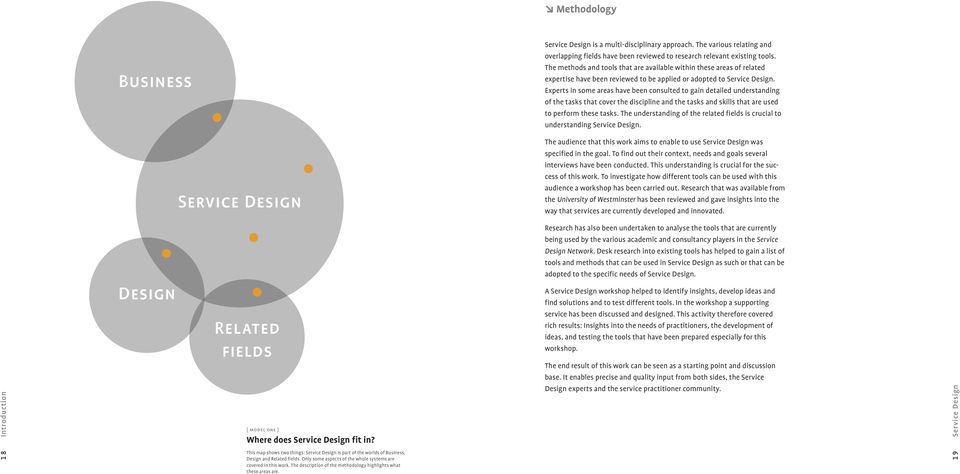
10 n Methodology Business is a multi-disciplinary approach. The various relating and overlapping fields have been reviewed to research relevant existing tools. The methods and tools that are available within these areas of related expertise have been reviewed to be applied or adopted to. xperts in some areas have been consulted to gain detailed understanding of the tasks that cover the discipline and the tasks and skills that are used to perform these tasks. The understanding of the related fields is crucial to understanding. The audience that this work aims to enable to use was specified in the goal. To find out their context, needs and goals several interviews have been conducted. This understanding is crucial for the success of this work. To investigate how different tools can be used with this audience a workshop has been carried out. Research that was available from the University of Westminster has been reviewed and gave insights into the way that services are currently developed and innovated. Introduction Design Related fields [ model one ] Where does fit in? Research has also been undertaken to analyse the tools that are currently being used by the various academic and consultancy players in the Service Design Network. Desk research into existing tools has helped to gain a list of tools and methods that can be used in as such or that can be adopted to the specific needs of. A workshop helped to identify insights, develop ideas and find solutions and to test different tools. In the workshop a supporting service has been discussed and designed. This activity therefore covered rich results: Insights into the needs of practitioners, the development of ideas, and testing the tools that have been prepared especially for this workshop. The end result of this work can be seen as a starting point and discussion base. It enables precise and quality input from both sides, the Service Design experts and the service practitioner community. 1 8 This map shows two things: is part of the worlds of Business, Design and Related fields. Only some aspects of the whole systems are covered in this work. The description of the methodology highlights what these areas are. 1 9
11 CHANGING WORLD Changing world

12 There s been a lot of focus on product innovation over the years, but very little discussion or thought on innovation in the service sector despite the vast growth of that part of our economy. Service revolution We are surrounded by services every day. We listen to the radio. The window cleaner makes sure that the sun can shine into our apartment. Our mail is delivered. The hairdresser gives us a new summer cut. We borrow books from the library. We go online, book our holiday and finally take the plane to the Caribbean. And that is not new. Services have been around for centuries the old Greek and Romans had servants and even prior to that services were provided and also paid for. Still, we are aware that some things have changed dramatically in the last say 25 years. We have reached the end of the monopoly of the industrial era. 1 In the end of the 19th century the steam machine, bigger factories, new inventions and methods pushed a mass of cheaper goods in the market. The industrial revolution created an ocean of cheaper and better products in developed countries. Today, most households have two TVs, an electrical toothbrush, a car, and most of us stereos and PCs. Like the industrial revolution that transformed society and economy we are now about to experience the service revolution. 2 Four main drivers lead the service revolution 1. The service economy is booming 2. The product market is satisfied 3. Technology enables services 4. Humans have individual needs Changing world 2 2 John A. Byrne, editor-in-chief of Fast Company magazine, January 21, 2005 Service Innovation, Thackara, John: In the Bubble 2 Conversations with Lavrans Løvlie
13 n Service revolution 1. The service economy is booming The World bank recognises a strong growth of the service sector and expanding trade in services: Service industries increased their share of the world economy during the past two decades, while the relative shares of agriculture and industry shrank in most developing regions. 1 The service economy is the dominant part of the economy of most developed countries. The USA and Japan are the worlds leading countries in their massive service economies. Catching up with this in uropean countries, services are becoming increasingly important for the economy. Up to 70% of the GNP lies in the service sector today. 2 Service has been recognised as third sector beside agriculture and manufacturing. In the past years a fourth sector around transformation of data and information into knowledge has also been recognised. 3 The currency of that new economy lies mainly in services. Pure service companies are emerging in surprising places. Product companies are developing into solutions companies by adding services to accompany their products. Jan Carlson at Scandinavian Airlines said: We don t fly planes any more we fulfil the travel needs of our clients The product market is satisfied As a consequence of mass and serial production, products increasingly resemble each other. 6 Over the last years products got more and more similar. From a client * standpoint the twenty different washing powders that are available in every super market are all fulfilling the same purpose. And the basic function of cleaning and basic quality is taken for granted for all of them. In the last years branding has worked on positioning, creating unique selling propositions and marketing has pushed and promoted those products. A documentary revealed that shampoo packaging is redesigned every two weeks in Germany on average. But also outside the FMCG market many new versions of old prodcuts are being created all the time, even though the results are not always innovative or very different from before. 7 This is not to say that there won t be new unique products. However, the industrial revolution enabled a new quality of life in developed countries. Results such as the Volkswagen peoples car or Ikea furniture enabled a wide range of people to afford designed products. To make prices even cheaper and to be more competitive most producing companies moved their manufacturing facilities to low price countries mainly in Asia. Changing world More and more hybrid product-service companies are relying a lot more on services. For example the revenue mix at IBM has gone from 68% products / 32% services in 1994 to 48% / 52% in 2003, a 63% change in ten years. 5 Services are used to support products competitiveness and to ad value. Many products are platforms for services. More and more the real business does lie in services and products represent the possibility to consume the service. But 2 4 Supermarket shelf: The product market is satisfied. Over the last years products got more and more similar. 1 World bank. Retrieved from the world wide web the DIC. Retrieved from the world wide web the Bel, Daniel: The Coming of Post-Industrial Society 4 Mager, Birgit ( ): workshop, Cologne 6 Mager, Birgit (2004):. A Review. (page 9). Cologne 7 * In this work the word client is used consistently instead of customer, consumer or user. This is representing the change of thinking in Service Design towards seeing and treating clients as important and part of the process Rae, Jeneanne M. et. al. (2004): Services Are Different. In Head s Up! On Organizational Innovation. Online weekly. InnovationNetwork.
14 n Service revolution this does not mean that products are not important any more. Services are integrated in complex hybrid product and service units that complement the service offering. For example a mobile phone as a product is the enabling platform to use the service of communication. The phone mostly comes for free with a service contract. This example has been used a lot to illustrate how important services are and that products are just there for the service. Yet the mobile phone is playing a significant role as a fashion item. Therefore the service hybrid represents a new unit that requires new design in strategy, branding and marketing. 3. Technology enables services A change in technology resulted in the industrial revolution. It changed the way companies worked and offered many new possibilities. Furthermore, the service revolution is based on a wide range of technological changes. The internet, telecommunications, computers & wireless devices again open up many possibilities. All these new technologies work as service enablers. 7 Services can be provided in new ways. Banking for example is now possible via the internet or on the phone. New services can be offered such as broadband for example. There are unlimited opportunities in creating service systems that offer value in new ways. Technology has changed the relationships between clients and service providers. Therefore technology represents new possibilities as well as challenges. Physical boundaries are not existing any more. Networks make it possible to have service centres in countries with cheap labour. Online services are very quick and rather easy to copy. Overall networks and technology have changed so drastically in the last two decades. This development changed the way things worked and offers fertile ground for the service revolution. 4. Humans have individual needs Clients are complicated. They have individual needs and expectations that can t be standardised. Depending on context and situation every client has different needs even for the same service. The same person might want to go through an airport very quickly on a business trip but might want to relax with a coffee and do some shopping on a private holiday. This need goes clearly beyond different packaging of the same things. In a store somebody wants to browse around themselves and somebody else expects direct specific help. In the last years life styles and patterns changed and today a bank manager can listen to hip-hop, eat in a good restaurant and go home on roller blades. The mechanics of client behaviour play a much bigger role in information chains than they do in supply chains. specially in services where clients are directly involved in the process. This is why it is getting increasingly hard to estimate or guess what any one person wants. 8 No computer, machine or robot can cope with the individual needs of clients sufficiently. Service is a big opportunity to offer a totally new dimension of value. Conclusions The opportunity for is to address these drivers and to support the service market with new concepts. The future lies in good designed services. Successful organisations have moved from product centred organisations towards offering mainly services, other organisations can benefit from such change too. The market is full of products. Organisations need to find new ways of standing out against the competition and to offer new value. Just selling and pushing advertising and pricing is not sufficient. can help to create a new relationship between organisations and clients. Technology offers new possibilities how to deliver services and enables new kinds of services. But it is not always true that new technology has to be used for its own sake. Clients are individuals with human needs, wants and feelings. There are services that robots and computers can t offer in the same way humans can. puts clients in a stronger focus. Changing world Sources & further information: 8 Karmarkar, Uday: Will you survive the service revolution? June Harvard Business Review. > > > Rae, Jeneanne M. et. al. (2004): Services Are Different. In Head s Up! On Organizational Innovation. Online weekly. InnovationNetwork Conversation with Lavrans Løvlie, Live Work > Mager, Birgit (2004):. A Review. Cologne.
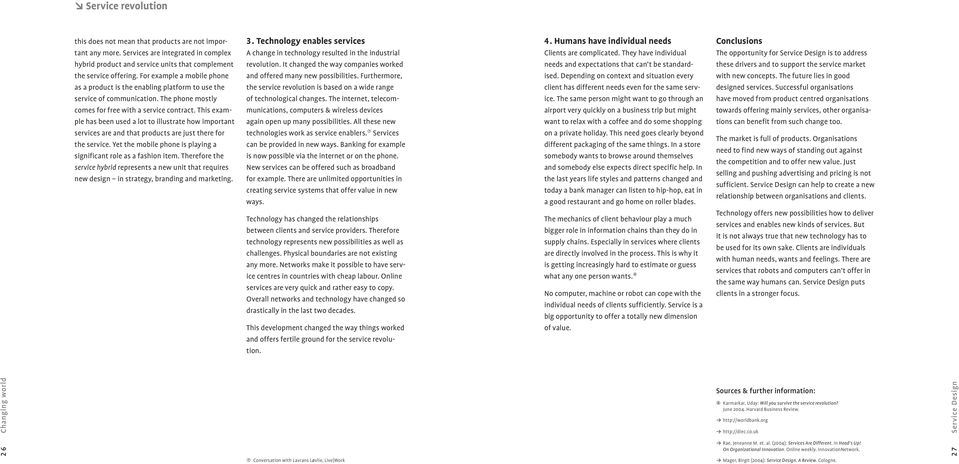
15 What differentiates services Services Are not tangible 2. Are not separable from consumption 3. Cannot be stored 4. Cannot be owned 5. Are complex experiences 6. Quality is difficult to measure Source: Mager, Birgit: a review. Hollins, Bill: Design and its management in the service sector. 70% a large part of the economy is in the service sector and the vast range of different services 1 underlines the fact that services are everywhere. To explain what is unique about services the differences between products and services have been examined (Sasser, Hollins, Mager etc.). This differentiation is still valid today and underlines the major shift in thinking that is needed for and delivered by. Given the amount and complexity of services it is helpful to describe what services are not. The nglish magazine The conomist wrote: Service is everything that can t fall on your feet. 2 Generally some key features summarise what is unique about services. Those unique features represent some of the challenges that are addressed within. 1. Services are not tangible Services have no physical form, they can not be physically touched. They cannot be seen before purchase or taken home after. One cannot touch legal advice or a journey, though one can often see the results. The challenge is to find ways to create tangible manifestations and representations that communicate the value of the service. 2. Services are not separable from consumption Production and consumption of services mostly occur at the same time. Supplying a service is inseparable from the consumption by the client. The challenge is that the involvement of clients cannot be planned or prepared in services. New technology offers possibilities for self-service. ven though elements and modules can be prepared there is always an overlap between service and consumption. 3. Services cannot be stored As services are not physical they cannot usually be stored or inventoried. Clients expect services to be accessible most, if not all of the time. Services simultaneously lose their value if they are not used. In contrast, the seat on a plane looses its value once the plane has departed. 4. Services cannot be owned Most services are used on the spot. Nobody can take services home. Most services are not transported or exportable. Services are used rather than owned. Nobody can own a massage for example. Changing world Please see list of services on page Brandeins. German management magazine

16 n What differentiates services PRODUCT > Produced SRVIC > Performed No consumer ever buys a product. Consumers buy what products provide. Peter Drucker, business & management specialist > Material > Immaterial > Tangible > Can be stored > Usually without client > Consumption after production > Defects in manufacturing > Intangible > Can t be stored > Interaction with client > Consumption = production > Mistakes in behaviour 5. Services are complex experiences Services happen over time and across several Touchpoints. Unlike tangible products, no two service delivery experiences are alike. Clients perceive services on many different levels. The overall interface and experience connects is a combination of the experiences of all Touchpoints. 6. Service quality is difficult to measure The measures of quality in a service tend to be qualitative and there are few quantitative measures. As a result, there is a wider variability in services and it is more difficult to control the quality of a service. Conclusion The unique features of services have a major influence on the experience that clients have compared to the experience clients have with products. Services can include different components. That can be space, product and service components. The total experience that clients have is made up from different contacts with these components. very encounter of a part of a service is called a Touchpoint. That means that services are different, more complex and basically exist from the perception that clients have across different Touchpoints. An organisation that provides services needs to address research, innovation and development in a different way than that of products. This is where comes in. Changing world 3 0 [ model two ] Products and services are different This overview shows the most prominent differences. The implications of these differences are addressed in. Source: Backmann, Michaela (1998): Designmanagement als strategischer rfolgsfaktor im Dienstleistungssektor. Diplomarbeit im Lehrstuhl für Innovations- und Technologiemanagement. University Regensburg. As cited in Kleebank, Nina (2000). Diploma in Designmanagement. KISD. Cologne. 3 1 Sources & further information: > The Service Management Course, (by Hart, C., J. Heskett, and W.. Sasser Jr. N.Y.: Free Press, 1990). > Hollins, Bill: About. Design Council. > Conversations with Birgit Mager, Bill Hollins, Sean Blair & Lavrans Løvlie

17 Understanding design Changing world Design used to be seen as a profession that operates in specialist areas such as graphic design, product design and fashion design. One of the tasks that design used to be associated with, was to make things look good. Design used to work at the very end of the process in most companies. A product designer for example would be responsible for the shape and look of a product that was already developed. Design is not any more restricted to the surface of things and how they look. And it is not any more only employed at the end of the product development process. Disciplines are melting In the last years companies and academic institutions recognised the need and potential of a new approach to design practise. For example the model design school in Cologne offered a new multi-disciplinary design education across thirteen areas of design. 1 Design companies such as IDO hired professionals from different fields such as psychology, human factors, zoology and ethnography to state but a few. 2 The consequence is that designers work on broader horizons and are able to integrate specialist expertise. In such working practise the awareness for lacking knowledge or experience and the sensitiveness towards the real needs of a project increase. That means that a designer would not just design a poster. It would be questioned if in this specific case a light-beam or projection could work better. Instead of a new fridge design a service concept could deliver fresh food. Design does not only operate on a specialist level any more. It combines the expertise of different design disciplines to develop holistic concepts. The co-operation of different experts enables a new platform of multidisciplinary work. New scope of design Design has changed its scope and goes beyond designing artefacts. It used to be limited mostly on to the level of designing features of products, rooms, stationary etc. Design today extends to the experience that clients have with products, services, spaces or a mix of these. But design is used also to design the processes and systems that are behind these experiences. On the broadest level design comes in to policy making, is involved to develop strategies and philosophies. Design is being recognised as a business driver that should be integrated up front in a project. In the course of a project as time goes by design is involved from the broadest to the most focused level. From the strategy to the actual details of the outcome. n [ model three ] Levels of design 1 Design of features (product, service or space) 2 Design of client experience 3 Design of processes and systems 4 Design of strategy, philosophy, policy or ideology Based on: Worldviews of Design, Spirit of Creation, Köln International School of Design, Cologne. 2 IDO, design group.

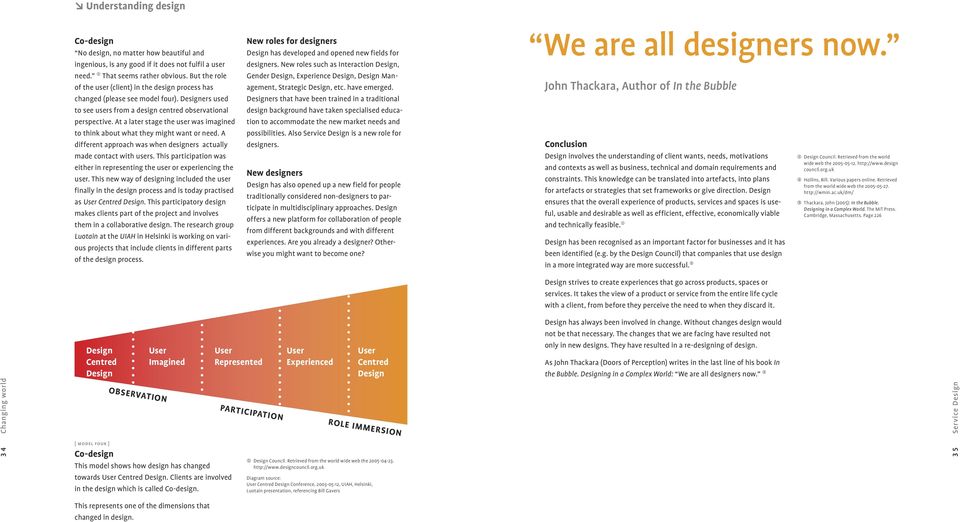
18 n Understanding design Co-design No design, no matter how beautiful and ingenious, is any good if it does not fulfil a user need. 1 That seems rather obvious. But the role of the user (client) in the design process has changed (please see model four). Designers used to see users from a design centred observational perspective. At a later stage the user was imagined to think about what they might want or need. A different approach was when designers actually made contact with users. This participation was either in representing the user or experiencing the user. This new way of designing included the user finally in the design process and is today practised as User Centred Design. This participatory design makes clients part of the project and involves them in a collaborative design. The research group Luotain at the UIAH in Helsinki is working on various projects that include clients in different parts of the design process. New roles for designers Design has developed and opened new fields for designers. New roles such as Interaction Design, Gender Design, xperience Design, Design Management, Strategic Design, etc. have emerged. Designers that have been trained in a traditional design background have taken specialised education to accommodate the new market needs and possibilities. Also is a new role for designers. New designers Design has also opened up a new field for people traditionally considered non-designers to participate in multidisciplinary approaches. Design offers a new platform for collaboration of people from different backgrounds and with different experiences. Are you already a designer? Otherwise you might want to become one? We are all designers now. John Thackara, Author of In the Bubble Conclusion Design involves the understanding of client wants, needs, motivations and contexts as well as business, technical and domain requirements and constraints. This knowledge can be translated into artefacts, into plans for artefacts or strategies that set frameworks or give direction. Design ensures that the overall experience of products, services and spaces is useful, usable and desirable as well as efficient, effective, economically viable and technically feasible. 1 Design has been recognised as an important factor for businesses and it has been identified (e.g. by the Design Council) that companies that use design in a more integrated way are more successful. 2 Design strives to create experiences that go across products, spaces or services. It takes the view of a product or service from the entire life cycle with a client, from before they perceive the need to when they discard it. 1 Design Council. Retrieved from the world wide web the council.org.uk 2 Hollins, Bill. Various papers online. Retrieved from the world wide web the Thackara, John (2005): In the Bubble. Designing in a Complex World. The MIT Press. Cambridge, Massachusetts. Page 226 Design Centred Design User Imagined User Represented User xperienced User Centred Design Design has always been involved in change. Without changes design would not be that necessary. The changes that we are facing have resulted not only in new designs. They have resulted in a re-designing of design. As John Thackara (Doors of Perception) writes in the last line of his book In the Bubble. Designing in a Complex World: We are all designers now. 3 Changing world OBSRVATION PARTICIPATION ROL IMMRSION 3 4 [ model four ] Co-design This model shows how design has changed towards User Centred Design. Clients are involved in the design which is called Co-design. 1 Design Council. Retrieved from the world wide web the Diagram source: User Centred Design Conference, , UIAH, Helsinki, Luotain presentation, referencing Bill Gavers 3 5 This represents one of the dimensions that changed in design.
19 SRVIC DSIGN SOLUTION solution

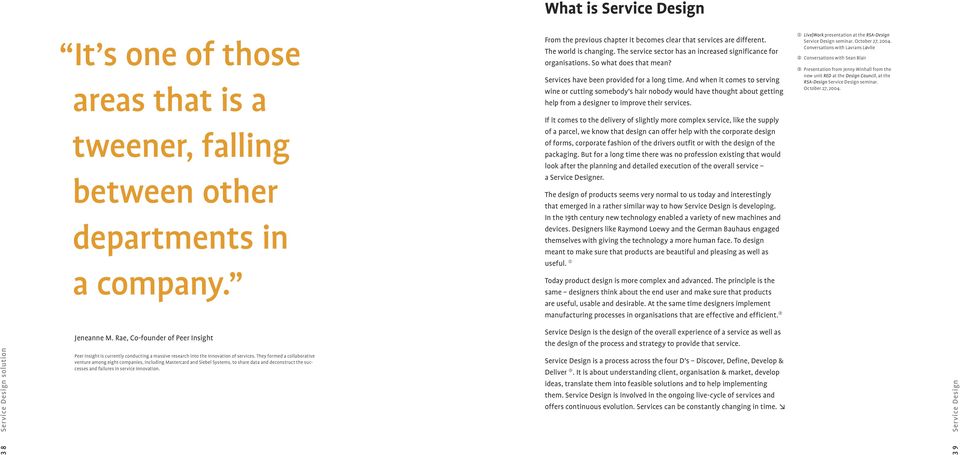
20 What is It s one of those areas that is a tweener, falling between other departments in a company. From the previous chapter it becomes clear that services are different. The world is changing. The service sector has an increased significance for organisations. So what does that mean? Services have been provided for a long time. And when it comes to serving wine or cutting somebody s hair nobody would have thought about getting help from a designer to improve their services. If it comes to the delivery of slightly more complex service, like the supply of a parcel, we know that design can offer help with the corporate design of forms, corporate fashion of the drivers outfit or with the design of the packaging. But for a long time there was no profession existing that would look after the planning and detailed execution of the overall service a er. The design of products seems very normal to us today and interestingly that emerged in a rather similar way to how is developing. In the 19th century new technology enabled a variety of new machines and devices. Designers like Raymond Loewy and the German Bauhaus engaged themselves with giving the technology a more human face. To design meant to make sure that products are beautiful and pleasing as well as useful. 1 Today product design is more complex and advanced. The principle is the same designers think about the end user and make sure that products are useful, usable and desirable. At the same time designers implement manufacturing processes in organisations that are effective and efficient. 2 1 Live Work presentation at the RSA-Design seminar. October 27, Conversations with Lavrans Løvlie 2 Conversations with Sean Blair 3 Presentation from Jenny Winhall from the new unit RD at the Design Council, at the RSA-Design seminar. October 27, Jeneanne M. Rae, Co-founder of Peer Insight is the design of the overall experience of a service as well as the design of the process and strategy to provide that service. solution Peer Insight is currently conducting a massive research into the innovation of services. They formed a collaborative venture among eight companies, including Mastercard and Siebel Systems, to share data and deconstruct the successes and failures in service innovation. is a process across the four D s Discover, Define, Develop & Deliver 3. It is about understanding client, organisation & market, develop ideas, translate them into feasible solutions and to help implementing them. is involved in the ongoing live-cycle of services and offers continuous evolution. Services can be constantly changing in time. n
21 n What is is not a new specialist design discipline. It is a new multidisciplinary platform of expertise. Service Interface Designed Touchpoints Organisation solution 4 0 What does this mean? is not a short project that carries a service through to launch. It is an ongoing process. It is work with components, workshops and projects to integrate new service practises into organisations. ffectively, Service Design adapts to organisations and needs, and is translated into business structures and processes. is planning and shaping useful, usable, desirable, effective and efficient service experiences. helps to understand consumers, the market, resources available and insights into clients expectations, needs and experiences across all Touchpoints and over time. helps to unveil opportunities, produce ideas, solve problems and create implementable solutions. It provides meaningful specifications, guidelines and strategies. It generates ideas, develops solutions and creates concepts. It uses criteria to identify the best ideas and solutions. It finds ways to explain and share insights, complex structures and processes. It uses prototyping to test results, plans and process maps to implement the solutions. creates and shapes the client interface and crafts all details of the service journey. Methods and tools are used to make the service experience consistent, desirable, useful, viable, in line with the brand and commercially successful. For companies offers the possibility to create additional value, to differentiate against competitors, to better use resources and to connect to consumers in a desirable way. For clients represents the improvement of everyday life and the provision of quality experiences. connects the desires of the client with the desires of an organisation. is a mediator that understands how to build the bridge between the two within the overall context. Client, The Service Interface is the pattern derived from various contacts that a client has with a brand through different Touch-Poins of a Service Journey. It is established over time and is the platform for the Service xperience. A metaphor used for is that of a theatre stage. Klaus Weyh refers to it as Broadway Management 1. The service experience happens on a stage. The difference to a real theatre is that the client is part of the show literally. But as in the theatre a complete service experience is always a mixture of the actors that play their roles, the stage design and different objects that are used. In service, the stage design is the design of the [ model five ] Service Interface works on the design of all different Touchpoints that together result in a designed service interface space and of the overall situation. The different roles are played by service personnel instead of actors. But just as in the theatre a service is a unique individual experience. The stage is the equivalent to the interface. Just as in the theatre, covers not only the design of every detail that happens on stage, but also processes, organisation, business and preparation back stage. Only when all factors front and back are working together will the client experience the service as working perfectly and sufficiently. 4 1
22 What differentiates solution 1. truly represents the clients perspective 2. addresses the unique features of services 3. integrates expertise from different disciplines 4. is interactive 5. is ongoing arlier in this paper the special features of services were discussed. They differ to products, happen over time, are complex, interactive and stretch across different Touchpoints. The consequence is that the design and therefore also the research, development and implementation need to be addressed differently. integrates different fields and clients in the design process. It is a new field that connects organisations and clients in a new way. This paper explores how addresses the challenge. The following pages set out to identify what is unique about the field. is a new field that connects organisations and clients in a new way. 1. truly represents the clients perspective To design services it is important to establish a good understanding of the goals, motivations and latent needs that clients have. They are difficult to predict and mostly clients are not consciously aware of those needs. As well as needs there are some principles that feel more natural to some clients than others. When IDO developed the service strategy for Juniper Financial they observed the bank s clients in their homes as they paid bills, at banks, ATMs and elsewhere. One of the latent needs identified was that people are used to keeping bills in a stack and then pay them all together at some point. Based on this insight they included a gentle reminder function in the online banking portal. Similarly to the bill stack, a virtual list would grow and indicate gently, e.g. with colours, when its time to pay. The service had the possiblity to use a mechanism that matches the natural behaviours of clients. Services so far are provided by organisations and are thought through and planned (designed) mostly from this provider perspective. The point of difference that the approach offers is the development of service systems which are focusing on the client as well as on the organisation. n
23 n What differentiates solution Clients are involved in designing the service delivery process. Without a client there can be no service. That has a number of consequences on the design of services. needs to use new ways of testing services. In it is easy to confuse user-clients with customer-clients. For consumer products, customers are often the same as users, but in corporate, technical or service domains, users and customers rarely describe the same sets of people. Customers of a product are those who make the decision to purchase the service. 2. addresses the unique features of services Clients encounter different Touchpoints over time. A Touchpoint is a contact point with one of the elements of the service offering like receiving a confirmation letter. All Touchpoints can be considered experience puzzle pieces of a service and can be build out of product and service components. The overall experience that a consumer has is driven by the Service Interface. It is a mental concept in the clients mind. Designing this interface means to align all Touchpoints against the concept. Services are different from products. Yet in many cases they are connected to products in some way. Or as Bill Hollins says: A lot of services ride on the back of products. 1 does not exclude products but rather looks at the unit of product and service as they are experienced together by clients. Touchpoints All Touchpoints are experience puzzle pieces of the service. They complement the overall experience across the service interface. ach piece helps to shape a whole. 3. integrates expertise from different disciplines Design has developed into a strategic, conceptional and multi-disciplinary field. Therefore many designers are used to working with experts from diverse fields, such as research, technology, communication etc. usually addresses internal as well as external clients. In an organisation there are different people that need to be seen as clients. ensures that everyone involved in a project feels like a client, and that the different methods and tools used ensure excellent internal and external service experience. 2 Design (including communications) always has been a mediator / translator between industry and people, technology and application and between offer and need. There is no reason that marketers, engineers or others could not contribute to projects in the multi-disciplinary field Service Design. They might prefer it to be called Service Marketing etc. However, as a field offers a very unique portfolio of tasks and there are different tools and skills needed to provide those. Later, the role description of the Service Design Scout helps to establish a description of what role can play in an organisation. When designing and developing a new service, organisations need to think about trust, about increasing a sense of transfer of owner ship and about experience. Changing the method of payment, can not impact the design of a product, but it is a major change in the devel opment of a service. Marc Innegraeve, service expert Conversation with Bill Hollins, London Mager, Birgit (2004): a review. Page 17. Cologne.
24 n What differentiates You can t experience the experience until you experience it. Bill Moggridge, IDO is not a new specialist design discipline. It is a new multi-disciplinary platform of expertise. Born in design thinking it integrates various fields of expertise. However, at the same time at the very core it has a specific offer designed to address the various design challenges in the booming service economy. 4. is interactive enables behaviours and dynamics. It offers clients the possibility to connect a potential with a result. It provides all resources and components that are necessary for a client to do what they want to do. As has been identified before the client is an integral part of the service performance. One big advantage with services is that it is much easier to make changes. ven though it is new and not easy, depending on the complexity of a service it is very feasible to prototype services and to test implementation models. It is easier to innovate and less expensive in services than in manufacturing is ongoing Given the variety of services that exist, Service Design has to cope with different situations and contexts to products. The systems that Service Design creates and improves are complex and stretch over time. looks at a scope from long term strategies and designs processes to implementing consistency across organisations in small details such as the style of a text message. What is unique about services is that they live. They cannot be pre-produced and stored until somebody employs them. That has major implications for the development of a service. For example, even though Service Innovation is able to develop a service and then launch it, Service Design continues after the Service is in use and monitors it for constant improvement. Amazon is a minded company and since its launch in 1995 every day parts of the experience are changed and improved solution 3 Conversation with Bill Hollins, London Conversation with Lavrans Løvlie, London 2005
25 Areas with related expertise solution 4 8 is a multi-disciplinary process. That means that integrates and links various fields of expertise. To understand this is important for two reasons. Firstly, to appreciate the portfolio of expertise that Service Design brings together. Secondly, to understand that these areas with related expertise provide existing tools, knowledge, resources and experience. For example some tools that are used in product market research can either be used or adopted to be used specifically for. connects a new profile of expertise with a multi-disciplinary working model. It represents a new practise of work that utilises the best and most suitable experience, tools and knowledge from the various backgrounds. At the same time continues to work in co-operation with a pool of experts. Throughout the process it is evident that these areas affects, are part of and link into. Based on desk research, interviews with experts and from analysing different examples, the areas in the diagram give an overview of the most important fields related to Service Design. Based on that knowledge, can be seen as a hub that brings together the experience, methods and tools from the various fields to employ them in the specific development and innovation of services. In many organisations there are people responsible for improving and innovating services. Many of them work on elements of, but often without calling it or recognising it as such. As the diagram shows, marketing and design have always mediated between the organisation and the client. Marketing mostly operates from an organisations perspective. Design on the other hand mostly works from a clients perspective. integrates management, marketing, research and design. Therefore it combines the best and most relevant tools and experience from the areas with related expertise to address the challenges of the service economy. On the following pages key fields, integral and essential to the development of (please see model six) are discussed. The descriptions are helpful in explaining what aspects covers with terms that are established and that practitioners can relate to. Product development Human resources Process management Quality management Strategy Communications Management Interaction design Interface design Public relations organisation xperience design Marketing service Interior design D e Branding design s i g n Sensualisation [ model six ] expertise Price client Product design Promotion Research Participatory design Psychology thnography Market research Observation Testing integrates management, marketing, research and design. It creates a unique connection of organisation and client. The areas of related expertise are used and integrated in and also used in bringing in specialised experts from those areas. 4 9
26 n Areas with related expertise solution 5 0 Branding Branding is important to make sure that all elements of a company look and feel consistent and are visually and sensually aligned with the brand. ven though services require special treatment the main competency driving the field of branding is similar to that of. On a detail level therefore, the principles of corporate design, corporate fashion and corporate communication are crucial for service design too. On a holistic level, the thinking in the branding field to recognise that every Touchpoint with the brand is a communication opportunity needs to be employed to Service Design also. Product design Products are often an essential part of services and form together a hybrid product-service combination. Therefore understanding of the design of products is important to develop and design successful product-service hybrid concepts. But even for services that do not include any product components the principles and knowledge from product design are important. To develop tangible interfaces and to design the packaging for services these principles can be employed. Product design therefore is an important element within Service Design but is also brought in as a field in its own right to cover product design elements of a project. ven though can integrate product components and design product-service concepts, if an important part of a new service is a product, product design specialists would be brought into the project to develop this device. That could be for example a special water-resistant device with a big interface for servicing technicians. Psychology As in many other fields and especially in various design disciplines psychology plays an important role. Given that services encounter and interact with human beings this is particularly important to. Psychology is important to gain understanding of underlying drivers and the demand for new services. It is also important to understand the influence that details of a have on the overall perception. For example understanding the psychology of the perception of waiting is used in. To develop ideas that provide clients information how long they have to wait for example. Waiting time is perceived shorter when this information is provided. The application of general knowledge of psychology is vast in and specialists can be important partners to develop specific solutions or to evaluate different concepts. Interior (& exterior) design Given that many services are performed and consumed in set environments (e.g. airport, shop, hospital, etc.) the design of spaces is an important element of. It is not only important that the atmosphere is in line with the image and quality that the service offers, as well certain details can improve the experience, make a service more useful and desirable for clients and more efficient and effective for the organisation. Orientation and overview can be given in different ways and can be important for the service. A space is not only full of Touchpoints that need to be designed, it is the stage and setting for the service performance. In conclusion, as interior and exterior design works to set the tone and expectation of clients it needs to be incorporated into. Participatory design The main concept of this new area of design is to make the client part of the design process. This way of approaching design is particularly relevant to designing services. In it is possible to use the knowledge, techniques and methods from this area to create collaborative and innovative s together with clients. As the client is part of the delivery of the service (production and consumption overlap in services) the client can be part of designing the service also. User Centred Design involves special methods of research and design that enable the client to contribute to the design process. thnography This special way of research uses an anthropologist s tool kit of methods and theories to observe clients in their natural habitat. thnography provides insights in cultural trends, attitudes and lifestyle factors that influence clients decisions and behaviour. And as one can not isolate service experiences from their life context, ethnography provides the possibility to learn and test very close to reality. ric Arnould describes ethnography as a way to get up close and personal with consumers. 1 It situates clients in their larger social and cultural context and provides holistic understanding how products and services will resonate with the client s daily life. Given that understanding these issues is crucial to, ethnography can play an important role in almost any project. Interaction design xamines the role of behaviours in physical and virtual spaces as well as the convergence of physical and digital products and the way they interact with human beings. This new field works on designing interactions. specially in the case of software applications and web-sites clients interact with a system through an interface. Interaction design is about designing a system that can be understood and used by clients in an easy way and fulfils their expectations. In the same principles are used to design the interactions of clients with the interactive system service. Information architects work on the systems and pathways that are provided for clients to find the information that they look for and to offer them relevant information that they ric Arnould. Professor of Marketing. University of Nebraska
27 n Areas with related expertise solution might be interested in. designs the systems, pathways and interactions for services. It therefore includes a variety of interfaces or Touchpoints to interact with clients. Interface design This discipline is working on the design of machine and product interfaces. Interface is the set of devices that gives the user control and feedback. ven a pair of scissors has an interface that helps control the cut and gives feedback about the thickness of the paper. In Interface design usability has been the field of extensive research to ensure that all details of designed interfaces are easy to understand and comfortable to use. In there can be components that require actual interface design such as computer terminals. But also the overall concept of designing interfaces is used in and applied to services. Strategy In any organisation a strategy is an elaborate and systematic plan that specifies the way certain objectives should be achieved. For example Communication Strategy provides a plan that includes the alignment of different communication channels. The strategy would specify different phases and emphasise certain tactics. Strategy is the overall vision and the plan how to get there. according to Dr. Wayne Fletcher, Head of Communication Strategy at Carat International. 1 In strategy is a very important element to ensure consistency and effective planning. Sensualisation This extends the concept of visualisation to all other senses (hearing, tasting, smelling, touching, moving, etc.). Sensualisation is used to explain complex intangible concepts. It helps to envisage future ideas mostly in visual and tangible ways. In animations and films can show scenarios that highlight how a service would work. Image montages can very simply create the impression that certain Touchpoints exist and how they work. That can be used to discuss and develop detailed solutions of parts or the overall service experience or as Visioning discussion base to discuss what could be achieved in the future. Sensualisation can help to develop Service Prototypes of different complexity and level of detail. Market research To find out what kind of similar offers are already on the market, to identify market gaps and to know about trends market research is a very important field. Also benchmarking is important to find principles and offers that companies from other fields provide. For any project it is important to find out about the context that the service is going to live in. Marketing Marketing is often described as the techniques that are used to attract and to persuade consumers. That means that marketing encourages recipients of targeted communication messages to purchase or use products or services. n Conversation with Dr. Wayne Fletcher, London,
28 n Areas with related expertise Marketing is a huge field that includes several different areas. It has succeeded, for example in the communication between organisations and (groups of) clients. Mostly marketing is focused on product-thinking and has experience in communicating from an organisation perspective towards clients. ven though is based on the organisation-client-relationship and manages communication and interaction in both directions, marketing is still involved and elements of marketing are used in a new way. Process management Development and distribution processes in manufacturing are managed in order to ensure effectiveness, security and efficiency. Process management is planning and administering the activities that are necessary to achieve the best performance in a process and helps identify opportunities for improving quality, operational performance and ultimately client satisfaction. To deliver services a range of providers and different people have to work together. Process management is an important factor in the design and implementation of services. uses for example service blueprinting to design and implement processes. Product development This represents the entire cycle of a new product from concept through manufacturing including design, engineering, materials selection, component selection, manufacturing process selection, and documentation. extends the principle of developing products to developing services. In many companies services are developed by product development departments as they are seen as the products of the company. Often at times works together with internal experts in companies that have been involved in product development. Communication planning This area covers all means of providing information and content to the public, including TV, radio, Internet, papers, outdoor and magazines. It plans how to communicate important messages to key stakeholders of an organization in the most effective way possible. In planned communication is important towards the client as well as internally in the service providing organisation. xperience design xperience Design is an approach to manage the creation of successful client experiences. This approach includes consideration and design in all three spatial dimensions, over time, the five senses, interactivity as well as personal meaning and the emotional context. Designed experiences can use any medium, including spatial / environmental installations, print products, hard products, services, broadcast images and sounds, live performances and events, digital and online media. To design service experiences this is needed in many projects. Summary brings together a unique set of expertise. The field of is influenced and based on other fields. That means that Service Design is a multidisciplinary team process. The margins of these related and linked fields are rather blurred. Some of the described fields are areas, some are labels and some are content. But they establish an overview of this new field and support the understanding of the new by showing the combination of existing and known areas. The consequence of the structure that Service Design is based on is that every team member needs to have a basic understanding of this portfolio of related fields. For therefore a new set of skills as well as tools and methods is necessary. A very crucial consequence is a new level of communication that is needed to link the experience and knowledge of these fields together. Integration and communication is the glue that holds together solution
29 benefits The paper so far has shown that is addressing the specific needs of services. It has shown what is unique about services and what consequences this has on the design. It has shown that is necessary but what are the specific benefits of? can play a crucial part in the success of any organisation and can deliver ten drivers of change: 1. True understanding of market needs solution It is evident that the growing service sector has an increasing significance for our society and economy. In many countries the service sector is far less productive than it could be. At the same time the quality of service that is available to clients can be considered on average still very poor. can address these challenges and deliver a range of other benefits. works across both the organisation and the client(s). Therefore benefits the organisation and the client at the same time. The benefits that it delivers to clients have positive effect on organisations as happy and satisfied clients are the ultimate goal of any organisation. Clients want to maximise the value they can gain from a service or a product-service combination, organisations want to increase their success for example in being more effective, generate higher profits, better reputation and in developing strong brands. The benefits of are summarised here from the perspective of an organisation. It is organisations that need to get involved in Service Design. The advantages for Clients again benefit the organisation as the client is a big measure in the success formula of any organisation. Service Design is rooted in client satisfaction. 2. Higher value with the resources available 3. Changes organisational culture 4. New perspectives on future development 5. Higher effectiveness 6. Better efficiency 7. Connects organisation and clients 8. Higher quality service experiences as basis of success 9. Differentiation against competition 10. Brand affinity
30 n benefits solution 1. True understanding of market needs Traditionally suppliers orient themselves on the market which means that they offer only as much quality as necessary. In case of products the client can estimate the real value of usage only in the actual consumption after the product has been already bought. The client therefore has to rely on aesthetic or brand promises that the product or its marketing give. 1 delivers on methods that help organisations understand true market needs. Given that clients are part of the service delivery they can be part of the design process as well. The value of a service is estimated by clients mostly whilst they are using the service. The quality needs to be treated differently with services than it used to be with products. Organisations are facing the challenge to offer service quality on an individual ongoing basis. Service Design helps to manage that. 2. Higher value with the resources available helps organisations to utilise their resources better and more profitably. That is delivered through different methods that Service Design brings in. One example is that services that are already provided can be made tangible. That could be a sign that points to the clean floor in stating No rubbish we clean for you. Another example is Line of Balance that can be used to make sure that all stages of the service process work in sequence and take the same length of time. That is very important if technology such as scanners or experts such as doctors need to be utilised more profitably. Clients benefit from less waiting time and a better service experience. benefits to organisations in making service businesses more profitable (sell more). In the example of an airport, saving check-in time obviously gives clients more time to shop in the airport. The real big difference can be made in getting those clients quicker and easier to the plane, get more planes through the airport and therefore more people to shop in the airport. It can be assumed that on average people spend not that much more money in ten more minutes. If more people spend some time in the airport they will spend more money in total. 3. Changes organisational culture For any organisation to offer successful services means that a lot of different people need to work together. integrates people from several levels of the organisation in the design process. That not only offers the best knowledge and experience across the organisation to be utilised in the project. Also it ensures that everybody is on board and supportive to make changes happen. That is crucial to the delivery of new services. In most organisations still it is the least experienced and least trained people that have the most client contact. The more senior people are the less they are in direct contact with clients and the actual delivery of services. 1 In call centres for example calls are generally handled by staff with basic experience. Only after a client has called a few times or cannot be helped the client is passed on to experienced members of staff. 2 Only if the organisation has a service minded culture and everybody treats clients as important individuals and guests the service experience can be excellent. Often the atmosphere and the services that are provided within a service organisation are good indicators of a service culture. changes the organisational culture by including people in the project and by providing maps and tangible explanation that help everybody to understand, share and contribute to the. 4. New perspectives of future development Designing services starts with the development of client oriented strategies. It takes into consideration the market, client needs as well as economic and ecological factors and the possibilities of technologies. will ensure that new services that reach the market will be competitive, safe, satisfy clients and be profitable. Furthermore, as markets change, continuing design supports the future success of organisations. Understanding true market and client needs gives organisations the opportunity to offer new successful services. Instead of reacting to new offers of competitors it is possible to lead the market through. For example the Inconvenience Analysis highlights the potential for new services in creating value by making clients lives more convenient. Given that services do not need necessarily long development, engineering, production or testing times, they can be improved far more quickly than products. In thinking beyond products, organisations can utilise to find new use for existing knowledge, experience, resources and networks. A German plumbing company for example used the access they had to various data about the houses they worked in. They offer a new service that bundles their knowledge to a database that contains data about the house and gives all building companies and the house owner access to data and plans Rummel, Carlo (1994): Designmanagement: Integration theoretischer Konzepte und praktischer Fallbeispiele. Deutscher Universitäts Verlag. Wiesbaden. 1 Conversation with Birgit Mager, Cologne 2 Conversation with research specialist Phil Gullen, London 3 Mager, Birgit: xhibition guide. Wanderausstellung. Service ein Produkt. 5 9
31 n benefits The way sensualisation can be used in Service Design helps to establish a new level of communication inside the organisation and with clients. It provides the possibility for experts that speak different specialist languages to communicate about one future concept and establish shared understanding. For example the tools of Visioning enable an organisation to talk about future possibilities from a future standpoint. If a short film shows how a service would work in the future it can be discussed as a specific vision, including what the advantages and further possibilities would be. From that standpoint it can be worked back to work out how to get there. All hurdles like but we don t have the legal possibilities to do that can be overcome and if the concept is good they can be solved together as everybody is on the same page. 5. Higher effectiveness manages the achievement of intended results. The objectives that an organisation sets are based on understanding the market and client needs as well as the resources and constraints inside the organisation. The objectives are specified and implemented in the service strategy and specification documents. Through the iteration of testing, evaluation and development ensures effectiveness throughout the process. For example service prototypes are used to ensure that a solution is effective and delivers against the strategy. The connection to real client needs makes sure that the service provided is the service that satisfies clients. ensures that the objectives of the organisations are met. 6. Better efficiency reduces costs of development, support, training, documentation and maintenance, shortens the development time and improves marketability. For any organisation it is crucial to not waste resources and to make the most out of what is available. That sometimes contradicts with providing quality service experiences. Service Design balances the effort to develop and provide services with the maximum impact and the best experience possible. Often client segmentation can be used to ensure the appropriate level of service quality. Some passengers need the shuttle from the parking to check-in to be quick and frequent and are happy to pay for this service feature. Other passengers have time and would prefer a cheaper service offer. A bigger bus that goes every half-hour could be combined with small shuttle cars that can leave immediately. ensures that the resources available can be used to the full. 7. Connects organisation and clients Good service leads to satisfied, purchasing as well as returning clients. raises client satisfaction in providing the alignment of all Touchpoints and providing quality service experiences. It manages expectations in aligning the interface of the service. It ensures that feedback from clients is used to constantly improve the design of the service. Bad service on the other hand, leads to angry clients and a loss in sales. Service Design manages a very special relationship. Products and entertainment can be sold as one of the experiences. A service needs to fulfil client expectations and needs on an ongoing basis. Like a personal relationship between people not with the first problem the relationship will be at risk. But it is crucial that the other side recognises the problem and does something about it. As in any relationship once the partner is not satisfied and chooses to use another service it is going to be very difficult to re-establish the relationship. solution There is not only a big opportunity in maintaining satisfied clients. If clients trust one service and are satisfied they usually spend more time and purchase more. In the future trust and time are most likely going to be even more important than purchase
32 n benefits solution identifies new areas to offer services and to extend the service. It therefore represents the potential to convince and attract new clients. Designing services always integrates clients in the design process. That means that the new level of relationship manifests itself also in the way the design works. The service is not only judged by clients in questionnaires. Constant testing of new ideas and solutions and the evaluation of success enables clients to experience what they could not imagine useful. Often clients do not know what they want yet. Once they can try a new service they might appreciate a side of this service that was underestimated by the organisation. Text messaging is one example of a new service that was underestimated and just tried out. We all know how successful it is today. represents clients in different ways all along the process. Personas are one tool that is used to establish research based archetypes that represent certain types of clients. The design can then be based on those clients profiles to make sure the service is going to strengthen this relationship. From the clients perspective Service Design provides a consistent service and brand image and experience. A strong relationship between organisations and their clients is a crucial factor of success. Service Design can help to build that relationship. 8. Higher quality service experiences as basis of success ven though services are intangible and virtual creates desirability. very detail of the overall presentation of a service works as a part in setting expectation and to shape an experience that is desirable. In service quality there are different levels of quality that are appropriate. is facing this by making sure that the client s expectations are monitored and fulfilled. All details are designed in a way that is in line with the specific service and adopt to individual needs as much as possible. Often service quality means that clients are in control and get to choose. It is not always the waiting time that needs to be cut on all cost. Often it is enough to inform clients about the reason and the waiting time that is left. Quality service experience gives clients the feeling that somebody is thinking about them, imagining to be in their shoes and provides a service for them. delivers business value in enhancing the client s experience. The service strategy aligns all details and delivers a consistent quality experience that only surprises if it is going beyond expectation. 9. Differentiation against competition As products and also services are becoming increasingly commoditised, designing a desirable experience becomes the competitive advantage and source of better margins. Kevin Gavaghan can be used as a key differentiator against competition. The idea for services can be the same and still the experience can be designed to be very different. Often it is the little things that make the big difference. does not only help to craft this differentiation at the same time it develops means to communicate the difference in the right way to clients. Car-sharing is a concept that exists in many cities. Details such as naming cars or providing community rules and a thought through web-site can make all the difference. 10. Brand affinity Bad service causes a bad client experience. A bad client experience influences the experience of the brand. Clients are more satisfied when a system offers relevant services that match their needs and expectations. A majority of clients are loyal only to a few service brands and buy repeatedly these services
33 solution evolution SRVIC DSIGN VOLUTION
34 to date solution evolution It s only recently been recognised that services as much as products have to be designed. [...] A well designed service can provide great competitive advantage for a business, even if that business isn t a service provider. Today it is easy to recognise the vast growth of the service sector. However, even though Service Design is considered a new fast growing field, forward thinking experts did recognised and established its principles over ten years ago. The basic concept of is the recognition that Services have quality problems which can be addressed with the same principles of design that are used to improve products. There have been papers and books on Service Innovation and Service Marketing that looked at the innovation, improvement and communication from an organisation s perspective. However, the paper that is recognised to have first brought together the terms Service and Design is Designing Services that Deliver from G. Lynn Shostack in the Harvard Business Review in This paper introduces the Blueprinting tool to design services. Later, Gill and Bill Hollins included a Design-Management perspective on in the book Total Design in In that same year, 1991, Michael rlhoff and Birgit Mager established as one of the fields of education and research in the model design school KISD at the University of Applied Sciences Cologne, Germany. The Köln International School of Design 2 was the first university worldwide that offered education. In 1995 Birgit Mager became the first professor of and her lectures, publications and projects have continuously supported the recognition of the immaterial aspects of design. 3 Birgit Mager worked on several publications that have been published in German. Some elements of those were included in a Review which was published in nglish for the tenth anniversary of in Germany. Mager has been working on university and consultancy projects with Siemens, Provinzial and SwissCom- Mobile as well as massive research projects for the German Ministry of Science Research. In ngland Live Work 4 launched a consultancy in From a pre-dominantely Interaction-Design background they work for clients such as Orange, Telecom Italia, BBC and Sony ricsson. The Interaction Design Institute in Ivrea, Italy has set up a department that researches and develops service interaction 5. The Institue is moving to the new premises of the Domus Academy in Milan as Domus has made part of their education too. Since 2002 the international design consultancy IDO 6 has included in their offering. Fran Samalionis is Head of. For IDO the move into services was a progression after they decided to not only design products but client experiences. IDO offers their clients help in innovating and improving the design of experiences across products, services and spaces. There is an urgent need for professional exchange in order to better and faster develop the field of. Birgit Mager (Co-founder of the Network) The London based consultancy Spirit of Creation 7 was asked to develop a strategy to help the economic development of the North ast region of ngland. They successfully pitched the concept of a education centre for managers and together with a network of 200 experts they have developed the concept and the business plan for a education centre. In the summer of 2004 Spirit of Creation and Birgit Mager established the Network 8. A growing international network of academics, practitioners and businesses establish codes of conduct for the theories, methods and practices of. A committee including Bill Hollins from the University of Westminster and Lavrans Løvlie from Live Work are currently working on a paper for British Standards that gives a recommendation on the definition of Shostack, G. Lynn (1984): Designing Services That Deliver. Harvard Business Review. 2 The Köln International School of Design (KISD) used to be called Fachbereich Design (FB07) at the time
35 Orientation players Academic To visualise the current ecology of players in the field, two different approaches have been chosen. Politecnico di Milano* Ivrea Institute* Carnegie Mellon Univ.* Domus* KISD* University of Westminster DSchool Some key institutions that are involved in have been mapped in a matrix against their orientation and background (please see model seven). The matrix shows the current ecology as either more academic or commercially oriented. Furthermore, it highlights that some institutions have more of a classic design and others a business background. There are other companies and institutions involved in improving and innovating services, some of which might have a different background than design and business but they have not been mapped here. This matrix is not scientific or absolute, however it gives a helpful overview and understanding of the current ecology and background of the institutions considered throughout this paper. Background Design Business The second approach is a mind map of the current ecology (please see model eight on the following pages). Given the development of the Network the natural differentiator of the different player is their geographical origin. The mind map shows different institutions and companies connected to the countries that they are currently most representative of. solution evolution IDO* Live Work* [ model seven ] ecology matrix Commercial Service-Design Gbr* Spirit of Creation* It is worth noting that the mind-map visualises a personal perspective and is not absolute. However, nonetheless it gives an overview of one model of perception of the current industry. For this paper the overview also represents the network of resources and interview-partners. In a Service cology Map is the visualisation of a system of actors that form a service and the relationships between them. A Service cology Map represents a systemic view of a service and the context it will operate in. 6 8 Key institutinons that are involved in * Member of the Network 6 9
36 [ model eight ] mind map Michael rlhoff Daniela Sangiorgi lena Pacenti Astrid Van der Auwera Birgit Mager zio Manzini Domus KISD Simona Maschi Politecnico di Milano Stefan Moritz Interaction Design Institute Ivrea Italy Germany Stefan Holmlid Linköpings University Sweden solution evolution 7 0 Vijay Kumar Illinois Institute of Technology Carnegy Mellon Univ. Shelley venson Marc Jones IDO US Fran Samalionis RSA UK Live Work Chris Downs Lavrans Løvlie Sean Blair Design Council British Standards Kevin Gavaghan Spirit of Creation University of Westminster Bill Hollins 7 1 competition
37 The Network solution evolution The international pool of experts are joining forces. The international Network is a network of academic and commercial institutions. The network initiated by Spirit of Creation, Birgit Mager and others was founded last Summer in London. It developed through a panel of experts discussing the speed and momentum of the service economy growth, the attractiveness of a framework to help the more rapid and assured growth of the new community of practice, and the benefits to all of establishing a Network. Further meetings took place in Chicago in the end of 2004 and in Cologne in the beginning of These meetings included members from IDO, Carnegie Mellon University, Linkoping University, Domus Academy, University of the Arts London and Politecnico di Milano to state but a few. The Network is a growing international panel of universities, research centres and design studios. All of them are working on, and have experience in,. They all are passionate about developing and strengthening the knowledge and expertise in this new field. At some time in the future, the Network may consider providing access to an innovative worldwide network for the wider dissemination and exploitation of their know-how and their Intellectual Property
38 xamples of outstanding services solution evolution Service Wholesale and retail trade Transportation and warehousing Information Finance and insurance Real estate, rental and leasing Professional, scientific and technical Management of companies and enterprises Administrative and support, and waste management ducation Heath care and social assistance Arts, entertainment and recreation Accommodation and food services Public administration Other Activities related to the: Sale of goods Distribution of goods Gathering and dissemination of written, audio or visual information, including films and records Facilitation of financial transactions, including those related to risk management Temporary transfer of property, and the temporary or definitive transfer of real estate Provision of specialised, generally knowledge based, expertise (e.g. legal, accountancy and engineering) Management of companies and enterprises, such as holding companies Day-to-day support of other organisations (e.g. clerical assistance agencies, travel agencies and personnel firms) Provision of instruction and training (e.g. schools and specialised training centres) Provision of health care and social assistance (e.g. doctors, hospitals and clinics) Provision of entertainment in a broad sense (e.g. museums, opera, theatre, sports and gambling establishments) Provision of lodging, or the provision of meals, snacks or beverages Governing or administration of public entities and programmes Provision of personal services, repair and maintenance activities, professional societies, religious institutions, etc. To illustrate how can contribute to the success of an organisation some example projects and case studies have been collected and are presented on the following pages. In model nine on the left a general list of services has been provided. It shows the breadth of services. However, only some companies pay special attention to the services they provide to make them truly outstanding. To show the variety of possible contributions the following examples highlight details and the difference that elements of can make. A few short case studies were chosen in order to give an insight in the broad range of contributions. The case studies show that research, development, improvement and innovation is part of businesses reality. However, the examples show elements of and are not all achieved in a systematic way. Not in all of the examples the design is an ongoing activity. Therefore the following case studies help to understand some of the elements that integrates into a systemic ongoing practise. 7 4 [ model nine ] List of services Source: Based on US Bureau of Census,
39 n xamples of outstanding services Virgin door to door service Orange future experience strategies Web tracking of packages Bank without branches solution evolution ven though it is not part of an holistic programme Virgin Atlantic uses the concept of the xtended-client-journey. Travelling Upper Class with Virgin Atlantic the service begins from the moment clients leave their home or office. Virgin offer to arrange for complimentary chauffeur driven car service to collect their clients and their baggage from work or from home. The driver checks in the passenger on the way and drops them off for a special high speed walk through customs. The baggage is taken care of by the driver. After a relaxed and enjoyable wait in the lounge and high quality in-flight service the passenger is met by his luggage and a car waiting outside the airport to take him or her to the desired location. > More information: New technologies often drives businesses strategies while clients experiences seldom do. The London based group Live Work worked on a project for the Orange Innovation team which translated assumptions by the business to direct impacts on the future customer experience. A range of artefacts were developed that projected the assumptions into future client experiences. The project helped to uncover differences in strategic outlook within the business with reality. The artefacts that the team developed included magazine articles, packaging, web sites, newspaper advertisements, letters and television news item. These acted as tangible evidence of future service Touchpoints, and were used as discussion points and provocations for the innovations team. > More information: In 1994 Federal xpress launched a service that tracks packages online. It allows the 900,000 packages that go through their system each month to be tracked at will via the internet. When a package is sent clients are automatically ed to inform them of the packages transit details. The tracking number supplied enables the package to be tracked via the web whenever required. This system saves Fedx $4million per year in answering telephone queries. This showcases how an extension of a service through innovative design can both save money and improve the client experience. > More information: First Direct created a revolutionary banking service launched in October An internal project at Midland Bank investigated what the bank could do to react to a complex, deregulated environment and increasing competition. Many surveys, benchmarking and research of other banks helped the team to identify crucial insights where identified and through their research Project Raincloud found that a lot of customers did not like to come in to the bank. The concept created was a 24/7 bank without branches. Telephones were identified as a low cost and flexible delivery system to deliver the new service. When launched, phonelines opened at midnight to make the point that this bank is available at all times. Today First Direct has more than one million clients. First Direct had to establish a totally new customer centric culture. One of the ways they did that was by hiring people for the call centres that had backgrounds such as nurses, firemen and teachers. > More information: C virginatlantic/virginatlantic-01.jpg 9 http//virgin-atlantic.com, Conversation with a passenger C C C 9 Conversation with Kevin Gavaghan
40 n xamples of outstanding services AT&T treasure hunt I Lufthansa scenarios From ownership to usage Airport express train solution evolution IDO worked with their client AT&T in San Francisco to stage an analogy experience. IDO prepared a set of different tasks connected to finding out about movies. The AT&T people found that data services around movies can only answer two questions on a phone: 1. What is happening at a particular movie theatre and 2. Where can I find this particular film. For pretty much every other question it is quicker to get a copy of TimeOut. The exercise was designed to teach the team that knows a lot about mobile applications about experiencing the experience. Based on findings they then developed together with IDO three guiding principles: Time-slice (think less about where you are but when you are), Relevancy (What s the question in a persons mind at any given time, what s their context), Social (Mobile communication is inherently social so we need to empower the social part for it to be compelling). These have since become essential for the further development of AT&T services. It is essential to involve experiences in the Service Design process. > More information: For the project Intercont.innovation a multidisciplinary team led by Birgit Mager developed innovative service concepts for the Lufthansa airline. Initially the service procedures, behaviours, products and technology have been thoroughly analysed. Based on principles of drama different service worlds have been designed and innovative scenarios developed. Clustered into different idea pools the scenarios helped bring the recommendations and ideas to life. This completely new format included future products, stage-designs, role scripts, props and technologies and more. The visionary Service Design scenarios developed have been integrated into Lufthansa s corporate direction, strategy and has set triggers for the airlines service offering. Scenarios developed have been supplied to Lufthansa in a book that introduces the features in a story format like a theatre play in different acts. Its emphasis lies on the client s perspective. > More information: The consultancy Live Work provides ongoing support to the car-sharing network Streetcar in London. Streetcar s fleet of cars are located around London, bookable online or over the phone and accessed with a special card and PIN. Clients pay by the hour and receive a monthly bill. Live Work provides input as the service grows an ongoing practice of service innovation and design throughout the life of the service. The Service Designers are providing an ongoing analysis of the clients experience of the service, reporting usability, accessibility and satisfaction from the clients perspective. For Streetcar they design the service experience on an ongoing basis. A special blueprint is used as a live, operational document that evolves through the incremental improvement and scaling of the service. New service processes are prototyped with real clients to improve them and to solve potential problems. > More information: The British Airport Authority is responsible for the client experience at Heathrow Airport in London. The Design Director Raymond Turner and his team used elements of to launch the Heathrow xpress service. The new rail link between Heathrow Airport and central London was introduced in The service concept is based on a quick 15 minute journey. The research showed overwhelmingly that customers were prepared to pay a high price for saving time and having a more luxury experience. This is a very good example that market research and understanding client requirements can be key drivers for. The insight that there is an existing segment of clients that is able and willing to pay a high price has made a service possible that nobody would have thought is feasible. The Heathrow xpress is now used by almost 20,000 people every day. After the new service has proven to be successful, many uropean cities are introducing very similar services. > More information: C 9 Presentation at RSA-Design seminar. October C 9 Conversation with Birgit Mager C Presentation at RSA-Design seminar. October C 9
41 n xamples of outstanding services Juniper redesigning a bank Credit card voting Community service The Oyster card solution evolution The Juniper banking service has been redesigned by IDO. One of the findings that IDO s research has unveiled is that people keep their bills in stacks somewhere in a shelf. They then pay bills when the stack falls over. That is the reminder that it is time to pay the bills. The bill cycle is usually two weeks. Based on the research IDO had identified the latent behaviour and habit of collecting bills. They developed a system as part of the Juniper service that gently reminds clients to pay their bills. > More information: Black & White is a new concept that allows clients to vote for the service experience with their credit card. The concept is based on the idea that clients get two credit cards, one black, one white. With paying with either card they have a very subtle but effective way of leaving the message that they had an excellent or disappointing service experience. very time clients pay for something they vote. Black & White isn t in the credit card business; it s in the business of empowering consumers, of giving them voice. say Richard Monaghan and Amanda Nicholls who developed the new concept. Black & White is among the first new business ideas welcomed onto the Creative Pioneer Programme in 2004 by Nesta 1, the organisation that invests in UK creativity and innovation. > More information: The German student project Wir Hier shows very impressively how can be applied for social and society aspects too. For the RSA Design Directions competition the students were asked to identify a contradiction, and then design a service that helps people better deal with that contradiction (by nature contradictions can t be solved) and designed ways to communicate this new service. Wir Hier has won the competition in the new category. The service concept deals with the fact that we only appreciate what we have when we lose it. The concept covers different stages including awareness, changing relationships, creating community and continuity. In a magazine that is dated from 2006 the students show how this service would work and how it would affect life from a future point of view. > More information: The Oyster card was introduced by London Transport at the end of It is a travel pass that makes it easier, more comfortable and quicker to enter and exit the tube or to board a bus. The Oyster card can be used across the whole bus and tube network in London. It is possible to load either period tickets (e.g. for one month) or pre-paid money on an virtual account. The linked reference to the account works through a RFID chip of the card. People generally dislike queuing and the Oyster card addresses that problem. A research project at the University of Westminster is currently analysing the amount of time that is saved through the Oyster card. The card is a great example of how a service can be made tangible. For London Transport clients the Oyster card is literally a service Touchpoint it is a symbol of their freedom and the innovative. > More information: C 1 The National ndowment for Science, Technology & the Arts C C press_3.php 9 Presentation at the RSA-Design seminar. October C
42 solution reality SRVIC DSIGN RALITY
43 Who is designing services now A majority of companies in our economy are involved in services. And even though is a new field that does not mean that these companies have never thought about their clients or the services that they provide. So how have these practitioners been designing services so far? solution reality So far, I looked at our services with what you would call common sense, I never thought of myself as a designer. One example of a service organisation that was not aware of the fact that they design services was the Finnish airline Finnair. In a 2003 research project within the Strategic Design department of UIAH in Helsinki the design process at the airline was investigated. 1 Finnair develops their services between the product development and the research department. Until they were approached about the UIAH research it had never occured to them that the products that they developed are actually services. Finnair is working with an interactive service guideline system. That means that they conduct training sessions where clients are represented in interview videos, they conduct prototyping sessions on, for example, the experience of their food. Different channels of client feedback are used as the basis for improving services. The system is very reactive and relies on client complaints or suggestions to stimulate and direct change. ven though the team was still working with product thinking a lot of the methods and tools of Service Design have been used. Service Knowledge The University of Westminster in London has undertaken a research project to investigate how services are designed and managed in the service sector. Questionnaires were sent to managers that are operating in the service sector in London. The purpose of the questionnaire was to determine aspects of design management within companies that operate in the service sector. The analysed companies are in the areas transport, charities, health, banking, insurance, public and private services. n Moritz, Stefan et. al. (2003): Presentation: Design in Organisations Product or Service Development. UIAH. Helsinki.
44 n Who is designing services now Surprisingly, more than half of those questioned from the service sector didn t know what design was. Slightly more than half knew what innovation was. It was found that most managers are operating at a very basic level and as such, are not in control of the future of their organisations. says Bill Hollins. One third of the companies questioned do not have a strategy document and only one fifth have a written process for the delivery of new services. 48% do no research new services prior to their development. As a source of new ideas several stated that they copy from their competition or from market leaders. Quite a few companies seek ideas only from inside, such as ideas from directors, senior managers and suggestion boxes. In manufacturing the most costly part of the process is tooling up for manufacture. That typically takes about half of the total design cost. With service design there are currently no figures available for the cost of the various stages of the process. This is partly due to the fact, as previously stated, that most people in the service sector do not consider themselves to be designing. Therefore, they are not able to identify the costs of the various stages of the process. Although no figures exist, and although there is great variation between types of services, it can be estimated that the latter stages of the process are the most expensive. Rather than tooling up for manufacture in services costs are likely to come from implementation. solution reality 48% percent of the companies have not seen a specification for the development of a new services in the past seven years. Of those who have, in only 16% of the companies did this specification appear to be adequate. What the research did show though is that the few companies that did appear to be effective (about 16%) were very good. This was further shown in the fact that 16% generated greater than 30% of their turnover from services developed in the past three years. Unlike manufacturing organisations, in service design specifications (the controlling documents) tend not to be written. As a result, such companies are not in control of their design function. From these findings it can be concluded that services are not always understood to the full. Design is not known as a possible solution. Therefore has a long way to go to be integrated in these organisations. It seems that understanding, recognition and acknowledgement of Service Design is still the biggest barrier to success. 8 6 University of Westminster (2003): London Aiga xperience Design. Design Council. London. 8 7 Hollins, Bill (2003): How Are You Managing Your New Services? Colombo. Hollins, Bill; Blackman, Carol & Shinkins, Sadie: Research into Design Management in the Service Sector. University of Westminster. London.
45 Workshop with practitioners Introduction Newcastle, April A two day workshop was prepared and co-conducted with Sean Blair of London based Spirit of Creation. The opportunity arose from Business Link 1 commissioning the workshop in order to offer Service Design to innovative UK businesses. Also it was intended to use the workshop to develop concepts for business support services. Spirit of Creation has developed the concept of the Design Innovation ducation Centre and so the methodology of the workshop was based on the experience of the partners, as well as work done by them in co-operation with 200 specialists from around the globe. Agenda The two day workshop was structured in to three parts. A half day introductory course on, an exercise project to go through the four phases of the Spirit of Creation DGS 2 process and a half day with reflection and exercises to evaluate how can be useful for each of the participants businesses. The introduction to had a business school feel to it and used a case study of Service Design at the First Direct Bank as a framework. The DGS phases were prototypically used to develop a new Business Support Service and familiarise the participants with this process. solution reality The people that attended the workshop are considered part of the target group for this work they are all practitioners in organisations involved in services. The preparation of the workshop was therefore interesting and relevant, and learnings from Sean s experience valuable input for the paper as a whole. WORKSHOP AGNDA Pre-reading (First Direct case study) Day one introduction Lunch Discovery (exercises) Generation (Open Space Technology) Day two Synthesis (discussions) nterprise (business plan) Lunch Discovery, Generation, Synthesis & nterprise for every participant s organisation Business Link is a business support, advice and information service with local presence across ngland, managed by business people for business people. It is uniquely placed to identify business support services from across the government, voluntary and private sectors. 2 Spirit of Creaton DGS process Discovery, Generation, Synthesis & nterprise 8 9
46 n Workshop with practitioners Participants The workshop was attended by fifteen people that are involved with or want to be involved in, the design of new or existing services. Most of them from a business background. They ranged from architects, technology providers, a call centre CO to representatives from Serco (one of the largest service organisations in the world). What was tested? The tools that were tested in the workshop included different elements linked together. As underlying structure the four Spirit of Creation phases Discovery, Generation, Synthesis & nterprise were used. The following tools were developed and tested: 1. Service Phase Cards General workshop goal The main goal of the workshop was to give practitioners an overview and insight into and the potential of it for their business. Simultaneously, the team developed a concept for a business support service useful for Business Link who sponsored the workshop. 2. Service xercises 3. Service Wallchart 4. Service Grid Cards 5. Character Profiles 6. Service Method Cards solution reality Goal for this work The opportunity of this workshop for this work was to talk to, observe and work with practitioners. It was helpful to further understand the dynamics of teamwork in projects. At the same time it was a possibility to test tool prototypes, learn how the tools work and to collect feedback. It offered, besides insights in the project environment of business practitioners, a reality check for concept and practical applications. As for the content of the workshop it gave many insights into the requirements of business support services and innovative service ideas. Challenge Given that Spirit of Creation was commissioned to run the workshop, all material is branded Spirit of Creation. The DGS model was used throughout all materials for consistency. The challenge was to prepare a workshop that brings the essence of across and to offer hands on practical learning for business in only two days. verything needed to be thought through in detail to ensure success. That meant that the preparation functioned as an actual prototype ensuring that the workshop had a quality worthy of a valid end result. It was challenging to face unknown people from different backgrounds and to immerse ourselves in the normal external factors that such a workshop situation will inevitably present
47 The preparation solution reality The workshop created an opporunity to develop functional tools of an appropriate quality. nvisioning the room, the people and the process thinking widened from method cards to a broader scope. In the discussion about the needs of the workshop the idea of a wall chart was developed. Initially, a wide range of tools, methods and techniques were reviewed and grouped into six clusters. Once the agenda and the structure of the workshop was agreed with Sean Blair and Simon Haslam, tool concepts that could be tested were developed: Inconvenience Analysis, Service cology Map, Character Profile Modules and Visioning. It was agreed that a useful tool for the participants would be a summary card for each of the four phases with practical guidelines to excellence. A grid system was developed that would help give the DGS process a tangible interface. It consisted of a big wall chart and cards that can be stuck on the chart in the different phases. Learning The cards prepared took much more time to complete and write in a way that can be easily understood than initally anticipated. Whilst preparing the cards it became clear that the cards that had already been given a lot of time and energy were probably not going to be that important to the workshop given the fact that it would be facilitated anyway. In addition, for the system Wallchart, Grid Cards and activity integration still needed a lot of fine tuning to work safely in the workshop. In the end the Method Cards that had originally been the focus were not used in the workshop, while the Wallchart system initially not really acknowledged as a tool became the main focus. It is therefore fair to say that during the preparation the view and approach to tools changed and evolved. Personal expectations The Method Cards tool was my main focus before the preparation of the workshop. But I soon realised that they were to become something like place holders as we were going to be there to explain everything anyway. I was aware that the Wallchart grid system would be a helpful platform to share and produce an overview, and ideally I would have liked to have more flexibility with the space for each phase. I was imagining that the participants would take a mental picture of the Wallchart home with them and expected the Method Cards to be questioned on their practical use. All conversations and the work with Sean Blair and Spirit of Creation has been very interesting for the further development of this paper
48 1. Service Phase Cards solution reality 9 4 Tool purpose A tangible and useful tool that participants can take with them after the workshop was developed. It consists of a set of four Phase Cards, one for each DGS phase. It works as a reminder and at the same time as a check list with practical advise for each of the four phases. Tool design Like all tools developed, the set follows a colour code green for Discovery, red for Generation, cyan for Synthesis and dark blue for nterprise. ach card has a coloured header with the name of the phase on either side. The front of the card contains an iconic image with a visual metaphor for the phase and a short definition of the phase. The back of the card contains basic principles and guidelines for excellence of each phase. The bottom shows the visual model of the DGS process. The cards are placed in a layout that makes it possible to produce the card post-workshop in any office from a PDF template. The Phase Cards are a very useful and simple device that enables me to explain the principle and the basics of those phases in my organisation. Tool use The Phase Cards were used in the workshop as tangible manifestations of the four phases. The short definition summaries have been used by participants for clarification. very participant took a set of Phase Cards with them. The tool helped to establish a tangible reality of a Service Design model while at the same time functioning as a helpful tool. Tool evaluation The cards helped to make the DGS model and each phase more accessible. The principles on the back of the card have been considered helpful in the workshop. A follow-up survey would be required to investigate the use and practicality of the cards once the participants were back in their offices. 9 5 Service Phase Cards Developed by Sean Blair and Stefan Moritz for the Business Link workshop, Newcastle, April 2005.
49 2. Service xercises Tool purpose For the workshop a series of exercises and methods were designed to practise and bring to life the four different phases. They were designed to help participants imagine that they were working as a hand-picked team of experts on the development of a business support service. Tool use In each phase several tasks needed to be accomplished. In a real life project several different methods and techniques would for example be used in the area Discovery. To run a draft version of the Discovery process the exercises for the workshop were designed to have similar effects. Taking new angles to look at things and identifying and specifying key implications and potential starting points in order to develop ideas for the Generation phase. Tool design Methods and exercises were explained in a screen presentation. ach one was clearly named and a time for completion and essential guidelines were provided. For every exercise a example was shown and explained. The participants wrote their results or ideas for each exercise on a Grid Card and then posted them on a workshop Wallchart. Tool evaluation All exercises have been understood and were completed on time. Some difficulty was experienced in the Discovery and Generation phases. Discovery is particularly difficult to accomplish in a short time. In the case of this workshop Discovery could therefore only be made in reflecting and exploring existing knowledge solution reality
50 3. Service Wallchart Tool purpose To make the four phase process tangible and to create a shared working platform a special Wall Chart was developed. The Wallchart supports the understanding of the different phases by visualising how for example some insights can be used to generate a lot of ideas and how a set of criteria in the Synthesis phase work as a filter etc. Tool use The Wallchart is a grid platform to post Grid Cards (see pictures below). ach phase is divided in several rows for the different exercises. The Grid Cards from Trends & Drivers for example will be posted underneath each other in this section. The chart is empty in the beginning of the workshop and in the end represents the work that has been done through the addition of Grid Cards. the stages of generating and filtering like light that goes through a lens. Thin lines assemble the grid. The header of this chart is flexible so that it can be used in a number of workshops. The surface is coated so that Grid Cards can be stuck on temporarily. Under the phase headings there is a space for flexible title cards. Tool evaluation The Wallchart was a very dominant tool in the workshop and helped to make the DGS model tangible. It was a shared platform that sensualised the achievement of the two days by turning it from an empty to a completely filled Wallchart. One improvement could have been to have more space for the Generation ideas. solution reality Tool design The Wallchart is a six by two meter wall chart. It has four big colour coded areas for Discovery, Generation, Synthesis and nterprise phases. In the background the graphic model of DGS visualises Service Wallchart Designed by Sean Blair and Stefan Moritz for the Business Link workshop in Newcastle, April 2005.
51 solution reality Wallchart including the sections Discovery, Generation, Synthesis & nterprise
52 4. Service Grid Cards Tool purpose The Grid Cards have been used in each phase to fill in the results of the various exercises. ach card was then posted on the Wallchart. Tool use The Grid Cards were used throughout the workshop and all important insights, thoughts, ideas, criteria and elements were written on them. Writing a card meant that the content was considered a valuable asset in the process. The posting on the Wallchart made it a visual part of the total result. ven though the end results is of course what counts the most, the Grid Cards are like pixels that together give the complete picture of the process. solution reality Tool design The Grid Cards were produced in the four DGS colours. ach card included the title of the phase, a field for the participants name and lines that help to write straight and suggest the size of writing. Tool evaluation Like tailor made post-its for this process the Grid Cards worked very well. The name field on the bottom of the cards was not used very much and could have been moved to the top where many participants spontaneously wrote their names anyway
53 5. Character Profiles Tool purpose Character Profiles have been prepared for the workshop as a start and client reference point. Four fictional characters have been created to represent target stereotypes for the new business support service. They helped set a framework for the kind of people that should be addressed through the new service. They also provided the possibility to check insights, ideas, criteria and concepts against the profiles by asking probing questions such as What would Norman think about that? Tool use The four profiles were posted on the left of the Wallchart. They were introduced to the participants once they received the design briefing. They help present the fact that the new service is for actual users and to give a focused starting point to work effectively in the short time. solution reality Tool design ach of the profiles consisted of a big image of the character in question, as well as the name on one side and a description of the person and their business on the other. This information was very basic, including age, experience, passion, name of the business, nature of business, turnover, number of employers and expertise. Tool evaluation The Character Profiles helped to establish clarity and were well received by participants. However, they were not referred to at any point of the project and were therefore not a crucial element for the success Character Profiles Designed by Sean Blair and Stefan Moritz for the Business Link workshop in Newcastle, April 2005.
54 6. Service Method Cards Tool purpose Descriptions and instructions of key methods were formulated in the form of Method Cards. very card represented a method used at one or several points of a project. The set of Method Cards helped to establish in a tangible and credible way. Designed to help the team, they quickly establish shared understanding of a method and a basic ability to use it. Tool use The Method Cards were not used in the workshop. As the workshop was facilitated and all exercises and methods have been introduced and explained in person it was not necessary to use the cards for explanation. The cards have been shown to the participants to underline that Service Design includes a lot more than what was covered in the two days. Tool design ach card has a symbolic image, the name of the method on one side and a description and an example of the outcome on the other. The description includes a short summary, the results and what the method is used for. It also includes the key steps to follow and important considerations. solution reality xamples of Service Method Cards Designed by Sean Blair and Stefan Moritz for the Business Link workshop in Newcastle, April Tool evaluation It can be assumed that the cards alone would not be sufficient material to carry out the methods without further facilitation, but they worked well as tangible representation of further possibilities within
55 Personal evaluation & reflection solution reality Preparation For me the preparation of the workshop was the first reality check. I had imagined that the tools Inconvenience Analysis, Service cology Map and Visioning could be used effectively in this workshop. I had done some thinking about how cards could work that changes methods to tools. We decided not to use those methods or the cards. This was disappointing given the work and time I had invested. But most importantly for me, the question then became if the workshop would really be useful for this paper at all? The Wallchart was for me a really straight forward element. ven though weeks of thinking went into it, to me it was simply a big poster that would help to share the different elements in a tangible way. The workshop It was only in the workshop I realised the immense importance and potential of the Wallchart system as a tool. The participants were rather tired in the afternoon of the first day and had some difficulties with the Discovery and Generation exercises. They had enjoyed the First Direct case study and Kevin Gavaghan s insights and stories. Lunch and the Open Space Technology sessions were used to get to know other participants and to share information. It was very challenging for the participants to learn, reflect, meet new people, share work experience, see the relevance of the examples for their businesses and to develop a concept for a new business support service in just two days. The participants had difficulties with Discovery and Generation whereas Synthesis and nterprise seemed rather easy to them. Perhaps this was due to the fact that they all have a business background and are more familiar with this type of activities from their day to day jobs. With a group of designers this might proved to be the opposite. The DGS process is quite broad. The advantage is that every project fits in. The disadvantage is that it needs very specific guidance to be used successfully. The four phases worked really well in the context of this workshop and more phases would not have been possible to go through. For most of the participants the most surprising element was the Synthesis stage, while everybody was aware that research and Brainstorming are important to improve or innovate Services. In my point of view this workshop built very much on existing ideas which in turn means limited innovation. This was in part due to the limited possibilities in the Discovery phase but also to the Open Space Technology. The participants were naturally discussing more than sparking new ideas. During the workshop it occurred to me that it would be interesting to do an Inconvenience Analysis for itself to find out what people find difficult. While first in doubt, the workshop proved to be a helpful way to step back and reflect on what I am trying to achieve
56 ACCSS TO SRVIC DSIGN Access to
57 Bridging the gap As explained in earlier parts of this paper, services are an important part of the economy. To make services more productive, efficient and effective for organisations and more satisfying, useful, usable and desirable for clients they need to be designed. is a new field that does just that. It provides the expertise and tools required to design services and furthermore, undertakes research to address the unique features of services. ven though some organisations have already been using successfully it is still not an established and known field or a recognised new holistic business practice. The suggestion here is that needs to be profiled. will be an important function in most companies in the near future. The field needs to provide clear communication and establish a recognisable profile. The remainder of this paper will attempt to establish such a profile by further exploring the following areas: xisting Resources What resources are already available and can be collected and reviewed? Structure for Can we clearly define a simple framework that explains what the areas are that covers? Sharing How can the Network play a bigger part in connecting the current players? How does it help in sharing experience, resources and creating common references. Tools and methods What tools and methods are suitable to fill the structure or framework created for Service Design? What tools and methods are available and needed to design services? overview What would a simple diagram outlining the most important elements and functions of Service Design look like? process Can the process be mapped out? Access to
58 framework Access to Set-up To give practitioners an understanding of what is about a framework that structures the different areas of expertise and the key tasks that belong to is needed. A list with the main areas that includes, and examples of tasks and tools that are used in creates a base to further build upon. The framework is the starting point to develop tools and services that can help practitioners understand and assist to use Service Design in their organisations. In addition, to establish a practical way to access it was found necessary to create an overview that enables easy understanding of. In the same way that a geographical map gives an overview of an area (all villages and towns need to be explored to produce the map) it is necessary to explore the different parts that make up the whole of. Several resources have been used to create the overview. Various models and processes that exist within as well as in related fields have been analysed. Service Design experts have been consulted to understand the way they work and the ground they cover. The developed framework provides the base to develop a process or a simplified representational model of. Framework To develop a framework that covers the different areas and tasks that offers, the following approach was chosen: Several processes and models were analysed. These included the Methodology that Birgit Mager developed, the process that the consultancy Spirit of Creation works with, the process that the department at the design consultancy IDO works with, the process that the unit RD at the Design Council uses, the process that Bill Hollins suggests in his book Total Design, the process model that the committee for the standard recommendation for British Standards developed and processes and models that show what related disciplines cover. Conversations with Sean Blair, Lavrans Løvlie, Bill Hollins and Birgit Mager helped to gain detailed understanding of the importance and significance of the different areas. Looking at different examples of projects as well as projects that have been undertaken in related areas has helped to add to the findings
59 Analysing processes and models The first model looked at was the methodology (model ten) that Birgit Mager developed. It contains nine segments that cover analysis, innovation, strategy, specific development, testing, environment analysis and client typology. It can in itself be considered a framework, however, it was found that this model is a useful overview but that it is tailored more for insiders in than general practitioners and decision makers. The nine segments have been used to develop an initial list of tasks that are important in. This methodology gives a compact overview of the different stages that covers without relying on a time based process. The model is generic and does not mandate how different stages link into each other and which areas iterate. It therefore provides a very useful overview of specific stages but is not self-explanatory or easy to understand. Another process explored is the one used by the Service Design division at IDO (model eleven). It is divided in three main segments. The first segment covers observing and understanding people, business and technology. All insights lead into the development of a strategic framework. The second segment includes the principle of iteration. Idea development and prototyping help to develop a final concept. This is then translated into product, service and space solutions. This process was very helpful to gain understanding in what type of tasks need to be accomplished in the course of a project. However, rather than an overall framework it provides a working process tailored specifically to IDO. [ model ten ] Methodology Access to This model was developed by Birgit Mager based on her extensive research and experience with projects. It provides a systemic view and shows different stages of the process. Any process is framed by nvironment analysis and customer typology. Based on the analysis of the Service Interface the Innovation process develops new ideas and impovement solutions. Details of the Service Interface are modelled in line with the strategic positioning and the Service xperience Specification. The service experience is tested and the performance developed [ model eleven ] IDO design process The process that the design consultancy IDO uses for services, products and spaces. The process is divided in three main stages. The first one Understand & Observe builds a strategic framework based upon insights into what people want, what is feasible for business and what is possible in technology. The second stage Visualise & Refine is developing final concepts through iteration of Brainstorming and Prototyping. Based on the insights and in line with the strategy, ideas are developed and tested. In the third stage Implement the final concept is translated and implemented into products, services and spaces
60 Access to Triggers 2 Plan for 3 Identify 4 Detail 5 Implement 6 service and Service and design develop Design launch A B options C D ACTIONS STAG GATWAY 1 Triggers 2 Plan for 3 Identify 4 Detail 5 Implement 6 service and Service and design develop Design launch A B options C D [ model twelve ] Develop the business MS/4/-/8 Draft version process model [ model thirteen ] Date Author Approved by Operate/ Review Optimise Operate/ Review Optimise 28/10/ Spirit of Creation DGS process 09 25/09/2003 Design and develop the service Deliver and Support the service Operate and optimise potential The process (model twelve) developed by the committee that wrote a new Service Design recommendation for British Standards. It is divided in four main stages. Stage one Develop the business develps a plan for service (configuring the project, planning resource, process design & controls) based on triggers (shortcomings, gaps, prompts, opportunities,...). A project proposal leads into stage two Design and develop the service. This stage identifies and develops options (generate options, evaluate and select the best options, develop solution concepts, select final concept) and leads into Detail (development of all components, experience specification, etc.) A detailed service design approval leads into stage three Deliver and support the service. This stage helps to implement and launch the service (ensure completeness, introduce to market, launch plan). Stage four Operate and optimise potential is about operation, delivery and review (delivery, feedback, maintenance, etc.) The model developed by Spirit of Creation (model thirteen) is a visualisation of the complex field. The core of the model is the DGS process; Discovery, Generation, Synthesis and nterprise. Many conversations with Sean Blair and Kevin Gavaghan as well as a workshop designed in co-operation with Spirit of Creation helped to gain an in-depth understanding of the DGS process. In the model this generic process is surrounded by components that contain other important elements such as experience modelling or assessing the consequences that a service would have. Spirit of Creation are very successful in using this process as the basis for explaining and profiling. The desk research and conversations with experts have been particularly helpful to deepen the understanding of the various elements that are needed to accomplish. Reviewing and analysing models used by various people has also led to further thinking about what an ideal framework might look like. Grouping The paper set out to create a task-list overview which is as useful and practical as possible. Therefore it was considered to group the list of tasks into sensible units or segments. This was based on the kind of tasks that are used to achieve the same kind of results. The models were analysed to find what units have already been formed to enable a compact overview. For example it was found that in the processes the same kind of segments are often used. From comparing the different models it could be clearly identified that there is a pattern emerging in the processes. Sometimes named differently and sometimes with different focus points some commonality can still be found. From analysing the processes an understanding of the kinds of things that are covered could be gained. It was found that four segments are used throughout a lot of processes in design and innovation. Four phases cover four D s: Discover, Define, Develop and Deliver. 1 These can be seen as the design equivalent to the four P s of Marketing. They cover the basic steps but do not do justice to the extended areas that covers beyond traditional design The four D s are coverd for example in the process of the Design Council s unit RD: Discover, Define, Develop and Deliver
61 overview Unique for It was clear that areas of research, idea development, selection of ideas and implementation are crucial for. These areas are covered in every model. The area that is not specifically mentioned in all models and that takes Service Design beyond Service Innovation is the area of strategic thinking and planning. Before ideas are developed in a strategy or specification document needs to be written. Bill Hollins and Fran Samalionis highlighted that the first steps in a project are very similar to that of a design project not specifically looking at services. However, Fran Samalionis finds that one of the main differences when designing services is the different approach required to explain and test ideas with service prototypes. The solution Through critical analysis it was decided that a grouping of four segments is not specific enough for and does not include all essential parts in the overview. But too many segments would not be easy to oversee or remember. Therefore six categories have been further explored: SD Understanding 1, SD Thinking, SD Generating, SD Filtering, SD xplaining and SD Realising. These categories cover everything that delivers. One advantage of this formation is that somebody that wants to understand has the possibility to explore and understand what Service Design entails. It needs to be noted however that this model is generic and even though it can cover more than four categories it is still a simplified structure. On the following pages the six categories are explained in more detail with a view to establishing a complete overview of. To give practical access to this task-overview has been developed. It is a list of the different tasks that are part of. It gives a holistic view of that is easy to understand. Based on the tasks, various tools and methods that are helpful to accomplish these tasks are listed later on. Which tasks are important for? Different projects, case studies and processes have been analysed and experts have been interviewed to identify which tasks are important and crucial parts of projects. ven though every project is different, this list of tasks has be established as an overall overview. It helps to understand what Service Design is about in detail. The list of tasks has been discussed with some experts again to add tasks that they felt should be included. This is the beginning of a list of tasks which does not claim to be complete. It nonetheless gives a detailed overview and provides a practical checklist for tasks. To achieve these tasks a series of tools and methods can be used and different skills are needed they too are described here. The suitablity of tools and methods selected will be depending on the project Access to 1 The abbreviation SD is used for. It gives the six categories unique names. It means that the descriptions are not about tasks but about the tasks in specific relation to.
62 (SD) tasks Access to The tasks that need to be undertaken in different stages of (SD) have been grouped into six categories: SD Understanding, SD Thinking, SD Generating, SD Filtering, SD xplaining and SD Realising described below SD Understanding SD Thinking SD Generating SD Filtering SD xplaining SD Realising Finding out and learning Learning about clients, contexts, the service provider and providing insights. Giving strategic direction Strategic and analytical tasks that help identify, plan, set, review, analyse and give a project direction. Developing concepts Developing relevant, innovative ideas and concepts. Creating solutions. Selecting the best Selecting ideas and combining concepts. valuating results and solutions. nabling understanding Sensualisation and mapping. Making concepts tangible, showing future possibilities and giving overviews. Making it happen Implementation and delivery. Providing guidelines and plans. On the following pages a more in-depth overview of the six categories is provided through descriptions and a list of tasks and tools / methods. The categories enable easier application of the list of tasks and tools to projects. very task (e.g. interview) is an intermediate step that helps to reach a goal (e.g. understanding clients). The goal stands for a crucial step in the process and at the same time it represents a specific mind-set. very goal might be achieved by a number of tasks. The categories have two functions. One is to create a simple and generic framework that helps to understand. The second one is to establish what different mind-sets are needed for Service Design. It was an insight from the research, that Service Design covers different stages and that each of them requires a different mind-set. In the prototypical workshop it was found that it is important to switch mind-sets within a Service Design project. That means that the category of SD Generating requires a different mind-set, attitude, focus and environment than for example SD xplaining. Furthermore, in every category the constellation of the team might change to accommodate the skill profile needed. Still the categories can interlink and overlap. Generating ideas can help to raise new questions for research and in the research new ideas for solutions can come up
63 SD Understanding > Finding out and learning Access to definition Researching the clients latent and conscious needs. Finding out about context, constraints and resources. xploring possibilities. description This is a broad area that underlies the process. SD Understanding is the connection between a project and its reality. SD Understanding generates insights that identify areas the company should be going for, according to what is right for the organisation. SD Understanding goes beyond things that people are already familiar with. Like, what are the things that people don t like? xploring the client s wants, needs, motivations and contexts. Investigating business, technical and domain requirements and constraints. Taking into account the client s goals in a systematic way. What do people desire? What are the possibilities? What will sustain a business? Requirements Project objectives are needed. Relevance to SD Understanding is important for to make sure results are true to reality, relevant and appropriate. Considerations Quantitative market research and market segmentation is useful for selling products and services but falls short of providing critical information about how people actually use services especially services with complex behaviors. Most traditional methods don not provide a means of translating research results into design solutions. Most people are incapable of accurately assessing their own behaviours. Self-referential design occurs when designers project their own goals, motivations, skills and mental models onto projects. Always verify assumptions and interpretations (but do not forget to read between the lines!). xamples of SD Understanding To find out how clients should find their way to the parking facilities of an airport the client journey was tested and documented in the form of photo journals. To make the conference service of a hotel more flexible a circus was analysed. To investigate how people pay their bills interviews were conducted in peoples homes. To understand how a complex system works teams from different departments played all functions in a bodystorming session. To explore peoples mood in the morning, a series of wakeup-call interviews have been conducted. To understand how much people value a service that they usually take for granted, they were payed as much as needed to not use the service
64 SD Understanding Tasks Tools & methods A non-exhaustive list of various tools and methods that could be used to generate SD Understanding * 1. Understanding clients 3. Understanding providers xploring the following areas can help to better understand a client or clients: Goals Values Needs Behaviour Problems Group dynamics Interaction Demographic Psychographic What factors are influencial to the project, person or organisation: Resources - Technology - Personal - Finance - Knowledge - Skills Politics Short- & long term goals Constraints Responsibility Benchmarking Client segmentation Context analysis Contextual interviews Contextual enquiry Critical incident technique cology map thnography xperience test xpert interviews Market segmentation Mystery shoppers Net Scouting Observation Probes Reading Service status Shadowing Thinking Aloud Trend Scouting Processes & systems Focus groups User Surveys Access to Understanding contexts What considerations need to be made with regards to the following: Political Legislation conomic Social Technological Competition History Language Key desicion makers / stake holders 4. Understanding relationships Is there something to be gained from: Opportunities Other providers Gap Analysis Historical analysis Inconvenience Analysis Interviews 5W s Insight matrix Tested and tried components Inspirational specialists Culture * The tools and methods are further explained in the Appendix
65 SD Thinking > Giving strategic direction Access to definition Identifying criteria, developing strategic frameworks, specifying and scoping out of details. Turning complex data into insights. description SD Thinking includes all strategic considerations and the identification of direction and scope of a Service Design project. It sets the parameters for the other categories. SD Thinking often has a transitional role between other categories. For example after working in SD Understanding it is necessary to specify which elements should be used, and in what way in SD Generating. SD Thinking is the category that identifies the purpose of SD Understanding for the project. It can be important before SD Understanding or generally in the beginning of a project to review or set objectives and to make sure that all other categories work in line with the strategy. SD Thinking is the area that gives direction and guidelines. Requirements Information about context, client, service provider, constraints and market place. Relevance to To direct, control, structure and aligne. Considerations SD Thinking is always based on information. The strategy and direction is only as good as the facts they are based on. It links into several other categories in a project. In a short or small project SD Thinking will most likely be done with natural common sense. But it is important to be aware that this category is crucial and needs to be taken seriously. SD Thinking often requires buy-in on a senior level of an organisation. Only if the service strategy is relevant and true to the context and needs of the organisation will the project be successful. xamples of SD Thinking It was revealed that for mobile phone services only a very limited portfolio of scenarios can satisfy true client needs. It was recognised that professional expertise is crucial to trust a business support service and that ideas need to be generated how to enable access to high quality expert knowledge. It was recognised that for a community service a four stage strategy of Attention, Change Relationship, Create Community & Continuity needs to be employed. It was decided that for a project in a hospital the focus and emphasis of the service is going to be on the quality of care rather than to make the experience as pleasant as possible. It was decided in a project to involve clients and external experts to work together. It was identified that a service does not have to be re-invented and that its design would only have to be improved
66 SD Thinking Tasks Tools & methods A non-exhaustive list of various tools and methods that could be used in SD Thinking * 1. Identifying 4. Analysis Criteria Problems Focus Underlying motives 2. Setting Objectives Goals Vision Competition Content 5. Reviewing Insights Related components 6. Direction Time plan Affinity Diagrams CATWO Brutethink Fishbone diagram Lateral thinking LGO Serious Play Mindmap Parallel thinking Personality matrix Priority matrix Specification System thinking Think tank Touchpoints Total quality flow charting Visual thinking Design guidelines 3. Planning & feasibility Team setup Access to Requirements Specification * The tools and methods are further explained in the Appendix
67 SD Generating > Developing concepts definition Developing relevant, intelligent and innovative ideas. Creating role-, design- and concept-alternatives. Crafting details and consistency. description SD Generating is about doing, creating and coming up with ideas and solutions. In a project relevant ideas need to be developed and combined into strong concepts. Solutions need to be found and processes set up. The service experience needs to be designed in every detail and objects, spaces and other elements need to be developed. Requirements SD Generating requires professional creativity. The work is always based on information and direction from the other categories. ven though it is possible to develop random ideas in general SD Generating is based on insights and in line with strategy. Relevance to To produce great service experiences different challenges need to be addressed with innovative and sensible ideas, concepts and solutions that are true to the needs of clients and organisations and in line with the developed strategy. xamples of SD Generating To develop concepts for a new train service an actual train was used as the work environment. To explore different possibilities how to solve a problem in a water cleaning plant, Bodystorming was used to resemble all parts of the system. To develop great ideas IDO has the five most important rules of Brainstorming written on the walls of their board rooms. To come up with new ideas for a service, different elements have been combined with a special software randomly. Kids have been invited into a Brainshaping session to build new ideas with simple tools in play-do. Access to Considerations For SD Generating it is important to find the right people for the team and to select the right environments to work in. It is important that SD Generating is not a random idea session. It always needs to be based on insights and strategy. Still SD Generating should be free, innovative and visionary. It helps to use SD xplaining to make ideas as easy to understand, visual and tangible as possible
68 SD Generating Tasks Tools & methods A non-exhaustive list of various tools and methods that could be used in SD Generating * Access to 1. Developing Ideas Solutions Processes 2. Creating Concepts Scenarios 3. Finding nvironments Inspiration Ways to work with clients 4. Implementing Corporate Design 5. Crafting vidences Touchpoints Interface xperiences Bodystorming Brainstorm Brainwriting, -shaping, -racing, -station xperience sketching Feature tree (Group) Sketching Idea interview Open space technology Parallel design Randomiser Think Tank Unfocus group * The tools and methods are further explained in the Appendix
69 SD Filtering > Selecting the best definition Selecting ideas and combining concepts. valuating results and solutions. Identifying clusters and segments. description From a range of solutions or ideas the best and most relevant should be selected. That means that they are chosen by experts or that they are selected against specific criteria. The performance or quality is tested and measured. That is true for prototypes, existing elements as well as people. Ideas, concepts, solutions and performance are evaluated against different measures. For example It could be assessed if an idea works against the legal requirements or which idea will require less technical effort. Requirements SD Filtering is always based on the results of other categories of the project. lements and contexts are necessary to evaluate and select. SD Filtering follows strategies established in SD Thinking. Relevance to To identify the best and most appropriate solutions and ideas. To make sure that service components are evaluated in order to be improved. Considerations To proceed with a project it is important to make decisions. It is important to involve key decision makers as much as possible. xamples of SD Filtering To identify the best idea, different cards with descriptions have been created to choose from. xperts were asked separately to highlight the advantages and obstacles of various concepts. Scenarios have been walked through step-by-step from different clients points of view to evaluate potential problems. To find the best concept, different idea-tree pathways have been tested to create a chain of ideas. The existing service in an airport has been evaluated to select all features that people like. Components of a service have been taken away to evaluate the impact on clients. Access to Ideas and solutions that have been cut out do not have to be deleted forever. Often it is good to keep them somewhere so they are not lost completely
70 SD Filtering Tasks Tools & methods A non-exhaustive list of various tools and methods that could be used in SD Filtering * Access to 1. Selecting Ideas Concepts Solutions 2. Test & measure Performance Quality 3. valuation Subjective Heuristic conomic Technical Legal Card sorting Character profiles Cognitive Walkthrough Constructive Interaction Diagnostic evaluation valuation review xpert evaluation Feasibility check Focus Groups Heuristic evaluation Personas Pluralistic Walkthrough Retrospective Testing PST analysis Sticker vote SWOT analysis Task analysis * The tools and methods are further explained in the Appendix
71 SD xplaining > nabling understanding Access to definition The sensualisation (visualisation for all senses) of ideas and concepts, mapping of processes and illustration of potential scenarios. Giving overviews and showing future possibilities. description SD xplaining can give a team, decision makers and other stakeholders access to abstract future concepts. It provides a discussion base that is accessible for people with various backgrounds also as people with different levels of imagination. SD xplaining can work with different principles and techniques. It always aims to create a shared understanding in a multi-disciplinary team. From hand sketches, Photoshop mock-ups, video montages to real life prototypes, different levels of abstraction and detail can be shown. It is possible to stage the service experience in a Beta-launch to test how it works. Processes and models can be explained with animations or maps. Different scenarios can show the different ways in which a service could be used. SD xplaining is usually connecting SD Generating with SD Realising but is important in combination with SD Understanding and SD Thinking also. Sometimes SD Filtering can be based on SD xplaining too. Requirements For successful SD xplaining a thorough understanding of the findings, ideas or processes is necessary and it needs to be clear what the purpose, target group and context of the results are. Relevance to SD xplaining is necessary for shared understanding and to test service experiences. Considerations Given that in SD xplaining decisions about details need to be made (e.g. the porter had a yellow name tag) it is important that it is seen as a discussion platform by the whole team. It then provides the possibility to discuss with a what-if perspective. xamples of SD xplaining To show how a new polymer-ticket would change the experience of entering a club, different animated scenarios have been produced. To show how a concept works across different media channels, Photoshop mock-ups were used to show the different application. To highlight to the team how elderly people experience the service, different mpathy Tools have helped to feel the struggle on their own skin. An animated map was projected on the floor to illustrate the behaviour in a waiting room. To test a wake-up call service, participants have been woken up every morning for a week with different messages. Client archetypes have been created to test different ideas on the reaction that would be assumed for the different characters. SD xplaining was used to stage the elements of a service as if it would already exist
72 SD xplaining Tasks Tools & methods A non-exhaustive list of various tools and methods that could be used in SD xplaining * 1. Ideas & concepts 3. Interaction Sensualisation Animation Role play Camera journal Character profile Persona Rough prototyping 2. Processes Maps Models 4. xperiences Prototypes mpathy tools xperience prototype Informance Metaphors Role play Scenario Storyboarding Social network mapping Scenarios Mock-ups Tomorrows headlines Moodboard Try it yourself Moodfilm Visioning Access to * The tools and methods are further explained in the Appendix
73 SD Realising > Making it happen Access to definition Developing, specifying and implementing solutions, prototypes and processes. Writing business plans and guidelines. Conducting training. description SD Realising makes a service happen. It provides whatever is needed to implement the defined and selected concepts. SD Realising the service can either mean to test an experience prototype or the actual service. Various means are used to realise a service depending on its complexity and if it is implemented in different locations. SD Realising includes everything necessary to plan, specify and roll out a service. A business plan often is provided in combination with a blueprint to direct how the service system will work in every detail. Training and guidelines are used to ensure that staff is able to put the service into action. Briefings and specifications ensure consistent Touchpoints. Requirements To realise a service it needs to be clear what the concept and purpose is and how different components link into each other. Relevance to SD Realising is taking a service to market. All details are established, final checks and plans are made and all means developed to ensure a consistent and quality service delivery. Considerations A service is likely to never be perfect and can therefore always be improved. SD Realising ensures the best possible service performance. But as systems are complex and the environment changes it will always be necessary to test, improve and maintain the service. SD Realising should therefore not be considered the end of. It is a new beginning. xamples of SD Realising A business plan was written to explain and specify all details of the basic principles a service would work upon. A blueprint was made to plan how all processes and components link into each other. An intranet was provided to give staff the information and templates needed to provide a service. Role descriptions were written for staff to imagine and perform their role in the service delivery. A game was built for staff to play through different scenarios and to learn about the principles of a new service
74 SD Realising Tasks Tools & methods A non-exhaustive list of various tools and methods that could be used in SD Realising * 1. Testing 3. Providing Prototypes Models Processes xperiences Training Guidelines Templates Instructions Specifications Behaviour sampling Blueprint Business plan Guidelines Intranet Service prototype Simulation Specifications Templates Wizard of Oz Line of balance 2. Developing Mind map Business Plan Performance testing Blueprint Post release testing Processes Role script Touchpoints Scenario testing Access to * The tools and methods are further explained in the Appendix
75 Considerations The framework and the content of the six categories have been established to work as an overview of the various tasks that covers. For each category, several tools and methods that can be used for support when designing services have been put forward. In addition to being an overview, the descriptions can be used as checklists to understand and to put it into practise. tory. However, it does show that is a complex, iterative and ongoing process. It is interesting to note that designers who have been shown this model find it relatively easy to see and understand how the six overlapping layers represent the different areas of tasks. projects are often very different and there are no absolute rules about in which order categories should be used. Just like production, consumption and design can happen all at the same time, in a project the six categories often overlap and inter-link with each other. Model fourteen is a visual representation of how the categories overlap. It shows in a simple way that the various tasks in each category can be undertaken simultaneously and in a flexible order. Imagine for instance that a project starts with an idea, could be the result of observing a situation and thinking of a solution, however the idea might still need to be prototyped and tested and different executions be developed, selected and prepared for implementation. [ model fourteen ] categories Access to But, beside the fact that the categories can be used in any required order and time, the model does suggests through a spiral arrow that Service Design projects are mostly iterative, meaning that some categories will be used several times throughout the course of a project. Overall, Model fourteen is conceptional rather than practical. It does not show any definite direction or order and requires imagination on behalf of the interpreter as it is not self-explana- A different model will be required to truly represent the essence of as well as the workings of it. The following pages have set out to do just that
76 overview model In this paper it has been suggested that showing the essence of Service Design in an overview would be helpful to enable access and understanding. The model on the left (please see model fifteen) has been developed to give this overview. It is based on research previously mentioned in this paper, and has been evolved through discussions with various experts. It illustrates how operates as a mediator between organisations and clients. It shows in the bottom with orange arrows that Service Design delivers higher productivity to organisations in making their services more effective and efficient. Raising client satisfaction in designing services that are more useful, usable and desirable. The grey arrows in the top show how explores organisations and considers their resources, constraints and the context they operate in. This context, which is shown as grey circle, consists for example of staff working for the organisation, suppliers that are or could be used, partners that are available, the market the organisation operates in, the competition and relevant technologies. At the same time develops insights based on client and market needs. It investigates the clients context, such as the market, community, society, politics, economy and trends. Please see fullscreen on the next double-page Access to In an organisation supports and helps to establish strategy, develop service concepts, solutions, designs processes and guidelines. It helps change a culture towards a service minded, client focused and innovative one. It sets out to grow a talent pool of people that are part of ongoing service improvement. helps design all Touchpoints that a client encounters and so improves the overall experience that clients have with a service. In creating innovative service ideas and fostering the relationship between organisation and client increases brand affinity. Part of the relationship is the way manages feedback and integrates people from the organisation and clients in the design process. designs the interface between organisations and clients. The diagram shows how operates as an interface itself. It works across both the organisation and the client from investigating insights through to service delivery. It creates a win-win situation for organisations and clients
77 Access to [ model fifteen ] overview model
78 process Access to It is important that we do not rationalise back in a linear process. Chris Downs, Live Work In a conversation with Lavrans Løvlie and Chris Downs at Live Work it was discussed how a process for would look like. The conceptual model (please see model fourteen on pg. 149) that has been discussed earlier was confirmed by both. For them it is important to ensure that is understood as different. In their view there is no linear process existing in Service Design unlike when dealing with products. The various tasks can happen in different order and sometimes at the same time. is not a short project to launch a service but rather continues to evolve the service on an ongoing basis. But to explain what does the model is not really helpful. So how can a general overview on the process of a project be given? It was found in the development that the joining of management, marketing, research and design would need to be reflected in the execution of this process. Crucial is to explain the most important elements without being too detailed. The process should be easy to follow and build on what this work has put forward earlier on. How can this be achieved? Please refer to model sixteen on pg The six categories of have been used as the basic structure to set up this process. They have been recognised as playing an important role in any project. There is a natural order that can be recognised through analysing the different out- and inputs that are required and achieved. ven though this process is simplistic and generic it can be easily understood and is easy to follow. It is mainly a tool to develop a shared understanding of the stages of the project and how they can link into each other. What does it include? In the beginning of a project the leaders in an organisation need to make decisions and initiate preparations. The project team for a project needs to be chosen to ensure both that the internal knowledge is used to its best and that a feasible implementation can be ensured. People in a team can come from different levels and areas of the organisation or from outside the organisation. There should be a core team but other people can come in at specific points of the project for example to generate ideas. (Further details on pg. 157) It is important to set the objectives for a Service Design project. The project usually starts based on a reason like market changes, need for differentiation, improving efficiency or increase value for clients. For the success of the project it is important to specify these as well as the scope and direction of the project. Based on these a timeline should also be put forward. All these initially specified guidelines can of course evolve and change in the course of a project. The guidelines will be the base of an initial meeting of the project team to discuss and plan the next steps, open questions and the course of the project. The next step is to identify what knowledge, insights and resources are available. After this review it will be decided what tasks should be undertaken in the category of SD Understanding (See pg. 125). As specified earlier the different tools and methods can be used for finding out and learning. This will help the team to better understand market needs, client needs, their own organisation, the overall context and relationships available. The material, findings and insights that are available from this are the basis for work in SD Thinking (pg. 128). Based on the review the tools and methods of SD Thinking are used to set criteria, objectives, set the service strategy and refine the direction. The leaders of the organisation should be involved in at this point to ensure that the initial objectives and the new insights are combined to a relevant and approved strategy, criteria and project framework. Sometimes at this point different tools and methods of SD xplaining (pg. 140) can help to create practical overviews and to question and support strategic decisions. For example the creation of Character profiles or Personas can help to sharpen the idea of the client profile. The Service strategy, objectives and criteria that have been established in SD Thinking and had senior leader approval are the foundation for SD Generating (pg. 132). After establishing the appropriate environment, involving relevant people, preparing research insights and inspiration, a huge amount of ideas, solutions and concepts are developed. This can happen in one or in many sessions lasting from one hour to several days. The basic principles of a brainstorm can be used as guidelines in SD Generating in general. That effectively means that any idea is allowed at this point. The amount of ideas, solutions and concepts is cut down based on the established criteria, strategy and factors (e.g. legal restraints) to those which are relevant and fit the profile. In this analytical part of the process another iteration of SD Generating might be required to ensure that enough high quality and relevant results are achieved. Sometimes tools and methods of SD xplaining (pg. 140) can help to inspire and support this. For example a mood-film that illustrates how one of the ideas could be the basis of another SD Generation workshop. The ideas, solutions and concepts that were selected are translated into formats that can be easily shared within and outside the organisation. SD xplaining tools and methods are used to enable understanding of the ideas, solutions and concepts developed. Service prototypes, scenarios, mock-ups, maps and role plays are some of the possible results. These represent the basis for insights and for specifying the strategic direction. The results of SD xplaining tasks are used as the basis for SD Realising (pg. 144). The different formats that explain ideas, solutions and concepts are used to further evolve details. The tools and methods in SD Realising are used to specify and plan service business plans, specifications, guidelines for implementation, training and service blueprints. These will either be approved to be put into action or be tested and evolved further. While put into action the tools and methods of SD Understanding are used to get feedback 1 5 5
79 n process and to ensure that the service works sufficiently. It will provide new triggers, raise questions and provide insights that can be used for another iteration of the full process. Project team Objectives Time plan Scope 1. sd understanding Market needs Criteria Client needs Objectives 2. Service provider Service strategy 3. sd thinking sd generating Context Direction Criteria Service ideas Service solutions Service concepts Legal 4. sd filtering Strategy Relationships Selection Depending on the size of a project the pictured process can be used in parts, as a whole or in several iterations. It needs to be noted that it is not only used to innovate new services. The same process is used for improving the design of existing services too. Service prototypes Service scenarios Mock-ups Maps Role plays nvironment Involvement Inspiration 5. sd explaining 6. sd realising Service business plan Service specification Service guidelines Training Service blueprint ITRATION Please see fullscreen on the next double-page Access to
80 Criteria Strategy Market needs Criteria Legal Project team Client needs Objectives Service ideas Objectives Time plan 1. sd understanding 2. Service provider Service strategy 3. sd thinking sd generating Service solutions 4. sd filtering Context Direction Service concepts Scope Relationships Selection nvironment Involvement Inspiration Service prototypes Service business plan Service scenarios Service specification Mock-ups 5. sd explaining 6. sd realising Service guidelines Maps Training Role plays Service blueprint ITRATION Access to [ model sixteen ] process
81 role description How can the role of in an organisation be described? What skill set is needed for an organisation to get involved in? This paper has identified the different categories that needs. It has investigated the most important tasks that need to be achieved within each of them. On that basis different tools and methods have been offered to help achieve these tasks. To explore the skill set that is needed to accomplish the different tasks in this role description for has been developed. It is a helpful tool to understand the different skills that are needed for. It can be used as the basis to plan how a project could be undertaken in an organisation. 1. The Guide An outside consultant that helps the organisation to run projects. This person is a facilitator that manages different outside resources together with a contact person in the organisation that is not necessarily trained in. 2. The Scout One person in the organisation is trained or hired to represent in the organisation. This person would help identify possible projects and manage internal projects. When necessary outside resources can be brought in for the different stages of the project. has been introduced in this paper as a broad field that incorporates and co-operates with different related disciplines. The role profile that is offered here helps to manage skills that are available in an organisation and which skills might need to be acquired from outside the organisation. 3. The Manager One person is trained or hired to oversee, direct and manage a multidisciplinary team. This role can be extended in hiring a small team that covers the main skills and that is then complimented with external consultants and experts. Access to In practical terms there are three different models how the role can be applied in an organisation. In any of these three principle models the combination of in-house staff and outside Service Design consultancy need to cover a specific set of skills. To enable understanding in the following the skills are listed under the six SD categories. n
82 Access to basic skills Must be generally service minded xcellent social skills are needed Outstanding communication skills are required Good negotiation skills are a big plus Great facilitation skills and experience are needed Must be able to be a good team player Generally needs to be curious and open minded Overall understanding of economy needed xcellent organisational skills required Comfortable with working on high visibility projects and with all levels of management Professional who can lead a team or be part of a team to humanise complex interactive experiences Must have awareness and point of view on industry developments and market needs xperience in proposal writing and development of new client relationships Recognised expertise in one or more business areas: HR, management, research, marketing, design, technology and other related disciplines Proven ability in leading crossfunctional, cross business project teams through full project cycles Solid time and project management skills SD Understanding skills Good ability to develop hypothesis xperience in developing alternative decision models Able to conduct and manage qualitative as well as quantitative research Solid in distilling complex information and transforming it to simple insights Deep expertise in user behavior and human factors techniques for design and marketing xpertise and experience with a variety of user research and usability testing approaches xemplary interviewing skills SD Thinking skills Proven expertise in strategic thinking Ability to understand complex systems xperience in establishing frameworks and setting the boundaries Comfortable in synthesising and leveraging research and data in order to identify key insights xperienced in defining target audiences, segments and opportunities for strategic development Ability to obtain relevant information and think through situations, problems or processes to identify core issues, patterns or trends Able to effectively participate in the development and implementation of business solutions SD Generating skills Outstanding ability to develop ideas Ability to be creative and associative Trained fresh and visual thinking Ability to see unusual an unique angles Profound brainstorming experience xcellent problem-solving skills Ability to identify inspirational environments and methods xperience in translating insights into relevant innovative ideas, concepts and solutions Proven ability to design and craft Touchpoints xperience in creating scenarios SD Filtering skills xperience in analysing and synthesising research findings Ability to work with selection criteria Good systematic thinking Observant and critical attitude xperience in testing and measuring performance and quality SD xplaining skills xperience of translating complex information into simple explanations Proven ability to identify appropreate means of sensualisation Ability to identify metaphors xperience in bringing ideas and concepts to life xcellent ability to imagine the future xperience with fresh and visual thinking Working knowledge of prototyping tools Ability to develop overviews and maps xperience with stories, scenarios and animation SD Realising skills Proven expertise in developing complex processes xperience in implementing services and service components Ability to developing details in line with the bigger picture and strategy xperience in developing instructions, guidelines, blueprints and business plans Ability to manage training xperience in testing service prototypes Good ability to multitask in a fast-paced corporate environment Proven ability to understand business strategic and tactical goals Proven experience in evaluation 1 6 3
83 CONCLUSION Conclusion
84 Conclusion In the first chapters of this paper the changes in the economy have been discussed. It is clear that services play an increasing role and are the essential sector for our future society and economy. The importance of the service sector is without question. Policy makers and organisations on all levels recognise that services are the area that needs to drive forward to be successful in the future. But still services have a massive problem. The productivity of this sector is poor. The quality that is provided overall is at a low standard and client satisfaction generally low. ven though the pressure rises and with some innovative organisations making a difference their competition tries to catch up in mostly copying what they are doing, there is a problem. This paper suggests that it is a design problem. Services are currently not designed in the way they could be. Design has excellent experience in designing details and human interfaces. Those are needed at different parts of the service offering and make up the Touchpoints that clients experience. Design can look after these details with the big picture in mind like it does in designing corporate identity systems. In doing so the design tradition has worked closely with experts from other fields and it almost seems like a natural development to integrate all this into a new field and practise that addresses the unique challenges that we are facing in the new service world. But how is Service Design answering these problems? This paper has recognised that services are different. It has discussed the unique features and the implications they have on designing services. To address this problem different academics and consultants have worked towards offering a new practise that takes this into consideration. Service Design brings together elements of management, marketing, research and design. Conclusion arlier in the paper it was discussed how the design field has opened up towards new roles for designers and towards integrating people that traditionally were not considered as designers. That is true for all different areas in design. But where would it make more sense to put this new understanding of design into action than in the design of services? Integrating clients in the design process that is especially relevant in designing services where clients are anyway involved in production and delivery. Design has developed other competencies like the design of interactive complex systems. Services are nothing else than that. ven though has been developed for more than ten years it is still a young field which seems to be blossoming right now. In the last years has undertaken research to address the challenges that this new concept is facing. For example the design of intangibles and interaction was developed further. New methods needed to be developed and the practice from designing needed to be adopted to design services. The integration of other areas of expertise was an important factor to shaping this new field. Many projects have proven the principle and helped to further develop the methodology and to take the field to the next level. These develop
85 Conclusion ments have been mainly separate from each other. Most of them in different countries. The breakthrough for the field seems to have been the point when the islands of research, thinking and practice in different places joined together. The Network enables this new field to drive forward together. Based on this development different synergies have been established and the field seems to head forward as one. But whilst is getting ready, are not service organisations doing it already? The need for is growing. Service Design projects have been undertaken on different levels together with different organisations. The north region of ngland has invested in a concept to use to support their economy. The concept that was developed by Spirit of Creation proposed a highly innovative education centre for top level managers. Together with 200 specialists they redesigned design education to match up with the unique challenges that we are all facing. So far practitioners in service organisations have mainly tried to help themselves. Process reengineering, service marketing, total quality management and other concepts are used to solve the day to day problems and to in fact design services. Some of the achievements are remarkable and whether they call it or not it proves the point and direction. This paper suggests that the developments in service organisations and in need to come together to really make a difference. There are more and more examples how Service Design was used in very successful ways in organisations of very different structures and markets. In different projects and workshops for practitioners it becomes clear that it is well received and it was proven that Service Design can make a difference. One example of a huge success of was the creation of First Direct an innovative banking service that is hugely successful. At the time we didn t know that, but looking back now we have done and the success we had was definitively based on some of the Service Design principles. says Kevin Gavaghan who was Marketing Director at Midland Bank and one of the leading heads behind the revolutionary service. But if the need is there and can offer solutions for what is needed to bring this together? Looking at the service sector it becomes evident that is not yet established and well-known. It seems that is the solution that everybody is waiting for. Somebody just needs to go and tell them. But of course it is not as simple as that. For organisations to get involved in Service Design means a change of thinking. And changes are always difficult. The people that work with services, the people that work client facing and the people that influence the structure and design of all the Touchpoints that clients encounter hardly work hand in hand. They all do their best but can only be achieved together. This and some other factors mean that people in a service organisation are not likely to make the move to find out about and to change their structure to accommodate the new solution. It needs to be that offers a service that is satisfying, usable and useful. And as we know ideally it will be so desirable that it overcomes barriers and problems and will be put into action. The suggestion here is that it is necessary to review the available resources in and to find ways to make more accessible. When it is possible to create a simple overview of what it is that has to offer and how it works this would be a fantastic base to profile and to establish it as a well known field. It would help to confront these results with practitioners in service organisations and to find ways to make this access as practical as possible. To move this forward this paper provides some thoughts, resources and recommendations on how that can be achieved. The main principles are summarised here. The ultimate goal is to profile and to enable practical access. Sharing At the moment the landscape is spread and in the various countries and institutions it has been approached differently. Language therefore is a barrier in two different ways. Most of the papers in Germany or Italy for example have not been written in nglish. Therefore the material is difficult to share. Beside the language of different countries, includes also different technical languages that are the result of the different backgrounds that come together. It is therefore needed to further develop a shared vocabulary, preferably in nglish. This paper has given an overview of the institutions, resources and the field as such. For the close future the Network could become the base to make a difference. Sharing is going to be crucial to set up a structure that unites as a strong field. Methods and best practise need to be shared also as knowledge and experience
86 xisting resources It is important to review the existing resources that have been developed, tested and are available. This provides the manifestation of Service Design and is the essential foundation to explain and profile what can be achieved with Service Design. The resources that are available range from papers, research and project results to methods, processes and models. To establish this field it will help to review and discuss the similarities and differences. This paper has set out to give a starting point of an holistic view on the resources available. The goal would be to establish a shared set of resources that can be used across the network. These resources could then be made available to service organisations and to business-, marketingand design-education. The review would also help to identify needs for further development. As for the integrative nature of the field it is important to include existing resources of the areas with related expertise. Framework To enable cooperation and sharing and to establish an overview of a structure is needed. Given that is a field that integrates different areas of expertise and people from different backgrounds this framework is an essential working platform. This paper has put forward a structure that is easy to understand. The six category framework is able to accommodate different elements like what it does, how it does it and what is needed. Based on this framework different materials can be structured and provided. It is almost the equivalent to Gutenberg s typesetter frame where every letter is stored in a structure. The framework in this case is not a theoretical model but more a practical workable structure. This can be to explain and it can be futher filled with methods and tools. Collect tools and methods The structure that has been developed can accommodate the various elements. verythin that needs to be achieved within is covered by this structure. It is helpful to provide tools and methods that can be used to help and support in a project. The list of possible tools and methods is obviously endless. They very much depend on context and circumstances. In this paper a set of tools and methods has been useful to explain and enable practical access. They are a huge support to understand what needs to be achieved at different stages of a project. The tools for therefore help to explain the framework and make tangible and practical at the same time. overview An overview diagram for the essence of Service Design was suggested earlier in this paper to be very helpful. The diagram that has been put forward earlier in this paper has set out to explain the complex interactive process in one page. This overview accommodates the most important elements. It shows how acts as an interface between organisations and clients. The diagram has been discussed with some of the experts in the Network. If the other members can agree or adopt this overview so it becomes an agreed diagram it could be one of the elements that can be used to profile Service Design and explain what it is Conclusion
87 process To explain what exactly does in detail has been recognised to be essential. To profile how works it is necessary to make a process diagram available that shows how the different elements of link into each other. The process that has been introduces in this paper is a blueprint for. It is easy to follow and at the same time not to generic. It shows how works, what it covers and what can support this approach. It is a map of the complex and interactive process. Given that people from different backgrounds have to work together in this is not only an important tool to explain and profile the field it is a very valuable tool that enables shared understanding in a project. Pool of competency At the moment the pool of experts is still limited. Given that is a approach that integrates people from different backgrounds it can be assumed that these people could learn the additional skills and the pool of competent people would grow quickly. At the same time of profiling and spreading Service Design there is a responsibility to make sure that different educational institutions are supported to make skilled people and training for professionals available. What next The change from agriculture to manufacturing and to industrialisation was not quick and easy. It was difficult, took time and influenced everything. Some patience is needed. However, it is important to recognise that change in our times happens differently than it used to be. The conclusion here is simply: Services are an important part of the economy, they are not as productive and satisfying as they should be and therefore they need to be designed better. To design services the classic project structure is not always adequate. needs to offer organisations different modules that address the ongoing and iterative nature of services but that are compatible with the way the organisation works. It needs to pick up the people that work in organisations, that are smart and that already think about what they do. They know their organisation and are key for to be successful. The suggestion here is that is not about doing more research. It is not about designing scripts for phone operators. It is not just about doing extensive service testing: It is a very different way of approaching the way we think of the relationship between organisations and clients. It is not about reinventing the wheel, but about finding a new way to travel. Conclusion Understanding audience To profile and to make it accessible it is necessary to establish a very good understanding of the professionals in the service sector. What are the problems that they perceive the strongest? What are the constrains they have to face? If can be seen as a service itself it needs to consider its clients, involve them in the process and develop a service concept that works for them. Not only research and observation but also workshops together with practitioners will help to reveal what they are most interested in and how it can be offered. needs to become recognised and profiled. It will struggle in positioning as the new model that everybody should adopt to the holy grail of business success
88 APPNDIX Appendix 1 7 5
89 Glossary The following is a selection of terms that are relevant definitions for this paper and for Service Design. A Added value Over and above the norm delivery. The possibility for an organisation to delivery beyond client expectations. can create added value for example in showing to clients the intangible service that they already get in a new way so they can perceive it. B Behavioural mapping Photographing people within a space, such as a waiting room, over a period of time. Business plan Financial and economic case with narratives and numbers, tables and spread sheets to validate the concept and assess the viability, returns and risks. C Character profile Please see tools & methods Client In this work the word client is used consistently instead of customer, consumer or user. This is representing the change of thinking in Service Design towards seeing and treating clients as important and part of the process. The word client is more formal than customer. It gives the client more respect and a special role Appendix Blueprinting (Service Blueprinting) Mapping a service journey, identifying the processes that constitute the service, isolating possible fail points and establishing the duration of the various stages for the journey. Method for exploring the (mainly) qualitative components during different experiences with the service. A Service Blueprint is an operational tool that describes a service in enough detail to implement and maintain it. Customer Someone who purchases or rents something from an individual or organisation. Therefore this person pays for goods or services. Informal for client. Consumer Someone who uses services or products. Not necessarily at the same time the customer who pays for it
90 1 7 8 Appendix Client journey All the interactions a client has with a product, service or space over a certain period of time. Concept A combination of ideas formed in the mind. Something conceived in the minds such as a plan, a design, a mental image or a thought. Describes a set of ideas for a service design component or system. D Design Translating a problem into a solution for a specific user group. This is true for products, spaces and services. Design deals with researching, understanding, analysing and solving problems, achieving improvements in a commercial environment and is always addressing users. Designers create multi-dimensional concepts that add value to people s lives, are desirable, useful, viable and commercially successful. Design provides a holistic perspective on life, society, economy and on what drives people it therefore is about the understanding of complex issues. Design management Totality of the design activity, its administration and contribution to an organisation s performance. Design management includes the organisation and implementation of the process for developing new and improving existing products and services. Design process Stages that a product or service will pass through during its design. The stages are generally shown in chronological order but the process is, in practice, highly iterative. Desirability The quality of being worth desiring. ffectiveness Ability to achieve stated goals or objectives, judged in terms of both output and impact. fficiency The ratio of output to input. Making the most of resources and investment. thnography The systematic and immersive study of human cultures (from Anthropology). motions Feelings clients experience and attach to events, people, products and / or services. motions describe clients emotional attachment and understanding of people, artefacts and events. xperience Clients sensation of the interaction with services through all senses, over time and on both physical and cognitive levels. xperience Design Approach to creating successful experiences for people in any medium. This approach includes consideration and design in all 3 spatial dimensions, over time, all 5 common senses and interactivity. xperience prototype Simulation of the anticipated experiences of those who deliver and use the service including all Touchpoints during the service experience. nables a team to gain appreciation of existing or future conditions through active engagement with prototypes. xtreme User Interviews Talking to people who really know or know nothing about a product or service and evaluating their experience using it. vidences Show the effect and difference that a Service Design will make. G Goals Driven by human motivations, which change very slowly, if at all over time. Goals are end conditions, whereas a task is an intermediate step that helps to reach a goal. I Identity Self knowledge about characteristics and features. A collection of channels that work together to create an image. Interface The boundary or surface between two different distiguishable entities. Internal customer One who is influenced or affected by an organisation, or who directly works within it. L Launch champion Person who organises or oversees all aspects of the service launch. M Market Mechanism which allows people to trade, normally governed by the theory of supply and demand. The service sector accounts for almost 80% of UK employment and contributes to 67% of the economy, yet receives just 16.5% of research and development investment. Across the U, service growth is at 15%, while manufacturing is growing at just 5%
91 Mock-up Models, illustrations, collages that explain concepts, ideas and visions. Prototyping A scaled down system or portion of a system is constructed in a short time, tested, and improved in several iterations is planning and shaping useful, usable, desirable, effective and efficient client experiences across Touchpoints and over time. Scout A person dedicated to identify and organise projects in an organisation Appendix Moments of truth Definition of experiences of the service that make a significant impression on the customer. Multi-disciplinary Several professions working together toward common goals. O Offering Provided value (product or service). P Perception Process by which customers organise and interpret their sensory impressions in order to give meaning to their environment. Perception is affected by attitudes, motives, interests, pastexperience and expectations. Project A complex assignment involving more than one type of activity and production. Plan To have the will and intention to carry out some action. A series of steps to be carried out or goals to be accomplished. R RATR Common reference to the five dimensions of service quality. It refers to reliability, assurance, tangibles, empathy and responsiveness. It has been defined in SRVQUAL by Zeithaml et.al. S Scenario Description and configuration of what the user is likely to do with the service. Service Intangible, interactive client experience across different Touchpoints and over time. Service Blueprinting Please see Blueprinting Service cology A service ecology is the system of actors and the relationships between them that form a service. Service vidences Show the effect and difference that a Service Design will make. Improving an existing or developing new kinds of services. is the field concerned with the development of services to meet specific needs. These services may make use of different communication media (including online, telephone, in-person, etc..), may or may not be automated, and may or may not use products as part of the service experience. brief Documentation that describes the primary purpose of a service and gives guidance in a Service Design project. data mining Quantitative data on aspects of a service. This could relate to service use, configuration, market and technological trends etc. Guide Outside consultant that helps a dedicated in house person with the facilitation of workshops or projects. Manager A project leader who is a constant member of the team and outside experts. Responsible for ensuring effective communication, co-ordination of the process and decision maker. Service sector Defence, Health, Manufacturing, ducation, Law & order, Telecommunication, Transport, Leisure, nvironment & agriculture, Taxation, Banking & finance, Retail. SRVQUAL Method for measuring service quality. The model is based on the premise that the best way to measure service quality is to base it on the customer s experience of quality. SRVQUAL breaks service quality down to five basic dimensions, often referred to as RATR. Stage gateway Milestone and decision point relating to continuation, or otherwise, of service development projects. Stakeholder Individual, either from inside or outside an organisation, who needs to be considered, is involved with, has an interest in or could be affected by a service
92 Service specification Documentation that prescribes the requirements to which the service has to conform. A service specification should refer to or include drawings, patterns or other relevant documents and should also indicate the means and criteria whereby conformity can be checked. Sensualisation xtends the concept of visualisation to all other senses (hearing, tasting, smelling, touching, moving, etc.). The sense of sight is the strongest sense for most human beings. Hearing is the next most significant channel of information for humans. Usefulness The quality of being of practical use. Usability The ease with which a service component can be used Appendix Service components Parts that assemble a total service. Servicescape The role of physical surroundings in and how physical environments relate to a service. Service evidence People, process, and physical cues. Shadowing Observing people using products & services (going to hospitals, shopping, taking the train, using their mobile phones etc.). Storytelling Promting people to tell personal stories about their consumer experiences. Also a method to explain scenarios. Specification Precisely specifying implementation steps and requirements. T Team Group of professionals that can include various experts and clients. Touchpoints Individual tangibles or interactions that make up the total experience of a service. Tool Device or item used to perform or facilitate work. Used in (improving) the performance of an operation. Tools are always suitable for a particular job. U User The person that uses a product, system or service. User Centred Design User Centred Design is an approach that supports the entire development process with user-centred activities, in order to create applications which are easy to use and are of added value to the intended users. Unique selling proposition Statement that identifies what makes a service or organisation different from competitors. V Videography Short films that depict the consumer experience or illustrate a scenario. Visualisation Make intangible complex concepts visible. Helps to envisage future ideas in visually illustrating how it would work
93 tools & methods In the section that specified the framework of tasks several tools and methods have been put forward. The list of tools and methods available is endless. The main reason to add this element was to the overview as it makes it very clear what the six categories are about in practical reality. In the following section of the appendix all the tools and methods that have been listed will be explained in a very short format. Some of the tools and methods are existing in some of the fields of related expertise, some have been adopted for and some have been developed new. The index in the bottom helps to identify this. It needs to be noted that it was chosen to describe these tools and methods to support the overview. Some of them are very easy to understand and to use, whereas some others are more complex. To use any of the tools they can easily be found online. Some of the most useful sites have been listed here. It is recommended to get help from consultancies or expert companies from the respective backroundds to assist in using these tools and methods. These professionals will be able to help finding additional tools and methods as well as ensuring that they are adopted to the individual situation and project. Sources for tools and methods online: Please see bibliography for further sources xisting tool or method A Adopted tool or method N New tool or method Appendix 1 8 5
94 Benchmarking Looking at providers that offer a different service but with similar characteristics. Service Design can identify general principles and look for areas that address these principles already. It is helpful to look at the service that is developed from a different perspective as well as to learn from experience that other companies have in providing services with characteristics that are the same to the service that is developed. Context Analysis Method to understand the overall context of the service. All variables are collected that can affect on the organisation, the client or the service. For example an airport modified the software that is used in a hospital to allocate patients to beds to allocate planes to parking positions. Client segmentation For most services it helps to identify different client segment groups. It is the process of splitting existing clients, or potential clients, in a certain market into different groups, or segments, within which clients share a similar level of interest in the same or comparable set of needs satisfied by a distinct service proposition. Segmentation based on client needs and wants helps to understand the potential different types of services are needed. For client segmentation helps to identify different types of clients, ages, incomes, attitudes, needs, frequency of use, etc. For example economy class versus business class services are based on different client segments. Contextual interviews Clients are interviewed in the relevant environment. The interviews take place as close to where the client is in contact with a service as possible. Data is generated whilst clients perform real tasks. The interview takes place based on the client using a service. The interviewer finds out why they are doing certain things or what their expectations are for example. The information is captured either in audio, video or note format. It is important that the observer is familiar with the domain the service is operating in. The results need to be documented and interpreted. This is a very good way to get qualitative data about the usage of services. In contextual interviews give rich insights into clients behaviour and environment and their interaction with a service Appendix 1 8 7
95 Contextual nquiry A specific name for a style of user interview, conducted within the context of the customer s activities. This approach enables and combines the benefits of observational approaches and the standard face-to-face interview. It is intended to be an interactive exploration of the issues, hence the reason for being called enquiry rather than interview. cology map A service ecology is a mapped out system of actors within a service and the relationships between them. Mapping service ecologies is a process that helps to establish a systemic view of the service and the context it will operate in. The Service cology maps actors affected by a service and the way they relate to each other in order to reveal new opportunities and inspire ideas. This helps to establish the overall service concept. This systemic view helps for example to create service ecologies that are sustainable, where the actors involved exchange value in ways that is mutually beneficial over time. The ecology map gives everybody in the project a good overview of the stakeholders, clients and suppliers of a service system. The map is designed based on desk research and interviews and can be discussed with the different actors to establish a correct understanding Appendix Critical Incident Technique Analysing factors that could threaten a service or that could go wrong. By looking at the journey that a client goes through when a service works, all elements are identified and listed that are critical to the service but that would damage the service experience if they didn t work. For the design of services it is an opportunity for ultimate involvement to eliminate as many of these problems as possible or to develop solutions to better cope with such eventualities. For example the loss of electricity could be very limiting or even eliminate parts of a service. could make sure that in this case alternative solutions are provided. thnography The systematic and immersive study of human cultures (from Anthropology)
96 xperience test To test how a service is experienced a test person is observed and interviewed afterwards. To find out what clients do, what they think and how they feel. The experience is tested in an environment that is as close to reality as possible. Sometimes this can be also reality. Focus groups A small group of people is selected to have a guided discussion about a selected idea or issue. This qualitative method is used to learn from clients sharing their thoughts, opinions, feelings, attitudes and misconceptions about an issue in an intimate setting. A facilitator or moderator is required. Focus groups deliver insights to peoples views and opinions and for it is an interesting method to identify what people really think about a service and get their opinions on new ideas, improvements, barriers etc. Focus Groups have been used to talk to a group of clients about their experience with service hotlines to identify what is perceived as important service features. This method of investigation can be used to generate and filter ideas, too Appendix xpert interviews Talking to specialists and experts with experience from the field a project aims to improve can reveal insights and help in a very short time to understand essentials of a new environment. Designing a service often takes a team into new areas, and talking to experts helps to gain understanding and views on the subject. The mix of outside perspective with the knowledge of experts can help to establish a new network of understanding. The experts need to be carefully selected and questions should be based on criteria as well as focused on one aspect of the service. To interpret the market expert interviews is important as pitfalls, trends, problems, important constraints as well as possible solutions for the project can often be found within them. Gap analysis The analytical process focuses on identifying gaps, inefficiencies, inconsistencies and variances, and other weaknesses in service delivery. It is likely that the customers are realistic about some services and very demanding about others. Knowing this allows facilities to invest resources in the areas where expectations are the highest. Once expectations are known, the gap between the levels of service expected and the levels of service delivered can be measured. Negative gaps need to be addressed by improving the service levels and/or influencing expectations by very effective communica- tions about circumstances affecting service levels. The Gap Index is the difference between the level of service that the customer expects to receive as versus the level of service that the customer evaluates as received. For example, if a customer evaluates a certain service at a 4 level more than satisfactory while they expect service to be delivered at a 3 satisfactory level, there is a positive gap. If their expectation is higher at the 5 excellence level, there is a negative gap
97 Historical analysis Looking at the historic development or background of a service, need or solution. By researching and analysing the roots and the progress a lot can be learned about different constraints, influences and drivers for change in an environment and / or context. Historical analysis needs to be focused on one question that is relevant for the development and always involves understanding the different tangents and historical contexts too. It delivers a broad understanding of the nature and context of the service as well as a different perspectives. In this view can for example help to solve old issues with new technologies. Interview A face-to-face discussion with usually one person to collect information or opinions. Interviews can be recorded in video, audio or note format. They need to be analysed afterwards. Questions are prepared before the interview. It is a quick and very qualitative way of getting to know more. Sometimes it is valuable if the interviewer is able to read between the lines. Interviews are used in to get peoples opinion or to learn about their experience, expectations etc Appendix Inconvenience Analysis To discover gaps and opportunities in clients lives. By analysing a situation that clients perceive as inconvenient this method helps to understand potential service offering opportunities. The service opportunity lies in resolving the inconvenient situation. The journey of (potential) clients is analysed over time using other methods (e.g. Thinking Aloud, Focus Groups, Interviews, etc.). Issues which could cause inconvenience are identified and various possible causes determined. The driver of inconvenience is an insight that can help to offer a new service that resolves this inconvenience. For clients it could be very inconvenient that their lawyer is not available immediately to finish an urgent contract. The insight that clients sometimes need unpredicted urgent help can lead to a new feature or a complete new service. This method helps to identify things and areas that clients may not think about or are not consciously aware of. Market segmentation Any market can be divided into different areas or segments. This can be based on geographic areas, amount of purchase or other factors. For the segmentation into different parts based on relevant criteria is important to address the different needs, opportunities and constraints of these different segments with the service concept
98 Mystery shoppers Actors or researchers act as though they were normal clients. A service is consumed and then the person reports back on their experience. This can reveal problems, work as a quality check or test specific details of a service. Mystery shoppers are a very useful way of ensuring service quality and consistent service performance. Mystery shoppers can be used also to test what services are being offered by competitive organisations. This method has been used successfully to make sure that employees are encouraged to give their best and to control the client experience. Mystery shoppers reveal insights in the perception of the service on the front stage. These findings can then be used to identify possible improvements back stage. Observation Clients and their behaviour is ovserved. This can happen either in a person watching them or in installing cameras. The advantage of filming the observation is that very rich material can be analysed afterwards. The observation technique can be used to identify how clients use a service. This can reveal for example that certain factors trigger longer waiting time. From observing how clients behave many different service improvements can be considered. It is important helpful if observation is based on objectives or specific questions. Observation can be used also to identify and evaluate how service prototypes work. But mainly it is a rich source to learn about behaviour and the way service systems work Appendix Net scouting To review sources on the internet is becoming increasingly important. The internet is a huge historic as well as and up-to-date resource. Given that projects often involve new variants and conditions Net Scouting is a good initial way of establishing an understanding of the market conditions and environment. It can also help to identify existing solutions in other areas, be a valuable tool to find out about statistics, market share and different development trends and identify new markets. It is important that clear questions and parameters are used as the basis for this understanding method as the information available is vast. The findings need to be interpreted to establish the relevance for the project. Important is to check sources carefully and to take into consideration their quality as well as that every point has a counterpoint. Probes Probe packs are used to gain qualitative data about peoples lives. They are collections of tasks designed to elicit information. Probes can include diaries, photo-cameras and other tools that are supplied to clients together with instructions. Clients are then asked to document a day in their life or while performing a certain task, to take photos of good services etc. A probes-pack and instructions need careful preparation. The data that is produced can be very visual, real and can be used to communicate authentically about clients. The packs need to be analysed and interpreted. For Probes represent a simple way to involve clients and to gain insights based on real client behaviour and views. Probes were used by the Royal College of Art Interaction Design group to study the way people see their own homes. Volunteers were solicited through a newspaper advert and the results used to enable designers to get a feel of the meaning of home for many people
99 Reading ven though this might be obvious, reading is an important source of knowledge, and for understanding specialist fields. Given that reading is crucial as every project involves new areas and the team needs to have an understanding of clients backgrounds and environments. Reading gives access to understanding the context of the service that is designed For example to redesign a hospital unit a overall understanding of the illness that is treated there is crucial. At times specific trade literature and specialised material can be very valuable to be read. It is important to keep in mind objectives, questions and not to lose the bigger picture. Shadowing Following clients around and observing their behaviour. Shadowing can be recorded by a video camera or captured in still images. Mostly shadowing is done by one researcher that observes clients in their natural environment performing tasks and consuming products or services in a natural way. Shadowing can be used with hidden cameras and for example micro cameras installed in clients glasses. It is important that the shadowing activity is not intruding and does not influence the behaviour of clients. Shadowing is a qualitative method where the findings need to be interpreted post-research. Shadowing can help to gain in-depth understanding of clients natural behaviours. In it is a good opportunity to learn about clients interaction with a service e.g. to understand how people work in a waterplant they are followed by a researcher with a camera for one full day Appendix Service status This method identifies whether there is the need for a service to be improved or innovated. For the design process it makes a difference if an existing service offer needs to be improved, or if a new additional service needs to be created. Based on the same principal as Product Status this method identifies if the existing Service fulfils a need in an efficient way or what new potentials might be. If a new service potential is discovered it might be possible to create a new service if the old one is still valid to exist aside. For a project that can influence the starting point and scope of the project. It is important to identify why a new service is needed to ensure that the service innovation project fits into the current offering. Thinking aloud Clients are asked to explain and talk about what they think whilst using a service. This helps to reveal their expectations, experience and problems of using the service. The client is prompted and encouraged to speak out aloud by the researcher. Questions such as So, what is your reaction to this message? help to promt clients think about how their perception works. It reveals problems and underlying reasons for difficulties. Thinking Aloud is documenting every step that the client makes with their explanation either in video, audio or notes form. I m clicking on this button because I want to find out how I can contact them. I expect them to offer me a free phone number so I can give them a call. could be a potential Thinking Aloud result. The material needs to be reviewed and interpreted into insights such as a free phone number is expected. In the project it could be an idea to put the free phone number directly on the home page to save clients clicks and time for example
100 Trend scouting Identifying overall trends through holistic lifestyle observations. By reading magazines, visiting fairs and researching online, trends can be identified. Opinion leaders, specialists and experts can be interviewed to get their views on the directions that culture, society, politics and technology are going. Trend scouting for helps identify key changes in social and cultural life that will affect perceptions. Trends need to be translated into insights for projects so that they can be used to specify the offer, identify new markets, new possibilities and the way services are communicated e.g. the emergence of customisation can mean that people will come to expect more tailor-made services. 5 why s This methods encourages clients to examine and express the underlying reasons for their behaviours and attitudes. The inverviewer askes five times why. The client therefore is encouaged to explain the reasons behind the first answer. It was used by IDO to interview dieting women around the US to understand their attitudes and behaviours around weight loss Appendix User surveys Information is collected and analysed on characteristics of clients, purposes for using the services, reasons for satisfaction or dissatisfaction, details, patterns, needs and service priorities. Focus groups A small group of people is selected to have a guided discussion about a selected idea or issue. This qualitative method is used to learn from clients sharing their thoughts, opinions, feelings, attitudes and misconceptions about an issue in an intimate setting. A facilitator or moderator is required. Focus groups deliver insights to peoples views and opinions and for it is an interesting method to identify what people really think about a service and get their opinions on new ideas, improvements, barriers etc. Focus Groups have been used to talk to a group of clients about their experience with service hotlines to identify what is perceived as important service features. This method of investigation can be used to generate and filter ideas, too
101 Insight matrix This matrix helps to establish an overview of the insights available and needed for a Service Design project. It assesses the insight status of a project (what is known, needs to be found out, can be assumed and can be left open). The matrix can then be used to decide whether to conduct more research or to generate ideas based on existing insights and assumptions. This matrix is always used in relation to a specific project, specification or brief. verything that can be specified or decided (clear facts that nobody will question or disagree with) is filled in the field Assumptions. verything that is less relevant (has no influence on the ) is filled in the field Open. Issues that still need to be researched (not known but will possibly influence the ) is filled in the field Research. This establishes an overview of the status of research and relevant knowledge for the project. It helps to highlight areas of research that still need to be covered and then becomes a summary of the insights and facts that are the basis for the service idea and / or concept development. Inspirational specialists If a certain quality is identified for a service concept the analysis of a very different area can help to provide insights about this quality. For example, if it is crucial for a service to be flexible look for other fields in which flexibility is key e.g. a circus could be chosen as specialist in flexibility. Understanding different principles that are used by a circus to be flexible will help from a very different perspective to translate some of the principles into the service concept. If security is key for the service a special vault of a bank can be visited and the learnings will inspire the service design and offer solutions that can be integrated in the project. Brainstorming can help to identify other fields of inspirational specialists. N N Appendix Tested & tried components Components that are already used, tried and tested can be identified to be used in the development of a concept. If an interactive screen works well already for clients to purchase tickets it can be used to book a treatment in a hospital. N 2 0 1
102 Affinity diagram An Affinity Diagram is a creative process to gather and organise insights, ideas and opinions. It helps adding structure to a large or complicated issue, breaking down a complicated issue into broad categories or gaining agreement on an issue or situation. It starts with a clear statement of the problem or goal and provide a time limit for the session. ach participant should think of ideas and write them individually (for example on index cards). The cards are then arranged into related groups. For each grouping a title or heading is created that describes the theme of each group. Brutethink To develop strategic ideas and solutions is a difficult process in which a team can get stuck. To open up this situation and the thinking process Brutethink helps to create a new perspective with random stimuli. For example a random word can be brought into a problem (from a dictionary, magazine or book). The team brainstorms things that are associated with the randomly picked word. Then the team tries to think about connections between the random word and the challenge and between the associated things and the challenge. All the ideas and solutions are listed and evaluated Appendix CATWO A simple checklist that can be used to stimulate thinking about problems and solutions. The title CATWO is made up of the first letters of the elements of the checklist: C = Clients: those who receive gain or loss from what the system does. A = Actors: those who can act in the system. T = Transformation: what the system does to change inputs into outputs. W = World view: wider context of the system, or the values, ethics behind the system O = Owners: those with power over the system, that can even make it stop if they wish = nvironment: constraints and limitations for output of the system. System can equal service. Out of the CATWO elements a rich problem definition can be formulated, which can be reformulated or shortened afterwards. Fishbone diagram A graphic technique for identifying cause-andeffect relationships among factors in a given situation or problem. Also called Ishikawa Diagramming. Helps if a problem needs to be studies or the couse determined. In it can be used for example to identify areas for data collection an to investigate why a process is not performing properly. The diagram, like other problem solving techniques, is a heuristic tool. As such, it helps to organise thoughts and structure the quality improvement process
103 Lateral thinking Lateral thinking is concerned with the perception part of thinking. It has been established by dward de Bono. He defines it as a technique of problem solving by approaching problems indirectly at diverse angles instead of concentrating on one approach at length. Techniques that apply Lateral thinking to problems are characterised by the shifting of thinking patterns away from entrenched or predictable thinking to new or unexpected ideas. Mind map Mind-mapping is a special way of documenting thoughts and their connections. Mind Maps radiate from one problem or idea at the centre and use lines, symbols, words and images to write down a system of connected insights, ideas and solutions. Mind Maps work in line with your brain s natural way of thinking. They can be used to draw an overview of a large complex subject or area. For this is important think about services from a big picture and see the different systemic connections Appendix LGO serious play LGO Serious Play can be used to explore relationships and connections between people and their worlds in new and enlightening ways. During the process it is possible to observe both internal and external dynamics, explore various scenarios and quickly gain an awareness of a variety of possibilities. Serious Play uses three-dimensional thinking by creating and constructing metaphors to describe real situations an organisation faces. Building landscape models with LGO bricks, giving them meaning through storytelling and playing-out various possible scenarios deepens understanding, sharpens insight and creates strong bonds among the group of participants. The team communicates more effectively, engages their imaginations more readily and approach their work with increased confidence, commitment and insight. This allows for taking dialogues to deeper levels. In projects it an ideal way for all team members to take an active part in the proces. It is a completely new platform for thinking and communicating. Parallel thinking With the traditional argument or adversarial thinking each side takes a different position and then seeks to attack the other side. ach side seeks to prove that the other side is wrong. Adversarial thinking completely lacks a constructive, creative or design element. It was intended only to discover the truth not to build anything. is a technique of problem solving by approaching problems indirectly at diverse angles instead of concentrating on one approach at length. This is especially helpful for a team as it ensures that everybody looks at a problem from the same angle. What happens is that a team does not discuss about a problem from all different angles at the same time which often can be confusing and unproductive. very angle is discussed together so that the reference system is the same
104 Personality matrix A method that is based on the four different areas of human personalities. This method has been developed in psychology (C. G. Jung) and is used in branding to identify the personality of a brand and to ensure that all communication is inline with this positioning. All Touchpoints of a service are designed to be inline with the same service personality. System thinking Systems thinking involves the use of various techniques to study systems of many kinds. It includes studying things in a holistic way, rather than purely reductionist techniques. It focuses on the interactions in a system. It aims to gain insights into the whole by understanding the linkages, interactions and processes between the elements that comprise the whole system. Systems thinking can help in to understand complex problems that involve multiple actors and a great number of interactions Appendix Specification A written document that specifies the scope of a project or of a specific service. The specification can be a growing document that evolves based on new insights but is always in line shared and agreed with the team and based on the Service Strategy. It represents a detailed goal description and contains criteria for success. The specification document is especially important for long term and big scale projects. It helps the project team to have a shared focus point and to make sure that the project stays on track. Think tank An open discussion between experts. Based on questions, problems or ideas a Think Tank involves specialists to develop solutions and share their expertise. A Think Tank can be used involving senior staff of the organisation to develop or evolve the service strategy. This is essential to set objectives, criteria and direction for the project
105 Touchpoints Individual tangibles or interactions that make up the total experience of a service. Touchpoints can take various forms, from advertising to personal cards, web- mobile phone- and PC interfaces, bills, retail shops, call centres and customer representatives. In, all Touchpoints needs to be concidered in totality and crafted in order to create a clear, consistent and unified client experience. Priority matrix Helps to sort tasks by their priority. Draw two lines in shape of a letter L where the importance in one direction and urgency in the other direction. Map out where tasks sit. Tasks that are important and urgent need to be dealt with right away. Tasks that are important but not urgent can wait. Tasks that are urgent but not important can be delegated. Tasks that are not important and not urgent can be either delegated or as well denied. To design services is a complex team project over time. To manage priorities is crucial for the success of these kind of projects Appendix Total quality flow charting Is a visual thinking method. lements in a business process are laid out in a linear fashion (left to right) using key words and symbols, with process flows mapped out using lines and arrows. This powerful visual diagramming method has been used widely to simplify business processes, by eliminating steps that don t add value. Visual thinking Picture Thinking or Visual Thinking is the phenomenon of thinking through visual processing, what most people would think with linguistic or verbal processing. It is non linear and often has the nature of a computer simulation. Where in lots of data is put through a process to yield insight into complex systems, which would otherwise be almost impossible through language. To share thoughts with a team, organisation and / or clients, visualising concepts, strategies and thoughts can help to create an united vision. Words can be a limited tool and misunderstandings can be bigger when restricting thinking to only be based on language. Many elements of are difficult to explain with words. Visual thinking can be supported by drawing, selecting and combining images or other materials
106 Body-storming The people in a group assemble systems and try and act out different ideas and possible solutions. The check-in process in an airport can be played by a group of people. very one person represents one process, function or touch-point. Different scenarios can be played through to develop new ways of combining existing systems and how to adopt and add on to them. It is a very helpful way of achieving transparency of complex interactive systems. It needs to be facilitated and can be documented either by filming or taking photos. Brain-writing, -shaping, etc. Brain-writing, -shaping, -racing, -station, -charting Variations of brainstorms (see brainstorm) that are adopted to specific needs of certain projects. Somebody in the team can write down five ideas. The next person selects one of these ideas and develops five ideas based on that idea. Different materials can be used in a brainstorm to shape and build ideas and talk about them. Drawing can be used in a similar way. Given that projects can have different needs and are often about experiences and complex interactions these other techniques can be very helpful Appendix Brainstorming Developing a large number of ideas with a group of people. It is a meeting in which everybody is encouraged to have wild ideas and where no criticism should take place. The goal is to generate a great number of ideas and all ideas are written down. Usually a brainstorm is targeted towards one issue which is then bombarded with ideas. Ideally the ideas build on each other. The brainstorm can invite people with an expert or outside perspective to inspire the group with surprising ideas. A brainstorm needs to be facilitated to ensure the rules are applied, to make sure all ideas are written down and to manage timing. A brainstorm ideally takes place in an inspiring and positive environment. Depending on the subject the environment can be themed. Various prompts and objects can help to inspire ideas. At several stages of a project problems need to be solved and ideas need to be generated. A brainstorm is a very cheap, fast and effective way to generate a big number of ideas. xperience sketching This is a special form of group sketching that focuses on the experience that clients have in using and performing a service. It helps the team to project themselves in the perspective of the client and to imagine and plan how they feel, what they expect and experience. Again sketching is helpful for the team to share the same platform
107 Group sketching Sketching is a very quick and cheap way of developing ideas and their explanations at the same time. It is easier to remember the ideas and to talk about them. A service idea can be sketched in a comic format if it is about a series of events over time. Given that people from different backgrounds talk about service ideas, sketching helps to share and discuss. Designers might have trained sketching as part of their education. It is important for them to forget about rendering and to encourage other team members to draw simple stickmen. veryone can draw and sketch to explain ideas in a symbolic way. For example the game Pictionary highlights how people visualise hings diferently. See also Visual thinkning Open space technology To generate ideas in a big group of people this method is used to run several sessions of brainstorms simultaneously. Different issues or problems that somebody is passionate about can be posted. The person that posted a session will be in one area of a room equipped mostly with a flip-chart. verybody that is interested in a session can go there and participate. veryone works only on topics they are interesting and that they feel passionate about. They can leave a session at any time to visit another one. Sessions last between half an hour to one day. There can be three or more sessions at the same time, depending on the amount of people available. As a rough guideline there should be about at least three and maximal fifteen people in one session. After the time of the first session is over another set of sessions can be run so that everybody has the opportunity to host sessions and visit sessions. There can be as many sets of sessions as time allows and there are topics, insights and problems to generate ideas from. very host writes up a session report that includes all the ideas that have been developed. It is a very good possibility to work together with different people including experts, clients and to generate a huge amount of ideas Appendix Idea interview After an idea or a concept has been developed it can be discussed with either experts or clients. This helps to gain additional understanding and to develop the idea further. This interview can be based on a very simple idea statement or as well on an elaborate prototype or mock-up. Parallel design Two or more groups are working on the same design brief at the same time. They brainstorm, sketch or prototype ideas and solutions for the same problem. The results can be compared and build upon. It is possible to swop teams after a period of time to take the work that another group has done further. Not only to have fresh and different views on the same subject this is helpful. As well to make sure that the best can be identified. The outcome can be several valid solutions for the same problem. Sometimes different elements can be combined for one strong concept that addresses several perspectives
108 Randomiser To create concepts and complex solutions different ideas can be combined. Randomiser combines different elements or ideas randomly. The easiest way is to put ideas in card format and take one random card from each stack. It can be realised with a software as well. It helps to develop concepts and generate more ideas. If a service addresses several issues or problems than the ideas and solutions for these individual problems can be combined randomly to develop these combinations further. Feature tree A tree diagram is drawn that shows different features (needs, functions or elements of a service). For each of the branches it captures different ideas to achieve that. Different concepts can be created in combining each one of the idea branches of all the feature branches. For example a service could have a waiting area and complaint function. The different ideas how the waiting are could look like and how the complaint system could work can be combined to generate concepts and new ideas. In this helps to create combinations that can incorporate more than one feature Appendix Unfocus group Interviewing a very diverse group of people that are related to the subject in special ways. Subject experts and people that don t know anything about the subject are brainstorming or discussing about ideas and solutions. Given that the group is mixed and has very different experience with the subject the results and ideas are often open, unique and have a fresh perspective. In this helps to come up with innovative ideas for new services or how to improve existing services
109 Card sorting Different ideas or concepts are written on small cards. The cards are sorted into different groups and order. Different stakeholders such as senior representatives of the service provider organisation or clients can sort the cards in order starting with the best idea. The order of cards can be explained to learn from the judgement and to make sure ideas have not been misunderstood. The comparison of the way the idea cards have been sorted gives the team a good indication of the ideas that best fit the criteria or are relevant for different departments or clients. The advantage is that the sorting is not influenced by anybody else s opinion. The ideas have to be explained in a way that they can be easily understood. For projects this is a very helpful way to understand the criteria fit, the compatibility and the order of quality of ideas and concepts. Cognitive walkthrough Cognitive walkthrough involves one or a group of evaluators inspecting a service by going through a the stages of the client journey. The service can be presented in the form of a mock-up, a prototype, but it can also be a fully developed service. The input to the walkthrough also include the client profile, especially the knowledge. The evaluators may include human factors engineers or other specialists. A Appendix Character profiles Help to establish a shared understanding in a team to who the clients of a particular service are. A character profile usually is an image and a short and relevant description of a fictional character. The purpose is to help the team understand and imagine what sort of client that might be and therefore what needs, experience and expectations can be assumed. For a project several profiles help to reference individuals that have a face, a job and an opinion. Contrary to personas, character profiles are not based on in-depth research. They are therefore cheaper and quicker but at the same time don t represent profiles that can be referenced in detail. They help to have a shared understanding of the clients and to represent them throughout a project in a tangible way. In various stages of a project they can help as inspiration, criteria in asking What would Sarah think about this idea? Would that work for John? etc. Constructive interaction This method is sometimes also called Codiscovery learning. This method is based upon the client thinking out loud while performing a specific task, and the evaluator recording this is some way. By having two users cooperating instead of one, a more natural way of thinking aloud is present. The results from a Constructive interaction session are a lot of qualitative data. Due to this fact, the number of clients does not have to be so large, a lot of important and valuable information could be obtained with just a few clients. A 2 1 7
110 Diagnostic evaluation From usablity analysis. User based evaluation of a working system, where the primary objective is to identify usability problems. This method can be used to identfy usability problems of services. An understanding is gained of why clients have difficulty with the service. Approximate measures can be obtained for the clients satisfaction. xpert evaluation An expert evaluation is a quick and cost-efficient way to pre-empt service implementation and usability problems, obtain a fresh perspective before full testing with real clients. Depending on the project a range of experts is brought in to evaluate components, the usability and the feasibility. From the experience of these people various potentials, problems and pitfalls can be identified qickly. A Appendix valuation review Already existing services and systems they are tested and evaluated. This can be either done by a service expert or by clients, encouraged to observe the experience they have in using the service and analysing it step by step afterwards. The point is to understand the principles that work really well and the things that don t work or can be improved. This method can be used for existing services or competitive services. The result is an valuation review that points out the strength and weaknesses as well as an experience description. As services are more complex and more individual than other designs this is a very valuable method to understand the systems and experiences and as well raise the sensitiveness towards the detailed and the holistic design at the same time. Feasibility check To identify the implications and possibilities of service ideas and concepts internal and external experts are asked to advise on the feasibility. It might be a principle, a component or a detail that needs to be reconsidered to make it work. Service ideas and concepts may have financial, resource, legislative or other implications that need to be taken into consideration. Usually it helps to use sensualisation to make the ideas easy to understand for experts. Sometime scenarios are necessary to fully explain and discuss the implications of ideas and concepts. Depending on the stage of the project the feasibility check can be used as input for further design and development or to make small changes for implementation. Given that influences and interacts with complex systems over time it is essential to establish ways to check how feasible ideas and solutions are and to build on that learning
111 Heuristic evaluation A form of usability inspection where usability specialists judge whether each element of a user interface follows a list of established usability heuristics. xpert evaluation is similar, but does not use specific heuristics. Usually two to three analysts evaluate the system with reference to established guidelines or principles, noting down their observations and often ranking them in order of severity. The analysts are usually experts in human factors or HCI, but others, less experienced have also been shown to report valid problems. A heuristic or expert evaluation can be conducted at various stages of the development lifecycle, although it is preferable to have already performed some form of context analysis to help the experts focus on the circumstances of actual or intended usage. The method provides quick and relatively cheap feedback. The results generate good ideas for improving a service. A PST analysis Checklist of the political, economic, sociocultural and technological aspects of the environment. It is a part of the external analysis and gives an overview of the different macro-environmental factors that an organisation has to take into consideration. Political factors include areas such as tax policy, employment laws, environmental regulations, trade restrictions and tariffs and political stability. The economic factors are the economic growth, interest rates, exchange rates and inflation rate. Social factors often look at the cultural aspects and include health consciousness, population growth rate, age distribution, career attitudes and emphasis on safety. The technological factors also include ecological and environmental aspects and can determine the barriers to entry, minimum efficient production level and influence outsourcing decisions. It looks at elements such as R&D activity, automation, technology incentives and the rate of technological change.v Appendix Personas User archetypes that are based on in-depth research. They represent patterns that have been identified based on research insights. A persona is one fictional character that merges patterns that occur in the research. Instead of grouping people in demographic or interest segments personas help to identify relevant patterns that cluster qualitative findings. This is very relevant to as it enables a more detailed and individual understanding of a group of clients. In the process the personas have a similar role as character profiles. They help the team to see individuals and they can reference them in different design decisions. The advantage of personas is that qualitative and quantitative research is available to back up the relevance of a certain profile. Pluralistic walkthrough A method of usability inspection where a diverse group of stakeholders in a design are brought together to review the design, including designers, clients, researchers and management. The walkthrough is conducted by identifying primary tasks for the service system and stepping through those tasks, identifying potential problems along the way. The purpose of bringing together various stakeholders is that each one brings a certain perspective, expertise, and set of goals for the project that enables a greater number of problems to be found, specified and documented. A 2 2 1
112 Retrospective testing After a client testing session has been conducted and videotaped, retrospective testing lets the client look at the just finished test session on a videotape to make additional comments while watching. The user s comments while reviewing the tape are often more extensive than comments made during the actual test session. This also gives the the opportunity to stop the tape and ask questions about a certain action or comment. SWOT analysis A very effective way of identifying an organisations or services Strengths and Weaknesses, and of examining the Opportunities and Threats it is facing. Carrying out an analysis using the SWOT framework helps to focus activities into areas of strength and where the greatest opportunities lie. A Appendix Sticker vote Different ideas, concepts or criteria that have been developed are written on cards and pinned on a wall. very member of the team gets three to five small stickers to vote for the best ones. The cards with the most stickers have been voted as the best and most relevant. To ensure that nobody is influenced by the opinion of others, everybody is asked to look at the cards before carefully and to decide which ones are going to get the stickers. Then all put the stickers on at the same time. It is a very quick and easy way of filtering to identify the best and most relevant cards. Usually the voting process is based on an earlier discussion or on criteria that have been devel- oped and discussed. The process can as well be repeated with different colours for different criteria. That helps to focus on one criteria and after the process every card can easily be checked against the criteria it matches. If then the criteria have different priorities the voted cards can be sorted against those. In Service Design projects a lot of decisions need to be made to move on. As always works in teams it is important to have easy and democratic decision processes that involve the whole group and are transparent. Task analysis Task analysis analyses what a client is required to do in terms of actions and / or cognitive processes to achieve a task. A detailed task analysis can be conducted to understand the current service system and the information flows within it. These information flows are important to the maintenance of the existing system and must be incorporated or substituted in any new system. Task analysis makes it possible to design and allocate tasks appropriately within the new system. The functions to be included within the system and the service interface can then be accurately specified. A 2 2 3
113 Camera journal Clients are given a simple camera and a journal and asked to document a day, a procedure or their view. It can be part of a probes pack or used as separate method. The images combined with the notes give insights in the way clients see and think. The journal underpins the images with explanations that explain their motivations, goals and expectations. Camera journals can be used to document a theatre booking, to document good service experiences etc. The camera journals are very rich and tangible material to explain the way clients think and can be used as inspiration for the idea development. Modern camera phones can be used to take images and to leave voice messages with an explanation. The clients can be prompted by SMS to take an image of anything next to them that reminds them of flexibility for example. Camera journal are a very simple way of connecting with real clients and to generate rich qualitative material and relevant insights in their life, goals and needs. The journal and the images are a very valuable tool to share and explain the findings and later on ideas and concepts. mpathy tools To explain and understand special individual needs these tools are used to experience how clients experience the service. They can limit or extend certain senses and features. They are used to find out how elderly feel in wearing weights and glasses that limit vision. This helps the team to understand and explain the problems and possibilities that a service concept is linking in. To explain how a emergency service for lorry drivers works it helps to involve oily hands. The experience can then be addressed in the way the service works. It is important that empathy tools are used for a clear point. Sometimes the effort is not feasible and a short video can make the same point to explain the background, insight or solution. As is about the experience that clients have it helps to have an understanding of special features in this experience in the team and explain them to stake holders Appendix Charactter profiles Help to establish a shared understanding in a team to who the clients of a particular service are. A character profile usually is an image and a short and relevant description of a fictional character. The purpose is to help the team understand and imagine what sort of client that might be and therefore what needs, experience and expectations can be assumed. For a project several profiles help to reference individuals that have a face, a job and an opinion. Contrary to personas, character profiles are not based on in-depth research. They are therefore cheaper and quicker but at the same time don t represent profiles that can be referenced in detail. They help to have a shared understanding of the clients and to represent them throughout a project in a tangible way. In various stages of a project they can help as inspiration, criteria in asking What would Sarah think about this idea? Would that work for John? etc. xperience prototyping To try and test how service ideas and components work in the context of real life. Given that services never exist in isolation the prototyping and testing requires the reassembly of reality to frame the environment and expectation to ensure the service experience is overall similar to the one it would be if the service would exist. Often that means that the service needs to be put into a temporary existence. People that use it should use it naturally and under reality conditions. Sometimes that requires a lot of effort in creating spaces, atmospheres and settings and sometimes all is needed is a phone and an actor that pretends to be the hotline
114 Informance Performing insights and information. To find unique and relevant ways to act and dramatise information is a very interesting way of presenting, explaining and sharing. Depending on the project this method can be used to package and stage information. Storytellers and actors can be involved. It is important that the way the story is performed is relevant and supports the content and the message. Informance can be used to present insights to the team. It is very engaging, motivating and the presented facts can be easier remembered. The different elements such as videos, maps etc. can be combined to a performance. Clients can be asked to be part of the performance. Mock-ups Mostly mock-ups are photo montages that illustrate an idea. They use images of existing situations and scenery to mount elements on them and combine them in a way that explains an idea or a service concept. Mock-ups can as well be prototypes and dummies that illustrate principles and ideas in creating a model. The idea of printing individual poems on coffee cups could be illustrated by digital effects or could be printed and mounted on an actual cup to then be photographed. It needs to be considered what the mock-ups are needed for. mock-ups are very strong tools to explain and sell ideas. But they can often be understood to be final solutions. ither the execution reflects this or it needs to be made clear if the discussion is about the principle concept or about detail elements. With that in mind mock-ups are very useful to have very tangible and visual tools in development of services. Mock-ups can be so elaborate that they can be used as prototypes to test them as parts of the service experience. They can be part of scenarios or used for visioning. Sometimes a very rough execution has the advantage that everybody understands that the idea is just one possibility. Perfect Appendix Metaphors To explain service ideas often metaphors are very useful. They find an example from another field to explain the principle of an idea or concept. It is easier for people to relate to metaphors and to remember the idea as the metaphor bridges the new concept with a familiar concept. If a service helps business people to find partners that they could learn from a dating site could be a metaphor that immediately explains the principle how this service would work in principle. It sometimes helps as well to learn from metaphors for the actual service design. In presentations metaphors can be used to underpin certain principles in a tangible way. A chameleon represents flexibility and people will remember that principle of the service better if metaphors are used to explain the unique features. Moodboard A collage of different images and materials is used to show a certain mood or atmosphere. It is the combination of certain images that creates an overall impression. The board overall represents the mood of a service experience or of the environment where the service will take place. It helps to explain unconscious, sensual and intangible values of a service that are difficult to capture by words. Some of the images are conceptual, some show details and some are metaphoric. To explain a very friendly and warm service experience, images of smiles, warm colours, metaphors like a grandmother and soft images could be used for example. To show the mood of a new service different elements and components or touch-points can be integrated in the mood-board. Given that develops and designs experiences that involve different elements and work with different people this method helps to establish a shared understanding of the mood and atmosphere that a service uses and represents
115 Moodfilm The next level of a mood board is reached by adding audio visual elements. The images that could be used for a mood-board are assembled according to the atmosphere in the way they are cut, in the rhythm that is used and in the music that is used. Footage of the environment and the actions that assemble the service help to support the specific imagination of the service experience. Mood-films are a very strong presentation format for Service Design concepts. Rough prototyping A very quick and simple way to create prototypes. To represent and test ideas anything that is available can be used to assemble components of a service. In difference to experience prototyping that tries to be as close to reality as possible, rough prototyping is quick and dirty. It is used to try ideas out quickly, develop them further or use the prototype as manifestation. It helps a team to have the same reference and to make sure they are talking about the same thing. Trying out rough versions often triggers new ideas and possibilities. It is important that works as interactive and tangible as possible. It enables the team to understand the service not only in theory. The hands on experience is important to develop and explain service experiences Appendix Personas User archetypes that are based on in-depth research. They represent patterns that have been identified based on research insights. A persona is one fictional character that merges patterns that occur in the research. Instead of grouping people in demographic or interest segments personas help to identify relevant patterns that cluster qualitative findings. This is very relevant to as it enables a more detailed and individual understanding of a group of clients. In the process the personas have a similar role as character profiles. They help the team to see individuals and they can reference them in different design decisions. The advantage of personas is that qualitative and quantitative research is available to back up the relevance of a certain profile. Role play Actors or team members act out how the service works. To show how different elements of a service concept work it helps to pretend that it existed and to play out a journey or one element of the service experience. The interaction with people can be very effectively and easily shown. It is possible to play the same act with different character profiles on the side of the client role and with different service executions. This method helps to explain, develop and test service interactions and experiences. Rough prototyping can be used together with role play to show how different components would work in the context of the service. The role play can either be performed live or recorded on video. The role play can be planned and tested in form of a story-board. In Service Design many interactions with people are designed. It is supportive to work with people in the design and to explain the design in showing how it would work by acting it out
116 Scenario xplains a client journey in a story format. A scenario can be either animated or filmed. It illustrates an idea or concept in the context of the client s life. It shows the principles, features in everyday situations and the implications on the client. A redesigned or new service concept can be explained with different clients (e.g. character profiles) to show how the experience will differ. In order to develop a scenario several decisions need to be made beyond the actual concept. Therefore the scenario development will question how the ideas work in context and is in a way a step towards a more detailed service design. It needs to be clear what the idea or concept is that needs to be explained. It usually is difficult to explain to many things at once. Several scenarios help to show different aspects and variations. The story element of scenarios is important for everybody to relate to it and to support imagination but it shouldn t distract from the actual idea. Scenarios is a very powerful method to explain interactive experiences over time. Social network mapping very person is involved in several private and professional networks. To map all these networks and the way they link together helps to understand the social system, sources and needs for service and to explain how clients live. Network maps are especially interesting tools when a service has social or communication aspects. It helps as well to explain how professional and social life link into each other. Network maps are very useful to explain what kind of people a service is working with. It needs to be considered that sometimes the maps need additional explanation to make sure that all systems and components in the map can be understood. For it is not only important to understand people. It is relevant to find ways to explain and share in the team and with stake holders how these people relate to networks and systems and how a service would interact with that Appendix Storyboarding To explain a set of events or a story different key situations are illustrated on each one screen or sheet. It is a step by step explanation of a service experience or journey. It is can be sketched or mocked-up in Photoshop. It helps to test and explain how different touch-points work and link into each other. A story-board is a very useful presentation format but usually is not self explanatory. It can be combined with text that explains each frame and tells the story. Sometimes the story-board can be divided in a front stage and back stage area and show the experience of the client and what happens in the background to facilitate the service. Given that a story board is rather rough there is more room for interpretation which can be supportive or limiting. It can be helpful that a story-board has a sketch feel to underline the fact that it is a concept and not a solution. In Service Design it is a very useful method to explain how a service works. Given that every slide or page can be changed it is very flexible and can be easily adopted. Some parts of the story can be used several times to show different ideas. Only some of the slides need to be changed to adopt the story. Tomorrows headlines Newspaper and magazine headlines are written from a future perspective to illustrate the impact that a service idea or concept would have. This is a simple and easy way to use the principle of visioning. The front cover of Time magazine in 2010 could illustrate how a new service is going to impact and influence peoples lives and its perception in the future. Often this method gives a strong sense of shared vision and can help as reminder and motivation. It can be used as well to capture what a service idea is about. It could suggest advantages like Orgeo-Hospital saved $10m by creating a fantastic treatment experience. or Pas- senger wait less and the airport even makes profit from it. As services are intangible this simple method is a good way for a shared understanding of ideas and the consequent advantages in the future. Given that it is about writing everybody in a multidisciplinary team can easily participate and relate to it
117 Try it yourself Members of the team try out services or components themselves. This is a very simple but highly effective way to test but as well to imagine to be in the client s shoes. It can be used to test existing services, competitive services or service prototypes. It is a very different experience to observe clients or talk to clients than testing services oneself. The test can be documented either in film or notes or in a report afterwards. It is important to try services not as a robotic neutral observer but as a individual person with feelings, mood and expectations and to reflect these in the documentation. These tests not only create a new level of understanding the domain they provide highly relevant insights. specially for people that work for a service organisation it is interesting to project themselves in the client perspective and try to document step by step how they would try to find out about the booking line number. They might be surprised how they would try to find out and what is actually available. Services are individual experiences, it is important to experience them to understand how clients think and what their expectations are Appendix Visioning Using the future perspective to explain and discuss the consequence of ideas. Mock-ups, scenarios, videos and other elements are used to create a vision that shows how an idea or a service concept would work in the future. As well referred to as evidencing, visioning is a very powerful tool to discuss a how would that be perspective and to refer backwards on the consequent steps how to get there rather than killing ideas with we can t do that anyway. The results of visioning are artefacts that a group of scientists could of brought back from time-travelling exploration into the future. For example a TV documentary in the future could talk about the service and how it works. As service concepts are often systemic and dependent on certain other factors this method is very helpful to skip the development in other areas for example like technology and social changes
118 Blueprint Process diagram and model of all details of a service. A blueprint shows in a schematic diagram how different service components link into each other. It is divided in client facing and backstage processes. It shows different touch-points and the different options that clients have to choose from. On a blueprint all possible client journeys that are possible within a service can be overseen. The blueprint is a very essential element to plan and design services. Along the different pathways it can be specified, how long processes take, what they need and what their outputs are. Blueprints are the basis for planning in order to put a service into action. All components and processes need to be aligned and organ- ised against the blueprint. A blueprint can either exist as a two dimensional map or as a interactive system. Blueprinting is very similar to information architecture for complex digital systems. extends the need of mapping complex interactive systems. In order to supply services different systems need to work together and the behaviour and actions of staff and clients need to be incorporated. Blueprints are an essential discussion base and planning tool. But they are essential to implement services. And in order to maintain and improve services blueprints help a Service Design team to make changes. Guidelines Document that specifies details, features and behaviours. A guideline helps to implement a service. It is an important communication between the design team and the execution personnel. It is essential to ensure consistency. It is as well important to specify and decide about details. Depending on the service a guideline can be regarding systems, settings or staff. It is important that guidelines consider the recipient and are written and designed to address the situation they are in. Guidelines can be provided in various formats but are usually provided in a simple format that is easy to understand and actionable. Usually it is helpful if the format allows that the guidelines can be easily updated Appendix Business plan Document that specifies and plans the implementation and roll out of a service. It is a detailed concept that considers and explains the market the service is going to operate in, the way the service will be promoted, what processes and systems are necessary and how they work together, what kind of people are required, what virtual and physical space is needed, which systems are in place to monitor and evaluate, how the economic model works and how it is going to develop over time. Intranet Internal online platform that is used to provide information and the latest guidelines and templates within the organisation. It is an easy way to keep everybody up to date and for everybody to access the different documents they need. They can be used to share feedback and to monitor different stages of testing, implementing and monitoring services. An intranet can be used as well to share information about the service that is provided to certain clients. It is overall a very flexible system that can be adopted and help to provide the service. It can change very easily which is an important feature in
119 Line of balance Line Of Balance is a management control process for collecting, measuring and presenting facts relating to time, cost and accomplishment - all measured against a specific plan. It shows the process, status, background, timing and phasing of the project activities, thus providing management with measuring tools that help: Bill Hollins suggests that this method is useful in to time parts of a process to ensure the best use of resources. Service prototype To try and test how service ideas and components work in the context of real life. Given that services never exist in isolation the prototyping and testing requires the reassembly of reality to frame the environment and expectation to ensure the service experience is overall similar to the one it would be if the service would exist. Often that means that the service needs to be put into a temporary existence. People that use it should use it naturally and under reality conditions. Sometimes that requires a lot of effort in creating spaces, atmospheres and settings and sometimes all is needed is a phone and an actor that pretends to be the hotline Appendix Role script Document that specifies the role within a service performance. It provides service staff with a script including the different possible service scenarios. It helps them to understand the concept and their role in playing a part in making it reality. Specificatioin A written document that specifies the scope of a project or of a specific service. The specification can be a growing document that evolves based on new insights but is always in line shared and agreed with the team and based on the Service Strategy. It represents a detailed goal description and contains criteria for success. The specification document is especially important for long term and big scale projects. It helps the project team to have a shared focus point and to make sure that the project stays on track
120 Templates Are useful documents and tools that help to implement a service consistently. In difference to guidelines templates imply the rules in the format and the way the templates are designed allows only outcomes that are in line with the intended guidelines. Instead of instructions how to write the job description for counter staff different modules are provided that cater for the instructions in the way they are written. Templates are easier to use than guidelines, ensure that the results are conform but are less flexible. In are important for a number of different activities. They help to translate the concept together with the detailed design into action. They can be used as well to provide a consistent structure but to still allow some flexible and individual adoptions. Wizard of Oz The name of this technique obviously comes from the film The Wizard of OZ and is refering to the man behind the curtain. It has a long tradition in the computer industry and is used to test hard to implement features Appendix In some of the details of solutions can be improved and adopted in faking that they exist. Role play can be used to pretend to the client that the human side of the service is already in place which is one of the advantages in services. If terminal systems or any other but human interfaces are used the Wizar of Oz can help to complete the service experience as if the service would already be completely implemented. A 2 3 9
121 Bibliography Books Buzan, Tony (2005): Mind Map: The ultimate thinking tool. Thorsons. London. Cooper, Alan & Reimann, Robert (2003): About Face 2.0: The ssentials of Interaction Design. Wiley Publishing Inc. Indianapolis. rlhoff M., Mager B. & Manzini. (1997): Dienstleistung braucht Design: Professioneller Produkt- und Marktauftritt für Serviceanbieter. Luchterhand. Neuwied. Freemantle, David (1998): What Clients like about You Adding motional Value for Service xcellence and Competitive Advantage. London. Grönroos, Christian (2000): Service Management and Marketing: A Client Relationship Management Approach. Wiley. Chichester. Hart, C., Heskett, J. & Sasser, W.. Jr. (1990): The Service Management Course. Free Press. New York. Marketing durch strategische Dramaturgie. con. Düsseldorf. Rummel, Carlo (1994): Designmanagement: Integration theoretischer Konzepte und praktischer Fallbeispiele. Deutscher Universitäts Verlag. Wiesbaden. Thackara, John (2005): In the Bubble. Designing in a Complex World. The MIT Press. Cambridge, Massachusetts. Weyh, Klaus (1999): Dienstleistungen zum Anfassen: Dienstleistung systematisch konstruieren und formen. RKW-Verlag. schborn. Wodtke, Christina (2003): Information Architecture: Blueprints for the Web. New Riders Publishing. Zeithaml V., Parasuraman A. & Berry L. (1990): Delivering Quality Service: Balancing Client Perceptions and xpectations. The Free Press. New York. Hollins, Gillian & Hollins, Bill (1991): Total Design. Managing the design process in the service sector. Pitman Publishing. London. Kroll, Peter (2004): The rational unified process made easy. A practitioner s guide to the RUP. Pearson ducation. Boston Appendix Kuniavsky, Mike (2003): Observing the user experience. A practitioner s guide to user research. Morgan Kaufmann Publishers. San Francisco. Mager, Birgit (2004): : A Review. Cologne. Mikunda, Christian (1996): Der verbotene Ort oder Die inszenierte Verführung: Unwiderstehliches 2 4 1
122 2 4 2 Appendix Web links Magazines brand1 The conomist Form: Zeitschrift für Gestaltung. Papers Hollins, Bill (2003): About:, Design Council Hugentobler, Hans Kaspar et. al. (2003): Designing a Methods Platform and Toolbox for Design and Design Research. Institute of Integrated Design. Bremen. Laubersheimer, Wolfgang et. al. (1998): Gestaltung von Service Produkten & Service ngineering. Mager, Birgit (1996): Die schlechte Form Klopfen und Warten. Form 2/96. Mager, Birgit (2000): Am Anfang ist alles Service. Der Gehilfe - Vom Dienstboten zum Service-Design, xhibition catalogue. Museum für Gestaltung. Zürich. Mager, Birgit (2001): Wanderausstellung Service - in Produkt. xhibition catalogue. Parmenter, Delphine (1997): INSAD case study. First Direct: Branchless Banking. INSAD. France. Rae, Jeneanne M. & Ogilvie, Timothy J. (2004): Services Are Different: Head s Up! On Organizational Innovation. InnovationNetwork. Sangiorgy, Daniela (2003): Design dei servizi come design dei sistemi di attività. La teoria dell attività applicata alla progettazione dei servizi. Politecnico di Milano. Shostack, G. Lynn (1984): Designing Services That Deliver. Harvard Business Review. Other IDO (2003): Method Cards. Palo Alto. Stoutbooks
123 Acknowledgements Practical access to an evolving field Stefan Moritz Semester Köln International School of Design MDes MA uropean Studies in Design University of Applied Sciences Cologne, Fachhochschule Köln Faculty of Cultural Sciences, Fakultät Kulturwissenschaften Prof. Birgit Mager Head of department for Versicherung Hiermit versichere ich, dass ich die Arbeit selbstständig angefertigt habe und keine anderen als die angegebenen und bei Zitaten kenntlich gemachten Quellen und Hilfsmittel benutzt habe. Big thanks, specially to Birgit Mager, Michel rlhoff, Sean Blair & lin Falk! To my family as well as to Kevin Gavaghan, Harvey Dodgson, Bill Hollins, Lavrans Løvlie, Chris Downs, Fran Samalionis, Shelley venson, Stefan Holmlid, Daniela Sangiorgi, lena Pacenti, Astrid van der Auwera, Vijay Kumar, Oddcast Sitepal, Caroline Ball, Hans Kaspar Hugentobler, Wolfgang Jonas, Joshua Rex, Tom P. Schaafs, David Griffiths, Ian Coxon, Wayne Fletcher, Charlotte Freemantle, Lynette Webb, Nigel Morris, Jerry Buhlmann, Susannah Outfin, Sue Frogley, Stephen White, Alison Wilde, Rosa Leung, April Simpson, Polly (soon to be Williams) Ward, Tony Williams, Phil Gullen, Lennert Dorman, Benjamin Schulz, Nenji Tsuchiya, Simone Prim, Franz Braunagel, Tom Büscher, Robert Sucher, Stephanie Jerey, Ian Crawford & Serita Suman. Stefan Moritz, London, Appendix 2 4 5
124
125
CREATING A LEAN BUSINESS SYSTEM
 CREATING A LEAN BUSINESS SYSTEM This white paper provides an overview of The Lean Business Model how it was developed and how it can be used by enterprises that have decided to embark on a journey to create
Driving greater loyalty in Europe. What consumers want and where brands are failing to deliver
 Driving greater loyalty in Europe What consumers want and where brands are failing to deliver Research commissioned with consumers in France, Germany and Switzerland Executive summary Fast-changing technology,
Case: Effective Hybrid Ads
 Case: Effective Hybrid Ads AdPeople ADVERTISING AGENCY: ADPEOPLE ADVERTISER: DELL COMPUTER CORPORATION EMEA index page 1. Executive summary... Page 01 2. Introduction... Page 02 3. Strategy... Page 03
Integrated Communications in Insurance The road to new winning strategies
 Integrated Communications in Insurance The road to new winning strategies Table of Contents New Winning Strategies in Insurance 3 A Key Lever for Success Winning Across All Lines of Business Drivers of
Marketing at McDonald s
 at McDonald s Careers McDonald s is one of the best known brands worldwide. This case study shows how McDonald s aims to continually build its brand by listening to its customers. It also identifies the
Interview: Professor Adrian Payne. Handbook of CRM: Achieving Excellence in Customer Management.
 Interview: Handbook of CRM: Achieving Excellence in Customer Management. Hello, this is Steve Macaulay from Cranfield School of Management. I am here today to discuss with his book Handbook of CRM: Achieving
at Cologne Business School
 www.cbs.de/en MBA and EMBA Programmes at Cologne Business School Academic excellence Cologne Business School Who we are The Hallmarks of a CBS Education CBS offrers students a rigorous and forward-minded
Consultants on-demand:
 Consultants on-demand: A guide to bringing top talent closer to your business EUROPE +44 (0)20 3176 5615 N. AMERICA +1 646 844 7127 Introduction: What lies behind on-demand networks? The way companies
Changing trends in multichannel shopping and browsing preferences. October 2013
 Changing trends in multichannel shopping and browsing preferences October 2013 Page 1 Overview Since June 2010, edigitalresearch and Portaltech Reply have been tracking the changes in multichannel shopping
RAKUTEN ATTRIBUTION MEASURING THE MODERN SHOPPER RAKUTEN ATTRIBUTION
 RAKUTEN MARKETING Measuring the Modern Shopper Measuring the Modern Shopper Introduction Modern retailing is developing fast and the lines between online and offline are increasingly blurred. We have come
Client Retention Best Practice Guide
 What is client retention? Client retention is the maintenance of continuous trading with a client over a long term. How to define and measure client retention? Definition: Client retention is the number
Business Process Models as Design Artefacts in ERP Development
 Business Process Models as Design Artefacts in ERP Development Signe Ellegaard Borch IT University of Copenhagen, Rued Langgaards Vej 7, 2300 København S, Denmark [email protected] Abstract. Adequate design
EXECUTIVE MASTER IN. Increasing corporate value in today s complex digital world through reputation management and communication with stakeholders.
 EXECUTIVE MASTER IN CORPORATE COMMUNICATION Increasing corporate value in today s complex digital world through reputation management and communication with stakeholders. COURSE DESCRIPTION At a Glance
fragment of your imagination?
 Is good digital advertising a fragment of your imagination? Ken Mallon Global President, Digital Allan Thompson Vice President, Digital Product Development This media revolution can be an extremely sharp
Overview MBA Programme Courses 2015-2016
 Overview MBA Programme Courses 2015-2016 copyright 2016 Stichting Hotelschool The Hague, The Netherlands All rights reserved. No part of this publication may be reproduced, stored in a retrieval system,
Better connections: What makes Australians stay with or switch providers? March 2015
 Better connections: What makes Australians stay with or switch providers? March 2015 Contents p2 Methodology p3 Audience segments p4 Executive summary p6 Which companies do Australians commonly interact
How to undertake a literature search and review for dissertations and final year projects
 How to undertake a literature search and review for dissertations and final year projects As part of your project or dissertation, you will need to undertake a literature search. This is a search designed
MBA AND EMBA PROGRAMMES AT COLOGNE BUSINESS SCHOOL
 WWW.CBS.DE/EN MBA AND EMBA PROGRAMMES AT COLOGNE BUSINESS SCHOOL ACADEMIC EXCELLENCE COLOGNE BUSINESS SCHOOL WHO WE ARE COLOGNE BUSINESS SCHOOL Since opening its doors in 1993, the Cologne Business School
AGILE BUSINESS MANAGEMENT
 TOP 10 POINTS OF AGILE BUSINESS MANAGEMENT Contents Top 10 Points of Agile Business Management Introduction to Agile business 1 1. Agile Business Management in a Nutshell 2 2. Strategy Work In Agile Business
Successful Steps and Simple Ideas to Maximise your Direct Marketing Return On Investment
 Successful Steps and Simple Ideas to Maximise your Direct Marketing Return On Investment By German Sacristan, X1 Head of Marketing and Customer Experience, UK and author of The Digital & Direct Marketing
SERVICE MARKETING STRATEGIES IN PRESENT ERA OF GLOBALIZATION
 SERVICE MARKETING STRATEGIES IN PRESENT ERA OF GLOBALIZATION Dr. D. Seeetha Naik* Abstract: This paper highlights the service marketing strategies in various segments. It focuses on differences of physical
Digital Marketing & Social Media - London
 Digital Marketing & Social Media - London This programme, delivered in the heart of London, aims to fast track your digital marketing career in will gain skills, technical expertise, and insights into
to success To be successful in today s highly competitive tourism industry, you must attend to each of the following areas.
 Steps to success To be successful in today s highly competitive tourism industry, you must attend to each of the following areas. Getting assistance In establishing and developing your tourism business,
Risk Factors in Retail Buyer's Success
 Negotiation skills First Friday is a leading provider of training & development and change management services with a portfolio of 100+ clients across the UK, Europe and South Africa. Our team is unique;
Thanks a lot for the introduction.
 Thanks a lot for the introduction. I was really looking forward to be here in Sao Paulo. Some of you know me already. My name is Thomas Goletz. I m one of the cofounders and investors of Netresearch App
3 rd GENERATION KNOWLEDGE MANAGEMENT and Beyond!
 KNOWLEDGE MANAGEMENT TALKS: 3 rd GENERATION KNOWLEDGE MANAGEMENT and Beyond! Even given its short life span, Knowledge Management has clearly evolved through three distinct eras, and is already entering
E-Customer Relationship Management in the Clothing Retail Shops in Zimbabwe
 IJMBS Vo l. 3, Is s u e 1, Ja n - Ma r c h 2013 ISSN : 2230-9519 (Online) ISSN : 2230-2463 (Print) E-Customer Relationship Management in the Clothing Retail Shops in Zimbabwe 1 Muchaneta Enipha Muruko,
DIGITAL FIRST For Community Financial Institutions
 DIGITAL FIRST table of contents Chapter 1 Overview: Individual Consumers Chapter 2 Attract: Creating Relationships Chapter 3 Engage: Transactional Touchpoints Chapter 4 Grow: Relevant Offers and Referrals
First Call/Visit Resolution Getting It Fixed the First Time
 RTM Consulting First Call/Visit Resolution Getting It Fixed the First Time Randy Mysliviec Managing Partner RTM Consulting 2 2015 All rights reserved. OVERVIEW Every field services or support services
BASES OF COMPETITIVE ADVANTAGE: THE `STRATEGY
 DO YOU HAVE A COMPETITIVE STRATEGY? Many managers talk about the importance of developing an effective competitive strategy. Indeed since Michael Porter wrote about this in 1980 it has become a central
Developing Principles for Mobile Marketing Communications
 Developing Principles for Mobile Marketing Communications Abstract This paper explores practitioner s perceptions of the key elements in planning mobile communication campaigns. Eleven in-depth interviews
Customer Experience Management
 Customer Experience Management Best Practices for Voice of the Customer (VoC) Programmes Jörg Höhner Senior Vice President Global Head of Automotive SPA Future Thinking The Evolution of Customer Satisfaction
The Rise of Omni-commerce and its reflections on Supply Chain Management
 The Rise of Omni-commerce and its reflections on Supply Chain Management Erhan Musaoğlu Çağdaş Yıldız Büşra Kurt The Rise of Omni-commerce and its reflections on Supply Chain Management As of today it
Which is why TMI is here to help. We have to admit it. we really love what we do.
 We have to admit it. we really love what we do. We get to work with great brands to create brilliant customer experiences that their customers love and their employees can t wait to deliver. It s not just
TIME TO ADD ANOTHER STRING TO YOUR BOW?
 TIME TO ADD ANOTHER STRING TO YOUR BOW? THE REAL QUESTIONS ARE: Does it solve a problem? Is it servicable? How will it look in 10 years? QUALITY & KNOWLEDGE As we are a true in-house creative agency we
GLOBAL EXECUTIVE MBA ELECTIVE COURSES
 GLOBAL EXECUTIVE MBA ELECTIVE COURSES The Elective Courses allow you to go deeper into some of the disciplines covered in the Core Courses and a few new areas, depending on your personal interests. Choose
Supply Chain Management 100 Success Secrets
 Supply Chain Management 100 Success Secrets Supply Chain Management 100 Success Secrets - 100 Most Asked Questions: The Missing SCM Software, Logistics, Solution, System and Process Guide Lance Batten
Design methods for developing services
 An introduction to service design and a selection of service design tools business challenge Design methods for developing services www.keepingconnected.co.uk About this document This is a brief introduction
Putting on an exhibition about your research
 Real Life Methods Part of the ESRC National Centre for Research Methods Toolkit #02 Putting on an exhibition about your research Hazel Burke, Real Life Methods, University of Manchester July 2008 About
The Success Profile for Shared Services and Centres of Expertise
 1 The Success Profile for Shared Services and Centres of Expertise Contents Role and models 3 Great minds think alike 4 Five factors that make the difference 5 Five factors in action 7 What can we take
Traditional Advertising, Please Meet the Digital World
 Traditional Advertising, Please Meet the Digital World How Traditional Advertising is Aligning with Digital, Not Fighting Against It Traditional Advertising, Please Meet the Digital World How Traditional
IT Outsourcing. Third Time Lucky? Winter 2014/15 INSIGHTS
 INSIGHTS IT Outsourcing Third Time Lucky? Coeus Consulting looks at whether the emerging third generation sourcing models are the end of the journey or is a fourth generation on the way? Winter 2014/15
Lead Generation - what it takes to make a sale. B2B marketing, PR & digital content
 Lead Generation - what it takes to make a sale What it takes to make a sale Successful business development and sales require skill, focus, commitment and unbounded enthusiasm and persistence Selling anything
"A Role With No Edges": The Work Practices of Information Architects
 Proceedings of HCI International 2003, vol 1, 22-27 June 2003, Crete, pp. 396-400. "A Role With No Edges": The Work Practices of Information Architects Toni Robertson, Cindy Hewlett, Sam Harvey and Jenny
Creating Powerful Brands. Malcolm McDonald and Leslie de Chernatony. Theme of the Book
 Malcolm McDonald and Leslie de Chernatony Butterworth Heinemann, September 2003, 496 pages ISBN 0750659807 Theme of the Book A thorough and practical analysis of the essential elements of branding, giving
London School of Commerce. Programme Specification for the. Cardiff Metropolitan University. Bachelor of Arts (Hons) in Business Studies
 London School of Commerce Programme Specification for the Cardiff Metropolitan University Bachelor of Arts (Hons) in Business Studies 1 Contents Page 1. Aims and Objectives 3 2. Programme Learning Outcomes
Characteristics for secondary Montessori education in the Netherlands. 1. Head, heart and hands
 Characteristics for secondary Montessori education in the Netherlands 1. Head, heart and hands In The Montessori education of the 21st century, working with head, heart and hands is translated into a wide
Make the Leap from ecommerce to Omni- Channel
 Iaodesign/Shutterstock An ecommerce platform is the foundation for a successful Omni- Channel business model arvato Systems North America 6 East 32nd Street, New York, New York 10016 United States All
Holistic education: An interpretation for teachers in the IB programmes
 IB position paper Holistic education: An interpretation for teachers in the IB programmes John Hare International International Baccalaureate Baccalaureate Organization Organization 2010 2010 1 Language
Understanding customer need during new product development
 Understanding customer need during new product development WHITE PAPER Introduction Statistics on the success rates of new products show that for every four new products that enter development, only one
The Umbrella Concept. Results of the SME and Start-up Survey 2012. Prof. Dr. R.-Dieter Reineke Andrew Mpeqa, MSc, MA Michael Sitte, MSc, MA
 The Umbrella Concept Results of the SME and Start-up Survey 2012 Prof. Dr. R.-Dieter Reineke Andrew Mpeqa, MSc, MA Michael Sitte, MSc, MA Institut für Unternehmensführung Olten, November 2012 Agenda THE
How To Study Sociological Theory At Canterbury Christ Church University
 BA/BSc Single and Combined Honours Degrees Sociology It is easy to take society and our place within it for granted. Sociology seeks instead to question, explore and ultimately understand how societies
Customer Centricity in the Life and Pensions Industry
 WHITE PAPER Customer Centricity in the Life and Pensions Industry Moving towards a more customer focused approach Delivering Transformation. Together. CONTENTS Executive summary 03 Introduction 04 What
BRAND ENGAGEMENT. Introduction to Brand Engagement ATTACHMENT ENGAGE FOCUSED MESSAGE ATTRACTION DEVELOP ADVERTISING ADVERTISING
 Engagement Intelligent Market Research BRAND COMMUNICATION COMMUNICATION ORGANISATION EXPERIENCE CREDIBILITY MESSAGE ATTACHMENT ATTACHMENT RELIABLE MANAGEMENT SOCIAL MEDIA SOCIAL MEDIA CREDIBILITY MEDIA
An Integrated Approach to Managing Innovation. White Paper
 An Integrated Approach to Managing Innovation White Paper Innovation is the core business competency of the 21 st century. In order to not only compete and grow but to survive in a global economy, businesses
Helen Featherstone, Visitor Studies Group and University of the West of England, Bristol
 AUDIENCE RESEARCH AS A STRATEGIC MANAGEMENT TOOL Sofie Davis, Natural History Museum Helen Featherstone, Visitor Studies Group and University of the West of England, Bristol Acknowledgements: The authors
The case for Centralized Customer Decisioning
 IBM Software Thought Leadership White Paper July 2011 The case for Centralized Customer Decisioning A white paper written by James Taylor, Decision Management Solutions. This paper was produced in part
The Henley Executive MBA
 The Henley Executive MBA What is The Henley Executive MBA? A general management education for experienced and practicing managers with aspirations to senior leadership positions. This part-time programme
The Customer Journey Mapping Workbook how to make your business truly customer- centric
 The Customer Journey Mapping Workbook how to make your business truly customer- centric A Whitepaper by Customer Faithful Limited 2013 All rights reserved How should businesses get underway in defining
THE EVOLUTION of Talent Management Consulting
 Talent management consulting is the giving of professional, expert advice to executives who are put in charge of handling, directing, or managing those who have a capacity for achievement or success. THE
AS and A-level Art and Design
 AS and A-level Art and Design A companion guide to our new specifications Find out more at: aqa.org.uk/art-and-design New AS and A-levels What the changes mean for you A-levels are changing across the
QUEEN S UNIVERSITY BELFAST. e-learning and Distance Learning Policy 2009-2012
 QUEEN S UNIVERSITY BELFAST e-learning and Distance Learning Policy 2009-2012 1 Introduction The University defines e-learning as learning facilitated and supported through the use of information and communication
Digital Strategy. How to create a successful business strategy for the digital world.
 Digital Strategy How to create a successful business strategy for the digital world. Digital Strategy Overview Every business today needs a digital strategy. Products and services need to be digitally
GETTING TO OMNI CHANNEL
 GETTING TO OMNI CHANNEL Our team of experienced professionals with unique specialty knowledge can guide you to achieving your omni channel objectives The only new source of sales growth The biggest opportunity
Cloud: It s not a nebulous concept
 WHITEPAPER Author: Stuart James Cloud: It s not a nebulous concept Challenging and removing the complexities of truly understanding Cloud Removing the complexities to truly understand Cloud Author: Stuart
International Management and Psychology, M.Sc. in English. Kamp-Lintfort Campus Faculty of Communication and Environment
 International Management and Psychology, M.Sc. in English Kamp-Lintfort Campus Faculty of Communication and Environment International Management and Psychology, M.Sc. Fact file Place of study Kamp-Lintfort
CUSTOMER EXPERIENCE DESIGN CUSTOMER EXPERIENCE DESIGN
 02 03 FIFTH QUADRANT Established in 1998, Fifth Quadrant is a Management Consultancy and Analyst Organisation specialising in: METHODOLOGIES USED CUSTOMER EXPERIENCE STRATEGY CUSTOMER EXPERIENCE RESEARCH
7 WAYS HOW DESIGN THINKING CAN BOOST INSURANCE BUSINESS
 7 WAYS HOW DESIGN THINKING CAN BOOST INSURANCE BUSINESS The definition of stupidity is doing the same thing everyday and yet expecting different results, as Einstein stated. To get different results, you
On Customer Experience
 2013 On Customer Experience Benefits. Best Practices. Truths. > Global Speaker > Practicing Customer Experience Designer > Consultant On Customer Experience There s certainly nothing new about focusing
Marketing and the 7Ps
 Marketing and the 7Ps www.cim.co.uk/marketingresources The Chartered Institute of Marketing 2005 www.cim.co.uk/knowledgehub 1 ONE What is marketing? Marketing is the management process responsible for
An introduction to marketing for the small business
 An introduction to marketing for the small business Membership Services Moor Hall, Cookham Maidenhead Berkshire, SL6 9QH, UK Telephone: 01628 427500 www.cim.co.uk/marketingresources The Chartered Institute
Advancing with e-commerce
 Advancing with e-commerce September 2001 A summary of 34 case studies of small business e-commerce ventures. Introduction Early in 2001 the National Office for the Information Economy (NOIE) commissioned
How To Get A Better At Developing An Application
 Whitepaper Rethink application possibilities and align to desired business outcomes EALA results January 2014 2014 Avanade Inc. All rights reserved. Executive summary It s a new world of applications.
Customer intimacy in the baking industry
 14 Customer intimacy in the baking industry CSM, WORLDWIDE LEADING SUPPLIER OF BAKERY INGREDIENTS, HAS LAUNCHED A STRUCTURAL CHANGE TO ITS EUROPEAN ORGANIZATION. GERARD HOETMER (51), CEO OF CSM TALKED
THE CREATIVE RECRUITMENT COMPANY
 2 CONTENTS Where we are What we recruit for Who we are What we do How we work What are our Values What makes us different 3 Where we are Manchester London Amsterdam (coming soon) Hong Kong Sydney Melbourne
Managing Customer. Relationships
 Managing Customer Relationships A guide to help you identify a range of areas to address in order to get the most from your relationships with your customers Managing customer relationships should be seen
The PMO as a Project Management Integrator, Innovator and Interventionist
 Article by Peter Mihailidis, Rad Miletich and Adel Khreich: Peter Mihailidis is an Associate Director with bluevisions, a project and program management consultancy based in Milsons Point in Sydney. Peter
The Umbrella Concept A New Internationalization Perspective
 The Umbrella Concept A New Internationalization Perspective Prof. Dr. Rolf-Dieter Reineke University of Applied Sciences and Arts Northwestern Switzerland (FHNW) Institute of Management Bahnhofstrasse
Design as a strategic resource: mapping design to the value chain and other strategy models. John Stevens, Centre for Technology Management May 2007
 Design as a strategic resource: mapping design to the value chain and other strategy models John Stevens, Centre for Technology Management May 2007 Overview Design is increasingly recognised as strategically