
Industry-wide Agreement for the ENERGY Sector
|
|
|
- Pamela Walsh
- 10 years ago
- Views:
Transcription
1 Industry-wide Agreement for the ENERGY Sector EFA THE SWEDISH ENERGY EMPLOYERS ASSOCIATION Unionen SVERIGES INGENJÖRER THE SWEDISH ASSOCIATION OF GRADUATE ENGINEERS LEDARNA THE SWEDISH ASSOCIATION FOR MANAGERIAL AND PROFESSIONAL STAFF SEKO The Union of Service and Communication Employees Valid 1 April March 2016

2 Collective Agreement between The Swedish Energy Employers Association Unionen The Swedish Association of Graduate Engineers Ledarna The Swedish Association for Managerial and Professional Staff SEKO The Union of Service and Communication Employees Valid 1 April March 2016
3 CONTENTS Section 1 General provisions page 1 Scope of validity 4 2 Period of validity 4 3 Local collective agreements 4 Section 2 Pay for part of pay period, leave and part-time retirement 1 Leave 5 2 Leave of absence 5 3 National Day of Sweden 5 4 Pay for part of pay period 6 5 Part-time for retirement purposes (Part-time retirement) 6 Section 3 Annual leave 1 General 6 2 Length of annual leave 6 3 Holiday pay, payment in lieu etc. 6 4 Annual leave for new employees 7 5 Annual leave for part-time workers 8 6 Altered number of working hours 8 7 Carrying over annual leave 8 8 Certificate of untaken annual leave 8 Section 4 Sick pay 1 General 9 2 Reporting sick and doctor s certificates 9 3 Amount of sick pay 9 4 Monthly pay 10 5 Period of sick pay 10 6 Sick pay adjustment 11 7 Limitations to sick pay entitlement 11 8 Parental leave 11 9 Reimbursement for medical care, medicine etc. 12 Section 5 Overtime compensation 1 Overtime 14 2 Entitlement to overtime compensation 14 3 Amount of overtime compensation 14 4 Overtime not directly linked to standard working hours 15 Section 6 Compensation for extra hours 1 Excess hours for part-time employees (extra hours) 16 Section 7 Unsocial hours, relief duty and on-call duty 1 General 17 2 Unsocial working hours 17 3 Relief duty 18 4 On-call duty 19

4 5 Monthly pay 19 6 Shifts in combination with on-call duty 19 Section 8 Travel time outside of standard working hours 1 Entitlement to remuneration for travel time 20 2 Conditions for remuneration for travel time 20 3 Amount of remuneration for travel time 20 Section 9 Reduction in working hours 1 EFA-SIF and the Swedish Association of Graduate Engineers 21 2 EFA-Ledarna 21 3 EFA-SEKO 22 Section 10 Termination 1 Extended period of notice for shortage of work 24 2 Order of priority for reduced production and re-employment 24 Section 11 Union work attendance at introductory information 1 Union information during paid work time 25 Section 12 Regulations 1 Electronic surveillance systems 26 2 Engagement of contractors and loan of employees 26 2

5 Appendices Appendix 1 Agreement on working hours 27 Appendix 2 Checklist for work timetable when shifts are combined with on-call duty 34 Appendix 3 Recommendation relating to travel agreements for energy companies 36 Appendix 4 Example of travel agreement 37 Appendix 5 Comments on Industry-wide Agreement for the ENERGY Sector 38 Appendix 6 Employment agencies/hiring of personnel 52 Appendix 7 Work environment agreement 54 Appendix 8 Agreement on technical guidelines for pay agreements 65 Appendix 9 Other agreements 58 3
6 Section Section 1 General provisions 1 Scope of validity This Agreement applies to all employees of employers associated with EFA The Swedish Energy Employers Association, with the exception of employees in positions of corporate management. If an employee is commissioned by the employer to work abroad, the terms of employment while abroad shall be regulated either by agreement between the employer and the employee, or by a local collective agreement at the host company. 2 Period of validity This Agreement is valid from 1 April 2013 to 31 March 2016 inclusive. Unless the Agreement is cancelled by any party at least three months before the end of the validity period, it shall be extended by one year at a time. If the Agreement is cancelled and a request for negotiation has been submitted at least three months before the end of the validity period, the Agreement beyond this date shall apply with a mutual notice period of seven days. 3 Local collective agreements This Agreement shall apply unless a separate local collective agreement has been entered into. However, local collective agreements entailing a change in Sections 3 and 4 must be approved by the central employee organisation to be valid on the employee s part. A local collective agreement reached with the support of this paragraph shall, irrespective of the terms of the local agreement, have the same period of validity and notice as the central agreement. Should the central agreement cease to apply following cancellation by any of the parties, the local agreement reached with the support of the central agreement shall cease to apply from the same point without separate cancellation. 4

7 Section Section 2 Pay for part of pay period, leave and part-time retirement 1 Leave Leave (= short period of paid leave) is generally granted only for part of a working day. However, in special circumstances leave may be granted for one or more whole days. Where Easter Saturday, Midsummer s Eve, Christmas Eve and New Year s Eve are not standard days off, leave should be granted on these days to the degree that this can be done without disadvantage to the company s operation. 2 Leave of absence Leave of absence refers to a period of unpaid leave. For leave of absence, each hour taken shall be deducted from pay at a rate of 1/175 of monthly pay. For leave totalling a maximum of five working days 4.6% shall be deducted from the monthly pay, for leave totalling six working days or more 3.3% shall be deducted from the monthly pay for each calendar day encompassed by the leave, and for leave of absence totalling one or more calendar months the monthly pay shall be deducted in its entirety. Monthly pay refers to the fixed monthly cash salary along with any fixed supplements. Monthly pay also encompasses result and performance-based components that have no direct connection to the employee s personal work input. When applying the 1/175 fraction to part-time employees, the part-time salary shall first be recalculated to correspond to a month s standard full-time pay. For intermittent part-time workers, the hourly deduction shall also be applied for leave of absence for whole days. 3 National Day of Sweden When the National Day of Sweden (6 June) falls on a Tuesday, the preceding Monday shall be a free day. The same applies should the National Day fall on a Thursday, in which case the following Friday shall be a free day. No deduction shall be made for these free days. However, this does not apply to employees working shifts unless otherwise agreed in local agreements. 4 Pay for part of pay period Pay for part of pay period If an employee begins or ceases employment or has a change in pay during a running calendar month, daily pay shall be paid for every calendar day covered by the employment. The daily pay is calculated as 3.3% of the monthly pay. The term monthly pay The salary is paid in the form of monthly pay. Salary payment The date of salary payment is regulated in local agreements. 5 Part-time for retirement purposes (Part-time retirement) The employee may apply for part-time retirement from the month in which the employee turns 62. If part-time retirement is granted, from the time the part-time retirement begins to apply the employment shall be a part-time position with the according number of working hours. If part-time retirement is granted, the employer of employees encompassed by ITP2 shall continue to report income based on the employee s previous number of working hours. Preferential right for employment with a higher number of working hours in accordance with 25 a of the Employment Protection Act shall not apply for employees who have part-time employment through part-time retirement in accordance with this Agreement. Remark

8 The parties agree that the Agreement shall be adapted to prevailing statutory rules regarding retirement, such as tax rules regarding the application of pension insurance. Application and information The employee shall apply to the employer for part-time retirement in writing six calendar months before the part-time retirement is intended to apply. The application must clearly state the intended number of working hours. At the same time as the application is submitted to the employer, the employee must inform the local union party at the company. No later than two months after receiving the application, the employer shall inform the employee and local union party at the company in writing as to whether or not the application has been granted, unless a deferment has been agreed with the employee. Not replying within this time frame constitutes an infringement and does not, therefore, signify that the application should be considered granted. Unless the application is granted at a later stage, the employer shall pay the applicant SEK 2,000 1 for the infringement. The employer may reject the application for part-time retirement if granting part-time retirement would, from an objective assessment, entail a considerable disruption to the operation. Negotiation and disputes If the application for part-time retirement has been rejected and the employee wishes the application to be examined in the negotiation protocol, the employee shall inform the local union organisation whose responsibility it is to request local negotiation. The dispute shall then be deemed to apply to part-time retirement with 80% working hours and shall be dealt with in accordance with the prevailing negotiation protocol. The issue as to whether part-time retirement should be granted may be dealt with in local negotiations and thereafter, if the issue has not been resolved, finally in central negotiations. If the parties in either the local or the central negotiations are unable to reach a consensus on the issue of whether or not part-time retirement as per the Agreement may be granted without considerable disruption to the operation, the local union organisation shall, if the employee wishes to take the matter further, request local negotiation regarding an obligation for the employer to pay damages for erroneous application of the Agreement. 1 The amount is calculated/adjusted upwards from 2014 annually using KPIs. 5

9 Section Section 3 Annual leave 1 General Holiday is granted in accordance with the Swedish Annual Leave Act with additions and clarifications as per this Section. If the company applies an earning year or holiday year different to the provisions of the Annual Leave Act, this shall continue to apply unless otherwise agreed in a local agreement. 2 Length of annual leave Length of annual leave is stipulated in the Annual Leave Act. The employer and employee may, in addition to the provisions of the Act, agree on a further three or five days of annual leave in accordance with Section 5 2 Overtime compensation. Any employee who pursuant to a local collective agreement or individual agreement has more annual leave than the Annual Leave Act specifies shall not have his/her leave reduced as a result of this Agreement. 3 Holiday pay, payment in lieu etc. Holiday pay shall comprise the monthly salary in effect at the time of the annual leave plus a holiday supplement. Holiday supplement for each paid day of annual leave 0.8% of the prevailing monthly pay per paid day of annual leave 0.5% of the total variable salary component, in which holiday supplement is not included, paid out during the earning year For each calendar day (whole or part) of absence not affecting holiday pay entitlement, an average daily earning of variable salary components shall be added to the total variable salary component, in which holiday supplement is not included, paid out during the earning year. This average daily earning is calculated by dividing the variable salary component paid out during the earning year by the number of days in employment (defined in 7 of the Annual Leave Act) excluding holiday days and whole calendar day absences not affecting holiday pay entitlement during the earning year. 6 Remarks 1). The 0.5% holiday supplement assumes that the employee has earned full paid annual leave. If not the holiday supplement shall be adjusted upwards by multiplying 0.5% by the number of days of annual leave to which the employee is entitled, and dividing by the number of paid days of annual leave the employee has worked in.

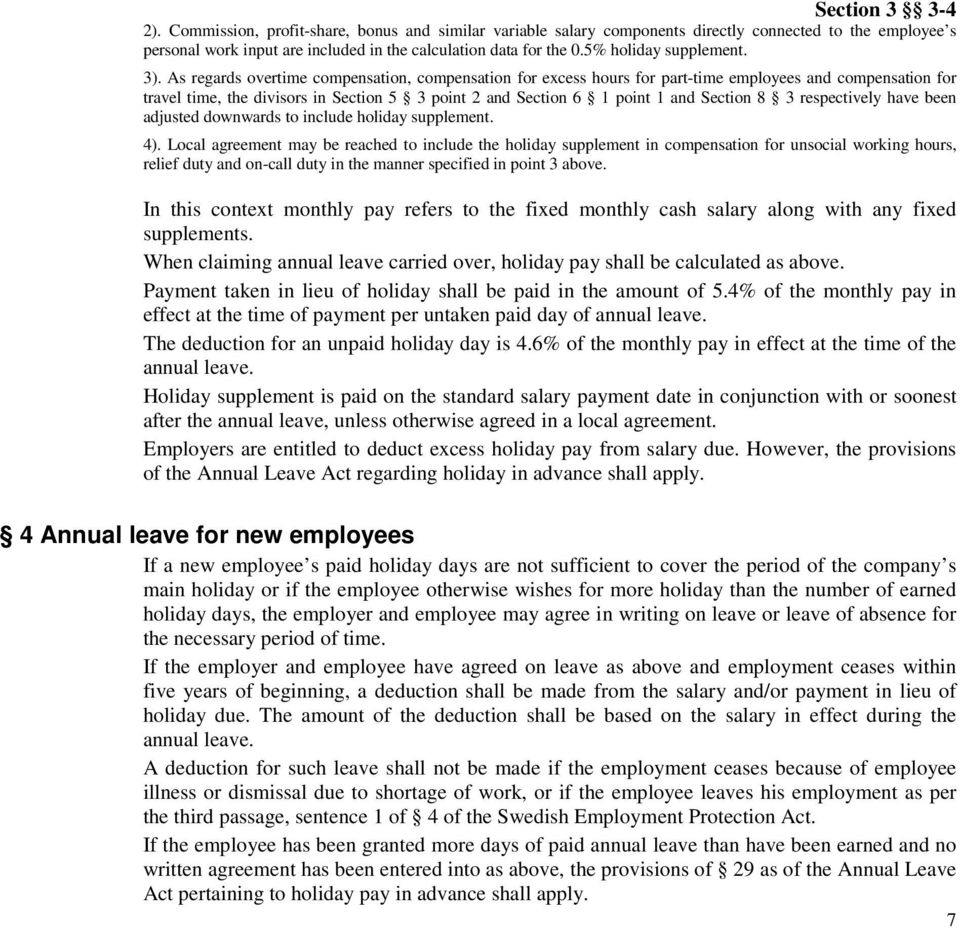
10 Section ). Commission, profit-share, bonus and similar variable salary components directly connected to the employee s personal work input are included in the calculation data for the 0.5% holiday supplement. 3). As regards overtime compensation, compensation for excess hours for part-time employees and compensation for travel time, the divisors in Section 5 3 point 2 and Section 6 1 point 1 and Section 8 3 respectively have been adjusted downwards to include holiday supplement. 4). Local agreement may be reached to include the holiday supplement in compensation for unsocial working hours, relief duty and on-call duty in the manner specified in point 3 above. In this context monthly pay refers to the fixed monthly cash salary along with any fixed supplements. When claiming annual leave carried over, holiday pay shall be calculated as above. Payment taken in lieu of holiday shall be paid in the amount of 5.4% of the monthly pay in effect at the time of payment per untaken paid day of annual leave. The deduction for an unpaid holiday day is 4.6% of the monthly pay in effect at the time of the annual leave. Holiday supplement is paid on the standard salary payment date in conjunction with or soonest after the annual leave, unless otherwise agreed in a local agreement. Employers are entitled to deduct excess holiday pay from salary due. However, the provisions of the Annual Leave Act regarding holiday in advance shall apply. 4 Annual leave for new employees If a new employee s paid holiday days are not sufficient to cover the period of the company s main holiday or if the employee otherwise wishes for more holiday than the number of earned holiday days, the employer and employee may agree in writing on leave or leave of absence for the necessary period of time. If the employer and employee have agreed on leave as above and employment ceases within five years of beginning, a deduction shall be made from the salary and/or payment in lieu of holiday due. The amount of the deduction shall be based on the salary in effect during the annual leave. A deduction for such leave shall not be made if the employment ceases because of employee illness or dismissal due to shortage of work, or if the employee leaves his employment as per the third passage, sentence 1 of 4 of the Swedish Employment Protection Act. If the employee has been granted more days of paid annual leave than have been earned and no written agreement has been entered into as above, the provisions of 29 as of the Annual Leave Act pertaining to holiday pay in advance shall apply. 7
11 Section Annual leave for part-time workers For intermittent part-time workers, the number of days of paid annual leave shall be calculated using the following formula: number of working days per week x number of gross days of annual leave to be taken 5 = number of holiday days to be scheduled on days that would have been working days (net days of annual leave). Should the calculation produce a decimal figure, the figure shall be rounded up to the nearest whole number. On calculating holiday supplement, payment in lieu and pay deductions for unpaid annual leave, the intermittent part-time worker s pay shall be recalculated to correspond to pay for full-time employment. Part-time employees with shortened daily working hours are entitled to the same number of days of paid annual leave as full-time employees. Holiday pay, holiday supplement, payment in lieu and pay deductions for unpaid annual leave are calculated on the basis of the part-time salary. 6 Altered number of working hours If during the earning year the employee has had a different number of working hours than at the time of the annual leave, the monthly pay in effect during the annual leave shall be adjusted pro rata to the employee s percentage of standard full work time at the workplace during the earning year. If the number of working hours has changed during a running calendar month, the percentage of full employment in effect for the majority of calendar days during that month shall be used in the calculation. This paragraph shall not be applicable should the annual leave and earning year coincide. 7 Carrying over annual leave Employees entitled to more than 20 days of paid annual leave in a particular holiday year may carry over one or more of the excess days to a subsequent holiday year. A single employee may have up to 40 days of annual leave carried over at any given point. The employer may in exceptional cases allow further days of annual leave to be carried over. 8 Certificate of untaken annual leave If requested by the employee, the employer shall issue a certificate of untaken annual leave on cessation of employment. 8

12 Section Section 4 Sick pay etc. 1 General Employees shall by law be entitled to statutory sick pay subject to the additions and clarifications of this Section. 2 Reporting sick and doctor s certificates The employee shall at the earliest opportunity notify the employer of an inability to work due to illness, along with the expected time of returning to work. This applies even if the employee is unable to work due to accident, occupational injury or risk of infection transfer pursuant to the Swedish Communicable Diseases Act. The employer may request a doctor s certificate even for sickness lasting less than seven calendar days if special reasons apply. The employer may request that the certificate be issued by a specific doctor if special reasons apply. 3 Amount of sick pay Sick pay shall be based on pay deductions as specified below. A) Sick pay up to and including the 14 th calendar day For each hour an employee is absent due to illness, a deduction for sickness shall be made in the amount of monthly pay x x weekly working hours for the first day of illness (the qualifying day ) and in the amount of monthly pay x x weekly working hours from the second day of absence due to illness Moreover, for qualifying days during the period of illness, sick pay amounting to 80% of the variable pay components to which the employee would have been entitled had he/she worked shall be paid, pursuant to the Swedish Sick Pay Act. 9

13 Section B) Illness from the 15 th to the 90 th calendar day inclusive For each day of absence due to illness (including work-free weekdays, Sundays and public holidays) a daily deduction for sickness shall be made as follows: 1. If the monthly pay is max. 7.5 x the price basic amount/12 90% x monthly pay x % x 7.5 price basic amounts % x monthly pay x If the monthly pay exceeds 7.5 x the price basic amount/12 The deduction for absence due to illness per calendar day may not exceed monthly pay x Monthly pay In this Section, monthly pay refers to: Fixed monthly cash salary and fixed supplements Estimated average income per month from commission, profit-share, bonus or similar (day 1-14). Commission, profit-share, bonus or similar earned during leave without direct connection to the employee s personal work input and guaranteed minimum commission or similar (applicable for maximum deduction for sickness, point B.2 above). 5 Period of sick pay Employees in group 1 receive sick pay up to and including the 90 th calendar day in the period of illness, and employees in group 2 up to and including the 45 th calendar day. Employees belong to group 1 if they have been employed with the employer for at least one consecutive year or come directly from employment where the employee was entitled to sick pay for at least 90 days. In all other cases employees belong to group 2.

14 Section Sick pay adjustment If the employee receives compensation from an insurance policy other than ITP or TFA and the employer has paid the premiums for that insurance, sick pay shall be reduced by that amount of compensation. If the employee receives other compensation from the state than from National Insurance, employment injury insurance or the Swedish State Personal Injury Protection Act, sick pay shall be reduced by that amount of compensation. 7 Limitations to sick pay entitlement If the employee is injured in an accident caused by a third party and compensation is not paid in line with TFA, sick pay shall be paid only to the extent that damages for loss of income cannot be claimed from the party responsible for the injury. If the employee s sickness benefits have been reduced pursuant to the Swedish National Insurance Act, sick pay shall be reduced in the same way. 8 Parental leave Salary deductions For full parental leave, 3.3% of monthly pay shall be deducted for each calendar day taken. If an employee takes parental leave for individual days (max. 5 working days) or part of a day, pay shall be reduced as for leave of absence, see Section 2 2. For parental leave in terms of a daily reduction in working hours or intermittent part-time service, the monthly pay shall be recalculated in proportion to the leave taken. Monthly pay refers to the fixed monthly cash salary and fixed supplements. Parental leave supplement When the employee collects full, three-quarter, half, quarter or one-eighth parents allowance above the guarantee level pursuant to the National Insurance Act, full, three-quarter, half, quarter or one-eighth parental leave supplement shall be paid. Parental leave supplement for full parental leave shall be paid for at least six months in cases where the monthly pay amounts to a maximum of 10 price basic amounts 12 11
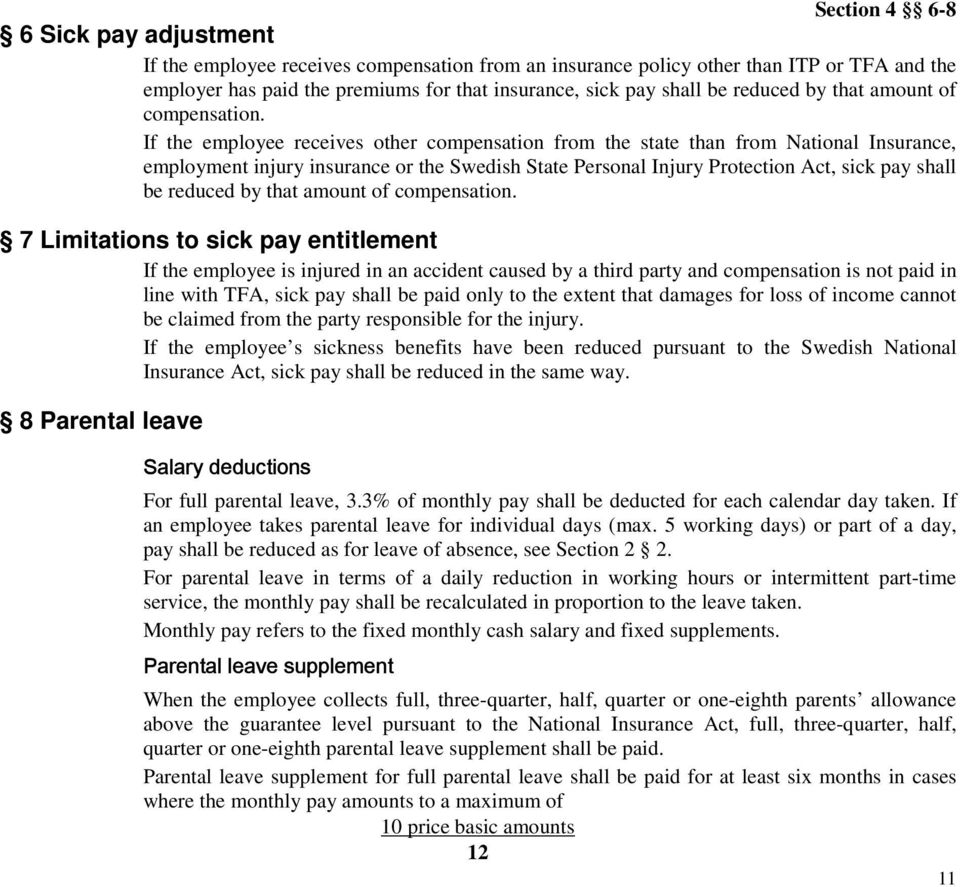
15 Section in the amount of 10% of daily pay. Monthly pay equates to the fixed monthly cash salary plus fixed supplements, along with the previous year s monthly average for variable components excluding overtime plus 5%. For employees with monthly pay in excess of 10 price basic amounts 12 a pay reduction will be made as follows: 80% x 10 price basic amounts % x monthly pay x monthly pay x x weekly working hours Parental leave supplement shall be paid in arrears once the employee has shown evidence from the Social Insurance Office (Försäkringskassan) that parents allowance has been paid. If the employee s parents allowance has been reduced pursuant to the Swedish National Insurance Act, the parental leave supplement shall be reduced in the same way. Temporary parents allowance For parental leave with temporary parents allowance, an hourly pay deduction will be made as follows: Monthly pay refers to the fixed monthly cash salary and fixed supplements. For half, threequarter, one-quarter and one-eighth leave taken, the deduction shall be half, three-quarters, onequarter and one-eighth respectively. 9 Reimbursement for medical care, medicine etc. Medical care The employer shall reimburse the employee s verified costs for medical care. Medical care refers to treatment carried out by an authorised member of the medical profession. Doctor s fees for certificates requested by the employer shall also be reimbursed. To receive reimbursement the employee is obliged on request to show a högkostnadskort (cost maximisation card) to prove that the patient s entitlement to a cost ceiling for medical care is being used in accordance with legal limits. Other healthcare treatment Other healthcare treatment at a public or private facility which applies publicly funded healthcare and medical care in accordance with the Swedish Tax Agency s definition shall be reimbursed in the amount of max. SEK 120 per treatment occasion. 12

16 Medicine Section 4 9 Verified costs for purchasing prescription medicines encompassed by Sweden s Purchase Cost Maximisation (Medicinal and other Products) Act, shall be reimbursed by the employer. To receive reimbursement the employee is obliged on request to show a högkostnadskort (cost maximisation card) to prove that the patient s entitlement to a cost ceiling is being used in accordance with legal limits. Exceptions The reimbursement covered in this paragraph shall only be paid to employees who have been employed for an uninterrupted period of at least 12 months. Employees who have been granted full leave of absence for a period exceeding one calendar month are not entitled to the reimbursement covered in this paragraph during the leave of absence. 13
17 Section Section 5 Overtime compensation 1 Overtime Overtime with entitlement to overtime compensation refers to overtime ordered or subsequently approved by the employer which a full-time employee has carried out in excess of that employee s standard daily working hours. Overtime is paid in full half-hours only. If overtime has been worked both before and after the standard working hours on a particular day, both periods of overtime shall be added together. If an employee works overtime, the employer shall remunerate any additional costs for travel to and from work. This even applies to employees who have no entitlement to overtime compensation. 2 Entitlement to overtime compensation The employee shall be entitled to overtime compensation unless otherwise stated below. The employer and employee may agree that no special overtime compensation is paid, instead e.g. offering a higher salary and/or five or three extra days of annual leave in addition to statutory holiday. Any such agreement must be made in writing. Such agreements should apply to employees in managerial positions or employees who have no control over their working hours or who have freedom in how their working hours are structured. If the employer and employee have explicitly agreed that the employee should carry out preparation and finalisation work of at least 12 minutes every day and the pay level has not been set or is not set with this in mind, the employee shall be compensated for this situation by being granted three extra days of annual leave in addition to the statutory holiday. Any agreement pertaining to this paragraph shall refer to a period of one holiday year unless the employer and employee have agreed otherwise. 3 Amount of overtime compensation 1. Compensation for overtime can either be given in money (overtime pay) or in the form of time in lieu (compensatory leave). Compensatory leave presupposes that the employer and employee agree on this. 14

18 2. Overtime pay per hour shall be paid as follows: a) for overtime at 06:00 20:00 on normal Mondays-Fridays Section monthly pay 94 b) for overtime at other times monthly pay 72 c) for emergency overtime monthly pay 66 Monthly pay in this paragraph refers to the employee s prevailing fixed monthly cash salary. Holiday supplement is included in the above calculations. 3. Compensatory leave for overtime as per 2a) shall be granted at 1.5 hours for each hour of overtime worked, and overtime as per 2b) and c) shall be granted at 2 hours for each hour of overtime worked. If the employer and employee have agreed that overtime compensation is to be taken out in the form of leave, the employer should pay heed to the employee s wishes regarding when that leave is taken. 4. Overtime on weekdays that are free days for individual employees as well as on Midsummer s Eve, Christmas Eve and New Year s Eve corresponds to overtime at other times. Ordered overtime in direct connection with a finished night shift corresponds to overtime at other times. Handover time normally entailed by a change of shifts is not covered by the above. 4 Overtime not directly linked to standard working hours If an employee is instructed to carry out overtime work at a time not directly linked to standard working hours, overtime compensation shall be paid as if the overtime were at least three hours. However, this shall not apply if the overtime and standard time are separated by a tea or meal break of 30 minutes maximum. 15

19 Section 6 1 Section 6 Compensation for extra hours 1 Excess hours for part-time employees (extra hours) 1. If a part-time employee works outside the standard daily working hours applicable to his/her employment (extra hours), the following shall be paid for each excess hour: monthly pay x x weekly working hours Monthly pay in this paragraph refers to the employee s prevailing fixed monthly cash salary. Weekly working hours here refers to the part-time employee s working hours per normal week, counted as a monthly average. Holiday supplement is included in calculations for extra hours. Extra hours are paid in full half-hours only. If extra hours have been worked both before and after the standard working hours of a particular part-time employee, both periods of time shall be added together. 2. If the extra hours are worked before or after the times applicable to the structure of standard daily working hours for full-time employees in a corresponding position at the company, overtime compensation shall be paid in accordance with Section 5. When applying the divisors in Section 5 3, the part-time employee s salary shall first be recalculated to correspond to a month s standard full-time pay.

20 Section Section 7 Unsocial hours, relief duty and on-call duty 1 General A Saturday which coincides with a major public holiday shall be considered to be a public holiday. 2 Unsocial working hours Unsocial working hours refer to the part of the standard working hours interval which until further notice or for a limited time fall outside of that which is normally regarded as standard working hours at the work site. However, working hours between 07:00 and 18:00 on Monday- Friday shall not be deemed unsocial. Pay for working unsocial hours Unsocial working hours shall be paid at the following hourly rates: Monday-Friday 18:00 07:00 monthly pay 540 From 18:00 Friday-Monday 07:00 and from 18:00 on Twelfth Night and the day before 1 May, Ascension Day and the Saturday between 31 October and 6 November until 07:00 on the following weekday, and from 18:00 on the day before Whitsun Eve, Midsummer s Eve and Christmas Eve until 07:00 on the Eve in question monthly pay 314 From 07:00 on Whitsun Eve, Midsummer s Eve, Christmas Eve and New Year s Eve, and from 18:00 on Maundy Thursday until 07:00 on the first weekday after each holiday, and from 07:00 on National Day of Sweden until 07:00 on the following day monthly pay 150 Other provisions Pay for working unsocial hours cannot simultaneously be paid with overtime or remuneration for travel time.

21 Section Relief duty Relief duty refers to time when the employee is not obliged to work but is obliged to be available to carry out work within the appointed time after due notice. Pay for relief duty Relief duty shall be paid at the following hourly rate: monthly pay 1400 However please observe: From 19:00 the day before a free day until 07:00 on the following working day monthly pay 700 From 19:00 on Maundy Thursday and New Year s Eve, and from 07:00 on Whitsun Eve, Midsummer s Eve and Christmas Eve until 07:00 on the first weekday after each holiday, and from 07:00 on National Day of Sweden until 07:00 on the following day monthly pay Other provisions Payment shall be made for at least eight hours per relief shift. Relief duty is not paid for time during which overtime is earned. When reporting for relief duty, remuneration is paid for travel costs. Relief duty The relief duty organisation shall be designed so that it is transparent for the workers concerned. This means a good introduction and training to ensure that the employee feels well acquainted with the facilities. Remarks Failure to comply with the above obligations and where final authority rulings exist constitutes a breach of collective agreement. If an employee has suffered a penalty or other sanction in accordance with the law due to such failure, general damages shall not be paid.
22 Section On-call duty On-call duty refers to time when the employee is not obliged to work but is obliged to be at the employer s disposal at the work site in order to work should the need arise. Pay for on-call duty On-call duty shall be paid at the following hourly rate: monthly pay 600 However please observe: From 19:00 the day before a free day until 07:00 on the following working day monthly pay 300 From 19:00 on Maundy Thursday and New Year s Eve, and from 07:00 on Whitsun Eve, Midsummer s Eve and Christmas Eve until 07:00 on the first weekday after each holiday, and from 07:00 on National Day of Sweden until 07:00 on the following day monthly pay 150 Other provisions Payment shall be made for at least eight hours per on-call shift. On-call duty is not paid for time during which overtime is earned. 5 Monthly pay Monthly pay in this Section refers to the employee s prevailing fixed monthly cash salary. 6 Shifts in combination with on-call duty Before a work timetable is drawn up in which shifts are combined with on-call duty, the local parties should run through all points in the checklist, see Appendix 2. The local parties should endeavour to reach a consensus on the structure of the work timetable. If the local parties are unable to reach a consensus on a work timetable in which shifts are combined with on-call duty, there can be no implementation until the central parties have been consulted. With regard to working hours, see the Agreement on working hours, Appendix 1.
23 Section Section 8 Travel time outside of standard working hours 1 Entitlement to remuneration for travel time The employee is entitled to remuneration for travel time unless the employer and employee have agreed otherwise and the compensation has been paid in some other form. 2 Conditions for remuneration for travel time Remuneration is paid for any time outside of standard working hours which it takes to undertake an ordered work-related journey. Travel remuneration is paid in full 30-minute periods only. If travel time occurs on the same day both before and after standard working hours, both periods of time shall be added together. For time on a work-related journey during which the employee him/herself drives a car or other vehicle, remuneration for travel time shall be paid regardless of who owns the vehicle. If the company pays for a sleeping-berth on a boat or train, remuneration for travel time shall not be paid between 22:00 and 08:00 when the employee uses the sleeping-berth. 3 Amount of remuneration for travel time Remuneration for travel time shall be paid at the following hourly rate: monthly pay 240 When a journey is undertaken between 18:00 on the day before a free day and 06:00 on the following working day, remuneration for travel time shall be monthly pay 190 Holiday supplement is included in the above calculations. Monthly pay in this paragraph refers to the employee s prevailing fixed monthly cash salary. When applying the formula for calculating remuneration for travel time, part-time employees salary shall first be recalculated to correspond to a month s standard full-time pay.
24 Section Section 9 Reduction in working hours Please note that the rules differ between the various employee organisations, although they are the same for Unionen and Sveriges Ingenjörer (The Swedish Association of Graduate Engineers). 1 EFA-Unionen and The Swedish Association of Graduate Engineers During the contract period 1 January March 2001 working hours were reduced by 27 hours. In an agreement on a reduction in working hours, the local parties should agree on how the reduction is to be applied. This may for instance entail that the reduction in working hours is applied in agreement between the employer and the individual employee, that a general reduction in working hours is instituted at the workplace (bridge days between public holidays and weekends, etc.) or that a bank of working hours is put at the individual employee s disposal. During the contract period 1 April March 2004 working hours were reduced by a further 27 hours. If no other local agreement is reached, the reduction in working hours is applied using individual working hour accounts. A further reduction of 9 working hours was made on 1 January The above means that the total reduction in working hours for full-time employees is 63 hours. For part-time employees the reduction is pro rata. For some employees, the reduction in working hours relates to bridge days between public holidays and weekends. For other employees individual working hour accounts have been set up. On 1 April 2007 the parties agreed that if any time remains from the reduction in working hours at the end of the year, the value of this remainder will be paid into the employee s pension fund. A nine-hour reduction in working hours equates to 0.5% of the fixed monthly cash salary as a pension premium. The pension premium is paid into the employee s ITPK or ITP avdelning 1 pension where applicable. The hours reserved by some companies as e.g. fixed non-working days (bridge days) are not encompassed by the above provisions. If remuneration in the form of pension premiums entails lower tax costs for the employer in relation to pay, the pension fund shall be complemented by the difference. 2 EFA-Ledarna For the contract period 1 January March 2001 the parties agreed that local agreements could be reached regarding a reduction in working hours (normally 27 hours, see 1 EFA-Unionen and The Swedish Association of Graduate Engineers above). 21
25 Section The local agreement must specify how the reduction in working hours is to be applied. This may for instance entail that the reduction in working hours is applied in agreement between the employer and the individual employee, that a general reduction in working hours is instituted at the workplace (bridge days between public holidays and weekends, etc.) or that a bank of working hours is put at the individual employee s disposal. During the contract period 1 April March 2004 working hours were reduced by 27 hours. If no other local agreement is reached, the reduction in working hours is applied using individual working hour accounts. A further reduction of 9 working hours was made on 1 January This means that the total reduction in working hours for full-time employees is 36 hours + locally agreed hours (normally 27 hours, see 1 EFA-Unionen and The Swedish Association of Graduate Engineers above). For part-time employees the reduction is pro rata. For some employees, the reduction in working hours relates to bridge days between public holidays and weekends. For other employees individual working hour accounts have been set up. On 1 April 2013 the parties agreed that if any time remains from the reduction in working hours at the end of the year, the value of this remainder will be paid into the employee s pension fund. A nine-hour reduction in working hours equates to 0.5% of the fixed monthly cash salary as a pension premium. The pension premium is paid into the employee s ITPK or ITP avdelning 1 pension where applicable. The hours reserved by some companies as e.g. fixed non-working days (bridge days) are not encompassed by the above provisions. If remuneration in the form of pension premiums entails lower tax costs for the employer in relation to pay, the pension fund shall be complemented by the difference. 3 EFA-SEKO During the contract period 1 January March 2001 working hours were reduced by 27 hours. In an agreement on a reduction in working hours, the local parties should agree on how the reduction is to be applied. This may for instance entail that the reduction in working hours is applied in agreement between the employer and the individual employee, that a general reduction in working hours is instituted at the workplace (bridge days between public holidays and weekends, etc.) or that a bank of working hours is put at the individual employee s disposal. During the contract period 1 April March 2004 working hours were reduced by a further 27 hours. If no other local agreement is reached, 22
26 Section 9 3 the reduction in working hours is applied using individual working hour accounts. A further reduction of 9 working hours was made on 1 January This means that the total reduction in working hours for full-time employees is 63 hours. For part-time employees the reduction is pro rata. For some employees, the reduction in working hours relates to bridge days between public holidays and weekends. For other employees individual working hour accounts have been set up. On 1 April 2013 the parties agreed that if any time remains from the reduction in working hours at the end of the year, the value of this remainder will be paid into the employee s pension fund. A nine-hour reduction in working hours equates to 0.5% of the fixed monthly cash salary as a pension premium. The pension premium is paid into the employee s ITPK or ITP avdelning 1 pension where applicable. If remuneration in the form of pension premiums entails lower tax costs for the employer in relation to pay, the pension fund shall be complemented by the difference. 23
27 Section Section 10 Termination 1 Extended period of notice for shortage of work If an employee who is given notice due to shortage of work has reached 55 years of age on the day notice is given and has been employed for at least 10 consecutive years, the statutory period of notice shall be extended by six months. An employee who has turned 67 is not entitled to a longer period of notice than one month. 2 Order of priority for reduced production and re-employment Should personnel reduction become necessary, the local parties shall take account of the company s needs and requirements with regard to staffing levels. If these needs cannot be met by the application of law, order of priority shall be decided by deviation from legal regulations. In this case the local parties shall make a selection of the employees to be given notice taking particular account of the company s expertise requirements and the company s ability to run a competitive operation and thereby pave the way for continued employment. It is presupposed that the local parties, on either party s request, reach an agreement on setting order of priority for notice, applying 22 of the Employment Protection Act and any necessary deviations from legal regulations. The local parties may also agree on an order of priority for re-employment in a deviation from of the Employment Protection Act. In this event the above criteria shall apply. 24 Remark In the absence of local or central agreement as above, notice due to shortage of work and re-employment may be arbitrated according to law observing the negotiation protocol.
28 Section 11 1 Section 11 Union work attendance at introductory information 1 Union information during paid work time New employees are entitled to attend one hour s information on the local union operation on paid work time. An employee at the same company or corporation may only attend such information sessions on paid work time once. The local parties shall discuss how this rule is to be applied in practice.
29 Section Section 12 Regulations 1 Electronic surveillance systems The use of electronic surveillance systems shall be conducted in a manner that causes as little infringement as possible to the employee s personal integrity. When choosing different procedures, only those that have the least effect on the employee s personal integrity shall be used. When introducing new electronic surveillance systems, e.g. GPS or similar, the employer has an obligation to negotiate in accordance with the Swedish Co-determination Act (MBL) Engagement of contractors and loan of employees 1. The employer s obligation to conduct primary negotiations in accordance with the Codetermination Act in connection with awarding work covered by the industry-wide agreement to anyone other than an employee, has been met if the conditions described below have been fulfilled. Engagement of contractors below also refers to the loan of employees The employer shall once a year request in writing local negotiations with the trade union counterparty for the contractors that the employer intends to hire during the year. In so doing, the parties shall endeavour to enter into local agreements on the matter. 3. Prior to such negotiations, the employer must submit in writing the following information regarding prospective contractors. a) company registered number b) full name and address c) telephone number and fax number if any After the local agreement has been reached, the employer shall draw up a list of the contractors covered by the agreement. 4. If there is a reason to question a right of veto in accordance with 39 of the Codetermination Act regarding a particular contractor, a union counterparty shall immediately in writing request negotiations, stating the reason for this measure. A right of veto may only be exercised by a central counterparty. 5. After agreement has been reached in accordance with the above, the employer is entitled, without prior primary negotiations in accordance with the Co-determination Act, to freely award the work to a contractor covered by the agreement. For foreseeable larger jobs that are not part of a company s normal, ongoing business, a trade union representative from the company should be informed before the contractor begins work. 6. The above does not preclude other procedures.
30 AGREEMENT ON WORKING HOUR REGULATIONS FOR EMPLOYEES Appendix 1 Section 1 Scope of the agreement 1 This agreement encompasses employees employed by employers linked to EFA The Swedish Energy Employers Association. 2 The provisions of Sections 2 and 4-6 do not apply to a) employees in positions of corporate management b) work which employees carry out in their homes or otherwise under such conditions that the employer cannot be considered able to supervise how the work is organised. These employees are also exempt from the application of the general Swedish Working Hours Act. 3 Employers and employees who agree or have agreed that entitlement to special overtime compensation is to be replaced by longer holiday or compensated for in some other way pursuant to Section 5 2 of the Industrywide Agreement for the ENERGY Sector, may agree that the employee should be exempt from the provisions of Sections 2 and 4-6. Remark regarding 2 and 3: According to 2 and 3 above, certain employees are not encompassed by the provisions of Sections 2 and 4-6. However, it is of mutual interest to the employer and the local employee organisation to gain an idea of the total number of working hours for these employees. Some of them register their hours by clocking in or some other way, e.g. when flexible working hours are applied at the company. In these cases basic data already exist for assessing the situation regarding working hours. In other cases working hours cannot be registered in the same way as for other employees. If requested by the local employee organisation, the employer and the organisation shall jointly develop a suitable system for assessing the working hour volume of these employees. Some of the employees exempted from the provisions of Sections 2 and 4-6 have also to date had some freedom as regards how they structure their working hours. This freedom is not affected by this Agreement. 4 The employer and local employee organisation may agree in writing that, in addition to the exceptions pursuant to 2 and 3, certain employees or groups of employees should be exempt from the provisions of Sections 2 and 4-6 in cases where the employees, with reference to their work duties, have a particular commission of trust in terms of working hours or where some other special circumstances are present. For information on the period of validity of such an agreement, please refer to Section 8 2.
31 Appendix 1 Section 2 STANDARD WORKING HOURS 1 Standard working hours may not exceed an average of 40 hours per normal week over a limitation period of four weeks. However, a calendar month may be used as the limitation period if the company s accounting systems are structured thus. For employees in intermittent three-shift work, standard working hours may not exceed an average of 38 hours per normal week per year. For underground work and ongoing three-shift work, standard working hours may not exceed an average of 36 hours per normal week per year. For employees in two-shift work, standard working hours may not exceed an average of 38 hours per normal week per year. Remark Three-shift work may be carried out by three or more shift teams. 2 Local agreement The structure of working hours should be agreed locally. The local parties may also reach agreement on some other limitation period or different working hours during different times of the year. 3 Shifts in combination with on-call duty If an employee on shifts also completes on-call duty on seven occasions 1 or more during the limitation period applicable to that shift system, standard working hours during a normal week may not during the period exceed the average stated below. Shift system Two-shift Intermittent three-shift Ongoing three-shift Weekly working hours 37 hours 37 hours 35 hours
32 Appendix 1 Section 3 WORKING HOURS, DAILY REST AND WEEKLY REST 1 Structure of working hours The average total working hours during each period of 7 days may not exceed 48 hours over a calculation period of 6 months. In calculating the total working hours, holiday and sick leave at times when the employee would otherwise have been working will be counted as completed working hours. The total working hours of 48 hours include standard working hours, extra hours, general overtime, excess overtime, on-call hours and emergency overtime. For employees who have completed emergency overtime, the average total working hours during each period of 7 days may not exceed 48 hours over a calculation period of 12 months. The above shall apply unless the local parties agree otherwise. 2 Daily rest According to the Working Hours Act, employees must have at least 11 consecutive hours of free time during each period of 24 hours (daily rest). Temporary deviations may be made if they are caused by a particular circumstance the employer could not have foreseen. Beyond this deviations may be made in connection with relief or on-call duty, or for reasons of public interest or if any other special circumstances exist. For employees who have not had 11 consecutive hours of daily rest, if at least 3 hours of overtime have been worked the employee shall be granted at least 8 consecutive hours rest if the following day is not free. If the rest period falls during standard working hours, no pay deduction is made. These free hours are transferred back to available scope for overtime. During a calendar year, a maximum of 50 hours may be transferred back to the scope for overtime in this way. The local parties may reach an agreement on rules other than those above, the exception being that extra pay may not be offered in lieu of free time. Remark The introductory text of the Working Hours Act makes it clear that the 24-hour period may start at any point during a calendar day. When reworking timetables, for instance, the period can be changed, but otherwise the period should be specified in line with a fixed system and applied consistently.
33 Appendix 1 3 Weekly rest According to the Working Hours Act, employees must have at least 36 consecutive hours of free time during each period of 7 days (weekly rest). Temporary deviations may be made if they are caused by a particular circumstance the employer could not have foreseen. Beyond this deviations may be made in connection with relief or on-call duty, or for reasons of public interest or if any other special circumstances exist. If the employee has not had any weekly rest, this is compensated for with one day of leave without pay reduction. The leave is generally taken in connection with the next weekly rest/weekend. Employees shall be considered to have had weekly rest when on annual leave, leave of absence and compensatory leave for overtime, as well as on public holidays, days off etc. The local parties may reach an agreement on rules other than those above, the exception being that extra pay may not be offered in lieu of free time. 4 Daily rest during weekends and public holidays Employees who have their daily rest during a weekend or public holiday interrupted and are unable to be compensated for this during the current weekend or public holiday, the number of hours encompassed by the interruption in daily rest is transferred into an individual bank of working hours. For interruptions during the night towards the next working day, the provisions of 2 Daily rest above shall apply. The corresponding rule applies for shift workers whose weekly rest does not occur at weekends. The above shall apply unless the local parties agree otherwise.
34 Appendix 1 Section 4 OVERTIME 1 Overtime In this Agreement, overtime refers to work carried out by an employee in addition to that person s standard daily working hours, if the overtime has been ordered in advance or where no advance notice could be given, the overtime has been subsequently approved by the employer. Time used to carry out preparation and finalisation work normal and necessary to the employee s job does not count as overtime pursuant to 2 below. Completed overtime is paid in full half-hours only. If overtime has been worked both before and after the standard working hours on a particular day, both periods of overtime shall be added together. 2 Obligation to work overtime When special reasons exist employees are obliged to complete general overtime of max. 200 hours per calendar year (48 hours over a four-week period or 50 hours over a calendar month). The number of hours may be exceeded when necessary to enable the employee to complete a project that cannot be interrupted without great inconvenience to the operation. General overtime should primarily be placed with employees who volunteer for it. Excess overtime may be worked if agreed locally with the relevant employee organisation. Control station When an employee has completed 100 hours of general overtime in a calendar year, the employer notifies the employee s local union organisation. On request, the local parties then discuss the reasons for the overtime and whether any measures need to be taken. Such reasons may be of either a structural or an individual nature. 3 If a natural event, accident or any other similar unforeseeable circumstance has caused an interruption in the operation or entailed immediate danger of such an interruption or of damage to life, health or property, overtime worked due to this circumstance shall not be considered in calculating overtime pursuant to 2 above.
35 Appendix 1 Section 5 ON-CALL HOURS 1 If due to the nature of the operation it is necessary for the employee to be at the disposal of the employer at the work site in order to work as and when the need arises, a maximum of 48 on-call hours may be taken over a period of four weeks or 50 hours over a calendar month. On-call hours do not refer to hours when the employee actually works for the employer. 2 For particular employees or groups of employees, written agreement may be reached between the employer and the local employee organisation regarding a different calculation or extent of on-call hours. For information on the period of validity of such an agreement, please refer to Section 8 2. Section 6 RECORDING OVERTIME AND ON-CALL HOURS The employer shall keep the necessary records for calculating overtime as per Section 4 and oncall hours as per Section 5. The employee, local employee organisation or central representative for the employee organisation is entitled to view these records. Section 7 NEGOTIATION PROTOCOL The same negotiation protocol shall apply as for the Industry-wide Agreement for the ENERGY Sector. Section 8 PERIOD OF VALIDITY 1 This Agreement is valid from 1 April 2013 to 31 March 2016 inclusive. Unless the Agreement is cancelled by any party at least three months before the end of the validity period, it shall be extended by one year at a time. If the Agreement is cancelled and a request for negotiation has been submitted at least three months before the end of the validity period, the Agreement beyond this date shall apply with a mutual notice period of seven days. If the Agreement on working hours ceases to apply, any other agreement reached with the support of the Agreement shall also cease to apply at the same time.
36 Appendix 1 2 Any local agreement reached with the support of Section 1 4, Section 2 2 and Section 5 2 shall apply until further notice with a period of notice of three months. Notice of cancellation may be given by the employer, the local employee organisation or the trade unions. If any of the parties wish the local agreement or the entitlement to the possibility of local agreement to remain in effect, he/she must promptly request that the matter be negotiated during the period of notice. The union parties may extend the period of notice of the local agreement to enable negotiations in line with the negotiation procedure to be completed before the agreement becomes invalid.
37 Appendix 2 CHECKLIST FOR WORK TIMETABLE WHEN SHIFTS ARE COMBINED WITH ON-CALL DUTY 34 Before a work timetable is drawn up in which shifts are combined with on-call duty, the local parties should run through all points in this checklist. The local parties should endeavour to reach a consensus on the structure of the work timetable. If the local parties are unable to reach a consensus on a work timetable in which shifts are combined with on-call duty, there can be no implementation until the central parties have been consulted. The Working Hours Act The work timetable is gone through to ensure it does not conflict with the Working Hours Act. The provisions are shown below. Nightly rest 13 Weekly rest 14 Rests 15 Meal breaks 16 Breaks 17 Central agreement on working hours The work timetable is gone through to ensure it does not conflict with the Agreement on working hours of the Industry-wide Agreement for the ENERGY Sector, as below. Standard working hours Section 2 1 and 2 General overtime Section 3 1 and 2 Excess overtime Section 3 2 Emergency overtime Section 3 3 On-call hours Section 4 Recording overtime and on-call hours Section 5 Local agreements on working hours If there is a local agreement on working hours at your workplace, make sure the timetable does not conflict with your local agreement. Work environment, social and medical aspects The work timetable is gone through to ensure it does not conflict with Section 2 1 of the Work Environment Act and Ordinance AFS 1982:17. Weekly working hour norms for combination forms Unless otherwise agreed between the local parties, the limitations specified in the Industry-wide Agreement for the ENERGY Sector shall apply, as below:
38 Appendix 2 Overtime 200 hours per calendar year (48 hours over a four-week period or 50 hours over a calendar month). On-call duty 48 hours over four weeks or 50 hours over a calendar month. Intermittent three-shift work 38 hours on average per normal week and year. Ongoing three-shift work 36 hours on average per normal week and year. Two-shift work 38 hours on average per normal week and year. Limitation rule If an employee on shifts also completes on-call duty on seven occasions 2 or more during the limitation period applicable to that shift system, standard working hours during a normal week may not during the period exceed the average stated below. Shift system Weekly working hours Two-shift 37 hours Intermittent three-shift 37 hours Ongoing three-shift 35 hours Minimum staffing levels Regulations state that a certain minimum staffing level must be maintained so as not to infringe upon laws and collective agreements. Minimum staffing levels vary depending on local conditions. Reserve capacity staffing Absence must be taken into account when drawing up work timetables. This includes absence due to illness, annual leave, union time, leave of absence, caring for sick children and so on. Individual consideration The timetable should be drawn up in such a way that individual wishes can be met as far as possible. Terminology: Shift work refers to a system whereby two or more work teams regularly succeed one another at set times. Shift work is deemed to exist when the work each shift team carries out is part of a continuous, uniform work process. The arriving shift generally takes over the departing shift s work tasks after a brief handover period, e.g. in a control room at a nuclear power plant. On-call duty is time when the employee is not obliged to work but is obliged to be at the employer s disposal at the work site in order to work should the need arise. 2 Occasion refers to a period of max. 24 hours. 35
39 Appendix 3 Minutes of negotiations Cf 4/2003 Place and date Stockholm, 7 April 2004 Parties The Swedish Energy Employers Association (EFA) SEKO The Union of Service and Communication Employees Subject Recommendation relating to travel agreements for Energy companies Present For the employer party Björn Tibell Ulrika Egerlid Schotte, minutes For the employee party Bertil Dahlsten Lars Johansson 1 Björn Tibell and Lars Johansson were designated to approve the minutes. 2 In connection with the 2004 bargaining round, the parties agreed that there is a need to enter into local travel agreements for personnel within the energy industry, working across larger geographic areas. Affected companies that have not entered into local travel agreements should immediately enter into negotiations on the matter. 3 Negotiations were declared closed. Minutes Ulrika Egerlid Schotte Approved by Björn Tibell Lars Johansson
40 EXAMPLE OF TRAVEL AGREEMENT Appendix 4 1 Subsistence allowance and accommodation costs For multi-day trips within Sweden outside the usual place of business, the company pays compensation for accommodation costs and subsistence allowances in accordance with the provisions and amounts specified in the current income tax legislation for the compensation to be deductible. If the company or another affected by the trip provides meals and accommodation free of charge, the allowance shall be reduced in accordance with the instructions of the Swedish Tax Agency. 2 Trip supplements a) Multi-day trips When allowance is paid in accordance with 1, the company shall also pay a supplement of SEK 155 per day, including holiday supplement. If half allowance is paid, half salary increment shall be paid. If the company or another affected by the trip provides meals and accommodation (residential) in connection with a course, conference or similar, the company shall not pay a salary increment. b) One day trips For a one-day trip outside a ten-kilometre boundary from the workplace or place of residence, the company shall pay a salary supplement including holiday supplement. The salary supplement shall not be paid when free meals are provided. Absence 6-10 hours SEK 71/day Absence more than 10 hours SEK 142/day 3 Travel expenses For business travel, the company shall pay approved expenses for the most appropriate mode of transport. 4 Free return trips For work at a workplace situated at least 350 kilometres from the employee s home base, the employee shall receive a free journey home after the work has lasted for 2 weeks and then a free journey home every other week until the job finishes. 37
41 Remarks on Industry-wide Agreement for the ENERGY Sector EFA-Sif/The Swedish Association of Graduate Engineers/ Ledarna The Swedish Association for Managerial and Professional Staff/SEKO The Union of Service and Communication Employees Section 1 General provisions 39 Section 2 Pay for part of pay period, leave and part-time retirement 39 Section 3 Annual leave 40 Section 4 Sick pay etc. 41 Section 5 Overtime 46 Section 7 Unsocial working hours, relief duty and on-call duty 47 Section 8 Travel time outside of standard working hours 48 Section 10 Termination 48 Applicable periods of notice from the employee s and employer s side respectively The purport of parts of the Employment Protection Act s provisions regarding time-limited employment and calculation of final salary
42 Section 1 General provisions Appendix 5 1 Scope of validity The parties agree not to alter the previous practice with regard to the term positions of corporate management. 3 Local collective agreements The purport of the two last passages of this paragraph is that if a local party wishes a local collective agreement to cease to apply, this will generally require a special agreement cancellation on that party s part. In this matter the same period of validity and notice shall apply as for the central agreement. Should the central agreement however cease to apply following cancellation by any of the central parties, the local agreement reached with the support of the central agreement shall automatically cease to apply from the same point. When the central agreement later comes into force again, after a temporary period without an agreement in place, the local agreements will be reconnected with no change of content, unless the central parties instruct otherwise. This means that the local agreements will have renewed validity with the same period of validity and notice as the new central agreement. Section 2 Pay for part of pay period, leave and part-time retirement 1 Leave The parties agree that the new agreement texts shall not entail any change in the company s practice as regards in which situations leave is granted. This means that leave may be granted in the following cases. a) Severe illness when benefit is not paid by national insurance, the death or funeral of a close relative or related estate inventory proceedings or distribution of inheritance. b) Relocation due to a change in home base. c) Doctor s and dentist s appointments in the event of acute complaints, as well as examinations or treatment following a referral from a doctor or dentist. Examples of special circumstances for which leave may be granted for a whole day or several days include a sudden illness in the employee s family or the death of a close relative. 39
43 Appendix 5 2 Leave of absence Unless otherwise dictated by prevailing laws and agreements, leave of absence shall be granted if the employer deems this possible without disadvantage to the company s operation. Employees wishing to apply for a leave of absence should do so as far in advance as possible. 5 Part-time for retirement purposes Purpose of Agreement regarding part-time retirement The point of departure for the parties is that in future employees will continue to work to a later age than at present. For many this entails strains which make it necessary to work less towards the end of working life by reducing the number of working hours from full time to part time. The aim of the provisions regarding part-time retirement is therefore to enable a longer working life and to lay the foundation for a generation change. The idea behind part-time retirement is thus not to make it possible for the employee to undertake other employment, professional assignments or professional activities alongside his/her standard employment. Such motives do not therefore constitute a good reason to grant part-time retirement. Further, part-time retirement cannot include the presumption that after part-time retirement the employee works overtime/extra hours to such an extent that the employee s actual normal working hours amount to a higher number of working hours than those stated. This obviously does not prevent the employee from working overtime/extra hours in situations where he/she would have done so if he/she had not been part-time retired. The employee may, of course, undertake assignments in voluntary associations, pursue hobbies or accept minor employment. There are no restrictions in this area on what the employee may do except for those generally following from a contract of employment. These include a ban on running a competing operation and on undertaking assignments which are inappropriate or which may otherwise be an obstacle to the employee completing his/her duties in accordance with the contract of employment. The parties also agree that the Agreement does not mean that the employer has to consider solutions that make it necessary to recruit new part-time personnel or the hiring of staff to make part-time retirement possible. Application The employer shall consider in a serious, constructive way whether it is possible to grant an application for part-time retirement. The assessment shall be based on the whether part-time retirement would, from an objective assessment, entail considerable disruption to the operation. As stated in the Agreement, the application must be in writing and must specify the preferred number of working hours. The applicant is responsible for submitting the application, which means that the person submitting the application must be able to prove it. In subsequent contacts with the employer, the employee should declare any circumstances of relevance to the application. For example, the employee may be prepared to be transferred to other positions or to share a full-time position with another employee who has applied for parttime retirement. If the employee has any ideas for simple means for the employer to enable part-time retirement, they should be put forward. Should part-time retirement require that the employee and the company agree that the employee be transferred to other duties, this could also necessitate agreeing on a change in pay. One example is that the employee holds a managerial position that is not appropriate for combining with part-time employment. Within the framework of an agreement to transfer the employee to a position which is not a managerial post, the employer and employee may then also agree on pay which is adjusted to the employee no longer being a manager. Another example could be a salesperson applying for part-time retirement but the work in sales not being compatible with a lower number of working hours, for example due to travel or similar. An agreement to transfer the salesperson to another position could, in this case, presuppose that any variable salary components, such as commission, no longer be paid. Instead the employee and the company may need to settle on a fixed salary which means a lower level of pay than before. The application is assessed based on the number of working hours for which the employee has applied. If the employer rejects the application and the employee and local union party wish to take the matter of part-time retirement further in the negotiation protocol, the assessment in local and central negotiations shall be based on an 80% future level of working hours. The
44 employee may thus essentially request any number of hours in his/her application, but in the negotiation protocol the issue will be assessed based on the employee working 80%. A general exhortation from the parties is that applications should be based on realistic assessments and be adapted to the operation in question. This can only be judged in the various operations themselves. In accordance with the Agreement, the employer shall give a written reply to the applicant and the local union party at the company no later than two months after receiving the application. One conceivable situation is that the employer finds considerable obstacles to granting the application, but within the two months the employer states that there are no obstacles to granting part-time retirement to a different extent or at a later time than that requested in the application. The employer has then met the requirement to reply within two months. If the employee does not accept such a counterproposal, this is to be regarded as the employer having rejected the employee s application. Considerable disruption The requirement that the disruption must be considerable implies that lesser disruptions may not be regarded as obstacles to taking part-time retirement. It must therefore be able to be established that there would be considerable disruption and that the rejection is not due to nonchalance, that the employer has not assessed the matter seriously, or a general unwillingness for the employee to be granted part-time retirement. This is also implied in the requirement that the disruption must be able to be established through objective assessment. If the employer can reduce or completely eliminate the disruptive elements by taking simple measures, an obstacle to taking part-time retirement should not normally be deemed to exist. As will be explained further on there are, however, restrictions on what measures an employer is obliged to take to accommodate the employee in his/her application for part-time retirement. The parties agree that the requirements which can be placed on the employer when assessing part-time retirement are significantly lower than in the case of parental leave and other similar situations in legislation regarding leave. Naturally the requirements are also far lower than when considering the issue of continuing employment when an employee permanently has a partially reduced ability to work due to illness. The employer s obligation to take measures to enable part-time retirement is therefore clearly more limited than in the above-mentioned situations. The issue of part-time retirement shall, as mentioned, be assessed seriously, with good intent and based on it being in the interests of both parties that the employee can continue to work in a way that benefits the operation. Adaptation measures Typically the assessment as to whether part-time retirement can be granted will be based on the employee retaining his/her existing duties. The employer and employee are of course free to agree on part-time retirement that entails a transfer. The employer is obliged to discuss and consider the ability to transfer the employee to other duties but not to actually carry out the transfer. The employer may, however, be liable for damages if the employer fails to agree on a transfer that could have enabled part-time retirement without considerable disruption. In the assessment, the employer must consider the possibility of a certain reallocation of duties between employees with the aim of enabling part-time retirement. Such reallocations of duties shall be naturally linked to the fundamental expertise and qualifications of the employees involved. Such a reallocation may not be requested if the reallocation would entail other employees being adversely affected with regard to work environment or a reduction in work content. This refers for example to monotonous, content-poor or highly repetitive duties. Within the framework of the obligation to reallocate duties, the employer is not obliged to develop the competence of the employee or other employees to a greater extent than that encompassed by a reasonable learning period for the work in question, usually up to 3 or 4 months. In this context competence development refers to learning within the framework of carrying out the work. It does not therefore include an obligation to retrain salaried employees. Training outside of the workplace does not usually come under the measures the employer has to take in this context. A reasonable gauge for which training measures should be offered may be the introduction usually given to new recruits by the employer. Adaptation measures in the form of new recruitments
45 As already mentioned, the parties shall agree that the employer is not obliged to recruit new part-time personnel, hire staff, use consultants or let the part-time retired employee work overtime to such an extent that his/her actual normal working hours amount to a higher number of working hours than those stated. In reallocating duties, one possible scenario is that several employees apply for part-time retirement at the same time. In this situation it may be necessary to recruit a new full-time employee and this does not, in itself, constitute a considerable obstacle to granting part-time retirement. One obstacle to granting part-time requirement may however be that it is difficult to recruit new personnel to replace the employees who have applied for part-time retirement, for example in cases where qualifications and expertise are required which are hard to obtain on the local labour market. Such a situation will likely mean that the employer must begin recruitment work with the aim of securing the necessary expertise before the employee in question takes full retirement. Part-time retirement may, in this context, help the generation shift run more smoothly. The question of part-time retirement should in such cases be brought up again when there is a plan for a generation shift. Shared responsibility As previously stated, the employer is responsible for seriously and constructively assessing whether it is possible to grant the application. For their part, the employee and local union party are responsible for suggesting simple, tangible measures which the employer may take in order to grant part-time retirement. Thus the responsibility is shared. Negotiation and disputes As touched on before, the application is assessed based on the number of working hours for which the employee has applied. If the employer has rejected the application and the employee wishes to take the matter further under the negotiation protocol, the assessment shall be based on 80% working hours. The employer then needs to assess whether there are considerable obstacles also to this. The issue of granting part-time retirement with 80% working hours will therefore be assessed in local negotiations, and where appropriate in central negotiations. This assessment is final as to the matter of whether or not part-time retirement can be granted. Since the matter is ultimately assessed in central negotiations, this means that the assessment is final and cannot be pursued further in the courts. If the employee and the local union organisation wish to assert that the employer has not fulfilled its obligations, the local union organisation shall request local negotiations for damages for alleged shortcomings on the part of the employer. In the issue of damages for erroneous application of the Agreement, a crucial aspect is whether the employer in the assessment has shown insufficient care and prudence and consideration of the employee s interests. The issue of damages shall of course be dealt with in accordance with the rules of the negotiation protocol and may, therefore, go to court if the parties fail to reach a consensus. As always, it shall be the shared intention of the parties that disputes should be resolved in the negotiation protocol. The parties agree that typically the circumstances are likely to change during the dispute s proceedings and that opportunities could arise for finding acceptable solutions, in which case the dispute may be brought to an end. As mentioned before, situations may arise where due to considerable obstacles it is not possible to grant part-time retirement at the requested time, but at a later time when the obstacle is no longer present. In this instance it is appropriate for the employer to notify the employee and the local union organisation of this. Another possibility is that the employee applies again and the employer then assesses this new application. The central parties shall always work on the assumption that the local parties and employee shall ensure that both the application and the assessment regarding part-time retirement are carried out correctly. If a particular employee continuously returns with new applications without there having been any motivating changes, the employer shall notify the local union party of such abuse. The parties shall then work based on the local union party agreeing with the employer that a new application from the employee concerned must only be examined by the employer if the application has been approved by the local union party. Section 3 Annual leave
46 3 Holiday pay, payment in lieu etc. 40 Altered number of working hours If the employee has changed his/her number of working hours during the earning year, this will be considered when calculating holiday pay. If for example the employee reduces his/her hours from full-time to half-time half way through the earning year, half the holiday pay will be based on full-time and half on part-time. It is also possible to calculate holiday pay based on the average number of working hours during the earning year. Holiday pay when carried-over annual leave is redeemed Leave carried over is calculated based on the pay at the time of redemption and the agreed number of working hours applicable during the earning year immediately preceding the leave year in which the days are taken. Leave of absence is not considered as an alteration in the number of working hours. Payment in lieu of holiday Payment in lieu, i.e. payment for an untaken day of annual leave, may take place in the following circumstances: If the employee terminates his/her employment without having taken paid annual leave. If the employee has more than 40 days of annual leave carried over and the employee is not permitted to save them. If an employee with full holiday entitlement has taken less than 20 days of paid annual leave during the holiday year. Holiday days in excess of 20 may be carried over, while untaken days up to and including the 20 th day give entitlement to payment in lieu of holiday.
47 Appendix 5 5 Annual leave for part-time workers The number of gross days of annual leave (holiday days for employees who work every day) to be issued during the holiday year shall be put in proportion to the employee s percentage of standard working hours which apply to full-time employees in a corresponding position. The number of days of annual leave granted (net days of annual leave) shall be scheduled for those days which would otherwise have been working days for the employee. Calculation of annual leave for intermittent part-time workers can be illustrated by the following example. The example is based on an annual leave entitlement of 25 days. Average number of days worked per week Days of paid annual leave Days of unpaid annual leave Section 4 Sick pay etc. 1 Entitlement to sick pay According to the Sick Pay Act, the employer is obliged to pay sick pay to the employee for the first 14 calendar days of a period of illness (a sick pay period). If the illness continues sickness allowance is paid by the Social Insurance Office, supplemented by sick pay from the employer up to and including day 90 if the employee belongs to group 1 or up to and including day 45 if the employee belongs to group 2 (see Section 6 4 Period of sick pay). Employees sick pay can basically be specified as follows: day sick pay from employer sickness allowance from the Social Insurance Office total For the first 14 days of a period of illness the Sick Pay Act applies with the additions and clarifications specified in the Agreement. From the 15 th day only the Agreement s terms apply. 41
48 Appendix 5 2 Reporting sick and doctor s certificates Employees should report sick as soon as possible The employee is obliged to report sick to the employer as soon as possible. This generally means that an employee should report sick in connection with the start of his/her working hours. The employee is also obliged to keep the employer informed of the illness s progress and when the employer is expected to be able to return to work. The employer is not obliged to pay out sick pay until the employee has reported sick (Sick Pay Act 8). The day of reporting sick is normally the qualifying day and sick pay is paid after that day. If the employee has been physically or mentally hindered from reporting sick either him/herself or through an agent and the employer has been notified of the illness as soon as the hinder has passed, the first day of absence due to illness is the qualifying day and sick pay is paid after that day. Affirmation or doctor s certificate after the illness Once the illness has passed, the employee shall submit to the employer written affirmation that the employee has been sick and the time during which the employee has been unable to work due to illness (Sick Pay Act 9). The employer is not obliged to pay sick pay before the employee has submitted such an affirmation. An employee who is absent due to illness for more than seven calendar days must substantiate his/her illness and impaired working ability from the eighth day inclusive by means of a doctor s certificate if the employer is to pay sick pay (Sick Pay Act 8). 3 Amount of sick pay Illness up to and including the 14 th calendar day Entitlement to sick pay pursuant to the Sick Pay Act applies for the first 14 calendar days of the period of illness, the sick pay period (Sick Pay Act 7). Entitlement to sick pay applies from the first day of employment (Sick Pay Act 3). If however the time of employment is less than a month, the employee is only entitled to sick pay 14 calendar days after employment begins. On the first day of sick leave (the qualifying day ), the employer makes a 100% deduction in pay. On other paid sick days the employer makes a deduction of 20% based on the employee s hourly rate of pay. In the event of absence for part of a day, there is no minimum threshold to be passed for the first day of absence due to illness to be counted as the qualifying day. The deduction is made taking account of the actual amount of absence. 42
49 Appendix 5 Three exceptions to the qualifying day The Sick Pay Act specifies three exceptions to the qualifying day deduction: general high-risk protection, special high-risk protection and recurring sickness rule. General high-risk protection (Sick Pay Act 6) means that the number of qualifying days over a 12-month period may not exceed 10. If in a new sick pay period it becomes clear that the employee has had a deduction made for 10 qualifying days within 12 months retrospectively from the start of the new sick pay period, the deduction for the first day of absence in the new sick pay period will also be calculated based on the rules of 20% deduction for sickness. Special high-risk protection (Sick Pay Act 13-16) refers to employees with extensive short-term sick leave, who according to a Social Insurance Office decision are entitled to 80% sick pay on the first day of illness. High-risk protection encompasses illnesses which are well documented medically, such as cancer or rheumatism. If the employee has returned to work and then falls ill again, this is counted as a new period of illness. However, if the employee falls ill again within five calendar days after a period of illness, this is considered a continuation of the previous period of illness with regard to qualifying day, amount of sick pay and length of the sick pay period (Sick Pay Act 7). Illness from the 15 th calendar day From the 15 th calendar day of the period of illness, the Social Insurance Office pays sickness allowance. Sickness allowance is calculated based on calendar days and is maximised at 80% of pay within 7.5 times the price basic amount. This means that sickness allowance is not calculated based on the monthly pay component exceeding 7.5 x the price basic amount/12. The employer pays sick pay in the amount of 10% of monthly pay, so the employee s total compensation when ill is 90% of salary from day 15. The employer also pays sick pay in the amount of 90% of the monthly pay component exceeding 7.5 x the price basic amount/12. Like sickness allowance, sick pay is calculated based on calendar days from day 15. If the pay level or working hours change, a pay deduction is made based on the old pay level or working hours for at most the month in which the employee was notified of the change. Basic data for calculating sick pay The basic data for calculating sick pay are slightly different for the first 14 calendar days than for the subsequent time. Sick pay data can basically be specified as follows:
50 Appendix 5 Days 1-14 Fixed monthly cash salary Fixed supplements Variable salary components Average of commission, profit-share, bonus etc. 5 Period of sick pay 44 Days Fixed monthly cash salary Fixed supplements Commission, profit-share, bonus etc. without direct link to work input and guaranteed minimum commission etc. Variable salary components refer for example to pay for unsocial hours, relief and on-call duty which the employee would have completed had he/she not fallen ill. Overtime pay is not generally included in the basic data for sick pay. Neither are reimbursements or remuneration for costs, such as allowances and remuneration for travel costs, included in the basic data for sick pay. Sick pay for 90 or 45 days For the first 14 calendar days the Sick Pay Act entitles the employee to sick pay from the time of employment, with the exception of the above-mentioned restriction regarding employment for a limited period of less than one month. Entitlement to sick pay from day 15 is restricted as per the Agreement. If the employee has been employed for at least a year, the employee is entitled to sick pay up to and including the 90 th calendar day in the period of illness. The same applies if the employee is newly employed but comes directly from another job where the employee enjoyed this sick pay entitlement. In other cases the entitlement to sick pay from day 15 is limited to 45 calendar days in the period of illness. Repeated illness If several cases of illness occur within a 12-month period, special limitation rules apply. If in the past 12 months, counted from the beginning of the sick pay period, the employee has received sick pay from the employer so that the number of sick pay days, including sick pay days in the current sick pay period, is at least 105 (group 1) or at least 45 (group 2), entitlement to sick pay for that case of illness shall cease after the 21 st calendar day in the sick pay period. Sick pay days refer to all days involving a reduction for sickness (including qualifying days) and free days which fall within a period of illness. ITP sickness pension If ITP sickness pension is paid out in accordance with the pension plan in effect, the entitlement to sick pay no longer applies and the entire monthly pay is deducted.
51 From day 91, ITP sickness pension shall be paid as follows. Appendix 5 Pay/pay Sickness Sickness Sickness Sickness or component allowance is paid allowance is paid allowance is paid activity benefit is pba = price basic until day 90 in line for days * from day 361* in paid in line with amount with NI Act in line with NI Act line with NI Act NI Act** iba = income basic amount * In the same case of illness. ** Although not if sickness allowance has been paid for the same period. 8 Parental leave Two methods of pay reduction The Agreement encompasses two ways of making pay reductions for parental leave. If the employee is on parental leave for one or more individual days a deduction is made as with leave of absence, see Section 2 2. If the employee is on leave for a whole month, the entire monthly pay is deducted. The other pay reduction method is applied if the employee reduces his/her working hours, either by a daily reduction of working hours or through intermittent part-time work. The monthly pay is then re-calculated in proportion to the extent of leave as with part-time employees. Parental leave supplement As with parents allowance, parental leave supplement can be divided into three-quarter, half, one-quarter or one-eighth supplement. The Agreement therefore enables employees to take full parental leave supplement for six months, three-quarter parental leave supplement for eight months, half parental leave supplement for 12 months and so on. Parental leave supplement for full parental leave shall be paid in cases where the monthly pay amounts to a maximum of 10 price basic amounts 12 in the amount of 10% of daily pay. Monthly pay equates to the fixed monthly cash salary plus fixed supplements, along with the previous year s monthly average for variable components excluding overtime plus 5%.
52 Appendix 5 For employees with monthly pay in excess of 10 price basic amounts 12 a pay reduction will be made as follows: 80% x 10 price basic amounts % x monthly pay x Parental leave supplement shall be paid in arrears once the employee has shown evidence from the Social Insurance Office that parents allowance has been paid. If the employee s parents allowance has been reduced pursuant to the Swedish National Insurance Act, the parental leave supplement shall be reduced in the same way. Temporary parents allowance For absence with temporary parents allowance e.g. caring for sick children a reduction will be made for each hour of absence. No parental leave supplement shall be paid. Temporary parents allowance from the Social Insurance Office is 77.6% of the income that counts towards sickness benefit for a maximum of 120 calendar days a year until the child reaches the age of 12. For children requiring a particularly high amount of care, temporary parents allowance may in some cases be paid until the child has reached the age of 23. Temporary parents allowance can also be divided into three-quarter, half, one-quarter and one-eighth allowance. Absence with maternity allowance Female employees may be entitled to maternity allowance prior to delivery. Maternity allowance is 77.6% of the income that counts towards sickness benefit. If an employee is absent with maternity allowance, the employer makes a pay reduction as with leave of absence. No parental leave supplement will be paid. Section 5 Overtime compensation 1 Overtime The final passage of the paragraph states that an employer is obliged to remunerate an employee for any additional costs the employee, due to the overtime, may incur for travelling to and from work. This means that an employee who normally takes public transport to work such as a train or bus etc. can be remunerated for a more costly form of travel, such as travelling by own car, if he/she works overtime in which the hours do not allow travel by public
53 Appendix 5 transport. However, remuneration is paid only for additional costs, i.e. over and above the cost of the standard means of transport. This means that if the person in question always drives his/her own car to work, he/she shall not normally be entitled to any additional remuneration due to the overtime. To enable the employer to assess the costs, it is the employee s responsibility to inform the employer of the amount of additional costs as soon as the overtime is ordered. If the overtime hours are not directly linked to standard working hours, the employer is obliged to remunerate all costs arising due to the overtime. 2 Entitlement to overtime compensation Any agreement that special compensation will not be paid for overtime shall be in writing. The in-writing requirement applies to future agreements reached after 1 April 2001 and does not affect the validity of agreements already reached. Transition rule Employees who on 31 December 1995 have at least 30 days of annual leave and who are not entitled to overtime compensation shall not, due to the changes in the collective agreement of 1 January 1996, receive overtime compensation in their current positions unless this has specifically been agreed otherwise. Section 7 Unsocial hours, relief duty and on-call duty The changes to the Agreement do not entail any changes as regards employees obligation to carry out work at unsocial hours or to work relief and on-call duty. This means for example that at a company that previously applied the Energy Agreement and because of this could not order an employee to work relief duty on more than seven occasions over a four-week period, a transition to more frequent relief duty presupposes that a local agreement for this has been reached. The same applies for on-call duty. 2 Unsocial working hours The parties agree that a company should have reasonable cause to introduce work at unsocial hours.
54 Appendix 5 3 Relief duty Relief duty shall be scheduled in such a way that it does not unduly burden an individual employee. A timetable for relief duty should be drawn up in good time. 4 On-call duty On-call duty shall be scheduled in such a way that it does not unduly burden an individual employee. A timetable for on-call duty should be drawn up in good time. Section 8 Travel time outside of standard working hours 1 Entitlement to remuneration for travel time For work-related travel by own or company car when goods or people are being transported on behalf of the company, the travel time shall be counted as standard working hours. In this case overtime compensation rather than remuneration for travel time shall be paid for time outside of standard working hours. If the work-related journey by car is undertaken only to transport the actual employee, remuneration for travel time shall be paid for time outside of standard working hours. Section 10 Termination Employer certification In connection with termination due to shortage of work the employer shall issue a certificate known as an employer s certificate in accordance with 47 of the Unemployment Insurance Act. Service certificate When notice has been given the employee is entitled to receive a service certificate stating the employee s length of employment and work tasks. If the employment has lasted at least six months and the employee so requests, the service certificate shall also contain a reference as to how well the employee has conducted his/her work. The employer shall provide the service certificate as soon as possible after the employee has requested it. Periods of notice In an appendix to this remark the parties have documented what the terms of the Employment Protection Act actually entail as regards the length of the period of notice for employees encompassed by the Agreement.
55 Appendix 5 APPLICABLE PERIODS OF NOTICE FROM THE EMPLOYEE S AND EMPLOYER S SIDE RESPECTIVELY 1. Period of notice from the employee s side The period of notice for all employees irrespective of when they were employed is one month. 2. Period of notice from the employer s side A. For employment begun before 1 January 1998 the following periods of notice from the employer s side apply. The minimum period of notice from the employer s side is one month. If an employee at the time of notice has been employed by the employer for the past six consecutive months or for a total of at least 12 months in the past two years, the employee is entitled to a period of notice of two months from the age of 25, three months from the age of 30, four months from the age of 35, five months from the age of 40, six months from the age of 45. B. For employment begun on or after 1 January 1998 the following periods of notice from the employer s side apply. Length of employment at the company less than 2 years 2 years but less than 4 years 4 years but less than 6 years 6 years but less than 8 years 8 years but less than 10 years at least 10 years Employer s period of notice 1 month 2 months 3 months 4 months 5 months 6 months
56 Appendix 5 THE PURPORT OF PARTS OF THE EMPLOYMENT PROTECTION ACT S PROVISIONS REGARDING TIME-LIMITED EMPLOYMENT AND CALCULATION OF FINAL SALARY In previous collective agreements the right to employ for a trial period was limited. Moreover, the local union organisation had some ability to exert an influence on the use of employment during temporary peak periods. The transition to applying the Employment Protection Act means that an employer shall inform the local union organisation as soon as possible if timelimited employment is used. 1. Employment for a trial period By definition, the aim of employing someone for a trial period is to test the employee to some degree, despite the changes described above. Such situations may for example be if the employee s qualifications are untried in the role or if the employee s qualifications and abilities need to be tested with the special demands of the specific work tasks in mind. 2. Temporary employment Temporary personnel may be employed in two instances: a) When an employee replaces another during absence due to e.g. annual leave, illness, training or parental leave. b) When an employee for a maximum of six months fills a vacant position until a new employee has been appointed for that position. A valid temporary position is otherwise subject to the demands regarding connection to a specific person, time determination etc. as set out in Swedish Labour Court practice. 3. Pay during the period of notice According to 12, employees who have been given notice are entitled to retain pay and other employment benefits even if no work can be offered. This refers to such benefits as would normally be forthcoming if the employee had been able to retain his/her work tasks during the period of notice. There are no major problems if the employee has a fixed salary, e.g. monthly pay. For performance and result-related pay, salary shall only be paid for that which constitutes or would have constituted time worked. With regard to variable salary components, the following calculation rules can be used.
57 Appendix 5 If for example compensation for unsocial working hours, relief duty or on-call duty would normally have been paid during the period of notice, for each calendar day when the employee has not been offered work such compensation can be considered to amount to 1/365 of the compensation received for the immediately preceding 12-month period. 51
58 Appendix 6 ENGAGEMENT OF EMPLOYMENT AGENCIES SEKO THE UNION OF SERVICE AND COMMUNICATION EMPLOYEES 1. Negotiation and disputes over hiring In cases where the employee organisation in connection with negotiations on hiring in accordance with the Co-determination Act (MBL) states that the employer s planned action may be considered to violate the right of seniority according to Section 25 of the Employment Protection Act, the following shall apply. Employers intending to engage an employment company for a period exceeding eight weeks shall within five working days of SEKO having stated its position in accordance with the above call for local negotiations in order to reach a consensus. In the negotiations the employer must give the reasons for resolving the workforce requirement by hiring employees. The negotiations shall also cover the issue as to whether the employer s workforce requirement could instead be met by re-employing employees with right of seniority. Should a disagreement arise in the negotiations, the employer shall request central negotiations within five working days of the end of the local negotiations. The central negotiations shall take place within ten working days of the notice. In the event of a disagreement in the central negotiations, the employer s side shall, within five working days of the end of the negotiations, refer the matter to arbitration in accordance with point 2. Negotiations shall be conducted expeditiously. Failure by the employer to call local or central negotiations or to refer the matter to arbitration means that the hiring cannot take place or it must be terminated within one week. 2. Arbitration concerning hiring The parties agree to establish a board of arbitration in accordance with the following. The process of arbitration must be simple and fast. The board shall consist of two members from SEKO and two members from EFA. The board shall also consist of an impartial chairman. In case of dispute over who should be appointed as an impartial chairman, the National Mediation Office shall appoint a chairman. EFA shall stand for the cost of the impartial chairman. The arbitration board shall issue a decision promptly and normally within fifteen working days of the notice. If any organisation has not appointed a member within fifteen working days of the notice, the arbitration board shall form a quorum of the appointed members. A decision may be made even if SEKO does not comply with a request to submit a written defence. The arbitration board may or may not hold verbal negotiations before a decision is taken. Evidence may be given verbally, if the procedure can take place promptly despite the taking of evidence.
59 Appendix 6 In its decision the arbitration board shall declare whether the employer s planned or taken action may be considered to violate the preferential right of reinstatement under 25 of the Employment Protection Act. The arbitration board shall submit its reasons in writing, but may at the joint request of the parties present these verbally. An undertaken hiring which according to the decision of the arbitration board may be considered to violate the preferential right of reinstatement constitutes a breach of the collective agreement. At the request of SEKO, the arbitration board in its judgement shall determine voluntary and financial damages. Remark Hiring means the procedure set out in accordance with the Private Employment Agencies and Temporary Labour Act (1993:440). Each activity reduction procedure shall be counted separately. Hiring of personnel Unionen, The Swedish Association of Graduate Engineers, Ledarna The Swedish Association for Managerial and Professional Staff If the official party indicates measures that must be considered improper circumvention of the preferential right to reinstatement in accordance with 25 of the Employment Protection Act, the employer party shall undertake to discuss how this situation should be handled.
60 Appendix 7 WORK ENVIRONMENT AGREEMENT The following Work Environment Agreement has been entered into between EFA The Energy Companies Employers Association, SEF The Swedish Electricians Union, SEKO, Unionen, the Association of Graduate Engineers and Ledarna The Swedish Association for Management and Professional Staff. Personnel safety and well-being at work is an important part of the aim to bring about reduced absenteeism, improved productivity, quality and profitability. To achieve this, the agreement focuses particularly on collaboration, education and occupational health. Work environment activities shall be carried out in collaboration between the employer and the employees and their unions in order to achieve a good work environment. Remark With regard to the Association of Graduate Engineers, Ledarna The Swedish Association for Management and Professional Staff and Unionen, the local forms of collaboration are processed and determined by the local parties and designed to be well adapted to the company s operations. Work environment issues are dealt with in the line organisation by managers in collaboration with affected employees and the local health and safety organisation. This agreement acts as a complement to and clarification of existing work environment legislation. 1 Local work environment activities The parties agree that the practical work environment activities within the companies shall be conducted within the line organisation, in close consultation between the employer and representatives of employee organisations. In companies with a health and safety committee the employer shall be represented by a person in a managerial or comparable position. The health and safety committee should be composed of an equal number of representatives of employers and employees. The employer shall appoint a chairman of the health and safety committee. The health and safety committee is on the same level as a work environment committee or equivalent body. 2 Work site, safety area, and health and safety representative Work site, according to the Work Environment Act, shall refer to the local, confined area within which the employer conducts its operations. A workplace is part of a work site. At a work site the activity may be located in different premises, buildings or places in the open. If the business is located at different locations, each location constitutes a work site. A work site may be divided into safety areas, within which health and safety representatives represent the employees with regard to work environment issues. A health and safety representative is on the same level as a work environment representative or similar.
61 Appendix 7 3 Central collaboration on work environment issues The parties agree that the energy industry s Committee on Health, Environment and Safety, (HMS), shall act as an advisory body with regard to the energy industry s overall policy issues and other issues of common interest that may arise from this agreement. In cases where a question has a pure party character or is exclusively of party interest, it may be referred to a special committee. The committee shall consist of five members from EFA The Swedish Energy Employers Association and one member each from SEF The Swedish Electricians Union, SEKO The Union of Service and Communication Employees, Unionen, the Association of Graduate Engineers and Ledarna The Swedish Association for Management and Professional Staff. Members are appointed for a period of three years unless otherwise agreed between the union parties. The committee appoints a chairman and secretary within itself. If the members are in agreement, a secretary may be appointed from outside the committee. Otherwise the committee shall decide on the appropriate procedures. 4 Training in work environment issues The training is designed for personnel in supervisory positions, health and safety representatives and members of health and safety committees or equivalent work environment bodies, as well as other management with decision-making functions that affect work environment issues. All such personnel must undergo the required training. For the work environment training, training materials developed by Prevent, the parties collaboration organisation for a better work environment, are primarily to be used. Also, training materials approved by the energy industry s Committee on Health, Environment and Safety, (HMS), may be used. 5 Occupational health The parties agree that employees should have access to an occupational health service. Guidelines for the operation are stipulated in Appendix 1. 6 Negotiation protocol Disputes regarding the interpretation or application of this agreement or arising from decisions or local agreements reached therefrom shall be decided by local negotiation between the parties concerned. If the dispute cannot be resolved in this way the issue may be referred to negotiation between the relevant unions (central negotiation). A request for central negotiations shall, where appropriate, be presented within two months of the completion of the local negotiation.
62 Appendix 7 7 Arbitration The parties agree to establish an arbitration board for the application of this agreement and by reason thereof relating to local regulations. The board shall consist of two members from EFA The Swedish Energy Employers Association and two members from SEF The Swedish Electricians Union, SEKO The Union of Service and Communication Employees, Unionen, the Association of Graduate Engineers and Ledarna The Swedish Association for Management and Professional Staff. Where a dispute in which more than one employee party is involved, this shall receive particular attention in the appointment of members to the committee, resulting in an equal number of members on the employee side and the employer side. The members appointed by the parties shall if a matter is reported for the board s ruling jointly appoint an impartial chairman for a decision on the matter. The board shall with binding effect for the parties settle such disputes that, in accordance with this negotiation protocol, cannot be resolved by central negotiation. A request for the board s ruling shall be made by the counterparty within three months of the completion of the central negotiations. The board members then have to jointly appoint an impartial chairman. The latter shall, in consultation with the other members of the board, decide on the continued proceedings with regard to the dispute, with a view to achieving, without delay, a final settlement. The parties each bear their own costs of the board s operations. The costs for the services of an impartial chairman shall be divided equally between EFA The Swedish Energy Employer s Association and SEF The Swedish Electricians Union or SEKO The Union of Service and Communication Employees, Unionen, the Association of Graduate Engineers and Ledarna The Swedish Association for Management and Professional Staff depending on the organisation that referred the matter to the board. 8 Validity This agreement replaces the agreement from 1 April 2004 and is valid until further notice from 1 September 2011 with a mutual notice period of three months. Stockholm, 24 August 2011 EFA The Swedish Energy Employers Association SEKO The Union of Service and Communication Employees The Swedish Association of Graduate Engineers SEF The Swedish Electricians Union Unionen Ledarna The Swedish Association for Managerial and Professional Staff
63 Appendix 1 Appendix 7 Guidelines relating to occupational health The parties agree that the occupational health service is a necessary and obvious resource for the company and its employees in efforts to develop efficient and safe working environments. Occupational health is also a very important resource in rehabilitation work, which in accordance with current legislation is assumed to take place in collaboration between the employer, the employee and the Social Insurance Office. The aim is for occupational health from a holistic perspective primarily to engage in preventative health, medical screening, statutory health controls, work-related care and rehabilitation activities with regard to medical, technical and psychosocial aspects. The parties recognise that the needs of occupational health within the industry vary between different companies. This applies to the scope and focus of the needs. It is therefore important that companies and their employees be given access to an occupational health service adapted to the needs of each company. The design of the occupational health service therefore needs to be undertaken with great flexibility to meet differing requirements and needs. The design and focus of occupational health services are identified in the individual companies through guidelines laid down by the appropriate proceedings in the health and safety organisation. Remark The parties assume that local guidelines normally take the form of local agreements, which where appropriate apply with three months mutual notice or the period of notice on which the local parties agree. Should it not be possible to reach a local agreement on guidelines, the matter may be referred to the energy industry s committee in accordance with 3. The committee shall then consider the issue according to scientific means and proven experience. In addition, matters under the first paragraph may always be dealt with in the manner specified in 6 and 7 of the agreement. Remark Given that the employer s and thus the line managers responsibility for work environment and safety issues has been highlighted, there is reason for the guidelines to clarify the distinction between the remit of the Occupational Health service as a support resource within the company and that which falls upon the line managers within the context of work environment activities integrated with production.
64 Appendix 8 AGREEMENT ON TECHNICAL GUIDELINES FOR PAY AGREEMENTS 1. SCOPE OF PAY AGREEMENTS Pay agreements cover employees who are employed by the company on the pay review date. 1.2 Exceptions for certain categories Pay agreements do not cover employees who on the pay review date: have not been employed for an uninterrupted period of six months or have a secondary job or remain employed by the company after reaching the age of 67 years or who have been employed after reaching the standard retirement age applied at the company or are on leave of absence for at least three months counted from the pay review date for a reason other than illness or parental leave. When the employee resumes his/her position the pay shall be determined according to the norms which have applied for other employees at the company in accordance with the relevant prevailing pay agreement. An agreement may be reached as to whether a pay rise should be awarded to an employee who, according to the above, is exempt from the pay agreement. In doing so, the provisions in the pay agreement shall play a guiding role. If an employee who on the pay review date is employed by the company on a temporary or trial basis and is not covered by the pay agreement as per the first paragraph above, receives permanent employment at the company during the term of the agreement, the provisions in the pay agreement shall play a guiding role in establishing the employee s pay. 1.3 Employees who terminate their employment If an employee has terminated his/her employment after the company s pay review date and has not been awarded a pay rise in accordance with the pay agreement, he/she shall register his claim thereto with the company within one month of being notified that the pay review had been carried out. If the employee neglects to do this, he/she has lost his right to a pay rise. 1.4 Contracts of employment entered into later than 6 months before the company s pay review date If the company and an employee have entered into a contract of employment later than 6 months before the company s pay review date, and a particular pay has been thereby been agreed and it has been explicitly agreed that the agreed pay shall apply irrespective of the next pay review, the employee shall not be covered by this pay review. 2. APPLICATION RULES 2.1 The term company In cases where a company has operations in various locations or if an operation in one location has several units, if it has been standard practice at the company when applying former pay agreements or if a local agreement for this has been reached, the term company shall refer to the company as a whole. 2.2 Retroactive re-calculation Unless the parties have agreed otherwise, the following shall apply regarding remuneration paid and deductions made Overtime pay, pay for extra hours, remuneration for travel time and remuneration for unsocial working hours etc. Overtime pay, pay for extra hours, remuneration for travel time and remuneration for unsocial working hours etc. shall be re-calculated retroactively. The re-calculation shall be carried out individually for each employee Deductions for leave of absence Deductions for leave of absence shall be re-calculated retroactively. The re-calculation shall be carried out individually Deductions for sick leave
65 Deductions for sick leave in the employer s period, according to the Swedish Sick Pay Act, shall be re-calculated retroactively. Sick pay shall not be deducted Holiday supplement Holiday supplement paid shall be re-calculated retroactively. 2.3 Change in working hours If the length of working hours at the company or for some employees should change, the pay for the salaried employees in question shall be modified in proportion to the change in working hours. This does not apply for agreements to reduce working hours in central pay agreements. Appendix 8 3 COMMISSION 3.1 Commission to the nearest Swedish kronor If, in addition to a fixed salary, an employee is paid remuneration which is calculated in Swedish kronor per unit produced or sold, this amount shall be reviewed according to the same principles as the above pay increases in connection with the pay review. 3.2 Guaranteed commission Guaranteed commission or bonus payments or similar guaranteed income shall be reviewed in accordance with the same principles as other pay increases in connection with the pay review. 3.3 Other commission The long-term aim should be that earning development for employees paid commission and bonuses should follow that of other employees taking into account that it is in the nature of these forms of pay that annual earnings for an individual employee may vary. 4 PERFORMANCE-BASED PAY The same principles regarding pay increases shall apply for employees with performance-based pay as for other employees. 5 CERTAIN PENSION ISSUES 5.1 Increases in pensionable salary If a pay rise is awarded to an employee specified in point 1.3 above and who is entitled to a pension, the increase shall not be pensionable. If employment has ceased due to retirement, however, the pay rise shall be pensionable. 5.2 Reporting pensionable salary Companies shall report the new salary after the pay review date to Alecta/PRI as pensionable salary. 6 PERIOD OF VALIDITY This Agreement shall be valid until further notice from 1 April 2010 with a notice period of three (3) months. OTHER AGREEMENTS IN FORCE BETWEEN THE PARTIES Agreement Guidelines on competence development Performance-based salary SAF-Sif/SALF/CF Reorganisation agreement SAF-PTK Development agreement SAF-LO/PTK Period of validity 14 December 1969 further notice 1 January 1998 further notice 15 April 1982 further notice Agreement on suggestion operation SAF-LO/PTK 9 September 1985 further notice Agreement on the right to employees inventions SAF-PTK 1 April 1995 further notice Agreement on competition clauses SAF-Sif/SALF/CF
66 14 December 1969 further notice Agreement on ITP with subsequent alterations 1 January 1977 further notice Agreement on technical guidelines for pay agreements 1 April 2010 further notice Agreement on Occupational Group Life Insurance (TGL) with subsequent alterations 1 January 1976 further notice Agreement on Work Injury Insurance (TFA) with subsequent alterations 1 July 1977 further notice Agreement on social security for salaried employees working abroad SAF-PTK further notice October Regulations in insurance terms and conditions for medical cost insurance when working abroad SAF-PTK The SAF-PTK committee for medical cost insurance when working abroad, with subsequent alterations Negotiation protocol (in the previous Main Agreement) 21 May 1976 further notice Main agreement EA-SEKO 13 March 1995 further notice Relief duty agreement SAF-LO/PTK 20 April 1989 further notice Agreement on compensation and certain special measures for employees exposed to asbestos SAF-LO/PTK 22 October 1987 further notice
67 REMARKS
68 EFA THE SWEDISH ENERGY EMPLOYERS ASSOCIATION, COVER: ENERGIKONTORET I STOCKHOLM AB, INFORMATION SERVICE, DECEMBER 1997 Through membership of EFA The Swedish Energy Employers Association you will receive at low cost modern employee agreements allowing great freedom and scope to adapt to conditions at your company. continuous information and training on all matters of importance to you as an employer. access to personal service and expert assistance with high expertise and long experience in such areas as work environment, labour law, and issues relating to agreements and pay. advanced help and support in union negotiations, and assistance in the event of disputes and processes. EFA THE SWEDISH ENERGY EMPLOYERS ASSOCIATION Stockholm, Sweden Tel +46 (0) , Fax +46 (0)
Collective Agreement. Salaried Employees
 Collective Agreement between The Swedish Trade Federation, The Union and The Swedish University Graduate Unions 1 May 2013 30 April 2016 Item number 81-473 Salaried Employees Collective Agreement Contents
Collective Agreement for Salaried Employees between Teknikarbetsgivarna and Unionen, Sveriges Ingenjörer and Ledarna 1 april 2013-31 mars 2016
 Collective Agreement for Salaried Employees between Teknikarbetsgivarna and Unionen, Sveriges Ingenjörer and Ledarna 1 april 2013-31 mars 2016 Collective Agreement for Salaried Employees between Teknikarbetsgivarna
ROAD AND RAIL AGREEMENT 2014-2016
 ROAD AND RAIL AGREEMENT 2014-2016 Collective agreement between The Swedish Construction Federation and The Swedish Union for Service and Communications Employees Seko ROAD AND RAIL AGREEMENT 2014-2016
You & Your Workplace An overview of the terms of employment at Stockholm University
 Human Resources Office You & Your Workplace An overview of the terms of employment at Stockholm University Changes until July 2013 1 1 GENERAL RULES... 3 1.1 EMPLOYMENT... 3 1.2 TEMPORARY EMPLOYMENT...
Posting agreement. for salaried employees Technical areas
 Posting agreement for salaried employees Technical areas Table of Contents Posting agreement for salaried employees Technical areas... 3 Section 1 Scope of application of the Agreement and period of validity...
Supplementary Information on the Terms and Conditions of Employment in the Final Agreement
 THE UNIVERSITY OF MANCHESTER Supplementary Information on the Terms and Conditions of Employment in the Final Contents 1. Introduction 2. Pay and Grading structure 2.1 Pay on appointment (amended December
Collective Agreement for Salaried Employees between Teknikarbetsgivarna and Unionen, Sveriges Ingenjörer and Ledarna 1st April 2010 30th September
 Collective Agreement for Salaried Employees between Teknikarbetsgivarna and Unionen, Sveriges Ingenjörer and Ledarna 1st April 2010 30th September 2011 Collective Agreement for Salaried Employees between
Working as a government employee in Sweden benefits and terms
 Working as a government employee in Sweden benefits and terms ÄÄÅÅ of employment In the service of citizens Pay Working hours Holiday Work leave Pay and other benefits during sick leave Work environment
The Annual Holidays Act
 The Annual Holidays Act 6 Deviating from the law by collective agreement... 26 Contents Applying the terms of collective agreements... 27 Provisions deviating from the law in a generally applicable collective
Annual Holidays Act (162/2005) (as amended by the Act No 1448/2007) Chapter 1 General Provisions
 NB: Unofficial translation Ministry of Employment and the Economy, Finland January 2010 Annual Holidays Act (162/2005) (as amended by the Act No 1448/2007) Chapter 1 General Provisions Section 1 Scope
TABLE OF CONTENTS PART A.
 TABLE OF CONTENTS PART A. TECHNICAL MATTERS... 4 1. Objectives of the Agreement... 4 2. Title of this Agreement... 4 3. Coverage, parties and persons bound... 4 4. Categories of employment... 4 5. Commencement
Re: Vancouver Coastal Health Authority - Vancouver Detox/ BCGEU (2012 to 2014) Superior Benefits
 ANNOTATED MEMORANDUM OF AGREEMENT between Health Services & Support Community Subsector Association of Bargaining Agents and Health Employers' Association of British Columbia Re: Vancouver Coastal Health
LEAVES CITY OF PORTLAND HUMAN RESOURCES ADMINISTRATIVE RULES 6.13 SUPPLEMENTAL WORKERS COMPENSATION BENEFITS
 CITY OF PORTLAND HUMAN RESOURCES ADMINISTRATIVE RULES LEAVES Purpose The purpose of this Administrative Rule is to provide additional benefits to eligible employees with accepted workers compensation claims.
How should a Managing Director employment contract be formulated?
 26 May 2011 How should a Managing Director employment contract be formulated? As the Managing Director of a limited company, you are in a special position of trust in relation to your employer. The fact
FREQUENTLY ASKED QUESTIONS ON EMPLOYMENT RIGHTS
 FREQUENTLY ASKED QUESTIONS ON EMPLOYMENT RIGHTS 1. COVERAGE 1.1 Am I covered under the CPF Act and/or the Employment Act? 2. SALARY 2.1 I have left my company but my employer has not paid me my salary.
NHS STAFF COUNCIL IN PARTNERSHIP. NHS terms and conditions of service handbook
 NHS STAFF COUNCIL IN PARTNERSHIP NHS terms and conditions of service handbook Amendment number 35 Pay and conditions circulars (AforC) number 1/2015, number 2/2015 and number 3/2015 Introduction The terms
FLEXIBLE WORK SCHEME negotiated at Newcastle City Council (copy)
 FLEXIBLE WORK SCHEME negotiated at Newcastle City Council (copy) 1 Introduction 1.1 The flexible working hours scheme seeks to maximise flexibility of working time to provide for both business and employee
[EMPLOYERS NAME AND ADDRESS]
![[EMPLOYERS NAME AND ADDRESS]](/thumbs/30/14286809.jpg "[EMPLOYERS NAME AND ADDRESS]") THIS CONTRACT HAS BEEN PROVIDED BY WITHY KING SOLICITORS FOR MEMBERS OF ANA THIS IS FOR GUIDANCE ONLY. IS YOUR RESPONSIBILITY TO ENSURE ITS LEGAL CONTENT. Contracts Drawing up a contract at the beginning
THIS CONTRACT HAS BEEN PROVIDED BY WITHY KING SOLICITORS FOR MEMBERS OF ANA THIS IS FOR GUIDANCE ONLY. IS YOUR RESPONSIBILITY TO ENSURE ITS LEGAL CONTENT. Contracts Drawing up a contract at the beginning
(J8131) SICKNESS PAY SCHEME
 (J8131) SICKNESS PAY SCHEME June 2008 www.abertawe.ac.uk www.swansea.ac.uk 1 (J8131) SICKNESS PAY SCHEME 1. This is a Scheme to supplement the State Insurance Benefit and Statutory Sick Pay by the payment
SICK LEAVE AND SICK PAY SCHEME APPLICABLE TO ALL STAFF (INCLUDING HOURLY PAID STAFF)
 SICK LEAVE AND SICK PAY SCHEME APPLICABLE TO ALL STAFF (INCLUDING HOURLY PAID STAFF) 1. Introduction 1.1 This scheme sets out the rights, entitlements and obligations upon all members of staff irrespective
STIIP (Short Term Illness and Injury Plan)
 1 STIIP (Short Term Illness and Injury Plan) 1.1 Eligibility (a) Regular employees shall be covered by the Short Term Illness and Injury Plan upon completion of six months active service with the Employer.
Employees. Table of Contents
 Table of Contents 1. Introduction 2 2. Recruitment 2 3. Pay and Leave Administration 5 3.1 Pay Administration 5 3.2 Leave Administration 7 4. Benefits 10 5. Employee Assistance Program 12 6. Conflict Resolution
COMPARISON TABLE - CURRENT AWARDS/MODERN AWARD
 COMPARISON TABLE - CURRENT AWARDS/MODERN AWARD AWARD MATTER HEALTH AND ALLIED SERVICES - PRIVATE SECTOR - VICTORIA CONSOLIDATED AWARD 1998 HEALTH PROFESSIONALS and SUPPORT SERVICES AWARD 2010 Definitions
b. Any change in the standard work week for full-time employees shall require approval of the appropriate employer representative and the President.
 Page: 45 C. Civil Service Employees 1. Coverage This Subsection C. applies to all civil service employees of the Board unless otherwise provided by these Regulations, by law, or by the terms of a collective
St John of God Health Care HSU Health Professionals, Administrative, Clerical and Technical Enterprise Agreement 2015
 St John of God Health Care HSU Health Professionals, Administrative, Clerical and Technical Enterprise Agreement 2015 Introduction St John of God Health Care is committed to the dignity and worth of each
BIRMINGHAM CITY UNIVERSITY ACADEMIES TRUST SICK PAY AND ABSENCE MANAGEMENT SCHEME
 BIRMINGHAM CITY UNIVERSITY ACADEMIES TRUST SICK PAY AND ABSENCE MANAGEMENT SCHEME 1. Introduction 1.1. BCUAT wants to ensure that employees who are absent from work due to ill-health or injury receive
HR Services. Employee Handbook. Conditions of Service for Support Staff. Working Week. (a) Support Staff
 HR Services Employee Handbook Conditions of Service for Support Staff Working Week (a) Support Staff (i) Full time staff are contractually required to work a 35 hour week, consisting of 9.00 a.m. -5.00
*** CHAPTER VI Length and Organization of Working Time. Section I Normal Working Time. ARTICLE 96 (Length of working time)
 NATLEX Database ISN 56677 Unofficial translation prepared by the International Labour Office. This translation is intended for information purposes only and does not substitute consultation of the authoritative
EMPLOYMENT CONTRACTS ACT
 Proclaimed by Resolution No. 421 of the President of the Republic of 12 January 2009 EMPLOYMENT CONTRACTS ACT Passed on 17 December 2008 (RT I 2009, 5, 35), entered into force 1 July 2009. Amended by the
PROCEDURE FOR MANAGING SICKNESS ABSENCE
 PROCEDURE FOR MANAGING SICKNESS ABSENCE ORKNEY ISLAND S COUNCIL PROCEDURE FOR MANAGING SICKNESS ABSENCE 1 INTRODUCTION The Council s procedure on the management of sickness absence is outlined below. The
Managing Sickness Absence Policy HR022
 Managing Sickness Absence Policy HR022 To be read in conjunction with section 14 of the NHS Terms and Conditions of Service Handbook Date Drafted: Oct 2008 Review Date: Oct 2010 Version: V1.0 Author of
SEAMEN S ANNUAL HOLIDAYS ACT (433/1984) (as amended by several acts, including No. 1071/2013)
 NB: Unofficial translation Ministry of Employment and the Economy, Finland July 2014 SEAMEN S ANNUAL HOLIDAYS ACT (433/1984) (as amended by several acts, including No. 1071/2013) 1. Scope of application
South Cave Bears Day Nursery Staff Absence Management Procedure
 South Cave Bears Day Nursery Staff Absence Management Procedure South Cave Bears Day Nursery encourages all its employees to maximise their attendance at work while recognising that employees will, from
Delivery Personnel Collective Agreement for the Copenhagen Metropolitan Area. between. The Danish Newspapers and Media Employers Association.
 Delivery Personnel Collective Agreement for the Copenhagen Metropolitan Area between The Danish Newspapers and Media Employers Association and 3F København 2014-2017 Table of contents 1 Scope of the collective
Overseas Domestic Worker. Employment contract
 Overseas Domestic Worker Employment contract Two copies of this form must be completed and signed by the employer and the overseas domestic worker and submitted with the entry clearance application or
PERSONAL LEAVE SICK PAY POLICY
 PERSONAL LEAVE Hope College recognizes the need for employees to occasionally be absent from work for reasons other than personal illness or death in the immediate family. Such personal time with pay may
Procedure for Managing Sickness Absence and Promoting Attendance for Teachers and Associated Professionals
 1 Procedure for Managing Sickness Absence and Promoting Attendance for Teachers and Associated Professionals December 2013 2 Contents Pages Introduction and Dundee City Council Corporate Policy 3-4 Absence
LEGAL PROTECTION FOR YOUR BUSINESS
 Legal Sense (PTY) Ltd. is an Authorised Financial Services Provider FSP No: 26702 LEGAL PROTECTION FOR YOUR BUSINESS Criminal Civil Labour Contracts Debt Collection www.legalsense.co.za 0861 573 673 [email protected]
ARTICLE 11 HOURS OF WORK
 ARTICLE 11 HOURS OF WORK A. EXEMPT EMPLOYEES 1. The normal workweek for a full-time exempt employee is considered to be 40 hours, and for part-time exempt employees the proportion of 40 hours equivalent
Welcome to Manpower. Manpower Staff Handbook
 Welcome to Manpower Manpower Staff Handbook July 2014 Welcome to Manpower 2 Table of contents: Manpower as an employer Page 3 Our values Our code of conduct Our environmental work Our privacy policy An
Rules and Regulations concerning LEX 4.1.4 Working Time Management (RGT)
 LEX.. st January 0 The Direction of the Ecole polytechnique fédérale de Lausanne, based on Art. 7 par. of the Loi sur le personnel de la Confédération of March 000 (LPers, RS 7.0.), based on the Ordonnance
Department of Health and Department of Social Care Manx Pay, Terms and Conditions Handbook
 Department of Health and Department of Social Care Manx Pay, Terms and Conditions Handbook Version 11: Nov 2013 Introduction Introduction The Terms and Conditions of service set out in this Handbook apply
LOS ANGELES COMMUNITY COLLEGE DISTRICT PERSONNEL COMMISSION. 804 LAW AND RULES January 12, 1978
 LEAVES RESULTING FROM INDUSTRIAL ACCIDENT OR INDUSTRIAL ILLNESS Education Code 87042 87042. Any school employee of a community college district who is absent because of injury or illness which arose out
STAFF SICKNESS AND ABSENCE MANAGEMENT POLICY
 STAFF SICKNESS AND ABSENCE MANAGEMENT POLICY AIMS To ensure that staff absence is managed in a way which safeguards the interests of the students and other staff whilst at the same time showing understanding
MANAGING SICKNESS ABSENCE POLICY
 MANAGING SICKNESS ABSENCE POLICY Policy Devised: March 2013 Adopted on: 5 th December 2013 Review date: December 2014 1. BACKGROUND 1.1 From time to time employees may suffer ill health and it is essential
This section provides the Scottish Government overtime rules and payment rates.
 Introduction This section provides the Scottish Government overtime rules and payment rates. This section does not apply to staff with no conditioned hours, to those with separately negotiated terms for
& Waitemata District Health Board. Dental Therapists and Dental Assistants. Collective Agreement
 & Waitemata District Health Board Dental Therapists and Dental Assistants Collective Agreement 1 May 2012 30 April 2014 OBJECTIVES: The parties to this agreement: a) Are committed to promoting, protecting
Annual leave and bank holidays policy
 Annual leave and bank holidays policy This policy forms part of your contract of employment. The councils are entitled to introduce minor and non-fundamental changes to this policy by notifying you of
POLICY FOR THE MANAGEMENT OF ABSENCE DUE TO SICKNESS
 Directorate of Organisational Development & Workforce POLICY FOR THE MANAGEMENT OF ABSENCE DUE TO SICKNESS Reference: OWP007 Version: 1.0 This version issued: 31/05/12 Result of last review: N/A Date approved
Insert CCG Logo. Flexi Time Scheme
 1 Insert CCG Logo Flexi Time Scheme Review Circulation Application Ratification Author Minor Amendments Supersedes Title 1 DOCUMENT CONTROL PAGE Flexi Time Scheme All previous CCG Flexi Time Policies
Overtime Pay Administration and Hours of Work
 CLACKAMAS COUNTY EMPLOYMENT POLICY & PRACTICE (EPP) EPP # 15 Implemented: 12/31/92 Revised: 12/01/10 Overtime Pay Administration and Hours of Work PURPOSE: To ensure compliance with a variety of state
Collective Bargaining Agreement. for senior salaried employees in the consulting sector 1 November 2013 31 October 2016
 Collective Bargaining Agreement for senior salaried employees in the consulting sector 1 November 2013 31 October 2016 Collective bargaining agreement for senior salaried employees in the consulting sector
Trans Canada Trail Ontario
 TABLE OF CONTENTS Section PAGE 1.0 Purpose and Scope of Policy 1 2.0 Introduction and Regulations 1 3.0 Recruitment and Selection 1 4.0 Probation 2 5.0 Hours of Work 3 6.0 Performance Appraisal 3 7.0 Employee
GROUP INCOME PROTECTION PROACTIVE PROTECTION PROVIDED BY METLIFE POLICY TERMS & CONDITIONS
 GROUP INCOME PROTECTION PROACTIVE PROTECTION PROVIDED BY METLIFE POLICY TERMS & CONDITIONS 1 CONTENTS 1. The policy 2 2. Definitions 3 3. Minimum requirements for the policy 7 4. Eligible employees and
ARTICLE 5 STAFFING, MINIMUM SALARIES AND WORKING CONDITIONS OF UNIT PRODUCTION MANAGERS, FIRST AND SECOND ASSISTANT DIRECTORS
 ARTICLE 5 STAFFING, MINIMUM SALARIES AND WORKING CONDITIONS OF UNIT PRODUCTION MANAGERS, FIRST AND SECOND ASSISTANT DIRECTORS 5-100 STAFFING 5-101 UPM STAFFING A UPM shall be employed when the duties of
WORKCOVER QUEENSLAND EMPLOYEES AWARD STATE 2014
 CITATION: WorkCover Queensland Employees Award - State 2014 - Modern Award WORKCOVER QUEENSLAND EMPLOYEES AWARD STATE 2014 Table of Contents PART 1 Title and Operation... 3
Association of Finnish Independent Education Employers. General collective agreement for universities
 Unofficial translation - In case of discrepancies between the Finnish and the English text, the Finnish text shall prevail Association of Finnish Independent Education Employers General collective agreement
Sick Leave Scheme for Special Needs Assistants in Recognised Primary and Post Primary Schools
 Circular Letter 0060/2014 To: The Managerial Authorities of Recognised Primary, Secondary, Community, and Comprehensive Schools and The Chief Executives of Education and Training Boards Sick Leave Scheme
[NAME OF EMPLOYER] CASUAL INDIVIDUAL EMPLOYMENT AGREEMENT
![[NAME OF EMPLOYER] CASUAL INDIVIDUAL EMPLOYMENT AGREEMENT](/thumbs/26/8539101.jpg "[NAME OF EMPLOYER] CASUAL INDIVIDUAL EMPLOYMENT AGREEMENT") [NAME OF EMPLOYER] CASUAL INDIVIDUAL EMPLOYMENT AGREEMENT AGREEMENT made this day of 20 PARTIES 1. [NAME OF EMPLOYER] ( Employer ) 2. ( Employee ) TERMS OF EMPLOYMENT The terms of employment are as follows:
[NAME OF EMPLOYER] CASUAL INDIVIDUAL EMPLOYMENT AGREEMENT AGREEMENT made this day of 20 PARTIES 1. [NAME OF EMPLOYER] ( Employer ) 2. ( Employee ) TERMS OF EMPLOYMENT The terms of employment are as follows:
25 LEAVE POLICY. Leave Policy
 Page 1 of 29 25 LEAVE POLICY Staff members may check information on matters relating to their employment at the HKUST, such as visa requirement, Hong Kong Identity Card, contractual benefits like leave,
Blackpool & The Fylde College SICK PAY POLICY. Agreed Date: April 2013
 Blackpool & The Fylde College SICK PAY POLICY Agreed Date: April 2013 Review Date: April 2015 Contents 1. Scope and Policy 3 2. Accountability 3 3. Learner Involvement 3 4. Statutory Sick Pay 4 5. Entitlement
LOS ANGELES UNIFIED SCHOOL DISTRICT PERSONNEL COMMISSION. Education Code 44043
 LAW AND RULES January 12, 1987 INDUSTRIAL ACCIDENT OR INDUSTRIAL ILLNESS LEAVE Education Code 44043 Any school employee of a school district who is absent because of injury or illness which arose our of
STAFF SICKNESS MANAGEMENT POLICY MAY
 STAFF SICKNESS MANAGEMENT POLICY MAY 2015 Harington School Rutland [email protected] www.haringtonschool.com CONTENTS 1 PURPOSE OF THE POLICY AND PROCEDURE... 3 2 MANAGEMENT RESPONSIBILITIES...
TERMS OF BUSINESS FOR THE INTRODUCTION OF PERMANENT OR CONTRACT STAFF TO BE DIRECTLY EMPLOYED BY THE CLIENT
 TERMS OF BUSINESS FOR THE INTRODUCTION OF PERMANENT OR CONTRACT STAFF TO BE DIRECTLY EMPLOYED BY THE CLIENT 1 DEFINITIONS 1.1 In these Terms of Business the following definitions apply: Applicant Client
Group Income Protection Technical Guide
 For commercial customers and their advisers only Group Income Protection Technical Guide Reference BGR/4019/OCT12 Contents Page Its aims Employers your commitment Risk factors How does the policy work?
Holidays and leave. Annual holidays entitlements. Principles underpinning the Holidays Act. Establishing entitlements
 Holidays and leave This guide provides information on employees minimum legal entitlements to: annual holidays public holidays sick leave, and bereavement leave. Principles underpinning the Holidays Act
NATIONAL JOINT COUNCIL FOR STABLE STAFF MEMORANDUM OF AGREEMENT BETWEEN THE NATIONAL TRAINERS FEDERATION AND THE NATIONAL ASSOCIATION OF STABLE STAFF
 NATIONAL JOINT COUNCIL FOR STABLE STAFF MEMORANDUM OF AGREEMENT BETWEEN THE NATIONAL TRAINERS FEDERATION AND THE NATIONAL ASSOCIATION OF STABLE STAFF Preamble 1 The Agreement provides for a Racing Industry
Hospital Medical and Dental Staff and Doctors in Public Health Medicine and the Community Health Service (England and Wales)
 National Health Service Hospital Medical and Dental Staff and Doctors in Public Health Medicine and the Community Health Service (England and Wales) Terms and Conditions of Service September 2002 Version
Attendance management Policy
 Attendance management Policy Policy summary West Yorkshire Police supports police officers and police staff, absent from work due to sickness and will treat them with compassion and respect. This policy
Dental Therapists, Dental Hygienists and Oral Health Therapists. Victorian Public Sector. Multi-Enterprise Agreement
 Dental Therapists, Dental Hygienists and Oral Health Therapists Victorian Public Sector Multi-Enterprise Agreement 2009-2013 DENTAL THERAPISTS, DENTAL HYGIENISTS AND ORAL HEALTH THERAPISTS VICTORIAN PUBLIC
RULE 16 - WORK PERIOD, OVERTIME, COMPENSATORY TIME AND HOLIDAY PAY
 RULE 16 - WORK PERIOD, OVERTIME, COMPENSATORY TIME AND HOLIDAY PAY Section 1. Work Period The work period for all employees shall be as designated by the City Manager. Section 2. Pay Period The pay period
LTD (Long Term Disability Plan)
 1 LTD (Long Term Disability Plan) 2.1 Eligibility (a) (1) Regular full-time employees shall be covered by the Long Term Disability Plan upon completion of six months active employment with the Employer.
COLORADO DEPARTMENT OF LABOR AND EMPLOYMENT 1515 Arapahoe Street Denver, Colorado 80202-2117
 COLORADO DEPARTMENT OF LABOR AND EMPLOYMENT 1515 Arapahoe Street Denver, Colorado 80202-2117 MEMORANDUM Effective Date: 07/06/89 Supersedes: Revision Date: Director's Approval (Date): Under Revision: Document
Absence Management Policy and Procedures
 Absence Management Policy and Procedures Part 1 General Policy 1. Introduction 1.1 ARK Academies is committed to creating a positive working environment. Employees who are absent from work due to sickness
STAFF EMPLOYMENT MANUAL
 Title: 4.0 Pay STAFF EMPLOYMENT MANUAL Chapter: 4.02 Hours, Overtime and Pay Practices Issuance Status and Effective Date: March 2013 1. Established Work Week For compliance with the overtime provisions
ORGANISATION OF WORKING TIME ACT, 1997. Explanatory Booklet on Holidays and Public Holidays for Employers and Employees. Web: www.entemp.
 ORGANISATION OF WORKING TIME ACT, 1997 Explanatory Booklet on Holidays and Public Holidays for Employers and Employees Web: www.entemp.ie Issued by Department of Enterprise, Trade and Employment 21955
Extract from the MPG Support Guidelines for Junior Scientists - Doctoral Student Support -
 Extract from the MPG Support Guidelines for Junior Scientists - Doctoral Student Support - Introduction The Max-Planck-Gesellschaft provides support for graduate students who wish to study for a doctorate.
1. Purpose To set out the revised University Sick Leave arrangements effective from 1st September 2014.
 Procedure No: 33 Revision: 6 Sheet: 1 of 10 Date of Issue: September 2014 Sick Leave Regulations 1. Purpose To set out the revised University Sick Leave arrangements effective from 1st September 2014.
MEMORANDUM OF AGREEMENT APPENDIX J
 MEMORANDUM OF AGREEMENT APPENDIX J This Memorandum of Agreement ( MOA ) is entered into between the Communications Workers of America ( CWA or the Union ) and Southwestern Bell Telephone, L.P., SBC Advanced
Day to day medical care of patients on the in-patient unit and day hospice. Advice and support to Trinity Clinical Nurse Specialists as needed
 JOB DESCRIPTION: ACCOUNTABLE TO: RESPONSIBLE FOR: Speciality Doctor in Palliative Medicine Medical Director Day to day medical care of patients on the in-patient unit and day hospice. Advice and support
Online Group Income Protection Technical Guide
 For commercial customers and their advisers only Online Group Income Protection Technical Guide Reference BGR/5575/SEP13 Contents Page Its aims Employers your commitment Risk factors How does the policy
Environmental Management Consolidated Business Center (EMCBC) Subject: EMCBC WORK SCHEDULE POLICY
 Date: 10/05/07 Environmental Management Consolidated Business Center (EMCBC) Subject: EMCBC WORK SCHEDULE POLICY Policy, Procedure and Plan APPROVED: (Signature on File) EMCBC Director 1. Policy The Office
Human Resources ATTENDANCE MANAGEMENT POLICY AND PROCEDURE. Agreed June 2013
 Human Resources ATTENDANCE MANAGEMENT POLICY AND PROCEDURE Agreed June 2013 To be reviewed 2015 Contents Page 1. Scope and Policy 3 2. Accountability 3 3. Learner Involvement 3 4. Process 4.1 Rules for
3.09 Injury andassault
 3.09 Injury andassault This policy is about what happens if you suffer injury while at work and the actions that your and NICS must take if this occurs. The policy also details some of the payments that
The General Assembly of the Commonwealth of Pennsylvania hereby enacts as follows: CHAPTER 1 PRELIMINARY PROVISIONS
 PROFESSIONAL EMPLOYER ORGANIZATION ACT Act of Jul. 5, 2012, P.L. 946, No. 102 An Act Cl. 77 Providing for professional employer organizations. TABLE OF CONTENTS Chapter 1. Section 101. Section 102. Section
AUSTRALIAN FISHERIES MANAGEMENT AUTHORITY ENTERPRISE AGREEMENT
 AUSTRALIAN FISHERIES MANAGEMENT AUTHORITY ENTERPRISE AGREEMENT 2011 2 PART 1 - INTRODUCTION AND BACKGROUND... 7 1. APPLICATION... 7 2. PERIOD OF OPERATION... 7 3. PARTIES TO THE AGREEMENT... 7 4. CLOSED
Employment Law in Bermuda
 Employment Law in Bermuda Foreword This memorandum has been prepared for the assistance of those who are considering issues pertaining to employment law in Bermuda. It deals in broad terms with the requirements
SIPTU Ambulance Services Income Protection Scheme. Member Information Booklet - April 2012 Group Policy No: 24104
 SIPTU Ambulance Services Income Protection Scheme Member Information Booklet - April 2012 Group Policy No: 24104 CONTENTS Section 1 Section 2 Section 3 Section 4 Section 5 Section 6 Object of the Scheme
EMPLOYMENT RELATIONS Pay and the minimum wage
 EMPLOYMENT RELATIONS Pay and the minimum wage DOL 11669.5 MAY 13 Ministry of Business, Innovation and Employment (MBIE) Hikina Whakatutuki Lifting to make successful MBIE develops and delivers policy,
Agenda for Change. NHS terms and conditions of service handbook
 Agenda for Change NHS terms and conditions of service handbook January 2005 Introduction The terms and conditions of service set out in this Handbook apply in full to all staff directly employed by NHS