
Trends in Higher Education Series. Trends in Student Aid
|
|
|
- Geoffrey Williamson
- 10 years ago
- Views:
Transcription
1 Trends in Higher Education Series Trends in Student Aid 2007

2 Executive Summary Total Aid During the academic year, more than $130 billion in financial aid was distributed to undergraduate and graduate students in the form of grants from all sources and federal loans, work-study, and tax credits and deductions. In addition, these students borrowed more than $18 billion from state and private sources to help finance their education. Total student aid increased by about 82 percent in inflationadjusted dollars over the decade from to Aid to undergraduate and graduate students increased at similar rates. Loans have declined from 76 percent to 69 percent of total federal aid over the decade, as education tax credits and deductions have come to constitute 7 percent of federal aid to students. The increase in grant dollars between and covered an average of about a third of the increase in private college tuition and fees and half of the increase in average public four-year college tuition and fees. The increase in total aid, including both grant aid from all sources and federal loans, covered about two-thirds of the increase in tuition and fees at private four-year colleges and almost all of the increase in tuition and fees (but none of the additional increase in costs of attendance) at public four-year institutions. Grant Aid Grant aid from all sources averaged $4,648 per full-time equivalent (FTE) student $4,218 per undergraduate (90 percent of all FTE students) and $8,343 per graduate student (10 percent of all FTE students). Total grant dollars to undergraduates increased by 7 percent in inflation-adjusted dollars between and , and grant dollars to graduate students increased slightly more. Grant aid per student increased by 4 percent over the same period. The number of Pell Grant recipients increased by 41 percent, from 3.7 million to 5.2 million, over the decade from to , after growing 38 percent the preceding decade. In 2005, 36 percent of all Pell Grant recipients were age 26 or older and 59 percent were independent of their parents. Among dependent Pell Grant recipients, two-thirds came from families with incomes below $30,000. Total Pell Grant expenditures, which rose by 73 percent in inflation-adjusted dollars over the decade from to , declined in real terms for the second year in a row in , by $141 million in 2006 dollars. The highest annual expenditures were in , when total Pell Grants equaled $14 billion in 2006 dollars. The average Pell Grant per recipient, $2,494 in , was 23 percent higher in inflation-adjusted dollars than it had been a decade earlier, but 5.3 percent lower than it was in The percentage of tuition and fees and room and board at the average public four-year college covered by the maximum Pell Grant declined from 35 percent in and 42 percent in to 32 percent in The amount covered in was 52 percent. In , the first year of the Academic Competitiveness Grant (ACG) program, 400,000 students received awards averaging $850. Eighty thousand students received SMART Grants averaging $3,875. Institutions provide the largest source of grant aid, with these discounts to students comprising 21 percent of student aid to undergraduates and 17 percent of graduate aid. Institutional grants represent 41 percent of all grant aid, while federal grants are 31 percent of the total. Student Borrowing Stafford Loan volume did not keep pace with inflation between and Increases in student borrowing occurred in the new Graduate PLUS (Parent Loans for Undergraduate Students) program and in nonfederal loans. Undergraduate federal borrowing grew 51 percent in inflationadjusted dollars over the decade from to , but declined between and However, private undergraduate loans grew 12 percent, to $14.5 billion, and borrowing through state programs grew 20 percent, to $1.1 billion. Real growth in both subsidized and unsubsidized Stafford borrowing in recent years has been the result of increases in the number of loans issued, not the average size of the loans. Subsidized Stafford Loans declined from 54 percent of total education loans in to 32 percent in Stafford Loan borrowing through the William D. Ford Federal Direct Student Loan Program (FDSLP) declined by $1 billion in 2006 dollars between and Stafford Loan borrowing through the Federal Family Education Loan Program (FFELP) increased by $17 billion in the same time period. While undergraduate borrowing in the PLUS (Parent Loans for Undergraduate Students) program did not keep up with inflation between and , total PLUS borrowing grew 19 percent in inflation-adjusted dollars, as graduate students became eligible for these loans. Graduate students had access to PLUS Loans for the first time in and borrowed almost $2 billion from this program, with 127,000 students borrowing an average of $15,747 each. Graduate borrowing from private sources declined about 10 percent or $280 million. Other College Funding Assets in 529 college savings plans grew from $2.4 billion at the end of 1996 to $15.1 billion in 2001 and $122 billion in The 10 million accounts hold an average of $12,757. Fourteen percent of the funds are in prepaid tuition plans and the remainder are in standard state-sponsored savings accounts. Federal education tax credits and the federal tuition tax deductions generated $5.9 billion in savings for taxpayers in About 42 percent of the benefit of the tax credits went to taxpayers with incomes below $50,000. Only 17 percent of the benefit of the tuition tax deduction went to taxpayers with incomes below $50,000; 47 percent went to those with incomes between $100,000 and $160,000. Trends in Higher Education Series

3 Contents Executive Summary...2 Introduction...4 Total Student Aid...6 Total Student Aid Adjusted for Inflation...7 Total Undergraduate and Graduate Student Aid by Type...8 Total Undergraduate Student Aid Adjusted for Inflation...9 Federal Aid Recipients...10 Undergraduate and Graduate Borrowers...11 Types of Grants and Loans...12 Student Borrowing...13 Distribution of Federal Aid by Sector...14 Total Funding by Type...15 Total Aid per Full-Time Equivalent Student...16 State Grants to Undergraduate Students...17 Pell Grants...18 Institutional Grants: Private Institutions...20 Institutional Grants: Public Institutions...21 Student Employment...22 Changes in Tuition and Fees, Income, and Aid...23 College Savings Plans...24 Federal Education Tax Credits and Tuition Deductions...25 Notes and Sources...26 Figure 1: Ten-Year Trend in Funds Used to Finance Postsecondary Education Expenses in Constant (2006) Dollars (in Billions), to $160 $140 Nonfederal Student Loans Constant (2006) Dollars in Billions $120 $100 $80 $60 $40 Education Tax Benefits Federal Parent Loans (PLUS) and Grad PLUS Loans Unsubsidized Stafford Loans Subsidized Stafford Loans Private and Employer Grants Institutional Grants $20 $ Federal Pell Grants State Grants Other Federal Programs Federal Campus-Based Programs Note: See Notes and Sources for lists of programs included in Other Federal Programs. Over the decade from to , federal grant aid to undergraduate and graduate students increased by 82 percent in inflation-adjusted dollars, and federal loans increased by 61 percent. However, total federal aid declined from 66 percent to 58 percent of the total funds used to help finance postsecondary education, as alternative private loans grew from 3 percent to 12 percent. Trends in Student Aid 2007

4 Introduction Trends in Student Aid presents annual data on the amount of financial assistance grants, loans, work-study, and education tax benefits distributed to students to help them pay for postsecondary education. The College Board began this data series in 1983 to track trends in financial aid from federal, state, and institutional sources. Much of the data reported here relate to aggregate amounts of student aid. Because of increases in the price of college, growth of enrollments in higher education over time, and changes in the structure of aid programs, increases in these totals do not necessarily make college more affordable for individual students. Focusing on average amounts of aid available and on the distribution of that aid among students in different circumstances is particularly important for evaluating the adequacy of student funding. Trends in College Pricing, released together with this report, presents data from the College Board s Annual Survey of Colleges on undergraduate charges for tuition and fees, room and board, and other estimated expenses related to attending colleges and universities. Although the most recent data in Trends in Student Aid 2007 are for the academic year, while the data in Trends in College Pricing 2007 extend to , we publish the reports together to emphasize the relationship between how much colleges and universities charge and the assistance available to students to pay these charges. The net prices actually paid by students and families are more important for understanding college access and affordability than the higher published prices alone. Earlier this year, we issued the 2007 edition of Education Pays: The Benefits of Higher Education for Individuals and Society. This publication updates the original 2004 report and provides additional information on the economic and social benefits of higher education. It also continues our focus on the distribution of these benefits by examining both the progress and the persistent gaps in participation in postsecondary education. As always, we continue to improve our coverage of programs and update previously reported statistics when better data become available. Therefore, this update replaces previous Trends in Student Aid publications. Defining Student Aid Students and their families pay only a fraction of the cost of higher education; funding for the remainder comes from a variety of sources. At public colleges and universities, tuition levels are significantly lower than institutional costs because state and local governments provide about $70 billion per year in funding for college and university instruction. In recent years, the share of total costs covered by public appropriations has declined, while the share covered by tuition and fees has increased. Private colleges and universities charge significantly higher levels of tuition, but tuition is still almost always lower than the cost to the institution of educating students. It is subsidized primarily by revenues from private philanthropic sources. Trends in Student Aid does not address these general subsidies to students. We focus only on aid that is provided directly to students to help them meet the published prices and other expenses associated with enrolling in postsecondary education. In recent years student financing has become more complex, and the line between student aid and other sources of funds has become less clear-cut. Over half of the funds on which students rely to supplement family resources are in the form of loans. Some loans, particularly federal subsidized Stafford Loans and Perkins Loans, do provide valuable subsidies and are clearly a form of student aid. At the other end of the spectrum, the rapidly expanding private bank loans for education are not subsidized at all. Their value is only in providing liquidity for students who have no other means of accessing funds. Between these two extremes are unsubsidized Stafford Loans, which are federally guaranteed, but accrue interest from the time they are issued. Because of this continuum of funding types, we use two different measures to describe how students pay for college. We define student aid as grants from all sources, loans and work-study assistance from the federal government, and federal education tax credits and deductions. We have excluded private loans from all calculations identified as student aid. However, we combine private education loans with student aid when we describe student borrowing and funding. As the price of attending college has increased and family incomes, grant aid, and federal loans have failed to keep pace, student borrowing from private sources has skyrocketed and now equals about 24 percent of total education loan volume. Counting these dollars as student aid would cause our estimates of student aid to rise automatically as students are increasingly forced to rely on this unsubsidized funding source, concealing the growing gap between available aid and the need for resources. The student aid documented in this report includes funds distributed to both undergraduate and graduate students, but this year we have included more separate documentation of aid to undergraduates than in previous years. Tables 1a and 1b report financial aid to all postsecondary students. Table 2 provides similar information for undergraduate funding, and we report federal loans separately for graduate and undergraduate students in Table 4. In Figure 2, we have replaced the traditional pie chart illustrating the sources of student aid to all postsecondary students with two graphs, one for undergraduates and one for graduate students. The difference in the relative roles of grants and loans for the two groups of students is reported in Figure 6 and Table 6. From the students perspective, grant aid, which is a pure subsidy not requiring repayment, is most desirable and is the one form of aid that unambiguously increases the financial accessibility of college. Education tax credits and the tax savings arising from the federal tuition and fee deduction are also pure subsidies. The fact that the tax savings generally materialize months after the bills have been paid leads some to exclude tax benefits from the definition of student aid, but their value in reducing the total cost to students makes them fall clearly within our definition. Grants, Loans, Work Aid, and Tax Benefits This report documents the recent stagnation in the Pell Grant dollars available to individual students. It also reveals increases in the total amount of Pell funding that resulted from increased participation in the program between 1999 and 2004 (Tables 8a and 8b; Figure 8, Figures 9a, 9b, 9c, and 9d, and Figures 10a, 10b, and 10c). Recently legislated increases in the maximum Pell Grant will be reflected in future editions of Trends in Student Aid. This year we include additional data about the 5.2 million Pell recipients, including information about age, income, and dependency status. Pell Grants constitute 65 percent of federal grants to students and are supplemented by the new Academic Competitiveness and SMART Grants, available for the first time to some Pell Grant recipients in , in addition to veterans benefits and other smaller programs. All together, these federal grants compose only 31 percent of the total grant aid on which postsecondary students rely. The largest portion of grant aid comes from colleges and Trends in Higher Education Series

5 universities themselves, which provide 41 percent of the total, with the remainder funded by states and private sources. Our measure of student aid includes all education loans involving any federal funding. About 41 percent of federal education loans come through the federal government s subsidized Stafford Loan program. Although these funds must be repaid after students complete their education, the government pays the interest while the student is in school and subsidizes the interest throughout the life of the loan. The unsubsidized Stafford Loan program, comparable in size to the subsidized Stafford program, has a much smaller subsidy component because interest accrues while the student is in school. The difference between the two types of loans will be greater in the future, as the interest rate on subsidized Stafford Loans declines gradually to reach 3.4 percent in , while the rate on unsubsidized Stafford Loans remains fixed at 6.8 percent. Like subsidized Stafford Loans, these loans are guaranteed by the federal government and the interest rates are often below market levels. Interest rates on Parent Loans to Undergraduate Students (PLUS) are also limited by statute. There are two types of funding for federal education loans. Under the William D. Ford Federal Direct Student Loan Program (FDSLP), students borrow directly from the government. Under the Federal Family Education Loan Program (FFELP), the federal government guarantees loans issued by private lenders. The division of loans between these two programs can be found in Tables 1a, 1b, and 2. The volume of federal loans reported in these tables is lower than the volume for the same years reported last year. This is because our reporting has switched from loan commitments to loan disbursements, which provide a more accurate representation of the amount of loans actually issued to students. Another improvement in our reporting on federal student loans is the inclusion in Table 4 of the total number of Stafford Loan borrowers and the average amount each of these students borrowed. Because some students participate in both the subsidized and the unsubsidized Stafford programs, adding together the number of borrowers in the two programs would yield an overestimate of the number of borrowers, while the average loan size for each program is an underestimate of the total amount borrowed by individual students. Alternative education loans from banks and other private lenders are not included in our measure of total student aid but we report on them because of their increasing importance in student financing. These loans generally must be certified by the financial aid office and in some cases are included in the financial aid packages institutions award to students. However, an increasing proportion of private education loans are direct-to-consumer loans, of which institutions may not even be aware. Among graduate students, there was a decline in private borrowing this year, in response to the new availability of PLUS Loans for these students. This year we include information on the annual amounts borrowed by individual students over time (Figures 4a and 4b). Like the aggregate data, these data on student debt omit credit card financing, conventional consumer loans, and home equity loans and lines of credit. Work-study funds constitute only about 1 percent of student aid. Some work-study jobs are off-campus. On-campus jobs involve subsidies to institutions in the form of matching funds for student wages. This year we report on the overall employment patterns of students in Figures 11a, 11b, and 11c. Although education tax credits and tax savings from the deduction for tuition and fees are the only subsidies of this form included in our total measure of student aid, students benefit from several other provisions of the tax code. In 2005, 6.7 million taxpayers claimed about $4.2 billion in deductions for interest paid on student loans. Other exemptions from income taxation include education benefits from employers; the interest on education savings bonds; returns on savings in Coverdell Education Savings Accounts, 529 savings plans, and prepaid tuition programs; work-related education expenses; and the personal exemption granted parents of students over age 19. Figures 13a and 13b include information on assets in state-sponsored Section 529 college savings plans and prepaid tuition plans. Need-Based and Non-Need-Based Aid The student aid described in this report serves a variety of purposes. In the 1970s and 1980s, most aid programs were designed to increase access to college for students who would otherwise be unable to afford to enroll. In recent years, student aid programs have been focused increasingly on affecting students choice of institutions and on reducing the financial strain on middle-income families. Our data on federal grant aid, almost all of which is need based, and on education tax benefits, which are concentrated on middle- and upper-income families, provide an indicator of the changing focus at the federal level. We also include information that distinguishes state need-based and non-need-based grant aid. However, there is no simple way to draw a line between these two forms of aid. Some state grants are based only on need and some only on merit, but many are based on a combination of these criteria. The ambiguity is even greater for institutional grant aid. Some institutions, particularly the most selective private colleges and universities, award aid only on the basis of financial need, and attempt to meet as much of the need as possible for all accepted candidates. Other institutions award grants only to students who have financial need, but use academic merit or other relevant characteristics to ration their limited funds. In contrast, many institutions, both public and private, award grant aid not only to students with insufficient resources to meet the cost of attendance, but also to students who have the ability to pay, but whom the school is particularly interested in enrolling. Most non-need-based aid is based at least partially on either academic qualifications or athletic ability. We report on the distribution of institutional aid by family income levels in Figures 10a, 10b, and 10c. The patterns vary considerably across types of institutions. Acknowledgments Sandy Baum, senior policy analyst at the College Board, and education policy analyst Patricia Steele collected the data and authored this report with assistance from research consultants David Brodigan and Jennifer Ma. This publication would not have been possible without the contributions and support of many people at the College Board, including: consultant Kathleen Payea; Kathleen Little and Anne Sturtevant of the Enrollment division; Tom Rudin, Sally Mitchell, Eleanor Vogelsang, and Edna DiFeo of the Washington Office; Erin Thomas, Caitlin McClure, Joanne Mullens, Joe Brown, Anne Sussman, Kathryn Diminnie, and the staff of Marketing & Publication Services; and Sandra Riley of Communications & Marketing. We are grateful to all of those who contributed to the data collection and update of this publication, including state agency and special-aid program contacts, private lenders, and experts from the U.S. Department of Education. Special thanks to Dan Madzelan, Mary Miller, and Donald Conner of Office of Postsecondary Education, U.S. Department of Education, and Michael Solomon of the Illinois Student Aid Commission for their assistance. Trends in Student Aid 2007
6 Total Student Aid Table 1a: Funds Used to Finance Postsecondary Education Expenses in Current Dollars (in Millions), to Preliminary 10-Year* % Change Federal Programs Grants Pell Grants $5,780 $6,331 $7,233 $7,208 $7,956 $9,975 $11,642 $12,708 $13,150 $12,693 $12, % SEOG $583 $583 $614 $619 $631 $691 $725 $760 $771 $779 $771 32% LEAP $32 $50 $25 $25 $40 $55 $66 $64 $65 $72 $74 132% ACG $340 SMART Grants $310 Veterans $1,279 $1,347 $1,484 $1,491 $1,644 $1,883 $2,313 $2,657 $3,012 $3,177 $3, % Military/Other Grants $692 $729 $752 $822 $876 $994 $1,050 $1,280 $1,458 $1,491 $1, % Total Federal Grants $8,366 $9,040 $10,108 $10,165 $11,147 $13,598 $15,796 $17,468 $18,456 $18,212 $19, % Federal Work-Study $776 $906 $913 $917 $939 $1,032 $1,097 $1,107 $1,082 $1,050 $1,175 51% Loans Perkins Loans $1,022 $1,062 $1,070 $1,101 $1,144 $1,239 $1,460 $1,639 $1,652 $1,594 $1,135 11% Subsidized Stafford $15,984 $16,119 $16,309 $16,190 $16,383 $17,391 $19,530 $22,039 $23,826 $24,452 $24,507 53% FDSLP $5,361 $5,569 $5,549 $5,367 $5,097 $5,124 $5,485 $5,673 $5,694 $5,471 $5,159 4% FFELP $10,623 $10,550 $10,760 $10,823 $11,286 $12,267 $14,045 $16,366 $18,132 $18,982 $19,349 82% Unsubsidized Stafford $9,137 $10,174 $10,900 $12,166 $13,108 $14,681 $16,996 $19,599 $21,845 $23,625 $23, % FDSLP $2,885 $3,301 $3,415 $3,691 $3,701 $3,937 $4,308 $4,435 $4,564 $4,643 $4,417 53% FFELP $6,251 $6,873 $7,485 $8,475 $9,406 $10,744 $12,688 $15,164 $17,281 $18,981 $19, % PLUS $2,362 $2,678 $2,957 $3,285 $3,691 $4,122 $4,864 $6,233 $7,363 $8,185 $10, % Other Loans $281 $217 $117 $113 $116 $118 $125 $125 $141 $157 $171 39% Total Federal Loans $28,786 $30,249 $31,353 $32,855 $34,442 $37,551 $42,976 $49,635 $54,826 $58,012 $59, % Education Tax Benefits $2,970 $4,130 $4,160 $4,260 $4,730 $5,210 $5,600 $5,740 $5,880 98% Total Federal Aid $37,928 $40,195 $45,344 $48,068 $50,688 $56,441 $64,599 $73,420 $79,964 $83,015 $86, % State Grant Programs $3,163 $3,404 $3,669 $4,064 $4,766 $5,223 $5,792 $5,993 $6,620 $6,829 $7, % Institutional Grants $11,450 $12,580 $13,870 $15,310 $16,240 $16,938 $17,664 $19,806 $21,652 $23,836 $26, % Private/Employer Grants $3,320 $3,890 $4,550 $5,330 $5,850 $6,410 $7,030 $7,700 $8,180 $9,270 $10, % Total Federal, State, $55,861 $60,069 $67,434 $72,772 $77,545 $85,012 $95,085 $106,919 $116,416 $122,950 $130, % Institutional Aid Nonfederal Loans $1,860 $2,310 $2,910 $3,960 $4,530 $5,570 $7,610 $10,050 $13,790 $17,000 $18, % State Sponsored $290 $350 $440 $500 $540 $620 $640 $670 $810 $1,130 $1, % Private Sector $1,570 $1,960 $2,470 $3,460 $3,990 $4,950 $6,970 $9,380 $12,980 $15,870 $17, % Total Funds Used to Finance Postsecondary Expenses $57,721 $62,379 $70,344 $76,732 $82,075 $90,582 $102,695 $116,969 $130,206 $139,950 $149, % *Where programs have been in existence for less than 10 years, percent change is calculated from the first year of the program. Note: Components may not sum exactly to totals due to rounding. Federal loan dollars reflect disbursements. Previous editions of Trends in Student Aid have reported loan commitments, which are 10 to 20 percent higher. During the academic year, about $131 billion in financial aid was distributed to undergraduate and graduate students in the form of grants from all sources, work-study, federal loans, and federal tax credits and deductions. In addition, these students borrowed more than $18 billion in loans from state and private sources to help finance their education. Each form of student aid carries a different benefit for students. Grants are pure subsidies that do not have to be repaid. They may be based either on financial need or on other student characteristics. The tax benefits reported here include Hope and Lifetime Learning tax credits and the tuition tax deduction. These are subsidies that do not have to be repaid, but are not awarded at the time tuition payments must be made. Some work-study jobs are off-campus. Funding for on-campus jobs subsidizes institutions to assure student employment. The government pays the interest on subsidized Stafford Loans while the student is in school, unlike other types of loans where interest accrues upon receipt. For the entire decade reported, dependent students could borrow up to $2,625 in the first year of study, $3,500 in the second year of study, and $5,500 in succeeding years, up to a total of $23,000. Limits are $4,000 to $5,000 a year higher for independent students, who can borrow up to $46,000 as undergraduates. Annual loan limits have been raised slightly beginning in Trends in Higher Education Series

7 Total Student Aid Adjusted for Inflation Table 1b: Funds Used to Finance Postsecondary Education Expenses in Constant (2006) Dollars (in Millions), to Preliminary 10-Year* % Change Federal Programs Grants Pell Grants $7,426 $7,991 $8,974 $8,692 $9,277 $11,428 $13,051 $13,941 $14,004 $13,022 $12,881 73% SEOG $749 $736 $762 $746 $736 $792 $813 $834 $821 $799 $771 3% LEAP $41 $63 $31 $30 $47 $63 $74 $70 $70 $74 $74 81% ACG $340 SMART Grants $310 Veterans $1,644 $1,700 $1,841 $1,798 $1,917 $2,157 $2,593 $2,914 $3,208 $3,260 $3, % Military/Other Grants $889 $920 $933 $991 $1,021 $1,139 $1,177 $1,404 $1,552 $1,529 $1,619 82% Total Federal Grants $10,749 $11,409 $12,541 $12,258 $12,997 $15,579 $17,709 $19,163 $19,655 $18,684 $19,639 83% Federal Work-Study $997 $1,144 $1,133 $1,106 $1,095 $1,182 $1,230 $1,214 $1,152 $1,078 $1,175 18% Loans Perkins Loans $1,313 $1,340 $1,328 $1,327 $1,334 $1,420 $1,637 $1,797 $1,759 $1,635 $1,135 14% Subsidized Stafford $20,536 $20,344 $20,234 $19,523 $19,101 $19,924 $21,896 $24,177 $25,374 $25,086 $24,507 19% FDSLP $6,887 $7,029 $6,884 $6,472 $5,942 $5,870 $6,150 $6,224 $6,063 $5,612 $5,159 25% FFELP $13,649 $13,315 $13,350 $13,051 $13,159 $14,054 $15,746 $17,954 $19,310 $19,473 $19,349 42% Unsubsidized Stafford $11,739 $12,842 $13,524 $14,671 $15,283 $16,819 $19,055 $21,501 $23,264 $24,237 $23, % FDSLP $3,707 $4,167 $4,237 $4,451 $4,315 $4,510 $4,830 $4,865 $4,861 $4,764 $4,417 19% FFELP $8,032 $8,675 $9,287 $10,220 $10,967 $12,309 $14,225 $16,636 $18,403 $19,473 $19, % PLUS $3,035 $3,380 $3,668 $3,962 $4,304 $4,722 $5,453 $6,837 $7,841 $8,397 $10, % Other Loans $361 $273 $145 $137 $135 $135 $141 $138 $150 $161 $171 53% Total Federal Loans $36,984 $38,179 $38,899 $39,619 $40,157 $43,020 $48,181 $54,450 $58,388 $59,515 $59,593 61% Education Tax Benefits $3,685 $4,980 $4,850 $4,880 $5,303 $5,715 $5,964 $5,889 $5,880 60% Total Federal Aid $48,729 $50,733 $56,258 $57,964 $59,099 $64,662 $72,423 $80,543 $85,159 $85,165 $86,288 77% State Grant Programs $4,064 $4,296 $4,552 $4,901 $5,557 $5,983 $6,493 $6,575 $7,050 $7,006 $7,730 90% Institutional Grants $14,711 $15,878 $17,208 $18,462 $18,935 $19,405 $19,803 $21,727 $23,059 $24,453 $26,323 79% Private/Employer Grants $4,266 $4,910 $5,645 $6,427 $6,821 $7,344 $7,881 $8,447 $8,711 $9,510 $10, % Total Federal, State, $71,770 $75,817 $83,664 $87,754 $90,412 $97,394 $106,600 $117,292 $123,979 $126,134 $130,511 82% Institutional Aid Nonfederal Loans $2,390 $2,916 $3,610 $4,775 $5,282 $6,381 $8,532 $11,025 $14,686 $17,440 $18, % State Sponsored $373 $442 $546 $603 $630 $710 $718 $735 $863 $1,159 $1, % Private Sector $2,017 $2,474 $3,064 $4,172 $4,652 $5,671 $7,814 $10,290 $13,823 $16,281 $17, % Total Funds Used to Finance Postsecondary Expenses $74,160 $78,733 $87,274 $92,529 $95,693 $103,776 $115,132 $128,317 $138,665 $143,575 $149, % *Where programs have been in existence for less than 10 years, percent change is calculated from the first year of the program. Note: Components may not sum exactly to totals due to rounding. Federal loan dollars reflect disbursements. Previous editions of Trends in Student Aid have reported loan commitments, which are 10 to 20 percent higher. After adjusting the amounts of student aid reported in Table 1a for inflation, total aid to undergraduate and graduate students increased by 82 percent between and The amounts of grant aid from the largest sources, institutions and the federal government, were 79 percent and 83 percent higher in constant dollars, respectively, in than they were a decade earlier. Grants from states and from employers and other private sources grew more rapidly than institutional and federal grants, leading to an increase of 89 percent in total grant aid (Table 6). Federal loans have declined from 76 percent to 69 percent of total federal aid over the decade, as education tax credits and deductions have come to constitute 7 percent of federal aid to students. The decline in the share of federal loans resulted from declines in subsidized Stafford borrowing at the beginning of the decade and again in and In , the interest rate on Stafford Loans, which previously varied with market interest rates, was fixed at 6.8 percent. The rate on subsidized Stafford Loans will decline to 3.4 percent by Interest rates on PLUS Loans are now fixed at 8.5 percent (7.9 percent for PLUS from the FDSLP). Rates on private education loans are generally higher and vary considerably across students and across lenders. In , for the first time, PLUS Loans were available not only to parents of undergraduate students, but also to graduate students. Two billion of the $10.1 billion in PLUS Loans reported here were awarded under this new program. Trends in Student Aid 2007

8 Total Undergraduate and Graduate Student Aid by Type Figure 2a: Undergraduate Student Aid (in Billions) by Source, Figure 2b: Graduate Student Aid (in Billions) by Source, Institutional Grants ($20.6) State Grants ($7.5) Private and Employer Grants ($7.3) 21% 8% Education Tax Credits and Deductions ($5.1) Undergraduate Aid ($97.1 Billion) 5% 7% Federal Grant Programs other than Pell ($3.6) 4% 13% 40% Pell Grants ($12.9) Federal Work-Study ($1.0) 1% Federal Loans ($39.1) Institutional Grants ($5.7) State Grants ($0.2) 1% Education Tax Credits and Deductions ($0.8) 2% Private and Employer Grants ($2.9) 17% Graduate Aid ($33.4 Billion) 9% 9% Other Federal Grant Programs ($3.1) 61% Federal Work- Study ($0.1) <1% Federal Loans ($20.5) Note: Components may not sum to 100 percent due to rounding. See Notes and Sources for lists of programs included in other federal grants. Sources: Tables 2, 3, 8a, and 8b. Undergraduate student aid patterns are very different from those of graduate students, who rely more heavily on federal loans and receive less of their aid in the form of federal grants. Institutional grant aid constitutes a discount off the published price. This aid was the second-largest component of student aid for both undergraduate students (21 percent) and graduate students (17 percent) in Graduate students also receive funding from teaching and research assistantships, which are considered compensation, not student aid. Forty percent of undergraduate aid was in the form of federal loans in , compared to 61 percent of aid to graduate students. Nonfederal loans are not included in Figures 2a and 2b because they are not part of the student aid system. However, these loans from private and state sources constituted about 29 percent of the loans taken by undergraduates and 12 percent of the loans taken by graduate students in Loans comprise 49 percent of the total funds used by undergraduates and 64 percent of the funds used by graduate students to supplement their own resources in paying for education. Also important: In , 12.3 million (90 percent) of the 13.7 million full-time equivalent postsecondary students were undergraduates and 1.4 million (10 percent) were graduate students. (NCES, unpublished IPEDS data) Trends in Higher Education Series

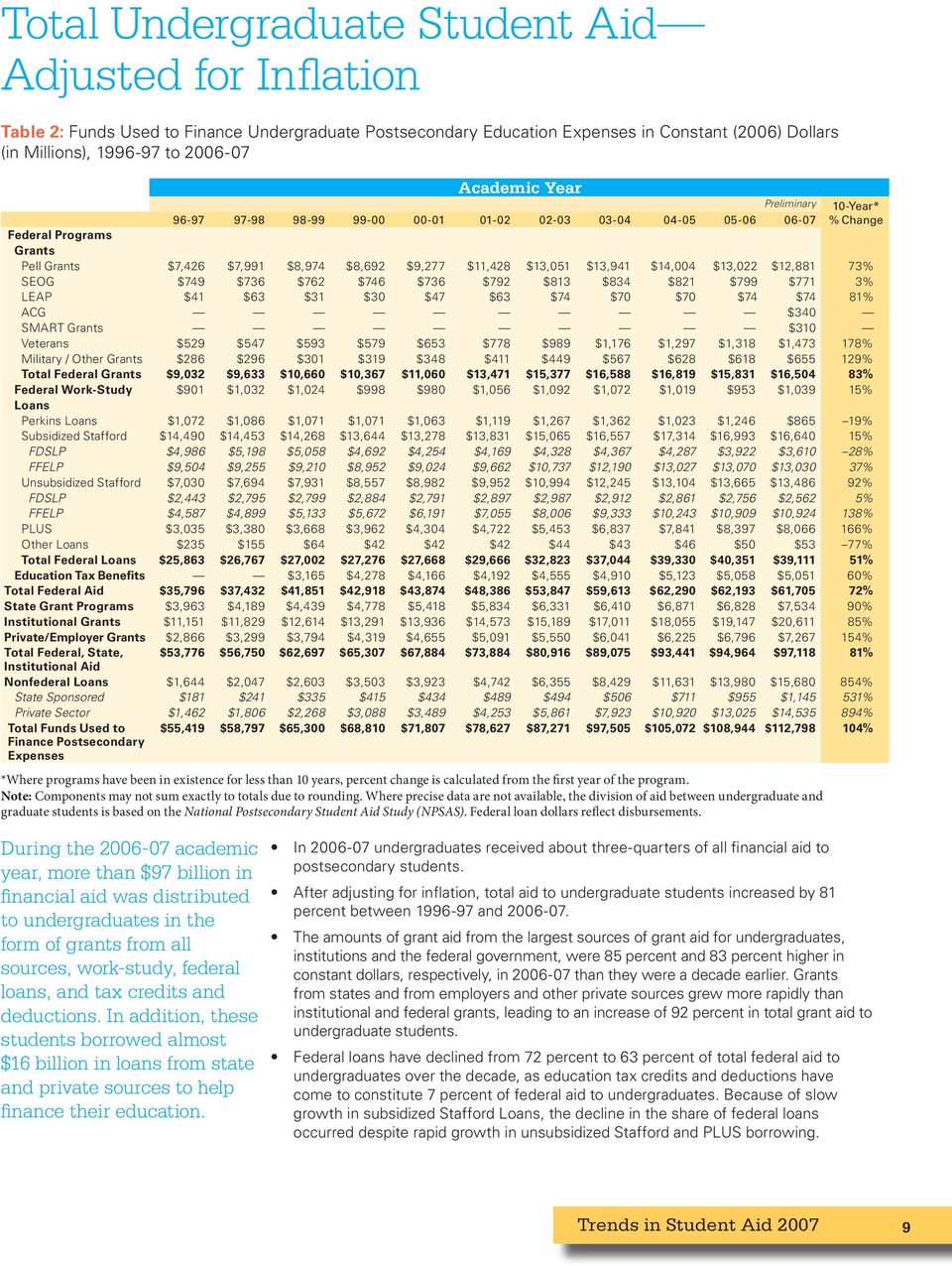
9 Total Undergraduate Student Aid Adjusted for Inflation Table 2: Funds Used to Finance Undergraduate Postsecondary Education Expenses in Constant (2006) Dollars (in Millions), to Preliminary 10-Year* % Change Federal Programs Grants Pell Grants $7,426 $7,991 $8,974 $8,692 $9,277 $11,428 $13,051 $13,941 $14,004 $13,022 $12,881 73% SEOG $749 $736 $762 $746 $736 $792 $813 $834 $821 $799 $771 3% LEAP $41 $63 $31 $30 $47 $63 $74 $70 $70 $74 $74 81% ACG $340 SMART Grants $310 Veterans $529 $547 $593 $579 $653 $778 $989 $1,176 $1,297 $1,318 $1, % Military / Other Grants $286 $296 $301 $319 $348 $411 $449 $567 $628 $618 $ % Total Federal Grants $9,032 $9,633 $10,660 $10,367 $11,060 $13,471 $15,377 $16,588 $16,819 $15,831 $16,504 83% Federal Work-Study $901 $1,032 $1,024 $998 $980 $1,056 $1,092 $1,072 $1,019 $953 $1,039 15% Loans Perkins Loans $1,072 $1,086 $1,071 $1,071 $1,063 $1,119 $1,267 $1,362 $1,023 $1,246 $865 19% Subsidized Stafford $14,490 $14,453 $14,268 $13,644 $13,278 $13,831 $15,065 $16,557 $17,314 $16,993 $16,640 15% FDSLP $4,986 $5,198 $5,058 $4,692 $4,254 $4,169 $4,328 $4,367 $4,287 $3,922 $3,610 28% FFELP $9,504 $9,255 $9,210 $8,952 $9,024 $9,662 $10,737 $12,190 $13,027 $13,070 $13,030 37% Unsubsidized Stafford $7,030 $7,694 $7,931 $8,557 $8,982 $9,952 $10,994 $12,245 $13,104 $13,665 $13,486 92% FDSLP $2,443 $2,795 $2,799 $2,884 $2,791 $2,897 $2,987 $2,912 $2,861 $2,756 $2,562 5% FFELP $4,587 $4,899 $5,133 $5,672 $6,191 $7,055 $8,006 $9,333 $10,243 $10,909 $10, % PLUS $3,035 $3,380 $3,668 $3,962 $4,304 $4,722 $5,453 $6,837 $7,841 $8,397 $8, % Other Loans $235 $155 $64 $42 $42 $42 $44 $43 $46 $50 $53 77% Total Federal Loans $25,863 $26,767 $27,002 $27,276 $27,668 $29,666 $32,823 $37,044 $39,330 $40,351 $39,111 51% Education Tax Benefits $3,165 $4,278 $4,166 $4,192 $4,555 $4,910 $5,123 $5,058 $5,051 60% Total Federal Aid $35,796 $37,432 $41,851 $42,918 $43,874 $48,386 $53,847 $59,613 $62,290 $62,193 $61,705 72% State Grant Programs $3,963 $4,189 $4,439 $4,778 $5,418 $5,834 $6,331 $6,410 $6,871 $6,828 $7,534 90% Institutional Grants $11,151 $11,829 $12,614 $13,291 $13,936 $14,573 $15,189 $17,011 $18,055 $19,147 $20,611 85% Private/Employer Grants $2,866 $3,299 $3,794 $4,319 $4,655 $5,091 $5,550 $6,041 $6,225 $6,796 $7, % Total Federal, State, $53,776 $56,750 $62,697 $65,307 $67,884 $73,884 $80,916 $89,075 $93,441 $94,964 $97,118 81% Institutional Aid Nonfederal Loans $1,644 $2,047 $2,603 $3,503 $3,923 $4,742 $6,355 $8,429 $11,631 $13,980 $15, % State Sponsored $181 $241 $335 $415 $434 $489 $494 $506 $711 $955 $1, % Private Sector $1,462 $1,806 $2,268 $3,088 $3,489 $4,253 $5,861 $7,923 $10,920 $13,025 $14, % Total Funds Used to Finance Postsecondary Expenses $55,419 $58,797 $65,300 $68,810 $71,807 $78,627 $87,271 $97,505 $105,072 $108,944 $112, % *Where programs have been in existence for less than 10 years, percent change is calculated from the first year of the program. Note: Components may not sum exactly to totals due to rounding. Where precise data are not available, the division of aid between undergraduate and graduate students is based on the National Postsecondary Student Aid Study (NPSAS). Federal loan dollars reflect disbursements. During the academic year, more than $97 billion in financial aid was distributed to undergraduates in the form of grants from all sources, work-study, federal loans, and tax credits and deductions. In addition, these students borrowed almost $16 billion in loans from state and private sources to help finance their education. In undergraduates received about three-quarters of all financial aid to postsecondary students. After adjusting for inflation, total aid to undergraduate students increased by 81 percent between and The amounts of grant aid from the largest sources of grant aid for undergraduates, institutions and the federal government, were 85 percent and 83 percent higher in constant dollars, respectively, in than they were a decade earlier. Grants from states and from employers and other private sources grew more rapidly than institutional and federal grants, leading to an increase of 92 percent in total grant aid to undergraduate students. Federal loans have declined from 72 percent to 63 percent of total federal aid to undergraduates over the decade, as education tax credits and deductions have come to constitute 7 percent of federal aid to undergraduates. Because of slow growth in subsidized Stafford Loans, the decline in the share of federal loans occurred despite rapid growth in unsubsidized Stafford and PLUS borrowing. Trends in Student Aid 2007
10 Federal Aid Recipients Table 3: Number of Recipients (in Thousands) and Aid per Recipient for Federal Grant, Campus-Based, and Education Tax Benefit Programs in Constant (2006) Dollars, to Pell Grants Preliminary Year* % Change Recipients (000) 3,666 3,733 3,855 3,764 3,899 4,341 4,779 5,140 5,308 5,168 5,165 41% Aid per Recipient (Constant $) $2,026 $2,141 $2,328 $2,310 $2,379 $2,633 $2,731 $2,712 $2,638 $2,520 $2,494 23% SEOG Recipients (000) 1,191 1,116 1,163 1,170 1,174 1,295 1,355 1,390 1,409 1,419 1,291 8% Aid per Recipient (Constant $) $629 $660 $655 $638 $627 $611 $600 $600 $583 $563 $597 5% ACG Recipients (000) 400 Aid per Recipient (Constant $) $850 SMART Grants Recipients (000) 80 Aid per Recipient (Constant $) $3,875 Federal Work-Study Recipients (000) % Aid per Recipient (Constant $) $1,443 $1,534 $1,524 $1,509 $1,536 $1,597 $1,621 $1,588 $1,559 $1,516 $1,335 7% Perkins Loans Recipients (000) % Aid per Recipient (Constant $) $1,947 $1,974 $1,986 $2,027 $2,087 $2,148 $2,246 $2,377 $2,349 $2,247 $2,208 13% Education Tax Benefits Recipients (000) 4,033 5,492 5,830 5,950 7,725 8,122 8,630 8,519 8, % Aid per Recipient (Constant $) $914 $907 $832 $820 $686 $704 $691 $691 $690 24% * Where programs have been in existence for less than 10 years, percent change is calculated from the first year of the program. Note: Education tax credit amounts equal the dollar value of the credits claimed on taxable returns; tax deduction amounts are estimated tax savings from deductions claimed on taxable returns. IRS data for are not yet available; values are estimated based on data from earlier years. The average Pell Grant increased 23 percent in inflation-adjusted dollars between and However, after increasing from $2,026 in to $2,731 in , the average grant per recipient had declined 9 percent in real terms to $2,494 by Between and , the number of Pell Grant recipients increased 41 percent, from 3.7 million to 5.2 million. Awarded for the first time in , Academic Competitiveness Grants (ACG) go to selected first- and second-year Pell Grant recipients who are U.S. citizens enrolled full-time in degree-granting programs. Eligibility is based on curricular and grade point average requirements. In the first year of the program, 400,000 students received awards averaging $850. Also awarded for the first time in , Science and Mathematics Access to Retain Talent (SMART) Grants go to third- and fourth-year Pell Grant recipients who are U.S. citizens enrolled full-time in degree-granting programs and majoring in physical, life, or computer science, engineering, mathematics, technology, or a specified foreign language. In the first year of the program, 80,000 students received awards averaging $3, Trends in Higher Education Series

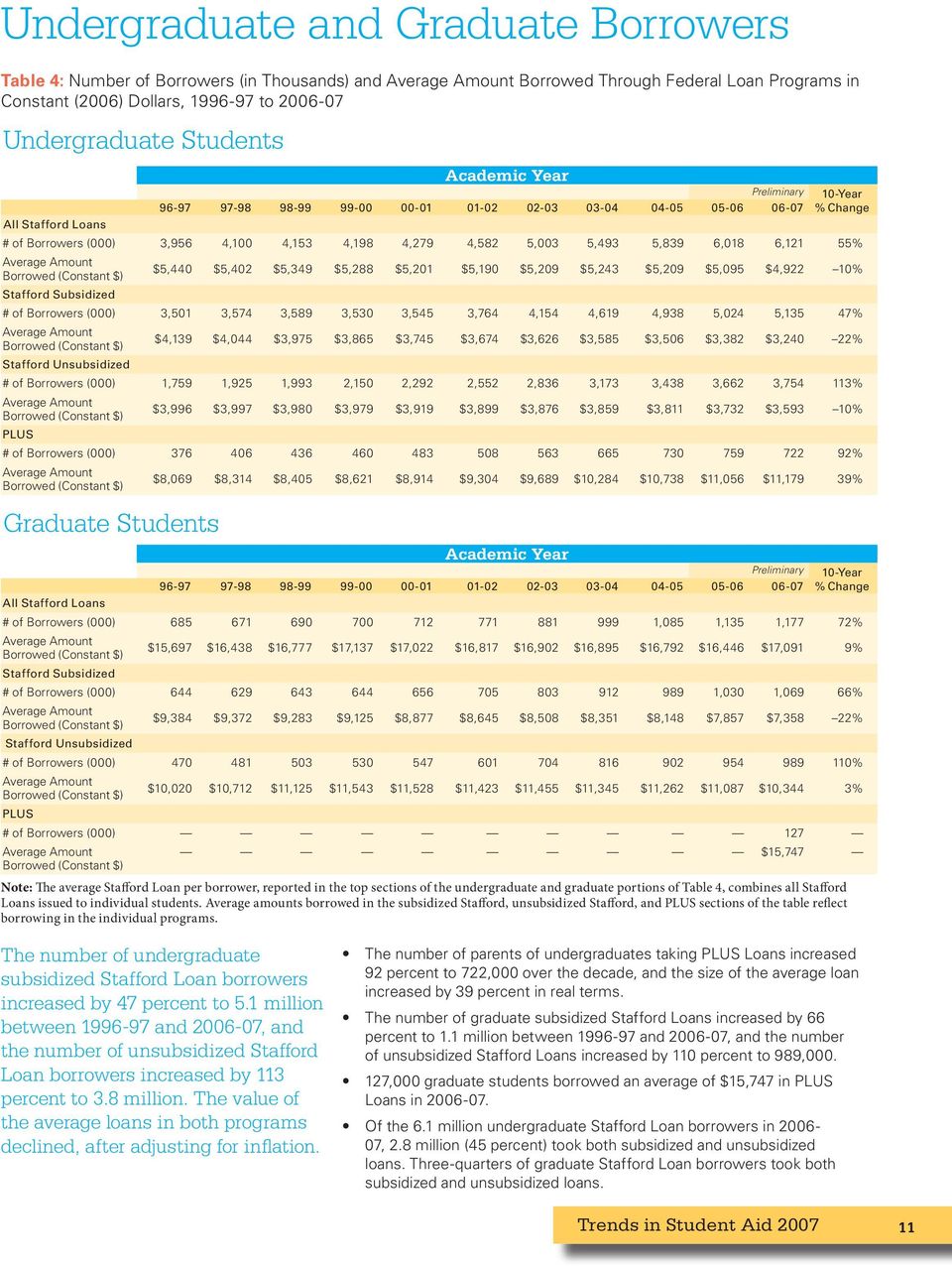
11 Undergraduate and Graduate Borrowers Table 4: Number of Borrowers (in Thousands) and Average Amount Borrowed Through Federal Loan Programs in Constant (2006) Dollars, to Undergraduate Students All Stafford Loans Preliminary Year % Change # of Borrowers (000) 3,956 4,100 4,153 4,198 4,279 4,582 5,003 5,493 5,839 6,018 6,121 55% Average Amount Borrowed (Constant $) Stafford Subsidized $5,440 $5,402 $5,349 $5,288 $5,201 $5,190 $5,209 $5,243 $5,209 $5,095 $4,922 10% # of Borrowers (000) 3,501 3,574 3,589 3,530 3,545 3,764 4,154 4,619 4,938 5,024 5,135 47% Average Amount Borrowed (Constant $) Stafford Unsubsidized $4,139 $4,044 $3,975 $3,865 $3,745 $3,674 $3,626 $3,585 $3,506 $3,382 $3,240 22% # of Borrowers (000) 1,759 1,925 1,993 2,150 2,292 2,552 2,836 3,173 3,438 3,662 3, % Average Amount Borrowed (Constant $) PLUS $3,996 $3,997 $3,980 $3,979 $3,919 $3,899 $3,876 $3,859 $3,811 $3,732 $3,593 10% # of Borrowers (000) % Average Amount Borrowed (Constant $) Graduate Students All Stafford Loans $8,069 $8,314 $8,405 $8,621 $8,914 $9,304 $9,689 $10,284 $10,738 $11,056 $11,179 39% Preliminary Year % Change # of Borrowers (000) ,085 1,135 1,177 72% Average Amount Borrowed (Constant $) Stafford Subsidized $15,697 $16,438 $16,777 $17,137 $17,022 $16,817 $16,902 $16,895 $16,792 $16,446 $17,091 9% # of Borrowers (000) ,030 1,069 66% Average Amount Borrowed (Constant $) Stafford Unsubsidized $9,384 $9,372 $9,283 $9,125 $8,877 $8,645 $8,508 $8,351 $8,148 $7,857 $7,358 22% # of Borrowers (000) % Average Amount Borrowed (Constant $) PLUS $10,020 $10,712 $11,125 $11,543 $11,528 $11,423 $11,455 $11,345 $11,262 $11,087 $10,344 3% # of Borrowers (000) 127 Average Amount Borrowed (Constant $) $15,747 Note: The average Stafford Loan per borrower, reported in the top sections of the undergraduate and graduate portions of Table 4, combines all Stafford Loans issued to individual students. Average amounts borrowed in the subsidized Stafford, unsubsidized Stafford, and PLUS sections of the table reflect borrowing in the individual programs. The number of undergraduate subsidized Stafford Loan borrowers increased by 47 percent to 5.1 million between and , and the number of unsubsidized Stafford Loan borrowers increased by 113 percent to 3.8 million. The value of the average loans in both programs declined, after adjusting for inflation. The number of parents of undergraduates taking PLUS Loans increased 92 percent to 722,000 over the decade, and the size of the average loan increased by 39 percent in real terms. The number of graduate subsidized Stafford Loans increased by 66 percent to 1.1 million between and , and the number of unsubsidized Stafford Loans increased by 110 percent to 989, ,000 graduate students borrowed an average of $15,747 in PLUS Loans in Of the 6.1 million undergraduate Stafford Loan borrowers in , 2.8 million (45 percent) took both subsidized and unsubsidized loans. Three-quarters of graduate Stafford Loan borrowers took both subsidized and unsubsidized loans. Trends in Student Aid
12 Types of Grants and Loans Figure 3a: Growth of Federal, Institutional, and State Grant Dollars in Constant (2006) Dollars (in Billions), to $80 Grants in Billions (2006 Dollars) $70 $60 $50 $40 $30 $20 $10 $0 12% 13% 44% 32% % 13% 44% 31% % 14% 43% 31% % 15% 44% 29% % 12% 13% 15% 15% 15% 38% 43% 40% 29% 32% 34% % 15% 39% 34% % 15% 39% 34% % 16% 41% 31% % 16% 41% 31% STATE GRANTS PRIVATE AND EMPLOYER GRANTS INSTITUTIONAL GRANTS FEDERAL GRANTS Figure 3b: Growth of Stafford, PLUS, and Nonfederal Loan Dollars in Constant (2006) Dollars (in Billions), to $80 Loans in Billions (2006 Dollars) $70 $60 $50 $40 $30 $20 $10 $0 6% 7% 8% 9% 31% 33% 54% 52% % 9% 33% 49% % 9% 34% 45% % 10% 35% 43% 13% 10% 35% 42% 16% 10% 35% 40% % 11% 34% 38% % 11% 33% 36% % 11% 32% 33% % 13% 31% 32% NONFEDERAL LOANS PLUS LOANS UNSUBSIDIZED STAFFORD LOANS SUBSIDIZED STAFFORD LOANS Note: Components may not sum to 100 percent due to rounding. In , 32 percent of the $34 billion (in 2006 dollars) in grant aid to undergraduate and graduate students came from the federal government. A decade later, 31 percent of the $64 billion in grant aid was federal. In , 93 percent of the $38 billion (in 2006 dollars) in loans to undergraduate and graduate students came from the federal government. A decade later, 76 percent of the $77 billion in education loans was federal. Throughout the decade, students have relied more heavily on institutional grant aid than on federal grant aid and have received more grant dollars from employers and other private sources than from state governments. Subsidized Stafford Loans, which are based on financial need and on which the government pays the interest while students are in school, declined from 54 percent of total education loans in to 32 percent in The volume of these loans was 75 percent higher than the volume of unsubsidized Stafford Loans in , but only 3 percent higher in Nonfederal loans, which are not part of the student aid system, constituted 24 percent of education loans in Credit card debt and home equity loans used to finance higher education are not included in these figures. 12 Trends in Higher Education Series

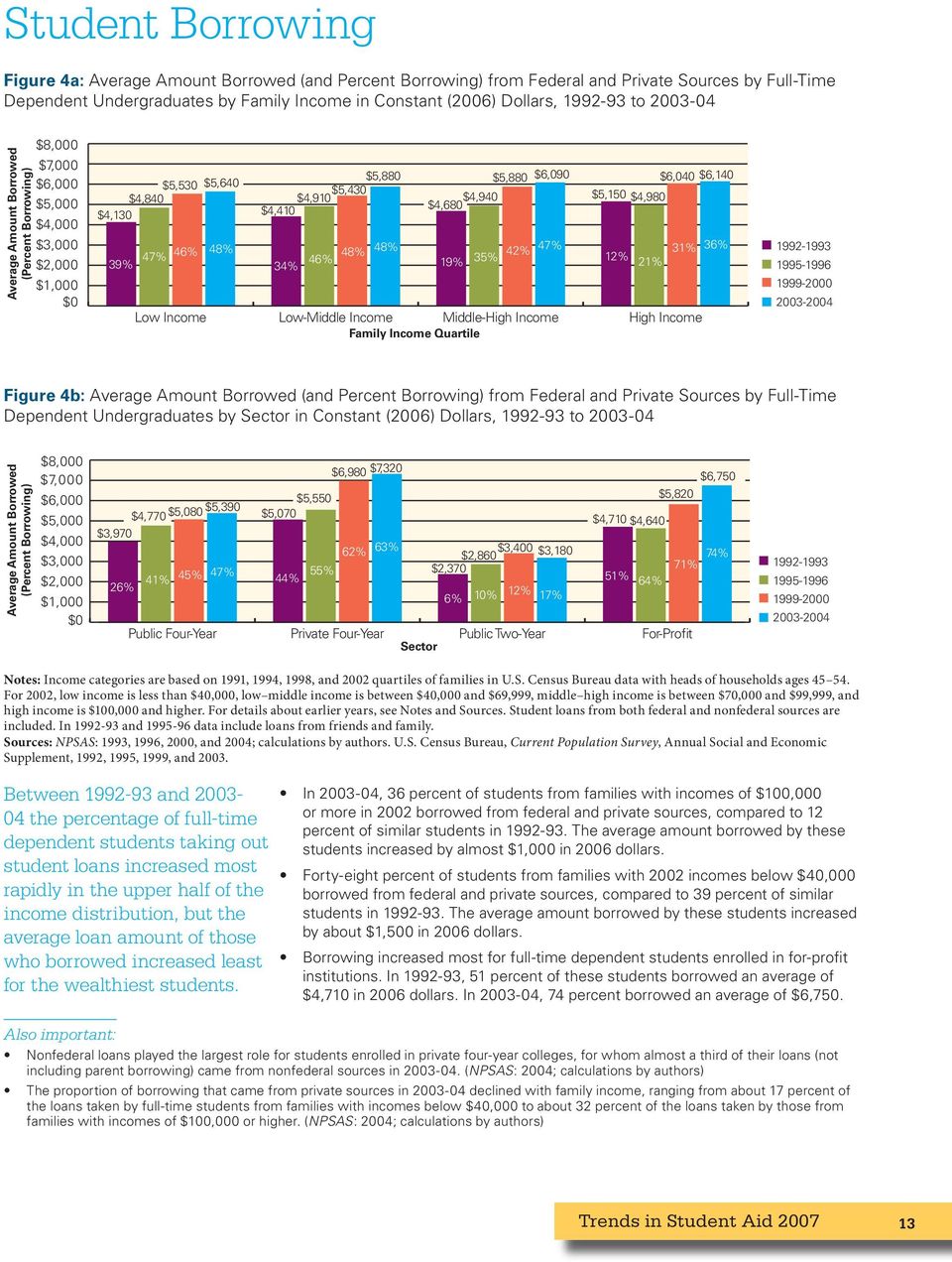
13 Student Borrowing Figure 4a: Average Amount Borrowed (and Percent Borrowing) from Federal and Private Sources by Full-Time Dependent Undergraduates by Family Income in Constant (2006) Dollars, to Average Amount Borrowed (Percent Borrowing) $8,000 $7,000 $6,000 $5,000 $4,000 $3,000 $2,000 $1,000 $0 $5,530 $5,640 $4,840 $4,130 48% 42% 39% 46% 48% 48% 47% 47% 46% 31% 36% 34% 19% 35% 12% 21% Low Income $5,880 $4,910 $5,430 $4,410 $4,680 $4,940 Low-Middle Income Middle-High Income Family Income Quartile $5,880 $6,090 $5,150 $4,980 $6,040 $6,140 High Income Figure 4b: Average Amount Borrowed (and Percent Borrowing) from Federal and Private Sources by Full-Time Dependent Undergraduates by Sector in Constant (2006) Dollars, to Average Amount Borrowed (Percent Borrowing) $8,000 $7,000 $6,000 $5,000 $4,000 $3,000 $2,000 $1,000 $0 Public Four-Year $6,980 $7,320 $5,550 $5,820 $4,770 $5,080 $5,390 $5,070 $4,710 $4,640 $3,970 62% 63% $2,860 $3,400 $3,180 74% 47% 55% 41% 45% $2,370 71% 44% 51% 64% 26% 12% 6% 10% 17% Private Four-Year Sector Public Two-Year For-Profit $6, Notes: Income categories are based on 1991, 1994, 1998, and 2002 quartiles of families in U.S. Census Bureau data with heads of households ages For 2002, low income is less than $40,000, low middle income is between $40,000 and $69,999, middle high income is between $70,000 and $99,999, and high income is $100,000 and higher. For details about earlier years, see Notes and Sources. Student loans from both federal and nonfederal sources are included. In and data include loans from friends and family. Sources: NPSAS: 1993, 1996, 2000, and 2004; calculations by authors. U.S. Census Bureau, Current Population Survey, Annual Social and Economic Supplement, 1992, 1995, 1999, and Between and the percentage of full-time dependent students taking out student loans increased most rapidly in the upper half of the income distribution, but the average loan amount of those who borrowed increased least for the wealthiest students. In , 36 percent of students from families with incomes of $100,000 or more in 2002 borrowed from federal and private sources, compared to 12 percent of similar students in The average amount borrowed by these students increased by almost $1,000 in 2006 dollars. Forty-eight percent of students from families with 2002 incomes below $40,000 borrowed from federal and private sources, compared to 39 percent of similar students in The average amount borrowed by these students increased by about $1,500 in 2006 dollars. Borrowing increased most for full-time dependent students enrolled in for-profit institutions. In , 51 percent of these students borrowed an average of $4,710 in 2006 dollars. In , 74 percent borrowed an average of $6,750. Also important: Nonfederal loans played the largest role for students enrolled in private four-year colleges, for whom almost a third of their loans (not including parent borrowing) came from nonfederal sources in (NPSAS: 2004; calculations by authors) The proportion of borrowing that came from private sources in declined with family income, ranging from about 17 percent of the loans taken by full-time students from families with incomes below $40,000 to about 32 percent of the loans taken by those from families with incomes of $100,000 or higher. (NPSAS: 2004; calculations by authors) Trends in Student Aid
14 Distribution of Federal Aid by Sector Table 5: Distribution of Federal Aid Funds by Sector, to Year Pell Grants % Change Public Two-Year 32.7 % 33.0% 32.8% 32.4% 33.4% 33.7% 35.0% 34.7% 32.8% 32.4% 33.6% 0.9 Public Four-Year 36.0 % 36.0% 36.4% 36.4% 34.8% 34.4% 33.0% 33.0% 34.0% 33.6% 31.6% 4.3 Private Nonprofit 18.8 % 18.5% 18.6% 18.6% 18.6% 18.3% 17.9% 16.9% 16.7% 16.3% 16.1% 2.7 For-Profit 12.5 % 12.5% 12.2% 12.5% 13.1% 13.6% 14.2% 15.4% 16.5% 17.7% 18.6% 6.1 Campus-Based Aid Programs Public Two-Year 9.6 % 9.8% 9.9% 9.9% 9.8% 9.8% 9.8% 9.0% 8.5% 8.6% 8.7% 0.8 Public Four-Year 40.9 % 41.1% 40.7% 40.5% 40.3% 40.1% 39.4% 40.1% 39.4% 38.6% 38.9% 2.0 Private Nonprofit 45.6 % 45.1% 45.5% 45.5% 45.7% 45.9% 46.0% 45.7% 46.5% 46.7% 45.9% 0.4 For-Profit 4.0 % 4.1% 3.9% 4.0% 4.2% 4.2% 4.8% 5.3% 5.6% 6.1% 6.5% 2.5 Stafford Subsidized Loans Public Two-Year 5.4 % 5.4% 5.4% 5.2% 5.1% 5.0% 5.4% 5.9% 6.3% 6.6% 6.7% 1.3 Public Four-Year 48.5 % 48.7% 48.5% 48.0% 47.0% 45.9% 45.0% 44.4% 43.9% 43.3% 42.6% 5.9 Private Nonprofit 38.9 % 38.1% 38.4% 38.2% 38.4% 38.4% 37.6% 36.6% 35.2% 34.1% 33.7% 5.2 For-Profit 7.2 % 7.8% 7.7% 8.6% 9.5% 10.7% 12.0% 13.1% 14.6% 16.0% 17.0% 9.8 Stafford Unsubsidized Loans Public Two-Year 4.8 % 4.7% 4.7% 4.3% 4.1% 4.1% 4.5% 5.1% 5.6% 5.9% 6.0% 1.2 Public Four-Year 42.7 % 43.3% 43.4% 42.7% 42.9% 42.2% 41.8% 40.8% 40.1% 39.4% 39.2% 3.5 Private Nonprofit 42.3 % 41.5% 41.9% 42.0% 41.3% 41.0% 39.7% 38.7% 36.9% 35.8% 35.1% 7.2 For-Profit 10.2 % 10.5% 10.0% 11.0% 11.7% 12.7% 14.0% 15.4% 17.4% 18.9% 19.7% 9.5 PLUS Loans Public Two-Year 0.9 % 0.9% 0.9% 0.9% 0.8% 0.7% 0.8% 0.8% 0.9% 1.0% 1.0% 0.1 Public Four-Year 37.7 % 37.9% 38.2% 39.2% 38.4% 37.5% 37.5% 38.7% 39.5% 39.3% 39.8% 2.1 Private Nonprofit 50.3 % 49.9% 49.1% 47.0% 46.1% 45.9% 44.7% 43.9% 43.2% 43.1% 43.6% 6.7 For-Profit 11.1 % 11.3% 11.8% 12.9% 14.7% 15.9% 17.0% 16.6% 16.4% 16.6% 15.6% 4.5 Note: Components may not sum to 100 percent due to rounding. Figure 5: Distribution of Federal Aid Funds by Sector, Pell Grants Campus-Based Aid 34% 32% 16% 19% 9% 39% 46% 7% Subsidized Stafford 7% 43% 34% 17% PUBLIC TWO-YEAR Unsubsidized Stafford 6% 39% 35% 20% PUBLIC FOUR-YEAR PRIVATE NONPROFIT PLUS Loans 1% 40% 44% 16% FOR-PROFIT 0% 20% 40% 60% 80% 100% Percentage of Aid In , the 7 percent of students enrolled in for-profit institutions received a disproportionate amount of aid from all federal programs, with the exception of campus-based programs. The only federal student aid program from which two-year public college students receive a significant share of the dollars is the Pell Grant program. Private nonprofit institutions, with 19 percent of undergraduate enrollments, distribute 46 percent of federal campus-based aid, which includes Supplemental Educational Opportunity Grants (SEOG), Federal Work- Study, and Perkins Loans. Distribution of Full-Time Equivalent (FTE) Enrollment, Fall 2005 Sector % of Undergraduate FTE % of Total FTE Public Two-Year 32% 28% Public Four-Year 42% 43% Private Four-Year 19% 22% For-Profit 7% 7% Note: Full-time equivalent enrollment is based on a formula that counts approximately three part-time students as one full-time student. Total FTE includes both undergraduate and graduate students. 14 Trends in Higher Education Series

15 Total Funding by Type Table 6: Total Funds for Undergraduate and Graduate Students in Constant (2006) Dollars (in Millions) and As a Percentage of Total Aid, Five-Year Intervals, to All Students (Constant 2006 Dollars) All Students (Percentage) Grants $28,485 $33,789 $48,311 $63,863 57% 46% 47% 43% Loans $19,936 $39,373 $49,402 $78,083 40% 53% 48% 52% Work-Study $1,122 $997 $1,182 $1,175 2% 1% 1% 1% Education Tax Benefits $4,880 $5,880 0% 0% 5% 4% Total $49,543 $74,160 $103,776 $149,001 Undergraduate Students (Percentage) Graduate Students (Percentage) Grants 63% 49% 50% 46% 39% 36% 37% 33% Loans 35% 50% 44% 49% 60% 63% 60% 64% Work-Study 3% 2% 1% 1% 1% 1% 1% 0% Education Tax Benefits 0% 0% 5% 4% 0% 0% 3% 2% Note: Components may not sum to 100 percent due to rounding. Graduate student aid does not include teaching and research assistantships. Nonfederal loans are included in the loan amounts reported in Table 6. Figure 6: Grants and Loans As a Percentage of Total Aid, to % Undergraduate Students 90% Graduate Students 80% 80% 70% 70% Loans 64% Percentage of Total Aid 60% 50% 40% 30% Loans 49% Grants 46% Percentage of Total Aid 60% 50% 40% 30% Grants 33% 20% 20% 10% 10% 0% % In , undergraduate students received 46 percent of their funding in the form of grants and 49 percent in the form of loans, including alternative nonfederal loans. The proportions for graduate students were 33 percent grants and 64 percent loans. The ratio of grants to loans for undergraduates declined in the early 1990s with the implementation of the unsubsidized Stafford Loan program. The proportion of aid in the form of grants held steady from through , with the proportion in loans declining with the implementation of the federal education tax credit in After declining from 49 percent in to 45 percent in , the grant share rose slightly to 46 percent for undergraduates in Graduate students, who comprise about 13 percent of full-time equivalent enrollments in postsecondary institutions, received 19 percent of all grant aid in and borrowed 30 percent of education loan funds. Trends in Student Aid

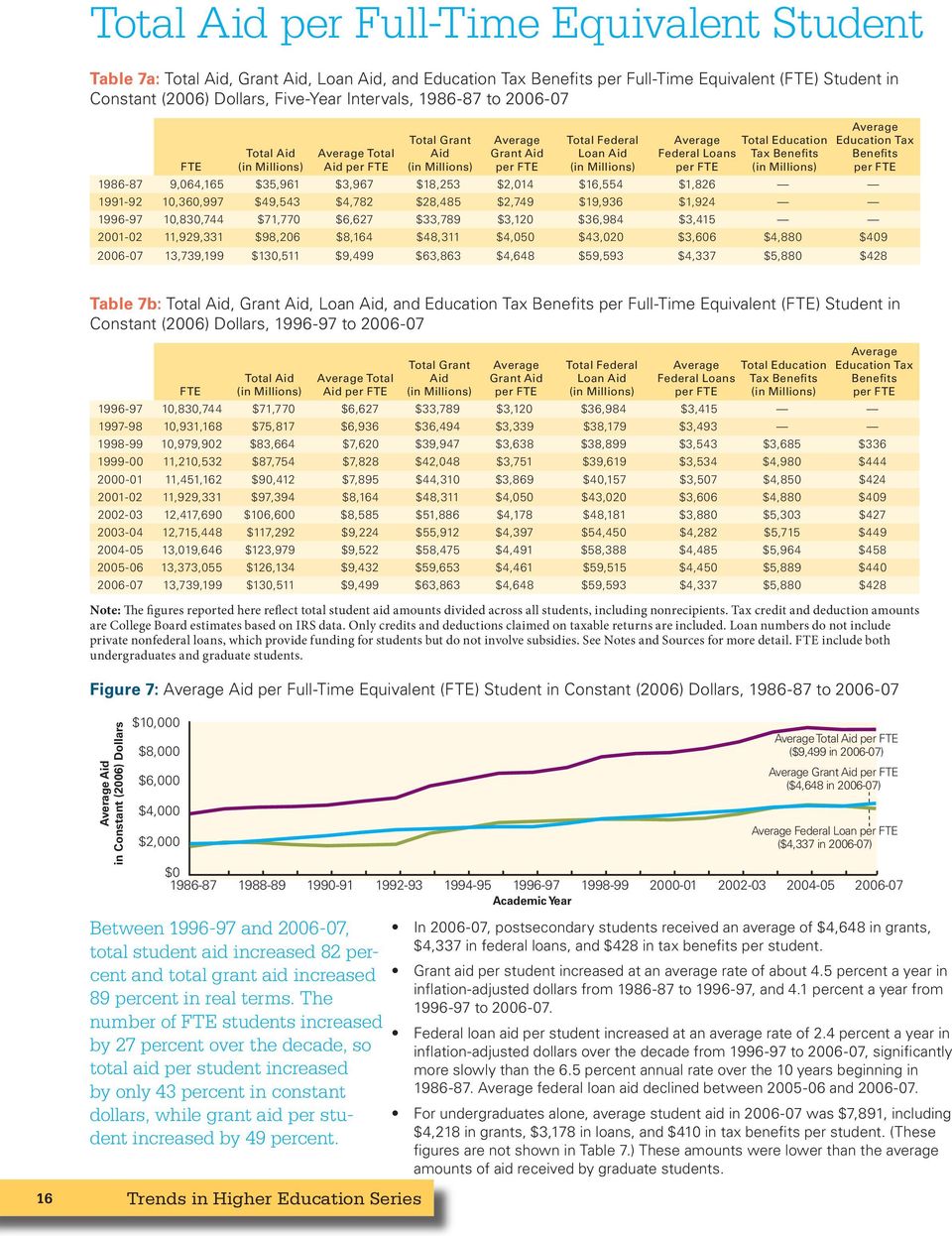
16 Total Aid per Full-Time Equivalent Student Table 7a: Total Aid, Grant Aid, Loan Aid, and Education Tax Benefits per Full-Time Equivalent (FTE) Student in Constant (2006) Dollars, Five-Year Intervals, to FTE Total Aid (in Millions) Average Total Aid per FTE Total Grant Aid (in Millions) Average Grant Aid per FTE Total Federal Loan Aid (in Millions) Average Federal Loans per FTE Total Education Tax Benefits (in Millions) Average Education Tax Benefits per FTE ,064,165 $35,961 $3,967 $18,253 $2,014 $16,554 $1, ,360,997 $49,543 $4,782 $28,485 $2,749 $19,936 $1, ,830,744 $71,770 $6,627 $33,789 $3,120 $36,984 $3, ,929,331 $98,206 $8,164 $48,311 $4,050 $43,020 $3,606 $4,880 $ ,739,199 $130,511 $9,499 $63,863 $4,648 $59,593 $4,337 $5,880 $428 Table 7b: Total Aid, Grant Aid, Loan Aid, and Education Tax Benefits per Full-Time Equivalent (FTE) Student in Constant (2006) Dollars, to FTE Total Aid (in Millions) Average Total Aid per FTE 16 Trends in Higher Education Series Total Grant Aid (in Millions) Average Grant Aid per FTE Total Federal Loan Aid (in Millions) Average Federal Loans per FTE Total Education Tax Benefits (in Millions) Average Education Tax Benefits per FTE ,830,744 $71,770 $6,627 $33,789 $3,120 $36,984 $3, ,931,168 $75,817 $6,936 $36,494 $3,339 $38,179 $3, ,979,902 $83,664 $7,620 $39,947 $3,638 $38,899 $3,543 $3,685 $ ,210,532 $87,754 $7,828 $42,048 $3,751 $39,619 $3,534 $4,980 $ ,451,162 $90,412 $7,895 $44,310 $3,869 $40,157 $3,507 $4,850 $ ,929,331 $97,394 $8,164 $48,311 $4,050 $43,020 $3,606 $4,880 $ ,417,690 $106,600 $8,585 $51,886 $4,178 $48,181 $3,880 $5,303 $ ,715,448 $117,292 $9,224 $55,912 $4,397 $54,450 $4,282 $5,715 $ ,019,646 $123,979 $9,522 $58,475 $4,491 $58,388 $4,485 $5,964 $ ,373,055 $126,134 $9,432 $59,653 $4,461 $59,515 $4,450 $5,889 $ ,739,199 $130,511 $9,499 $63,863 $4,648 $59,593 $4,337 $5,880 $428 Note: The figures reported here reflect total student aid amounts divided across all students, including nonrecipients. Tax credit and deduction amounts are College Board estimates based on IRS data. Only credits and deductions claimed on taxable returns are included. Loan numbers do not include private nonfederal loans, which provide funding for students but do not involve subsidies. See Notes and Sources for more detail. FTE include both undergraduates and graduate students. Figure 7: Average Aid per Full-Time Equivalent (FTE) Student in Constant (2006) Dollars, to Average Aid in Constant (2006) Dollars $10,000 $8,000 $6,000 $4,000 $2,000 $ Between and , total student aid increased 82 percent and total grant aid increased 89 percent in real terms. The number of FTE students increased by 27 percent over the decade, so total aid per student increased by only 43 percent in constant dollars, while grant aid per student increased by 49 percent Average Total Aid per FTE ($9,499 in ) Average Grant Aid per FTE ($4,648 in ) Average Federal Loan per FTE ($4,337 in ) In , postsecondary students received an average of $4,648 in grants, $4,337 in federal loans, and $428 in tax benefits per student. Grant aid per student increased at an average rate of about 4.5 percent a year in inflation-adjusted dollars from to , and 4.1 percent a year from to Federal loan aid per student increased at an average rate of 2.4 percent a year in inflation-adjusted dollars over the decade from to , significantly more slowly than the 6.5 percent annual rate over the 10 years beginning in Average federal loan aid declined between and For undergraduates alone, average student aid in was $7,891, including $4,218 in grants, $3,178 in loans, and $410 in tax benefits per student. (These figures are not shown in Table 7.) These amounts were lower than the average amounts of aid received by graduate students.
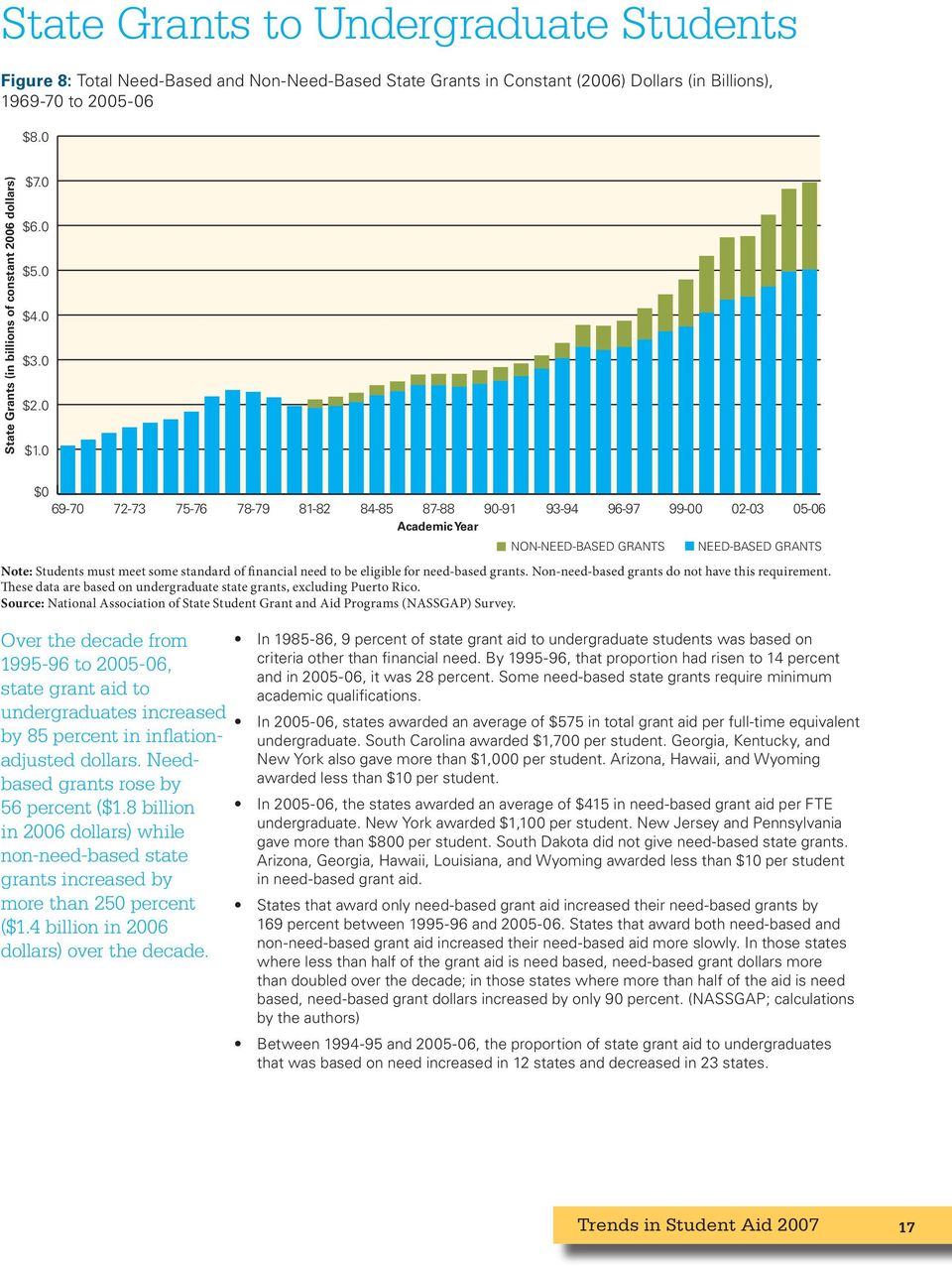
17 State Grants to Undergraduate Students Figure 8: Total Need-Based and Non-Need-Based State Grants in Constant (2006) Dollars (in Billions), to $8.0 State Grants (in billions of constant 2006 dollars) $7.0 $6.0 $5.0 $4.0 $3.0 $2.0 $1.0 $ NON-NEED-BASED GRANTS NEED-BASED GRANTS Note: Students must meet some standard of financial need to be eligible for need-based grants. Non-need-based grants do not have this requirement. These data are based on undergraduate state grants, excluding Puerto Rico. Source: National Association of State Student Grant and Aid Programs (NASSGAP) Survey. Over the decade from to , state grant aid to undergraduates increased by 85 percent in inflationadjusted dollars. Needbased grants rose by 56 percent ($1.8 billion in 2006 dollars) while non-need-based state grants increased by more than 250 percent ($1.4 billion in 2006 dollars) over the decade. In , 9 percent of state grant aid to undergraduate students was based on criteria other than financial need. By , that proportion had risen to 14 percent and in , it was 28 percent. Some need-based state grants require minimum academic qualifications. In , states awarded an average of $575 in total grant aid per full-time equivalent undergraduate. South Carolina awarded $1,700 per student. Georgia, Kentucky, and New York also gave more than $1,000 per student. Arizona, Hawaii, and Wyoming awarded less than $10 per student. In , the states awarded an average of $415 in need-based grant aid per FTE undergraduate. New York awarded $1,100 per student. New Jersey and Pennsylvania gave more than $800 per student. South Dakota did not give need-based state grants. Arizona, Georgia, Hawaii, Louisiana, and Wyoming awarded less than $10 per student in need-based grant aid. States that award only need-based grant aid increased their need-based grants by 169 percent between and States that award both need-based and non-need-based grant aid increased their need-based aid more slowly. In those states where less than half of the grant aid is need based, need-based grant dollars more than doubled over the decade; in those states where more than half of the aid is need based, need-based grant dollars increased by only 90 percent. (NASSGAP; calculations by the authors) Between and , the proportion of state grant aid to undergraduates that was based on need increased in 12 states and decreased in 23 states. Trends in Student Aid
18 Pell Grants Table 8a: Federal Pell Grant Awards in Current and Constant (2006) Dollars, Five-Year Intervals, to Expenditures (in Millions) Actual Maximum Awards Actual Minimum Awards Maximum Number of Percent of Percent of Recipients Recipients Current Constant Current Constant Current Constant Costs (in Thousands) Independent $1,475 $5,132 $1,400 $4,870 $200 $696 50% 1, % $2,300 $4,989 $1,670 $3,623 $120 $260 50% 2, % $3,460 $6,349 $2,100 $3,854 $100 $184 60% 2, % $5,793 $8,557 $2,400 $3,545 $200 $295 60% 3, % $5,780 $7,426 $2,470 $3,173 $400 $514 3, % $9,975 $11,428 $3,750 $4,296 $400 $458 4, % $12,881 $12,881 $4,050 $4,050 $400 $400 5, % Table 8b: Federal Pell Grant Awards in Current and Constant (2006) Dollars, to Expenditures (in Millions) Actual Maximum Awards Actual Minimum Awards Maximum Percent of Number of Recipients Current Constant Current Constant Current Constant Costs (in Thousands) Percent of Recipients Independent $5,780 $7,426 $2,470 $3,173 $400 $514 3, % $6,331 $7,991 $2,700 $3,408 $400 $505 3, % $7,233 $8,974 $3,000 $3,722 $400 $496 3, % $7,208 $8,692 $3,125 $3,768 $400 $482 3, % $7,956 $9,277 $3,300 $3,848 $400 $466 3, % $9,975 $11,428 $3,750 $4,296 $400 $458 4, % $11,642 $13,051 $4,000 $4,484 $400 $448 4, % $12,708 $13,941 $4,050 $4,443 $400 $439 5, % $13,150 $14,004 $4,050 $4,313 $400 $426 5, % $12,693 $13,022 $4,050 $4,155 $400 $410 5, % $12,881 $12,881 $4,050 $4,050 $400 $400 5, % Note: Until 1980, individual Pell Grants were capped at 50 percent of the student s cost of attendance. The cap was raised to 60 percent of the cost of attendance in 1980 and removed entirely in The maximum Pell Grant was $4,050 from through However, it has been increased to $4,310 for The maximum Pell Grant covers about 32 percent of average total tuition and fees and room and board at public four-year colleges and universities, and 13 percent at the average private four-year institution. In , the maximum Pell Grant covered 52 percent of average tuition and fees and room and board at public four-year colleges and universities, and 21 percent at the average private four-year institution. These figures had declined to 35 percent and 13 percent, respectively, by By , the maximum Pell Grant had declined to 80 percent of its value. It peaked at 116 percent of the value in In , the maximum Pell Grant was 5 percent higher in inflation-adjusted dollars than it had been 20 years earlier. Figure 9a: Maximum Pell Grant As a Percentage of Tuition and Fees and Room and Board, to % Percentage of TFRB 50% 40% 30% 20% 10% 0% Public Four-Year Private Four-Year Trends in Higher Education Series

19 Pell Grants Figure 9b: Total Pell Expenditures (in Millions), Maximum Pell Grant, and Average Pell Grant in Constant (2006) Dollars, and Number of Recipients (in Thousands), to Figure 9c: Distribution of Pell Grant Recipients by Age, Constant (2006) Dollars $16,000 $14,000 $12,000 $10,000 $8,000 Total Expenditures (in Millions) $6,000 Number Of Pell Recipients (in Thousands) $4,000 Maximum Pell Grant $2,000 Average Pell Grant Per Recipient $ ,000 7,000 6,000 5,000 4,000 3,000 2,000 1,000 Number of Recipients Age Age Age 51 and Older Age % 6% 14% 32% 15% 32% Age Age 20 and Younger 40% Figure 9d: Distribution of Pell Grant Recipients by Family Income and Dependency Status, Percentage of Pell Recipients 60% 50% 40% 30% 20% 10% 0% 40% 41% $20,000 or less 27% $20,001 $30,000 19% $30,001 $40,000 9% $40,001 $50,000 $50,001 or more Dependent Independent Undergraduates Undergraduates 2004 Family Income of Dependent Students Dependency 4% 59% Note: Components may not sum to 100 percent due to rounding. Source: Figure 9b is based on Table 8a. Figure 9c and 9d data are from the Federal Pell Grant Program End-of-Year Report, Among dependent Pell Grant recipients in , two-thirds came from families with incomes below $30,000. The number of Pell Grant recipients grew 19 percent from to , and by another 18 percent from to Total Pell expenditures grew by 54 percent in inflation-adjusted dollars over the first five-year period, but by only 13 percent over the second five years. The average Pell Grant of $2,494 was at its lowest level, after adjusting for inflation, since In the value of the average Pell Grant was $2,387 in 2006 dollars. It had declined to $2,026 by , but increased to $2,731 by The average Pell Grant declined in real terms in each of the four following years, reaching $2,494 in In , 37 percent of Pell Grant recipients were age 26 or older. Fifty-nine percent of Pell Grant recipients were independent and qualified for student aid based on their own financial circumstances, while 41 percent were dependent on their parents. Independent students received 57 percent of the Pell Grant funds (Federal Pell Grant Program End-of-Year Report, , Table 19). Trends in Student Aid

20 Institutional Grants: Private Institutions Figure 10a: Average Institutional, and Federal and State Grants per Full-Time Dependent Student at Private Four-Year Colleges and Universities by Family Income Quartile, Grouped by Admissions Selectivity, in Constant (2006) Dollars, Grants and Net Cost of Attendance $40,000 $35,000 $30,000 $25,000 $20,000 $15,000 $10,000 $5,000 $0 $30,306 $19,738 $3,333 $7,234 Very Selective $33,340 $34,136 $24,448 $26,869 $1,067 $7,825 $422 $6,845 $35,499 $30,922 $190 $4,387 Low Middle High Income Income Low Middle High Income Income Family Income Quartile TF $4,161 $5,328 Moderately Selective $24,103 $24,701 $25,439 $14,614 $17,059 $19,016 $1,775 $5,867 $543 $5,880 $26,633 $21,579 $223 $4,831 Low Middle High Income Income Low Middle High Income Income Family Income Quartile TF $20,571 $13,989 Minimally Selective and Open Admissions $22,477 $17,790 $23,558 $19,229 $25,133 $22,020 $3,930 $1,109 $538 $132 $2,652 $3,578 $3,792 $2,981 Low Income Middle High Income Low Middle Income High Income Family Income Quartile TF TUITION AND FEES (TF) NET COST OF ATTENDANCE FEDERAL AND STATE GRANTS INSTITUTIONAL GRANTS Notes: Selectivity is defined according to an index developed by NCES based on average SAT/ACT scores and percentage of applicants accepted. Income categories are based on 2002 quartiles of families in U.S. Census Bureau data with heads of households ages Low income is less than $40,000, low middle income is between $40,000 and $69,999, middle high income is between $70,000 and $99,999, and high income is $100,000 and higher. Sources: NPSAS: 2004; U.S. Census Bureau, Current Population Survey, Annual Social and Economic Supplement, 2003; calculations by authors. Net cost of attendance is the total student budget, including tuition and fees, room and board, and other living expenses less all grant aid. The dotted line on each bar corresponds to the average published tuition and fees for students in the specified income bracket in the type of institution described. Institutional grants cover over one-third of tuition and fees for students from families in the lower half of the income distribution at very selective and moderately selective private institutions. Within each level of institutional selectivity, affluent students attend colleges with higher published levels of tuition and fees than those attended by lower-income students. However, institutional grant aid allows lower-income students to pay a significantly lower net price than wealthier students pay. The distribution of institutional aid favors low-income students most at very selective institutions, where in only about 22 percent of dependent students were from families with incomes below $40,000 and 37 percent were from families with incomes of $100,000 or higher. At the least-selective private four-year colleges, where in , 42 percent of the dependent students were from families with incomes below $40,000 and only 17 percent were from families with incomes of $100,000 or higher, lower-income students received less institutional grant aid, on average, than did wealthier students. However, because of federal and state grant aid, net prices paid increased with income. Income Distribution of Families Within Private Colleges and Universities by Admissions Selectivity, Percentage of Enrolled Students 50% 40% 30% 20% 10% 0% 22% 20% 22% Very Selective 37% 27% 27% 23% 23% 24% 17% 17% Moderately Selective Admissions Selectivity Note: Components may not sum to 100 percent due to rounding. 42% Minimally Selective LOW INCOME LOW MIDDLE INCOME MIDDLE HIGH INCOME HIGH INCOME High Income Middle-High Inco Low-Middle Inco Low Income 20 Trends in Higher Education Series

21 Institutional Grants: Public Institutions Figure 10b: Average Institutional, and Federal and State Grants per Full-Time Dependent Student at Public Four-Year Colleges and Universities by Family Income Quartile in Constant (2006) Dollars, Figure 10c: Average Institutional, and Federal and State Grants per Full-Time Dependent Student at Public Two-Year Colleges by Family Income Quartile in Constant (2006) Dollars, Grants and Net Cost of Attendance $16,000 $14,000 $12,000 $10,000 $8,000 $6,000 $4,000 $3,197 $2,000 $1,108 $0 Low Income $13,671 $13,966 $9,366 $12,488 $690 $788 $856 Middle High Income Low Middle Income $14,676 $13,498 $322 Family Income Quartile $15,226 $14,321 $228 $677 High Income TF Grants and Net Cost of Attendance $16,000 $14,000 $12,000 $10,000 $8,000 $6,000 $4,000 $2,000 $1,778 $0 $257 Low Income $8,291 $8,673 $8,567 $8,601 $6,256 $8,055 $8,268 $8,389 $313 $305 $185 $152 Middle High Income Low Middle Income Family Income Quartile High Income $114 TF $60 TUITION AND FEES (TF) NET COST OF ATTENDANCE FEDERAL AND STATE GRANTS INSTITUTIONAL GRANTS Note: Income categories are based on 2002 quartiles of families in U.S. Census Bureau data with heads of households ages Low income is less than $40,000, low-middle income is between $40,000 and $69,999, middle-high income is between $70,000 and $99,999, and high income is $100,000 and higher. Sources: NPSAS: 2004; U.S. Census Bureau, Current Population Survey, Annual Social and Economic Supplement, 2003; calculations by authors. Net cost of attendance is the total student budget, including tuition and fees, room and board, and other living expenses less all grant aid. The dotted line on each bar corresponds to the average published tuition and fees for students in the specified income bracket in the type of institution described. Institutional grants cover about a quarter of tuition and fees for lowincome students at public four-year colleges and universities. Total grants cover almost 90 percent of tuition and fees and about 30 percent of the total budget, including room and board and other living costs for these students. For students at all income levels, institutional grant aid constitutes a much lower proportion of total grant aid at public two-year and four-year colleges than is the case at private institutions. In , students from families with 2002 incomes below $40,000 enrolled in public four-year colleges received significantly larger institutional grants than students from wealthier families. In public two-year colleges, where both tuition and fees and grant aid are lower, students from families with incomes between $40,000 and $70,000 also received much more generous grant aid than those with higher incomes. Income Distribution of Families Within Public Colleges and Universities, Percentage of Enrolled Students 50% 40% 30% 20% 10% 0% 27% 28% 21% Public Four-Year 23% Sector 37% 31% Note: Components may not sum to 100 percent due to rounding. 17% Public Two-Year 16% LOW INCOME LOW MIDDLE INCOME MIDDLE HIGH INCOME HIGH INCOME High Income Middle-High Inc Low-Middle Inco Low Income Trends in Student Aid
22 Student Employment Figure 11a: Percentage of Full-Time Students Under Age 25 Employed and Hours of Employment per Week by Gender, Race/Ethnicity, and Sector, 2005 Percentage Employed 90% 80% 70% 60% 50% 40% 30% 20% 10% 0% 46% 10% 20% 16% 50% 9% 22% 19% Male Female 52% 53% 49% 9% 40% 39% 13% 38% 8% 41% 22% 9% 9% 7% 7% 24% 23% 14% 20% 20% 19% 21% 9% 11% 13% 16% 18% 20% White Hispanic Public Private Black Asian Two-Year Four-Year Public Four-Year Figure 11b: Hours of Employment per Week for Full-Time and Part-Time Students Under Age 25, 2005 Percentage Employed 35 HOURS OR MORE HOURS LESS THAN 20 HOURS 90% 80% 84% 87% 70% 45% 60% 53% 50% 48% 40% 9% 15% 69% 30% 21% 20% 21% 29% 10% 13% 18% 17% 11% 0% 6% FT Undergraduates PT Undergraduates FT Graduates PT Graduates Attendance Intensity Figure 11c: Percentage of Full-Time and Part-Time Students Under Age 25 Who Were Employed, Percentage Employed 100% 80% 60% 40% 20% Part-Time Students Full-Time Students 0% Year Note: Employment totals exclude those who were employed but did not work during the survey week. Employment data do not distinguish between work-study and other employment. Components may not sum to 100 percent due to rounding. Source: NCES, Condition of Education, 2007, Tables 45-1 and 45-2, based on Current Population Survey, October Supplement, In 2005, almost half of all full-time undergraduate students under age 25 were employed. Eighteen percent worked 20 hours per week or less, 21 percent worked 20 to 34 hours, and 9 percent worked 35 or more hours per week. In 2005, the 84 percent of part-time undergraduates who were employed was similar to the 87 percent of part-time graduate students under age 25 who were employed. Forty-eight percent of full-time undergraduates were employed, compared to 53 percent of full-time graduate students. Sixty-nine percent of part-time graduate students under age 25, 45 percent of part-time undergraduates, 15 percent of full-time graduate students, and 9 percent of full-time undergraduates worked 35 or more hours per week. The proportion of part-time students under age 25 who were employed fluctuated between 79 percent and 88 percent between 1970 and The proportion of full-time students under age 25 who were employed increased from about one-third in 1970 to one-half in This change occurred from the 1970s through the mid-1980s. Since 1988, this percentage has fluctuated between 47 percent and 52 percent. Fifty percent of full-time female undergraduate students under age 25 worked in 2005, compared to 46 percent of males. A slightly higher percentage of males than females worked full-time. Just over half of all white full-time students under age 25 worked, compared to about 40 percent of Asian, black, and Hispanic students. Among those who were employed, white students were more likely to work less than 20 hours per week. Forty-one percent of full-time private four-year college students under age 25 were employed in 2005, compared to 49 percent of those enrolled in public four-year institutions and 53 percent of similar students at public two-year colleges. 22 Trends in Higher Education Series
23 Changes in Tuition and Fees, Income, and Aid Figure 12: Inflation-Adjusted Changes in Tuition and Fees, Family Income, and Student Aid, to and to Inflation-Adjusted Percent Change 100% 80% 60% 40% 20% 0% 37% 34% 47% 52% 3% -1% 67% 43% 55% 49% 87% 27% -20% Private Four-Year Tuition and Fees Public Four-Year Tuition and Fees Median Family Total Aid per Income (Ages 45 54) Full-Time Equivalent (FTE) Student Grant Aid per FTE Student Federal Loan per FTE Student TO TO Note: Loan aid includes federal loans only, not private nonfederal loans. Grant aid per student rose 49 percent in inflation-adjusted dollars over the decade from to , compared to 27 percent for federal loans per FTE student. Public four-year tuition and fees rose 52 percent and private four-year tuition and fees rose 34 percent over the decade. The gap between average tuition and fees and average grant aid, as well as the gap between average tuition and fees and average total aid, increased in both sectors. Stagnation in family incomes during a period of rapid escalation in college prices has increased reliance on grants and loans to finance higher education. The average increases in grant dollars between and covered an average of about a third of the increase in private college tuition and fees, and half of the increase in average public four-year college tuition and fees. The average increases in total aid, including both grant aid from all sources and federal loans, covered about two-thirds of the increase in tuition and fees at private four-year institutions and almost all of the increase in tuition and fees (but none of the additional increase in costs of attendance) at public four-year institutions. Tuition and Fees, Family Income, and Aid, , , and in Constant (2006) Dollars Private Four-Year Tuition and Fees Public Four-Year Tuition and Fees Median Family Income (Ages 45 54) Total Aid per FTE Student Grant Aid per FTE Student Federal Loan per FTE Student $12,218 $2,595 $71,482 $3,967 $2,014 $1, $16,695 $3,822 $73,446 $6,627 $3,120 $3, $22,308 $5,804 $72,881 $9,499 $4,648 $4,337 Also important: In addition to the stagnation in median family income shown in Figure 12, increases in inequality in the distribution of income over these two decades affected college affordability. The share of total income accruing to the 40 percent of families with the lowest incomes declined from 15.8 percent in 1985 to 14.5 percent in 1995, and to 13.6 percent in The share of total income accruing to the 5 percent of families with the highest incomes increased from 16.1 percent in 1985, to 20 percent in 1995, and to 20.9 percent in (Statistical Abstract of the United States, 2007, Table 678) Trends in Student Aid
24 College Savings Plans Figure 13a: Total Assets in State-Sponsored Section 529 Savings Plans in Current Dollars (in Billions), 1996 to 2007 Assets (in Billions) $140 $120 $100 $80 $60 $40 $20 $0 15% $82.5 $ % 19% $ % 24 % 85% 66% $ % 81% 43% $ % 31% $2.4 $3.3 $3.9 $5.8 $9.3 76% 57% 69% % 34% Year PREPAID TUITION COLLEGE SAVINGS $105.7 $ % Figure 13b: Number of State-Sponsored Section 529 Accounts in Millions (with Average Savings in Current Dollars), 1996 to 2007 Number of Accounts in Millions (and Average Savings) ($4,959) ($4,422) ($4,577) ($5,134) ($5,917) ($6,130) ($5,792) Year 6.0 ($7,603) ($8,975) ($10,072) ($11,402) ($12,257) 2007 Note: Information on type of account is not available for years before 1999, although the majority of accounts were prepaid tuition plans data are as of June 30, Data for earlier years are as of December 31. Source: College Savings Plans Network (collegesavings.org), National Association of State Treasurers. In 2007, 10 million statesponsored college savings accounts held an average of $12,257. The proportion of these tax-preferred savings funds in the form of prepaid tuition plans declined from 81 percent in 1999 to 24 percent in 2003, and to 14 percent in Assets in Section 529 college savings plans accumulate tax free and if used for postsecondary education expenses, can be redeemed tax free. Standard 529 savings plans are simply tax-preferred investments in mutual funds and other financial assets. Prepaid tuition plans are guaranteed to cover fixed proportions of tuition prices in the future, regardless of price increases. In 2006, Congress modified the treatment of prepaid tuition plans in the federal student aid system. Because 529 plans are no longer treated as student assets, they have less impact on eligibility for student aid than was previously the case. Congress made the tax-free treatment of withdrawals from Section 529 college savings accounts permanent in Also important: More than 260 private colleges and universities have joined together in a prepaid tuition plan that carries the same tax benefits as the state-sponsored 529 plans. The assets in this plan, not included in Figures 13a and 13b, exceed $100 million. The average size of these accounts exceeds $20,000. ( Taxpayers saved an estimated $690 million in federal income taxes by saving in 529 plans in (U.S. Budget 2008, Analytical Perspectives) Other forms of savings for education that are granted special tax status by the federal government include Series EE and Series I Savings Bonds and Coverdell Education Savings Accounts. 24 Trends in Higher Education Series
25 Federal Education Tax Credits and Tuition Deductions Figure 14a: Federal Education Tax Credits: Distribution of Savings by Adjusted Gross Income (AGI) Level, 2005 Figure 14b: Federal Tuition and Fee Deduction: Distribution of Savings by Adjusted Gross Income (AGI) Level, 2005 $100,000 $107,000 ($279) <1% $75,000 $99,999 ($1,140) 27% AGI Less than $25,000 ($527) 10% AGI Less than $25,000 ($209) 5% $25,000 $49,999 ($265) 12% 32% $100,000 $160,000 ($434) 47% 16% $50,000 $74,999 ($292) $50,000 $74,999 ($1,031) 31% $25,000 $49,999 ($840) 19% $75,000 $99,999 ($368) Notes: Only tax credits and deductions claimed on taxable income tax returns are included. Value of tax deductions is estimated based on applicable marginal tax rates. Available data do not allow separation of independent students from parents of dependent students claiming tax credits and deductions. Components may not sum to 100 percent due to rounding. Sources: calculations by authors. In 2005, about 42 percent of the benefit of the federal education tax credits went to taxpayers with incomes below $50,000. Only 17 percent of the benefit of the tuition tax deduction went to taxpayers with incomes below $50,000; 47 percent went to those with incomes of $100,000 or more. In 2005, parents and students were granted about $4.5 billion in Hope and Lifetime Learning tax credits. The federal tuition and fee tax deduction reduced tax liabilities by about $1.2 billion. Tax credits and deductions are less likely than other forms of student aid to benefit the lowest income students because they are available only to students and families who have positive federal tax liabilities. In addition, they cover only tuition and fee expenses net of grant aid, not room and board or other education-related expenses. These policies also provide larger subsidies to students paying higher tuition and fees than to those enrolled in the lowest price institutions. The Hope and Lifetime Learning tax credits were available to single taxpayers with adjusted gross income (AGI) up to $53,000 in 2005 and $55,000 in 2006, and to married taxpayers with incomes up to $107,000 in 2005 and $110,000 in The maximum credit under Hope increased from $1,500 to $1,650 in 2006, and is $2,000 under Lifetime Learning. The tuition tax deduction cannot be claimed for the same student for whom an education tax credit is claimed. Married taxpayers with incomes of up to $130,000 can deduct $4,000 in tuition and fees payments and those with incomes between $130,000 and $160,000 can deduct $2,000. For single taxpayers, the corresponding income limits are $65,000 and $80,000. The benefit of the deduction depends on the applicable marginal tax rate and is larger for those with higher incomes. Also important: The federal government also allows a tax deduction for interest paid on student loans. In 2005, 6.7 million taxpayers with taxable returns deducted about $4.2 billion in student loan interest, generating between $600 million and $800 million in savings. (U.S. Budget 2008, Analytical Perspectives; IRS, Individual Income Tax Returns, Table 1.4, 2005; calculations by authors) Other significant subsidies to students through the tax code include the personal exemption allowed for students age 19 and over, which saved parents about $3.8 billion in 2005, and the excludability of tuition assistance from employers, which saved students about $600 million. (U.S. Budget 2008, Analytical Perspectives) Trends in Student Aid
26 Notes and Sources TABLE 1a Federally Supported Programs Several of the federally supported programs include small amounts of funding from sources other than the federal government. For example, Federal Work-Study (FWS) includes contributions by institutions, although most of the funds in the program are federal. Perkins Loans (until 1987 called National Direct Student Loans or NDSL) are funded from federal and institutional capital contributions as well as collections from borrowers. Institutional matching funds required by the Supplemental Educational Opportunity Grant (SEOG) program since are reported under institutional grants. LEAP. Formerly known as the State Student Incentive Grant (SSIG) program, the Leveraging Educational Assistance Partnerships (LEAP) monies reported under federally supported aid include federal monies only; the state share is included in the state grants category. Veterans. Benefits are payments for postsecondary education and training to veterans and their dependents authorized under Chapters 30, 31, 32, 34, 35, and 106 of the U.S. Code. Military. Expenditures for education are reported for three types of programs: the F. Edward Hebert Armed Forces Health Professions Scholarship Program; Reserve Officers Training Corps programs for the Air Force, Army, and Navy/Marines; and higher education tuition assistance for the active duty Armed Forces. Other Grants. Includes Higher Education Grants for Indian Students; American Indian Scholarships; Indian Health Service Scholarships; National Science Foundation predoctoral fellowships (minority and general graduate); National Health Service Corps Scholarships; National Institutes of Health predoctoral individual awards; the Jacob K. Javits Fellowship Program; and college grants provided to volunteers in the AmeriCorps national service programs (funding began in ). Other Loans. Includes amounts loaned under the Health Professions Student Loan Program, the Health Education Assistance Loan Program, and the Nursing Student Loan Program. Education Tax Benefits. Data on education tax credits are Internal Revenue Service estimates of the volume of Hope and Lifetime Learning credits for tax years 1998 and later. Only amounts claimed on taxable returns are included in Trends. Beginning in 2002, estimates of tax benefits also include the federal tuition and fees deduction. Amounts deducted are reported annually in the IRS Statistics of Income. Associated tax savings are estimated by the College Board based on the marginal tax rates applying to the taxable income of the taxpayers in each income bracket claiming the deduction. Amounts are attributed to the academic year beginning in the calendar year during which the tax benefit was claimed. For example, the tax benefit counted as student aid in is the amount claimed on 2005 tax forms. Estimates for 2006 are based on earlier data. State Grant Programs The state grant amount for is based on projections by the 20 states that award approximately 90 percent of state grant funds and estimates made by the College Board for the remaining 30 states and the District of Columbia. Previous data are updated using the National Association of State Student Grant and Aid Programs (NASSGAP) Annual Survey. Institutional Grants Estimates of institutional grant amounts are based on Integrated Postsecondary Education Data System (IPEDS) data through FY 2006 and data from the College Board s Annual Survey of Colleges. These figures represent best approximations and are updated each year as additional information becomes available. Private and Employer Grants Private and employer grant amounts are based on data included in the through National Postsecondary Student Aid Study (NPSAS) and a 2006 survey of major private student grant providers with the assistance of the National Scholarship Provider s Association; information from annual reports of selected scholarship providers, and data from institutional financial aid officers. Nonfederal Loans Nonfederal loan volumes are based on an informal annual College Board survey of major private education loan providers and on information collected from staff of statesponsored private loan programs. TABLE 1b Constant dollar figures are based on data from Table 1a. See page 27 for a more complete explanation of constant-dollar conversions. TABLE 2 The breakdown of aid between undergraduate and graduate students is based on the NPSAS when not available from other sources. TABLE 4 A section on combined unsubsidized and subsidized Stafford Loans has been added at the beginning of both the undergraduate and graduate sections of Table 4. The figures reported here are based on the total number of individual Stafford borrowers, eliminating the double counting of students participating in both programs. TABLE 5 Four-year institutions include public institutions offering bachelor s and/or graduate degrees. Two-year institutions include public institutions of any other program length from six months to three years. For-profit institutions may be of any program length. Loan figures include Stafford subsidized, Stafford unsubsidized, and PLUS Loans made through both the Federal Family Education Loan Program (FFELP) and the William D. Ford Federal Direct Student Loan Program (FDSLP). For the first time this year, loan dollars reported here are based on disbursements rather than gross commitments. TABLE 6 Based on data from Table 1b. The grants category includes Pell Grants, SEOG, LEAP, Academic Competitiveness Grants (ACG), National Science and Mathematics Access to Retain Talent (SMART) Grants, Veterans Benefits, Military Expenditures, Other Grants, State Grant Programs, Institutional Grants, and Private and Employer Grants. Loans include loans from all sources, including private loans, which are reported in Tables 1a and 1b and Table 2, but not included in the calculation of the total amount of student aid or in Figures 2a and 2b. The work component is FWS. Tax benefits include Hope and Lifetime Learning federal tax credits and estimated tax savings from the federal tuition and fees deduction. Pell, SEOG, ACG, and SMART Grants are exclusively for undergraduate students. Breakdown of other grants by level of study is based on NPSAS data. Breakdown of federal loans is based on information provided by the U.S. Department of Education. Breakdown of private loans is based on reporting by the lenders and NPSAS. TABLES 7a and 7b Full-time equivalent (FTE) enrollment data are based on unpublished computations by IPEDS staff at the National Center for Education Statistics (NCES). TABLES 8a and 8b The 1992 reauthorization of the Higher Education Act eliminated the percent cap on college costs beginning in The constant-dollar values reflect an academic year Consumer Price Index (CPI) adjustment. FIGURE 1 Based on Tables 1a and 1b, and Table = Federal Campus-Based aid includes SEOG, FWS, and Perkins Loans. Other Federal Programs include LEAP, Military and Veterans Aid, Other Grants, and Other Loans. Education Tax Benefits include federal Hope and Lifetime Learning credits and estimated tax savings from the federal tuition and fees deduction. FIGURES 2a and 2b Nonfederal student loans are not included in Figures 2a and 2b, which include only funds involving at least minimal subsidy. Federal Loans include Perkins Loans together with Stafford and PLUS Loans. FIGURES 3a and 3b Based on data from Table 1b. Figures 4a and 4b Income categories are based on quartiles of families with heads ages in U.S. Census data. Aid for is based on 1991 income: Low income equals less than $30,000, low middle income equals $30,000 to $49,999, middle high income equals $50,000 to $69,999, high income equals $70,000 or higher. Aid for is based on 1994 income: Low income equals less than $32,500, low middle income equals $32,500 to $54,999, middle high income equals $55,000 to $79,999, high income equals 26 Trends in Higher Education Series
27 $80,000 or higher. Aid for is based on 1998 income: Low income equals less than $37,500, low middle income equals $37,500 to $62,499; middle high income equals $62,500 to $92,499, high income equals $92,500 or higher. Aid for is based on 2002 income: Low income equals less than $40,000, low middle income equals $40,000 to $69,999, middle high income equals $70,000 to $99,999, high income equals $100,000 or higher. FIGURE 6 Loans include FFELP, FDSLP, Perkins Loans, other federal loans, and nonfederal loans as surveyed for this report. Although not included in the student aid total, nonfederal loans are included here to represent total student borrowing. Grants include Pell, SEOG, ACG, SMART, LEAP, Veterans, military and other grants, state grants, institutional grants, and private and employer grants. Grant and loan amounts for graduate and undergraduate students are based on data in Table 6. FIGURE 7 Based on Tables 7a and 7b data and data online at collegeboard.com/trends. FIGURE 8 Based on NASSGAP annual survey results. FIGURES 9a and 9b Based on Table 3 and Tables 8a and 8b. Tuition and fees and room and board data are from Trends in College Pricing FIGURES 10a, 10b, and 10c Data on institutional grant aid by sector, selectivity, and family income levels are from the NPSAS: Calculations by the College Board. FIGURE 12 Tuition and fee data are from the College Board Annual Survey of Colleges. Median family income data for the age category are used because they are most representative of families with dependents in college. This statistic is not representative of independent students. FIGURES 13a and 13b Data on assets in state savings plans and guaranteed tuition plans were provided by the National Association of State Treasurers, College Savings Plans Network. FIGURES 14a and 14b Distribution of education tax credits and tuition and fee deductions by adjusted gross income levels is from Statistics of Income, Individual Income Tax Returns, Preliminary Data, 2005; Table 3.3, Individual Income Tax Returns, Tax Year 2005; and estimations by the College Board. Tax savings from the tuition and fee deduction are based on the marginal tax rates applicable to filers with the levels of taxable income associated with the returns on which the deduction was claimed ( pdf). Only credits and deductions reported on taxable returns are included. This results in estimates of tax benefits that are lower than those found in some other sources. Terminology FWS = Federal Work-Study FFELP = Federal Family Education Loan Program FDSLP = William D. Ford Federal Direct Student Loan Program PLUS = Parent Loans for Undergraduate Students SEOG = Federal Supplemental Educational Opportunity Grant LEAP = Leveraging Educational Assistance Partnerships ACG = Academic Competitiveness Grants SMART = National Science and Mathematics Access to Retain Talent Grants Academic year: July 1 to June 30 Subsidized Stafford Loans = Need-based federal student loans for which the federal government pays the interest while the student is in school and during a six-month grace period thereafter. Unsubsidized Stafford Loans = Non-need-based federal student loans guaranteed by the federal government but with interest accruing during the in-school time period. Current dollars: Actual dollar amounts in the relevant year. Constant dollars: Dollar amounts adjusted for inflation. For example, a dollar amount from 2000 reported in constant 2006 dollars is increased by the amount by which the Consumer Price Index rose between 2000 and This adjustment removes spending increases attributable only to inflation. Full-Time Equivalent (FTE) Students: Enrollment numbers based on a federal formula that counts each part-time student as equivalent to approximately one-third of a full-time student. General Notes Components may not sum to totals due to rounding. Aid is reported by the academic year in which it is awarded. For more detailed historical data, see the Excel files on the College Board s Web site at A Note on Conversion The Consumer Price Index for all urban dwellers (the CPI-U) is used to adjust for inflation. Updated CPI data are available from the Bureau of Labor Statistics Web site ( We have used an academic base-year calculation for based on the average CPI from July 2006 through June In the following CPI Table, the factor column provides the user with a multiplication factor equal to that of CPI (base year) divided by CPI (current year). Multiplication of the current-year figure by the associated factor yields a constantdollar result. CPI Table Academic Year CPI ( =100) Factor Sources Campus-Based Aid (FWS, Perkins, and SEOG) U.S. Department of Education, Office of Postsecondary Education Policy, Budget, and Analysis staff. Federal Campus-Based Programs Databook. Education Tax Benefits Internal Revenue Service, Individual Income Tax Returns, Preliminary Data 2004; Individual Income Tax Returns, All Returns, Table 3.3 and additional Statistics of Income sources; Lutz Berkner and Christina Wei, Student Financing of Undergraduate Education , NCES Federal Family Education Loan and Ford Direct Student Loan Programs Unpublished data from the U.S. Department of Education, Policy, Budget, and Analysis staff and the National Student Loan Data System (NSLDS). LEAP and State Grant Programs : Preliminary figures reported by 20 states with largest grant appropriations. Figures for remaining 30 states, the District of Columbia, and Puerto Rico were estimated by the College Board to : 20th through 39th Annual Survey Reports of the National Association of State Student Grant and Aid Programs. Military F. Edward Hebert Armed Forces Health Professions Scholarship amounts were obtained from the Office of the Assistant Secretary for Defense (Health Affairs). ROTC program data were obtained separately from the Air Force, Army, and Navy program offices. The Education Policy Directorate of the Office of the Secretary of Defense provided Armed Forces tuition assistance amounts. Other Grants and Loans The data were collected through conversations and correspondence with the officials of the agencies that sponsor the programs. Pell Grant Program Data from Policy, Budget, and Analysis Staff, U.S. Department of Education. Other data from Pell Grant End-of-Year Reports. Veterans Benefits Benefits Program series (annual publication for each fiscal year), Office of Budget and Finance, U.S. Veterans Administration, and unpublished data from the same agency. Trends in Student Aid
28 The Washington Office of the College Board conducts research relevant to public policy issues in education. The office is located at th Street NW, Suite 600, Washington, DC Phone: This report is available in PDF format on the Web: To order additional copies of this report at no charge, visit the College Board Store at store.collegeboard.com. The College Board: Connecting Students to College Success This report provides the most recent and complete statistics available on student aid in the United States. Detailed historical data are available in annual Trends in Student Aid publications since 1983 and online at Data in this report include updates of some previously published data, in addition to estimates for the academic year. The College Board is grateful to the many staff members in public and private agencies who contributed the basic data, as well as their insights and expertise. The College Board is a not-for-profit membership association whose mission is to connect students to college success and opportunity. Founded in 1900, the association is composed of more than 5,200 schools, colleges, universities, and other educational organizations. Each year, the College Board serves seven million students and their parents, 23,000 high schools, and 3,500 colleges through major programs and services in college admissions, guidance, assessment, financial aid, enrollment, and teaching and learning. Among its best-known programs are the SAT, the PSAT/NMSQT, and the Advanced Placement Program (AP ). The College Board is committed to the principles of excellence and equity, and that commitment is embodied in all of its programs, services, activities, and concerns. For further information, visit The College Board. All rights reserved. College Board, Advanced Placement Program, AP, SAT, and the acorn logo are registered trademarks of the College Board. connect to college success is a trademark owned by the College Board. PSAT/NMSQT is a registered trademark of the College Board and National Merit Scholarship Corporation. All other products and services may be trademarks of their respective owners. Visit the College Board on the Web: Contact information for the authors: Sandy Baum, [email protected] Patricia Steele, [email protected]
Analysis Brief. Trends in Public Higher Education: Enrollment, Prices, Student Aid, Revenues, and Expenditures
 Analysis Brief Trends in Higher Education Series Trends in Public Higher Education: Enrollment, Prices, Student Aid, Revenues, and Expenditures Sandy Baum Senior Fellow, George Washington University Graduate
Trends in Higher Education Series. Trends in College Pricing
 Trends in Higher Education Series Trends in College Pricing 2006 Introduction This report, based on the College Board s Annual Survey of Colleges, provides up-to-date information on tuition and other expenses
Trends in Community College Education: Enrollment, Prices, Student Aid, and Debt Levels
 Trends in Community College Education: Enrollment, Prices, Student Aid, and Debt Levels By Sandy Baum, Kathie Little, and Kathleen Payea Community colleges serve as the access point to higher education
Analysis Brief March 2013
 Trends in Higher Education Series College Board Advocacy & Policy Center Analysis Brief March 2013 How Students and Parents Pay for College Kathleen Payea Policy Analyst, The College Board Sandy Baum Senior
NATIONAL STUDENT AID PROFILE: OVERVIEW OF 2015 FEDERAL PROGRAMS
 NATIONAL STUDENT AID PROFILE: OVERVIEW OF 2015 FEDERAL PROGRAMS Published July 2015 Table of Contents Overview... 1 The Federal Pell Grant Program... 4 Campus-Based Aid Programs... 6 The Federal Supplemental
Federal Student Loan Debt: 1993 to 2004
 Issue Brief June 2005 Federal Student Loan Debt: 1993 to 2004 University officials, lenders, and policy makers typically monitor annual federal student loan volume (the number of loans made and the total
Federal Student Financial Aid: 2011 National Profile of Programs in Title IV of the Higher Education Act
 Federal Student Financial Aid: 2011 National Profile of Programs in Title IV of the Higher Education Act Overview...2 The Federal Pell Grant Program...5 The Federal Supplemental Educational Opportunity
COMPONENTS OF AID PACKAGES: WHAT TO EXPECT
 23359_ch01.qxd 7/15/04 9:00 AM Page 176 176 Paying for College based grants or scholarships if the institution provides them, may decrease loans in the aid package and increase grants even at an institution
Research Brief November 2015
 College Board Research Research Brief November 2015 Trends in Community Colleges: Enrollment, Prices, Student Debt, and Completion Jennifer Ma The College Board Sandy Baum The Urban Institute Highlights
WINNING AT THE COLLEGE FINANCIAL AID GAME
 Helping Yourself. Helping Your Parents. Helping Your Children. By the numbers WINNING AT THE COLLEGE FINANCIAL AID GAME With college expenses having risen significantly, financial aid can be a critical
Trends in Higher Education Finance Enrollment Patterns, Student Financial Aid, Net Price, and Completions
 EDUCATION RESEARCH & DATA CENTER www.erdc.wa.gov ERDC Report 2014-07 June 2014 Trends in Higher Education Finance Enrollment Patterns, Student Financial Aid, Net Price, and Completions This study focuses
Tuition Discounting. Not Just a Private College Practice. www.collegeboard.com. Sandy Baum Skidmore College and The College Board
 Tuition Discounting Not Just a Private College Practice Sandy Baum Skidmore College and The College Board Lucie Lapovsky Mercy College and Education Consultant www.collegeboard.com Tuition Discounting:
Trends in Undergraduate Borrowing: Federal Student Loans in 1989 90, 1992 93, and 1995 96
 NATIONAL CENTER FOR EDUCATION STATISTICS Statistical Analysis Report March 2000 Postsecondary Education Descriptive Analysis Reports Trends in Undergraduate Borrowing: Federal Student Loans in 1989 90,
Community College Students and Federal Student Financial Aid: A Primer
 Community College Students and Federal Student Financial Aid: A Primer Jolanta Juszkiewicz April 2014 American Association of Community Colleges Washington, DC PREFERRED CITATION Juszkiewicz, J. (2014,
Types of Financial Aid
 Types of Financial Aid The Financial Aid Office at SUNY Maritime College assists students in financing their education by offering financial assistance in the form of scholarships, grants, loans and work-study
Tuition Discounting: Institutional Aid Patterns at Public and Private Colleges and Universities
 Tuition Discounting: Institutional Aid Patterns at Public and Private Colleges and Universities By Sandy Baum & Jennifer Ma 1 Recent data from the College Board s Annual Survey of Colleges reveal significant
Financial Aid. Eligibility Requirements for Federal Student Aid. University of California, Irvine 2015-2016 1. On This Page:
 University of California, Irvine 2015-2016 1 Financial Aid On This Page: Financial Aid Eligibility Requirements for Federal Student Aid UCI Policies on Satisfactory Academic Progress for Financial Aid
Most discussions of student loans focus on the
 January 2003 The Role of Student Loans in College Access Sandy Baum, Ph.D., Professor of Economics, Skidmore College Most discussions of student loans focus on the difficulties they generate for students.
Student Debt: Bigger and Bigger. By Heather Boushey. September 2005
 cepr Briefing Paper CENTER FOR ECONOMIC AND POLICY RESEARCH Student Debt: Bigger and Bigger By Heather Boushey September 2005 CENTER FOR ECONOMIC AND POLICY RESEARCH 1611 CONNECTICUT AVE., NW, SUITE 400
Winning at the college financial aid game
 Winning at the college financial aid game By the numbers Average tuition and fees per year for four-year colleges in 2006-07: 1 Private institutions: $30,367, up 4.6% from the previous year Public colleges:
Financial AID. for Law School: A PRELIMINARY GUIDE. A Publication of the Law School Admission Council. Visit us at www.lsac.org or call 215.968.1001.
 Financial AID for Law School: A PRELIMINARY GUIDE A Publication of the Law School Admission Council. Visit us at www.lsac.org or call 215.968.1001. Introduction Considering law school but concerned about
Big Loans Bigger Problems:
 Big Loans Bigger Problems: A Report on the Sticker Shock of Student Loans March 2001 By Tracey King and Ivan Frishberg Surveying was conducted by the State PIRG s student chapters. Thanks to the state
http://chronicle.com/daily2004/09/2004091504n.htm 5 http://www.ed.gov/print/news/pressreleases/2004/09/09142004.html March 2005 Page 2 of 6
 Student Loan Rates FY2002 Fifty percent of all financial aid received by USG students is in the form of federal loans. In FY2003, this amounted to over $450 million dollars. Over the course of a student
Financial AID. for Law School: A PRELIMINARY GUIDE. A Publication of the Law School Admission Council. Visit us at www.lsac.org or call 215.968.1001.
 Financial AID for Law School: A PRELIMINARY GUIDE A Publication of the Law School Admission Council. Visit us at www.lsac.org or call 215.968.1001. Introduction Considering law school but concerned about
Alumni Award Recipients are students who are children or grandchildren of Ottawa University graduates.
 Financial Assistance at The College The College has a program of scholarships and grants. This is gift aid that does not have to be repaid. Institutional aid is awarded in a nondiscriminatory fashion,
GAO Report: Higher Loan Limits Didn't Drive Up College Costs
 May 26, 2011 GAO Report: Higher Loan Limits Didn't Drive Up College Costs The higher Stafford Loan limits enacted for the 2007-08 academic year (AY) didn't drive up the price of higher education, according
Financial Aid at Sarah Lawrence
 Financial Aid at Sarah Lawrence From the Director of Financial Aid Dear Students and Parents: Perhaps the best advice any college can give to a prospective student is: Make your educational choice first,
How To Determine The Cost Of College At The Universtarca
 Benchmarks: Measures of College Affordability and Student Aid in North Carolina May 2006 An Update to the Study Published December 2004 The State Education Assistance Authority is pleased to make available
Glossary Financial Aid & Student Loan Terms
 Glossary Financial Aid & Student Loan Terms A Academic year A period of time schools use to measure a quantity of study. For example, a school s academic year may consist of a fall and spring semester,
The Rise of College Student Borrowing
 1 The Rise of College Student Borrowing FOR RELEASE: NOVEMBER 23, 2010 Paul Taylor, Project Director Richard Fry, Senior Researcher Rebecca Hinze-Pifer, Intern Daniel Dockterman, Research Assistant MEDIA
Paying for College 2013
 Paying for College 2013 WHAT S INSIDE Higher Education Pays Off 1 Colleges and Their Costs 2 Financial Aid Hierarchy 4 How To Apply for Financial Aid 6 Applying for Gift Aid 8 Earn and Learn at Reduced
Student loan terms to know
 Definition of words related to federal student loans and the Nelnet payment process. Accrue The act of interest accumulating on the borrower s principle balance. Aggregate Loan Limit The maximum total
Understanding Your 2015 16 Luther Financial Aid Award
 Understanding Your 2015 16 Luther Financial Aid Award Jan Cordell Director of Financial Aid Aaron Steffens Associate Director of Financial Aid Kathy Kerber Financial Aid Counselor Carolyn Schwendeman Financial
FINANCIAL AID OFFICE OF FINANCIAL AID FINANCIAL AID POLICIES AND PROCEDURES ELIGIBILITY REQUIREMENTS FOR FINANCIAL AID APPEALS PROCESS
 FINANCIAL AID OFFICE OF FINANCIAL AID FINANCIAL AID POLICIES AND PROCEDURES ELIGIBILITY REQUIREMENTS FOR FINANCIAL AID APPEALS PROCESS COSTS OF ATTENDANCE AND BUDGETS CREDIT BALANCES ACADEMIC REQUIREMENTS
Student Debt - Problems for High School Graduates
 STUDENT DEBT-AN IMPENDING CRISIS A DESCRIPTION OF THE PROBLEM AND RECOMMENDATIONS AS ADVANCED BY THE FACULTY ADVISORY COUNCIL TO THE ILLINOIS BOARD OF HIGHER EDUCATION JANUARY, 2007 ABSTRACT LOWER AND
Higher education has never been more expensive.
 Charts You Can Trust Drowning in Debt: The Emerging Student Loan Crisis by Erin Dillon and Kevin Carey July 9, 29 Note: Recently announced technical changes in the measure of student loan amounts in the
trends in college pricing www.collegeboard.com
 www.collegeboard.com trends in college pricing 2003 FIGURE 1. Distribution of Full-Time Undergraduates at Four-Year Institutions by Tuition and Fees Charged, 2003-04 $24,000 and over 8.4 $20,000 to $23,999
A Guide to Your Financial Aid Award >>>
 A Guide to Your Financial Aid Award >>> 2012 2013 Contents 1 3 Important Information for All Students Who to Contact How Your Award Was Determined How to Accept Your Award 3 5 How to Determine Your Bill
Financial Aid. Application Procedure. Financial Aid
 21 Financial Aid Seattle University is pleased to offer a variety of strategies and resources aimed at helping eligible students meet the costs of education. Approximately 70 percent of undergraduate students
GAO STUDENT LOAN PROGRAMS. As Federal Costs of Loan Consolidation Rise, Other Options Should Be Examined. Report to Congressional Requesters
 GAO United States General Accounting Office Report to Congressional Requesters October 2003 STUDENT LOAN PROGRAMS As Federal Costs of Loan Consolidation Rise, Other Options Should Be Examined GAO-04-101
Financial Aid. ROTC Scholarships: Applying for Financial Aid Merit Scholarships: Federal, State, and Institutional Grants: Financial Aid
 Financial Aid Students receive funding for their educational expenses from a variety of government and institutional programs. All undergraduates accepted to academic programs taught at our residential
Student Aid Program Summary
 Student Aid Program Summary Most federal student aid is need-based, taking into account an expected family contribution (EFC). Need-based financial aid comes in three basic types: 1. Grants and scholarships,
COLLEGE LOANS - 2014 Facts About College Loans. By Gary E. Carpenter, CPA, CCA Copyright 2014
 COLLEGE LOANS - 2014 Facts About College Loans By Gary E. Carpenter, CPA, CCA Copyright 2014 Gary E. Carpenter, CPA Biography Gary Carpenter is a Certified Public Accountant (CPA) and a Certified College
Financial Aid Guide. School Code: 003732
 Radford University Financial Aid Guide School Code: 003732 Table of Contents The Purpose and Benefit of a Booklet... 2 Getting Started... 2 What is Financial Aid... 2 Cost of Attendance... 3 Financial
Types of student loans.
 Types of student loans. Events like losing a job, getting sick and having financial trouble can create many challenges. In such situations, before you borrow, make sure you know the basic types of student
STUDENT FINANCIAL SERVICES
 STUDENT FINANCIAL SERVICES Jacksonville State University offers a broad program of financial aid to assist as many qualified students as possible. Since the University cannot meet the financial needs of
Chapter 3 Undergraduate Students: Affordability
 24 Chapter 3 Undergraduate Students: Affordability Goals A central priority for the University of Michigan is ensuring that admitted students are able to attend regardless of financial need. The institution
THE FINANCIAL AID PROCESS Paying for College
 THE FINANCIAL AID PROCESS Paying for College FINANCING COLLEGE Now that you re planning to go to college, there are a lot of things to think about and many questions you need to ask. Probably the biggest
At What Cost? The Price That Working Students Pay For A College Education. April 2002. By Tracey King and Ellynne Bannon
 At What Cost? The Price That Working Students Pay For A College Education April 2002 By Tracey King and Ellynne Bannon Special thanks to Alison Cassady, Ivan Frishberg, and Liz Hitchcock. The State PIRGs
a topic for a future issue brief, please Minnesota is heading into challenging territory. In the decades
 RESEARCH BRIEF September 2011 Minnesota Educational Needs and Higher Education Finance Policy This is one in a series of research-based briefs prepared by the Minnesota Private College Council for members
New York State Trends in Student Financial Aid and Cost of Attendance
 New York State Trends in Student Financial Aid and Cost of Attendance Presented to the Higher Education Committee of the New York State Board of Regents January 10, 2011 Joseph Frey Glenwood Rowse Office
Financing Public Higher Education
 E D U C A T I O N A N D T R A I N I NG RE S E A RCH RE P O R T Financing Public Higher Education Variation across States Sandy Baum November 2015 Martha Johnson AB O U T T H E U R BA N I N S T I T U TE
Financial Aid Guide 2015 2016
 Financial Aid Guide 2015 2016 The University of South Dakota and the Office of Financial Aid are pleased to provide you with your financial aid award letter for the 2015 2016 academic year. Your eligibility
Cost of Attendance (COA) EFC = Demonstrated Financial Need. APPLYING FOR FINANCIAL ASSISTANCE
 APPLYING FOR FINANCIAL ASSISTANCE The Office of Financial Aid is dedicated to responding to the needs of our students. We are committed to assisting our students achieve their educational goals by providing
Student Loans Bankruptcy and Student Loans: NUTS & BOLTS The Options (pressing your plea Prov 6:1-5) Federal loan
 Student Loans Bankruptcy and Student Loans: Must prove undue hardship Must initiate an adversary hearing, a separate lawsuit within the bankruptcy where the undue hardship is illustrated. Most can t afford
USC CENTER FOR HIGHER EDUCATION POLICY ANALYSIS COSTS:
 USC CENTER FOR HIGHER EDUCATION POLICY ANALYSIS COLLEGE COSTS: A CALIFORNIA STUDENT GUIDE TO PAYING FOR COLLEGE Are you concerned about paying for college? Do you think that attending your college of choice
The Financial Aid Award Guide is a reference to help you through the process of assessing your award and planning your finances for the coming year.
 Award Guide Index The Financial Aid Award Guide is a reference to help you through the process of assessing your award and planning your finances for the coming year. The resources available in this guide
How To Study The Trends In Higher Education In California
 RAND Trends in the California Higher Education Sector and Its Environment Cathy Krop, Stephen Carroll, Carlos Rivera DRU-1622IET January 1997 Prepared for the California Education Roundtable lnstititute
StudentChoice. Student loans are an integral part of financing a college education. Educate yourself, and borrow wisely.
 StudentChoice Student loans are an integral part of financing a college education. Educate yourself, and borrow wisely. 2 2 What are my student loan options? Federal Student Loans A federal student loan
College Financial Aid 101
 College Financial Aid 101 The information contained in this presentation is subject to change and does not constitute legal advice. Always consult a financial planner or a tax advisor for detailed information.
866.232.3314. Frequently Asked Questions about Student Loans
 Frequently Asked Questions about Student Loans What are private student loans? Private student loans are meant to help students fill the funding gaps that federal aid can leave behind. Private loans should
2016-2017 Student Guide. Student Financial Assistance
 2016-2017 Student Guide Student Financial Assistance Table of Contents Code of Conduct... 3 Financial Aid Office... 4 Contact Information Financial Aid Officer... 4 How We Determine your Financial Aid...
Packaging Aid CHAPTER
 Packaging Aid CHAPTER 8 Once you ve received the student s FAFSA information (including ) and calculated the student s aid eligibility, you can package the student s aid. The general rule in packaging
WHO BORROWS PRIVATE LOANS?
 Issue Brief August 2007 WHO BORROWS PRIVATE LOANS? Borrowing through private student loan programs totaled $17.3 billion in 2005 06 and accounted for 20 percent of all education borrowing. While still
E D U C A T I O N A N D T R A I N I NG. Student Debt. Who Borrows Most? What Lies Ahead?
 E D U C A T I O N A N D T R A I N I NG RESEARCH REPORT Student Debt Who Borrows Most? What Lies Ahead? Sandy Baum April 2015 Martha Johnson ABOUT THE URBAN INSTITUTE The nonprofit Urban Institute is dedicated
The question of whether student debt levels are excessive
 College on Credit: How Borrowers Perceive Their Education Debt By Sandy Baum and Marie O Malley Sandy Baum is professor of economics at Skidmore College in Skidmore, PA. Marie O Malley is vice president