
Q:\COMP\ENVIR2\TSCA TOXIC SUBSTANCES CONTROL ACT
|
|
|
- Shanon Howard
- 10 years ago
- Views:
Transcription
1 TOXIC SUBSTANCES CONTROL ACT 187
2

3 1 The Toxic Substances Control Act (15 U.S.C ) consists of Public Law (Oct. 11, 1976; 90 Stat. 2003) and the amendments made by subsequent enactments. 189 TOXIC SUBSTANCES CONTROL ACT 1 [As Amended Through P.L , ] TITLE I CONTROL OF TOXIC SUBSTANCES SECTION 1. SHORT TITLE AND TABLE OF CONTENTS. This Act may be cited as the Toxic Substances Control Act. TABLE OF CONTENTS TITLE I CONTROL OF TOXIC SUBSTANCES Sec. 1. Short title and table of contents. Sec. 2. Findings, policy and intent. Sec. 3. Definitions. Sec. 4. Testing of chemical substances and mixtures. Sec. 5. Manufacturing and processing notices. Sec. 6. Regulation of hazardous chemical substances and mixtures. Sec. 7. Imminent hazards. Sec. 8. Reporting and retention of information. Sec. 9. Relationship to other Federal laws. Sec. 10. Research, development, collection, dissemination, and utilization of data. Sec. 11. Inspections and subpoenas. Sec. 12. Exports. Sec. 13. Entry into customs territory of the United States. Sec. 14. Disclosure of data. Sec. 15. Prohibited acts. Sec. 16. Penalties. Sec. 17. Specific enforcement and seizure. Sec. 18. Preemption. Sec. 19. Judicial review. Sec. 20. Citizens civil actions. Sec. 21. Citizens petitions. Sec. 22. National defense waiver. Sec. 23. Employee protection. Sec. 24. Employment effects. Sec. 25. Studies. Sec. 26. Administration of the Act. Sec. 27. Development and evaluation of test methods. Sec. 28. State programs. Sec. 29. Authorization for appropriations. Sec. 30. Annual report. Sec. 31. Effective date. TITLE II ASBESTOS HAZARD EMERGENCY RESPONSE Sec Congressional findings and purpose. Sec Definitions. Sec EPA Regulations. Sec Requirements if EPA fails to promulgate regulations. Sec Submission to State Governor. Sec Contractor and laboratory accreditation. Sec Enforcement. Sec Emergency authority. Sec State and Federal law. Sec Asbestos contractors and local educational agencies.

4 Sec. 2 TOXIC SUBSTANCES CONTROL ACT 190 Sec Public protection. Sec Asbestos ombudsman. Sec EPA study of asbestos-containing material in public buildings. Sec Transition rules. Sec Worker protection. Sec Training grants. TITLE III INDOOR RADON ABATEMENT Sec National goal. Sec Definitions. Sec EPA Citizen s guide. Sec Model construction standards and techniques. Sec Technical assistance to State for radon programs. Sec Grant assistance to States for radon programs. Sec Radon in schools. Sec Regional radon training centers. Sec Study of radon in Federal buildings. Sec Regulations. Sec Additional authorizations. TITLE IV LEAD EXPOSURE REDUCTION Sec Definitions. Sec Lead-based paint activities training and certification. Sec Identification of dangerous levels of lead. Sec Authorized State programs. Sec Lead abatement and measurement. Sec Lead hazard information pamphlet. Sec Regulations. Sec Control of lead-based paint hazards at Federal facilities. Sec Prohibited acts. Sec Relationship to other Federal law. Sec General provisions relating to administrative proceedings. Sec Authorization of appropriations. SEC. 2. FINDINGS, POLICY, AND INTENT. (a) FINDINGS. The Congress finds that (1) human beings and the environment are being exposed each year to a large number of chemical substances and mixtures. (2) among the many chemical substances and mixtures which are constantly being developed and produced, there are some whose manufacture, processing, distribution in commerce, use, or disposal may present an unreasonable risk of injury to health or the environment; and (3) the effective regulation of interstate commerce in such chemical substances and mixtures also necessitates the regulation of intrastate commerce in such chemical substances and mixtures. (b) POLICY. It is the policy of the United States that (1) adequate data should be developed with respect to the effect of chemical substances and mixtures on health and the environment and that the development of such data should be the responsibility of those who manufacture and those who process such chemical substances and mixtures; (2) adequate authority should exist to regulate chemical substances and mixtures which present an unreasonable risk of injury to health or the environment, and to take action with respect to chemical substances and mixtures which are imminent hazards; and (3) authority over chemical substances and mixtures should be exercised in such a manner as not to impede unduly

5 191 TOXIC SUBSTANCES CONTROL ACT Sec. 3 or create unnecessary economic barriers to technological innovation while fulfilling the primary purpose of this Act to assure that such innovation and commerce in such chemical substances and mixtures do not present an unreasonable risk of injury to health or the environment. (c) INTENT OF CONGRESS. It is the intent of Congress that the Administrator shall carry out this Act in a reasonable and prudent manner, and that the Administrator shall consider the environmental, economic, and social impact of any action the Administrator takes or proposes to take under this Act. [15 U.S.C. 2601] SEC. 3. DEFINITIONS. As used in this Act: (1) The 1 term Administrator means the Administrator of the Environmental Protection Agency. (2)(A) Except as provided in subparagraph (B), the term chemical substance means any organic or inorganic substance of a particular molecular identity, including (i) any combination of such substances occurring in whole or in part as a result of a chemical reaction or occurring in nature, and (ii) any element or uncombined radical. (B) Such term does not include (i) any mixture, (ii) any pesticide (as defined in the Federal Insecticide, Fungicide, and Rodenticide Act) when manufactured, processed, or distributed in commerce for use as a pesticide, (iii) tobacco or any tobacco product, (iv) any source material, special nuclear material, or byproduct material (as such terms are defined in the Atomic Energy Act of 1954 and regulations issued under such Act), (v) any article the sale of which is subject to the tax imposed by section 4181 of the Internal Revenue Code of 1954 (determined without regard to any exemptions from such tax provided by section 4182 or 4221 or any other provision of such Code), and (vi) any food, food additive, drug, cosmetic, or device (as such terms are defined in section 201 of the Federal Food, Drug, and Cosmetic Act) when manufactured, processed, or distributed in commerce for use as a food, food additive, drug, cosmetic, or device. The term food as used in clause (vi) of this subparagraph includes poultry and poultry products (as defined in sections 4(e) and 4(f) of the Poultry Products Inspection Act), meat and meat food products (as defined in section 1(j) of the Federal Meat Inspection Act), and eggs and egg products (as defined in section 4 of the Egg Products Inspection Act). (3) The term commerce means trade, traffic, transportation, or other commerce (A) between a place in a State and any place outside of such State, or (B) which affects trade, traffic, transportation, or commerce described in clause (A). 1 In Public Law , which enacted this section, the word the was lower case. The has been shown capitalized to reflect the probable intent of Congress.

6 Sec. 3 TOXIC SUBSTANCES CONTROL ACT 192 (4) The terms distribute in commerce and distribution in commerce when used to describe an action taken with respect to a chemical substance or mixture or article containing a substance or mixture mean to sell, or the sale of, the substance, mixture, or article in commerce; to introduce or deliver for introduction into commerce, or the introduction or delivery for introduction into commerce of, the substance, mixture, or article; or to hold, or the holding of, the substance, mixture, or article after its introduction into commerce. (5) The term environment includes water, air, and land and the interrelationship which exists among and between water, air, and land and all living things. (6) The term health and safety study means any study of any effect of a chemical substance or mixture on health or the environment or on both, including underlying data and epidemiological studies, studies of occupational exposure to a chemical substance or mixture, toxicological, clinical, and ecological studies of a chemical substance or mixture, and any test performed pursuant to this Act. (7) The term manufacture means to import into the customs territory of the United States (as defined in general note 2 of the Harmonized Tariff Schedules of the United States), produce, or manufacture. (8) The term mixture means any combination of two or more chemical substances if the combination does not occur in nature and is not, in whole or in part, the result of a chemical reaction; except that such term does include any combination which occurs, in whole or in part, as a result of a chemical reaction if none of the chemical substances comprising the combination is a new chemical substance and if the combination could have been manufactured for commercial purposes without a chemical reaction at the time the chemical substances comprising the combination were combined. (9) The term new chemical substance means any chemical substance which is not included in the chemical substance list compiled and published under section 8(b). (10) The term process means the preparation of a chemical substance or mixture, after its manufacture, for distribution in commerce (A) in the same form or physical state as, or in a different form or physical state from, that in which it was received by the person so preparing such substance or mixture, or (B) as part of an article containing the chemical substance or mixture. (11) The term processor means any person who processes a chemical substance or mixture. (12) The term standards for the development of test data means a prescription of (A) the (i) health and environmental effects, and (ii) information relating to toxicity, persistence, and other characteristics which affect health and the environment,

7 193 TOXIC SUBSTANCES CONTROL ACT Sec. 4 for which test data for a chemical substance or mixture are to be developed and any analysis that is to be performed on such data, and (B) to the extent necessary to assure that data respecting such effects and characteristics are reliable and adequate (i) the manner in which such data are to be developed, (ii) the specification of any test protocol or methodology to be employed in the development of such data, and (iii) such other requirements as are necessary to provide such assurance. (13) The term State means any State of the United States, the District of Columbia, the Commonwealth of Puerto Rico, the Virgin Islands, Guam, the Canal Zone, American Samoa, the Northern Mariana Islands, or any other territory or possession of the United States. (14) The term United States, when used in the geographic sense, means all of the States. [15 U.S.C. 2602] SEC. 4. TESTING OF CHEMICAL SUBSTANCES AND MIXTURES. (a) TESTING REQUIREMENTS. If the Administrator finds that (1)(A)(i) the manufacture, distribution in commerce, processing, use, or disposal of a chemical substance or mixture, or that any combination of such activities, may present an unreasonable risk of injury to health or the environment, (ii) there are insufficient data and experience upon which the effects of such manufacture, distribution in commerce, processing, use, or disposal of such substance or mixture or of any combination of such activities on health or the environment can reasonably be determined or predicted, and (iii) testing of such substance or mixture with respect to such effects is necessary to develop such data; or (B)(i) a chemical substance or mixture is or will be produced in substantial quantities, and (I) it enters or may reasonably be anticipated to enter the environment in substantial quantities or (II) there is or may be significant or substantial human exposure to such substance or mixture, (ii) there are insufficient data and experience upon which the effects of the manufacture, distribution in commerce, processing, use, or disposal of such substance or mixture or of any combination of such activities on health or the environment can reasonably be determined or predicted, and (iii) testing of such substance or mixture with respect to such effects is necessary to develop such data; and (2) in the case of a mixture, the effects which the mixture s manufacture, distribution in commerce, processing, use, or disposal or any combination of such activities may have on health or the environment may not be reasonably and more efficiently determined or predicted by testing the chemical substances which comprise the mixture; the Administrator shall by rule require that testing be conducted on such substance or mixture to develop data with respect to the health and environmental effects for which there is an insufficiency of data and experience and which are relevant to a determination

8 Sec. 4 TOXIC SUBSTANCES CONTROL ACT 194 that the manufacture, distribution in commerce, processing, use, or disposal of such substance or mixture, or that any combination of such activities, does or does not present an unreasonable risk of injury to health or the environment. (b)(1) TESTING REQUIREMENT RULE. A rule under subsection (a) shall include (A) identification of the chemical substance or mixture for which testing is required under the rule, (B) standards for the development of test data for such substance or mixture, and (C) with respect to chemical substances which are not new chemical substances and to mixtures, a specification of the period (which period may not be of unreasonable duration) within which the persons required to conduct the testing shall submit to the Administrator data developed in accordance with the standards referred to in subparagraph (B). In determining the standards and period to be included, pursuant to subparagraphs (B) and (C), in a rule under subsection (a), the Administrator s considerations shall include the relative costs of the various test protocols and methodologies which may be required under the rule and the reasonably foreseeable availability of the facilities and personnel needed to perform the testing required under the rule. Any such rule may require the submission to the Administrator of preliminary data during the period prescribed under subparagraph (C). (2)(A) The health and environmental effects for which standards for the development of test data may be prescribed include carcinogenesis, mutagenesis, teratogenesis, behavioral disorders, cumulative or synergistic effects, and any other effect which may present an unreasonable risk of injury to health or the environment. The characteristics of chemical substances and mixtures for which such standards may be prescribed include persistence, acute toxicity, subacute toxicity, chronic toxicity, and any other characteristic which may present such a risk. The methodologies that may be prescribed in such standards include epidemiologic studies, serial or hierarchical tests, in vitro tests, and whole animal tests, except that before prescribing epidemiologic studies of employees, the Administrator shall consult with the Director of the National Institute for Occupational Safety and Health. (B) From time to time, but not less than once each 12 months, the Administrator shall review the adequacy of the standards for development of data prescribed in rules under subsection (a) and shall, if necessary, institute proceedings to make appropriate revisions of such standards. (3)(A) A rule under subsection (a) respecting a chemical substance or mixture shall require the persons described in subparagraph (B) to conduct tests and submit data to the Administrator on such substance or mixture, except that the Administrator may permit two or more of such persons to designate one such person or a qualified third party to conduct such tests and submit such data on behalf of the persons making the designation. (B) The following persons shall be required to conduct tests and submit data on a chemical substance or mixture subject to a rule under subsection (a):
9 195 TOXIC SUBSTANCES CONTROL ACT Sec. 4 (i) Each person who manufactures or intends to manufacture such substance or mixture if the Administrator makes a finding described in subsection (a)(1)(a)(ii) or (a)(1)(b)(ii) with respect to the manufacture of such substance or mixture. (ii) Each person who processes or intends to process such substance or mixture if the Administrator makes a finding described in subsection (a)(1)(a)(ii) or (a)(1)(b)(ii) with respect to the processing of such substance or mixture. (iii) Each person who manufactures or processes or intends to manufacture or process such substance or mixture if the Administrator makes a finding described in subsection (a)(1)(a)(ii) or (a)(1)(b)(ii) with respect to the distribution in commerce, use, or disposal of such substance or mixture. (4) Any rule under subsection (a) requiring the testing of and submission of data for a particular chemical substance or mixture shall expire at the end of the reimbursement period (as defined in subsection (c)(3)(b)) which is applicable to test data for such substance or mixture unless the Administrator repeals the rule before such date; and a rule under subsection (a) requiring the testing of and submission of data for a category of chemical substances or mixtures shall expire with respect to a chemical substance or mixture included in the category at the end of the reimbursement period (as so defined) which is applicable to test data for such substance or mixture unless the Administrator before such date repeals the application of the rule to such substance or mixture or repeals the rule. (5) Rules issued under subsection (a) (and any substantive amendment thereto or repeal thereof) shall be promulgated pursuant to section 553 of title 5, United States Code, except that (A) the Administrator shall give interested persons an opportunity for the oral presentation of data, views, or arguments, in addition to an opportunity to make written submission; (B) a transcript shall be made of any oral presentation; and (C) the Administrator shall make and publish with the rule the findings described in paragraph (1)(A) or (1)(B) of subsection (a) and, in the case of a rule respecting a mixture, the finding described in paragraph (2) of such subsection. (c) EXEMPTION. (1) Any person required by a rule under subsection (a) to conduct tests and submit data on a chemical substance or mixture may apply to the Administrator (in such form and manner as the Administrator shall prescribe) for an exemption from such requirement. (2) If, upon receipt of an application under paragraph (1), the Administrator determines that (A) the chemical substance or mixture with respect to which such application was submitted is equivalent to a chemical substance or mixture for which data has been submitted to the Administrator in accordance with a rule under subsection (a) or for which data is being developed pursuant to such a rule, and (B) submission of data by the applicant on such substance or mixture would be duplicative of data which has been submitted to the Administrator in accordance with such rule or which is being developed pursuant to such rule,

10 Sec. 4 TOXIC SUBSTANCES CONTROL ACT 196 the Administrator shall exempt, in accordance with paragraph (3) or (4), the applicant from conducting tests and submitting data on such substance or mixture under the rule with respect to which such application was submitted. (3)(A) If the exemption under paragraph (2) of any person from the requirement to conduct tests and submit test data on a chemical substance or mixture is granted on the basis of the existence of previously submitted test data and if such exemption is granted during the reimbursement period for such test data (as prescribed by subparagraph (B)), then (unless such person and the persons referred to in clauses (i) and (ii) agree on the amount and method of reimbursement) the Administrator shall order the person granted the exemption to provide fair and equitable reimbursement (in an amount determined under rules of the Administrator) (i) to the person who previously submitted such test data, for a portion of the costs incurred by such person in complying with the requirement to submit such data, and (ii) to any other person who has been required under this subparagraph to contribute with respect to such costs, for a portion of the amount such person was required to contribute. In promulgating rules for the determination of fair and equitable reimbursement to the persons described in clauses (i) and (ii) for costs incurred with respect to a chemical substance or mixture, the Administrator shall, after consultation with the Attorney General and the Federal Trade Commission, consider all relevant factors, including the effect on the competitive position of the person required to provide reimbursement in relation to the person to be reimbursed and the share of the market for such substance or mixture of the person required to provide reimbursement in relation to the share of such market of the persons to be reimbursed. An order under this subparagraph shall, for purposes of judicial review, be considered final agency action. (B) For purposes of subparagraph (A), the reimbursement period for any test data for a chemical substance or mixture is a period (i) beginning on the date such data is submitted in accordance with a rule promulgated under subsection (a), and (ii) ending (I) five years after the date referred to in clause (i), or (II) at the expiration of a period which begins on the date referred to in clause (i) and which is equal to the period which the Administrator determines was necessary to develop such data, whichever is later. (4)(A) If the exemption under paragraph (2) of any person from the requirement to conduct tests and submit test data on a chemical substance or mixture is granted on the basis of the fact that test data is being developed by one or more persons pursuant to a rule promulgated under subsection (a), then (unless such person and the persons referred to in clauses (i) and (ii) agree on the amount and method of reimbursement) the Administrator shall order the person granted the exemption to provide fair and equitable reimbursement (in an amount determined under rules of the Administrator)
11 197 TOXIC SUBSTANCES CONTROL ACT Sec. 4 (i) to each such person who is developing such test data, for a portion of the costs incurred by each such person in complying with such rule, and (ii) to any other person who has been required under this subparagraph to contribute with respect to the costs of complying with such rule, for a portion of the amount such person was required to contribute. In promulgating rules for the determination of fair and equitable reimbursement to the persons described in clauses (i) and (ii) for costs incurred with respect to a chemical substance or mixture, the Administrator shall, after consultation with the Attorney General and the Federal Trade Commission, consider the factors described in the second sentence of paragraph (3)(A). An order under this subparagraph shall, for purposes of judicial review, be considered final agency action. (B) If any exemption is granted under paragraph (2) on the basis of the fact that one or more persons are developing test data pursuant to a rule promulgated under subsection (a) and if after such exemption is granted the Administrator determines that no such person has complied with such rule, the Administrator shall (i) after providing written notice to the person who holds such exemption and an opportunity for a hearing, by order terminate such exemption, and (ii) notify in writing such person of the requirements of the rule with respect to which such exemption was granted. (d) NOTICE. Upon the receipt of any test data pursuant to a rule under subsection (a), the Administrator shall publish a notice of the receipt of such data in the Federal Register within 15 days of its receipt. Subject to section 14, each such notice shall (1) identify the chemical substance or mixture for which data have been received; (2) list the uses or intended uses of such substance or mixture and the information required by the applicable standards for the development of test data; and (3) describe the nature of the test data developed. Except as otherwise provided in section 14, such data shall be made available by the Administrator for examination by any person. (e) PRIORITY LIST. (1)(A) There is established a committee to make recommendations to the Administrator respecting the chemical substances and mixtures to which the Administrator should give priority consideration for the promulgation of a rule under subsection (a). In making such a recommendation with respect to any chemical substance or mixture, the committee shall consider all relevant factors, including (i) the quantities in which the substance or mixture is or will be manufactured, (ii) the quantities in which the substance or mixture enters or will enter the environment, (iii) the number of individuals who are or will be exposed to the substance or mixture in their places of employment and the duration of such exposure, (iv) the extent to which human beings are or will be exposed to the substance or mixture, (v) the extent to which the substance or mixture is closely related to a chemical substance or mixture which is known to

12 Sec. 4 TOXIC SUBSTANCES CONTROL ACT 198 present an unreasonable risk of injury to health or the environment, (vi) the existence of data concerning the effects of the substance or mixture on health or the environment, (vii) the extent to which testing of the substance or mixture may result in the development of data upon which the effects of the substance or mixture on health or the environment can reasonably be determined or predicted, and (viii) the reasonably foreseeable availability of facilities and personnel for performing testing on the substance or mixture. The recommendations of the committee shall be in the form of a list of chemical substances and mixtures which shall be set forth, either by individual substance or mixture or by groups of substances or mixtures, in the order in which the committee determines the Administrator should take action under subsection (a) with respect to the substances and mixtures. In establishing such list, the committee shall give priority attention to those chemical substances and mixtures which are known to cause or contribute to or which are suspected of causing or contributing to cancer, gene mutations, or birth defects. The committee shall designate chemical substances and mixtures on the list with respect to which the committee determines the Administrator should, within 12 months of the date on which such substances and mixtures are first designated, initiate a proceeding under subsection (a). The total number of chemical substances and mixtures on the list which are designated under the preceding sentence may not, at any time, exceed 50. (B) As soon as practicable but not later than nine months after the effective date of this Act, the committee shall publish in the Federal Register and transmit to the Administrator the list and designations required by subparagraph (A) together with the reasons for the committee s inclusion of each chemical substance or mixture on the list. At least every six months after the date of the transmission to the Administrator of the list pursuant to the preceeding 1 sentence, the committee shall make such revisions in the list as it determines to be necessary and shall transmit them to the Administrator together with the committee s reasons for the revisions. Upon receipt of any such revision, the Administrator shall publish in the Federal Register the list with such revision, the reasons for such revision, and the designations made under subparagraph (A). The Administrator shall provide reasonable opportunity to any interested person to file with the Administrator written comments on the committee s list, any revision of such list by the committee, and designations made by the committee, and shall make such comments available to the public. Within the 12- month period beginning on the date of the first inclusion on the list of a chemical substance or mixture designated by the committee under subparagraph (A) the Administrator shall with respect to such chemical substance or mixture either initiate a rulemaking proceeding under subsection (a) or if such a proceeding is not initi- 1 So in law. Probably should be preceding.

13 199 TOXIC SUBSTANCES CONTROL ACT Sec. 4 ated within such period, publish in the Federal Register the Administrator s reason for not initiating such a proceeding. (2)(A) The committee established by paragraph (1)(A) shall consist of eight members as follows: (i) One member appointed by the Administrator from the Environmental Protection Agency. (ii) One member appointed by the Secretary of Labor from officers or employees of the Department of Labor engaged in the Secretary s activities under the Occupational Safety and Health Act of (iii) One member appointed by the Chairman of the Council on Environmental Quality from the Council or its officers or employees. (iv) One member appointed by the Director of the National Institute for Occupational Safety and Health from officers or employees of the Institute. (v) One member appointed by the Director of the National Institute of Environmental Health Sciences from officers or employees of the Institute. (vi) One member appointed by the Director of the National Cancer Institute from officers or employees of the Institute. (vii) One member appointed by the Director of the National Science Foundation from officers or employees of the Foundation. (viii) One member appointed by the Secretary of Commerce from officers or employees of the Department of Commerce. (B)(i) An appointed member may designate an individual to serve on the committee on the member s behalf. Such a designation may be made only with the approval of the applicable appointing authority and only if the individual is from the entity from which the member was appointed. (ii) No individual may serve as a member of the committee for more than four years in the aggregate. If any member of the committee leaves the entity from which the member was appointed, such member may not continue as a member of the committee, and the member s position shall be considered to be vacant. A vacancy in the committee shall be filled in the same manner in which the original appointment was made. (iii) Initial appointments to the committee shall be made not later than the 60th day after the effective date of this Act. Not later than the 90th day after such date the members of the committee shall hold a meeting for the selection of a chairperson from among their number. (C)(i) No member of the committee, or designee of such member, shall accept employment or compensation from any person subject to any requirement of this Act or of any rule promulgated or order issued thereunder, for a period of at least 12 months after termination of service on the committee. (ii) No person, while serving as a member of the committee, or designee of such member, may own any stocks or bonds, or have any pecuniary interest, of substantial value in any person engaged in the manufacture, processing, or distribution in commerce of any
14 Sec. 5 TOXIC SUBSTANCES CONTROL ACT 200 chemical substance or mixture subject to any requirement of this Act or of any rule promulgated or order issued thereunder. (iii) The Administrator, acting through attorneys of the Environmental Protection Agency, or the Attorney General may bring an action in the appropriate district court of the United States to restrain any violation of this subparagraph. (D) The Administrator shall provide the committee such administrative support services as may be necessary to enable the committee to carry out its function under this subsection. (f) REQUIRED ACTIONS. Upon the receipt of (1) any test data required to be submitted under this Act, or (2) any other information available to the Administrator, which indicates to the Administrator that there may be a reasonable basis to conclude that a chemical substance or mixture presents or will present a significant risk of serious or widespread harm to human beings from cancer, gene mutations, or birth defects, the Administrator shall, within the 180-day period beginning on the date of the receipt of such data or information, initiate appropriate action under section 5, 6, or 7 to prevent or reduce to a sufficient extent such risk or publish in the Federal Register a finding that such risk is not unreasonable. For good cause shown the Administrator may extend such period for an additional period of not more than 90 days. The Administrator shall publish in the Federal Register notice of any such extension and the reasons therefor. A finding by the Administrator that a risk is not unreasonable shall be considered agency action for purposes of judicial review under chapter 7 of title 5, United States Code. This subsection shall not take effect until two years after the effective date of this Act. (g) PETITION FOR STANDARDS FOR THE DEVELOPMENT OF TEST DATA. A person intending to manufacture or process a chemical substance for which notice is required under section 5(a) and who is not required under a rule under subsection (a) to conduct tests and submit data on such substance may petition the Administrator to prescribe standards for the development of test data for such substance. The Administrator shall by order either grant or deny any such petition within 60 days of its receipt. If the petition is granted, the Administrator shall prescribe such standards for such substance within 75 days of the date the petition is granted. If the petition is denied, the Administrator shall publish, subject to section 14, in the Federal Register the reasons for such denial. [15 U.S.C. 2603] SEC. 5. MANUFACTURING AND PROCESSING NOTICES. (a) IN GENERAL. (1) Except as provided in subsection (h), no person may (A) manufacture a new chemical substance on or after the 30th day after the date on which the Administrator first publishes the list required by section 8(b), or (B) manufacture or process any chemical substance for a use which the Administrator has determined, in accordance with paragraph (2), is a significant new use,

15 201 TOXIC SUBSTANCES CONTROL ACT Sec. 5 unless such person submits to the Administrator, at least 90 days before such manufacture or processing, a notice, in accordance with subsection (d), of such person s intention to manufacture or process such substance and such person complies with any applicable requirement of subsection (b). (2) A determination by the Administrator that a use of a chemical substance is a significant new use with respect to which notification is required under paragraph (1) shall be made by a rule promulgated after a consideration of all relevant factors, including (A) the projected volume of manufacturing and processing of a chemical substance, (B) the extent to which a use changes the type or form of exposure of human beings or the environment to a chemical substance, (C) the extent to which a use increases the magnitude and duration of exposure of human beings or the environment to a chemical substance, and (D) the reasonably anticipated manner and methods of manufacturing, processing, distribution in commerce, and disposal of a chemical substance. (b) SUBMISSION OF TEST DATA. (1)(A) If (i) a person is required by subsection (a)(1) to submit a notice to the Administrator before beginning the manufacture or processing of a chemical substance, and (ii) such person is required to submit test data for such substance pursuant to a rule promulgated under section 4 before the submission of such notice, such person shall submit to the Administrator such data in accordance with such rule at the time notice is submitted in accordance with subsection (a)(1). (B) If (i) a person is required by subsection (a)(1) to submit a notice to the Administrator, and (ii) such person has been granted an exemption under section 4(c) from the requirements of a rule promulgated under section 4 before the submission of such notice, such person may not, before the expiration of the 90-day period which begins on the date of the submission in accordance with such rule of the test data the submission or development of which was the basis for the exemption, manufacture such substance if such person is subject to subsection (a)(1)(a) or manufacture or process such substance for a significant new use if the person is subject to subsection (a)(1)(b). (2)(A) If a person (i) is required by subsection (a)(1) to submit a notice to the Administrator before beginning the manufacture or processing of a chemical substance listed under paragraph (4), and (ii) is not required by a rule promulgated under section 4 before the submission of such notice to submit test data for such substance, such person shall submit to the Administrator data prescribed by subparagraph (B) at the time notice is submitted in accordance with subsection (a)(1). (B) Data submitted pursuant to subparagraph (A) shall be data which the person submitting the data believes show that
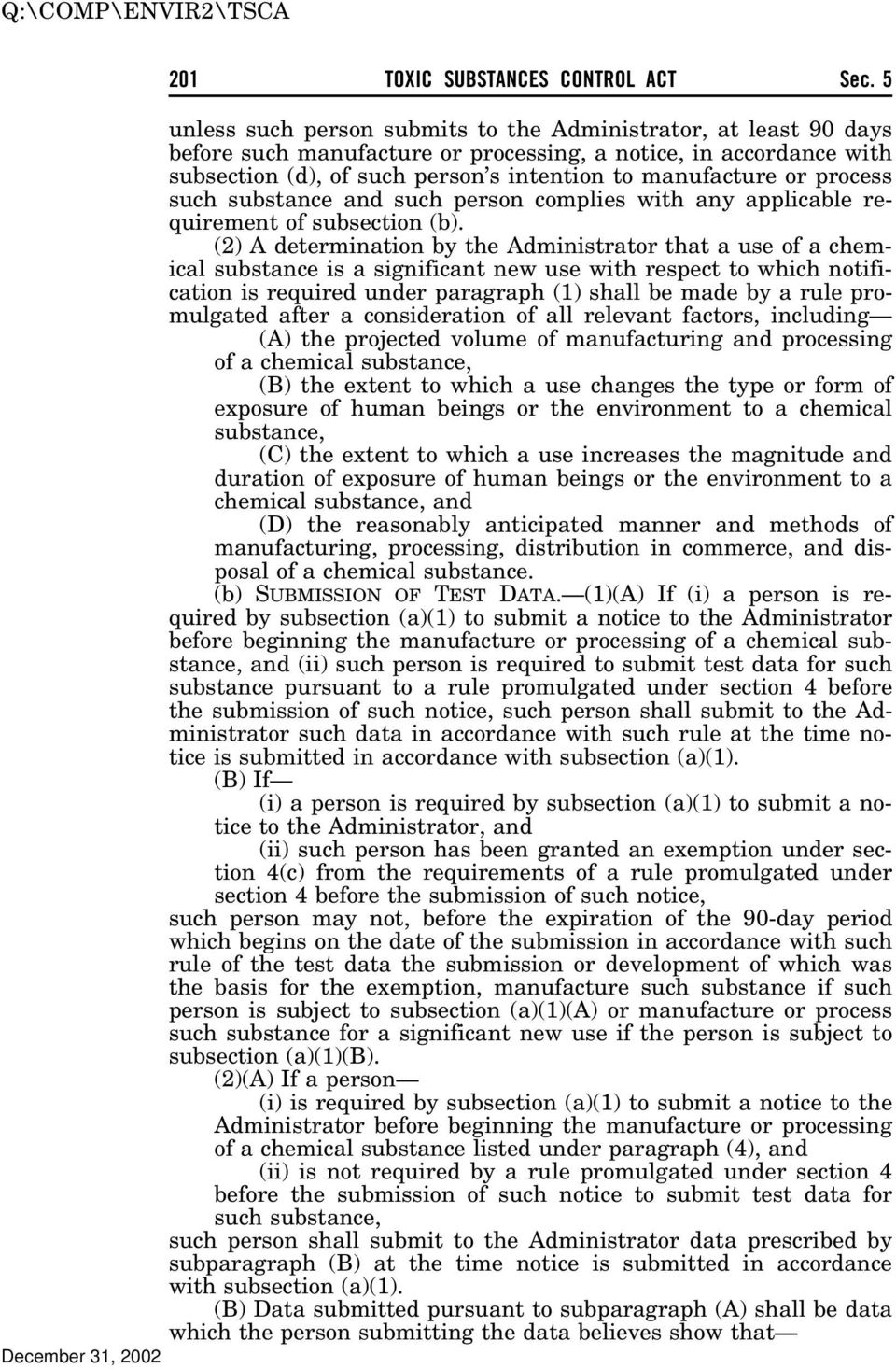
16 Sec. 5 TOXIC SUBSTANCES CONTROL ACT 202 (i) in the case of a substance with respect to which notice is required under subsection (a)(1)(a), the manufacture, processing, distribution in commerce, use, and disposal of the chemical substance or any combination of such activities will not present an unreasonable risk of injury to health or the environment, or (ii) in the case of a chemical substance with respect to which notice is required under subsection (a)(1)(b), the intended significant new use of the chemical substance will not present an unreasonable risk of injury to health or the environment. (3) Data submitted under paragraph (1) or (2) shall be made available, subject to section 14, for examination by interested persons. (4)(A)(i) The Administrator may, by rule, compile and keep current a list of chemical substances with respect to which the Administrator finds that the manufacture, processing, distribution in commerce, use, or disposal, or any combination of such activities, presents or may present an unreasonable risk of injury to health or the environment. (ii) In making a finding under clause (i) that the manufacture, processing, distribution in commerce, use, or disposal of a chemical substance or any combination of such activities presents or may present an unreasonable risk of injury to health or the environment, the Administrator shall consider all relevant factors, including (I) the effects of the chemical substance on health and the magnitude of human exposure to such substance; and (II) the effects of the chemical substance on the environment and the magnitude of environmental exposure to such substance. (B) The Administrator shall, in prescribing a rule under subparagraph (A) which lists any chemical substance, identify those uses, if any, which the Administrator determines, by rule under subsection (a)(2), would constitute a significant new use of such substance. (C) Any rule under subparagraph (A), and any substantive amendment or repeal of such a rule, shall be promulgated pursuant to the procedures specified in section 553 of title 5, United States Code, except that (i) the Administrator shall give interested persons an opportunity for the oral presentation of data, views, or arguments, in addition to an opportunity to make written submissions, (ii) a transcript shall be kept of any oral presentation, and (iii) the Administrator shall make and publish with the rule the finding described in subparagraph (A). (c) EXTENSION OF NOTICE PERIOD. The Administrator may for good cause extend for additional periods (not to exceed in the aggregate 90 days) the period, prescribed by subsection (a) or (b) before which the manufacturing or processing of a chemical substance subject to such subsection may begin. Subject to section 14, such an extension and the reasons therefor shall be published in the Federal Register and shall constitute a final agency action subject to judicial review.
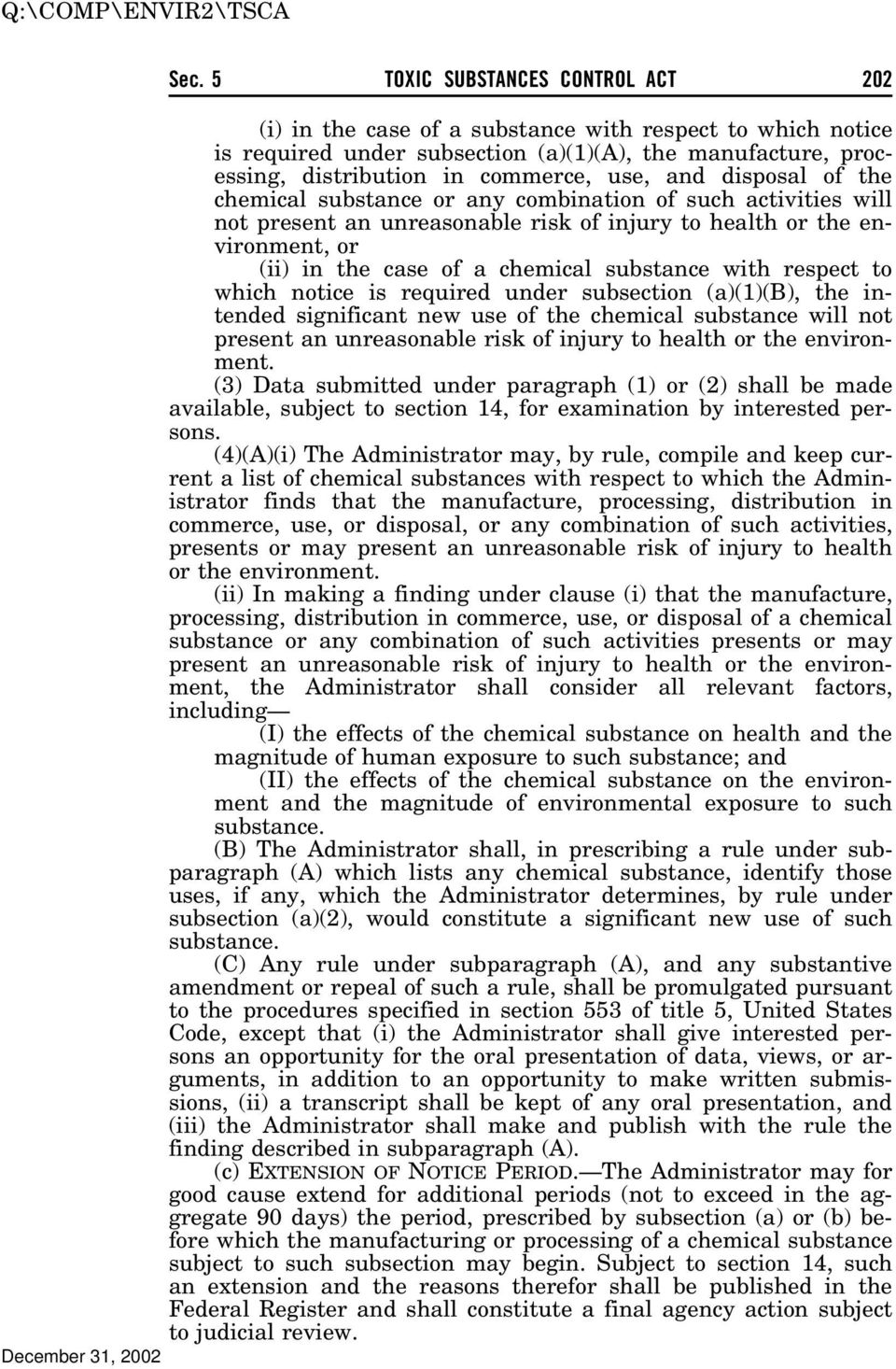
17 203 TOXIC SUBSTANCES CONTROL ACT Sec. 5 (d) CONTENT OF NOTICE; PUBLICATIONS IN THE FEDERAL REG- ISTER. (1) The notice required by subsection (a) shall include (A) insofar as known to the person submitting the notice or insofar as reasonably ascertainable, the information described in subparagraphs (A), (B), (C), (D), (F), and (G) of section 8(a)(2), and (B) in such form and manner as the Administrator may prescribe, any test data in the possession or control of the person giving such notice which are related to the effect of any manufacture, processing, distribution in commerce, use, or disposal of such substance or any article containing such substance, or of any combination of such activities, on health or the environment, and (C) a description of any other data concerning the environmental and health effects of such substance, insofar as known to the person making the notice or insofar as reasonably ascertainable. Such a notice shall be made available, subject to section 14, for examination by interested persons. (2) Subject to section 14, not later than five days (excluding Saturdays, Sundays and legal holidays) after the date of the receipt of a notice under subsection (a) or of data under subsection (b), the Administrator shall publish in the Federal Register a notice which (A) identifies the chemical substance for which notice or data has been received; (B) lists the uses or intended uses of such substance; and (C) in the case of the receipt of data under subsection (b), describes the nature of the tests performed on such substance and any data which was developed pursuant to subsection (b) or a rule under section 4. A notice under this paragraph respecting a chemical substance shall identify the chemical substance by generic class unless the Administrator determines that more specific identification is required in the public interest. (3) At the beginning of each month the Administrator shall publish a list in the Federal Register of (A) each chemical substance for which notice has been received under subsection (a) and for which the notification period prescribed by subsection (a), (b), or (c) has not expired, and (B) each chemical substance for which such notification period has expired since the last publication in the Federal Register of such list. (e) REGULATION PENDING DEVELOPMENT OF INFORMATION. (1)(A) If the Administrator determines that (i) the information available to the Administrator is insufficient to permit a reasoned evaluation of the health and environmental effects of a chemical substance with respect to which notice is required by subsection (a); and (ii)(i) in the absence of sufficient information to permit the Administrator to make such an evaluation, the manufacture, processing, distribution in commerce, use, or disposal of such substance, or any combination of such activities, may present an unreasonable risk of injury to health or the environment, or

18 Sec. 5 TOXIC SUBSTANCES CONTROL ACT 204 (II) such substance is or will be produced in substantial quantities, and such substance either enters or may reasonably be anticipated to enter the environment in substantial quantities or there is or may be significant or substantial human exposure to the substance, the Administrator may issue a proposed order, to take effect on the expiration of the notification period applicable to the manufacturing or processing of such substance under subsection (a), (b), or (c), to prohibit or limit the manufacture, processing, distribution in commerce, use, or disposal of such substance or to prohibit or limit any combination of such activities. (B) A proposed order may not be issued under subparagraph (A) respecting a chemical substance (i) later than 45 days before the expiration of the notification period applicable to the manufacture or processing of such substance under subsection (a), (b), or (c), and (ii) unless the Administrator has, on or before the issuance of the proposed order, notified, in writing, each manufacturer or processor, as the case may be, of such substance of the determination which underlies such order. (C) If a manufacturer or processor of a chemical substance to be subject to a proposed order issued under subparagraph (A) files with the Administrator (within the 30-day period beginning on the date such manufacturer or processor received the notice required by subparagraph (B)(ii)) objections specifying with particularity the provisions of the order deemed objectionable and stating the grounds therefor, the proposed order shall not take effect. (2)(A)(i) Except as provided in clause (ii), if with respect to a chemical substance with respect to which notice is required by subsection (a), the Administrator makes the determination described in paragraph (1)(A) and if (I) the Administrator does not issue a proposed order under paragraph (1) respecting such substance, or (II) the Administrator issues such an order respecting such substance but such order does not take effect because objections were filed under paragraph (1)(C) with respect to it, the Administrator, through attorneys of the Environmental Protection Agency, shall apply to the United States District Court for the District of Columbia or the United States district court for the judicial district in which the manufacturer or processor, as the case may be, of such substance is found, resides, or transacts business for an injunction to prohibit or limit the manufacture, processing, distribution in commerce, use, or disposal of such substance (or to prohibit or limit any combination of such activities). (ii) If the Administrator issues a proposed order under paragraph (1)(A) respecting a chemical substance but such order does not take effect because objections have been filed under paragraph (1)(C) with respect to it, the Administrator is not required to apply for an injunction under clause (i) respecting such substance if the Administrator determines, on the basis of such objections, that the determinations under paragraph (1)(A) may not be made. (B) A district court of the United States which receives an application under subparagraph (A)(i) for an injunction respecting a chemical substance shall issue such injunction if the court finds that

19 205 TOXIC SUBSTANCES CONTROL ACT Sec. 5 (i) the information available to the Administrator is insufficient to permit a reasoned evaluation of the health and environmental effects of a chemical substance with respect to which notice is required by subsection (a); and (ii)(i) in the absence of sufficient information to permit the Administrator to make such an evaluation, the manufacture, processing, distribution in commerce, use, or disposal of such substance, or any combination of such activities, may present an unreasonable risk of injury to health or the environment, or (II) such substance is or will be produced in substantial quantities, and such substance either enters or may reasonably be anticipated to enter the environment in substantial quantities or there is or may be significant or substantial human exposure to the substance. (C) Pending the completion of a proceeding for the issuance of an injunction under subparagraph (B) respecting a chemical substance, the court may, upon application of the Administrator made through attorneys of the Environmental Protection Agency, issue a temporary restraining order or a preliminary injunction to prohibit the manufacture, processing, distribution in commerce, use, or disposal of such a substance (or any combination of such activities) if the court finds that the notification period applicable under subsection (a), (b), or (c) to the manufacturing or processing of such substance may expire before such proceeding can be completed. (D) After the submission to the Administrator of test data sufficient to evaluate the health and environmental effects of a chemical substance subject to an injunction issued under subparagraph (B) and the evaluation of such data by the Administrator, the district court of the United States which issued such injunction shall, upon petition, dissolve the injunction unless the Administrator has initiated a proceeding for the issuance of a rule under section 6(a) respecting the substance. If such a proceeding has been initiated, such court shall continue the injunction in effect until the effective date of the rule promulgated in such proceeding or, if such proceeding is terminated without the promulgation of a rule, upon the termination of the proceeding, whichever occurs first. (f) PROTECTION AGAINST UNREASONABLE RISKS. (1) If the Administrator finds that there is a reasonable basis to conclude that the manufacture, processing, distribution in commerce, use, or disposal of a chemical substance with respect to which notice is required by subsection (a), or that any combination of such activities, presents or will present an unreasonable risk of injury to health or environment before a rule promulgated under section 6 can protect against such risk, the Administrator shall, before the expiration of the notification period applicable under subsection (a), (b), or (c) to the manufacturing or processing of such substance, take the action authorized by paragraph (2) or (3) to the extent necessary to protect against such risk. (2) The Administrator may issue a proposed rule under section 6(a) to apply to a chemical substance with respect to which a finding was made under paragraph (1) (A) a requirement limiting the amount of such substance which may be manufactured, processed, or distributed in commerce,

20 Sec. 5 TOXIC SUBSTANCES CONTROL ACT 206 (B) a requirement described in paragraph (2), (3), (4), (5), (6), or (7) of section 6(a), or (C) any combination of the requirements referred to in subparagraph (B). Such a proposed rule shall be effective upon its publication in the Federal Register. Section 6(d)(2)(B) shall apply with respect to such rule. (3)(A) The Administrator may (i) issue a proposed order to prohibit the manufacture, processing, or distribution in commerce of a substance with respect to which a finding was made under paragraph (1), or (ii) apply, through attorneys of the Environmental Protection Agency, to the United States District Court for the District of Columbia or the United States district court for the judicial district in which the manufacturer, or processor, as the case may be, of such substance, is found, resides, or transacts business for an injunction to prohibit the manufacture, processing, or distribution in commerce of such substance. A proposed order issued under clause (i) respecting a chemical substance shall take effect on the expiration of the notification period applicable under subsection (a), (b), or (c) to the manufacture or processing of such substance. (B) If the district court of the United States to which an application has been made under subparagraph (A)(ii) finds that there is a reasonable basis to conclude that the manufacture, processing, distribution in commerce, use, or disposal of the chemical substance with respect to which such application was made, or that any combination of such activities, presents or will present an unreasonable risk of injury to health or the environment before a rule promulgated under section 6 can protect against such risk, the court shall issue an injunction to prohibit the manufacture, processing or distribution in commerce of such substance or to prohibit any combination of such activities. (C) The provisions of subparagraphs (B) and (C) of subsection (e)(1) shall apply with respect to an order issued under clause (i) of subparagraph (A); and the provisions of subparagraph (C) of subsection (e)(2) shall apply with respect to an injunction issued under subparagraph (B). (D) If the Administrator issues an order pursuant to subparagraph (A)(i) respecting a chemical substance and objections are filed in accordance with subsection (e)(1)(c), the Administrator shall seek an injunction under subparagraph (A)(ii) respecting such substance unless the Administrator determines, on the basis of such objections, that such substance does not or will not present an unreasonable risk of injury to health or the environment. (g) STATEMENT OF REASONS FOR NOT TAKING ACTION. If the Administrator has not initiated any action under this section or section 6 or 7 to prohibit or limit the manufacture, processing, distribution in commerce, use, or disposal of a chemical substance, with respect to which notification or data is required by subsection (a)(1)(b) or (b), before the expiration of the notification period applicable to the manufacturing or processing of such substance, the Administrator shall publish a statement of the Administrator s reasons for not initiating such action. Such a statement shall be pub-
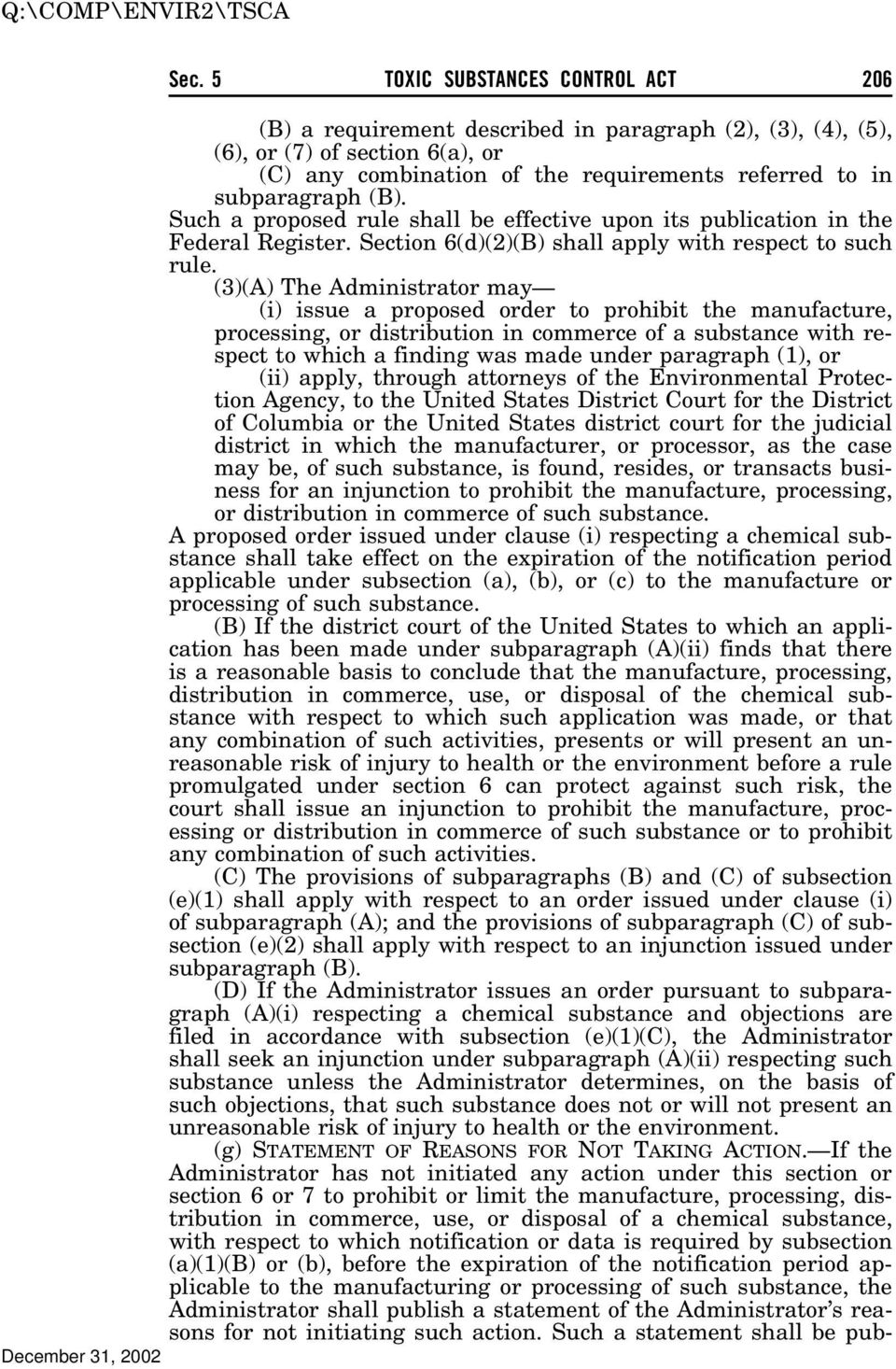
21 207 TOXIC SUBSTANCES CONTROL ACT Sec. 5 lished in the Federal Register before the expiration of such period. Publication of such statement in accordance with the preceding sentence is not a prerequisite to the manufacturing or processing of the substance with respect to which the statement is to be published. (h) EXEMPTIONS. (1) The Administrator may, upon application, exempt any person from any requirement of subsection (a) or (b) to permit such person to manufacture or process a chemical substance for test marketing purposes (A) upon a showing by such person satisfactory to the Administrator that the manufacture, processing, distribution in commerce, use, and disposal of such substance, and that any combination of such activities, for such purposes will not present any unreasonable risk of injury to health or the environment, and (B) under such restrictions as the Administrator considers appropriate. (2)(A) The Administrator may, upon application, exempt any person from the requirement of subsection (b)(2) to submit data for a chemical substance. If, upon receipt of an application under the preceding sentence, the Administrator determines that (i) the chemical substance with respect to which such application was submitted is equivalent to a chemical substance for which data has been submitted to the Administrator as required by subsection (b)(2), and (ii) submission of data by the applicant on such substance would be duplicative of data which has been submitted to the Administrator in accordance with such subsection, the Administrator shall exempt the applicant from the requirement to submit such data on such substance. No exemption which is granted under this subparagraph with respect to the submission of data for a chemical substance may take effect before the beginning of the reimbursement period applicable to such data. (B) If the Administrator exempts any person, under subparagraph (A), from submitting data required under subsection (b)(2) for a chemical substance because of the existence of previously submitted data and if such exemption is granted during the reimbursement period for such data, then (unless such person and the persons referred to in clauses (i) and (ii) agree on the amount and method of reimbursement) the Administrator shall order the person granted the exemption to provide fair and equitable reimbursement (in an amount determined under rules of the Administrator) (i) to the person who previously submitted the data on which the exemption was based, for a portion of the costs incurred by such person in complying with the requirement under subsection (b)(2) to submit such data, and (ii) to any other person who has been required under this subparagraph to contribute with respect to such costs, for a portion of the amount such person was required to contribute. In promulgating rules for the determination of fair and equitable reimbursement to the persons described in clauses (i) and (ii) for costs incurred with respect to a chemical substance, the Administrator shall, after consultation with the Attorney General and the
22 Sec. 5 TOXIC SUBSTANCES CONTROL ACT 208 Federal Trade Commission, consider all relevant factors, including the effect on the competitive position of the person required to provide reimbursement in relation to the persons to be reimbursed and the share of the market for such substance of the person required to provide reimbursement in relation to the share of such market of the persons to be reimbursed. For purposes of judicial review, an order under this subparagraph shall be considered final agency action. (C) For purposes of this paragraph, the reimbursement period for any previously submitted data for a chemical substance is a period (i) beginning on the date of the termination of the prohibition, imposed under this section, on the manufacture or processing of such substance by the person who submitted such data to the Administrator, and (ii) ending (I) five years after the date referred to in clause (i), or (II) at the expiration of a period which begins on the date referred to in clause (i) and is equal to the period which the Administrator determines was necessary to develop such data, whichever is later. (3) The requirements of subsections (a) and (b) do not apply with respect to the manufacturing or processing of any chemical substance which is manufactured or processed, or proposed to be manufactured or processed, only in small quantities (as defined by the Administrator by rule) solely for purposes of (A) scientific experimentation or analysis, or (B) chemical research on, or analysis of such substance or another substance, including such research or analysis for the development of a product, if all persons engaged in such experimentation, research, or analysis for a manufacturer or processor are notified (in such form and manner as the Administrator may prescribe) of any risk to health which the manufacturer, processor, or the Administrator has reason to believe may be associated with such chemical substance. (4) The Administrator may, upon application and by rule, exempt the manufacturer of any new chemical substance from all or part of the requirements of this section if the Administrator determines that the manufacture, processing, distribution in commerce, use, or disposal of such chemical substance, or that any combination of such activities, will not present an unreasonable risk of injury to health or the environment. A rule promulgated under this paragraph (and any substantive amendment to, or repeal of, such a rule) shall be promulgated in accordance with paragraphs (2) and (3) of section 6(c). (5) The Administrator may, upon application, make the requirements of subsections (a) and (b) inapplicable with respect to the manufacturing or processing of any chemical substance (A) which exists temporarily as a result of a chemical reaction in the manufacturing or processing of a mixture or another chemical substance, and (B) to which there is no, and will not be, human or environmental exposure.
23 209 TOXIC SUBSTANCES CONTROL ACT Sec. 6 (6) Immediately upon receipt of an application under paragraph (1) or (5) the Administrator shall publish in the Federal Register notice of the receipt of such application. The Administrator shall give interested persons an opportunity to comment upon any such application and shall, within 45 days of its receipt, either approve or deny the application. The Administrator shall publish in the Federal Register notice of the approval or denial of such an application. (i) DEFINITION. For purposes of this section, the terms manufacture and process mean manufacturing or processing for commercial purposes. [15 U.S.C. 2604] SEC. 6. REGULATION OF HAZARDOUS CHEMICAL SUBSTANCES AND MIXTURES. (a) SCOPE OF REGULATION. If the Administrator finds that there is a reasonable basis to conclude that the manufacture, processing, distribution in commerce, use, or disposal of a chemical substance or mixture, or that any combination of such activities, presents, or will present an unreasonable risk of injury to health or the environment, the Administrator shall by rule apply one or more of the following requirements to such substance or mixture to the extent necessary to protect adequately against such risk using the least burdensome requirements: (1) A requirement (A) prohibiting the manufacturing, processing, or distribution in commerce of such substance or mixture, or (B) limiting the amount of such substance or mixture which may be manufactured, processed, or distributed in commerce. (2) A requirement (A) prohibiting the manufacture, processing, or distribution in commerce of such substance or mixture for (i) a particular use or (ii) a particular use in a concentration in excess of a level specified by the Administrator in the rule imposing the requirement, or (B) limiting the amount of such substance or mixture which may be manufactured, processed, or distributed in commerce for (i) a particular use or (ii) a particular use in a concentration in excess of a level specified by the Administrator in the rule imposing the requirement. (3) A requirement that such substance or mixture or any article containing such substance or mixture be marked with or accompanied by clear and adequate warnings and instructions with respect to its use, distribution in commerce, or disposal or with respect to any combination of such activities. The form and content of such warnings and instructions shall be prescribed by the Administrator. (4) A requirement that manufacturers and processors of such substance or mixture make and retain records of the processes used to manufacture or process such substance or mixture and monitor or conduct tests which are reasonable and necessary to assure compliance with the requirements of any rule applicable under this subsection.
24 Sec. 6 TOXIC SUBSTANCES CONTROL ACT 210 (5) A requirement prohibiting or otherwise regulating any manner or method of commercial use of such substance or mixture. (6)(A) A requirement prohibiting or otherwise regulating any manner or method of disposal of such substance or mixture, or of any article containing such substance or mixture, by its manufacturer or processor or by any other person who uses, or disposes of, it for commercial purposes. (B) A requirement under subparagraph (A) may not require any person to take any action which would be in violation of any law or requirement of, or in effect for, a State or political subdivision, and shall require each person subject to it to notify each State and political subdivision in which a required disposal may occur of such disposal. (7) A requirement directing manufacturers or processors of such substance or mixture (A) to give notice of such unreasonable risk of injury to distributors in commerce of such substance or mixture and, to the extent reasonably ascertainable, to other persons in possession of such substance or mixture or exposed to such substance or mixture, (B) to give public notice of such risk of injury, and (C) to replace or repurchase such substance or mixture as elected by the person to which the requirement is directed. Any requirement (or combination of requirements) imposed under this subsection may be limited in application to specified geographic areas. (b) QUALITY CONTROL. If the Administrator has a reasonable basis to conclude that a particular manufacturer or processor is manufacturing or processing a chemical substance or mixture in a manner which unintentionally causes the chemical substance or mixture to present or which will cause it to present an unreasonable risk of injury to health or the environment (1) the Administrator may by order require such manufacturer or processor to submit a description of the relevant quality control procedures followed in the manufacturing or processing of such chemical substance or mixture; and (2) if the Administrator determines (A) that such quality control procedures are inadequate to prevent the chemical substance or mixture from presenting such risk of injury, the Administrator may order the manufacturer or processor to revise such quality control procedures to the extent necessary to remedy such inadequacy; or (B) that the use of such quality control procedures has resulted in the distribution in commerce of chemical substances or mixtures which present an unreasonable risk of injury to health or the environment, the Administrator may order the manufacturer or processor to (i) give notice of such risk to processors or distributors in commerce of any such substance or mixture, or to both, and, to the extent reasonably ascertainable, to any other person in possession of or exposed to any such substance, (ii) to give public notice of such risk, and (iii) to provide such replacement or repurchase of any such substance or mixture as
25 211 TOXIC SUBSTANCES CONTROL ACT Sec. 6 is necessary to adequately protect health or the environment. A determination under subparagraph (A) or (B) of paragraph (2) shall be made on the record after opportunity for hearing in accordance with section 554 of title 5, United States Code. Any manufacturer or processor subject to a requirement to replace or repurchase a chemical substance or mixture may elect either to replace or repurchase the substance or mixture and shall take either such action in the manner prescribed by the Administrator. (c) PROMULGATION OF SUBSECTION (a) RULES. (1) In promulgating any rule under subsection (a) with respect to a chemical substance or mixture, the Administrator shall consider and publish a statement with respect to (A) the effects of such substance or mixture on health and the magnitude of the exposure of human beings to such substance or mixture, (B) the effects of such substance or mixture on the environment and the magnitude of the exposure of the environment to such substance or mixture, (C) the benefits of such substance or mixture for various uses and the availability of substitutes for such uses, and (D) the reasonably ascertainable economic consequences of the rule, after consideration of the effect on the national economy, small business, technological innovation, the environment, and public health. If the Administrator determines that a risk of injury to health or the environment could be eliminated or reduced to a sufficient extent by actions taken under another Federal law (or laws) administered in whole or in part by the Administrator, the Administrator may not promulgate a rule under subsection (a) to protect against such risk of injury unless the Administrator finds, in the Administrator s discretion, that it is in the public interest to protect against such risk under this Act. In making such a finding the Administrator shall consider (i) all relevant aspects of the risk, as determined by the Administrator in the Administrator s discretion, (ii) a comparison of the estimated costs of complying with actions taken under this Act and under such law (or laws), and (iii) the relative efficiency of actions under this Act and under such law (or laws) to protect against such risk of injury. (2) When prescribing a rule under subsection (a) the Administrator shall proceed in accordance with section 553 of title 5, United States Code (without regard to any reference in such section to sections 556 and 557 of such title), and shall also (A) publish a notice of proposed rulemaking stating with particularity the reason for the proposed rule; (B) allow interested persons to submit written data, views, and arguments, and make all such submissions publicly available; (C) provide an opportunity for an informal hearing in accordance with paragraph (3); (D) promulgate, if appropriate, a final rule based on the matter in the rulemaking record (as defined in section 19(a)), and (E) make and publish with the rule the finding described in subsection (a). (3) Informal hearings required by paragraph (2)(C) shall be conducted by the Administrator in accordance with the following requirements:
26 Sec. 6 TOXIC SUBSTANCES CONTROL ACT 212 (A) Subject to subparagraph (B), an interested person is entitled (i) to present such person s position orally or by documentary submissions (or both), and (ii) if the Administrator determines that there are disputed issues of material fact it is necessary to resolve, to present such rebuttal submissions and to conduct (or have conducted under subparagraph (B)(ii)) such cross-examination of persons as the Administrator determines (I) to be appropriate, and (II) to be required for a full and true disclosure with respect to such issues. (B) The Administrator may prescribe such rules and make such rulings concerning procedures in such hearings to avoid unnecessary costs or delay. Such rules or rulings may include (i) the imposition of reasonable time limits on each interested person s oral presentations, and (ii) requirements that any cross-examination to which a person may be entitled under subparagraph (A) be conducted by the Administrator on behalf of that person in such manner as the Administrator determines (I) to be appropriate, and (II) to be required for a full and true disclosure with respect to disputed issues of material fact. (C)(i) Except as provided in clause (ii), if a group of persons each of whom under subparagraphs (A) and (B) would be entitled to conduct (or have conducted) cross-examination and who are determined by the Administrator to have the same or similar interests in the proceeding cannot agree upon a single representative of such interests for purposes of cross-examination, the Administrator may make rules and rulings (I) limiting the representation of such interest for such purposes, and (II) governing the manner in which such cross-examination shall be limited. (ii) When any person who is a member of a group with respect to which the Administrator has made a determination under clause (i) is unable to agree upon group representation with the other members of the group, then such person shall not be denied under the authority of clause (i) the opportunity to conduct (or have conducted) cross-examination as to issues affecting the person s particular interests if (I) the person satisfies the Administrator that the person has made a reasonable and good faith effort to reach agreement upon group representation with the other members of the group and (II) the Administrator determines that there are substantial and relevant issues which are not adequately presented by the group representative. (D) A verbatim transcript shall be taken of any oral presentation made, and cross-examination conducted in any informal hearing under this subsection. Such transcript shall be available to the public. (4)(A) The Administrator may, pursuant to rules prescribed by the Administrator, provide compensation for reasonable attorneys fees, expert witness fees, and other costs of participating in a rulemaking proceeding for the promulgation of a rule under subsection (a) to any person
27 213 TOXIC SUBSTANCES CONTROL ACT Sec. 6 (i) who represents an interest which would substantially contribute to a fair determination of the issues to be resolved in the proceeding, and (ii) if (I) the economic interest of such person is small in comparison to the costs of effective participation in the proceeding by such person, or (II) such person demonstrates to the satisfaction of the Administrator that such person does not have sufficient resources adequately to participate in the proceeding without compensation under this subparagraph. In determining for purposes of clause (i) if an interest will substantially contribute to a fair determination of the issues to be resolved in a proceeding, the Administrator shall take into account the number and complexity of such issues and the extent to which representation of such interest will contribute to widespread public participation in the proceeding and representation of a fair balance of interests for the resolution of such issues. (B) In determining whether compensation should be provided to a person under subparagraph (A) and the amount of such compensation, the Administrator shall take into account the financial burden which will be incurred by such person in participating in the rulemaking proceeding. The Administrator shall take such action as may be necessary to ensure that the aggregate amount of compensation paid under this paragraph in any fiscal year to all persons who, in rulemaking proceedings in which they receive compensation, are persons who either (i) would be regulated by the proposed rule, or (ii) represent persons who would be so regulated, may not exceed 25 per centum of the aggregate amount paid as compensation under this paragraph to all persons in such fiscal year. (5) Paragraphs (1), (2), (3), and (4) of this subsection apply to the promulgation of a rule repealing, or making a substantive amendment to, a rule promulgated under subsection (a). (d) EFFECTIVE DATE. (1) The Administrator shall specify in any rule under subsection (a) the date on which it shall take effect, which date shall be as soon as feasible. (2)(A) The Administrator may declare a proposed rule under subsection (a) to be effective upon its publication in the Federal Register and until the effective date of final action taken, in accordance with subparagraph (B), respecting such rule if (i) the Administrator determines that (I) the manufacture, processing, distribution in commerce, use, or disposal of the chemical substance or mixture subject to such proposed rule or any combination of such activities is likely to result in an unreasonable risk of serious or widespread injury to health or the environment before such effective date; and (II) making such proposed rule so effective is necessary to protect the public interest; and (ii) in the case of a proposed rule to prohibit the manufacture, processing, or distribution of a chemical substance or mixture because of the risk determined under clause (i)(i), a
28 Sec. 6 TOXIC SUBSTANCES CONTROL ACT 214 court has in an action under section 7 granted relief with respect to such risk associated with such substance or mixture. Such a proposed rule which is made so effective shall not, for purposes of judicial review, be considered final agency action. (B) If the Administrator makes a proposed rule effective upon its publication in the Federal Register, the Administrator shall, as expeditiously as possible, give interested persons prompt notice of such action, provide reasonable opportunity, in accordance with paragraphs (2) and (3) of subsection (c), for a hearing on such rule, and either promulgate such rule (as proposed or with modifications) or revoke it; and if such a hearing is requested, the Administrator shall commence the hearing within five days from the date such request is made unless the Administrator and the person making the request agree upon a later date for the hearing to begin, and after the hearing is concluded the Administrator shall, within ten days of the conclusion of the hearing, either promulgate such rule (as proposed or with modifications) or revoke it. (e) POLYCHLORINATED BIPHENYLS. (1) Within six months after the effective date of this Act the Administrator shall promulgate rules to (A) prescribe methods for the disposal of polychlorinated biphenyls, and (B) require polychlorinated biphenyls to be marked with clear and adequate warnings, and instructions with respect to their processing, distribution in commerce, use, or disposal or with respect to any combination of such activities. Requirements prescribed by rules under this paragraph shall be consistent with the requirements of paragraphs (2) and (3). (2)(A) Except as provided under subparagraph (B), effective one year after the effective date of this Act no person may manufacture, process, or distribute in commerce or use any polychlorinated biphenyl in any manner other than in a totally enclosed manner. (B) The Administrator may by rule authorize the manufacture, processing, distribution in commerce or use (or any combination of such activities) of any polychlorinated biphenyl in a manner other than in a totally enclosed manner if the Administrator finds that such manufacture, processing, distribution in commerce, or use (or combination of such activities) will not present an unreasonable risk of injury to health or the environment. (C) For the purposes of this paragraph, the term totally enclosed manner means any manner which will ensure that any exposure of human beings or the environment by the polychlorinated biphenyl will be insignificant as determined by the Administrator by rule. (3)(A) Except as provided in subparagraphs (B) and (C) (i) no person may manufacture any polychlorinated biphenyl after two years after the effective date of this Act, and (ii) no person may process or distribute in commerce any polychlorinated biphenyl after two and one-half years after such date. (B) Any person may petition the Administrator for an exemption from the requirements of subparagraph (A), and the Adminis-
29 215 TOXIC SUBSTANCES CONTROL ACT Sec. 7 trator may grant by rule such an exemption if the Administrator finds that (i) an unreasonable risk of injury to health or environment would not result, and (ii) good faith efforts have been made to develop a chemical substance which does not present an unreasonable risk of injury to health or the environment and which may be substituted for such polychlorinated biphenyl. An exemption granted under this subparagraph shall be subject to such terms and conditions as the Administrator may prescribe and shall be in effect for such period (but not more than one year from the date it is granted) as the Administrator may prescribe. (C) Subparagraph (A) shall not apply to the distribution in commerce of any polychlorinated biphenyl if such polychlorinated biphenyl was sold for purposes other than resale before two and one-half years after the date of enactment of this Act. (4) Any rule under paragraph (1), (2)(B), or (3)(B) shall be promulgated in accordance with paragraphs (2), (3), and (4) of subsection (c). (5) This subsection does not limit the authority of the Administrator, under any other provision of this Act or any other Federal law, to take action respecting any polychlorinated biphenyl. [15 U.S.C. 2605] SEC. 7. IMMINENT HAZARDS. (a) ACTIONS AUTHORIZED AND REQUIRED. (1) The Administrator may commence a civil action in an appropriate district court of the United States (A) for seizure of an imminently hazardous chemical substance or mixture or any article containing such a substance or mixture, (B) for relief (as authorized by subsection (b)) against any person who manufactures, processes, distributes in commerce, or uses, or disposes of, an imminent hazardous chemical substance or mixture or any article containing such a substance or mixture, or (C) for both such seizure and relief. A civil action may be commenced under this paragraph notwithstanding the existence of a rule under section 4, 5, 6, or title IV or an order under section 5 or title IV, and notwithstanding the pendency of any administrative or judicial proceeding under any provision of this Act. (2) If the Administrator has not made a rule under section 6(a) immediately effective (as authorized by subsection 6(d)(2)(A)(i)) with respect to an imminently hazardous chemical substance or mixture, the Administrator shall commence in a district court of the United States with respect to such substance or mixture or article containing such substance or mixture a civil action described in subparagraph (A), (B), or (C) of paragraph (1). (b) RELIEF AUTHORIZED. (1) The district court of the United States in which an action under subsection (a) is brought shall have jurisdiction to grant such temporary or permanent relief as may be necessary to protect health or the environment from the
30 Sec. 7 TOXIC SUBSTANCES CONTROL ACT 216 unreasonable risk associated with the chemical substance, mixture, or article involved in such action. (2) In the case of an action under subsection (a) brought against a person who manufactures, processes, or distributes in commerce a chemical substance or mixture or an article containing a chemical substance or mixture, the relief authorized by paragraph (1) may include the issuance of a mandatory order requiring (A) in the case of purchasers of such substance, mixture, or article known to the defendant, notification to such purchasers of the risk associated with it; (B) public notice of such risk; (C) recall; (D) the replacement or repurchase of such substance, mixture, or article; or (E) any combination of the actions described in the preceding clauses. (3) In the case of an action under subsection (a) against a chemical substance, mixture, or article, such substance, mixture, or article may be proceeded against by process of libel for its seizure and condemnation. Proceedings in such an action shall conform as nearly as possible to proceedings in rem in admiralty. (c) VENUE AND CONSOLIDATION. (1)(A) An action under subsection (a) against a person who manufactures, processes, or distributes a chemical substance or mixture or an article containing a chemical substance or mixture may be brought in the United States District Court for the District of Columbia or for any judicial district in which any of the defendants is found, resides, or transacts business; and process in such an action may be served on a defendant in any other district in which such defendant resides or may be found. An action under subsection (a) against a chemical substance, mixture, or article may be brought in any United States district court within the jurisdiction of which the substance, mixture, or article is found. (B) In determining the judicial district in which an action may be brought under subsection (a) in instances in which such action may be brought in more than one judicial district, the Administrator shall take into account the convenience of the parties. (C) Subpoenas 1 requiring attendance of witnesses in an action brought under subsection (a) may be served in any judicial district. (2) Whenever proceedings under subsection (a) involving identical chemical substances, mixtures, or articles are pending in courts in two or more judicial districts, they shall be consolidated for trial by order of any such court upon application reasonably made by any party in interest, upon notice to all parties in interest. (d) ACTION UNDER SECTION 6. Where appropriate, concurrently with the filing of an action under subsection (a) or as soon thereafter as may be practicable, the Administrator shall initiate a proceeding for the promulgation of a rule under section 6(a). (e) REPRESENTATION. Notwithstanding any other provision of law, in any action under subsection (a), the Administrator may direct attorneys of the Environmental Protection Agency to appear and represent the Administrator in such an action. (f) DEFINITION. For the purposes of subsection (a), the term imminently hazardous chemical substance or mixture means a 1 In Public Law , the word subpoenas is spelled subpeonas. The spelling is corrected in this print to reflect the probable intent of Congress.
31 217 TOXIC SUBSTANCES CONTROL ACT Sec. 8 chemical substance or mixture which presents an imminent and unreasonable risk of serious or widespread injury to health or the environment. Such a risk to health or the environment shall be considered imminent if it is shown that the manufacture, processing, distribution in commerce, use, or disposal of the chemical substance or mixture, or that any combination of such activities, is likely to result in such injury to health or the environment before a final rule under section 6 can protect against such risk. [15 U.S.C. 2606] SEC. 8. REPORTING AND RETENTION OF INFORMATION. (a) REPORTS. (1) The Administrator shall promulgate rules under which (A) each person (other than a small manufacturer or processor) who manufactures or processes or proposes to manufacture or process a chemical substance (other than a chemical substance described in subparagraph (B)(ii) shall maintain such records, and shall submit to the Administrator such reports, as the Administrator may reasonably require, and (B) each person (other than a small manufacturer or processor) who manufactures or processes or proposes to manufacture or process (i) a mixture, or (ii) a chemical substance in small quantities (as defined by the Administrator by rule) solely for purposes of scientific experimentation or analysis or chemical research on, or analysis of, such substance or another substance, including any such research or analysis for the development of a product, shall maintain records and submit to the Administrator reports but only to the extent the Administrator determines the maintenance of records or submission of reports, or both, is necessary for the effective enforcement of this Act. The Administrator may not require in a rule promulgated under this paragraph the maintenance of records or the submission of reports with respect to changes in the proportions of the components of a mixture unless the Administrator finds that the maintenance of such records or the submission of such reports, or both, is necessary for the effective enforcement of this Act. For purposes of the compilation of the list of chemical substances required under subsection (b), the Administrator shall promulgate rules pursuant to this subsection not later than 180 days after the effective date of this Act. (2) The Administrator may require under paragraph (1) maintenance of records and reporting with respect to the following insofar as known to the person making the report or insofar as reasonably ascertainable: (A) The common or trade name, the chemical identity, and molecular structure of each chemical substance or mixture for which such a report is required. (B) The categories or proposed categories of use of each such substance or mixture. (C) The total amount of each substance and mixture manufactured or processed, reasonable estimates of the total amount
32 Sec. 8 TOXIC SUBSTANCES CONTROL ACT 218 to be manufactured or processed, the amount manufactured or processed for each of its categories of use, and reasonable estimates of the amount to be manufactured or processed for each of its categories of use or proposed categories of use. (D) A description of the byproducts resulting from the manufacture, processing, use, or disposal of each such substance or mixture. (E) All existing data concerning the environmental and health effects of such substance or mixture. (F) The number of individuals exposed, and reasonable estimates of the number who will be exposed, to such substance or mixture in their places of employment and the duration of such exposure. (G) In the initial report under paragraph (1) on such substance or mixture, the manner or method of its disposal, and in any subsequent report on such substance or mixture, any change in such manner or method. To the extent feasible, the Administrator shall not require under paragraph (1), any reporting which is unnecessary or duplicative. (3)(A)(i) The Administrator may by rule require a small manufacturer or processor of a chemical substance to submit to the Administrator such information respecting the chemical substance as the Administrator may require for publication of the first list of chemical substances required by subsection (b). (ii) The Administrator may by rule require a small manufacturer or processor of a chemical substance or mixture (I) subject to a rule proposed or promulgated under section 4, 5(b)(4), or 6, or an order in effect under section 5(e), or (II) with respect to which relief has been granted pursuant to a civil action brought under section 5 or 7, to maintain such records on such substance or mixture, and to submit to the Administrator such reports on such substance or mixture, as the Administrator may reasonably require. A rule under this clause requiring reporting may require reporting with respect to the matters referred to in paragraph (2). (B) The Administrator, after consultation with the Administrator of the Small Business Administration, shall by rule prescribe standards for determining the manufacturers and processors which qualify as small manufacturers and processors for purposes of this paragraph and paragraph (1). (b) INVENTORY. (1) The Administrator shall compile, keep current, and publish a list of each chemical substance which is manufactured or processed in the United States. Such list shall at least include each chemical substance which any person reports, under section 5 or subsection (a) of this section, is manufactured or processed in the United States. Such list may not include any chemical substance which was not manufactured or processed in the United States within three years before the effective date of the rules promulgated pursuant to the last sentence of subsection (a)(1). In the case of a chemical substance for which a notice is submitted in accordance with section 5, such chemical substance shall be included in such list as of the earliest date (as determined by the Administrator) on which such substance was manufactured or processed in the United States. The Administrator shall first publish such a list
33 219 TOXIC SUBSTANCES CONTROL ACT Sec. 8 not later than 315 days after the effective date of this Act. The Administrator shall not include in such list any chemical substance which is manufactured or processed only in small quantities (as defined by the Administrator by rule) solely for purposes of scientific experimentation or analysis or chemical research on, or analysis of, such substance or another substance, including such research or analysis for the development of a product. (2) To the extent consistent with the purposes of this Act, the Administrator may, in lieu of listing, pursuant to paragraph (1), a chemical substance individually, list a category of chemical substances in which such substance is included. (c) RECORDS. Any person who manufactures, processes, or distributes in commerce any chemical substance or mixture shall maintain records of significant adverse reactions to health or the environment, as determined by the Administrator by rule, alleged to have been caused by the substance or mixture. Records of such adverse reactions to the health of employees shall be retained for a period of 30 years from the date such reactions were first reported to or known by the person maintaining such records. Any other record of such adverse reactions shall be retained for a period of five years from the date the information contained in the record was first reported to or known by the person maintaining the record. Records required to be maintained under this subsection shall include records of consumer allegations of personal injury or harm to health, reports of occupational disease or injury, and reports or complaints of injury to the environment submitted to the manufacturer, processor, or distributor in commerce from any source. Upon request of any duly designated representative of the Administrator, each person who is required to maintain records under this subsection shall permit the inspection of such records and shall submit copies of such records. (d) HEALTH AND SAFETY STUDIES. The Administrator shall promulgate rules under which the Administrator shall require any person who manufactures, processes, or distributes in commerce or who proposes to manufacture, process, or distribute in commerce any chemical substance or mixture (or with respect to paragraph (2), any person who has possession of a study) to submit to the Administrator (1) lists of health and safety studies (A) conducted or initiated by or for such person with respect to such substance or mixture at any time, (B) known to such person, or (C) reasonably ascertainable by such person, except that the Administrator may exclude certain types or categories of studies from the requirements of this subsection if the Administrator finds that submission of lists of such studies are unnecessary to carry out the purposes of this Act; and (2) copies of any study contained on a list submitted pursuant to paragraph (1) or otherwise known by such person. (e) NOTICE TO ADMINISTRATOR OF SUBSTANTIAL RISKS. Any person who manufactures, processes, or distributes in commerce a chemical substance or mixture and who obtains information which reasonably supports the conclusion that such substance or mixture presents a substantial risk of injury to health or the environment shall immediately inform the Administrator of such information
34 Sec. 9 TOXIC SUBSTANCES CONTROL ACT 220 unless such person has actual knowledge that the Administrator has been adequately informed of such information. (f) DEFINITIONS. For purposes of this section, the terms manufacture and process mean manufacture or process for commercial purposes. [15 U.S.C. 2607] SEC. 9. RELATIONSHIP TO OTHER FEDERAL LAWS. (a) LAWS NOT ADMINISTERED BY THE ADMINISTRATOR. (1) If the Administrator has reasonable basis to conclude that the manufacture, processing, distribution in commerce, use, or disposal of a chemical substance or mixture, or that any combination of such activities, presents or will present an unreasonable risk of injury to health or the environment and determines, in the Administrator s discretion, that such risk may be prevented or reduced to a sufficient extent by action taken under a Federal law not administered by the Administrator, the Administrator shall submit to the agency which administers such law a report which describes such risk and includes in such description a specification of the activity or combination of activities which the Administrator has reason to believe so presents such risk. Such report shall also request such agency (A)(i) to determine if the risk described in such report may be prevented or reduced to a sufficient extent by action taken under such law, and (ii) if the agency determines that such risk may be so prevented or reduced, to issue an order declaring whether or not the activity or combination of activities specified in the description of such risk presents such risk; and (B) to respond to the Administrator with respect to the matters described in subparagraph (A). Any report of the Administrator shall include a detailed statement of the information on which it is based and shall be published in the Federal Register. The agency receiving a request under such a report shall make the requested determination, issue the requested order, and make the requested response within such time as the Administrator specifies in the request, but such time specified may not be less than 90 days from the date the request was made. The response of an agency shall be accompanied by a detailed statement of the findings and conclusions of the agency and shall be published in the Federal Register. (2) If the Administrator makes a report under paragraph (1) with respect to a chemical substance or mixture and the agency to which such report was made either (A) issues an order declaring that the activity or combination of activities specified in the description of the risk described in the report does not present the risk described in the report, or (B) initiates, within 90 days of the publication in the Federal Register of the response of the agency under paragraph (1), action under the law (or laws) administered by such agency to protect against such risk associated with such activity or combination of activities, the Administrator may not take any action under section 6 or 7 with respect to such risk.
35 221 TOXIC SUBSTANCES CONTROL ACT Sec. 10 (3) If the Administrator has initiated action under section 6 or 7 with respect to a risk associated with a chemical substance or mixture which was the subject of a report made to an agency under paragraph (1), such agency shall before taking action under the law (or laws) administered by it to protect against such risk consult with the Administrator for the purpose of avoiding duplication of Federal action against such risk. (b) LAWS ADMINISTERED BY THE ADMINISTRATOR. The Administrator shall coordinate actions taken under this Act with actions taken under other Federal laws administered in whole or in part by the Administrator. If the Administrator determines that a risk to health or the environment associated with a chemical substance or mixture could be eliminated or reduced to a sufficient extent by actions taken under the authorities contained in such other Federal laws, the Administrator shall use such authorities to protect against such risk unless the Administrator determines, in the Administrator s discretion, that it is in the public interest to protect against such risk by actions taken under this Act. This subsection shall not be construed to relieve the Administrator of any requirement imposed on the Administrator by such other Federal laws. (c) OCCUPATIONAL SAFETY AND HEALTH. In exercising any authority under this Act, the Administrator shall not, for purposes of section 4(b)(1) of the Occupational Safety and Health Act of 1970, be deemed to be exercising statutory authority to prescribe or enforce standards or regulations affecting occupational safety and health. (d) COORDINATION. In administering this Act, the Administrator shall consult and coordinate with the Secretary of Health, Education, and Welfare and the heads of any other appropriate Federal executive department or agency, any relevant independent regulatory agency, and any other appropriate instrumentality of the Federal Government for the purpose of achieving the maximum enforcement of this Act while imposing the least burdens of duplicative requirements on those subject to the Act and for other purposes. The Administrator shall, in the report required by section 30, report annually to the Congress on actions taken to coordinate with such other Federal departments, agencies, or instrumentalities, and on actions taken to coordinate the authority under this Act with the authority granted under other Acts referred to in subsection (b). [15 U.S.C. 2608] SEC. 10. RESEARCH, DEVELOPMENT, COLLECTION, DISSEMINATION AND UTILIZATION OF DATA. (a) AUTHORITY. The Administrator shall, in consultation and cooperation with the Secretary of Health, Education, and Welfare and with other heads of appropriate departments and agencies, conduct such research, development, and monitoring as is necessary to carry out the purposes of this Act. The Administrator may enter into contracts and may make grants for research, development, and monitoring under this subsection. Contracts may be entered into under this subsection without regard to sections 3648 and 3709 of the Revised Statutes (31 U.S.C. 529, 14 U.S.C. 5).
36 Sec. 10 TOXIC SUBSTANCES CONTROL ACT 222 (b) DATA SYSTEMS. (1) The Administrator shall establish, administer, and be responsible for the continuing activities of an interagency committee which shall design, establish, and coordinate an efficient and effective system, within the Environmental Protection Agency, for the collection, dissemination to other Federal departments and agencies, and use of data submitted to the Administrator under this Act. (2)(A) The Administrator shall, in consultation and cooperation with the Secretary of Health, Education, and Welfare and other heads of appropriate departments and agencies design, establish, and coordinate an efficient and effective system for the retrieval of toxicological and other scientific data which could be useful to the Administrator in carrying out the purposes of this Act. Systematized retrieval shall be developed for use by all Federal and other departments and agencies with responsibilities in the area of regulation or study of chemical substances and mixtures and their effect on health or the environment. (B) The Administrator, in consultation and cooperation with the Secretary of Health, Education, and Welfare, may make grants and enter into contracts for the development of a data retrieval system described in subparagraph (A). Contracts may be entered into under this subparagraph without regard to sections 3648 and 3709 of the Revised Statutes (31 U.S.C. 529, 41 U.S.C. 5). (c) SCREENING TECHNIQUES. The Administrator shall coordinate, with the Assistant Secretary for Health of the Department of Health, Education, and Welfare, research undertaken by the Administrator and directed toward the development of rapid, reliable, and economical screening techniques for carcinogenic, mutagenic, teratogenic, and ecological effects of chemical substances and mixtures. (d) MONITORING. The Administrator shall, in consultation and cooperation with the Secretary of Health, Education, and Welfare, establish and be responsible for research aimed at the development, in cooperation with local, State, and Federal agencies, of monitoring techniques and instruments which may be used in the detection of toxic chemical substances and mixtures and which are reliable, economical, and capable of being implemented under a wide variety of conditions. (e) BASIC RESEARCH. The Administrator shall, in consultation and cooperation with the Secretary of Health, Education, and Welfare, establish research programs to develop the fundamental scientific basis of the screening and monitoring techniques described in subsections (c) and (d), the bounds of the reliability of such techniques, and the opportunities for their improvement. (f) TRAINING. The Administrator shall establish and promote programs and workshops to train or facilitate the training of Federal laboratory and technical personnel in existing or newly developed screening and monitoring techniques. (g) EXCHANGE OF RESEARCH AND DEVELOPMENT RESULTS. The Administrator shall, in consultation with the Secretary of Health, Education, and Welfare and other heads of appropriate departments and agencies, establish and coordinate a system for exchange among Federal, State, and local authorities of research and development results respecting toxic chemical substances and mix-
37 223 TOXIC SUBSTANCES CONTROL ACT Sec. 11 tures, including a system to facilitate and promote the development of standard data format and analysis and consistent testing procedures. [15 U.S.C. 2609] SEC. 11. INSPECTIONS AND SUBPOENAS. (a) IN GENERAL. For purposes of administering this Act, the Administrator, and any duly designated representative of the Administrator, may inspect any establishment, facility, or other premises in which chemical substances, mixtures, or products subject to title IV are manufactured, processed, stored, or held before or after their distribution in commerce and any conveyance being used to transport chemical substances, mixtures, such products, or such articles in connection with distribution in commerce. Such an inspection may only be made upon the presentation of appropriate credentials and of a written notice to the owner, operator, or agent in charge of the premises or conveyance to be inspected. A separate notice shall be given for each such inspection, but a notice shall not be required for each entry made during the period covered by the inspection. Each such inspection shall be commenced and completed with reasonable promptness and shall be conducted at reasonable times, within reasonable limits, and in a reasonable manner. (b) SCOPE. (1) Except as provided in paragraph (2), an inspection conducted under subsection (a) shall extend to all things within the premises or conveyance inspected (including records, files, papers, processes, controls, and facilities) bearing on whether the requirements of this Act applicable to the chemical substances, mixtures, or products subject to title IV within such premises or conveyance have been complied with. (2) No inspection under subsection (a) shall extend to (A) financial data, (B) sales data (other than shipment data), (C) pricing data, (D) personnel data, or (E) research data (other than data required by this Act or under a rule promulgated thereunder), unless, the nature and extent of such data are described with reasonable specificity in the written notice required by subsection (a) for such inspection. (c) SUBPOENAS. In carrying out this Act, the Administrator may by subpoena require the attendance and testimony of witnesses and the production of reports, papers, documents, answers to questions, and other information that the Administrator deems necessary. Witnesses shall be paid the same fees and mileage that are paid witnesses in the courts of the United States. In the event of contumacy, failure, or refusal of any person to obey any such subpoena, any district court of the United States in which venue is proper shall have jurisdiction to order any such person to comply with such subpoena. Any failure to obey such an order of the court is punishable by the court as a contempt thereof. [15 U.S.C. 2610]
38 Sec. 12 TOXIC SUBSTANCES CONTROL ACT 224 SEC. 12. EXPORTS. (a) IN GENERAL. (1) Except as provided in paragraph (2) and subsection (b), this Act (other than section 8) shall not apply to any chemical substance, mixture, or to an article containing a chemical substance or mixture, if (A) it can be shown that such substance, mixture, or article is being manufactured, processed, or distributed in commerce for export from the United States, unless such substance, mixture, or article was, in fact, manufactured, processed, or distributed in commerce, for use in the United States, and (B) such substance, mixture, or article (when distributed in commerce), or any container in which it is enclosed (when so distributed), bears a stamp or label stating that such substance, mixture, or article is intended for export. (2) Paragraph (1) shall not apply to any chemical substance, mixture, or article if the Administrator finds that the substance, mixture, or article will present an unreasonable risk of injury to health within the United States or to the environment of the United States. The Administrator may require, under section 4, testing of any chemical substance or mixture exempted from this Act by paragraph (1) for the purpose of determining whether or not such substance or mixture presents an unreasonable risk of injury to health within the United States or to the environment of the United States. (b) NOTICE. (1) If any person exports or intends to export to a foreign country a chemical substance or mixture for which the submission of data is required under section 4 or 5(b), such person shall notify the Administrator of such exportation or intent to export and the Administrator shall furnish to the government of such country notice of the availability of the data submitted to the Administrator under such section for such substance or mixture. (2) If any person exports or intends to export to a foreign country a chemical substance or mixture for which an order has been issued under section 5 or a rule has been proposed or promulgated under section 5 or 6, or with respect to which an action is pending, or relief has been granted under section 5 or 7, such person shall notify the Administrator of such exportation or intent to export and the Administrator shall furnish to the government of such country notice of such rule, order, action, or relief. [15 U.S.C. 2611] SEC. 13. ENTRY INTO CUSTOMS TERRITORY OF THE UNITED STATES. (a) IN GENERAL. (1) The Secretary of the Treasury shall refuse entry into the customs territory of the United States (as defined in general note 2 of the Harmonized Tariff Schedule of the United States) of any chemical substance, mixture, or article containing a chemical substance or mixture offered for such entry if (A) it fails to comply with any rule in effect under this Act, or (B) it is offered for entry in violation of section 5, 6, or title IV a rule or order under section 5, 6, or title IV or an order issued in a civil action brought under section 5, 7 or title IV.
39 225 TOXIC SUBSTANCES CONTROL ACT Sec. 14 (2) If a chemical substance, mixture, or article is refused entry under paragraph (1), the Secretary of the Treasury shall notify the consignee of such entry refusal, shall not release it to the consignee, and shall cause its disposal or storage (under such rules as the Secretary of the Treasury may prescribe) if it has not been exported by the consignee within 90 days from the date of receipt of notice of such refusal, except that the Secretary of the Treasury may, pending a review by the Administrator of the entry refusal, release to the consignee such substance, mixture, or article on execution of bond for the amount of the full invoice of such substance, mixture, or article (as such value is set forth in the customs entry), together with the duty thereon. On failure to return such substance, mixture, or article for any cause to the custody of the Secretary of the Treasury when demanded, such consignee shall be liable to the United States for liquidated damages equal to the full amount of such bond. All charges for storage, cartage, and labor on and for disposal of substances, mixtures, or articles which are refused entry or released under this section shall be paid by the owner or consignee, and in default of such payment shall constitute a lien against any future entry made by such owner or consignee. (b) RULES. The Secretary of the Treasury, after consultation with the Administrator, shall issue rules for the administration of subsection (a) of this section. [15 U.S.C. 2612] SEC. 14. DISCLOSURE OF DATA. (a) IN GENERAL. Except as provided by subsection (b), any information reported to, or otherwise obtained by, the Administrator (or any representative of the Administrator) under this Act, which is exempt from disclosure pursuant to subsection (a) of section 552 of title 5, United States Code, by reason of subsection (b)(4) of such section, shall, notwithstanding the provisions of any other section of this Act, not be disclosed by the Administrator or by any officer or employee of the United States, except that such information (1) shall be disclosed to any officer or employee of the United States (A) in connection with the official duties of such officer or employee under any law for the protection of health or the environment, or (B) for specific law enforcement purposes; (2) shall be disclosed to contractors with the United States and employees of such contractors if in the opinion of the Administrator such disclosure is necessary for the satisfactory performance by the contractor of a contract with the United States entered into on or after the date of enactment of this Act for the performance of work in connection with this Act and under such conditions as the Administrator may specify; (3) shall be disclosed if the Administrator determines it necessary to protect health or the environment against an unreasonable risk of injury to health or the environment; or (4) may be disclosed when relevant in any proceeding under this Act, except that disclosure in such a proceeding shall be made in such manner as to preserve confidentiality to the extent practicable without impairing the proceeding.
40 Sec. 14 TOXIC SUBSTANCES CONTROL ACT 226 In any proceeding under section 552(a) of title 5, United States Code, to obtain information the disclosure of which has been denied because of the provisions of this subsection, the Administrator may not rely on section 552(b)(3) of such title to sustain the Administrator s action. (b) DATA FROM HEALTH AND SAFETY STUDIES. (1) Subsection (a) does not prohibit the disclosure of (A) any health and safety study which is submitted under this Act with respect to (i) any chemical substance or mixture which, on the date on which such study is to be disclosed has been offered for commercial distribution, or (ii) any chemical substance or mixture for which testing is required under section 4 or for which notification is required under section 5, and (B) any data reported to, or otherwise obtained by, the Administrator from a health and safety study which relates to a chemical substance or mixture described in clause (i) or (ii) of subparagraph (A). This paragraph does not authorize the release of any data which discloses processes used in the manufacturing or processing of a chemical substance or mixture or, in the case of a mixture, the release of data disclosing the portion of the mixture comprised by any of the chemical substances in the mixture. (2) If a request is made to the Administrator under subsection (a) of section 552 of title 5, United States Code, for information which is described in the first sentence of paragraph (1) and which is not information described in the second sentence of such paragraph, the Administrator may not deny such request on the basis of subsection (b)(4) of such section. (c) DESIGNATION AND RELEASE OF CONFIDENTIAL DATA. (1) In submitting data under this Act, a manufacturer, processor, or distributor in commerce may (A) designate the data which such person believes is entitled to confidential treatment under subsection (a), and (B) submit such designated data separately from other data submitted under this Act. A designation under this paragraph shall be made in writing and in such manner as the Administrator may prescribe. (2)(A) Except as provided by subparagraph (B), if the Administrator proposes to release for inspection data which has been designated under paragraph (1)(A), the Administrator shall notify, in writing and by certified mail, the manufacturer, processor, or distributor in commerce who submitted such data of the intent to release such data. If the release of such data is to be made pursuant to a request made under section 552(a) of title 5, United States Code, such notice shall be given immediately upon approval of such request by the Administrator. The Administrator may not release such data until the expiration of 30 days after the manufacturer, processor, or distributor in commerce submitting such data has received the notice required by this subparagraph. (B)(i) Subparagraph (A) shall not apply to the release of information under paragraph (1), (2), (3), or (4) of subsection (a), except that the Administrator may not release data under paragraph (3) of subsection (a) unless the Administrator has notified each manu-
41 227 TOXIC SUBSTANCES CONTROL ACT Sec. 15 facturer, processor, and distributor in commerce who submitted such data of such release. Such notice shall be made in writing by certified mail at least 15 days before the release of such data, except that if the Administrator determines that the release of such data is necessary to protect against an imminent, unreasonable risk of injury to health or the environment, such notice may be made by such means as the Administrator determines will provide notice at least 24 hours before such release is made. (ii) Subparagraph (A) shall not apply to the release of information described in subsection (b)(1) other than information described in the second sentence of such subsection. (d) CRIMINAL PENALTY FOR WRONGFUL DISCLOSURE. (1) Any officer or employee of the United States or former officer or employee of the United States, who by virtue of such employment or official position has obtained possession of, or has access to, material the disclosure of which is prohibited by subsection (a), and who knowing that disclosure of such material is prohibited by such subsection, willfully disclosures the material in any manner to any person not entitled to receive it, shall be guilty of a misdemeanor and fined not more than $5,000 or imprisoned for not more than one year, or both. Section 1905 of title 18, United States Code, does not apply with respect to the publishing, divulging, disclosure, or making known of, or making available, information reported or otherwise obtained under this Act. (2) For the purposes of paragraph (1), any contractor with the United States who is furnished information as authorized by subsection (a)(2), and any employee of any such contractor, shall be considered to be an employee of the United States. (e) ACCESS BY CONGRESS. Notwithstanding any limitation contained in this section or any other provision of law, all information reported to or otherwise obtained by the Administrator (or any representative of the Administrator) under this Act shall be made available, upon written request of any duly authorized committee of the Congress, to such committee. [15 U.S.C. 2613] SEC. 15. PROHIBITED ACTS. It shall be unlawful for any person to (1) fail or refuse to comply with (A) any rule promulgated or order issued under section 4, (B) any requirement prescribed by section 5 or 6, (C) any rule promulgated or order issued under section 5 or 6, or (D) any requirement of title II or any rule promulgated or order issued under title II; (2) use for commercial purposes a chemical substance or mixture which such person knew or had reason to know was manufactured, processed, or distributed in commerce in violation of section 5 or 6, a rule or order under section 5 or 6, or an order issued in action brought under section 5 or 7; (3) fail or refuse to (A) establish or maintain records, (B) submit reports, notices, or other information, or (C) permit access to or copying of records, as required by this Act or a rule thereunder; or
42 Sec. 16 TOXIC SUBSTANCES CONTROL ACT 228 (4) fail or refuse to permit entry or inspection as required by section 11. [15 U.S.C. 2614] SEC. 16. PENALTIES. (a) CIVIL. (1) Any person who violates a provision of section 15 or 409 shall be liable to the United States for a civil penalty in an amount not to exceed $25,000 for each such violation. Each day such a violation continues shall, for purposes of this subsection, constitute a separate violation of section 15 or 409. (2)(A) A civil penalty for a violation of section 15 or 409 shall be assessed by the Administrator by an order made on the record after opportunity (provided in accordance with this subparagraph) for a hearing in accordance with section 554 of title 5, United States Code. Before issuing such an order, the Administrator shall give written notice to the person to be assessed a civil penalty under such order of the Administrator s proposal to issue such order and provide such person an opportunity to request, within 15 days of the date the notice is received by such person, such a hearing on the order. (B) In determining the amount of a civil penalty, the Administrator shall take into account the nature, circumstances, extent, and gravity of the violation or violations and, with respect to the violator, ability to pay, effect on ability to continue to do business, any history of prior such violations, the degree of culpability, and such other matters as justice may require. (C) The Administrator may compromise, modify, or remit, with or without conditions, any civil penalty which may be imposed under this subsection. The amount of such penalty, when finally determined, or the amount agreed upon in compromise, may be deducted from any sums owing by the United States to the person charged. (3) Any person who requested in accordance with paragraph (2)(A) a hearing respecting the assessment of a civil penalty and who is aggrieved by an order assessing a civil penalty may file a petition for judicial review of such order with the United States Court of Appeals for the District of Columbia Circuit or for any other circuit in which such person resides or transacts business. Such a petition may only be filed within the 30-day period beginning on the date the order making such assessment was issued. (4) If any person fails to pay an assessment of a civil penalty (A) after the order making the assessment has become a final order and if such person does not file a petition for judicial review of the order in accordance with paragraph (3), or (B) after a court in an action brought under paragraph (3) has entered a final judgment in favor of the Administrator, the Attorney General shall recover the amount assessed (plus interest at currently prevailing rates from the date of the expiration of the 30-day period referred to in paragraph (3) or the date of such final judgment, as the case may be) in an action brought in any appropriate district court of the United States. In such an action, the validity, amount, and appropriateness of such penalty shall not be subject to review.
43 229 TOXIC SUBSTANCES CONTROL ACT Sec. 17 (b) CRIMINAL. Any person who knowingly or willfully violates any provision of section 15 or 409 shall, in addition to or in lieu of any civil penalty which may be imposed under subsection (a) of this section for such violation, be subject, upon conviction, to a fine of not more than $25,000 for each day of violation, or to imprisonment for not more than one year, or both. [15 U.S.C. 2615] SEC. 17. SPECIFIC ENFORCEMENT AND SEIZURE. (a) SPECIFIC ENFORCEMENT. (1) The district courts of the United States shall have jurisdiction over civil actions to (A) restrain any violation of section 15 or 409, (B) restrain any person from taking any action prohibited by section 5, 6, or title IV, or by a rule or order under section 5, 6, or title IV, (C) compel the taking of any action required by or under this Act, or (D) direct any manufacturer or processor of a chemical substance, mixture, or product subject to title IV manufactured or processed in violation of section 5, 6, or title IV, or a rule or order under section 5, 6, or title IV, and distributed in commerce, (i) to give notice of such fact to distributors in commerce of such substance, mixture, or product and, to the extent reasonably ascertainable, to other persons in possession of such substance, mixture, or product or exposed to such substance, mixture, or product, (ii) to give public notice of such risk of injury, and (iii) to either replace or repurchase such substance, mixture, or product, whichever the person to which the requirement is directed elects. (2) A civil action described in paragraph (1) may be brought (A) in the case of a civil action described in subparagraph (A) of such paragraph, in the United States district court for the judicial district wherein any act, omission, or transaction constituting a violation of section 15 occurred or wherein the defendant is found or transacts business, or (B) in the case of any other civil action described in such paragraph, in the United States district court for the judicial district wherein the defendant is found or transacts business. In any such civil action process may be served on a defendant in any judicial district in which a defendant resides or may be found. Subpoenas requiring attendance of witnesses in any such action may be served in any judicial district. (b) SEIZURE. Any chemical substance, mixture, or product subject to title IV which was manufactured, processed, or distributed in commerce in violation of this Act or any rule promulgated or order issued under this Act or any article containing such a substance or mixture shall be liable to be proceeded against, by process of libel for the seizure and condemnation of such substance, mixture, product, or article, in any district court of the United States within the jurisdiction of which such substance, mixture, product, or article is found. Such proceeding shall conform as nearly as possible to proceedings in rem in admiralty. [15 U.S.C. 2616]
44 Sec. 18 TOXIC SUBSTANCES CONTROL ACT 230 SEC. 18. PREEMPTION. (a) EFFECT ON STATE LAW. (1) Except as provided in paragraph (2), nothing in this Act shall affect the authority of any State or political subdivision of a State to establish or continue in effect regulation of any chemical substance, mixture, or article containing a chemical substance or mixture. (2) Except as provided in subsection (b) (A) if the Administrator requires by a rule promulgated under section 4 the testing of a chemical substance or mixture, no State or political subdivision may, after the effective date of such rule, establish or continue in effect a requirement for the testing of such substance or mixture for purposes similar to those for which testing is required under such rule; and (B) if the Administrator prescribes a rule or order under section 5 or 6 (other than a rule imposing a requirement described in subsection (a)(6) of section 6) which is applicable to a chemical substance or mixture, and which is designed to protect against a risk of injury to health or the environment associated with such substance or mixture, no State or political subdivision of a State may, after the effective date of such requirement, establish or continue in effect, any requirement which is applicable to such substance or mixture, or an article containing such substance or mixture, and which is designed to protect against such risk unless such requirement (i) is identical to the requirement prescribed by the Administrator, (ii) is adopted under the authority of the Clean Air Act or any other Federal law, or (iii) prohibits the use of such substance or mixture in such State or political subdivision (other than its use in the manufacture or processing of other substances or mixtures). (b) EXEMPTION. Upon application of a State or political subdivision of a State the Administrator may by rule exempt from subsection (a)(2), under such conditions as may be prescribed in such rule, a requirement of such State or political subdivision designed to protect against a risk of injury to health or the environment associated with a chemical substance, mixture, or article containing a chemical substance or mixture if (1) compliance with the requirement would not cause the manufacturing, processing, distribution in commerce, or use of the substance, mixture, or article to be in violation of the applicable requirement under this Act described in subsection (a)(2), and (2) the State or political subdivision requirement (A) provides a significantly higher degree of protection from such risk than the requirement under this Act described in subsection (a)(2) and (B) does not, through difficulties in marketing, distribution, or other factors, unduly burden interstate commerce. [15 U.S.C. 2617] SEC. 19. JUDICIAL REVIEW. (a) IN GENERAL. (1)(A) Not later than 60 days after the date of the promulgation of a rule under section 4(a), 5(a)(2), 5(b)(4), 6(a), 6(e), or 8, or under title II or IV, any person may file a petition for judicial review of such rule with the United States Court
45 231 TOXIC SUBSTANCES CONTROL ACT Sec. 19 of Appeals for the District of Columbia Circuit or for the circuit in which such person resides or in which such person s principal place of business is located. Courts of appeals of the United States shall have exclusive jurisdiction of any action to obtain judicial review (other than in an enforcement proceeding) of such a rule if any district court of the United States would have had jurisdiction of such action but for this subparagraph. (B) Courts of appeals of the United States shall have exclusive jurisdiction of any action to obtain judicial review (other than in an enforcement proceeding) of an order issued under subparagraph (A) or (B) of section 6(b)(1) if any district court of the United States would have had jurisdiction of such action but for this subparagraph. (2) Copies of any petition filed under paragraph (1)(A) shall be transmitted forthwith to the Administrator and to the Attorney General by the clerk of the court with which such petition was filed. The provisions of section 2112 of title 28, United States Code, shall apply to the filing of the rulemaking record of proceedings on which the Administrator based the rule being reviewed under this section and to the transfer of proceedings between United States courts of appeals. (3) For purposes of this section, the term rulemaking record means (A) the rule being reviewed under this section; (B) in the case of a rule under section 4(a), the finding required by such section, in the case of a rule under section 5(b)(4), the finding required by such section, in the case of a rule under section 6(a) the finding required by section 5(f) or 6(a), as the case may be, in the case of a rule under section 6(a), the statement required by section 6(c)(1), and in the case of a rule under section 6(e), the findings required by paragraph (2)(B) or (3)(B) of such section, as the case may be 1 and in the case of a rule under title IV, the finding required for the issuance of such a rule; (C) any transcript required to be made of oral presentations made in proceedings for the promulgation of such rule; (D) any written submission of interested parties respecting the promulgation of such rule; and (E) any other information which the Administrator considers to be relevant to such rule and which the Administrator identified, on or before the date of the promulgation of such rule, in a notice published in the Federal Register. (b) ADDITIONAL SUBMISSIONS AND PRESENTATIONS; MODIFICA- TIONS. If in an action under this section to review a rule the petitioner or the Administrator applies to the court for leave to make additional oral submissions or written presentations respecting such rule and shows to the satisfaction of the court that such submissions and presentations would be material and that there were reasonable grounds for the submissions and failure to make such submissions and presentations in the proceeding before the Administrator, the court may order the Administrator to provide additional opportunity to make such submissions and presentations. 1 So in law. Probably should be followed by a comma.
46 Sec. 19 TOXIC SUBSTANCES CONTROL ACT 232 The Administrator may modify or set aside the rule being reviewed or make a new rule by reason of the additional submissions and presentations and shall file such modified or new rule with the return of such submissions and presentations. The court shall thereafter review such new or modified rule. (c) STANDARD OF REVIEW. (1)(A) Upon the filing of a petition under subsection (a)(1) for judicial review of a rule, the court shall have jurisdiction (i) to grant appropriate relief, including interim relief, as provided in chapter 7 of title 5, United States Code, and (ii) except as otherwise provided in subparagraph (B), to review such rule in accordance with chapter 7 of title 5, United States Code. (B) Section 706 of title 5, United States Code, shall apply to review of a rule under this section, except that (i) in the case of review of a rule under section 4(a), 5(b)(4), 6(a), or 6(e), the standard for review prescribed by paragraph (2)(E) of such section 706 shall not apply and the court shall hold unlawful and set aside such rule if the court finds that the rule is not supported by substantial evidence in the rulemaking record (as defined in subsection (a)(3)) taken as a whole; (ii) in the case of review of a rule under section 6(a), the court shall hold unlawful and set aside such rule if it finds that (I) a determination by the Administrator under section 6(c)(3) that the petitioner seeking review of such rule is not entitled to conduct (or have conducted) cross-examination or to present rebuttal submissions, or (II) a rule of, or ruling by, the Administrator under section 6(c)(3) limiting such petitioner s cross-examination or oral presentations, has precluded disclosure of disputed material facts which was necessary to a fair determination by the Administrator of the rulemaking proceeding taken as a whole; and section 706(2)(D) shall not apply with respect to a determination, rule, or ruling referred to in subclause (I) or (II); and (iii) the court may not review the contents and adequacy of (I) any statement required to be made pursuant to section 6(c)(1), or (II) any statement of basis and purpose required by section 553(c) of title 5, United States Code, to be incorporated in the rule except as part of a review of the rulemaking record taken as a whole. The term evidence as used in clause (i) means any matter in the rulemaking record. (C) A determination, rule, or ruling of the Administrator described in subparagraph (B)(ii) may be reviewed only in an action under this section and only in accordance with such subparagraph. (2) The judgment of the court affirming or setting aside, in whole or in part, any rule reviewed in accordance with this section shall be final, subject to review by the Supreme Court of the
47 233 TOXIC SUBSTANCES CONTROL ACT Sec. 20 United States upon certiorari or certification, as provided in section 1254 of title 28, United States Code. (d) FEES AND COSTS. The decision of the court in an action commenced under subsection (a), or of the Supreme Court of the United States on review of such a decision, may include an award of costs of suit and reasonable fees for attorneys and expert witnesses if the court determines that such an award is appropriate. (e) OTHER REMEDIES. The remedies as provided in this section shall be in addition to and not in lieu of any other remedies provided by law. [15 U.S.C. 2618] SEC. 20. CITIZENS CIVIL ACTIONS. (a) IN GENERAL. Except as provided in subsection (b), any person may commence a civil action (1) against any person (including (A) the United States, and (B) any other governmental instrumentality or agency to the extent permitted by the eleventh amendment to the Constitution) who is alleged to be in violation of this Act or any rule promulgated under section 4, 5, or 6, or title II or IV, or order issued under section 5 or title II or IV to restrain such violation, or (2) against the Administrator to compel the Administrator to perform any act or duty under this Act which is not discretionary. Any civil action under paragraph (1) shall be brought in the United States district court for the district in which the alleged violation occurred or in which the defendant resides or in which the defendant s principal place of business is located. Any action brought under paragraph (2) shall be brought in the United States District Court for the District of Columbia, or the United States district court for the judicial district in which the plaintiff is domiciled. The district courts of the United States shall have jurisdiction over suits brought under this section, without regard to the amount in controversy or the citizenship of the parties. In any civil action under this subsection process may be served on a defendant in any judicial district in which the defendant resides or may be found and subpoenas for witnesses may be served in any judicial district. (b) LIMITATION. No civil action may be commenced (1) under subsection (a)(1) to restrain a violation of this Act or rule or order under this Act (A) before the expiration of 60 days after the plaintiff has given notice of such violation (i) to the Administrator, and (ii) to the person who is alleged to have committed such violation, or (B) if the Administrator has commenced and is diligently prosecuting a proceeding for the issuance of an order under section 16(a)(2) to require compliance with this Act or with such rule or order or if the Attorney General has commenced and is diligently prosecuting a civil action in a court of the United States to require compliance with this Act or with such rule or order, but if such proceeding or civil action is commenced after the giving of
48 Sec. 21 TOXIC SUBSTANCES CONTROL ACT 234 notice, any person giving such notice may intervene as a matter of right in such proceeding or action; or (2) under subsection (a)(2) before the expiration of 60 days after the plaintiff has given notice to the Administrator of the alleged failure of the Administrator to perform an act or duty which is the basis for such action or, in the case of an action under such subsection for the failure of the Administrator to file an action under section 7, before the expiration of ten days after such notification. Notice under this subsection shall be given in such manner as the Administrator shall prescribe by rule. (c) GENERAL. (1) In any action under this section, the Administrator, if not a party, may intervene as a matter of right. (2) The court, in issuing any final order in any action brought pursuant to subsection (a), may award costs of suit and reasonable fees for attorneys and expert witnesses if the court determines that such an award is appropriate. Any court, in issuing its decision in an action brought to review such an order, may award costs of suit and reasonable fees for attorneys if the court determines that such an award is appropriate. (3) Nothing in this section shall restrict any right which any person (or class of persons) may have under any statute or common law to seek enforcement of this Act or any rule or order under this Act or to seek any other relief. (d) CONSOLIDATION. When two or more civil actions brought under subsection (a) involving the same defendant and the same issues or violations are pending in two or more judicial districts, such pending actions, upon application of such defendants to such actions which is made to a court in which any such action is brought, may, if such court in its discretion so decides, be consolidated for trial by order (issued after giving all parties reasonable notice and opportunity to be heard) of such court and tried in (1) any district which is selected by such defendant and in which one of such actions is pending, (2) a district which is agreed upon by stipulation between all the parties to such actions and in which one of such actions is pending, or (3) a district which is selected by the court and in which one of such actions is pending. The court issuing such an order shall give prompt notification of the order to the other courts in which the civil actions consolidated under the order are pending. [15 U.S.C. 2619] SEC. 21. CITIZENS PETITIONS. (a) IN GENERAL. Any person may petition the Administrator to initiate a proceeding for the issuance, amendment, or repeal of a rule under section 4, 6, or 8 or an order under section 5(e) or (6)(b)(2). (b) PROCEDURES. (1) Such petition shall be filed in the principal office of the Administrator and shall set forth the facts which it is claimed establish that it is necessary to issue, amend, or repeal a rule under section 4, 6, or 8 or an order under section 5(e), 6(b)(1)(A), or 6(b)(1)(B).
49 235 TOXIC SUBSTANCES CONTROL ACT Sec. 21 (2) The Administrator may hold a public hearing or may conduct such investigation or proceeding as the Administrator deems appropriate in order to determine whether or not such petition should be granted. (3) Within 90 days after filing of a petition described in paragraph (1), the Administrator shall either grant or deny the petition. If the Administrator grants such petition, the Administrator shall promptly commence an appropriate proceeding in accordance with section 4, 5, 6, or 8. If the Administrator denies such petition, the Administrator shall publish in the Federal Register the Administrator s reasons for such denial. (4)(A) If the Administrator denies a petition filed under this section (or if the Administrator fails to grant or deny such petition within the 90-day period) the petitioner may commence a civil action in a district court of the United States to compel the Administrator to initiate a rulemaking proceeding as requested in the petition. Any such action shall be filed within 60 days after the Administrator s denial of the petition or, if the Administrator fails to grant or deny the petition within 90 days after filing the petition, within 60 days after the expiration of the 90-day period. (B) In an action under subparagraph (A) respecting a petition to initiate a proceeding to issue a rule under section 4, 6, or 8 or an order under section 5(e) or 6(b)(2), the petitioner shall be provided an opportunity to have such petition considered by the court in a de novo proceeding. If the petitioner demonstrates to the satisfaction of the court by a preponderance of the evidence that (i) in the case of a petition to initiate a proceeding for the issuance of a rule under section 4 or an order under section 5(e) (I) information available to the Administrator is insufficient to permit a reasoned evaluation of the health and environmental effects of the chemical substance to be subject to such rule or order; and (II) in the absence of such information, the substance may present an unreasonable risk to health or the environment, or the substance is or will be produced in substantial quantities and it enters or may reasonably be anticipated to enter the environment in substantial quantities or there is or may be significant or substantial human exposure to it; or (ii) in the case of a petition to initiate a proceeding for the issuance of a rule under section 6 or 8 or an order under section 6(b)(2), there is a reasonable basis to conclude that the issuance of such a rule or order is necessary to protect health or the environment against an unreasonable risk of injury to health or the environment; 1 the court shall order the Administrator to initiate the action requested by the petitioner. If the court finds that the extent of the risk to health or the environment alleged by the petitioner is less than the extent of risks to health or the environment with respect to which the Administrator is taking action under this Act and 1 In Public Law , a period appears after environment. The semicolon is shown in this print to reflect the probable intent of Congress.
50 Sec. 22 TOXIC SUBSTANCES CONTROL ACT 236 there are insufficient resources available to the Administrator to take the action requested by the petitioner, the court may permit the Administrator to defer initiating the action requested by the petitioner until such time as the court prescribes. (C) The court in issuing any final order in any action brought pursuant to subparagraph (A) may award costs of suit and reasonable fees for attorneys and expert witnesses if the court determines that such an award is appropriate. Any court, in issuing its decision in an action brought to review such an order, may award costs of suit and reasonable fees for attorneys if the court determines that such an award is appropriate. (5) The remedies under this section shall be in addition to, and not in lieu of, other remedies provided by law. [15 U.S.C. 2620] SEC. 22. NATIONAL DEFENSE WAIVER. The Administrator shall waive compliance with any provision of this Act upon a request and determination by the President that the requested waiver is necessary in the interest of national defense. The Administrator shall maintain a written record of the basis upon which such waiver was granted and make such record available for in camera examination when relevant in a judicial proceeding under this Act. Upon the issuance of such a waiver, the Administrator shall publish in the Federal Register a notice that the waiver was granted for national defense purposes, unless, upon the request of the President, the Administrator determines to omit such publication because the publication itself would be contrary to the interests of national defense, in which event the Administrator shall submit notice thereof to the Armed Services Committees of the Senate and the House of Representatives. [15 U.S.C. 2621] SEC. 23. EMPLOYEE PROTECTION. (a) IN GENERAL. No employer may discharge any employee or otherwise discriminate against any employee with respect to the employee s compensation, terms, conditions, or privileges of employment because the employee (or any person acting pursuant to a request of the employee) has (1) commenced, caused to be commenced, or is about to commence or cause to be commenced a proceeding under this Act; (2) testified or is about to testify in any such proceeding; or (3) assisted or participated or is about to assist or participate in any manner in such a proceeding or in any other action to carry out the purposes of this Act. (b) REMEDY. (1) Any employee who believes that the employee has been discharged or otherwise discriminated against by any person in violation of subsection (a) of this section may, within 30 days after such alleged violation occurs, file (or have any person file on the employee s behalf) a complaint with the Secretary of Labor (hereinafter in this section referred to as the Secretary ) alleging such discharge or discrimination. Upon receipt of such a complaint, the Secretary shall notify the person named in the complaint of the filing of the complaint.
51 237 TOXIC SUBSTANCES CONTROL ACT Sec. 23 (2)(A) Upon receipt of a complaint filed under paragraph (1), the Secretary shall conduct an investigation of the violation alleged in the complaint. Within 30 days of the receipt of such complaint, the Secretary shall complete such investigation and shall notify in writing the complainant (and any person acting on behalf of the complainant) and the person alleged to have committed such violation of the results of the investigation conducted pursuant to this paragraph. Within ninety days of the receipt of such complaint the Secretary shall, unless the proceeding on the complaint is terminated by the Secretary on the basis of a settlement entered into by the Secretary and the person alleged to have committed such violation, issue an order either providing the relief prescribed by subparagraph (B) or denying the complaint. An order of the Secretary shall be made on the record after notice and opportunity for agency hearing. The Secretary may not enter into a settlement terminating a proceeding on a complaint without the participation and consent of the complainant. (B) If in response to a complaint filed under paragraph (1) the Secretary determines that a violation of subsection (a) of this section has occurred, the Secretary shall order (i) the person who committed such violation to take affirmative action to abate the violation, (ii) such person to reinstate the complainant to the complainant s former position together with the compensation (including back pay), terms, conditions, and privileges of the complainant s employment, (iii) compensatory damages, and (iv) where appropriate, exemplary damages. If such an order is issued, the Secretary, at the request of the complainant, shall assess against the person against whom the order is issued a sum equal to the aggregate amount of all costs and expenses (including attorney s fees) reasonably incurred, as determined by the Secretary, by the complainant for, or in connection with, the bringing of the complaint upon which the order was issued. (c) REVIEW. (1) Any employee or employer adversely affected or aggrieved by an order issued under subsection (b) may obtain review of the order in the United States Court of Appeals for the circuit in which the violation, with respect to which the order was issued, allegedly occurred. The petition for review must be filed within sixty days from the issuance of the Secretary s order. Review shall conform to chapter 7 of title 5 of the United States Code. (2) An order of the Secretary, with respect to which review could have been obtained under paragraph (1), shall not be subject to judicial review in any criminal or other civil proceeding. (d) ENFORCEMENT. Whenever a person has failed to comply with an order issued under subsection (b)(2), the Secretary shall file a civil action in the United States district court for the district in which the violation was found to occur to enforce such order. In actions brought under this subsection, the district courts shall have jurisdiction to grant all appropriate relief, including injunctive relief and compensatory and exemplary damages. (e) EXCLUSION. Subsection (a) of this section shall not apply with respect to any employee who, acting without direction from the employee s employer (or any agent of the employer), deliberately causes a violation of any requirement of this Act. [15 U.S.C. 2622]
52 Sec. 24 TOXIC SUBSTANCES CONTROL ACT 238 SEC. 24. EMPLOYMENT EFFECTS. (a) IN GENERAL. The Administrator shall evaluate on a continuing basis the potential effects on employment (including reductions in employment or loss of employment from threatened plant closures) of (1) the issuance of a rule or order under section 4, 5, or 6, or (2) a requirement of section 5 or 6. (b)(1) INVESTIGATIONS. Any employee (or any representative of an employee) may request the Administrator to make an investigation of (A) a discharge or layoff or threatened discharge or layoff of the employee, or (B) adverse or threatened adverse effects on the employee s employment, allegedly resulting from a rule or order under section 4, 5, or 6 or a requirement of section 5 or 6. Any such request shall be made in writing, shall set forth with reasonable particularity the grounds for the request, and shall be signed by the employee, or representative of such employee, making the request. (2)(A) Upon receipt of a request made in accordance with paragraph (1) the Administrator shall (i) conduct the investigation requested, and (ii) if requested by any interested person, hold public hearings on any matter involved in the investigation unless the Administrator, by order issued within 45 days of the date such hearings are requested, denies the request for the hearings because the Administrator determines there are no reasonable grounds for holding such hearings. If the Administrator makes such a determination, the Administrator shall notify in writing the person requesting the hearing of the determination and the reasons therefor and shall publish the determination and the reasons therefor in the Federal Register. (B) If public hearings are to be held on any matter involved in an investigation conducted under this subsection (i) at least five days notice shall be provided the person making the request for the investigation and any person identified in such request, (ii) such hearings shall be held in accordance with section 6(c)(3), and (iii) each employee who made or for whom was made a request for such hearings and the employer of such employee shall be required to present information respecting the applicable matter referred to in paragraph (1)(A) or (1)(B) together with the basis for such information. (3) Upon completion of an investigation under paragraph (2), the Administrator shall make findings of fact, shall make such recommendations as the Administrator deems appropriate, and shall make available to the public such findings and recommendations. (4) This section shall not be construed to require the Administrator to amend or repeal any rule or order in effect under this Act. [15 U.S.C. 2623]
53 239 TOXIC SUBSTANCES CONTROL ACT Sec. 26 SEC. 25. STUDIES. (a) INDEMNIFICATION STUDY. The Administrator shall conduct a study of all Federal laws administered by the Administrator for the purpose of determining whether and under what conditions, if any, indemnification should be accorded any person as a result of any action taken by the Administrator under any such law. The study shall (1) include an estimate of the probable cost of any indemnification programs which may be recommended; (2) include an examination of all viable means of financing the cost of any recommended indemnification; and (3) be completed and submitted to Congress within two years from the effective date of enactment of this Act. The General Accounting Office shall review the adequacy of the study submitted to Congress pursuant to paragraph (3) and shall report the results of its review to the Congress within six months of the date such study is submitted to Congress. (b) CLASSIFICATION, STORAGE, AND RETRIEVAL STUDY. The Council on Environmental Quality, in consultation with the Administrator, the Secretary of Health, Education, and Welfare, the Secretary of Commerce, and the heads of other appropriate Federal departments or agencies, shall coordinate a study of the feasibility of establishing (1) a standard classification system for chemical substances and related substances, and (2) a standard means for storing and for obtaining rapid access to information respecting such substances. A report on such study shall be completed and submitted to Congress not later than 18 months after the effective date of enactment of this Act. [15 U.S.C. 2624] SEC. 26. ADMINISTRATION OF THE ACT. (a) COOPERATION OF FEDERAL AGENCIES. Upon request by the Administrator, each Federal department and agency is authorized (1) to make its services, personnel, and facilities available (with or without reimbursement) to the Administrator to assist the Administrator in the administration of this Act; and (2) to furnish to the Administrator such information, data, estimates, and statistics, and to allow the Administrator access to all information in its possession as the Administrator may reasonably determine to be necessary for the administration of this Act. (b) FEES. (1) The Administrator may, by rule, require the payment of a reasonable fee from any person required to submit data under section 4 or 5 to defray the cost of administering this Act. Such rules shall not provide for any fee in excess of $2,500 or, in the case of a small business concern, any fee in excess of $100. In setting a fee under this paragraph, the Administrator shall take into account the ability to pay of the person required to submit the data and the cost to the Administrator of reviewing such data. Such rules may provide for sharing such a fee in any case in which the expenses of testing are shared under section 4 or 5. (2) The Administrator, after consultation with the Administrator of the Small Business Administration, shall by rule prescribe
54 Sec. 26 TOXIC SUBSTANCES CONTROL ACT 240 standards for determining the persons which qualify as small business concerns for purposes of paragraph (1). (c) ACTION WITH RESPECT TO CATEGORIES. (1) Any action authorized or required to be taken by the Administrator under any provision of this Act with respect to a chemical substance or mixture may be taken by the Administrator in accordance with that provision with respect to a category of chemical substances or mixtures. Whenever the Administrator takes action under a provision of this Act with respect to a category of chemical substances or mixtures, any reference in this Act to a chemical substance or mixture (insofar as it relates to such action) shall be deemed to be a reference to each chemical substance or mixture in such category. (2) For purposes of paragraph (1): (A) The term category of chemical substances means a group of chemical substances the members of which are similar in molecular structure, in physical, chemical, or biological properties, in use, or in mode of entrance into the human body or into the environment, or the members of which are in some other way suitable for classification as such for purposes of this Act, except that such term does not mean a group of chemical substances which are grouped together solely on the basis of their being new chemical substances. (B) The term category of mixtures means a group of mixtures the members of which are similar in molecular structure, in physical, chemical, or biological 1properties, in use, or in the mode of entrance into the human body or into the environment, or the members of which are in some other way suitable for classification as such for purposes of this Act. (d) ASSISTANCE OFFICE. The Administrator shall establish in the Environmental Protection Agency an identifiable office to provide technical and other nonfinancial assistance to manufacturers and processors of chemical substances and mixtures respecting the requirements of this Act applicable to such manufacturers and processors, the policy of the Agency respecting the application of such requirements to such manufacturers and processors, and the means and methods by which such manufacturers and processors may comply with such requirements. (e) FINANCIAL DISCLOSURES. (1) Except as provided under paragraph (3), each officer or employee of the Environmental Protection Agency and the Department of Health, Education, and Welfare who (A) performs any function or duty under this Act, and (B) has any known financial interest (i) in any person subject to this Act or any rule or order in effect under this Act, or (ii) in any person who applies for or receives any grant or contract under this Act, shall, on February 1, 1978, and on February 1 of each year thereafter, file with the Administrator or the Secretary of Health, Education, and Welfare (hereinafter in this subsection referred to as the Secretary ), as appropriate, a written statement concerning all such interests held by such officer or employee during the preceding calendar year. Such statement shall be made available to the public. (2) The Administrator and the Secretary shall
55 241 TOXIC SUBSTANCES CONTROL ACT Sec. 27 (A) act within 90 days of the effective date of this Act (i) to define the term known financial interests for purposes of paragraph (1), and (ii) to establish the methods by which the requirement to file written statements specified in paragraph (1) will be monitored and enforced, including appropriate provisions for review by the Administrator and the Secretary of such statements; and (B) report to the Congress on June 1, 1978, and on June 1 of each year thereafter with respect to such statements and the actions taken in regard thereto during the preceding calendar year. (3) The Administrator may by rule identify specific positions with the Environmental Protection Agency, and the Secretary may by rule identify specific positions with the Department of Health, Education, and Welfare, which are of a nonregulatory or nonpolicymaking nature, and the Administrator and the Secretary may by rule provide that officers or employees occupying such positions shall be exempt from the requirements of paragraph (1). (4) This subsection does not supersede any requirement of chapter 11 of title 18, United States Code. (5) Any officer or employee who is subject to, and knowingly violates, this subsection or any rule issued thereunder, shall be fined not more than $2,500 or imprisoned not more than one year, or both. (f) STATEMENT OF BASIS AND PURPOSE. Any final order issued under this Act shall be accompanied by a statement of its basis and purpose. The contents and adequacy of any such statement shall not be subject to judicial review in any respect. (g) ASSISTANT ADMINISTRATOR. (1) The President, by and with the advice and consent of the Senate, shall appoint an Assistant Administrator for Toxic Substances of the Environmental Protection Agency. Such Assistant Administrator shall be a qualified individual who is, by reason of background and experience, especially qualified to direct a program concerning the effects of chemicals on human health and the environment. Such Assistant Administrator shall be responsible for (A) the collection of data, (B) the preparation of studies, (C) the making of recommendations to the Administrator for regulatory and other actions to carry out the purposes and to facilitate the administration of this Act, and (D) such other functions as the Administrator may assign or delegate. (2) The Assistant Administrator to be appointed under paragraph (1) shall be in addition to the Assistant Administrators of the Environmental Protection Agency authorized by section 1(d) of Reorganization Plan No. 3 of [15 U.S.C. 2625] SEC. 27. DEVELOPMENT AND EVALUATION OF TEST METHODS. (a) IN GENERAL. The Secretary of Health, Education, and Welfare in consultation with the Administrator and acting through the Assistant Secretary for Health, may conduct, and make grants to public and nonprofit private entities and enter into contracts with public and private entities for, projects for the development and evaluation of inexpensive and efficient methods (1) for deter-
56 Sec. 28 TOXIC SUBSTANCES CONTROL ACT 242 mining and evaluating the health and environmental effects of chemical substances and mixtures, and their toxicity, persistence, and other characteristics which affect health and the environment, and (2) which may be used for the development of test data to meet the requirements of rules promulgated under section 4. The Administrator shall consider such methods in prescribing under section 4 standards for the development of test data. (b) APPROVAL BY SECRETARY. No grant may be made or contract entered into under subsection (a) unless an application therefor has been submitted to and approved by the Secretary. Such an application shall be submitted in such form and manner and contain such information as the Secretary may require. The Secretary may apply such conditions to grants and contracts under subsection (a) as the Secretary determines are necessary to carry out the purposes of such subsection. Contracts may be entered into under such subsection without regard to sections 3648 and 3709 of the Revised Statutes (31 U.S.C. 529; 41 U.S.C. 5). [15 U.S.C. 2626] SEC. 28. STATE PROGRAMS. (a) IN GENERAL. For the purpose of complementing (but not reducing) the authority of, or actions taken by, the Administrator under this Act, the Administrator may make grants to States for the establishment and operation of programs to prevent or eliminate unreasonable risks within the States to health or the environment which are associated with a chemical substance or mixture and with respect to which the Administrator is unable or is not likely to take action under this Act for their prevention or elimination. The amount of a grant under this subsection shall be determined by the Administrator, except that no grant for any State program may exceed 75 per centum of the establishment and operation costs (as determined by the Administrator) of such program during the period for which the grant is made. (b) APPROVAL BY ADMINISTRATOR. (1) No grant may be made under subsection (a) unless an application therefor is submitted to and approved by the Administrator. Such an application shall be submitted in such form and manner as the Administrator may require and shall (A) set forth the need of the applicant for a grant under subsection (a), (B) identify the agency or agencies of the State which shall establish or operate, or both, the program for which the application is submitted, (C) describe the actions proposed to be taken under such program, (D) contain or be supported by assurances satisfactory to the Administrator that such program shall, to the extent feasible, be integrated with other programs of the applicant for environmental and public health protection, (E) provide for the making of such reports and evaluations as the Administrator may require, and (F) contain such other information as the Administrator may prescribe.
57 243 TOXIC SUBSTANCES CONTROL ACT Sec. 30 (2) The Administrator may approve an application submitted in accordance with paragraph (1) only if the applicant has established to the satisfaction of the Administrator a priority need, as determined under rules of the Administrator, for the grant for which the application has been submitted. Such rules shall take into consideration the seriousness of the health effects in a State which are associated with chemical substances or mixtures, including cancer, birth defects, and gene mutations, the extent of the exposure in a state of human beings and the environment to chemical substances and mixtures, and the extent to which chemical substances and mixtures are manufactured, processed, used, and disposed of in a State. (c) ANNUAL REPORTS. Not later than six months after the end of each of the fiscal years 1979, 1980, and 1981, the Administrator shall submit to the Congress a report respecting the programs assisted by grants under subsection (a) in the preceding fiscal year and the extent to which the Administrator has disseminated information respecting such programs. (d) AUTHORIZATION. For the purpose of making grants under subsection (a), there are authorized to be appropriated $1,500,000 for each of the fiscal years 1982 and Sums appropriated under this subsection shall remain available until expended. [15 U.S.C. 2627] SEC. 29. AUTHORIZATION FOR APPROPRIATIONS. There are authorized to be appropriated to the Administrator for purposes of carrying out this Act (other than sections 27 and 28 and subsections (a) and (c) through (g) of section 10 thereof) $10,100,000 for the fiscal year ending September 30, 1977, $58,646,000 for the fiscal year 1982 and $62,000,000 for the fiscal year No part of the funds appropriated under this section may be used to construct any research laboratories. [15 U.S.C. 2628] SEC. 30. ANNUAL REPORT. The Administrator shall prepare and submit to the President and the Congress on or before January 1, 1978, and on or before January 1 of each succeeding year a comprehensive report on the administration of this Act during the preceding fiscal year. Such report shall include (1) a list of the testing required under section 4 during the year for which the report is made and an estimate of the costs incurred during such year by the persons required to perform such tests; (2) the number of notices received during such year under section 5, the number of such notices received during such year under such section for chemical substances subject to a section 4 rule, and a summary of any action taken during such year under section 5(g); (3) a list of rules issued during such year under section 6; (4) a list, with a brief statement of the issues, of completed or pending judicial actions under this Act and administrative actions under section 16 during such year; (5) a summary of major problems encountered in the administration of this Act; and
58 Sec. 31 TOXIC SUBSTANCES CONTROL ACT 244 (6) such recommendations for additional legislation as the Administrator deems necessary to carry out the purposes of this Act. [15 U.S.C. 2629] SEC. 31. EFFECTIVE DATE. Except as provided in section 4(f), this Act shall take effect on January 1, [15 U.S.C. 2601] TITLE II ASBESTOS HAZARD EMERGENCY RESPONSE 1 SEC CONGRESSIONAL FINDINGS AND PURPOSE. (a) FINDINGS. The Congress finds the following: (1) The Environmental Protection Agency s rule on local educational agency inspection for, and notification of, the presence of friable asbestos-containing material in school buildings includes neither standards for the proper identification of asbestos-containing material and appropriate response actions with respect to friable asbestos-containing material, nor a requirement that response actions with respect to friable asbestos-containing material be carried out in a safe and complete manner once actions are found to be necessary. As a result of the lack of regulatory guidance from the Environmental Protection Agency, some schools have not undertaken response action while many others have undertaken expensive projects without knowing if their action is necessary, adequate, or safe. Thus, the danger of exposure to asbestos continues to exist in schools, and some exposure actually may have increased due to the lack of Federal standards and improper response action. (2) There is no uniform program for accrediting persons involved in asbestos identification and abatement, nor are local educational agencies required to use accredited contractors for asbestos work. (3) The guidance provided by the Environmental Protection Agency in its Guidance for Controlling Asbestos-Containing Material in Buildings is insufficient in detail to ensure adequate responses. Such guidance is intended to be used only until the regulations required by this title become effective. (4) Because there are no Federal standards whatsoever regulating daily exposure to asbestos in other public and commercial buildings, persons in addition to those comprising the Nation s school population may be exposed daily to asbestos. (b) PURPOSE. The purpose of this title is (1) to provide for the establishment of Federal regulations which require inspection for asbestos-containing material and implementation of appropriate response actions with respect to asbestos-containing material in the Nation s schools in a safe and complete manner; (2) to mandate safe and complete periodic reinspection of school buildings following response actions, where appropriate; and 1 Title II of the Toxic Substances Control Act was added by the Asbestos Hazard Emergency Response Act of 1986 (Public Law ; Oct. 22, 1986; 100 Stat. 2970).
59 245 TOXIC SUBSTANCES CONTROL ACT Sec. 202 (3) to require the Administrator to conduct a study to find out the extent of the danger to human health posed by asbestos in public and commercial buildings and the means to respond to any such danger. [15 U.S.C. 2641] SEC DEFINITIONS. For purposes of this title (1) ACCREDITED ASBESTOS CONTRACTOR. The term accredited asbestos contractor means a person accredited pursuant to the provisions of section 206. (2) ADMINISTRATOR. The term Administrator means the Administrator of the Environmental Protection Agency. (3) ASBESTOS. The term asbestos means asbestiform varieties of (A) chrysotile (serpentine), (B) crocidolite (riebeckite), (C) amosite (cummingtonite-grunerite), (D) anthophyllite, (E) tremolite, or (F) actinolite. (4) ASBESTOS-CONTAINING MATERIAL. The term asbestoscontaining material means any material which contains more than 1 percent asbestos by weight. (5) EPA GUIDANCE DOCUMENT. The term Guidance for Controlling Asbestos-Containing Material in Buildings means the Environmental Protection Agency document with such title as in effect on March 31, (6) FRIABLE ASBESTOS-CONTAINING MATERIAL. The term friable asbestos-containing material means any asbestos-containing material applied on ceilings, walls, structural members, piping, duct work, or any other part of a building which when dry may be crumbled, pulverized, or reduced to powder by hand pressure. The term includes non-friable asbestos-containing material after such previously non-friable material becomes damaged to the extent that when dry it may be crumbled, pulverized, or reduced to powder by hand pressure. (7) LOCAL EDUCATIONAL AGENCY. The term local educational agency means (A) any local educational agency as defined in section 9101 of the Elementary and Secondary Education Act of (B) the owner of any private, nonprofit elementary or secondary school building, and (C) the governing authority of any school operated under the defense dependents educational system provided for under the Defense Dependents Education Act of 1978 (20 U.S.C. 921 et seq.). (8) MOST CURRENT GUIDANCE DOCUMENT. The term most current guidance document means the Environmental Protection Agency s Guidance for Controlling Asbestos-Containing 1 So in law. The period probably should be a comma.
60 Sec. 203 TOXIC SUBSTANCES CONTROL ACT 246 Material in Buildings as modified by the Environmental Protection Agency after March 31, (9) NON-PROFIT ELEMENTARY OR SECONDARY SCHOOL. The term non-profit elementary or secondary school means any elementary or secondary school (as defined in section 9101 of the Elementary and Secondary Education Act of 1965) owned and operated by one or more nonprofit corporations or associations no part of the net earnings of which inures, or may lawfully inure, to the benefit of any private shareholder or individual. (10) PUBLIC AND COMMERCIAL BUILDING. The term public and commercial building means any building which is not a school building, except that the term does not include any residential apartment building of fewer than 10 units. (11) RESPONSE ACTION. The term response action means methods that protect human health and the environment from asbestos-containing material. Such methods include methods described in chapters 3 and 5 of the Environmental Protection Agency s Guidance for Controlling Asbestos-Containing Materials in Buildings. (12) SCHOOL. The term school means any elementary or secondary school as defined in section 9101 of the Elementary and Secondary Education Act of (13) SCHOOL BUILDING. The term school building means (A) any structure suitable for use as a classroom, including a school facility such as a laboratory, library, school eating facility, or facility used for the preparation of food, (B) any gymnasium or other facility which is specially designed for athletic or recreational activities for an academic course in physical education, (C) any other facility used for the instruction of students or for the administration of educational or research programs, and (D) any maintenance, storage, or utility facility, including any hallway, essential to the operation of any facility described in subparagraphs (A), (B), or (C). (14) STATE. The term State means a State, the District of Columbia, the Commonwealth of Puerto Rico, Guam, American Samoa, the Northern Marianas, the Trust Territory of the Pacific Islands, and the Virgin Islands. [15 U.S.C. 2642] SEC EPA REGULATIONS. (a) IN GENERAL. Within 360 days after the date of the enactment of this title, the Administrator shall promulgate regulations as described in subsections (b) through (i). With respect to regulations described in subsections (b), (c), (d), (e), (f), (g), and (i), the Administrator shall issue an advanced notice of proposed rulemaking within 60 days after the date of the enactment of this title, and shall propose regulations within 180 days after such date. Any regulation promulgated under this section must protect human health and the environment.
61 247 TOXIC SUBSTANCES CONTROL ACT Sec. 203 (b) INSPECTION. The Administrator shall promulgate regulations which prescribe procedures, including the use of personnel accredited under section 206(b) or 206(c) and laboratories accredited under section 206(d), for determining whether asbestos-containing material is present in a school building under the authority of a local educational agency. The regulations shall provide for the exclusion of any school building, or portion of a school building, if (1) an inspection of such school building (or portion) was completed before the effective date of the regulations, and (2) the inspection meets the procedures and other requirements of the regulations under this title or of the Guidance for Controlling Asbestos-Containing Materials in Buildings (unless the Administrator determines that an inspection in accordance with the guidance document is inadequate). The regulations shall require inspection of any school building (or portion of a school building) that is not excluded by the preceding sentence. (c) CIRCUMSTANCES REQUIRING RESPONSE ACTIONS. (1) The Administrator shall promulgate regulations which define the appropriate response action in a school building under the authority of a local educational agency in at least the following circumstances: (A) DAMAGE. Circumstances in which friable asbestoscontaining material or its covering is damaged, deteriorated, or delaminated. (B) SIGNIFICANT DAMAGE. Circumstances in which friable asbestos-containing material or its covering is significantly damaged, deteriorated, or delaminated. (C) POTENTIAL DAMAGE. Circumstances in which (i) friable asbestos-containing material is in an area regularly used by building occupants, including maintenance personnel, in the course of their normal activities, and (ii) there is a reasonable likelihood that the material or its covering will become damaged, deteriorated, or delam- inated. (D) POTENTIAL SIGNIFICANT DAMAGE. Circumstances in which (i) friable asbestos-containing material is in an area regularly used by building occupants, including maintenance personnel, in the course of their normal activities, and (ii) there is a reasonable likelihood that the material or its covering will become significantly damaged, deteriorated, or delaminated. (2) In promulgating such regulations, the Administrator shall consider and assess the value of various technologies intended to improve the decisionmaking process regarding response actions and the quality of any work that is deemed necessary, including air monitoring and chemical encapsulants. (d) RESPONSE ACTIONS. (1) IN GENERAL. The Administrator shall promulgate regulations describing a response action in a school building under the authority of a local educational agency, using the least burdensome methods which protect human health and the envi-
62 Sec. 203 TOXIC SUBSTANCES CONTROL ACT 248 ronment. In determining the least burdensome methods, the Administrator shall take into account local circumstances, including occupancy and use patterns within the school building and short- and long-term costs. (2) RESPONSE ACTION FOR DAMAGED ASBESTOS. In the case of a response action for the circumstances described in subsection (c)(1)(a), methods for responding shall include methods identified in chapters 3 and 5 of the Guidance for Controlling Asbestos-Containing Material in Buildings. (3) RESPONSE ACTION FOR SIGNIFICANTLY DAMAGED ASBES- TOS. In the case of a response action for the circumstances described in subsection (c)(1)(b), methods for responding shall include methods identified in chapter 5 of the Guidance for Controlling Asbestos-Containing Material in Buildings. (4) RESPONSE ACTION FOR POTENTIALLY DAMAGED ASBES- TOS. In the case of a response action for the circumstances described in subsection (c)(1)(c), methods for responding shall include methods identified in chapters 3 and 5 of the Guidance for Controlling Asbestos-Containing Material in Buildings, unless preventive measures will eliminate the reasonable likelihood that the asbestos-containing material will become damaged, deteriorated, or delaminated. (5) RESPONSE ACTION FOR POTENTIALLY SIGNIFICANTLY DAMAGED ASBESTOS. In the case of a response action for the circumstances described in subsection (c)(1)(d), methods for responding shall include methods identified in chapter 5 of the Guidance for Controlling Asbestos-Containing Material in Buildings, unless preventive measures will eliminate the reasonable likelihood that the asbestos-containing material will become significantly damaged, deteriorated, or delaminated. (6) PREVENTIVE MEASURES DEFINED. For purposes of this section, the term preventive measures means actions which eliminate the reasonable likelihood of asbestos-containing material becoming damaged, deteriorated, or delaminated, or significantly damaged 1 deteriorated, or delaminated (as the case may be) or which protect human health and the environment. (7) The Administrator shall, not later than 30 days after enactment of this paragraph, publish and distribute to all local education agencies and State Governors information or an advisory to (A) facilitate public understanding of the comparative risks associated with in-place management of asbestos-containing building materials and removals; (B) promote the least burdensome response actions necessary to protect human health, safety, and the environment; and (C) describe the circumstances in which asbestos removal is necessary to protect human health. Such information or advisory shall be based on the best available scientific evidence and shall be revised, republished, and redistributed as appropriate, to reflect new scientific findings. 1 So in law. Probably should be followed by a comma.
63 249 TOXIC SUBSTANCES CONTROL ACT Sec. 203 (e) IMPLEMENTATION. The Administrator shall promulgate regulations requiring the implementation of response actions in school buildings under the authority of a local educational agency and, where appropriate, for the determination of when a response action is completed. Such regulations shall include standards for the education and protection of both workers and building occupants for the following phases of activity: (1) Inspection. (2) Response Action. 1 (3) Post-response action, including any periodic reinspection of asbestos-containing material and long-term surveillance activity. (f) OPERATIONS AND MAINTENANCE. The Administrator shall promulgate regulations to require implementation of an operations and maintenance and repair program as described in chapter 3 of the Guidance for Controlling Asbestos-Containing Materials in Buildings for all friable asbestos-containing material in a school building under the authority of a local educational agency. (g) PERIODIC SURVEILLANCE. The Administrator shall promulgate regulations to require the following: (1) An identification of the location of friable and non-friable asbestos in a school building under the authority of a local educational agency. (2) Provisions for surveillance and periodic reinspection of such friable and non-friable asbestos. (3) Provisions for education of school employees, including school service and maintenance personnel, about the location of and safety procedures with respect to such friable and nonfriable asbestos. (h) TRANSPORTATION AND DISPOSAL. The Administrator shall promulgate regulations which prescribe standards for transportation and disposal of asbestos-containing waste material to protect human health and the environment. Such regulations shall include such provisions related to the manner in which transportation vehicles are loaded and unloaded as will assure the physical integrity of containers of asbestos-containing waste material. (i) MANAGEMENT PLANS. (1) IN GENERAL. The Administrator shall promulgate regulations which require each local educational agency to develop an asbestos management plan for school buildings under its authority, to begin implementation of such plan within 990 days after the date of the enactment of this title, and to complete implementation of such plan in a timely fashion. The regulations shall require that each plan include the following elements, wherever relevant to the school building: (A) An inspection statement describing inspection and response action activities carried out before the date of the enactment of this title. (B) A description of the results of the inspection conducted pursuant to regulations under subsection (b), including a description of the specific areas inspected. 1 So in law. Action should probably not be capitalized.
64 Sec. 203 TOXIC SUBSTANCES CONTROL ACT 250 (C) A detailed description of measures to be taken to respond to any friable asbestos-containing material pursuant to the regulations promulgated under subsections (c), (d), and (e), including the location or locations at which a response action will be taken, the method or methods of response action to be used, and a schedule for beginning and completing response actions. (D) A detailed description of any asbestos-containing material which remains in the school building once response actions are undertaken pursuant to the regulations promulgated under subsections (c), (d), and (e). (E) A plan for periodic reinspection and long-term surveillance activities developed pursuant to regulations promulgated under subsection (g), and a plan for operations and maintenance activities developed pursuant to regulations promulgated under subsection (f). (F) With respect to the person or persons who inspected for asbestos-containing material and who will design or carry out response actions with respect to the friable asbestos-containing material, one of the following statements: (i) If the State has adopted a contractor accreditation plan under section 206(b), a statement that the person (or persons) is accredited under such plan. (ii) A statement that the local educational agency used (or will use) persons who have been accredited by another State which has adopted a contractor accreditation plan under section 206(b) or is accredited pursuant to an Administrator-approved course under section 206(c). (G) A list of the laboratories that analyzed any bulk samples of asbestos-containing material found in the school building or air samples taken to detect asbestos in the school building and a statement that each laboratory has been accredited pursuant to the accreditation program under section 206(d). (H) With respect to each consultant who contributed to the management plan, the name of the consultant and one of the following statements: (i) If the State has adopted a contractor accreditation plan under section 206(b), a statement that the consultant is accredited under such plan. (ii) A statement that the contractor is accredited by another State which has adopted a contractor accreditation plan under section 206(b) or is accredited pursuant to an Administrator-approved course under section 206(c). (I) An evaluation of resources needed to successfully complete response actions and carry out reinspection, surveillance, and operation and maintenance activities. (2) STATEMENT BY CONTRACTOR. A local educational agency may require each management plan to contain a statement signed by an accredited asbestos contractor that such contractor has prepared or assisted in the preparation of such
65 251 TOXIC SUBSTANCES CONTROL ACT Sec. 203 plan, or has reviewed such plan, and that such plan is in compliance with the applicable regulations and standards promulgated or adopted pursuant to this section and other applicable provisions of law. Such a statement may not be signed by a contractor who, in addition to preparing or assisting in preparing the management plan, also implements (or will implement) the management plan. (3) WARNING LABELS. (A) The regulations shall require that each local educational agency which has inspected for and discovered any asbestos-containing material with respect to a school building shall attach a warning label to any asbestoscontaining material still in routine maintenance areas (such as boiler rooms) of the school building, including (i) friable asbestos-containing material which was responded to by a means other than removal, and (ii) asbestos-containing material for which no response action was carried out. (B) The warning label shall read, in print which is readily visible because of large size or bright color, as follows: CAU- TION: ASBESTOS. HAZARDOUS. DO NOT DISTURB WITHOUT PROPER TRAINING AND EQUIPMENT. (4) PLAN MAY BE SUBMITTED IN STAGES. A local educational agency may submit a management plan in stages, with each submission of the agency covering only a portion of the school buildings under the agency s authority, if the agency determines that such action would expedite the identification and abatement of hazardous asbestos-containing material in the school buildings under the authority of the agency. (5) PUBLIC AVAILABILITY. A copy of the management plan developed under the regulations shall be available in the administrative offices of the local educational agency for inspection by the public, including teachers, other school personnel, and parents. The local educational agency shall notify parent, teacher, and employee organizations of the availability of such plan. (6) SUBMISSION TO STATE GOVERNOR. Each plan developed under this subsection shall be submitted to the State Governor under section 205. (j) CHANGES IN REGULATIONS. Changes may be made in the regulations promulgated under this section only by rule in accordance with section 553 of title 5, United States Code. Any such change must protect human health and the environment. (k) CHANGES IN GUIDANCE DOCUMENT. Any change made in the Guidance for Controlling Asbestos-Containing Material in Buildings shall be made only by rule in accordance with section 553 of title 5, United States Code, unless a regulation described in this section dealing with the same subject matter is in effect. Any such change must protect human health and the environment. (l) TREATMENT OF DEPARTMENT OF DEFENSE SCHOOLS. (1) SECRETARY TO ACT IN LIEU OF GOVERNOR. In the administration of this title, any function, duty, or other responsibility imposed on a Governor of a State shall be carried out by the Secretary of Defense with respect to any school operated
66 Sec. 204 TOXIC SUBSTANCES CONTROL ACT 252 under the Defense Dependents Education Act of 1978 (20 U.S.C. 921 et seq.). (2) REGULATIONS. The Secretary of Defense, in cooperation with the Administrator, shall, to the extent feasible and consistent with the national security, take such action as may be necessary to provide for the identification, inspection, and management (including abatement) of asbestos in any building used by the Department of Defense as an overseas school for dependents of members of the Armed Forces. Such identification, inspection, and management (including abatement) shall, subject to the preceding sentence, be carried out in a manner comparable to the manner in which a local educational agency is required to carry out such activities with respect to a school building under this title. (m) WAIVER. The Administrator, upon request by a Governor and after notice and comment and opportunity for a public hearing in the affected State, may waive some or all of the requirements of this section and section 204 with respect to such State if it has established and is implementing a program of asbestos inspection and management that contains requirements that are at least as stringent as the requirements of this section and section 204. [15 U.S.C. 2643] SEC REQUIREMENTS IF EPA FAILS TO PROMULGATE REGULA- TIONS. (a) IN GENERAL. (1) FAILURE TO PROMULGATE. If the Administrator fails to promulgate within the prescribed period (A) regulations described in section 203(b) (relating to inspection); (B) regulations described in section 203 (c), (d), (e), (f), (g), and (i) (relating to responding to asbestos); or (C) regulations described in section 203(h) (relating to transportation and disposal); each local educational agency shall carry out the requirements described in this section in subsection (b); subsections (c), (d), and (e); or subsection (f); respectively, in accordance with the Environmental Protection Agency s most current guidance document. (2) STAY BY COURT. If the Administrator has promulgated regulations described in paragraph (1)(A), (B), or (C) within the prescribed period, but the effective date of such regulations has been stayed by a court for a period of more than 30 days, a local educational agency shall carry out the pertinent requirements described in this subsection in accordance with the Environmental Protection Agency s most current guidance document. (3) EFFECTIVE PERIOD. The requirements of this section shall be in effect until such time as the Administrator promulgates the pertinent regulations or until the stay is lifted (as the case may be). (b) INSPECTION. (1) Except as provided in paragraph (2), the local educational agency, within 540 days after the date of the enactment of this title, shall conduct an inspection for asbestos-con-
67 253 TOXIC SUBSTANCES CONTROL ACT Sec. 204 taining material, using personnel accredited under section 206(b) or 206(c) and laboratories accredited under section 206(d), in each school building under its authority. (2) The local educational agency may exclude from the inspection requirement in paragraph (1) any school building, or portion of a school building, if (A) an inspection of such school building, or portion was completed before the date on which this section goes into effect, and (B) the inspection meets the inspection requirements of this section. (c) OPERATION AND MAINTENANCE. The local educational agency shall, within 720 days after the date of the enactment of this title, develop and begin implementation of an operation and maintenance plan with respect to friable asbestos-containing material in a school building under its authority. Such plan shall provide for the education of school service and maintenance personnel about safety procedures with respect to asbestos-containing material, including friable asbestos-containing material. (d) MANAGEMENT PLAN. (1) In General. The local educational agency shall (A) develop a management plan for responding to asbestos-containing material in each school building under its authority and submit such plan to the Governor under section 205 within 810 days after the date of the enactment of this title, (B) begin implementation of such plan within 990 days after the date of the enactment of this title, and (C) complete implementation of such plan in a timely fashion. (2) PLAN REQUIREMENTS. The management plan shall (A) include the elements listed in section 203(i)(1), including an inspection statement as described in paragraph (3) of this section, 1 (B) provide for the attachment of warning labels as described in section 203(i)(3), (C) be prepared in accordance with the most current guidance document, (D) meet the standard described in paragraph (4) for actions described in that paragraph, and (E) be submitted to the State Governor under section 205. (3) INSPECTION STATEMENT. The local educational agency shall complete an inspection statement, covering activities carried out before the date of the enactment of this title, which meets the following requirements: (A) The statement shall include the following information: (i) The dates of inspection. (ii) The name, address, and qualifications of each inspector. (iii) A description of the specific areas inspected. (iv) A list of the laboratories that analyzed any bulk samples of asbestos-containing material or air 1 So in law. Probably should be subsection.
68 Sec. 205 TOXIC SUBSTANCES CONTROL ACT 254 samples of asbestos found in any school building and a statement describing the qualifications of each laboratory. (v) The results of the inspection. (B) The statement shall state whether any actions were taken with respect to any asbestos-containing material found to be present, including a specific reference to whether any actions were taken in the boiler room of the building. If any such action was taken, the following items of information shall be included in the statement: (i) The location or locations at which the action was taken. (ii) A description of the method of action. (iii) The qualifications of the persons who conducted the action. (4) STANDARD. The ambient interior concentration of asbestos after the completion of actions described in the most current guidance document, other than the type of action described in sections 203(f) and subsection (c) of this section, shall not exceed the ambient exterior concentration, discounting any contribution from any local stationary source. Either a scanning electron microscope or a transmission electron microscope shall be used to determine the ambient interior concentration. In the absence of reliable measurements, the ambient exterior concentration shall be deemed to be (A) less than fibers per cubic centimeter if a scanning electron microscope is used, and (B) less than fibers per cubic centimeter if a transmission electron microscope is used. (5) PUBLIC AVAILABILITY. A copy of the management plan shall be available in the administrative offices of the local educational agency for inspection by the public, including teachers, other school personnel, and parents. The local educational agency shall notify parent, teacher, and employee organizations of the availability of such plan. (e) BUILDING OCCUPANT PROTECTION. The local educational agency shall provide for the protection of building occupants during each phase of activity described in this section. (f) TRANSPORTATION AND DISPOSAL. The local educational agency shall provide for the transportation and disposal of asbestos in accordance with the most recent version of the Environmental Protection Agency s Asbestos Waste Management Guidance (or any successor to such document). [15 U.S.C. 2644] SEC SUBMISSION TO STATE GOVERNOR. (a) SUBMISSION. Within 720 days after the date of the enactment of this title (or within 810 days if there are no regulations under section 203(i)), a local educational agency shall submit a management plan developed pursuant to regulations promulgated under section 203(i) (or under section 204(d) if there are no regulations) to the Governor of the State in which the local educational agency is located.
69 255 TOXIC SUBSTANCES CONTROL ACT Sec. 205 (b) GOVERNOR REQUIREMENTS. Within 360 days after the date of the enactment of this title, the Governor of each State (1) shall notify local educational agencies in the State of where to submit their management plans under this section, and (2) may establish administrative procedures for reviewing management plans submitted under this section. If the Governor establishes procedures under paragraph (2), the Governor shall designate to carry out the reviews those State officials who are responsible for implementing environmental protection or other public health programs, or with authority over asbestos programs, in the State. (c) MANAGEMENT PLAN REVIEW. (1) REVIEW OF PLAN. The Governor may disapprove a management plan within 90 days after the date of receipt of the plan if the plan (A) does not conform with the regulations under section 203(i) (or with section 204(d) if there are no regulations), (B) does not assure that contractors who are accredited pursuant to this title will be used to carry out the plan, or (C) does not contain a response action schedule which is reasonable and timely, taking into account circumstances relevant to the speed at which the friable asbestos-containing material in the school buildings under the local educational agency s authority should be responded to, including human exposure to the asbestos while the friable asbestos-containing material remains in the school building, and the ability of the local educational agency to continue to provide educational services to the community. (2) REVISION OF PLAN. If the State Governor disapproves a plan, the State Governor shall explain in writing to the local educational agency the reasons why the plan was disapproved and the changes that need to be made in the plan. Within 30 days after the date on which notice is received of disapproval of its plan, the local educational agency shall revise the plan to conform with the State Governor s suggested changes. The Governor may extend the 30-day period for not more than 90 days. (d) DEFERRAL OF SUBMISSION (1) REQUEST FOR DEFERRAL. A local educational agency may request a deferral, to May 9, 1989, of the deadline under subsection (a). Upon approval of such a request, the deadline under subsection (a) is deferred until May 9, 1989, for the local educational agency which submitted the request. Such a request may cover one or more schools under the authority of the agency and shall include a list of all the schools covered by the request. A local educational agency shall file any such request with the State Governor by October 12, 1988, and shall include with the request either of the following statements: (A) A statement
70 Sec. 205 TOXIC SUBSTANCES CONTROL ACT 256 (i) that the State in which the agency is located has requested from the Administrator, before June 1, 1988, a waiver under section 203(m); and (ii) that gives assurance that the local educational agency has carried out the notification and, in the case of a public school, public meeting required by paragraph (2). (B) A statement, the accuracy of which is sworn to by a responsible offical of the agency (by notarization or other means of certification), that includes the following with respect to each school for which a deferral is sought in the request: (i) A statement that, in spite of the fact that the local educational agency has made a good faith effort to meet the deadline for submission of a management plan under subsection (a), the agency will not be able to meet the deadline. The statement shall include a brief explanation of the reasons why the deadline cannot be met. (ii) A statement giving assurance that the local educational agency has made available for inspection by the public, at each school for which a deferral is sought in the request, at least one of the following documents: (I) A solicitation by the local educational agency to contract with an accredited asbestos contractor for inspection or management plan development. (II) A letter attesting to the enrollment of school district personnel in an Environmental Protection Agency-accredited training course for inspection and management plan development. (III) documentation showing that an analysis of suspected asbestos-containing material from the school is pending at an accredited laboratory. (IV) Documentation showing that an inspection or management plan has been completed in at least one other school under the local educational agency s authority. (iii) A statement giving assurance that the local educational agency has carried out the notification and, in the case of a public school, public meeting required by paragraph (2). (iv) A proposed schedule outlining all significant activities leading up to submission of a management plan by May 9, 1989, including inspection of the school (if not completed at the time of the request) with a deadline of no later than December 22, 1988, for entering into a signed contract with an accredited asbestos contractor for inspection (unless such inspections are to be performed by school personnel), laboratory analysis of material from the school suspected of containing asbestos, and development of the management plan.
71 257 TOXIC SUBSTANCES CONTROL ACT Sec. 205 (2) NOTIFICATION AND PUBLIC MEETING. Before filing a deferral request under paragraph (1), a local educational agency shall notify affected parent, teacher, and employee organizations of its intent to file such a request. In the case of a deferral request for a public school, the local educational agency shall discuss the request at a public meeting of the school board with jurisdiction over the school, and affected parent, teacher, and employee organizations shall be notified in advance of the time and place of such meeting. (3) RESPONSE BY GOVERNOR. (A) Not later than 30 days after the date on which a Governor receives a deferral request under paragraph (1) from a local educational agency, the Governor shall respond to the local educational agency in writing by acknowledging whether the request is complete or incomplete. If the request is incomplete, the Governor shall identify in the response the items that are missing from the request. (B) A local educational agency may correct any deficiencies in an incomplete deferral request and refile the request with the Governor. In any case in which the local educational agency decides to refile the request, the agency shall refile the request, and the Governor shall respond to such refiled request in the manner described in subparagraph (A), no later than 15 days after the local educational agency has received a response from the Governor under subparagraph (A). (C) Approval of a deferral request under this subsection occurs only upon the receipt by a local educational agency of a written acknowledgment from the Governor that the agency s deferral request is complete. (4) SUBMISSION AND REVIEW OF PLAN. A local educational agency whose deferral request is approved shall submit a management plan to the Governor not later than May 9, Such management plan shall include a copy of the deferral request and the statement accompanying such request. Such management plan shall be reviewed in accordance with subsection (c), except that the Governor may extend the 30-day period for revision of the plan under subsection (c)(2) for only an additional 30 days (for a total of 60 days.) (5) IMPLEMENTATION OF PLAN. The approval of a deferral request from a local educational agency shall not be considered to be a waiver or exemption from the requirement under section 203(i) for the local educational agency to begin implementation of its management plan by July 9, (6) EPA NOTICE. (A) Not later than 15 days after the date of the enactment of this subsection, the Administrator shall publish in the Federal Register the following: (i) A notice describing the opportunity to file a request for deferral under this subsection. (ii) A list of the State offices (including officials (if available) in each State as designated under subsection (b)) with which deferral requests should be filed. (B) As soon as practicable, but in no event later than 30 days, after the date of the enactment of this subsection, the Administrator shall mail a notice describing the opportunity to file a request for deferral under this subsection to each local
72 Sec. 206 TOXIC SUBSTANCES CONTROL ACT 258 educational agency and to each State office in the list published under subparagraph (A). (e) STATUS REPORTS. (1) Not later than December 31, 1988, the Governor of each State shall submit to the Administrator a written statement on the status of management plan submissions and deferral requests by local educational agencies in the State. The statement shall be made available to local educational agencies in the State and shall contain the following: (A) A list containing each local educational agency that submitted a management plan by October 12, (B) A list containing each local educational agency whose deferral request was approved. (C) A list containing each local educational agency that failed to submit a management plan by October 12, 1988, and whose deferral request was disapproved. (D) A list containing each local educational agency that failed to submit a management plan by October 12, 1988, and did not submit a deferral request. (2) Not later than December 31, 1989, the Governor of each State shall submit to the Administrator an updated version of the written statement submitted under paragraph (1). The statement shall be made available to local educational agencies in the State and shall contain the following: (A) A list containing each local educational agency whose management plan was submitted and not disapproved as of October 9, (B) A list containing each local educational agency whose management plan was submitted and disapproved, and which remains disapproved, as of October 9, (C) A list containing each local educational agency that submitted a management plan after May 9, 1989, and before October 10, (D) A list containing each local educational agency that failed to submit a management plan as of October 9, [15 U.S.C. 2645] SEC CONTRACTOR AND LABORATORY ACCREDITATION. (a) CONTRACTOR ACCREDITATION. A person may not (1) inspect for asbestos-containing material in a school building under the authority of a local educational agency or in a public or commercial building, (2) prepare a management plan for such a school, or (3) design or conduct response actions, other than the type of action described in sections 203(f) and 204(c), with respect to friable asbestos-containing material in such a school or in a public or commercial building, unless such person is accredited by a State under subsection (b) or is accredited pursuant to an Administrator-approved course under subsection (c). (b) ACCREDITATION BY STATE. (1) MODEL PLAN. (A) PERSONS TO BE ACCREDITED. Within 180 days after the date of the enactment of this title, the Administrator, in consultation with affected organizations, shall
73 259 TOXIC SUBSTANCES CONTROL ACT Sec. 206 develop a model contractor accreditation plan for States to give accreditation to persons in the following categories: (i) Persons who inspect for asbestos-containing material in school buildings under the authority of a local educational agency or in public or commercial buildings. (ii) Persons who prepare management plans for such schools. (iii) Persons who design or carry out response actions, other than the type of action described in sections 203(f) and 204(c), with respect to friable asbestos-containing material in such schools or in public or commercial buildings. 1 (B) PLAN REQUIREMENTS. The plan shall include a requirement that any person in a category listed in paragraph (1) 2 achieve a passing grade on an examination and participate in continuing education to stay informed about current asbestos inspection and response action technology. The examination shall demonstrate the knowledge of the person in areas that the Administrator prescribes as necessary and appropriate in each of the categories. Such examinations may include requirements for knowledge in the following areas: (i) Recognition of asbestos-containing material and its physical characteristics. (ii) Health hazards of asbestos and the relationship between asbestos exposure and disease. (iii) Assessing the risk of asbestos exposure through a knowledge of percentage weight of asbestoscontaining material, friability, age, deterioration, location and accessibility of materials, and advantages and disadvantages of dry and wet response action methods. 1 Subsection (a)(3) of section 15 of the Asbestos School Hazard Abatement Reauthorization Act of 1990 (P.L ; 104 Stat. 4596) provides: (3) Not later than one year after the date of the enactment of this Act [Nov. 28, 1990], the Administrator of the Environmental Protection Agency shall revise the model contractor accreditation plan promulgated under section 206(b)(1) of the Toxic Substances Control Act (15 U.S.C. 2646(b)(1)) to increase the minimum number of hours of training, including additional hours of hands-on health and safety training, required for asbestos abatement workers and to make such other changes as may be necessary to implement the amendments made by paragraphs (1) and (2). [The amendments made by paragraphs (1) and (2) added references to public and commercial buildings in subsections (a)(1), (a)(3), (b)(1)(a)(i), and (b)(1)(a)(iii) of section 206 of the Toxic Substances Control Act.] Subsections (b) and (c) of section 15 of such Act provide: (b) DISCLAIMER. In exercising any authority under the Toxic Substances Control Act in connection with the amendment made by subsection (a) of this section [amendment added references to public and commercial buildings, as described in bracketed material above], the Administrator of the Environmental Protection Agency shall not, for purposes of section 4(b)(1) of the Occupational Safety and Health Act of 1970 (29 U.S.C. 653(b)(1)), be considered to be exercising statutory authority to prescribe or enforce standards or regulations affecting occupational safety and health. (c) EFFECTIVE DATE. This section shall take effect upon the expiration of the 12-month period following the date of the enactment of this Act [Nov. 28, 1990]. The Administrator may extend the effective date for a period not to exceed one year if the Administrator determines that accredited asbestos contractors are needed to perform school-site abatement required under the Asbestos Hazard Emergency Response Act [should be: title II of the Toxic Substances Control Act] (15 U.S.C. 2641) and such an extension is necessary to ensure effective implementation of section 203 of the Toxic Substances Control Act. 2 So in law. Probably should be subparagraph (A).
74 Sec. 206 TOXIC SUBSTANCES CONTROL ACT 260 (iv) Respirators and their use, care, selection, degree of protection afforded, fitting, testing, and maintenance and cleaning procedures. (v) Appropriate work practices and control methods, including the use of high efficiency particle absolute vacuums, the use of amended water, and principles of negative air pressure equipment use and procedures. (vi) Preparing a work area for response action work, including isolating work areas to prevent bystander or public exposure to asbestos, decontamination procedures, and procedures for dismantling work areas after completion of work. (vii) Establishing emergency procedures to respond to sudden releases. (viii) Air monitoring requirements and procedures. (ix) Medical surveillance program requirements. (x) Proper asbestos waste transportation and disposal procedures. (xi) Housekeeping and personal hygiene practices, including the necessity of showers, and procedures to prevent asbestos exposure to an employee s family. (2) STATE ADOPTION OF PLAN. Each State shall adopt a contractor accreditation plan at least as stringent as the model plan developed by the Administrator under paragraph (1), within 180 days after the commencement of the first regular session of the legislature of such State which is convened following the date on which the Administrator completes development of the model plan. In the case of a school operated under the defense dependents education system provided for under the Defense Dependents Education Act of 1978 (20 U.S.C. 921 et seq.), the Secretary of Defense shall adopt a contractor accreditation plan at least as stringent as that model. (c) ACCREDITATION BY ADMINISTRATOR-APPROVED COURSE. (1) COURSE APPROVAL. Within 180 days after the date of the enactment of this title, the Administrator shall ensure that any Environmental Protection Agency-approved asbestos training course is consistent with the model plan (including testing requirements) developed under subsection (b). A contractor may be accredited by taking and passing such a course. (2) TREATMENT OF PERSONS WITH PREVIOUS EPA ASBESTOS TRAINING. A person who (A) completed an Environmental Protection Agency-approved asbestos training course before the date of the enactment of this title, and (B) passed (or passes) an asbestos test either before or after the date of the enactment of this title, may be accredited under paragraph (1) if the Administrator determines that the course and test are equivalent to the requirements of the model plan developed under subsection (b). If the Administrator so determines, the person shall be considered accredited for the purposes of this title until a date that is one year after the date on which the State in which such person
75 261 TOXIC SUBSTANCES CONTROL ACT Sec. 206 is employed establishes an accreditation program pursuant to subsection (b). (3) LISTS OF COURSES. The Administrator, in consultation with affected organizations, shall publish (and revise as necessary) (A) a list of asbestos courses and tests in effect before the date of the enactment of this title which qualify for equivalency treatment under paragraph (2), and (B) a list of asbestos courses and tests which the Administrator determines under paragraph (1) are consistent with the model plan and which will qualify a contractor for accreditation under such paragraph. (d) LABORATORY ACCREDITATION. (1) The Administrator shall provide for the development of an accreditation program for laboratories by the National Bureau of Standards in accordance with paragraph (2). The Administrator shall transfer such funds as are necessary to the National Bureau of Standards to carry out such program. (2) The National Bureau of Standards, upon request by the Administrator, shall, in consultation with affected organizations (A) within 360 days after the date of the enactment of this title, develop an accreditation program for laboratories which conduct qualitative and semi-quantitative analyses of bulk samples of asbestos-containing material, and (B) within 720 days after the date of the enactment of this title, develop an accreditation program for laboratories which conduct analyses of air samples of asbestos from school buildings under the authority of a local educational agency. (3) A laboratory which plans to carry out any such analysis shall comply with the requirements of the accreditation program. (e) FINANCIAL ASSISTANCE CONTINGENT ON USE OF ACCREDITED PERSONS. (1) A school which is an applicant for financial assistance under section 505 of the Asbestos School Hazard Abatement Act of 1984 (Public Law ; 20 U.S.C et seq.) is not eligible for such assistance unless the school, in carrying out the requirements of this title (A) uses a person (or persons) (i) who is accredited by a State which has adopted an accreditation plan based on the model plan developed under subsection (b), or (ii) who is accredited pursuant to an Administrator-approved course under subsection (c), and (B) uses a laboratory (or laboratories) which is accredited under the program developed under subsection (d). (2) This subsection shall apply to any financial assistance provided under the Asbestos School Hazard Abatement Act of 1984 for activities performed after the following dates: (A) In the case of activities performed by persons, after the date which is one year after the date of the enactment of this title. (B) In the case of activities performed by laboratories, after the date which is 180 days after the date on which a laboratory accreditation program is completed under subsection (d).
76 Sec. 207 TOXIC SUBSTANCES CONTROL ACT 262 (f) LIST OF EPA-APPROVED COURSES. Not later than August 31, 1988, and every three months thereafter until August 31, 1991, the Administrator shall publish in the Federal Register a list of all Environmental Protection Agency-approved asbestos training courses for persons to achieve accreditation in each category described in subsection (b)(1)(a) and for laboratories to achieve accreditation. The Administrator may continue publishing such a list after August 31, 1991, at such times as the Administrator considers it useful. The list shall include the name and address of each approved trainer and, to the extent available, a list of all the geographic sites where training courses will take place. The Administrator shall provide a copy of the list to each State official on the list published by the Administrator under section 205(d)(6) and to each regional office of the Environmental Protection Agency. [15 U.S.C. 2646] SEC ENFORCEMENT. (a) PENALTIES. Any local educational agency (1) which fails to conduct an inspection pursuant to regulations under section 203(b) or under section 204(b), (2) which knowingly submits false information to the Governor regarding any inspection pursuant to regulations under section 203(i) or knowingly includes false information in any inspection statement under section 204(d)(3), (3) which fails to develop a management plan pursuant to regulations under section 203(i) or under section 204(d), (4) which carries out any activity prohibited by section 215, or (5) which knowingly submits false information to the Governor regarding a deferral request under section 205(d), 1 is liable for a civil penalty of not more than $5,000 for each day during which the violation continues. Any civil penalty under this subsection shall be assessed and collected in the same manner, and subject to the same provisions, as in the case of civil penalties assessed and collected under section 16. For purposes of this subsection, a violation means a failure to comply with respect to a single school building. The court shall order that any civil penalty collected under this subsection be used by the local educational agency for purposes of complying with this title. Any portion of a civil penalty remaining unspent after compliance by a local educational agency is completed shall be deposited into the Asbestos Trust Fund established by section 5 of the Asbestos Hazard Emergency Response Act of (b) RELATIONSHIP TO TITLE I. A local educational agency is not liable for any civil penalty under title I of this Act for failing or refusing to comply with any rule promulgated or order issued under this title. (c) ENFORCEMENT CONSIDERATIONS. (1) In determining the amount of a civil penalty to be assessed under subsection (a) against a local educational agency, the Administrator shall consider (A) the significance of the violation; 1 In Public Law , a period appears after section 205(d). The comma is shown in this print to reflect the probable intent of Congress.
77 263 TOXIC SUBSTANCES CONTROL ACT Sec. 207 (B) the culpability of the violator, including any history of previous violations under this Act; (C) the ability of the violator to pay the penalty; and (D) the ability of the violator to continue to provide educational services to the community. (2) Any action ordered by a court in fashioning relief under section 20 shall be consistent with regulations promulgated under section 203 (or with the requirements of section 204 if there are no regulations). (d) CITIZEN COMPLAINTS. Any person may file a complaint with the Administrator or with the Governor of the State in which the school building is located with respect to asbestos-containing material in a school building. If the Administrator or Governor receives a complaint under this subsection containing allegations which provide a reasonable basis to believe that a violation of this Act has occurred, the Administrator or Governor shall investigate and respond (including taking enforcement action where appropriate) to the complaint within a reasonable period of time. (e) CITIZEN PETITIONS. (1) Any person may petition the Administrator to initiate a proceeding for the issuance, amendment, or repeal of a regulation or order under this title. (2) Such petition shall be filed in the principal office of the Administrator and shall set forth the facts which it is claimed establish that it is necessary to issue, amend, or repeal a regulation or order under this title. (3) The Administrator may hold a public hearing or may conduct such investigation or proceeding as the Administrator deems appropriate in order to determine whether or not such petition should be granted. (4) Within 90 days after filing of a petition described in paragraph (1), the Administrator shall either grant or deny the petition. If the Administrator grants such petition, the Administrator shall promptly commence an appropriate proceeding in accordance with this title. If the Administrator denies such petition, the Administrator shall publish in the Federal Register the Administrator s reasons for such denial. The granting or denial of a petition under this subsection shall not affect any deadline or other requirement of this title. (f) CITIZEN CIVIL ACTIONS WITH RESPECT TO EPA REGULA- TIONS. (1) Any person may commence a civil action without prior notice against the Administrator to compel the Administrator to meet the deadlines in section 203 for issuing advanced notices of proposed rulemaking, proposing regulations, and promulgating regulations. Any such action shall be brought in the district court of the United States for the District of Columbia. (2) In any action brought under paragraph (1) in which the court finds the Administrator to be in violation of any deadline in section 203, the court shall set forth a schedule for promulgating the regulations required by section 203 and shall order the Administrator to comply with such schedule. The court may extend any deadline (which has not already occurred) in section 204(b), 204(c), or 204(d) for a period of not more than 6 months, if the court-ordered schedule will result in final promulgation of the pertinent regulation within the extended period. Such deadline extensions
78 Sec. 208 TOXIC SUBSTANCES CONTROL ACT 264 may not be granted by the court beginning 720 days after the date of enactment of this title. (3) Section 20 of this Act shall apply to civil actions described in this subsection, except to the extent inconsistent with this subsection. (g) Any contractor who (1) inspects for asbestos-containing material in a school, public or commercial building; (2) designs or conducts response actions with respect to friable asbestos-containing material in a school, public or commercial building; or (3) employs individuals to conduct response actions with respect to friable asbestos-containing material in a school, public or commercial building; and who fails to obtain the accreditation under section 206 of this Act, or in the case of employees to require or provide for the accreditation required, is liable for a civil penalty of not more than $5,000 for each day during which the violation continues, unless such contractor is a direct employee of the Federal Government. [15 U.S.C. 2647] SEC EMERGENCY AUTHORITY. (a) EMERGENCY ACTION. (1) AUTHORITY. Whenever (A) the presence of airborne asbestos or the condition of friable asbestos-containing material in a school building governed by a local educational agency poses an imminent and substantial endangerment to human health or the environment, and (B) the local educational agency is not taking sufficient action (as determined by the Administrator or the Governor) to respond to the airborne asbestos or friable asbestos-containing material, the Administrator or the Governor of a State is authorized to act to protect human health or the environment. (2) LIMITATIONS ON GOVERNOR ACTION. The Governor of a State shall notify the Administrator within a reasonable period of time before the Governor plans to take an emergency action under this subsection. After such notification, if the Administrator takes an emergency action with respect to the same hazard, the Governor may not carry out (or continue to carry out, if the action has been started) the emergency action. (3) NOTIFICATION. The following notification shall be provided before an emergency action is taken under this subsection: (A) In the case of a Governor taking the action, the Governor shall notify the local educational agency concerned. (B) In the case of the Administrator taking the action, the Administrator shall notify both the local educational agency concerned and the Governor of the State in which such agency is located. (4) COST RECOVERY. The Administrator or the Governor of a State may seek reimbursement for all costs of an emer-
79 265 TOXIC SUBSTANCES CONTROL ACT Sec. 210 gency action taken under this subsection in the United States District Court for the District of Columbia or for the district in which the emergency action occurred. In any action seeking reimbursement from a local educational agency, the action shall be brought in the United States District Court for the district in which the local educational agency is located. (b) INJUNCTIVE RELIEF. Upon receipt of evidence that the presence of airborne asbestos or the condition of friable asbestoscontaining material in a school building governed by a local educational agency poses an imminent and substantial endangerment to human health or the environment (1) the Administrator may request the Attorney General to bring suit, or (2) the Governor of a State may bring suit, to secure such relief as may be necessary to respond to the hazard. The district court of the United States in the district in which the response will be carried out shall have jurisdiction to grant such relief, including injunctive relief. [15 U.S.C. 2648] SEC STATE AND FEDERAL LAW. (a) NO PREEMPTION. Nothing in this title shall be construed, interpreted, or applied to preempt, displace, or supplant any other State or Federal law, whether statutory or common. (b) COST AND DAMAGE AWARDS. Nothing in this title or any standard, regulation, or requirement promulgated pursuant to this title shall be construed or interpreted to preclude any court from awarding costs and damages associated with the abatement, including the removal, of asbestos-containing material, or a portion of such costs, at any time prior to the actual date on which such material is removed. (c) STATE MAY ESTABLISH MORE REQUIREMENTS. Nothing in this title shall be construed or interpreted as preempting a State from establishing any additional liability or more stringent requirements with respect to asbestos in school buildings within such State. (d) NO FEDERAL CAUSE OF ACTION. Nothing in this title creates a cause of action or in any other way increases or diminishes the liability of any person under any other law. (e) INTENT OF CONGRESS. It is not the intent of Congress that this title or rules, regulations, or orders issued pursuant to this title be interpreted as influencing, in either the plaintiff s or defendant s favor, the disposition of any civil action for damages relating to asbestos. This subsection does not affect the authority of any court to make a determination in an adjudicatory proceeding under applicable State law with respect to the admission into evidence or any other use of this title or rules, regulations, or orders issued pursuant to this title. [15 U.S.C. 2649] SEC ASBESTOS CONTRACTORS AND LOCAL EDUCATIONAL AGEN- CIES. (a) STUDY. (1) GENERAL REQUIREMENT. The Administrator shall conduct a study on the availability of liability insurance and other
80 Sec. 211 TOXIC SUBSTANCES CONTROL ACT 266 forms of assurance against financial loss which are available to local educational agencies and asbestos contractors with respect to actions required under this title. Such study shall examine the following: (A) The extent to which liability insurance and other forms of assurance against financial loss are available to local educational agencies and asbestos contractors. (B) The extent to which the cost of insurance or other forms of assurance against financial loss has increased and the extent to which coverage has become less complete. (C) The extent to which any limitation in the availability of insurance or other forms of assurance against financial loss is the result of factors other than standards of liability in applicable law. (D) The extent to which the existence of the regulations required by subsections (c) and (d) of section 203 and the accreditation of contractors under section 206 has affected the availability or cost of insurance or other forms of assurance against financial loss. (E) The extent to which any limitation on the availability of insurance or other forms of assurance against financial loss is inhibiting inspections for asbestos-containing material or the development or implementation of management plans under this title. (F) Identification of any other impediments to the timely completion of inspections or the development and implementation of management plans under this title. (2) INTERIM REPORT. Not later than April 1, 1988, the Administrator shall submit to the Congress an interim report on the progress of the study required by this subsection, along with preliminary findings based on information collected to that date. (3) FINAL REPORT. Not later than October 1, 1990, the Administrator shall submit to the Congress a final report on the study required by this subsection, including final findings based on the information collected. (b) STATE ACTION. On the basis of the interim report or the final report of the study required by subsection (a), a State may enact or amend State law to establish or modify a standard of liability for local educational agencies or asbestos contractors with respect to actions required under this title. [15 U.S.C. 2650] SEC PUBLIC PROTECTION. (a) PUBLIC PROTECTION. No State or local educational agency may discriminate against a person in any way, including firing a person who is an employee, because the person provided information relating to a potential violation of this title to any other person, including a State or the Federal Government. (b) LABOR DEPARTMENT REVIEW. Any public or private employee or representative of employees who believes he or she has been fired or otherwise discriminated against in violation of subsection (a) may within 90 days after the alleged violation occurs apply to the Secretary of Labor for a review of the firing or alleged
81 267 TOXIC SUBSTANCES CONTROL ACT Sec. 215 discrimination. The review shall be conducted in accordance with section 11(c) of the Occupational Safety and Health Act. [15 U.S.C. 2651] SEC ASBESTOS OMBUDSMAN. (a) APPOINTMENT. The Administrator shall appoint an Asbestos Ombudsman, who shall carry out the duties described in subsection (b). (b) DUTIES. The duties of the Asbestos Ombudsman are (1) to receive complaints, grievances, and requests for information submitted by any person with respect to any aspect of this title, (2) to render assistance with respect to the complaints, grievances, and requests received, and (3) to make such recommendations to the Administrator as the Ombudsman considers appropriate. [15 U.S.C. 2652] SEC EPA STUDY OF ASBESTOS-CONTAINING MATERIAL IN PUB- LIC BUILDINGS. Within 360 days after the date of the enactment of this title, the Administrator shall conduct and submit to the Congress the results of a study which shall (1) assess the extent to which asbestos-containing materials are present in public and commercial buildings; (2) assess the condition of asbestos-containing material in commercial buildings and the likelihood that persons occupying such buildings, including service and maintenance personnel, are, or may be, exposed to asbestos fibers; (3) consider and report on whether public and commercial buildings should be subject to the same inspection and response action requirements that apply to school buildings; (4) assess whether existing Federal regulations adequately protect the general public, particularly abatement personnel, from exposure to asbestos during renovation and demolition of such buildings; and (5) include recommendations that explicitly address whether there is a need to establish standards for, and regulate asbestos exposure in, public and commercial buildings. [15 U.S.C. 2653] SEC TRANSITION RULES. Any regulation of the Environmental Protection Agency under title I which is inconsistent with this title shall not be in effect after the date of the enactment of this title. Any advanced notice of proposed rulemaking, any proposed rule, and any regulation of the Environmental Protection Agency in effect before the date of the enactment of this title which is consistent with the regulations required under section 203 shall remain in effect and may be used to meet the requirements of section 203, except that any such regulation shall be enforced under this Act. [15 U.S.C. 2654] SEC WORKER PROTECTION. (a) PROHIBITION ON CERTAIN ACTIVITIES. Until the local educational agency with authority over a school has submitted a man-
82 Sec. 216 TOXIC SUBSTANCES CONTROL ACT 268 agement plan (for the school) which the State Governor has not disapproved as of the end of the period for review and revision of the plan under section 205, the local educational agency may not do either of the following in the school: (1) Perform, or direct an employee to perform, renovations or removal of building materials, except emergency repairs, in the school, unless (A) the school is carrying out work under a grant awarded under section 505 of the Asbestos School Hazard Abatement Act of 1984; or (B) an inspection that complies with the requirements of regulations promulgated under section 203 has been carried out in the school and the agency complies with the following sections of title 40 of the Code of Federal Regulations: (i) Paragraphs (g), (h), and (i) of section (response actions). (ii) Appendix D to subpart E of part 763 (transport and disposal of asbestos waste). (2) Perform, or direct an employee to perform, operations and maintenance activities in the school, unless the agency complies with the following sections of title 40 of the Code of Federal Regulations: (A) Section (operations and maintenance), including appendix B to subpart E of part 763. (B) Paragraph (a)(2) of section (training and periodic surveillance). (b) EMPLOYEE TRAINING AND EQUIPMENT. Any school employee who is directed to conduct emergency repairs involving any building material containing asbestos or suspected of containing asbestos, or to conduct operations and maintenance activities, in a school (1) shall be provided the proper training to safely conduct such work in order to prevent potential exposure to asbestos; and (2) shall be provided the proper equipment and allowed to follow work practices that are necessary to safely conduct such work in order to prevent potential exposure to asbestos. (c) DEFINITION OF EMERGENCY REPAIR. For purposes of this section, the term emergency repair means a repair in a school building that was not planned and was in response to a sudden, unexpected event that threatens either (1) the health or safety of building occupants; or (2) the structural integrity of the building. [15 U.S.C. 2655] SEC TRAINING GRANTS. (a) GRANTS. The Administrator is authorized to award grants under this section to nonprofit organizations that demonstrate experience in implementing and operating health and safety asbestos training and education programs for workers who are or will be engaged in asbestos-related activities (including State and local governments, colleges and universities, joint labor-management trust funds, and nonprofit government employee organizations) to estab-
83 269 TOXIC SUBSTANCES CONTROL ACT Sec. 303 lish and, or, operate asbestos training programs on a not-for-profit basis. Applications for grants under this subsection shall be submitted in such form and manner, and contain such information, as the Administrator prescribes. (b) AUTHORIZATION. Of such sums as are authorized to be appropriated pursuant to section 512(a) of the Asbestos School Hazard Abatement Act of 1984 (20 U.S.C et seq.) for the fiscal years 1991, 1992, 1993, 1994, and 1995, not more than $5,000,000 are authorized to be appropriated to carry out this section in each such fiscal year. [15 U.S.C. 2656] TITLE III INDOOR RADON ABATEMENT 1, 2 SEC NATIONAL GOAL. The national long-term goal of the United States with respect to radon levels in buildings is that the air within buildings in the United States should be as free of radon as the ambient air outside of buildings. [15 U.S.C. 2661] SEC DEFINITIONS. For purposes of this title: (1) The term local educational agency means (A) any local educational agency as defined in section 9101 of the Elementary and Secondary Education Act of 1965; (B) the owner of any nonprofit elementary or secondary school building; and (C) the governing authority of any school operated pursuant to section 6 of the Act of September 30, 1950 (64 Stat. 1107) or successor authority, as in effect before enactment of the Improving America s Schools Act of relating to impact aid for children who reside on Federal property. (2) The term nonprofit elementary or secondary school has the meaning given such term by section 202(8). 4 (3) The term radon means the radioactive gaseous element and its short-lived decay products produced by the disintegration of the element radium occurring in air, water, soil, or other media. (4) The term school building has the meaning given such term by section 202(13). [15 U.S.C. 2662] SEC EPA CITIZEN S GUIDE. (a) Publication. In order to make continuous progress toward the long-term goal established in section 301 of this title, the Administrator of the Environmental Protection Agency shall, not later than June 1, 1989, publish and make available to the public an up- 1 Title III of the Toxic Substances Control Act was added by Public Law (Oct. 28, 1988; 102 Stat. 2755). 2 For other provisions relating to radon, see title IV of the Superfund Amendments and Reauthorization Act of 1986 in this print. 3 See sections 391(c)(4)(B) and 392(b)(2) of P.L (108 Stat and 4026). 4 So in law. Should refer to section 202(9).
84 Sec. 304 TOXIC SUBSTANCES CONTROL ACT 270 dated version of its document titled A Citizen s Guide to Radon. The Administrator shall revise and republish the guide as necessary thereafter. (b) INFORMATION INCLUDED. (1) ACTION LEVELS. The updated citizen s guide published as provided in subsection (a) shall include a description of a series of action levels indicating the health risk associated with different levels of radon exposure. (2) OTHER INFORMATION. The updated citizen s guide shall also include information with respect to each of the following: (A) The increased health risk associated with the exposure of potentially sensitive populations to different levels of radon. (B) The increased health risk associated with the exposure to radon of persons engaged in potentially risk-increasing behavior. (C) The cost and technological feasibility of reducing radon concentrations within existing and new buildings. (D) The relationship between short-term and longterm testing techniques and the relationship between (i) measurements based on both such techniques, and (ii) the actions 1 levels set forth as provided in paragraph (1). (E) Outdoor radon levels around the country. [15 U.S.C. 2663] SEC MODEL CONSTRUCTION STANDARDS AND TECHNIQUES. The Administrator of the Environmental Protection Agency shall develop model construction standards and techniques for controlling radon levels within new buildings. To the maximum extent possible, these standards and techniques should be developed with the assistance of organizations involved in establishing national building construction standards and techniques. The Administrator shall make a draft of the document containing the model standards and techniques available for public review and comment. The model standards and techniques shall provide for geographic differences in construction types and materials, geology, weather, and other variables that may affect radon levels in new buildings. The Administrator shall make final model standards and techniques available to the public by June 1, The Administrator shall work to ensure that organizations responsible for developing national model building codes, and authorities which regulate building construction within States or political subdivisions within States, adopt the Agency s model standards and techniques. [15 U.S.C. 2664] SEC TECHNICAL ASSISTANCE TO STATES FOR RADON PRO- GRAMS. (a) REQUIRED ACTIVITIES. The Administrator (or another Federal department or agency designated by the Administrator) shall develop and implement activities designed to assist State radon programs. These activities may include, but are not limited to, the following: 1 So in law. Probably should be action.
85 271 TOXIC SUBSTANCES CONTROL ACT Sec. 305 (1) Establishment of a clearinghouse of radon related information, including mitigation studies, public information materials, surveys of radon levels, and other relevant information. (2) Operation of a voluntary proficiency program for rating the effectiveness of radon measurement devices and methods, the effectiveness of radon mitigation devices and methods, and the effectiveness of private firms and individuals offering radon-related architecture, design, engineering, measurement, and mitigation services. The proficiency program under this subparagraph shall be in operation within one year after the date of the enactment of this section. (3) Design and implementation of training seminars for State and local officials and private and professional firms dealing with radon and addressing topics such as monitoring, analysis, mitigation, health effects, public information, and program design. (4) Publication of public information materials concerning radon health risks and methods of radon mitigation. (5) Operation of cooperative projects between the Environmental Protection Agency s Radon Action Program and the State s radon program. Such projects shall include the Home Evaluation Program, in which the Environmental Protection Agency evaluates homes and States demonstrate mitigation methods in these homes. To the maximum extent practicable, consistent with the objectives of the evaluation and demonstration, homes of low-income persons should be selected for evaluation and demonstration. (6) Demonstration of radon mitigation methods in various types of structures and in various geographic settings and publication of findings. In the case of demonstration of such methods in homes, the Administrator should select homes of low-income persons, to the maximum extent practicable and consistent with the objectives of the demonstration. (7) Establishment of a national data base with data organized by State concerning the location and amounts of radon. (8) Development and demonstration of methods of radon measurement and mitigation that take into account unique characteristics, if any, of nonresidential buildings housing child care facilities. (b) DISCRETIONARY ASSISTANCE. Upon request of a State, the Administrator (or another Federal department or agency designated by the Administrator) may provide technical assistance to such State in development or implementation of programs addressing radon. Such assistance may include, but is not limited to, the following: (1) Design and implementation of surveys of the location and occurrence of radon within a State. (2) Design and implementation of public information and education programs. (3) Design and implementation of State programs to control radon in existing or new structures. (4) Assessment of mitigation alternatives in unusual or unconventional structures.
86 Sec. 305 TOXIC SUBSTANCES CONTROL ACT 272 (5) Design and implementation of methods for radon measurement and mitigation for nonresidential buildings housing child care facilities. (c) INFORMATION PROVIDED TO PROFESSIONAL ORGANIZA- TIONS. The Administrator, or another Federal department or agency designated by the Administrator, shall provide appropriate information concerning technology and methods of radon assessment and mitigation to professional organizations representing private firms involved in building design, engineering, and construction. (d) PROFICIENCY RATING PROGRAM AND TRAINING SEMINAR. (1) AUTHORIZATION. There is authorized to be appropriated not more than $1,500,000 for the purposes of initially establishing the proficiency rating program under subsection (a)(2) and the training seminars under subsection (a)(3). (2) CHARGE IMPOSED. To cover the operating costs of such proficiency rating program and training seminars the Administrator shall impose on persons applying for a proficiency rating and on private and professional firms participating in training seminars such charges as may be necessary to defray the costs of the program or seminars. No such charge may be imposed on any State or local government. (3) SPECIAL ACCOUNT. Funds derived from the charges imposed under paragraph (2) shall be deposited in a special account in the Treasury. Amounts in the special account are authorized to be appropriated only for purposes of administering such proficiency rating program or training seminars or for reimbursement of funds appropriated to the Administrator to initially establish such program or seminars. (4) REIMBURSEMENT OF GENERAL FUND. During the first three years of the program and seminars, the Administrator shall make every effort, consistent with the goals and successful operation of the program and seminars, to set charges imposed under paragraph (2) so that an amount in excess of operation costs is collected. Such excess amount shall be used to reimburse the General Fund of the Treasury for the full amount appropriated to initially establish the program and seminars. (5) RESEARCH. The Administrator shall, in conjunction with other Federal agencies, conduct research to develop, test, and evaluate radon and radon progeny measurement methods and protocols. The purpose of such research shall be to assess the ability of those methods and protocols to accurately assess exposure to radon progeny. Such research shall include (A) conducting comparisons among radon and radon progeny measurement techniques; (B) developing measurement protocols for different building types under varying operating conditions; and (C) comparing the exposures estimated by stationary monitors and protocols to those measured by personal monitors, and issue guidance documents that (i) provide information on the results of research conducted under this paragraph; and (ii) describe model State radon measurement and mitigation programs.
87 273 TOXIC SUBSTANCES CONTROL ACT Sec. 306 (6) MANDATORY PROFICIENCY TESTING PROGRAM STUDY. (A) The Administrator shall conduct a study to determine the feasibility of establishing a mandatory proficiency testing program that would require that (i) any product offered for sale, or device used in connection with a service offered to the public, for the measurement of radon meets minimum performance criteria; and (ii) any operator of a device, or person employing a technique, used in connection with a service offered to the public for the measurement of radon meets a minimum level of proficiency. (B) The study shall also address procedures for (i) ordering the recall of any product sold for the measurement of radon which does not meet minimum performance criteria; (ii) ordering the discontinuance of any service offered to the public for the measurement of radon which does not meet minimum performance criteria; and (iii) establishing adequate quality assurance requirements for each company offering radon measurement services to the public to follow. The study shall identify enforcement mechanisms necessary to the success of the program. The Administrator shall report the findings of the study with recommendations to Congress by March 1, (7) USER FEE. In addition to any charge imposed pursuant to paragraph (2), the Administrator shall collect user fees from persons seeking certification under the radon proficiency program in an amount equal to $1,500,000 to cover the Environmental Protection Agency s cost of conducting research pursuant to paragraph (5) for each of the fiscal years 1991, 1992, 1993, 1994, and Such funds shall be deposited in the account established pursuant to paragraph (3). (e) AUTHORIZATION. (1) There is authorized to be appropriated for the purposes of carrying out sections 303, 304, and this section an amount not to exceed $3,000,000 for each of fiscal years 1989, 1990, and (2) No amount appropriated under this subsection may be used by the Environmental Protection Agency to administer the grant program under section 306. (3) No amount appropriated under this subsection may be used to cover the costs of the proficiency rating program under subsection (a)(2). [15 U.S.C. 2665] SEC GRANT ASSISTANCE TO STATES FOR RADON PROGRAMS. (a) IN GENERAL. For each fiscal year, upon application of the Governor of a State, the Administrator may make a grant, subject to such terms and conditions as the Administrator considers appropriate, under this section to the State for the purpose of assisting the State in the development and implementation of programs for the assessment and mitigation of radon.
88 Sec. 306 TOXIC SUBSTANCES CONTROL ACT 274 (b) APPLICATION. An application for a grant under this section in any fiscal year shall contain such information as the Administrator shall require, including each of the following: (1) A description of the seriousness and extent of radon exposure in the State. (2) An identification of the State agency which has the primary responsibility for radon programs and which will receive the grant, a description of the roles and responsibilities of the lead State agency and any other State agencies involved in radon programs, and description of the roles and responsibilities of any municipal, district, or areawide organization involved in radon programs. (3) A description of the activities and programs related to radon which the State proposes in such year. (4) A budget specifying Federal and State funding of each element of activity of the grant application. (5) A 3-year plan which outlines long range program goals and objectives, tasks necessary to achieve them, and resource requirements for the entire 3-year period, including anticipated State funding levels and desired Federal funding levels. This clause shall apply only for the initial year in which a grant application is made. (c) ELIGIBLE ACTIVITIES. Activities eligible for grant assistance under this section are the following: (1) Survey of radon levels, including special surveys of geographic areas or classes of buildings (such as, among others, public buildings, school buildings, high-risk residential construction types). (2) Development of public information and educational materials concerning radon assessment, mitigation, and control programs. (3) Implementation of programs to control radon in existing and new structures. (4) Purchase by the State of radon measurement equipment or devices. (5) Purchase and maintenance of analytical equipment connected to radon measurement and analysis, including costs of calibration of such equipment. (6) Payment of costs of Environmental Protection Agencyapproved training programs related to radon for permanent State or local employees. (7) Payment of general overhead and program administration costs. (8) Development of a data storage and management system for information concerning radon occurrence, levels, and programs. (9) Payment of costs of demonstration of radon mitigation methods and technologies as approved by the Administrator, including State participation in the Environmental Protection Agency Home Evaluation Program. (10) A toll-free radon hotline to provide information and technical assistance. (d) PREFERENCE TO CERTAIN STATES. Beginning in fiscal year 1991, the Administrator shall give a preference for grant assistance
89 275 TOXIC SUBSTANCES CONTROL ACT Sec. 306 under this section to States that have made reasonable efforts to ensure the adoption, by the authorities which regulate building construction within that State or political subdivisions within States, of the model construction standards and techniques for new buildings developed under section 304. (e) PRIORITY ACTIVITIES AND PROJECTS. The Administrator shall support eligible activities contained in State applications with the full amount of available funds. In the event that State applications for funds exceed the total funds available in a fiscal year, the Administrator shall give priority to activities or projects proposed by States based on each of the following criteria: (1) The seriousness and extent of the radon contamination problem to be addressed. (2) The potential for the activity or project to bring about reduction in radon levels. (3) The potential for development of innovative radon assessment techniques, mitigation measures as approved by the Administrator, or program management approaches which may be of use to other States. (4) Any other uniform criteria that the Administrator deems necessary to promote the goals of the grant program and that the Administrator provides to States before the application process. (f) FEDERAL SHARE. The Federal share of the cost of radon program activities implemented with Federal assistance under this section in any fiscal year shall not exceed 75 percent of the costs incurred by the State in implementing such program in the first year of a grant to such State, 60 percent in the second year, and 50 percent in the third year. Federal assistance shall be made on the condition that the non-federal share is provided from non-federal funds. (g) ASSISTANCE TO LOCAL GOVERNMENTS. States may, at the Governor s discretion, use funds from grants under this section to assist local governments in implementation of activities eligible for assistance under paragraphs (2), (3), and (6) of subsection (c). (h) INFORMATION. (1) The Administrator may request such information, data, and reports developed by the State as he considers necessary to make the determination of continuing eligibility under this section. (2) Any State receiving funds under this section shall provide to the Administrator all radon-related information generated in its activities, including the results of radon surveys, mitigation demonstration projects, and risk communication studies. (3) Any State receiving funds under this section shall maintain, and make available to the public, a list of firms and individuals within the State that have received a passing rating under the Environmental Protection Agency proficiency rating program referred to in section 305(a)(2). The list shall also include the address and phone number of such firms and individuals, together with the proficiency rating received by each. The Administrator shall make such list available to the public at appropriate locations in each State which does not receive funds under this section unless the State assumes such responsibility.
90 Sec. 307 TOXIC SUBSTANCES CONTROL ACT 276 (i) LIMITATIONS. (1) No grant may be made under this section in any fiscal year to a State which in the preceding fiscal year received a grant under this section unless the Administrator determines that such State satisfactorily implemented the activities funded by the grant in such preceding fiscal year. (2) The costs of implementing paragraphs (4) and (9) of subsection (c) shall not in the aggregate exceed 50 percent of the amount of any grant awarded under this section to a State in a fiscal year. In implementing such paragraphs, a State should make every effort, consistent with the goals and successful operation of the State radon program, to give a preference to low-income persons. (3) The costs of general overhead and program administration under subsection (c)(7) shall not exceed 25 percent of the amount of any grant awarded under this section to a State in a fiscal year. (4) A State may use funds received under this section for financial assistance to persons only to the extent such assistance is related to demonstration projects or the purchase and analysis of radon measurement devices. (j) AUTHORIZATION. (1) There is authorized to be appropriated for grant assistance under this section an amount not to exceed $10,000,000 for each of fiscal years 1989, 1990, and (2) There is authorized to be appropriated for the purpose of administering the grant program under this section such sums as may be necessary for each of such fiscal years. (3) Notwithstanding any other provision of this section, not more than 10 percent of the amount appropriated to carry out this section may be used to make grants to any one State. (4) Funds not obligated to States in the fiscal year for which funds are appropriated under this section shall remain available for obligation during the next fiscal year. (5) No amount appropriated under this subsection may be used to cover the costs of the proficiency rating program under section 305(a)(2). [15 U.S.C. 2666] SEC RADON IN SCHOOLS. (a) STUDY OF RADON IN SCHOOLS. (1) AUTHORITY. The Administrator shall conduct a study for the purpose of determining the extent of radon contamination in the Nation s school buildings. (2) LIST OF HIGH PROBABILITY AREAS. In carrying out such study, the Administrator shall identify and compile a list of areas within the United States which the Administrator determines have a high probability of including schools which have elevated levels of radon. (3) BASIS OF LIST. In compiling such list, the Administrator shall make such determinations on the basis of, among other things, each of the following: (A) Geological data. (B) Data on high radon levels in homes and other structures nearby any such school. (C) Physical characteristics of the school buildings.
91 277 TOXIC SUBSTANCES CONTROL ACT Sec. 307 (4) SURVEY. In conducting such study the Administrator shall design a survey which when completed allows Congress to characterize the extent of radon contamination in schools in each State. The survey shall include testing from a representative sample of schools in each high-risk area identified in paragraph (1) and shall include additional testing, to the extent resources are available for such testing. The survey also shall include any reliable testing data supplied by States, schools, or other parties. (5) ASSISTANCE. (A) The Administrator shall make available to the appropriate agency of each State, as designated by the Governor of such State, a list of high risk areas within each State, including a delineation of such areas and any other data available to the Administrator for schools in that State. To assist such agencies, the Administrator also shall provide guidance and data detailing the risks associated with high radon levels, technical guidance and related information concerning testing for radon within schools, and methods of reducing radon levels. (B) In addition to the assistance authorized by subparagraph (A), the Administrator is authorized to make available to the appropriate agency of each State, as designated by the Governor of such State, devices suitable for use by such agencies in conducting tests for radon within the schools under the jurisdiction of any such State agency. The Administrator is authorized to make available to such agencies the use of laboratories of the Environmental Protection Agency, or to recommend laboratories, to evaluate any such devices for the presence of radon levels. (6) DIAGNOSTIC AND REMEDIAL EFFORTS. The Administrator is authorized to select, from high-risk areas identified in paragraph (2), school buildings for purposes of enabling the Administrator to undertake diagnostic and remedial efforts to reduce the levels of radon in such school buildings. Such diagnostic and remedial efforts shall be carried out with a view to developing technology and expertise for the purpose of making such technology and expertise available to any local educational agency and the several States. (7) STATUS REPORT. On or before October 1, 1989, the Administrator shall submit to the Congress a status report with respect to action taken by the Administrator in conducting the study required by this section, including the results of the Administrator s diagnostic and remedial work. On or before October 1, 1989, the Administrator shall submit a final report setting forth the results of the study conducted pursuant to this section, including the results of the Administrator s diagnostic and remedial work, and the recommendations of the Administrator. (b) AUTHORIZATION. For the purpose of carrying out the provisions of paragraph (6) of subsection (a), there are authorized to be appropriated such sums, not to exceed $500,000, as may be necessary. For the purpose of carrying out the provisions of this section other than such paragraph (6), there are authorized to be ap-
92 Sec. 308 TOXIC SUBSTANCES CONTROL ACT 278 propriated such sums, not to exceed $1,000,000, as may be necessary. [15 U.S.C. 2667] SEC REGIONAL RADON TRAINING CENTERS. (a) FUNDING PROGRAM. Upon application of colleges, universities, institutions of higher learning, or consortia of such institutions, the Administrator may make a grant or cooperative agreement, subject to such terms and conditions as the Administrator considers appropriate, under this section to the applicant for the purpose of establishing and operating a regional radon training center. (b) PURPOSE OF THE CENTERS. The purpose of a regional radon training center is to develop information and provide training to Federal and State officials, professional and private firms, and the public regarding the health risks posed by radon and demonstrated methods of radon measurement and mitigation. (c) APPLICATIONS. Any colleges, universities, institutions of higher learning or consortia of such institutions may submit an application for funding under this section. Such applications shall be submitted to the Administrator in such form and containing such information as the Administrator may require. (d) SELECTION CRITERIA. The Administrator shall support at least 3 eligible applications with the full amount of available funds. The Administrator shall select recipients of funding under this section to ensure that funds are equitably allocated among regions of the United States, and on the basis of each of the following criteria: (1) The extent to which the applicant s program will promote the purpose described in subsection (b). (2) The demonstrated expertise of the applicant regarding radon measurement and mitigation methods and other radonrelated issues. (3) The demonstrated expertise of the applicant in radon training and in activities relating to information development and dissemination. (4) The seriousness of the radon problem in the region. (5) The geographical coverage of the proposed center. (6) Any other uniform criteria that the Administrator deems necessary to promote the purpose described in subsection (b) and that the Administrator provides to potential applicants prior to the application process. (e) TERMINATION OF FUNDING. No funding may be given under this section in any fiscal year to an applicant which in the preceding fiscal year received funding under this section unless the Administrator determines that the recipient satisfactorily implemented the activities that were funded in the preceding year. (f) AUTHORIZATION. There is authorized to be appropriated to carry out the program under this section not to exceed $1,000,000 for each of fiscal years 1989, 1990, and [15 U.S.C. 2668] SEC STUDY OF RADON IN FEDERAL BUILDINGS. (a) STUDY REQUIREMENT. The head of each Federal department or agency that owns a Federal building shall conduct a study for the purpose of determining the extent of radon contamination
93 279 TOXIC SUBSTANCES CONTROL ACT Sec. 309 in such buildings. Such study shall include, in the case of a Federal building using a nonpublic water source (such as a well or other ground-water), radon contamination of the water. (b) HIGH-RISK FEDERAL BUILDINGS. (1) The Administrator shall identify and compile a list of areas within the United States which the Administrator, in consultation with Federal departments and agencies, determines have a high probability of including Federal buildings which have elevated levels of radon. (2) In compiling such list, the Administrator shall make such determinations on the basis of, among other things, the following: (A) Geological data. (B) Data on high radon levels in homes and other structures near any such Federal building. (C) Physical characteristics of the Federal buildings. (c) STUDY DESIGNS. Studies required under subsection (a) shall be based on design criteria specified by the Administrator. The head of each Federal department or agency conducting such a study shall submit, not later than July 1, 1989, a study design to the Administrator for approval. The study design shall follow the most recent Environmental Protection Agency guidance documents, including A Citizen s Guide to Radon ; the Interim Protocol for Screening and Follow Up: Radon and Radon Decay Products Measurements ; the Interim Indoor Radon & Radon Decay Product Measurement Protocol ; and any other recent guidance documents. The study design shall include testing data from a representative sample of Federal buildings in each high-risk area identified in subsection (b). The study design also shall include additional testing data to the extent resources are available, including any reliable data supplied by Federal agencies, States, or other parties. (d) INFORMATION ON RISKS AND TESTING. (1) The Administrator shall provide to the departments or agencies conducting studies under subsection (a) the following: (A) Guidance and data detailing the risks associated with high radon levels. (B) Technical guidance and related information concerning testing for radon within Federal buildings and water supplies. (C) Technical guidance and related information concerning methods for reducing radon levels. (2) In addition to the assistance required by paragraph (1), the Administrator is authorized to make available, on a cost reimbursable basis, to the departments or agencies conducting studies under subsection (a) devices suitable for use by such departments or agencies in conducting tests for radon within Federal buildings. For the purpose of assisting such departments or agencies in evaluating any such devices for the presence of radon levels, the Administrator is authorized to recommend laboratories or to make available to such departments or agencies, on a cost reimbursable basis, the use of laboratories of the Environmental Protection Agency. (e) STUDY DEADLINE. Not later than June 1, 1990, the head of each Federal department or agency conducting a study under subsection (a) shall complete the study and provide the study to the Administrator.
94 Sec. 310 TOXIC SUBSTANCES CONTROL ACT 280 (f) REPORT TO CONGRESS. Not later than October 1, 1990, the Administrator shall submit a report to the Congress describing the results of the studies conducted pursuant to subsection (a). [15 U.S.C. 2669] SEC REGULATIONS. The Administrator is authorized to issue such regulations as may be necessary to carry out the provisions of this title. [15 U.S.C. 2670] SEC ADDITIONAL AUTHORIZATIONS. Amounts authorized to be appropriated in this title for purposes of carrying out the provisions of this title are in addition to amounts authorized to be appropriated under other provisions of law for radon-related activities. [15 U.S.C. 2671] TITLE IV LEAD EXPOSURE REDUCTION SEC DEFINITIONS. For the purposes of this title: (1) ABATEMENT. The term abatement means any set of measures designed to permanently eliminate lead-based paint hazards in accordance with standards established by the Administrator under this title. Such term includes (A) the removal of lead-based paint and lead-contaminated dust, the permanent containment or encapsulation of lead-based paint, the replacement of lead-painted surfaces or fixtures, and the removal or covering of lead-contaminated soil; and (B) all preparation, cleanup, disposal, and postabatement clearance testing activities associated with such measures. (2) ACCESSIBLE SURFACE. The term accessible surface means an interior or exterior surface painted with lead-based paint that is accessible for a young child to mouth or chew. (3) DETERIORATED PAINT. The term deteriorated paint means any interior or exterior paint that is peeling, chipping, chalking or cracking or any paint located on an interior or exterior surface or fixture that is damaged or deteriorated. (4) EVALUATION. The term evaluation means risk assessment, inspection, or risk assessment and inspection. (5) FRICTION SURFACE. The term friction surface means an interior or exterior surface that is subject to abrasion or friction, including certain window, floor, and stair surfaces. (6) IMPACT SURFACE. The term impact surface means an interior or exterior surface that is subject to damage by repeated impacts, for example, certain parts of door frames. (7) INSPECTION. The term inspection means (A) a surface-by-surface investigation to determine the presence of leadbased paint, as provided in section 302(c) of the Lead-Based Paint Poisoning Prevention Act, and (B) the provision of a report explaining the results of the investigation.
95 281 TOXIC SUBSTANCES CONTROL ACT Sec. 401 (8) INTERIM CONTROLS. The term interim controls means a set of measures designed to reduce temporarily human exposure or likely exposure to lead-based paint hazards, including specialized cleaning, repairs, maintenance, painting, temporary containment, ongoing monitoring of leadbased paint hazards or potential hazards, and the establishment and operation of management and resident education programs. (9) LEAD-BASED PAINT. The term lead-based paint means paint or other surface coatings that contain lead in excess of 1.0 milligrams per centimeter squared or 0.5 percent by weight or (A) in the case of paint or other surface coatings on target housing, such lower level as may be established by the Secretary of Housing and Urban Development, as defined in section 302(c) of the Lead-Based Paint Poisoning Prevention Act, or (B) in the case of any other paint or surface coatings, such other level as may be established by the Administrator. (10) LEAD-BASED PAINT HAZARD. The term lead-based paint hazard means any condition that causes exposure to lead from lead-contaminated dust, lead-contaminated soil, leadcontaminated paint that is deteriorated or present in accessible surfaces, friction surfaces, or impact surfaces that would result in adverse human health effects as established by the Administrator under this title. (11) LEAD-CONTAMINATED DUST. The term lead-contaminated dust means surface dust in residential dwellings that contains an area or mass concentration of lead in excess of levels determined by the Administrator under this title to pose a threat of adverse health effects in pregnant women or young children. (12) LEAD-CONTAMINATED SOIL. The term lead-contaminated soil means bare soil on residential real property that contains lead at or in excess of the levels determined to be hazardous to human health by the Administrator under this title. (13) REDUCTION. The term reduction means measures designed to reduce or eliminate human exposure to lead-based paint hazards through methods including interim controls and abatement. (14) RESIDENTIAL DWELLING. The term residential dwelling means (A) a single-family dwelling, including attached structures such as porches and stoops; or (B) a single-family dwelling unit in a structure that contains more than 1 separate residential dwelling unit, and in which each such unit is used or occupied, or intended to be used or occupied, in whole or in part, as the home or residence of 1 or more persons. (15) RESIDENTIAL REAL PROPERTY. The term residential real property means real property on which there is situated 1 or more residential dwellings used or occupied, or intended to be used or occupied, in whole or in part, as the home or residence of 1 or more persons. (16) RISK ASSESSMENT. The term risk assessment means an on-site investigation to determine and report the ex-
96 Sec. 402 TOXIC SUBSTANCES CONTROL ACT 282 istence, nature, severity and location of lead-based paint hazards in residential dwellings, including (A) information gathering regarding the age and history of the housing and occupancy by children under age 6; (B) visual inspection; (C) limited wipe sampling or other environmental sampling techniques; (D) other activity as may be appropriate; and (E) provision of a report explaining the results of the investigation. (17) TARGET HOUSING. The term target housing means any housing constructed prior to 1978, except housing for the elderly or persons with disabilities (unless any child who is less than 6 years of age resides or is expected to reside in such housing for the elderly or persons with disabilities) or any 0- bedroom dwelling. In the case of jurisdictions which banned the sale or use of lead-based paint prior to 1978, the Secretary of Housing and Urban Development, at the Secretary s discretion, may designate an earlier date. [15 U.S.C. 2681] SEC LEAD-BASED PAINT ACTIVITIES TRAINING AND CERTIFI- CATION. (a) REGULATIONS. (1) IN GENERAL. Not later than 18 months after the date of the enactment of this section, the Administrator shall, in consultation with the Secretary of Labor, the Secretary of Housing and Urban Development, and the Secretary of Health and Human Services (acting through the Director of the National Institute for Occupational Safety and Health), promulgate final regulations governing lead-based paint activities to ensure that individuals engaged in such activities are properly trained; that training programs are accredited; and that contractors engaged in such activities are certified. Such regulations shall contain standards for performing lead-based paint activities, taking into account reliability, effectiveness, and safety. Such regulations shall require that all risk assessment, inspection, and abatement activities performed in target housing shall be performed by certified contractors, as such term is defined in section 1004 of the Residential Lead-Based Paint Hazard Reduction Act of The provisions of this section shall supersede the provisions set forth under the heading Lead Abatement Training and Certification and under the heading Training Grants in title III of the Act entitled An Act making appropriations for the Departments of Veterans Affairs and Housing and Urban Development, and for sundry independent agencies, commissions, corporations, and offices for the fiscal year ending September 30, 1992, and for other purposes, Public Law , and upon the enactment of this section the provisions set forth in such public law under such headings shall cease to have any force and effect. (2) ACCREDITATION OF TRAINING PROGRAMS. Final regulations promulgated under paragraph (1) shall contain specific
97 283 TOXIC SUBSTANCES CONTROL ACT Sec. 402 requirements for the accreditation of lead-based paint activities training programs for workers, supervisors, inspectors and planners, and other individuals involved in lead-based paint activities, including, but not limited to, each of the following: (A) Minimum requirements for the accreditation of training providers. (B) Minimum training curriculum requirements. (C) Minimum training hour requirements. (D) Minimum hands-on training requirements. (E) Minimum trainee competency and proficiency requirements. (F) Minimum requirements for training program quality control. (3) ACCREDITATION AND CERTIFICATION FEES. The Administrator (or the State in the case of an authorized State program) shall impose a fee on (A) persons operating training programs accredited under this title; and (B) lead-based paint activities contractors certified in accordance with paragraph (1). The fees shall be established at such level as is necessary to cover the costs of administering and enforcing the standards and regulations under this section which are applicable to such programs and contractors. The fee shall not be imposed on any State, local government, or nonprofit training program. The Administrator (or the State in the case of an authorized State program) may waive the fee for lead-based paint activities contractors under subparagraph (A) for the purpose of training their own employees. (b) LEAD-BASED PAINT ACTIVITIES. For purposes of this title, the term lead-based paint activities means (1) in the case of target housing, risk assessment, inspection, and abatement; and (2) in the case of any public building constructed before 1978, commercial building, bridge, or other structure or superstructure, identification of lead-based paint and materials containing lead-based paint, deleading, removal of lead from bridges, and demolition. For purposes of paragraph (2), the term deleading means activities conducted by a person who offers to eliminate lead-based paint or lead-based paint hazards or to plan such activities. (c) RENOVATION AND REMODELING. (1) GUIDELINES. In order to reduce the risk of exposure to lead in connection with renovation and remodeling of target housing, public buildings constructed before 1978, and commercial buildings, the Administrator shall, within 18 months after the enactment of this section, promulgate guidelines for the conduct of such renovation and remodeling activities which may create a risk of exposure to dangerous levels of lead. The Administrator shall disseminate such guidelines to persons engaged in such renovation and remodeling through hardware and paint stores, employee organizations, trade groups, State and local agencies, and through other appropriate means.
98 Sec. 403 TOXIC SUBSTANCES CONTROL ACT 284 (2) STUDY OF CERTIFICATION. The Administrator shall conduct a study of the extent to which persons engaged in various types of renovation and remodeling activities in target housing, public buildings constructed before 1978, and commercial buildings are exposed to lead in the conduct of such activities or disturb lead and create a lead-based paint hazard on a regular or occasional basis. The Administrator shall complete such study and publish the results thereof within 30 months after the enactment of this section. (3) CERTIFICATION DETERMINATION. Within 4 years after the enactment of this section, the Administrator shall revise the regulations under subsection (a) to apply the regulations to renovation or remodeling activities in target housing, public buildings constructed before 1978, and commercial buildings that create lead-based paint hazards. In determining which contractors are engaged in such activities, the Administrator shall utilize the results of the study under paragraph (2) and consult with the representatives of labor organizations, leadbased paint activities contractors, persons engaged in remodeling and renovation, experts in lead health effects, and others. If the Administrator determines that any category of contractors engaged in renovation or remodeling does not require certification, the Administrator shall publish an explanation of the basis for that determination. [15 U.S.C. 2682] SEC IDENTIFICATION OF DANGEROUS LEVELS OF LEAD. Within 18 months after the enactment of this title, the Administrator shall promulgate regulations which shall identify, for purposes of this title and the Residential Lead-Based Paint Hazard Reduction Act of 1992, lead-based paint hazards, lead-contaminated dust, and lead-contaminated soil. [15 U.S.C. 2683] SEC AUTHORIZED STATE PROGRAMS. (a) APPROVAL. Any State which seeks to administer and enforce the standards, regulations, or other requirements established under section 402 or 406, or both, may, after notice and opportunity for public hearing, develop and submit to the Administrator an application, in such form as the Administrator shall require, for authorization of such a State program. Any such State may also certify to the Administrator at the time of submitting such program that the State program meets the requirements of paragraphs (1) and (2) of subsection (b). Upon submission of such certification, the State program shall be deemed to be authorized under this section, and shall apply in such State in lieu of the corresponding Federal program under section 402 or 406, or both, as the case may be, until such time as the Administrator disapproves the program or withdraws the authorization. (b) APPROVAL OR DISAPPROVAL. Within 180 days following submission of an application under subsection (a), the Administrator shall approve or disapprove the application. The Administrator may approve the application only if, after notice and after opportunity for public hearing, the Administrator finds that
99 285 TOXIC SUBSTANCES CONTROL ACT Sec. 405 (1) the State program is at least as protective of human health and the environment as the Federal program under section 402 or 406, or both, as the case may be, and (2) such State program provides adequate enforcement. Upon authorization of a State program under this section, it shall be unlawful for any person to violate or fail or refuse to comply with any requirement of such program. (c) WITHDRAWAL OF AUTHORIZATION. If a State is not administering and enforcing a program authorized under this section in compliance with standards, regulations, and other requirements of this title, the Administrator shall so notify the State and, if corrective action is not completed within a reasonable time, not to exceed 180 days, the Administrator shall withdraw authorization of such program and establish a Federal program pursuant to this title. (d) MODEL STATE PROGRAM. Within 18 months after the enactment of this title, the Administrator shall promulgate a model State program which may be adopted by any State which seeks to administer and enforce a State program under this title. Such model program shall, to the extent practicable, encourage States to utilize existing State and local certification and accreditation programs and procedures. Such program shall encourage reciprocity among the States with respect to the certification under section 402. (e) OTHER STATE REQUIREMENTS. Nothing in this title shall be construed to prohibit any State or political subdivision thereof from imposing any requirements which are more stringent than those imposed by this title. (f) STATE AND LOCAL CERTIFICATION. The regulations under this title shall, to the extent appropriate, encourage States to seek program authorization and to use existing State and local certification and accreditation procedures, except that a State or local government shall not require more than 1 certification under this section for any lead-based paint activities contractor to carry out lead-based paint activities in the State or political subdivision thereof. (g) GRANTS TO STATES. The Administrator is authorized to make grants to States to develop and carry out authorized State programs under this section. The grants shall be subject to such terms and conditions as the Administrator may establish to further the purposes of this title. (h) ENFORCEMENT BY ADMINISTRATOR. If a State does not have a State program authorized under this section and in effect by the date which is 2 years after promulgation of the regulations under section 402 or 406, the Administrator shall, by such date, establish a Federal program for section 402 or 406 (as the case may be) for such State and administer and enforce such program in such State. [15 U.S.C. 2684] SEC LEAD ABATEMENT AND MEASUREMENT. (a) PROGRAM TO PROMOTE LEAD EXPOSURE ABATEMENT. The Administrator, in cooperation with other appropriate Federal departments and agencies, shall conduct a comprehensive program to
100 Sec. 405 TOXIC SUBSTANCES CONTROL ACT 286 promote safe, effective, and affordable monitoring, detection, and abatement of lead-based paint and other lead exposure hazards. (b) STANDARDS FOR ENVIRONMENTAL SAMPLING LABORA- TORIES. (1) The Administrator shall establish protocols, criteria, and minimum performance standards for laboratory analysis of lead in paint films, soil, and dust. Within 2 years after the enactment of this title, the Administrator, in consultation with the Secretary of Health and Human Services, shall establish a program to certify laboratories as qualified to test substances for lead content unless the Administrator determines, by the date specified in this paragraph, that effective voluntary accreditation programs are in place and operating on a nationwide basis at the time of such determination. To be certified under such program, a laboratory shall, at a minimum, demonstrate an ability to test substances accurately for lead content. (2) Not later than 24 months after the date of the enactment of this section, and annually thereafter, the Administrator shall publish and make available to the public a list of certified or accredited environmental sampling laboratories. (3) If the Administrator determines under paragraph (1) that effective voluntary accreditation programs are in place for environmental sampling laboratories, the Administrator shall review the performance and effectiveness of such programs within 3 years after such determination. If, upon such review, the Administrator determines that the voluntary accreditation programs are not effective in assuring the quality and consistency of laboratory analyses, the Administrator shall, not more than 12 months thereafter, establish a certification program that meets the requirements of paragraph (1). (c) EXPOSURE STUDIES. (1) The Secretary of Health and Human Services (hereafter in this subsection referred to as the Secretary ), acting through the Director of the Centers for Disease Control, 1 (CDC), and the Director of the National Institute of Environmental Health Sciences, shall jointly conduct a study of the sources of lead exposure in children who have elevated blood lead levels (or other indicators of elevated lead body burden), as defined by the Director of the Centers for Disease Control. (2) The Secretary, in consultation with the Director of the National Institute for Occupational Safety and Health, shall conduct a comprehensive study of means to reduce hazardous occupational lead abatement exposures. This study shall include, at a minimum, each of the following (A) Surveillance and intervention capability in the States to identify and prevent hazardous exposures to lead abatement workers. (B) Demonstration of lead abatement control methods and devices and work practices to identify and prevent hazardous lead exposures in the workplace. (C) Evaluation, in consultation with the National Institute of Environmental Health Sciences, of health effects of low and high levels of occupational lead exposures on reproductive, neurological, renal, and cardiovascular health. 1 So in law. The comma probably should not appear.
101 287 TOXIC SUBSTANCES CONTROL ACT Sec. 405 (D) Identification of high risk occupational settings to which prevention activities and resources should be targeted. (E) A study assessing the potential exposures and risks from lead to janitorial and custodial workers. (3) The studies described in paragraphs (1) and (2) shall, as appropriate, examine the relative contributions to elevated lead body burden from each of the following: (A) Drinking water. (B) Food. (C) Lead-based paint and dust from lead-based paint. (D) Exterior sources such as ambient air and lead in soil. (E) Occupational exposures, and other exposures that the Secretary determines to be appropriate. (4) Not later than 30 months after the date of the enactment of this section, the Secretary shall submit a report to the Congress concerning the studies described in paragraphs (1) and (2). (d) PUBLIC EDUCATION. (1) The Administrator, in conjunction with the Secretary of Health and Human Services, acting through the Director of the Agency for Toxic Substances and Disease Registry, and in conjunction with the Secretary of Housing and Urban Development, shall sponsor public education and outreach activities to increase public awareness of (A) the scope and severity of lead poisoning from household sources; (B) potential exposure to sources of lead in schools and childhood day care centers; (C) the implications of exposures for men and women, particularly those of childbearing age; (D) the need for careful, quality, abatement and management actions; (E) the need for universal screening of children; (F) other components of a lead poisoning prevention program; (G) the health consequences of lead exposure resulting from lead-based paint hazards; (H) risk assessment and inspection methods for lead-based paint hazards; and (I) measures to reduce the risk of lead exposure from leadbased paint. (2) The activities described in paragraph (1) shall be designed to provide educational services and information to (A) health professionals; (B) the general public, with emphasis on parents of young children; (C) homeowners, landlords, and tenants; (D) consumers of home improvement products; (E) the residential real estate industry; and (F) the home renovation industry. (3) In implementing the activities described in paragraph (1), the Administrator shall assure coordination with the President s Commission on Environmental Qualitys education and awareness campaign on lead poisoning. (4) The Administrator, in consultation with the Chairman of the Consumer Product Safety Commission, shall develop informa-
102 Sec. 406 TOXIC SUBSTANCES CONTROL ACT 288 tion to be distributed by retailers of home improvement products to provide consumers with practical information related to the hazards of renovation and remodeling where lead-based paint may be present. (e) TECHNICAL ASSISTANCE. (1) CLEARINGHOUSE. Not later than 6 months after the enactment of this subsection, the Administrator shall establish, in consultation with the Secretary of Housing and Urban Development and the Director of the Centers for Disease Control, a National Clearinghouse on Childhood Lead Poisoning (hereinafter in this section referred to as Clearinghouse ). The Clearinghouse shall (A) collect, evaluate, and disseminate current information on the assessment and reduction of lead-based paint hazards, adverse health effects, sources of exposure, detection and risk assessment methods, environmental hazards abatement, and clean-up standards; (B) maintain a rapid-alert system to inform certified lead-based paint activities contractors of significant developments in research related to lead-based paint hazards; and (C) perform any other duty that the Administrator determines necessary to achieve the purposes of this Act. (2) HOTLINE. Not later than 6 months after the enactment of this subsection, the Administrator, in cooperation with other Federal agencies and with State and local governments, shall establish a single lead-based paint hazard hotline to provide the public with answers to questions about lead poisoning prevention and referrals to the Clearinghouse for technical information. (f) PRODUCTS FOR LEAD-BASED PAINT ACTIVITIES. Not later than 30 months after the date of enactment of this section, the President shall, after notice and opportunity for comment, establish by rule appropriate criteria, testing protocols, and performance characteristics as are necessary to ensure, to the greatest extent possible and consistent with the purposes and policy of this title, that lead-based paint hazard evaluation and reduction products introduced into commerce after a period specified in the rule are effective for the intended use described by the manufacturer. The rule shall identify the types or classes of products that are subject to such rule. The President, in implementation of the rule, shall, to the maximum extent possible, utilize independent testing laboratories, as appropriate, and consult with such entities and others in developing the rules. The President may delegate the authorities under this subsection to the Environmental Protection Agency or the Secretary of Commerce or such other appropriate agency. [15 U.S.C. 2685] SEC LEAD HAZARD INFORMATION PAMPHLET. (a) LEAD HAZARD INFORMATION PAMPHLET. Not later than 2 years after the enactment of this section, after notice and opportunity for comment, the Administrator of the Environmental Protection Agency, in consultation with the Secretary of Housing and Urban Development and with the Secretary of Health and Human
103 289 TOXIC SUBSTANCES CONTROL ACT Sec. 408 Services, shall publish, and from time to time revise, a lead hazard information pamphlet to be used in connection with this title and section 1018 of the Residential Lead-Based Paint Hazard Reduction Act of The pamphlet shall (1) contain information regarding the health risks associated with exposure to lead; (2) provide information on the presence of lead-based paint hazards in federally assisted, federally owned, and target housing; (3) describe the risks of lead exposure for children under 6 years of age, pregnant women, women of childbearing age, persons involved in home renovation, and others residing in a dwelling with lead-based paint hazards; (4) describe the risks of renovation in a dwelling with leadbased paint hazards; (5) provide information on approved methods for evaluating and reducing lead-based paint hazards and their effectiveness in identifying, reducing, eliminating, or preventing exposure to lead-based paint hazards; (6) advise persons how to obtain a list of contractors certified pursuant to this title in lead-based paint hazard evaluation and reduction in the area in which the pamphlet is to be used; (7) state that a risk assessment or inspection for leadbased paint is recommended prior to the purchase, lease, or renovation of target housing; (8) state that certain State and local laws impose additional requirements related to lead-based paint in housing and provide a listing of Federal, State, and local agencies in each State, including address and telephone number, that can provide information about applicable laws and available governmental and private assistance and financing; and (9) provide such other information about environmental hazards associated with residential real property as the Administrator deems appropriate. (b) RENOVATION OF TARGET HOUSING. Within 2 years after the enactment of this section, the Administrator shall promulgate regulations under this subsection to require each person who performs for compensation a renovation of target housing to provide a lead hazard information pamphlet to the owner and occupant of such housing prior to commencing the renovation. [15 U.S.C. 2686] SEC REGULATIONS. The regulations of the Administrator under this title shall include such recordkeeping and reporting requirements as may be necessary to insure the effective implementation of this title. The regulations may be amended from time to time as necessary. [15 U.S.C. 2687] SEC CONTROL OF LEAD-BASED PAINT HAZARDS AT FEDERAL FA- CILITIES. Each department, agency, and instrumentality of executive, legislative, and judicial branches of the Federal Government (1) having jurisdiction over any property or facility, or (2) engaged in
104 Sec. 409 TOXIC SUBSTANCES CONTROL ACT 290 any activity resulting, or which may result, in a lead-based paint hazard, and each officer, agent, or employee thereof, shall be subject to, and comply with, all Federal, State, interstate, and local requirements, both substantive and procedural (including any requirement for certification, licensing, recordkeeping, or reporting or any provisions for injunctive relief and such sanctions as may be imposed by a court to enforce such relief) respecting lead-based paint, lead-based paint activities, and lead-based paint hazards in the same manner, and to the same extent as any nongovernmental entity is subject to such requirements, including the payment of reasonable service charges. The Federal, State, interstate, and local substantive and procedural requirements referred to in this subsection include, but are not limited to, all administrative orders and all civil and administrative penalties and fines regardless of whether such penalties or fines are punitive or coercive in nature, or whether imposed for isolated, intermittent or continuing violations. The United States hereby expressly waives any immunity otherwise applicable to the United States with respect to any such substantive or procedural requirement (including, but not limited to, any injunctive relief, administrative order, or civil or administrative penalty or fine referred to in the preceding sentence, or reasonable service charge). The reasonable service charges referred to in this section include, but are not limited to, fees or charges assessed for certification and licensing, as well as any other nondiscriminatory charges that are assessed in connection with a Federal, State, interstate, or local lead-based paint, lead-based paint activities, or lead-based paint hazard activities program. No agent, employee, or officer of the United States shall be personally liable for any civil penalty under any Federal, State, interstate, or local law relating to lead-based paint, lead-based paint activities, or lead-based paint hazards with respect to any act or omission within the scope of his official duties. [15 U.S.C. 2688] SEC PROHIBITED ACTS. It shall be unlawful for any person to fail or refuse to comply with a provision of this title or with any rule or order issued under this title. [15 U.S.C. 2689] SEC RELATIONSHIP TO OTHER FEDERAL LAW. Nothing in this title shall affect the authority of other appropriate Federal agencies to establish or enforce any requirements which are at least as stringent as those established pursuant to this title. [15 U.S.C. 2690] SEC GENERAL PROVISIONS RELATING TO ADMINISTRATIVE PROCEEDINGS. (a) APPLICABILITY. This section applies to the promulgation or revision of any regulation issued under this title. (b) RULEMAKING DOCKET. Not later than the date of proposal of any action to which this section applies, the Administrator shall establish a rulemaking docket for such action (hereinafter in this subsection referred to as a rule ). Whenever a rule applies only
105 291 TOXIC SUBSTANCES CONTROL ACT Sec. 411 within a particular State, a second (identical) docket shall be established in the appropriate regional office of the Environmental Protection Agency. (c) INSPECTION AND COPYING. (1) The rulemaking docket required under subsection (b) shall be open for inspection by the public at reasonable times specified in the notice of proposed rulemaking. Any person may copy documents contained in the docket. The Administrator shall provide copying facilities which may be used at the expense of the person seeking copies, but the Administrator may waive or reduce such expenses in such instances as the public interest requires. Any person may request copies by mail if the person pays the expenses, including personnel costs to do the copying. (2)(A) Promptly upon receipt by the agency, all written comments and documentary information on the proposed rule received from any person for inclusion in the docket during the comment period shall be placed in the docket. The transcript of public hearings, if any, on the proposed rule shall also be included in the docket promptly upon receipt from the person who transcribed such hearings. All documents which become available after the proposed rule has been published and which the Administrator determines are of central relevance to the rulemaking shall be placed in the docket as soon as possible after their availability. (B) The drafts of proposed rules submitted by the Administrator to the Office of Management and Budget for any interagency review process prior to proposal of any such rule, all documents accompanying such drafts, and all written comments thereon by other agencies and all written responses to such written comments by the Administrator shall be placed in the docket no later than the date of proposal of the rule. The drafts of the final rule submitted for such review process prior to promulgation and all such written comments thereon, all documents accompanying such drafts, and written responses thereto shall be placed in the docket no later than the date of promulgation. (d) EXPLANATION. (1) The promulgated rule shall be accompanied by an explanation of the reasons for any major changes in the promulgated rule from the proposed rule. (2) The promulgated rule shall also be accompanied by a response to each of the significant comments, criticisms, and new data submitted in written or oral presentations during the comment period. (3) The promulgated rule may not be based (in part or whole) on any information or data which has not been placed in the docket as of the date of such promulgation. (e) JUDICIAL REVIEW. The material referred to in subsection (c)(2)(b) shall not be included in the record for judicial review. (f) EFFECTIVE DATE. The requirements of this section shall take effect with respect to any rule the proposal of which occurs after 90 days after the date of the enactment of this section. [15 U.S.C. 2691]
106 Sec. 412 TOXIC SUBSTANCES CONTROL ACT 292 SEC AUTHORIZATION OF APPROPRIATIONS. There are authorized to be appropriated to carry out the purposes of this title such sums as may be necessary. [15 U.S.C. 2692]
SECTION 1. SHORT TITLE.
 --S.20-- S.20 One Hundred First Congress of the United States of America AT THE FIRST SESSION Begun and held at the City of Washington on Tuesday, the third day of January, one thousand nine hundred and
FEDERAL MINE SAFETY AND HEALTH ACT OF 1977. [Public Law 91 173] [As Amended Through P.L. 109 280, Enacted August 17, 2006]
![FEDERAL MINE SAFETY AND HEALTH ACT OF 1977. [Public Law 91 173] [As Amended Through P.L. 109 280, Enacted August 17, 2006]](/thumbs/27/12166477.jpg "FEDERAL MINE SAFETY AND HEALTH ACT OF 1977. [Public Law 91 173] [As Amended Through P.L. 109 280, Enacted August 17, 2006]") FEDERAL MINE SAFETY AND HEALTH ACT OF 1977 [Public Law 91 173] [As Amended Through P.L. 109 280, Enacted August 17, 2006] AN ACT To provide for the protection of the health and safety of persons working
FEDERAL MINE SAFETY AND HEALTH ACT OF 1977 [Public Law 91 173] [As Amended Through P.L. 109 280, Enacted August 17, 2006] AN ACT To provide for the protection of the health and safety of persons working
(1) The term automatic telephone dialing system means equipment which has the capacity
 Telephone Consumer Protection Act 47 U.S.C. 227 SEC. 227. [47 U.S.C. 227] RESTRICTIONS ON THE USE OF TELEPHONE EQUIPMENT (a) DEFINITIONS. As used in this section (1) The term automatic telephone dialing
Updated Administration Proposal: Law Enforcement Provisions
 Updated Administration Proposal: Law Enforcement Provisions [Changes to existing law are in shown in italics, bold, and strikethrough format] SEC. 101. Prosecuting Organized Crime Groups That Utilize Cyber
Asbestos School Hazard Abatement Reauthorization Act (ASHARA) of 1990
 --S.1893-- S.1893 Asbestos School Hazard Abatement Reauthorization Act (ASHARA) of 1990 One Hundred First Congress of the United States of America AT THE SECOND SESSION Begun and held at the City of Washington
National Marine Sanctuaries Act
 Please note: This text is from the fourth edition of Federal Historic Preservation Laws, published in 2006 by the National Center for Cultural Resources, National Park Service, Department of the Interior.
PUBLIC LAW 104 169 AUG. 3, 1996 NATIONAL GAMBLING IMPACT STUDY COMMISSION ACT
 PUBLIC LAW 104 169 AUG. 3, 1996 NATIONAL GAMBLING IMPACT STUDY COMMISSION ACT 110 STAT. 1482 PUBLIC LAW 104 169 AUG. 3, 1996 Aug. 3, 1996 [H.R. 497] National Gambling Impact Study Commission Act. President.
TITLE VIII PAYMENT, CLEARING AND SETTLEMENT SUPERVISION
 1 0 1 TITLE VIII PAYMENT, CLEARING AND SETTLEMENT SUPERVISION SEC. 01. SHORT TITLE. This title may be cited as the Payment, Clearing, and Settlement Supervision Act of 00. SEC. 0. FINDINGS AND PURPOSES.
PUBLIC LAW 96-180 JAN. 2, 1980. An Act
 PUBLIC LAW 96-180 JAN. 2, 1980 93 STAT. 1301 Public Law 96-180 96th Congress An Act To revise and extend the Comprehensive Alcohol Abuse and Alcoholism Prevention, Treatment, and Rehabilitation Act of
SEC. 1553. PROTECTING STATE AND LOCAL GOVERNMENT AND CONTRACTOR WHISTLEBLOWERS. (a) PROHIBITION OF REPRISALS. An employee of any non-federal employer
 SEC. 1553. PROTECTING STATE AND LOCAL GOVERNMENT AND CONTRACTOR WHISTLEBLOWERS. (a) PROHIBITION OF REPRISALS. An employee of any non-federal employer receiving covered funds may not be discharged,demoted,
PUBLIC LAW 104 49 NOV. 15, 1995 MIGRANT AND SEASONAL AGRICULTURAL WORKERS COMPENSATION
 MIGRANT AND SEASONAL AGRICULTURAL WORKERS COMPENSATION 109 STAT. 432 PUBLIC LAW 104 49 NOV. 15, 1995 Nov. 15, 1995 [H.R. 1715] Intergovernmental relations. Courts. Public Law 104 49 104th Congress An Act
Anti-Bribery and Books & Records Provisions of. The Foreign Corrupt Practices Act. Current through Pub. L. 105-366 (November 10, 1998)
 [As of July 22, 2004] Anti-Bribery and Books & Records Provisions of The Foreign Corrupt Practices Act Current through Pub. L. 105-366 (November 10, 1998) UNITED STATES CODE TITLE 15. COMMERCE AND TRADE
REAL ID Act Title II H.R.1268
 H.R.1268 Emergency Supplemental Appropriations Act for Defense, the Global War on Terror, and Tsunami Relief, 2005 (Enrolled as Agreed to or Passed by Both House and Senate) TITLE II--IMPROVED SECURITY
Page 1417 TITLE 12 BANKS AND BANKING 2802
 Page 1417 TITLE 12 BANKS AND BANKING 2802 loans to the Corporation for such purpose in the same manner as loans may be made for insurance purposes under such section, subject to the maximum limitation
18 USC 1030. NB: This unofficial compilation of the U.S. Code is current as of Jan. 4, 2012 (see http://www.law.cornell.edu/uscode/uscprint.html).
 TITLE 18 - CRIMES AND CRIMINAL PROCEDURE PART I - CRIMES CHAPTER 47 - FRAUD AND FALSE STATEMENTS 1030. Fraud and related activity in connection with computers (a) Whoever (1) having knowingly accessed
Regular Session, 2008. ACT No. 858. To amend and reenact R.S. 9:3573.1, 3573.2(A), 3573.3(1), (8), (9) and (10), 3573.4,
 Regular Session, 0 SENATE BILL NO. ACT No. BY SENATOR MARIONNEAUX 0 AN ACT To amend and reenact R.S. :.,.(A),.(), (), () and (0),.,.(A)(),.0(C),.(B) and (C),.(B) and (C), and., and to repeal R.S. :.(),.,
How To Get A Nursing License
 SENATE, No. STATE OF NEW JERSEY th LEGISLATURE INTRODUCED AUGUST, 0 Sponsored by: Senator LORETTA WEINBERG District (Bergen) SYNOPSIS Enters New Jersey in Nurse Multistate Licensure Compact. CURRENT VERSION
Public Law 106-95 106th Congress An Act
 113 STAT. 1312 PUBLIC LAW 106-95 NOV. 12, 1999 Public Law 106-95 106th Congress An Act N 19 iqqq "^^ amend the Immigration and Nationality Act with respect to the requirements ; for the admission of nonimmigrant
78th OREGON LEGISLATIVE ASSEMBLY--2015 Regular Session. House Bill 3400 SUMMARY
 Sponsored by Representative BUCKLEY th OREGON LEGISLATIVE ASSEMBLY-- Regular Session House Bill 00 SUMMARY The following summary is not prepared by the sponsors of the measure and is not a part of the
COMPUTER FRAUD AND ABUSE ACT. US Code as of: 01/05/99 Title 18 Sec. 1030. Fraud and related activity in connection with computers
 COMPUTER FRAUD AND ABUSE ACT US Code as of: 01/05/99 Title 18 Sec. 1030. Fraud and related activity in connection with computers (a) Whoever - (1) having knowingly accessed a computer without authorization
AN ACT IN THE COUNCIL OF THE DISTRICT OF COLUMBIA
 AN ACT IN THE COUNCIL OF THE DISTRICT OF COLUMBIA To amend the District of Columbia Procurement Practices Act of 1985 to make the District s false claims act consistent with federal law and thereby qualify
Page 191 TITLE 21 FOOD AND DRUGS 355 1
 Page 191 TITLE 21 FOOD AND DRUGS 355 1 APPEALS TAKEN PRIOR TO OCTOBER 10, 1962 Section 104(d)(3) of Pub. L. 87 781 made amendments to subsec. (h) of this section inapplicable to any appeal taken prior
One Hundred Seventh Congress of the United States of America
 H. R. 3763 One Hundred Seventh Congress of the United States of America AT THE SECOND SESSION Begun and held at the City of Washington on Wednesday, the twenty-third day of January, two thousand and two
Chapter 9 Uniform Athlete Agents Act
 Chapter 9 Uniform Athlete Agents Act 15-9-101 Title. This chapter is known as the "Uniform Athlete Agents Act." 15-9-102 Definitions. As used in this chapter: (1) "Agency contract" means an agreement in
CLASS ACTION FAIRNESS ACT OF 2005
 PUBLIC LAW 109 2 FEB. 18, 2005 CLASS ACTION FAIRNESS ACT OF 2005 VerDate 14-DEC-2004 04:23 Mar 05, 2005 Jkt 039139 PO 00002 Frm 00001 Fmt 6579 Sfmt 6579 E:\PUBLAW\PUBL002.109 BILLW PsN: PUBL002 119 STAT.
Credit Services Organization Act 24 O.S. 131 148
 Credit Services Organization Act 24 O.S. 131 148 Chapter 8 Credit Services Organization Act Section 131 Short Title This act shall be known and may be cited as the "Credit Services Organization Act". Added
How To Create A Blue Alert
 PUBLIC LAW 114 12 MAY 19, 2015 RAFAEL RAMOS AND WENJIAN LIU NATIONAL BLUE ALERT ACT OF 2015 VerDate Mar 15 2010 15:47 May 20, 2015 Jkt 049139 PO 00012 Frm 00001 Fmt 6579 Sfmt 6579 E:\PUBLAW\PUBL012.114
NC General Statutes - Chapter 90 Article 18D 1
 Article 18D. Occupational Therapy. 90-270.65. Title. This Article shall be known as the "North Carolina Occupational Therapy Practice Act." (1983 (Reg. Sess., 1984), c. 1073, s. 1.) 90-270.66. Declaration
TITLE I FORMER VICE PRESIDENT PROTECTION ACT
 122 STAT. 3560 PUBLIC LAW 110 326 SEPT. 26, 2008 Sept. 26, 2008 [H.R. 5938] Former Vice President Protection Act of 2008. 18 USC 1 note. Public Law 110 326 110th Congress An Act To amend title 18, United
HOUSE BILL No. 2577 page 2
 HOUSE BILL No. 2577 AN ACT enacting the addictions counselor licensure act; amending K.S.A. 74-7501 and K.S.A. 2009 Supp. 74-7507 and repealing the existing section; also repealing K.S.A. 65-6601, 65-6602,
50 D.C. REG. 888, * LEXSEE 50 DC REG 888 DISTRICT OF COLUMBIA REGISTER
 50 D.C. REG. 888, * Page 1 LEXSEE 50 DC REG 888 DISTRICT OF COLUMBIA REGISTER ISSUE: Volume 50, Number 5 ISSUE DATE: January 31, 2003 SUBJECT: D.C. ACTS 50 D.C. REG. 888 ------------------------------------------------------------------------------
Title 24-A: MAINE INSURANCE CODE
 Title 24-A: MAINE INSURANCE CODE Chapter 72-A: MAINE LIABILITY RISK RETENTION ACT HEADING: PL 1987, c. 769, Pt. A, 100 (rpr) Table of Contents Section 6091. SHORT TITLE... 3 Section 6092. PURPOSE... 3
07 LC 33 1788 A BILL TO BE ENTITLED AN ACT BE IT ENACTED BY THE GENERAL ASSEMBLY OF GEORGIA:
 0 LC House Bill 0 By: Representative Stephens of the th A BILL TO BE ENTITLED AN ACT To amend Chapter of Title of the Official Code of Georgia Annotated, relating to pharmacists and pharmacies, so as to
-CITE- 41 USC CHAPTER 10 - DRUG-FREE WORKPLACE 01/08/2008 -EXPCITE- TITLE 41 - PUBLIC CONTRACTS CHAPTER 10 - DRUG-FREE WORKPLACE
 http://uscode.house.gov/download/pls/41c10.txt 41 USC 01/08/2008 -MISC1- Sec. 701. Drug-free workplace requirements for Federal contractors. 702. Drug-free workplace requirements for Federal grant recipients.
FEDERAL RAILROAD SAFETY ACT OF 1970 1/
 FEDERAL RAILROAD SAFETY ACT OF 1970 1/ GENERAL This comprehensive law authorizes the Secretary of Transportation to prescribe regulations for all areas of railroad safety (supplementing existing rail safety
IC 4-22-2 Chapter 2. Adoption of Administrative Rules
 IC 4-22-2 Chapter 2. Adoption of Administrative Rules IC 4-22-2-0.1 Application of certain amendments to chapter Sec. 0.1. The amendments made to this chapter by P.L.44-1995 apply as follows: (1) The amendments
NOTIFICATION AND FEDERAL EMPLOYEE ANTIDISCRIMINATION AND RETALIATION ACT OF 2002
 NOTIFICATION AND FEDERAL EMPLOYEE ANTIDISCRIMINATION AND RETALIATION ACT OF 2002 VerDate 11-MAY-2000 09:01 May 20, 2002 Jkt 099139 PO 00174 Frm 00001 Fmt 6579 Sfmt 6579 E:\PUBLAW\PUBL174.107 APPS10 PsN:
DIVISION N CYBERSECURITY ACT OF 2015
 H. R. 2029 694 DIVISION N CYBERSECURITY ACT OF 2015 SEC. 1. SHORT TITLE; TABLE OF CONTENTS. (a) SHORT TITLE. This division may be cited as the Cybersecurity Act of 2015. (b) TABLE OF CONTENTS. The table
47 USC 228. NB: This unofficial compilation of the U.S. Code is current as of Jan. 4, 2012 (see http://www.law.cornell.edu/uscode/uscprint.html).
 TITLE 47 - TELEGRAPHS, TELEPHONES, AND RADIOTELEGRAPHS CHAPTER 5 - WIRE OR RADIO COMMUNICATION SUBCHAPTER II - COMMON CARRIERS Part I - Common Carrier Regulation 228. Regulation of carrier offering of
TITLE III CROWDFUNDING
 H. R. 3606 10 have any person associated with that person subject to such a statutory disqualification. (3) For the purposes of this subsection, the term ancillary services means (A) the provision of due
To improve cybersecurity in the United States through enhanced sharing of information about cybersecurity threats, and for other purposes.
 BAG15121 Discussion Draft S.L.C. 114TH CONGRESS 1ST SESSION S. XXXX To improve cybersecurity in the United States through enhanced sharing of information about cybersecurity threats, and for other purposes.
Rules of the City of New York Title 61 - Office of Collective Bargaining Chapter 1 - Practice and Procedure
 Rules of the City of New York Title 61 - Office of Collective Bargaining Chapter 1 - Practice and Procedure 1-01 Definitions 1-02 Representation Proceedings 1-03 Collective Bargaining 1-04 Mediation 1-05
15 USC 80b-2. NB: This unofficial compilation of the U.S. Code is current as of Jan. 4, 2012 (see http://www.law.cornell.edu/uscode/uscprint.html).
 TITLE 15 - COMMERCE AND TRADE CHAPTER 2D - INVESTMENT COMPANIES AND ADVISERS SUBCHAPTER II - INVESTMENT ADVISERS 80b 2. Definitions (a) In general When used in this subchapter, unless the context otherwise
TITLE 42 THE PUBLIC HEALTH AND WELFARE (42 USC Sec. 10301 et. seq.)
 Note: Chapter 109 - Water Resources Research (42 USC 10301) was amended by the Water Resources Research Act Amendments of 2000 (Public Law 106-374) (114 STAT. 1434). President Clinton signed this Act into
Securities Whistleblower Incentives and Protection
 Securities Whistleblower Incentives and Protection 15 USC 78u-6 (As added by P.L. 111-203.) 15 USC 78u-6 78u-6. Securities whistleblower incentives and protection (a) Definitions. In this section the following
Sub. H.B. 9 * 126th General Assembly (As Reported by H. Civil and Commercial Law)
 Aida S. Montano Bill Analysis Legislative Service Commission Sub. H.B. 9 * 126th General Assembly (As Reported by H. Civil and Commercial Law) Reps. Oelslager, Flowers, Buehrer, White, Trakas BILL SUMMARY
2002 (TRIA), 2005 (TRIEA) 2007 (TRIPRA)
 The Terrorism Risk Insurance Act of 2002 (TRIA), as amended by the Terrorism Risk Insurance Extension Act of 2005 (TRIEA) and the Terrorism Risk Insurance Program Reauthorization Act of 2007 (TRIPRA) Prepared
Terms and Conditions Relating to Protected Health Information ( City PHI Terms ) Revised and Effective as of September 23, 2013
 Terms and Conditions Relating to Protected Health Information ( City PHI Terms ) Revised and Effective as of September 23, 2013 The City of Philadelphia is a Covered Entity as defined in the regulations
PUBLIC LAW 105 19 JUNE 18, 1997 VOLUNTEER PROTECTION ACT OF 1997
 VOLUNTEER PROTECTION ACT OF 1997 111 STAT. 218 PUBLIC LAW 105 19 JUNE 18, 1997 June 18, 1997 [S. 543] Volunteer Protection Act of 1997. 42 USC 14501 note. 42 USC 14501. Public Law 105 19 105th Congress
Public Law 95-515 95th Congress An Act
 PUBLIC LAW 95-515 OCT. 25, 1978 92 STAT. 1811 Public Law 95-515 95th Congress An Act To regulate interstate commerce with respect to parimutuel wagering on horse- "*^*' '^ ' * racing, to maintain the stability
TITLE V--NATIONAL FLOOD INSURANCE REFORM
 Sept.23 RIEGLE COMMUNITY DEVELOPMENT ACT [Riegle Community Development and Regulatory Improvement Act of 1994] P.L. 103-325 Sec. 511 TITLE V--NATIONAL FLOOD INSURANCE REFORM SEC. 501. SHORT TITLE. This
100 STAT. 3170 PUBLIC LAW 99-563 OCT. 27, 1986 Public Law 99-563.. ;.. 99th Congress ^.^^ 7 v j,., An Act. ^. /?:,/'. '- -t
 100 STAT. 3170 PUBLIC LAW 99-563 OCT. 27, 1986 Oct. 27, 1986 [S. 2129] Public Law 99-563.. ;.. 99th Congress ^.^^ 7 v j,., An Act. ^. /?:,/'. '- -t To amend the Product Liability Risk Retention Act of
16 LC 37 2118ER A BILL TO BE ENTITLED AN ACT BE IT ENACTED BY THE GENERAL ASSEMBLY OF GEORGIA:
 Senate Bill 347 By: Senator Bethel of the 54th A BILL TO BE ENTITLED AN ACT 1 2 3 4 5 6 To amend Title 33 of the Official Code of Georgia Annotated, relating to insurance, so as to provide for extensive
TITLE I GENERAL PROVISIONS
 Public Law 101-576 November 15, 1990 Chief Financial Officers Act of 1990 One Hundred First Congress of the United States of America AT THE SECOND SESSION Begun and held at the City of Washington on Tuesday,
OCCUPATIONAL THERAPY PRACTICE ACT - CREATION OF BOARD, REQUIREMENTS FOR LICENSURE, PRACTICE AND REFERRAL, RENEWAL OF LICENSE, REFUSAL, SUSPENSION OR
 OCCUPATIONAL THERAPY PRACTICE ACT - CREATION OF BOARD, REQUIREMENTS FOR LICENSURE, PRACTICE AND REFERRAL, RENEWAL OF LICENSE, REFUSAL, SUSPENSION OR REVOCATION OF LICENSE AND IMPAIRED PROFESSIONALS PROGRAM
Public Law 113 283 113th Congress An Act
 PUBLIC LAW 113 283 DEC. 18, 2014 128 STAT. 3073 Public Law 113 283 113th Congress An Act To amend chapter 35 of title 44, United States Code, to provide for reform to Federal information security. Be it
H. R. 5005 11 SEC. 201. DIRECTORATE FOR INFORMATION ANALYSIS AND INFRA STRUCTURE PROTECTION.
 H. R. 5005 11 (d) OTHER OFFICERS. To assist the Secretary in the performance of the Secretary s functions, there are the following officers, appointed by the President: (1) A Director of the Secret Service.
http://143.231.180.80/view.xhtml?req=(title:10 section:2409 edition:prelim) OR (granuleid:...
 Page 1 of 5 10 USC 2409: Contractor employees: protection from reprisal for disclosure of certain information Text contains those laws in effect on June 25, 2013 From Title 10-ARMED FORCES Subtitle A-General
BUSINESS ASSOCIATE AGREEMENT
 BUSINESS ASSOCIATE AGREEMENT THIS BUSINESS ASSOCIATE AGREEMENT is made and entered into as of the day of, 2013 ( Effective Date ), by and between [Physician Practice] on behalf of itself and each of its
INSPECTOR GENERAL ACT OF 1978, AS AMENDED
 INSPECTOR GENERAL ACT OF 1978, AS AMENDED (Current through Pub. L. 113-126, enacted July 7, 2014) Pub. L. 95 452, Oct. 12, 1978, 92 Stat. 1101, as amended by Pub. L. 96 88, title V, 508(n), Oct. 17, 1979,
Registration of Athlete Agents
 Registration of Athlete Agents (June 2011) Andrew M. Cuomo Governor New York State DEPARTMENT OF STATE Division of Licensing Services www.dos.state.ny.us Cesar A. Perales Secretary of State Uniform Athlete
Subtitle B Increasing Regulatory Enforcement and Remedies
 H. R. 4173 466 activities and evaluates the effectiveness of the Ombudsman during the preceding year. The Investor Advocate shall include the reports required under this section in the reports required
The Commonwealth of Massachusetts
 SENATE, NO. 2476 [Senate, June 17, 2010 - New draft of Senate, No. 462 and House, No. 979 reported from the committee on Financial Services.] The Commonwealth of Massachusetts IN THE YEAR OF TWO THOUSAND
BUSINESS ASSOCIATE AGREEMENT ( BAA )
 BUSINESS ASSOCIATE AGREEMENT ( BAA ) Pursuant to the terms and conditions specified in Exhibit B of the Agreement (as defined in Section 1.1 below) between EMC (as defined in the Agreement) and Subcontractor
CHAPTER 80G BULLION COIN DEALERS
 1 MINNESOTA STATUTES 2015 80G.01 CHAPTER 80G BULLION COIN DEALERS 80G.01 DEFINITIONS. 80G.02 REGISTRATION. 80G.03 REGISTRATION DENIAL, NONRENEWAL, REVOCATION, AND SUSPENSION. 80G.04 CRIMINAL CONVICTIONS.
Legislative Language
 Legislative Language SECTION 1. DEPARTMENT OF HOMELAND SECURITY CYBERSECURITY AUTHORITY. Title II of the Homeland Security Act of 2002 (6 U.S.C. 121 et seq.) is amended (a) in section 201(c) by striking
NC General Statutes - Chapter 55 Article 14 1
 Article 14. Dissolution. Part 1. Voluntary Dissolution. 55-14-01. Dissolution by incorporators or directors. (a) The board of directors or, if the corporation has no directors, a majority of the incorporators
CHAPTER 267. BE IT ENACTED by the Senate and General Assembly of the State of New Jersey:
 CHAPTER 267 AN ACT concerning third party administrators of health benefits plans and third party billing services and supplementing Title 17B of the New Jersey Statutes. BE IT ENACTED by the Senate and
(1) a description and explanation of the nature and purpose of each cost incident to a real estate settlement;
 Page 1 United States Code Annotated Currentness Title 12. Banks and Banking Chapter 27. Real Estate Settlement Procedures (Refs & Annos) 2601. Congressional findings and purpose (a) The Congress finds
REGULATORY ALERT NATIONAL CREDIT UNION ADMINISTRATION 1775 DUKE STREET, ALEXANDRIA, VA 22314
 REGULATORY ALERT NATIONAL CREDIT UNION ADMINISTRATION 1775 DUKE STREET, ALEXANDRIA, VA 22314 DATE: March 2001 NO: 01-RA-04 TO: All Federally-Insured Credit Unions SUBJECT: Homeowners Protection Act (HOPA)
Medicare Coverage Gap Discount Program (Filling the Donut Hole)
 Medicare Coverage Gap Discount Program (Filling the Donut Hole) Summary: Requires drug manufacturers to provide a 50 percent discount to Part D beneficiaries for brand name drugs and biologics purchased
Packaging Management Law 5771 2011
 1 This is an unofficial translation. The binding version is the official Hebrew text. Readers are consequently advised to consult qualified professional counsel before making any decision in connection
AITKIN COUNTY GUIDELINES AND PROCEDURES FOR MINNESOTA GOVERNMENT DATA PRACTICES ACT. Aitkin County
 AITKIN COUNTY GUIDELINES AND PROCEDURES FOR MINNESOTA GOVERNMENT DATA PRACTICES ACT Aitkin County Adopted by the Aitkin County Board of Commissioners July 28, 2015 To the extent that the Minnesota Government