
MAINE GUIDELINE FOR SCHOOLS. Tools for Schools Who Have Students with Diabetes.
|
|
|
- Sherman Neal
- 10 years ago
- Views:
Transcription
1 MAINE GUIDELINE FOR SCHOOLS Tools for Schools Who Have Students with Diabetes. August 2004

2 Preface: The Maine Guideline for Schools is intended to supplement two important manuals for schools to address the needs of students with diabetes: Helping the Student with Diabetes Succeed, A Guide for School Personnel, U.S. Department of Health and Human Services, National Diabetes Education Program (NDEP), a joint program of the National Institutes of Health and Centers for Disease Control and Prevention 2003 and found at and, Pediatric Education for Diabetes in Schools, A Curriculum for Diabetes Care in Schools, Mary Zombek, RN, MS, CPNP, published in 2001, with information on the web at (This document is available for purchase or can be borrowed from the Maine Health Education Resource Collection.) The web site is Most of the materials used in the Maine Guidelines for Schools are taken from these sources. It is expected that these two manuals will be the school s primary sources for process and procedure in the management of students with diabetes in a school setting. The Maine Guideline excerpts the most useful tools school nurses will need in order to manage students at school. It also provides additional guidance not covered by the two Guidelines. Purpose: The Diabetes in Schools Workgroup was formed to identify information and tools to assist schools in creating a safe environment for students with diabetes. The Workgroup intended that the information in the Guideline will: Assist students to achieve academically to their full potential, Enhance opportunities for student to fully participate in school activities, Improve the quality of health care, Provide standardization of care, Support students as they move toward independence and self-management of care, and Encourage collaboration between school, family, student, and provider. Diabetes in Schools Workgroup Members: Richard Aronson MD Bureau of Health, Augusta Marla Blake RN, M.Ed. School Nurse, Mt. Ararat High School, Topsham Susan Chaffee RN School Nurse, Penquis Valley High School, Milo Barbara Dee Special Education Director, Portland Public Schools Kathy Hayes RN School Nurse, Lincoln School, Augusta Maurie Hill MS, RN, CDE The Maine Center for Diabetes and Department of Nursing Resources, Maine Medical Center, Scarborough Mary Moody Education Specialist, Department of Education, Augusta Elaine Ouellette RN, PA School Nurse, Van Buren District Secondary School Pat Patterson MD Department of Pediatrics, Barbara Bush Children s Hospital, Portland Bonnie Stone RD, CDE Mayo Regional Hospital, Dover-Foxcroft Staff: Lucinda Hale MS, RD, CDE Bureau of Health, Diabetes Prevention and Control Program Nancy Dube RN, MN School Nurse Consultant, Department of Education For information contact Nancy Dube ( mailto:[email protected] or Lucinda Hale ( [email protected]) A special thank you to Donna Collins, Department of Education, who helped prepare this document. 2

3 Table of Contents Diabetes Overview... 5 Actions for the School Nurse...7 Developmental Abilities in Diabetes Care by Age Expectations of the Student in Diabetes Care by Grade Level Developmentally Age Appropriate Skills Check List for Diabetes Care Equipment and Supplies Checklist for Parents Individualized Plan of Care for Students with Diabetes Instructions Individualized Plan of Care Individualized Plan of Care for Students with Diabetes (Sample) Diabetes in School Care Plan /IHP IHP for Student with Diabetes Health Services Contract IEP (Sample Plan) Section 504 Student Accommodation Plan...24 Suggested Accommodations for the Student with Diabetes 26 Delegation & Oversight of Health Tasks to LPNs and Unlicensed School Personnel 27 Frequently Asked Questions Decision Tree for Nurse Delegation Bus Driver Plan for Student with Diabetes...30 Training Agreement for School Staff...31 Outline for the Level of Care Needed to Perform Diabetes Procedures in School...32 Checklist: Training School Personnel in Blood Glucose Testing Emergency Guide for School Staff: Low Blood Glucose Management Algorithm Procedure for Mild or Moderate Low Blood Glucose For School Nurses Emergency Procedure for Hypoglycemia Checklist: Training Unlicensed Staff in Hypoglycemia

4 Checklist: Training Unlicensed Staff in Glucagon Injection High Blood Glucose Management for School Staff Procedure for High Blood Glucose Procedure for Blood Ketone Testing Hyperglycemia Skills Checklist & Training Record Insulin Action Times Insulin Pump Therapy Student Pump Skills Checklist Student Independent Performance of Blood Glucose Testing and Insulin Admin. Sample Health Service Contract Sample Health Services Contract - Insulin Pump Daily Blood Glucose Tests Chart Diabetes Monitoring Log for the Year Blood Glucose Monitoring Log for the Year 50 School/Home Diabetes Monitoring Log for Insulin Pump 51 Checklist: School Nurse with New Student with Diabetes in School Resources...53

5 Diabetes Overview Diabetes is a disorder of metabolism a chronic disease in which the body does not make or properly use insulin, a hormone needed to convert food into energy. Because individuals with diabetes lack insulin, they have increased blood glucose. Glucose is the body s main source of energy. After digestion, glucose passes into the blood stream, where it is available for cells to take in and use or store for later use. Insulin, produced by special cells in the pancreas, enables the cell surfaces to allow glucose to enter the cells. In people who do not have diabetes, the pancreas automatically produces the right amount of insulin to enable glucose to enter the cells. Without insulin, blood glucose levels rise. The buildup of glucose in the blood (hyperglycemia) is the hallmark of diabetes. When the glucose level in blood goes above a certain level, the excess glucose flows out from the kidneys as it filters wastes from the bloodstream, into the urine. The glucose takes water with it, which causes frequent urination and extreme thirst. These two conditions frequent urination and unusual thirst are usually the first noticeable signs of diabetes. Weight loss often follows, resulting from the loss of calories and water in urine. A summary of common symptoms of diabetes and factors that can affect blood sugar levels in people with diabetes follows. Symptoms of High Blood Sugar that Characterize Diabetes frequent urination (including during the night) unusual thirst extreme hunger/weakness unexplained weight loss extreme fatigue blurred vision irritability itchy skin slow healing of cuts and bruises frequent infections of skin/gums/vagina/bladder Types of Diabetes There are two main forms of diabetes. This Guideline will focus primarily on issues related to type 1 diabetes in children. Type 1 Diabetes Type 1 diabetes is an auto immune disease that occurs during childhood. The immune system attacks the beta cells (the insulin-producing cells of the pancreas) destroying them. Daily insulin is necessary for survival. Food intake, activity levels and insulin control diabetes. Approximately 5-10% of all people with diabetes have type 1 diabetes, translating to approximately 1 student per 400. An individualized plan of care must be developed for each student as each child s status and life events vary. For the plan of care to be most successful, an insulin regimen will be tailored to the needs of the child, as will a meal plan and recommendations for physical activity. Diabetes management allows people with diabetes to be more liberal with food planning than in the past. Individuals who have good control are less likely to experience complications from diabetes. Children with diabetes must be allowed to participate fully in all school activities. They need the cooperation and support of school staff members to help them with their plan of care. Blood glucose monitoring is essential to help assess how well the plan of care is working. Most children can perform blood glucose checks by themselves but may need supervision to see that the procedure is done

6 properly and results are recorded accurately. The child must have a meter at school so their blood glucose can be checked when needed. How often the children check their blood or whether they check at school at all are decisions made in conjunction with the child, family, health provider and school personnel. It is the school administration s responsibility to ensure that staff members, including nursing staff have adequate training and updated skills in order to assist students with diabetes. The school nurse must recognize when he/she needs additional training to perform a particular procedure and can help determine where the appropriate training can be obtained. Type 2 Diabetes Type 2 diabetes is the most common form of the disease, representing 90-95% of people with diabetes. This form of diabetes is a result of the body s inability to use insulin well. The body needs increasing amounts of insulin to control blood glucose. Although type 2 diabetes is most often found in individuals after age 40, recent trends are finding Type 2 diabetes in children, adolescents and young adults. The Path Toward Type 2 Diabetes In adults, one of the greatest risk factors for type 2 diabetes is excess weight. The same is likely true for children. Science is pointing to multiple factors as reasons for the increase, such as, higher calorie intake and less physical activity. As an individual gains weight, the extra weight causes the cells of the body to become resistant to the effects of insulin. The pancreas responds by producing more and more insulin, which eventually begins to build up in the blood. High levels of insulin in the blood, a condition called insulin resistance, may cause problems such as high blood pressure and harmful changes in the levels of different fats (cholesterol) in the blood. Insulin resistance, is the first step on the path to type 2 diabetes. The second step to type 2 diabetes is a condition called impaired glucose tolerance. Impaired glucose tolerance occurs when the pancreas becomes exhausted and can no longer produce enough insulin to move glucose out of the bloodstream into cells. Glucose begins to build up in the blood. It if is not diagnosed and not treated, this gradual rise in glucose often leads to type 2 diabetes, high blood pressure, and heart disease. While all these harmful activities are going on inside the body, the affected individual may feel perfectly fine. Type 2 diabetes is considered a silent disease because it works its destruction over many years without causing any noticeable symptoms. That s why half of the people who have type 2 diabetes don t know it. Clarification For the purposes of this Guideline, references to Primary Care Provider (PCP) includes diabetes specialists, who provide medical care for the student s diabetes. 6

7 ACTIONS for the School Nurse Obtain and review the student s current diabetes individualized care of plan from their health care provider and pertinent information from the family. Facilitate the initial school health team meeting to discuss implementing the student s individualized plan of care and refer to and participate in the development and implementation of the student s 504 Plan, IEP, or other education plan, as appropriate. Monitor compliance with these plans and facilitate follow-up meetings of the school health team to discuss concerns, receive updates, and evaluate the need for changes to the student s plans, as appropriate. Conduct a nursing assessment of the student and develop an Individual Health Plan. Many school nurses already have systems set up to develop nursing care plans for students with a chronic diseases. The plan for students with diabetes is based on assessment of the student, input from the parents/guardian and the student, and the diabetes medical management plan. For example, the Individual Health Plan will identify specific functional problems, establish a goal to overcome each problem, and delineate tasks or interventions to help reach the goals. Conduct ongoing, periodic assessments of students with diabetes and update the Individual Health Plan. Coordinate development of the student s Quick Reference Emergency Plan and provide copies to staff members who have responsibility for the student throughout the school day (e.g., teachers, coach, PE instructor, lunchroom staff, and bus driver) in compliance with the student s rights of confidentiality. Review the Emergency Plan with substitute teachers, bus drivers and school nurses. Obtain materials and medical supplies necessary for diabetes care tasks from the parents/guardian and arrange a system for notifying the student or parents/guardian when supplies need to be replenished. Also consider frequent (daily if appropriate) communication with parents depending on the student s developmental age. Plan and implement Diabetes Management Training for the school nurses and staff members with responsibility for the student with diabetes who require such training. Ensure that all those mentioned in the 504 Plan, IEP, or other education plans, know their roles in carrying out the plan, how their roles relate to each other, and, when and where to seek help. Participate in Diabetes Management Training provided by health care professionals with expertise in diabetes and attends other continuing education offerings to attain and/or maintain knowledge about current standards of care for children with diabetes. The certified school nurse assigned to the school (or school district), is the key school staff member who coordinates the provision of health care services for a student with diabetes at school and at school-related activities. When

8 notified that a student with diabetes is enrolled in the school, annually or more often as necessary, the school nurse will: o Review the information about diabetes in current guidelines. ( Helping Students with Diabetes Succeed and Pediatric Education for Diabetes in Schools.) (See information in preface.) o Distribute the Diabetes Primer Guide to all school personnel who have responsibility for students with diabetes. (Found in Helping Students with Diabetes Succeed.). o Train (or oversee training of), assess competence, and monitor trained diabetes personnel in carrying out the health care procedures defined in the Individual Health Plan, 504 Plan, IEP, or other education plan. o Perform routine and emergency diabetes care tasks, including blood glucose monitoring, urine ketone testing, insulin administration, and glucagon administration. o Practice universal precautions and infection control procedures during all student encounters. o Maintain accurate documentation of contacts with students and family members; communications with the student s health care provider; and direct care given, including medication administration; and the training and monitoring of trained diabetes personnel. o Collaborate with other co-workers (e.g., food service) and agencies (e.g., outside nursing agencies, school bus transportation services) as necessary to provide health care services. o Act as liaison between the school and the student s health care provider, with signed Health Insurance Portability and Accountability Act parental permission, regarding the student s health care and self-management at school. o Communicate to parents/guardian any concerns about the student s diabetes management or health, such as acute hypoglycemia episodes, hyperglycemia, general attitude, and emotional issues. o Promote and encourage independence and self-care consistent with the student s ability, skill, maturity, and development level. o Respect the student s confidentiality and right to privacy. 8

9 o Act as an advocate for students to help them meet their diabetes health care needs. o Provide education and act as a resource on managing diabetes at school to the student, family, and school staff. Establish and maintain an up-to-date resource file of pamphlets, brochures, and other publications for school personnel. o Assist the classroom teacher with developing a plan for substitute teachers. o Be knowledgeable about federal, State, local laws, and regulations that pertain to managing diabetes at school. Helping the Student with Diabetes Succeed a Joint Program of the National Institutes of Health and the Centers for Disease and Prevention, US Department of Health and Human Services, 2003.

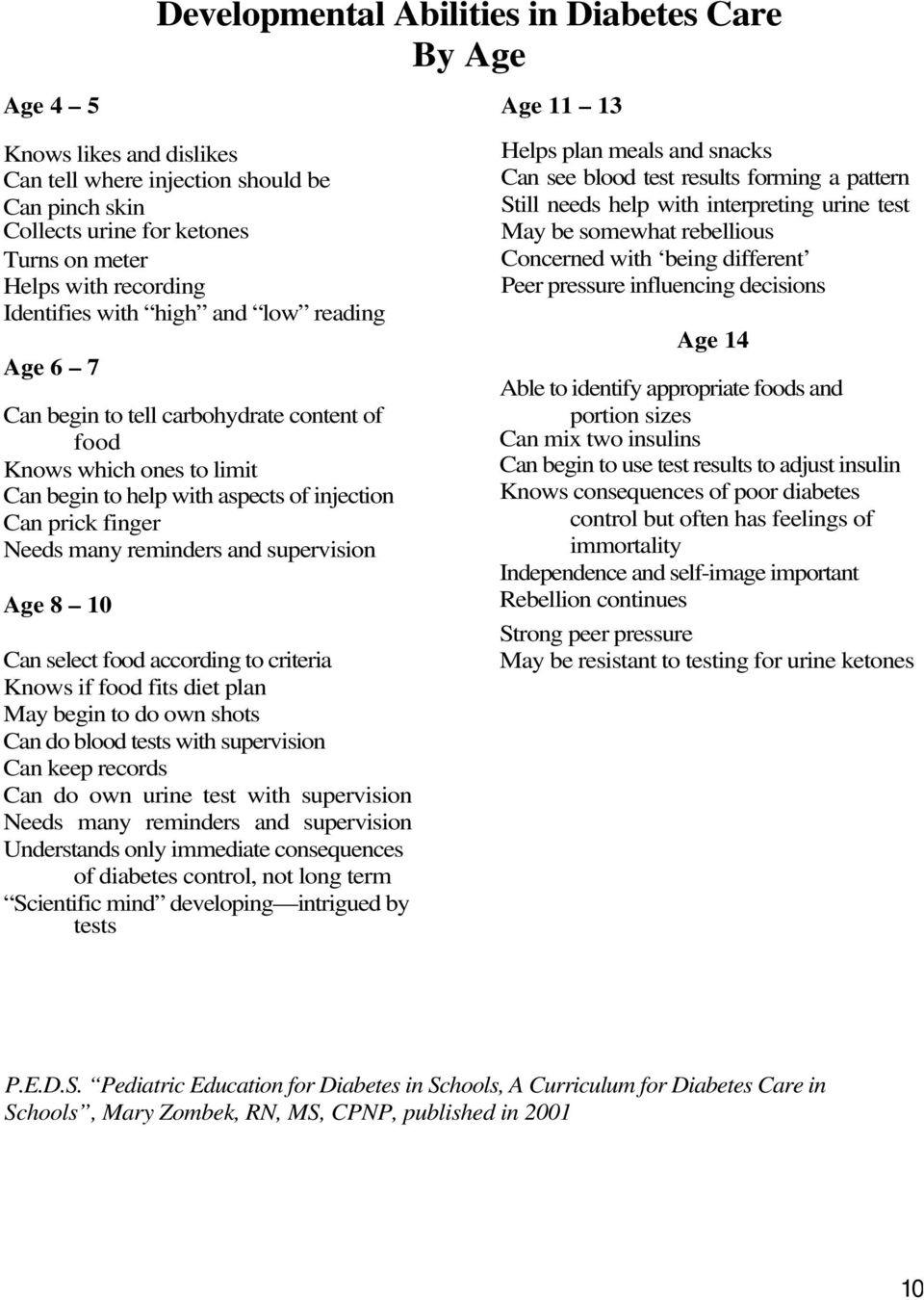
10 Developmental Abilities in Diabetes Care By Age Age 4 5 Knows likes and dislikes Can tell where injection should be Can pinch skin Collects urine for ketones Turns on meter Helps with recording Identifies with high and low reading Age 6 7 Can begin to tell carbohydrate content of food Knows which ones to limit Can begin to help with aspects of injection Can prick finger Needs many reminders and supervision Age 8 10 Can select food according to criteria Knows if food fits diet plan May begin to do own shots Can do blood tests with supervision Can keep records Can do own urine test with supervision Needs many reminders and supervision Understands only immediate consequences of diabetes control, not long term Scientific mind developing intrigued by tests Age Helps plan meals and snacks Can see blood test results forming a pattern Still needs help with interpreting urine test May be somewhat rebellious Concerned with being different Peer pressure influencing decisions Age 14 Able to identify appropriate foods and portion sizes Can mix two insulins Can begin to use test results to adjust insulin Knows consequences of poor diabetes control but often has feelings of immortality Independence and self-image important Rebellion continues Strong peer pressure May be resistant to testing for urine ketones P.E.D.S. Pediatric Education for Diabetes in Schools, A Curriculum for Diabetes Care in Schools, Mary Zombek, RN, MS, CPNP, published in
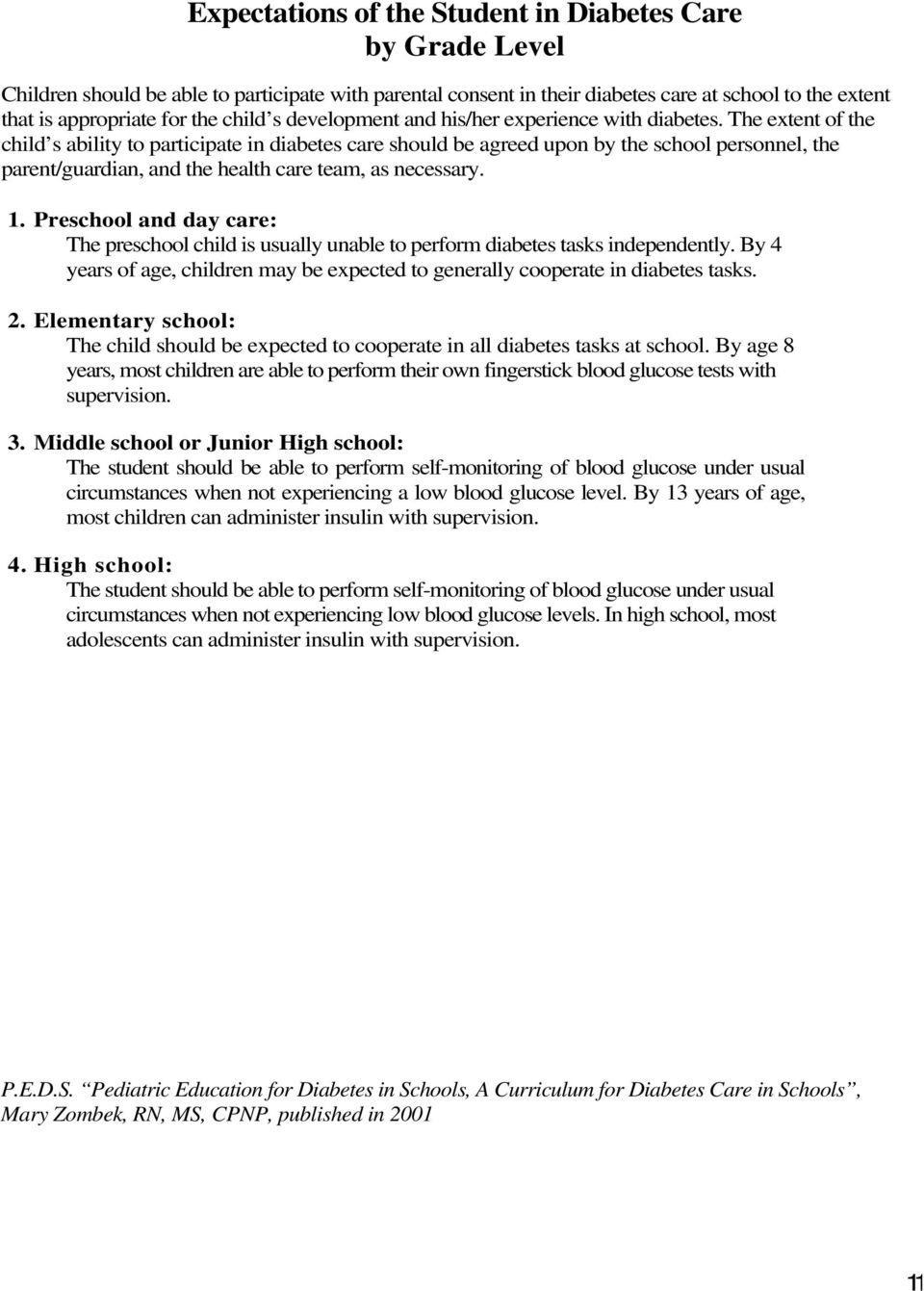
11 Expectations of the Student in Diabetes Care by Grade Level Children should be able to participate with parental consent in their diabetes care at school to the extent that is appropriate for the child s development and his/her experience with diabetes. The extent of the child s ability to participate in diabetes care should be agreed upon by the school personnel, the parent/guardian, and the health care team, as necessary. 1. Preschool and day care: The preschool child is usually unable to perform diabetes tasks independently. By 4 years of age, children may be expected to generally cooperate in diabetes tasks. 2. Elementary school: The child should be expected to cooperate in all diabetes tasks at school. By age 8 years, most children are able to perform their own fingerstick blood glucose tests with supervision. 3. Middle school or Junior High school: The student should be able to perform self-monitoring of blood glucose under usual circumstances when not experiencing a low blood glucose level. By 13 years of age, most children can administer insulin with supervision. 4. High school: The student should be able to perform self-monitoring of blood glucose under usual circumstances when not experiencing low blood glucose levels. In high school, most adolescents can administer insulin with supervision. P.E.D.S. Pediatric Education for Diabetes in Schools, A Curriculum for Diabetes Care in Schools, Mary Zombek, RN, MS, CPNP, published in
12 Developmentally Age Appropriate Skills Check List for Diabetes Care School Student Date This checklist is part of the school nurse s assessment that will be completed with the parent/care provider. Tasks that the student is able to complete are checked off. School personnel can be trained to observe tasks using this checklist as a resource. Blood Glucose Testing: Turns on meter Able to code meter, if required Inserts testing strip into meter Operates lancing device Lances finger or forearm Places blood onto strip Disposes of testing strip properly Records blood glucose reading Ketone Testing: Collects urine in a cup for ketone test Dips testing strip into urine Interprets color of strip Records result Insulin Administration: Selects appropriate injection site Cleans site Draws up insulin Pinches up skin for injection Injects needle Pushes plunger in Uses blood glucose test results to adjust insulin Nutrition: Knows when to eat snacks Eats snacks promptly Knows carbohydrate content of food Aware of foods to limit or restrict Selects appropriate food on meal plan P.E.D.S. Pediatric Education for Diabetes in Schools, A Curriculum for Diabetes Care in Schools, Mary Zombek, RN, MS, CPNP, published in

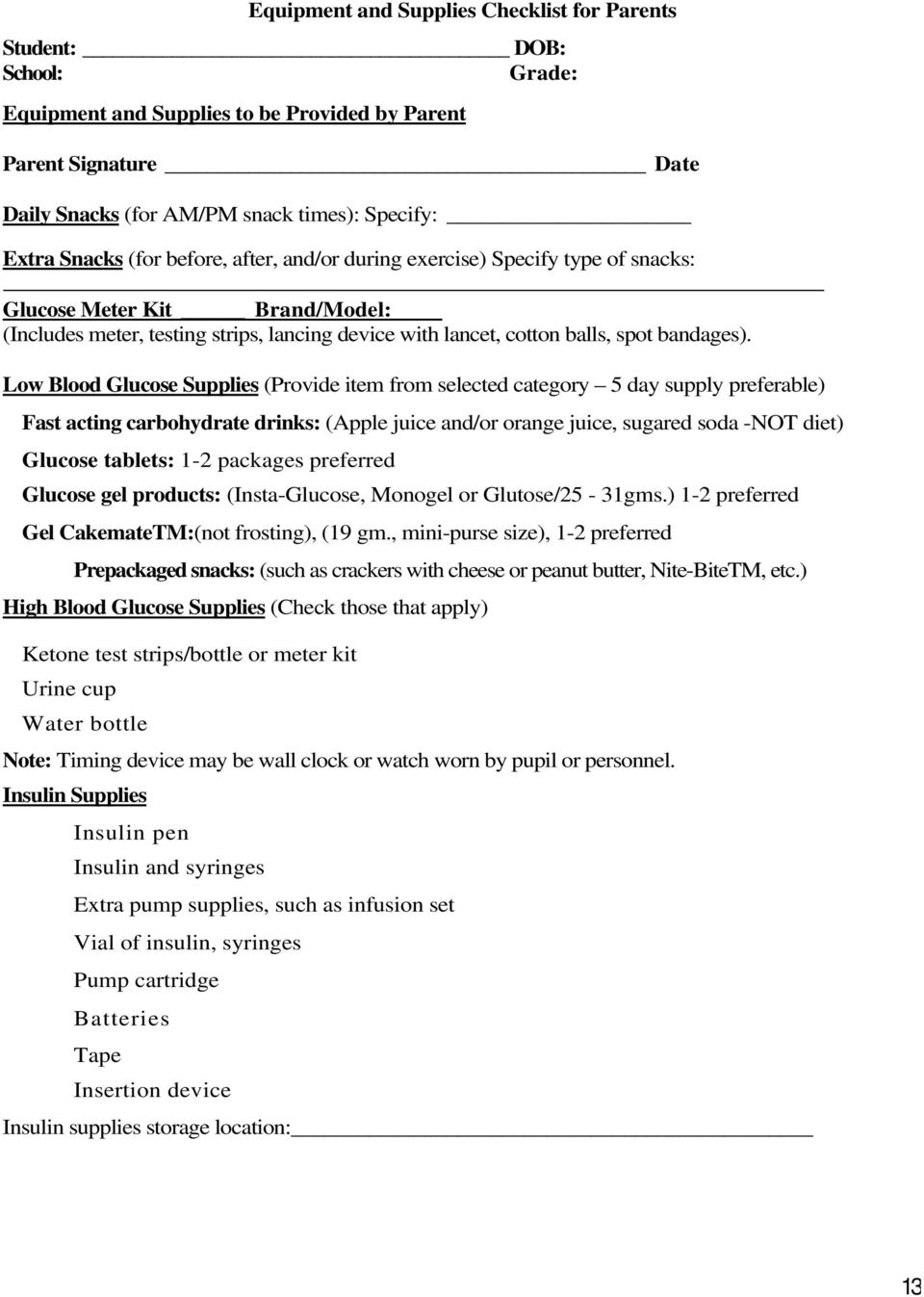
13 Equipment and Supplies Checklist for Parents Student: DOB: School: Grade: Equipment and Supplies to be Provided by Parent Parent Signature Date Daily Snacks (for AM/PM snack times): Specify: Extra Snacks (for before, after, and/or during exercise) Specify type of snacks: Glucose Meter Kit Brand/Model: (Includes meter, testing strips, lancing device with lancet, cotton balls, spot bandages). Low Blood Glucose Supplies (Provide item from selected category 5 day supply preferable) Fast acting carbohydrate drinks: (Apple juice and/or orange juice, sugared soda -NOT diet) Glucose tablets: 1-2 packages preferred Glucose gel products: (Insta-Glucose, Monogel or Glutose/25-31gms.) 1-2 preferred Gel CakemateTM:(not frosting), (19 gm., mini-purse size), 1-2 preferred Prepackaged snacks: (such as crackers with cheese or peanut butter, Nite-BiteTM, etc.) High Blood Glucose Supplies (Check those that apply) Ketone test strips/bottle or meter kit Urine cup Water bottle Note: Timing device may be wall clock or watch worn by pupil or personnel. Insulin Supplies Insulin pen Insulin and syringes Extra pump supplies, such as infusion set Vial of insulin, syringes Pump cartridge Batteries Tape Insertion device Insulin supplies storage location: 13
14 Emergency Supplies Glucagon kit stored: Expiration date of glucagon vile: Recommended 3 Day Disaster Diabetes Supplies (Check those that apply) Vial of insulin; 6 syringes, or Insulin pen with cartridge and needles Blood glucose testing kit (testing strips, lancing device with lancets) if authorized Glucose gel product and glucose tablets Glucagon kit Food supply (include daily meal plan) stored as follows: Ketone strips/plastic cup if authorized Pump supplies, as listed above Extra battery for pump Other Supplies specify: For the school nurse to complete Date Form sent home Date Form returned to school School will include a copy of the IHP for diabetes management with the disaster supplies. Stored as follows: 14

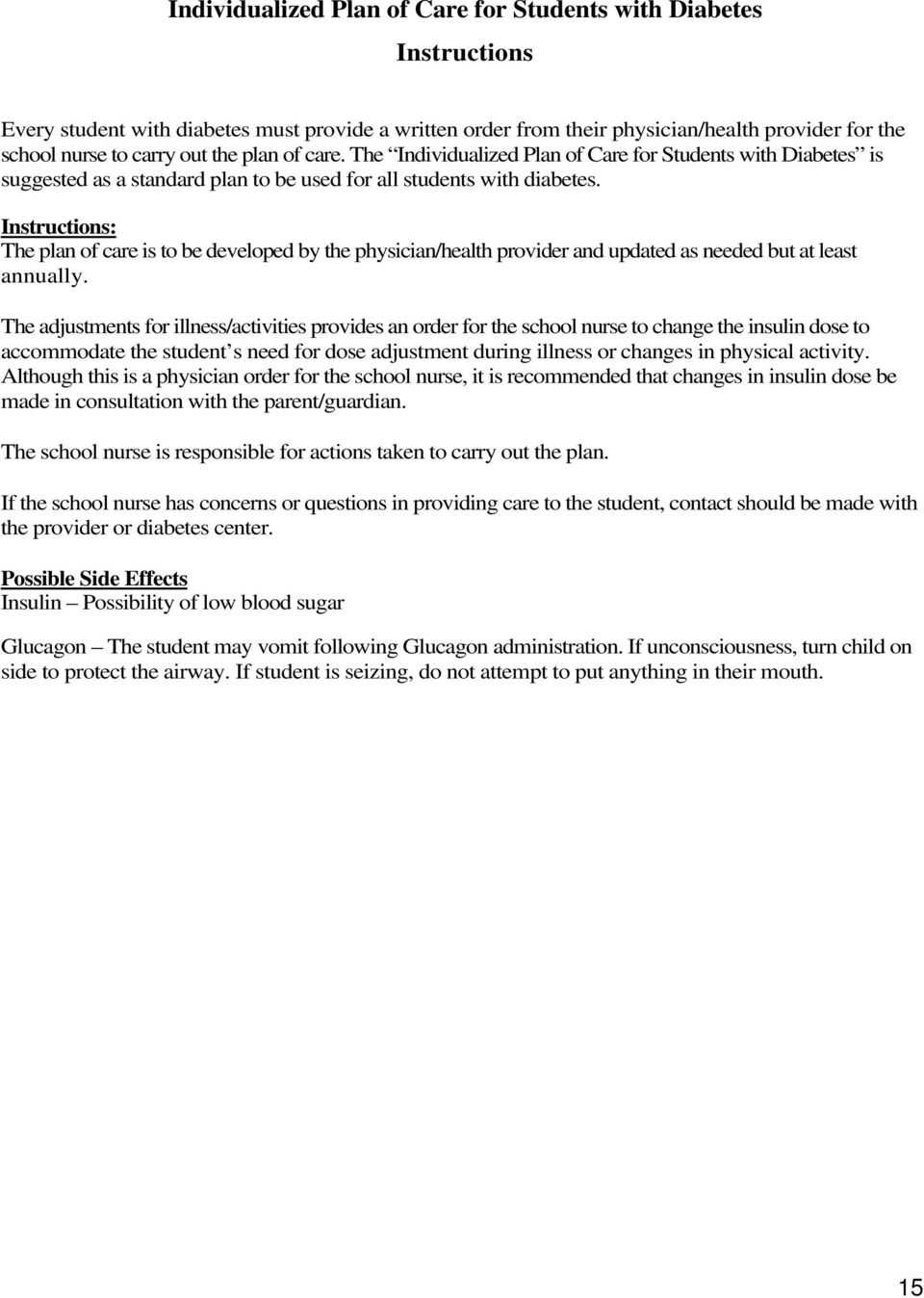
15 Individualized Plan of Care for Students with Diabetes Instructions Every student with diabetes must provide a written order from their physician/health provider for the school nurse to carry out the plan of care. The Individualized Plan of Care for Students with Diabetes is suggested as a standard plan to be used for all students with diabetes. Instructions: The plan of care is to be developed by the physician/health provider and updated as needed but at least annually. The adjustments for illness/activities provides an order for the school nurse to change the insulin dose to accommodate the student s need for dose adjustment during illness or changes in physical activity. Although this is a physician order for the school nurse, it is recommended that changes in insulin dose be made in consultation with the parent/guardian. The school nurse is responsible for actions taken to carry out the plan. If the school nurse has concerns or questions in providing care to the student, contact should be made with the provider or diabetes center. Possible Side Effects Insulin Possibility of low blood sugar Glucagon The student may vomit following Glucagon administration. If unconsciousness, turn child on side to protect the airway. If student is seizing, do not attempt to put anything in their mouth. 15
16 INDIVIDUALIZED PLAN OF CARE FOR STUDENTS WITH DIABETES Home and School Care Instructions Name: Date: Weight: Height: DOB: School School Nurse School Fax PLAN: Multiple Daily Injections: Pump: Adjustment for illness / activity / other factors affecting BG values (+/- 50%) Breakfast AM Snack Lunch PM Snack Supper _ Bedtime Basal Bolus: Base Dose or Insulin to Carb Rato Basal Bolus: Base Dose or Insulin to Carb Ratio Pump Basal Rates: Time Units/hr 12 MN Total Basal = units Supplemental (Correction) Scale: Day Evening and 2-3 AM Other Time Units/hr 12 MN Total Basal = units Blood sugars need to be checked before: 0 Brkfst. 0 Bus 0 AM Snack 0 Lunch 0 PM Snack 0 PE 0 Getting on the bus 0 Supper 0 Bedtime 0 Other Meal Plan (Optional): Urine Ketones: Target Blood Sugar: Breakfast AM Snack Lunch PM Snack Dinner HS Snack Total Carbs Check for urine ketones if Blood Sugar is > 240 or if child is ill. Contact parent if Moderate to Large ketones. Before Meals = 2 Hours After Meals/snacks and/or Correction = 3 Hours After Meals/snacks and/or Correction = Glucagon: Dose: Route: Call parent immediately after giving. I authorize the exchange of information about my child s diabetes between the Physician s Office and the school nurse. Parent signature: Date: I authorize the school nurse to carry out the orders defined in the plan of care. Physician/Provider Signature: Date: Phone: Fax: Next App t: Other: 16

17 INDIVIDUALIZED PLAN OF CARE FOR STUDENTS WITH DIABETES Home and School Care Instructions Name: James Smith Date: 9/4/04 Weight: 60 Kg Height: _ 140 cm _ DOB: _ 11/14/93 School _ George E Jack School Nurse School Fax PLAN: Multiple Dose Injection: _X Pump: Adjustments for illness/activity/other factors affecting BG values (+/- 50%) Basal Bolus Basal Bolus Breakfast AM Snack Lunch PM Snack 3 units Novolog +/- 1.5 grms C 8 units Novolog +/- 4 units 0 units Novolog 7 units Novolog +/- 0 +/- 3.5 Supper 15 units Lantus 8 units Novolog +/- 7.5 unit L +/- 4 Bedtime 2 units Novolog +/-1 *Low blood sugar is a possible side effect of giving insulin. Pump Basal Rates: 12 MN _0.9, 3 AM AM AM PM PM 0.9 Total Basal: _24 units 12 MN 3 AM 7 AM 11 AM 5 PM 10 PM Total Basal units Supplemental (Correction) Scale: Daytime 1 unit/40mg/dl > 200 +/- 20/dl Bedtime and 2 3 AM_ Unit/40 mg/dl > 200 NA_ Other Blood Sugar checked before: 0 Brk 0 AM Bus 0 AM Snack 0 Lunch 0 PM Snack 0 PE 0 PM 0 Bus 0 Supper 0 Bedtime 0 Other Meal Plan: Urine Ketones Target Blood Sugar: Breakfast AM Snack Lunch PM Snack Dinner HS Snack Check for urine ketones if Blood Sugar is >240 or if child is ill. Contact Total Carbs 45 g 15 g 60 g 30 g 75 g 30 g Before Meals + _80_ Hours After Meals and/or Correction = _ _ 3 Hours After Meals and/or Correction = _ Glucagon: Dose: 1 mg Route: SC Call Parent immediately. after administering. *Possible side effect: Child may vomit following Glucagon administration. If unconscious, turn child on side to protect airway. If child is seizing, do not attempt to put anything in child s mouth. I authorize the exchange of information about my child s diabetes between the Physician s Office and the School Nurse. Parent Signature Date I authorize the school nurse to carry out the orders defined in the Individulized Plan of Care. 17

18 Physician/Provider Signature: Date: Phone: Fax: Next App;t:

19 Individual Health Plan for Student with Diabetes in School Every student with diabetes should have a written Individual Health Plan that includes an Emergency Care Plan. The IHP should be developed by the school nurse in collaboration with the student, family, and providers. Developing the plan prior to the student s attendance at school is preferable. The plan should be changed as needed and reviewed at least annually. Information from the plan is intended to be shared, with permission from parents/guardian or eligible student, with school staff who need the information to assure the health and safety of the student. The student s health provider must sign medical orders at least yearly. According to the Nurse Practice Act, registered professional nurses may only accept medication orders from the health providers licensed to prescribe medication. This includes diabetes specialist licensed to adjust medications. Adjustment in medication orders must be made by the provider and can not be accepted from the parent/guardian or other unlicensed individual. The school nurse is accountable for the quality of the health care he/she provides and for the training and supervision of unlicensed staff performing health tasks. The preparation of the health plan will help assure quality of care. The school nurse has the responsibility of counseling and coordinating with the student s parents, primary care provider, student and teacher to assure a safe learning environment. When the student has a substitute teacher or attends a field trip, appropriate information about the student s health needs and how to respond to an emergency situation, must be provided to responsible staff to assure the safety of the student. The student s bus driver should also be aware of the student s health needs and be informed of their responsibility. Helping the Student with Diabetes Succeed provides an overview for training unlicensed staff and information on the roles of school personnel with students with diabetes. 18
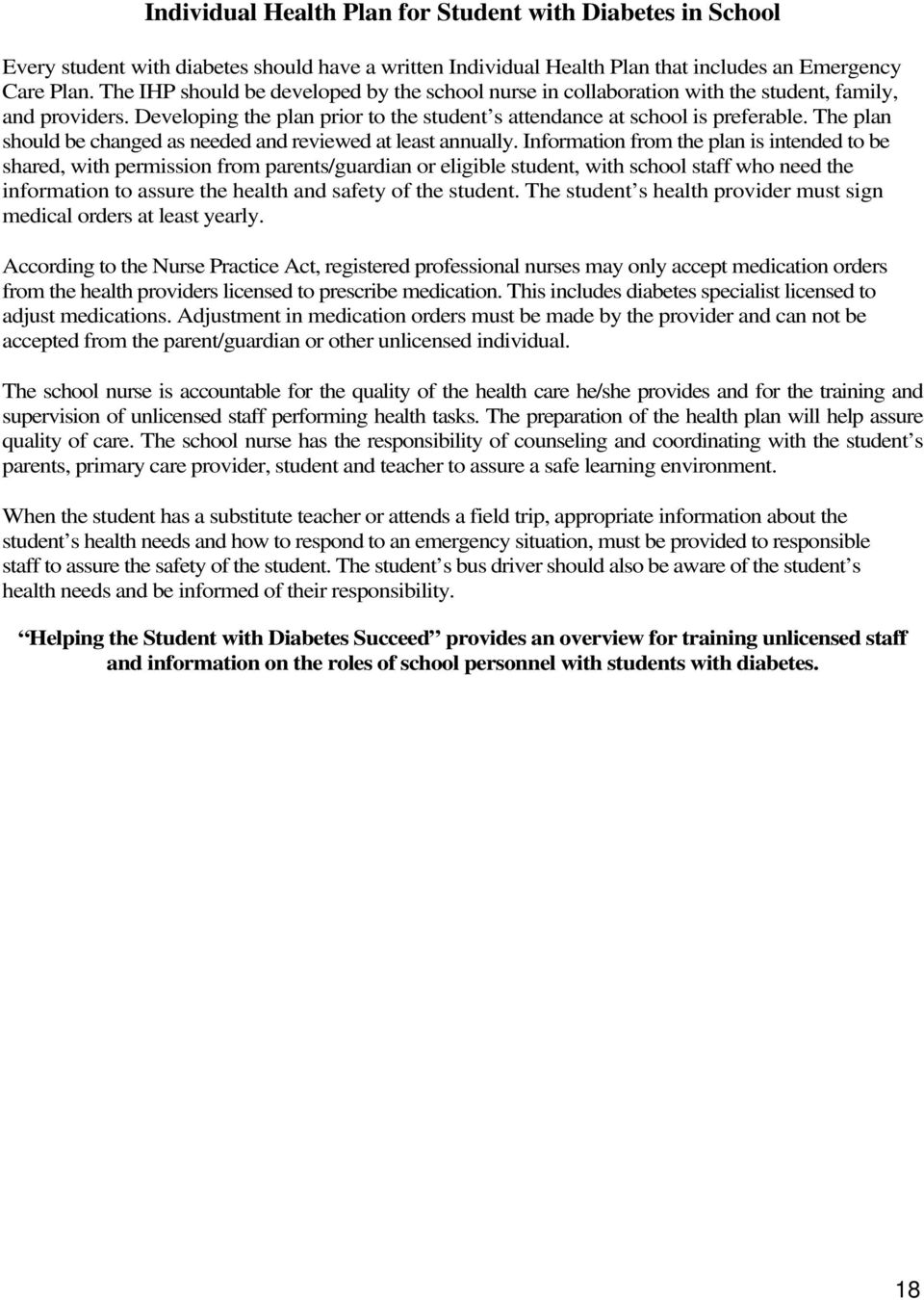
20 Individual Health Plan (IHP) for Students with Diabetes SAMPLE School Year Name of Student School Date To be completed by parent/health care team and reviewed with necessary school staff. Copy should be kept in school health record and in the classroom. Date of Birth Grade Teacher Date of Diagnosis Classroom Teacher Contact Information: Parent/Guardian #1 Address Telephone: Home Work Cell Phone Parent/Guardian #2 Address Telephone: Home Work Cell Phone Student s Doctor Phone Fax Address Diabetes Educator Phone Fax Other Emergency Contact Relationship Telephone: Home Work Cell Phone Notify parent/guardian in the following situations: Blood Glucose Monitoring Target range for blood glucose: mg/dl to mg/dl Type of blood glucose meter Times to routinely check blood glucose: Times to do extra tests (check all that apply) Before Exercise With signs of hyperglycemia After Exercise With signs of hypoglycemia Other (explain) Can student perform own blood glucose tests? Yes No Exceptions No blood glucose testing at school School personnel trained to monitor blood glucose level Insulin/Diabetic Medication Times, types and dosages of insulin injections/medications: Given at Time Name of Insulin/Medication Dosage Home School School personnel trained to assist with insulin injections Can student give own injections? Yes No Can student determine correct amount of insulin? Yes No Can student draw correct dose of insulin? Yes No Meals and Snacks Eaten at School (The carbohydrate content of the food is important in maintaining a stable blood glucose level.) Time Amount of Carbs (Number of Grams) Breakfast AM Snack Lunch PM Snack 19
21 Individual Health Plan Continued For Students with Insulin Pumps Only Type of Insulin Pump Basal Rates: 12 AM to = to = to = to = to = Type of Infusion set: Insulin/ Carbohydrate ratio: Correction Factor: Student Skills with pump Needs Assistance 1. Counting carbohydrates Yes No 2. Can Bolus correct amount for carbohydrates consumed Yes No 3. Can Calculate and administer corrective bolus Yes No 4. Can Calculate and set temporary basal rates Yes No 5. Able to Disconnect pump Yes No 6. Able to Reconnect pump at infusion set Yes No 7. Able to Prepare reservoir and tubing Yes No 8. Able to Insert infusion set Yes No 9. Can Troubleshoot alarms and malfunctions Yes No 10. Can Troubleshoot causes of high Blood Sugar Yes No Snacks: Mandatory At student s discretion Circumstances under which student should disconnect pump Back-up battery given to School Nurse - Yes [ ] No [ ] Supply of insulin, syringes, and ketone sticks available if pump fails - Yes [ ] No [ ] Other information the school nurse needs to be aware of in dealing with pump 20
22 Physical Education 1. Time and Days P.E. Scheduled 2. Is snack needed before P.E. Class? YES NO If Yes, give gram of carbs 3. Is a snack needed before any other exercise? YES NO If Yes, give grams of carbs 4. Is a snack needed after exercise? A snack such as or sports. Preferred snack foods: Foods to avoid if any: Restrictions on activity, if any: Instructions for class parties: YES NO If Yes, give grams of carbs should be available at the site of exercise Student should not exercise if blood glucose below mg/dl or above mg/dl or if ketones are present. Hypoglycemia (Low Blood Sugar) Usual symptoms of hypoglycemia? TO TREAT LOW BLOOD SUGAR: Self treatment of mild lows If Glucose Give Assistance for all lows If Glucose Give Glucagon should be given if the student is unconscious, having a seizure(convulsion) or unable to swallow. If required, glucagon should be administered promptly and then Call 911, parents and School Nurse. Glucagon Dose 0.5mg 1mg School personnel trained to administer glucagon and dates of training: Hyperglycemia (High Blood Sugar) Usual symptoms of hyperglycemia? _ TO TREAT HIGH BLOOD SUGAR If Glucose to Give units of Check for Ketones if glucose above If Glucose to Give units of If Ketones positive, call parent. Location of supplies: Blood glucose monitoring equipment Insulin administration supplies Glucagon Emergency Kit Ketone testing supplies Snack Foods Personnel trained in the symptoms and treatment of low and high blood sugar and dates of training: Bus Transportation: Blood glucose test not required prior to boarding bus Test blood glucose minutes before boarding bus. IF glucose is < mg/dl give 15 gm of carbs. This Diabetes Medical Management Plan has been approved by: Student s Health Care Provider s Signature Date I give permission to the school nurse, trained diabetes personnel and other designated staff members to perform and carry out the diabetes care tasks as outlined by this medical management plan. I also consent to the release of the information contained in this Individual Health Plan to all staff members and other adults who have custodial care of my child and who may need to know this information to maintain my child s health and safety. I will notify the school nurse if there is any change in my child s health status and provide copies of any changes in doctor s orders. Acknowledged/received by: Parent/Guardian Signature Date Reviewed by: School Nurse Date School Principal Date I agree to allow the school nurse to communicate with my child s health care provider(s) regarding my child s diabetes. Parent s Signature Date 21
23 HEALTH SERVICES CONTRACT A copy of this contract will be attached to the Individualized Healthcare Plan STUDENT: DATE: School The initials of the parties signed below indicate specific individual responsibilities in agreement to: the student will: the parent will: the school nurse will: This contract is good for one year and will be reviewed for renewal. A review may occur if any party is noncompliance or there is a change in status. Any party may call for an immediate review. The undersigned are in agreement of the above contract. Student Signature Date Parent/Guardian Signature Date School Nurse Signature Date School Administrator Signature Date Designated Staff Signature Date Designated Staff Signature Date P.E.D.S. Pediatric Education for Diabetes in Schools, A Curriculum for Diabetes Care in Schools, Mary Zombek, RN, MS, CPNP, published in
24 Individualized Education Plan (IEP) Sample STUDENT: J a n e D o e SCHOOL: Sugar Pine Intermediate DOB: DATE: September 13, 2003 GOAL: Independent Health Care Maintenance with regards to diabetes OBJECTIVE: By June 2004 STUDENT WILL be able to operate meter independently, lance finger and place blood onto strip. ACHIEVED: 6/04 NOT ACHIEVED: OBJECTIVE: By June 2004 STUDENT WILL: be able to make snack choice independently based on blood glucose level. ACHIEVED: 6/04_ NOT ACHIEVED: OBJECTIVE: By: June 2004 STUDENT WILL: take responsibility for leaving weekly snacks in the health office refrigerator on Monday AM; including carrots, celery, juice, fruit, cheese and crackers. ACHIEVED: 6/04_ NOT ACHIEVED: OBJECTIVE: By June 2004 STUDENT WILL: attend a peer support group meeting on a regular basis. (Continue goal until June 2005) PERSON RESPONSIBLE: Julie Smith (school nurse) _ DATE OF REVIEW: June 30, 2004 COMMENTS: Jane says she has refused to go to the meetings because she is embarrassed about sharing ACHIEVED: NOT ACHIEVED: _X_ her feelings. A meeting will be scheduled with the school psychologist to assist Jane in dealing with these feelings and to facilitate attendance at the support group meeting. The school psychologist will contact the support group leader in an attempt to hook Jane up with another peer who attends these m e e t i n g s. P.E.D.S. Pediatric Education for Diabetes in Schools, A Curriculum for Diabetes Care in Schools, Mary Zombek, RN, MS, CPNP, published in
25 THE LAW AND DIABETES Section 504 Student Accommodation Plan Any school receiving federal funds must accommodate the special health care needs of its students with disabilities in order to provide them with a free appropriate public education. Such accommodations should be documented in an appropriately developed Section 504 plan or, if the child also needs special education services, in an individualized education program (IEP). Diabetes is recognized as a disability under federal law. Students with diabetes may be referred to a 504 Team to determine whether they would be qualified under 504. These accommodations must be developed with parental input and cannot be implemented without parental consent. The school district has a legal obligation to ensure that these accommodations are provided as described in the plan. The Individual Health Plan and the 504 plan may be included in the same document. If a student with diabetes is found eligible, a 504 plan for that student would be developed to provide full accessibility to all activities, services, or benefits provided by public schools. If a student is found eligible for 504 the following apply. Under Section 504 of the Rehabilitation Act of 1973, it is illegal to discriminate against a person with a disability. The 504 section of the Federal Registry indicates that no qualified handicapped person shall, on the basis of handicap, be excluded from participation in, be denied the benefits of, or otherwise be subjected to discrimination under any program of activity which receives or benefits from Federal financial assistance. Section 504 defines an individual with a disability as any person whom: has a physical or mental impairment which substantially limits participation in one or more major life activities such as caring for oneself, performing manual tasks, walking, seeing, hearing, speaking, breathing, learning, and working. Type 1 diabetes is a physiological disorder that affects the endocrine system, placing the individual at risk for hypoglycemic and hyperglycemic episodes related to this metabolic dysfunction. Potential fluctuations in blood glucose impact the individual s major life activities as described in the 504 document. Historically, Section 504 and ADA have covered students with diabetes. Reasonable accommodations can be planned and documented in a 504 plan by a designated 504 coordinator in each school district. If parents have concerns about the identification, evaluation, programming, placement, or the provisions of a free and appropriate education, there are procedural safe-guards that parents can access. A sample 504 plan for a student with diabetes follows. Helping the Student with Diabetes Succeed a Joint Program of the National Institutes of Health and the Centers for Disease and Prevention, US Department of Health and Human Services,
26 Section 504 Student Accommodation Plan Sample School: Teacher: Grade: Student Name: D.O.B.: Parent Name: Address: Home Phone: Work Phone: Case Manager: Date of Meeting: 1. Describe the nature of the concern leading to this referral: (Include a statement of the 504 eligible condition). Possible loss of cognitive ability if blood sugar is too low or too high. Possibility of seizure if blood sugar is too low. Long-term vascular implications if blood sugar remains high for extended periods. 2. Describe the basis for the determination of disability: Medical diagnosis Type I Diabetes. Is insulin dependent and is currently receiving X injections per day (as needed to keep blood sugar at optimal levels). 3. Describe how the disability limits major life activity: Blood sugar must be monitored and maintained at an optimal level to maintain above stated health status. 4. Describe the reasonable accommodations that are necessary: Providers Assistance with and privacy for blood glucose testing and insulin injections. Health Clerk Snacks and meals whenever/wherever necessary. Teacher Free access to water and toilet. Teacher Full participation in extra-curricular programs. Coach Scheduling physical education around meal times. Teacher Allowances for increased absences. Administration Implementation of the IHP. School Nurse Review/Reassessment Date: (must be completed): Participants (Signature and Title): P.E.D.S. Pediatric Education for Diabetes in Schools, A Curriculum for Diabetes Care in Schools, Mary Zombek, RN, MS, CPNP, published in
27 SUGGESTED ACCOMMODATIONS FOR THE STUDENT WITH DIABETES The following is a list of suggested accommodations for students with diabetes: 1. School nurse, parents and student should mutually determine the most appropriate location for blood sugar (glucose) monitoring and insulin administration. Determining factors may include: Student age, developmental level and possibility of negative effects in classroom. Student desire for privacy. Length of time since diagnosis. Student knowledge of diabetes and degree of independence. Student ability to demonstrate blood sugar (glucose) monitoring procedure and insulin administration, correctly, over time. Awareness of safety issues surrounding needles, lancets, and blood, including proper disposal of waste and storage of diabetes equipment. Any other special circumstances. 2. Student may have permission 1 to do blood sugar testing in the classroom. This procedure should take only a few minutes and not disrupt the class. Student may also need to check blood glucose on field trips or during special events. Blood glucose testing is usually done before meals per primary care provider s (PCP) order. 3. The school lunch menu for the week will be available to the student s family a week in advance. The carbohydrate content of school lunches may be made available on request. 4. Parents are responsible to supply snacks for school; students should have at least one additional snack readily available everyday for emergency consumption. Parents should be notified when the emergency snack is consumed if this is part of the student s Individual Health Plan (IHP). 5. Student needs to be allowed to snack when and where necessary (low blood sugar/hypoglycemia) to maintain adequate blood glucose levels. This includes school transportation as well as the classroom, gymnasium, etc. 6. A student who does not respond to a snack and/or exhibits signs of low blood glucose (hypoglycemia) needs to be accompanied to the health room, or a call for assistance should be made from the classroom. DO NOT SEND ALONE if dizzy, sweating, pale, trembling, crying, drowsy, nauseated, or if complaining of abdominal pain, blurred vision, headache, and/or displaying out of character behavior. 7. A student with a high blood glucose (hyperglycemia) is to receive insulin per PCP order. This may include going to the health room to self-inject insulin or notifying school nurse, parent, family member, or designated adult to administer. The student may be allowed to self-inject in the classroom or health room, if appropriate, and permission is given by the school nurse. (1) 8. A student must be allowed to drink water or other sugar free fluids in the classroom, as needed, to dilute high blood glucose. 9. A student needs to be allowed extra bathroom privileges as high blood glucose (hyperglycemia) results in increased urine output. 10. Optimally, parents should be given at least a three-day notice of extra events such as parties or field trips. 1 Permission is granted to test or self-inject in the classroom after demonstrating to the school nurse appropriate procedure and disposal of waste. Amount of classroom disruption is also a consideration. Students wishing privacy, confidentiality, or supervision shall have permission to come to the health room for blood sugar testing or insulin injection. Guidelines for Care of the Students with Diabetes: Washington State Task Force for Students with Diabetes. 26
28 Delegation and Oversight of Health Tasks to LPN s and Unlicensed School Personnel It is often difficult for school nurses to decide if it is safe to allow other school personnel to assume health tasks in caring for students with diabetes. This is particularly challenging for school nurses serving multiple schools, especially when they have young students with diabetes who require significant care. The SCHOOL NURSING ROLE DEFINITION IN DELEGATION OR COORDINATION AND OVERSIGHT assists the school nurse in understanding how the Maine Nurse Practice Act governs the nurse s ability to delegate task to a LPN or oversee a health task of a non-licensed person. That document can be found in the Maine School Health Manual at Another tool to assist school nurses with decisions is the Decision Tree for Nurse Delegation (following frequently asked questions, below). Frequently Asked Questions About Roles and Responsibilities in Relation to Nursing Procedures and Healthrelated Activities for all Children in the School Setting 1. What is the citation in law that relates to performing nursing task, including administration of medication to students requiring assistance with their care? Section 2102 (2) (C) of The Nurse Practice Act states that registered professional nurses may delegate selected nursing services to licensed practical nurses when the services use standardized protocols and procedures leading to predictable outcomes. The Maine Board of Nursing Rule Chapter 6, allows nurses to coordinate and oversee unlicensed health care assistive personnel for specific tasks for specific students consistent with student safety. The registered professional nurse may not coordinate or oversee unlicensed health care assistive personnel for health counseling, teaching or any task that requires independent, specialized nursing knowledge, skill or judgment. Title 20-A 254 (5) (B) requires schools to have a written local policy and procedure for administering medication, which must include that unlicensed personnel who administer medication receive training before receiving authorization to do so. 2. Can a LPN provide school health services as long as supervision is provided? Yes. LPNs may be hired to perform nursing tasks permitted in the LPN scope of practice under the direction of a certified school nurse, physician or dentist. The tasks must be part of an individual nursing care plan that is developed, maintained and evaluated by a certified school nurse. Supervision need not be on site, but evidence of adequate supervision (which must include, at a minimum, availability of the school nurse, physician or dentist by telephone) is essential. 3. What are the minimum criteria for considering a student to be able to provide self-care? Determination as to whether a student should be considered able to provide self-care should be based on the student s cognitive and/or emotional development rather than age or grade. Factors such as age of reason and mental/emotional disability are some additional considerations to be looked at in determining a child s ability to be self-managed. Guidelines for considering a student to be able to provide self-care are if he/she is consistently able to do all of the following: Identify the correct medication (e.g., color, shape, label) Identify the purpose of the medication (e.g., to maintain blood glucose in normal range) Determine that the correct dosage is being administered (e.g., amount of insulin to be injected) 27
29 Identify the time the medication is needed during the school day (e.g., lunch time, before/after lunch) Describe what will happen if medication is not taken (e.g., increase in blood glucose resulting in feeling ill and unable to complete school work) Refuse to take medication, if student has any concerns about its appropriateness. Student individualized health care plans should always address ways to make the student more independent in the management of their health needs. Goals should be established that would enable children to be able to provide self-care regardless of age or grade. 4. How should school districts handle the issue of medications or needed health care procedures when students go on field trips or participate in after-school activities? Most students can be taught to administer their own medications. For procedures addressing the administration of medication, refer to the School Health Manual guidelines, Administration of Medications in Schools. For field trips or after-school activities, teachers or other school staff must be provided with instructions on medication administration or directions on the specific health care task. The responsible school staff should appropriately transport the student s medication and/or supplies and allow students to take their own medication at the appropriate time, administer medications or assist with the health care procedure for those students that need assistance, according to the student s health care plan. If it is determined that a student s need for health care is such that the task can not be given to an unlicensed school staff, the certified school nurse, other RN, or licensed practical nurse must accompany the student on the field trip (as identified on the 504 plan) to administer medication or carry out the nursing procedures. Alternatively, a parent may accompany the child if they so desired. A student may not be prevented from participating in an educational activity, such as field trip, solely on the basis of a special health need. 5. What if neither the certified school nurse nor the parent is available to attend a field trip with a student with special health needs who is not able to provide self-care? A district must provide appropriately licensed nurses to provide necessary nursing services if it is determined that the health task cannot be given to an unlicensed staff. This can be accomplished by reassigning school nursing staff from other sites within the district, contracting with neighboring school districts, contracting with nurses employed by outside agencies, or by actively recruiting an adequate nursing staff to serve as substitute. 6. Must all children with special health needs have an individualized health plan (IHP)? An IHP, a plan of care for a child with health needs, is developed for students with special health needs. Schools are eligible to receive MaineCare reimbursement for skilled nursing services for MaineCare eligible students only if an IHP is a part of a student s cumulative health record and such services are included in the student s individualized education plan (IEP an educational plan for students who have been identified by the Committee on Special Education as having a disability). 7. What is the district s responsibility for ensuring that a school nurse has received appropriate training if he/she does not know how to perform certain procedures that a child will need? What is the nurse s responsibility? It is the school administrator s responsibility to ensure that staff, including nursing staff, is adequately trained and has updated skills. It is the registered nurse s responsibility to recognize additional training he/she may need to perform a particular procedure and to help determine where the appropriate training may be obtained. 28
30 DECISION TREE FOR NURSE DELEGATION This decision tree is to assist Registered Nurses in determining if it is appropriate to delegate a particular nursing task in a particular setting to an Unlicensed Assistive Personnel (UAP). It is assumed that a nurse has assessed the student and situation completely in order to answer the questions in this decision tree. 1. Is the task within the registered nurse's scope of practice? No Yes 2. Are there any specific laws, rules or institutional/agency Yes policies prohibiting the delegation? Do not delegate Do not delegat No 3. Can the task be performed without observations or critical decisionmaking that requires nursing knowledge, skills and judgment? No Do not delegate Yes 4. Can the task be safely performed according to clear, unchanging NO directions? No Do not delegat Yes 5. Are the outcomes of the task reasonably predictable? Yes No Do not delegate Task itself is generally appropriate for nurse delegation/oversight. Follow the Delegation Guideline and school policies/procedures. 29
31 Bus Driver Plan for Student with Diabetes Please notify student s parents if you are going to have a substitute bus driver. Before student gets on the bus, parents/student should: Test blood sugar to make sure it is in normal range, Give a snack before boarding the bus if blood sugar is low. Assure student has necessary snack and glucose gel with him/her at all times. If on the bus, student complains of feeling as if he/she is experiencing low blood sugar: Have student eat food right away and notify the school via radio; the school will notify student s parent, If you can, drive student directly home or to the school, Parent or other emergency contact person per IHP or emergency contact card will be at bus stop or school nurse or other school staff should be waiting at school. ALLOW STUDENT TO EAT ANYTIME AND ANYPLACE. Symptoms of Low Blood Sugar Sweating (beads of sweat on nose sweaty forehead causing hair to become wet) HUNGER TIRED BLANK STARES SPACEY PALE WEAK FLUSHED DIZZY DROWSY WEEPY REFUSES TO DO THINGS PERSONALITY CHANGES If student becomes confused, give instant glucose under tongue or in cheek and call 911. Bus Driver should know where in student s backpack the glucose gel is kept. If student becomes unconscious, call 911. If you need to evacuate the bus for ANY reason, student s backpack NEEDS to go with the student. 30
32 Training Agreement for School Staff I have read, been trained, (print name of trained personnel) and understand the following procedure for Initials in the space provided indicate agreement for the following: I understand I will need to maintain my skills and will be observed on an ongoing bases by the School Nurse. I have had the opportunity to ask questions and received satisfactory answers. Signature of trained personnel Date Supervising signatures: School Nurse signature Date Principal signature Date P.E.D.S. Pediatric Education for Diabetes in Schools, A Curriculum for Diabetes Care in Schools, Mary Zombek, RN, MS, CPNP, published in
33 Outline for the Level of Care Needed to Perform Diabetes Procedures In School Complete in accordance with State laws - provide copy to school administrator Procedure Who Can Provide Care Location I. INSULIN INJECTION Injections are given prior to meal(s) with Primary Care Provider authorization and parent consent as outlined in the student's IHP. A. SYRINGE 1. Drawing up insulin in a syringe, validating correct dosage and administering injection. 2. Pre-filling and labeling insulin syringe for student administration. 3. Observation of task completion. B. PEN 1. Loading cartridge, dialing correct dose, administering injection. 2. Verifying number on an insulin pen. 3. Observation of task completion. C. PUMP 1. Programming pump functions. 2. Observation of task completion. 3. Troubleshooting pump. 4. Checking site for leakage, cannula dislodgement, redness, and/or tenderness. II. LOW BLOOD GLUCOSE (HYPOGLYCEMIA) A. Glucose tablets/fast acting sugar B. Glucagon Administration III. HIGH BLOOD GLUCOSE (HYPERGLYCEMIA) This includes the provision of extra fluids and testing for ketones. IV. BLOOD GLUCOSE TESTING Includes piercing skin or assisting with piercing the skin, verifying number on the meter; interpreting results with predetermined written algorithms; and testing when symptoms of hypo/hyperglycemia are present. Can occur at any preapproved location as long as arrangements for Sharps disposal are made (must comply with OSHA standards). Treatment must be given on-the-spot (glucose source should be on or with person.) Classroom (if appropriate), health office, designated bathroom, or other areas as appropriate. Can occur at any preapproved location (i.e. classroom, health office) as long as arrangements for blood containment/clean up and sharps disposal are made (must comply with OSHA standards). P.E.D.S. Pediatric Education for Diabetes in Schools, A Curriculum for Diabetes Care in Schools, Mary Zombek, RN, MS, CPNP, published in
34 Checklist: Training School Personnel in Blood Glucose Testing Instructor: Person Trained: Place date and code in the box: Return Demonstrations * + = skill achieved - = skill not achieved Demo Date Date Date Date Date Date Date Date Date Date Date A. States procedure name & purpose of test B. Preparation: 1. Reviews Universal Precautions 2. Identifies where procedure is done C. Identifies supplies: 1. Meter 2. Testing strips or cartridges, etc. 3. Lancing device 4. Gloves D. Procedure 1. Washes hands 2. Assembles supplies 3. Prepares lancing device 4. Turns meter on, checks codes (if applicable) 5. Places strip into meter or prepares otherwise 6. Puts gloves on 7. Cleans selected skin area 8. Lances area 9. Places blood onto testing area 10. Places tissue ball over lanced area 11. Reads result accurately 12. Turns meter off, removes strip 13. Disposes of strip, gloves and other 14. Places spot bandage over lanced area 15. Cleans up testing area 16. Washes hands 17. Records results * School nurse observed trained individual. P.E.D.S. Pediatric Education for Diabetes in Schools, A Curriculum for Diabetes Care in Schools, Mary Zombek, RN, MS, CPNP, published in
35 Emergency Guide for School Staff LOW BLOOD GLUCOSE (Hypoglycemia) MANAGEMENT Algorithm STUDENT NAME: _ GRADE/TEACHER: DATE: CAUSES Too much insulin Missed food Delayed food Too much exercise Unscheduled exercise ONSET Sudden SYMPTOMS PICTURE MILD Hunger Dizziness Irritable Pallor Shakiness Sweating Weak Drowsy Sweaty Anxious Crying Headache MODERATE Sleepiness Erratic behavior Poor coordination Confusion Slurred speech SEVERE Unable to swallow Combative Unconscious Seizure Unable to concentrate Numbness of lip & tongue Other: ACTION NEEDED Notify School Nurse If possible, check blood glucose per plan But, always when in doubt TREAT MILD Provide sugar source: 2-3 glucose tablets or 4 to 8 oz. Juice or 4 to 8 oz. Regular soda or Glucose gel product Wait 10 minutes Provide sugar source if symptoms persist or blood glucose less than 70. Provide a snack of carbohydrate & protein, i.e. crackers and cheese. Communicate with parents MODERATE Provide Glucose source: 3 Glucose tablets or 15 gm. Glucose gel Wait 10 minutes. Repeat glucose if symptoms persist or blood glucose less than 70. Follow with a snack of carbohydrate & protein, i.e. crackers and cheese. Notify parents SEVERE Call 911 Give Glucagon, if ordered. Position on side Contact parents & school nurse School Name: School Nurse: P.E.D.S. Pediatric Education for Diabetes in Schools, A Curriculum for Diabetes Care in Schools, Mary Zombek, RN, MS, CPNP, published in
36 Procedure for Mild or Moderate Low Blood Glucose For School Nurses (Hypoglycemia/Insulin Reaction) STUDENT: School: Grade: Date: Essential Steps Key Points & Precautions 1. Observe/recognize signs/symptoms of low blood glucose; ask student to describe how he/she feels. (Student s known signs/symptoms are Mild Symptoms Moderate Symptoms Key Points & Precautions Headache Weakness, fatigue Moist skin, sweating Numbness of lips/tongue Shakiness Irritability Pale Skin Blurred vision Sudden hunger Crying Stomachache Droopy eyelids, sleepy Erratic behavior Slurred speech Loss of coordination Confusion Unable to swallow Combative Uncooperative/Unconscious or Seizure. Proceed immediately to Procedure for Severe Low Glucose. 2. Test blood (if testing equipment is available), If below 70, or symptomatic, proceed to #3. 3. Treatment for Hypoglycemia (a) Treat with one (1) of the following fast acting 4 oz. (1/2 cup) apple juice or orange juice (or regular Glucose gel (i.e.: 15 gm. tube Insta-Glucose, or Glucose). 1 tube gel CakemateTM (19 gm., mini-purse size). (b) If below 45: 22 gm fast acting glucose. (6 glucose tablets) (c) Observe for 15 minutes, then check for improvement: Student states symptoms are gone and appears Blood sugar over 70 - retest. (d) If still no improvement, repeat Step 2, (second use the gm. Glucose tablets or glucose -and - If still no improvement, repeat again (3 rd attempt attempt). If no improvement after third attempt, call parent If no improvement after fourth attempt, call parent (e) When student is feeling better: If ordered, provide extra carb. and protein snack or snack time, or provide lunch or snack, whichever hour. Resume classroom activities if fully recovered, parent for assistance if not fully recovered. carbohydrates: soda). 15 gm. Monogel or OK. attempt) except gel product, if available. and if needed, 4th and school nurse. and paramedics. if over 1 hour until lunch is due within the or have health officer call If moderate symptoms, provide immediate adult supervision. Treat on the spot ; do not send elsewhere, and, if none of the listed fast acting carbohydrates, are available us e 2 tsps. of sugar or honey, or 4 ounces of milk or fruit punch, etc. Notify school nurse if results are contradictory with student symptoms for further advice. If in classroom and retest is needed, request health office assistance. - and - If pupil becomes unable to participate in care, proceed immediately to Emergency Procedure for Severe Blood Glucose. School nurse will advise regarding further care. 4. Document Blood glucose results and care provided on appropriate forms. Notify parent. P.E.D.S. Pediatric Education for Diabetes in Schools, A Curriculum for Diabetes Care in Schools, Mary Zombek, RN, MS, CPNP, published in
37 Emergency Procedure for Hypoglycemia Low Blood Sugar GLUCOSE GEL FOLLOWED BY GLUCAGON INJECTION Student: Grade School Date 1. Verify signs of severe low blood glucose: a. Have someone call 911, parents and school nurse. b. Place on side or in upright position. 2. If ABLE to swallow and combative, uncooperative, unable to participate in care: a. Place one of the following in cheek pouch closest to ground and massage: i. 15 gms glucose gel: 15 gm tube Insta-Glucose, or 15 gm pkt. Monogel or Glutose (Maintain head position to side for aspiration prevention.) 3. If UNABLE to swallow, (UNCONSCIOUS, combative, uncooperative or seizures): a. Give glucagon injection. b. When able to swallow, give sips of regular soda till paramedic arrives. 4. Procedure for SUBCUTANEOUS Glucagon Injection (SN may give IM if desires). a. Gather the Glucagon kit that should include alcohol swabs, emesis basin, syringe and medication. b. Remove seal from the bottle. c. Wipe the rubber stopper of the bottle with alcohol swab. d. Remove the cap from the syringe, not touching the needle. e. Plunge needle into bottle, pushing all the fluid from the syringe into the bottle. Without withdrawing the needle, gently shake the bottle until the powder is dissolved. f. Turn the bottle upside down and withdraw the medicine as directed. g. Remove the syringe from the bottle, remove the air from the syringe and recap the syringe. h. Clean a 2-inch area on the upper arm with the alcohol swab. i. Remove the syringe cap. j. Gently grasp the arm around the cleaned area with the opposite hand from which you will administer the medication. k. Insert the needle at a 90-degree angle and push in all the medication. l. Count to 10 and remove the needle. m. Have the student lie on side with emesis basin and expect the student to vomit. n. Monitor for seizures and breathing. o. When fully awake, feed fast acting foods such as regular soda. 5. Document in Individual Student Record. P.E.D.S. Pediatric Education for Diabetes in Schools, A Curriculum for Diabetes Care in Schools, Mary Zombek, RN, MS, CPNP, published in
38 Checklist: Training Unlicensed Staff in Hypoglycemia Low Blood Sugar Person Trained: Instructor: Place date and code in the box: + = skill achieved _ = skill not achieved A. States procedure & purpose Demo Date Return Demonstrations* Date Date Date Date Date Date Date Date Date Date B. Preparation: 1. Reviews Symptoms of Hypoglycemia Mild Moderate Severe 2. Identifies when procedure is needed C. Identifies supplies: 1. Lists various glucose products 2. Lists various sugar sources 3. Identifies appropriate carb & protein snacks A. Procedure: 1. Verbally recites appropriate response to a case scenario of hypoglycemia test blood glucose if able has school nurse called provide appropriate glucose/sugar source wait 15 minutes, retest, if blood glucose 70 or above and no symptoms, follow up with a carb & protein snack or meal (if scheduled within the hour) student may return to class if below 70, treat again after 3 rd attempt, call school nurse & parents after 4th attempt, call paramedics, notify parents * School nurse observes trained individuals. P.E.D.S. Pediatric Education for Diabetes in Schools, A Curriculum for Diabetes Care in Schools, Mary Zombek, RN, MS, CPNP, published in
39 Checklist: Training Unlicensed Staff in Glucagon Injection Person Trained: Instructor: Place date and code in the box: Y = skill achieved _ skill not achieved Return Demonstrations* Demo Date Date Date Date Date Date Date Date Date Date Date A. States procedure name & purpose B. Preparation: 1. Reviews Universal Precautions 2. Identified when procedure is needed 3. Identifies accompanying steps: Send someone to call 911, notify school nurse & parent Maintain open airway Position student on side Give glucose source when student is able to swallow C. Identifies supplies: 1. Glucagon kit 2. Alcohol wipe 3. Sharps container 4. Gloves D. Procedure: 1. Assembles supplies 2. Identifies and withdraws sterile water 3. Injects sterile water into glucagons powder 4. Swirls gently till dissolved 5. Withdraws entire solution 6. Selects appropriate injection sites 7. Cleanses area to be injected 8. Inserts needle straight in & injects glucagon 9. Disposes of sharps appropriately 10. Washes hands 11. Documents appropriately * School nurse observes trained individual. P.E.D.S. Pediatric Education for Diabetes in Schools, A Curriculum for Diabetes Care in Schools, Mary Zombek, RN, MS, CPNP, published in
40 STUDENT NAME: _ GRADE/TEACHER: DATE: HIGH BLOOD GLUCOSE (Hyperglycemia) MANAGEMENT For School Staff CAUSES Too much food Too little insulin Decreased Activity Illness, Infection Stress SYMPTOMS ONSET Over-time several hours or days PICTURE FOR VOMITING WITH CONFUSION. LABORED BREATHING AND/OR COMA call 911 Contact school nurse Notify parents
41 Early symptoms: Thirst/dry mouth Frequent urination Fatigue/sleepiness Increased hunger Blurred vision Lack of concentration Symptoms progressively become worse: Sweet breath Weight loss Facial flushing Dry, warm skin Nausea/stomach pains Vomiting Weakness Confusion Labored breathing Unconsciousness/coma Check blood glucose (per IHP) IF STUDENT IS FEELING OK Provide water if student is thirsty Allow liberal bathroom privileges Provide additional treatment per IHP (ketone check, insulin as appropriate) May resume classroom activities Document action and provide copy to school nurse IF STUDENT IS NOT FEELING WELL Call parents to pick up student Provide water if student is thirsty Provide additional treatment per IHP (ketone check, insulin) Notify school nurse if there are further immediate concerns or questions. Document action and provide copy to school nurse. ACTION NEEDED School Name: School Nurse: PCP: P.E.D.S. Pediatric Education for Diabetes in Schools, PCP Phone: A Curriculum for Diabetes Care in Schools, Mary Zombek, RN, MS, CPNP, published in
42 Equipment and Supplies 1. Blood glucose meter kit Water bottle Insulin supplies (if indicated). Procedure for High Blood Glucose Hyperglycemia Essential Steps: 1. Test blood glucose per procedure. 2. Initiate care per Authorized Health Care Provider as identified on student s IHP. This may include insulin administration and checking for ketones and possibly activity restriction. 3. If student is thirsty or has dry mucous membranes, provide water as tolerated. 4. If student is feeling OK resume classroom activities. 5. If student does not feel well (nausea, lethargy, headache) then the parents should be called to take the child home. 6. If student develops severe stomach pains, vomiting and/or rapid breathing, call paramedics, school nurse and parent immediately. 7. Document care on procedure log. Key Points & Precautions: Exercising when ketones are present may elevate blood glucose levels even further. Test for Ketones (see below). If student resumes classroom activities, he/she may drink water in class for symptoms of thirst and/or dehydration. Notify the school nurse so follow-up care can be ensured. School nurse or parent will notify the healthcare provider. Consider use of ketodia sticks for students 10 years and older. Standard Procedure for Testing Urine Ketones Essential Steps: 1. Saturate the test strip with urine by one of the following: Student to hold test strip in urine flow. Student to urinate in cup/jar, then strip is dipped into urine. 2. Wait for test strip to develop per directions on test strip bottle. 3. Compare color of strip to chart on bottle. Results will be read as negative, small, moderate, or large. If results are moderate or large, call parent to take pupil home for observation and/or medical care. 4. Record results on Procedure Log. Key Points & Precautions If assisting the student, wear disposable gloves during this procedure. P.E.D.S. Pediatric Education for Diabetes in Schools, A Curriculum for Diabetes Care in Schools, Mary Zombek, RN, MS, CPNP, published in
43 Procedure for Blood Ketone Testing GENERAL INFORMATION 1) Testing the blood for ketones is considered to be more accurate than urine testing for ketones. Blood ketone testing reflects time accuracy whereas urine ketones reflects a time delay. The monitoring of blood ketone levels can assist in proper management of diabetes. 2) Follow manufacturer s guidelines for ketone ranges (negative or "normal limits", moderate and large or "at risk for possible ketoacidosis"). ESSENTIAL STEPS EQUIPMENT AND SUPPLIES Alcohol prep pad Finger lancing device* Blood ketone testing meter such as Precision Xtra with strips Blood testing strips for specific electronic meter Tissue or cotton balls Gloves Log Book Spot bandage PROCEDURE 1. Wash hands with soap and water. Put gloves on. Student s hands must be washed as well. This is sufficient for prepping the site, however, alcohol may be used for further prepping. The site selected must be dry before pricking. 2. Place ketone testing strip into electronic meter according to manufacturer s instructions. 3. Prepare lancing device according to manufacturer s instructions. 4. Select a site on the top side of any fingertip. Hang the arm below the level of the heart for 30 seconds to increase blood flow. 5. Puncture the site with the lancing device. Gently squeeze the finger in a downward motion to obtain a large enough drop of blood to cover the test strip (3/16" to 1/32" in diameter). 6. Place blood onto testing strip and complete procedure according to manufacturer instructions. 7. Dispose of test strip and tissue or cotton ball in lined wastebasket. Dispose of lancing device in Sharps container. 8. Remove and dispose of gloves, wash hands. 9 If results are small, notify school nurse and parent. If results are moderate or large, call parent to take student home for close observation and/or medical care; notify school nurse. 10.Document results in Student Health Record. KEY POINTS AND PRECAUTIONS Alcohol may cause toughening of the skin or burning sensation. If moisture (water or alcohol) remains on the skin it may alter test results. *If school personnel are performing the procedure then a disposable lancing device should be used. The tops of the fingertips may be more sensitive. The sides of the fingers have less blood flow. Compress lanced area with tissue or cotton ball until bleeding stops or apply spot bandage. Refer to Standard Procedure for Hyperglycemia for specific treatment. P.E.D.S. Pediatric Education for Diabetes in Schools, A Curriculum for Diabetes Care in Schools, Mary Zombek, RN, MS, CPNP, published in
44 Hyperglycemia Skills Checklist & Training Record Person Trained: Instructor: Place date and code in the box: + = skill achieved _ = skill not achieved A. States procedure & purpose Return Demonstrations* Demo Date Date Date Date Date Date Date Date Date Date Date B. Preparations 1. Reviews symptoms of hyperglycemia: Mild moderate (spilling ketones) ketoacidosis C. Identifies supplies: 1. Water 2. Insulin, if ordered 3. Ketone strips D. Procedure 1. Verbally recites appropriate response to a case scenario of hyperglycemia test blood glucose test urine or blood for ketones give 1-2 glasses of water every hour no exercise if ketones are present or blood glucose over 240 if feeling ill at any time immediately call school nurse & parents if student vomits, becomes lethargic, or has labored breathing, call 911 *School Nurse observes trained individual. P.E.D.S. Pediatric Education for Diabetes in Schools, A Curriculum for Diabetes Care in Schools, Mary Zombek, RN, MS, CPNP, published in
45 Insulin Action Times The chart below provides a range of when the insulins are working. Peak action times are when the student usually requires a snack or meal. Timing of Action Preparation Onset Peak Duration Rapid-acting Lispro (Humalog) 5-15 min h 3-4 h (max 4-6) Aspart (Novolog) 5-15 min h 3-4 h (max 4-6) Short-acting Regular (Humulin R, Novolin R, Velosulin BR) Intermediate-acting h 2-3 h 3-6 h (max 6-8) NPH (Humulin N, Novolin N) 2-4 h 6-10 h h (max 14-18) Lente (Humulin L, Novolin L) 3-4 h 6-12 h h (max 16-20) Long-acting Ultralente (Humulin U) 6-10 h h h (max 20-24) Glargine (Lantus) 2 h h (max 24) Mixtures 70/30 (Humulin, Novolin) 50/50 (Humulin) 75/25 (Humalog Mix) h 5-15 min dual (max 14-18) Adopted from: P.E.D.S. Pediatric Education for Diabetes in Schools, A Curriculum for Diabetes Care in Schools, Mary Zombek, RN, MS, CPNP, published in
46 Insulin Pump Therapy Student Requiring Supervision General Information A. Insulin Pump Therapy is also referred to as Continuous Subcutaneous Insulin Infusion (CSII). The pump is worn outside the body and is about the size and weight of a pager. It holds a reservoir of insulin inside the pump and is programmed to deliver the insulin through a thin plastic tube called an infusion set. The infusion set is inserted via a needle that is covered by a cannula just below the skin. Once inserted, the needle is removed and the cannula stays in place for two to three days. When it is time to change the infusion set, a new infusion set is inserted into a different site. B. The goal of Insulin Pump Therapy is to achieve near normal blood glucose levels over 24 hours per day. The use of insulin pumps has been shown to improve growth in children, decrease the incidence of hypoglycemia, and decrease the incidence of long-term diabetes complications. C. The advantages of insulin pumps are that it affords more flexibility of life-style with less variability of insulin absorption, more precise insulin administration matched with food intake and activity levels, and overall close attention to diabetes management. D. The pump uses short acting insulin as opposed to conventional injections, which combine short and long-acting insulin. E. Insulin Pump Therapy combines a continuous basal of insulin for 24 hours and a bolus dose for meal or snack times and times of high blood glucose. Basal rate: amount of insulin required when no food is eaten; a pre-programmed feature measured in units per hour (U/H); can be altered based on the pumper's daily needs; can be temporarily changed for alteration in schedule, activity, illness or food. Bolus: when the pump is programmed to give a dose of insulin for meals, snacks and/or for correction of elevated blood glucose. F. The specific pump manufacturer instructions must be followed. Manuals, booklets, and videos are usually available free of charge by calling the number listed on the back of the pump. G. If the supply of insulin is interrupted due to mechanical pump failure, dislodgment of the cannula, accidental severing of the tubing, or clogged or obstructed tubing, the blood glucose level can rise rapidly. In case one of these incidents should occur, it is necessary for extra supplies to be kept at school to prevent or limit the subsequent hyperglycemia and possible ketoacidosis (can occur in as little as 3 hours). H. The pump can be disconnected using a quick release set. This is usually done during water activities or contact sports. I. A 3x5 card with the student's name, pump model and serial number, and the pump manufacturer's help line phone number should be readily available in the health office for any problems that might occur. J. A wallet sized programming card and an alarm card or manufacturer's instructions should be available in the health office for reference. P.E.D.S. Pediatric Education for Diabetes in Schools, A Curriculum for Diabetes Care in Schools, Mary Zombek, RN, MS, CPNP, published in
47 Student Pump Skills Checklist This form is to be completed by the school nurse with input from the parent/guardian/care provider. The school nurse must directly assess specific skills for competency if independent performance is desired. Document student competency on skills, which are in accordance with standard procedure and the student s IHP. STUDENT: DATE: School: Grade: Pump skill: 1. Appropriately counts carbohydrates. If supervision is required the parents are requested to provide calculations. 2. Calculates appropriate correction dose based on Primary Care Provider's orders. 3. Calculates total dose based on Primary Care Provider or specialist s orders for carbohydrate consumption and correction dose. 4. Programs appropriate bolus. 5. Adjusts temporary rate for exercise. (If supervision is required then parents are requested to pre-program a basal profile to account for scheduled exercise OR extra carbohydrates can be provided as detailed in the IHP.) 6. Disconnects & reconnects tubing. (If supervision is required then it is not recommended that tubing be disconnected at school.) 7. Inserts new infusion set. (If supervision required then parents are requested to provide this service or an emergency back-up plan for insulin administration is recommended.) 8. Uses Universal Precautions for site insertion. 9. Fills reservoir and primes tubing. (If supervision required then parents are requested to be responsible for filling and priming.) 10. Trouble shoots alarms appropriately. (Child to report any alarm to teacher /school staff.) 11. Appropriately identifies high & low blood glucose levels. Requires Supervision Performs Independently P.E.D.S. Pediatric Education for Diabetes in Schools, A Curriculum for Diabetes Care in Schools, Mary Zombek, RN, MS, CPNP, published in
48 Sample Health Service Contract Student Independent Performance of Blood Glucose Testing and Insulin Administration This contract will be attached to the Individualized Healthcare Plan. Student: Date: The following statements delineate specific individual responsibilities and will be initialed by the appropriate party to indicate agreement: _ The student will: Independently perform blood glucose testing in accordance with written procedures. Keep daily records of blood glucose test and insulin dose (as agreed upon by parent and school nurse). Seek help from designated school staff if any problems with their diabetes should occur. Keep parent informed of diabetes issues. Treat hypoglycemia per written procedure. Determine insulin dose based on the physician s order. Self-administer insulin per written procedures. Follow Universal Precautions (change lancet device at home, dispose of needle and syringe in a designated sharps container, place cotton ball over lanced skin until bleeding stops or use a spot bandage to cover area). _ The parent will: Provide necessary equipment such as: blood glucose testing kit, juice, snacks, glucose product, syringes and insulin. Within 24 hours, inform the school nurse, in writing, of any changes in the student s health status, medication, or treatment regimen and provide order change from health provider. Provide signed consents. _ The school nurse will: Ensure that the student has the necessary skills, maturity and competence for blood glucose testing and independent administration of insulin. Evaluate Blood Glucose Testing records; consult student and parent with any concerns regarding interventions or contract compliance. Inform, by phone, the physician and/or parent/guardian of any unusual circumstances. Arrange to have the parent contacted, by phone, when supplies or insulin are running low. _ The health clerk/designated staff will: Intervene as instructed for low blood glucose in accordance with written procedure. Record the date and time of insulin administration on the student s Medication Log. Provide a copy of this log to the physician s office as directed. Notify the school nurse of any unusual circumstances. This contract is good for one year and will be reviewed for renewal. If non-compliance or a change in status occurs any party may call for an immediate review. Student Signature Date Parent/Guardian Signature Date School Nurse Signature Date School Administrator Signature Date Designated Staff Signature Date Designated Staff Signature Date P.E.D.S. Pediatric Education for Diabetes in Schools, A Curriculum for Diabetes Care in Schools, Mary Zombek, RN, MS, CPNP, published in
49 Sample Health Service Contract Insulin Pump This contract will be attached to the Individualized Healthcare Plan. Student: D.O.B.: Date: The following statements delineate specific individual responsibilities and will be initialed by the appropriate party to indicate agreement: The student will: Be responsible for needle/catheter site preparation and insertion. Be responsible for programming the pump functions. Immediately report to appropriate school personnel any pump malfunctions (dead batteries, high pressure alarm/no delivery, etc.). Deliver the appropriate bolus based on blood glucose values and planned food consumption. Use Universal Precautions when discarding pump tubing, needles, and cannulas. Notify parents of any pump incidents. Ensure pump/tubing safety during physical activities. If the student chooses to use a quick-release set during activities he/she will ensure that euglycemia (normal glucose concentration in blood) is maintained as much as possible (checking blood glucose before and after activities, taking extra carbohydrates as needed, re-connecting the pump after completion of activities, etc.). Take care of any skin site problems (bleeding, tenderness, itching, oozing, etc.). If the pump tubing becomes dislodged at school the student will report immediately to the health office and insert a new set or supplement with insulin. _ The parent will: Be responsible for keeping an extra set of pump batteries, tubing, tape (Tegaderm, Op-Stie, etc.), insulin, syringe, and solution(s) needed to prep skin sites (alcohol swabs, betadine, etc.) on the school site in case it is needed. The school nurse will: Inform by phone, the physician and/or parent/guardian of any unusual circumstances. _ The health clerk/designated staff will: Notify the school nurse of any unusual circumstances. This contract is good for one year and will be reviewed for renewal. If non-compliance or a change in status occurs any party may call for an immediate review. Student Signature Date Parent/Guardian Signature Date School Nurse Signature Date School Administrator Signature Date Designated Staff Signature Date Designated Staff Signature Date P.E.D.S. Pediatric Education for Diabetes in Schools, A Curriculum for Diabetes Care in Schools, Mary Zombek, RN, MS, CPNP, published in
50 Daily Blood Glucose Tests Student Name: Month: Year Date: Time/Glucose #Carbs Am Snack Time/Glucose # Carbs Lunch Time/Glucose Time/Glucose Time/Ketones Time/Insulin Time/Glucose From: Van Buren High School 48
51 DIABETES MONITORING LOG FOR THE YEAR STUDENT S NAME: BIRTHDATE: GRADE: PARENT: PHONE: SCHOOL NAME: PHONE: Date Time Blood Glucose Ketones (neg. S.M.L.) Insulin Dose Comments: (note any unusual circumstances, e.g. extra food intake, Hypoglycemic Rx, Exercise, change in routine, etc.) Initials Signature of Staff providing Care Initials Signature of Staff providing Care Initials Signature of Staff providing Care Initials P.E.D.S. Pediatric Education for Diabetes in Schools, A Curriculum for Diabetes Care in Schools, Mary Zombek, RN, MS, CPNP, published in
52 BLOOD GLUCOSE MONITORING LOG FOR THE YEAR Student Name: School: Grade: Teacher: Room Record blood glucose results and your initials in the box. Place initials and signature once on lines at bottom. Document treatment for low and high blood glucose results on the back or in student s health record. MON TUE WED THR FRI MON TUE WED THR FRI MON TUE WED THR FRI MON TUE WED THR FRI MON TUE WED THR FRI July Aug Sep Oct Nov Dec Jan Feb Mar Apr May Jun A = ABSENT R = REFUSED N = NO SCHOOL Initials Signature Initials Signature Initials Signature P.E.D.S. Pediatric Education for Diabetes in Schools, A Curriculum for Diabetes Care in Schools, Mary Zombek, RN, MS, CPNP, published in 2001 REVIEW OF BLOOD GLUCOSE MONITORING RROCEDURE Date Student/Staff Reviewed by 50
53 Date SCHOOL/HOME DIABETES MONITORING LOG FOR INSULIN PUMP Parents: Complete carbs and Bolus(es) columns and return daily to school. School will record in remaining columns and return home daily. STUDENT S NAME: BIRTHDATE: GRADE: PARENT: PHONE: SCHOOL NURSE: PHONE: Carbs Snack lunch Time Blood Glucose Ketones (neg., S,M,L,) Total Insulin Bolus(es) Comments: (note any unusual circumstances) Initials Signature of staff providing care Initials Signature of staff providing care Initials Signature of staff providing care Initials P.E.D.S. Pediatric Education for Diabetes in Schools, A Curriculum for Diabetes Care in Schools, Mary Zombek, RN, MS, CPNP, published in
54 Checklist for School Nurse with New Student with Diabetes in School 1. Meet with parent(s) and student to develop IHP (Individual Health Care Plan) Have parent sign plan. 2. Obtain parental release of information (HIPAA Compliance Release) to communicate with physician. 3. Obtain parental release of information to provide information to school staff that need to know. 4. Obtain physician orders. 5. Parent signs consent form for glucagon and insulin as appropriate. 6. Familiarize yourself with diabetes, insulin pump (if appropriate). 7. Conduct school health team meeting with teacher(s), principal, and other school staff involved in the care of the student with diabetes. 8. Evaluate eligibility for and complete a 504 Plan. 9. Coordinate the development of a Quick Reference Emergency Plan that is to be placed in an confidential spot in the classroom. This plan should include when to contact the School Nurse, and signs/symptoms/treatment of hyper- and hypoglycemia. 10. Plan and implement Diabetes Education Training for all staff including the child s bus driver. 11. _ Prepare Log Sheet for glucose testing monitoring. 12. _ Train unlicensed staff in: a. hypoglycemia and hyperglycemia recognition, b. their actions and responsibility with hyper- or hypoglycemia, c. glucagon administration, d. standard procedure for ketone testing, e. insulin pump therapy (if appropriate), f. documentation Obtain a book on Carbohydrate Counts (if needed). Prepare Health Services Contract for student and parent to sign as appropriate. Complete Outline for Level of Care Needed to Perform Diabetes Procedures in School. Continually monitor the diabetes care plan and make adjustments as needed. 52
55 From: Van Buren High School
56 Resources American Diabetes Association The Center for Health and Health Care in Schools Helping the Student with Diabetes Succeed MCH Diabetes in Children and Adolescents National Diabetes Information Clearinghouse P.E.D.S 53
Equipment and Supplies Checklist for Parents Student: DOB: School: Grade: Equipment and Supplies to be Provided by Parent. Parent Signature Date
 Equipment and Supplies Checklist for Parents Student: DOB: School: Grade: Equipment and Supplies to be Provided by Parent Parent Signature Date Daily Snacks (for AM/PM snack times): Specify: Extra Snacks
Diabetes Insulin Pump Health Care Plan District Nurse Phone: 262-560-2104 District Nurse Fax: 262-560-2106
 EMPOW ERING A COMMUNITY OF LEARNERS AND LEADERS Diabetes Insulin Pump Health Care Plan District Nurse Phone: 262-560-2104 District Nurse Fax: 262-560-2106 Student DOB School Grade Doctor Phone School Year
Diabetes Management and Treatment Plan for School (For the insulin pump student)
 Lafayette School Corporation Health Services Diabetes Management and Treatment Plan for School (For the insulin pump student) Effective Dates: This plan should be complete by the student s personal health
OFFICE OF CATHOLIC SCHOOLS DIOCESE OF ARLINGTON DIABETES MEDICAL MANAGEMENT PLAN Page 1 of 5 TO BE COMPLETED BY PARENT OR GUARDIAN
 PART I OFFICE OF CATHOLIC SCHOOLS DIOCESE OF ARLINGTON DIABETES MEDICAL MANAGEMENT PLAN Page 1 of 5 TO BE COMPLETED BY PARENT OR GUARDIAN Student School Date of Birth Date of Diagnosis Grade/ Teacher Physical
Section 504 Plan (pg 1 of 8)
 Section 504 Plan (pg 1 of 8) of Birth School Today s Section 504 Plan for: Disability: Diabetes School Year: Grade: Homeroom Teacher: Bus Number: Background Objectives The student has type diabetes. Diabetes
Diabetes Health Care Plan
 The Public Schools of Brookline School Health Services of Plan: Diabetes Health Care Plan To be completed by the student s health care team and parents/guardian. Plan will be kept with the school nurse
ALVIN INDEPENDENT SCHOOL DISTRICT Diabetes Medical Management Plan
 ALVIN INDEPENDENT SCHOOL DISTRICT Diabetes Medical Management Plan of Plan: School Year (must be current): This plan should be completed by the student s personal health care team and parents/guardian.
Riley Hospital for Children General Diabetes Medical Management Information- Injections
 Riley Hospital for Children General Diabetes Medical Management Information- Injections 1. HEALTH CARE SUPERVISION All school support staff, including: secretaries, cafeteria staff, custodians and bus
Telephone: Home Work Cell E-mail Address Father/Guardian: Address:
 SAMPLE Diabetes Medical Management Plan/Individualized Healthcare Plan Part A: Contact Information must be completed by the parent/guardian. Part B: Diabetes Medical Management Plan (DMMP) must be completed
Diabetes Medical Management Plan (DMMP)
 Diabetes Medical Management Plan (DMMP) This plan should be completed by the student s personal diabetes health care team, including the parents/guardian. It should be reviewed with relevant school staff
School Year 20 / 20. Diabetes Health Care Plan for Southgate Schools
 School Year 20 / 20 Diabetes Health Care Plan for Southgate Schools Diabetes Medical Management Plan, Initialized Healthcare Plan and Physician Orders Part A: Contact Information must be completed by the
Dear Parent/Guardian and Physician of
 DIABETIC MANAGEMENT PLAN Parent Consent and Physician Authorization POWAY UNIFIED SCHOOL DISTRICT HEALTH SERVICES 15250 Avenue of Science San Diego CA 92128 Dear Parent/Guardian and Physician of California
Diabetes Medical Management Plan
 Diabetes Medical Management Plan 1 School District: School: School Year: Grade: Student Name: DOB: Provider Name: Phone #: Fax #: Blood Glucose Monitoring at School Blood Glucose Target Range: - mg/dl
SAMPLE SECTION 504 PLAN
 SAMPLE SECTION 504 PLAN The attached sample Section 504 Plan was developed by the American Diabetes Association (ADA) and the Disability Rights Education and Defense Fund, Inc. (DREDF). 0 MODEL 504 PLAN
Anchor Bay School District Diabetic Medical Care Plan. Student Name Date Grade Teacher
 Rev: 4/2009 Anchor Bay School District Diabetic Medical Care Plan Place Child s Picture Here Student Name Date Grade Teacher Emergency Contact information (Please list in order to be called) #1 Parent
Diab.etes Me.dic.al-Ma-nage-me-n-t -P-la-n -.
 Date of Plan: Diab.etes Me.dic.al-Ma-nage-me-n-t -P-la-n -. Effective Dates: WJ Student's Name: Date of Birth:,-..,,;... Date of Diabetes Diagnosis: Grade: Homeroom Teacher: Physical Condition: 0 Diabetes
Blood Glucose Management
 Blood Glucose Management What Influences Blood Sugar Levels? There are three main things that influence your blood sugar: Nutrition Exercise Medication What Influences Blood Sugar Levels? NUTRITION 4 Meal
Student Name: Date of Birth:
 Place Photo Here ITASCA DISTRICT 10 DIABETES CARE PLAN Student Name: Date of Birth: Date of Conference: School Nurse: Health Data: has diabetes. This is a condition in which the pancreas is unable to make
FHUSD Diabetic Management Plan
 This plan should be completed by the student s personnel Physician or Licensed Healthcare Provider and parent/guardian. It should be reviewed with relevant school staff and copies should be kept in a place
Name Date. Doctor. Usual times to test glucose at school Extra tests (check those that apply) before exercise after exercise other (explain)
 Appendix A SAMPLE IHP Name Date Phone numbers Blood glucose Hypoglycemia Hyperglycemia Insulin Parent/guardian#1 Work Home Parent/guardian#2 Work Home Other emergency contact Doctor Usual times to test
Diabetes. Emergency Checklists. From A Child in Your Care Has Diabetes. A Collection of Information. Copyright 2005 by Elisa Hendel, M.Ed.
 Diabetes Emergency Checklists From A Child in Your Care Has Diabetes. A Collection of Information. Copyright 2005 by Elisa Hendel, M.Ed. Hyperglycemia High Blood Sugar * Hyperglycemia occurs when the blood
You and Your Child s Rights. What is a 504 Plan? Who Qualifies for a 504? 3/11/2014. Speak Softly and Carry a Big Stick!
 Practical Tips for Helping Your Child with Diabetes Succeed in School By Kathy Spain RN, BSN, CDE, CPT You and Your Child s Rights Your child has the right to a free, appropriate public education without
Introduction. We hope this guide will aide you and your staff in creating a safe and supportive environment for your students challenged by diabetes.
 Introduction Diabetes is a chronic disease that affects the body s ability to metabolize food. The body converts much of the food we eat into glucose, the body s main source of energy. Glucose is carried
BLOOD GLUCOSE MONITORING MEDICATION
 DIABETES CARE FOR SCHOOL MEDICAL MANAGEMENT PLAN Most Recent A1C and Date: BLOOD GLUCOSE MONITORING Meter Type: Testing Independently: yes no Testing times: Before meals Two hours after insulin dosing
SCHOOL DISTRICT #22 VERNON DIABETES POLICY
 SCHOOL DISTRICT #22 VERNON DIABETES POLICY A student with diabetes does not automatically qualify for additional support. The student may qualify as a temporary D category (chronic health) after diagnosis
TYPE 2 DIABETES PROCEDURES AND FORMS ELEMENTARY SECONDARY SCHOOL ADMINISTRATOR
 TYPE 2 DIABETES PROCEDURES AND FORMS ELEMENTARY SECONDARY SCHOOL ADMINISTRATOR 2013 SCHOOL ADMINISTRATOR TYPE 2 DIABETES PROCEDURES and FORMS: Parent/guardian informs school administrator child/youth has
See, Think, and Act! Diabetes
 See, Think, and Act! Diabetes California After School Resource Center (CASRC) Administered for the California Department of Education (C.D.E.) Hello. My name is Joan Edelstein. I am a health trainer for
Green Brook Township School District DIABETES- Insulin Pump IHP/IEHP
 Green Brook Township School District DIABETES- Insulin Pump IHP/IEHP 1. Personal Information: I. STUDENT INFORMATION NAME: Grade HR.- Teacher: Address Home Phone #: Birth date Bus: # N/A Gender Male Female
INSULIN-DEPENDENT DIABETES HEALTH CARE PLAN: II
 INSULIN-DEPENDENT DIABETES HEALTH CARE PLAN: II DATE: SCHOOL: GRADE: STUDENT: BIRTHDATE: HOME ADDRESS: PARENT/GUARDIAN: PARENT S PHONE: Home: Mom s work: Dad s work: EMERGENCY CONTACT (NAME, NUMBER and
Diabetes Hypoglycemia/Hyperglycemia Reaction
 Diabetes Hypoglycemia/Hyperglycemia Reaction Hypoglycemic Reaction (Insulin Shock) A. Hypoglycemic reactions (insulin reactions) should be treated according to current nursing and medical recommendations.
2. What Should Advocates Know About Diabetes? O
 2. What Should Advocates Know About Diabetes? O ften a school district s failure to properly address the needs of a student with diabetes is due not to bad faith, but to ignorance or a lack of accurate
Your Road Map to Diabetes Medication Administration Record (Part 1)
 Your Road Map to Diabetes Medication dministration Record (Part 1) Ohio Revised ode (3313.713) is the education law that addresses prescriptive medication administration in Ohio schools. This OR lists
THE MOLLY CENTER FOR CHILDREN WITH DIABETES AND ENDOCRINE DISORDERS DIABETES-HEALTH CARE PLAN
 THE MOLLY CENTER FOR CHILDREN WITH DIABETES AND ENDOCRINE DISORDERS DIABETES-HEALTH CARE PLAN (To be completed by parent and school nurse) DATE: SCHOOL: GRADE: STUDENT: BIRTHDATE: HOME ADDRESS: PARENT/GUARDIAN:
Management of Diabetes
 Management of Diabetes Blood Glucose Monitoring MANAGEMENT OF DIABETES Once someone is told they have diabetes, they are usually asked to check their blood glucose at home with a home blood glucose meter
DIABETES PACKET. To ensure your child s well-being, please provide the school with the following supplies:
 NSG-203A NORTH ROYALTON CITY SCHOOLS 6579 Royalton Road North Royalton, Ohio 44133 DIABETES PACKET Dear Parent/Guardian: You have indicated that your child has Diabetes. Please complete the attached SCHOOL
Diabetes Education Information for Teachers and School staff
 Diabetes Education Information for Teachers and School staff The information below is intended to educate school staff on the basics of diabetes care. If you have a student in your classroom or you will
Curriculum Standards for Developing Curricula To Train Parent Designated Adults (PDAs) Working with Students with Diabetes
 Curriculum Standards for Developing Curricula To Train Parent Designated Adults (PDAs) Working with Students with Diabetes Updated June 2009 Curriculum Standards for Developing Curricula to Train Parent
Health Professional s. Guide to INSULIN PUMP THERAPY
 Health Professional s Guide to INSULIN PUMP THERAPY Table of Contents Introduction Presenting Insulin Pump Therapy to Your Patients When Your Patient Chooses the Pump Estimates for Starting Insulin Pump
Hypoglycemia and Diabetes
 My Doctor Says I Should Avoid Low Blood Glucose Reactions... How Can I Prevent Them? BD Getting Started Hypoglycemia and Diabetes What You Should Know About Low Blood Glucose Reactions If you are taking
Chapter 23 The School/ Work and Diabetes
 Chapter 23 The School/ Work and Diabetes Susie Owen, RN, CDE H. Peter Chase, MD INTRODUCTION The first and main job of parents in relation to school is to educate those who will be working with the child
Procedure for the Management of. when unwell. To be completed at the start of each academic year and reviewed regularly.
 The student/parents should provide the teacher/school with: Sufficient oral and written information to allow the school to have a safe and appropriate environment for their child Supplies to treat low
Acknowledgements. The working group consists of the following individuals:
 Acknowledgements This document is based largely on the New Brunswick Department of Education and Early Childhood Development Handbook for Type 1 Diabetes Management in Schools. We are indebted to New Brunswick
N E B R A S K A JAIL BULLETIN NUMBER 102 OCTOBER 1993
 N E B R A S K A JAIL BULLETIN NUMBER 102 OCTOBER 1993 The Jail Bulletin is a monthly feature of the Crime Commission Update. The Bulletin may be used as a supplement to your jail in-service training program
Diabetes Fundamentals
 Diabetes Fundamentals Prevalence of Diabetes in the U.S. Undiagnosed 10.7% of all people 20+ 23.1% of all people 60+ (12.2 million) Slide provided by Roche Diagnostics Sources: ADA, WHO statistics Prevalence
Diabetes Mellitus: Type 1
 Diabetes Mellitus: Type 1 What is type 1 diabetes mellitus? Type 1 diabetes is a disorder that happens when your body produces little or no insulin. The lack of insulin causes the level of sugar in your
Section 6: Diabetes Emergencies
 Section 6: Diabetes Emergencies SECTION OVERVIEW General Overview Low Blood Glucose (Hypoglycemia) Glucagon High Blood Glucose (Hyperglycemia) Diabetic Ketoacidosis Monitoring Ketones Emergency Medical
Guidelines for Training School Employees who are not Licensed Healthcare Professionals
 Guidelines for Training School Employees who are not Licensed Healthcare Professionals to implement House Bill 984 (79 th Legislature) related to the Care of Elementary and Secondary School Students with
Appendix A: Questions and Answers
 Appendix A: Questions and Answers Roles and responsibilities for nursing procedures and health-related activities in school and during all school-sponsored activities is complex and, at times, difficult
written by Harvard Medical School Insulin Therapy Managing Your Diabetes www.patientedu.org
 written by Harvard Medical School Insulin Therapy Managing Your Diabetes www.patientedu.org What Is Insulin? The cells of your body need energy and one source of energy is sugar in your blood. Insulin
Glucagon Training Standards for School Personnel: Providing Emergency Medical Assistance to Pupils with Diabetes
 Glucagon Training Standards for School Personnel: Providing Emergency Medical Assistance to Pupils with Diabetes Performance Standards for the Training and Supervision of School Personnel in Providing
1.00 REGULATORY AUTHORITY
 ARKANSAS DEPARTMENT OF EDUCATION AND ARKANSAS STATE BOARD OF NURSING RULES GOVERNING THE ADMINISTRATION OF INSULIN AND GLUCAGON TO ARKANSAS PUBLIC SCHOOL STUDENTS SUFFERING FROM DIAGNOSED WITH DIABETES
VA/DoD Clinical Practice Guideline for Management of Diabetes TOOLKIT
 VA/DoD Clinical Practice Guideline for Management of Diabetes TOOLKIT VA/DoD Clinical Practice Guideline for Management of Diabetes TOOLKIT For the Provider/Educator Teaching Tips Consider patient readiness
DIABETIC EDUCATION MODULE ONE GENERAL OVERVIEW OF TREATMENT AND SAFETY
 DIABETIC EDUCATION MODULE ONE GENERAL OVERVIEW OF TREATMENT AND SAFETY First Edition September 17, 1997 Kevin King R.N., B.S., C.C.R.N. Gregg Kunder R.N., B.S.N., C.C.T.C. 77-120 CHS UCLA Medical Center
Managing Diabetes in the Athletic Population
 Managing Diabetes in the Athletic Population Michael Prybicien, LA, ATC, CSCS, CES, PES Athletic Trainer, Passaic High School Overlook Medical Center & Adjunct Faculty, William Paterson University Dedicated
Managing Diabetes in the School Setting. Alabama State Department of Education Alabama Board of Nursing
 Managing Diabetes in the School Setting Alabama State Department of Education Alabama Board of Nursing Diabetes Mellitus: Type I Diabetes Previously called Insulin-dependent or Juvenile Onset Diabetes
Diabetes in School Children. Recommendations & Resource Guide for School Personnel
 Diabetes in School Children Recommendations & Resource Guide for School Personnel 2009 Contents Table of Acknowledgements........................................................3 Introduction..............................................................
Guidelines for the Care *
 Guidelines for the Care * Purpose: To acknowledge and help clarify the essential roles and responsibilities among the Diabetes Care Team (DCT), which is comprised of the student living with diabetes, his
Objectives PERINATAL INSULIN PUMPS: BASICS FOR NURSES. Historical Perspective. Insulin Pumps in Pregnancy. Insulin Pumps in the US
 Objectives PERINATAL INSULIN PUMPS: BASICS FOR NURSES Jo M. Kendrick, APN BC, CDE [email protected] Describe indications and contraindications for insulin pump use in hospitalized patients Differentiate
SCHOOL DISTRICT #43 (COQUITLAM) MEDICAL ALERT FORMS FORM(S) MUST BE COMPLETED AT THE START OF EACH SCHOOL YEAR
 SCHOOL DISTRICT #43 (COQUITLAM) MEDICAL ALERT FORMS FORM(S) MUST BE COMPLETED AT THE START OF EACH SCHOOL YEAR Please read instructions below carefully. Feel free to contact your school if you need any
My Doctor Says I Need to Take Diabetes Pills and Insulin... What Do I Do Now? BD Getting Started. Combination Therapy
 My Doctor Says I Need to Take Diabetes Pills and Insulin... What Do I Do Now? BD Getting Started Combination Therapy How Can Combination Therapy Help My Type 2 Diabetes? When you have type 2 diabetes,
School Nurse Diabetes Resource Guide
 School Nurse Diabetes Resource Guide Table of Contents Introduction.....1 Insulin Pump Basics....2 Safe at School...4 Diabetes Care Plan: Blood glucose monitoring and management...6 Insulin and glucagon
Resident s Guide to Inpatient Diabetes
 Resident s Guide to Inpatient Diabetes 1. All patients with diabetes of ANY TYPE, regardless of reason for admission, must have a Hemoglobin A1C documented in the medical record within 24 hours of admission
Insulin is a hormone produced by the pancreas to control blood sugar. Diabetes can be caused by too little insulin, resistance to insulin, or both.
 Diabetes Definition Diabetes is a chronic (lifelong) disease marked by high levels of sugar in the blood. Causes Insulin is a hormone produced by the pancreas to control blood sugar. Diabetes can be caused
Diabetes Self Management Training Insulin Pump Follow Up
 701 East Marshall Street, West Chester, PA 19380 www.chestercountyhospital.org 610.431.5000 Diabetes Self Management Training Insulin Pump Follow Up Patient Name: Visit Date: Time: To prepare for your
UNDERSTANDING AND LEARNING ABOUT STUDENT HEALTH
 Teacher Workshop Curriculum UNDERSTANDING AND LEARNING ABOUT STUDENT HEALTH Written by Meg Sullivan, MD with help from Marina Catallozzi, MD, Pam Haller MDiv, MPH, and Erica Gibson, MD UNDERSTANDING AND
Basal Rate Testing Blood sugar is affected at any time by 1) basal insulin 2) food (carbohydrate) intake 3) bolus insulin (meal time and correction)
 Basal Rate Testing Blood sugar is affected at any time by 1) basal insulin 2) food (carbohydrate) intake 3) bolus insulin (meal time and correction) 4) activity and 5) other factors such as stress and
Type 2 Diabetes Type 2 Diabetes
 Pennington Nutrition Series Healthier lives through education in nutrition and preventive medicine Pub No. 33 Type 2 is the most common form of diabetes. In this form, the body does not produce enough
My Sick Day Plan for Type 1 Diabetes on an Insulin Pump
 My Sick Day Plan for Type 1 Diabetes on an Insulin Pump When you are sick, your blood sugar levels may be harder to keep under control. Your blood sugar may go too high or too low. Use this guide to help
Getting the Big Picture
 About Diabetes This health information is being provided for general educational purposes only. Your health care provider is the single best source of information regarding your health. Please consult
The Family Library. Understanding Diabetes
 The Family Library Understanding Diabetes What is Diabetes? Diabetes is caused when the body has a problem in making or using insulin. Insulin is a hormone secreted by the pancreas and is needed for the
The Basics of Insulin Pump Therapy
 The Basics of Insulin Pump Therapy Table of Contents The Basics of Insulin Pump Therapy Introduction Welcome... 3 Chapter 1 Balancing Glucose and Insulin............................. 10 Section 1: Glucose,
Causes, incidence, and risk factors
 Causes, incidence, and risk factors Insulin is a hormone produced by the pancreas to control blood sugar. Diabetes can be caused by too little insulin, resistance to insulin, or both. To understand diabetes,
Feeling Better, Living Healthier With Diabetes
 Feeling Better, Living Healthier With Diabetes A guide for self management 761 S. Nelson Ave. Wilmington, Ohio 45177 (937) 382-9307 www.cmhregional.com What is Diabetes? Those who have diabetes are often
Type 1 Diabetes. Pennington Nutrition Series. Overview. About Insulin
 Pennington Nutrition Series Healthier lives through education in nutrition and preventive medicine Pub No. 32 Type 1 Diabetes Overview Type 1 Diabetes (DM) is usually diagnosed in children and young adults.
X-Plain Diabetes - Introduction Reference Summary
 X-Plain Diabetes - Introduction Reference Summary Introduction Diabetes is a disease that affects millions of Americans every year. Your doctor may have informed you that you have diabetes. Although there
Section 5: Type 2 Diabetes
 SECTION OVERVIEW Definition and Symptoms Blood Glucose Monitoring Healthy Eating Physical Activity Oral Medication Insulin Sharps Disposal Definition and Symptoms Type 2 diabetes is occurring more frequently
The Diabetes Self Management Insulin Pump Therapy Program
 The Diabetes Self Management Insulin Pump Therapy Program Is part of a Nationally recognized program taught by CPT s Offers classes during the daytime in a three part series: PRE-PUMP CLASS SALINE START
Type 2 diabetes Definition
 Type 2 diabetes Definition Type 2 diabetes is a lifelong (chronic) disease in which there are high levels of sugar (glucose) in the blood. Type 2 diabetes is the most common form of diabetes. Causes Diabetes
How To Manage Diabetes In School
 Diabetes is one of the most common chronic diseases in school-aged children, affecting about 208,000 young people in the United States. According to recent estimates, about 23,500 youths are diagnosed
Starting insulin treatment for people with type 2 diabetes. What you need to know
 Starting insulin treatment for people with type 2 diabetes What you need to know Contents Information 3 Any questions? 3 Glossary of terms 3 Why do I need insulin? 4 What does insulin do? 5 Why are there
Student Health 2015/2016. Welcome Back!
 Student Health 2015/2016 Welcome Back! Back-to-School Highlights Bloodborne Pathogens Organisms in blood and other body fluids that can cause disease Examples: HBV HCV HIV AIDS Protect yourself! Observe
Guidelines for Training School Employees who are not Licensed Healthcare Professionals. House Bill 984 (79th Legislative Session)
 1 Guidelines for Training School Employees who are not Licensed Healthcare Professionals to implement House Bill 984 (79th Legislative Session) related to the Care of Elementary and Secondary School Students