
Guide to the Executive Doctorate in Business Administration (DBA)
|
|
|
- Roderick White
- 10 years ago
- Views:
Transcription
1 Guide to the Executive Doctorate in Business Administration (DBA) HANDBOOK AND PROGRAM GUIDE Executive Doctorate in Business Administration: Handbook and Program Guide

2 EXECUTIVE DOCTORATE IN BUSINESS ADMINISTRATION Handbook and Program Guide THIS DOCUMENT PROVIDES INFORMATION REGARDING THE STRUCTURE AND CONTENT OF THE EXECUTIVE DBA PROGRAM. CERTAIN DETAILS, SUCH AS THE WORDING OF COURSE TITLES AND DESCRIPTIONS AND COURSE SEQUENCE MAY CHANGE. TABLE OF CONTENTS 1. FOX SCHOOL OF BUSINESS: VISION, VALUES AND MISSION... 5 VALUES... 5 MISSION ABOUT THE PROGRAM... 8 A COMMITMENT TO EXCELLENCE IN DBA EDUCATION... 8 Mission... 9 Key Goals... 9 Key Principles... 9 Learning Goals and Objectives THE ADMISSIONS PROCESS BASIC ADMISSION REQUIREMENTS THE INTERVIEW PROCESS ADMISSION EXECUTIVE DBA PROGRAM STRUCTURE AND CURRICULUM BASIC REQUIREMENTS PROGRAM STRUCTURE CURRICULUM Foundational Courses (F) Methods Courses (M) Research Projects (R) Dissertation (D) REQUIRED GRADES APPLIED RESEARCH IN THE EXECUTIVE DBA MENTORSHIP OF DBA STUDENTS RECOGNIZING RESEARCH ACHIEVEMENT BY EXECUTIVE DBA STUDENTS ENGAGING WITH THE FOX MANAGEMENT CONSULTING GROUP CHANGE OF FACULTY MENTORS NETWORKING AMONG EXECUTIVE DBA STUDENTS THE DOCTORAL DISSERTATION Executive Doctorate in Business Administration: Student Handbook

3 Dissertation Guidelines Dissertation Committee Dissertation Development Milestones Dissertation Proposal Defense Dissertation Defense APPENDIX 1 PROGRAM PERSONNEL APPENDIX 2. UNIVERSITY RESOURCES SAMUEL PALEY MEMORIAL LIBRARY WHARTON RESEARCH DATA SERVICES (WRDS) SOCIAL SCIENCE DATA LIBRARY APPENDIX 3. CODE OF ETHICS ACADEMIC INTEGRITY PLAGIARISM ACADEMIC GRIEVANCE Executive Doctorate in Business Administration: Handbook and Program Guide

4 FOX SCHOOL OF BUSINESS: VISION, VALUES, AND MISSION Executive Doctorate in Business Administration: Student Handbook

5 1. FOX SCHOOL OF BUSINESS: VISION, VALUES AND MISSION VISION With nearly one hundred years of history behind us, our vision is to be a top public urban business school in the United States, and among the leading business schools in the world. The Fox School aspires to be globally recognized for impactful theoretical, empirical and applied research. The vision of the Fox Executive DBA is to be a premier and reputable program known for transforming executives into reflective management practitioners who generate and use evidence-based management practice. VALUES We transform lives by creating and sharing knowledge, while instilling values that prepare leaders for tomorrow s world. Our vision and values guide our teaching, research and school management. Excellence: We value excellence in teaching, research and school management. Creativity: We value innovation and creative thinking. An entrepreneurial culture: We value effective decision-making and the entrepreneurial implementation of ideas. Ethical behavior and respect for others: We value ethical practice and diverse perspectives. Community Engagement: We value building partnerships with all stakeholders and the community we serve. MISSION Transform lives through education. Russell Conwell s mission was to provide a gateway to opportunity for talented and determined students. We build on this mission, making sure our students acquire the skills they will need in the global marketplace. The mission of the Executive DBA program is to train executives to become leaders of management practice by engaging in theoretically grounded, methodologically sound applied (practice-focused) research, with the guidance and mentorship of Fox faculty. 5 Executive Doctorate in Business Administration: Handbook and Program Guide

6 We are committed to the following: Providing quality, student-centered business education. Engaging in relevant research and advanced doctoral training, and expanding the frontiers of knowledge and business education. Extending our education, research and outreach efforts to be responsive to the driving forces of our economy, including globalization, sustainability, ethics, entrepreneurship, innovation, and technological advancement. Integrating leading-edge information technology into teaching, learning, research, and school management, which is necessary for managing in an increasingly competitive, dynamic, global economy. Providing the best professional development and career management opportunities for our students, faculty and staff, with special efforts to facilitate development of ethical values, social networking skills and leadership. Linking, through our curriculum, research and outreach to the dominant and growth industries in our region: financial services, healthcare, pharmaceuticals/ biotechnology, information technology, and tourism. Engaging our diverse stakeholders to improve our school and serve our community. Executive Doctorate in Business Administration: Student Handbook

7 ABOUT THE PROGRAM 7 Executive Doctorate in Business Administration: Handbook and Program Guide

8 2. ABOUT THE PROGRAM The Executive Doctorate in Business Administration is designed for reflective executives who desire to advance their careers in management or consulting through high-quality applied, practice-focused research. Graduates of the Fox Executive DBA program will be at the forefront of knowledge generation and evidence-based management, enabling them to make contributions to the advancement of management practice. There is a growing recognition that this evidence-based approach to management is an increasingly important skill for executives. Accordingly, the Doctor of Business Administration is a highly recognized degree by the Association for the Advancement of Collegiate Schools of Business (AACSB), our main accrediting body. The three-year Executive DBA program offers a combination of both theoretical and applied research methodology courses. The program offers students a rigorous, research-focused curriculum that emphasizes research addressing the problems most relevant to managers. Students attend face-to-face lectures, utilize web-conferencing tools to collaborate with faculty and peers, and develop their program of research through applied research projects, including a dissertation under the supervision of faculty experts in their fields. The Executive DBA curriculum develops the applied research competencies necessary to create independent thinkers and problem-solvers. Executives equipped with these advanced research skills will be better prepared to discover and address the vexing problems that face complex organizations, lead change initiatives, improve performance and impact standard business practice. Consequently, Executive DBA graduates will increase their value to their organizations. A doctoral degree also provides a path for executives who desire a transition into an academic career. Graduates may become qualified to teach in colleges and universities in the United States and around the globe. In fact, demand for business faculty has increased substantially in Brazil, Russia, India and China (BRICS) as well as throughout Latin America, Eastern Europe and Asia. In these emerging economies, there is a strong need for faculty to educate professional managers at the MBA and undergraduate levels. In summary, the Executive DBA represents an exciting new opportunity for those with the talent and determination to succeed, wish to advance their management or consulting careers, or transition to teaching in an academic setting. A COMMITMENT TO EXCELLENCE IN DBA EDUCATION Fox faculty are committed to educating reflective practitioners who connect academics to practice. Executive DBA students will lead and shape future business practice through conduct of applied research. The Executive DBA program is a demanding program that requires discipline, intense work, and personal commitment. Our students are hard-working professionals with the leadership skills to conduct high-quality, managerially-relevant research. Executive DBA students are an integral part of the Fox School s vision to be a top global institution for theoretical and applied research in business and management. The greatest resource offered to Executive DBA students is the Fox faculty. All DBA students will work closely with a mentor throughout the program. Our faculty are internationally recognized leaders in their disciplines, which include accounting, finance, entrepreneurship, human Executive Doctorate in Business Administration: Student Handbook

9 resource management, supply chain management, international business, marketing, management information systems, risk management, insurance and actuarial science, strategic management, tourism, and sport management. Fox faculty work closely with students to address cutting-edge topics that push the frontier of management practice. EXECUTIVE DBA PROGRAM MISSION, GOALS, AND PRINCIPLES Mission The mission of the Executive DBA program is to train students to become thought-leaders of management practice and creators of knowledge by engaging in applied research. With the aid of Fox faculty, Executive DBA students will learn how to integrate management theory with practice and advance the field of evidence-based management. Key Goals To develop reflective practitioners with the potential to lead management practice through impactful and relevant research published in premier practice-oriented journals and conferences. To support students as they develop and conduct their program of high-quality, applied research through hands-on guidance and collaboration with Fox faculty. To train students to conduct applied research in a supportive and collaborative environment, enabling them to approach problems in new ways and positively impact their career development. Key Principles Executive DBA students must develop an appreciation of, and a commitment to, the foundations of scientific inquiry. Executive DBA students are committed to their own professional growth and development, and to the achievement of high personal goals. Executive DBA students will seek an area in which to develop deep expertise, but are expected to be knowledgeable in many areas of business. They are encouraged to develop their expertise by crossing traditional disciplinary lines. Executive DBA students learn through their own research activities and are expected to contribute to the knowledge base through applied research. Executive DBA students must demonstrate and further develop excellent oral and written communication skills. 9 Executive Doctorate in Business Administration: Handbook and Program Guide

10 Learning Goals and Objectives The Fox School of Business is committed to the Assurance of Learning standards of the AACSB. The Executive DBA Program supports our students in mastering a foundational set of skills by the time they graduate. The acquisition of these skills is measured using the DBA Program Goals and Objectives. The Executive DBA Program works in conjunction with the Fox School Assurance of Learning office to measure the learning goals and make any program improvements based on the results of the measurements. The Academic Program Director is responsible for overseeing the program s learning goals and for measuring its results. There are three overarching learning goals for the Executive DBA program, and each learning goal has a number of learning objectives. The goals recognize that most graduates of the program will pursue executive or consulting careers. For those students who transition into a teaching career, practice-oriented research is often expected. Therefore, all Executive DBA students must: 1. Demonstrate knowledge of advanced theoretically grounded and methodologically sound research skills that provide the foundation for impactful, practice-focused research a. Formulate new ideas through boundary-spanning, interdisciplinary research questions that build on existing theory and are relevant to practice b. Summarize and synthesize relevant theory and past research on a given business issue c. Apply social science theories from economics, organizational behavior, and management to analyze complex, applied business problems d. Apply, analyze, and develop theory, models and methods in new, practice-relevant contexts e. Apply theory and conceptual models to identify alternative explanations 2. Demonstrate mastery of quantitative and qualitative research methods specifically oriented to applied research a. Build research models and develop testable hypotheses b. Identify the appropriate qualitative or quantitative methods that will successfully address an original research question c. Develop a study that applies quantitative research methods to collect, organize, and analyze data to address an applied research question d. Develop a study that applies qualitative research methods to collect, organize, and analyze data to address an applied research question e. Describe the results of hypotheses testing and their implications within the context of an original study 3. Demonstrate the ability to disseminate evidence-based management practice through identifying and communicating to audiences within an academic and a practice-based setting. a. Compose an original research manuscript suitable for publication and/or presentation in practitioner journals and conference proceedings b. Identify appropriate venues, including professional conferences and journals, for research publication c. Explain the impact of research findings to students of business, corporate constituents and practitioners d. Communicate and defend original research ideas and findings in writing through clearly written business communications Executive Doctorate in Business Administration: Student Handbook

11 e. Communicate and defend original research ideas and findings orally through a formal research presentation f. Translate complex research findings into actionable guidelines for management g. Build a professional portfolio of scholarly accomplishments Primary evidence of goal achievement will be the successful completion of coursework and the dissertation defense. Student progress will be measured and communicated throughout the program. Students will be apprised of their strengths as well as those areas requiring improvement with regard to the program goals. 11 Executive Doctorate in Business Administration: Handbook and Program Guide

12 THE ADMISSIONS PROCESS Executive Doctorate in Business Administration: Student Handbook

13 3. THE ADMISSIONS PROCESS Recruiting talented individuals is the foremost goal of the Fox School s Executive DBA program. Therefore, basic admission requirements must be met, and interviews with Executive DBA candidates must be scheduled to ensure each candidate s appropriateness and interest in the program. BASIC ADMISSION REQUIREMENTS The basic professional experience requirements to be admitted to the Executive DBA program are 15 years or more of management experience and at least 7 years of high-level managerial or executive experience. An MBA degree or a relevant business-focused Masters degree is desirable for admission to the Executive DBA program. Exceptional candidates with a bachelor s degree, but with substantial managerial experience, will also be considered. Strong academic records are an indicator of future success in graduate programs and are also useful for admission. At least two letters of recommendation are required. Finally, students must submit two essays. The first should address the candidate s goals and motivations for pursuing the Executive DBA degree, as well as a description of his or her general areas of research interest. The second should describe the candidate s plans to balance the time commitment required of the program (about 15 hours per week) with their work schedule and other demands. Because of the nature of the Executive DBA and the level of experience required of applicants, the GMAT or GRE is not required. Candidates may submit standardized test scores if they choose. THE INTERVIEW PROCESS All Executive DBA candidates who meet the above criteria must be interviewed by the Directors of the Executive DBA program and other Executive DBA faculty by phone, teleconference or videoconference. Candidates who have successfully completed the initial interview processes are highly encouraged to visit campus for a face-to-face interview. On-campus interviews afford prospective students the opportunity to meet with faculty and current students. ADMISSION Admission decisions will be made on a rolling basis throughout the year. The deadline for application to the program is June 30, However, students are highly encouraged to apply early, as the size of each cohort is limited. Once the cohort is full, no additional students will be accepted into the program for the current year. Students who are not accepted in a given year may reapply in future years. Admissions decisions will be made within 60 days of the receipt of the student s application and completion of the interview. Upon notification of acceptance into the program, a student will have 30 days to enroll and remit their security deposit in order to hold their place in the cohort. 13 Executive Doctorate in Business Administration: Handbook and Program Guide

14 EXECUTIVE DBA PROGRAM STRUCTURE AND CURRICULUM Executive Doctorate in Business Administration: Student Handbook

15 4. EXECUTIVE DBA PROGRAM STRUCTURE AND CURRICULUM BASIC REQUIREMENTS Executive DBA students will obtain a foundational knowledge in business research to support their research program. They will also gain the necessary methodological skills to be able to effectively undertake their intended research program. Executive DBA students receive a blend of theoretical and methodological foundations to serve as a basis for their research. In consultation with the student s faculty mentor, each student will follow a plan to develop their dissertation consistent with the student s research interests (Section 5). PROGRAM STRUCTURE The structure of the 54-credit hour program includes 10 foundational and methodological courses (taken during the first two years), four research projects leading up to the dissertation proposal and a year of intensive dissertation work (under the guidance of a faculty mentor and a dissertation committee). The dissertation is expected to be completed by the end of Year 3. Special provisions must be made to extend the program to four years, with a maximum time to completion of five years. Extending the program into a fourth year will result in an additional charge based on progress and extent of additional mentorship required to complete the dissertation. Additional dissertation blocks will be approved in three credit increments until the dissertation is successfully defended. Students will attend six, three-day on-campus residencies per academic year during the first two years of the program (three residencies per semester). The residencies will take place over a weekend (Friday through Sunday). During these residencies there will be face-to-face classroom instruction, seminars and networking events. In between the on-campus residencies, students will remain engaged through an integrative online learning experience. Online class sessions using web conferencing will be built into each course to reinforce course concepts and prepare for the next oncampus residency. 15 Executive Doctorate in Business Administration: Handbook and Program Guide

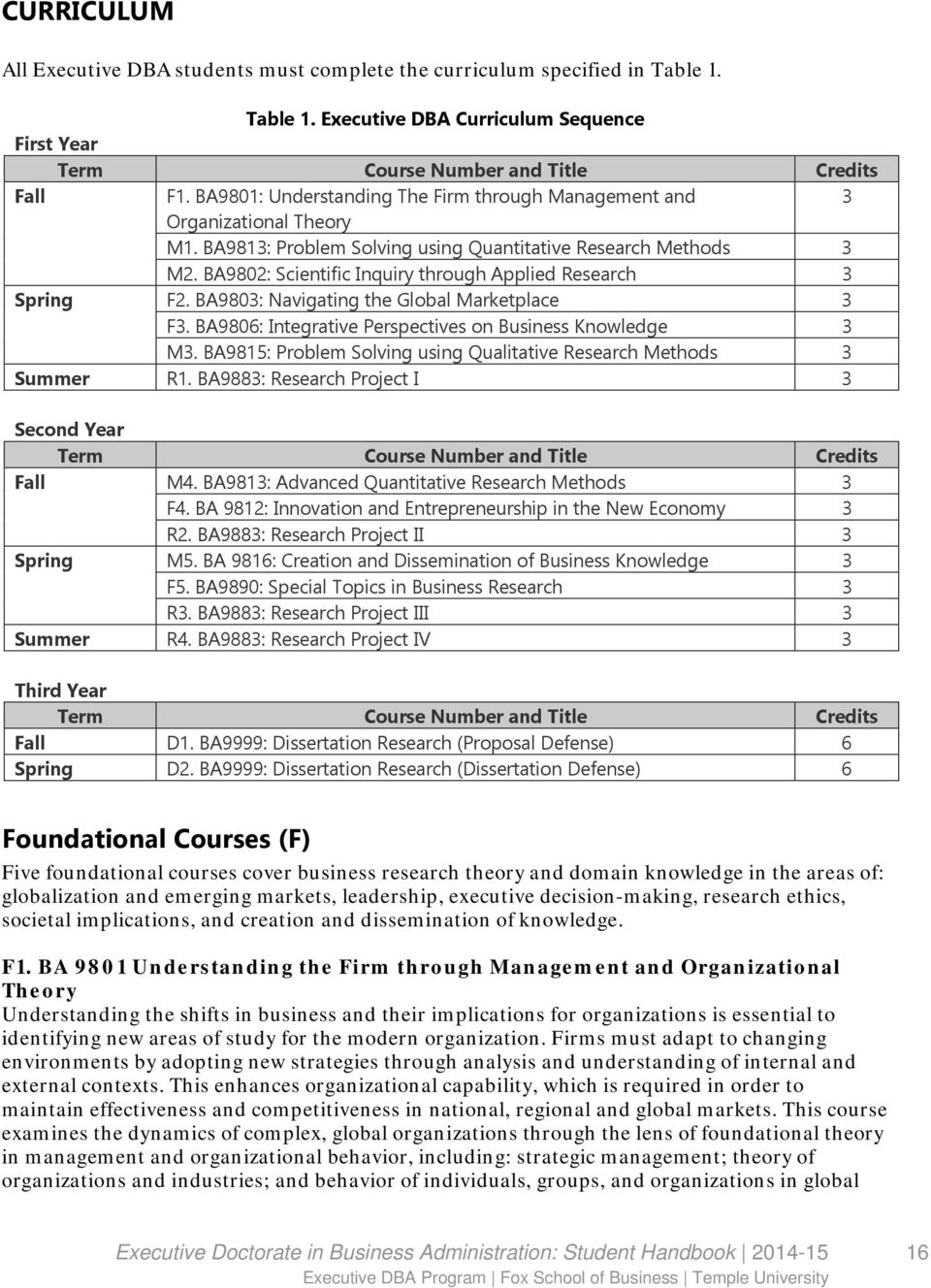
16 CURRICULUM All Executive DBA students must complete the curriculum specified in Table 1. Table 1. Executive DBA Curriculum Sequence First Year Term Course Number and Title Credits Fall F1. BA9801: Understanding The Firm through Management and 3 Organizational Theory M1. BA9813: Problem Solving using Quantitative Research Methods 3 M2. BA9802: Scientific Inquiry through Applied Research 3 Spring F2. BA9803: Navigating the Global Marketplace 3 F3. BA9806: Integrative Perspectives on Business Knowledge 3 M3. BA9815: Problem Solving using Qualitative Research Methods 3 Summer R1. BA9883: Research Project I 3 Second Year Term Course Number and Title Credits Fall M4. BA9813: Advanced Quantitative Research Methods 3 F4. BA 9812: Innovation and Entrepreneurship in the New Economy 3 R2. BA9883: Research Project II 3 Spring M5. BA 9816: Creation and Dissemination of Business Knowledge 3 F5. BA9890: Special Topics in Business Research 3 R3. BA9883: Research Project III 3 Summer R4. BA9883: Research Project IV 3 Third Year Term Course Number and Title Credits Fall D1. BA9999: Dissertation Research (Proposal Defense) 6 Spring D2. BA9999: Dissertation Research (Dissertation Defense) 6 Foundational Courses (F) Five foundational courses cover business research theory and domain knowledge in the areas of: globalization and emerging markets, leadership, executive decision-making, research ethics, societal implications, and creation and dissemination of knowledge. F1. BA 9801 Understanding the Firm through Management and Organizational Theory Understanding the shifts in business and their implications for organizations is essential to identifying new areas of study for the modern organization. Firms must adapt to changing environments by adopting new strategies through analysis and understanding of internal and external contexts. This enhances organizational capability, which is required in order to maintain effectiveness and competitiveness in national, regional and global markets. This course examines the dynamics of complex, global organizations through the lens of foundational theory in management and organizational behavior, including: strategic management; theory of organizations and industries; and behavior of individuals, groups, and organizations in global Executive Doctorate in Business Administration: Student Handbook
17 settings. Students will learn to build on this foundational research by formulating new research questions that address emerging issues and challenges for the modern organization. F2. BA 9803 Navigating the Global Marketplace Global market structures and their institutions drive the economic behavior underlying business decisions and strategy. This course explores the business issues surrounding contemporary industrial organization and serves as the foundation for applied research into firm, industry and economic sector performance. Topics include major economic systems (e.g., capitalism, socialism, communism), global economic institutions (e.g., the World Bank, International Monetary Fund, World Trade Organization) and international trade pacts (e.g., NAFTA, European Union) as they impact domestic firm performance. The course also examines the effects of U.S. and other national economic policies on national development, reducing international conflict, and facilitating global market function, and how executives can achieve economic growth in international markets. Students will review key studies in each of these areas and learn to recognize new areas of research. F3. BA 9806 Integrative Perspectives on Business Knowledge Conceptualizing the organization as a system of integrated, co-dependent elements facilitates new solutions that help an organization achieve its goals. To do this, business leaders must view issues from multiple disciplinary and functional perspectives. Through an integrated, systemsthinking approach, students will learn to address unstructured problems, decision-making under complexity, and organizational change management and strategy. This course integrates contemporary research across the major functional areas of business, including: accounting, finance, human resources, international business, marketing, management information systems, risk and actual science, strategic management, and operations and supply chain management. Students will learn how to approach organizational issues in new ways and discover novel research opportunities by making connections across multiple disciplines. F4. BA 9812 Innovation and Entrepreneurship in the New Economy In an increasingly competitive global market, leaders must develop new business models and approaches. However, building this competency within an organization can be challenging. This course examines how executives can apply best practices in innovation and entrepreneurship by designing novel products, services, processes, organizational structures, business models, and industry ecosystems. Special emphasis is placed on how executives can anticipate and shape global technological, economic, social, and political factors that facilitate innovation and entrepreneurship within an organizational context. F5. BA 9890 Special Topics in Business Research This course will feature a rotating set of topics based on the cutting-edge research conducted by the Executive DBA faculty. Potential topics include executive leadership, emerging markets, social media, data analytics and design thinking. 17 Executive Doctorate in Business Administration: Handbook and Program Guide

18 Methods Courses (M) Five methods courses cover the philosophy of science, the foundations of applied research, building and testing theory, and quantitative and qualitative research methods. All courses include a hands-on project that prepares students to develop their dissertation. M1. BA9813 Problem Solving using Quantitative Research Methods Quantitative research applies statistical techniques to test new theory and hypotheses. This course teaches students how to investigate problems through the design and execution of quantitative research as it applies to experiments, surveys and the analysis of secondary data. Students will learn to apply and evaluate these methods through examples of theoretical and applied research papers that employ quantitative methods. Students will learn the fundamental statistical techniques to develop and test research hypotheses, such as the t-test, correlation analysis and regression. Students will prepare data for analysis and understand how to interpret the results. M2. BA 9805 Scientific Inquiry through Applied Research What is research and how is it done? What is theory? What makes a study both practically relevant and of high-quality? This course addresses these questions through an exploration of the philosophy of science and applied scholarly research. It introduces the philosophy of scientific inquiry, common research approaches (e.g., quantitative and qualitative) and common perspectives (e.g., positivistic, interpretative, and critical). Students will learn the basic principles of theory development and testing as well as how to build a conceptual research model. This course also introduces students to the unique and practical issues of applied research, such as balancing relevance and rigor. Topics include identifying a research topic, forming theoretically-grounded research questions, conducting a literature review and developing a plan for field work and data collection. This course will enable students to identify and develop their personal research interests that choice has for their approach to their work during the doctoral program. M3. BA 9815 Problem Solving using Qualitative Research Methods Qualitative research is the exploration of phenomena in their natural setting that seeks to make sense of underlying mechanisms and processes. This course compares a variety of qualitative techniques, such as case studies, ethnography, action research, grounded theory building and content analysis. Students will review contemporary and classic studies that employ quantitative methods in both theoretical and applied contexts, providing examples of how to use each approach in practice. It will also cover interviewing and observation techniques, coding semistructured and structured interview data, and building hypotheses based on qualitative data. The course weighs the advantages and disadvantages of different approaches to qualitative research, including positivist, interpretivist, and critical methods. M4. BA 9814 Advanced Quantitative Research Methods This course explores advanced concepts and topics in quantitative research methods. Students will learn to select and apply statistical techniques to new problems and data. It will cover analysis of variance and the design of experiments, multivariate regression, confirmatory factor analysis and logistic regression. It will also enable students to identify and address problems in real-world data sets, including: normality violations, multi-collinearity and missing data. Executive Doctorate in Business Administration: Student Handbook

19 M5. BA 9816 Creation and Dissemination of Business Knowledge A fundamental tenet of evidence-based management is that firms will function more effectively if they adopt a theoretically-driven, methodologically-sound approach to decision-making. Building on the basic tenets of theory and knowledge development, this course explores the tools and techniques needed for creating and disseminating knowledge. Drawing on business research literature, students learn advanced issues in theory building, model validation and empirical testing. The course provides practical guidelines for building new theories that are informed by managerial practice and also extend current theoretical models. Participants are challenged to develop cross-disciplinary, evidence-based management practices through applied research that will effectively influence future management practice. Also covered is the process of preparing one s work for publication and successfully navigating the peer review process. Students will study journal selection and how to craft a response to reviewers. These include hands-on application to each student s individual program of research. Research Projects (R) Students will have four required research projects that focus on applying the concepts, theories and methods learned in the foundation and methods courses. The purpose of these projects is to provide students with a mentored, structured approach to developing the critical skills required to prepare their dissertation proposal, the dissertation itself and proceedings resulting from their work. Students will engage in independent research projects under the supervision of Executive DBA faculty during their coursework. At the end of each term, the research projects will be reviewed and assessed for their quality, relevance and potential impact. Students will be expected to present their work and provide feedback on the work of others in the program. The first-year research project (R1) focuses on developing a conceptual paper with a plan for data collection and analysis (summer of the first year). The second-year research project (R2) focuses on a preliminary research paper that includes pilot data analysis and results (fall semester of the second year). The third research project (R3) has a completed research paper as a deliverable that could be submitted to a conference or a journal (spring semester of the second year). The fourth research project (R4) is preparation for the dissertation proposal defense to take place early in the Fall semester of the third year. Dissertation (D) As a final requirement, all Executive DBA students develop a dissertation proposal to investigate an important business problem that is of strategic importance to their own organization, industry or market. Students should apply the relevant domain-specific and interdisciplinary knowledge to inform their research and select appropriate research methods for their study, including data collection and analysis. The student s dissertation is expected to make a significant contribution to the understanding of a business phenomenon. Each student will prepare a written proposal for the dissertation. The student s mentor, with assistance from other faculty, will evaluate the proposal in terms of significance of the problem being investigated, the suitability of theories being applied, the research design and the expected data collection and analysis. Successfully defended proposals will satisfy the Dissertation Research (D1) requirement in the fall semester of the third year. Based on the research produced and feedback obtained by the student s dissertation committee, they will prepare the final dissertation and submit it for review by their committee. To fully complete the requirements of the Executive DBA Program, each student must pass the oral defense and obtain approval of the final written dissertation document by the committee of 19 Executive Doctorate in Business Administration: Handbook and Program Guide

20 faculty members. The successful final defense of their dissertation will satisfy the Dissertation Research (D2) requirement in the spring of the third year. REQUIRED GRADES All Executive DBA students must maintain at least a grade point average of 3.0 or higher and not receive more than two substandard grades (less than B-) or more than one failing grade. Executive Doctorate in Business Administration: Student Handbook

21 APPLIED RESEARCH IN THE EXECUTIVE DBA S 21 Executive Doctorate in Business Administration: Handbook and Program Guide
22 5. APPLIED RESEARCH IN THE EXECUTIVE DBA Applied, practice-focused research is the foundation of an Executive DBA student s work in the program. Students are expected to actively engage in high-quality applied research projects throughout their program of study. They should strive for research excellence, independent thinking and the development of innovative ideas. Executive DBA students are an integral component of the Fox School s research mission to be a premier center of impactful applied and theoretical business research. Students are considered academic colleagues and research partners of the faculty. Executive DBA students and Fox School faculty will work together on high-quality applied research that can transform organizations and industries. Students are the energizers and catalysts for new research perspectives that advance the practice of business by bringing fresh ideas. An understanding of the basic foundations of science is a prerequisite for high-quality research, and Executive DBA students are strongly encouraged to formally and informally master these foundations in order to build appreciation for the value of scholarship. Being engaged in research goes beyond coursework to include direct work with Executive DBA faculty and students, engagement in research discussions, research workshops and seminars, and immersion into the Fox School s research environment. For this reason, all Executive DBA students must become involved in the research process early in the program. They should build a research portfolio that includes their research areas and philosophy while also articulating the relevance of their research. The research portfolio will include publications in the proceedings of refereed conferences, presentations in those conferences, and published articles in refereed journals. Executive DBA students will likely target practitioner conferences and journals for their research, but they are not limited to these outlets and should think ambitiously about their potential impact to both practice and theory. MENTORSHIP OF DBA STUDENTS Executive DBA faculty are expected to play an important mentorship role in the lives of their students. Faculty will provide hands-on direction to students to help them develop their research skills and build their portfolio, but mentoring will be both formal and informal. Mentoring is intended to support students as they pursue their research agenda, acclimate to academic life and ultimately complete a successful dissertation. Executive DBA mentors are prominent Fox faculty members who can chair or co-chair the student s dissertation. The mentor relationship can be thought of as an apprenticeship model that facilitates direct research training for students. The primary activities of mentors include, but are not limited to: Providing insights and guidance to Executive DBA students about the conduct of research. Helping students identify interesting research projects for their dissertation. Giving advice on the student s emerging research portfolio. Sharing ideas about the student s balance of research and professional life. Reading drafts of working papers written by students and offering feedback. Executive Doctorate in Business Administration: Student Handbook
23 Providing guidance about the student s progress on research. All students are expected to meet frequently with their mentor to discuss their progress, review their coursework and ensure that the student is sufficiently progressing through the program. It is the student s responsibility to schedule meetings with faculty mentors. While in-person meetings are desirable, students and faculty are also encouraged to meet using webconferencing tools. RECOGNIZING RESEARCH ACHIEVEMENT BY EXECUTIVE DBA STUDENTS Commitment and dedication to research excellence is a fundamental premise of the Executive DBA program at the Fox School, and students are expected to conduct high-quality applied research that expands the frontiers of knowledge and business education. The quality and relevance of their applied research is the most important part of the overall performance of Executive DBA students, and students are expected to contribute to the research reputation of the Fox School and Temple University. Therefore, students are expected to initiate, actively engage and undertake research projects with Executive DBA faculty. The research performance of students follows the same standards for research instituted by the Fox School. Excellence in research is closely tied to publications, specifically the quality of the conference proceedings and journals where students publish. Successful progression in the program is highly contingent upon evidence of excellent research, including: oral research presentations; high-quality, practice-focused research papers; conference presentations; and publications in practitioner journals. ENGAGING WITH THE FOX MANAGEMENT CONSULTING GROUP There are many opportunities for Executive DBA students to engage with industry as well faculty. The Fox Management Consulting Group manages projects and is run by MBA students for regional industry clients. These projects can be excellent sources of data and original business problems that practice-focused, applied research can rigorously address. Executive DBA students are strongly encouraged to take advantage of this resource in a number of ways, including: serving as advisors and mentors to consultant teams, identifying and evaluating new projects, and connecting their own research ideas to existing projects. This provides Executive DBA students with an opportunity to hone their applied research skills while becoming immersed in the Fox School community. CHANGE OF FACULTY MENTORS It is important to note that Executive DBA students may change faculty mentors during the course of their program. This may happen if a student s research interests change so that another faculty member might be better suited to guide their dissertation. Requests should first be discussed with the Academic Director of the Executive DBA program, who will work with the student and the faculty to assign a new mentor, provided such change is deemed to be 23 Executive Doctorate in Business Administration: Handbook and Program Guide
24 appropriate and the expectations between the student and new faculty mentor are discussed and understood. NETWORKING AMONG EXECUTIVE DBA STUDENTS While the Executive DBA program entails individual research, students are strongly encouraged to interact with other Executive DBA students, both socially and professionally. Collegiality and collaboration on research are highly valued in the Fox School, and the Executive DBA program actively encourages networking among Executive DBA students. As a cohorted program, there are many opportunities for networking and social interaction. The Executive DBA program frequently hosts receptions and other formal and informal social networking activities for students. THE DOCTORAL DISSERTATION The dissertation is both a demonstration of the doctoral candidate s research proficiency and their original contribution to knowledge. It is a comprehensive research project that addresses an original research question through the design and execution of a study. All Executive DBA students must develop a dissertation where students must clearly demonstrate that they have acquired the skills and competencies to produce high quality research. Each student will prepare a formal, written dissertation proposal, which will be evaluated in terms of problem significance, suitability of theories being applied, research design and expected data collection and analysis. Dissertation Guidelines Because the dissertation reflects the body of knowledge acquired during the program, a successful dissertation should demonstrate mastery of the key learning goals of the Executive DBA. As a guide, the following table maps learning goals to criteria for evaluating the dissertation. A completed, successful dissertation should satisfy all of the criteria listed below. Learning Goal Formulate new ideas through boundaryspanning, interdisciplinary research questions that build on existing theory and are relevant to practice Apply, analyze, and develop theory, models and methods in new, practice-relevant contexts Apply theory and conceptual models to identify alternative explanations Relevant Criteria for Dissertation The research question should be original and relevant to practice and informed by theory. A thorough literature review should be included, highlighting the gap in the existing literature and current practice addressed by this study. The dissertation should describe the conceptual model that underlies the study. The conceptual model should clearly follow from the literature review and clearly lead to the study design. Alternative explanations for research findings should be addressed. Executive Doctorate in Business Administration: Student Handbook
25 Learning Goal Identify the appropriate qualitative or quantitative methods that will successfully address an original research question Develop a study that applies quantitative/qualitative research methods to collect, organize, and analyze data to address an applied research question Explain the impact of research findings to students of business, corporate constituents and practitioners Translate complex research findings into actionable guidelines for management Communicate and defend original research ideas and findings in writing through clearly written business communications Communicate and defend original research ideas and findings orally through a formal research presentation Relevant Criteria for Dissertation The methods chosen should be appropriate for the study. Multi-method approaches are encouraged. The study design should flow logically from the methodological approach and link back to the theoretical foundation. The methods should be properly executed in line with the goals of the study. The results of the study should directly address the study s research questions. The dissertation should describe the implications of the study s findings for managers in standard business language. There should also be a section that clearly outlines the steps managers should take to put those findings into practice. The dissertation should be clearly written, for both an academic and a practitioner audience. The oral defense should succinctly articulate the major components of the dissertation, highlighting the research questions, conceptual model, managerial implications for both an academic and practitioner audience, and a plan for dissemination of the key findings. Dissertation Committee Led by the student s mentor, three faculty members will supervise the writing and defense of the dissertation. The mentor will serve as the dissertation chair committee and be the student s primary contact throughout the dissertation completion process. The selection of a dissertation chair and the formation of the committee are major decisions, and Executive DBA students should carefully consider the formation of their dissertation committee. Students should seek a dissertation chair that is most compatible with their research ideas and interests. In consultation with the chair, students must identify two other faculty members to serve on their committee. Selecting dissertation committee members is an iterative process that helps students identify appropriate committee members with relevant theoretical and methodological expertise. Students should first develop their research idea with their chair and then present the idea to prospective faculty members for refinement. The Dissertation Chair must be approved by the Fox School to act as a Dissertation Chair for Executive DBA students. All dissertation committee members should be members of the Graduate Faculty of Temple University ( Students who wish to have faculty serve on the committee who are not members of the Graduate 25 Executive Doctorate in Business Administration: Handbook and Program Guide
26 Faculty, including faculty members from other universities and industry executives who hold doctoral degrees, must seek approval from the Executive DBA Academic Director. If an exception is granted, the Academic Director will seek approval from the Graduate School of Temple University. Dissertation Development Milestones Each student will complete four research project courses and 12 credits of dissertation work. All work is under the close guidance of a faculty mentor. The research project courses are structured as independent studies that enable the student to develop their research ideas and build toward the student s dissertation and a plan for disseminating their research. Program Component Research Summer 1 st /2 nd Conceptual research paper that includes a Project I Year plan for data collection and analysis. Research Fall 2 nd Year Preliminary research paper that includes Project II pilot or preliminary data analysis and results. Research Spring 2 nd Year Research paper following from the first Project III two research projects. Suitable for submission to a conference or academic or practitioner journal. Research Summer 2 nd /3 rd Draft of dissertation proposal. This draws Project IV Year on work done in Research Project III and identifies additional major components and the timeline for their completion. Dissertation Fall 3 rd Year Dissertation Proposal. Oral defense of proposal and continued work on dissertation focusing on data collection. Dissertation Spring 3 rd Year Completed Dissertation. Oral defense of dissertation. Timing Deliverable Deadline Third Monday in August. Two weeks after final Fall residency. Two weeks after final Spring residency. August 1 Second Monday in October Second Monday in April Final Defense Spring 3 rd Year Dissertation submitted to Graduate School. Approximately the first week of May Dissertation Proposal Defense Having formed a dissertation committee and received feedback about the research idea for the dissertation, Executive DBA students must submit their dissertation proposal in writing to their committee before the end of their second year in the program. In consultation with the dissertation chair, the proposal should include: a statement of the general research problem and motivation for the research, the questions or hypotheses to be investigated, the relevance of the problem to business theory and practice, a review of relevant literature, an outline of the dissertation, a detailed description of the methodology to be used, and expected contributions and practical implications that would stem from the dissertation. Executive DBA students should then schedule a date for their dissertation proposal defense in the Fall of their third year. Students should plan ahead to ensure that all dissertation committee members are available. Executive Doctorate in Business Administration: Student Handbook
27 Following the dissertation proposal defense, the committee shall either: Accept the proposal ( pass ) as presented and make specific requests of the student to be undertaken for the completed dissertation. Accept the proposal ( pass ), subject to modifications to be incorporated into the final dissertation, clearly noted at the time of defense and agreed upon by the dissertation committee. Reject the proposal ( fail ). In this case, a new dissertation proposal must be developed and a new proposal defense date should be scheduled. The accepted dissertation proposal and the required modifications communicated to the Executive DBA student by the dissertation committee specify what is expected for the dissertation, and students should remain in close consultation with their chair and dissertation committee members to ensure that the required modifications meet the committee s requests. In general, formal approval of the proposal by the student s dissertation committee is, in essence, a mutual commitment by both the committee and the student to proceed with the theoretical development and research methodology as proposed, without major alteration. It is strongly encouraged that students communicate regularly with their Dissertation Chair to ensure reasonable progress toward their dissertation. Moreover, they should attempt to update all other dissertation committee members at regular intervals. Accordingly, faculty who are serving on doctoral dissertation committees, particularly chairing a dissertation, are expected to make a reasonable effort to meet with students and offer feedback on the dissertation. Dissertation Defense The Executive DBA student will submit dissertation drafts in writing to the committee. Students should communicate with all dissertation committee members to ensure that their requirements have been properly addressed and the dissertation is ready to be defended. The Chair should ensure that all committee members are in agreement about the quality of the dissertation. Once the committee stipulates in writing that the dissertation is defensible, the student will schedule an oral defense. The written dissertation must meet all requirements of the Temple University Graduate School. Information about format and style of the dissertation can be found on the Graduate School website: All dissertation defenses must be publicly announced by the dissertation chair in writing and communicated to the Vice Provost for Graduate Studies at least ten days prior to the defense. Copies of the written dissertation must be made available by the student. The oral defense is open to the entire academic community. However, at the dissertation defense, only the members of the dissertation committee have the authority to decide whether the student has passed or failed. The Academic Director of the Executive DBA program and the Vice Provost for Graduate Studies approve the student s defended dissertation. All members of the Dissertation Committee must physically attend the oral dissertation defense (unless written approval has been obtained in advance from the Dean of the Graduate School). The Chair must always be physically present. No more than one member of the committee may 27 Executive Doctorate in Business Administration: Handbook and Program Guide
28 be absent. If a member of the student s committee cannot physically attend, they can participate virtually through web conferencing or via phone. Following the final dissertation defense, the committee shall either: Accept the dissertation ( pass ) as presented with minor modifications that do not require further review by the committee. Conditionally accept the dissertation ( conditional pass ), subject to significant modifications that must be reviewed by the committee before a full pass is given. The dissertation chair must provide written feedback to the student with specific deadlines to undertake such revisions. The revised dissertation should be submitted to the dissertation committee for final approval. Reject the dissertation ( fail ). In this case, the student should schedule an appointment with their chair to discuss the work that needs to be done to bring the dissertation to an acceptable level. Executive Doctorate in Business Administration: Student Handbook
29 APPENDIX 1: PROGRAM PERSONNEL 29 Executive Doctorate in Business Administration: Handbook and Program Guide
30 APPENDIX 1 PROGRAM PERSONNEL EXECUTIVE DBA PROGRAM Steven Casper, Managing Director & Assistant Professor of Finance 435 Alter Hall (006) 1801 Liacouras Walk Philadelphia, PA [email protected] (cell) David Schuff, Academic Director & Associate Professor of MIS 207G Speakman Hall (006) 1801 Liacouras Walk Philadelphia, PA [email protected] Deborah Haak, Associate Director 334 Alter Hall (006) 1801 Liacouras Walk Philadelphia, PA [email protected] DOCTORAL PROGRAMS OFFICE Stephen Boro, Director, Doctoral Program Administration 337 Alter Hall (006) 1801 Liacouras Walk Philadelphia, PA [email protected] Paul Pavlou, Director, Ph.D. in Business Administration 334 Alter Hall (006) 1801 Liacouras Walk Philadelphia, PA [email protected] Lisa Fitch, Assistant Director Student Services 336 Alter Hall (006) 1801 Liacouras Walk Philadelphia, PA [email protected] Executive Doctorate in Business Administration: Student Handbook
31 EXECUTIVE DBA FACULTY STEERING COMMITTEE Lynne Andersson, Associate Professor of Human Resource Management Steve Casper, Managing Director and Assistant Professor of Finance Pallavi Chitturi, Associate Professor of Statistics Elizabeth Gordon, Merves Fellow and Associate Professor of Accounting Robert D. Hamilton III, Professor of Strategic Management TL Hill, Associate Professor of Strategic Management Susan Mudambi, Associate Professor of Marketing & Supply Chain Management Paul Pavlou, Professor of Management Information Systems David Schuff, Academic Director and Associate Professor of Management Information Systems 31 Executive Doctorate in Business Administration: Handbook and Program Guide
32 APPENDIX 2: UNIVERSITY RESOURCES Executive Doctorate in Business Administration: Student Handbook
33 APPENDIX 2. UNIVERSITY RESOURCES Most Temple University resources are web accessible. SAMUEL PALEY MEMORIAL LIBRARY The Samuel Paley Library is a major university library. The Business and Management collection accounts for approximately 12 percent of the total collection. The University is also a member of the Research Libraries Group, a consortium of 30 major United States research libraries which make their resources available to their members' faculty and students. The Paley Library also has computer search facilities for card catalogs and journal abstracts. You can access University Libraries through: Paley provides access to numerous databases related to business research. You can find databases through the database finder functions: 667?bhcp=1 For more information, please contact the Business Librarian, Mr. Adam Shambaugh, Paley Library Room 220, , [email protected]. WHARTON RESEARCH DATA SERVICES (WRDS) Temple University and Fox School of Business provide access to databases available through WRDS to faculty and doctoral students. WRDS is a web-based business data research service from The Wharton School at the University of Pennsylvania. Developed in 1993 to support faculty research at Wharton, the service has evolved to become a common tool for research for over 290 institutions around the world. WRDS is the de facto standard for business data, providing researchers worldwide with instant access to financial, economic, and marketing data though a uniform, web-based interface. This hosted data service has become the locus for quantitative data research and is recognized by the academic and financial research community around the world as the leading business intelligence tool. DBA students may establish and account with WRDS: Please be aware that the license covers academic use of the data. Our license does not permit use for commercial purposes such as consulting. 33 Executive Doctorate in Business Administration: Handbook and Program Guide
34 SOCIAL SCIENCE DATA LIBRARY The Social Science Data Library ( is Temple University s repository for social science data. Currently, its holdings incorporate files on virtually every subject of interest to social scientists (e.g., nineteenth century census data, health examination surveys of national samples, arrest records from the Paris Insurrection of 1848, international economic statistics). SSDL is also a member of the Inter-university Consortium for Political and Social Research, which provides students and faculty access to thousands of other data files. SSDL staff provides limited consulting on statistical and research methodology. For example, the staff may suggest statistical procedures appropriate to the nature of the data in a particular file, assist users in interpreting statistical results, suggest how best to organize data for analysis or presentation, or recommend appropriate software and hardware for a particular analytic problem. Executive Doctorate in Business Administration: Student Handbook
35 APPENDIX 3: STUDENT CODE OF ETHICS 35 Executive Doctorate in Business Administration: Handbook and Program Guide
36 APPENDIX 3. CODE OF ETHICS ACADEMIC INTEGRITY Executive DBA students at the Fox School should adhere to a strict code of ethics, academic integrity, and the traditional principles of academic freedom. DBA students are members of the broader academic community, and they should recognize the importance of showing respect for others and maintain a strong culture of ethics, integrity, trust and respect to the academic community, both during and after their tenure at the Fox School. Academic integrity is an essential characteristic for successful research and teaching careers. Academic integrity is founded on the principles of honesty, integrity of data and research methodology, and confidentiality. DBA students should have intellectual and personal honesty in learning, teaching, and research. They should not knowingly misrepresent data or their origin. Names of co-authors and collaborators represent their true contribution and are not added or deleted without their permission. DBA students should be true to reporting results, do not act in gross negligence in collecting and analyzing data, and they do not selectively report or omit data for deceptive purposes. Furthermore, DBA students do not take or release the ideas or data of others that were shared with the legitimate expectation of confidentiality. DBA students should also adhere to the Institutional Review Board (IRB) policies on protecting human or animal subjects, and students should refer to Temple University s IRB policies when conducting human-related experiments or survey research. For information about IRB at Temple University, please read: PLAGIARISM Executive DBA students are forbidden from plagiarizing or helping other students plagiarize. Plagiarism is the unacknowledged use of another person's words, ideas and facts, or work, as explained below. Words: When using a phrase, a sentence, or longer passages that someone else wrote or spoke, DBA students must surround the copied language with quotation marks and indicate the source. Do not closely paraphrase someone else's written or spoken language and pass it off as your own. When in doubt, it is recommended to give the citation. Longer passages should be indented, without quotation marks. When in doubt, students should consult their faculty mentors. Ideas and Facts: When mentioning someone else's ideas, they must be acknowledged by naming the source. Some facts are commonly known, undisputed pieces of information, and it may not be necessary to name their source. However, when using ideas or facts that are not widely known, you must give due credit to the source. Work: In course assignments, DBA students must do their own original work and not submit their own work from another course without the agreement of the instructor. The instructor may expect DBA students to cooperate with other students. DBA students should not submit work that does not contain a significant contribution of their own. When computer programs or laboratory reports are required from each individual student, group discussion may be encouraged, but students are then expected to work toward a final product on their own; at no Executive Doctorate in Business Administration: Student Handbook
37 time should all, or part, of a program or report be developed jointly, or copied from another student. Examinations: Unless the instructor informs otherwise, all examinations are "closed book." Penalties: Charges of plagiarism or any form of academic misconduct should be brought immediately to the attention of the Director of the DBA Program. It is the Director s responsibility to inform the Vice Dean and the Academic Grievance Committee of the Fox School of Business. This committee, which is composed of faculty and students, determines guilt or innocence and, if guilty, makes a recommendation to the Dean of the Fox School who makes the final decision. ACADEMIC GRIEVANCE Temple students who believe that instructors are introducing extraneous material into class discussions or that their grades are being affected by their opinions or views that are unrelated to a course s subject matter can file a complaint under the University s policy on academic rights and responsibilities. The policy can be found at: The policy encourages students to first discuss their concerns with their instructor. If a student is uncomfortable doing so, or if discussions with the instructor do not resolve the student s concerns, an informal complaint can be made to the Student Ombudsperson for the student s school or college. Unresolved complaints may be referred to the Dean for handling in accordance with the school or college s established grievance procedure. Final appeals will be determined by the Provost. All students and faculty in Temple University have the right to adjudicate grievances concerning academic matters within the Fox School of Business in a fair and expeditious manner. However, the standards of academic performance are reserved for faculty responsible for teaching the course in question. The procedures set forth below are for the purpose of insuring a fair adjudication of grievances. These procedures apply to all grievances arising from any course offered by Fox School. These procedures do not apply to grievances arising out of courses offered by other schools and colleges within the University. The scope of academic grievances include academic matters and/or other matters affecting a student's academic degree program and/or academic performance, such as good standing, grades, written evaluations (exclusive of letters of recommendation), faculty performance, comprehensives, dissertations, and granting of degrees. Grounds for academic grievances include discrimination by race, color, sex, age, religion, national origin, sexual orientation, marital status, or disability; clerical error; coercion and intimidation (including sexual harassment); fraud; and violation of the rules of the Fox School and Temple University. A student or group of students who wish to present a grievance shall do so as expeditiously as possible and must follow the steps in the order presented below. Grievances must be filed within six months of the occurrence of the alleged grievance. A student may withdraw a grievance at any time. Although any student has the right to formal adjudication of an academic grievance, this right should not be abused. The formal presentation of a grievance is a serious action, and should therefore be instituted only when the situation warrants doing so. Further, all informal methods 37 Executive Doctorate in Business Administration: Handbook and Program Guide
38 of adjudication (for example, informal conferences, mediation through the Ombudsperson and/or Administrator) must be exhausted before instituting a formal grievance. If a student chooses to file a formal grievance, the assistance of the Ombudsperson and/or the appropriate Administrator may be used at any time. The role of the Ombudsperson and/or the Administrator shall be that of mediator, not advocate. The Ombudsperson and/or the Administrator will be the only third party permitted to participate in these procedures. This is not, however, to preclude the calling of witnesses. Any student may retain legal counsel but their role will be limited to that of an observer only. Any formal grievance must follow the order of stages given below. The parties shall attempt to resolve the grievance expeditiously and at the earliest possible stage. Executive Doctorate in Business Administration: Student Handbook
39 39 Executive Doctorate in Business Administration: Handbook and Program Guide
40 FOX: POWER DEFINED ENTREPRENEURIAL. PRESTIGIOUS. GLOBAL. COLLABORATIVE. DIVERSE. INNOVATIVE. AN INTERNATIONALLY RENOWNED FACULTY. A COMMUNITY OF TALENTED AND ACCOMPLISHED STUDENTS. A NETWORK OF THOUSANDS OF THOUGHT LEADERS. THE POWER TO ADVANCE YOUR DISCIPLINE.
From Recruitment to Placement
 The Fox School of Business Temple University Doctor of Philosophy (PhD) Program in Business Administration PhD Student Development Guide From Recruitment to Placement A Complete Guide to PhD Student Development
Southwest Baptist University
 Doctoral Program in Educational Leadership Application Packet Southwest Baptist University College of Education and Social Sciences Department of Graduate Studies in Education Page 1 Overview of Program
Student Manual. Ph.D. in International Business Administration. A. R. Sanchez, Jr. School of Business
 Student Manual Ph.D. in International Business Administration A. R. Sanchez, Jr. School of Business Texas A&M International University February 17, 2004 Table of contents 1. Vision 3 2. Mission.. 3 3.
The current (2015-2016) Marketing Ph.D. Committee consists of Greg M. Allenby (Committee Chair), Xiaoyan Deng, Nino Hardt, and Rebecca Walker Reczek.
 Marketing Ph.D. Program Handbook 1. Marketing Ph.D. Program Structure and Committees Graduate Faculty and the Marketing Ph.D. As a doctoral student, you are enrolled in the Graduate School of the Ohio
Master of Arts in Higher Education (both concentrations)
 Higher Education Dickinson Hall, Room 419 (501) 569-3267 Master of Arts and Doctor of Education The Master of Arts in Higher Education is designed for those individuals who are interested in entering or
Ph.D. PROGRAM GUIDELINES
 Ph.D. PROGRAM GUIDELINES Marketing Department December 8 th, 2014 Kellogg s Marketing Department is regarded as one of the premiere marketing programs in the world and is renowned for its groundbreaking
Finance PhD in Business Administration Policies and Procedures
 Finance PhD in Business Administration Policies and Procedures West Virginia University is proud to add a new chapter to the legacy of the College of Business and Economics with the addition of the Doctor
LLED Doctoral Program Requirements
 LLED Doctoral Program Requirements Students are responsible for information on the Graduate School website. See, especially the Graduate Bulletin and the Graduate School s Academic Regulations & Procedures
Graduate Handbook EDUCATIONAL PSYCHOLOGY
 Graduate Handbook EDUCATIONAL PSYCHOLOGY IFCE /Simpson Hall Phone 505-277-4535 MSC05 3040 Fax 505-277-8361 1 University of New Mexico E-Mail [email protected] Albuquerque, NM 87131-1246 Program Website: http://coe.unm.edu/departments/ifce/educational-psychology.html
OKLAHOMA STATE UNIVERSITY School of Applied Health and Educational Psychology
 OKLAHOMA STATE UNIVERSITY School of Applied Health and Educational Psychology Ph.D. Program in Educational Psychology Program Description for Educational Psychology Option School Mission The mission of
DOCTORATE IN in EDUCATIONAL LEADERSHIP
 1 DOCTORATE IN in EDUCATIONAL LEADERSHIP Cabrini College s Doctor of Education (Ed.D) in Educational Leadership program is a 60-credit post-master s program that continues Cabrini s dedication to academic
TABLE OF CONTENTS. Accreditation and Educational Outcomes 1. Curriculum of the Post-Master s DNP Program 1-2. Program of Study 2-3
 DNP 2015 2016 TABLE OF CONTENTS Accreditation and Educational Outcomes 1 Curriculum of the Post-Master s DNP Program 1-2 Program of Study 2-3 Course Descriptions for Core Courses 4-6 The E-Portfolio 6-7
WASHBURN UNIVERSITY DUAL DEGREE PROGRAM School of Law (J.D.) & School of Business (M.B.A.)
 WASHBURN UNIVERSITY DUAL DEGREE PROGRAM School of Law (J.D.) & School of Business (M.B.A.) Recognizing that legal and business studies complement each other and that real-world problems often require solutions
Faculty of Nursing. Master s Project Manual. For Faculty Supervisors and Students
 1 Faculty of Nursing Master s Project Manual For Faculty Supervisors and Students January 2014 2 Table of Contents Overview of the Revised MN Streams in Relation to Project 3 The Importance of Projects
Doctor of Education Program Handbook
 Doctor of Education Program Handbook Student Copy Revised Summer 2013 1 Introduction The Johns Hopkins University (JHU) School of Education (SOE) attracts the most innovative and progressive scholars without
Research Guidelines for the Master of Science in Nursing. Northern Michigan University College of Professional Studies Department of Nursing
 Research Guidelines for the Master of Science in Nursing Northern Michigan University College of Professional Studies Department of Nursing May 2007 Table of Contents Introduction.. 4 Project Options..
School of Public Health and Health Services. Doctor of Public Health Health Behavior Department of Prevention and Community Health.
 School of Public Health and Health Services Doctor of Public Health Health Behavior Department of Prevention and Community Health 2014 Note: All curriculum revisions will be updated immediately on the
Doctor of Education (Ed.D.) EDUCATIONAL LEADERSHIP
 Wilkes University s Doctor of Education (Ed.D.) in Educational Leadership with a concentration in Leadership Studies is a 60-credit post-master s program comprised of coursework in curriculum and instruction,
DOCTOR OF PHILOSOPHY DEGREE. Educational Leadership Doctor of Philosophy Degree Major Course Requirements. EDU721 (3.
 DOCTOR OF PHILOSOPHY DEGREE Educational Leadership Doctor of Philosophy Degree Major Course Requirements EDU710 (3.0 credit hours) Ethical and Legal Issues in Education/Leadership This course is an intensive
Mechanical Engineering Program. Policies and Procedures
 Mechanical Engineering Program Policies and Procedures For M.S. and Ph.D. Degrees in Mechanical Engineering At the University of California, Merced Submitted by: Ashlie Martini Chair of the Mechanical
Department of Management and Human Resources PhD Program
 Department of Management and Human Resources PhD Program The primary goal of the PhD program is to develop top-class researchers in the field of management, with specializations in the areas of entrepreneurship,
PHD NURSING PROGRAM INFORMATION
 PHD NURSING PROGRAM INFORMATION INTRODUCTION The PhD Program is designed for MSN or BSN graduates who are interested in earning a doctoral degree in nursing. The primary focus of the PhD Program is scientific
School of Advanced Studies Doctor Of Health Administration. DHA 003 Requirements
 School of Advanced Studies Doctor Of Health Administration The mission of the Doctor of Health Administration degree program is to develop healthcare leaders by educating them in the areas of active inquiry,
Lundquist College of Business Department of Marketing Ph.D. Program Guidelines June, 2009
 Lundquist College of Business Department of Marketing Ph.D. Program Guidelines June, 2009 Academic marketing research addresses fundamental questions about the behavior of consumers, companies, managers,
DOCTOR OF EDUCATION (Ed. D.) DEGREE PROGRAM
 DOCTOR OF EDUCATION (Ed. D.) DEGREE PROGRAM IN CURRICULUM AND INSTRUCTION WITH EMPASIS IN CURRICULUM STUDIES Department of Instruction and Teacher Education College of Education University of South Carolina
How To Get A Ph.D. In Sport Management At Trotson University
 Addendum 2014-2015 Graduate Catalog DOCTOR OF PHILOSOPHY (PH.D.) IN SPORT MANAGEMENT NOTE: All applicants to the inaugural class of August 2015 must meet the program requirements listed in the Addendum
How To Become A Criminal Justice Professional
 Mission The mission of the Curry College Master of Arts in (MACJ) program is to provide students with the intellectual and pragmatic skills needed to become effective leaders, reflective practitioners,
PROGRAM HANDBOOK Doctor of Education Higher Education Community College Administration
 PROGRAM HANDBOOK Doctor of Education Higher Education Community College Administration College of Education Graduate Education and Research Texas Tech University Box 41071 Lubbock, TX 79409-1071 (806)
Online Master of Business Administration (MBA)
 Online Master of Business Administration (MBA) Dear Prospective Student, Thank you for contacting the University of Maryland s Robert H. Smith School of Business. By requesting this brochure you ve taken
School of Advanced Studies Doctor Of Management In Organizational Leadership. DM 004 Requirements
 School of Advanced Studies Doctor Of Management In Organizational Leadership The mission of the Doctor of Management in Organizational Leadership degree program is to develop the critical and creative
Boston University School of Theology. Doctor of Ministry in Transformational Leadership Handbook
 Boston University School of Theology Doctor of Ministry in Transformational Leadership Handbook Last revised June 2015 Boston University School of Theology Doctor of Ministry in Transformational Leadership
DOCTORAL DEGREE IN EDUCATION. Ed.D. Leadership in Schooling
 DOCTORAL DEGREE IN EDUCATION Ed.D. Leadership in Schooling ADMITTING FOR SUMMER 2016 ONWARDS Ed.D. Leadership in Schooling 42 credits 3-4 years Leadership in Schooling Faculty Michaela Colombo, Associate
Online Master of Business Administration (MBA)
 Online Master of Business Administration (MBA) Dear Prospective Student, Thank you for contacting the University of Maryland s Robert H. Smith School of Business. By requesting this brochure you ve taken
Doctor of Nursing Practice (DNP)
 REQUEST FOR NEW PROGRAM APPROVAL Catalog Copy for New Program Doctor of Nursing Practice (DNP) The doctor of nursing practice (DNP) degree prepares nurses with a blend of clinical, organizational, economic,
Ph.D. Programs. Wonder Investigate Communicate
 Ph.D. Programs Wonder Investigate Communicate Accounting and Taxation Business Statistics Finance Management Management Information Systems Marketing Operations Management Visit us online at phd.ba.ttu.edu
International MBA. Compete Globally with an International MBA
 International MBA Compete Globally with an International MBA With an online International MBA from SNHU, you are preparing yourself to compete in the increasingly global 21st-century business world. Specially
Master of Arts in Criminal Justice
 Mission The mission of the Curry College Master of Arts in (MACJ) program is to provide students with the intellectual and pragmatic skills needed to become effective leaders, reflective practitioners,
Dissertation Handbook
 Dissertation Handbook Revised July 1, 2014 University of the Rockies 555 E. Pikes Peak Avenue Colorado Springs, Colorado 80903-3612 (719) 442-0505 www.rockies.edu QUICK GUIDE SYMBOLS AND ABBREVIATIONS
DOCTOR OF EDUCATION (ED.D.) DEGREE EDUCATIONAL TECHNOLOGY LEADERSHIP PROGRAM OVERVIEW. Program Objectives
 DOCTOR OF EDUCATION (ED.D.) DEGREE IN EDUCATIONAL TECHNOLOGY LEADERSHIP PROGRAM OVERVIEW The Ed.D. in Educational Technology Leadership is designed to develop educational technology leaders and innovators
Virginia Tech Department of Accounting and Information Systems Ph.D. Program GENERAL INFORMATION
 Virginia Tech Department of Accounting and Information Systems Ph.D. Program GENERAL INFORMATION Virginia Tech's Doctoral Program in Accounting and Information Systems is a Ph.D. degree in Business Administration
Doctoral Student Handbook EdD in Educational Leadership & Management
 Goodwin College of Professional Studies School of Education Doctoral Student Handbook EdD in Educational Leadership & Management Philadelphia Campus, Cohort 1 Spring 2011 Drexel University EdD in Educational
DOCTORAL DEGREE IN EDUCATION. Ed.D. Leadership in Schooling
 DOCTORAL DEGREE IN EDUCATION Ed.D. Leadership in Schooling Option: STEM Education ADMITTING FOR SUMMER 2016 ONWARDS Ed.D. Leadership in Schooling 42 credits 3-4 years Leadership in Schooling Faculty Michaela
American University of Leadership
 DOCTORATE OF BUSINESS ADMINISTRATION, DBA The Doctorate of Business Administration (DBA) program at AUL is a professional doctoral program intended for executives and senior managers who want to expand
GRADUATE DEGREE REGULATIONS
 Graduate Regulations-Spring 2014 1 GRADUATE DEGREE REGULATIONS DEPARTMENT OF PSYCHOLOGY UNIVERSITY OF FLORIDA GRADUATE DEGREE REGULATIONS 1 I. GENERAL INFORMATION 2 A. Graduate Advisor/Supervisory Committee.
PhD Manual Part 4 - Program of Studies PROGRAM OF STUDIES
 PROGRAM OF STUDIES A doctoral student's program of study is tailored to develop the student's particular abilities, interests, and goals. An ongoing process of coursework and professional experience is
Doctor of Education Higher Education with Concentration in Community College Administration Program Handbook
 Doctor of Education Higher Education with Concentration in Community College Administration Program Handbook College of Education Graduate Education and Research Texas Tech University Box 41071 Lubbock,
HAMPTON UNIVERSITY ONLINE Hampton University School of Business PhD in Business Administration
 Program Overview The PhD in Business Leadership and Administration is designed for professionals located nation wide who desire an advanced degree in business to excel in their careers. In addition, the
DEPARTMENT OF MATHEMATICS AND STATISTICS GRADUATE STUDENT HANDBOOK. April 2015
 DEPARTMENT OF MATHEMATICS AND STATISTICS GRADUATE STUDENT HANDBOOK April 2015 Postal address: Department of Mathematics and Statistics, Washington State University, Pullman, WA 99164-3113 Voice: 509-335-8645
OVERVIEW AND ADMISSION REQUIREMENTS
 PH.D. PROGRAM IN SPECIAL EDUCATION EMPHASIS IN APPLIED BEHAVIOR ANALYSIS AND POSITIVE BEHAVIORAL SUPPORT (ABA/PBS; INCLUDING BCBA) (THIS IS A SPECIAL FEDERALLY FUNDED PROJECT) OVERVIEW AND ADMISSION REQUIREMENTS
CLINICAL AND TRANSLATIONAL SCIENCES, DOCTOR OF PHILOSOPHY (PH.D.) WITH A CONCENTRATION IN PSYCHIATRIC, BEHAVIORAL AND STATISTICAL GENETICS
 VCU 1 CLINICAL AND TRANSLATIONAL SCIENCES, DOCTOR OF PHILOSOPHY (PH.D.) WITH A CONCENTRATION IN PSYCHIATRIC, BEHAVIORAL AND STATISTICAL GENETICS Program goal The doctoral program in clinical and translational
Business Administration M.B.A. and M.S. Programs
 Business Administration M.B.A. and M.S. Programs Through the School of Business and Mass Communication, Brenau University offers the M.B.A. degree with majors in accounting, business administration, healthcare
Ed.D. Program in Executive Leadership
 S T. J O H N F I S H E R C O L L E G E Rochester, New York Ed.D. Program in Executive Leadership - 1 - Ed.D. Program in Executive Leadership Ralph C. Wilson, Jr. School of Education St. John Fisher College
Ph.D. Program FINANCE
 Ph.D. Program In FINANCE DEPARTMENT OF FINANCE POLICIES AND PROCEDURES Ph.D. Program Fisher College of Business The Ohio State University 700 Fisher Hall 2100 Neil Avenue Columbus, OH 43210 (Revised July
How To Become A Diabetic Nurse
 School of Nursing Doctor of Nursing Practice DNP Program Coordinator: R. Morgan The Doctor of Nursing Practice (DNP) degree at King is designed for nurses seeking a terminal degree in nursing practice.
Sport Marketing & Promotions
 Sport Marketing & Promotions The Sport Marketing & Promotion Concentration in the MS in Sport Business program gives graduate students tools and skills they need to create innovative approaches to spectator
Department of Health Sciences Moss School of Nursing. Master of Science Degree in Nursing (MSN)
 Department of Health Sciences Moss School of Nursing Master of Science Degree in Nursing (MSN) MSN Program Information Packet The Master of Science in Nursing degree will provide graduates with a foundation
School of Labor and Human Resources. 2012 PhD program
 School of Labor and Human Resources 2012 PhD program I Discipline Human Resource Management (Discipline category: Management,first-class discipline: Business Administration) II Training objective 1.Master
Procedures of Policy No. (4) - Professional Doctorate Programs
 Responsible Office: DVC Research & Grad. Studies Pages of these Procedures 1 of 8 Procedures of Policy No. (4) - 1. Program Administration Each Professional Doctorate Program (PDP) is administered through
FACULTY OF MANAGEMENT THE LEON RECANATI GRADUATE SCHOOL OF BUSINESS ADMINISTRATION
 FACULTY OF MANAGEMENT THE LEON RECANATI GRADUATE SCHOOL OF BUSINESS ADMINISTRATION Graduate Programs http://recanati.tau.ac.il Graduate Programs Master of Business Administration (MBA) Master of Science
Interdisciplinary Studies Doctorate. Graduate Student Handbook
 Interdisciplinary Studies Doctorate Graduate Student Handbook Graduate College April 2015 Introduction The Interdisciplinary Studies Doctorate at Western Michigan University is a unique degree that offers
MASTER OF EDUCATION 1. MASTER OF EDUCATION DEGREE (M.ED.) (845) 575-3028 [email protected]
 MASTER OF EDUCATION 1 MASTER OF EDUCATION DEGREE (M.ED.) (845) 575-3028 [email protected] MISSION AND OBJECTIVES The Teacher Education programs offered by Marist College are integrally linked
DOCTOR OF EDUCATION (Ed.D.) DEGREE PROGRAM IN CURRICULUM AND INSTRUCTION WITH EMPHASIS IN CURRICULUM STUDIES
 DOCTOR OF EDUCATION (Ed.D.) DEGREE PROGRAM IN CURRICULUM AND INSTRUCTION WITH EMPHASIS IN CURRICULUM STUDIES Department of Instruction and Teacher Education College of Education University of South Carolina
Appendix A. Educational Policy and Accreditation Standards
 Appendix A Educational Policy and Accreditation Standards A new Educational Policy and Accreditation Standards has been approved by the CSWE Board of Directors in April 2008. Preamble Social work practice
This program is offered entirely ONLINE throughout the United States and in approved international locations.
 West Virginia University 1 Special Education Degrees Offered Master of Arts in Special Education Doctor of Education with a major in Special Education MASTER OF ARTS IN SPECIAL EDUCATION OVERVIEW The graduate
Administration and Supervision
 Educational Administration and Supervision Dickenson Hall, Room 419 (501) 569-3267 The Educational Administration and Supervision program at UALR includes three graduate degree programs (e.g., Master s,
California State University Dominguez Hills. College of Business Administration & Public Policy 2014-2015. Program website: http://mpa.csudh.
 California State University Dominguez Hills College of Business Administration & Public Policy 2014-2015 Program website: http://mpa.csudh.edu Master of Public Administration Student Handbook Program policies
Doctoral Programs in Communication Sciences and Disorders
 Website: http://www.ecu.edu/cs-acad/grcat/programcsdi.cfm#audphd Doctoral Programs in Communication Sciences and Disorders The doctoral programs are designed for advanced scholars with interest in communication
2. Educational Policy and Accreditation Standards
 2. Educational Policy and Accreditation Standards Preamble Social work practice promotes human well-being by strengthening opportunities, resources, and capacities of people in their environments and by
Master of Fine Arts (MFA) in Design with a Concentration in Innovation Studies (formerly known as the MFA in Communication Design)
 Master of Fine Arts (MFA) in Design with a Concentration in Innovation Studies (formerly known as the MFA in Communication Design) This document exists to provide prospective applicants to this graduate-level
College of Business and Public Administration
 California State University, San Bernardino 1 College of Business and Public Administration Accredited by AACSB International, the Association to Advance Collegiate Schools of Business College of Business
School of Advanced Studies Doctor Of Management In Organizational Leadership/information Systems And Technology. DM/IST 004 Requirements
 School of Advanced Studies Doctor Of Management In Organizational Leadership/information Systems And Technology The mission of the Information Systems and Technology specialization of the Doctor of Management
Graduate School. take your career to the next level. Health Administration. Buffalo New York
 Graduate School take your career to the next level Health Administration Buffalo New York Graduate Admissions Office 320 Porter Avenue Buffalo, NY 14201 D Youville Academic Center, Room 117 716.829.8400
2014-2015 Program and Admission Information
 Ph.D. Program in Higher Education Administration Bowling Green State University 2014-2015 Program and Admission Information Review of applications begins December 15, 2014 On-campus interviews will be
Our Lady of Holy Cross College. Ed. D. Executive Leadership Program Course of Study
 Our Lady of Holy Cross College Ed. D. Executive Leadership Program Course of Study First Semester (Fall) Course 1 EDD 801 Applied and Action Research (3) credit hours This course explores action research
SMART. NIMBLE. COMPASSIONATE. PREPARED. SMART. Strategic NIMBLE. Plan COMPASSIONATE. 2013-2017 PREPARED.
 SMART. NIMBLE. COMPASSIONATE. PREPARED. SMART. Strategic NIMBLE. Plan COMPASSIONATE. 2013-2017 PREPARED. SMART. NIMBLE. COMPASSIONATE. PREPARED. SMART. Achieving NIMBLE. the Business COMPASSIONATE. University
GRADUATE PROGRAM REVIEW POLICY. Texas Southern University
 GRADUATE PROGRAM REVIEW POLICY Texas Southern University The Purposes of Graduate Program Review Graduate program review at Texas Southern University exists to ensure that programs are functioning at the
Doctor of Philosophy in Nursing (PhD)
 Doctor of Philosophy in Nursing (PhD) The Research Focused Doctorate The PhD in Nursing program at UAB is designed to prepare nurse scientists for the roles of researchers, scholars and leaders capable
Master of Science in Nursing
 Curry College s Master of Science in Nursing is designed for nurses who want to enhance their practice with cutting-edge knowledge and skills. Among the program features are: Convenient campus locations
Occupational Therapy Post- Professional Doctoral Program Jefferson College of Health Professions Course List (updated September 15, 2015
 Occupational Therapy Post- Professional Doctoral Program Jefferson College of Health Professions Course List (updated September 15, 2015 CORE OTD COURSES Bachelor s to OTD Core Courses OCCUPATIONAL THERAPY
California State University, Stanislaus Doctor of Education (Ed.D.), Educational Leadership Assessment Plan
 California State University, Stanislaus Doctor of Education (Ed.D.), Educational Leadership Assessment Plan (excerpt of the WASC Substantive Change Proposal submitted to WASC August 25, 2007) A. Annual
Associate Dean: Justin Matus, Ph.D. Academic Advisor: Karen Alessi Coordinator ABE: Allison Pinckley
 BUSINESS ADMINISTRATION Associate Dean: Justin Matus, Ph.D. Academic Advisor: Karen Alessi Coordinator ABE: Allison Pinckley 1 Wilkes University Graduate Bulletin 2015-2016 BUSINESS ADMINISTRATION (MBA)
Doctoral Degree Programs in Special Education
 Doctoral Degree Programs in Special Education University of Florida College of Education School of Special Education, School Psychology, & Early Childhood Studies P.O. Box 117050 / 1403 Norman Hall Gainesville,
Purpose. Admission Requirements. Vision. Mission. Provisional acceptance. Conditional acceptance
 BUSINESS ADMINISTRATION (MBA) The Master of Business Administration program is part of the Jay S. Sidhu School of Business and Leadership, which combines a strong core business education with the development
1. Development of a Plan of Study approved by the appropriate faculty or program adviser;
 Oakland University Graduate Council PhD Minimum Program Requirements The Doctor of Philosophy (Ph.D.) degree is awarded by Oakland University on the basis of evidence that the candidate has achieved a
Department of Psychology
 The University of Texas at San Antonio 1 Department of Psychology The Department of Psychology offers the Master of Science Degree in Psychology and the Doctor of Philosophy Degree in Psychology. Master
Clayton State University Master of Health Administration Program Fall 2009 Assessment
 Clayton State University Master of Health Administration Program Fall 2009 Assessment MHA Program Mission: The mission of the Health Care Management program is to prepare ethical and socially responsible
UAF-UAA Joint PhD Program in Clinical-Community Psychology with Rural, Indigenous Emphasis Outcomes Assessment Goals, Objectives, and Benchmarks
 Page 1 of 16 UAF-UAA Joint PhD Program in Clinical-Community Psychology with Rural, Indigenous Emphasis Outcomes Assessment Goals,, and Benchmarks Mission The PhD Program in Clinical-Community Psychology
Doctor of Public Health Health Behavior Department of Prevention and Community Health 2014-2015. Program Director
 Doctor of Public Health Health Behavior Department of Prevention and Community Health 2014-2015 Note: All curriculum revisions will be updated immediately on the website http://publichealth.gwu.edu/ Program
Department of Teaching, Learning, &Teacher Education
 University of Nebraska-Lincoln College of Education & Human Sciences Department of Teaching, Learning, &Teacher Education Masters Degree Programs Master of Education Master of Arts For further information:
Doctorate in Occupational Therapy (OTD) Program Program Guide
 V1.5 July 8, 2013 Doctorate in Occupational Therapy (OTD) Program Program Guide A.T. Still University Home of the world s first osteopathic medical school, established in 1892, A.T. Still University is
Calendar. Program Mission and Outcomes. Class Dates. Deadlines for Intent to Graduate Card Fall 2015... September 10 Spring 2016...
 43 Mercy College of Nursing and Health Sciences Master of Science in Nursing Dean: Kezia Lilly Director: Cozi Bagley Faculty: Dana Hunt Office: 4431 S. Fremont St. Springfield, MO 65804 (417) 820-2069
Doctoral Programs. the globally networked management school
 Doctoral Programs the globally networked management school Accreditation Accreditation is the review of the quality of higher education institutions and programs. Why is accreditation important? It is
Master of Business Administration
 The University of Kansas 1 Master of Business Administration When you earn your MBA from The University of Kansas, you ll receive a well-rounded education that not only supports your career goals, but
PROCEDURES MANUAL FOR DOCTORAL STUDENTS. Ed.D. Human Resource & Workforce Development Education
 PROCEDURES MANUAL FOR DOCTORAL STUDENTS Ed.D. Human Resource & Workforce Development Education Department of Rehabilitation, Human Resources and Communication Disorders Graduate Studies The purpose of