
Curriculum & Instruction Graduate Student Handbook
|
|
|
- Ellen Rose
- 10 years ago
- Views:
Transcription
1 2008 Curriculum & Instruction Graduate Student Handbook

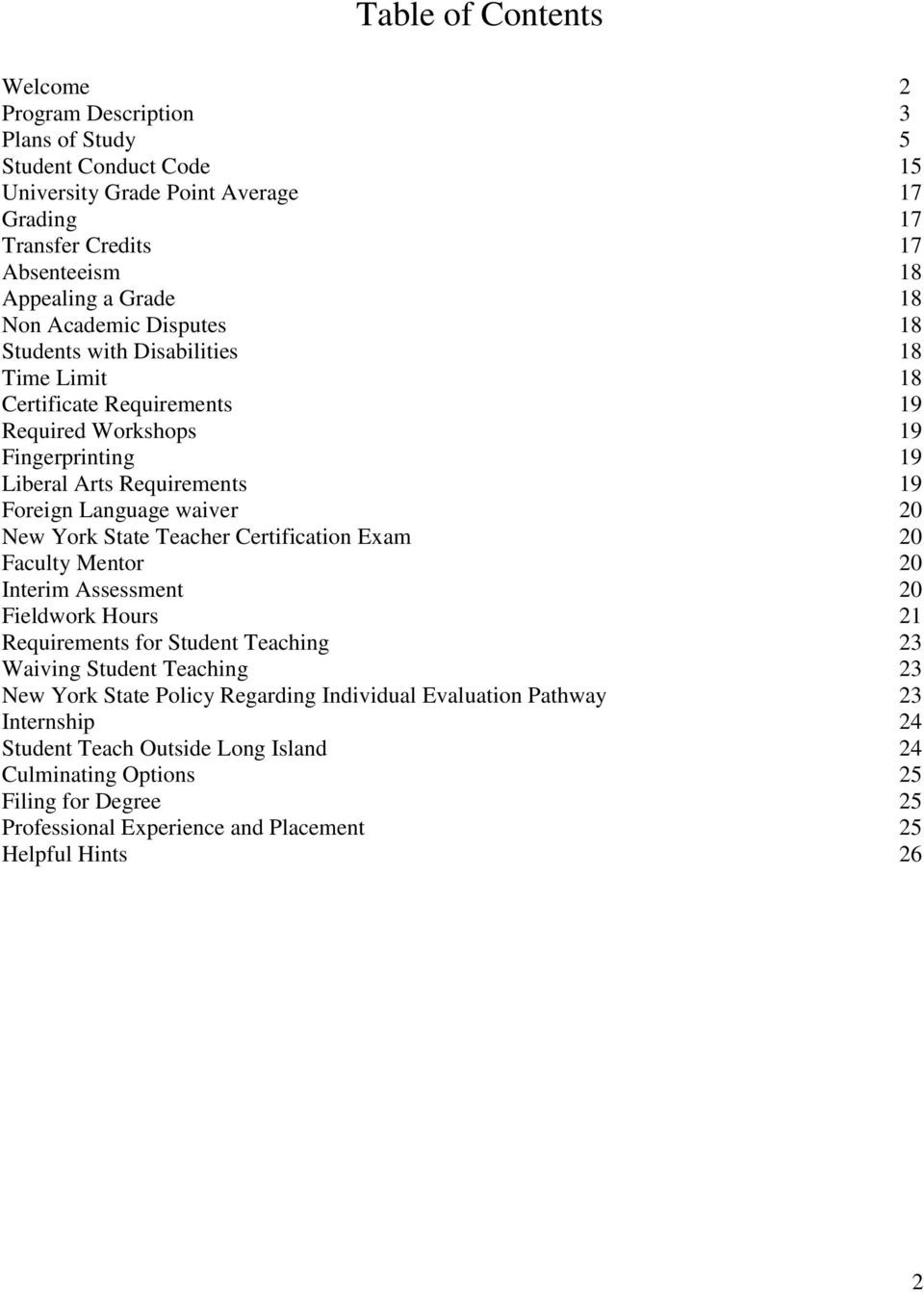
2 Table of Contents Welcome 2 Program Description 3 Plans of Study 5 Student Conduct Code 15 University Grade Point Average 17 Grading 17 Transfer Credits 17 Absenteeism 18 Appealing a Grade 18 Non Academic Disputes 18 Students with Disabilities 18 Time Limit 18 Certificate Requirements 19 Required Workshops 19 Fingerprinting 19 Liberal Arts Requirements 19 Foreign Language waiver 20 New York State Teacher Certification Exam 20 Faculty Mentor 20 Interim Assessment 20 Fieldwork Hours 21 Requirements for Student Teaching 23 Waiving Student Teaching 23 New York State Policy Regarding Individual Evaluation Pathway 23 Internship 24 Student Teach Outside Long Island 24 Culminating Options 25 Filing for Degree 25 Professional Experience and Placement 25 Helpful Hints 26 2
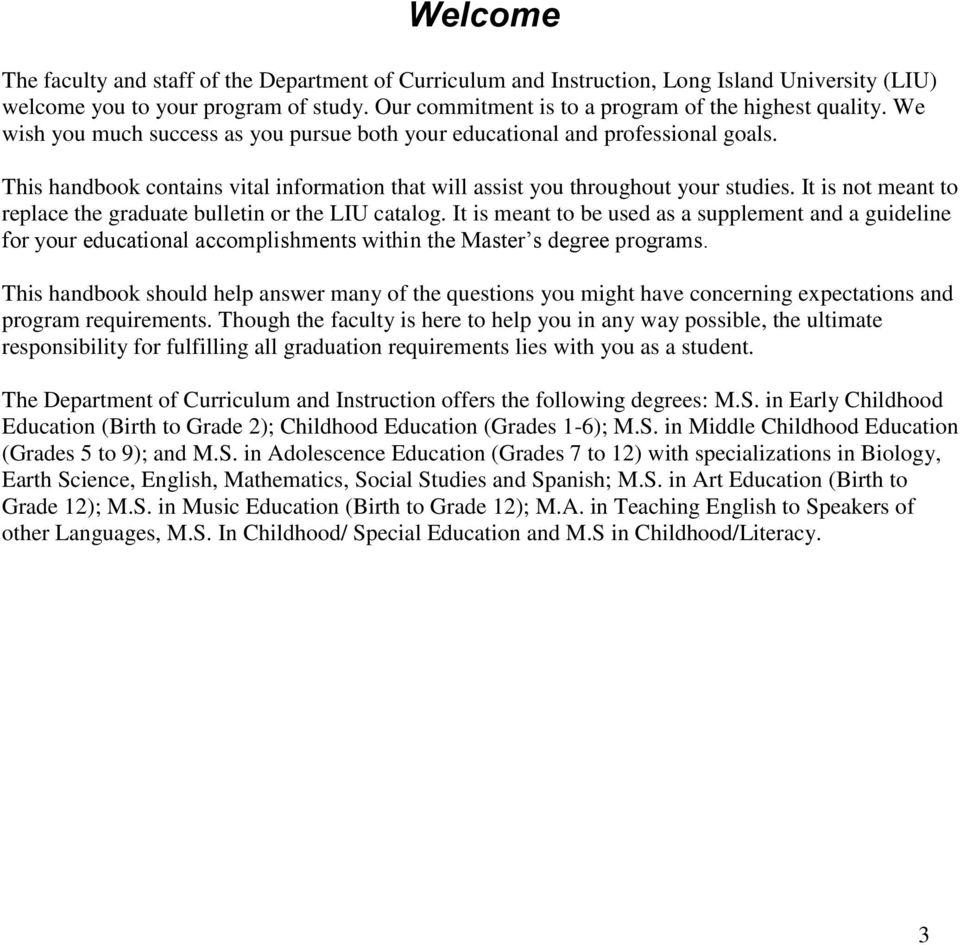
3 Welcome The faculty and staff of the Department of Curriculum and Instruction, Long Island University (LIU) welcome you to your program of study. Our commitment is to a program of the highest quality. We wish you much success as you pursue both your educational and professional goals. This handbook contains vital information that will assist you throughout your studies. It is not meant to replace the graduate bulletin or the LIU catalog. It is meant to be used as a supplement and a guideline for your educational accomplishments within the Master s degree programs. This handbook should help answer many of the questions you might have concerning expectations and program requirements. Though the faculty is here to help you in any way possible, the ultimate responsibility for fulfilling all graduation requirements lies with you as a student. The Department of Curriculum and Instruction offers the following degrees: M.S. in Early Childhood Education (Birth to Grade 2); Childhood Education (Grades 1-6); M.S. in Middle Childhood Education (Grades 5 to 9); and M.S. in Adolescence Education (Grades 7 to 12) with specializations in Biology, Earth Science, English, Mathematics, Social Studies and Spanish; M.S. in Art Education (Birth to Grade 12); M.S. in Music Education (Birth to Grade 12); M.A. in Teaching English to Speakers of other Languages, M.S. In Childhood/ Special Education and M.S in Childhood/Literacy. 3
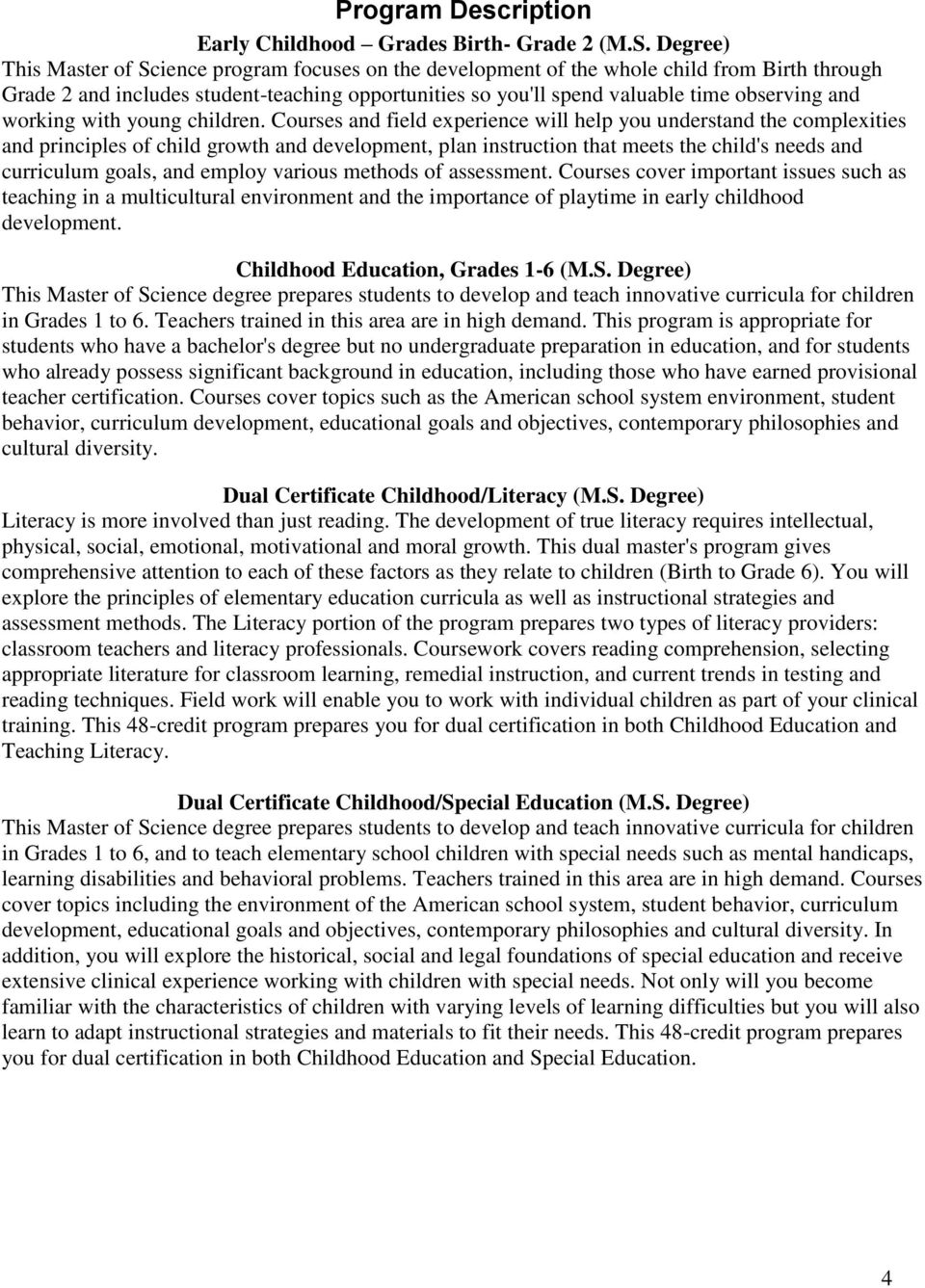
4 Program Description Early Childhood Grades Birth- Grade 2 (M.S. Degree) This Master of Science program focuses on the development of the whole child from Birth through Grade 2 and includes student-teaching opportunities so you'll spend valuable time observing and working with young children. Courses and field experience will help you understand the complexities and principles of child growth and development, plan instruction that meets the child's needs and curriculum goals, and employ various methods of assessment. Courses cover important issues such as teaching in a multicultural environment and the importance of playtime in early childhood development. Childhood Education, Grades 1-6 (M.S. Degree) This Master of Science degree prepares students to develop and teach innovative curricula for children in Grades 1 to 6. Teachers trained in this area are in high demand. This program is appropriate for students who have a bachelor's degree but no undergraduate preparation in education, and for students who already possess significant background in education, including those who have earned provisional teacher certification. Courses cover topics such as the American school system environment, student behavior, curriculum development, educational goals and objectives, contemporary philosophies and cultural diversity. Dual Certificate Childhood/Literacy (M.S. Degree) Literacy is more involved than just reading. The development of true literacy requires intellectual, physical, social, emotional, motivational and moral growth. This dual master's program gives comprehensive attention to each of these factors as they relate to children (Birth to Grade 6). You will explore the principles of elementary education curricula as well as instructional strategies and assessment methods. The Literacy portion of the program prepares two types of literacy providers: classroom teachers and literacy professionals. Coursework covers reading comprehension, selecting appropriate literature for classroom learning, remedial instruction, and current trends in testing and reading techniques. Field work will enable you to work with individual children as part of your clinical training. This 48-credit program prepares you for dual certification in both Childhood Education and Teaching Literacy. Dual Certificate Childhood/Special Education (M.S. Degree) This Master of Science degree prepares students to develop and teach innovative curricula for children in Grades 1 to 6, and to teach elementary school children with special needs such as mental handicaps, learning disabilities and behavioral problems. Teachers trained in this area are in high demand. Courses cover topics including the environment of the American school system, student behavior, curriculum development, educational goals and objectives, contemporary philosophies and cultural diversity. In addition, you will explore the historical, social and legal foundations of special education and receive extensive clinical experience working with children with special needs. Not only will you become familiar with the characteristics of children with varying levels of learning difficulties but you will also learn to adapt instructional strategies and materials to fit their needs. This 48-credit program prepares you for dual certification in both Childhood Education and Special Education. 4
5 Middle Childhood Education Grades 5-9 (M.S. Degree) The Middle Childhood Education program focuses on helping students in Grades 5 to 9 with the transition from the self-contained classrooms of elementary education to the departmentalized schedules of high school. The degree requires a concentration in one of six subject areas - Biology, Earth Science, English, Mathematics, Social Studies or Spanish - and will qualify you to teach the academic subject area to this population. Like all C.W. Post education programs, this new degree includes excellent opportunities for student-teaching, giving you the valuable experience of observing and working with children. Your courses and field experience will help you understand the complexities and principles of children's development at this pivotal point in their lives. Adolescence Education Grades 7-12 (M.S. Degree) The Adolescence Education programs are for students who are interested in teaching a specific academic subject to Grades 7 to 12. C.W. Post offers graduate preparation in six subject areas: Biology, Earth Science, English, Mathematics, Social Studies or Spanish. TESOL - Teaching English to Speakers of Other Languages (M.A. Degree) Imagine being in a room where everyone is speaking a language completely unfamiliar to you. Many students in our local schools face this problem on a daily basis. C.W. Post's outstanding TESOL program prepares you to help children in all grades overcome language barriers and learn how to effectively speak the English language. You will develop a greater awareness of the special needs of children in multilingual/multicultural school districts. This highly specialized program - which prepares you for NYS certification - also provides advanced training for experienced TESOL teachers, supervisors and administrators. In order to pursue this degree, you must demonstrate oral and written proficiency in the English language and possess knowledge of a foreign language and/or culture equivalent to 12 credits of the study of foreign language. Art Education Birth to Grade 12 (M.S. Degree) Why not share your love of art by teaching? Our master's degree program will help you develop your artistic style through studio classes and workshops. At the same time, you will learn artistic teaching techniques for Birth to Grade 12 students in on-campus art studios and multi-media labs. You will sharpen your design and drawing skills through the use of traditional and electronic media, while exploring the philosophy of art education and the psychological and social foundations of education. Two specially designed plans of study are available: one for students who already possess provisional (initial) teacher certification and the other for those with no certification. Music Education Birth to Grade 12 (M.S. Degree) Share your passion for music with others by pursuing a career in Music Education. We offer the ideal creative environment for developing your own musical talents, while at the same time mastering the rigorous requirements for Birth to Grade 12 teacher certification. Students train in our state-of-the-art computerized music laboratory as well as in traditional studios. Our students are active performers who give concerts around the world, write and record their own music, and perform at C.W. Post's renowned Tilles Center for the Performing Arts. 5

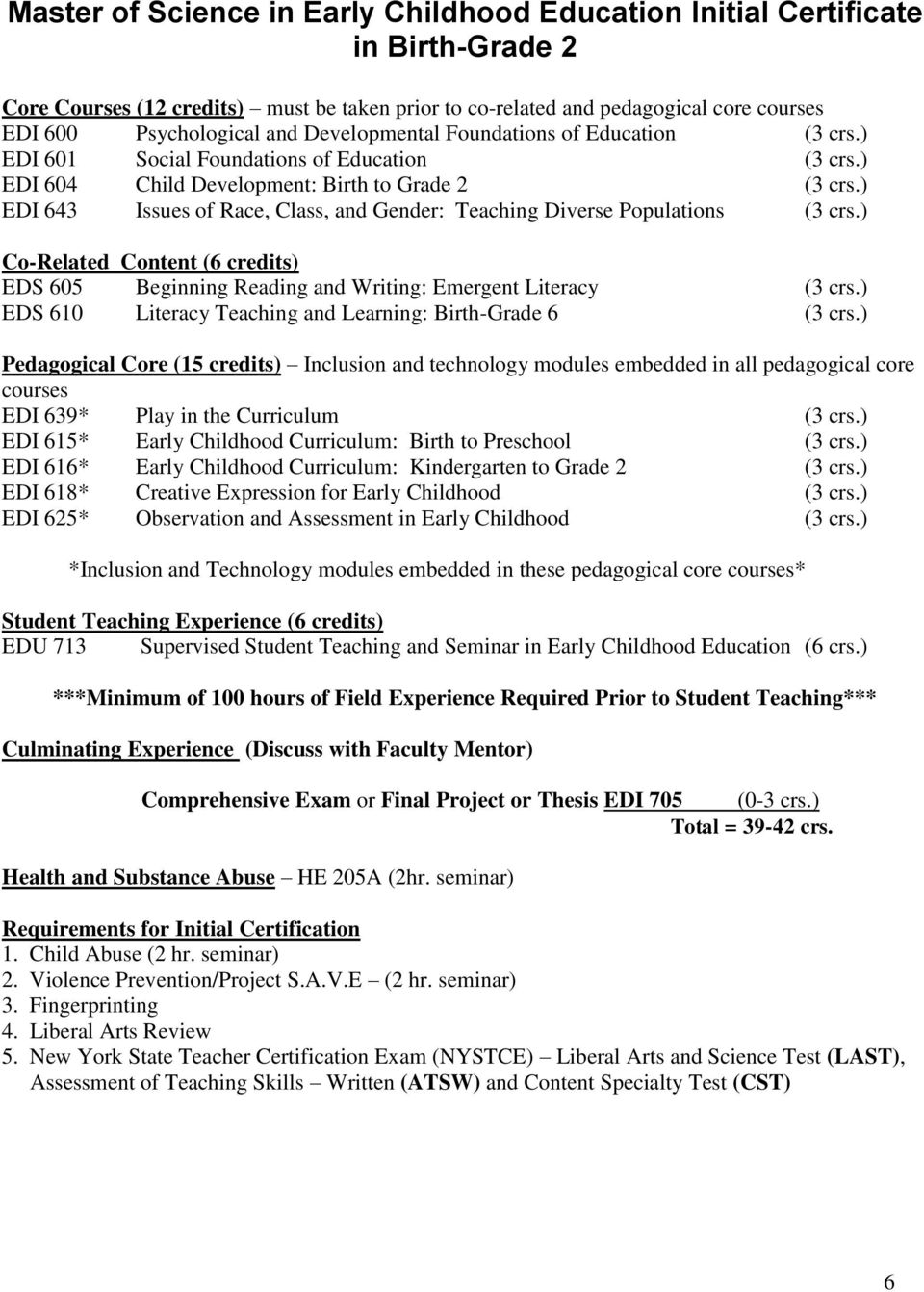
6 Master of Science in Early Childhood Education Initial Certificate in Birth-Grade 2 Core Courses (12 credits) must be taken prior to co-related and pedagogical core courses EDI 600 Psychological and Developmental Foundations of Education (3 crs.) EDI 601 Social Foundations of Education (3 crs.) EDI 604 Child Development: Birth to Grade 2 (3 crs.) EDI 643 Issues of Race, Class, and Gender: Teaching Diverse Populations (3 crs.) Co-Related Content (6 credits) EDS 605 Beginning Reading and Writing: Emergent Literacy (3 crs.) EDS 610 Literacy Teaching and Learning: Birth-Grade 6 (3 crs.) Pedagogical Core (15 credits) Inclusion and technology modules embedded in all pedagogical core courses EDI 639* Play in the Curriculum (3 crs.) EDI 615* Early Childhood Curriculum: Birth to Preschool (3 crs.) EDI 616* Early Childhood Curriculum: Kindergarten to Grade 2 (3 crs.) EDI 618* Creative Expression for Early Childhood (3 crs.) EDI 625* Observation and Assessment in Early Childhood (3 crs.) *Inclusion and Technology modules embedded in these pedagogical core courses* Student Teaching Experience (6 credits) EDU 713 Supervised Student Teaching and Seminar in Early Childhood Education (6 crs.) ***Minimum of 100 hours of Field Experience Required Prior to Student Teaching*** Culminating Experience (Discuss with Faculty Mentor) Comprehensive Exam or Final Project or Thesis EDI 705 (0-3 crs.) Total = crs. Health and Substance Abuse HE 205A (2hr. seminar) Requirements for Initial Certification 1. Child Abuse (2 hr. seminar) 2. Violence Prevention/Project S.A.V.E (2 hr. seminar) 3. Fingerprinting 4. Liberal Arts Review 5. New York State Teacher Certification Exam (NYSTCE) Liberal Arts and Science Test (LAST), Assessment of Teaching Skills Written (ATSW) and Content Specialty Test (CST) 6
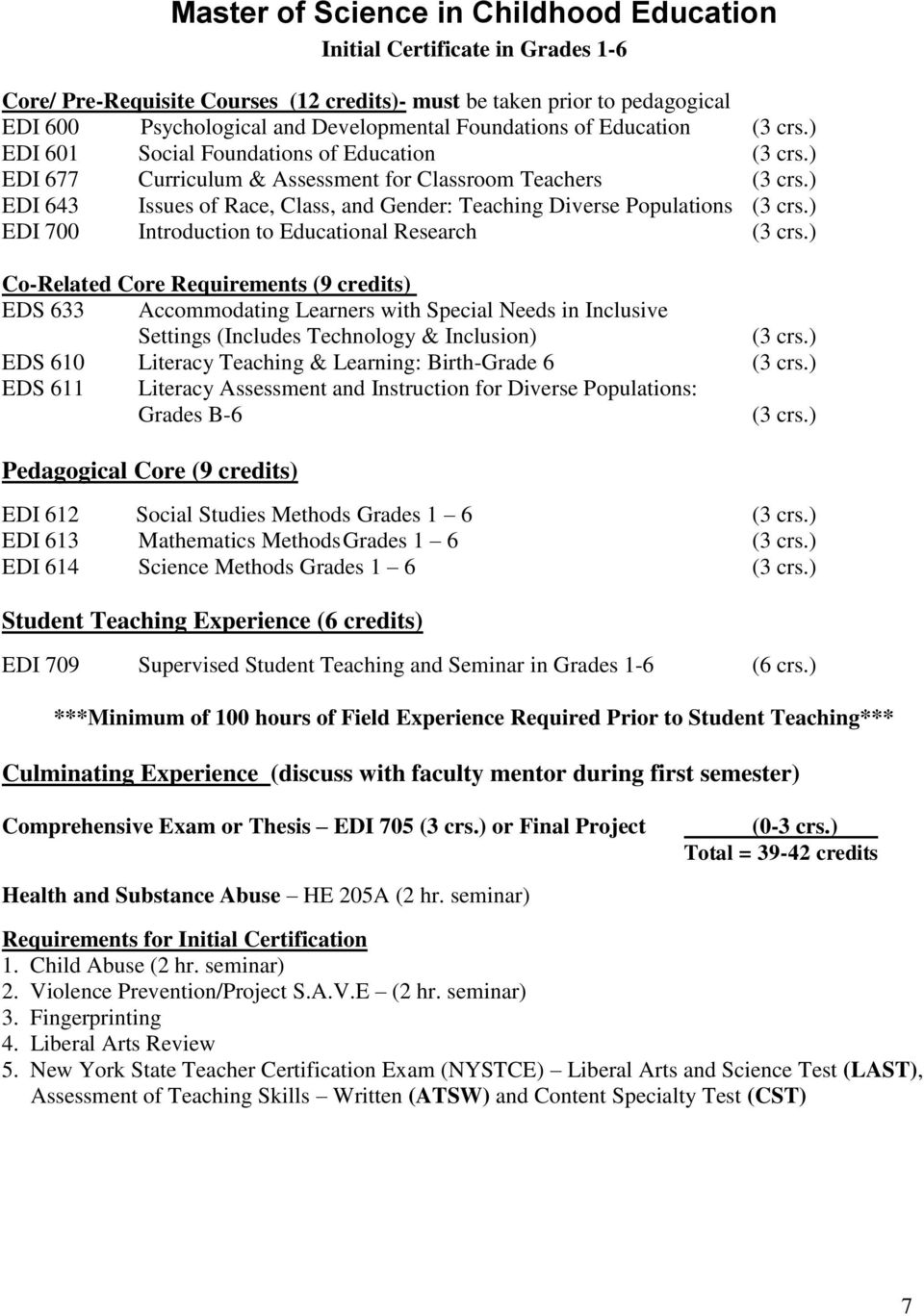
7 Master of Science in Childhood Education Initial Certificate in Grades 1-6 Core/ Pre-Requisite Courses (12 credits)- must be taken prior to pedagogical EDI 600 Psychological and Developmental Foundations of Education (3 crs.) EDI 601 Social Foundations of Education (3 crs.) EDI 677 Curriculum & Assessment for Classroom Teachers (3 crs.) EDI 643 Issues of Race, Class, and Gender: Teaching Diverse Populations (3 crs.) EDI 700 Introduction to Educational Research (3 crs.) Co-Related Core Requirements (9 credits) EDS 633 Accommodating Learners with Special Needs in Inclusive Settings (Includes Technology & Inclusion) (3 crs.) EDS 610 Literacy Teaching & Learning: Birth-Grade 6 (3 crs.) EDS 611 Literacy Assessment and Instruction for Diverse Populations: Grades B-6 (3 crs.) Pedagogical Core (9 credits) EDI 612 Social Studies Methods Grades 1 6 (3 crs.) EDI 613 Mathematics Methods Grades 1 6 (3 crs.) EDI 614 Science Methods Grades 1 6 (3 crs.) Student Teaching Experience (6 credits) EDI 709 Supervised Student Teaching and Seminar in Grades 1-6 (6 crs.) ***Minimum of 100 hours of Field Experience Required Prior to Student Teaching*** Culminating Experience (discuss with faculty mentor during first semester) Comprehensive Exam or Thesis EDI 705 (3 crs.) or Final Project Health and Substance Abuse HE 205A (2 hr. seminar) (0-3 crs.) Total = credits Requirements for Initial Certification 1. Child Abuse (2 hr. seminar) 2. Violence Prevention/Project S.A.V.E (2 hr. seminar) 3. Fingerprinting 4. Liberal Arts Review 5. New York State Teacher Certification Exam (NYSTCE) Liberal Arts and Science Test (LAST), Assessment of Teaching Skills Written (ATSW) and Content Specialty Test (CST) 7
8 Master of Science in Middle Childhood Education-Grades 5-9 Course # Title Credit Hours EDI 550 Psychology of the Early Adolescent Student (3 crs.) EDI 554 Social & Organizational Foundations of the Middle Schools (3 crs.) EDI 557 Communicating Effectively w/all Learners: (3 crs.) Focus on the Middle School: Grades 5-9 EDS 641 Literacy in the Content Areas: Grades 5 12 (3 crs.) EDI 610 Curriculum & Teaching in Middle & (3 crs.) High Schools General Methods of Teaching EDI Advanced Curriculum & Teaching in Specific Major (3 crs.) EDI 700 Introduction to Educational Research (3 crs.) HE 205A Adolescent Health Risk Behaviors 2 hour seminar (0 crs) EDI 711 Supervised Student Teaching and Seminar in Middle School* (6 crs.) ***Minimum of 100 hours of Field Experience Required Prior to Student Teaching*** If waived by department chair, six approved graduate education credits must be substituted. Consult with advisor regarding culminating experience options. Culminating Experience (Discuss with faculty mentor) Final Project or Comprehensive Examination or Thesis EDI 705 (3 crs.) Area Of Specialization 18 credits in specialization area to be developed in consultation with content area advisor. Requirements For Initial Certification LAST, ATS-W, and CST 2 hour Child Abuse Identification Seminar Liberal Arts Review 2 hour Project SAVE Seminar 30 Credits in Content Area NYS Fingerprinting 8

9 Master of Science in Adolescence Education Grades 7-12 Course # Title Credit Hours EDI 551 Psychology of the Adolescent Student (3 crs.) EDI 555 Social & Organizational Foundations of the high schools (3 crs.) EDI 556 Communicating Effectively w/all Learners: Focus on the (3 crs.) Adolescent Child: Grades 9 12 EDS 641 Literacy in the Content Areas: Grades 5 12 (3 crs.) EDI 610 Curriculum & Teaching in Middle & High Schools General (3 crs.) Methods of Teaching EDI Advanced Curriculum & Teaching in Specific Major (3 crs.) EDI 700 Introduction to Educational Research (3 crs.) HE 205A Adolescent Health Risk Behavior 2 hour seminar (0 crs.) EDI 712 Supervised Student Teaching & Seminar in Adolesecnce Education(6 crs.) ***Minimum of 100 hours of Field Experience Required Prior to Student Teaching*** Culminating Experience (Discuss with faculty mentor) Final Project or Comprehensive Examination or Thesis EDI 705 (3 crs.) Area Of Specialization 18 credits in specialization area to be developed in consultation with content area advisor. Requirements For Initial Certification LAST, ATS-W, and CST 2 hour Child Abuse Identification Seminar Liberal Arts Review 2 hour Project SAVE Seminar 30 Credits in content area NYS Fingerprinting 9

10 Master of Science in Adolescence Education (Grade 7 to 12) Education Only Course No. Title Credit Hours Core Courses: 21 Credits EDI 551 Psychology of the Adolescent Student (3 crs.) EDI 555 Social & Organizational Foundations of the High Schools (3 crs.) OR EDI 601 Social Foundations of American Education (3 crs.) EDS 641 Literacy in the Content Areas: Grades 5 12 (3 crs.) EDS 618 Literacy Teaching & Learning Grades 5 12 (3 crs.) EDI 643 Issues of Race, Class, and Gender: Teaching Diverse Populations (3 crs) EDI 677 Curriculum & Assessment for. Teachers (3 crs.) EDI 700 Introduction to Educational Research (3 crs) Advanced Core Course: (6 Credit Hours) EDI 610 General Methods of Teaching (3 crs.) EDI Methods of Teaching in Specific Areas (Science, English, Math, Foreign Language, Social Studies) Student Teaching: (6 Credit Hours) (3 crs.) EDI 712 Student Teaching: Adolesecnce Education (Discipline-Specific) (6 crs.) ***Minimum of 100 hours of Field Experience Required Prior to Student Teaching*** Culminating Experience (Discuss with faculty mentor) Final Project or Comprehsenive Exam or Thesis EDI 705 (3 crs) Total = 33 Credits Health and Substance Abuse HE 205A (2 hr. seminar) Requirements For Intial Ceritification LAST, ATS-W, and CST 2 hour Child Abuse Identification Seminar Liberal Arts Review 2 hour Project SAVE Seminar 30 Credits in content area NYS Fingerprinting 10

11 Master of Science in Childhood Education (Grades 1-6)/Special Education Course No. Title Credit Hours Childhood Concentration EDI 600 Psychological Foundations of Education (3 crs.) EDI 601 Social Foundations of American Education (3 crs.) EDI 677 Curriculum & Assessment for Cl. Teachers (3 crs.) EDI 612 Social Studies Methods: Grades 1 6 (3 crs.) EDI 613 Math Methods: Grades 1 6 (3 crs.) EDI 614 Science Methods: Grades 1 6 (3 crs.) EDI 710 Supervised Student Teaching/Seminar Grades 1-6 (3 crs.) Special Education Concentration EDS 600 Introduction Into the Study of the Exceptional Child (3 crs.) EDS 610 Developmental Reading (3 crs.) EDS 617 Literacy for Children w/ Disabilities (3 crs.) EDS 630 Assessment & Instruction Of Students w/ Mild Disabilities (3 crs.) EDS 631 Assessment & Instruction Of Students w/severe Disabilities (3 crs.) EDS 632 Assess Instruction & Cl. Mang. for Children w/problems (3 crs.) EDS 633 Acc. Learners w/special Needs in Inclusive Settings (3 crs.) EDS 713 Supervised Student Teaching in Special Ed (3 crs.) EDS 624 Contemporary Issues & Research in Special Education (3 crs.) ***150 Hours of Field Experience Required Prior To Student Teaching*** CULMINATING EXPERIENCE (Discuss with Faculty Mentor) Comprehension Exam Or Thesis EDI. 705 (3 crs.) or FINAL PROJECT (Discuss with Faculty Mentor) ********************************************************************************* Total credits HE 205A Health & Substance Abuse Seminar ( 2hr. Seminar) Requirements For Initial Certification 1. New York State Teacher Certification Exam requires (**LAST, ATSW, and 2 CST) 2. Child Abuse Seminar (2 hr. seminar) 3. Violence Prevention Seminar (2 hr seminar) 4. Fingerprinting 5. Liberal Arts Review **Must take and pass the LAST part of the state exam before you are permitted to register for Special Education courses. 11

12 Master of Science in Childhood Education (Grades 1-6)/Literacy Course No. Title Credit Hours Childhood Concentration EDI 600 Psychological Foundations of Education (3 crs.) EDI 601 Social Foundations of American Education (3 crs.) EDI 677 Curriculum & Assessment for Cl. Teachers (3 crs.) EDI 612 Social Studies Methods Grades 1 6 (3 crs.) EDI 613 Math Methods Grades 1 6 (3 crs.) EDI 614 Science Methods Grades 1 6 (3 crs.) EDI 710 Supervised Student Teaching/ Seminar Grades 1-6 (3 crs.) Literacy Concentration EDS 600 Intro. Into the Study of the Exceptional Child (3 crs.) EDS 610 Developmental Reading (3 crs.) EDS 619 Literacy & Literature-based Reading Instruction. (3 crs.) EDS 640 Literacy in the Content Areas: Birth-Grade 6 (3 crs.) EDS 642 Literacy and Language Arts Instruction.: B-Grade 6 (3 crs.) EDS 615 Practicum I. Literacy Assess. & Intervention (3 crs.) EDS 616 Practicum II. Literacy Intervention (3 crs.) EDS 703 Practicum III. Overcoming Literacy Difference (3 crs.) EDS 622 Contemporary Issues in Literacy Research (3 crs.) ***150 hours of Field Experience Required Prior To Student Teaching*** Culminating Experience Comprehension Exam Or Thesis EDI. 705 (3 crs.) or Final Project (Discuss with Faculty Mentor) *************************************************************************** TOTAL credits HE 205A Health & Substance Abuse Seminar ( 2hr. Seminar) Requirements For Initial Certification 1. New York State Teacher Certification Exam requires (**LAST, ATSW, and 2- CST) 2. Child Abuse Seminar (2hr. Seminar) 3. Violence Prevention Seminar (2 hr seminar) 4. Fingerprinting 5. Liberal Arts Review **Must take and pass the LAST part of the state exam before you are permitted to register for Literacy courses. 12

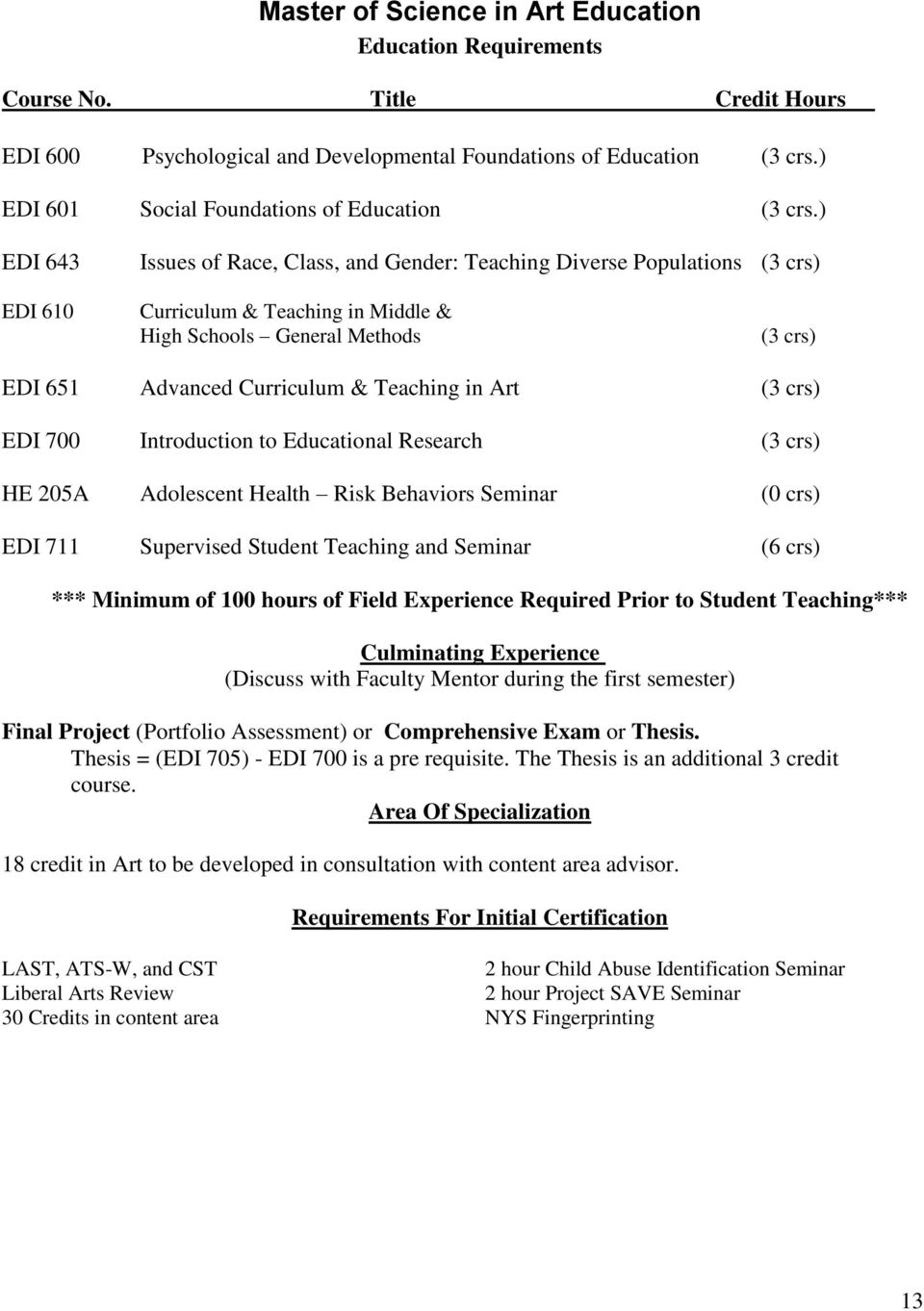
13 Master of Science in Art Education Education Requirements Course No. Title Credit Hours EDI 600 Psychological and Developmental Foundations of Education (3 crs.) EDI 601 Social Foundations of Education (3 crs.) EDI 643 Issues of Race, Class, and Gender: Teaching Diverse Populations (3 crs) EDI 610 Curriculum & Teaching in Middle & High Schools General Methods (3 crs) EDI 651 Advanced Curriculum & Teaching in Art (3 crs) EDI 700 Introduction to Educational Research (3 crs) HE 205A Adolescent Health Risk Behaviors Seminar (0 crs) EDI 711 Supervised Student Teaching and Seminar (6 crs) *** Minimum of 100 hours of Field Experience Required Prior to Student Teaching*** Culminating Experience (Discuss with Faculty Mentor during the first semester) Final Project (Portfolio Assessment) or Comprehensive Exam or Thesis. Thesis = (EDI 705) - EDI 700 is a pre requisite. The Thesis is an additional 3 credit course. Area Of Specialization 18 credit in Art to be developed in consultation with content area advisor. Requirements For Initial Certification LAST, ATS-W, and CST 2 hour Child Abuse Identification Seminar Liberal Arts Review 2 hour Project SAVE Seminar 30 Credits in content area NYS Fingerprinting 13
14 Master of Science in Music Education Education Requirements Course No. Title Credit Hours EDI 600 Psychological and Developmental Foundations of Education (3 crs) EDI 601 Social Foundations of Education (3 crs) EDI 643 Issues of Race, Class, and Gender: Teaching Diverse Populations (3 crs) EDI 610 Curriculum & Teaching in Middle & High Schools General Methods (3 crs) EDI 652 Advanced Curriculum & Teaching in Music (3 crs) EDI 700 Introduction to Educational Research (3 crs) HE 205A Adolescent Health Risk Behaviors Seminar (0 crs) EDI 711 Supervised Student Teaching and Seminar (6 crs) *** 100 hours of Field Experience Required Prior to Student Teaching*** Culminating Experience (Discuss with Faculty Mentor) Final Project (Portfolio Assessment), Comprehensive Exam or Thesis Thesis = (EDI 705) -EDI 700 is a pre requisite. The Thesis is an additional 3 credit course. Area Of Specialization 18 credit in Music to be developed in consultation with content area advisor. Requirements For Initial Certification LAST, ATS-W, and CST 2 hour Child Abuse Identification Seminar Liberal Arts Review 2 hours Project SAVE Seminar 30 Credits in content area NYS Fingerprinting 14

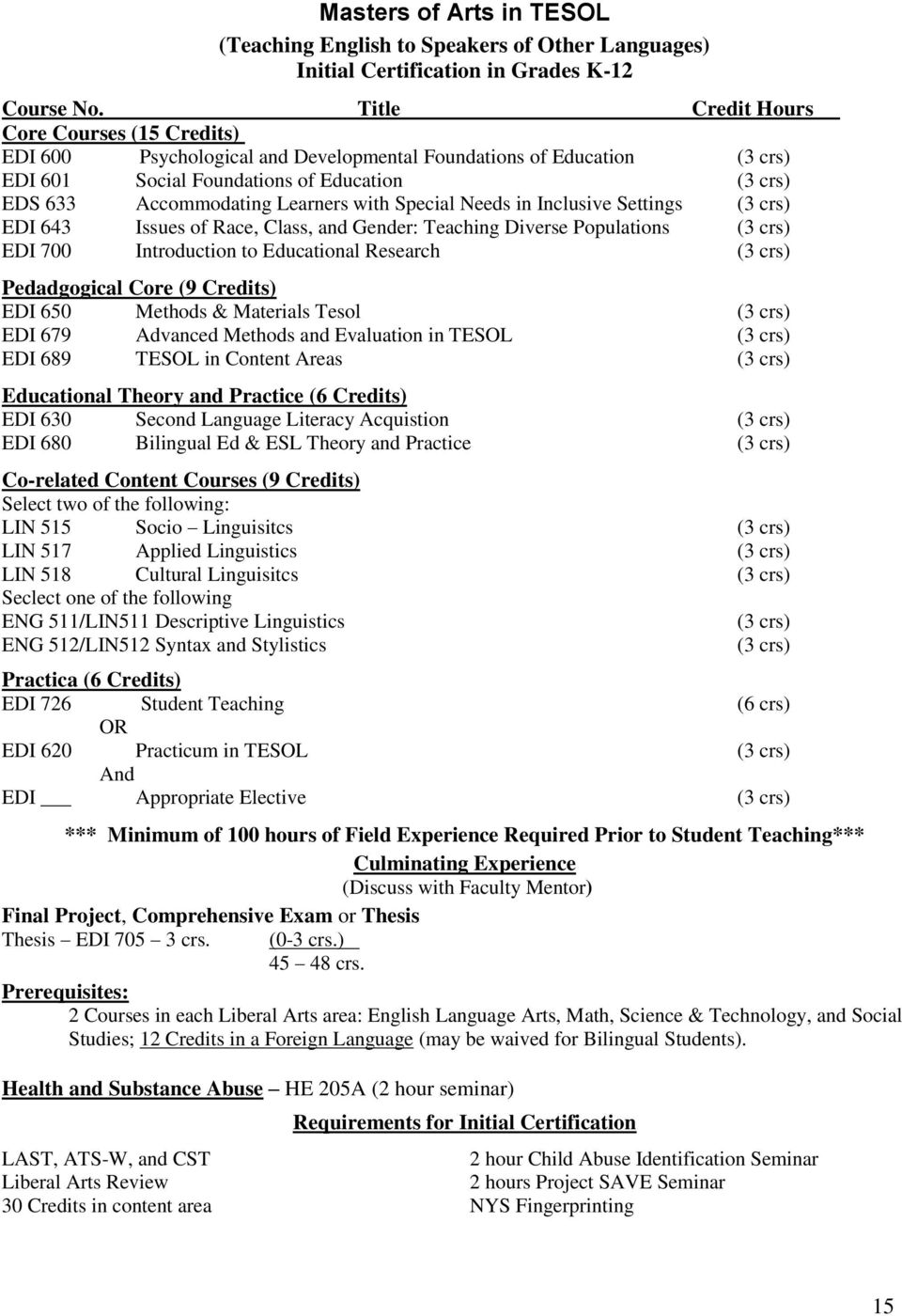
15 Masters of Arts in TESOL (Teaching English to Speakers of Other Languages) Initial Certification in Grades K-12 Course No. Title Credit Hours Core Courses (15 Credits) EDI 600 Psychological and Developmental Foundations of Education (3 crs) EDI 601 Social Foundations of Education (3 crs) EDS 633 Accommodating Learners with Special Needs in Inclusive Settings (3 crs) EDI 643 Issues of Race, Class, and Gender: Teaching Diverse Populations (3 crs) EDI 700 Introduction to Educational Research (3 crs) Pedadgogical Core (9 Credits) EDI 650 Methods & Materials Tesol (3 crs) EDI 679 Advanced Methods and Evaluation in TESOL (3 crs) EDI 689 TESOL in Content Areas (3 crs) Educational Theory and Practice (6 Credits) EDI 630 Second Language Literacy Acquistion (3 crs) EDI 680 Bilingual Ed & ESL Theory and Practice (3 crs) Co-related Content Courses (9 Credits) Select two of the following: LIN 515 Socio Linguisitcs (3 crs) LIN 517 Applied Linguistics (3 crs) LIN 518 Cultural Linguisitcs (3 crs) Seclect one of the following ENG 511/LIN511 Descriptive Linguistics (3 crs) ENG 512/LIN512 Syntax and Stylistics (3 crs) Practica (6 Credits) EDI 726 Student Teaching (6 crs) OR EDI 620 Practicum in TESOL (3 crs) And EDI Appropriate Elective (3 crs) *** Minimum of 100 hours of Field Experience Required Prior to Student Teaching*** Culminating Experience (Discuss with Faculty Mentor) Final Project, Comprehensive Exam or Thesis Thesis EDI crs. (0-3 crs.) crs. Prerequisites: 2 Courses in each Liberal Arts area: English Language Arts, Math, Science & Technology, and Social Studies; 12 Credits in a Foreign Language (may be waived for Bilingual Students). Health and Substance Abuse HE 205A (2 hour seminar) Requirements for Initial Certification LAST, ATS-W, and CST 2 hour Child Abuse Identification Seminar Liberal Arts Review 2 hours Project SAVE Seminar 30 Credits in content area NYS Fingerprinting 15
16 Student Conduct Code Attendance at an institution of higher education is not compulsory. It is optional and voluntary. By voluntary attendance at such an institution, the student assumes obligations for performance and behavior reasonably imposed by the institution, and which are relevant to its lawful missions, processes, and functions. The obligations are much higher than those imposed on all citizens by the civil and criminal law, and the institution may discipline students to secure compliance with these higher obligations as a teaching method or to remove the student from the academic community. The Department of Curriculum & Instruction is complex. One of its functions is that of an academic community in which learning and scholarship flourish. While members of this community contribute a diverse mix of ideas and backgrounds, the department holds in common those standards of conduct which exemplify personal integrity and ethical behavior and which advance the mission of the department, its traditions and values. Upon enrollment in the department, every student is held to the standards of conduct contained in this code. Students observe the highest principles of academic integrity and support a campus environment conducive to Scholarship. Violations of this standard: 1. Conduct in subversion of academic standards, such as cheating on examinations, plagiarism, collusion, misrepresentation or falsification of data. 2. Theft or the unauthorized possession of examinations; alteration, theft, or destruction of the academic work of others, or academic records, library materials, laboratory materials, or other university equipment or property related to instructional matters or research. 3. Submitting work previously presented in another course unless specifically permitted by the instructor. 4. Conduct which disrupts the academic environment; disruption in classes, faculty offices, academic buildings, or computer facilities. 5. Complicity with others in violations of this standard. 16

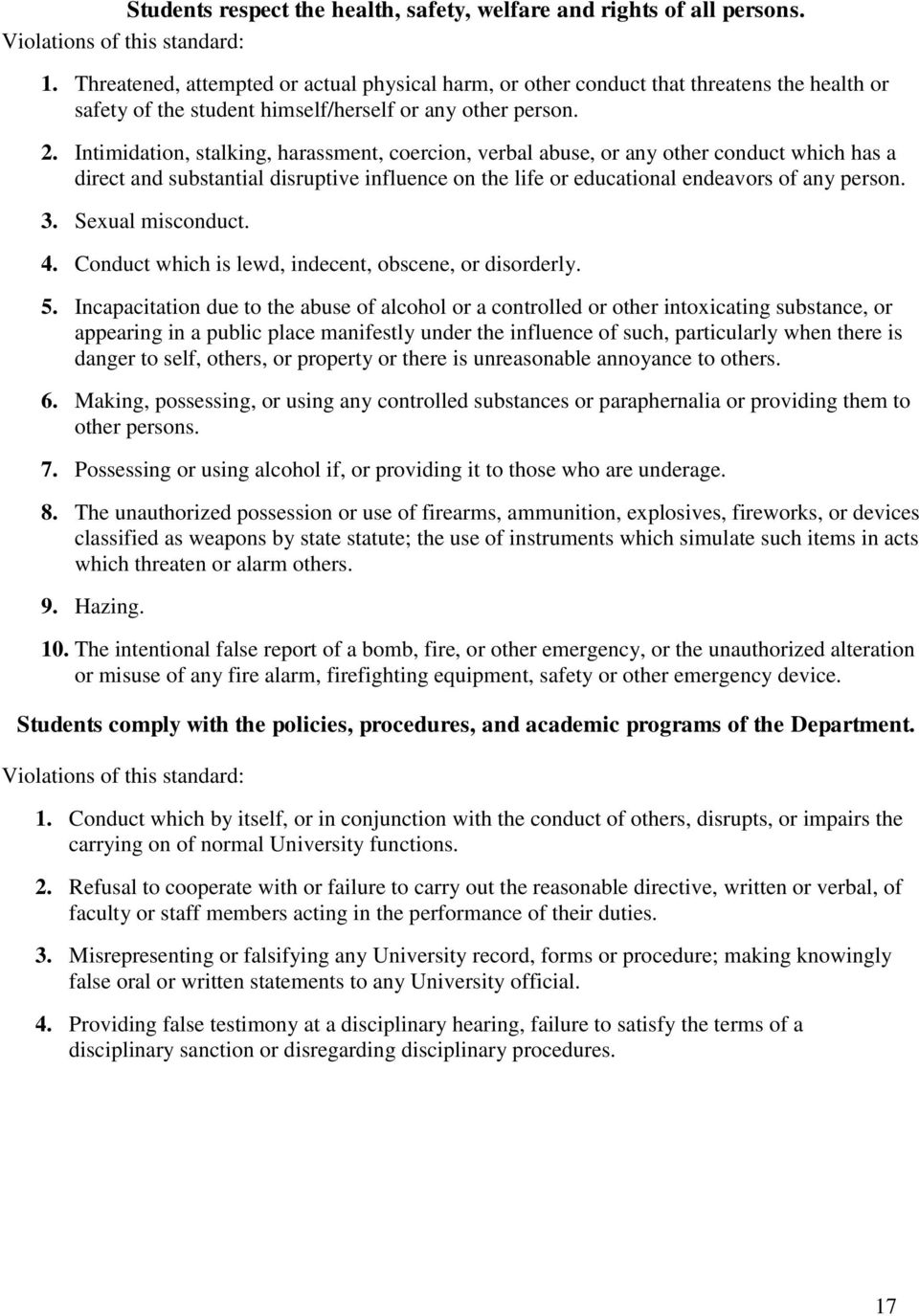
17 Students respect the health, safety, welfare and rights of all persons. Violations of this standard: 1. Threatened, attempted or actual physical harm, or other conduct that threatens the health or safety of the student himself/herself or any other person. 2. Intimidation, stalking, harassment, coercion, verbal abuse, or any other conduct which has a direct and substantial disruptive influence on the life or educational endeavors of any person. 3. Sexual misconduct. 4. Conduct which is lewd, indecent, obscene, or disorderly. 5. Incapacitation due to the abuse of alcohol or a controlled or other intoxicating substance, or appearing in a public place manifestly under the influence of such, particularly when there is danger to self, others, or property or there is unreasonable annoyance to others. 6. Making, possessing, or using any controlled substances or paraphernalia or providing them to other persons. 7. Possessing or using alcohol if, or providing it to those who are underage. 8. The unauthorized possession or use of firearms, ammunition, explosives, fireworks, or devices classified as weapons by state statute; the use of instruments which simulate such items in acts which threaten or alarm others. 9. Hazing. 10. The intentional false report of a bomb, fire, or other emergency, or the unauthorized alteration or misuse of any fire alarm, firefighting equipment, safety or other emergency device. Students comply with the policies, procedures, and academic programs of the Department. Violations of this standard: 1. Conduct which by itself, or in conjunction with the conduct of others, disrupts, or impairs the carrying on of normal University functions. 2. Refusal to cooperate with or failure to carry out the reasonable directive, written or verbal, of faculty or staff members acting in the performance of their duties. 3. Misrepresenting or falsifying any University record, forms or procedure; making knowingly false oral or written statements to any University official. 4. Providing false testimony at a disciplinary hearing, failure to satisfy the terms of a disciplinary sanction or disregarding disciplinary procedures. 17
18 Academic Policy University Grade Point Average: To calculate your semester GPA, follow these four easy steps: 1. Determine the point value for each grade earned: A = 4.00 C+ = 2.33 A- = 3.67 C = 2.00 B+ = 3.33 C- = 1.67 B = 3.00 D* = 1.00 B- = 2.67 F = 0.00 *P = 0.00 * Not available to graduate students 2. Multiply the point value by the number of credits. This will give you your quality points. Add all quality points together. 3. Separately add the total number of credits earned. (Include courses with a grade of P.) Divide the total quality points by the total number of credits to get your GPA. GPA = Quality Points Number of credits Taken Other than Passing Grades W = Authorized Withdrawal. See your advisor by the deadline listed in the Schedule Classes. UW = Unauthorized Withdrawal. Submitted by your professor. WF = Withdrawal with record of failure (Counts as F in GPA). INC = Incomplete, which is arranged with professor. The work must be completed by the end of the semester. NGR = No grade recorded. Professor did not submit your grade. Contact your professor. Grading All courses are graded as A, A-, B+, B, B-, C+, C, C-, F, and Incomplete. Students are expected to achieve a grade of B in courses. A Student s cumulative grade point average in his or her approved program of study may be no less than Any student who receives grades below (B) may lose his or her matriculated status or may be dismissed from the graduate program. Transfer of Credits Policy Transfer of any graduate courses must be evaluated during the first semester of Study. Transfer of graduate credits is limited to six semester hours or, with the Dean s permission, nine semester hours, which have not been used for another Master s degree. Transfer credits must have been completed within the last 5 years with a grade of B or better and taken at an accredited institution. The credits must be appropriate to the program. 18

19 Absence from Class The professor, who is the instructor of record, will determine what is required as makeup. If the instructor of record agrees to allow the student to repeat the course with another professor without reregistering, that subsequent professor will decide the final grade. The instructor of record will then change the Incomplete to that grade. The student and the professor must fill out the incomplete form. Appealing a Grade If you are involved in an academic dispute, always attempt to resolve it with your professor first. Often, the professor may not be aware of the problem and can help you solve it. If that fails, try to contact the department chair for that subject area. The Chair can help you or suggest another method for resolving your problem. If you are concerned with program requirements, graduation requirements, academic standing or academic standing suspension, the best person to see is your academic counselor. He or she can outline your program of study and make sure you are fulfilling your requirements. Non Academic Disputes The procedure for resolving a non-academic dispute is similar to the above process. First, talk to the person with whom you have the problem or with a representative of that area. If that does not provide the result you want, try to speak to the director of that department. If that fails, report the problem to the associate provost who overseas that area. Often, he or she can help you to solve your problem. Students with Disabilities The C.W. Post Campus of Long Island University is committed to providing accessibility to students with disabilities. The office of Services for Students with Special Needs, located in the office of student Health & Counseling, counsels students and works with campus community resources to provide services for these individuals. Students with special needs can reach the office at (516) Disabled students are provided with a variety of support services. This office also educates the campus community about the disabilities and abilities of the handicapped student population. The architectural and program accessibility of the campus is discussed; accommodations are arranged through this office. All students with disabilities are urged to contact this office for more information. Time Limit For the Master s of Science program all degree requirements must be completed within five years from the date of admission. All requests for extension must be submitted in writing to the Dean for approval. 19

20 New York State Teacher Certification Requirements Completion of your education program Completion of the New York state Teacher Certification exams: LAST (Liberal Arts and Science Test) ATS-W (Assessment of Teaching Skills-written) CST (Content Specialty Test) in the certificate area(s) sought Completion of seminars : Child Abuse & Project SAVE Fingerprints (packets may be obtained in the Certificate Office) Completion of fieldwork hour requirement Required Workshops Students must complete two seminars for NEW York State Teacher certification eligibility: Child Abuse and Project S. A. V.E (Schools Against Violence Education). Both seminars are offered at a nominal fee. Health and Substance Abuse Workshop (HE 205A) HE 205A- Health and Substance Abuse seminar is a workshop that facilities Education students understanding of how to: Identify the leading cause of death for adolescents; Understand the relationship between adolescence and risk- taking health behaviors Identify the relationship between outside forces ( i.e. the media) and the health choices students make; Understand the role teachers play in identifying health risk behavior Fingerprinting All Candidates seeking N.Y.S. Certification must be fingerprinting and submit to criminal background checks. Instructions and materials are available in the office of certification, 2 nd floor of the library, School of Education, Room 308. The packet is then taken to your local precinct or state police. You must also provide photo I.D. Liberal Arts Requirements for Certification The New York State Education Department requires all candidates for teacher certification to complete certain liberal arts requirements. The general liberal arts core would include areas in english, math, natural science, social science, artistic expression or humanities and a language (other than English). See academic advisor for specific requirements. 20

21 Requesting Waiver of the Foreign Language Requirement According to state regulations, this requirement can be met by completing one semester of one foreign language, or one semester of study of American Sign Language (ASL). Literature courses must be in the language being studied and not in translation. Satisfactory performance on the College level Proficiency Exams in Spanish, French, or German also satisfies this requirement. Satisfaction of a degree requirement for language other than English by alternative means requires a letter of verification by the college registrar. If your first language is not English, and you have taken English in your native, non-english speaking country, these courses may be used to satisfy this requirement. American Sign Language (ASL) is considered a language other than English. PLEASE NOTE: Course content, rather than the name of the department through which a course is offered, determines the acceptability of a course to fulfill these requirements. Courses in the methods of teaching a subject are not acceptable as study in the content area. Normally, the state will not recognize the study of a foreign language for certification unless it is on a college level. However, the registered program in the department of Curriculum and Instruction at the C. W. Post Campus of Long Island University will apply high school study of a foreign language to substitute for the foreign language requirement on a college level if [1] the regents exam was passed or four years of study has been completed and [2] our approved program has been completed. If we waive student teaching, you have not completed our approved program. If your high school transcript indicates that you have fulfilled this requirement, send the transcript with a letter to the Department Chairperson requesting a waiver of this foreign language requirement. New York State Teacher Certification Exam All students who apply for an Initial certification are required to successfully complete the New York State Exams.These exams measure a student s knowledge and skills in the Liberal arts and Science (LAST), in teaching theory and practice (ATSW) and in the content area of the student's field of certification (CST). Faculty Mentor All students are required to meet with their faculty mentor during the first semester. Your faculty mentor will sign and approve your plan of study and discuss your options for culminating experience. (See Page 23) 21
22 Hours of Field Work Requirements Early Childhood/ Childhood/ Middle Childhood/ Adolescence = 100 hours total Dual programs Childhood & Special Education\ Childhood & Literacy = 150 hours All courses in the Department of Curriculum & Instruction require fieldwork. Each class will discuss the number of hours, the various settings, and the specific assignments required. In some instances, you may be able to spend time during a weekend or evening setting with children/adolescents/educators, or you may need to spend some time in the schools. The 100/150 hours of fieldwork is required for two reasons: first, the New York State Education Department has declared that all candidates for teacher certification in New York State must spend a minimum of 100 hours of fieldwork in educational settings prior to student teaching. The Department of Curriculum and Instruction realizes that many of you work, and that making the time for fieldwork will at times be challenging. Know that there are many other colleges now meeting the State s requirements in the same or similar ways. All of these teacher preparation programs have the same goal to continuously improve their programs in order to help their graduates become even more effective educators. The second reason for the required 100/150 hours of fieldwork is that the Department of Curriculum & Instruction believes that you will be better prepared and more effective as teachers if you spend time in the field throughout your educational program. Teaching is a vitally important and extremely complex job, and those new teachers who have been exposed to continuous fieldwork feel more effective and more confident. Why? because it takes time to practice actual teaching skills before teachers become effective because teachers gain greater understandings about student learning and motivation by observing and interacting with children or adolescents because teachers need to be prepared to work with a wide variety of children and educators in different types of settings and in order to be prepared, they need a variety of experiences as well as skills because fieldwork can help teachers in seeing how practice and theory interact and strengthen one another, and because it can help prospective teachers decide which age groups they are really interested in teaching; and, in a few cases, whether teaching is the right vocation for them. Additionally, you will now have experiences that will help you to feel more prepared, indeed to be more prepared, for your student teaching experience. Enclosed are some forms that you will need to keep track of your fieldwork. Important note #1: You will be dropped from Student Teaching if you have not submitted the Summary of Fieldwork Placements and your attached Field Hour Logs (included in this packet) to the Department of C&I secretary just prior to beginning the student teaching semester. You must show that a minimum of 100/150 fieldwork hours have been completed prior to beginning Student Teaching. Important note #2: Your instructors will give you guidance about what experiences you are expected to have in the field. More information about field experiences in general can be found on the Department s Fieldwork website at 22
23 Field Work Hours Break down of required hours for each course: Course Required Hours EDI 550, hours each EDI 554, hours each EDI 556, hours each EDI hours EDI hours EDI 603 EDI hours EDI hours EDI 612, 613, hours each EDI 615, hours each EDI hours EDI hours EDI hours EDI hours EDI hours EDI 642 EDI hours EDI hours EDI hours each EDI hours EDI hours EDI hours EDI hours EDI hours Course EDS 605 EDS 610 EDS 611 EDS 633 EDS 641 EDS Required Hours 10 hours 10 hours 10 hours 10 hours 10 hours 23
24 Requirements for Student Teaching: Students are required to attend two mandatory meetings the semester prior to student teaching: an application meeting and an orientation meeting. Date for meetings will be announced during the semester. 1. Complete all coursework except for student teaching required for the program. 2. Complete 100/150 fieldwork hours prior to student teaching. 3. GPA: Graduate students 3.00 overall. Taking a Course While Student Teaching In order to take a course during student teaching semester a written request must be made to the Department Chairperson of Curriculum & Instruction and an approval must be received prior to registration. Student will only be allowed to enroll in the class if there is no conflict with the student teaching responsibilities including the seminar Policy Regarding Waiving Student Teaching: The student needs to put the request to waive student teaching in writing to the Department Chairperson. Before the Department approves the request, the student must sign the waiver form. This can be obtained from the student s advisor or a Department secretary. The Chairperson will then send the student a letter stating whether or not the request has been approved and other pertinent information. The student is responsible for applying for NY State teacher certification, and must submit an application for certification directly to the State Education Department. The student has to take credits in education classes equal to the number of credits resulting from waiving student teaching. New York State Policy Regarding Individual Evaluation Pathway The Individual evaluation pathway for the initial certificate in childhood education (Grades 1-6) is only available to candidates who qualify and apply for a certificate by February 1, 2007 The individual evaluation pathway for the Initial Certificate in all other classroom titles is only availalbe to candidateswho qualify and apply for certificate by February 1, This includes Early Childhood Education (Birth Grades 2) Certificates, Middle Childhood Education (Grades 5-9) certificates; and all titles in Adolescence Education (Grades 7-12), special subject (K-12), students with disabiltities (all grade ranges), career and technical education, etc These deadlines do NOT apply to pupil personnel or school leadership titles. The deadlines also do not apply to applicants for additional certificates, applicants through the interstate Agreement or applicants for professional certificates, Supplementatry certificates, Teaching Assistant certificates, or certificates extensions. After these deadlines, candidates will be required to complete a teacher preparation program for their first initital certificate. 24
25 Internship An internship is one version of student teaching. It is only available to Graduate Students The intern must have ALL of the coursework except Student Teaching completed before starting the internship. The intern must have a classroom teaching position in a setting for one academic year in which he/she is being certified by our program (e.g. an elementary position for a childhood education major) and a letter from the district stating this information. The student must request in writing to the Department Chairperson permission to do an internship and must have it approved by the Department Chairperson in writing. The student then goes to the Certification Office to apply for an Internship Certificate. The student must register for student teaching and will be assigned a student teaching supervisor. The intern must attend a weekly Student Teaching seminar for the first semester. The university supervisor will make two observations during the first semester of the internship and two during the second semester. The intern will receive a grade for student teaching at the end of the first semester. Requesting to Student Teach Outside the Long Island Metropolitan Area 1. The semester prior to student teaching, the students shall request in writing to the Department Chairperson permission to student teach in a location that is not usually within the province of the Department of Curriculum & Instruction 2. The student will need to arrange the placement by either making inquires at schools in the desired area or by contacting a local university s student teaching placement office to seek assistance. 3. The student will also contact a local college or university in the desired area to identify someone local whom the Department can hire as a Supervisor. This Supervisor must have experience teaching at the Student Teaching placement level. This information must be submitted to the Department Chairperson for approval. 4. The Student should complete the application folder distributed at the Student Teaching meeting held by the office of Clinical Education the semester prior to student teaching. These forms are required of all students wishing to student teach. The student must register for student teaching with their academic advisor. 25
26 Culminating Options All students in the graduate programs of the Department of Curriculum and Instruction are required to complete a culminating experience.you may choose one of the following options: Comprehensive Examination The purpose of comprehensive examination is to evaluate students ability to synthesize relevant literature, theories, concepts and pedagogical methods in teaching. Comprehensive examinations are held during the fall and spring semesters. Thesis (EDU 705) The purpose of the thesis is to evaluate students academic knowledge about a particular topic in education. Students who choose to write a Master s level thesis are required to select an advisor and 2 readers. This option is an additional 3 credits. Portfolio (not applicable to students who waive student teaching) The purpose of organizing a portfolio is to evaluate students professional growth, knowledge of subject matter, teaching skills and professional dispositions. The portfolio will be organized around the ten professional standards outlined by Interstate New Teacher Assessment and Support Consortium (INTASC). The Department of Curriculum and Instruction has chosen these ten standards for their general applicability for teachers of all disciplines and grade levels. Students who choose the portfolio option are required to begin the process of collecting artifacts and other relevant materials early in their program. The courses in your program will offer a variety of artifacts related to the INTASC standards that you will be able to use in your portfolios. The portfolio should have a cover page, table of contents, philosophical statements and artifacts. Sample portfolios will be on reserve at the library and the PEP office for your review. To help students organize their portfolios in a systematic fashion, the Department recommends the following book as a guide: Campbell, D., Cignetti, P., Nettles, D., & Wyman, R. (2004). How to develop a professional portfolio: A manual for teachers, 3 rd ed. Boston: Allyn and Bacon. Filing for Degree Applications for the degree must be filed with the Records Office (Kumble Hall) at least three months prior to the anticipated date of graduation. Diplomas are issued September, January, and May). Professional Experience and Placement Professional Experience and Placement (PEP) offers a variety of free career services to matriculated students. Registrants are assisted in the techniques of finding a suitable position through seminars in resume and cover letter preparation; video- recorded mock interviews, on-campus recruitment, career networking events and many other services. The office is open Monday through Friday from 9am-5pm from September through May, when classes are in session. The office also remains open until 8pm on Tuesday and Wednesday Evenings. Call (516) to schedule an appointment to meet with a counselor. 26
27 Helpful Hints. A fully matriculated student is eligible to take up to 12 credits per semester. A full load for graduate students is 9 credits. For financial aid eligibility a student must be enrolled in at least 6 credits each semester and must re-apply each year by March 1 st. (See Financial aid Counselors in Kumble Hall) Credits already used towards a certain degree cannot be used for another. Fieldwork hours are imperative for certification and must be submitted to the Department chair. Speak to your Professors on how to go about accruing those hours. A student may choose to waive the student teaching requirement. See section on waiving student teaching. In order to graduate, a student must fill out a degree application form, at least 3 months prior to graduation. (See Records office, Kumble Hall) It is the student s responsibility to send their certificate of completion of both seminars to New York State Department of Education. Grades are usually sent out to students about 2-3 weeks after the end of the semester. Students can access their grades over the Student Information System on LIU website: To register for Child Abuse and Violence Prevention/Project S.A.V.E (2 hr. seminars) call (516) Fingerprinting packet available in the Office of Certification, 2 nd floor of the library, Room 308. Official transcripts for prospective employers, etc must be requested in writing to the Records Office, Kumble Hall. Please note: if you owe the University any fines or have any blocks on your account, your request cannot be processed. Students Health & Counseling Center is located in the Life Science Building (east side), room 154 ground level. All visits are free and confidential. Primary medical care and a wide range of counseling services are available. (516) If any of the following blocks appear on your account you will not be able to register until they have been cleared. (A) Admissions, (B) Bursar, (S) Security, and (V) Vaccination. Upon completion of your Master's Degree and Certification Requirements, you may file for certification by first going to the New York State Teacher Certification websitewww.nysed.gov/tcert/teach/teach/htm to create an application profile, to complete the process along with a degree noted transcript see Susan Parente in room LB
28 Index Welcome... 3 Program Description... 4 Master of Science in Early Childhood Education Initial Certificate in Birth-Grade Master of Science in Childhood Education... 7 Master of Science in Middle Childhood Education-Grades Master of Science in Adolescence Education Grades Master of Science in Adolescence Education Master of Science in Childhood Education (Grades 1-6)/Special Education Master of Science in Childhood Education (Grades 1-6)/Literacy Master of Science in Art Education Master of Science in Music Education Masters of Arts in TESOL Student Conduct Code Academic Policy University Grade Point Average: Other than Passing Grades Grading Transfer of Credits Policy Absence from Class Appealing a Grade Non Academic Disputes Students with Disabilities Time Limit New York State Teacher Certification Requirements Required Workshops Fingerprinting Liberal Arts Requirements for Certification Requesting Waiver of the Foreign Language Requirement New York State Teacher Certification Exam Faculty Mentor Hours of Field Work Requirements Field Work Hours Requirements for Student Teaching: Taking a Course While Student Teaching Policy Regarding Waiving Student Teaching: New York State Policy Regarding Individual Evaluation Pathway Internship Requesting to Student Teach Outside the Long Island Metropolitan Area Culminating Options Filing for Degree Professional Experience and Placement Helpful Hints
Student Handbook 2013-2014
 Department of Special Education and Literacy Student Handbook 2013-2014 Long Island University/Post Long Island University/Brentwood P a g e 1 Table of Contents Welcome 3 Program Descriptions 4 Plan of
EDUCATION (M.S./M.S.ED.) SCHOOL OF ARTS, SCIENCES AND EDUCATION
 53 EDUCATION (M.S./M.S.ED.) SCHOOL OF ARTS, SCIENCES AND EDUCATION MASTER'S DEGREE IN EDUCATION All programs in the education department are accredited by the Regents Accreditation of Teacher Education.
STUDENT HANDBOOK Graduate Programs in Special Education
 STUDENT HANDBOOK Graduate Programs in Special Education Masters Degree Programs Leading to Initial/Professional Certification & Post-Masters Advanced Certification Programs Graduate Programs in Special
Lehman College School of Education Advising Worksheet PROGRAM/CERTIFICATION REQUIREMENTS Department of Middle and High School Education.
 Lehman College School of Education Advising Worksheet PROGRAM/CERTIFICATION REQUIREMENTS Department of Middle and High School Education Student ID# Program: M.S. Ed. Program in Mathematics Education, Middle
MASTER OF EDUCATION 1. MASTER OF EDUCATION DEGREE (M.ED.) (845) 575-3028 [email protected]
 MASTER OF EDUCATION 1 MASTER OF EDUCATION DEGREE (M.ED.) (845) 575-3028 [email protected] MISSION AND OBJECTIVES The Teacher Education programs offered by Marist College are integrally linked
Master of Library and Information Science (MLIS)
 St. Catherine University 1 Master of Library and Information Science (MLIS) Mission The Master of Library and Information Science (MLIS) program at St. Catherine educates students in the principles, practices
STUDENT HANDBOOK Graduate Programs in Special Education
 STUDENT HANDBOOK Graduate Programs in Special Education Masters Degree Programs Leading to Initial/Professional Certification & Post-Masters Advanced Certification Programs Graduate Programs in Special
Bachelor of Science in Elementary Education
 Bachelor of Science in Elementary Education NAU degree can be completed on the Paradise Valley Community College campus! We re everywhere you want to learn! Classes are held 2 nights each week Final semester
Lehman College School of Education Advising Worksheet PROGRAM/CERTIFICATION REQUIREMENTS Department of Middle and High School Education.
 Lehman College School of Education Advising Worksheet PROGRAM/CERTIFICATION REQUIREMENTS Department of Middle and High School Education Student ID# Program: _ TESOL Advanced Certificate Steps in the Program
LEHMAN COLLEGE Department of Counseling, Leadership, Literacy, and Special Education CURRICULUM CHANGE
 1 LEHMAN COLLEGE Department of Counseling, Leadership, Literacy, and Special Education CURRICULUM CHANGE Type of Change: Revision of Bilingual School Counseling Extension From: M.S.ED. Program in Counselor
Graduate Programs in Education and Human Development
 Graduate Programs in Education and Human Development Department of Curriculum and Instruction Two master s degree options and a doctorate degree are offered in Curriculum and Instruction. The Master of
COLLEGE OF EDUCATION
 COLLEGE OF EDUCATION 77 COLLEGE OF EDUCATION The mission of the College of Education is to prepare educators, counselors, administrators, and other professionals to be lifelong, innovative, informed, reflective
*Note: On or after May 1, 2014, the Liberal Arts and Sciences Test (LAST) will be replaced by the new Academic Literacy Skills Test (ALST).
 Lehman College School of Education Advising Worksheet PROGRAM/CERTIFICATION REQUIREMENTS Student ID# Program: M.S.Ed. 48 Credit Dual Certification Program in Bilingual Early Childhood or Childhood Special
MASTER OF ARTS IN TEACHING PURPOSE
 MASTER OF ARTS IN TEACHING PURPOSE The purpose of the Master of Arts in Teaching (MAT) is to offer an alternative teacher certification pathway. REQUIREMENTS FOR ADMISSIONS Students accepted for admission
COLLEGE OF EDUCATION
 COLLEGE OF EDUCATION 81 COLLEGE OF EDUCATION The mission of the College of Education is to prepare educators, counselors, administrators, and other professionals to be lifelong, informed, reflective, innovative
Lehman College School of Education Advising Worksheet PROGRAM/CERTIFICATION REQUIREMENTS Department of Early Childhood and Childhood Education
 Lehman College School of Education Advising Worksheet PROGRAM/CERTIFICATION REQUIREMENTS Department of Early Childhood and Childhood Education Student ID# Program: _M.S.Ed. : Childhood Education Steps
The Deborah Cannon Partridge Wolfe College of Education New Jersey City University. Graduate Programs Orientation
 The Deborah Cannon Partridge Wolfe College of Education New Jersey City University Graduate Programs Orientation NJCU University-Wide Student Learning Goals Students will demonstrate effective writing
DEPARTMENT OF NURSING C.W.POST CAMPUS LONG ISLAND UNIVERSITY UNDERGRADUATE STUDENT HANDBOOK
 DEPARTMENT OF NURSING C.W.POST CAMPUS LONG ISLAND UNIVERSITY UNDERGRADUATE STUDENT HANDBOOK C.W. POST CAMPUS DEPARTMENT OF NURSING UNDERGRADUATE STUDENT HANDBOOK TABLE OF CONTENTS MISSION STATEMENT FOR
Master of Arts in Psychology
 Master of Arts in Psychology Introduction This handbook describes the major milestones, program regulations and requirements that students will encounter as they complete the Master s program in Psychology
Will apply content knowledge, decision-making skills and sound judgments inherent in the learning and teaching process.
 TEACHER INTERN PROGRAM DESIGN The Teacher Intern Program focuses on a way of thinking about teaching that includes planning and preparation, classroom management, instruction and professional responsibilities.
College. Of Education
 College Of Education Contact Us 00971-2-5993111 (Abu Dhabi) 00971-4-4021111 (Dubai) 00971-2- 5993783 (College of Education) @Zayed_U www.facebook.com/zayeduniversity www.zu.ac.ae Introduction and Mission
Curriculum, Instruction, and Special Education
 Curriculum, Instruction, and Special Education Dr. Susie Burroughs, Interim Department Head Dr. Kent Coffey, Graduate Coordinator 310 Allen Hall PO Box 9705 Mississippi State, MS 39762 Telephone: 662-325-3703
School Psychologist Graduate Program: Frequently Asked Questions by Applicants
 Brooklyn College of the City University of New York Department of School Psychology, Counseling and Leadership School Psychologist Graduate Program Room 1107 James Hall 2900 Bedford Avenue Brooklyn, New
Graduate Student Handbook
 The City College of New York School of Education Bilingual Education and TESOL Program Graduate Student Handbook 2010/2011 THE CITY COLLEGE of The City University of New York School of Education Convent
12-11-2013 1. Program Coordinator: Dr. Janet R. DeSimone [email protected]
 12-11-2013 1 Graduate Programs in Educational Leadership Overview and Frequently Asked Questions (FAQs) Department of Counseling, Leadership, Literacy and Special Education Lehman College of the City University
MASTER OF SCIENCE IN EDUCATION AND CERTIFICATION OPTIONS
 Overview MASTER OF SCIENCE IN EDUCATION (INSTRUCTIONAL LEADERSHIP) AND CERTIFICATION OPTIONS Neumann University s graduate program leading to the Master of Science in Education: Instructional Leadership
Department of Educational Foundations and Exceptionalities Dr. John T. Almarode, Interim Department Head
 78 James Madison University 205-206 Undergraduate Catalog Department of Educational Foundations and Exceptionalities Dr. John T. Almarode, Interim Department Head Phone: (540) 568-69 Location: Memorial
Curriculum, Instruction, and Special Education
 Mississippi State University 1 Curriculum, Instruction, and Special Education Department Head: Dr. Janice Nicholson, Interim Graduate Coordinator: Dr. Dana Franz 310 Allen Hall Box 9705 Mississippi State,
Admissions Requirements
 Special Education Dickinson Hall, Rooms 300F, 304 (501) 569-3124, (501) 569-8710, (501) 569-8922 Master of Education in Special Education The Master of Education in Special Education (SPED) prepares candidates
Counselor Education COLLEGE OF EDUCATION AND HUMAN SERVICES. Master of Science in Education. 136 / Graduate Catalog 2015-2016 Chapter 2
 136 / Graduate Catalog 2015-2016 Chapter 2 Counselor Education http://epse.ehs.siu.edu/ COLLEGE OF EDUCATION AND HUMAN SERVICES Graduate Faculty: Asner-Self, Kimberly K., Associate Professor, Ed.D., George
Bachelor s Degrees. You may earn a maximum of 30 college credits by examination. See page 22 for further information.
 Bachelor s Degrees Maintaining Good Standing You must maintain a minimum cumulative grade-point average of 2.0 for the Bachelor of Applied Science, the Bachelor of Science in Nursing, and the Bachelor
STUDENT HANDBOOK. Master of Education in Early Childhood Education, PreK-4 and Early Childhood Education Certification Programs
 Master of Education in Early Childhood Education, PreK-4 and Early Childhood Education Certification Programs STUDENT HANDBOOK Lincoln University Graduate Education Program 3020 Market Street Philadelphia,
EA 597 School Planning and Facilities Management (3)
 EA 581 Basic Concepts of Educational Administration (3) An introduction to the basic concepts underlying school building administration. The theory and practice of educational administration is analyzed
Judith Herb College of Education
 Judith Herb College of Education 2014-2015 Catalog Graduate Programs The Judith Herb College of Education (JHCOE) offers flexible programs leading to a range of master s, educational specialist, and doctoral
Elementary and Secondary Teacher Preparation. ELEMENTARY and SECONDARY TEACHER PREPARATION
 Elementary and Secondary Teacher Preparation ELEMENTARY and SECONDARY TEACHER PREPARATION 87 88 Elementary and Secondary Teacher Preparation CHAPTER VI ELEMENTARY AND SECONDARY TEACHER PREPARATION Teacher
undergraduate graduate combined
 Stony Brook University offers three programs registered and approved by the New York State Education Department for individuals seeking New York State certification to teach physics in secondary schools,
LEHMAN COLLEGE OF CITY UNIVERSITY OF NEW YORK DEPARTMENT OF EARLY CHILDHOOD AND CHILDHOOD EDUCATION. Curriculum Change
 LEHMAN COLLEGE OF CITY UNIVERSITY OF NEW YORK DEPARTMENT OF EARLY CHILDHOOD AND CHILDHOOD EDUCATION Hegis # N/A Program Code: 344 Curriculum Change 1. Type of Change : Change in Approved Major Requirements
American International College PSYCHOLOGY. Doctor of Education in Educational
 American International College 1 PSYCHOLOGY Doctor of Education in Educational cognition Doctor of Education in Educational Psychology The Doctor of Education in Educational Psychology (EdD) program provides
Ph.D. Counselor Education and Supervision 2014 2015 Program Guidebook
 Ph.D. Counselor Education and Supervision 2014 2015 Program Guidebook NOTE: 1) This guidebook is subject to change. If it does, students will be notified via email and will be provided with the revised
Judith Herb College of Education
 Judith Herb College of Education Graduate Programs The Judith Herb College of Education (JHCOE) offers flexible programs leading to a range of master s, educational specialist, and doctoral degrees in
COLLEGE OF EDUCATION
 COLLEGE OF EDUCATION 81 COLLEGE OF EDUCATION The mission of the College of Education is to prepare educators, counselors, ASL interpreters and other professionals to be informed, reflective, and innovative
Teachers College, Columbia University. Department of Mathematics, Science and Technology. Program Study Guide for: Science Education
 Teachers College, Columbia University Department of Mathematics, Science and Technology Program Study Guide for: Science Education Degree: M.A. Major Code: SCIB-INIT, SCIC-INIT, SCIE-INIT and SCIP-INIT
DEPARTMENT OF NURSING C.W.POST CAMPUS LONG ISLAND UNIVERSITY GRADUATE STUDENT HANDBOOK
 DEPARTMENT OF NURSING C.W.POST CAMPUS LONG ISLAND UNIVERSITY GRADUATE STUDENT HANDBOOK C.W. POST CAMPUS DEPARTMENT OF NURSING GRADUATE STUDENT HANDBOOK TABLE OF CONTENTS PAGE MISSION STATEMENT FOR C.W.
Handbook for Special Education: Deaf/Hard of Hearing Master s Degree Students
 Handbook for Special Education: Deaf/Hard of Hearing Master s Degree Students Revised May 2009 This Handbook provides information for master's students in the School of Special Education: Specialist Deaf/Hard
Discuss DIVERSITY AND PROFESSIONAL DISPOSITIONS 1 SECTION I CONTEXT
 Discuss DIVERSITY AND PROFESSIONAL DISPOSITIONS 1 SECTION I CONTEXT Provide the following contextual information: 1. Description of any state or institutional policies that may influence the application
MASTER OF SCIENCE IN EDUCATION AND CERTIFICATION OPTIONS
 Overview MASTER OF SCIENCE IN EDUCATION (INSTRUCTIONAL LEADERSHIP) AND CERTIFICATION OPTIONS Neumann University s graduate program leading to the Master of Science in Education: Instructional Leadership
Curriculum and Instruction
 20 Curriculum and Instruction The Master of Science in Education in Curriculum and Instruction has been designed to meet the needs of three groups of candidates: A. Professionals with Initial New Yk certification
Stephen F. Austin State University
 Stephen F. Austin State University Department of Human Services School Counselor Education Program Information Packet Revised January 2016 1 THE DEPARTMENT OF HUMAN SERVICES Stephen F. Austin State University,
PRIORITY REVIEW GIVEN TO THOSE WHO SUBMIT APPLICATIONS BY JANUARY 5, 2009. (EI AND LD ONLY.)
 SPECIAL EDUCATION Emotionally Impaired/Learning Disabled/Deaf Education Master of Arts Application Deadlines: EMOTIONALLY IMPAIRED FEBRUARY 15. LEARNING DISABLED FEBRUARY 15. DEAF EDUCATION FEBRUARY 15.
ADMISSION REQUIREMENTS AND PROCEDURES
 ADMISSION REQUIREMENTS AND PROCEDURES Changes to some admission requirements have occurred, edits are indicated below in red. Santa Fe University of Art and Design is an academically challenging institution
Master of Education in Educational Psychology With Elementary Licensure through the Urban Institute for Teacher Education 2015-2016
 University of Utah, College of Education Master of Education in Educational Psychology With Elementary Licensure through the Urban Institute for Teacher Education 2015-2016 Program Information is subject
A grade of C or above in all education courses, major courses, and in all courses that count toward licensure or endorsement is required.
 EDUCATION The Education Unit draws upon a Biblically-based perspective to prepare pre-service teachers to embody Christ-like servanthood. We prepare teachers to cultivate relational peace, educational
COPPIN STATE COLLEGE REHABILITATION COUNSELING PROGRAM STUDENT HANDBOOK
 COPPIN STATE COLLEGE REHABILITATION COUNSELING PROGRAM STUDENT HANDBOOK Available in Alternative Formats 2500 West North Avenue, Baltimore, Maryland 21216-9978 (410) 951-3510 (Voice/TTY) * (410) 951-3511
The University of Mississippi School of Education
 The University of Mississippi School of Education Master s Degree in Literacy Education Department of Teacher Education Educators as Reflective Professionals Graduate Handbook Revised Fall 2012 1 Table
Masters in. Literacy Education
 Masters in Literacy Education New York University Steinhardt School of Education, Mary Brabeck, Dean Robert Cohen, Chair, Department of Teaching and Learning Jane Ashdown, Vice Chair, Department of Teaching
CREDENTIAL PROGRAM: MULTIPLE SUBJECT. Student Handbook
 Michael D. Eisner College of Education Credential Office CREDENTIAL PROGRAM: MULTIPLE SUBJECT Student Handbook Including the following pathways: Traditional Accelerated Collaborative Teacher Preparation
M.A. in School Counseling / 2015 2016
 M.A. in School Counseling / 2015 2016 Course of Study for the Master of Arts in School Counseling Initial License (Pre K 8 or 5 12) Candidates for the degree of Master of Arts in School Counseling are
Approved Electives. Approved Humanities Transfer Electives. Educational Information. Minimum Requirements for Associate Degrees in the VCCS
 Educational Information General Education Minimum Requirements for Associate Degrees in the VCCS AA AS AA&S AAA/AAS Communication (a) 6 6 6 3 Humanities / Fine Arts 6 6 6 3 Foreign Language 6 0 0 0 (Intermediate
Informational Packet 2015-2016
 Post-Baccalaureate Certificate Elementary Education (K-6) Informational Packet 2015-2016 UAA is an AA/EO employer and educational institution. The University of Alaska Anchorage is in full compliance with
Library Media Endorsement Program Handbook
 Graduate School of Education Library Media Endorsement Program Handbook Graduate School of Education PO Box 751 Portland, OR 97207-0751 www.pdx.edu/ceed/library Graduate School of Education Mission Preparing
College of Liberal Arts. Dr. Christina Murphy, Dean Dr. Samuel L. Dameron, Associate Dean www.marshall.edu/cola [email protected]
 College of Liberal Arts Dr. Christina Murphy, Dean Dr. Samuel L. Dameron, Associate Dean www.marshall.edu/cola [email protected] MISSION OF THE COLLEGE The College of Liberal Arts is committed to excellence
2014-2015 Procedures and Requirements. Special Education. Revised: 8/15/14; Amended 3/27/15 MASTER S DEGREE
 1 MASTER S DEGREE 2014-2015 Procedures and Requirements Special Education Revised: 8/15/14; Amended 3/27/15 2 PROCEDURES AND REQUIREMENTS FOR THE SPECIAL EDUCATION MASTERS PROGRAM Department of Special
SCHOOL COUNSELING PRACTICUM AND INTERNSHIP MANUAL
 College of Education, Health, & Human Services Counseling and Human Development Services Program SCHOOL COUNSELING PRACTICUM AND INTERNSHIP MANUAL CHDS WEBSITE: http://www.kent.edu/ehhs/chds Clinical Experience
UNDERGRADUATE HANDBOOK
 (updated 3/23/13) St. Cloud State University Department of Special Education School of Education UNDERGRADUATE HANDBOOK Mission The Department of Special Education is dedicated to the preparation of educators
The College of Saint Elizabeth Report Narrative
 Program Overview and Mission The College of Saint Elizabeth Report Narrative The College of Saint Elizabeth has been recognized as a leader in teacher education since its founding over 100 years ago. In
Coastal Carolina University Catalog 2004/2005 ADMISSIONS
 ADMISSIONS 25 ADMISSION INFORMATION The Office of Admissions is committed to marketing the University and attracting students who seek to attend a comprehensive liberal arts institution. As a team, we
General Advisement Guide and Policies and Procedures Manual The Master of Arts in Teaching (M.A.T.) Degree Program http://www.ed.sc.edu/sa/matgen.
 General Advisement Guide and Policies and Procedures Manual The Master of Arts in Teaching (M.A.T.) Degree Program http://www.ed.sc.edu/sa/matgen.pdf I. Description of the Program The Master of Arts in
STUDENT HANDBOOK. Counselor Education Program
 STUDENT HANDBOOK Counselor Education Program PURPOSE OF Handbook Welcome to the CACREP accredited Counselor Education Program in the Department of Human Studies at the University of Alabama at Birmingham.
The Masters of Arts Program in Politics The Wilf Family Department of Politics Graduate School of Arts & Science New York University.
 The Masters of Arts Program in Politics The Wilf Family Department of Politics Graduate School of Arts & Science New York University Student Handbook Last Revised August 2014 Welcome to the Wilf Family
Masters of Science in Clinical Psychology: MFT & LPCC Program Information Packet
 Masters of Science in Clinical Psychology: MFT & LPCC Program Information Packet Department of Psychology One Washington Square San Jose CA 95192-0120 psych.sjsu.edu/grad/clinical Dear Prospective Student,
Education. Hanson, J. Roberts, Williams.
 Education Hanson, J. Roberts, Williams. The education department of Hanover College is devoted to developing teachers who are competent, committed, culturally responsive and critically reflective. Three
POST BACCALAUREATE PROGRAM STUDENT HANDBOOK (formerly known as the FAST TRACK Program)
 POST BACCALAUREATE PROGRAM STUDENT HANDBOOK (formerly known as the FAST TRACK Program) King s College Mission Statement King's College is a Catholic institution of higher education animated and guided
COLLEGE OF BUSINESS GRADUATE PROGRAMS MBA STUDENT HANDBOOK
 COLLEGE OF BUSINESS GRADUATE PROGRAMS MBA STUDENT HANDBOOK Hattiesburg Campus College of Business The University of Southern Mississippi 118 College Drive, # 5021 Hattiesburg, MS 39406 P: 601.266.4659
Educational Leadership Program
 Educational Leadership Program Experienced educators with a current Florida Professional Educators certificate who are interested in leadership positions in a K-12 school, district or private school system.
Graduate Programs. Bunce School of Education Emerson E. Evans School of Business College of Professional and Applied Studies
 Anniversary Hall 740.245.7167 office; 740.245.7175 fax Bob Evans Farms Hall 740.245.7167 office; 740.245.7175 fax 740.245.7352 office; 740.245.7123 fax Graduate Programs Bunce School of Education Emerson
Master s of Arts Degree in Leadership: P-12 Education and Principal Education License
 Master s of Arts Degree in Leadership: P-12 Education and Principal Education License Endorsement Areas: Principal License and Director of Special Education Student Handbook LRF: 11/12/15 TABLE OF CONTENTS
undergraduate graduate combined
 The State University of New York at Stony Brook offers three programs registered and approved by the New York State Education Department for individuals seeking New York State certification to teach chemistry
Welcome to our New York State Teacher Certification presentation!
 Welcome to our New York State Teacher Certification presentation! The Office of Teacher Recruitment and Quality (TRQ) thanks you for your interest in teaching in a New York City public school, and your
COUNSELING, M.A. GRADUATE PROGRAM SCHOOL COUNSELING, M.A. GRADUATE PROGRAM. Achieve More. Together.
 SCHOOL COUNSELING, M.A. GRADUATE PROGRAM Achieve More. Together. SCHOOL COUNSELING, M.A. GRADUATE PROGRAM Licensed Teachers Licensed Teachers Earning M.A. in School Counseling with LPC Option Non-Licensed
University of Alaska Anchorage prior Friday, November 6th, 2015 for spring admission or Friday, April 15th, 2016 for summer admission.
 University of Alaska Anchorage College of Education Master of Arts in Teaching with Secondary Certification 2016-2017 The Master of Arts in Teaching with Secondary Certification (MAT) is a comprehensive
WELCOME TEACHER CERTIFICATION WORKSHOP
 WELCOME THE ROAD TO NEW YORK STATE CERTIFICATION TEACHER CERTIFICATION WORKSHOP SATURDAY, MARCH 21, 2009 SAMUEL CHEUNG, [email protected] To be a teacher in the NYC public schools You must have valid
Checklist for the Professional Service License Application (out-of-state)
 Checklist for the Professional Service License Application (out-of-state) Before you mail this application, be certain that you have completed the following: I have enclosed official transcripts showing
2014-2015 Procedures and Requirements. Special Education. Revised: 12/2/14 MASTER S DEGREE
 1 MASTER S DEGREE 2014-2015 Procedures and Requirements Special Education Revised: 12/2/14 2 PROCEDURES AND REQUIREMENTS FOR THE SPECIAL EDUCATION MASTERS PROGRAM Department of Special Education and Communication
Master of Education in Special Education with Elementary Licensure through the Urban Institute for Teacher Education 2015-2016
 University of Utah, College of Education Master of Education in Special Education with Elementary Licensure through the Urban Institute for Teacher Education 2015-2016 Program information is subject to
Major Map: Early Childhood Education
 Hours Minimum Recommended Grade Major Map: Early Childhood Education Four-Year Graduation Plan - Courses and Critical Benchmarks The following is a sample course of study. It is the Student s responsibility
Requirements and the Application Process
 Requirements and the Application Process Initial Issued to teacher candidates who are completing an undergraduate or graduate degree and do not already have a teaching certification. Valid for 5 years
M.A. Counseling Psychology 2015 2016 Program Guidebook
 M.A. Counseling Psychology 2015 2016 Program Guidebook NOTE: 1) This guidebook is subject to change. If it does, students will be notified via email and will be provided with the revised version. 2) Policies
Elementary and Early Childhood Education
 Elementary and Early Childhood Education-1 Elementary and Early Childhood Education Faculty: Beyers, Chair; Ammentorp, Burroughs, Carroll, Conte, Dell Angelo, Eberly, Heddy, Hinitz, Hornberger, Joshi,
Learning and Teaching, Doctoral Program (Ed.D.) in
 Hofstra University 2014-2015 Graduate Studies Bulletin Learning and Teaching, Doctoral Program (Ed.D.) in Professor Torff, Graduate Program Director, 516-463-5803 Leading to the degree of Doctor of Education
Undergraduate Programs. Graduate Programs 244 ANDREWS UNIVERSITY
 244 ANDREWS UNIVERSITY God calls students to live by principles of good health as stewards of His gift of life. God calls students to develop and maintain supportive personal and professional relationships