
Powl A Web Based Platform for Collaborative Semantic Web Development
|
|
|
- Frederick Merritt
- 10 years ago
- Views:
Transcription
1 Powl A Web Based Platform for Collaborative Semantic Web Development Sören Auer University of Leipzig [email protected] Abstract: We outline Powl, an opensource, web-based semantic web development platform for PHP. It may be used as a foundational framework for semantic web applications. Powl allows parsing, storing, querying, manipulating, versioning, serving and serializing RDF-S and OWL knowledge bases in a collaborative web enabled environment. Detailed project information, a demonstration and complete source code of Powl is available at 1 Introduction In this demonstration paper we give an overview on Powl, a web based ontology management tool. Its capabilities include parsing, storing, querying, manipulating, versioning, serving and serializing RDF and OWL knowledge bases for different target audiences. For the semantic web researcher it may provide a test bed for rapid implementations of new approaches. For the web application developer it offers an object-oriented application programming interface for semantic web software development. For knowledge engineers there is a sophisticated web interface for collaborative development of ontologies in a web enabled environment. Powl is implemented in the web scripting language PHP 1. An implementation in a script language has serveral advantages. In addition to being platform independent, Powl is thus simple to modify and extend by researchers and semantic web developers. The source code is compact and easy to grasp. This results in a short development time - Powl was developed in approximately 9 man-months so far. An advantage of PHP in particular is that it is by far the most widely used programming language for web applications. Conservatively estimated PHP is available at 35% of all websites worldwide and thus outnumbering all other web application technologies. Since the Semantic Web is considered to be an extension of the current World Wide Web, we are deeply convinced that the semantic web paradigm will only be successful in a broad perspective if there are applications and tools available tightly interacting with PHP. Beside this being the main reason for developing Powl we reviewed existing ontology management tools. Michael Denny s Ontology Tools Survey [16] summarizes features of 94 ontology editors. None of them seems to combine a collaborative, web 1. 1 The PHP Group: PHP Homepage,

2 2 Sören Auer accessible user interface with native RDF-S and OWL handling. However we want to mention some tools which inspired Powl development in some. Protégé in conjunction with the OWL-Plugin [17] provides a highly advanced user interface for editing OWL knowledge bases. With Sesame [18] and Redland [19] efficient storage and querying engines are available. The Jena API [20] provides a highly comprehensive application programming interface for working with knowledge bases. Each of them has its particular focus. Powl is meant to be a comprehensive ontology management tool. It consistently integrates different facets of ontology management such as storage and querying, supplying an application programming interface and a collaborative web user interface. The price of generality, of course, is that Powl cannot be leading in every subarea of ontology management. Compared with other all-in-one ontology management tools like KAON [21] or WebODE [22] Powl tries to be in its core as close to the Semantic Web knowledge representation standards as possible. 2 Architecture Powls architecture consists of 4 stacked tiers, while trying to minimize dependencies and supplying clean interfaces between tiers. It consists of the following tiers:! Powl store SQL compatible relational database backend! RDFAPI, RDFSAPI, OWLAPI layered APIs for handling RDF, RDF-Schema (RDFS) and OWL! Powl API containing classes and functions to build web applications on top of those APIs! User interface a set of PHP pages combining widgets provided by Powl API for accessing (browsing, viewing, editing) model data in a Powl store. The generic API components are described in more detail in the remainder of this section, while more Powl specific functionality and the user interface are presented in Sections 3 to 7. Powl Store Any SQL compatible relational database supported by AdoDB [9], which is the database abstraction layer used by Powl, may act as a Powl store. The following database tables are used to store all information related to ontologies and their evolution: Table Description models provides information about the models in the store statements contains all statements of models in the store log_actions holds information about editing actions on a model log_statements contains added and removed statements for every action The Powl store uses a denormalized database schema, where all resources and literals are written in full in a table row representing an RDF statement. Tests done by the RDFAPI developers state in [12] that this is 2 to 3 times faster than a normalized
![With Sesame [18] and Redland [19] efficient storage and querying engines are available.](/docs-images/45/2943651/images/page_2.jpg "The Jena API [20] provides a highly comprehensive application programming interface for working with knowledge bases. Each of them has its particular focus.")
3 Powl A Web Based Platform for Collaborative Semantic Web Development 3 database schema where resources and literal values are stored separately. The Powl store is accessed by RDFAPI. RDFAPI RAP RDFAPI for PHP [12] is an independent project by Chris Bizer, Radoslaw Oldakowski and others. It provides the following functionality to Powl:! Parser, serializer for different RDF serializations (XML, N3, N-Triple)! RDQL declarative query backend! Classes and methods for working with RDF models, resources and literals! NetAPI for publishing models on the web. The higher layered APIs, RDFSAPI and OWLAPI, extend the classes Model, Resource and Literal provided by RDFAPI. RDFSAPI RDFSAPI extends RDFAPI s class schema by RDF-Schema [8] specific classes. The interpreted languages approach of typelessness is applied, whenever a resource (class, instance, property respectively) is requested (e.g. as a function parameter) the following options representing the resource are available:! RDFSResource object! Local name (as a string, e.g. Article )! URI (as a string, e.g. )! Namespace prefix and local name (as a string, e.g. bibtex:article ) The following table gives an overview over methods exposed by the main RDFSAPI classes. Each value in curly brackets stands in conjunction with the prefix (as add or list ) for a different method. A complete API documentation including required parameters for each method and detailed explanations can be found at [1]. RDFSModel add{triple,class,property,instance} count{triples,classes,properties,instances} find{triples,resources} get{triple,resource,class,property,instance} listtop{classes,properties} list{resources,classes,properties,instances} list{namespaces,languages,datatypes} remove{triple,resource,class,property,instance} load RDFSClass add{instance,property} count{instances,subclasses} find{instances} get{instance} list{subclasses,superclasses, Properties,Instances} remove{instance,property} set{subclasses,superclasses, Properties}

4 4 Sören Auer RDFSProperty add{domain,range} add{subproperty,superproperty} get{domain,range} list{domain,range} list{subproperties,superproperties} remove{domain,range} set{domain,range} RDFSInstance addpropertyvalue get{class,classes} get{propertyvalue} listproperties list{propertyvalues} setproperty{value,values} OWLAPI All classes of RDFSAPI are extended with methods for handling OWL predefined properties, DL axioms and restrictions, as well as basic subsumption inference. Powl doesn't store entailed triples. In case of more abstract ontology languages layered on top of RDFS or OWL this would lead to an explosion of required database storage. Entailment is calculated when needed and cached for reuse. 3 Model Evolution and Versioning To enable domain experts to collaboratively develop shared conceptualizations based on the Ontology Web Language a key requirement is to support a versioning strategy. Every editing action can be decomposed into smaller editing actions and finally into adds and removes of RDF triples to or from the RDF model. The following example illustrates this: Class "owl:wine" updated Labels added Label for language "de" added: "Wein" Statement added: <owl:wine> <rdfs:label> "Wein" Label for language "ru" added: "Vino" Statement added: <owl:wine> <rdfs:label> "Vino" Annotation property "rdfs:seealso" changed from "wn-concept: " into " Statement removed: <owl:wine> <rdfs:seealso> "wn-concept: " Statement added: <owl:wine> <rdfs:seealso> " Powl enables rollback of every particular editing action by determining if the involved triples are still present (if added) or still missing (if removed). A parent action thus may only be rolled back if all sub-actions may be rolled back as well.

5 Powl A Web Based Platform for Collaborative Semantic Web Development 5 4 Customizability by Software Knowledge Instead of using configuration files or special database tables for customization, user authorization and preference management as well as user interface translation purposes and module integration, Powl uses a system ontology for storing such knowledge. This system ontology may be edited and managed using Powl itself. The user or administrator is further generically restricted to apply only valid configurations and this approach expands software flexibility dramatically. Three examples for knowledge in this system model are given:! Instances of the system ontology class Label contain translations for all texts presented on the user interface and keep track of their usage in different parts of the application, thus simplifying the translation.! Instances of the classes User and Group are responsible for authorization and storing of preferences.! Further classes are used to store configuration data of Powl modules and widget plugins. Widgets for presenting and editing literal data may even be selected and configured dependent on the context they are actually used in (e.g. the user logged in, the data type of the literal or the property which the data value is assigned to). Powl may be extended by software modules which are placed in a subfolder of the Powl distribution. Modules consist of:! A list of namespaces for which the module should be active if a resource of the actual model belongs to one of these namespaces the module will be loaded.! Functions or PHP pages which provide a new view on the knowledge base or expose distinct functionality to be presented in a separate tab.! Functions or PHP pages which may be called for an arbitrary triple, resource, class, property or instance these will be linked with the corresponding objects in other modules whenever the user selects a triple, resource, class, property or instance. For example a semantic web content management approach was implemented as a Powl module. 5 User Interface and Widgets for Data Editing The user interface is arranged in tabs, each tab representing a different view on the knowledge base. The following tabs are included in Powl (additional ones may be added in a modular manner):! Models provides an overview on the models in Powls store.! Triples displays a browse-able and searchable list of the triples in the selected ontology.

6 6 Sören Auer! Classes hierarchically organizes classes and allows viewing and editing their definitions.! Properties hierarchically organizes properties and allows viewing and editing their definitions.! Instances gives various views on instances of a distinct class in the model.! Version provides access to information about the evolution of the ontology Powl provides a comprehensive library of plug-ins for comfortable editing of data:! Single and multiple line text editing! Radio, checkbox and drop-down widgets! WYSIWIG HTML editing (HTMLArea component integrated)! Selection or referencing of arbitrary resources from Powls store (may be restricted to classes, instances or properties). The resource selection widget is equipped with "configurable intelligence": if only a few resources may be potentially selected radio, checkbox or drop-down widgets are used, otherwise browsing and searching is enabled in a separate window. All widgets may be customized by creating instances of a widget style profile class for the widget in the system ontology and connecting this with a suitable OWL property. RDQL query builder RDQL is an implementation of an SQL-like query language for RDF. It treats RDF as data and provides query with triple patterns and constraints over a single RDF model [14]. Powl enables users to freely formulate their queries or use the integrated query builder to question the knowledge base. It constraints the users input to only those values which make up a syntactically correct RDQL query, further more the user may only select resource and namespaces available in the knowledge base. 6 Different Points of View on a Model From the programmer s as well as from the knowledge engineer s or user s point of view an OWL knowledge base may be seen through quite different glasses: Triples View Triples or RDF statements are related to natural language sentences consisting of subject, predicate and object. Subjects, predicates and objects may be resources universally unique concept or entity identifiers. An object may furthermore consist of data typed literal values literals. In RDFS and OWL such statements or RDF triples are used to define higher level objects like classes, properties and instances and establish relations between them. Powl supports this view on the knowledge base by enabling the user to view all RDF statements having a currently selected resource as subject, predicate or object. For the programmer RDFAPI provides an exhaustive set of methods to operate on triples.

7 Powl A Web Based Platform for Collaborative Semantic Web Development 7 Database View An OWL knowledge base may be seen like an object-relational database. The following table establishes a informal correspondence between concepts in ontological knowledge representation and object-relational databases: RDFS/OWL concept RDBMS concept Classes Properties Instances Tables Cols Rows To view a knowledge base in database manner, a highly configurable and filterable instance overview arranges instances of a class in a tabular view. Further instances may be exported and imported in spreadsheet and database compatible CSV format. The programmer is supplied with the SQL inspired declarative query language RDQL and methods for database table row like operations on instances.

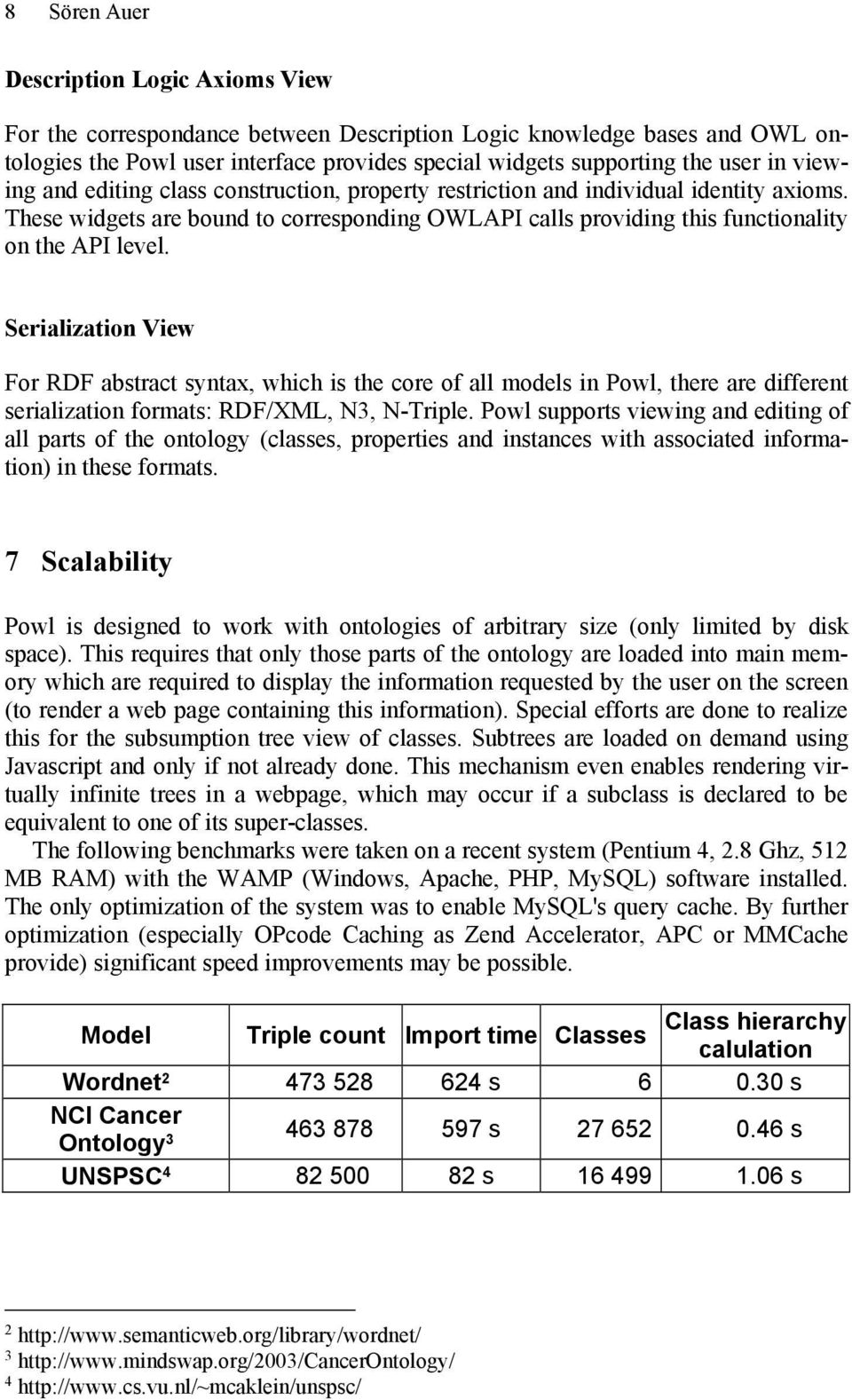
8 8 Sören Auer Description Logic Axioms View For the correspondance between Description Logic knowledge bases and OWL ontologies the Powl user interface provides special widgets supporting the user in viewing and editing class construction, property restriction and individual identity axioms. These widgets are bound to corresponding OWLAPI calls providing this functionality on the API level. Serialization View For RDF abstract syntax, which is the core of all models in Powl, there are different serialization formats: RDF/XML, N3, N-Triple. Powl supports viewing and editing of all parts of the ontology (classes, properties and instances with associated information) in these formats. 7 Scalability Powl is designed to work with ontologies of arbitrary size (only limited by disk space). This requires that only those parts of the ontology are loaded into main memory which are required to display the information requested by the user on the screen (to render a web page containing this information). Special efforts are done to realize this for the subsumption tree view of classes. Subtrees are loaded on demand using Javascript and only if not already done. This mechanism even enables rendering virtually infinite trees in a webpage, which may occur if a subclass is declared to be equivalent to one of its super-classes. The following benchmarks were taken on a recent system (Pentium 4, 2.8 Ghz, 512 MB RAM) with the WAMP (Windows, Apache, PHP, MySQL) software installed. The only optimization of the system was to enable MySQL's query cache. By further optimization (especially OPcode Caching as Zend Accelerator, APC or MMCache provide) significant speed improvements may be possible. Model Class hierarchy Triple count Import time Classes calulation Wordnet s s NCI Cancer Ontology s s UNSPSC s s
9 Powl A Web Based Platform for Collaborative Semantic Web Development 9 8 Conclusion For domain experts and knowledge engineers, Powl provides an easy deployable and easy-to-use, web-based ontology editing and publishing solution. Powl supports collaborative work with ontologies as well as observing the ontology evolution. Powl is scalable and can be used even with extremely large knowledge bases. It may be customized according to specific needs. For PHP developers, Powl offers a comprehensive framework of functionalities for parsing, storing, querying, manipulating, serving and serializing RDFS and OWL ontologies. It may function as a basis for more domain specific web based ontology applications. Powl has been downloaded over 300 times since April 2004, when Powl development started. It is available under GNU Public Licence 5. For future releases it is planned to integrate more powerful inferencing capabilities and to apply Powl for OWL-S [13] and web service development. References 1. Auer, S.: Powl Homepage, The Web, 2004, 2. Bechhofer, S., Dean, M., van Harmelen, F., Hendler, J., Horrocks, I., McGuinness, D., Patel-Schneider, P., Stein, L.: Web Ontology Language (OWL) Reference version 1.0. Recommendation, W3C (2004), 3. Beckett, D.: RDF/XML Syntax Specification (Revised). W3C. 10 February Berners-Lee, T., Hendler, J., Lassila, O.: The semantic web. Scientific American 284 (2001) Carroll, J., et. al: Jena: Implementing the Semantic Web Recomandations. Bristol Donini, F.M., Lenzerini, M., Nardi, D.,, Schaerf, A.: Reasoning in description logics. In Brewka, G., ed.: Principles of Knowledge Representation. Studies in Logic, Language and Information. CSLI Publications, (1996) Klyne, G., Carroll, J.: Resource Description Framework (RDF): Concepts and Abstract Syntax, W3C, 10 February Lassila, O., Swick, R.R.: Resource description framework (RDF) Model and syntax specification. Recommendation, W3C, February syntax Lim, J.: ADOdb Library for PHP, McBride, B: "Jena: Implementing the RDF Model and Syntax Specification", in: Steffen Staab et al (eds.): "Proceedings of the Second International Workshop on the Semantic Web - SemWeb'2001", May Moore, G., Seaborne, A.: RDF Net API, W3C Member Submission, 2. October Oldakowski, R., Bizer, Chr.: RAP: RDF API for PHP, To be published in Proceedings of the 1st International Workshop on Interpreted Languages, OWL Services Coalition: OWL-S: Semantic Markup for Web Services, The Web, 2004, Seaborne, A.: RDQL - A Query Language for RDF, W3C Member Submission, 9 January The PHP Group: PHP Homepage, 5

10 10 Sören Auer 16. Denny, M.: Ontology Tools Survey, Revisited, 2004, Knublauch, H., Fergerson, R. W., Noy, N. F., Musen, M. A.: The Protégé OWL Plugin: An Open Development Environment for Semantic Web Applications, Third International Semantic Web Conference - ISWC 2004, Hiroshima, Japan (2004) 18. Broekstra1, J., Kampman1, A., Harmelen, F.: Sesame: A Generic Architecture for Storing and Querying RDF, Published at the International Semantic Web Conference 2002, Sardinia, Italy. 19. Beckett, D.: Redland rdf application framework. ILRT, University of Bristol. 20. McBride, B.: Jena: Implementing the RDF Model and Syntax Specification, WWW Volz, R., Oberle, D., Staab, S., Motik, B.: KAON SERVER - A Semantic Web Management System, In Alternate Track Proceedings of the Twelfth International World Wide Web Conference, WWW2003, Budapest, Hungary, May ACM, Arpírez, JC.; Corcho, O.; Fernández-López, M.; Gómez-Pérez, A.: WebODE in a nutshell. AI Magazine 24(3): Fall 2003.
powl Features and Usage Overview
 powl Features and Usage Overview Live demonstrations and further information is available from: http://powl.sourceforge.net/swc Sören Auer University of Leipzig [email protected] Norman Beck
Supporting Change-Aware Semantic Web Services
 Supporting Change-Aware Semantic Web Services Annika Hinze Department of Computer Science, University of Waikato, New Zealand [email protected] Abstract. The Semantic Web is not only evolving into
Semantic Modeling with RDF. DBTech ExtWorkshop on Database Modeling and Semantic Modeling Lili Aunimo
 DBTech ExtWorkshop on Database Modeling and Semantic Modeling Lili Aunimo Expected Outcomes You will learn: Basic concepts related to ontologies Semantic model Semantic web Basic features of RDF and RDF
ARC: appmosphere RDF Classes for PHP Developers
 ARC: appmosphere RDF Classes for PHP Developers Benjamin Nowack appmosphere web applications, Kruppstr. 100, 45145 Essen, Germany [email protected] Abstract. ARC is an open source collection of lightweight
Swoop: Design and Architecture of a Web Ontology Browser (/Editor)
 Swoop: Design and Architecture of a Web Ontology Browser (/Editor) (Scholarly Paper for Master's Degree in Computer Science with Non-Thesis Option, Fall 2004) Primary Author Aditya Kalyanpur Dept of Computer
The Protégé OWL Plugin: An Open Development Environment for Semantic Web Applications
 The Protégé OWL Plugin: An Open Development Environment for Semantic Web Applications Holger Knublauch, Ray W. Fergerson, Natalya F. Noy and Mark A. Musen Stanford Medical Informatics, Stanford School
Semantic Knowledge Management System. Paripati Lohith Kumar. School of Information Technology
 Semantic Knowledge Management System Paripati Lohith Kumar School of Information Technology Vellore Institute of Technology University, Vellore, India. [email protected] Abstract The scholarly activities
Evaluation experiment of ontology tools interoperability with the WebODE ontology engineering workbench
 Evaluation experiment of ontology tools interoperability with the WebODE ontology engineering workbench Óscar Corcho, Asunción Gómez-Pérez, Danilo José Guerrero-Rodríguez, David Pérez-Rey, Alberto Ruiz-Cristina,
Developing a Web-Based Application using OWL and SWRL
 Developing a Web-Based Application using OWL and SWRL Martin J. O Connor, Ravi Shankar, Csongor Nyulas, Samson Tu, Amar Das Stanford Medical Informatics, Stanford University, Stanford, CA 94305-5479 {martin.oconnor,
Benchmarking the Performance of Storage Systems that expose SPARQL Endpoints
 Benchmarking the Performance of Storage Systems that expose SPARQL Endpoints Christian Bizer 1 and Andreas Schultz 1 1 Freie Universität Berlin, Web-based Systems Group, Garystr. 21, 14195 Berlin, Germany
DLDB: Extending Relational Databases to Support Semantic Web Queries
 DLDB: Extending Relational Databases to Support Semantic Web Queries Zhengxiang Pan (Lehigh University, USA [email protected]) Jeff Heflin (Lehigh University, USA [email protected]) Abstract: We
Data Validation with OWL Integrity Constraints
 Data Validation with OWL Integrity Constraints (Extended Abstract) Evren Sirin Clark & Parsia, LLC, Washington, DC, USA [email protected] Abstract. Data validation is an important part of data integration
KAON SERVER - A Semantic Web Management System
 KAON SERVER - A Semantic Web Management System Raphael Volz Institute AIFB University of Karlsruhe Karlsruhe, Germany [email protected] Steffen Staab Institute AIFB University of Karlsruhe Karlsruhe, Germany
12 The Semantic Web and RDF
 MSc in Communication Sciences 2011-12 Program in Technologies for Human Communication Davide Eynard nternet Technology 12 The Semantic Web and RDF 2 n the previous episodes... A (video) summary: Michael
Data Store Interface Design and Implementation
 WDS'07 Proceedings of Contributed Papers, Part I, 110 115, 2007. ISBN 978-80-7378-023-4 MATFYZPRESS Web Storage Interface J. Tykal Charles University, Faculty of Mathematics and Physics, Prague, Czech
OWL Ontology Translation for the Semantic Web
 OWL Ontology Translation for the Semantic Web Luís Mota and Luís Botelho We, the Body and the Mind Research Lab ADETTI/ISCTE Av. das Forças Armadas, 1649-026 Lisboa, Portugal [email protected],[email protected]
A Semantic web approach for e-learning platforms
 A Semantic web approach for e-learning platforms Miguel B. Alves 1 1 Laboratório de Sistemas de Informação, ESTG-IPVC 4900-348 Viana do Castelo. [email protected] Abstract. When lecturers publish contents
How To Write A Drupal 5.5.2.2 Rdf Plugin For A Site Administrator To Write An Html Oracle Website In A Blog Post In A Flashdrupal.Org Blog Post
 RDFa in Drupal: Bringing Cheese to the Web of Data Stéphane Corlosquet, Richard Cyganiak, Axel Polleres and Stefan Decker Digital Enterprise Research Institute National University of Ireland, Galway Galway,
Performance Analysis, Data Sharing, Tools Integration: New Approach based on Ontology
 Performance Analysis, Data Sharing, Tools Integration: New Approach based on Ontology Hong-Linh Truong Institute for Software Science, University of Vienna, Austria [email protected] Thomas Fahringer
Grids, Logs, and the Resource Description Framework
 Grids, Logs, and the Resource Description Framework Mark A. Holliday Department of Mathematics and Computer Science Western Carolina University Cullowhee, NC 28723, USA [email protected] Mark A. Baker,
Semantic Search in Portals using Ontologies
 Semantic Search in Portals using Ontologies Wallace Anacleto Pinheiro Ana Maria de C. Moura Military Institute of Engineering - IME/RJ Department of Computer Engineering - Rio de Janeiro - Brazil [awallace,anamoura]@de9.ime.eb.br
Ontology-Driven Software Development in the Context of the Semantic Web: An Example Scenario with Protégé/OWL
 Ontology-Driven Software Development in the Context of the Semantic Web: An Example Scenario with Protégé/OWL Holger Knublauch Stanford Medical Informatics, Stanford University, CA [email protected]
Layering the Semantic Web: Problems and Directions
 First International Semantic Web Conference (ISWC2002), Sardinia, Italy, June 2002. Layering the Semantic Web: Problems and Directions Peter F. Patel-Schneider and Dieter Fensel Bell Labs Research Murray
How To Write A Rdf Database In A Relational Database With A Statement Table
 Efficient RDF Storage and Retrieval in Jena2 Kevin Wilkinson 1, Craig Sayers 1, Harumi Kuno 1, Dave Reynolds 2 HP Laboratories 1 1501 Page Mill Road Palo Alto, CA, 94304 USA 2 Filton Road, Stoke Gifford
ABSTRACT 1. INTRODUCTION. Kamil Bajda-Pawlikowski [email protected]
 Kamil Bajda-Pawlikowski [email protected] Querying RDF data stored in DBMS: SPARQL to SQL Conversion Yale University technical report #1409 ABSTRACT This paper discusses the design and implementation
Annotea and Semantic Web Supported Collaboration
 Annotea and Semantic Web Supported Collaboration Marja-Riitta Koivunen, Ph.D. Annotea project Abstract Like any other technology, the Semantic Web cannot succeed if the applications using it do not serve
An Ontology Based Method to Solve Query Identifier Heterogeneity in Post- Genomic Clinical Trials
 ehealth Beyond the Horizon Get IT There S.K. Andersen et al. (Eds.) IOS Press, 2008 2008 Organizing Committee of MIE 2008. All rights reserved. 3 An Ontology Based Method to Solve Query Identifier Heterogeneity
K@ A collaborative platform for knowledge management
 White Paper K@ A collaborative platform for knowledge management Quinary SpA www.quinary.com via Pietrasanta 14 20141 Milano Italia t +39 02 3090 1500 f +39 02 3090 1501 Copyright 2004 Quinary SpA Index
Towards the Integration of a Research Group Website into the Web of Data
 Towards the Integration of a Research Group Website into the Web of Data Mikel Emaldi, David Buján, and Diego López-de-Ipiña Deusto Institute of Technology - DeustoTech, University of Deusto Avda. Universidades
Getting Started Guide
 TopBraid Composer Getting Started Guide Version 2.0 July 21, 2007 TopBraid Composer, Copyright 2006 TopQuadrant, Inc. 1 of 58 Revision History Date Version Revision August 1, 2006 1.0 Initial version September
An Efficient and Scalable Management of Ontology
 An Efficient and Scalable Management of Ontology Myung-Jae Park 1, Jihyun Lee 1, Chun-Hee Lee 1, Jiexi Lin 1, Olivier Serres 2, and Chin-Wan Chung 1 1 Korea Advanced Institute of Science and Technology,
LinkZoo: A linked data platform for collaborative management of heterogeneous resources
 LinkZoo: A linked data platform for collaborative management of heterogeneous resources Marios Meimaris, George Alexiou, George Papastefanatos Institute for the Management of Information Systems, Research
Evaluation experiment for the editor of the WebODE ontology workbench
 Evaluation experiment for the editor of the WebODE ontology workbench Óscar Corcho, Mariano Fernández-López, Asunción Gómez-Pérez Facultad de Informática. Universidad Politécnica de Madrid Campus de Montegancedo,
Perspectives of Semantic Web in E- Commerce
 Perspectives of Semantic Web in E- Commerce B. VijayaLakshmi M.Tech (CSE), KIET, A.GauthamiLatha Dept. of CSE, VIIT, Dr. Y. Srinivas Dept. of IT, GITAM University, Mr. K.Rajesh Dept. of MCA, KIET, ABSTRACT
Semantic Web Technologies and Data Management
 Semantic Web Technologies and Data Management Li Ma, Jing Mei, Yue Pan Krishna Kulkarni Achille Fokoue, Anand Ranganathan IBM China Research Laboratory IBM Software Group IBM Watson Research Center Bei
Semantic Stored Procedures Programming Environment and performance analysis
 Semantic Stored Procedures Programming Environment and performance analysis Marjan Efremov 1, Vladimir Zdraveski 2, Petar Ristoski 2, Dimitar Trajanov 2 1 Open Mind Solutions Skopje, bul. Kliment Ohridski
An extensible ontology software environment
 An extensible ontology software environment Daniel Oberle 1, Raphael Volz 1,2, Steffen Staab 1, and Boris Motik 2 1 University of Karlsruhe, Institute AIFB D-76128 Karlsruhe, Germany email: {lastname}@aifb.uni-karlsruhe.de
Programming the Semantic Web
 Master s Thesis Programming the Semantic Web - A Microformats Compatible GRDDL Implementation for ActiveRDF Christian Planck Larsen Department of Computer Science, Aalborg University 24th of August 2007
The Semantic Web: An Introduction and Issues
 The Semantic Web: An Introduction and Issues Gopal Pandey (Department of Information Technology, Shantilal Shah Engineering College, Bhavnagar, Gujarat, India) ABSTRACT Current Web content has been designed
A Comparative Study Ontology Building Tools for Semantic Web Applications
 A Comparative Study Ontology Building Tools for Semantic Web Applications Bhaskar Kapoor 1 and Savita Sharma 2 1 Department of Information Technology, MAIT, New Delhi INDIA [email protected] 2 Department
Characterizing Knowledge on the Semantic Web with Watson
 Characterizing Knowledge on the Semantic Web with Watson Mathieu d Aquin, Claudio Baldassarre, Laurian Gridinoc, Sofia Angeletou, Marta Sabou, and Enrico Motta Knowledge Media Institute (KMi), The Open
DataDirect XQuery Technical Overview
 DataDirect XQuery Technical Overview Table of Contents 1. Feature Overview... 2 2. Relational Database Support... 3 3. Performance and Scalability for Relational Data... 3 4. XML Input and Output... 4
LDIF - Linked Data Integration Framework
 LDIF - Linked Data Integration Framework Andreas Schultz 1, Andrea Matteini 2, Robert Isele 1, Christian Bizer 1, and Christian Becker 2 1. Web-based Systems Group, Freie Universität Berlin, Germany [email protected],
NS DISCOVER 4.0 ADMINISTRATOR S GUIDE. July, 2015. Version 4.0
 NS DISCOVER 4.0 ADMINISTRATOR S GUIDE July, 2015 Version 4.0 TABLE OF CONTENTS 1 General Information... 4 1.1 Objective... 4 1.2 New 4.0 Features Improvements... 4 1.3 Migrating from 3.x to 4.x... 5 2
THE SEMANTIC WEB AND IT`S APPLICATIONS
 15-16 September 2011, BULGARIA 1 Proceedings of the International Conference on Information Technologies (InfoTech-2011) 15-16 September 2011, Bulgaria THE SEMANTIC WEB AND IT`S APPLICATIONS Dimitar Vuldzhev
Logic and Reasoning in the Semantic Web (part I RDF/RDFS)
 Logic and Reasoning in the Semantic Web (part I RDF/RDFS) Fulvio Corno, Laura Farinetti Politecnico di Torino Dipartimento di Automatica e Informatica e-lite Research Group http://elite.polito.it Outline
An Ontology-based e-learning System for Network Security
 An Ontology-based e-learning System for Network Security Yoshihito Takahashi, Tomomi Abiko, Eriko Negishi Sendai National College of Technology [email protected] Goichi Itabashi Graduate School
SNOMED-CT. http://www.connectingforhealth.nhs.uk/technical/standards/snomed 4. http://ww.hl7.org 5. http://www.w3.org/2004/owl/ 6
 Is Semantic Web technology ready for Healthcare? Chris Wroe BT Global Services, St Giles House, 1 Drury Lane, London, WC2B 5RS, UK [email protected] Abstract. Healthcare IT systems must manipulate semantically
Incorporating Semantic Discovery into a Ubiquitous Computing Infrastructure
 Incorporating Semantic Discovery into a Ubiquitous Computing Infrastructure Robert E. McGrath, Anand Ranganathan, M. Dennis Mickunas, and Roy H. Campbell Department of Computer Science, University or Illinois
Fund Finder: A case study of database-to-ontology mapping
 Fund Finder: A case study of database-to-ontology mapping Jesús Barrasa, Oscar Corcho, Asunción Gómez-Pérez (Ontology Group, Departamento de Inteligencia Artificial, Facultad de Informática, Universidad
Design and Implementation of a Semantic Web Solution for Real-time Reservoir Management
 Design and Implementation of a Semantic Web Solution for Real-time Reservoir Management Ram Soma 2, Amol Bakshi 1, Kanwal Gupta 3, Will Da Sie 2, Viktor Prasanna 1 1 University of Southern California,
Scalable End-User Access to Big Data http://www.optique-project.eu/ HELLENIC REPUBLIC National and Kapodistrian University of Athens
 Scalable End-User Access to Big Data http://www.optique-project.eu/ HELLENIC REPUBLIC National and Kapodistrian University of Athens 1 Optique: Improving the competitiveness of European industry For many
Semantic Lookup in Service-Oriented Architectures
 Semantic Lookup in Service-Oriented Architectures Uwe Zdun Department of Information Systems, Vienna University of Economics, Austria [email protected] Abstract Lookup of services is an important issues in
Application of OASIS Integrated Collaboration Object Model (ICOM) with Oracle Database 11g Semantic Technologies
 Application of OASIS Integrated Collaboration Object Model (ICOM) with Oracle Database 11g Semantic Technologies Zhe Wu Ramesh Vasudevan Eric S. Chan Oracle Deirdre Lee, Laura Dragan DERI A Presentation
Towards a reference architecture for Semantic Web applications
 Towards a reference architecture for Semantic Web applications Benjamin Heitmann 1, Conor Hayes 1, and Eyal Oren 2 1 [email protected] Digital Enterprise Research Institute National University
Case Study. Data Governance Portal. www.brainvire.com 2013 Brainvire Infotech Pvt Ltd Page 1 of 1
 Case Study Data Governance Portal www.brainvire.com 2013 Brainvire Infotech Pvt Ltd Page 1 of 1 Client Requirement The website is the Data Governance intranet portal. Data Governance is the practice of
Extending Java Web Applications for Semantic Web
 Extending Java Web Applications for Semantic Web Lidia Rovan, Ivana Nižeti Department of applied computing University of Zagreb Faculty of Electrical Engineering and Computing Unska 3, Zagreb 10000, CROATIA
RDF Resource Description Framework
 RDF Resource Description Framework Fulvio Corno, Laura Farinetti Politecnico di Torino Dipartimento di Automatica e Informatica e-lite Research Group http://elite.polito.it Outline RDF Design objectives
A Review and Comparison of Rule Languages and Rule-based Inference Engines for the Semantic Web
 A Review and Comparison of and -based Inference Engines for the Semantic Web Thanyalak Rattanasawad, Kanda Runapongsa Saikaew Department of Computer Engineering, Faculty of Engineering, Khon Kaen University,
Semantic Exploration of Archived Product Lifecycle Metadata under Schema and Instance Evolution
 Semantic Exploration of Archived Lifecycle Metadata under Schema and Instance Evolution Jörg Brunsmann Faculty of Mathematics and Computer Science, University of Hagen, D-58097 Hagen, Germany [email protected]
Windchill Service Information Manager 10.1. Curriculum Guide
 Windchill Service Information Manager 10.1 Curriculum Guide Live Classroom Curriculum Guide Building Information Structures with Windchill Service Information Manager 10.1 Building Publication Structures
Semantics and Ontology of Logistic Cloud Services*
 Semantics and Ontology of Logistic Cloud s* Dr. Sudhir Agarwal Karlsruhe Institute of Technology (KIT), Germany * Joint work with Julia Hoxha, Andreas Scheuermann, Jörg Leukel Usage Tasks Query Execution
10CS73:Web Programming
 10CS73:Web Programming Question Bank Fundamentals of Web: 1.What is WWW? 2. What are domain names? Explain domain name conversion with diagram 3.What are the difference between web browser and web server
XBRL Processor Interstage XWand and Its Application Programs
 XBRL Processor Interstage XWand and Its Application Programs V Toshimitsu Suzuki (Manuscript received December 1, 2003) Interstage XWand is a middleware for Extensible Business Reporting Language (XBRL)
Ontologies for elearning
 Chapter 4 Applications and Impacts Ontologies for elearning B.Polakowski and K.Amborski Institute of Control and Industrial Electronics, Warsaw University of Technology. Warsaw, Poland e-mail: [email protected],
Business Application Development Platform
 Business Application Development Platform Author Copyright Last update Version Document type Sclable Business Solutions GmbH Attribution-NonCommercial-NoDerivatives 4.0 International 01/28/2014 1.0 Technical
On the Standardization of Semantic Web Services-based Network Monitoring Operations
 On the Standardization of Semantic Web Services-based Network Monitoring Operations ChenglingZhao^, ZihengLiu^, YanfengWang^ The Department of Information Techonlogy, HuaZhong Normal University; Wuhan,
<Insert Picture Here> Michael Hichwa VP Database Development Tools [email protected] Stuttgart September 18, 2007 Hamburg September 20, 2007
 Michael Hichwa VP Database Development Tools [email protected] Stuttgart September 18, 2007 Hamburg September 20, 2007 Oracle Application Express Introduction Architecture
Linked Data Publishing with Drupal
 Linked Data Publishing with Drupal Joachim Neubert ZBW German National Library of Economics Leibniz Information Centre for Economics SWIB13 Workshop Hamburg, Germany 25.11.2013 ZBW is member of the Leibniz
Semantic Interoperability
 Ivan Herman Semantic Interoperability Olle Olsson Swedish W3C Office Swedish Institute of Computer Science (SICS) Stockholm Apr 27 2011 (2) Background Stockholm Apr 27, 2011 (2) Trends: from
EUR-Lex 2012 Data Extraction using Web Services
 DOCUMENT HISTORY DOCUMENT HISTORY Version Release Date Description 0.01 24/01/2013 Initial draft 0.02 01/02/2013 Review 1.00 07/08/2013 Version 1.00 -v1.00.doc Page 2 of 17 TABLE OF CONTENTS 1 Introduction...
SmartLink: a Web-based editor and search environment for Linked Services
 SmartLink: a Web-based editor and search environment for Linked Services Stefan Dietze, Hong Qing Yu, Carlos Pedrinaci, Dong Liu, John Domingue Knowledge Media Institute, The Open University, MK7 6AA,
Representing the Hierarchy of Industrial Taxonomies in OWL: The gen/tax Approach
 Representing the Hierarchy of Industrial Taxonomies in OWL: The gen/tax Approach Martin Hepp Digital Enterprise Research Institute (DERI), University of Innsbruck Florida Gulf Coast University, Fort Myers,
Linked Data Interface, Semantics and a T-Box Triple Store for Microsoft SharePoint
 Linked Data Interface, Semantics and a T-Box Triple Store for Microsoft SharePoint Christian Fillies 1 and Frauke Weichhardt 1 1 Semtation GmbH, Geschw.-Scholl-Str. 38, 14771 Potsdam, Germany {cfillies,
ONTOLOGY-BASED APPROACH TO DEVELOPMENT OF ADJUSTABLE KNOWLEDGE INTERNET PORTAL FOR SUPPORT OF RESEARCH ACTIVITIY
 ONTOLOGY-BASED APPROACH TO DEVELOPMENT OF ADJUSTABLE KNOWLEDGE INTERNET PORTAL FOR SUPPORT OF RESEARCH ACTIVITIY Yu. A. Zagorulko, O. I. Borovikova, S. V. Bulgakov, E. A. Sidorova 1 A.P.Ershov s Institute
Lightweight Data Integration using the WebComposition Data Grid Service
 Lightweight Data Integration using the WebComposition Data Grid Service Ralph Sommermeier 1, Andreas Heil 2, Martin Gaedke 1 1 Chemnitz University of Technology, Faculty of Computer Science, Distributed
Completing Description Logic Knowledge Bases using Formal Concept Analysis
 Completing Description Logic Knowledge Bases using Formal Concept Analysis Franz Baader, 1 Bernhard Ganter, 1 Barış Sertkaya, 1 and Ulrike Sattler 2 1 TU Dresden, Germany and 2 The University of Manchester,
Application of ontologies for the integration of network monitoring platforms
 Application of ontologies for the integration of network monitoring platforms Jorge E. López de Vergara, Javier Aracil, Jesús Martínez, Alfredo Salvador, José Alberto Hernández Networking Research Group,