
Appendix B IMPLEMENTATION GUIDANCE
|
|
|
- Cecilia Hicks
- 10 years ago
- Views:
Transcription
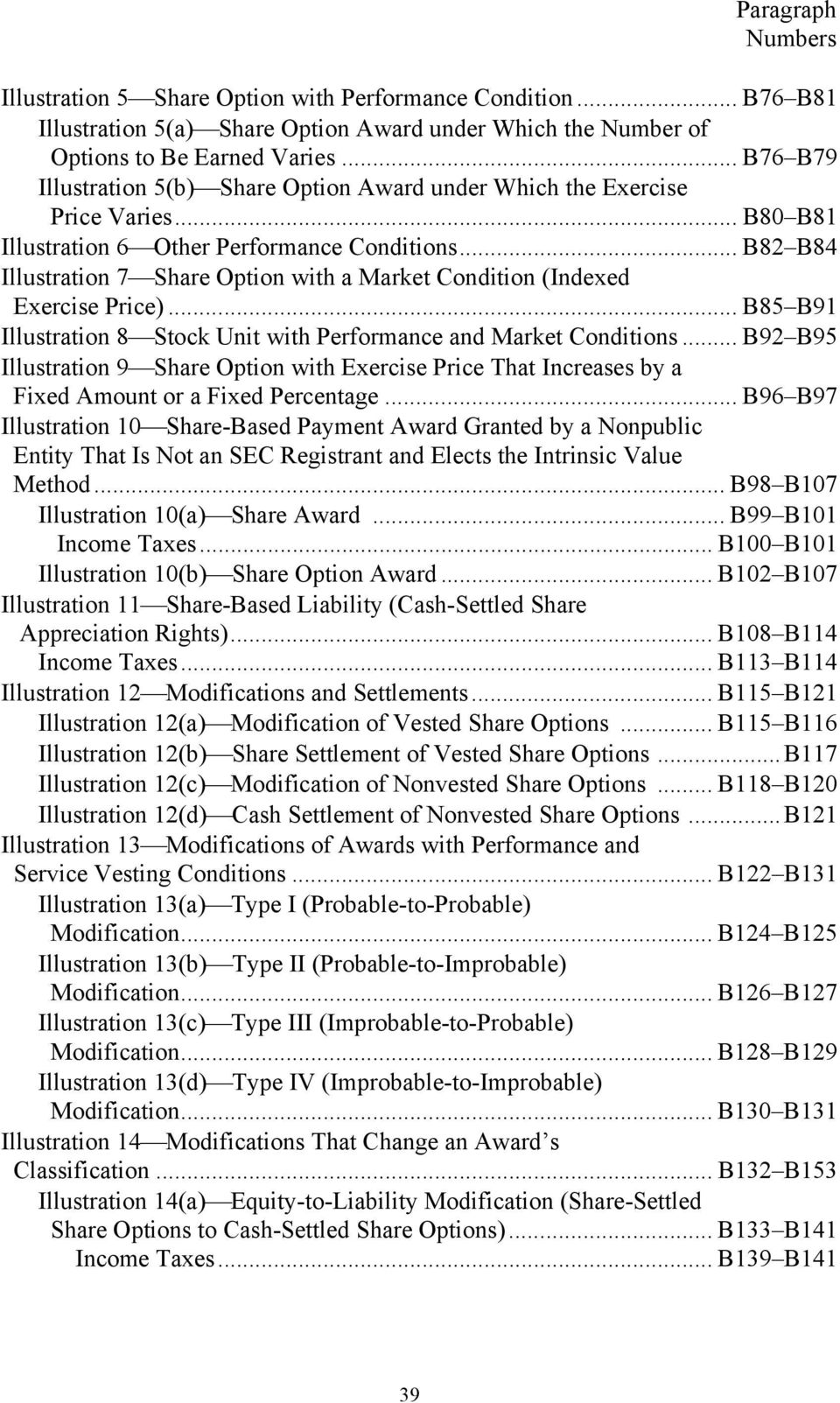
1 Appendix B IMPLEMENTATION GUIDANCE CONTENTS Paragraph Numbers Introduction...B1 Fair Value Measurement Objective and Its Application... B2 B12 Fair Value of Instruments Granted under a Share-Based Payment Arrangement... B4 B6 Valuation Techniques... B7 B12 Valuation Techniques for Share Options... B9 B12 Selecting Assumptions for Use in an Option-Pricing Model... B13 B30 Consistent Use of Valuation Techniques and Methods for Selecting Assumptions... B17 B19 Expected Term of Employee Share Options... B20 B23 Expected Volatility... B24 B26 Expected Dividends... B27 B28 Other Considerations... B29 B30 Market, Performance, and Service Conditions... B31 B36 Market, Performance, and Service Conditions That Affect Vesting and Exercisability... B31 B33 Market, Performance, and Service Conditions That Affect Factors Other Than Vesting and Exercisability... B34 B36 Estimating the Requisite Service Period of Awards with Market, Performance, and Service Conditions... B37 B49 Explicit, Implicit, Derived, and Requisite Service Periods... B38 B41 Share-Based Payment Arrangement with a Performance Condition and Multiple Service Periods... B42 B44 Share-Based Payment Arrangement with a Service Condition and Multiple Service Periods... B45 B46 Share-Based Payment Arrangement with Market and Service Conditions and Multiple Service Periods... B47 B49 Illustrative Computations and Other Guidance... B50 B190 Illustration 1 Definition of Employee... B50 B51 Illustration 2 Service Inception Date and Grant Date... B52 B56 Illustration 3 Determining the Grant Date... B57 B58 Illustration 4 Accounting for Share Options with Service Conditions... B59 B75 Share Options with Cliff Vesting... B64 B69 Income Taxes...B67 Cash Flows from Income Taxes... B68 B69 Share Options with Graded Vesting... B70 B75 38

2 Paragraph Numbers Illustration 5 Share Option with Performance Condition... B76 B81 Illustration 5(a) Share Option Award under Which the Number of Options to Be Earned Varies... B76 B79 Illustration 5(b) Share Option Award under Which the Exercise Price Varies... B80 B81 Illustration 6 Other Performance Conditions... B82 B84 Illustration 7 Share Option with a Market Condition (Indexed Exercise Price)... B85 B91 Illustration 8 Stock Unit with Performance and Market Conditions... B92 B95 Illustration 9 Share Option with Exercise Price That Increases by a Fixed Amount or a Fixed Percentage... B96 B97 Illustration 10 Share-Based Payment Award Granted by a Nonpublic Entity That Is Not an SEC Registrant and Elects the Intrinsic Value Method... B98 B107 Illustration 10(a) Share Award... B99 B101 Income Taxes... B100 B101 Illustration 10(b) Share Option Award... B102 B107 Illustration 11 Share-Based Liability (Cash-Settled Share Appreciation Rights)... B108 B114 Income Taxes... B113 B114 Illustration 12 Modifications and Settlements... B115 B121 Illustration 12(a) Modification of Vested Share Options... B115 B116 Illustration 12(b) Share Settlement of Vested Share Options...B117 Illustration 12(c) Modification of Nonvested Share Options... B118 B120 Illustration 12(d) Cash Settlement of Nonvested Share Options...B121 Illustration 13 Modifications of Awards with Performance and Service Vesting Conditions... B122 B131 Illustration 13(a) Type I (Probable-to-Probable) Modification... B124 B125 Illustration 13(b) Type II (Probable-to-Improbable) Modification... B126 B127 Illustration 13(c) Type III (Improbable-to-Probable) Modification... B128 B129 Illustration 13(d) Type IV (Improbable-to-Improbable) Modification... B130 B131 Illustration 14 Modifications That Change an Award s Classification... B132 B153 Illustration 14(a) Equity-to-Liability Modification (Share-Settled Share Options to Cash-Settled Share Options)... B133 B141 Income Taxes... B139 B141 39
3 Paragraph Numbers Illustration 14(b) Equity-to-Equity Modification (Share Options to Shares)...B142 Illustration 14(c) Liability-to-Equity Modification (Cash-Settled to Share-Settled SARs)... B143 B148 Illustration 14(d) Liability-to-Liability Modification (Cash SARs to Cash SARs)... B149 B152 Illustration 14(e) Equity-to-Liability Modification (Share Options to Fixed Cash Payment)...B153 Illustration 15 Share Award with a Clawback Feature...B154 Illustration 16 Tandem Plan Share Options or Cash SARs... B155 B158 Illustration 17 Tandem Plan Phantom Shares or Share Options... B159 B167 Illustration 18 Look-Back Share Options... B168 B176 Illustration 19 Employee Share Purchase Plans... B177 B179 Illustration 20 Book Value Share Purchase Plans (Nonpublic Enterprises Only)... B180 B182 Illustration 21 Voluntary (or Involuntary) Change to Fair-Value-Based Method (Nonpublic Enterprises Only)...B183 Illustration 22 When Certain Instruments Become Subject to Statement B184 Illustration 23 Transition Using the Modified Prospective Method... B185 B190 Minimum Disclosure Requirements and Illustrative Disclosures... B191 B193 Supplemental Disclosures...B193 40

4 Appendix B IMPLEMENTATION GUIDANCE INTRODUCTION B1. This appendix, which is an integral part of this Statement, 1 provides implementation guidance (a) that illustrates the fair-value-based method of accounting for share-based compensation arrangements with employees and (b) that elaborates on certain other aspects of this Statement. The illustrations are designed to provide guidance on, and emphasize considerations that should be taken into account in, applying this Statement. Using this guidance to apply this Statement in actual situations will require the exercise of judgment. FAIR VALUE MEASUREMENT OBJECTIVE AND ITS APPLICATION B2. The measurement objective for equity instruments granted to employees is to estimate the fair value of the equity instruments to which employees become entitled when they have rendered the requisite service and satisfied any other conditions necessary to earn the right to benefit from the instruments. That estimate is based on the share price (and other pertinent factors, including those enumerated in paragraph 19 of this Statement) at the grant date and is not remeasured in subsequent periods under the modified grant-date method. Restrictions (refer to Appendix E) that continue in effect after employees have earned the right to benefit from their equity instruments affect the value of the instruments issued at the vesting date and, therefore, are reflected in estimating the instruments fair value at the grant date. 2 The estimated fair value of an equity instrument on the date it is granted should not reflect the effects of vesting conditions or other restrictions that apply only during the vesting period. 3 Those effects are reflected by recognizing compensation cost only for awards that actually vest because the requisite service is provided. Reload features and contingent features that require an employee to transfer equity shares earned or realized gains from the sale of equity instruments earned as a result of share-based payment arrangements to the issuing enterprise for consideration that is less than fair value on the date of transfer (including 1 The phrase this Statement refers to Statement 123 as revised by Statement 15X (that is, this proposed Statement). 2 For example, if restricted shares (refer to Appendix E) are granted to an employee, the post-vesting restriction shall be reflected in estimating the grant-date fair value of the shares, but only to the extent that the post-vesting restriction would affect the amount at which the shares being valued would be exchanged (paragraph B4). For instance, if the shares are traded in an active market, post-vesting restrictions may have little, if any, effect on the amount at which the shares being valued would be exchanged. 3 Performance and service conditions (refer to Appendix E) are vesting conditions for purposes of this Statement. However, market conditions (refer to Appendix E) are not vesting conditions for purposes of this Statement; rather, market conditions may affect exercisability of an award. Consequently, market conditions are included in the estimate of the grant-date fair value of awards. 41
5 no consideration), such as a clawback feature, 4 shall not be considered in estimating the fair value of an equity instrument on the date it is granted. Those features are accounted for if and when a reload grant or contingent event occurs. B3. The fair value measurement objective for liabilities incurred under share-based payment arrangements with employees is the same as for equity instruments. However, awards classified as liabilities are subsequently remeasured to their fair values (or a pro rata portion thereof until the requisite service has been rendered) at the end of each reporting period until the liability is settled. Fair Value of Instruments Granted under a Share-Based Payment Arrangement B4. Fair value is defined in FASB Concepts Statement No. 7, Using Cash Flow Information and Present Value in Accounting Measurements, as follows: The amount at which that asset (or liability) could be bought (or incurred) or sold (or settled) in a current transaction between willing parties, that is, other than in a forced or liquidation sale. [Glossary of Terms of Concepts Statement 7] That definition refers explicitly only to assets and liabilities, but the concept of value in a current exchange embodied in it applies equally to the equity instruments subject to this Statement. Observable market prices of identical or similar equity or liability instruments in active markets are the best evidence of fair value and, if available, are to be used as the basis for the measurement of equity and liability instruments awarded as part of share-based payment arrangements with employees. For example, awards to employees of a public entity of shares of its common stock, subject only to a service or performance condition for vesting, that are awards of nonvested shares, are to be measured based on the market price of otherwise identical (that is, identical except for the vesting condition) common stock traded in the marketplace. B5. If observable market prices of identical or similar equity or liability instruments of the entity are not available, the fair value of equity and liability instruments awarded to employees shall be estimated by using a valuation technique that (a) is applied in a manner consistent with the fair value measurement objective and the other requirements of this Statement, (b) is based on established principles of financial economic theory and generally accepted by experts in that field (paragraph B9), and (c) reflects any and all substantive characteristics of the instrument (except for those characteristics explicitly excluded, such as vesting conditions and reload features). That is, the fair value estimate for equity and liability instruments granted as part of a share-based payment arrangement shall be determined by applying a valuation technique that would be used in valuing instruments with the same characteristics (except for those explicitly excluded by this 4 A clawback feature can take various forms but often functions as a noncompete mechanism: for example, an employee that terminates the employment relationship and begins to work for a competitor is required to transfer to the issuing enterprise (former employer) shares granted and earned under a share-based payment arrangement. 42

6 Statement) to form the basis for an amount at which the instruments being valued would be exchanged (paragraph B6). B6. In estimating the fair value of employee share options at the grant date, the determination of the amount at which the instruments being valued would be exchanged would factor in expectations of the probability that the options would vest (that is, that the service or performance vesting conditions would be satisfied). However, as noted in paragraph B2, the measurement objective in this Statement is to estimate the fair value at the grant date of the equity instruments to which employees will become entitled when the service or performance conditions for vesting have been satisfied (that is, when the requisite service has been rendered). Therefore, the estimated fair value of the equity instruments at grant date does not take into account the effect on fair value of vesting conditions and other restrictions prior to vesting (as well as other items explicitly excluded). The effect of the vesting conditions and other restrictions prior to vesting are considered by the modified grant-date method by recognizing compensation cost only for instruments that vest (in other words, instruments for which the requisite service is rendered). Valuation Techniques B7. In applying a valuation technique, inputs and assumptions should be those that would be used or made in accordance with paragraph B5. That is, the estimates and assumptions should reflect information that is (or would be) available to form the basis for an amount at which the instruments being valued would be exchanged. In estimating fair value, the assumptions made should not represent the biases of a particular party. Some of those assumptions will be based on or determined directly from external data. Other assumptions will be derived from the entity s own historical experience with sharebased payment arrangements. 5 B8. The fair value of any equity or liability instrument depends on the specific characteristics of that instrument. Paragraph 19 of this Statement enumerates a list of substantive characteristics of equity instruments with option (or option-like) features that shall be considered in estimating their fair value. However, a share-based payment arrangement could contain other features that should be included in a fair value estimate (such as a market condition). Judgment will be required to determine both what features should be included and, as described in paragraphs B9 B12, how to incorporate those features in the valuation technique used. Valuation Techniques for Share Options B9. Several valuation techniques, including a lattice model (an example of which is a binomial model) and a closed-form model (an example of which is the Black-Scholes- 5 This guidance is not intended to preclude use of an entity s own data about employee option exercises in developing the fair value estimate. Forming the basis for an amount at which instruments being valued would be exchanged would require data about expected option exercises, and such data generally could be obtained only from the entity. 43
7 Merton formula) meet the criteria required by this Statement for estimating the fair values of employee share options and similar instruments. Those valuation techniques or models, sometimes referred to as option-pricing models, are based on well-established financial economic theory. Those models are used by valuation professionals, dealers of derivative instruments, and other experts to estimate the fair values of options and similar instruments related to equity securities, currencies, interest rates, and commodities. Those models are used to establish trade prices for derivative instruments, to establish fair market values for U.S. tax purposes, and to establish values in adjudications. Both a lattice model and a closed-form model can be adjusted to account for the characteristics of share options and similar instruments granted to employees. B10. This Statement requires the use of a valuation technique or model that meets the requirements in paragraph B5 to estimate the fair values of employee share options and similar instruments. The selection of a valuation model will depend on the substantive characteristics of each arrangement and the availability of data necessary to use the model. A valuation model that is more fully able to capture and better reflects those characteristics is preferable and should be used if it is practicable to do so. For example, the Black-Scholes-Merton formula, a closed-form model, assumes that option exercises occur at the end of an option s contractual term, and that volatility, dividends, and riskfree interest rates are constant over the option s term. If used to estimate the fair value of employee share options and similar instruments, the Black-Scholes-Merton formula must be adjusted to take account of certain characteristics of employee share options and similar instruments that are not consistent with the assumptions of the model (for example, exercise prior to the end of the option s contractual term and changing volatility and dividends). Because of the nature of the formula, those adjustments take the form of weighted-average assumptions about those characteristics. In contrast, a lattice model can be designed to incorporate certain characteristics of employee share options and similar instruments; it can accommodate changes in dividends and volatility over the option s contractual term, estimates of expected option exercise patterns during the option s contractual term, and blackout periods. 6 A lattice model, therefore, is more fully able to capture and better reflects the characteristics of a particular employee share option or similar instrument in the estimate of fair value. 7 B11. Although a lattice model may be preferable because of its ability to more fully capture and better reflect the characteristics of a particular employee share option or similar instrument in the estimate of fair value, it may not be practicable to use such a 6 A blackout period is a period of time during which an employee is contractually or legally prohibited from exercising a share option granted under a share-based payment arrangement. 7 Valuation techniques used for employee share options and similar instruments estimate the fair value of those instruments at a single point in time (for example, at the grant date) that is independent of all other points in time. The estimated fair value of those instruments will change over time as factors used in estimating their fair value change, for instance, as share prices fluctuate, risk-free interest rates change, or dividend streams are modified. That change in the estimated fair value of those instruments is a normal economic process to which any valuable resource is subject. The estimated fair value of those instruments at a single point in time is neither a prediction nor a forecast of what the estimated fair value of those instruments may be in the future or was in the past. 44
8 model. For example, an enterprise may lack the historical data on employee exercise patterns that could be used within a lattice model in estimating expected option exercises over the option s contractual term. For instance, a nonpublic enterprise that elects to account for employee share options using the fair-value-based method or a newly public company may not have a significant history of share option exercise; consequently, such entities may conclude that it is not practicable to use a lattice model and that a closedform model would provide a reasonable estimate of fair value. Entities that do not have reasonable access to the data required by a lattice model may conclude that a closed-form model provides a reasonable estimate of fair value; those entities subsequently may obtain reasonable access to the data and decide to use a lattice model. Further, entities for which compensation cost is not a significant element of the financial statements may conclude that a closed-form model produces estimates of fair value that are not materially different from those produced by a lattice model and that this pattern can reasonably be assumed to persist. Those entities may conclude that a closed-form model provides reasonable estimates of fair value. 8 B12. Public entities for which compensation cost from share option arrangements is a significant element of the financial statements may conclude, when inputs are available, that a lattice model would provide a better estimate of fair value because of its ability to more fully capture and better reflect the characteristics of a particular employee share option or similar instrument in the estimate of fair value. SELECTING ASSUMPTIONS FOR USE IN AN OPTION-PRICING MODEL B13. If an observable market price is not available for an option with the same or similar terms and conditions, this Statement requires an entity to estimate the fair value of an employee share option or similar instrument using a valuation model that meets the requirements in paragraph B5 and takes into account, at a minimum: a. The exercise price of the option b. The expected term 9 of the option, taking into account both the contractual term of the option and the effects of employees expected exercise and post-vesting employment termination behavior (refer to paragraph B20 for an explanation of the expected term in the context of a lattice model) c. The current price of the underlying share d. The expected volatility of the price of the underlying share 8 Even if an entity concludes that a closed-form model provides a reasonable estimate of fair value, that entity should perform a rigorous analysis of the employee share option or similar instrument s expected term in estimating that input for use in the model. 9 The fair value of a transferable share option is based on its contractual term because rarely is it economically advantageous to exercise, rather than sell, a transferable share option before the end of its contractual term. Employee share options generally differ from transferable (or traded) share options in that employees cannot sell their share options they can only exercise them. To reflect the effect of employees inability to sell their vested options, this Statement requires that the fair value of an employee share option be based on its expected term rather than its contractual term. 45
9 e. The expected dividends on the underlying share (except as provided in paragraphs 32 and 33 of this Statement) f. The risk-free interest rate(s) for the expected term of the option. 10 A U.S. entity issuing an option on its own shares must use as the risk-free interest rates the implied yields from the U.S. Treasury zero-coupon yield curve over the expected term of the option if the entity is using a lattice model incorporating the option s contractual term. If the entity is using a closed-form model, the risk-free interest rate is the implied yield currently available on U.S. Treasury zero-coupon issues with a remaining term equal to the expected term used as the input to the model. For entities based in jurisdictions outside the United States, the risk-free interest rate is the implied yield currently available on zero-coupon government issues denominated in the currency of the market in which the share (or underlying share), which is the basis for the instrument awarded, primarily trades. It may be necessary to use an appropriate substitute if no such government issues exist or circumstances indicate that the implied yield on zero-coupon government issues is not representative of the risk-free interest rate (for example, in high-inflation economies). Guidance on selecting the other assumptions listed above is provided in the following paragraphs. B14. There is likely to be a range of reasonable estimates for expected volatility, dividends, and option term. If no amount within the range is more or less likely than any other amount, an average of the range (its expected value) should be used. In using a lattice model, the expected values used are to be determined for a particular node (or multiple nodes during a particular time period) of the lattice and not over multiple periods, unless such application is supportable given the characteristics of the instrument being valued. 11 B15. Expectations about the future generally are based on past experience, modified to reflect ways in which currently available information indicates that the future is reasonably expected to differ from the past. In many circumstances, the available information may indicate that unadjusted historical experience is a relatively poor predictor of future experience. For example, an entity with two distinctly different lines of business of approximately equal size may dispose of the one that was significantly less volatile and generated more cash than the other. In that situation, volatility, dividends, and perhaps employees exercise and post-vesting termination behavior from the predisposition (or disposition) period may not be the best information on which to base reasonable expectations for the future. B16. In other circumstances, historical information may not be available. For example, an entity whose common stock has only recently become publicly traded may have little, 10 The term expected in items (b), (d), (e), and (f) relates to assumptions about the respective factor that is used as an input in a valuation model. 11 The term supportable is used in its general sense: capable of being maintained, confirmed, or made good; defensible (The Compact Oxford English Dictionary, 2 nd edition, 1998). Application is supportable if it is based on reasonable arguments, given a rigorous analysis that takes into account the relevant facts and circumstances. 46
10 if any, historical data on the volatility of its own shares. That entity might base expectations about future volatility on the average volatilities of similar entities for an appropriate period following their going public. A nonpublic entity that elects to use the fair-value-based method of accounting will need to exercise judgment in selecting a method to estimate expected volatility and might do so by basing its volatility expectations on the average volatilities of otherwise similar public entities. 12 Consistent Use of Valuation Techniques and Methods for Selecting Assumptions B17. Data and assumptions used to estimate the fair value of equity and liability instruments granted to employees should be determined in a consistent manner from period to period. For example, for grants made before the market closes, an entity might use either the closing share price or the average of that day s share price as the current share price on the grant date, but whichever method is selected, it should be used consistently. The valuation technique an entity selects to estimate fair value also should be used consistently and should not be changed unless a different valuation technique is expected to produce a better estimate of fair value. B18. For employee share options and similar instruments, a lattice model is preferable to a closed-form model and, therefore, is preferable for justifying a change in accounting principle. Once an entity changes its valuation technique for employee share options and similar instruments to a lattice model, it may not change to a less preferable valuation technique. 13 A change in valuation technique is a change in accounting estimate or a change in accounting estimate inseparable from a change in accounting principle, depending on the facts and circumstances, for purposes of applying APB Opinion No. 20, Accounting Changes. For example, if an entity changes its valuation technique from a closed-form model to a lattice model because it has accumulated data to support an estimate of expected option exercise over the contractual term of the option, that change is a change in accounting estimate because that change is based on new information that provides better insight and improved judgment. B19. Not all of the general guidance on selecting assumptions provided in paragraphs B2 B18 is repeated in the following discussion of factors to be considered in selecting specific assumptions. However, the general guidance is intended to apply to each individual assumption. An entity should not estimate share option fair values based on historical average share option lives, historical share price volatility, or historical dividends (whether stated as a yield or a dollar amount) without considering the extent to which future experience is reasonably expected to differ from historical experience. 12 This paragraph is in no way intended to suggest that historical volatility is the only indicator of expected volatility. Expected volatility is an expectation of volatility over the expected term of an employee share option or similar instrument; paragraphs B24 and B25 provide further guidance on estimating expected volatility. 13 However, if subsequent to that change an entity grants a different type of share-based payment award (for instance, a share option with a three-month contractual term that is exercisable only at the end of its term) it may decide that a closed-form model provides a reasonable estimate of fair value, given the characteristics of the instrument being valued. 47

11 Expected Term of Employee Share Options B20. Expected term is an input to a closed-form model. However, if an entity uses a lattice model that has been modified to take into account an option s contractual term and employees expected exercise and post-vesting employment termination behavior, the expected term is estimated based on the resulting output of the lattice. 14 For example, an entity s experience might indicate that option holders tend to exercise those options when the share price reaches 200 percent of the exercise price. If so, that entity might use a lattice model that assumes exercise of the option at each node along each share price path in a lattice at which the early exercise expectation is met, provided that the option is vested and exercisable at that point. Moreover, such a model would assume exercise at the end of the contractual term on price paths along which the exercise expectation is not met but the options are in-the-money 15 at the end of the contractual term. That method recognizes that employees exercise behavior is correlated with the price of the underlying share. Employees expected post-vesting employment termination behavior also would be factored in. Expected term then could be estimated based on the output of the resulting lattice. 16 B21. Other factors that may affect expectations about employees exercise and postvesting employment termination behavior include the following: a. The vesting period of the award. An option s expected term must at least include the vesting period. b. Employees past exercise and post-vesting employment termination behavior for similar grants. c. Expected volatility of the price of the underlying share. d. Blackout periods and other coexisting arrangements such as agreements that allow for exercise to automatically occur during blackout periods if certain conditions are satisfied. B22. If sufficient information about employees expected exercise and post-vesting employment termination behavior is available, a method like the one described in paragraph B20 would produce a better estimate of the fair value of an employee share option because that method reflects more information about the instrument being valued (paragraph B10). However, if sufficient information about exercise and post-vesting employment termination behavior is not available, expected term would be estimated in 14 In some share option arrangements, an option holder may exercise an option prior to vesting (usually to obtain a favorable tax treatment); however, such arrangements generally require that any shares received upon exercise be returned to the entity (with or without a return of the exercise price to the holder) if the vesting conditions are not ultimately satisfied. Such an exercise is not substantive for accounting purposes. 15 The terms at-the-money, in-the-money, and out-of-the-money are used to describe share options whose exercise price is equal to, less than, or greater than the market price of the underlying share, respectively. 16 An example of an acceptable method, for purposes of financial statement disclosures, of estimating the expected term based on the results of a lattice model is to use the lattice model s estimated fair value of a share option as an input to a closed-form model, and then to solve the closed-form model for the expected term. 48

12 some other manner. That estimate would take into account whatever relevant and supportable information is available, including industry averages and other pertinent evidence, such as published academic research. B23. Option value is not a linear function of option term; value increases at a decreasing rate as the term lengthens. For example, a two-year option is worth less than twice as much as a one-year option, other things being equal. Accordingly, estimating the fair value of an option based on a single expected term that effectively averages the widely differing exercise and post-vesting employment termination behaviors of identifiable groups of employees will potentially misstate the value of the entire award. Aggregating individual awards into relatively homogenous groups with respect to exercise and postvesting employment termination behaviors, and estimating the fair value of the options granted to each group separately reduces such potential misstatement; that aggregation of individual awards should be performed regardless of whether the lattice or closed-form model is used to estimate the fair value. For example, the experience of an employer that grants options broadly to all levels of employees might indicate that hourly employees tend to exercise for a smaller percentage gain than do more highly compensated employees. In addition, employees who are encouraged or required to hold a minimum amount of their employer s equity instruments, including options, might exercise options, on average, at higher share prices (or later) than employees not subject to that provision. Expected Volatility B24. Volatility is a measure of the amount by which a financial variable such as a price has fluctuated (historical volatility) or is expected to fluctuate (expected volatility) during a period. The concept of volatility is defined more fully in Appendix E. This Statement does not specify a particular method of estimating expected volatility; rather, paragraph B25 provides a list of factors that might be considered in estimating expected volatility. An entity s estimate of expected volatility should be reasonable and supportable. B25. Factors to consider in estimating expected volatility include: a. The term structure of the volatility of the share price over the most recent period that is generally commensurate with (1) the contractual term of the option if a lattice model is being used to estimate fair value or (2) the expected term of the option if a closed-form model is being used. b. The implied volatility of the share price determined from the market prices of traded options. Additionally, the term structure of the implied volatility of the share price over the most recent period that is generally commensurate with (1) the contractual term of the option if a lattice model is being used to estimate fair value or (2) the expected term of the option if a closed-form model is being used. c. For public companies, the length of time an entity s shares have been publicly traded. If that period is shorter than the expected term of the option, the term structure of volatility for the longest period for which trading activity is available should be more relevant. A newly public entity also might consider the volatility of 49

13 similar entities. 17 A nonpublic entity that elects the fair-value-based method might base its expected volatility on the volatilities of entities that are similar except for having publicly traded securities. d. The mean-reverting 18 tendency of volatilities. For example, in computing historical volatility, an entity might disregard an identifiable period of time in which its share price was extraordinarily volatile because of a failed takeover bid or a major restructuring. Statistical models have been developed that take into account the mean-reverting tendency of volatilities. e. Appropriate and regular intervals for price observations. If an entity considers historical volatility or implied volatility in estimating expected volatility, it should use the intervals that are appropriate based on the facts and circumstances and provide the basis for a reasonable fair value estimate. For example, a publicly traded entity might use daily price observations, while a nonpublic entity with shares that occasionally change hands at negotiated prices might use monthly price observations. f. Corporate structure. An entity s corporate structure may affect expected volatility. For instance, an entity with two distinctly different lines of business of approximately equal size may dispose of the one that was significantly less volatile and generated more cash than the other. In that situation, an entity would consider the effect of that disposition in its estimate of expected volatility. An entity that uses historical share price volatility as its estimate of expected volatility without considering the extent to which future experience is reasonably expected to differ from historical experience (and the other factors cited in this paragraph) would not comply with the requirements of this Statement. B26. Lattice models can incorporate a term structure of volatilities; that is, a range of expected volatilities can be incorporated into the lattice over an option s contractual term. That capability is one of the advantages of a lattice model as explained in paragraph B10. Determining how a range of expected volatilities can be incorporated into a lattice model to provide a reasonable fair value estimate is a matter of judgment and should be based on a careful consideration of the factors identified in paragraph B25. Expected Dividends B27. Option-pricing models generally call for expected dividend yield as an input. However, the models may be modified to use an expected dividend amount rather than a yield. An entity may use either its expected yield or its expected payments. If the latter is chosen, the entity s historical pattern of increases in dividends should be considered. For example, if an entity s policy generally has been to increase dividends by approximately 3 percent per year, its estimated share option value should not be based on a fixed dividend amount throughout the share option s expected term. 17 In evaluating similarity, an entity would likely consider factors such as industry, stage of life cycle, and financial leverage. 18 Mean reversion refers to the tendency of a financial variable, such as volatility, to revert to some long-run average level. 50
14 B28. Generally, the assumption about expected dividends should be based on publicly available information (paragraph B7). As with other inputs to an option-pricing model, an entity should use the expected dividends that would likely be reflected in an amount at which the option would be exchanged (paragraph B5). Other Considerations B29. An entity may need to consider the effect of its credit risk on the estimated fair value of awards that contain cash settlement features (liability instruments) because cash payoffs from the awards are not independent of the entity s risk of default. Any creditrisk adjustment to the estimated fair value of awards with cash payoffs that increase with increases in the price of the underlying share is expected to be de minimis because increases in an entity s share price generally are positively associated with its ability to liquidate its liabilities. However, a credit-risk adjustment to the estimated fair value of awards with cash payoffs that increase with decreases in the price of the entity s shares may be necessary because decreases in an entity s share price generally are negatively associated with an entity s ability to liquidate its liabilities. B30. Contingent features that might cause a loss to the employee of equity shares earned or realized gains from the sale of equity instruments earned as a result of share-based payment arrangements, such as a clawback feature (paragraph B2, footnote 4), are not accounted for in the estimated fair value of an equity instrument on the date it is granted. Those features are accounted for if and when the loss to the employee occurs. For instance, a share-based payment may stipulate that vested equity shares must be returned for no consideration to the issuing entity if the employee terminates the employment relationship to work for a competitor. The effect of that provision on the grant-date fair value of the equity shares shall not be considered. If the issuing entity receives those shares (or their equivalent value in cash or other assets), an entity shall account for that event by recognizing a credit in the income statement upon receipt of the shares. 19 Illustration 15 (paragraph B154) provides an example of the accounting for an award that contains a clawback feature. 19 The event is recognized in the income statement because the resulting transaction takes place with an employee (or former employee) as a result of the current (or prior) employment relationship rather than as a result of the employee s role as an equity owner. 51

15 MARKET, PERFORMANCE, AND SERVICE CONDITIONS Market, Performance, and Service Conditions That Affect Vesting and Exercisability B31. An employee s share-based payment award becomes vested at the date that the employee s right to receive or retain shares, other equity instruments, or cash under the award is no longer contingent on satisfaction of either a service condition or a performance condition. This Statement distinguishes among market conditions, performance conditions, and service conditions that are included in the terms of an award as conditions for that award to vest or to become exercisable (paragraph 25E). Other conditions that do not meet the definitions of market conditions, performance conditions, or service conditions are discussed in paragraph B35 (paragraph 26F). B32. Analysis of the market, performance, or service conditions (or any combination thereof) that are explicitly stated or implicit in the terms of an award is required to determine (a) the requisite service period over which compensation cost is recognized and (b) whether recognized compensation cost may be reversed if an award fails to vest (or become exercisable) (paragraphs 26D and 26E). If exercisability (or the ability to retain the award 20 ) is based solely on one or more market conditions, then compensation cost for that award is recognized if the employee renders the requisite service, even if the market condition is not satisfied. 21 If vesting is based solely on one or more performance or service conditions, then compensation cost is not recognized (and any previously recognized cost is reversed) if the award does not vest (that is, the requisite service is not rendered). Illustrations 4 and 5 (paragraphs B59 B81) are examples of awards in which vesting is based solely on performance or service conditions. B33. Vesting (or exercisability) may be conditional on satisfying two or more types of conditions (for example, vesting and exercisability occur upon satisfying both a market and a performance condition) or may be conditional on satisfying one of two or more types of conditions (for example, vesting and exercisability occur upon satisfying either a market condition or a performance condition). Regardless of the nature and number of conditions that must be satisfied, the existence of a market condition requires recognition of compensation cost if the requisite service is rendered, even if the market condition is never satisfied. If only one of two or more conditions must be satisfied and a market condition is present in the terms of an award, then compensation cost is recognized if the requisite service is rendered, regardless of whether the market, performance, or service condition is satisfied. Paragraphs B47 B49 illustrate this principle. 20 For example, an award of equity shares may contain a market condition that affects the employee s ability to retain those shares. 21 Awards containing market conditions may have an explicit, implicit, or derived service period. An explicit service period is explicitly stated as part of the terms of the share-based payment arrangement. An implicit service period is inferred from an analysis of other terms of the arrangement, including other explicit service or performance conditions. A derived service period is derived from certain valuation techniques used to estimate grant-date fair value, as described in paragraphs B47 and B48. Paragraphs B38 B41 provide guidance on explicit, implicit, and derived service periods. 52

16 Market, Performance, and Service Conditions That Affect Factors Other Than Vesting and Exercisability B34. Market, performance, and service conditions may affect an award s exercise price, contractual term, quantity, conversion ratio, or other pertinent factors that are relevant in measuring an award s fair value. For instance, an award s quantity may double, or an award s contractual term may be extended, if a company-wide revenue target is achieved. Market conditions that affect an award s fair value (including exercisability) are included in the estimate of grant-date fair value (paragraph 26F). Performance or service conditions that affect vesting are excluded from the estimate of grant-date fair value, but performance or service conditions that affect an award s fair value (excluding those that affect vesting) are included in the estimate of grant-date fair value (paragraph 26F). Illustrations 5 (paragraphs B76 B81), 6 (paragraphs B82 B84), and 8 (paragraphs B92 B95) provide further guidance on how performance conditions (excluding those that affect vesting) that affect an award s fair value are included in the estimate of grant-date fair value. B35. An award may include conditions that are not market, performance, or service conditions. For example, a share award that will vest based on the appreciation in the price of a basic commodity such as gold is indexed to both the value of that commodity and the issuing entity s shares. If factors that affect the fair value or vesting conditions of a share-based payment instrument are dependent on conditions other than market, performance, or service conditions, that instrument is classified as a liability for purposes of this Statement (paragraph 26F). 22 Any such conditions are included in the fair value estimate of the award. B36. The following flowchart provides guidance on determining how to account for an award based on the existence of market, performance, or service conditions (or any combination thereof). 22 This conclusion would not change even if the entity granting the share-based payment instrument is a producer of the commodity whose price changes are part or all of the conditions that affect an award s fair value or vesting conditions. 53

17 54
18 ESTIMATING THE REQUISITE SERVICE PERIOD OF AWARDS WITH MARKET, PERFORMANCE, AND SERVICE CONDITIONS B37. Paragraph 25E of this Statement requires that compensation cost be recognized over the requisite employee service period. The requisite service period for an award that has only a service condition is presumed to be the vesting period, unless there is clear evidence to the contrary. If a market, performance, or service condition requires future service for vesting (or exercisability), an entity cannot define a prior period as the requisite service period. Estimating the requisite service period requires an analysis of all relevant facts and circumstances, including other employment agreements and an enterprise s past practices; moreover, that estimate should ignore nonsubstantive vesting conditions. The requisite service period for awards with market, performance, or service conditions (or any combination thereof) should be consistent with assumptions used in estimating the grant-date fair value of those awards. Explicit, Implicit, Derived, and Requisite Service Periods B38. A requisite service period may be explicit, implicit, or derived. An explicit service period is one that is explicitly stated in the terms of the share-based payment arrangement. For example, an arrangement that states that the award vests after three years of continuous employee service from a given date (usually the grant date) has an explicit service period of three years, which also is the requisite service period. An implicit service period is one that is not explicit in the terms of the share-based payment arrangement but may be inferred from an analysis of those terms and other explicit performance or service conditions. For instance, if a share option vests upon the completion of a new product design and the design is expected to be completed in 18 months, the implicit service period is 18 months, which also would be the estimated requisite service period. Derived service periods are relevant only for awards with market conditions that affect exercisability (or exercise price) or the ability to retain the award. Derived service periods are implied by, or can be derived from, certain valuation techniques used to estimate fair value. For example, the derived service period for a share award that can be retained by the employee only if the share price increases by 25 percent at any time during a 5-year period can be derived from the valuation technique used to estimate fair value. That derived service period represents the duration of the most frequent path of a path-dependent option-pricing model on which the market condition is satisfied. If the derived service period was assumed to be three years, the estimated requisite service period is three years and all compensation cost would be recognized over that period, unless the market condition was satisfied at an earlier date. 23 If the market condition is satisfied prior to the end of the requisite service period, any unrecognized compensation cost is recognized immediately upon satisfaction. The 23 Compensation cost would not be recognized beyond three years even if after the grant date it was probable that the market condition would not be satisfied within that period. Compensation cost equal to the fair value of the award at grant date would be recognized (not reversed) even if the market condition was not satisfied any time during the five-year period, provided that the employee renders services during the requisite service period, which is defined by the derived service period. 55

19 requisite service period is not adjusted if the market condition is not satisfied by the end of that period. B39. Awards with performance and service conditions may have multiple explicit and implicit service periods. For example, a share option might specify that vesting occurs at the earlier of three years of continuous employee service or when the employee completes a specified project. The employer estimates that the project will be completed within the next 18 months. That award contains an explicit service period of 3 years related to the service condition, and an implicit service period of 18 months related to the performance condition. If it is probable 24 that the performance condition will be achieved, the requisite service period over which compensation cost is recognized is 18 months, the implicit service period related to the performance condition, because it is shorter than 3 years. B40. The initial estimate of the requisite service period based on explicit or implicit service periods shall be adjusted for the actual outcomes of the related service or performance conditions that affect vesting of the award. Such adjustments will occur because the entity revises its estimates of the probability of satisfying different conditions or combinations of conditions. For example, if an award vests upon the earlier of the satisfaction of a four-year service condition or the satisfaction of multiple performance conditions, then the entity will initially determine which outcomes are probable of achievement. If initially the four-year service condition is probable of achievement and the performance conditions are not, the requisite service period is four years. If the performance conditions become probable of achievement one year into the four-year requisite service period and the entity estimates that the performance conditions will be achieved by the end of the second year, the requisite service period is revised to two years. B41. Awards with combinations of market, performance, and service conditions may contain multiple explicit, implicit, and derived service periods. For such awards, the estimate of the requisite service period shall be based on an analysis of all vesting and exercisability conditions; all explicit, implicit, and derived service periods; and the probability that performance or service conditions will be satisfied. If vesting (or exercisability) is based on satisfying both (a) market and (b) performance or service conditions, and it is probable that the performance or service condition(s) will be satisfied, the initial estimate of the requisite service period generally is the longest of the explicit, implicit, and derived service periods. If vesting (or exercisability) is based on satisfying either (a) market or (b) performance or service conditions, and it is probable that the performance or service condition(s) will be satisfied, the initial estimate of the requisite service period generally is the shortest of the explicit, implicit, and derived service periods. 24 Probable is used in the same sense as in FASB Statement No. 5, Accounting for Contingencies: the future event or events are likely to occur (paragraph 3). 56

20 Share-Based Payment Arrangement with a Performance Condition and Multiple Service Periods B42. On December 31, 20X4, Enterprise T enters into an arrangement with its chief executive officer (CEO) relating to 40,000 share options on its stock with an exercise price of $30 per option. The arrangement is structured such that 10,000 share options will vest or be forfeited in each of the next 4 years (20X5 to 20X8) depending on whether annual performance targets for each year related to Enterprise T s revenues and net income are achieved. All of the annual performance targets are set at the inception of the arrangement. Each tranche of 10,000 share options is accounted for as a separate award with its own service inception date, grant-date fair value, and one-year requisite service period, because the arrangement specifies an independent performance condition for a stated period of service. The requisite service required to be provided in exchange for the first award (pertaining to 20X5) is independent of the requisite service required to be provided in exchange for each consecutive award; the failure to satisfy one year s performance condition has no effect on the outcome of any preceding or subsequent period. This arrangement is similar to an arrangement that would have provided a $10,000 cash bonus for each year for satisfaction of the same performance conditions. The service inception date for each tranche is the beginning of each year. B43. If the arrangement had instead provided that the compensation committee would establish the annual performance target during January of each year, the grant date for each award would be the date in January of each year when the annual performance targets are established by the compensation committee. The fair value measurement of compensation cost for each tranche would be affected because not all of the key terms and conditions of each award are known until the compensation committee sets the performance targets and, therefore, the grant dates are those dates. B44. If in addition to the annual performance targets being satisfied for a period, each successive award in the arrangement described in paragraph B42 (for example, the second award pertaining to 20X6) also required that the annual performance targets related to the preceding award (for example, the first award pertaining to 20X5) be satisfied in order for the successive award to vest, the requisite service provided in exchange for each preceding award is not independent of the requisite service provided in exchange for each successive award. In contrast to the arrangement described in paragraph B42, failure to achieve the annual performance targets in 20X5 results in forfeiture of all awards. In that circumstance, all awards have the same service inception date and the same grant date (January 1, 20X5); however, each award has its own explicit service period (for example, the 20X5 grant has a one-year service period, the 20X6 grant has a two-year service period, and so on). Share-Based Payment Arrangement with a Service Condition and Multiple Service Periods B45. The CEO of Enterprise T enters into a five-year employment contract on January 1, 20X5. The contract stipulates that the CEO will be issued 10,000 fully vested share options at the end of each year (50,000 share options in total). The exercise price of each tranche will be equal to the market price at the date of issuance (December 31 of each 57

21 year in the five-year contractual term). Grant date cannot occur until the end of each year when the at-the-money share options are issued, the exercise price is known, and the CEO begins to benefit from, or be adversely affected by, subsequent changes in the price of the employer s equity shares (paragraphs B57 and B58). The contract structure including the quantity of share options to be granted each year (level quantity), the fact that options are fully vested when they are issued, and the determination of the exercise price at the end of each period indicate that the requisite service provided in exchange for the first award (pertaining to 20X5) is independent of the requisite service provided in exchange for each consecutive award. In other words, the terms of the share-based compensation arrangement provide evidence that each tranche is structured to compensate the CEO for one year of service. Consequently, each tranche is treated as a separate award with its own service inception date, grant date, and one-year service period. B46. However, if the contract was changed such that the exercise price is set at the current market price at January 1, 20X5, for all 50,000 share options, then (a) all tranches have the same service inception date and grant date (January 1, 20X5) and (b) each tranche is a separate award with its own explicit service period (for example, the 20X5 grant has a one-year service period, the 20X6 grant has a two-year service period, and so on). Share-Based Payment Arrangement with Market and Service Conditions and Multiple Service Periods B47. On January 1, 20X5, Enterprise T grants to 5 executives 200,000 share options on its stock with an exercise price of $30 per option. The award specifies that vesting (or exercisability) will occur upon the earlier of (a) the share price reaching and maintaining at least $70 per share for 30 consecutive trading days and (b) the completion of 8 years of service. That award contains an explicit service period of eight years related to the service condition and a derived service period related to the market condition. B48. An enterprise shall make its best estimate of the derived service period related to a market condition. If an enterprise uses a lattice model, it will estimate the derived service period based on the model s results (the derived service period is not an input of that model). A market condition may be satisfied on some paths of the lattice and not be satisfied on other paths of the lattice. On the paths of the lattice on which the market condition is satisfied, that satisfaction will occur at different times during the contractual term of the award. For purposes of this Statement, the derived service period is equal to the mode of the distribution of outcomes in which the market condition is satisfied (that is, the duration of the most frequent path on which the market condition is satisfied). For this example, the mode is assumed to be six years. As described in paragraph B41, if an award s vesting (or exercisability) is conditional upon the achievement of either (a) a market condition or (b) performance or service conditions, the requisite service period is generally the shortest of the explicit, implicit, and derived service periods. In this 58
22 example, the requisite service period over which compensation cost should be attributed is six years (shorter of eight and six years). 25 B49. Continuing with the example in paragraph B47, assume the market condition is actually satisfied in February 20X9 (based on market prices for the prior 30 days). In that case, Enterprise T shall immediately recognize any unrecognized compensation cost, as no further service is required to earn the award. If the market condition is not satisfied but the executives render the six years of requisite service, compensation cost shall not be reversed under any circumstances. ILLUSTRATIVE COMPUTATIONS AND OTHER GUIDANCE Illustration 1 Definition of Employee B50. This Statement defines an employee as an individual over whom the grantor of a share-based compensation award exercises or has the right to exercise sufficient control to establish an employer-employee relationship based on common law as illustrated in case law and currently under U.S. Internal Revenue Service Revenue Ruling (refer to Appendix E for a complete definition of employee). An example of whether that condition exists follows. Company A issues options to members of its Advisory Board, which is separate and distinct from Company A s board of directors. Members of the Advisory Board have specific knowledge and expertise within Company A s industry and are granted stock options as compensation for advising Company A on such matters as policy development, strategic planning, and product development. The Advisory Board members are appointed for two-year terms and meet four times a year for one day. Members receive a fixed number of options for each meeting. Based on an evaluation of the relationship between Company A and the Advisory Board members, Company A concludes that the Advisory Board members do not meet the common law definition of an employee. Accordingly, the awards to the Advisory Board members are accounted for as awards to nonemployees under the provisions of this Statement. B51. Additionally, paragraph 8 (footnote 5a) of this Statement requires that nonemployee directors acting in their role as members of an entity s board of directors be treated as employees if those directors were (a) elected by the entity s shareholders or (b) appointed to a board position that will be filled by shareholder election when the existing term expires. However, that requirement applies only to awards granted to them for their services as directors. Awards granted to those individuals for nondirector services should be accounted for as nonemployee compensation in accordance with paragraphs 8 10 of this Statement. Additionally, consolidated groups may contain multiple boards of 25 However, an entity may grant a fully vested deep-out-of-the-money share option, which is the equivalent of an award with both a market condition and a service condition. The explicit service period associated with the explicit service condition is zero. The derived service period associated with the market condition of the share option is assumed to be six years. The initial estimate of the requisite service period for an award with both market and nonmarket conditions is generally the longest of the explicit, implicit, and derived service periods. Therefore, compensation cost associated with the share options should be recognized over the six-year derived service period. 59
23 directors; this guidance applies only (a) to the nonemployee directors acting in their role as members of a parent entity s board of directors and (b) to nonemployee members of a consolidated subsidiary s board of directors to the extent that those members are elected by shareholders that are not controlled directly or indirectly by the parent or another member of the consolidated group. Illustration 2 Service Inception Date and Grant Date B52. This Statement distinguishes the service inception date from the grant date (refer to paragraph 25E and Appendix E of this Statement). The service inception date is the first day of the requisite service period over which compensation cost shall be attributed. Grant date is the date when the employer and employee have a mutual understanding of the key terms and conditions of the share-based compensation arrangement and all necessary authorizations (other than perfunctory authorizations) of those terms and conditions have occurred (Appendix E). B53. Substantive employee service received in exchange for a share-based payment arrangement may be provided prior to grant date; hence, the service inception date can precede the grant date of a share-based payment arrangement either because (a) the necessary authorizations have been obtained but the key terms and conditions are not mutually understood or (b) there is a mutual understanding of the key terms and conditions but the necessary authorizations have not been obtained. B54. Enterprise T offers a high-level position to an individual on April 1, 20X5; Enterprise T s CEO and board of directors have approved the offer. In addition to salary and other benefits, Enterprise T offers to grant 10,000 shares of Enterprise T stock that vest upon the completion of 5 years of service (the market price of Enterprise T s stock is $25 on April 1, 20X5). The share award will begin vesting on the date the offer is accepted. The individual accepts the offer on April 2, 20X5; however, she is unable to begin providing her services to Enterprise T until June 2, 20X5 (that is, substantive employment begins on June 2, 20X5). The individual also does not receive a salary or participate in other employee benefits until June 2, 20X5. On June 2, 20X5, the market price of Enterprise T stock is $40 (as there has been some speculation that Enterprise T has become an acquisition target). In this example, the service inception date is June 2, 20X5, the first date that the individual begins providing substantive employee services to Enterprise T. The grant date is the same date because that is when the individual would meet the definition of an employee. The grant-date fair value of the share award is $400,000 (10,000 $40). B55. If the service inception date has occurred but grant date has not yet occurred, either because there is not a mutual understanding of the key terms and conditions of the award or because other-than-perfunctory approvals have not been obtained, an enterprise shall accrue compensation cost using the share price and other pertinent factors in effect at each subsequent reporting date to estimate the award s fair value until the grant date occurs, at which time the estimate of the award s fair value would be fixed. 60
24 B56. Therefore, if the offer described in paragraph B54 had not been approved by the board of directors at the service inception date of June 2, 20X5 (and that approval was not considered perfunctory) and the approval was obtained on August 5, 20X5, then the grant date would be August 5, 20X5. The service inception date would continue to be June 2, 20X5, and that date would precede the grant date (August 5, 20X5), the date when all necessary authorizations are obtained. If the market price of Enterprise T s stock is $38 per share on August 5, 20X5, the grant-date fair value of the share award is $380,000 (10,000 $38). The recognized compensation cost for the period between June 2, 20X5, and August 5, 20X5, would have been based on the fair value of the share at each balance sheet date using the then-current share price and other pertinent factors with a cumulative adjustment for the effect of changes in share price until the grant date occurs. Illustration 3 Determining the Grant Date B57. The definition of grant date requires that an employer and an employee have a mutual understanding of the key terms and conditions of the share-based compensation arrangement (paragraph 17 and Appendix E). Those terms may be (a) included in a formal, written agreement or an informal, oral arrangement or (b) established by an enterprise s past practice. A mutual understanding of the key terms and conditions means that there is sufficient basis for both the employer and the employee to understand the nature of the relationship established by the award, including both the compensatory relationship and the equity relationship subsequent to the date of grant. The grant date for an award will be the date that an employee begins to benefit from, or be adversely affected by, subsequent changes in the price of the employer s equity shares. In order to assess that financial exposure, the employer and employee must agree to the key terms and conditions; that is, there must be a mutual understanding. Additionally, to have a grant date for an award to an employee, the recipient of that award must meet the definition of employee in Appendix E. B58. The determination of the grant date shall be based on the relevant facts and circumstances. For instance, a look-back share option may be granted with an exercise price equal to the lower of the current share price or the share price one year hence. The ultimate exercise price is not known at the date of grant, but it cannot be greater than the current share price. In this case, the relationship between the exercise price and the current share price provides a sufficient basis to understand both the compensatory and equity relationship established by the award; the recipient begins to benefit from, or be adversely affected by, subsequent changes in the price of the employer s equity shares. However, if a share option s exercise price is to be set equal to the share price one year hence, the recipient does not begin to benefit from, or be adversely affected by, subsequent changes in the price of the employer s equity shares. 26 Therefore, grant date would not occur until one year hence. (However, the service inception date would occur 26 Awards of share options whose exercise price is determined solely by reference to a future share price would not provide a sufficient basis to understand the nature of the compensatory and equity relationships established by the award until the exercise price is known. 61
25 at the date the share option is given and the entity would account for the arrangement as noted in paragraph B55.) Illustration 4 Accounting for Share Options with Service Conditions B59. Enterprise T, a public entity, grants employee share options with a maximum term of 10 years. The exercise price of each share option equals the market price of its shares on the grant date. All share options vest at the end of three years (cliff vesting), which is an explicit service (and requisite service) period of three years. The share options do not qualify for tax purposes as incentive stock options. The corporate tax rate is 35 percent. B60. The following table shows assumptions and information about share options granted on January 1, 20X5. Share options granted 900,000 Employees granted options 3,000 Expected forfeitures per year 3.0% Share price at the grant date $30 Exercise price $30 Contractual term (CT) of options 10 years Risk-free interest rate over CT 1.5 to 4.3% Expected volatility over CT 40 to 60% Expected dividend yield 1.0% Suboptimal exercise factor 27 2 B61. Using as inputs the last 7 items from the table above, Enterprise T s lattice-based valuation model produces a fair value estimate of $14.69 per option. Enterprise T uses a lattice model because that model more fully captures and better reflects the characteristics of the instruments being valued and it is practicable to use that model. B62. Total compensation cost recognized over the vesting period (requisite service period) should be the fair value determined at the grant date of all share options that actually vest. Paragraph 26 of this Statement requires an enterprise to estimate at the grant date the number of share options for which the requisite service is expected to be rendered (which, in this illustration, is the number of share options probable 28 of vesting). If that estimate changes, it shall be accounted for as a change in estimate and its 27 A suboptimal exercise factor of two means that exercise is expected to occur when the share price reaches two times the share option s exercise price. Option-pricing theory generally holds that the optimal (or profit-maximizing) time to exercise an option is at the end of the option s term; therefore, if an option is exercised prior to the end of its term, that exercise is referred to as suboptimal. Suboptimal exercise also is referred to as early exercise. Suboptimal or early exercise affects the expected term of an option. Early exercise can be incorporated into option-pricing models through various means. In this illustration, Enterprise T has sufficient information to reasonably estimate early exercise and has incorporated it as a function of Enterprise T s future stock price changes (or the option s intrinsic value). In this case, the factor of 2 indicates that early exercise would be expected to occur, on average, if the stock price reaches $60 per share ($30 2). 28 Refer to footnote
26 cumulative effects (from applying the change retrospectively) recognized in the period of change. Enterprise T estimates at the grant date the number of share options that will vest and subsequently adjusts compensation cost for changes in the assumed rate of forfeitures and differences between expectations and actual experience. This illustration assumes that none of the compensation cost is capitalized as part of the cost to produce inventory or other assets. B63. The estimate of the expected number of forfeitures considers historical employee turnover rates and expectations about the future. Enterprise T has experienced historical turnover rates of approximately 3 percent per year for employees at the grantees level having nonvested share options, and it expects that rate to continue. Therefore, Enterprise T estimates the total value of the award at the grant date based on an expected forfeiture rate of 3 percent per year. Actual forfeitures are 5 percent in 20X5, but no adjustments to cost are recognized in 20X5 because Enterprise T still expects actual forfeitures to average 3 percent per year over the 3-year vesting period. At December 31, 20X6, however, management decides that the rate of forfeitures is likely to continue to increase through 20X7, and the assumed forfeiture rate for the entire award is changed to 6 percent per year. Adjustments to cumulative cost to reflect the higher forfeiture rate are made at the end of 20X6. At the end of 20X7 when the award becomes vested, actual forfeitures have averaged 6 percent per year, and no further adjustment is necessary. Share Options with Cliff Vesting B64. The first set of calculations illustrates the accounting for the award of share options on January 1, 20X5, assuming that the share options granted vest at the end of three years. (Paragraphs B70 B75 illustrate the accounting for an award assuming graded vesting in which a specified portion of the share options granted vest at the end of each year.) The number of share options expected to vest is estimated at the grant date to be 821,406 (900, ). Thus, as shown in Table 1, the estimated fair value of the award at January 1, 20X5, is $12,066,454 (821,406 $14.69), and the compensation cost to be recognized during each year of the 3-year vesting period is $4,022,151 ($12,066,454 3). The journal entries to recognize compensation cost and related deferred tax benefit at Enterprise T s effective tax rate of 35 percent are as follows for 20X5: Compensation cost $4,022,151 Additional paid-in capital $4,022,151 To recognize compensation cost. Deferred tax asset $1,407,753 Deferred tax benefit $1,407,753 To recognize the deferred tax asset for the temporary difference related to compensation cost ($4,022, = $1,407,753). The net after-tax effect on income of recognizing compensation cost for 20X5 is $2,614,398 ($4,022,151 $1,407,753). 63
27 B65. Absent a change in estimate, the same journal entries would be made to recognize compensation cost and related tax effects for 20X6 and 20X7, resulting in a net after-tax cost for each year of $2,614,398. However, at the end of 20X6, management changes its estimated employee forfeiture rate from 3 percent to 6 percent per year. The revised number of share options expected to vest is 747,526 (900, ). Accordingly, the revised cumulative compensation cost to be recognized by the end of 20X7 is $10,981,157 (747,526 $14.69). The cumulative adjustment to reflect the effect of adjusting the forfeiture rate is the difference between two-thirds of the revised cost of the award and the cost already recognized for 20X5 and 20X6. The related journal entries and the computations follow. At December 31, 20X6, to adjust for new forfeiture rate: Revised total compensation cost $10,981,157 Revised cumulative cost as of 12/31/X6 ($10,981,157 ⅔) $ 7,320,771 Cost already recognized in 20X5 and 20X6 ($4,022,151 2) 8,044,302 Adjustment to cost at 12/31/X6 $ (723,531) The related journal entries are: Additional paid-in capital $723,531 Compensation cost $723,531 To adjust previously recognized compensation cost and equity to reflect a higher estimated forfeiture rate. Deferred tax expense $253,236 Deferred tax asset $253,236 To adjust the deferred tax accounts to reflect the tax effect of increasing the estimated forfeiture rate ($723, = $253,236). For 20X7: Compensation cost $3,660,386 Additional paid-in capital $3,660,386 To recognize compensation cost ($10,981,157 3 = $3,660,386). Deferred tax asset $1,281,135 Deferred tax benefit $1,281,135 To recognize the deferred tax asset for additional compensation cost ($3,660, = $1,281,135). At December 31, 20X7, the entity would examine its actual forfeitures and make any necessary adjustments to reflect compensation cost for the number of shares that actually vested. 64
28 Table 1 Share Option Cliff Vesting Year Total Value of Award Pretax Cost for Year Cumulative Pretax Cost 20X5 $12,066,454 (821,406 $14.69) $4,022,151 ($12,066,454 3) $4,022,151 20X6 $10,981,157 (747,526 $14.69) $3,298,620 [($10,981,157 ⅔) $4,022,151] $7,320,771 20X7 $10,981,157 (747,526 $14.69) $3,660,386 ($10,981,157 3) $10,981,157 B66. All 747,526 vested share options are exercised on the last day of 20Y2. Enterprise T has already recognized its income tax expense for the year without regard to the effects of the exercise of the employee share options. In other words, current tax expense and current taxes payable were recognized based on income and deductions before consideration of additional deductions from exercise of the employee share options. The amount credited to common stock (or other appropriate equity accounts) for the exercise of the options is the sum of (a) the cash proceeds received and (b) the amounts credited to additional paid-in capital for services received earlier that were charged to compensation cost; in this example, Enterprise T has no-par common stock. At exercise, the share price is assumed to be $60. At exercise: Cash (747,526 $30) $22,425,780 Additional paid-in capital $10,981,157 Common stock $33,406,937 To recognize the issuance of common stock upon exercise of share options. Income Taxes B67. The difference between the market price of the shares and the exercise price on the date of exercise is deductible for tax purposes because the share options do not qualify as incentive stock options. Realized benefits of tax return deductions in excess of compensation cost recognized result in a credit to additional paid-in capital. 29 Tax return deductions that are less than compensation cost recognized result in a write-off of the excess deferred tax asset previously recognized, which is charged to income tax expense in the period of exercise (refer to paragraph 44). With the share price of $60 at exercise, the deductible amount is $22,425,780 [747,526 ($60 $30)]. The entity has sufficient taxable income to fully realize that deduction, and the tax benefit realized is $7,849,023 ($22,425,780.35). At exercise: Deferred tax expense $3,843,405 Deferred tax asset $3,843, A share option exercise may result in a tax deduction prior to the actual realization of the related tax benefit because the entity, for example, has a net operating loss carryforward. In that situation, a tax benefit and a credit to additional paid-in capital for the excess deduction shall not be recognized until that deduction reduces taxes payable. 65
29 To write off the deferred tax asset related to deductible share options at exercise. ($10,981, = $3,843,405). Current taxes payable $7,849,023 Current tax expense $3,843,405 Additional paid-in capital $4,005,618 To adjust current tax expense and current taxes payable to recognize the current tax benefit from deductible compensation cost upon exercise of share options. The credit to additional paid-in capital is the tax benefit of the excess of the deductible amount over the compensation cost recognized: [($22,425,780 $10,981,157).35 = $4,005,618]. Cash Flows from Income Taxes B68. FASB Statement No. 95, Statement of Cash Flows, as amended by Statement 15X, requires that the realized tax benefit related to the excess of the deductible amount over the compensation cost recognized be classified in the statement of cash flows as a cash inflow from financing activities and a cash outflow from operating activities. Regardless of whether Enterprise T uses the direct or indirect method of reporting cash flows, it would disclose the following activity in its statement of cash flows for the year ended December 31, 20Y2: Cash outflow from operating activities: Excess tax benefit from share-based payment arrangements $(4,005,618) Cash inflow from financing activities: Excess tax benefit from share-based payment arrangements $4,005,618 B69. If instead the share options expired unexercised at the end of the contractual term, previously recognized compensation cost would not be reversed. There would be no deduction on the tax return and, therefore, the entire deferred tax asset of $3,843,405 would be charged to income tax expense. 30 Share Options with Graded Vesting B70. Paragraph 25F of this Statement requires that each separately vesting part of an award with a graded vesting schedule be measured and recognized as a separate award; further, it requires that compensation cost for each part be recognized over the requisite service period for that part. That accounting is illustrated below and uses the same assumptions as those noted in paragraphs B59 B61 except for the vesting provisions. Enterprise T awards 900,000 share options on January 1, 20X5, that vest according to a graded schedule of 25 percent for the first year of service, 25 percent for the second year, and the remaining 50 percent for the third year. Each employee is granted 300 share options. 30 If employees terminated with out-of-the-money vested share options, the deferred tax asset related to those share options would be recognized when those options expire. 66
30 B71. Table 2 shows the calculation of the number of employees and the related number of share options expected to vest. Using the expected 3 percent annual forfeiture rate, 90 employees are expected to terminate during 20X5 without having vested in any portion of the award, leaving 2,910 employees to vest in 25 percent of the award. During 20X6, 87 employees are expected to terminate, leaving 2,823 to vest in the second 25 percent of the award. During 20X7, 85 employees are expected to terminate, leaving 2,738 employees to vest in the last 50 percent of the award. That results in a total of 840,675 share options expected to vest from the award of 900,000 share options with graded vesting. Table 2 Share Option Graded Vesting Expected Amounts Year Number of Employees Number of Vested Share Options Total at date of grant 3,000 20X5 3, (3,000.03) = 2,910 2, (300 25%) = 218,250 20X6 2, (2,910.03) = 2,823 2, (300 25%) = 211,725 20X7 2, (2,823.03) = 2,738 2, (300 50%) = 410,700 Total vested options 840,675 B72. Because the value of the share options that vest over the three-year period is estimated by separating the total award into three groups (or tranches) according to the year in which they vest (because the expected life for each group differs significantly), the fair value of the award and its attribution would be determined as follows. 31 Table 3 shows the estimated compensation cost for the share options expected to vest. Table 3 Share Option Graded Vesting Expected Cost Year Vested Options Value per Option Compensation Cost 20X5 218,250 $13.44 $ 2,933,280 20X6 211, ,000,143 20X7 410, ,033, ,675 $11,966,606 B73. Compensation cost is recognized over the periods of requisite service during which each group of share options is earned. Thus, the $2,933,280 cost attributable to the 218,250 share options that vest in 20X5 is allocated to the year 20X5. The $3,000,143 cost attributable to the 211,725 share options that vest at the end of 20X6 is allocated over the 2-year vesting period (20X5 and 20X6). The $6,033,183 cost attributable to the 410,700 share options that vest at the end of 20X7 is allocated over the 3-year vesting period (20X5, 20X6, and 20X7). 31 Because the estimates of expected volatility, expected dividends, and risk-free interest rates are incorporated into the lattice and the graded vesting conditions affect only the date at which suboptimal exercise can occur and no other assumptions within the lattice, the fair value of each of the three groups of options is based on the same lattice inputs for expected volatility, expected dividend yield, and the risk-free interest rates used to determine the value of $14.69 for the cliff-vesting share options (paragraph B60). 67
31 B74. Table 4 shows how the $11,966,606 expected amount of compensation cost determined at the grant date is attributed to the years 20X5, 20X6, and 20X7. Table 4 Share Option Graded Vesting Computation of Expected Cost Pretax Cost to Be Recognized 20X5 20X6 20X7 Share options vesting in 20X5 $2,933,280 Share options vesting in 20X6 1,500,071 $1,500,072 Share options vesting in 20X7 2,011,061 2,011,061 2,011,061 Cost for the year $6,444,412 $3,511,133 $2,011,061 Cumulative cost $6,444,412 $9,955,545 $11,966,606 B75. Accounting for the tax effects of awards with graded vesting follows the same pattern illustrated in paragraphs B67 B69. However, unless Enterprise T tracks the specific tranche from which share options are exercised, it would not know the recognized compensation cost that corresponds to exercised share options for purposes of calculating the tax effects resulting from that exercise. If an enterprise does not track the specific tranche from which share options are exercised, it should assume that options are exercised on a first-vested, first-exercised basis (which works in the same manner as a first-in, first-out basis for inventory costing). Illustration 5 Share Option with Performance Condition Illustration 5(a) Share Option Award under Which the Number of Options to Be Earned Varies B76. Illustration 5(a) shows the computation of compensation cost if Enterprise T grants an award of share options with a performance condition. Under the plan, employees vest in differing numbers of options depending on the increase in market share of one of Enterprise T s products over a three-year period (the share options cannot vest before the end of the three-year period). The explicit service period is equal to the requisite service period (three years). On January 1, 20X5, Enterprise T grants to each of 1,000 employees an award of up to year share options on its common stock. If by December 31, 20X7, market share increases by at least 5 percentage points, each employee vests in at least 100 share options at that date. If market share increases by at least 10 percentage points, another 100 share options vest, for a total of 200. If market share increases by more than 20 percentage points, each employee vests in 300 share options. Enterprise T s share price on January 1, 20X5, is $30 and other assumptions are the same as in Illustration 4 (paragraph B60). The fair value at the grant date of an option expected to 68
32 vest is $ The compensation cost of the award depends on the number of options that are expected to vest. An entity shall determine whether the performance condition is probable 33 of achievement and base accruals of compensation cost on the most likely outcome of the performance condition, in this case, market share growth over the threeyear vesting period, and adjusted for subsequent changes in the expected or actual market share growth. If Enterprise T concludes that the performance condition is not probable of achievement (that is, market share growth is expected to be less than 5 percentage points), then no compensation cost is recognized; however, Enterprise T is required to reassess at each reporting date whether achievement of a performance condition is probable and would begin recognizing compensation cost if and when achievement of the performance condition becomes probable. 34 B77. Paragraph 26A of this Statement requires accruals of cost to be based on the probable outcome of the performance condition. Accordingly, this Statement prohibits Enterprise T from basing accruals of compensation cost on an amount that is not a possible outcome. For instance, if Enterprise T estimates that there is a 10 percent, 60 percent, and 30 percent likelihood that market share growth will be greater than 5 percentage points but less than 10, greater than 10 percentage points but less than 20, and greater than 20 percentage points, respectively, it cannot base accruals of compensation cost on 220 options (100 10% % %) because 220 options is not a possible outcome under the arrangement. B78. Table 5 shows the compensation cost recognized in 20X5, 20X6, and 20X7 if Enterprise T estimates at the grant date that it is probable that market share will increase between 10 and 20 percentage points (that is, each employee would receive 200 share options). That estimate remains reasonable until the end of 20X7, when Enterprise T s market share has increased over the three-year period by more than 20 percentage points. Thus, each employee vests in 300 share options. B79. As in Illustration 4, Enterprise T experiences actual forfeiture rates of 5 percent in 20X5, and in 20X6 changes its estimate of forfeitures for the entire award from 3 percent to 6 percent per year. In 20X6, cumulative compensation cost is adjusted to reflect the higher forfeiture rate. By the end of 20X7, a 6 percent forfeiture rate has been experienced, and no further adjustments for forfeitures are necessary. Through 20X5, Enterprise T estimates that 913 employees (1, ) will remain in service 32 While the vesting conditions in this illustration and Illustration 4 are different, the equity instruments being valued have the same estimate of fair value. That condition is a consequence of the modified grantdate method, which accounts for the effects of vesting requirements or other restrictions that apply during the vesting period by recognizing compensation cost only for the instruments that actually vest. (This discussion does not refer to awards with market conditions that affect exercisability or the ability to retain the award. Refer to paragraphs B31 B33.) 33 Probable is used in the same sense as in Statement 5: the future event or events are likely to occur (paragraph 3). 34 The extent of compensation cost recognized (or attributed) when achievement of a performance condition is probable would depend on the relative satisfaction of the performance condition based on performance to date. 69
33 until the vesting date. At the end of 20X6, the number of employees estimated to vest is adjusted for the higher forfeiture rate, and the number of employees expected to vest in the award is 831 (1, ). The compensation cost of the award is initially estimated based on the number of options expected to vest, which in turn is based on the expected level of performance, and the fair value of each option. Compensation cost is initially recognized ratably over the three-year vesting period, with one-third of the value of the award recognized each year, adjusted as needed for changes in the estimated and actual forfeiture rates and for differences between estimated and actual market share growth. Table 5 Share Option with Performance Condition Number of Share Options Varies Year Total Value of Award Pretax Cost for Year Cumulative Pretax Cost 20X5 $2,682,394 ($ ) $894,131 ($2,682,394 3) $894,131 20X6 $2,441,478 ($ ) $733,521 [($2,441,478 ⅔) $894,131] $1,627,652 20X7 $3,662,217 ($ ) $2,034,565 ($3,662,217 $1,627,652) $3,662,217 Illustration 5(b) Share Option Award under Which the Exercise Price Varies B80. Illustration 5(b) shows the computation of compensation cost if Enterprise T grants a share option award with a performance condition under which the exercise price, rather than the number of shares, varies depending on the level of performance achieved. On January 1, 20X5, Enterprise T grants to its CEO 10-year share options on 10,000 shares of its common stock, which are immediately vested and exercisable (an explicit service period of zero). The share price at the grant date is $30, and the initial exercise price also is $30. However, that price decreases to $15 if the market share of Enterprise T s products increases by at least 10 percentage points by December 31, 20X6, and provided that the CEO continues to be employed by Enterprise T (an explicit service period of 2 years, which also is the requisite service period for that condition). B81. Enterprise T estimates at the grant date the expected level of market share growth, the exercise price of the options, and the expected term of the options. Other assumptions, including the risk-free interest rate and the service period over which the cost is attributed, should be consistent with those estimates. Enterprise T estimates at the grant date that its market share growth will be at least 10 percentage points over the 2- year performance period, which means that the expected exercise price of the share options is $15, resulting in an estimated fair value of $19.99 per option. 35 Total compensation cost to be recognized if the performance condition is satisfied would be $199,900 (10,000 $19.99). Paragraph 17 of this Statement requires the fair value of both awards with service conditions and awards with performance conditions be estimated as of the date of grant. Paragraph 17 also requires recognition of cost for the number of instruments that actually vest (excluding awards with market conditions). For this performance award, Enterprise T also selects the expected assumptions at the grant 35 Option value is determined using the same assumptions noted in paragraph B60 except the exercise price is $15 and the award is not exercisable at $15 per option for 2 years. 70
34 date if the performance goal is not met. If market share growth is not at least 10 percentage points over the 2-year period, Enterprise T estimates that the CEO will exercise the share options with a $30 exercise price in 5 years. All other assumptions should be consistent, resulting in an estimated fair value of $13.08 per option. 36 Total compensation cost to be recognized if the performance goal is not met would be $130,800 (10,000 $13.08). Because Enterprise T estimates that the performance condition would be satisfied, it would recognize compensation cost of $130,800 on the date of grant related to the fair value of the fully vested award and recognize compensation cost of $69,100 ($199,900 $130,800) over the 2-year requisite service period related to the condition. 37 During the two-year requisite service period, adjustments to reflect any change in estimate about satisfaction of the performance condition are made, and aggregate cost recognized by the end of that period reflects whether the performance goal was met. Illustration 6 Other Performance Conditions B82. While performance conditions usually affect vesting conditions, they may affect exercise price, contractual term, quantity, or other factors that affect an award s fair value prior to, at the time of, or subsequent to vesting. This Statement requires that all performance conditions be accounted for similarly. That is, a fair value is estimated at the grant date for each of the possible outcomes associated with the performance condition(s) of the award (as demonstrated in paragraphs B80 and B81 in Illustration 5(b)). Compensation cost ultimately recognized is equal to the grant-date fair value of the award based on the actual outcome of the performance condition(s). B83. Enterprise C grants 10,000 share options on its common stock to an employee. The options have a 10-year contractual term and have an exercise price equal to the market price of the shares at the date of grant. The share options vest upon successful completion of phase-two clinical trials to satisfy regulatory testing requirements related to a developmental drug therapy. Phase-two clinical trials are scheduled to be completed (and regulatory approval of that phase obtained) in approximately 18 months; hence, the estimated implicit service period is approximately 18 months. The share options will become fully transferable upon regulatory approval of the drug therapy (which is scheduled to occur in approximately four years). The estimated implicit service period for that performance condition is approximately 24 months (beginning once phase-two clinical trials are successfully completed). Based on the nature of the performance conditions, the award has multiple requisite service periods (one pertaining to each performance condition) that affect the pattern in which compensation cost is attributed. 38 The determination of whether compensation cost should be recognized depends on Enterprise C s assessment of whether the performance conditions are probable of 36 Option value is determined using the same assumptions noted in paragraph B60 except the award is immediately vested. 37 Because of the nature of the performance condition, the award has multiple requisite service periods that affect the manner in which compensation cost is attributed. Paragraphs B37 B49 provide guidance on estimating the requisite service period. 38 Paragraphs B37 B49 provide guidance on estimating the requisite service period of an award. 71
35 achievement. For this example, Enterprise C expects that all performance conditions will be achieved. That assessment is based on the relevant facts and circumstances, including Enterprise C s historical success rate of bringing developmental drug therapies to market. B84. At the grant date, Enterprise C estimates that the fair value of each share option under the 2 possible outcomes is $10 (Outcome 1, in which the share options vest and do not become transferable) and $16 (Outcome 2, in which the share options vest and do become transferable). 39 If Outcome 1 occurs, Enterprise C would recognize $100,000 (10,000 $10) of compensation cost ratably over the 18-month estimated requisite service period related to the successful completion of phase-two clinical trials. If Outcome 2 transpires, then Enterprise C would recognize an additional $60,000 [10,000 ($16 $10)] of compensation cost ratably over the 24-month estimated requisite service period (which begins after phase-two clinical trials are successfully completed) related to regulatory approval of the drug therapy. As Enterprise C believes that Outcome 2 is probable, it recognizes compensation cost in the pattern described. However, if circumstances change (for example, the regulatory approval of the developmental drug therapy is likely to be obtained in six years rather than four, or it becomes probable that Outcome 2 will not occur), the requisite service period and compensation cost should be adjusted accordingly. Illustration 7 Share Option with a Market Condition (Indexed Exercise Price) B85. Enterprise T instead might have granted share options whose exercise price varies with an index of the share prices of a group of entities in the same industry; that is, a market condition as defined in this Statement (refer to Appendix E). Assume that on January 1, 20X5, Enterprise T grants 100 share options on its common stock with an initial exercise price of $30 to each of 1,000 employees. The share options have a maximum term of 10 years. The exercise price of the share options increases or decreases on December 31 of each year by the same percentage that the index has increased or decreased during the year. For example, if the peer group index increases by 10 percent in 20X5, the exercise price of the share options during 20X6 increases to $33 ($ ). The assumptions about the risk-free interest rate, vesting, and expected term, dividends, volatility, and forfeiture rates are the same as in Illustration 4 (paragraphs B59 B61). On January 1, 20X5, the peer group index is assumed to be 400. The dividend yield on the index is assumed to be 1.25 percent. B86. Each indexed share option may be analyzed as a share option to exchange (30 400) shares of the peer group index for a share of Enterprise T stock that is, to exchange one noncash asset for another noncash asset. A share option to purchase stock for cash also can be thought of as a share option to exchange one asset (cash in the amount of the exercise price) for another (the share of stock). The gain on a cash share option equals the difference between the price of the stock upon exercise and the 39 The difference in estimated fair values of each outcome is due to the change in estimate of the expected term of the share option. Outcome 1 uses an expected term in estimating fair value that is less than the expected term used for Outcome 2, which is equal to the award s 10-year contractual term. If a share option is transferable, its expected term is equal to its contractual term (paragraph B13, footnote 9). 72
36 amount the price of the cash exchanged for the stock. The gain on a share option to exchange shares of the peer group index for a share of Enterprise T stock also equals the difference between the prices of the two assets exchanged. B87. To illustrate the equivalence of an indexed share option and the share option above, assume that an employee exercises the indexed share option when Enterprise T s share price has increased 100 percent to $60 and the peer group index has increased 75 percent, from 400 to 700. The exercise price of the indexed share option thus is $52.50 ($ ). The employee s realized gain is $7.50. Price of Enterprise T share $60.00 Less: Exercise price of share option Gain on indexed share option $ 7.50 That is the same as the gain on a share option to exchange shares of the index for 1 share of Enterprise T stock: Price of Enterprise T share $60.00 Less: Price of a share of the peer group index (.0750 $700) Gain on exchange $ 7.50 B88. Option-pricing models can be extended to value a share option to exchange one asset for another. The principal extension is that the volatility of a share option to exchange two noncash assets is based on the relationship between the volatilities of the prices of the assets to be exchanged their cross-volatility. In a cash share option, the amount of cash to be paid has zero volatility, so only the volatility of the stock needs to be considered in estimating that option s fair value. In contrast, the fair value of a share option to exchange two noncash assets depends on possible movements in the prices of both assets in this example, fair value depends on the cross-volatility of a share of the peer group index and a share of Enterprise T stock. Historical cross-volatility can be computed directly based on measures of T s share price in shares of the peer group index. For example, T s share price was shares at the grant date and (60 700) shares at the exercise date. Those share amounts then are used to compute crossvolatility. Cross-volatility also can be computed indirectly based on the respective volatilities of Enterprise T stock and the peer group index and the correlation between them. The expected cross-volatility between Enterprise T stock and the peer group index is assumed to be 30 percent. B89. In a cash share option, the assumed risk-free interest rate (discount rate) represents the return on the cash that will not be paid until exercise. In this example, an equivalent share of the index, rather than cash, is what will not be paid until exercise. Therefore, the dividend yield on the peer group index of 1.25 percent is used in place of the risk-free interest rate as an input to the option-pricing model. B90. The initial exercise price for the indexed share option is the value of an equivalent share of the peer group index, which is $30 ( $400). The fair value of each share option granted is $7.55 based on the following inputs: 73
37 Share price $30 Exercise price $30 Dividend yield 1.00% Discount rate 1.25% Volatility 30% Contractual term 10 years Suboptimal exercise factor B91. The indexed share options have a three-year explicit service period. The market condition affects the exercise price and, therefore, the exercisability of the awards. The derived service period associated with the market condition is assumed to be four years. As stated in paragraph B41, if vesting (or exercisability) is based on satisfying both (a) market and (b) performance or service conditions, then the initial estimate of the requisite service period generally is based on the longest of the explicit, implicit, and derived service periods. Thus, the requisite service period for the award is four years based on the derived service period, which is the longer of the award s explicit and derived service periods. The accrual of compensation cost would be based on the number of options for which the requisite service is expected to be rendered (which is not addressed in this illustration). That cost would be recognized over the requisite service period as shown in Illustration 4 (paragraphs B59 B69). Illustration 8 Stock Unit with Performance and Market Conditions B92. Enterprise T grants 100,000 stock units (SUs) to each of 10 vice presidents (VPs) (1,000,000 SUs in total) on January 1, 20X5. Each SU has a contractual term of three years and a vesting condition based on performance. The performance condition is different for each VP and is based on specified goals to be achieved over three years (an explicit three-year service period). If the specified goals are not achieved at the end of three years, the SUs will not vest. Each SU is convertible into shares of Enterprise T at contractual maturity as follows: (a) if Enterprise T s share price has appreciated by a percentage that exceeds the percentage appreciation of the S&P 500 index by at least 10 percent (that is, the relative percentage increase is at least 10 percent), each SU converts into 3 shares of Enterprise T stock, (b) if the relative percentage increase is less than 10 percent but greater than zero percent, each SU converts into 2 shares of Enterprise T stock, (c) if the relative percentage increase is less than or equal to zero percent, each SU converts into 1 share of Enterprise T stock, and (d) if Enterprise T s share price has 40 Refer to footnote
38 depreciated, each SU converts into zero shares 41 of Enterprise T stock. Appreciation or depreciation for Enterprise T s share price and the S&P 500 index is measured from the grant date. B93. The SUs conversion feature is based on a variable target stock price (that is, the target stock price varies based on the S&P 500 index); hence, it is a market condition. That market condition impacts the fair value of the SUs that vest. Each VP s SUs vest only if the individual s performance condition is achieved; consequently, this award is accounted for as an award with a performance condition (paragraphs B31 B33). This example assumes that all SUs become fully vested; however, if the SUs do not vest because the performance conditions are not achieved, Enterprise T will reverse any recognized compensation cost associated with the nonvested SUs. B94. The grant-date fair value of each SU is assumed for purposes of this example to be $ For simplicity, this example assumes that no forfeitures will occur during the vesting period. The grant-date fair value of the award is $36,000,000 (1,000,000 $36); management of Enterprise T expects that all SUs will vest because the performance conditions are probable of achievement. Enterprise T recognizes compensation cost of $12,000,000 ($36,000,000 3) in each year of the 3-year service period; the following journal entries are recognized by Enterprise T in 20X5, 20X6, and 20X7 (there is, by assumption, no change in the number of SUs expected to vest): Compensation cost $12,000,000 Additional paid-in capital $12,000,000 To recognize compensation cost. Deferred tax asset $4,200,000 Deferred tax benefit $4,200,000 To recognize the deferred tax asset for the temporary difference related to compensation cost ($12,000, = $4,200,000). B95. Upon contractual maturity of the SUs, four outcomes are possible; however, because all possible outcomes of the market condition were incorporated into the SUs grant-date fair value, no other entry related to compensation cost is necessary to account for the actual outcome of the market condition. However, if the SUs conversion ratio was based on achieving a performance condition rather than based on satisfying a market 41 This market condition affects the ability to retain the award because the conversion ratio could be zero; however, vesting is based solely on the explicit service period of three years, which is equal to the contractual maturity of the award. That set of circumstances makes the derived service period irrelevant in determining the requisite service period; therefore, the requisite service period of the award is three years based on the explicit service period. 42 Certain option-pricing models using Monte Carlo simulation have been adapted to value path-dependent options and other complex instruments. In this case, the entity concludes that such a valuation method provides a reasonable estimate of fair value. Each simulation represents a potential outcome, which determines whether an SU would convert into three, two, one, or zero shares of stock. 75
39 condition, compensation cost would be adjusted according to the actual outcome of the performance condition (refer to paragraphs B82 B84 of Illustration 6). Illustration 9 Share Option with Exercise Price That Increases by a Fixed Amount or a Fixed Percentage B96. Some entities grant share options with exercise prices that increase by a fixed amount or a constant percentage periodically. For example, the exercise price of the share options in Illustration 4 (paragraphs B59 B69) might increase by a fixed amount of $2.50 per year. Lattice models can be adapted to accommodate exercise prices that change over time by a fixed amount. B97. Share options with exercise prices that increase by a constant percentage also can be valued using an option-pricing model that accommodates changes in exercise prices. Alternatively, those share options can be valued by deducting from the discount rate the annual percentage increase in the exercise price. That method works because a decrease in the risk-free interest rate and an increase in the exercise price have a similar effect both reduce the share option value. For example, the exercise price of the share options in Illustration 4 might increase at the rate of 1 percent annually. For that example, Enterprise T s share options would be valued based on a risk-free interest rate less 1 percent. 43 Holding all other assumptions constant from Illustration 4, the value of each share option granted by Enterprise T would be $ Illustration 10 Share-Based Payment Award Granted by a Nonpublic Entity That Is Not an SEC Registrant and Elects the Intrinsic Value Method B98. Paragraph 20 of this Statement permits a nonpublic entity to choose, as a matter of policy, between measuring all share-based payment transactions with employees using the fair-value-based method or measuring all such transactions using the intrinsic value method; 44 nevertheless, the fair-value-based method is the preferable method. 45 That policy decision applies to all share-based payment arrangements with employees, regardless of the arrangement s nature (that is, regardless of whether the instruments in the arrangement are classified as equity or as a liability). Company W, a nonpublic entity that is not an SEC registrant, makes an accounting policy decision to use the intrinsic value method. On January 1, 20X5, Company W grants 100 shares of stock and 100 share options to each of its 100 employees. The shares and share options cliff vest at the end of three years. 43 However, the risk-free interest rate cannot be less than zero. 44 The intrinsic value method requires that share options and similar instruments be remeasured at intrinsic value at each reporting date through the date of settlement. 45 Intrinsic value, by its definition in this Statement, exists only if the market price of the share exceeds the exercise price. If the exercise price exceeds the market price of the share, there is no intrinsic value (this Statement does not use the term negative intrinsic value to describe that condition because that term is selfcontradictory). 76
40 Illustration 10(a) Share Award B99. The shares of stock given to an employee are mandatorily redeemable at fair value by Company W at the employee s termination, retirement, or death, whichever is earliest. 46 Company W estimates that the grant-date fair value of one share of stock is $7. The grant-date fair value of the share award is $70,000 ( $7). The intrinsic value method and the fair-value-based method require the same measurement date (grant date) for shares and similar instruments whose fair value does not differ from their intrinsic value (that is, an instrument that has no time value) (refer to paragraphs 18 and 20 and Appendix E of this Statement); 47 the fair value of shares and similar instruments, which is equal to the intrinsic value, is not subsequently remeasured. For simplicity, the example assumes that no forfeitures occur during the vesting period. Because the requisite service period is three years (based on an explicit service period of three years), Company W recognizes $23,333 ($70,000 3) of compensation cost for each annual period as follows: Compensation cost $23,333 Additional paid-in capital $23,333 To recognize compensation cost. Deferred tax asset $8,167 Deferred tax benefit $8,167 To recognize the deferred tax asset for the temporary difference related to compensation cost ($23, = $8,167). Income Taxes B100. After three years, all shares are vested. For simplicity, the illustration assumes that no employees made an IRS Code 83(b) election 48 and Enterprise T has already recognized its income tax expense for the year in which the shares become vested without regard to the effects of the share award. In other words, current tax expense and 46 A share with this characteristic is classified as a liability in accordance with FASB Statement No. 150, Accounting for Certain Financial Instruments with Characteristics of both Liabilities and Equity; however, because certain provisions of Statement 150 have been indefinitely deferred (refer to FASB Staff Position (FSP) FAS 150-3, Effective Date, Disclosures, and Transition for Mandatorily Redeemable Financial Instruments of Certain Nonpublic Entities and Certain Mandatorily Redeemable Noncontrolling Interests under FASB Statement No. 150, Accounting for Certain Financial Instruments with Characteristics of both Liabilities and Equity ), that share is classified as equity by a nonpublic entity that is not an SEC registrant. If all the provisions of Statement 150 were effective, that share would be classified as a liability. 47 The accounting demonstrated in this Illustration also would be applicable to a public enterprise that grants share awards to its employees because both the intrinsic value and the fair-value-based methods use the same measurement method and basis for such awards (that is, grant-date fair value). Additionally, that measurement method and basis is used for both nonvested share awards and restricted share awards (which are a subset of nonvested share awards). 48 IRS Code 83(b) permits an employee to elect either the grant date or the vesting date for measuring the fair market value of an award of shares. 77
41 current taxes payable were recognized based on income and deductions before consideration of additional deductions from vesting of share awards. B101. The fair value per share on the vesting date, assumed to be $20, is deductible for tax purposes. Paragraph 44 of this Statement requires that excess tax benefits (refer to Appendix E) be recognized as a credit to additional paid-in capital. Tax return deductions that are less than compensation cost recognized result in a charge to income tax expense in the period of vesting. With the share price at $20 at vesting, the deductible amount is $200,000 (10,000 $20). The entity has sufficient taxable income, and the tax benefit realized is $70,000 ($200,000.35). At vesting: Deferred tax expense $24,500 Deferred tax asset $24,500 To write off deferred tax asset related to deductible share award at vesting ($70, = $24,500). Current taxes payable $70,000 Current tax expense $24,500 Additional paid-in capital $45,500 To adjust current tax expense and current taxes payable to recognize the current tax benefit from deductible compensation cost upon vesting of share award. The credit to additional paid-in capital is the excess tax benefit: [($200,000 $70,000).35 = $45,500]. Illustration 10(b) Share Option Award B102. The share options are granted at-the-money and have a 10-year contractual term. The intrinsic value of each share option at January 1, 20X5, is $0 [fair value of Company W stock minus the share option s exercise price ($7 $7)]. For simplicity, the example assumes that no forfeitures occur during the vesting period and that the recognition of compensation cost does not give rise to a temporary tax difference (paragraph 42 of this Statement). B103. Because of Company W s election to use intrinsic value, its share options (and similar instruments) are recognized at intrinsic value (or a pro rata portion thereof, depending on the percentage of requisite service rendered) at each reporting date through the date of settlement; consequently, the compensation cost recognized each year of the three-year requisite service period (based on a three-year explicit service period) will vary based on changes in the share option award s intrinsic value. 49 At December 31, 20X5, Company W stock is valued at $10 per share; hence, the intrinsic value is $3 per share option ($10 $7), and the intrinsic value of the award is $30,000 (10,000 $3). The compensation cost to be recognized at December 31, 20X5, is $10,000 ($30,000 3), 49 This is the same method that would be used by a nonpublic entity to account for a share-based payment liability at intrinsic value in accordance with paragraph 25B of this Statement. 78
42 which corresponds to the service provided in 20X5 (1 year of the 3-year service period). For convenience, this example assumes that journal entries to account for the award are performed at year-end. The journal entry for 20X5 is as follows: Compensation cost $10,000 Additional paid-in capital $10,000 To recognize compensation cost. B104. At December 31, 20X6, Company W stock is valued at $8 per share; hence, the intrinsic value is $1 per share option ($8 $7), and the intrinsic value of the award is $10,000 (10,000 $1). The decrease in the intrinsic value of the award is $(20,000) ($10,000 $30,000). Because services for 2 years of the 3-year service period have been rendered, Company W must recognize cumulative compensation cost for two-thirds of the intrinsic value of the award, or $6,667 ($10,000 ⅔); however, Company W recognized compensation cost of $10,000 in 20X5, and, thus, Company W must recognize an entry in 20X6 to reduce cumulative compensation cost to $6,667: Additional paid-in capital $3,333 Compensation cost $3,333 To adjust compensation cost ($6,667 $10,000). B105. At December 31, 20X7, Company W stock is valued at $15 per share; hence, the intrinsic value is $8 per share option ($15 $7), and the intrinsic value of the award is $80,000 (10,000 $8). The cumulative compensation cost recognized at December 31, 20X7, is $80,000 because the award is fully vested. The journal entry for 20X7 is as follows: Compensation cost $73,333 Additional paid-in capital $73,333 To recognize compensation cost ($80,000 $6,667). Table 6 Share Option Award at Intrinsic Value Year Total Value of Award at YE Pretax Cost for Year Cumulative Pretax Cost 20X5 $30,000 (10,000 $3) $10,000 ($30,000 3) $10,000 20X6 $10,000 (10,000 $1) $(3,333) ($10,000 ⅔ $10,000) $6,667 20X7 $80,000 (10,000 $8) $73,333 ($80,000 $6,667) $80,000 B106. Company W will continue to remeasure compensation cost at each reporting date until the share options are exercised or otherwise settled. For simplicity, the illustration assumes that all of the share options are exercised on the same day and that the intrinsic value is $20 per option. Because Company W continues to remeasure the share options 79
43 through the exercise date, this example assumes that Company W has made all journal entries to recognize cumulative compensation cost of $200,000 (10,000 $20). At exercise: Cash (10,000 $7) $70,000 Additional paid-in capital $200,000 Common stock $270,000 To recognize the issuance of shares upon exercise of options. B107. If instead the share options granted had given rise to a temporary tax difference, Company W would account for the effects of income taxes from the recognition of compensation cost and option exercise in the same manner presented in Illustration 11 (paragraphs B108 B114). 50 Illustration 11 Share-Based Liability (Cash-Settled Share Appreciation Rights) B108. Enterprise T, a public company, grants share appreciation rights (SARs) with the same terms and conditions as those described in Illustration 4 (paragraphs B59 B61). Each SAR entitles the holder to receive an amount in cash equal to the increase in value of one share of Enterprise T stock over $30. Enterprise T determines the grant-date fair value of each SAR in the same manner as a share option and uses the same assumptions and option-pricing model used to estimate the fair value of the share options in Illustration 4; consequently, the grant-date fair value of each SAR is $14.69 (paragraph B60). The awards cliff-vest at the end of three years of service (an explicit and requisite service period of three years). The number of SARs expected to vest is estimated at the grant date to be 821,406 (900, ). Thus, the fair value of the award at January 1, 20X5, is $12,066,454 (821,406 $14.69). For simplicity, this example assumes that estimated forfeitures equal actual forfeitures. B109. Paragraphs 25 and 25A of this Statement require that share-based compensation liabilities be recognized at fair value or a pro rata portion thereof (depending on the percentage of requisite service rendered) and be remeasured at each reporting date through date of settlement; 51 consequently, compensation cost recognized during each year of the three-year vesting period (as well as during each year thereafter through the date of settlement) will vary based on changes in the award s fair value. At December 31, 20X5, the assumed fair value is $10 per SAR; hence, the fair value of the award is $8,214,060 (821,406 $10). The share-based compensation liability at December 31, 20X5, is $2,738,020 ($8,214,060 3) to account for the portion of the award related to the service provided in 20X5 (1 year of the 3-year requisite service period). For 50 Under current U.S. tax law, the intrinsic value method applied to nonqualified share options will always result in a tax deduction related to exercised options equal to the recognized compensation cost; therefore, no excess tax benefits will be generated from those options. 51 Paragraph 25B permits a nonpublic entity to measure share-based payment liabilities at fair value or intrinsic value. If a nonpublic entity elects to measure those liabilities at fair value, the accounting demonstrated in this illustration would be applicable. 80
44 convenience, this example assumes that journal entries to account for the award are performed at year-end. The journal entries for 20X5 are as follows: Compensation cost $2,738,020 Share-based compensation liability $2,738,020 To recognize compensation cost. Deferred tax asset $958,307 Deferred tax benefit $958,307 To recognize the deferred tax asset for the temporary difference related to compensation cost ($2,738, = $958,307). B110. At December 31, 20X6, the estimated fair value is assumed to be $25 per SAR; hence, the award s fair value is $20,535,150 (821,406 $25), and the corresponding liability at that date is $13,690,100 ($20,535,150 ⅔) because service has been provided for 2 years of the 3-year requisite service period. Compensation cost recognized for the award in 20X6 is $10,952,080 ($13,690,100 $2,738,020). Enterprise T recognizes the following journal entries for 20X6: Compensation cost $10,952,080 Share-based compensation liability $10,952,080 To recognize a share-based compensation liability of $13,690,100 and associated compensation cost. Deferred tax asset $3,833,228 Deferred tax benefit $3,833,228 To recognize the deferred tax asset for additional compensation cost ($10,952, = $3,833,228). B111. At December 31, 20X7, the estimated fair value is assumed to be $20 per SAR; hence, the award s fair value is $16,428,120 (821,406 $20), and the corresponding liability at that date is $16,428,120 ($16,428,120 1) because the award is fully vested. Compensation cost recognized for the liability award in 20X7 is $2,738,020 ($16,428,120 $13,690,100). Enterprise T recognizes the following journal entries for 20X7: Compensation cost $2,738,020 Share-based compensation liability $2,738,020 To recognize a share-based compensation liability of $16,428,120 and associated compensation cost. Deferred tax asset $958,307 Deferred tax benefit $958,307 81
45 To recognize the deferred tax asset for additional compensation cost ($2,738, = $958,307). Table 7 Share-Based Liability Award Year Total Value of Award at YE Pretax Cost for Year Cumulative Pretax Cost 20X5 $8,214,060 (821,406 $10) $2,738,020 ($8,214,060 3) $2,738,020 20X6 $20,535,150 (821,406 $25) $10,952,080 [($20,535,150 ⅔) $2,738,020] $13,690,100 20X7 $16,428,120 (821,406 $20) $2,738,020 ($16,428,120 $13,690,100) $16,428,120 B112. For simplicity, the illustration assumes that all of the SARs are exercised on the same day, that the liability award s fair value is $20 per SAR, and that Enterprise T has already recognized its income tax expense for the year without regard to the effects of the exercise of the employee SARs. In other words, current tax expense and current taxes payable were recognized based on income and deductions before consideration of additional deductions from exercise of the SARs. The amount credited to cash for the exercise of the SARs is equal to the share-based compensation liability of $16,428,120. At exercise: Share-based compensation liability $16,428,120 Cash (821,406 $20) $16,428,120 To recognize the cash payment to employees from SAR exercise. Income Taxes B113. The cash paid to the employees on the date of exercise is deductible for tax purposes. Enterprise T has sufficient taxable income, and the tax benefit realized is $5,749,842 ($16,428,120.35). At exercise: Deferred tax expense $5,749,842 Deferred tax asset $5,749,842 To write off the deferred tax asset related to deductible SARs at exercise. Current taxes payable $5,749,842 Current tax expense $5,749,842 To adjust current tax expense and current taxes payable to recognize the current tax benefit from deductible compensation cost. B114. If the SARs had expired worthless, the share-based compensation liability account and deferred tax asset account would have been adjusted to zero through the income statement as the award s fair value decreased. 82
46 Illustration 12 Modifications and Settlements Illustration 12(a) Modification of Vested Share Options B115. The following examples of accounting for modifications of the terms of an award are based on Illustration 4 (paragraphs B59 B69), in which Enterprise T granted its employees 900,000 share options with an exercise price of $30 on January 1, 20X5. At January 1, 20X9, after the share options have vested, the market price of Enterprise T stock has declined to $20 per share, and Enterprise T decides to reduce the exercise price of the outstanding share options to $20. In effect, Enterprise T issues new share options with an exercise price of $20 and a contractual term equal to the remaining contractual term of the original January 1, 20X5, share options, which is six years, in exchange for the original vested share options. Enterprise T incurs additional compensation cost for the excess of the fair value of the modified share options issued over the fair value of the original share options at the date of the exchange, measured as shown in paragraph B116. The modified share options are immediately vested, and the additional compensation cost is recognized in the period the modification occurs. B116. The fair value at January 1, 20X9, of the modified award is $7.14, based on its contractual term of 6 years, suboptimal exercise factor of 2, $20 current share price, $20 exercise price, risk-free interest rates of 1.5 percent to 3.4 percent, expected volatility of 35 percent to 50 percent, and a 1.0 percent expected dividend yield. To determine the amount of additional compensation cost arising from the modification, the fair value of the original vested share options assumed to be repurchased is computed immediately prior to the modification. The resulting fair value at January 1, 20X9, of the original share options is $3.67 per share option, based on their remaining contractual term of 6 years, suboptimal exercise factor of 2, $20 current share price, $30 exercise price, riskfree interest rates of 1.5 percent to 3.4 percent, expected volatility of 35 percent to 50 percent and a 1.0 percent expected dividend yield. The additional compensation cost stemming from the modification is $3.47 per share option, determined as follows: Fair value of modified share option at January 1, 20X9 $7.14 Less: Fair value of original share option at January 1, 20X Additional compensation cost to be recognized $3.47 Compensation cost already recognized during the vesting period of the original award is $10,981,157 for 747,526 vested share options (paragraph B65 of Illustration 4). For simplicity, it is assumed that no share options were exercised before the modification. Previously recognized compensation cost is not adjusted. Additional compensation cost of $2,593,915 (747,526 vested share options $3.47) is recognized on January 1, 20X9, because the modified share options are fully vested; any income tax effects from the additional compensation cost are recognized accordingly. Illustration 12(b) Share Settlement of Vested Share Options B117. Rather than modify the option terms, Enterprise T offers to settle the original January 1, 20X5, share options for fully vested equity shares at January 1, 20X9. The fair 83
47 value of each share option is estimated the same way as illustrated in the preceding example, resulting in a fair value of $3.67 per share option. Enterprise T recognizes the settlement as the repurchase of an outstanding equity instrument, and no additional compensation cost is recognized at the date of settlement unless the payment in fully vested equity shares exceeds $3.67 per share option. Previously recognized compensation cost for the fair value of the original share options is not adjusted. Illustration 12(c) Modification of Nonvested Share Options B118. This example assumes that Enterprise T granted its employees 900,000 share options with an exercise price of $30. At January 1, 20X6, 1 year into the 3-year vesting period, the market price of Enterprise T stock has declined to $20 per share, and Enterprise T decides to reduce the exercise price of the share options to $20. The threeyear cliff-vesting requirement is not changed. In effect, in exchange for the original nonvested share options, Enterprise T grants new share options with an exercise price of $20 and a contractual term equal to the 9-year remaining contractual term of the original share options granted on January 1, 20X5. Enterprise T incurs additional compensation cost for the excess of the fair value of the modified share options issued over the fair value of the original share options at the date of the exchange determined in the manner described in paragraph B116. Enterprise T adds that additional compensation cost to the remaining unrecognized compensation cost for the original share options at the date of modification and recognizes the total amount ratably over the remaining two years of the three-year vesting period. 52 B119. The fair value at January 1, 20X6, of the modified award is $8.59 per share option, based on its contractual term of 9 years, suboptimal exercise factor of 2, $20 current share price, $20 exercise price, risk-free interest rates of 1.5 percent to 4.0 percent, expected volatilities of 35 percent to 55 percent, and a 1.0 percent expected dividend yield. The fair value of the original award immediately prior to the modification is $5.36 per share option, based on its remaining contractual term of 9 years, suboptimal exercise factor of 2, $20 current share price, $30 exercise price, risk-free interest rates of 1.5 percent to 4.0 percent, expected volatilities of 35 percent to 55 percent, and a 1.0 percent expected dividend yield. Thus, the additional compensation cost stemming from the modification is $3.23 per share option, determined as follows: Fair value of modified share option at January 1, 20X6 $8.59 Less: Fair value of original share option at January 1, 20X Incremental value of modified share option at January 1, 20X6 $ Because the original provision is not changed, the modification has an explicit service period of two years, which represents the requisite service period as well. Thus, the modification would be recognized ratably over the remaining two years rather than in some other pattern. 84
48 B120. On January 1, 20X6, the remaining balance of unrecognized compensation cost for the original share options is $9.79 per share option. 53 The total compensation cost for each modified share option that is expected to vest is $13.02, determined as follows: Incremental value of modified share option $ 3.23 Unrecognized compensation cost for original share option 9.79 Total compensation cost to be recognized $13.02 That amount is recognized during 20X6 and 20X7, the two remaining years of the requisite service period. Illustration 12(d) Cash Settlement of Nonvested Share Options B121. Rather than modify the share option terms, Enterprise T offers on January 1, 20X6, to settle the original January 1, 20X5, grant of share options for cash. Because the share price decreased from $30 at the grant date to $20 at the date of settlement, the estimated fair value of each share option is $5.36, the same as in Illustration 12(c). If Enterprise T pays $5.36 per share option, it would recognize that cash settlement as the repurchase of an outstanding equity instrument and no incremental compensation cost would be recognized. However, the cash payment for the share options effectively vests them. Therefore, the remaining unrecognized compensation cost of $9.79 per share option would be recognized at the date of settlement. Illustration 13 Modifications of Awards with Performance and Service Vesting Conditions B122. Paragraphs B31 B33 note that awards may have vesting conditions based on service conditions, performance conditions, or a combination of the two. 54 An enterprise may modify the vesting conditions of an award. A modification of vesting conditions is accounted for based on the principles in paragraph 35 of this Statement: total recognized compensation cost for an equity award rarely will be less than the fair value of the award at the grant date unless at the date of the modification the performance or service conditions of the original award are not expected to be satisfied. If awards are expected to vest under the original vesting conditions at the date of the modification, an enterprise should recognize compensation cost if either (a) the awards ultimately vest under the modified vesting conditions or (b) the awards ultimately would have vested under the original vesting conditions. In contrast, if at the date of modification awards are not expected to vest under the original vesting conditions, an enterprise should recognize compensation cost only if the awards vest under the modified vesting conditions. Said differently, if the entity believes that the original performance or service vesting condition is not probable of achievement at the date of the modification, the cumulative compensation cost related to the modified award, assuming vesting occurs under the 53 Using a value of $14.69 for the original option as noted in Illustration 4 results in recognition of $4.90 ($ ) per year. The unrecognized balance at January 1, 20X6, is $9.79 ($14.69 $4.90) per option. 54 Modifications of market conditions that affect exercisability or the ability to retain the award are not addressed by this illustration. 85
49 modified performance or service vesting condition, is the modified award s estimated fair value at the date of the modification. Illustrations 13(a) 13(d) illustrate the application of those requirements. B123. Illustrations 13(a) 13(d) are all based on the same scenario: Enterprise T grants 1,000 share options to each of 10 employees in the sales department. The share options have the same terms and conditions as those described in Illustration 4 (paragraphs B59 B69), except that the share options specify that vesting is conditional upon selling 150,000 units of product A (the original sales target) over the 3-year explicit vesting period. The grant-date fair value of each option is $14.69 (paragraphs B59 B61 of Illustration 4). For simplicity, this example assumes that no forfeitures will occur from employee termination; forfeitures will only occur if the sales target is not achieved. Illustration 13(a) Type I (Probable-to-Probable) Modification B124. Based on historical sales patterns and expectations related to the future, management of Enterprise T believes at the grant date that it is probable that the sales target will be achieved. At January 1, 20X7, 102,000 units of product A have been sold. During December 20X6, one of Enterprise T s competitors declared bankruptcy after a fire destroyed a factory and warehouse containing the competitor s inventory. To push the salespeople to take advantage of that situation, the award is modified to raise the sales target to 154,000 units of product A (the modified sales target). 55 Additionally, as of January 1, 20X7, the options are out-of-the-money because of a general stock market decline. No other terms or conditions of the original award are modified, and management of Enterprise T continues to believe that it is probable that the modified sales target will be achieved. Immediately prior to the modification, total compensation cost expected to be recognized over the 3-year vesting period is $146,900 or $14.69 multiplied by the number of share options expected to vest (10,000). Because no other terms or conditions of the award were modified, the modification does not affect the pershare-option estimated fair value (assumed to be $8 in this example at the date of the modification). Moreover, because the modification does not affect the number of share options expected to vest, there is no incremental compensation cost associated with the modification. B125. This paragraph illustrates the cumulative compensation cost Enterprise T should recognize for the modified award based on three potential outcomes: Outcome 1 achievement of the modified sales target, Outcome 2 achievement of the original sales target, and Outcome 3 failure to achieve either sales target. In Outcome 1, all 10,000 share options vest because the salespeople sold at least 154,000 units of product A. In that outcome, Enterprise T will recognize cumulative compensation cost of $146,900. In Outcome 2, no share options vest because the salespeople sold more than 150,000 units of product A but less than 154,000 units (the modified sales target is not achieved). In that outcome, Enterprise T will recognize cumulative compensation cost of $146,900 because the share options would have vested under the original terms and conditions of 55 Notwithstanding the nature of the modification s probability of occurrence, the objective of the illustration is to demonstrate the accounting for a Type I modification. 86
50 the award. In Outcome 3, no share options vest because the modified sales target is not achieved; additionally, no share options would have vested under the original terms and conditions of the award. In that case, Enterprise T will recognize cumulative compensation cost of $0. Illustration 13(b) Type II (Probable-to-Improbable) Modification B126. This illustration has been provided for the sake of completeness; however, it is expected that Type II modifications would be rare. Based on historical sales patterns and expectations related to the future, management of Enterprise T believes that at the grant date, it is probable that the sales target (150,000 units of product A) will be achieved. At January 1, 20X7, 102,000 units of product A have been sold; however, the options are out-of-the-money because of a general stock market decline. Enterprise T s management implements a cash bonus program based on achieving an annual sales target for 20X7. 56 Concurrently, the sales target for the option awards is revised to 170,000 units of product A. No other terms or conditions of the original award are modified. Both the CFO and VP of Marketing believe that the modified sales target is not probable of achievement; however, they continue to believe that the original sales target is probable of achievement. Immediately prior to the modification, total compensation cost expected to be recognized over the 3-year vesting period is $146,900 or $14.69 multiplied by the number of share options expected to vest (10,000). Because no other terms or conditions of the award were modified, the modification does not affect the per-share-option estimated fair value (assumed in this example to be $8 at the modification date); moreover, because the modification does not affect the number of share options expected to vest under the original vesting provisions, Enterprise T will determine incremental compensation cost in the following manner: Fair value of modified share option $8 Share options expected to vest under original sales target 57 10,000 Calculated value of modified award $80,000 Fair value of original share option $8 Share options expected to vest under original sales target 10,000 Fair value of original award $80,000 Incremental compensation cost of modification $0 B127. This paragraph illustrates the cumulative compensation cost Enterprise T should recognize for the modified award based on three potential outcomes: Outcome 1 achievement of the modified sales target, Outcome 2 achievement of the original sales target, and Outcome 3 failure to achieve either sales target. In Outcome 1, all 10,000 share options vest because the salespeople sold at least 170,000 units of product A. In that outcome, Enterprise T will recognize cumulative compensation cost of $146,900. In Outcome 2, no share options vest because the salespeople sold more than 150,000 units 56 The options are neither cancelled nor settled as a result of the cash bonus program. 57 In determining the calculated value of the modified award for this type of modification, an entity should use the greater of the options expected to vest under the modified vesting condition and the options that previously had been expected to vest under the original vesting condition. 87
51 of product A but less than 170,000 units (the modified sales target is not achieved). In that outcome, Enterprise T will recognize cumulative compensation cost of $146,900 because the share options would have vested under the original terms and conditions of the award. In Outcome 3, no share options vest because the modified sales target is not achieved; additionally, no share options would have vested under the original terms and conditions of the award. In that case, Enterprise T will recognize cumulative compensation cost of $0. Illustration 13(c) Type III (Improbable-to-Probable) Modification B128. Based on historical sales patterns and expectations related to the future, management of Enterprise T believes that at the grant date none of the options will vest because it is not probable that the sales target will be achieved. At January 1, 20X7, 80,000 units of product A have been sold. To further motivate the salespeople, the sales target (150,000 units of product A) is lowered to 120,000 units of product A (the modified sales target). No other terms or conditions of the original award are modified. Both the CFO and VP of Marketing believe that the modified sales target is probable of achievement. Immediately prior to the modification, total compensation cost expected to be recognized over the three-year vesting period is $0 or $14.69 multiplied by the number of share options expected to vest (zero). Because no other terms or conditions of the award were modified, the modification does not affect the per-share-option estimated fair value (assumed in this example to be $8 at the modification date); because the modification affects the number of share options expected to vest under the original vesting provisions, Enterprise T will determine incremental compensation cost in the following manner: Fair value of modified share option $8 Share options expected to vest under modified sales target 10,000 Fair value of modified award $80,000 Fair value of original share option $8 Share options expected to vest under original sales target 0 Fair value of original award $0 Incremental compensation cost of modification $80,000 B129. This paragraph illustrates the cumulative compensation cost Enterprise T should recognize for the modified award based on three potential outcomes: Outcome 1 achievement of the modified sales target, Outcome 2 achievement of the original sales target and the modified sales target, and Outcome 3 failure to achieve either sales target. In Outcome 1, all 10,000 share options vest because the salespeople sold at least 120,000 units of product A. In that outcome, Enterprise T will recognize cumulative compensation cost of $80,000. In Outcome 2, Enterprise T will recognize cumulative compensation cost of $80,000 because in a Type III modification the original vesting condition is not relevant (that is, the award generally vests at a lower threshold of service or performance). In Outcome 3, no share options vest because the modified sales target is not achieved; in that case, Enterprise T will recognize cumulative compensation cost of $0. 88
52 Illustration 13(d) Type IV (Improbable-to-Improbable) Modification B130. Based on historical sales patterns and expectations related to the future, management of Enterprise T believes that at the grant date it is not probable that the sales target will be achieved. At January 1, 20X7, 80,000 units of product A have been sold. To further motivate the salespeople, the sales target is lowered to 130,000 units of product A (the modified sales target). No other terms or conditions of the original award are modified. Enterprise T lost a major customer for product A in December 20X6; hence, both the CFO and VP of Marketing continue to believe that the modified sales target is not probable of achievement. Immediately prior to the modification, total compensation cost expected to be recognized over the three-year vesting period is $0 or $14.69 multiplied by the number of share options expected to vest (zero). Because no other terms or conditions of the award were modified, the modification does not affect the per-share-option estimated fair value (assumed in this example to be $8 at the modification date). Furthermore, the modification does not affect the number of share options expected to vest; hence, there is no incremental compensation cost associated with the modification. B131. This paragraph illustrates the cumulative compensation cost Enterprise T should recognize for the modified award based on three potential outcomes: Outcome 1 achievement of the modified sales target, Outcome 2 achievement of the original sales target and the modified sales target, and Outcome 3 failure to achieve either sales target. In Outcome 1, all 10,000 share options vest because the salespeople sold at least 130,000 units of product A. In that outcome, Enterprise T will recognize cumulative compensation cost of $80,000 (10,000 $8). In Outcome 2, Enterprise T will recognize cumulative compensation cost of $80,000 because in a Type IV modification the original vesting condition is not relevant (that is, the award generally vests at a lower threshold of service or performance). In Outcome 3, no share options vest because the modified sales target is not achieved; in that case, Enterprise T will recognize cumulative compensation cost of $0. Illustration 14 Modifications That Change an Award s Classification B132. A modification may affect the classification of an award (that is, change the award from an equity instrument to a liability instrument). If an enterprise modifies an award in that manner, this Statement requires that the enterprise account for that modification in accordance with paragraph 35. Illustration 14(a) Equity-to-Liability Modification (Share-Settled Share Options to Cash- Settled Share Options) B133. Enterprise T grants the same share options described in Illustration 4 (paragraphs B59 B63). The number of options expected to vest is estimated at the grant date to be 821,406 (900, ). For simplicity, this example assumes that estimated forfeitures equal actual forfeitures. Thus, as shown in Table 8 (paragraph B138), the estimated fair value of the award at January 1, 20X5, is $12,066,454 (821,406 $14.69), and the compensation cost to be recognized during each year of the 3-year vesting period 89
53 is $4,022,151 ($12,066,454 3). The journal entries for 20X5 are the same as those in paragraph B64. B134. On January 1, 20X6, Enterprise T modifies the share options granted to allow the employee the choice of exercising or requesting net cash settlement; the options no longer qualify as equity because the holder can obligate Enterprise T to settle the arrangement by delivering cash. Because the modification affects no other terms or conditions of the options, the estimated fair value (assumed to be $7 per share option) of the modified award equals the fair value of the original award immediately before its terms are modified on the date of modification; the modification also does not change the number of share options expected to vest. On the modification date, Enterprise T recognizes a liability equal to the portion of the award attributed to past service multiplied by the modified award s fair value. To the extent that the liability equals or is less than the amount recognized in equity for the original award, the offsetting debit is a charge to equity. To the extent that the liability exceeds the amount recognized in equity for the original award, the excess is recognized as compensation cost. In this example, at the modification date, one-third of the award is attributed to past service (1 year of service rendered 3-year service period). The modified award s fair value is $5,749,842 (821,406 $7), and the liability to be recognized at the modification date is $1,916,614 ($5,749,842 3). The related journal entry follows. Additional paid-in capital $1,916,614 Share-based compensation liability $1,916,614 To recognize the share-based compensation liability. B135. No entry should be made to the deferred tax accounts at the modification date. The amount of remaining additional paid-in capital attributable to compensation cost recognized in 20X5 is $2,105,537 ($4,022,151 $1,916,614). B136. Paragraph 35(b) of this Statement specifies that total recognized compensation cost for an equity award rarely will be less than the fair value of the award at the grant date unless at the date of the modification the service or performance conditions of the original award are not expected to be satisfied. In accordance with that principle, Enterprise T will ultimately recognize cumulative compensation cost equal to the greater of (a) the grant-date fair value of the original equity award and (b) the fair value of the modified liability award when it is settled. To the extent the modified liability award s recognized fair value is less than the recognized compensation cost associated with the grant-date fair value of the original equity award, changes in that liability award s fair value through its settlement do not affect the amount of compensation cost recognized. To the extent that the fair value of the modified liability award exceeds the recognized compensation cost associated with the grant-date fair value of the original equity award, changes in the liability award s fair value are recognized as compensation cost. B137. At December 31, 20X6, the estimated fair value of the modified award is assumed to be $25 per share option; hence, the modified award s fair value is $20,535,150 (821,406 $25), and the corresponding liability at that date is $13,690,100 ($20,535,150 90
54 ⅔) because two-thirds of the requisite service period has been rendered. The increase in the fair value of the liability award is $11,773,486 ($13,690,100 $1,916,614). Prior to any adjustments for 20X6, the amount of remaining additional paid-in capital attributable to compensation cost recognized in 20X5 is $2,105,537 ($4,022,151 $1,916,614). The cumulative compensation cost at December 31, 20X6, associated with the grant-date fair value of the original equity award is $8,044,302 ($4,022,151 2). Enterprise T records the following journal entries for 20X6: Compensation cost $9,667,949 Additional paid-in capital $2,105,537 Share-based compensation liability $11,773,486 To increase the share-based compensation liability to $13,690,100 and recognize compensation cost of $9,667,949 ($13,690,100 $4,022,151). Deferred tax asset $3,383,782 Deferred tax benefit $3,383,782 To recognize the deferred tax asset for additional compensation cost ($9,667, = $3,383,782). B138. At December 31, 20X7, the estimated fair value is assumed to be $10 per share option; hence, the modified award s fair value is $8,214,060 (821,406 $10), and the corresponding liability for the fully vested award at that date is $8,214,060. The decrease in the fair value of the liability award is $5,476,040 ($8,214,060 $13,690,100). The cumulative compensation cost as of December 31, 20X7, associated with the grant-date fair value of the original equity award is $12,066,454 (paragraph B133). Enterprise T records the following journal entries for 20X7: Share-based compensation liability $5,476,040 Compensation cost $1,623,646 Additional paid-in capital $3,852,394 To recognize a share-based compensation liability of $8,214,060, a reduction of compensation cost of $1,623,646 ($13,690,100 $12,066,454), and additional paid-in capital of $3,852,394 ($12,066,454 $8,214,060). Deferred tax expense $568,276 Deferred tax asset $568,276 To reduce the deferred tax asset for the reduction in compensation cost ($1,623, = $568,276). 91
55 Table 8 Modified Liability Award Cliff Vesting Year Total Value of Award Pretax Cost for Year Cumulative Pretax Cost 20X5 $12,066,454 (821,406 $14.69) $4,022,151 ($12,066,454 3) $4,022,151 20X6 $20,535,150 (821,406 $25.00) $9,667,949 [($20,535,150 ⅔) $4,022,151] $13,690,100 20X7 $12,066,454 (821,406 $14.69) $(1,623,646) ($12,066,454 $13,690,100) $12,066,454 Income Taxes B139. For simplicity, the illustration assumes that all share option holders elected to be paid in cash on the same day, that the liability award s fair value is $10 per option, and that Enterprise T has already recognized its income tax expense for the year without regard to the effects of the settlement of the award. In other words, current tax expense and current taxes payable were recognized based on income and deductions before consideration of additional deductions from settlement of the award. B140. The cash paid to the employees of $8,214,060 on the date of settlement is deductible for tax purposes. Tax return deductions that are less than compensation cost recognized result in a charge to income tax expense in the period of settlement. The entity has sufficient taxable income, and the tax benefit realized is $2,874,921 ($8,214,060.35). The journal entries to reflect settlement of the share options are as follows: Share-based compensation liability $8,214,060 Cash ($10 821,406) $8,214,060 To recognize the cash paid to settle share options. Deferred tax expense $4,223,259 Deferred tax asset $4,223,259 To write off deferred tax asset related to compensation cost. ($12,066, = $4,223,259). Current taxes payable $2,874,921 Current tax expense $2,874,921 To adjust current tax expense and current taxes payable for the tax benefit from deductible compensation cost upon settlement of share options. B141. If instead of requesting cash, employees had held their share options and those options had expired worthless, the share-based compensation liability account would have been eliminated over time with a corresponding increase to additional paid-in capital. Previously recognized compensation cost would not be reversed. Similar to the adjustment for the actual tax deduction realized described in paragraph B140, all of the deferred tax asset of $4,223,259 would be charged to income tax expense when the share options expired. 92
56 Illustration 14(b) Equity-to-Equity Modification (Share Options to Shares) B142. Equity-to-equity modifications also are addressed in Illustrations 12 and 13. The following example is based on Illustration 4 (paragraphs B59 B69), in which Enterprise T granted its employees 900,000 options with an exercise price of $30 on January 1, 20X5. At January 1, 20X9, after 747,526 share options have vested, the market price of Enterprise T stock has declined to $8 per share, and Enterprise T offers to exchange 4 options with an assumed per-share-option fair value of $2 at the date of exchange for 1 share of nonvested stock, with a market price of $8 per share. The nonvested stock will cliff vest after two years of service. All option holders elect to participate, and at the date of exchange, Enterprise T grants 186,881 (747,526 4) nonvested shares of stock. Because the fair value of the nonvested stock is equal to the fair value of the options, there is no incremental compensation cost. Enterprise T will not make any additional accounting entries for the shares regardless of whether they vest, other than possibly reclassifying amounts in equity; however, Enterprise T will need to account for the ultimate income tax effects related to the share-based compensation arrangement. Illustration 14(c) Liability-to-Equity Modification (Cash-Settled to Share-Settled SARs) B143. This illustration is based on the facts given in Illustration 11 (paragraphs B108 B114): Enterprise T grants SARs to its employees. The estimated fair value of the award at January 1, 20X5, is $12,066,454 (821,406 $14.69) (paragraph B108). B144. At December 31, 20X5, the assumed fair value is $10 per SAR; hence, the estimated fair value of the award at that date is $8,214,060 (821,406 $10). The sharebased compensation liability at December 31, 20X5, is $2,738,020 ($8,214,060 3), which reflects the portion of the award related to the requisite service provided in 20X5 (1 year of the 3-year requisite service period). For convenience, this example assumes that journal entries to account for the award are performed at year-end. The journal entries for 20X5 are as follows: Compensation cost $2,738,020 Share-based compensation liability $2,738,020 To recognize compensation cost. Deferred tax asset $958,307 Deferred tax benefit $958,307 To recognize the deferred tax asset for the temporary difference related to compensation cost ($2,738, = $958,307). B145. On January 1, 20X6, Enterprise T modifies the SARs by replacing the cashsettlement feature with a net-share settlement feature, which converts the award from a liability award to an equity award because Enterprise T no longer has an obligation to transfer cash to settle the arrangement (or an obligation classified as a liability pursuant to Statement 150 s classification provisions). Because the modification affects no other terms or conditions, the estimated fair value, assumed to be $10 per SAR, is unchanged 93
57 by the modification; also, the modification does not cause a change to the number of SARs expected to vest. B146. With respect to awards of equity instruments, paragraph 35(b) of this Statement specifies that total recognized compensation cost rarely will be less than the fair value of the award at the grant date unless at the date of the modification the service or performance conditions of the original award are not expected to be satisfied. Based on that principle, an entity should recognize cumulative compensation cost in the amount that would have been recognized as of the date of the modification had the liability award been accounted for as equity from the date of grant, unless the modification-date fair value of the liability award exceeds the grant-date fair value of the liability award had it been accounted for as equity. If the modification-date fair value of the liability award exceeds the grant-date fair value of the liability award had it been accounted for as equity, that higher amount becomes the basis for recognizing cumulative compensation cost of the modified award over the requisite service period. In that situation, the liability is reclassified as additional paid-in capital and unrecognized compensation cost is recognized over the remaining requisite service period. B147. If the grant-date fair value of the liability award had it been accounted for as equity exceeds the modification-date fair value of the liability award, that higher amount becomes the basis for recognizing cumulative compensation cost over the requisite service period. In that situation, (a) the liability is reclassified as additional paid-in capital at the date of the modification, (b) the excess of the cumulative compensation cost that would have been recognized to date had the liability award been accounted for as equity over the cumulative recognized compensation cost is immediately recognized as additional compensation cost with a corresponding increase in additional paid-in capital, and (c) the unrecognized compensation cost is recognized over the remaining requisite service period. B148. At the modification date, services for one-third of the award have been provided (1 year of requisite service rendered 3-year requisite service period). The original grant-date fair value of the award is $12,066,454 (821,406 $14.69), and the cumulative compensation cost at the modification date that would be recognized had the award been classified as equity at the grant date is $4,022,151 ($12,066,454 3). The additional compensation cost recognized at the modification date is $1,284,131 ($4,022,151 $2,738,020). The related journal entries are as follows: Compensation cost $1,284,131 Share-based compensation liability $2,738,020 Additional paid-in capital $4,022,151 To adjust compensation cost and reclassify the award as equity. Deferred tax asset $449,446 Deferred tax benefit $449,446 To recognize the deferred tax asset for the temporary difference related to additional compensation cost ($1,284, = $449,446). 94
58 Enterprise T will account for the modified award as equity going forward following the pattern given in Illustration 4, recognizing $4,022,151 of compensation cost in each of 20X6 and 20X7, for a cumulative total of $12,066,454. Illustration 14(d) Liability-to-Liability Modification (Cash SARs to Cash SARs) B149. This illustration is based on the facts given in Illustration 11 (paragraphs B108 B114): Enterprise T grants SARs to its employees. The estimated fair value of the award at January 1, 20X5, is $12,066,454 (821,406 $14.69). B150. At December 31, 20X5, the fair value of each SAR is assumed to be $5; hence, the estimated fair value of the award is $4,107,030 (821,406 $5). The share-based compensation liability at December 31, 20X5, is $1,369,010 ($4,107,030 3), which reflects the portion of the award related to the requisite service provided in 20X5 (1 year of the 3-year requisite service period). For convenience, this example assumes that journal entries to account for the award are performed at year-end. The journal entries to recognize compensation cost for 20X5 are as follows: Compensation cost $1,369,010 Share-based compensation liability $1,369,010 To recognize compensation cost. Deferred tax asset $479,154 Deferred tax benefit $479,154 To recognize the deferred tax asset for the temporary difference related to compensation cost ($1,369, = $479,154). B151. On January 1, 20X6, Enterprise T reprices the SARs, giving each holder the right to receive an amount in cash equal to the increase in value of one share of Enterprise T stock over $10. The modification affects no other terms or conditions of the SARs and does not change the number of SARs expected to vest. The fair value of each SAR based on its modified terms is $12. The incremental compensation cost is calculated per the method in Illustration 12: Fair value of modified SAR award (821,406 $12) $9,856,872 Less: Fair value of original SAR (821,406 $5) 4,107,030 Incremental value of modified SAR 5,749,842 Divide by three to reflect earned portion of the award 3 Compensation cost to be recognized $1,916,614 B152. Enterprise T also can determine the incremental value of the modified SAR award by multiplying the fair value of the modified SAR award by the portion of the award that is earned and subtracting the cumulative recognized compensation cost [($9,856,872 3) $1,369,010 = $1,916,614]. As a result, Enterprise T will record the following journal entries at the date of the modification: 95
59 Compensation cost $1,916,614 Share-based compensation liability $1,916,614 To recognize incremental compensation cost. Deferred tax asset $670,815 Deferred tax benefit $670,815 To recognize the deferred tax asset for the temporary difference related to additional compensation cost ($1,916, = $670,815). Enterprise T will continue to remeasure the liability award at each reporting date until the award s settlement. Illustration 14(e) Equity-to-Liability Modification (Share Options to Fixed Cash Payment) B153. Enterprise T grants the same share options described in Illustration 4 (paragraphs B59 B69) and records similar journal entries for 20X5 (paragraph B64). By January 1, 20X6, Enterprise T s share price has fallen and the estimated fair value per share option is assumed to be $2 at that date. Enterprise T provides its employees with an election to convert each share option into an award for a fixed amount of cash equal to the fair value of each share option on the election date ($2) plus interest of 5 percent accrued over the remaining requisite service period, both principal and interest payable upon vesting. The election does not affect vesting; that is, employees must complete the original service condition to vest in the award for a fixed amount of cash. This transaction is considered a modification because Enterprise T continues to have an obligation to its employees that is conditional upon the receipt of future employee services. There is no incremental compensation cost as the fair value of the modified award is the same as that of the original award. At the date of the modification, a liability of $547,604 [(821,406 $2) (1 year of requisite service rendered 3-year requisite service period)], which is equal to the portion of the award attributed to past service multiplied by the modified award s fair value, is recognized by reclassifying that amount from additional paid-in capital. The total liability of $1,642,812 (821,406 $2), which does not include interest, should be fully accrued by the end of the requisite service period. Because the possible tax deduction of the modified award is capped at $1,642,812 (ignoring interest), Enterprise T also must adjust its deferred tax asset at the date of the modification to the amount that corresponds to the recognized liability of $547,604. That amount is $191,661 ($547,604.35), and the write-off of the deferred tax asset is $1,216,092 ($1,407,753 $191,661). Compensation cost of $4,022,151 and a corresponding increase in additional paid-in capital would be recognized in each of 20X6 and 20X7 for a cumulative total of $12,066,454; however, that compensation cost has no associated income tax effect (additional deferred tax assets are only recognized based on subsequent increases in the amount of the liability). 96
60 Illustration 15 Share Award with a Clawback Feature B154. On January 1, 20X5, Enterprise T grants its CEO an award of 100,000 shares of stock that vest upon the completion of 5 years of service. The market price of Enterprise T s stock is $30 per share on that date. The grant-date fair value of the award is $3,000,000 (100,000 $30). The shares become freely transferable upon vesting; however, the award provisions specify that, in the event of the employee s termination and subsequent employment by a direct competitor (as defined by the award) within three years after vesting, the shares or their cash equivalent on the date of employment by the direct competitor must be returned to Enterprise T for no consideration (a clawback feature). The CEO completes five years of service and vests in the award. Approximately two years after vesting in the share award, the CEO terminates employment and is hired as an employee of a direct competitor. Paragraph B2 states that contingent features requiring an employee to transfer equity shares earned or realized gains from the sale of equity instruments earned as a result of share-based payment arrangements to the issuing enterprise for consideration that is less than fair value on the date of transfer (including no consideration) are not considered in estimating the fair value of an equity instrument on the date it is granted. Those features are accounted for if and when the contingent event occurs by recognizing the consideration received in the corresponding balance sheet account and a credit in the income statement equal to the lesser of the recognized compensation cost of the share-based payment arrangement that contains the contingent feature ($3,000,000) and the fair value of the consideration received. The former CEO returns 100,000 shares of Enterprise T s common stock with a total market value of $4,500,000 as a result of the award provisions. The following journal entries account for that event: Treasury stock $3,000,000 Other income $3,000,000 To recognize the lesser of the recognized compensation cost or the fair value of shares received as a result of the clawback feature. Illustration 16 Tandem Plan Share Options or Cash SARs B155. A plan in which employees are granted awards with two separate components, in which exercise of one component cancels the other, is referred to as a tandem plan. In contrast, a combination plan is an award with two separate components, both of which can be exercised. B156. The following illustrates the accounting for a tandem plan in which employees have a choice of either share options or cash SARs. Enterprise T grants to its employees an award of 900,000 share options or 900,000 cash SARs on January 1, 20X5. The award vests on December 31, 20X7, and has a contractual life of 10 years. If an employee exercises the SARs, the related share options are cancelled. Conversely, if an employee exercises the share options, the related SARs are cancelled. 97
61 B157. The tandem award results in Enterprise T s incurring a liability because the employees can demand settlement in cash. If Enterprise T could choose whether to settle the award in cash or by issuing stock, the award would be an equity instrument (unless Enterprise T s past practice is to settle most awards in cash, indicating that Enterprise T has incurred a substantive liability as indicated in paragraph 25D of this Statement). In this illustration, however, Enterprise T incurs a liability to pay cash, which it will recognize over the requisite service period. The amount of the liability will be adjusted each year to reflect changes in its fair value. If employees choose to exercise the share options rather than the SARs, the liability is settled by issuing stock. B158. The fair value of the expected liability at the grant date is $12,066,454 as computed in Illustration 11 (paragraphs B108 B114) because the value of the SARs and the value of the share options are equal. Accordingly, at the end of 20X5, when the assumed fair value per SAR is $10, the amount of the liability is $8,214,060 (821,406 cash SARs expected to vest $10). One-third of that amount, $2,738,020, is recognized as compensation cost for 20X5. At the end of each year during the vesting period, the expected liability is remeasured to its fair value for all SARs expected to vest. After the vesting period, the expected liability is remeasured for all outstanding vested awards through the date of settlement. Illustration 17 Tandem Plan Phantom Shares or Share Options B159. This illustration is for a tandem plan in which the components have different values after the grant date, depending on movements in the price of the entity s stock. The employee s choice of which component to exercise will depend on the relative values of the components when the award is exercised. B160. Enterprise T grants to its CEO an immediately vested award consisting of two parts: a. One thousand phantom stock units (units) whose value is always equal to the value of 1,000 shares of Enterprise T s common stock b. Share options on 3,000 shares of Enterprise T stock with an exercise price of $30 per share. At the grant date, Enterprise T s share price is $30 per share. The CEO may choose whether to exercise the share options or to cash in the units at any time during the next five years. Exercise of all of the share options cancels all of the units, and cashing in all of the units cancels all of the share options. The cash value of the units will be paid to the CEO at the end of five years if the share option component of the tandem award is not exercised before then. B161. With a 3-to-1 ratio of share options to units, exercise of 3 share options will produce a higher gain than receipt of cash equal to the value of 1 share of stock if the share price appreciates from the grant date by more than 50 percent. Below that point, one unit is more valuable than the gain on three share options. To illustrate that relationship, the results if the share price increases 50 percent to $45 are: 98
62 Units Exercise of Options Market value $45,000 ($45 1,000) $135,000 ($45 3,000) Purchase price 0 90,000 ($30 3,000) Net cash value $45,000 $ 45,000 B162. If the price of Enterprise T s common stock increases from $30 to $45, each part of the tandem grant will produce the same net cash inflow (ignoring transaction costs) to the CEO. If the price increases to $44, the value of 1 share of stock exceeds the gain on exercising 3 share options, which would be $42 [3 ($44 $30)]. But if the price increases to $46, the gain on exercising 3 share options, $48 [3 ($46 $30)], exceeds the value of 1 share of stock. B163. At the grant date, the CEO could take $30,000 cash for the units and forfeit the share options. Therefore, the total value of the award at the grant date must exceed $30,000 because at share prices above $45, the CEO receives a higher amount than would the holder of 1 share of stock. To exercise the 3,000 options, the CEO must forfeit the equivalent of 1,000 shares of stock, in addition to paying the total exercise price of $90,000 (3,000 $30). In effect, the CEO receives only 2,000 shares of Enterprise T stock upon exercise. That is the same as if the share option component of the tandem award consisted of share options to purchase 2,000 shares of stock for $45 per share. B164. The cash payment obligation associated with the units qualifies the award as a liability of Enterprise T. The maximum amount of that liability, which is indexed to the price of Enterprise T s common stock, is $45,000 because at share prices above $45, the CEO will exercise the share options. B165. In measuring compensation cost, the award may be thought of as a combination not tandem grant of (a) 1,000 units with a value at grant of $30,000 and (b) 2,000 options with a strike price of $45 per share. Compensation cost is measured based on the combined value of the two parts. B166. The estimated fair value per option with an exercise price of $45 is assumed to be $10. Therefore, the total value of the award at the grant date is: Units (1,000 $30) $30,000 Share options (2,000 $10) 20,000 Value of award $50,000 B167. Therefore, compensation cost recognized at the date of grant (the award is immediately vested) would be $50,000 with corresponding credits to a share-based compensation liability and additional paid-in capital of $30,000 and $20,000, respectively. That amount is more than either of the components by itself, but less than the total amount if both components (1,000 units and 3,000 share options with an exercise price of $30) were exercisable. Because granting the units creates a liability, changes in the liability that result from increases or decreases in the price of Enterprise T s share 99
63 price would be recognized each period until exercise, except that the amount of the liability would not exceed $45,000. Illustration 18 Look-Back Share Options B168. Some entities offer share options to employees under Section 423 of the Internal Revenue Code, which provides that employees will not be immediately taxed on the difference between the market price of the stock and a discounted purchase price if several requirements are met. One requirement is that the exercise price may not be less than the smaller of (a) 85 percent of the stock s market price when the share option is granted and (b) 85 percent of the price at exercise. A share option that provides the employee the choice of (a) or (b) may not have a term in excess of 27 months. Share options that provide for the more favorable of two (or more) exercise prices are referred to as look-back share options. A look-back share option with a 15 percent discount from the market price at either grant or exercise is worth more than a fixed share option to purchase stock at 85 percent of the current market price because the holder of the lookback share option is assured a benefit. If the price rises, the holder benefits to the same extent as if the exercise price was fixed at the grant date. If the share price falls, the holder still receives the benefit of purchasing the stock at a 15 percent discount from its price at the date of exercise. B169. For example, on January 1, 20X5, when its share price is $30, Enterprise T offers its employees the opportunity to sign up for a payroll deduction to purchase its stock at either 85 percent of the share s current price or 85 percent of the price at the end of the year when the share options expire, whichever is lower. The exercise price of the share options is the lesser of (a) $25.50 ($30.85) and (b) 85 percent of the share price at the end of the year when the share options expire. B170. The look-back share option can be valued as a combination position. 58 In this situation, the components are as follows: a of a share of nonvested stock b of a 1-year share option held with an exercise price of $30. Supporting analysis for the two components is discussed below. B171. Beginning with the first component, a share option with an exercise price that equals 85 percent of the value of the stock at the exercise date will always be worth 15 percent (100% 85%) of the share price upon exercise. For a stock that pays no dividends, that share option is the equivalent of 15 percent of a share of the stock. The holder of the look-back share option will receive at least the equivalent of 0.15 of a share of stock upon exercise, regardless of the share price at that date. For example, if the 58 This illustration presents one of several existing valuation techniques for estimating the fair value of a look-back option. In accordance with this Statement, an enterprise should use a valuation technique that is more fully able to capture and better reflects the characteristics of the instrument being granted in the estimate of fair value. 100
64 share price falls to $20, the exercise price of the share option will be $17 ($20.85), and the holder will benefit by $3 ($20 $17), which is the same as receiving 0.15 of a share of stock for each share option. B172. If the share price upon exercise is more than $30, the holder of the look-back share option receives a benefit that is worth more than 15 percent of a share of stock. At prices of $30 or more, the holder receives a benefit for the difference between the share price upon exercise and $25.50 the exercise price of the share option (.85 $30). If the share price is $40, the holder benefits by $14.50 ($40 $25.50). However, the holder cannot receive both the $14.50 value of a share option with an exercise price of $25.50 and 0.15 of a share of stock. In effect, the holder gives up 0.15 of a share of stock worth $4.50 ($30.15) if the share price is above $30 at exercise. The result is the same as if the exercise price of the share option was $30 ($ $4.50), and the holder of the look-back share option held 85 percent of a 1-year share option with an exercise price of $30 in addition to 0.15 of a share of stock that will be received if the share price is $30 or less upon exercise. B173. An option-pricing model can be used to value the 1-year share option on 0.85 of a share of stock represented by the second component. Therefore, assuming that the fair value of a share option on one share of Enterprise T stock on the grant date is $4, the compensation cost for the look-back option at the grant date is as follows: 0.15 of a share of nonvested stock ($ ) $4.50 Share option on 0.85 of a share of stock, exercise price of $30 ($4.85) 3.40 Total grant date value $7.90 B174. For a look-back option on a dividend-paying share, both the value of the nonvested stock component and the value of the share option component would be adjusted to reflect the effect of the dividends that the employee does not receive during the life of the share option. The present value of the dividends expected to be paid on the stock during the life of the share option (one year in the example) would be deducted from the value of a share that receives dividends. One way to accomplish that is to base the value calculation on shares of stock rather than dollars by assuming that the dividends are reinvested in the stock. B175. For example, if Enterprise T pays a quarterly dividend of percent (2.5% 4) of the current share price, 1 share of stock would grow to (the future value of 1 using a return of percent for 4 periods) shares at the end of the year if all dividends are reinvested. Therefore, the present value of 1 share of stock to be received in 1 year is only of a share today (again applying conventional compound interest formulas compounded quarterly) if the holder does not receive the dividends paid during the year. B176. The value of the share option component is easier to compute; the appropriate dividend assumption is used in an option-pricing model in determining the value of a share option on a whole share of stock. Thus, assuming the fair value of the share option is $3.60, the compensation cost for the look-back share option if Enterprise T pays quarterly dividends at the annual rate of 2.5 percent is as follows: 101
65 0.15 of a share of nonvested stock ($ ) $4.39 Share option on 0.85 of a share of stock, $30 exercise price, 2.5% dividend yield ($ ) 3.06 Total grant date value $7.45 The first component, which is worth $4.39 at the grant date, is the minimum amount the holder benefits regardless of the price of the stock at the exercise date. The second component, worth $3.06 at the grant date, represents the additional benefit to the holder if the share price is above $30 at the exercise date. Illustration 19 Employee Share Purchase Plans B177. Paragraph 23 of this Statement stipulates that an employee share purchase plan is not compensatory if its terms are no more favorable than those available to all holders of the same class of shares and if substantially all eligible employees that meet limited employment qualifications may participate on an equitable basis. Examples of limited employment qualifications might include customary employment of greater than 20 hours per week or completion of at least 6 months of service. B178. Enterprise T offers all full-time employees and all shareholders the right to purchase $10,000 of its common stock at a 5 percent discount from its market price at the date of purchase, one month hence. The arrangement is not compensatory because its terms are no more favorable than those available to all holders of the same class of shares. B179. Enterprise C has a dividend reinvestment program that permits shareholders of its common stock the ability to reinvest dividends by purchasing shares of its common stock at a 5 percent discount from its market price on the date that dividends are distributed. Enterprise C offers all full-time employees the right to purchase annually up to $10,000 of its common stock at a 5 percent discount from its market price on the date of purchase. Enterprise C s common stock is widely held; hence, many shareholders will not receive dividends totaling at least $10,000 during the annual period. The arrangement is compensatory because the number of shares available to shareholders at a discount is based on the quantity of shares held and the amounts of dividends declared, whereas the number of shares available to employees at a discount is not dependent on shares held or declared dividends, and, therefore, the terms of the employee share purchase plan are more favorable than the terms available to all holders of the same class of shares. 102
66 Illustration 20 Book Value Share Purchase Plans (Nonpublic Enterprises Only) B180. Company W, a nonpublic entity that is not an SEC registrant, has two classes of stock: Class A is voting and held only by the members of the founding family, and Class B is nonvoting and held only by employees. The purchase price of Class B shares is a formula price based on book value. Class B shares require that the employee upon retirement or separation from the company sell the shares back to the company for cash at a price determined by using the same formula used to establish the purchase price. Class B shares are accounted for as equity during the indefinite deferral period established by FASB Staff Position (FSP) FAS 150-3, Effective Date, Disclosures, and Transition for Mandatorily Redeemable Financial Instruments of Certain Nonpublic Entities and Certain Mandatorily Redeemable Noncontrolling Interests under FASB Statement No. 150, Accounting for Certain Financial Instruments with Characteristics of both Liabilities and Equity. B181. Determining whether a transaction involving Class B shares is compensatory will depend on the terms of the arrangement (paragraph 23, footnote 9(e)). For instance, if an employee acquires 100 shares of Class B stock in exchange for cash equal to the formula price of those shares, the transaction is not compensatory because the employee has acquired those shares on the same terms available to all other Class B shareholders. Subsequent changes in the formula price of those shares held by the employee are not compensatory. However, if an employee acquires 100 shares of Class B stock in exchange for cash equal to 50 percent of the formula price of those shares, the transaction is compensatory and the value of the 50 percent discount should be attributed over the requisite service period. However, subsequent changes in the formula price of those shares held by the employee are not compensatory. B182. If instead, Class B, shares were purchased and sold based on different measurement bases for instance, purchased at the formula price and sold at 1.5 times the formula price then all transactions involving Class B shares would be compensatory. The value of the purchase discount (in this case,.50 times the formula price) should be attributed over the requisite service period. However, subsequent changes in the formula price of those shares held by an employee are not compensatory. Illustration 21 Voluntary (or Involuntary) Change to Fair-Value-Based Method (Nonpublic Enterprises Only) B183. Company W, a nonpublic entity, elects as an accounting policy the intrinsic value method permitted by paragraph 20 of this Statement and grants awards of shares and share options to its employees; those awards of shares and share options generally vest at the end of five years of service. Three years after granting the awards, Company W voluntarily decides to change its method to the fair-value-based method because that method is preferable (paragraph 20A of this Statement). Because estimating the grantdate fair value of unvested awards at the date of change involves significant estimates by management, this Statement precludes an enterprise from retrospectively applying the fair-value-based method to unvested awards at the date of voluntarily (or involuntarily, when an enterprise meets the definition of a public enterprise) changing to the preferable 103
67 method. Therefore, Company W is required to account for all awards granted after the date of change using the fair-value-based method of accounting (except for those for which it is not possible to reasonably estimate fair value), and is required to continue to use the intrinsic value method to account for all awards granted before the date of change through the date of their settlement. Illustration 22 When Certain Instruments Become Subject to Statement 150 B184. Statement 150 excludes from its scope instruments that are granted in connection with share-based payment arrangements under this Statement; however, Statement 150 applies to a freestanding financial instrument that was issued under a share-based payment arrangement but is no longer subject to this Statement. Certain instruments subject to this Statement will become subject to Statement 150 when an employee could terminate service and receive or retain the fair value of the instrument for the remaining contractual term of that instrument. That general principle should be applied to specific types of instruments subject to Statement 150 as follows: a. A freestanding financial instrument, such as a mandatorily redeemable share, becomes subject to Statement 150 when an employee could terminate service and retain the fair value of the instrument for the remaining original contractual term of that instrument. 59 b. A freestanding financial instrument, such as a share option that is not freely transferable, should continue to be subject to this Statement until the instrument is exercised or otherwise settled if an employee could not retain its fair value for the remaining contractual term upon termination of service. 60 If an employee could terminate service and still retain the fair value of a share option or other freestanding financial instrument, the instrument satisfies the general principle. Illustration 23 Transition Using the Modified Prospective Method B185. Enterprise Z granted SARs to certain employees on January 1, 2003, based on 100,000 shares and accounts for them under Opinion 25 s intrinsic value method. The stated price of $10 per share was equal to the fair value of the stock on January 1, The SARs provide the employees with the right to receive, at the date the rights are exercised, shares having a then-current value equal to the market appreciation since the grant date. The employees do not have the ability to receive a cash payment. All of the rights vest at the end of three years and must be exercised one day after vesting. Enterprise Z uses a calendar year for financial reporting purposes and adopts this 59 An instrument that the reporting entity must repurchase for its fair value at the date of repurchase upon an employee s retirement or other termination of service is considered to fall into this category (unless that instrument is subject to FSP FAS 150-3). 60 Typically, vested share options are exercisable for a short period of time (generally, 60 to 90 days) subsequent to an employee s voluntarily terminating the employment relationship. That provision does not permit an employee to retain the full fair value of the share option through the original contractual term of the instrument unless the option s original remaining contractual term expires within that period. 104
68 Statement on January 1, As Enterprise Z is a public company, this Statement requires the modified prospective method of transition. B186. The underlying stock price, compensation cost recognized, and related deferred tax benefit recognized under the intrinsic value method of Opinion 25 are as follows: Stock price at December 31 $12 $14 Compensation cost recognized $66, $200, Deferred tax benefit at 50% $33,333 $100,000 As of December 31, 2004, Enterprise Z has recognized a deferred tax asset of $133,333 ($33,333 + $100,000) and has increased additional paid-in capital by $266,667 ($66,667 + $200,000). B187. The fair value on the grant date was $2.10 per SAR, or $210,000 ($ ,000). Had Enterprise Z applied the fair-value-based method of accounting from the grant date, it would have recognized the following amounts related to the January 1, 2003, award: Compensation cost $70, $70,000 Deferred tax benefit at 50% $35,000 $35,000 Under the fair-value-based method, Enterprise Z would have recognized a deferred tax asset at December 31, 2004, of $70,000 ($35,000 + $35,000) and an increase in additional paid-in capital of $140,000 ($70,000 + $70,000). B188. As of January 1, 2005, when Enterprise Z adopts the fair-value-based method, no transition adjustment is recorded. To the extent that contra-equity balances had been recorded related to Enterprise Z s stock-based compensation arrangements, those balances would be charged against additional paid-in capital. B189. During 2005, Enterprise Z will recognize additional compensation cost of $70,000 and will have a deferred tax asset at December 31, 2005, of $168,333, consisting of $133,333 related to compensation cost recognized under APB Opinion No. 25, Accounting for Stock Issued to Employees, and $35,000 related to compensation cost recognized under Statement 123. The awards will be fully vested on December 31, [($12 $10) 100,000 ⅓] = $66, [($14 $10) 100,000 ⅔] $66,667 = $200, $210,000 ⅓ = $70,
69 B190. On January 1, 2006, Enterprise Z s stock price is $20 per share and all of the 100,000 SARs are exercised. Based on the exercise-date intrinsic value of $10 per share, Enterprise Z recognizes an aggregate tax deduction of $1 million ($10 appreciation 100,000 SARs), which is equal to the fair value of the shares issued to the employees. On a cumulative basis, Enterprise Z had recognized a deferred tax asset of $168,333. Total compensation cost recognized for the awards was $336,667, consisting of $266,667 recognized under Opinion 25 and $70,000 recognized under Statement 123. On January 1, 2006, the following entries are made upon exercise: Deferred tax expense $168,333 Deferred tax asset $168,333 To write off the deferred tax asset related to the SARs. Current taxes payable $500,000 Current tax expense $168,333 Additional paid-in capital $331,667 To adjust current tax expense and current taxes payable to recognize the current tax benefit from deductible compensation cost upon exercise of SARs. The credit to additional paid-in capital is the tax benefit of the excess of the deductible amount over the compensation cost recognized [($1,000,000 $336,667).50 = $331,667]. MINIMUM DISCLOSURE REQUIREMENTS AND ILLUSTRATIVE DISCLOSURES B191. The minimum information needed to achieve the disclosure objectives in paragraph 46 of this Statement is set forth below. To achieve those objectives, an entity should disclose the following information: a. A description of the share-based payment arrangement(s), including the general terms of awards under the arrangement(s), such as the requisite service period(s) and any other vesting conditions, the maximum contractual term of equity (or liability) share options or similar instruments, and the number of shares authorized for awards of options or other equity instruments. A nonpublic entity shall disclose its policy for measuring compensation cost from share-based payment arrangements with employees. b. For the most recent year for which an income statement is provided: (1) The number and weighted-average exercise prices (or conversion ratios) for each of the following groups of share options (or share units): (a) those outstanding at the beginning of the year, (b) those outstanding at the end of the year, (c) those exercisable or convertible at the end of the year, and those (d) granted, (e) exercised or converted, (f) forfeited, or (g) expired during the year. (2) The number and weighted-average grant-date fair value (or intrinsic value for a nonpublic entity that elects the intrinsic value method or an entity that measures awards pursuant to paragraph 22 of this Statement) of equity 106
70 instruments not specified in B191(b)(1) for example, shares of nonvested stock, for each of the following groups of equity instruments: (a) those nonvested at the beginning of the year, (b) those nonvested at the end of the year, and those (c) granted, (d) vested, or (e) forfeited during the year. c. For each year for which an income statement is provided: (1) The weighted-average grant-date fair value (or intrinsic value for a nonpublic entity that elects that method or an entity that measures awards at intrinsic value pursuant to paragraph 22 of this Statement) of equity options or other equity instruments granted during the year. (2) The total intrinsic value of options exercised (or share units converted) and the total intrinsic value of shares vested during the year. d. For fully vested share options (or stock units) and share options expected to vest at the date of the latest statement of financial position: (1) The number, weighted-average exercise price (or conversion ratio), aggregate intrinsic value, and weighted-average remaining contractual term of options (or share units) outstanding. (2) The number, weighted-average exercise price (or conversion ratio), aggregate intrinsic value, and weighted-average remaining contractual term of options (or share units) currently exercisable (or convertible). e. An entity that grants share options or share units under multiple share-based payment arrangements with employees shall provide the information specified in B191(a) B191(d) separately for different types of awards to the extent that the differences in the characteristics of the awards make separate disclosure important to an understanding of the entity s use of share-based compensation. For example, separate disclosure of weighted-average exercise prices (or conversion ratios) at the end of the year for options (or share units) with a fixed exercise price (or conversion ratio) and those with an indexed exercise price (or conversion ratio) could be important. It also could be important to segregate the number of options (or share units) not yet exercisable into those that will become exercisable (or convertible) based solely on fulfilling a service condition and those for which an additional condition must be met for the options (share units) to become exercisable (convertible). It could be equally important to provide separate disclosures for awards that are classified as liabilities and those classified as equity. f. For each year for which an income statement is presented (a nonpublic entity that elects the intrinsic value method or an entity that uses the intrinsic value method pursuant to paragraph 22 is not required to disclose the following information for awards accounted for under that method): (1) A description of the method used during the year to estimate the fair value of awards under share-based payment arrangements. 107
71 (2) A description of the significant assumptions used during the year to estimate the fair value of share-based compensation awards, including (if applicable): (a) Expected term of share options and similar instruments, including a discussion of the method used to incorporate the contractual term of the instruments and employees expected exercise and expected post-vesting termination behavior into the fair value of the instrument. (b) Expected volatility and the method used to estimate it. An entity that uses a method that employs different volatilities during the contractual term shall disclose the range of expected volatilities used and the weightedaverage expected volatility. (c) Expected dividends. An entity that uses a method that employs different dividend rates during the contractual term shall disclose the range of expected dividends used and the weighted-average expected dividends. (d) Risk-free rate(s). An entity that uses a method that employs different riskfree rates shall disclose the range of risk-free rates used. (e) Discount for post-vesting restrictions and the method for estimating it. g. For each year for which an income statement is presented: (1) Total compensation cost for share-based payment arrangements (a) recognized in income as well as the total income tax benefit (or expense) recognized in income 64 and (b) the total compensation cost capitalized as part of the cost of an asset. (2) A description of significant modifications, including the terms of the modifications, the number of employees affected, and the total incremental compensation cost resulting from the modifications. h. As of the latest balance sheet date presented, the total compensation cost related to nonvested awards not yet recognized and the weighted-average period over which it is expected to be recognized. i. If not separately disclosed elsewhere, the amount of cash received from exercise of share options and similar instruments granted under share-based payment arrangements and the excess tax benefits recognized in equity for accounting purposes. j. If not separately disclosed elsewhere, the amount of cash used to settle equity instruments granted under share-based payment arrangements. k. A description of the entity s policy, if any, for issuing shares upon share option exercise (or share unit conversion), including the source of those shares (that is, new shares or treasury stock). If as a result of its policy, an entity expects to repurchase shares in the following annual period, the entity shall disclose the expected amount of shares to be repurchased during that period. 64 That requirement does not apply to compensation cost that is capitalized as part of an asset. 108
72 B192. An illustration of disclosures of an entity s share-based compensation plans follows. The illustration assumes that compensation cost has been recognized in accordance with this Statement for several years. The amount of compensation cost recognized each year includes both costs from that year s grants and from prior years grants. The number of options outstanding, exercised, forfeited, or expired each year includes options granted in prior years. * * * On December 31, 20Y1, the Company has two share-based compensation plans, which are described below. The compensation cost that has been charged against income for those plans was $29.4 million, $28.7 million, and $23.3 million for 20Y1, 20Y0, and 20X9, respectively. The total income tax benefit recognized in the income statement for share-based compensation arrangements was $10.3 million, $10.1 million, and $8.2 million for 20Y1, 20Y0, and 20X9, respectively. Compensation cost capitalized as part of inventory and fixed assets for 20Y1, 20Y0, or 20X9 was $0.5 million, $0.2 million, and $0.4 million, respectively. Share Option Plans The Company s 20X4 Employee Share Option Plan (the Plan), which is shareholder-approved, permits the grant of share options and shares to its employees for up to 8 million shares of common stock. The Company believes that such awards better align the interests of its employees with those of its shareholders. Option awards are generally granted with an exercise price equal to the market price of the Company s stock at the date of grant; those option awards generally vest based on 5 years of continuous service and have 10-year contractual terms. Share awards generally vest over five years. Certain option and share awards provide for accelerated vesting if there is a change in control (as defined in the Plan). The fair value of each option award is estimated on the date of grant using a lattice option valuation model based on the assumptions noted in the following table. Because lattice option valuation models incorporate ranges of assumptions for inputs, those ranges are disclosed. Expected volatilities are based on implied volatilities from traded options on the Company s stock, historical volatility of the Company s stock, and other factors. The Company uses historical data to estimate option exercise and employee termination within the valuation model; separate groups of employees that have similar historical exercise behavior are considered separately for valuation purposes. The expected term of options granted is derived from the output of the option valuation model and represents the period of time that options granted are expected to be outstanding; the range given below results from certain groups of employees exhibiting different behavior. The riskfree rate for periods within the contractual life of the option is based on the U.S. Treasury yield curve in effect at the time of grant. 109
73 20Y1 20Y0 20X9 Expected Volatility 25% 40% 24% 38% 20% 30% Weighted-Average Volatility 33% 30% 27% Expected Dividends 1.5% 1.5% 1.5% Expected Term (in years) Risk-Free Rate 6.3% 11.2% 6.0% 10.0% 5.5% 9.0% A summary of option activity under the Plan as of December 31, 20Y1, and changes during the year then ended is presented below: Weighted- Average Exercise Price Weighted- Average Remaining Contractual Term Aggregate Intrinsic Value ($000) Shares Options (000) Outstanding at January 1, 20Y1 4, Granted Exercised (800) 36 Forfeited or expired (80) 59 Outstanding at December 31, 20Y1 4, ,140 Exercisable at December 31, 20Y1 3, ,816 The weighted-average grant-date fair value of options granted during the years 20Y1, 20Y0, and 20X9 was $19.57, $17.46, and $15.90, respectively. The total intrinsic value of options exercised during the years ended December 31, 20Y1, 20Y0, and 20X9, was $25.2 million, $20.9 million, and $18.1 million, respectively. A summary of the status of the Company s nonvested shares as of December 31, 20Y1, and changes during the year ended December 31, 2011, is presented below: Weighted- Average Grant- Nonvested Shares Shares (000) Date Fair Value Nonvested at January 1, 20Y Granted Vested (100) Forfeited (40) Nonvested at December 31, 20Y As of December 31, 20Y1, there was $25.9 million of total unrecognized compensation cost related to nonvested share-based compensation arrangements granted under the Plan. That cost is expected to be recognized over a weighted-average period of 110
74 4.9 years. The total fair value of shares vested during the years ended December 31, 20Y1, 20Y0, and 20X9, was $22.8 million, $21 million, and $20.7 million, respectively. During 20Y1, the Company extended the contractual life of 200,000 fully vested share options held by 10 employees. As a result of that modification, the Company recognized additional compensation expense of $1.0 million for the year ended December 31, Performance Share Option Plan Under its 20X7 Performance Share Option Plan (the Performance Plan), which is shareholder-approved, each January 1 the Company grants selected executives and other key employees share option awards whose vesting is contingent upon meeting various departmental and company-wide performance goals, including decreasing time to market for new products, revenue growth in excess of an index of competitors revenue growth, and sales targets for Segment X. Share options under the Performance Plan are generally granted at-the-money, contingently vest over a period of 1 to 5 years, depending on the nature of the performance goal, and have contractual lives of 7 to 10 years. The number of shares subject to options available for issuance under this plan cannot exceed five million. The fair value of each option grant under the Performance Plan was estimated on the date of grant using the same option valuation model used for options granted under the Plan and assumes that performance goals will be achieved. If such goals are not met, no compensation cost is recognized and any recognized compensation cost is reversed. The inputs used in estimating those options fair value are the same as those noted in the table related to options issued under the Plan for expected volatility, expected dividends, and risk-free rate. The expected term for options granted under the Performance Plan in 20Y1, 20Y0, and 20X9 is 3.3 to 5.4, 2.4 to 6.5, and 2.5 to 5.3 years, respectively. A summary of the activity under the Performance Plan as of December 31, 20Y1, and changes during the year then ended is presented below: Performance Options Shares (000) Weighted- Average Exercise Price Weighted- Average Remaining Contractual Term Aggregat e Intrinsic Value ($000) Outstanding at January 1, 20Y1 2, Granted Exercised (100) 36 Forfeited (604) 59 Outstanding at December 31, 20Y1 2, ,832 Exercisable at December 31, 20Y ,400 The weighted-average grant-date fair value of options granted during the years 20Y1, 20Y0, and 20X9 was $17.32, $16.05, and $14.25, respectively. The total intrinsic 111
75 value of options exercised during the years ended December 31, 20Y1, 20Y0, and 20X9, was $5 million, $8 million, and $3 million. As of December 31, 20Y1, there was $16.9 million of total unrecognized compensation cost related to nonvested share-based compensation arrangements granted under the Plan. That cost is expected to be recognized over a period of 4.0 years. Cash received from option exercise under all share-based payment arrangements for the years ended December 31, 20Y1, 20Y0, and 20X9, is $32.4 million, $28.9 million, and $18.9 million, respectively. Realized tax benefits recognized in additional paid-in capital (and as financing cash inflows) related to the portion of tax deductions from option exercise or share vesting that exceeded recognized compensation cost of the related share-based payment arrangement totaled $5.1 million, $4.3 million, and $2.5 million, respectively, for the years ended December 31, 20Y1, 20Y0, and 20X9. The Company has a policy of repurchasing shares on the open market to satisfy share option exercises and expects to repurchase approximately one million shares during 2012, based on estimates of those exercises for that period. Supplemental Disclosures B193. In addition to the information required by this Statement, an entity may disclose supplemental information that it believes would be useful to investors and creditors, such as a range of values calculated on the basis of different inputs, provided that the supplemental information is reasonable and does not lessen the prominence and credibility of the information required by this Statement. The alternative inputs should be described to enable users of the financial statements to understand the basis for the supplemental information. 112
APPENDIX D: FASB STATEMENT NO. 123, ACCOUNTING FOR STOCK-BASED COMPENSATION
 APPENDIX D: FASB STATEMENT NO. 123, ACCOUNTING FOR STOCK-BASED COMPENSATION App_D_itc_stock_comp_comparative_analysis.doc 73 Summary This Statement establishes financial accounting and reporting standards
D1. This Statement supersedes APB Opinion No. 25, Accounting for Stock Issued to Employees, and the following related interpretations of Opinion 25:
 Appendix D AMENDMENTS TO EXISTING PRONOUNCEMENTS D1. This Statement supersedes APB Opinion No. 25, Accounting for Stock Issued to Employees, and the following related interpretations of Opinion 25: a.
Financial Accounting Series
 Financial Accounting Series NO. 263-C DECEMBER 2004 Statement of Financial Accounting Standards No. 123 (revised 2004) Share-Based Payment Financial Accounting Standards Board of the Financial Accounting
Accounting for Stock Compensation Under FASB ASC Topic 718
 Frederic W. Cook & Co., Inc. New York Chicago Los Angeles San Francisco Atlanta September 2, 2009 (Originally April 29, 2005) Accounting for Stock Compensation Under FASB ASC Topic 718 Overview Financial
International Financial Reporting Standard 2
 International Financial Reporting Standard 2 Share-based Payment OBJECTIVE 1 The objective of this IFRS is to specify the financial reporting by an entity when it undertakes a share-based payment transaction.
How To Understand And Understand The Principles Of Ifrs 2
 IFRS 2 Share-based payment The essential guide (updated March 2009) An overview of IFRS 2 Share-based payment Share-based payment awards (such as share options and shares) are a key issue for executives,
Ind AS 102 Share-based Payments
 Ind AS 102 Share-based Payments Mayur Ankolekar Consulting Actuary Current Issues in Pension Seminar at Mumbai The Institute of Actuaries of India August 21, 2015 Page 1 Session Objectives 1. To appreciate
STAFF QUESTIONS AND ANSWERS
 1666 K Street, N.W. Washington, DC 20006 Telephone: (202) 207-9100 Facsimile: (202) 862-8430 www.pcaobus.org STAFF QUESTIONS AND ANSWERS AUDITING THE FAIR VALUE OF SHARE OPTIONS GRANTED TO EMPLOYEES Summary:
ORIGINAL PRONOUNCEMENTS
 Financial Accounting Standards Board ORIGINAL PRONOUNCEMENTS AS AMENDED Statement of Financial Accounting Standards No. 123 (revised 2004) Share-Based Payment Copyright 2010 by Financial Accounting Foundation.
Heads Up. 1 2 3(R)eady, Set, Go. December 17, 2004 Vol. 11, Issue 10. Fair Value Accounting for Stock Options! In This Issue:
 Heads Up Audit and Enterprise Risk Services December 17, 2004 Vol. 11, Issue 10 In This Issue: Introduction Summary of Key Concepts Final Thoughts Appendix A: Questions and Answers Appendix B: Comprehensive
FASB Technical Bulletin No. 97-1
 FASB Technical Bulletin No. 97-1 FTB 97-1 Status Page Accounting under Statement 123 for Certain Employee Stock Purchase Plans with a Look-Back Option December 1997 Financial Accounting Standards Board
ASPE AT A GLANCE Section 3870 Stock-based Compensation and Other Stock-based Payments
 ASPE AT A GLANCE Section 3870 Stock-based Compensation and Other Stock-based Payments February 2013 Section 3870 Stock-based Compensation and Other Stock-based Payments SCOPE Effective Date Fiscal years
Valuation Assistance with the Complexity of ASC 718
 Valuation Assistance with the Complexity of ASC 718 Stock-based compensation generally consists of either the transferring of stock or the issuance of stock options to an employee, officer of a company,
FAS 123(R) avoiding the unexpected. G. Edgar Adkins, Jr., CPA
 FAS 123(R) avoiding the unexpected G. Edgar Adkins, Jr., CPA FAS 123(R) avoiding the unexpected 2 Statement of Financial Accounting Standards No. 123 (revised 2004), Share-Based Payment (FAS 123(R)) has
FASB Statement No. 123(R), Share-Based Payment
 Audit and Enterprise Risk Services FASB Statement No. 123(R), Share-Based Payment A Roadmap to Applying the Fair Value Guidance to Share-Based Payment Awards Second Edition c^p_=pí~íéãéåí=kçk=nopeofi=
Changes to the Expected Term and Forfeiture Rate Reports
 Changes to the Expected Term and Forfeiture Rate Reports Terrence Adamson AON Consulting/Radford Valuation Services Laura Verri E*TRADE FINANCIAL Agenda Expected Term Reporting Forfeiture/Post-Vest % Rate
Share-based Payment. HKFRS 2 Revised February 2010June 2014. Effective for annual periods beginning on or after 1 January 2005
 HKFRS 2 Revised February 2010June 2014 Effective for annual periods beginning on or after 1 January 2005 Hong Kong Financial Reporting Standard 2 Share-based Payment HKFRS 2 COPYRIGHT Copyright 2014 Hong
Compiled Accounting Standard AASB 2. Share-based Payment
 Compiled Accounting Standard AASB 2 Share-based Payment This compiled Standard applies to annual reporting periods beginning on or after 1 July 2007. Early application is permitted. It incorporates relevant
FAS 157 Valuation Consulting Services
 INTRODUCTION What can MITI do regarding the implementation of Statement of Financial Accounting Standards No. 157, Fair Value Measurements, September 2006? SFAS 157 requires that the fair value be based
A practical guide to share-based payments. February 2011
 A practical guide to share-based payments February 2011 Contents Page Introduction 2 Questions and answers 3 1. Scope of IFRS 2 6 2. Identifying share-based payments in a business combination or joint
F Accounting Risk Management - Using the Fair Value Statement to Measure Assets and Liabilities
 Financial Accounting Series NO. 284-A SEPTEMBER 2006 Statement of Financial Accounting Standards No. 157 Fair Value Measurements Financial Accounting Standards Board of the Financial Accounting Foundation
Practical guide to IFRS
 pwc.com/ifrs Practical guide to IFRS The art and science of contingent consideration in a business combination February 2012 Contents Introduction 1 Practical questions and examples 3 1 Initial classification
www.pwc.com Guide to Accounting for Stockbased A Multidisciplinary Approach
 www.pwc.com Guide to Accounting for Stockbased Compensation A Multidisciplinary Approach 2013 This publication has been prepared for general information on matters of interest only, and does not constitute
A Roadmap to Accounting for Share-Based Payment Awards. Third Edition April 2015
 A Roadmap to Accounting for Share-Based Payment Awards Third Edition April 2015 The FASB Accounting Standards Codification material is copyrighted by the Financial Accounting Foundation, 401 Merritt 7,
International Financial Reporting Standard 2 (IFRS 2), Share-based Payment
 International Financial Reporting Standard 2 (IFRS 2), Share-based Payment By STEPHEN SPECTOR, MA, FCGA This article is part of a series by Brian & Laura Friedrich and Stephen Spector on International
Fair Value Measurement
 Indian Accounting Standard (Ind AS) 113 Fair Value Measurement (This Indian Accounting Standard includes paragraphs set in bold type and plain type, which have equal authority. Paragraphs in bold type
CANADIAN GAAP IFRS COMPARISON SERIES
 WWW.BDO.CA ASSURANCE AND ACCOUNTING CANADIAN GAAP IFRS COMPARISON SERIES Issue 14: Share Based Payments Both IFRS and Canadian GAAP are principle based frameworks, and from a conceptual standpoint, many
Stock-based compensation
 www.pwc.com Second edition, July 2015 Stock-based compensation A multidisciplinary approach 2013 This publication has been prepared for general information on matters of interest only, and does not constitute
Proposed Statement of Financial Accounting Standards
 FEBRUARY 14, 2001 Financial Accounting Series EXPOSURE DRAFT (Revised) Proposed Statement of Financial Accounting Standards Business Combinations and Intangible Assets Accounting for Goodwill Limited Revision
DETERMINING THE VALUE OF EMPLOYEE STOCK OPTIONS. Report Produced for the Ontario Teachers Pension Plan John Hull and Alan White August 2002
 DETERMINING THE VALUE OF EMPLOYEE STOCK OPTIONS 1. Background Report Produced for the Ontario Teachers Pension Plan John Hull and Alan White August 2002 It is now becoming increasingly accepted that companies
FAS 123R: Ready, Set, Go!
 FAS 123R: Ready, Set, Go! written by: Jannet Calix, J.D. Director, Product Development 650.312.0412 [email protected] More than three years have passed since the Financial Accounting Standards Board
How to Value Employee Stock Options
 John Hull and Alan White One of the arguments often used against expensing employee stock options is that calculating their fair value at the time they are granted is very difficult. This article presents
Financial Reporting Update
 Financial Reporting Update October 2004 Issue 8 KPMG HONG KONG - PROFESSIONAL PRACTICE For the first time the HKICPA has issued an accounting standard on transactions settled in shares or other forms of
Indian Accounting Standard (Ind AS) 32 Financial Instruments: Presentation
 Indian Accounting Standard (Ind AS) 32 Financial Instruments: Presentation Contents Paragraphs Objective 2 3 Scope 4 10 Definitions 11 14 Presentation 15 50 Liabilities and equity 15 27 Puttable instruments
Financial Accounting Series
 Financial Accounting Series NO. 299-A DECEMBER 2007 Statement of Financial Accounting Standards No. 141 (revised 2007) Business Combinations Financial Accounting Standards Board of the Financial Accounting
Defining Issues. FASB Simplifies Accounting for Share-based Payments. April 2016, No. 16-11
 Defining Issues April 2016, No. 16-11 FASB Simplifies Accounting for Share-based Payments The FASB recently issued an Accounting Standards Update (ASU) intended to improve the accounting for share-based
Stock based compensation guidance to increase income statement volatility (see update note below)
 Stock based compensation guidance to increase income statement volatility (see update note below) No. US2016 03 April 19, 2016 (Revised April 25, 2016) What s inside: Background. 1 Key provisions 2 Income
VALUATION OF STOCK OPTIONS
 VALUATION OF STOCK OPTIONS The right to buy or sell a given security at a specified time in the future is an option. Options are derivatives, i.e. they derive their value from the security that is to be
Statement of Financial Accounting Standards No. 142
 Statement of Financial Accounting Standards No. 142 FAS142 Status Page FAS142 Summary Goodwill and Other Intangible Assets June 2001 Financial Accounting Standards Board of the Financial Accounting Foundation
The Fair Value Method of Measuring Compensation for Employee Stock Options: Basic Principles and Illustrative Examples May 2002
 The Fair Value Method of Measuring Compensation for Employee Stock Options: Basic Principles and Illustrative Examples May 2002 Deloitte & Touche LLP 95 Wellington Street West Suite 1300 Toronto, Ontario
KOTAK MAHINDRA BANK LIMITED. ESOPs / SARs Disclosure (For FY 2015-16)
 KOTAK MAHINDRA BANK LIMITED ESOPs / SARs Disclosure (For FY 201516) [Pursuant to Regulation 14 of the SEBI (Share Based Employee Benefits) Regulations, 2014] The shareholders of the Bank at its Annual
Defining Issues June 2013, No. 13-28
 Defining Issues June 2013, No. 13-28 AICPA Issues Practice Aid for Valuation of Privately-Held-Company Equity Securities Issued as Compensation The AICPA recently issued a Practice Aid addressing the valuation
Employee Stock Options: An Analysis of Valuation Methods
 Aon Consulting s Research Brief Employee Stock Options: An Analysis of Valuation Methods Prepared by: Aon Consulting Research & Technical Services 222 Merrimac Street Newburyport, MA 01950 (978) 465-5374
Accounting 2. Lecture no 6. Prepared by: Jan Hájek
 Accounting 2 Lecture no 6 Prepared by: Jan Hájek Share-based Payment Related standards IFRS 2 Current GAAP comparisons Looking ahead End-of-chapter practice 2 Related Standards FAS 123 Share-based Payment
EITF ABSTRACTS. Dates Discussed: June 19 20, 2002; September 11 12, 2002; October 25, 2002; November 21, 2002; March 20, 2003
 EITF ABSTRACTS Issue No. 02-3 Title: Issues Involved in Accounting for Derivative Contracts Held for Trading Purposes and Contracts Involved in Energy Trading and Risk Management Activities Dates Discussed:
GOVERNMENT OF MALAYSIA
 GOVERNMENT OF MALAYSIA Malaysian Public Sector Accounting Standards MPSAS 28 Financial Instruments: Presentation May 2014 MPSAS 28 - Financial Instruments: Presentation Acknowledgment The Malaysian Public
Financial Accounting Series
 NO. 1240-001 SEPTEMBER 30, 2005 Financial Accounting Series EXPOSURE DRAFT (Revised) Proposed Statement of Financial Accounting Standards Earnings per Share an amendment of FASB Statement No. 128 Revision
Accounting Standard AASB 1028 June 2001. Employee Benefits
 Accounting Standard AASB 1028 June 2001 Employee Benefits Obtaining a Copy of this Accounting Standard Copies of this Standard are available for purchase from the Australian Accounting Standards Board
NEPAL ACCOUNTING STANDARDS ON BUSINESS COMBINATIONS
 NAS 21 NEPAL ACCOUNTING STANDARDS ON BUSINESS COMBINATIONS CONTENTS Paragraphs OBJECTIVE 1 SCOPE 2-14 Identifying a business combination 5-10 Business combinations involving entities under common control
March 2004. Assurance & Advisory. Share-based Payment. Audit.Tax.Consulting.Financial Advisory.
 March 2004 Assurance & Advisory Share-based Payment. A guide to IFRS 2 Audit.Tax.Consulting.Financial Advisory. Contacts Global IFRS Leadership Team IFRS Global Office Global IFRS Leader Ken Wild [email protected]
International Accounting Standard 32 Financial Instruments: Presentation
 EC staff consolidated version as of 21 June 2012, EN EU IAS 32 FOR INFORMATION PURPOSES ONLY International Accounting Standard 32 Financial Instruments: Presentation Objective 1 [Deleted] 2 The objective
Module 26 Share-based Payment
 IFRS for SMEs (2009) + Q&As IFRS Foundation: Training Material for the IFRS for SMEs Module 26 Share-based Payment IFRS Foundation: Training Material for the IFRS for SMEs including the full text of Section
IFRS Practice Issues: Replacement of a share-based payment in a business combination. May 2010
 IFRS Practice Issues: Replacement of a share-based payment in a business combination Foreword IFRS 3 Business Combinations as revised in 2008 and the amendments made to IFRS 2 Share-based Payment by IFRS
48 Share-based compensation plans
 48 Share-based compensation plans Group Equity Incentive Plans The Group Equity Incentive Plans (GEI) of the support the orientation of senior management, in particular the Board of Management, to substainably
Statement of Financial Accounting Standards No. 133
 Statement of Financial Accounting Standards No. 133 FAS133 Status Page FAS133 Summary Accounting for Derivative Instruments and Hedging Activities June 1998 Financial Accounting Standards Board of the
Auditing Derivative Instruments, Hedging Activities, and Investments in Securities 1
 Auditing Derivative Instruments 1915 AU Section 332 Auditing Derivative Instruments, Hedging Activities, and Investments in Securities 1 (Supersedes SAS No. 81.) Source: SAS No. 92. See section 9332 for
Estimating Volatility
 Estimating Volatility Daniel Abrams Managing Partner FAS123 Solutions, LLC Copyright 2005 FAS123 Solutions, LLC Definition of Volatility Historical Volatility as a Forecast of the Future Definition of
New Developments Summary
 April 15, 2008 NDS 2008-17 Revised for FASB Codification July 1, 2009 New Developments Summary Business combinations FASB Statement 141 (revised 2007) (ASC 805) Summary On December 4, 2007, the FASB issued
Dataline A look at current financial reporting issues
 Dataline A look at current financial reporting issues No. 2011-02 January 10, 2011 (Revised May 12, 2011*) What s inside: At a glance... 1 The main details... 1 Current practice under existing guidance...
Share-based payments. A guide to IFRS 2. June 2007 An IAS Plus guide. Audit.Tax.Consulting.Financial Advisory.
 Share-based payments A guide to IFRS 2 June 2007 An IAS Plus guide Audit.Tax.Consulting.Financial Advisory. Contacts Global IFRS leadership team IFRS global office Global IFRS leader Ken Wild [email protected]
International Financial Reporting Standard 3 Business Combinations
 International Financial Reporting Standard 3 Business Combinations Objective 1 The objective of this IFRS is to improve the relevance, reliability and comparability of the information that a reporting
International Accounting Standard 39 Financial Instruments: Recognition and Measurement
 EC staff consolidated version as of 18 February 2011 FOR INFORMATION PURPOSES ONLY International Accounting Standard 39 Financial Instruments: Recognition and Measurement Objective 1 The objective of this
CHAPTER 6. Accounting and the Time Value of Money. 2. Use of tables. 13, 14 8 1. a. Unknown future amount. 7, 19 1, 5, 13 2, 3, 4, 7
 CHAPTER 6 Accounting and the Time Value of Money ASSIGNMENT CLASSIFICATION TABLE (BY TOPIC) Topics Questions Brief Exercises Exercises Problems 1. Present value concepts. 1, 2, 3, 4, 5, 9, 17 2. Use of
Statement of Statutory Accounting Principles No. 86
 Statement of Statutory Accounting Principles No. 86 Accounting for Derivative Instruments and Hedging, Income Generation, and Replication (Synthetic Asset) Transactions STATUS Type of Issue: Common Area
The McGraw-Hill Companies, Inc., 2013 Solutions Manual, Vol.2, Chapter 19 19 1
 AACSB assurance of learning standards in accounting and business education require documentation of outcomes assessment. Although schools, departments, and faculty may approach assessment and its documentation
Share-Based Payments. 1. Introduction. 2. Definitions
 7 Share-Based Payments Reference: The students are advised to refer the full text of the Guidance Note on Accounting for Employee Share-based Payments. This Guidance Note was issued in 2005 and deals with
Accounting developments
 Flash Accounting developments New standards for business combinations and non-controlling interests In January 2009, the Accounting Standards Board (AcSB) of the Canadian Institute of Chartered Accountants
Employers Accounting for Employee Stock Ownership Plans 19,741 NOTE
 Employers Accounting for Employee Stock Ownership Plans 19,741 Section 10,580 Statement of Position 93-6 Employers Accounting for Employee Stock Ownership Plans NOTE November 22, 1993 Statements of Position
Cynk Technology Corp. (A Development Stage Company) (formerly Introbuzz) Balance Sheets
 Cynk Technology Corp. (A Development Stage Company) (formerly Introbuzz) Balance Sheets ASSETS March 31, December 2014 31, 2013 ------- --------- Current Assets Cash and cash equivalents $ 39 $ 39 --------
How To Account In Indian Accounting Standards
 Indian Accounting Standard (Ind AS) 39 Financial Instruments: Recognition and Measurement Contents Paragraphs Objective 1 Scope 2 7 Definitions 8 9 Embedded derivatives 10 13 Recognition and derecognition
Share Based Payments CHAPTER 7
 CHAPTER 7 Share Based Payments BASIC CONCEPTS Share based payments cover all forms of share-based payment for goods and services supplied to the reporting entity, including: employee share or share option
What Management Should Know Before Issuing Equity-Linked Instruments in Financing Transactions
 What Management Should Know Before Issuing Equity-Linked Instruments in Financing Transactions October 2012 Table of Contents Navigating through the Guidance 2 ASC 480, Distinguishing Liabilities from
Week 12. Options on Stock Indices and Currencies: Hull, Ch. 15. Employee Stock Options: Hull, Ch. 14.
 Week 12 Options on Stock Indices and Currencies: Hull, Ch. 15. Employee Stock Options: Hull, Ch. 14. 1 Options on Stock Indices and Currencies Objective: To explain the basic asset pricing techniques used
Financial Reporting Matters
 Financial Reporting Matters October 2004 Issue 2 A UDIT In this issue of Financial Reporting Matters, we discuss accounting for share-based payment and highlight some common issues relating to financial
Consolidated financial statements
 Summary of significant accounting policies Basis of preparation DSM s consolidated financial statements have been prepared in accordance with International Financial Reporting Standards (IFRS) as adopted
Financial Instruments: Recognition and Measurement
 STATUTORY BOARD FINANCIAL REPORTING STANDARD SB-FRS 39 Financial Instruments: Recognition and Measurement This version of the Statutory Board Financial Reporting Standard does not include amendments that
Cheap Stock: Final Draft of the AICPA Practice Aid
 Cheap Stock: Final Draft of the AICPA Practice Aid Ryan A. Gandre, CFA [email protected] Introduction n n n Stock options and other forms of stock-based compensation are frequently issued to company officers
International Financial Reporting Standard 7. Financial Instruments: Disclosures
 International Financial Reporting Standard 7 Financial Instruments: Disclosures INTERNATIONAL FINANCIAL REPORTING STANDARD AUGUST 2005 International Financial Reporting Standard 7 Financial Instruments:
QUINSAM CAPITAL CORPORATION INTERIM FINANCIAL STATEMENTS FOR THE THIRD QUARTER ENDED SEPTEMBER 30, 2015 (UNAUDITED AND EXPRESSED IN CANADIAN DOLLARS)
 INTERIM FINANCIAL STATEMENTS FOR THE THIRD QUARTER ENDED SEPTEMBER 30, (UNAUDITED AND EXPRESSED IN CANADIAN DOLLARS) NOTICE TO READER Under National Instrument 51-102, Part 4, subsection 4.3(3) (a), if
Long Term Incentive Plan
 Long Term Incentive Plan Overview This, the fourth in a series will address the elements of a long-term incentive plan. Over the past few years the predominant reward vehicle for long-term performance
International Tower Hill Mines Ltd.
 International Tower Hill Mines Ltd. ITEM 7. MANAGEMENT S DISCUSSION AND ANALYSIS OF FINANCIAL CONDITION AND RESULTS OF OPERATIONS. Current Business Activities General Livengood Gold Project Developments
AcuityAds Inc. Condensed Consolidated Interim Financial Statements. Three months ended March 31, 2014 and 2013 (Unaudited)
 AcuityAds Inc. Condensed Consolidated Interim Financial Statements Condensed Consolidated Interim Statements of Financial Position March 31, December 31, 2014 2013 Assets Current assets: Cash $ 446,034
BLACKHEATH RESOURCES INC. FINANCIAL STATEMENTS 31 DECEMBER 2011
 FINANCIAL STATEMENTS April 26, 2012 Independent Auditor s Report To the Shareholders of Blackheath Resources Inc. We have audited the accompanying financial statements of Blackheath Resources Inc., which
International Financial Reporting Standards: Provisions, pensions and share based payments. The Ohio State University Session 6 April 1, 2011
 International Financial Reporting Standards: Provisions, pensions and share based payments The Ohio State University Session 6 April 1, 2011 Topical areas Session Topic 1 Introduction, first time adoption
Assurance and accounting A Guide to Financial Instruments for Private
 june 2011 www.bdo.ca Assurance and accounting A Guide to Financial Instruments for Private Enterprises and Private Sector t-for-profit Organizations For many entities adopting the Accounting Standards
STOCKCROSS FINANCIAL SERVICES, INC. REPORT ON AUDIT OF STATEMENT OF FINANCIAL CONDITION DECEMBER 31, 2012
 REPORT ON AUDIT OF STATEMENT OF FINANCIAL CONDITION Filed in accordance with Rule 17a-5(e)(3) as a PUBLIC DOCUMENT UNITED STATES SECURITIES AND EXCHANGE COMMISSION Washington, D.C. 20549 ANNUAL AUDITED
Note 2 SIGNIFICANT ACCOUNTING
 Note 2 SIGNIFICANT ACCOUNTING POLICIES BASIS FOR THE PREPARATION OF THE FINANCIAL STATEMENTS The consolidated financial statements have been prepared in accordance with International Financial Reporting
Tax accounting services: Foreign currency tax accounting. October 2012
 Tax accounting services: Foreign currency tax accounting October 2012 The globalization of commerce and capital markets has resulted in business, investment and capital formation transactions increasingly
SCORPEX INTERNATIONAL, INC.
 AUDIT REPORT OF INDEPENDENT REGISTERED PUBLIC ACCOUNTING FIRM AND CONSOLIDATED FINANCIAL STATEMENTS C O N T E N T S Report of Independent Registered Public Accounting Firm.... 3 Consolidated Balance Sheets...
{What s it worth?} in privately owned companies. Valuation of equity compensation. Restricted Stock, Stock Options, Phantom Shares, and
 plantemoran.com {What s it worth?} Valuation of equity compensation in privately owned companies Restricted Stock, Stock Options, Phantom Shares, and Other Forms of Equity Compensation The valuation of
IFRS Practice Issues for Banks: Loan acquisition accounting
 IFRS Practice Issues for Banks: Loan acquisition accounting August 2011 kpmg.com/ifrs Contents 1. Addressing complexity in loan acquisitions 1 2. When should the acquisition of a loan be recognised in
MATRIX IT LTD. AND ITS SUBSIDIARIES CONSOLIDATED FINANCIAL STATEMENTS
 CONSOLIDATED FINANCIAL STATEMENTS AS OF DECEMBER 31, 2013 CONSOLIDATED FINANCIAL STATEMENTS AS OF DECEMBER 31, 2013 NIS IN THOUSANDS INDEX Page Auditors' Reports 2-4 Consolidated Statements of Financial