
Insert heading depending. other cover options once you have chosen one. 20pt
|
|
|
- Curtis McGee
- 10 years ago
- Views:
Transcription
1 Insert heading depending Insert on Serious Insert heading line length; Incident depending please Framework on delete other March on line line other cover cover 2013 length; please delete options once once other cover options once you have chosen one. 20pt you you have have chosen one. one. 20pt 20pt

2 Serious Incident Framework March 2013 An update to the 2010 National Framework for Reporting and Learning from Serious Incidents Requiring Investigation First published: 2010 Updated: March 2013 Prepared by: Patient Safety Domain Team, Nursing Directorate
3 Status: Advice on statutory duties and best practice Purpose: This revised framework explains the responsibilities and actions for dealing with serious incidents and the tools available to help the new commissioning system from April It does not fundamentally alter existing principles set out in the NPSA s 2010 National Framework for Reporting and Learning from Serious Incidents Requiring Investigation i and elsewhere, but does update the framework to reflect the new commissioning arrangements. This guidance contains information for providers, commissioners and other bodies in relation to; the requirements of the Health and Social Care Act 2008 (Registration of Regulated Activities) Regulations 2010 and CQC Essential Standards on Quality and Safety, particularly in relation to reporting serious incidents; contractual terms in relation to reporting serious incidents, including reporting to commissioners of services; guidance on reporting, disclosing, investigating and responding to serious incidents; duties under the Health and Social Care Act 2012 to continuously improve the quality of services; reporting requirements in relation to other bodies such as the NHS Trust Development Authority, police, Health and Safety Executive, local Safeguarding Boards, Monitor, coroners and others. More information is available from your organisation s patient safety lead, your organisation s serious incident policy or from the NHS Commissioning Board patient safety team at [email protected] 3

4 Contents Introduction... 6 Accountabilities... 7 Accountabilities to patients and carers... 7 Accountabilities to commissioners... 7 Accountability to NHS Trust Development Authority... 8 Accountability to Care Quality Commission and Monitor... 8 Responsibilities following serious incidents... 9 What is a serious incident? Governance principles for serious incidents Common governance principles General considerations for provider organisations General considerations for commissioners General considerations for the NHS Commissioning Board and the NHS Trust Development Authority Steps to be taken when a serious incident occurs simplified flowchart. 16 Steps to be taken when a serious incident occurs Immediate action for providers Immediate action for commissioners Reporting actions for providers Reporting actions for commissioners Grading of serious incidents Actions for providers Actions for providers and commissioners Actions for commissioners Investigating a serious incident Actions for providers Actions for Commissioners Actions for the NHS Commissioning Board

5 Actions for the NHS Trust Development Authority Communications Learning Appendix A - Checklist for monitoring and closure of serious incidents Appendix B - Full reporting requirements for provider organisations Reporting to the regulator (CQC, Monitor) Reporting a serious incident occurring in independent sector healthcare or other provider outside the NHS Reporting to the police Reporting to the Health and Safety Executive (HSE) Work-related deaths Reporting to the coroner Reporting to Public Health England National screening programmes Reporting to NHS Protect Reporting to the Medicines and Healthcare products Regulatory Agency (MHRA) htm Reporting Health Care Associated Infection (HCAI) serious incidents. 33 Reporting Serious Adverse Blood Reactions and Incidents (SABRE) Caldicott, data protection and information governance Appendix C A guide to serious incident grading for investigation purposes Appendix D Agreeing the appropriate commissioner for serious incident management purposes Available resources Glossary References
6 Introduction Serious incidents requiring investigation 1 in healthcare are rare, but when they do occur, everyone must make sure that there are systematic measures in place to respond to them. These measures must protect patients and ensure that robust investigations are carried out, which result in organisations learning from serious incidents to minimise the risk of the incident happening again. When an incident occurs it must be reported to all relevant bodies. This revised framework has been developed by the NHS Commissioning Board (NHS CB) in partnership with commissioners, regulators and experts and explains the responsibilities and actions for dealing with serious incidents and the tools available to help commissioners. It is relevant to all NHS-funded care in the primary, secondary and tertiary sectors. It does not fundamentally alter existing principles set out in the National Patient Safety Agency (NPSA) s 2010 National Framework for Reporting and Learning from Serious Incidents Requiring Investigation and elsewhere, but updates the framework to reflect new responsibilities: existing provider responsibilities continue to rest with providers of NHS-funded care; commissioning responsibilities that previously rested with PCTs now lie with clinical commissioning groups (CCGs) and the NHS CB (as direct commissioners), who are responsible for holding providers to account for managing responses to serious incidents; the NHS CB is responsible for assuring itself that CCGs have effective systems for serious incident management and for supporting CCGs to hold their providers to account appropriately; the NHS Trust Development Authority (NTDA) is responsible for providing governance and accountability for NHS trusts: it will not have a direct role in the performance management of serious incident responses, but will have access to serious incident data to enable it to support NHS trusts in providing high quality services for the patients and communities they serve. The principles for serious incident management set out in this document are relevant to all organisations in the healthcare system. Each organisation should ensure that its serious incident policies are consistent with this guidance while being relevant to its own circumstances. This is a working draft. As the system learns and matures, changes will be made where appropriate, including in relation to any relevant actions that result from the recent report of the Mid-Staffordshire Public Inquiry. 1 The terms serious incident requiring investigation (SIRI), serious incident (SI) or serious untoward incident (SUI) are often used interchangeably. This document will refer to SIs and serious incidents. 6
7 Accountabilities Accountabilities to patients and carers The principal accountability of all providers of NHS-funded care and commissioners is to patients and their families/carers. The first consideration following a serious incident is that the patient must be cared for, their (and other patients ) health and welfare secured and further risk mitigated. Patients must be fully involved in the response to the serious incident. Where a patient has died or suffered serious harm, their family/carers must be similarly cared for and involved. Consideration must be given to their needs first. That means prioritising further treatment they may require, including offering treatment at an alternative provider if appropriate, and at all times showing compassion and understanding, even if simply making regular contact to keep them informed of the progress of investigations or action plan implementation. Accountabilities to commissioners Providers are accountable via contracts to their commissioners (either CCGs or the NHS CB). CCGs are accountable to the NHS CB, which is in turn accountable to Government and Parliament.. The key organisational accountability for serious incident management is from the provider in which the incident took place to the commissioner of the care. This may for example be from an acute or community hospital to a CCG, from a specialist tertiary centre to the NHS CB (for specialised services), from a mental health trust to a CCG, or from a primary care provider to the NHS CB. Where the commissioner is the NHS CB, the relationship is likely to be with one of the NHSCB s area teams. Where a provider has multiple commissioners, it may not be immediately obvious who is the appropriate commissioner for serious incident management. Appendix D provides advice on identifying the appropriate commissioner. Where more than one provider is involved in a serious incident, the relevant commissioners should take a decision with those providers on who will act as the lead provider and who will act as the coordinating commissioner for the purposes of reporting, investigation and incident management (see Appendix D). This should be a collaborative decision, supported by the NHS CB if necessary. The NHS CB will support CCGs to ensure they have the right systems and capability to hold providers to account for their response to serious incidents. Where serious incidents originate in or involve the actions of commissioning 7

8 organisations or the NTDA, they are accountable for their response to the serious incident according to the principles in this document. Accountability to NHS Trust Development Authority NHS trusts (as opposed to foundation trusts) are accountable to the NTDA, which is in turn accountable to the Secretary of State for Health. The NTDA will support NHS trusts in ensuring they have effective systems and processes in place to report, investigate and respond to serious incidents in line with national policy and best practice. It will work in partnership with the relevant commissioner, but it is the commissioner that it is responsible for holding trusts to account for their responses to serious incidents. Accountability to Care Quality Commission and Monitor Most healthcare providers have to register with CQC and most providers of NHS-funded care have to be licensed by Monitor. The regulators will use the details of incident reports to monitor organisations compliance with essential standards of quality and safety and their licence terms. CQC-registered organisations are required to notify CQC about events that indicate or may indicate risks to compliance with registration requirements, or that lead or may lead to changes in the details about the organisation in CQC s register. They are required to report serious incidents as defined in CQC s guidance, Essential Standards of Quality and Safety ii. Most of these requirements are met by reporting via the National Reporting and Learning System (NRLS), who will forward relevant information to CQC. The exception is for independent sector providers and primary medical service providers who must report serious incidents directly to CQC. They can also report to the NRLS. 8
9 Responsibilities following serious incidents Organisation Provider of NHS funded care CCGs Responsibilities Responding, reporting, investigating and implementing actions following a serious incident. Holding to account NHS funded acute, community, mental health and ambulance providers for their responses to SIs and where appropriate commissioning and coordinating serious incident investigations (see Appendix C). NHS CB as direct commissioner Holding to account providers of NHS funded primary care, specialised care and other directly commissioned services (eg screening and immunisation, healthy child) for their responses to serious incidents and, where appropriate, commissioning and coordinating serious incident investigations. NHS CB assurance NTDA NHS CB national policy team Oversight of serious incident investigations undertaken in NHS funded acute, community, mental health and ambulance care including reviewing trends, quality analysis and early warnings via Quality Surveillance Groups. Supporting NHS trusts in ensuring they have effective systems and processes in place in relation to serious incidents, coordinating responses where necessary alongside commissioners. Using relevant intelligence and information to inform their role in providing accountability of NHS trusts. Identifying intelligence and learning to be shared at national level and facilitating such learning and sharing. Keeping the SI management system under review, particularly to mitigate risks following transition. All parts of the system have a responsibility to share relevant information with their partner organisations. 9

10 What is a serious incident 2? Serious incidents requiring investigation were defined by the NPSA s 2010 National Framework for Reporting and Learning from Serious Incidents Requiring Investigation (see Glossary). In summary, this definition describes a serious incident as an incident that occurred during NHS funded healthcare 3 (including in the community), which resulted in one or more of the following; unexpected or avoidable death or severe harm of one or more patients, staff or members of the public; a never event - all never events are defined as serious incidents although not all never events necessarily result in severe harm or death. (See Never Events Framework iii ); a scenario that prevents, or threatens to prevent, an organisation s ability to continue to deliver healthcare services, including data loss, property damage or incidents in population programmes like screening and immunisation where harm potentially may extend to a large population; allegations, or incidents, of physical abuse and sexual assault or abuse; and/or loss of confidence in the service, adverse media coverage or public concern about healthcare or an organisation. Governance principles for serious incidents Both commissioning and provider organisations, whether in primary, secondary or tertiary care, are accountable for effective governance and learning following a serious incident. The precise split of responsibilities between organisations varies with the type of provider and commissioner, and the particular circumstances of each serious incident. Provider organisations take the lead in responding to a serious incident. Commissioners should monitor the response of their providers by seeking assurance and evidence from the provider that relevant policies and procedures are in place and implemented and by monitoring the relevant activities as necessary, for example by reviewing all incident investigations and action plans and monitoring serious incident data trends. This assurance process should be coordinated as part of other contract management 2 For all definitions of terms used in this document, refer to the Glossary. This includes the more detailed definition of a serious incident from the 2010 NPSA framework. 3 In cases where a homicide has been committed by a person who has been under the care of specialist mental health services, subject to regular or enhanced CPA in the last six months this should also still be considered a serious incident. 10

11 activities via the usual routes, including regular, in-year, quality monitoring meetings as a minimum. Commissioners will need to undertake different levels of oversight depending on a range of local circumstances, including their confidence in the relevant provider s ability. Closer monitoring involving more step-by-step information and assurance around the response to individual incidents may be required for smaller providers with lower capacity, for example, or those with a history of responding insufficiently or in a non-robust manner to serious incidents. Similarly, complex serious incidents or those involving multiple organisations, locations or events, will require more hands-on coordination of the response at commissioner level. Oversight of serious incident management by the NHS CB and partner organisations will be proportionate to the circumstances at the time and will be undertaken primarily through Quality Surveillance Groups (QSGs) iv in relation to the providers within their relevant geographical area. The NHS CB, CCGs, CQC and NTDA should fully exploit the opportunities for sharing information about serious incidents in relevant providers with partner organisations that make up the relevant local and regional QSGs. Where systems are functioning well, oversight activities via QSGs (or elsewhere) will be limited. In these circumstances, QSGs will support providers and commissioners, review routine data, help to disseminate relevant learning and information, and resolve individual issues escalated to them, for example with more complex serious incident cases. Where data incident reports or the quality of responses to serious incidents give cause for concern, this information should be shared via QSGs who can assist in triangulating other quality-related information and formulating appropriate responses such as triggering a Risk Summit or keeping the provider under regular review. This may involve active involvement in and guidance of particularly difficult cases and more active monitoring of incidents. The NHS CB, through its area teams, will support the system where asked to do so. Common governance principles Regardless of the individual circumstances, both commissioner and provider organisations should; work in an open and transparent manner with each other when a serious incident has happened; ensure that a board director (or equivalent), in both provider and commissioner organisations, is formally designated to lead on, and be responsible for, patient safety and the management of serious incidents, including responsibility for the appropriate closure of serious incident files; 11
12 have a relevant committee/mechanism and governance in place to consider and monitor serious incident investigations. Such committees or mechanisms should also be responsible for ensuring that regular thematic reviews are undertaken to extract learning and support the development of organisational memory and continuous improvement with regard to patient safety; have systems for their senior leadership team to receive regular briefings on the detail of significant issues, trends and other analysis on serious incidents. This includes consideration of serious incidents and associated information during Board meetings (or equivalent). This information should be tailored to the appropriate level of detail for the organisation concerned. Provider boards should review every serious incident individually. Commissioner leadership teams may decide to review only a selection of serious incidents in detail (although commissioners will review all relevant serious incidents at managerial level) ensure that their senior leadership teams receive summary information, including the number of serious incident files open beyond deadlines, to help gain assurance that appropriate action has been, or is being, taken to safeguard patients and staff and to understand the impact on individual patients and on staff. Appendix A includes a checklist for investigation monitoring and closure; ensure that the contribution of patients and front line staff remains central to improving standards of care, including involving patients and staff in all investigations; monitor the implementation of action plans including the effectiveness of any changes implemented following an investigation and that these are embedded across the whole organisation; have robust processes to ensure that investigations into serious incidents are undertaken in a timely manner and that they enable shared learning at local and/or national levels as appropriate; ensure that all serious incidents are disclosed to those affected in a timely manner, appropriately reported and investigated, with the findings being shared with those involved in accordance with the Being Open v guidance and the contractual duty of candour requirements; manage any staff related issues identified during the course of an investigation within the principles of an open and just culture vi ; ensure that the local safeguarding adult boards/local safeguarding children boards have been notified of relevant incidents and agree arrangements for the management of serious case reviews including action planning and learning from incidents. All actions should be consistent with the local multi-agency safeguarding protocol and policies 12

13 ensure robust communication between safeguarding boards, commissioners, regulators and providers. There should not be duplication of investigations and action planning within the health care provider organisations where external bodies like safeguarding boards are carrying out these activities and health care organisations are assured that actions are satisfactorily in hand and that there are robust process for ensuring any outcomes from the external investigation will be communicated and acted upon; understand and apply reporting and liaison requirements with regard to agencies such as the police, Public Health England, Health and Safety Executive (HSE), Coroner, Education Partners, Local Midwifery Supervising Authority or Medicines and Healthcare products Regulatory Agency (MHRA) (see Appendix B for full list of relevant agencies); ensure incidents are reported to the appropriate regulatory and healthcare bodies, including the CQC and, for patient safety incidents, the National Reporting and Learning System (see Appendix B for more detail); apply relevant information governance principles to all information representing potentially sensitive data. This includes maintaining appropriate access controls around STEIS and local incident management systems and applying information governance policies to all communications regarding serious incident information; and apply human factors principles to serious incident investigations, for example as set out in the Clinical Human Factors Group Interim Report and Recommendations for the NHS vii and the Clinical Human Factors Group report Never? viii. General considerations for provider organisations Providers should: collaborate with external scrutiny of investigations and any remedial work required following investigations, including full and open exchange of information with other investigatory agencies such as the police, HSE, Coroner and local safeguarding boards; publish information about serious incidents including data on the numbers and types of incidents, excluding material that would compromise patient confidentiality, within annual reports, board reports and other public facing documents; comply with national requirements and guidance in relation to being open with patients or their representatives when things have gone wrong; support and enable staff in disclosing incidents to patients and their representatives; 13

14 involve patients and families/carers in investigations, sharing findings and providing timely referral for specialist support and guidance where appropriate; provide relevant guidance and training for staff to help them identify and report and investigate incidents using recognised methodologies (eg RCA); include the reporting and management of serious incidents as part of staff induction and ongoing training; ensure timely closure of serious incident cases is enabled by effective communication with the relevant commissioner(s); ensure that action plans are implemented and that there are mechanisms for Board oversight of overdue actions; and regularly review changes made as a consequence of learning from serious incidents to ensure the changes are embedded, sustained and effective. General considerations for commissioners Commissioners should: have a designated member of staff (the officer) and a deputy, who are responsible for receipt of serious incident reports from providers; specify clear requirements for responding to serious incidents in contracts with all providers; ensure provider processes are robust but respect the primary responsibility of provider boards to investigate and respond to serious incidents; have access to competent independent investigators and experienced clinical advisers who can be engaged to undertake investigations or external thematic reviews when required (for example with Grade 2 serious incidents see Appendix C); have in place transparent processes to complete file closures (see Appendix A); regularly review serious incidents with providers as part of the clinical quality review process and any related arrangements for quality surveillance and assurance; ensure that serious incident trend data and other relevant statistical analysis methods inform quality reviews and commissioning decisions; publish information relating to all serious incidents, including never events, within annual reports and other public facing documents such as 14

15 governing body reports, including data on the numbers and types of incidents, ensuring patient confidentiality is respected; assure themselves that providers are operating an open and just culture, where staff are encouraged to report incidents without fear of inappropriate or unjust blame and where patients are informed and involved in investigations when they have been affected by an incident, for example by looking for evidence of robust implementation of the Being Open policy (see Available Resources); ensure timely and transparent closure of serious incidents underpinned by effective communication with providers. General considerations for the NHS Commissioning Board and the NHS Trust Development Authority The NHS CB and (in relation to NHS trust providers) the NTDA will: help provide assurance that commissioners and providers processes in relation to serious incidents are robust and, where there are any concerns, ensure steps are taken to improve processes; ensure effective communication of information in relation to serious incidents is taking place routinely. ensure the primary responsibilities of providers to investigate and respond to incidents, and the responsibilities of commissioners to assure those processes, are respected, but where appropriate provide advice and support to facilitate them; work with local and national partners and share timely information about the reporting and subsequent management of serious incidents; provide oversight including review of trends, quality analysis and early warnings via Quality Surveillance Groups. provide support, where necessary (ie where incidents are very high profile or wide-ranging), for coordinating the response to a incident.; 15

16 Steps to be taken when a serious incident occurs simplified flowchart Incident occurs Report to local reporting systems Inform patient Report to commissioner, and other relevant organisations if not already aware (eg TDA for Grade 2 SIs in NHS Trusts) within two working days of incident being identified Grade incident Ensure recorded on STEIS (administered by Area Teams) Review grading with commissioner (and Area team if necessary) Undertake investigation, keeping patient / their family and relevant organisations involved Establish appropriate investigation Develop action plan Submit incident investigation report and action plan to commissioner (as appropriate) within 45 days for Grade 1, 60 days for Grade 2 incidents or six months for Grade 2 incidents involving independent investigation Depending on incident grade* Commissioner signs off incident as closed Implement Action Plan Share learning if appropriate Review implementation of actions *Incident grade dictates whether an action plan must only be submitted or must actually be implemented before incident closure. 16
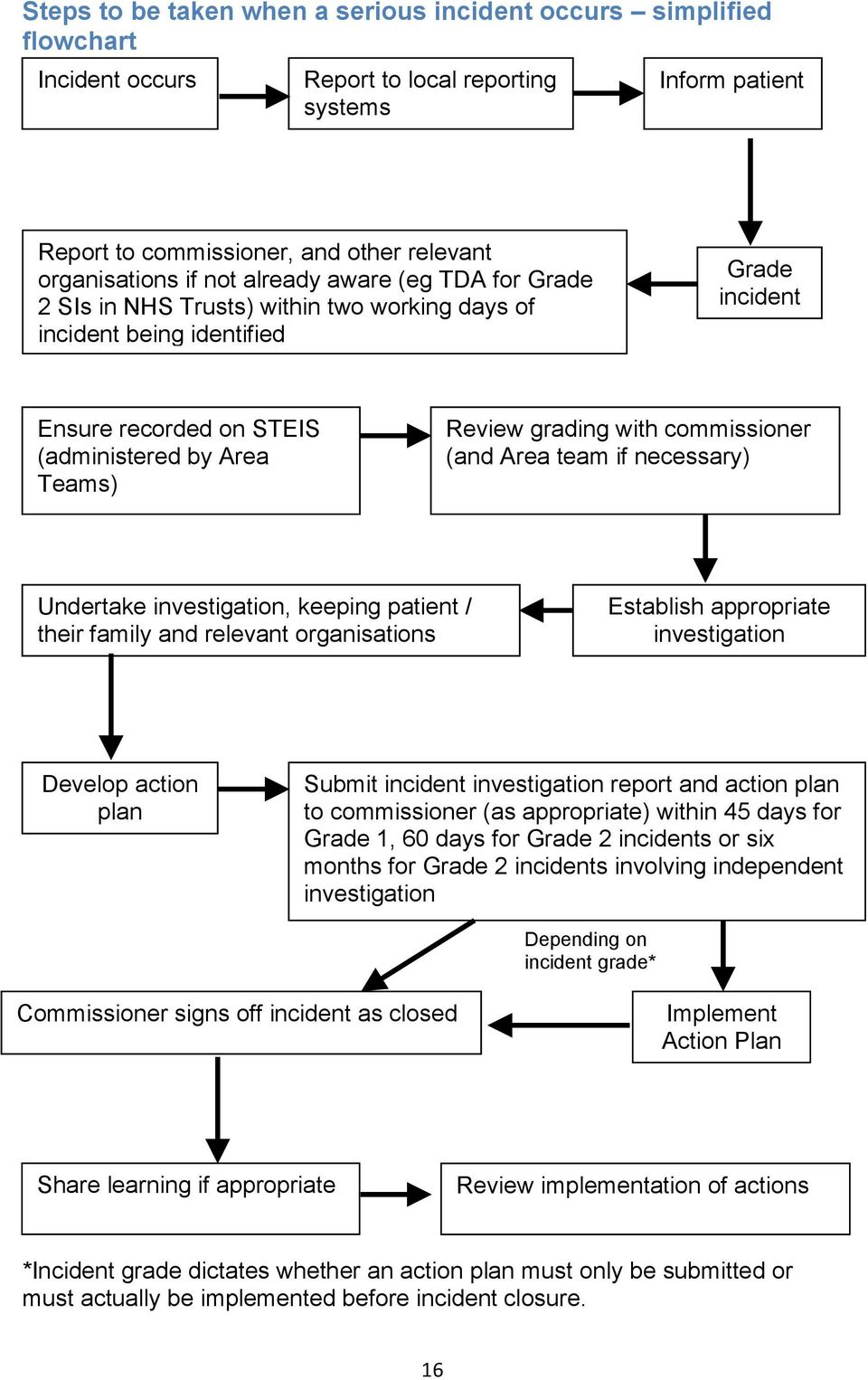
17 The above flowchart is a general process for serious incidents. Specific considerations are required for dealing with adult and children s safeguarding incidents. The local Safeguarding Adults Board (convened by the local authority and on which the NHS is represented) will have a strategic interest in the overall safety of the locality, including safety in the healthcare system. This does not mean that the local authority is responsible for investigating serious incidents in health services. The interface between health and local adult safeguarding procedures should be articulated in the local multi-agency safeguarding protocol and policies. Each provider and commissioner should ensure that they have a lead on safeguarding who can advise staff if they are uncertain whom to involve or which process to follow. That person should liaise regularly with the local authority safeguarding lead to ensure that there is a coherent multi-agency approach to safeguarding across the health and care system. 17
18 Steps to be taken when a serious incident occurs Immediate action for providers A safe environment should be re-established as soon as possible. Any urgent clinical care that may reduce the harmful impact of the incident must be given immediately. The needs of patients and their family/ carers are made the first priority. All relevant equipment or medication should be quarantined, labelled and isolated as appropriate. To maintain product liability, no piece of equipment should be returned to the manufacture for repair /examination until the provider has carried out all necessary tests on the equipment as suggested by the MHRA. A contemporaneous and objective entry should be made in the patient s clinical records and, where necessary, statements taken using a supportive statement taking process. The risk of recurrence should be considered immediately and actions taken to mitigate in advance of the investigation. The incident should be reported on the Strategic Executive Information System (STEIS) within two working days for an initial report and reported to the NRLS or regulator as appropriate (Appendix B). The need for reporting to the local Safeguarding Board should also be considered at this point. The designated director, as defined by local policy, plus other relevant members of the senior management team, should be advised as soon as a serious incident has occurred or is discovered. In line with the principles set out in Being Open, the patient and their family or carers must be informed that a serious incident has occurred and appraised of any actions being taken to address the situation. This should include details of the process being undertaken to investigate the incident and ensure learning is captured to prevent recurrence. A named contact from the provider should be identified and details provided to the family. Where a serious incident raises concerns in relation to individual staff culpability or competence, the staff member must be treated with care and consideration and supported within the principles of a just culture. Staff involved or affected by the incident should be supported in line with the provider s policy on supporting staff involved in incidents. Measurement, drawings or photographs of the locus of the incident should be taken if necessary, appropriate and practical to do so. 18

19 Relevant documentation should be copied and secured to preserve evidence and facilitate investigation and learning. The organisation s communications team should be notified of the incident and a relevant communications policy for dealing with serious incidents triggered where appropriate. If more than one organisation is involved in a serious incident, the relevant commissioner should take a decision on who will act as the lead organisation for the purposes of investigation and incident management, and be responsible for reporting the incident. Such reporting should adhere to national time frames as set out in Appendix B. Where there is more than one commissioner for the various provider organisations involved, the commissioners should make a decision on who is the relevant coordinating commissioner for serious incident management purposes. The NHS Commissioning Board Area Team can support this decision-making process. Immediate action for commissioners Relevant internal staff should be notified of any serious incident by the designated officer with responsibility for receipt of serious incident reports from providers and appropriate clinical advice and expertise sought when needed. In the case of a safeguarding incident, the officer should liaise with the commissioner s lead for adult safeguarding or child protection to ensure that local safeguarding procedures are followed. When a serious incident involves two or more commissioners, the commissioners should liaise to ensure that all relevant parties are notified, a coordinating commissioner identified and a timescale agreed. Reporting actions for providers A senior member of staff should be designated as responsible for reporting and follow-up of serious incidents within given timescales. They should also be responsible for ensuring relevant internal staff are informed of the incident. All serious incidents should be recorded on a local risk management system (LRMS) and reported, using jointly agreed procedures and within two working days 4 of the incident being identified as a serious incident, to relevant external bodies including the commissioner. The STEIS record should be updated within three working days if the situation changes significantly after the initial report. 4 Working day: Days that exclude weekends and bank holidays (Run from 23:59 on the day the incident is raised to 23:59 on the day the incident is reported) 19

20 All serious patient safety incidents must be reported to the NRLS (usually via the LRMS) to comply with CQC registration requirements regarding the reporting of incidents leading to severe harm or death and for the purpose of national learning. This should be done without delay. All serious incidents must be reported by the provider to their commissioners. This should be through providers directly using STEIS to facilitate performance monitoring of the incident and its management, trend analysis and shared learning. Where this is problematic for the provider (for example independent sector providers), commissioners can assist (see below). In any cases, telephone contact is also advisable in the event of grade one and two incidents. Where a serious incident occurs in specialised services, it is helpful if this is clearly noted in the STEIS record. Foundation trusts, or those NHS trusts in the advance stage of making an application for foundation trust status, should inform Monitor of any serious incidents. NHS trusts should also directly inform the NTDA of Grade 2 serious incidents (the NDTA will also have access to serious incident reports via STEIS). Depending on the nature, circumstances and outcome of the incident, consideration should be given to other bodies to whom the incident must be reported, for example to professional regulators, the MHRA, the police, the HSE, local Safeguarding Boards and the appropriate regulator (for full list see Appendix B). Providers of primary care services or independent sector healthcare providers should report any serious incident involving a patient receiving NHS-funded care to the relevant commissioning organisation consistent with the terms of the contract ix. The commissioner should set the expectation that each such provider will notify them by telephone within two days of an incident being identified. The NHS CB via its area teams can, if appropriate, provide access to STEIS for non-nhs or primary care providers for reporting purposes as long as those providers are on the NHS N3 network. If for some reason STEIS access cannot be provided, commissioning organisations can report the serious incident on the STEIS system on behalf of that organisation by creating a relevant provider name on the system and monitoring the investigation process in the usual way. Independent sector healthcare providers should report the incident to the NRLS (eg via the e-form of the NRLS). Independent sector healthcare providers, adult social care providers, primary medical services providers, primary dental care providers and independent ambulance service providers are also responsible for reporting incidents directly to the CQC. 20
21 When reporting serious incidents, providers must comply with locally agreed and documented Caldicott data protection and information governance requirements. Never events should be reported in accordance with the Never Events Framework 5. Reporting actions for commissioners Commissioners should ensure that providers: have robust reporting arrangements in place which comply with national guidance; report serious incidents to the commissioners within two working days of the incident being identified by the organisation and recorded on STEIS (for NHS trusts, FTs and others with access); report serious incidents to the NRLS, STEIS and other bodies as appropriate, for example, the CQC, police, HSE or Local Supervising Authority Midwifery Officer; report never events in accordance with the Never Events Framework; and report safeguarding incidents to the relevant local safeguarding board(s). Grading of serious incidents See Appendix C for further detail Actions for providers Initial incident grading should err on the side of caution, categorising and treating an incident as a serious incident if there is any possibility that it is. Providers should not wait for the outcome of full investigations before grading the incident and should seek to assess whether an incident is serious incident, and of what grade, as rapidly as possible. If incidents are re-graded particularly in relation to the level of harm, they should be resubmitted to the NRLS. Further to initial reporting of the incident, providers should ensure that the commissioning organisation receives additional information relating to the incident within three working days. 5 Available at 21
22 Actions for providers and commissioners On the basis of this additional information, providers should have an early discussion with the commissioner about the grading of the incident concerned and what level of investigation is required. If it is agreed that the incident does not fall within the definition of a serious incident, the incident can be removed from STEIS rather than simply closed. This should be done by the NHS CB area team following a request from a relevant organisation and the provision of relevant evidence. If it continues to be considered a patient safety incident despite being downgraded, it should be reported on LRMS and investigated accordingly. A clear audit trail should be kept. Any re-grading of the incident should be carried out by the organisation that created the incident report following discussion with all involved organisations. Actions for commissioners Commissioners should: ensure that this discussion is carried out within three working days; ensure that the provider is clear about the defined timescales for completion of the investigation; confirm the grading as accurate; maintain a clear audit trail of decisions relating to modified grading of incidents. Investigating a serious incident The principles of root cause analysis (RCA) or significant event audit (SEA) and relevant NPSA guidance ( should be applied to all NHS investigations. Actions for providers Local policies should be followed and should reflect the following: All serious incidents should be investigated using best practice methodologies such as RCA. Methodology should be briefly but clearly set out in the investigation report. Staff leading serious incident investigations should have up to date training and be competent in investigative methodology, techniques and analysis, report writing, and including human factors. 22
23 The investigation team should be sufficiently removed from the incident to be able to provide an objective view. The investigation team must have no conflict of interest in the incident, real or perceived, and must be available at short notice. Consider securing external expert contribution, if necessary. The investigation team should include a professional(s) with experience relevant to the incident under investigation, for example a relevant consultant when investigating any serious incident involving an inpatient or recently discharged patient death. Where the investigation involves more than one organisation, a lead organisation should be agreed to coordinate local investigations and amalgamate findings, or to oversee one joint investigation. The scale, scope and timescale of investigation should be appropriate to the grading of the incident (see Appendix C). The NPSA s Being Open Framework 1 principles should be followed. Where a serious incident raises concerns in relation to individual staff culpability or competence, these concerns should be managed in accordance with local HR procedures and referred to professional bodies as appropriate. Investigations should seek to understand what happened, why it happened and recommend what systems or processes should be put in place to prevent future occurrence. Identified improvements should be targeted at the contributory and causal factors using a human factors approach, such as the design of jobs, equipment, environment and procedures as well as competencies, training and non-technical skills. An agreed action plan should set out how each recommendation from the investigation will be monitored, implemented, measured, and shared; it should also make clear who is responsible for taking action together with the timescales for delivery. A review date should be set to establish the efficacy of actions planned/taken and the sustainability of the overall approach. Boards must monitor and review all serious incident investigations and seek assurances about learning and the embedding of action plans. Consider who, outside of the immediate incident, may benefit from the learning arising from the RCA, including nationally, and share the learning accordingly. 23
24 Actions for Commissioners Commissioners should monitor and ensure that: serious incidents are managed and investigated appropriately in a transparent manner. The investigation should be of a good quality underpinned by clear terms of reference. It should also demonstrate the application of robust investigative methodologies with resultant recommendations which link back to the findings; they continue to monitor grade 2 incidents until the provider gives evidence that each action point has been implemented; they close the incident when they are satisfied with the investigation, recommendations and action plans that have been submitted and that local monitoring arrangements are in place and working efficiently for all cases reported on STEIS. The submitted action plan should contain action points to address each root cause and wherever possible address any contributory causes and with a named lead and timescale for implementation; decisions on closure are based on objective and measurable evidence. Where commissioners have concerns about closing an incident because, for example, there is uncertainty about the nature of the root cause of an incident, or similar problems, they may wish to flag the incident as 'Further Action Required' (FAR) in the free text field of the STEIS incident report. This will facilitate the rapid identification of incident reports that suggest there may be issues with an organisation's root cause analysis capabilities or other area for concern. These can then be addressed through contract management routes; the action plans agreed with providers following serious incident investigations have a clear trajectory with named responsible leads. Such action plans should incorporate review dates to measure effectiveness and ensure actions are followed through and that they do not become dormant; learning is embedded and demonstrated through regular thematic reviews; independent investigators are appointed where there is a need or requirement to do so; full co-operation and support is provided to independent investigators including indemnity when required; investigations including internal investigations are quality assured to ensure that they are robust and that they demonstrate the use of recognised principles of investigation such as root cause analysis (RCA) or significant event audit (SEA); independent contractors have access to support in undertaking an investigation; and 24
25 there is effective co-ordination of complex multi-agency RCA investigations. Actions for the NHS Commissioning Board The NHS CB will provide assurance that: each commissioner has appropriate systems and processes in place to ensure sufficient oversight and monitoring of serious incidents, investigation and follow through on action plans; information about serious incidents is included as part of the overall surveillance of quality and, in particular, the analysis of serious incident data is included as part of the overall triangulation of intelligence about provider organisations; and formal arrangements are in place to ensure the appropriate closure of serious incident files. Actions for the NHS Trust Development Authority The NTDA will work with the NHS CB to provide assurance that NHS trusts are co-operating with commissioners in the reporting and subsequent management of serious incidents. The NTDA will specifically: ensure that NHS trusts have appropriate systems and processes in place to respond to serious incidents, undertake credible investigations and follow through on action plans; ensure NHS trusts have formal arrangements in place with commissioners to secure appropriate and timely closure of serious incident files; use information about serious incidents as a component of the overall surveillance of quality, in particular, the analysis of serious incident data to inform the triangulation of intelligence about provider organisations to assure the quality of care and inform the assessment of NHS trust applications for Foundation Trust status; and share information and liaise with the NHS CB, CQC, professional regulators and other stakeholders, especially those associated with quality surveillance groups. Communications Serious incidents can be triggers for media coverage and increased public scrutiny. A well-planned, structured communications plan is vital in managing serious incidents effectively. Providers and commissioners should: 25
26 ensure openness and transparency is the default position while patient confidentiality and data protection considerations must be maintained, any organisation using public money should be open and accountable to the public for its performance; have a clear plan for sharing information about serious incidents with staff and external partner organisations; have a clear ongoing communications and engagement strategy, including clear arrangements for sign-off processes and spokespeople; inform communications leads in other local organisations in a timely and efficient manner (for example local authorities, CCGs, police); ensure staff, public and media are well informed; brief and involve relevant sector or national stakeholders on what is happening; and monitor and track the impact of the communications strategy. In forensic/criminal cases, all communications with the media should be led by the police in partnership with the relevant agencies involved with the incident. Freedom of Information Act 2000 Information relating to serious incidents (including information held on national systems such as STEIS, local databases and internal reports, investigation reports and root cause analysis and other documents), could be subject to a request for disclosure under the Freedom of Information Act. A request for information regarding a serious incident/s should follow Freedom of Information Act policies of the organisation that received the request. Learning All organisations with a responsibility for notifying or receiving details of serious incidents have a responsibility for the dissemination of learning. They should consider disseminating relevant learning where, in their opinion, there are novel or important learning points, or the learning is likely to be of use to other organisations in preventing harm to patients, staff or the public. NHS organisations should be prepared to share root cause analysis (RCA) investigation or serious event audits (SEA) findings with the NRLS and/or NHS CB routinely and via dedicated routes and mechanisms as requested. If appropriate, an investigation executive summary can be published for serious incidents. It should include a précis of the incident and investigation and be fully anonymised to preserve confidentiality of the people involved and 26
27 the ward/team/unit/hospital and provider organisation. This will enable the executive summary to be widely shared. Commissioners are responsible for sharing relevant learning with organisations to whom the learning may be applicable including for example QSGs and the NHS CB, professional regulators, and the providers from which they commission services. Commissioners and providers are best placed to identify relevant learning. The NHS CB will disseminate relevant learning nationwide through professional networks and bodies, via communications with all relevant healthcare sectors and organisations and other stakeholders and through summary reports and seminars. Professional networks and bodies are responsible for disseminating relevant learning to their members and other networks and bodies. 27
28 Appendix A - Checklist for monitoring and closure of serious incidents The relevant commissioner (see Appendix D) leads on the closure of serious incident reports. Grade 1 Local action plan monitoring The relevant commissioner will close the incident when it is satisfied with the investigation, recommendations and action plan that have been submitted, and local (provider) monitoring arrangements are in place and working efficiently. The submitted action plan should contain action points to address each root cause and with a named lead and timescale for implementation. Publish incident information within Annual Reports. Grade 2 Commissioner action plan monitoring Grade 2 incidents, whether involving level 2 or level 3 investigations (see Appendix C) will continue to be monitored by the relevant commissioner until evidence is provided demonstrating that each action point has been implemented. Incidents involving adult or child abuse are referred to local safeguarding arrangements. All actions must be consistent with the local multi-agency safeguarding protocol and policies. Publish quarterly reports summarising action plan implementation activity. Action plan monitoring may be assured, for example, through routine quality monitoring processes and by having clear measurable outcomes included in the action plan. Incidents involving external agencies Where external investigations conducted by external agencies are ongoing, for example by safeguarding boards, police, HSE, coroners etc. serious incident cases can remain open for very significant periods of time beyond the relevant deadline. If appropriate, commissioners should close serious incident cases on STEIS where all immediate actions for the health care services derived from internally conducted or commissioned investigations are satisfactorily in hand and where organisations are assured that there are external process for ensuring any outcomes from external investigation will be communicated and acted upon. This is to avoid unnecessary and potentially confusing duplication of activity and having cases open indefinitely. Where there is any doubt about the 28
29 incident being appropriately coordinated, managed and responded to by the external processes, the incident should remain open. If necessary, cases can be re-opened upon receipt of new information derived from the activities of external agencies. Closure checklist Prior to considering an incident closed, commissioners should ensure the following have been submitted: an appropriate investigation that identifies findings, based on root causes and recommendations; a satisfactory action plan with action points to address each root cause recommendation(s) and with a named lead and timescale for implementation for Grade 1 incidents, evidence demonstrating that local monitoring arrangements are in place to ensure action points are going to be implemented is sufficient; for Grade 2 incidents, evidence demonstrating that each action point has been implemented is required; lessons learned, including partners or stakeholders with whom the learning has been shared; full completion of the STEIS record covering the above points eg date investigation completed, population of RCA/Lessons learned field; and a summary of each never event for inclusion in the commissioner s annual reporting arrangements. Note: Where necessary, for example, where actions are essentially continuous or long-term, an action plan can be considered to be implemented and grade 2 incidents can be closed when the relevant actions to address these long-term issues have been initiated. This must be subject to monitoring by each organisation s lines of accountability. 29
30 Appendix B - Full reporting requirements for provider organisations Reporting to the regulator (CQC, Monitor) Healthcare provider organisations are required to notify the appropriate regulator about incidents that indicate, or may indicate, risks to ongoing compliance with the registration requirements, or that lead, or may lead, to changes in the details about the organisation in the regulator s register. Most of the requirements for the CQC, as defined in current regulations x guidance xi, are met by providing incident reports to the NRLS. The NRLS will forward relevant information to the CQC. This exception does not apply to independent sector providers or primary care providers registered with CQC. They must report incidents directly to CQC. For more information on requirements for reporting to the CQC, see NHS Foundation Trusts are also required to report relevant serious incidents requiring investigation to Monitor. Incidents must be reported without delay as defined in legislation. Reporting a serious incident occurring in independent sector healthcare or other provider outside the NHS. Independent sector healthcare providers must report any serious incident involving a patient receiving NHS funded care to the commissioning organisation with responsibility for the contract. Independent sector healthcare providers should report to the NRLS via the eform of the NRLS although this is voluntary; CQC must be notified directly of abuse, serious injury and all deaths. Independent sector healthcare providers are also responsible for reporting the incident directly to their appropriate regulator. NHS CB area teams can, if appropriate, provide access to STEIS for non- NHS providers for reporting purposes as long as those providers are on the NHS N3 network. 30
31 Reporting to the police The police are likely to investigate incidents where there is evidence, or suspicion of, a criminal offence having been committed, for example if an incident has arisen from or involves criminal intent, or gross negligence In the first instance the incident should be reported within the organisation in the normal way and to the commissioning body. Referral to the police should be undertaken by a senior member of staff in the reporting organisation. In circumstances of unexpected death or serious harm requiring investigation by the police, the incident should be managed in accordance with the Memorandum of Understanding (currently under review). This protocol should be activated when an incident requires investigation by the police and the Health and Safety Executive (HSE) jointly. Reporting to the Health and Safety Executive (HSE) The HSE is responsible for the enforcement of the Health and Safety at Work Act 1974 (HSWA) xii and ensuring that risks to people s health and safety from work activities are properly controlled. Serious incidents may need to be reported under the Reporting of Injuries, Diseases and Dangerous Occurrences Regulations 1995 (RIDDOR). The trigger point for RIDDOR reporting is over seven days incapacitation (not counting the day on which the accident happened). Further information on reporting is available at If the serious incident requires joint investigation by the organisation and the HSE and the police, the Memorandum of Understanding should be activated. Work-related deaths Incidents involving work-related deaths (or cases where the victim suffers injuries in such an incident that are so serious that there is a clear indication, according to medical opinion, of a strong likelihood of death) should be managed in accordance with the Protocol on Work Related Deaths. xiii In the first instance the incident should be reported within the organisation in the normal way and to the commissioning organisation. 31
32 Reporting to the coroner An unexpected death (where natural causes are not suspected) and all deaths of detained patients must reported to the coroner by the treating clinician. This should be done immediately, but recognising that, following an unexpected death, a serious incident may not be identified until the issuing of the coroner s report. Reporting to Public Health England PHE Centres: Where incidents have the potential to affect population health, the provider should seek advice from the local PHE Centre. Depending on the nature of the incident, other public health organisations such as local authorities, may need to be involved. Such incidents will include those with a health protection component, such as failures in decontamination. The PHECs health protection staff will provide a risk assessment and advise on appropriate action National screening programmes In the case of a serious incident in a screening programme, the NHS Commissioning Board Area Team Screening and Immunisation Lead is responsible for ensuring that the provider(s) respond to a serious incident in an appropriate and timely manner and take all necessary steps to mitigate any on-going risks. The Regional Quality Assurance Director (for NHS Cancer Screening Programmes) or the Regional Quality Assurance Lead ( for NHS Screening Programmes) must be fully involved in the incident management process. The provider organisation must report all potential incidents and serious incidents to the Regional QA Director or Regional QA Lead. The Quality Assurance team will undertake initial fact finding with the screening provider and advise on next steps Further guidance on handling serious incidents in screening programmes is to be published shortly. Reporting to NHS Protect Where a serious incident occurs to a member of staff resulting from a physical or non-physical assault, there is a requirement to report this to NHS Protect via the Security Incident Reporting System. 32
33 The same reporting requirement relates to incidents involving loss or damage to property and assets of NHS organisations, staff and patients. Reporting to the Medicines and Healthcare products Regulatory Agency (MHRA) Any serious incident involving medication or medical devices should be reported to the MHRA. Details on how to do this are at: htm Reporting Health Care Associated Infection (HCAI) serious incidents The Health Protection Agency's guidance on Health Care Associated Infection Operational Guidance and Standards for Health Protection Units provides information on the steps that should be followed by providers in escalating concerns about the management of a HCAI situation, incident or outbreak and steps for informing commissioners and regulators about concerns. While this will need to be updated to reflect new responsibilities, the principles around recognising incidents, undertaking risk assessments and when to escalate serious HCAI situations / incidents and outbreaks remain valid. The guidance can be found at 07hcaiopguidancestdsforHPUs/ Reporting Serious Adverse Blood Reactions and Incidents (SABRE) The UK Blood Safety and Quality Regulations 2005 and the EU Blood Safety Directive require that serious adverse incidents and serious adverse reactions related to blood and blood components are reported to the MHRA, the UK Competent Authority for blood safety. This information is vital to the work that the Serious Hazards of Transfusion (SHOT) uses to compile its reports. Further details on reporting can be found at: index.htm Caldicott, data protection and information governance When reporting serious incidents, providers must comply with Caldicott, data protection and information governance requirements. They should not refer to individuals by name or give other identifiable information, and should restrict access to patient information within each organisation by enforcing strict need to know principles. 33
34 In any circumstance where it may be necessary to identify an individual, the serious incident lead in the provider organisation must contact the senior member of the commissioner or local authority to discuss the incident and provide more detailed information. 34
35 Appendix C A guide to serious incident grading for investigation purposes This table provides a guide to the grading of serious incidents for investigation purposes. Incident Grade Example Incidents (these are suggestions, not definitive) Investigation Grade and action Timeframe Commissioner responsibility 1 Grade 1 incident examples: Apparent suicide of people currently under the care of community mental health services. Mental health inpatient attempted suicides. Avoidable or unexplained death. Failure to meet standards for ambulance service response times, resulting in patient death/severe harm HCAI outbreaks. Grade 3 and 4 pressure ulcers. Data loss & information security (DH Criteria level 2) xiv. Adult safeguarding incident. Investigation Level 1 Concise root cause analysis (RCA) for incidents involving No Harm and Low Harm and/or where the circumstances are very similar to other previous incidents. In these cases it is more proportionate to use a concise RCA to ensure there are no unique factors and then focus resources on implementing improvement than conducting comprehensive investigations that will not produce new learning. These will be a small minority of cases. Investigation Level 2 Comprehensive RCA for incidents involving moderate and severe harm or death. This should be the default level for most incidents Following initial reporting within 2 working days, the provider organisation must submit a completed investigation within 45 working days Seek assurance and evidence from the provider that relevant policies and procedures are in place and implemented, for example by reviewing a sample of incident investigations and action plans as well as monitoring serious incident data trends. Close incidents after receipt of evidence demonstrating that local monitoring arrangements are in place to ensure action points are going to be implemented. 2 Grade 2 incident examples: Inpatient suicides (including following absconsion) Maternal deaths Child protection incidents Never events Accusation of physical misconduct or harm Data loss and information security (DH Criteria level 3-5) xv Investigation Level 2 Comprehensive RCA (note NHS trusts should directly notify the NTDA of Grade 2 serious indcidents) Following initial reporting within 2 working days, the provider organisation must submit a completed investigation within 60 working days Likely to involve specific assistance with and contribution to the incident response and investigation. Close incident after receipt of evidence demonstrating that each action point has been implemented is required 35
36 Selected Grade 2 incidents: The need for independent investigations is identified and arranged by the commissioner or NHS CB, for example a major system failure with multiple stakeholders Homicides following recent contact with mental health services require an independent investigation xvi. These will be commissioned by the relevant NHS CB area team. Investigation Level 3 Independent RCA (note NHS trusts should directly notify the NTDA of Grade 2 serious incidents) Following initial reporting within 2 working days independent investigators should be commissione d to complete an investigation within 6 months As for Grade 2 above but in addition, commissioning the independent investigation. 36
37 Appendix D Agreeing the appropriate commissioner for serious incident management purposes. There will often be circumstances where one provider has multiple commissioners. In these circumstances, principles for identifying who will do what for the purposes of serious incident management are key. There is no one-size-fits-all approach as circumstances will vary from place to place, as will the involvement of other organisations such as commissioning support units (CSUs). However the following principles should be used to ensure that every commissioner fulfils its statutory obligations and that there is a coordinated approach to serious incident management within a single provider. Where a number of commissioners collaborate within a single contract with a provider, the collaborative agreement should set out the respective roles of each commissioner in managing serious incidents, including responsibility for closing incidents. Where there is a coordinating commissioner, the agreement should set out the coordinating commissioner s responsibilities. Commissioners may wish to refer to the Board s framework for collaborative commissioning, model agreement and FAQs. ( Where a commissioner holds a bilateral contract with a provider, the commissioner will be responsible for oversight of all serious incidents that occur in relation to services provided under that contract. Where a patient is treated without contractual arrangements (such as noncontract activity), the commissioner will be responsible for oversight of all serious incidents pertaining to residents within its geographical area. The arrangements for managing serious incidents should be set out clearly in the relevant contract. Regardless of the specific arrangements for serious incident management, all serious incident reports and incident management information must be available to all the commissioners of a particular provider. The provider must ensure that all their commissioners are aware that a serious incident has occurred and that, even where not directly responsible for provider oversight, all serious incident reports, including trend and theme analysis, should similarly be made available to each commissioner. Irrespective of what arrangements are put in place, each commissioner retains responsibility and liability for the exercise of its statutory functions. They can, of course, make arrangements for others to carry out activities on their behalf, but this does not lessen their liability 37
38 Available resources The resources below are all available to provide support in the reporting and learning from serious incidents National Patient Safety Agency. Seven Steps to Patient Safety Available at: +steps+to+patient+safety%c2%ac Department of Health. The never events policy framework. October 2012 Available at: National Patient Safety Agency. Being open: communicating patient safety incidents with patients, their families and carers. NPSA Available at: National Patient Safety Agency. National Framework for Reporting and Learning from SIRIs Available at National Patient Safety Agency. Three Levels of RCA Investigation - Guidance Available at: Department of Health. Independent investigation of adverse events in mental health services.. Department of Health Available at: licyandguidance/dh_ National Patient Safety Agency. Good practice guidance Independent investigation of serious patient safety incidents in mental health services Available at NHS Comms Link. Available at: Care Quality Commission. Essential standards of quality and safety. CQC Availalbe at: NHS Connecting for Health. Checklist for Reporting, Managing and Investigating Information Governance Serious Untoward Incidents Available at ecklist.pdf The NHS Commissioning Board s framework for collaborative commissioning, model agreement and FAQs. Available at 38
39 Glossary Abuse A violation of an individual s human and civil rights by any other person or persons. Abuse may consist of single or repeated acts. It may be physical, verbal or psychological, it may be an act of neglect or an omission to act, or it may occur when a vulnerable person is persuaded to enter into a financial or sexual transaction to which he or she has not consented, or cannot consent. Abuse can occur in any relationship and may result in significant harm, or exploitation, of the person subjected to it (as defined by No Secrets, available at e/dh_ In Working together to safeguard children (2010) abuse is defined as follows: abuse and neglect are forms of maltreatment of a child. Somebody may abuse or neglect a child by inflicting harm or by failing to act to prevent harm. Adverse Event/Incident See Patient Safety Incident. Being Open Open communication of patient safety incidents that result in harm or the death of a patient while receiving healthcare. Carers Family, friends or those who care for the patient. The patient has consented to their being informed of their confidential information and to their involvement in any decisions about their care. Child The Children Act 1989 and the Children Act 2004 define a child as being a person up to the age of 18 years. The Children Act 2004 states that safeguarding, protection and cooperation between services may, in certain circumstances, be continued through to a young person s 19th birthday or beyond. Clinical Governance A framework through which NHS organisations are accountable for continuously improving the quality of their services and safeguarding high standards of care by creating an environment in which excellence in clinical care will flourish. Commissioner An organisation with responsibility for assessing the needs of service users, arranging or buying services to meet those needs from service providers in either the public, private or voluntary sectors, and assuring itself as to the quality of those services. Clinical commissioning group Clinically-led organisation that commissions most NHSfunded healthcare on behalf of its relevant population. CCGs are not responsible for commissioning primary care, specialised services, prison healthcare, or public health services. Culture Learned attitudes, beliefs and values that define a group or groups of people. Data Loss There is no simple definition of a serious incident. What may at first appear to be of minor importance may, on further investigation, be found to be serious and vice versa. Any incident involving the actual or potential loss of personal information that could lead to identity fraud or have other significant impact on individuals should be considered as serious. Equipment Machines and medical devices used to help, prevent, treat or monitor a person s condition or illness. The term may also be used to refer to aids that may support a person s care, treatment, support, mobility or independence, for example, a walking frame, hoist, or furniture and fittings. It excludes machinery or engineering systems that are physically affixed and integrated into the premises. General Practitioner A medical practitioner who provides primary care to meet the general health needs of a registered population. General practitioners treat acute and chronic illnesses and provide preventative care and health education for all ages. Healthcare The preservation of mental and physical health by preventing or treating illness through services offered by the health professions, including those working in social care settings. 39
40 Healthcare Professional Doctor, dentist, nurse, pharmacist, optometrist, allied healthcare professional or registered alternative healthcare practitioner. Incident An event or circumstance that could have resulted, or did result, in unnecessary damage, loss or harm such as physical or mental injury to a patient, staff, visitors or members of the public. Independent Healthcare Private, voluntary and not-for-profit healthcare organisations that are not part of the NHS. Investigation The act or process of investigating a detailed enquiry or systematic examination. Major surgery a surgical operation within or upon the contents of the abdominal or pelvic, cranial or thoracic cavities or a procedure which, given the locality, condition of patient, level of difficulty, or length of time to perform, constitutes a hazard to life or function of an organ, or tissue (if an extensive orthopaedic procedure is involved, the surgery is considered major ). Medical Device - Any instrument, apparatus, appliance, software, material or other article (whether used alone or in combination) (including software intended by its manufacturer to be used for diagnostic and/or therapeutic purposes and necessary for its proper application), intended by the manufacturer to be used for the purpose of: diagnosis, prevention, monitoring, treatment or alleviation of disease; diagnosis, monitoring, alleviation of or compensation for an injury or disability; investigation, replacement or modification of the anatomy of a physiological process; control of conception and which does not achieve its physical intended action on the human body by pharmacological, immunological or metabolic means, but may be assisted in its function by such means. Never Events Serious, largely preventable patient safety incidents that should not occur if the available preventative measures have been implemented by healthcare provider. NHS-Funded Healthcare Healthcare that is partially or fully funded by the NHS, regardless of the provider or location. Notification The act of notifying to one or more organisations/bodies. Patient Safety The process by which an organisation makes patient care safer. This should involve risk assessment, the identification and management of patient-related risks, the reporting and analysis of incidents, and the capacity to learn from and follow-up on incidents and implement solutions to minimise the risk of them recurring. The term patient safety is replacing clinical risk, non-clinical risk and the health and safety of patients. Patient Safety Incident Any unintended or unexpected incident that could have led or did lead to harm for one or more patients receiving NHS-funded healthcare. Permanent Harm Permanent lessening of bodily functions, including sensory, motor, physiological or intellectual. Primary Care refers to services provided by GP practices, dental practices, community pharmacies and high street optometrists and commissioned by the NHS Commissioning Board from April 2013 Prolonged pain and/or prolonged psychological harm pain or harm that a service user has experienced, or is likely to experience, for a continuous period of 28 days. Professional Body An organisation that exists to further a profession and to protect both the public interest, by maintaining and enforcing standards of training and ethics in their profession, and the interest of its professional members. 40
41 Provider (or Healthcare provider) Organisation that provides healthcare including NHS trusts, NHS Foundation Trusts, general medical practices, community pharmacies, optometrists, general dental practices and non-nhs providers. Quality Surveillance Groups Virtual teams established across a health economy either at the level of the relevant NHS CB area team or regional team, bringing together organisations and their respective information and intelligence gathered through performance monitoring, commissioning, and regulatory activities. By collectively considering and triangulating information and intelligence, QSGs will work to safeguard the quality of care that people receive. Risk The chance of something happening that will have an impact on individuals and/or organisations. It is measured in terms of likelihood and consequences. Risk Management Identifying, assessing, analysing, understanding and acting on risk issues in order to reach an optimal balance of risk, benefit and cost. Risk Summit A meeting of high-level leaders called to shape a programme of action, which is focused on sharing information willingly to help achieve a consensus about the situation under scrutiny and the actions required to mitigate the identified risks Root Cause Analysis (RCA) A systematic process whereby the factors that contributed to an incident are identified. As an investigation technique for patient safety incidents, it looks beyond the individuals concerned and seeks to understand the underlying causes and environmental context in which an incident happened. Safety A state in which risk has been reduced to an acceptable level. Safeguarding Ensuring that people live free from harm, abuse and neglect and, in doing so, protecting their health, wellbeing and human rights. Children, and adults in vulnerable situations, need to be safeguarded. For children, safeguarding work focuses more on care and development; for adults, on empowerment, independence and choice. Secondary care Defined as a service provided by specialists who generally do not have first contact with patients. Secondary care is usually delivered in hospitals or clinics and patients have usually been referred to secondary care by their primary care provider (usually their GP). Most secondary care services are commissioned by CCGs. Serious Incident A serious incident requiring investigation is defined as an incident that occurred in relation to NHS-funded services and care resulting in one of the following: unexpected or avoidable death of one or more patients, staff, visitors or members of the public; serious harm to one or more patients, staff, visitors or members of the public or where the outcome requires life-saving intervention, major surgical/medical intervention, permanent harm or will shorten life expectancy or result in prolonged pain or psychological harm (this includes incidents graded under the NPSA definition of severe harm); a scenario that prevents or threatens to prevent a provider organisation s ability to continue to deliver healthcare services, for example, actual or potential loss of personal/organisational information, damage to property, reputation or the environment, IT failure or incidents in population programmes like screening and immunisation where harm potentially may extend to a large population; allegations of abuse; adverse media coverage or public concern about the organisation or the wider NHS; one of the core set of never events. Severe Harm A patient safety incident that appears to have resulted in permanent harm to one or more persons receiving NHS-funded care. Significant Event Audit An audit process where data is collected on specific types of incidents that are considered important to learn about how to improve patient safety. 41
42 Specialised services Specialised services are commissioned by the NHS Commissioning Board and are services provided in relatively few hospitals, to catchment populations of more than one million people. The number of patients accessing these services is small, and a critical mass of patients is needed in each treatment centre in order to achieve the best outcomes and maintain the clinical competence of NHS staff. These services tend to be located in specialist hospital trusts in major towns and cities. More information on specialised services is available at Tertiary Care Specialised consultative health care, usually for inpatients and on referral from a primary or secondary health professional, in a facility that has personnel and facilities for advanced medical investigation and treatment, such as a tertiary referral hospital. Treatment Broadly, the management and care of a patient to prevent or cure disease or reduce suffering and disability. Unexpected Death Where natural causes are not suspected. Local organisations should investigate these to determine if the incident contributed to the unexpected death. Working Day Days that exclude weekends and bank holidays 42
43 References ii. National Patient Safety Agency (2010). National Framework for Reporting and Learning from Serious Incidents Requiring Investigation. Available at ii. Care Quality Commission (March 2010). Essential Standards on Quality and Safety. Available at iii. Department of Health (October 2012). Never events policy framework. Available at iv. National Quality Board (January 2013). How to establish a Quality Surveillance Group. Available at v. National Patient Safety Agency (NPSA 2009). Being open: communicating patient safety incidents with patients, their families and care. Available at: vi. National Patient Safety Agency (2004). Seven Steps to Patient Safety.. Available at: nt+safety%c2%ac vii. Department of Health Human Factors Group Interim Report (March 2012). Available at: viii. Clinical Human Factors Group. (February 2012) Never? Available at: ix. NHS Commissioning Board NHS Standard Contract 2013/14, available at and for example Standard General Medical Services Contract 2012 available at licyandguidance/dh_ x. The Health and Social Care Act 2008 (Registration of Regulated Activities) Regulations 2010, available at xi. Care Quality Commission (March 2010). Essential Standards on Quality and Safety. Available at xii. Health and Safety at Work etc. Act (1974). Available at: xiii. Work related deaths: A protocol for liaison (England and Wales). Available at: xiv NHS Connecting for Health. Checklist for Reporting, Managing and Investigating Information Governance Serious Untoward Incidents Available at 43
44 xv NHS Connecting for Health. Checklist for Reporting, Managing and Investigating Information Governance Serious Untoward Incidents Available at xvi. Department of Health (2005). Independent investigation of adverse events in mental health services. Available at cuments/digitalasset/dh_ pdf Crown copyright 2013 First published 2010 Published to Serious Incident Framework, in electronic format only. 44
POLICY & PROCEDURE FOR THE MANAGEMENT OF SERIOUS INCIDENTS
 POLICY & PROCEDURE FOR THE MANAGEMENT OF SERIOUS INCIDENTS APPROVED BY: South Gloucestershire Clinical Commissioning Group Quality and Governance Committee DATE August 2015 Date of Issue: August 2015 Version
Process for reporting and learning from serious incidents requiring investigation
 Process for reporting and learning from serious incidents requiring investigation Date: 9 March 2012 NHS South of England Process for reporting and learning from serious incidents requiring investigation
HOW TO; Report a Serious Incident Requiring Investigation (SIRI) or a Significant Event (SEA) to the Surrey and Sussex Area Team
 HOW TO; Report a Serious Incident Requiring Investigation (SIRI) or a Significant Event (SEA) to the Surrey and Sussex Area Team Quality & Safety Team, Nursing Directorate. HOW TO. Report a serious incident
Serious Incident Management CCG Policy Reference: SIM 001
 Serious Incident Management CCG Policy Reference: SIM 001 This policy replaces or supersedes Policy Ref: THIS POLICY WILL BE APPROVED BY THE POLICY REVIEW GROUP OF THE CLINICAL COMMISSIONING GROUP (CCG)
Serious Incident Framework 2015/16- frequently asked questions
 Serious Incident Framework 2015/16- frequently asked questions NHS England INFORMATION READER BOX Directorate Medical Commissioning Operations Patients and Information Nursing Trans. & Corp. Ops. Commissioning
Incident reporting procedure
 Incident reporting procedure Number: THCCGCG0045 Version: V0d1 Executive Summary All incidents must be reported. This should be done as soon as practicable after the incident has been identified to ensure
Incident reporting policy National Chlamydia Screening Programme
 Incident reporting policy National Chlamydia Screening Programme Date of publication: November 2014 Date for review: November 2016 About Public Health England Public Health England exists to protect and
NATIONAL FRAMEWORK FOR REPORTING AND LEARNING FROM SERIOUS INCIDENTS REQUIRING INVESTIGATION
 NATIONAL FRAMEWORK FOR REPORTING AND LEARNING FROM SERIOUS INCIDENTS REQUIRING INVESTIGATION FOR CONSULTATION DOCUMENT OVERVIEW Title National Framework for Reporting & Learning from Serious Incidents
Serious Incident Framework. Supporting learning to prevent recurrence
 Serious Incident Framework Supporting learning to prevent recurrence NHS England INFORMATION READER BOX Directorate Medical Commissioning Operations Patients and Information Nursing Trans. & Corp. Ops.
NHS Newcastle Gateshead Clinical Commissioning Group. Information Governance Strategy 2015/16
 NHS Newcastle Gateshead Clinical Commissioning Group Information Governance Strategy 2015/16 Document Status Equality Impact Assessment Document Ratified/Approved By Approved No impact NHS Quality, Safety
Nursing Agencies. Minimum Standards
 Nursing Agencies Minimum Standards 1 Contents Page Introduction 3 Values underpinning the standards 6 SECTION 1 - MINIMUM STANDARDS Management of the nursing agency 1. Management and control of operations
Clinical Governance and Workforce Committee Summary Report
 Committee: Trust Board Meeting Date: 25 June 2015 This paper is for: Assurance and Information Title: Clinical Governance and Workforce Committee Summary Report Purpose: The purpose of this report is to
Type of change. V02 Review Feb 13. V02.1 Update Jun 14 Section 6 NPSAS Alerts
 Document Title Reference Number Lead Officer Author(s) (name and designation) Ratified By Central Alerting System (CAS) Policy NTW(O)17 Medical Director Tony Gray Head of Safety and Patient Experience
Policies, Procedures, Guidelines and Protocols
 Policies, Procedures, Guidelines and Protocols Document Details Title Complaints and Compliments Policy Trust Ref No 1353-29025 Local Ref (optional) N/A Main points the document This policy and procedure
Trust Board 8 May 2014
 Trust Board 8 May 2014 Title of the Paper: Quarter 4 (1 st January 2014 31 st March 2014) CLIPS Report Agenda item: 205/17 Author: Jackie Ardley, Interim Chief Nurse Trust Objective: 1) Achieving continuous
NHS England Complaints Policy
 NHS England Complaints Policy 1 2 NHS England Complaints Policy NHS England Policy and Corporate Procedures Version number: 1.1 First published: September 2014 Prepared by: Kerry Thompson, Senior Customer
NHS Hartlepool and Stockton-on-Tees Clinical Commissioning Group. Information Governance Strategy 2015/16
 NHS Hartlepool and Stockton-on-Tees Clinical Commissioning Group Information Governance Strategy 2015/16 Document Status Equality Impact Assessment Final No impact Document Ratified/Approved By Hartlepool
Contents. Section/Paragraph Description Page Number
 - NON CLINICAL NON CLINICAL NON CLINICAL NON CLINICAL NON CLINICAL NON CLINICAL NON CLINICAL NON CLINICA CLINICAL NON CLINICAL - CLINICAL CLINICAL Complaints Policy Incorporating Compliments, Comments,
Complaints Policy. Complaints Policy. Page 1
 Complaints Policy Page 1 Complaints Policy Policy ref no: CCG 006/14 Author (inc job Kat Tucker Complaints & FOI Manager title) Date Approved 25 November 2014 Approved by CCG Governing Body Date of next
Incident Management Policy and Guidance
 This document is uncontrolled once printed. Please check on the intranet for the most up to date version. Incident Management Policy and Guidance Includes Serious Incident Management Our Mission is to
Informatics: The future. An organisational summary
 Informatics: The future An organisational summary DH INFORMATION READER BOX Policy HR/Workforce Management Planning/Performance Clinical Document Purpose Commissioner Development Provider Development Improvement
Information Governance Strategy
 Information Governance Strategy To whom this document applies: All Trust staff, including agency and contractors Procedural Documents Approval Committee Issue Date: January 2010 Version 1 Document reference:
Statement on CQC s roles and responsibilities for safeguarding children and adults
 Statement on CQC s roles and responsibilities for safeguarding children and adults June 2015 Contents Introduction... 3 What is our vision for safeguarding?... 3 What is our role in safeguarding?... 4
Review of compliance. Redcar and Cleveland PCT Redcar Primary Care Hospital. North East. Region: West Dyke Road Redcar TS10 4NW.
 Review of compliance Redcar and Cleveland PCT Redcar Primary Care Hospital Region: Location address: Type of service: Regulated activities provided: Type of review: Date of site visit (where applicable):
Policy Document Control Page
 Policy Document Control Page Title Title: Information Governance Policy Version: 5 Reference Number: CO44 Keywords: Information Governance Supersedes Supersedes: Version 4 Description of Amendment(s):
Risk Management Strategy
 Risk Management Strategy A Summary for Patients & Visitors This leaflet has been designed to provide information on the Trust s Risk Management Strategy and how we involve patients and the public in reducing
Risk Management Strategy
 Risk Management Strategy Version: 8 Approved by: Quality and Governance Committee Date approved: 31 July 2014 Ratified by: Trust Board of Directors Date ratified: Name of originator/author: Head of Patient
Information Governance Strategy
 Information Governance Strategy Document Status Draft Version: V2.1 DOCUMENT CHANGE HISTORY Initiated by Date Author Information Governance Requirements September 2007 Information Governance Group Version
RISK MANAGEMENT STRATEGY 2014-17
 RISK MANAGEMENT STRATEGY 2014-17 DOCUMENT NO: Lead author/initiator(s): Contact email address: Developed by: Approved by: DN128 Head of Quality Performance [email protected] Quality Performance Team
Information Governance Policy
 Information Governance Policy Version: 4 Bodies consulted: Caldicott Guardian, IM&T Directors Approved by: MT Date Approved: 27/10/2015 Lead Manager: Governance Manager Responsible Director: SIRO Date
A Review of the NHSLA Incident Reporting and Management and Learning from Experience Standards. Assessment Outcomes. April 2003 - March 2004
 A Review of the NHSLA Incident Reporting and Management and Learning from Experience Standards Assessment Outcomes April 2003 - March 2004 September 2004 1 Background The NHS Litigation Authority (NHSLA)
How to make your Quality Surveillance Group effective. National Quality Board, 2 nd Edition, March 2014
 How to make your Quality Surveillance Group effective National Quality Board, 2 nd Edition, March 2014 CONTENTS 1. Introduction and purpose... 3 2. What is a Quality Surveillance Group?... 5 3. Scope of
Information Governance Policy
 Information Governance Policy Reference: Information Governance Policy Date Approved: April 2013 Approving Body: Board of Trustees Implementation Date: April 2013 Version: 6 Supersedes: 5 Stakeholder groups
Information Governance Policy
 Information Governance Policy Policy Summary This policy outlines the organisation s approach to the management of Information Governance and information handling. It explains the accountability and reporting
Domiciliary Care Agencies. Minimum Standards
 Domiciliary Care Agencies Minimum Standards Updated August 2011 CONTENTS Page Introduction 3 Values underpinning the standards 6 SECTION 1 - MINIMUM STANDARDS Quality Care 1. Service users involvement
SOMERSET PARTNERSHIP NHS FOUNDATION TRUST RECORDS MANAGEMENT STRATEGY. Report to the Trust Board 22 September 2015. Information Governance Manager
 SOMERSET PARTNERSHIP NHS FOUNDATION TRUST RECORDS MANAGEMENT STRATEGY Report to the Trust Board 22 September 2015 Sponsoring Director: Author: Purpose of the report: Key Issues and Recommendations: Director
Policy and Procedure for Claims Management
 Policy and Procedure for Claims Management RESPONSIBLE DIRECTOR: COMMUNICATIONS, PUBLIC ENGAGEMENT AND HUMAN RESOURCES EFFECTIVE FROM: 08/07/10 REVIEW DATE: 01/04/11 To be read in conjunction with: Complaints
Policy for the Reporting and Management of Incidents and Near Misses
 IMPORTANT NOTE: This policy is under review. It will be incorporated into a single Incident Management Policy - CORP/RISK 13 v.3 which will also reflect NHS England s Serious Incident Framework published
The Mid Yorkshire Hospitals NHS Trust. Job Description
 Job Description POST: ACCOUNTABLE TO: ACCOUNTABLE FOR: Chief Executive Chairman of the Trust Executive and Corporate Directors 1.0 Role Summary As the statutory accountable officer, and full voting member
Information Governance Strategy and Policy. OFFICIAL Ownership: Information Governance Group Date Issued: 15/01/2015 Version: 2.
 Information Governance Strategy and Policy Ownership: Information Governance Group Date Issued: 15/01/2015 Version: 2.0 Status: Final Revision and Signoff Sheet Change Record Date Author Version Comments
Research in the NHS HR Good Practice Resource Pack
 Research in the NHS HR Good Practice Resource Pack Acknowledgements The Research Passport system was first developed in Greater Manchester by a partnership of NHS organisations and the University of Manchester.
Commissioning Policy (EMSCGP005V2) Defining the boundaries between NHS and Private Healthcare
 Commissioning Policy (EMSCGP005V2) Defining the boundaries between NHS and Private Healthcare Although Primary Care Trusts (PCTs) and East Midlands Specialised Commissioning Group (EMSCG) were abolished
POLICY REF NO: SABP/RISK/0002. Incident Management Policy
 POLICY REF NO: SABP/RISK/0002 NAME OF POLICY REASON FOR POLICY Incident Management Policy To establish the arrangements for the reporting, recording, investigation and notification of incidents, including
INFORMATION GOVERNANCE POLICY
 INFORMATION GOVERNANCE POLICY Primary Intranet Location Information Management & Governance Version Number Next Review Year Next Review Month 7.0 2018 January Current Author Phil Cottis Author s Job Title
Governing Body 13 November 2013
 Paper 07 Governing Body 13 November 2013 Overview of complaints and handling processes Paper Author Lead Executive FOI status Michaela Maloney, Interim Head of Communication and Engagement Brendan Ward,
JOB DESCRIPTION. Information Governance Manager
 JOB DESCRIPTION POST TITLE: Information Governance Manager DIRECTORATE: ACCOUNTABLE TO: BAND: LOCATION: CSS Head of Information Governance 8a CSS Job Purpose The Information Governance Manager will ensure
INFORMATION GOVERNANCE POLICY
 INFORMATION GOVERNANCE POLICY Version: 3.2 Authorisation Committee: Date of Authorisation: May 2014 Ratification Committee Level 1 documents): Date of Ratification Level 1 documents): Signature of ratifying
Information Governance Strategy & Policy
 Information Governance Strategy & Policy March 2014 CONTENT Page 1 Introduction 1 2 Strategic Aims 1 3 Policy 2 4 Responsibilities 3 5 Information Governance Reporting Structure 4 6 Managing Information
Policy for the Analysis and Improvement Following Incidents, Complaints and Claims
 Policy for the Analysis and Improvement Following Incidents, Complaints and Claims Exec Director lead Author/ lead Feedback on implementation to Deputy Chief Executive Clinical Risk Manager Clinical Risk
Central Alert System (CAS) Policy and Procedure Document Summary
 Central Alert System (CAS) Policy and Procedure Document Summary To manage the distribution and response to internal and externally generated Safety Alerts, DOCUMENT NUMBER POL/002/053 DATE RATIFIED November
Nursing & Midwifery Learning Disability Liaison Nurse Acute Services Band 7 subject to job evaluation. Trustwide
 PLYMOUTH HOSPITALS NHS TRUST JOB DESCRIPTION Job Group: Job Title: Existing Grade: Directorate/Division: Unit: E.g., Department, Area, District Location: Reports to: Accountable to: Job Description last
Request for feedback on the revised Code of Governance for NHS Foundation Trusts
 Request for feedback on the revised Code of Governance for NHS Foundation Trusts Introduction 8 November 2013 One of Monitor s key objectives is to make sure that public providers are well led. To this
FRAMEWORK JOB DESCRIPTION. Band 6
 FRAMEWORK JOB DESCRIPTION Band 6 Framework is a registered charity, Company Limited by guarantee and Registered Social Landlord providing a variety of supported accommodation and tenancy support for homeless
Quality Assurance of Medical Appraisers
 Quality Assurance of Medical Appraisers Recruitment, training, support and review of medical appraisers in England www.revalidationsupport.nhs.uk Contents 1. Introduction 3 2. Purpose and overview 4 3.
Information sharing. Advice for practitioners providing safeguarding services to children, young people, parents and carers
 Information sharing Advice for practitioners providing safeguarding services to children, young people, parents and carers March 2015 Contents Summary 3 About this government advice 3 Who is this advice
INCIDENT MANAGEMENT POLICY and PROCEDURES
 INCIDENT MANAGEMENT POLICY and PROCEDURES Risk Management Policy Reference: RM 3.0 id1132 Date of Issue: November 2009 Prepared by: Head of Clinical Date of Review: November 2011 Governance & Risk Management
www.monitor.gov.uk The NHS Foundation Trust Code of Governance
 www.monitor.gov.uk The NHS Foundation Trust Code of Governance About Monitor Monitor is the sector regulator for health services in England. Our job is to protect and promote the interests of patients
COMPLAINTS POLICY AND PROCEDURE TWC7
 COMPLAINTS POLICY AND PROCEDURE TWC7 Version: 3.0 Ratified by: Complaints Group Date ratified: July 2011 Name of originator/author: Name of responsible committee/ individual: Date issued: July 2011 Review
INFORMATION GOVERNANCE OPERATING POLICY & FRAMEWORK
 INFORMATION GOVERNANCE OPERATING POLICY & FRAMEWORK Log / Control Sheet Responsible Officer: Chief Finance Officer Clinical Lead: Dr J Parker, Caldicott Guardian Author: Associate IG Specialist, Yorkshire
Title. Learning from Incidents, Complaints and Claims. Description of Document
 Title Description of Document Scope Author and designation Equality Impact Assessment (EIA) Associated Documents Supporting References Learning from Incidents, Complaints and Claims This policy identifies
National Standards for the Protection and Welfare of Children
 National Standards for the Protection and Welfare of Children For Health Service Executive Children and Family Services July 2012 About the Health Information and Quality Authority The (HIQA) is the independent
JOB DESCRIPTION. Tatchbury Mount base and other Southern Health Sites as required
 JOB DESCRIPTION Job Title: Band: Hours: Location: Accountable to: Lead Manager for Workforce Planning & Resourcing 8a 37.5 per week Tatchbury Mount base and other Southern Health Sites as required Deputy
The importance of nurse leadership in securing quality, safety and patient experience in CCGs
 Briefing note: July 2012 The importance of nurse leadership in securing quality, safety and patient experience in CCGs Introduction For the NHS to meet the challenges ahead, decisions about health services
Information Governance and Management Standards for the Health Identifiers Operator in Ireland
 Information Governance and Management Standards for the Health Identifiers Operator in Ireland 30 July 2015 About the The (the Authority or HIQA) is the independent Authority established to drive high
Tameside Children s Social Work - Local Assessment Framework
 Tameside Children s Social Work - Local Assessment Framework Contents Preface...3 The purpose of social work assessments...4 Statutory assessments under the Children Act 1989...5 The local framework for
THE STATE OF HEALTH CARE AND ADULT SOCIAL CARE IN ENGLAND 2014/15
 15 October 2015 THE STATE OF HEALTH CARE AND ADULT SOCIAL CARE IN ENGLAND 2014/15 This briefing summarises today s publication of the Care Quality Commission s annual State of Health and Adult Social Care
Guide to the National Safety and Quality Health Service Standards for health service organisation boards
 Guide to the National Safety and Quality Health Service Standards for health service organisation boards April 2015 ISBN Print: 978-1-925224-10-8 Electronic: 978-1-925224-11-5 Suggested citation: Australian
Business Continuity Policy and Business Continuity Management System
 Business Continuity Policy and Business Continuity Management System Summary: This policy sets out the structure for ensuring that the PCT has effective Business Continuity Plans in place in order to maintain
Risk Management Policy and Process Guide
 Risk Management Policy and Process Guide Status: pending Next review date: December 2015 Page 1 Information Reader Box Directorate Medical Nursing Patients & Information Commissioning Operations (including
How To Manage Risk In Ancient Health Trust
 SharePoint Location Non-clinical Policies and Guidelines SharePoint Index Directory 3.0 Corporate Sub Area 3.1 Risk and Health & Safety Documents Key words (for search purposes) Risk, Risk Management,
How To Share Your Health Records With The National Health Service
 HOW WE USE YOUR PERSONAL INFORMATION Information Leaflet Your Health. Our Priority. Page 2 of 9 Introduction This Leaflet explains why the NHS collects information about you and how it is used, your right
INCIDENT MANAGEMENT POLICY
 INCIDENT MANAGEMENT POLICY Last Review Date January 2015 Approving Body Quality and Safety Committee Date of Approval March 2015 New Review Date March 2018 Review Responsibility Chief Nurse Chief of Corporate
NHS continuing healthcare. Detailing what NHS organisations need to know and do. Background
 briefing November 2012 Issue 256 NHS continuing healthcare Detailing what NHS organisations need to know and do Key points From April 2013, CCGs will be legally responsible for commissioning and assessing
Chesterfield Royal Hospital NHS Foundation Trust THE ADVICE CENTRE AND COMPLAINTS POLICY
 Chesterfield Royal Hospital NHS Foundation Trust THE ADVICE CENTRE AND COMPLAINTS POLICY 1. INTRODUCTION 1.1 The aim of the Advice Centre is to support the Trust s Service Experience Strategy by providing
Carolyn McConnell, Head of Patient Experience Tel: (0151) 529 5530 Email: [email protected]. Document Type: POLICY Version 2.
 Complaints Policy Author and Contact details: Responsible Director: Carolyn McConnell, Head of Tel: (0151) 529 5530 Email: [email protected] Director of Strategy & Planning Approved
Hounslow Safeguarding Adults Board Partnership Provider Concerns Terms of Reference
 Hounslow Safeguarding Adults Board Partnership Provider Concerns Terms of Reference Jo Carmody Hounslow Safeguarding Adults Board Partnership Approved 30.11.15 Joint Guidance on Quality & Safeguarding
Information Governance Policy
 Author: Susan Hall, Information Governance Manager Owner: Fiona Jamieson, Assistant Director of Healthcare Governance Publisher: Compliance Unit Date of first issue: February 2005 Version: 5 Date of version
JOB DESCRIPTION. Hours: 37.5 hours per week, worked Monday to Friday
 JOB DESCRIPTION Job Title: Head of Business Continuity & Risk Band: Indicative Band 8b Hours: 37.5 hours per week, worked Monday to Friday Location: Accountable to: Tatchbury Mount, Calmore, Southampton
INFORMATION GOVERNANCE STRATEGIC VISION, POLICY AND FRAMEWORK
 INFORMATION GOVERNANCE STRATEGIC VISION, POLICY AND FRAMEWORK Policy approved by: Assurance Committee Date: 3 December 2014 Next Review Date: December 2016 Version: 1.0 Information Governance Strategic
Complaints Policy and Procedure. Contents. Title: Number: Version: 1.0
 Title: Complaints Policy and Procedure Number: Version: 1.0 Contents 1 Purpose and scope... 2 2 Responsibilities... 2 3 Policy Statement: Aims and Objectives... 4 4 Definition of a complaint... 4 5 Procedure...
INFORMATION GOVERNANCE STRATEGY
 INFORMATION GOVERNANCE STRATEGY Page 1 of 10 Strategy Owner Valerie Penn, Head of Governance Strategy Author Caroline Law, Information Governance Project Manager Directorate Corporate Governance Ratifying
We are the regulator: Our job is to check whether hospitals, care homes and care services are meeting essential standards.
 Inspection Report We are the regulator: Our job is to check whether hospitals, care homes and care services are meeting essential standards. Eastham Walk In Centre Eastham Clinic, Eastham Rake, Eastham,