
Rivaroxaban for the prevention of stroke and systemic embolism in people with atrial fibrillation
|
|
|
- Phoebe Small
- 10 years ago
- Views:
Transcription
1 Rivaroxaban for the prevention of stroke and systemic embolism in people with atrial fibrillation STA REPORT This report was commissioned by the NIHR HTA Programme as project number 10/75
2 Title: Rivaroxaban for the prevention of stroke and systemic embolism in people with atrial fibrillation Produced by: Authors: BMJ Technology Assessment Group (BMJ-TAG) Steve Edwards, Head of Health Technology Assessment, BMJ Technology Assessment Group, London Victoria Hamilton, Health Technology Assessment Analyst, BMJ Technology Assessment Group, London Leo Nherera, Health Economist, BMJ Technology Assessment Group, London Nicola Trevor, Health Economist, BMJ Technology Assessment Group, London Samantha Barton, Health Technology Assessment Analyst, BMJ Technology Assessment Group, London Correspondence to: Steve Edwards, Head of Health Technology Assessment, BMJ Technology Assessment Group, BMJ Evidence Centre, BMJ Group, BMA House, Tavistock Square, London, WC1H 9JP. Date completed: 20/10/2011 Source of funding: This report was commissioned by the NIHR HTA Programme as project number 10/75 Declared competing interests of the authors: None Acknowledgements: The ERG would like to thank Dr Derick Todd and Dr Helen Yarranton for providing clinical advice throughout the project. We would also like to acknowledge Professor Adrian Bagust for offering advice on the health economic evaluation. Rider on responsibility for report: The views expressed in this report are those of the authors and not necessarily those of the NIHR HTA Programme. Any errors are the responsibility of the authors. This report should be referenced as follows: Edwards SJ, Hamilton V, Nherera L, Trevor N, Barton S. Rivaroxaban for the prevention of stroke and systemic embolism in people with atrial fibrillation: A Single Technology Appraisal. BMJ-TAG, London, 2011 Page 2

3 Contributions of authors: Steve Edwards Project lead: supervised the production of the final report; carried out exploratory indirect comparisons; critical appraisal of the manufacturer s submission; critical appraisal of the clinical evidence; and critical appraisal of the economic evidence Victoria Hamilton Critical appraisal of the manufacturer s submission; critical appraisal of the clinical evidence; cross checking of manufacturer s search strategies; and drafted the summary and clinical results sections Leo Nherera Nicola Trevor Samantha Barton Critical appraisal of the manufacturer s submission; critical appraisal of the economic model; critical appraisal of the economic evidence; and drafted the economic analysis sections Critical appraisal of the manufacturer s submission; critical appraisal of the economic model; critical appraisal of the economic evidence; and drafted the economic analysis sections Critical appraisal of the manufacturer s submission; cross checking of manufacturer s search strategies; and critical appraisal of the clinical evidence All authors read and commented on draft versions of the ERG report Page 3
4 Table of contents Abbreviations SUMMARY Scope of the manufacturer s submission Summary of clinical effectiveness evidence submitted by the manufacturer Summary of the ERG s critique of clinical effectiveness evidence submitted Summary of cost effectiveness evidence submitted by the manufacturer ROCKET AF-based analysis NMA-based analysis Summary of the ERG s critique of cost effectiveness evidence submitted ROCKET AF-based analysis NMA-based analysis ERG commentary on the robustness of evidence submitted by the manufacturer Strengths Weaknesses Areas of uncertainty Key issues BACKGROUND Critique of manufacturer s description of underlying health problems Critique of manufacturer s overview of current service provision CRITIQUE OF MANUFACTURER S DEFINITION OF DECISION PROBLEM Population Intervention Comparators Outcomes Time frame Other relevant factors CLINICAL EFFECTIVENESS Critique of manufacturer s approach Description and critique of manufacturer s search strategy Description and critique of inclusion/exclusion criteria used in the manufacturer s study selection Details of studies identified by the manufacturer Details of relevant studies that were not included in the submission Summary and critique of submitted clinical effectiveness evidence Description and critique of manufacturer s approach to validity assessment ROCKET AF population ROCKET AF intervention and comparator(s) ROCKET AF outcomes ROCKET AF subgroup analyses ROCKET AF follow-up Details and critique of the statistical approach used Page 4

5 4.3 Summary and critique of clinical effectiveness results from ROCKET AF ROCKET AF treatment compliance and discontinuations ROCKET AF treatment effectiveness results ROCKET AF subgroup analyses ROCKET AF safety results and adverse events Summary of ROCKET AF results Network meta-analysis Methods Outcomes reported in the network meta-analysis Studies included in the network Heterogeneity Results of the network meta-analysis Rivaroxaban direct pair-wise results compared with the network meta-analysis results Additional work carried out by the ERG Rivaroxaban versus dabigatran etexilate Summary of clinical effectiveness results and critique Clinical results Clinical issues ECONOMIC EVALUATION Introduction Overview of manufacturer s review of the cost-effectiveness evidence Overview of manufacturer s economic evaluation Intervention and comparators Population Model structure Treatment discontinuation and switching Parameters and values Treatment effectiveness Mortality Health-related quality of life Resources and costs Perspective, time horizon and discounting Model validation Results included in manufacturer s submission Sensitivity analyses Critique of the manufacturer s economic evaluation NICE reference case checklist Interventions and comparators Population Model structure Page 5

6 5.4.5 Treatment effects Mortality Health-related quality of life Resources and costs ADDITIONAL WORK UNDERTAKEN BY ERG ROCKET AF-based analyses Manufacturer s NMA-based analyses ERG s NMA-based analyses DISCUSSION NMA-based analysis Implications for research REFERENCES APPENDICES References for studies included in manufacturer s systematic review and/or NMA Additional ROCKET AF-based analysis conducted by the ERG Additional NMA-based analysis conducted by the ERG Page 6

7 Abbreviations AF ALT ASA BNF BMI CEA CEAC CEC CHADS 2 CHA 2 DS 2 -VASc CI CNS CrCl DIC ECG ERG ESC FDA GRASP-AF HIV HR HRQoL ICER INR ITT IVRS LYG MedDRA mg MI min ml NHS NICE Atrial fibrillation Alanine transaminase Acetylsalicylic acid (aspirin) British National Formulary Body mass index Cost effectiveness analysis Cost effectiveness acceptability curve Clinical Events Committee Congestive heart failure, Hypertension, Age, Diabetes and history of Stroke or TIA (doubled) Congestive heart failure, Hypertension, Age 75 (doubled), Diabetes, Stroke (doubled), Vascular Disease, Age 65 74, and Sex category (female) Confidence Interval Central nervous system Creatinine clearance Deviance information criterion Electrocardiogram Evidence Review Group European Society of Cardiology Food and Drug Administration Guidance on Risk Assessment and Stroke Prevention for Atrial Fibrillation Human Immunodeficiency Virus Hazard ratio Health-related quality of life Incremental cost-effectiveness ratio International Normalised Ratio Intention-to-treat Interactive voice response system Life-years gained Medical Dictionary for Regulatory Activities Milligram(s) Myocardial infarction Minute Millilitre National Health Service National Institute for Health and Clinical Excellence Page 7

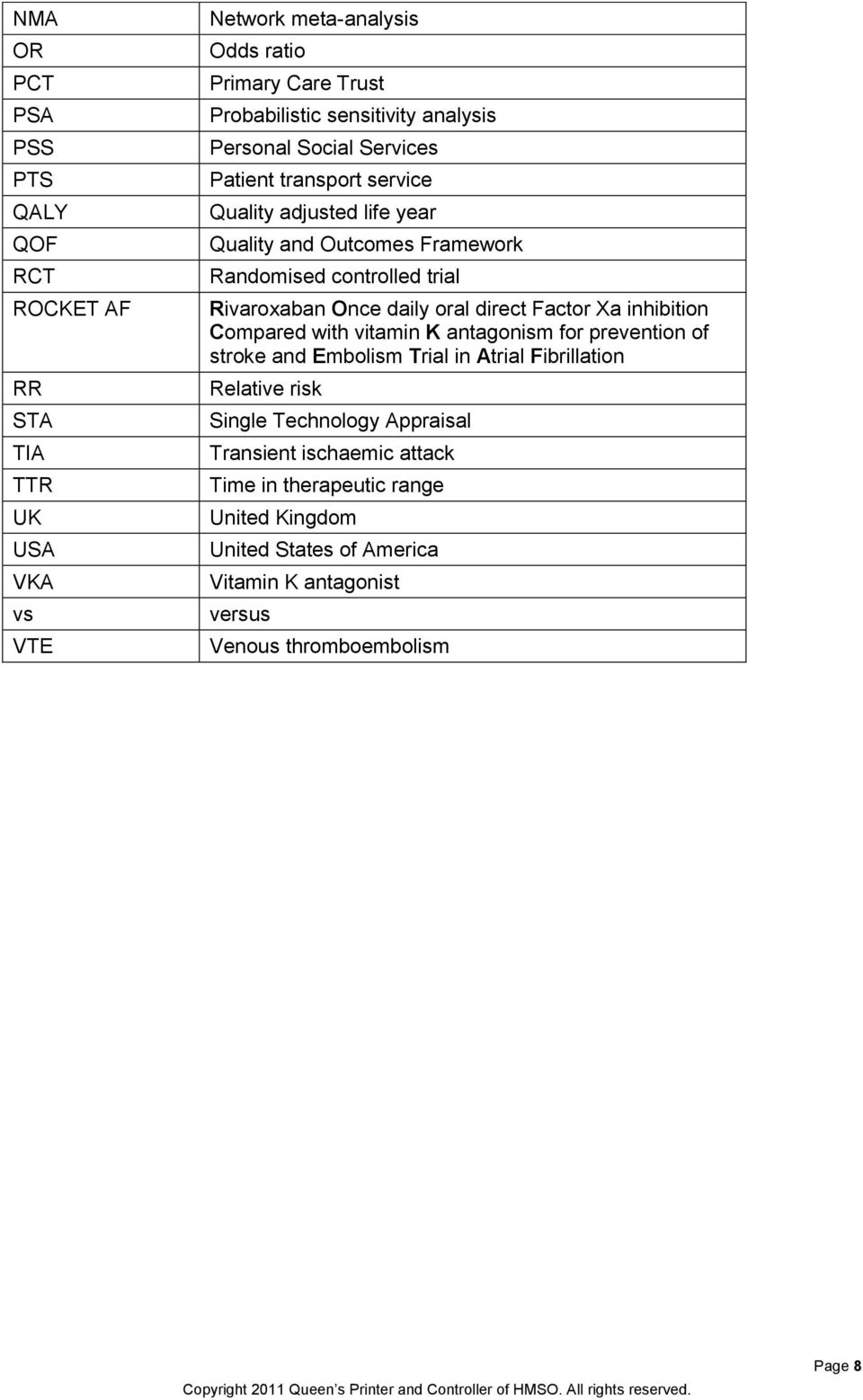
8 NMA OR PCT PSA PSS PTS QALY QOF RCT ROCKET AF RR STA TIA TTR UK USA VKA vs VTE Network meta-analysis Odds ratio Primary Care Trust Probabilistic sensitivity analysis Personal Social Services Patient transport service Quality adjusted life year Quality and Outcomes Framework Randomised controlled trial Rivaroxaban Once daily oral direct Factor Xa inhibition Compared with vitamin K antagonism for prevention of stroke and Embolism Trial in Atrial Fibrillation Relative risk Single Technology Appraisal Transient ischaemic attack Time in therapeutic range United Kingdom United States of America Vitamin K antagonist versus Venous thromboembolism Page 8
9 1 SUMMARY 1.1 Scope of the manufacturer s submission The manufacturer of rivaroxaban (Xarelto ; Bayer HealthCare) submitted to the National Institute for Health and Clinical Excellence (NICE) clinical and economic evidence in support of the effectiveness of rivaroxaban for the prevention of stroke and systemic embolism in people with atrial fibrillation (AF). The manufacturer s submission (MS) diverged from the final scope issued by NICE in the following areas: Population. The population specified in the scope was adults with non-valvular AF who are at moderate to high risk of stroke and non-central nervous system (CNS) systemic embolism. The manufacturer submitted evidence from a single trial (ROCKET AF), in which the population appears to comprise predominantly patients with a higher risk of stroke based on definitions of moderate and high risk of stroke in clinical guidelines for AF (NICE guideline CG36 and the European Society of Cardiology guidelines). The Evidence Review Group (ERG) considers that the eligibility criteria of ROCKET AF precluded enrolment of patients at low to moderate risk of stroke, that is, those having only one CHADS 2 (Congestive heart failure, Hypertension, Age, Diabetes and history of Stroke or TIA [doubled]) risk factor or those aged 65 years old with no high-risk factors. Comparators. In the MS, the manufacturer does not cover comparisons of rivaroxaban versus dabigatran and rivaroxaban versus antiplatelet agents in the subgroup of people for whom warfarin treatment is unsuitable. However, the manufacturer does cover the comparison of rivaroxaban versus aspirin in people who are suitable for treatment with warfarin using data from a network meta-analysis (NMA). This comparison was not requested in the final scope issued by NICE. Outcomes. Health-related quality of life (HRQoL) was an outcome listed in the final scope issued by NICE. It is unclear whether the manufacturer collected HRQoL data in the ROCKET AF trial. However, the manufacturer did not present any ROCKET AF-based event- or treatment-related HRQoL data within the clinical evidence submitted. Data on transient ischaemic attack (TIA) were provided as part of the clarification process, but were not included in the manufacturer s economic evaluation. Page 9
10 1.2 Summary of clinical effectiveness evidence submitted by the manufacturer The clinical effectiveness evidence for the MS is based on a single clinical trial, ROCKET AF, a Phase III non-inferiority study comparing the clinical efficacy and safety of rivaroxaban with warfarin for the prevention of stroke and non-cns systemic embolism in at risk patients with non-valvular AF. The trial data presented within the MS uses three population data sets for the analyses: 1) Per protocol: everyone who was randomised and who did not have a major pre-specified protocol deviation; 2) Safety-on-treatment: everyone who was randomised and who received at least one dose of study medication; 3) Intention-to-treat (ITT): everyone who was randomised regardless of treatment received. The ERG notes that the length of recorded follow-up varied among the populations. The per protocol and safety-on-treatment population data included endpoints occurring while subjects were taking their study drug and for 2 days after permanent discontinuation of randomised study drug. The ITT population data set included all events, whether the event occurred while the patient was on or off their randomised study drug and was recorded until the end of study date. The manufacturer uses data from the safety-on-treatment population of ROCKET AF as the main source of clinical effectiveness data within the MS, including within the primary NMA. All safety data provided by the manufacturer was limited to the safety-on-treatment population. ROCKET AF showed rivaroxaban to be non-inferior to warfarin in preventing stroke and non-cns systemic embolism in the per protocol, safety-on-treatment and ITT populations (p < for all populations) at the pre-specified non-inferiority margin of In the safety-on-treatment population, ROCKET AF also showed that rivaroxaban is superior to warfarin in preventing stroke and non-cns systemic embolism (p = 0.02). However, superiority was not demonstrated when the ITT population was analysed (p = 0.12). Considering the individual components of the composite outcome, rivaroxaban was associated with *************************************************************, and a statistically significant reduction in non-cns systemic embolism in the safety-on-treatment population (p = 0.003). ************************************ Page 10

11 Superseded The overall safety profile of rivaroxaban and warfarin, from ROCKET AF, were similar (overall see ******************************************* adverse event rate: 20.7% vs 20.3%). However, compared with warfarin, rivaroxaban was associated with significantly fewer intracranial bleeding events (0.77% vs 1.18%; p < 0.05) but significantly more gastrointestinal bleeding events (3.15% vs 2.16%; p < 0.001) and bleeding events requiring transfusion (1.6% vs 1.3%; p = 0.04). Subgroup results from updated ROCKET AF suggest that people with no prior use of vitamin K antagonists greater benefit from rivaroxaban than those who have previously taken a VKA, such as warfarin. page (VKAs) have fewer primary endpoint events (stroke and non-cns systemic embolism) ***************** with rivaroxaban compared with those who have previously been treated with a VKA. These data could be interpreted as indicating that VKA-naïve patients potentially achieve a Data for the subgroup of *********************** The manufacturer also compares rivaroxaban with aspirin and dabigatran etexilate (110 mg or 150 mg twice daily) using an NMA in patients suitable for anticoagulation. Results from ****************************************************************************** Page 11

12 Superseded ********************************************************** see 1.3 Summary of the ERG s critique of clinical effectiveness evidence submitted The ERG considers the ROCKET AF trial to be of generally good quality. However, the ERG considers it important to note that the trial population of ROCKET AF predominantly consists of high updated manufacturer s suggestion that relative treatment effect is likely be consistent across patient page risk patients (defined as CHADS 2 score 3) as 87% of the trial population had a CHADS 2 score of 3 or more. The ERG notes that there is limited clinical evidence regarding the efficacy of rivaroxaban in the moderate risk AF population (defined as CHADS 2 score 1 2), although the ERG agrees with the populations at different risk. The ERG also notes that there is a large variability between the time in therapeutic range (TTR) values for the different trial regions in ROCKET AF and the ERG considers that the overall trial TTR is lower than that generally reported in the United Kingdom (UK) and in other clinical trials. ********* Baseline population characteristics of ROCKET AF indicate that there was a statistically significant difference between the rivaroxaban and warfarin groups in proportion of people who had experienced an MI prior to enrolment in the trial (p < 0.05), with more people in the warfarin group having had an MI. History of MI is associated with an increased risk of future MI, thus the warfarin group in ROCKET AF could be at a higher risk of MI compared with the rivaroxaban group. The ERG is of the opinion that this difference in baseline history of MI should be considered when interpreting data on MI from ROCKET AF and the manufacturer s and ERG s NMA. Page 12

13 Dabigatran was listed as a comparator in the final scope issued by NICE and is currently undergoing a NICE technology appraisal, with a decision expected in December As no direct head-to-head comparative data for rivaroxaban and dabigatran is available, the manufacturer conducted an NMA to provide an estimate of the treatment effect of rivaroxaban compared with dabigatran etexilate (110 mg or 150 mg twice daily). However, the ERG has concerns about the validity of the results from the NMA conducted by the manufacturer due to ************************************************************* The ERG also carried out an indirect comparison of rivaroxaban versus dabigatran 300 mg/day to assess treatment discontinuation rates. Results from the ERG s analysis suggest that dabigatran 300 mg/day is associated with significantly more treatment discontinuations compared with rivaroxaban or warfarin (p < 0.05). The ERG notes that, in the economic model, the manufacturer has assumed equivalent discontinuation rates between rivaroxaban and dabigatran when this may not be correct. The ERG notes that the comparison of rivaroxaban versus antiplatelet agents in a warfarin unsuitable population was not covered in the MS. The ERG also notes that aspirin is included as a comparator in the manufacturer s NMA and that the data presented in the manufacturer s NMA include randomised controlled trials of warfarin versus aspirin. These data would suggest that the patient populations of these trials are likely to be suitable for therapy with warfarin. Consequently, the ERG does not consider that these data address the decision problem of rivaroxaban versus aspirin in a patient population unsuitable for warfarin. 1.4 Summary of cost effectiveness evidence submitted by the manufacturer The manufacturer conducted a number of different analyses, based on data from the ROCKET AF clinical trial and the manufacturer s NMA ROCKET AF-based analysis Clinical effectiveness data from the safety-on-treatment population of ROCKET AF was used to inform comparisons of rivaroxaban and warfarin in: A ROCKET AF-based population; A poorly controlled warfarin population; A warfarin-naïve population. Page 13

14 The efficacy and safety data observed in ROCKET AF were assumed to be applicable across all the above patient populations. The manufacturer argued that evidence from subgroup analysis of ROCKET AF supported the assumption of equivalent efficacy and safety. Therefore, only the costs associated with warfarin monitoring are varied in the ROCKET AF-based analyses. The manufacturer conducted each ROCKET AF-based analysis using: Only statistically significant point estimates from ROCKET AF (non-significant relative risks [RRs] were assumed to be 1); All point estimates, from ROCKET AF, regardless of significance. The manufacturer s base case analysis used statistically significant point estimates from the safetyon-treatment population of ROCKET AF and estimated an incremental cost-effectiveness ratio (ICER) of 18,833 per quality adjusted life year (QALY) gained. When all point estimates from ROCKET AF were used, the ICER fell to 8,732. In patients who were poorly controlled on warfarin, rivaroxaban dominated, regardless of whether or not significant only data were used to inform the analysis. The ICER obtained for patients who were naïve to warfarin therapy was 15,494 when using only significant data and 6,900 when all data were used NMA-based analysis The manufacturer carried out an NMA that incorporated rivaroxaban, warfarin, dabigatran 150 mg (twice daily), dabigatran 110 mg (twice daily), aspirin and no treatment (placebo), as well as other comparators not specified in the NICE final scope. The manufacturer used the treatment effects estimated by the manufacturer s NMA to inform a fully incremental analysis of rivaroxaban, aspirin and no treatment (placebo) in a patient population with baseline characteristics from a UK observational survey. The incremental analysis revealed that no treatment (placebo) is dominated by aspirin and that rivaroxaban versus aspirin results in an ICER of 2,083. The manufacturer claimed that this analysis was conducted in the warfarin unsuitable population. However, the ERG notes that the trials used to inform this analysis included warfarin as a comparator, indicating that these patients were suitable for therapy with warfarin. The comparisons between rivaroxaban and dabigatran 150 mg (twice daily) and dabigatran 110 mg (twice daily) were conducted using a cost minimisation approach. No differentiation was made between dabigatran 150 mg (twice daily) and dabigatran 110 mg (twice daily) as the unit cost of both treatments is the same; the manufacturer did not incorporate a sequence regimen in the original model (i.e., patients receive dabigatran 150 mg [twice daily] until they reach 80-years-old and then step down to 110 mg [twice daily]). The manufacturer argued that a cost minimisation approach was reasonable because of the absence of a significant difference in any outcome, estimated by the Page 14
15 manufacturer s NMA. The cost minimisation analysis resulted in an estimated additional cost of 913 with dabigatran. The manufacturer did not employ the treatment effects estimated by the Superseded manufacturer s NMA to inform a comparison between rivaroxaban and warfarin. 1.5 Summary of the ERG s critique of cost effectiveness evidence submitted The ERG considers warfarin to be a likely second-line treatment strategy for rivaroxaban and see dabigatran. However, the manufacturer s economic evaluation assumes aspirin is the only second-line treatment. Clinical data from the ITT population of ROCKET AF could have been used to inform an evaluation of a change in treatments following discontinuation from rivaroxaban likely to be seen in clinical practice. updated ROCKET AF-based analysis The ERG identified the following limitations to the manufacturer s economic model s structural assumptions and parameter sources: The lack of disaggregation of the number of visits required by patients within and outside recommended INR control; page The lack of adjustment of bleeding risk by age; The lack of adjustment of utility by age; The source of MI risk for patients treated with aspirin; The source of post-mi mortality risk; The double counting of re-initiation costs of warfarin monitoring; The suspension of the risk of further events for the subsequent model cycle following an event; The exclusion of TIA as a potential event. The structure of the manufacturer s model prohibited the removal of the suspension of further events and the inclusion of TIA as a potential outcome. However, the ERG was able to adjust the manufacturer s model to account for the impact of the other limitations identified, producing an ICER of 33,758 per QALY gained. However, the ERG notes that the removal of the suspension of risk and the inclusion of TIA as an outcome are likely to decrease the ICER. In addition to the adjustments to the model s structural assumptions and parameters, the ERG conducted a scenario analysis that used lower monitoring costs for warfarin, which increased the ICER to 55,106 per QALY gained. In the subgroup of warfarin-naïve patients, the ERG adjustments increased the ICER for rivaroxaban compared with warfarin from 15,494 to 29,894 per QALY gained. However, when using the ERG s model adjustments, rivaroxaban remained dominant in those patients poorly controlled on warfarin (i.e., those with TTR <60% [target INR of 2 3]). Page 15
16 The ERG considers that the manufacturer s base case model (rivaroxaban vs warfarin) is driven by the cost of anticoagulation monitoring rather than the differential effectiveness of the comparators. When the cost of anticoagulation monitoring was disaggregated by INR range, the ICERs substantially increased from 18,883 per QALY gained to 27,281 per QALY gained NMA-based analysis The ERG conducted a fully incremental analysis of aspirin, no treatment (placebo), warfarin, rivaroxaban and dabigatran based on both the manufacturer s NMA and the ERG s NMA. The incremental analyses revealed that the relevant comparison was between dabigatran and rivaroxaban. The ERG used the point estimates obtained from the manufacturer s NMA and the ERG s NMA to obtain ICERs of 131,000 and 34,680, respectively. The ERG identified the following limitations present in the manufacturer s model: The absence of a post-systemic embolism health state; The lack of adjustment of bleeding risk by age; The lack of adjustment of utility by age; The archaic source of post-mi mortality risk; The assumption of equivalent discontinuation rates; The suspension of the risk of further events for the subsequent model cycle following an event; The exclusion of TIA as a potential event; The exclusion of dyspepsia as an adverse event. With the exception of the removal of risk suspension and the inclusion of TIA and dyspepsia in the model, the ERG was able to account for all the limitations listed above; adjustments resulted in the dominance of rivaroxaban for analysis based on the manufacturer s NMA and an ICER of 12,701 for the analysis based on the ERG s NMA, respectively. The ERG notes that the model is highly sensitive to the discontinuation rates used and a small change has the power to reverse the direction of benefit. Probabilistic sensitivity analysis conducted on the manufacturer s model following the incorporation of the treatment effects of the ERG s NMA and the adjustments recommended by the ERG revealed that dabigatran was dominant 45% of the time and dominated 35% of the time. 1.6 ERG commentary on the robustness of evidence submitted by the manufacturer Strengths The ROCKET AF trial is a large, well conducted trial. The manufacturer conducted an NMA to provide indirect estimates of the effectiveness of rivaroxaban in comparison with dabigatran, thus providing data for this key comparator listed in the final scope issued by NICE. Page 16

17 1.6.2 Weaknesses The NMA conducted by the manufacturer to provide data for the clinical effectiveness and safety of dabigatran, aspirin and placebo for use in the economic model had high levels of heterogeneity, as well as considerable uncertainty around the point estimates. The manufacturer did not discuss these issues in the MS. The ERG conducted an exploratory NMA using a more restricted network of treatments. The ERG s NMA had much lower levels of heterogeneity and was associated with less uncertainty around the point estimates. The manufacturer did not present any ROCKET AF-based event- or treatment-related HRQoL data within the clinical evidence submitted, although the ERG acknowledges that this may not have been collected. The manufacturer thus does not present any HRQoL data for rivaroxaban in the clinical effectiveness section of the MS. The HRQoL data utilised in the manufacturer s economic model is derived from published sources assessing the QoL of the different health states rather than treatmentdependent utilities. The manufacturer has no direct head-to-head data for rivaroxaban versus dabigatran and so the ability to draw conclusions for this comparison is limited by the uncertainty around the indirect effect estimates generated from the NMA. The economic model presented by the manufacturer has a number of potential flaws, including a lack of adjustment of bleeding risk or utility by age and an assumption of equivalent discontinuation rates for treatments for which there is an absence of any direct head-to-head data. Implementing treatment discontinuation rates from the ERG s NMA in the economic model has a profound impact on the overall ICERs generated Areas of uncertainty The ROCKET AF population used in the analyses presented in the MS and the economic model are the safety-on-treatment population, although the ERG believes that the ITT population would better reflect the treatment effectiveness results that would be seen in clinical practice. However, the ERG acknowledges that the trial population of RE-LY, which provides the main data for the indirect analysis of rivaroxaban with dabigatran, appears to be most similar to the ROCKET AF safety-ontreatment population. The ERG is unsure of what impact using the ROCKET AF ITT population would have on the ICERs. The manufacturer s base case model is driven by the cost of anticoagulation monitoring rather than the differential effectiveness of the comparators and thus any change in monitoring costs has substantial impact on the base case ICER. In addition, any change in monitoring cost directly affects Page 17

18 the ICERs for well controlled and poorly controlled patients on warfarin. Patients poorly controlled require more monitoring visits and those patients whom are well controlled require fewer visits. 1.7 Key issues In summary, the ERG believes the key issues to be as follow: The reliability of the results of the cost effectiveness of warfarin in comparison with rivaroxaban is limited by the uncertainty around the frequency of INR monitoring in warfarintreated patients in the economic model, which is driven by cost of anticoagulation monitoring rather than clinical effectiveness; The absence of direct comparative data from a randomised controlled trial comparing rivaroxaban with dabigatran etexilate in patients suitable for anticoagulation; The safety and clinical benefit of rivaroxaban compared with dabigatran etexilate and aspirin in patients who are not suitable for warfarin has not been addressed in the MS; Lack of QoL data for people taking rivaroxaban; The manufacturer s assumption that treatment discontinuation rates are the same between treatments in the absence of any direct evidence to suggest otherwise has a substantial impact on the ICERs; The data for rivaroxaban efficacy in people at moderate risk of stroke is limited. Page 18

19 2 BACKGROUND 2.1 Critique of manufacturer s description of underlying health problems In the Context section of the manufacturer s submission (MS; Section 2), 1 the manufacturer provides details on atrial fibrillation (AF) and the associated risk factors for stroke, along with an overview of the key issues related to these health conditions. Summaries of the epidemiology of AF and stroke in patients with AF data presented in the MS are provided in Box 1 and Box 2, respectively. All information is taken directly from the MS. Box 1. Epidemiology of atrial fibrillation AF is the most common sustained cardiac arrhythmia (1), estimated to affect 1 2% of the population (2). The prevalence of AF increases rapidly with age, and men are more often affected than women (3). Epidemiological studies conducted in the UK have shown AF to be fairly uncommon in people aged under 50 years, but to be found in ~1% of people aged years, increasing to 7-13% at 85+ years(3 7). Data collected as part of the Quality and Outcomes Framework (QOF) for 2009/2010, indicate a prevalence of atrial fibrillation of 1.4% in England (8) and 1.69% in Wales (9). Box 2. Epidemiology of stroke in patients with atrial fibrillation AF confers a 5-fold increase in the risk of stroke, and one in five of all strokes is attributed to this arrhythmia (2). Not only is AF a major risk factor for stroke, but when strokes occur in association with AF, the patients suffer increased levels of mortality, morbidity, disability and longer hospital stays compared with stroke patients without AF(1;2). The risk of death from AF-related stroke is doubled and the cost of care is increased 1.5-fold (2). The underlying risk of stroke is dependent on the presence or absence of a number of different risk factors. The risk of stroke in patients with AF varies ranging from an annual risk of 1% in patients aged over 65 years old with no risk factors, to over 12% per year in patients who have a history of prior stroke, transient ischaemic attack or thromboembolism(1). The Evidence Review Group (ERG) and the ERG s clinical expert advisors believe that the manufacturer s description of the underlying health problem is accurate. 2.2 Critique of manufacturer s overview of current service provision The manufacturer provides an overview of the current National Institute for Health and Clinical Excellence (NICE) guideline (CG36), 2 National Health Service (NHS) Improvement programme Page 19


20 Guidance on Risk Assessment and Stroke Prevention for Atrial Fibrillation (GRASP-AF) 3 and European stroke risk assessment guidelines 4 (Figure 1 and Box 3), along with a summary of the relevant NICE technology appraisals 5,6 (Table 1). Figure 1. NICE CG36 2 stroke risk stratification algorithm Box 3. Manufacturer s overview of stroke risk assessment Guidelines recommend that patients with AF should have their underlying level of stroke risk assessed to determine the choice of thromboprophylaxis. There are a number of different tools for assessing stroke risk. NICE CG36 (1) from 2006 uses the algorithm in Figure 1 (above), although it should be noted that this guideline may be updated, with the Page 20
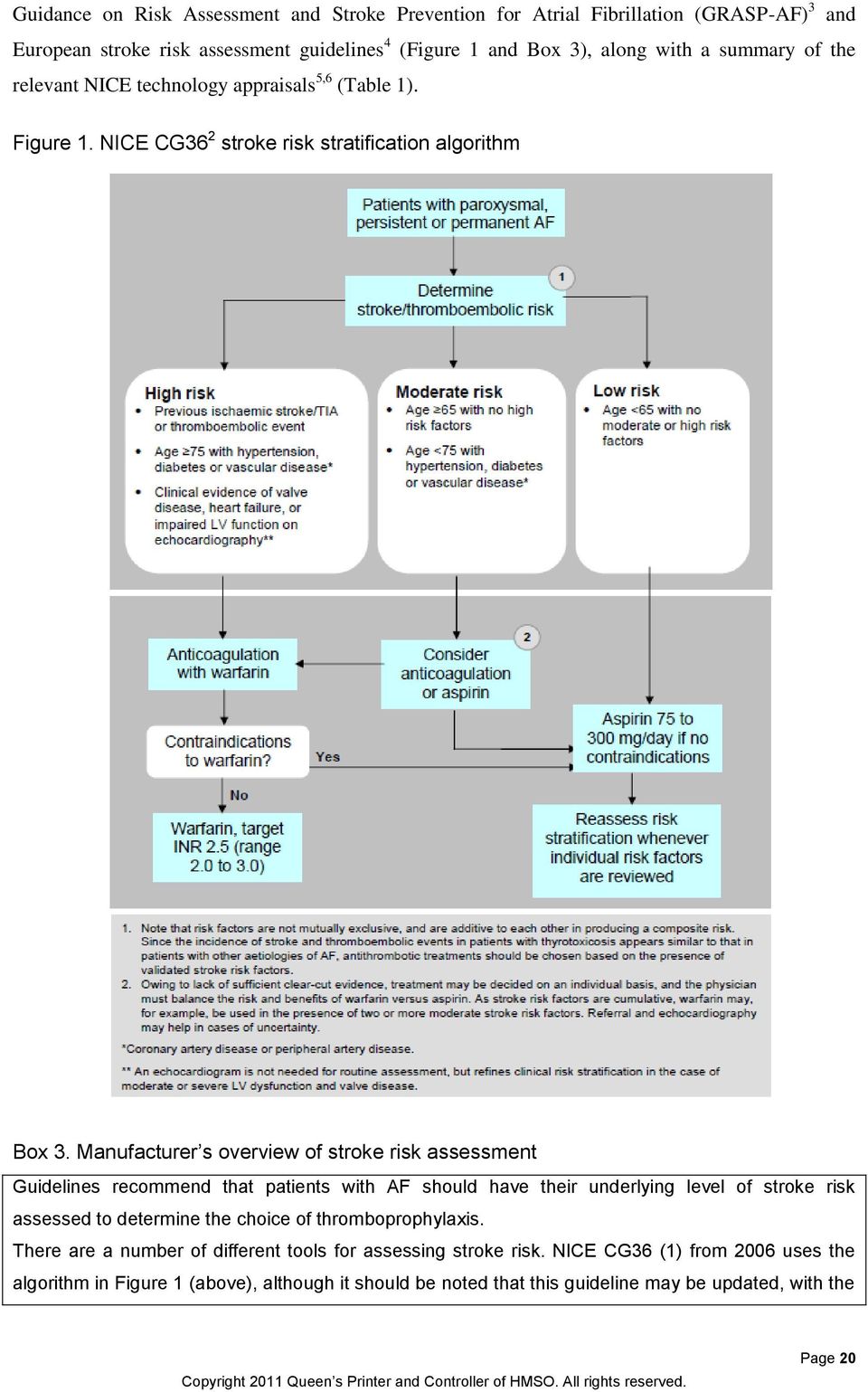
21 review decision due in August CHADS 2 [cardiac failure, hypertension, age, diabetes, stroke (doubled)] risk index (15) classification system is used as part of the NHS Improvement Programme GRASP-AF tool (16). The CHADS 2 risk index is based on a point system in which 2 points are assigned for a history of stroke or TIA and 1 point each is assigned for age >75 years, a history of hypertension, diabetes, or recent cardiac failure. More recently, European guidelines(2) were issued which advocate a different method of assessing stroke risk, CHA 2 DS 2 -VASc [congestive heart failure, hypertension, age 75 (doubled), diabetes, stroke (doubled), vascular disease, age 65 74, and sex category (female)]. Thus, this acronym extends the CHADS 2 scheme by considering additional stroke risk factors that may influence a decision whether or not to anticoagulate. The European guidelines recommend use of an anticoagulant with one or more of these risk factors. The European guidelines advocate a risk factor-based approach for stroke risk assessment rather than grouping patients into low, moderate and high risk cohorts, given the poor predictive value of such categorisation and the recognition that risk is a continuum(2). The manufacturer highlights the new CHA 2 DS 2 -VASc (Congestive heart failure, Hypertension, Age 75 [doubled], Diabetes, Stroke [doubled], Vascular Disease, Age 65 74, and Sex category [female]) score recommended in the European guidelines for assessment of stroke risk. 4 The manufacturer also highlights that the NICE guideline CG36, 2 at the time of writing of the MS, was under review for potential update, and the ERG notes that NICE has now taken the decision to update CG36. The ERG thinks it important to highlight that in the revised CG36 2 the CHA 2 DS 2 -VASc may supersede CHADS 2 (Congestive heart failure, Hypertension, Age, Diabetes and history of Stroke or TIA [doubled]) score as the recommended stroke risk algorithm. However, the ERG acknowledges that at the time of enrolment for the key trial cited in support of the MS, (ROCKET AF) 7 the CHADS 2 score was one of the most widely used stroke risk algorithms in the United Kingdom (UK). Table 1. Relevant NICE guidance and technology appraisals NICE guideline/guidance number Title Date of publication CG36 2 The management of atrial fibrillation June 2006, an update of this guideline was agreed in August 2011 and it is currently in the process of being scheduled into the NICE work programme TA197 5 Dabigatran etexilate: 6 appraisal in development Dronedarone for the treatment of nonpermanent atrial fibrillation Dabigatran etexilate for the prevention of stroke and systemic embolism in atrial fibrillation August 2010 Appraisal in progress; expected date of publication December 2011 The manufacturer lists all the relevant NICE clinical guidelines and technology appraisals, and the ERG notes that the Single Technology Appraisal (STA) for dabigatran etexilate, which is one of the comparators for rivaroxaban in this STA, is expected to be published in December Page 21
22 The ERG agrees with the manufacturer s description of warfarin as the current most frequently used oral anticoagulant in the UK, and that it is managed in a variety of primary and secondary care settings, with the exact setting in each area being dependent on local commissioning arrangements. The manufacturer does not explicitly describe the proposed place of rivaroxaban in the treatment pathway of AF. However, the manufacturer states that the anticipated European licence will be for Prevention of stroke and systemic embolism in adult patients with non-valvular atrial fibrillation with one or more risk factors, such as congestive heart failure, hypertension, age 75 years, diabetes mellitus, prior stroke or transient ischaemic attack and that this equates to a CHADS 2 score of 1. The manufacturer presents an estimate of the number of patients who could be eligible for treatment with rivaroxaban in England and Wales, based on the anticipated licence for adults with non-valvular AF and a CHADS 2 score 1. However, the ERG was unable to access all of the sources cited by the manufacturer and thus the ERG was unable to verify the manufacturer s estimate. The ERG also notes that the manufacturer quotes a different number in the text (662,747) compared with that provided in the MS (669,003 [Table 8; MS; pg 20]). The ERG requested clarification on this and the manufacturer confirmed that the correct estimate of people eligible for treatment with rivaroxaban is 669,003. The ERG considers it important to note that the manufacturer s estimate of the eligible population may be slightly higher than the true number of eligible patients as the estimate does not account for people in whom the manufacturer states rivaroxaban would be contraindicated, such as those with certain types of hepatic disease. The ERG is also concerned that the manufacturer is recommending rivaroxaban for people with a CHADS 2 score of 1 when only one person with a CHADS 2 score of 1 was treated with rivaroxaban in the manufacturer s key trial (ROCKET AF). 7 ROCKET AF mainly comprised people with a CHADS 2 score 3 (87% of the total intention-to-treat [ITT] population), and thus represents a generally high-risk population. The ERG considers that the manufacturer presents limited evidence of the efficacy of rivaroxaban in people at only moderate risk of stroke, that is, those with a CHADS 2 score of 1 or 2. In summary, the ERG considers that the manufacturer s descriptions of the underlying health problem and current service provision are generally accurate, although the ERG has concerns regarding the manufacturer s definition and estimate of the eligible population. Page 22
23 3 CRITIQUE OF MANUFACTURER S DEFINITION OF DECISION PROBLEM In the manufacturer s submission (MS), the manufacturer presents the decision problem issued by the National Institute for Health and Clinical Excellence (NICE) 8 and outlines how they have addressed this, along with their rationale for any deviations from the final scope issued by NICE (summarised in Table 2). Table 2. Summary of the decision problem addressed in the manufacturer s submission Population Final scope issued by NICE Adults with non-valvular AF at moderate to high risk of stroke and non-cns systemic embolism Decision problem addressed in the MS Adults with non-valvular AF with one or more risk factors for stroke and systemic embolism, such as congestive heart failure, hypertension, age 75 years, diabetes mellitus, prior stroke or transient ischaemic attack Intervention Rivaroxaban Rivaroxaban Comparator(s) Outcomes Economic analysis Warfarin Dabigatran (subject to ongoing NICE technology appraisal) In people for whom warfarin is unsuitable: Antiplatelet agents; Dabigatran. Stroke Non-CNS systemic embolism Myocardial infarction Mortality Transient ischaemic attacks Adverse effects of treatment, including haemorrhage Health-related quality of life The cost effectiveness of treatments should be expressed in terms of incremental cost per qualityadjusted life year. The time horizon for estimating clinical and cost effectiveness should be sufficiently long to reflect any differences in costs or outcomes between the technologies being compared. Costs will be considered from an NHS and PSS perspective. Warfarin Dabigatran Aspirin No treatment Stroke Non-CNS systemic embolism Myocardial infarction Mortality Transient ischaemic attacks Adverse effects of treatment, including haemorrhage Health-related quality of life The cost-effectiveness of rivaroxaban will be expressed as incremental cost per quality-adjusted life year. In the base case analysis a lifetime horizon (30 years) is used for estimating clinical and cost effectiveness Costs are considered from the perspective of the NHS and PSS Manufacturers rationale if different from the scope In line with European guidelines(2), stroke risk is a continuum and a risk factor based approach is advocated for stroke risk assessment rather than using low, moderate and high risk classifications In clinical practice, some patients eligible for warfarin but not prescribed it are prescribed aspirin or no treatment. We have specified aspirin as this is the most commonly prescribed antiplatelet in this indication Page 23
24 Subgroups to be considered Special considerations, including issues related to equity or equality If evidence allows, consider: people who have not been previously treated with warfarin Consideration should be given to the potential advantage of rivaroxaban in terms for its lower requirement for therapeutic monitoring and its fewer drugs interactions compared with warfarin. If evidence allows, consider: people who have not been previously treated with warfarin Consideration should be given to the potential advantage of rivaroxaban in terms of its lower requirement for therapeutic monitoring and its fewer drug interactions compared with warfarin. Abbreviations used in table: AF, atrial fibrillation; CNS, central nervous system; NHS, National Health Service; NICE, National Institute for Health and Clinical Excellence; PSS, Personal Social Services. 3.1 Population The key trial presented in the MS is the ROCKET AF trial, 7 which included adults with non-valvular persistent or paroxysmal atrial fibrillation (AF) at risk for future stroke. The ROCKET AF trial definition for at risk for future stroke was people with: a history of stroke or transient ischaemic attack (TIA) or systemic embolism; or 2 of the following risk factors (i.e., CHADS 2 [Congestive heart failure, Hypertension, Age, Diabetes and history of Stroke or TIA {doubled}] 2): congestive heart failure; hypertension; age 75 years; diabetes mellitus. The number of patients included in ROCKET AF without a prior stroke, TIA or non-central nervous system (CNS) systemic embolism and only two risk factors was limited to approximately 10% of the total number of people enrolled in each region. The remaining 90% of the study population was required to have a minimum of three risk factors, if they had not had a previous stroke, TIA or non- CNS systemic embolism. The reason for this requirement is not clear in the MS. The limitation on the recruitment of people having only two risk factors for stroke resulted in the total ROCKET AF population comprising less than 14% of people with a CHADS 2 score of 2. The majority of the ROCKET AF population had a CHADS 2 score of 3 (44% of total trial population) or 4 (29% of trial population). The final scope issued by NICE 8 for this single technology appraisal (STA) requested a population at moderate to high risk of stroke. The NICE clinical guideline for AF (CG36 2 ) defines moderate risk of stroke as: people 65 years old with no high risk factors; people 75 years old with hypertension, diabetes, peripheral artery disease or coronary artery disease. Page 24
25 And high risk of stroke as: previous ischaemic stroke, TIA or thromboembolic event; Superseded The European Society of Cardiology (ESC) guidelines 4 define stroke risk using the CHADS see 2 score as: people 75 years old with hypertension, diabetes, peripheral artery disease or coronary artery disease; clinical evidence of valve disease, heart failure or left ventricular dysfunction on echocardiography. CHADS 2 score of 0 = low risk; CHADS 2 score of 1 2 = moderate risk; CHADS 2 score of >2 = high risk. ROCKET AF did not actively enrol people with only one CHADS updated 2 risk factor or those 65 years old general, the ROCKET AF population is at higher risk of stroke than the population defined in the page with no high-risk factors, and over 85% of the ROCKET AF population had a CHADS 2 score 3. Based on these details, and considering the definitions of moderate and high risk of stroke in CG36 2 and the ESC guidelines, 4 the Evidence Review Group (ERG) and our clinical advisors judge that, in NICE final scope. 8 The ERG also notes that, in the MS, the manufacturer does not address the population of patients for whom warfarin is unsuitable, and that the ROCKET AF trial does not include this population. The ERG thus considers that there is currently no suitable data on rivaroxaban to assess the safety or efficacy in patients for whom warfarin is unsuitable. 3.2 Intervention Rivaroxaban is a highly selective direct factor Xa inhibitor with oral bioavailability. Its mode of action involves the inhibition of Factor Xa, which leads to interruption of the intrinsic and extrinsic pathway of the blood coagulation cascade and results in the inhibition of both thrombin formation and the development of thrombi. The manufacturer reports that rivaroxaban was submitted for regulatory approval for the prevention of stroke and systemic embolism in adult patients with non-valvular AF with one or more risk factors, such as congestive heart failure, hypertension, age 75 years, diabetes mellitus, prior stroke or TIA in December 2010 via the European Union centralised process. ************************************** In addition, rivaroxaban has yet to gain regulatory approval for use in this indication in countries outside of the United Kingdom (UK). The anticipated licensed dose of rivaroxaban for this indication is 20 mg once daily with a dose reduction to 15 mg once daily in people with moderate or severe renal impairment (defined as Page 25
26 creatinine clearance of ml/min and 15 29mL/min, respectively). The anticipated licence also states that rivaroxaban should be used with caution in people with severe renal impairment. 3.3 Comparators The manufacturer s key trial ROCKET AF is a double-blind RCT designed to demonstrate noninferiority between rivaroxaban and warfarin for prevention of stroke and systemic embolism, and thus warfarin is the main comparator in the MS. This decision is justified by unreferenced statements that warfarin is the oral anticoagulant most commonly used in UK clinical practice. Clinical advisors to the ERG agree with this statement. The ERG notes that the manufacturer has combined data on warfarin and other vitamin K antagonists (VKAs) under the label of warfarin in the network meta-analysis (NMA) presented in the MS. Clinical advisors to the ERG suggest that it is acceptable to assume a class effect (i.e. similar safety and efficacy profiles) for VKAs. Dabigatran etexilate, another new oral anticoagulant, is currently undergoing appraisal in the NICE STA programme 6 for the prevention of stroke and systemic embolism in people with AF, and thus is an important comparator for rivaroxaban in this STA. Dabigatran etexilate was listed in the decision problem issued by NICE 8 as a comparator, and has been included by the manufacturer within a NMA in the MS. The ERG believes this to be the most suitable method for comparison due to the lack of direct head-to-head trial data comparing rivaroxaban versus dabigatran. The ERG also notes that the manufacturer has used an NMA to provide data from indirect analyses to enable comparisons between rivaroxaban and aspirin, and rivaroxaban and placebo within the submission, although this was not a requirement of the final scope issued by NICE. 8 The final scope issued by NICE 8 did however request the comparisons of rivaroxaban versus dabigatran and rivaroxaban versus antiplatelet agents in people unsuitable for treatment with warfarin although these comparisons were not addressed in the MS. The ERG also notes that this population of people unsuitable for treatment with warfarin was not covered by the key trial in the MS (ROCKET AF). 7 The manufacturer states that there is significant under-treatment in warfarin-eligible patients and that patients not treated with warfarin may be on aspirin or left untreated. This argument is used to justify their inclusion of aspirin and no treatment in the NMA and economic model. The ERG considers it important to highlight that these patients were not necessarily unsuitable for treatment with warfarin. The NMA presented within the MS also includes additional comparators that were not listed in the NICE final scope, 8 but the manufacturer does not discuss these comparators in the MS. The ERG believes that the omission of these additional comparators from the submission is appropriate (further detail given in Section 4.4.1). Page 26
27 3.4 Outcomes The ERG notes that the manufacturer does not present data in the MS for the outcomes of TIA and health-related quality of life (HRQoL) from the ROCKET AF trial, both of which were listed as outcomes of interest in the final scope issued by NICE. 8 However, the ERG notes that the manufacturer has included data on TIAs from ROCKET AF in the NMA, and in response to the ERGs clarification questions. The ERGs clinical expert advisors suggest that HRQoL is an important outcome that should ideally have been measured and presented within the MS. However, the ERG recognises the potential difficulty in interpreting HRQoL data from a double-blind RCT with sham International Normalised Ratio (INR) monitoring, such as ROCKET AF, if the principal factor affecting HRQoL is the impact of INR monitoring. The ERG is aware that HRQoL was assessed in a clinical trial of dabigatran etexilate (RE-LY 9 ), although the ERG also acknowledges that RE-LY was an open label trial with no sham INR testing in the dabigatran etexilate group. The ERG does not have access to data on HRQoL from RE-LY and so is unable to comment further on the issue. The manufacturer presents data for the other outcomes listed in the NICE final scope, 8 along with some additional outcome data, including several composite outcomes, which will be discussed in further detail in the clinical effectiveness section of this report (Section 4). The ERG notes that the primary outcome of ROCKET AF was to prove non-inferiority between rivaroxaban and warfarin. Following the demonstration of non-inferiority, ROCKET AF was prespecified to assess for superiority in a series of outcomes *************************************************. The primary efficacy outcome of the ROCKET AF trial was the composite of stroke and non-cns systemic embolism, and the primary safety outcome was the composite of major bleeding and clinically relevant non-major bleeding. The manufacturer also provides data for the individual outcomes from ROCKET AF, although within the NMA they limit adverse effects to bleeding outcomes and do not present results for rivaroxaban compared with any other treatments for the outcome of all adverse effects. 3.5 Time frame According to the MS, ROCKET AF study enrolment took place between December 2006 and June 2009, and the end of the treatment period (site notification) was determined by the time required to accrue approximately 405 adjudicated primary efficacy endpoint events in the per protocol population (on-treatment). This resulted in differences in the time on study drug between patients based on their date of enrolment. Page 27
28 Site notification date (the date sites were notified by the Executive Committee that the required number of primary endpoint events, as deemed by the Clinical Events Committee, had occurred) was stated in the MS as 28th May 2010, and the median duration of randomised treatment exposure was Superseded Patients who discontinued blinded, randomised study drug treatment during the study were see At the end of study visit, patients were transitioned from study drug to an open-label VKA or other updated not randomised and do not include patients taking rivaroxaban, and so the extension study does not page 590 days (safety-on-treatment population). Additional follow-up data, including the range of treatment duration, was provided by the manufacturer at the clarification stage for this STA. The information provided is discussed further in Section of this report. transitioned to an open-label VKA or other appropriate therapy (e.g., aspirin or no therapy), as determined by the investigator, and then continued in study follow up in the intention-to-treat (ITT) population. appropriate therapy (e.g., aspirin or no therapy) as determined by the investigator and followed up in an open-label extension study for approximately 30 days. These follow-up data are not presented within the MS. The ERG agrees with the manufacturer s decision not to include these data as they are directly inform the NICE decision problem for this appraisal. The ERG notes that ROCKET AF achieved sufficient follow-up to reach its primary efficacy end point for assessment of non-inferiority. However, the ERG has concerns regarding the power of the study to demonstrate superiority using the safety-on-treatment and ITT populations. The ERG is thus unable to comment on the suitability of the follow-up period in the ROCKET AF study. This issue is discussed further in Section Other relevant factors Neither the manufacturer nor the ERG is aware of any specific equity or equality issues relevant to this technology appraisal. The ERG notes that in the final scope issued by NICE it is stated that consideration should be given to the potential advantage of rivaroxaban in terms of its lower requirement for therapeutic monitoring and its fewer drug interactions compared with warfarin. The manufacturer highlights in the MS that rivaroxaban is administered at a fixed dose once daily and does not require routine monitoring of coagulation parameters during treatment. This is in contrast to warfarin where there is a requirement for regular monitoring of INR and adjustment of warfarin dose to ensure anticoagulation is maintained within the desired therapeutic INR range. The association of rivaroxaban with fewer drug interactions than warfarin was not explicitly described within the MS and thus the ERG is unable to comment further on this potential benefit given the time constraint in the production of the ERG Page 28
29 report. Page 29
30 4 CLINICAL EFFECTIVENESS 4.1 Critique of manufacturer s approach The Evidence Review Group (ERG) considers it important to mention that the manufacturer s submission (MS) consisted of the main submission document 1 (331 pages), which was based on the template issued by the National Institute for Health and Clinical Excellence (NICE), 10 and three additional documents comprising a systematic review protocol 11 (20 pages), systematic review report 12 (201 pages) and a network meta-analysis (NMA) report 12 (114 pages). The three additional documents each contribute to the MS, and within the MS the reader is referenced directly to each for the information required in some sections of the MS. In the MS, the manufacturer presents a systematic review of studies directly involving rivaroxaban, and a separate NMA including a broader selection of studies. These reviews are discussed separately in the appropriate sections of the ERG report Description and critique of manufacturer s search strategy The manufacturer describes the literature search carried out up to 2nd February The search involved electronic database searching of Medline, Medline In-Process, EMBASE, The Cochrane Central Register of Controlled Trials (CENTRAL) and the manufacturer s (Bayer) in-house database, as well as reviewing the reference lists of relevant Cochrane reviews. The search used terms for atrial fibrillation (AF) and the drug names of interest. There were no language restrictions in the manufacturer s search strategy. However, the ERG notes that the EMBASE search was limited to 1988 to date of search rather than the database date of inception (1980) to date of search. The Medline and CENTRAL searches appear to have no date restrictions. The ERG notes that the manufacturer s searching of reference lists was limited to searching those of relevant Cochrane reviews and one additional relevant review (Hart et al. 12 ). The additional searches for unpublished literature were limited to the manufacturer s in-house database. The ERG validated the manufacturer s search in EMBASE, Medline and Medline In-Process, and the Cochrane library (23/09/2011), and generated a comparable number of studies to that generated by the manufacturer s search. In general, the ERG considers that the manufacturer s search strategies (i.e. Medline, EMBASE and CENTRAL) and search terms were appropriate, and the ERG is not aware of any relevant studies that have been missed by the manufacturer s search. Page 30
31 4.1.2 Description and critique of inclusion/exclusion criteria used in the manufacturer s study selection The manufacturer provides a table (Table 3) listing the inclusion/exclusion criteria applied in their search for studies that include rivaroxaban as comparator. Table 3. Eligibility criteria used in the search strategies in the manufacturer s submission Inclusion/exclusion criteria Inclusion criteria Exclusion criteria Clinical effectiveness Population: Chronic non-valvular atrial fibrillation documented by ECG. Interventions: Rivaroxaban compared with antithrombotic therapies (for 12 weeks) including VKAs, antiplatelet agents, idraparinux, ximelagatran, dabigatran or apixaban; Comparisons of different dosages and intensities of the same drug allowed, as were placebo- or active-controlled studies. Outcomes: All strokes (ischaemic or haemorrhagic); intracranial haemorrhage; major extracranial haemorrhage (i.e. all those that were life threatening or led to hospitalisation, blood transfusion or surgery); all-cause mortality; transient ischaemic attack; systemic embolism including details of severity and location; myocardial infarction; composite endpoint (all cause of stroke and non-cns systemic embolism); minor bleed; cardiovascular mortality as defined by authors; all causes of hospitalisation; cardiovascular related hospitalisations; gastrointestinal bleed; gastrointestinal symptoms/discomfort (e.g. dyspepsia). Study design: Randomised controlled trials. Language restrictions: none. Population: patients with prosthetic cardiac valves. Interventions: cardioversion for recent onset AF. Abbreviations used in table: AF, atrial fibrillation; CNS, central nervous system; ECG, electrocardiogram; VKA, vitamin K antagonist. Studies included were also limited to those published in full, and so any studies available in only abstract format were excluded from the review. The ERG is unable to comment on the impact of this limitation on the overall results as the number of studies reported in abstract format and subsequently excluded due to the absence of a full text publication is not indicated in the PRISMA diagram presented in the MS. However, it is a potential concern that the manufacturer has limited their search to published data and thus excluded an unknown quantity of grey literature. The ERG agrees with the manufacturer s decision not to include studies conducted in patients with prosthetic heart valves as these patients usually require anticoagulation with warfarin at a different therapeutic International Normalised Ratio (INR) level to people with non-valvular AF. The ERG also acknowledges that two reviewers independently screened the studies identified from the search for inclusion in the review, thus reducing the risk of potentially relevant studies being missed or for selection bias to occur. The ERG also considers that the manufacturer s decision to limit the study inclusion criteria to RCTs is appropriate for an evaluation of clinical efficacy. The ERG is not aware of any non-randomised Page 31
32 studies in people taking rivaroxaban that could have had an impact on the overall results of the clinical effectiveness and safety analyses within the MS. In general, the ERG considers that the inclusion/exclusion criteria were appropriate for the review Details of studies identified by the manufacturer The manufacturer presents an appropriate PRISMA diagram in the MS to depict the inclusion/exclusion of studies throughout the review process. In total, the manufacturer identified two RCTs in five publications, which were relevant to the review (details given in Table 4). Table 4. Included/excluded studies Trial number (acronym) ROCKET AF NCT J ROCKET- AF18 Intervention Comparator Population Primary study reference used in the MS Rivaroxaban 20 mg once daily (subjects with moderate renal impairment 15 mg once daily) Rivaroxaban 15 mg once daily Dose-adjusted warfarin based on target INR values target INR of 2.5 (range 2.0 to 3.0, inclusive) Dose-adjusted warfarin based on target INR values Non-valvular atrial fibrillation with a history of stroke/tia or systemic embolism or 2 additional independent risk factors for stroke Japanese patients with chronic nonvalvular atrial fibrillation at risk of stroke and non-cns systemic embolism Defined as calculated CrCl between 30 and 49mL/min, inclusive. Patel et al. 7,13 Hori et al. 18 Included/ Excluded Included Excluded due to dose of rivaroxaban, clinical practice and population used not considered generalisable to the UK Abbreviations used in the table: CNS, central nervous system; CrCl, creatinine clearance; INR, International Normalised Ratio; ml/min, millilitre per minute; MS, manufacturer s submission; TIA, transient ischaemic attack; UK, United Kingdom. The key trial in the MS is ROCKET AF. Four publications relating to ROCKET AF were identified by the manufacturer s search: a study design report 14 ; ROCKET AF protocol 15 ; clinical study report 16 ; and an abstract presented at American Heart Association meeting 17. In addition to the four publications relating to ROCKET AF identified during the literature search, the manufacturer also appropriately includes data from an additional report 7 and its supplementary appendix, 13 which were published after the literature search date for the systematic review. Page 32
33 The second RCT identified by the manufacturer, J ROCKET-AF, 18 is a phase III supportive safety study in a Japanese population. The J ROCKET-AF study used a lower dose of rivaroxaban than ROCKET AF, and the manufacturer states that clinical practice in Japan is different to that in the United Kingdom (UK). In particular, the manufacturer highlights that a lower target INR threshold is typically used in Japan for people aged 70 years (INR ) compared with the target INR typically used in the rest of the world (INR ). Due to differences between ROCKET AF and J ROCKET-AF in terms of included population and study design, the manufacturer decided not to include data from J ROCKET-AF in the MS. The ERG requested further clarification on the differences between the J ROCKET-AF and ROCKET AF studies at the clarification stage and, after assessment of the manufacturer s response, the ERG agrees with the manufacturer s decision to exclude J ROCKET-AF from the MS. The ERG also notes that the results of the primary safety and primary efficacy endpoint of J ROCKET-AF are broadly similar to those of ROCKET AF Details of relevant studies that were not included in the submission The ERG is not aware of any relevant studies that have been omitted from the MS. 4.2 Summary and critique of submitted clinical effectiveness evidence ROCKET AF 7 is the only trial used by the manufacturer to provide direct clinical effectiveness evidence on rivaroxaban within the MS. It was an international, multicentre, randomised, doubleblind phase III non-inferiority study comparing the clinical efficacy and safety of rivaroxaban with warfarin (vitamin K antagonist; VKA) for the prevention of stroke and non-central nervous system (CNS) systemic embolism in at risk patients with non-valvular AF Description and critique of manufacturer s approach to validity assessment The manufacturer provides a table detailing their critique of the ROCKET AF trial (Table 5). Table 5. Manufacturer s validity assessment of ROCKET AF ROCKET AF Was randomisation carried out appropriately? Was the concealment of treatment allocation adequate? Were the groups similar at the outset of the study in terms of prognostic factors? Were the care providers, participants and outcome assessors blind to treatment allocation? Were there any unexpected imbalances in dropouts between groups? Is there any evidence to suggest that the authors measured more outcomes than they reported? Yes Yes Yes Yes No No Page 33
34 Did the analysis include an intention-to-treat analysis? If so, was this appropriate and were appropriate methods used to account for missing data? Yes, although please refer to section for further discussion on appropriate analysis of this trial In general, the ERG Superseded agrees with the manufacturer s validity and quality assessment for ROCKET AF. manufacturer, the ERG considers that the manufacturer s decision to exclude these data from analyses see The ROCKET AF study randomised 14,264 people from 1,178 sites across 45 countries between updated The ERG notes that there was one trial site (96 people) that was excluded from all the data analysis sets due to violations in Good Clinical Practice guidelines. From the information provided by the is appropriate, and that the events at this site were unlikely to be related to the quality of the trial methods ROCKET AF population December 2006 and June This total included 206 patients from 23 sites in the UK. People were randomised in a 1:1 ratio to either active rivaroxaban or active warfarin. The randomisation was stratified by country, prior use of VKAs, and a history of stroke, transient ischaemic attack (TIA) or non-cns systemic embolism. The number of patients without a prior stroke, page TIA or non-cns systemic embolism and who had no more than 2 risk factors was limited to approximately 10% by region of the total number of patients enrolled. The remaining 90% of the study population was required to have a minimum of 3 risk factors if they had not had a previous stroke, TIA or non-cns systemic embolism. The ROCKET AF recruitment inclusion/exclusion criteria are listed in Table 6 and baseline characteristics for the intention-to-treat (ITT) population are presented in Table 7. In the MS, the manufacturer reported that *************************. Table 6. ROCKET AF inclusion/exclusion criteria Inclusion criteria Age 18 years; Persistent or paroxysmal AF documented on 2 episodes (one of which is electrocardiographically documented within 30 days of enrolment); Exclusion criteria Prosthetic heart valve; Planned cardioversion; AF secondary to reversible disorders (i.e., thyrotoxicosis); Known presence of atrial myxoma or left ventricular thrombus; Active endocarditis; Page 34
35 Risk for future stroke, including the history of stroke/tia or systemic embolism OR 2 of the following (CHADS 2 2): Congestive heart failure or left ventricular ejection fraction 35%; Hypertension (systolic blood pressure 180 mmhg or diastolic blood pressure 100 mmhg); Age 75 years; Diabetes mellitus. The number of subjects without a prior stroke, TIA or non-cns systemic embolism and only 2 risk factors was limited by the IVRS to approximately 10% by region of the total number of subjects enrolled, after which subjects were required to have a minimum of 3 risk factors if without a prior stroke, TIA, or non- CNS systemic embolism. Haemodynamically significant mitral stenosis; Active internal bleeding; History of, or condition associated with, increased bleeding risk, including: Major surgical procedure or trauma within 30 days before randomisation; Clinically significant gastrointestinal bleeding within 6 months before randomisation; History of intracranial, intraocular, spinal, or atraumatic intraarticular bleeding; Chronic haemorrhagic disorder; Known intracranial neoplasm, arteriovenous malformation, or aneurysm; Planned invasive procedure with potential for uncontrolled bleeding, including major surgery. Any stroke within 14 days before randomisation; TIA within 3 days before randomisation; Indication for anticoagulant therapy for a condition other than AF (eg, VTE) Treatment with: ASA >100mg daily; ASA in combination with thienopyridines within 5 days before randomisation; Intravenous antiplatelets within 5 days before randomisation; Fibrinolytics within 10 days before randomisation; Anticipated need for long-term treatment with a nonsteroidal antiinflammatory drug; Systemic treatment with a strong inhibitor of cytochrome P450 3A4, such as ketoconazole or protease inhibitors, within 4 days before randomisation, or planned treatment during the period of the study; Treatment with a strong inducer of cytochrome P450 3A4, such as rifampicin, phenytoin, phenobarbital, or carbamazepine, within 4 days before randomisation, or planned treatment during the period of the study; Anaemia (haemoglobin level <10 g/dl) at the screening visit; Pregnancy or breastfeeding; Known HIV infection at time of screening; Calculated creatinine clearance <30 ml/min at the screening visit; Known significant liver disease (eg, acute clinical hepatitis, chronic active hepatitis, cirrhosis) or alanine aminotransferase >3 the upper limit of normal. Abbreviations used in table: AF, atrial fibrillation; ASA, acetylsalicylic acid (aspirin); CHADS 2, Congestive heart failure, Hypertension, Age, Diabetes and history of Stroke or TIA (doubled); CNS, central nervous system; HIV, Human Immunodeficiency Virus; IVRS, interactive voice response system; TIA, transient ischaemic attack; VTE, venous thromboembolism. Page 35
36 Table 7. Baseline characteristics of ROCKET AF ITT population Characteristic Rivaroxaban (n = 7,131) Warfarin (n = 7,133) Total (n = 14,264) Sex, n (%) Female 2,830 (39.69) 2,830 (39.67) 5,660 (39.68) Male 4,301 (60.31) 4,303 (60.33) 8,604 (60.32) *********** ***** ************* ************* ************** Age in years ***** ********* ********* ********** ***** *********** *********** ************* ***** ********** ********** ********** Median (interquartile range) 73 (65 to 78) 73 (65 to 78) 73 (65 to 78) ****** ************* ************* ************* ****** ************* ************* ************* *** ************* ************* ************* ******************** **** ***** ***** ***** Baseline BMI (kg/m²) Clinical presentation, type of AF, n (%) Prior VKA use, overall, n (%) Prior chronic aspirin use, n (%) Clinical risk factors Median (interquartile range) 28.3 (25.2 to 32.1) 28.1 (25.1 to 31.8) 28.2 (25.1 to 32.0) Persistent 5,786 (81.14) 5,762 (80.78) 11,548 (80.96) Paroxysmal 1,245 (17.46) 1,269 (17.79) 2,514 (17.62) Newly diagnosed/new onset 100 (1.40) 102 (1.43) 202 (1.42) 4,443 (62.31) 4,461 (62.54) 8,904 (62.42) 2,586 (36.26) 2,619 (36.72) 5,205 (36.49) CHADS 2, mean (SD) 3.48 (±0.94) 3.46 (±0.95) 3.47 (±0.94) Congestive heart failure, n (%) Diabetes mellitus, n (%) 1, n (%) 1 (0.01) 2 (0.03) 3 (0.02) 2, n (%) 925 (12.97) 934 (13.09) 1,859 (13.03) 3, n (%) 3,058 (42.88) 3,158 (44.27) 6,216 (43.58) 4, n (%) 2,092 (29.34) 1,999 (28.02) 4,091 (28.68) 5, n (%) 932 (13.07) 881 (12.35) 1,813 (12.71) 6, n (%) 123 (1.72) 159 (2.23) 282 (1.98) 4,467 (62.65) 4,441 (62.27) 8,908 (62.46) 2,878 (40.36) 2,817 (39.49) 5,695 (39.93) Hypertension, n (%) 6,436 (90.25) 6,474 (90.76) 12,910 (90.51) Prior stroke/tia/non- CNS systemic embolism, n (%) 3,916 (54.92) 3,895 (54.61) 7,811 (54.76) Prior myocardial 1,182 (16.58) 1,286 (18.03) 2,468 (17.30) infarction, n (%) Creatinine clearance (ml/min) Median (interquartile range) 67 (52 to 88) 67 (52 to 86) 67 (52 to 87) Peripheral vascular 401 (5.62) 438 (6.14) 839 (5.88) Page 36
37 disease, n (%) Chronic obstructive pulmonary disease, n (%) Medications prior to start of study treatment, n (%)* 754 (10.57) 743 (10.42) 1,497 (10.49) Beta-blockers 4,631 (65.12) 4,686 (65.77) 9,317 (65.45) Diuretics 4,289 (60.32) 4,248 (59.62) 8,537 (59.97) Angiotensinconverting enzyme inhibitors 3,915 (55.06) 3,845 (53.96) 7,760 (54.51) Statins 3,055 (42.96) 3,077 (43.19) 6,132 (43.07) Digitalis glycosides 2,758 (38.78) 2,768 (38.85) 5,526 (38.82) Aspirin 2,726 (38.33) 2,759 (38.72) 5,485 (38.53) ************** ************* ********** ********** ********** ************* ******** ******** ********** ************ ********** ********** ********** ************** ********** ********** ********** ************** ********** ********** ********** *Table based on ITT population, except for medication section where rates are based on the safety-on-treatment population with n = 7,111 in the rivaroxaban group and n = 7,125 in the warfarin group. p < 0.05 for the between-group comparison. Abbreviations used in table: BMI, body mass index; CHADS 2, Congestive heart failure, Hypertension, Age, Diabetes and history of Stroke or TIA (doubled); CNS, central nervous system; ITT, intention-to-treat; ml/min, millilitre per minute; TIA, transient ischaemic attack; VKA, vitamin K antagonist. Overall, 54.8% of patients had a history of stroke, TIA, or non-cns systemic embolism, with prior strokes occurring in *******of the study population. In addition, 62.4% of patients had received prior therapy with VKA. The mean CHADS 2 (Congestive heart failure, Hypertension, Age, Diabetes and history of Stroke or TIA [doubled]) score was 3.48 for the rivaroxaban group and 3.46 for the warfarin group, and 99.8% of the trial population had a baseline CHADS 2 of 2 or more. ****************************************************************** had moderate renal impairment, which was defined as a baseline creatinine clearance (CrCl) of 30 to 49 ml/min (millilitre per minute), and thus were eligible to receive the lower dose of rivaroxaban (15 mg) or the lower rivaroxaban placebo dose. In the ITT population for the rivaroxaban group, ******* The ERG notes that the baseline characteristics for the ITT population in ROCKET AF generally appear well balanced between the two trial groups, although the ERG note that significantly fewer Page 37
38 people in the rivaroxaban group have had a previous myocardial infarction (MI) compared with the warfarin group (1,182 people in rivaroxaban group versus 1,286 people in warfarin group; p < 0.05). The ERG considers it important to note that the population in ROCKET AF is at higher risk of stroke than the population defined in the final scope issued by NICE. 8 The final scope issued by NICE includes patients with a CHADS 2 score of 1 or more whereas the ROCKET AF baseline population (ITT) included only 3 patients (0.02% of total population) with a CHADS 2 of 1 (1 person in rivaroxaban group, 2 in warfarin group). The majority of patients in ROCKET AF had a baseline CHADS 2 score of 3 (44% of ROCKET AF baseline ITT population) or 4 (29% of ROCKET AF baseline ITT population). *************************************** A clinical advisor to the ERG has suggested that the CHADS 2 scores of the population in ROCKET AF may reflect the UK population that would currently be most likely to be treated with warfarin and thus would also represent the population who would potentially be treated with rivaroxaban ROCKET AF intervention and comparator(s) The rivaroxaban group received 20 mg rivaroxaban once daily plus matching oral warfarin placebo titrated to a sham INR of 2.5. Patients with moderate renal impairment (defined as CrCl ml/min) at time of randomisation received 15 mg rivaroxaban once daily plus the standard matching oral warfarin placebo. The warfarin group received oral warfarin once daily (tablet strengths used in the study were 1 mg, 2.5 mg and 5 mg), titrated to a target INR of 2.5 (range , inclusive) plus matching oral rivaroxaban placebo once daily. Patients with moderate renal impairment did not require any specific change to warfarin dose, although they received the matching placebo for the 15 mg rivaroxaban tablets. Page 38
39 4.2.4 ROCKET AF outcomes The primary efficacy endpoint in ROCKET AF was a composite of: 1. Stroke (ischaemic and haemorrhagic [including all intracerebral or intraparenchymal bleeding]); 2. Non-CNS systemic embolism. Stroke was defined as a sudden, focal neurologic deficit resulting from a presumed cerebrovascular cause that was not reversible within 24 hours and not due to a readily identifiable cause, such as tumour or seizure. An event matching this definition and lasting less than 24 hours was considered a TIA. Any death within 30 days of the onset of stroke was regarded as fatal stroke. Non-CNS systemic embolism was defined as abrupt vascular insufficiency associated with clinical or radiological evidence of arterial occlusion in the absence of other likely causes (e.g., trauma, atherosclerosis or instrumentation). Where atherosclerotic peripheral arterial disease pre-existed, diagnosis of lower extremity emboli required angiographic demonstration of abrupt arterial occlusion. The ERG notes that the manufacturer s definition of Non-CNS systemic embolism includes those diagnosed by radiological examination. *********************************************************************** Systemic embolism may have otherwise remained clinically silent and not been identified in routine clinical practice. The ERG thus believes that using this criterion for the diagnosis of systemic embolism in ROCKET AF may result in overestimation of the rates of systemic embolism in comparison with those rates expected to be seen in normal clinical practice. The ERG also notes that haemorrhagic stroke events are an adverse effect of anticoagulation treatment, although they have been captured within the stroke clinical efficacy outcome in ROCKET AF. However, the ERG acknowledges that the endpoint of all stroke is used as an outcome in some clinical trials in this disease area, and that this includes both ischaemic and haemorrhagic strokes (e.g., RE-LY 9 ). However, the ERG is unsure whether haemorrhagic strokes were also counted in the safety bleeding outcomes of ROCKET AF. The primary safety endpoint in ROCKET AF was defined as a composite of: 1. Major bleeding; 2. Clinically relevant non-major bleeding. Bleeding was defined as major if it was clinically overt and associated with a fall in haemoglobin concentration of >2 g/dl, or if it led to transfusion of two or more units of packed red blood cells or Page 39
40 whole blood, occurred in a critical site (i.e., intracranial, intraspinal, intraocular, pericardial, intraarticular, intramuscular with compartment syndrome or retroperitoneal), or was attributable to a fatal outcome. Clinically relevant non-major bleeding was defined as overt bleeding not meeting the major bleeding criteria but associated with medical intervention, unscheduled contact with a physician, temporary cessation of study treatment, or associated with any other discomfort, such as pain or impairment of activities of daily life. All other overt bleeding episodes not meeting the criteria for major or clinically relevant non-major bleeding were classified as minor bleeding. The secondary endpoints in ROCKET AF were: 1. Composite of stroke, non-cns systemic embolism, and vascular death; 2. Composite of stroke, non-cns systemic embolism, myocardial infarction, and vascular death; 3. All-cause mortality; 4. Individual components of the composite primary and major secondary endpoints; 5. Stroke outcome; 6. Individual bleeding event categories; 7. Adverse events coded using Medical Dictionary for Regulatory Activities (MedDRA) Version Treatment compliance was also recorded during ROCKET AF and was measured by rivaroxaban/rivaroxaban placebo pill counts. The ERG also notes that assessment of treatment satisfaction using questionnaires in a subset of the total trial population was listed as an exploratory outcome in the protocol for ROCKET AF, although the results from these assessments are not presented in the MS. All suspected outcome events were independently assessed by a Clinical Events Committee (CEC), whose members were blinded to the treatment assignments. The ERG considers that, in general, the manufacturer s choice of outcomes presented within the MS is appropriate, although the ERG acknowledges that the TIA rates for ROCKET AF were not explicitly stated in the MS. In response to a request for clarification, the manufacturer highlighted that TIA was captured within their adverse event reporting and was not listed as a main individual outcome category. For this reason, the results were not reported separately within the MS, although they were included within the NMA and also supplied to the ERG in response to our request for clarification. Page 40
41 The other outcome requested within the final scope issued by NICE but not reported within the MS is health-related quality of life (HRQoL). The ERG considers that if these data had been captured from a trial, such as ROCKET AF, they would have been useful as they would have identified any impact that the benefits or harms of rivaroxaban have on HRQoL compared with warfarin. However, the ERG also acknowledges the limitations in interpreting such data in view of the double-blind nature of ROCKET AF with some form of INR monitoring (INR or sham INR) occurring in both treatment groups, which precludes identification of any difference in HRQoL related to INR monitoring as patients on rivaroxaban would not normally require INR monitoring ROCKET AF subgroup analyses Subgroup analyses specified a priori were: Region; Prior VKA use; History of a prior stroke (ischaemic or unknown type), TIA or non-cns systemic embolism; CHADS 2 score; Prior chronic acetylsalicylic acid (ASA) use; Sex; Age; Race; Renal function; Body mass index; Weight; Congestive heart failure; Hypertension; Diabetes; AF type; Proton pump inhibitor use at baseline; Prior myocardial infarction (MI). Analyses of treatment efficacy were also performed according to the percentage time each clinical site spent within INR range. The ERG notes that a large number of subgroup analyses were conducted in ROCKET AF, although only three of the subgroups were stratified at randomisation (region, prior VKA use, and history of a prior stroke, TIA or non-cns systemic embolism). Page 41
42 4.2.6 ROCKET AF follow-up Patients in both the rivaroxaban and warfarin groups were followed up at week 1, week 2, week 4 and then monthly up until the End of Study visit (within 30 days of the date of site notification [28th May 2010]; site notification took place once the pre-specified number of on-treatment primary clinical Superseded see TIA, MI, bleeding complications and procedures were evaluated, along with vital status and any updated INR monitoring using the point-of-care device provided in the study occurred as clinically indicated, page efficacy endpoint events had occurred). ****************************************************************** At each follow-up visit a standardised questionnaire was administered and patients were examined to screen for stroke symptoms and clinical events requiring further evaluation. Occurrence and signs of adverse events. Compliance with treatment was checked at each visit and any concomitant medication recorded. Liver function tests were performed at screening and during regularly scheduled routine follow up. but at least every 4 weeks. The ERG is of the opinion that this testing may be more frequent than the average time between INR monitoring appointments in the UK population, which is around 4 weeks, with a maximum frequency of 12 weeks. The ERG considers that the potentially more frequent INR monitoring in ROCKET AF would potentially introduce bias in favour of warfarin rather than rivaroxaban, assuming more frequent INR monitoring resulted in improved INR control (i.e., improved time in therapeutic range [TTR]). However, the ERG also notes that the TTR in ROCKET AF (mean TTR in safety-on-treatment population was 55%) is not as high as that observed in other similar clinical trials (e.g., TTR in RE-LY was 64%). 9,19 These data suggest that the INR control in ROCKET AF was not substantially improved by the potentially more frequent INR monitoring. A 12-lead electrocardiogram (ECG) and clinical laboratory tests were performed annually. At the end of study visit (or earlier if patients discontinued study drug treatment early), patients were transitioned to open-label warfarin or other appropriate regimen (alternative VKA, aspirin or no therapy) as determined by the investigator and were then followed up for an additional 30 days in an open-label extension observation period. Page 42
43 Superseded ************* Details and critique of the statistical approach used Table 8 provides an overview of each of the different populations used in the analyses in the MS. see Table 8. Definitions of the populations used in the analyses in the manufacturer s submission Population Definition Follow-up period Number of people included in analyses ITT Per protocol Safety-ontreatment All patients uniquely randomised All ITT patients, excluding those with major predefined protocol deviations All ITT patients who had taken at least one dose of study medication Number of patients excluded from analyses 14, people from protocol updated Until date of site notification (i.e. double blind trial end point), regardless of treatment received Until 2 days after permanent discontinuation of randomised study medication Until 2 days after permanent discontinuation of randomised study medication violating site 13, people from protocol violating site 209 people with major protocol deviations page 14, people from protocol violating site 28 people who did not take any of their randomised study medication Note: In the ITT population there was a median of 117 days of follow-up assigned medication (i.e., patients were off randomised treatment and taking an alternative anticoagulant). Abbreviations used in table: ITT, intention-to-treat. The primary objective of the ROCKET AF trial was to test the hypothesis that rivaroxaban is noninferior to warfarin for the prevention of stroke or systemic embolism in the per protocol population. 7 The per protocol population was pre-specified as all patients who received at least one dose of study medication and did not have a major pre-defined protocol violation. Patients were followed for events whilst receiving the study drug and for two days after study drug discontinuation. The non-inferiority margin was defined as 1.46 with a one sided alpha level of 0.025, and the manufacturer stated that, to provide a power of 95%, a minimum of 363 events would be required. However, assuming a 14% dropout rate, a minimum of 14,000 patients to observe 405 events was selected. This minimum number of events was achieved for the primary outcome in the pre-specified population. The MS and a published paper on the design of ROCKET AF 14 explain the rationale Page 43
44 behind selecting a 1.46 non-inferiority margin however the ERG was unable to verify this using the published sources cited in the MS. 20,21 The ERG does however note that the non-inferiority margin of 1.46 was also used in the RE-LY trial for assessing dabigatran etexilate versus warfarin in a similar indication. 22 The ERG also notes that in the manufacturer s submission for the dabigatran etexilate for the prevention of stroke and systemic embolism in atrial fibrillation STA 19 a second non-inferiority Superseded in the statistical analysis of non-inferiority trials can result in the introduction of bias in the results. 23 see updated margin of 1.38 was reported and cited as being the preferred margin of non-inferiority of the US Food and Drug Administration (FDA). The ERG notes that it has been reported that the choice of non-inferiority margin and population used However, the ERG also notes that the manufacturer presents the non-inferiority analysis for both the per protocol and ITT ROCKET AF populations. This is a commonly used approach in non-inferiority trials, with the trial often only being considered positive if non-inferiority is demonstrated in both the ITT and per protocol populations. 19 In ROCKET AF, the page ERG notes that the manufacturer ***************************************************** to assess for superiority in a list of primary and secondary outcomes should rivaroxaban be found to be non-inferior to warfarin in preventing stroke and systemic embolism (primary efficacy outcome) in the safety-on-treatment population. To meet the criterion of superiority in ROCKET AF, the upper limit of the 2-sided confidence interval for the respective analysis had to be less than 1. In addition to the analyses in the per protocol and safety-on-treatment populations, sensitivity analyses were also performed to assess non-inferiority and superiority in the ROCKET AF ITT population. The ERG considers that the ROCKET AF ITT population reflects what would be expected in routine clinical practice in terms of treatment sequencing and outcome effects. However, the ERG notes that the manufacturer prefers to report analyses based on the safety-on-treatment population data, stating that the protocol for ROCKET AF specifies that the safety-on-treatment population will be used in efficacy and safety analyses. The ERG also acknowledges that the manufacturer provides efficacy analyses for both the ITT and safety-on-treatment populations. The results from the two population data sets are compared and discussed further in Section Page 44
45 4.3 Summary and critique of clinical effectiveness results from ROCKET AF ROCKET AF treatment compliance and discontinuations Mean treatment compliance was based on the proportion of days for which the study drug was taken, and was reported to be **% for both rivaroxaban and rivaroxaban placebo. The compliance of warfarin could not be measured directly due to the individual patient variation in dosing; thus, the manufacturer used the intake of rivaroxaban placebo and blood INR levels as surrogate measures of treatment compliance. In the warfarin group of the safety-on-treatment population, the mean time in therapeutic range (TTR) for the INR range of 2.0 to 3.0 was 55%, and the median TTR was 58%. The ERG notes that these TTR values are somewhat lower than the TTR reported in other trials which include a UK population, such as RE-LY (warfarin vs dabigatran) which reported an overall trial TTR of 64.4%. 9 Also of note is that 62% of the RE-LY trial population were Western European or North American, 24 whereas only 34% of the ROCKET AF population were based in North America or Western Europe. The TTRs from ROCKET AF and RE-LY are higher in Western Europe and North America subgroups compared with other regions, which suggests that warfarin monitoring and control are more rigorous in North America and Western Europe. Thus, the considerable variation in locality of patients noted between RE-LY and ROCKET AF may at least partly account for the lower mean TTR seen in ROCKET AF. However, the manufacturer suggests that the low TTR observed in ROCKET AF may be due to the large proportion of people in the trial with high CHADS 2 scores. The manufacturer cites previous research 25 which suggests some of the underlying conditions that contribute to a patient s CHADS 2 score are associated with poorer INR control. The ERG considers that the low TTR reported in ROCKET AF could bias the results of the study against warfarin and thus overinflate the relative efficacy of rivaroxaban. ******* The ERG notes that a similar result was reported in RE-LY, with warfarin-experienced patients having a 67.2% TTR compared with 61.8% for naïve patients. 24 In the MS, considerable variation in TTRs across study centre regions was reported, with North America having the highest overall INR control followed by, in order, Western Europe, Latin America, Asia Pacific and, finally, Eastern Europe (data reported in Table 9). *********************** * Page 45
46 **************** ***** ******************* ****** ******************** ****** ***************** ****** ******************** ****** ****************** ****** *** ***** ***** ***** ***** ***** Abbreviations used in table: INR, International Normalised Ratio. Superseded see updated ****************************************************************************** page * *** ************************************************************* * ******************** ******************************************************** * ****** (Table 10). This trend in INR control has also been noted in another study. 25 *************************************************. Table 10.************************************************************************ * **************************** ************** ******* **************************** ********************** Mean (%) Median (%) * * ***** ***** * *** ***** ***** * **** ***** ***** * **** ***** ***** * *** ***** ***** * *** ***** ***** ********************************************** ********************************************* ** ************************************************* ******************************************************* ********************************************************************** Page 46
47 The discontinuation of study medication data reported in the MS consisted of much lower numbers compared with that reported in the FDA briefing document. 26 The numbers presented in the flow diagram in the MS state that 1,691 patients in the rivaroxaban group and 1,584 patients in the warfarin group discontinued their study drug early. The MS states that these numbers do not include patients who were lost to follow up, experienced a primary endpoint event or death, did not receive any study drug or from GCP/closed site. Of these discontinuations, 594 in the rivaroxaban group and 496 in the warfarin group were due to adverse events. The remaining discontinuations were reported to be for withdrawal of consent from study drug and follow up, patient decision to stop study drug but continue follow up and other reasons, which were not discussed further in the MS. The discontinuation of study medication rates reported in the FDA briefing report indicate that 2,520 rivaroxaban patients (35.44%) and 2,468 warfarin patients (34.64%) permanently discontinued their study medication early. **************************************** In response to clarification questions, the manufacturer provided details of the antithrombotic drugs that patients in the ITT population received after discontinuation of their double-blind study medication. ********************************* It is reported in the MS that the ITT population were followed-up for a median of 117 days post discontinuation of their randomised study drug; that is, patients were off randomised treatment but still included in the analyses according to the treatment they were initially randomised to. The median duration of treatment with randomised study drug (safety population) was 590 days. Page 47
48 ************* ROCKET AF treatment effectiveness results The primary efficacy endpoint of ROCKET AF was the composite of stroke and non-cns systemic embolism. The objective of demonstrating rivaroxaban to be non-inferior to warfarin in preventing stroke and non-cns embolism was met using the non-inferiority margin of 1.46 in both the per protocol and safety-on-treatment trial populations. Superiority of rivaroxaban over warfarin was also demonstrated in the prevention of stroke and systemic embolism in the safety-on-treatment population (Hazard Ratio [HR] 0.79; 95% CI: 0.65 to 0.95). However, superiority of rivaroxaban was not demonstrated for this outcome in the sensitivity analysis using the ITT population data set (HR 0.88; 95% CI: 0.75 to 1.03) despite the trend towards favouring treatment with rivaroxaban. Table 11 presents data on the primary end point of ROCKET AF for all populations analysed. Table 11. ROCKET AF primary efficacy endpoint (stroke and non-cns embolism results) Population Rivaroxaban Warfarin Rivaroxaban versus warfarin N Total Event rate (100 pt-yr) N Total Event rate (100 pt-yr) HR (95% CI) Non-inferiority p-value Superiority p-value Per protocol, 6, , as treated # (0.66 to 0.96) Safety-ontreatment 7, , # (0.65 to 0.95) ITT # 7, , Events ontreatment (0.75 to 1.03) (0.66 to 0.96) <0.001* ****** ******* 0.02* <0.001* * Events offtreatment (0.79 to 1.52) # Median follow-up was: 590 days for per protocol, as treated; 590 days for safety-on-treatment; and 707 days for ITT Per protocol, as treated is the primary analysis. All follow-up in ITT population is to site notification. * Statistically significant. The analyses highlighted in teal are part of the pre-specified closed hierarchical testing procedure. Abbreviations used in table: 95% CI, 95% Confidence Interval; CNS, central nervous system; HR, hazard ratio; ITT, intention-totreat. The ERG notes that, although discontinuation rates in the rivaroxaban and warfarin groups are similar, there is a substantially larger number of events in the rivaroxaban group compared with the warfarin group during the off-treatment period (i.e., when patients had stopped study drug early and transitioned to open-label VKA or other treatment). The manufacturer highlights that Page 48
49 *** People transitioning from rivaroxaban to warfarin in ROCKET AF took an average of 13 days to reach a therapeutic INR, whereas patients in the warfarin group took an average of only 3 days to reach a therapeutic INR when transitioning to open-label warfarin. The manufacturer also points out that the timing and type of event in the rivaroxaban arm suggest that the events were associated with suboptimal anticoagulation over the transition period from rivaroxaban to a VKA, and that this transition may be addressed more swiftly in true clinical practice. However, the ERG is unsure of the validity of this proposal and considers that, in clinical practice, it would be necessary for people discontinuing rivaroxaban and starting warfarin to go through a period of warfarin dose finding to reach a therapeutic INR. However, the ERG is unable to identify a reason for this observed difference. Statistical significance was achieved for superiority in the primary efficacy end point in the safety-ontreatment population, and so the analyses of the secondary efficacy endpoints were carried out according to the manufacturer s pre-specified hierarchical testing procedure. Tables 12 and 13 present results of these additional analyses in the safety-on-treatment and ITT populations, respectively. Table 12. Incidence and event rates of secondary efficacy endpoints in the ROCKET AF safety-on-treatment population, as adjudicated by the CEC Endpoint Rivaroxaban (n = 7061) Warfarin (n = 7082) Rivaroxaban versus warfarin Major Secondary Endpoint 1 Composite of stroke, non-cns embolism and vascular death Major Secondary Endpoint 2 Composite of stroke, non-cns embolism, vascular death and myocardial infarction Other efficacy endpoints All stroke Primary haemorrhagic stroke Primary ischaemic stroke Unknown stroke type Stroke outcome Death n (%) Event rate (100 pt-yr) n (%) Event rate (100 pt-yr) 346 (4.90) (5.79) (6.13) (7.33) (2.61) (3.12) (0.41) (0.71) (2.11) (2.27) (0.10) (0.16) (0.67) (0.95) 0.59 HR (95% CI) 0.86 (0.74 to 0.99) 0.85 (0.74 to 0.96) 0.85 (0.7 to 1.03) 0.59 (0.37 to 0.93) 0.94 (0.75 to 1.17) 0.65 (0.25 to 1.67) 0.71 (0.49 to 1.03) p-value 0.034* 0.010* * Disabling stroke 43 (0.61) (0.80) Page 49
50 (0.52 to 1.14) Non-disabling stroke 88 (1.25) (1.23) (0.76 to 1.38) Unknown 7 (0.10) (0.17) (0.23 to 1.50) Non-CNS systemic embolism 5 (0.07) (0.31) (0.09 to 0.61) 0.003* Myocardial infarction 101 (1.43) (1.78) (0.63 to 1.06) All-cause mortality 208 (2.95) (3.53) (0.70 to 1.02) Vascular death 170 (2.41) (2.73) (0.73, 1.10) Non-vascular death 21 (0.30) (0.48) (0.36 to 1.08) Unknown death 17 (0.24) (0.32) (0.40 to 1.41) Notes to accompany table: 1) Stroke outcome is based on investigator's assessment of modified Rankin scale score: 0 2 = non-disabling; 3 5 = disabling; and 6 = death; 2) Event rate 100 pt-yr: number of events per 100 patient years of follow up; 3) Hazard ratio (95% CI) and p-value from Cox proportional hazard model with treatment group as a covariate; 4) p-value (two-sided) for superiority of rivaroxaban versus warfarin in hazard ratio. * Statistically significant at nominal 0.05 (two-sided). Abbreviations used in table: 95% CI, 95% Confidence Interval; CEC, Clinical Events Committee; CNS, central nervous system; HR, hazard ratio. Table 13. *********************** *********************************** Endpoint Rivaroxaban (n = 7,081) Warfarin (n = 7,090) Rivaroxaban versus warfarin Major Secondary Endpoint 1 Composite of stroke, non- CNS embolism and vascular death Major Secondary Endpoint 2 Composite of stroke, non- CNS embolism, vascular death and myocardial infarction Other efficacy endpoints n (%) Event rate (100 pt-yr) n (%) Event rate (100 pt-yr) HR (95% CI) ********** **** ********** **** **************** *** ********** **** ********** **** **************** *** All stroke ********** **** ********** **** **************** *** Primary haemorrhagic stroke ********* **** ********* **** **************** *** p-value ***** ***** ***** ****** Page 50
51 Primary ischaemic stroke ********** **** ********** **** **************** *** Unknown stroke type ********* **** ********* **** **************** *** Stroke outcome Death ********* **** ********* **** **************** *** Disabling stroke ********* **** ********* **** **************** *** Non-disabling stroke ********** **** ********** **** **************** *** Unknown ********* **** ********* **** **************** *** Non-CNS systemic embolism ********* **** ********* **** **************** *** Myocardial infarction ********** **** ********** **** **************** *** All-cause mortality 582 (8.22) (8.91) (0.82 to 1.03) Vascular death ********** **** ********** **** **************** *** Non-vascular death ********** **** ********** **** **************** *** Unknown death ********* **** ********* **** **************** *** ***** ***** ***** ***** ***** ***** ***** ***** 0.15 ***** ***** ***** Notes to accompany table: 1) Stroke outcome is based on investigator's assessment of modified Rankin scale score: 0 2 = non-disabling; 3 5 = disabling; and 6 = death; 2) Event rate 100 pt-yr: number of events per 100 patient years of follow up; 3) Hazard ratio (95% CI) and p-value from Cox proportional hazard model with treatment group as a covariate; 4) p-value (two-sided) for superiority of rivaroxaban versus warfarin in hazard ratio. * Statistically significant at nominal 0.05 (two-sided). Abbreviations used in table: 95% CI, 95% Confidence Interval; CEC, Clinical Events Committee; CNS, central nervous system; HR, hazard ratio; ITT, intention-to-treat. In concordance with the primary efficacy endpoint, it can be seen that for major secondary endpoint 1 and major secondary endpoint 2, rivaroxaban in the safety-on-treatment population achieved superiority over warfarin (major secondary endpoint 1, p = 0.034; major secondary endpoint 2, p = 0.010). However, ************************************************************** Page 51
52 When compared with warfarin, rivaroxaban was associated with a statistically significant reduction of non-cns systemic embolisms in the safety-on-treatment population (p = 0.003), and, **************************************************************************** Although rivaroxaban did not reach superiority over warfarin in the safety-on-treatment *************** for the outcomes of all-cause mortality, vascular deaths, non-vascular deaths, MI, all strokes and primary ischaemic strokes,*************************************************************************** ************** Rivaroxaban was also associated with a statistically non-significant higher rate of non-disabling strokes in the safety-on-treatment (p = 0.863) and *************** population. The ERG also considers it important to note that significantly more people had a history of prior MI at baseline in the warfarin group compared with the rivaroxaban group. The ERG thus considers that as previous MI is one of the risk factors for future MI, it is possible that the significantly lower number of people with previous MI in the rivaroxaban group (compared with the warfarin group, p < 0.05) has resulted in fewer MIs in this treatment group during the study. The ERG thus considers it important to highlight that the MI results from ROCKET AF should be interpreted with caution.haemorrhagic stroke is a potential adverse event of treatment with anticoagulants. Primary haemorrhagic stroke was statistically significantly lower in the rivaroxaban group compared with the warfarin group in the safety-on-treatment (p = 0.024) ******************* population suggesting treatment with warfarin is more likely to lead to haemorrhagic stroke. This finding is in keeping with the other safety findings from ROCKET-AF discussed in section ROCKET AF subgroup analyses The manufacturer conducted numerous subgroup analyses, as discussed in section 4.2.4; however, the presentation of the results of these analyses is limited in the MS to the primary efficacy outcome (composite of stroke and non-cns systemic embolism) in the safety-on-treatment and ITT populations. The manufacturer also reports in the MS that the results of the subgroup analyses were consistent across all pre-specified subgroups for the primary efficacy outcome, as well as for the patients receiving a reduced dose of rivaroxaban (15 mg once daily). The ERG considers it important to highlight a selection of the subgroup analysis results. The ERG notes that, of the assessments for an interaction across a subgroup for a patient characteristic, the only analysis for which the interaction reached statistical significance was prior stroke/tia/systemic embolism in the safety-on-treatment population (p = for primary efficacy outcome). The ERG also notes that for both the ITT and safety-on-treatment analyses there were Page 52
53 significantly fewer primary efficacy end point events in the rivaroxaban group than in the warfarin group in people with no prior stroke/tia/systemic embolism (safety-on-treatment analysis: HR 0.59; 95% CI: 0.42 to 0.83, ITT analysis: HR 0.71; 95% CI: 0.54 to 0.94). In the MS, there are statistically significant differences between rivaroxaban and warfarin in some of the other subgroups assessed (e.g., safety-on-treatment population: age 75 years subgroup, rivaroxaban vs warfarin, HR 0.67; 95% CI: 0.51 to 0.88) for the primary efficacy outcome. The ERG acknowledges that randomisation was stratified by region of enrollment, prior use of VKAs and prior stroke, TIA or non-cns systemic embolism, and thus these parameters are the subgroups in which analyses of rivaroxaban versus warfarin should ideally be performed. However, the ERG notes that ROCKET AF was not powered to detect statistically significant differences for interactions across a subgroup or differences between treatments within subgroups and so any findings should be interpreted with caution. The subgroup of people who had not previously been treated with warfarin was listed in the NICE final scope 8 and so the ERG requested additional information from the manufacturer as this subgroup was not specifically addressed within the MS (i.e., only data for the primary efficacy analysis was provided in the MS). The results supplied by the manufacturer for the safety-on-treatment and ITT populations in people with prior VKA use versus no prior VKA use are presented in Table 14. According to the manufacturer, prior VKA use was defined in ROCKET AF as VKA use for 6 weeks or longer at the time of screening, and VKA naïve was defined as no use of VKA within 6 weeks prior to randomisation. The manufacturer highlights that the VKA naïve subgroup was therefore made up of patients with no prior VKA use and also patients who may have used VKAs previously but not used them within the 6 weeks prior to randomisation. ****************************************************** Table 14. Subgroup analysis results for prior VKA use versus no prior VKA use from ROCKET AF Outcomes Safety-on-treatment Intention-to-treat Efficacy Prior VKA HR* (95% CI) No prior VKA HR* (95% CI) Prior VKA HR* (95% CI) No prior VKA HR* (95% CI) Primary efficacy ******************* ******************* Page 53
54 endpoint (0.66 to 1.08) (0.53 to 0.97) Stroke ****************** ******************* *************** **************** Primary ischemic stroke Primary hemorrhagic stroke Non-CNS systemic embolism ******************* ****************** ******************* ******************* ******************* ******************* ****************** ******************* ******************* ******************* ******************* ******************* Myocardial infarction ****************** ******************* ***************** ****************** Vascular death ******************* ******************* ******************* ******************* All-cause mortality ****************** ******************* ****************** ****************** Safety Principal safety ******************* ******************* endpoint (a) *** *** Major ******************* ****************** *** *** Non-major clinically ****************** ******************* relevant *** *** Gastro-intestinal ******************* ****************** major bleed *** *** * HRs are for rivaroxaban versus warfarin. ********************************************** ********************************************** ********************************************** ********************************************** ***************************** The ERG notes that, in the North America subgroup, there is a notable difference between the HRs for the primary efficacy endpoint in the ITT population (rivaroxaban vs warfarin: HR 0.95; 95% CI: 0.64 to 1.42) and the safety-on-treatment population (HR 0.58; 95% CI: 0.34 to 1.01). These data highlight that there is a difference in some cases between the results using the ROCKET AF safety-ontreatment population as opposed to the ITT population. The ERG also notes that for the primary efficacy endpoint there is a greater number of statistically significant results in subgroup analyses based on data from the safety-on-treatment population compared with subgroup analyses in the ITT population (12 vs 2). Given the large variability in warfarin INR TTR across the different regions (Table 9), the ERG requested results for all outcomes reported in ROCKET AF for the Western Europe subgroup as this group includes UK patients and also has an INR TTR that is comparable to that more frequently reported in the UK. The manufacturer provided results for the safety-on-treatment, ITT and per protocol populations for efficacy outcomes and the safety-on-treatment population for safety outcomes. The ERG includes the safety-on-treatment and ITT data as the ERG considers that these populations are the most appropriate for assessing clinical effectiveness (data presented in Table 15). Page 54
55 Superseded ******************* see updated Table 15. Results for ************** subgroup versus whole trial data for ROCKET AF Outcomes Safety-on-treatment Intention-to-treat Efficacy ************** HR* (95% CI) Full trial data HR* (95% CI) Primary efficacy endpoint ******************* 0.79 (0.65 to 0.95) Stroke ******************* 0.85 Primary ischemic stroke Primary hemorrhagic stroke Non-CNS systemic embolism ************** HR* (95% CI) Full trial data HR* (95% CI) page ****************** 0.88 (0.7 to 1.03) ******************* 0.94 (0.75 to 1.17) *** 0.59 (0.37 to 0.93) *** 0.23 (0.09 to 0.61) Myocardial infarction ******************* 0.81 (0.63 to 1.06) Vascular death ******************* 0.89 (0.73 to 1.10) All-cause mortality ******************* 0.85 (0.7 to 1.02) Safety (0.75 to 1.03) ******************* ****************** ******************* ****************** *** ******************* *************** ******************* ******************* ******************* ******************* ******************* ****************** 0.92 (0.82 to 1.03) Principal safety endpoint ******************* 1.03 (a) (0.96 to 1.11) *** *** Major ****************** 1.04 (0.9 to 1.2) *** *** Non-major clinically ******************* 1.04 relevant (0.96 to 1.13) *** *** Gastro-intestinal major ******************* ******************* bleed *** *** * HRs are for rivaroxaban versus warfarin. ********************************************** ********************************************** ********************************************** ********************************************** ** Page 55
56 The overall low warfarin INR TTR (for all regions) observed in ROCKET AF, compared with other trials carried out in Western Europe populations and RE-LY, could influence the generalisability of the results to the UK population. The ERG thus requested some additional data from the manufacturer for the subgroups of patients with a TTR <60% and those with a TTR 60%. Superseded see updated ****************************** However, the ERG would like to highlight that randomisation in ROCKET AF was not stratified by TTR and so these data should be interpreted with caution. page Table 16. Subgroup data for centre time in therapeutic range (TTR <60% versus TTR 60%) from ROCKET AF ******************* Outcomes ********************* ********************* Efficacy Primary efficacy endpoint ****************** ******************* Stroke ******************* ******************* Primary ischaemic stroke Primary haemorrhagic stroke Non-CNS systemic embolism ******************* ******************* ******************* ****************** ******************* ******************* Myocardial infarction **************** ******************* Vascular death ******************* ******************* All-cause mortality ******************* ******************* Safety Principal safety endpoint (a) ******************* ******************* Major ******************* ******************* Non-major clinically relevant ******************* ******************* Gastro-intestinal major bleed ******************* ****************** ****************************************** *********** *********** *********** *********** *********** Page 56
57 *********** ************************************************* The ERG acknowledges that the manufacturer does not draw any conclusions based on any of the subgroup results, and that the subgroups were not powered at the start of the trial to detect statistically significant differences in treatment effect. The ERG considers that the manufacturer s approach to interpreting the subgroup analyses results is appropriate, given that there are many subgroup analyses and thus a high likelihood that significant results could be occurring by chance alone ROCKET AF safety results and adverse events The ERG notes that the safety results for ROCKET AF presented by the manufacturer are limited to the safety-on-treatment population. For the primary safety endpoint of major or non-major clinically relevant bleeding, the results from ROCKET AF suggest a comparable safety profile for rivaroxaban compared with warfarin, with no statistically significant difference between the two treatments (p = 0.44; full results presented in Table 17). The rate of the individual outcomes of major bleeding and clinically relevant non-major bleeding were also similar between the rivaroxaban and warfarin groups, with no significant difference between warfarin and rivaroxaban for these outcomes (major bleeding, p = 0.58; clinically relevant non-major bleeding, p = 0.35; Table 17). However, the breakdown of major bleeding indicates that, compared with warfarin, rivaroxaban was associated with significantly lower intracranial haemorrhage (p = 0.02), critical organ bleeding (p = 0.007) and fatal bleeding rates (p = 0.003). Rivaroxaban was associated with significantly higher rates of bleeding requiring blood transfusion (p = 0.04) and bleeds resulting in significant drops in haemoglobin or haematocrit (p = 0.02). Within the fatal bleeding category, *** Table 17. Results of ROCKET AF safety endpoints based on safety-on-treatment population Safety endpoint Rivaroxaban (n = 7,111) Warfarin (n = 7,125) Rivaroxaban versus warfarin n (%) Event rate (100 Pt-yr) n (%) Event rate (100 Pt-yr) Hazard ratio (95% CI) p-value Principal Safety Endpoint Composite of all major and 1,475 (20.7) ,449 (20.3) (0.96 to 1.11) 0.44 Page 57
58 non-major clinically relevant bleeding events Major 395 (5.6) (5.4) obin Haemogl Haemat Superseded bleeding see updated ocrit drop ion Transfus Critical organ bleeding(s) Fatal Intracran ial haemorrhage Non-major clinically relevant bleeding page 1) Minimal events are not included in the principal safety endpoint; (0.90 to 1.20) 305 (4.3) (3.6) (1.03 to 1.44) 183 (2.6) (2.1) (1.01 to 1.55) 91 (1.3) (1.9) (0.53 to 0.91) 27 (0.4) (0.8) (0.31 to 0.79) 55 (0.8) (1.2) (0.47 to 0.93) 1,185 (16.7) ,151 (16.2) (0.96 to 1.13) Minimal ********* *** ********* *** ***************** ** Notes to accompany table: 2) Hazard ratio (95% CI) and p-value from Cox proportional hazard model with treatment group as a covariate; 3) p-value (two-sided) for superiority of rivaroxaban versus warfarin in hazard ratio. *Statistically significant at nominal 0.05 (two-sided). Abbreviations used in table: 95% CI, 95% Confidence Interval * 0.04* 0.007* 0.003* 0.02* 0.35 **** The bleeding events captured in the principal safety endpoint occurred at different sites in each treatment group. In the rivaroxaban group, bleeding occurred more frequently at sites throughout the gastrointestinal tract (224 bleeds with rivaroxaban vs 154 bleeds with warfarin; p < 0.001). By contrast, in the warfarin group, critical organ bleeding (e.g. intracranial bleeding: 55 bleeds with rivaroxaban vs 84 bleeds with warfarin; p < 0.05 and intraparenchymal bleeding: 37 bleeds with rivaroxaban vs 56 bleeds with warfarin; p < 0.05), and non-traumatic bleeding (33 bleeds with rivaroxaban vs 54 bleeds with warfarin; p < 0.001) were more common. The ERG also requested data from the manufacturer on bleeding adverse events broken down by patient age, which the ERG acknowledges is not a randomised comparison and so any conclusions drawn from these data should be interpreted with caution. However, the ERG considers that the data suggest that with increasing age there is an increase in risk of bleeding adverse events associated with both rivaroxaban and warfarin. In particular, in patients aged <75 years, fewer principal safety outcome events (composite of major and non-major clinically relevant) occurred in the rivaroxaban group compared with the warfarin group in ROCKET AF. However, in people aged 75 years more principal safety outcome events occurred in the rivaroxaban group compared with the warfarin group. Page 58
59 All adverse events were coded by MedDRA (Medical Dictionary for Regulatory Activities) version Treatment-emergent adverse events were defined as those events starting on or after first dose of study drug up to 2 days after the last dose of study medication. The overall incidence of treatment-emergent adverse events was similar in the rivaroxaban and warfarin groups (81.44% with rivaroxaban vs 81.54% with warfarin; Table 18). Table 18. ROCKET AF adverse events Adverse events Rivaroxaban Warfarin Rivaroxaban minus (n = 7,111) (n=7,125) warfarin n (%) n (%) Diff. (%), (95% CI [%]) a Post baseline adverse events ************ ************ ******************** Treatment-emergent adverse events Adverse events with onset >2 days from stop of study treatment 5,791 (81.44) 5,810 (81.54) ********************* *********** ********** ******************* * Serious adverse events ************ ************ ********************* Post baseline adverse events ************* ************* ********************* Treatment-emergent serious adverse events Serious adverse events with onset >2 days from stop of study treatment ************* ************* ********************* ********** ********** ******************** Post baseline adverse events leading to permanent study drug ************ ************ ******************** discontinuation a Estimate and 95% CI for the difference in incidence proportion between rivaroxaban and warfarin based on asymptotic methods for a single 2x2 table. The CI is calculated when there are at least 5 events (both treatment groups combined) and at least 1 event in each treatment group. *Statistically significant p value at nominal 0.05 (two-sided). Abbreviations used in table: 95% CI, 95% Confidence Interval; Diff., difference. ********** Page 59
60 In the MS, the manufacturer provides a list of the 15 most frequently occurring investigator-reported treatment-emergent adverse events occurring in the rivaroxaban group. The manufacturer reports that the incidence and types of adverse event were similar between the rivaroxaban and warfarin groups, although significantly more patients in the rivaroxaban group had epistaxis (10.14% vs 8.55%; p < 0.05) and haematuria (4.2% vs 3.4%; p < 0.05) compared with patients in the warfarin group. The overall most frequent adverse events associated with rivaroxaban were epistaxis (10%), peripheral oedema (6%) and dizziness (6%), and the most frequent adverse events occurring in the warfarin were epistaxis (9%), nasopharyngitis (6%) and dizziness (6%). ************************************************************************ 8 ********* ****************************************************************The ERG was aware that the incidence of dyspepsia was high in the dabigatran etexilate group of the RE-LY 9 (dabigatran versus warfarin) trial and thus requested data from the manufacturer of rivaroxaban on the dyspepsia rate in ROCKET AF for comparison purposes. *********************************************************** By contrast, when considering the RE-LY trial, 9 patients in the warfarin arm did not receive a placebo dabigatran etexilate tablet and thus the difference in dyspepsia rates was attributed to the coating of the dabigatran etexilate tablets. The ERG acknowledges that, in RE-LY, dyspepsia occurred in over 5% of people in the warfarin group and in over 11% of people in the dabigatran group, ******************************************************************************** The ERG also note that to enhance absorption of dabigatran, a low ph is required and therefore, dabigatran capsules contain dabigatran-coated pellets with a tartaric acid core. 9 It has been suggested that this resulting acidity may at least partly explain the increased incidence of dyspeptic symptoms with dabigatran. 9 The ERG note however, that tartaric acid is not present in rivaroxaban. The manufacturer also reported in the MS that, in light of the liver function abnormalities associated with the withdrawn oral thrombin inhibitor ximelagatran, 27 hepatotoxicity risk was also closely monitored in the ROCKET AF study. The overall liver safety profile of rivaroxaban was shown to be comparable with that of warfarin, with no evidence of imbalance in laboratory parameters (such as alanine transaminase levels) ***************************** Page 60
61 4.3.5 Superseded ***************************************************** Summary of ROCKET AF results Rivaroxaban was demonstrated to be non-inferior to warfarin in the prevention of stroke and non-cns systemic embolism. see updated Superiority of rivaroxaban over warfarin was demonstrated in the primary efficacy endpoint, population (sensitivity analysis). page major secondary endpoint 1 and major secondary endpoint 2 in the safety-on-treatment population although superiority was not demonstrated for these outcomes in the ITT Rivaroxaban did not reach superiority over warfarin in the safety-on-treatment or ITT analyses for the outcomes of all-cause mortality, vascular deaths, non-vascular deaths, MI, all strokes and primary ischaemic strokes Substantially larger number of events occurred in the rivaroxaban group compared with the warfarin group during the off-treatment period, and the time to reach therapeutic INR dose of open label warfarin was considerably longer in the rivaroxaban group. *************************************************************************** ************************************************************************** ************************************************ *************************************************************************** ************************************************************************** ************************************************************************** ********* *************************************************************************** ************************************************************************** ************************************************************************** ************************ Page 61
62 The results from ROCKET AF suggest a generally comparable safety and adverse event profile for rivaroxaban compared with warfarin although rivaroxaban was associated with significantly higher rates of bleeding requiring blood transfusion. The sites of bleeding events differ between rivaroxaban and warfarin with significantly more GI bleeds and significantly fewer haemorrhagic strokes and intracranial haemorrhages occurring in the rivaroxaban group of the ROCKET AF safety on treatment population. 4.4 Network meta-analysis Methods The lack of direct head-to-head trial data for rivaroxaban compared with the treatments, other than warfarin, listed in the final scope issued by NICE, 8 required the manufacturer to conduct a NMA to enable comparison of rivaroxaban with aspirin and dabigatran (110 mg and 150 mg). The manufacturer also reported outcomes for placebo, although these were not requested in the final scope issued by NICE. 8 The manufacturer conducted a separate systematic review to identify trials for inclusion in the NMA. In the systematic review, the manufacturer used predominantly the same sources and inclusion/exclusion criteria as used in the search for studies for the systematic review of rivaroxaban versus warfarin discussed in Sections and The key difference in the inclusion/exclusion criteria of the systematic review for the NMA was that studies of any combination of the intervention treatments, including placebo/control and different doses of the same drug, were allowed. The treatments covered by the systematic review for the NMA were VKAs, antiplatelet agents, idraparinux, ximelagatran, dabigatran and apixaban. Inclusion in the NMA was limited to trials reporting data for the following comparators (also known as restricted comparators set): placebo; aspirin; clopidogrel plus aspirin; dabigatran 110 mg or 150 mg; apixaban; rivaroxaban; and adjusted-dose warfarin. A more extensive set of comparators was included in a sensitivity analysis ( full comparator set). The full comparator set included the treatments listed in the restricted comparators analysis, together with fixed-dose warfarin, fixed-dose warfarin plus aspirin, adjusted-dose warfarin plus aspirin, low-dose warfarin, low-dose warfarin plus aspirin, dabigatran 150 mg plus aspirin, dabigatran 50 mg, dabigatran 50 mg plus aspirin, triflusal plus low-dose warfarin, triflusal, idraparinux, ximelagatran and indobufen. The reasons for the selection of the treatments included in either the restricted comparators set or full comparators set is not further explained in the MS. The ERG notes that several of the treatments included in the NMA are not routinely used in this disease area in UK clinical practice or have been withdrawn by their manufacturer, for example, ximelagatran. Page 62
63 The ERG notes that the manufacturer uses the ROCKET AF safety-on-treatment population data set for the main NMA, although the manufacturer also performs some sensitivity analyses that use the ITT ROCKET AF population data set. The main NMA uses the restricted comparators and ROCKET AF safety-on-treatment population. The sensitivity analyses carried out were: 1. Restricted comparators, ROCKET AF ITT population; 2. Full comparators, ROCKET AF safety-on-treatment population; 3. Restricted comparators, ROCKET AF ITT population, blinded studies only. The ERG thinks it important to highlight potential issues with combining data from the trials included in the manufacturer s NMA. The ERG acknowledges that the trials included in the NMA vary in date of conduct and that trial procedures and reporting have evolved over time. Bearing these factors in mind, the ERG acknowledges that it is difficult to assess fully the populations in all the trials included in the manufacturer s NMA, and thus difficult to comment on their comparability in terms of the population data set used and trial conduct. The ERG acknowledges the manufacturer s argument that the ROCKET AF safety-on-treatment population may be most similar to the data reported in the other trials included in the NMA. In particular, the ERG notes that the results from RE-LY, the key study in the dabigatran etexilate for atrial fibrillation STA submission, 28 appears to be consistent with the ROCKET-AF safety-on-treatment population. However, it is not clear from the RE-LY publication when people were censored as discontinuing study drug in the ITT population. Also, as previously discussed, the ERG considers that the ROCKET AF ITT population most accurately represents the likely treatment pathway in clinical practice in the UK; that is, should rivaroxaban be introduced into clinical practice, patients that discontinue treatment are likely to be treated with warfarin. In response to the ERG s clarification questions, the manufacturer provided the results of the NMA using the restricted set of comparators and the ROCKET AF ITT population; these results will be discussed further in section and compared with the NMA results for the safety-on-treatment population. Software used The manufacturer used a Bayesian Markov Chain Monte Carlo (MCMC) simulation approach to the NMA, using WinBUGS software to carry out the NMA. The WinBUGS code used was supplied to the ERG in the manufacturer s response to clarification questions. The ERG validated the results generated by the manufacturer using the WinBUGS code supplied for a sample of outcomes. The ERG also conducted a second validation exercise for a selection of the manufacturer s NMA results using alternative WinBUGS code. In both assessments, the ERG s results were comparable with those generated by the manufacturer. Page 63
64 4.4.2 Outcomes reported in the network meta-analysis The ERG notes that the primary outcomes in the systematic review used to inform the manufacturer s trial selection for the NMA were slightly different to those reported in the manufacturer s key trial, ROCKET AF. An additional list of secondary outcomes for the systematic review was also compiled by the manufacturer and this included the primary composite outcome from ROCKET AF. A summary of the outcomes selected by the manufacturer for the NMA is presented in Table 19. Table 19. Outcomes reported in the manufacturer s systematic review and network metaanalysis Outcomes reported in the systematic review Outcomes reported in the network meta-analysis Primary outcomes: All strokes (ischaemic and haemorrhagic); Ischaemic stroke; Intracranial haemorrhage; Major extracranial haemorrhage; All-cause mortality. Secondary outcomes: Transient ischaemic attack; Systemic embolism; Myocardial infarction; Composite endpoint: all cause of stroke and non-cns systemic embolism; Minor bleed; Cardiovascular mortality; All cause of hospitalisation; Cardiovascular-related hospitalisations; Gastrointestinal bleed; Dyspepsia. Composite of ischaemic stroke and systemic embolism; Total stroke; Ischaemic stroke; Haemorrhagic stroke/ intracranial haemorrhage; Systemic embolism; Myocardial infarction; Cardiovascular death; Mortality; Major haemorrhage (extracranial bleeding); Minor bleed (clinically relevant nonmajor bleeding); Gastrointestinal bleed; Dyspepsia; Transient ischaemic attack. The ERG also notes that some of the outcomes selected by the manufacturer for the NMA were highlighted in the methods of their NMA as not being uniformly reported outcomes for trials in this disease area (e.g., major extracranial haemorrhage). In addition, it was also highlighted that not all the outcomes included in the NMA were reported in the main ROCKET AF results; for example, haemorrhagic stroke and intracranial haemorrhage were not reported in ROCKET AF, and so the respective outcome data were aggregated to create the composite data for input into the NMA. For some trials, it was necessary to calculate absolute data for major extracranial haemorrhage by subtracting intracranial bleeds from total major haemorrhages. The ERG considers it important to note that this approach could affect the validity of the results generated by the NMA as errors could have been inadvertently introduced into the trial level data used and clinical heterogeneity introduced into the network. A more robust approach would have been to contact the individual trial authors to request the necessary data. It is not clear from the MS or accompanying documentation whether data used in the NMA is taken directly from the original publication. In addition, the manufacturer does Page 64
65 provide any sensitivity analysis excluding those trials not reporting the specific outcome of interest and so the ERG is unable to comment further on the likely impact of calculating absolute numbers for individual outcomes on the overall results Studies included in the network In the MS it was unclear how many trials were included in the systematic review and subsequent NMA. The manufacturer presented an updated PRISMA flow diagram in their response to the ERG s clarification questions. Based on their search in February 2011, the manufacturer identified a total of 35 studies in 56 publications for inclusion in the systematic review. Of these 35 studies, only 28 studies (reported in 41 publications) were subsequently included in the NMA. The 7 studies excluded from the NMA were excluded for reasons mostly related to inadequate or unsuitable reporting of results. An additional 2 studies (2 publications) were identified after the date of the search and included in the NMA, making a total of 30 studies (43 publications) suitable for inclusion in the NMA. The list of trials included in the manufacturer s systematic review and NMA is given in Appendix 9.1. The ERG validated the manufacturer s selection of trials for the NMA by comparing them with those used in the MS for dabigatran etexilate 28 and published research in the area. 29 The manufacturer did not provide a network diagram giving an overview of the trials included in the NMA; however, they did provide network diagrams detailing the trials included in the analyses for each of the NMA outcomes. The outcome in the main NMA (restricted comparator, ROCKET AF safety-on-treatment population) that was informed by the largest number of trials in the network was total stroke, which used 19 trials with data from a total of 40 trial groups. By contrast, the outcome of dyspepsia used a network of 3 trials with data from a total of 7 groups. Adjusted-dose warfarin, aspirin and placebo had the most data points to inform the network. Many of the other comparators in the network were limited to data from a single trial. The ERG also acknowledges that the manufacturer performed quality assessments for each of the trials included in the NMA, which indicate considerable variation in the quality of the trials. The ERG considers that disparity among trials in terms of quality is to be expected given the evolution of trial reporting over the time period during which the studies included in the network were conducted. The ERG acknowledges that the small number of trials informing some of the links within the NMA limits attempts to assess issues surrounding trial quality within sensitivity analyses in the NMA Heterogeneity In the MS, the manufacturer states that the NMA was run using a random effects model to make allowance for heterogeneity among studies. However, the ERG notes that the WinBUGS codes Page 65
66 supplied at the clarification response stage by the manufacturer suggest that for 10 of the outcomes assessed in the NMA the manufacturer has used a random effects model, but for the remaining three outcomes they have used a fixed effects model. No rationale has been provided for this use of the fixed effects model in some outcomes. The ERG considers that the manufacturer s description and discussion of the methods and findings from their assessment of heterogeneity in the NMA is inadequately reported in the MS. However, the manufacturer provided details of the model fit (residual deviance and numbers of unconstrained data points) and values for tau, the statistical quantification of heterogeneity, in response to the ERG s clarification questions. Although the results show that the models used by the manufacturer were generally good fitting, ******************* The ERG notes that the 95% Credible Intervals (CrI) presented in the NMA for some of the treatments that are informed by a single study are much wider than those reported in the original studies. The ERG considers that the 95% CrI in the manufacturer s NMA may be due to an incoherent underlying dataset which could be caused by clinical heterogeneity in the wider network of trials informing the NMA. The ERG considers a potential source of the clinical heterogeneity within the manufacturer s NMA could be a result of the combination of trials with clinical differences, such as different doses of drugs (e.g., aspirin 75 mg and 150 mg). The ERG has thus carried out exploratory analyses to assess the effect of using a more homogeneous set of trials; discussed in Section Results of the network meta-analysis ********** Results from the NMA for the ROCKET AF safety-on-treatment and ITT populations are presented in Tables 20 and 21, respectively. Page 66
67 Table 20. *********************** ***************** (OR <1 favours rivaroxaban, OR >1 favours comparator) Outcome Composite (ischaemic stroke and systemic embolism) Adjusteddose warfarin ASA (aspirin) Dabigatran 110 mg (twice daily) Dabigatran 150 mg (twice daily) Placebo OR (95% CI) OR (95% CI) OR (95% CI) OR (95% CI) OR (95% CI) ***************** *** Total stroke ***************** * Ischaemic stroke ***************** ** Haemorrhagic stroke/intracranial haemorrhage Systemic embolism Myocardial infarction Cardiovascular death ***************** ** ***************** ** ***************** ** ***************** *** Mortality ***************** ** Major haemorrhage ***************** ** Minor bleed ***************** ** Gastrointestinal bleed ********************* ***** ***************** ** ***************** ** ******************************************** ******************** ******************* ******************* ***************** ******************** ****************** ****************** ***************** * ******************* ****************** ******************* ***************** * ******************** ******************** ******************** ***************** *** ******************* ******************** ******************** ***************** ** ****************** ******************* ******************* ***************** ** ****************** ******************* ******************* ***************** * ****************** ******************* ******************* ***************** ** ******************* ******************* ******************* ***************** *** ****************** ******************* ******************* ***************** * ******************* ******************* ******************* ***************** ** ******************* * * ***************** * Abbreviations used in table: 95% CI, 95% Confidence Interval; ASA, acetylsalicylic acid; MS, manufacturer s submission; OR, odds ratio. **********************************************************************The ERG also considers it important to note that in the trial informing the rivaroxaban MI data set, (ROCKET AF), significantly more people had a history of prior MI at baseline in the warfarin group compared with Page 67
68 the rivaroxaban group (p < 0.05). The ERG thus considers that as previous MI is one of the risk factors for future MI, the benefit observed with rivaroxaban in reducing the risk of MI compared to other comparators in the NMA may be confounded and should be interpreted with caution. **** Table 21. *********************** ************************************************* (OR <1 favours comparator, OR >1 favours rivaroxaban) Outcome Adjusteddose warfarin ASA (aspirin) Dabigatran 110mg Dabigatran 150mg Placebo OR (95% CI) OR (95% CI) OR (95% CI) OR (95% CI) OR (95% CI) Composite (ischaemic stroke and systemic embolism) ***************** ***************** **************** ******************** ***************** Total stroke ***************** **************** ***************** ****************** **************** Ischaemic stroke ***************** * *************** ***************** ****************** **************** Haemorrhagic stroke/intracranial haemorrhage Systemic embolism Myocardial infarction Cardiovascular death * * * * * ***************** **************** ****************** ****************** **************** ***************** ***************** *************** ***************** **************** ***************** ***************** ****************** ****************** ***************** Mortality ***************** ***************** ****************** ****************** ***************** Page 68
69 ******************************************** Abbreviations used in table: 95% CI, 95% Confidence Interval; ASA, acetylsalicylic acid; OR, odds ratio; ITT, intentionto-treat. ********************************************************************** Rivaroxaban direct pair-wise results compared with the network meta-analysis results Results from the direct and indirect comparisons of rivaroxaban versus adjusted-dose warfarin are summarised in Table 22: ROCKET AF estimates are reported as HRs and the NMA estimates as ORs (the ERG has assumed that the HRs and ORs in this case are broadly equivalent). The manufacturer reported that the direct study data from ROCKET AF for the comparison of rivaroxaban versus adjusted-dose warfarin are consistent with the indirect findings from the NMA. The ERG agrees with the manufacturer (based on assumption that HRs from ROCKET AF are comparable with the ORs from the NMA) on this point, but considers it important to highlight that in the case of systemic embolism, although the point estimates from direct trial data and the NMA are similar, the direct data significantly favours rivaroxaban whereas the difference between treatment groups in the indirect estimate is not statistically significant. The ERG also notes that as the only trial informing the comparison of rivaroxaban versus adjusted-dose warfarin in the NMA is ROCKET AF, the NMA results are close to the original trial data results, although the 95% CrI are substantially wider than would be expected in a coherent NMA for all but the primary composite outcome. Page 69
70 Table 22. Direct versus indirect estimates for rivaroxaban versus adjusted-dose warfarin from ROCKET AF Outcome ROCKET AF results as reported in the MS HR (95% CI) NMA results OR (95% CrI) Composite 0.79 Superseded (0.66 to 0.96) Not reported as a see composite updated in MS ******************* page Total stroke 0.85 (0.7 to 1.03) Ischaemic stroke 0.94 (0.75 to 1.17) Haemorrhagic stroke/intracranial haemorrhage Systemic embolism 0.23 (0.09 to 0.61) Myocardial infarction 0.81 (0.63 to 1.06) Cardiovascular death 0.89 (0.73 to 1.10) Mortality 0.85 (0.70 to 1.02) Major haemorrhage 1.04 (0.9 to 1.20) Minor bleed 1.04 (0.96 to 1.13) ******************* ****************** ******************* ******************* ******************* ******************* ******************* ******************* ******************* Gastrointestinal bleed Not reported in MS ******************* Transient ischaemic attack Not reported in MS ******************* 4.5 Additional work carried out by the ERG As part of the ERG s evaluation of the network meta-analysis presented in the MS, the ERG requested information on the heterogeneity and inconsistency in the network of randomised controlled trials. The manufacturer provided a table of information listing the residual deviance, number of unconstrained data points, and quantification of heterogeneity (tau). The ERG notes that there was reasonable agreement between the number of unconstrained data points and residual deviance (as would be expected in a good fitting model). 30 However, the value of tau was always >1 for all outcomes assessed, with the exception of gastrointestinal bleeds (tau 0.23), which indicates substantial heterogeneity in the network. 31 The ERG performed an exploratory NMA to evaluate whether using a simplified network based exclusively on the treatments of interest listed in the final scope issued by NICE 8 would reduce the amount of heterogeneity in the analyses. The ERG s exploratory work focused on those outcomes that inform the health economic analysis. The comparators included were: rivaroxaban; dabigatran etexilate; aspirin; placebo; and adjusted standard dose warfarin. The outcomes assessed were: ischaemic stroke; systemic embolism; major extracranial bleed; minor extracranial bleed; intracranial Page 70

71 bleed; and MI. In addition, the ERG assessed discontinuation as the economic model indicated this to be a key parameter. Trials for inclusion in the ERG s NMA were selected from published meta-analyses evaluating antithrombotics for stroke prevention in AF. 12, 29 Final trial selection was validated against the trials selected for inclusion in the NMA in the manufacturer s submission for this STA and those selected for inclusion in the ERG report 19 and manufacturer s submission 28 for the dabigatran etexilate in AF STA. In addition, trials selected to inform the ERG s NMA were assessed for comparability based on patient population, severity of disease, and treatments received. In particular, to ensure a homogeneous set of trials for analysis, only comparable dosing strategies were included (i.e., rivaroxaban 20 mg/day, dabigatran etexilate 300 mg/day, aspirin 300 mg/day, and dose-adjusted warfarin aiming at a target INR range between 2 and 3). Incorporating dissimilar trials has been shown to have a profound impact on the results of NMA. 32 Dabigatran etexilate 220 mg/day was excluded from the NMA because the economic model supplied by the manufacturer cannot accommodate a treatment strategy of 300 mg/day stepping down to 220 mg/day once a patient has reached 80-years-old. The trial network created by the ERG is depicted in Figure 2; this network forms a radiating star, 33 in which warfarin is the treatment that links the other treatments together. Figure 2. Network of 8 randomised controlled trials 7,9,37,38,40,42,43,44 meta-analysis conducted by the Evidence Review Group informing the network Fixed and random effects models were explored and the model that had the lowest Deviance Information Criterion (DIC) was selected when reporting results. DIC measures the fit of the model Page 71
72 while penalising for the number of effective parameters. 34 The OR was used as a summary statistic for all analyses as it has been shown to be associated with less heterogeneity in meta-analysis than risk difference or relative risk. 35 Similar to the manufacturer s approach, all analyses were conducted using WinBUGS and a Bayesian MCMC simulation. 36 As Bayesian statistical inference provides the probability that an estimate will take a particular value, results are presented with a 95% CrI rather than a 95% Confidence Interval (CI). 31 In addition, pair-wise meta-analysis of all individual direct comparisons of treatments with warfarin was conducted. The results of the additional analyses carried out by the ERG are presented in Table 23. Similar to the NMA presented in the MS, for each outcome there was reasonable agreement between the number of unconstrained data points and residual deviance. In marked contrast to the NMA in the MS, the homogeneity of the trials included in the network resulted in the fixed effects model being preferred for all outcomes assessed. Table 23. Results from the NMA and pair-wise meta-analysis conducted by the ERG using warfarin as a baseline (OR <1 favours comparator; OR >1 favours warfarin) Outcome NMA Meta-analysis Ischaemic stroke warfarin warfarin warfarin warfarin Systemic embolism warfarin warfarin warfarin warfarin Placebo vs Aspirin vs Dabigatran vs Rivaroxaban vs Placebo vs Aspirin vs Dabigatran vs Major extracranial bleed warfarin warfarin warfarin Rivaroxaban vs Placebo vs Aspirin vs Dabigatran vs Mean OR 95% CrI 3.51* (1.81 to 6.40) 1.56 (0.93 to 2.50) 0.78* (0.60 to 1.00) 0.91 (0.73 to 1.13) 2.50 (0.40 to 8.97) 0.99 (0.13 to 3.46) 0.64 (0.29 to 1.23) 0.24* (0.07 to 0.54) 0.58 (0.17 to 1.41) 0.68 (0.32 to 1.24) 1.08 (0.92 to 1.26) Mean OR 95% CI 3.22* (1.75 to 5.92) 1.49 (0.92 to 2.42) 0.77* (0.60 to 0.99) 0.91 (0.73 to 1.13) 1.55 (0.41 to 5.94) 0.78 (0.19 to 3.16) 0.61 (0.31 to 1.22) 0.23* (0.09 to 0.60) 0.55 (0.21 to 1.45) 0.66 (0.34 to 1.27) 1.08 (0.92 to 1.26) Page 72
73 warfarin Minor extracranial bleed warfarin warfarin warfarin warfarin Intracranial bleed warfarin warfarin warfarin warfarin Myocardial infarction warfarin warfarin warfarin warfarin Discontinuation Rivaroxaban vs Placebo vs Aspirin vs Dabigatran vs Rivaroxaban vs Placebo vs Aspirin vs Dabigatran vs Rivaroxaban vs Placebo vs Aspirin vs Dabigatran vs Rivaroxaban vs 1.14 (0.96 to 1.33) 0.62* (0.43 to 0.87) 0.57* (0.33 to 0.91) 0.88* (0.82 to 0.96) 1.04 (0.95 to 1.13) 0.50 (0.01 to 2.43) 0.47 (0.15 to 1.08) 0.41* (0.27 to 0.60) 0.66* (0.46 to 0.92) (0.64 to ) 1.32 (0.67 to 2.36) 1.43 (1.02 to 1.97) 0.81 (0.61 to 1.05) Placebo vs 0.68* warfarin (0.50 to 0.91) warfarin warfarin warfarin Aspirin vs Dabigatran vs Rivaroxaban vs *Statistically significant at the 5% level (0.11 to 1.70) 1.36* (1.24 to 1.48) 1.04 (0.97 to 1.11) 1.13 (0.97 to 1.33) 0.61* (0.43 to 0.87) 0.56* (0.36 to 0.92) 0.88* (0.82 to 0.95) 1.04 (0.95 to 1.13) 0.49 (0.09 to 2.69) 0.45 (0.18 to 1.14) 0.41* (0.28 to 0.60) 0.65* (0.46 to 0.92) 3.97 (0.44 to 35.75) 1.24 (0.67 to 2.29) 1.41 (1.02 to 1.95) 0.80 (0.62 to 1.04) 0.68* (0.50 to 0.91) 0.47 (0.13 to 1.78) 1.36* (1.24 to 1.48) 1.04 (0.97 to 1.11) Excluding WASPO 37 as this outcome was identified by the investigators as likely to be specific to the population studied and is therefore not generalisable to a wider population. Excluding AFASAK-I 38 as this outcome was identified by the investigators as likely to be skewed by patients not being adequately informed of the frequency of blood tests in the warfarin group. Abbreviations used in table: 95% CI, 95% Confidence Interval; 95% CrI, 95% Credible Interval; ERG, Evidence Review Group; NMA, network meta-analysis; OR, odds ratio; vs, versus. Generally, the results from the NMA and the pair-wise meta-analysis are in agreement, suggesting a consistent network of trials. 39 The single substantial difference between the two analyses was the Page 73
74 estimated OR for placebo versus warfarin for MI (OR vs OR 3.97 for the NMA and the pairwise meta-analysis, respectively). This disparity between the analyses is likely to be because the analysis is based on a single trial with few events informing the estimate (1/260 warfarin vs 4/265 aspirin). 40 The outcomes that would be considered statistically significant in the NMA compared with warfarin are (excluding placebo): reduction in ischaemic stroke with dabigatran etexilate; reduction in systemic embolism with rivaroxaban; reduction in minor extracranial bleeds with dabigatran etexilate and aspirin; reduction in intracranial bleeds with dabigatran etexilate and rivaroxaban; increase in MI with dabigatran etexilate; and increase in discontinuation with dabigatran etexilate. Overall, use of a network of randomised controlled trials restricted to those that directly inform the decision problem that is the focus of this STA results in a more consistent analysis that provides greater precision around the effect estimates than that provided in the MS. The effect of this more coherent analysis is explored in the Economic Evaluation section of this ERG report Rivaroxaban versus dabigatran etexilate Rivaroxaban and dabigatran etexilate are both new oral direct thrombin inhibitors that are currently being evaluated by NICE in the STA programme. The final scope issued by NICE 8 specifically requests a comparison between these treatments. One of the strengths of the NMA approach is that it simultaneously compares all treatments within the network. 36 As such, it is possible to estimate the treatment effects of any treatment within the network relative to any other treatment within the network. Table 24 presents the results for the comparison of rivaroxaban 20 mg/day and dabigatran etexilate 300 mg/day. In addition to the results from the NMA, the results of an adjusted indirect comparison using warfarin as a common comparator are also provided. The method employed for the adjusted indirect comparison was originally described by Bucher and colleagues. 41 The results of the NMA and the adjusted indirect comparison are consistent with one another. There is a general trend in favour of dabigatran etexilate for ischaemic stroke, major extracranial bleed, and intracranial bleed, and a statistically significant difference (at the 5% level) in favour of dabigatran etexilate for minor extracranial bleed. There is a trend in favour of rivaroxaban for systemic embolism and a significant difference (at the 5% level) favouring rivaroxaban in MI and discontinuation. However, the ERG also considers it important to note that in the trial informing the rivaroxaban MI data set, (ROCKET AF), significantly more people had a history of prior MI at baseline in the warfarin group compared with the rivaroxaban group (p < 0.05). The ERG thus considers that as previous MI is one of the risk factors for future MI, the benefit observed with rivaroxaban in reducing the risk of MI compared to dabigatran etexilate may be confounded and should be interpreted with caution. Page 74
75 Table 24. Results from the network meta-analysis and adjusted indirect comparison conducted by the ERG comparing rivaroxaban 20 mg/day and dabigatran etexilate 300 mg/day (OR <1 favours rivaroxaban; OR >1 favours dabigatran etexilate) Outcome NMA Adjusted indirect comparison Mean OR (95% CrI) Ischaemic stroke 1.19 (0.84 to 1.65) Systemic embolism Major extracranial bleed Minor extracranial bleed 0.43 (0.10 to 1.16)) 1.06 (0.84 to 1.31) 1.18* (1.04 to 1.32) Intracranial bleed 1.68 (0.96 to 2.73) Myocardial infarction 0.58* (0.37 to 0.87) Discontinuation 0.76* (0.68 to 0.86) *Statistically significant at the 5% level. Mean OR (95% CI) 1.18 (0.84 to 1.64) 0.37 (0.11 to 1.22) 1.05 (0.84 to 1.31) 1.18* (1.05 to 1.32) 1.61 (0.96 to 2.70) 0.57* (0.37 to 0.87) 0.76* (0.68 to 0.85) Abbreviations used in table: 95% CI, 95% Confidence Interval; 95% CrI, 95% Credible Interval, OR, odds ratio. In addition, the ERG carried out an adjusted indirect comparison between rivaroxaban and dabigatran etexilate for dyspepsia and major gastrointestinal bleed. Dyspepsia was identified in the RE-LY trial as the only adverse event occurring significantly more often with dabigatran etexilate than with warfarin (11.3% vs 5.8%, respectively; p < ). 9 While not presented in the MS, in response to the ERG s clarification questions, the manufacturer provided the incidence of dyspepsia from ROCKET AF (********************************************). An adjusted indirect comparison of these results demonstrates patients are at significantly more risk of dyspepsia with dabigatran etexilate than with rivaroxaban (OR 1.80; 95% CI: 1.32 to 2.46). The dabigatran etexilate coating has been proposed as a possible cause for the observed increase in dyspepsia with dabigatran etexilate compared with warfarin in RE-LY. 9 Major gastrointestinal bleed was identified in the MS as occurring significantly more often with rivaroxaban than warfarin (3.15% vs 2.16, respectively; p < 0.001; MS; pg 97). In the RE-LY trial, dabigatran etexilate was also associated with more major gastrointestinal bleeds than warfarin (1.57% vs 1.07%, respectively, p < 0.001). 28 An adjusted indirect comparison of these results demonstrates no significant difference between rivaroxaban and dabigatran etexilate for major gastrointestinal bleed (OR 1.01; 95% CI: 0.74 to 1.38). Page 75
76 4.6 Summary of clinical effectiveness results and critique Clinical results Rivaroxaban was demonstrated to be non-inferior to warfarin in the prevention of stroke and non-cns systemic embolism. Superseded Superiority of rivaroxaban over warfarin was demonstrated in the primary efficacy endpoint, major secondary endpoint 1 and major secondary endpoint 2 in the safety-on-treatment population of ROCKET AF although superiority was not demonstrated for these outcomes in the ITT population (sensitivity analysis). see Rivaroxaban does not reach superiority updated over warfarin for the outcomes of all-cause mortality, Rivaroxaban is associated with significantly higher rates of bleeding requiring blood page vascular deaths, non-vascular deaths, MI, all strokes and primary ischaemic strokes in ROCKET AF. transfusion when compared to warfarin. Significantly more GI bleeds occur with rivaroxaban compared with warfarin, and significantly more haemorrhagic strokes and intracranial haemorrhages occur with warfarin. *************************************************************************** *************************************************************************** ***********************************************************************. *************************************************************************** *************************************************************************** *********************************************** *************************************************************************** *************************************************************************** *************************************************************************** ********************** *************************************************************************** *************************************************************************** *************************************************************************** ************************** Page 76
77 4.6.2 Clinical issues The ERG considers the ROCKET AF population to be at a higher risk of stroke than the population defined in the NICE final scope. The conclusions drawn for the efficacy of rivaroxaban in the outcome of MI are potentially confounded as significantly more people had a history of prior MI at baseline in the warfarin group compared with the rivaroxaban group in the key rivaroxaban trial, ROCKET AF. The mean time in therapeutic range (TTR) for the INR range of 2.0 to 3.0 in ROCKET AF was lower than that typically seen in Western Europe clinical trial populations. No clinical data for the safety and efficacy of rivaroxaban in people unsuitable for warfarin is presented in MS. The ERG considers that there is substantial clinical heterogeneity within the manufacturer s NMA as a result of the combination of trials with clinical differences, such as different doses of drugs (e.g., aspirin 75 mg and 150 mg). Page 77
78 5 ECONOMIC EVALUATION 5.1 Introduction This section provides a structured description and critique of the systematic literature review and de novo economic evaluation submitted by the manufacturer. The manufacturer provided a written submission of the economic evidence along with an electronic version of the Microsoft EXCELbased economic model. Table 25 summarises the location of the key economic information within the manufacturer s submission (MS). Table 25. Summary of key information within the manufacturer s submission Information Details of the systematic review of the economic literature Section (MS) 6.1 Model structure to Technology to Clinical parameters and variables 6.3 Measurement and valuation of health effects and adverse events Resource identification, valuation and measurement Sensitivity analysis 6.6 Results 6.7 Validation Subgroup analysis 6.9 Strengths and weaknesses of economic evaluation to Abbreviations used in table: MS, manufacturer s submission. 5.2 Overview of manufacturer s review of the cost-effectiveness evidence The manufacturer described in detail the search strategy implemented to identify published costeffectiveness evidence in evaluating antithrombotics for stroke prevention in atrial fibrillation (AF). The Evidence Review Group (ERG) is satisfied that all appropriate databases were searched and that the search terms and inclusion/exclusion criteria used were reasonable. The ERG notes that conference abstracts were excluded and only English language papers were considered. However, the ERG is confident that no relevant studies have been missed. The search identified five cost-utility studies. 45,46,47,48,49 Data were extracted from these papers and the quality assessment of each paper is presented in the MS (MS; pgs ). None of the studies identified considered rivaroxaban for the prophylactic treatment of stroke and systemic embolism. However, the data extracted from these studies were used to inform the assumptions and inputs of the manufacturer s model. The manufacturer commented that the Markov model was the most common choice of model and that the Page 78
79 cost effectiveness of different treatments is often influenced by the choice of stratification and other variables. 5.3 Overview of manufacturer s economic evaluation The manufacturer used a Markov state transition model to evaluate the clinical and economic outcomes associated with prophylactic rivaroxaban treatment in patients with AF Intervention and comparators Adjusted-dose warfarin is the current standard of care for the prevention of stroke and systemic embolism in patients with AF, who are at moderate to high risk of stroke. Warfarin is the main comparator for rivaroxaban in the manufacturer s economic evaluation. As stipulated in the final scope issued by the National Institute for Health and Clinical Excellence (NICE), 8 the manufacturer also compares rivaroxaban with dabigatran (110 mg twice daily or 150 mg twice daily). Dabigatran is currently undergoing NICE technology appraisal. 50 In addition to this, the manufacturer compares rivaroxaban with aspirin and with no treatment (placebo) in patients eligible for anticoagulation (those at moderate to high risk of stroke) Population The manufacturer s base case analysis of rivaroxaban versus warfarin uses the patient characteristics and clinical effectiveness data observed in the safety-on-treatment population of the ROCKET AF clinical trial. Economic evaluations were also conducted in patients who were: Poorly controlled on warfarin; Vitamin K antagonist (VKA) naïve; Receiving aspirin or no treatment (placebo); Receiving dabigatran (110 mg twice daily or 150 mg twice daily). Patient characteristics and clinical effectiveness data from the safety-on-treatment population of ROCKET AF were also used to inform the evaluation of rivaroxaban versus warfarin in patients poorly controlled on warfarin and patients naïve to VKA therapy. The analyses of rivaroxaban in patients who were receiving aspirin, no treatment or dabigatran are based on patient characteristics from an observational survey carried out in the United Kingdom (UK) 51 and the clinical effectiveness estimates generated by the manufacturer s network meta-analysis (NMA; see Section 4.4 for more details) Model structure The manufacturer s model has 22 health states (Figure 3), including the absorbing state of death. Patients transition through the model in cycles of three months, accumulating the utility associated with each health state they enter, together with the costs of treatment, events and subsequent Page 79
80 monitoring. Patients enter the model with stable AF and receive prophylactic treatment with either anticoagulation or antiplatelet therapy. All patients are then exposed to the risk of the following events: Minor stroke; Major stroke; Systemic embolism; Minor extracranial bleeding; Major extracranial bleeding; Intracranial bleeding (including haemorrhagic stroke); Myocardial infarction (MI); Death. All events, including adverse events, are modelled as explicit health states. Once an event has occurred, the risk of an additional event is suspended for one model cycle (three months). Figure 3. Model structure (reproduced from MS; Figure 17; pg 134) AF Well Population Persist Therapy Initiation Discontinue Systemic Embolism On Tx Stable Off Tx Stable Systemic Embolism On Tx*, Minor Bleed On Tx*, Major Bleed Off Tx, Minor Bleed Off Tx, Major Bleed On Tx, Minor Stroke On Tx, Major Stroke On/Off Tx IC Bleed Off Tx, Minor Stroke Off Tx, Major Stroke On Tx, Post Minor Stroke On Tx, Post Major Stroke On/Off Tx Post IC Bleed On Tx, Post Minor Stroke On Tx, Post Major Stroke MI Post-MI * Therapy temporarily discontinued during this health state Death Note: The figure is a simplification of the model schematic; patients in the post-minor/major stroke and post-mi health states are still at risk of all transient and permanent model events. Abbreviations used in figure: IC, intracranial; MI, myocardial infarction; MS, manufacturer s submission; Tx, therapy. Page 80
81 Transient and permanent events The manufacturer classified all model events as either transient or permanent, depending on the associated long-term costs and consequences. Systemic embolism, minor extracranial bleeds and major extracranial bleeds were assumed to have no lasting clinical or economic sequelae and as such were considered transient events in the model. The manufacturer stated that the assumption that extracranial bleeding is not associated with long-term clinical or economic sequelae was based on expert opinion; the clinical experts consulted by the manufacturer reported that the need for specific follow up care is rare (MS; pg 136). As part of the clarification process, the ERG asked the manufacturer to expand on the rationale for applying the same assumption to systemic embolism. The manufacturer noted that the long-term consequences of a systemic embolism are highly variable depending on the location of the emboli. In addition, the manufacturer commented that the number of systemic embolic events observed in ROCKET AF is too low for meaningful estimations to be calculated for the distribution of embolic events by location. The manufacturer also stated that there is a paucity of cost and health-related quality of life (HRQoL) data on the long-term sequelae of systemic embolism. This is discussed in more detail in Section Minor stroke, major stroke, intracranial bleeding and MI are considered by the manufacturer to be permanent events, in the sense that they have lasting clinical and economic sequelae. Consequently, the manufacturer has developed post-event health states to account for the different risks, costs and utilities associated with surviving a permanent event. Age-adjusted baseline risk The manufacturer highlighted that increasing age is an important risk factor for ischaemic stroke and systemic embolism, and adjusted the baseline risk of these events to account for increases in patients age as they transition through the model. Table 26 lists the relative risk (RR) of stroke or systemic embolism by age and baseline risk group; risks were calculated using the Framingham risk equations. 52 Table 26. Relative risk of systemic embolism and stroke by age (adapted from MS; Table 37; pg 146) CHADS 2 score RR of systemic embolism and stroke by age Abbreviation used in table: CHADS 2, Congestive heart failure, Hypertension, Age, Diabetes and history of Stroke or TIA (doubled); RR, relative risk. Page 81
82 In the model, a weighted average RR (weighted by the proportion of patients in each risk group at initiation) is calculated for each age group and applied to the baseline risk as patients enter that age group. The risk of extracranial bleeding, intracranial bleeding and MI are assumed to be independent of time and, therefore, are not adjusted for age. This is discussed further in Section Post-event health states As discussed above, minor stroke, major stroke, intracranial bleeding and MI have post-event health states to capture the long-term costs and consequences associated with each event. Once patients have entered any of the post-event health states, they are still at risk of all temporary and permanent events; however, the occurrence of a temporary event does not result in a change of health state. Analyses that are based on data from the manufacturer s NMA incorporate an increase in the risk of ischaemic stroke for patients in the post-minor stroke, post-major stroke and post-intracranial bleed health states. The higher risk of ischemic stroke is calculated by applying the RR (1.9, Gage et al. 53 ) of ischaemic stroke in higher risk patients (compared to moderate patients) to the risk of ischaemic stroke in moderate patients. The majority of patients in ROCKET AF are high risk at baseline; therefore, no increase in the risk of ischaemic stroke was applied to patients in the post-stroke event health states when analysis was based on ROCKET AF. The higher risk of stroke continues to be adjusted for age using the same weighted RRs previously described Treatment discontinuation and switching The baseline risk of each event is adjusted according to the treatment regimen the patient is receiving. Patients may discontinue their primary therapy and switch to a pre-specified secondary therapy at any time (Table 27), although the risk adjustment applied for the remainder of that cycle will be that of the primary therapy. The ERG notes that the option of warfarin as a second-line treatment is not available in the manufacturer s model. Quarterly discontinuation probabilities for rivaroxaban and warfarin were calculated from data from the ROCKET AF trial. The initial and subsequent quarterly probabilities of discontinuation for patients receiving rivaroxaban are **** and *****, respectively. Warfarin discontinuation is initially **** per quarter and ***** thereafter. The manufacturer assumed that the probability of discontinuation for aspirin, dabigatran and placebo is equivalent to that of rivaroxaban, given the similarity of administration between these interventions. This is discussed further in Section Page 82
83 Table 27. Treatment sequence Primary therapy Rivaroxaban Warfarin Aspirin Dabigatran No treatment Secondary therapy Aspirin Aspirin No treatment Aspirin Aspirin After initiation of treatment with anticoagulant, patients who do not experience an event transition to the on treatment stable or off treatment stable health state, depending on whether they remain on their primary therapy or switch to secondary therapy. It is important to note that off treatment stable does not mean the patient is receiving no treatment, rather they are receiving second-line treatment. The occurrence of an event may have an impact on the treatment a patient receives; changes in treatment based on model events are summarised in Table 28. In brief, some events incur a temporary discontinuation of therapy, some events result in permanent discontinuation of therapy and many events trigger the re-initiation of primary therapy in those patients who have previously switched to secondary therapy. Table 28. Event driven treatment discontinuation and switching Event Temporary events Systemic embolism Minor/major extracranial bleed Permanent events Minor/major ischaemic stroke Intracranial bleed MI Patients receiving first-line treatment at the time of the event Temporary discontinuation of primary therapy Temporary discontinuation of primary therapy Temporary discontinuation of primary therapy Permanent discontinuation for patients with CHADS 2 score 2 Temporary discontinuation for patients with CHADS 2 score 3 Patients receiving second-line treatment at the time of the event No effect All patients are assumed to continue on primary therapy Temporary discontinuation of therapy followed by re-initiation of primary therapy Temporary discontinuation of therapy followed by re-initiation of primary therapy Temporary discontinuation of therapy Abbreviations used in table: CHADS 2, Congestive heart failure, Hypertension, Age, Diabetes and history of Stroke or TIA (doubled); MI, myocardial infarction. The MS states that In most cases of a minor or major bleed, physicians will advise that antithrombotic therapy be continued for AF patients. There may be individual exceptions, but as a ground rule, this treatment sequence was considered by clinical experts to be the more acceptable (MS; pg 161). For this reason, the model allows the temporary discontinuation of prophylactic treatment during an acute bleeding event. However, the manufacturer does not report any rationale for the Page 83
84 temporary discontinuation of therapy during an acute stroke event. However, clinical advice received by the ERG indicates that prophylactic treatment would be suspended following a stroke event, sometimes for up to two weeks. Similarly, the rationale for the re-initiation of primary therapy in second-line patients following a bleeding event is not given. As part of the clarification process, the ERG asked the manufacturer to state the rationale for re-initiation of primary therapy following a minor or major extracranial bleeding event. The manufacturer stated that Once a patient experiences a bleed event and is untreated, clinical advice indicated that they would be re-initiated on antithrombotic therapy as they would be under the care of a physician for the acute treatment of their bleed event and their history of AF would trigger therapy. This is discussed further in Section Parameters and values Table 29 summarises all safety-on-treatment population parameters and values used in the manufacturer s model; only significant relative treatment effects, calculated from data from ROCKET AF are used in the manufacturer s base case, all non-significant RRs are assumed to be 1. The manufacturer has taken a cost minimisation approach to the comparison of rivaroxaban with dabigatran and as such has assumed that all treatment effects for dabigatran are equivalent to those calculated for rivaroxaban from the manufacturer s NMA. Table 29. Summary of variables applied in the economic model including treatment effectiveness Model variables Values/sources Drug costs Drug acquisition Drug administration Costs per day Costs per cycle Costs per cycle Rivaroxaban ***** Initiation = Warfarin Initiation = Maintenance = Re-initiation = Aspirin Initiation = Dabigatran Initiation = Baseline risk of events per quarter ROCKET AF-based analyses Baseline warfarin risk (95% CI) Ischaemic stroke 0.36% (0.31% to 0.41%) Systemic embolism 0.05% (0.03% to 0.07%) Minor extracranial bleed Major extracranial bleed Source Warfarin arm of ROCKET AF (safety-on-treatment population) NMA-based analyses Baseline placebo risk (95% CI) 1.14% (0.86% to 1.43%) 0.13% (0.094% to 0.157%) ********************** 0.61% (0.46% to 0.76%) ********************** 0.12% (0.09% to 0.14%) Intracranial bleed ********************** 0.03% (0.02% to 0.04%) MI 0.28% (0.24% to 0.33%) 0.49% (0.37% to 0.62%) Source AFI 54 EAFT 55 SAFT 56 Page 84
85 RR for rivaroxaban ROCKET AF-based analyses Relative risk vs warfarin (95% CI) Ischaemic stroke 0.94 (0.75 to1.17) Systemic embolism 0.23 (0.09 to 0.61) Minor extracranial bleed Major extracranial bleed 1.04 (0.96 to 1.13) 1.14 (0.98 to 1.33) Intracranial bleed 0.67 (0.47 to 0.93) MI 0.81 (0.61 to 1.06) Source ROCKET AF (safety-on-treatment population) NMA-based analyses Risk relative vs placebo (95% CI) N/A Source RR for aspirin ROCKET AF-based analyses NMA-based analyses (safety-ontreatment population) Risk relative vs warfarin (95% CI) Ischaemic stroke 1.61 (1.22 to 2.08) Systemic embolism 1.61 (1.22 to 2.08) Minor extracranial bleed Major extracranial bleed 0.59 (0.30 to 1.16) 0.59 (0.30 to 1.16) Intracranial bleed 0.44 (0.20 to 0.96) MI 0.43 (0.11 to 1.50)* Source Risk relative vs placebo (95% CI) Source Hart 57 ******************* Manufacturer s NMA (safetyon-treatment ******************* population) 12 ******************* ******************** ******************** Manufacturer s ******************* NMA 12 RR for dabigatran ROCKET AF-based analyses NMA-based analyses (safety-ontreatment population) Relative risk vs warfarin (95% CI) Source Relative risk vs placebo (95% CI)** Source Ischaemic stroke N/A ******************* Manufacturer s Systemic embolism ******************* NMA (safetyon-treatment Minor extracranial bleed ******************* population) 12 Major extracranial bleed ******************** Intracranial bleed ******************** MI ******************* Stroke-related variables Likelihood that stroke is minor Likelihood that stroke is major stroke Value (95% CI) 47.55% Linked to likelihood that stroke is major stroke 52.45% (47.60% to 57.27%) Source ROCKET AF safety-on-treatment population Page 85
86 Mortality related variables Major stroke casefatality Major stroke long term Major extracranial bleed case fatality Intracranial bleed case-fatality Intracranial bleed long-term mortality Value (per cycle) (95% CI) 12.58% (9.44% to 15.73%) 2.63% (0.91% to 13.50%) ***** **************** ************************** 2.63% (0.91% to 13.50%) Source ROCKET AF safety-on-treatment population Marini et al. 58 ROCKET AF safety-on-treatment population Marini et al. 58 MI case-fatality *********************** ROCKET AF safety-on-treatment population MI long-term mortality 2.68% (0.00% to 6.75%) Hoit et al. 59 Utility Value Source Stable AF Berg et al. 60 Minor stroke Robinson et al. 61 Major stroke Robinson et al. 61 Post-minor stroke Hallan et al. 62 Post-major stroke Hallan et al. 62 Systemic embolism Sullivan et al. 63 Minor bleed Sullivan et al. 63 Major bleed Sullivan et al. 63 Intracranial bleed Lenert et al. 64 Post-intracranial bleed Haacke et al. 65 MI Lacey et al. 66 Post-MI Sanders et al. 67 Treatment discontinuation Initial Value (95% CI) Subsequent Value (95% CI) Rivaroxaban ************************ *********************** Warfarin ************************ *********************** Aspirin ************************ *********************** Dabigatran ************************ *********************** Assumed to be 1 in the manufacturer s base case analysis. *Relative risk vs placebo. ** Assumed to be equivalent to RR for rivaroxaban in manufacturer s model. Abbreviations used in table: 95% CI, 95% Confidence Interval; AF, atrial fibrillation; MI, myocardial infarction; N/A, not applicable; NMA, network meta-analysis; RR, relative risk Treatment effectiveness The manufacturer conducted several different analyses using clinical effectiveness data from the ROCKET AF trial and the manufacturer s NMA (discussed in Section 4.4). ROCKET AF-based analyses Page 86
87 The base case analysis used the safety-on-treatment population of ROCKET AF to inform a comparison between rivaroxaban and warfarin. The baseline event risk was obtained from the warfarin arm of ROCKET AF and converted into a quarterly risk using standard formulae. 68 RRs for rivaroxaban (compared with warfarin) were calculated from the ROCKET AF efficacy data and Superseded the ITT significant only analysis). Table 30 summarises the baseline and RRs obtained from the see updated Event Baseline quarterly risk RR (relative to warfarin) page applied to the baseline risk. Where non-significant differences were observed, the RR was assumed to be 1. The manufacturer conducted scenario analysis using: all point estimates obtained from the safety-on-treatment population analysis (hereafter referred to as the safety-on-treatment point estimate analysis) and significant only data from the intention-to-treat (ITT) population (hereafter referred to as safety-on-treatment and ITT analyses of ROCKET AF. Table 30. Treatment effectiveness parameters used in analyses based on data from ROCKET AF Event probability (95% CI) Base case analysis: rivaroxaban versus warfarin Ischaemic stroke Systemic embolism Minor extracranial bleed Major extracranial bleed Intracranial bleed 0.36% (0.31% to 0.41%) 0.05% (0.03% to 0.07%) ******************** ** ******************** ** ******************** ** MI 0.28% (0.24% to 0.33%) Source RR (95% CI) RR used in significant only analysis Warfarin arm of ROCKET AF (safety-ontreatment population) ITT analysis: rivaroxaban versus warfarin Ischaemic stroke Systemic embolism Minor extracranial bleed Major extracranial bleed Intracranial bleed 0.41% (0.36% to 0.46%) 0.05% (0.04% to 0.07%) 2.54% (2.10% to 2.33%) 0.64% (0.56% to 0.68%) 0.20% (0.17% to 0.24%) MI 0.28% (0.24% to 0.33%) Warfarin arm of ROCKET AF (ITT population) Warfarin arm of ROCKET AF (safety-ontreatment population) 0.94 (0.75 to 1.17) 0.23 (0.09 to 0.61) 1.04 (0.96 to 1.13) 1.14 (0.98 to 1.33) 0.67 (0.47 to 0.93) 0.81 (0.61 to 1.06) Source ROCKET AF (safety-ontreatment population) ******************* 1.00 ROCKET AF (ITT ******************* **** population) 1.04 (0.96 to 1.13) 1.14 (0.98 to 1.33) 0.67 (0.47 to 0.93) 0.81 (0.61 to 1.06) 1.00 ROCKET AF (safety-ontreatment population) Page 87
88 Abbreviations used in table: 95% CI, 95% Confidence Interval; ITT, intention-to-treat; MI, myocardial infarction; RR, relative risk. ROCKET AF-based subgroup analyses In addition to the base case and scenario analyses, the manufacturer performed subgroup analyses of: patients who were poorly controlled on warfarin; and patients who were naïve to VKA therapy. These analyses were based on the same efficacy and safety data as the base case. The application of equivalent treatment effects to patients who are VKA naïve is based on evidence from pre-specified subgroup analysis of ROCKET AF, which revealed no significant interaction for treatment effect in the warfarin experienced and naïve patients, p = in safety-on-treatment population (MS; pgs 69 and 145). The manufacturer provided two arguments for assuming equivalent treatment effects in the subgroup of patients who are poorly controlled on warfarin. Firstly, the manufacturer correctly highlighted that a randomised comparison of poorly controlled warfarin patients with rivaroxaban patients was not available from ROCKET AF, as the trial was not stratified by International Normalised Ratio (INR) control. Secondly, the manufacturer claimed that evidence from a randomised subgroup analysis (that grouped centres by the level of INR control achieved) revealed some consistency in the relative effect of rivaroxaban versus warfarin, across differing levels of INR control. This is discussed further in Section Aspirin The second-line therapy common to both rivaroxaban and warfarin in the ROCKET AF based analysis is aspirin. The manufacturer calculates the RR (aspirin relative to warfarin) of all model events, with the exception of MI, using RR reduction data from a meta-analysis by Hart et al. 57 The RR of MI is assumed to be the same as that for aspirin relative to placebo (Table 31). This is discussed further in Section Table 31. Relative event risk with aspirin used in the ROCKET AF based analysis (RR<1 favours aspirin) Event RR (95% CI) Source Relative risk vs warfarin Ischaemic stroke 1.61 (1.22 to 2.08) Systemic embolism 1.61 (1.22 to 2.08) Hart 57 Page 88
89 Minor extracranial bleed Major extracranial bleed 0.59 (0.30 to 1.16) 0.59 (0.30 to 1.16) Intracranial bleed 0.44 (0.20 to 0.96)* Relative risk vs placebo MI 0.43 (0.11 to 1.50) * Statistically significant. Network meta-analysis, Manufacturer s NMA (safety-on-treatment population) 12 Abbreviations used in table: 95% CI, 95% Confidence Interval; MI, myocardial infarction; RR, relative risk. Manufacturer s NMA-based analyses The manufacturer conducted two further subgroup analyses in: patients receiving aspirin or no treatment; and patients receiving dabigatran. All analyses based on the NMA applied a treatmentspecific RR to the baseline event risk with placebo. The baseline risk for each event associated with placebo was sourced from the literature (see Table 31) and treatment-specific RRs were calculated from the odds ratio (OR) obtained from the manufacturer s NMA as follows: RR OR ( 1 p ) ( p * OR ) baseline baseline Table 32 summarises the baseline and RRs used for all model events in the manufacturer s NMAbased analyses. Comparison Baseline risk (%) (95% CI) Table 32. Treatment effectiveness parameters used in the manufacturer s NMA-based analyses Ischaemic stroke 1.14 (0.86 to 1.43) Systemic embolism 0.13 (0.09 to 0.16) Minor extracranial bleed 0.61 (0.46 to 0.76) Event Major extracranial bleed 0.12 (0.09 to 0.14) Intracranial bleed 0.03 (0.02 to 0.04) MI 0.49 (0.37 to 0.62) Source AFI 54 AFI 54 EAFT 55 EAFT 55 EAFT 55 SAFT 56 RRs (95% CI) vs placebo: safety-on-treatment analysis Rivaroxaban ***************** ** Aspirin ***************** * Dabigatran ***************** ** ******************* ******************* ******************* * ******************* ******************* ******************* * ******************* ******************* ******************* * ******************* * ******************* * ******************* * ******************* ******************* ******************* Page 89
90 RRs (95% CI) vs placebo: ITT analysis Rivaroxaban ***************** ** Aspirin ***************** ** Dabigatran* ***************** ** * Assumed to be equal to rivaroxaban. ******************* ***************************************************************** *** ******************* ******************* ******************* ******************* ******************* Abbreviations used in table: 95% CI, 95% Confidence Interval; ITT, intention-to-treat; MI, myocardial infarction; NMA, network metaanalysis; RR, relative risk; vs, versus. The manufacturer assumed that the RR of all model events would be equal for dabigatran and rivaroxaban. The manufacturer argued that equivalence of dabigatran and rivaroxaban is a reasonable assumption based on the results of the manufacturer s NMA. The manufacturer s NMA indicated that there was no significant difference between the two interventions in any outcome. Moreover, the manufacturer argued that the substantial heterogeneity between the ROCKET AF 7 and RE-LY 9 trials prohibits the use of point estimates available from the NMA. This is discussed further in Section Mortality The manufacturer s model captures both all-cause and event-specific mortality rates. All-cause mortality was taken from the life tables for England and Wales; 69 the male and female rates were averaged and converted into the quarterly risk required for the model using standard formulae. 68 All model events, with the exception of minor bleeding, systemic embolism and minor stroke, were associated with an excess risk of death, which the manufacturer assumed was independent of treatment. Therefore, data from both arms of ROCKET AF were used to calculate the risk of death associated with a life-threatening event. The risks of death in the post-major stroke, post-intracranial bleed and post-mi health states were sourced from the manufacturer s literature review. The longterm mortality risk in patients following an ischaemic stroke event was taken from an Italian study by Marini et al. 58 The MS states that the study by Marini et al. 58 was chosen as it was the only source identified that reported long-term mortality rates associated with stroke. No studies were identified that reported the long-term mortality risk associated with an intracranial bleed. Therefore, long-term mortality following an intracranial bleed was assumed to be equal to long-term mortality following a major ischaemic stroke. The long-term mortality associated with MI was taken from a study by Hoit et al. 59 Table 33 lists the short- (30-day) and long-term mortality risk associated with each model event. Page 90
91 Table 33. Event-related mortality Event Systemic embolism 30-day mortality risk Source Long-term mortality Source 0.00% Assumption 0.00% Assumption Minor stroke 0.00% Assumption 0.00% Assumption Major stroke 12.58% ROCKET AF safetyon-treatment population 2.63% Marini et al. 58 Minor bleed 0.00% Assumption 0.00% Assumption Major bleed ***** ROCKET AF safetyon-treatment population Intracranial bleed ****** ROCKET AF safetyon-treatment population MI ***** ROCKET AF safetyon-treatment population Abbreviations used in table: MI, myocardial infarction. Annual mortality rate from year 4 (10.1%) converted into a quarterly rate 0.00% Assumption 2.63% Marini et al. 58 Assumed to be equivalent to long-term mortality associated with ischaemic stroke 2.68% Hoit et al. 59 Annual mortality rate of 10.3% converted into a quarterly rate Health-related quality of life The manufacturer identified two potentially relevant aspects to HRQoL applicable to AF patients receiving antithrombotic therapy: the utility associated with treatment; and the utility associated with events. The double-blind double-dummy nature of the ROCKET AF trial meant that it was not possible to capture utility associated with treatment. It is unclear whether the utility associated with events was collected from ROCKET AF. However, in the clarification response, the manufacturer stated that It was felt that the QoL impact of events could be captured using values for patients who had event, such as stroke from the literature rather than trying to collect this for the patients having an event in the trial. The manufacturer conducted a systematic review of the literature to identify studies reporting intervention or health-state-related utility values in patients with AF. The bibliographies of relevant studies identified in the review were hand searched and the review was updated in May 2011 to include any articles published between May 2010 and May 2011 (MS; pg 170). Overall, the search identified 11 papers that underwent full data extraction; seven studies were used to inform eventrelated utility values in the model (Table 34). The manufacturer s review did not identify any utility values associated with MI in an AF population. Therefore, the manufacturer conducted a complementary review of the Tufts University CEA Registry, which yielded one UK-based primary study. Table 34 summarises the utility values applied to each health state, the source used, method of implementation of source data and the manufacturer s justification for the choice of source. Page 91
92 Table 34. Summary of quality-of-life values for cost-effectiveness analysis (adapted from MS; Table 49; pg 178) Health state Utility Source Data used Justification Stable AF not on treatment Stable AF maintained on warfarin treatment Stable AF maintained on other therapy Stable AF initiating warfarin treatment Berg et al. 60 The utility reported for stable AF one year after enrolment Berg et al Berg et al Berg et al. 60 Minor stroke Robinson et al. 61 Utility value reported for mild stroke Major stroke Robinson et al. 61 Utility value reported for major stroke Post-minor stroke Post-major stroke Systemic embolism Hallan et al. 62 The reported post-minor stroke utility value of 0.91 is adjusted to the baseline stable AF treatment for use in the model (0.910 x = 0.719) Hallan et al. 62 The reported post major stroke utility value of 0.61 is adjusted to the baseline stable AF treatment for use in the model (0.610 x = 0.482) Sullivan et al. 63 The disutility reported for systemic embolism of is applied to the stable AF utility for use in the model ( = 0.660) Minor bleed Sullivan et al. 63 The utility of 0.81 reported for a minor bleed is adjusted to the stable AF utility to give the utility associated with minor bleeding (0.779 x = 0.631) This utility is only applied for 2 days of the 3 month model cycle, resulting in an overall health state utility of Major bleed Sullivan et al. 63 The reported utility decrement of is applied to the baseline stable AF UTILITY ( = 0.598) Intracranial bleed Lenert et al. 64 The utility associated with a central nervous system bleed Based on a study identified in the systematic literature review derived using EQ-5D as per NICE reference case Patient reported utility valuations in the UK, using standard gamble; only study from systematic literature review to provide values for model definitions Used a patient and general population reported utility valuations study in Norway as proxy EQ-5D scores adjusted for age and gender in the USA as part of a national project. Adjusted for AF population for model use General population and physician estimates in USA used as proxy Page 92
93 Post-intracranial bleed Haacke et al. 65 The reported posthaemorrhagic stroke utility Patient-reported outcomes in Germany MI Lacey et al. 66 The utility reported for MI UK-based primary study using EQ-5D in line with NICE reference case Post-MI Sanders et al. 67 The reported utility of is adjusted to the baseline utility for use in the model (0.779 x = 0.685) Primary study focusing on MI survivors allowing for capture of the post-mi health state Abbreviations used in table: AF, atrial fibrillation; MI, myocardial infarction; NICE, National Institute for Health and Clinical Excellence; USA, United States of America; UK, United Kingdom. Utilities were not adjusted for age and no disutility was applied to patients receiving antithrombotic treatment. The manufacturer argues that the application of a disutility associated with warfarin therapy may not appropriate for the purposes of health technology assessments (HTAs), which are primarily concerned with health-related utility and not with convenience-related utility (MS; pg 178). Moreover, the MS states that no evidence is available for the disutility associated with new anticoagulation therapy. Therefore, the manufacturer assumes that the disutility associated with such treatments would be equivalent to that experienced with aspirin, that is, there is no disutility (MS; pg 179). The manufacturer considers the assumption of no disutility associated with antithrombotic therapy to be conservative in the comparisons of rivaroxaban with warfarin and with dabigatran. This is discussed further in Section Resources and costs In the economic evaluation, the manufacturer identifies two key types of cost: intervention/comparator costs; and health state costs. The costs of adverse events were captured within their associated health states. The model adopted a National Health Service (NHS) and Personal Social Services (PSS) perspective and, therefore, wherever possible, unit costs were taken from NHS Reference Costs 2009/10, 70 Personal Social Services Research Unit (PSSRU) 71 and the British National Formulary 61 (BNF 61). 72 The manufacturer also conducted a systematic review of the literature to provide supplementary information on costs and resource use. Drug acquisition costs The costs of the interventions are presented as costs per day for the given dose. Table 35 summarises the unit and daily costs used in the manufacturer s model. Table 35. Drug acquisition costs (adapted from MS; Table 50; pg 188) Drug Strength (mg) Cost ( ) (no of tabs) Cost per tab ( ) Source for cost Daily dose (mg) Source for daily dose Cost per day ( ) Rivaroxaban 20.0 **** MS 20.0 MS **** Warfarin (28) BNF NICE clinical (28) BNF guideline CG (28) BNF Page 93
94 (28) BNF Aspirin (56) BNF Assumption 0.02 Dabigatran Personal communication Abbreviations used in table: BNF, British National Formulary; mg, milligram; MS, manufacturer s submission; NICE, National Institute for Health and Clinical Excellence; tab, tablet. Monitoring costs Warfarin is the only treatment associated with ongoing monitoring costs, and monitoring formed the bulk of the cost associated with warfarin. To help to understand different approaches to oral anticoagulation care, data on which were not identified by the literature search, the manufacturer commissioned a survey of anticoagulation strategies in the UK. Information requested in the survey covered: INR monitoring; resource use; and setting of care. The survey found that the proportion of patients receiving care in different settings for anticoagulation services is as follows: Primary Care Anticoagulation Service: ******; Secondary Care Anticoagulation Service: ******; Hybrid Anticoagulation Service: ******. On the basis of the results from the survey, the manufacturer assumed that warfarin monitoring took place in both primary and secondary care. Moreover, the manufacturer assumed that patients managed in hybrid clinics would receive 50% of their monitoring in primary care and 50% in secondary care, which led to the supposition that 66.45% and 33.55% of warfarin patients are managed in primary care and secondary care, respectively. To determine the cost of a visit in primary care, the manufacturer assumed that patient consultations were split equally between GPs and nurses and that the duration of a GP consultation was 11.7 minutes, as stated in the PSSRU. 71 The cost of a visit in primary care was calculated as 27 per visit (including the 3 cost of an INR test). Secondary care costs were derived from the NHS reference costs 2009/10 70 (code 324 for anticoagulant service) by taking a weighted average of consultant and non-consultant led visits. The weightings for this calculation were derived from activity data presented in the NHS reference costs 2009/10 70 and generated costs of for the first visit and for subsequent visits (MS; Tables pgs 189 and 190). NHS-sponsored patient transport services (PTS) are available for patients managed in secondary care. The manufacturer s survey revealed that only 8.55% of patients managed in secondary care use PTS. The cost per visit of the PTS used was 30.96, which was taken from the NHS reference costs 2009/ The manufacturer s model categorised monitoring costs into the following distinct phases: Initiation; Page 94
95 Maintenance; Re-initiation. The initiation phase is the process of establishing a patient on warfarin. The cost of initiation is determined by a patient s experience of warfarin therapy. Warfarin-naïve patients require more initial visits compared with warfarin-experienced patients to ensure that their INR is under control. Based on the NHS Clinical Knowledge Summary for management of oral anticoagulation, the manufacturer assumed that warfarin-naïve patients require nine visits in the first three months. 73 By contrast, patients who are experienced with warfarin were assumed to require five visits in the first three months, based on the NICE anticoagulation therapy commissioning and benchmarking tool. 74 The manufacturer s model used a weighted average cost of initiation in primary and secondary care; average cost weighted by the number of patients who were warfarin naïve or experienced on entering the model (Table 36). The cost of maintenance is the cost associated with subsequent monitoring of a patient who has been established on warfarin therapy. Each patient maintained on warfarin therapy is assumed to require five visits every three months, based on the NICE anticoagulation therapy commissioning and benchmarking tool. 74 The re-initiation phase is the re-establishment of a patient on warfarin therapy after a period of discontinuation of warfarin therapy. The manufacturer has assumed that prior experience of titrating patients having discontinued warfarin therapy would be used to inform re-establishment on warfarin therapy and would therefore reduce the number of visits required. The manufacturer has assumed that seven visits, rather than nine, would be required to re-establish a patient on warfarin therapy. The manufacturer s model calculated the quarterly cost of initiation, maintenance and re-initiation by taking a weighted average of each cost; the cost of the individual phases was weighted by the proportion of patients treated in primary and secondary care, as indicated by the manufacturer s survey. The cost of PTS was also applied to 8.55% of patients managed in secondary care. Table 36 summarises the costs and visits associated with warfarin monitoring, as used in the manufacturer s base case analysis. Table 36. Costs associated with the different phases of warfarin monitoring used in the manufacturer s base-case Monitoring phase No. of visits Initiation Warfarin naïve = 9 Warfarin experienced = 5 Primary care cost Secondary care cost* Cost used in the manufacturer s base case model ** ** Maintenance Re-initiation Page 95
96 * Includes the cost of patient transport service applied to 8.55% of patients. Weighted by the proportion of patients treated in primary and secondary care: assumed to be 66.45% and 33.55%, respectively, in the manufacturer s base case analysis. ** Weighted by the proportion of patients who were warfarin naïve and experienced, determined to be 37.5% and 62.5%, respectively, in the manufacturer s base case. In the manufacturer s model, the cost of monitoring patients receiving warfarin therapy varies according to the health state of the patient. Table 37 summarises the cost of warfarin monitoring associated with each health state in the model. This is discussed further in Section Table 37. Warfarin-monitoring costs by health state Health state Initiation Maintenance Re-initiation Anticoagulant initiation Stable atrial fibrillation Minor stroke Major stroke Post minor stroke Post major stroke Minor bleed Major bleed Intracranial bleed Post-intracranial bleed Systemic embolism Event and adverse event treatment costs As discussed in Section 5.3.3, the manufacturer categorised events in the model as transient or permanent. Permanent events are those with post-event health states to account for the long-term costs and clinical consequences. Whereas transient events are those events considered to have no lasting clinical or economic sequelae and as such accrue costs in only the cycle of the event. Table 38 summarises the costs applied to each event-related health state. The majority of cost elements were taken from the appropriate HRG codes of the National Schedule of Reference Costs 2009/10 70 for NHS trusts and Primary Care Trusts (PCTs) combined. When more than one code was considered relevant, a weighted average of the cost associated with these codes was calculated, in which the average cost was weighted by the level of activity reported for each code. For example, the unit cost for acute treatment of a systemic embolism is a weighted average of the cost associated with the codes QZ17A, QZ17B, QZ17C, where the cost is weighted by activity levels reported for each code. When costs were not available from NHS reference costs 70 or the PSSRU, 71 they were taken from the manufacturer s literature review. For example, the cost for the acute treatment of an MI was taken from the annual unit cost per patient reported in NICE clinical guideline CG Page 96
97 Table 38. Event-related health state costs Health state Transient events Minor bleed Major bleed Systemic embolism Permanent events Minor stroke Post-minor stroke Major stroke Post-major stroke Intracranial bleed Postintracranial bleed Cost element Minor bleeding: acute treatment Major bleeding: acute treatment Systemic embolism: acute treatment costs Stroke: acute treatment Unit cost ( ) Cost source Reference description Total cost ( ) National Schedule of Reference Costs 2009/10 for NHS Trusts and PCTs Combined 70 VB07Z: Accident and Emergency services. Category 2 investigation with category 2 treatment (weighted average) Cost of a gastro-intestinal bleeding treatment episode. Weighted average of codes: FZ16Z, FZ25A, FZ29Z, FZ30Z, FZ38D, FZ38E, FZ38F, FZ43A, FZ43B, FZ43C 1, Cost of non-surgical peripheral vascular disease. Weighted average of codes: QZ17A, QZ17B, QZ17C 2, National Schedule of Reference Costs 2009/10 for NHS Trusts and PCTs Combined: nonelective inpatient 70 AA22Z: Non-transient Stroke OR Cerebrovascular Accident, Nervous system infections or Encephalopathy , , N/A 0.00 N/A Expert clinical opinion 0.00 Stroke: acute treatment Stroke: acute treatment. Excess bed days Rehabilitation cost per day Follow-on care costs per quarter Intracranial bleeding Rehabilitation cost per day Follow-on care costs per quarter 2, National Schedule of Reference Costs 2009/10 for NHS Trusts and PCTs Combined: nonelective inpatient National Schedule of Reference Costs 2009/10 for NHS Trusts and PCTs Combined 70 1, Nice Clinical Guideline CG , National Schedule of Reference Costs 2009/10 for NHS Trusts and PCTs Combined 70 AA22Z: Non-transient Stroke OR Cerebrovascular Accident, Nervous system infections or Encephalopathy VC04Z: rehabilitation for stroke (weighted average) Taken from the annual cost of stroke care in subsequent years following an index event ( 4,826.00) AA23Z: Haemorrhagic Cerebrovascular Disorders (weighted average) VC04Z: rehabilitation for stroke (weighted average) 1, Nice Clinical Guideline CG92 76 Taken from the annual cost of stroke care in subsequent years following an index event ( 4,826.00) 12, , , , Page 97
98 MI Post-MI MI: acute treatment 4, NICE Clinical guideline CG48 75 Rehabilitation National Schedule of Reference Costs 2009/10 for NHS Trusts and PCTs Combined 70 Follow-on care costs per quarter NICE clinical guideline CG48 75 Taken from the annual unit cost per patient ( 4,448) VC38Z: rehabilitation for acute myocardial infarction and other cardiac disorders Taken from the annual unit cost of subsequent care per patient ( 500) 5, Abbreviations used in table: MI, myocardial infarction; N/A, not available; NHS, National Health Service; NICE, National Institute for Health and Clinical Excellence; PCT, Primary Care Trust. The resource use associated with major stroke was supplemented with evidence from the literature and clinical opinion. The manufacturer used the average length of hospital stay after a major stroke reported in Saka et al. 77 of 34.4 days to calculate the number of excess bed days required for acute treatment: No. of excess bed days for acute treatment = * = * 9.72 days is the length of acute treatment accounted for by HRG code AA22Z for acute treatment of stroke. In addition, based on clinical opinion, the manufacturer assumed that the number of days required for rehabilitation post-major stroke was 14 days (MS; pg 193) Perspective, time horizon and discounting The economic evaluation was undertaken from the perspective of the NHS and PSS in England and Wales. The manufacturer used a lifetime time horizon, and both costs and benefits were discounted at 3.5% per annum Model validation The manufacturer reports that the NICE Scientific Advice Consultancy Service was consulted during development of the model. The structure and parameters of the developed model were assessed for validity by two clinical experts, one internal and one external. No declaration of interest was sought from either clinical expert. Furthermore, the methodological approach was validated by two external reviewers, who undertook extensive analysis to assess the model for internal and external validity and a further model audit was performed by an external health economist. Page 98
99 Results included in manufacturer s submission The MS presented the results of the manufacturer s base case analysis; rivaroxaban versus warfarin using significant only data from the ROCKET AF safety-on-treatment population. Also presented were the results of four subgroup analyses, as follows: Rivaroxaban versus warfarin in patients poorly controlled on warfarin; Rivaroxaban versus warfarin in patients naïve to warfarin; Rivaroxaban versus aspirin and versus no treatment (placebo) full incremental results; Rivaroxaban versus dabigatran. The results of the manufacturer s base case and subgroup analyses are summarised in Table 39. The ERG notes that the manufacturer claims to have based the comparisons of rivaroxaban with aspirin, no treatment (placebo) and dabigatran on a theoretical patient population with baseline characteristics taken from Gallagher et al. 51 However, the results of the comparison between rivaroxaban and dabigatran reported by the manufacturer correspond with an analysis that uses the baseline characteristics of patients in the ROCKET AF clinical trial. 7 Furthermore, the ERG was unable to replicate the results of the manufacturer s comparison of rivaroxaban with aspirin and no treatment (placebo). The comparisons of rivaroxaban with aspirin and dabigatran based on the manufacturer s NMA are discussed further in Section 6. The MS presented the results of a fully incremental analysis between rivaroxaban, aspirin and no treatment (placebo) (Table 40). However, no treatment (placebo) was dominated by aspirin and is therefore not presented in the summary table. Table 39. Base case and subgroup cost effectiveness results Analysis Technology Total Incremental ICER ( ) ROCKET AF-based analyses Manufacturer s base case Poorly controlled warfarin patients Warfarin-naïve patients NMA-based analyses Costs ( ) QALYs Costs ( ) QALYs Warfarin 8, Rivaroxaban 8, ,883 Warfarin 8, Rivaroxaban 10, , Rivaroxaban dominates Warfarin 8, Rivaroxaban 8, ,494 Aspirin Aspirin 10, Dabigatran (either dose) Rivaroxaban 11, ,083 Dabigatran 13, Rivaroxaban 12, Rivaroxaban dominates Abbreviations used in table: ICER, incremental cost-effectiveness ratio; NMA, network meta-analysis; QALY, quality adjusted life year. Page 99
100 Table 40. Rivaroxaban, aspirin and no treatment (placebo) full incremental analysis Technology Total costs ( ) Total QALYs Incremental costs ( ) Incremental QALYs ICER ( ) versus baseline ICER incremental Aspirin 10, No therapy (placebo) 10, Dominated Dominated Rivaroxaban 11, ,083 2,083 Abbreviations used in table: ICER, incremental cost-effectiveness ratio; QALY, quality adjusted life year. For the base case analysis, the MS presents a series of tables summarising the movement of patients through the model, the quality adjusted life years (QALYs) and costs accrued by health state and the life-years gained (LYG) and QALYs gained by clinical outcome. Tables 41 and 42 display the summary of LYG and QALYs gained by clinical outcome for rivaroxaban and warfarin, respectively. Table 41. Summary of LYG and QALYs gained by clinical outcome for rivaroxaban (reproduced from MS; Table 79; pg 235) Clinical outcome LYG QALYs gained Total strokes Total bleeds Total MIs Total systemic emboli Abbreviations used in table: LYG, life-years gained; MI, myocardial infarction; MS, manufacturer s submission; QALY, quality adjusted life year. Table 42. Summary of LYG and QALYs gained by clinical outcome for warfarin (reproduced from MS; Table 80; pg 235) Clinical outcome LYG QALYs gained Total strokes Total bleeds Total MIs Total systemic emboli Abbreviations used in table: LYG, life-years gained; MI, myocardial infarction; MS, manufacturer s submission; QALY, quality adjusted life year. Figures 4 and 5 present the scatter plot and cost effectiveness acceptability curve (CEAC) for the manufacturer s base case analysis of rivaroxaban versus warfarin. The ERG notes that the probabilistic sensitivity analysis (PSA) accounts for the parameter uncertainty associated with all point estimates, regardless of statistical significance. The PSA conducted on the manufacturer s base case indicates that rivaroxaban was dominant in 13% of runs, dominated in 0.6% of runs and incurred more costs and QALYs in 86.6% of runs. No simulation runs reported rivaroxaban to be inferior to Page 100
101 Probability Incremental Cost warfarin. The CEAC indicates that the probability of rivaroxaban being cost effective at a willingness to pay of 20,000 and 30,000 per QALY gained is 75% and 88%, respectively. Figure 4. Cost-effectiveness plane for rivaroxaban versus warfarin, 1,000 runs (reproduced from MS; pg 240) C/E Plot 10,000 8,000 6,000 4,000 2, ,000-4,000-6, Incremental Utility Figure 5. Cost-effectiveness acceptability curve for rivaroxaban versus warfarin, 1,000 runs (reproduced from MS; pg 240) 100% CEAC - QALY 80% 60% 40% 20% 0% -10,000 10,000 30,000 50,000 70,000 90, , , ,000 Willingness to Pay threshold Page 101
102 Sensitivity analyses To assess the robustness of the ROCKET AF-based analysis; the manufacturer conducted two scenario analyses, as follows: 1. Scenario 1: Using all point estimates, regardless of statistical significance from the safety-ontreatment population analysis of ROCKET AF; 2. Scenario 2: Using only significant point estimates from the ITT population analysis of ROCKET AF. The results of these analyses are displayed in Table 43, with the scatter plot of the ITT scenario analysis displayed in Figure 6. The ERG notes that the PSA for the point estimate analysis is identical to that of the manufacturer s base case. The results indicate robustness in the model to the choice of clinical effectiveness data. Table 43. Base case and scenario analyses cost effectiveness results Analysis Technology Total Incremental ICER ( ) ROCKET AF-based analyses Manufacturer s basecase Scenario 1 (all safetyon-treatment point estimates) Scenario 2 (ITT, significant only) Costs ( ) QALYs Costs ( ) QALYs Incremental cost per QALY gained Warfarin 8, Rivaroxaban 8, ,883 Warfarin 8, Rivaroxaban 8, ,732 Warfarin 8, Rivaroxaban 9, ,927 Abbreviations used in table: ICER, incremental cost-effectiveness ratio; ITT, intention-to-treat; QALY, quality adjusted life year. The manufacturer carried out extensive one-way sensitivity analysis on the base case, scenario analyses and all subgroup analyses conducted as part of the submission, with the exception of the subgroup analysis of dabigatran. The main drivers of the model results were fairly consistent across analyses, with the cost of warfarin monitoring in primary care having a major impact on all ROCKET AF-based analyses. Table 44 lists the main drivers of each analysis discovered by the manufacturer s one-way sensitivity analysis. Page 102
103 Incremental Cost Figure 6. Cost-effectiveness plane for rivaroxaban versus warfarin using data from the ITT analysis of ROCKET AF, 1,000 runs (reproduced from MS; pg 243) C/E Plot 10,000 8,000 6,000 4,000 2, ,000-4,000-6, Incremental 0.05 Utility Table 44. Main cost-effectiveness drivers in each analysis Model parameter Base case Scenario analyses Subgroup analyses All point estimates from safety-ontreatment population ITT, significant only data Poorly controlled warfarin patients Warfarin -naïve patients Warfarin unsuitable patients Intracranial bleed RR for rivaroxaban Discontinuation rate for rivaroxaban Cost of warfarin monitoring in primary care RR of stroke with rivaroxaban Subsequent discontinuation rate for rivaroxaban No. of warfarin visits required during the maintenance monitoring phase Subsequent discontinuation rate for warfarin RR of mortality following stroke Abbreviations used in table: ITT, intention-to-treat; RR, relative risk. Page 103
104 5.4 Critique of the manufacturer s economic evaluation The manufacturer provided an economic model constructed in Microsoft EXCEL with Visual Basic for Applications, along with a written submission of the economic evaluation. In addition to these, following the clarification requests of the ERG, the manufacturer provided two revised models. The first revised model incorporated: An age adjustment of bleeding risk; An age adjustment of utility; A comparison of rivaroxaban with the dabigatran sequence regimen; Lower monitoring costs for warfarin. The second revised model implemented a ROCKET AF-based analysis of rivaroxaban versus warfarin, with treatment effect disaggregated by INR levels. The ERG considers the manufacturer s original model to be generally well constructed, highly transparent and easy to navigate. The manufacturer s revised models are of similar quality, with the data inputs used for each aspect of the analysis clearly labelled and named. However, the ERG notes that the comparison of rivaroxaban with the dabigatran sequence regimen, received as part of the clarification response, returned error messages when run (due to the presence of an error in the dabigatran transition matrices) NICE reference case checklist Tables 45 and 46 summarise the ERG s assessment of the manufacturer s economic evaluation. The manufacturer s base case economic evaluation satisfies most of the requirements set out in the reference case Guide to the Methods of Technology Appraisal 10 (Table 45). However, the MS did not fully address the decision problem outlined in the NICE final scope. 8 The scope specified the inclusion of moderate to high risk patients; however, despite estimates of treatment effectiveness in patients considered to be moderate to high risk being available from the manufacturer s NMA, the manufacturer did not present a comparison of rivaroxaban with warfarin in this population. Furthermore, the scope specified an assessment of rivaroxaban versus aspirin in the subgroup of patients unsuitable for warfarin. However, the trials used to inform the NMA included trials comparing aspirin with warfarin, suggesting that the patient population examined would be eligible for therapy with warfarin. The scope also listed transient ischaemic attack (TIA) as an outcome of interest, which the manufacturer did not include in their economic evaluation. Page 104
105 Table 45. NICE reference case Attribute Reference case Does the de novo economic evaluation match the reference case? Decision problem Comparator(s) Perspective costs The scope developed by the National Institute for Health and Clinical Excellence Alternative therapies routinely used in the NHS NHS and Personal Social Services Broadly yes, but did not adequately address the following: The comparison of rivaroxaban and warfarin in moderate to high risk patients as 87% of patients included in ROCKET AF had a CHADS 2 score of 3 or more; Aspirin in the warfarin unsuitable population as the data used for the aspirin comparison were sought from trials that compared warfarin with aspirin, the patient populations of which are likely to have been suitable for therapy with warfarin; TIA is a listed outcome in the scope but was excluded from the analysis. Yes Yes Perspective benefits All health effects on individuals Yes Form of economic evaluation Time horizon Synthesis of evidence on outcomes Cost-utility analysis Sufficient to capture differences in costs and outcomes Systematic review Yes Yes Outcome measure Quality adjusted life years Yes Health states for QALY Benefit valuation Source of preference data for valuation of changes in HRQoL Discount rate Equity Described using a standardised and validated instrument Time-trade off or standard gamble Representative sample of the public An annual rate of 3.5% on both costs and health effects An additional QALY has the same weight regardless of the other characteristics of the individuals receiving the health benefit The manufacturer used evidence from a systematic review for the base case analysis comparing rivaroxaban and warfarin in patients suitable for anticoagulation, those poorly controlled and those who are warfarin naïve; The manufacturer also performed a network metaanalysis for those patients who were suitable for anticoagulation. Yes, the sources were derived from published literature which used standardised and validated instruments. Yes No A variety of literature sources were used to identify health state utilities values, some used patients preferences whilst others used a representative sample of the public. Yes Yes Page 105
106 Sensitivity analysis Probabilistic sensitivity analysis Yes The manufacturer carried out sensitivity analysis, scenario analysis and probabilistic sensitivity analysis. Abbreviations used in table: CHADS 2, Congestive heart failure, Hypertension, Age, Diabetes and history of Stroke or TIA (doubled); NHS, National Health Service; QALY, quality adjusted life year; TIA, transient ischaemic attack. Table 46. Phillips checklist 78 Dimension of quality Structure S1: Statement of decision problem/objective S2:Statement of scope/perspective S3: Rationale for structure S4: Structural assumptions S5: Strategies/comparators Comments Clearly stated. The ERG notes that: TIA was not included as a model event; The high risk population of the ROCKET AF trial (87% had a CHADS 2 score of 3 or more) was used to inform the comparison between rivaroxaban and warfarin; The subgroup of patients unsuitable for therapy with warfarin was not addressed in the MS. The manufacturer used data from trials that assessed warfarin versus aspirin, and the ERG considers that the patient population of these trials are likely to be suitable for therapy with warfarin. The ERG considers the model to be well constructed and the manufacturer justified why they adopted the approach they took for modelling the decision problem. The ERG considers the model to be well constructed. However the ERG considers it important to note: Post-MI mortality was sourced from an old study that does not reflect the advances made in treating post MI patients; The exclusion of a post-systemic embolism health state does not fully account for the increased risk of stroke after an embolic event; The aggregation of major bleeding with gastrointestinal bleeding may bias the model in favour of rivaroxaban; The number of visits required by patients who were within recommended INR levels was not disaggregated from the number of visits required by those who were outside recommended INR levels; The monitoring costs of re-initiation with warfarin were doublecounted; The suspension of the risk of further events for the subsequent model cycle following an event may bias the model towards the least effective treatment. All relevant comparators were included; However, the ERG does not agree with the cost minimisation approach taken by the manufacturer when comparing rivaroxaban with dabigatran. S6: Model type Correct, cost utility analysis. S7: Time horizon 30 years is sufficient. S8: Disease states/pathways The ERG agrees with the pathways/health states modelled. However, the ERG notes that TIA, dyspepsia and a post-systemic embolism health state were not included and gastrointestinal bleeding was aggregated with all major bleeding. S9: Cycle length The ERG considers three months to be a reasonable cycle length to capture the consequences of model events. Data D1: Data identification Data were systematically sourced, clearly described and justified by the manufacturer. D2: Premodel data Conversion of yearly rates to quarterly probabilities conducted using standard analysis formulae 68. Page 106
107 D2a: Baseline data Baseline data were taken from the warfarin arm of the ROCKET AF trial for the ROCKET AF-based analysis and from placebo data from the literature for the NMAbased analysis. A half cycle correction was not included, because of the short cycle length (three months) used. D2b: Treatment effects For the ROCKET AF-based analysis, RRs of rivaroxaban compared with warfarin were applied in the model; only statistically significant outcomes were used in the base case, and an RR of 1 was assumed for non-significant treatment effects For NMA-based analysis, odds ratios from the Manufacturer s NMA were converted into RRs for use in the model. D2d: Quality of life Derived from literature and clearly referenced. weights (utilities) D3: Data incorporation With the exception of the incorporation of aspirin treatment effects in the ROCKET AF-based analysis, the manufacturer clearly described how data were used in the model. D4: Assessment of The assessment of sensitivity was thorough and robust. uncertainty D4a: Methodological D4b: Structural D4c: Heterogeneity D4d: Parameter Consistency The ERG suggested that the manufacturer adjust utilities and bleeding risk by age. The manufacturer carried out the requested analysis and reported the result of these adjustments to the safety-on-treatment point estimate analysis. However, the manufacturer did not adjust the model to include a post-systemic embolism health state and dyspepsia, as requested. The manufacturer described deterministic sensitivity analysis and scenario analysis in detail. Heterogeneity was partially addressed by the analysis of different subgroups of patients (i.e., poorly controlled warfarin and warfarin naïve patients). Ideally, the disaggregation of patients by level of INR control in the model should be implemented to fully account for the heterogeneity across patients treated with warfarin. Probabilistic sensitivity analysis was done to the satisfaction of the ERG. C1: Internal consistency The model seems to be mathematically sound with no obvious inconsistencies. C2: External consistency The results of the model are applicable to high-risk patients mainly for the ROCKET AF data and moderate to high-risk patients if different baseline characteristics are used. However, no conclusions can be drawn for those that are unsuitable for warfarin based on the current model. No comparisons were made with other studies. Abbreviations used in table: CHADS 2, Congestive heart failure, Hypertension, Age, Diabetes and history of Stroke or TIA (doubled); ERG, Evidence Review Group; INR, International Normalised Ratio; NMA, network meta-analysis; MI, myocardial infarction; MS, manufacturer s submission; RR, relative risk; TIA, transient ischaemic attack Interventions and comparators The ERG is satisfied that all comparators specified in the final scope issued by NICE 8 have been included in the manufacturer s economic evaluation. However, the ERG notes that the manufacturer s economic evaluation does not account for sequential treatment with rivaroxaban and warfarin or dabigatran and warfarin. As discussed in Section 4.2.6, based on expert opinion, the ERG believes that patients who discontinue therapy with rivaroxaban or dabigatran may be treated with warfarin. The NICE final scope 8 specifies that aspirin be considered as a comparator for rivaroxaban in patients who are not suitable for therapy with warfarin. The ERG notes that the clinical effectiveness data for aspirin used in the manufacturer s NMA are based on randomised controlled trials of warfarin versus aspirin (MS; pg 85). Therefore, the patient population of these trials are likely to be suitable for Page 107
108 therapy with warfarin. Consequently, the ERG considers that the question of rivaroxaban versus aspirin in a patient population unsuitable for warfarin has not been addressed in the MS Population The proposed indication for rivaroxaban is the Prevention of stroke and systemic embolism in adult patients with non-valvular atrial fibrillation with one or more risk factors, such as congestive heart failure, hypertension, age 75 years, diabetes mellitus, prior stroke or transient ischaemic attack. As discussed in Section 3.1, the ERG notes that the population of ROCKET AF is generally at a higher risk of stroke than the population specified in the NICE final scope. 8 The largest proportion of patients enrolled in the ROCKET AF trial had a CHADS 2 (Congestive heart failure, Hypertension, Age, Diabetes and history of Stroke or TIA [doubled]) score of 3+ (87% of patients enrolled), whereas only three (0.02%) patients had a CHADS 2 score of 1. The ERG notes there is an absence of direct evidence regarding the efficacy of rivaroxaban in the lower risk AF population. However, the manufacturer argues that there is evidence that the relative effect of treatment will be consistent across baseline risk of stroke or systemic embolism. The manufacturer refers to the subgroup analyses of patients grouped by CHADS 2 scores carried out in ACTIVE A, 79 BAFTA, 80 AMADEUS, 81 and RE- LY. 9 These analyses revealed a consistent relative effect of the antithrombotic treatments considered in each trial, across populations of patients with different CHADS 2 scores. The ERG agrees with the manufacturer s proposition that relative treatment effect will in all likelihood be consistent across patient populations of different risk. However, the economic impact of treatment will vary across populations because of the extended period of treatment and the number of events avoided. Furthermore, the ERG considers that the manufacturer s proposition of consistent relative treatment effect would extend to allow an adjusted indirect comparison between ROCKET AF 7 and RE-LY. 9 As discussed in Section the ERG notes that the time in therapeutic range (TTR) seen in ROCKET AF is lower than that which would expected of a UK population. The ERG is concerned that this disparity in TTR may bias the ROCKET AF-based analysis against warfarin. As part of the clarification process, the ERG requested ******************************************************. The manufacturer provided the requested data (Table 13, Section 4.3.3) and the ERG has used these data to perform an exploratory subgroup analysis into the impact of using **************** data to inform a comparison of rivaroxaban and warfarin, the results of which are displayed in Section Model structure The ERG considers a Markov model to be an appropriate choice for modelling the chronic condition of AF. The manufacturer chose a cycle length of three months To enable the capture of short-term events (e.g. treatment related adverse events) and their acute impact on costs and clinical outcomes (MS; pg 141). Therefore, only one event per three month cycle would be permitted due to the Page 108
109 Markovian nature of the model. The manufacturer acknowledged that, in reality, patients may experience more than one event in three months, but clinical opinion considered that the probability of experiencing more than one event in three months would be low. The ERG agrees that the assumption of one event per model cycle is a necessary and reasonable assumption. However, the ERG notes that the manufacturer s model also suspends the risk of further events in the subsequent model cycle. The ERG considers that this additional suspension of risk is likely to bias the analysis against the more effective treatment as the overall event rate will be lower, and as such the potential to demonstrate clinical and economic benefits will also be lower. In addition to this, the ERG considers it important to note the following aspects of the model structure (each point is subsequently discussed in more detail): The omission of TIA as an outcome; The aggregation of gastrointestinal bleeding with any major extracranial bleeding; The exclusion of gastrointestinal adverse effects, such as dyspepsia; The absence of a post-systemic embolism health state; The age adjustment of event risks; The re-initiation of primary therapy; Treatment discontinuation. TIA The final scope issued by NICE 8 listed TIA as an outcome of interest. However, the manufacturer omitted this outcome from the economic analysis. The ERG requested clarification regarding the rationale for omission of TIA. The manufacturer stated that TIA was excluded from the analysis because of the low event rate observed in ROCKET AF. The number of events in each arm of ROCKET AF, which were provided in the clarification response, were ********** and ********** in the rivaroxaban and warfarin arms, respectively. The ERG notes that the event rate for systemic embolism is lower than that of TIA and yet systemic embolism was accounted for in the economic model. However, given that the TIA event rate is higher with warfarin than rivaroxaban, the omission of this outcome is likely to be conservative in the base case analysis. Moreover, results from the manufacturer s NMA indicate that rivaroxaban is associated with a lower risk of TIA than warfarin, aspirin or placebo, although none of the differences between treatments reach statistical significance (Table 47). Page 109
110 Table 47. ****************(OR <1 favours rivaroxaban; OR>1 favours comparator; adapted from MS; Table 25; pg 88) Comparator OR (95% CI) Warfarin ******************* Superseded Placebo ****************** see updated The ERG observed that the risk of gastrointestinal bleeding is significantly higher with rivaroxaban page ASA (aspirin) ******************* Dabigatran 110 mg (twice daily) Dabigatran 150 mg (twice daily) Abbreviations used in table: ASA, acetylsalicylic acid; ****************************OR, odds ratio; ******************************** Gastrointestinal bleeding than with warfarin (3.15% with rivaroxaban versus 2.16% with warfarin; p < 0.001), whereas there is no significant difference between treatments in the risk of major extracranial bleeding (5.55% with rivaroxaban versus 5.42% with warfarin). In the clarification response, the manufacturer provided no rationale for the difference between rivaroxaban and warfarin in gastrointestinal bleeding. In the model, the manufacturer has included gastrointestinal bleeding as a component of major extracranial bleeding. The ERG notes that the aggregation of gastrointestinal bleeding with all major extracranial bleeding may not accurately capture the differential risks associated with treatment and may bias the analysis towards rivaroxaban. The ERG carried out exploratory analyses to investigate the potential effect on the incremental cost-effectiveness ratio (ICER) of aggregating gastrointestinal bleeding with major extracranial bleeding. The risks of gastrointestinal bleeding reported in the safety-on-treatment population of ROCKET AF (baseline quarterly risk with warfarin = 0.3%, RR with rivaroxaban 1.46; p < 0.001) were used in place of the risks of major extracranial bleeding (baseline quarterly risk with warfarin = 0.7%, RR with rivaroxaban 1.14; p >0.5). The influence of these changes on the ICER is displayed in Section 6. Dyspepsia The ERG notes that gastrointestinal-related adverse events, such as dyspepsia, have not been included in the economic model. During the clarification process, the ERG requested that the manufacturer provide the rates of dyspepsia in the warfarin and rivaroxaban arms of ROCKET AF, along with a revised model that included dyspepsia as an adverse event. The manufacturer provided the number and percentage of patients experiencing dyspepsia in ROCKET AF (*********** rivaroxaban patients and ********** warfarin patients). However, the manufacturer declined to revise the economic model to include dyspepsia on the basis that dyspepsia is not an adverse event associated Page 110
111 with rivaroxaban. As discussed in Section 4.3.4, the ERG accepts that dyspepsia is unlikely to be an issue with rivaroxaban, as it is with dabigatran, because rivaroxaban does not require the active drug coating used in dabigatran. Therefore, in the comparison of rivaroxaban with dabigatran, the exclusion of dyspepsia from the manufacturer s model may be considered to bias the analysis against rivaroxaban. However, the ERG expects the impact of this bias to be low, since the disutility and costs associated with dyspepsia are expected to be small. Post-systemic embolism health state As discussed in Section 5.3.3, systemic embolism is classified as a temporary event and as such does not have an associated post-event health state. The ERG notes that the inclusion of a post-systemic embolism health state may more accurately capture the costs and consequences of a systemic embolism. The ERG is particularly concerned that the increased risk of further embolic events, such as stroke, would not be captured. The ERG accepts that the costs associated with a post-systemic embolism state would be difficult to capture due to the highly variable consequences associated with systemic embolism. However, based on expert opinion, the ERG notes that the higher risk of stroke should be accounted for following a systemic embolism. In the ROCKET AF-based analyses, the ERG notes that patients are not exposed to a higher risk of ischaemic stroke following an embolic event (i.e., minor/major stroke), as these patients are considered high risk at baseline. However, in the NMA-based analyses, patients who experience a minor or major stroke are then exposed to a higher risk of ischaemic stroke (discussed in more detail in Section 5.3.3). The ERG considered that the postminor stroke health state would make a suitable approximation of a post-systemic embolism health state, as no additional stroke-related costs are applied to patients in the post-minor stroke health state and the utility value seemed reasonably akin to what would be expected of patients after a systemic embolism. Therefore, the ERG adapted the manufacturer s model to transition patients into postminor stroke health state following a systemic embolism. The influence of this change on the ICERs of the NMA-based analyses is displayed in Section 6 and Appendix 9.3. Age adjustment of event risks The manufacturer has adjusted the risk of stroke and systemic embolism by age, using the Framingham risk equations. 52 The ERG notes that the Framingham risk equations may underestimate cardiovascular risk, particularly in patients with type 2 diabetes; 83 40% of patients in ROCKET AF were diabetic. However, the ERG notes that the alternative RISK scores: QRISK and ASSIGN have not been validated. 84 The manufacturer has assumed that the risk of bleeding is independent of time and as such has not adjusted the baseline risk of bleeding by age. It is unclear what evidence this assumption is based on. As part of the clarification process, the ERG requested that bleeding risk be adjusted by age, based on the evidence presented in the SAFE study. 85 The manufacturer amended the model to incorporate Page 111
112 adjustment for patients aged 65 and over (Table 48), normalised to a 73-year-old population and assuming that the relative rate of gastrointestinal bleed is applicable to all bleed types. Table 48. Relative rate of gastrointestinal bleed by age 85 Age Gastrointestinal bleed (rate at age) Normalised rate The result of this adjustment, based on the safety-on-treatment point estimate analysis, was presented in the manufacturer s clarification response. The ICER decreased by 473 (unadjusted ICER 8,732, adjusted ICER 8,259). The ERG conducted a parallel analysis using the relative rate of gastrointestinal bleeding and the relative rate of intracranial bleeding, also available from Hobbs et al. 85 (converted into risks for use in the model). The ERG s analysis yielded a decrease in the ICER of 396, which is largely in agreement with the manufacturer s analysis. The impact of the adjustment of bleeding risk by age on the manufacturer s base case and other analyses is presented in Section 6 and Appendices 9.2 and 9.3. Re-initiation of primary therapy The MS states that AF patients who experience an embolic event and come under the care of a physician will be placed back on to anti-thrombotic therapy (MS; pg 161). However, the manufacturer s model does not allow patients experiencing a systemic embolic event to re-initiate primary therapy. The ERG accepts the manufacturer s rationale for re-initiating patients on antithrombotic therapy following a bleeding event. However, the ERG considers that, as a systemic embolism is an embolic event that will result in a higher risk of stroke, patients would be more likely to be re-initiated on antithrombotic therapy after a systemic embolism. As discussed above, the ERG used the post-minor stroke health state as a proxy for a post-systemic embolism health state. The ERG notes that all patients in the post-minor stroke health state are re-initiated onto their primary therapy, regardless of their therapy status prior to the event. Treatment discontinuation In the model, the manufacturer assumed that aspirin, dabigatran and placebo have the same probability of discontinuation as that observed in ROCKET AF for rivaroxaban. Assuming equivalent rates of discontinuation led to the initial discontinuation rate of aspirin being higher than that of warfarin, which contradicts evidence from the BAFTA trial. 80 As discussed in Section 4.5, the ERG s NMA also incorporated discontinuation as an outcome. The ERG calculated RRs (relative to warfarin) of discontinuation in the first three months of treatment of 0.59, 1.32 and 1.04 for aspirin, dabigatran and rivaroxaban, respectively. Similarly, the ERG calculated the quarterly RRs of subsequent discontinuation to be 0.58, 1.34 and 1.04 for aspirin, dabigatran and rivaroxaban, Page 112
113 respectively. For the NMA-based analyses, these RRs were applied to the initial and subsequent risks of discontinuation with warfarin to give initial and subsequent discontinuation risks for aspirin, dabigatran and rivaroxaban (Table 49). The impact of employing discontinuation rates derived from the ERG s NMA on analyses based either on the manufacturer s NMA or on the ERG s NMA is presented in Section 6 and Appendix 9.3. Table 49. Discontinuation rates derived from the ERG s NMA Intervention Initial discontinuation rate Subsequent discontinuation rate ASA (aspirin) 4.7% 2.6% Dabigatran 10.6% 6.0% Rivaroxaban 9.2% 4.6% Abbreviation used in table: ASA, acetylsalicylic acid Treatment effects The ERG has identified the following points for consideration relating to the manufacturer s approach to the implementation of treatment effects in the economic model and incorporation of the treatment effects estimated by the ERG s NMA (each of which is discussed in detail below): 1. The use of data from the safety-on-treatment population in the ROCKET AF-based analysis; 2. The lack of differentiation in the treatment effect of warfarin based on level of INR control; 3. The risk of MI associated with aspirin in the ROCKET AF-based analysis; 4. Incorporation of the ERG s NMA/adjusted indirect comparison results; 5. The cost minimisation approach used for the comparison of rivaroxaban with dabigatran. Use of data from the safety-on-treatment population in the ROCKET AF-based analysis The manufacturer has used data from the safety-on-treatment population rather than the ITT population to inform the efficacy estimates used in the base case analysis. In the clarification response, the manufacturer stated that the ITT population of ROCKET AF includes a prolonged off treatment period during which patients receive open-label antithrombotic therapy and so data from the ITT population of ROCKET AF is not comparable with ITT data from other trials. The ERG notes that *** of rivaroxaban patients moved onto open-label VKA and were followed for a median of 117 days off randomised treatment. Therefore, the ERG accepts that data from the safety-on-treatment population of ROCKET AF provides an unbiased estimate of the relative efficacy of rivaroxaban compared with warfarin. However, the ERG notes that it is likely in clinical practice that patients discontinuing therapy with rivaroxaban would be treated with warfarin. Therefore, the ITT population may provide results that reflect clinical effectiveness in real-life clinical practice. Page 113
114 No differentiation between treatment effects by INR control In the ROCKET AF-based analysis, the treatment effect associated with warfarin is implemented as the baseline risk of events. The manufacturer s model does not adjust the treatment effect of warfarin based on a patient s level of INR control. Instead, the overall event rates observed in ROCKET AF, which are from a patient population with differing levels of INR control, are applied. As part of the clarification process, the ERG requested that the manufacturer conduct a scenario analysis incorporating different treatment effects for patients within, above and below TTR, as outlined in the model. The manufacturer conducted two scenario analyses based on the safety-on-treatment point estimate analysis. The first analysis adjusted for treatment effect by TTR observed in ROCKET AF with 55.16% of patients within range, *****% below and *****% above range. The second analysis assumed that patients were poorly controlled on warfarin, with different distributions among within (40%), below (37%) and above (23%) range; distributions based on data from Gallagher et al. 86 The results of these analyses, as supplied by the manufacturer, are presented in Tables 50 and 51. Table 50. Results of manufacturer s adjusted base case analysis Trial population (safety-ontreatment point estimates) Warfarin based on the ROCKET AF trial safetyon-treatment data (point estimates) Rivaroxaban based on the ROCKET AF trial safetyon-treatment data (point estimates) Total costs ( ) Total LYG Total QALYs Incremental costs ( ) Incremental LYG Incremental QALYs ICER ( ) 8, , ,732 TTR distribution taken from ROCKET AF *************** *************** *************** *************** *************** ** ***** ***** ***** * * * * Page 114
115 *************** *************** *************** *************** *************** ***** ***** ***** ***** *** ***** ***** ****** Abbreviations used in table: ICER, incremental cost-effectiveness ratio; LYG, life-years gained; QALY, quality adjusted life year; TTR, time in therapeutic range; vs, versus. Table 51. Results of manufacturer s adjusted analysis of patients poorly controlled on warfarin Patients poorly controlled (safetyon-treatment point estimates) Warfarin based on the ROCKET AF trial safety-on-treatment data poor control Rivaroxaban based on the ROCKET AF trial safety-ontreatment poor control Total costs ( ) Total LYG TTR distribution taken from Gallagher et al. 86 ************************ ************************ ************************ ***** ************************ ************************ ************************ ******** Total QALYs Incremental costs ( ) Incremental LYG Incremental QALYs ICER ( ) 10, , , Rivaroxaban dominates ****** ***** ***** * * * * ***** ***** ***** ****** ***** ***** ******************* ** Abbreviations used in table: ICER, incremental cost-effectiveness ratio; LYG, life-years gained; QALY, quality adjusted life year; TTR, time in therapeutic range; vs, versus. The manufacturer has expressed concern that the data used to inform these scenario analyses are not based on randomised cohorts and recommends that the results are treated with caution. Clinical advice received by the ERG suggested that poor INR control can be considered a proxy for poor compliance. Consequently, the results of an analysis comparing poorly controlled warfarin patients with all rivaroxaban patients would be biased towards rivaroxaban. Conversely, an analysis comparing wellcontrolled warfarin patients with all rivaroxaban patients would be biased against rivaroxaban. The ERG notes that, as the results of both analyses are used in the manufacturer s scenario analyses, it is not possible to establish a definite direction of bias. The ERG notes that in the manufacturer s revised model, on which these analyses are based, the effect of treatment differs for patients who are above and below the recommended INR. The data used to inform these analyses have not been provided to the ERG in any other form, and the ERG was, therefore, unable to validate the derivation of these treatment effects. However, the ERG agrees with Page 115
116 the manufacturer that the results of the above scenario analyses should be treated with caution, due to the unquantifiable bias associated with any analysis upon which these treatment effects are based. MI risk associated with aspirin in the ROCKET AF-based analysis As discussed in Section 5.3.5, aspirin is the second-line therapy for rivaroxaban and warfarin in the ROCKET AF-based analyses. Analyses based on ROCKET AF use a baseline risk of events with warfarin and apply the relative effect of treatment (compared to warfarin) to this baseline risk. The ERG notes that, with the exception of MI, the risk of any event for patients treated with aspirin in the ROCKET AF-based analysis is relative to warfarin. The risk of MI for patients receiving aspirin is relative to placebo, as it is taken from the manufacturer s NMA. The ERG considers that for analysis based on ROCKET AF it would be more consistent to apply a risk of MI in aspirin patients that is relative to warfarin. The ERG calculated this risk to be 1.34, using the placebo-based RRs of the manufacturer s NMA for warfarin and aspirin, as follows: RR RR MI _ aspirin _ vs _ placebo MI _ warfarin _ vs _ placebo p p MI _ aspirin MI _ warfarin p MI _ placebo p MI _ placebo p p MI _ aspirin MI _ warfarin RR MI _ aspirin _ vs _ warfarin The influence of this adjustment is presented in Section 6. Incorporation of the ERG s NMA/adjusted indirect comparison results As discussed in Section 4.5, the ERG considers the heterogeneity present in the manufacturer s NMA to be substantial. The ERG conducted an exploratory NMA, based on a network of trials exclusively considering the treatments of interest listed in the NICE final scope. 8 The results of this exploratory analysis and the results of the manufacturer s NMA for outcomes required by the economic model are displayed in Table 52. Dabigatran 110 mg (twice daily) was not assessed in the ERG s NMA, as this dose would only be used as part of the sequential regimen specified by the European Medicines Agency 81 and the manufacturer s original model was not set up to incorporate the sequential regimen. The effect of using the ERG s NMA results to inform the comparison of rivaroxaban with dabigatran and with aspirin is discussed further in Section 6 and Appendix 9.3. Table 52. Comparison of results from the manufacturer s NMA and the ERG s NMA Technology Ischaemic stroke Systemic embolism Manufacturer s NMA: OR (95% CI) vs placebo Rivaroxaban ***************** ** Aspirin ***************** ** ***************** ** ***************** ** Minor extracranial bleed Event Major extracranial bleed Intracranial bleed *************** ***************** ***************** ******************* ***************** * **************** ***************** ******************* Dabigatran ***************** ***************** ***************** ***************** ***************** ******************* MI Page 116
117 150 mg ** ** * ERG s NMA: OR (95% CI) vs placebo Rivaroxaban 0.28 (0.13 to 0.49) Aspirin 0.49 (0.19 to 0.96) Dabigatran 150 mg 0.24 (0.11 to 0.43) 0.18 (0.02 to 0.73) 0.76 (0.04 to 3.67) 0.49 (0.05 to 1.78) 1.75 (1.23 to 2.47) 0.95 (0.50 to 1.65) 1.49 (1.05 to 2.08) 2.42 (0.76 to 6.16) 1.45 (0.39 to 3.95) 2.31 (0.73 to 5.85) 6.25 (0.25 to 40.19) 4.28 (0.12 to 27.50) 3.90 (0.15 to 25.61) 0.29 (0.01 to 1.49) 0.46 (0.01 to 2.39) 0.51 (0.01 to 2.63) Abbreviations used in table: 95% CI, 95% Confidence Interval; ERG, Evidence Review Group; MI, myocardial infarction; NMA, network meta-analysis; OR, odds ratio; vs, versus. As highlighted in Section 4.5, the results of the ERG s NMA display a general trend in favour of dabigatran for the outcomes of ischaemic stroke, minor/major extracranial bleeding and intracranial bleeding, whereas rivaroxaban appears to be better at preventing systemic embolism and MI. This is in agreement with the results of the manufacturer s NMA, as discussed in Section However, as discussed in section 4.5, there is a statistically significant (p < 0.05) imbalance in the number of patients with prior MI at baseline; with 16.6% and 18.0% of rivaroxaban and warfarin patients respectively, having prior MI at baseline (MS; pgs 46-47). The ERG considers that this may bias the treatment effect in MI reduction estimated from the indirect comparison in favour of rivaroxaban. The ERG has conducted an exploratory analysis to investigate the effect of assuming equivalence in MI prevention between dabigatran and rivaroxaban on the ICER; the treatment effect estimated for dabigatran in the prevention of MI is also applied to rivaroxaban. The result of this exploratory analysis on the NMA-based analysis is further discussed in section 6. The manufacturer presented the argument that the substantial heterogeneity between the ROCKET AF and RE-LY trials prohibited a meaningful indirect comparison. However, the ERG notes that the manufacturer s case for extending the results of the ROCKET AF-based analysis to a broader, lower risk population is founded on the proposition that the relative effect of treatment will not significantly differ across populations of different risk. The ERG considers that this argument would extend to the comparison of the relative effect of treatment between ROCKET AF and RE-LY. As discussed in Section 4.5, the ERG used an adjusted indirect comparison to estimate the relative treatment effect of rivaroxaban versus dabigatran 150 mg (twice daily). The results of this exploratory analysis agree with those seen in the manufacturer s and ERG s NMA. Cost minimisation approach used for the comparison with dabigatran The comparison of rivaroxaban and dabigatran is based on the results of the manufacturer s NMA and uses a cost minimisation approach. The manufacturer s rationale for assuming equal efficacy of rivaroxaban and dabigatran is that no significant difference was observed for any of the outcomes assessed in the manufacturer s NMA. The ERG notes that both significant and non-significant outcomes of the NMA are used to inform the comparison of rivaroxaban with aspirin and with no Page 117
118 treatment. The ERG does not accept that significance is a prerequisite for the use of point estimates in the model and considers that non-significant point estimates may be used provided the uncertainty associated with such estimates is accounted for with full PSA. Hence, for consistency between comparisons, the ERG requested that the manufacturer provide an analysis, and accompanying PSA, based on the point estimates obtained from the manufacturer s NMA. The manufacturer provided the results of the requested analysis (Table 53) using the sequential regimen for dabigatran (switch from dose of 150 mg twice daily to 110 mg twice daily at age 80) specified in the European Medicines Agency licence. 81 The manufacturer s analysis also incorporated age-adjusted bleeding risk and utility. The ERG notes that the revised model provided by the manufacturer that incorporated the comparison with the dabigatran sequential regimen was not operational (i.e., returned error messages when the dabigatran sequential analysis was run). Moreover, the use of a sequential treatment regimen for dabigatran was not available in the manufacturer s original model. However, the ERG conducted a parallel analysis using the point estimates of dabigatran 150 mg (twice daily) obtained from the manufacturer s NMA. The results of this analysis are presented in Section 6. Table 53. Results of manufacturer s analysis of rivaroxaban versus dabigatran using point estimates obtained from the manufacturer s NMA Manufacturer s analysis (includes ageadjusted bleeding risk and utility) Dabigatran (sequential) based on NMA data Rivaroxaban based on NMA data Total costs ( ) Total LYG Total QALYs Incremental costs ( ) Incremental LYG Incremental QALYs ICER ( ) 13, , Rivaroxaban dominates Abbreviations used in table: ICER, incremental cost-effectiveness ratio; LYG, life-years gained; NMA, network meta-analysis; QALY, quality adjusted life year Mortality The ERG considers that all events associated with an immediate and long-term higher risk of death have been accounted for in the manufacturer s model. The ERG agrees with the manufacturer that the risk of death is independent of treatment. However, the ERG notes that the manufacturer has used the long-term risk of death associated with MI reported in a paper from Hoit et al. 59 report the post-discharge one-year risk of death in young (<45 years), middle-aged (46 to 70 years) and elderly (>70 years) patients who have previously experienced an MI. Given advances in available treatments, the ERG considers that the risk of death reported in the study by Hoit et al. 59 may no longer be representative of the risk of death for MI patients in today s settings. Moreover, the manufacturer has Page 118
119 used the risk of death associated with middle-aged patients (annual risk of 10.3%), rather than elderly patients (annual risk 24.4%), despite an average age of 73 years being used in the manufacturer s model. The ERG identified a randomised controlled trial comparing high dose atorvastatin verses usual-dose simvastatin in secondary prevention following MI; the IDEAL study by Pedersen et al. 87 This study was conducted in Northern Europe and reported an annual post-mi mortality rate of 1.07%; there was no difference in mortality between treatments. Therefore, the ERG converted the annual mortality rate into a quarterly probability of 0.268% for use in the model. The effect of this adjustment is discussed in Section Health-related quality of life The ERG considers the manufacturer s literature searches around HRQoL to be comprehensive and is confident that no studies have been missed. The manufacturer has assumed that the utility of patients does not vary with treatment and regards this assumption as conservative, particularly in the comparisons of rivaroxaban with warfarin and with dabigatran. Clinical advice received by the ERG considered the assumption of no disutility associated with treatment to be reasonable, due to an absence of evidence on the disutility associated with rivaroxaban. However, the ERG s clinical advisor did not agree with the manufacturer that this was a conservative assumption when comparing rivaroxaban with warfarin. Furthermore, the ERG notes that treatment discontinuation in ROCKET AF as a result of treatment-related side effects is higher in patients randomised to rivaroxaban than in those randomised to warfarin (8.33% with rivaroxaban vs 6.98% with warfarin; MS; pg 60). As part of the clarification process, the ERG asked the manufacturer to incorporate age-adjusted utilities into the main analysis. The manufacturer provided the results of the age adjustment to the scenario analysis of the safety-on-treatment population using point estimates regardless of significance. The ICER increased by 688. The ERG conducted a parallel analysis that adjusted the manufacturer s model for age at baseline; the effect of this adjustment on the ICERs of the ROCKET AF-based and NMA-based analyses is displayed in Section 6 and Appendices 9.2 and Resources and costs The manufacturer presented a thorough and accurate calculation of all costs required for the economic model. The majority of costs were sourced from NHS reference costs 2009/10 70 and the ERG is confident that the appropriate HRG codes were used throughout. Where there was insufficient information provided in the NHS reference costs or the PSSRU, the manufacturer used evidence from a systematic review of the resource and cost literature, conducted in support of the submission. The Page 119
120 ERG agrees that the manufacturer used the most appropriate literature sources to supplement the resource and cost information required for the economic model. The information provided by the NHS reference costs, 70 PSSRU 71 and the manufacturer s literature review did not provide sufficient information of the management of anticoagulation in the UK. However, the manufacturer had commissioned a survey to investigate the current anticoagulation management practices of PCTs across the UK. 88 The results of this survey were used to inform the ratio of management in primary and secondary care and the proportion of patients using the NHSsponsored PTS. However, the ERG considers it important to note the following points in relation to the manufacturer s implementation of resources and costs (each point is subsequently discussed in more detail): Double counting of re-initiation costs; Inclusion of fixed costs of monitoring; No disaggregation of costs by INR control. Double counting of re-initiation costs As discussed in Section 5.3.8, the monitoring of warfarin is categorised into three phases: initiation; maintenance; and re-initiation. For the base case analysis, the manufacturer calculated the quarterly cost of each of these phases to be 181, 136 and 190, respectively. The type of warfarin monitoring a patient receives depends on the patient s current health state. The ERG notes that patients who experience a minor bleed or major bleed are assumed to incur a re-initiation phase monitoring cost of 190. This is because patients are assumed to temporarily discontinue antithrombotic therapy and then resume therapy within the same cycle. However, the ERG notes that the majority of patients in the minor/major bleed health states transition to the initiation of anticoagulant health state in the subsequent model cycle. Therefore, most patients who experience a minor or major extracranial bleeding event incur both the cost of re-initiation and the cost of initiation. Similarly, patients who experience an intracranial bleed incur the cost of initiation plus the cost of re-initiation applied in the post-intracranial bleed health state. The ERG has corrected the double counting of re-initiation cost by applying maintenance rather than a re-initiation cost to the health states of minor bleed, major bleed and intracranial bleed. The effect of this adjustment on the comparisons of rivaroxaban with warfarin is presented in Section 6 and Appendices 9.2 and 9.3. Inclusion of fixed costs of monitoring The appropriateness of including fixed costs in an analysis of cost-effectiveness in the AF population was discussed by the ERG responsible for reviewing Boehringer Ingelheim s submission to NICE for Page 120
121 dabigatran in the prevention of stroke and systemic embolism in AF. 19 The argument presented against the inclusion of fixed costs was that fixed costs do not depend on patient numbers and as such will only be eliminated if anticoagulation clinics are shut down and clinicians diverted to other activities. 19 As part of the clarification process, the ERG asked the manufacturer to conduct a scenario analysis that incorporated a cost of INR monitoring of as suggested by the appraisal committee undertaking the appraisal of dabigatran. 50 The manufacturer argued that according to Drummond et al. 89 the inclusion of only variable costs in costing is not standard practice. However, the manufacturer conducted the requested scenario analysis on their original point estimate scenario analysis of the safety-on-treatment population. The resultant ICER was 22,645. No disaggregation of costs by INR control As discussed in Section 5.4.5, the ERG agrees with the manufacturer that analysis of patients based on differing treatment effects for patients within, below and above recommended INR range should be treated with caution. However, the ERG considers that, whilst it is difficult to account for differing treatment effects without a randomised comparison, it is possible to account for the differing costs of patients within, below and above the recommended range. The ERG adjusted the manufacturer s model to apply a frequency of three and five visits in the calculation of the maintenance costs of warfarin for patients within and outside the recommended INR control, respectively. The effect of this is discussed further in Section 6. Page 121
122 6 ADDITIONAL WORK UNDERTAKEN BY ERG Following a detailed critique of the manufacturer s model and the literature used to inform the model parameters, the ERG has identified several adjustments and some alternative model inputs. The ERG s recommended adjustments vary between the ROCKET AF-based and NMA-based analyses. 6.1 ROCKET AF-based analyses The following analyses based on data from ROCKET AF are considered here: Manufacturer s base case (safety-on-treatment population, significant only data); Safety-on-treatment point estimate analysis; Poorly controlled warfarin patients (safety-on-treatment population, significant only data); Poorly controlled warfarin patients (safety-on-treatment point estimate analysis); Warfarin-naïve patients (safety-on-treatment population, significant only); Warfarin-naïve patients (safety-on-treatment point estimate analysis); **********************************. As detailed in section 5.4, each of the ROCKET AF-based analyses is subject to the adjustment of: The cost of maintenance monitoring by INR level; Bleeding risk by age; Utility by age; Risk of MI with aspirin; Risk of mortality from MI; The cost of monitoring applied to minor/major bleed and intracranial bleed health states. In addition to these adjustments, the ERG also identified some issues with the model structure that could not be addressed. Namely, the suspension of event risk following any event for a further model cycle and the exclusion of TIA as an event. As discussed in Sections and 5.4.8, the ERG conducted exploratory analysis into the effect of: the aggregation of gastrointestinal bleeding with all major bleeding; and the inclusion of fixed costs in the analysis. The ICERs obtained for each ROCKET AF-based analysis following the ERG s recommended adjustments and exploratory analyses are displayed in Table 54. The full details of the effect of each adjustment on the manufacturer s base case analysis, safety-on-treatment point estimate analysis and Page 122
123 the ********************************** are displayed in Tables 55, 56 and 57, respectively. Full details of the analysis of poorly controlled and warfarin naïve patients are given in Appendix 9.2. Table 54. Summary of the impact of the ERG s adjustments and exploratory analyses on the ICER of each ROCKET AF-based analysis Adjustment Base case Safety-ontreatment point estimate Poorly controlled (significant only) Analysis Poorly controlled (point estimates) Warfarinnaïve (significant only) Warfarinnaïve (point estimates) ************* ************* ****** None 18,883 8,732 Dominant Dominant 15,494 6,900 ****** INR cost adjustment Age-adjusted bleeding risk Age-adjusted utilities 27,281 13,271 Dominant Dominant 23,892 11,439 ******* 17,599 8,336 Dominant Dominant 14,365 6,543 ****** 24,262 11,214 Dominant Dominant 19,907 8,861 ****** Aspirin MI risk 19,721 9,160 Dominant Dominant 16,282 7,302 ****** MI mortality 18,751 10,300 Dominant Dominant 15,491 8,088 ****** Monitoring cost of bleeding health states Removal of risk suspension Inclusion of TIA ERG s base case 19,715 9,181 Dominant Dominant 16,383 7,380 ****** Impact on ICER undeterminable but likely to favour rivaroxaban (i.e., decrease ICER) Impact on ICER undeterminable but likely to favour rivaroxaban (i.e., decrease ICER) 33,758 20,444 Dominant Dominant 29,894 17,765 ******* Exploratory analysis applied to the ERG s alternative base case Replacement of major bleeding with gastrointestinal bleeding Removal of fixed costs 37,268 20,975 Dominant Dominant 33,243 18,351 ******* 62,568 40,419 15,965 8,107 59,894 38,565 ******* Abbreviations used in table: ERG, Evidence Review Group; ICER, incremental cost-effectiveness ratio; INR, International Normalised Ratio; MI, myocardial infarction; TIA, transient ischaemic attack. Accounting for the different costs associated with treating patients who are within and outside the recommended INR range had the largest effect on the ICER, increasing the manufacturer s base case ICER by over 8,000. However, the effect of suspending the risk of further events for six months following any temporary or permanent event is likely to have a significant impact on the ICER. The period following an event is the time when, in reality, patients would be more at risk of further events. However, the manufacturer s model does not capture this extra risk and in fact delays any risk for 6 months. To address this issue would require substantial adjustment of the manufacturer s model. As discussed in Section 5.4.4, the ERG considers that this suspension of risk is most likely to favour the least effective treatment; the absolute number of events will be lower and therefore the potential to demonstrate clinical and economic benefits will also be lower. Page 123
124 Table 55. Results of the ERG s adjustments to manufacturer s base-case analysis Analysis Intervention Total costs ( ) Manufacturer s base case INR cost adjustment Age-adjusted bleeding risk Age-adjusted utilities Total QALYs Incremental costs ( ) Incremental QALYs ICER ( )/(QALYs) Warfarin 8, Rivaroxaban 8, ,883 Warfarin 7, Rivaroxaban 8, , ,281 Warfarin 8, Rivaroxaban 9, ,599 Warfarin 8, Rivaroxaban 8, ,262 Aspirin MI risk Warfarin 8, Rivaroxaban 9, ,721 MI mortality Warfarin 8, Monitoring cost of bleeding health states Removal of risk suspension Inclusion of TIA ERG s alternative base case Rivaroxaban 9, ,751 Warfarin 8, Rivaroxaban 8, ,715 Impact on ICER undeterminable but likely to favour rivaroxaban (i.e., decrease the ICER) Impact on ICER undeterminable but likely to favour rivaroxaban (i.e., decrease the ICER) Warfarin 8, Rivaroxaban 9, , ,758 Exploratory analysis applied to the ERG s alternative base case Exploratory analysis of gastrointestinal bleeding Exploratory analysis of removal of fixed costs Warfarin 8, Rivaroxaban 9, , ,263 Warfarin 7, Rivaroxaban 9, , ,568 Abbreviations used in table: ERG, Evidence Review Group; ICER, incremental cost-effectiveness ratio; INR, International Normalised Ratio; MI, myocardial infarction; QALY, quality adjusted life year; TIA, transient ischaemic attack. Table 56. Results of the ERG s adjustments to safety-on-treatment point estimate analysis Analysis Intervention Total costs ( ) Manufacturer s base case INR cost adjustment Age-adjusted bleeding risk Age-adjusted utilities Total QALYs Incremental costs ( ) Incremental QALYs ICER ( )/(QALYs) Warfarin 8, Rivaroxaban 8, ,732 Warfarin 7, Rivaroxaban 8, ,271 Warfarin 8, Rivaroxaban 8, ,336 Warfarin 8, Rivaroxaban 8, ,214 Aspirin MI risk Warfarin 8, Page 124
125 Rivaroxaban 9, ,160 MI mortality Warfarin 8, Monitoring cost of bleeding health states Removal of risk suspension Inclusion of TIA ERG s alternative base case Rivaroxaban 9, ,300 Warfarin 8, Rivaroxaban 8, ,181 Impact on ICER undeterminable but likely to favour rivaroxaban (i.e., decrease the ICER) Impact on ICER undeterminable but likely to favour rivaroxaban (i.e., decrease the ICER) Warfarin 8, Rivaroxaban 9, ,444 Exploratory analysis applied to the ERG s alternative base case Exploratory analysis of gastrointestinal bleeding Exploratory analysis of removal of fixed costs Warfarin 8, Rivaroxaban 9, ,975 Warfarin 7, Rivaroxaban 9, , ,419 Abbreviations used in table: ERG, Evidence Review Group; ICER, incremental cost-effectiveness ratio; INR, International Normalised Ratio; MI, myocardial infarction; QALY, quality adjusted life year; TIA, transient ischaemic attack. Table 57. *********************** ********** Analysis Interventio n Total cost s ( ) Manufacturer s base case Warfarin 8,20 0 Rivaroxaba 8,83 n 4 ***************************************** *** INR cost adjustment Warfarin 7,81 3 Rivaroxaban 8,88 0 Age-adjusted bleeding risk Warfarin 8,27 5 Rivaroxaban 8,94 1 Age-adjusted utilities Warfarin 8,20 0 Rivaroxaban 8,88 0 Aspirin MI risk Warfarin 8,42 3 Rivaroxaban 9,12 0 MI mortality Warfarin 8,43 0 Total QALY s Increment al costs ( ) Increment al QALYs ICER ( )/(QALY s) ,732 Warfarin ***** ***** * * * Rivaroxaban ***** ***** *** ***** ***** Rivaroxaban 9, , , , , , ,060 Page 125
126 Monitoring cost of bleeding health states Removal of risk suspension Warfarin 8, Rivaroxaban 8, ,913 Impact on ICER undeterminable but likely to favour rivaroxaban (i.e., decrease the ICER) Inclusion of TIA Impact on ICER undeterminable but likely to favour rivaroxaban (i.e., decrease the ICER) ERG s alternative base case Warfarin 8, Rivaroxaba n 9,43 8 Exploratory analysis applied to the ERG s alternative base case Exploratory analysis of gastrointestinal bleeding Exploratory analysis of removal of fixed costs Warfarin 8,29 6 Rivaroxaban 9,33 9 Warfarin 7,45 1 Rivaroxaban 9, , , , , , ,942 Abbreviations used in table: ERG, Evidence Review Group; ICER, incremental cost-effectiveness ratio; INR, International Normalised Ratio; MI, myocardial infarction; QALY, quality adjusted life year; TIA, transient ischaemic attack. 6.2 Manufacturer s NMA-based analyses The manufacturer s NMA was used to inform comparisons between rivaroxaban and: aspirin; no treatment (placebo); and dabigatran. The manufacturer claimed that the comparisons of rivaroxaban with aspirin and with no treatment (placebo) were carried out in the warfarin-unsuitable population, including patients who: Have discontinued from previous OAC use; Are contraindicated to warfarin; Are deemed unable to keep track of warfarin intake and keep up with monitoring requirements, due to physical or mental impairments (MS; pg 250). However, as discussed in Section 5.4.2, the ERG notes that the trials used to inform the comparison of rivaroxaban with aspirin and with no treatment (placebo) include warfarin as a comparator suggesting that the patient population is suitable for warfarin. The comparison between rivaroxaban and dabigatran adopts a cost minimisation approach. The manufacturer argues that this is reasonable because of the absence of a significant difference in any outcome, estimated by the manufacturer s NMA. As discussed in Section 5.4.5, the ERG does not accept the manufacturer s rationale for adopting a cost minimisation approach to the comparison of rivaroxaban with dabigatran. Furthermore, the ERG notes that the manufacturer has not used the outcomes estimated by the manufacturer s NMA to inform a comparison between rivaroxaban and warfarin. Page 126
127 The ERG considers that a fully incremental analysis of rivaroxaban, dabigatran, warfarin, aspirin and no treatment (placebo) is both possible and desirable. Therefore, the ERG conducted such an analysis (Table 58), using point estimates obtained from the manufacturer s NMA applied to a population of patients with baseline characteristics from the UK observational study by Gallagher et al. 51 The baseline distribution by CHADS 2 score used by the ERG was as follows: 13% of patients with CHADS 2 score of 0; 61% of patients with CHADS 2 score of 1 or 2; 26% of patients with CHADS 2 score of 3 or more. Table 58. Results of fully incremental analysis based on manufacturer s NMA, using baseline characteristics from a UK observational study 51 Technology Total costs ( ) Total QALYs Incremental costs ( ) Incremental QALYs Incremental ICER ( ) ASA (aspirin) 9, No therapy 9, Dominated Warfarin 9, Rivaroxaban 10, ,114 Dabigatran 11, ,003 Abbreviations used in table: ASA, acetylsalicylic acid; ICER, incremental cost-effectiveness ratio; QALY, quality adjusted life year. Following examination of the results of the incremental analysis the ERG considers the relevant comparison to be that of rivaroxaban and dabigatran (for details of analysis of rivaroxaban versus aspirin and versus warfarin see Appendix 9.3, also presented in Appendix 9.3 are the results of analysis of rivaroxaban versus dabigatran based on the manufacturer s NMA and ROCKET AF baseline characteristics). As discussed above, the ERG recommends several adjustments to the assumptions and parameters of the manufacturer s model. The result of the comparison between rivaroxaban and dabigatran is displayed in Table 59, following adjustment of: The risk of stroke post-systemic embolism; Bleeding risk by age; Utility by age; Risk of mortality from MI; Treatment discontinuation rates. In addition to these adjustments, the structural issues of the suspension of event risk, the exclusion of TIA and the exclusion of dyspepsia would have an impact on the ICER. However, the ERG is not able to fully quantify the effect of these structural assumptions. Furthermore, as discussed in section the ERG has conducted exploratory analysis into the effect of assuming equivalence between rivaroxaban and dabigatran in MI prevention. Page 127
128 Generally, there is little difference in the costs and QALYs obtained from treatment with rivaroxaban or dabigatran. However, the adjustments that had the largest impact on the QALY difference between these two treatments were the adjustment of the mortality rate associated with MI and the discontinuation rates associated with dabigatran. Increasing the rate of discontinuation with dabigatran reduced the number of QALYs gained with this treatment. Conversely, decreasing the mortality rate associated with MI reduced the number of QALYs gained with rivaroxaban. This is because, based on the manufacturer s NMA, rivaroxaban is more effective at preventing MI than dabigatran (RR [relative to placebo]: 0.26 for rivaroxaban, 0.44 for dabigatran). Therefore, applying a lower risk of mortality associated with an MI reduces the potential QALY gain available to rivaroxaban by reducing the absolute number of deaths from MI. Although, once all the adjustments have been accounted for in the ERG s alternative base case, there remains little difference in the costs and QALYs associated with each treatment. However, the exploratory analysis assuming equivalence in MI prevention between dabigatran and rivaroxaban indicates that the model is very sensitive to the relative effect of MI prevention. Table 59. Results of the ERG s adjustments to the comparison of rivaroxaban and dabigatran, based on the results of the manufacturer s NMA, using baseline characteristics from a UK observational survey 51 Analysis Intervention Total costs ( ) Manufacturer s base case Manufacturer s NMA point estimates applied to Gallagher 51 CHADS 2 score distribution Post-systemic embolism health state Age-adjusted bleeding risk Age-adjusted utilities Total QALYs Incremental costs ( ) Incremental QALYs ICER ( )/(QALYs) Rivaroxaban 12, Dabigatran 13, Dominated Rivaroxaban 10, Dabigatran 11, ,003 Rivaroxaban 10, Dabigatran 11, ,625 Rivaroxaban 10, Dabigatran 11, ,381 Rivaroxaban 10, Dabigatran 11, ,203 MI mortality Rivaroxaban 10, Discontinuation rates from the ERG s NMA Removal of risk suspension Inclusion of TIA Inclusion of dyspepsia Dabigatran 11, ,428 Rivaroxaban 10, Dabigatran 10, Dominated Impact on ICER undeterminable, but likely to favour dabigatran (i.e., decrease the ICER) Impact on ICER undeterminable but likely to favour rivaroxaban (i.e., increase the ICER) Impact on ICER undeterminable but likely to favour rivaroxaban (i.e., increase the ICER) Page 128
129 ERG s alternative base case Exploratory analysis of assuming equivalent MI prevention Rivaroxaban 10, Dabigatran 11, Dominated Rivaroxaban 10, Dabigatran 11, ,912 Abbreviations used in table: CHADS 2, Congestive heart failure, Hypertension, Age, Diabetes and history of Stroke or TIA (doubled); ERG, Evidence Review Group; ICER, incremental cost-effectiveness ratio; MI, myocardial infarction; NMA, network meta-analysis; QALY, quality adjusted life year; TIA, transient ischaemic attack. The ERG notes that inclusion of TIA and dyspepsia are likely to favour rivaroxaban, because of the lower occurrence of these events estimated with rivaroxaban. However, the elimination of risk suspension would be more likely to favour dabigatran. This is because, according to the manufacturer s NMA, dabigatran is more effective at preventing ischaemic stroke and is associated with fewer minor/major extracranial and intracranial bleeding events. 6.3 ERG s NMA-based analyses As discussed in Section 4.5, the ERG conducted an NMA based on a simplified network of trials, the results of this were implemented in the manufacturer s model and a fully incremental analysis of rivaroxaban, dabigatran, warfarin and aspirin was conducted, using baseline characteristics from Gallagher et al. 51 The results of this analysis are displayed in Table 60. Table 60. Results of fully incremental analysis based on ERG s NMA, using baseline characteristics from a UK observational survey 51 Technology Total costs ( ) Total QALYs Incremental costs ( ) Incremental QALYs Incremental ICER ( ) ASA (aspirin) 7, No therapy 8, , Dominated Warfarin 8, ,943 Rivaroxaban 9, ,616 Dabigatran 9, ,680 Abbreviations used in table: ASA, acetylsalicylic acid; ICER, incremental cost-effectiveness ratio; QALY, quality adjusted life year. As with the results obtained from the manufacturer s NMA, the ERG considers these results to indicate that the relevant comparison is between rivaroxaban and dabigatran (detailed results of rivaroxaban versus aspirin and versus warfarin are available in Appendix 9.3, also presented in Appendix 9.3 are the results of analysis of rivaroxaban versus dabigatran based on the ERG s NMA and ROCKET AF baseline characteristics). The results of this analysis after incorporation of the ERG s recommended adjustments are displayed in Table 61. Page 129
130 The results of the comparison between rivaroxaban and dabigatran, based on point estimates from the ERG s NMA indicate that dabigatran is the more effective treatment, with an ICER of 34,680 per QALY gained. Following incorporation of the ERG s recommended adjustments the ICER decreases to 12,701, with the exploratory analysis assuming equivalence of MI prevention between treatments yielding an ICER of 3,578. However, the ERG notes that the model is highly sensitive to changes in the discontinuation rates used and advises that the ICER of 12,701 per QALY gained, be considered in the context of the associated uncertainty. Figure 7 displays the scatter plot of the CE plane derived from the ERG s alternative base case. Table 61. Results of the ERG s adjustments to the comparison of rivaroxaban and dabigatran, based on the results of the ERG s NMA Analysis Intervention Total costs ( ) ERG s NMA point estimates Post-systemic embolism health state Age-adjusted bleeding risk Age-adjusted utilities Total QALYs Incremental costs ( ) Incremental QALYs ICER ( )/(QALYs) Rivaroxaban 9, Dabigatran 9, ,680 Rivaroxaban 9, Dabigatran 9, ,844 Rivaroxaban 9, Dabigatran 9, ,004 Rivaroxaban 9, Dabigatran 9, ,820 MI mortality Rivaroxaban 9, Discontinuation rates from the ERG s NMA Removal of risk suspension Inclusion of TIA Inclusion of dyspepsia ERG s alternative base case Exploratory analysis of assuming equivalent MI prevention Dabigatran 10, ,469 Rivaroxaban 9, Dabigatran 9, ,706 Impact on ICER undeterminable, but likely to favour dabigatran (i.e., decrease the ICER) Impact on ICER undeterminable, but likely to favour rivaroxaban (i.e., increase the ICER) Impact on ICER undeterminable, but likely to favour rivaroxaban (i.e., increase the ICER) Rivaroxaban 9, Dabigatran 9, ,701 Rivaroxaban 9, Dabigatran 9, ,578 Abbreviations used in table: ERG, Evidence Review Group; ICER, incremental cost-effectiveness ratio; MI, myocardial infarction; NMA, network meta-analysis; QALY, quality adjusted life year; TIA, transient ischaemic attack. Page 130
131 Incremental Cost Figure 7. Cost-effectiveness plane for dabigatran versus rivaroxaban based on ERG s alternative base case, 1,000 runs 10,000 8,000 6,000 4,000 2, ,000-4,000-6, Incremental Utility Page 131
132 7 DISCUSSION The manufacturer presents the case for the use of rivaroxaban compared with adjusted-dose warfarin for the prevention of stroke and systemic embolism in patients with AF based on data from the ROCKET AF trial. The Evidence Review Group (ERG) considers the ROCKET AF trial to be of Superseded CHADS 2 (Congestive heart failure, Hypertension, Age, Diabetes and history of Stroke or TIA see updated The manufacturer also compares rivaroxaban with aspirin and dabigatran etexilate (110 mg or 150 mg page good quality. However, the ERG has concerns about the generisability of the data from ROCKET AF to the UK population with AF. The NICE final scope8 specifies a moderate to high risk population whereas the ROCKET AF trial represents only high-risk patients, as 87% of the trial population had a [doubled]) score of 3 or more. The ERG notes there is an absence of direct evidence regarding the efficacy of rivaroxaban in the lower risk AF population but accepts the manufacturer s proposition that relative treatment effect is likely be consistent across patient populations at different risk. twice daily) in the population of patients suitable for anticoagulation, based on data from the manufacturer s network meta-analysis (NMA). Dabigatran etexilate is currently undergoing NICE technology appraisal 50 and is included in the manufacturer s economic evaluation as an alternative comparator for rivaroxaban using a cost minimisation approach. The ERG notes that the manufacturer has not presented a comparison of rivaroxaban with aspirin in the warfarin unsuitable patient population, as specified in the NICE final scope. 8 The manufacturer used data from the safety-on-treatment population of the ROCKET AF trial in the base case to compare rivaroxaban and warfarin, arguing that the safety-on-treatment population of ROCKET AF provides an unbiased estimate of the relative effect of treatment. The intention-to-treat (ITT) population consisted of patients that moved on to alternate therapy following discontinuation from randomised treatment; approximately *** of patients in each group subsequently received openlabel warfarin. The ERG believes that an assessment of the rivaroxaban/warfarin treatment pathway using data from the ITT population is the preferred base case as it reflects the likely clinical effectiveness of the intervention in real-life clinical practice. Overall, the safety profile of rivaroxaban and warfarin, from ROCKET AF, were similar (overall adverse event rate: 20.7% with rivaroxaban vs 20.3% with warfarin). However, compared with warfarin, rivaroxaban was associated with fewer intracranial bleeding events (0.77% vs 1.18%) but more gastrointestinal bleeding events (3.15% vs 2.16%). The base case economic evaluation was conducted using statistically significant data from the safetyon-treatment population of the ROCKET AF trial. The manufacturer s estimated base case Page 132
133 incremental cost-effectiveness ratio (ICER) is 18,883 per quality adjusted life year (QALY) gained. The ERG undertook a detailed investigation of the manufacturer s model and has identified the following limitations to the model s structural assumptions and parameter sources: The lack of disaggregation of the number of visits required by patients who were within and outside recommended International Normalised Ratio (INR) control; The lack of adjustment of risk of bleeding by age; The lack of adjustment of utility by age; The source of myocardial infarction (MI) risk for patients treated with aspirin; The source of post-mi mortality risk; The double counting of re-initiation costs of warfarin monitoring; The suspension of the risk of further events for the subsequent model cycle following an event; The exclusion of transient ischaemic attack (TIA) as a potential event. The ERG has presented an alternative base case in which, where possible, adjustments have been made to account for the limitations identified. The alternative base case ICER is 33,758 per QALY gained. Similarly, for warfarin-naïve patients, after incorporation of the ERG s model adjustments the ICER for rivaroxaban compared with warfarin increased from 15,494 to 29,894 per QALY gained. However, rivaroxaban remained dominant in those patients poorly controlled on warfarin, following the incorporation of the ERG s model adjustments. The structure of the manufacturer s model precluded the removal of risk suspension and the addition of TIA as a potential event. Consequently, the ERG was unable to fully quantify the impact of these limitations on the ICERs. However, the ERG considers that the suspension of risk and exclusion of TIA as an event would favour warfarin (i.e., the removal of these limitations would decrease the ICER), because warfarin is generally less effective than rivaroxaban (based on safety-on-treatment population of ROCKET AF). The ERG considers that the manufacturer s base case model is driven by the cost of anticoagulation monitoring rather than the differential effectiveness of the comparators. The ROCKET AF trial showed that, for most outcomes, there was no statistically significant difference between rivaroxaban and warfarin. When the cost of anticoagulation monitoring was disaggregated by INR range the ICERs significantly increased from 18,883 per QALY gained to 27,281 per QALY gained. In addition to this, the ERG s scenario analysis using alternative anticoagulation monitoring costs (suggested by the Appraisal Committee in the dabigatran STA 50 ) increased the ICER to 62,568 per QALY gained. Page 133
134 7.1 NMA-based analysis The ERG is concerned that the NMA presented by the manufacturer has high levels of heterogeneity, which was not the case when the ERG conducted its own NMA restricting the network to the comparators specified in the final scope issued by NICE. 8 This is illustrated by the results presented by the manufacturer predominantly being based on a random effects model compared with the ERG s NMA in which the underlying trials were sufficiently coherent for a fixed effects model to be universally used. The ERG notes that the clinical effectiveness data for aspirin compared with rivaroxaban were based largely on randomised controlled trials of warfarin versus aspirin, suggesting that the patient populations of these trials are likely to be suitable for therapy with warfarin. Consequently, the ERG considers that the question of rivaroxaban versus aspirin in a patient population unsuitable for warfarin has not been addressed in the manufacturer s submission (MS). Application of the treatment effects estimated by the ERG s NMA to the manufacturer s model yielded an ICER of 34,680 per QALY gained for dabigatran versus rivaroxaban. After further adjustments to account for the limitations listed below, the ICER reduced to 12,701. The ERG adjusted for: The absence of a post-systemic embolism health state; The lack of adjustment of bleeding risk by age; The lack of adjustment of utility by age; The archaic source of post-mi mortality risk; The assumption of equivalent discontinuation rates. Exploratory analysis, assuming an equivalent ability of rivaroxaban and dabigatran to prevent MI further decreased the ICER to 3,578. The ERG notes that the presence of conflicting bias in the model limitations of: risk suspension and the absence of TIA and dyspepsia as adverse events. The removal of risk suspension is likely to favour dabigatran (i.e. reduce the ICER), whereas the inclusion of TIA and dyspepsia is likely to increase the ICER. Furthermore, the ERG notes that there is a large amount of uncertainty present in the model and that the model is highly sensitive to even small changes to the discontinuation rates. Therefore, the ERG considers that the results of the PSA should be taken into account when considering the ERG s alternative ICER for dabigatran versus rivaroxaban. The PSA indicated that dabigatran was dominant in 45% of the 1,000 runs and dominated in 35% of runs. Page 134
135 7.2 Implications for research The ERG considers anticoagulation monitoring an important issue when considering warfarin as a comparator. Independently funded studies that investigate the frequency of INR monitoring would be valuable in informing economic evaluations, such as the evaluation presented in this report that is driven by cost of anticoagulation monitoring rather than effectiveness. The ERG considers that there is a need for further research into the safety and clinical benefit of rivaroxaban compared with dabigatran etexilate and aspirin in patients who are not suitable for warfarin. There is a need for quality of life studies in people taking rivaroxaban as well as utility data in AF patients who develop MI or experience ischaemic or haemorrhagic stroke. Page 135
136 8 REFERENCES 1 Bayer Plc. Submission to National Institute for Health and Clinical Excellence (NICE), Single Technology Appraisal (STA) of Rivaroxaban (Xarelto ) for the Prevention of Stroke in Atrial Fibrillation. August National Collaborating Centre for Chronic Conditions. Atrial fibrillation: national clinical guideline for management in primary and secondary care. London: Royal College of Physicians, (accessed October 2011). 3 NHS Improvement Programme. Heart and Stroke Improvement. Commissioning for Stroke Prevention in Primary Care The Role of Atrial Fibrillation. NHS Improvement Programme, pdf (accessed October 2011). 4 The Task Force for the Management of Atrial Fibrillation of the European Society of Cardiology (ESC). Guidelines for the management of atrial fibrillation. Eur Heart J 2010;31: National Institute for Health and Clinical Excellence. Dronedarone for the treatment of nonpermanent atrial fibrillation (TA197). NICE, (accessed October 2011). 6 National Institute for Health and Clinical Excellence. Atrial fibrillation dabigatran etexilate. NICE, (accessed August 2011). 7 Patel MR, Mahaffey KW, Garg J, Pan G, Singer DE, Hacke W, et al. Rivaroxaban versus warfarin in nonvalvular atrial fibrillation. N Engl J Med 2011;365: National Institute for Health and Clinical Excellence. Rivaroxaban for the prevention of stroke and systemic embolism in people with atrial fibrillation: final scope. NICE, (accessed October 2011). 9 Connolly SJ, Ezekowitz MD, Yusuf S, Eikelboom J, Oldgren J, Parekh A, et al. Dabigatran versus warfarin in patients with atrial fibrillation. N Engl J Med 2009;361: Page 136
137 10 National Institute for Health and Clinical Excellence. Guide to the methods of technology appraisal. NICE, (accessed October 2011). 11 **************************************************************************** **************************************************************************** ************************************************* 12 **************************************************************************** **************************************************************************** **************************************************************************** **************************************************************************** *****************************************************************Hart RG, Pearce LA, Aguilar MI. Meta-analysis: antithrombotic therapy to prevent stroke in patients who have nonvalvular atrial fibrillation. Ann Intern Med 2007:146: Patel MR, Mahaffey KW, Garg J, Pan G, Singer DE, Hacke W, et al. Supplementary appendix to rivaroxaban versus warfarin in nonvalvular atrial fibrillation. N Engl J Med (accessed September 2011). 14 ROCKET AF Study Investigators. Rivaroxaban-once daily, oral, direct factor Xa inhibition compared with vitamin K antagonism for prevention of stroke and Embolism Trial in Atrial Fibrillation: rationale and design of the ROCKET AF study. Am Heart J 2010;159: Johnson & Johnson Pharmaceutical Research & Development. Clinical Protocol: A Prospective, Randomized, Double-Blind, Double-Dummy, Parallel-Group Multicenter, Event- Driven, Non-inferiority Study Comparing the Efficacy and Safety of Once Daily Oral Rivaroxaban (BAY ) With Adjusted-Dose Oral Warfarin for the Prevention of Stroke and Non-Central Nervous System Systemic Embolism in Subjects With Non-Valvular Atrial Fibrillation. Report No.: EDMS-PSDB :2.0. Johnson & Johnson, Johnson & Johnson Pharmaceutical Research & Development. Clinical Study Report: A Prospective, Randomized, Double-Blind, Double-Dummy, Parallel-Group Multicenter, Event- Driven, Non-inferiority Study Comparing the Efficacy and Safety of Once Daily Oral Rivaroxaban (BAY ) With Adjusted-Dose Oral Warfarin for the Prevention of Stroke and Non-Central Nervous System Systemic Embolism in Subjects With Non-Valvular Atrial Fibrillation. The ROCKET-AF Trial (Rivaroxaban Once Daily Oral Direct Factor Xa Inhibition Compared with Vitamin K Antagonism for Prevention of Stroke and Embolism Page 137
138 Trial in Atrial Fibrillation). Report No.: EDMS-PSDB :2:0. Johnson & Johnson, Califf RM, et al. Stroke prevention using the oral direct factor Xa inhibitor rivaroxaban compared with warfarin in patients with nonvalvular atrial fibrillation (ROCKET AF). Program and abstracts of the 2010 American Heart Association Scientific Sessions, November 13 17, 2010; Chicago, Illinois. Conference abstract number Hori M, Matsumoto M, Tanahashi N, Momomura S, Uchiyama S, Goto S, et al. J- ROCKET AF: the safety and efficacy of rivaroxaban for prevention of stroke in Japanese patients with nonvalvular atrial fibrillation. Presented at the XXIII Congress of the International Society on Thrombosis and Haemostasis, Kyoto, Japan, July, Conference abstract number O-MO (accessed October 2011). 19 Spackman E, Burch J, Faria R, Corbacho B, Fox D, Woolacott N. Dabigatran etexilate for the prevention of stroke and systemic embolism in atrial fibrillation: Evidence Review Group Report. NICE, (accessed October 2011). 20 Hart RG, Benavente O, McBride R, Pearce LA. Antithrombotic therapy to prevent stroke in patients with atrial fibrillation: a meta-analysis. Ann Intern Med 1999;131: International Conference on Harmonisation (ICH) of Technical Requirements for Registration of Pharmaceuticals for Human Use. ICH Harmonised Tripartite Guideline: Choice of Control Group and Related Issues in Clinical Trials. E10. (ICH) Expert Working Group, E10_Guideline.pdf (accessed October 2011). 22 Ezekowitz MD, Connolly S, Parekh A, Reilly PA, Varrone J, Wang S, et al. Rationale and design of RE-LY: randomized evaluation of long-term anticoagulant therapy, warfarin, compared with dabigatran. Am Heart J 2009;157: Snapin SM. Noninferiority trials. Curr Control Trials Cardiovasc Med 2000;1: Food and Drug Administration (FDA). Dabigatran etexilate (DE) DE 150 BID and DE 110 BID Advisory Committee Briefing Document. FDA, vascularandrenaldrugsadvisorycommittee/ucm pdf (accessed October 2011). Page 138
139 25 Rose AJ, Hylek EM, Ozonoff A, Ash AS, Reisman JI, Berlowitz DR. Patient characteristics associated with oral anticoagulation control: results of the Veterans AffaiRs Study to Improve Anticoagulation (VARIA). J Thromb Haemost 2010;8: Johnson & Johnson Pharmaceutical Research & Development. Advisory Committee Briefing Document: Rivaroxaban for the Prevention of Stroke and Non-Central Nervous System (CNS) Systemic Embolism in Patients With Atrial Fibrillation. JNJ ; BAY (Rivaroxaban). Johnson & Johnson Pharmaceutical Research & Development, diovascularandrenaldrugsadvisorycommittee/ucm pdf (accessed October 2011). 27 European Medicines Agency. Press release: AstraZeneca withdraws its application for Ximelagatran 36-mg film-coated tablets. European Medicines Agency, (accessed October 2011). 28 Boehringer Ingelheim. Atrial fibrillation - dabigatran etexilate: manufacturer's submission. NICE, (accessed October 2011). 29 Cooper NJ, Sutton AJ, Morris D, Ades AE, Welton NJ. Addressing between-study heterogeneity and inconsistency in mixed treatment comparisons: Application to stroke prevention treatments in individuals with non-rheumatic atrial fibrillation. Stat Med 2009;28: Spiegelhalter DJ, Best NG, Carlin BP. Bayesian measures of model complexity and fit. J R Statist Soc B 2002;64: Edwards SJ, Clarke MJ, Wordsworth S, Borrill J. Indirect comparisons of treatments based on systematic reviews of randomised controlled trials. Int J Clin Pract 2009;63: Edwards SJ, Borrill J. Network meta-analysis: importance of appropriate trial selection. Value Health 2010;13: Salanti G, Higgins JPT, Ades AE, Ioannidis JPA. Evaluation of networks of randomized trials. Stat Methods Med Res 2008;17: Dempster AP. The direct use of likelihood for significance testing. Stat Comp 1997;7: Page 139
140 35 Deeks JJ. Issues in the selection of a summary statistic for meta-analysis of clinical trials with binary outcomes. Stat Med 2002;21: Caldwell DM, Ades AE, Higgins JP. Simultaneous comparison of multiple treatments: combining direct and indirect evidence. BMJ 2005;331: Rash A, Downes T, Portner R, Yeo WW, Morgan N, Channer KS. A randomised controlled trial of warfarin versus aspirin for stroke prevention in octogenarians with atrial fibrillation (WASPO). Age Ageing 2007;36: Petersen P, Boysen G, Godtfredsen J, Andersen ED, Andersen B. Placebo-controlled, randomised trial of warfarin and aspirin for prevention of thromboembolic complications in chronic atrial fibrillation. The Copenhagen AFASAK study. Lancet 1989;1: Dias S, Welton NJ, Sutton AJ, Ades AE. NICE DSU Technical Support Document 1: Introduction to evidence synthesis for decision making. NICE, (accessed October 2011). 40 Ezekowitz MD, Bridgers S, James KE, Carliner NH, Colling CL, Gornick CC, Krause- Steinrauf H, et al. Warfarin in the prevention of stroke associated with nonrheumatic atrial fibrillation. N Engl J Med 1992;327: Bucher HC, Guyatt GH, Griffith LE, Walter SD. The results of direct and indirect treatment comparisons in meta-analysis of randomized controlled trials. J Clin Epidemiol 1997;50: Gullov AL, Koefoed BG, Petersen P, Pedersen TS, Andersen ED, Godtfredsen J, et al. Fixed minidose warfarin and aspirin alone and in combination vs adjusted-dose warfarin for stroke prevention in atrial fibrillation: Second Copenhagen Atrial Fibrillation, Aspirin, and Anticoagulation Study. Arch Intern Med 1998;158: Connolly SJ, Laupacis A, Gent M, Roberts RS, Cairns JA, Joyner C. Canadian Atrial Fibrillation Anticoagulation (CAFA) study. J Am Coll Cardiol 1991;18: Warfarin versus aspirin for prevention of thromboembolism in atrial fibrillation: Stroke Prevention in Atrial Fibrillation II Study. Lancet 1994;343: Sorensen SV, Kansal AR, Connolly S, Peng S, Linnehan J, Bradley-Kennedy C, et al. Costeffectiveness of dabigatran etexilate for the prevention of stroke and systemic embolism in atrial fibrillation: a Canadian payer perspective. Thromb Haemost 2011;105: Page 140
141 46 Shah SV, Gage BF. Cost-effectiveness of dabigatran for stroke prophylaxis in atrial fibrillation. Circulation 2011;123: Lightowlers S, McGuire A. Cost-effectiveness of anticoagulation in nonrheumatic atrial fibrillation in the primary prevention of ischemic stroke. Stroke 1998;29: Gage BF, Cardinalli AB, Albers GW, Owens DK. Cost-effectiveness of warfarin and aspirin for prophylaxis of stroke in patients with nonvalvular atrial fibrillation. J Am Med Assoc 1995; 274: Freeman JV, Zhu RP, Owens DK, Garber AM, Hutton DW, Go AS, et al. Cost-effectiveness of dabigatran compared with warfarin for stroke prevention in atrial fibrillation. Annals Int Med 2011;154: National Institute for Health and Clinical Excellence. Single Technology Appraisal: Atrial fibrillation - dabigatran etexilate: appraisal consultation document. NCE, (accessed October 2011). 51 Gallagher AM, Rietbrock S, Plumb J, van Staa TP. Initiation and persistence of warfarin or aspirin in patients with chronic atrial fibrillation in general practice: do the appropriate patients receive stroke prophylaxis? J Thromb Haemost 2008;6: Wang TJ, Massaro JM, Levy D, Vasan RS, Wolf PA, D'Agostino RB, et al. A risk score for predicting stroke or death in individuals with new-onset atrial fibrillation in the community: the Framingham Heart Study. JAMA 2003;290: Gage BF, Waterman AD, Shannon W, Boechler M, Rich MW, Radford MJ. Validation of clinical classification schemes for predicting stroke: results from the National Registry of Atrial Fibrillation. JAMA 2001;285: Atrial Fibrillation Investigators. Risk factors for stroke and efficacy of antithrombotic therapy in atrial fibrillation. Analysis of pooled data from five randomized controlled trials. Arch Intern Med 1994;154: EAFT (European Atrial Fibrillation Trial) Study Group. Secondary prevention in nonrheumatic atrial fibrillation after transient ischaemic attack or minor stroke. Lancet 1993;342: Page 141
142 56 Edvardsson N, Juul-Moller S, Omblus R, Pehrsson K. Effects of low-dose warfarin and aspirin versus no treatment on stroke in a medium-risk patient population with atrial fibrillation. J Intern Med 2003;254: Hart RG, Pearce LA, and Aguilar MI. Meta-analysis: antithrombotic therapy to prevent stroke in patients who have nonvalvular atrial fibrillation. Ann Intern Med 2007;146: Marini C, De SF, Sacco S, Russo T, Olivieri L, Totaro R, et al. Contribution of atrial fibrillation to incidence and outcome of ischemic stroke: results from a population-based study. Stroke 2005;36: Hoit BD, Gilpin EA, Henning H, Maisel AA, Dittrich H, Carlisle J, et al. Myocardial infarction in young patients: an analysis by age subsets. Circulation 1986;74: Berg J, Lindgren P, Nieuwlaat R, Bouin O, Crijns H. Factors determining utility measured with the EQ-5D in patients with atrial fibrillation. Qual Life Res 2010;19: Robinson A, Thomson R, Parkin D, Sudlow M, Eccles M. How patients with atrial fibrillation value different health outcomes: a standard gamble study. J Health Serv Res Policy 2001;6: Hallan S, Asberg A, Indredavik B, Wideroe TE. Quality of life after cerebrovascular stroke: a systematic study of patients' preferences for different functional outcomes. J Intern Med 1999;246: Sullivan PW, Arant TW, Ellis SL, Ulrich H. The cost effectiveness of anticoagulation management services for patients with atrial fibrillation and at high risk of stroke in the US. Pharmacoeconomics 2006;24: Lenert LA, Soetikno RM. Automated computer interviews to elicit utilities: potential applications in the treatment of deep venous thrombosis. J Am Med Inform Assoc 1997;4: Haacke C, Althaus A, Spottke A, Siebert U, Back T, Dodel R. Long-term outcome after stroke: evaluating health-related quality of life using utility measurements. Stroke 2006;37: Lacey EA, Walters SJ. Continuing inequality: gender and social class influences on self perceived health after a heart attack. J Epidemiol Community Health 2003;57: Page 142
143 67 Sanders GD, Hlatky MA, Every NR, McDonald KM, Heidenreich PA, Parsons LS, et al. Potential cost-effectiveness of prophylactic use of the implantable cardioverter defibrillator or amiodarone after myocardial infarction. Ann Intern Med 2001;135: Briggs AHE, Claxton K, Sculpher M. Decision Modelling for Health Economic Evaluation. Oxford: Oxford University Press; Office of National Statistics. Interim Life Tables, England & Wales. Office of National Statistics, (accessed October 2011). 70 Department of Health. NHS reference costs Department of Health, ce/dh_ (accessed October 2011). 71 Curtis L. Unit Costs of Health and Social Care Personal Social Services Research Unit (PSSRU), (accessed October 2011). 72 BMJ Group and Pharmaceutical Press. British National Formulary (Edition 61). BMJ Group and Pharmaceutical Press, (accessed October 2011). 73 NHS Evidence. Clinical Knowledge Summaries (CKS): Anticoagulation oral Management. NICE, indications_and_cautions# (accessed October 2011). 74 National Institute for Health and Clinical Excellence. Anticoagulation therapy service: commissioning and benchmarking tool. NICE, mmissioningtool.jsp (accessed October 2011). 75 Cooper A, Skinner J, Nherera L, Feder G, Richie G, Kathoria M, et al. Clinical Guidelines and Evidence Review for Post Myocardial Infarction: Secondary prevention in primary and secondary care for patients following a myocardial infarction. National Collaborating Centre for Primary Care and Royal College of General Practitioners, (accessed October 2011). 76 National Clinical Guideline Centre Acute and Chronic Conditions (formerly the National Collaborating Centre for Acute Care). Venous thromboembolism: reducing the risk of venous thromboembolism (deep vein thrombosis and pulmonary embolism) in patients admitted to Page 143
144 hospital. National Clinical Guideline Centre, (accessed October 2011). 77 Saka O, McGuire A, Wolfe C. Cost of stroke in the United Kingdom. Age Ageing 2009;38: Philips Z, Ginnelly L, Sculpher M, Claxton K, Golder S, Riemsma R, et al. Review of guidelines for good practice in decision-analytic modelling in health technology assessment. Health Technol Assess 2004;8: iii iv, ix xi, Connolly S, Yusuf S, Budaj A, Camm J, Chrolavicius S, Commerford PJ, et al. Rationale and design of ACTIVE: the atrial fibrillation clopidogrel trial with irbesartan for prevention of vascular events. Am Heart J 2006;151: Mant J, Hobbs FD, Fletcher K, Roalfe A, Fitzmaurice D, Lip GY, et al. Warfarin versus aspirin for stroke prevention in an elderly community population with atrial fibrillation (the Birmingham Atrial Fibrillation Treatment of the Aged Study, BAFTA): a randomised controlled trial. Lancet 2007;370: European Medicines Agency. Summary of product characteristics: Pradaxa (dabigatran etexilate). European Medicines Agency, _Product_Information/human/000829/WC pdf (accessed October 2011). 82 Bousser MG, Bouthier J, Buller HR, Cohen AT, Crijns H, Davidson BL, et al. Comparison of idraparinux with vitamin K antagonists for prevention of thromboembolism in patients with atrial fibrillation: a randomised, open-label, non-inferiority trial. Lancet 2008;371: Coleman RL, Stevens RJ, Retnakaran R, Holman RR. Framingham, SCORE, and DECODE Risk Equations Do Not Provide Reliable Cardiovascular Risk Estimates in Type 2 Diabetes; Diabetes Care 2007;30: Cooper A, Nherera L, Calvert N, O Flynn N, Turnbull N, Robson J, et al. Clinical Guidelines and Evidence Review for Lipid Modification: cardiovascular risk assessment and the primary and secondary prevention of cardiovascular disease London. National Collaborating Centre for Primary Care and Royal College of General Practitioners, Hobbs FD, Fitzmaurice DA, Jowett S, Mant J, Murray E, Bryan S, et al. A randomised controlled trial and cost-effectiveness study of systematic screening (targeted and total Page 144
145 population screening) versus routine practice for the detection of atrial fibrillation in people aged 65 and over. The SAFE study. Health Technol Assess 2005;9:iii iv, ix x, Gallagher AM, Setakis E, Plumb JM, Clemens A and van Staa T-P. Risks of stroke and mortality associated with suboptimal anticoagulation in atrial fibrillation patients. Thromb Haemost 2011;106: PMID [Epub ahead of print]. 87 Pedersen TR, Faergeman O, Kastelein JJ, Olsson AG, Tikkanen MJ, Holme I, et al. High-dose atorvastatin vs usual-dose simvastatin for secondary prevention after myocardial infarction The IDEAL study: a randomized controlled trial. JAMA 2005;294: Bayer Plc. Data on File. Survey of anticoagulation services in the UK. ph associates, Drummond M, and McGuire A. Economic Evaluation in Health Care: Merging Theory with Practice. Oxford: Oxford University Press; Page 145
146 9 APPENDICES 9.1 References for studies included in manufacturer s systematic review and/or network meta-analysis Note that the studies excluded from the manufacturer s network meta-analysis are shaded grey. ACTIVE A ACTIVE W ACTIVE (design paper) AFASAK I AFASAK II AMADEUS AVERROES (not in SR) BAATAF BAFTA CAFA CHARISMA (excl NMA) Connolly SJ, Pogue J, Hart RG, Hohnloser SH, Pfeffer M, et al; The Active Steering Committee. Effect of clopidogrel added to aspirin in patients with atrial fibrillation. New England Journal of Medicine 2009 May 14;360(20): Connolly S, Pogue J, Hart R, Pfeffer M, Hohnloser S, et al; ACTIVE Writing Group of the ACTIVE Investigators. Clopidogrel plus aspirin versus oral anticoagulation for atrial fibrillation in the Atrial fibrillation Clopidogrel Trial with Irbesartan for prevention of Vascular Events (ACTIVE W): a randomised controlled trial. Lancet 2006 Jun 10;367(9526): Connolly S, Yusuf S, Budaj A, Camm J, et al; The Active Steering Committee. Rationale and design of ACTIVE: the atrial fibrillation clopidogrel trial with irbesartan for prevention of vascular events. American Heart Journal 2006 Jun;151(6): Petersen P, Boysen G, Godtfredsen J, Andersen ED, Andersen B. Placebo-controlled, randomised trial of warfarin and aspirin for prevention of thromboembolic complications in chronic atrial fibrillation. The Copenhagen AFASAK study. Lancet 1989 Jan 28;1(8631): Koefoed BG, Gullov AL, Petersen P. Second Copenhagen Atrial Fibrillation, Aspirin, and Anticoagulant Therapy Study (AFASAK 2): Methods and Design. J Thromb Thrombolysis 1995;2(2): Gullov AL, Koefoed BG, Petersen P, Pedersen TS, Andersen ED, Godtfredsen J, et al. Fixed minidose warfarin and aspirin alone and in combination vs adjusted-dose warfarin for stroke prevention in atrial fibrillation: Second Copenhagen Atrial Fibrillation, Aspirin, and Anticoagulation Study. Archives of Internal Medicine 1998 Jul 27;158(14): Amadeus I, Bousser MG, Bouthier J, Buller HR, Cohen AT, Crijns H, et al. Comparison of idraparinux with vitamin K antagonists for prevention of thromboembolism in patients with atrial fibrillation: a randomised, open-label, non-inferiority trial. Lancet 2008 Jan 26;371(9609): Connolly SJ, Eikelboom J, Joyner C, Diener HC, Hart R, Golitsyn S, et al. Apixaban in patients with atrial fibrillation. N Engl J Med 2011 Mar 3;364(9): The effect of low-dose warfarin on the risk of stroke in patients with nonrheumatic atrial fibrillation. The Boston Area Anticoagulation Trial for Atrial Fibrillation Investigators. New England Journal of Medicine 1990 Nov 29;323(22): Mant JW, Richards SH, Hobbs FD, Fitzmaurice D, Lip GY, Murray E, et al. Protocol for Birmingham Atrial Fibrillation Treatment of the Aged study (BAFTA): a randomised controlled trial of warfarin versus aspirin for stroke prevention in the management of atrial fibrillation in an elderly primary care population [ISRCTN ]. BMC Cardiovascular Disorders 2003 Aug 26;3:9. Mant J, Hobbs FD, Fletcher K, Roalfe A, Fitzmaurice D, Lip GY, et al. Warfarin versus aspirin for stroke prevention in an elderly community population with atrial fibrillation (the Birmingham Atrial Fibrillation Treatment of the Aged Study, BAFTA): a randomised controlled trial. Lancet 2007 Aug 11;370(9586): Mant J, Hobbs R, Fletcher K, Roalfe A. Is warfarin a safe alternative to aspirin in elderly patients with atrial fibrillation? 205. Cardiology Review 25(7)()(pp 32-36), 2008 Date of Publication: July ;(7):32-6. Connolly SJ, Laupacis A, Gent M, Roberts RS, Cairns JA, Joyner C. Canadian Atrial Fibrillation Anticoagulation (CAFA) Study. Journal of the American College of Cardiology 1991 Aug;18(2): Bhatt DL, Topol EJ. Clopidogrel added to aspirin versus aspirin alone in secondary prevention and high-risk primary prevention: rationale and design of the Clopidogrel for High Atherothrombotic Risk and Ischemic Stabilization, Management, and Avoidance (CHARISMA) trial. Am Heart J 2004 Aug;148(2): Bhatt DL, Fox KA, Hacke W, Berger PB, Black HR, Boden WE, et al. Clopidogrel and aspirin versus aspirin alone for the prevention of atherothrombotic events. N Engl J Med 2006 Apr 20;354(16): Hart RG, Bhatt DL, Hacke W, Fox KA, Hankey GJ, Berger PB, et al. Clopidogrel and aspirin versus aspirin alone for the prevention of stroke in patients with a history of atrial fibrillation: subgroup analysis of the CHARISMA randomized trial. Cerebrovasc Dis 2008;25(4): Page 146
147 EAFT ESPS II (excl NMA) ESTEEM (excl NMA) FFAACS Hu 2006 (excl NMA) JAST JNAFESP LASAF Lu 2006 (excl NMA) MWNAF NASPEAF PATAF Pengo 2010 PETRO Secondary prevention in non-rheumatic atrial fibrillation after transient ischaemic attack or minor stroke. EAFT (European Atrial Fibrillation Trial) Study Group. Lancet 1993 Nov 20;342(8882): van Latum JC. The 'European atrial fibrillation study': Secondary prevention of thromboembolic complications with oral anticoagulants or acetylsalicylic acid in patients with non-rheumatic atrial fibrillation. [Dutch]. Nederlands Tijdschrift voor Geneeskunde 138(20)()(pp ), 1994 Date of Publication: ;(20): Bertrand-Hardy JM, Cunha L, Forbes C, Hoeven C, Hogenhuis L, Lowenthal A, et al. European Stroke Prevention Study 2: Baseline data. Journal of the Neurological Sciences 1995 Aug;131:Suppl-58. Diener HC, Cunha L, Forbes C, Sivenius J, Smets P, Lowenthal A. European Stroke Prevention Study. 2. Dipyridamole and acetylsalicylic acid in the secondary prevention of stroke. J Neurol Sci 1996 Nov;143(1-2):1-13. Diener HC, Lowenthal A. Reply to Dr G. Hart and Dr O. Benavente. Journal of Neurological Sciences 1997;153:112. Wallentin L, Wilcox RG, Weaver WD, Emanuelsson H, Goodvin A, Nystrom P, et al. Oral ximelagatran for secondary prophylaxis after myocardial infarction: the ESTEEM randomised controlled trial. Lancet 2003 Sep 6;362(9386): Tangelder MJ, Frison L, Weaver D, Wilcox RG, Bylock A, Emanuelsson H, et al. Effect of ximelagatran on ischemic events and death in patients with atrial fibrillation after acute myocardial infarction in the efficacy and safety of the oral direct thrombin inhibitor ximelagatran in patients with recent myocardial damage (ESTEEM) trial. Am Heart J 2008 Feb;155(2): Lechat P, Lardoux H, Mallet A, Sanchez P, Derumeaux G, Lecompte T, et al. [Study of combined anticoagulant (fluindione)-aspirin therapy in patients with atrial fibrillation at high risk for thromboembolic complications. A randomized trial (FFAACS)]. [French]. Therapie 2000 Nov;55(6): Lechat P, Lardoux H, Mallet A, Sanchez P, Derumeaux G, Lecompte T, et al. Anticoagulant (fluindione)-aspirin combination in patients with high-risk atrial fibrillation. A randomized trial (Fluindione, Fibrillation Auriculaire, Aspirin et Contraste Spontane; FFAACS). Cerebrovasc Dis 2001;12(3): Hu DY, Zhang HP, Sun YH, Jiang LQ. [The randomized study of efficiency and safety of antithrombotic therapy in nonvalvular atrial fibrillation: warfarin compared with aspirin]. Zhonghua Xin Xue Guan Bing Za Zhi 2006 Apr;34(4): Sato H, Ishikawa K, Kitabatake A, Ogawa S, Maruyama Y, Yokota Y, et al. Low-dose aspirin for prevention of stroke in low-risk patients with atrial fibrillation: Japan Atrial Fibrillation Stroke Trial. Stroke 2006 Feb;37(2): Yamaguchi T. Optimal intensity of warfarin therapy for secondary prevention of stroke in patients with nonvalvular atrial fibrillation : a multicenter, prospective, randomized trial. Japanese Nonvalvular Atrial Fibrillation-Embolism Secondary Prevention Cooperative Study Group. Stroke 2000 Apr;31(4): Posada IS, Barriales V. Alternate-day dosing of aspirin in atrial fibrillation American Heart Journal 138(1 I)()(pp ), 1999 Date of Publication: ;(1 I): Lu Y, Zhang J. Anticoagulant treatment on chronic non-valvular atrial fibrillation in the elderly patients. [Chinese]. Chinese Journal of Emergency Medicine 15(1)()(pp 54-56), 2006 Date of Publication: Jan ;(1):54-6. Pengo V, Zasso A, Barbero F, Banzato A, Nante G, Parissenti L, et al. Effectiveness of fixed minidose warfarin in the prevention of thromboembolism and vascular death in nonrheumatic atrial fibrillation. American Journal of Cardiology 1998 Aug 15;82(4): Perez-Gomez F, Alegria E, Berjon J, Iriarte JA, Zumalde J, Salvador A, et al. Comparative effects of antiplatelet, anticoagulant, or combined therapy in patients with valvular and nonvalvular atrial fibrillation: a randomized multicenter study. Journal of the American College of Cardiology 2004 Oct 19;44(8): Hellemons BS, Langenberg M, Lodder J, Vermeer F, Schouten HJ, Lemmens T, et al. Primary prevention of arterial thromboembolism in non-rheumatic atrial fibrillation in primary care: randomised controlled trial comparing two intensities of coumarin with aspirin. BMJ 1999 Oct 9;319(7215): Pengo V, Cucchini U, Denas G, Davidson BL, Marzot F, Jose SP, et al. Lower versus standard intensity oral anticoagulant therapy (OAT) in elderly warfarin-experienced patients with nonvalvular atrial fibrillation. Thromb Haemost 2010 Feb;103(2): Wallentin LC, Ezekowitz M, Simmers TA, Pedersen KE, Stangier J, Nehmiz G, et al. Safety and efficacy of a new oral direct thrombin inhibitor dabigatran in atrial fibrillation - a dose finding trial with comparison to warfarin. Eu Heart J 2005;26: Ezekowitz MD, Reilly PA, Nehmiz G, Simmers TA, Nagarakanti R, Parcham-Azad K, et al. Dabigatran with or without concomitant aspirin compared with warfarin alone in patients with nonvalvular atrial fibrillation (PETRO Study). American Journal of Cardiology 2007 Nov 1;100(9): Page 147
148 RE-LY ROCKET AF (not in SR) SAFT SIFA SPAF (excl NMA) (excl NMA) (excl NMA) (excl NMA) SPAF II SPAF III SPINAF SPORTIF II (excl NMA) SPORTIF III SPORTIF V SPORTIF III/V Vemmos 2006 WASPO Connolly SJ, Ezekowitz MD, Yusuf S, Eikelboom J, Oldgren J, Parekh A, et al. Dabigatran versus warfarin in patients with atrial fibrillation. N Engl J Med 2009 Sep 17;361(12): Connolly SJ, Ezekowitz MD, Yusuf S, Reilly PA, Wallentin L. Newly identified events in the RE- LY trial. N Engl J Med 2010;363: Patel MR, Mahaffey KW, Garg J, Pan G et al; ROCKET AF Investigators. Rivaroxaban versus warfarin in nonvalvular atrial fibrillation. N Engl J Med Sep 8;365(10): Epub 2011 Aug 10. Edvardsson N, Juul-Moller S, Omblus R, Pehrsson K. Effects of low-dose warfarin and aspirin versus no treatment on stroke in a medium-risk patient population with atrial fibrillation. Journal of Internal Medicine 2003 Jul;254(1): Amabile G, Matteoli S, Fattapposta F, Lavezzari M, Trappolini M, Heiman F, et al. [Italian Study on Atrial Fibrillation (SIFA): status report]. [Italian]. Cardiologia 1993 Dec;38(12:Suppl 1): Morocutti C, Amabile G, Fattapposta F, Nicolosi A, Matteoli S, Trappolini M, et al. Indobufen versus warfarin in the secondary prevention of major vascular events in nonrheumatic atrial fibrillation Stroke 28(5)()(pp ), 1997 Date of Publication: May ;(5): Design of a multicenter randomized trial for the Stroke Prevention in Atrial Fibrillation Study. The Stroke Prevention in Atrial Fibrillation Investigators. Stroke 1990 Apr;21(4): Prevention of stroke in atrial fibrillation.[comment]. New England Journal of Medicine 1990 Aug 16;323(7): McBride R, Anderson DC, Asinger RW, Newburg SM, Farmer CC, Wang K, et al. Preliminary report of the stroke prevention in atrial fibrillation study New England Journal of Medicine 322(12)()(pp ), 1990 Date of Publication: ;(12): Stroke Prevention in Atrial Fibrillation Study. Final results. Circulation 1991 Aug;84(2): Warfarin Compared to Aspirin for Prevention of Arterial Thromboembolism in Atrial Fibrillation. Cerebrovasc Dis 1992;2(6): Warfarin versus aspirin for prevention of thromboembolism in atrial fibrillation: Stroke Prevention in Atrial Fibrillation II Study. Lancet 1994 Mar 19;343(8899): Chesebro JH, Wiebers DO, Holland AE, Bardsley WT, Litin SC, Meissner I, et al. Bleeding during antithrombotic therapy in patients with atrial fibrillation Archives of Internal Medicine 156(4)()(pp ), 1996 Date of Publication: 26 Feb ;(4): Adjusted-dose warfarin versus low-intensity, fixed-dose warfarin plus aspirin for high-risk patients with atrial fibrillation: Stroke Prevention in Atrial Fibrillation III randomised clinical trial. Lancet 1996 Sep 7;348(9028): Stroke Prevention In Atrial Fibrillation Investigators. The stroke prevention in atrial fibrillation III study: Rationale, design, and patient features. Journal of Stroke & Cerebrovascular Diseases 1997 Jul;6(5): Ezekowitz MD, Bridgers SL, James KE, Carliner NH, Colling CL, Gornick CC, et al. Warfarin in the prevention of stroke associated with nonrheumatic atrial fibrillation. Veterans Affairs Stroke Prevention in Nonrheumatic Atrial Fibrillation Investigators.[see comment][erratum appears in N Engl J Med 1993 Jan 14;328(2):148]. New England Journal of Medicine 1992 Nov 12;327(20): Petersen P, Grind M, Adler J, SPORTIF II, I. Ximelagatran versus warfarin for stroke prevention in patients with nonvalvular atrial fibrillation. SPORTIF II: a dose-guiding, tolerability, and safety study. Journal of the American College of Cardiology 2003 May 7;41(9): Olsson SB, Executive Steering Committee of the SPORTIF III Investigators. Stroke prevention with the oral direct thrombin inhibitor ximelagatran compared with warfarin in patients with nonvalvular atrial fibrillation (SPORTIF III): randomised controlled trial. Lancet 2003 Nov 22;362(9397): Albers GW, Diener HC, Frison L, Grind M, Nevinson M, Partridge S, et al. Ximelagatran vs warfarin for stroke prevention in patients with nonvalvular atrial fibrillation: a randomized trial. JAMA 2005 Feb 9;293(6): Halperin JL, Executive Steering Committee. Ximelagatran compared with warfarin for prevention of thromboembolism in patients with nonvalvular atrial fibrillation: Rationale, objectives, and design of a pair of clinical studies and baseline patient characteristics (SPORTIF III and V). American Heart Journal 2003 Sep;146(3): Vemmos KN, Tsivgoulis G, Spengos K, Manios E, Xinos K, Vassilopoulou S, et al. Primary prevention of arterial thromboembolism in the oldest old with atrial fibrillation - A randomized pilot trial comparing adjusted-dose and fixed low-dose coumadin with aspirin 722. European Journal of Internal Medicine 17(1)()(pp 48-52), 2006 Date of Publication: Jan ;(1): Rash A, Downes T, Portner R, Yeo WW, Morgan N, Channer KS. A randomised controlled trial of warfarin versus aspirin for stroke prevention in octogenarians with atrial fibrillation (WASPO). Age & Ageing 2007 Mar;36(2): Page 148
149 9.2 Additional ROCKET AF-based analysis conducted by the ERG Table 1. Results of ERG adjustments to manufacturer s analysis of poorly controlled warfarin patients, based on significant only data from the safety-on-treatment population Analysis Intervention Total costs ( ) Manufacturer s base case INR cost adjustment Age-adjusted bleeding risk Age-adjusted utilities Total QALYs Incremental costs ( ) Incremental QALYs ICER ( )/(QALYs) Warfarin 10, Rivaroxaban 8, , Dominant Warfarin 9, Rivaroxaban 8, , Dominant Warfarin 10, Rivaroxaban 9, , Dominant Warfarin 10, Rivaroxaban 8, , Dominant Aspirin MI risk Warfarin 10, Rivaroxaban 9, , Dominant MI mortality Warfarin 10, Monitoring cost of bleeding health states Removal of risk suspension Inclusion of TIA ERG alternative base case Exploratory analysis of gastrointestinal bleeding Exploratory analysis of removal of fixed costs Rivaroxaban 9, , Dominant Warfarin 10, Rivaroxaban 8, , Dominant Impact on ICER undeterminable, but likely to favour rivaroxaban (i.e., decrease the ICER) Impact on ICER undeterminable, but likely to favour rivaroxaban (i.e., decrease the ICER) Warfarin 10, Rivaroxaban 9, , Dominant Warfarin 10, Rivaroxaban 9, , Dominant Warfarin 9, Rivaroxaban 9, ,965 Abbreviations used in table: ERG, Evidence Review Group; ICER, incremental cost-effectiveness ratio; INR, International Normalised Ratio; MI, myocardial infarction; QALY, quality adjusted life year; TIA, transient ischaemic attack. Page 149
150 Table 2. Results of ERG adjustments to manufacturer s analysis of poorly controlled warfarin patients, based on safety-on-treatment point estimate analysis Analysis Intervention Total costs ( ) Manufacturer s base case INR cost adjustment Age-adjusted bleeding risk Age-adjusted utilities Total QALYs Incremental costs ( ) Incremental QALYs ICER ( )/(QALYs) Warfarin 10, Rivaroxaban 8, , Dominant Warfarin 9, Rivaroxaban 8, , Dominant Warfarin 10, Rivaroxaban 8, , Dominant Warfarin 10, Rivaroxaban 8, , Dominant Aspirin MI risk Warfarin 10, Rivaroxaban 9, , Dominant MI mortality Warfarin 10, Monitoring cost of bleeding health states Removal of risk suspension Inclusion of TIA ERG alternative base case Exploratory analysis of gastrointestinal bleeding Exploratory analysis of removal of fixed costs Rivaroxaban 9, , Dominant Warfarin 10, Rivaroxaban 8, , Dominant Impact on ICER undeterminable, but likely to favour rivaroxaban (i.e., decrease the ICER) Impact on ICER undeterminable, but likely to favour rivaroxaban (i.e., decrease the ICER) Warfarin 10, Rivaroxaban 9, , Dominant Warfarin 10, Rivaroxaban 9, , Dominant Warfarin 9, Rivaroxaban 9, ,107 Abbreviations used in table: ERG, Evidence Review Group; ICER, incremental cost-effectiveness ratio; INR, International Normalised Ratio; MI, myocardial infarction; QALY, quality adjusted life year; TIA, transient ischaemic attack. Page 150
151 Table 3. Results of ERG adjustments to manufacturer s analysis of warfarin-naïve patients, based on significant only data from the safety-on-treatment population Analysis Intervention Total costs ( ) Manufacturer s base case INR cost adjustment Age-adjusted bleeding risk Age-adjusted utilities Total QALYs Incremental costs ( ) Incremental QALYs ICER ( )/(QALYs) Warfarin 8, Rivaroxaban 8, ,494 Warfarin 8, Rivaroxaban 8, ,892 Warfarin 8, Rivaroxaban 9, ,365 Warfarin 8, Rivaroxaban 8, ,907 Aspirin MI risk Warfarin 8, Rivaroxaban 9, ,282 MI mortality Warfarin 8, Monitoring cost of bleeding health states Removal of risk suspension Inclusion of TIA ERG alternative base case Exploratory analysis of gastrointestinal bleeding Exploratory analysis of removal of fixed costs Rivaroxaban 9, ,491 Warfarin 8, Rivaroxaban 8, ,383 Impact on ICER undeterminable, but likely to favour rivaroxaban (i.e., decrease the ICER) Impact on ICER undeterminable, but likely to favour rivaroxaban (i.e., decrease the ICER) Warfarin 8, Rivaroxaban 9, , ,894 Warfarin 8, Rivaroxaban 9, , ,243 Warfarin 7, Rivaroxaban 9, , ,894 Abbreviations used in table: ERG, Evidence Review Group; ICER, incremental cost-effectiveness ratio; INR, International Normalised Ratio; MI, myocardial infarction; QALY, quality adjusted life year; TIA, transient ischaemic attack. Page 151
152 Table 4. Results of ERG adjustments to manufacturer s analysis of warfarin-naïve patients, based on safety-on-treatment point estimate analysis Analysis Intervention Total costs ( ) Manufacturer s base case INR cost adjustment Age-adjusted bleeding risk Age-adjusted utilities Total QALYs Incremental costs ( ) Incremental QALYs ICER ( )/(QALYs) Warfarin 8, Rivaroxaban 8, ,900 Warfarin 8, Rivaroxaban 8, ,439 Warfarin 8, Rivaroxaban 8, ,543 Warfarin 8, Rivaroxaban 8, ,861 Aspirin MI risk Warfarin 8, Rivaroxaban 9, ,302 MI mortality Warfarin 8, Monitoring cost of bleeding health states Removal of risk suspension Inclusion of TIA ERG alternative base case Exploratory analysis of gastrointestinal bleeding Exploratory analysis of removal of fixed costs Rivaroxaban 9, ,088 Warfarin 8, Rivaroxaban 8, ,380 Impact on ICER undeterminable, but likely to favour rivaroxaban (i.e., decrease the ICER) Impact on ICER undeterminable, but likely to favour rivaroxaban (i.e., decrease the ICER) Warfarin 8, Rivaroxaban 9, ,765 Warfarin 8, Rivaroxaban 9, ,351 Warfarin 7, Rivaroxaban 9, , ,565 Abbreviations used in table: ERG, Evidence Review Group; ICER, incremental cost-effectiveness ratio; INR, International Normalised Ratio; MI, myocardial infarction; QALY, quality adjusted life year; TIA, transient ischaemic attack. Page 152
153 9.3 Additional NMA-based analysis conducted by the ERG Table 1. Results of fully incremental analysis based on manufacturer s NMA using ROCKET AF CHADS 2 distribution Technology Total Total Incremental Incremental Incremental costs ( ) QALYs costs ( ) QALYs ICER ( ) Aspirin 11, No therapy 12, Dominated Warfarin 11, Dominant (over aspirin) Rivaroxaban 12, ,392 Dabigatran 12, ,086 Abbreviations used in table: CHADS 2, Congestive heart failure, Hypertension, Age, Diabetes and history of Stroke or TIA (doubled); ICER, incremental cost-effectiveness ratio; NMA, network meta-analysis; QALY, quality adjusted life year. Table 2. Results of ERG adjustments to the comparison of rivaroxaban and dabigatran, based on the results of the manufacturer s NMA using ROCKET AF CHADS 2 distribution Analysis Intervention Total costs ( ) Total QALYs Incremental costs ( ) Incremental QALYs ICER ( )/(QALYs) Manufacturer s Rivaroxaban 12, base case Dabigatran 13, Dominated Manufacturer s NMA point estimates applied to ROCKET AF CHADS 2 score distribution Post-systemic embolism health state Age-adjusted bleeding risk Age-adjusted utilities Rivaroxaban 12, Dabigatran 12, ,086 Rivaroxaban 12, Dabigatran 12, ,201 Rivaroxaban 12, Dabigatran 12, ,332 Rivaroxaban 12, Dabigatran 12, ,456 MI mortality Rivaroxaban 12, Discontinuation rates from ERG s NMA Removal of risk suspension Inclusion of TIA Inclusion of dyspepsia ERG alternative base case Exploratory analysis of assuming equivalent MI Dabigatran 13, ,878 Rivaroxaban 12, Dabigatran 12, Dominated Impact on ICER undeterminable, but likely to favour dabigatran (i.e., decrease the ICER) Impact on ICER undeterminable, but likely to favour rivaroxaban (i.e., increase the ICER) Impact on ICER undeterminable, but likely to favour rivaroxaban (i.e., increase the ICER) Rivaroxaban 12, Dabigatran 13, Dominated Rivaroxaban 12, Dabigatran 13, ,320 Page 153
154 prevention Abbreviations used in table: CHADS 2, Congestive heart failure, Hypertension, Age, Diabetes and history of Stroke or TIA (doubled); ERG, Evidence Review Group; ICER, incremental cost-effectiveness ratio; MI, myocardial infarction; NMA, network meta-analysis; QALY, quality adjusted life year; TIA, transient ischaemic attack. Table 3. Results of fully incremental analysis based on ERG s NMA using ROCKET AF CHADS 2 distribution Technology Total Total Incremental Incremental Incremental costs ( ) QALYs costs ( ) QALYs ICER ( ) Aspirin 9, No therapy 11, , Dominated Warfarin 10, ,120 Rivaroxaban 10, ,144 Dabigatran 11, ,834 Abbreviations used in table: CHADS 2, Congestive heart failure, Hypertension, Age, Diabetes and history of Stroke or TIA (doubled); ERG, Evidence Review Group; ICER, incremental cost-effectiveness ratio; NMA, network meta-analysis; QALY, quality adjusted life year. Table 4. Results of ERG adjustments to the comparison of rivaroxaban and dabigatran, based on the results of the ERG s NMA using ROCKET AF CHADS 2 distribution Analysis Intervention Total costs ( ) ERG s NMA point estimates Post-systemic embolism health state Age-adjusted bleeding risk Age-adjusted utilities Total QALYs Increment al costs ( ) Incremental QALYs ICER ( )/(QALYs) Rivaroxaban 10, Dabigatran 11, ,834 Rivaroxaban 10, Dabigatran 11, ,425 Rivaroxaban 10, Dabigatran 11, ,840 Rivaroxaban 10, Dabigatran 11, ,086 MI mortality Rivaroxaban 11, Discontinuation rates from ERG s NMA Removal of risk suspension Inclusion of TIA Inclusion of dyspepsia ERG alternative base case Exploratory analysis of Dabigatran 11, ,470 Rivaroxaban 10, Dabigatran 10, ,385 Impact on ICER undeterminable, but likely to favour dabigatran (i.e., decrease the ICER) Impact on ICER undeterminable, but likely to favour rivaroxaban (i.e., increase the ICER) Impact on ICER undeterminable, but likely to favour rivaroxaban (i.e., increase the ICER) Rivaroxaban 11, Dabigatran 11, ,228 Rivaroxaban 11, Page 154
155 assuming Dabigatran 11, ,540 equivalent MI prevention Abbreviations used in table: CHADS 2, Congestive heart failure, Hypertension, Age, Diabetes and history of Stroke or TIA (doubled); ERG, Evidence Review Group; ICER, incremental costeffectiveness ratio; MI, myocardial infarction; NMA, network meta-analysis; QALY, quality adjusted life year; TIA, transient ischaemic attack. Table 5. Results of ERG adjustments to the comparison of rivaroxaban and warfarin, based on the results of the manufacturer s NMA and Gallagher s 51 CHADS 2 score distributions at baseline Analysis Intervention Total costs ( ) Total QALYs Incremental costs ( ) Incremental QALYs ICER ( )/(QALYs) Manufacturer s Warfarin 11, base case Rivaroxaban 12, ,392 Manufacturer s base case using Gallagher 51 CHADS 2 distribution INR cost adjustment Post-systemic embolism health state Age-adjusted bleeding risk Age-adjusted utilities Warfarin 9, Rivaroxaban 10, ,114 Warfarin 9, Rivaroxaban 10, ,303 Warfarin 9, Rivaroxaban 10, ,434 Warfarin 9, Rivaroxaban 10,507 6, ,691 Warfarin 9, Rivaroxaban 10, ,236 MI mortality Warfarin 10, Monitoring cost of bleeding health states Risk suspension No TIA No dyspepsia ERG alternative base case Exploratory analysis of removal of fixed costs Rivaroxaban 10, ,353 Warfarin 9, Rivaroxaban 10, ,340 Impact on ICER undeterminable, but likely to favour rivaroxaban (i.e., decrease the ICER) Impact on ICER undeterminable, but likely to favour rivaroxaban (i.e., decrease the ICER) Impact on ICER undeterminable, but likely to favour rivaroxaban (i.e., decrease the ICER) Warfarin 9, Rivaroxaban 10, ,952 Warfarin 8, Rivaroxaban 10, , ,331 Abbreviations used in table: CHADS 2, Congestive heart failure, Hypertension, Age, Diabetes and history of Stroke or TIA (doubled); ERG, Evidence Review Group; ICER, incremental cost-effectiveness ratio; INR, International Normalised Ratio; MI, myocardial infarction; NMA, network meta-analysis; QALY, quality adjusted life year; TIA, transient ischaemic attack. Page 155
156 Table 6. Results of ERG adjustments to the comparison of rivaroxaban and aspirin, based on results of the manufacturer s NMA and Gallagher s 51 CHADS 2 score distributions at baseline Analysis Intervention Total costs ( ) Total QALYs Incremental costs ( ) Incremental QALYs ICER ( )/(QALYs) Manufacturer's Aspirin 9, NMA point estimates Rivaroxaban 10, , ,769 Post-systemic Aspirin 9, embolism health state Rivaroxaban 10, , ,646 Age-adjusted Aspirin 9, bleeding risk Rivaroxaban 10, , ,834 Age-adjusted utilities Aspirin 9, Rivaroxaban 10, , ,508 MI mortality Aspirin 9, ERG s discontinuation rates Risk suspension No TIA No dyspepsia ERG alternative base case Rivaroxaban 10, , ,899 Aspirin 9, Rivaroxaban 10, , ,462 Impact on ICER undeterminable, but likely to favour rivaroxaban (i.e., decrease the ICER) Impact on ICER undeterminable, but likely to favour rivaroxaban (i.e., decrease the ICER) Impact on ICER undeterminable, but likely to favour rivaroxaban (i.e., decrease the ICER) Aspirin 9, Rivaroxaban 10, , ,418 Abbreviations used in table: CHADS 2, Congestive heart failure, Hypertension, Age, Diabetes and history of Stroke or TIA (doubled); ERG, Evidence Review Group; ICER, incremental cost-effectiveness ratio; MI, myocardial infarction; NMA, network meta-analysis; QALY, quality adjusted life year; TIA, transient ischaemic attack. Table 7. Results of ERG adjustments to the comparison of rivaroxaban and warfarin, based on the results of the ERG s NMA and Gallagher s 51 CHADS 2 score distributions at baseline Analysis Intervention Total costs ( ) Total QALYs Incremental costs ( ) Incremental QALYs ICER ( )/(QALYs) ERG s NMA Warfarin 8, point estimates Rivaroxaban 9, ,616 INR cost Warfarin 8, adjustment Rivaroxaban 9, ,136 Post-systemic embolism health state Age-adjusted bleeding risk Age-adjusted utilities Warfarin 8, Rivaroxaban 9, ,372 Warfarin 8, Rivaroxaban 9, ,325 Warfarin 8, Rivaroxaban 9, ,193 MI mortality Warfarin 8, Rivaroxaban 9, ,956 Page 156
157 Monitoring cost of bleeding health states Risk suspension No TIA No dyspepsia ERG alternative base case Exploratory analysis of removal of fixed costs Warfarin 8, Rivaroxaban 9, ,736 Impact on ICER undeterminable, but likely to favour rivaroxaban (i.e., decrease the ICER) Impact on ICER undeterminable, but likely to favour rivaroxaban (i.e., decrease the ICER) Impact on ICER undeterminable, but likely to favour rivaroxaban (i.e., decrease the ICER) Warfarin 8, Rivaroxaban 9, ,189 Warfarin 7, Rivaroxaban 9, , ,244 Table 8. Results of ERG adjustments to the comparison of rivaroxaban and aspirin, based on results of the ERG s NMA and Gallagher s 51 CHADS 2 score distributions at baseline in warfarin suitable patients Analysis Intervention Total costs ( ) Total QALYs Incremental costs ( ) Incremental QALYs ICER ( )/(QALYs) Manufacturer's Aspirin 7, NMA point estimates Rivaroxaban 9, , ,377 Post-systemic Aspirin 7, embolism health state Rivaroxaban 9, , ,655 Age-adjusted Aspirin 7, bleeding risk Rivaroxaban 9, , ,601 Age-adjusted utilities Aspirin 7, Rivaroxaban 9, , ,518 MI mortality Aspirin 8, ERG s discontinuation rates Risk suspension No TIA No dyspepsia ERG alternative base case Rivaroxaban 9, , ,120 Aspirin 7, Rivaroxaban 9, , ,958 Impact on ICER undeterminable, but likely to favour rivaroxaban (i.e., decrease the ICER) Impact on ICER undeterminable, but likely to favour rivaroxaban (i.e., decrease the ICER) Impact on ICER undeterminable, but likely to favour rivaroxaban (i.e., decrease the ICER) Aspirin 7, Rivaroxaban 9, , ,133 Abbreviations used in table: CHADS 2, Congestive heart failure, Hypertension, Age, Diabetes and history of Stroke or TIA (doubled); ERG, Evidence Review Group; ICER, incremental cost-effectiveness ratio; MI, myocardial infarction; NMA, network meta-analysis; QALY, quality adjusted life year; TIA, transient ischaemic attack. Page 157
Rivaroxaban for the prevention of stroke and systemic embolism in people with atrial fibrillation
 Rivaroxaban for the prevention of stroke and systemic embolism in people with atrial fibrillation Issued: May 2012 guidance.nice.org.uk/ta256 NICE has accredited the process used by the Centre for Health
rivaroxaban 15 and 20mg film-coated tablets (Xarelto ) SMC No. (756/12) Bayer PLC
 rivaroxaban 15 and 20mg film-coated tablets (Xarelto ) SMC No. (756/12) Bayer PLC 13 January 2012 The Scottish Medicines Consortium (SMC) has completed its assessment of the above product and advises NHS
STROKE PREVENTION IN ATRIAL FIBRILLATION. TARGET AUDIENCE: All Canadian health care professionals. OBJECTIVE: ABBREVIATIONS: BACKGROUND:
 STROKE PREVENTION IN ATRIAL FIBRILLATION TARGET AUDIENCE: All Canadian health care professionals. OBJECTIVE: To guide clinicians in the selection of antithrombotic therapy for the secondary prevention
Dabigatran etexilate for the treatment and secondary prevention of deep vein thrombosis and/or pulmonary embolism ERRATUM
 Dabigatran etexilate for the treatment and secondary prevention of deep vein thrombosis and/or pulmonary embolism ERRATUM This report was commissioned by the NIHR HTA Programme as project number 12/78
STROKE PREVENTION IN ATRIAL FIBRILLATION
 STROKE PREVENTION IN ATRIAL FIBRILLATION OBJECTIVE: To guide clinicians in the selection of antithrombotic therapy for the secondary prevention of ischemic stroke and arterial thromboembolism in patients
CDEC FINAL RECOMMENDATION
 CDEC FINAL RECOMMENDATION RIVAROXABAN (Xarelto Bayer Inc.) Indication: Stroke Prevention in Atrial Fibrillation This recommendation supersedes the Canadian Drug Expert Committee (CDEC) recommendation for
TA 256: Rivaroxaban for the prevention of stroke and systemic embolism in people with atrial fibrillation
 Service Notification in response to DHSSPS endorsed NICE Technology Appraisals TA 256: Rivaroxaban for the prevention of stroke and systemic embolism in people with atrial fibrillation 1 Name of Commissioning
New Treatments for Stroke Prevention in Atrial Fibrillation. John C. Andrefsky, MD, FAHA NEOMED Internal Medicine Review course May 5 th, 2013
 New Treatments for Stroke Prevention in Atrial Fibrillation John C. Andrefsky, MD, FAHA NEOMED Internal Medicine Review course May 5 th, 2013 Classification Paroxysmal atrial fibrillation (AF) Last < 7
HERTFORDSHIRE MEDICINES MANAGEMENT COMMITTEE (HMMC) RIVAROXABAN RECOMMENDED see specific recommendations for licensed indications below
 Name: generic (trade) Rivaroxaban (Xarelto ) HERTFORDSHIRE MEDICINES MANAGEMENT COMMITTEE (HMMC) RIVAROXABAN RECOMMENDED see specific recommendations for licensed indications below What it is Indications
AHA/ASA Scientific Statement Oral Antithrombotic Agents for the Prevention of Stroke in Atrial Fibrillation
 AHA/ASA Scientific Statement Oral Antithrombotic Agents for the Prevention of Stroke in Atrial Fibrillation A Statement for Healthcare Professionals from the American Heart Association/American Stroke
Rivaroxaban for the treatment of deep vein thrombosis and prevention of recurrent deep vein thrombosis and pulmonary embolism
 Rivaroxaban for the treatment of deep vein thrombosis and prevention of recurrent deep vein thrombosis and pulmonary Issued: July 2012 guidance.nice.org.uk/ta NHS Evidence has accredited the process used
NICE TA 275: Apixaban for the prevention of stroke and systemic embolism in people with non-valvular atrial fibrillation
 Service Notification in response to DHSSPS endorsed NICE Technology Appraisals NICE TA 275: Apixaban for the prevention of stroke and systemic embolism in people with non-valvular atrial fibrillation 1
RR 0.88 (95% CI: 0.77 1.00) P=0.051 (superiority) 3.75
 ALL-CAUSE MORTALITY RR 0.88 (95% CI: 0.77 1.00) P=0.051 (superiority) Rate per year (%) 5.0 4.0 3.0 2.0 1.0 0 3.64 D150 mg BID 3.75 D110 mg BID RR 0.91 (95% CI: 0.80 1.03) P=0.13 (superiority) 4.13 Warfarin
Bios 6648: Design & conduct of clinical research
 Bios 6648: Design & conduct of clinical research Section 1 - Specifying the study setting and objectives 1. Specifying the study setting and objectives 1.0 Background Where will we end up?: (a) The treatment
4/9/2015. Risk Stratify Our Patients. Stroke Risk in AF: CHADS2 Scoring system JAMA 2001; 285: 2864-71
 Anticoagulation in the 21 st Century Adam Karpman, D.O. Saint Francis Medical Center/Oklahoma State University Medical Center Disclosures: None Atrial Fibrillation Most common arrhythmia in clinical practice.
Investor News. Phase III J-ROCKET AF Study of Bayer s Xarelto (rivaroxaban) Meets Primary Endpoint. Not intended for U.S.
 Investor News Not intended for U.S. and UK Media Bayer AG Investor Relations 51368 Leverkusen Germany www.investor.bayer.com Phase III J-ROCKET AF Study of Bayer s Xarelto (rivaroxaban) Meets Primary Endpoint
Rivaroxaban for the treatment of deep vein thrombosis and prevention of recurrent deep vein thrombosis and pulmonary embolism
 Rivaroxaban for the treatment of deep vein thrombosis and prevention of recurrent deep vein thrombosis and pulmonary Issued: July 2012 guidance.nice.org.uk/ta NICE has accredited the process used by the
NHS DORSET CLINICAL COMMISSIONING GROUP POSITION STATEMENT ON ORAL ANTICOAGULANTS IN ATRIAL FIBRILLATION
 Version 3 August 2014 NHS DORSET CLINICAL COMMISSIONING GROUP POSITION STATEMENT ON ORAL ANTICOAGULANTS IN ATRIAL FIBRILLATION Dorset CCG commissions the use of newer oral anti-coagulants in accordance
The author has no disclosures
 Mary Bradbury, PharmD, BCPS Clinical Pharmacy Specialist, Cardiac Surgery September 18, 2012 [email protected] This presentation will discuss unlabeled and investigational use of products The author
Xarelto (Rivaroxaban)
 Xarelto (Rivaroxaban) Hightly selective, reversible, direct oral FXa inhibitor Maxium concentratiion after 2 to 4 hrs High bioavailability(66%),increase with food ( suggest with food) 1/3 from renal excretion,
Cardiovascular Subcommittee of PTAC Meeting held 27 February 2014. (minutes for web publishing)
 Cardiovascular Subcommittee of PTAC Meeting held 27 February 2014 (minutes for web publishing) Cardiovascular Subcommittee minutes are published in accordance with the Terms of Reference for the Pharmacology
Anticoagulants in Atrial Fibrillation
 Anticoagulants in Atrial Fibrillation Starting and Stopping Them Safely Carmine D Amico, D.O. Overview Learning objectives Introduction Basic concepts Treatment strategy & options Summary 1 Learning objectives
Costs and Benefits of Antithrombotic Therapy in Atrial Fibrillation in England: An Economic Analysis based on GRASP-AF
 Costs and Benefits of Antithrombotic Therapy in Atrial Fibrillation in England: An Economic Analysis based on GRASP-AF Marion Kerr Insight Health Economics for NHS We would like to acknowledge PRIMIS who
New Anticoagulation Options for Stroke Prevention in Atrial Fibrillation. Joy Wahawisan, Pharm.D., BCPS April 25, 2012
 New Anticoagulation Options for Stroke Prevention in Atrial Fibrillation Joy Wahawisan, Pharm.D., BCPS April 25, 2012 Stroke in Atrial Fibrillation % Stroke 1991;22:983. Age Range (years) CHADS 2 Risk
Novel Anticoagulation Agents DISCLOSURES. Objectives ATRIAL FIBRILLATION TRIALS. NOAC Comparison 6/12/2015
 Novel Anticoagulation Agents DISCLOSURES James W. Haynes, MD Department of Family Medicine Univ of TN Health Science Center (Chattanooga) Objectives Understand mechanism of action behind the NOAC agents
NICE clinical guideline 180: Atrial fibrillation Prescribing and medicines optimisation issues
 NICE clinical guideline 180: Atrial fibrillation Prescribing and medicines optimisation issues Andy Hutchinson Medicines Education Technical Adviser NICE Medicines and Prescribing Centre Note: this is
Antiplatelet and Antithrombotic Therapy. Dr Curry Grant Stroke Prevention Clinic Quinte Health Care
 Antiplatelet and Antithrombotic Therapy Dr Curry Grant Stroke Prevention Clinic Quinte Health Care Disclosure of Potential for Conflict of Interest Dr. F.C. Grant Atrial Fibrillation FINANCIAL DISCLOSURE:
Devang M. Desai, MD, FACC, FSCAI Chief of Interventional Cardiology Director of Cardiac Catheterization Lab St. Mary s Hospital and Regional Medical
 Devang M. Desai, MD, FACC, FSCAI Chief of Interventional Cardiology Director of Cardiac Catheterization Lab St. Mary s Hospital and Regional Medical Center A.Fib affects 2.2 million Americans. The lifetime
Dorset Cardiac Centre
 P a g e 1 Dorset Cardiac Centre Patients with Atrial Fibrillation/Flutter undergoing DC Cardioversion or Ablation procedures- Guidelines for Novel Oral Anti-coagulants (NOACS) licensed for this use February
Breadth of indications matters One drug for multiple indications
 Breadth of indications matters One drug for multiple indications Sylvia Haas, MD, PhD Formerly of the Technical University of Munich Munich, Germany Disclosures: Sylvia Haas 1 Novel oral anticoagulants:
Antiplatelet and Antithrombotics From clinical trials to guidelines
 Antiplatelet and Antithrombotics From clinical trials to guidelines Ashraf Reda, MD, FESC Prof and head of Cardiology Dep. Menofiya University Preisedent of EGYBAC Chairman of WGLVR One of the big stories
Long term anticoagulant therapy in patients with atrial fibrillation at high risk of stroke: a new scenario after RE-LY trial
 Long term anticoagulant therapy in patients with atrial fibrillation at high risk of stroke: a new scenario after RE-LY trial Camillo Autore Università di Roma Sapienza II Facoltà di Medicina e Chirurgia
The Role of the Newer Anticoagulants
 The Role of the Newer Anticoagulants WARFARIN = Coumadin DAGIBATRAN = Pradaxa RIVAROXABAN = Xarelto APIXABAN = Eliquis INDICATION DABIGATRAN (Pradaxa) RIVAROXABAN (Xarelto) APIXABAN (Eliquis) Stroke prevention
CDEC FINAL RECOMMENDATION
 CDEC FINAL RECOMMENDATION RIVAROXABAN (Xarelto Bayer Inc.) New Indication: Pulmonary Embolism Note: The Canadian Drug Expert Committee (CDEC) previously reviewed rivaroxaban for the treatment of deep vein
Committee Approval Date: September 12, 2014 Next Review Date: September 2015
 Medication Policy Manual Policy No: dru361 Topic: Pradaxa, dabigatran Date of Origin: September 12, 2014 Committee Approval Date: September 12, 2014 Next Review Date: September 2015 Effective Date: November
New Anticoagulants: Are we Ready to Replace Warfarin? Carole Goodine, RPh Horizon Health Network Stroke Conference 2011
 New Anticoagulants: Are we Ready to Replace Warfarin? Carole Goodine, RPh Horizon Health Network Stroke Conference 2011 Warfarin Decreases stroke risk by 60-70% Superior to ASA and ASA plus clopidogrel
THE INTERNET STROKE CENTER PRESENTATIONS AND DISCUSSIONS ON STROKE MANAGEMENT
 THE INTERNET STROKE CENTER PRESENTATIONS AND DISCUSSIONS ON STROKE MANAGEMENT Stroke Prevention in Atrial Fibrillation Gregory Albers, M.D. Director Stanford Stroke Center Professor of Neurology and Neurological
Three new/novel oral anticoagulants (NOAC) have been licensed in Ireland since 2008:
 Key Points to consider when prescribing NOACs Introduction Three new/novel oral anticoagulants (NOAC) have been licensed in Ireland since 2008: Dabigatran Etexilate (Pradaxa ) 75mg, 110mg, 150mg. Rivaroxaban
rivaroxaban 15mg and 20mg film-coated tablets (Xarelto ) SMC No. (852/13) Bayer plc
 rivaroxaban 15mg and 20mg film-coated tablets (Xarelto ) SMC No. (852/13) Bayer plc 08 February 2013 The Scottish Medicines Consortium (SMC) has completed its assessment of the above product and advises
Goals 6/6/2014. Stroke Prevention in Atrial Fibrillation: New Oral Anti-Coagulants No More INRs. Ashkan Babaie, MD
 Stroke Prevention in Atrial Fibrillation: New Oral Anti-Coagulants No More INRs Ashkan Babaie, MD Arrhythmia Service Providence Heart Clinic June 8 th, 2014 Goals Discuss the data behind approval of NOACs
Anticoagulation For Atrial Fibrillation
 Anticoagulation For Atrial Fibrillation New Agents In A New Era Arjun V Gururaj, MD Arrhythmia and Electrophysiology Nevada Heart and Vascular Center Disclosures Biotronik Speaker Clinical investigator
2. Background This indication of rivaroxaban had not previously been considered by the PBAC.
 PUBLIC SUMMARY DOCUMENT Product: Rivaroxaban, tablets, 15mg and 20mg, Xarelto Sponsor: Bayer Australia Ltd Date of PBAC Consideration: March 2013 1. Purpose of Application The application requested the
Xarelto (Rivaroxaban): Effective in a broad spectrum. Joep Hufman, MD Medical Scientific Liason
 Xarelto (Rivaroxaban): Effective in a broad spectrum Joep Hufman, MD Medical Scientific Liason Xarelto : Effective in a broad spectrum Introduction Therapeutic areas SPAF VTE Prevention VTE treatment Practical
Atrial fibrillation: medicines to help reduce your risk of a stroke what are the options?
 Patient decision aid Atrial fibrillation: medicines to help reduce your risk of a stroke what are the options? http://guidance.nice.org.uk/cg180/patientdecisionaid/pdf/english Published: June 2014 About
Analyzing Clinical Trial Findings of the Efficacy and Safety Profiles of Novel Anticoagulants for Stroke Prevention in Atrial Fibrillation
 Analyzing Clinical Trial Findings of the Efficacy and Safety Profiles of Novel Anticoagulants for Stroke Prevention in Atrial Fibrillation Drew Baldwin, MD Virginia Mason Seattle, Washington NCVH May 29,
Birmingham, Sandwell and Solihull Cardiac and Stroke Network. Rivaroxaban or warfarin for treatment of Atrial Fibrillation: Position statement
 Birmingham, Sandwell and Solihull Cardiac and Stroke Network Rivaroxaban or warfarin for treatment of Atrial Fibrillation: Position statement Introduction This guidance informs prescribers and commissioners
Kevin Saunders MD CCFP Rivergrove Medical Clinic Wellness Institute @ SOGH April 17 2013
 Kevin Saunders MD CCFP Rivergrove Medical Clinic Wellness Institute @ SOGH April 17 2013 Family physician with Rivergrove Medical Clinic Practice in the north end since 1985 Medical Director of the Wellness
ABOUT XARELTO CLINICAL STUDIES
 ABOUT XARELTO CLINICAL STUDIES FAST FACTS Xarelto (rivaroxaban) is a novel, oral direct Factor Xa inhibitor. On September 30, 2008, the European Commission granted marketing approval for Xarelto for the
Service Specification Template Department of Health, updated June 2015
 Service Specification Template Department of Health, updated June 2015 Service Specification No. : 2 Service: Commissioner Lead: Provider Lead: Period: Anti-coagulation monitoring Date of Review: 31 st
Rivaroxaban for acute coronary syndromes
 Northern Treatment Advisory Group Rivaroxaban for acute coronary syndromes Lead author: Nancy Kane Regional Drug & Therapeutics Centre (Newcastle) May 2014 2014 Summary Current long-term management following
22-Oct-14. Oral Anticoagulation Which Drug for Which Patient in the era of New Oral Anti-coagulants. Atrial Fibrillation. AF as an embolic risk factor
 Oral Anticoagulation Which Drug for Which Patient in the era of New Oral Anti-coagulants Dr Scott McKenzie BSc MBBS FRACP FCSANZ Cardiologist, Vascular Physician, Telehealth Specialist, Advanced Heart
New Real-World Evidence Reaffirms Low Major Bleeding Rates for Bayer s Xarelto in Patients with Non-Valvular Atrial Fibrillation
 Investor News Not intended for U.S. and UK Media Bayer AG Investor Relations 51368 Leverkusen Germany www.investor.bayer.com Late-Breaking Science at ESC Congress 2015: New Real-World Evidence Reaffirms
NORTH WEST LONDON GUIDANCE ANTITHROMBOTIC MANAGEMENT OF ATRIAL FIBRILLATION
 North West London CardioVascular & Stroke Network NORTH WEST LONDON GUIDANCE ON ANTITHROMBOTIC MANAGEMENT OF ATRIAL FIBRILLATION Key Messages 1. Efforts should be made to identify patients with Atrial
How To Treat Aneuricaagulation
 Speaker Introduction Jessica Wilhoite, PharmD, BCACP Doctor of Pharmacy: Purdue University Postgraduate Residency Training: PGY1 Pharmacy Practice St. Vincent Hospital PGY2 Ambulatory Care St. Vincent
ΠΟΙΟ ΑΝΤΙΠΗΚΤΙΚΟ ΓΙΑ ΤΟΝ ΑΣΘΕΝΗ ΜΟΥ? ΚΛΙΝΙΚΑ ΠΑΡΑΔΕΙΓΜΑΤΑ. Σωκράτης Παστρωμάς Καρδιολόγος Νοσοκομείο Ερρίκος Ντυνάν
 ΠΟΙΟ ΑΝΤΙΠΗΚΤΙΚΟ ΓΙΑ ΤΟΝ ΑΣΘΕΝΗ ΜΟΥ? ΚΛΙΝΙΚΑ ΠΑΡΑΔΕΙΓΜΑΤΑ Σωκράτης Παστρωμάς Καρδιολόγος Νοσοκομείο Ερρίκος Ντυνάν The AF epidemic Mayo Clinic data (assuming a continued increase in the AF incidence) Mayo
DERBYSHIRE JOINT AREA PRESCRIBING COMMITTEE (JAPC) MANAGEMENT of Atrial Fibrillation (AF)
 DERBYSHIRE JOINT AREA PRESCRIBING COMMITTEE (JAPC) MANAGEMENT of Atrial Fibrillation (AF) Key priorities Identification and diagnosis Treatment for persistent AF Treatment for permanent AF Antithrombotic
Bayer Pharma AG 13342 Berlin Germany Tel. +49 30 468-1111 www.bayerpharma.com. News Release. Not intended for U.S. and UK Media
 News Release Not intended for U.S. and UK Media Bayer Pharma AG 13342 Berlin Germany Tel. +49 30 468-1111 www.bayerpharma.com Bayer Forms Collaboration with Academic and Governmental Institutions for Rivaroxaban
3/25/14. To Clot or Not What s New In Anticoagulation? Clotting Cascade. Anticoagulant drug targets. Anita Ralstin, MS CNS CNP. Heparin.
 To Clot or Not What s New In Anticoagulation? Anita Ralstin, MS CNS CNP 1 Clotting Cascade 2 Anticoagulant drug targets Heparin XI VIII IX V X VII LMWH II Warfarin Fibrin clot 1 Who Needs Anticoagulation
Anticoagulation in Atrial Fibrillation
 Anticoagulation in Atrial Fibrillation Parag P. Patel, MD FACC Disclosures Eliquis Speakers Bureau 1 Clinical Scenario Ms. L is a 76F admitted to the stroke service with a dense right sided hemiparesis
Optimizing Anticoagulation Selection for Your Patient. C. Andrew Brian MD, FACC NCVH 2015
 Optimizing Anticoagulation Selection for Your Patient C. Andrew Brian MD, FACC NCVH 2015 Who Needs to Be Anticoagulated and What is the Patient s Risk? 1. Atrial Fibrillation ( nonvalvular ) 2. What regimen
Elisabetta Toso, MD Dipartment of Medical Sciences University of Turin
 Security and efficacy of Rivaroxaban in real life in the prevention of the stroke in non valvular AF patients: presentation of the results of the international study Xantus Elisabetta Toso, MD Dipartment
9/5/14. Objectives. Atrial Fibrillation (AF)
 Novel Anticoagulation for Prevention of Stroke in Patients with Atrial Fibrillation Objectives 1. Review current evidence on use of warfarin in individuals with atrial fibrillation 2. Compare the three
Anticoagulation Therapy Update
 Anticoagulation Therapy Update JUDY R. WALLING, FNP-BC ARRHYTHMIA MANAGEMENT MUSC CARDIOLOGY Outline Who do we anticoagulate? Review classes of Anticoagulants Review examples of Anticoagulants Review CHADS2
Evidence Review Group Report commissioned by the NIHR HTA Programme on behalf of NICE
 Evidence Review Group Report commissioned by the NIHR HTA Programme on behalf of NICE Rivaroxaban for the treatment of pulmonary embolism and the prevention of recurrent venous thromboembolism Produced
The importance of adherence and persistence: The advantages of once-daily dosing
 The importance of adherence and persistence: The advantages of once-daily dosing Craig I. Coleman, PharmD Professor, University of Connecticut School of Pharmacy Storrs, CT, USA Conflicts of interest Dr
 Safety and Effectiveness of New Oral Anti-coagulants Compared to Warfarin in Preventing Stroke and Other Cardiovascular Events in Patients with Atrial Fibrillation [Draft] February 8, 2012 Draft for Consultation
Medicines Management Programme. Oral anticoagulants for stroke prevention in non-valvular atrial fibrillation
 Medicines Management Programme Oral anticoagulants for stroke prevention in non-valvular atrial fibrillation Drugs in this review include: Warfarin Apixaban Dabigatran Rivaroxaban Approved by Prof. Michael
New Oral AntiCoagulants (NOAC) in 2015
 New Oral AntiCoagulants (NOAC) in 2015 William R. Hiatt, MD Professor of Medicine and Cardiology University of Colorado School of Medicine President CPC Clinical Research Disclosures Received research
rivaroxaban 15 and 20mg film-coated tablets (Xarelto ) SMC No. (755/12) Bayer PLC
 rivaroxaban 15 and 20mg film-coated tablets (Xarelto ) SMC No. (755/12) Bayer PLC 13 January 2012 The Scottish Medicines Consortium (SMC) has completed its assessment of the above product and advises NHS
NOACS AND AF PEARLS AND PITFALLS DR LAURA YOUNG HAEMATOLOGIST
 NOACS AND AF PEARLS AND PITFALLS DR LAURA YOUNG HAEMATOLOGIST NGAIRE IS 70 YEARS OLD AND IN AF. SHE HAS NO MURMURS, NORMAL BLOOD PRESSURE, EGFR OF 65ML/MIN AND NO SIGNIFICANT PAST MEDICAL HISTORY. REGARDING
Bayer Initiates Rivaroxaban Phase III Study to Support Dose Selection According to Individual Benefit-Risk Profile in Long- Term VTE Prevention
 Investor News Not intended for U.S. and UK Media Bayer AG Investor Relations 51368 Leverkusen Germany www.investor.bayer.com Long-term prevention of venous blood clots (VTE): Bayer Initiates Rivaroxaban
Prescriber Guide. 20mg. 15mg. Simply Protecting More Patients. Simply Protecting More Patients
 Prescriber Guide 20mg Simply Protecting More Patients 15mg Simply Protecting More Patients 1 Dear Doctor, This prescriber guide was produced by Bayer Israel in cooperation with the Ministry of Health as
New Oral Anticoagulants. How safe are they outside the trials?
 New Oral Anticoagulants How safe are they outside the trials? Objectives The need for anticoagulant therapy Indications for anticoagulation Traditional anticoagulant therapies Properties of new oral anticoagulants
Rivaroxaban: Amber Drug Guidance for the prevention of stroke and systemic embolism in patients with non-valvular AF
 Leeds Rivaroxaban: Amber Drug Guidance for the prevention of stroke and systemic embolism in patients with non-valvular AF Amber Drug Level 3 (amber drug with monitoring requirements) We have started your
1/7/2012. Objectives. Epidemiology of Atrial Fibrillation(AF) Stroke in AF. Stroke Risk Stratification in AF
 Objectives Atrial Fibrillation and Prevention of Thrombotic Complications: Therapeutic Update Andrea C. Flores Pharm.D Pharmacy Resident at the Miami VA Healthcare System Review the epidemiology, pathophysiology
Anticoagulation before and after cardioversion; which and for how long
 Anticoagulation before and after cardioversion; which and for how long Sameh Samir, MD Cardiovascular medicine dept. Tanta faculty of medicine Atrial fibrillation goals of management Identify and treat
VOLUME No: 21 04 written by Sara Wilds & Kathryn Buchanan. Date of issue: June 2012 (updated November 2012 following NICE TA 256)
 Prescribing Points A NEWSLETTER FOR ALL HEALTH CARE PROFESSIONALS IN OXFORDSHIRE, WRITTEN BY THE MEDICINES MANAGEMENT TEAM, OXFORDSHIRE PCT, JUBILEE HOUSE, OXFORD BUSINESS PARK SOUTH, OXFORD, OX4 2LH.
Bayer Extends Clinical Investigation of Rivaroxaban into Important Areas of Unmet Medical Need in Arterial Thromboembolism
 Investor News Not intended for U.S. and UK Media Bayer AG Investor Relations 51368 Leverkusen Germany www.investor.bayer.com Bayer Extends Clinical Investigation of Rivaroxaban into Important Areas of
Rivaroxaban (Xarelto) in the management of stroke and DVT
 Rivaroxaban (Xarelto) in the management of stroke and DVT Steve Chaplin MSc, MRPharmS, Victoria Haunton BM, DGM, MRCP, Thompson Robinson BMedSci, MD, FRCP and Catherine Bagot MD, FRCPath KEY POINTS is
Prevention of stroke and systemic embolism in adult patients with non-valvular atrial fibrillation (AF) with one or more risk factors
 News Release For use outside the US and UK only Bayer Pharma AG 13342 Berlin Germany Tel. +49 30 468-1111 www.bayerpharma.com Bayer s Xarelto Approved in the EU for the Prevention of Stroke in Patients
Failure or significant adverse effects to all of the alternatives: Eliquis and Xarelto
 This policy has been developed through review of medical literature, consideration of medical necessity, generally accepted medical practice standards, and approved by the IEHP Pharmacy and Therapeutics