
ICD-10 Implementation Guide for Small and Medium Practices
|
|
|
- Clyde Gilbert
- 10 years ago
- Views:
Transcription
1 ICD-10 Implementation Guide for Small and Medium Practices

2 Table of Contents 1. Introduction to ICD About ICD Limitations of ICD Benefits of ICD Comparing ICD-9 and ICD Implementing ICD Planning Phase... 9 Implementation Timeline... 9 Project Management Process Risk and Issue Management Communication and Awareness Phase Resource Management and Training (Internal and External) Assess Training Needs (Internal and External) Initiate a Training Plan Assessment Phase Business Processes Affected by ICD ICD-10 Effects on Clinical Documentation ICD-10 Effects on Physician Reimbursements Criteria for Evaluating ICD-10 Vendors Methodology to Evaluate ICD-10 Vendors and/or Tools Assessing Vendor Functional Capabilities Scenario-Based Vendor Assessment Implementation Phase Operational Implementation Activities Resources Available to Ease ICD-10 Transition General Equivalence Mappings (GEMs) ICD-10 Implementation Guide for Small and Medium Practices i

3 Testing Phase Test Plan Implications Test Case Implications Test Data Implications Error Testing Internal Testing External Testing Transition Phase Go-Live Ongoing Support Potential Ongoing Support Issues with Vendors Post-Implementation Audit Processes and Procedures Next Steps Appendix: Relevant Templates Figures Figure 1: ICD-10 Implementation Phases... 8 Tables Table 1: Diagnosis Code Comparison... 6 Table 2: Inpatient Procedure Code Comparison... 7 Table 3: Small and Medium Practice Implementation Timeline Table 4: Project Management Recommended Actions and Resources for Small/Medium Practices Table 5: Physician Practice Risks Table 6: Communication Plan Components Table 7: Training Preparation and Needs Assessment Table 8: Training Topics, Purpose, and Audience Table 9: Business Process Definitions and ICD-10 Effects Table 10: Sample Documentation Requirements for Fractures of the Radius Table 11: ICD-10 Effects on Physician Reimbursements Table 12: Evaluation Criteria and Key Considerations Table 13: Tools for the ICD-10 Transition Table 14: ICD-10 Testing Types Table 15: Operational Impacts and Strategies for Monitoring Table 16: Key Considerations for Transition Planning Table 17: Go-Live Tasks and Associated Actions ICD-10 Implementation Guide for Small and Medium Practices ii

4 1Introduction to ICD-10 Introduction to ICD-10 On October 1, 2013 a key element of the data foundation of the United States health care system will undergo a major transformation. We will transition from the decades-old Ninth Edition of the International Classification of Diseases (ICD-9) set of diagnosis and inpatient procedure codes to the far more contemporary, vastly larger, and much more detailed Tenth Edition of those code setsor ICD-10used by most developed countries throughout the world. This transition will have a major impact on anyone who uses health care information that contains a diagnosis and/or inpatient procedure code, including: Hospitals Health care practitioners and institutions Health insurers and other third-party payers Electronic-transaction clearinghouses Hardware and software manufacturers and vendors Billing and practice-management service providers Health care administrative and oversight agencies Public and private health care research institutions Making the transition to ICD-10 is not optional. All covered entities as defined by the Health Insurance Portability and Accountability Act of 1996 (HIPAA)are required to adopt ICD-10 codes for use in all HIPAA transactions with dates of service on or after the October 1, 2013 compliance date. For HIPAA inpatient claims, ICD-10 diagnosis and procedure codes are required for all inpatient stays with discharge dates on or after October 1, Please note that the transition to ICD-10 does not directly affect provider use of the Current Procedural Terminology (CPT) and Healthcare Common Procedure Coding System (HCPCS) codes. ICD-10 Implementation Guide for Small and Medium Practices 1

5 About Version 5010 To process ICD-10 claims or other transactions, providers, payers, and vendors must first implement the Version 5010 electronic health care transaction standards mandated by HIPAA. The existing HIPAA Version 4010/4010A1 transaction standards do not support the use of the ICD-10 codes. Everyone covered by HIPAA must install Version 5010 in their practice management or other billing systems and test with all payers and trading partners by January 1, It is important to know that though 5010 transactions will be in use before October 1, 2013, covered entities are not to use the ICD-10 codes in production (outside of a testing environment) prior to that date. Please note: your organization must coordinate the Version 5010 and ICD-10 implementations to identify affected transactions and systems. For more information on Version 5010, go to the CMS website at and click on Version 5010 on the menu on the left side of the page. ICD-10 Implementation Guide for Small and Medium Practices 2

6 2About ICD-10 About ICD-10 The World Health Organization (WHO) publishes the International Classification of Diseases (ICD) code set, which defines diseases, signs, symptoms, abnormal findings, complaints, social circumstances, and external causes of injury or disease. The ICD-10 is copyrighted by the WHO ( int/whosis/icd10/index.html). The WHO authorized a US adaptation of the code set for government purposes. As agreed, all modifications to the ICD-10 must conform to WHO conventions for the ICD. Currently, the United States uses the ICD code set, Ninth Edition (ICD-9), originally published in 1977, in the following forms: ICD-9-CM (Clinical Modification), used in all health care settings ICD-9-PCS (Procedure Coding System), used only in inpatient hospital settings In 1990, the WHO updated its international version of the ICD-10 (Tenth Edition, Clinical Modification) code set for mortality reporting. Other countries began adopting ICD-10 in 1994, but the United States only partially adopted ICD-10 in 1999 for mortality reporting. The National Center for Health Statistics (NCHS), the federal agency responsible for the United States use of ICD-10, developed ICD-10-CM, a clinical modification of the classification for morbidity reporting purposes, to replace our ICD-9-CM codes, Volumes 1 and 2. The NCHS developed ICD 10-CM following a thorough evaluation by a technical advisory panel and extensive consultation with physician groups, clinical coders, and others to ensure clinical accuracy and usefulness. ICD-10 Implementation Guide for Small and Medium Practices 3

7 3Limitations of ICD-9 Limitations of ICD-9 ICD-9 has several limitations that prevent complete and precise coding and billing of health conditions and treatments, including: The 30-year-old code set contains outdated terminology and is inconsistent with current medical practice. The code length and alphanumeric structure limit the number of new codes that can be created, and many ICD-9 categories are already full. The codes themselves lack specificity and detail to support the following: Accurate anatomical descriptions Differentiation of risk and severity Key parameters to differentiate disease manifestations Optimal claim reimbursement Value-based purchasing methodologies The lack of detail limits the ability of payers and others to analyze information such as health care utilization, costs and outcomes, resource use and allocation, and performance measurement. The codes do not provide the level of detail necessary to further streamline automated claim processing, which would result in fewer payer-physician inquiries and potential claim payment delays or denials. ICD-9-CM limits operations, reporting, and analytics processes because it: Follows a 1970s outdated medical coding system Lacks clinical specificity to process claims and reimbursement accurately Fails to capture detailed health care data analytics Limits the characters available (3-5) to account for complexity and severity ICD-10 Implementation Guide for Small and Medium Practices 4

8 4Benefits of ICD-10 Benefits of ICD-10 By contrast, ICD-10 provides more specific data than ICD-9 and better reflects current medical practice. The added detail embedded within ICD-10 codes informs health care providers and health plans of patient incidence and history, which improves the effectiveness of case management and care coordination functions. Accurate coding also reduces the volume of claims rejected due to ambiguity. Here the new code sets will: Increase flexibility for future updates as necessary. Improve operational processes across the health care industry by classifying detail within codes to accurately process payments and reimbursements. Update the terminology and disease classifications to be consistent with current clinical practice and medical and technological advances. Enhance coding accuracy and specificity to classify anatomic site, etiology, and severity. Support refined reimbursement models to provide equitable payment for more complex conditions. Streamline payment operations by allowing for greater automation and fewer payer-physician inquiries, decreasing delays and inappropriate denials. Provide more detailed data to better analyze disease patterns and track and respond to public health outbreaks. ICD-10 codes refine and improve operational capabilities and processing, including: Detailed health reporting and analytics: cost, utilization, and outcomes; Detailed information on condition, severity, comorbidities, complications, and location; Expanded coding flexibility by increasing code length to seven characters; and Improved operational processes across health care industry by classifying detail within codes to accurately process payments and reimbursements. Provide opportunities to develop and implement new pricing and reimbursement structures including fee schedules and hospital and ancillary pricing scenarios based on greater diagnostic specificity. Provide payers, program integrity contractors, and oversight agencies with opportunities for more effective detection and investigation of potential fraud or abuse and proof of intentional fraud. ICD-10 Implementation Guide for Small and Medium Practices 5

9 5Comparing ICD-9 and ICD-10 Comparing ICD-9 and ICD-10 There are several structural differences between ICD-9-CM codes and ICD-10 codes 1. Table 1 illustrates the difference between ICD-9-CM (Volumes 1 and 2) and ICD-10-CM. Table 2 illustrates the difference between ICD-9-CM (Volume 3) and ICD-10-PCS. Table 1: Diagnosis Code Comparison ChARACTeRISTIC ICD-9-CM (VoLS. 1 & 2) ICD-10-CM Field length 3-5 characters 3-7 characters Available codes Approximately 13,000 codes Approximately 68,000 codes Code composition (numeric or alpha) Available space for new codes overall detail embedded within codes Digit 1 = alpha or numeric Digits 2-5 = numeric Limited Ambiguous Digit 1 = alpha Digit 2 = numeric Digits 3-7 = alpha or numeric Flexible Very specific (Allows description of comorbidities, manifestations, etiology/causation, complications, detailed anatomical location, sequelae, degree of functional impairment, biologic and chemical agents, phase/stage, lymph node involvement, lateralization and localization, procedure or implant related, age related, or joint involvement) Laterality Does not identify right versus left Often identifies right versus left Sample code , Open fracture of head of radius S52123C, Displaced fracture of head of unspecified radius, initial encounter for open fracture type IIIA, IIIB, or IIIC hcsp?ddocname=bok3_ ICD-10 Implementation Guide for Small and Medium Practices 6

10 Table 2: Inpatient Procedure Code Comparison Calendar Year (CY) for which EP Receives an ChARACTeRISTIC ICD-9-CM (VoL. 3) ICD-10-PCS Field length 3-4 characters 7 alpha-numeric characters; all are required Available codes Approximately 3,000 Approximately 72,081 Available space for new codes overall detail embedded within codes Limited Ambiguous Flexible Precise definition regarding anatomic site, approach, device used, and qualifying information Laterality Code does not identify right versus left Code identifies right versus left Terminology for body parts Procedure description Character position within code Generic description Lacks description of procedure approach N/A Detailed description Detailed description of procedure approach. Precise definition of anatomic site, approach, device used, and qualifying information 16 PCS sections identify procedures in a variety of classifications (e.g., medical surgical, mental health, etc.). Among these sections, there may be variations in the meaning of various character positions, though the meaning is consistent within each section. For example, in the Medical Surgical section, Character 1 = Name of Section* Character 2 = Body System* Character 3 = Root Operation* Character 4 = Body Part* Character 5 = Approach* Character 6 = Device* Character 7 = Qualifier* (*For the Medical Surgical codes) example code 3924, Aorta-renal Bypass 04104J3, Bypass Abdominal Aorta to Right Renal Artery with Synthetic Substitute, Percutaneous Endoscopic Approach ICD-10 Implementation Guide for Small and Medium Practices 7

11 6Implementing ICD-10 Implementing ICD-10 The ICD-10 Implementation Guide for Small and Medium Practices applies to the following types of practices: Small Physician Practices have one to five physicians and may provide single specialty or multispecialty services. Medium Physician Practices are standalone clinics not affiliated with a larger health care organization that have 6 to 20 physicians who provide single specialty or multispecialty, patient care services. They may also provide ancillary services (diagnostic, therapeutic, and custodial care). The ICD-10 Implementation Guide for Small and Medium Practices groups the milestones and tasks into the following six phases: 1. Planning 2. Communication and Awareness 3. Assessment 4. operational Implementation 5. Testing 6. Transition Figure 1 shows these recommended ICD-10 implementation phases and high-level steps. For more detailed tasks please refer to the ICD-10 Implementation Timeline. Figure 1: ICD-10 Implementation Phases Planning Communication & Awareness Assessment operational Implementation Testing Transition Establish project management structure Establish governance Plan to communicate with external partners Establish risk management Create a communication plan Assess training needs and develop a training plan Meet with staff to discuss effect of ICD-10 and identify responsibilities Assess business and policy impacts Assess technological impacts Evaluate vendors Identify system migration strategies Implement business and technical modifications Prepare and deliver training Complete Level I internal testing Complete Level II external testing Prepare and establish the production and golive environments Deliver ongoing support ICD-10 Implementation Guide for Small and Medium Practices 8

12 Planning Phase A successful transition from ICD-9 codes to ICD-10 codes on October 1, 2013 will require significant planning. At a minimum, your organization should consider the following activities: ensure top leadership understands the breadth and significance of the ICD-10 change. Download free, authoritative ICD-10 fact sheets and background information from the CMS website at and share trade publication articles on the transition. Assign overall responsibility and decision-making authority for managing the transition. This can be one person or a committee depending on the size of your organization. Plan a comprehensive and realistic budget. This should include costs such as software upgrades and training needs. ensure involvement and commitment of all internal and external stakeholders. Contact vendors, physicians, affiliated hospitals, clearinghouses, and others to determine their plans for ICD-10 transition. Adhere to a well-defined timeline that makes sense for your organization (see ICD-10 Implementation Timeline). Implementation Timeline Using the ICD-10 Implementation Timeline as a guide, your organization should: Identify any additional tasks based on your organization s specific business processes, systems, and policies Identify critical dependencies and predecessors Identify resources and task owners Estimate start dates and end dates Identify entry and exit criteria between phases Continue to update the plan throughout ICD-10 implementation and afterwards Table 3 displays a timeline template that lists essential activities your organization will need to complete to successfully transition to ICD-10. Please note that each organization s exact implementation process may be unique. Many of these timelines can be compressed and/or performed at the same time as other tasks, depending on your needs. The estimated total duration for each activity is provided. ICD-10 Implementation Guide for Small and Medium Practices 9

13 Table 3: Small and Medium Practice Implementation Timeline Note: This table addresses only the ICD-10 implementation. You will also need to implement Version 5010 simultaneously if your organization has not done so yet. The Version 5010 compliance date is January 1, ACTIoN STePS Actions to Take Immediately Inform physicians/staff of upcoming changes and the practice s implementation plans (1 month) START DATe end DATe Identify and establish an ICD-10 coordination manager for your practice (1 month) Perform an impact assessment and identify potential changes to existing work flow and business processes (6 months) Collect information on current use of ICD-9 and a list of staff members who need ICD- 10 resources and training. Staff training will most likely involve billing and other financial personnel, coding staff, clinicians, management, and IT staff, if applicable. Evaluate the effect of ICD-10 on other planned or on-going projects (e.g., Version 5010 transition, ehr adoption, and Meaningful Use). Determine business and technical implementation strategy (1 month) Develop an implementation plan, including a memo/letter communicating the new system changes to staff (3 months) estimate and secure budget, including all costs associated with implementation such as software and software license costs, hardware procurement, and staff training costs (2 months) Contact systems vendors, clearinghouses, and/or billing services to assess their readiness for ICD-10 and evaluate current contracts (2 months) Determine if systems vendors and/or clearinghouses/billing services will support changes to systems, supply a timeline and cost estimate for implementation changes, and identify when testing will occur Determine anticipated testing time and schedule (when they will start, how long they will need, and what will be needed for testing) If vendor(s) provide solution, then engage immediately Begin internal system design and development, if not started already (work with vendors as needed) Seek resources from CMS, professional and membership organizations to help with transition educate staff on changes in documentation requirements from health plans ICD-10 Implementation Guide for Small and Medium Practices 10

14 Table 3: Small and Medium Practice Implementation Timeline continued ACTIoN STePS START end DATe DATe Winter 2012 Complete system design and development Continue to educate staff on changes in documentation requirements from health plans Start to conduct internal testing. This must be a coordinated effort with internal coding, billing, and technical resources and vendor resources. (9 months) Provider or key office personnel should contact IT support personnel to begin implementing the ICD-10 project plan throughout 2012 until ICD-10 implementation. Action steps include reviewing the sample data reports, testing, and evaluating data for accuracy. (11 months) Spring 2012 Continue to educate staff on changes in documentation requirements from health plans Provider or key office personnel and IT support personnel should continue implementing the ICD-10 project plan throughout 2012 until ICD-10 implementation. Action steps include reviewing the sample data reports, testing, and evaluating data for accuracy. Summer 2012 Continue to educate staff on changes in documentation requirements from health plans Continue internal testing and vendor code deployment (3 months) Provider or key office personnel and IT support personnel should continue implementing the ICD-10 project plan throughout 2012 until ICD-10 implementation. Action steps include reviewing the sample data reports, testing, and evaluating data for accuracy. Fall 2012 Complete educating staff on changes in documentation requirements from health plans Complete internal testing and vendor code deployment Begin external testing (10 months) Provider or key office personnel and IT support personnel should continue implementing the ICD-10 project plan throughout 2012 until ICD-10 implementation. Action steps include reviewing the sample data reports, testing, and evaluating data for accuracy. Winter 2013 Continue external testing Provider or key office personnel and IT support personnel should continue implementing the ICD-10 project plan throughout 2012 until ICD-10 implementation. Action steps include reviewing the sample data reports, testing, and evaluating data for accuracy. ICD-10 Implementation Guide for Small and Medium Practices 11

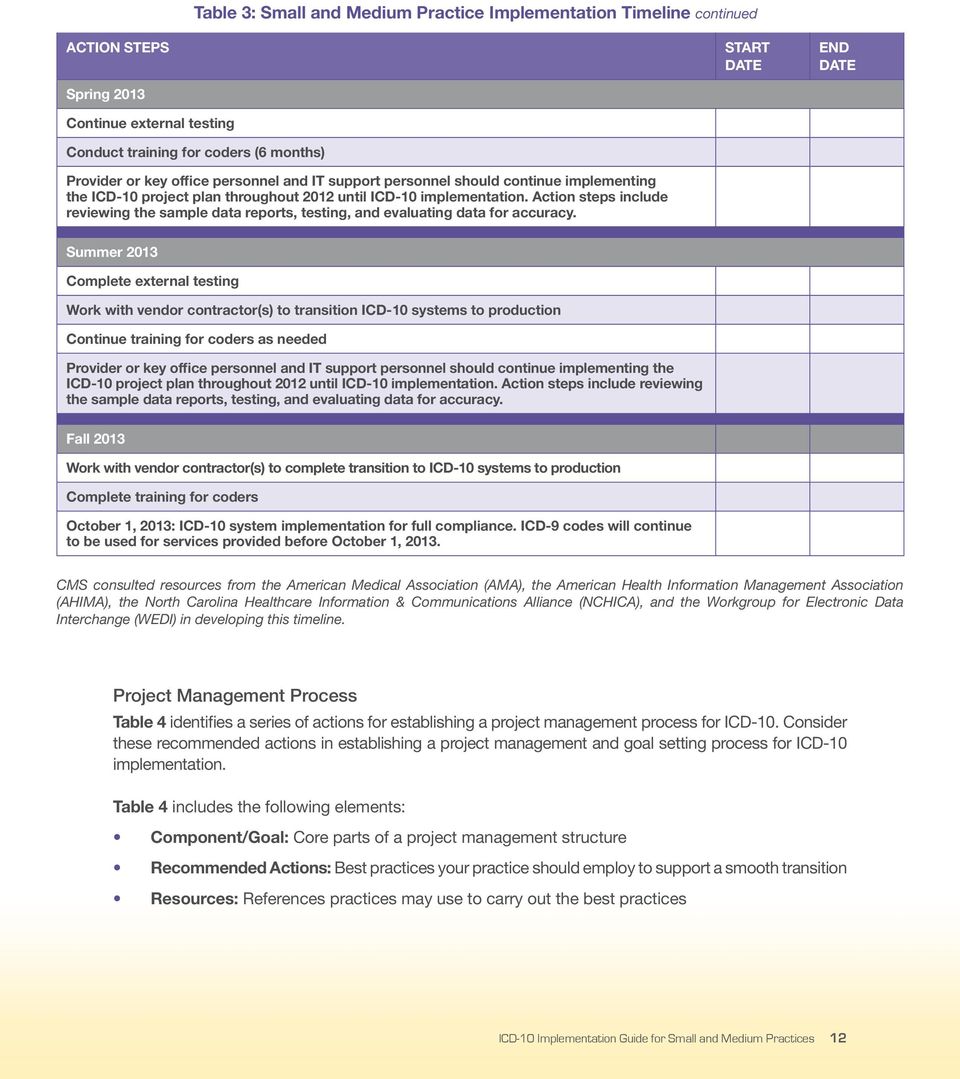
15 Spring 2013 Continue external testing Table 3: Small and Medium Practice Implementation Timeline continued ACTIoN STePS START end DATe DATe Conduct training for coders (6 months) Provider or key office personnel and IT support personnel should continue implementing the ICD-10 project plan throughout 2012 until ICD-10 implementation. Action steps include reviewing the sample data reports, testing, and evaluating data for accuracy. Summer 2013 Complete external testing Work with vendor contractor(s) to transition ICD-10 systems to production Continue training for coders as needed Provider or key office personnel and IT support personnel should continue implementing the ICD-10 project plan throughout 2012 until ICD-10 implementation. Action steps include reviewing the sample data reports, testing, and evaluating data for accuracy. Fall 2013 Work with vendor contractor(s) to complete transition to ICD-10 systems to production Complete training for coders october 1, 2013: ICD-10 system implementation for full compliance. ICD-9 codes will continue to be used for services provided before october 1, CMS consulted resources from the American Medical Association (AMA), the American Health Information Management Association (AHIMA), the North Carolina Healthcare Information & Communications Alliance (NCHICA), and the Workgroup for Electronic Data Interchange (WEDI) in developing this timeline. Project Management Process Table 4 identifies a series of actions for establishing a project management process for ICD-10. Consider these recommended actions in establishing a project management and goal setting process for ICD-10 implementation. Table 4 includes the following elements: Component/Goal: Core parts of a project management structure Recommended Actions: Best practices your practice should employ to support a smooth transition Resources: References practices may use to carry out the best practices ICD-10 Implementation Guide for Small and Medium Practices 12
16 Table 4: Project Management Recommended Actions and Resources for Small/Medium Practices CoMPoNeNT/GoAL ReCoMMeNDeD ACTIoNS ReSoURCeS Project management structure/ establish accountability across ICD-10 implementation team Assessment/Identify readiness for ICD 10 transition and determine the level of support needed Identify and appoint an ICD-10 coordination manager responsible for making business, policy, and/or technical decisions Assign responsibility for developing and executing an ICD-10 implementation plan Establish points of contact for all vendors to obtain ICD-10 update information Ensure and build clear communication channels between physicians, hospitals, payers, and government agencies (e.g., CMS) Create a Responsible, Accountable, Support, Consulted and Informed (RASCI) matrix to identify accountability and decision-making responsibilities Perform an impact assessment to identify processes and systems which require ICD code inputs, process ICD codes, or produce outputs using ICD codes. Verify with your staff where codes are used, such as manuals, superbills, practice management software, and billing software. Assess skill levels/gaps of staff for future needs and training. Identify and assess readiness of vendors, clearinghouses, and other business associates whose involvement is essential to ICD-10 implementation; identify impact of ICD-10 on trading partners/vendor relations. Review contracts and service level agreements to identify any impacts of ICD-10. Document and communicate impact assessment findings. Implementation Timeline to identify detailed ICD-10 implementation dates and milestones Responsible, Accountable, Support, Consulted, Informed (RASCI) template Business Processes Affected by ICD-10 for information identifying ICD-10 impacts for provider business processes and systems Criteria for Evaluating ICD-10 Vendors Updating and Evaluating Vendor Systems ICD-10 Implementation Guide for Small and Medium Practices 13

17 Table 4: Project Management Recommended Actions and Resources for Small/Medium Practices continued CoMPoNeNT/GoAL ReCoMMeNDeD ACTIoNS ReSoURCeS Transition plan and budget/use costbenefit analysis to inform decisionmaking Coordinate with internal and external resources (vendors and other parties) required to support ICD-10 implementation across the practice s business processes, policies, and systems Document an inventory of the tasks involved in meeting the October 1, 2013 deadline. Establish the sequence, work effort, and duration within the inventory. The tasks could involve the following: Policy, procedures, and system updates Staff training needs to support business processes, policies, and technology Vendors and external trading partners tasks essential to implementation Vendor and third-party planning and delivery monitoring Distribute the draft implementation timeline internally and externally Anticipate the potential need to refine the ICD-10 implementation timeline as internal or external factors warrant and plan to regularly communicate the status of the transition based on the timeline Determine budget for ICD-10 transition Evaluate costs and benefits associated with ICD-10 changes in your practice business process and system upgrades with your current vendors compared to potential vendor s offerings Identify available funding for ICD-10 expenses Design a budget to cover implementation and transition expenses Finalize implementation timeline/plan Criteria for Evaluating ICD-10 Vendors Updating and Evaluating Vendor Systems Testing section Transition section Appendix: Relevant Templates ICD-10 Implementation Guide for Small and Medium Practices 14

18 Table 4: Project Management Recommended Actions and Resources for Small/Medium Practices continued CoMPoNeNT/GoAL ReCoMMeNDeD ACTIoNS ReSoURCeS Communication plan/maintain and share knowledge across the practice Risk management plan/proactively identify risks both internally and externally operational implementation/manage the implementation process Educate your practice s physicians and senior business staff. Key staff must understand the following: Scope and impact of ICD-10 conversion Importance of ICD-10 readiness Firm deadline for 100 percent compliance Communicate the final ICD-10 implementation timeline Communicate accomplishments and setbacks related to ICD-10 implementation and key milestones; maintain awareness of ICD-10 implementation in your practice Identify and categorize risks that could negatively affect ICD-10 implementation Develop an ICD-10 decision-making process with clear accountability, ownership, and authority, or use your existing practice management decision-making process for this purpose Develop timely mitigation strategies to work around/address risks Provide mechanisms for staff to identify risks/issues Create a grid to track and manage both internal and external stakeholder contact information and implementation activities Compare progress to the ICD-10 implementation timeline Regularly give and receive updates on the progress of ICD-10 implementation Communications and Awareness section for methods to communicate ICD-10 awareness and planning with internal staff and external vendors and partners Business Processes Affected by ICD-10 for information identifying ICD-10 impacts for provider business processes and systems Risk and Issue section Implementation section Consider creating a Responsible, Accountable, Support, Consulted, Informed (RASCI) template ICD-10 Implementation Guide for Small and Medium Practices 15

19 Table 4: Project Management Recommended Actions and Resources for Small/Medium Practices continued CoMPoNeNT/GoAL ReCoMMeNDeD ACTIoNS ReSoURCeS Training/Develop the skills necessary to support ICD-10 implementation within your practice Testing/ensure readiness for go-live Post-implementation/Achieve 100 percent compliance Provide training to appropriate staff on the ICD-10 code sets, associated coding guidelines, and General Equivalence Mappings (GEMs) or other preferred ICD mapping tools Relay the importance of accurate coding among staff Identify knowledge and training champions to serve as points of contact for your office staff on ICD-10 Recognize staff accomplishments related to ICD-10 implementation and key milestones Consider providing incentives to staff for accomplishments related to the ICD-10 implementation Create comprehensive testing strategy Work with vendor(s) to develop test plans and test data and monitor progress Work with vendor(s) to test internally and externally (Level I and Level II testing) Resolve any outstanding problems from testing failures Transmit electronic claims and other transactions successfully using ICD-10 for claims with dates of service on or after October 1, 2013 Monitor actual versus planned progress Provide post-transition support to practice staff Monitor the impact on reimbursements, claims denials and rejections, coding accuracy and productivity, fraud and abuse detection, and investigations Resolve post-implementation issues as quickly as possible; create plan for full problem resolution as needed Training section Communication and Awareness section Testing section ICD-10 Implementation Timeline ICD-10 Implementation Guide for Small and Medium Practices 16

20 Risk and Issue Management Your practice s ICD-10 coordination manager will need to work with vendors and third parties to anticipate implementation issues and risks and develop strategies to streamline ICD-10 implementation. To do this effectively, consider creating a risk inventory for your practice that: Identifies risks by departments or key internal/external functions Identifies the chance a risk will occur, its degree of potential impact, and relevant ways to avoid risk like offering training, identifying alternate vendors, and building up cash reserves or increased lines of credit Assigns responsibility for risk reduction action, including when to involve management through channels appropriate for your practice structure Continuously monitors impact on scope, schedule, and cost Table 5 identifies a preliminary list of some fundamental risks your practice should be aware of and manage, and includes the following: Risk: Broad categorization of various specific risks Risk Description: Specific risk examples within the broad category Risk Mitigation Plan: Steps to manage and mitigate the risk Table 5: Physician Practice Risks RISk RISk DeSCRIPTIoN RISk MITIGATIoN PLAN Internal or external parties fail to remain on track for the ICD-10 schedule If you do not coordinate with payers, outside services, and others involved with your practice when planning for ICD-10, your practice may not be able to complete the necessary system changes to meet the October 1, 2013 deadline due to: Inadequate or untimely staff training Lack of vendor preparation Loss of key vendors Loss of key staff Lack of payer readiness Budget limitations Evaluate your existing vendors past performance with project deadlines to help identify and address potential problems Identify and evaluate alternative vendors, if necessary Provide training to key staff members Coordinate with payers to ensure schedules match up Create a realistic budget and include a cushion for extra costs associated with getting off schedule ICD-10 Implementation Guide for Small and Medium Practices 17

21 Table 5: Physician Practice Risks continued RISk RISk DeSCRIPTIoN RISk MITIGATIoN PLAN Adverse short-term impact on practice revenue stream exposure to suspicion or allegation of fraud and abuse The transition between coding systems might slow down your practice s revenue stream. The following may occur as a result of the ICD-10 transition: Payers may not be ready to make the transition, which can result in slowed processing and payment of claims and more denials. Payers may examine claims more carefully to identify potential duplicate billings and/or payments for service dates before and after October 1, For example, the same claim submitted once under the ICD-9 coding system and again under ICD-10. Payers may make more requests for medical records to substantiate specific claims. For more information see ICD-10 Effects on Physician Reimbursements. Private payers and government program integrity agencies and contractors may focus additional attention on possibilities for fraud and abuse related to the transition to ICD-10 codes. These organizations may examine physician coding practices more carefully following the October 1, 2013 compliance date. Coding discrepancies that affect payment amounts will result in routine overpayment recovery actions. In cases of significant financial impact, practices may experience more severe enforcement actions, such as formal investigation and referral for administrative sanctions or other penalties. Increase the practice s cash reserves and/or secure increased lines of credit. Monitor claim submittals immediately before and after October 1, 2013 to prevent duplicates. Run both ICD-9 and ICD-10 in tandem for a specified period postimplementation. Identify or conduct mappings between ICD-9 and ICD-10 codes, as applicable. Identify ICD-10-CM codes that your practice may inadvertently double bill and take steps to prevent. Emphasize to physicians and other clinicians the critical importance of proper clinical documentation, and periodically audit sample records for completeness, accuracy, and consistency with related claims. Emphasize in staff training and to external vendors the critical importance of ensuring that coding is consistent with the clinical record. Make sure staff know the risks to your practice if team members fail to code accurately. Audit claim submissions both before and after payment to identify and address incorrect coding. Identify and evaluate experienced health care fraud and abuse counsel so that you are ready to address problems if they arise. Review Health and Human Services Office of Inspector General (HHS-OIG) Voluntary Disclosure Guidelines for how to address potential problems. Monitor and perform your own internal audits in clinical areas that Medicare and Medicaid Recovery Audit Contractors are likely to target. ICD-10 Implementation Guide for Small and Medium Practices 18
22 Table 5: Physician Practice Risks continued RISk RISk DeSCRIPTIoN RISk MITIGATIoN PLAN Adverse effect on relationships with payers and patients Implications for care, disease, and case management Long-term implications for payers network contracts, fee schedules, and capitation levels Expect that staff will need to follow-up with payers more often about claim payment delays, denials, referrals, and other administrative activities that may affect claim payment during and after the transition period. Your office may experience higher call volumes to report and resolve claim/authorization rejections due to incorrect coding. ICD-10 implementation will affect care management, including case management, disease management, wellness, and authorizations (such as medical necessity and coverage determination). Historically, payers carry out these functions. However, with the advent of Accountable Care Organizations (ACOs), your practice should anticipate the need to institute these functions as well. Practice staff should become familiar with new ICD-10-related payer requirements for provider documentation and/or reporting. The far more detailed ICD-10 codes will provide payers with opportunities to develop and implement new pricing and reimbursement structures. This includes fee schedules and/or capitation levels and hospital and ancillary pricing scenarios that could take into account greater diagnosis-specificity. Train staff to manage patient concerns related to denied/pended authorizations, claims, and referrals Establish a processes for documenting and tracking patient complaints and payer issues related to ICD-10 coded claims Provide billing and coding tools to front office staff members to identify code matches and explain rationale to help them learn proper ICD-10 coding faster Train staff on how to address potential transition issues with codes, to lessen incorrect coding and rejected claims Identify and train staff on ICD- 10 requirements for clinical documentation. Coordinate with payers and hospitals as needed. Educate and train your staff on ICD- 10 related medical policies, benefit determination, and eligibility for special programs. Urge your regional and national professional associations to monitor and report on ICD-10-related reimbursement initiatives. Research, understand, and document the effect of ICD-10 coding on your practice s costs. This will give you a basis for evaluating and responding to related payer initiatives to alter pricing structures and reimbursement schedules. ICD-10 Implementation Guide for Small and Medium Practices 19
23 Communication and Awareness Phase A communication and awareness plan ensures that all your internal and external stakeholdersthat is, everyone on your staff and everyone that you do business with who is affected by the ICD-10 transitionunderstands their responsibilities for ICD-10 implementation. The communication plan should identify: Stakeholders Audiences Messages Issues Roles and responsibilities Timelines Communication methods Evaluation techniques The size of your practice will determine how much planning and documentation will be necessary. Table 6 includes the following elements: Component: References the structure of your communication plan, including content, best practices, and tools key points: Identifies considerations to evaluate and potentially reference in your communication plan ICD-10 Implementation Guide for Small and Medium Practices 20
24 Table 6: Communication Plan Components CoMPoNeNT Definition of project purpose Audience and stakeholders Project plan Timeline Identify communication vehicles Assign roles and responsibilities for communication activities key PoINTS Provide ICD-10 background information to your practice s staff and stakeholders Describe current state of ICD-10 progress within your practice Ensure practice-wide awareness of ICD-10 implementation Identify goals for the communication and awareness plan Define the messages regarding the purpose and expected outcomes of the transition to ICD-10 Identify all stakeholders and parties involved in your ICD-10 transition Internal Establish a process to communicate governance issues to leaders Assess staff training needs around ICD-10-CM External Manage and monitor progress with external audiences, including hospitals, clearinghouses, state agencies, contractors, and others Coordinate with vendors on updates and changes to be implemented into your software system prior to October 1, 2013 Identify communication channels and ways to collaborate throughout the transition Anticipate communication gaps and frequently asked questions regarding organization, operating structure, roles, and responsibilities Identify and communicate with external stakeholders on ICD-10 readiness Document your planning assumptions, decisions, and approved scope, cost, and schedule baselines Define expectations and provide important benchmarks for communicating milestones and progress Facilitate communication among stakeholders and audiences Identify your project milestones and compliance dates Identify tasks, milestones, and deadlines for your project teams Create communication channels to monitor progress, such as status reports, team meetings, and project reviews Define and schedule how and how often you will communicate Identify ways you can integrate timely ICD-10-related messages with established channels and forums Define plans that address your requirements for internal and external communications and common goals Structure communications methods that address the differing needs of your internal and external audiences Assign communication roles and responsibilities to practice leaders and those involved in the transition to ICD-10 Define roles with clear accountability and authority to make and act on decisions on communication issues Assign responsibility for identifying communications risks and solutions taking into consider your intended audience ICD-10 Implementation Guide for Small and Medium Practices 21
25 Table 6: Communication Plan Components contined CoMPoNeNT Convey the message to the audience Identify issues to overcome evaluate the effectiveness of the communication plan key PoINTS Identify opportunities to reinforce essential messages to target audiences and receive feedback Create targeted communication toward smaller groups as necessary Raise implementation issues and create plans to correct them Use different ways to evaluate your communications such as feedback forms Review lessons learned from previous programs and implementations to create optimal communications Communicate the plan s effectiveness and feedback to stakeholders Resource Management and Training (Internal and External) To prepare for ICD-10, your practice will need to identify available resources, assess training needs, build a training plan, and manage productivity during the transition process. Assess Training Needs (Internal and External) The ICD-10 coordination manager should prepare a training needs assessment to identify: Staff competence and skill gaps, and how to tailor trainings to individuals or business user groups Optimal timing to receive training/certification Affected staff members, including physicians, nurse practitioners, physician assistants, medical technicians, administrative staff/coders, and vendors Best approach training methods for your practice, including webinars, certification courses, and community courses Consider a variety of factors when conducting a training needs assessment. Using the practice selfassessment questions outlined below, your ICD-10 coordination manager may identify factors that indicate any external training needs. Table 7 includes self-assessment questions that can help identify training needs. ICD-10 Implementation Guide for Small and Medium Practices 22
26 SELF-ASSESSMENT - QUESTIONS Table 7: Training Preparation and Needs Assessment Who must receive training on the ICD-10 code set? Particularly in small and medium-sized practices, training will be required for all clinical and administrative staff. Topics include documenting patient activities, coding medical and administrative records, information technology, health plan relations and contracts. What options are available to train staff (e.g., onsite, vendor training, community courses, webinars, and certification courses)? Does your staff have a thorough knowledge of medical procedures and anatomy for coding purposes? Identify opportunities for your staff to receive certification in ICD-10 coding to minimize inaccuracy and build ICD-10 know-how throughout your practice. By what date should your staff complete any needed training? How long will it take to train your staff? Which training format(s) will work best for your staff (for example, classroom training, web-based training, or selfguided materials)? How much will the training cost? What resources will staff need after training to resolve questions as they come up (for example, manuals, system prompts, troubleshooting guides, or FAQs lists)? How will staff maintain operations during the training process? Evaluate whether there is a business need for additional experienced coding staff to support the ICD-10 transition period. Consider outsourcing additional coding expertise during the preparatory stage, which will allow for just-in-time training and reduce the burden of the transition on staff. Review current staffing levels and assess need for staff augmentation or outsourcing. Initiate a Training Plan The training plan s purpose is to ensure that your staff and external partners acquire the necessary skills and knowledge on the processes, procedures, policies, and system updates particular to your practice s ICD-10 implementation. The ICD-10 coordination manager should consider the following factors when evaluating and determining training content for internal staff and external partners for ICD-10 implementation: Different training formats work in different situations. Potential training sources include: traditional classroom training, distance education, or webinars. Your practice can also search for local ICD 10 train-the-trainer seminars or boot camps that provide sessions in a classroom-style setting. Check with CMS, the American Academy of Professional Coders (AAPC), American Health Information Management Association (AHIMA), and Workgroup for Electronic Data Interchange (WEDI) to identify webinars available for physician practices. Some webinars are free; others have fees attached. ICD-10 Implementation Guide for Small and Medium Practices 23
27 AAPC hosts an ICD-10-CM Implementation two-day boot camp for employees who are responsible for their practice s coding, health information management, and/or ICD-10 implementation (i.e., the ICD-10 coordination manager). The course provides a general overview of: ICD-10-CM structure Implementation planning, finance, and budgeting Optimization of business processes Information technology Working with vendors, crosswalking and General Equivalence Mappings (GEMs) AHIMA estimates that coding staff working outside the hospital inpatient setting will require 16 hours of ICD-10 education. This training should focus on ICD-10-CM and not ICD-10-PCS. (Hospital inpatient coding staff require an estimated 50 hours of ICD-10 education because they 3 will need to learn both ICD-10-CM and ICD-10-PCS. ) All coding staff should complete their comprehensive ICD-10 education no more than six to nine months before the compliance date to make sure the information is retained. Assess your staff for ICD-10 proficiency after training and provide additional training to address weaknesses. To do this, the ICD-10 coordination manager should identify common inaccurate code decision-making, clinical documentation errors, and productivity lags. To address proficiency issues, identify needs to assist with frequently asked questions about coding, category quick reference sheets, system user prompts, or refresher courses. Not all coding staff will require the same type or amount of ICD-10 education. Training for coding staff that work for your practice s medical specialty area or specialty clinic should focus on the code categories most applicable to the particular patient mix. Pre-implementation action steps: Plan for intensive education prior to the ICD-10 transition Appropriate staff should complete comprehensive ICD-10 education no more than six to nine months before the compliance date (October 1, 2013) Post-implementation action steps: Assess your staff s ICD-10 proficiency after they complete training and provide additional training to address identified areas of weakness. Identify common inaccurate code-review decision-making, claim processing errors, and productivity lags ICD-10 Implementation Guide for Small and Medium Practices 24
28 Table 8 identifies anticipated physician practice training needs and includes the following elements: Training Topic: Name of the subject area referenced for training Purpose of the Training: Identifies the element to evaluate when identifying ICD-10 training needs Audience: Identifies potential staff appropriate to receive training Table 8: Training Topics, Purpose, and Audience TRAINING ToPIC PURPoSe of TRAINING AUDIeNCe Basic understanding of the ICD-10 code set and implementation Clinical definitions and terms in ICD-10: ICD-10-CM and ICD-10-PCS ICD-10 coding ICD-10 effects on clinical documentation Partner and contractor Using systems updated for ICD-10 Understand the differences between ICD-9 and ICD-10 Understand rationale for ICD-10 adoption Understand existing tools, risks, and industry updates Clarify roles and responsibilities Explain ICD-10 terminology Emphasize clinical terms and meanings Review ICD-10 coding knowledge of medical procedures and anatomy including clinical specificity of the new code sets Refresh anatomy knowledge, if needed Describe how ICD-10 affects business processes Describe clinical documentation requirements as a result of ICD-10 adoption Explain roles and responsibilities in ICD-10 implementation process Review how ICD-10 affects systems Review system updates Physicians, nurse practitioners, physician assistants, clinical technicians, clinical researchers, administrative staff, coders, and vendors Physicians, nurse practitioners, physician assistants, clinical technicians, clinical research, administrative staff, coders, and vendors Coders and administrative staff Physicians, nurse practitioners, physician assistants, clinical technicians, finance, physician practice staff, compliance, administrative staff, coders, and vendors Partners and contractors IT staff, physician practice staff, and compliance ICD-10 Implementation Guide for Small and Medium Practices 25
29 Assessment Phase The sections below identify common ICD-10 impacts across physician practice business processes and systems functions. Business Processes Affected by ICD-10 The conversion to ICD-10 will affect how your practice handles many processes, from check in and scheduling to referrals and hospital admissions. The table below looks at how ICD-10 may affect your business processes. Table 9 below includes the following elements: Business Process: Structured activities or tasks comprising operations Definition: Description of the business process Next Steps to Address ICD-10 effects: Description of the ICD-10 influence on the business process and next steps in resolving for ICD-10 Table 9: Business Process Definitions and ICD-10 effects BUSINeSS PRoCeSS Referrals Authorization/ pre-certification Patient practice intake Patient clinic encounterincluding entry, clinical and exit DeFINITIoN Recommendation from a primary care physician or other physician(s) to see any practitioner or specialist Process of obtaining authorization from a managed health plan for routine inpatient hospital admission or outpatient therapy Process of registering new or existing patients with the physician practice, including scheduling, registration, and initial health history Patient practice scheduling: process of planning appointments, processing a referral Patient registration: process of receiving forms from patient Initial health history: includes a patient s previous medical visits and any patient observations provided to the physician Entry: setting up appointments, resolving insurance issues, and determining eligibility Clinical interaction: assessment and care of patient health Exit: billing, collecting co-pay or payment, and scheduling NEXT STEPS TO ADDRESS ICD-10 EFFECTS Update referral processes and forms to use ICD-10 codes Update authorization forms to indicate the proper ICD-10 codes and to allow for medical necessity review and determination of coverage Update registration forms to accommodate additional documentation of the patients health state or conditions to support accurate coding in ICD-10 Update decision support system business rules to be consistent with ICD-10 codes Update existing business policies to determine coverage (remember to consider the impact on deductibles and copays) Update business policies to determine if patient is eligible for dual insurance/ Supplemental Security Income/ Coordination of Benefits for special clinical programs like end stage renal disease and black lung disease Verify service benefits and eligibility using ICD-10 codes Update clinical documentation to support ICD-10 coding Update existing billing systems, processes, and forms to accommodate ICD-10 ICD-10 Implementation Guide for Small and Medium Practices 26
30 Table 9: Business Process Definitions and ICD-10 effects continued BUSINeSS PRoCeSS Patient hospital encounter and hospital admission scheduling Physician orders Medical record Analytics Contracting Research participation Public health reporting Risk management DeFINITIoN Setting up outpatient, surgicenter, or full stay hospital appointments, resolving insurance issues and eligibility Scheduling and planning of outpatient admission procedures, surgicenter short stay admissions, or full stay admissions Documentation of labs, tests or other medical procedures the physician orders for the patient Systematic documentation of a single patient s long-term individual medical history and care, including medical encounters, surgical history, obstetric history, medications and allergies, family history, social history, habits, immunizations, and patient/provider interactions Reports for accounting and receiving, prescription volume, categories of illness and treatment, malpractice. May either be run in house or by an outside vendor (such as a clearinghouse or data warehouse). Any agreed upon set of rules for doing business Internal research: drug company contracts to administer and report on patient responses to medication External research: practice clinicians who are part of a university or hospital-based research project Reporting diseases, infections, immunizations, or other conditions to local, state, and/or national boards of public health or delivering public health information to patients Patient safety, patient rights, and protecting health care providers against malpractice and abuse NEXT STEPS TO ADDRESS ICD-10 EFFECTS Verify service benefits and eligibility using ICD-10 codes Verify the process for communicating patient condition and intended procedures for hospital registration and scheduling Update pre-admission/pre-certification process documentation Update any coding on the physician order to capture ICD-10 specifics Update decision support system or manuals to identify the proper ICD-10 code for diagnoses and procedures on the order form based on ICD-10 codes Update physician medical records system including supporting forms, templates, interfaces and decision support system Identify process to meet ICD-10 clinical documentation requirements Expect changes in productivity levels for four to six months following ICD 10 implementation Update existing reports containing ICD codes Modify report business rules to support ICD-10 Identify which contracts and service level agreements refer to ICD-10 Identify all areas where ICD-10 may impact study inclusion criteria, study decision rules, or categorization and analysis of study outputs Update ICD codes used to report diseases and conditions as well as immunizations Update business practices to reduce the risk of exposure to allegations of coding fraud and abuse Update processes to identify patient safety issues associated with ICD-10 codes, such as under-dosing or overdosing patients ICD-10 Implementation Guide for Small and Medium Practices 27
31 Table 9: Business Process Definitions and ICD-10 effects continued BUSINeSS PRoCeSS Financial operations Value Compliance management Clearinghouse relationship management DeFINITIoN Billing service contracts, accounts payable, accounts receivable, and capitation Quality improvement based on cost of providing service Conforming to rules, specifications, policies, standards, or laws, such as accreditation, regulatory, and contractual provisions Accreditation is a process of presenting certification of competency, authority, or credibility Regulatory compliance ensures that personnel are aware of and take steps to comply with relevant laws and regulations Contractual compliance means adhering to contracts with payers and/or hospital networks in order to perform services Any entity that converts a non-standard HIPAA transaction to a HIPAA transaction or a HIPAA standard transaction to a non-standard transaction on behalf of a covered entity NEXT STEPS TO ADDRESS ICD-10 EFFECTS Update existing processes to identify and forecast reimbursement payments and investigate variances between ICD-9 and ICD-10 revenue Modify auditing process to manage and track claim payment delays or increased denials or authorizations that result from the ICD-10 transition Identify ICD updates to further refine and support pay-for-performance models Identify impacts to case rates, capitation and risk-based payment models as a result of ICD-10 codes and Affordable Care Act implementation Update logic for quality reporting under ICD-10 and evaluate the impact of the transition from ICD-9 to ICD-10 on performance trending Identify actions aimed at improving the quality measures or obtaining scores in line with or above industry standards, including ACOs, evidence-based measurement reporting, pay-forperformance Investigate ICD-10 impacts within contractual reporting requirements Evaluate business rules supporting case coverage, case rates, and capitation based on ICD-10-CM Update business rules using ICD 10/Current Procedural Terminology (CPT) codes, including correct coding initiatives Update HIPAA transactions affected: 270/271 Healthcare Eligibility Inquiry and Response, 278 Healthcare Services Review, 834 Benefit Enrollment Transaction, 837 Professional Claim, Institutional Claim and Dental claim Look for opportunities for clearinghouses to provide translation/ crosswalk accountability: store original ICD-9 code submitted; maintain crosswalk ICD-9 to ICD-10 and ICD-10 to ICD-9; and specific edits related to ICD-10-CM and HCPC, CPT, modifier code services ICD-10 Implementation Guide for Small and Medium Practices 28
32 Table 9: Business Process Definitions and ICD-10 effects continued BUSINeSS PRoCeSS Payer relationship management DeFINITIoN Entities that finance or reimburse the cost of health services. In most cases, this term refers to insurance carriers, other third-party payers, or health plan sponsors, like employers or unions that process claims as self-insured entities. NEXT STEPS TO ADDRESS ICD-10 EFFECTS Contracts/reimbursement models: Modify pricing and reimbursement structures, fee schedules, and hospital and ancillary reimbursement/pricing scenarios to take into account greater diagnosis-specificity Care management functions: Update business rules using ICD-10 codes for case management, disease management, and medical review (pre-authorization, concurrent review, and post-payment review) Documentation to support billing: See ICD-10 Effects on Clinical Documentation Billing manuals/rate structures/fee schedules/diagnosis Related Group (DRG) structures: Review ICD-10 changes Quality measures: Modify state and payer performance reporting on quality, services, and consumer scoring for practices that references ICD codes Fraud and abuse: Modify edits to support correct coding with greater sensitivity and specificity to help prevent fraud and abuse Credentialing: Talk with vendor to determine if ICD-9 codes are referenced in current vendor-supported credentialing software ICD-10 Effects on Clinical Documentation The ICD-10 implementation will affect clinical documentation your practice provides to payer organizations. ICD-10 coding provides an accurate representation of health care services through complete and precise reporting of diagnoses and procedures, and ICD-10 will also yield more thorough data for clinical decision-making, performance reporting, managed care contracting, and financial analysis. Increased code detail contained in ICD-10-CM means that required documentation will change substantially. ICD-10-CM includes a more robust definition of severity, comorbidities, complications, sequelae, manifestations, causes, and a variety of other important parameters that characterize the patient s condition. A large number of ICD-10-CM codes only differ in one parameter. For example, nearly 25 percent of the ICD-10-CM codes are the same except for indicating the right side of the patient s body versus the left. Another 25 percent of the codes differ only in the way they distinguish among initial encounter, versus subsequent encounter, versus sequelae. ICD-10 Implementation Guide for Small and Medium Practices 29
33 For example, even though there are more than 1,800 available codes for coding fractures of the radius, there are only approximately 50 distinct recurring concepts. Table 10 shows the type of documentation the ICD-10-CM will require for a fracture of the radius. Table 10 below includes the following elements: Category: The category for the medical concepts that will need documentation Documentation Requirements: The list of individual concepts that should be considered in documentation to support accurate coding of the patient conditions Table 10: Sample Documentation Requirements for Fractures of the Radius CATeGoRy Fracture Type healing Localization encounter Displacement DoCUMeNTATIoN ReQUIReMeNTS Open Closed Pathologic Physeal (Growth Plate) Fractures Neoplastic Disease Torus (Buckle) Fractures Green Stick Fractures Stress Fractures Orthopedic Implant (fractures associated with) Bent Bone Routine Delayed Nonunion Malunion Shaft Lower End Upper End Head Neck Styloid Process Initial Subsequent Sequelae Displaced Nondisplaced ICD-10 Implementation Guide for Small and Medium Practices 30
34 Table 10: Sample Documentation Requirements for Fractures of the Radius continued CATeGoRy Classification Laterality Joint Involvement Fracture Pattern Named Fractures DoCUMeNTATIoN ReQUIReMeNTS Salter Harris I Salter Harris II Salter Harris III Salter Harris IV Gustilo Type I or II Gustilo Type IIIA, IIIB, or IIIC Right Left Unspecified Side Unilateral Bilateral Intra-articular Extra-articular Transverse Oblique Spiral Comminuted (many pieces) Segmental Colles Galleazzi s Barton s Smith s ICD-10 Effects on Physician Reimbursements The transition to ICD-10 will result in changes to physician reimbursements. The nature of these changes will vary based on each practice s individual contracting arrangements. Physicians should include ICD-10 in their payer contract negotiation discussions during the next two years to decrease the risk of compliance errors and claims denials. During the transition period following ICD-10 implementation, payers will continue prior reimbursement policies. However as the implications of the expanded, more detailed code sets become apparent, payers may also institute policies that involve greater payment for more complex cases and lower payment for less complex cases. Consider getting a line of credit to cover cash flow disruptions due to changing reimbursement models, delays in claims processing and re-processing, staff learning curve and long-term effects of the ICD-10 transition. Table 11 identifies potential impacts to physician reimbursement that should be considered depending on existing contracting and reimbursement models and the potential for future reimbursement changes under accountable care and value based purchasing. ICD-10 Implementation Guide for Small and Medium Practices 31
35 Table 11: ICD-10 effects on Physician Reimbursements CoMMoN ReIMBURSeMeNT ARRANGeMeNTS Fee-for-service payments ICD-10 IMPLeMeNTATIoN PoTeNTIAL IMPACTS Traditional CPT-and HCPC-based reimbursements will not be directly affected since these codes are not part of the ICD-10 change. Indirectly, fee-for-service payments may potentially be affected for the following reasons: Increased denials because of incomplete or inaccurate translation of existing policies, benefit, and payment rules in payer systems as they attempt to migrate these rules to ICD-10 Delays in payments because of challenges in claim processing in the ICD-10 environment Capitation, case rates and other risk-based models Audit-based reimbursement recovery evolving models such as episode- and performancebased reimbursement and accountable care For those physician practices with some level of reimbursement in capitated or case-based payments, there will be substantial impacts since the reimbursement funds will be defined differently in ICD-10. Reimbursements and risk adjustment models will be different and untested. ICD-10 will provide a better insight into risk and severity over time, if the provider is able to capture accurate ICD-10 data. New clinical documentation requirements will increase the risk of audit failure if documentation cannot support the new ICD-10 detail. If audits reveal that payments were tied to inappropriate services based on ICD-10 s new definitions and rules, payers may require recovery of payments from providers. The effect of ICD-10 on evolving reimbursement models, such as episode- and performancebased and accountable care organization models is still unclear. Since there is no historical data or benchmarks yet for ICD-10, there is little basis for making episode-based or performance baselines for cost projections. Practices should keep in mind: Changes in logic of existing episode grouper software will be complex and early adoption may result in unanticipated results The lack of coding familiarity in ICD-10 and the changes in coding definitions may affect coding quality during the first year or more of transition Changes in the meaning of key concepts within codes could result in significant variance in the values for key quality metrics With accountable care models, there will be increased demand for visibility and demonstrated service value and efficiency. This will result in models that consider: The complexity and risk of service delivery based on severity and other key parameters of the conditions for which services are being delivered. This could result in service-based payments being adjusted either positively or negatively based on the complexity and risk assessment. Complications, never events, preventable admissions, hospital-acquired conditions, patient safety and other potentially avoidable detrimental patient impacts. Outcomes as a consideration in the payment model based on a precise definition of the patient s condition and the institutional procedures to maintain or improve those conditions ICD-10 Implementation Guide for Small and Medium Practices 32
36 Criteria for Evaluating ICD-10 Vendors Any outside vendor your practice uses plays an important role in a smooth transition to ICD-10. Practices depend on vendors to upgrade their systems, modify their existing programs, or provide support during the ICD-10 transition. Take time to evaluate upfront the impact of ICD-10 on your vendors, their performance capabilities, and their plans to update systems for ICD-10. Table 12 highlights criteria and the associated key considerations that a physician practice should consider when evaluating vendors. Table 12: evaluation Criteria and key Considerations evaluation CRITeRIA Identify vendors and their purpose Processing performance evaluating budgetary considerations Monitoring and oversight key CoNSIDeRATIoNS Identify the need for any new contract(s) Determine which existing vendor(s) will be affected by the ICD-10 transition Define vendor(s) requirements to support implementation of ICD-10 (will vary by vendor) Determine vendor dependencies in the organization s critical business paths Determine how vendor(s) will be involved in the ICD-10 implementation project Establish a vendor communication plan Confirm vendors understand business requirements and an accountable delivery plan Conduct vendor product(s) gap analysis Evaluate pros and cons of vendor(s) system alternatives Receive compliance commitment from vendor(s) in line with defined requirements and project plan milestones Review vendor evaluation to assure alignment with defined requirements Determine options for retiring system(s) and the impact on ICD-10 implementation for systems Develop test scenarios to test key vulnerabilities such as volume capacity and other performance parameters Create test data Create criteria for determining how your practice will evaluate if you will build or buy a system establish a strategic build plan that includes interim versus long-term solutions Determine additional cost pass-throughs resulting from ICD-10 updates Determine the vendor s compliance plan in order to incorporate that perspective into your organization s RFP requirements, amendments, and monitoring Create and execute a plan to monitor whether vendor products are meeting key functions: Identify measures of risk for vendor in meeting key functions Create key performance indicators to measure success Include provisions to handle situations in which vendors do not meet key performance requirements ICD-10 Implementation Guide for Small and Medium Practices 33
37 Methodology to Evaluate ICD-10 Vendors and/or Tools You will need to maintain relationships with both existing and new vendors to ensure that they meet the functional needs outlined below. Follow these steps when selecting new vendors as well as evaluating existing vendor capabilities in light of the ICD-10 transition: 1. Create an inventory of existing vendors, tools, and possible vendor candidates. The inventory should include the following components: Unique identifier for the vendor Vendor corporate name Vendor product names Description of the products offered Type of products offered, including coding applications, search engine, and crosswalking tools Products underlying logic, including GEMs and terminology engines List of customers for each product Vendor contact information 2. establish a tracking system to ensure that you address and monitor key questions, concerns, and that the vendor meets project timelines. 3. Identify Plan B options in case your vendor does not progress fast enough, including operational work arounds and vendor replacement alternatives. 4. Review contracts to clarify existing vendor contractual requirements, and factor key requirements into contracts with new vendors. 5. Analyze interfaces or dependencies between systems to avoid failures from cross-system dependencies. 6. Define acceptance criteria to measure vendor performance. These may include the following: Features matched to your business needs (this assumes a process to prioritize these features to meet the organization s specific functional priorities) Appropriate customer lists and references Comparable industry experience Vendor financial and longevity stability System architecture that supports integration with other systems and provides easy access Alignment of workflow interfaces with organizational workflow Expected results of testing against defined business and data test scenarios Acceptable ongoing support commitments ICD-10 Implementation Guide for Small and Medium Practices 34
38 7. ensure that vendor capabilities meet your organization s expectations. Your contracting processes should consider: Functions of all required features System performance requirements Concurrent users Throughput Processing time Reporting time Upgrade policies (number of versions supported or latest version supported, along with number of upgrades per year) Error remediation and new feature response requirements Support requirements Degree of support Expected response time. Clear and acceptable licensing agreements Favored Nation status Business associate and data use agreements Coverage for federal mandate changes Updates for standards version changes Remedies in the event of failure Remediation requirements Penalties Disaster recovery requirements Data and concept ownership Assessing Vendor Functional Capabilities After you have assessed the functional needs of your practice, it is important to match those needs with vendor capabilities. The list below identifies key functions to consider when evaluating vendors as well as key questions for vendors in the evaluation process. Code set maintenance: Notification of updates, data files maintain valid begin and end dates and change maintenance, and value add fields Ability to search for codes Robust term-based search: The ability to search for codes based on terms defined within the code description. Includes the ability to search for multiple terms, partial strings with wild card and nested and, or, and not logic. ICD-10 Implementation Guide for Small and Medium Practices 35
39 Code-based search: This includes the ability to search by multiple code ranges as well as multiple individual codes. It should also support partial code searches or searches for characters in different positions. For example, the ability to search for codes with the first three characters = nnn and the 7th character = n. Tabular-based search: The ability to search for codes based on the published tabular index. Alphabetical index search: The ability to search for codes based on the published alphabetical index. Concept-based search (evolving vendor capability): The ability to search based on clinical concepts, for example, the concepts of fracture, distal, and radius and identify codes for Colles, Smith s, and Barton s fractures since these are fractures of the distal radius. This search ability requires considerable sophistication in the underlying data engine. Current vendor ability to support this level of concept searching appears limited. Code Crosswalking Crosswalks provide important information that help link codes of one system (ICD-9) with another (ICD-10). Vendor systems should have features to develop, maintain, and document crosswalk specification development, including the following: Workflow: The ability to support the workflow involved with defining the crosswalk, approval, output, maintenance, and governance. The workflow should support the selection of one or more codes in the crosswalk from any search method or from candidate codes from either GEM or reimbursement maps. A robust search engine: The ability to effectively search for a code based on a robust set of search criteria. A level of search engine sophistication is needed to provide support to independent research of crosswalk candidates. Reimbursement map support: The ability to demonstrate mapping as defined from ICD 10 to ICD-9 in the reimbursement files. This will provide a comparison in ICD-10 to ICD-9 mapping to those crosswalks reported to maintain revenue neutrality. GeM support: The ability to identify GEM-based matches in both directions. This should include the ability to identify codes where ICD-9 or ICD-10 codes are either the source or target of the crosswalk, or both. Crosswalking quality (ideal vendor capability): The ability to provide measures of the quality of the match based on concepts that are lost or assumed in the match. Currently there do not appear to be any vendors that can rate the quality of the match in definitive terms. Crosswalking financial modeling (evolving vendor capability): The ability to test the financial implications of the crosswalked code on payment as well as the volume and extent of claim impacted by the crosswalk. ICD-10 Implementation Guide for Small and Medium Practices 36
40 Definition of code set aggregation or grouping Most policies, rules, and analytics are based on groups or categories of codes. These groups of codes are critical to drive business intelligence and business decision algorithms for many health care information systems. Features necessary to support this effort of redefining code based policies, rules, and categories include the following: Code set aggregation database system: The ability to support an unlimited number of aggregation schemes and ad hoc aggregation sets for selected purposes. The database must support appropriate metadata for each aggregation set and scheme. In other words, once you create and define groups of codes, there must be a way to manage and retrieve those groups for any number of purposes. The metadata needed to accomplish this include: A name for the aggregation or set of codes A definition of the intent of the code set A unique identifier for the code set Data about versioning, modification, access, and approval Other metadata as needed that will help manage create, read, update, and delete function for the code set files Workflow: Workflow capabilities should include research and identification of the appropriate grouping of codes, an approval process and maintenance interface, and the ability to name, date, and apply other metadata to the set of codes for use in downstream analysis and algorithms. Some basic workflow steps might include: Definition of the purpose and intended uses of the code set Searching for the appropriate codes to include or exclude in the data set by terms, concepts, tabular listings, index listings, code value searches, or any number of other parameters Naming and cataloging the code set for use in rules, policies, and analytic categories Creating the link between these defined codes and rules, policies, and categories Retrieval and modification of existing code sets Approval processes Analytics: Analytics that use ICD procedure and/or diagnosis codes will change dramatically under ICD-10. Any software vendors that provide business intelligence solutions should support ICD-9 and ICD-10 codes simultaneously during the transition. Additionally, business intelligence schemas should support n number of ICD codes per record with a definition of code type (ICD-9 or ICD-10). Any defined reporting models such as quality (HEDIS), efficiency (episode groupers), population risk models, or other aggregation schemes should be fully remediated to support native ICD-10 as well as native ICD-9 codes. Considerable research will be required to ensure that defined categorization models are appropriate for both the ICD-9 and ICD-10 environments. There should be a clear definition of the plan for fully using ICD-10 analytic capabilities in future releases. ICD-10 Implementation Guide for Small and Medium Practices 37
41 Database structural requirements: Will the database support the increased number of codes supported in the 5010 claims transition? Will the database support both ICD-9 and ICD-10 codes simultaneously? Does the database include a Code Type field that can distinguish between ICD-9 and ICD-10 codes? How will code set updates be managed? (An initial code freeze will be effective until October 1, 2014, but updates will occur after this date.) User interfaces: Have captions and field validations been updated to support ICD-10? Have user interface data sources for ICD-9 and ICD-10 been updated? Are there prompts and edits for date of service-based validation of ICD-9 and ICD-10 codes? Will user interfaces support lookup and entry of both ICD-9 and ICD-10 codes? How will user interfaces support the new documentation required for ICD-10 coding? Inbound and outbound transactions: Has the vendor updated system support for outbound claims and other outbound transactions consistent with 5010 and ICD-10 standards, including date of servicebased validation? What is the vendor s plan for transaction testing across payers and other trading partners? Internal system interfaces: Have interfaces between systems been updated to support ICD-10? Clinical decision support (CDS) and business rules: If clinical decision support systems are in place, what is the plan to update CDS logic? Which other rules and edits are driven by ICD-9 and what is the plan for remediating those rules? Measures and reporting: Which reports are affected by ICD-10 and what are the plans for updating reporting logic code-related categories? If clinical reporting systems are used, how will vendors update these systems? How will vendors update logic for quality and efficiency measures? How will vendors handle reporting on historical data over the transition period? ICD-10 Implementation Guide for Small and Medium Practices 38
42 other key questions for your vendor: Beyond assessing functional capabilities, there are some additional questions to ask your vendor: Patient assessment Documentation (encounter forms, any medical record templates in use) Patient communications (appointments, reminders, in office brochures) Clinical decision processes Referrals Authorizations Will there be a charge for ICD-10-related updates? Will training be provided for new ICD-10-related functionality? How can issues be logged and how will they be addressed? How often will code set updates occur and how will they be delivered? Will you continue to support applications or are you discontinuing some products in the wake of the ICD-10 transition? What is your roadmap for helping us extract the increased information capabilities of ICD-10? Scenario-Based Vendor Assessment Simply asking your vendors about implementation planning and execution is not enough to prevent system failures during the ICD-10 transition. As a practice, you need to develop clinical test scenarios to see how the system will work and to ensure that you get the results you need for your quality-ofcare and business efficiency standards. Steps in developing scenarios for vendor assessment: 1. Review existing practice data to identify high-volume and high-revenue clinical areas. For example, if your practice sees a high volume of patients with renal conditions, look at the typical procedures and activities associated with those patients. 2. Review the relevant codes in these common clinical areas to identify significant changes between ICD-9 and ICD-10 that could result in issues with coding or translation. 3. Create fictitious patient encounters in these areas. Include sufficient documentation to code and create claims for these encounters. 4. Based on these defined scenarios, walk through all typical system operations, including: Diagnostic and treatment orders (templates of frequently used codes) Internal and external scheduling ICD-10 Implementation Guide for Small and Medium Practices 39
43 Eligibility Data sharing Billing/Claims (list of frequently used ICD-9 codes converted to ICD-10 codes) Payment Reconciliation Analysis Quality measures (tracking errors and claims denials for inaccurate codes) Other important functions of your practice s operations 5. Identify all of the areas where the transition from ICD-9 to ICD-10 has implications and the document requirements for successful transition. 6. Run these scenarios using documentation, codes, claims, and other artifacts to test each of your vendors abilities to support your practice. Implementation Phase Once you have completed the assessment of your practice s ICD-10 transition needs and you have planned for the tasks required to complete this transition, the next step is to determine what changes you need to make to your operations and systems in order to limit business risks and take advantage of opportunities. Most physician practices depend on their vendors to provide support for the ICD-10 transition. However, you should not assume that your vendors would address the effects of the ICD-10 implementation on key functional areas, including: Patient registration Clinical documentation/health records Referrals and authorization Coding Order entry Billing Reporting and analysis Other diagnosis-related functions, depending on the nature of the practice You must verify that the vendors you depend on are prepared to meet your critical ICD-10 transition needs. ICD-10 Implementation Guide for Small and Medium Practices 40
44 Operational Implementation Activities The operational implementation strategy developed earlier during the assessment phase should guide the ICD-10 implementation in your practice, including the methodology for mapping ICD-9 codes to ICD-10 codes and the reverse. The operational implementation phase of the ICD-10 transition process includes the following key activities: Determine if/how your practice will work with vendors for implementation Coordinate with vendor the update of the internal policies affected by ICD-10 Coordinate with vendor the update of internal processes affected by ICD-10, including clinical, financial, actuarial, and reporting functions Finalize system/technical requirements Identify test data requirements as outlined in the Scenario Based Vendor Assessment section Update approved code design to remediate system changes and updates Coordinate update of code with vendor to remediate system changes/updates Coordinate and conduct testing with partners based on updated system logic Resources Available to Ease ICD-10 Transition Table 13 identifies some of the industry tools available to the provider community and contains the following elements: Resource: The entity providing the tool (e.g., AHIMA, WEDI) Services(s) Provided: The services the tool or vendor provides Stakeholders: Identifies stakeholders within the health care community that can benefit from utilizing the tool Please note that the list is not exhaustive nor does it indicate a partnership between CMS and any particular vendor. ICD-10 Implementation Guide for Small and Medium Practices 41
45 Table 13: Tools for the ICD-10 Transition ReSoURCe SeRVICe(S) PRoVIDeD STAkehoLDeRS healthcare Information & Management Systems Society (himss) ICD-10 Cost Prediction Modeling Tool himss ICD-10 Playbook American Medical Association (AMA) educational Resources American Academy of Professional Coders (AAPC) ICD-10 Code Translator Workgroup for electronic Data Interchange (WeDI) Vendor Resource Directory and other resources Assists users in predicting the financial impact of the ICD-10 transition. Developed in Excel. Helps users understand the impact of ICD-10 in four key areas: coding, revenue cycle, project management, and information technology. Provides a rich, well-structured index to a variety of white papers and other resources from a variety of organizations A series of resources/artifacts to help physicians implement ICD-10-CM into their practices: ICD-10 Fact Sheets ICD-10 Project Plan Template ICD-10 Checklist Provides links to other associations and specific resources tailored to physicians needs Compares ICD-9 to ICD-10 codes (Note: This tool only converts ICD-10-CM codes, not ICD-10-PCS) Provides an assortment of white papers related to ICD-10 Listservs and conference calls on various subject areas allow collaboration among different parts of the industry Health care providers and payer organizations All stakeholders Physician practices, payer organizations Medical coders All stakeholders General Equivalence Mappings (GEMs) General Equivalence Mappings (GEMs) attempt to include all valid relationships between the codes in the ICD-9-CM diagnosis classification and the ICD-10-CM diagnosis classification. The tool allows coders to look up an ICD-9 code and be provided with the most appropriate ICD-10 matches and vice versa. But GEMs are not a crosswalk ; they are merely meant to be a guide. Users should exercise clinical judgment when choosing the appropriate code or codes to map between ICD-9 and ICD-10 in either direction. The GEMs are a very useful tool, but they are not a substitute for a complete system change over to ICD-10. For most physician practices, GEMs will be of limited use and may not be appropriate since coding should occur directly to ICD-10 based on actual clinical documentation, rather than a mapping from existing ICD-9 codes. In some instances, GEMs can be helpful in validating your coding practices to help identify some codes in ICD-10 relative to existing ICD-9 for the purpose of training and validation. The ICD-10 codes will be increasing from approximately 15,000 ICD-9 codes to 150,000 ICD-10 codes, although coders will not need to know every code. GEMs can be compared to a phone book coders will not use every number, but it is nice to know they are all there. Visit the CMS website at for more information on GEMs. ICD-10 Implementation Guide for Small and Medium Practices 42
46 Testing Phase Testingthe process of proving that a system or process meets requirements and produces consistent and correct resultsis critical to successful implementation of ICD-10. Testing will ensure ICD-10 compliance across internal policies, processes, and systems, as well as external trading partners and vendors. After making ICD-10 changes to systems, your practice will need to complete several types of tests. First, you may decide to complete individual component unit testing, system testing, and performance testing. Many of these tests will be similar to ones performed for other IT changes. Second, you will need to complete specific ICD-10 end-to-end testing as described in the ICD-10 Final Rule. Table 14 provides a description of each type of testing and considerations for ICD-10. Table 14: ICD-10 Testing Types TeSTING TyPe DeSCRIPTIoN key ICD-10 CoNSIDeRATIoNS Unit testing/basic component testing System testing Regression testing Confirms that updates meet the requirements of each individual component in a system. Providers will first need to test each component updated for ICD-10. Verifies that an integrated system meets requirements for the ICD-10 transition. After completing unit testing, providers will need to integrate related components and ensure that ICD-10 functionality produces the desired results. Focuses on identifying potential unintended consequences of ICD-10 changes. Test modified system components to ensure that ICD-10 changes do not cause faults in other system functionality. Unit testing should verify that: Expanded data structures can store the longer ICD-10 codes and their qualifiers Edits and business rules based on ICD-9 CM codes work correctly with ICD-10 Since reports frequently use diagnosis and procedure codes, testing report updates are critical. Critical report elements to evaluate include: Input filters: Do all filters produce the anticipated outcome? Categorization: Do categories represent the user s intent as defined by aggregations of codes? Calculations: Do all calculations balance and result in the anticipated values considering the filter applied and the definition of categories? Consistency: Do similar concepts across reports or analytic models remain consistent given a new definition of code aggregations? Plan to test ICD-based business rules and edits that are shared between multiple system components Identify, update, and test all system interfaces that include ICD codes The complexity of ICD-9-CM to ICD-10 code translation may result in unintended consequences to business processes. Identify these unintended consequences through varied testing scenarios that anticipate risk areas. ICD-10 Implementation Guide for Small and Medium Practices 43
47 Table 14: ICD-10 Testing Types continued TeSTING TyPe DeSCRIPTIoN key ICD-10 CoNSIDeRATIoNS Nonfunctional testing performance Nonfunctional testing privacy/ security Internal testing (Level I) external testing (Level II) Performance testing includes an evaluation 4 of nonfunctional requirements such as transaction throughput, system capacity, processing rate, and similar requirements. Federal and state legislation defines specific requirements for data handling related to conditions associated with mental illness, 5 substance abuse, and other privacy-sensitive conditions. To identify these sensitive data components or conditions, payers often use ICD-9-CM codes. The ICD-10 Final Rule requires Level I compliance testing. Level I compliance indicates that entities covered by HIPAA can create and receive compliant transactions. The ICD-10 Final Rule requires Level II compliance testing. Level II compliance indicates that a covered entity has completed comprehensive testing with each of its external trading partners and is prepared to move into production mode with the new versions of the standards by the end of that period. A number of changes related to ICD-10 may result in significant impact on system performance, including increased: Number of available diagnosis and procedure codes Number of codes submitted per claim Complexity of rules logic Volume of re-submission due to rejected claims, at least initially Storage capacity requirements Update the definition of these sensitive components or conditions based on ICD 10-CM Transactions should maintain the integrity of content as they move through systems and processes Transformations, translations, or other changes in data can be tracked and audited Establish trading partners testing portals Define and communicate transaction specification changes Determine the need for inbound and outbound transaction training Determine the need for a certification process for inbound transactions Determine the process for rejections and resubmissions related to invalid codes at the transaction level Determine if parallel testing systems need to be created to test external transactions ICD-10 Implementation Guide for Small and Medium Practices 44
48 Test Plan Implications A test plan documents the tests your practice (and your vendors) will perform to verify that your business processes and systems will meet ICD-10 requirements. The test plan should do the following: Identify acceptance criteria based on business and system functional requirements that were defined during the analysis/design phase Determine the business sponsor responsible for approving the scope of test plans Test Case Implications Define test cases to ensure that the system updates meet your business requirements and that the system components function efficiently. Test case design should include both anticipated and unexpected outcomes. Test cases should also include high-risk scenarios. Test Data Implications Test data ensures that several key system functions are producing data as expected and include data to: Validate (data validation) Trigger errors Test high risk scenarios Test volume Test all types of domains and categories Simulate a standard environmental model over time Test comparisons, ranking, trending variation, and other key analytic models Error Testing All testing will result in errors. Correcting the errors before the go-live date is the objective of the testing phase. Practices should include the following in their error-testing plan: Multiple testing layers to support various iterations of re-testing in parallel tracks Effective detection and repair of blocking errors that limit testing activities An error-tracking system with standard alerts to report to stakeholders Prioritization model for error remediation designed to focus on business-critical requirements Set of acceptance criteria Model for reporting known issues Developing a schedule for fixing known issues in the future ICD-10 Implementation Guide for Small and Medium Practices 45
49 Internal Testing Your practice should work directly with your vendor(s) to monitor the testing process for your systems. When creating testing scenarios (see previous section), consider all the usual testing requirements for any internal system undergoing significant architectural and system logic changes and focus on testing key business risks. The following represent key considerations for internal testing evaluate each technical area individually as well as integration testing across components including: Database architecture User interfaces Algorithms based on diagnosis or institutional procedure codes Code aggregation (grouping) models Key metrics related to diagnosis or institutional procedure codes All reporting logic based on diagnosis or institutional procedure codes It is also important to: Coordinate with your vendors as necessary to support testing execution and issue resolution. Identify testing workflows and scenarios for your practice that apply use cases, test cases, test reports, and test data. Identify when your practice will be able to run test claims using ICD-10. Develop a project plan that recognizes dependencies on tasks and resources. The plan should prioritize and sequence efforts to support critical paths. External Testing Your practice should create an inventory of external entities with whom you exchange data and the testing you will need to coordinate with each to ensure timely, accurate ICD-10 implementation. Examples of external testing areas include: Payers: Payers are critical to the financial viability of your practice. Denials or payment delays may result in a substantial decline in revenues or cash flow. Payers may struggle with the ICD-10 transition due to the significant system changes needed to support policies, benefit/coverage rules, risk analysis, operations, and other critical business functions impacted by this change. Payer testing should identify and resolve any issues prior to go-live. Determine if the payer has educational programs and collaboration efforts to support providers through the transition Use the high-dollar, high-volume, high-risk scenarios that your practice has created to produce test claims Work with payers to develop test scenarios to conduct end-to-end testing, specifically identifying payment results Communicate coding practices and scenarios to payers to build better relationships throughout the testing and transition process ICD-10 Implementation Guide for Small and Medium Practices 46
50 Identify communication processes to identify and correct issues early with payers hospitals: Test information exchanges with hospitals to ensure appropriate handling. health information exchanges: Test all information exchanges for critical operations to meet inoperability standards. outsourced billing or coding: Test outsourced coding and billing operations with defined clinical scenarios to make sure these business operations continue as expected. Government entities: Local and national government entities may require reporting for a variety of purposes including: Public health reporting Quality and other metric reporting related to meaningful use Medicare and Medicaid reporting and data exchange Other mandated or contractually required exchange of information around services and patient conditions Transition Phase During the transition period, monitor the impact of ICD-10 on your business operations and revenue. Practices should be prepared to take corrective action. Table 15 includes the following elements: operational Impacts: ICD-10 business impact or consideration Description and Strategy: Explanation of the impact and opportunities to monitor and alleviate the impact Table 15: operational Impacts and Strategies for Monitoring operational IMPACTS Problems with authorization and referrals; claim delays or denials DeSCRIPTIoN AND STRATeGy Triggers and rules for evaluating prior authorizations and referrals are based on ICD-9 procedure and diagnosis codes. After the ICD-10 implementation, expect changes in payers prior authorizations/referrals trigger or approvals as they refine medical policies. Physicians may also see a significant increase in denials as a result of coding challenges the ICD-10 transition will present to physician offices. These denials may result from changes in payer remediation of medical policies. They may also occur after the transition due to refinements in processing rules based on the increased data ICD-10-CM codes provide. If payers rely on crosswalks to convert submitted ICD-10 codes to ICD-9 codes, there might be unintended consequences in processing those claims. Your practice may be denied service payments or approval due to policy or rule misinterpretation because of code translation errors. To alleviate this risk, your practice must coordinate and communicate with payers to understand their implementation strategies and identify workarounds for clinical scenarios. ICD-10 Implementation Guide for Small and Medium Practices 47
51 Table 15: operational Impacts and Strategies for Monitoring continued operational IMPACTS Auditing, fraud and abuse Pay-for-performance Case rates, capitation, and other payment methods Accountable care organization (ACo) model Value measurements DeSCRIPTIoN AND STRATeGy Audits of all types are increasing in depth and breadth, including Recovery Audit Contractors (RAC), Hierarchical Condition Categories (HCC), fraud, abuse, and others. After the transition to ICD-10, the specificity and detailed information levels will result in greater documentation scrutiny. To address these concerns, your practice should perform regular audits on clinical documentation during the post-implementation stabilization period. Value-based purchasing and overall trends in quality measurement and performance-based payment have considerable impact on the delivery system, and are expected to be an even bigger factor on payment in the future. Changes in the definition of these measures (specifically ICD-10-CM related measures) will significantly affect both quality measurement results and target benchmarks. Physicians will need to communicate directly with payers and clearinghouses to understand and identify trends in their clinical behavior because of ICD-10 implementation. This may also help reduce the consequences of failing to achieve performance-based payment goals. Physicians participation in case rates, case mix adjustment, risk-adjusted or condition-related capitation, and other payment models may affect payment associated with the ICD-10 migration. Currently, there is little information to predict the extent of these impacts and whether they will be positive or negative. Nevertheless, physician practices will need to work with payers and clearinghouses directly to identify trends during the ICD-10 transition. Accountable care requires disciplined spending management to ensure that payment is for the correct service for the correct conditions. ICD-10 will play a critical role in aligning the definitions of service and conditions because of the added detail of the ICD-10 codes. ICD-10 is critically important to the success of accountable care for a number of reasons: ICD-10 codes are a mandated standard across the health care industry for reporting patient conditions and institutional procedures. The increased detail of ICD-10 codes will lead to the ability to identify and accurately predict risk, based on severity, comorbidities, complications, sequelae, and other parameters. ICD-10-CM will provide better analysis of disease patterns and the burden on public health. ICD-10-CM will increase the ability to assign resources based on more detailed utilization analysis. In an effort to prepare for ICD-10 implementation and report on accountable care measures, physicians will need to work with industry players to identify and align measures to ICD-10. Measures of quality, efficiency, comparative effectiveness, and other care components will differ significantly in the ICD-10 environment. The definition of the measures may change significantly based on the nature of the new ICD-10 codes and the new parameters of diseases and services that these provide. During the transition period, measures that look over multiyear windows may be significantly affected due to the mix of ICD-9 and ICD-10 codes in those historical data sets. In an effort to prepare for ICD-10 implementation and report on value measures, physicians will need to work with industry leaders. ICD-10 Implementation Guide for Small and Medium Practices 48
52 Table 16 includes several considerations to plan for the ICD-10 transition and includes the following elements: Component: Subject for consideration Transition Action: Tasks your practice may consider Table 16: key Considerations for Transition Planning CoMPoNeNT Coding productivity Coding accuracy Go-live production problems Contingency planning Impact of potential reimbursement Contracted coding staff training needs TRANSITIoN ACTIoN Assess the effect of decreased coding productivity on your practice s accounts receivable status: How long do you expect the decline in coding productivity to last? What steps can you take to reduce the effect of decreased coding productivity? Eliminate coding backlogs before ICD-10 implementation Prioritize medical records for coding Provide coding staff with adequate ICD-10 education and provide refresher training immediately before the compliance date to improve confidence levels and minimize productivity declines Assess medical record documentation and implement any necessary improvement strategies before the ICD-10 transition Use electronic tools to support the coding process Use outsourced coding personnel to assist during the initial period after ICD-10 implementation Identify areas of weakness by evaluating productivity across coding, billing, and reporting functions; consider training refresher courses to boost skill sets or build particular clinical scenarios that are limiting productivity Assess the impact of decreased coding accuracy: What is the anticipated effect on coding accuracy? How long will it take coding staff to achieve a level of proficiency comparable to that with ICD-9? What steps can your practice take to improve coding accuracy? Assess coding knowledge and skills and provide an appropriate level of education Monitor coding accuracy closely during the initial implementation period and provide additional education as needed Identify areas of weakness by evaluating productivity across coding, billing, and reporting functions; consider training refresher courses to boost skill sets or build particular clinical scenarios that are limiting productivity Develop strategies to minimize transition problems and maximize opportunities for success. Identify potential problems or challenges during the transition and implement strategies aimed at reducing the potential negative effects. For example, develop a process to manage errors and resolve vendor issues as necessary. Develop a contingency plan for continuing operations if issues or other problems occur when the ICD- 10 implementation goes live. Define and rank risks based on the likelihood and outcome if each event occurred. Evaluate potential diagnosis-related group (DRG) shifts Evaluate changes in the case mix index Communicate with payers about anticipated changes in reimbursement schedules or payment policies Communicate with companies supplying contracted coding staff to ensure they have received the necessary education. Ask for documentation confirming the extent of education and the qualifications or certifications of the educator. ICD-10 Implementation Guide for Small and Medium Practices 49
53 Go-Live This section identifies the process you will use to prepare for going live, including: Confirming with system vendors Testing the baseline Identifying financial targets (taking into consideration revenue losses due to anticipated bill rejections) Preparing for productivity declines Continuing to assess quality Table 17 includes the following elements: Task: Subject for consideration Actions: Steps your practice may consider Table 17: Go-Live Tasks and Associated Actions TASk Communicate go-live plans Confirm with system vendors Test baseline Identify financial targets Prepare for productivity declines Continue to assess quality ACTIoNS Outline steps for how to report an issue once the system goes live, including whom to contact. Also: Keep practice leaders informed of issues and resolution status Meet regularly with practice leaders and those helping with the ICD-10 transition to discuss process status and lessons learned Identify and resolve issues as early as possible: Identify the plan to report and resolve ICD-10 issues prior to production/go-live, begin monitoring one year before go-live Report resolution of system changes and upgrades Determine the appropriate level of ongoing-support Identify the point of contact should issues arise Resolve any identified problems, including testing failures or identification of business processes or systems applications affected by the ICD-10 transition but missed during impact assessment Establish a test baseline for ICD-10 data during the transition period to evaluate changes across financial areas like reimbursement, rate setting, and contracting Determine goals for: Days not billed Claims delayed Claims denied Identify process to track financials/budget Establish trending information for performance tracking across staff for coding and billing Identify performance targets where possible as well as incentives to keep morale and productivity high Evaluate staff for retraining and additional communications and reminders Assess medical record documentation quality with respect to demands for increased detail Establish processes to ensure necessary documentation Implement documentation improvement strategies as needed Monitor the effect of documentation improvement strategies ICD-10 Implementation Guide for Small and Medium Practices 50
54 Ongoing Support During the transition, vendors will be expected to monitor ICD-10 implementation and assist in troubleshooting and resolving post-implementation issues and problems promptly. Your practice may also use vendors to perform audits to identify areas to enhance and recommend for improving data quality. Potential Ongoing Support Issues with Vendors The following lists steps practices can take to anticipate potential vendor issues during go-live: Identify problems or errors and take steps to address them Monitor payers for possible interaction issues: Monitor coding accuracy and productivity and implement strategies to address identified problems, such as: Resolve post-implementation problems as expeditiously as possible Additional education on the ICD-10 code sets, biomedical sciences, pharmacology, or medical terminology Additional efforts to improve the quality of medical record documentation Additional coding professionals to assist with coding backlogs or reviewing claims denials and rejections Assess reimbursement impact of the ICD-10 transition, monitor case mix and reimbursement group assignment (e.g., DRGs, Home Health Resource Groups), and provide appropriate education to staff members about reimbursement issues Work closely with payers to resolve payment issues (e.g., claims denials and rejections) Analyze changes in reimbursement index Concurrently review reimbursement groups and diagnosis and procedure code assignments Analyze shifts in reimbursement groups Communicate with payers about anticipated changes in reimbursement schedules or payment policies Provide education and feedback regarding reimbursement issues to appropriate personnel Monitor the ICD-10 transition s impact on reimbursement, claims denials and rejections, coding productivity and accuracy Monitor systems function and correct errors or other identified problems as quickly as possible; implement contingency plan if needed Follow up promptly on significant post-implementation problems, such as claims denials and rejections or coding backlogs Work with other staff or external entities as appropriate until the identified problem is resolved ICD-10 Implementation Guide for Small and Medium Practices 51
55 Post-Implementation Audit Processes and Procedures After the ICD-10 implementation, your practice should review processes to confirm their effectiveness and sustainability. These include: Clinical documentation changes Coding practices and processes Revenue cycle processes and changes Other organization adaptations made during the transition ICD-10 Implementation Guide for Small and Medium Practices 52
56 7Next Steps Next Steps Using this ICD-10 implementation handbook as a guide, your practice should now be ready to take the following next steps: 1. Establish awareness among practice leadership involved in ICD-10 implementation. This awareness should focus on the breadth of ICD-10 impact across the industry and communicate a solid understanding of how this will affect business process, policy, and processes for your physician practice. Attention should be directed toward implementation costs, budget available, staff training needs, and affected vendor tools. 2. Identify an ICD-10 coordination manager who will create an inventory of key tasks for ICD-10 implementation and be in charge of monitoring the daily activities associated with the ICD-10 implementation including: Developing an implementation plan and timeline Conducting vendor evaluations, monitoring, and communication Communication and awareness activities both internally and externally Training needs assessment and identification 3. Identify vendor support needs for the ICD-10 implementation from vendors and health associations. In addition, identify other physician practices and agencies from which your practice may seek advice, assistance, or materials. ICD-10 Implementation Guide for Small and Medium Practices 53
57 8Appendix: Relevant Templates Appendix: Relevant Templates The following files are available on the CMS ICD-10 website Included in the Appendix table are the following: Template: name of the templates available Purpose: description of contents specifically around how the template will assist practices Appendix: Relevant Templates TeMPLATe Project Plan Task List Responsible, Accountable, Support, Consulted, and Informed (RASCI) Matrix Vendor and Business Case Template PURPoSe List of both high-level and detailed tasks that practices can use to customize to their unique business processes, policies, and systems. Practices can use this template to identify start and end dates, predecessor tasks, task owners, estimated work effort, resources, and dependencies. Useful in clarifying roles and responsibilities in cross functional projects and processes. Tool to assess vendor readiness and plans for ICD-10 implementation. The template will allow practices to weigh vendor options and assist in identifying the right vendor for your organization. ICD-10 Implementation Guide for Small and Medium Practices 54
58 This Implementation Guide was prepared as a service to the health care industry and is not intended to grant rights or impose obligations. The information provided is only intended to be a general summary. It is not intended to take the place of either the written law or regulations. We encourage readers to review the specific statutes, regulations, and other interpretive materials for a full and accurate statement of their contents. Official CMS Industry Resources for the ICD-10 Transition SP OCTOBER 2011
ICD-10 Implementation Guide for Small and Medium Practices
 ICD-10 Implementation Guide for Small and Medium Practices Table of Contents 1. Introduction to ICD-10...1 2. About ICD-10...3 3. Limitations of ICD-9...4 4. Benefits of ICD-10...5 5. Comparing ICD-9 and
ICD-10 Transition Project Planning. Kristen Heffernan MicroMD Director of Prod Mgt and Marketing
 ICD-10 Transition Project Planning Kristen Heffernan MicroMD Director of Prod Mgt and Marketing 1 ICD-10 Transition Project Planning Agenda What is ICD-10? Why ICD-10? Realistic expectations Comparing
Introduction to ICD-10: A Guide for Providers. Centers for Medicare & Medicaid Services
 Introduction to ICD-10: A Guide for Providers Centers for Medicare & Medicaid Services 1 Table of Contents Compliance Date: October 1, 2014» What is ICD-10?» Why ICD-10 matters» Why transition to ICD-10»
Sarah Hanna President ECS Billing & Consulting North
 Presented By: Sarah Hanna President ECS Billing & Consulting North 252 W. Market St. Tiffin, Ohio 44883 419-448-5332 ext. 102 www.ecsbillingnorth.com [email protected] This presentation was
Making the Transition: ICD-10-CM Diagnosis Codes ICD-10-CM: International Classification of Diseases, 10th Edition, Clinical Modification
 1 COA Fact Sheet Making the Transition: ICD-10-CM Diagnosis Codes ICD-10-CM: International Classification of Diseases, 10th Edition, Clinical Modification Mandated Transition to ICD-10 Codes: October 1,
How To Transition From Icd 9 To Icd 10
 ICD-10 FAQs for Doctors What is ICD-10? ICD-10 is the 10 th revision of the International Classification of Diseases (ICD), used by health care systems to report diagnoses and procedures for purposes of
Transitioning from ICD-9-CM to ICD-10-CM. Tidewater Physicians Multispecialty Group Williamsburg, VA
 Transitioning from ICD-9-CM to ICD-10-CM Tidewater Physicians Multispecialty Group Williamsburg, VA February 22, 2014 Our Agenda Some guidelines for this morning s presentation Our Transformational Point
Preparing for ICD-10. What Your Practice Needs to Know
 WRS Health Preparing for ICD-10 2 Executive Summary The healthcare industry is set to undergo an important change on October 1, 2014, when the mandatory adoption of the ICD-10 codes go into effect. The
ICD-10 Frequently Asked Questions
 ICD-10 Frequently Asked Questions ICD-10 General Overview... 3 What is ICD-10?... 3 Why are we adopting ICD-10?... 3 What are the benefits of the ICD code expansion?... 3 What does ICD-10 compliance mean?...
How To Get A Blue Cross Code Change
 OVERVIEW 1. What is an ICD Code? The International Classification of Diseases (ICD) code set is used primarily to report medical diagnosis and inpatient procedures. ICD codes are mandated by the Centers
Frequently asked questions: ICD-10
 Frequently Asked Questions Frequently asked questions: ICD-10 To help health care providers and payers prepare for ICD-10, Optum has prepared the following answers to frequently asked questions. ICD-10
Preparing for the Conversion from ICD-9 to ICD-10: What You Need to Be Doing Today
 Preparing for the Conversion from ICD-9 to ICD-10: What You Need to Be Doing Today Currently in the United States, ICD-9 is the code set used to report diagnoses and inpatient procedures. ICD-9 stands
Preparing for ICD-10 WellStar Medical Group Toolkit
 Preparing for ICD-10 WellStar Medical Group Toolkit Preparing for ICD-10 On Oct. 1, 2015, WellStar will transition from ICD-9 to ICD-10 coding for all medical diagnoses and hospital procedures Systemwide.
ICD-10 Frequently Asked Questions For Providers
 ICD-10 Frequently Asked Questions For Providers ICD-10 Basics ICD-10 Coding and Claims ICD-10 s ICD-10 Testing ICD-10 Resources ICD-10 Basics What is ICD-10? International Classification of Diseases, 10th
ENGAGING PHYSICIANS FOR ICD-10: ALL ABOARD Engaging Physicians for ICD-10: All Aboard
 ENGAGING PHYSICIANS FOR ICD-10: ALL ABOARD Engaging Physicians for ICD-10: All Aboard ICD-10 Lisa Kozakoff Principal Consultant Siemens Healthcare Lisa Kozakoff Principal Consultant Agenda Introduction
ICD-10 Action Plan: Your 12-Step Transition Plan for ICD-10. Written by the AMA CPT Medical Informatics Department
 ICD-10 Action Plan: Your 12-Step Transition Plan for ICD-10 Written by the AMA CPT Medical Informatics Department P R A C T I C E T O O L S E P T E M B E R 2 0 1 2 This resource is for educational purposes
ICD-10-CM and ICD-10-PCS Frequently asked questions for HIM and Patient Financial Services Leaders
 ICD-10-CM and ICD-10-PCS Frequently asked questions for HIM and Patient Financial Services Leaders Executive questions What is the current status of ICD-10? The U.S. Department of Health and Human Services
ICD-10 Coding for Audiology
 ICD-10 Coding for Audiology Mary Sue Fino-Szumski, Ph.D., M.B.A. Vanderbilt University School of Medicine Vanderbilt Bill Wilkerson Center Department of Hearing and Speech Sciences Disclosure Financial
Financial Disclosure. Teri Thurston does not have any relevant financial relationships with any commercial interests
 Financial Disclosure Teri Thurston does not have any relevant financial relationships with any commercial interests Transitioning to ICD-10 Planning the Journey for Implementation 2 Brief History of ICD-10
REVISION, PROCEDURE CODING SYSTEM (ICD-10-PCS) VERSION 2.2
 NCPDP IMPLEMENTATION TIMELINES AND RECOMMENDATIONS FOR INTERNATIONAL CLASSIFICATION OF DISEASES, 10TH REVISION, CLINICAL MODIFICATION (ICD-10- CM) AND THE INTERNATIONAL CLASSIFICATION OF DISEASES, 10TH
ICD-10 Preparation for Dental Providers. July 2014
 ICD-10 Preparation for Dental Providers July 2014 What is ICD-10? The International Classification of Diseases (ICD) is a set of codes used worldwide to classify medical diagnoses and inpatient procedures.
Anthem Workers Compensation
 Anthem Workers Compensation ICD-10 Frequently Asked Questions What is ICD-10? International Classification of Diseases, 10th Revision (ICD-10) is a diagnostic and procedure coding system endorsed by the
ICD-10 Readiness for Private Practice and Hospitals Presenter Lisa Asbell, RN ICD 10 Specialist
 ICD-10 Readiness for Private Practice and Hospitals Presenter Lisa Asbell, RN ICD 10 Specialist 1 Purpose of Today s Seminar #1. To motivate you to fully engage your organization in the ICD-10 transition.
State Medicaid ICD-10 Implementation Assistance Handbook
 State Medicaid ICD-10 Implementation Assistance Handbook Health Innovation Prepared by the Centers for Medicare & Medicaid Services (CMS), Center for Medicaid, Children's Health Insurance Program (CHIP)
ICD-10-CM Training Module for Dental Practitioners. Presented by Workgroup for Electronic Data Interchange
 ICD-10-CM Training Module for Dental Practitioners Presented by Workgroup for Electronic Data Interchange Disclaimer This presentation is for discussion and educational purposes only and is not intended
Preparing for ICD-10. Preparing for ICD-10. Preparing for ICD-10
 Preparing for ICD-10: What You Should Be Doing Now PHCA November 11, 2014 Presented by: Reinsel Kuntz Lesher LLP Senior Living Services Consulting Stephanie Kessler, Partner Karin Sherman, Senior Consultant
ICD-10 Transition ROLES AND RESPONSIBILITIES
 Welcome to ICD-10 Transition ROLES AND RESPONSIBILITIES Training Spotlight for Physicians and Other Providers Topics for Discussion ICD-10 Transition: Roles and Responsibilities ICD-10 Overview A few facts
A Guide to Education and Training for ICD-10 Implementation
 A Guide to Education and Training for ICD-10 Implementation Table of Contents Chapter One: Phases of implementation Chapter Two: Timelines for implementation Chapter Three: Part One: Part Two: Part Three:
Billing and Claim Billing and Claim Submission Boot Camp Submission Boot Camp Beverly Remm Beverly Remm
 Billing and Claim Submission Boot Camp Presented by: Beverly Remm Orion Healthcare Technology Billing and Claim Submission Boot Camp Presented by: Beverly Remm Orion Healthcare Technology The presentation
ICD-10: Prepare, Implement, and Train
 ICD-10: Prepare, Implement, and Train Source Medical Solutions, Inc. October 2013 For more information, please visit www.sourcemed.net or call 866-687-2300 1 Executive Summary There are numerous documents
How to Avoid an Office Meltdown: Find Out the Facts about ICD-10-CM. Chapter 1 Chapter 2 Chapter 3 Chapter 4 Chapter 5 Appendix
 How to Avoid an Office Meltdown: Find Out the Facts about ICD-10-CM Table of Contents Chapter 1 Why Is ICD-9 Being Replaced?... 3 How Is ICD-10-CM Different?... 4 How Does the New Format Compare?....5
How To Transition From Icd 9 To Icd 10
 1 TRANSITION FROM ICD-9 TO ICD-10: MANAGING THE PROCESS Joy Burnette, RN, BSN, AACC, HITPro-IM, CPHIMS July 29, 2013 2 TRANSITION FROM ICD-9 TO ICD-10: MANAGING THE PROCESS By October 14, 2014 the transition
REVISION, PROCEDURE CODING SYSTEM (ICD-10-PCS) VERSION 2.Ø
 NCPDP IMPLEMENTATION TIMELINES AND RECOMMENDATIONS FOR INTERNATIONAL CLASSIFICATION OF DISEASES, 10TH REVISION, CLINICAL MODIFICATION (ICD-10- CM) AND THE INTERNATIONAL CLASSIFICATION OF DISEASES, 10TH
Shellie Sulzberger, LPN, CPC, ICDCT-CM. Coding & Compliance Initiatives, Inc.
 Shellie Sulzberger, LPN, CPC, ICDCT-CM Coding & Compliance Initiatives, Inc. My connection to coding and documentation My connection to clinical processes My connection to ICD-10 My connection to YOU Coding
The Transition to Version 5010 and ICD-10
 The Transition to Version 5010 and ICD-10 An Overview Denise M. Buenning, MsM Director, Administrative Simplification Group Office of E-Health Standards and Services Centers for Medicare & Medicaid Services
Transitioning to EDI HIPAA 5010 and ICD-10
 Transitioning to EDI HIPAA 5010 and ICD-10 Challenges & Opportunities October 17, 2010 Outline I. HIPAA 5010 EDI Changes HIPAA 5010 Overview Transactions Affected CORE Certification II. III. IV. ICD-10
10-Step ICD-10 Planning Guide for Chiropractors
 10-Step ICD-10 Planning Guide for Chiropractors ICD-10 Education is necessary till Oct 1st. -Pick a Team Leader Consider: Articles, Should test ICD-10 readiness: -Explain ICD-10 Goals Websites, Webinars,
Countdown to Change. DSM-5 and ICD-10. Sharon A. Shover, CPC, CEMC [email protected] 502.992.3511
 Countdown to Change DSM-5 and ICD-10 Sharon A. Shover, CPC, CEMC [email protected] 502.992.3511 Today s Discussion Differences between DSM and ICD Specificity of the code sets Financial Impacts Implementation
ICD-10 Overview. The 411 on ICD-10. Camillia Harris, ICD-10 Communications Lead Eric Hendrick, ICD-10 Functional Deputy Project Lead
 ICD-10 Overview The 411 on ICD-10 Presented by: Camillia Harris, ICD-10 Communications Lead Eric Hendrick, ICD-10 Functional Deputy Project Lead June 18, 2013 0 Mission We will provide Georgians with access
International Classification of Diseases (ICD)-10: Are You Ready? Note! Contents are subject to change and are not a guarantee of payment.
 International Classification of Diseases (ICD)-10: Are You Ready? Note! Contents are subject to change and are not a guarantee of payment. Objectives Provider community ICD-10 compliance What you can expect
Preparing Your Revenue Cycle for ICD-10. Carrie Aiken, CHC Compliance and Consulting Manager
 Preparing Your Revenue Cycle for ICD-10 Carrie Aiken, CHC Compliance and Consulting Manager Today s Presenter Carrie Aiken SVA Healthcare Services, LLC 608.826.2451 [email protected] 1 Objectives Seeing Revenue
Meeting the ICD-10 Compliance Date. Are You Going to Be Ready?! HCCA Regional Conference November 2011
 Meeting the ICD-10 Compliance Date. Are You Going to Be Ready?! HCCA Regional Conference November 2011 1 Speaker Gloryanne Bryant, RHIA, CCS, CCDS Regional Managing Director HIM Revenue Cycle, Kaiser Permanente
Meaningful Use, ICD-10 and HIPAA 5010 Overview, talking points and FAQs
 Meaningful Use, ICD-10 and HIPAA 5010 Overview, talking points and FAQs Providence Health & Services is committed to using technology and evidence-based practices to deliver the highest quality care in
Welcome to ICD-10 CLINICAL CLOSE-UP
 Welcome to ICD-10 CLINICAL CLOSE-UP Topics ICD-10 Overview About ICD-10 Why ICD-10 Matters ICD-9 vs ICD-10 Clinical Close-Up ICD-10 Documentation GEMs Mapping Tool GEMS vs Coding Manual Bi-Directional
Change is Coming in 2014! ICD-10 will replace ICD-9 for Diagnosis Coding
 Change is Coming in 2014! ICD-10 will replace ICD-9 for Diagnosis Coding Clinical Coding Diagnosis Codes Clinicians select ICD-CM codes to describe a patient s diagnoses, symptoms, and clinical findings.
INTERMEDIATE ADMINISTRATIVE SIMPLIFICATION CENTERS FOR MEDICARE & MEDICAID SERVICES. Online Guide to: ADMINISTRATIVE SIMPLIFICATION
 02 INTERMEDIATE» Online Guide to: CENTERS FOR MEDICARE & MEDICAID SERVICES Last Updated: February 2014 TABLE OF CONTENTS INTRODUCTION: ABOUT THIS GUIDE... i About Administrative Simplification... 2 Why
ICD-10-CM TRANSITION WORKBOOK
 ICD-10-CM TRANSITION WORKBOOK The Next Generation of Coding Preparation is the key to success when transitioning your practice from ICD-9 to ICD-10. The federally mandated compliance date is October 1,
ICD-10 DRG Impacts at the Hospital Level
 A Health Data Consulting White Paper 1056 Ave S Edmonds, WA 98020-4035 206-478-8227 www.healthdataconsulting.com ICD-10 DRG Impacts at the Hospital Level Joseph C Nichols MD Principal 12 Nov 2011 TABLE
ICD-10-CM. Objectives
 ICD-10-CM What is it? Why? Now What? Debbie Johnson, RHIT, CHP American Health Care Association Webinar September 12, 2013 Objectives Learn what ICD-10-CM is what the main differences in ICD-9 and ICD-10
ICD-10-CM and PCS Implementation in the U.S.
 ICD-10-CM and PCS Implementation in the U.S. Lynn Kuehn, MS, RHIA, CCS-P, FAHIMA AHIMA-Approved ICD-10-CM/PCS Trainer Objectives Where do we stand as of May, 2014 We ll cover The U.S. Classification Experience
CODING. Neighborhood Health Plan 1 Provider Payment Guidelines
 CODING Policy The terms of this policy set forth the guidelines for reporting the provision of care rendered by NHP participating providers, including but not limited to use of standard diagnosis and procedure
ICD 10: Final Steps for Successful Implementation
 ICD 10: Final Steps for Successful Implementation Gayle R. Lee, JD Matt Elrod, PT, DPT, MEd, NCS Presenters Gayle Lee, JD, has more than 15 years of experience working on health care issues impacting the
ICD -10 TRANSITION AS IT RELATES TO VISION. Presented by: MARCH Vision Care, 2013
 ICD -10 TRANSITION AS IT RELATES TO VISION Presented by: MARCH Vision Care, 2013 INTRODUCTION During the summer of 2008, the Department of Health and Human Services (HHS) initiated the implementation process
South Dakota Medicaid ICD-10 Provider Education Series
 South Dakota Medicaid ICD-10 Provider Education Series Lori Lawson, Deputy Medicaid Director, DSS Jane Beth Turner, RHIA, AHIMA ICD-10 Approved Trainer, Cognosante 1 Agenda Brief overview of transition
PREPARING FOR ICD-10 IDENTIFYING THE STEPS TO BE TAKEN AND THE TIMELINE MAY 2014
 PREPARING FOR ICD-10 IDENTIFYING THE STEPS TO BE TAKEN AND THE TIMELINE MAY 2014 Diane Taylor, BSN, RN Selman-Holman & Associates LLC, Senior Associate Selman-Holman & Associates, LLC Diane Taylor, BSN,
ICD-10 Overview. The U.S. Department of Health and Human Services implementation deadline for compliance with ICD-10, Mandate is October 1, 2014.
 ICD-10 Overview ICD-10 is the 10th revision of the International Statistical Classification of Diseases and Related Health Problems (ICD), a medical classification list by the World Health Organization
ICD-10 CD-10 AND ONCOLOGY: WHAT YOU NEED TO DO NOW AND IN THE NEAR FUTURE
 ICD-10 CD-10 AND ONCOLOGY: WHAT YOU NEED TO DO NOW AND IN THE NEAR FUTURE ION Community Counts Practice Effectiveness Web Series April 10, 2014 Risë Marie Cleland, Oplinc Inc. www.oplinc.com Important
ICD-10 Post Implementation: News from the Front Lines
 ICD-10 Post Implementation: News from the Front Lines Presented by: Paula Kleiman, RHIA, CPC, AHIMA ICD-10-CM Trainer CEO/President, Creatively HIM Consulting Services, Inc. Agenda ICD-10 Post Implementation
ICD 10: Implications For Content Conversion in Vendor Products
 ICD 10: Implications for Content Conversion in Vendor Products Ardith Campbell, CPC, CPC H, CCP Manager, Charge and Revenue Integrity Services MedAssets ICD 10: Implications for Content Conversion in Vendor
Understanding the HIPAA standard transactions: The HIPAA Transactions and Code Set rule
 Understanding the HIPAA standard transactions: The HIPAA Transactions and Code Set rule Many physician practices recognize the Health Information Portability and Accountability Act (HIPAA) as both a patient
ASDIN 8th Annual Scientific Meeting
 WHO World Health Organization Developed in 1994 AN INITIAL UNDERSTANDING OF Sarah Reed, CPC Coding and Compliance Coordinator Meritas Health Corporation Implementation 138 countries mortality 99 countries
National Council for Behavioral Health
 National Council for Behavioral Health Preparing your Organization for ICD-10 Implementation Presented by: Michael D. Flora, MBA, M.A.Ed, LCPC, LSW Senior Operations and Management Consultant David R.
Countdown to ICD-10. Deborah Grider, CPC, CPC-I, CPC-H, CPC-P, CPMA, CEMC, CPCD, COBGC, CCS-P, CDIP Senior Manager. AMA Author
 Countdown to ICD-10 Deborah Grider, CPC, CPC-I, CPC-H, CPC-P, CPMA, CEMC, CPCD, COBGC, CCS-P, CDIP Senior Manager AMA Author ICD-10 Implementation Guide, Make the Transition Manageable Principles of ICD-10-CM
The following online training module will provide a general overview of the Vanderbilt University Medical Center s (VUMC) technical revenue cycle.
 The following online training module will provide a general overview of the Vanderbilt University Medical Center s (VUMC) technical revenue cycle. This Revenue Cycle Overview training will establish a
HIPAA Transactions and Code Set Standards As of January 2012. Frequently Asked Questions
 HIPAA Transactions and Code Set Standards As of January 2012 Frequently Asked Questions Version 20 Rev 11222011 Frequently Asked Questions: HIPAA Transactions and Code Set Standards One of the most prominent
Effective Dates and Transition Information for ForwardHealth s Implementation of ICD-10 Code Sets
 Update August 2015 No. 2015-39 Affected Programs: BadgerCare Plus, Medicaid, SeniorCare, Wisconsin AIDS Drug Assistance Program, Wisconsin Chronic Disease Program, Wisconsin Well Woman Program To: All
Best Practices for Transitioning to ICD-10
 Best Practices for Transitioning to ICD-10 Nearly 20 years after it was first proposed, the International Classification of Diseases, 10th Revision, Clinical Modification (ICD-10-CM) for diagnosis coding
Challenges of the. Opportunities and. ICD-10 Transition
 Opportunities and Challenges of the ICD-10 Transition Liz Curtis, RHIA, CHP Administrative Director, Medical Information Management The Ohio State University Wexner Medical Center Learning Objectives 1.
ICD-10 Compliance Date. Frequently Asked Questions. ICD-10 Implementation Frequently Asked Questions Updated September 2014
 ICD-10 Implementation Frequently Asked Questions Updated September 2014 ICD-10 Compliance Date The U.S. Department of Health and Human Services (HHS) issued a rule on July 31, 2014 finalizing October 1,
MEDICAID INTEGRITY INSTITUTE FY-15 TRAINING CALENDAR
 COURSE OVERVIEW Basic Skills and Techniques in Medicaid Fraud Detection Program October 7-9, 2014 HCPro s ICD-10 CM Boot Camp November 4-7, 2014 Emerging Trends in Medicaid and Medicare November 18-20,
Frequently Asked Questions about ICD-10-CM/PCS
 Frequently Asked Questions about ICD-10-CM/PCS Q: What is ICD-10-CM/PCS? A: ICD-10-CM (International Classification of Diseases -10 th Version-Clinical Modification) is designed for classifying and reporting