
Texas Nurse-Family Partnership Statewide Grant Program Evaluation Report. As Required By S.B th Legislature, Regular Session, 2007
|
|
|
- Dorthy Freeman
- 10 years ago
- Views:
Transcription
1 Texas Nurse-Family Partnership Statewide Grant Program Evaluation Report As Required By S.B th Legislature, Regular Session, 2007 Health and Human Services Commission December 2009
2 Table of Contents Executive Summary...1 Introduction...3 Background...3 Process Evaluation...9 Methodology...9 TNFP Client Demographics...11 Adherence to the NFP Model Standards...19 Conclusion...30 Appendix A: Demographics... A-1 Appendix B: Referrals...B-1 Appendix C: Adherence to NFP Model Standards... C-1 i

3 Executive Summary Pursuant to S.B. 156, 80 th Legislature, Regular Session, 2007, the Health and Human Services Commission (HHSC) submits the Texas Nurse-Family Partnership Statewide Grant Program Evaluation Report. This report details the establishment of the Texas Nurse-Family Partnership (TNFP) competitive grant program with a process evaluation of the program implementation in its initial grant period. The TNFP program is a voluntary, evidence-based home visitation program shown to improve the health and well-being of low-income first-time mothers and their children. Specially trained registered nurses regularly visit the homes of participating mothers to provide services designed to: Improve pregnancy outcomes. Improve child health and development. Improve family economic self-sufficiency and stability. Reduce the incidence of child abuse and neglect. Nurse-Family Partnership (NFP) programs are located in 28 states. Organizations implementing NFP programs receive guidance from the Nurse-Family Partnership National Service Office (NFPNSO), the nonprofit organization that developed the NFP model. NFP programs are required to provide extensive data to NFPNSO, which is used to monitor fidelity to the NFP model, improve service delivery and outcomes, and expand the research on the model. In Texas, grants were issued for the expansion of one existing NFP site and the development of ten new NFP sites. Each grantee was located in an organization known for providing prevention services, and had the organizational structure to support the implementation and operation of an NFP program. The 11 TNFP sites are located in the cities of Austin, Dallas, Fort Worth, Houston, Lubbock, Port Arthur, and San Antonio. They serve the following 19 counties: Bexar, Crosby, Dallas, Floyd, Fort Bend, Garza, Hale, Harris, Hockley, Jefferson, Lamb, Liberty, Lubbock, Lynn, Montgomery, Orange, Tarrant, Terry, and Travis. The initial grant period was September 2008 through August 2009, and grant contracts could be extended for an additional six years, contingent upon the availability of funds. The grants account for 90 percent of the total cost of the program. HHSC required local communities to secure funding for 10 percent of the program cost and to provide administrative staff time, physical space, and utilities. All grantees, with the exception of the Houston area sites, have direct contracts with HHSC. In Houston, Healthy Family Initiatives (HFI) is the sole HHSC contractor. It serves as the lead agency and fiscal agent for the Houston TNFP Consortium, which delivers services through three subcontractors. The TNFP program began implementation on September 1, 2008, by hiring staff and ensuring the completion of NFPNSO mandatory staff training. The first home visit was on September 29, 2008, and all sites were serving clients by the end of January The first year of implementation focused on building caseloads. Ultimately, the ongoing caseload size for the nine grantees is expected to reach 1,800 clients. 1

4 For fiscal year 2009, the cost estimate to serve approximately 2,000 clients was $9.4 million. The Texas Legislature appropriated $7.9 million, providing TNFP with the ability to serve 1,800 clients. In 2009, the 81 st Texas Legislature approved HHSC s request for $17.8 million to fund the existing TNFP sites and expand services to 200 more clients in the biennium. The primary goal of the process evaluation was to address whether the TNFP sites implemented the program in accordance with the NFPNSO program objectives, and whether each TNFP site adhered to 18 performance indicators, or NFPNSO model standards, that addressed seven areas of implementation. Evaluation findings are based primarily on standardized NFPNSO reports and supplemental data provided by TNFP program staff. Key findings of the process evaluation data are as follows. TNFP enrolled 1,032 low-income first-time mothers in the first eight months of providing services, from September 29, 2008, to June 30, Ninety-four percent of the clients began receiving program services before their 29 th week of pregnancy. The average age of TNFP clients was 19 years, and ranged from 12 years to 42 years. The majority of clients were Hispanic and African-American, 51 percent and 31 percent respectively. The percent of Hispanic TNFP clients was greater than the NFP national average of 24 percent, reflecting the demographic makeup of Texas residents. Eleven percent of TNFP clients were married, 34 percent were working either full- or part-time, and 42 percent had an annual household income of $12,000 or less. Upon enrollment in the TNFP program, 66 percent of TNFP clients were on Medicaid, 69 percent were receiving Women Infants and Children (WIC) benefits, 25 percent were receiving Supplemental Nutrition Assistance Program (SNAP) subsidies, and 14 percent were receiving Temporary Assistance for Needy Families (TANF) assistance. The TNFP program made 1,255 referrals to public programs. Of these, 40 percent were for WIC services, 30 percent for Medicaid, and 18 percent for SNAP. The remainder of referrals were made to other services, including mental health, substance abuse, and health-care services. Information about the establishment of paternity was provided to 59 percent of clients, resulting in paternity being established for about 16 percent of those who received the information. However, evaluators were not able to determine definitively the number of mothers who ultimately established paternity due to a large proportion of TNFP clients with missing data. As a funding condition, TNFP grantees were required to adhere to the TNFP program model standards developed by the NFPNSO. All TNFP sites successfully adhered to 16 of the 18 model standards. 2
5 Introduction The Texas Nurse-Family Partnership Statewide Grant Program Evaluation Report is required pursuant to S.B. 156, 80 th Legislature, Regular Session, S.B. 156 required the Health and Human Services Commission (HHSC) to award Texas Nurse-Family Partnership (TNFP) grants to public or private entities, including nonprofits, counties, municipalities, or other political subdivisions of Texas. The purpose of the grants was to establish (or expand existing) NFP programs and operate those programs for at least two years. HHSC had to consider several factors in determining which applicants to fund, including: The need for the program in the community in which the proposed program would operate. The applicant s ability to comply with requirements to adhere to the NFP model (including meeting data collection standards). Background NFP program is a voluntary, evidence-based home visitation program shown to improve the health and well-being of low-income first-time mothers and their children. 1,2 Specially trained registered nurses regularly visit the homes of participating mothers to provide NFP services. TNFP follows the three-goal national NFP model, and includes a fourth service delivery goal. As such, TNFP works with participants to achieve the following four program goals: Improve pregnancy outcomes. Improve child health and development. Improve family economic self-sufficiency and stability. Reduce the incidence of child abuse and neglect. NFP programs have existed for 23 years across 28 states and served more than 20,000 women nationally. Organizations implementing NFP programs receive professional guidance from the Nurse-Family Partnership National Service Office (NFPNSO), the nonprofit organization which developed the NFP model. NFP programs are required to provide extensive data to NFPNSO, which is used to monitor fidelity to the NFP model, improve service delivery and outcomes, and expand the research on the model. Longitudinal studies on NFP programs around the country have shown long-term benefits of the program that include decreased rates of premature birth, increased relationship stability, improved academic adjustment to elementary school, and reduction of childhood mortality from preventable causes. There is no research indicating a minimum amount of participation needed for a participant to benefit from the program, but research indicates that the beneficial impact increases as the amount of participation increases. 3 1 Olds, D.L., Henderson, C.R. Jr, Tatelbaum, R., & Chamberlin, R. (1986). Improving the delivery of prenatal care and outcomes of pregnancy: A randomized trial of nurse home visitation. Pediatrics, 77(1), The TNFP program originated in Colorado, and the first TNFP site was in Elmira, New York in TNFP mothers from Elmira and their children have been followed since Nurse-Family Partnership National Serivce Office. (2008). Nurse-Family Partnership Model Elements. 3

6 NFP research findings over the course of the 23-year program demonstrate a: 79 percent reduction in preterm delivery percent reduction in subsequent pregnancies percent reduction in welfare use percent reduction in cases of child abuse and neglect. 2,3,5 39 percent reduction in injuries among children of low-income mothers percent reduction in emergency room visits for accidents and poisonings. 8 In addition, a RAND Corporation independent analysis found that the return for each dollar invested in an NFP program was more than 5 dollars for higher-risk populations served, and almost 3 dollars for all individuals served by the NFP program. 9 Four types of governmental savings were identified, including: Increased tax revenues. Decreased need for public assistance. Decreased expenditures for education, health, and other services. Decreased participation in the criminal justice system. NFP Standards Before becoming an NFP implementing agency, the candidate agency must affirm its intention to adhere to the validated NFP model when delivering the program to clients. Such fidelity requires the observance of all NFP model standards (also known as model elements ). These standards are based on research, expert opinion, field lessons, and/or theoretical rationales. The NFPNSO research suggests that if a program is implemented in accordance with these model standards, the 4 Olds, D.L., Henderson, C.R. Jr, Tatelbaum, R., & Chamberlin, R. (1986). Improving the delivery of prenatal care and outcomes of pregnancy: A randomized trial of nurse home visitation. Pediatrics, 77(1), Kitzman, H., Olds, D.L., Henderson, C.R. Jr, Hanks, C., Cole, R., Tatelbaum, R., McConnochie, K.M., Sidora, K., Luckey, D.W., Shaver, D., Engelhardt, K., James, D., & Barnard, K. (1997). Effect of prenatal and infancy home visitation by nurses on pregnancy outcomes, childhood injuries, and repeated childbearing: A randomized controlled trial. Journal of the American Medical Association, 278(8), Olds, D., Kitzman, H., Cole, R., Robinson, J., Sidora, K., Luckey, D., Henderson, C., Hanks, C., Bondy, J., & Holmberg, J. (2004). Effects of nurse home visiting on maternal life-course and child development: Age-six followup of a randomized trial. Pediatrics 114, Reanalysis of Kitzman et al. (1997). Journal of the American Medical Association, 278(8), This particular outcome reflects a reanalysis of data from the Elmira trial using an updated analytic method conducted in Olds, D.L., Henderson, C.R. Jr, Chamberlin, R., & Tatelbaum, R. (1986). Preventing child abuse and neglect: A randomized trial of nurse home visitation. Pediatrics, 78(1), Karoly, L.A., Kilburn, M.R., & Cannon, J.S. (2005). Early Childhood Interventions: Proven Results, Future Promise. The Rand Corporation: Santa Monica, CA. 4

7 implementing agencies can have reasonably high levels of confidence that results will be comparable to those found in the clinical trials. Conversely, it suggests that if implementation does not meet model standards, results could differ from research results. NFPNSO requires every NFP program to follow 18 model standards. These standards cover seven areas of implementation. A detailed description of each of the standards is included in the process evaluation (see page 9). TNFP Grants NFP began in Texas in 2006 when the YWCA of Metropolitan Dallas utilized Texas Department of Family and Protective Services (DFPS) Prevention and Early Intervention funds to implement the first NFP program. A year later, the Texas Legislature passed S.B. 156, which directed HHSC to use a competitive grant process to expand the NFP program to sites throughout Texas in HHSC issued a request for proposals (RFP) in February 2008 and received 12 proposals. In September 2008, HHSC issued grants to nine organizations. The Dallas YWCA was awarded a grant to expand its existing NFP program, and eight other grants were awarded for the development of the ten new TNFP sites (see Figure 1). Figure 1. TNFP Program Sites 5

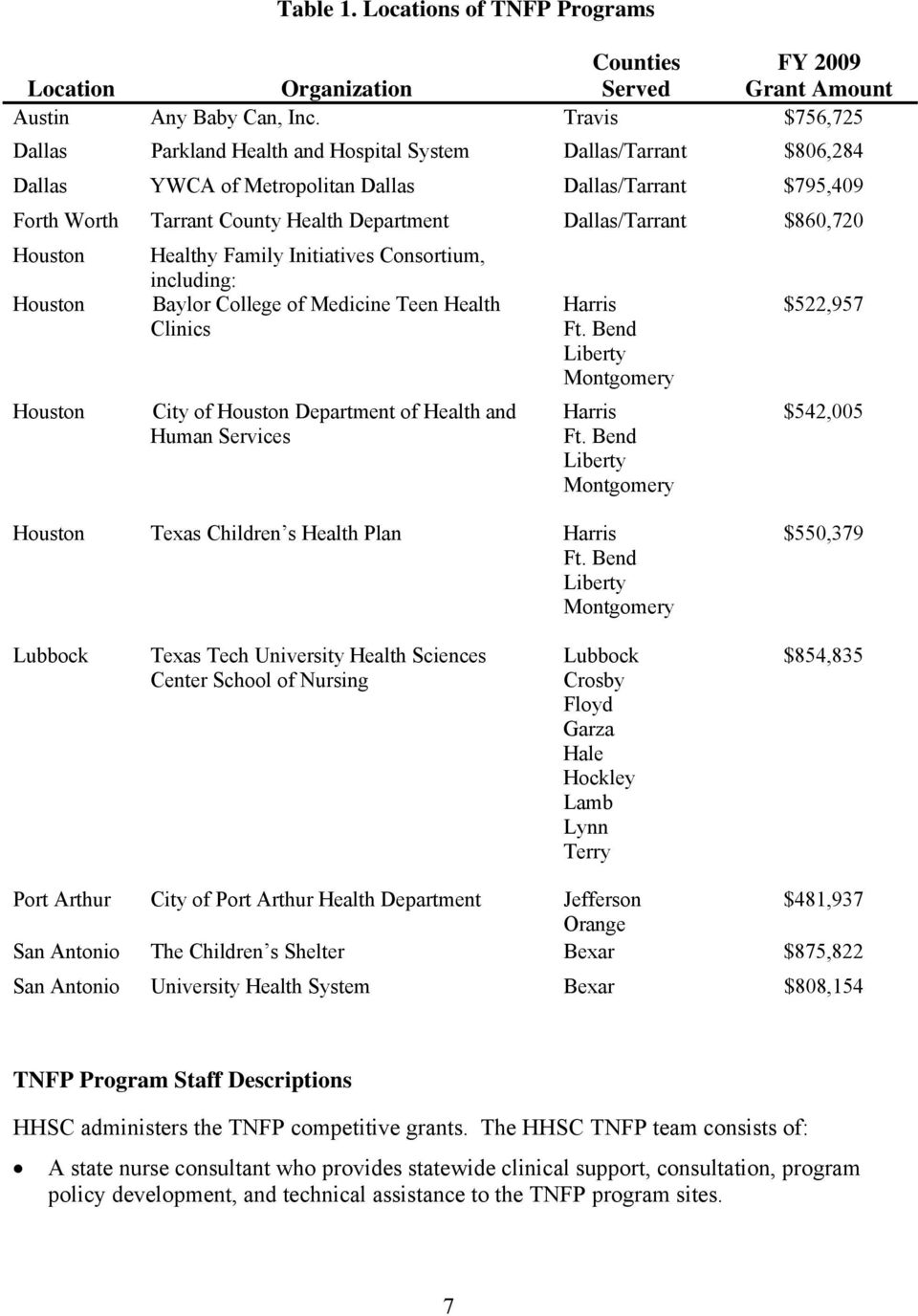
8 The initial grant period was September 1, 2008, through August 31, The grant contracts may be extended for an additional six years contingent upon the availability of funds. The grant amounts account for 90 percent of the total cost of the program (see Table 1). In order to operate within the appropriations received and ensure substantial local commitment, HHSC required local communities to fund 10 percent of the program cost. HHSC did not allow overhead or administration costs to be included in the grant request, and grantees were required to provide administrative staff time, physical space, and utilities. All grantees, with the exception of the Houston area sites, have direct contracts with HHSC. In Houston, HFI is the sole HHSC contractor and serves as the lead agency and fiscal agent for the Houston TNFP Consortium, which delivers services through three subcontractors. The TNFP program began implementation on September 1, 2008, by hiring staff and ensuring that staff completed NFPNSO mandatory training. The first home visit was on September 29, 2008, and all sites were serving clients by the end of January The first year of implementation focused on building caseloads. Ultimately, the ongoing caseload size for the nine grantees is expected to reach 1,800 clients. S.B. 156 required the TNFP program to serve about 2,000 clients. However, HHSC received appropriations to serve 1,800 clients for fiscal year 2009 and did not receive a sufficient number of competitive proposals to provide services to 2,000 clients. For state fiscal year 2009, the cost estimate to serve approximately 2,000 clients was $9.4 million. The Texas Legislature appropriated $7.9 million, providing TNFP with the ability to serve 1,800 clients. In 2009, the 81 st Texas Legislature approved the HHSC request for $17.8 million to fund the existing TNFP sites and expand services to 200 more clients in the biennium. The following table shows TNFP grant amounts by location. 6

9 Table 1. Locations of TNFP Programs Location Organization Counties Served FY 2009 Grant Amount Austin Any Baby Can, Inc. Travis $756,725 Dallas Parkland Health and Hospital System Dallas/Tarrant $806,284 Dallas YWCA of Metropolitan Dallas Dallas/Tarrant $795,409 Forth Worth Tarrant County Health Department Dallas/Tarrant $860,720 Houston Healthy Family Initiatives Consortium, including: Houston Baylor College of Medicine Teen Health Clinics Harris Ft. Bend Liberty Montgomery $522,957 Houston City of Houston Department of Health and Human Services Harris Ft. Bend Liberty Montgomery $542,005 Houston Texas Children s Health Plan Harris Ft. Bend Liberty Montgomery $550,379 Lubbock Texas Tech University Health Sciences Center School of Nursing Lubbock Crosby Floyd Garza Hale Hockley Lamb Lynn Terry $854,835 Port Arthur City of Port Arthur Health Department Jefferson $481,937 Orange San Antonio The Children s Shelter Bexar $875,822 San Antonio University Health System Bexar $808,154 TNFP Program Staff Descriptions HHSC administers the TNFP competitive grants. The HHSC TNFP team consists of: A state nurse consultant who provides statewide clinical support, consultation, program policy development, and technical assistance to the TNFP program sites. 7
10 A project manager who provides statewide management and oversight of day-to-day operations, monitoring, program policy development/consultation, and technical assistance to the TNFP program sites. A contract manager who oversees contracts, invoices, vouchers, deliverable receipts, and payments. Each TNFP program site has three types of staff - nursing supervisors, nurse home visitors, and data entry specialists. The nursing supervisor manages program operations, including the supervision and evaluation of data entry specialists and up to eight nurse home visitors. The nurse home visitor provides comprehensive nursing services to TNFP clients and their families while maintaining the highest standards in clinical nursing practice and adherence to the NFP model. Each nurse home visitor maintains a maximum caseload of 25 clients. A shortage of nurse home visitors (e.g., due to maternity leave or severed employment) would require a redistribution of clients that may cause a temporary caseload over 25 clients per nurse home visitor. The data entry specialist provides administrative support to the nursing supervisor and nurse home visitors. Other responsibilities include data entry, office organization, client reminder calls, general clerical duties, and the organization of recruitment and outreach materials. Program Eligibility Women eligible to enroll in the TNFP program must meet all of the following requirements: Have no previous live births. Be enrolled before the 29 th week of gestation. Have an income at or below 185 percent of the federal poverty level (e.g. below $26,955 for a family of two). Be a Texas resident. Visitation Process/Schedule TNFP clients are typically enrolled early in their pregnancy, with home visits beginning between the 16 th and 28 th week of pregnancy. Nurse home visitors visit clients regularly from pregnancy through the child s second birthday, providing up to 65 visits throughout this period. Nurses provide ongoing assessments, a therapeutic relationship, extensive education, health literacy support, and assistance in accessing resources and health-care coverage, such as Medicaid, during pregnancy and early childhood. Ideally, visits begin early in the second trimester, between the 14 th and 16 th week of gestation. Nurse home visitors visit: Weekly for the first four weeks of program participation. Biweekly starting in week five until delivery. 8

11 Weekly from delivery until six weeks postpartum. Biweekly starting in week 7 until the baby is 21 months old. Monthly for the last three months of program participation. Prior to conducting home visits, NFPNSO requires nurse home visitors to complete extensive training on program administration, implementation issues, and the utilization of standardized data collection materials and client visit protocols. This standardization facilitates fidelity to the NFP program model. Process Evaluation The TNFP evaluation detailed in this report spans the initial grant period of September 1, 2008, through August 31, The TNFP program began implementation on September 1, 2008, with the first home visit on September 29, All sites were serving clients by the end of January Methodology Evaluators used three types of information for this report. NFPNSO information about NFP programs across the nation. Information reported by the TNFP sites to NFPNSO. Information gathered specifically for this evaluation. NFPNSO and HHSC provide several resources to help local programs implement the NFP model with fidelity. Evaluators obtained information about expectations for program implementation from NFPNSO websites, newsletters, and other program documents. Evaluators also used NFP research reports from other states to obtain an additional perspective on program implementation and expectations. In addition to NFPNSO s extensive reporting requirements, HHSC has specific reporting requirements for each TNFP program site. The overarching purpose of the NFPNSO and HHSC reports is to monitor fidelity to the model and progress of program implementation. Evaluators obtained data about each site from the following reports. NFPNSO quarterly summary reports, which include information on enrollment and attrition, demographics, referrals, home visit frequency and content, birth outcomes, and child development. NFPNSO implementation reports. Client characteristics at intake reports including demographics, use of government assistance, and maternal health risks. 10 Data included in this report ends on June 30, 2009, due to a lag in the availability of program data. Evaluators used data from later periods (e.g., the September 2009 site visits) to provide additional context that is not explicitly included in this report. 9

12 Implementing agency caseload profile reports including the number of clients served, births, program graduates, and additional demographics. Client visitation reports including location, content, frequency, and duration. Client enrollment reports including referrals to the TNFP programs, levels of program enrollment, and weeks gestation at enrollment. Service linkage reports including referrals to other programs and the use of community or government services. NFPNSO web-based Clinical Information System (CIS) reports, including summaries of visit characteristics, detailed demographic information, and information on the children born in the program. HHSC staff requirements data reports, including staff employment, training, and previous education and employment experience. HHSC monthly program narrative reports, including the status of program goals and objectives, problems and concerns, and accomplishments. HHSC monthly individual client data reports including paternity information and other information specific to the Texas implementation of NFP. Limitations HHSC s program evaluation met the TNFP reporting requirements of Section , Texas Government Code, with one exception. The evaluators were not able to determine with certainty the number of mothers who established the paternity of an alleged father as a result of TNFP services. Although this report provides data about the establishment of paternity, the proportion of TNFP clients with missing data was unusually large. Establishment of paternity was not part of the NFPNSO data collection, so the data collection instruments were not piloted by NFPNSO nor reviewed for data integrity. HHSC will work with the Office of the Attorney General (OAG) to refine the data collection methods in order to obtain the needed data. The following issues limited the scope of the evaluation, but did not affect the degree to which the evaluation addressed legislative requirements. Because of the extensive NFPNSO reporting requirements, the evaluation utilized data provided to the NFPNSO by each TNFP site. Individual client data were not available for NFPNSO measures, so some types of analysis were not possible. For example, it was not possible to determine TNFP attrition rates. This report only includes eight months of client data (September 29, 2008, through June 30, 2009). The first two months of the project year (September 2008 and October 2008) were a start-up period focused on hiring and training staff. To allow time for data entry and the reconciliation of data issues, evaluators excluded data for July and August 2009 from the report. 10
13 This report does not include an outcome evaluation because the program had been in operation for such a short time and the evaluation is required to provide data for each TNFP site. 11 TNFP Client Demographics Ultimately, the ongoing caseload size for the nine grantees is expected to reach a total of 1,800 first-time mothers and their children. From September 2008 through June 2009, the TNFP program enrolled 1,032 low-income first-time mothers. 12 The Tarrant County program enrolled the greatest number of clients with 138, and the Houston Department of Health and Human 13, 14 Services (DHHS) program enrolled the fewest with 45 clients. See Appendix A for detailed information on TNFP client demographics. Age The age of TNFP clients reflected the NFP national average and ranged from 12 years to 42 years with an average age of about 19 years. The Children s Shelter and Any Baby Can programs had the youngest TNFP clients with 59 percent under age 18. The Houston DHHS program had the oldest TNFP clients with 73 percent age 18 and older. Ethnicity Women of Hispanic descent made up the largest percentage of TNFP clients served with 51 percent, followed by African-American women with 31 percent, non-hispanic white women with 12 percent, and 6 percent of other ethnicities (see Table 2). TNFP program clients deviated from the NFP national averages on ethnicity. NFP national client ethnicity consist of 44 percent non-hispanic white, 24 percent Hispanic, and 21 percent African American. TNFP programs in San Antonio, Austin, and Lubbock had the greatest number of Hispanic clients with more than 60 percent. The Baylor and Houston DHHS programs, both serving the Gulf Coast, had the greatest number of African American clients, 70 percent and 74 percent respectively. 11 For example, there were a small number of clients per TNFP site for whom birth outcomes could be examined. Differences between the TNFP clients and the population of other low-income first-time mothers would be undetectable because of the low occurrence of outcomes (e.g. low birth weight or prematurity). 12 Demographic data from Tarrant County, Texas Children s Health Plan, and The Children s Shelter includes one additional client making the total number of clients range from 1,032 to 1, Houston DHHS was delayed in recruiting staff and enrolling clients due to subcontracting delays and Hurricane Ike effects on its permanent office space. 14 Maximum enrollment is based on the NFPNSO requirement of no more than 25 clients for each nurse home visitor. 11
14 Number Enrolled Non- Hispanic White Table 2. Client Race or Ethnicity Race or Ethnicity African American or Black Native American Multiracial or Other Missing (n) Hispanic Asian Any Baby Can % 65.7% 22.2% 0.9% 2.8% 0.9% 0 Parkland HHS % 51.9% 40.4% 1.0% 0.0% 1.9% 6 Dallas YWCA % 36.5% 42.7% 0.0% 1.0% 6.3% 5 Tarrant County % 42.1% 31.7% 0.0% 4.0% 4.0% 12 Baylor % 25.4% 69.8% 0.0% 0.0% 1.6% 7 Houston DHHS % 26.2% 73.8% 0.0% 0.0% 0.0% 3 Texas Children s Health Plan % 41.2% 38.2% 1.5% 1.5% 2.9% 2 Texas Tech % 61.2% 14.1% 0.0% 0.0% 0.0% 0 Port Arthur % 24.5% 34.0% 1.9% 1.9% 1.9% 7 The Children s Shelter % 66.7% 12.5% 1.7% 0.0% 10.0% 11 University Health System % 76.3% 7.0% 2.6% 1.8% 3.5% 0 TNFP % 51.1% 30.8% 0.9% 1.3% 3.5% 51 National NFP 98, % 23.8% 20.8% 4.5% 1.4% 5.4% n/a Time period: September 1, June 30, 2009 Primary Language Spoken Overall, English was the primary language for 90 percent of TNFP clients, while Spanish was the primary language for nine percent. These numbers were comparable to the primary language 12

15 percentages of NFP clients across the nation. An interpreter/translator or a nurse home visitor capable of signing or speaking the client s native language was available to clients with a hearing impairment or clients whose first language was not English or Spanish. 15 Marital Status The national proportion of married NFP clients outnumbered the proportion of married TNFP clients, with 17 percent and 11 percent, respectively. The University Health System program had the highest proportion of married clients with 23 percent. None of the clients in the Baylor program were married. Employment Thirty-four percent of TNFP clients worked either full- or part-time (see Table 3). Of this number, 43 percent were employed full-time and 57 percent part-time. These findings corresponded with NFP clients nationally, where 31 percent of clients worked either full- or parttime. The 11 Texas programs varied among each other in the proportion of working clients. Forty-two percent of Port Arthur clients and 47 percent of the Texas Tech program clients were employed. In contrast, 20 percent of clients from the Baylor program and 25 percent from the Houston DHHS program were working either full- or part-time. Number Enrolled Table 3. Client Employment Status Working Full- Time Employment Status Working Part-Time Not Working Missing (n) Any Baby Can % 27.5% 66.7% 39 Parkland HHS % 15.9% 66.7% 47 Dallas YWCA % 21.6% 67.6% 27 Tarrant County % 15.2% 64.6% 39 Baylor % 15.6% 80.0% 25 Houston DHHS % 11.1% 75.0% 9 Texas Children s Health Plan % 14.8% 66.7% 17 Texas Tech % 28.1% 52.6% 28 Port Arthur % 24.4% 57.8% NFPNSO client materials are only available in English and Spanish. 13
16 Number Enrolled Working Full- Time Employment Status Working Part-Time Not Working Missing (n) The Children s Shelter % 21.9% 65.8% 58 University Health System % 17.6% 63.7% 23 TNFP % 19.5% 65.6% 327 National NFP 98, % 69.2% n/a Time period: September 1, June 30, 2009 School Enrollment The percentage of TNFP clients attending school was comparable to the percentage of NFP clients nationally, 45 percent and 43 percent respectively. Around 60 percent of clients at the programs in Any Baby Can, Baylor, and Parkland reported attending school. In contrast, 33 percent of the Texas Children s Health Plan and University Health System programs clients reported attending school. Any Baby Can, Baylor, and Parkland primarily serve teenage clients, whereas the Texas Children s Health Plan and University Health System serve clients with a broader range of ages. Income Of the income-reporting TNFP clients, 42 percent claimed an annual income of $12,000 or less and 46 percent reported their income to be between $12,001 and $30, Thirty-seven percent of all clients did not know their annual income; therefore, they were not included in the income percentages. The median income for the NFP clients nationally was $13,500 and ranged from $1,500 to $45,000. Public Assistance Use Upon enrollment in the TNFP program, the percent of TNFP clients accessing the Supplemental Nutrition Assistance Program (SNAP) and Temporary Assistance for Needy Families (TANF) services was greater than the percent of NFP clients across the nation accessing the same services (see Table 4). The Any Baby Can program reported that 41 percent of its clients were enrolled in SNAP. This percentage was much higher than the NFP national rate of 18 percent. 16 Total yearly household income was collected in nine income categories. 14
17 Forty-five percent of University Health System clients and 30 percent of Any Baby Can clients reported receiving TANF. These utilization rates were higher than the NFP national rate of six percent. The percentage of TNFP clients accessing Women Infants and Children (WIC) services was lower than the national percentage of NFP clients accessing WIC, 69 percent versus 73 percent respectively. However, the Houston DHHS and Texas Tech programs had much higher WIC utilization rates than the NFP national rate, 90 percent and 84 percent versus 73 percent respectively. Table 4. Use of Public Assistance Public Assistance Number enrolled Food Stamps Medicaid TANF WIC Missing (n) Any Baby Can % 65.42% 29.91% 57.94% 1 Parkland HHS % 63.46% 1.92% 73.08% 6 Dallas YWCA % 71.88% 8.33% 72.92% 5 Tarrant County % 50.79% 10.32% 66.67% 12 Baylor % 65.08% 1.59% 36.51% 7 Houston DHHS % 69.05% 2.38% 90.48% 3 Texas Children s Health Plan % 90.14% 14.08% 73.24% 0 Texas Tech % 76.47% 4.71% 83.53% 0 Port Arthur % 62.26% 1.89% 69.81% 7 The Children s Shelter % 76.67% 13.33% 73.33% 11 University Health System % 44.74% 44.74% 63.16% 0 TNFP % 65.82% 14.18% 68.67% 52 National NFP 98, % 66.20% 6.30% 73.10% n/a Time period: September 1, June 30,

18 Sources of Referrals to the TNFP Programs Between September 1, 2008, and June 30, 2009, the TNFP sites received 2,194 referrals from community and public assistance programs, health-care providers, schools, and other human service programs (see Table 5). 17 Overall, each site received an average of 199 referrals. Fortytwo percent of these referrals enrolled in the TNFP program. The Any Baby Can program had the highest enrollment rate with 74 percent and the Parkland HHS program had the lowest enrollment rate with 27 percent (See Appendix B for a detailed table of referrals by TNFP site.). The majority of referrals to the TNFP program came from health-care providers with 29 percent, followed by WIC programs at 19 percent, and schools at 17 percent. Several TNFP programs had referral rates that differed greatly from both the Texas averages and the NFP national averages (see Appendix B). The greatest number of referrals from the Baylor, Texas Tech, and University Health System programs came from health-care providers or clinics with 63 percent for both Baylor and Texas Tech and 57 percent for University Health System. Overwhelmingly, the Houston DHHS program received almost all of its referrals or 82 percent from WIC clinics. 18 The Any Baby Can, Parkland HHS, and The Children s Shelter programs received most of their referrals or 40 percent from schools. Finally, the Texas Children s Health Plan program received the majority of its referrals, 59 percent, from Medicaid Some of the referrals did not meet eligibility requirements. To address this issue, TNFP program sites reiterated eligibility criteria to the referral networks. 18 The Houston DHHS TNFP program offices are in the Acres Home Multi Service Center, which also includes a WIC office. Through a collaboration with the WIC office, the TNFP program has enrolled many of the qualified WIC clients. 19 Texas Children s Health Plan is a Medicaid managed care provider for Star Health. Texas Children s Health Plan TNFP staff contacted potential clients based on information obtained from Medicaid eligibility data. Therefore, all Texas Children s Health Plan TNFP clients were health plan members at TNFP enrollment. 16

19 Table 5. Sources of Referrals to the NFP Program Referral Enrolled by Source Percent Enrolled WIC Pregnancy Testing Clinic Health Care Provider/ Clinic School Current Client Other Home Visiting Program Medicaid Other (other human services program) Total Referrals Any Baby Can % 3.7% 7.4% 8.3% 39.8% 1.9% 0.9% 0.0% 38.0% 0 Parkland HHS % 16.5% 2.9% 34.0% 36.9% 0.0% 4.9% 0.0% 4.9% 7 Dallas YWCA % 34.3% 13.4% 14.9% 11.9% 7.5% 0.0% 7.5% 10.4% 34 Tarrant County % 39.4% 24.1% 14.6% 2.2% 2.9% 0.7% 4.4% 11.7% 1 Baylor % 3.0% 1.5% 62.7% 6.0% 3.0% 6.0% 0.0% 17.9% 3 Missing (n) Houston DHHS % 82.2% 0.0% 8.9% 0.0% 0.0% 4.4% 0.0% 4.4% 0 Texas Children s Health Plan % 0.0% 0.0% 18.8% 0.0% 0.0% 0.0% 59.4% 21.7% 1 Texas Tech % 1.2% 6.0% 62.7% 2.4% 1.2% 1.2% 0.0% 25.3% 2 Port Arthur % 50.0% 5.0% 38.3% 3.3% 0.0% 0.0% 0.0% 3.3% 0 17

20 Total Referrals Percent Enrolled WIC Pregnancy Testing Clinic Health Care Provider/ Clinic Referral Enrolled by Source School Current Client Other Home Visiting Program Medicaid Other (other human services program) The Children s Shelter % 0.0% 4.6% 27.5% 41.2% 0.8% 0.0% 0.0% 26.0% 0 University Health System % 11.4% 0.0% 56.8% 4.5% 0.0% 0.0% 6.8% 20.5% 70 TNFP % 18.9% 7.4% 29.4% 17.1% 1.6% 1.5% 6.0% 17.9% 118 National NFP* 94, % 15.2% 9.0% 37.5% 7.7% 3.8% 4.5% 3.3% 18.9% n/a Time period: September 1, June 30, 2009 * All national NFP data were based on cumulative data from October 1, 2006 (when NFP introduced new data collection forms) through June 30, Missing (n) 18

21 Adherence to NFP Model Standards HHSC adopted the NFPNSO performance indicators designed to measure each grantee s performance in terms of the NFP model standards. These performance indicators were implemented as 18 NFP model standards that cover seven areas of implementation. By following the model standards, results of the intervention are expected to be similar to the results of the randomized control trials conducted by the NFPNSO. This report assesses adherence to NFP program model standards from September 2008 through June See Appendix C for additional information on each program site s compliance with NFP model standards. Clients Standard 1. Client participation must be voluntary. NFP services are designed to build selfefficacy. Voluntary enrollment empowers the client and promotes a trusting relationship between the client and the nurse home visitor. The TNFP program has implemented several protocols to ensure adherence to Standard 1. All clients were required to sign a consent form before participation. The TNFP program does not consider a client enrolled until she has a signed consent form. The consent form included in the enrollment packet includes explicit language indicating that participation is voluntary. If a potential client was a minor, the nurse was required to spend time explaining the program to both the potential client and her guardian. The minor must express interest in the program and her desire to participate, but the guardian must sign the consent form. When recruiting potential partner agencies, TNFP staff is required to ensure that the partner agency understands that client involvement must be voluntary. For example, if a TNFP site would like to partner with a local probation office it is required to explain to probation staff that participation in the TNFP program cannot be a condition of parole. If the TNFP sites had enrollment issues or concerns, NFPNSO and HHSC staff were available to provide guidance and possible solutions. Standard 2. Client is a first-time mother. The intention of the NFP program is to help women when they are vulnerable and more open to receiving additional support. NFPNSO research suggests that first-time mothers may benefit from the NFP program more than those with additional children, possibly because inexperience increases receptiveness to offers of help. The NFPNSO data indicate that limiting enrollment to first-time mothers maximizes the opportunity to improve outcomes for families. In order to ensure adherence to Standard 2, each TNFP program site asks all potential clients to provide a pregnancy history and confirm that they have had no prior live births. Only those who meet this criterion are enrolled in the program. 20 Data included in this report ended on June 30, 2009, due to a lag in the availability of program data. Evaluators used data from later periods (e.g., the September 2009 site visits) to provide additional context that is not explicitly included in this report. 19
22 Standard 3. Client meets low-income criteria at intake. At the time of enrollment, each NFP client is required to have an income at or below 185 percent of the federal poverty level. The NFPNSO randomized control trials found that, while all clients benefited from the assistance provided by the NFP program, clients with higher incomes had additional resources available to them outside of the program and did not benefit from the program to the same degree as lowincome clients. Each TNFP program site asks all potential clients to disclose their income for verification. Each site also obtained eligibility information by determining whether the potential client was receiving Medicaid, WIC funds, or SNAP benefits. The TNFP program considered a potential client eligible for enrollment if she was receiving public benefits that have an income requirement at or below 185 percent of the federal poverty level, including Medicaid, WIC, and SNAP. Standard 4. Client is enrolled in the program early in her pregnancy and receives her first home visit by no later than the end of the 28 th week of pregnancy. Early enrollment allows time for the client and nurse home visitor to establish a relationship before the birth of the child. NFPNSO research indicates that early enrollment provides the nurse home visitor the opportunity to address prenatal health behaviors that affect birth outcomes and the child s neurodevelopment. Ninety-four percent of TNFP clients were enrolled before 28 weeks gestation. 21 This percentage is similar to the NFP program national average of 92 percent. TNFP site percentages ranged from 86 percent in the Baylor program to 99 percent in the Texas Tech program (see Appendix C, Table C-1). Intervention Context Standard 5. Client is visited one-to-one, one nurse home visitor to one first-time mother. The therapeutic relationship between the nurse home visitor and the client must be focused on the individual client s circumstances. By engaging in a one-to-one setting, the nurse home visitor can better strengthen the client s abilities and behavior change to achieve the goals of the program. The client may choose to have other supporting family members in attendance during scheduled visits. In particular, husbands or partners are encouraged to be part of visits when possible. The TNFP program closely follows the NFPNSO guidelines pertaining to home visits. Specifically, each nurse home visitor schedules individual visits with each client. In addition, each TNFP program site is required to ensure an adequate nurse-home-visitor-to-client ratio. On average, each TNFP nurse home visitor had a 15-client caseload. During this reporting period, nurse home visitors built caseloads with a goal of reaching the maximum 25-client caseload. 21 At enrollment, each client estimated how long she had been pregnant. After enrollment, sonograms indicated some clients exceeded the 28-week requirement. These clients typically remained enrolled in the program. Also, some sites mistakenly believed that a gestation period of less than 29 weeks met the 28-week requirement. HHSC clarified that the gestational period must be no greater than 27 weeks and six days. 20
23 On average, 19 percent of all visits included the client s husband or partner, and 17 percent included the client s mother. Overall, the TNFP program had greater involvement by family in the visits than the NFP national average, where 13 percent of NFP visits included the client s husband or partner and 9 percent included the client s mother. Almost 30 percent of visits at the University Health System and Texas Children s Health Plan programs included the client s husband or partner. In addition, 28 percent of The Children s Shelter visits included the client s mother. Standard 6. The program is delivered in the client s home, which is defined as the place where she is currently residing. Home visitation is an essential part of the program. When a client is visited in her home, the nurse home visitor has an opportunity to observe, assess, understand, and monitor the client s status. Specifically, the nurse can assess the client s safety, social dynamics, ability to provide basic needs, and the mother-child interaction. NFPNSO defines a home setting as a location where the client lives for the majority of time (i.e., she sleeps there at least four nights a week). This may include a shelter, a friend s home, a detention center, or another location. There are times when the client s living situation or her work/school schedule makes it difficult to see the client at home, and the visit is conducted in another setting. Eighty-seven percent of TNFP home visits took place in the client s home. Eight percent took place in the home of a friend or family member. The other five percent of visits took place at school, a doctor s office, the client s place of employment, or another location. The location of home visits was relatively consistent across TNFP sites with a few exceptions. When compared to the averages across all TNFP sites the: Port Arthur and University Health System programs had the highest proportion of home visits that took place in the home of a friend or family member. Parkland HHS program had the highest proportion of home visits that took place at the client s school. Texas Tech program had the highest proportion of home visits that took place in the client s home. Standard 7. Client is visited throughout her pregnancy and the first two years of her child's life in accordance with the current NFPNSO Guidelines. The frequency of home visits may influence the effectiveness of NFP programs. Even if clients do not use the nurse home visitor to the maximum level recommended, the visits made can be a powerful tool for change. Research indicates that the earlier a client enters the program, the greater the program s effectiveness. The high frequency of home visits early in the pregnancy and throughout the first two years of the child s life may have the greatest impact on maternal behavior and thereby the highest probability of improving outcomes. For example, substance abuse, smoking, and nutrition greatly influence fetal development. By addressing these issues early with the client, the risks for adverse outcomes for mother and baby can be reduced. Overall, TNFP sites completed 88 percent of the home visits expected based on the NFPNSO Guidelines. This completion rate is higher than the NFP national average of 73 percent. The NFPNSO objective is an 80 percent completion rate during the pregnancy phase. The Children s Shelter and Texas Tech programs had the highest completion rates, with almost 95 percent of all expected client visits completed. 21
24 Expectations of Nurses and Supervisors Standard 8. Nurse home visitors and nursing supervisors are registered professional nurses with a minimum of a baccalaureate degree in nursing. The NFPNSO research indicates that the public perceives registered nurses as having high standards of ethical practice and honesty. This may give NFP nurses credibility with families, helping make them acceptable providers of the NFPNSO curriculum and welcomed into clients homes. The nurse home visitors are also required to have a valid nursing license. As of June 2009, 63 of the 65 nurse home visitors had a Bachelors of Nursing (BSN) degree. 22 With HHSC s support, these sites submitted a Variance to Model Standard 8 Request to NFPNSO, and NFPNSO approved these variances. All ten nursing supervisors had a BSN. 23 In addition, seven of the nursing supervisors had master s degrees in public health, nursing, community health, education, or business administration. Standard 9. Nurse home visitors and nursing supervisors complete core educational sessions required by NFPNSO and deliver the intervention with fidelity to the NFP Model. The NFP program is a highly specialized program that requires extensive training on the NFP model, theories, and structure to deliver the program. The NFPNSO policy is that all nursing staff must complete all NFP education sessions. While NFPNSO does not have a specific timeframe for the completion of all the training sessions, nurse home visitors are required to complete the first two of four NFPNSO training sessions prior to visiting clients. As of June 2009, all TNFP nurses conducting home visits had completed the first two NFPNSO training sessions. In addition, the nurse home visitors are expected to complete ten other training sessions relevant to the NFP program, such as instruction on observation skills; child health and development; care giving; infant clues and behaviors; feeding scale training; Texas Health Steps modules; the OAG Paternity Opportunity Program; and identification of complications during pregnancy. Application of the Intervention Standard 10. Nurse home visitors, using professional knowledge, judgment and skill, apply NFPNSO Visitation Guidelines focusing the topic of each visit to the strengths and challenges of each family and apportioning time across defined program domains. NFPNSO visitation guidelines are tools that guide nurse home visitors in the delivery of program content. These guidelines suggest that each visit include information about each of the following six life domains. Personal Health - Health maintenance practices, nutrition and exercise, substance use, and mental health. Environmental Health - Home, work, school, and neighborhood. 22 One nurse home visitor from Texas Tech had a Bachelors degree in a field other than nursing but was an RN and one bilingual (English/Spanish) nurse home visitor in the Parkland HHS program was an RN with an Associates degree in nursing and was enrolled in a BSN program. 23 The Dallas YWCA was recruiting a new nursing supervisor. 22
25 Life Course Development - Family planning, education, and livelihood. Maternal Role - Mothering role, physical, behavioral, and emotional care of a child. Friends and Family - Personal network relationships and assistance with childcare. Health and Human Services - Linking families with needed referrals and services. The NFPNSO provides objectives for the overall proportion of home visit time devoted to the first five of the six life domains. 24 In accordance with NFPNSO policies, the TNFP nurse home visitors individualize visit content to meet the client s needs rather than adhering to a predetermined schedule. During the client s pregnancy, the TNFP nurse home visitors met or exceeded the NFPNSO objectives for the proportion of home visit time devoted to four of the five domains. The exception was the Maternal Role domain. During the six weeks after the client s baby was delivered, the TNFP nurse home visitors spent a larger proportion of their home visit time on the Maternal Role domain (see Appendix C-4). It is important to keep in mind that these are proportions across all home visits for all nurse home visitors. In addition, the proportions need to add up to 100 percent. For example, if a group of nurse home visitors spent additional time on Maternal Health, the proportion of home visit time spent on the other domains would decrease even if the nurse home visitors did an excellent job of presenting all of the information for all of the other domains. It is difficult to use this information other than noting if a domain was consistently either extremely low or extremely high. Neither was true during the reporting period. Anecdotally, many clients did not have the knowledge and skills needed to access appropriate services. These include clients abandoned by family and friends; clients with significant mental illness who were not receiving mental health services; homeless clients; clients living with drug and alcohol abuse; and clients living in extreme poverty. Standard 11. Nurse home visitors apply the theoretical framework that underpins the program, emphasizing self-efficacy, human ecology and attachment theories, through current clinical methods. These theories serve as the foundation for NFP programs and are reflected in the visit guidelines and training sessions. Nurse home visitors are expected to utilize these guidelines and methods in each home visit. TNFP nursing supervisors and nurse home visitors, NFPNSO, and HHSC work together to ensure that each TNFP program site closely follows the NFP model. Questions or concerns about model fidelity are addressed through an open dialogue between the TNFP sites, HHSC, and NFPNSO. In addition, each TNFP nursing supervisor evaluates the nurse home visitors to ensure fidelity to the NFP model. Standard 12. A full time nurse home visitor carries a caseload of no more than 25 active clients. A caseload greater than 25 clients would negatively impact the nurse home visitor s ability to develop and establish an adequate therapeutic relationship with each client. 24 Health and Human Services is addressed in the Referrals to Public Programs section of the process evaluation. 23
26 Caseload size for the TNFP sites range from 9 clients at Port Arthur to 20 clients at Parkland HHS per nurse home visitor. On average, each TNFP nurse home visitor has a 15-client caseload. Major factors affecting TNFP sites progress in building caseloads included the experience level of nurse home visitors and the development of referral networks. Reflection and Clinical Supervision Standard 13. A full-time nursing supervisor provides supervision to no more than eight individual nurse home visitors. Because of the expectation of one-to-one supervision, a full-time nursing supervisor should manage no more than eight nurse home visitors. Nursing supervisors are also responsible for referral management, program development, and administrative tasks that include the management of administrative, clerical, and interpreter staff. As of June 2009, the number of TNFP nurse home visitors per TNFP nursing supervisor ranged from eight nurse home visitors at The Children s Shelter, University Health System, and Tarrant County programs to four nurse home visitors at the Baylor and Texas Children s Health Plan programs. 25 Standard 14. Nursing supervisors provide nurse home visitors clinical supervision with reflection, demonstrate integration of the theories, and facilitate professional development essential to the nurse home visitor role through specific supervisory activities including one-toone clinical supervision, case conferences, team meetings and field supervision. To ensure that nurse home visitors are clinically competent and supported to implement the NFP program, nursing supervisors provide clinical reflection through specific supervisory activities. These activities include one-to-one supervision, case conferences and team meetings, and field supervision. One-to-one supervision. Nursing supervisors are required to have a weekly one-to-one meeting with each nurse home visitor to reflect on the nurse s work, including the management of her caseload and quality assurance. Nine TNFP sites reported their nursing supervisors successfully met with each of their nurse home visitors each week. Two TNFP sites missed meetings: Any Baby Can missed one visit with one nurse home visitor due to illness, and the Houston DHHS program missed a month of visits with two nurse home visitors partially due to subcontracting delays which delayed staff recruitment, and Hurricane Ike effects on the site s permanent office space. These sites met this portion of Standard 14 in spite of these deviations. Case conferences and team meetings. Nursing supervisors are required to schedule weekly case conferences or team meetings dedicated to joint case review for the purpose of problem solving and professional growth. Team meetings also include discussions of program implementation issues and team building exercises. All 11 TNFP sites held case conferences and team meetings each week except for one weekly meeting at the Texas Children s Health Plan that was missed because program 25 The Baylor and Texas Children s Health Plan TNFP sites received funding for only four nurse home visitors. 24
27 staff was attending a conference and training. This site met this portion of Standard 14 in spite of this small deviation. Field supervision. Nursing supervisors are required to conduct a joint home visit with each nurse every four months. The nursing supervisors from five sites Any Baby Can, Port Arthur, Texas Children s Health Plan, Parkland, and Texas Tech accompanied each of their nurse home visitors on a home visit every four months. The nursing supervisor from the Houston DHHS had not attended one home visit with the one staff member that was eligible for field supervision during the reporting period, again, partially due to subcontracting delays, and the effects of Hurricane Ike on the permanent office space. Nursing supervisors from the remaining five sites Baylor, The Children s Shelter, University Health System, Tarrant County, and the Dallas YWCA conducted home visits every four months with at least 50 percent of their nurse home visitors eligible during the reporting period. These five sites partially met the field supervision portion of Standard 14. During the first year of implementation, some nursing supervisors also provided additional educational resources to support both nurse home visitors and clients. For example, many teams added lactation consultants or nurses to provide training to the nurse home visitors. Nurse home visitors influenced their clients decisions to breastfeed their babies by providing information on the benefits of breastfeeding and additional lactation support. Program Monitoring and Use of Data Standard 15. Nurse home visitor and nursing supervisors collect data as specified by the NFPNSO and use NFP Reports to guide their practice, assess and guide program implementation, inform clinical supervision, enhance program quality, and demonstrate program fidelity. Each TNFP program site collected data and used the NFP reports to monitor and improve its operations. The NFPNSO sends each site a quality control report every month indicating any problems with the data collected and transmitted to NFPNSO. TNFP nursing supervisors review these reports to determine the source of the errors (e.g., data entry, data collection, or something else). The site makes appropriate corrections in the database or adjustments in protocol (in consultation with NFPNSO or HHSC, if needed). Agency Standard 16. An NFP implementing agency is located in and operated by an organization known in the community for being a successful provider of prevention services to low-income families. The implementing agency should provide visible leadership and support the NFP program with all tools necessary to ensure program fidelity. The TNFP request for proposals process resulted in HHSC awarding grants to agencies, described below, that met the criteria of standard
28 Any Baby Can, Inc. has a 30-year history of providing preventive home-based programs for expectant, first-time parents with multiple risk factors including poverty, lack of health insurance or access to health care, limited education or job skills, parental disability, mental health concerns, history of family violence, and a history of substance abuse. The primary goals of Any Baby Can include improved birth outcomes, improved parenting behaviors, the reduction of childhood injuries, and increased immunization rates. Parkland Health and Hospital System is an established local government organization with a reputation for being a successful provider of services to low-income families in Dallas County. Parkland HHS has several programs designed to help low-income families obtain health care, including Dallas Healthy Start, the March of Dimes, and Youth Angle Family Access Network. YWCA of Metropolitan Dallas has been active in the Dallas community since 1908 and has a history of developing and sustaining programs to meet the needs of low-income families. The YWCA offers a continuum of services that help improve women s lives and remove barriers to self-sufficiency. Annually, the YWCA serves more than 6,000 low-to-moderate income families through subsidized childcare centers, financial education development, and parental education and support. Tarrant County Health Department has a strong foundation in the community and provides a broad array of public health services to prevent disease and injury and to promote health. Through collaborations with community, church and governmental agencies, Tarrant County has worked to address many local health issues affecting low-income families. Healthy Family Initiatives (HFI) is a non-profit organization, chartered in Its mission is to value children as the future, empower the healthy development of families and prevent child abuse and neglect. HHSC contracted with HFI to be the lead agency and fiscal agent for the Houston TNFP Consortium. The Consortium is comprised of three subcontracted sites. Baylor College of Medicine Teen Health Clinics has been providing medical, counseling, and education services for 35 years in some of Houston s poorest neighborhoods. Through seven comprehensive Teen Health Clinics, the Baylor College of Medicine provides community oriented primary and reproductive care to low-income women under 21 years of age. The primary goals of the Teen Health Clinics are to reduce infant mortality, prevent subsequent teen pregnancies, and reduce the incidence of sexually transmitted diseases. City of Houston Department of Health and Human Services (DHHS) has a long history of assisting at-risk families in the Houston Metropolitan Area. Houston DHHS has historically administered two programs focused on assisting low-income pregnant women: the Targeted Case Management for Children and Pregnant Women program and the Health Families Healthy Futures home visitation program. Texas Children s Health Plan is the largest combined STAR/Children s Health 26
29 Insurance Program (CHIP) managed care organization in Harris County. The Texas Children s Health Plan has a maternity management-newborn program, Star Babies, for pregnant Medicaid clients in the Texas Children s Health Plan population. This program provides education and resource assistance to a monthly average of 2,500 pregnant women and their babies. The program includes a home visitation program for high-risk mothers, community outreach, car seat installation services, and other social services. Texas Tech University Health Science Center was established in 1998 in a medically underserved area of Lubbock to provide primary care services to at-risk families. Texas Tech has several programs designed to provide services to low-income families, including Texas Health Steps, primary care clinics, counseling services, and women s health services. City of Port Arthur Health Department has more than 100 years of experience providing health, parent, and family support services to low-income families in their community. Port Arthur has past experience in providing home-based services through a maternal and child health grant. The Children s Shelter has been providing for the health and safety of children in crisis in the San Antonio community since The Children s Shelter offers medical and dental services; foster care and adoption services; mental health services; outreach programs; and services for pregnant and parenting teens. Through the Mothers and Schools program, The Children s Shelter has collaborated with the San Antonio Independent School District to reduce pregnancy, poverty, high school dropout, and child abuse rates. University Health System is a publicly supported, academic medical center and safety net provider serving San Antonio and the South Texas region. Historically, University Health System has been the major service provider for low-income families in providing maternal and child health care in Bexar County. University Health System has worked for more than 50 years to improve the outcomes for low-income women and children. Standard 17. An NFP implementing agency convenes a long-term Community Advisory Board that meets at least quarterly to promote a community support system to the program and to promote program quality and sustainability. It is important for an implementing agency to have a community advisory board where implementation issues can be vetted and problems addressed. A community advisory board: Provides a support network for NFP staff and clients. Facilitates awareness of NFP in the community. Provides assistance in developing relationships with referral sources and service providers. Helps assess and respond to challenges in program implementation. Identifies gaps in client resources and services. Consults with the NFP staff regarding quality improvement. Works with other local, state, and federal entities to generate the support needed to sustain the NFP program. 27
30 Other than the Houston TNFP Consortium, comprising HFI and its subcontractors, each program site has a community advisory board that meets quarterly. The three TNFP sites in Dallas and Fort Worth share an advisory board, as do the two TNFP sites in San Antonio. Because of contractual issues, the Houston TNFP Consortium had delays in creating a joint community advisory board. Although the Houston TNFP Consortium meets regularly to discuss implementation issues, it does not meet the HHSC definition of an NFP community advisory 26, 27 board. Standard 18. Adequate support and structure shall be in place to support nurse home visitors and nursing supervisors to implement the program and to ensure that data are accurately entered into the data base in a timely manner. Support includes the necessary infrastructure to support and implement the program. This includes the necessary physical space, desks, computers, cell phones, filing cabinets, and other equipment to carry out the program. It also includes employing a person primarily responsible for key administrative support tasks for NFP staff, such as entering data and maintaining report accuracy. Each implementing agency must have the equivalent of a half-time general administrative staff member for every 100 clients to support the nurse home visitors and nursing supervisors. All 11 TNFP sites have established an adequate support structure to ensure effective implementation and accurate data entry. Each TNFP program site has dedicated support staff. Seven sites have one full-time person providing data entry and other administrative assistance. Three sites have two half-time persons filling those roles, and one site has one half-time person filling those roles. In addition, each implementing agency has dedicated space, desks, computers, and other equipment to its TNFP program. The majority of each site s overhead is paid by the implementing agency. Referrals to Public Programs Eight of the 11 TNFP sites made 1,255 referrals to public programs. 28 Of those, 40 percent were for WIC services, 30 percent for Medicaid, and 18 percent for SNAP (see Table 6). 29 Some sites had referral patterns that were markedly different from most of the other sites. For example, only 8 percent of all TNFP clients were referred for TANF services, but 30 percent of University Health System clients were referred for TANF services. Also, 18 percent of all TNFP clients were referred for SNAP, but 47 percent of Texas Tech clients were referred for SNAP. 26 The lead agency for the Houston TNFP Consortium, HFI, also convenes a general Funders Forum addressing funding and service issues associated with many of the programs originating under HFI direction. 27 The first community advisory board meeting for the Houston TNFP Consortium was held on November 12, The advisory board was comprised of a diverse group with representatives from the community in each of the three Houston sites. 28 Data from NFPNSO Service Linkage Reports were unavailable for the Houston DHHS and Tarrant County programs due to the date of enrollment of their first client. It is NFPNSO reporting policy that program sites receive their first Service Linkage Reports two quarters after the date of their first client visit. The Dallas YWCA program reports were not available to HHSC. 29 There were also referrals to other programs for crisis intervention, mental health, substance abuse, health care services, education and other services. The frequencies of these referrals were relatively low with the exception of health care, mental health, housing, general educational development (GED) certification, and childbirth education. 28
31 Table 6. Referrals to Public Programs Government Assistance Medicaid Food Child Stamps Medicaid Client Social Security Unemployment SCHIP WIC TANF Any Baby Can 15.3% 24.1% 1.5% 14.6% 0.0% 0.0% 2.9% 41.6% Parkland HHS 3.9% 27.6% 4.4% 6.6% 0.0% 0.6% 3.3% 53.6% Dallas YWCA* n/a n/a n/a n/a n/a n/a n/a n/a Tarrant County * n/a n/a n/a n/a n/a n/a n/a n/a Baylor 5.5% 39.1% 1.8% 7.3% 0.0% 0.0% 0.0% 46.4% Houston DHHS* n/a n/a n/a n/a n/a n/a n/a n/a Texas Children s Health Plan 19.6% 30.4% 0.9% 16.1% 0.0% 0.0% 0.0% 33.0% Texas Tech 3.9% 13.7% 2.0% 47.1% 0.0% 0.0% 0.0% 33.3% Port Arthur 1.7% 33.9% 0.0% 18.6% 1.7% 0.0% 0.0% 44.1% The Children s Shelter 5.1% 30.2% 1.6% 25.1% 0.2% 0.0% 3.0% 34.8% University Health System 29.5% 19.7% 0.0% 21.3% 0.0% 0.0% 0.0% 29.5% TNFP 8.4% 29.7% 1.8% 17.8% 0.2% 0.1% 1.8% 40.2% Time period: September 1, June 30, 2009 * Service Linkage Reports were not available for the Houston DHHS, Tarrant County, and Dallas YWCA program sites. Establishment of Paternity As a goal of the program, TNFP sites must assist clients in establishing paternity of their babies. Information on paternity establishment was provided to 59 percent of TNFP clients. The remaining clients did not receive this information due to the following: Three percent were married. Nine percent were indicated by the nurse home visitor as not applicable. Eleven percent had some other reason There is no information to explain what was included in the not applicable and some other reason codes. 29
32 Information was missing on the remaining 19 percent of clients. Of those clients who were provided the information, data indicate that about 16 percent established paternity. However, evaluators were not able to determine definitively the number of mothers who established paternity due to a large proportion of TNFP clients with missing data. 31 Several factors affected the progress in establishing paternity. Limitations in the data reporting instruments resulted in variation in documenting the status of the Acknowledgement of Paternity (AOP) process. Site-specific policies and procedures allowed the nurse home visitor to present information at any time up to the delivery of the baby. Some sites felt the nurse home visitor needed up to four visits with the client in order to establish a trusting relationship and obtain accurate information, while other sites attempted to provide information to the client at an earlier home visit and to follow up with her at a subsequent visit. Nurse home visitors were required to complete the OAG s three-hour training on Acknowledgement of Paternity. Nurse home visitors hired after the site s OAG training may not have had all of the information needed to complete the process accurately. For a few clients, other reasons contributed to the incomplete data (e.g., clients who had difficulty keeping scheduled appointments with the nurse home visitor). Establishment of paternity was not part of the NFPNSO data collection. The data collection instruments were not piloted by the NFPNSO nor reviewed for data integrity. HHSC will work with TNFP program staff and the OAG to refine the data collection methods to obtain the data needed for the next annual evaluation report. Conclusion The NFP program successfully implemented 11 TNFP sites across Texas, enrolling 1,032 lowincome first-time mothers. TNFP clients ranged in age from 12 to 42 years with an average age of 19. The majority of clients were Hispanic or African-American, unmarried, and not working. As a condition of their funding, TNFP grantees were required to adhere to the TNFP program model standards developed by the NFPNSO. All TNFP sites successfully adhered to 16 of the 18 model standards covering seven areas of implementation. Clients (Standards 1-4) - Each client participated in the program voluntarily, was a firsttime mother, and met the low-income criteria. Ninety-four percent began receiving program services before their 29 th week of pregnancy. 31 In addition to the 16 percent who received the paternity information and established paternity, 12 percent of those who received the paternity information did not have data indicating whether they had established paternity. Data by site are not included due to the large proportion of missing data. 30
33 Intervention Context (Standards 5-7) - Each nurse home visitor visited clients in accordance with NFPNSO guidelines. Expectations of the Nurses and Supervisors (Standards 8-9) - Each grantee followed the NFPNSO guidelines regarding staff training and experience. Application of the Intervention (Standards 10-12) - Each nurse home visitor followed the NFPNSO visitation guidelines during client visits, used current clinical methods to apply the NFP theoretical framework, and did not have a caseload greater than 25 clients. Reflection and Clinical Supervision (Standards 13-14) - Each nursing supervisor provided supervision to no more than eight nurses, and provided clinical supervision and feedback in accordance with NFPNSO guidelines. Five of the eleven sites conducted field supervision in accordance with one portion of the NFPNSO guidelines in Standard 14. With the exception of one site, the remaining five sites completed at least 50 percent of the field supervision. Program Monitoring and Use of Data (Standard 15) - Each grantee collected data in accordance with NFPNSO guidelines. Agency (Standards 16-18) - Each grantee was located in an organization known for providing prevention services, and had the organizational structure to support the implementation and operation of an NFP program. Eight of the eleven sites created a community advisory board to discuss implementation issues. The Houston TNFP Consortium comprised of HFI and the three Houston sites subcontracted with HFI, had not created a joint community advisory board, but the consortium that developed the Houston TNFP sites met regularly to address implementation issues and concerns. HHSC and NFPNSO also met with the consortium to provide guidance. 32 The TNFP grantees adhered to almost all of the NFP model standards. The small deviations observed in field supervision and in the establishment of one joint community advisory board are not expected to affect the outcomes of the TNFP intervention. 32 The first community advisory board meeting for the Healthy Family Initiatives Consortium was held on November 12,
34 APPENDIX A: DEMOGRAPHICS Table A-1. Client Ages Percent in Each Age Group Number enrolled Age (Mean) Age Range < >=30 Any Baby Can % 53.7% 17.6% 14.8% 3.7% 4.6% Parkland HHS % 39.1% 20.0% 23.6% 0.0% 0.9% Dallas YWCA % 29.7% 21.8% 29.7% 5.0% 1.0% Tarrant County % 31.9% 22.5% 31.9% 6.7% 2.9% Baylor % 40.0% 32.9% 27.1% 0.0% 0.0% Houston DHHS % 24.4% 26.7% 33.3% 6.7% 6.7% Texas Children s Health Plan % 21.4% 35.7% 30.0% 12.9% 0.0% Texas Tech % 38.8% 27.1% 22.4% 2.4% 3.5% Port Arthur % 28.3% 30.0% 31.7% 5.0% 3.3% The Children s Shelter % 51.9% 16.0% 19.1% 4.6% 1.5% University Health System % 29.8% 18.4% 32.5% 12.3% 6.1% TNFP % 36.9% 23.0% 26.3% 6.9% 2.7% National NFP 98, n/a 3.0% 28.2% 27.5% 30.0% 7.7% 3.5% Time period: September 1, June 30, 2009 A-1
35 Table A-2. Client Primary Language Primary Language Number enrolled English Spanish Other Missing (n) Any Baby Can % 14.0% 0.0% 1 Parkland HHS % 15.2% 1.0% 11 Dallas YWCA % 9.4% 2.4% 16 Tarrant County % 12.9% 1.7% 22 Baylor % 1.7% 1.7% 10 Houston DHHS % 17.9% 0.0% 6 Texas Children s Health Plan % 2.9% 0.0% 2 Texas Tech % 0.0% 0.0% 0 Port Arthur % 15.9% 0.0% 16 The Children s Shelter % 1.9% 0.0% 24 University Health System % 13.5% 0.0% 3 TNFP % 9.4% 0.7% 111 National NFP* 98, % 13.1% 2.1% 65,441 Time period: September 1, June 30, 2009 * Data collection of primary language began October 1, 2006; data collection of race/ethnicity is since program inception. The number of clients with primary language data is smaller than the number of clients with race/ethnicity data. A-2
36 Table A-3. Client School Enrollment, Marital Status, and Employment Status Number enrolled Marital Status Employment Status* School Enrollment* Work Percent Missing Working Part- Not Missing Not Missing Married (n) Full-Time Time Working (n) Enrolled Enrolled (n) Any Baby Can % 1 5.8% 27.5% 66.7% % 37.4% 1 Parkland HHS % % 15.9% 66.7% % 41.7% 7 Dallas YWCA % % 21.6% 67.6% % 56.3% 5 Tarrant County % % 15.2% 64.6% % 61.6% 13 Baylor % 7 4.4% 15.6% 80.0% % 39.7% 7 Houston DHHS % % 11.1% 75.0% % 64.3% 3 Texas Children s Health Plan % % 14.8% 66.7% % 67.1% 1 Texas Tech % % 28.1% 52.6% % 51.8% 0 Port Arthur % % 24.4% 57.8% % 60.4% 7 The Children s Shelter % % 21.9% 65.8% % 45.4% 12 University Health System % % 17.6% 63.7% % 67.3% 1 TNFP % % 19.5% 65.6% % 55.3% 57 National NFP* 98, % n/a n/a n/a 69.2% n/a 42.6% n/a n/a Time period: September 1, June 30, 2009 * National NFP Data are unavailable for employment status and school enrollment. A-3
37 Table A-4. Client Income Income Number enrolled <-$6000 $6001- $12000 $ $20000 $ Missing $30000 >$30000 Don't Know Income (n) Any Baby Can % 13.08% 28.04% 14.95% 13.08% 8.41% 1 Parkland HHS % 2.88% 5.77% 4.81% 0.96% 75.00% 7 Dallas YWCA % 19.79% 32.29% 21.88% 14.58% 0.00% 5 Tarrant County % 11.20% 12.80% 12.80% 11.20% 39.20% 13 Baylor % 3.17% 7.94% 9.52% 6.35% 57.14% 7 Houston DHHS % 9.52% 11.90% 4.76% 2.38% 35.71% 3 Texas Children s Health Plan % 9.86% 18.31% 5.63% 7.04% 40.85% 0 Texas Tech % 15.29% 21.18% 7.06% 7.06% 27.06% 0 Port Arthur % 11.32% 26.42% 16.98% 1.89% 18.87% 7 The Children s Shelter % 7.56% 12.61% 10.92% 5.04% 50.42% 12 University Health System % 10.53% 15.79% 12.28% 4.39% 49.12% 0 TNFP % 10.5% 17.5% 11.4% 7.3% 37.3% 53 National NFP* 98,340 n/a n/a n/a n/a n/a n/a n/a Time period: September 1, June 30, 2009 * National NFP data are not available by income bracket. The median income for the national database is $13,500 with a range from $1,500 to $45,000. A-4
38 Number Enrolled Total Referrals APPENDIX B: REFERRALS Table B-1: Source of Referral to the TNFP Program Percent of Referrals Enrolled Pregnancy Testing Clinic Health Care Provider/ Clinic Referral Enrolled by Source Current Client Other Home Visiting Program Other (other human services program) WIC School Medicaid Any Baby Can % 3.7% 7.4% 8.3% 39.8% 1.9% 0.9% 0.0% 38.0% 0 Parkland HHS % 16.5% 2.9% 34.0% 36.9% 0.0% 4.9% 0.0% 4.9% 7 Dallas YWCA % 34.3% 13.4% 14.9% 11.9% 7.5% 0.0% 7.5% 10.4% 34 Tarrant County % 39.4% 24.1% 14.6% 2.2% 2.9% 0.7% 4.4% 11.7% 1 Baylor % 3.0% 1.5% 62.7% 6.0% 3.0% 6.0% 0.0% 17.9% 3 Houston DHHS % 82.2% 0.0% 8.9% 0.0% 0.0% 4.4% 0.0% 4.4% 0 Texas Children s Health Plan % 0.0% 0.0% 18.8% 0.0% 0.0% 0.0% 59.4% 21.7% 1 Texas Tech % 1.2% 6.0% 62.7% 2.4% 1.2% 1.2% 0.0% 25.3% 2 Port Arthur % 50.0% 5.0% 38.3% 3.3% 0.0% 0.0% 0.0% 3.3% 0 The Children s Shelter % 0.0% 4.6% 27.5% 41.2% 0.8% 0.0% 0.0% 26.0% 0 University Health System % 11.4% 0.0% 56.8% 4.5% 0.0% 0.0% 6.8% 20.5% 70 TNFP % 18.9% 7.4% 29.4% 17.1% 1.6% 1.5% 6.0% 17.9% 118 National NFP* 98,340 94, % 15.2% 9.0% 37.5% 7.7% 3.8% 4.5% 3.3% 18.9% n/a Time period: September 1, June 30, 2009 * All national NFP numbers in table based on cumulative data from October 1, 2006 (when NFP introduced new data collection forms) through the end of the quarter. Missing (n) B-1
39 APPENDIX C: ADHERENCE TO NFP MODEL STANDARDS Table C-1. Standard 4 - Client Enrollment Less than 28 Week Gestation Over 28 Weeks Gestation* Any Baby Can 91.6% 8.4% Parkland HHS 98.1% 1.9% Dallas YWCA** n/a n/a Tarrant County ** n/a n/a Baylor 85.7% 14.3% Houston DHHS** n/a n/a Texas Children s Health Plan 91.4% 8.6% Texas Tech 98.8% 1.2% Port Arthur 96.4% 3.6% The Children s Shelter 96.0% 4.0% University Health System 91.8% 8.2% TNFP 93.9% 6.1% National NFP*** 91.8% 8.2% Time period: September 1, June 30, 2009 *Gestational age is self-reported by the client at time of intake and may change after future clinical measures (ultrasound) indicate greater gestational age. ** Service Linkage Reports were not available for the Houston DHHS, Tarrant County, and Dallas YWCA program sites. It is expected that the October 2009 reports will include these sites. *** All national NFP numbers in this table were based on cumulative data from October 1, 2006 (when NFP introduced new data collection forms) through the end of the quarter. C-1
40 Table C-2. Standard 5 Family Involvement* Client s Mother Client s Husband or Partner Any Baby Can 17.6% 11.6% Parkland HHS 15.9% 22.5% Dallas YWCA** n/a n/a Tarrant County** n/a n/a Baylor 13.8% 8.0% Houston DHHS** n/a n/a Texas Children s Health Plan 17.2% 28.5% Texas Tech 14.7% 15.3% Port Arthur 10.3% 21.3% The Children s Shelter 28.1% 14.2% University Health System 20.7% 28.5% TNFP 17.3% 18.7% National NFP 8.8% 12.7% Time period: September 1, June 30, 2009 * A client s mother and her husband or partner could attend a client visit so values cannot be summed. Given these restraints, it is impossible to know the average number of visits that included ONLY the client's mother or the client's husband or partner. ** Service Linkage Reports were not available for the Houston DHHS, Tarrant County, and Dallas YWCA program sites. C-2
41 Client s Home Table C-3. Standard 6 Location of Home Visit Doctor s Office or Clinic Client s Workplace Home of Family or Friend Client s School Other Total Any Baby Can 87.3% 0.8% 0.2% 4.8% 3.8% 3.1% 606 Parkland HHS 86.7% 0.5% 0.0% 5.6% 5.2% 2.0% 594 Dallas YWCA* n/a n/a n/a n/a n/a n/a n/a Tarrant County* n/a n/a n/a n/a n/a n/a n/a Baylor 92.1% 0.0% 0.3% 7.2% 0.3% 0.3% 390 Houston DHHS* n/a n/a n/a n/a n/a n/a n/a Texas Children s Health Plan 88.9% 0.5% 1.3% 6.5% 0.0% 2.8% 387 Texas Tech 96.0% 0.2% 0.2% 2.3% 0.2% 1.3% 618 Port Arthur 72.1% 1.3% 0.3% 17.5% 0.0% 8.8% 308 The Children s Shelter 83.2% 0.5% 0.2% 9.8% 2.8% 3.5% 886 University Health System 85.3% 0.7% 0.0% 12.1% 0.3% 1.6% 689 TNFP 86.8% 0.5% 0.3% 7.9% 1.9% 2.7% 4478 Time period: September 1, June 30, 2009 * Service Linkage Reports were not available for the Houston DHHS, Tarrant County, and Dallas YWCA program sites. It is expected that the October 2009 reports will include these sites. C-3
42 Table C-4. Standard 10 - Content of Home Visits during Pregnancy Number of Visits Personal Health Mean Percent of Time Spent on Each Topic Area Environmental Health Life Course Development Maternal Role Friends & Family Any Baby Can % 9.9% 16.2% 16.8% 14.9% Parkland HHS % 12.2% 12.5% 17.0% 15.3% Dallas YWCA % 13.0% 13.3% 20.7% 15.5% Tarrant County % 7.5% 10.1% 18.5% 14.4% Baylor % 17.5% 20.3% 21.3% 14.5% Houston DHHS % 14.0% 12.7% 7.6% 13.2% Texas Children s Health Plan % 8.6% 12.2% 23.0% 18.0% Texas Tech % 15.1% 12.3% 23.1% 17.0% Port Arthur % 6.8% 10.7% 21.0% 19.0% The Children s Shelter % 12.3% 14.9% 14.8% 16.1% University Health System % 13.2% 14.0% 17.3% 13.3% TNFP % 12.1% 13.8% 19.2% 15.7% National NFP n/a 37.7% 10.5% 13.2% 23.9% 14.7% NFP Objective n/a 35-40% 5-7% 10-15% 23-25% 10-15% Time period: September 1, June 30, 2009 C-4
43 Table C-5. Standard 10 - Content of Home Visits during Postpartum (Birth to 6 weeks) Number of Visits Personal Health Mean Percent of Time Spent on Each Topic Area Environmental Health Life Course Development Maternal Role Friends & Family Any Baby Can % 9.5% 12.5% 41.8% 8.8% Parkland HHS % 10.8% 8.8% 40.5% 13.9% Dallas YWCA % 9.8% 11.3% 38.4% 11.8% Tarrant County % 5.0% 5.4% 51.9% 13.2% Baylor % 17.8% 18.3% 30.0% 14.8% Houston DHHS 0 0.0% 0.0% 0.0% 0.0% 0.0% Texas Children s Health Plan % 9.8% 15.5% 41.4% 11.1% Texas Tech % 11.0% 11.3% 38.7% 11.4% Port Arthur % 8.0% 5.5% 41.0% 8.5% The Children s Shelter % 6.5% 12.5% 38.4% 12.7% University Health System % 9.1% 13.4% 27.4% 12.9% TNFP % 9.6% 11.9% 38.6% 11.8% National NFP n/a 37.7% 10.5% 13.2% 23.9% 14.7% NFP Objective n/a 35-40% 5-7% 10-15% 23-25% 10-15% Time period: September 1, June 30, 2009 C-5
Nurse Family Partnership. MIHP Coordinator s Meetings
 Nurse Family Partnership MIHP Coordinator s Meetings Nurse Family Partnership History Founded by Dr. David Olds, a professor of pediatrics, psychiatry, and preventive medicine at the University of Colorado,
Working Together to Ensure Healthier Families. Nurse-Family Partnership Overview
 Working Together to Ensure Healthier Families Nurse-Family Partnership Overview 2 "There is a magic window during pregnancy it s a time when the desire to be a good mother and raise a healthy, happy child
How To Help A Pregnant Woman In Texas
 Public Health Nurse Home Visiting Programs Presented by Meredith Krugel, RN, LCSW Douglas County Public Health Nurse Home Visiting Oregon currently has four different nurse home visiting programs: Maternity
KANSAS DEPARTMENT OF HEALTH AND ENVIRONMENT DIVISION OF PUBLIC HEALTH BUREAU OF FAMILY HEALTH
 KANSAS DEPARTMENT OF HEALTH AND ENVIRONMENT DIVISION OF PUBLIC HEALTH BUREAU OF FAMILY HEALTH Teen Pregnancy Targeted Case Management Manual January 2016 1 TEEN PREGNANCY TARGETED CASE MANAGEMENT MANUAL
Chapter 3 Maternal Child Health Subchapter 4. Home Visiting Rule
 Chapter 3 Maternal Child Health Subchapter 4 Home Visiting Rule 1.0 Authority This rule is adopted pursuant to Act No. 66 of the Acts of the 2013 Sess. (2013) (An act relating to home visiting standards.),
Getting from Good to Great in Home Visiting: Systems Coordination
 Getting from Good to Great in Home Visiting: Systems Coordination PEW HOME VISITING CAMPAIGN WEBINAR SERIES A series of five webinars highlighting promising practices in administering state home visiting
Public Health Nurse Home Visiting Frequently Asked Questions When did nurse home visiting begin?
 Public Health Nurse Home Visiting Frequently Asked Questions When did nurse home visiting begin? Home visiting became a national public health strategy to improve the health status of women and children
David Olds, PhD. Professor of Pediatrics, Psychiatry, and Preventive Medicine. University of Colorado Health Sciences Center.
 David Olds, PhD Professor of Pediatrics, Psychiatry, and Preventive Medicine University of Colorado Health Sciences Center November 21, 2005 Centre of Excellence for Early Childhood Development Montreal,
Great Start Georgia/ MIECHV Overview
 Governor s Office for Children and Families Great Start Georgia/ MIECHV Overview Framework, Services and Programs 9/18/12 Leadership The Governor s Office for Children and Families in collaboration with
New Jersey Home Visiting Initiative
 National Health Policy Forum Promoting Evidence-Based Interventions: Maternal, Infant & Early Childhood Home Visiting (MIECHV) A State Perspective on Home Visiting New Jersey Home Visiting Initiative Contact
JUST THE FACTS A Monthly Public Assistance Update from the Illinois Department of Human Services
 A Monthly Public Assistance Update from the Illinois Department of Human Services January 2014 Summary Total cases receiving Public Assistance in Illinois decreased by 10,008 (20,138 persons) in January
Report of Results and Analysis of Parent Survey Data Collected in Southern West Virginia
 Partners in Community Outreach Education Begins at Home Partners in Community Outreach In-Home Family Education Programs Report of Results and Analysis of Parent Survey Data Collected in Southern West
NATIONAL BABY FACTS. Infants, Toddlers, and Their Families in the United States THE BASICS ABOUT INFANTS AND TODDLERS
 NATIONAL BABY FACTS Infants, Toddlers, and Their Families in the United States T he facts about infants and toddlers in the United States tell us an important story of what it s like to be a very young
Additional Substitute care and FBSS workers are needed to help the agency achieve face-to-face monthly contacts with 95% of children and parents.
 Texas Department of Family and Protective Services Description of Exceptional Item Requests FY 10-11 Biennium (As submitted in LAR on September 9, 2008) ITEM 5. DIRECT DELIVERY STAFF TO MEET FEDERAL STANDARDS
Guide to Health and Social Services
 Guide to Health and Social Services Health Services If you have little or no insurance and need health services: You can visit one of the 159 county health departments across the state. The local health
Head Start State Collaboration Offices: Information to Inform Planning in the Priority Areas
 Head Start State Collaboration Offices: Information to Inform Planning in the Priority Areas School Transitions Professional Development Child Care and Early Childhood Systems Regional Office Priorities
Nurse Home Visiting. Research Brief #5:
 impacts of early childhood programs Research Brief #5: Nurse Home Visiting BY: JULIA ISAACS what is Nurse Home VisitiNg? Under the Nurse-Family Partnership program, the most well-developed nurse home visiting
BIRTH THROUGH AGE EIGHT STATE POLICY FRAMEWORK
 BIRTH THROUGH AGE EIGHT STATE POLICY FRAMEWORK The Birth Through Eight State Policy Framework is a tool, or roadmap, that anyone can use to guide policy in ways that will improve the health, learning,
Pregnant and Parenting Youth in Foster Care in Washington State: Comparison to Other Teens and Young Women who Gave Birth
 January 2014 RDA Report 11.202 Olympia, Washington Pregnant and Parenting in Care in Washington State: Comparison to Other and Women who Gave Birth Laurie Cawthon, MD, MPH Barbara Lucenko, PhD Peter Woodcox,
The Family Nurse Partnership Programme
 The Family Nurse Partnership Programme Information leaflet DH INFORMATION READER BOX Policy Clinical Estates HR / Workforce Commissioner Development IM & T Management Provider Development Finance Planning
Public Health - Seattle & King County
 - Seattle & King County Mission Statement Alonzo Plough, Director The mission of Public Health - Seattle & King County is to provide public health services that promote health and prevent disease among
Texas. DeVry Impact. Summary Statistics. Earnings by Education Level. Total Wage Growth Over Studied Period. 65% Growth $44,262. 42% Growth $39,478
 Texas DeVry Inc. s eight Texas locations 1 produced $82.7 million in economic impact in FY2010. As part of this economic impact, DeVry Inc. schools supported 809 jobs. Wage Impact annually, while the degree
Logic Model for SECCS Grant Program: Florida Early Childhood Comprehensive Systems (ECCS) Statewide Plan INTERVENTION
 TOTAL FUNDS REQUESTED (for GRANTEE/ PROJECT CHARACTERISTICS (i.e., the first year of the project): goals and description of the project, $155,496 Infant Mental Health Association Updated Florida's statewide
A Descriptive Study of Depression, Substance Abuse, and Intimate Partner Violence Among Pregnant Women
 A Descriptive Study of Depression, Substance Abuse, and Intimate Partner Violence Among Pregnant Women 1 OVERVIEW This presentation is based on the study of pregnant women enrolled in the Augusta Partnership
Public Health - Seattle & King County
 - Seattle & King County Mission Statement Alonzo Plough, Director The mission of Public Health - Seattle & King County (Public Health) is to provide public health services that promote health and prevent
Wake County SmartStart ACTIVITY DESCRIPTION DEFINITIONS
 Wake County SmartStart ACTIVITY DESCRIPTION DEFINITIONS These definitions are used in the full activity descriptions and are intended to establish consistency in their use in activity development, implementation
12 & 12, INC. FY 15 ANNUAL MANAGEMENT REPORT
 12 & 12, INC. FY 15 ANNUAL MANAGEMENT REPORT 12 & 12 Inc. is a comprehensive addiction recovery treatment center serving individuals and their families who are affected by alcoholism and other drug addictions.
Child Welfare and Early Learning Partnerships
 Report to the Legislature Child Welfare and Early Learning Partnerships January 2015 Table of Contents 1 Introduction 2 About Child Protective Services and Child Welfare Services 3 Home Visiting About
Maternal, Child & Adolescent Health
 Maternal, Child & Adolescent Health Dear Community Partner, I am very pleased to share with you this brief overview of our Maternal, Child, and Adolescent Health (MCAH) programs. Our work is dependent
PUBLIC HEALTH IMPROVEMENT PARTNERSHIP
 PUBLIC HEALTH IMPROVEMENT PARTNERSHIP PUBLIC HEALTH ACTIVITIES & SERVICES INVENTORY TECHNICAL NOTES HEALTHY FAMILY DEVELOPMENT Nurse-Family Partnership Nurse-Family Partnership is a voluntary program of
Introduction to WIC. Objectives
 Objectives Introduction to WIC After completing this lesson, you will be able to: Describe the participants served by WIC. Describe how WIC improves the health of participants. Identify the history and
New York State Fiscal Analysis Model for Early Childhood Services:
 New York State Fiscal Analysis Model for Early Childhood Services: A look at the New York State s Early Childhood Fiscal Model - Early Childhood System Brief Prepared for the NYS Early Childhood Advisory
Maternal, Child & Adolescent Health
 Maternal, Child & Adolescent Health Dear Community Partner, I am very pleased to share with you this brief overview of our Maternal, Child, and Adolescent Health (MCAH) programs. Our work is dependent
Chapter 3: Healthy Start Risk Screening
 Introduction Healthy Start legislation requires that all pregnant women and infants be offered screening for risk factors that may affect their pregnancy, health, or development. The prenatal and infant
Custodial Mothers and Fathers and Their Child Support: 2011
 Custodial Mothers and Fathers and Their Child Support: 2011 Current Population Reports By Timothy Grall Issued October 2013 P60-246 IntroductIon This report focuses on the child support income that custodial
Resource Toolkit for Programs Serving Infants, Toddlers and Their Families: Implementing a Research-Based Program Model
 Resource Toolkit for Programs Serving Infants, Toddlers and Their Families: Implementing a Research-Based Program Model Updated March, 2011 The Toolkit was produced with the generous support from the McCormick
Early Care and Education Programs and Services in Connecticut
 Early Care and Education Programs and Services in Connecticut All Our Kin: All Our Kin bridges the divide between economic security and caretaking responsibility by combining a professional development
Services to At-Risk Youth (STAR) Program Evaluation
 Services to At-Risk Youth (STAR) Program Evaluation Criminal Justice Policy Council March 2003 Tony Fabelo, Ph.D. Executive Director Services to At-Risk Youth (STAR) Program Evaluation To view or download
The Status of Maryland s Children
 The Status of Maryland s Children Maryland has the highest median family income ($82,404) in the U.S. Families with children in Maryland have a median family income of $80,265. Yet, in 2007, over 10% of
Maternal and Child Health Service. Program Standards
 Maternal and Child Health Service Maternal and Child Health Service Program Standards Contents Terms and definitions 3 1 Introduction 6 1.1 Maternal and Child Health Service: Vision, mission, goals and
Logic Model for SECCS Grant Program: The New Jersey State Maternal and Child Health Early Childhood Systems (SECCS) Grant Program
 GRANTEE/ PROJECT CHARACTERISTICS (i.e., TOTAL FUNDS REQUESTED: $140,000 goals and description of the project, (for the first year of the project) environment, description of population/case TOTAL PROJECT
The Vision for Early Childhood Home Visiting Services in Arizona. A Plan of Action 2010-2015. Early Childhood Home Visiting Task Force - June 2010
 The Vision for Early Childhood Home Visiting Services in Arizona A Plan of Action 2010-2015 Early Childhood Home Visiting Task Force - June 2010 Confi dent, supported families raising healthy children,
Social Worker Overview The Field - Preparation - Day in the Life - Earnings - Employment - Career Path Forecast - Professional Organizations
 Social Worker Overview The Field - Preparation - Day in the Life - Earnings - Employment - Career Path Forecast - Professional Organizations The Field Social work is a profession for those with a strong
Delray Beach CSAP - Kindergarten Readiness
 Delray Beach CSAP - Kindergarten Readiness Assurance #1 School Readiness has improved over the past four (4) years and stands at 78% in 2011 with 75% of our students attending a State Voluntary Pre-Kindergarten
Prenatal and Infancy Home Visitation by Nurses: Recent Findings
 44 David L. Olds, Ph.D., is professor of pediatrics, psychiatry, and preventive medicine at the University of Colorado, and director of the Prevention Research Center for Family and Child Health in Denver,
Orange County is located between Los Angeles and San Diego
 This document was peer reviewed through the NWI. Supporting Wraparound Implementation: Chapter 5d.3 The Wraparound Orange County Model Denise Churchill, Program Manager Orange County Children and Family
Effective Early Childhood Development Programs for Low-Income Families: Home Visiting Interventions During Pregnancy and Early Childhood
 Effective Early Childhood Development Programs for Low-Income Families: Home Visiting Interventions During Pregnancy and Early Childhood HARRIET J. KITZMAN, RN, PhD University of Rochester, USA (Published
http://www.bls.gov/oco/ocos060.htm Social Workers
 http://www.bls.gov/oco/ocos060.htm Social Workers * Nature of the Work * Training, Other Qualifications, and Advancement * Employment * Job Outlook * Projections Data * Earnings * OES Data * Related Occupations
On behalf of the Association of Maternal and Child Health Programs (AMCHP), I am
 Christopher Kus, M.D., M.P.H. Association of Maternal and Child Health Programs, Public Witness Testimony House Labor, Health and Human Services and Education Appropriations Subcommittee March 13, 2013
The Ryan White CARE Act 2000 Reauthorization
 POLICY BRIEF january 2001 The Ryan White CARE Act 2000 Reauthorization Overview As the Ryan White CARE Act enters its second decade, it continues to be a critical source of care and services for people
Miami County. County Commissioners: Jack Evans John O Brien Ron Widener. County Department of Job and Family Services Child Support Enforcement Agency
 Miami Commissioners: Jack Evans John O Brien Ron Widener Department of Job and Family Services Child Support Enforcement Agency Carol Morgan, Director 24 North Road 25-A Troy, Ohio 45373-131 CDJFS Phone:
Big Data in Early Childhood: Using Integrated Data to Guide Impact
 Big Data in Early Childhood: Using Integrated Data to Guide Impact Rob Fischer, Ph.D. & Beth Anthony, Ph.D. Center on Urban Poverty & Community Development Rebekah Dorman, Ph.D. Cuyahoga County Office
The National Survey of Children s Health 2011-2012 The Child
 The National Survey of Children s 11-12 The Child The National Survey of Children s measures children s health status, their health care, and their activities in and outside of school. Taken together,
Twin Cities Healthy Start Pregnancy Psychosocial Risk Screening Validation Study
 Twin Cities Healthy Start Pregnancy Psychosocial Risk Screening Validation Study Amy Godecker, Ph.D. Stacye Ballard, B.A. Minneapolis Department of Health and Family Support 1 Background and context for
Logic Model for SECCS Grant Program: The Utah Early Childhood Comprehensive Systems (ECCS) Statewide Plan/Kids Link INTERVENTION
 GRANTEE/ PROJECT CHARACTERISTICS (i.e., goals and description of the project, environment, description of population/case load and partner organizations): TOTAL FUNDS REQUESTED (for the first year of the
Ottawa County. County Commissioners: Steve Arndt James Sass Mark Stahl
 Ottawa Commissioners: Steve Arndt James Sass Mark Stahl Department of Job and Family Services Public Children Services Agency Child Support Enforcement Agency Stephanie Kowal, Director 843 West Route 163,
Improving Service Delivery Through Administrative Data Integration and Analytics
 Improving Service Delivery Through Administrative Data Integration and Analytics Getty Images David Mancuso, PhD October 2, 2015 1 Analytics in the Social and Health Service Environment Program costs are
Long-term Socioeconomic Impact of Child Abuse and Neglect: Implications for Policy. By David S. Zielinski, Ph.D.
 Long-term Socioeconomic Impact of Child Abuse and Neglect: Implications for Policy By David S. Zielinski, Ph.D. Child abuse and neglect greatly influence victims long-term wellbeing. Until recently, however,
NYS Office of Children and Family Services
 ADOPTION ASSISTANCE Objective: Funds adoption subsidy costs for children with special needs. Administering Agency: ; US Department of Health and Human Services NYS Object Code: 62402, 62405 Year Established:
What s Happening In Wisconsin In Early Childhood Education and Care?
 What s Happening In Wisconsin In Early Childhood Education and Care? T his chapter is a concise, handy reference of what Wisconsin is doing in child care, Head Start, public school early education, programs
University Hospital Community Health Needs Assessment FY 2014
 FY 2014 Prepared by Kathy Opromollo Executive Director of Ambulatory Care Services Newark New Jersey is the State s largest city. In striving to identify and address Newark s most pressing health care
Home Visiting Program Descriptions
 1 Home Visiting Descriptions Adolescent Family Life (AFLP): FREE voluntary comprehensive casemanagement with assistance in areas such as: medical, education, child care, transportation, housing, legal,
Logic Model for ECCS Program: The Oklahoma Early Childhood Comprehensive Systems (ECCS) Statewide Plan/Smart Start Oklahoma INTERVENTION
 GRANTEE/ PROJECT CHARACTERISTICS (i.e., goals and description of the project, environment, description of population/case load and partner organizations): TOTAL FUNDS REQUESTED: (for the first year of
LOUISIANA DEPARTMENT OF HEALTH AND HOSPITALS MATERNAL AND CHILD HEALTH (MCH) BLOCK GRANT*
 LOUISIANA DEPARTMENT OF HEALTH AND HOSPITALS MATERNAL AND CHILD HEALTH (MCH) BLOCK GRANT* What is the MCH Block Grant? It is a grant from the U.S. government to State governments. The state must supply
August 2014 Report No. 14-043
 John Keel, CPA State Auditor A Report on On-site Audits of Residential Child Care Providers Report No. 14-043 A Report on On-site Audits of Residential Child Care Providers Overall Conclusion Three of
Productivity Commission Education and Training Workforce: Early Childhood Development
 Productivity Commission Education and Training Workforce: Early Childhood Development Victorian Association of Maternal and Child Health Nurses Submission The Victorian Association of Maternal and Child