
Choosing the Best Plan for You: A Tool for Purchasing Coverage in the Health Insurance Exchange
|
|
|
- Allen Craig
- 10 years ago
- Views:
Transcription
1 Choosing the Best Plan for You: A Tool for Purchasing Coverage in the Health Insurance Exchange The Affordable Care Act (ACA) makes health insurance available to nearly all Americans and the law requires people to maintain health coverage. That coverage can be obtained through a government program (like Medicare or Medicaid), an employer, directly through an insurer, or through a policy purchased through a health insurance marketplace (also known as a state health insurance exchange) where you can buy an individual or family policy. This tool guides you through the characteristics of health plans offered in the marketplace (also known as qualified health plans) to help you select the best plan for yourself or for a person you are assisting. The tool is structured as follows: 1. Overview of Plan Design. Review of plan benefit design and generosity of various plan options. 2. Financial Assistance in the Marketplace. Overview of financial assistance that may help you pay for the cost of a plan. 3. Key Components of Plan Selection. Guidance through a set of considerations to evaluate available plans. Overview of Plan Design New insurance reforms affect all plans All plans offered on the marketplace will meet certain new guidelines specified by the Affordable Care Act. You cannot be denied coverage because of a pre-existing condition. Plans cannot charge more based on medical history or current health care needs. Health plans must offer a set of preventive services for free, such as immunizations, women s health services, and screening colonoscopies. All plans must cover ten categories of essential health care benefits including doctor s visits, emergency services, hospitalization, maternity and newborn care, mental health and substance abuse services, prescription medicines, and rehabilitation care. Bronze, silver, gold, and platinum indicate generosity of coverage To make comparisons easier, plans will fall into one of four levels of coverage platinum, gold, silver, and bronze. Each level corresponds to the portion of health care costs that the plan covers, ranging from most generous to least generous. Platinum plans have the highest premiums and lowest out-of-pocket costs, while bronze plans have the lowest premiums and the highest out-of-pocket costs. On average, platinum plans cover 90% of an average enrollee s health care spending, and the patient covers 10% (plus his or her premiums). On the other end, bronze plans cover 60% of an average enrollees health care Note: The purpose of this tool is to describe some of the factors a patient may wish to use to evaluate health plans. Each person should make an independent decision about his/her selection of a plan based on individual circumstances and adequacy of coverage in consultation with trusted advisors. Other information is available through your state s insurance marketplace.
2 spending, and patients are responsible for the remaining 40%. In between, silver plans cover 70% and gold plans cover 80% of health care costs. If you are under 30 years old or if the other marketplace options are not affordable to you under the standard in the ACA, you may be eligible to buy a plan that is less expensive than a bronze plan but that provides limited benefits until you have very high health costs. At first glance, bronze plans may be most appealing because of their low premiums. However, enrollees with regular or chronic health care needs may have to pay significant out-of-pocket costs to fill a prescription, visit the doctor, or obtain care for an unforeseen medical need. In addition, some individuals with low incomes will receive significant additional subsidies if they buy a silver plan; and in some cases they could end up paying significantly more in the long-run if they buy a bronze plan. The Affordable Care Act also caps the amount you can be asked to spend out-of-pocket each year at $6,350 in total (medical and prescription drug) spending. The maximum is $12,700 for a family. This annual out-of-pocket maximum applies to all marketplace plans bronze through platinum though many plans will have a lower maximum than $6,350. Out-of-pocket spending that applies toward the cap includes deductibles, copayments, coinsurance, and cost-sharing (but not premiums). Deciding on a metal level is the first step in understanding which plan may be right for you. You also will want to understand how your plan s benefits are designed so that you strike the balance between coverage that meets your health care needs and the amount you are willing to pay in premiums and out-of-pocket costs. All plans within a single metal level are not the same, and depending on your particular health needs and the prescription medications you take, the amount you pay out-of-pocket each year could vary significantly within the same metal level. See the Key Components of Plan Selection section for a guide to choosing among plans in a given level of coverage. Quick Tips All exchange plans cover a set of essential health benefits, and you cannot be denied coverage or charged more because of a pre-existing condition. Metal levels bronze, silver, gold, and platinum describe the overall generosity of each health plan. Platinum plans cover the highest percentage of health care costs, 90% on average, but have the highest premiums. Plans at the same metal level and similar premium may have wide variation in out-of-pocket costs, depending on your health needs. Financial Assistance in the Marketplace People who wish to purchase coverage in the marketplace will need to provide information on their income. The marketplace then will determine whether they qualify for health insurance through Medicaid, for subsidies to help pay the costs of a marketplace plan, or for unsubsidized coverage in the marketplace. Tax credits help middle and lower income individuals pay health plan premiums For lower and moderate-income individuals and families, the federal government will provide assistance to help pay for premiums. Subsidies are determined on a sliding scale based on income. People at the 2
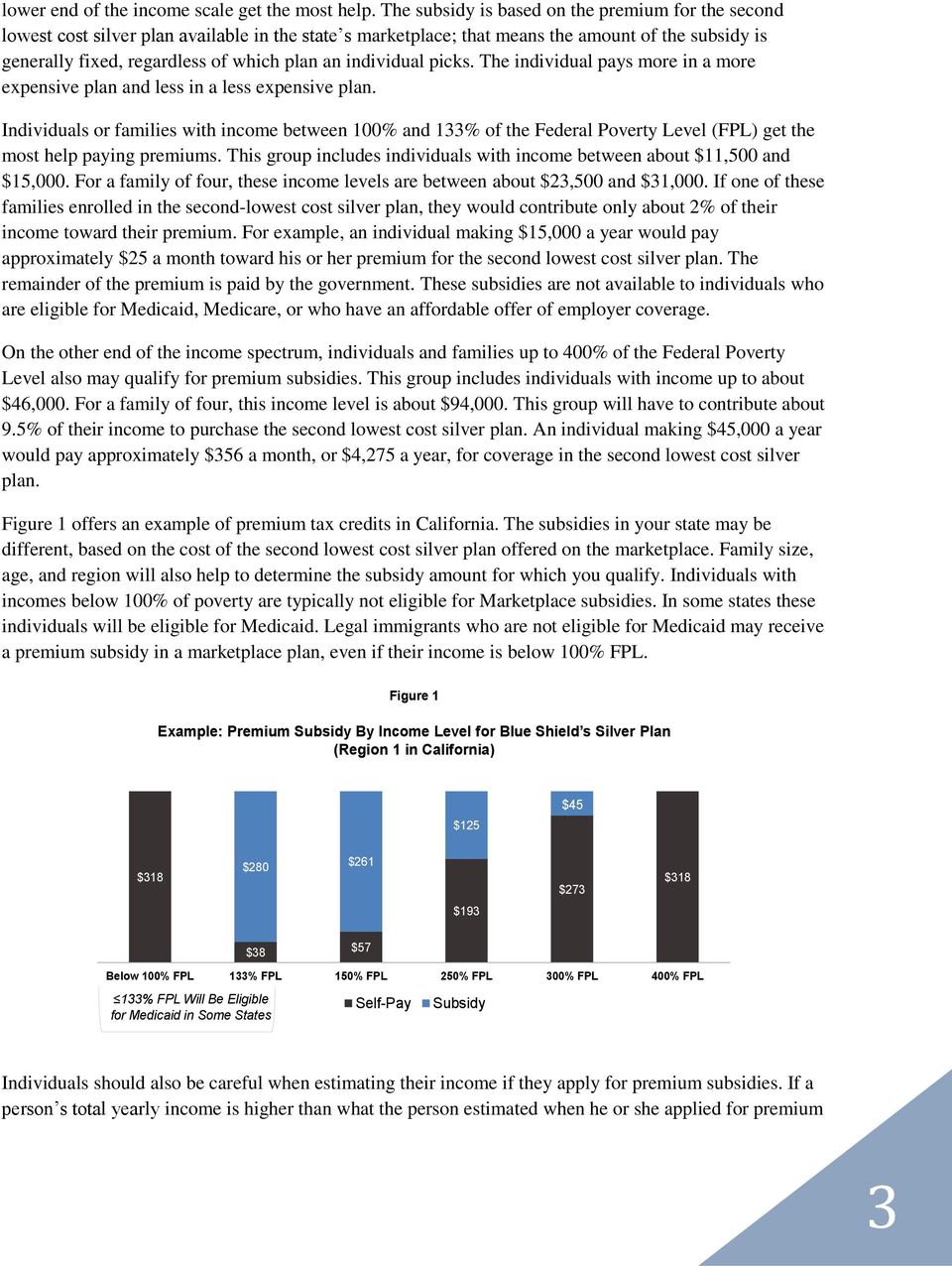
3 lower end of the income scale get the most help. The subsidy is based on the premium for the second lowest cost silver plan available in the state s marketplace; that means the amount of the subsidy is generally fixed, regardless of which plan an individual picks. The individual pays more in a more expensive plan and less in a less expensive plan. Individuals or families with income between 100% and 133% of the Federal Poverty Level (FPL) get the most help paying premiums. This group includes individuals with income between about $11,500 and $15,000. For a family of four, these income levels are between about $23,500 and $31,000. If one of these families enrolled in the second-lowest cost silver plan, they would contribute only about 2% of their income toward their premium. For example, an individual making $15,000 a year would pay approximately $25 a month toward his or her premium for the second lowest cost silver plan. The remainder of the premium is paid by the government. These subsidies are not available to individuals who are eligible for Medicaid, Medicare, or who have an affordable offer of employer coverage. On the other end of the income spectrum, individuals and families up to 400% of the Federal Poverty Level also may qualify for premium subsidies. This group includes individuals with income up to about $46,000. For a family of four, this income level is about $94,000. This group will have to contribute about 9.5% of their income to purchase the second lowest cost silver plan. An individual making $45,000 a year would pay approximately $356 a month, or $4,275 a year, for coverage in the second lowest cost silver plan. Figure 1 offers an example of premium tax credits in California. The subsidies in your state may be different, based on the cost of the second lowest cost silver plan offered on the marketplace. Family size, age, and region will also help to determine the subsidy amount for which you qualify. Individuals with incomes below 100% of poverty are typically not eligible for Marketplace subsidies. In some states these individuals will be eligible for Medicaid. Legal immigrants who are not eligible for Medicaid may receive a premium subsidy in a marketplace plan, even if their income is below 100% FPL. Figure 1 Example: Premium Subsidy By Income Level for Blue Shield s Silver Plan (Region 1 in California) $45 $125 $318 $280 $261 $273 $318 $193 $38 $57 Below 100% FPL 133% FPL 150% FPL 250% FPL 300% FPL 400% FPL 133% FPL Will Be Eligible for Medicaid in Some States Self-Pay Subsidy Individuals should also be careful when estimating their income if they apply for premium subsidies. If a person s total yearly income is higher than what the person estimated when he or she applied for premium 3
4 subsidies, it is possible that the Internal Revenue Service (IRS) may require some of that subsidy to be repaid when the person files his or her taxes. Therefore, individuals may want to factor in expected increases in their income over the course of the year when they apply for coverage. For example, some individuals may work extra hours during the Christmas holiday season or may receive a year-end bonus that could affect the level of subsidy for which they qualify. Individuals who are not sure what their income will be in the future should report their current income, but be sure to tell the marketplace when their income changes. Reporting income changes will help ensure people get the subsidies they are entitled to and to reduce the likelihood they have to repay subsidies at the end of the year. Individuals can also choose to take a smaller subsidy than they are entitled to, so they avoid having to repay part of the subsidy. If at the end of the year they are entitled to a larger subsidy than they have received, they will receive that money with their tax rebate. People with limited income also may qualify for help to reduce the out-of-pocket costs of a plan The lowest income people who are eligible for premium tax credits also qualify for cost-sharing assistance. This means that the federal government will help pay for out-of-pocket costs such as deductibles, coinsurance, and copays. You will qualify for such assistance if you make between 100% and 250% of the Federal Poverty Level, about $11,500 to $28,700 as an individual, or $23,500 to $59,000 for a family of four. Cost-sharing assistance lowers the out-of-pocket maximum for people who qualify. Much like premium subsidies, the maximum out-of-pocket cost an individual or family pays is based on income. For those making 100% to 200% of the Federal Poverty Level, the out-of-pocket maximum is reduced by two-thirds from $6,350 to about $2,117. For those making 200% to 250% of the Federal Poverty Level, the out-ofpocket maximum is reduced by one-fifth from $6,350 to $5,080. For a family, these out-of-pocket maximums are doubled. People who qualify for cost-sharing reductions will receive notification of their eligibility when they apply for coverage in a marketplace. To gain access to the cost-sharing reductions, eligible individuals, and families must enroll in a silver plan that is designed with the appropriate level of reduced cost sharing. The marketplace will direct eligible individuals and families to the correct set of plans. When these individuals compare among plans on the marketplace website, the cost-sharing levels displayed should reflect the reduced cost-sharing amounts. Quick Tips You may qualify for a subsidy to use toward paying your premium, and some individuals will also get help with out-of-pocket costs. Your state s exchange website or enrollment hotline will verify if you qualify for help when you sign up to purchase coverage. If you qualify for a premium subsidy, you will not have to pay your entire premium cost upfront; the federal government will pay its portion directly to your health plan, and you will be billed for your monthly contribution only. You must purchase the silver plan variation that applies to your income level to access your cost-sharing assistance. 4
5 Key Components of Plan Selection Plan Generosity Premium costs and the generosity of coverage vary with the metal level of the plan you select. Your state marketplace website may have a cost calculator that helps you to estimate your premium and out-ofpocket costs under various plan options. If you have a chronic condition, take several prescriptions, or need an expensive medical treatment in the near future, selecting a gold or platinum plan may be a better choice for you. Your cost sharing and total out-of-pocket spending may be lower under such a plan, though premiums may be higher. You will need to balance your need for health care services with the amount you want to pay in premium and out-ofpocket costs. Individuals who expect less extensive health care needs may prefer to purchase less expensive bronze or silver plans. Importantly, people who receive cost-sharing reductions must enroll in the silver plan variation that applies to their income level to receive the benefit of the cost-sharing reduction. Once you decide the level of coverage that is right for you, there are other decisions to make. Each state will have several plans at each metal level. The next three sections of this toolkit will help you sort through other factors to consider when enrolling in a marketplace plan covered benefits and costs, provider networks, and coverage of prescription medications. Covered Benefits and Costs It is important to enroll in a plan that covers the health care services you and your family utilize most frequently. Plans are required to cover services across a variety of categories, but the specific kinds of care you need may not be included in the benefits of every health plan, even if you are comparing plans in the same metal level. You will also want to understand the cost-sharing structure under your plan the deductible, copayments, and coinsurance. Finally, you should identify any limits on covered items or services, such as the number of times you can receive a recurring treatment or whether you need plan authorization before receiving a covered service. You can use the Checklist for the Health Insurance Marketplace to help you gather the information you should consider to select the plan that meets your needs. Marketplace websites will display each plan s benefits in a standardized way so that you can compare across your options more easily. The plan also must provide information about the services that are excluded from coverage. If you or your immediate family members have specific health care needs, you should narrow your options to the plans that cover those specific services. If you or your family receives health care items or services that are not covered by the plan, you will have to pay for the entire cost of that care. In most states, plans within the same metal level will vary in cost-sharing requirements. Marketplace websites will include a summary of deductibles, copayments, and coinsurance for different types of covered services. You may have a single deductible for all care or you may have separate deductibles, one for medical services and a second deductible for prescription drug costs. For example, one silver plan could require you to pay the first $1,000 of your care out-of-pocket; another may have a $500 deductible 5
6 but will ask you to pay a higher portion of your costs after you spend $500. If you have unanticipated costs, such as an accident or sudden illness, a plan with a large deductible could leave you with significant medical bills. Each plan website will include information about cost sharing, which may be different for specialist visits than for primary care visits. The amount you pay for a specialist visit could vary significantly from plan to plan. For example, if you are diabetic and regularly see an endocrinologist, you may want to choose a plan with a lower cost for specialist visits. Plans also will require you to share in the cost of prescription medicines. Marketplace plans may limit the number of times you can utilize certain services during the year. If you seek care from a chiropractor, physical therapist, or mental health professional, for example, be sure to compare across plans to ensure the plan covers enough visits per year to meet your needs. Provider Networks Marketplace plans must have a network with a sufficient number of providers such as doctors and hospitals. They also must include a sufficient number and geographic distribution of providers who serve predominately low-income, medically underserved individuals. It s important to understand which health care providers such as physicians, pharmacies, and hospitals are in the network of the plan you choose. Plans will have networks of providers from whom you can receive the most affordable care. These networks may include preferred versus non-preferred providers. Preferred providers will charge less out-of-pocket than non-preferred providers. You may not have any coverage for care that you receive from providers who are not in the plan s network. This means that any amount you spend out-of-pocket for providers who are not in your plan s network will not count toward the out-of-pocket maximum. The marketplace website must offer a link to each plan s network of providers. When you are choosing a plan, you may want to make sure that your primary care physician the person you see for an annual physical or when you have the flu is in the plan s network. Otherwise, you will have to switch to a participating physician in order to receive the plan s benefits. You should also check to see if any specialists you may need are in the plan s network. Finally, be sure that your preferred pharmacies and hospitals are in-network as well. Checking the provider networks of marketplace plans will help you narrow down the options and choose a plan that will best meet your needs. Coverage for Prescription Medications Coverage for prescription medications is an important consideration for choosing your health plan. The set of medicines that a plan covers is called the plan s formulary. Formularies often cover medications on different tiers. Each tier has an associated cost-sharing amount. Lower tiers usually have smaller out-ofpocket costs than higher tiers. Plans may have very high out-of-pocket costs associated with therapies covered on higher tiers. Plans can arrange formularies into many different tier structures. A typical four-tier formulary may have generic medications on Tier 1; preferred brand-name products on Tier 2; non-preferred brand therapies on Tier 3; and specialty or biologic medications on Tier 4. Cost sharing may be a fixed copayment amount 6
7 for each tier or may be coinsurance, which requires an individual to pay a percentage of the medicine s price. Estimating the amount a person will have to pay in coinsurance may be more difficult, given that a patient may not know the overall cost of each medicine he or she takes. Understanding whether the medicines you take are covered by your health plan and the out-of-pocket costs for each will help you choose the best plan for you. Quick Tips Estimate your predictable annual health needs. Consider, based on your anticipated health needs and your cost preferences, the right level of coverage for you platinum, gold, silver, or bronze. Check to see that the physicians you visit most often are in network in the plans you are considering. Review the formulary for the prescriptions you take to understand which plan provides you the best access and least out-of-pocket cost for your medications. Use the Checklist for the Health Insurance Marketplace to help weigh your options among the plans available to you. Conclusion The 2016 Enrollment Period will begin on November 1, During the Open Enrollment Period, you will have a chance to sign up for a marketplace plan using your state s marketplace website, phone hotline, or in-person. If you purchase a plan by December 15, 2015, you will have health insurance coverage beginning January 1, Open Enrollment ends on January 31, When you are comparing options during the Open Enrollment Period, you will likely have many choices. Narrowing down the plan offerings by comparing plan coverage and cost to your expected health care needs will make it easier to pick the plan that is best for you. This guide gives you the tools you will need to choose the best plan for you, so you can have access to the health care you want beginning in
8 Additional Resources Premium Assistance Calculator Kaiser Family Foundation Health Reform Frequently Asked Questions Kaiser Family Foundation Welcome to the Marketplace Enrollment Consumer Center Healthcare.gov Appendix: Premium and Cost-Sharing Subsidies Premium Subsidies: Sliding scale tax credits to limit premium spending as a percent of income for individuals under 400% FPL; Applies to the second lowest cost Silver plan available in the exchange Income (% FPL) Income Range for Individual Premiums Limited to % of Income Estimated Annual Premium Cost (assuming $5,200 Silver annual premium) Individual Coverage 100 up to 133% FPL 1 $11,490 $15, % $230 $ up to 150% FPL $15,282 $17, % $458 $ up to 200% FPL $17,235 $22, % $689 $1, up to 250% FPL $22,980 $28, % $1,448 $2, up to 300% FPL $28,725 $34, % $2,312 $3, up to 400% FPL $34,470 $45, % $3,275 $4,366 Cost-Sharing Subsidies: Provides cost-sharing subsidies for individuals with incomes below 250% FPL Average percent of total Household Income OOP Limit cost paid by health plan % FPL $2,250 94% % FPL $2,250 87% % FPL $5,200 73% % FPL $6,350 70% FPL = Federal Poverty Level OOP = Out-of-Pocket According to 2013 figures, 100% of FPL for an individual is $11,490 and for a family of 4 is $23,550. In some states individuals in this income group will be eligible for Medicaid and will receive coverage through that program instead of through marketplace premium subsidies. 8

Guide to the Summary and Benefits of Coverage
 Guide to the Summary and Benefits of Coverage The Affordable Care Act (ACA) makes health insurance available to nearly all Americans. Each state has a health insurance marketplace, also known as a health
Why the Affordable Care Act Matters for Women: Health Insurance 101
 Why the Affordable Care Act Matters for Women: Health Insurance 101 APRIL 2014 Women are the health care decision makers in our country they make approximately 80 percent of the health care decisions in
How To Compare Health Insurance Plans
 The three most important questions you need to ask Health care can be very expensive. Having a baby costs about $30,000, and so does the average three-day hospital stay. Health insurance is a way to reduce
Health Insurance Marketplace. vhealth insurance exchanges. What to expect in 2014. What to expect in 2014
 vhealth insurance exchanges Health Insurance Marketplace What to expect in 2014 What to expect in 2014 The basics of exchanges As part of the Affordable Care Act (ACA or health care reform law), starting
A Consumer s Guide to the Affordable Care Act
 A Consumer s Guide to the Affordable Care Act The Affordable Care Act was designed to help make health care affordable for everyone. This guide will help you understand how the ACA affects individuals
As of January 1, 2014, most individuals must have some form of health coverage, or pay a penalty to the federal government.
 Consumer Alert Health Insurance for 2014: What You Need to Know Before You Enroll (Individuals) As of January 1, 2014, most individuals must have some form of health coverage, or pay a penalty to the federal
Insurance Exchanges: New Market Opportunities & Threats to Access. February 2014 avalerehealth.net
 Insurance Exchanges: New Market Opportunities & Threats to Access February 2014 avalerehealth.net Despite Slow Initial Enrollment, Exchange Participation Is Accelerating Most Sign-Ups Expected Close to
WELCOME TO A NEW ERA IN HEALTH CARE COVERAGE FOR TENNESSEE.
 WELCOME TO A NEW ERA IN HEALTH CARE COVERAGE FOR TENNESSEE. Quality Health Plans for Individuals and Families in Tennessee. TABLE OF CONTENTS INTRODUCTION...1 Who are we?... 1 What is a CO-OP?...1 Our
The Vermont Health Benefit Exchange: An Update
 The Vermont Health Benefit Exchange: An Update Today s Discussion Health Reform Goals & Timeline Overview of Health Care Reform What is the Exchange? What Does the Exchange Look Like? Plan Design Enrollment
You can usually only shop for insurance during a specific timeframe that occurs once a year called open enrollment.
 Getting Started So many of us forget about health insurance until we need to use it. Even when we have insurance, sometimes we forget about the routine and preventive services that help us to get and stay
Bronze, Silver, Gold, or Platinum: How to Choose the Right Level of Coverage in Covered California
 Fact Sheet NOVEMBER 2014 Bronze, Silver, Gold, or Platinum: How to Choose the Right Level of Coverage in Covered California Summary The Affordable Care Act (ACA) requires that Covered California offer
Premium Tax Credits: Answers to Frequently Asked Questions
 Updated July 2013 Premium Tax Credits: Answers to Frequently Asked Questions Beginning in 2014, millions of Americans will become eligible for a new premium tax credit that will help them pay for health
SHIBA. Statewide Health Insurance Benefits Advisors. Medicare, Health Insurance, & the Affordable Care Act Updates for Summer 2013
 SHIBA Statewide Health Insurance Benefits Advisors Medicare, Health Insurance, & the Affordable Care Act Updates for Summer 2013 Liz Mercer Regional Trainer Sponsored by the: 8/8/2013 1 Today s overview
The Affordable Care Act. President Obama signed the Affordable Care Act (ACA) into law on March 23, 2010.
 The Affordable Care Act President Obama signed the Affordable Care Act (ACA) into law on March 23, 2010. The ACA was enacted to: v Increase quality and affordability of health insurance v Lower the uninsured
Exchanges and the ACA What You Need to Know for 2014
 Exchanges and the ACA What You Need to Know for 2014 How the Affordable Care Act affects the Individual Health Insurance Market This presentation is for informational purposes only and does not constitute
Health insurance Marketplace. What to expect in 2014
 Health insurance Marketplace What to expect in 2014 Overview The Affordable Care Act (ACA) includes several provisions geared to extend greater access to health insurance benefits to more people. Beginning
INDIVIDUAL HEALTH INSURANCE In Maine
 A Consumer s Guide To... INDIVIDUAL HEALTH INSURANCE In Maine Published by: The Maine Bureau of Insurance September 2015 Paul R. LePage Governor Eric A. Cioppa Superintendent Basics of Individual Health
The Small Business Guide to Health Care Law
 The Small Business Guide to Health Care Law How new changes in health care law will affect you and your employees Table of Contents Introduction 3 Part I: A General Overview of Health Care Law 4 The Affects
Health Insurance Marketplaces
 Health Insurance Marketplaces 2013 Zywave, Inc. All rights reserved. Presented by Employer Flexible What is Health Care Reform? The Affordable Care Act (ACA) was enacted in March 2010. Biggest overhaul
Health plans for individuals and families
 2015 Health Plan Information Health plans for individuals and families + Choosing the right plan for you + Subsidy eligibility information + Plan comparison charts + Terms and definitions + How to enroll
Health Insurance Shopper s Guide 3 steps to choosing the right health plan for you and your family.
 Health Insurance Shopper s Guide 3 steps to choosing the right health plan for you and your family. Ready to get started? We re here for you online, on the phone or in person. Visit for a quick and free
Your guide to finding the best health insurance plan.
 LIFE HAS OPPORTUNITIES Your guide to finding the best health insurance plan. Start saving today with the help of Excellus BlueCross BlueShield. National strength. Local focus. Individual care. SM Contents
Your Guide to Health Insurance Learn how to choose the best health plan
 Your Guide to Health Insurance Learn how to choose the best health plan Subsidy Welcome Thank you for considering AmeriHealth New Jersey as your health insurer. We know the importance of having quality
Health Care Reform. Frequently Asked Questions. June 2013
 Health Care Reform Frequently Asked Questions June 2013 Frequently Asked Questions (FAQs) What is a health insurance marketplace or exchange? A marketplace, or exchange, is a website where you can shop
The Health Benefit Exchange and the Commercial Insurance Market
 The Health Benefit Exchange and the Commercial Insurance Market Overview The federal health care reform law directs states to set up health insurance marketplaces, called Health Benefit Exchanges, that
Health Insurance Marketplace in Illinois Plan Comparison Charts
 2015 Independent Authorized Agent for An Independent Licensee of the Blue Cross Blue Shield Association Health Insurance Marketplace in Illinois Plan Comparison Charts preventive services and maternity
List of Insurance Terms and Definitions for Uniform Translation
 Term actuarial value Affordable Care Act allowed charge Definition The percentage of total average costs for covered benefits that a plan will cover. For example, if a plan has an actuarial value of 70%,
This glossary provides simple and straightforward definitions of key terms that are part of the health reform law.
 This glossary provides simple and straightforward definitions of key terms that are part of the health reform law. A Affordable Care Act Also known as the ACA. A law that creates new options for people
The Affordable Care Act: Health Coverage Options & Considerations in 2014
 The Affordable Care Act: Health Coverage Options & Considerations in 2014 J A C K S O N V I L L E A R E A C H A M B E R O F C O M M E R C E A U G U S T 2 7, 2 0 1 3 L A U R A M I N Z E R E X E C U T I
Issue Brief: The Health Benefit Exchange and the Small Employer Market
 Issue Brief: The Health Benefit Exchange and the Small Employer Market Overview The federal health care reform law directs states to set up health insurance marketplaces, called Health Benefit Exchanges,
Frequently Asked Questions
 Frequently Asked Questions What is Covered California? What is Obamacare? Are they the same? What is the Medi-Cal program? Who can buy health insurance through Covered California? When will I be able to
LEARN. Your guide to health insurance
 LEARN Your guide to health insurance Table of Contents Why health insurance is important...1 How the Affordable Care Act affects you...2 See if you may qualify for a subsidy...4 Types of health plans...6
AFFORDABLE CARE ACT FAQ
 AFFORDABLE CARE ACT FAQ What is the Healthcare Insurance Marketplace? The Marketplace is a new way to find quality health coverage. It can help if you don t have coverage now or if you have it but want
Basic Health Plan Offers a Chance to Provide Comprehensive Health Care Coverage for Low-Income Minnesotans
 Basic Health Plan Offers a Chance to Provide Comprehensive Health Care Coverage for Low-Income Minnesotans The number of uninsured in Minnesota has been on the rise over the last decade, with one out of
Health Insurance. Where should you SHOP for your health insurance coverage? Decision-Making Guide presented by Bob Hopper Insurance Services
 Health Insurance Where should you SHOP for your health insurance coverage? Decision-Making Guide presented by Bob Hopper Insurance Services We ll help you locate the health plan that offers the best value
Massachusetts Health Connector logo. The Health Connector: Massachusetts New and Improved Health Insurance Marketplace
 Massachusetts Health Connector logo The Health Connector: Massachusetts New and Improved Health Insurance Marketplace Massachusetts: The model for national health care reform 1 Massachusetts led the nation
Fact Sheet. AARP Public Policy Institute. Health Reform Changes Insurance Rules
 Fact Sheet Health Reform Changes Insurance Rules The Affordable Care Act (ACA) will greatly increase the availability of health insurance and broadly impact the delivery of health care in America. This
Understanding Health Insurance. Your Guide to the Affordable Care Act
 Understanding Health Insurance Your Guide to the Affordable Care Act Summary Health insurance may seem like a luxury if you are on a tight budget. But protecting your health and your family is one of the
Covered Services: All plans offered on the Marketplace cover 10 Essential Health Benefits:
 Introduction The NY State of Health 2015 Plan Compare provides information about health plans offered on the Individual Marketplace. Here's some general information to get you started. Metal Levels: Plans
Health Care Reform Update
 Small Businesses No Financial Requirements for Small Businesses: The ACA imposes no financial requirements for small businesses to contribute to their employees health insurance. However, beginning in
HealtH insurance 101
 Health insurance 101 Know the facts. Knowing the facts can make all the difference when it comes to health insurance. To make the most of new choices, protections and financial help, you need good information.
THE AFFORDABLE CARE ACT: THE AFFORDABLE COVERAGE OPTIONS AND CONSIDERATIONS IN 2014 THE NEW HEALTH INSURANCE: MARKETPLACE AND MEDICAID
 THE AFFORDABLE CARE ACT: THE AFFORDABLE COVERAGE OPTIONS AND CONSIDERATIONS IN 2014 THE NEW HEALTH INSURANCE: MARKETPLACE AND MEDICAID Deloris Summers Deaf In-Person Counselor Navigator Jacksonville Area
Understanding the ObamaCare Health Insurance Plans in North Carolina Understanding Insurance and Affordable Care Act Terminology: ACA- Marketplace
 Understanding the ObamaCare Health Insurance Plans in North Carolina As a result of the Affordable Care Act (a.k.a. ObamaCare) the following provisions are now in place for health insurance policies with
The Small Business Guide to Health Care Law. How new changes in health care law will affect you and your employees 609-662-2400 1
 The Small Business Guide to Health Care Law How new changes in health care law will affect you and your employees 609-662-2400 1 2013 Independence Blue Cross Table of Contents Introduction 3 Part I: A
EXPLORING NEW YORK S SHOP MARKETPLACE. An Overview for Small Groups
 EXPLORING NEW YORK S SHOP MARKETPLACE An Overview for Small Groups TABLE OF CONTENTS Why SHOP... 1 Who Can Enroll...2 How to Enroll...3 Choosing Plans...4 Our SHOP Offerings...5 SHOP Plan Comparison...6-7
Medicare Part D Prescription Drug Coverage
 Medicare Part D Prescription Drug Coverage Part 3 Version 6.0 September 25, 2012 Terms and Conditions This training program is protected under United States Copyright laws, 17 U.S.C.A. 101, et seq. and
MODULE 16: MEDICARE AND THE HEALTH INSURANCE MARKETPLACES
 MODULE 16: MEDICARE AND THE HEALTH INSURANCE MARKETPLACES Objective This module will educate HIICAP counselors about how Medicare is affected (and not affected) by the health insurance Marketplaces. What
illinois health insurance marketplace
 illinois health insurance marketplace healthcare reform is coming. find answers here. healthcarereform.illinois.gov The Affordable Care Act. What it means for you. In March of 2010, the Affordable Care
Covered Services: All plans offered on the Marketplace cover 10 Essential Health Benefits:
 Introduction The NY State of Health 2015 Plan Compare provides information about health plans offered on the Individual Marketplace. Here's some general information to get you started. Metal Levels: Plans
LEARN. Your guide to health insurance. How to choose the best plan for you and your family
 LEARN Your guide to health insurance How to choose the best plan for you and your family Table of Contents Understanding health insurance...1 Health care law and you...2 Health insurance basics...4 Why
State of Wisconsin / OFFICE OF THE COMMISSIONER OF INSURANCE
 State of Wisconsin / OFFICE OF THE COMMISSIONER OF INSURANCE Scott Walker, Governor Theodore K. Nickel, Commissioner Wisconsin.gov 125 South Webster Street P.O. Box 7873 Madison, Wisconsin 53707-7873 Phone:
SURVIVAL GUIDE FOR SMALL BUSINESS
 HEALTH INSURANCE MARKETPLACE SURVIVAL GUIDE FOR SMALL BUSINESS Vermont edition NAVIGATING NEXT STEPS IN HEALTH CARE REFORM There s a constant stream of changes and updates related to health care reform,
EMPLOYEE S GUIDE TO HEALTH CARE REFORM S TAX CREDITS
 The EMPLOYEE S GUIDE TO HEALTH CARE REFORM S TAX CREDITS Calculate Your Health Insurance Tax Credit 2 Introduction Beginning in 2014, massive tax credits will become available to help individuals buy health
I Have Health Insurance! Now What?
 I Have Health Insurance! Now What? A Guide to Using Your Private Health Insurance Plan Brought to you by: Congratulations on Your New Health Plan! This guide is an overview of private insurance plans and
GLOSSARY OF KEY HEALTH INSURANCE CONCEPTS
 The Affordable Care Act: A Working Guide for MCH Professionals Module 2 GLOSSARY OF KEY HEALTH INSURANCE CONCEPTS Overview A fundamental first step in accessing health care in the United States is having
I Have Health Insurance! Now What?
 I Have Health Insurance! Now What? A Guide to Using Your Private Health Insurance Plan Brought to you by: Congratulations on Your New Health Plan! This guide is an overview of private insurance plans and
Non-Group Health Insurance: Many Insured Americans with High Out-of-Pocket Costs Forgo Needed Health Care
 Affordable Care Act Non-Group Health Insurance: Many Insured Americans with High Out-of-Pocket Costs Forgo Needed Health Care SPECIAL REPORT / MAY 2015 WWW.FAMILIESUSA.ORG Executive Summary Since its passage
Affordable Care Act (ACA) Health Insurance Exchanges and Medicaid Expansion
 Affordable Care Act (ACA) Health Insurance Exchanges and Medicaid Expansion Table of Contents Expanded Coverage... 2 Health Insurance Exchanges... 3 Medicaid Expansion... 8 Novartis Pharmaceuticals Corporation
Essentials Rx 15 (HMO) Plan offered by PacificSource Medicare. Annual Notice of Changes for 2014
 Essentials Rx 15 (HMO) Plan offered by PacificSource Medicare Annual Notice of Changes for 2014 You are currently enrolled as a member of Essentials Rx 15 (HMO) Plan. Next year, there will be some changes
Affordable Care Act: Key Provisions for People with MS
 Affordable Care Act: Key Provisions for People with MS October 2013 Why reform healthcare? By 2008, 15% of the U.S. population, or approximately 47 million Americans, lacked health insurance Documented
Berkeley SHIP & Healthcare Reform: What's Right for You? Revised presentation from Health Reform Forums
 Berkeley SHIP & Healthcare Reform: What's Right for You? Revised presentation from Health Reform Forums Affordable Care Act (ACA) requires: You to be in a health plan that covers essential benefits States
Consumer Guide to. Health Insurance. Oregon Insurance Division
 Consumer Guide to Health Insurance Oregon Insurance Division The Department of Consumer and Business Services, Oregon s largest business regulatory and consumer protection agency, produced this guide.
Summary of Benefits. Blue Shield of California Medicare Rx Plan (PDP)
 Summary of Benefits Blue Shield of California Medicare Rx Plan (PDP) An employer-sponsored Medicare Prescription Drug Plan for University of California (UC) retirees January 1, 2015 December 31, 2015 State
Introduction. In 1789, Ben Franklin spoke of two certainties in life, death and taxes. He could have added a third change.
 Introduction In 1789, Ben Franklin spoke of two certainties in life, death and taxes. He could have added a third change. The Affordable Care Act was signed into law in 2010, and it has brought with it
The Affordable Care Act and the Health Insurance Marketplace
 The Affordable Care Act and the Health Insurance Marketplace Are You Ready? The Affordable Care Act is here! In March 2010, President Obama signed into law the Affordable Care Act (ACA), putting comprehensive
Informational Series. Community TM. Glossary of Health Insurance & Medical Terminology. (855) 624-6463 HealthOptions.
 Informational Series Glossary of Health Insurance & Medical Terminology How to use this glossary This glossary has many commonly used terms, but isn t a full list. These glossary terms and definitions
Copayment: The amount you must pay for each medical visit to a participating doctor or other healthcare provider, usually at this time service.
 Basic Terms How to calculate Out of Pocket Costs on a Hospital Stay: If you have a $2000 deductible and 30% coinsurance health insurance plan. If you have a $10,000 emergency room or hospital stay your