
General Information Guide for Illinois Taxpayers
|
|
|
- Beverly Banks
- 10 years ago
- Views:
Transcription
1 Illinois Department of Revenue tax.illinois.gov General Information Guide for Illinois Taxpayers This booklet contains general information about our services and the programs, taxes, and fees we administer.
2 Page 2 The contents of this publication are informational only and do not take the place of statutes, rules, or court decisions. For the various types of taxes covered in this publication, we have provided a reference to the applicable statutory provisions for further clarification or more detail.

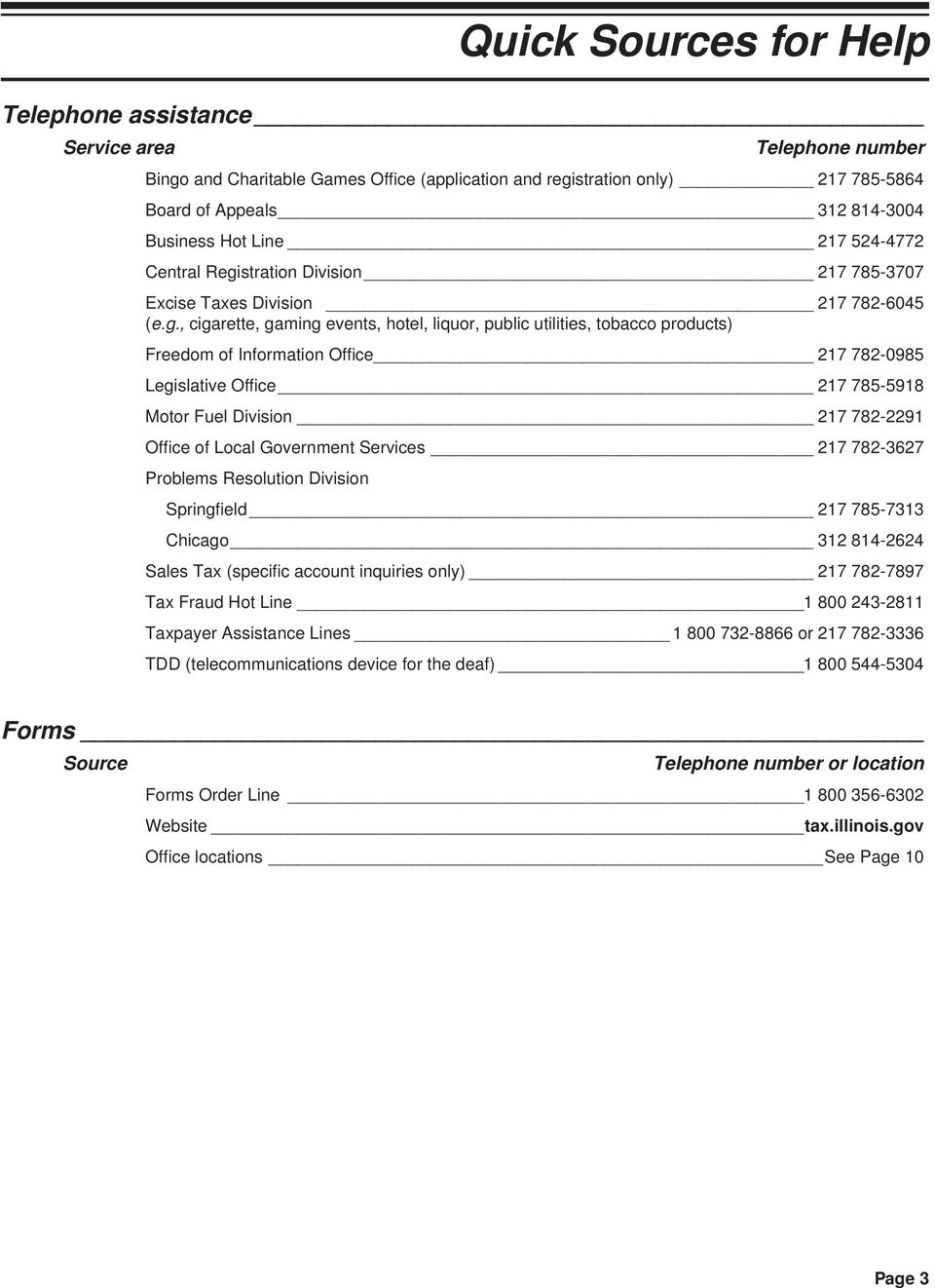
3 Telephone assistance Service area Quick Sources for Help Telephone number Bingo and Charitable Games Office (application and registration only) Board of Appeals Business Hot Line Central Registration Division Excise Taxes Division (e.g., cigarette, gaming events, hotel, liquor, public utilities, tobacco products) Freedom of Information Office Legislative Office Motor Fuel Division Office of Local Government Services Problems Resolution Division Springfield Chicago Sales Tax (specific account inquiries only) Tax Fraud Hot Line Taxpayer Assistance Lines or TDD (telecommunications device for the deaf) Forms Source Telephone number or location Forms Order Line Website tax.illinois.gov Office locations See Page 10 Page 3
4 Table of Contents Responsibilities General information...7 Taxpayers Bill of Rights...7 Our responsibilities...7 Your responsibilities...7 How to Get Help General information...8 Internet service...8 Telephone assistance...8 Voice Response Unit (VRU)...8 Taxpayer assistance lines...9 TDD...9 Business Hot Line...9 Walk-in assistance...9 Office locations...10 Help through the mail...11 Primary post office box numbers...11 Sample address format...11 Special ZIP codes for payments or returns...11 Illinois tax forms and publications...12 Website...12 Forms Order Line...12 Alternate forms...12 Paying tax on items that must be titled or registered with an Illinois agency...12 Special Services Available General information...13 Problems Resolution Division...13 Speaker s bureau...13 Electronic filing seminars...13 Registration Requirements and Information Business registration...14 Illinois Business Gateway internet registration...15 Selling or purchasing a business...15 Separate registration requirements...16 Separate bonding requirements...16 Separate registration for electronic filing programs...16 Individual Income Tax...16 Business Income Tax...16 Excise taxes...17 Tax-Prep Software (Sales and Use Tax)...18 Separate registration for Electronic Funds Transfer (EFT) Program...18 Alternate Filing Methods Individual Income Tax (Form IL-1040) alternate filing methods...19 Electronic filing (e-file)...19 WebFile...20 Tax-Prep Software...20 Withholding Income Tax (Form IL-941) alternate filing methods...20 Fed/State Employment Taxes Program (FSET)...20 Illinois TaxNet...20 Illinois Withholding WebFile...21 Business Income Tax (Form IL-1120) alternate filing method Federal/State Electronic Filing Program...21 Sales Tax (Form ST-1) alternate filing methods...22 ST-1 TeleFile Program...22 Tax-Prep Software...22 Sales Tax WebFile...22 Excise taxes alternate filing methods...23 Cigarette and Cigarette Use Taxes...23 Gas Revenue Tax...23 Liquor Gallonage Tax...23 Page 4

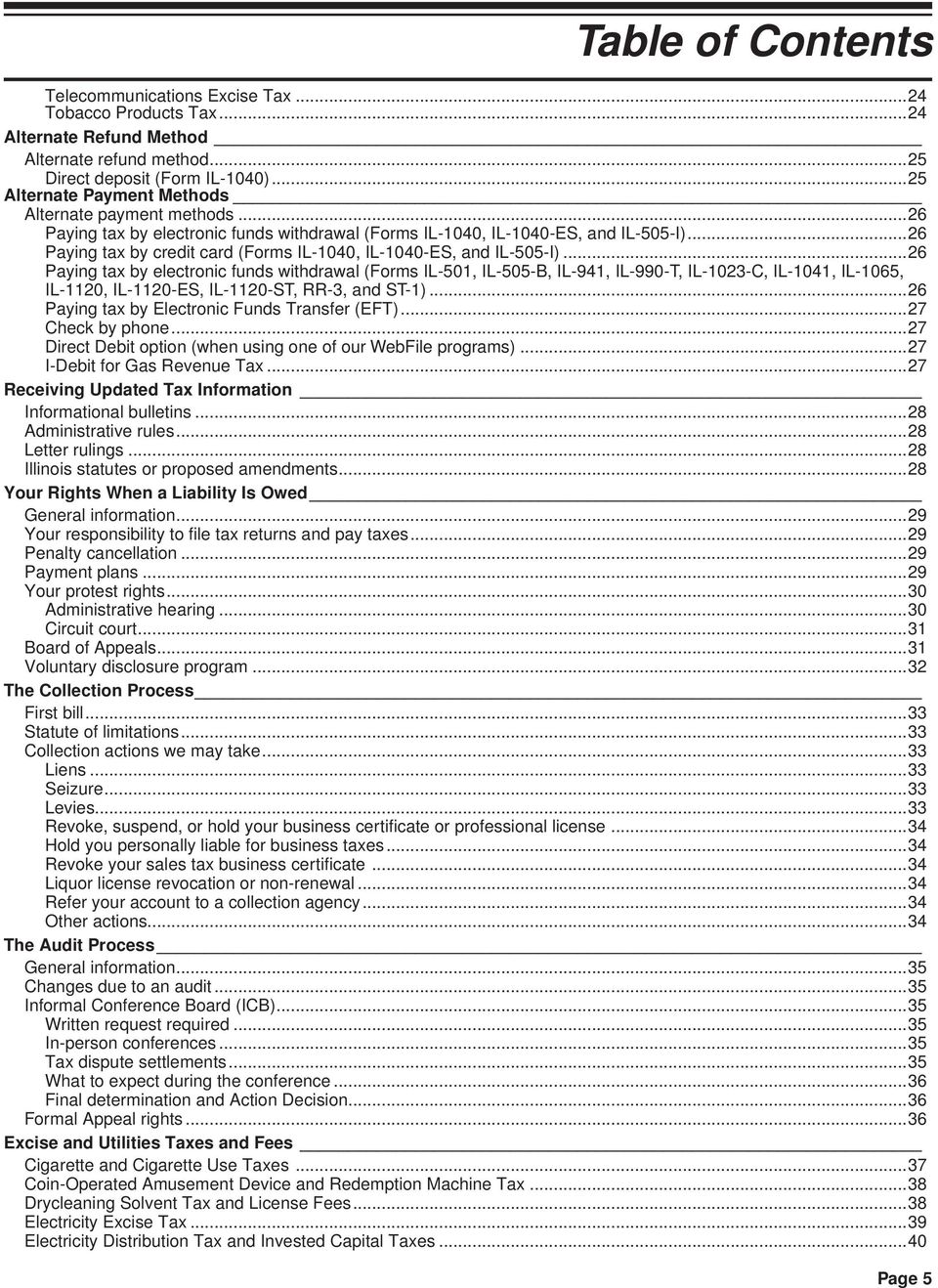
5 Table of Contents Telecommunications Excise Tax...24 Tobacco Products Tax...24 Alternate Refund Method Alternate refund method...25 Direct deposit (Form IL-1040)...25 Alternate Payment Methods Alternate payment methods...26 Paying tax by electronic funds withdrawal (Forms IL-1040, IL-1040-ES, and IL-505-I)...26 Paying tax by credit card (Forms IL-1040, IL-1040-ES, and IL-505-I)...26 Paying tax by electronic funds withdrawal (Forms IL-501, IL-505-B, IL-941, IL-990-T, IL-1023-C, IL-1041, IL-1065, IL-1120, IL-1120-ES, IL-1120-ST, RR-3, and ST-1)...26 Paying tax by Electronic Funds Transfer (EFT)...27 Check by phone...27 Direct Debit option (when using one of our WebFile programs)...27 I-Debit for Gas Revenue Tax...27 Receiving Updated Tax Information Informational bulletins...28 Administrative rules...28 Letter rulings...28 Illinois statutes or proposed amendments...28 Your Rights When a Liability Is Owed General information...29 Your responsibility to file tax returns and pay taxes...29 Penalty cancellation...29 Payment plans...29 Your protest rights...30 Administrative hearing...30 Circuit court...31 Board of Appeals...31 Voluntary disclosure program...32 The Collection Process First bill...33 Statute of limitations...33 Collection actions we may take...33 Liens...33 Seizure...33 Levies...33 Revoke, suspend, or hold your business certificate or professional license...34 Hold you personally liable for business taxes...34 Revoke your sales tax business certificate...34 Liquor license revocation or non-renewal...34 Refer your account to a collection agency...34 Other actions...34 The Audit Process General information...35 Changes due to an audit...35 Informal Conference Board (ICB)...35 Written request required...35 In-person conferences...35 Tax dispute settlements...35 What to expect during the conference...36 Final determination and Action Decision...36 Formal Appeal rights...36 Excise and Utilities Taxes and Fees Cigarette and Cigarette Use Taxes...37 Coin-Operated Amusement Device and Redemption Machine Tax...38 Drycleaning Solvent Tax and License Fees...38 Electricity Excise Tax...39 Electricity Distribution Tax and Invested Capital Taxes...40 Page 5
6 Table of Contents Energy Assistance Charges (electricity and natural gas distributors)...41 Gas Revenue Tax...41 Gas Use Tax...42 Hotel Operators Occupation Tax...42 Liquor Gallonage Tax...43 Oil and Gas Production Assessment...44 Telecommunications Taxes...44 Telecommunications Infrastructure Maintenance Fee...46 Tobacco Products Tax...47 Gaming Taxes and Fees Bingo Tax and License Fees...48 Charitable Games Tax and License Fees...49 Pull Tabs and Jar Games Tax and License Fees...50 Income Taxes Individual Income Tax...51 Business Income Taxes...52 Personal Property Tax Replacement Income Tax...53 Employer s Withholding Income Tax...54 Motor Fuel Taxes Motor Fuel Tax...57 Motor Fuel Use Tax...57 Environmental Impact Fee and Underground Storage Tax...58 Occupation Taxes, Fees, and Credits Automobile Renting Occupation and Use Taxes...59 Retailers Occupation Tax, Service Occupation Tax, Service Use Tax, and Use Tax...60 Tire User Fee...63 Vehicle Use Tax...64 Aircraft Use Tax...65 Watercraft Use Tax...66 Sales of Aircraft and Watercraft by Lessors...67 Other Taxes and Programs Property Tax...68 Department of Revenue responsibilities...68 Property tax cycle...68 Real Estate Transfer Tax...69 Rental Housing Support State Surcharge...70 Tax Increment Financing...70 Taxes Collected for Local Governments General information...71 Revenue-sharing with local governments...71 Separate return and payment requirements...71 Local Automobile Renting Occupation and Use Taxes...71 Business District Retailers Occupation Tax...71 City of Chicago Taxing Bodies...72 Chicago Home Rule Municipal Soft Drink Retailers Occupation Tax...72 Illinois Sports Facilities Hotel Tax...72 Metropolitan Pier and Exposition Authority (MPEA) Food and Beverage Tax...73 Metropolitan Pier and Exposition Authority (MPEA) Hotel Tax...73 Municipal Hotel Tax (Chicago)...73 County Motor Fuel Tax...74 DuPage Water Commission Taxes...74 Home Rule and Non-home Rule Sales and Use Taxes...74 Mass Transit District Taxes (Regional Transportation Authority [RTA] Taxes and Metro-East Mass Transit [MED] Taxes)...75 Metro-East Park and Recreation District Tax...75 Special County Retailers Occupation Tax for Public Safety, Transportation, or Facilities...76 County Flood Prevention Occupation Tax...76 County School Facility Occupation Tax...76 Simplified Municipal Telecommunications Tax...77 Page 6

7 Responsibilities General information The Taxpayers Bill of Rights identifies your rights and our responsibilities to ensure that those rights are protected. Taxpayers Bill of Rights You have the right to call the Illinois Department of Revenue for help in resolving tax problems. You have the right to privacy and confidentiality under most tax laws. You have the right to respond within specified time periods to our notices by asking questions, paying the amount due, or providing proof to refute our findings. You have the right to appeal our decisions in many instances within specified time periods by asking for our review or by taking the issue to court. If you have overpaid your taxes, you have the right to a credit (or, in some cases, a refund) of that overpayment. The full text of the Taxpayers Bill of Rights is contained in the Illinois Compiled Statutes, 20 ILCS 2520/1 et seq. For more information about these rights and other departmental procedures, visit our website at tax.illinois.gov or contact us at the address or telephone numbers below. write: ILLINOIS DEPARTMENT OF REVENUE PO BOX SPRINGFIELD IL call: (TDD-telecommunications device for the deaf) Our responsibilities We must give you correct and complete information to help you comply with tax laws in Illinois. Our forms and instructions explain the specific filing and payment requirements and methods, appeal processes, and limitation periods we both must follow, according to each tax act. If we send you a bill or notice, we will tell you why you received it, what actions you may take to resolve the matter, any protest actions that may be available to you, and what number to call for assistance. We must give you courteous and responsive answers if you contact us with questions about your account, need help meeting your tax obligations, or have questions about a particular tax matter. All information you give us on your returns, in your correspondence, and during meetings with our auditors or representatives is kept confidential. However, we will follow the laws that require or allow us to share confidential information with other government agencies (e.g., the Internal Revenue Service [IRS] and other state and local taxing authorities) to ensure that you have met your payment obligations. These agencies must agree to keep this information confidential. Your responsibilities The Illinois tax system is based, in large part, on your ability to calculate the amount of tax you owe and pay that amount when it is due. To help you meet this responsibility, we provide the most recent tax information on our returns and in our instructions, bulletins, booklets, and publications. It is your responsibility to obtain this information and use it concerning your registration, filing, and payment requirements. Page 7

8 How to Get Help General information We provide a variety of services designed to help you solve problems that you may encounter when you complete your tax return, respond to a notice, or determine your account s current status. Internet service You can reach us on the internet at tax.illinois.gov. Our website is customized to meet the needs of nine separate groups: businesses, individuals, local governments, property tax, excise taxes, non-profit organizations, charity gaming, motor fuel, and tax professionals. Each group has its own area on our website that contains specific information of interest to that group. Additional sections/services that are not necessarily targeted to a specific type of taxpayer are identified below. on-line business registration forms and publications on-line business registration verification rules and regulations list of methods of filing returns electronic filing information electronic payment methods on-line inquiries, including refund status on-line responses to your tax questions current interest and tax rates on-line address change for individual income taxpayers statistics Motor Fuel Use Tax - International Fuel Tax Agreement (IFTA) information local governments information tax professionals information answers to frequently asked questions links to other Illinois state agencies and most other states on-line account summary information (Excise Taxes) We also provide access to help you with specific problems or questions. After researching your question through our Answer Center, you may send an if you need additional assistance. If you have comments or suggestions about information we have included on our website, please send them to us by . Telephone assistance Most inquiries can be answered quickly, but some require special attention. Our telephone assistance network can provide you with the information you need. Voice Response Unit (VRU) Our VRU provides 24-hour, prerecorded information you can access with a touch-tone telephone. Information you can access by the VRU is identified below. automated individual income tax refund automated individual income tax estimated payment, credit, notice or bill, and account balance information Form 1099-G inquiry prerecorded tax information for a variety of tax types information about the services we provide forms order line your assigned Illinois Personal Identification Number (IL-PIN) You can access the VRU 24 hours a day, 7 days a week, by dialing one of the following telephone numbers: or (Taxpayer Assistance Line) (Forms Order Line) Page 8

9 How to Get Help Taxpayer assistance lines Illinois Department of Revenue (IDOR) employees can help you complete tax returns or answer your tax questions if you call our taxpayer assistance lines 8:00 a.m. to 5:00 p.m., Monday through Friday. Dial toll-free (or ). Employees answer calls in the order in which they are received. Since the toll-free Taxpayer Assistance Lines are a popular service, sometimes it is difficult to get through. Mondays and days after holidays normally have heavy phone traffic, so try to avoid calling on those days. When you call the Taxpayer Assistance Lines, a prerecorded message will ask you to choose a number on your touch-tone phone to indicate why you are calling and will direct your call based on the option you select. If you call about a return you have filed, please have one of the following taxpayer identification numbers available: Federal employer identification number (business or withholding income tax) Taxpayer ID Social Security number (individual income tax) Account ID number If you call about a notice you have received, please have a copy of the notice available to help us determine the nature and extent of the problem. Also, please tell us your Taxpayer ID, the date the return or payment was due, any other identification numbers (e.g., bank routing numbers), and the nature of your problem or inquiry. Note: If you have questions about an excise tax matter (i.e., bingo, cigarette, charitable games, hotel, liquor, public utilities, pull tabs, and tobacco products taxes), please call our Excise Taxes Division at Our representatives begin all conversations by identifying themselves. After you have finished the conversation, you may want to ask for the representative s name again and add it to your file for future reference. TDD If you are hearing impaired, you can access these same services by calling our TDD (telecommunications device for the deaf) at Business Hot Line Our Business Hot Line helps meet the needs of tax professionals and business clientele (including partnerships, trusts, and estates). Representatives specialize in business, withholding, income, replacement, sales, and use taxes. They handle issues from filing requirements to specific account status information. The Business Hot Line is available by dialing Monday through Friday, 8:00 a.m. to 5:00 p.m. This service is reserved for business tax questions only. Most of your business tax questions can be resolved with one call. If your inquiry is complicated, we will research your question and guarantee a response. We will also give you a specific post office box to use if you need to send us documentation or you want to send us correspondence about your problem. While our tax specialists on the various taxpayer assistance lines are well-trained in many different aspects of taxation, they are not prepared to handle every situation that arises. Walk-in assistance If you have tax questions or need help completing tax forms, walk-in assistance is available weekdays at all our locations. No appointment is needed. Service is available on a first-come-first-served basis. When you use our walk-in assistance, bring all available information, including all notices, forms (including any federal forms, if applicable), and schedules with you. All our offices promptly close at 5:00 p.m. We encourage you to arrive as early in the day as possible. Our service locations and hours are listed on the next page and on our website at tax.illinois.gov. We provide the following services at our Springfield and Chicago offices: Cashier service and return processing for all taxes and programs we administer Same-day service in getting business tax numbers and related activities Help completing and filing sales tax returns Motor vehicle tax return processing and tax payment (service is also provided at the three major offices of the Secretary of State in Chicago on Martin Luther King Jr. Drive, Elston Avenue, and Lexington Avenue) Help completing and filing income tax returns Copies of tax returns (same day service available at the Springfield office only) Coin-operated Amusement Devices decals Page 9

10 How to Get Help Office locations In addition to the Springfield and Chicago offices, we have regional offices in Illinois. All of these offices provide some taxpayer services, and each maintains a supply of forms. Office hours are Monday through Friday, with times provided below. Note: To verify an address, visit our website or call the number listed for the location. Illinois office locations Chicago - 8:30 a.m. to 5:00 p.m. James R. Thompson Center, Concourse Level 100 West Randolph Street Chicago, Illinois Des Plaines - 8:30 a.m. to 5:00 p.m. Maine North Regional Building 9511 Harrison Avenue Des Plaines, Illinois Fairview Heights - 8:30 a.m. to 5:00 p.m. 15 Executive Drive, Suite 2 Fairview Heights, Illinois Marion - 8:30 a.m. to 5:00 p.m W. Main St., Suite 114 Marion, Illinois Rockford - 8:30 a.m. to 5:00 p.m. 200 S. Wyman St. Rockford, Illinois Springfield - 8 a.m. to 5 p.m. Willard Ice Building 101 West Jefferson Street Springfield, Illinois Page 10

11 Help through the mail A written letter is sometimes the best way to resolve an issue. In fact, some of our notices require a written response. When appropriate, you will receive a written record of the outcome. We answer all correspondence on a first-in, first-out basis, except in a case in which you may suffer irreparable harm if prompt resolution is not achieved. In that case, your inquiry will be placed before others. It is important for your inquiry to get to the correct location as quickly as possible. All department-generated notices that require a response include an address where you should send your reply. Use that address to ensure prompt and proper handling. In addition, all required returns include a mailing address. When you write to us, include all pertinent information, such as the tax type, tax period, and your Taxpayer ID. When you respond to one of our notices, include a copy of the notice. Because not all inquiries are the result of a notice, sometimes it is difficult to determine where you should send a particular question. The primary post office boxes you should use are listed below. Unless otherwise noted, these post office boxes are for our Springfield office. For the correct way to address your correspondence, see Sample address format. Primary post office box numbers Area PO BOX Audit Business Income Tax Central Registration Division Collections Electronic Filing Electronic Funds Transfer (EFT) Excise Taxes IFTA Individual Income Tax Local Government Services Office Problems Resolution Division Sales Tax ST-556, Sales Tax Transaction Return (receipted copies) Taxpayer Correspondence Taxpayer Information Withholding Income Tax Voluntary Disclosure Program Sample address format To ensure that your mail is routed to the appropriate area quickly, you must use a nine-digit ZIP code. The first five digits are The last four digits are the last four digits of the post office box to which you are writing. For example, to request a copy of an informational bulletin, you would write to us at: Illinois Department of Revenue, P.O. Box 19044, Springfield, IL Special ZIP codes for payments or returns Some returns and payments have a unique ZIP code rather than a post office box. When mailing one of the returns or payments listed below, address them to the Illinois Department of Revenue, Springfield, Illinois, and choose the appropriate ZIP code from the following list: Form How to Get Help ZIP code Form IL-1040 with a payment Form IL-1040-ES, Estimated Income Tax Payments for Individuals (payment) Form IL-1040-V, Payment Voucher for Individual Income Tax (payment) Form IL-1040 without a payment PO Box 1040, Galesburg, Illinois Form RR-3, Sales and Use Tax Quarter-monthly Payment Form ST-1, Sales and Use Tax Return Form ST-4, Metropolitan Pier and Exposition Authority Food and Beverage Return Form ST-8, Tire User Fee Form ST-44, Illinois Use Tax Return Page 11

12 How to Get Help Illinois tax forms and publications We offer several ways by which you can request and receive forms or publications. In addition, you may develop your own forms, but only if you ask for and receive our approval to do so. (See Alternate forms.) Website Most Illinois forms and publications are available on our website at tax.illinois.gov. Forms that are not available will be listed with directions for obtaining the form. Forms Order Line Our Illinois forms and publications are available seven days a week by calling our 24-hour Forms Order Line at Alternate forms You may use forms from approved software packages. Approved software packages for Illinois returns will be labeled as such by the vendor. In addition, approved forms providers are listed on our website at tax.illinois.gov. You may develop alternate versions of our forms only if you obtain our approval before you use the forms you develop. Alternate forms must contain the same information and be in the same format as our forms. Alternate forms must be easily readable and produced on paper that is the same size, weight, and color as our forms. Approved alternate forms must contain the assigned identification number or company name of the producer. A form that has not been approved but is included in the release of a form product should have a notice on the form stating that it has not been approved for filing and should not be filed. Dollar amount fields should be followed by a decimal point and a cents field or by two zeroes, when rounded. Note: You may not use computer printouts with line numbers and dollar amounts attached to a blank copy of the return. Separate statements not on forms provided or approved by the department will not be accepted and you will be asked for appropriate documentation. Computer-generated printouts are not acceptable, even if they are in the same format as the department s forms. Failure to comply with this requirement may result in the delay of processing your return or generating any refund. For more information on alternate forms, visit our website at tax.illinois.gov or contact us at the address below. write: OFFICE OF PUBLICATIONS MANAGEMENT ILLINOIS DEPARTMENT OF REVENUE 101 WEST JEFFERSON STREET SPRINGFIELD IL Paying tax on items that must be titled or registered with an Illinois agency When you apply for a title or registration with an agency of the Illinois state government, you must file a tax return and either pay tax owed or prove that no tax is due. The following agencies process applications for title or registration and have the return that you need to file at their offices: Office of the Secretary of State (for cars, trucks, vans, motorcycles, ATVs, trailers, and mobile homes) Illinois Department of Natural Resources (for watercraft and snowmobiles) Illinois Department of Transportation (for aircraft) These agencies work with us to ensure that you meet your tax obligations whenever you purchase, lease, acquire by gift, or transfer an item that must be titled or registered in Illinois. Returns have specific due dates. Therefore, you must file your return and pay any tax owed by the due date to avoid penalty and interest charges, even though you may not be able to complete your application for title or registration. Note: If you need a receipted copy to process your title work later, visit our website for complete instructions. Page 12

13 General information The section titled How to Get Help describes the general services we provide. In most cases, you will use those services, but sometimes your issue or situation may need special attention. The services described in this section are designed for situations in which you may need specialized help. Problems Resolution Division Our Problems Resolution Division helps you resolve unusual, complex, or otherwise urgent matters. This area does not address routine issues. You must first try to resolve the matter using one of the methods described in the previous section. If your situation is not resolved after using one of those standard methods, contact our Problems Resolution Division. This division expedites processing when unreasonable delays have occurred; ensures that your rights are protected; and gives priority treatment to time-sensitive inquiries or cases. If division personnel find your inquiry can be handled through normal channels, it will be transferred to the appropriate area. If your inquiry is accepted, division personnel will acknowledge all correspondence and will give you the name and telephone number of the tax specialist handling your case. Because this person will be responsible for your case until it is resolved, contact this person if you have further questions. The Problems Resolution Division addresses and telephone numbers are below. Chicago address Springfield address PROBLEMS RESOLUTION DIVISION PROBLEMS RESOLUTION DIVISION ILLINOIS DEPARTMENT OF REVENUE ILLINOIS DEPARTMENT OF REVENUE 100 WEST RANDOLPH SUITE PO BOX CHICAGO IL SPRINGFIELD IL fax fax Problems Resolution Division staff members are not auditors or attorneys and cannot address factual or legal issues related to tax liabilities. Such matters should be pursued through administrative appeal or protest procedures (described in the sections titled Your protest rights, Administrative hearing, and Circuit Court ). For matters that require legal consideration, contact our Legal Services Office at the address below. write: LEGAL SERVICES OFFICE ILLINOIS DEPARTMENT OF REVENUE 101 WEST JEFFERSON ST SPRINGFIELD IL Speaker s bureau Staff speakers may be available to address many tax topics in which your group or organization may be interested. Please contact us with your request, which must be in writing. For more information or to obtain a speaker, visit our website at tax.illinois.gov, go to our Answer Center, and type in the keyword speaker or contact us at the address below. write: CUSTOMER SERVICES BUREAU ILLINOIS DEPARTMENT OF REVENUE PO BOX SPRINGFIELD IL Electronic filing seminars Special Services Available The Illinois Department of Revenue sponsors free electronic filing educational seminars in various locations throughout Illinois. Seminars are offered for those who currently provide electronic filing services and for those wanting more information on the various electronic services offered. Some of the topics covered are listed below. New information for the upcoming processing year Why we provide electronic filing and who benefits from it Electronic payment options Compliance issues For more information about these seminars, visit our website at tax.illinois.gov or call us at Page 13

14 Registration Requirements and Information Business registration You must register with us if you conduct business in Illinois, or with Illinois customers. This includes sole proprietors (individual or husband/wife), exempt organizations, or government agencies withholding for Illinois employees. From our website, visit the State of Illinois Business Portal for information about doing business in Illinois. This site will provide you with the state government information and resources you need. To register your business, you must either electronically register through the Illinois Business Gateway on our website at tax.illinois.gov (approximately one to two days to process), or complete and mail Form REG-1, Illinois Business Registration Application, to us at the address on the form. Form REG-1 is available on our website as a fill-in and saveable form, by calling us at , or at one of our offices. In addition, you may have to complete corresponding schedules, such as Schedule REG-1-A, Liquor Information, Schedule REG-1-B, Financial Responsibility Bond Liquor Gallonage Tax, Schedule REG-1-C, Cigarette and Tobacco Products Information, Schedule REG-1-D, Electricity Tax Self-Assessing Purchaser, Schedule REG-1-G, Gas Use Tax Self-Assessing Purchaser, Schedule REG-1-L, Illinois Business Site Location Information, Schedule REG-1-O, Owner, Officer, and General Partner Information, Schedule REG-1-R, Responsible Party Information, and Schedule REG-1-T, Telecommunications Tax Location Information. Please allow 6 to 8 weeks for processing if you complete and mail Form REG-1 to us. If applicable, you will receive your certificate of registration and taxpayer ID (i.e., your tax number), Register with us, using one of the above methods, before you make any purchases, sales, or when you hire an employee. You must display your Certificate of Registration in a prominent location in the place of business to which it applies. If your business is already registered and your information changes (e.g., address change, ownership change, additional tax responsibilities, new location), update your registration information by calling us at If you do not, your returns and payments may not be processed correctly; we may send you a tax bill or notice; and you may not receive the forms or needed information about tax law changes. To learn more about the registration process, visit our website at tax.illinois.gov. If you prefer, you may also contact our Central Registration Division. The address and telephone number are below. write: CENTRAL REGISTRATION DIVISION ILLINOIS DEPARTMENT OF REVENUE PO BOX SPRINGFIELD IL call: Page 14

15 Registration Requirements and Information Illinois Business Gateway internet registration The Illinois Business Gateway is the department s electronic option to register your business. It is available to new businesses and tax practitioners who need to register a business for the first time. It is a fast, safe, and accurate way to register your business. You may register for the following taxes through the Illinois Business Gateway on our website at tax.illinois.gov: Automobile Renting Occupation and Use Tax Business Income Tax Cigarette and Cigarette Use Taxes Electricity Distribution and Invested Capital Tax Electricity Excise Tax Employer s Withholding Income Tax Gas and Gas Use Tax Hotel Operator s Occupation Tax Liquor Warehouse Tax Motor Fuel Tax Energy Facility Payments Sales, Use, and Related Taxes Telecommunications Infrastructure Maintenance Fee Telecommunications Taxes Tobacco Products Tax Withholding Tax Note: Certain tax types may have additional registration or bonding requirements. Further information follows on the next page and in the portion of this publication that covers specific tax types. If you provided all of the information necessary for us to process your application, you may access the system again in 24 to 48 hours to obtain your Taxpayer ID. If we require additional information for your particular registration, we will contact you. Selling or purchasing a business You (or the purchaser or the transferee) must complete Form CBS-1, Notice of Sale, Purchase, or Transfer of Business Assets, within 10 days of the sale. Forms received more than 10 days after the sale date will not be processed. The purchaser may be held liable for any debt incurred by the seller. Attach a copy of the sales contract and financing agreement if, outside your usual course of business, you sell or transfer the major part of the stock of goods that you are in the business of selling, the furniture or fixtures, the machinery and equipment, or the real property of your business. If you need additional information, contact us at the address or telephone numbers below. write: BULK SALES UNIT ILLINOIS DEPARTMENT OF REVENUE 100 WEST RANDOLPH LEVEL CHICAGO IL call: (fax) Page 15

16 Registration Requirements and Information Separate registration requirements You may need to complete additional registration forms if your business is engaged in any of the activities shown below. Coin-operated amusement devices (COADs) Your business owns COADs that do not dispense merchandise. Drycleaning Solvent Tax Tax-Prep Software (Sales and Use Tax) Your business participation is voluntary. Electronic Filing (Individual Income Tax) Your participation is either mandatory or voluntary. Electronic Filing (Business Income Tax) Your business participation is voluntary. Electronic Filing (excise taxes) Your business participation is either mandatory or voluntary. Electronic Funds Transfer (EFT) of your tax payments Your business participation is either mandatory or voluntary. Interstate motor carrier Your business operates commercial motor vehicles in or through Illinois. (See Motor Fuel Use Tax.) Liquor Your business manufactures or is an importing distributor of liquor. (See Liquor Gallonage Tax.) Separate bonding requirements In addition to registering your business, Illinois laws require that certain businesses post a bond for the following excise taxes: Cigarette and Cigarette Use Taxes Liquor Gallonage Tax Motor Fuel and Motor Fuel Use Taxes Tobacco Products Tax Environmental Impact Fee on Underground Storage Tax If the type of business that you are conducting requires you to post a bond, you should contact our Excise Taxes Division. The address and telephone number are below. write: EXCISE TAXES DIVISION ILLINOIS DEPARTMENT OF REVENUE PO BOX SPRINGFIELD IL call: Separate registration for electronic filing programs Individual Income Tax Paid preparers who file more than 100 Illinois Individual Income Tax returns must file those returns electronically. Electronic Return Originators (ERO s) are not required to submit a separate Illinois enrollment application for authorization to file Individual Income Tax Returns electronically. Internal Revenue Service (IRS) e-file providers with an approved electronic filer identification number (EFIN) are automatically enrolled in the Illinois program. New software developers and direct transmitters need to submit Form IL-8633-I, Application to File Illinois Individual Income Tax Returns Electronically for Software Developers and Transmitters. We provide all of the information you need to file and pay electronically on our website at tax.illinois.gov. Business Income Tax We have an electronic filing program for Form IL-1120, Corporate Income and Replacement Tax Return, and accompanying schedules. This is a Federal/State program, allowing both the federal and state returns to be transmitted to the IRS using the Modernized E-File system (MeF). Participants are described below. Taxpayers who are required to file Form IL-1120 Electronic return originators Transmitters Software developers supporting electronic filing Page 16

17 Registration Requirements and Information Electronic return originators (ERO s), transmitters and taxpayers using the services of approved electronic filers are not required to submit a separate Illinois enrollment application for authorization to file Business Income Tax Returns electronically. Internal Revenue Service (IRS) e-file providers with an approved electronic filer identification number (EFIN) or electronic transmitter identification number (ETIN) are automatically enrolled in the Illinois program. Only software developers need to submit Form IL-8633-B, Business Electronic Filing Enrollment. Information on the program may be found in the Illinois Department of Revenue Implementation Guide for 1120 Federal/State Electronic Filing Program, available on our website at tax.illinois.gov. For more information about this program, visit our website at tax.illinois.gov or contact our Springfield office weekdays between 8 a.m. and 5 p.m. at the address or telephone number below. write: OFFICE OF ELECTRONIC FILING ILLINOIS DEPARTMENT OF REVENUE PO BOX SPRINGFIELD IL call: Excise taxes We have an electronic filing program for Cigarette and Cigarette Use Tax returns and schedules, Liquor Gallonage Tax returns and schedules, Tobacco Products Tax returns and schedules, and Telecommunications Tax returns and schedules. Some taxpayers are required to file their returns electronically; we also accept voluntary participants. We will notify you if you are required to file electronically. Two methods of electronic submission are offered WebFile and direct transmission. With the WebFile method, electronic returns and schedules are transmitted using the internet. With the direct transmission method, electronic returns and schedules are transmitted directly to computers at our office in Springfield, Illinois. Electronic filers can perform all of the functions themselves associated with this electronic filing program, or they can use services of another accepted electronic filer (third party) to participate in the electronic filing program. Participants are described below. A taxpayer who prepares the electronic return or other document and transmits it directly or otherwise provides it to IDOR using software developed by the taxpayer or a commercial software provider. A taxpayer who uses the services of a service group or other third party to prepare the electronic return or other document and transmits it or otherwise provides it to IDOR. A third party transmitter who takes prepared returns from taxpayers or service groups and transmits them to IDOR directly. A service group or other third party who prepares electronic returns or other documents and transmits them to IDOR directly. A software developer who develops software to format return information to conform with IDOR specifications; and/or transmit to IDOR directly or provide electronic returns to IDOR. To participate in this program there are no special registration requirements if you use our WebFile program. If you use one of the other methods you must be properly registered for electronic filing and, in some instances, electronic funds transfer. To register, complete and sign Form IL-8633-B, Business Electronic Filing Enrollment. Taxpayers who use service groups, other third parties, or other agents to electronically file returns or schedules under this program remain responsible for their own registration. For more information, visit our website at tax.illinois.gov or contact our Excise Taxes Division at the address or telephone number below. write: EXCISE TAXES DIVISION ILLINOIS DEPARTMENT OF REVENUE PO BOX SPRINGFIELD IL call: Page 17

18 Registration Requirements and Information Tax-Prep Software (Sales and Use Tax) The department s Tax-Prep Software program is voluntary. The Form ST-1, Sales and Use Tax Return, and all attachments, can be filed electronically. Participants are described below. Taxpayers who are required to file Form ST-1 Electronic return originators Transmitters who are transmitting directly to the department Software developers supporting electronic filing All participants must register with us by completing and signing Form IL-8633-B, Business Electronic Filing Enrollment. In addition, those not currently enrolled in our Electronic Funds Transfer (EFT) program may also submit a completed and signed Form EFT-1, Authorization Agreement for Certain Electronic Payments. We will inform you of your acceptance in our program and the procedures you must follow before filing Forms ST-1 using this method. For more information about this program, visit our website at tax.illinois.gov or write us or call our Springfield office weekdays between 8:00 a.m. and 5:00 p.m. write: OFFICE OF ELECTRONIC FILING ILLINOIS DEPARTMENT OF REVENUE PO BOX SPRINGFIELD IL call: Separate registration for Electronic Funds Transfer (EFT) Program EFT is an electronic payment method that you use to pay certain tax liabilities. Instead of writing a check for the amount of tax due, you instruct your financial institution to transfer the funds from your account to ours. We then apply the transferred amount to your tax liability. EFT is not a way to file your return electronically only a change in the way you make your tax payment. The fact that you make payments by EFT does not eliminate your obligation to file your tax forms timely. For most taxes, you must participate in the EFT program if your average annual tax liability meets or exceeds an annual statutory threshold of $20,000. For withholding income taxpayers, if your annual liability exceeds $12,000, you must pay electronically. Individual Income taxpayers with a liability of $200,000 or more must pay using EFT. If your average monthly liability is more than $1,000 under the Telecommunications Tax Act, you must make all return payments by EFT. All cigarette tax stamp payments must be made by Automated Clearing House (ACH) debit. We determine on an annual basis if you are required to participate in the EFT program. We will usually notify you by August 1 if you must make your payments by EFT. Mandatory participation begins October 1 and continues for the next 12 months. All participants who are not using our web filing/payment applications must complete and sign Form EFT-1, Authorization Agreement for Certain Electronic Payments, to participate in the EFT program even if a designated agent electronically transfers your tax payments for you. Service groups or other agents may submit Form EFT-1 on behalf of taxpayers who have executed a valid Form IL-2848-E, Power of Attorney for Electronic Processing, or other valid power of attorney document authorizing those service groups or other agents to complete the authorization agreements and to make tax payments by EFT on behalf of those taxpayers. These service groups or other agents must keep Form IL-2848-E in their books and records. After we receive your properly completed and signed Form EFT-1, we will give you instructions to follow to make your payments by EFT. Taxes paid under the Motor Fuel Tax Law or the Environmental Impact Fee Law are exempt from EFT requirements. If you are not using one of our web filing/payment applications you may participate in the EFT program voluntarily, but only if you complete Form EFT-1, Authorization Agreement for Certain Electronic Payments, and you receive our approval. We normally process new forms within 2 weeks of receipt. We will then provide you with instructions to follow to make your payments by EFT. If you have specific questions about Electronic Funds Transfer, visit our website at tax.illinois.gov or write us or call our Springfield office weekdays between 7:45 a.m. and 4:15 p.m. write: ELECTRONIC FUNDS TRANSFER DIVISION ILLINOIS DEPARTMENT OF REVENUE PO BOX SPRINGFIELD IL call: Page 18

19 Alternate Filing Methods Individual Income Tax (Form IL-1040) alternate filing methods Our alternate filing methods allow you to file your Form IL-1040, Individual Income Tax Return, using more technologically advanced methods than filing a normal paper return. Generally, returns filed using these methods have few or no errors. In addition, refunds are issued more quickly. The benefits of filing your return electronically are listed below. Returns are more accurate because we edit them for errors before we accept them. Accepted returns are confirmed or acknowledged, which is your proof of filing. Electronic returns receive priority processing at the department and at the Office of the Comptroller. Direct deposit refunds are issued faster. You may not use an alternate filing method if any of the following statements apply: You are a fiscal year filer. You are filing for a previous year. You are claiming other subtractions for an August 1, 1969, valuation limitation amount from Schedule F, an enterprise or river edge redevelopment zone and high impact business dividend subtraction amount from Schedule 1299-C, or other income not specifically identified on Schedule M. You are using Schedule CR to claim a credit for tax paid to another state on Form IL-1040, and you are not a fullyear Illinois resident. You are claiming a credit on Schedule 1299-C. You are claiming a recapture of investment tax credits from Schedule You want to amend a previously filed return. Our alternate filing methods are described below. Electronic filing (e-file) When you electronically file your Form IL-1040 through a tax professional, you file your return with the department via computer. Your return information is transmitted directly from your tax professional s computer to the department s computer. We also participate in the Internal Revenue Service (IRS) Federal/State Electronic Filing Program. Rather than transmit returns directly to the department, the tax professional transmits your federal and Illinois tax returns to the IRS. The IRS then makes your Illinois return available for us to electronically retrieve and process. We review each return to make sure that it is accurate and complete and acknowledge that the return has been either accepted or rejected. If accepted, the information will be processed. If rejected, we will identify the specific errors and inform the electronic transmitter. You may use e-file if you use the services of an approved electronic return originator (ERO) or have your return prepared by a tax professional. All taxpayers who e-file must sign Form IL-8453, Illinois Income Tax Electronic Filing Declaration. In addition, the following forms, if applicable, must be attached to the front of Form IL-8453: W-2, Wage and Tax Statement forms W-2G, Certain Gambling Winnings forms 1099-R, Distributions from Pensions, Annuities, Retirement or Profit-Sharing Plans, IRAs, Insurance Contracts, etc G Certain Government Payments Required supporting documentation for Form IL-1040 line entries for additions or subtractions must be attached to the back of Form IL-8453 (e.g., credit for tax paid to another state, attach all out-of-state tax returns; filing on behalf of a deceased taxpayer, attach Form IL-1310, Statement of Person Claiming Refund Due to a Deceased taxpayer). If you owe tax, you have four options to pay the amount you owe. You may pay by electronic funds withdrawal, credit card, check, or money order. (See Alternate Payment Methods.) Page 19

20 Alternate Filing Methods WebFile Our internet filing program is free and allows you to file your Form IL-1040 using the internet. Follow the instructions on the WebFile screens and enter your income tax information. WebFile will calculate your return and tell you if you are due a refund of overpaid tax or if you have a balance due. You will also have the option to directly deposit your refund into your checking or savings account or have the amount of tax due automatically withdrawn from your checking or savings account during your filing. At the end of your successful filing, you will receive a confirmation number, which is your proof of filing. You must have an Illinois Personal Identification Number (IL-PIN), a valid Illinois driver s license number, or an Illinois identification number on file with the Illinois Secretary of State to use this method. Visit our website at tax.illinois.gov to verify that you are qualified to file using our WebFile program. If you do not have an IL-PIN and have filed with us within the last two years, check to see if one has been assigned to you by visiting tax.illinois.gov, or by calling , or Our TDD (telecommunications device for the deaf) number is If no IL-PIN has been assigned to you, you must have a valid Illinois driver s license number or Illinois identification number on file with the Illinois Secretary of State to use this method. If you owe tax, you have four options to pay the amount you owe. You may pay by electronic funds withdrawal, credit card, check, or money order. (See Alternate Payment Methods.) Tax-Prep Software Tax-Prep filing software allows you to file on the internet using your personal computer through a third party electronic filing intermediate service provider. You can obtain Tax-Prep software either off the shelf or through the internet. Written instructions will guide you through your filing. You will enter your income tax information and the software will calculate your return and tell you if you are due a refund of overpaid tax or if you have a balance due. You will also have the option to directly deposit your refund into your checking or savings account during your PC filing. The department provides confirmation for the successful filing of each Tax-Prep filed return, which is your proof of filing. You must have an Illinois Personal Identification Number (IL-PIN) or a valid Illinois driver s license number or Illinois identification number on file with the Illinois Secretary of State to use this method. Visit our website at tax.illinois.gov to verify that you are qualified to file using Tax-Prep software. If you do not have an IL-PIN and have filed with us within the last two years, check to see if one has been assigned to you by visiting tax.illinois.gov, calling , or Our TDD (telecommunications device for the deaf) number is If no IL-PIN has been assigned to you, you must have a valid Illinois driver s license number or Illinois identification number on file with the Illinois Secretary of State to use this method. If you owe tax, you have four options to pay the amount you owe. You may pay by electronic funds withdrawal, credit card, check, or money order. (See Alternate Payment Methods.) Withholding Income Tax (Form IL-941) alternate filing methods Fed/State Employment Taxes Program (FSET) FSET is a program for large employers and payroll companies to electronically file and pay both their federal and Illinois employment taxes. This includes returns and payments for state withholding and unemployment insurance. The program is open to software developers, transmitters, and payroll service providers who act as Reporting Agents (companies that perform payroll services for other businesses). Business taxpayers must use a payroll service provider or develop their own software to participate. For Illinois, all participants must pre-register. Please see the registration form included in the FSET Implementation Guide, which is available on our website at tax.illinois.gov. Software developers and transmitters use their IRS EFIN/ETIN, and will be assigned logon ID numbers and passwords for communication via the IL Business Gateway. Reporting agents select a single electronic signature used to sign all returns and payment authorizations for their clients. Reporting agents must obtain Form IL-8655, Reporting Agent Electronic Services Authorization, from each client before acting on their behalf. Please contact the Electronic Commerce Division at for more information. Illinois TaxNet Illinois TaxNet is a program for Illinois businesses to electronically file Unemployment Insurance Tax and Wage Reports (UI-3/40), Illinois Withholding Tax Returns (Form IL-941) and to pay IL-501 payments by direct debit via a bank account registered with Illinois TaxNet. Visit to register. Page 20
21 Alternate Filing Methods Illinois Withholding WebFile Our internet filing program, WebFile and Pay, for withholding income tax is free and allows you to file your Form IL-941, Illinois Withholding Income Tax Return, using the internet. Follow the instructions on the WebFile screens and enter your tax information. WebFile will calculate your return and tell you whether or not you have a balance due or are overpaid. If you have a balance due, you will have the option to have the amount of tax due automatically withdrawn from your business s checking or savings account during your filing. At the end of your successful filing, you will be given a confirmation number, which is your proof of filing. Business Income Tax (Form IL-1120) alternate filing method 1120 Federal/State Electronic Filing Program The department, in conjunction with the Internal Revenue Service (IRS), accepts electronically filed Form IL-1120, Corporation Income and Replacement Tax Return, and accompanying schedules. This program is voluntary and is a Federal/State program, allowing both the federal and state returns to be transmitted to the IRS, and the IRS then makes your Illinois return available for us to electronically retrieve and process. We accept the following forms and schedules: Form IL-1120, Corporation Income and Replacement Tax Return Schedule 80/20, Related Party Expenses Schedule K-1-P, Partner s or Shareholder s Share of Income, Deductions, Credits and Recapture Schedule K-1-T, Beneficiary s Share of Income and Deductions Schedule M (for IL-1120 filers), Other Additions and Subtractions Schedule 1299-B, Enterprise Zone or Foreign Trade Zone (or sub-zone) Subtractions Schedule J, Foreign Dividends Schedule NB, Nonbusiness Income Schedule NLD, Illinois Net Loss Deduction Schedule 4255, Recapture of Investment Tax Credits Form IL-4562, Special Depreciation Form IL-477, Replacement Tax Investment Credits Schedule 1299-D, Income Tax Credits Form IL-2220, Computation of Penalties for Businesses Schedule INS, Tax for Foreign Insurers Copies of Federal forms as required by IL-1120 Instructions Schedule UB, Combined Apportionment for Unitary Business Group Schedule UB/INS, Tax for a Unitary Business Group with Foreign Insurer Members Schedule UB/NLD, Unitary Illinois Net Loss Deduction We review each return to make sure that it is accurate and complete, and acknowledge that the return has been either accepted or rejected. If accepted, the information will be processed. If rejected, we will identify the specific errors and inform the electronic transmitter. Taxpayers will have the opportunity of electronically paying any balance due by Electronic Funds Transfer (EFT), using either the ACH debit or ACH credit option, or may pay by check. Paper checks must be submitted with Form IL-1120-V payment voucher, produced by the software the electronic filer is using. Page 21
22 Alternate Filing Methods Sales Tax (Form ST-1) alternate filing methods ST-1 TeleFile Program The department s Sales Tax TeleFile program allows retailers to file their sales tax returns by phone. TeleFile allows taxpayers to pay their Form ST-1 balance due during the filing call, provided they are already registered in our Electronic Funds Transfer Program. Three out of five taxpayers are eligible to participate in this program. Those selected have relatively simple returns with entries on Lines A, 1, 2, 4a, 5a, 6a, 7a, 12a, 13a, or 19, and conduct business at a single location. Participants are mailed instructions and a Personal Identification Number (PIN) that serves as an electronic signature for the TeleFiled return. Taxpayers enter information using the telephone keypad and the system does the math, eliminating arithmetic mistakes; calculates the retailer s discount for returns filed on time, but only if the taxpayer wants the discount; and provides a confirmation number at the end of each successful telephone call that the taxpayer can keep as proof of filing. You must TeleFile if we send you a preprinted Form ST-1-T, Illinois Sales and Use Tax TeleFile Worksheet, or you may file using another electronic filing option from our website at tax.illinois.gov. You may not file a paper Form ST-1 except in the following limited circumstances: You have more than one business location. You need to use Line 17 of Form ST-1 to report the amount of prepaid Illinois Sales Tax on motor fuel. You need to use Line 18 of Form ST-1 to report the amount of quarter-monthly payments that you remitted. You need to report an amount on one of the following lines on Form ST-1: Receipts taxed at other rates Purchases at other rates Manufacturer s Purchase Credit Excess tax collected Credit memorandum Note: The TeleFile worksheet is for your convenience when telefiling your return and to keep in your records. Do not mail it to us. For more information regarding this program, call or us at [email protected]. Tax-Prep Software Our Tax-Prep Software program is voluntary. The Form ST-1, Sales and Use Tax Return, and all attachments can be filed electronically. Participants include: taxpayers who are required to file Form ST-1; electronic return originators; transmitters who are transmitting directly to the department; and software developers supporting electronic filing. Sales Tax WebFile You may file your return using sales tax WebFile and Pay if you are registered with us; have on file with us the person responsible for filing and paying your sales and use tax returns; do not have any prepaid sales tax from Form PST-2, Prepaid Sales Tax Statement of Tax Paid, to report; do not have any changes to the preprinted information on your ST-1 or ST-2 forms. For example, your rate is correct or you do not need to add or change a site. If you have corrections you may still be able to file through the internet. Please contact our Central Registration Division; will not be filing ST-2-TS, Temporary Storage Multiple Site Form, or ST-2-DP, Direct Pay Multiple Site Form. You must have your Taxpayer ID; your PIN, assigned by the department, or the Social Security number of an owner, officer, or responsible party registered with the business; your financial information for each line on the return; and your checking or savings account information if you choose to debit the amount you owe. Page 22
23 Alternate Filing Methods The PIN is a number assigned by the department to any individual you registered as a responsible party of your business. It is used to access the sales tax WebFile program, and is used in combination with your Taxpayer ID as an alternative to the hand written signature on the ST-1 return. You should have received IDOR-50-P, Taxpayer Notification PIN Assignment, from us in the mail. Your PIN, and the date you can begin using your PIN are printed in the upper right hand corner of the letter. If you misplaced your PIN, you may obtain it by calling us at , , or our TDD (telecommunications device for the deaf) at , or you may access the internet filing program using the Social Security number of an owner, officer, or responsible party you have registered for your business. If you owe tax, you have three options to pay the amount you owe. You may pay by direct debit, EFT, or paper check if you are not mandated by the department to pay electronically using EFT. (See Alternate Payment Methods.) Excise taxes alternate filing methods Cigarette and Cigarette Use Taxes You must file electronically if you have 30 or more transactions per month. We will notify you if you must file your returns electronically. You may also participate voluntarily. We accept the following forms and schedules: Form RC-6, Cigarette Revenue Return, and supporting schedules from licensed in-state distributors Form RC-6-A, Out-of-State Cigarette Revenue Return, and supporting schedules from licensed out-of-state distributors Schedule CM, Sales of Cigarettes into Illinois by Manufacturers or Importers For more information, see RC-750, Electronic Filing - Cigarette Returns. WebFile for Cigarette and Cigarette Use Tax, Schedule CM. You may file your Schedule CM over the internet for free using our Schedule CM internet filing program. This is a quick and easy way to file Form RC-36, Schedule CM. Gas Revenue Tax You may file your gas tax forms over the internet for free using our gas tax internet filing program. This is a quick and easy way to file either Form RG-1, Gas Tax Return; Form RG-1-X, Amended Gas Tax Return; or Form RPU-50, Public Utilities Quarter-monthly Payment Gas Tax. Liquor Gallonage Tax Participation in the Liquor Revenue Return electronic filing program is voluntary. All required return payments must be remitted by EFT. Importing distributors, manufacturers, brew pubs, railroads, and airlines who transmit their returns and supporting schedules electronically and remit payment by EFT by the due date will receive a discount of 2% or $2,000, whichever is less. We accept the following forms and schedules: Form RL-26, Liquor Revenue Return, supporting schedules, and payments from importing distributors, manufacturers, brew pubs, and railroads Form RL-26, Liquor Revenue Return and supporting schedules from foreign importers Form RL-26-A, Liquor Revenue Airline Return, supporting schedules, and payments from airlines Form RL-26-W, Liquor Direct Wine Shipper Return Form RL-26-W-X, Amended Liquor Direct Wine Shipper Return Schedule L, Out-of-state Sellers Shipment Report, from nonresident dealers For more information, see RL-750, Electronic Filing - Liquor Returns. WebFile and Pay You may file Liquor Schedule L, RL-26-W, and RL-26-W-X over the internet for free using our WebFile and Pay program. This is a free, quick, and easy way to file. Page 23
24 Alternate Filing Methods Telecommunications Excise Tax You must file your return electronically by electronic data transfer if your combined average monthly liability for the immediately preceding calendar year under the Telecommunications Tax Act was $1,000 or more. Mandatory electronic filers may file electronically by using our WebFile program or by electronic data transfer. You may also participate in this program voluntarily. All required return payments must be remitted by electronic funds transfer. We accept the following forms and schedules: Form RT-2, Telecommunications Tax Return Form RT-2-M, Telecommunications Tax Schedule Form RPU-50, Public Utilities Quarter-monthly Payment Telecommunications Tax For more information, see RT-750, Electronic Filing Telecommunication Returns. You may file your Telecommunications Excise Tax forms over the internet for free using our WebFile program. This is a quick and easy way to file Form RT-2, Telecommunications Tax Return; Form RT-2-M, Telecommunications Tax Schedule; Form RT-2-X, Amended Telecommunications Tax Return; or Form RPU-50, Public Utilities Quarter-monthly Payment. Tobacco P roducts Tax Participation in the Tobacco Products Tax electronic filing program is voluntary. Electronic filers may file electronically by using our WebFile program or by electronic data transfer. We accept the following forms and schedules: Form TP-1, Tobacco Products Tax Return Form TP-1-X, Amended Tobacco Products Tax Return Form TP-7, Schedule of Returned Merchandise for Tobacco Products Tax Form TP-11, Products Sold in Interstate Commerce Form TP-12, Products Sold to Other Distributors/Wholesalers Form TP-13, Other Deductions for Tobacco Products WebFile and Pay - You may file your Tobacco Products Tax forms over the internet for free using our internet filing program. This is a quick and easy way to file Form TP-1, Tobacco Products Tax Return; Form TP-1-X, Amended Tobacco Products Tax Return; Form TP-7, Schedule of Returned Merchandise for Tobacco Products Tax; Form TP-11, Products Sold in Interstate Commerce; Form TP-12, Products Sold to Other Distributors/Wholesalers; and Form TP-13, Other Deductions for Tobacco Products. Page 24
25 Alternate Refund Method Alternate refund method Direct deposit (Form IL-1040) The department, in conjunction with the Office of the Comptroller, offers direct deposit of refunds for overpaid individual income tax. Instead of receiving a refund check by mail, your overpayment is electronically transferred to your financial institution and deposited directly into your checking or savings account. In addition, you may also deposit your refund into your Bright Start or Bright Directions College Savings Pool account. The Office of the Comptroller handles these transfers. The authorization for direct deposit is voluntary and must be renewed each year. We do not guarantee a specific timeframe by which a refund will be deposited directly into your account. However, you should receive it in about 1 week if you file using one of our alternative filing methods. If you file a paper return, the direct deposit of your refund will be made after we process your return. If you want to use this option, the account specified to receive the direct deposit must be in your name; a checking, share draft, savings, or other consumer asset account; held by a financial institution within the United States; and established primarily for personal, family, or household purposes. Note: If you want your refund deposited into your savings account, you must contact your financial institution for your routing and account numbers. You may not ask that your refund be deposited directly into your credit card account. You may split your overpayment and have part of it applied to next year s estimated tax and the remainder either refunded by check or deposited directly into your financial institution account. However, you cannot split your overpayment between a refund check and a direct deposit. We do not support international ACH transactions. We will only deposit refunds into accounts within the United States. If your financial institution is located outside the United States, we will send you a check instead of depositing your refund into your account. Note: Some financial institutions do not permit the deposit of a joint refund into an individual account. We are not responsible for a financial institution s refusal to accept a direct deposit for this reason. If necessary, verify the financial institution s policy before you choose this option. Page 25
26 Alternate Payment Methods Alternate payment methods Paying tax by electronic funds withdrawal (Forms IL-1040, IL-1040-ES, and IL-505-I) Electronic Funds Withdrawal is an electronic payment that is taken from your checking or savings account. Our free online program, WebPay, is designed to be an easy, convenient, and fast way for you to submit your payments. You can schedule the dollar amount, debit date, and tax period for your payments. It is available 24 hours a day, 7 days a week. If you choose this method, visit our website at tax.illinois.gov. You will need your Illinois Personal Identification Number (IL-PIN); your routing number (the number must be nine digits and the first two digits must be 01 through 12 or 21 through 32); your account number (up to 17 digits); and to indicate if you want your withdrawal taken from your checking or savings account. Warnings: Some credit unions do not allow electronic funds withdrawal from a savings account. Please check with your financial institution. We do not support international ACH transactions. We will only debit your account if your financial institution is located within the United States. If your financial institution is located outside the United States, you must choose another payment option. Paying tax by credit card (Forms IL-1040, IL-1040-ES, and IL-505-I) You may use your VISA, MasterCard, Discover, or American Express credit card to pay tax due for Form IL-1040, Illinois Individual Income Tax Return; Form IL-505-I, Automatic Extension Payment for Individuals; Form IL-1040-ES, Estimated Income Tax Payments for Individuals; and Individual Income Tax liabilities for prior years. If you want to pay the tax you owe using your credit card, you now have three options. Official Payments Corporation - call PAYTAX ( ). You will be asked to enter a Jurisdiction Code, which is You may also make credit card payments at the Official Payments website at Value Payments System - call PAY-ILS ( ). You may also make credit card payments at the Value Payments System website at Link2Gov/FIS - call TAXES ( ). You may also make credit card payments at the Link2Gov/FIS website at Note: The credit card service provider assesses an additional convenience fee that will be charged to your credit card account. Paying tax by electronic funds withdrawal (Forms IL-501, IL-505-B, IL-941, IL-990-T, IL-1023-C, IL-1041, IL-1065, IL-1120, IL-1120-ES, IL-1120-ST, RR-3, and ST-1) Electronic Funds Withdrawal is an electronic payment that is taken from your checking or savings account. Our free online program, WebPay, is designed to allow you to pay a variety of different business taxes: business income tax, sales and use tax, and withholding income tax. WebPay is an easy, convenient, and fast way for you to submit your payments. You can schedule the dollar amount, debit date, and tax period for your payments. It is available 24 hours a day, 7 days a week. If you choose this method, visit our website at tax.illinois.gov. You will need your routing number (the number must be nine digits and the first two digits must be 01 through 12 or 21 through 32); your account number (up to 17 digits); and to indicate if you want your withdrawal taken from your checking or savings account. Page 26
27 Alternate Payment Methods Paying tax by Electronic Funds Transfer (EFT) EFT is an electronic payment method that you use to pay your tax liabilities. Instead of writing a check for the amount of tax due, you instruct your financial institution to transfer the funds from your account to ours. We then apply the transferred amount to your liability. The telephone debit option requires that you pre-register your checking or savings account information with the department on Form EFT-1 prior to making your initial payment. Detailed instructions on using the EFT System are provided after you register. The ACH credit option requires that you pre-register with the department on Form EFT-1 to select the credit option prior to making your initial payment, and then contact your financial institution each time you want to initiate a payment. Detailed instructions for initiating an ACH credit are provided after you register. For most taxes, you must participate in the EFT program if your average annual tax liability meets or exceeds an annual statutory threshold of $20,000. Withholding income tax has an annual threshold of $12,000 and Telecommunications tax has an annual threshold of $1,000. We will notify you by August 1 if you must make your payments by EFT. If you are interested in voluntarily paying your tax by this method, you may also need to complete Form EFT-1. For more information, see Separate Registration for Electronic Funds Transfer Program. Check by phone If you receive a notice from one of our collection enforcement programs, you may pay your delinquency using our Check by Phone method. You tell us your check number, account number, and bank routing number, and we prepare a check to submit to your financial institution. Your payment, in most cases, will be posted to your account with us the same day and will prevent additional interest from accruing on the portion paid. To use this payment option, call the number at the bottom of the notice that you receive. Direct Debit option (when using one of our WebFile programs) This method does not require any preregistration with the department. You enter your checking or savings account information and other required payment data into screens that the program displays. You enter this information each time you file a balance due return and choose this payment option. I-Debit for Gas Revenue Tax I-Debit is an easy way to pay the amount you owe from your RG-1, Gas Tax Return; RG-1-X, Amended Gas Tax Return; or your RPU-50, Public Utilities Quarter - Monthly Payment - Gas Tax. You will need your Taxpayer ID and your PIN to use I-Debit for Gas Tax. Page 27
28 Receiving Updated Tax Information Informational bulletins Whenever there are changes in the law or our procedures, we send informational bulletins to those who are affected by these changes. These bulletins have no binding effect on us and may not be cited as authority for positions you take on particular issues. All informational bulletins are available on our website at tax.illinois.gov. If you do not have access to our website and would like a copy of any informational bulletin, please write or call us. Our address and telephone number are below. write: ILLINOIS DEPARTMENT OF REVENUE PO BOX SPRINGFIELD IL Call: Forms Order Line at Administrative rules We have adopted administrative rules on the various tax acts we administer and enforce. We have also adopted rules on other related subjects, such as how to obtain a letter ruling, rules used in administrative hearings, and the Board of Appeals rules. Rules are statements of general applicability that implement, apply, interpret, or prescribe law or policy. Rules are adopted through the formal rule-making process mandated by the Illinois Administrative Procedure Act. Free copies of administrative rules are available on our website at tax.illinois.gov. Letter rulings Our Office of Legal Services issues private letter rulings in response to specific taxpayer inquiries about the application of a tax statute or rule to a particular situation. You will be protected in court proceedings only if our opinion is in writing and issued specifically to you. You may not rely on verbal opinions from our employees. We issue general information letters in response to written inquiries from you, business, trade, and industrial associations, and similar groups. General information letters contain basic discussions of tax principles or applications and do not constitute statements of agency policy that apply, interpret, or prescribe tax laws we administer. You may not rely upon these letters when taking positions with reference to tax issues. In addition, general information letters do not create any rights for you under the Taxpayers Bill of Rights Act. Free copies of general information letters and private letter rulings are available on our website. Illinois statutes or proposed amendments Our website has a link to the Illinois General Assembly s home page. You can research specific statutes, proposed amendments, and new enactments at that site, free of charge. Page 28
29 Your Rights When a Liability Is Owed General information As an Illinois taxpayer, you are entitled to understand your rights and responsibilities under the law and we are responsible for helping you understand those rights. We strive to make sure your rights are protected so you will comply with the laws voluntarily and have the highest degree of confidence in our state tax system. Information presented in this section should help you pursue your rights at each step of the tax administration process. Your responsibility to file tax returns and pay taxes You must provide complete and accurate information when you file your tax returns; pay your taxes when they are due; and pay the correct amount of tax that is legally due. Note: See specific taxes and programs and their accompanying forms, filing frequencies, and due dates on subsequent pages. All due dates are adjusted to the next business day if the due date falls on a weekend or state holiday. Sometimes, there may be a disagreement about the correct amount of tax you owe, the correct method of figuring your tax, or the correct interpretation of the law. In these cases, you have the right to appeal our actions. We do not start collection activity until you have had a chance to pay or respond to our notices. Therefore, respond promptly to our attempts to contact you. If you do not respond to a notice, we have no choice but to proceed with collection actions. Penalty cancellation If we charge you a penalty but you believe you have reasonable cause for not complying with the tax laws, you may request a penalty cancellation. Reasonable cause may exist when you show that you used prudence and good business care and were still unable to meet the requirements for filing your return and paying the amount you owed on time. Some examples of reasonable cause are listed below. You or your tax practitioner were seriously ill. Your home or place of business was destroyed. You were not able to obtain necessary records. You had an unavoidable absence. You inadvertently mailed your state tax return and payment to the Internal Revenue Service (IRS). If you believe reasonable cause existed, write to us at the address on the notice you receive and provide a detailed explanation of your circumstances and any documentation that supports your position. We will consider your request and will respond in writing. If you have any questions, call us at the telephone number listed on the notice. Payment plans If you have a financial hardship and cannot pay the full amount of tax due once you have filed your return or received a tax notice or bill, you can request a payment arrangement on Form CPP-1, Payment Installment Plan Request. However, you will be charged interest and applicable penalties on the tax not timely paid, even if your request to pay in installments is granted. To limit the interest and penalty charges, you should pay as much of the tax as possible when you file your return. Please note that financial hardship should not be confused with financial inconvenience. To request a payment plan, complete Form CPP-1. If you owe more than $5,000, you must also complete either Form EG-13-B, Financial and Other Information Statement for Businesses, or Form EG-13-I, Financial and Other Information Statement for Individuals. All of these forms are available on our website at tax.illinois.gov. If you prefer, you may contact us at: PAY PLAN UNIT ILLINOIS DEPARTMENT OF REVENUE PO BOX SPRINGFIELD IL Fax: Page 29
30 Your Rights When a Liability Is Owed Your protest rights In certain instances, you have the right to file a written protest if you disagree with us. The written protest must be filed within certain time frames and you may request a hearing. You must specifically state that you are filing a protest and requesting a hearing. Your protest rights will be explained on any protestable notice that we send you. If you do not agree with an audit or notice, you generally have 60 days from the date a notice of tax liability or a notice of deficiency is served to file a written protest with us. Interest will continue to accrue on the deficiency while a protest is pending. If you do not file a protest to a department notice in the specified time frame, you will not be allowed a hearing, the assessment will become final, and we will begin collection activity. If we deny a claim for credit or refund, you must file a written protest within 60 days or the denial becomes final. In the case of income taxes, if six months have expired since the claim was filed without a notice of denial being issued, you may file a written protest and request a hearing. Interest will accrue on the overpayment while a protest is pending. If you do not protest the denial of a claim on time, you will not be allowed a hearing. Except for income tax accounts, you may not file a claim for credit or refund if the amount claimed was assessed by a notice of tax liability that became or was allowed to become a final assessment. Administrative hearing An administrative hearing is a quasi-judicial proceeding. In other words, all phases of hearing and preliminary activities will be presided over by an administrative law judge and handled like matters in circuit court. The administrative rules that govern department administrative hearings are located in 86 Ill. Adm. Code, Part 200. A summary of the administrative hearing rules is provided below. Please consult the formal rules for complete details so that you are fully aware of your rights and responsibilities concerning a hearing. To receive a copy of the complete rules, contact the administrative clerk at the hearing location identified on the notice we send you. 1 Taxpayers may represent themselves or be represented by attorneys who are licensed to practice in Illinois. All attorneys must file a power of attorney prior to the hearing. 2 All notices will be personally served or sent by registered or certified mail prior to a scheduled hearing. 3 If the taxpayer does not appear for any set matter, the taxpayer will be found in default. 4 The evidence and conduct of hearings shall be similar to that in court proceedings. Rules of evidence, as used in the civil courts of this state, will be observed. 5 Requests for continuance of any set matter must be in writing and filed no later than 48 hours prior to the date set for the proceeding. Any request or motion that does not meet these requirements will not be considered unless of an emergency nature. 6 Any party may engage in motion practice before the Administrative Hearings Division and employ any motion normally brought in a circuit court proceeding. 7 Once a power of attorney has been filed, taxpayer representatives cannot withdraw from representation without the presiding administrative law judge s approval. 8 To become part of the official record, all papers, documents, and other matters that are not otherwise admitted into evidence in a hearing proceeding, must be appropriately captioned and filed with the administrative clerk. 9 Taxpayers or their representatives may move to disqualify the administrative law judge assigned to the case for reasons of demonstrable conflict or bias. After the hearing, a recommendation will be submitted to the director. Upon the director s acceptance, you or your representative will receive notice of the final administrative decision. If the determination is against you, you may file a complaint with the circuit court within 35 days of the date the decision was mailed or personally served on you. If you request and are granted an administrative hearing, it will be held at one of the following locations: James R. Thompson Center Willard Ice Building 100 West Randolph Street 101 West Jefferson Street Level 7, Room 314 Springfield, Illinois Chicago, Illinois Page 30
31 Your Rights When a Liability Is Owed Circuit court If you want to forego an administrative hearing and you have not filed a protest and request for an administrative hearing as previously described, you may pay the full amount, accompanied by a notice of protest, in the form provided by the Illinois Compiled Statutes, 30 ILCS 230/2a.1. Your notice must express your intention to file a complaint in circuit court and obtain an injunction within 30 days of the date of the protested payment to preserve your right to a refund. If your notice does not comply with the statutory form or if you do not file a complaint and obtain an injunction on time, you forego your right to a court-ordered refund of the money paid under protest. Board of Appeals The Board of Appeals makes sure that we have treated you fairly and provides you relief when appropriate. The board is comprised of three members, appointed by the director of the Illinois Department of Revenue, who have the authority, in conjunction with the director, to waive penalties and interest, and reduce a tax liability if it is likely the full debt cannot be collected. The Board of Appeals is not an appeals court. It does not have the authority to redetermine your final liability or to review administrative hearings or court decisions. You may petition the Board of Appeals for relief only after your liability has become final (i.e., all administrative hearings and court proceedings to review the assessment have ended or the time for taking such action has expired). To seek relief from the board, you must complete Form BOA-1, Board of Appeals Petition, and state why you believe relief is warranted. As part of your petition, you may request a hearing. Hearings are conducted by a hearing officer or board member. Hearings give you an opportunity to provide additional information and reasons why the relief requested in your petition is appropriate. However, a hearing is not required. The board will rule on the written petition without a hearing should you so choose. If you file a petition, the board will ask us to provide information and a recommendation about your request. The board then reviews the case and holds a hearing (if requested) and determines whether relief is warranted. For relief to be granted, at least two of the three board members must agree that some form of relief is appropriate. A petition is denied if there is no agreement. When there is agreement, the board gives its recommendation to the director for approval. If the director approves the board s recommendation, the board issues an order granting the approved relief. Decisions by the Board of Appeals are final and cannot be appealed. The Board of Appeals may also review other departmental controversies. Such reviews may take place only after the board unanimously agrees that action by the board is the most efficient and expeditious manner of resolving the controversy or by order of the director. Departmental controversies include cases that are currently pending in our Office of Administrative Hearings or in the courts in which both the department and you have requested the board to take jurisdiction and review the matter. If you have any questions or need Board of Appeals forms, visit our website at tax.illinois.gov, write, or call us at the address or telephone number below. write: BOARD OF APPEALS ILLINOIS DEPARTMENT OF REVENUE 100 WEST RANDOLPH ST CHICAGO IL call: Page 31
32 Your Rights When a Liability Is Owed Voluntary disclosure program Our voluntary disclosure program seeks to bring nonfilers into compliance with tax laws and is directed at taxpayers who have never filed tax returns for a particular tax. You do not qualify for the program if you are under audit or investigation by the department. This program is designed to benefit taxpayers who voluntarily come forward after discovering that they should have filed a return to pay tax. The program is administered by the Board of Appeals and provides the following benefits to those who voluntarily come forward to disclose a tax owed: The statute of limitations shortens the assessment period to four years. No civil fraud penalties are imposed. We will not recommend criminal prosecution. You may petition the Board of Appeals for relief from penalties and interest. The program applies to all taxes we administer, except those enabled by the following legislation: Racing Privilege Tax Act Property Tax Code Coin-operated Amusement Device and Redemption Machine Tax Act You must follow a four-step process to benefit from the voluntary disclosure program. Step 1: File Form BOA-2, Application for Voluntary Disclosure, with the Board of Appeals. Once we have certified that we have not initiated an audit or a criminal investigation, the board will accept the application and notify you, generally within 60 days of the date you filed your application. Step 2: Within 30 days of being notified that the application for voluntary disclosure has been accepted, you must file tax returns for the past four years and pay all tax, penalties, and interest, except penalties or interest for which you decide to seek relief from the Board of Appeals. Step 3: If you ask for relief from any penalties or interest owed, you must file a petition (Form BOA-1, Board of Appeals Petition) with the Board of Appeals at the same time you file the tax returns. Step 4: You must then comply with the board s decision as to whether you owe penalties or interest. If you have questions or need forms, please contact us at the address or telephone number below. write: PROBLEMS RESOLUTION DIVISION ILLINOIS DEPARTMENT OF REVENUE PO BOX SPRINGFIELD IL call: Page 32
33 The Collection Process First bill If you do not pay the full amount of tax due when you file your return, we will send you a bill. If you make an error, we will correct it and send you a notice showing our proposed changes and any amount due. If you owe past due tax, we will charge you penalty and interest. The first bill we send you will contain a detailed breakdown of the tax, penalty, and interest you owe, an explanation of why you owe this amount, and an explanation of your rights and obligations during the collection process. If you do not pay the full amount due by the date in the notice, we will continue collection activity. You will also be liable for a Cost of Collection Fee as a result of not paying your first bill in full. If you need further explanation, do not understand any part of the bill, or you believe that we have made an error, call us at the telephone number on your bill. Statute of limitations No statute of limitations exists for assessing a liability in cases of fraud or failure to file returns (except for a nonfiled use tax return or for most other returns if you had reasonable cause for failing to file, which have six-year statutes of limitations). Once a liability has been deemed assessed or finalized, the statute of limitations to use enforcement collection action varies from 2 years to 20 years or longer depending on when one or more of the following actions occurred: A lien was filed against your property. A judgment was entered by the Attorney General. Personal penalty assessments were issued against any responsible persons involved during incurrence of business debt. Certain other enforcement actions were used. Collection actions we may take If we have notified you of unpaid past due tax or returns that have not been filed, we are authorized by law to attempt to collect the debt and secure the returns. If necessary, we may place a lien on your property, seize personal property (such as automobiles and business assets), levy against your property (by garnishing wages or levying against your bank accounts), hold, suspend or revoke a business certificate or professional license, and use collection agencies or other collection methods. Liens We may file a lien or take other action to collect a past due tax debt. Filing a lien will have a negative impact on your credit rating. If we file a lien on your real estate or personal property, in most cases you cannot sell or transfer your property until you pay your past due amount. You will also be responsible for paying any applicable filing and release fees associated with the lien before the department will release the lien. This lien is enforceable for 20 years. If we issue a lien in error, we will issue a release. Seizure We have the authority to seize your real estate and personal property (such as automobiles and business assets) in order to collect past due tax, penalty, and interest. However, we will notify you of the amount you owe at least 10 days before we seize your property. Levies We have the authority to levy against your wages and your assets. Wages We may levy against your wages, salaries, bonuses, and commissions. Your employer must deduct up to 15 percent of the gross amount to pay your past due tax. We will notify you of the amount you owe at least 10 days before we send a wage levy to your employer. A wage levy can remain effective until your tax liability is paid. We will send your employer instructions that outline the responsibility to send funds from your paycheck to us. Your employer must continue to withhold the additional amount until we release the levy. Assets We may levy against your bank accounts, requiring the bank to hold for 20 days all monies in your account up to the total past due tax, penalty, and interest. After 20 days, the bank will forward these monies to us. This type of levy can also apply to other assets, including certificates of deposit, interest or dividends from an insurance policy, contractual payments, interest on bonds, credit card receipts and rental money due to you. We will notify you of the amount you owe at least 10 days before we send a levy. Page 33
34 The Collection Process Revoke, suspend, or hold your business certificate or professional license If you owe past due tax and have a business or professional license, we may notify you and the appropriate licensing authority to begin revocation or suspension proceedings or to stop the issuance or renewal of your business or professional license. Hold you personally liable for business taxes We have the authority to assess the tax, penalty, and interest owed by a business against its officers or others responsible for filing and paying sales, withholding, and certain excise taxes. If you are found personally liable, you have 60 days from the date of the notice to protest the tax, penalty, and interest assessment. Revoke your sales tax business certificate If your business collects sales tax and makes sales tax payments to the Illinois state government, you must have a valid sales tax business certificate. We may request a hearing to revoke your sales tax business certificate if you owe the Illinois state government past due sales tax or have not filed your sales tax returns. We will notify you that an administrative law judge will hold a revocation hearing and that you may be present to explain your position. If the judge issues an order revoking your business certificate, you must stop making taxable sales in Illinois until we reissue a valid business certificate. If you make retail sales in Illinois after we revoke your business certificate and you have not been issued a new business certificate, you may be charged with a Class A misdemeanor. The department may also revoke your sales tax business certificate if the department finds you have knowingly sold contraband cigarettes. If your certificate is revoked, the department may post a revocation notice at your business location that indicates that your certificate is revoked and your business may be operating illegally. Liquor license revocation or non-renewal If you are a liquor retailer and are past due in filing or paying your state sales or other business taxes, we will refer your account to the Illinois Liquor Control Commission. Your liquor license may be revoked or not renewed if your taxes and assessments are not paid in full. Once you have paid the past due tax and filed any past due returns, we will recommend that your license be reinstated or renewed. Wholesalers, manufacturers, or brewers cannot legally sell or deliver any product to liquor retailers who do not have a valid liquor license. Refer your account to a collection agency We contract with collection agencies to help us collect the amount of tax, penalty, and interest that you owe. If we send your account to one of these agencies, you will become responsible for collection agency fees in addition to the tax, penalty, and interest that you already owe. Other actions Corporations who owe past due taxes may not have their corporate charters renewed. Lottery licenses may be suspended or not renewed for nonpayment of taxes. The Comptroller s Office may offset any money that the Illinois state government owes you and apply that amount to your delinquent tax liability. We may ask the IRS to pay your federal income tax refund to us. Your name may appear on our delinquent taxpayer list that is published on our website. We may ask the Secretary of State not to renew your vehicle dealer s license. We may apply your (or your spouse s) credit or refund to another tax liability. A collector may visit you at your home or business. Page 34
35 The Audit Process General information You have the right to fair and equitable treatment if your account has been selected for audit. Since the audit function is to determine whether the correct amount of tax has been reported, we are as willing to acknowledge tax overpayments or errors on our part as we are to recognize underpayments. We may ask you to provide additional information to verify amounts shown on your returns. You have the right to know why we are asking for information, how that information will be used, and what will happen if you do not furnish the information. Note: Additional information about the audit process can be found in Brochure PIO-60, Audit Information for Business Taxpayers, which is available on our website. Changes due to an audit If we propose any changes at the conclusion of an audit, we will explain the reasons for the changes verbally and will provide you a written explanation as well. Make sure you understand the reasons for any proposed changes; ask about anything that is unclear to you. We will send you a Notice of Proposed Liability, Notice of Proposed Deficiency, Notice of Proposed Claim Denial, or Notice of Proposed Liability and Claim Denial, that states the specific reasons for the proposed assessment or claim denial; and informs you of your right to an informal review or in-person conference with members or representatives of the Informal Conference Board (ICB) if you do not agree with the audit. Informal Conference Board (ICB) The Informal Conference Board (ICB) has been established for the purpose of reviewing proposed adjustments generated by the Illinois Department of Revenue s Audit Bureau prior to the issuance of a Notice of Tax Liability, Notice of Deficiency, Notice of Claim Denial, or Notice of Tentative Audit Claim Denial. ICB has the authority to recommend appropriate resolution to any such matter once the review has been completed. This informal review process gives you an opportunity to resolve unagreed issues with the department after a liability, deficiency, or claim denial has been proposed, but before the commencement of the formal protest and administrative hearing process. It is the goal of the ICB to ensure that the department s proposed audit adjustments are correct and to resolve disputes with you concerning your tax liability at the earliest possible time in the administrative process. Written request required To request an ICB review, you must complete Form ICB-1, Request for Informal Conference Board Review, and submit it to the ICB within 60 days from the date the Notice of Proposed Liability, Notice of Proposed Deficiency, Notice of Proposed Claim Denial, or Notice of Proposed Liability and Claim Denial is issued. The form must be properly signed and dated by you or your representative. Step 6 on Form ICB-1 includes a waiver of the statute of limitations to hold open the audit period. You must execute this waiver in order for the request to be accepted. Interest will continue to accrue during the review. In-person conferences If you would like an in-person conference, check the box in Step 4 on Form ICB-1 and indicate where you would like the conference to be held (Chicago or Springfield). You may also request a telephone conference. If you do not make a selection, the ICB conferee will contact you to determine the most efficient course of action. Tax dispute settlements You may also make an offer of disposition to the ICB if you desire to settle a tax dispute with the department for a proposed assessment or claim denial. To do so, you must complete Form ICB-2, Offer of Disposition of a Proposed Assessment or Claim Denial, and submit it along with Form ICB-1. Note: The ICB cannot settle a matter based upon your inability to pay the proposed liability. Offers in compromise should be directed to the department s Board of Appeals after your liability has become final. Page 35
36 The Audit Process What to expect during the conference The ICB members or representatives will review the basis for the proposed assessment or claim denial during the conference. You may present documents or additional information to support your position. In addition, the ICB members or representatives may request additional information from you. You must respond to the request within 30 days of the date of the request. If you do not, your request may be denied. Note: The 30-day time period to respond may be extended if both you (or your representative) and the ICB representative agree to an extension. Documentation or information submitted to the ICB in writing or as part of an informal conference may become part of the department s audit file or may be reviewed by the Audit Bureau. Documentation or information submitted to the ICB does not become part of any formal record and cannot be forwarded to any other administrative or judicial body for purposes of that body making a determination on the merits of any case. Both you and the department must present all evidence directly to those bodies under the rules of that body if they want that evidence to be considered. Final determination and Action Decision The ICB determines whether or not the amount of the proposed assessment or claim denial is accurate. After all information is considered, the ICB will issue an Action Decision. The Action Decision must be issued within 120 days after your request is received and 2 of the 3 members of the ICB must approve the document. The Action Decision is binding on the department except where there is a misrepresentation of material fact or a clerical or mathematical error made by the taxpayer, the ICB, or a member of the ICB staff. In such situations, the board may amend or vacate the Action Decision. You (or your representative) will be given a written notice of the Action Decision. Note: Once the Action Decision has been issued, the audit will be concluded and an Audit Report will be issued. You (or your representative) have 30 days from the issuance of the Audit Report to take action on the Audit Report before the audit is concluded. Regulations regarding the Informal Conference Board are located in 86 Illinois Administrative Code, Part 215. These regulations are available on our website. Formal Appeal rights The ICB review process does not affect your formal appeal rights after the issuance of the statutory notice. You have the right to protest the Notice of Deficiency, Notice of Claim Denial, Notice of Tentative Audit Claim Denial, or Notice of Tax Liability once it is issued and request a hearing before an administrative law judge. Refer to the Illinois Administrative Code, Title 86, Chapter 1, Part 200 for detailed information regarding the practice and procedures for the hearing before the Illinois Department of Revenue; pay the audit liability and file a claim for credit or refund for the liability that you feel that you do not owe; or pay the audit liability under protest in accordance with the State Officers and Employees Money Disposition Act and file a complaint in circuit court within the specified time period. Refer to Chapter 30, 230/2A.1 of the Illinois Compiled Statutes for detailed information regarding protest suits. For more information, see Your protest rights, Administrative hearing, and Circuit court. Page 36
37 Excise and Utilities Taxes and Fees Cigarette and Cigarette Use Taxes s Cigarette Tax, 35 ILCS 130/1 to 130/30; Cigarette Use Tax, 35 ILCS 135/1 to 135/37 The Cigarette Tax Act imposes a tax on the occupation of selling cigarettes at retail. Licensed distributors prepay the tax through the purchase of stamps, which are affixed (either heat-transferred or handapplied) to each cigarette package. The distributor collects the tax from the retailer at or before the time of sale. The retailer passes the tax on to the consumer in the cigarette sale price. The Cigarette Use Tax Act imposes a tax on the privilege of using cigarettes in Illinois. This act duplicates the provisions of the Cigarette Tax Act. Note: Tobacco products other than cigarettes are also taxed. (See Tobacco Products Tax.) Tax rate Visit our website at tax.illinois.gov for the Tax Rate Finder to locate the rate for both Cigarette Tax and Cigarette Use Tax. Allowable deductions sales out-of-state; cigarettes returned to manufacturers; cigarettes lost through fire, theft, etc., if the loss is supported by proper documentation; sales of cigarettes to residents incarcerated in penal institutions and to resident patients of state-operated mental health facilities that have been manufactured as part of a correctional industries program; sales to U.S. military personnel through officially recognized agencies physically located at military bases; and direct sales to U.S. veteran s hospitals. Additional registration, license fee, and bonding requirements In addition to filing Form REG-1, Illinois Business Registration Application, distributors must be licensed and pay a $250 fee and post a $2,500 bond annually for each location. Form IDR-169, Application for Cigarette Transporter Permit, must be completed if unstamped cigarettes will be purchased as a sale for resale in a state other than Illinois, transported through Illinois but not sold in Illinois, and delivered to another state. These cigarettes cannot be returned to Illinois. Secondary distributors must also be licensed. A secondary distributor is any person engaged in the business of selling cigarettes, who purchases stamped original packages of cigarettes from a licensed distributor under the Cigarette Tax Act or the Cigarette Use Tax Act, sells 75% or more of those cigarettes to retailers for resale, and maintains an established business where a substantial stock of cigarettes is available to retailers for resale. Local taxes Both home rule and non-home rule municipalities may impose a cigarette tax. However, a home rule municipality cannot enact a new cigarette tax after July 1, 1993, nor can an existing cigarette tax be levied if the home rule government imposes a municipal sales tax. The Department of Revenue does not collect locally imposed cigarette taxes. For more information about these taxes, contact the unit of local government that imposes them. Filing requirements Returns The in-state distributors return, Form RC-6, Cigarette Revenue Return, is due monthly on the 15th day of the month following the end of the reporting period. The out-of-state distributors return, Form RC-6-A, Out-of-State Cigarette Revenue Return, is due monthly on the 15th day of the month following the end of the reporting period. A taxpayer who has 30 or more transactions per month must file electronically. For more information see the Electronic Filing - Cigarette Returns booklet RC-750. Page 37
38 Excise and Utilities Taxes and Fees Coin-Operated Amusement Device and Redemption Machine Tax 35 ILCS 510/1 to 510/16 The tax is imposed on the privilege of operating amusement devices that require insertion of coins, tokens, chips or similar objects. Jukeboxes, pinball machines, kiddie rides, and coin-operated video games are among the many coin-operated amusement devices that are required to display state decals under the Coin-Operated Amusement Device and Redemption Machine Tax Act. The tax is also imposed on the privilege of operating redemption machines single-player or multi-player amusement devices involving a game whose purpose is to propel an object into, upon, or against a target. Decals are valid for one year, and the license year begins August 1. Tax rate Visit our website at tax.illinois.gov for the Tax Rate Finder to locate the cost for a decal. Local taxes Municipalities and counties may impose a tax on coin-operated amusement devices, which the department does not collect. For more information about these taxes, contact the unit of local government that imposes them. Filing and payment requirements To receive decals Form RCOA-1, Coin-Operated Amusement Device Tax Decal Order Form, is used by both new licensees and approved licensees to purchase decals (including any additional decals) and must be accompanied by payment. You may also use our WebFile and Pay Coin-Operated Amusement Device Decal program to receive decals or file a paper form and check. Forms Form RCOA-1 is due annually on July 31st and must be accompanied by payment. Form RCOA-1-A, Coin-Operated Amusement Device Schedule, must be submitted with Form RCOA-1. Drycleaning Solvent Tax and License Fees 415 ILCS 135/60 to 135/80 The tax is imposed on the use of drycleaning solvent by persons who operate drycleaning facilities in Illinois. License fees are imposed on those who operate drycleaning facilities. The Drycleaner Environmental Response Trust Fund Council issues the licenses. Allowable deductions Sales of drycleaning solvent to the following facilities are exempt from the tax: A facility located on a United States military base An industrial laundry, a commercial laundry, or a linen supply facility A prison or other penal institution that drycleans only as part of a correctional industries program to provide drycleaning to persons who are incarcerated in a prison or a penal institution or to resident patients of a stateoperated mental health facility A not-for-profit hospital or other health care facility A facility presently or formerly located on federal or state government property A facility that will not use the drycleaning solvent in a drycleaning operation Tax rate Visit our website at tax.illinois.gov for the Tax Rate Finder to find the rates for chlorine-based solvents, petroleum-based solvents, and green solvents. Note: The Drycleaner Environmental Response Trust Fund Council determines the tax rate annually. Page 38
39 Excise and Utilities Taxes and Fees License fees License fees are based on the amount and type of drycleaning solvent used annually by a drycleaning facility operator and are determined annually by the Drycleaner Environmental Response Trust Fund Council. Proof of license fee payment is required to receive a drycleaning license from the Drycleaning Trust Fund Council. Visit our website at tax.illinois.gov for the Tax Rate Finder to find the license fees for chlorine-based solvents, petroleum-based solvents, and green solvents. Filing requirements Return Form DS-1, Dry-Cleaning Solvent Tax Return, is due on or before April 25, July 25, October 25, and January 25. License Form DS-3, Dry-Cleaning Operators License Fee Payment Form, is due annually on or before December 31 for the following license year. Electricity Excise Tax 35 ILCS 640/2-1 to 640/2-99 The tax is imposed on persons distributing, supplying, furnishing, or selling electricity in Illinois for use and consumption (not for resale). Allowable deductions The following sales of electricity are exempt from tax: Sales for resale; Sales in interstate commerce; Sales to businesses certified by the Illinois Department of Commerce and Economic Opportunity and located in an enterprise zone; Sales to businesses certified by the Illinois Department of Commerce and Economic Opportunity as a High Impact Business; Sales to the federal government; and Sales to municipal corporations owning and operating a local transportation system for public service in Illinois Public utilities are also allowed a tax credit when they are required to purchase electricity produced from methane gas that is generated from landfills. Additional registration and license fee requirements Self-assessing purchasers must pay a $200 fee every 2 years. Tax rates Each month, municipal systems and electric cooperatives collect an amount of tax from each purchaser that is equal to the lesser of 5 percent or $.0032 per kilowatt-hour (kwh) per customer. Visit our website at tax.illinois.gov for the Tax Rate Finder to determine what delivering suppliers collect from each purchaser monthly. Self-assessing purchasers pay 5.1 percent of the purchase price for all electricity distributed, supplied, furnished, sold, transmitted, and delivered to them in a month. Local taxes Municipalities may impose a tax on persons purchasing electricity for use or consumption (and not for resale) within the corporate limits of the municipality. Taxes are collected based on a schedule of maximum rates calculated on a monthly basis for each purchaser. This schedule of rates is found in the Illinois Municipal Code. The department does not collect these locally imposed taxes. For more information about these taxes, contact the unit of local government that imposes them. Page 39
40 Excise and Utilities Taxes and Fees Filing requirements Return Form RPU-13, Electricity Excise Tax Return, which can be filed electronically, is filed monthly, quarterly, or annually, based on the taxpayer s average monthly liability. The department determines how often a return must be filed. A monthly return is due on or before the 15th day of the month following the month for which the return is filed. A quarterly return is due on or before the last day of the month following the quarter for which the return is filed. An annual return is due on or before January 31 of the year following the year for which the return is filed. Quarter-monthly payments Companies that have an average monthly liability of $10,000 or more must send quarter-monthly payments. Payments are due on the 7th, 15th, 22nd, and the last day of the month. Taxpayers who mail their quarter-monthly remittances to the department must complete Form RPU-50, Public Utilities Quarter- Monthly Payment - Electricity, Gas, Telecommunications Excise Tax. Do not send Form RPU-50 if you remit your payment by EFT. Electricity Distribution Tax and Invested Capital Taxes 35 ILCS 620/2a.1; 35 ILCS 615//2a.1; 35 ILCS 625/3 s Electricity Distribution Tax is imposed on electric utilities or alternative retail electric suppliers who distribute electricity for use or consumption (not for resale); and are not electric cooperatives, school districts, or units of local government. Invested Capital Taxes are imposed on electric cooperatives that are required to file reports with the Rural Utilities Service; persons engaged in the business of distributing, supplying, furnishing, or selling natural gas who are subject to the Gas Revenue Tax; and water companies subject to taxes imposed by the Illinois Income Tax Act. Tax rates Electricity Distribution Tax Visit our website at tax.illinois.gov for the Tax Rate Finder to determine the monthly rate, which is based on the kilowatt-hours (kwhs). Invested Capital Tax Visit our website at tax.illinois.gov for the Tax Rate Finder to determine the tax rate for invested capital. Allowable deductions Electricity Distribution Tax None Invested Capital Tax Investments in, and advances to, all corporations. Filing requirements Return Form ICT-4, Electricity Distribution and Invested Capital Tax Return, is due March 15 following the end of the reporting year. Estimated payments Payments are due on March 15, June 15, September 15, and December 15. Taxpayers who mail their estimated payments to the department must complete Form ICT-1, Electricity Distribution and Invested Capital Estimated Payment. Do not send Form ICT-1 if you remit your payment by EFT. Page 40
41 Excise and Utilities Taxes and Fees Energy Assistance Charges (electricity and natural gas distributors) s Energy Assistance Charge, 305 ILCS 20/13; Renewable Energy Resources and Coal Technology Development Assistance Charge, 20 ILCS 687/6-5 The energy charges are amounts that a public utility, a municipal utility, a cooperative, or an alternative retail electric supplier collects monthly from each of its customers for electric or natural gas services delivered by the utility, cooperative, or supplier. Gas Cooperatives, Electric Cooperatives, Municipal Gas Utilities, or Municipal Electric Utilities may choose to collect and remit the Energy Assistance and Renewable Energy charges but must notify the department in writing. Tax rates Rates are imposed for each of the energy charges depending upon the type of customer and the customer s electric or natural gas usage during the past calendar year. Visit our website for the Tax Rate Finder to determine the monthly rates for the Energy Assistance Charge and the Renewable Energy Charge. Filing requirements Electricity distributor s return Form RPU-6, Assistance Charges Return for Electricity Distributors, is due on or before the 20th day of each month following the month for which the return is filed. Natural gas distributor s return Form RG-6, Assistance Charges Return for Natural Gas Distributors, is due on or before the 20th day of each month following the month for which the return is filed. Gas Revenue Tax Gas Revenue Tax, 35 ILCS 615/et al The Gas Revenue Tax Act is imposed on persons who distribute, supply, furnish, or sell natural gas for use or consumption (not for resale). Propane gas is taxed under this act providing it is delivered by pipeline to the consumer. Tax rate Visit our website at tax.illinois.gov for the Tax Rate Finder to determine the rate. Allowable deductions The following sales of natural gas are exempt from tax: Sales for resale Sales in interstate commerce Sales to businesses certified by the Illinois Department of Commerce and Economic Opportunity and located in an enterprise zone Sales to the federal government Local taxes Municipalities may impose a tax on persons engaged in the business of distributing, supplying, furnishing, or selling natural gas for use or consumption (and not for resale) within the corporate limits of the municipality. The rate cannot exceed 5 percent of gross receipts (8 percent in cities with populations greater than 500,000). The department does not collect these locally imposed taxes. For more information about these taxes, contact the unit of local government that imposes them. Page 41
42 Excise and Utilities Taxes and Fees Filing requirements Return Form RG-1, Gas Tax Return, is filed monthly, quarterly, or annually, based on the taxpayer s average monthly liability. The department determines how often a return must be filed. A monthly return is due on or before the 15th day of the month following the month for which the return is filed. A quarterly return is due on or before the last day of the month following the quarter for which the return is filed. An annual return is due on or before January 31 of the year following the year for which the return is filed. Quarter-monthly payments Companies that have an average monthly liability of $10,000 or more must send quarter-monthly payments. Payments are due on the 7th, 15th, 22nd, and the last day of the month. Taxpayers who mail their quarter-monthly remittances to the department must complete Form RPU-50, Public Utilities Quarter- Monthly Payment - Electricity, Excise. Do not send Form RPU-50 if you remit your payment by EFT. Gas Use Tax Gas Use Tax, 35 ILCS 173/5-1 to 173/5-999 The Gas Use Tax Act is imposed on persons who purchase natural gas from outside of Illinois for their own use (not for resale). Purchasers may pay the Gas Use Tax to their distributor or may elect to become a self-assessor. Tax rates Visit our website at tax.illinois.gov for the Tax Rate Finder to determine the rate for delivering suppliers and selfassessing purchasers. Allowable deductions The following exemptions apply to only the use of natural gas used: by governmental bodies or entities operated and organized exclusively for charitable, religious, or educational purposes who have been issued a tax exemption identification number by IDOR in the production of electric energy. This does not include gas used in the general maintenance or heating of an electric energy production facility or other structures. in petroleum refinery operations in liquefaction and fractionation processes that produce value-added natural gas by-products for resale in the production of anhydrous ammonia and downstream nitrogen fertilizer products for resale by a business located in an enterprise zone Additional registration requirements If you are a self-assessor, in addition to filing Form REG-1, Illinois Business Registration Application, you must file Form REG-10, Gas Use Tax Self-Assessing Purchaser Application. Hotel Operators Occupation Tax 35 ILCS 145/1 to 145/10 The tax is imposed on the occupation of renting, leasing, or letting rooms to persons for living quarters for periods of less than 30 consecutive days. Tax rate Visit our website at tax.illinois.gov for the Tax Rate Finder to determine the rate of the gross receipts from renting, leasing, or letting rooms for periods of less than 30 consecutive days. Allowable deductions Receipts from permanent guests those who occupy, or have the right to occupy, a room or rooms for at least 30 consecutive days Receipts from foreign diplomats (via federal treaty) Meeting rooms, display rooms, sample rooms, offices, and private dining rooms Page 42
43 Excise and Utilities Taxes and Fees Local taxes The department collects the following locally imposed hotel taxes: Illinois Sports Facilities Authority Hotel Operators Occupation Tax Metropolitan Pier and Exposition Authority (MPEA) Hotel Operators Occupation Tax Municipal Hotel Operators Occupation Tax (Chicago) Other municipalities, counties, and home rule units may also impose hotel taxes, which the department does not collect. For more information about these taxes, contact the unit of local government that imposes them. Filing requirements Form RHM-1, Hotel Operators Occupation Tax Return, is filed monthly or annually, based on the taxpayer s average monthly liability. The department determines how often a return must be filed. A monthly return is due on or before the last day of the month following the month for which the return is filed. An annual return is due on or before January 31 of the year following the year for which the return is filed. Liquor Gallonage Tax 235 ILCS 5/8-1 to 5/8-14 The tax is imposed on businesses that are manufacturers or importing distributors of liquor. Tax rates Visit our website at tax.illinois.gov for the Tax Rate Finder to determine the rate per gallon, based on the alcohol content. Allowable deductions The following alcoholic beverages are exempt: Wine used by religious organizations for sacramental purposes Sales of alcoholic beverages in interstate or foreign commerce Sales for use aboard ships operating in foreign commerce outside the continental limits of the U.S. Sales to U.S. governmental agencies (military bases) in Illinois (e.g., military bases, veterans hospitals) Sales to licensed non-beverage users Losses incurred in bottling alcoholic liquors Alcoholic liquors destroyed (must be witnessed by a representative of the department) Local taxes Home rule units may impose liquor taxes, which the department does not collect. For more information about these taxes, contact the unit of local government that imposes them. Additional registration and bonding requirements Liquor manufacturers or importing distributors must register with the Illinois Liquor Control Commission. In Chicago, write to: THE ILLINOIS LIQUOR CONTROL COMMISSION 100 WEST RANDOLPH ST SUITE CHICAGO IL call: In Springfield, write to: THE ILLINOIS LIQUOR CONTROL COMMISSION 101 W JEFFERSON ST SPRINGFIELD IL call: A bond equal to two times the estimated monthly liability must also be posted. The minimum bond is $1,000; the maximum bond required is $100,000. Page 43
44 Excise and Utilities Taxes and Fees Filing requirements Most taxpayers file Form RL-26, Liquor Revenue Return, which is due the 15th day of the month following the month for which the return is filed. Airlines file Form RL-26-A, Liquor Revenue Airline Return, which is due the 15th day of the month following the month for which the return is filed. Taxpayers who are licensed as a direct wine shipper that sells wine to Illinois consumers must file Form RL- 26-W, Liquor Direct Wine Shipper Return, which is due the 15th day of the month following the month for which the return is filed. A taxpayer who files and pays electronically can receive a discount. For more information, refer to the Electronic Filing - Liquor Returns booklet RL-750. Oil and Gas Production Assessment 225 ILCS 728/1 to 728/99 The assessment is levied on gross revenues of oil and gas produced from each well in Illinois. It is imposed on Illinois oil or gas producers and is paid by the first purchaser of the oil or gas. The first purchaser pays the assessment to the department. The Illinois Petroleum Resources Board administers and enforces this assessment. For more information, contact the Illinois Oil and Gas Association at Tax rate Visit our website at tax.illinois.gov for the Tax Rate Finder to determine the rate for gross revenues of oil and gas produced from each well in Illinois. Filing requirements Form IDR-283, Oil and Gas Production Assessment Return, is due on or before the 15th day of the month following the month for which the return is filed. Telecommunications Taxes Telecommunications Excise Tax Act (TETA) The tax is imposed on intrastate messages as well as interstate messages (i.e., those that originate or terminate in Illinois and are billed to a service address in Illinois). The types of telecommunications which are taxable include, but are not limited to, messages or information transmitted through use of local, toll, or wide area telephone services; private line services; channel services; telegraph services; teletypewriter; computer exchange services; cellular mobile telecommunication services; specialized mobile radio; stationary two-way radio; paging services; any other form of mobile and portable one-way or two-way communications; and any other transmission of messages or information by electronic or similar means. Note: Digital Subscriber Line (DSL) services purchased, used, or sold by a provider of internet access, to provide internet access were subject to Illinois Telecommunication Taxes until July 1, DSL services purchased, used, or sold by a non-provider of internet access remain subject to Illinois Telecommunication Tax. Telecommunications Excise Tax Act, 35 ILCS 630/1 to 630/21 Tax rate Visit our website at tax.illinois.gov for the Tax Rate Finder to determine the rate. Page 44
45 Excise and Utilities Taxes and Fees Simplified Municipal Telecommunications Tax Act (SMTT) The Simplified Municipal Telecommunications Tax includes both intrastate and interstate telecommunications. The rate, which can be imposed in quarter-percent increments, cannot exceed 6 percent in all Illinois municipalities except Chicago, which cannot exceed 7 percent. The department collects the municipal tax for all municipalities that have an ordinance in effect other than the city of Chicago. See the RT-8, Illinois Telecommunication Tax Rate Reference Manual, which is available on our website. This publication contains the telecommunication tax rates which the department administers. The tax rates are updated and a new revision of this publication is issued each January and July. See Simplified Municipal Telecommunications Tax. Simplified Municipal Telecommunications Tax Act, 35 ILCS 636/5-1- to 636/99-99 Tax rate Visit our website at tax.illinois.gov for the Tax Rate Finder to determine the rate. The city of Chicago administers and collects their own tax. Allowable deductions and nontaxable sales (applies to both TETA and SMTT) The following telecommunication messages are not subject to this tax: Sales for resale Sales in interstate commerce Sales to businesses certified by the Illinois Department of Commerce and Economic Opportunity and located in an enterprise zone Sales to federal and state governments and to state universities created by statute for their use and not for resale Sales between a parent corporation and its wholly owned subsidiaries or between wholly owned subsidiaries provided there is no markup and the parent paid the tax to the provider Note: Digital Subscriber Line (DSL) services purchased, used, or sold by a provider of internet access, to provide internet access were subject to Illinois Telecommunication Taxes until July 1, DSL services purchased, used, or sold by a non-provider of internet access remain subject to Illinois Telecommunication Tax. Filing requirements (applies to both TETA and SMTT) A taxpayer that has an average monthly liability over $1000 must file and pay all returns and schedules electronically. For more information, please refer to RT-750, Electronic Filing-Telecommunications Returns Booklet. Telecommunications providers who provide service in municipalities with a population of 500,000 or less are required to report the tax on Form RT-2, Telecommunications Tax Return. Taxpayers who provide service in more than one municipality must also complete Form RT-2-M, Telecommunications Tax Schedule, and attach it to Form RT-2. Return Form RT-2 is due either monthly, quarterly, or annually based on the taxpayer s average monthly liability. The department determines how often a return must be filed. A monthly return is due on or before the last day of the month following the month for which the return is filed. A quarterly return is due on or before the last day of the month following the quarter for which the return is filed. An annual return is due January 31st of the year following the year for which the return is filed. Quarter-monthly payments Companies that have an average monthly liability of $25,000 or more must send quarter-monthly payments. Payments are due on the 7th, 15th, 22nd, and the last day of the month. Taxpayers who mail their quarter-monthly remittances to the department must complete Form RPU-50, Public Utilities Quarter- Monthly Payment - Electricity, Gas, Telecommunications Excise Tax. Do not send Form RPU-50 if you remit your payment by EFT. Municipal taxes must be paid directly to the department and reported on Form RT-2, Telecommunications Tax Return, if the taxpayer has customers with a service address in a municipality with a population of 500,000 or less. Page 45
46 Excise and Utilities Taxes and Fees Telecommunications Infrastructure Maintenance Fee 35 ILCS 635/1 to 635/920 Telecommunications infrastructure maintenance fees (TIMFs) are imposed on persons in the business of transmitting, supplying, or furnishing telecommunications and all associated services in Illinois for compensation (i.e., telecommunications retailers). Tax rate Visit our website at tax.illinois.gov for the Tax Rate Finder to determine the rate. Allowable deductions The following types of telecommunications and associated services are exempt: an addition added to a purchaser s bill because of a fee imposed by the tax law a charge under Section or of the Public Utilities Act a charge under Section of the Illinois Municipal Code a tax imposed by the Telecommunications Excise Tax Act a 911 surcharge a tax imposed by the Simplified Municipal Telecommunications Tax Act a charge for a sent collect telecommunication that is received outside of Illinois a charge for leased time on equipment or charges for the storage of data or information or subsequent retrieval or the processing of data or information intended to change its form or content a charge for customer equipment, including such equipment that is leased or rented by the customer, if the charge is separately identified from other charges a charge to business enterprises certified under Section of the Public Utilities Act, for the extent and period of time specified by the Department of Commerce and Economic Opportunity a charge for telecommunications and all services and equipment provided in connection between a parent corporation and its wholly-owned subsidiaries, or between wholly-owned subsidiaries (and only to the extent that the charge represents expense allocation and not the generation of profit, other than regulatory required profit, for the corporation rendering such services) a bad debt (meaning any portion of a debt that is related to a taxable sale that has become worthless or uncollectible) a charge paid by inserting coins in a coin-operated telecommunication device wireless telecommunications sales to federal government Note: Prepaid telephone calling arrangements (prepaid calling cards) are not subject to Telecommunications Infrastructure Maintenance Fee but are instead considered tangible personal property and are subject to sales tax. Filing requirements Form RT-10, Telecommunications Infrastructure Maintenance Fees Return, is due either monthly or quarterly, based on the taxpayer s average monthly liability. The department determines how often a return must be filed. A monthly return is due on or before the 30th day of the month following the month for which the return is filed. A quarterly return is due on or before the 15th day of the month following the quarter for which the return is filed. Page 46
47 Tobacco Products Tax 35 ILCS 143/10-1 to 143/99-99 Excise and Utilities Taxes and Fees The tax is imposed on persons engaged in the business as a distributor of tobacco products (other than cigarettes), including cigars; cheroots; stogies; periques; granulated, plug-cut, crimp-cut, ready-rubbed and other smoking tobacco; snuff or snuff flour; cavendish; plug and twist tobacco; fine-cut and other chewing tobaccos; refuse scraps, clippings, cuttings and sweepings of tobacco; and other kinds and forms of tobacco suitable for chewing or smoking. Out-of-state distributors must pay this tax if they sell tobacco products to Illinois retailers or consumers. Tax rate Visit our website at tax.illinois.gov for the Tax Rate Finder to determine the rate. Allowable deductions The following types of tobacco products sales are not subject to this tax: sales out-of-state sales of tobacco used in the cigarette manufacturing process sales to manufacturers of tobacco products as part of a Correctional Industries program for sale to residents incarcerated in penal institutions and to resident patients of state-operated mental health facilities sales made to a US government agency Additional registration and bonding requirements In addition to filing Form REG-1, Illinois Business Registration Application, you must file a bond equal to three times the average monthly Illinois tax liability or $50,000, whichever is less. The bond is not required if the taxpayer is a licensed cigarette distributor. Filing requirements Form TP-1, Tobacco Products Tax Return, is due by the 15th day of the month following the month in which the tobacco products were sold or otherwise disposed. Page 47
48 Gaming Taxes and Fees Bingo Tax and License Fees 230 ILCS 25/1 to 25/7 The tax is imposed on the privilege of conducting bingo games. Annual license fees are imposed on operators, providers, and suppliers of bingo games. To operate a bingo game, the organization must be licensed by the state; be a licensed bona fide religious, charitable, labor, fraternal, youth athletic, senior citizens, educational, or veterans organization in Illinois; operate without profit to its members; have been in existence in Illinois continuously for a period of five years immediately before applying for a license; and have a bona fide membership engaged in carrying out its objectives during that entire five-year period. Note: The five-year requirement is reduced to two years when it is applied to a local organization that is affiliated with and chartered by a national organization that meets the five-year requirement. Tax rate Visit our website at tax.illinois.gov for the Tax Rate Finder to determine the rate. License fees An operator s license can be purchased for one year for $200. This license entitles an organization to hold one bingo session a week, with a maximum of 25 bingo games per session and a maximum of $2,250 in prizes or merchandise per session. A licensed organization may obtain permits to hold two special events per year of up to five days each. Organizations that would qualify for annual licenses but prefer not to conduct weekly bingo sessions may obtain a limited license at the cost of $50. This license entitles them to conduct a maximum of two bingo events during the year. Each event is limited to five consecutive days. No more than two limited licenses may be issued to any organization in any year. Persons, firms, or organizations that rent or lease premises (e.g., rooms, halls, or buildings) for bingo games must purchase a provider s license for $200 for one year or $600 for three years. Persons, firms, or organizations that sell, lease, or otherwise distribute bingo supplies (e.g., cards or markers) must purchase a supplier s license for $200 for one year or $600 for three years. Primary filing requirements License License fees must be paid when the application is filed. To apply for a license qualifying organizations must file Form RB-3, Bingo Application for License; Form RB-40, List of Bingo Workers; and RB-32*, Expenditure of Funds Earned Through Bingo (*if renewing). providers must file Form RB-30, Provider of Premises License Application. suppliers must file Form RB-2, Application for Bingo Supplier s License. Return Taxpayers who hold a regular license must file Form RB-1, Bingo Quarterly Tax Return, quarterly, on the 20th day of the month following the end of the reporting period. Taxpayers who hold a limited license must file Form RB-1-L, Limited Bingo Tax Return, on or before the 20th day following the last day of the event. Page 48
49 Gaming Taxes and Fees Charitable Games Tax and License Fees 230 ILCS 30/1 to 30/15 The tax is imposed on the gross proceeds of charitable games. Annual license fees are imposed on operators, suppliers, and providers of such games. Fourteen games are permitted: bang, beat the dealer, big six, blackjack, chuck-a-luck, craps, five-card stud poker, gin rummy, hold-em poker, keno, merchandise wheel, poker, pull tabs, and roulette. Profits from the games must be used to support the organization s goals, such as charitable work or education. A licensed organization may hold up to four charitable game events per year. For a group to be eligible to conduct charitable games, it must be a religious, charitable, educational, veterans, fraternal, or labor organization; have been in existence in Illinois for at least five years (may be reduced to two years in certain circumstances); operate without profit to its members; and already be exempt from federal income taxation under Internal Revenue Code, Section 501(c)(3), (4), (5), (8), (10), or (19). Note: Veterans organizations that are eligible to hold a bingo license are also eligible for a charitable game license without regard to federal tax status. Tax rate Visit our website at tax.illinois.gov for the Tax Rate Finder to determine the rate. License fees One annual application is good for four events. However, if all four dates are not requested at application time, an organization may amend or add dates by requesting an amendment in writing 30 days prior to an event. Organizations conducting charitable games are required to pay a $200 annual license fee. Suppliers of gaming equipment are required to purchase an annual license for $500 or $1,500 for three years. An annual provider s fee of $50 or $150 for three years is imposed on anyone who rents space to be used for a charitable game. Primary filing requirements License Organizations eligible to hold charitable games must submit applications at least 30 days before the event. License fees must be paid when the application is filed. To apply for a license qualifying organizations must file Form RCG-1, Charitable Games Application for License; Form RCG-2, List of Charitable Game Workers; Form RCG-9, Application or Annual Report for Charitable Game Equipment Ownership Permit; RCG-10, Diagram of Charitable Games Event Playing Areas; RCG-25*, Expenditure of Funds Earned Through Charitable Games; and Form RCG-32*, Charitable Games Event Workers Attendance List (*if renewing). suppliers must file Form RCG-7, Application for Charitable Game Supplier s License and RCG-8, Charitable Games Equipment Price List. providers must file Form RB-30, Provider of Premises License Application. Return Form RCG-18, Charitable Game Tax Return, is due 30 days after the date of the event. Page 49
50 Gaming Taxes and Fees Pull Tabs and Jar Games Tax and License Fees 230 ILCS 20/1 to 20/7.3 The tax is imposed on the gross proceeds of pull tabs and jar games. An annual license fee is imposed on operators, suppliers, and manufacturers of pull tabs and jar games. To sell pull tabs or conduct jar games the organization must be licensed by the state; be a licensed bona fide religious, charitable, labor, fraternal, youth athletic, senior citizens, educational, or veterans organization in Illinois; operate without profit to its members; have been in existence in Illinois continuously for a period of five years immediately before applying for a license; and must have a bona fide membership engaged in carrying out its objectives during that entire five-year period. Note: The five-year requirement is reduced to two years when it is applied to a local organization that is affiliated with and chartered by a national organization that meets the five-year requirement. The cost of a ticket cannot exceed $2, and no more than 6,000 tickets can be sold for a single game. The aggregate value of all prizes or merchandise awarded on any single day of games cannot exceed $5,000 and a single prize cannot exceed $500. Tax rate Visit our website at tax.illinois.gov for the Tax Rate Finder to determine the rate. License fees The annual fee for a regular license is $500. Qualified operators of pull tabs and jar games may hold only one regular operator s license, which is valid only at the locations stated on the license. Once during each license year, a regular licensee may obtain a special permit to sell pull tabs at a different additional location for a period of up to five consecutive days. The limited license fee is $50. An organization qualified for a regular license, but not holding one, may receive a limited license to sell pull tabs or conduct jar games on two occasions per year for up to five consecutive days each at a single location. No more than two limited licenses may be issued to any organization in any year. Qualified suppliers and manufacturers of pull tabs and jar games must pay an annual license fee of $5,000 or $15,000 for three years. Primary filing requirements License License fees must be paid when the application is filed. To apply for a license qualifying organizations must file PT-6, Pull Tabs Application for License; PT-13, Members Selling Pull Tabs; and PT-12*, Expenditures of Pull Tab Funds (*if renewing). manufacturers or suppliers must file Form PT-8, Application for Pull Tab Manufacturer s or Supplier s License. Return Taxpayers who hold a regular license must file Form PT-10, Pull Tab and Jar Game Quarterly Tax Return, quarterly, by the 20th day of the month following the reporting period. Taxpayers who hold a limited license must file Form PT-11, Limited Pull Tab and Jar Game Tax Return, by the 20th day following the end of the occasion. Page 50
51 Individual Income Tax 35 ILCS 5/101 to 5/1701 Illinois Income Tax is imposed on every individual, corporation, trust, and estate earning or receiving income in Illinois. The tax is calculated by multiplying net income by a flat rate. The Illinois Income Tax is based, to a large extent, on the federal Internal Revenue Code (IRC). Tax rate Visit our website at tax.illinois.gov for the Tax Rate Finder to determine the tax rate. Tax base The starting point for the Illinois Individual Income Tax is federal adjusted gross income. Federal adjusted gross income is gross income minus various deductions (not including itemized deductions, the standard deduction, or any exemptions). Next, the federal adjusted gross income is changed by adding back certain items (e.g., federally tax-exempt interest income) and subtracting others (e.g., federally taxed retirement and Social Security income). The result is base income. The base income earned in Illinois or while a resident of Illinois is then reduced by the number of federally claimed exemptions plus any additional exemptions. The amount of each exemption is $2,000. Additional exemptions are provided for any taxpayer or spouse who was either 65 years of age or older, legally blind, or both ($1,000 each). The total exemption amount is deducted from base income to arrive at net income. The tax rate is then applied against net income. Filing and payment requirements Income Taxes The requirements are similar to federal income tax procedures, including withholding and payment of estimated tax. Illinois residents are given a credit for income taxes paid to other states. Return Form IL-1040, Illinois Income Tax Return, is due annually by the 15th day of the 4th month following the close of the taxable year. For most individuals, this is April 15. Estimated payments Individuals are required to make estimated tax payments if they expect to owe more than $500 tax after subtracting Illinois Income Tax withheld, pass-through entity payments, and the credits for Illinois Property Tax paid, Education Expense credit, Earned Income credit, credit for income tax paid to other states, and tax credits from Schedule 1299-C, Income Tax Subtraction and Credits (for individuals). Farmers (i.e., individuals who receive at least two-thirds of their total federal gross income from farming) and persons 65 years of age or older who were permanently living in a nursing home during the year are not required to make estimated payments. For most individuals, estimated payments are due April 15, June 15, September 15, and January 15 of the following year. For individuals using fiscal year reporting, payments are due on the 15th day of the fourth, sixth, and ninth months of the fiscal year, and of the first month after the end of the fiscal year. Individuals must complete Form IL-1040-ES, Estimated Income Tax Payments for Individuals, and mail it with their estimated tax payments. Note: EFT participants and individuals paying by credit card or WebPay should not complete or mail Form IL-1040-ES. Pass-through entity payments Illinois law requires S corporations, partnerships, and trusts to make Illinois Income Tax payments on behalf of nonresident shareholders, partners, and beneficiaries. Although this is referred to as pass-through entity withholding, deductions are not actually taken from payments the pass-through entities make to their owners. Instead, the pass-through entities are required to make one income tax payment, a passthrough entity payment, on behalf of the nonresident owner for each taxable year. Nonresident partners, shareholders, and beneficiaries must be notified by the partnership, S corporation, or trust of the amount of pass-through entity payments made on their behalf. If the pass-through entity payments are sufficient to satisfy the partner s, shareholder s, or beneficiary s Illinois Income Tax liability, no return is required. Any taxpayer that files an Illinois tax return for any reason must include any income passed through from the entity and will be allowed a credit for the pass-through entity payment made on their behalf. Page 51
52 Income Taxes Automatic extension payment Individuals who cannot file their annual returns by the due date are given an automatic extension of 6 months. This filing extension is not an extension of time to pay any tax owed. Payments and Form IL-505-I, Automatic Extension Payment for Individuals Filing Form IL-1040, must be sent by the annual return due date. Note: EFT participants and individuals paying by credit card or WebPay should not complete or mail Form IL-505-I. Business Income Taxes Corporations, trusts, estates, and exempt organizations 35 ILCS 5/101 to 5/1701 The Illinois Income Tax is imposed on every individual, corporation, trust, and estate earning or receiving income in Illinois. The tax is calculated by multiplying net income by a flat rate. The Illinois Income Tax is based, to a large extent, on the federal IRC. Income tax rates Visit our website at tax.illinois.gov for the Tax Rate Finder to determine the corporate (other than S corporations), trust, and estate income tax rates. Note: S corporations and partnerships do not pay the Illinois Corporate Income Tax. However, corporations, S corporations, partnerships, trusts, and exempt organizations are subject to Personal Property Tax Replacement Income Tax, which is also based on net income. For regular income tax purposes, income from these entities is generally passed on to owners who, in turn, must report this income on their federal income tax returns. This income is included in federal adjusted gross income, which is the starting point for the Illinois Individual Income Tax, or taxable income for corporations. Tax base The starting point for the Illinois Corporate Income Tax is federal taxable income, which is gross income minus deductions. Next, the federal taxable income is changed by adding back certain items (e.g., state, municipal, and other interest income excluded from federal taxable income) and subtracting others (e.g., interest income from U.S. Treasury obligations). The result is base income. If income is earned both inside and outside of Illinois, the base income may be allocated to Illinois and/or apportioned by a formula to determine Illinois share of income. Income apportioned to Illinois is determined by the ratio of the sales within Illinois to the total sales. Insurance companies, financial organizations, and transportation companies have special formulas. Trusts, estates, and partnerships subtract the $1,000 basic exemption (which is prorated if income is earned both inside and outside Illinois) from income allocable to Illinois, and any Illinois net operating loss deduction to arrive at net income. The tax rate is then applied against net income. In the case of an exempt organization under Section 501(a) of the IRC, base income equals federal unrelated business taxable income without deduction for Illinois income tax, and excluding income that, under federal or Illinois law, cannot be taxed by Illinois. No other addition or subtraction modifications are made and no exemptions are allowed. Filing requirements Annual return requirements are imposed and special return requirements are imposed on corporations making estimated tax payments. Returns Corporations, excluding S Corporations, must file Form IL-1120, Corporation Income and Replacement Tax Return, annually by the 15th day of the 3rd month following the close of the taxable year. Exempt organizations with unrelated business taxable income must file Form IL-990-T, Exempt Organization Income and Replacement Tax Return, annually by the 15th day of the 5th month following the close of the tax year. If the exempt organization is an employee trust under IRC Section 401(a), Form IL-990-T is due by the 15th day of the 4th month following the close of the tax year. Page 52
53 Income Taxes Partnerships and S corporations may act as an authorized agent to file returns and pay taxes for their partners and shareholders. These agents must file Form IL-1023-C, Composite Income and Replacement Tax Return, annually by the 15th day of the 4th month following the close of the tax year. Trusts and estates must file Form IL-1041, Fiduciary Income and Replacement Tax Return, annually by the 15th day of the 4th month following the close of the tax year. Partnerships, S corporations, and trusts (pass-through entities) who have nonresident partners, shareholders, or beneficiaries (owners) must file Form IL-1000, Pass-through Entity Payment Income Tax Return, and pay any Illinois Income Tax liability due by the original due date of the entity s tax return. Estimated payments Corporations, excluding S corporations, who can reasonably expect their income and replacement tax liability to exceed the amount that will be credited against that liability by more than $400 must make quarterly estimated payments on the 15th day of the 4th, 6th, 9th and 12th months of the tax year. Corporations who mail estimated tax payments must complete Form IL-1120-ES, Estimated Income and Replacement Tax Payment for Corporations. Note: EFT participants should not complete or mail Form IL-1120-ES. Automatic extension payment Corporations, S corporations, partnerships, fiduciaries, or exempt organizations who cannot file their annual returns by the due date are given an automatic extension of 6 months (7 months for corporations). This filing extension is not an extension of time to pay any tax owed. Payments and Form IL-505-B, Automatic Extension Payment, must be sent by the due date of the annual return. Pass-through entity payments Pass-through entities who wish to pre-pay the expected liability for IL-1000, should use Form IL-1000-P, Prepayment Voucher for Pass-through Entity Payments. However, these payments are not required. Nonresident partners, shareholders, and beneficiaries must be notified by the partnership, S corporation, or trust of the amount of pass-through entity payments made on their behalf on Schedule K-1-P, Partner s or Shareholder s Share of Income Deductions, Credits, and Recapture, or Schedule K-1-T, Beneficiary s Share of Income and Deductions. If the pass-through entity payments are sufficient to satisfy the partner s, shareholder s, or beneficiary s Illinois Income Tax liability, no return is required. Any taxpayer that files an Illinois tax return for any reason must include any income passed through from the entity and will be allowed a credit for the pass-through entity payment made on their behalf. Personal Property Tax Replacement Income Tax 35 ILCS 5/201 Tax rates Visit our website at tax.illinois.gov for the Tax Rate Finder to determine the Personal Property Tax Replacement Income Tax rate for corporations (other than S corporations) and the rate for partnerships, trusts, and S corporations. Payment of replacement taxes mirrors the procedures and requirements established for calculating and remitting business income taxes. However, tax credits do not apply uniformly to both income and replacement taxes. Filing requirements Returns Corporations, trusts, and exempt organizations report and pay Personal Property Tax Replacement Income Tax on Form IL-1120, Form IL-1041, and Form IL-990-T, respectively. Partnerships must file Form IL-1065, Partnership Replacement Tax Return, annually by the 15th day of the 4th month following the close of the tax year. S corporations must file Form IL-1120-ST, Small Business Corporation Replacement Tax Return, annually by the 15th day of the 3rd month following the close of the tax year. S corporations, partnerships, trusts, and estates do not pay estimated taxes. Note: Schedule K-1-P, Partner s or Shareholder s Share of Income, Deductions, Credits, and Recapture, or Schedule K-1-T, Beneficiary s Share of Income and Deductions, must be provided to each partner, shareholder, or beneficiary. Page 53
54 Income Taxes Employer s Withholding Income Tax 35 ILCS 5/701 et seq. Illinois Income Tax must be withheld by an employer if the following conditions are met: Federal income tax is withheld and either compensation (i.e., wages and salaries) is paid in Illinois or wages or gambling winnings are paid to an Illinois resident and no other state s income tax is withheld Illinois lottery winnings are paid A voluntary withholding agreement applies Note: A separate agreement for payments to an Illinois resident covered by a federal voluntary withholding agreement is not required. Illinois Income Tax is not withheld from compensation paid to residents of Iowa, Kentucky, Michigan, and Wisconsin (due to reciprocal agreements with each of these states), and from certain other types of compensation and payments. For more information, see Publication 130, Who is Required to Withhold Illinois Income Tax, and Publication 131, Withholding Income Tax Filing and Payment Requirements. An employer is any of the following: A person or organization who has an office or transacts business in Illinois for whom a worker performs a service as an employee and who is liable to withhold and pay both federal income and FICA taxes to the IRS A person or organization who has an office or transacts business in Illinois and who has control of the payment of wages for employee services A payer who has an office or transacts business in Illinois and who makes payments from which federal income taxes are withheld (e.g., gambling or lottery winnings) See IRS Publications 15 Circular E, Employer s Tax Guide, and 15-A Circular E, Employer s Supplemental Tax Guide, for more information. An employee is either a person who performs services subject to the legal control and direction of an employer, or anyone who receives payments on which federal income tax is withheld by his or her employer. Note: Self-employed individuals are not subject to tax withholding requirements. See IRS Publications 15 Circular E, Employer s Tax Guide, and 15-A Circular E, Employer s Supplemental Tax Guide, for more information. An Illinois withholding exemption is the portion of payments on which Illinois Income Tax is not withheld. For more information, see Publication 130, Who is Required to Withhold Illinois Income Tax, and Publication 131, Withholding Income Tax Filing and Payment Requirements. Amount withheld Employee compensation Illinois has reciprocal agreements with Iowa, Kentucky, Michigan, and Wisconsin. Therefore, the compensation of employees who are based in Illinois, but who are residents of these states, is not subject to Illinois Income Tax. In addition, nonresident spouses of military service members who are in Illinois only to accompany the service member while he or she is stationed here are not subject to Illinois tax on their wages. Illinois tax should not be withheld from compensation paid if the employee completes Form IL-W-5-NR, Employee s Statement of Nonresidence in Illinois. Tax must be withheld, however, if this form is not completed. Except for the service member s spouses, employers withhold Illinois Income Tax based on the number of allowances claimed on Form IL-W-4, Employee s Illinois Withholding Allowance Certificate and Instructions. Allowances are converted to an exemption amount, which is subtracted from the employee s compensation. The result is then multiplied by the tax rate, which is the amount of tax withheld. Page 54
55 Income Taxes Lottery and gambling winnings Illinois Income Tax must be withheld each time a single payment of Illinois lottery winnings over $1,000 is made. It does not matter that several individuals may jointly hold the winning ticket and each person s share is less than $1,000. Tax is withheld from Illinois lottery winnings for both Illinois residents and persons who are not Illinois residents. Illinois Income Tax must be withheld from other gambling winnings paid to an Illinois resident if the winnings are subject to federal income tax withholding requirements. Illinois Income Tax is not withheld from other gambling winnings of nonresidents. See 26 USCA 3402(q) of the IRC and the IRS instructions for federal Forms 5754, Statement by Person(s) Receiving Gambling Winnings, and W-2G, Certain Gambling Winnings, for information on federal withholding. Note: Bingo, keno, and slot machine winnings are not subject to federal withholding requirements. However, winners will be taxed on these types of gambling winnings. All individuals must complete Form IL-5754, Statement by Person Receiving Gambling Winnings. The full rate of tax must be withheld from the winnings. For more information, see Publication 130, Who is Required to Withhold Illinois Income Tax, and Publication 131, Withholding Income Tax Filing and Payment Requirements. You may also obtain Booklet IL-700-T, Withholding Tax Tables. Filing and payment requirements Returns Household employers (i.e., a person who, for federal income tax purposes, is treated as the employer of a person who does work around the home for example, a babysitter, caretaker, cleaning person, driver, health aide, housekeeper, nanny, private nurse, or yard worker), may file Form UI-WIT, Combined Return for Household Employers, the annual combined filing and payment option that allows you to file and pay, once a year, for withholding income tax and unemployment insurance contributions. The household employer must file returns and send payments as identified below. For more information about household employees, see Publication 121, Illinois Income Tax Withholding for Household Employees. All other withholding agents must file Form IL-941, Illinois Withholding Income Tax Return, and pay tax withheld based on one of three due date schedules we assign to you, semi-weekly, monthly, or annually. You must use the due date schedule we assign to you. Returns are due either quarterly or annually. Payment and filing requirements are determined by the total tax withheld. Taxpayers who reported more than $12,000 are assigned to the semi-weekly payment schedule. more than $1,000, but no more than $12,000, are assigned to the monthly payment schedule. $1,000 or less are assigned to the annual due date schedule. Note: There are exceptions. The monthly payment schedule is assigned to newly registered taxpayers and to those who would qualify for the annual due date schedule, but are not in good standing with the department. When are my due dates? Your tax due dates depend on which schedule we assign to you. All returns are due quarterly unless we notify you differently. All taxpayers are assigned to one of three payment due date schedules: semi-weekly, monthly, or annually. Semi-weekly: You must pay by Wednesday for amounts withheld on the preceding Wednesday, Thursday, or Friday, and Friday for amounts withheld on the preceding Saturday, Sunday, Monday, or Tuesday. This is generally within 3 to 5 days after each payroll. You must make all payments electronically. You must file your return by the last day of April, July, October, and January. Do not file an annual return. Monthly: You must pay by the 15th of each month for amounts withheld the preceding month. Be sure to use Form IL-501, Payment Coupon, to make your payments, not Form IL-941, Illinois Withholding Income Tax Return. You must file your return by the last day of April, July, October, and January. Do not file an annual return. Annually: If you receive notification from us that you may file an annual return, you have three options. You can make a single payment and file Form IL-941 by January 31 of the following year; or make multiple payments throughout the year and file Form IL-941 by January 31 of the following year. If you select this option, we encourage you to electronically make your payments or use Form IL-501, Payment Coupon; or make monthly payments and file Form IL-941 each quarter. See Publication 131, Withholding Income Tax Payment and Filing Requirements, and refer to the monthly and quarterly return schedule. New taxpayers: You are automatically assigned to the monthly due date schedule. Page 55
56 Income Taxes Can my due date schedule change during the year? If you are assigned to the semi-weekly payment schedule, your schedule will not change. If you are assigned to the annual or monthly payment schedule and you exceed $12,000 in withholding during any quarter, you must begin to use the semi-weekly payment schedule for the following quarter, the remainder of the year, and the subsequent year. If you are assigned to the annual payment and return schedule, you may elect to file quarterly returns and make monthly payments. To do so, you must file Form IL-941 for any quarter of the year, report the total amount withheld, and pay all amounts withheld from January 1 through the end of this quarter. You then must begin making monthly payments and filing quarterly returns for the remainder of the year. Note: It is the taxpayer s responsibility to use an electronic method to file and pay, or call us so we can issue a new withholding coupon booklet. For more information, see Publication 131, Withholding Income Tax Filing and Payment Requirements. Note: If you are assigned to the semi-weekly payment schedule, Illinois follows the federal rule that allows you at least 3 banking days to make your payments after you withhold tax. For example: If you withhold tax on a Friday, your payment is due the following Wednesday. If the following Monday is a holiday, your payment is due on Thursday rather than Wednesday. Withholding income tax is considered withheld on the date you pay your employees. If we assign you to the annual due date schedule, we will mail you a letter with your personalized Form IL-941, Illinois Withholding Income Tax Return, at the bottom of the letter. How may I file or pay? We encourage taxpayers to use one of the following electronic services. Use WebFile and Pay to make your Illinois withholding payments and file your returns. It is our free online program designed to be easy, convenient, and fast. You can schedule the dollar amount, debit date, and tax period for your payments and file your returns and pay any balance due. No software is required and it is available 24 hours a day, 7 days a week. Visit our website for more information. TaxNet to file and pay your Illinois withholding tax and/or Illinois Unemployment Insurance and Wage Reports (UI-3/40). Visit our website to enroll. Federal/State Employment Taxes Program (FSET) if you are a large employer, you can file and pay your Illinois withholding and federal employment taxes through a payroll service provider or your own software. Visit our website for software specifications. EFT has two payment options. ACH credit instructs your financial institution to transfer funds from your account to ours. ACH debit is your instruction to us to take the payment from your account. To make EFT payments, you must complete Form EFT-1, Authorization Agreement for Electronic Funds Transfer. Visit our website at tax.illinois.gov for more information. Electronic payments: If your annual tax liability exceeds $12,000, you must use an electronic payment method. Note: The Illinois Department of Employment Security, not the Illinois Department of Revenue, is responsible for collecting unemployment taxes. Contact their office for more information or to report a newly hired employee. write: ILLINOIS DEPARTMENT OF EMPLOYMENT SECURITY REVENUE DIVISION 33 SOUTH STATE STREET CHICAGO ILLINOIS call: or Page 56
57 Motor Fuel Taxes Motor Fuel Tax Motor Fuel Tax, 35 ILCS 505/et seq. The Motor Fuel Tax is imposed on the privilege of operating motor vehicles on public highways and recreational watercraft on waterways in Illinois. It is paid by distributors and suppliers, who collect the tax from their customers. Exemptions Motor fuel exemptions include the following: Gasoline used for aviation purposes Sales to the federal government and foreign governments Sales to municipal corporations owning and operating local transportation systems for public service within Illinois Sales to qualified privately owned public utilities owning and operating two-axle vehicles designed and used for transporting more than seven passengers Fuel used by non-recreational watercraft Tax rate Visit our website at tax.illinois.gov for the Tax Rate Finder to determine the tax rate. Additional registration and bonding requirements In addition to filing Form REG-1, Illinois Business Registration Application, we may contact you for additional information, and you must post a bond. Filing and payment requirements Form RMFT-5, Motor Fuel Distributor/Supplier Tax Return, is due on or before the 20th day of the month following the month for which the return is filed. Form RMFT-71, Liquefied Petroleum Gas Tax Return, is due monthly on the 20th day of the month following the end of the reporting period. Motor Fuel Use Tax Motor Fuel Use Tax, 35 ILCS 505/et seq. The Motor Fuel Use Tax (MFUT) is imposed on the use of motor fuel on Illinois highways by commercial motor vehicles. Illinois is a member of the International Fuel Tax Agreement (IFTA) and administers the MFUT according to the IFTA. IFTA includes all contiguous states in the U.S. and most Canadian provinces. Each motor carrier has a base jurisdiction (state or province) that collects motor fuel use taxes on qualified motor vehicle operations for all IFTA jurisdictions and apportions collections to those jurisdictions. For additional information about Motor Fuel Use Tax, see the MFUT-53, Illinois Motor Fuel Use Tax Carrier Compliance Manual, which is available on our website. Exemptions Motor fuel use tax in Illinois exempts the following: Motor vehicles operated by the Illinois state government or the United States government Recreational vehicles School buses (must have school bus license plates) Qualified motor vehicles operated solely within Illinois for which all motor fuel is purchased within Illinois Tax rates Visit our website at tax.illinois.gov for the Tax Rate Finder to determine the tax rate. Page 57
58 Motor Fuel Taxes Additional registration and bonding requirements Form MFUT-12, Motor Fuel Use Tax, Application for Motor Fuel Use Tax License and Decals, must be completed by Illinois based carriers who operate interstate. A bond may be required. In addition, Form REG-1, Illinois Business Registration Application, may be required. Filing and payment requirements Form MFUT-15, IFTA Quarterly Return, covering each quarter s operations is due on or before the last day of the month following the quarter for which the return is filed. Environmental Impact Fee and Underground Storage Tax s Environmental Impact Fee, 415 ILCS 125/301 et seq.; Underground Storage Tank Tax, 35 ILCS 505/et seq. The Underground Storage Tank (UST) Tax and the Environmental Impact Fee (EIF) are imposed on the privilege of being a receiver of certain petroleum products in Illinois. The tax and fee are paid by the receiver who first sells or uses the following petroleum products: Motor fuel Home heating oil Kerosene Aviation fuel The UST Tax and the EIF are separate from, and in addition to, the Motor Fuel Tax and each other. Exemptions The following types of sales are exempt from the Underground Storage Tank Tax and the Environmental Impact Fee: Liquid petroleum gas Aviation fuel and kerosene sold to qualified air carriers at specific airports Diesel fuel sold to ships, barges, and vessels conducting interstate commerce for hire on border rivers Importation or receipt of diesel fuel sold to or used by a qualifying rail carrier (as defined in the Illinois Vehicle Code or recognized by the Illinois Commerce Commission) Tax rates Visit our website at tax.illinois.gov for the Tax Rate Finder to determine the rates. Additional registration and bonding requirements In addition to filing Form REG-1, Illinois Business Registration Application, we may contact you for additional information, and you must post a bond. Filing and payment requirements Form RMFT-5-US, Underground Storage Tank Tax and Environmental Impact Fee Receiver Return, is due on or before the 20th day of the month following the month for which the return is filed. Page 58
59 Automobile Renting Occupation and Use Taxes 35 ILCS 155/1 to 155/5 The occupation tax is imposed on automobile rental businesses based on their charges for automobile rentals in Illinois for periods of one year or less. The use tax is imposed on persons renting automobiles in Illinois based on the rental price. Rentors collect the use tax from rentees and in turn meet their occupation tax liability by remitting the tax to the department. If the use tax is not paid to the rentor, the person using the automobile in Illinois must pay the tax directly to the department. Exemptions The following automobile rentals are exempt from tax: Receipts received by automobile dealers from a manufacturer or service contract provider for the use of loaner vehicles while the dealer is making a warranty or service contract repair on the person s vehicle Vehicles rented by exempt organizations who provide a copy of the organization s active Illinois exemption number issued by the department. The exemption number begins with the letter E and is followed by 10 digits (e.g., E ). Note: For information about the rental of automobiles for a term of more than one year, see Publication 113, Retailer s Overview of Sales and Use Tax. Tax rates Visit our website at tax.illinois.gov for the Tax Rate Finder to determine the rates. Local taxes Occupation Taxes, Fees, and Credits Counties, municipalities, certain mass transportation districts, and the Metropolitan Pier and Exposition Authority (MPEA) are allowed to impose automobile renting occupation and use taxes. If imposed, the department collects the taxes for these local governments and returns the collections to them. The specific names of these local taxes are identified below. County Automobile Renting Tax Metro-East Mass Transit (MED) Automobile Renting Tax Metropolitan Pier and Exposition Authority (MPEA) Automobile Renting Tax Municipal Automobile Renting Tax Regional Transportation Authority (RTA) Automobile Renting Tax Filing requirements Form ART-1, Automobile Renting Occupation and Use Tax Return, is due monthly or annually, based on the taxpayer s average monthly liability. The department determines how often a return must be filed. A monthly return is due the 20th day of the month following the month for which the return is filed. An annual return is due January 20th of the year following the year for which the return is filed. Page 59
60 Occupation Taxes, Fees, and Credits Retailers Occupation Tax, Service Occupation Tax, Service Use Tax, and Use Tax s Retailers Occupation Tax, 35 ILCS 120/1 to 120/14; Service Occupation Tax, 35 ILCS 115/1 to 115/21; Service Use Tax, 35 ILCS 110/1 to 110/21; Use Tax, 35 ILCS 105/1 to 105/22 s The term sales tax actually refers to several tax acts. Sales tax is a combination of occupation taxes that are imposed on sellers receipts and use taxes that are imposed on amounts paid by purchasers. Sellers owe the occupation tax to the department; they reimburse themselves for this liability by collecting use tax from the buyers. Sales tax is the combination of all state, local, mass transit, water commission, home rule occupation and use, non-home rule occupation and use, park district, county public safety and facilities, county school facility tax, and business district taxes. Sales tax is imposed on a seller s receipts from sales of tangible personal property for use or consumption. Tangible personal property does not include real estate, stocks, bonds, or other paper assets representing an interest. If the seller (typically an out-of-state business, such as a catalog company or a retailer making sales on the internet) does not charge Illinois Sales Tax, the purchaser must pay the tax directly to the department. For purposes of this document, Illinois Sales Tax has three rate structures one for qualifying food, drugs, and medical appliances; one for items required to be titled or registered; and another for all other general merchandise. Qualifying food, drugs, and medical appliances include food that has not been prepared for immediate consumption, such as most food sold at grocery stores, excluding hot foods, alcoholic beverages, candy, and soft drinks; prescription medicines and nonprescription items claimed to have medicinal value, such as aspirin, cough medicine, and medicated hand lotion, excluding grooming and hygiene products; and prescription and nonprescription medical appliances that directly replace a malfunctioning part of the human body, such as corrective eyewear, contact lenses, prostheses, insulin syringes, and dentures. Vehicles include motor vehicles, ATVs, watercraft, aircraft, trailers, and mobile homes. See the STS-76, Illinois Aircraft/Watercraft and Vehicle Tax Information Guide, for complete definitions and tax applications General merchandise includes sales of most tangible personal property including sales of soft drinks and candy; prepared food such as food purchased at a restaurant; photo processing (getting pictures developed); prewritten and canned computer software; prepaid telephone calling cards and other prepaid telephone calling arrangements; repair parts and other items transferred or sold in conjunction with providing a service under certain circumstances based on the actual selling price; grooming and hygiene products. See Regulations and for a full listing. Tax rates Visit our website at tax.illinois.gov for the Tax Rate Finder to determine the rates. Depending upon the location of the sale, the actual sales tax rate may be higher than the fundamental rate because of home rule, non-home rule, water commission, mass transit, park district, county public safety, public facilities or transportation, and county school facility tax. Prepaid sales tax Motor fuel distributors must collect prepaid sales tax on the motor fuel sold for resale to a retailer who is not an Illinois licensed motor fuel distributor or supplier of diesel and dieselhol. The retailer prepays the sales tax to the motor fuel distributor and then claims a credit for the prepaid tax when the sales tax return is filed. Visit our website for the Tax Rate Finder to determine the rates for gasohol, all other motor fuels, and reformulated fuel that is labeled as gasohol but contains over 10 percent alcohol. Page 60
61 Occupation Taxes, Fees, and Credits Local taxes Units of local government may impose taxes or fees, which the department does not collect. Contact your units of local government (county, municipal, mass transit, etc.) to determine if you must pay any additional taxes or fees not listed below. The following local taxes, which the department collects, may be imposed. Except as noted below, the preprinted rate on the return will include any locally imposed taxes. Business District Tax Chicago Home Rule Municipal Soft Drink Retailers Occupation Tax Chicago Home Rule Use Tax on titled and registered items County Motor Fuel Tax DuPage Water Commission Taxes Home Rule County Taxes Home Rule or Non-home Rule Municipal Taxes Mass Transit District Taxes (Metro-East Mass Transit (MED) Taxes and Regional Transportation Authority (RTA) Taxes) Metro-East Park and Recreation District Taxes Metropolitan Pier and Exposition Authority (MPEA) Food and Beverage Tax Special County Retailers Occupation Tax for Public Safety, Public Facilities, and Transportation County School Facility Tax Exemptions Sales The following list contains some of the most common examples of transactions that are exempt from tax. (See the Illinois Administrative Code, Section and Publication 104, Common Sales Tax Exemptions for a comprehensive list.) Sales to state, local, and federal governments Sales to not-for-profit organizations that are exclusively charitable, religious, or educational Sales of newspapers and magazines Sales to out-of-state buyers (Nonresidents may not claim the out-of-state buyer exemption if the motor vehicle or trailer will be titled in a state that does not give Illinois residents an out of state buyer exemption on purchases in that state of motor vehicles or trailers that will be titled in Illinois.) Sales of tangible personal property to interstate carriers for hire used as rolling stock (e.g., semi-tractor trailers, railroad cars) Sales of machinery and equipment that will be used primarily in manufacturing or assembling of tangible personal property for wholesale or retail sale or lease production agriculture, and graphic arts Qualified sales of building materials that will be incorporated into real estate as part of a project for which a Certificate of Eligibility for Sales Tax Exemption has been issued by the enterprise zone administrator Qualifying purchases of tangible personal property used in a manufacturing or assembling process by businesses located in an enterprise zone and certified by the Department of Commerce and Economic Opportunity as qualifying to make these purchases because jobs will be created or retained Sales of legal tender, medallions, and gold bullion issued by qualifying governments Fuel used for international flights Organizations Qualified organizations, as determined by the department, are exempt from paying sales and use taxes in Illinois. Upon approval, we issue each organization a sales tax exemption number. The organization must give this number to a merchant in order to make purchases tax-free. Examples of exempt organizations are listed below. State, local, and federal governments Not-for-profit organizations that are exclusively charitable, religious, or educational Certain senior citizen organizations County fair associations Not-for-profit organizations that are operated primarily for arts or cultural purposes Certain licensed day care centers Examples of organizations that do not have to collect sales tax on their retail sales Elementary or secondary teacher-sponsored student organizations Not-for-profit organizations that are exclusively charitable, religious, or educational who make sales to their members primarily for the purposes of the selling organization (e.g., uniforms, insignia, and scouting equipment by Scout organizations to their members; bible sales by a church to its members) Certain sales by not-for-profit service organizations operated for the benefit of persons 65 years of age or older Page 61
62 Occupation Taxes, Fees, and Credits Filing and payment requirements Returns Titled or registered items Registered Illinois dealers who sell vehicles, watercraft, aircraft, trailers, and mobile homes must file Form ST-556, Sales Tax Transaction Return, within 20 days of the delivery date. Individuals who purchase items that must be titled or registered in Illinois from an out-of-state retailer (i.e., dealer, lending institution, leasing company selling at retail, or leasing company leasing items to Illinois residents) must file Form RUT-25, Vehicle Use Tax Transaction Return, on the date the Illinois title and registration is applied for, but not more than 30 days after the date the item is brought into Illinois. Individuals who purchase (or acquire by gift or transfer) motor vehicles that must be titled or registered from another individual or private party must file Form RUT-50, Private Party Vehicle Use Tax Transaction Return, within 30 days from the date the vehicle is purchased or acquired. (See Vehicle Use Tax.) Individuals who acquire (by gift, donation, transfer, or non-retail purchase) aircraft or watercraft that must be registered must file Form RUT-75, Aircraft/Watercraft Use Tax Return, no later than 30 days from the date the item was acquired or the date the item was brought into Illinois, whichever is later. (See Aircraft Use Tax and Watercraft Use Tax.) Prepaid sales tax on motor fuel Motor fuel distributors file Form PST-1, Prepaid Sales Tax Return, monthly on the 20th day of the month following the month for which the return is filed. Note: Retailers claim a credit for the amount of prepaid sales tax on Form ST-1, Sales and Use Tax Return. Qualifying food, drugs, and medical appliances and other general merchandise Registered Illinois retailers and servicepersons file Form ST-1, Sales and Use Tax Return, monthly, quarterly, or annually, based on the taxpayer s average monthly liability. The department determines how often a return must be filed. A monthly return is due the 20th day of the month following the month for which the return is filed. A quarterly return is due the 20th day of the month following the quarter for which the return is filed. An annual return is due January 20th of the year following the year for which the return is filed. Illinois Use Tax is due if you purchase an item for use or consumption in Illinois, from an out-of-state retailer who charges no Illinois Sales Tax or charges sales tax at a rate lower than the Illinois rate, and on which sales tax would normally be collected if you bought it from a retailer in Illinois. Examples include purchases from an internet site that does not charge Illinois Sales Tax; catalog purchases from an out-of-state retailer who does not charge Illinois Sales Tax; purchases through an out-of-state home shopping television network that does not charge Illinois Sales Tax; and items purchased while you were in another state from a retailer who charged sales tax at a lower rate than the Illinois rate or in a foreign country. In addition, if you purchase an item for use or consumption in Illinois from an Illinois retailer and you do not pay tax to the retailer, you owe Illinois Use Tax. The use tax due date is based on how much use tax you owe. If your total tax liability for the year is $600 or less, you may pay the tax for the entire year (January 1 through December 31) by filing Form IL-1040, Individual Income Tax Return on or before April 15 of the following year (for tax years ending December 31, 2010 and after). Form ST-44, Illinois Use Tax Return on or before April 15 of the following year; or Greater than $600, you must pay the tax by the last day of the month following the month in which the purchase was made by filing Form ST-44, Illinois Use Tax Return. Note: If you bought or acquired cigarettes from another state or country for use in Illinois, you also owe Cigarette Use Tax. Illinois Use Tax and Cigarette Use Tax can be paid together by filing Form RC-44, Illinois Cigarette Use Tax Return, no later than 30 days after you purchase or acquire cigarettes for use in Illinois. Quarter-monthly payments If a retailer or serviceperson s average monthly liability is $20,000 or more, quarter-monthly payments must be made. Payments are due the 7th, 15th, 22nd, and last day of the month. Because the statutory threshold for mandated electronic funds transfer (EFT) program participation is $20,000 annual liability, most taxpayers will remit their quarter-monthly payments by EFT. Taxpayers who mail their quartermonthly remittances to the department must complete Form RR-3, Sales and Use Tax Quarter-monthly Payment. Note: Electronic funds transfer program participants do not complete or mail Form RR-3. Page 62
63 Occupation Taxes, Fees, and Credits If a motor fuel distributor s average monthly liability is $20,000 or more, quarter-monthly payments must be made. Payments are due the 7th, 15th, 22nd, and last day of the month. Because the statutory threshold for mandated electronic funds transfer (EFT) program participation is $200,000 annual liability, most taxpayers will remit their quarter-monthly payments by EFT. Taxpayers who mail their quarter-monthly remittances to the department must complete Form PST-3, Prepaid Sales Tax on Motor Fuel. Note: Electronic funds transfer program participants should not complete or mail Form PST-3. Tire User Fee 415 ILCS 5/55.8 to 5/55.10 Any person who sells or delivers tires at retail in Illinois must collect the fee. The fee is imposed on new and used tires for vehicles in which persons or property may be transported or drawn upon a highway, as defined in the Illinois Vehicle Code, Section 1-217; aircraft; special mobile equipment (such as street sweepers, road construction and maintenance machinery); and implements of husbandry (farm wagons and combines). Fee rate Visit our website at tax.illinois.gov for the Tax Rate Finder to determine the fee. Exemptions The following exemptions are allowed: Tires that are placed on a vehicle that is not transported or drawn upon a highway (e.g., race cars, fork lifts, allterrain vehicles, and lawn and garden tractors) Tires sold with a vehicle Tires sold through the mail Reprocessed tires - A reprocessed tire is a used tire that has been recapped, retreaded, or regrooved and that has not been placed on a vehicle wheel rim. Note: Used tires sold at retail that have not been reprocessed are not exempt. Filing and payment requirements Form ST-8, Tire User Fee, is due quarterly, on the 20th of the month following the quarter for which the return is filed. Page 63
64 Occupation Taxes, Fees, and Credits Vehicle Use Tax 625 ILCS 5/ to 5/ The tax is imposed on motor vehicles purchased (or acquired by gift or transfer) from another individual or private party. (Sales of motor vehicles from registered Illinois dealers are taxed under the Retailers Occupation Tax Act.) Tax Rate The rate is determined by either the purchase price or fair market value of the motor vehicle. Fair market value is used when there is no stated purchase price (e.g., the motor vehicle is a gift). If the vehicle s purchase price is less than $15,000, the tax is based on the age of the vehicle. See Table A below. If the vehicle s purchase price is $15,000 or more, the tax is based on the purchase price. See Table B below. Table A Table B Vehicles purchased for less than $15,000: Vehicles purchased for $15,000 or more: Vehicle Age Tax Purchase Price Tax 1 or newer...$390 $15,000 $19, $ $20,000 $24, , $25,000 $29, , $30,000 or more... 1, or older...25 In addition, there is a flat tax of $25 for purchases of motorcycles and all-terrain vehicles (ATVs), and $15 for purchases from certain family members, gifts to beneficiaries (not surviving spouses), and transfers in a business reorganization if the beneficial ownership has not changed. Exemptions The following motor vehicles may be exempt from tax with proper documentation: Vehicles given as estate gifts to surviving spouses Vehicles purchased by government, charitable, educational, and religious organizations for their use Rolling stock Vehicles purchased by out-of-state residents who use them outside of Illinois for more than three months Farm implements Ready-mix concrete trucks Vehicles purchased specifically for the purpose of donating to an exempt organization operated exclusively for educational purposes Filing and payment requirements Form RUT-50, Private Party Vehicle Use Tax Transaction Return, is due within 30 days of the date the item is purchased (or acquired by gift or transfer). Note: Form RUT-50 and any tax due is submitted to the Office of the Secretary of State when the purchaser applies for title to the motor vehicle. Page 64
65 Aircraft Use Tax 35 ILCS 158/15-1 to 158/99-99 The tax is imposed on aircraft purchased (or acquired by gift or transfer) from another individual or person or business that is not in the business of selling aircraft at retail. (Sales of aircraft from registered Illinois dealers are taxed under the Retailers Occupation Tax Act.) Tax rate Visit our website at tax.illinois.gov for the Tax Rate Finder to determine the rate. If you acquire the aircraft by purchase from a person or business that is not in the business of selling aircraft at retail, you must pay tax on the aircraft s purchase price. If the aircraft s purchase price is less than the fair market value, you must pay tax on the aircraft s fair market value on the date acquired or the date brought into Illinois, whichever is later. If you acquire a share of an aircraft, tax is based on the purchase price or fair market value of the share acquired. There is no provision for a trade-in allowance under Aircraft Use Tax. The tax due is based on the fair market value of the aircraft or share of the aircraft. If you acquire the aircraft by gift, donation or transfer, you must pay tax on the aircraft s fair market value on the date acquired or the date brought into Illinois, whichever is later. If you acquired and used the aircraft outside Illinois before you brought it into Illinois, you will receive a credit for tax properly due and paid to another state. Exemptions The following are common exemptions under the Aircraft Use Tax Act: The use of the aircraft in Illinois is already taxed under the Illinois Use Tax Act. For example, the aircraft is purchased from an out-of-state retailer. This type of transaction is taxed and reported on Form RUT-25, Vehicle Use Tax Transaction Return. The aircraft is acquired by a governmental agency or a society, association, foundation, or institution organized and operated exclusively for charitable, religious, or educational purposes that has been issued an active exemption number by the Illinois Department of Revenue. The aircraft is acquired by an interstate carrier for hire for use as rolling stock to transport persons or commodities in interstate commerce. The aircraft is a gift to a beneficiary in an estate and the beneficiary is the surviving spouse. The temporary storage of an aircraft that was acquired outside of Illinois and, after being brought into Illinois and stored temporarily, is used solely outside Illinois. The aircraft is used primarily (more than 50%) in production agriculture. For example, an aircraft used primarily for crop dusting. Filing and payment requirements Occupation Taxes, Fees, and Credits Form RUT-75, Aircraft/Watercraft Use Tax Return, is due no later than 30 days from the acquisition date or the date the item is brought into Illinois, whichever is later. Note: You must submit proof of tax payment or proof of exemption before your aircraft registration will be issued by the Illinois Department of Transportation - Division of Aeronautics. Page 65
66 Occupation Taxes, Fees, and Credits Watercraft Use Tax 35 ILCS 157/10-1 to 157/99-99 The tax is imposed on watercraft purchased (or acquired by gift or transfer) from another individual or person or business that is not in the business of selling watercraft at retail. Sales of watercraft from registered Illinois dealers are taxed under the Retailers Occupation Tax Act. Tax rate Visit our website at tax.illinois.gov for the Tax Rate Finder to determine the rate. If you acquire the watercraft by purchase from a person or business that is not in the business of selling watercraft at retail, you must pay tax on the watercraft s purchase price. If the watercraft s purchase price is less than the fair market value, you must pay tax on the watercraft s fair market value on the date acquired or the date brought into Illinois, whichever is later. If you acquire a share of a watercraft, tax is based on the purchase price or fair market value of the share acquired. There is no provision for a trade-in allowance under Watercraft Use Tax. The tax due is based on the fair market value of the watercraft or share of the watercraft. If you acquire the watercraft by gift, donation or transfer, you must pay tax on the watercraft s fair market value on the date acquired or the date brought into Illinois, whichever is later. If you acquired and used the watercraft outside Illinois before you brought it into Illinois, you will receive a credit for tax properly due and paid to another state. Exemptions The following transactions are exempt under the Watercraft Use Tax Act: The use of the watercraft in Illinois is already taxed under the Illinois Use Tax Act. For example, the watercraft is purchased from an out-of-state retailer. This type of transaction is taxed and reported on Form RUT-25, Vehicle Use Tax Transaction Return. The watercraft is acquired by a governmental agency or a society, association, foundation, or institution organized and operated exclusively for charitable, religious, or educational purposes that has been issued an active exemption number by the Illinois Department of Revenue. The watercraft is acquired by an interstate carrier for hire for use as rolling stock to transport persons or commodities in interstate commerce. The watercraft is a gift to a beneficiary in an estate and the beneficiary is the surviving spouse. The temporary storage of a watercraft that was acquired outside of Illinois and, after being brought into Illinois and stored temporarily, is removed and used solely outside Illinois. The watercraft is used primarily (more than 50%) in production agriculture. For example, a watercraft used primarily for fish farming. Filing and payment requirements Form RUT-75, Aircraft/Watercraft Use Tax Return, is due no later than 30 days from the acquisition date or the date the item is brought into Illinois, whichever is later. Note: You must submit proof of tax payment or proof of exemption before your watercraft registration will be issued by the Illinois Department of Natural Resources. Page 66
67 Sales of Aircraft and Watercraft by Lessors You are considered a retailer under the Retailers Occupation Tax Act if you are engaged in the business of leasing or renting aircraft or watercraft and you sell a used aircraft or watercraft in connection with your business to a purchaser who will use the aircraft or watercraft for his or her own use. Tax rate Visit our website at tax.illinois.gov for the Tax Rate Finder to determine the rate. Exemptions Occupation Taxes, Fees, and Credits Any transaction currently exempt under the Retailers Occupation Tax Act is an exempt transaction. You must be able to document the exempt sale. For more information, see the instructions for Form ST-556, Sales Tax Transaction Return, or Publication 104, Common Sales Tax Exemptions. Filing and payment requirements Form ST-556, Sales Tax Transaction Return, is due 20 days after the date the aircraft or watercraft is delivered. Contact our Central Registration Division to properly register as a retailer of aircraft or watercraft and obtain the necessary ST-556 forms. Note: The aircraft or watercraft cannot be registered until tax is paid or proof that the transaction is exempt from taxation is submitted. Aircraft is registered with the Illinois Department of Transportation - Division of Aeronautics. Watercraft is registered with the Illinois Department of Natural Resources. Page 67
68 Other Taxes and Programs Property Tax 35 ILCS 200/1-1 et seq. The property tax is the largest single tax in Illinois, and is a major source of tax revenue for local government taxing districts. Every person and business in Illinois is affected by property taxes whether by paying the tax or receiving services or benefits that are paid for by property taxes. Property tax is a tax that is based on a property s value, sometimes called an ad valorem tax, which means according to value. It is a local tax imposed by local government taxing districts (e.g., school districts, municipalities, counties) and administered by local officials (e.g., township assessors, chief county assessment officers, local boards of review, county collectors). Property taxes are collected and spent at the local level. In Illinois, the property tax is imposed on the value of real property (typically land, buildings, and permanent fixtures) owned. Illinois does not have a personal property tax. (See Personal Property Tax Replacement Income Tax.) Local assessment officials are the resource for specific factual information about property taxes. Department of Revenue responsibilities The department administers the following aspects of the property tax system: Provides technical assistance and training to local officials Maintains taxing district maps Approves non-homestead exemptions (e.g., property owned by the United States Government, the state of Illinois, units of local government, and churches are exempt from property tax.) Equalizes assessment levels among counties and sets the aggregate property value on which local taxes may be billed for each county Certifies the annual per-acre equalized assessed value of farmland based on the land s productivity index Assesses railroad operating property (except non-carrier real estate) and pollution control facilities Publishes appraisal and assessment manuals and statistical information Awards performance bonus to assessment officials who meet certain assessment ratio qualifications and process stipend payments to local officials Property tax cycle Generally, the property tax cycle is a two-year cycle. During the first year, property is assigned a value that reflects its value as of January 1 of that year. (Farmland is assessed according to certified values that are based on a use-value formula.) During the second year, the tax bills are calculated and mailed and payments are distributed to local taxing districts. This two-year cycle can be divided into six steps. 1 Assessment All property is discovered, listed, and appraised so that values for property tax purposes can be determined. Local assessing officials determine most assessed values, but in certain cases the department has the responsibility. The chief county assessment officer (CCAO) ensures that assessment levels are uniform and at 33 1/3 of fair cash value by applying a uniform percentage increase or decrease to all assessments in the jurisdiction. 2 Review The county board of review hears appeals, determines whether local assessment officials have calculated values correctly, and may equalize assessments within the county. Note: Cook County is not granted statutory authority to equalize assessments, only to revise assessments. The board of review also acts on all homestead exemptions and makes recommendations on non-homestead exemptions to the department. 3 Equalization Equalization is a percentage increase or decrease applied to assessed values of nonfarm property so that, on average, all property in the county is assessed at 33 1/3 percent of its fair market value. The department compares property sales prices during the last three years to the assessed values determined at the local level. Based on this comparison, the department calculates the county-wide equalization factor, often referred to as the multiplier. 4 Levy Taxing districts prepare their budgets and determine the dollar amount of property tax revenues needed to fund services. The amount of revenue the taxing district requests be from the property tax is called the levy. Page 68
69 Other Taxes and Programs 5 Extension The extension is the amount of property taxes billed. The county clerk applies the state-issued equalization factor to each property s assessed value and then subtracts homestead exemptions. The result is the taxable equalized assessed value (EAV). The county clerk then calculates the tax rate by dividing the total tax levy by the taxable EAV and applies tax rate limitations, if applicable. The tax rate is then applied to each property so that each owner s tax bill can be calculated. 6 Collection and distribution The county treasurer sends property tax bills to owners who then pay their tax bills, and then distributes collected revenue to the local government taxing districts. For more detailed information about the local property tax cycle, see PTAX-1004, The Illinois Property Tax System. This booklet is available on our website at tax.illinois.gov. Real Estate Transfer Tax 35 ILCS 200/31-1 to 200/31-70 The tax is imposed on the privilege of transferring title to real estate or a beneficial interest in real property in Illinois as represented by documents (e.g., deed or trust agreement) filed for recordation. If the property transferred remains subject to an existing mortgage, only the owner s equity (not the amount of the mortgage outstanding) is included in the base for computing the tax, provided that such a statement appears on the face of the deed or trust agreement. The recorder of deeds or registrar of titles in each county collects the tax through the sale of revenue stamps which counties purchase from the department. The same stamp may also provide evidence of the payment of a county real estate transfer tax. Tax rate Visit our website at tax.illinois.gov for the Tax Rate Finder to determine the rate. Local taxes Counties may impose a tax of 25 cents per $500 of value on real estate transactions. Home rule municipalities may also impose an additional real estate transfer tax. Filing and payment requirements Counties Form RLG-14, Order-invoice for Real Estate Transfer Tax Stamps, is the form counties use to purchase the stamps. This form is filed as needed. Individuals Form PTAX-203, Illinois Real Estate Transfer Declaration, is completed by the buyer and seller and filed in the county where the property is located. Form PTAX-203-A, Illinois Real Estate Transfer Declaration Supplemental Form A, is used for non-residential property with a sale price over $1 million. Form PTAX-203 and Form PTAX-203-A are available in an on-line interactive format on our website at tax.illinois.gov/retd. Print these forms upon completion and file them with the county recorder of deeds or registrar of titles. Form PTAX- 203-B, Illinois Real Estate Transfer Declaration Supplemental Form B, is used for transferring a beneficial interest in real property without using a deed or trust document. PTAX-203-NR is used for the purpose of affixing Real Estate Transfer Tax stamps under provisions of Public Act Form PTAX-203-B and PTAX-203-NR can be downloaded from our website. File your completed forms with the county recorder of deeds or registrar of titles. Note: County recorders should have paper copies of these forms available. Page 69
70 Occupation Taxes, Fees, and Credits Rental Housing Support State Surcharge 55 ILCS 5/3-5018, 55 ILCS 5/ This surcharge is imposed on every real estate related document that is executed or signed and recorded by a county recorder. Tax surcharge Visit our website at tax.illinois.gov for the Tax Rate Finder to determine the surcharge. Filing and payment requirements The Rental Housing Support Surcharge is filed and paid each month using the department s website. The return and payment are due on or before the 15th day of the month following the month in which the surcharge was collected. Tax Increment Financing 65 ILCS 5/ to 5/ The department distributes state sales tax collections to municipalities that have tax increment financing (TIF) districts for either state sales tax, state utility tax, or both that produced an incremental growth in retail sales, or gas and electricity consumption. Funds are prorated to each municipality based on its share of the overall TIF net state increment. Distribution Overall TIF funding is 0.27 percent of net state sales tax revenues. Funds are allocated quarterly to all eligible TIF municipalities. Each TIF district is subject to the following reduction in order to determine the net state sales tax increment (the maximum amount available to each municipality for each TIF district): 80 percent of the increment up to and including $100, percent of the increment exceeding $100,000 but not exceeding $500, percent of all amounts exceeding $500,000 For each quarterly distribution, each eligible municipality receives a prorated share of the available distribution amount. For information about the Property Tax TIF Program, contact the Department of Commerce and Economic Opportunity. Page 70
71 Taxes Collected for Local Governments General Information This section covers only the taxes that we collect for units of local government. Some local governments impose taxes or fees that we do not collect. Therefore, we suggest that you contact your local government (municipal, county, mass transit, etc.) to determine if you are responsible for any other locally imposed taxes or fees related to your type of business. Revenue-sharing with local governments Some of the taxes that we collect are shared with units of local government (i.e., charitable games and pull tabs taxes and license fees, income and replacement taxes, motor fuel taxes, and sales and use taxes). Most taxes we collect for units of local government are reported on the returns that are filed for that particular type of tax (i.e., locally imposed hotel operators taxes are reported on Form RHM-1, locally imposed automobile renting taxes are reported on Form ART-1, and locally imposed sales and use taxes are reported on Form ST-1 or ST- 556). Generally, we add the locally imposed tax to the state tax rate and preprint the combined rate on your return. Separate return and payment requirements The following taxes, which are explained further in this section, have separate return and payment requirements: Chicago Home Rule Municipal Soft Drink Retailers Occupation Tax County Motor Fuel Tax Metropolitan Pier and Exposition Authority (MPEA) Food and Beverage Tax Local Automobile Renting Occupation and Use Taxes s County Automobile Renting Occupation Tax, 55 ILCS 5/5-1032; County Automobile Renting Use Tax, 55 ILCS 5/5-1033; Metro-East Mass Transit District (MED) Automobile Renting Occupation Tax, 70 ILCS 3610/5.02(a); Metro-East Mass Transit District (MED) Automobile Renting Use Tax, 70 ILCS 3610/5.02(b); Metropolitan Pier and Exposition Authority (MPEA) Automobile Renting Occupation Tax, 70 ILCS 210/13(d); Metropolitan Pier and Exposition Authority (MPEA) Automobile Renting Use Tax, 70 ILCS 210/13(e); Municipal Automobile Renting Occupation Tax, 65 ILCS 5/8-11-7; Municipal Automobile Renting Use Tax, 65 ILCS 5/8-11-8; Regional Transportation Authority (RTA) Automobile Renting Occupation Tax, 70 ILCS 3615/4.03.1(a); Regional Transportation Authority (RTA) Automobile Renting Use Tax, 70 ILCS 3615/4.03.1(b) Local governments may impose automobile renting taxes on the same base as that used for the state automobile renting occupation and use taxes. (See Automobile Renting Occupation and Use Taxes.) Tax rates Visit our website at tax.illinois.gov for the Tax Rate Finder to determine the rates. Filing requirements Tax is reported on Form ART-1, Automobile Renting Occupation and Use Tax Return. If imposed, the rate will be preprinted on Form ART-1. For more information, see Automobile Renting Occupation and Use Taxes. Business District Retailers Occupation Tax 65 ILCS 5/ to 5/ Municipalities that have approved a business district development or redevelopment plan and have elected to impose a tax by ordinance may impose a Business District Retailers Occupation and Service Occupation Tax on sales of general merchandise within the business district. The tax may be imposed in 0.25 percent increments and cannot exceed 1 percent. The tax may not be imposed on sales of items that will be titled or registered with an agency of state government or on qualifying food, drugs, and medical appliances. Tax rate Visit our website at tax.illinois.gov for the Tax Rate Finder to determine the rate. Page 71
72 Taxes Collected for Local Governments Filing requirements Affected retailers and servicepersons report the tax on Form ST-1, Sales and Use Tax Return. If imposed, the preprinted rate on Form ST-1, and if a multi-site filer, on Form ST-2 will include the tax. The due date is the same as provided for in the Retailers Occupation Tax Act and the Service Occupation Tax Act. For more information, see Retailers Occupation Tax, Service Occupation Tax, Service Use Tax, and Use Tax. City of Chicago Taxing Bodies Chicago Home Rule Municipal Soft Drink Retailers Occupation Tax 65 ILCS 5/8-11-6b The Chicago Home Rule Municipal Soft Drink Occupation Tax is imposed on persons who sell soft drinks (other than fountain soft drinks) at retail in Chicago at the rate of 3% of the gross receipts from those sales. A soft drink is any nonalcoholic beverage containing natural or artificial sweeteners. This includes, but is not limited to soda sports or energy drinks sweetened teas water containing natural or artificial sweeteners beverages containing 50% or less fruit or vegetable juice all other preparations commonly known as soft drinks The following list includes examples of drinks that are not included in the definition of soft drinks any beverage containing milk or milk products, soy, rice, or similar milk substitutes unsweetened teas carbonated or noncarbonated water that contains no sweeteners drinks with greater than 50% fruit or vegetable juice by volume fountain drinks infant formula soft drinks when mixed and sold in an alcoholic drink Tax rate Visit our website at tax.illinois.gov for the Tax Rate Finder to determine the rates. Filing and payment requirements Form ST-14, Chicago Soft Drink Tax Return, is due monthly, quarterly, or annually, based on the taxpayer s average monthly liability. The department determines how often the return must be filed. A monthly return is due the 20th day of the month following the month for which the return is filed. A quarterly return is due the 20th day of the month following the quarter for which the return is filed. An annual return is due January 20th of the year following the year for which the return is filed. Illinois Sports Facilities Hotel Tax 70 ILCS 3205/19 The Illinois Sports Facilities Authority imposes a 2 percent of 98 percent tax on gross receipts from hotel operators within the city of Chicago. Receipts from permanent guests (occupants of 30 days or longer) are not taxed. Proceeds are used for the corporate purposes of the Authority, including construction costs for the Comiskey Baseball Park. Filing requirements The tax is reported on Form RHM-1, Hotel Operators Occupation Tax Return. If imposed, the preprinted rate on Form RHM-1 will include this tax. The due date is the same as provided for in the Hotel Operators Occupation Tax. For more information, see Hotel Operators Occupation Tax. Page 72
73 Taxes Collected for Local Governments Metropolitan Pier and Exposition Authority (MPEA) Food and Beverage Tax 70 ILCS 210/13(b) A retailers occupation tax is imposed on retailers within Chicago s MPEA boundaries at 1% of gross receipts from the sale of food, alcoholic beverages, and soft drinks sold for consumption on the premises where sold, and from the sale of food, alcoholic beverages, and soft drinks sold for consumption off the premises where sold by a retailer whose principal source of gross receipts is from the sale of food, alcoholic beverages, and soft drinks prepared for immediate consumption. Tax rate Visit our website at tax.illinois.gov for the Tax Rate Finder to determine the rate. Filing requirements Form ST-4, MPEA Food and Beverage Tax Return, is due monthly, quarterly, or annually, based on the taxpayer s average monthly liability. The department determines how often the return must be filed. A monthly return is due the 20th day of the month following the month for which the return is filed. A quarterly return is due the 20th day of the month following the quarter for which the return is filed. An annual return is due January 20th of the year following the year for which the return is filed. Metropolitan Pier and Exposition Authority (MPEA) Hotel Tax 70 ILCS 210/13(c) The MPEA imposes a tax on gross receipts from hotel operators within Chicago s MPEA boundaries. Receipts from permanent guests (occupants of 30 days or longer) are not taxed. Tax rate Visit our website at tax.illinois.gov for the Tax Rate Finder to determine the rate. Filing requirements The tax is reported on Form RHM-1, Hotel Operators Occupation Tax Return. If imposed, the preprinted rate on Form RHM-1 will include this tax. The due date is the same as provided for in the Hotel Operators Occupation Tax. For more information, see Hotel Operators Occupation Tax. Municipal Hotel Tax (Chicago) 65 ILCS 5/ The city of Chicago imposes a tax on gross receipts from hotel operators within Chicago. Receipts from permanent guests (occupants of 30 days or longer) are not taxed. Tax rate Visit our website at tax.illinois.gov for the Tax Rate Finder to determine the rate. Filing requirements The tax is reported on Form RHM-1, Hotel Operators Occupation Tax Return. If imposed, the preprinted rate on Form RHM-1 will include this tax. The due date is the same as provided for in the Hotel Operators Occupation Tax. For more information, see Hotel Operators Occupation Tax. Page 73
74 Taxes Collected for Local Governments County Motor Fuel Tax 55 ILCS 5/ DuPage, Kane, and McHenry counties have imposed a tax on the retail sale of motor fuel at a rate of 4 cents per gallon. Filing and payment requirements Form CMFT-1, County Motor Fuel Tax Return, is due monthly, quarterly, or annually, based on the taxpayer s average monthly liability. The department determines how often the return must be filed. A monthly return is due the 20th day of the month following the month for which the return is filed. A quarterly return is due the 20th day of the month following the quarter for which the return is filed. An annual return is due January 20th of the year following the year for which the return is filed. DuPage Water Commission Taxes 70 ILCS 3720/4 The DuPage Water Commission Tax is imposed on sales of general merchandise within the boundaries serviced by the DuPage Water Commission. A use tax is also imposed at the same rate on titled and registered tangible personal property, such as vehicles, watercraft, aircraft, trailers, and mobile homes. Tax rate Visit our website at tax.illinois.gov for the Tax Rate Finder to determine the rate. Filing requirement Affected retailers and servicepersons report the tax on Form ST-1, Sales and Use Tax Return. If imposed, the preprinted rate on Form ST-1 will include this tax. The due date is the same as provided for in the Retailers Occupation Tax Act, the Service Occupation Tax Act, and the Use Tax Act. For more information, see Retailers Occupation Tax, Service Occupation Tax, Service Use Tax, and Use Tax. Home Rule and Non-home Rule Sales and Use Taxes s Home Rule County Retailers Occupation Tax, 55 ILCS 5/5-1006; Home Rule County Service Occupation Tax, 55 ILCS 5/5-1007; Home Rule Municipal Retailers Occupation Tax, 65 ILCS 5/8-11-1; Home Rule Municipal Service Occupation Tax, 65 ILCS 5/8-11-5; Non-home Rule Municipal ROT, 65 ILCS 5/ ; Non-home Rule Municipal SOT, 65 ILCS 5/ s Home rule units of local government are authorized to impose a home rule sales tax (in 0.25 percent increments with no maximum rate limit) to be collected by the department. The tax is imposed on the same general merchandise base as the state sales tax, excluding titled or registered tangible personal property (such as vehicles, watercraft, aircraft, trailers, and mobile homes), and qualifying food, drugs and medical appliances. Certain non-home rule units of local government are authorized to impose a non-home rule sales tax (in 0.25 percent increments with a 1.0 percent maximum rate limit) to be collected by the department. The tax is imposed on the same general merchandise base as the state sales tax, excluding titled or registered tangible personal property (such as vehicles, watercraft, aircraft, trailers, and mobile homes), and qualifying food, drugs, and medical appliances. The department administers the Chicago Home Rule Use Tax on automobiles and other titled or registered items sold by dealers located in the counties of Cook, Kane, Lake, McHenry, DuPage, and Will selling items that will be registered to an address within the corporate limits of Chicago. Page 74
75 Taxes Collected for Local Governments Tax rate Visit our website at tax.illinois.gov for the Tax Rate Finder to determine the rate. Filing requirements Affected retailers and servicepersons report the tax on Form ST-1, Sales and Use Tax Return, or in the case of items that must be titled or registered (i.e., Chicago Home Rule Use Tax), Form ST-556, Sales Tax Transaction Return. If imposed, the preprinted rate on Form ST-1 or Form ST-556 will include the tax. The due date is the same as provided for in the Retailers Occupation Tax Act, the Service Occupation Tax Act, and the Use Tax Act. For more information, see Retailers Occupation Tax, Service Occupation Tax, Service Use Tax, and Use Tax. Mass Transit District Taxes (Regional Transportation Authority (RTA) Taxes and Metro-East Mass Transit (MED) Taxes) s Metro-East Mass Transit District (MED) Retailers Occupation Tax, 70 ILCS 3610/5.01(b); Metro-East Mass Transit District (MED) Service Occupation Tax, 70 ILCS 3610/5.01(c); Metro-East Mass Transit District (MED) Use Tax, 70 ILCS 3610/5.01(d), Metro-East Mass Transit District (MED) Fee, 70 ILCS 3610/5.01(d-6); Regional Transportation Authority (RTA) Retailers Occupation Tax, 70 ILCS 3615/4.03(e); Regional Transportation Authority (RTA) Service Occupation Tax, 70 ILCS 3615/4.03(f); Regional Transportation Authority (RTA) Use Tax, 70 ILCS 3615/4.03(g) The Regional Transportation Authority (RTA) is authorized to impose a sales tax in Cook, DuPage, Kane, Lake, McHenry, and Will counties. The Metro-East Mass Transit District (MED) imposes a sales tax in parts of Madison and St. Clair counties. Tax rates Visit our website at tax.illinois.gov for the Tax Rate Finder to determine what rates the RTA and MED impose. The MED imposes a fee of 0.50 percent of the total price minus any trade-in or $20, whichever is less on sales made by dealers located in the MED portion of St. Clair County, even if the vehicle will be titled or registered outside the MED portion of St. Clair County and on out-of-state lessors who at the end of the a lease sell a motor vehicle that is located in the MED portion of St. Clair County. Filing requirements Affected retailers and servicepersons report the tax on Form ST-1, Sales and Use Tax Return, or, in the case of items that must be titled or registered, the tax and, if applicable, the fee on Form ST-556, Sales Tax Transaction Return. If imposed, the preprinted rate on Form ST-1 or Form ST-556 will include the tax. The due date is the same as provided for in the Retailers Occupation Tax Act, the Service Occupation Tax Act, and the Use Tax Act. For more information, see Retailers Occupation Tax, Service Occupation Tax, Service Use Tax, and Use Tax. Metro-East Park and Recreation District Tax Metro-East Park and Recreation District Act, 70 ILCS 1605/30 The Metro-East Park and Recreation District tax is imposed on sales of general merchandise within the district s boundaries. The tax is imposed on the same general merchandise base as the state sales tax, excluding titled or registered tangible personal property (such as vehicles, watercraft, aircraft, trailers, and mobile homes), and qualifying food, drugs, and medical appliances. Tax rate Visit our website at tax.illinois.gov for the Tax Rate Finder to determine the rate. Filing requirements Affected retailers and servicepersons report the tax on Form ST-1, Sales and Use Tax Return. If imposed, the preprinted rate on Form ST-1 will include this tax. The due date is the same as provided for in the Retailers Occupation Tax Act, the Service Occupation Tax Act, and the Use Tax Act. For more information, see Retailers Occupation Tax, Service Occupation Tax, Service Use Tax, and Use Tax. Page 75
76 Taxes Collected for Local Governments Special County Retailers Occupation Tax for Public Safety, Transportation, or Facilities 55 ILCS 5/ County governments are authorized to impose, with voter approval, a countywide tax (in 0.25 percent increments) to be collected by the department. The tax is imposed on the same general merchandise base as the state sales tax, excluding titled or registered tangible personal property (such as vehicles, watercraft, aircraft, trailers, and mobile homes) and qualifying food, drugs, and medical appliances. Filing requirements Affected retailers and servicepersons report the tax on Form ST-1, Sales and Use Tax Return. If imposed, the preprinted rate on Form ST-1 will include this tax. The due date is the same as provided for in the Retailers Occupation Tax Act, the Service Occupation Tax Act, and the Use Tax Act. For more information, see Retailers Occupation Tax, Service Occupation Tax, Service Use Tax, and Use Tax. County Flood Prevention Occupation Tax 70 ILCS 750/25 Madison, Monroe, and St. Clair counties have imposed a tax on sales of general merchandise within the counties. The tax is imposed on the same general merchandise base as the state sales tax, excluding titled and registered tangible personal property (such as vehicles, watercraft, aircraft, trailers, and mobile homes) and qualifying food, drugs, and medical appliances. Tax rate Visit our website at tax.illinois.gov for the Tax Rate Finder to determine the rate. Filing requirements Affected retailers and servicepersons report the tax on Form ST-1, Sales and Use Tax Return. If imposed, the preprinted rate on Form ST-1 will include this tax. The due date is the same as provided for in the Retailers Occupation Tax Act, the Service Occupation Tax Act, and the Use Tax Act. For more information, see Retailers Occupation Tax, Service Occupation Tax, Service Use Tax, and Use Tax. County School Facility Occupation Tax 55 ILCS 5/ The corporate authorities of a county, except Cook County, may impose a County School Facility Occupation and Service Occupation Tax on the sale of general merchandise within the county. The tax may be imposed in 0.25 percent increments and cannot exceed 1.0 percent. The tax may not be imposed on the sale of items that will be titled and registered with an agency of state government, such as cars, trucks, boats, motorcycles, trailers, snowmobiles, and aircraft, or food for human consumption that is to be consumed off the premises where it is sold (other than alcoholic beverages, soft drinks, and food which has been prepared for immediate consumption) and prescription and non-prescription medicines, drugs, medical appliances, insulin, urine testing materials, syringes, and needles used by diabetics. Tax rate Visit our website at tax.illinois.gov for the Tax Rate Finder to determine the rate. Page 76
77 Taxes Collected for Local Governments Filing requirements Affected retailers and servicepersons report the tax on Form ST-1, Sales and Use Tax Return. If imposed, the preprinted rate on Form ST-1, and if a multi-site filer, on Form ST-2 will include this tax. The due date is the same as provided for in the Retailers Occupation Tax Act, the Service Occupation Tax Act, and the Use Tax Act. For more information, see Retailers Occupation Tax, Service Occupation Tax, Service Use Tax, and Use Tax. Simplified Municipal Telecommunications Tax s 35 ILCS 636/5-1 to Municipalities may impose the Simplified Municipal Telecommunications Tax on the privilege of originating or receiving telecommunications. DSL services purchased, used, or sold by a provider of internet access, to provide internet access were subject to Illinois Telecommunications Taxes until July 1, DSL services purchased, used, or sold by a non-provider of internet access remain subject to Illinois Telecommunications Tax. Additional registration requirements In addition to filing Form REG-1, you must file Form REG-9, Telecommunications Tax Service Information to identify each municipality where you provide telecommunications service. Exemptions and rebates By separate ordinance, a municipality may rebate some or all tax paid by another unit of local government or school district that is part of the municipality s territory, or paid by a person 65 or more years old. A municipality with a population of 500,000 or more may exempt charges for inbound toll-free telecommunications service (commonly known as 800, 877, or 888 ), or for a similar service. Tax rates Visit our website at tax.illinois.gov for the Tax Rate Finder to determine the rate, based on population size. Filing requirements Telecommunications providers who provide service in municipalities with a population of 500,000 or less who impose this tax are required to report the tax on Form RT-2, Telecommunications Tax Return. The due dates are the same as provided for in the Telecommunications Excise Tax Act. Page 77
78 Page 78
79 Printed by authority of the State of Illinois (600-02/11 - PO ) PUB-8 Page (R-02/11) 79
Illinois Department of Revenue. Annual Report of Collections and Distributions
 Illinois Department of Revenue Annual Report of Collections and Distributions Fiscal Year 2011 and Fiscal Year 2012 Total Revenue Collected Table 1: Total Revenue Collected... 10 Alternative Filing and
Individual Income Tax Software Developer and Transmitter Guide Tax Year 2013
 Individual Income Tax Software Developer and Transmitter Guide Tax Year 2013 1 Illinois Changes - IL-1040 Electronic Filing Program IL-1040 Changes The personal exemption amount for taxpayers and their
Individual Income Tax Software Developer and Transmitter Guide Tax Year 2014
 Individual Income Tax Software Developer and Transmitter Guide Tax Year 2014 1 Illinois Changes - IL-1040 Electronic Filing Program IL-1040 Changes A checkbox for Veterans Affairs has been added and the
Federal/State Electronic Filing Program
 Illinois Department of Revenue Implementation Guide for Business Income Tax Federal/State Electronic Filing Program December 2015 ~ 1 ~ Table of Contents Section 1 Overview...3 Section 2 Return Information...5
IL-1065 Instructions 2015
 Illinois Department of Revenue Use for tax years ending on or IL-1065 Instructions 2015 after December 31, 2015. If you are a member of a unitary business group and are included on a Schedule UB, Combined
ILLINOIS REGISTER DEPARTMENT OF REVENUE JANUARY 2016 REGULATORY AGENDA
 a) Part (Heading and Code Citations): Income Tax, 86 Ill. Adm. Code 100 A) Description: New rules will be added to Part 100 concerning the tax credit for Tech Prep Youth Vocational Programs (IITA Section
IL-1120-ST Instructions 2015
 Illinois Department of Revenue Use for tax years ending on or IL-1120-ST Instructions 2015 after December 31, 2015. Check the federal Schedule M-3 checkbox on Form IL-1120-ST, Step 1, Line P, and attach
IL-1120-ST Instructions 2014
 Illinois Department of Revenue Use for tax years ending on or IL-1120-ST Instructions 2014 after December 31, 2014. Form IL-1023-C and Form IL-1000 have been eliminated for tax years ending on or after
ST-1 Instructions. General Information
 Illinois Department of Revenue ST-1 Instructions Who must file Form ST-1? You must file Form ST-1, Sales and Use Tax and E911 Surcharge Return, if you are making retail sales of any of the following in
Oklahoma Tax Commission
 Oklahoma Tax Commission Electronic Filer Handbook Individual Income Tax Tax Year 2015 August 25, 2015 Table of Contents Contents Table of Contents... 1 Introduction... 2 Publications... 3 Internal Revenue
The IRS Collection Process Keep this publication for future reference Publication 594
 IRS Mission: Provide America s taxpayers top quality service by helping them understand and meet their tax responsibilities and by applying the tax law with integrity and fairness to all. What You Should
Electronic Filers Handbook
 Taxpayer Service Division Colorado Department of Revenue December 21, 2015 (Final) Electronic Filers Handbook (Tax Year 2015) TABLE OF CONTENTS SECTION PAGE INTRODUCTION 1 FEDERAL STATE EFILE PROGRAM 1
The CNMI Division of Revenue and Tax s Collection Process Keep this publication for future reference
 DIVISION OF REVENUE AND TAXATION COMMONWEALTH OF THE NORTHERN MARIANA ISLANDS Post Office Box 5234 CHRB Saipan, MP 96950 Tel. (670) 664-1000 What You Should Know About The CNMI Division of Revenue and
The IRS Collection Process Keep this publication for future reference Publication 594
 IRS Mission: Provide America s taxpayers top quality service by helping them understand and meet their tax responsibilities and by applying the tax law with integrity and fairness to all. What You Should
ELECTRONIC FUNDS TRANSFER PROGRAM
 ELECTRONIC FUNDS TRANSFER PROGRAM DE 27 Rev. 14 (7-14) (INTERNET) Front cover + 18 pages CU For Assistance If you have questions regarding the Electronic Funds Transfer (EFT) program, you may access the
O1 ONLINE BANKING Agreement Option 1 Credit Union
 O1 ONLINE BANKING Agreement Option 1 Credit Union By enrolling in Option 1 Credit Union s O1 ONLINE Banking service, you agree to the addition of the following to the Terms and Conditions for Personal
General Information. Nonresident Step-by-Step Instructions
 Illinois Department of Revenue Schedule NR IL-1040 Instructions 2014 General Information What is the purpose of Schedule NR? Schedule NR, Nonresident and Part-Year Resident Computation of Illinois Tax,
Maryland MeF Handbook for Authorized e-file Providers
 2014 Maryland MeF Handbook for Authorized e-file Providers for Corporation and Pass-Through Entity Income Tax Returns October 2014 Revenue Administration Division Annapolis, MD 21411 Peter Franchot, Comptroller
DELAWARE DIVISION OF REVENUE 2014-2015 DELAWARE BUSINESS MEF E-FILE HANDBOOK. for Software Developers, Transmitters and EROs who file: October 2015
 DELAWARE DIVISION OF REVENUE 2014-2015 DELAWARE BUSINESS MEF E-FILE HANDBOOK for Software Developers, Transmitters and EROs who file: Delaware corporation and pass-through entity tax returns via the Federal/state
Electronic Funds Transfer
 West Virginia State Tax Department Electronic Funds Transfer Program Information Guide Revised: July, 2015 WV/EFT-4 Table of Contents General Information...3 Mandatory E-Pay/E-file...3 z Business Taxpayers...
General Information. Illinois Department of Revenue Schedule NR IL-1040 Instructions
 Illinois Department of Revenue Schedule NR IL-1040 Instructions What is the purpose of Schedule NR? Schedule NR, Nonresident and Part-Year Resident Computation of Illinois Tax, allows you, a nonresident
New Jersey Sales and Use Tax EZ Telefile System Instructions
 New Jersey Sales and Use Tax EZ Telefile System Instructions (Forms ST-50 Quarterly Return and ST-51 Monthly Remittance Statement) Do NOT Use for 3rd Quarter 2006 Filing Forms ST-50/51 by Phone Complete
Wisconsin TAX BULLETIN
 Number 108 June 1998 Wisconsin TAX BULLETIN Tax Amnesty Program Created The Wisconsin Legislature created a tax amnesty program in its extraordinary session which ended May 13, 1998. The amnesty program
NUC-1 Illinois Business Registration
 Illinois Department of Revenue NUC-1 Illinois Business Registration Read this information first You must read the instructions before completing this form. Be sure to complete all of the information that
This Offer in Compromise package includes: Information you need to know before submitting an offer in compromise
 www.irs.gov Form 656 (Rev. 5-2001) Catalog Number 16728N Form 656 Offer in Compromise This Offer in Compromise package includes: Information you need to know before submitting an offer in compromise Instructions
IL-1120 Instructions 2014
 Illinois Department of Revenue Use for tax years ending on or IL-1120 Instructions 2014 after December 31, 2014. Fiscal-year filers only - The income tax rate has changed for tax periods ending after December
Sales and Use Tax Application for Refund. Sales and Use Tax. Application. Have Questions? Inside. Use the enclosed form to request a refund for:
 Sales and Use Tax Application for Refund Have Questions? Call 850-617-8585 Inside Frequently Asked Questions... p. 2-3 For Information, Forms, and Online Filing...p. 3 Application Form...p. 4 Documentation
Your base jurisdiction is determined by your answers to the following questions:
 INTRODUCTION WHAT IS IFTA? The International Fuel Tax Agreement (IFTA) is an agreement between jurisdictions to simplify the reporting of motor fuel taxes. Under this agreement, a quarterly fuel use tax
Maryland MeF Handbook for Authorized e-file Providers
 2013 Maryland MeF Handbook for Authorized e-file Providers for Corporation and Pass-Through Entity Tax Returns October 2013 Revenue Administration Division Annapolis, MD 21411 Peter Franchot, Comptroller
CONSUMER ELECTRONIC FUNDS TRANSFER AND DEBIT CARD AGREEMENT
 We, us and our refer to. CONSUMER ELECTRONIC FUNDS TRANSFER AND DEBIT CARD AGREEMENT You and your apply to any individual who has an Account with us and is authorized to initiate the applicable EFTs. Account
Follow these easy steps to apply for an account by mail:
 Follow these easy steps to apply for an account by mail: 1. All information is required unless otherwise indicated. Federal law requires all financial institutions to obtain, verify, and record information
Table of Contents. What s New? Tips To Speed Up The Processing Of Your Return
 Illinois Department of Revenue 2015 Form IL-1040 Instructions What s New? Enhanced Fraud Prevention We are taking additional steps to protect Illinois taxpayers from identity theft and fraud. As a result
DR-15. Instructions for. Sales and Use Tax Returns. www.myflorida.com/dor. Use the correct tax return for each reporting period.
 Instructions for DR-15 Sales and Use Tax Returns DR-15N R. 01/15 Rule 12A-1.097 Florida Administrative Code Effective 01/15 Use the correct tax return for each reporting period. To receive a collection
Colorado Income Tax Withholding Tables For Employers
 DR 1098 (12/12/14) Colorado Income Tax Withholding Tables For Employers What s Inside? Electronic Filing Information Filing periods and requirements effective January 1, 2015 Income Tax Withholding Tables
ACH DEBIT AND ACH CREDIT ELECTRONIC FUNDS TRANSFER PAYMENT GUIDE FOR BUSINESS TAXPAYERS
 ACH DEBIT AND ACH CREDIT ELECTRONIC FUNDS TRANSFER PAYMENT GUIDE FOR BUSINESS TAXPAYERS REV-330 (11-14) Introduction The automated clearing house (ACH) debit or credit options are a means of paying tax
Michigan Business Tax Frequently Asked Questions
 NOTICE: The MBT was amended by 145 PA 2007 on December 1, 2007. Act 145 imposes an annual surcharge to taxpayers' MBT liability, as well as makes other changes. Some of the FAQs below have revised answers
Nebraska Handbook for
 Publication 1345N-MeF Nebraska Handbook for Electronic Filers of Individual Income Tax Returns Tax Year 2015 Additional information can be found on the Department's website. 8-540-2015 Table of Contents
Federal/State Electronic Filing Handbook
 2 0 1 5 Federal/State Electronic Filing Handbook T A X A B LE Y E A R Informational Publication 2015(19) Issued: 01/2016 State of Connecticut Department of Revenue Services 25 Sigourney St Ste 2 Hartford
Release Date: 10/30/2015 (V1.0)
 Publication EF-5 (Rev. 10/2015) TAX YEAR 2015 Individual Income Tax Hawaii Software Developers and Transmitters Handbook for Modernized e-file Release Date: 10/30/2015 (V1.0) Latest revisions of the test
NJ1065 e-file Software Developers Handbook
 New Jersey Division of Revenue and Enterprise Services NJ1065 e-file Software Developers Handbook STATE ELECTRONIC FILING PROGRAM State of New Jersey Division of Revenue and Enterprise Services James J.
New York State Federal/State Employment Tax (FSET) Handbook for Software Developers
 Publication 120 (08/13) New York State Federal/State Employment Tax (FSET) Handbook for Software Developers The information presented is current as of this publication's print date. Visit our Web site
The Examination Process. The IRS Mission
 The IRS Mission Provide America s taxpayers top quality service by helping them understand and meet their tax responsibilities and by applying the tax law with integrity and fairness to all. The Examination
Compromise Application
 Compromise Application Before we will consider accepting less than the full amount due, we must receive all of the information requested below. Your documentation will be reviewed and verified. A Revenue
NYS-45-I (10/14) Instructions for Form NYS-45. Quarterly Combined Withholding, Wage Reporting, and Unemployment Insurance Return
 New York State Department of Taxation and Finance Important information For returns due on or after April 30th, 2015, you must electronically file your quarterly returns and pay any balance due. If you
Offer in Compromise. Worksheets to calculate an acceptable offer amount using Form 433-A and/or 433-B and Publication 1854*
 Department of Treasury Internal Revenue Service Form 656 (Rev. 1-97) Catalog Number 16728N Form 656 Offer in Compromise What you should know before submitting an offer in compromise Worksheets to calculate
Notice to Delinquent Taxpayers
 Notice to Delinquent Taxpayers Department of the Treasury Alcohol and Tobacco Tax and Trade Bureau TTB P 5610.1 (1/04) Previous Editions are Obsolete NOTICE TO DELINQUENT TAXPAYERS INTRODUCTION When you
All references to "Internet Banking" reflect the CU Online services offered by FORUM Credit Union.
 Electronic Funds Transfer Agreement This Electronic Funds Transfer Agreement is the contract which covers your and our rights and responsibilities concerning the electronic funds transfer (EFT) services
Contact information for account assistance is listed on the last page of this brochure. Please read the following terms and conditions carefully.
 2014 ELECTRONIC FUND TRANSFER DISCLOSURES AND AGREEMENT The following disclosures and agreement ( Disclosures and Agreement ) describe your rights, protection, and liabilities as a consumer, pursuant to
CACalifornia Taxpayers Bill of Rights
 CACalifornia Taxpayers Bill of Rights Inside 01 Taxpayers Bill of Rights legislation enacted 1988 02 Taxpayers Bill of Rights legislation enacted 1997 Information for Taxpayers» 03 California Taxpayers
Financial Information Statement for Businesses
 Financial Information Statement for Businesses How to Complete This Statement Enter the most current data available in all spaces. Write N/A in spaces that don t apply to you. The Taxation and Revenue
Colorado Department of Revenue Electronic Funds Transferred (EFT) Program For Tax Payments
 DR 5782 (11/12/15) Colorado Department of Revenue Electronic Funds Transferred (EFT) Program For Tax Payments The Colorado Department of Revenue requires all organizations filing fuel, cigarette or tobacco
Philadelphia EZ-Pay Service Table of Contents
 Philadelphia EZ-Pay Service Table of Contents Page Introductory Letter It s Free and Easy... What is Philadelphia EZ-PAY and how does it work?...2 When does the money leave my account?...3 Questions and
DEBIT CARD & ELECTRONIC FUNDS TRANSFER DISCLOSURE
 DEBIT CARD & ELECTRONIC FUNDS TRANSFER DISCLOSURE The purpose of this Disclosure Statement is to make you aware of your rights and responsibilities when using our Debit Card and Electronic Funds Transfer
Maryland MeF Test Package for Authorized e-file Providers
 2015 Maryland MeF Test Package for Authorized e-file Providers for Corporation and Pass-Through Entity Income tax returns October 2015 Revenue Administration Division Annapolis, MD 21411-0001 Peter Franchot,
Colorado Severance Tax Booklet
 (06/19/15) Colorado Severance Tax Booklet THIS BOOKLET CONTAINS: DR 0021 Oil and Gas Severance Tax Return DR 0021D Oil and Gas Severance Tax Computation Schedule DR 0021S Application for Extension of Time
How To Pay Your Federal Taxes
 IRS Mission: Provide America s taxpayers top quality service by helping them understand and meet their tax responsibilities and by applying the tax law with integrity and fairness to all. What You Should
advice backed by our knowledge and experience Delta Community Credit Union Business Services distinguished by
 Delta Community Credit Union is a financial institution with over $3.3 billion in assets. Delta Community Credit Union Business Services distinguished by We are a cooperative, owned and operated by our
The IRS Collection Process Keep this publication for future reference Publication 594
 IRS Mission: Provide America s taxpayers top quality service by helping them understand and meet their tax responsibilities and by applying the tax law with integrity and fairness to all. What You Should
OKLAHOMA TAX COMMISSION
 OKLAHOMA TAX COMMISSION Modernized e-file Handbook for Tax Practitioners, EROs, Transmitters, and Software Developers Corporate Income Tax (Form 512) Small Business Corporate Income Tax (Form 512-S) Partnership
BUSINESS BASICS A GUIDE TO TAXES FOR ARIZONA BUSINESSES
 This publication is designed to help Arizona businesses comply with the state s basic tax and licensing requirements. In case of inconsistency or omission in this publication, the language of the Arizona
Franchise Tax Board 4905BE Booklet Offer In Compromise for Business Entities
 State of California Franchise Tax Board 4905BE Booklet Offer In Compromise for Business Entities What you should know before preparing an Offer in Compromise Are you an OIC Candidate? If your business
Line-by-Line Instructions for Schedule 1, Additions and Subtractions
 and interest and send you a bill. If you annualize your income, you must complete and attach an MI-2210. Enter the penalty and interest amounts on the lines provided. Line 35: Refund. This includes any
990-EZ, 990, 990-T and 990-PF Information Worksheet 2010
 990-EZ, 990, 990-T and 990-PF Information Worksheet 2010 Part I ' Identifying Information Employer Identification Number..... 20-1931001 Name............................. SPIRIT OF SHARING Doing Business
2016 FR-400M. Motor Fuel Tax Forms and Instructions
 Government of the District of Columbia Office of the Chief Financial Officer Office of Tax and Revenue 2016 FR-400M Motor Fuel Tax Forms and Instructions Effective October 1, 2013, the District shall levy
Hawaii Software Developers and Transmitters Handbook for Modernized e-file
 Publication EF-5 (Rev. 11/07/14) TAX YEAR 2014 Individual Income Tax Hawaii Software Developers and Transmitters Handbook for Modernized e-file Release Date 11/07/2014 Latest revisions of the test packages,
Form M-433-OIS Statement of Financial Condition and Other Information
 Form M-433-OIS Statement of Financial Condition and Other Information Rev. 6/09 Massachusetts Department of Revenue Complete all entries with the most current information available. For entries that do
GENERAL INSTRUCTIONS FOR COMPLETING YOUR RETURN
 GENERAL INSTRUCTIONS FOR COMPLETING YOUR RETURN PITTSBURGH CITY & SCHOOL DISTRICT The City of Pittsburgh Earned Income Tax is levied at the rate of 1% under ACT 511. The Pittsburgh School District Earned
Federal/State Electronic Filing Handbook
 2 0 1 2 Federal/State Electronic Filing Handbook T A X A B LE Y E A R Informational Publication 2012(25) Issued: 02/2013 State of Connecticut Department of Revenue Services 25 Sigourney St Ste 2 Hartford
Table of Contents. The mission of the Louisiana Department of Revenue (LDR)
 R-20161 The mission of the Louisiana Department of Revenue (LDR) is to fairly and efficiently collect state tax revenues to fund public services and regulate the sale of alcoholic beverages, tobacco, and
Collection Information Statement for Wage Earners and Self-Employed Individuals
 Georgia Department of Revenue Collection Information Statement for Wage Earners and SelfEmployed Individuals Form CD14C (June 2012) Use this form if you are An individual who owes income tax on a Form
Table of Contents. What s New? Tips To Speed Up The Processing Of Your Return. Go Electronic. Illinois Military Veterans. Exemption Allowance
 Illinois Department of Revenue 2014 Form IL-1040 Instructions What s New? Go Electronic More than 80% of Illinois taxpayers file electronically. It is easy and you will get your refund faster. It is free
Table of Contents 2016-17 Biennial Budget Revenue, Department of
 Table of Contents 2016-17 Biennial Budget Revenue, Department of Agency Profile Revenue, Department of... 1 Tax System Management... 3 Debt Collection... 6 Minnesota Department of Revenue www.revenue.state.mn.us
Partnership Modernized e-file (MeF) Handbook for Tax Practitioners for Tax Year 2014
 New York State Publication 96 Department of (11/14) Taxation and Finance Partnership Modernized e-file (MeF) Handbook for Tax Practitioners for Tax Year 2014 The information presented is current as of
City of Kansas City, Missouri - Revenue Division WAGE EARNER RETURN EARNINGS TAX. (816) 513-1120 www.kcmo.org/revenue Middle Name:
 Phone: E-file: First Name: SSN: (816) 513-1120 www.kcmo.orgrevenue Middle Name: Last Name: Street Address: Unit: Account ID: City: State: ZIP: Period From: Period To: 1. Enter "X" in box if amended return
WHAT YOU SHOULD KNOW ABOUT YOUR CHAPTER 13 CASE
 WHAT YOU SHOULD KNOW ABOUT YOUR CHAPTER 13 CASE YOUR CASE NUMBER: When your Chapter 13 Petition was filed, the court assigned a case number. This number is very important. ALWAYS write this number on all
UNIVERSITY FEDERAL CREDIT UNION ABILITY CARD TERMS AND CONDITIONS
 UNIVERSITY FEDERAL CREDIT UNION ABILITY CARD TERMS AND CONDITIONS Please keep these Terms and Conditions handy and refer to them when you need to. And remember, whenever you have a question, you can call
360 Federal Credit Union Reloadable Prepaid Card Terms and Conditions
 360 Federal Credit Union Reloadable Prepaid Card Terms and Conditions These are your Prepaid Card Terms and Conditions: "Agreement" means these Visa Prepaid Card Terms and Conditions. "We" "us" and "our"
Software Developers Handbook Individual Income Tax
 Taxpayer Service Division Colorado Department of Revenue September 29, 2014 (Draft) Software Developers Handbook Individual Income Tax (Calendar Year 2015) I - 1 - TABLE OF CONTENTS PAGE SECTION 1 GENERAL
General Instructions
 Who must file Form RUT-50? You must file Form RUT-50, Private Party Vehicle Use Tax Transaction, if you purchased or acquired by gift or transfer a motor vehicle from a private party. If you purchased
STATE EMPLOYEES CREDIT UNION VISA GIFT CARD TERMS AND CONDITIONS Effective September 2013
 STATE EMPLOYEES CREDIT UNION VISA GIFT CARD TERMS AND CONDITIONS Effective September 2013 This Cardholder Agreement ( Agreement") sets forth the terms and conditions of your SECU Visa Gift Card ( Card
PST-5 Issued: June 1984 Revised: August 2015 GENERAL INFORMATION
 Information Bulletin PST-5 Issued: June 1984 Revised: August 2015 Was this bulletin useful? THE PROVINCIAL SALES TAX ACT GENERAL INFORMATION Click here to complete our short READER SURVEY This bulletin
Tell us how much to withdraw from this Account. Write a specific amount or ALL next to each Investment Option.
 Withdrawal Request Form Use this form to withdraw assets from the Plan Questions? Call toll-free 1-877-338-4646 P.O. Box 55134, Boston, MA 02205-5134 Visit www.mnsaves.org Complete a separate form for
Taxpayer Bill of Rights Adopted June 10, 2014
 1. The Right to Be Informed Taxpayers have the right to know what they need to do to comply with the tax laws. They are entitled to clear explanations of the laws and IRS procedures in all tax forms, instructions,
Oxford Life. Selling Agreement. 4. Include copy of Errors & Omissions Coverage. 6. Include NAIC 4 Hour Training (if applicable)
 Oxford Life Selling Agreement 1. Complete all pages in this package 2. Sign spaces marked with X 3. Include copy of Fixed Annuity License 4. Include copy of Errors & Omissions Coverage 5. Include proof
Visa Student Card Terms and Conditions. These are your Student Card Terms and Conditions.
 Visa Student Card Terms and Conditions These are your Student Card Terms and Conditions. "Agreement" means these Visa Student Card Terms and Conditions. "We" "us" and "our" refer to Bank-Fund Staff Federal
Bill Payer Services Agreement
 WCLA Credit Union PO Box 207, Olympia, WA 98507-0207 360.352.5033 www.loggers.com/cu Bill Payer Services Agreement This Bill Payer Service Agreement ( Agreement ) is the contract, which covers your and
ELECTRONIC FUND TRANSFERS AGREEMENT AND DISCLOSURE
 ELECTRONIC FUND TRANSFERS AGREEMENT AND DISCLOSURE This Electronic Fund Transfers Agreement and Disclosure is the contract which covers your and our rights and responsibilities concerning the electronic
Arizona Form 2013 Individual Amended Income Tax Return 140X
 Arizona Form 2013 Individual Amended Income Tax Return 140X Phone Numbers For information or help, call one of the numbers listed: Phoenix (602) 255-3381 From area codes 520 and 928, toll-free (800) 352-4090
TAX COMPARISON 2014-2015
 TAX COMPARISON 01-015 Between Caroline City of Fredericksburg King George Stafford Prepared by of Spotsylvania Department of Economic Development & Tourism 9019 Old Battlefield Boulevard, Suite 10 Spotsylvania,
Software Developers Handbook Individual Income Tax
 Taxpayer Service Division Colorado Department of Revenue October 6, 2015 (Draft) Software Developers Handbook Individual Income Tax Rev 1 - Add sales tax surplus amount charts I (Calendar Year 2016) -