
PCI COMPLIANCE Protecting Against External Threats Protecting Against the Insider Threat
|
|
|
- Elinor McLaughlin
- 10 years ago
- Views:
Transcription
1 PCI COMPLIANCE Achieving Payment Card Industry (PCI) Data Security Standard Compliance With Lumension Security Vulnerability Management and Endpoint Security Solutions Cardholder Data at Risk While technology has continued to evolve, allowing ease of data access and transfer, it has also facilitated the massive threat of data and identity theft. Credit card merchants and their partners are primary targets for data theft as their systems store and move vast amounts of sensitive credit cardholders personal and financial data. The easiest access to this sensitive and valuable data is through endpoints, with threats coming from outside and from within the corporate walls. 65% of financial services institutions worldwide experienced repeated external breaches within the past 12 months 1 30% of these global institutions suffered repeated internal breaches during the same timeframe 1 While it s the cardholders data at risk, it is the organizations which are responsible for the safe and secure transaction and storage of this data. Protecting Against External Threats Organizations are left vulnerable to data theft due to unpatched and mis-configured endpoints. The use of Trojans provides a simple way of entering a private unauthorized computer and stealing information, and ports that remain open, as well as unsecured online information transactions, offer convenient methods for cyber criminals to hi-jack systems and transmit replicated data. Just last year, TJX Companies announced that 45.7 million credit and debit card numbers were stolen by hackers who accessed the computer systems over several years. Protecting Against the Insider Threat In a July 2007 SEC filing, Fidelity National Information Services Inc. disclosed that a senior database administrator responsible for defining and enforcing data access rights at one of its subsidiaries sold the personal information of about 8.5 million consumers to a data broker. Of that number, about 5.7 million records were checking account records and about 1.5 million records included credit card details. The remaining records contained only identifying information such as names, addresses, dates of birth and telephone numbers. The administrator was one of five administrators who had that level of access to the company s data. Too many organizations systems are not fully protected from both external and insider threats because they employ fragmented security policies with no way consistently and continuously enforce them. PCI Data Security Standard The continuation of massive credit card data breaches at many high profile organizations, prompted the five major credit card issuers, including American Express, Discover Financial Services, JCB, MasterCard Worldwide and Visa International, to develop the Payment Card Industry Data Security Standard (PCI DSS), which standardizes how credit card data should be protected. Under the PCI DSS, a business or organization should be able to assure their customers that its credit card data/account information and transaction information is safe from hackers or any malicious system intrusion.

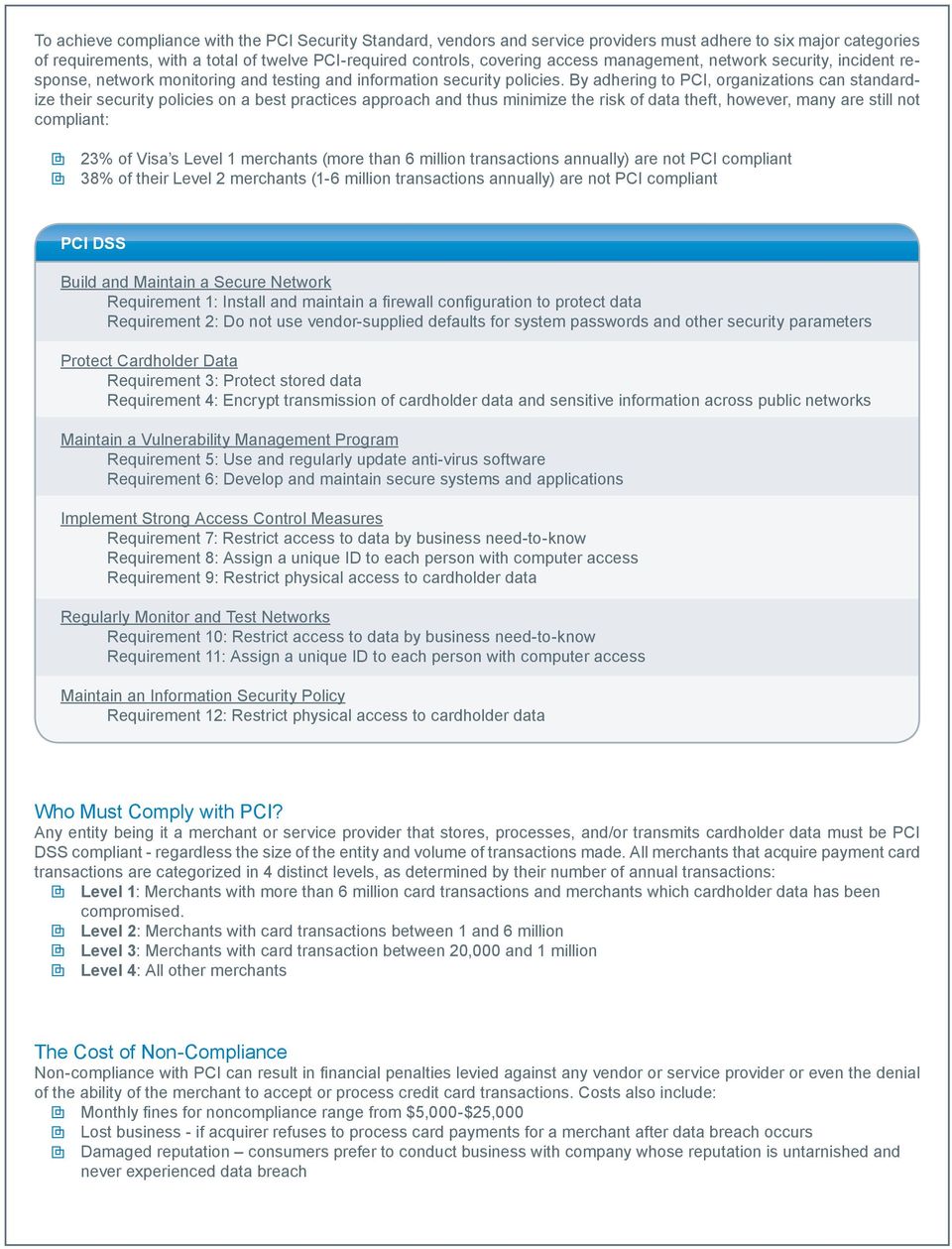
2 To achieve compliance with the PCI Security Standard, vendors and service providers must adhere to six major categories of requirements, with a total of twelve PCI-required controls, covering access management, network security, incident response, network monitoring and testing and information security policies. By adhering to PCI, organizations can standardize their security policies on a best practices approach and thus minimize the risk of data theft, however, many are still not compliant: 23% of Visa s Level 1 merchants (more than 6 million transactions annually) are not PCI compliant 38% of their Level 2 merchants (1-6 million transactions annually) are not PCI compliant PCI DSS Build and Maintain a Secure Network Requirement 1: Install and maintain a firewall configuration to protect data Requirement 2: Do not use vendor-supplied defaults for system passwords and other security parameters Protect Cardholder Data Requirement 3: Protect stored data Requirement 4: Encrypt transmission of cardholder data and sensitive information across public networks Maintain a Vulnerability Management Program Requirement 5: Use and regularly update anti-virus software Requirement 6: Develop and maintain secure systems and applications Implement Strong Access Control Measures Requirement 7: Restrict access to data by business need-to-know Requirement 8: Assign a unique ID to each person with computer access Requirement 9: Restrict physical access to cardholder data Regularly Monitor and Test Networks Requirement 10: Restrict access to data by business need-to-know Requirement 11: Assign a unique ID to each person with computer access Maintain an Information Security Policy Requirement 12: Restrict physical access to cardholder data Who Must Comply with PCI? Any entity being it a merchant or service provider that stores, processes, and/or transmits cardholder data must be PCI DSS compliant - regardless the size of the entity and volume of transactions made. All merchants that acquire payment card transactions are categorized in 4 distinct levels, as determined by their number of annual transactions: Level 1: Merchants with more than 6 million card transactions and merchants which cardholder data has been compromised. Level 2: Merchants with card transactions between 1 and 6 million Level 3: Merchants with card transaction between 20,000 and 1 million Level 4: All other merchants The Cost of Non-Compliance Non-compliance with PCI can result in financial penalties levied against any vendor or service provider or even the denial of the ability of the merchant to accept or process credit card transactions. Costs also include: Monthly fines for noncompliance range from $5,000-$25,000 Lost business - if acquirer refuses to process card payments for a merchant after data breach occurs Damaged reputation consumers prefer to conduct business with company whose reputation is untarnished and never experienced data breach
3 Financial Impact of Non-Compliance: TJX Example By not standardizing their security of cardholder data based on PCI requirements, TJX has taken a direct negative financial and public relations hit: The company announced that it took a $12 million loss, equal to 3 cents per share, because of the loss of more than 45 million credit and debit card numbers stolen from its systems over an 18-month period one of the largest customer data breaches to date. The $12 million in losses was for costs incurred to investigate and contain the intrusion, improve computer security and systems and communicate with customers, as well as for technical, legal and other fees. Lumension s Security Management Solutions Help Credit Card Issuers and Processors Comply with PCI Lumension s endpoint security solutions enable credit card issuers and processors to ensure the confidentiality of customers financial records and to ensure a stable and secure network environment. Lumension Security solutions include: PatchLink Security Configuration Management - Out-of-the-box regulatory and standards-based assessment to ensure endpoints are properly configured. PatchLink Update - Proactive management of threats through automated collection, analysis, and delivery of patches (all major operating systems and applications) across heterogeneous networks. PatchLink Scan - Complete network-based scanning solution enables assessment and analysis of threats impacting all network devices. Sanctuary Application Control - Policy-based enforcement of application use to secure your endpoints from malware, spyware and unwanted or unlicensed software. Sanctuary Device Control - Policy-based enforcement of removable device use to control the flow of inbound and outbound data from your endpoints. Lumension proactively addresses PCI standards by continuously monitoring and assessing enterprise networks for software and configuration vulnerabilities, rapidly patching and remediating vulnerabilities and applying user access control policies across applications and removable devices. Build and Maintain a Secure Network PCI DSS Requirement 1: Install and maintain a firewall configuration to protect cardholder data Description of groups, roles, and responsibilities for logical management of network components Description of groups, roles and responsibilities for logical management of network components are provided through multiple Lumension solutions: PatchLink Update Assigns nodes to OS and Active Directory groups, with support for custom nested grouping and role-based administration. PatchLink Scan integrated with PatchLink Update, displays OS, Active Directory and custom groups; also displays NT users/groups with permissions for a given machine. PatchLink ERS Displays roles and role descriptions Sanctuary Application Control Assigns user and/or group roles to specific application control functions. Sanctuary Device Control - Assigns user and/or group roles to specific device control functions.

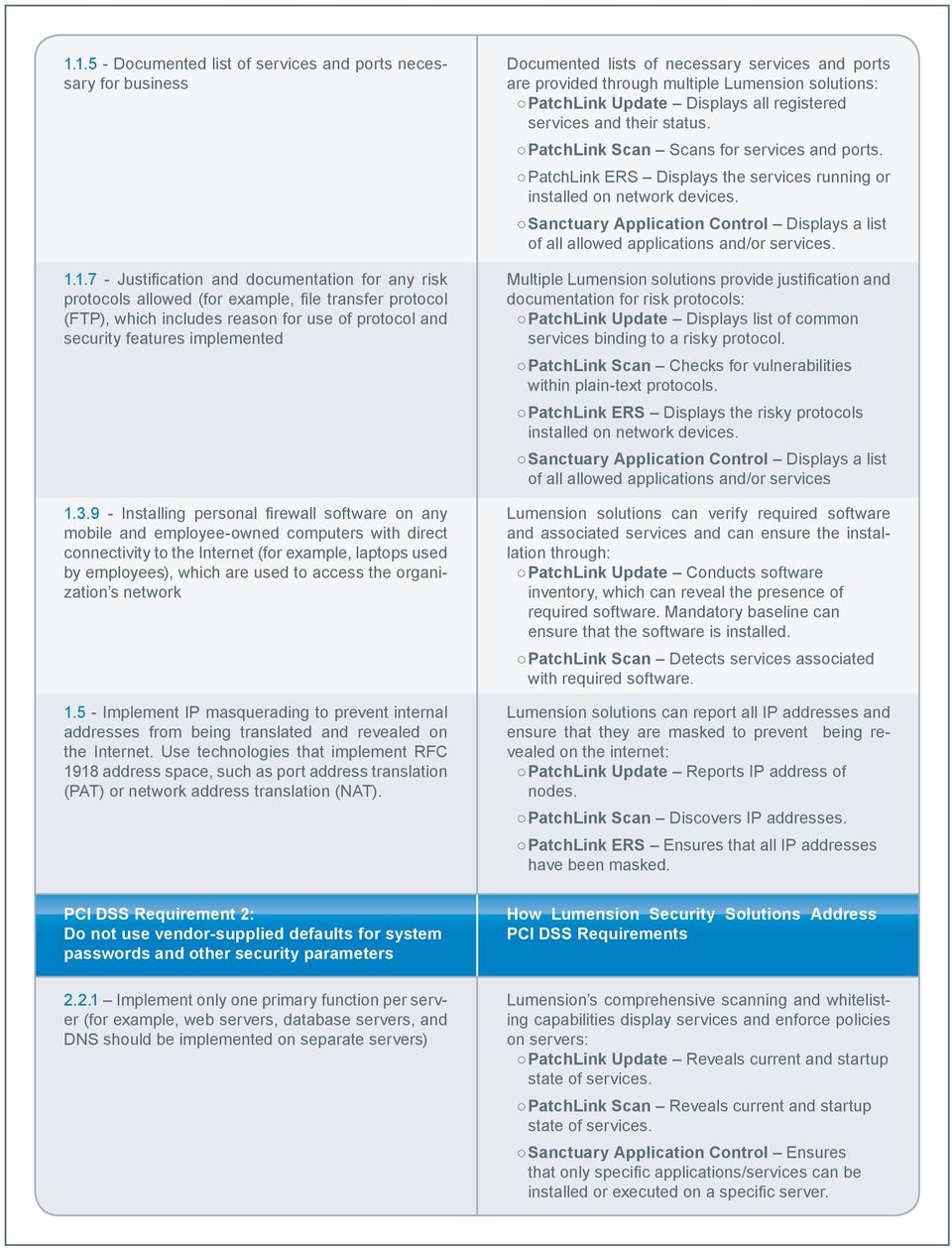
4 Documented list of services and ports necessary for business Justification and documentation for any risk protocols allowed (for example, file transfer protocol (FTP), which includes reason for use of protocol and security features implemented Installing personal firewall software on any mobile and employee-owned computers with direct connectivity to the Internet (for example, laptops used by employees), which are used to access the organization s network Implement IP masquerading to prevent internal addresses from being translated and revealed on the Internet. Use technologies that implement RFC 1918 address space, such as port address translation (PAT) or network address translation (NAT). Documented lists of necessary services and ports are provided through multiple Lumension solutions: PatchLink Update Displays all registered services and their status. PatchLink Scan Scans for services and ports. PatchLink ERS Displays the services running or installed on network devices. Sanctuary Application Control Displays a list of all allowed applications and/or services. Multiple Lumension solutions provide justification and documentation for risk protocols: PatchLink Update Displays list of common services binding to a risky protocol. PatchLink Scan Checks for vulnerabilities within plain-text protocols. PatchLink ERS Displays the risky protocols installed on network devices. Sanctuary Application Control Displays a list of all allowed applications and/or services Lumension solutions can verify required software and associated services and can ensure the installation through: PatchLink Update Conducts software inventory, which can reveal the presence of required software. Mandatory baseline can ensure that the software is installed. PatchLink Scan Detects services associated with required software. Lumension solutions can report all IP addresses and ensure that they are masked to prevent being revealed on the internet: PatchLink Update Reports IP address of nodes. PatchLink Scan Discovers IP addresses. PatchLink ERS Ensures that all IP addresses have been masked. PCI DSS Requirement 2: Do not use vendor-supplied defaults for system passwords and other security parameters Implement only one primary function per server (for example, web servers, database servers, and DNS should be implemented on separate servers) Lumension s comprehensive scanning and whitelisting capabilities display services and enforce policies on servers: PatchLink Update Reveals current and startup state of services. PatchLink Scan Reveals current and startup state of services. Sanctuary Application Control Ensures that only specific applications/services can be installed or executed on a specific server.
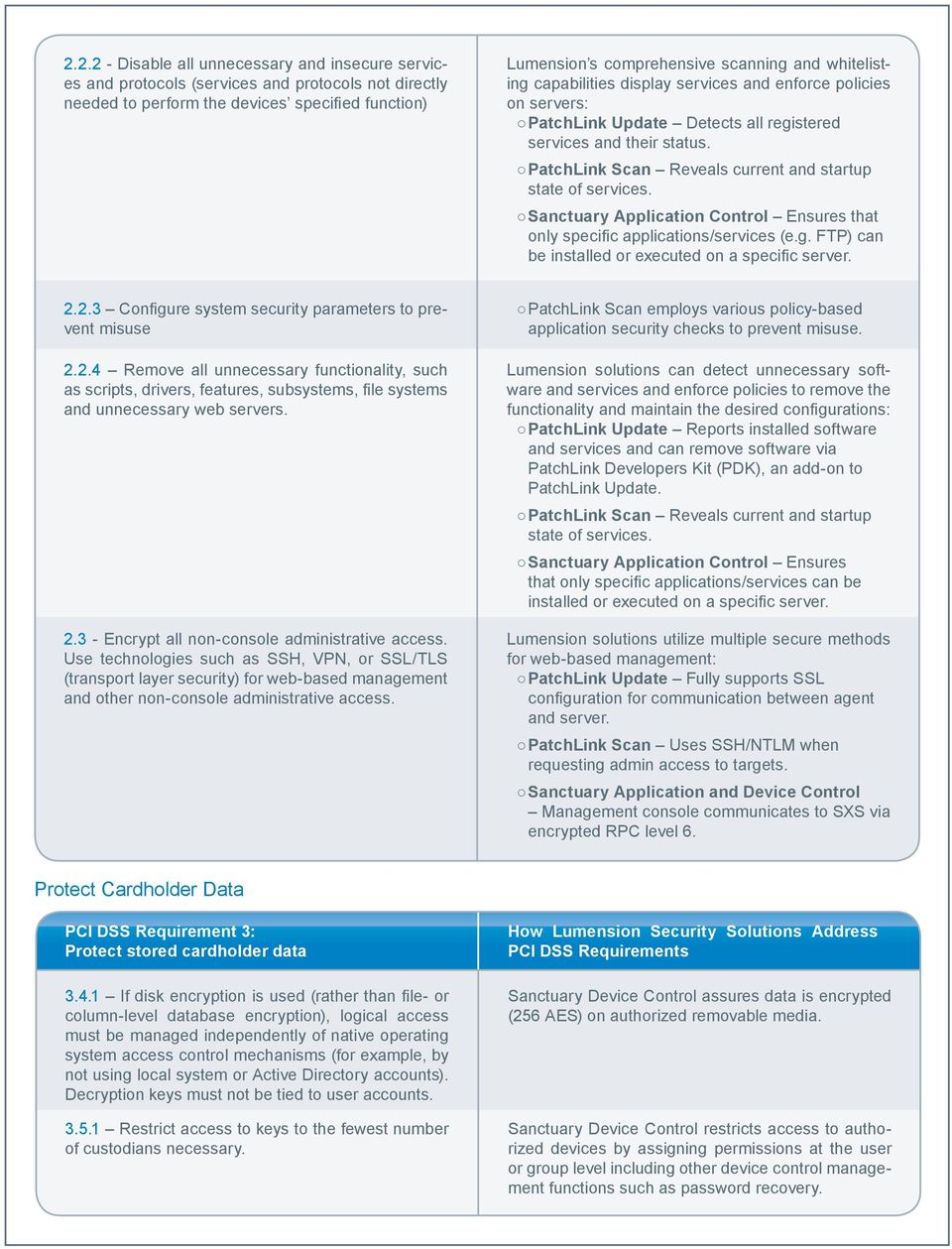
5 Disable all unnecessary and insecure services and protocols (services and protocols not directly needed to perform the devices specified function) Lumension s comprehensive scanning and whitelisting capabilities display services and enforce policies on servers: PatchLink Update Detects all registered services and their status. PatchLink Scan Reveals current and startup state of services. Sanctuary Application Control Ensures that only specific applications/services (e.g. FTP) can be installed or executed on a specific server Configure system security parameters to prevent misuse Remove all unnecessary functionality, such as scripts, drivers, features, subsystems, file systems and unnecessary web servers Encrypt all non-console administrative access. Use technologies such as SSH, VPN, or SSL/TLS (transport layer security) for web-based management and other non-console administrative access. PatchLink Scan employs various policy-based application security checks to prevent misuse. Lumension solutions can detect unnecessary software and services and enforce policies to remove the functionality and maintain the desired configurations: PatchLink Update Reports installed software and services and can remove software via PatchLink Developers Kit (PDK), an add-on to PatchLink Update. PatchLink Scan Reveals current and startup state of services. Sanctuary Application Control Ensures that only specific applications/services can be installed or executed on a specific server. Lumension solutions utilize multiple secure methods for web-based management: PatchLink Update Fully supports SSL configuration for communication between agent and server. PatchLink Scan Uses SSH/NTLM when requesting admin access to targets. Sanctuary Application and Device Control Management console communicates to SXS via encrypted RPC level 6. Protect Cardholder Data PCI DSS Requirement 3: Protect stored cardholder data If disk encryption is used (rather than file- or column-level database encryption), logical access must be managed independently of native operating system access control mechanisms (for example, by not using local system or Active Directory accounts). Decryption keys must not be tied to user accounts Restrict access to keys to the fewest number of custodians necessary. Sanctuary Device Control assures data is encrypted (256 AES) on authorized removable media. Sanctuary Device Control restricts access to authorized devices by assigning permissions at the user or group level including other device control management functions such as password recovery.
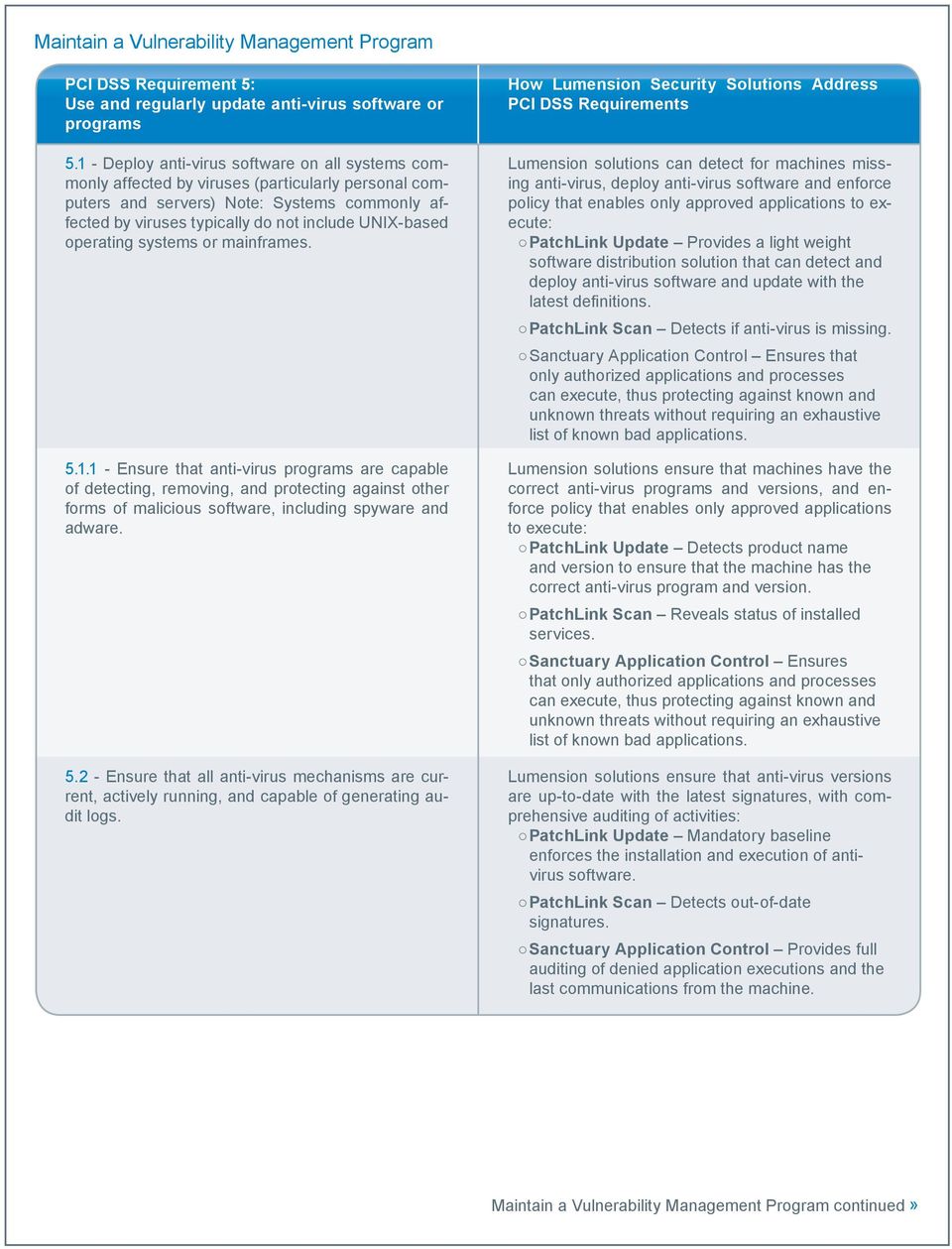
6 Maintain a Vulnerability Management Program PCI DSS Requirement 5: Use and regularly update anti-virus software or programs Deploy anti-virus software on all systems commonly affected by viruses (particularly personal computers and servers) Note: Systems commonly affected by viruses typically do not include UNIX-based operating systems or mainframes Ensure that anti-virus programs are capable of detecting, removing, and protecting against other forms of malicious software, including spyware and adware Ensure that all anti-virus mechanisms are current, actively running, and capable of generating audit logs. Lumension solutions can detect for machines missing anti-virus, deploy anti-virus software and enforce policy that enables only approved applications to execute: PatchLink Update Provides a light weight software distribution solution that can detect and deploy anti-virus software and update with the latest definitions. PatchLink Scan Detects if anti-virus is missing. Sanctuary Application Control Ensures that only authorized applications and processes can execute, thus protecting against known and unknown threats without requiring an exhaustive list of known bad applications. Lumension solutions ensure that machines have the correct anti-virus programs and versions, and enforce policy that enables only approved applications to execute: PatchLink Update Detects product name and version to ensure that the machine has the correct anti-virus program and version. PatchLink Scan Reveals status of installed services. Sanctuary Application Control Ensures that only authorized applications and processes can execute, thus protecting against known and unknown threats without requiring an exhaustive list of known bad applications. Lumension solutions ensure that anti-virus versions are up-to-date with the latest signatures, with comprehensive auditing of activities: PatchLink Update Mandatory baseline enforces the installation and execution of antivirus software. PatchLink Scan Detects out-of-date signatures. Sanctuary Application Control Provides full auditing of denied application executions and the last communications from the machine. Maintain a Vulnerability Management Program continued»
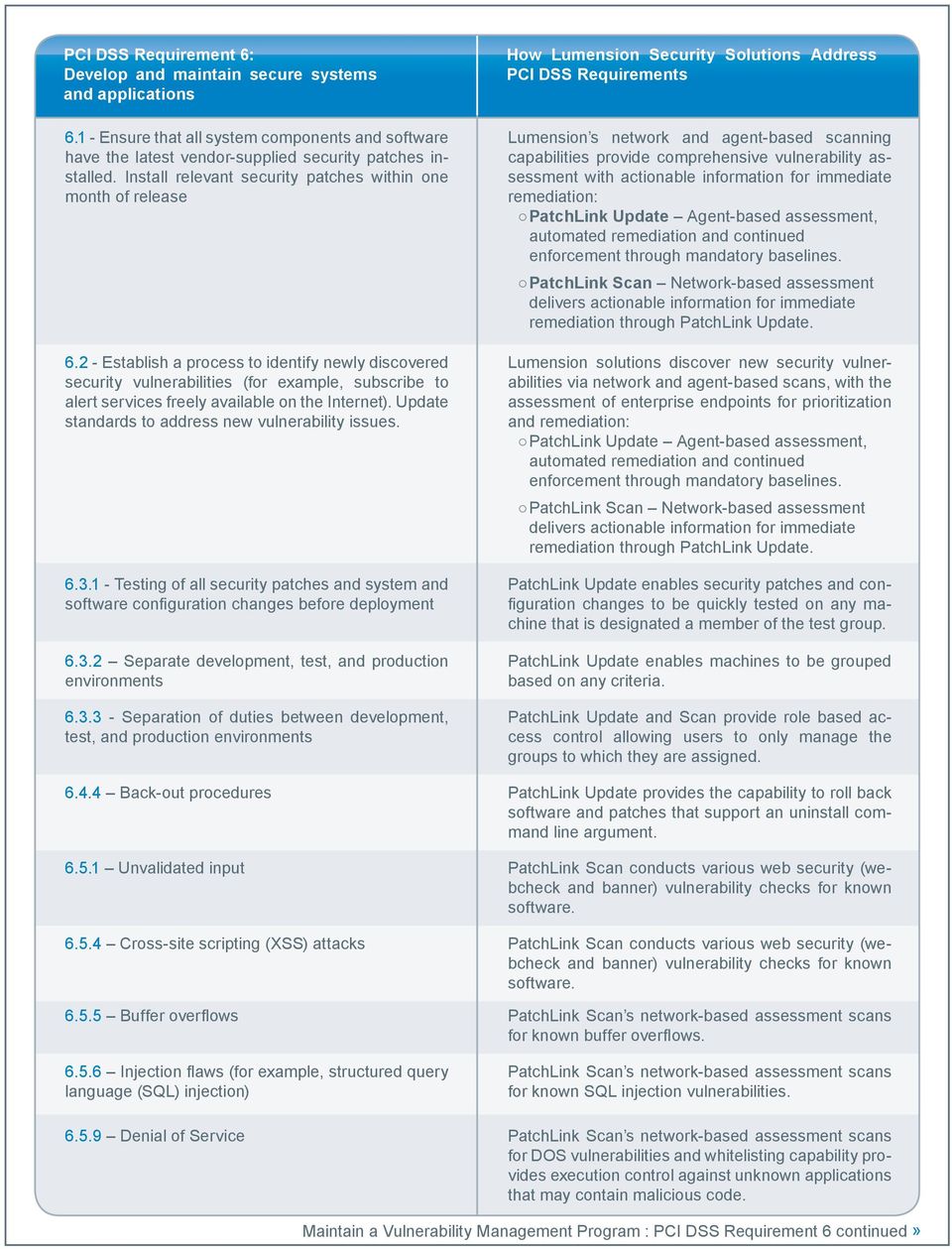
7 PCI DSS Requirement 6: Develop and maintain secure systems and applications Ensure that all system components and software have the latest vendor-supplied security patches installed. Install relevant security patches within one month of release Establish a process to identify newly discovered security vulnerabilities (for example, subscribe to alert services freely available on the Internet). Update standards to address new vulnerability issues Testing of all security patches and system and software configuration changes before deployment Separate development, test, and production environments Separation of duties between development, test, and production environments Lumension s network and agent-based scanning capabilities provide comprehensive vulnerability assessment with actionable information for immediate remediation: PatchLink Update Agent-based assessment, automated remediation and continued enforcement through mandatory baselines. PatchLink Scan Network-based assessment delivers actionable information for immediate remediation through PatchLink Update. Lumension solutions discover new security vulnerabilities via network and agent-based scans, with the assessment of enterprise endpoints for prioritization and remediation: PatchLink Update Agent-based assessment, automated remediation and continued enforcement through mandatory baselines. PatchLink Scan Network-based assessment delivers actionable information for immediate remediation through PatchLink Update. PatchLink Update enables security patches and configuration changes to be quickly tested on any machine that is designated a member of the test group. PatchLink Update enables machines to be grouped based on any criteria. PatchLink Update and Scan provide role based access control allowing users to only manage the groups to which they are assigned Back-out procedures PatchLink Update provides the capability to roll back software and patches that support an uninstall command line argument Unvalidated input PatchLink Scan conducts various web security (webcheck and banner) vulnerability checks for known software Cross-site scripting (XSS) attacks PatchLink Scan conducts various web security (webcheck and banner) vulnerability checks for known software Buffer overflows PatchLink Scan s network-based assessment scans for known buffer overflows Injection flaws (for example, structured query language (SQL) injection) PatchLink Scan s network-based assessment scans for known SQL injection vulnerabilities Denial of Service PatchLink Scan s network-based assessment scans for DOS vulnerabilities and whitelisting capability provides execution control against unknown applications that may contain malicious code. Maintain a Vulnerability Management Program : PCI DSS Requirement 6 continued»
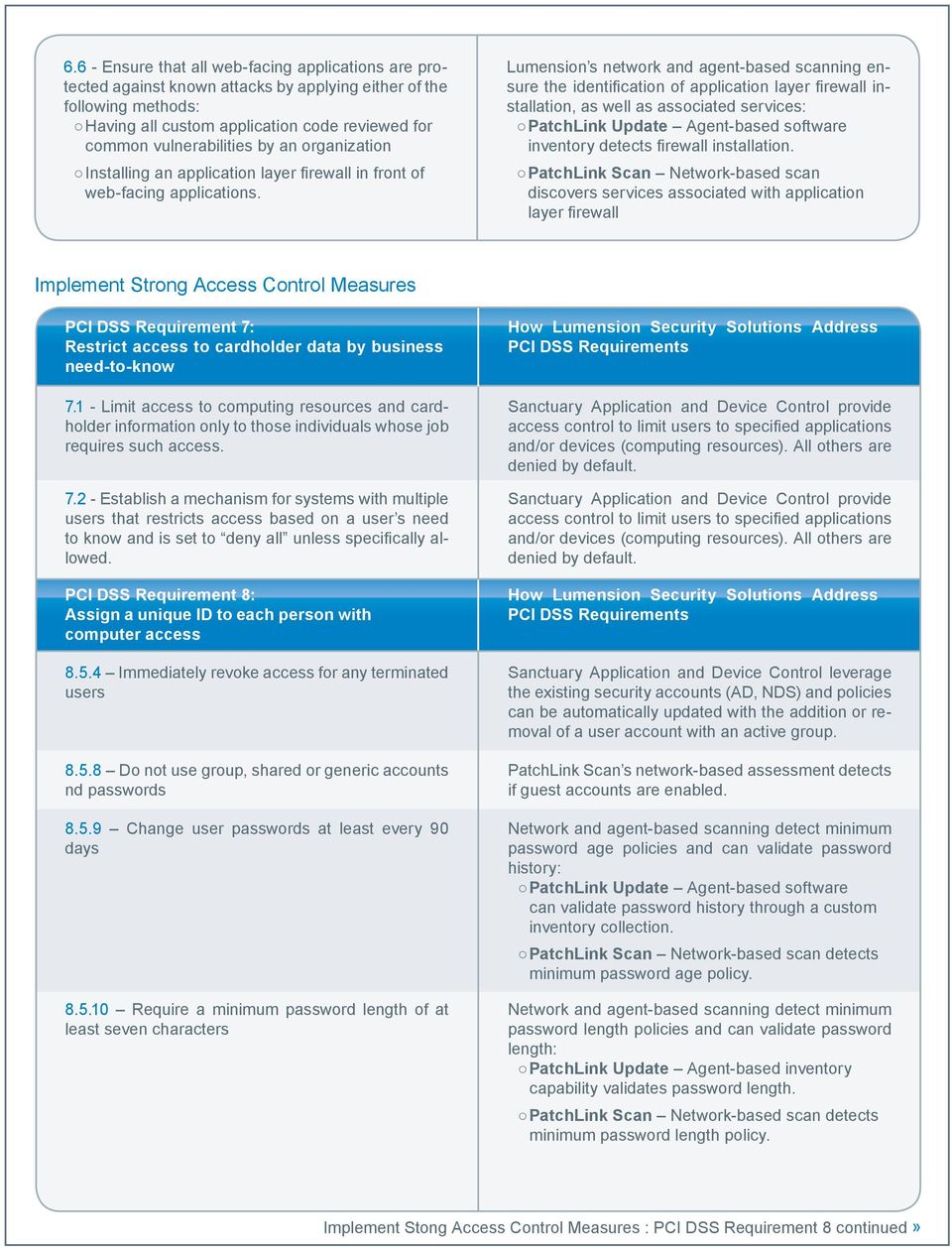
8 6.6 - Ensure that all web-facing applications are protected against known attacks by applying either of the following methods: Having all custom application code reviewed for common vulnerabilities by an organization Installing an application layer firewall in front of web-facing applications. Lumension s network and agent-based scanning ensure the identification of application layer firewall installation, as well as associated services: PatchLink Update Agent-based software inventory detects firewall installation. PatchLink Scan Network-based scan discovers services associated with application layer firewall Implement Strong Access Control Measures PCI DSS Requirement 7: Restrict access to cardholder data by business need-to-know Limit access to computing resources and cardholder information only to those individuals whose job requires such access Establish a mechanism for systems with multiple users that restricts access based on a user s need to know and is set to deny all unless specifically allowed. PCI DSS Requirement 8: Assign a unique ID to each person with computer access Immediately revoke access for any terminated users Do not use group, shared or generic accounts nd passwords Change user passwords at least every 90 days Require a minimum password length of at least seven characters Sanctuary Application and Device Control provide access control to limit users to specified applications and/or devices (computing resources). All others are denied by default. Sanctuary Application and Device Control provide access control to limit users to specified applications and/or devices (computing resources). All others are denied by default. Sanctuary Application and Device Control leverage the existing security accounts (AD, NDS) and policies can be automatically updated with the addition or removal of a user account with an active group. PatchLink Scan s network-based assessment detects if guest accounts are enabled. Network and agent-based scanning detect minimum password age policies and can validate password history: PatchLink Update Agent-based software can validate password history through a custom inventory collection. PatchLink Scan Network-based scan detects minimum password age policy. Network and agent-based scanning detect minimum password length policies and can validate password length: PatchLink Update Agent-based inventory capability validates password length. PatchLink Scan Network-based scan detects minimum password length policy. Implement Stong Access Control Measures : PCI DSS Requirement 8 continued»
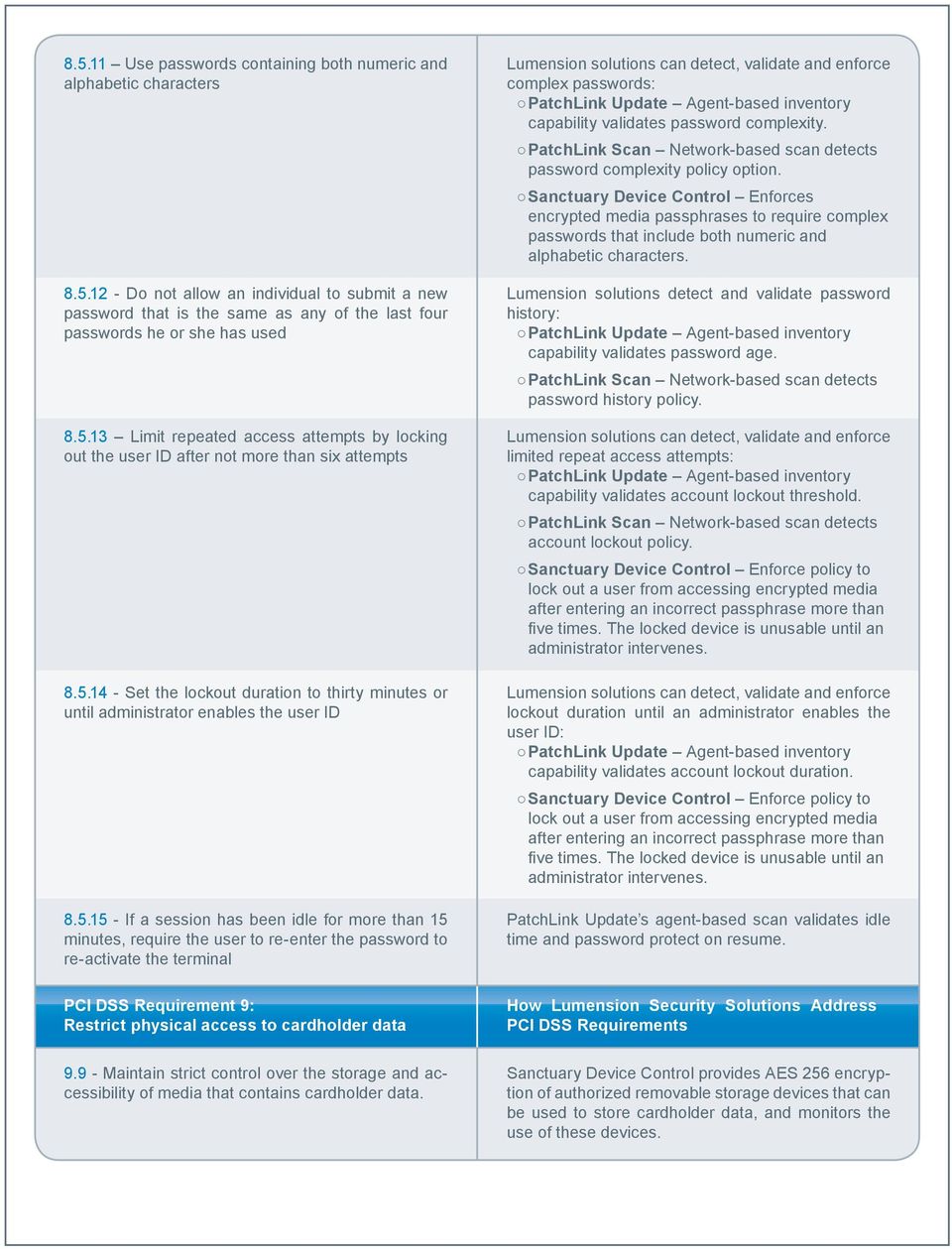
9 Use passwords containing both numeric and alphabetic characters Do not allow an individual to submit a new password that is the same as any of the last four passwords he or she has used Limit repeated access attempts by locking out the user ID after not more than six attempts Set the lockout duration to thirty minutes or until administrator enables the user ID If a session has been idle for more than 15 minutes, require the user to re-enter the password to re-activate the terminal PCI DSS Requirement 9: Restrict physical access to cardholder data Lumension solutions can detect, validate and enforce complex passwords: PatchLink Update Agent-based inventory capability validates password complexity. PatchLink Scan Network-based scan detects password complexity policy option. Sanctuary Device Control Enforces encrypted media passphrases to require complex passwords that include both numeric and alphabetic characters. Lumension solutions detect and validate password history: PatchLink Update Agent-based inventory capability validates password age. PatchLink Scan Network-based scan detects password history policy. Lumension solutions can detect, validate and enforce limited repeat access attempts: PatchLink Update Agent-based inventory capability validates account lockout threshold. PatchLink Scan Network-based scan detects account lockout policy. Sanctuary Device Control Enforce policy to lock out a user from accessing encrypted media after entering an incorrect passphrase more than five times. The locked device is unusable until an administrator intervenes. Lumension solutions can detect, validate and enforce lockout duration until an administrator enables the user ID: PatchLink Update Agent-based inventory capability validates account lockout duration. Sanctuary Device Control Enforce policy to lock out a user from accessing encrypted media after entering an incorrect passphrase more than five times. The locked device is unusable until an administrator intervenes. PatchLink Update s agent-based scan validates idle time and password protect on resume Maintain strict control over the storage and accessibility of media that contains cardholder data. Sanctuary Device Control provides AES 256 encryption of authorized removable storage devices that can be used to store cardholder data, and monitors the use of these devices.
10 Regularly Monitor Test Networks PCI DSS Requirement 10: Track and monitor all access to network resources and cardholder data All actions taken by any individual with root or administrative privileges Sanctuary Application and Device Control provide the ability to track all changes made by authorized administrators to policies Access to all audit trails Sanctuary Application and Device Control provide the ability to track all changes made by authorized administrators to policies Invalid logical access attempts Sanctuary Application and Device Control log all attempts from unauthorized users to access authorized applications/devices or from authorized users to access unauthorized applications/devices Use of identification and authentication mechanisms Sanctuary Application and Device Control ensure that all administrative changes and device usage are correlated with either an AD or NDS authenticated user Initialization of the audit logs Sanctuary Application and Device Control audit logs automatically and initialize upon successful completion of the Sanctuary infrastructure components User identification Sanctuary Application and Device Control automatically include user identification information in all audit entries Type of event Sanctuary Application and Device Control automatically include event information in all audit entries Date and time Sanctuary Application and Device Control automatically include date and time stamp in all audit entries Success or failure indication Sanctuary Application and Device Control automatically include success or failure of execution or access attempts in all audit entries Origination of event Sanctuary Application and Device Control automatically include the origination of event in all audit entries Identity or name of affected data, system component, or resource Sanctuary Application and Device Control automatically include the identity or name of affected data, system component or resource in all audit entries Secure audit trails so they cannot be altered. All Sanctuary Application and Device Control audit information is stored in the Microsoft SQL Server and once written can only be read by the Sanctuary Management Console Limit viewing of audit trails to those with a job-related need. Sanctuary Application and Device Control employ role based access to various management functions, limiting the viewing of audit trails and ensuring that only authorized users/groups may read audit related data. Regularly Monitor Test Networks : PCI DSS Requirement 10 continued»

11 Protect audit trail files from unauthorized modifications Promptly back-up audit trail files to a centralized log server or media that is difficult to alter Review logs for all system components at least daily. Log reviews must include those servers that perform security functions like intrusion detection system (IDS) and authentication, authorization, and accounting protocol (AAA) servers (for example, RADIUS) Retain audit trail history for at least one year, with a minimum of three months online availability. PCI DSS Requirement 11: Regularly test security systems and processes Run internal and external network vulnerability scans at least quarterly and after any significant change in the network (such as new system component installations, changes in network topology, firewall rule modifications, product upgrades) Deploy file integrity monitoring software to alert personnel to unauthorized modification of critical system or content files; and configure the software to perform critical file comparisons at least weekly. Sanctuary Application and Device Control audit information is stored in the Microsoft SQL Server and once written can only be read by the Sanctuary Management Console. Sanctuary Application and Device Control auditing and logging data can be exported to CSV or XML formats via an attachment or saved as a file on the network on a scheduled basis, enabling this data to be included in a centralized log server. Sanctuary Application and Device control logs can be reviewed daily via a default template. Sanctuary Application and Device control audit-related information is stored in Microsoft SQL Server tables which can typically store more than one year of audit data. Lumension solutions enable the scheduling of internal and external network scans: PatchLink Update Performs DAU s on an ongoing basis to ensure the most current view of enterprise vulnerabilities. PatchLink Scan Enables internal scans to be scheduled Sanctuary Application Control monitors all attempts to execute non-authorized files, which includes any authorized file that has been modified. Maintain and Information Security Policy PCI DSS Requirement 12: Maintain a policy that addresses information security for employees and contractors List all such devices and personnel with access. Sanctuary Device Control provides detailed list of authorized devices and users List of company-approved products. Sanctuary Application and Device Control provide the ability to set and report on the use of authorized applications and devices Activation of modems for vendors only when needed by vendors, with immediate deactivation after use Sanctuary Device Control provides the ability to set temporary and scheduled permissions for modem usage by machine and report on device usage. Maintain and Information Security Policy : PCI DSS Requirement 12 continued»

12 Monitor and analyze security alerts and information, and distribute to appropriate personnel Lumension solutions continuously monitor vulnerabilities or device use activity and automatically notify appropriate personnel: PatchLink Update Delivers summary information about each vulnerability that is displayed and provides a link to the manufacturer s knowledgebase article. PatchLink Scan Provides detailed description of vulnerability as well as the appropriate solution. Sanctuary Application Control Enables the scheduling and ing of automated reports that document administrative changes and end point usage activity within a specified period of time. Sanctuary Device Control Enables the scheduling and ing of automated reports that document administrative changes and end point usage activity within a specified period of time Monitor and control all access to data. Sanctuary Device Control policies can enforce and monitor use of authorized devices Include alerts from intrusion detection, intrusion prevention, and file integrity monitoring systems Sanctuary Application and Device Control can export all auditing and logging data to CSV or XML formats via an attachment or saved as a file on the network on a scheduled basis. This provides an integration point with an SEIM. To Learn More To learn more about Lumension Security solutions and how we can address your PCI compliance challenges, please contact us by any of the following means Phone: (Option 1) [email protected] Web: Sources: 1. Deloitte Global Financial Services Industry 2007 Global Security Survey2005 Yankee Group Security Leaders and Laggards Survey Lumension Security N. Greenway-Hayden Loop, Suite 100 Scottsdale, AZ / Lumension Security. All rights reserved. Lumension Security, the Lumension Security logo, and the PatchLink and Sanctuary product names and logos are either registered trademarks or trademarks of Lumension Security. In addition, other companies names and products mentioned in this document, if any, may be either registered trademarks or trademarks of their respective owners.

PCI Data Security Standards (DSS)
 ENTERPRISE APPLICATION WHITELISTING SOLUTION Achieving PCI Compliance at the Point of Sale Using Bit9 Parity TM to Protect Cardholder Data PCI: Protecting Cardholder Data As the technology used by merchants
How NETGEAR ProSecure UTM Helps Small Businesses Meet PCI Requirements
 How NETGEAR ProSecure UTM Helps Small Businesses Meet PCI Requirements I n t r o d u c t i o n The Payment Card Industry Data Security Standard (PCI DSS) was developed in 2004 by the PCI Security Standards
SonicWALL PCI 1.1 Implementation Guide
 Compliance SonicWALL PCI 1.1 Implementation Guide A PCI Implementation Guide for SonicWALL SonicOS Standard In conjunction with ControlCase, LLC (PCI Council Approved Auditor) SonicWall SonicOS Standard
Introduction. PCI DSS Overview
 Introduction Manage Engine Desktop Central is part of ManageEngine family that represents entire IT infrastructure with products such as Network monitoring, Helpdesk management, Application management,
GFI White Paper PCI-DSS compliance and GFI Software products
 White Paper PCI-DSS compliance and Software products The Payment Card Industry Data Standard () compliance is a set of specific security standards developed by the payment brands* to help promote the adoption
74% 96 Action Items. Compliance
 Compliance Report PCI DSS 2.0 Generated by Check Point Compliance Blade, on July 02, 2013 11:12 AM 1 74% Compliance 96 Action Items Upcoming 0 items About PCI DSS 2.0 PCI-DSS is a legal obligation mandated
Did you know your security solution can help with PCI compliance too?
 Did you know your security solution can help with PCI compliance too? High-profile data losses have led to increasingly complex and evolving regulations. Any organization or retailer that accepts payment
March 2012 www.tufin.com
 SecureTrack Supporting Compliance with PCI DSS 2.0 March 2012 www.tufin.com Table of Contents Introduction... 3 The Importance of Network Security Operations... 3 Supporting PCI DSS with Automated Solutions...
Using Automated, Detailed Configuration and Change Reporting to Achieve and Maintain PCI Compliance Part 4
 WHITEPAPER Using Automated, Detailed Configuration and Change Reporting to Achieve and Maintain PCI Compliance Part 4 An in-depth look at Payment Card Industry Data Security Standard Requirements 10, 11,
1.3 Prohibit Direct Public Access - Prohibit direct public access between the Internet and any system component in the cardholder data environment.
 REQUIREMENT 1 Install and Maintain a Firewall Configuration to Protect Cardholder Data Firewalls are devices that control computer traffic allowed between an entity s networks (internal) and untrusted
PCI DSS Requirements - Security Controls and Processes
 1. Build and maintain a secure network 1.1 Establish firewall and router configuration standards that formalize testing whenever configurations change; that identify all connections to cardholder data
WHITEPAPER. Achieving Network Payment Card Industry Data Security Standard (PCI DSS) Compliance with NetMRI
 WHITEPAPER Achieving Network Payment Card Industry Data Security Standard (PCI DSS) Compliance with NetMRI About PCI DSS Compliance The widespread use of debit and credit cards in retail transactions demands
Achieving PCI-Compliance through Cyberoam
 White paper Achieving PCI-Compliance through Cyberoam The Payment Card Industry (PCI) Data Security Standard (DSS) aims to assure cardholders that their card details are safe and secure when their debit
PCI DSS Policies Outline. PCI DSS Policies. All Rights Reserved. ecfirst. 2010. Page 1 of 7 www.ecfirst.com
 Policy/Procedure Description PCI DSS Policies Install and Maintain a Firewall Configuration to Protect Cardholder Data Establish Firewall and Router Configuration Standards Build a Firewall Configuration
Using PowerBroker Identity Services to Comply with the PCI DSS Security Standard
 White Paper Using PowerBroker Identity Services to Comply with the PCI DSS Security Standard Abstract This document describes how PowerBroker Identity Services Enterprise and Microsoft Active Directory
Windows Azure Customer PCI Guide
 Windows Azure PCI Guide January 2014 Version 1.0 Prepared by: Neohapsis, Inc. 217 North Jefferson St., Suite 200 Chicago, IL 60661 New York Chicago Dallas Seattle PCI Guide January 2014 This document contains
Payment Card Industry Data Security Standard
 Payment Card Industry Data Security Standard Build and Maintain a Secure Network Requirement 1: Requirement 2: Install and maintain a firewall configuration to protect data Do not use vendor-supplied defaults
Implementation Guide
 Implementation Guide PayLINK Implementation Guide Version 2.1.252 Released September 17, 2013 Copyright 2011-2013, BridgePay Network Solutions, Inc. All rights reserved. The information contained herein
LogRhythm and PCI Compliance
 LogRhythm and PCI Compliance The Payment Card Industry (PCI) Data Security Standard (DSS) was developed to encourage and enhance cardholder data security and facilitate the broad adoption of consistent
Barracuda Web Site Firewall Ensures PCI DSS Compliance
 Barracuda Web Site Firewall Ensures PCI DSS Compliance E-commerce sales are estimated to reach $259.1 billion in 2007, up from the $219.9 billion earned in 2006, according to The State of Retailing Online
Using Automated, Detailed Configuration and Change Reporting to Achieve and Maintain PCI Compliance Part 3
 WHITEPAPER Using Automated, Detailed Configuration and Change Reporting to Achieve and Maintain PCI Compliance Part 3 An in-depth look at Payment Card Industry Data Security Standard Requirements 5, 6,
Automate PCI Compliance Monitoring, Investigation & Reporting
 Automate PCI Compliance Monitoring, Investigation & Reporting Reducing Business Risk Standards and compliance are all about implementing procedures and technologies that reduce business risk and efficiently
General Standards for Payment Card Environments at Miami University
 General Standards for Payment Card Environments at Miami University 1. Install and maintain a firewall configuration to protect cardholder data and its environment Cardholder databases, applications, servers,
Teleran PCI Customer Case Study
 Teleran PCI Customer Case Study Written by Director of Credit Card Systems for Large Credit Card Issuer Customer Case Study Summary A large credit card issuer was engaged in a Payment Card Industry Data
Enforcing PCI Data Security Standard Compliance
 Enforcing PCI Data Security Standard Compliance Marco Misitano, CISSP, CISA, CISM Business Development Manager Security & VideoSurveillance Cisco Italy 2008 Cisco Systems, Inc. All rights reserved. 1 The
ensure prompt restart of critical applications and business activities in a timely manner following an emergency or disaster
 Security Standards Symantec shall maintain administrative, technical, and physical safeguards for the Symantec Network designed to (i) protect the security and integrity of the Symantec Network, and (ii)
FORT HAYS STATE UNIVERSITY CREDIT CARD SECURITY POLICY
 FORT HAYS STATE UNIVERSITY CREDIT CARD SECURITY POLICY Page 1 of 6 Summary The Payment Card Industry Data Security Standard (PCI DSS), a set of comprehensive requirements for enhancing payment account
PCI Compliance Can Make Your Organization Stronger and Fitter. Brent Harman Manager, Systems Consultant Team West NetPro Computing, Inc.
 PCI Compliance Can Make Your Organization Stronger and Fitter Brent Harman Manager, Systems Consultant Team West NetPro Computing, Inc. Today s Agenda PCI DSS What Is It? The Regulation 6 Controls 12 Requirements
TASK -040. TDSP Web Portal Project Cyber Security Standards Best Practices
 Page 1 of 10 TSK- 040 Determine what PCI, NERC CIP cyber security standards are, which are applicable, and what requirements are around them. Find out what TRE thinks about the NERC CIP cyber security
Visa U.S.A Cardholder Information Security Program (CISP) Payment Application Best Practices
 This document is to be used to verify that a payment application has been validated against Visa U.S.A. Payment Application Best Practices and to create the Report on Validation. Please note that payment
05.118 Credit Card Acceptance Policy. Vice Chancellor of Business Affairs. History: Effective July 1, 2011 Updated February 2013
 05.118 Credit Card Acceptance Policy Authority: Vice Chancellor of Business Affairs History: Effective July 1, 2011 Updated February 2013 Source of Authority: Office of State Controller (OSC); Office of
How To Protect Data From Attack On A Network From A Hacker (Cybersecurity)
 PCI Compliance Reporting Solution Brief Automating Regulatory Compliance and IT Best Practices Reporting Automating Compliance Reporting for PCI Data Security Standard version 1.1 The PCI Data Security
PCI Compliance - A Realistic Approach. Harshul Joshi, CISM, CISA, CISSP Director, Information Technology CBIZ MHM [email protected]
 PCI Compliance - A Realistic Approach Harshul Joshi, CISM, CISA, CISSP Director, Information Technology CBIZ MHM [email protected] What What is PCI A global forum launched in September 2006 for ongoing enhancement
Detailed Analysis Achieving PCI Compliance with SkyView Partners Products for Open Systems
 Detailed Analysis Achieving PCI Compliance with SkyView Partners Products for Open Systems The Payment Card Industry has a published set of Data Security Standards to which organization s accepting and
The Comprehensive Guide to PCI Security Standards Compliance
 The Comprehensive Guide to PCI Security Standards Compliance Achieving PCI DSS compliance is a process. There are many systems and countless moving parts that all need to come together to keep user payment
The 12 Essentials of PCI Compliance How it Differs from HIPPA Compliance Understand & Implement Effective PCI Data Security Standard Compliance
 Date: 07/19/2011 The 12 Essentials of PCI Compliance How it Differs from HIPPA Compliance Understand & Implement Effective PCI Data Security Standard Compliance PCI and HIPAA Compliance Defined Understand
Question Name C 1.1 Do all users and administrators have a unique ID and password? Yes
 Category Question Name Question Text C 1.1 Do all users and administrators have a unique ID and password? C 1.1.1 Passwords are required to have ( # of ) characters: 5 or less 6-7 8-9 Answer 10 or more
www.xceedium.com 2: Do not use vendor-supplied defaults for system passwords and other security parameters
 2: Do not use vendor-supplied defaults for system passwords and other security parameters 2.1: Always change vendor-supplied defaults and remove or disable unnecessary default accounts before installing
Using Skybox Solutions to Achieve PCI Compliance
 Using Skybox Solutions to Achieve PCI Compliance Achieve Efficient and Effective PCI Compliance by Automating Many Required Controls and Processes Skybox Security whitepaper August 2011 1 Executive Summary
Passing PCI Compliance How to Address the Application Security Mandates
 Passing PCI Compliance How to Address the Application Security Mandates The Payment Card Industry Data Security Standards includes several requirements that mandate security at the application layer. These
CORE Security and the Payment Card Industry Data Security Standard (PCI DSS)
 CORE Security and the Payment Card Industry Data Security Standard (PCI DSS) Addressing the PCI DSS with Predictive Security Intelligence Solutions from CORE Security CORE Security +1 617.399-6980 [email protected]
Improving PCI Compliance with Network Configuration Automation
 Improving PCI Compliance with Network Configuration Automation technical WHITE PAPER Table of Contents Executive Summary...1 PCI Data Security Standard Requirements...2 BMC Improves PCI Compliance...2
CorreLog Alignment to PCI Security Standards Compliance
 CorreLog Alignment to PCI Security Standards Compliance Achieving PCI DSS compliance is a process. There are many systems and countless moving parts that all need to come together to keep user payment
Global Partner Management Notice
 Global Partner Management Notice Subject: Critical Vulnerabilities Identified to Alert Payment System Participants of Data Compromise Trends Dated: May 4, 2009 Announcement: To support compliance with
Payment Card Industry (PCI) Data Security Standard. Version 1.1
 Payment Card Industry (PCI) Data Security Standard Version 1.1 Release: September, 2006 Build and Maintain a Secure Network Requirement 1: Requirement 2: Install and maintain a firewall configuration to
A Rackspace White Paper Spring 2010
 Achieving PCI DSS Compliance with A White Paper Spring 2010 Summary The Payment Card Industry Data Security Standard (PCI DSS) is a global information security standard defined by the Payment Card Industry
Information Security Services. Achieving PCI compliance with Dell SecureWorks security services
 Information Security Services Achieving PCI compliance with Dell SecureWorks security services Executive summary In October 2010, the Payment Card Industry (PCI) issued the new Data Security Standard (DSS)
Meeting PCI-DSS v1.2.1 Compliance Requirements. By Compliance Research Group
 Meeting PCI-DSS v1.2.1 Compliance Requirements By Compliance Research Group Table of Contents Technical Security Controls and PCI DSS Compliance...1 Mapping PCI Requirements to Product Functionality...2
PCI and PA DSS Compliance Assurance with LogRhythm
 WHITEPAPER PCI and PA DSS Compliance Assurance PCI and PA DSS Compliance Assurance with LogRhythm MAY 2014 PCI and PA DSS Compliance Assurance with LogRhythm The Payment Card Industry (PCI) Data Security
PCI DSS Reporting WHITEPAPER
 WHITEPAPER PCI DSS Reporting CONTENTS Executive Summary 2 Latest Patches not Installed 3 Vulnerability Dashboard 4 Web Application Protection 5 Users Logging into Sensitive Servers 6 Failed Login Attempts
Catapult PCI Compliance
 Catapult PCI Compliance Table of Contents Catapult PCI Compliance...1 Table of Contents...1 Overview Catapult (PCI)...2 Support and Contact Information...2 Dealer Support...2 End User Support...2 Catapult
How To Achieve Pca Compliance With Redhat Enterprise Linux
 Achieving PCI Compliance with Red Hat Enterprise Linux June 2009 CONTENTS EXECUTIVE SUMMARY...2 OVERVIEW OF PCI...3 1.1. What is PCI DSS?... 3 1.2. Who is impacted by PCI?... 3 1.3. Requirements for achieving
Payment Card Industry Data Security Standard
 Payment Card Industry Data Security Standard Introduction Purpose Audience Implications Sensitive Digital Data Management In an effort to protect credit card information from unauthorized access, disclosure
MANAGED FILE TRANSFER: 10 STEPS TO PCI DSS COMPLIANCE
 WHITE PAPER MANAGED FILE TRANSFER: 10 STEPS TO PCI DSS COMPLIANCE 1. OVERVIEW Do you want to design a file transfer process that is secure? Or one that is compliant? Of course, the answer is both. But
SAQ D Compliance. Scott St. Aubin Senior Security Consultant QSA, CISM, CISSP
 SAQ D Compliance Scott St. Aubin Senior Security Consultant QSA, CISM, CISSP Ground Rules WARNING: Potential Death by PowerPoint Interaction Get clarification Share your institution s questions, challenges,
How to complete the Secure Internet Site Declaration (SISD) form
 1 How to complete the Secure Internet Site Declaration (SISD) form The following instructions are designed to assist you in completing the SISD form that forms part of your Merchant application. Once completed,
SolarWinds Security Information Management in the Payment Card Industry: Using SolarWinds Log & Event Manager (LEM) to Meet PCI Requirements
 SolarWinds Security Information Management in the Payment Card Industry: Using SolarWinds Log & Event Manager (LEM) to Meet PCI Requirements SolarWinds Security Information Management in the Payment Card
Need to be PCI DSS compliant and reduce the risk of fraud?
 Need to be PCI DSS compliant and reduce the risk of fraud? NCR Security lessens your PCI compliance burden and protects the integrity of your network An NCR White Paper Experience a new world of interaction
How Reflection Software Facilitates PCI DSS Compliance
 Reflection How Reflection Software Facilitates PCI DSS Compliance How Reflection Software Facilitates PCI DSS Compliance How Reflection Software Facilitates PCI DSS Compliance In 2004, the major credit
PCI Requirements Coverage Summary Table
 StillSecure PCI Complete Managed PCI Compliance Solution PCI Requirements Coverage Summary Table December 2011 Table of Contents Introduction... 2 Coverage assumptions for PCI Complete deployments... 2
PCI DSS FAQ. The twelve requirements of the PCI DSS are defined as follows:
 What is PCI DSS? PCI DSS is an acronym for Payment Card Industry Data Security Standards. PCI DSS is a global initiative intent on securing credit and banking transactions by merchants & service providers
TIBCO LogLogic. PCI Compliance Suite Guidebook. Software Release: 3.5.0. December 2012. Two-Second Advantage
 TIBCO LogLogic PCI Compliance Suite Guidebook Software Release: 3.5.0 December 2012 Two-Second Advantage Important Information SOME TIBCO SOFTWARE EMBEDS OR BUNDLES OTHER TIBCO SOFTWARE. USE OF SUCH EMBEDDED
PCI Requirements Coverage Summary Table
 StillSecure PCI Complete Managed PCI Compliance Solution PCI Requirements Coverage Summary Table January 2013 Table of Contents Introduction... 2 Coverage assumptions for PCI Complete deployments... 2
WHITE PAPER FORTIWEB WEB APPLICATION FIREWALL. Ensuring Compliance for PCI DSS 6.5 and 6.6
 WHITE PAPER FORTIWEB WEB APPLICATION FIREWALL Ensuring Compliance for PCI DSS 6.5 and 6.6 CONTENTS 04 04 06 08 11 12 13 Overview Payment Card Industry Data Security Standard PCI Compliance for Web Applications
Key Steps to Meeting PCI DSS 2.0 Requirements Using Sensitive Data Discovery and Masking
 Key Steps to Meeting PCI DSS 2.0 Requirements Using Sensitive Data Discovery and Masking SUMMARY The Payment Card Industry Data Security Standard (PCI DSS) defines 12 high-level security requirements directed
Best Practices for PCI DSS V3.0 Network Security Compliance
 Best Practices for PCI DSS V3.0 Network Security Compliance January 2015 www.tufin.com Table of Contents Preparing for PCI DSS V3.0 Audit... 3 Protecting Cardholder Data with PCI DSS... 3 Complying with
whitepaper 4 Best Practices for Building PCI DSS Compliant Networks
 4 Best Practices for Building PCI DSS Compliant Networks Cardholder data is a lucrative and tempting target for cyber criminals. Recent highly publicized accounts of hackers breaching trusted retailers
University of Sunderland Business Assurance PCI Security Policy
 University of Sunderland Business Assurance PCI Security Policy Document Classification: Public Policy Reference Central Register IG008 Policy Reference Faculty / Service IG 008 Policy Owner Chief Financial
Achieving PCI Compliance Using F5 Products
 Achieving PCI Compliance Using F5 Products Overview In April 2000, Visa launched its Cardholder Information Security Program (CISP) -- a set of mandates designed to protect its cardholders from identity
The Payment Card Industry (PCI) Data Security Standards (DSS) v1.2 Requirements:
 Compliance Brief The Payment Card Industry (PCI) Data Security Standards (DSS) v1.2 Requirements: Using Server Isolation and Encryption as a Regulatory Compliance Solution and IT Best Practice Introduction
Policies and Procedures
 Policies and Procedures Provided by PROGuard The following are policies and procedures which need to be enforced to ensure PCI DSS compliance. In order to answer yes to the questions and pass the SAQ,
Payment Card Industry (PCI) Compliance. Management Guidelines
 Page 1 thehelpdeskllc.com 855-336-7435 Payment Card Industry (PCI) Compliance Management Guidelines About PCI Compliance Payment Card Industry (PCI) compliance is a requirement for all businesses that
Detailed Analysis Achieving PCI Compliance with SkyView Partners Products for AIX
 Detailed Analysis Achieving PCI Compliance with SkyView Partners Products for AIX The Payment Card Industry has a published set of Data Security Standards to which organization s accepting and storing
Achieving PCI DSS Compliance with Cinxi
 www.netforensics.com NETFORENSICS SOLUTION GUIDE Achieving PCI DSS Compliance with Cinxi Compliance with PCI is complex. It forces you to deploy and monitor dozens of security controls and processes. Data
Payment Application Data Security Standards Implementation Guide
 Payment Application Data Security Standards Implementation Guide 062212 PADSS 2012 Blackbaud, Inc. This publication, or any part thereof, may not be reproduced or transmitted in any form or by any means,
PCI COMPLIANCE ON AWS: HOW TREND MICRO CAN HELP
 solution brief PCI COMPLIANCE ON AWS: HOW TREND MICRO CAN HELP AWS AND PCI DSS COMPLIANCE To ensure an end-to-end secure computing environment, Amazon Web Services (AWS) employs a shared security responsibility
WHITE PAPER. FortiWeb Web Application Firewall Ensuring Compliance for PCI DSS 6.5 and 6.6
 WHITE PAPER FortiWeb Web Application Firewall Ensuring Compliance for PCI DSS 6.5 and 6.6 Ensuring compliance for PCI DSS 6.5 and 6.6 Page 2 Overview Web applications and the elements surrounding them
Citrix Solutions for Complying with PCI-DSS ENSURING PROTECTION OF WEB APPLICATIONS AND PRIVACY OF CARDHOLDER INFORMATION
 W H I T E P A P E R Citrix Solutions for Complying with PCI-DSS ENSURING PROTECTION OF WEB APPLICATIONS AND PRIVACY OF CARDHOLDER INFORMATION Table of Contents 2 Overview 2 A Tale of Abandonment, Missed
CREDIT CARD MERCHANT PROCEDURES MANUAL. Effective Date: 5/25/2011
 CREDIT CARD MERCHANT PROCEDURES MANUAL Effective Date: 5/25/2011 Updated: May 25, 2011 TABLE OF CONTENTS Introduction... 1 Third-Party Vendors... 1 Merchant Account Set-up... 2 Personnel Requirements...
Section 3.9 PCI DSS Information Security Policy Issued: June 2016 Replaces: January 2015
 Section 3.9 PCI DSS Information Security Policy Issued: June 2016 Replaces: January 2015 I. PURPOSE The purpose of this policy is to establish guidelines for processing charges on Payment Cards to protect
Visa Asia Pacific Account Information Security (AIS) Program Payment Application Best Practices (PABP)
 Visa Asia Pacific Account Information Security (AIS) Program Payment Application Best Practices (PABP) This document is to be used for payment application vendors to validate that the payment application
New Boundary Technologies. The Payment Card Industry (PCI) Security Guide. New Boundary Technologies PCI Security Configuration Guide
 New Boundary Technologies The Payment Card Industry (PCI) Security Guide New Boundary Technologies PCI Security Configuration Guide October 2006 CONTENTS 1.0......Executive Summary 2.0.....The PCI Data
A Decision Maker s Guide to Securing an IT Infrastructure
 A Decision Maker s Guide to Securing an IT Infrastructure A Rackspace White Paper Spring 2010 Summary With so many malicious attacks taking place now, securing an IT infrastructure is vital. The purpose
SECTION: SUBJECT: PCI-DSS General Guidelines and Procedures
 1. Introduction 1.1. Purpose and Background 1.2. Central Coordinator Contact 1.3. Payment Card Industry Data Security Standards (PCI-DSS) High Level Overview 2. PCI-DSS Guidelines - Division of Responsibilities
Payment Card Industry Self-Assessment Questionnaire
 How to Complete the Questionnaire The questionnaire is divided into six sections. Each section focuses on a specific area of security, based on the requirements included in the PCI Data Security Standard.
05.0 Application Development
 Number 5.0 Policy Owner Information Security and Technology Policy Application Development Effective 01/01/2014 Last Revision 12/30/2013 Department of Innovation and Technology 5. Application Development
Fortinet Solutions for Compliance Requirements
 s for Compliance Requirements Sarbanes Oxley (SOX / SARBOX) Section / Reference Technical Control Requirement SOX references ISO 17799 for Firewall FortiGate implementation specifics IDS / IPS Centralized
Payment Card Industry Data Security Standard Training. Chris Harper Vice President of Technical Services Secure Enterprise Computing, Inc.
 Payment Card Industry Data Security Standard Training Chris Harper Vice President of Technical Services Secure Enterprise Computing, Inc. March 27, 2012 Agenda Check-In 9:00-9:30 PCI Intro and History
Cyber - Security and Investigations. Ingrid Beierly August 18, 2008
 Cyber - Security and Investigations Ingrid Beierly August 18, 2008 Agenda Visa Cyber - Security and Investigations Today s Targets Recent Attack Patterns Hacking Statistics (removed) Top Merchant Vulnerabilities
An Oracle White Paper January 2010. Using Oracle Enterprise Manager Configuration Management Pack for PCI Compliance
 An Oracle White Paper January 2010 Using Oracle Enterprise Manager Configuration Management Pack for PCI Compliance Disclaimer The following is intended to outline our general product direction. It is
Becoming PCI Compliant
 Becoming PCI Compliant Jason Brown - [email protected] Enterprise Security Architect Enterprise Architecture Department of Technology, Management and Budget State of Michigan @jasonbrown17 History
PCI Compliance. Top 10 Questions & Answers
 PCI Compliance Top 10 Questions & Answers 1. What is PCI Compliance and PCI DSS? 2. Who needs to follow the PCI Data Security Standard? 3. What happens if I don t comply? 4. What are the basic requirements
ARE YOU REALLY PCI DSS COMPLIANT? Case Studies of PCI DSS Failure! Jeff Foresman, PCI-QSA, CISSP Partner PONDURANCE
 ARE YOU REALLY PCI DSS COMPLIANT? Case Studies of PCI DSS Failure! Jeff Foresman, PCI-QSA, CISSP Partner PONDURANCE AGENDA PCI DSS Basics Case Studies of PCI DSS Failure! Common Problems with PCI DSS Compliance