
Educational Leadership Guide. College of Education Educational Administration & Supervision
|
|
|
- Archibald Bridges
- 10 years ago
- Views:
Transcription
1 Educational Leadership Guide College of Education Educational Administration & Supervision Last Update-- Spring 2014

2 Welcome to Educational Leadership eveloping Quality Leaders of Learners We are pleased to welcome you to the program in Educational Leadership at Southern Arkansas University. Our faculty is committed to developing leaders who are capable of creating and sustaining the highest quality educational environments that provide opportunities for all learners to succeed in the global community. Enclosed are the materials you will need to prepare yourself for your chosen program in Educational Leadership. The Educational Leadership Guide outlines your responsibilities for completion of the requirements of your degree and/or licensure program. Plan of Study The plan of study outlines your degree and/or licensure requirements. Update your plan during the course of your program and consult your advisor when you anticipate any changes in it. ICSL Self Inventory Complete this required self-assessment and return it to the program coordinator two weeks from the time of the receipt of guide. You will complete this survey periodically throughout the course of your program to assess your current strengths and areas needing improvement. Practicum ocumentation Use the practicum activity report format to write up each of the practicum experiences you do as part of your course work. Use the activity log to create an Excel spreadsheet to document the time your have spent in authorized practicum experiences during your coursework. Administrative Standards We recommend that you familiarize yourself with the national and state standards that form the basis for the program of study and are used extensively throughout your coursework. We look forward to working with you to develop the knowledge and skills necessary for you to become a committed, highly effective educational leader capable of challenging old conventions and providing the kinds of schools our society requires. o not hesitate to contact us if you have any questions. Sincerely yours, r. Marla J. Strecker Program irector & Assistant Professor Educational Leadership ii

3 Table of Contents Page Introduction...1 Program escription...1 Professional Standards...2 Application Process...2 Admissions...2 Transfer of Credit...4 Academic Advising...4 Program Orientation...4 Plan of Study...4 Graduation...4 egree Programs...5 Master of Education...5 Licensure Programs...7 Principalship...7 Curriculum Administrator...8 Superintendency...8 Internship Requirements...10 Portfolio Requirements...11 Licensure Requirements...14 Comprehensive Examination...16 Appendix...17 Appendix A: Plan of Study Form-Master s egree...18 Appendix : Plan of Study Form-Principalship Licensure...19 Appendix C: Plan of Study Form-Curriculum Administrator Licensure...20 Appendix : Plan of Study Form-Superintendent Licensure...21 Appendix E: Practicum ocumentation and Forms...22 Appendix F: Portfolio Format and Criteria...24 Appendix G: ICSL School Leadership Self-Inventory...30 Appendix H: ICSL/ELCC Standards...43 Appendix I: Arkansas Standards by License Type...59 Appendix J: Relation of ICSL/ELCC and Arkansas Standards...60 Appendix K: AASA Code of Ethics...66 Appendix L: EAS Course escriptions & Rotation...67 Appendix M: Educational Leadership Checklist & Flowchart...71 iii

4 Introduction This handbook outlines the graduate degree and licensure program requirements in Educational Administration and Supervision at Southern Arkansas University. Graduate programs in Educational Leadership are based on national and state standards established by the Interstate School Leaders and Educational Leadership Constituent Consortiums (ICSL/ELCC) and the state of Arkansas. Our graduate programs are accredited by the National Council for the Advancement of Teacher Education (NCATE) and have its highest rating. Program escription Educational Administration and Supervision offers graduate degree and licensure programs for prospective building and district level educational administrators. These programs are designed for individuals seeking licensure as principals, curriculum and program administrators, deputy and assistant superintendents, and superintendents. All of the courses in each of the available programs provide extensive practicum experiences in the schools to enable students to apply the skills required of administration at various levels. The following broad goals form the basis for the curriculum in Educational Administration and Supervision. These goals and related professional standards are integrated into the course activities that students must successfully complete. In particular, they are used by students to evaluate and reflect on the current level of practice by administrators and to use research, systems theory, and technical expertise to devise methods to improve current administrative and instructional practices. Competency: To develop the knowledge, abilities and attitudes required to effectively administer an educational organization. Interpersonal Relations: To develop the personal competencies necessary for effective interpersonal relations and management practice. Systems: To develop the ability to design, implement and evaluate effective and efficient management and instructional systems. Context: To develop the ability to interpret and influence the legal, political, societal, economic and cultural forces that operate on and within educational systems. Professional evelopment: To develop the ability to identify and continually develop areas of professional practice required for the exercise of educational administration. Research - To develop the ability to understand, conduct and utilize applied research to improve administrative and instructional practice and systems. 1

5 Professional Standards The Interstate Consortium of School Leaders Standards (ICSL), as reflected in the standards of Educational Leadership Constituent Council (ELCC), and the various standards of the Arkansas epartment of Education (AE) define the requirements for accreditation of all programs and state licensure requirements Vision - The administrator promotes the success of all students by facilitating the development, articulation, implementation, and stewardship of a vision of learning that is shared and supported by the school community. Instruction & Climate - The administrator promotes the success of all students by advocating, nurturing, and sustaining a school culture and instructional program conducive to student learning and staff professional growth. Management - The administrator promotes the success of all students by ensuring leadership and management of the organization, operations, and resources for a safe, efficient, and effective learning environment. Collaboration - The administrator promotes the success of all students by collaborating with families and community members, responding to diverse community interests and needs, and mobilizing community resources. Ethics The administrator promotes the success of all students by acting with integrity, fairness, and in an ethical manner. Influence - The administrator promotes the success of all students by understanding, responding to, and influencing the larger political, social, economic, legal, and cultural context. Upon completion of a program of study, students will be able to demonstrate the knowledge, dispositions and performances associated with the ICSL standards, their companion ELCC standards and the appropriate Arkansas standards for administrators. Admissions Application Process Students must apply for admission to the graduate school through the Office of Graduate Studies. After admission to the graduate school, the credentials of prospective students are evaluated for admission to the program in Educational Leadership in the College of Education. Prospective students may not be formally admitted to a program until they meet the university requirements for admission and the requirements of the Educational Leadership program. Prior enrollment in the university does not entitle a prospective student to enroll in a graduate program. Applications for graduate admission are found on the Southern Arkansas University website ( or obtained from the Graduate Office. 2

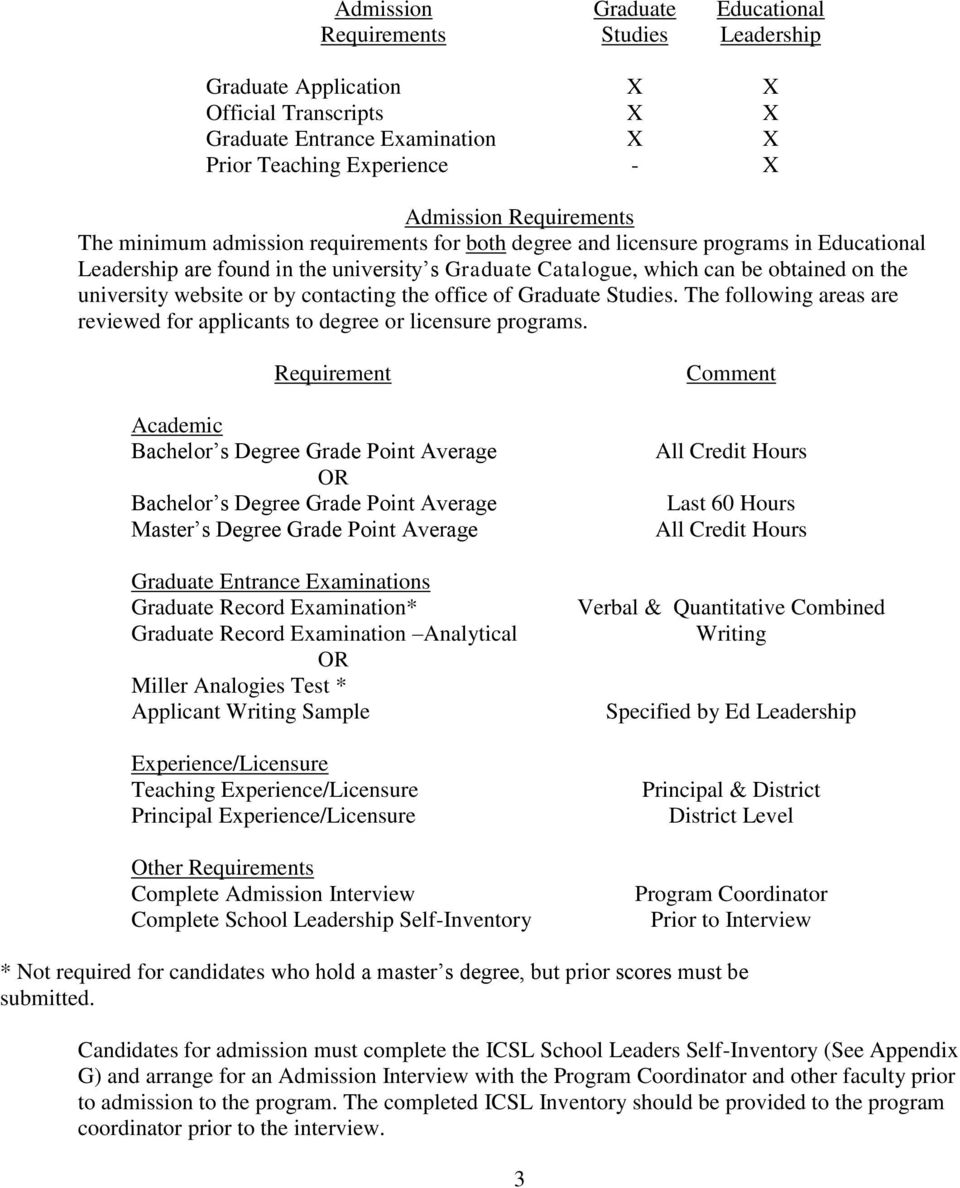
6 Admission Requirements Graduate Studies Educational Leadership Graduate Application X X Official Transcripts X X Graduate Entrance Examination X X Prior Teaching Experience - X Admission Requirements The minimum admission requirements for both degree and licensure programs in Educational Leadership are found in the university s Graduate Catalogue, which can be obtained on the university website or by contacting the office of Graduate Studies. The following areas are reviewed for applicants to degree or licensure programs. Requirement Academic achelor s egree Grade Point Average OR achelor s egree Grade Point Average Master s egree Grade Point Average Graduate Entrance Examinations Graduate Record Examination* Graduate Record Examination Analytical OR Miller Analogies Test * Applicant Writing Sample Experience/Licensure Teaching Experience/Licensure Principal Experience/Licensure Other Requirements Complete Admission Interview Complete School Leadership Self-Inventory Comment All Credit Hours Last 60 Hours All Credit Hours Verbal & Quantitative Combined Writing Specified by Ed Leadership Principal & istrict istrict Level Program Coordinator Prior to Interview * Not required for candidates who hold a master s degree, but prior scores must be submitted. Candidates for admission must complete the ICSL School Leaders Self-Inventory (See Appendix G) and arrange for an Admission Interview with the Program Coordinator and other faculty prior to admission to the program. The completed ICSL Inventory should be provided to the program coordinator prior to the interview. 3
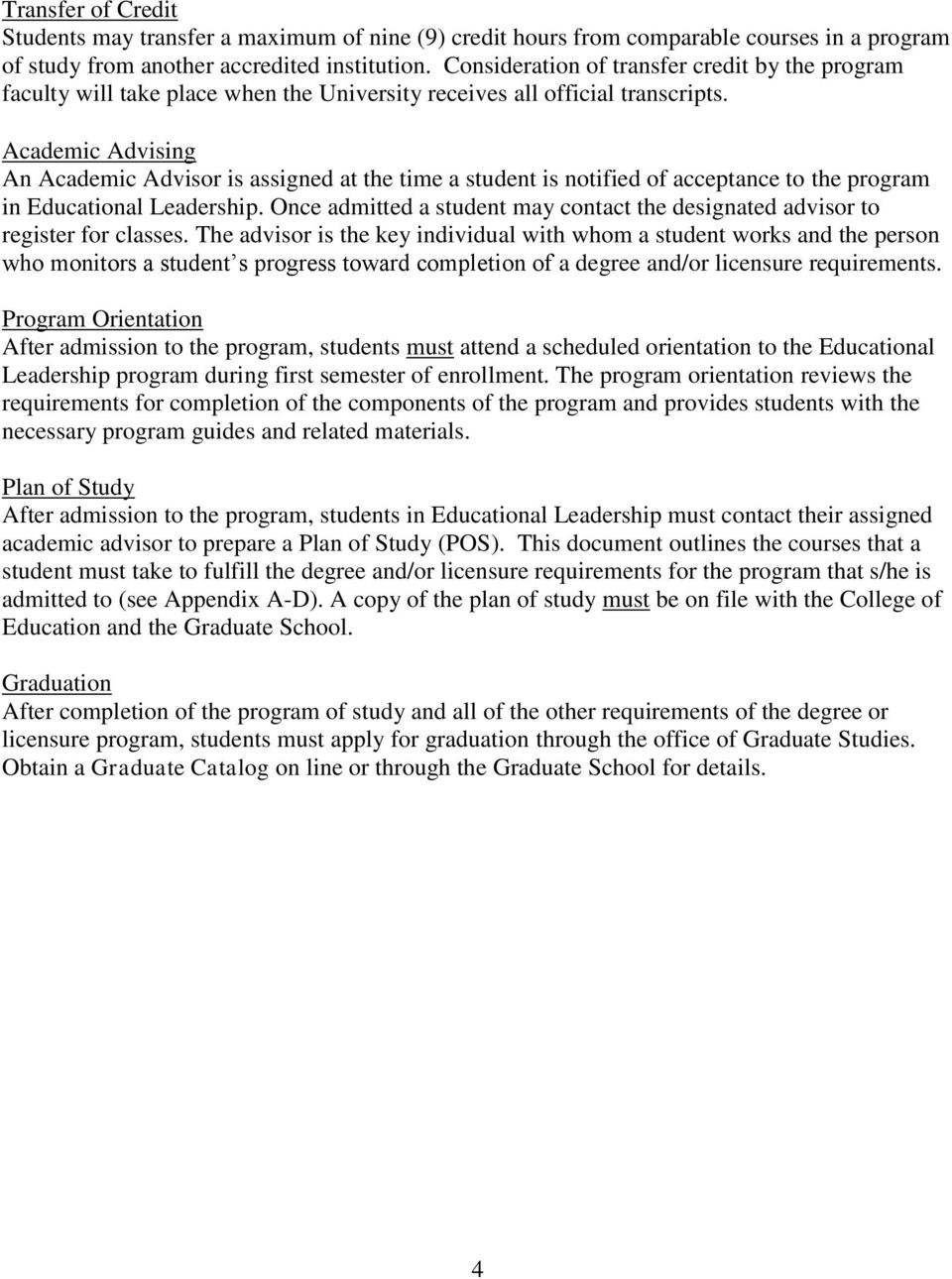
7 Transfer of Credit Students may transfer a maximum of nine (9) credit hours from comparable courses in a program of study from another accredited institution. Consideration of transfer credit by the program faculty will take place when the University receives all official transcripts. Academic Advising An Academic Advisor is assigned at the time a student is notified of acceptance to the program in Educational Leadership. Once admitted a student may contact the designated advisor to register for classes. The advisor is the key individual with whom a student works and the person who monitors a student s progress toward completion of a degree and/or licensure requirements. Program Orientation After admission to the program, students must attend a scheduled orientation to the Educational Leadership program during first semester of enrollment. The program orientation reviews the requirements for completion of the components of the program and provides students with the necessary program guides and related materials. Plan of Study After admission to the program, students in Educational Leadership must contact their assigned academic advisor to prepare a Plan of Study (POS). This document outlines the courses that a student must take to fulfill the degree and/or licensure requirements for the program that s/he is admitted to (see Appendix A-). A copy of the plan of study must be on file with the College of Education and the Graduate School. Graduation After completion of the program of study and all of the other requirements of the degree or licensure program, students must apply for graduation through the office of Graduate Studies. Obtain a Graduate Catalog on line or through the Graduate School for details. 4
8 egree Programs Master of Education The Master of Education degree in Educational Leadership is a thirty (30) credit hour program that also leads to initial licensure as a Principal (building-level administrator) in the state of Arkansas. It is designed to provide the knowledge and applied experiences required for the principalship. Program coursework addresses the standards specified by the Interstate School Leadership and Educational Leadership Constituent Consortiums (ICSL/ELCC) and the standards prescribed for licensure in the state of Arkansas. Completion of this program will typically require matriculation for two years of study. The requirements for successful completion of the Master s degree and the licensure requirements for building level administrators include the following: Requirements Completion of Graduate egree Completion of Plan of Study Administrative Internship Completed Program Portfolio The specific requirements for completion of each of these stages of the program and licensure are outlined in this handbook. The plan of study for those seeking a graduate degree is described below. A Plan of Study worksheet is available in the Appendix. Professional Education Core (3 credit hours) EUC 6003 Educational Research Educational Administration and Supervision (24 Credit Hours) EAS 6193 School Organization and Administration EUC 6403 School Law EAS 6013 School Community Relations EAS 6023 Instructional evelopment & Supervision EAS 6033 Organizational evelopment & Evaluation EAS 6233 Leadership of Special Programs & Services EAS 6093 The Principalship EAS 6223 Administrative Internship & Project 5

9 Concentration- Elementary or Secondary (3 Credit Hours) EE 6013 Elementary Curriculum OR SE 6213 Secondary Curriculum 6

10 Licensure Programs Principalship The Principal s Licensure Program is designed to provide an alternate means for a person to pursue licensure who already holds a master s degree in an appropriate field. Individuals who seek positions as assistant principals or principals should enroll in this program. An individualized plan of study is developed for the applicant based on prior graduate work in educational leadership. The program leads to initial licensure as a building-level administrator in the state of Arkansas. Program coursework addresses the standards specified by the Interstate School Leadership and Educational Leadership Constituent Consortiums (ICSL/ELCC) and the standards prescribed for licensure in the state of Arkansas. In addition to the prescribed coursework, students must engage in an administrative internship and submit and defend a portfolio. The requirements for successful completion of the licensure requirements for building level administrators include the following: Requirements Pre-requisite Graduate egree Completion of Plan of Study Administrative Internship Completion of Program Portfolio The specific requirements for completion of each of these stages are outlined in this handbook. The plan of study for those seeking a graduate degree is described below. A Plan of Study worksheet is available in the Appendix. Educational Administration and Supervision (21 Credit Hours) EAS 6193 School Organization and Administration EUC 6403 School Law EAS 6023 Instructional evelopment & Supervision EAS 6033 Organizational evelopment & Evaluation EAS 6233 Leadership of Special Programs & Administration of EAS 6093 The Principalship EAS 6223 Administrative Internship & Project 7

11 Curriculum Administrator [Program under evelopment] The Curriculum Administrator Licensure Program is designed for persons who already holds a master s degree in an appropriate field. It is intended for individuals who are seeking positions as curriculum or program administrator in a specific area (e.g., special education). The plan of study is developed for an applicant based on prior graduate work in educational leadership and the area of specialization. The program leads to an initial licensure as a curriculum or program administrator in the state of Arkansas. Program coursework addresses the standards specified by the ICSL/ELCC and the standards prescribed for licensure in the state of Arkansas. The 18-hour licensure program is completely online. In addition to the prescribed coursework, students must engage in an administrative internship and submit and defend a portfolio. The requirements for successful completion of the licensure requirements for building level administrators include the following: Requirements Pre-requisite Graduate egree Completion of Plan of Study Administrative Internship Completion of Program Portfolio The specific requirements for completion of each of these stages is outlined in this handbook Prospective curriculum and program administrators may receive licensure in the following areas: Area of Specialization Level 1 Level 2 Level 3 Special Education P P-12 Gifted and Talented P Curriculum Specialist P Superintendency The Superintendent s Licensure Program is a twenty-four (24) hour non-degree program for persons seeking district-level licensure in the state of Arkansas. Individuals who seek positions as deputy/assistant superintendents or superintendents should enroll in this program. Applicants must already hold a master s degree in Educational Leadership and licensure as a principal. Program coursework addresses the standards specified by the Interstate School Leadership Licensure and Educational Leadership Constituent Consortiums (ICSL/ELCC) and the standards prescribed for licensure in the state of Arkansas. 8

12 In addition to the prescribed coursework, students must engage in a superintendent internship and submit and defend a portfolio. The requirements for successful completion of the licensure requirements for superintendent include the following: Requirements Pre-requisite Graduate egree Completion of Plan of Study istrict Internship Completion of Program Portfolio The specific requirements for completion of each of these stages of licensure are outlined in this handbook. The plan of study for those seeking a licensure as a superintendent is described below. A Plan of Study worksheet is available in the Appendix. EAS 6113 School Finance EAS 6123 The Superintendency EAS 6133 Governance Groups EAS 6143 Management of Human Resources EAS 6153 Practicum in Educational Facilities EAS 6173 Administration & Assessment of Curricular Programs EAS 6183 Educational Leadership Seminar EAS 6303 Superintendent Internship & Graduate Project 9

13 Internship All students enrolled in a degree or licensure program are required to complete a building or district-level administrative internship. The purpose of the internship is to provide an intensive field experience that enables students to acquire and apply administrative knowledge and skills under the supervision of a successful experienced practicing administrator. Students are required to complete 240 hours of practicum activities at a site approved by the program faculty. Pre-Internship Portfolio: Students must submit a pre-internship portfolio of 200 hours of documented practicum and/or academic experiences performed during their program coursework prior to enrolling in the appropriate internship. The guidelines and format of the pre-internship portfolio are the same as those for the final program portfolio. Students must apply for the internship in either the fall or spring of each school year. eadlines for application to enroll in an internship are as follows: Internship Fall Internship Spring Internship eadline May 1 for the next fall semester October 1 for the next spring semester Student must submit all of the internship application materials to the program coordinator prior to registering for the internship course. Students who do not submit the appropriate materials and have not completed the pre-internship portfolio requirements or who have incomplete grades in any courses may not register for the internship. Application Requirements Internship Application Current Resume ICSL Self-Assessment Administrator Mentor Resume Proposed Internship Plan Pre-Internship Portfolio etailed requirements for application for the internship and all other internship information are contained in the Internship Guide which can be downloaded from the university web site or is available from the office of the program coordinator. NOTE: Students may not complete an internship within a school or district that is classified as a priority school, school districts in academic distress, or school districts under administrative takeover for violations of the Standards for Accreditation of Arkansas Public Schools and School istricts (AE ). 10

14 Portfolios All students enrolled in a degree or licensure program in Educational Leadership must submit a series of portfolios that demonstrate an understanding of the ICSL/ELCC standards and the appropriate Arkansas standards for administrative licensure. Prior to completion of the program a student must submit an acceptable written portfolio and successfully defend the portfolio in an oral defense. Successful completion of the program portfolio is required for both program completion and for administrative licensure. Students must enroll in the appropriate program portfolio course and contact the program coordinator to arrange for a date for the final portfolio review and defense. Each portfolio must be a well-written, integrated collection of the evidence that the student has acquired the competencies required for completion of a particular stage of the Educational Leadership program and licensure. It should showcase the student s best work as an administrative candidate and demonstrate the student s expertise relative to the ICSL/ELCC standards and the applicable standards for licensure in Arkansas. Portfolios should provide tangible evidence of the knowledge, dispositions, and performances that the student possesses and can demonstrate. Pre-Internship Portfolio uring the course of the degree or licensure program and prior to enrolling in an internship, students must submit a portfolio of practicum and academic experiences based on assignments during the program of study. This portfolio must adhere to the same guidelines that are required for the final Program Portfolio and must consist of no less than 200 hours of documented practicum and academic experiences. Electronic access to this portfolio should be provided to the advisor for review during a student s coursework. This requirement must be met by the student and approved by the advisor prior to receiving permission to enroll in an internship. Internship Portfolio Students must develop a portfolio during the course of their Internship, which documents the field-based practica associated with their approved internship plan. This portfolio must adhere to the same guidelines that are required for the final Program Portfolio and must consist of no less than 240 hours of documented practicum experiences. Electronic access to this portfolio should be provided to the advisor during and at the completion of a student s internship. Program Portfolio The final program portfolio in Educational Leadership is a compilation of a student s best academic and practicum artifacts associated with their plan of study. Within each standard, the portfolio should contain sufficient artifacts to demonstrate the candidate s knowledge of and ability to apply each of the categories of the ICSL/ELCC standards and elements and the appropriate Arkansas standards. 11

15 Portfolio Categories by Standard Vision Collaboration 1.1 evelop a Vision 4.1 Families & Other Community Members 1.2 Articulate a Vision 4.2 Respond to Community Interests and Needs 1.3 Implement a Vision 4.3 Mobilize Community Resources 1.4 Steward a Vision 1.5 Promote Community Involvement Instruction and Climate 2.1 Promote Positive School Culture 5.1 Act with Integrity 2.2 Provide Effective Instructional Program 5.2 Act Fairly 2.3 Apply est Practices to Student Learning 5.3 Act Ethically 2.4 esign Professional Growth Plans Ethics Management Influence 3.1 Structure and Manages the Organization 6.1 Understand the Larger Context 3.2 Manages & Evaluates Operations 6.2 Respond to the Larger Context 3.3 Effectively Manages Resources 6.3 Influence the Larger Context Program Portfolio Review Students who complete an internship and all of the coursework in a program of study may apply to submit and defend the required Program Portfolio. Students who have not completed all of their required courses may request permission from their academic advisor to submit the program portfolio prior to completion of their coursework. Students who have incomplete or unsatisfactory grades in any course will not be granted permission to submit or defend a portfolio. Portfolio Submission & efense After meeting the eligibility requirements, students are responsible for registering for the appropriate no-credit portfolio course (Educational Leadership Portfolio or Superintendent Portfolio) the semester in which they intend to defend the portfolio. They also must schedule a portfolio defense through the program coordinator. Students must register for the portfolio defense the semester before the expected defense. Students must provide access to their electronic/online portfolio to the members of the Portfolio Review Committee no later than one month prior to the scheduled date of the portfolio defense. Portfolio defenses are scheduled on week days. Portfolio Content The appearance and content of the portfolio must be of the highest quality and must conform to the guidelines described in this handbook and the Educational Leadership Portfolio Guide. Portfolios that do not adhere to the established guidelines will not be reviewed and must be resubmitted by the student. When a portfolio is not evaluated for any reason, the scheduled oral 12

16 defense will be cancelled and must be re-scheduled by the student after permission from the program coordinator. A student who fails to submit/re-submit a written portfolio by the deadline date will receive a failing grade. Rating the Portfolio The program faculty and at least one external individual evaluate the portfolio according to predetermined, standardized criteria. Evaluator s ratings are combined to determine an overall score for each section of the portfolio prior to the portfolio defense. A student who does not receive a satisfactory rating (passing) on the written portfolio will be notified by the portfolio committee chairperson. The scheduled oral defense will be cancelled and the student must re-schedule the defense only after the written portfolio receives a satisfactory rating. Portfolio efense Upon satisfactory completion of the written portfolio, the student will conduct an oral defense. Students are expected to prepare a Microsoft PowerPoint presentation that provides an overview of each section of the portfolio. Students should schedule approximately two hours for the defense. Students are expected to broadly discuss the standard and their categories, how the artifacts in the portfolio satisfy the standards, the rationale for their inclusion and how they demonstrate the student s knowledge of and ability to apply the standard. The committee may ask questions about the artifacts contained in the portfolio and any other questions that they deem pertinent to its defense. Failure to appear at the oral defense will result in a failing grade for the overall portfolio. After the defense, the committee meets to discuss the ratings of the written document and the oral defense and determines whether or not the student passes or fails the overall portfolio requirement. If the committee assigns a passing with conditions grade, the student will be required to demonstrate competency in the identified area(s) of deficiency. The committee may require completing additional written work and/or another oral defense of any aspect of the portfolio. If the committee fails the student, the committee will determine the extent to which the portfolio must be revised and the time frame within which it must be re-submitted and defended. The committee will inform the student of their decision no later than one week after the defense. A student who fails to receive a passing grade on the portfolio after the third written submission and/or oral defense will be withdrawn from the program of study and not receive their graduate degree or recommendation by the University for Licensure. 13

17 Licensure Licensure for school administrators in Arkansas can be obtained for building level administrators (principals), curriculum/program administrators and district level administrators (assistant/deputy superintendents and superintendents). Licensure requires a prospective candidate to be able to demonstrate the knowledge, dispositions and performances associated with the national and state standards for these positions. Eligibility for initial licensure requires successful completion of all requirements stipulated for licensure by the Arkansas epartment of Education. Completion of the Master s degree in Educational Leadership fulfills the basic academic requirements for licensure as a principal (building administrator) in the state, and other nondegree programs fulfill licensure requirements for curriculum administrator and district-level positions. State licensure requirements are currently as follows for each position: Requirements Principal/ uilding (Traditional) Principal/ uilding (Alternative) Curriculum/ Program (Alternative) Superintendent/ istrict (eputy & Asst) Academic egree Requirement achelors Masters Masters Masters Program of Study Masters Licensure Licensure Licensure Internship uilding uilding Curriculum istrict Portfolio Yes Yes Yes Yes Licensure Examination SLLA SLLA SLLA SSA If ALCP, Completion ate None Three Years Three Years Three Years Experience Teaching General Four Years Four Years Four Years Four Years Teaching Specific Level Three Years Three Years Three Years - Administrative Experience Preferable Current Licensure Required Teaching Teaching Teaching Principal or Curriculum Current License Type P-8 / 7-12 P-8 / 7-12 P-8 / 7-12 P-8 / 7-12 If ALCP- Mentoring - Three Years Three Years - Licensure Examination: Candidates for licensure must successfully complete the appropriate state licensure examination in order to receive licensure. The School Leadership Licensure Assessment (SLLA) is required by the state for licensure as a Principal (building level administrator) or Curriculum Administrator. The School Superintendent Assessment (SSA) is required for the Superintendency (district-level administrator) position. Information about these examinations can be found on the website of the Educational Testing Service ( A licensure examination workshop is generally offered through the 14

18 university once a year to provide candidates with an overview of the content and format of the examinations. Licensure Application: It is the responsibility of the candidate to apply for licensure from the state. The university will only certify the candidate s successful completion of program requirements on the licensure application. Applications for licensure may be obtained at the Arkansas epartment of Education website ( Upon completion of the School Leaders Licensure Assessment (SLLA) and participation in the Arkansas Administrator Induction Program during the first year of employment as a building administrator, a graduate may make application for the standard administrator license. Graduates of district level administrator programs may make immediate application for licensure without participating in an induction program if they pass the appropriate examination and meet all other state licensure requirements. Out-of-State Licensure Students who are interested in licensure in another state should contact the program coordinator, as well as research the particular requirements of the state in question. Numerous states require the same licensure examinations as Arkansas, are also accredited by the National Council for the Accreditation of Teacher Education (NCATE), and have similar coursework requirements. Many states also have licensure reciprocity agreements with the state of Arkansas. 15

19 Comprehensive No comprehensive examination is currently required for completion of the Master s degree or licensure programs in Educational Leadership. 16

20 Appendix 17

21 APPENIX A: SOUTHERN ARKANSAS UNIVERSITY GRAUATE PLAN OF STUY Educational Administration & Supervision Masters egree & uilding Administrator Licensure Legal Name: Permanent Address: City, State, Zip Program: Master s egree with Licensure ata Admitted: I Number: Home Telephone Work Telephone: Address: Catalog Year: ept Course Course Term Grade Course Other Credit No. Title Substitute Univ. Hrs EUC 6003 Educational Research (egree-seeking only) 3 Professional Core Course Credit Hours 3 EUC 6403 School Law 3 EAS 6193 School Organization & Administration 3 EAS 6013 School Community Relations 3 EAS 6023 Instructional evelopment and Supervision 3 EAS 6033 Organizational evelopment & Evaluation 3 EAS 6233 Leadership of Special Programs & Services 3 EAS 6093 The Principalship 3 EAS 6223 Administrative Internship & Project 3 Educational Administration & Supervision Credit Hours 24 EE 6013 Elementary School Curriculum 3 Elementary Emphasis Hours 3 OR SE 6213 Secondary School Curriculum 3 Secondary Emphasis Credit Hours 3 Master s egree Required: 30 Transfer Credit (Limit 9): Needed: Principal Licensure Required: 24 Transfer Credit (Limit 9): Needed: Signature of Applicant Signature of Advisor ate ate EAS Orientation (required) 0 Pre-Internship Practicum Portfolio (200 hrs) 0 EAS 6223 Administrative Internship & Project/Portfolio (240 hrs) 0 1 Other Requirements 18
22 APPENIX : SOUTHERN ARKANSAS UNIVERSITY GRAUATE PLAN OF STUY Educational Administration & Supervision Principalship Licensure Legal Name: I Number: Permanent Address: Home Telephone City, State, Zip Work Telephone: Program: Licensure Only (Has Master s egree) Address: ata Admitted: Catalog Year: ept Course No. Course Title Term Grade Course Substitute Other Univ. Credit Hrs EUC 6403 School Law 3 EAS 6193 School Organization & Administration 3 EAS 6023 Instructional evelopment and Supervision 3 EAS 6033 Organizational evelopment & Evaluation 3 EAS 6233 Leadership of Special Programs & Services 3 EAS 6093 The Principalship 3 EAS 6223 Administrative Internship & Project/Portfolio 3 Educational Administration & Supervision Credit Hours 21 EE 6013 Elementary School Curriculum 0 Elementary Emphasis Hours 0 OR SE 6213 Secondary School Curriculum 0 Secondary Emphasis Credit Hours 0 Master s egree Required: 30 Transfer Credit (Limit 9): Needed: Principal Licensure Required: 21 Transfer Credit (Limit 9): Needed: Signature of Applicant ate Signature of Advisor ate EAS Orientation (required) 0 Pre-Internship Practicum Portfolio (200 hrs) 0 EAS 6223 Administrative Internship & Project/Portfolio (240 hrs) 0 1 Other Requirements Note: A Master s degree, teacher licensure, and two years of teaching are prerequisites for admission. 19
23 APPENIX C: SOUTHERN ARKANSAS UNIVERSITY GRAUATE PLAN OF STUY Educational Administration & Supervision Curriculum Administrator Legal Name: I Number: Permanent Address: Home Telephone City, State, Zip Work Telephone: Program: Licensure Only (Has Master s egree) Address: ata Admitted: Catalog Year: ept Course No. Course Title Term Grade Course Substitute Other Univ. Credit Hrs EUC 6403 School Law 3 EAS 6013 School Community Relations 3 EAS 6023 Instructional evelopment and Supervision 3 EAS 6033 Organizational evelopment & Evaluation 3 EUC 6873 Advanced Curriculum/Program Admin 3 Leadership EAS 6062 Administrative Internship 3 EAS 6223 Administrative Internship & Project/Portfolio 3 Educational Administration & Supervision Credit Hours 21 EE 6013 Elementary School Curriculum 0 Elementary Emphasis Hours 0 OR SE 6213 Secondary School Curriculum 0 Secondary Emphasis Credit Hours 0 Master s egree Required: 30 Transfer Credit (Limit 9): Needed: Principal Licensure Required: 21 Transfer Credit (Limit 9): Needed: Signature of Applicant ate Signature of Advisor ate Note: This program is aligned with the requirement for Arkansas Curriculum/Program Administrator license and Arkansas and ISLLC Leadership Standards. Candidates for this licensure program must hold an earned master s degree in an area of emphasis listed: Special Education, Gifted and Talented, or Curriculum Specialist. 20
24 APPENIX : SOUTHERN ARKANSAS UNIVERSITY GRAUATE PLAN OF STUY Educational Administration & Supervision Superintendent (istrict Administrator Licensure) Legal Name: Permanent Address: City, State, Zip Program Admitted To: Licensure (Master s Required) ata Admitted: I Number: Home Telephone Work Telephone: Address: Catalog Year: ept Course No. Course Title Term Grade Course Substitute Other Univ. Credit Hrs EAS 6113 School Finance 3 EAS 6123 The Superintendency 3 EAS 6133 Governance Groups 3 EAS 6143 Management of Human Resources 3 EAS 6153 Practicum in Educational Facilities 3 EAS 6173 Administration &Assessment of Curriculum 3 EAS 6183 Educational Leadership Seminar 3 EAS 6303 Superintendent Internship & Graduate Project 3 Educational Administration & Supervision Credit Hours 24 Other Credit Hours Master s egree NA Required: NA Transfer Credit (Limit 9): Needed: Licensure Required: 24 Transfer Credit (Limit 9): Needed: Signature of Applicant Signature of Advisor ate ate EAS Orientation (required) 0 EAS 6303 Superintendent Portfolio & Internship 0 (Required) Other Requirements Note: A Master s degree and principal or curriculum administrator licensure is a prerequisite for admission. 21
25 APPENIX E-1 Southern Arkansas University Activity/Artifact Report irections: For each practicum activity that you undertake during the program of study, complete the information below: A copy of this report and the Practicum Activity Records associated with it are required in order to substantiate the amount of practicum experience engaged in and to qualify for the internship. This format must be used in the electronic, online portfolio (LiveText). Each student has a LiveText account and the access information should be located in your Campus Connect account. 1. Heading (three lines, centered): Southern Arkansas University, Administrative Internship, Activity/Artifact Report 2. Student Name (Last, First) 2b. Name of the Activity: 3. ates of the Activity: When did you begin the activity and when did you finish it? 4. Type(s) of Activity: What type(s) of activities were involved in completing the task? What kinds of administrative duties did it entail? For example, did it require significant planning, delegating, evaluating, etc? 5. Standards & Rationale: List the ICSL and Arkansas licensure standards and specific categories that were addressed by this activity. escribe how the activity/artifact is related to the standard(s); explain why the artifacts are included in the portfolio and your ability to apply it to the standard. 6. escribe the Activity: escribe what was involved in each of these areas and how it relates to student learning Names & Titles of Persons Involved in the Activity: Who else was involved in the activity? What were the responsibilities of each person? 8. Activity Evaluation: How will the activity assist you as a future administrator? What aspects of the activity did you find the least difficult? What aspects of the activity did you find the most difficult? What aspects of the activity would you handle differently and why? 9. Review of Research: What research can you cite to support your understanding of the application of the principles in this activity/artifact? 10. Future Preparation: escribe how your involvement will assist you as an administrator? 11. ocumentation: Attach all documents (artifacts) that you prepared in conjunction with completing this activity. Student Signature ate Administrator Mentor Signature ate 22
26 APPENIX E-2 Southern Arkansas University Activity Record irections: For each practicum activity that you undertake during the program of study, you are required to document the amount of time that you spend completing the various tasks associated with it. A copy of this record and the Activity/Artifact Reports associated with it are required in order to qualify for acceptance as a practicum experience. A copy must also be a part of your portfolio. 1. Heading (Centered): Southern Arkansas University, Administrative Internship, Activity Report 2. Name of the Activity (Column 1) This should be the same as on your activity report. 3. Type of Task (Column 2) What type of task associated with this activity did you work on? 4. escription of the Task (Column 3) riefly describe the task that was associated with this activity. 5. ate of the Task (Column 4) Enter the month, day and year that you worked on the task? Start a new line for each new date. 6. Time Started and Completed (Columns 5 and 6) Enter the time that you began the task and the time that you finished the task. 7. Hours Spent (Column 7) How many hours did you spend completing each task? Enter the hour and the part of the hour (minutes) as a decimal. You may only us increments of (15 minutes), 0.5 (30 minutes), and 0.75 (45 minutes). Report the total number of hours you spent on all of the tasks associated with this activity on your Activity/Artifact Report (Appendix E). 8. Standards (Column 8) Indicate the ICSL and appropriate Arkansas standards that apply to this activity. Activity Standards Elements Task escription Task ate Start Time End Time Hours 23
27 APPENIX F-1 Southern Arkansas University Portfolio Format The portfolio must be presented in an electronic, online form using the software authorized by department and organized in separate sections for each standard according to the specifications outlined below. 1. ocument Presentation: Only a white background may be used in the electronic document unless it is an attached original of a document that was not prepared by candidate. 2. ocument Format: All documents must be typed using the word processing program provided by the online, electronic portfolio. The candidate should obtain a copy of all related documents that are not produced by the student, such as practicum site documents, newspaper clippings, awards, certificates, recommendations, letters, etc. These documents must be digitally photographed /scanned and an electronic copy uploaded to the online portfolio. 3. ocument Font: The same font should be used on all documents. The font style should be Times Roman and the font size should be twelve (12) points. The portfolio should include the artifacts that demonstrate your understanding of the ICSL/ELCC standards and related elements and should be structured as follows: Item Report Cover Table of Contents Resume escription A report cover with the following information: A Portfolio; [Enter Type of Portfolio, e.g., Educational Leadership]; Submitted in partial fulfillment of the requirements for the Master of Education in Educational Leadership and/or Licensure as a XXXXX (Enter Licensure name, e.g. uilding Level Administrator); Your Name; Program in Educational Leadership; Southern Arkansas University; ate. Indicate the location of each section in the portfolio and list the contents of each section. A current resume that includes the following elements Career Goals Education Employment Other Related Experience Community Service Professional Memberships Other Training & Licensure Presentations Papers/Publications References 24
28 Philosophy Standard 1 Standard 2 Standard 3 Standard 4 Standard 5 Standard 6 A statement of the student s leadership philosophy and vision which draws on the components of the ICSL/ELCC standards and administrative theory. Create a separate section for each standard. In the Introduction & iscussion, indicate the title of the section and list the ICSL/ELCC standard and elements and the related state of Arkansas standards. For each artifact listed in the introduction do the following. -iscuss your understanding of this standard and each of the categories it is related to. Also reference the various elements of the standard for your licensure level and any applicable knowledge, skills and dispositions in these standards. -iscuss which of the knowledge, skill and disposition areas are most critical for a person in this position and why you think so. - Write a general rationale for why you included the artifact in this standard and any other standards and elements that it applies to. - iscuss how the artifact demonstrates your knowledge and ability to apply the elements associated with it in a real world setting. Research Review: Write a brief review of the research for each standard and how the artifacts are related to this research. For each artifact submitted, complete the Activity/Artifact Report and attach the following information: Actual Activity/Artifact Other Supporting Exhibits The artifact is a collection of materials associated with each standard from activities developed in courses, practicum and the internship that demonstrate evidence of the candidate s understanding and ability to apply the standard. Artifacts and exhibits may include papers, projects, activities, brochures, publications and pictures, reports, audio-visual materials, etc. All materials associated with an artifact must be submitted in electronic form. Appendix The Appendix should include a copy of at least the following documents: ICSL School Leadership Self-Inventory & Profile (current) Practicum/Internship Activity Records (Time Logs) Transcripts (Copy of Graduate only) Licensure (Copy of Teaching & Administrative) Educational Leadership Program Evaluation Form 25
29 APPENIX F-2 Southern Arkansas University Portfolio Evaluation Criteria The candidate should submit evidence in the portfolio of documented activities and artifacts that illustrate each of the following categorical areas. An artifact may demonstrate more than one category within a standard as well as categories with other standards. Candidates should be able to demonstrate an understanding of, ability to apply each artifact to the administrative milieu and to articulate the rationale for inclusion of an artifact in a particular standard, current related research and all of the other categories and/or standards that are applicable. Standard 1.0 Vision for Learning Level of Understanding & Application Category Exceptional (2) 1.1 evelop a Vision emonstrates a thorough understanding about how to develop a vision 1.2 Articulate a Vision Clearly can articulate a vision 1.3 Implement a Vision Reflects a thorough understanding on how to implement a vision 1.4 Steward a Vision emonstrates clearly that he/she can lead others in the vision of the school 1.5 Promote Community Involvement Reflects total understanding and demonstrates how to involve all stakeholders Proficient (1) Sufficient understanding that relates to the concept of developing a vision Information is sufficient that shows that the vision is ready for articulation Reflects some understanding on how to implement a vision Sufficient information shows that he/she can lead; but more definition is needed Sufficient information relating to promoting community involvement Not Acceptable (0) emonstrates limited or no knowledge of the concept and its relevance Limited or no understanding of how to articulate a vision Shows weakness or no evidence of understanding how to implement a vision Limited or no understanding about the idea of how to steward a vision Shows weakness or no understanding in promoting community involvement 26
30 Standard 2.0 Instruction and Climate Category Exceptional Proficient Not Acceptable 2.1 Promote Positive School Culture 2.2 Provide Effective Instructional Program 2.3 Apply est Practices to Student Learning 2.4 esign Professional Growth Plans emonstrates a complete understanding in promoting a positive school Clearly understands how to provide an effective instructional program emonstrates clearly how to apply best practice to student learning Clearly can design a comprehensive plan Sufficient understanding about promoting a positive school Information is sufficient showing how to provide instructional program Sufficient understanding about applying best practice to student learning Reflects understanding of idea presented emonstrates limited or no understanding of how to promote a positive school Limited or no understanding of how to provide effective instructional program Limited or no understanding of concept Limited or no understanding of development of plan Standard 3.0 Management Category Exceptional Proficient Not Acceptable 3.1 Manage the Organization Clearly understands how to manage the organization 3.2 Manage Operations Clearly demonstrates how to manage operations 3.3 Manages Resources Clearly demonstrates how to allocate resources Sufficient knowledge of how to manage the organization emonstrates some knowledge of how to manage operations emonstrates some knowledge of how to allocate operations Synthesis of concept is limited or demonstrates no understanding Limited or no knowledge of how to manage operations Limited or no knowledge of how to allocate resources 27
31 Standard 4.0 Collaboration Category Exceptional Proficient Not Acceptable 4.1 With Families and Other Community Members 4.2 Respond to Community Interests and Needs 4.3 Mobilize Community Resources Relationships with community leaders and families are identified and nurtured emonstrates thorough understanding to community Interest and needs emonstrates thorough understanding of how to mobilize community resources Admirable sufficient knowledge of collaboration with families and community leaders Ideas are sketchy, but has sufficient knowledge of concept Sufficient awareness of how to mobilize community resources Limited or no awareness of how to apply concept Limited or no awareness of how to respond to community interest and needs Limited or no knowledge of concept Standard 5.0 Ethics Category Exceptional Proficient Not Acceptable 5.1 Acts with Integrity emonstrates a thorough understanding of what it takes to act with integrity 5.2 Acts Fairly emonstrates an understanding of treating people fairly and with dignity and respect 5.3 Acts Ethically emonstrates a personal and professional code of ethics Sufficient knowledge to show what it takes to act with integrity Possess sufficient knowledge to know how to treat people fairly and with dignity and respect Possess sufficient knowledge about promoting a personal and professional Code of Ethics Limited or no understanding of the concept Limited or no understanding of concept Limited or no understanding of concept 28
32 Standard Influence Category Exceptional Proficient Not Acceptable 6.1 Understands the Larger Context 6.2 Respond to the Larger Context 6.3 Influences the Larger Context emonstrates clearly an understanding of the larger context in which the school exists emonstrates an understanding of how to respond to the larger context Has a complete understanding of the school and its influence in the larger context Possess sufficient information about the school in the larger context Sufficient understanding of how to respond to the larger context Sufficient understanding of the school and its influence in the larger context Sparse or no understanding about the school in the larger context Limited or no understanding of concept Limited or no understanding of concept 29
33 APPENIX G ICSL School Leadership Self-Inventory Standards-ased Self Assessment Purpose: This self-inventory is designed to provide potential school leaders with the opportunity to examine their own school leadership practices with respect to the knowledge, dispositions, and performances contained within the ICSL/ELCC School Leader Standards. This self-examination should lead to greater familiarity with these standards and provide an ongoing means to identify potential areas for personal professional development planning. The inventory consists of 182 statements that describe the knowledge, dispositions, and performances contained within the ICSL Standards for School Leaders. Respond to each statement by reflecting on what you have learned, what you believe and value, and what you consistently do as a school leader. irections: Read each statement carefully. Then circle the number that indicates the extent to which the statement represents your current status. Respond to all statement and circle only one response for each as follows: 1 = Little extent, 2 = Some extent, 3 = Sufficient (Good) extent, and 4 = Exemplary (Strong) extent. Use the space provided to describe areas of strength or needing improvement. eveloping Your School Leadership Profile 1. After completing the survey, go back and add the ratings within each standard. ivide the total rating by the number of items in each standard to calculate an average rating. Enter the average rating in the space located at the end of each standard. 2. Transfer the averages for the six standards to the graph on the last page to display your areas of relative strength. 3. Review your personal graph and the inventory items and write a reflection of the areas that need emphasis and/or improvement. Standard 1. A school administrator is an educational leader who promotes the success of all students by facilitating the development, articulation, implementation, and stewardship of a vision of learning that is shared and supported by the school community. To what extent do I demonstrate a current personal mastery of the following knowledge indicators? 30 LITTLE (A) SOME () GOO (C ) STRONG ()
34 1. Learning goals in a pluralistic society. 2. The principles of developing and implementing strategic plans. 3. Knows systems theory. 4. Information sources, data collection, and data analysis strategies. 5. Effective communication. 6. Effective consensus-building and negotiation skills. To what extent do I demonstrate a current personal belief, value, and commitment in the following disposition indicators? 7. The educability of all. 8. A school vision of high standards of learning. 9. Continuous school improvement. 10. The inclusion of all members of the school community. 11. Ensuring that students have the knowledge, skills, and values needed to become successful adults. 12. A willingness to continuously examine one's own assumptions, beliefs, and practices. 13. oing the work required for high levels of personal and organization performance. To what extent do I currently facilitate processes and engage in activities ensuring the following performance indicators? 14. The vision and mission of the school are effectively communicated to staff, parents, students, and community members. 15. The vision and mission are communicated through the use of symbols, ceremonies, stories, and similar activities. 16. The core beliefs of the school vision are modeled for all stakeholders. 17. The vision is developed with and among stakeholders. 18. The contributions of school community members to the realization of the vision are recognized and celebrated. 19. Progress toward the vision and mission is communicated to all stakeholders. 20. The school community is involved in school 31
35 improvement efforts. 21. The vision shapes the educational programs, plans, and actions. 22. An implementation plan is developed in which objectives and strategies to achieve the vision and goals are clearly articulated. 23. Assessment data related to student learning are used to develop the school vision and goals. 24. Relevant demographic data pertaining to students and their families are used in developing the school mission and goals. 25. arriers to achieving the vision are identified, clarified, and addressed. 26. Needed resources are sought and obtained to support the implementation of the school mission and goals. 27. Existing resources are used in support of the school vision and goals. 28. The vision, mission, and implementation plans are regularly monitored, evaluated, and revised. Notes: Standard 1. Average = Total/28 Average = Standard 2. A school administrator is an educational leader who promotes the success of all students by advocating, nurturing, and sustaining a school culture and instructional program conducive to student learning and staff professional growth. To what extent do I demonstrate a current personal mastery of the following knowledge indicators? 29. Student growth and development 30.Applied learning theories 31. Applied motivational theories 32. Curriculum design, implementation, evaluation, and refinement 33. Principles of effective instruction 34. Measurement, evaluation, and assessment strategies 35. iversity and its meaning for educational programs 36. Adult learning and professional development models 37. The change process for systems, organizations, 32
36 and individuals 38. The role of technology in promoting student learning and professional growth 39. School cultures To what extent do I demonstrate a current personal belief, value, and commitment in the following disposition indicators? 40. Student learning is the fundamental purpose of schooling. 41 The proposition that all students can learn. 42. The variety of ways in which students can learn. 43. Life-long learning for self and others. 44. Professional development as an integral part of school improvement 45. The benefits that diversity brings to the school community 46. A safe and supportive learning environment. 47. Preparing students to be contributing members of society To what extent do I currently facilitate processes and engage in activities ensuring the following performance indicators? 48. All individuals are treated with fairness, dignity, and respect 49. Professional development promotes a focus on student learning consistent with the school vision and goals 50. Students and staff feel valued and important 51. The responsibilities and contributions of each individual are acknowledged 52. arriers to student learning are identified, clarified, and addressed 53. iversity is considered in developing learning experiences 54. Life-long learning is encouraged and modeled 33
37 55.There is a culture of high expectations for self, student, and staff performance 56. Technologies are used in teaching and learning 57. Student and staff accomplishments are recognized and celebrated 58.Multiple opportunities to learn are available to all students 59. The school is organized and aligned for success 60. Curricular, co-curricular, and extra- curricular programs are designed, implemented, evaluated, and refined 61. Curriculum decisions are based on research, expertise of teachers, and the recommendations of learned societies 62. The school culture and climate are assessed on a regular basis 63. A variety of sources of information is used to make decisions 64. Student learning is assessed using a variety of techniques 65. Multiple sources of information regarding performance are used by staff and students 66. A variety of supervisory and evaluation models is employed 67. Pupil personnel programs are developed to meet the needs of students and their families Notes: Standard 2. Average = Total/39 Average = Standard 3. A school administrator is an educational leader who promotes the success of all students by ensuring management of the organization, operations, and resources for a safe, efficient, and effective learning environment. To what extent do I demonstrate current personal mastery in the following knowledge indicators? 68. Theories and models of organizations and the principles of organizational development 69. Operational procedures at the school and district level 70. Principles and issues relating to school safety and security 71. Human resources management and development 34
38 72. Principles and issues relating to fiscal operations of school management 73. Principles and issues relating to school facilities and use of space 74. Legal issues impacting school operations 75. Current technologies that support management functions To what extent do I demonstrate a current personal belief, value, and commitment in the following disposition indicators? 76. Making management decisions to enhance learning and teaching. 77. Taking risks to improve schools. 78. Trusting people and their judgment. 79. Accepting responsibility. 80. Having high-quality standards, expectations, and performances 81. Involving stakeholders in management processes 82. Promoting a safe environment To what extent do I currently facilitate processes and engage in activities ensuring the following performance indicators? 83. Knowledge of learning, teaching, and student development is used to form management decisions. 84. Operational procedures are designed and managed to maximize opportunities for successful learning. 85. Emerging trends are recognized, studied, and applied as appropriate. 86. Operational plans and procedures to achieve the vision and goals of the school are in place. 87. Collective bargaining and other contractual agreements related to the school are effectively managed. 88. The school plant, equipment, and support systems operate safely, efficiently, and effectively. 89. Time is managed to maximize attainment of organizational goals. 90. Potential problems and opportunities are identified. 91. Problems are confronted and resolved in a timely manner. 92. Financial, human, and material resources are 35
39 aligned to the goals of the school. 93. The school acts in an entrepreneurial way to support continuous improvement. 94. Organizational systems are regularly monitored and modified as needed. 95. Stakeholders are involved in decisions affecting the school. 96. Responsibility is shared to maximize ownership and accountability. 97. Effective problem-framing and problem-solving skills are used. 98. Effective conflict resolution skills are used. 99. Effective group-process and consensus- building skills are used Effective communication skills are used There is effective use of technology to manage school operations 102. Fiscal resources of the school are managed responsibly, efficiently, and effectively 103. A safe, clean, and aesthetically pleasing school environment is created and maintained 104. Human resource functions support the attainment of school goals 105. Confidentiality and privacy of school records are maintained Notes: Standard 3. Average = Total/38 Average = Standard 4. A school administrator is an educational leader who promotes the success of all students by collaborating with families and community members, responding to diverse community interests and needs, and mobilizing community resources. To what extent do I demonstrate a current personal mastery of the following Knowledge indicators? LITTLE SOME GOO STRONG 106. Emerging issues and trends that potentially impact the school community 107. The conditions and dynamics of the diverse school community 108. Community resources 109. Community relations and marketing strategies and processes 36
40 110. Successful models of school, family, business, community, government, and higher education partnerships To what extent do I exhibit a current personal belief, value, and commitment in the following disposition indicators? 111. Schools operating as an integral part of the larger community 112. Collaboration and communication with families Involvement of families and other stakeholders in school decision-making processes The proposition that diversity enriches the school Families as partners in the education of their children The proposition that families have the best interests of their children in mind Resources of the family and community needing to be brought to bear on the education of students An informed public. To what extent do I currently facilitate processes and engage in activities ensuring the following performance indicators? 119. High visibility, active involvement, and communication with the larger community are a priority Relationships with community leaders are identified and nurtured Information about family and community concerns, expectations, and needs is used regularly There is outreach to different business, religious, political, and service agencies and organizations Credence is given to individuals and groups whose values and opinions may conflict The school and community serve one another as resources Available community resources are secured to help the school solve problems and achieve goals Partnerships are established with area business, institutions of higher education and community 37
41 groups to strengthen programs and support school goals Community youth family services are integrated with school programs Community stakeholders are treated equitably iversity is recognized and valued Effective media relations are developed and maintained A comprehensive program of community relations is established Public resources and funds are used appropriately and wisely Community collaboration is modeled for staff Opportunities for staff to develop collaborative skills are provided. Notes: Standard 4: Average = Total/29 Average = Standard 5: A school administrator is an educational leader who promotes the success of all students by acting with integrity, fairness, and in an ethical manner. To what extent do I demonstrate a current personal mastery of the following Knowledge indicators? 135. The purpose of education and the role of leadership in modern society Various ethical frameworks and perspectives on ethics The values of the diverse school community Professional codes of ethics The philosophy and history of education. To what extent do I exhibit a current personal belief, value, and commitment in the following disposition indicators? 140. The ideal of the common good The principles in the ill of Rights The right of every student to a free, quality education ringing ethical principles to the decisionmaking process Subordinating one's own interest to the good of the school community. 38
42 145. Accepting the consequences for upholding one's principles and actions Using the influence of one's office constructively and productively in the service of all students and their families evelopment of a caring school community. To what extent do I currently facilitate processes and engage in activities ensuring the following performance indicators? 148. Examines personal and professional values emonstrates a personal and professional code of ethics emonstrates values, beliefs, and attitudes that inspire others to higher levels of performance Serves as a role model Accepts responsibility for school operations Considers the impact of one's administrative practices on others Uses the influence of the office to enhance the educational program rather than for personal gain Treats people fairly, equitably, and with dignity and respect Protects the rights and confidentiality of students and staff emonstrates appreciation for and sensitivity to the diversity in the school community Recognizes and respects the legitimate authority of others Examines and considers the prevailing values of the diverse school community Expects that others in the school community will demonstrate integrity and exercise ethical behavior Opens the school to public scrutiny Fulfills legal and contractual obligations Applies laws and procedures fairly, wisely, and considerately. Notes: Standard 5 Average = Total/29 Average = 39
43 Standard 6. A school administrator is an educational leader who promotes the success of all students by understanding, responding to, and influencing the larger political, social, economic, legal, and cultural context. To what extent do I demonstrate a current personal mastery of the following knowledge indicators? 164. Principles of governance that under girds the system of American schools The role of public education in developing and renewing a democratic society and an economically productive nation The law as related to education and schooling The political, social, cultural, and economic systems and processes that impact schools Models and strategies of change and conflict resolution as applied to the larger political, social, cultural, and economic contexts of schooling Global issues and forces affecting teaching and learning The dynamics of policy development and advocacy under our democratic political system The importance of diversity and equity in a democratic society. To what extent do I demonstrate a current personal belief, value, and commitment in the following disposition indicators? 172. Seeing education as a key to opportunity and social mobility Recognizing a variety of ideas, values, and cultures Having a continuing dialogue with other decision makers affecting education Actively participating in the political and policy-making context in the service of education Using legal systems to protect student rights and improve student opportunities. To what extent do I currently facilitate processes and engage in activities ensuring the following performance indicators? 177. The environment in which schools operate is influenced on behalf of students and their families Communication occurs within the school 40
44 community on trends, issues, and potential changes in the environment in which schools operate There is ongoing dialogue with representatives of diverse community groups The school community works within the framework of policies, laws, and regulations enacted by local, state, and federal authorities Public policy is shaped to provide quality education for students Lines of communication are developed with decision makers outside the school community. Notes: Standard 6 Average = Total/19 Average = emographic Information: Complete the following demographic information Name: 184. SSN (Last 4 igits Only) 185. Status (Circle one): a. Applicant b. Current student c. Internship d. Graduated 186. Course Semester (Circle One): a. Fall b. Spring c. Summer 187. Program (Circle One): a. Master s w/ Licensure (Principal) b. Non-egree Licensure (Principal) c. Master s w/ Licensure (Curriculum Administrator) d. Non-egree Licensure (Curriculum Administrator) e. Master s w/ Licensure (Superintendent) f. Non-egree Licensure (Superintendent) 188. How many courses have you completed in the program circled above (do not include this current course) 189. Current Job 190. Level: (Circle One) a. Elementary (PK-5) b. Middle/JHS (6-8) c. High School (9-12) d. Other (Specify) 191. Years of Experience Teaching (if in first year or none, enter 0) 41
45 192. Years of Experience as an Administrator (if in first year or none, enter 0) What stage of your administrator program is this? a. Admission to program c. Prior to internship b. After one year of enrollment d. Completion of program Plot Your Leadership Profile irections: Transfer each of the overall scores from each ICSL School Leadership Self- Inventory and plot them on the chart below. Connect each of the scores plotted with a line and assess the areas in which you need to grow Vision 2. Instruction and Climate 3. Management 4. Collaboration 5. Ethics 6. Influence 42
46 APPENIX H: Interstate Consortium of School Leaders ICSL and ELCC Standards ICSL Standard 1. Vision: Promotes the success of all students by facilitating the development, articulation, implementation, and stewardship of a vision of learning that is shared and supported by the school community. 2. Instruction & Climate: Promotes the success of all students by advocating, nurturing, and sustaining a school culture and instructional program conducive to student learning and staff professional growth. 3. Management: Promotes the success of all students by ensuring management of the organization, operations, and resources for a safe, efficient, and effective learning environment. 4. Collaboration: Promotes the success of all students by collaborating with families and community members, responding to diverse community interests and needs, and mobilizing community resources. 5. Ethics: Promotes the success of all students by acting with integrity, fairness, and in an ethical manner. Arkansas 1, 5, 6 1,2, 3, 6 2, 3, Influence: Promotes the success of all students by understanding, responding to, and influencing the larger political, social, economic, legal, and cultural context. 43
47 APPENIX H (continued): Educational Leadership Constituent Consortium Standards and Related Elements The Educational Leadership Constituent Consortium standards and related elements define the criteria for successful candidacy in Educational Leadership programs for building () and district () level administrators. The category heading for each criterion were supplied as shorthand by the program in Educational Leadership Standard 1.0: Candidates who complete the program are educational leaders who have the knowledge and ability to promote the success of all students by facilitating the development, articulation, implementation, and stewardship of a school or district vision of learning supported by the school community. This standard addresses the need to prepare educational leaders who value and are committed to educating all students to become successful adults. Each educational leader is responsible for creating and articulating a vision of high standards for learning within the school or district that can be shared by all employees and is supported by the broader school-community of parents and citizens. This requires that educational leaders be willing to examine their own assumptions, beliefs, and practices; understand and apply research; and foster a climate of continuous improvement among all members of the educational staff. Such educational leaders will commit themselves to high levels of personal and organizational performance in order to ensure implementation of this vision of learning. 1.1 evelop a Vision evelopment a. Candidates develop a vision of learning for a school that promotes the success of all students. Needs Analysis b. Candidates base this vision on relevant knowledge and theories, including but not limited to an understanding of learning goals in a pluralistic society, the diversity of learners and learners needs, schools as interactive social and cultural systems, and social and organizational change. evelop a. Candidates develop and demonstrate the skills needed to work with a board of education to facilitate the development of a vision of learning for a school district that promotes the success of all students. evelop b. Candidates base development of the vision on relevant knowledge and theories applicable to school-level leaders applied to a school district context. Needs Analysis c. Candidates use data-based research strategies to create a vision that takes into account the diversity of learners in a district. Resources d. Candidates demonstrate knowledge of ways to use a district s vision to mobilize additional resources to support the vision. 44
48 1.2 Articulate a Vision Implement Processes a. Candidates demonstrate the ability to articulate the components of this vision for a school and the leadership processes necessary to implement and support the vision. Planning b. Candidates demonstrate the ability to use data-based research strategies and strategic planning processes that focus on student learning to inform the development of a vision, drawing on relevant information sources such as student assessment results, student and family demographic data, and an analysis of community needs. Stakeholder Communication Implement Processes c. Candidates demonstrate the ability to communicate the vision to staff, parents, students, and community embers through the use of symbols, ceremonies, stories, and other activities. a. Candidates demonstrate the ability to articulate the components of this vision for a district and the leadership processes necessary to implement and support the vision. Planning b. Candidates demonstrate the ability to use data-based research strategies and strategic planning processes that focus on student learning to develop a vision, drawing on relevant information sources such as student assessment results, student and family demographic data, and an analysis of community needs. Stakeholder Communication 1.3 Implement a Vision c. Candidates demonstrate the ability to communicate the vision to school boards, staff, parents, students, and community members through the use of symbols, ceremonies, stories, and other activities. Planning a. Candidates can formulate the initiatives necessary to motivate staff, students, and families to achieve the school s vision. Implementation Processes b. Candidates develop plans and processes for implementing the vision (e.g., articulating the vision and related goals, encouraging challenging standards, facilitating collegiality and teamwork, structuring significant work, ensuring appropriate use of student assessments, providing autonomy, supporting innovation, delegating responsibility, developing leadership in others, and securing needed resources). Planning a. Candidates demonstrate the ability to plan programs to motivate staff, Implementation Processes 1.4 Steward a Vision students, and families to achieve a school district s vision. b. Candidates design research-based processes to effectively implement a district vision throughout an entire school district and community. uilding Commitment a. Candidates demonstrate an understanding of the role effective communication skills play in building a shared commitment to the vision. Evaluation b. Candidates design or adopt a system for using data-based research 45
49 Processes Stewardship Processes Implementation Polices Evaluation Processes strategies to regularly monitor, evaluate, and revise the vision. c. Candidates assume stewardship of the vision through various methods. a. Candidates demonstrate the ability to align and, as necessary, redesign administrative policies and practices required for full implementation of a district vision. b. Candidates understand the theory and research related to organizational and educational leadership and engage in the collection, organization, and analysis of a variety of information, including student performance data, required assessing progress toward a district s vision, mission, and goals. 1.5 Promote Community Involvement in the Vision Community Involvement a. Candidates demonstrate the ability to involve community members in the realization of the vision and in related school improvement efforts. Implementation b. Candidates acquire and demonstrate the skills needed to communicate effectively with all stakeholders about implementation of the vision. Community Involvement a. Candidates demonstrate the ability to bring together and communicate effectively with stakeholders within the district and the larger community concerning implementation and realization of the vision. Sample Performance-ased Assessments Vision Statement Needs Analysis a. Write a vision statement for a school or district, share it with the executive team in the central office or with a site-based management team, and demonstrate how stakeholders were involved in the development. b. Collect, interpret, and analyze school data. The analysis should reflect an understanding of the school s vision and mission statements, the level of involvement and actual contributions of the school community, and recommendations for inclusion in the school improvement plan. Standard 2.0: Candidates who complete the program are educational leaders who have the knowledge and ability to promote the success of all students by promoting a positive school culture, providing an effective instructional program, applying best practice to student learning, and designing comprehensive professional growth plans for staff. This standard addresses the need for educational leaders to position teaching and learning at the focal point of schools. It accepts the proposition that all students can learn and that student learning is the fundamental purpose of schools. To this end, educational leaders are responsible 46
50 for ensuring that decisions about curriculum, instructional strategies (including instructional technology), assessment, and professional development are based on sound research, best practice, school and district data, and other contextual information and that observation and collaboration are used to design meaningful and effective experiences that improve student achievement. Educational leaders must capitalize on diversity to create a school culture that promotes respect and success for all students. All members of the school community should have confidence in the integrity of the decision-making process for school improvement and the appropriateness of that process, thus ensuring dignity and respect for all. Successful educational leaders must be able to identify, clarify, and address barriers to student learning and communicate the importance of developing learning strategies for diverse populations. In addition, this standard requires that educational leaders be learners who model and encourage life-long learning. They should establish a culture of high expectations for themselves, their students, and their staff. Candidates preparing to lead schools or districts must be able to assess the culture and climate on a regular basis. They must also understand the importance of supervision and be able and willing to evaluate teacher and staff performance using a variety of supervisory models. 2.1 Promote Positive School Culture Analysis and Implementation a. Candidates assess school culture using multiple methods and implement context-appropriate strategies that capitalize on the diversity (e.g., population, language, disability, gender, race, socio-economic) of the school community to improve school programs and culture. Implementation a. Candidates develop a sustained approach to improve and maintain a positive district culture for learning that capitalizes on multiple aspects of diversity to meet the learning needs of all students. 2.2 Provide Effective Instructional Program Instructional Practice a. Candidates demonstrate the ability to facilitate activities that apply principles of effective instruction to improve instructional practices and curricular materials. Curriculum b. Candidates demonstrate the ability to make recommendations regarding the design, implementation, and evaluation of a curriculum that fully accommodates learners diverse needs. Technology c. Candidates demonstrate the ability to use and promote technology and information systems to enrich curriculum and instruction, to monitor instructional practices and provide staff the assistance needed for improvement. Instructional Practice a. Candidates demonstrate an understanding of a variety of instructional research methodologies and can analyze the comparable strengths and weaknesses of each method. 47
51 Needs Analysis b. Candidates are able to use qualitative and quantitative data, appropriate research methods, technology, and information systems to develop a long-range plan for a district that assesses the district s improvement and accountability systems. Technology c. Candidates demonstrate the ability to use and promote technology and information systems to enrich district curriculum and instruction, monitor instructional practices, and provide assistance to administrators who have needs for improvement. Resource Allocation 2.3 Apply est Practice to Student Learning d. Candidates demonstrate the ability to allocate and justify resources to sustain the instructional program. Training & Supervision a. Candidates demonstrate the ability to assist school personnel in understanding and applying best practices for student learning. Applied Theory b. Candidates apply human development theory, proven learning and motivational theories, and concern for diversity to the learning process. Applied Research c. Candidates demonstrate an understanding of how to use appropriate research strategies to promote an environment for improved student achievement. a. Candidates demonstrate the ability to facilitate and engage in activities that use best practices and sound educational research to improve instructional programs. Training b. Candidates demonstrate an ability to assist school and district personnel in understanding and applying best practices for student learning. Applied Theory c. Candidates understand and can apply human development theory, proven learning, and motivational theories, and concern for diversity to the learning process. Performance Analysis d. Candidates understand how to use appropriate research strategies to profile student performance in a district and analyze differences among subgroups. 2.4 esign Comprehensive Professional Growth Plans esign & Implement Supervision Strategies Planning Growth a. Candidates design and demonstrate an ability to implement wellplanned, context-appropriate professional development programs based on reflective practice and research on student learning consistent with the school vision and goals. b. Candidates demonstrate the ability to use strategies such as observations, collaborative reflection, and adult learning strategies to form comprehensive professional growth plans with teachers and other school personnel. c. Candidates develop and implement personal professional growth plans that reflect a commitment to life-long learning. 48
52 Supervision Strategies Supervision Strategies Planning Growth a. Candidates demonstrate knowledge of adult learning strategies and the ability to apply technology and research to professional development design focusing on authentic problems and tasks, mentoring, coaching, conferencing, and other techniques that promote new knowledge and skills in the workplace. b. Candidates demonstrate the ability to use strategies such as observations and collaborative reflection to help form comprehensive professional growth plans with district and school personnel. c. Candidates develop personal professional growth plans that reflect commitment to life-long learning and best practices. Sample Performance-ased Assessments Parent Focus Group Community Forum a. Organize and lead parent and teacher focus groups about high stakes testing and alternative methods of measuring student performance. b. Present a multimedia report to a community forum about the latest instructional technologies, including the use of the Web and teaching strategies. Standard 3.0: Candidates who complete the program are educational leaders who have the knowledge and ability to promote the success of all students by managing the organization, operations, and resources in a way that promotes a safe, efficient, and effective learning environment. This standard addresses the need to enhance student learning through effective, efficient, and equitable utilization of resources. Educational leaders must use their knowledge of organizations to create a learning environment conducive to the success of all students. Proper allocation of resources such as personnel, facilities, and technology are essential to creating an effective learning environment. Resource management decisions should give priority to teaching, student achievement, and student development. Also, operational procedures and policies must be established to maintain school safety and security and to strengthen the academic environment. All management decisions, including those regarding human resources, fiscal operations, facilities, legal issues, time management, scheduling, technology, and equipment, should be based on sound organizational practice. Educational leaders must monitor and evaluate operational systems to ensure that they enhance student learning and reflect the school s and district s accountability to the community. Skills in job analysis, supervision, recruitment, selection, professional development, and appraisal of staff positions, as well as an understanding of relevant collective bargaining agreements, strengthen the ability to use personnel resources. Effective educational leaders define job roles, assign tasks, delegate appropriately, and require accountability. They also actively seek additional sources of financial, human, and physical support. They involve stakeholders to ensure that management 49
53 and operational decisions take into consideration the needs of multiple constituencies while at the same time focusing the entire community on student achievement as the ultimate goal. To include stakeholders in management decisions, educational leaders must be competent in conflict resolution, consensus building, group processes, and effective communication. 3.1 Manage the Organization Organizational esign Fiscal, Human & Resource Planning Time & Resource eployment Management Techniques Fiscal, Human & Resource Management Time & Resource eployment Policy Applications Legal Applications a. Candidates demonstrate the ability to optimize the learning environment for all students by applying appropriate models and principles of organizational development and management, including research and data driven decision making with attention to indicators of equity, effectiveness, and efficiency. b. Candidates develop plans of action for focusing on effective organization and management of fiscal, human, and material resources, giving priority to student learning, safety, curriculum, and instruction. c. Candidates demonstrate an ability to manage time effectively and deploy financial and human resources in ways that promote student achievement. a. Candidates demonstrate the ability to use research-based knowledge of learning, teaching, student development, organizational development, and data management to optimize learning for all students. b. Candidates demonstrate effective organization of fiscal, human, and material resources, giving priority to student learning and safety, and demonstrating an understanding of district budgeting processes and fiduciary responsibilities. c. Candidates demonstrate an ability to manage time effectively and to deploy financial and human resources in a way that promotes student achievement. d. Candidates demonstrate the ability to organize a district based policy on indicators of equity, effectiveness, and efficiency and can apply legal principles that promote educational equity. e. Candidates demonstrate an understanding of how to apply legal principles to promote educational equity and provide safe, effective, and efficient facilities. 3.2 Manage Operations ecision Making & Resource Alignment Stakeholder Collaboration a. Candidates demonstrate the ability to involve staff in conducting operations and setting priorities using appropriate and effective needs assessment, research-based data, and group process skills to build consensus, communicate, and resolve conflicts in order to align resources with the organizational vision. b. Candidates develop communications plans for staff that includes opportunities for staff to develop their family and community collaboration skills. 50
54 Legal Applications c. Candidates demonstrate an understanding of how to apply legal principles to promote educational equity and provide safe, effective, and efficient facilities. Accountability a. Candidates demonstrate the ability to involve stakeholders in aligning ecision Making & Resource Alignment Organizational Communication Planned Collaboration resources and priorities to maximize ownership and accountability. b. Candidates can use appropriate and effective needs assessment, research-based data, and group process skills to build consensus, communicate, and resolve conflicts in order to align resources with the district vision. c. Candidates develop staff communication plans for integrating district s schools and divisions. d. Candidates develop a plan to promote and support community collaboration among district personnel. 3.3 Manage Resources Planning & Allocation Resource Acquisition Technology Utilization Planning & Allocation Resource Acquisition Financial Allocation Technology Utilization a. Candidates use problem-solving skills and knowledge of strategic, long-range, and operational planning (including applications of technology) in the effective, legal, and equitable use of fiscal, human, and material resource allocation and alignment that focuses on teaching and learning. b. Candidates creatively seek new resources to facilitate learning. c. Candidates apply and assess current technologies for school management, business procedures, and scheduling. a. Candidates use problem-solving skills and knowledge of strategic, long-range, and operational planning (including applications of technology) in the effective, legal, and equitable use of fiscal, human, and material resource allocation that focuses on teaching and learning. b. Candidates creatively seek new resources to facilitate learning. c. Candidates apply an understanding of school district finance structures and models to ensure that adequate financial resources are allocated equitably for the district. d. Candidates apply and assess current technologies for management, business procedures, and scheduling. Sample Performance-ased Assessments Cost-enefit analysis udget Analysis a. Conduct a cost-benefit analysis of a school or district instructional improvement plan. b. Analyze the school/district budget and identify how specific budget allocations support the school improvement plan/district strategic plan. 51
55 Standard 4.0: Candidates who complete the program are educational leaders who have the knowledge and ability to promote the success of all students by collaborating with families and other community members, responding to diverse community interests and needs, and mobilizing community resources. This standard addresses the fact that cooperation among schools, the district, and the larger community is essential to the success of educational leaders and students. Educational leaders must see schools as an integral part of the larger community. Collaboration and communication with families, businesses, governmental agencies, social service organizations, the media, and higher education institutions are critical to effective schooling. The ability to analyze emerging issues and trends that might affect schools and districts enables educational leaders to plan effective instructional programs and school services. Effective and appropriate communications, coupled with the involvement of families and other stakeholders in decisions, helps to ensure continued community support for schools. Seeing families as partners in the education of their youngsters, and believing that families have the best interests of their children in mind, encourages educational leaders to involve them in decisions at the school and district levels. Family and student issues that negatively affect student learning must be addressed through collaboration with community agencies that can integrate health, social, and other services. Such collaboration relies on good relationships with community leaders and outreach to a wide array of business, religious, political, and service agencies. Providing leadership to programs serving all students, including those with special and exceptional needs, further communicates to internal and external audiences the importance of diversity. To work with all elements of the community, educational leaders must recognize, value, and communicate effectively with various cultural, ethnic, racial, and special interest groups. Modeling community collaboration for staff and then offering opportunities for staff to develop collaborative skills maximizes positive interactions between schools and the community. 4.1 Collaborate with Families and Other Community Members Family Resource Utilization Family Involvement Public Information Community Partnerships a. Candidates demonstrate the ability to facilitate the planning and implementation of programs and services that bring together the resources of families and the community to positively affect student learning. b. Candidates demonstrate an ability to involve families in the education of their children based on the belief that families have the best interests of their children in mind. c. Candidates demonstrate the ability to use public information and research-based knowledge of issues and trends to collaborate with families and community members. d. Candidates apply an understanding of community relations models, marketing strategies and processes, data-based decision making, and communications theory to create frameworks for school, family, business, community, government, and higher education partnerships. 52
56 Community Outreach Shared ecision Making Community Agencies Community Relations Family Resource Utilization Public Information Community Relations Community Partnerships Shared ecision Making Community Agencies Community Relations Family Involvement e. Candidates develop various methods of outreach aimed at business, religious, political, and service organizations. f. Candidates demonstrate the ability to involve families and other stakeholders in school decision making processes, reflecting an understanding that schools are an integral part of the larger community. g. Candidates demonstrate the ability to collaborate with community agencies to integrate health, social, and other services. h. Candidates develop a comprehensive program of community relations and demonstrate the ability to work with the media. a. Candidates demonstrate an ability to bring together the resources of family members and the community to positively affect student learning. b. Candidates demonstrate an ability to use public information and research-based knowledge of issues and trends to collaborate with community members and community organizations to have a positive affect on student learning. c. Candidates apply an understanding of community relations models, marketing strategies and processes, data driven decision-making, and communication theory to craft frameworks for school, business, community, government, and higher education partnerships. d. Candidates demonstrate an ability to develop and implement a plan for nurturing relationships with community leaders and reaching out to different business, religious, political, and service organizations to strengthen programs and support district goals. e. Candidates demonstrate the ability to involve community members, groups, and other stakeholders in district decision- making, reflecting an understanding of strategies to capitalize on the district s integral role in the larger community. f. Candidates demonstrate the ability to collaborate with community agencies to integrate health, social, and other services in the schools to address student and family conditions that affect learning. g. Candidates demonstrate the ability to conduct community relations that reflects knowledge of effective media relations and that models effective media relations practices. h. Candidates develop and implement strategies that support the involvement of families in the education of their children that reinforces for district staff a belief that families have the best interests of their children in mind. 4.2 Respond to Community Interests and Needs Community Involvement a. Candidates demonstrate active involvement within the community, including interactions with individuals and groups with conflicting perspectives. Community b. Candidates demonstrate the ability to use appropriate assessment 53
57 Needs Analysis strategies and research methods to understand and accommodate diverse school and community conditions and dynamics. Special Services c. Candidates provide leadership to programs serving students with special and exceptional needs. Community d. Candidates demonstrate the ability to capitalize on the diversity iversity (cultural, ethnic, racial, economic, and special interest groups) of the school community to improve school programs and meet the diverse Community Needs Analysis Community Involvement Community Interaction Community iversity Special Services needs of all students. a. Candidates facilitate and engage in activities that reflect an ability to inform district decision-making by collecting and organizing formal and informal information from multiple stakeholders. b. Candidates demonstrate the ability to promote maximum involvement with, and visibility within the community. c. Candidates demonstrate the ability to interact effectively with individuals and groups that reflect conflicting perspectives. d. Candidates demonstrate the ability to effectively and appropriately assess, research, and plan for diverse district and community conditions and dynamics and capitalize on the diversity of the community to improve district performance and student achievement. e. Candidates demonstrate the ability to advocate for students with special and exceptional needs. 4.3 Mobilize Community Resources Community Services Utilization a. Candidates demonstrate an understanding of and ability to use community resources, including youth services, to support student achievement, solve school problems, and achieve school goals. Social Services b. Candidates demonstrate how to use school resources and social Resource Utilization Community Services Utilization Resource Collaboration Resource Utilization service agencies to serve the community. c. Candidates demonstrate an understanding of ways to use public resources and funds appropriately and effectively to encourage communities to provide new resources to address emerging student problems. a. Candidates demonstrate an understanding of and ability to use community resources, including youth services that enhance student achievement, to solve district problems and accomplish district goals. b. Candidates demonstrate how to use district resources to the community to solve issues of joint concern. c. Candidates demonstrate an understanding of ways to use public resources and funds appropriately and effectively to encourage communities to provide new resources to address emerging student problems. 54
58 Sample Performance-ased Assessments Social Service Plan Community Leadership a. evelop and present a plan recommending alignment of social service agency programs with school improvement needs. b. Identify at least five key community leaders in a school community, justify why each was selected, and identify their roles or potential roles in school improvement in the district. A confidential analysis of this power structure is shared with the superintendent or board of education. Standard 5.0: Candidates who complete the program are educational leaders who have the knowledge and ability to promote the success of all students by acting with integrity, fairly, and in an ethical manner. This standard addresses the educational leader s role as the "first citizen" of the school/district community. Educational leaders should set the tone for how employees and students interact with one another and with members of the school, district, and larger community. The leader s contacts with students, parents, and employees must reflect concern for others as well as for the organization and the position. Educational leaders must develop the ability to examine personal and professional values that reflect a code of ethics. They must be able to serve as role models, accepting responsibility for using their position ethically and constructively on behalf of the school/district community. Educational leaders must act as advocates for all children, including those with special needs who may be underserved. 5.1 Acts with Integrity Confidentiality 7 Honesty Confidentiality & Honesty a. Candidates demonstrate a respect for the rights of others with regard to confidentiality and dignity and engage in honest interactions. a. Candidates demonstrate a respect for the rights of others with regard to confidentiality and dignity and engage in honest interactions. 5.2 Acts Fairly Interactions with Others Interactions with Others a. Candidates demonstrate the ability to combine impartiality, sensitivity to student diversity, and ethical considerations in their interactions with others. a. Candidates demonstrate the ability to combine impartiality, sensitivity to student diversity, and ethical considerations in their interactions with others. 5.3 Acts Ethically Legal & Ethical ehavior a. Candidates make and explain decisions based upon ethical and legal principles. 55
59 Legal & Ethical ehavior a. Candidates make and explain decisions based upon ethical and legal principles. Sample Performance-ased Assessments Code of Ethics Community Speech a. evelop a code of ethics using personal platforms, professional leadership association examples, and a variety of additional source documents focusing on ethics. b. Conduct a self-analysis of a transcript of a speech delivered to a community organization and look for examples of integrity, fairness, and ethical behavior. Standard 6.0: Candidates who complete the program are educational leaders who have the knowledge and ability to promote the success of all students by understanding, responding to, and influencing the larger political, social, economic, legal, and cultural context. This standard addresses the need for educational leaders to understand and be able to operate within the larger context of the community and beyond, which affects opportunities for all students. Educational leaders must respond to and influence this larger political, social, economic, and cultural context. Of vital importance is the ability to develop a continuing dialogue with economic and political decision makers concerning the role of schools and to build collaborative relationships that support improved social and educational opportunities for children. Educational leaders must be able to participate actively in the political and policymaking context in the service of education, including proactive use of the legal system to protect students rights and improve students opportunities. 6.1 Understand the Larger Context Applied Research Legal & Political Impact Implications of Poverty Federal, State & Local Legal Implication a. Candidates act as informed consumers of educational theory and concepts appropriate to school context and can demonstrate the ability to apply appropriate research methods to a school context. b. Candidates demonstrate the ability to explain how the legal and political systems and institutional framework of schools have shaped a school and community, as well as the opportunities available to children and families in a particular school. c. Candidates demonstrate the ability to analyze the complex causes of poverty and other disadvantages and their effects on families, communities, children, and learning. d. Candidates demonstrate an understanding of the policies, laws, and regulations enacted by local, state, and federal authorities that affect schools, especially those that might improve educational and social opportunities. 56
60 Economic Implications Cultural Implications Community Values Managing Change Applied Research Implications of Poverty Federal, State & Local Legal Implications Financial Implications Political Influence Apply Legal Implications Policy Implications e. Candidates demonstrate the ability to describe the economic factors shaping a local community and the effects economic factors have on local schools. f. Candidates demonstrate the ability to analyze and describe the cultural diversity in a school community. g. Candidates can describe community norms and values and how they relate to the role of the school in promoting social justice. h. Candidates demonstrate the ability to explain various theories of change and conflict resolution and the appropriate application of those models to specific communities. a. Candidates demonstrate the ability to use appropriate research methods, theories, and concepts to improve district operations. b. Candidates demonstrate an understanding of the complex causes of poverty and other disadvantages and their effects on families, communities, children, and learning. c. Candidates demonstrate an understanding of the policies, laws, and regulations enacted by local, state, and federal authorities affecting a specific district. d. Candidates can explain the system for financing public schools and its effects on the equitable distribution of educational opportunities within a district. e. Candidates demonstrate the ability to work with political leaders at the local, state, and national level. f. Candidates can apply an understanding of how specific laws at the local, state, and federal level affect school districts and residents. g. Candidates espouse positions in response to proposed policy changes that would benefit or harm districts and explain how proposed policies and laws might improve educational and social opportunities for specific communities. 6.2 Respond to the Larger Context Community Communication Policy Advocacy Policy evelopment Community Communication a. Candidates demonstrate the ability to communicate with members of a school community concerning trends, issues, and potential changes in the environment in which the school operates, including maintenance of an ongoing dialogue with representatives of diverse community groups. a. Candidates demonstrate the ability to engage students, parents, members of the school board, and other community members in advocating for adoption of improved policies and laws. b. Candidates apply their understanding of the larger political, social, economic, legal, and cultural context to develop activities and policies that benefit their district and its students. c. Candidates demonstrate the ability to communicate regularly with all segments of the district community concerning trends, issues, and policies affecting the district. 57
61 6.3 Influence the Larger Context Policy Advocacy Policy evelopment Policy Advocacy Political Advocacy Policy Advocacy a. Candidates demonstrate the ability to engage students, parents, and other members of the community in advocating for adoption of improved policies and laws. b. Candidates apply their understanding of the larger political, social, economic, legal, and cultural context to develop activities and policies that benefit students and their families. c. Candidates advocate for policies and programs that promote equitable learning opportunities and success for all students, regardless of socioeconomic background, ethnicity, gender, disability, or other individual characteristics. a. Candidates demonstrate an understanding of how to develop lines of communication with local, state, and federal authorities and actively advocate for improved policies, laws, and regulations affecting a specific district, both directly and through organizations representing schools, educators, or others with similar interests. b. Candidates demonstrate the ability to advocate for policies and programs that promote equitable learning opportunities and success for all students, regardless of socioeconomic background, ethnicity, gender, disability, or other individual characteristics. Sample Performance-ased Assessments Political Influence Public ebate a. Interview state legislators and/or lobbyists and present a report about the state s strategies used to influence change. b. Participate in a simulated public debate about the pros and cons of selected international educational practices compared to practices in the United States. 58
62 APPENIX I Arkansas Administrator Standards by Type The general standards for administrators who function at various levels in the Arkansas school system are the same for all levels of administration. Standards related to each of these general standards are specific to the administrative level, including those for building level administrators (e.g., principals and assistant principals), curriculum/program administrators (e.g., special education supervisors, content area specialists) and district-level (including superintendents, deputy/ assistant superintendents). Standard C 1. Purpose: The administrator demonstrates leadership, which provides purpose and direction for greater student understanding and problem solving. X X X 2. Management: The administrator has the skills to implement plans of action efficiently and effectively for greater student achievement. X X X 3. Climate: The administrator creates a secure environment that is conducive to greater student achievement. X X X 4. Collaboration: The administrator gathers information from, and communicates it effectively to students, parents, staff, the community, and the media to facilitate greater student achievement. 5. Vision: The administrator understands the importance of a clear vision and an explicitly stated philosophy in shaping a coherent curriculum and in creating an effective school. X X X X X X 6. ata riven: The administrator makes systematic use of data to assess the needs and accomplishments of students and staff. X X X Legend: =uilding Level Administrator C=Curriculum Administrator = istrict Level Administrator 59
63 APPENIX J Southern Arkansas University Relationship of ICSL/ELCC and Arkansas Standards EAS Goal/Objective ICSL/ ELLC 1.00 Vision -Promotes the success of all students by facilitating the development, articulation, implementation, and stewardship of a vision of learning that is shared and supported by the school community. AE 1.01 The vision and mission of the school are effectively communicated to staff, parents, students, and community members. (C) 1.02 The vision, mission, and implementation plans are regularly monitored, evaluated, and revised. (SE, C) , IV I The core beliefs of the school vision are modeled for all stakeholders. (SE, C) 1.3 IV The vision is developed with and among the stakeholders. (SE, C) Progress toward the vision and mission is communicated to all stakeholders I.3 (SE, C) The school community is involved in school improvement efforts. (SE, C) An implementation plan is developed in which objectives and strategies to achieve the vision and goals are clearly articulated. (SE, C) 1.08 Assessment data related to student learning are used to develop the school vision and goals. (SE, C) 1.3 I I Existing resources are used in support of the school vision and goals. (SE, C) 3.3 II13, II Needed resources are sought and obtained to support the implementation of the school mission and goals. (SE, C) II.14 60
64 Relationship of ICSL/ELCC and Arkansas Standards EAS Goal/Objective ICSL/ ELLC 2.0 Instruction & Climate -Promotes the success of all students by advocating, nurturing, and sustaining a school culture and instructional program conducive to student learning and staff professional growth. AE 2.01 All individuals are treated with fairness, dignity, and respect. (C) 5.1 I Pupil personnel programs are developed to meet the needs of students and their families. (SE) 3.1, 4.3 III Students and staff feel valued and important. (C) , VI Professional development promotes a focus on student learning consistent with the school vision and goals. (P) 2.2, 6.1 V.1, 2, 3, VI.1, arriers to student learning are identified, clarified, and addressed. (SE) 2.1, VI.2, 6 2.3, iversity is considered in developing learning experiences. (SE) 2.2 III.5, V.5, 7, 8, 9, Technologies are used in teaching and learning. (SE) 2.3, 6.1 V.1, 2, 3, VI.1, Curriculum decisions are based on research, expertise of teachers, and the recommendations of learned societies. (SE) 2.2, 2.3 III.5, V.3, 5, 7, 8, 9, Student learning is assessed using a variety of techniques. (SE) 2.1 II.4, V The school culture and climate are assessed on a regular basis. (SE, C) 1.5 III.1, 2, 4 61
65 Relationship of ICSL/ELCC and Arkansas Standards EAS Goal/Objective ICSL/ ELLC 3.00 Management -Promotes the success of all students by ensuring leadership and management of the organization, operations, and resources for a safe, efficient, and effective learning environment. AE 3.01 Knowledge of learning, teaching, and student development are used to inform management decisions. (SE) 3.02 Financial, human, and material resources are aligned to the goals of the school. (C) 3.03 The school plant, equipment, and support systems operate safely, efficiently, and effectively. (SE) 3.1 I.4, 9, II.1, , 4.3 II.13, II.11, Time is managed to maximize attainment of organizational goals. (SE) 3.1 I.8, II Problems are confronted and resolved in a timely manner. (C) 3.2 I Stakeholders are involved in decisions affecting schools. (C) 1.5 I Effective communication skills are used. (C) 3.2, 4.1, 4.2 IV.1, 2, 3, Fiscal resources of the school are managed responsibly, efficiently, and effectively. (SE) 3.1, 3.3 II.13,! Confidentiality and privacy of school records are maintained. (SE) Responsibility is shared to maximize ownership and accountability. (C). 3.1, 3.2 I.7, 8, 9 62
66 Relationship of ICSL/ELCC and Arkansas Standards EAS Goal/Objective ICSL/ ELLC AE 4.00 Collaboration - Promotes the success of all students by collaborating with families and community members, responding to diverse community interests and needs, and mobilizing community resources High visibility, active involvement, and communication with the larger community are a priority. (C) 2.2, 4.2 II Opportunities for staff to develop collaborative skills are provided. (P) 2.2 III Information about family and community concerns, expectations, and needs is used regularly. (C) 4.04 Credence is given to individuals and groups whose values and opinions may conflict. (C) 4.2 II II The school and community serve one another as resources. (C) 3.1, 3.3 II Partnerships are established with area business, institutions of higher education, and community groups to strengthen programs and support school goals. (C) 5.2, 6.3 I.7, II Community stakeholders are treated equitably. (C) iversity is recognized and valued. (C) 1.1, Effective media relations are developed and maintained. (SE) 4.1 IV.4, Community collaboration is modeled for staff. (C) 1.5 I.7 63
67 Relationship of ICSL/ELCC and Arkansas Standards EAS Goal/Objective ICSL/ ELLC 5.00 Ethics Promotes the success of all students by acting with integrity, fairness, and in an ethical manner. AE 5.01 emonstrates a personal and professional code of ethics. (C, P) 5.3 I Applies laws and procedures fairly, wisely, and considerately. (SE, C) 3.2, 3.3 II emonstrates values, beliefs, and attitudes that inspire others to higher levels of performance. (C) 5.1 II Serves as a role model. (SE, C) Accepts responsibility for school operations. (SE, C) 3.2 I.10, Considers the impact of one's administrative practices on others. (SE) Uses the influence of the office to enhance the educational program rather than for personal gain. (SE) 6.3 I Treats people fairly, equitably, and with dignity and respect. (C) 5.2 III Protects the rights and confidentiality of students and staff. (SE) 5.1 III emonstrates appreciation for and sensitivity to the diversity in the school community. (SE, C) 1.1 III.4 64
68 Relationship of ICSL/ELCC and Arkansas Standards EAS Goal/Objective ICSL/ ELLC 6.00 Influence -Promotes the success of all students by understanding, responding to, and influencing the larger political, social, economic, legal, and cultural context. AE 6.01 The environment in which schools operate is influenced on behalf of students and their families. (SE, C) 6.02 Communication occurs among the school community concerning trends, issues, and potential changes in the environment in which schools operate. (C) 6.03 There is ongoing dialogue with representatives of diverse community groups. (C) 6.04 The school community works within the framework of policies, laws, and regulations enacted by local, state, and federal authorities. (SE) II II , 6.3 II Public policy is shaped to provide quality education for students. (SE, C) 6.1 II.9, IV Lines of communication are developed with decision makers outside the school community (C) 4.1 II.16 65
69 APPENIX K American Association of School Administrators Code of Ethics An educational administrator s professional behavior must conform to an ethical code. The code must be idealistic and at the same time practical, so that it can apply reasonably to all educational administrators. The administrator acknowledges that the schools belong to the public they serve for the purpose of providing educational opportunities to all. However, the administrator assumes responsibility for providing professional leadership in the school and community. This responsibility requires the administrator to maintain standards of exemplary professional conduct. It must be recognized that the administrator s actions will be viewed and appraised by the community, professional associates, and students. To these ends, the administrator subscribes to the following statements of standards. The educational leader: Makes the well being of students the fundamental value of all decision-making and actions. Fulfills professional responsibilities with honesty and integrity. Supports the principle of due process and protects the civil and human rights of all individuals. Obeys local, state, and national laws and does not knowingly join or support organizations that advocate, directly or indirectly, the overthrow of the government. Implements the governing board of education s policies and administrative rules and regulations. Pursues appropriate measures to correct those laws, policies, and regulations that are not consistent with sound educational goals. Avoids using positions for personal gain through political, social, religious, economic, or other influences. Accepts academic degrees of professional certification only from duly accredited institutions. Maintains the standards and seeks to improve the effectiveness of the profession through research and continuing professional development. Honors all contracts until fulfillment, release, or dissolution mutually agreed upon by all parties to the contract. 66
70 APPENIX L-1: Southern Arkansas University Educational Administration & Supervision Course escriptions EUC 6403 School Law This course is an introduction to the federal and state legal systems and applicable federal and state educational case law. Particular emphasis is placed on current federal and state laws and regulations governing students, employees, finance, and the administration of programs for special student populations. EAS 6013 School Community Relations This course examines the principles underlying the relationships between schools, parents, schools and other community and its agencies. Emphasis is placed on the involvement of critical stakeholders in educational planning and the school improvement process. Practicum experiences are arranged to conduct community and parent surveys. EAS 6023 Instructional evelopment & Supervision This course analyzes the school administrator s role in improving the instructional process including the principles associated with the design, delivery, and assessment of the curriculum. Principles, procedures and skills required to supervise and improve the delivery of instruction are practiced and developed in applied settings. Extensive practicum experiences are arranged with local school systems conduct informal and formal observations, coaching and the like. EAS 6033 Organizational evelopment & Evaluation This course develops the skills required to systematically analyze and plan by making data driven decisions to foster instructional improvement and organizational change, including collecting and analyzing data to assess organizational needs, developing improvement plans with related professional development, and the evaluation of progress toward organizational goals. Consultation experiences with local school systems allow for problem solving and the development of improvement strategies. EAS 6093 The Principalship This course is a study of the roles and responsibilities of the principal as leader in the design, development, operation, and evaluation of a school. Emphasis is placed on the principal s roles in curriculum development and assessment, supervision and evaluation of instruction, professional development, and the management of administrative services and school community relations augmented by a series of practicum experiences. Extensive field experiences are arranged pairing students with local school administrators. EAS 6113 School Finance This course is an overview of school finance with emphasis on the relationships of economics and local, state and federal revenues, and state and federal financial regulations and models in 67
71 relation to financing the educational enterprise. Extensive budgeting and practicum experiences are included. EAS 6123 The Superintendency This course provides an in-depth view of the responsibilities of the school superintendent. Fieldbased applications are used to study the unique roles and responsibilities of the Superintendency. The development of skills are emphasized in strategic planning, collaborative decision-making, public information, student activities, community relations, human resource management, instructional leadership, financial management, board relations, school governance, and other area relevant to the Superintendency. EAS 6133 Governance Groups This course investigates the various federal, state, and local groups and agencies that significantly influence the conduct of the public education. Participants engage in collecting information from a variety of these sources in order to understand current influences, requirements and constraints placed on local school districts that impact their operations. EAS 6143 Management of Human Resources This course studies the theoretical and legal issues associated with management of human resources in school systems, including the relationship of the individual to the organization, organizational health, staffing, remuneration, personal appraisal, training, contracts and negotiations, and other pertinent law and regulation. Practicum experiences are arranged with local school systems. EAS 6153 Practicum in Educational Facilities This course is a practicum that examines the roles of the superintendent and school board in developing and implementing the requirements necessary for the construction and maintenance of educational facilities. Participants collaborate with an architect currently engaged in a building project to understand the conduct of needs assessments and planning new facilities, developing educational specifications, selecting and working with an architect, financing and bidding procedures, construction management, school facilities maintenance and pertinent state law. EAS 6173 Administration & Assessment of Curricular Programs This course provides prospective central office administrators and superintendents with the tools necessary to administer the curriculum and instruction functions of a school district. Emphasis is placed on establishing and evaluating systems to audit, design, deliver, assess, and evaluate curriculum, and other instructionally related services and professional development through a series of field-based projects in a school district. EAS 6193 School Organization & Administration This course is an introduction to administrative and organizational theory and its applications to educational institutions (building level). Extensive school-based research is conducted to integrate organizational theory and the actual practice of administration in a school based on standards of administrative dispositions and performance. 68
72 EAS 6183 Educational Leadership Seminar This course is designed to introduce the prospective district-level administrator to a broad range of issues that at the forefront of current educational decision-making. Special emphasis is placed on analyzing, synthesizing and critically examining topics that are pertinent to individual student s plans of study and career goals. EAS 6223 Administrative Internship & Project/Portfolio This course documents though LiveText technology the successful completion of the electronic written project requirements for those enrolled in a program leading to licensure as a Principal (uilding Level) or Curriculum Administrator. The class also includes an internship. The internship experience requires participants to work under this supervision of a licensed and experienced school district administrator and university faculty member to complete a planned series of activities associated with the standards of licensure. These activities provide authentic experiences to prepare students for an initial educational leadership role in schools. The specific requirements are found in the Administrative Internship Guide. Fall, spring, summer EAS 6233 Leadership of Special Programs & Services This course is an introduction to the administrative services involved in operating a campus or school district, including human resources, budgeting, purchasing, child nutrition, associated technology and transportation, plus facilities management. It gives heavy emphasis to the administration of instructional programs for special populations. Fall semester. EAS 6303 Superintendency Internship & Project/Portfolio The internship provides the prospective superintendent with the opportunity to gain on-the-job experience in the roles and responsibilities of the position under the direction of an experienced accomplished superintendent. The project documentation will need to be reviewed by a committee to confirm that the intern has indeed passed an oral defense. Fall, spring, summer 69
73 APPENIX L-2: Typical Course Rotation ept Course No. Course Title Principal Curriculum Administrator EUC 6403 School Law Spring/Summer Spring/Summer EAS 6193 School Organization & Administration Spring Spring EAS 6013 School Community Relations Fall as needed EAS 6023 Instructional evelopment and Supervision Spring Spring EAS 6033 Organizational evelopment & Evaluation Fall Fall/Summer as needed EAS 6233 Leadership of Special Programs & Services Summer - EAS 6093 The Principalship Fall Fall EAS 6223 Administrative Internship & Project *Fall, Spring, Summer *Fall, Spring, Summer as needed EAS 6173 Administration &Assessment of Curriculum - Fall EUC 6003 Educational Research Twice a Year Twice a Year EE 6013 Elementary School Curriculum Twice a Year Twice a Year SE 6213 Secondary School Curriculum Twice a Year Twice a Year *Internship is offered in the fall by arrangement. Twice a Year=2 Terms in either Fall, Spring or Summer Superintendent ept Course No. Course Title Even Years Odd Years EAS 6113 School Finance Fall Summer EAS 6123 The Superintendency Fall - EAS 6133 Governance Groups - Summer EAS 6143 Management of Human Resources Summer 2016 Spring EAS 6153 Practicum in Educational Facilities Summer Summer EAS 6173 Administration &Assessment of Curriculum Fall (Summer as - needed EAS 6183 Educational Leadership Seminar Summer Summer EAS 6303 Superintendent Internship & Project Spring/Fall* Spring/Fall* *Internship is offered in the fall by arrangement. 70
74 APPENIX M-1 Southern Arkansas University Educational Leadership Checklist Apply for Admission Read the Educational Leadership Handbook Complete the Application Requirements for the Admission by the deadline including: - Completed the graduate application. - Take the Graduate Record Examination OR - Take the Miller Analogies Test(MAT). - Complete the Admission Writing Sample (if taking the MAT). - Submit all achelor s and Master s degree transcripts. - Submit an official copy all teaching and administrative licenses. evelop a Plan of Study Upon admission, review the appropriate program of study in the Appendix. Prepare the following materials for an advising conference, including: - Make an appointment with your academic advisor via phone or face-to-face. - Complete a Plan of Study (POS). - Complete the ICSL Self-Inventory and submit to program coordinator. - Complete the appropriate state ALCP application, if you are in this program. - Register for classes and pay the required tuition and fees. -Attend required program orientation session via lackboard Complete The Program of Study Complete the required coursework in your program of study. Submit the pre-internship portfolio to advisor prior to internship registration. Complete the internship requirement. -Complete the ICSL Self-Inventory and submit to program coordinator. Submit the written portfolio to the program coordinator. Schedule an oral defense of your written portfolio with the program coordinator. Apply for graduation. Licensure Examination Complete the requirements for taking the appropriate licensure examination, including: - Contact the Educational Testing Service (ETS) to register for the examination. - Prepare for the examination by using ETS self-study materials and/or by attending a scheduled workshop (optional). Apply for Licensure Complete the appropriate Arkansas Licensure Application Obtain university confirmation and official transcripts. Submit application and transcripts to the Arkansas epartment of Education. 71
75 APPENIX M-2 Southern Arkansas University Educational Leadership Flow Chart Admission Application Read Handbook Application Admission Tests Transcripts Licenses/Certificates Graduate Admission Ed Leadership Admission Required Assessment Scores GPA Plan of Study Interview with Advisor ALCP Application Plan of Study ICSL Self-Inventory Course Registration Orientation Plan of Study Score Program of Study Coursework Pre-Internship Portfolio Internship ICSL Self-Inventory Written Program Portfolio efend Program Portfolio Program Evaluation Survey Graduation Application. Program of Study Grades 200 Hours 240 Hours Score Grade Grade Score GPA Licensure Examination Register for Exam Prepare for Exam Take Exam Licensure Examination Exam Score Apply for Licensure Licensure Application Transcripts Apply for Licensure 72
76 LiveText Submission to Portfolio: Assessments by Program Assessments for SPA uilding Level istrict Level Curriculum Admin. #1 State Licensure PRAXIS 6011 PRAXIS 6021 PRAXIS 6011 Exam #2 Course Grades Course Grades: EUC 6403 EAS 6193 EAS 6023 EAS 6033 EAS 6233 EAS 6093 Course Grades: EAS 6113 EAS 6123 EAS 6133 EAS 6143 EAS 6153 EAS 6173 Course Grades: EUC 6403 EAS 6013 EAS 6023 EAS 6033 EUC 6873 #3 Skills-based assessment of Instructional Leadership EAS 6023 Teacher Observations & Professional ev Plan (Summer) #4 Internship EAS 6223 uilding Internship Eval by Supervisor (Spring) #5 Assessment of skills in Supporting Learning #6 Assessment of skills in organizational management & Community Relations #7 School Improvement & Community Relations Planning EAS 6193 Strategic Plan to Impact Student Learning (Spring) (6A) EAS 6193 Leadership Research Paper (Spring) (6) EAS 6023 Leadership Research Paper (Summer) (#7A) EAS 6013 School/Com Relations Plan (Fall) (#7) EAS 6033 School Improvement Plan (Fall, Summer) #8 Portfolio EAS 6223 Portfolio Evaluation of Management & Community Relations (Spring, Fall) EAS 6183 EAS 6173 Curriculum Mapping & Professional ev Plan (Fall, Summer) EAS 6303 istrict Internship Eval by Supervisor (Spring; added as needed) EAS 6173 istrict Improvement Plan to Impact Student Learning (Fall, Summer) (6A) EAS 6123 istrict Leadership Paper (Fall, Summer) (6) EAS 6133 istrict Leadership Research Paper (Summer) EAS 6303 istrict Portfolio Eval of Management & Community Relations (Spring, Summer) NA EAS 6023 Teacher Observations & Professional ev Plan (Summer I as needed) EAS 6223 Curriculum Internship Eval by Supervisor (Spring) EAS 6033 School Improvement Plan (Summer II as needed) EAS 6023 Curriculum Leadership Research Paper (Summer as needed) (#7A) EAS 6013 School/Com Relations Plan (Summer as needed) (#7) EAS 6033 School Improvement Plan (Fall, Summer) NA 73
77 NOTES: 74
MASTER OF SCIENCE IN EDUCATION Educational Leadership Technology Online www.hsu.edu
 MASTER OF SCIENCE IN EDUCATION Educational Leadership Technology Online www.hsu.edu The HSU Master of Science in Education (M.S.E.) in educational leadership and technology as well as building level leader
LICENSURE PROGRAMS BUILDING LEVEL LICENSURE CENTRAL OFFICE LICENSURE ARKANSAS CURRICULUM/PROGRAM LICENSURE
 College of Education and Health Professions Educational Administration and Curriculum & Instruction Programs LICENSURE PROGRAMS BUILDING LEVEL LICENSURE CENTRAL OFFICE LICENSURE ARKANSAS CURRICULUM/PROGRAM
EDUCATIONAL SPECIALIST (Ed.S.) Superintendent Curriculum Leadership Online www.hsu.edu
 EDUCATIONAL SPECIALIST (Ed.S.) Superintendent Curriculum Leadership Online www.hsu.edu To ensure that graduate candidates preparing for senior level educational administration positions or superintendency
Administration and Supervision
 Educational Administration and Supervision Dickenson Hall, Room 419 (501) 569-3267 The Educational Administration and Supervision program at UALR includes three graduate degree programs (e.g., Master s,
How To Become An Educational Specialist
 1 COLLEGE OF EDUCATION IDAHO STATE UNIVERSITY Education Specialist in Education Administration Policies & Procedures Handbook Revised & Approved: February 2015 2 Table of Contents PAGE Introduction 3 About
CERTIFICATE OF ADVANCED STUDY: SCHOOL DISTRICT LEADER ALTERNATE ROUTE: TRANSITION D PROGRAM (401B)
 The Graduate School CERTIFICATE OF ADVANCED STUDY: SCHOOL DISTRICT LEADER ALTERNATE ROUTE: TRANSITION D PROGRAM (401B) Program Coordinator: Dr. David Gorlewski Office: Old Main Building, room 320 Phone:
Program Modification MEd in Educational Leadership Approved Senate 9/18/2003. Program Revision Proposal. M.Ed. in Educational Leadership
 Program Revision Proposal M.Ed. in Educational Leadership Respectfully submitted by The Educational Leadership Faculty School of Education and Human Services 2003 PROPOSED PROGRAM REVISION FOR A M.ED.
August 2014. Doctor of Education Educational Leadership
 August 2014 Doctor of Education Educational Leadership Doctor of Education in Educational Leadership Kansas State University College of Education Department of Educational Leadership Preparing Knowledgeable,
DOCTOR OF EDUCATION IN EDUCATIONAL LEADERSHIP AND CERTIFICATION OPTIONS FOR PRINCIPAL K 12 AND SUPERINTENDENT S LETTER OF ELIGIBILITY
 DOCTOR OF EDUCATION IN EDUCATIONAL LEADERSHIP AND CERTIFICATION OPTIONS FOR PRINCIPAL K 12 AND SUPERINTENDENT S LETTER OF ELIGIBILITY Overview The Doctor of Education (Ed.D.) in Educational Leadership
PROGRAM REPORT FOR THE PREPARATION OF EDUCATIONAL LEADERS (School Building Leadership Level) Educational Leadership Constituent Council (ELCC)
 PROGRAM REPORT FOR THE PREPARATION OF EDUCATIONAL LEADERS (School Building Leadership Level) Educational Leadership Constituent Council (ELCC) Educational Leadership Constituent Council (ELCC) COVER SHEET
Educational Leadership Advising Handbook: Addendum to the Graduate Handbook
 Educational Leadership Advising Handbook: Addendum to the Graduate Handbook Educational Leadership Program Overview The program consists of ten (10) courses for thirty (30) credit hours. It is a licensure
The University of Mississippi School of Education
 The University of Mississippi School of Education Master s Degree in Literacy Education Department of Teacher Education Educators as Reflective Professionals Graduate Handbook Revised Fall 2012 1 Table
Southwest Baptist University
 Doctoral Program in Educational Leadership Application Packet Southwest Baptist University College of Education and Social Sciences Department of Graduate Studies in Education Page 1 Overview of Program
COLLEGE OF VISUAL ARTS AND DESIGN Department of Art Education and Art History DOCTORAL PROGRAM IN ART EDUCATION PROCEDURES MANUAL
 COLLEGE OF VISUAL ARTS AND DESIGN Department of Art Education and Art History DOCTORAL PROGRAM IN ART EDUCATION PROCEDURES MANUAL Revised 3/2008 HEJC MANUAL FOR DOCTORAL STUDENTS IN ART EDUCATION The information
MASTER OF SCIENCE IN EDUCATION AND CERTIFICATION OPTIONS
 Overview MASTER OF SCIENCE IN EDUCATION (INSTRUCTIONAL LEADERSHIP) AND CERTIFICATION OPTIONS Neumann University s graduate program leading to the Master of Science in Education: Instructional Leadership
Assessment Coordinator: Bill Freese 214 Reid Hall 994 3072
 MSU Departmental Assessment Plan 2009 2010 Department: Education Department Head: Dr. Joanne Erickson Assessment Coordinator: Bill Freese 214 Reid Hall 994 3072 Degrees/Majors/Options Offered by Department
Handbook for Educational Administration & Leadership
 Handbook for Educational Administration & Leadership School of Education 1 TABLE OF CONTENTS Organization of Educational Administration & Leadership Courses & Field Experiences. 1 Timeline for EDL 697
SECTION 5: MASTER OF EDUCATION DEGREE
 SECTION 5: MASTER OF EDUCATION DEGREE Beginning with the summer session in 1954, a fifth-year program of teacher education leading to the degree Master of Teaching was instituted at Northwestern Oklahoma
August 2014. Master of Science Educational Leadership
 August 2014 Master of Science Educational Leadership Master of Science in Educational Leadership Kansas State University College of Education Department of Educational Leadership Preparing Knowledgeable,
Master of Arts in School Leadership Master of Education Program Handbooks
 Master of Arts in School Leadership Master of Education Program Handbooks Graduate Programs in Education Master of Arts in School Leadership (MASL) Master of Education (M.Ed.) All Education Department
MASTER OF SCIENCE IN EDUCATION AND CERTIFICATION OPTIONS
 Overview MASTER OF SCIENCE IN EDUCATION (INSTRUCTIONAL LEADERSHIP) AND CERTIFICATION OPTIONS Neumann University s graduate program leading to the Master of Science in Education: Instructional Leadership
This program is offered entirely ONLINE throughout the United States and in approved international locations.
 West Virginia University 1 Special Education Degrees Offered Master of Arts in Special Education Doctor of Education with a major in Special Education MASTER OF ARTS IN SPECIAL EDUCATION OVERVIEW The graduate
The University of Tennessee at Chattanooga 615 McCallie Avenue, Dept. 5305 Chattanooga, TN 37403 Counseling Program Application Checklist:
 The University of Tennessee at Chattanooga Counselor Education Program Clinical Mental Health Counseling M.Ed. and School Counseling M.Ed. Thank you for your interest in the Counseling program at the University
Educational Administration
 Graduate School of Education Educational Administration Education Specialist Degree The Education Specialist Degree (Ed.S.) in Educational Administration program is designed for students who already have
Curriculum, Instruction, and Professional Development EDS
 Curriculum, Instruction, and Professional Development EDS Enrollment and Graduate History Fall 2009 Fall 2010 Fall 2011 Fall 2012 Fall 2013 Enrollment * 0 0 0 0 10 Degrees Awarded* 0 0 0 0 0 Program description
Southern Arkansas University Gifted & Talented Preparation Program Handbook Dr. Carla Bryant, Director
 Southern Arkansas University Gifted & Talented Preparation Program Handbook Dr. Carla Bryant, Director I. Admission: a. Apply to Graduate School: (www.saumag.edu/graduate/admissions). i. Admission to the
HANDBOOK FOR THE. Department of Educational Leadership Texas A&M University-Commerce. Effective 2005
 HANDBOOK FOR THE SUPERINTENDENT S CERTIFICATION PROGRAM Department of Educational Leadership Texas A&M University-Commerce Effective 2005 Note: This handbook is subject to change! Updates will be available
Graduate Programs in Education and Human Development
 Graduate Programs in Education and Human Development Department of Curriculum and Instruction Two master s degree options and a doctorate degree are offered in Curriculum and Instruction. The Master of
Fall 2009 Fall 2010 Fall 2011 Fall 2012 Fall 2013 Enrollment 6 - - - - 1 33 Degrees Awarded 2 - - - - - - 1
 Principalship MED Enrollment and Graduate History Data in PED Fall 2009 Fall 2010 Fall 2011 Fall 2012 Fall 2013 Enrollment 6 - - - - 1 33 Degrees Awarded 2 - - - - - - 1 Program description The Master
Doctor of Education Higher Education with Concentration in Community College Administration Program Handbook
 Doctor of Education Higher Education with Concentration in Community College Administration Program Handbook College of Education Graduate Education and Research Texas Tech University Box 41071 Lubbock,
The School Leadership Collaborative Intern and Administrative Mentor Guide
 Gonzaga University School of Education The School Leadership Collaborative Intern and Administrative Mentor Guide Principal Certification Program Administrator Certification Department of Educational Leadership
Master of Education School Counseling Degree Program
 Advanced Certificate Portfolio Guidelines Master of Education School Counseling Degree Program Revised Spring 2008 Southeastern Oklahoma State University Durant, Oklahoma 1 TABLE OF CONTENTS Introduction...page
12-11-2013 1. Program Coordinator: Dr. Janet R. DeSimone [email protected]
 12-11-2013 1 Graduate Programs in Educational Leadership Overview and Frequently Asked Questions (FAQs) Department of Counseling, Leadership, Literacy and Special Education Lehman College of the City University
MASTER OF EDUCATION. and CERTIFICATE OF ADVANCED STUDY. Graduate Programs EDUCATIONAL LEADERSHIP
 MASTER OF EDUCATION and CERTIFICATE OF ADVANCED STUDY Graduate Programs in EDUCATIONAL LEADERSHIP College of Education and Human Development Spring 2015 TABLE OF CONTENTS Welcome and Introduction 2 University
August 15 - December 15. Doctor of Philosophy (Ph.D.) in Counselor Education and Counseling Program Applicant:
 921 South 8 th Avenue, Stop 8120 Pocatello, Idaho 83209-8120 ISU-Meridian Health Science Center 1311 E Central Drive Meridian, Idaho 83642 August 15 - December 15 Doctor of Philosophy (Ph.D.) in Counselor
Handbook for Special Education: Deaf/Hard of Hearing Master s Degree Students
 Handbook for Special Education: Deaf/Hard of Hearing Master s Degree Students Revised May 2009 This Handbook provides information for master's students in the School of Special Education: Specialist Deaf/Hard
ARKANSAS DEPARTMENT OF EDUCATION RULES GOVERNING EDUCATOR LICENSURE TABLE OF CONTENTS. 1.0 Regulatory Authority and Purpose... 2. 2.0 Definitions...
 Agency # 005.16 ARKANSAS DEPARTMENT OF EDUCATION RULES GOVERNING EDUCATOR LICENSURE TABLE OF CONTENTS 1.0 Regulatory Authority and Purpose....................... 2 2.0 Definitions.........................................
ARKANSAS DEPARTMENT OF EDUCATION RULES GOVERNING EDUCATOR LICENSURE TABLE OF CONTENTS
 Agency # 005.16 ARKANSAS DEPARTMENT OF EDUCATION RULES GOVERNING EDUCATOR LICENSURE TABLE OF CONTENTS 1.0 Regulatory Authority and Purpose....................... 2 2.0 Definitions.........................................
Master of Education: Educational Psychology with an emphasis in Educational Psychology Online Completion
 Master of Education: Educational Psychology with an emphasis in Educational Psychology Online Completion College of Education EDUCATIONAL PSYCHOLOGY EMPHASIS The Master of Education Degree (M.Ed.) is designed
THE MASTER OF EDUCATION DEGREE IN EDUCATIONAL LEADERSHIP AND THE PRINCIPAL CERTIFICATION PROGRAM
 THE MASTER OF EDUCATION DEGREE IN EDUCATIONAL LEADERSHIP AND THE PRINCIPAL CERTIFICATION PROGRAM Student Handbook Lincoln University Graduate Education Program 3020 Market Street Philadelphia, PA 19104
Practicum/Internship Handbook. Office of Educational Field Experiences
 Practicum/Internship Handbook Office of Educational Field Experiences Northwest Missouri State University 2015-2016 1 General Information and Standards The practicum/internship is designed to provide students
Thank you for your interest in the Department of Counseling and Idaho State University. We wish you the best of luck in the admissions process.
 921 South 8 th Avenue, Stop 8120 Pocatello, Idaho 83209-8120 ISU-Meridian Health Science Center 1311 E Central Drive Meridian, Idaho 83642 August 15 - January 15 Dear Master of Counseling (M.Coun.) Program
SECTION 5: MASTER OF EDUCATION DEGREE
 SECTION 5: MASTER OF EDUCATION DEGREE Beginning with the summer session in 1954, a fifth-year program of teacher education leading to the degree Master of Teaching was instituted at Northwestern Oklahoma
Graduate Degree Program Assessment Plan Cover Sheet (rev. 07): UNIVERSITY OF ARKANSAS AT LITTLE ROCK Plan No. 72
 Graduate Degree Program Assessment Plan Cover Sheet (rev. 07): UNIVERSITY OF ARKANSAS AT LITTLE ROCK Plan No. 7 Degree Program: Department and College: Ed.D. - Educational Administration and Supervision
Master of Science: Educational Psychology with an emphasis in Information Technology in Education Online Completion
 Master of Science: Educational Psychology with an emphasis in Information Technology in Education Online Completion College of Education INFORMATION TECHNOLOGY IN EDUCATION EMPHASIS The Master of Science
Family and Consumer Sciences Education (FCSE) Doctor of Philosophy
 Family and Consumer Sciences Education (FCSE) Doctor of Philosophy The Ph.D. degree program is designed to prepare individuals for faculty positions in higher education and other professional leadership
Department of Family Studies. Graduate Student Handbook Master s Degree in Family Studies 2006-2007
 Department of Family Studies Graduate Student Handbook Master s Degree in Family Studies 2006-2007 School of Human Environmental Sciences College of Agriculture University of Kentucky MASTER S DEGREE STUDENT
The Graduate College
 The Graduate College Specialist of Arts in Educational Leadership PreK-12 & Higher Education Courses offered at the Adrian Campus 101 Educational Leadership Educational Specialist (Ed. S.) Degree The Educational
Doctorate of Education (Ed.D.) in Counselor Education and Supervision. Admission to the Program
 Minnesota State University, Mankato Department of Counseling and Student Personnel Doctorate of Education (Ed.D.) in Counselor Education and Supervision ADMISSIONS INFORMATION AND FORMS The Doctorate of
Steps for Getting Started Online
 Why Choose The University of West Alabama Online? Division of Online Programs Convenience No residency requirement. You work at your chosen time of the day. Five terms per year in eight-week blocks. Graduates
PROGRAM HANDBOOK Doctor of Education Higher Education Community College Administration
 PROGRAM HANDBOOK Doctor of Education Higher Education Community College Administration College of Education Graduate Education and Research Texas Tech University Box 41071 Lubbock, TX 79409-1071 (806)
MASTER OF ARTS IN TEACHING PURPOSE
 MASTER OF ARTS IN TEACHING PURPOSE The purpose of the Master of Arts in Teaching (MAT) is to offer an alternative teacher certification pathway. REQUIREMENTS FOR ADMISSIONS Students accepted for admission
Department of Education School of Education & Human Services Master of Education Policy Manual
 Department of Education School of Education & Human Services Master of Education Policy Manual Prepared by: Elizabeth C. Monahan, Director MED Programs Dr. Stacey Brown Hobbs, PDS Liaison AY 2015-2016
Graduate Programs Handbook
 Graduate Programs Handbook University of Arkansas at Monticello School of Education 106 University Place Monticello, AR 71655 Office: (870) 460-1062 Fax: (870) 460-1563 Donna R. Hunnicutt, Coordinator
Doctor of Education Program In Educational Leadership Superintendent Internship Guide ED 658 & 659
 Doctor of Education Program In Educational Leadership Internship Guide ED 658 & 659 School of Education 84 West South Street Wilkes-Barre, Pennsylvania 18766 2012-2013 Edition Table of Contents Certification
CHADRON STATE COLLEGE. Department of Counseling, Psychology, and Social Work. Counseling Program. Graduate Student Handbook
 CHADRON STATE COLLEGE Department of Counseling, Psychology, and Social Work Counseling Program Graduate Student Handbook Revised 2008 1 INTRODUCTION The Chadron State College Department of Counseling,
Appendix A Components for the Review of Institutions of Higher Education
 Appendix A Components for the Review of Institutions of Higher Education Appendix A: Components for the Review of Institutions of Higher Education The PI 34 requirements for program approval are organized
School Counselor Preparation: A Guide for On- Site Supervisors
 LEADERSHIP DIVERSITY CARING EXCELLENCE School Counselor Preparation: A Guide for On- Site Supervisors SUMMER 2015 Master of Science, Educational Counseling Pupil Personnel Services Credential UNIVERSITY
Guidelines and Proposal for the Master of Arts (MA) or Master of Science (MS) in Interdisciplinary Studies Degrees
 Guidelines and Proposal for the Master of Arts (MA) or Master of Science (MS) in Interdisciplinary Studies Degrees California State University, Fresno Division of Graduate Studies SECTION I GUIDELINES
Master of Library and Information Science (MLIS)
 St. Catherine University 1 Master of Library and Information Science (MLIS) Mission The Master of Library and Information Science (MLIS) program at St. Catherine educates students in the principles, practices
How To Get A Ph.D. In Sport Management At Trotson University
 Addendum 2014-2015 Graduate Catalog DOCTOR OF PHILOSOPHY (PH.D.) IN SPORT MANAGEMENT NOTE: All applicants to the inaugural class of August 2015 must meet the program requirements listed in the Addendum
Checklist for the Professional Service License Application (out-of-state)
 Checklist for the Professional Service License Application (out-of-state) Before you mail this application, be certain that you have completed the following: I have enclosed official transcripts showing
Instructional Technology Master of Education Program Handbook 2014-2015
 Instructional Technology Master of Education Program Handbook 2014-2015 College of Education Graduate Education and Research Texas Tech University Box 41071 Lubbock, TX 79409-1071 (806) 742-1997 Fax (806)
Endorsement. English as a Second Language P-12. 16 KAR 2:010. Kentucky teaching certificates. September 2008
 Endorsement English as a Second Language P-12 16 KAR 2:010. Kentucky teaching certificates. Graduate Catalog: http://www.gradschool.eku.edu/gradcatalog/ September 2008 EKU Graduate Program Review Documents:
PROGRAM REPORT FOR THE PREPARATION OF EDUCATIONAL LEADERS (School Building Leadership Level) Educational Leadership Constituent Council (ELCC)
 PROGRAM REPORT FOR THE PREPARATION OF EDUCATIONAL LEADERS (School Building Leadership Level) Educational Leadership Constituent Council (ELCC) Educational Leadership Constituent Council (ELCC) COVER SHEET
MURRAY STATE UNIVERSITY
 College of Education and Human Services Alternative Route to MSD Teacher Certification Program Please include the following items with your application: Original transcripts from all colleges/ universities
Southeastern Oklahoma State University. Graduate Studies Handbook. for. Master of Education Degree in Reading Specialist
 Southeastern Oklahoma State University Graduate Studies Handbook for Master of Education Degree in Reading Specialist Revised: April, 2009 Reading Specialist Program Handbook Department of Educational
HANDBOOK FOR THE POST MASTERS CERTIFICATE PROGRAM FOR LEADERSHIP IN EDUCATION
 1 HANDBOOK FOR THE POST MASTERS CERTIFICATE PROGRAM FOR LEADERSHIP IN EDUCATION CONCEPTUAL FRAMEWORK AT A GLANCE Consistent with our mission to promote quality teaching and learning in P-12 school settings,
Department of Counselor Education Clinical Counseling - Internship Manual
 Department of Counselor Education Clinical Counseling - Internship Manual 1 Department of Counselor Education To: Internship Site Supervisors or Potential Site Supervisors From: Russell Fulmer, Ph.D.,
First-Time Licensure. SECONDARY EDUCATION Master s Degree Program M.Ed.
 SECONDARY EDUCATION Master s Degree Program M.Ed. First-Time Licensure College of Education Secondary Ed. Program University of Nevada, Reno 1664 N. Virginia St. Mailstop 280 Reno, NV 89557 The M.Ed. program
DOCTORAL DEGREE PROGRAM
 DOCTORAL DEGREE PROGRAM Introduction The Department of Curriculum and Instruction offers the Doctor of Philosophy in Education degree with a Concentration in Curriculum and Instruction. This program is
INFORMATION PACKET FOR PROSPECTIVE STUDENTS
 SPECIALIST-LEVEL PROGRAM IN SCHOOL PSYCHOLOGY INFORMATION PACKET FOR PROSPECTIVE STUDENTS Updated: October 2013 College of Social Justice and Human Service Department of School Psychology, Higher Education
Advanced Program Decision Points. Table of Contents
 Advanced Program Decision Points Table of Contents Adaptive Special Education 2 Building Leader Master s Degree 4 Building Leader Nondegree 5 Curriculum & Instruction 6 District Leader 7 Instructional
Educational Leadership APPLICATION INFORMATION
 Educational Leadership APPLICATION INFORMATION Applicants to the either the Educational Leadership or Educational Leadership SBL/SDL Combined Program must hold a master s degree and a valid permanent or
The University of Tennessee at Chattanooga 615 McCallie Avenue, Dept. 5305 Chattanooga, TN 37403 Counseling Program Application Checklist:
 The University of Tennessee at Chattanooga Counselor Education Program Clinical Mental Health Counseling M.Ed. and School Counseling M.Ed. Thank you for your interest in the Counseling program at the University
GEORGE MASON UNIVERSITY COLLEGE OF EDUCATION & HUMAN DEVELOPMENT GRADUATE SCHOOL OF EDUCATION EDUCATION LEADERSHIP PROGRAM
 GEORGE MASON UNIVERSITY COLLEGE OF EDUCATION & HUMAN DEVELOPMENT GRADUATE SCHOOL OF EDUCATION EDUCATION LEADERSHIP PROGRAM EDLE 791 Internship in Education Leadership Internship Manual Approved by the
EDUCATION SPECIALIST IN EDUCATIONAL LEADERSHIP
 EDUCATION SPECIALIST IN EDUCATIONAL LEADERSHIP SCHOOL OF EDUCATION 56 Available on the Jackson, Germantown and Hendersonville Campuses; in School Reform available online The purpose of the Education Specialist
Internship Manual Educational Specialist (EdS) Florida Gulf Coast University
 Internship Manual Educational Specialist (EdS) Florida Gulf Coast University 2 Table of Contents The College of Education Vision... 3 The College of Education Mission... 3 Purpose of the Internship...
DOCTOR OF PHILOSOPHY (Ph.D.) DEGREE PROGRAMS IN EDUCATIONAL ADMINISTRATION with an emphasis in HIGHER EDUCATION ADMINISTRATION
 DOCTOR OF PHILOSOPHY (Ph.D.) DEGREE PROGRAMS IN EDUCATIONAL ADMINISTRATION with an emphasis in HIGHER EDUCATION ADMINISTRATION Department of Educational Leadership & Policies College of Education University
IHE Evidence XXX XXX XXX
 UNA Edited 5/24/2013 Page 1 of 8 IHE Evidence TEAM Comments 290-3-3-.53.01. (1) Rationale. Grounded in the Alabama Standards for Leaders, and building on the knowledge and abilities developed at the Class
SIUE Mass Communications Graduate Program Guide & Handbook. Designed To Educate & Assist Our Prospective & Current Masters Candidates
 SIUE Mass Communications Graduate Program Guide & Handbook Designed To Educate & Assist Our Prospective & Current Masters Candidates Copyright SIUE Mass Communications Department 2010 Table of Contents
WATSON COLLEGE OF EDUCATION UNIVERSITY OF NORTH CAROLINA WILMINGTON MASTER OF ARTS IN TEACHING IN SECONDARY EDUCATION
 WATSON COLLEGE OF EDUCATION UNIVERSITY OF NORTH CAROLINA WILMINGTON MASTER OF ARTS IN TEACHING IN SECONDARY EDUCATION The M.A.T. in Secondary Education addresses the North Professional Teaching Standards,
Approved by the Virginia Board of Education on September 27, 2012. Virginia Department of Education P. O. Box 2120 Richmond, Virginia 23218-2120
 Advancing Virginia's Leadership Agenda Guidance Document: Standards and Indicators for School Leaders and Documentation for the Principal of Distinction (Level II) Administration and Supervision Endorsement
Practicum Planning Guide
 Practicum Planning Guide The University of Scranton Scranton, Pennsylvania Practicum Planning Guide Forward...4 Introduction/Program Overview...5 Roles and Responsibilities...8 Policies of the Administrative
Salem International University School of Education 2013-2014 Educational Leadership Program Handbook
 Salem International University School of Education 2013-2014 Educational Leadership Program Handbook An Educational Leadership Constituent Council (ELCC) Nationally Recognized Program SIU Educational Leadership
Assessment Plan Department of Educational Leadership Nathan Weiss Graduate College Kean University
 Assessment Plan Department of Educational Leadership Nathan Weiss Graduate College Kean University Advanced Professional Education s MA in Educational Administration, Post MA in Educational Administration,
COLLEGE OF EDUCATION CURRICULUM AND INSTRUCTION
 COLLEGE OF EDUCATION CURRICULUM AND INSTRUCTION MASTER OF EDUCATION DEGREE IN CURRICULUM AND INSTRUCTION The Department of Curriculum and Instruction offers the Master of Education in Curriculum and Instruction.
College of Engineering and Applied Science Department of Computer Science
 College of Engineering and Applied Science Department of Computer Science Guidelines for Doctor of Philosophy in Engineering Focus Area: Security Last Updated October 2012. I. INTRODUCTION The College